

FEDERAL COURT OF AUSTRALIA
Australian Securities and Investments Commission v Choosi Pty Ltd, in the matter of Choosi Pty Ltd (liability) [2026] FCA 1196
File number(s): | VID 695 of 2025 |
Judgment of: | ANDERSON J |
Date of judgment: | 8 September 2026 |
Catchwords: | CONSUMER LAW – contraventions of ss 12DB(1)(a), 12DB(1)(e) and 12DF of the Australian Securities and Investments Commission Act 2001 (Cth) – where defendant caused to be published or broadcast a large number of television advertisements, television advertorials, Facebook advertisements and website content in Australia – where material promoted the defendant’s comparison service for life and funeral insurance policies – whether representative material conveyed the representation that the defendant compared life and funeral insurance policies from a “range” of insurers – whether representations were misleading as defendant only compared policies from one or two insurers – trial limited to liability for alleged contraventions – meaning of ‘range’ – where advertising directed towards a segment of the public – consideration of the effect of consumers being pulled into “the marketing web” – effect of disclaimers – consideration of how consumers used and navigated defendant’s website – consideration of advertorials, television advertisements and Facebook advertisements – consideration of what constitutes the whole of the relevant conduct – where advertisements are unbidden intrusions on the consciousness of the target audience – contraventions made out. |
Legislation: | Australian Securities and Investments Commission Act 2001 (Cth) Corporations Act 2001 (Cth) Evidence Act 1995 (Cth) |
Cases cited: | Australian Competition and Consumer Commission v Australian Private Networks Pty Ltd (2019) 136 ACSR 80; [2019] FCA 384 Australian Competition and Consumer Commission v Coles Supermarkets Australia Pty Ltd (2014) 317 ALR 73; [2014] FCA 634 Australian Competition and Consumer Commission v Employsure Pty Ltd (2021) 392 ALR 205; [2021] FCAFC 142 Australian Competition and Consumer Commission v Energy Watch Pty Ltd [2012] FCA 425 Australian Competition and Consumer Commission v GlaxoSmithKline Consumer Healthcare Australia Pty Ltd (2019) 371 ALR 396; [2019] FCA 676 Australian Competition and Consumer Commission v Google LLC (No 2) (2021) 391 ALR 346; [2021] FCA 367 Australian Competition and Consumer Commission v Jetstar Airways Pty Ltd [2015] FCA 1263 Australian Competition and Consumer Commission v Meriton Property Services Pty Ltd (2017) 350 ALR 494; [2017] FCA 1305 Australian Competition and Consumer Commission v The Good Guys Discount Warehouses (Australia) Pty Ltd [2025] FCA 1085 Australian Competition and Consumer Commission v TPG Internet Pty Ltd [2011] FCA 1254 Australian Competition and Consumer Commission v TPG Internet Pty Ltd (2013) 250 CLR 640; [2013] HCA 54 Australian Competition and Consumer Commission v TPG Internet Pty Ltd (2020) 278 FCR 450; [2020] FCAFC 130 Australian Securities and Investments Commission v Dover Financial Advisers Pty Ltd (2019) 140 ACSR 561; [2019] FCA 1932 Australian Securities and Investments Commission v HCF Life Insurance Company Pty Limited [2024] FCA 1240 Australian Securities and Investments Commission v La Trobe Financial Asset Management Ltd (2021) 158 ACSR 363; [2021] FCA 1417 Australian Securities and Investments Commission v Latitude Finance Australia (No 2) [2024] FCA 1205 Australian Securities and Investments Commission v M101 Nominees Pty Ltd (in liq) (No 8) [2025] FCA 741 Australian Securities and Investments Commission v Mayfair Wealth Partners Pty Ltd (No 2) [2021] FCA 247 Australian Securities and Investments Commission v MLC Nominees Pty Ltd (2020) 147 ACSR 266; [2020] FCA 1306 Australian Securities and Investments Commission v Retail Employees Superannuation Pty Ltd [2024] FCA 1081 Australian Securities and Investments Commission v Select AFSL Pty Ltd (No 2) (2022) 162 ACSR 1; [2022] FCA 786 Australian Securities and Investments Commission v Westpac Banking Corporation (No 2) (2018) 266 FCR 147; [2018] FCA 751 Butcher v Lachlan Elder Realty Pty Ltd (2004) 218 CLR 592; [2004] HCA 60 Campbell v Backoffice Investments Pty Ltd (2009) 238 CLR 304; [2009] HCA 25 Campomar Sociedad Ltd v Nike International Ltd (2000) 202 CLR 45; [2000] HCA 12 Chappell (as executor of the estate of Hitchcock) v Goldspan Investments Pty Ltd (2021) 58 WAR 503; [2021] WASCA 205 Comité Interprofessionnel du Vin de Champagne v Powell (2015) 330 ALR 67; [2015] FCA 1110 George Weston Foods Ltd v Goodman Fielder Ltd [2000] FCA 1632 Google Inc v Australian Competition and Consumer Commission (2013) 249 CLR 435; [2013] HCA 1 Hornsby Building Information Centre Pty Ltd v Sydney Building Information Centre Ltd (1978) 140 CLR 216 Invisalign Australia Pty Ltd v SmileDirectClub LLC (2023) 166 ACSR 215; [2023] FCA 395 JWR Productions Australia Pty Ltd v Duncan-Watt (No 2) (2020) 377 ALR 467; [2020] FCA 236 Latitude Finance Australia v Australian Securities and Investments Commission [2025] FCAFC 124 Mayfair Wealth Partners Pty Ltd v ASIC (2022) 295 FCR 106; [2022] FCAFC 170 Parkdale Custom Built Furniture Pty Ltd v Puxu Pty Ltd (1982) 149 CLR 191; [1982] HCA 44 Self Care IP Holdings Pty Ltd v Allergan Australia Pty Ltd (2023) 277 CLR 186; [2023] HCA 8 StarTrack Express Pty Ltd v TMA Australia Pty Ltd [2023] FCAFC 200 Taco Company of Australia Inc v Taco Bell Pty Ltd (1982) 42 ALR 177 Touch for Health Pty Ltd as Trustee for Knight Superannuation Fund v Property Mentors Australia Pty Ltd (No 3) [2024] FCA 1381 |
Division: | General Division |
Registry: | Victoria |
National Practice Area: | Commercial and Corporations |
Sub-area: | Regulator and Consumer Protection |
Number of paragraphs: | 351 |
Date of last submissions: | 25 May 2026 (Plaintiff) 24 April 2026 (Defendant) |
Date of hearing: | 4–5 May 2026 |
Counsel for the Plaintiff: | Mr P G Liondas KC and Mr K Raghavan |
Solicitor for the Plaintiff: | Australian Securities and Investments Commission |
Counsel for the Defendant: | Mr G Ng SC and Mr S Murray |
Solicitor for the Defendant: | Radford Lawyers Pty Ltd |
ORDERS
VID 695 of 2025 | ||
IN THE MATTER OF CHOOSI PTY LTD | ||
BETWEEN: | AUSTRALIAN SECURITIES AND INVESTMENTS COMMISSION Plaintiff | |
AND: | CHOOSI PTY LTD (ACN 147 630 886) Defendant | |
order made by: | ANDERSON J |
DATE OF ORDER: | 8 September 2026 |
THE COURT ORDERS THAT:
1. The parties confer and, on or before 22 September 2026, provide to the chambers of the Honourable Justice Anderson draft orders containing an agreed form of declarations reflecting the reasons for judgment published today and orders proposed by the parties for timetabling a hearing on penalties.
2. In the event the parties are unable to reach agreement, the parties are to provide to the chambers of the Honourable Justice Anderson, in mark-up, draft orders identifying the points of difference each proposes, and to file accompanying submissions in support of no more than 4 pages in length.
Note: Entry of orders is dealt with in Rule 39.32 of the Federal Court Rules 2011.
REASONS FOR JUDGMENT
ANDERSON J:
[1] | |
[8] | |
[9] | |
[15] | |
2.3 Choosi’s television, advertorial, and Facebook marketing | [17] |
[18] | |
[20] | |
[23] | |
[32] | |
[40] | |
[43] | |
[44] | |
[44] | |
[52] | |
[53] | |
[55] | |
[61] | |
[62] | |
[64] | |
[73] | |
[84] | |
[89] | |
[97] | |
[102] | |
[108] | |
[111] | |
[113] | |
[124] | |
[131] | |
[139] | |
[139] | |
[151] | |
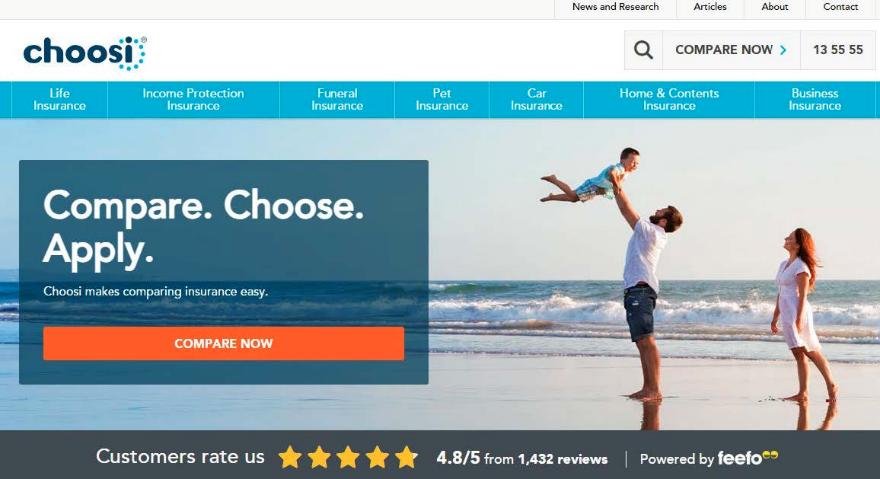
[157] | |
8.1 Statements about the General Insurance Comparison Service | [161] |
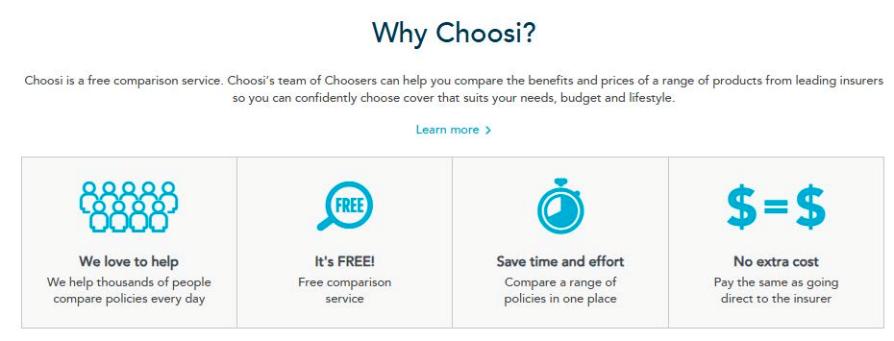
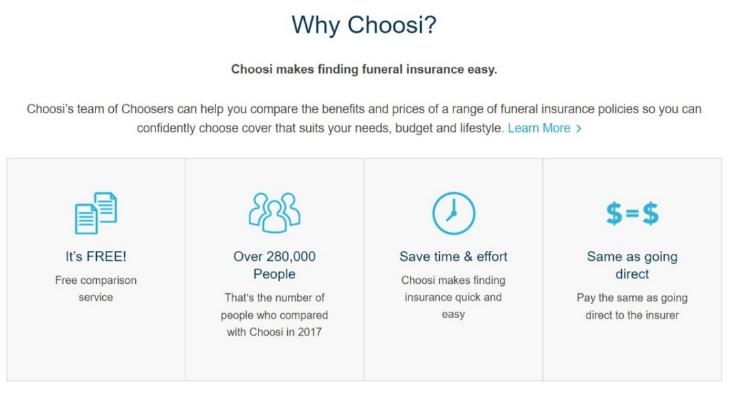
[166] | |
[168] | |
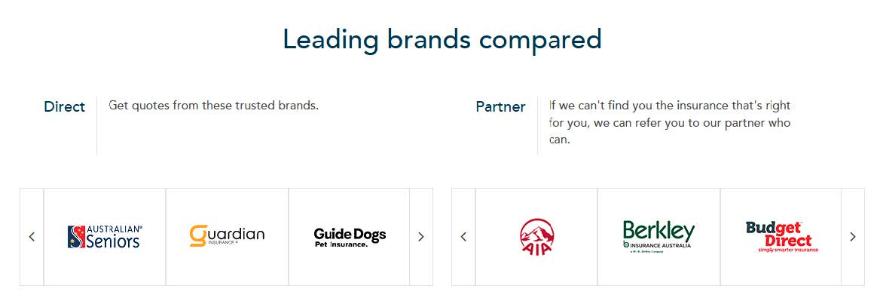
[171] | |
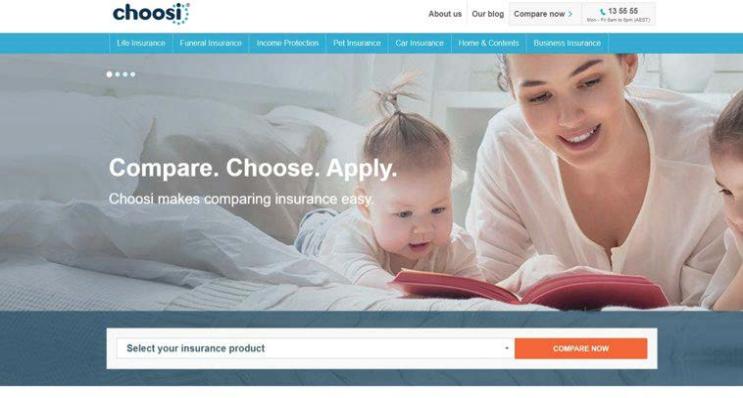
[174] | |
[181] | |
[192] | |
[200] | |
[203] | |
[210] | |
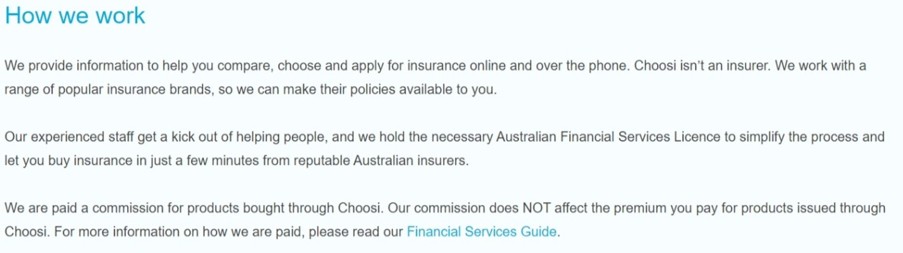
9.1 The Choosi Website conveyed the Comparison Representation | [213] |
[220] | |
[235] | |
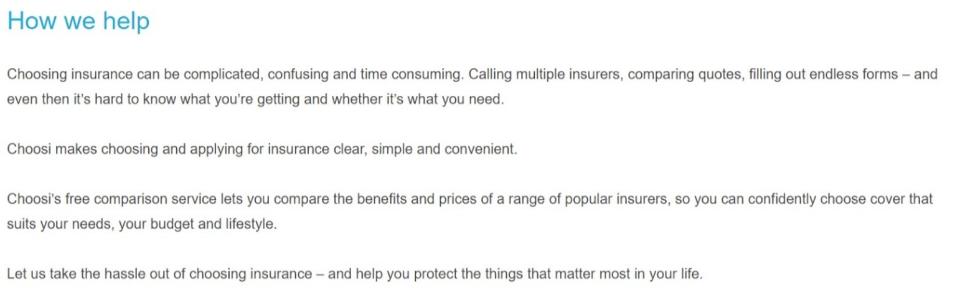
[241] | |
[251] | |
[258] | |
[262] | |
[266] | |
9.4 The television advertisements conveyed the Comparison Representation | [289] |
9.5 The Facebook advertisements conveyed the Comparison Representation | [301] |
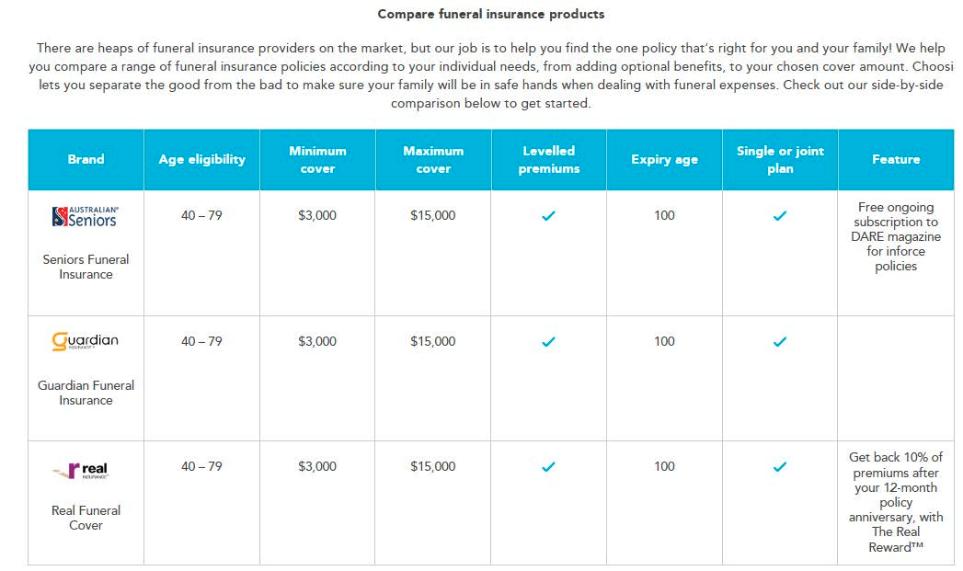
[315] | |
[328] | |
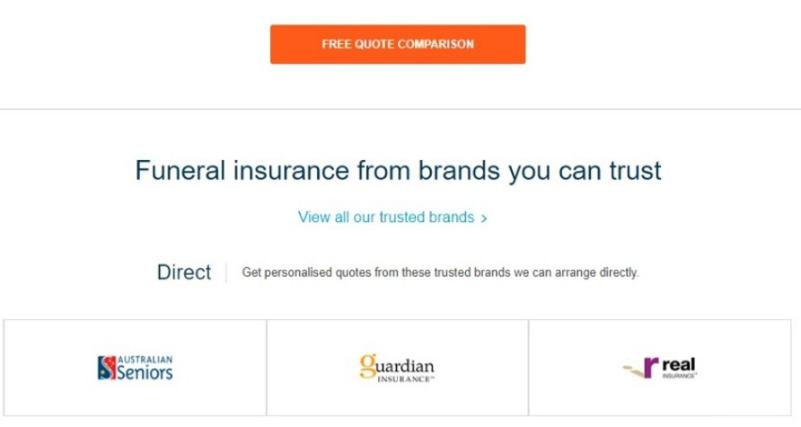
[350] | |
1. INTRODUCTION
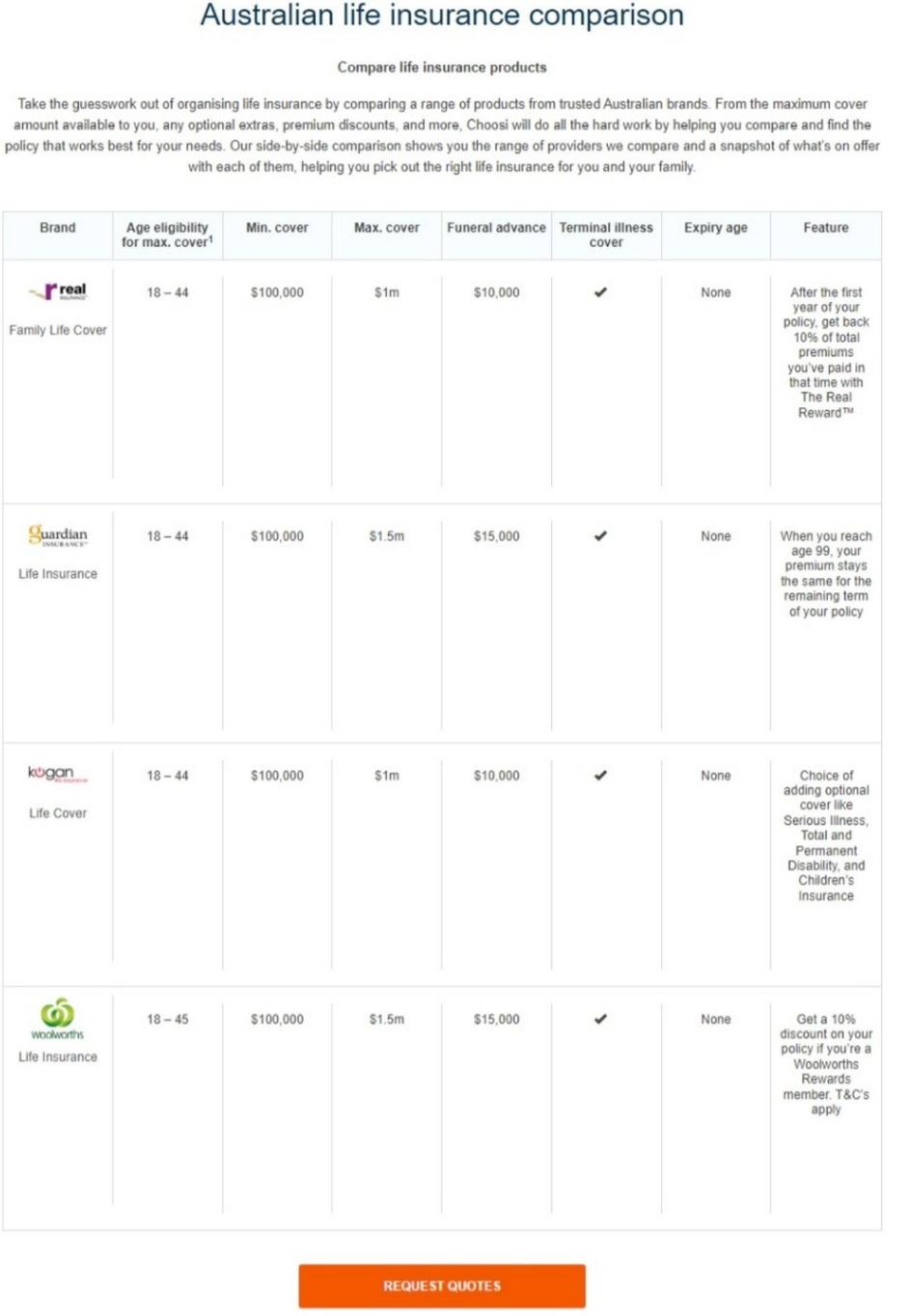
1 By this proceeding the Australian Securities and Investments Commission (ASIC) alleges that the defendant, Choosi Pty Ltd (Choosi), made false or misleading representations and engaged in conduct that was liable to mislead the public in relation to Choosi’s marketing of its life and funeral insurance policy comparison service.
2 Between 1 July 2019 and 2 June 2025 (inclusive) (Relevant Period), Choosi carried on a business which included the provision of a service that assisted consumers to compare, choose, and apply for funeral insurance policies and life insurance policies (Comparison Service). Choosi’s business also comprised the provision of comparison services in respect of other insurance products that are not the subject of this proceeding.
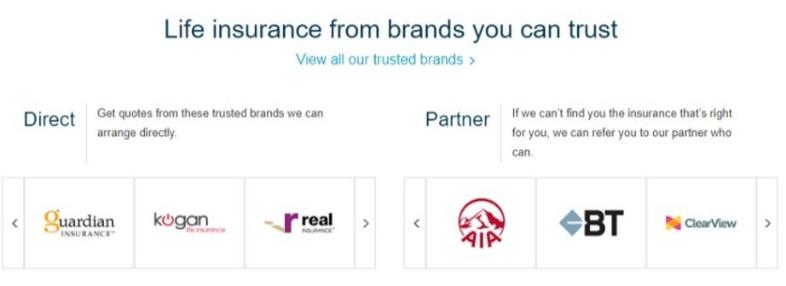
3 Choosi marketed its Comparison Service on its website (choosi.com.au) (Choosi Website), in television advertisements and television advertorials, and in advertisements on social media (Facebook advertisements). The relevant television advertisements and advertorials were widely broadcast during the Relevant Period: the television advertisements were broadcast on more than 300,000 occasions with a cumulative audience of more than 1 billion, and the advertorials were broadcast on at least 397 occasions with a cumulative audience of more than 38 million.
4 ASIC contends that the Choosi Website and marketing were false or misleading because they conveyed to consumers that Choosi’s service involved a broader or wider comparison than was in fact the case. Specifically, ASIC contends that Choosi conveyed that it compared life insurance policies and funeral insurance policies from a range of or multiple insurers when that was not true.
5 ASIC alleges that, by its conduct, Choosi contravened ss 12DB(1)(a), 12DB(1)(e) and 12DF(1) of the Australian Securities and Investments Commission Act 2001 (Cth) (Act) and seeks relief on that basis. I made orders on 4 August 2025 that the issue of whether Choosi has contravened the law as alleged in the Concise Statement be tried separately from, and in advance of, the determination of what relief should be granted. These are the reasons for my decision following the liability trial.
6 The content of the Choosi Website and other relevant advertising material relied upon in the proceeding (the television advertisements, television advertorials, and Facebook advertisements) is, along with other relevant matters, dealt with in a Statement of Agreed Facts filed on 6 October 2025 (SOAF), and a Further Statement of Agreed Facts filed on 23 April 2026.
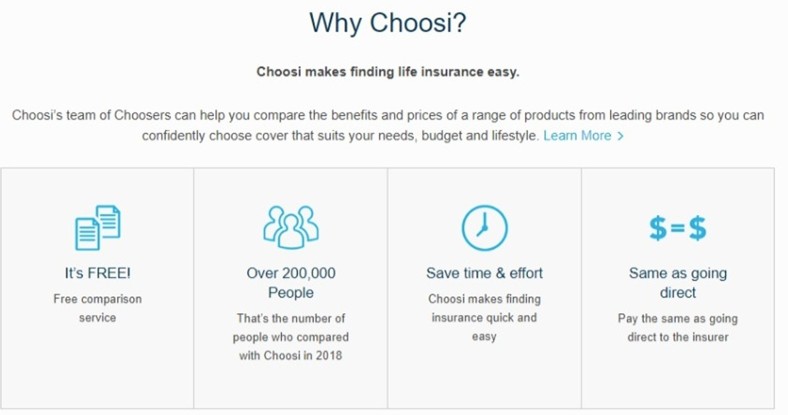
7 In relation to the Choosi Website, the parties have agreed to the different versions of these pages that were in place during the Relevant Period. They are identified in Annexure B to the SOAF. The parties have also agreed that an interactive web capture of those and other pages of the Choosi Website accurately depicts the content of the Choosi Website as at 5 May 2025 (Interactive Web Capture).
2. RELEVANT FACTS
8 The relevant facts set out below are taken from the SOAF.
2.1 Choosi and Greenstone
9 Choosi is a wholly owned subsidiary of Greenstone Pty Ltd. It is also a related entity of Greenstone Financial Services Pty Ltd (Greenstone is a 95% shareholder and Choosi is a 5% shareholder in GFS).
10 At all material times, Choosi held an Australian financial services licence, issued under s 913B of the Corporations Act 2001 (Cth). The licence authorised Choosi to carry on a financial services business which provided general financial product advice with respect to general insurance products and certain life insurance products and to deal in, by applying for, acquiring, varying or disposing of, such products, on behalf of another person.
11 Throughout the Relevant Period, Choosi’s business included providing a service to assist consumers to compare, choose and apply for insurance policies, including funeral insurance policies (Funeral Insurance Comparison Service) and life insurance policies (Life Insurance Comparison Service), collectively the Comparison Service. The exact nature of the Comparison Service is an issue in dispute – specifically, whether Choosi merely assisted consumers to compare the relevant policies or whether Choosi itself compared the policies.
12 In relation to funeral insurance, Choosi only compared policies from a single insurer, Hannover Life Re of Australasia Ltd. In relation to life insurance, from 1 July 2019 to 30 June 2023 (inclusive) Choosi compared policies issued by Hannover and one additional policy (Woolworths Life Insurance policy) issued by Swiss Re Life and Health Australia Limited (Multiple Life Insurers Period). From 1 July 2023 to the end of the Relevant Period (2 June 2025), Choosi only compared life insurance policies from Hannover (Single Life Insurer Period).
13 Throughout the Relevant Period, GFS was authorised by Hannover to distribute the funeral insurance policies and the life insurance policies (other than the one policy not issued by Hannover). During the Multiple Life Insurers Period, GFS was authorised by Swiss Re to distribute the Woolworths Life Insurance policy. Throughout the Relevant Period, GFS was paid a commission by the relevant insurer with respect to each funeral and life insurance policy sold through Choosi.
14 Throughout the Relevant Period, the life insurance policies and the funeral insurance policies the subject of Choosi’s Comparison Service were financial products within the meaning of s 12BAA of the Act and, in providing the Comparison Service, Choosi was providing a financial service within the meaning of s 12BAB of the Act.
2.2 Content of the Choosi Website
15 During the Relevant Period, Choosi compared funeral insurance policies and life insurance policies on the Choosi Website and over the phone. Choosi also assisted consumers to apply for such policies over the phone. As I have said, the nature of this “comparison” is an area of dispute. I deal in detail with the content of the Choosi Website later in these reasons, but it suffices at this point to say that the parties relied heavily on the Interactive Web Capture and otherwise relied on screenshots from a particular point in time when the Choosi Website differed from the Interactive Web Capture.
16 The Choosi Website contained many webpages. The parties agreed that the homepage (Choosi Homepage) and the following pages, accessible via links on the Choosi Homepage, are relevant to this proceeding: a main page relating to life insurance (Main Life Insurance Page), a main page relating to funeral insurance (Main Funeral Insurance Page), a page entitled “About Choosi” (About Choosi Page) and a page entitled “Frequently Asked Questions” (FAQs Page). Choosi also relies on pages relating to quote requests (Quote Pages), accessible from the Choosi Homepage, a page entitled “terms and conditions” (Terms and Conditions Page), and a page relating to Product Disclosure Statements (PDS Page), both accessible from the footer of each webpage.
2.3 Choosi’s television, advertorial, and Facebook marketing
17 In addition to the Choosi Website, the contraventions which ASIC alleges in this proceeding arise from television advertisements, television advertorials, and the Facebook advertisements which Choosi caused to be published during the Relevant Period. Choosi caused 74 television advertisements, 27 advertorials and 16 Facebook advertisements to be published, which are set out as sections 1, 2 and 3 respectively of Annexure C of the SOAF.
2.4 The phone calls
18 Choosi also relies on phone calls between a Choosi contact centre agent (Choosi Agent) and a customer which occurred in one of two circumstances:
(a) a consumer calling Choosi (whether or not they had interacted with or viewed the Choosi Website beforehand); or
(b) Choosi calling a consumer after the consumer had visited the Choosi Website, clicked on a “Request Comparison Now” button appearing on the Choosi Homepage (or other webpages) which took them to the relevant Quote Page and then filled in an online form for life insurance or funeral insurance.
19 Choosi provided scripts for Choosi Agents to use. The scripts included: a script for life insurance; a script for funeral insurance; and a “Choosi Partner Advisor Referral” script (which is relevant to an aspect of Choosi’s business of referring customers to Partner Insurers – that is, insurers other than Hannover and Swiss Re, which changed over time – through its Partner Insurer Referral Service). Annexure D of the SOAF identifies the different versions of each script that were in place during the Relevant Period, and the dates of those scripts.
2.5 The policies that Choosi compared
20 It is common ground that, during the Relevant Period, Choosi compared funeral insurance policies and life insurance policies on its website and over the phone. In relation to funeral insurance, it is also common ground that all of the policies that Choosi compared during the Relevant Period were issued by a single insurer, Hannover. Hannover was identified as the issuer of the policies in their respective PDSs (which were available on the “Useful Documents” webpage of the Choosi Website). The following table lists the nine funeral insurance policies, under three different brands, which Choosi compared during the Relevant Period, and which were all issued by Hannover:
Brand | Policy | Period |
Australian Seniors | Seniors Funeral Insurance Essential Cover | 1 July 2019 to 31 January 2021 |
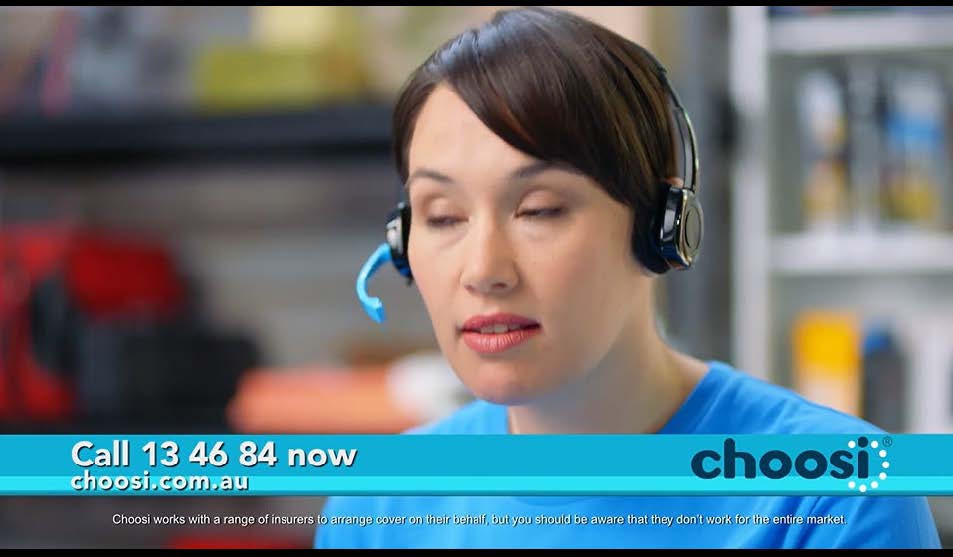
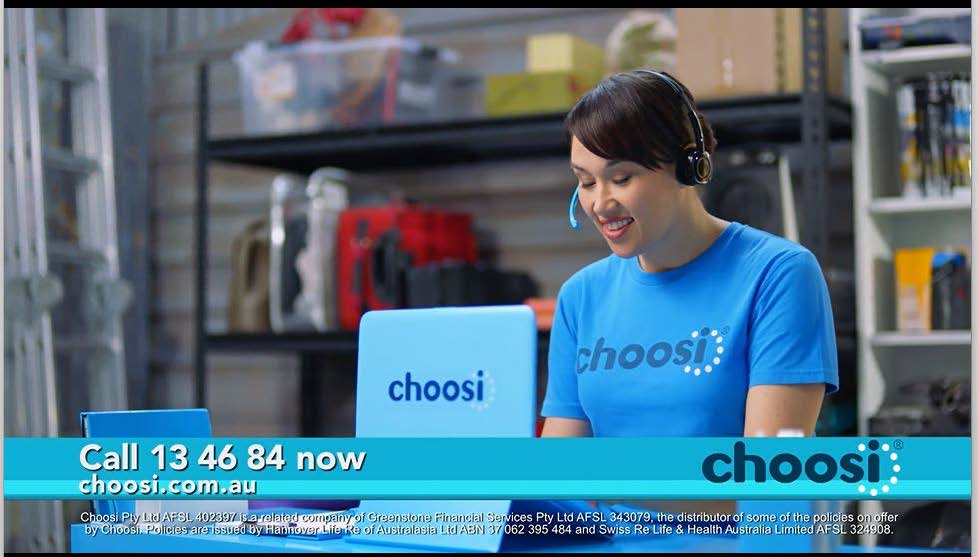
Australian Seniors | Seniors Funeral Insurance | 1 February 2021 to 2 June 2025 |
Australian Seniors | Australian Seniors Funeral Insurance Top Cover | 1 July 2019 to 31 January 2021 |
Guardian | Guardian Gold Funeral Insurance | 1 July 2019 to 1 December 2020 |
Guardian | Guardian Funeral Insurance | 1 February 2021 to 2 June 2025 |
Guardian | Guardian Platinum Funeral Insurance | 1 July 2019 to 30 January 2021 |
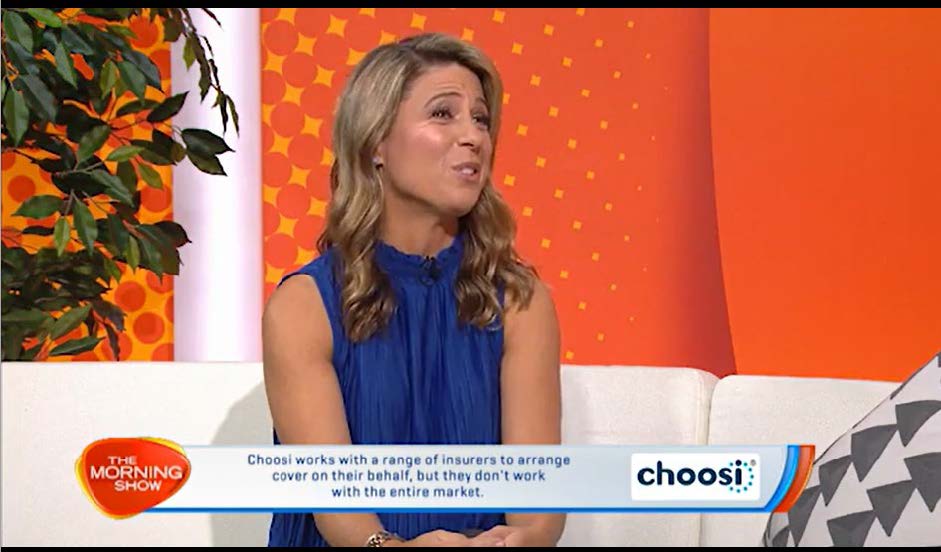
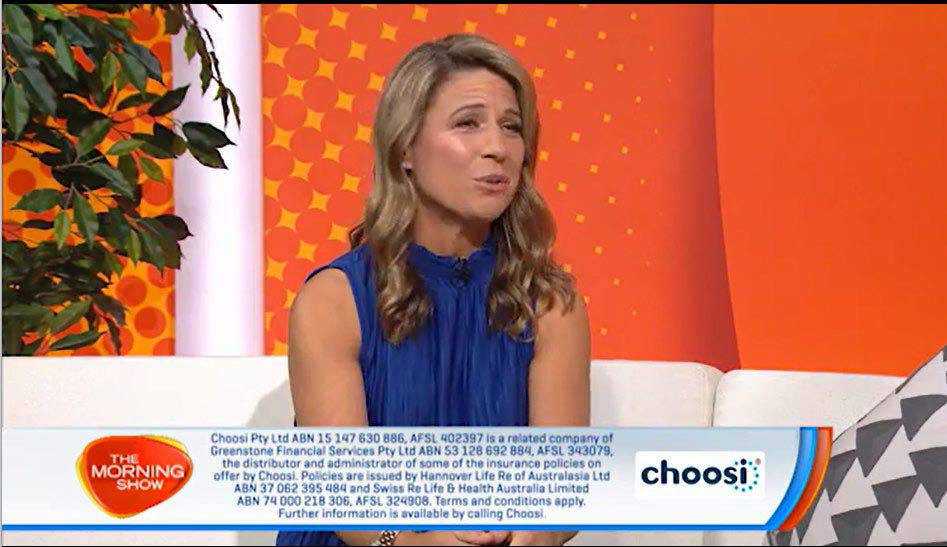
Real | Guaranteed Funeral Insurance Flexi | 1 July 2019 to 31 January 2021 |
Real | Real Funeral Cover | 1 February 2021 to 2 June 2025 |
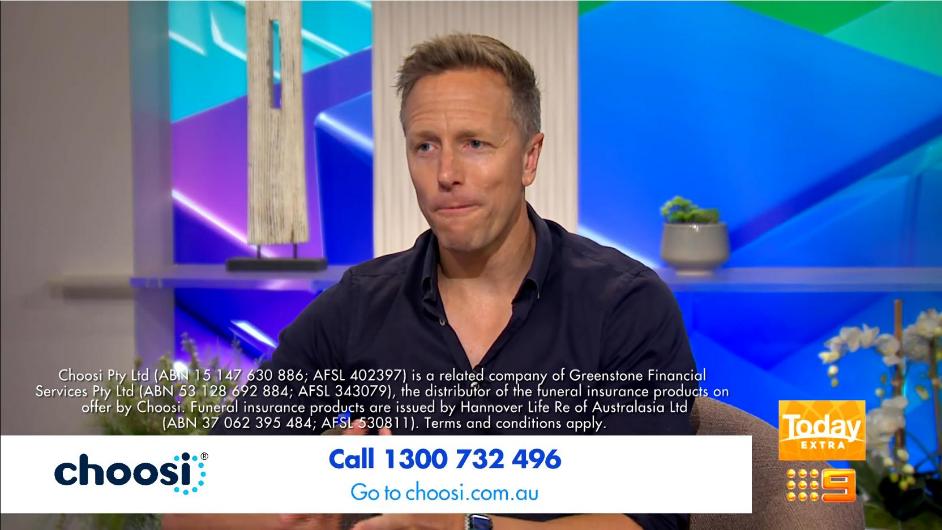
Real | Guaranteed Funeral Insurance Flexi Plus | 1 July 2019 to 31 January 2021 |
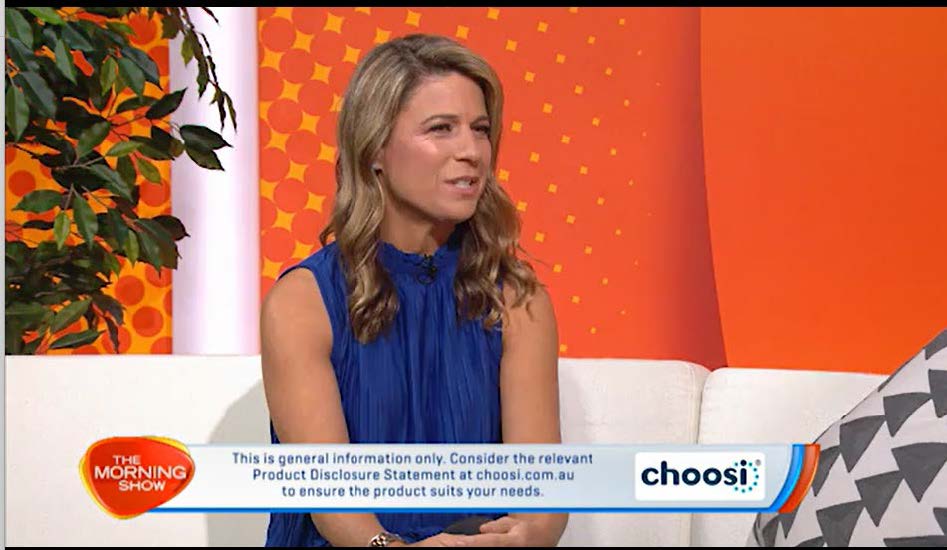
21 It is also common ground that in relation to life insurance, during the Multiple Life Insurers Period, Choosi compared policies issued by Hannover and one non-Hannover policy (the Woolworths Life Insurance policy) which was issued by Swiss Re. For the remainder of the Relevant Period (ie the Single Life Insurer Period), all of the life insurance policies that Choosi compared were issued by Hannover. The issuer of each policy was identified in the PDS for each policy available on the “Useful Documents” webpage of the Choosi Website. The following table lists the five life insurance policies, under four brands, issued by Hannover and the Woolworths life insurance policy issued by Swiss Re which Choosi compared during the Relevant Period:
Brand | Policy | Period |
Woolworths | Woolworths Life Insurance | 1 July 2019 to 30 June 2023 |
Chubb | Chubb Life Insurance | 1 July 2019 to 25 September 2019 |
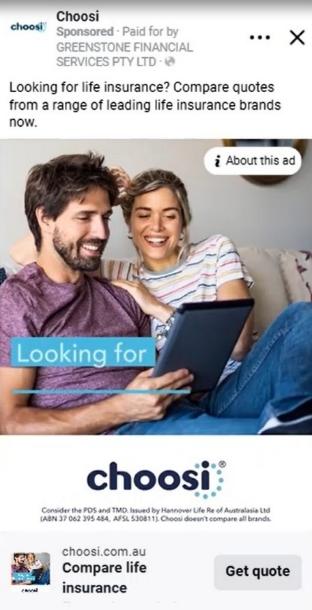
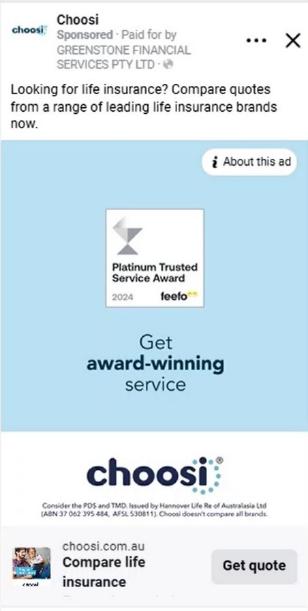
Guardian | Life Insurance | 1 July 2019 to 2 June 2025 |
Real | Family Life Cover | 1 July 2019 to 2 June 2025 |
Real | Real Life Cover for SMSF | 24 August 2022 to 2 June 2025 |
Kogan | Life Cover | 1 July 2019 to 2 June 2025 |
22 I pause here to note that Choosi submits that the inclusion of the words “at least” in [12] of the SOAF, which precedes the above table (“[d]uring the Relevant Period, Choosi compared, at least, the following life insurance policies”) highlights Choosi’s contention that the Life Insurance Comparison Service also extended to the Partner Insurer Referral Service (which ASIC rejects).
3. THE ALLEGED REPRESENTATIONS
23 As to the representation conveyed by Choosi on the Choosi Website and in its marketing material, ASIC advances its case in two alternative ways.
24 First, ASIC principally contends that the Choosi Website, each of the television advertisements, each of the advertorials, and each of the Facebook advertisements conveyed a representation and/or constituted conduct liable to mislead the public by conveying that Choosi compared funeral/life insurance policies from a range of insurers. The representation is defined in ASIC’s Concise Statement as the “Funeral Comparison Representation” (insofar as it relates to funeral insurance) and the “Life Comparison Representation” (insofar as it relates to life insurance). I will refer to both representations collectively as the Comparison Representation.
25 ASIC contends that neither one nor two insurers constitute a “range of insurers”. Accordingly, if the Court is satisfied that the Comparison Representation was made, ASIC submits that it follows that the representation was false and that Choosi’s conduct was liable to mislead the public throughout the Relevant Period with respect to both:
(a) funeral insurance (as to which Choosi only compared policies from one insurer); and
(b) life insurance (as to which Choosi only compared policies from two insurers during the Multiple Life Insurers Period and from one insurer during the Single Life Insurer Period).
26 Second, if the Court is not satisfied that the Comparison Representation was made, ASIC alleges in the alternative a narrower representation: that Choosi compared funeral/life insurance policies from multiple insurers. The representation is defined in ASIC’s Concise Statement as the “Alternative Funeral Comparison Representation” and the “Alternative Life Comparison Representation” and I will refer to these representations collectively as the Alternative Comparison Representation.
27 ASIC contends that “multiple insurers” denotes more than one insurer. Accordingly, if the Court is satisfied that the Alternative Comparison Representation was made, it will have been false throughout the Relevant Period with respect to funeral insurance but in respect of life insurance it will only have been false during the Single Life Insurer Period. ASIC does not allege that the Alternative Life Comparison Representation was false during the Multiple Life Insurers Period. ASIC’s case with respect to the Alternative Life Comparison Representation is, in this sense, narrower than its primary case in relation to the Life Comparison Representation.
28 ASIC contends that the Comparison Representation (or the Alternative Comparison Representation) was made in connection with the supply or possible supply of the Comparison Service and concerned the nature, characteristics and/or the suitability for purpose of the Comparison Service.
29 Therefore, ASIC alleges that by making the Funeral Comparison Representation, the Alternative Funeral Comparison Representation, the Life Comparison Representation and/or the Alternative Life Comparison Representation, Choosi, in trade or commerce:
(a) made a false or misleading representation that services are of a particular standard, quality or value in contravention of s 12DB(1)(a) of the Act;
(b) made a false or misleading representation that services have performance characteristics, uses or benefits in contravention of s 12DB(1)(e) of the Act; and
(c) engaged in conduct that was liable to mislead the public as to the nature, characteristics, and/or suitability for their purpose of financial services in contravention of s 12DF(1) of the Act.
30 While not relevant to this initial trial (which is limited to liability), I will outline at a general level the harm which ASIC contends Choosi’s alleged misleading conduct caused, so as to contextualise the case advanced by ASIC. ASIC alleges Choosi’s conduct misled prospective funeral and life insurance customers about the benefits of using its Comparison Service and that, in so doing, Choosi defeated or diminished genuine consumer choice. For example, ASIC submits Choosi’s conduct may have caused consumers to purchase funeral or life insurance policies when a cheaper or more suitable plan was available from insurers other than Hannover or distributors other than GFS and may have resulted in other insurers or distributors losing customers they would otherwise have obtained had consumers not been misled.
31 Further, ASIC alleges Choosi is likely to have obtained a substantial benefit from its conduct, including as a result of the receipt of commissions from Hannover in respect of policies sold to consumers who may not have purchased insurance through Choosi’s Comparison Service but for the misleading conduct. In its Concise Statement, ASIC contends that between 1 July 2019 and 30 November 2024 (noting the Relevant Period is up to 2 June 2025) 4,225 Hannover funeral insurance policies and 9,478 Hannover life insurance policies were sold through Choosi’s Comparison Service and that Choosi received over $61 million in commissions for the sale of these policies. Choosi disputes the calculation of $61 million and says that Greenstone received around $17.4 million in commissions (comprising $14.6 million for life insurance policies and $2.8 million for funeral insurance policies). Choosi also contends that ASIC’s allegations of harm are advanced at a level of generality that is vague and ambiguous, and denies that its conduct misled prospective customers, or defeated or diminished genuine consumer choice.
4. CHOOSI’S DEFENCE
32 Choosi admits that, during the Relevant Period, the life and funeral insurance policies the subject of its Comparison Service were financial products within the meaning of s 12BAA of the Act and that Choosi was providing a financial service within the meaning of s 12BAB of the Act by providing its Comparison Service. By its written submissions, Choosi no longer presses its denial in its Concise Statement in Response that prior to 17 February 2020 the funeral insurance policies were not financial products because s 12BAA(8)(o) of the Act excluded “funeral benefits” from the definition of “financial product”.
33 Choosi admits that its business, during the Relevant Period, included a service assisting consumers to compare, choose and apply for insurance policies, including funeral and life insurance policies, and that it marketed that service to the public through the Choosi Website, television advertisements, advertorials and the Facebook advertisements. Beyond those admissions, Choosi’s defence, in substance, is that:
(1) the Comparison Representation and the Alternative Comparison Representation were not conveyed by the Choosi Website or by the marketing materials; and
(2) if either or both representations were conveyed, they were not false or misleading or liable to mislead the public, contrary to ss 12DB(1)(a), 12DB(1)(e) and 12DF of the Act.
34 Choosi contends that, properly analysed, the impugned conduct did not convey the pleaded representations at all; that is, Choosi’s Website and the marketing material, viewed as a whole, including disclaimers, would not have conveyed the representations. In particular, Choosi contends that the Choosi Website needs to be considered in the context of the phone calls, which it says form part of the relevant conduct and did not convey the representations. Choosi further contends that the statements relied upon by ASIC in its Concise Statement from the Choosi Homepage, the About Choosi Page and the FAQs Page are statements about its comparison service generally (ie, its comparison service in respect of types of insurance other than life and funeral insurance), and not about the Life Insurance Comparison Service or the Funeral Insurance Comparison Service specifically.
35 Central to Choosi’s case that the representations were not conveyed is its contention that the Comparison Service was not, in truth, supplied via the Choosi Website. Choosi says that the service was supplied through a phone call with a Choosi Agent, because it was only through the phone calls that a consumer could apply for a policy; consumers could not apply through the Choosi Website.
36 Choosi contends that ASIC’s case proceeds at too high a level of abstraction. It elides different categories, different media, different wording, different time periods, and different pathways through Choosi’s service. Choosi appears to contend that ASIC’s asserted representations depend on a strained reading of the impugned statements and isolating specific words from their context.
37 Choosi emphasises what it says are two critical distinctions. First, the distinction between Choosi assisting consumers to compare, choose and apply for insurance (which Choosi says is the service it is pleaded as having provided in ASIC’s Concise Statement) and Choosi itself comparing policies (the service that ASIC submits Choosi represented itself as providing). Second, the distinction between comparing policies from multiple brands and comparing policies from multiple insurers. Choosi’s Concise Statement in Response relied, in support of this second point, on historical correspondence between Choosi and ASIC which, as I discuss later, I ruled as inadmissible.
38 If either or both representations are found to have been conveyed, Choosi contends that in respect of life insurance ASIC cannot prove falsity for the following two reasons:
(1) during the Multiple Life Insurers Period, Choosi compared products from both Hannover and Swiss Re; and
(2) throughout the entire Relevant Period, Choosi’s Life Insurance Comparison Service also included the Partner Insurer Referral Service, which it says constituted: (a) the provision of Partner Insurers’ webpages; (b) Partner Insurers’ PDS material; and (c) a phone referral pathway to Life Insurance Direct Australia Pty Ltd (which generated 6,124 referrals during the Relevant Period). It was through highlighting the Partner Insurers and making referrals to LID that Choosi assisted consumers to compare, choose and apply for life insurance products issued by insurers other than Hannover and Swiss Re, even if it did not undertake the comparison of those products itself.
39 In respect of funeral insurance, Choosi admits that throughout the Relevant Period, Choosi only compared policies from Hannover in respect of funeral insurance. Choosi does not advance any pleaded case that, if the Funeral Comparison Representation or the Alternative Funeral Comparison Representation were conveyed, they were nonetheless not false or misleading. Its case on falsity in respect of funeral insurance rests upon a bare denial, together with its overarching contention that the representations were not conveyed at all.
5. EVIDENCE
40 In addition to the SOAF, ASIC relies upon two affidavits affirmed by Jack Campbell Stone, dated 3 November 2025 and 12 February 2026, which, among other things, exhibit documents and correspondence provided by Choosi in response to statutory notices issued under s 33 of the Act and s 912C of the Corporations Act.
41 Choosi relies upon the following affidavits:
(1) the affidavit affirmed by Daniel Atkins, dated 17 December 2025 (Atkins affidavit);
(2) the affidavit affirmed by Lee Macquarie Smith, dated 22 December 2025 (Smith affidavit); and
(3) the affidavit affirmed by Jerome Joseph Burog, dated 22 December 2025 (Burog affidavit).
42 The affidavits relied on by the parties were tendered and the deponents were not required for cross-examination.
5.1 ASIC’s lay evidence
43 No objections were made in respect of Mr Stone’s affidavits, and I accept Mr Stone’s evidence. Mr Stone is a lawyer within ASIC’s Enforcement and Compliance group. As part of his role, Mr Stone is involved in the conduct of investigations into suspected contraventions of the laws regulated by ASIC, including the Act. ASIC has delegated certain functions and powers to Mr Stone under Part 3 of the Act relating to the conduct of investigations, pursuant to s 102 of the Act. Mr Stone says that on 26 August 2024, ASIC commenced an investigation under s 13 of the Act in relation to the conduct of Choosi, being the conduct which is the subject of this proceeding. Mr Stone described the processes by which ASIC identified, stored and managed documents obtained from Choosi and documents (ie, notices) sent by ASIC to Choosi. Mr Stone’s affidavit exhibited:
(a) notices ASIC served on Choosi (and Choosi’s responses) during the course of its investigation for the provision of documents under s 33 of the Act and the provision of information under s 912C of the Corporations Act;
(b) company information for Choosi, GFS and Greenstone, and Australian financial services licences issued to Choosi and GFS which were obtained from ASIC’s databases; and
(c) versions of the Choosi webpages, copies of Choosi’s advertising (television advertisements, advertorials and the Facebook advertisements), the Choosi scripts for phone calls during the Relevant Period, and the interactive web capture of the Choosi Website.
5.2 Choosi’s lay evidence
5.2.1 Daniel Atkins
44 Mr Atkins is the General Manager (Risk & Compliance) for GFS, a position he has held since January 2020. In this role, he is responsible for the risk and compliance frameworks (including those which relate to Choosi) and for overseeing the team responsible for reviewing Choosi Website content, telephone scripts, and marketing/advertisements. Prior to that he was the head of risk and compliance at GFS (which included oversight of risk and compliance at Choosi) from March 2015 to January 2020.
45 Mr Atkins gave evidence regarding Choosi’s business, features of the Choosi Website during the Relevant Period, the Partner Insurer Referral Service, quality assurance processes for telephone sales, commissions, and certain historical correspondence between Choosi and ASIC.
46 Mr Atkins described Choosi as a business that provides information about insurance products and brands (including for life, funeral, income protection, pet and other types of insurance) and facilitates applications for insurance products. He said that, during the Relevant Period, Choosi promoted its services through television advertising, advertorials, social media, its website, and search engine marketing (which generated the largest source of website traffic).
47 Mr Atkins said applications for life and funeral insurance available through Choosi could only be made during a telephone call; consumers could not purchase a policy or obtain direct quotes through the Choosi Website.
48 Mr Atkins also described Choosi’s referral arrangements. Customers seeking products outside those offered through Choosi’s direct relationships/distribution agreements could be referred to Choosi’s sole referral partner during the Relevant Period, LID. He said referred customers would receive general advice concerning life insurance policies available through LID and could apply for those policies. He said Choosi’s life insurance scripts identified the circumstances in which representatives were required to offer consumers that referral.
49 Mr Atkins also gave evidence about quality assurance of phone calls conducted by Choosi representatives. Mr Atkins said that approximately 15–20% of successful life and funeral insurance sales interactions were reviewed each month throughout the Relevant Period. The review process was conducted by an operationally independent quality assurance team, which assessed calls on a pass/fail basis and provided feedback where non-compliance was identified. The framework against which calls were assessed included call compliance checklists, a quality assurance framework, the Hannover Customer Engagement Rules and, from about December 2021, a Rules Library containing specified assessment criteria, including compliance with mandatory script wording.
50 As to commissions, Mr Atkins said that Choosi did not have an agreement under which it received commissions directly from Hannover. Rather, GFS was party to the relevant distribution agreement with Hannover, which provided for commission payments to GFS. GFS separately delegated distribution rights to Choosi for consideration.
51 Finally, Mr Atkins gave evidence concerning correspondence between Choosi and ASIC in 2012 and 2013 relating to representations on the Choosi Website and what Choosi characterised as suggested changes by ASIC. ASIC objected to that evidence and the underlying documents (Exhibit DA-2) on relevance grounds. Following oral submissions, I ruled the evidence inadmissible under s 55 of the Evidence Act 1995 (Cth).
5.2.2 Lee Macquarie Smith
52 Mr Smith is the General Manager (Actuarial) at GFS. Mr Smith commenced employment with GFS in January 2024 as an Actuarial Advisor and has been in his current role since 1 May 2024. Mr Smith gave evidence concerning commissions received by GFS in respect of policies sold through Choosi and distinguished between commissions actually received and actuarial estimates of future commissions. The evidence is likely to be relevant to any penalty hearing but is not material to any issue I must determine on liability.
5.2.3 Jerome Burog
53 Mr Burog is the General Manager (Analytics) for GFS. Mr Burog has been employed at GFS for more than nine years, commencing in April 2016 as an Analytics Lead. From August 2023 to March 2024, he was the General Manager (Analytics Optimisation) and has been in his current role since March 2024.
54 As part of his role, Mr Burog receives requests from people within GFS for summaries of GFS’s information from internal databases. On 15 July 2025, at Mr Atkins’ request, he extracted and summarised the total number of broker referrals Choosi made to LID for life insurance comparisons over the Relevant Period, being 6,124 referrals.
5.2.4 Choosi’s submissions on its lay evidence
55 Choosi submits that the SOAF and the evidence in the Atkins, Smith and Burog affidavits establish the following facts.
56 In relation to the Comparison Service, Choosi raises three points. First, Choosi provides a service by which consumers can access information about insurance products, identified by reference to insurance brands, and apply for insurance policies where eligible. Choosi says it is agreed between the parties that during the Relevant Period, Choosi’s business included “providing a service to assist consumers to compare, choose and apply” for insurance policies.
57 Second, the types of insurance in relation to which Choosi offers this service include life insurance, income protection insurance, funeral insurance, pet insurance, and other insurance policies. Choosi submits that certain statements on the Choosi Website must be construed in light of the fact that Choosi offered comparison services in respect of insurance products beyond funeral and life insurance.
58 Third, the concept of the Comparison Service, as defined in the SOAF (and in the Concise Statement, as admitted in the Concise Statement in Response), comprises the totality of comparing, choosing and applying for insurance policies. It is not merely the act of comparing insurance policies. That is important because Choosi’s evidence is that the application process only takes place via phone calls with Choosi employees and not on the Choosi Website. Therefore, Choosi submits the Comparison Service necessarily includes such phone calls, in addition to all other forms of consumer interaction (eg, the marketing and website).
59 Choosi also raises the following points in relation to the Partner Insurer Referral Service. The Partner Insurer Referral Service allowed consumers who were seeking an insurance product other than those offered by brands with which Choosi had a direct relationship, to obtain assistance concerning other insurance options. During the Relevant Period, Choosi had one referral partner, LID. Consumers who were referred to LID would receive general advice in relation to a range of life insurance products available through LID and could subsequently apply for one or more policies available through insurers such as MetLife, Clearview or AIA Australia. The service had two components:
(a) throughout the Relevant Period, the Main Life Insurance Page on the Website included information about two categories of life insurance policies: policies from “Direct” brands and from “Partner” insurers (the latter being the Partner Insurers that consumers could be referred to by LID); and
(b) as described above, during the phone calls Choosi Agents had telephone scripts which set out the circumstances in which the Choosi Agent was required to inform the consumer of the opportunity to be referred to Choosi’s referral partner, LID.
60 There were 6,124 referrals from Choosi to LID during the period 1 July 2019 to 2 June 2025. By contrast, during the period 1 July 2019 to 30 November 2024, Choosi says it sold 11,916 life insurance policies issued by Hannover or Swiss Re.
6. CHOOSI’S MARKETING
61 During the Relevant Period, as Mr Atkins deposed, Choosi advertised its services by means of:
(a) short television advertisements lasting 30 to 60 seconds that directed consumers to the Choosi Website or call centre numbers;
(b) longer-form “advertorials” within programmes, again directing consumers to the website or call centre numbers;
(c) search engine marketing, including organic search results and paid search advertising, being the largest source of traffic to the Choosi Website during the Relevant Period;
(d) social media advertisements, including the Facebook advertisements, that directed consumers to the website or call centre numbers; and
(e) the Choosi Website itself.
6.1 Choosi Website
62 ASIC advanced its case in relation to the Choosi Website by reference to particular webpages.
63 Choosi broadly accepts the description of the Choosi Website advanced by ASIC, although Choosi submits ASIC omits certain relevant matters. I set out below the aspects of each webpage relied on by the parties, which I consider relevant.
6.1.1 Choosi Homepage
64 The image below depicts the start (ie, the landing page) of the Choosi Homepage as it appeared between 23 October 2020 and 2 June 2025 (inclusive):
65 ASIC relies upon the following features. The items in the blue banner at the top of the page (“Life Insurance”, “Income Protection Insurance”, “Funeral Insurance” etc.) were hyperlinked buttons which, if clicked on, took the consumer to a page relating to each insurance type. The two pages relevant to this proceeding were the Main Funeral Insurance Page and the Main Life Insurance Page. ASIC also relies on the prominently displayed statements “Compare. Choose. Apply.” and “Choosi makes comparing insurance easy”, together with a “compare now” button which was hyperlinked to a page where the consumer could complete a form and request that Choosi call them to provide a comparison and a quote (ie, the relevant Quote Page).
66 Immediately below that part of the Choosi Homepage was a section entitled “Why Choosi?”, depicted below:
67 ASIC emphasises the words “help you compare the benefits and prices of a range of products from leading insurers” in the statement appearing below the title “Why Choosi?” (Why Choosi Statement).
68 The parties also rely upon the section of the Choosi Homepage entitled “Leading brands compared”:
69 Prior to 23 October 2020, the Choosi Homepage appeared as follows:
70 The Why Choosi Statement appeared as follows:
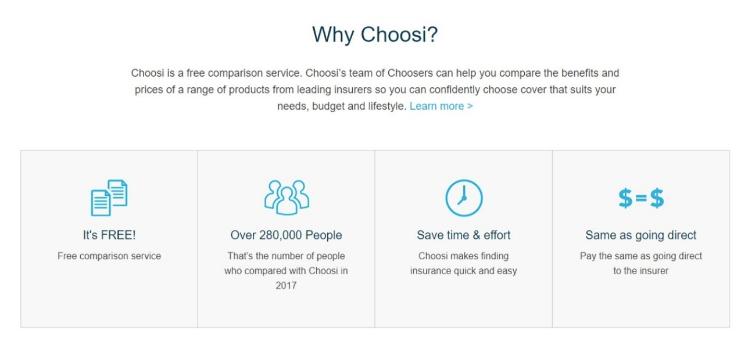
71 The “Leading brands compared” section appeared as follows:
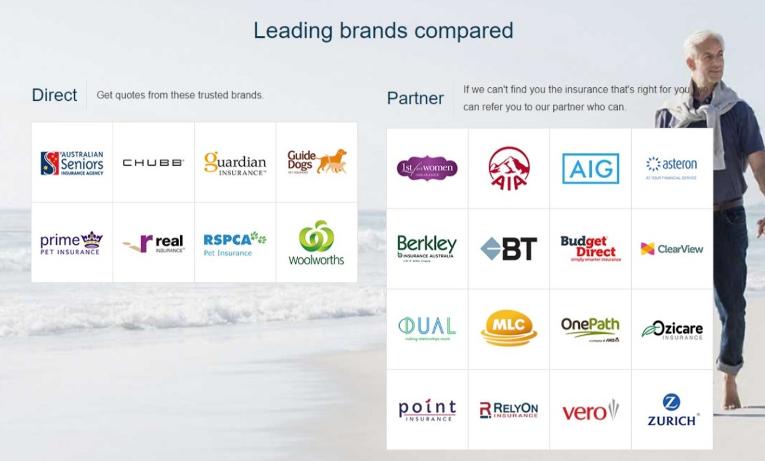
72 In the above image, the logos in the carousel on the left side of the page (ie, the logos under “Direct”) were hyperlinked, whereas the logos in the carousel on the right-hand side (ie, the logos under “Partner”) were not (with the exception of the logo for Encompass Protection life insurance (not pictured) for the period starting on a date between 22 October 2023 and 1 December 2023, and ending on a date between 22 May 2025 and 28 May 2025).
6.1.2 About Choosi Page
73 The Why Choosi Statement was followed by the words “Learn More”. Those words were hyperlinked to the About Choosi Page. The About Choosi Page could also be accessed by clicking the “About” or “About us” button which appeared in the top right-hand corner of the Choosi Homepage (as depicted in the images at paragraphs [64] and [69] above).
74 At the top of the About Choosi Page was an image and directly below was the following section:
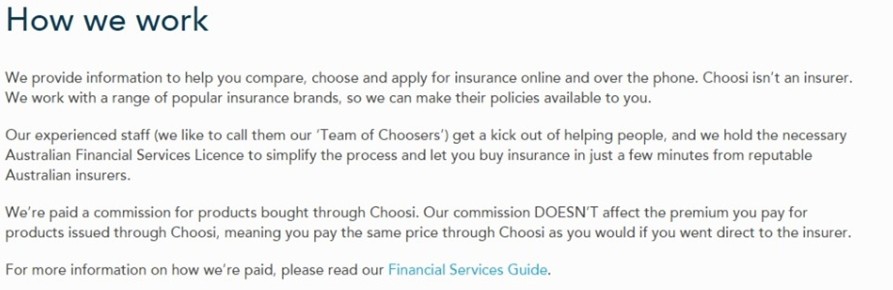
75 ASIC emphasises the following aspects of the above statement (How We Work Statement):
(a) “[w]e provide information to help you compare, choose and apply for insurance online and over the phone. Choosi isn’t an insurer. We work with a range of popular insurance brands, so we can make their policies available to you.”; and
(b) “… we hold the necessary Australian Financial Services Licence to simplify the process and let you buy insurance in just a few minutes from reputable Australian insurers.”
(Emphasis added).
76 Further down the About Choosi Page, the following appeared from September 2020:
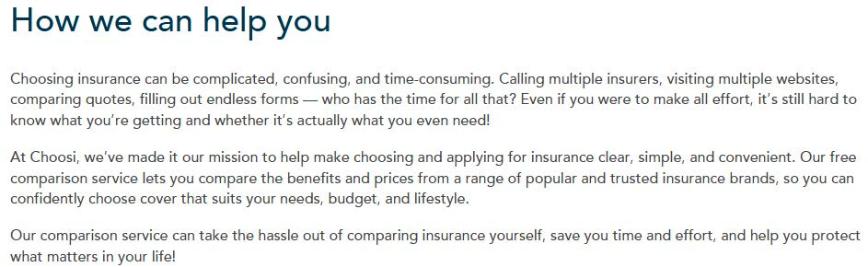
77 ASIC emphasises the following aspects from the above statements:
(a) “Choosing insurance can be complicated, confusing, and time-consuming. Calling multiple insurers, visiting multiple websites, comparing quotes, filling out endless forms …” (How We Help Statement 1); and
(b) “At Choosi, we’ve made it our mission to help make choosing and applying for insurance clear, simple, and convenient. Our free comparison service lets you compare the benefits and prices from a range of popular and trusted insurance brands so that you can confidently choose cover that suits your needs, budget, and lifestyle” (How We Help Statement 2).
(Emphasis added).
78 Prior to 20 September 2020 the above section appeared as follows:
79 In addition to the How We Help Statement 1, ASIC emphasises the following aspects of the above statements (in place of the How We Help Statement 2):
(a) “Choosi’s free comparison service lets you compare the benefits and prices of a range of popular insurers so you can confidently choose cover that suits your needs, your budget and lifestyle” (How We Help Statement 3).
(Emphasis added by ASIC).
80 For the period prior to September 2020, Choosi also relies on a hyperlink on the About Choosi Page which it says directed consumers to its Financial Services Guide for more information about how it is paid, as illustrated in the below photo, which appeared above the How We Help Statement:
81 The Financial Services Guide included statements that:
(a) Choosi provided “general advice only in the form of a comparison of a range of insurance products”;
(b) consumers could “obtain quotes and information about a policy through [the Choosi Website] or over the telephone with a Choosi call centre operator.” Choosi provided “quotes and comparison services in relation to a range of Life Insurance, Income Protection Insurance, Funeral Insurance, Pet Insurance, Car Insurance, Home & Contents Insurance, and Business Insurance policies.”
(c) Choosi did not “provide information on all products available in the market”;
(d) a full list of the “brands” that Choosi could provide information on, or access to, was listed on the website;
(e) the products that could be arranged directly through Choosi were limited to a specified set of “brands”;
(f) Choosi was a related company of GFS; and
(g) GFS was the distributor of the brands available through Choosi.
82 Choosi does not draw attention to the fact that the Financial Services Guide specifically referred to the following:
The car insurance and home and contents insurance products we compare are issued and distributed by Compare The Market Pty Ltd (ABN 83 117 323 378; AFSL 422926) (CTM). If you choose to purchase these products, we’ll refer you to CTM.
The business insurance products we compare are issued and distributed by BizCover Pty Ltd (ABN 68 127 707 975; AFSL 501769) (BizCover). If you choose to purchase these products, we’ll refer you to BizCover.
We are a related company of The Hollard Insurance Company Pty Ltd (ABN 78 090 584 473; AFSL 241436) which is the insurer of each Pet Insurance product directly available through us.
We’re also a related company of PetSure (Australia) Pty Ltd (ABN 95 075 949 923; AFSL 420183) which is the administrator of each pet insurance product directly available through us.
83 By comparison, there was no statement to the effect that the life and funeral insurance products which Choosi compared were issued by Hannover (and Swiss Re during the Multiple Life Insurers Period).
6.1.3 Main Funeral Insurance Page
84 Throughout the Relevant Period the Main Funeral Insurance Page (which was also accessible via a hyperlink from the Choosi Homepage) opened on the following image, although the exact text in the box changed slightly over the period (the below photo is a screengrab dated 24 July 2021):

85 From 18 January 2021, further down the page the following statement (Compare Funeral Insurance Products Statement) and table (Funeral Comparison Table) appeared under the heading “Compare funeral insurance products”:
86 ASIC emphasises the following aspects of the Compare Funeral Insurance Products Statement:
There are heaps of funeral insurance providers on the market, but our job is to help you find the one policy that’s right for you and your family! We help you compare a range of funeral insurance policies according to your individual needs … Check out our side-by-side comparison below to get started.
(Emphasis added).
87 Choosi emphasises that, from at least March 2021, the logos pictured above under the heading “Funeral insurance brands you can trust” were hyperlinked to “Direct” policy pages and provided the Choosi phone number, a link to the relevant Quote Page, and a link to the relevant PDS Page.
88 Prior to 18 January 2021, the Main Funeral Insurance Page was in a materially different form. The below images depict the aspects which ASIC emphasises:

6.1.4 Main Life Insurance Page
89 From 26 February 2021, the key features of the Main Life Insurance Page (which was also accessible via a hyperlink from the Choosi Homepage) were as follows (noting the below photo is during the Multiple Life Insurers Period; the page differed in terms of the precise policies and their features but in substance remained the same):
90 ASIC emphasises the following aspects of the statement (Compare Life Insurance Products Statement), which appears above the table (Life Comparison Table):
Take the guesswork out of organising life insurance by comparing a range of products from trusted Australian brands. … Choosi will do all the hard work by helping you compare, so you can find the policy that works best for your needs. Our side-by-side comparison shows you the range of providers we compare and a snapshot of what’s on offer with each of them, helping you pick out the right life insurance for you and your family.
(Emphasis added).
91 Choosi emphasises that the hyperlinked “REQUEST QUOTES” button pictured above linked to a Quote Page, specifically a “Compare life insurance quotes” form requesting consumer details for the purpose of a call from a Choosi Agent (and not for the purpose of emailing a quote directly). Further, that underneath the “Request Quotes” button the following appeared:
92 The above pictured logos were hyperlinked under the “Direct” and “Partner” sub-headings and took consumers to sub-pages about the relevant policy offered by Choosi or its partner, LID. The “View all our trusted brands” was hyperlinked and took consumers to a “Trusted Brands” subpage, which itself displayed “Direct” and “Partner” sub-headings with hyperlinked logos. Choosi says that those pages included, relevantly, the Choosi phone number, links to the relevant Quote Page for life insurance, and links to the relevant PDS Page. Choosi submits that some, but not all, Direct policy pages disclosed that the policies were underwritten by Hannover.
93 From 26 February 2021, the image below depicts what appeared further down the Main Life Insurance Page:

94 ASIC emphasises the following aspects of the above statement (How to Get Life Insurance Statement):
After comparing policies and choosing your preferred cover, you can apply directly through Choosi. Keep in mind that every provider has their own application and approval process for getting life insurance. You can check which policies you may be eligible for during the comparison process.
(Emphasis added).
95 The Main Life Insurance Page was in a materially different form prior to 26 February 2021 and did not include the Life Comparison Table, Compare Life Insurance Products Statement, or the How to Get Life Insurance Statement. During that period, the relevant part of the page appeared as follows:
96 Further down the page, the following appeared under the heading “Brands you can trust”:
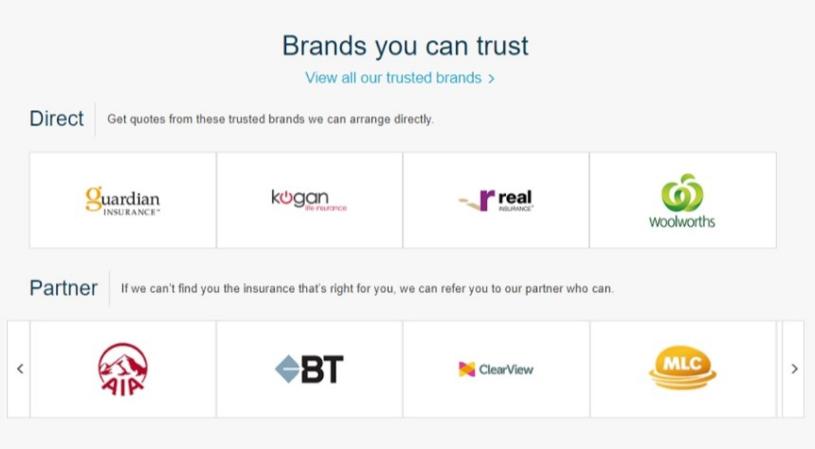
6.1.5 FAQs Page
97 The Choosi Website contained an FAQs Page which was accessible via a hyperlink from the Choosi Homepage. From 22 April 2021, the page included the following statement under the heading “Which insurers do you compare quotes with”:
Choosi works with a wide range of insurance brands. Our current list of brands is available on our homepage.
(Emphasis added).
98 Choosi emphasises that underneath this was another question, “Who’s the insurer?” which had the following answer:
This will all depend on the policy that you choose. The Product Disclosure Statement or pet insurance Policy Booklet will give you details of the insurer for all types of cover.
(The words ‘Product Disclosure Statement’ and ‘Policy Booklet’ were hyperlinked).
99 Prior to 22 April 2021, the answer appearing under the same heading (“Which insurers do you compare quotes with”) was in the following (different) form:
Choosi works with a wide range of insurers. Our current list of insurers is available on our home page.
(Emphasis added).
100 From 27 October 2020 the answer to the below question “Who’s the insurer?” was in the same form as above, but prior to 27 October 2020 it read:
This will all depend on the policy that you choose. The Product Disclosure Statement will give you details of the Insurer for all types of cover except Health Insurance. For Health Insurance your insurer will be disclosed on your fund Fact Sheet.
(With no hyperlinking).
101 Choosi emphasises that the FAQs Page directed consumers to the Choosi Homepage for the list of insurance brands that Choosi “worked with” and had a link to the PDS Page, for “most of the period”, which it says made clear that the insurers referred to in the answer to the question “Who’s the Insurer” comprised the insurers listed in the PDSs on the PDS Page. Choosi also emphasises that:
(a) between around 28 November 2019 and around 21 April 2021 it worked with “a wide range of insurers”, and its current list of insurers was available on the Choosi Homepage; and,
(b) from around 22 April 2021 to the end of the Relevant Period, Choosi worked with “a wide range of insurance brands”, and its current list of brands was available on the Choosi Homepage.
Further, Choosi refers to the inclusion, from around 22 April 2021 to the end of the Relevant Period of an “Important note” which said (in substance) that the FAQ answers were a reference guide only and did not substitute or replace the consumer’s insurance contract or other policy documents.
6.1.6 Quote Pages
102 Throughout the Relevant Period, the start of the Choosi Homepage displayed in prominent text a “compare now” button. This can be seen in the images at paragraphs [64] and [69]. By clicking on the “compare now” button, a consumer was able to click through to the main Quote Page. ASIC submits that the Quote Page forms part of the relevant context because it was the means by which a consumer could request that Choosi contact them by phone. ASIC does not contend that any particular statements on the Quote Page in isolation conveyed the alleged representations.
103 ASIC contends that the Quote Page contained an online form followed by a button entitled “Request Comparison Now”. The content of the Quote Page and the details of the online form differed for each insurance type during the Relevant Period, but ASIC alleges that the differences are immaterial for the purposes of the present proceeding. An extract of the Quote Page for funeral insurance is as follows:
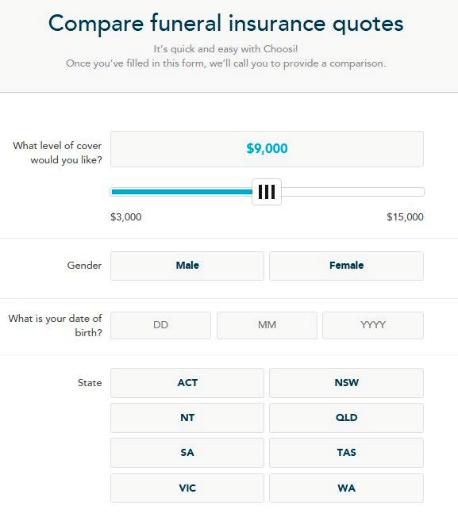
104 If a consumer scrolled to the end of the form, the following was displayed:
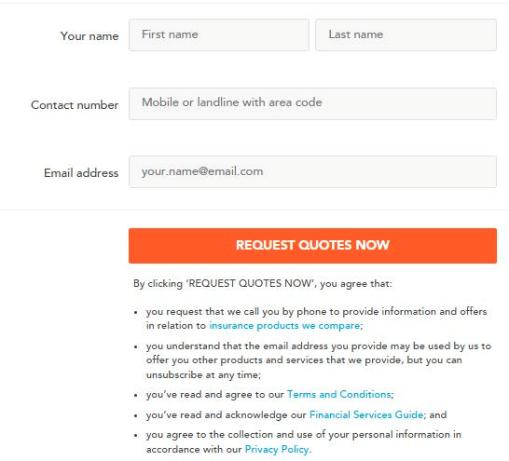
105 The Quote Page for life insurance was in substantially the same form.
106 As indicated in the first bullet point under the “Request Quotes Now” button, a consumer who completed the form and clicked on that button would receive a phone call from Choosi
107 Choosi emphasises that the Quote Pages did not permit a consumer to obtain an insurance policy or a quote directly. Rather, completion of the form and selection of the “Request Comparison Now” button resulted in the consumer being contacted by a Choosi Agent by telephone. It was common ground that applications for life insurance and funeral insurance products could only be made through a subsequent phone call with a Choosi Agent, and the phone calls were conducted by reference to scripts used by those agents.
6.1.7 PDS Page
108 Choosi also refers to the ‘PDS Page’ which it says contained a list of life insurance and funeral insurance policies and brands offered by Hannover (and, for life insurance policies until 1 July 2023, Swiss Re) and by the Partner Insurers (through LID), with each entry hyperlinked to its corresponding PDS.
109 Choosi emphasises the following aspects of the PDS Page:
(a) from at least 1 March 2020, the PDS for each life and funeral product (including life insurance products available through the Partner Insurers) was available via the PDS Page and the PDS disclosed the name of the insurer; and
(b) in addition, from at least around 21 October 2021, a Target Market Determination (TMD) for certain life and funeral products was available via the PDS Page and the TMD disclosed the name of the insurer.
110 Both the PDSs and the TMDs were accessible via the footer “Useful Documents” and via hyperlinked “Product Disclosure Statement (PDS)” and “Target Market Determination” text located at the bottom of each webpage within the Choosi Website.
6.1.8 Terms and Conditions Page
111 Choosi also referred to the Terms and Conditions Page of the Choosi Website and says it included statements (in substance) that:
(a) products compared/arranged directly through Choosi were distributed by GFS (as owner);
(b) direct products were limited to specified brands;
(c) Choosi could provide access to other brands by referral to a third-party adviser; and
(d) Choosi did not have access to all products and may not compare aspects of some products.
112 Finally, at the bottom of each Choosi Webpage during the Relevant Period, there was a disclosure (in substance) that Choosi offered products from a range of Australian brands, did not provide information about, or cover for, all products in the market, was related to GFS, and that GFS was the distributor of each life and funeral policy.
6.2 Television advertisements
113 As I have said, ASIC alleges Choosi engaged in conduct in contravention of ss 12DB(1)(a), 12DB(1)(e) and 12DF(1) of the Act in respect of 74 television advertisements. The parties agreed that the television advertisements can be grouped into two categories, based on whether the core statement was to the effect that:
(a) Choosi helps the consumer to “compare policies from a range of trusted [funeral/life insurance] brands” (Category 1); or
(b) Choosi compares or helps the consumer to compare “a range of policies from trusted life insurance brands” (Category 2).
114 The parties also agreed on transcripts of the television advertisements, with Annexure 1 of ASIC’s opening submissions identifying the relevant transcript along with the video file for each advertisement, separated into the two categories.
115 Of the 74 television advertisements, 48 fall into Category 1 and 26 fall into Category 2. Further, Choosi submits that of the 70 television advertisements which were in respect of life insurance, 50 aired during the Multiple Life Insurers Period, including 24 in Category 1 and all the television advertisements in Category 2.
116 A number of the television advertisements were played in Court during the trial, and I have also viewed, read and considered the tendered videos and transcripts of the advertisements. Some examples of the oral statements made during the television advertisements that form part of Category 1 are as follows:
(a) “[t]ell them the payout you’d want for your family, and they’ll help you compose a whole playlist of different policies from a range of trusted life insurance brands …”;
(b) “[t]heir award-winning free comparison service helps you compare policies from a range of trusted life insurance brands, so you can be more choosy …”;
(c) “Choosi's free comparison service helps you compare policies from a range of trusted funeral insurance brands, saving you time and effort ...”.
117 Some examples of the oral statements made during the television advertisements that form part of Category 2 are as follows (none of the Category 2 statements were in respect of funeral insurance):
(a) “[p]ut Choosi’s well-oiled comparison machine to work by telling them the payout you’d want, and they’ll compare a range of policies from trusted life insurance brands …”; and
(b) “Choosi is a free comparison service that helps you compare a range of policies from trusted life insurance brands ...”.
118 In each television advertisement (in both categories), text appeared for a period at the bottom of the screen; the text differed between some advertisements and is set out in the “Disclaimers” column of Section 1 of Annexure C of the SOAF.
119 The relevant disclaimers for each television advertisement were, or were substantially, in the following terms (appearing sequentially during a particular advertisement ):
(a) “This is general information only. Consider the relevant PDS [or TMD] to ensure the product meets your needs. Terms and conditions apply”.
(b) “Choosi works with a range of insurers to arrange cover on their behalf, but you should be aware that they don’t work for the entire market”.
(c) “Choosi Pty Ltd AFSL 402397 is a related company of Greenstone Financial Services Pty Ltd AFSL 343079, the distributor of [the/some of the] policies on offer by Choosi. Policies are issued by Hannover Life Re of Australasia Ltd ABN 37 062 395 484 and Swiss Re Life & Health Australia Limited AFSL 324908”.
120 The following photos illustrate an example of the placement and content of the disclaimers as they appeared in one of the television advertisements relied on by ASIC in Category 2. Underneath each photo is an indication of the period for which the disclaimer appeared for – I have taken the photos and the time estimates from an aide-mémoire prepared by ASIC (marked MFI-2). While Choosi prepared its own table of timings of the disclaimers in the television advertisements (annexed to its opening submissions), I do not understand the accuracy of MFI-2 to be disputed by Choosi. The following outlines how the disclaimers appeared in one of the Category 2 advertisements (COS.0022.0001.0910) and is broadly consistent with the placement and approximate duration of the disclaimers in each of the television advertisements relied upon by ASIC:
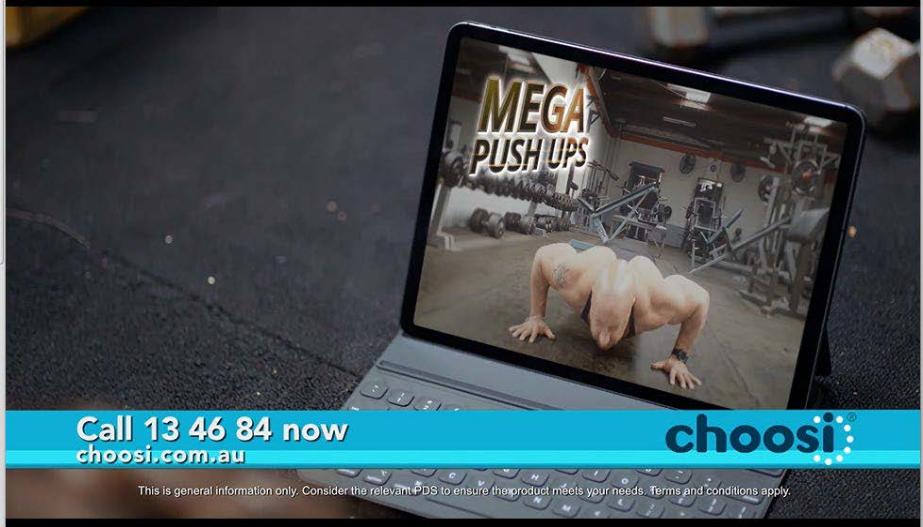
Displayed for 5 seconds (between 0.22 and 0.27)
Displayed for 7 seconds (between 0.27 and 0.34)
Displayed for 12 seconds (between 0.35 and 0.47)
121 Critically, in Choosi’s submission, every television advertisement, as part of the disclaimers, identified that the policies were issued by Hannover or by Hannover and Swiss Re. This can be seen in the photo directly above. Below is a zoomed in, cropped version:

122 It is important to note in respect of this above submission and the above cropped photo (taken from Choosi’s submissions) that each disclaimer in each advertisement, including the above, was in small, white text on a moving screen, which the majority of the time appeared directly over the underlying moving imagery, rather than within a solid-coloured text box (see the text in the photos underneath [120]). The photos underneath [120] show that Choosi’s phone number, the Choosi Website address and the Choosi logo are all overlaid on a turquoise banner and are substantially more prominent and readable than the disclaimer text.
123 Annexure A to Choosi’s submissions is a schedule prepared by Choosi which sets out, for each television advertisement relied on, the relative timing of the statement relied on by ASIC compared to the timing that each disclaimer was visible on screen. The schedule proceeds by picking out one statement relied upon by ASIC and the duration of the statement (eight seconds in respect of the example at [120]) and then sets out the duration of each disclaimer. Choosi relies on this to say that the disclaimers were almost always on screen for longer than the duration of the statement that ASIC relies on. However, first, Choosi is relying on one spoken statement to the exclusion of the whole of the advertisement, in circumstances where ASIC does in fact rely upon the whole of each advertisement. Second, it must be remembered that the statement relied upon by ASIC was being spoken by the actors in the television advertisement, whilst the disclaimer was, as I have said, text that was relegated to the bottom of the screen in small, white text against a moving and changing background.
6.3 Advertorials
124 ASIC alleges that Choosi engaged in conduct in contravention of ss 12DB(1)(a), 12DB(1)(e) and 12DF(1) of the Act in respect of 27 advertorials that Choosi caused to be broadcast during the Relevant Period. The advertorials are in-programme advertisements which appeared in various commercial television programmes (the Today Extra on Channel 9, The Morning Show and The Daily Edition on Channel 7, and Studio 10 and 10 Play on Channel 10). The parties agreed that the advertorials can be grouped into four categories (which are set out in Annexure 2 to ASIC’s reply written submissions). The first three categories are grouped according to whether the advertorial contains a statement to the effect that Choosi:
(a) compares policies from a “range of insurers” (Category 1), of which there are two, both of which relate to life insurance;
(b) compares policies from a “range of brands” (Category 2); or
(c) compares “a range of policies from insurance brands” (Category 3).
125 There are also three advertorials which do not fall into the categories above (Category 4). The first relates to funeral insurance and contains a statement to the effect that Choosi compares “a range of options from trusted Australian insurance providers”. The second advertorial contains, inter alia, statements to the effect that Choosi “helps make it easy to compare” life insurance, that Choosi “finds policies that fit the consumer’s criteria” and that Choosi “takes the hassle out of searching through providers”. The remaining advertorial contains statements to the effect that “reading through pages of information on products from different insurance providers” can be exhausting; that Choosi “will come up with a range of funeral options” for a consumer to choose from; and that Choosi “offers a practical solution to choosing funeral insurance by helping [the consumer] compare a range of policies”.
126 In each of the advertorials, text appeared for a period of time at the bottom of the screen during the course of the advertorial. This text differed between some of the advertorials and is set out in the “Disclaimers” column of Section 2 of Annexure C of the SOAF. The parties also agreed on transcripts of the advertorials, with Annexure 2 of ASIC’s reply submissions identifying the relevant transcript along with the video file for each advertorial. I set out an example below:
127 The relevant disclaimers for each advertorial were in, or substantially in, the following terms:
(a) “[t]his is general information only. Consider the relevant Product Disclosure Statement (PDS) at choosi.com.au to ensure the product suits your needs”;
(b) “Choosi works with a range of insurers to arrange cover on their behalf, but they do not work with the entire market” or “Choosi offers insurance products from a range of Australian brands. Choosi doesn’t provide information or offer cover for all products available in the market and there may be aspects to some products that Choosi doesn’t compare”;
(c) “Choosi … is a related company of Greenstone Financial Services Pty Ltd … the distributor and administrator of some of the insurance policies on offer by Choosi”; and
(d) “[t]erms and Conditions apply. Further information is available by calling Choosi”.
128 Choosi submits that every advertorial, as part of the disclaimers, identified that the policies were either “issued” by Hannover or by Hannover and Swiss Re:

129 Of the 27 advertorials relied on by ASIC and set out in Annexure B.2 to the Concise Statement:
(a) five concern the Funeral Insurance Comparison Service; and
(b) 22 concern the Life Insurance Comparison Service, all of which only aired in the Multiple Life Insurers Period.
130 The following photos illustrate an example of the placement and content of the disclaimers as they appeared in one of the Category 1 advertorials relied on by ASIC (COS.0022.0001.0988). Underneath each photo is an indication of the length of time the disclaimer appeared for – I have taken the photos and the time estimation from an aide-mémoire prepared by ASIC
(MFI-1). Again, I do not understand the accuracy of this aide-mémoire to be disputed by Choosi. The following is broadly consistent with the placement and approximate duration of the disclaimers in each of the advertorials relied upon by ASIC.
Displayed for 7 seconds (between 0.29 and 0.36)
Displayed for 7 seconds (between 1.54 and 2.01)
Displayed for 14 seconds (between 3.18 and 3.32)
6.4 Facebook advertisements
131 The 16 Facebook advertisements only relate to the Life Insurance Comparison Service. ASIC says it relies on two forms of advertisement. The Facebook advertisements appeared as a series of rotating screens or photos in the middle with static text above and below. The first form of advertisement contained the following statement:
Looking for life insurance? Compare quotes from a range of leading life insurance brands now.
132 That advertisement consisted of the following ‘screens’:
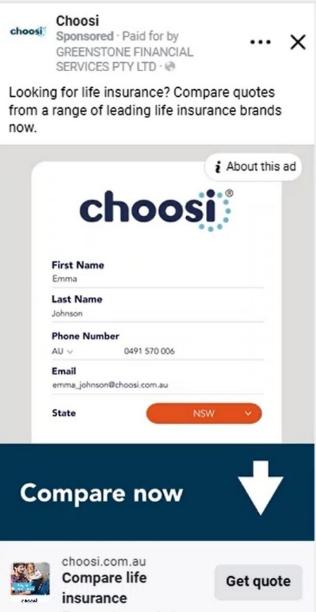
133 The first two ‘screens’ rotated while the surrounding text and images remained static. However, when the third and final screen rotated through, the words “compare now” (in large text) and a moving arrow directing the consumer to the “Get quote” button replaced the disclaimer.
134 The second form of advertisement contained the following statement:
Compare life insurance cover options with benefits from [a certain amount]. Request quotes from a range of leading life insurance brands now.
135 That advertisement consisted of the following ‘screens’:
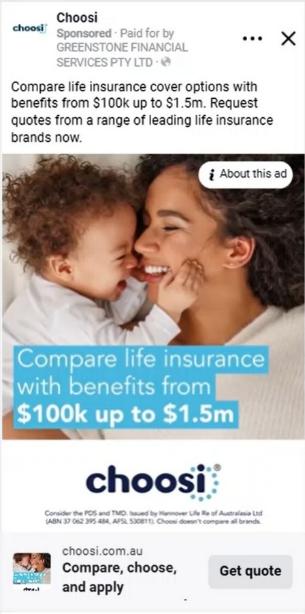
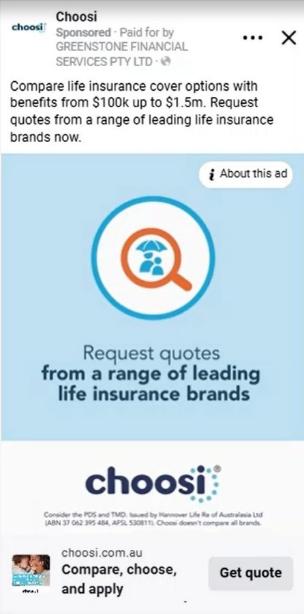
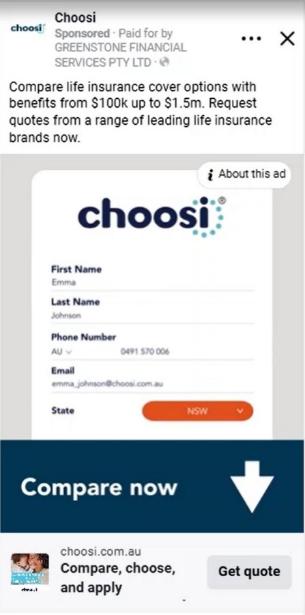
136 As with the first form of advertisement, when the third and final screen rotated through, the words “Compare now” and the arrow directing the consumer to the “Get quote” button replaced the disclaimer.
137 The Facebook advertisements all use the language of comparing or requesting quotes “from a range of leading life insurance brands”, and were each accompanied by one of the following static disclaimers:
(a) “Consider the PDS and TMD. Issued by Hannover Life Re of Australasia Ltd (ABN 37 062 395 484, AFSL 530811). Compare a range of policies”; or
(b) “Consider the PDS and TMD. Issued by Hannover Life Re of Australasia Ltd (ABN 37 062 395 484, AFSL 530811). Choosi doesn’t compare all brands”.
138 I will now turn to outlining the principles relevant to the conduct alleged by ASIC, before considering their application to the marketing content I have just outlined.
7. RELEVANT PRINCIPLES
7.1 Section 12DB
139 ASIC alleges that Choosi has contravened s 12DB(1)(a) and (e) of the Act. Those provisions provide as follows:
(1) A person must not, in trade or commerce, in connection with the supply or possible supply of financial services, or in connection with the promotion by any means of the supply or use of financial services:
(a) make a false or misleading representation that services are of a particular standard, quality, value or grade; or
…
(e) make a false or misleading representation that services have sponsorship, approval, performance characteristics, uses or benefits.
140 The principles applicable to s 12DB are well established by the authorities. See generally Australian Securities and Investments Commission v Mayfair Wealth Partners Pty Ltd (No 2) [2021] FCA 247 at [30]–[39], [44] (Anderson J) (appeal partly allowed but not in regard to the principles: Mayfair Wealth Partners Pty Ltd v ASIC (2022) 295 FCR 106; [2022] FCAFC 170 (Jagot, O’Bryan and Cheeseman JJ), application for special leave refused), see also Australian Securities and Investments Commission v Latitude Finance Australia (No 2) [2024] FCA 1205 at [349]–[364] (Yates J), affirmed on appeal in Latitude Finance Australia v Australian Securities and Investments Commission [2025] FCAFC 124 (Latitude Finance Australia – Full Court) (O’Bryan, Cheeseman and Bennett JJ), and Australian Securities and Investments Commission v Retail Employees Superannuation Pty Ltd [2024] FCA 1081 at [265]–[273] (Beach J). It is convenient to state the following principles which arise from a survey of the authorities.
141 First, there is no material difference between the expressions “misleading or deceptive” (as used, for example, in s 12DA of the Act) and the expression “false or misleading” in s 12DB of the Act: Australian Securities and Investments Commission v MLC Nominees Pty Ltd (2020) 147 ACSR 266; [2020] FCA 1306 at [47] (Yates J), Retail Employees Superannuation at [272], Australian Securities and Investments Commission v M101 Nominees Pty Ltd (in liq) (No 8) [2025] FCA 741 at [503]–[504] (Button J), citing Self Care IP Holdings Pty Ltd v Allergan Australia Pty Ltd (2023) 277 CLR 186; [2023] HCA 8 at [84]. The same principles are applicable to both expressions.
142 Second, “the central question is whether the impugned conduct, viewed as a whole, has a sufficient tendency to lead a person exposed to the conduct into error (that is, to form an erroneous assumption or conclusion about some fact or matter)”: Australian Securities and Investments Commission v Dover Financial Advisers Pty Ltd (2019) 140 ACSR 561; [2019] FCA 1932 at [98] (O’Bryan J) and the cases there cited. However, “conduct causing confusion and wonderment is not necessarily co-extensive with misleading or deceptive conduct”: Google Inc v Australian Competition and Consumer Commission (2013) 249 CLR 435; [2013] HCA 1 at [8] (French CJ, Crennan and Kiefel JJ), and see Parkdale Custom Built Furniture Pty Ltd v Puxu Pty Ltd [1982] HCA 44; (1982) 149 CLR 191 at 198 (Gibbs CJ, and see Mason J at 209–210); Taco Company of Australia Inc v Taco Bell Pty Ltd (1982) 42 ALR 177 at 201–202 (Deane and Fitzgerald JJ). There must be a sufficient causal link between the conduct and error on the part of the persons exposed to it: Australian Competition and Consumer Commission v TPG Internet Pty Ltd (2013) 250 CLR 640; [2013] HCA 54 at [39] (French CJ, Crennan, Bell and Keane JJ). Conduct is not misleading by reason of a consumer adopting a fanciful or extreme erroneous assumption or failing to take reasonable care of their own interests: TPG Internet at [39], Campomar Sociedad Ltd v Nike International Ltd (2000) 202 CLR 45; [2000] HCA 12 at [105] (Gleeson CJ, Gaudron, McHugh, Gummow, Kirby, Hayne and Callinan JJ).
143 Third, one material difference between statutory prohibitions on false and misleading representations (ie, s 12DB) and statutory prohibitions on conduct which is likely to mislead or deceive is that the former requires the applicant to prove to the requisite standard that the respondent made representations that were actually false or misleading. It is not sufficient for the applicant to prove only that it was likely that they were such: Australian Competition and Consumer Commission v Employsure Pty Ltd (2021) 392 ALR 205; [2021] FCAFC 142 at [89] (Rares, Murphy and Abraham JJ) and the cases there cited (in respect of the cognate s 29 in the Australian Consumer Law, Schedule 2 of the Competition and Consumer Act 2010 (Cth)). In contrast, the phrase “likely to mislead or deceive” means a contravention may be established if there is a real or not remote chance or possibility that a person exposed to impugned conduct would be misled – it is not necessary to demonstrate that the impugned conduct was actually misleading; it is enough if it was likely to be so: Employsure at [89] and the cases there cited, and see Retail Employees Superannuation at [269]–[270]. Thawley J expressed the principle as follows in Australian Competition and Consumer Commission v Google LLC (No 2) (2021) 391 ALR 346; [2021] FCA 367 at [120] (again, in respect of s 29 in the ACL):
Section 29(1)(g) requires that a representation be “false or misleading”. The representation must actually be “false or misleading”. It is not necessary to adduce evidence that a reasonable person in the relevant class was in fact misled. That is an inference which the Court can draw from the objective circumstances. In my view, it is an inference the Court would have to draw, having regard to the correct standard of proof, in order to be satisfied that there had been a contravention of s 29(1)(g). If the Court only considered that there was a “real or not remote chance or possibility” that a reasonable person in the relevant class was in fact misled, but was not prepared to conclude that any person was in fact misled, then a contravention of s 29(1)(g) would not be established even though that might be sufficient to establish a breach of s 18 … If the proper inference to draw is that the representation was “false or misleading” to some members of the class acting reasonably, but not to other reasonable members, the fact that some reasonable members of the class would not have been misled can be taken into account in determining an appropriate penalty, but a contravention will still have been established.
144 Fourth, when dealing with conduct directed at the public (or part of the public), the focus is on identifying the effect or likely effect of the conduct on the state of mind of “ordinary” and “reasonable” members of the relevant class: Self Care at [83] (Kiefel CJ, Gageler, Gordon, Edelman and Gleeson JJ), Campomar Sociedad at [103] (the Court), Dover at [99]. The High Court in Self Care said as follows at [83], quoting Comité Interprofessionnel du Vin de Champagne v Powell (2015) 330 ALR 67; [2015] FCA 1110 at [171] (Beach J):
It is necessary to isolate an ordinary and reasonable “representative member” (or members) of that class, to objectively attribute characteristics and knowledge to that hypothetical person (or persons), and to consider the effect or likely effect of the conduct on their state of mind. This hypothetical construct “avoids using the very ignorant or the very knowledgeable to assess effect or likely effect; it also avoids using those credited with habitual caution or exceptional carelessness; it also avoids considering the assumptions of persons which are extreme or fanciful”. The construct allows for a range of reasonable reactions to the conduct by the ordinary and reasonable member (or members) of the class.
145 Here, the ordinary and reasonable consumers are the class of persons who are purchasers or potential purchasers of funeral or life insurance policies. The class does not have any “special attributes or capacities beyond the ability to read and understand, or hear and understand, the ordinary language in which” the Choosi Website and marketing were expressed: see Latitude Finance Australia (No 2) at [360].
146 Fifth, if a representation has a tendency to lead some members of the class into error, “then that will be enough to bring the conduct within the statutory proscription”: Latitude Finance Australia (No 2) at [358]. The position was explained by Yates J in Latitude Finance Australia (No 2) as follows, commenting on the final sentence in [83] of Self Care (which is extracted above):
[355] The last statement — that the construct allows for a range of reasonable reactions by ordinary and reasonable members of the class — is important. It recognises that the test of reasonableness does not necessarily postulate only one reasonable response to the conduct in question. As stated by Dowsett J in National Exchange Pty Ltd v Australian Securities and Investments Commission [2004] FCAFC 90; 49 ACSR 369 at [24]:
24. …Frequently, different persons, acting reasonably, will respond in different ways to the same objective circumstances. The test of reasonableness involves the recognition of the boundaries within which reasonable responses will fall, not the identification of a finite number of acceptable reasonable responses.
[356] There is, therefore, “scope for diversity of responses both within the same medium and across different media”: Comite Interprofessionnel du Vin de Champagne v Powell [2015] FCA 1110; 330 ALR 67 at [171].
[357] It is well-accepted that an advertisement that is published to the world is not selective as to its readers, viewers, or listeners. It might be (or be likely to be) misleading or deceptive to some even though it might not be (or not be likely to be) misleading or deceptive to others who are more wary: Annand & Thompson Pty Ltd v Trade Practices Commission (1979) 40 FLR 165 at 176; Tobacco Institute of Australia Ltd v Australian Federation of Consumer Organisations Inc (1992) 38 FCR 1 at 49–50; Telstra Corporation Ltd v Cable & Wireless Optus Ltd [2001] FCA 1478 at [21]–[25].
[358] If the advertisement is (or is likely to be) misleading or deceptive to some ordinary and reasonable consumers, then that will be enough to bring the conduct within the statutory proscription. It is not necessary for the Court to quantify those who have, or are likely to have, that response: Australian Competition and Consumer Commission v TPG Internet Pty Ltd [2020] FCAFC 130; 278 FCR 450 at [23]; Trivago N.V. v Australian Competition and Consumer Commission [2020] FCAFC 185; 384 ALR 496 at [190]–[193].
[359] Therefore, determining whether given conduct is misleading or deceptive, or likely to mislead or deceive, is a matter for judicial estimation that takes into account the range of reasonable responses to the conduct that is in question.
147 Sixth, a representation can be false or misleading “even if the express words used were literally true, when those words ‘conveyed to others something more than the literal meaning which the words spelled out’”: Australian Securities and Investments Commission v Select AFSL Pty Ltd (No 2) (2022) 162 ACSR 1; [2022] FCA 786 at [262] (Abraham J), quoting Hornsby Building Information Centre Pty Ltd v Sydney Building Information Centre Ltd (1978) 140 CLR 216 at 227–228 (Stephen J). “Half-truths, where the insufficiency of information permits a reasonably open but erroneous conclusion to be drawn, can also be misleading”: Select AFSL Pty Ltd (No 2)at [262], citing Australian Competition and Consumer Commission v Coles Supermarkets Australia Pty Ltd (2014) 317 ALR 73; [2014] FCA 634 at [46] (Allsop CJ).
148 Seventh, disclaimers cannot be “relied on to exclude liability for the contravention of the statutory provisions regarding misleading or deceptive conduct”: Touch for Health Pty Ltd as Trustee for Knight Superannuation Fund v Property Mentors Australia Pty Ltd (No 3) [2024] FCA 1381 at [97] (Neskovcin J) and the cases there cited. Where the impugned conduct comprises the use of particular words accompanied by a disclaimer, it is incorrect to characterise the problem as one of analysing the effect of “conduct” divorced from “disclaimers” about such “conduct” and divorced from other circumstances which might qualify its character. Everything relevant must be taken into account: Butcher at [39] (Gleeson CJ, Hayne and Heydon JJ), Campbell v Backoffice Investments Pty Ltd (2009) 238 CLR 304; [2009] HCA 25 at [29] (French CJ). The Court must consider whether the disclaimer (considered as part of the conduct, viewed as a whole) has the effect of erasing or dispelling the otherwise misleading or deceptive effects of the conduct: Australian Securities and Investments Commission v La Trobe Financial Asset Management Ltd (2021) 158 ACSR 363; [2021] FCA 1417 at [12] (O’Bryan J) and the cases there cited. “Where there is a substantial disparity between the primary representation conveyed by particular conduct … and the true position, a disclaimer or qualification must be very clear in order to erase or dispel the otherwise misleading effects of the primary representation”: Latitude Finance Australia – Full Court at [52], see also Australian Competition and Consumer Commission v Jetstar Airways Pty Ltd [2015] FCA 1263 at [39] (Foster J). A publication can be misleading despite the true position being disclosed in a disclaimer where a failure to notice or take in the disclaimer is within the range of reasonable reactions of ordinary and reasonable members of the class: Latitude Finance Australia (No 2) at [361], [377], [381], [384], [421], Latitude Finance Australia – Full Court at [67].
149 Eighth, a contravention may occur “not only when a contract has been concluded under the influence of a misleading advertisement, but also at the point where members of the target audience have been enticed into ‘the marketing web’ by an erroneous belief engendered by an advertiser, even if the consumer may come to appreciate the true position before a transaction is concluded”: TPG Internet Pty Ltd at [50] (French CJ, Crennan, Bell and Keane JJ), see also StarTrack Express Pty Ltd v TMA Australia Pty Ltd [2023] FCAFC 200 at [70]–[72] (O’Callaghan, Stewart and Button JJ).
150 Lastly, s 12DB is a remedial provision that “should be ‘interpreted broadly so as to give the fullest relief which the fair meaning of its language will allow’”: Australian Competition and Consumer Commission v Australian Private Networks Pty Ltd (2019) 136 ACSR 80; [2019] FCA 384 at [15] (Middleton J) and the cases there cited (in relation to the cognate provisions in ss 29 and 34 of the ACL), and see Chappell (as executor of the estate of Hitchcock) v Goldspan Investments Pty Ltd (2021) 58 WAR 503; [2021] WASCA 205 at [273] (Buss P, Mitchell and Pritchard JJA) (“[t]he object of s 12DA and s 12GF of the ASIC Act …is to create norms of behaviour (the prohibition on misleading or deceptive conduct) which are able to be enforced through the pursuit of civil proceedings. In that sense, the provisions are beneficial or remedial in nature, and should be construed to give the most complete remedy which is consistent with the actual language employed, on a fair meaning of the words used”). Consistently with that principle, a narrow or technical approach ought not be taken in construing the requirement that the representation be “in connection with” the supply or possible supply of financial services: Retail Employees Superannuation at [351]–[352].
7.2 Section 12DF
151 Section 12DF(1) provides as follows:
A person must not, in trade or commerce, engage in conduct that is liable to mislead the public as to the nature, the characteristics, the suitability for their purpose or the quantity of any financial services
152 The principles applicable to s 12DF(1) were summarised by this Court in Australian Securities and Investments Commission v HCF Life Insurance Company Pty Limited [2024] FCA 1240 at [100]–[107] (Jackman J) and Australian Competition and Consumer Commission v The Good Guys Discount Warehouses (Australia) Pty Ltd [2025] FCA 1085 at [58] (O’Bryan J). Those relevant principles may be stated as follows:
153 First, the phrase “liable to mislead” has been construed as imposing a higher standard than “likely to mislead or deceive” in that it requires “an actual probability” of the public being misled: HCF Life Insurance at [101]; Good Guys Discount Warehouses at [58], Coles Supermarkets Australia at [44] and the cases there cited.
154 Second, like s 12DB, s 12DF is a remedial provision to which the interpretative principle (noted at paragraph [150] of these reasons) applies. In particular, the expressions “nature”, “characteristics”, and “suitability for their purpose” are to be given their ordinary meaning and “no narrow or technical meaning should be attributed to those terms”: Australian Securities and Investments Commission v Westpac Banking Corporation (No 2) (2018) 266 FCR 147; [2018] FCA 751 at [2311] (Beach J), HCF Life Insurance at [102], quoting Australian Competition and Consumer Commission v Meriton Property Services Pty Ltd (2017) 350 ALR 494; [2017] FCA 1305 at [195] (Moshinsky J) (in relation to the cognate provisions in the ACL).
155 Third, “[a] communication will be directed to the public within the meaning of s 12DF(1) if the communication is general (that is, not individual or specific) and is directed to all people within a segment of the community at large”: Good Guys Discount Warehouses at [58] and the cases there cited, HCF Life Insurance at [103].
156 Subject to these matters, the principles relating to the general prohibition on misleading or deceptive conduct are applicable to s 12DF.
8. CHOOSI’S ALLEGED GENERAL DEFECTS WITH ASIC’S CASE
157 Before turning to consider whether the representations were conveyed by the materials, it is convenient to first address what Choosi says are three ‘global’ issues in ASIC’s case and a pleading point raised by Choosi against ASIC.
158 Dealing first with the pleading point. Choosi argues there is a disjunction between ASIC’s pleaded representations and ASIC’s pleaded Comparison Service. Choosi submits that the pleaded Comparison Service is a service that “purportedly assisted consumers to compare, choose and apply” for funeral and life insurance policies (emphasis added). In contrast, Choosi submits that the representations are pleaded as representations that Choosi itself compared funeral and life insurance policies from a range of (or alternatively, multiple) insurers. Choosi submits that the pleaded representations should be read as containing an implicit qualification (in part based on correspondence between the parties) that Choosi compared funeral and life insurance policies from a range of (or alternatively, multiple) insurers as part of the Comparison Service.
159 The practical reason for this contention is that if Choosi succeeds in proving the representation carried by the impugned material was that Choosi assisted consumers in comparing policies from a range of life insurance policies, then Choosi can argue that any such representation was not misleading because the Comparison Service included the provision of assistance for consumers to compare life insurance policies through its Partner Insurer Referral Service. This assumed particular significance in Choosi’s oral submissions.
160 I find the distinction between Choosi itself comparing policies and assisting consumers to compare policies to be without merit. It does not accord with the ordinary understanding of a comparison service. Of course, with every comparison service at the end of the day the consumer has to consider the alternatives put forward and ultimately make a choice. But that does not mean the consumer is undertaking the comparison, and not the service provider. Therefore, in one sense the qualification which Choosi seeks to add is neither here nor there; it adds nothing to the understanding of the Comparison Service or the representations. I reject the qualification which Choosi seeks to imply into ASIC’s pleading. The pleading is clear and speaks for itself.
8.1 Statements about the General Insurance Comparison Service
161 First, Choosi submits that to establish the representations, ASIC repeatedly relies upon statements that are unequivocally not directed at either the Life Insurance Comparison Service or the Funeral Insurance Comparison Service but rather are directed at Choosi’s general offering in respect of various types/categories of insurance (which Choosi refers to as the General Insurance Comparison Service). Choosi relies particularly on each of the Choosi Homepage, the About Choosi Page and the FAQs Page.
162 Choosi submits that ASIC reads “general corporate and service-description pages” describing the General Insurance Comparison Service as though they were making product-specific promises about the scope of the Life Insurance Comparison Service and the Funeral Insurance Comparison Service. Choosi submits that that is not how those pages read. It is not how they were presented on the Choosi Website and it is not how an ordinary and reasonable consumer would understand them. Choosi describes this as a “category error”. Breaking this submission down, Choosi’s complaint can be described as follows: (a) Choosi marketed and offered its Comparison Service in respect of a range of insurance products (beyond life and funeral insurance policies); (b) Choosi’s website has a number of pages which are “general”, in that they are aimed at and deal with Choosi’s offering generally (that is, across the ambit of insurance policies it ‘compares’); and (c) it is incorrect for ASIC to treat statements on these “general” pages as speaking to Choosi’s specific life and funeral insurance offerings.
163 Choosi says the statements in question are on their face not concerned specifically with the Life Insurance Comparison Service and Funeral Insurance Comparison Service. Choosi submits that ASIC contends, contrary to the language of the statements themselves, that Choosi’s general statements about its business should be read as impliedly containing multiple separate representations about how it provides a comparison in respect of each and every category of insurance offered to consumers. But, Choosi says, because the statements in question relate to Choosi’s business at a level untethered to any one specific category of insurance, those general statements cannot give rise to a representation about how Choosi compared life and funeral insurance policies.
164 Choosi submits that this point is decisive against ASIC’s case and its reliance upon each of the Choosi Homepage, About Choosi Page and the FAQs Page. Choosi submits that ASIC’s approach would require the Court to read every general service-level statement on those webpages as though it were making a separate promise about the scope of each service offered by Choosi. Choosi submits that that is an implausible and commercially unrealistic reading of the general website architecture. Choosi submits that the Choosi Homepage, About Choosi Page and FAQs Page are central to ASIC’s attempt to construct a site-wide representation. Choosi submits that if the Court accepts Choosi’s submissions in this respect, ASIC is left to rely solely on the product-specific pages, in respect of which, Choosi submits, its case is considerably narrower and weaker. Choosi also relies on its argument that the pleaded representations should be read as including the implied qualification “as part of the Comparison Service”.
165 Choosi submits that ASIC’s response that the ordinary and reasonable consumer does not make a distinction between a general service description and a product-specific promise, should be rejected. Choosi submits ordinary and reasonable consumers read a webpage by reference to where it sits in the architecture of the website, how the webpage is titled, and what function it serves. Choosi submits that the contrast between general and specific pages is made evident when a consumer turns to the Main Funeral Insurance Page and the Main Life Insurance Page – which it says use product-specific headings and text.
8.1.1 Choosi Homepage
166 Choosi submits the analysis begins on the Choosi Homepage, being the umbrella landing page for a multi-product site. Choosi submits that the Why Choosi Statement on the Choosi Homepage was, therefore, the obvious place for general business-level messaging about the General Insurance Comparison Service as a whole, rather than any product-specific representations. Choosi submits that there is nothing implausible in reading language on the Choosi Homepage at that level of generality. Indeed, Choosi submits that is the natural and ordinary reading and meaning.
167 Choosi submits that it does work with a range of insurers as part of its General Insurance Comparison Service across all types of insurance and that, therefore, the statements on these “general” pages are true and that it is no answer to assert that Choosi does not compare policies of life insurance with policies of pet insurance. I take this to be a reference to ASIC’s reliance on the Why Choosi Statement, which says, relevantly, “Choosi’s team of Choosers can help you compare the benefits and prices of a range of products from leading insurers” (emphasis added), as well as various statements in the footer of the Choosi Homepage which can be described as disclaimers.
8.1.2 About Choosi
168 Choosi submits that the About Choosi Page is even more clearly general in character. Its very title, in Choosi’s submission, signals that it is about Choosi as a business, not about one insurance product line.
169 Choosi submits that the Court should reject ASIC’s reliance upon the statement: “We provide information to help you compare, choose and apply for insurance online and over the phone”. Choosi submits that that statement does not say “life insurance” and it does not say “funeral insurance”. It says “insurance”. That, in Choosi’s submission, is the language of a general service description.
170 Choosi submits that the About Choosi Page contains generic statements about the problem of choosing insurance such as: it is complicated; time consuming; involves calling multiple insurers; visiting multiple websites; comparing quotes; and filling out forms. Choosi submits that those generic statements are not representations that every life or funeral product compared through the Life Insurance Comparison Service and the Funeral Insurance Comparison Service came from multiple underwriters.
8.1.3 FAQs
171 Choosi submits that, properly understood, the same can be said about the FAQs Page. Choosi submits that a page entitled “Frequently asked questions” is, by its nature, a general explanatory page. Its questions and answers operate at the level of the entirety of the service provided by Choosi, unless the text of a particular question/answer specifically and expressly narrows the topic.
172 Choosi directs attention to the relevant FAQ answer which said that Choosi worked with a “wide range of insurers”, later changed to “wide range of insurance brands”, and directed users to the Choosi Homepage for the current list. Choosi submits that the Choosi Homepage dealt with the General Insurance Comparison Service as a whole. The FAQ answer, therefore, points to the Comparison Service as a whole, not to a self-contained statement specifically about the underwriters of life and funeral insurance policies.
173 Choosi also relies upon the fact that the FAQs Page also carried an “important note” that the answers were a reference guide only and did not substitute or replace the consumer’s contract or policy documents. That, Choosi submits, is consistent with the page being a general orientation tool, not the definitive source of the insurer-level composition of any given
sub-category of insurance. For that, Choosi submits, the user needed to go to the Main Life Insurance Page and the Main Funeral Insurance Page, and then to the respective product disclosure statements for each relevant policy, to obtain that extra level of detail.
8.1.4 Consideration
174 I do not accept Choosi’s submissions which, in my view, are artificial and adopt a narrow and technical approach which is contrary to the way in which the ordinary and reasonable consumer in the market to purchase funeral or life insurance would read or interact with the Choosi Website. I agree with ASIC that this submission contends that consumers would read and understand the Choosi Website and the statements therein contained in a way that is implausible. I am of this view for the following reasons.
175 First, in my view, the correct starting point in considering these “general” pages is the context in which a consumer would come to the Choosi Website. A consumer would, presumably, only click through to the Choosi Website because they are interested in taking out an insurance policy in one or more areas (including life, funeral, income protection and pet insurance). But more specifically, because they are interested in comparing insurance policies within one (or maybe more) of those areas.
176 Second, the Choosi Homepage clearly represents that Choosi offers a comparison service. The only sensible and logical way for that to be interpreted is that Choosi offers a comparison service in respect of each area of insurance. It is evident that it would not, and no consumer would be interested in, a comparison of policies from different areas (that is, of course it does not compare pet insurance policies with life insurance policies). That sets up the relevant context for each of the statements. Consumers are reading statements about the Comparison Service offered by Choosi in respect of the area (or even areas) of insurance which they are interested in. That is why, as ASIC submits, the only sensible view is that an ordinary and reasonable consumer would understand the statements as applying to each type of insurance Choosi compares, including life and funeral insurance. A consumer would approach the website on the basis that its statements convey meaningful information about Choosi’s services.
177 Third, that this is the only sensible understanding of the statements is reinforced by the following example given by ASIC. The Why Choosi Statement on the Choosi Homepage reads “Choosi’s team of Choosers can help you compare the benefits and prices of a range of products from leading insurers” (emphasis added). The focus of the statement is on comparing the features of products. The statement could not sensibly be understood by consumers as a statement that says no more than that Choosi works with a range of insurers across its different products. The statement is about the comparison that is undertaken. Choosi says that its understanding of the statements makes sense because it “does work with a range of insurers”. While Choosi may work with a range of insurers across different product categories, it does not compare policies from those insurers from different product categories.
178 Fourth, many of Choosi’s submissions on this point focus on the fact that Choosi did in fact work with multiple insurers across all the categories of insurance and that, therefore, these webpages convey the straightforward and true representation that Choosi works with brands and insurers in connection with that multitude of insurance categories. However, these submissions fail to recognise, as the example above clearly illustrates, that the focus, or the dominant message, of the statements is the comparison of policies – the statements do not convey merely that Choosi works with multiple insurers. Such a statement would be meaningless to the consumer divorced from the context of Choosi’s Comparison Service.
179 The same can be said about each of the further examples relied on by Choosi in regard to the About Choosi Page and the FAQs Page. The meaning Choosi advances would rob those pages of conveying any meaningful information to consumers about Choosi’s service offerings. Choosi’s contended representations in respect of these pages cannot be described as falling within the range of reasonable responses to the statements.
180 Finally, I have already rejected Choosi’s implied qualification to the representations in the pleading, but in any event, ASIC’s Concise Statement clearly pleads the Comparison Service as “a service which purportedly assists consumers to compare, choose and apply for funeral insurance and life insurance policies”; that is, it is specifically limited to life and funeral insurance, so that submission does not assist Choosi.
8.2 Brands v insurers v providers
181 The second ‘global issue’ which Choosi advances is that ASIC’s case depends, at almost every critical point, on treating the terms “brands” and “insurers” as interchangeable. That is, in Choosi’s submission, every time Choosi, on the Choosi Website or in its marketing material, refers to “brands”, ASIC’s position is that it should be taken as a reference to “insurers”. Choosi submits that that premise should be rejected. It is wrong, in Choosi’s submission, as a matter of language and wrong as a matter of market reality.
182 Choosi submits that as a matter of ordinary language, “brand” and “insurer” are different concepts. A brand is the consumer-facing identity under which a product is marketed or sold, often directed at different market segments. An insurer is the legal risk-carrier that underwrites the product. Choosi submits that those concepts may coincide. They may not. Choosi submits that that is not a difficult or complex concept for a consumer to grasp.
183 Choosi submits that it is a matter of commonplace knowledge that companies will often offer different products (albeit as part of the same product category) under different brands to different kinds of consumers who are interested in different kinds of product characteristics. That does not render a comparison of the respective features of those brands artificial or without value. Choosi points to examples of Volkswagen selling vehicles under the Bentley brand and the Skoda brand or Qantas operating airline services under both the Qantas and Jetstar brands. Choosi submits that the products offered under those disparate brands are patently different and capable of ready comparison.
184 Choosi submits the Choosi Website, in this case, drew the distinction between brands and insurers. The Choosi Homepage used separate headings for “Direct” and “Partner”. Under “Direct” the Website invited consumers to “get quotes from these trusted brands”. Under “Partner”, the Website stated: “If we can’t find the insurance that’s right for you, we can refer you to our partner who can”. Choosi submits that the “Direct” logos were hyperlinked to brand webpages on the Choosi Website. The “Partner” logos were hyperlinked to webpages about the Partner Insurers. Choosi submits that it transparently distinguished Direct brands from Partner insurers. Choosi submits that a “brand” is not to be equated with an “insurer”, which is apparent when those logos are reviewed. The below photo, which I have included earlier in these reasons, illustrates the relevant part of the Choosi Homepage:
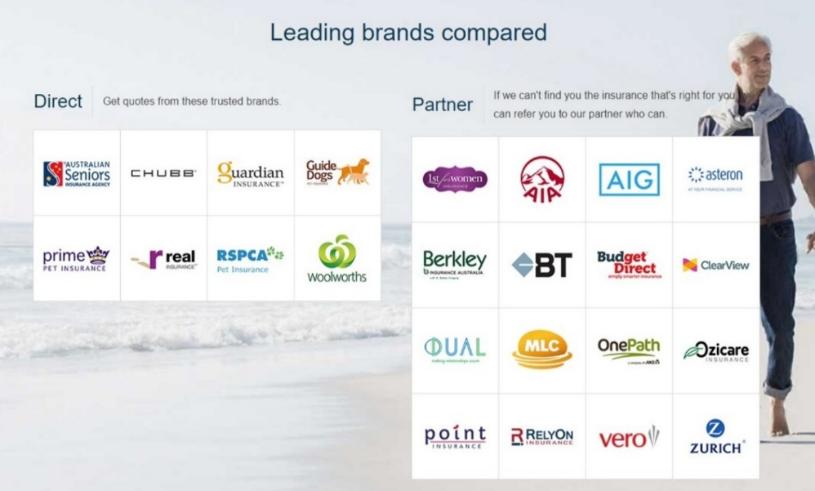
185 Choosi submits that the ordinary and reasonable consumer would not see the logos under “Direct: Get quotes from these trusted brands” and conclude that Woolworths, the RSPCA or Guide Dogs were insurers. Rather, they would conclude, accurately, that they were brands.
186 Choosi submits that the same distinction appeared on the Main Life Insurance Page. Beneath the feature table, the page displayed hyperlinked logos under separate “Direct” and “Partner” sub-headings, linking, respectively, to “Direct” policy pages and “Partner” insurer pages. The “View all our trusted brands” page repeated the same structure. Choosi submits that those features show that, when the site used the language of “brands”, it was using it deliberately and consistently to refer to the consumer-facing offering available through Choosi, not as a loose synonym for underwriters. I put below, again, photos of that part of the webpage as it appeared first, before 26 February 2021, and second, after 26 February 2021:
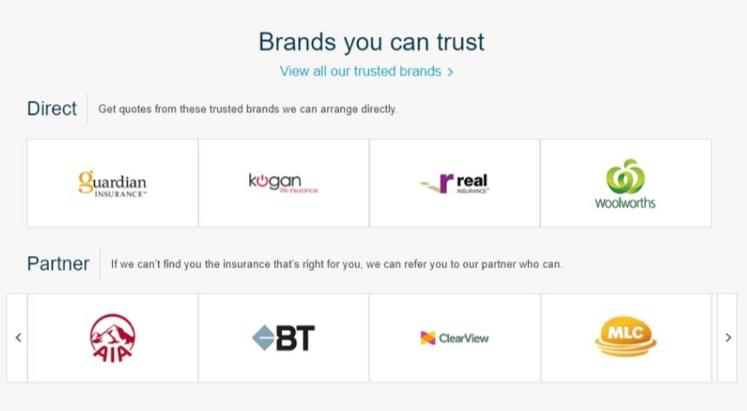
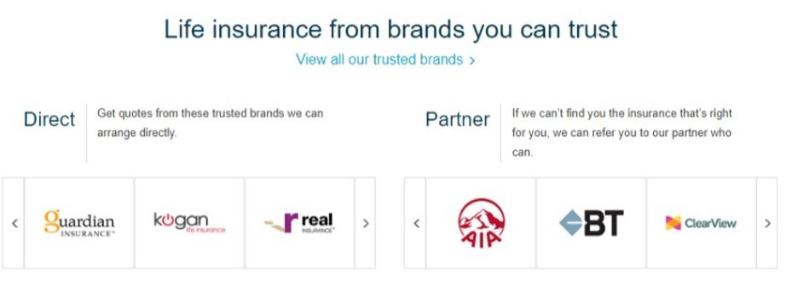
187 Choosi submits that the same analysis broadly applies to ASIC’s reliance on statements using the word “providers”. Choosi submits that in a consumer-facing setting, “provider” is an ordinary English term of wide meaning. It may refer to the source of the offering, the pathway, the distributor, or the brand. It does not inevitably mean underwriter. In many cases, it will not. That is clear, in Choosi’s submission, from the “Direct” policy pages on the website.
188 The policy page for Guardian Insurance described Guardian Insurance (the brand) but then said the products were “provided” by Hannover. Choosi submits that in this instance there are two “providers” for the insurance policy, the brand and the insurer, which is consistent with “provider” being a word of general expression which can take on multiple meanings. The below photo depicts how that information appeared, with the relevant statement appearing in the last paragraph:
189 The policy page for Kogan life insurance refers to Kogan (the brand) “provid[ing]
award-winning cover” while describing the products as being “underwritten by Hannover”, which, in Choosi’s submission, shows that “provider” can be used in contra-distinction to the concept of the underwriter. The below photo shows that part of the Kogan webpage:
190 Choosi submits that the Court should reject ASIC’s central schematic contention that “brand” and “provider” necessarily means insurer. Choosi submits that a statement about brands, products, providers or options cannot simply be re-characterised as a statement about the number of insurers.
191 Choosi did not make any additional submissions on this point that were specifically directed to the television advertisements, the advertorials or the Facebook advertisements.
8.2.1 Consideration
192 I reject Choosi’s submissions in relation to brands, insurers and providers for the reasons that follow.
193 First, contrary to Choosi’s submission, the Choosi Website did not clearly and distinctly use the terms “provider” and “brand” in contra-distinction to the term “insurer”. Rather, as ASIC submits, the Choosi Website used all three terms interchangeably – or at the very least in a fashion that could lead a consumer to form that view. Choosi’s own submissions, which I have set out above, concede that the term provider can be used to refer either to an underwriter or a brand – in my view this reinforces the view that it is unhelpful to focus on the choice of the term “provider”, isolated from the surrounding statements and context. When one considers the context, it is readily apparent that Choosi uses all three terms throughout the Choosi Website.
194 ASIC provided the following clear example of Choosi referring interchangeably to “insurer” and “brands” in a question and answer on the FAQs Page which appeared from 22 April 2021 to the end of the Relevant Period (also excerpted at [97] of these reasons):

195 Other examples of Choosi using the terms interchangeably include on the About Choosi Page:
(a) under the heading “How we work”, the reference to a “range of popular insurance brands” immediately follows a statement that “Choosi isn’t an insurer”, and then is followed by a statement that Choosi lets consumers buy insurance from “reputable Australian insurers”; and
(b) under the heading “How we can help you”, the reference to “a range of popular and trusted insurance brands” follows on from Choosi identifying its “comparison service” as one that avoids consumers having to call “multiple insurers”. And prior to 20 September 2020, the statement was “compare … a range of popular insurers”.
196 Second, I derive no assistance from the examples Choosi provides of companies in vastly different contexts to insurance and insurers providing different products under different brands (such as Qantas and Jetstar). Choosi’s example of a consumer not being misled by a website which says it compares car brands into thinking the website compared manufacturers entirely misses the point – that submission requires a determination that what has been conveyed is a representation that the website compares brands.
197 Third, Choosi’s reliance on the disclosure on the specific brands’ pages relies on an assumption that the consumer will click through to that particular page. Given the myriad of options before that point where a consumer can request a quote (ie request Choosi to call the consumer), it is plausible (and reasonable) that the consumer will never reach those pages before requesting a quote. Moreover, it does not answer the critical question of whether the representations were conveyed. A consumer may come to understand that, for example, Kogan is not the insurer, and rather that it is an insurance brand offered by Hannover. But that does not speak to whether the representations were conveyed (putting to the side a further argument of Choosi’s, related to the consumer clicking on each and every brand page).
198 Fourth, in my view, this contention avoids the critical question – were the representations conveyed to a reasonable and ordinary consumer – by focusing on the semantic differences between “insurers”, “brands”, and “providers” and delving into a discussion as to the reasonable and ordinary consumer’s understanding of the difference between an insurer and an insurance brand. This does not aid in determining the question of whether, in all the circumstances and taking into account all the relevant context, the Choosi Website conveyed the representations.
199 Considered in the context of the Comparison Service, I do not find that a reasonable and ordinary consumer would have appreciated the distinctions between references to brands, providers and insurers as they appeared on the Choosi Website. Assuming it can be inferred that a consumer would appreciate the differences between brands and insurers (noting there was no evidence on this point), that does not assist Choosi. The consumer could well appreciate that the brand is the consumer-facing packaging under which the specific product is marketed and provided, whilst it is ultimately underwritten by a specific insurer. But, what Choosi does not contend with is why a consumer would not approach the Choosi Website as conveying (a) that Choosi compares policies from a range of insurers, and (b) provides a list of the brands that the specific policies compared are offered under. To answer that question, I must consider the content of each of the webpages.
8.3 ASIC’s misconception of the term “range”
200 Choosi’s third ‘global issue’ is that central to ASIC’s primary case is the contention that the term “range”, insofar as it is used as a collective noun, denotes more than two items or objects being referred to collectively. This, in Choosi’s submission, is foundational to ASIC’s case that Choosi contravened the relevant statutory norms during the Multiple Life Insurers Period when the insurers of the life insurance products that Choosi compared were Hannover and Swiss Re. Choosi submits that unless ASIC establishes that the use of the word “range” conveyed the meaning “more than two”, then all the representations as to the Life Insurance Comparison Service during the Multiple Life Insurers Period (insofar as they were conveyed) were necessarily true, and not misleading, deceptive or false.
201 Choosi submits that, purely as a matter of ordinary English, this aspect of ASIC’s case must fail. The Macquarie Dictionary (8th ed, Macquarie Dictionary Publishers, 2020) relevantly defines the word “range” to mean “a set or series”. The word “set” is defined to mean “a number of things customarily used together or forming a complete assortment, outfit or collection” or “any collection of numbers or objects which have some common property”, and “series” is defined as including: “a number of things, events, etc., ranged or occurring in spatial, temporal, or other succession; a sequence” and “a set, as of coins, stamps, etc.”. Choosi submits there is nothing incongruous about the notion of a set comprising two items or objects.
202 Choosi also submits that much of ASIC’s argument depends on the suggestion that references to the comparison of a “range of policies” in Choosi’s marketing material would be understood by an ordinary and reasonable member of the class to mean a comparison of policies issued by a “range of insurers”. In this regard, Choosi repeats its submissions that this suggestion is underpinned by an assumption that the ordinary and reasonable member of the public has no understanding whatsoever that the one insurer can issue a range of products, such that Choosi must be penalised for the conflation, in the mind of this individual, of the otherwise distinct concepts of a “range of policies” and a “range of insurers”. ASIC’s case, Choosi says, is thus predicated upon attributing to the ordinary and reasonable member of the public an inherently implausible level of ignorance or a set of assumptions that are, on any view, extreme and fanciful.
8.3.1 Consideration
203 I do not accept Choosi’s submissions in respect of the meaning conveyed by the use on the Choosi Website of the term “range”. Properly understood in the context of the Choosi Website, the term “range” would, in my view, be understood by an ordinary and reasonable member of the public to mean a comparison of policies issued by a “range”, meaning more than two, of insurers. I am of this view for the following reasons.
204 First, I derive no assistance from the dictionary meaning of “range”. It does not define in numerical terms what is sufficient to constitute a “range”. Although I note, if anything, notions of “collection of numbers”, “a number of things … forming a complete assortment … or collection”, do not sit well with a reference to only two discrete items. The issue is not resolved by asking whether, as a matter of ordinary English, a collection of two items might sometimes be described as a “range”. Such an approach elevates linguistic possibility above the statutory inquiry. The relevant question is not whether the word is capable of bearing a particular meaning in the abstract, but what meaning the impugned conduct, viewed as a whole, conveys to ordinary and reasonable consumers. Although, I pause to note that the dictionary meanings on which Choosi relies themselves import the importance of context, referring to “collection” and “set” being defined by reference to a coin or stamp collection. It seems tolerably clear to me that whether something constitutes a “range” may well depend on the thing that is being considered. Here, I again emphasise that the starting point is the service being offered by Choosi – an insurance comparison service.
205 Second, and more fundamentally, the issue is not whether the word “range”, considered in isolation and divorced from context, is capable of including two items. At the risk of repeating myself, the focus is on what the statements conveyed to a reasonable and ordinary member of the class in all of the circumstances, not whether the word “range” has some fixed numerical meaning. The impugned conduct used “range” (whether explicitly or implicitly) in the context of promoting an insurance comparison service and explaining and promoting the value of that service to consumers. In that context, the repeated emphasis throughout the Choosi Website and advertising materials was that Choosi would save consumers time and effort, do the hard work of comparing policies, simplify an otherwise complex process, and assist consumers to make an informed choice. The premise underlying those statements is that the consumer is receiving the benefit of a meaningful comparison across the available market. Consumers, generally speaking, use comparison services because they offer an efficient substitute for consumers undertaking lengthy research themselves across many platforms, in this case saving consumers from approaching insurers individually. A reasonable consumer would, therefore, understand references to a “range” of insurers as conveying that the service surveys a meaningful selection of insurers available in the market, rather than merely two insurers. The comparative value of such a service derives, at least in substantial part, from the breadth of the market being surveyed.
206 I accept ASIC’s submission that the key features of that context are:
(a) a comparison service naturally connotes, to some extent, a survey of the relevant providers in the market;
(b) a comparison of two insurers does not involve a meaningful survey of the market; and
(c) the statements said to have conveyed the representations were made as part of marketing material intended to convey something positive about the number of insurers Choosi compares.
207 Despite Choosi’s comments that it is necessary to read the statements relied upon by ASIC within “the structure of the Website itself, not in isolation”, by this submission Choosi seeks to focus on the meaning of an individual word devoid of its context, the overall impression, and the dominant message conveyed to the consumer from the statements, and the Choosi Website, in its entirety.
208 When the impugned materials referred to comparing policies from a “range” of insurers, providers or brands, the ordinary and reasonable consumer would understand that language as conveying that Choosi compared policies drawn from a sufficiently broad selection of insurers to provide a meaningful comparison service. In that context, an ordinary and reasonable consumer would not understand references to a “range” of insurers, providers or brands as referring to a comparison service involving policies issued by only two insurers. I find that if the Comparison Representation was conveyed, it was specifically conveying a comparison of life or funeral insurance policies from more than two insurers.
209 Having addressed, and rejected, Choosi’s three ‘global’ issues as to why ASIC’s case cannot succeed, I now turn to consider whether the representations were conveyed by each of the Choosi Website, the advertorials, the television advertisements, and the Facebook advertisements.
9. THE COMPARISON REPRESENTATION WAS CONVEYED
210 I will now consider, in turn, whether the Choosi Website, the advertorials, the television advertisements and the Facebook advertisements conveyed the Comparison Representation. As will become clear, I find that all of the material relied upon by ASIC across each of those media did convey the Comparison Representation. Therefore, it is unnecessary for me to consider the narrower, Alternative Comparison Representation.
211 In considering each of the materials alleged to have conveyed the Comparison Representation, it is important to remember that, as Murphy J said in Australian Competition and Consumer Commission v TPG Internet Pty Ltd [2011] FCA 1254 at [38] (quoted by Marshall J in Australian Competition and Consumer Commission v Energy Watch Pty Ltd [2012] FCA 425 at [12], which was concerned with a comparison service in respect of energy rates across retailers):
The court must take into account that many readers may not study advertisements closely but will absorb the general thrust. It is the impression or thrust conveyed to a viewer, particularly the first impression, rather than analysis of the cleverly crafted constituent parts of an advertisement that will be determinative of the message conveyed …
212 I have borne this in mind when, in the quiet of chambers, viewing and considering the Choosi Website and the marketing material, and also in considering the detailed submissions in respect of that material. I have also, as will become clear, focused on the dominant message conveyed, and in this respect, in my view there is an overarching contextual factor that all of the material is directed towards marketing and promoting a comparison service for funeral and life insurance policies. It is highly relevant to consider the connotations attached to that – which in my view principally include that Choosi is providing a meaningful comparison of the relevant market.
9.1 The Choosi Website conveyed the Comparison Representation
213 ASIC contends that the Choosi Website conveyed a representation that Choosi compared funeral insurance policies and life insurance policies from a range of insurers (ie, the Comparison Representation). ASIC contends that the representation was conveyed by the Choosi Homepage and was reinforced by other pages of the Choosi Website. ASIC contends that the Comparison Representation was conveyed throughout the Relevant Period by the Choosi Homepage, in particular the Why Choosi Statement as follows:
Choosi is a free comparison service. Choosi’s team of Choosers can help you compare the benefits and prices of a range of products from leading insurers so you can confidently choose cover that suits your needs, budget and lifestyle.
(Emphasis added).
214 Before considering the submissions advanced in respect of each webpage, I note as a general comment that many of the arguments made by Choosi amount, in effect, to an alternative construction or interpretation of the material based on literal or detailed analysis. Senior counsel for ASIC, Paul Liondas KC, submitted orally, and I accept that, even if those interpretations are open, that does not answer the statutory question. The question is not whether the material is capable of an alternative construction. It is whether the conduct had a tendency to lead a reasonable and ordinary member of the relevant class into error, having regard to the range of reasonable reactions.
215 As a general comment, I accept that the relevant starting point is the Choosi Homepage, being the landing page for the Choosi Website and, therefore, the consumer’s first introduction to Choosi’s marketing. I am also satisfied that the Choosi Homepage was the main part of the Choosi Website and the key aspect of enticing customers into the marketing web, including by the URL being included in Choosi’s other advertising (ie, in the television advertisements and advertorials).
216 Choosi’s submissions regarding the Choosi Website frequently proceeded on the assumption that the need to have regard to the whole of the context necessitates considering various webpages and linked documents (such as the PDS and the Financial Services Guide) in an effort to achieve the most harmonious possible construction of the Choosi Website as a whole – akin to the way in which a Court might approach the interpretation of provisions of a statute or a carefully negotiated commercial contract. In oral submissions, senior counsel for Choosi, Gerald Ng SC, referred to “Thawley J’s admonition in [JWR Productions Australia Pty Ltd v Duncan-Watt (No 2) (2020) 377 ALR 467; [2020] FCA 236] that statements on websites are to be read in the context of the website as a whole was not qualified by frequency of visits”.
217 It may be accepted that the number of visits or views to a website is not relevant to the analysis of whether a representation was conveyed (leaving aside whether a sufficient minimum number of consumers is required), and that the number of views is more appropriately addressed at the penalty stage: Australian Competition and Consumer Commission v TPG Internet Pty Ltd (2020) 278 FCR 450; [2020] FCAFC 130 at [22]–[23] (Wigney, O’Bryan and Jackson JJ). Whether the representation was conveyed is to be answered by considering the whole of the conduct, here being the context of the Choosi Website as a whole, in the manner in which the likely audience would have read it: Google Inc at [102] and [118] (Hayne J, and see also French CJ, Crennan and Kiefel JJ at [56]–[57], [70]).
218 JWR Productions does not discuss, one way or the other, the relevance of the frequency of ‘clicks’ or visits to a particular webpage within a website in considering the representations conveyed by a website as a whole. Contrary to Choosi’s submission, to my mind the frequency of visits to a particular webpage within the website, relative to other webpages, is relevant to the manner in which an ordinary and reasonable consumer is likely to interact with the Choosi Website. That is, having regard to the whole of the circumstances does not mean the Court must approach the task of construing the Choosi Website by considering “the taxonomy of the website”, in the way a lawyer might look at the structure of a statute and seek to analyse and construe parts of it accordingly; it does not mean each page must be given equal weight. Rather, the Court’s task is to consider the manner in which a consumer would approach and read the content.
219 The documents tendered include a number of spreadsheets which were annexures to a response from Choosi to an ASIC s 912C notice dated 4 March 2025. By these spreadsheets Choosi provides the number of users and visits to specific webpages within the Choosi Website across the Relevant Period. No objection was made to these documents, but nonetheless, I am not treating this data as necessarily completely accurate, in the absence of submissions or other corroborative evidence. I do, however, draw comfort from these numbers in my findings that it is within the reasonable range of reactions for a consumer not to click on a number of the webpages relied on – and indeed to have simply viewed the Choosi Homepage and progressed immediately to requesting a quote. The spreadsheets, which detail the number of ‘users’ and ‘visits’ per month in respect of individual webpages, show that there were substantially more ‘visits’ to the Choosi Homepage compared to the About Choosi, Main Funeral Insurance and Main Life Insurance Page and the FAQs Page. The Terms and Conditions and the Financial Services Guide pages had comparatively even fewer ‘visits’ again. Nonetheless, I will consider each of the webpages relied on by the parties.
9.1.1 Choosi Homepage
220 The first thing the consumer sees is the box which reads in big letters “Compare. Choose. Apply.”, with the words “Choosi makes comparing insurance easy” directly below it. The consumer can choose at that point to click on the button “compare now” to fill out their details and receive a call from a Choosi representative. Otherwise, if the consumer scrolls down they come to the Why Choosi Statement and the boxes underneath. The following two images depict the Choosi Homepage near the beginning and end of the Relevant Period, respectively:
Screenshot dated 29 March 2019
Screenshot dated 13 December 2024
221 Beneath that was the “Leading brands compared” section of the Choosi Homepage, as it appeared at different times in the Relevant Period, depicted in the images at [70] and above [72], and then a further “compare now” link to the Quote Pages, links to various Choosi webpages, and the disclaimers in the footer of the page.
222 The dominant message of the Choosi Homepage is that Choosi provides a comparison service in respect of insurance products across a range of areas including life and funeral insurance. The clear statement of “comparing insurance made easy” and the Why Choosi Statement (which explicitly referenced comparing a range of products from leading insurers) conveyed that Choosi compared, at a minimum, products from more than two insurers. I have already rejected Choosi’s submission that this can be interpreted as a general statement in regard to the totality of Choosi’s service across all insurance areas. That is a reading which is removed from the reality of how a consumer would interpret the statements. Every statement is part of the context of a consumer coming to the website for a comparison of whatever insurance that consumer is interested in. A consumer interested in life or funeral insurance is reading the Choosi Homepage in the context of Choosi offering a comparison of life or funeral insurance policies.
223 The purpose attributed to the service by the Why Choosi Statement – enabling consumers to “confidently choose cover that suits [their] needs, budget and lifestyle” – is apt to convey that the consumer is being presented with a sufficiently wide cross-section of the market to make an informed choice. The impression is reinforced by the words “save time & effort” appearing in the box immediately below (pictured in the photo above).
224 All of this conveys the Comparison Representation. I accept ASIC’s submission that the representation is also reinforced by the “Leading brands compared” part of the Choosi Homepage because when viewed in the context of the Why Choosi Statement, the statement “Leading brands compared”, the words “Get quotes from these trusted brands”, and the presentation of various images in the nature of commercial logos/trademarks is apt to convey that the “brands” represent specific offerings from the insurance companies whose policies Choosi compares.
225 The ‘disclaimers’ at the bottom of the page do not alter that analysis. Those disclaimers were in small font in the footer of the page and consisted of five paragraphs. The class of ordinary and reasonable consumers includes those who would not have seen the disclaimers or did not pay them any close attention. As Yates J said in Latitude Finance Australia (No 2) at [384], I find that in the circumstances of this case:
A determination not to engage with the … terms, in the form in which they were presented in the advertisement, is within the range of reasonable responses … Ordinary and reasonable consumers are not expected to undertake works of supererogation to prospect for information that might falsify that which is otherwise clearly and prominently stated in the advertisement.
226 This statement is broadly applicable to the disclaimers in the other impugned material across the different media and may be more applicable in respect of the advertorials and television advertisements.
227 Further, insofar as consumers did read the disclaimers, the disclaimers only say that GFS was the distributor of each product and that Choosi did not compare all products on the market. The disclaimers do not address the number or identity of the insurers whose policies are compared through the Choosi Website.
228 Apart from a repetition of the submissions relating to the ‘global’ issues, which I have dealt with, there are three further principal submissions Choosi makes specific to the Choosi Homepage. First, that references to a “comparison service” expressly or by the reference to consumers “choos[ing] cover that suits their needs” or saving “time & effort” does not necessarily connote a complete or even wide survey of legal underwriters. Choosi says that in ordinary, commercial language it equally describes a service that organises product information, narrows options, facilitates contact, and assists the consumer to compare offerings. ASIC’s case is not that Choosi conveyed that it undertook a wide or complete comparison (or survey) of the market. ASIC’s case, using the express wording used by Choosi is that it conveyed that it compared a “range” of insurers. I have determined that that was conveyed.
229 Second, that ASIC’s reliance on the “Leading brands compared” section is misplaced. The Choosi Homepage visibly separated the headings “Direct” and “Partner”. Under “Direct”, consumers were invited to get quotes from trusted brands. Under “Partner”, the page said that if Choosi could not find the right insurance, it could refer the consumer to a partner who could. Choosi says that does not suggest an equivalence between brands and underwriters but rather indicated a series of directly offered branded offerings and an alternative referral mechanism to different insurers. Choosi also says that the Court should reject ASIC’s attempts to use the adjective “leading” which is necessarily qualitative in nature to convey a quantitative description. I do not accept that is what ASIC contends for – ASIC submits that it is the reference to leading insurers which reinforces the Comparison Representation. This submission does not assist Choosi.
230 Contrary to Choosi’s submission the “Direct” and “Partner” section did not draw a distinction between “brands” and “insurers”, rather, the Homepage utilised those words interchangeably. And, to emphasise again, the table and statements about direct and partner brands need to be read in the context of the preceding statements that Choosi is offering a comparison service. A consumer would read the reference to brands in that section as a reference to the specific brands through which the insurance products compared by Choosi are offered (or at least, that understanding is within the range of reasonable reactions). In that respect, contrary to Choosi’s submission, ASIC’s case does not assume consumers do not know the difference between brands and insurers. Rather, the Choosi Homepage proceeds by conveying that Choosi compares insurance products from insurers and then presents a table of specific brands under which those products are offered. I also find that, bearing in mind the fashion in which a consumer would scroll through and read the Choosi Homepage, the “Leading brands compared” section did not clearly and distinctly convey that under “Direct” the consumer was being provided with brands that Choosi compared policies from and under “Partner” the consumer was being referred to the Partner Insurers. There is the heading “Leading brands compared” and then under the “Direct” (with the phrase “get quotes from these trusted brands”) and “Partner” (with the phrase “if we can’t find you the insurance that’s right for you, we can refer you to our partner who can”) a series of logos. There is no delineation in that between brands on the one hand and insurers on the other.
231 I also accept ASIC’s submission that the word “brands” in this context would be understood as referring to actual insurance providers, and not simply names or trademarks, which is compatible with the ordinary meaning of the word “brand”. The meaning is also reinforced by the prepositional phrase “from these trusted brands”. The use of “from” indicates that “brand” is being used to refer to a company, it being impossible to obtain a quote from a mere name or trademark.
232 Third, in respect of the Why Choosi Statement, senior counsel for Choosi submitted orally that:
[I]f the user is so hot to trot to get as much information as quickly as possible on life insurance or funeral insurance, why he or she would not simply click on the “compare now” button straightaway, bypassing the “why Choosi” statement entirely. There is, in my respectful submission, no empirical basis for what my learned friend asserts would have been the likely course taken by the ordinary and reasonable consumer. Instead, it would seem that ASIC Man, if one might call him that, is an entirely artificial creature given to bizarre forms of behaviour in reviewing this website – will scroll down past the banner, look at a bit of the text, scroll back up, hit the “compare” button and ignore the rest of the page. Now, that is, in our respectful submission, the very height of artifice.
233 It suffices to say in response to this that there were multiple “compare now” buttons throughout the Choosi Homepage. I otherwise note that there may very well have been consumers who did immediately click on the first “compare now” and did not read the Why Choosi Statement. There also likely were consumers who did scroll down to read it. Both approaches to navigating the Choosi Website are within the reasonable range of reactions by an ordinary and reasonable consumer. Choosi also submits in respect of the Why Choosi Statement that “range of” qualified the word “products” and that ASIC cannot “rewrite sentence order on the basis that an ordinary and reasonable person would not follow basic English grammar” in support of its submission that the proximity of “range of” to “insurers” means that ordinary and reasonable consumers would draw a connection between those two expressions as a matter of general impression. I reject Choosi’s submission – the inquiry is concerned with the impression conveyed to a consumer scrolling through the page, not a pedantic and semantic analysis to determine which word is qualifying which other word. A consumer would take in the whole of the statement, and with the surrounding circumstances, it is within the range of reasonable responses that a consumer would read the statement as conveying the Comparison Representation.
234 I reject each of these submissions. Turning now to the other pages within the Choosi Website. I accept ASIC’s submission that each should be considered in the context of a consumer having accessed the page through the Choosi Homepage, and that, therefore, it is appropriate for the Court to consider the impression conveyed by those pages in combination with matters conveyed by the Choosi Homepage.
9.1.2 About Choosi
235 In relation to the About Choosi Page, ASIC emphasises the How We Work Statement:
We provide information to help you compare, choose and apply for insurance online and over the phone. Choosi isn’t an insurer. We work with a range of popular insurance brands, so we can make their policies available to you.
(Emphasis added).
236 I accept ASIC’s submission that the words “insurer”, the reference to working with a “range of … brands”, and the use of the possessive determiner “their” are apt to convey that Choosi compares policies from a range of insurers. Further, the How We Help Statement 1 reinforces the Comparison Representation by suggesting that Choosi obviates the need for a consumer to “call multiple insurers”. The How We Help Statement 2 and How We Help Statement 3 (which appeared from 20 September 2020 and prior to 20 September 2020, respectively) further support the representation. The latter (“lets you compare the benefits and prices of a range of popular insurers”) does so expressly. The former (“… from a range of popular and trusted insurance brands”) does so by deploying the word “brands” in a manner which suggests a meaning akin to insurers.
237 The only submission Choosi makes that is distinct from those that fall under the ‘global issues’, is that a key feature of the About Choosi Page was the disclosure that commissions were payable and linked the reader to the Financial Services Guide for more detail. The reference to Choosi being paid commissions does not speak to the number of insurers that Choosi compares. Further, I am not persuaded that a reasonable and ordinary consumer would have clicked on the Financial Services Guide, but if they did, it also does not speak to the number of life and funeral insurers which Choosi compared. If anything, the fact that the Financial Services Guide, as I set out at [82]–[83], specifically stated the single insurer from which it compared policies in respect of pet, car, home and contents, and business insurance products, but did not state that for life and funeral insurance all policies compared were issued by Hannover (and Swiss Re in the Multiple Life Insurers Period), reinforced the Comparison Representation.
238 In response, Choosi submitted that Hollard is identified as the issuer of pet insurance because pursuant to s 942B(2)(f) of the Corporations Act, Choosi is required to disclose that it is a related company of the issuer of those products (ie, Hollard), as this might reasonably be capable of being seen as influencing the manner in which Choosi provided its authorised financial services. This was said to provide the rationale for identifying Hollard in the Financial Services Guide, whereas because Hannover is not a related company of Choosi, there was no such corresponding requirement. I agree with ASIC that it is not clear how that is relevant to the task of assessing what was conveyed by the Choosi Website. It may explain why Choosi omitted any reference to Hannover, but it does not have any bearing on whether or not the Choosi Website conveyed the Comparison Representation to consumers.
239 Choosi also seeks to rebut ASIC’s submission that it was plausible (in the sense of being within the range of reasonable reactions) that a reasonable consumer would not have read or had regard to the Financial Services Guide. First, Choosi says that “there were pointers and signposts leading to the PDS, if not quite in neon, then certainly without any hiding of a light under a bushel”. I am not persuaded by that submission. Second, Choosi says that there is no suggestion by ASIC that Choosi ever failed to comply with its obligations in relation to the provision of the Financial Services Guide and, therefore, there is, at least, some foundation for proceeding upon the basis that the Financial Services Guide was provided in the course of the interactions between Choosi and the consumer. Third, and relatedly, Choosi said that it would produce incoherence in the law if, on the one hand, the law required certain disclosures to be made by a financial services licensee in the form of a financial services guide and on the other, ignored those same disclosures when provided, even if perhaps not read, in determining whether the licensee had engaged in misleading or deceptive conduct. Choosi went so far as to say it would be:
[A] remarkable position for a financial services regulator like ASIC to take to assert that a financial services guide doesn’t count for anything, and it might be something to be borne in mind the next time ASIC seeks to penalise a financial services licensee for contravening its obligations with respect to the preparation or provision of a financial services guide.
240 I reject these submissions. There is no incoherence in recognising the regulatory purpose of a financial services guide while assessing, for the purposes of the ASIC Act, whether the guide was likely to be accessed and its effect on whether the Comparison Representation was conveyed by the Choosi Website, and in particular the About Choosi webpage. ASIC did not submit that the guide was irrelevant; its submission was that consumers were unlikely to access it and that, even if accessed, it did not disclose the true position. I accept ASIC’s submissions that the link to the Financial Services Guide was not prominently displayed, and that ordinary experience suggests that most users would not access it. The Financial Services Guide does not assist Choosi.
9.1.3 Main Funeral Insurance Page
241 Turning to the Main Funeral Insurance Page, the parties agree that this should be considered in two distinct time periods, prior to and after 18 January 2021.
242 Starting with the period from 18 January 2021, I have outlined the key features of the page at [84]–[87], being (in order) the opening photo with a link to the relevant Quote Page, and then the Compare Funeral Insurance Products Statement and the Funeral Comparison Table.
243 ASIC submits that the Comparison Representation was conveyed positively by virtue of the Compare Funeral Insurance Products Statement. That statement was as follows:
There are heaps of funeral insurance providers on the market, but our job is to help you find the one policy that’s right for you and your family! We help you compare a range of funeral insurance policies according to your individual needs … Check out our side-by-side comparison below to get started.
(Emphasis added).
244 ASIC submits that the reference to Choosi helping a consumer to “find the one policy that’s right for you” and to “compare a range of funeral insurance policies”, when read in conjunction with the reference to “funeral insurance providers” in the first line, conveys that Choosi compares policies from a range of funeral insurance providers. ASIC also submits that that impression is reinforced when regard is had to the Funeral Comparison Table immediately underneath the statement and says that the logos appearing under the column “Brand” in that context are liable to be understood as representing different insurance providers.
245 In response, Choosi says that the phrase, “[t]here are heaps of funeral insurance providers on the market”, described the broader market, and did not say that Choosi compared all, or many, of those providers. The operative claim on the page was that Choosi helped consumers compare “a range of funeral insurance policies according to your individual needs” and invited the consumer to inspect the Funeral Comparison Table. Choosi says that is consistent with representing that its comparison service compared policies, not insurers. Choosi submits that ASIC’s reasoning only succeeds if the Court carries the general reference to “providers on the market” forward into the promised comparison of “policies” and treats the logos in the “Brand” column of the table as though they necessarily signified different insurers. But Choosi submits the table was expressly organised around different brands and product features. It did not purport to identify underwriters, let alone to make a claim about their number.
246 I do not accept Choosi’s submissions. Choosi’s submissions seek to break down the component parts of the webpage, divorced from the overarching context of Choosi purporting to provide an insurance comparison service. A reasonable consumer may well take from the page that Choosi helped consumers compare “a range of funeral insurance policies according to your individual needs”. But the dominant message was that Choosi would compare a range of funeral insurance policies across the many providers in the market.
247 I now turn to consider whether a consumer would understand the reference to “providers” as a reference to insurers. I have already considered this point at a ‘global’ level and need not repeat my comments. The question in the context of the whole page (and the broader Choosi Website) is how a consumer would interpret the reference to “many providers”. In my view, it is within the reasonable reactions for a reasonable and ordinary consumer to be left with the impression that the use of the term “provider” on the page was a reference to different insurers. That is consistent with interpreting the Comparison Service as a meaningful service. A reasonable consumer would assume that an insurance comparison service would survey a meaningful segment of the market, being policies from a range of insurers. The Compare Funeral Insurance Products Statement, rather than dispelling that notion and making clear that Choosi only compared policies from one insurer (Hannover) conveyed the Comparison Representation. Also, in my view, “provider” in the context of an insurance provider, is more apt to refer to the entity that is actually providing the insurance (ie, the underwriter) and not the specific brand name under which a particular product is sold.
248 In respect of the references on the page to “brands”, I repeat my earlier comments at [229] that a consumer would read the reference to “brands” in the Funeral Comparison Table as a reference to the specific brands under which the insurance products compared by Choosi are offered and that the page proceeds by conveying that Choosi compares funeral insurance products from a range of insurers and then presents a table of specific brands under which those products are offered. I also accept ASIC’s submission, which was made in respect of the Choosi Homepage but is equally applicable to the Main Funeral Insurance Page, that the word “brands” in this context would be understood as referring to actual insurance providers, and not simply names or trademarks, which is compatible with the ordinary meaning of the word “brand”. Similarly, in my view consumers would understand the “free quote comparison” button below the table to indicate quotes from companies (ie, the provider).
249 For the period prior to 18 January 2021, I outline the key features of the Main Funeral Insurance page at [88] of these reasons. ASIC submits that while during this period the page did not contain the Compare Funeral Insurance Products Statement, it also contained nothing to dispel the Comparison Representation conveyed by the other pages of the Choosi Website, and that its effect is, at best, neutral. Choosi submits that the very fact the page was “neutral” in contradistinction to the much more general Choosi Homepage, About Choosi Page and FAQs Page, suggests that the Choosi Website, when it was read as a whole in this period, did not convey the representations.
250 First, I have already rejected Choosi’s submissions as to the general versus specific nature of particular webpages within the Choosi Website. Second, and relatedly, as Choosi itself emphasises, the page must be considered in the context of the whole of the website and an ordinary and reasonable consumer’s interaction with the website. I agree with ASIC that the content of the Choosi Homepage (and to a lesser extent the About Choosi Page) combined with Choosi’s failure to disclose, including in the disclaimers in the footer, that all compared policies were issued by Hannover, resulted in the page conveying the Comparison Representation. Additionally, I find that aspects of the page did positively reinforce the Comparison Representation. The references to saving time and effort, making finding funeral insurance easy/quick and easy, and “Choosi’s team of Choosers” helping the consumer “to compare the benefits and prices of a range of funeral insurance policies so [the consumer] can confidently choose cover that suits [their] needs, budget and lifestyle”, to my mind would convey to a reasonable consumer that Choosi would compare funeral insurance policies from a range of insurers. Otherwise, those statements would be somewhat devoid of meaning. A comparison confined to policies issued by one insurer would not sensibly explain the need for a specialised team, the claimed substantial reduction in the work required of a consumer, or the suggestion that a consumer could select a policy with confidence from across the market. I do not find that is a reasonable interpretation.
9.1.4 Main Life Insurance Page
251 Turning to the Main Life Insurance Page, the parties also agree this needs to be considered over two time periods, prior to and after 26 February 2021. I have set out the key features of the page in the period from 26 February 2021 at [89]–[92], being the Compare Life Insurance Products Statement, the Life Comparison Table, and the “Direct” and “Partner” carousels.
252 First, ASIC relies upon the Compare Life Insurance Products Statement which was as follows:
Take the guesswork out of organising life insurance by comparing a range of products from trusted Australian brands. … Choosi will do all the hard work by helping you compare, so you can find the policy that works best for your needs. Our side-by-side comparison shows you the range of providers we compare and a snapshot of what’s on offer with each of them, helping you pick out the right life insurance for you and your family.
(Emphasis added).
253 ASIC submits this supports the Comparison Representation because:
(a) the use of the word “brands” in conjunction with the later expression “providers” suggests an equivalence of meaning between the two;
(b) the use of the word “providers” to describe the content of the Life Comparison Table (which appeared beneath the statement) similarly conveys that the “brands” identified in the table are “providers”; and
(c) the second sentence (“Our side-by-side …”) expressly represents that Choosi compares a “range of providers” in circumstances where “providers” can only sensibly be understood as the issuers (ie, insurers) of the policies being compared.
254 Choosi concedes that the Compare Life Insurance Products Statement does conflate the concept of “providers” and “brands”, but does not agree that those terms can be understood as meaning “insurers”. In essence the divergence between the parties seems to come down to the distinction or lack thereof between “insurers”, “providers”, and “brands”. I have already rejected Choosi’s submissions on that front. Further, I am satisfied, specifically, that the Main Life Insurance Page after 26 February 2021 did not distinguish between its use of “providers” and “brands” in contrast to “insurers”. As Choosi itself concedes, “provider” can mean the insurer (as opposed to a specific brand). I am satisfied that it is within the reasonable range of reactions for a reasonable consumer to read the Compare Life Insurance Products Statement as conveying the Comparison Representation.
255 ASIC also submits the “How to Get Life Insurance Statement” reinforced the Comparison Representation – it appeared further down the page as follows:
After comparing policies and choosing your preferred cover, you can apply directly through Choosi. Keep in mind that every provider has their own application and approval process for getting life insurance. You can check which policies you may be eligible for during the comparison process.
(Emphasis added)
256 ASIC submits the statement that “every provider has their own application” immediately following a reference to a consumer being able to “apply directly through Choosi” after “comparing policies” is apt to reinforce the notion that Choosi compares policies from “a range of providers”. Choosi submits that the statement: (a) appeared in a part of the page that was describing the life insurance application process generally; and (b) is purely descriptive, and says nothing about the Comparison Service in respect of life insurance. Choosi also repeats its submissions as to the conflation of “providers” and “insurers”. I reject that submission. This page was specifically directed to Choosi offering the Comparison Service in respect of life insurance and, whilst the statement appeared under the heading “learn more about life insurance” the statement expressly refers to a consumer using Choosi’s Comparison Service to compare policies and then apply for life insurance.
257 ASIC does not suggest the Main Life Insurance Page in isolation, prior to 26 February 2021, expressly conveyed the Comparison Representation, but ASIC submits it did not dispel the Comparison Representation either. As with the first iteration of the Main Funeral Insurance Page, I find that the Comparison Representation was conveyed through the content of the Choosi Homepage (and to a lesser extent, the About Choosi Page) combined with the surrounding features of this page and Choosi’s failure to disclose, including in the disclaimers in the footer, that all compared policies were issued by Hannover. Choosi makes the same submissions about those earlier pages being “general”, which I have rejected. I repeat my comments at [250], which are equally applicable to this page.
9.1.5 FAQs Page
258 I will now consider the FAQs Page, the features of which I have set out at [97]–[100]. In the period prior to 22 April 2021, the Comparison Representation was conveyed by the following question and answer:
Which insurers do you compare quotes with?
Choosi works with a wide range of insurers. Our current list of insurers is available on our homepage.
(Emphasis added)
259 I accept ASIC’s submission that the words “Choosi works with a wide range of insurers” naturally conveys that Choosi is comparing quotes from that “wide range of insurers”.
260 ASIC also submits that the same conclusion applies with respect to the version of the statement which appeared from 22 April 2021 (which referred to Choosi working with a wide range of insurance brands), because read in the context of the rhetorical question, and in light of the prepositional phrase “works with”, the words “wide range of insurance brands” are apt to convey a “wide range of insurers”.
261 Choosi’s only submission which does not rely on its identified ‘global issues’ is that the FAQs Page also featured the question “Who’s the Insurer”, to which Choosi answered that it would depend on the policy chosen and then referred expressly to the PDS (and which hyperlinked back to the PDS Page for most of the Relevant Period). Choosi says that by thus qualifying what was said about the “wide range of insurers” with whom Choosi worked, this made clear that those insurers comprised the insurers listed in the PDSs on the PDS Page. The issue with this submission is that it seems to depend on a consumer clicking through each and every PDS to come to the conclusion that each policy was underwritten by the same insurer, Hannover. I do not accept that an ordinary and reasonable consumer would react in that way when accessing the FAQs Page.
9.2 Other pages
262 Choosi also relies on the following pages which it submits support Choosi’s position and “form part of the way the Website presents itself and explains the service it is offering” and that each is consistent with the Comparison Service being directed at the comparison of brands, not insurers, which Choosi submits stated or conveyed, in substance the following:
(a) Terms and Conditions Page: that products arranged directly through Choosi were limited to specified brands, that other brands could be accessed by referral to a
third-party adviser, and that Choosi did not have access to all products in the market and might not compare all aspects of some products;
(b) Financial Services Guide: that Choosi compared a range of insurance products, that it did not provide information or access to all products available in the market, and that the direct products were limited to specified brands;
(c) the footer on each webpage: that Choosi offered products from a range of Australian brands and did not provide information or cover for all products in the market; and
(d) PDS page: the PDS and TMD materials identify the actual issuer for each relevant product.
263 Choosi submits these pages “do not need to do all the work of erasing some dominant misleading message, because properly analysed there was no such message to begin with”. I reject that submission as I have found that each of the webpages relied on did convey the Comparison Representation. Choosi also submits that these webpages are a necessary part of the contextual reading of the Choosi Website, and as a whole confirm the distinction between brands and insurers throughout the rest of the Choosi Website. I have rejected this submission in respect of each webpage. I also note senior counsel for ASIC’s submission that the number of visits to the Terms and Conditions Page was “as a rough metric … less than 2%” of visits to the Choosi Homepage, which is supported by the responses from Choosi to the ASIC notices which I have mentioned at [219]. Those responses also demonstrate that the visits to the Financial Services Guide represent an even smaller proportion. While I will consider the above pages, in the context of the whole of the Choosi Website, it is worth noting that the majority of consumers did not visit these pages, and in that respect, I repeat my comments at [215]–[219] of these reasons.
264 Particularly in relation to the PDS and TMD materials, as I have already said, this seems to be predicated on an assumption that the consumer will click through each and every PDS (or TMD) to come to the conclusion that each policy was underwritten by the same insurer, Hannover. That is an unreasonable submission – the entire point of the Comparison Service is to save the consumer the time from undertaking such tasks themselves. It may be expected that the consumer would check the PDS in respect of the policy which they eventually consider or decide to take out, but not every policy included on the Choosi Website.
265 I have also already said that pointing to statements that Choosi did not compare all products on the market does not dispel or otherwise qualify the Comparison Representation conveyed by the Choosi Website. That is because it does not comment at all on the number or identity of the insurers that Choosi compares policies from.
9.3 The advertorials conveyed the Comparison Representation
266 In my view, it is especially important to focus on the dominant message conveyed, rather than pedantic and detailed analysis in considering the television advertisements, advertorials and the Facebook advertisements, because as the majority said in TPG Internet at [47] (French CJ, Crennan, Bell and Keane JJ):
[T]he advertisements were an unbidden intrusion on the consciousness of the target audience. The intrusion will not always be welcome. The very function of the advertisements was to arrest the attention of the target audience. But while the attention of the audience might have been arrested, it cannot have been expected to pay close attention to the advertisement; certainly not the attention focused on viewing and listening to the advertisements by the judges obliged to scrutinise them for the purposes of these proceedings. In such circumstances, the Full Court rightly recognised that “many persons will only absorb the general thrust.” That being so, the attention given to the advertisement by an ordinary and reasonable person may well be “perfunctory”, without being equated with a failure on the part of the members of the target audience to take reasonable care of their own interests.
267 As I have said, the parties agreed that the 27 advertorials can be grouped into four categories. I will consider each category in turn.
268 Category 1 consists of two advertorials that use the language of “range of insurers”. An example of the statements made during an advertorial on The Morning Show (Channel 7) which was broadcast from 3 June to 27 October 2019, is as follows:
CHOOSI PRESENTER: … Choosi is an insurance comparison service. They have a team of insurance specialists who help you compare, choose and apply for the right cover.
…
HOST: … So you’re saying I can compare insurers, I can choose my policy, and apply for cover—all in the same phone call?
CHOOSI PRESENTER: That’s right, Jamie. Choosi saves you time by providing you a comparison from a range of life insurers.
Plus, everyone’s needs are different so Choosi can help you compare and apply for cover that suits your needs and your budget. …
…
CHOOSI PRESENTER: … In one phone call, you will get your life insurance sorted and you won’t have to do any of the shopping around yourself. …
(Emphasis added).
269 The advertorial expressly conveys that Choosi compares a range of life insurers. If that was not enough, the surrounding contextual factors of “saving time” and not needing to shop around, and the reference to Choosi’s team of insurance specialists all reinforce the Life Comparison Representation. I am satisfied that the other Category 1 advertorial is materially the same and thus, that they both conveyed the Comparison Representation.
270 I turn now to Category 2, advertorials where Choosi said it compared policies from a range of trusted brands or policies from a range of trusted Australian brands. As an example, the following excerpt from the script from an advertorial on The Morning Show (Channel 7) broadcast between 3 June 2019 and 2 August 2020:
CHOOSI PRESENTER: Well, Choosi is an insurance comparison service. And, they have their amazing team of insurance specialists called the choosers … Their job is to compare a range of trusted Australian insurance brands to help you find the right insurance cover for your needs and budget.
HOST: Yeah. And, insurance can be confusing too. That’s definitely something we could all use a bit of help with. I think that’s why, I mean, I would put off sorting out insurance because I would think it would be a real hassle.
CHOOSI PRESENTER: Well, without Choosi’s team of choosers to help me compare, choose and apply, it would have been a real hassle … It would take so long to ring the insurers Choosi compares and get quotes … You would be on the phone for hours.
HOST: Gee, that’s a relief. It sounds like Choosi really takes the hard work out of choosing funeral insurance. But, that must come at a cost.
CHOOSI PRESENTER: Actually, it’s a completely free comparison service.
HOST: Okay. Hold on. So, you’re telling me that I could get a selection of funeral insurance quotes to compare and choose from and get assistance to apply all in one phone call?
(Emphasis added).
271 First, I find, again, that the general thrust is that Choosi offers a comparison service in respect of funeral insurance. Second, as I have already said, that notion connotes that Choosi compares at least a not insignificant portion of the market. This is reinforced by the references to “an insurance comparison service”, “Choosi’s team of choosers” and “insurance specialists”, “you would be on the phone for hours”, and “takes the hard work out of choosing funeral insurance”, all of which convey that the comparison service being promoted is meaningful and substantial. These statements convey that the service has value. Third, I find that the phrase “it would take so long to ring the insurers Choosi compares” expressly conveys the Funeral Comparison Representation. Fourth, I find that in the context of both the general thrust and the surrounding statements, the phrase “compare a range of trusted Australian insurance brands” would be understood by the reasonable consumer as meaning that Choosi compares funeral insurance policies (or brands) from multiple insurers. The entire focus of the advertorial is on saving a consumer time and providing a consumer with specialist help in the comparison of funeral insurance policies – it is antithetical to this (absent some express statement) that a consumer would take this to mean that Choosi only compares funeral insurance policies from one insurer.
272 A further example, this time in respect of life insurance, is the following excerpt from the script from an advertorial on The Morning Show (Channel 7) broadcast between 19 April 2021 to 1 August 2021:
CHOOSI PRESENTER: Taking steps to ensure your loved ones are protected is a natural response in uncertain times, and that’s where Choosi’s comparison service comes in, to help compare life insurance policies from trusted brands that can help you and your family feel much more secure.
…
Well, getting life insurance can be complicated if you’re doing it on your own. So, clicking back and forth between websites and spending hours on the phone to different providers, it can be really overwhelming. But the Choosi insurance comparison service makes this process simple by helping you compare, choose, and apply for a life insurance policy from a range of brands, and it’s all in one easy phone call.
…
All you need to do is just pick up the phone and give Choosi’s team of Choosers a call on 1300 364 078.
…
Now, the Choosers will talk you through the features and the benefits of each policy, and they’ll help you compare them to find the best fit for you and your family.
…
Choosi is a free comparison service and there are no hidden markups either. You pay the same amount as you would if you went directly to the insurer.
HOST: Okay. So, all the legwork that the Choosers do as a comparison service is totally free of charge. That is great.
273 For the same reasons as I have articulated above, this advertorial conveyed the Life Comparison Representation. I am satisfied that all the Category 2 advertorials are materially the same and thus, that they all conveyed the Comparison Representation.
274 Turning to Category 3 (range of policies), I set out below as an example, a script excerpt from an advertorial on the Today Extra (Channel 9) broadcast between 1 April to 15 September 2019:
CHOOSI PRESENTER: Well, we didn’t have time to fiddle around calling multiple insurers to compare quotes. Instead, we found somebody to help us compare, choose and apply for the life insurance policy that works for us.
HOST: Ok. Sounds easy. So, who did you go to?
CHOOSI PRESENTER: We went to Choosi. And all the hard work is done for you.
…
CHOOSI PRESENTER: It’s a team, Choosi’s team of choosers.
…
They’re a hand-picked team of insurance specialists who help you compare, choose and apply for life insurance that’s right for you.
Well, then Choosi’s team of Choosers gets to work comparing a range of policies from some popular Australian insurance brands.
HOST: Now, can I get something straight—Choosi is not an insurance company, is it?
CHOOSI PRESENTER: No Paul, it’s not. Choosi is a free comparison service that helps customers compare the features and benefits of different policies based on their circumstances and budget so that they can make better, more informed decisions.
…
CHOOSI PRESENTER: … Choosi’s team of Choosers make it simple to get the right life insurance policy for you and your family. And plus, they’ll save you loads of time and effort because they do all that hard work for you.
(Emphasis added).
275 Having particular regard to the bolded aspects of the script above, I find that the entire tenor of the advertorial is that the comparison service which Choosi offers involves a substantial exercise, which is of value to the consumer, and which in my view impliedly conveys that Choosi compares policies from a range of insurers. Further, I find that the phrase “calling multiple insurers to compare quotes” expressly conveyed the Life Comparison Representation. I find that this advertorial, and all advertorials in Category 3 conveyed the Comparison Representation.
276 The final category of advertorials (Category 4) consists of three individual advertorials which do not fit into the above categories. All three advertorials were played during the trial, and I have read the transcripts of each advertorial.
277 The first of the three advertorials in Category 4 was broadcast on Studio 10 (Channel 10) between 3 June 2019 and 2 August 2020 (COS.0022.0001.0989). It is approximately four minutes long and included the following:
HOST: Funeral insurance sounds like a smart idea. I know it’s really important, but it does seem like such a hassle to organise.
CHOOSI PRESENTER: Only if you do it all yourself.
…
But, using an insurance comparison service like Choosi really takes the hassle out of finding a policy that’s right for you.
…
Well, Choosi is a free insurance comparison service. They’ve got a team of insurance specialists called Choosi’s team of choosers. And, that’s just what they do, find and help you compare options so that you can choose the right policy for you and your family. They provide you with some options that suit your needs and your budget.
HOST: Well, that sounds like a big job for them.
…
CHOOSI PRESENTER: The choosers give you a range of options from trusted Australian insurance providers. Then, you choose which quote is for you. When you’ve made your decision, they can help you apply right there and then.
…
[T]here are no price markups. When you use Choosi’s team of choosers to find the right funeral insurance cover for you, you pay the same price as you would if you went directly to the insurer. In fact, they’re so sure about it, Choosi also has a price guarantee.
(Emphasis added).
278 ASIC relies in particular on the phrase “[t]he choosers give you a range of options from trusted Australian insurance providers”. For substantially the same reasons as I have previously stated, I find that “providers” would have been understood by the reasonable consumer as a reference to insurers. I find therefore, that this phrase alone would have been understood as Choosi providing a range of options from Australian insurers, and so it conveyed the Comparison Representation. Indeed, I agree with ASIC that the reference to “insurance providers” more strongly conveys the representation (compared to “brands”). I also find that the other parts of the advertorial, such as references to a specialised team of Choosers, saving the consumer “hassle” and comparing options so the consumer can choose the “right policy” cumulatively reinforce and convey the Comparison Representation. Choosi submits that this advertorial is “virtually the same” as Category 3, except that it uses the word “provider” instead of “brand”, and so repeats its submissions, which I have already rejected. I find that this advertorial did convey the Comparison Representation.
279 The next Category 4 advertorial (COS.0022.0001.0977) was broadcast on the Today Extra (Channel 9) between 24 May 2021 and 26 September 2021. It is approximately four minutes long and included the following:
CHOOSI PRESENTER: Yeah, that’s called analysis paralysis. And, you know what? It happens to the best of us. This occurs when we have too many options that are confusing or hard to compare. It also happens when we don’t have anyone to talk things over with. For instance, we know that most Australians understand how important life insurance is, but the huge number of different options can really make it hard to decide. So, as a result, we get overwhelmed and don’t end up doing anything.
HOST: I mean, there’s a huge amount of information to sort through, so many different options as well. It can make it challenging to find the best policy for your needs, right?
CHOOSI PRESENTER: Exactly. But, that’s where the Choosi insurance comparison service comes in.
…
Choosi help us make it easy to compare, choose and apply for life insurance all in one phone call. With the help of our friendly customer service team, you’re supported to make an informed choice and one that you feel good about.
...
When you call and speak to the team, they do all the hard work for you.
…
Choosi takes the hassle out of searching through providers and narrows down the options to help you find policies that best suit your needs.
…
The Choosi comparison service is completely free, and you pay the same amount as you would if you went directly to the insurer.
280 Senior counsel for ASIC submitted orally that:
[T]he problem identified is a “huge number of different options”. The solution offered is an “insurance comparison service”. Without anything else, in that context, a consumer would understand that this insurance comparison service involves comparing the huge number of different options that are said to exist. And we say that “searching through providers” conveys a process involving many different providers. If only one or two providers were to be conveyed, it would be very odd to describe what has been done as a search through those providers.
281 Choosi submits that this advertorial does not feature any statements suggesting that Choosi compares policies from multiple brands, providers or insurers but, rather, relies on a series of inferential statements to imply the representations. I am satisfied, for the reasons advanced by ASIC, that the advertorial does convey the Comparison Representation. The “problem”, “solution” and surrounding statements identified by ASIC would convey to a consumer that Choosi was undertaking a significant comparison task, and therefore, that Choosi compared policies from a range of insurers.
282 The final Category 4 advertorial (COS.0022.0001.0978) was broadcast on the Today Extra (Channel 9) between 5 July 2021 to 26 September 2021. It is approximately four minutes long and included the following:
CHOOSI PRESENTER: We all lead busy lives, and reading through pages of information on products from different insurance providers can be exhausting and complicated.
…
Choosi is a comparison service that helps make it easy to compare, choose and apply for funeral insurance all in the one phone call.
HOST: Okay. So, Choosi offers a practical solution to choosing funeral insurance by helping you compare a range of policies, and that way you can choose the cover that suits your needs, right?
…
CHOOSI PRESENTER: When you give Choosi a ring, you’ll chat to one of their choosers, their friendly customer service team members. They’ll ask you a few simple questions, then they’ll come up with a range of funeral insurance options that you can choose from.
…
The Choosi comparison service is completely free. You pay the same amount as you would if you went directly to the insurer.
HOST: Terrific. So, we won’t be finding a lower price on the insurer’s website after we’ve chosen a policy with Choosi?
CHOOSI PRESENTER: Paul, absolutely not. In fact, there’s even the Choosi price guarantee to give you total confidence that you’re getting the best price.
(Emphasis added).
283 Choosi makes the same submissions in respect of this advertorial as the previous one. I find that the references to “pages of information”, from “different insurance providers”, “comparing a range of policies”, “a range of funeral insurance options”, in the context of the promotion of a funeral insurance comparison service convey the Comparison Representation to the consumer (or at least it is within the reasonable range of reactions).
284 Choosi also submits that in 25 of the 27 advertorials, Choosi only represented that it assisted consumers to compare insurance policies, rather than representing that Choosi would compare those policies. I have already rejected that submission as an unattractive concept. However, I wish to also make some observations specifically regarding the advertorials. I will focus on the advertorial which I have discussed at [274]. Choosi focuses on the words “[t]hey’re a
hand-picked team of insurance specialists who help you compare, choose and apply for life insurance that’s right for you”, in support of this argument. This does not assist Choosi. At risk of labouring the point, the overarching context is the promotion of a comparison service – the very notion of which carries with it the implication that Choosi is comparing the policies for consumers. Any other interpretation would not align with how consumers understand and interpret comparison services and would render the Comparison Service inutile.
285 In addition, as senior counsel for ASIC submitted, Choosi’s fastening on these words, “ignores numerous other statements and the whole gist of the advertorial”. In this regard, I refer specifically to the emphasised parts of the excerpted script at [274], all of which refer to Choosi undertaking specialised work for the consumer (through its team of Choosers), simplifying the process of arranging funeral/life insurance, and saving the consumer time and effort. The advertorial includes the phrase “Choosi’s team of choosers gets to work comparing a range of policies from some popular Australian insurance brands”, which expressly conveys that Choosi is undertaking the comparison. Whilst I have focused on this particular advertorial in these reasons, I am satisfied that this reasoning applies to all the advertorials both because the submission fails conceptually and because all of the advertorials contain similar language regarding the work undertaken by Choosi.
286 In respect of the disclaimers, which I have generally set out at [127], the following exchange I had with senior counsel for ASIC in respect of one of the advertorials is particularly illuminating:
MR LIONDAS: Fourthly, the visual text or disclaimers, if they can be referred to in that way, do not detract from, let alone erase, that dominant message. We say this for several reasons. The way that that text is presented means that it is unlikely to be read, let alone to be taken in by a consumer.
HIS HONOUR: I must say, I didn’t even notice it.
MR LIONDAS: I was about to ask rhetorically, did your Honour even notice - - -
HIS HONOUR: No, I didn’t.
MR LIONDAS: - - - with the heightened focus that we have in this sort of proceeding, that there was text on the screen?
HIS HONOUR: No.
287 I readily find that it is within the reasonable range of reactions for a consumer not to have had regard to the disclaimers.
288 Finally, the advertorials displayed the Choosi phone number and the URL for the Choosi Homepage. I have already held that the Choosi Homepage (and the other relevant webpages that make up the Choosi Website) conveyed the Comparison Representation. I will deal with the phone calls later in these reasons, but I do note that at this stage the consumer will have been effectively brought into the ‘marketing web’ by the advertorials.
9.4 The television advertisements conveyed the Comparison Representation
289 I accept senior counsel for ASIC’s description of the advertisements as being either 30 or 60 seconds and “differing as to the artistic theme” (eg, a soccer pitch or a baby’s first steps). The parties agreed that the television advertisements can be categorised into two categories.
290 Turning to Category 1, those advertisements which contain a statement to the effect that Choosi helps the consumer to “compare policies from a range of trusted [funeral/life insurance] brands”. There are 48 advertisements in Category 1, 44 relating to life insurance and 4 relating to funeral insurance. I will first consider the funeral insurance advertisements, all of which involve the same theme, a soccer pitch – two are 60 seconds and two are 30 seconds.
291 The script in respect of the 60-second advertisements (being COS.0022.0001.0867 and COS.0022.0001.0868) is as follows:
MALE: Today I’m going to do something that’ll make a big difference for my grandkids, when I’m not around. Yep. It’s Choose-Day.
VOICEOVER: If you’ve been thinking about funeral insurance to protect your loved ones, now’s the moment to call Choosi’s team of Choosers on 13 57 68. Choosi’s free comparison service helps you compare policies from a range of trusted funeral insurance brands. They’ll save you time and effort, helping you be Choosi about the prices and cover options. Choosi even offer a price guarantee. So, once you’ve chosen a policy through Choosi, you pay the same as going direct to the insurer. With consecutive Platinum awards for customer service, you can be confident knowing Choosi can help you choose the policy that’s just right for you and your family. Seize the moment to protect your loved ones, and make today your Choose-Day. Go to choosi.com.au or call 13 57 68 to compare, choose and apply. When you’re choosing funeral insurance, don’t leave it to chance, leave it to Choosi.
(Emphasis added).
292 In respect of the voiceover, ASIC submits the statement that Choosi provides a free comparison service has the natural connotation that Choosi surveys all or at least a substantial portion of providers in the market, and that that conveys in context, the concept that there are multiple insurers involved. The phrase that Choosi compares “policies from a range of trusted funeral insurance brands” comes immediately after. I agree with ASIC that when the phrases are taken together, the word “brands” is apt to be understood by ordinary and reasonable consumers as referring to the insurers of the relevant policies that Choosi compares, such that the advertisements convey the Funeral Comparison Representation. ASIC submits that such an understanding is compatible with the ordinary meaning of the word “brands”, is textually supported by the preposition “from”, and is further supported by the natural connotation of a comparison service – ie, that it involves a survey of providers in the market.
293 I also agree with ASIC that the Comparison Representation is further reinforced by statements to the effect that Choosi will save the consumer time and effort, and that Choosi enables the consumer to choose a policy that’s right for them or their family. I similarly find that the reference to Choosi’s team of Choosers suggests a specialised team undertaking a significant comparison task, which reinforces the Comparison Representation. I will deal with the disclaimers separately in respect of all the television advertisements, as my analysis is the same, but suffice to say at this stage that, as is the case for each advertisement, it is within the reasonable range of reactions for a reasonable consumer not to have engaged with the disclaimers.
294 The same analysis applies to the 30-second versions. I find that the four advertisements in Category 1 in respect of funeral insurance conveyed the Funeral Comparison Representation.
295 The parties did not advance any different submissions in respect of the television advertisements in respect of life insurance in Category 1. I have considered the examples played during the trial and the accompanying scripts and am satisfied that the same analysis can be applied. Whilst the scripts are different, the general thrust is the same.
296 Now, turning to the life insurance advertisements in Category 2, of which there are 26. An example, which was played during the trial (COS.0022.0001.0922), has the following script:
If you want a fancy cake, you need help from someone who bakes a lot of fancy cakes. If you want life insurance, you need help from someone who compares a lot of life insurance policies. Call Choosi’s team of Choosers on 13 46 84, tell them the payout you’d want for your family and they’ll help you compare a range of tasty policies from trusted life insurance brands. They’ll help you be Choosi about prices. They’ll help you be Choosi about cover options and they’ll save you time and effort so you don’t need to do the comparing yourself. Plus, you pay the same as going direct to the insurer. With Choosi, you can choose the life insurance policy that’s right for you and your family. Voila. For award winning service you can trust, go to choosi.com.au or call Choosi now on 13 46 84 to compare, choose and apply. When you want life insurance, don’t leave it to chance. Leave it to Choosi.
(Emphasis added).
297 The phrase “compare a range of tasty policies from trusted insurance brands” is preceded by the words “if you want life insurance, you need help from someone who compares a lot of life insurance policies”. The advertisement describes Choosi as “someone who compares a lot of life insurance policies”, and that Choosi will save the consumer time and effort as they do not need to do the comparing themselves. ASIC contends that, in this context, the word “brands” would be understood in the same way as with respect to Category 1 – ie, as referring to the insurers of the relevant policies that Choosi compares. ASIC also contends that, notwithstanding that the advertisements refer to a “range of policies”, the clear impression conveyed by the advertisements is that Choosi compares policies from a range of insurers. I find that the general thrust is that Choosi offers a comparison service in respect of life insurance and in so doing it compares policies from a range of insurers – that is, I find the Life Comparison Representation was conveyed.
298 Choosi only advances two submissions which are distinct from the ‘global issues’ in respect of all of the television advertisements. First, that the advertisements conveyed that Choosi assisted the consumer to do the comparison themselves, rather than Choosi undertaking the comparison directly. I have already addressed this briefly in respect of the pleading point taken by Choosi. I will also address it more substantively later in these reasons when considering whether the Comparison Representation was false or misleading (and/or liable to mislead the public). But, at this stage I will say that in respect of the television advertisements, I am satisfied that they conveyed that Choosi would compare policies from a range of insurers (not merely assist consumers to carry out their own comparison). The interpretation sought by Choosi is completely at odds with the idea of a comparison service. As senior counsel for ASIC submitted orally:
[A] consumer would understand that a comparison service helps you, because the person providing the comparison service, Choosi, undertakes some informational analysis of the policies to present them, those comparisons, to consumers. You would not think that it means no more than, “Choosi helps you because it may provide you with a phone number of someone else who might be able to provide information on policies to you”.
So inherent in the very notion of a comparison service is the act of comparing, and we think that it can’t sensibly be contended that it would not be understood in that way.
299 That submission accords with ordinary common sense. I reject Choosi's contention that a reasonable consumer would understand the advertisement merely as conveying that Choosi could direct consumers to a third party who might provide information about available policies.
300 Second, Choosi refers to the disclaimers. The three relevant disclaimers, which I have set out at [119] appeared on the screen for five, seven and twelve seconds respectively, in small white text (similar to the images excerpted at [120] of these reasons). They are hard to read in static form, before accounting for the effect of the moving advertisement and the voiceover. I also pause to note that, as put by senior counsel for ASIC, in comparison to the advertorials (which generally consist of two people talking to each other), the advertisements consist of changing scenes and voiceovers – there are generally speaking more visual elements and so it is even less likely that a reasonable consumer would have engaged with the disclaimers on the screen. I find that a reasonable consumer would not have engaged with the disclaimers. However, if a consumer did take note of the disclaimers, they were likely to have absorbed that “Choosi works with a range of insurers …”, which expressly conveys the Comparison Representation, and not the much longer disclaimer which appeared later and said in the last line that policies were issued by Hannover and Swiss Re. I do not agree with Choosi’s submission that this disclaimer is present on the screen for longer than the “actual statement[s] the subject of the complaint”. First, ASIC relies on and I have considered the whole of the statements said during each advertisement. Second, one cannot compare the timing of the oral statements which are the central aspects of the advertisement with the timing of the disclaimers which appear in small font at the bottom of the screen. Rather, one considers the totality of the advertisement, and it is in that context that I have determined a reasonable consumer would not notice or absorb those disclaimers.
9.5 The Facebook advertisements conveyed the Comparison Representation
301 The 16 Facebook advertisements related to the Life Insurance Comparison Service only. I have set out the two examples relied on by ASIC in section [6.4] of these reasons.
302 ASIC submits that the phrase at the top of the first form of advertisement, “looking for life insurance? Compare quotes from a range of leading life insurance brands” is liable to convey that Choosi undertakes a comparison of life insurance policies from a range of insurers. However, senior counsel for ASIC acknowledged that the Facebook advertisements do not include the surrounding context that is present in the advertorials and television advertisements, and so ASIC’s case in respect of the Facebook advertisements is weaker.
303 Choosi submits that the advertisements are framed as an invitation to commence a
quote-request or comparison process in respect of “brands”, not as the presentation of a complete survey of the insurance market. Choosi otherwise repeats its submissions as to the distinction between “brands” and “insurers” and relies on the disclaimers, which I will turn to shortly.
304 I accept that the case in respect of the Facebook advertisements is more finely balanced, there being little surrounding context to the main phrase.
305 There are two preliminary points which bear emphasis. The first is to repeat the majority’s reasoning in TPG Internet that advertisements are an unbidden intrusion on the consciousness of the target audience and so the attention given to it may well be perfunctory. Second, I need only be satisfied, on the balance of probabilities, that it is within the range of reasonable responses of a reasonable and ordinary member of the class to have understood the advertisements as conveying the Life Comparison Representation.
306 Further, as I said in Invisalign Australia Pty Ltd v SmileDirectClub LLC (2023) 166 ACSR 215; [2023] FCA 395 at [708]:
The use of advertisements in different communication mediums will have, in general, a different impact on consumers. Each medium of advertisement presents its own subtleties in terms of gauging whether an advertisement is misleading or not. An advertisement must be considered in the context of the medium in which it is expressed taking full cognisance of the different consumer experiences arising within different media: Australian Competition and Consumer Commission v Singtel Optus Pty Ltd [2010] FCA 1177 per Perram J at [5].
307 I was not addressed by either side as to any particular aspects of an advertisement in the form of a social media advertisement on Facebook and the way in which a consumer is likely to interact with such an advertisement. However, in my view it is clear that a consumer is likely to engage with such an advertisement whilst scrolling through their ‘feed’, on a mobile, tablet or on a computer. In this respect, I refer to the observations of Beach J in Comité Interprofessionnel du Vin de Champagne at [178] and [181] in respect of Twitter:
At one level, it may be said that much of the social media that I have described earlier and Ms Powell’s use thereof has been transitory and fleeting. Take for example Twitter. Tweeting is fleeting. Further, the ripple effects of such a mode are unclear. It may be said of such media that it is transitory and ephemeral. But there are three aspects that support a characterisation of such social media and its intercourse as being more enduring. First, a Tweet may be fleeting, but its effect or influence on a reader may be more enduring as I explain later. Second, although particular communications may be fleeting in real time, nevertheless, there is usually a more permanent record of the communications contained and preserved within the type of mode used or elsewhere for anyone to access at a later stage. Third, although the communications may be fleeting in real time, nevertheless the repetition over an extended time frame of similar types of communications may demonstrate a pattern of more enduring and potentially infringing conduct. Such a more enduring pattern may establish a contravention of s 18 even though any one individual communication on a Twitter feed flitting in and out of cyberspace may be more ephemeral.
…
Tenth, and relatedly, it is one thing to say that the conduct must be more than transitory or ephemeral, but it is another thing to say that the conduct or its effect must endure up to some “point of sale”. There is no such requirement to establish a s 18 contravention.
308 Each rotating ‘screen’ in the advertisement remained on the screen for a few seconds whilst the surrounding text and images remained static. The consumer’s attention is arrested by the moving screens and, in the third and last ‘screen’, by the large “compare now” which is accompanied by a moving arrow which directs the consumer to the “get quote” button. I find these to be the key aspects of the advertisement. To a lesser extent a consumer may read the quote at the top of the page.
309 In relation to the disclaimers, Choosi submits that in “a medium of this kind, those qualifications are not peripheral, but part of the whole picture of what the viewer sees as the advertisement”. Further, that taken together the headline wording and the static disclaimer do not convey that Choosi compares life insurance products issued by multiple insurers. At most, it conveys that Choosi offers a life insurance comparison service in respect of products issued by the identified insurer/s and not all brands. I note, having regard to the ‘at most’ in that submission, that Choosi did not contend for some alternative representation that was conveyed by the advertisement.
310 It is again illustrative to refer to the following exchange between myself and senior counsel for ASIC:
HIS HONOUR: Well, I can’t read it with my eyes.
MR LIONDAS: Yes, your Honour. I thought it might have just been my eyes, but it’s certainly not large compared to the other text. And to the extent that it is noticed, it’s not immediately obvious, or it would not be immediately obvious to a reasonable consumer what it means. It just says, consider the PDS and TMD, issued by Hannover Life Re of Australia [sic], it has the ABN and AFSL numbers, it says Choosi doesn’t compare all brands. Now, it may be that some consumers understand sufficiently that issued by Hannover Life means that it’s the only insurer that’s issuing the policies, but it at least requires someone to have read to the second sentence of that disclaimer and to have stopped and to have thought about that.
311 Choosi submits that the disclaimers (which identified Hannover as the issuer) were “static or near-static and directly adjacent to the headline claim” and were not in fine print, nor “fleeting”. Choosi relies on George Weston Foods Ltd v Goodman Fielder Ltd [2000] FCA 1632 at [46] as authority for the proposition that this gives the disclaimers “more weight” because the disclaimer formed part of the same visual frame as the headline, rather than requiring the consumer to reconcile an earlier spoken claim with later fleeting text. I do not read George Weston Foods as standing for such a general proposition. At [46], Moore J was concerned with the specific packaging at issue in that case and weighed particular features of that packaging — the prominence of the asterisk, the proximity of the qualifying words, and their repetition elsewhere on the packaging — in the course of an orthodox, whole-of-conduct assessment of the impression likely to be conveyed to the relevant class of consumers. However, it has been said, in reliance on George Weston Foods that “[a] disclaimer that is static may bear more weight than one that is evanescent. In a printed format, even an asterisk that indicates the presence of additional information, if it is sufficiently prominent and the qualifying text is sufficiently proximate, may be effective to draw attention to an explanation of, or qualification upon, a statement”: Australian Competition and Consumer Commission v GlaxoSmithKline Consumer Healthcare Australia Pty Ltd (2019) 371 ALR 396; [2019] FCA 676 at [33(8)] (Bromwich J).
312 In my view that does not apply to this advertisement. Contrary to Choosi’s submission the disclaimer and the headline statement were not proximate (or adjacent); they were separated by the central, moving screens. Further, there was no asterisk linking the two statements. Finally, whilst the disclaimer may have been static, the moving screens were not and therefore, in my view, the consumer was more likely to have had their attention continually arrested by the moving portion of the screen and was not likely to have seen the small print at the bottom of the screen. It is also relevant that the disclaimer disappears when the third screen plays and is replaced by the large “compare now” text and arrow which I have described above. I find that some, if not most consumers, would watch the central, moving screen of the advertisement and only at the third final screen with the arrow would they be prompted to look at (and perhaps click on) the “Get quote”, at which stage the disclaimer is no longer present on the screen.
313 With that in mind, I find that the general thrust of the advertisement is that Choosi provides a comparison service for life insurance and compares quotes from a range of brands. I find that in the context of a comparison service, the reference to a range of brands would be understood as a reference to brands from a range of insurers. I am satisfied that this Facebook advertisement conveyed the Life Comparison Representation.
314 In respect of the second advertisement relied upon, I find the only substantial difference is in the heading statement – which reads “Compare life insurance cover options with benefits from [a certain amount]. Request quotes from a range of leading life insurance brands now.” I find that, for the same reasons as in respect of the first advertisement, this conveyed the Life Comparison Representation and, by extension, that all the Facebook advertisements relied upon conveyed the Comparison Representation.
9.6 The relevance of the phone calls
315 It was common ground between the parties that, as deposed to by Mr Atkins, applications for life and funeral insurance through Choosi could only be made by a phone call; consumers could not purchase a policy or obtain direct quotes through the Choosi Website.
316 During the phone calls in relation to life insurance, the Choosi Agent could do any of the following:
(a) provide the consumer with information about insurance products offered by brands with which Choosi had a direct relationship;
(b) assist the consumer to apply for an insurance product; and/or
(c) provide the consumer with a referral to a partner who could provide the consumer with information and general advice concerning insurance products offered by other insurance brands or insurers, from which that consumer could then apply for insurance products (ie, the Partner Insurer Referral Service).
317 Choosi provided scripts for Choosi Agents to use, including a script for life insurance, a script for funeral insurance, and a “Choosi Partner Advisor Referral” script.
318 Choosi relies upon the statements said to be made by Choosi Agents during the phone calls to contend that the statements on the Choosi Website that ASIC relies on must be construed in the context of the phone calls, and alleges specifically that, during the Relevant Period, in the phone calls:
(a) the Choosi Agent would say words to the effect that:
(i) Choosi did not compare all products in the market;
(ii) Choosi was a related company to GFS;
(iii) GFS was the distributor and administrator of the brands Choosi could arrange; and
(b) in the case of the Life Insurance Comparison Service, the consumer had the option of being referred to LID which would assist the consumer to compare, choose and apply for life insurance policies from the Partner Insurers.
319 That is, Choosi submits that Choosi’s conduct was not misleading because consumers could find out the true position later on in the process during the phone calls when they might actually be sold the products and when the comparison is actually undertaken.
320 First, and fundamentally, the phone calls are irrelevant to the question of whether the Choosi Website, or any other form of Choosi advertising is false or misleading. The question is whether the marketing material or the Choosi Website are misleading. If they are, even if the representation conveyed was qualified later during a phone call, it is not relevant to the anterior question of whether that material is misleading (although it may be relevant to the imposition of a penalty). This is so even accepting that a consumer can only apply for insurance through a phone call. As many authorities make clear, a contravention may occur not only when a contract has been concluded under the influence of misleading advertising, but also at the point where members of the class have been enticed into the marketing web by the erroneous belief engendered by the advertising.
321 An example of the relevant part of a script for funeral insurance is as follows (the text in italics represents guidance, the text in bold represents wording that must be read verbatim and the remaining text represents words which must be covered accurately):
What I’ll do is collect some basic information from you, explain the main features and benefits and run through some pricing with you.
…
(FYI) The following statement must be read prior to undertaking the comparison with the customer.
Please be aware Choosi does not compare all products in the market and there may be aspects to some products that we do not compare. Choosi is a related company to Greenstone Financial Services, who is the distributor and administrator of the brands I can arrange today. Please note that each product has different features which is important to consider in combination with the price, and you should always consider the PDS before making a decision to purchase.
(FYI) If a customer asks which brands you are able to directly compare, please read the following:
I can directly compare the following brands: Real Insurance, Guardian Insurance and Australian Seniors Insurance.
Our Funeral Products provide a cash benefit from $3,000 up to $15,000 to your loved ones in the event that you pass away. There are no medical checks and acceptance is guaranteed if you’re an Australian resident aged between 18 and 75 or 79 (depending on the brand you choose).
…
What benefit amount would you like me to quote you on?
(FYI) If the customer is unsure what benefit amount they would like - What I’ll do is start the quote at quote> and we can adjust this to meet your needs.
322 The script then continues to run through different policy options. Of critical importance is that the script does not include any statement that all policies compared are issued by Hannover, simply that “Choosi does not compare all products in the market”.
323 At a certain point in time, the script was amended so that the Choosi Agent gave that information without first being asked, saying, “[a]t Choosi, we compare directly with Australian Seniors, Real and Guardian funeral insurance”. That is insufficient to qualify the representations that have otherwise been made.
324 The life insurance scripts were substantially similar except that they included a reference to the Partner Insurer Referral Service, in (or substantially in) the following form:
Choosi is a related company to Greenstone Financial Services, who is the distributor and administrator of the brands I can arrange today. If you require quotes from other companies, like AIA and Asteron, I can transfer you to the Choosi Advisor service. Please note that each product has different features which is important to consider in combination with the price, and you should always consider the PDS before making a decision to purchase.
325 The scripts did not require any disclosure of the true position (ie, that Choosi only compared policies from a single insurer, or from two insurers in the case of life insurance for the Multiple Life Insurers Period) and they are accordingly incapable of sufficiently dispelling the false or misleading representation arising from the Choosi Website and the other advertising material.
326 Senior counsel for Choosi sought to emphasise that the task of the Court is to consider the whole of the conduct (as opposed to determining a statement was misleading and then separately considering a disclaimer) and that, therefore, each of the Choosi Website and the marketing materials should be considered in light of the phone calls. That is, Choosi submitted that the whole course of conduct included the phone calls: Butcher v Lachlan Elder Realty Pty Ltd (2004) 218 CLR 592; [2004] HCA 60 at [109] (McHugh J, see also Gleeson CJ, Hayne and Heydon JJ at [39]). However, the Choosi Website and each of the marketing materials is sufficiently separate from the phone calls and I do not consider they should be considered together. Senior counsel for Choosi accepted that the phone calls take place “at the end of the process”, after the consumer has seen either the Choosi Website or the other marketing material. The consumer encounters the marketing materials and/or the Choosi Website at which point the erroneous assumption is formed. A consumer may then choose, based on that erroneous assumption, to call (or request a call from) Choosi. In that way, the Choosi Website and marketing material draw the consumer into the marketing web.
327 Further, even if I am wrong and the phone calls are properly considered as forming part of the impugned conduct and are to be considered together with the Choosi Website and other advertising material, that would not alter my conclusion. The phone calls did not clearly communicate to consumers that Choosi’s comparison activity was confined to policies issued by Hannover (and, during the Multiple Life Insurers Period, Swiss Re). Accordingly, even considering the telephone interactions as part of the overall conduct, they did not materially alter the dominant message conveyed by the Choosi Website and advertising materials: that Choosi compared policies from a range of insurers. The phone calls, evidenced by the scripts, did not sufficiently alter or dispel the erroneous assumption created by the Choosi Website and other advertising material.
10. THE REPRESENTATIONS WERE FALSE AND MISLEADING
328 I have determined that the Comparison Representation was conveyed by the Choosi Website and each of the advertorials, television advertisements and Facebook advertisements in relation to life and funeral insurance.
329 It is an agreed fact that Choosi only compared policies from Hannover in relation to funeral insurance and in relation to life insurance, except for the Multiple Life Insurers Period when it also compared one additional life insurance policy from Swiss Re.
330 The only remaining issue is whether the Choosi Partner Insurer Referral Service, which operated in respect of life insurance, forms part of the “Life Insurance Comparison Service”, such that during the Multiple Life Insurers Period Choosi ‘compared’ policies from more than two insurers, and so the Life Comparison Representation was true.
331 The issue arises because Choosi contends that the representations, if conveyed, extended to Choosi assisting consumers to compare policies and Choosi says in its Concise Statement in Response, that it denies the Comparison Representation was false and misleading because Choosi also:
(a) assisted consumers, via the Choosi Website including on the Main Life Insurance Page, Partner Insurer Pages and PDS Page, to learn about, compare, choose, and read the PDSs of the Partner Insurers; and
(b) allowed consumers to be referred, through the phone calls, to LID (that is, the Partner Insurer Referral Service), which could assist the consumers to compare, choose and apply for life insurance policies from the Partner Insurers.
332 In summary, Choosi says it maintained a practice of referring consumers to “Partner Insurers” where a consumer sought a product other than those offered by the brands with which Choosi had a direct relationship. The system had two components: first, the Main Life Insurance Page distinguished between policies from “Direct” brands and policies from “Partner” brands (the latter issued by the Partner Insurers); and secondly, Choosi's telephone agents worked from scripts which identified the circumstances in which the agent was to inform the consumer of the opportunity to be referred to Choosi’s referral partner. Choosi had a single referral partner, LID, through which customers could obtain general advice and apply for policies issued by the Partner Insurers.
333 Choosi submits that ASIC’s falsity case proceeds upon too narrow a conception of the Life Insurance Comparison Service. On Choosi's case, the Comparison Service extended to the Partner Insurer Referral Service, with the consequence that Choosi did assist consumers to compare, choose and apply for products issued by insurers beyond Hannover and Swiss Re, even if it did not itself undertake the comparison of those products. In oral closing, senior counsel for Choosi sought to frame this argument as not suggesting that Choosi does not undertake the comparison but that the services described by the impugned material are not confined to Choosi doing the comparing. He contended that the critical question is whether the materials also convey that Choosi’s Comparison Service was not confined simply to Choosi itself comparing but also encompassed Choosi assisting in or facilitating comparisons, including by reference to the Partner Insurer Referral Service.
334 I have already rejected the implied qualification sought by Choosi that the pleaded representations are with respect to the Comparison Service. As I said, the pleading is clear: the Comparison Service is clearly pleaded and defined, as are the representations. I have determined that the Comparison Representation was conveyed by each of the materials relied upon. The question, therefore, is whether the Comparison Representation extends to the inclusion of the Partner Insurer Referral Service (not as a pleading point, but as a question of what the material conveyed to a reasonable and ordinary consumer). Choosi concedes that, at least, 16 of the 74 television advertisements relied on, and two of the 27 advertorials expressly convey a representation that Choosi itself undertook a comparison.
335 Choosi submits that the referral pathway formed a real and substantial part of the Comparison Service and was not “mere window dressing”, as evidenced by the 6,124 referrals made to LID during the Relevant Period (to be contrasted with 11,916 policies issued by Hannover or Swiss Re over a comparable period).
336 Choosi further contends that ASIC’s reliance on the semantic distinction between Choosi itself comparing the Partner Insurers, and Choosi assisting consumers to compare, choose and apply for their products, is “most technical and formalistic”. Choosi submits that the ordinary and reasonable consumer would have understood the materials as conveying not only that Choosi compares funeral/life insurance policies, but also through “dint of repetition” of concepts such as assistance, which place “the consumer in the driver’s seat”, that Choosi provided an additional service of “assistance”.
337 The submission that the Comparison Representation extended to conveying that Choosi also provided a service of assisting consumers to compare policies from Partner Insurers is completely at odds with the idea of a comparison service and in that regard I repeat my comments at [160]. A reasonable and ordinary consumer would not read a statement about a comparison service as extending to the mere provision of details of other insurers. The Comparison Representation concerns what Choosi’s comparison service did for consumers. The various statements emphasised that Choosi would do the hard work, save consumers time and effort, simplify the process, compare benefits and options, and assist consumers to make an informed choice. None of those concepts naturally extend to the mere provision of a referral to a different business (by merely providing links to other insurers or a phone referral to another service provider) which would then undertake its own comparison process. A reasonable consumer would not understand a representation that Choosi compares policies as extending to circumstances in which Choosi merely directs the consumer to another entity that may itself compare policies.
338 The point may be illustrated by the price guarantee and similar price-parity statements relied upon by ASIC. Those statements were expressed by reference to policies obtained through Choosi and conveyed that consumers would pay the same as if they had gone directly to the insurer. As ASIC submits, this price guarantee (and the price-parity statements) clearly only apply to policies bought through Choosi, that is the policies Choosi itself directly compared. They do not sit comfortably with a construction of the advertising that treats policies available only through a referral to another comparison service as part of the comparison activity undertaken by Choosi. I agree with the following submission made orally by senior counsel for ASIC:
And so if what is being represented is said to relate to a service, including what Choosi is doing through referrals to Life Insurance Direct, then the statement, “Choosi even offer a price guarantee,” would itself be misleading … and we suggest that it’s a little odd for Choosi to suggest that its advertising, in order to seek to avoid liability in this proceeding, should be construed in a way that would be misleading, albeit in a different respect.
339 Further, the fact that there were 6,124 referrals does not demonstrate that Choosi itself compared those policies. It may show that the referral pathway was utilised by consumers and formed part of Choosi's broader business model, but it does not establish that policies issued by Partner Insurers were policies that Choosi compared. That conclusion is reinforced by Choosi’s own response to ASIC’s notice under s 912C of the Corporations Act. When asked about the life insurance policies that Choosi compared, Choosi identified only policies issued by Hannover and Swiss Re. No policies issued by any Partner Insurer were identified as policies compared by Choosi. Further, when asked whether Choosi compared funeral or life insurance products that were not available through Choosi, Choosi answered: “[n]o. At all times throughout the relevant period, Choosi did not compare products that were not available through Choosi”.
340 That response sits uneasily with the proposition that the Partner Insurer Referral Service formed part of the comparison activity represented by Choosi’s marketing material.
341 Having found that the Comparison Representation, conveyed by all of the impugned material, was false and misleading, I now turn to consider the remaining aspects of ASIC’s causes of action. ASIC’s case is that Choosi contravened ss 12DB(1)(a) and (e) and 12DF(1). Choosi did not seek to argue that if I found the Comparison Representation to be misleading there was some other reason or reasons I should not find Choosi contravened the relevant legislative prohibitions.
342 Section 12DB(1)(a) prohibits a false or misleading representation that services are of a particular standard, quality, value or grade in connection with the supply or possible supply of financial services, or in connection with the promotion by any means of the supply or use of financial services. Section 12DB(1)(e) prohibits the making of a false or misleading representation that services have sponsorship, approval, performance characteristics, uses or benefits in connection with the supply or possible supply of financial services, or in connection with the promotion by any means of the supply or use of financial services.
343 It is an agreed fact between the parties that throughout the Relevant Period, in providing the Comparison Service, Choosi was providing a financial service within the meaning of s 12BAB of the Act in respect of both the funeral and life insurance products. It is clear that the Comparison Representation was made in trade or commerce and in connection with the promotion of the Comparison Service (and, therefore, in connection with the promotion of the supply of a financial service).
344 Further, in relation to s 12DB(1)(a) I am also satisfied that the Comparison Representation spoke to the quality of the Comparison Service. Beach J said in Westpac at [2325]:
(a) The term “particular” in s 12DB(1)(a) requires that the quality, standard, value or grade be indicated or certain.
(b) Further, the term “standard” is narrower than the term “quality” and means “a definite level of excellence, attainment, wealth or the like, or a definite degree of any quality, viewed as a prescribed object of endeavour or as the measure of what is adequate for some purpose” (Ducret v Chaudhary’s Oriental Carpet Palace Pty Ltd (1987) 16 FCR 562 at 577; Gardam v George Wills & Co Ltd (1988) 82 ALR 415 at 423; [1988] FCA 289).
(c) Further, the term “quality” means “an attribute, property, special feature” or the “nature, kind or character (of something)” (Given v C V Holland (Holdings) Pty Ltd (1977) 15 ALR 439 at 442; [1977] FCA 33). A wide meaning has been given to this term, which “extends beyond the degree or grade of excellence which a thing can be said upon physical examination to possess in comparison with others of a similar kind, and which includes the virtues, attributes, properties and special feature of the thing” (Ducret v Chaudhary’s Oriental Carpet Palace Pty Ltd at 577).
345 Through the Choosi Website, and each of the impugned advertising materials, Choosi falsely gave consumers the impression that its Comparison Service compared policies from a broader range of insurers than it in fact did and, in so doing, Choosi conveyed that its Comparison Service had a quality (in the sense of an attribute, virtue or property) which it did not possess.
346 Similarly, I am satisfied that the Comparison Representation spoke to the characteristics, uses and benefits of the Comparison Service. “[A] broad interpretation of ‘performance characteristics’ has generally been adopted in the authorities”: Westpac at [2326]. The Comparison Representation conveyed to consumers that the Comparison Service would provide a valuable comparison of funeral or life insurance policies; that it could be used by consumers to obtain an overview of the policy options; that it provided a benefit in the form of a comparison of policy options.
347 Finally, s 12DF(1) prohibits a person, in trade or commerce, engaging in conduct that is liable to mislead the public as to the nature, the characteristics, the suitability for their purpose or the quantity of any financial services. The Comparison Representation plainly concerned the nature, characteristics and suitability of the Comparison Service, as it represented that the service involved the comparison of life and funeral insurance policies issued by a range of insurers.
348 As I have said, s 12DF(1) requires there be “an actual probability” of the public being misled and that the conduct was directed at the public (meaning the approach is general and random, and the number of people approached is sufficiently large: Westpac at [2310], Good Guys Discount Warehouses at [58], HCF Life Insurance at [103]). However, evidence of individuals actually being misled is not necessary: Westpac at [2312].
349 The Choosi Website and the advertising materials were aimed at the public in a general and random fashion and I am satisfied that the number of people who viewed each instance of the alleged contravening conduct is sufficiently large. The Choosi Homepage had a total of around 170,000 users from the beginning of the Relevant Period to March 2025. The television advertisements were broadcast on more than 300,000 occasions with a cumulative audience of more than 1 billion and the advertorials were broadcast on at least 397 occasions with a cumulative audience of more than 38 million. On balance, I am also satisfied that, given the untargeted and general approach to the placement of the Facebook advertisements (in the sense that their placement was determined by Facebook's advertising algorithms) they were also directed to the public. I am satisfied that the Comparison Representation spoke to the nature or characteristics of the Comparison Service (being that the service entailed Choosi comparing policies from a range of insurers) – references to “nature” and “characteristics” are not given a narrow or technical meaning: Westpac at [2311]. I am satisfied, given I have found that the Comparison Representation was in fact false, that there is an actual probability that it misled the public.
11. DISPOSITION
350 Choosi contravened ss 12DB(1)(a), 12DB(1)(e) and 12DF(1) in respect of the Choosi Website and each television advertisement, advertorial and Facebook advertisement during the Relevant Period relied on by ASIC. It is appropriate that the Court make declarations to that effect.
351 I will direct the parties to confer and provide orders giving effect to these reasons and the future conduct of this proceeding.
I certify that the preceding three hundred and fifty-one (351) numbered paragraphs are a true copy of the Reasons for Judgment of the Honourable Justice Anderson. |
Associate:
Dated: 8 September 2026
ANNEXURE 1 – GLOSSARY
Act | Australian Securities and Investments Commission Act 2001 (Cth). |
Alternative Comparison Representation | Refers collectively to the “Alternative Funeral Comparison Representation” and the “Alternative Life Comparison Representation”. |
Alternative Funeral Comparison Representation | That the Choosi Website and each of the television advertisements, each of the advertorials, and each of the Facebook advertisements conveyed a representation that Choosi compared funeral insurance policies from multiple insurers. |
Alternative Life Comparison Representation | That the Choosi Website and each of the television advertisements, each of the advertorials, and each of the Facebook advertisements, conveyed a representation that Choosi compared life insurance policies from multiple insurers. |
ASIC | Australian Securities and Investments Commission; the plaintiff. |
Choosi | Choosi Pty Ltd; the defendant. |
Choosi Agent | Choosi contact centre agent – phone calls were between a consumer and a Choosi Agent. |
Choosi Website | The Choosi website during the Relevant Period: |
Compare Funeral Insurance Products Statement | The text which appeared on the Main Funeral Insurance Page from 18 January 2021 under the heading “Compare funeral insurance products”: “There are heaps of funeral insurance providers on the market, but our job is to help you find the one policy that’s right for you and your family! We help you compare a range of funeral insurance policies according to your individual needs, from adding optional benefits, to your chosen cover amount. Choosi lets you separate the good from the bad to make sure your family will be in safe hands when dealing with funeral expenses. Check out our side-by-side comparison below to get started”. |
Compare Life Insurance Products Statement | The text which appeared on the Main Life Insurance Page from 26 February 2021, under the heading “Australian life insurance comparison”: “Take the guesswork out of organising life insurance by comparing a range of products from trusted Australian brands. … Choosi will do all the hard work by helping you compare, so you can find the policy that works best for your needs. Our side-by-side comparison shows you the range of providers we compare and a snapshot of what’s on offer with each of them, helping you pick out the right life insurance for you and your family”. |
Comparison Representation | Refers collectively to the “Funeral Comparison Representation” and the “Life Comparison Representation”. |
Comparison Service | The Funeral Insurance and Life Insurance Comparison Service, collectively, ie, a service Choosi provided during the Relevant Period that assisted consumers to compare, choose, and apply for funeral insurance policies and life insurance policies. |
Facebook advertisements | The advertisements relied upon by ASIC during the Relevant Period which Choosi caused to be published on Facebook. |
Funeral Comparison Representation | That the Choosi Website and each of the television advertisements, each of the advertorials, and each of the Facebook advertisements, conveyed a representation that Choosi compared funeral insurance policies from a range of insurers. |
Funeral Comparison Table | The table which appeared on the Main Funeral Insurance Page from 18 January 2021 under the heading “Compare funeral insurance products”, which listed the funeral insurance policies Choosi compared. |
Funeral Insurance Comparison Service | Choosi’s service which assisted consumers to compare, choose and apply for funeral insurance policies. |
GFS | Greenstone Financial Services Pty Ltd, a related entity of Choosi. |
Greenstone | Greenstone Pty Ltd, the parent company of Choosi. |
Hannover | Hannover Life Re of Australasia Ltd, the insurer of all life and funeral insurance policies offered/compared by Choosi during the Relevant Period, except for one life insurance policy from Swiss Re which Choosi compared during the Multiple Life Insurers Period. |
How to Get Life Insurance Statement | The following text which appeared on the Main Life Insurance Page from 26 February 2021: “After comparing policies and choosing your preferred cover, you can apply directly through Choosi. Keep in mind that every provider has their own application and approval process for getting life insurance. You can check which policies you may be eligible for during the comparison process”. |
How We Help Statement 1 | The text which appeared in the first paragraph on the About Choosi Page under the heading “How we can help you” from 20 September 2020: “Choosing insurance can be complicated, confusing, and time-consuming. Calling multiple insurers, visiting multiple websites, comparing quotes, filling out endless forms …”. |
How We Help Statement 2 | The text which appeared in the second paragraph on the About Choosi Page under the heading “How we can help you” from 20 September 2020: “At Choosi, we’ve made it our mission to help make choosing and applying for insurance clear, simple, and convenient. Our free comparison service lets you compare the benefits and prices from a range of popular and trusted insurance brands, so you can confidently choose cover that suits your needs, budget, and lifestyle.” |
How We Help Statement 3 | The text which appeared in the third paragraph on the About Choosi Page under the heading “How we can help you” prior to 20 September 2020 “Choosi’s free comparison service lets you compare the benefits and prices of a range of popular insurers, so you can confidently choose cover that suits your needs, your budget and lifestyle.” |
How We Work Statement | The text which appeared on the About Choosi Page, under the heading “How we work”: “We provide information to help you compare, choose and apply for insurance online and over the phone. Choosi isn’t an insurer. We work with a range of popular insurance brands, so we can make their policies available to you. Our experienced staff (we like to call them our ‘Team of Choosers’) get a kick out of helping people, and we hold the necessary Australian Financial Services Licence to simplify the process and let you buy insurance in just a few minutes from reputable Australian insurers. We’re paid a commission for products bought through Choosi. Our commission DOESN’T affect the premium you pay for products issued through Choosi, meaning you pay the same price through Choosi as you would if you went direct to the insurer. For more information on how we’re paid, please read our Financial Services Guide”. |
Interactive Web Capture | An interactive web capture of pages of the Choosi Website agreed by the parties as accurately depicting the content of those pages as at 5 May 2025. |
LID | Life Insurance Direct Australia Pty Ltd, Choosi’s sole referral partner during the Relevant Period. See the entry on Partner Insurer Referral Service. |
Life Comparison Representation | That the Choosi Website and each of the television advertisements, each of the advertorials, and each of the Facebook advertisements, conveyed a representation that Choosi compared life insurance policies from a range of insurers. |
Life Comparison Table | The table which appeared on the Main Life Insurance Page from 26 February 2021 under the heading “Australian life insurance comparison”, which listed the life insurance policies Choosi compared. |
Life Insurance Comparison Service | Choosi’s service which assisted consumers to compare, choose and apply for life insurance policies. |
Multiple Life Insurers Period | 1 July 2019 to 30 June 2023 (inclusive); the period in which Choosi compared life insurance policies from Hannover and one additional policy from Swiss Re. |
Partner Insurer Referral Service | Choosi’s system of referring consumers seeking life insurance products other than those offered directly by Choosi to its Partner Insurers. Choosi had one referral partner, LID. Referred consumers received general advice in relation to, and could apply for, policies available from the Partner Insurers. |
Partner Insurers | Insurers which Choosi referred consumers to through its Partner Insurer Referral Service. The Partner Insurers changed over time but included insurers such as MetLife, Clearview and AIA Australia. |
PDS | Product Disclosure Statement. |
Relevant Period | 1 July 2019 to 2 June 2025 (inclusive). |
Single Life Insurer Period | 1 July 2023 to the end of the Relevant Period (2 June 2025); the period in which Choosi only compared life insurance policies from Hannover. |
SOAF | Statement of Agreed Facts filed on 6 October 2025. |
Swiss Re | Swiss Re Life and Health Australia Limited. |
TMD | Target Market Determination. |
Why Choosi Statement | Statement which appeared on the Choosi Homepage underneath a section entitled: “Why Choosi?”, which read: “Choosi is a free comparison service. Choosi’s team of Choosers can help you compare the benefits and prices of a range of products from leading insurers so you can confidently choose cover that suits your needs, budget and lifestyle”. |


