

FEDERAL COURT OF AUSTRALIA
Vea Vea on behalf of the Wadja People v State of Queensland (No 2) [2026] FCA 1149
File number(s): | QUD 28 of 2019 |
Judgment of: | LENEHAN J |
Date of judgment: | 18 August 2026 |
Catchwords: | NATIVE TITLE – consent determination – s 87 of the Native Title Act 1993 (Cth) – appropriate to make orders – nomination of prescribed body corporate |
Legislation: | Native Title Act 1993 (Cth), ss 13, 47A, 47B, 47C, 55, 56, 61, 62A, 64, 66, 66A, 67, 68, 86B, 87, 94A, 190A, 223, 225, 251B, 251BA |
Cases cited: | Attorney-General of the Northern Territory v Ward (2003) 134 FCR 16 Austin on behalf of the Eastern Maar People v State of Victoria [2023] FCA 237 Blucher on behalf of the Gaangalu Nation People v State of Queensland (No 3) [2023] FCA 600 Doyle on behalf of Iman People #4 v State of Queensland [2024] FCA 1045 Eagles on behalf of the Combined Thiin-Mah, Warriyangka, Tharrkari and Jiwarli People v State of Western Australia [2019] FCA 508 Freddie v Northern Territory [2017] FCA 867 Madrill on behalf of the members of the Amapete, Apwetyerlaneme, Atnweale and Warrtharre Landholding Groups v Northern Territory of Australia [2024] FCA 529 McLennan on behalf of the Jangga People #3 v State of Queensland (2023) 301 FCR 452 Members of the Yorta Yorta Aboriginal Community v Victoria (2002) 214 CLR 422 Muir on behalf of the Woppaburra People v State of Queensland [2021] FCA 1505 Munn v Queensland (2001) 115 FCR 109 Sturt on behalf of the Jaru Native Title Claim v State of Western Australia [2018] FCA 1923 Turner on behalf of the Jaru #3 Native Title Claim Group v State of Western Australia [2026] FCA 146 Vea Vea on behalf of the Wadja People v State of Queensland [2020] FCA 405 |
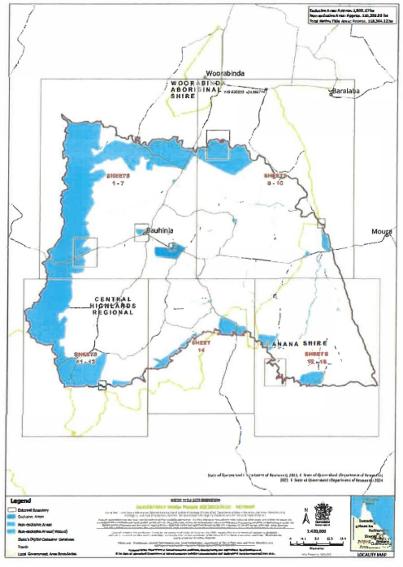
Division: | General Division |
Registry: | Queensland |
National Practice Area: | Native Title |
Number of paragraphs: | 117 |
Date of hearing: | 18 August 2026 |
Solicitor for the Applicant: | Queensland South Native Title Services |
Solicitor for the First Respondent: | Crown Law Queensland |
Table of Corrections | |
21 August 2026 | In paragraph [40], the reference to the affidavit of Sheree Sharma (affirmed on 15 August 2024) has been removed. As a consequence, the total number of affidavits referred to in that paragraph has been reduced from 29 to 28. |
ORDERS
QUD 28 of 2019 | ||
| ||
BETWEEN: | HARRIET VEA VEA, RICHARD SPORNE, CHRIS PRIESTLEY, DAISY GIBSON, JUDITH TATOW AND PHYLLIS FREEMAN ON BEHALF OF THE WADJA PEOPLE Applicant | |
AND: | STATE OF QUEENSLAND (and others named in the Schedule) First Respondent | |
order made by: | LENEHAN J |
DATE OF ORDER: | 18 AUGUST 2026 |
BEING SATISFIED that an order in the terms set out below is within the power of the Court, and it appearing appropriate to the Court to do so, pursuant to s 87 of the Native Title Act 1993 (Cth)
THE COURT NOTES THAT:
A. Having regard to the need to balance the limited availability of public resources with the competing need to resolve applications for a determination of native title in an efficient, cost effective and timely manner, the parties agree that the question of whether s 47C of the Native Title Act 1993 (Cth) would apply to any park areas within the External Boundary will be addressed after the matter has proceeded to determination.
B. The Wadja People (being the proposed Native Title Holders described in Schedule 1 of the Determination) have indicated a desire to enter into negotiations with the State of Queensland in relation to whether s 47C of the Native Title Act 1993 (Cth) would have application to any park areas within the External Boundary.
C. Subject to recital D below, the parties agree that, if agreement is reached in accordance with s 47C(1)(b) of the Native Title Act 1993 (Cth) that s 47C is applicable in respect of any park areas within the External Boundary, the parties would not oppose:
(i) an application being brought by the registered native title body corporate, pursuant to ss 13(1)(b) and 13(5) of the Native Title Act 1993 (Cth), to vary the Determination in relation to any such park area which is included in the Determination Area; and
(ii) an application being brought on behalf of the Wadja People pursuant to s 13(1)(a) of the Native Title Act 1993 (Cth) for a determination that native title exists in relation to any such park area which is excluded from the Determination Area.
D. The agreement of the parties in recital C above not to oppose an application to vary the Determination or an application for a determination that native title exists in relation to any park area, is subject to the parties having reached agreement on the nature and extent of the native title rights and interests that would be determined to exist in relation to each such park area.
E. The Wadja People, the Woorabinda Aboriginal Shire Council and the Woorabinda Pastoral Company Pty Ltd wish to record their agreement to use their best endeavours to negotiate an indigenous land use agreement, including with respect to the co-existence of the rights and interests of those parties and the ongoing pastoral activities of the Woorabinda Pastoral Company Pty Ltd over Lot 18 on BH 164 and Lot 9 on BH 194 as soon as practicable after the date of this Order.
BY CONSENT, THE COURT ORDERS THAT:
1. There be a determination of native title in the terms set out below (the Determination).
2. Each party to the proceedings is to bear its own costs.
BY CONSENT, THE COURT DETERMINES THAT:
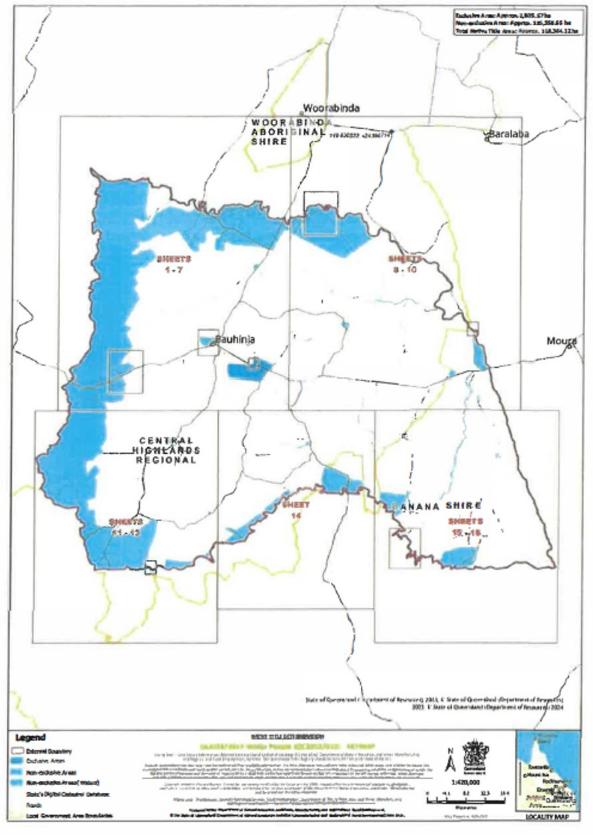
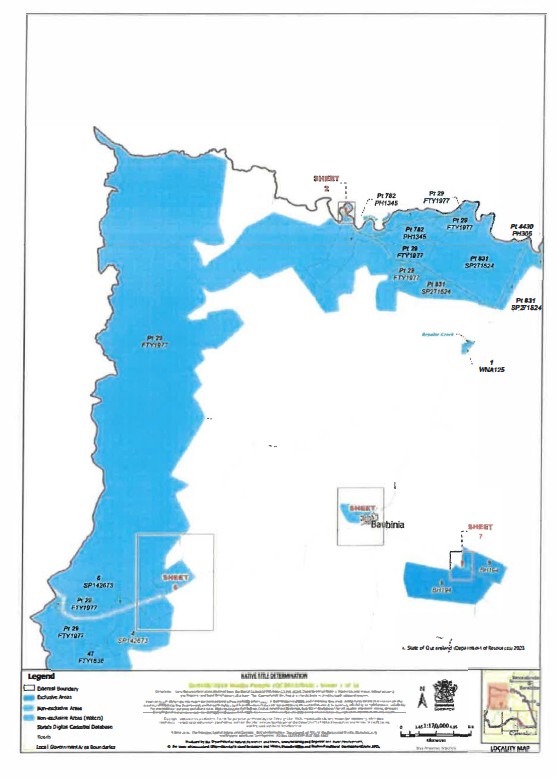
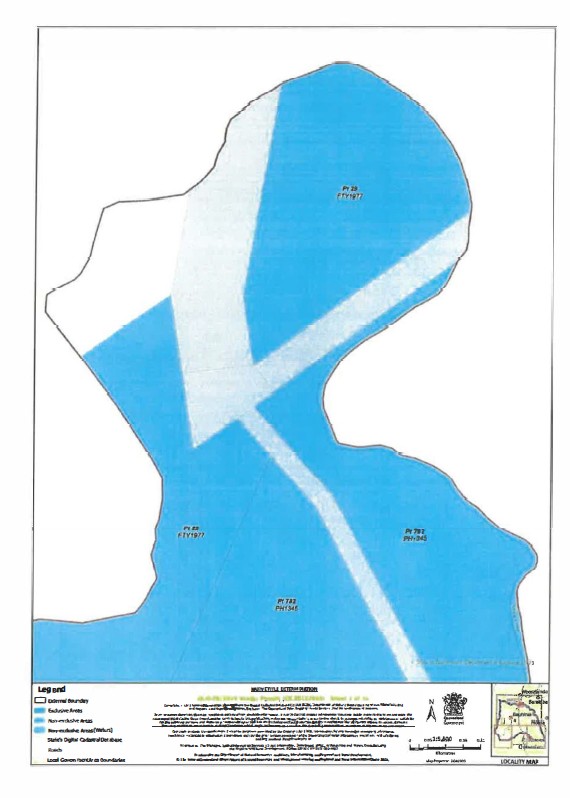
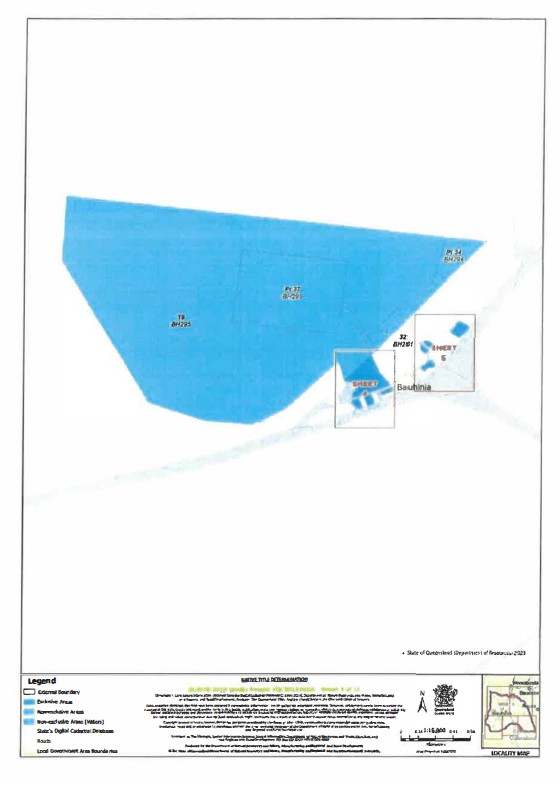
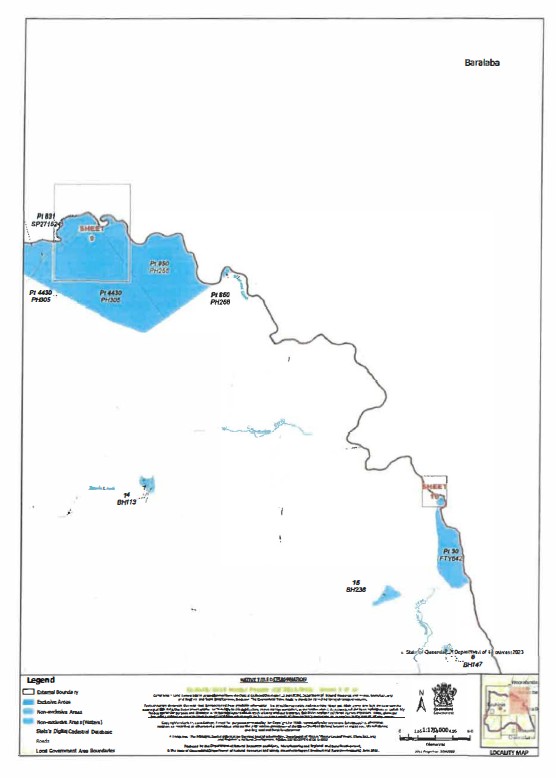
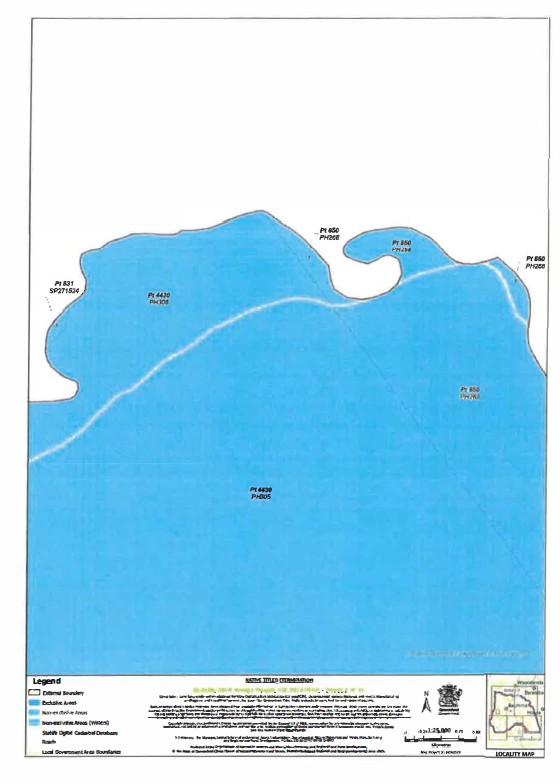
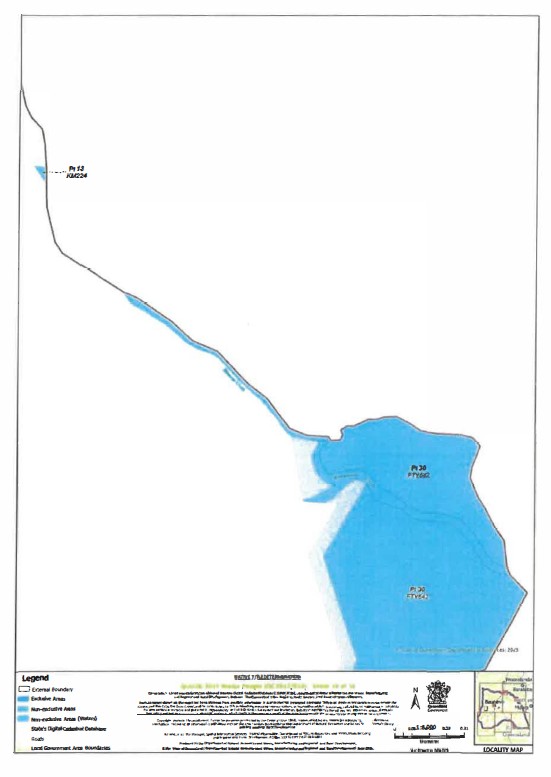
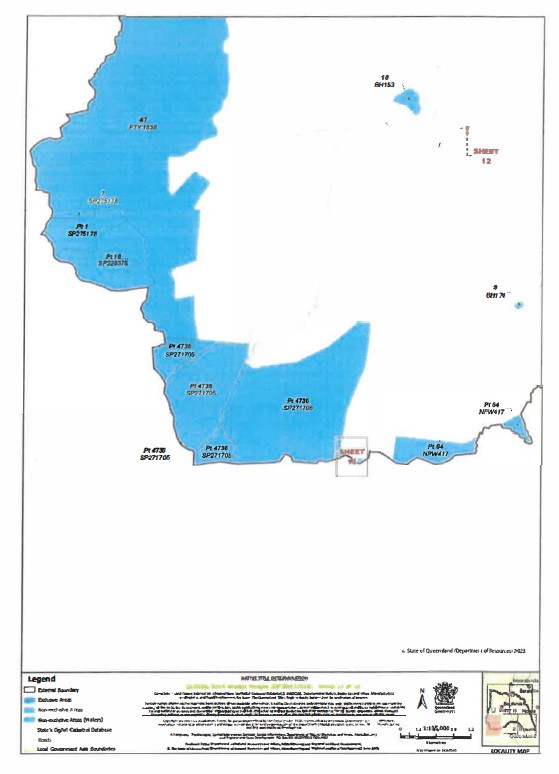
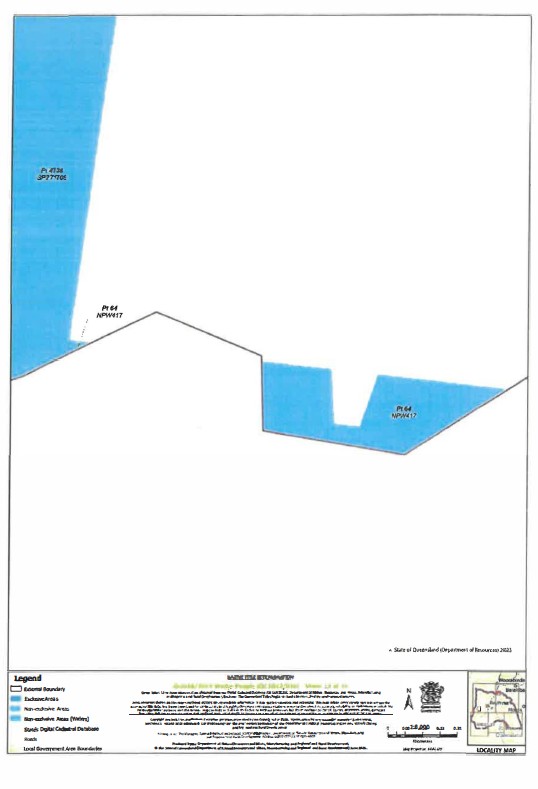
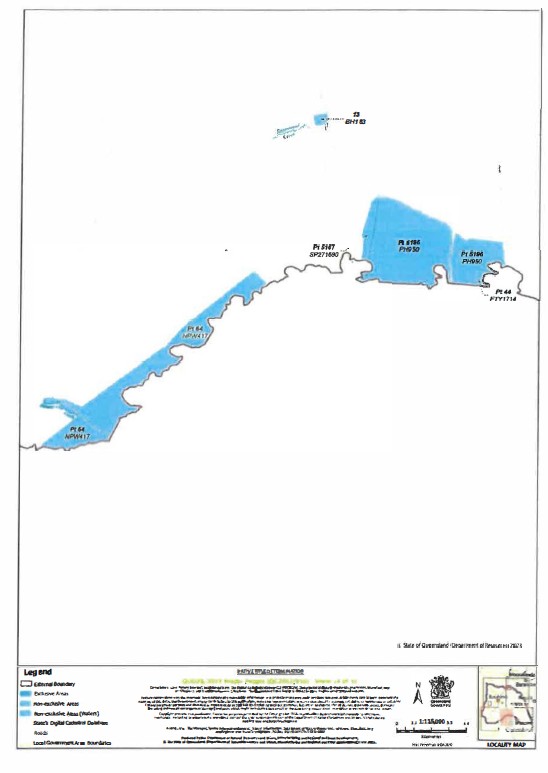
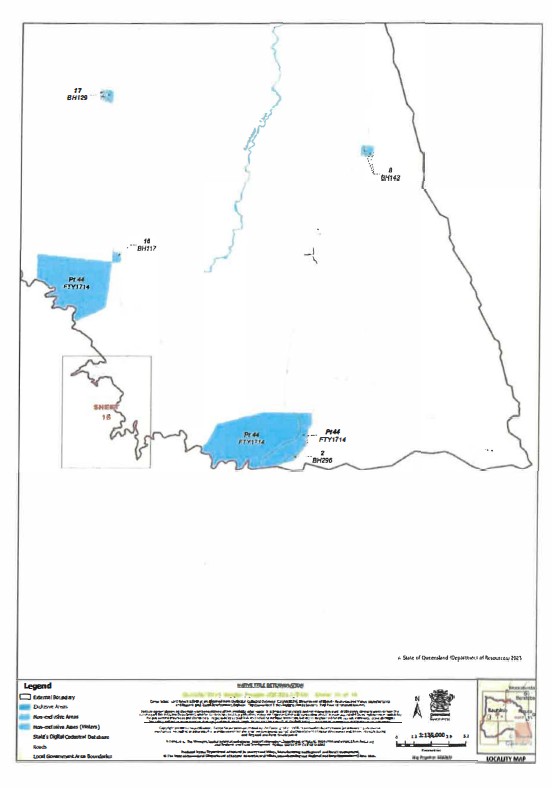
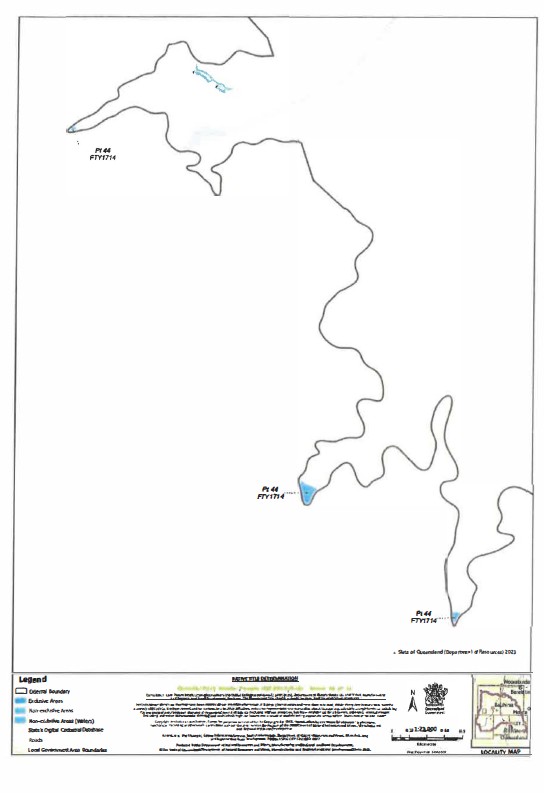
3. The determination area is the land and waters described in Schedule 4 and depicted in the map attached to Schedule 6 to the extent those areas are within the External Boundary and not otherwise excluded by the terms of Schedule 5 (the Determination Area). To the extent of any inconsistency between the written description and the map, the written description prevails.
4. Native title exists in the Determination Area.
5. The native title is held by the Wadja People described in Schedule 1 (the Native Title Holders).
6. Subject to orders 8, 9 and 10 below, the nature and extent of the native title rights and interests in relation to the land and waters described in Part 1 of Schedule 4 are:
(a) other than in relation to Water, the right to possession, occupation, use and enjoyment of the area to the exclusion of all others; and
(b) in relation to Water, the non-exclusive rights to take the Water of the Determination Area for personal, domestic and non-commercial communal purposes.
7. Subject to orders 8, 9 and 10 below, the nature and extent of the native title rights and interests in relation to the land and waters described in Part 2 of Schedule 4 are the non-exclusive rights to:
(a) take the Water of the Determination Area for personal, domestic and non-commercial communal purposes;
(b) take the natural resources of the land and waters of the Determination Area for any purpose;
(c) access, be present on, move about on and travel on the Determination Area;
(d) live and camp on the Determination Area, and for that purpose, to erect shelters or other structures;
(e) bury Native Title Holders within the Determination Area;
(f) maintain places of importance and areas of significance to the Native Title Holders within the Determination Area, and to protect those places and areas from physical harm and physical desecration;
(g) teach on the Determination Area the physical and spiritual attributes of the Determination Area;
(h) light Controlled Contained Fires on the Determination Area for cultural, spiritual or domestic purposes;
(i) hold meetings on the Determination Area;
(j) conduct ceremonies and other cultural activities on the Determination Area;
(k) be accompanied on the Determination Area by those persons who, though not Native Title Holders, are:
(i) spouses of Native Title Holders; or
(ii) people reasonably required by the Native Title Holders under traditional laws and customs for the performance of ceremonies or cultural activities on the Determination Area.
8. The native title rights and interests are subject to and exercisable in accordance with:
(a) the Laws of the State and the Commonwealth; and
(b) the traditional laws acknowledged and traditional customs observed by the Native Title Holders.
9. The native title rights and interests referred to in orders 6(b) and 7 do not confer possession, occupation, use or enjoyment to the exclusion of all others.
10. There are no native title rights in or in relation to minerals as defined by the Mineral Resources Act 1989 (Qld) and petroleum as defined by the Petroleum Act 1923 (Qld) and the Petroleum and Gas (Production and Safety) Act 2004 (Qld).
11. The nature and extent of any other interests in relation to the Determination Area (or respective parts thereof) are set out in Schedule 2.
12. The relationship between the native title rights and interests described in orders 6 and 7 and the other interests described in Schedule 2 (the Other Interests) is that:
(a) the Other Interests continue to have effect, and the rights conferred by or held under the Other Interests may be exercised notwithstanding the existence of the native title rights and interests;
(b) to the extent the Other Interests are inconsistent with the continued existence, enjoyment or exercise of the native title rights and interests in relation to the land and waters of the Determination Area, the native title continues to exist in its entirety but the native title rights and interests have no effect in relation to the Other Interests to the extent of the inconsistency for so long as the Other Interests exist; and
(c) the Other Interests and any activity that is required or permitted by or under, and done in accordance with, the Other Interests, or any activity that is associated with or incidental to such an activity, prevail over the native title rights and interests and any exercise of the native title rights and interests.
DEFINITIONS AND INTERPRETATION
13. In this determination, unless the contrary intention appears:
"Controlled Contained Fire" means a fire that is a planned and supervised burning of vegetation to a predetermined and delineated area when environmental conditions are suitable that does not cause harm to persons, or undue harm to property or wildlife;
"External Boundary" means the area described in Schedule 3;
"land" and "waters", respectively, have the same meanings as in the Native Title Act 1993 (Cth);
"Laws of the State and the Commonwealth" means the common law and the laws of the State of Queensland and the Commonwealth of Australia, and includes legislation, regulations, statutory instruments, local planning instruments and local laws;
“Local Government Act" has the meaning given in the Local Government Act 2009 (Qld);
"Local Government Area" has the meaning given in the Local Government Act 2009 (Qld);
"Reserve" means a reserve dedicated or taken to be a reserve under the Land Act 1994 (Qld);
"Water" means:
(i) water which flows, whether permanently or intermittently, within a river, creek or stream;
(ii) any natural collection of water, whether permanent or intermittent; and
(iii) water from an underground water source.
"Works" has the same meaning as in the Electricity Act 1994 (Qld).
Other words and expressions used in this determination have the same meanings as they have in Part 15 of the Native Title Act 1993 (Cth).
THE COURT DETERMINES THAT:
14. The native title is held in trust.
15. The Wadja Aboriginal Corporation (ICN: 7983), incorporated under the Corporations (Aboriginal and Torres Strait Islander) Act 2006 (Cth), is to:
(a) be the prescribed body corporate for the purpose of ss 56(2)(b) and 56(3) of the Native Title Act 1993 (Cth); and
(b) perform the functions mentioned in s 57(1) of the Native Title Act 1993 (Cth) after becoming a registered native title body corporate.
Note: Entry of orders is dealt with in Rule 39.32 of the Federal Court Rules 2011.
LIST OF SCHEDULES
Schedule 1 - Native Title Holders
Schedule 2 - Other Interests in the Determination Area
Schedule 3 - External Boundary
Schedule 4 - Description of Determination Area
Schedule 5 - Areas Not Forming Part of the Determination Area
Schedule 6 - Map of Determination Area
SCHEDULE 1 - NATIVE TITLE HOLDERS
1. The Native Title Holders are the Wadja People. The Wadja People are the descendants of one or more of the following people:
(a) Myra Freeman;
(b) Biddy Dutton, mother of Harriet Dutton;
(c) Sarah Dodd; and
(d) Unnamed Wadjainggo woman whose granddaughter was Eva Tyson.
SCHEDULE 2 – OTHER INTERESTS IN THE DETERMINATION AREA
The nature and extent of the other interests in relation to the Determination Area are the following as they exist as at the date of the determination:
1. The rights and interests of the parties under the [QI2011/010] – Santos Petronas Murribinbi GLNG ILUA registered on the Register of Indigenous Land Use Agreements.
2. The rights and interests of the holders of the rolling term lease for pastoral purposes PH 40/5167 over Lot 5167 on SP271690 (also known as Red Hill) granted pursuant to the Land Act 1962 (Qld).
3. The rights and interests of any one or more of the following parties:
(a) KGLNG Liquefaction Pty Ltd;
(b) PAPL (Downstream) Pty Limited;
(c) Santos GLNG Pty Ltd; or
(d) TotalEnergies GLNG Australia,
as holders of Easement in Gross No 718187027 over Easement L on SP263147 and Easement in Gross No 721793849 over Easement A on SP317562, both on Lot 4 on SP142673.
4. The rights and interests of the holders of petroleum lease PL 236 granted and administered under the Petroleum Act 1923 (Qld).
5. The rights and interests of the holders of the pipeline licences granted pursuant to the Petroleum Act 1923 (Qld) and administered under the Petroleum and Gas (Production and Safety) Act 2004 (Qld):
(a) petroleum pipeline licence PPL 30; and
(b) petroleum pipeline licence PPL 166.
6. The rights and interests of the holders of the following tenements granted and administered under the Petroleum and Gas (Production and Safety) Act 2004 (Qld):
(a) authority to prospect ATP 2012; and
(b) potential commercial areas PCA 316 and PCA 317.
7. The rights and interests of Ergon Energy Corporation Limited ACN 087 646 062:
(a) as the owner and operator of any “Works" as that term is defined in the Electricity Act 1994 (Qld) within the Determination Area;
(b) as an electricity entity under the Electricity Act 1994 (Qld), including, but not limited to:
(i) as the holder of a distribution authority;
(ii) to inspect, maintain and manage any Works in the Determination Area; and
(iii) in relation to any agreement or consent relating to the Determination Area existing or entered into before the date these orders are made;
(c) to enter the Determination Area by its employees, agents or contractors to exercise any of the rights and interests referred to in this clause; and
(d) in Easement in Gross No 710537822 over Easement Z on SP165441, both on Lot 44 on CP FTY1714.
8. The rights and interests of Banana Shire Council, Central Highlands Regional Council and Woorabinda Aboriginal Shire Council (Councils):
(a) under their local government jurisdiction and functions under the Local Government Act 2009 (Qld), under any other Local Government Act, under the Stock Route Management Act 2002 (Qld) and under any other legislation, for that part of the Determination Area within their Local Government Area;
(b) as the:
(i) lessor under any leases which were validly entered into before the date on which these orders are made and whether separately particularised in these orders or not;
(ii) grantor of any licences or other rights and interests which were validly granted before the date on which these orders were made and whether separately particularised in these orders or not;
(iii) holder of any estate or any other interest in land, including as trustee of any Reserves, under access agreement and easements that exist in the Determination Area; and
(c) as the owner and operator of infrastructure, structures, earthworks, access works and any other facilities and other improvements located in the Determination Area validly constructed or established on or before the date on which these orders are made, including but not limited to:
(i) undedicated but constructed roads except for those not operated by Council;
(ii) water pipelines and water supply infrastructure;
(iii) drainage facilities;
(iv) watering point facilities;
(v) recreational facilities;
(vi) transport facilities;
(vii) gravel pits operated by Council;
(viii) cemetery and cemetery related facilities;
(ix) community facilities; and
(d) to enter the land for the purposes described in paragraphs 8(a), 8(b) and 8(c) above by their employees, agents or contractors to:
(i) exercise any of the rights and interests referred to in this paragraph or paragraph 9 below;
(ii) use, operate, inspect, maintain, replace, restore and repair the infrastructure, facilities and other improvements referred to in paragraph 8(c) above; and
(iii) undertake operational activities in its capacity as Local Government such as feral animal control, erosion control, waste management and fire management.
9. The rights and interests of the State of Queensland and the Councils to access, use, operate, maintain and control the dedicated roads in the Determination Area and the rights and interests of the public to use and access those roads.
10. The rights and interests of the Woorabinda Pastoral Company Pty Ltd to undertake pastoral activities under any valid lease, licence, permit, contract or other authority over Lot 18 on BH164 and Lot 9 on BH194.
11. The rights and interests of the State of Queensland in Reserves, the rights and interests of the trustees of those Reserves and the rights and interests of the persons entitled to access and use those Reserves for the respective purpose for which they are reserved.
12. The rights and interests of the State of Queensland or any other person existing by reason of the force and operation of the laws of the State of Queensland, including those existing by reason of the following legislation or any regulation, statutory instrument, declaration, plan, authority, permit, lease or licence made, granted, issued or entered into under that legislation:
(a) the Aboriginal Land Act 1991 (Qld);
(b) the Biosecurity Act 2014 (Qld);
(c) the Fisheries Act 1994 (Qld);
(d) the Land Act 1994 (Qld);
(e) the Nature Conservation Act 1992 (Qld);
(f) the Forestry Act 1959 (Qld);
(g) the Water Act 2000 (Qld);
(h) the Petroleum Act 1923 (Qld) or Petroleum and Gas (Production and Safety) Act 2004 (Qld);
(i) the Mineral Resources Act 1989 (Qld);
(j) the Planning Act 2016 (Qld);
(k) the Transport Infrastructure Act 1994 (Qld);
(l) the Work Health and Safety Act 2011 (Qld); and
(m) the Fire Services Act 1990 (Qld) or Ambulance Service Act 1991 (Qld).
13. The rights and interests of members of the public arising under the common law, including but not limited to any subsisting public right to fish.
14. So far as confirmed pursuant to s 212(2) of the Native Title Act 1993 (Cth) and s 18 of the Native Title (Queensland) Act 1993 (Qld) as at the date of this determination, any existing rights of the public to access and enjoy the following places in the Determination Area:
(a) waterways;
(b) beds and banks or foreshores of waterways;
(c) stock routes; or
(d) areas that were public places at the end of 31 December 1993.
15. Any other rights and interests:
(a) held by the State of Queensland or Commonwealth of Australia; or
(b) existing by reason of the force and operation of the Laws of the State and the Commonwealth.
SCHEDULE 3 – EXTERNAL BOUNDARY
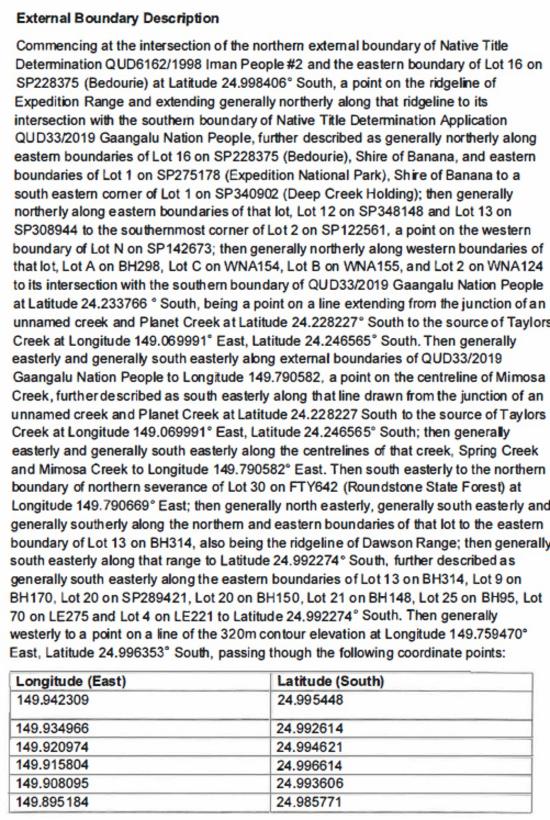
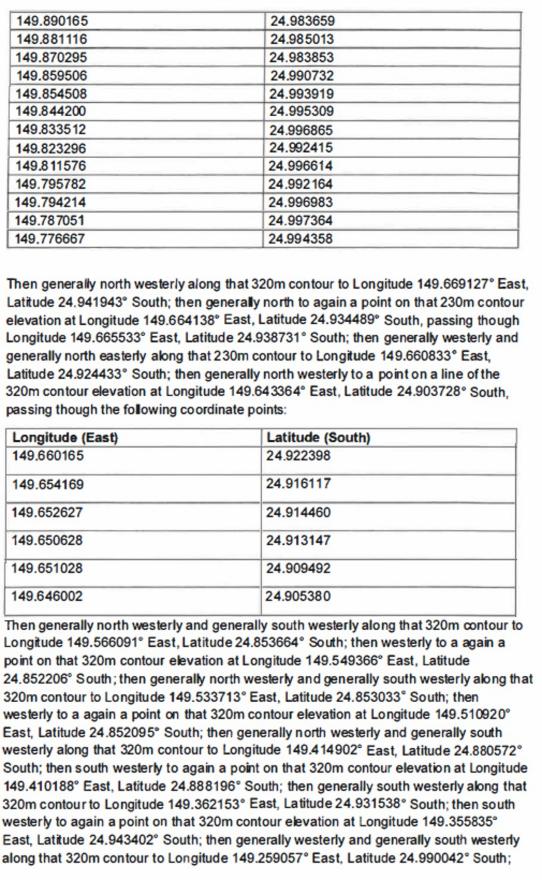
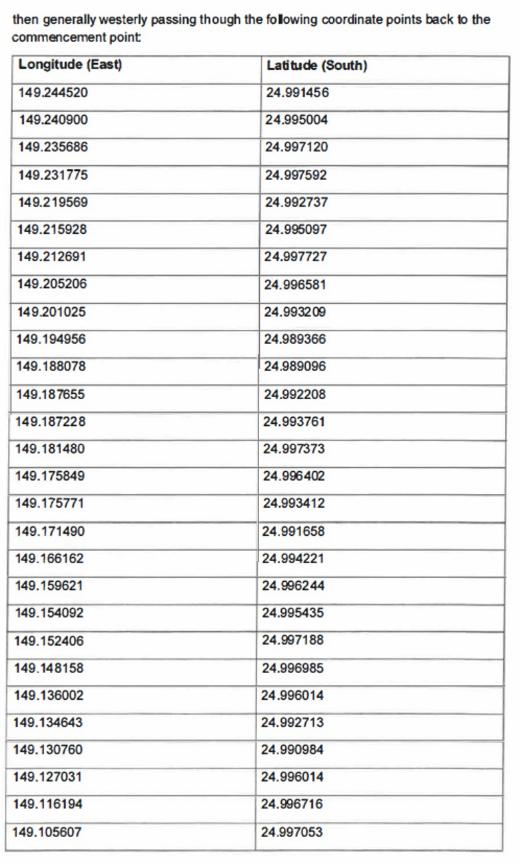
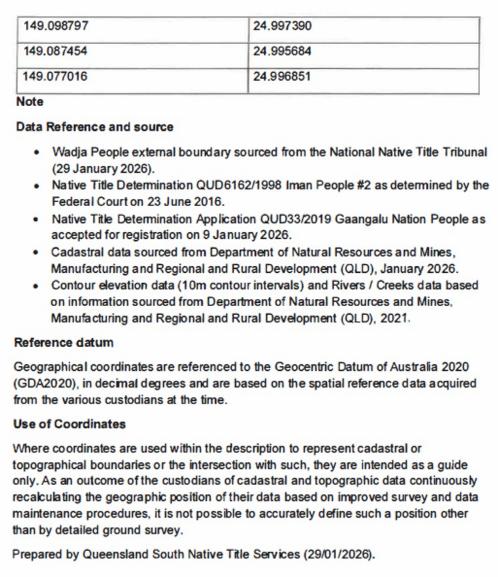
SCHEDULE 4 – DESCRIPTION OF DETERMINATION AREA
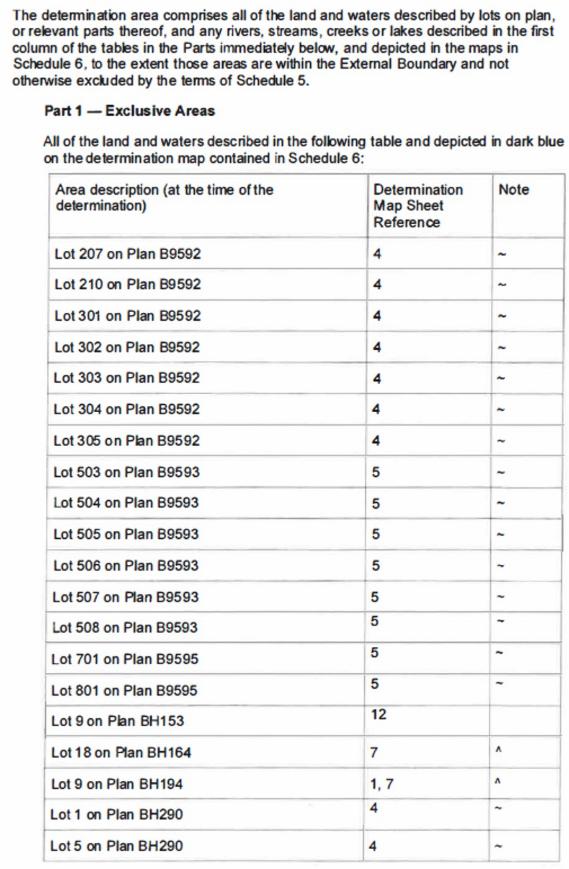
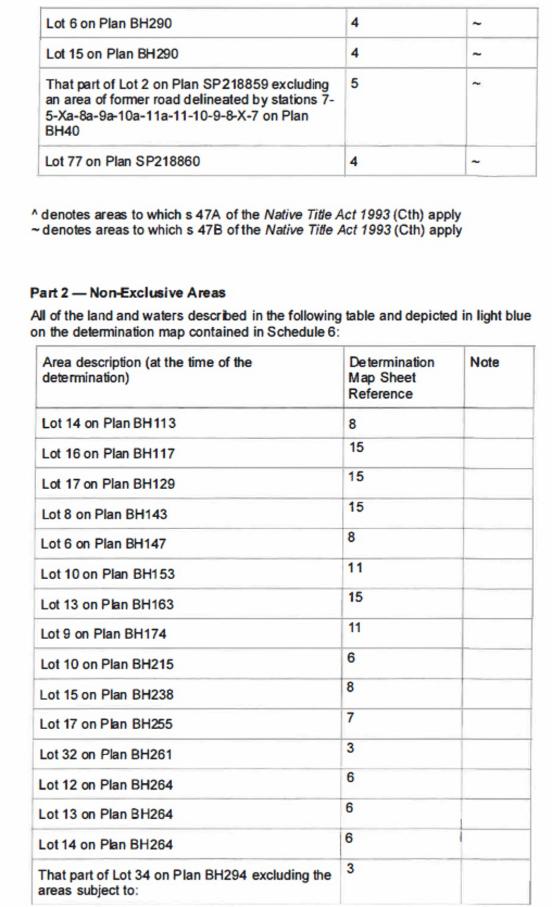
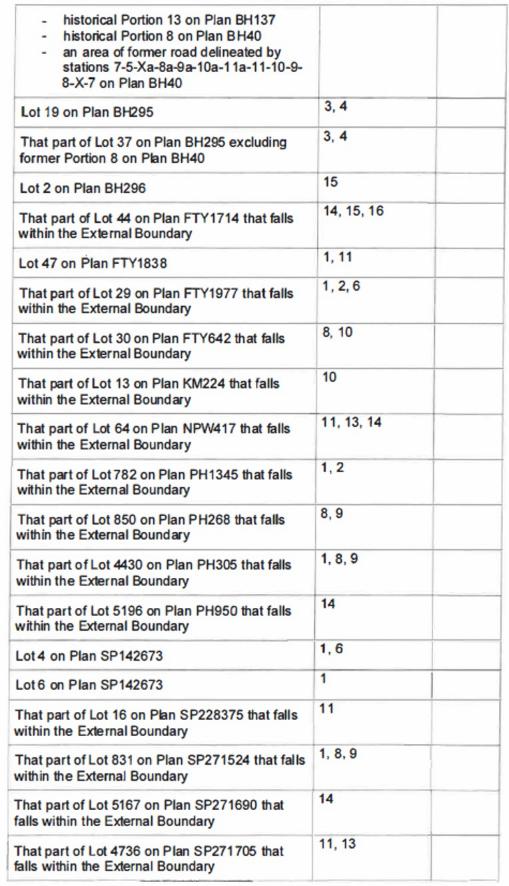
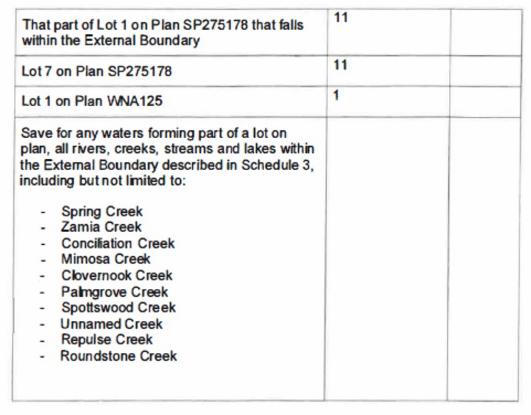
SCHEDULE 5 – AREAS NOT FORMING PART OF THE DETERMINATION AREA
The following areas of land and waters are excluded from the determination area as described in Part 1 of Schedule 4 and Part 2 of Schedule 4:
1. Those land and waters within the External Boundary which at the time the native title determination application was made were, or had been, the subject of one or more Previous Exclusive Possession Acts, within the meaning of s 23B of the Native Title Act 1993 (Cth) as they could not be claimed in accordance with s 61A of the Native Title Act 1993 (Cth).
2. Specifically, and to avoid any doubt, the land and waters described in (1) above include:
(a) the Previous Exclusive Possession Acts described in ss 238(2) and 238(3) of the Native Title Act 1993 (Cth) to which s 20 of the Native Title (Queensland) Act 1993 (Qld) applies, and to which none of ss 47, 47A or 47B of the Native Title Act 1993 (Cth) applied; and
(b) the land and waters on which any public work, as defined in s 253 of the Native Title Act 1993 (Cth), is or was constructed, established or situated, and to which ss 23B(7) and 23C(2) of the Native Title Act 1993 (Cth) and to which s 21 of the Native Title (Queensland) Act 1993 (Qld), applies, together with any adjacent land or waters in accordance with s 251D of the Native Title Act 1993 (Cth).
3. Those land and waters within the External Boundary on which, at the time the native title determination application was made, public works were validly constructed, established or situated after 23 December 1996, where s 24JA of the Native Title Act 1993 (Cth) applies, and which wholly extinguished native title.
4. Those land and waters within the External Boundary which, at the time the native title determination application was made, were the subject of one or more Pre-existing Rights Based Acts, within the meaning of s 24IB of the Native Title Act 1993 (Cth), which wholly extinguished native title.
SCHEDULE 6 – MAP OF DETERMINATION AREA
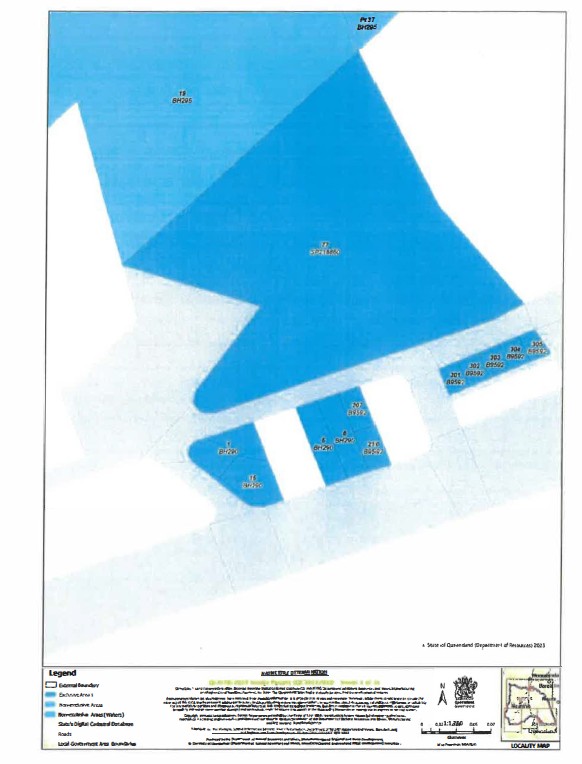
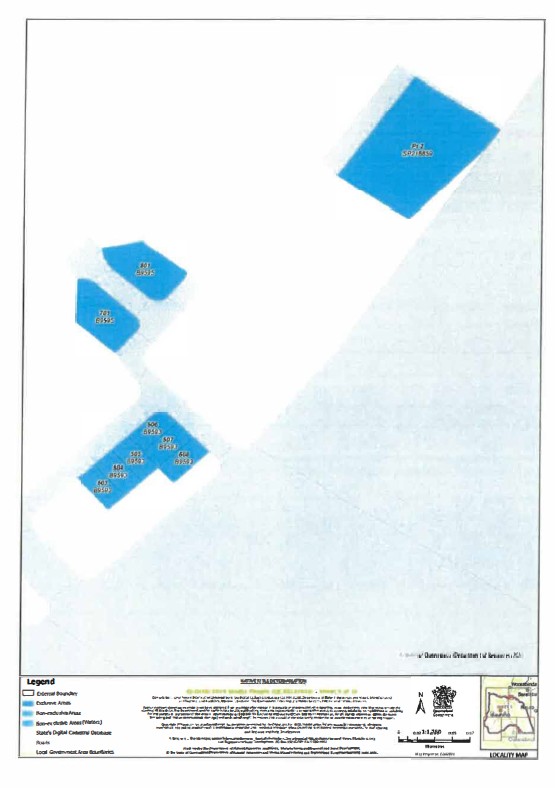
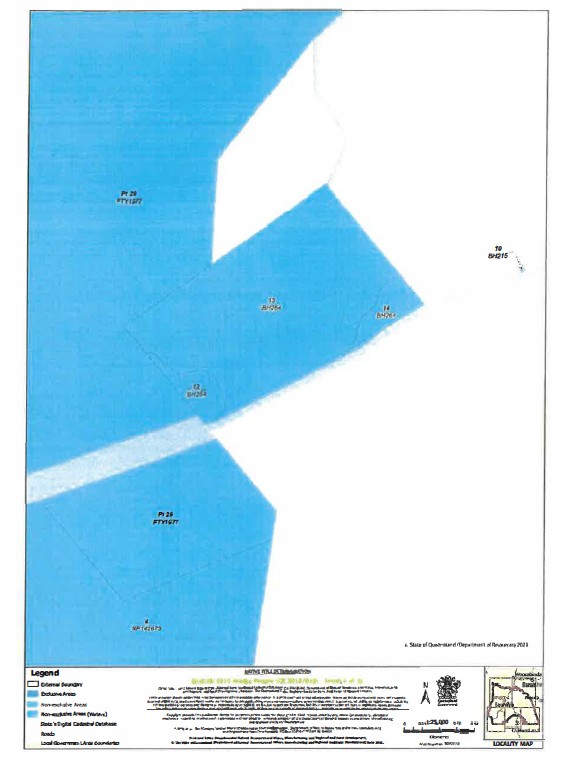
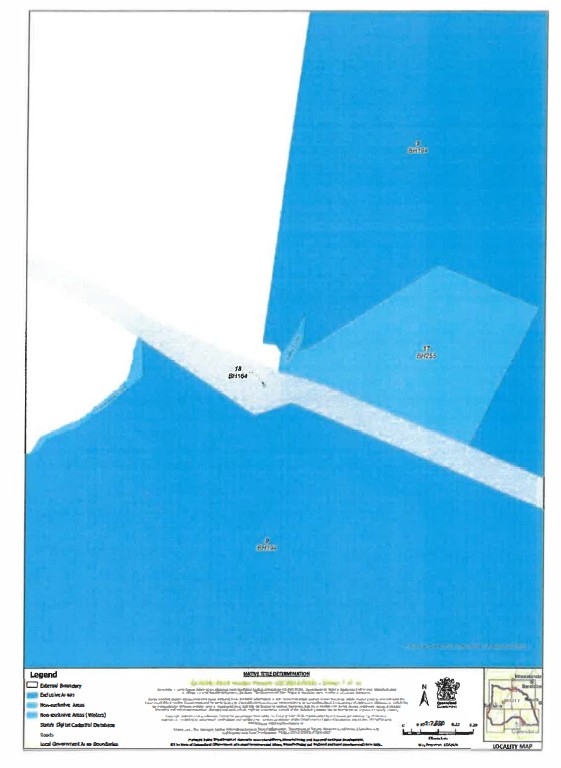

REASONS FOR JUDGMENT
LENEHAN J:
[1] | |
[3] | |
[3] | |
[3] | |
[4] | |
[5] | |
[8] | |
[10] | |
[12] | |
[15] | |
[18] | |
[25] | |
[40] | |
4 THE WADJA PEOPLE, THEIR TRADITIONAL LAW AND CUSTOM AND THEIR COUNTRY IN THE DETERMINATION AREA | [43] |
[48] | |
[53] | |
[55] | |
4.3.1 Beliefs in spiritual forces, ancestral beings that enact upon the landscape | [57] |
[64] | |
4.3.3 Totemism including an association between totemism and kinship as well as personal totems | [67] |
4.3.4 Gender specific and other significant sites at which certain access protocols apply | [73] |
[77] | |
[84] | |
[95] | |
[97] | |
[101] | |
[109] | |
[114] |
1. INTRODUCTION
1 On 7 December 2022, the Applicant filed a second further amended application under s 61(1) of the Native Title Act 1993 (Cth) (the NTA) on behalf of the Wadja People (the Second Further Amended Form 1 Application). On 31 July 2026, the Applicant filed an executed (amended) agreement under s 87 of the NTA (the Amended s 87 Agreement).
2 For the reasons set out below, it is appropriate to make the orders sought by the parties in accordance with the Amended s 87 Agreement.
2. BACKGROUND
2.1 Parties
2.1.1 Native title claim group
3 Schedule A of the Second Further Amended Form 1 Application (and Schedule 1 of Annexure A of the Amended s 87 Agreement) records that the native title claim group comprises all the persons descended from the following Wadja ancestors:
Myra Freeman;
Biddy Dutton, mother of Harriet Dutton;
Sarah Dodd; and
Unnamed Wadjainggo woman whose granddaughter was Eva Tyson.
2.1.2 Applicant in this proceeding
4 Together, Harriet Vea Vea, Judith Tatow, Daisy Gibson, Richard Sporne, Chris Priestley and Phyllis Freeman comprise the Applicant. The Second Further Amended Form 1 Application recorded that the Applicant was authorised by members of the native title claim group “to make this native title determination application at a meeting held in Rockhampton on 21 September 2019”. Further, in respect of the Amended s 87 Agreement, the Applicant’s submissions (filed with this Court on 18 June 2026) recorded that the Applicant was authorised at a meeting on 11 April 2026 “to agree to draft consent determination orders subject to any necessary technical amendments”. More is said about the authorisation process in relation to the Second Further Amended Form 1 Application later in these reasons.
2.1.3 Respondents in this proceeding
5 Schedule 1 of the Amended s 87 Agreement identifies the following parties as respondents to this proceeding:
(1) State of Queensland;
(2) Banana Shire Council;
(3) Central Highlands Regional Council;
(4) Woorabinda Aboriginal Shire Council;
(5) Woorabinda Pastoral Company;
(6) Ergon Energy Corporation Limited ACN 087 646 062;
(7) Jemena Queensland Gas Pipeline (1) Pty Ltd;
(8) Jemena Queensland Gas Pipeline (2) Pty Ltd;
(9) KGLNG Liquefaction Pty Ltd;
(10) PAPL (Downstream) Pty Limited;
(11) PAPL (Upstream) Pty Ltd;
(12) Santos GLNG Pty Ltd ACN 131 271 648;
(13) Santos QNT Pty Ltd;
(14) Santos Queensland, LLC;
(15) Santos TOG, LLC;
(16) Santos TOGA Pty Ltd;
(17) Santos TPY, LLC;
(18) Santos TPY CSG, LLC;
(19) TotalEnergies E&P Australia ABN 96 832 035 151;
(20) TotalEnergies GLNG Australia; and
(21) Lloyd Murray & Co Pty Ltd ACN 009 704 616.
6 Schedule 2 of the Amended s 87 Agreement details the nature and extent of the other interests in relation to the Determination Area.
7 Finally, as contemplated by the Amended s 87 Agreement, the orders, among other things, note: that “[t]he Wadja People … have indicated a desire to enter into negotiations with the State of Queensland in relation to whether s 47C of the [NTA] would have application to any park areas within the External Boundary” (see notation B); and that “[t]he Wadja People, the Woorabinda Aboriginal Shire Council and the Woorabinda Pastoral Company Pty Ltd … [agree] to use their best endeavours to negotiate an indigenous land use agreement” (see notation E in the orders).
2.2 Determination Area
8 The Determination Area is described in paragraph 3 of the orders.
9 The area the subject of the Amended s 87 Agreement is reproduced below from Schedule 6 to the orders:
2.3 Procedural History
10 On 22 August 2012, the Applicant filed a claimant native title determination application under s 61(1) of the NTA on behalf of the Wadja People in proceeding QUD 422 of 2012 (now QUD 28 of 2019) (the Form 1 Application). The Form 1 Application was accepted for registration on 19 December 2012. The Form 1 Application was notified pursuant to s 66 of the NTA. The three-month period specified in the notice commenced on 30 January 2013 and ended on 29 April 2013.
11 Much has happened since then and before the proceeding was more recently allocated to me on 7 July 2026. For reasons that will become apparent, it is necessary to briefly recount the procedural history of this matter, focusing on the issues that arose and the manner in which they were resolved. As set out below, the resolution of each of those issues ultimately paved the way for the execution of the Amended s 87 Agreement. That procedural chronology (which is based upon Annexure A to the Applicant’s submissions) also makes plain that this has been a very long journey for the Wadja People, who have overcome many obstacles to arrive at the position they are in today.
2.3.1 Issue of overlap with GNP claim – resolved
12 On 30 September 2013, Dowsett J referred the Applicant and the applicant in proceeding QUD 400 of 2012 (now QUD 33 of 2019), being the Gaangalu Nation People (GNP) claim applicant (the GNP Applicant), to mediation to resolve the overlap between their respective claims.
13 On 1 August 2014, with leave of the Court, the Applicant filed an amended application, reducing the claim area such that all overlapping land and waters with the GNP claim were removed (the Amended Form 1 Application). Subsequently, on 19 September 2014, the parties then involved in the proceeding were notified of the amended application in accordance with s 66A(1)(d) of the NTA.
14 As to the resolution of those matters, in Blucher on behalf of the Gaangalu Nation People v State of Queensland (No 3) [2023] FCA 600, Rangiah J said this at para [611]:
The Woorabinda area has been subject to an overlapping native title claim by the Wadja People, but the Wadja claim has been amended and there is no longer an overlap.
2.3.2 Issue of overlap with Iman #4 claim – resolved
15 On 21 August 2017, the Iman People filed a native title determination application in proceeding QUD 413 of 2017 (the Iman #4 claim). The claim area of the Iman #4 claim wholly encompassed the area then claimed by the Wadja People.
16 By orders made on 6 November 2017, the Iman #4 claim was separated into Part A (being the area the subject of the Wadja claim) and Part B.
17 On 9 August 2018, the Iman #4 claim was amended to remove Part A from the claim area. As a result, there was no longer any overlap between the Wadja claim and the Iman #4 claim. In this regard, in Doyle on behalf of Iman People #4 v State of Queensland [2024] FCA 1045, Rangiah J said this at paras [12]-[14]:
The application for a determination of native title was filed in the Federal Court on 21 August 2017.
On 6 November 2017, the application was separated, by order of the Court, into Part A (the area that was the subject of an overlapping claim by the Wadja People) and Part B.
On 9 August 2018, the application was amended to remove Part A from the claim area. The proposed determination area consists of a substantial part, but not the whole, of Part B.
2.3.3 Issue of Iman Respondents – resolved
18 On 5 November 2019, Cynthia Kemp, Bevan Tull and John Waterton of the Iman People (together, the Iman Respondents) filed an application under s 84 of the NTA.
19 Relevantly, s 84(5) of the NTA provides:
84 Parties
Joining parties
(5) The Federal Court may at any time join any person as a party to the proceedings, if the Court is satisfied that the person’s interests may be affected by a determination in the proceedings and it is in the interests of justice to do so.
20 On 27 March 2020, the Iman Respondents were joined as respondents to the proceeding: Vea Vea on behalf of the Wadja People v State of Queensland [2020] FCA 405.
21 On 19 April 2022, the Applicant and Iman Respondents participated in a mediation conducted by Registrar Ingram and a Member of the National Native Title Tribunal. The mediation report of 20 April 2022, in turn, recorded that the Applicant and the Iman Respondents agreed to the following outcomes (which were also agreed to be disclosed to the Court):
1. The Wadja People Applicant will propose at a meeting of the Wadja native title claim group, an amendment to the Native Title Determination Application area, to amend the southern claim boundary to be consistent with the map at Attachment A (line depicted in red, which is subject to technical refinement by the National Native Title Tribunal).
2. The current eastern boundary of the Wadja People’s claim, following the Dawson Range watershed, remains the boundary.
3. The Indigenous Respondents agree to withdraw as [a] party to the claim, and agree that no further Iman Peoples seek to join the Wadja claim or make a further Iman native title determination application over areas of the Wadja people’s claim.
4. The Wadja and Iman representatives will seek to negotiate an Indigenous Land Use Agreement to facilitate joint access and use to specified cultural sites of the Wadja claim area, the Iman determination area, and the areas of the Bigge Range.
5. The Iman People support the Wadja People in their determination application.
6. The Iman Representatives agree to propose to the Iman Peoples at a meeting of the Iman Peoples to approve the mediated outcomes.
22 On 14 November 2022, as contemplated by para (3) of the (above) outcomes, the Iman Respondents were removed as parties to the proceeding.
23 On 7 December 2022, as contemplated by para (1) of the outcomes, the Applicant filed a second further amended application, reducing the land and waters claimed to the current claim area (being the Second Further Amended Form 1 Application).
24 On 9 January 2023, the Second Further Amended Form 1 Application was accepted for registration under s 190A(6A) of the NTA. Subsequently, on 18 August 2023, the (current) parties in the proceeding were notified of the second further amended application in accordance with s 66A(1)(d) of the NTA.
2.3.4 Issue of Separate Questions – resolved
25 As recorded by Rangiah J in Blucher (No 3) [2023] FCA 600 at paras [47]-[48], in 2017, the State engaged Dr Anna Kenny, an expert anthropologist, in relation to the GNP claim, the Western Kangoulu claim (proceeding QUD 17 of 2019), and the Wadja claim. In 2018, Dr Kenny’s brief extended to include Part A of the Wulli Wulli #3 claim (proceeding QUD 619 of 2017). These proceedings became collectively known as the “GNP cluster” and were case managed together because they involved competing claims to land and apical ancestors.
26 On 15 November 2017, Rangiah J ordered that two questions concerning the existence of native title be determined separately from the proceeding (the Separate Questions). As recorded in the notation of orders made on 5 November 2019:
THE COURT NOTES THAT:
A. Order 1 of the orders made on 15 November 2017 in QUD422/2012 (now QUD28/2019) required the following Separate Questions to be determined separately from other questions in the proceeding:
a. But for any question of extinguishment of native title, does native title exist in relation to any and, if so what, land and waters of the claim area?
b. In relation to that part of the claim area where the answer to (a) above is in the affirmative:
i. Who are the persons, or each group of persons, holding the common or group rights comprising the native title?
ii. What is the nature and extent of the native title rights and interests?
27 On 10 June 2022, Rangiah J listed the Separate Questions for hearing on dates in May and June 2023. In October 2022, the Applicant and State “engaged in confidential and without prejudice negotiations”. On 15 December 2022, Rangiah J ordered, pursuant to s 86B(5) of the NTA, that the Applicant and State be referred to mediation before Registrar Ingram. On 29 March 2023, Rangiah J further ordered, by consent, that the hearing dates for the Separate Questions be vacated.
28 On 15 June 2023, the Court delivered judgment in Blucher (No 3) [2023] FCA 600. As the Applicant submitted, the delivery of this judgment “trigger[ed] further mediation between the Applicant and State”. Those mediations resolved a number of outstanding issues concerning connection and the (draft) terms of the consent determination, the outcomes of which are summarised below.
29 First, the mediation report filed on 29 September 2023 recorded (as matters permitted to be reported to the Court) that the Applicant and State agreed to a series of steps to progress the mediation including further exchanges concerning issues of connection, continuity and two apical ancestors. The mediation report also there noted the Applicant’s intention to engage Mr Kim McCaul to provide a further expert anthropological opinion and contemplated a further mediation in early 2024.
30 Second, the mediation report filed on 28 March 2024 recorded that the Applicant would provide the State, by the end of July 2024, Mr McCaul’s supplementary report and any additional connection material. The report also contemplated a further mediation.
31 Third, the report for the mediation held on 1 November 2024 recorded the following outcomes:
1. The mediation parties have agreed on a Statement of Agreed Facts and Outstanding Issues in Contention (SAFOIC) and by orders of Justice Rangiah of 1 November 2024, were granted leave to file it together with additional evidence relied upon in support. The SAFOIC also outlines those outstanding matters that aren’t yet agreed.
2. The focus of the mediation was therefore on reaching agreement to the timetable to consent determination, to the extent possible at this time. The timetable includes a process for addressing the outstanding issues and for ascertaining whether any other parties intend to contest connection.
3. The parties agreed to provide a copy of the timetable and proposed orders as agreed to the Mediator by 6 November 2024.
4. The agreed draft orders and timetable are attached to this Mediation Report and the parties consent to them [being] provided to Justice Rangiah and being subject of orders if the Court sees fit.
5. The parties agreed that they would like the matter to remain in mediation with a further mediation to be convened after the end of February 2025 when certain action items become due and before May 2025.
32 On 8 November 2024, Rangiah J made orders in the following terms:
THE COURT NOTES THAT:
A. On 15 November 2017, the Court ordered that any respondent other than the State of Queensland (State) that wished to take an active party [sic] in the hearing of the hearing of the Separate Questions (connection respondent) file a notice by 17 January 2018. No such notices were filed.
B. On 15 December 2022, the Applicant and the State (the Mediation Parties) were referred to mediation pursuant to section 86B(5) of the Native Title Act 1993 (Cth) (the Mediation).
C. After undertaking various stages of agreed steps under the Mediation, the Mediation Parties have agreed to enter into negotiations for the purpose of a proposed agreement pursuant to section 87 of the Native Title Act 1993 (Cth) and, to enable those negotiations to occur, have agreed to the Applicant filing a Statement of Agreed Facts and Outstanding Issues as to Connection as between the Applicant and the State (SAFOIC) and further connection material outlined in the Order of 1 November 2024.
D. On 1 November 2024, the Applicant filed the SAFOIC and further connection material and served unsealed copies of those documents on the other parties in accordance with the Order of 1 November 2024. The Applicant served sealed copies of those documents on 5 November 2024.
THE COURT ORDERS THAT:
1. By 22 November 2024, any respondent other than the State who wishes to take an active role on the issue of connection is to file and serve on the Applicant and the State an interlocutory application and supporting affidavit to seek leave to become a connection respondent.
33 On 8 November 2024, as contemplated by the draft timetable attached to the mediation report for the mediation held on 1 November 2024, the Applicant wrote to the respondents, requesting that any respondent wishing to take an active role with respect to the issue of connection file and serve, by 22 November 2024, an interlocutory application and supporting affidavit in accordance with the orders made by Rangiah J on 8 November 2024. None of the respondents filed an interlocutory application.
34 Between December 2024 and February 2025, the Applicant and State again “engaged in confidential and without prejudice negotiations”.
35 Fourth, on 10 and 11 June 2025, the parties participated in a mediation before Registrar Stride. The resulting mediation report, filed on 19 June 2025, recorded the following background, outcomes and recommendations:
BACKGROUND
A. This Mediation Report is filed pursuant to s 94N of the Native Title Act 1993 (Cth).
B. A mediation was last convened between the Applicant and the State of Queensland on 1 November 2024 and a final mediation report was filed on 8 November 2024. At that mediation, the mediation parties agreed on a Statement of Agreed Facts and Outstanding Issues in Contention (SAFOIC), which was filed on 1 November 2024. The parties agreed on a timetable to progress this matter to consent determination, to the extent possible. The parties agreed the matter should remain in mediation, with a further mediation to be convened after February 2025, but before May 2025.
C. In the course of preparing for mediation, the parties formed the view that it would be beneficial to allow further time for material to be exchanged with respect to the outstanding issues. Accordingly, the parties wrote to the court seeking [that] the mediation be deferred to a date in early June.
REPORT
The Mediation Parties have agreed the following can be reported:
1. Agreement was reached on one issue.
2. The remaining outstanding issue has been narrowed.
3. The outstanding issue [is] to be [the] subject of:
a. consultation by the Applicant with their elders and relevant members of the claim group; and
b. briefing by the State to obtain further instructions.
4. The Applicant to provide the State with a draft SAFOIC and proposed drafting of the agreed right by Friday 13 June 2025 (date subsequently amended by agreement to Monday 16th June 2025).
5. An updated SAFOIC to be agreed and filed prior to the next scheduled case management conference scheduled for 22 July 2025.
RECOMMENDATION
1. That the mediation be adjourned until 12 August 2025.
2. That the case management timetable actions be updated and held in abeyance if needed to take account of the 12 August mediation.
36 Fifth, the report filed for the mediation conducted on 12 August 2025 relevantly recorded:
REPORT
2. The following rights and interests (including the defined term) have been agreed between the mediation parties for the purpose of inclusion in an agreement under s 87 of the Native Title Act 1993 (Cth):
a. the non-exclusive right to light controlled contained1 fires on the area for cultural, spiritual or domestic purposes; and
b. the non-exclusive right to maintain places of importance and areas of significance to the Wadja People within the claim area, and to protect those places and areas from physical harm and physical desecration.
RECOMMENDATION
1. That this mediation report be filed by the Applicant prior to 19 August 2025 to allow the next steps in the case management timetable filed 25 July 2025 to ensue.
2. That this mediation cease.
1 | A “controlled contained” fire is a planned and supervised burning of vegetation to a predetermined and delineated area when environmental conditions are suitable that does not cause harm to persons, or undue harm to property or wildlife. |
37 In turn, the parties’ submissions relevantly recorded the following progress.
38 By 10 October 2025, the parties reached “in-principle agreement to the drafting of the native title rights and interests for inclusion in the [s 87 agreement] in the terms developed in the mediations between the Applicant and State”. By 23 January 2026, the parties reached in-principle agreement “on all ‘other interests’ clauses of the [s 87 agreement], but for the Woorabinda Aboriginal Shire Council and Woorabinda Pastoral Company (Woorabinda Parties)”. On 5 March 2026, the Applicant and Woorabinda Parties met on a confidential and without prejudice basis “to attempt to narrow the issues in dispute between the parties, including in relation to a suitable ‘other interests’ clause to be recorded in the [s 87 agreement]”. By 18 March 2026, all parties confirmed their in-principle agreement in relation to those issues. By 27 April 2026, all parties confirmed their in-principle agreement with the draft s 87 agreement.
39 On 18 June 2026, the Applicant filed, on behalf of the parties, an executed s 87 agreement. An amended version (being the Amended s 87 Agreement) was subsequently filed on 31 July 2026.
3. MATERIAL BEFORE THE COURT
40 The Applicant relied upon the following lay evidence from members of the claim group in support of the proposed determination of native title:
(1) Affidavit of Dallas Dodd affirmed on 2 August 2018;
(2) Affidavit of Sharyn Blair (nee Rankin) affirmed on 13 August 2018;
(3) Affidavit of Gladys Patricia Rankin affirmed on 28 August 2018;
(4) Affidavit of Lionel Williams affirmed on 28 August 2018;
(5) Affidavit of Edgar Louis Freeman affirmed on 30 March 2016;
(6) Affidavit of Aaron Stuart Sporne affirmed on 28 August 2018;
(7) Affidavit of Edna Alley affirmed on 30 August 2018;
(8) Affidavit of Daisy Gibson (nee Dodd) affirmed on 15 January 2019;
(9) Affidavit of William Joseph Munns affirmed on 22 November 2018;
(10) Affidavit of Edgar Louis Freeman affirmed on 15 June 2021;
(11) Affidavit of Lionel Les Williams affirmed on 15 June 2021;
(12) Affidavit of Edna Gwen Alley affirmed on 7 July 2021;
(13) Affidavit of Rhonda Gwen Hill affirmed on 8 July 2021;
(14) Affidavit of Daisy Gibson (nee Dodd) affirmed on 9 July 2021;
(15) Affidavit of Suzanne Elizabeth Rankin affirmed on 9 July 2021;
(16) Affidavit of Steven James Freeman affirmed on 10 July 2021;
(17) Affidavit of Phyllis Maria Freeman affirmed on 10 July 2021;
(18) Affidavit of Judith Patricia Tatow affirmed on 10 July 2021;
(19) Affidavit of William Joseph Munns Jnr affirmed on 10 July 2021;
(20) Affidavit of Dallas Dodd affirmed on 14 July 2021;
(21) Amended affidavit of Phyllis Maria Freeman affirmed on 10 July 2021;
(22) Affidavit of Joel Efferem Thomas Cameron affirmed on 28 February 2023;
(23) Affidavit of Edgar Louis Freeman affirmed on 3 March 2023;
(24) Affidavit of William Joseph Munns Jnr affirmed on 4 March 2023;
(25) Affidavit of Daphne Jill Wilson affirmed on 23 May 2024;
(26) Affidavit of William Joseph Munns Jnr affirmed on 27 June 2024;
(27) Affidavit of William Joseph Munns Jnr affirmed on 12 April 2025; and
(28) Affidavit of Edgar Louis Freeman affirmed on 12 April 2025.
41 The Applicant also relied upon an expert anthropological report by Kim McCaul dated 29 November 2013 (the Connection Report), together with three supplementary expert reports also prepared by Mr McCaul. Mr McCaul holds a Bachelor of Arts in Social Anthropology (with Honours) and a Master’s in Applied Linguistics. He also has significant professional experience as an anthropologist.
42 The first supplementary report (dated 31 March 2016) “provide[d] opinions on Wadja connections to a reduced claim area and provides a re-analysis of existing field notes and research notes” (the First Supplementary Report). The second supplementary report (dated 5 August 2021) “addressed a joinder application by Iman people” (the Second Supplementary Report). The third supplementary report (dated 16 August 2024) considered “aspects of the contemporary system of laws and customs” and “additional material pertaining to one of the Wadja apical ancestors” (the Third Supplementary Report).
4. THE WADJA PEOPLE, THEIR TRADITIONAL LAW AND CUSTOM AND THEIR COUNTRY IN THE DETERMINATION AREA
43 Section 223 of the NTA relevantly provides:
(1) The expression native title or native title rights and interests means the communal, group or individual rights and interests of Aboriginal peoples or Torres Strait Islanders in relation to land or waters, where:
(a) the rights and interests are possessed under the traditional laws acknowledged, and the traditional customs observed, by the Aboriginal peoples or Torres Strait Islanders; and
(b) the Aboriginal peoples or Torres Strait Islanders, by those laws and customs, have a connection with the land or waters; and
(c) the rights and interests are recognised by the common law of Australia.
44 It is established that, in the context of s 87 of the NTA, it is not part of the Court’s function under s 87 to assess and make findings about the matters set out in that provision. I will return to that issue and the question of whether it is appropriate to make the proposed consent orders below.
45 Nevertheless, in other similar proceedings, members of the Court have considered it appropriate to record some matters about the claim group, their system of traditional laws and their country and their connection to it. For example, in Freddie v Northern Territory [2017] FCA 867 at [25] Mortimer J said this:
Although as I have noted, it is not part of the Court’s function under s 87 to assess and make findings about the matters set out in s 223 of the [NTA], nevertheless, it is this determination, and these reasons for judgment, which will stand as the permanent record for the claim group of the judicial recognition of their native title rights. Since that is the case, it is in my opinion appropriate to say something about the claimants and their country, as revealed in the evidence before the Court. This evidence comes from anthropologists, rather than the claim group members themselves, but the report is based on accounts from claim group members, many of them senior.
46 I have adopted a similar approach in this matter, assisted by the Applicant’s submissions which provide a glimpse into the rich and enduring culture of the Wadja People, shaped by their traditional law and custom, and sustained by their continuing connection to Wadja Country.
47 Mortimer J’s observations in that passage also point to the importance of giving voice to the First Nations people who are connected by those traditional laws and customs to the claim area (see similarly her Honour’s observations in Sturt on behalf of the Jaru Native Title Claim v State of Western Australia [2018] FCA 1923 at [59]). Nevertheless, Mr McCaul’s evidence has been helpful in clarifying the manner in which the Wadja People are connected to Wadja Country.
4.1 The Pre-Sovereign Society
48 The parties submitted, based in part on Mr McCaul’s opinion, that the time of effective sovereignty in the Determination Area was the early 1860s: see [38] of Annexure B of the Applicant’s submissions; see also [312] of the Connection Report.
49 Mr McCaul concluded that the traditional land tenure system would have consisted of “some kind of estate system” in which subgroups of the wider society held “proximate title”: see [415] of the Connection Report. Having considered early ethnographic material, including passages attributed to Giroonbah published in The Queenslander (1895), Mr McCaul expressed the opinion that the pre-sovereign society was one in which individuals held patrilineally derived rights in one estate and complementary matrifilial rights in another estate: see [416]–[425] of the Connection Report; see also [43]-[44] of the First Supplementary Report.
50 Mr McCaul referred to ethnographer Norman Tindale’s account that the Wadja and Wainjigo were originally “two separate tribes” which had “lived together for ‘a long time’ until their separate identities were submerged”: see [56] of the Connection Report. As was usefully summarised at [4]-[5] of Annexure B of the Applicant’s submissions:
In the [Connection] Report, McCaul … found that claimants were part of two different groups named Wayinggu (also recorded as Wadjainggo, Wainjago, Wayanggu, Waynanggu, Waiŋgo and Windigo) and Wadja. McCaul was of the opinion these variations of spelling for Wayinggu reflect minor differences in dialectal pronunciation by speakers and the groups could be considered as Wayinggu and Wadja. Wadja was considered to be synonymous with Waiŋgo by Norman Tindale, the only ethnographer who recorded the name Wadja. …
McCaul found that Wadja / Wayinggu were part of a wider regional society not constrained to the claim area. While the ancestors of the claimants enjoyed rights and interests over a broader region, it is to the claim area that those ancestors had their primary associations to the exclusion of others.
51 Mr McCaul referred to the work of ethnographers Norman Tindale, Caroline Tennant-Kelly and E.M. Curr, as well as linguists Nils Holmer and Gavan Breen.
(1) Tindale first recorded the name “Wadja” after interviewing Fred Johnson at Brewarinna Aboriginal Reserve in New South Wales in 1938: see [60] of the Connection Report.
(2) Five months later, during a visit to Woorabinda, Tindale spoke with Charlie Mumming who stated that there had formerly been two small tribes, Wadja and Wainjigo, but that they had been one for “a long time”: see [66] of the Connection Report. Charlie described Wadja (Wainjigo, Waijaiŋgo) Country as “south west of Duaringa, west of the Dawson and north of Bigge Range”: see [66].
(3) Charlie Mumming’s father was a Wainjigo man from Bauhinia Downs and his maternal grandmother, Biddy Dutton, was a Wainjigo woman born at Duaringa: see [69]-[71] of the Connection Report. Charlie’s sister, Ada Mumming, was the grandmother of Wadja claimant, Edna Alley: see [69]-[71].
(4) Breen interviewed Bob Martin, described as “a long-term resident of Baralaba”, at Clermont in 1971: see [97] of the Connection Report. Martin stated that the language spoken at Bauhinia Downs was Wayinggu, providing support for “Bauhinia Downs as a location generally associated with Wayinggu / Wadja”: see [100]. Martin also associated “all them Mummins” with that location: see [100].
52 Mr McCaul ultimately concluded that “it was Wadja people who always had core rights over the current claim area, and not members of any other group … mak[ing] the questions about contingent rights obsolete”: see [21] of the Third Supplementary Report. In this regard, he inferred that there were two Wadja estates in the claim area: see [21]. He considered that the Bauhinia Downs and the Fairfield area (being the western part of the claim area) formed part of the traditional estate associated with the apical ancestors Harry Mumming and Myra Freeman, while the eastern part of the claim area formed part of the family estate associated with the apical ancestor Sarah Dodd: see [21]-[22] of the Third Supplementary Report.
4.2 Contemporary Society
53 Mr McCaul concluded that, in contemporary society, “estates are ostensibly irrelevant”, with the focus instead being upon the broader “language named tribe (e.g. Wadja, Kangulu, Karaynpal etc.)”, which is regarded as holding the underlying title to the claim area: see [426] of the Connection Report. Mr McCaul further concluded that this reflects an “evolution” in the way rights and interests are inherited: see [485] of the Connection Report. While patrilineal descent appears to have enjoyed primacy in the past, rights are now “reckoned cognatically”: see [485]. In his opinion, that development has its origins in the matrifilial rights that historically accompanied patrilineal rights and therefore “has its basis in tradition”: see [485].
54 Mr McCaul ultimately concluded that the Wadja People “still acknowledge and observe laws and customs deriving from those pre-sovereignty traditions”: see [24] of the Third Supplementary Report. In this regard, he observed that paternal and maternal descent are now accorded equal significance, provided they establish a biological connection, or “bloodline”, to the requisite landed ancestor: see [428], [432] of the Connection Report.
4.3 Continuity of Law and Custom
55 Mr McCaul observed that Wadja families share an “acknowledgement and observance of laws and customs” that maintain their connection to Wadja Country: see [52]-[53] of the Third Supplementary Report. According to the Applicant, those laws and customs derive from the pre-sovereign society and are reflected in a number of enduring principles, including:
(1) “beliefs in spiritual forces, ancestral beings that enact upon the landscape”;
(2) “a classificatory kinship system”;
(3) “totemism including an association between totemism and kinship as well as personal totems”; and
(4) “gender specific and other significant sites at which certain access protocols apply”.
56 I briefly discuss each of those principles separately.
4.3.1 Beliefs in spiritual forces, ancestral beings that enact upon the landscape
57 According to the Applicant, the claimants maintain a connection to their pre-sovereignty ancestors “through their collective beliefs of spirits in the landscape”: see [14] of Annexure B of the Applicant’s submissions. The spiritual essence of the landscape is understood to be embodied in ancestral beings and transmitted through successive generations.
58 Evidence from members of the claimant group illustrates those beliefs. For example, Dallas Dodd stated at [31] of his affidavit (affirmed on 14 July 2021):
There is a carpet snake story I was taught by Uncle Billy Toby who was married to my mother's sister, Phyllis Toby nee Rebel. I also learnt more of the story from my Uncle Herbert Tyson and his nephew Dennis Jard. Others who taught me included Uncle Ted Mitchell, Auntie Queenie and Auntie Amy Doyle. Uncle Ted Mitchell was the brother to Uncle Herb's mother, Vera Mitchell. There are two carpet snakes, a male and a female. When you see a double rainbow, you are seeing the two snakes. The male carpet snake is the brighter of the two. He is the inner rainbow and he is there protecting his mate. The outer rainbow is the female snake. The female carpet snake travelled from Lake Nuga Nuga across to Maloneys Waterhole. Lake Nuga Ngua [sic] is to the southwest of the claim area. Her path was across the Wadja claim area. At Maloneys Waterhole, she shed her skin before continuing on. At Mount Ramsay to the northeast of the claim area, the two snakes met. They had sex and through their writhing they created all the waterways on the eastern side of the Dawson Range. The two Carpet Snakes gathered and rested at Mount Hope near the headwaters of Conciliation Creek. On Mount Hope the male snake made the highest peak for the female carpet snake's safety and viewpoint. The male carpet snake travels in a circle. He travelled down the Don River to Mount Dawson, another high point. He also visited Mount Aldis and Mount Nicholson. The female snake continued on her journey to Dululu and Mount Morgan on Gaangulu country where she stayed. The male carpet snake went further north to Mackenzie River over toward the junction of the Mackenzie with the Dawson River. He then came back along Perch Creek. There is a sacred waterhole on the Dawson River near Baralaba that no one can swim. That is because the male Carpet Snake is there. A lot of cattle go missing at that waterhole. The country the male Carpet Snake travelled over is drier and more rocky country. The country visited by the Female Carpet Snake, which includes my Wadja county, is more open plains country.
59 The Applicant submitted that these beliefs carry normative force, guiding conduct when visiting and caring for country: see [14] of Annexure B of the Applicant’s submissions. I have found Mr McCaul’s explanation of those matters useful in that regard. He described a “feeling of obligation to ‘do the right thing’, generated by the belief in being watched by the ancestral spirits”: see eg [376] of the Connection Report. He also observed that that had a number of “practical manifestations”: see eg [376].
60 Examples of conduct reflecting those normative beliefs (its “practical manifestations”) include:
calling out to the “old people” when on Country to announce one’s presence and make clear that one is “just visiting”: see [376], [464] of the Connection Report;
treating waterholes, springs and other waterbodies on country, some of which are believed to be inhabited by ancestral beings or spirits, with care; and
introducing visitors to the spirits of the Country when they are brought onto Country for the first time.
61 As to the first example, members of the claimant group gave evidence of the practice of calling out to ancestral spirits when on country. Joel Cameron stated: “I sing out to the Old People when I go out on country and when I go to new places and sites I haven’t been before … I do this to show respect to the Old People” (see [19] of his affidavit affirmed on 28 February 2023). Similar evidence was given by: Dallas Dodd (see [16] of his affidavit affirmed on 14 July 2021); William Munns Jnr, who stated, “When we were out on country, we call out to our elders” (see [47] of his affidavit affirmed on 10 July 2021); and Edgar Freeman, who stated, “I was told to call out to the old people when we go camping and let them know that you are there for a few days” (see [24] of his affidavit affirmed on 3 March 2023).
62 As to the second example, members of the claimant group gave evidence concerning the significance of water bodies. Aaron Sporne stated: “I know that there are some springs and waterholes that have special powers and should be treated with care and respect” (see [60] of his affidavit affirmed on 28 August 2018). William Munns Jnr gave evidence that “the Munthagatta rests where there is water, such as at the Mimosa Creek, Lake Nuga Nuga, Rainbow Falls, Eight-Mile and at the lake at Fairfield” (see [58] of his affidavit affirmed on 4 March 2023). Edgar Freeman similarly stated that “[t]he Mundagatta is a creation spirit, and he made the Mimosa Creek which comes through Woorabinda” (see [98] of his affidavit affirmed on 18 March 2016).
63 As to the third example, members of the claimant group gave evidence of practices undertaken when introducing people to country. Edgar Freeman stated that, in Wadja Country, people are introduced to Country by “rubbing sweat, singing out or calling out to the old people or by rubbing dirt or mud or ochre on people” (see [51] of his affidavit affirmed on 3 March 2023). William Munns Jnr gave similar evidence when describing the way he introduced his daughters to country: “I make sure that I put my daughters feet on the soil and I smoke them with the scrub of a paperbark tree (which can be found in swampy areas) … It's to let your ancestors know that their [sic] here on country” (see [35] of his affidavit affirmed on 10 July 2021).
4.3.2 A classificatory kinship system
64 As Mr McCaul explained, a classificatory kinship system is one in which “people are classified together in patterns that do not reflect strict biological relationships”: see [271] of the Connection Report. According to the Applicant, for example, a female cousin on either a person’s maternal or paternal side is addressed as “sister”: see [16] of Annexure B of the Applicant’s submissions. At [7] of his affidavit affirmed on 15 June 2021, Edgar Freeman described the kinship system he was taught as a boy in these terms:
Growing up, I was taught by my mother and by all of the people … above about kinship. Bulloo pronounced "BullLoo" which means grandfather I learnt from my family around me from a very early age. I call all of my grandfather's brothers Bulloo, such as Bulloo Percy and Bulloo John. As a young boy, I was also taught by my mother to call the sisters of my Grandfather Charlie by the name Grandma or Nan, such as Nan Ivy and Nan Daisy. My father Louis Sanders is a Wakka Wakka man. He did not raise me up as he was down at Cherbourg. Neither were any of my dad's brothers around to do so. My mother's brothers took on the father's role for me, Uncle Wallo (Anthony Freeman), Uncle Fringie (Norman Freeman), Uncle Steven, Uncle Mervyn and Uncle Earl. The children of my uncles on mum's side I call brother or sister. Uncle Wallo's son Sandy Freeman I call brother, Uncle Fringie's daughter Kathy Freeman I call sister. Uncle Steven's son Steven Freeman I call brother. So too for the children of my Auntie Claudette Freeman. I call Auntie Claudette's daughter Phyllis Freeman, sister. Both of Auntie Claudette's sons, Norman Freeman and Malcolm Freeman I call brother.
65 Mr McCaul observed that one aspect of the classificatory kinship system is that “everybody in one’s social universe was ‘classified’ as part of the system”: see [272] of the Connection Report. At [11] and [13] of her affidavit affirmed on 8 July 2021, Suzanne Rankin gave evidence of this practice:
I was told by my mother that the Freeman and Hill families are part of my family. Ivy Freeman I always knew to call Nan Ivy. Her sister, Daisy Freeman, I would call Nan Daisy. Those two grandmothers were the ones who would take me out in the bush around Woorabinda. Nan Ivy had two grandchildren, Penny Freeman and Dennis Freeman. I call Penny "sister" and Dennis "brother". Dennis has passed away. The daughter of Nan Daisy, Leah Freeman, I call auntie. Esmay Freeman, the daughter of Granddad Claude Freeman, I call auntie. Her son Edgar Freeman, with whom I do cultural heritage work for the Wadja People, I call cousin. Esmay's daughters Olivia, who I know as Libby and Tina, I call sisters.
…
During those years growing up, I was close to Rhonda Hill (who I call "Jo"), the daughter of Auntie Gladys Rankin. I call Jo "sister'', as do I call her sister, Vera Hill.
66 Mr McCaul also observed that the system involved the “recognition of other claimants as relations, beyond the immediate family or even descent line”: see [280] of the Connection Report. For example, Daisy Gibson (a descendant of Sarah Dodd) addressed Heather Toby (a descendant of Myra Freeman) as “Aunty”: see [18] of Annexure B of the Applicant’s submissions; see also [12] of the affidavit of Daisy Gibson (affirmed on 15 January 2019). Harold Tyson (father of Heather Toby), in turn, addressed Sarah Dodd as “Aunty Sarah”: ibid.
4.3.3 Totemism including an association between totemism and kinship as well as personal totems
67 Claimants gave evidence about the significance of family totems, including beliefs that a person should not eat or harm their totem.
68 For example, Lionel Williams stated at [26] of his affidavit (affirmed on 15 June 2021):
There are some animals that I won't hunt. You sometimes see wallabies and wood ducks out on country around Woorabinda. I won't hunt either of those animals because they are totems on my father's side. My grandparents told me that I can't eat wallaby or wood duck and so I don't, but I do like to eat kangaroo. The turtle is my totem on my mother's side, so I won't hunt or eat that either.
69 Suzanne Rankin gave similar evidence at [30] of her affidavit (affirmed on 8 July 2021):
Mum and Nana Doreen told me and my brothers that our Wadja totem was the freshwater eel, through Granny Myrtle. I remember she used to say this while we were fishing at Baralaba River. We were always told by our mum and Nana Doreen that we could not eat our totem. If we caught it we were told to let it go. They would tell me that I'd get sick if I did eat it.
70 As to the origin of the belief that a person should not eat their totem, Mr McCaul was ultimately “unsure”. At [403] of the Connection Report, he said this:
Based on the available information I am unsure about the origin of the belief that totems should not be eaten by the bearers of that totem. I think it is very unlikely to have been “thought up” by interceding generations. It may have grown out of existing food taboos. For example, early sources suggest that there were restrictions on the consumption of emus; one source suggests only old people should eat it, another only men (Curr 1887a:91 &97). Myrtle Doyle’s account suggests that this was still in practice among her family when she was a child. It is plausible that the restriction the current generation experienced when growing up has today evolved into a general restriction on the consumption of emus.
71 Some claimants also associated totems with the presence of the “old people”. For example, Tina Rankin stated that seeing an eel, her family totem, reminded her of the “old people”: see [20] of Annexure B of the Applicant’s submission.
72 Edgar Freeman gave similar evidence concerning the significance of owls to his family, stating this at [15] of his affidavit (affirmed on 3 March 2023):
One night I went driving on the road to Duaringa. I had with me my son Lewis and one of my mother's cousins. It was raining and along the way we saw three white owls on the side of road. It is not normal to see that kind of thing. Not long after I saw the owls, this big gust of wind came along and shook the car. Seeing the owls and feeling the wind, I slowed right down. As we continued round the next corner we met this black bullock standing in the middle of the road. I was able to brake and avoid that bullock. I believe we got warned by the old people who made themselves appear to us as owls and cause that big gust of wind. If we hadn't got that warning and slowed down we would slammed into that bullock. That was the old people protecting me like my mother told me they would. I have told my kids and grandkids this story and told them how important owls are to our family.
4.3.4 Gender specific and other significant sites at which certain access protocols apply
73 Mr McCaul made this observation at [473] of the Connection Report: “Most directly relevant to the relationship between people and land is the observance of restriction at certain locations to either men or women”. Consistently with that observation, claimants gave evidence about gender specific sites on Wadja Country and the protocols governing access to those sites.
74 For example, Dallas Dodd gave this evidence at [20] of his affidavit affirmed on 14 July 2021:
One time, while exploring the bush on Spotswood Station, we came across a Bora Ring located on Fairfield Station. I knew to keep away from the Bora Ring because Auntie Queenie had warned me to stay away from Bora Rings. Auntie Queenie had warned me of bora rings at Roundstone Creek and Stonecraft as places which only men could visit.
75 William Munns Jnr gave similar evidence at [25]-[26] of his affidavit affirmed on 27 June 2024:
As we continued to walk, I became aware of the landscape changes along Conciliation Creek. At the start of the walk, the soil was bright red, but as we walked along we started to see sandy loam and basalt rock. We started to see trees associated with women's business, like bloodwoods and quinine.
From these changes in the landscape, I could tell that we were approaching the women's place. When out on country, I get a certain feeling that tells me if there is a dangerous site that I shouldn't go any further. That feeling is given to me by my old people. My old people show me the path I must avoid. My Dad taught me this, but I experience it when on country. The closer I approached the women's place, the more I felt this feeling.
76 Mr McCaul concluded that “the laws and customs regarding gender restricted sites are socially transmitted among Wadja people and apply to all sites considered to have particular spiritual properties”: see [28] of the Third Supplementary Report. In turn, he concluded that Wadja claimants “continue to observe laws and customs relating to the recognition of gender specific and other significant sites at which certain access protocols apply” and that this observance “is grounded in pre-sovereignty laws and customs relating to such places in the land”: see [30].
4.4 Connection to Land through Cognatic Descent
77 As I have explained, claimants are connected to an apical ancestor through cognatic descent: see again [485] of the Connection Report; see also [427], [439], [444]. Those ancestors, in turn, provide the claimants with “a sense of connection and entitlement with a particular geographic focus”: see again eg [318] of the Connection Report. Mr McCaul considered that “[t]he primary reference” for claimants appeared to be an ancestor at the grandparent level: see [319] of the Connection Report.
78 For example, in his affidavit affirmed on 15 June 2021, Edgar Freeman said this at [9]:
Our blood got the same blood as that fella. Other cousins and where [sic: we're] all from round here. Blood comes through us. For example, I can clearly remember when I was in my early teens, Bulloo [grandfather] Claude [Freeman] explaining it to me that all our mob had the same blood. I asked him what he meant by that. He said, “you see that old lady there (he was referring to Myra Freeman)? Her blood is the same as your blood because she gave that blood down to Bulburra [Freeman] and down to your grannies Ivy [Freeman] and Daisy [Freeman] and down to your mum and you. That blood that's inside that lady, it's the same blood inside you and we’re the same mob from that same blood, see. She came from that country. We all got that same blood, we all got the same country. Same blood makes you the same country.
79 Edgar Freeman understood that members of his family shared the “same country” through their common descent. When he was about eleven or twelve years old, “Granddad Charlie” took him to Zamia Creek Station “following all the little creeks and gullies”, and taught him about his country, telling him: “This is all your country” (see [10]-[11] of his affidavit). Grandad Charlie also told him that it was “safe” for him to be there (see [20] of his affidavit).
80 Lionel Williams gave this evidence at [14]-[15] of his affidavit affirmed on 15 June 2021:
It was Bulloo Panda and Grandpa John who taught me about my Wadja culture because my father, David Williams, died when I was a young boy. Also my grandfather, my father's father John Hill, died the year I was born. I used to follow Bulloo Panda everywhere. In particular, Bulloo Panda taught me most things I know about hunting.
Sometimes Bulloo Panda would sing out to the spirits in lingo as well as clap to let them know we were on country and let them know what we were doing there. Mostly, we went hunting in the bush around Woorabinda. He told me, he would say something like, "Wadja, Wadja fella here". He told me that this was done so we would be protected by the spirits of our ancestors. If you did the right thing our spirits would protect you, but if you did the wrong thing like walking through a sacred site, bora ring or a women's birthing place the spirits might follow you home and torment you. They might make you crazy.
81 The apical ancestors are associated with the claim area in the historic ethnographic literature and the claimants’ oral histories, and are connected to particular locations within the claim area: see [328] of the Connection Report.
82 For example, Myra Freeman was associated with Bauhinia Downs Station from around 1870: see [328.1] of the Connection Report. Harriet Dutton (who is said to have been married to Harry Mumming) was associated with Bauhinia Downs in 1874: see [328.2] and [160] of the Connection Report. Sarah Dodd was associated with Redcliff Station from circa 1862: see [328.3] of the Connection Report.
83 Ultimately, Mr McCaul concluded that the claimants are descendants of Aboriginal people who resided and enjoyed rights and interests in the claim area “as close to effective sovereignty as the records allow us to go”: see [327] of the Connection Report. He later observed at [388] that:
The relationship between the current community of people and the land was established long ago, ultimately during the creation period (“Dreamtime”). As such, no one individual has particular rights and interests in the land as all descendants of the original ancestors share the same link. Equally, the current generation is in no position to sever this link for monetary gain. The link was created by the ancestors and it is not in the hands of the living to break it.
4.5 Rights and Interests
84 The evidence demonstrates the ongoing presence of claimants within the Determination Area who follow and maintain the traditional laws and customs of the Wadja People.
85 First, several claimants gave evidence of continuing to take and use water from the claim area for personal, domestic and non-commercial communal purposes.
(1) William Munns Jnr stated at [85] of his affidavit (affirmed on 4 March 2023):
Before we started fishing, I would watch Dad swish water around in his mouth and spit it back into the creeks. He told me that this was a way to let the old people know he was there. I also saw Uncle Ian do the same thing. Whenever I go fishing on country, I do the same thing. I take my kids and family fishing and teach them to do the same.
(2) Aaron Sporne stated at [115] of his affidavit (affirmed on 28 August 2018):
There is a picanninnie’s (young child’s) bathing site at a small creek high up in the Expedition Range. It has a large bedrock at the bottom of the creek, and is fed by a spring. The bathing site is small part of the creek where the bedrock forces the water to the top.
(3) Rhonda Hill stated at [23]-[24] of her affidavit (affirmed on 8 July 2021):
Zamia Creek is one of our main fishing spots. It holds water longer than the other rivers up near Woorabinda.
We catch yellow-belly, turtle, perch, jewfish and catfish. We light fires and cook the fish on the river bank. We cut the bark off the paper bark or gum tree leaves, making sure that we do not kill the tree when taking the bark off. We were taught by our old people to clean the fish, soak it in the water and then put it on the coals.
86 Second, several claimants gave evidence of continuing to take natural resources from the land and waters of the claim area for their own benefit, the benefit of their families, and for trade with other groups.
(1) William Munns Jnr stated at [31] of his affidavit (affirmed on 10 July 2021):
I was taught by my uncle Lionel and uncle Edgar about Roundstone Creek. Our old people would get grinding stones and round stones from Roundstone Creek. We used the round stones from the creek for our earth ovens. I use the earth ovens to cook all types of food but mainly big animals. There are lot of creeks in the south of that country that are good for rocks and earth ovens, but Roundstone Creek is the best because it’s the easiest to access and there are round rock everywhere. The most recent time I went out there to stones for my brother’s funeral just over 10 years ago. People would still go out there today if they needed stones for funerals.
I have put aside there just in case. The stones are used to cook the food at the funerals and kup murris.
(2) William Munns Jnr stated at [72] of his affidavit (affirmed on 4 March 2021):
My Dad and Nan Rainey taught me about getting ochre from country for painting up. There are ochre pits all around Wadja country. Nan Rainey told me about the yellow ochre pit near Niagara Falls. You can also get ochre from Eight-Mile and Fairfield. The ochre you get from Fairfield is harder and it takes longer to crush up, by rubbing it up against a block like cement. The ochre you can get from Eight-Mile is powdery and easier to crush. You use two blocks of ochre, wet the one that is on the ground and rub them together and then you paint yourself.
(3) Edgar Freeman stated at [38] of his affidavit (affirmed on 12 April 2025):
I learnt how to trade through watching it being done over the years. Under our law, everything on country belongs to us, so we can take it and do what we want with it, as long as we don’t use too much and have nothing left for ourselves. Also, we can't just take things away from sacred places or take away tools that the Old People might still use. We can trade what we have with another mob that wants it and we can get stuff for us in return. Me and my generation use the word “trade” now because we hear it used around the place. I didn't hear older people talk about what they were doing as “trade” but I would hear Uncle Wallo say things like he would “swap ‘em over” or “You give me” that thing there, and I'll give you this here.” We call it trade now but I don't do things any differently to how I saw my elders do when I was younger.
87 Third, several claimants gave evidence of continuing to access, enter, remain on and travel throughout the claim area. That was characterised in the Applicant’s submissions as visiting and “access[ing] the claim area for resources and to care for country”.
(1) Edgar Freeman stated at [10]-[11] of his affidavit (affirmed on 10 July 2021):
Granddad Charlie asked Mum when I was about 9 because he wanted to take me down the back, down past Goomally and Bauhinia so he could show me the old tracks. Mum said that I was too young and didn’t want me to go down. He kept asking. Just before he passed, when I was about 11 or 12, we went down out back of Zamia and followed all the creeks back to Woorabinda. We’d zig zag down following all the little creeks and gullies along the way. We had to hide from the white fellas and walk along the river. If we heard a car coming we would get down low. We thought they might shoot us if they saw us.
Bulloo Claude told me that he learned all this from his father Old Bulburra Freeman. He’d say to me “This is all your country down here. Don’t go past this way or that way cause them other mob live over there.” Bulloo Claude knew where he was going. We never had to stop and turn back on our tracks. Every time we cut down through the river. He always used to tell me that we had to hide from the white fellas around here.
(2) Dallas Dodd stated at [16] of his affidavit (affirmed on 14 July 2021):
When I was a boy, I would visit the places such as Fairfield Station with my Uncle Herb Tyson. We used to borrow my dad’s truck and sometimes drop him to work along the way. When we travelled over the Dawson Range on our way to Fairfield, Uncle Herb would stop the truck and sing out to country. He would say “Coo-ee”. He told me he did this at the highest mountain to call out to the spirits. It was so that they would recognise his voice. He also did this to let the wildlife know. It was especially important to do this in the warmer months when the snakes were active.
88 Fourth, several claimants gave evidence of continuing to live and camp on the claim area and, for those purposes, to erect shelters and other structures.
(1) Edgar Freeman stated at [127]-[128] of his affidavit (affirmed on 30 March 2016):
Zamia (Creek) is a good place for camping, and it’s my favourite place to camp. That area was thick and scrubby, but we can get around by foot, car or horse. We can go fishing in the little creeks, and there are a lot of animals around there like porcupines, goannas and even feral animals like pigs.
My Elders taught me how to make bush shelters when we would camp out. If we were out in the winter time and the creek wasn’t running, we’d gather rocks and make a fire. If we were up on the rocks, we’d make a big fire. We’d cover the logs of the fire with sand and lay on top of them to stay warm.
(2) Rhonda Hill stated at [14]-[19] of her affidavit (affirmed on 8 July 2021):
Winter time is the busiest hunting time for us because we are big porcupine hunters. Our elders, including my mother and Aunty Di Evans, taught us that you do not eat porcupines in the summer. They should only be hunted in the winter months.
We go hunting regularly on Zamia Station, which is a very special place for me and my family.
When I was young, we’d just camp along the banks of Zamia Creek and camp and fish.
These days, we camp outback on Zamia Station not far from Zamia Creek. We do not need to get anyone’s permission when we stay there.
All of my children have visited Zamia Station with me and are hunter and gatherers.
I take a car load of my grandchildren to Zamia Station. When we are camping I often drive back to Woorabinda to transport another carload of family to Zamia Station.
(3) Aaron Sporne stated at [131]-[132] of his affidavit (affirmed on 28 August 2018):
As children, we made bush shelters, and I think that’s knowledge that’s specific for that age group. That knowledge is only passed on when you’re around that age. I’m not going to teach my kids how to make a humpy, because that’s something that their cousins will teach them. There’s a lot of knowledge that sits in that particular age group, which you learn by doing.
I was told by my Wadja relatives about how our ancestors move around country between wet camps and dry camps with the seasons. I have already said in this outline of evidence how things are most abundant in winter. That’s when it’s drier and our people moved to the flatter country do ceremony. In the wet season you have to get to higher ground and away from the creeks. Then different types of food tend to come into season. For instance, you won’t hear and see the frogs until it rains because they bury themselves deep in the mud. After the rain comes, the frogs come out and then the snakes follow. The snakes come from everywhere to the spot where the frogs are. You can always tell when something’s going on with the turtles out there – when they’re breeding, you seem them all the time, and then there are certain times of the year that you never see them.
89 Fifth, several claimants gave evidence of continuing to maintain burial places and observe burial practices on country.
(1) William Munns Jnr stated at [39] of his affidavit (affirmed on 10 July 2021):
If someone dies on another country, they would be brought back to Wadja country. When we are buried people will put some Wadja soil and yellow ochre into the grave. My grandmother and father explained that the colour yellow is used because it’s the colour of the sun and sun nourishes us.
(2) Aaron Sporne stated at [89] of his affidavit (affirmed on 28 August 2018):
I was always taught by my Elders that, after a Wadja person passes away, they spend the rest of time with the other old people on Wadja country.
(3) Dallas Dodd stated at [64] of his affidavit (affirmed on 2 August 2018):
I only know of three resting sites on the eastern edge of Wadja Country, I have had burial customs and ceremonies passed on to me with this business. I was taught that the birthing and resting places were very important as were my sisters Daisy and Marilyn, and we have spoken about it many times over the years.
90 Sixth, several claimants gave evidence of continuing to protect places of significance to the Wadja People from physical harm and desecration.
(1) William Munns Jnr stated at [17] of his affidavit (affirmed on 12 April 2025):
Wadja People also burn country to protect our significant sites and campsites. We have burnt at Zamia, to protect the women’s camping area. This site is still used today, on occasion I have taken my daughters here. The women on this campsite would make stone knives. I take my daughters out there and show them how to identify stone knives, and how to look after the area. They have picked a little area for themselves that they go to whenever we go there, and they can go out and camp. We have been taught that the Old People are out there, and this is why we have to care for it.
(2) Edgar Freeman stated at [17] of his affidavit (affirmed on 12 April 2025):
All Wadja People want to do is keep things healthy and protect our sites. We know if there’s no food, we can just go to another spot because we have food everywhere. Keeping things healthy means keeping an eye on country, seeing if people are coming out there chopping things up or ripping things out. We have to keep the landscape in the best condition for our growing bush medicine, for vegetation and for the animals. This is because living people use this country, and our Old People will always be there. We have to look after them too. They’re keeping an eye on us making sure we’re doing our job.
(3) Edgar Freeman stated at [59]-[60] of his affidavit (affirmed on 15 June 2016):
While I was doing that land clearance work, we discovered a cave just off the highway at the bottom of the Expedition Range. The cave is a bit hidden so you need to look back to see it. When we went inside, we saw paintings done in red and creamy coloured ochre on the inside which meant it was a traditional site. The cave looked down to Conciliation Creek.
So my cousins, Bulloo Claude and I cleaned it up by removing some of the big rocks. Some of the big rocks still had paintings on them so we made sure to put them away neatly. I don’t think any white people had been in there because it looked pretty clean and tidy.
91 Seventh, several claimants gave evidence of continuing to teach their children and grandchildren about the rules governing behaviour on country, including knowledge of the flora and fauna available at different times of the year.
(1) Edgar Freeman stated at [124]-[125] of his affidavit (affirmed on 30 March 2016):
I make sure to take my children home to Wadja country to go hunting, to pass on my knowledge and keep everything going. I also sometimes take my nephews and other people’s kids out and teach them. It’s important to know how to survive off the land. It’s knowledge that’s been passed down to us, so it’s important to pass it on to our families.
The rules my Grandad Claude and Uncle Wallo taught me about hunting, which I have passed onto my kids include:
(a) Don’t touch porcupine in the off season – you only have them once a year, in winter time. This is because of their breeding cycle during the year, and because they have the most fat and meat on them in the winter.
(b) Don’t take too much – only enough to feed your family.
(c) If you go on another tribe’s country, ask for permission to go hunt. You can’t just go on another person’s country and do whatever you want, you have to ask permission to do that.
(2) Daphne Jill Wilson stated at [25] of her affidavit (affirmed on 23 May 2024):
I have passed down everything I learned from my Dad about Wadja to my children and my older grandchildren. This includes our traditional laws and customs, how to access and camp on country and what certain things that happen on country mean. For instance, when the wattle flower is in bloom, that means that the porcupines are fat and ready to eat, or when the willy wagtail sings to you, that it means you are going to get a message. I have also taught them our family history including who they belong to, where their country is, who their family is and who their ancestors are. I will also teach my younger grandchildren and great grandchildren these things when they are old enough.
(3) Edgar Freeman stated at [32] of his affidavit (affirmed on 30 March 2016):
Some of the first things I teach my children about is hunting and surviving out in the bush. I took my boys hunting around Zamia Creek area right from when they were very young. As they get a bit older, when they are learning to talk, I start showing them other things and telling them about where they can and can't go. I tell them not to go near burial sites and other sacred places like men’s and women’s places. I also teach them to watch their surroundings and the birds and animals because sometimes, it’s the old people giving you signs not to go somewhere.
92 Eighth, several claimants gave evidence of continuing cultural burning practices, including the lighting of controlled fires on the claim area for cultural, spiritual and domestic purposes.
(1) Edgar Freeman stated at [36]-[37] of his affidavit (affirmed on 3 March 2023):
My uncles also taught us how to do burning off near the creeks in the heavy forest areas. They said we have to make sure we are burning off in the right season, so you don’t start a bushfire. He also said you have to make sure the grass isn’t as dry as tinder. You have to burn off while it is cool and moist, so the fire doesn’t get out of hand. If you burn off when everything is dry you might end up killing trees. At the start of September or a few weeks earlier, there is still dew around, so this is a good time to do it. I watched them start by burning small patches. They used natural fire breakers, like rivers and swamps which the fire could not jump.
Uncle Wallo said burning opens things up for all the new shoots to grow again to provide food for the kangaroos as well as food to gather while on hunting trips. He also said burning allows you to see animals you might be hunting. It also stops a place from becoming a fire hazard itself. A week after you have burnt off, you will come back to the same area and there will be animals in there feeding.
(2) William Munns Jnr stated at [10]-[11] and [18]-[20] of his affidavit (affirmed on 12 April 2025):
My Dad and my uncles also taught me that burning parts of the country can make spaces that attract animals into those places to feed off new grasses and plants that grow there, like kangaroos, or to feed off seeds and insects or other things left by the fire, like birds or goannas. Also, once the country is opened up a little by burning, it is also easier to see your way through it and across it and to see other animals that you might want to hunt and which could hide in tall grasses and behind bushes when burning has not occurred.
In my Second Affidavit at [87], I mentioned how my Dad taught me how to attract kangaroos to hunt by burning. A burn attracts animals into the area, which we then hunt for food. Dad and I did this with my brothers and my uncles. My Dad and I still do this practice today.
…
The methods we used are the same and were taught to me by Dad and Bulloo Panda. My Dad began teaching me with burning off a little area when I was about 6 years old. I would watch him as he went about burning off small patches of vegetation at a time and he would explain what he was doing as we went along. My Dad said that he was taught how to burn off country by Bulloo Panda.
My Dad is known in community for his knowledge and skill in lighting fires. From him I learned that there are cool burns and hot burns.
He explained to me that a cool burn protects the soil, canopy trees and animals. I was taught to do cool burns usually in winter or just after rain or when there’s a lot of moisture in the soil or dew on the grass. Dad also pointed out that you had to look for whether the grass had seeds on it, and to think about the height of grass so that the fire would stay low to the ground. I was shown how to touch and move the soil to see how much moisture was in it and if there was enough moisture to make the fire burn slowly. It is then that you can burn. If not, you have to wait for rain or dew. When you light a fire, a cool doesn’t rush – it trickles along, because of the moisture content and the lowness of the grass. That way you back burn towards it and only burn small patches. These patches also make little natural fire breaks that protect other parts of the country that keeps its vegetation. The grass can’t be too grey or too green; it has to be a colour in between. These types of burns are like little spot fires that can be easily controlled. For example, cool burns can be controlled to clear vegetation in an area that might have several trees and the burn will then attract in other animals and help seeds germinate but it won’t affect the canopy of the tree or places higher up the tree where birds and other animals live.
93 Ninth, several claimants gave evidence of continuing to hold meetings, conduct ceremonies and engage in other cultural activities on the claim area.
(1) Edgar Freeman stated at [71] of his affidavit (affirmed on 30 March 2016):
If there’s a fight or argument between Wadja people, we hold a meeting between the families involved to sort it out. I’ve seen this happen a couple of times, when there were fights between Wadja men.
(2) William Munns Jnr stated at [34] of his affidavit (affirmed on 10 July 2021):
My father told me that Wadja children get taken out to be introduced to country. The men will take the boys out and will be accompanied by the old women. The mother, grandmother and great-grandmother, if she’s still alive, should be present at this introduction to country. The oldest woman in that family should be the one to hold the child during the smoking. I was taught that the introduction must be done on country.
(3) Dallas Dodd stated at [24]-[25] of his affidavit (affirmed on 14 July 2021):
Uncle Herb told me that when visiting country that might be dangerous, you have to clap your way in. You announce yourself by clapping together two boomerangs. You have to sing out “coo-ee” and introduce yourself to the old people saying “mini-yuppa”, meaning hello, and then “I am a Wadja fellow”. You have to tell the Old People who you are and why you are there. On your way out, you have to clap the boomerangs again.
If you took some food, such as a kangaroo, I was taught to leave some of the leg as a gift to the spirits. I was shown by Uncle Herb that you leave some of the bones in a fork of a branch of a tree. It was a way of showing the spirits you had been there.
94 Finally, several claimants gave evidence of continuing to bring visitors onto Country including non-Wadja People and spouses, and to introduce them to Country in accordance with Wadja laws and customs.
(1) William Munns Jnr stated at [6]-[7] of his affidavit (affirmed on 27 June 2024):
I was taught by my Dad that when we take visitors on-country, we smoke them with sandalwood or small paperbark before they go out onto country. These trees are fairly easy to find all through Wadja country, so when we are about to go on country we take what we need from nearby trees to smoke ourselves. Small paperbark is found near water, and sandalwood is found in open country.
The smoking involves making a fire with the bark and twigs from the tree, talking to the old people and asking for protection, and then waving and rubbing the smoke all over your body so that the scent will stick to your hair, your beard, your clothes, and mixes with your sweat. When this scent cloaks you, your spirit is protected from harm.
(2) Edgar Freeman stated at [58] and [62] of his affidavit (affirmed on 12 April 2025):
I have a brother boy in Rockhampton, he is Darumbal. I know him as Hammy Mann. I met him through playing footy. We started yarning about the food we have on country, and we started to bring each other things to swap.
…
I also take Hammy to Zamia Creek for hunting when he visits Woorabinda. Because he gives me fish, I take him out hunting for grey kangaroos and porkies that way.
4.6 Conclusion
95 The material summarised above points to a credible and rational basis for considering that the Wadja People today:
(1) are descended from Wadja forebears who, it may reasonably be inferred, are descended from Wadja People in occupation of the claim area in the pre-sovereignty era;
(2) have maintained a substantially uninterrupted acknowledgement of the traditional laws and an observance of the traditional customs of their pre-sovereignty forebears sufficient to give rise to their right among the Aboriginal jural public to “speak for” the claim area and the rights and interests the subject of the proposed determination; and
(3) consequentially possess in relation to the Determination Area the rights and interests the subject of the proposed determination.
96 I will return to those matters later.
5. AUTHORISATION
97 As I recently summarised in Turner on behalf of the Jaru #3 Native Title Claim Group v State of Western Australia [2026] FCA 146 at [21]:
A native title determination application may be made by those persons who are authorised (as defined by s 251B) by all persons who, according to their traditional laws and customs, hold the common or group rights and interests comprising the particular native title claimed, provided such persons are also included in the claim group (s 61(1) of the NTA). In the case of a claimant application, the applicant may deal with all matters arising under the NTA in relation to the application, including consenting to a determination of native title pursuant to s 87, subject to any conditions imposed on their authority under s 251BA (s 62A of the NTA).
98 As stated earlier in these reasons, the Second Further Amended Form 1 Application recorded that the Applicant was authorised to file that application following a native time claim group meeting held on 21 September 2019. Shane Owen Cutmore set out details of that authorisation process in his affidavit affirmed on 26 September 2019.
99 Relevantly, Mr Cutmore deposed to the following matters.
(1) On 26 August 2019, a notice of the authorisation meeting was sent to members of the Wadja claim group. The notice explained that the purpose of the meeting was to:
(a) consider and make decisions on any new terms and conditions of appointment for the Applicant;
(b) authorise a person or persons to be (or continue to be) the Applicant for the Native Title Claim, to make the Application and to deal with matters arising in relation to the Native Title Claim (including any application under section 66B of the NTA, if necessary);
(c) consider the anthropological material and legal advice relati[ng] to the claimed native title rights and interests in the Native Title Claim; and
(d) if appropriate, authorise amendments of the claimed rights and interests for the Native Title Claim.
(2) The meeting was advertised in The Rockhampton Morning Bulletin on 23 August 2019 and The Koori Mail on 28 August 2019.
(3) Members of the Wadja claim group who attended the authorisation meeting passed a number of resolutions. These included: a resolution confirming that “there is no decision-making process under traditional law and custom that must be used for making decisions arising under the [NTA] of the kind to be made today”; a resolution authorising Harriet Vea Vea, Richard Sporne, Chris Priestley, Daisy Gibson, Judy Tatow, and Phyllis Freeman to act jointly as the Applicant; a resolution authorising the Applicant to amend the claimed native title rights in accordance with legal advice; and a resolution authorising the Applicant to seek the Court’s leave to amend the then application pursuant to s 64 of the NTA.
100 The individuals comprising the Applicant also filed affidavits. Those affidavits were affirmed by Harriet Vea Vea on 26 September 2019, Richard Sporne on 26 September 2019, Chris Priestley on 27 September 2019, Daisy Gibson on 27 September 2019, Judy Tatow on 26 September 2019, and Phyllis Freeman on 28 September 2019. Taking that evidence into account, I find that the Applicant was authorised pursuant to s 251B(b) of the NTA and that the Applicant has met any conditions imposed on their authority under s 251BA of the NTA.
6. REQUIREMENTS FOR MAKING A CONSENT DETERMINATION
101 As I recently summarised in Turner [2026] FCA 146 at [32]:
Under s 87 of the NTA, the Court may make a determination of native title by consent without holding a hearing where:
(1) the period specified in the notice given under s 66 of the NTA has ended (the first condition);
(2) the parties have executed and filed an agreement in writing to propose orders for a determination of the proceeding (ss 87(1)(a), (aa) and (b)) (the second condition);
(3) the Court is satisfied that the orders proposed are within the power of the Court to make (s 87(1)(c)) (the third condition); and
(4) the Court is satisfied that the orders proposed are appropriate (s 87(1A)) (the fourth condition).
102 In relation to the first condition, as noted, the Form 1 Application was notified in accordance with s 66 of the NTA. The three-month period specified in the notice commenced on 30 January 2013 and ended on 29 April 2013. Subsequently on 19 September 2014 and on 18 August 2023, the relevant parties were notified of the Amended Form 1 Application and the Second Further Amended Form 1 Application, respectively, in accordance with s 66A(1)(d) of the NTA.
103 In relation to the second condition, the Amended s 87 Agreement, filed with this Court on 31 July 2026, contained draft consent orders answering the native title determination application.
104 In relation to the third condition, I am satisfied that the orders proposed are within the Court’s powers for the following reasons.
(1) The Second Further Amended Form 1 Application is a valid application, made in accordance with s 61 of the NTA.
(2) The Second Further Amended Form 1 Application was made following authorisation by the native title claim group (see above).
(3) The draft consent orders (contained in the Amended s 87 Agreement) satisfy the requirements in ss 94A and 225 of the NTA.
(a) In relation to s 225(a), paras 1, 3, 4 and 5 of Annexure “A” identify the existence of native title rights and interests the subject of this (consent) determination. Schedule 1 of Annexure “A” (entitled “Native Title Holders”), in turn, identifies the native title holders with sufficient particularity to determine who holds those rights and interests: Attorney-General of the Northern Territory v Ward (2003) 134 FCR 16 at [15] (Wilcox, North and Weinberg JJ). For completeness, I note the Applicant specifically pointed out to me:
Apical ancestors Myra Freeman and Sarah Dodd are listed in the claim group description for the Gaangalu Nation People native title determination application (QUD 33 of 2019), however, following a hearing on connection issues, the Court at first instance accepted the State’s submissions in that proceeding, noting that the Court could not be satisfied that either apical ancestor were Gaangalu People: Blucher on behalf of the Gaangalu Nation People v State of Queensland (No 3) [2023] FCA 600 at [808] & [815]. Rangiah J’s approach in relation to those apical ancestors was subsequently held on appeal as being open to his Honour, there being no error disclosed: Blucher on behalf of the Gaangalu Nation People v State of Queensland [2025] FCAFC 177 at [339]-[343].
(b) In relation to s 225(b) and (e), paras 6 and 7 of Annexure “A” (see also paras 8-11) describe the nature and extent of the native title rights and interests.
(c) In relation to s 225(c), the nature and extent of other rights and interests in relation to the Determination Area are set out in Schedule 2 of Annexure “A” (entitled “Other Interests in the Determination Area”).
(d) In relation to s 225(d), the relationship between the native title rights and interests in relation to the Determination Area and other interests are described in para 12 of Annexure “A”.
(e) As regards the last two mentioned matters, I note that it seems to be common ground that the State “obtained, and provided to the Applicant, searches of land tenure and other relevant interests to determine the extent of ‘other interests’ within the [Determination Area]”: see para [7](d)(viii) of the Applicant’s submissions. I have not required specific evidence of those matters. That reflects the approach outlined in Munn v Queensland (2001) 115 FCR 109 at [31] where Emmett J noted that “the Court may be entitled to rely on appropriate assurances in relation to those matters, rather than to receive evidence of them”. I have taken that sensible and practical approach here.
(4) In light of the extended procedural history of this proceeding, I accept the Applicant’s submission that “the notification period under the [NTA] attracted various respondents, who have either withdrawn voluntarily from or have been dismissed as parties to the proceedings”: see para [7](d)(vi) of the Applicant’s submissions.
(5) The native title rights and interests of the Wadja People are able to be recognised by the common law of Australia: see s 223(1)(c) of the NTA; see also Freddie [2017] FCA 867 at [15] (Mortimer J); and Members of the Yorta Yorta Aboriginal Community v Victoria (2002) 214 CLR 422 at 453-4 [77] (Gleeson CJ, Gummow and Hayne JJ).
(6) As the Applicant submitted, there are no other native title determination applications before the Court that overlap with any part of the proposed Determination Area. Accordingly, there is no occasion to make orders under s 67(1) of the NTA.
(7) As the Applicant also submitted, there are no approved determinations of native title in relation to the Determination Area (s 13(1)(a) of the NTA). Accordingly, s 68 of the NTA is not engaged.
105 The fourth condition concerns the question of whether it is “appropriate” to make the orders sought by the parties. The principles applicable to determining this question are well-established: see eg Freddie [2017] FCA 867 at [16]-[19] (Mortimer J as her Honour then was); Muir on behalf of the Woppaburra People v State of Queensland [2021] FCA 1505 at [24]-[25] (Rangiah J); Austin on behalf of the Eastern Maar People v State of Victoria [2023] FCA 237 at [33]-[37] (Murphy J); McLennan on behalf of the Jangga People #3 v State of Queensland (2023) 301 FCR 452 at [90]; and, Madrill on behalf of the members of the Amapete, Apwetyerlaneme, Atnweale and Warrtharre Landholding Groups v Northern Territory of Australia [2024] FCA 529 (Halley J).
106 They are usefully captured in the following passage of Murphy J’s reasons in Eagles on behalf of the Combined Thiin-Mah, Warriyangka, Tharrkari and Jiwarli People v State of Western Australia [2019] FCA 508 at [19]-[22]:
In deciding whether it is appropriate to make the proposed orders it must be kept in mind that the Court’s function under s 87 focuses on the making of an agreement by the parties, and the power must be understood in the context of the Act’s emphasis on negotiation and alternative dispute resolution, rather than judicial determination in a contested proceeding. The power in s 87 is only exercisable when an agreement has been reached and the power should be exercised flexibly and with regard to the purpose for which the provisions are designed.
The Court is not necessarily required to make findings or embark on its own inquiry as to the merits of the claim made in an application for a consent determination under s 87: see Ward v State of Western Australia [2006] FCA 1848 (Ward) at [8] (North J); Cox on behalf of the Yungngora People v State of Western Australia [2007] FCA 588 (Cox) at [3] (French J); Lander v State of South Australia [2012] FCA 427 at [11]-[12] (Mansfield J); Freddie v Northern Territory [2017] FCA 867 (Freddie) at [16]-[17] (Mortimer J). Rather, the Court must be satisfied, inter alia, that it is appropriate to make the orders sought. The indicia that will be sufficient to satisfy the Court of the appropriateness of a consent determination will be determined on a case by case basis. In some cases it may be appropriate to make orders under s 87 where the Court has received no evidence of the primary facts substantiating native title if the Court is satisfied that the parties have freely and on an informed basis come to an agreement: see Hughes (on behalf of the Eastern Guruma People) v Western Australia [2007] FCA 365 at [9] and Ward at [8].
Even so, as French J observed in Cox the concept of appropriateness also recognises that the determination made by the Court is one made as against the whole world, and not just between the parties to the proceeding. The Court must be conscious that the rights conferred are enduring legal rights, proprietary in nature. This informs considerations including the requirement for the free and informed consent of all parties and the State’s agreement that there is a credible and rational basis for the determination proposed: Freddie at [18].
The requirements of s 87 may, and will likely, be met where the Court is satisfied that a relevant government respondent (such as the State in the present case), through competent legal representation, is satisfied as to the cogency of the evidence upon which the Applicant relies. The Court is entitled to rely on the processes established by a State or Territory for assessing native title claims and to proceed on the basis that the State or Territory has made a reasonable and rational assessment of the material to which it has had access in deciding to enter into an agreement: Freddie at [23]-[24] and the authorities there cited.
107 Having regard to the principles set out in the authorities, I consider that it is appropriate to make the orders sought by the parties for the following reasons.
(1) The parties have engaged rationally and in good faith throughout the claim process: see para [10(b)] of the Applicant’s submissions. In particular, the Applicant and State participated in numerous mediations concerning connection issues and the description of native title rights and interests to be recognised in the proposed determination.
(2) The parties have freely entered into the Amended s 87 Agreement and consent to the proposed determination: see para [10(a)] of the Applicant’s submissions. Their consent can be taken to be informed by their participation in the claim process, including negotiations and mediations concerning the application, and by the opportunity they have had to consider and assess the evidence relied upon by the Applicant.
(3) The parties have been represented throughout the relevant process and have had the benefit of appropriate legal and expert advice: see para [10(b)] of the Applicant’s submissions. Further, as the Applicant submitted, the process followed has been “consistent with the design of the [NTA] which encourages parties to take responsibility for resolving proceedings without the need for litigation”: see para [10(j)].
(4) Those matters and the procedural history I have summarised above demonstrates that the State has taken a genuine interest in ensuring that any determination is properly founded. As noted, the Applicant and State have engaged extensively on connection issues and the description of the native title rights and interests to be recognised, and those negotiations ultimately culminated in the Amended s 87 Agreement.
(5) All parties have agreed as to the nature and extent of rights and interests, and the proposed determination is unambiguous and certain as to the rights and interests declared: see para [10](e) of the Applicant’s submissions. The requirements of ss 94A and 225 of the NTA are accordingly satisfied: see paras [10(g)] and [10(h)].
(6) The material filed by the Applicant, where relevant, meets the requirements for occupation under ss 47A(1)(c) and 47B(1)(c) of the NTA: see para [10(f)] of the Applicant’s submissions. Those matters are appropriately reflected in the proposed determination.
(7) The Amended s 87 Agreement can be taken to reflect the State’s acceptance that there is a credible and rational basis for concluding that the Wadja People today: are descended from Wadja forebears who may reasonably be inferred to have descended from Wadja People occupying the claim area in the unrecorded pre-sovereignty era; have maintained a substantially uninterrupted acknowledgement of the traditional laws and an observance of the traditional customs of their pre-sovereignty forebears sufficient to give rise to their right among the Aboriginal jural public to “speak for” the Determination Area and the rights and interests the subject of the proposed determination; and consequentially possess the rights and interests in relation to the Determination Area that are the subject of the proposed determination: see ss 223(1)(a) and (b) of the NTA and para [11] of the Applicant’s submissions.
(8) As I have said, the Court is entitled to proceed on the basis that the State or Territory has made a reasonable and rational assessment of the material to which it has had access in deciding to enter into an agreement. But it will be apparent from what I have said above that the view apparently taken by the State (that is, that there is a rational and credible basis for the Second Further Amended Form 1 Application) is readily understandable on the basis of my own review of the material before me.
(9) Finally, the requirements of s 55 of the NTA are satisfied: see para [10(i)] of the Applicant’s submissions.
108 Ultimately, the Court is satisfied that, in all the circumstances, it is appropriate to make a determination of native title in the terms sought by the parties.
7. NOMINATION OF A PRESCRIBED BODY CORPORATE
109 If the Court makes a determination of native title, it must also determine, either at the same time or as soon as reasonably practicable thereafter, whether the native title is to be held in trust and, if so, by whom (s 55 and 56(1) of the NTA).
110 Mr Raeside’s affidavit (affirmed on 1 June 2026) deposed to the decision of the native title claim group to authorise the Applicant to nominate the Wadja Aboriginal Corporation (ICN 7983) (the WAC) to hold the native title rights and interests for the Determination Area.
111 In this regard, Mr Raeside’s affidavit annexed a letter from Harriet Vea Vea, dated 30 May 2026, addressed to Registrar Ryan of this Court, which stated:
I am a member of the Wadja People native title claim group through my descent from Biddy Dutton, Mother of Harriet Dutton, and am a member of the group of people comprising the Applicant for the native title claim QUD28/2019 (Wadja People Claim).
I formally nominate the Wadja Aboriginal Corporation (ICN 7983) to be the prescribed body corporate which holds the rights and interests comprising the native title in trust for the Wadja People upon a successful determination of native title by consent in the Wadja People Claim.
The Corporation has consented to the nomination. I enclose a letter from the Corporation confirming this.
112 Mr Raeside’s affidavit, in turn, annexed a letter from the WAC, dated 30 May 2026, addressed to Queensland South Native Title Services, which confirmed the WAC’s consent to:
being nominated as, and being determined to be, the prescribed body corporate:
a) to hold and manage the native title rights and interests of the common law holders of those rights and interests: and
b) to perform all the functions required of it as outlined in relevant provisions of the Native Title Act 1993 (Cth) and the Native Title (Prescribed Bodies Corporate) Regulations 1999 (Cth);
for the determination of native title in the Wadja native title determination application (Federal Court file QUD 28 of 2019).
113 As the requirements in s 56(2)(a) of the NTA are met, the Court will, pursuant to s 56(2)(b), determine in its orders that the WAC holds native title in the Determination Area in trust for the common law holders.
8. CONCLUSION
114 For the reasons set out above, the orders sought by the parties should be made.
115 I should also be clear that the profound connection of the Wadja People to this Country under their traditional laws and customs is something that exists quite apart from the scheme of the NTA and the orders I am making today. The endurance of that connection, even in the face of the dispossession associated with the ravages of colonisation, illustrates its strength and its depth. As Steven Freeman, a Wadja man who survived the trauma of having been removed from his parents when “only a few weeks old”, said in his affidavit affirmed on 10 July 2021:
I get a real nice feeling when I travel back to my country. It feels like home. I feel an overwhelming sense of pride when I go back there. I am proud that I am from that country.
116 That enduring connection to Country, despite everything that has occurred, is something for which Steven Freeman and the Wadja People should be greatly admired and for which they can justifiably feel very proud.
117 The commitment of the claimants and their legal representatives to achieve the result reflected in my orders is something for which they should be congratulated. As I have said, this has been a very long journey to have the Australian legal system recognise what they have always known to be true about their own Country. I have (inevitably inadequately) tried to capture some of their moving evidence about their deep and ongoing connection to that land in my reasons.
I certify that the preceding one hundred and seventeen (117) numbered paragraphs are a true copy of the Reasons for Judgment of the Honourable Justice Lenehan. |
Associate:
Dated: 18 August 2026
SCHEDULE OF PARTIES
QUD 28 of 2019 | |
Respondents | |
Second Respondent | BANANA SHIRE COUNCIL |
Third Respondent | CENTRAL HIGHLANDS REGIONAL COUNCIL |
Fourth Respondent | WOORABINDA ABORIGINAL SHIRE COUNCIL |
Seventh Respondent | ERGON ENERGY CORPORATION LIMITED ACN 087 646 062 |
Eighth Respondent | JEMENA QUEENSLAND GAS PIPELINE (1) PTY LTD |
Ninth Respondent | JEMENA QUEENSLAND GAS PIPELINE (2) PTY LTD |
Tenth Respondent | KGLNG LIQUEFACTION PTY LTD |
Eleventh Respondent | PAPL (DOWNSTREAM) PTY LIMITED |
Twelfth Respondent | PAPL (UPSTREAM) PTY LTD |
Thirteenth Respondent | SANTOS GLNG PTY LTD ACN 131 271 648 |
Fourteenth Respondent | SANTOS QNT PTY LTD |
Fifteenth Respondent | SANTOS QUEENSLAND, LLC |
Sixteenth Respondent | SANTOS TOG, LLC |
Seventeenth Respondent | SANTOS TOGA PTY LTD |
Eighteenth Respondent | SANTOS TPY, LLC |
Nineteenth Respondent | SANTOS TPY CSG, LLC |
Twentieth Respondent | TOTALENERGIES E&P AUSTRALIA ABN 96 832 035 151 |
Twenty First Respondent | TOTALENERGIES GLNG AUSTRALIA |
Thirty Seventh Respondent | LLOYD MURRAY & CO PTY LTD ACN 009 704 616 |
Forty Second Respondent | WOORABINDA PASTORAL COMPANY |


