

FEDERAL COURT OF AUSTRALIA
Banerjee (Liquidator), in the matter of Eastside Formwork Pty Ltd (in liq) v Stojic (Trial Judgment) [2026] FCA 1140
File number(s): | NSD 246 of 2021 |
Judgment of: | NEEDHAM J |
Date of judgment: | 14 August 2026 |
Catchwords: | CORPORATIONS – application by liquidator against first and second defendants for engaging in scheme involving the phoenixing of a formwork business – where the purpose of that scheme was to leave behind substantial debts owed to creditors, including the Australian Taxation Office – where evidence overwhelmingly supported the existence of a scheme CORPORATIONS – whether the first defendant was a de facto director or officer of the second plaintiff, Eastside Formwork Pty Ltd (Company) – consideration of factors going to first defendant’s participation in management and making of financial decisions affecting the Company – where the first defendant had “the ultimate responsibility for management decisions” and regarded the Company as her own – found to be a director and officer of the Company EVIDENCE – consideration of extent of rule in Jones v Dunkel where plaintiffs have the onus to demonstrate the first defendant’s involvement in the management of the Company to establish that she was a de factor director or officer – failure to call other directors and employees of the Company – lacuna in evidence due to failure of first defendant to produce books and records – Court entitled to draw adverse inferences from failure to call available witnesses in the first defendant’s camp such as her husband who was a de facto or shadow director of the Company CORPORATIONS – whether the first defendant breached statutory directors’ duties under the Corporations Act 2001 (Cth) and fiduciary duties with respect to various payments for no consideration, no real consideration, or for less than the true and fair market value (Transfers) – claims that director liable under first and second limbs of Barnes v Addy (1874) LR 9 Ch App 244, and the fifth defendant liable under the second limb, with respect to the Transfers – claims that the director breached the duty to prevent insolvent trading under s 588G of the Act – claims for orders under s 588FF of the Act and compensation under s 1317E where the Transfers were improvident or uncommercial and made in contravention of ss 180, 181 and 182 of the Act – first defendant liable under first and second limbs of Barnes v Addy – fifth defendant liable under second limb of Barnes v Addy EVIDENCE – where defendants tendered invoices to prove that Transfers were legitimate business expenses – liquidator contended that invoices were not genuine – whether the liquidator needed to plead fraud in order to raise that issue on the question of whether the Transfers were uncommercial – liquidator entitled to test legitimacy of documents relied on by defendants as an exercise in testing evidence rather than a pleaded case of fraud CORPORATIONS – whether the Company was actually insolvent or presumed to be insolvent – where the Company did not maintain books and records as required by s 286 of the Act – the Company relied on reconstructed accounts to attempt to demonstrate that it maintained books and records and did not contravene s 286 of the Act – presumed insolvency established pursuant to s 588E(4) of the Act, and actual insolvency – orders made under s 588FF of the Act – contraventions established – declarations made |
Legislation: | Corporate Law Economic Reform Program Act 1999 (Cth) Corporations Act 2001 (Cth) Pt 5.7B; ss 9, 9AC, 9AD, 79, 95A, 180, 181, 182, 286, 530C, 588E, 588F, 588FA, 588FB, 588FC, 588FF, 588G, 588H, 1317E, 1317H Evidence Act 1995 (Cth) ss 50, 136 Next Generation Initiative Practice Note (GPN-NGI) |
Cases cited: | Adelaide Brighton Cement Limited, in the matter of Concrete Supply Pty Ltd v Concrete Supply Pty Ltd (Subject to Deed of Company Arrangement) (No 4) [2019] FCA 1846 Al Muderis v Nine Network Australia Pty Limited (Trial Judgment) [2025] FCA 909 Australian Securities and Investments Commission (ASIC) v Hellicar [2012] HCA 17; (2012) 247 CLR 345 Australian Securities and Investments Commission v ABC Fund Managers Ltd (No 2) [2001] VSC 383; (2001) 39 ACSR 443 Australian Securities and Investments Commission v ActiveSuper Pty Ltd (in liq) [2015] FCA 342; (2015) 235 FCR 181 Australian Securities and Investments Commission v Gognos Holdings Ltd [2017] QSC 207; (2017) 123 ACSR 110 Australian Securities and Investments Commission v King [2020] HCA 4; (2020) 270 CLR 1 Australian Securities and Investments Commission v Maxwell [2006] NSWSC 1052; (2006) 59 ACSR 373 Australian Securities and Investments Commission v Plymin [2003] VSC 123; (2003) 175 FLR 124 Bale v Mills [2011] NSWCA 226; (2011) 81 NSWR 498 Banerjee (Liquidator), in the matter of Eastside Formwork Pty Ltd (in liq) v Stojic [2022] FCA 1315 Barnes v Addy (1874) LR 9 Ch App 244 BCI Finances Pty Ltd (in liquidation) v Binetter (No 4) [2016] FCA 1351; 348 ALR 227 Briginshaw v Briginshaw [1938] HCA 34; (1938) 60 CLR 336 Browne v Dunn (1893) 6 R. 67 (H.L.), 71 Clone Pty Ltd v Players Pty Ltd (in liq) [2018] HCA 12; (2018) 264 CLR 165 Dare v Pulham [1982] HCA 70; (1982) 148 CLR 658 Deputy Commissioner of Taxation v Austin (1998) 28 ACSR 565 ET-China.com International Holdings Ltd v Cheung [2021] NSWCA 24; (2021) 388 ALR 128 Evans & Tate Premium Wines Pty Ltd v Australian Beverage Distributors Pty Ltd [2005] NSWSC 186 Farah Constructions Pty Ltd v Say-Dee Pty Ltd [2007] HCA 22; (2007) 230 CLR 89 Fox v Percy [2003] HCA 22; (2003) 214 CLR 118 Goldsmith v Sandilands [2002] HCA 31; (2002) 190 ALR 370 Grimaldi v Chameleon Mining NL (No 2); Chameleon Mining NL v Murchison Metals Ltd [2012] FCAFC 6; (2012) 200 FCR 296 Hart Security Australia Pty Ltd v Boucousis [2016] NSWCA 307; (2016) 339 ALR 659 Hasler v Singtel Optus Pty Ltd [2014] NSWCA 266; (2014) 87 NSWLR 609 Hayes (in his capacity as liquidator of Container Freight Services Pty Ltd (in liq)) v Sinadinos [2024] FCA 885 Ho v Powell [2001] NSWCA 168; (2001) 51 NSWLR 572 In the matter of Plutus Payroll Pty Limited & others [2017] NSWSC 1360 In the Matter of Trinco (NSW) Pty Ltd (in liq) [2025] NSWSC 993 In the matter of ZH International Pty Ltd (in liquidation) [2022] NSWSC 2 In the Matter of ACN 092 745 330 [2017] NSWSC 241 Jetaway Logistics Pty Ltd v Deputy Commissioner of Taxation [2009] VSCA 319; (2009) 236 FLR 295 Jones v Dunkel [1959] HCA 8; (1959) 101 CLR 298 Karak Rubber Co Ltd v Burden (No 2) [1972] 1 All ER 1210 Kitoko v Sydney Local Health District [2023] NSWSC 898 Kitoko v Sydney Local Health District [2025] FCA 914 Krnjulac v Lincu [2015] NSWCA 367 Krstic v Brindley [2006] NSWSC 1414 Morris v Danoz Directions Pty Ltd (in liq) (No 2) [2010] FCA 836 MWJ v The Queen [2005] HCA 74; (2005) 222 ALR 436 Pages Property Investments Pty Ltd v Attila Boros & Ors [2020] NSWSC 1270 Queensland Bacon Pty Ltd v Rees [1966] HCA 21; (1966) 115 CLR 266 Re Ashington Bayswater Pty Ltd (in liq) [2013] NSWSC 1008 Re Melbournehomes.com Pty Ltd (in liq) [2020] VSC 854; 356 FLR 390 Re Swan Services Pty Limited (in liq) [2016] NSWSC 1724 Royal Express Pty Ltd (Receivers and Managers Appointed) (Administrator Appointed) v Huang, in the matter of Royal Express Pty Ltd (No 7) [2023] FCA 1648 Sandell v Porter (1966) 115 CLR 666 Sangha v Baxter [2009] NSWCA 78; (2009) 52 MVR 492 Smith (in his capacity as liquidator of ACN 002 864 002 Pty Ltd (in liq) formerly known as Petrolink Pty Ltd) v Bone [2015] FCA 319; (2015) 104 ACSR 528 Spencer v VMD Packaging Pty Ltd [2001] NSWCA 118 Stojic v Deputy Commissioner of Taxation [2018] FCA 483 Stone (liquidator), in the matter of Ironbark Blacksmithing Pty Ltd (in liq) v Mizzi [2024] FCA 696 Van Reesema v Flavel (1992) 7 ACSR 225; (1992) 10 ACLC 291 Watson v Foxman (1995) 49 NSWLR 315 Williams v Hursey [1959] HCA 51; (1959) 103 CLR 30 Cross on Evidence Ford and Austin, Principles of Corporations Law (17th ed) |
Division: | General Division |
Registry: | New South Wales |
National Practice Area: | Commercial and Corporations |
Sub-area: | Corporations and Corporate Insolvency |
Number of paragraphs: | 395 |
Date of hearing: | 28, 30-31 July 2025 11-13, 18 August 2025 29-30 September 2025 |
Counsel for the Plaintiffs | Mr M Pesman SC with Mr R Notley |
Solicitor for the Plaintiffs | ERA Legal |
Counsel for the First and Fifth Defendants | Mr A Fernon SC with Mr D Nagle |
Solicitor for the First and Fifth Defendants | Lancaster Law & Mediation |
Table of Corrections | |
2 September 2026 | Pages 94-95, paragraph 368 – two references to “27 August 2018” have been replaced with “20 June 2017” and “with the Liquidation Debts and the notices from the ATO” added to the last sentence |
ORDERS
NSD 246 of 2021 | ||
IN THE MATTER OF EASTSIDE FORMWORK PTY LTD (IN LIQUIDATION) | ||
BETWEEN: | SHUMIT BANERJEE IN HIS CAPACITY AS LIQUIDATOR OF EASTSIDE FORMWORK PTY LTD (IN LIQUIDATION) ACN 605 188 225 First Plaintiff EASTSIDE FORMWORK PTY LTD (IN LIQUIDATION) ACN 605 188 225) Second Plaintiff | |
AND: | CONNIE MELISSA STOJIC First Defendant DANE STOJIC Second Defendant MOHAMMED ZAIDAN (and others named in the Schedule) Third Defendant | |
order made by: | NEEDHAM J |
DATE OF ORDER: | 14 august 2026 |
THE COURT ORDERS THAT:
1. The parties provide draft orders reflecting the Court’s reasons below via email to the chambers of Needham J within 14 days of the date of these orders.
2. Unless the chambers of Needham J is notified of any application for a special costs order within 14 days of the date of these orders, the defendants pay the plaintiffs’ costs.
Note: Entry of orders is dealt with in Rule 39.32 of the Federal Court Rules 2011.
REASONS FOR JUDGMENT
[1] | |
[10] | |
[16] | |
[20] | |
[25] | |
[29] | |
[30] | |
[52] | |
[68] | |
[80] | |
[90] | |
[91] | |
[95] | |
[95] | |
[114] | |
[126] | |
C.3 Was Mrs Stojic a director or, alternatively, an officer of the Company? | [127] |
[148] | |
[171] | |
[179] | |
[210] | |
[211] | |
[217] | |
[222] | |
[235] | |
[241] | |
[244] | |
[255] | |
[290] | |
[309] | |
[314] | |
[317] | |
[338] | |
[353] | |
Did Mrs Stojic breach her duty to the Company in relation to the Transfers? | [360] |
[378] | |
[384] | |
[390] | |
[395] |
NEEDHAM J:
A. AN INTRODUCTION TO THE PROCEEDINGS
1 This case was described in opening submissions by senior counsel for the plaintiffs as a “not terribly complicated case that needs to be resolved by looking at a very large number of the documents”. The second part of that proposition is certainly true. The core of the plaintiffs’ case is that the first defendant, Mrs Connie Melissa Stojic, was a de facto director of the second plaintiff, Eastside Formwork Pty Ltd (the Company), from its incorporation, and so she is liable for the Company’s insolvent trading.
2 The first plaintiff, Shumit Banerjee (Liquidator), is the liquidator of the Company. He alleges that Mrs Stojic, and her husband, Mr Dane Stojic, have been engaged in a Scheme involving the phoenixing of a formwork business through a number of entities, with the active participation of others, for the purpose of “leaving behind substantial debts owing to creditors”, including the Australian Taxation Office (ATO).
3 Mrs Stojic and the fifth defendant, Buildquip Pty Ltd, were the only active defendants in the proceedings. Mrs Stojic was not, according to ASIC records, a director or shareholder of the Company. It is alleged, and she denies, that she acted as a director or officer of the Company. It is further alleged, and she denied in her pleading, that she was the sole beneficial owner of the Company. Mrs Stojic is the sole director and shareholder and secretary of Buildquip. She is also the director of Dancon Investments Pty Ltd, a company which is the trustee of the Stojic Children Family Trust, of which, despite the name, Mrs and Mr Stojic are the only beneficiaries.
4 Mr Stojic is the second defendant. It is agreed by the parties that he was a “de facto and/or shadow director” of the Company since the incorporation. He was an employee of the Company and is an undischarged bankrupt. He is also the sole director and secretary of Eastside Formwork Group Pty Ltd (EFG), a company incorporated on 21 February 2020 which, the plaintiffs alleged, was a new company slated to take over the business of the Company once it was recognised as being in “serious financial trouble”. Mr Stojic is the sole shareholder of Dancon. He was the sole director and secretary of Red Con NSW Pty Ltd (formerly Rediform Contracting Pty Ltd) and Rediform Constructions (NSW) Pty Ltd (Rediform NSW) until their respective deregistrations. Mr Stojic filed a Defence to a previous iteration of the Statement of Claim, but has not responded to the current version, doubtless due to his having been declared bankrupt. He took no role in the proceedings before me, and did not give evidence. His absence was an issue of some importance, as will be seen.
5 Mr Mohammed Zaidan, the third defendant, was appointed a director of the Company on 1 July 2016 and has been the sole director and secretary since 2 July 2016. Mr Zaidan is an undischarged bankrupt and no relief is sought against him. He works in the hospitality industry in commercial kitchen and food service equipment sales, and has given an affidavit in these proceedings which was relied upon by the Liquidator. He took no other role in the proceedings and was not represented. He was not cross-examined. Mr Pesman SC, who appeared with Mr Notley for the plaintiffs, characterised his role in the Company as that of a “stooge” or “dummy director”, and Mr Zaidan’s own evidence reflects that characterisation. He said that:
Despite being recorded as the sole director, secretary and shareholder of [the Company] I say that I am not, and have never been, its director, secretary or shareholder in any capacity than in name only.
6 He remains the sole shareholder of the Company, but the ASIC records note that he does not hold his shares beneficially. Until 19 December 2016, Mrs Stojic was the sole shareholder. She held the shares beneficially. She pleads that she was unaware that “the shares … had been put in her name upon [the Company’s] incorporation”. It is a matter in contest as to whether Mr Zaidan held his shares on trust for Mrs Stojic, and whether, and if so when, she was aware of that fact.
7 Eastside Holdings Pty Ltd, the fourth defendant, is a company now in external administration. Mrs Stojic was the sole director and shareholder. Holdings was placed into liquidation on 16 August 2022.
8 Other companies which were not parties but which took a role in the proceedings are RIC Admin Pty Ltd, with which Mr Stojic had some involvement although he was not a director; JS Industry Group Pty Ltd, which Mrs Stojic set up and of which Mr Stojic’s brother is director; and Inestimable Holdings Pty Ltd, a labour hire company which provided labour for the Company.
9 The first and fifth defendants, as the only active defendants, will be referred to collectively in these reasons as the defendants.
A.1 The pleadings
10 The relevant pleadings are the Originating Process filed on 25 March 2021, the Second Further Amended Statement of Claim filed on 23 October 2023, and an Amended Defence to that claim filed for each of the active defendants on 11 August 2025.
11 By the Originating Process, the plaintiffs seek declarations that the second defendant was a director of the Company; that the second and third defendants caused the Company to contravene s 286(1) of the Corporations Act 2001 (Cth); and that each of the five defendants contravened s 1317E of the Corporations Act. The Liquidator also seeks orders for monies to be paid to the Company, orders against each of the five defendants under ss 588FF and 1317H of the Corporations Act, damages and costs.
12 The Statement of Claim pleads claims against the first defendant, including that she was a director, officer, or employee of the Company (from paragraphs 7 to 7G inclusive). In closing submissions, it was noted that the Liquidator did not pursue its claim that Mrs Stojic was an employee.
13 At the hearing, the Liquidator alleged that Mrs Stojic:
(a) was at all material times a director or officer of the Company;
(b) breached her statutory duty to prevent insolvent trading pursuant to s 588G(2) of the Corporations Act;
(c) breached her statutory duties as director or officer of the Company under ss 180(1), 181(1), and 182(1) of the Corporations Act with respect to various payments made to Buildquip, Holdings, and Mr Stojic (the Transfers), for no consideration, no real consideration, or for less than the true and fair market value of the consideration provided to the Company;
(d) breached her fiduciary duties as director of the Company with respect to the Transfers;
(e) is liable as an accessory for breaches of the statutory and fiduciary duties owed by Mr Stojic and Mr Zaidan to the Company with respect to the Transfers; and
(f) is liable under the first and second limbs of Barnes v Addy (1874) LR 9 Ch App 244 with respect to the Transfers.
14 The Liquidator alleged that Buildquip:
(a) is liable as an accessory for breaches of the statutory and fiduciary duties owed by Mrs Stojic, Mr Stojic, and Mr Zaidan to the Company with respect to the Transfers; and
(b) is liable under the second limb of Barnes v Addy with respect to the Transfers.
15 The defendants contended that the case outlined above does not align with the Liquidator’s pleadings. That contention is dealt with below, in Part C, “Questions in Dispute in these Proceedings”.
A.2 The Eastside Story
16 The Company was incorporated on 9 April 2015 (the Incorporation Date). It provided formwork contracting services to builders on large-scale residential and commercial developments (the Business), which involved the installation and removal of formwork. The Company ordered consumable materials from third party suppliers, including coil ties, steel strapping, threaded rods, spacers, nails and other fixtures, and concrete forming tubes and related parts. The Company also hired reusable materials including formwork plywood, props, timber braces and scaffolding. Formwork was hired from Buildquip which, Mrs Stojic said, was incorporated for “the purpose of hiring reusable formwork equipment to Rediform [NSW]” and “later hired reusable formwork equipment to the Company” pursuant to the purported hire agreement (Hire Agreement). Rediform NSW, and then the Company, were, sequentially, Buildquip’s only customers.
17 On 16 July 2020, receivers and managers were appointed to the Company by its secured creditor, Australian Invoice Finance Limited (AIF). On 12 October 2020, the Company was placed into voluntary administration and the Liquidator was appointed as its administrator. The Company was placed into liquidation on 13 November 2020 (the Winding Up Date). The Relation-Back Date for the purposes of Pt 5.7B of the Corporations Act is 12 October 2020.
18 It is the Liquidator’s case that the Business was conducted by Rediform NSW from about 2008 to 2014, before that company was wound up by resolution of its creditors, and liquidators were appointed. Rediform Contracting (of which Mrs Stojic was an employee) then took over the Business from Rediform NSW, following which the Business was conducted by Rediform Contracting from about 2014 to 2016, until voluntarily wound up by resolution of Dancon on 18 April 2017. Mrs Stojic, as the sole director of Dancon, was the only attendee at the meeting at which the resolution was made.
19 The pleading of the Scheme commences with the allegation in paragraph 42A of the Statement of Claim that the Company took over the Business from Rediform Contracting prior to that company being placed into liquidation. It is then alleged that the Company then operated, with Mr Zaidan as a nominee director, on the basis that both Mrs and Mr Stojic ran the Business as directors or officers in such a way that the Company was placed in liquidation in 2020 after entering into the Transfers. The Transfers are alleged to be preferential and voidable transactions.
A.3 The hearing
20 The proceedings were heard over some nine days. The parties were each represented by senior and junior counsel, and I note that each of junior counsel was given the opportunity to lead the advocacy for meaningful portions of the proceedings in accordance with the principles of the Next Generation Initiative Practice Note (GPN-NGI). I am very grateful to both sets of counsel, senior and junior, for the thoughtful and competent way in which they each dealt with the matter.
21 I was provided with a Court Book of more than 11,200 pages, and with Agreed Background Facts and Legal and Factual Issues for Determination. In addition to the Court Book, a number of documents were tendered or provided, including some 4,305 pages of documents produced on subpoena by iKeep Bookkeeping Pty Ltd, a bookkeeping company, a summary admitted pursuant to s 50 of the Evidence Act 1995 (Cth) of some thousands of emails sent to and from admin@eastsideformwork.com.au (the Company Admin Email), chronologies, and other aides-memoire which assisted me in making sense of the significant amount of documentary detail. I am particularly grateful to Mr Fernon SC, senior counsel for the defendants, and Mr Notley, who conferred on the objections to evidence and were able to reduce the hearing time significantly in doing so. The parties produced some 372 pages of written submissions; because of their thoroughness in doing so, they were able to conclude oral submissions in around half of the allotted three days.
22 However, as will become clear, despite the significant assistance afforded to me by the representatives for the parties, a great deal remained in dispute. In fact, the Agreed Background Facts contained only eight facts, mainly reflecting the ASIC records and relevant dates as to the liquidation. It was also agreed that Mr Stojic was not a director of the Company, but since the Incorporation Date he had been “a de facto and/or shadow director of the Company” (Agreed Background Facts no 3). Otherwise everything was in dispute.
23 Mr Pesman, who is quoted in the opening paragraph of these reasons, puts the blame for that breadth of dispute squarely in the lap of Mrs Stojic, who, he said, “simply will not admit the obvious”. Mr Fernon sought to put the plaintiffs to strict proof of pleadings. I deal with each of these positions as they arise relevantly below.
24 Much turns in this case on credit, and on inferences to be drawn from what is less than a totality of the relevant documents.
A.4 The decision in a nutshell
25 For the reasons which appear below, I have found that Mrs Stojic was a director or officer of the Company, since the Incorporation Date. The Company was presumed to be insolvent from the Incorporation Date, and I have found that it was actually insolvent from 20 June 2017. In each case that insolvency continued to the Winding Up Date.
26 In relation to Mrs Stojic’s duties as a director or officer, I have found that she breached her duties under s 588G(2) of the Corporations Act to the Company by permitting it to trade insolvently, and by permitting or facilitating the Transfers which were improvident or uncommercial. Mrs Stojic also breached her statutory duties as a director or officer of the Company under ss 180(1), 181(1), and 182(1) of the Corporations Act, and is liable under the first and second limbs of Barnes v Addy.
27 I have found that Buildquip gave “knowing assistance” to the Company making the Transfers, and is liable under the second limb of Barnes v Addy. Mrs Stojic and Buildquip are each liable for the breaches of the statutory and fiduciary duties owed by Mr Stojic and Mr Zaidan to the Company, in relation to the Transfers.
28 The defendants are to pay the plaintiffs’ costs of these proceedings.
B. EVIDENCE
29 There was a substantial amount of evidence in this matter and I am not able to distil all of it into these reasons; what is dealt with below are the germane aspects.
B.1 The Stojics and the Company
30 Mrs Stojic has been married to Mr Stojic since 30 September 2006, and has a master’s degree in teaching. She also ran a small business from 2014 to 2019 from her home, in partnership with her sister; this business made wedding invitations and other paper products for weddings and events, and “newborn accoutrements” such as Nappy Cakes (a pile of nappies tied together with a ribbon to resemble a cake). She worked in these businesses about 5-15 hours a week, along with her care of her two children (born 2009 and 2012), and performed the entirety of the domestic chores for the household.
31 As the sole director, secretary, and shareholder of Buildquip, Mrs Stojic also ran that company. She gave evidence in her affidavit of 17 March 2025 of various tax audits of Buildquip in which she said she co-operated and complied with the ATO’s requests for information. The sum of $311,567.51 was paid to the ATO in reduction of the Company’s taxation debts from the sale of her home at Mermaid Avenue, Maroubra.
32 The Hire Agreement for Buildquip’s formwork hire business is the subject of some controversy. Mrs Stojic said that it was “not job or site specific” and was prepared by her then-lawyers, Matthews Folbigg. She said that:
I acknowledge that that Hire Agreement was not necessarily followed all the time in terms of the invoicing from Buildquip to the Company. However, where it was not followed, the benefit flowed to the Company and not Buildquip. In other words, Buildquip would not charge the amounts it was entitled to charge under the Hire Agreement. By way of example, Buildquip would not charge for transport, cleaning and repair.
33 The printed Hire Agreement which is in evidence has a space to write a day and month before the printed year 2019, and the parties are noted as Buildquip (as the Owner), and the Company (as the Hirer). It is signed by Mr Stojic as “General Manager of the Company”, and by Mrs Stojic as “Director/Secretary” of Buildquip. Schedule A sets a hire fee of “$3.20 (exclusive of GST) per m2 per week”, for a term of one year. The copy in the Court Book has the date 16 August hand-written on it (at CB:6140), although that may not be the copy of the Hire Agreement that Mrs Stojic exhibited to her affidavit, as Mr Banerjee also exhibited a copy and it is not clear from the Court Book index which one was included.
34 Mrs Stojic’s evidence – both on affidavit and in cross-examination – dealt with a number of issues that she has with the liquidation and arising out of the management of the Company that are best dealt with as I consider those specific issues as they arise. However, the basis of Mrs Stojic’s case was that she was “not, and [has] never been a director or officer of [the Company] …”. This is the position reflected in the ASIC records which are exhibited at tab 22 of the Court Book. Mrs Stojic said she never received any salary or wages from the Company. She noted that Mr Tomislav Medak was a director and secretary of the Company from 9 April 2015 until Mr Zaidan was appointed as director and secretary on 1 July 2016. Mr Medak was “someone who had worked with Dane at Rediform”.
35 Mrs Stojic maintained that she did not know she was an initial shareholder of the Company, although the ASIC records show that she owned all 100 shares beneficially until 19 December 2016 when Mr Zaidan became the shareholder. That process appears to have happened as follows.
36 On 10 August 2016, Mr Mohammad Mustapha of Wentworth Williams sent an email to Mr Stojic noting that:
We need to catch up for the end of the month, as the director was appointed on the 1 July 2016.
Please be advised that connie is still a shareholder. Can we please have a meeting these matters have to be attended to.
(as written).
37 Mr Mustapha wrote to Mr Stojic again on 22 August 2016, seeking information in relation to the Company and saying:
just to let you know that connie is the shareholder for eastside formwork, which may be grouped for osr. Just sort out eastside formwork pty ltd in the short term
(as written).
Mr Stojic’s response was from his email, dane@rediform.com.au, under the name “Dane Rediform” and was a curt “Take her off..”. That reply was sent from his iPhone some seventeen minutes after Mr Mustapha’s email.
38 Mrs Stojic was not copied in to either of these emails, and said that “I have become aware of [the 22 August emails] only through these proceedings”.
39 After Mrs Stojic was “taken off” the shareholding, Mr Zaidan was noted in the ASIC records as holding the 100 shares in the Company non-beneficially. The Form 484N noting the change to (Members) Share Holdings was received, processed, and effective from 19 December 2016. In cross-examination, Mrs Stojic denied that she was aware of what “beneficially held” meant. She gave evidence that she “found out later, when the bare trust was done, that apparently [Mr Zaidan] was holding [the shares in the Company] on [her] behalf”.
40 In relation to the Bare Trust Deed relating to the “100 shares” held by Mr Zaidan for her, Mrs Stojic said that it is “incorrectly, and otherwise falsely” dated 27 July 2016. She relied on an email from Mr Mustapha dated 28 August 2018 which said:
Hi Connie,
As part of the finance application process, westpac have requested that I provide bare trust agreement, which disclosed that mohammad holds the shares on behalf of Connie.
Find attached bare trust agreement , Connie, can you please sign the last page, and get Dane to witness the agreement.
41 She gave evidence that she signed the Bare Trust Deed on 28 August 2018, not 27 July 2016. That seems to be borne out by the email at CB:3946, which shows her replying “attached as requested”.
42 Mrs Stojic gave evidence that she did not know that Mr Zaidan was a “stooge” until “during these proceedings in this litigation”. Mr Pesman put to her that she knew, from 2017, that Mr Zaidan “wasn’t really running” the Company, which she denied, saying that her husband “would meet with him. … [She] was being told that [Mr Stojic] was having meetings with him and taking instructions”. Mrs Stojic confirmed she knew that Mr Zaidan did not have an email address with the Company domain, because she was the one responsible for organising the email addresses.
43 Each of Mr Zaidan and Mrs Stojic agreed that they had not met each other, and had never spoken to each other. They had not exchanged emails with each other. She agreed that as far as she was concerned, “it was Mr Zaidan’s company”, in which neither she nor her husband had any economic interest.
44 In her affidavit of 29 September 2022, Mrs Stojic denied any involvement in the Scheme. She further denied that she was “a party to or otherwise involved in any scheme to avoid tax”. Mrs Stojic said her understanding is that she has “been included as a part of the alleged Scheme because [she is] married to Dane and supposedly benefitted from the Scheme”. She pointed out that she has in fact lost money through lending funds to the Company, Buildquip, and Holdings, and acting as guarantor.
45 The affidavit of 29 September 2022 set out how the Company entered into a factoring facility agreement including a guarantee, and a mortgage, to AIF in November 2018. Mrs Stojic, apparently on the basis that she owned the family home, was the guarantor.
46 AIF called upon the guarantee on the appointment of receivers and managers in 2020 and sued Mrs Stojic; those proceedings eventually settled and Mrs Stojic agreed to pay $3,175,000 to AIF. She was required to sell the family home. It sold for $14,000,000 and out of that amount she paid the tax debt noted above, Westpac (on a guarantee for the Company) $624,313.21, and AIF $3,175,043.12. Mrs Stojic has lodged a proof of debt in the Company liquidation in the amount of $3,797,381.28.
47 In her affidavit of 5 June 2023, Mrs Stojic sought to rebut the inferences sought to be drawn by the plaintiffs from her involvement in the management and administration of the Company, saying that she was merely helping out her husband:
From time to time, Dane and other employees of the Company have asked me to check documents, because of my English teaching background, or send emails.
48 In her affidavit of 17 March 2025, she said that “from time to time I sent emails or did administrative tasks regarding the Company at the behest of Dane”.
49 On 31 October 2022, a search warrant was executed on Mrs Stojic’s home and “the family computer and two laptops [were] removed together with a small folder of documents”. Mrs Stojic denies that she has failed to produce documents to the Liquidator.
50 In her affidavit of 5 June 2023, she said that she “produced in excess of one-hundred emails associated with the [Company Admin Email]”.
51 Mrs Stojic denied a series of propositions in her oral evidence, culminating with a denial to Mr Pesman’s assertion that “you were involved in almost every aspect of this company’s business, weren’t you?”.
B.2 Mrs Stojic’s credit
52 Mrs Stojic’s credibility was a significant issue in these proceedings. The plaintiffs made robust submissions as to her credit, urging me to find that:
The protestations of Mrs Stojic with respect to her lack of knowledge and involvement in the affairs of the Company were a tissue of lies. The evidence she did give, both in her affidavits and in cross-examination, was inherently improbable and inconsistent with contemporaneous documents.
53 They further submitted that “the evidence adduced by the plaintiffs was, for the most part, documentary and incontrovertible. It overwhelmingly demonstrated a pattern of behaviour by Mr Stojic and Mrs Stojic to benefit themselves to the detriment of creditors.” They asserted that her credit was “with respect, correctly barely defended in [the defendants’] submissions”, as those submissions accepted that her “evidence was imperfect” – a phrasing that Mr Pesman characterised as “one of the finer examples of litotes that your Honour is ever going to see” (he then helpfully explained to his junior that litotes was Greek for “rhetorical understatement”. The Court is also grateful for that explanation).
54 On numerous occasions (some of which are detailed below) Mrs Stojic asserted that, on receiving an email relating to the Company, she would telephone the sender to complain that the sender was using the Company Admin Email or her own personal email for Company business. There is no evidence of these complaints or redirections by any reply email. There are, however, examples of the reverse – such as when Mrs Stojic asked AIF to “swap out my personal email address for [the Company Admin Email] for day-to-day [Company] emails moving forward” in November 2018. She also requested this in relation to the Invoice Finance Facility being entered into at that time, so “I can keep track better”. These requests were inconsistent with her evidence that she shared the email account, and that Mr Stojic often saw emails which she did not. Mrs Stojic gave evidence, when tasked with this inconsistency:
Well, if it was important, Dane would have flicked it to me. Either Dane or I could act on this. It didn’t matter if it was me. Dane could have given the same instructions with regards to AIF.
55 I was not taken to any emails which evidenced the practice of Mr Stojic flicking emails from the Company Admin Email to Mrs Stojic. I regard Mrs Stojic’s evidence in relation to her use of the Company Admin Email as inconsistent with her denials as to her involvement in the Company’s affairs, and her evidence that she was merely “helping out” with the benefit of her teaching experience as a conclusion simply not available on the evidence.
56 There was significant evidence that Mrs Stojic was prepared to tamper with documents which did not meet her needs. Counsel for the plaintiffs led evidence suggesting that Mrs Stojic was involved in tampering with two remittance advices issued by Richard Crookes Constructions. The terms of the AIF facility agreement required funds owing to the Company to be paid to AIF. The two remittance advices were amended so that funds which were paid directly to the Company appeared that they were invoiced so that they would be paid to AIF, and those doctored remittance advices were prepared on the instructions of, the plaintiffs allege, Mrs Stojic.
57 In cross-examination, Mrs Stojic did not deny that the doctoring occurred, but claimed that she was not involved in the tampering. I do not believe Mrs Stojic.
58 The first incident occurred as follows:
(a) Richard Crookes Constructions sent a remittance advice to the Company Admin Email on 15 November 2019 noting that $546,484.57 would be deposited to the Company’s bank account on 22 November 2019.
(b) About eight minutes later, an email was sent by Mrs Stojic from the Company Admin Email to Ms Franca Banco. The email read:
Hello!
Pls could you work your magic and remedy this?
Thanks,
Connie
Sent from my iPhone
(c) Around 40 minutes later, Ms Banco replied to the Company Admin Email with a subject line of “Okay with this???” attaching a remittance advice which replaced the addressee of the remittance advice and the bank account details with those of AIF.
(d) The reply to that was an (unsigned) email from the Company Admin Email with the formal email signature ADMINISTRATION and the Company contact details, saying “colour please? Why crooked”?
(e) Ms Banco replied “Crooked? Boh I will try again”.
(f) Ms Banco did try again, and emailed the Company Admin Email under the subject line “Take 2” saying “See attached..prev sent to DS in BW – less obvious, so to speak”.
(g) The final version of the altered remittance advice showed that $546,484.57 would be deposited “on or about 22 NOV 19 to your nominated bank account” (and then followed details of the AIF account, rather than the Company account).
(h) On 25 November 2019, Ms Lena Pham of AIF requested the remittance, and a reply attaching the doctored remittance was sent to AIF from the Company Admin Email reading:
Hi Lena,
Hope your weekend was fab!
Ours was busy 😬.
Please see RCC remit attached.
Thanks,
Connie
Sent from my iPhone
(as written)
59 A further incidence of a doctored remittance advice in March 2020, this time by reducing the amount by $264,000, was sent to the Company Admin Email. It was put to Mrs Stojic that she knew that this document was doctored. Mrs Stojic absolutely denied any involvement in any doctored invoices. She denied that she had any involvement at all except for the work done with AIF “to get those overpayments corrected. I was mortified. I was furious”. In response to an assertion that she was aware that remittances were being doctored, she said:
… I had nothing to do with doctoring these invoices. It’s clear that other people were sending things to Lena without me being copied in. This references Abbie. Franca is obviously involved. Josip, Dane. I had nothing to do with doctoring these – these remittances.
60 Given her earlier evidence that, apart from specific exceptions, she would only accept that she was the author of an email if “[she had] signed off the email with [her] name, meaning the emails that are not signed off by anyone in particular are not [her]”, her assertion that the emails which are indeed signed off by her must be “forged” rings very hollow. The only available inference from the emails sent from the Company Admin Email relating to doctored remittance advices is that Mrs Stojic was the author of them, and that she had requested the alterations to the documents.
61 As submitted by the plaintiffs:
The propensity of Mrs Stojic to engage in such conduct is yet another reason to treat her evidence with extreme caution and to place little or no weight upon it, unless it is consistent with matters that are not in dispute or corroborated by uncontentious contemporaneous documents.
62 In determining whether I should accept any of Mrs Stojic’s explanations, I have had regard to the documentary evidence and its consistency with her explanations, giving such weight as I can to her oral evidence. While I am mindful of the balance between truthful and untruthful evidence (see Basten JA (with whose additional reasons Handley AJA agreed) in Sangha v Baxter [2009] NSWCA 78; (2009) 52 MVR 492 at [156]), I am unable to accept Mrs Stojic as a witness of truth unless her evidence is clearly corroborated by independent documentation, or otherwise inherently credible given all of the surrounding evidence. An example of where I can accept Mrs Stojic’s evidence is set out above at [41] in relation to the date on which she signed the Bare Trust Deed.
63 In that regard, I note what Bell P said in ET-China.com International Holdings Ltd v Cheung [2021] NSWCA 24; (2021) 388 ALR 128 at [25]-[29] about “contemporary materials, objectively established facts and the apparent logic of events” (citing Fox v Percy [2003] HCA 22; (2003) 214 CLR 118 at [31]) forming a reference point for assessing the reliability of witness testimony. See also Abraham J’s commentary on the credit of witnesses in the context of contemporary documentary evidence in Al Muderis v Nine Network Australia Pty Limited (Trial Judgment) [2025] FCA 909 at [154], and the need to find an “actual persuasion” (Watson v Foxman (1995) 49 NSWLR 315 at 318–9 (McLelland CJ in Eq)) as to whether events took place.
64 One element relied upon by the defendants to ameliorate the available findings on credibility was the clearly distressing nature of the allegations made against Mrs Stojic. The defendants submitted that she “showed the emotional impact that [the allegations that she was lying] had on her during her initial oral evidence.” I have taken this aspect into account in assessing Mrs Stojic’s credibility. I do not accept that distress at an allegation of being a liar is necessarily demonstrative of truth; however, I do accept that the proceedings were difficult for Mrs Stojic and may have affected her ability to recall matters from time to time. I did not form the view that she was continually distressed, or that any distress significantly affected her recall.
65 It is clear from a review of the entirety of the material that Mrs Stojic’s evidence was not reliable. She was evasive and far from forthcoming with respect to her role in the Company. Much of her evidence was inherently unbelievable and contrary to the documentation and surrounding circumstances (for instance, her insistence that she regarded Mr Zaidan as the owner of the Company, even though she had never met him, knew that he did not have a Company email address, and agreed for loans to be secured against her home in Maroubra because Mr Zaidan “did not have any assets or enough assets to provide a director’s guarantee”). There was no evidence that Mrs Stojic ever consulted Mr Zaidan or asked Mr Stojic what Mr Zaidan’s instructions were on any issue.
66 In respect of Mr Pesman’s analysis of Mrs Stojic’s position:
that she would guarantee millions of dollars’ worth of debt for a Company in which neither she nor her husband had any economic interest, and which she understood was controlled by a man whom she had never met and who did not have any money
he submitted that this “is not only implausible – it is simply fanciful.” I agree. There was no serious or credible explanation for Mrs Stojic’s willingness to guarantee the Company’s debt other than that she had a substantial interest in the Company; particularly in light of her saying that she did not understand at the time that Mr Zaidan held his shares on trust for her. She said that she understood that the Bare Trust Deed naming her as beneficiary was “just a formality” prepared for an application for finance for the Company to Westpac, and so did not claim beneficial ownership of those shares through the trust. Mr Pesman cross-examined her on the need to provide truthful information when applying for finance; she replied that she had read the Bare Trust Deed, but did not understand it. She said she spoke to Mr Mustapha about it, and was happy to sign it because “Dane and Mohammad [Mustapha] asked [her] to”.
67 There are real difficulties with Mrs Stojic’s evidence, which are, in some cases, much more than mere imperfections as submitted by the defendants. It is difficult to accept her explanations as having any relationship with the objective or logical truth. I was not assisted by her explanations or assertions and found many of her statements unbelievable. In particular, I found her denials of the undeniable in relation to the doctored remittance advices indicative that she was prepared, not only to engage in dishonest conduct, but also to lie about whether it had occurred, in the face of clear evidence of her involvement.
B.3 Jones v Dunkel adverse inferences
68 Mrs Stojic called no other witnesses.
69 The plaintiffs urged me to draw adverse inferences “in respect of the absence of documentary evidence to support a party’s case, where the party might be expected to be in possession of documents to corroborate their account: Jones v Dunkel (1959) 101 CLR 298 at 320; [1959] HCA 8 …”: In the matter of ZH International Pty Ltd (in liquidation) [2022] NSWSC 2 at [24] (Rees J). The plaintiffs also relied on the fact that the defendants did not seek to adduce evidence from Mr Stojic or any former employees of the Company, Buildquip or Holdings, including:
(a) Mr Zaidan;
(b) Ms Banco (an administrative and office duty employee for the Company). Ms Banco was involved in the process of doctoring the invoices;
(c) Mr Abhishek (Abbie) Rao, another administrative and office duty employee; and
(d) Mr Josip Mikulic, a construction manager for the Company.
70 The plaintiffs submitted that an adverse inference could be drawn from Mrs Stojic’s failure to produce important relevant documents to the Liquidator, including emails sent to and from the Company Admin Email. The failure to call Mr Stojic is unexplained. They also pointed to the fact that Mrs Stojic did not give evidence on pertinent matters until cross-examined, and that she did not produce documents which would be expected to be in her, or the Company’s, possession to substantiate matters asserted by her in the defendants’ case.
71 The defendants submitted that given the plaintiffs’ onus in these proceedings, no inferences adverse to the defendants should be drawn, because it lay on the plaintiffs to prove their case to the appropriate standard of satisfaction. The plaintiffs relied on Gleeson J’s summary of the principles relating to lacunae in evidence as set out in BCI Finances Pty Ltd (in liquidation) v Binetter (No 4) [2016] FCA 1351; 348 ALR 227. At [125], Gleeson J described the position where a defendant has an evidentiary onus to adduce evidence, citing Krstic v Brindley [2006] NSWSC 1414 at [26], saying (at [123]-[130]):
Where a fact is peculiarly within the knowledge of a party to litigation, slight evidence of that fact may suffice to prove the fact unless that evidence is explained away by the party with the knowledge of the fact: Hampton Court Ltd v Crooks [1957] HCA 28; (1957) 97 CLR 367 at 375; Tyco Australia Pty Ltd v Optus Networks Pty Ltd [2004] NSWCA 333 at [121]; Parker v Paton (1941) 41 SR (NSW) 237 at 243; Ex parte Ferguson; Re Alexander (1944) 45 SR (NSW) 64 at 67, 70.
A failure by respondents to deny or explain facts when it was in the respondents’ exclusive power to do so allows increased strength or weight to be given to primary facts favourable to the applicants and allows inferences favourable to the applicants to be more confidently drawn: United Group Resources Pty Ltd v Calabro (No 5) [2011] FCA 1408; (2011) 198 FCR 514 at [75]-[76]. The silence of a party may serve to resolve a doubt or an ambiguity regarding the existence of a fact, especially where the facts are peculiarly within the knowledge of the silent party: Transport Industries Insurance Co Ltd v Longmuir [1997] 1 VR 125; (1996) 9 ANZ Insurance Cases 61-385 at 142.
All evidence “is to be weighed according to the proof which it was in the power of one side to have produced, and in the power of the other to have contradicted”: Coshott v Prentice [2014] FCAFC 88; (2014) 221 FCR 450 at [80], quoting Blatch v Archer (1774) 1 Cowp 63 at 65; 98 ER 969 at 970.
72 Where there is only limited evidence available, a Court must look at the facts to be proved to determine whether that limited material is an appropriate basis on which to reach “a reasonable decision”, and whether, in regard to the party having the onus of proof, there is an ability to lead evidence on a particular matter (see Ho v Powell [2001] NSWCA 168; (2001) 51 NSWLR 572 at [14]-[15] per Hodgson JA with whom Beazley JA agreed).
73 In Australian Securities and Investments Commission (ASIC) v Hellicar [2012] HCA 17; (2012) 247 CLR 345 at [168]-[169] per French CJ, Gummow, Hayne, Heydon, Crennan, Kiefel and Bell JJ, the majority emphasised that a missing witness will only be significant where the evidence which such a person is expected to give would (not might) elucidate a particular matter in issue. It is at that point that the inference in Jones v Dunkel arises, and allows the Court to draw, more confidently, an inference against the version given by the person who failed to call the relevant witness.
74 The plaintiffs contended that, where they allege a failure to provide all relevant documentation to the Liquidator, and where only Mrs Stojic has given evidence, the Court may draw inferences adverse to her interests where it can reasonably be thought that the failure to call witnesses or produce documentary evidence was a choice by Mrs Stojic, rather than that absence be a mere a gap in the evidence favouring her side of the story.
75 An example is as follows. The question of whether Mrs Stojic acted as a director or officer of the Company was one of deep contest. Mr Zaidan’s evidence that he was a stooge was uncontested. Mrs Stojic said that she understood that Mr Zaidan was the owner of the Company because her husband had told her so. In her cross-examination she was asked about Mr Zaidan having been paid to take the role of director of the Company. She said:
MR PESMAN: How do you know that?---That he was paid to undertake that role?
Yes. How do you know that?---Because that’s what Dane told me.
Where’s Dane today?---At work.
Available to give evidence in these proceedings?---I assume so.
76 Her evidence was that her husband had told her that he regularly met with Mr Zaidan, and from that, she took it that Mr Zaidan was an active director. Her counsel did not seek to cross-examine Mr Zaidan, and Mr Stojic – who could have confirmed what it was he told his wife – was not called. Did the question of Mrs Stojic’s knowledge of Mr Zaidan’s role “[require] an answer” (see Cross on Evidence at [1215])? I find that it did, because the factual contest is whether Mrs Stojic was merely helping out with some administration to assist her husband, who answered to Mr Zaidan, or whether she was, in truth, a person who had such a role in the management and direction of the Company that she should be regarded as its director. Her knowledge as to whether Mr Zaidan had, in truth, no interest in the Company is an important matter; the absence of Mr Stojic’s evidence on it enables me to draw an inference that his evidence could not have assisted Mrs Stojic.
77 Mr Zaidan’s evidence is uncontested. Mrs Stojic said she relied on what she said her husband told her. Mr Stojic has not provided his version to the Court; possibly, as Mr Pesman put to Mrs Stojic, because he may have been “lying to [her] for the last seven years”. I am able to reach a finding that Mrs Stojic knew that Mr Zaidan was a stooge director, in the absence of any corroborative evidence to the effect that Mr Stojic had mischaracterised Mr Zaidan’s involvement to his wife.
78 Mrs Stojic further sought to say, in relation to the doctored remittance advices, that one of Mr Rao, Mr Mikulic, Ms Banco, or Mr Stojic was responsible for the doctoring. The absence of each of them from the witness box enables me to draw the inference that their evidence could not assist, and so I am able to draw an inference – assisted in part by the whole of the evidence as to Mrs Stojic’s use of the Company Admin Email – that Mrs Stojic procured the tampering on behalf of the Company.
79 It seems to me that in failing to call, in particular, Mr Stojic and Ms Banco, and in failing to provide the full books and records of the Company as required (a matter which is dealt with further below), I am justified in drawing appropriate inferences adverse to the defendants even where the plaintiffs bear the onus, because the issue of the extent of Mrs Stojic’s management of the Company (other than the records which the plaintiffs do have and which are before me) is a matter which “requires an answer” and where, by the failure of the defendants to call relevant witnesses, there is a lacuna. I am entitled to have regard to the partial picture provided, and to draw inferences that may fairly be drawn from that evidence, particularly where a witness could have been called or a document tendered to explain it, and that witness or document has not been so produced.
B.4 Expert evidence
80 In relation to an issue as to whether there was a single industry standard pricing model for formwork hire, the plaintiffs relied on an expert report of Mr Stan Giaouris dated 10 August 2022, and the defendants on the expert report of Mr William McNally dated 13 March 2025. The experts gave concurrent evidence.
81 The subject matter of the evidence was whether the Buildquip practice of charging the Company a flat rate on a per-square-metre basis for formwork supplied was contrary to market practice (as contended by the plaintiffs) or unexceptionable in these circumstances where the Company was Buildquip’s only customer (as contended by the defendants).
82 This issue was relevant because Buildquip’s provision of formwork to the Company was contended by the plaintiffs to have been supported by invoices. The plaintiffs alleged that the invoices were inconsistent with the tax returns lodged by Buildquip. It was further alleged by the plaintiffs that the document dated 16 August 2019 entitled “Hire Agreement” between the Company and Buildquip was prepared not in the ordinary course of business but as a document to provide to a prospective purchaser in relation to a proposed sale of the Business.
83 Mr Giaouris gave evidence that his (significant) experience as a building consultant in the construction industry enabled him to say that formwork hired out to a formwork contractor (such as the Company) was usually charged for by the number of pieces of formwork, for a minimum period of time, and for an agreed or predetermined rate per item (there being differences in the rates depending on a number of factors including its class, or how often the formwork had been used).
84 Mr McNally was a quantity surveyor who said that he had had experience with hirers of formwork who supplied formwork on a per-square-metre basis. He was provided with the Buildquip invoices and relied on them as correct (see paragraph 45(b) and (c) of his Report at CB:757) and on the fact that they were “issued at the end of each month”. He assumed that the “invoices issued by [Buildquip] to [the Company] accurately reflected the quantities of formwork hired and the corresponding hire periods”. He also relied on the Hire Agreement as introducing a formal rate of $3.20 per square metre per week between Buildquip and the Company from 2019, noting that there were no formal agreements from 2016 to 2019. He agreed with Mr Giaouris that the flat per-square-metre pricing “differs from conventional supply-and-install pricing models” but took the view that the matters he was asked to assume about the Company’s business model did not “indicate that such agreements are invalid or inappropriate”.
85 I agree with Mr Fernon, who said in his written closing submissions that the evidence given by Mr McNally was more measured and less combative than that of Mr Giaouris. However, the experts were asked to comment on different things (as is obvious from the instructions to each of them and the assumptions Mr McNally was asked to make).
86 The expert dispute on the industry practices relating to formwork hire was less important to the outcome of this case than whether, as the plaintiffs submitted:
(a) the Hire Agreement was created for the sole purpose of the sale of the Business to Mr Mark Bryers, and so was not a document which bound the commercial relationships of the Company and Buildquip; and
(b) the invoices were not documents created in the usual course of business.
87 For the reasons set out below under my examination of the sale of the Business and the Buildquip Transfers, I have found that the Hire Agreement was not a document which had any commercial reality and so the question of whether it reflected industry practice is not to the point. Mr McNally gave his opinion on the stated assumptions that the charging methods of Buildquip were influenced by the closeness of the two companies and the need to “keep the record keeping simple”. Mr McNally’s assumptions as to the regularity of the arrangement are not reflected in the evidence. Accordingly Mr McNally’s reliance on the arrangements in relation to Buildquip’s hire practices takes away from the weight of the rest of his evidence. I am not at all critical of Mr McNally in saying this; he gave his evidence on the instructions he was given which, as I have found, did not reflect the true position.
88 If I were wrong on this, I would have accepted that Mr McNally had some experience of per-square-metre formwork hire and so it was not a matter which was unheard-of in the industry. I am of the view that Mr McNally’s experience as a quantity surveyor would have exposed him to a greater variety of formwork practices than Mr Giaouris, who would generally have had experience of developments in which he was actually involved as a building consultant. It was not a significant matter of contest, but I accept that the Buildquip rates were, as Mr Giaouris said, “well below market”, possibly because it was a rate agreed between related companies and to assist the Business of the Company.
89 The question of where the expert evidence findings take this matter is dealt with further below.
C. QUESTIONS IN DISPUTE IN THESE PROCEEDINGS
90 The parties have provided a helpful outline of Factual and Legal Questions for Determination, which informs the structure of these reasons.
C.1 The defendants’ complaints about the pleadings
91 I should first outline the pleadings issue raised by the defendants, referred to above. Mrs Stojic made a complaint in her affidavit of 17 March 2025 about the clarity of the pleadings and particulars (admitted only as her understanding pursuant to s 136 of the Evidence Act). The defendants submitted that “the importance of pleading in a case such as this, cannot be underestimated”, and that to depart from the pleadings would be a failure of natural justice: see Krnjulac v Lincu [2015] NSWCA 367 at [15]-[18], citing Dare v Pulham [1982] HCA 70; (1982) 148 CLR 658 at 664.
92 In particular, the defendants contended in their final submissions that the plaintiffs’ final submissions “disclose that in some important respects, [the plaintiffs] seek to depart from their Claim”. The particular submissions which are identified by the defendants are:
(a) the timing of Mrs Stojic's alleged directorship of the Company;
(b) the parties to the alleged Scheme;
(c) the alleged actual insolvency;
(d) the Buildquip payments;
(e) the Holdings payments; and
(f) Mrs Stojic's alleged liability for insolvent trading.
93 Mrs Stojic also relied on the fact that it was AIF, not she and her husband, who appointed receivers to the Company, and that the pleading of the Scheme does not take into account the fact that Mrs Stojic gave guarantees and paid out debts of the Company.
94 The particular issues arising out of this pleadings issue will be discussed as they arise during the analysis below.
C.2 Was there a Scheme?
The pleading of the Scheme
95 The plaintiffs’ submissions in closing were that I could find the existence of a Scheme to whom the parties were “the defendants, along with Mr Stojic and … Holdings”, whereby, relevantly:
(a) the Business previously conducted by Red Con (formerly Rediform Contracting) had been conducted by Rediform NSW, a company associated with the Stojics;
(b) the Company took over the Business from Red Con prior to that company being placed into liquidation;
(c) the Company operated the Business until the Company was placed into liquidation;
(d) Mr Zaidan was installed as nominee director so that Mr and Mrs Stojic could avoid being personally liable for the Company’s debts;
(e) the cash received by the Company from operating the Business which was not used to pay creditors was transferred to Holdings, Buildquip and Mr Stojic for more than the true and fair market value of the materials and services provided or was transferred for no, or no real, consideration;
(f) alternatively, if the cash transferred to Holdings, Buildquip and Mr Stojic was for true and fair market value, it was transferred in preference to other creditors so that it could not meet the claims of other creditors after the Company went into liquidation;
(g) the Company would not lodge, or would delay lodging, income tax returns, activity statements and other reports with the ATO;
(h) the Company was placed into liquidation once other creditors began to take steps to recover amounts owed; and
(i) prior to the Company being placed into liquidation, the Business was taken over by EFG.
96 The pleading of the Scheme, the defendants submitted, was different from the picture laid out by the plaintiffs as above. They took issue, in particular, with the parties to the Scheme. The Statement of Claim alleges that “each of Connie, Dane, Mohammed [Zaidan], [Holdings] and Buildquip were a party to a scheme” which was alleged to have been in existence “over a number of years, and since at least the incorporation of the Company on 9 April 2015” (as pleaded in paragraph 42A of the Statement of Claim). The chapeau of paragraph 23 of the plaintiffs’ closing submissions (PCS23) refers to “the defendants, along with Mr Stojic, and [Holdings], [being] parties to a scheme …” although it goes on to refer (at sub-paragraph (c)) to Mr Zaidan being installed as a nominee director, and at (d), (e), and (f) to Buildquip as recipient of transfers and payments.
97 The defendants submitted that PCS23’s failure to mention Mr Zaidan as a party to the Scheme was an abandonment of the pleaded allegation, and suggested that this is “not surprising” since Mr Zaidan was not introduced to the Company until 2016 and did not meet Mr Stojic until 2017, and never met or spoke with Mrs Stojic. It was said that this timing means that Mr Zaidan could not have been a member of the Scheme since its inception, and that “the plaintiffs clearly cannot establish the Scheme as pleaded”. They further noted that the pleadings do not, as do the plaintiffs’ closing submissions, rely on a transfer of the Business from Rediform NSW to Red Con, and that in any event that could not be part of the pleaded Scheme, as Rediform NSW operated the Business only until 2014.
98 Further, a plank of Mrs Stojic’s evidence is that the pleading of one element of the Scheme (at paragraph 42A(g) of the Statement of Claim) that the Business would be taken over by a new company could not be made out by the plaintiffs, because the Company traded up until receivers and managers were appointed by AIF on 16 June 2020.
99 In addition to the submission that PCS23 effectively abandons the pleaded Scheme, the defendants submitted that the above issues are sufficient to dismiss any pleadings relating to it.
100 The pleaded Scheme is, the defendants submitted, a conspiracy by any other name. They relied on the definition of a tortious conspiracy as elucidated by Menzies J in Williams v Hursey [1959] HCA 51; (1959) 103 CLR 30 at 122-3:
If two or more persons agree to effect an unlawful purpose, whether as an end or a means to an end, and in the carrying out of that agreement damage is caused to another, then those who have agreed are parties to a tortious conspiracy ... the term “unlawful” in relation to conspiracies means something that is itself and independently of any element of combination, a criminal or civil wrong. The law has, however, gone further and treated as unlawful the doing in combination of some things which could be done by an individual without any infringement of public law or private rights
and submitted that such a serious allegation of unlawful means or unlawful purpose meant that the Scheme “must be established within the four corners of the pleading, in particular [42A] of the Claim”.
101 The plaintiffs submitted that they were not pleading the tort of conspiracy. They sought to deal with the pleading contention by submitting that the pleading of the Scheme is one thing, and the evidence which is brought to support it is quite another. The submissions in PCS23 recount evidentiary matters, which include the elements of the Scheme, and are not an abandonment of the pleading.
102 The pleading is not one of a tortious conspiracy (as to the required elements of which, see Kitoko v Sydney Local Health District [2025] FCA 914 (Shariff J) at [42], citing Kitoko v Sydney Local Health District [2023] NSWSC 898 (Fagan J) at [53]). But in any event, the pleading is not one where each element of the Scheme must be made out to such a degree that it would fail, for example, for Mr Zaidan not being “in” on it from 2014, when it was alleged to have commenced. There is no evidence about how Mr Medak, the original director, came to be a director of the Company, and given that he was “someone who had worked with Dane” at Rediform Contracting, the inference may be drawn there that he, too, was a dummy director. The reliance by the plaintiffs on previous (or even subsequent) entities and conduct is part of the evidence, rather than an essential element of the pleading of a Scheme. In Dare v Pulham at 664, the High Court said:
Pleadings and particulars have a number of functions: they furnish a statement of the case sufficiently clear to allow the other party a fair opportunity to meet it … they define the issues for decision in the litigation and thereby enable the relevance and admissibility of evidence to be determined at the trial … and they give a defendant an understanding of a plaintiff’s claim in aid of the defendant’s right to make a payment into court.
103 The defendants took further issue with the Scheme as pleaded with three further points. These are:
(a) the plaintiffs do not, the defendants said, identify when and how the Scheme was entered into, and by whom;
(b) the facts alleged by the plaintiffs are equally consistent with there being no Scheme; and are at best merely consistent with a Scheme. The facts do not establish the fact of it; and
(c) the required standard of proof of such an allegation is the Briginshaw v Briginshaw [1938] HCA 34; (1938) 60 CLR 336 standard, and that standard has not been met.
104 In relation to the first point, the defendants relied on the statement of Gleeson CJ in Goldsmith v Sandilands [2002] HCA 31; (2002) 190 ALR 370 at [2]:
The facts in issue in a civil action case emerge from the pleadings, which, in turn, are framed in the light of the legal principles governing the case. Facts relevant to facts in issue emerge from the particulars and the evidence.
105 I agree that the plaintiffs should be held to their pleading. However, I do not accept that the submissions abandon the pleaded facts before this Court. The PCS23 submissions set out a broader factual remit than the pleadings, and those facts are relevant as background or surrounding circumstances to the pleaded facts.
106 As to the second point, the defendants pointed to a number of issues with the factual matrix. For example, Rediform Contracting was owned by Dancon, who placed it into liquidation; Dancon was not pleaded as a party to the alleged Scheme. Mrs Stojic made the point that the Company was put into administration not by a party to the alleged Scheme but by a creditor (AIF). These are, she said, pieces of evidence that go against the pleaded Scheme and demonstrate that the Company did not “take over” the business of Rediform Contracting, nor was it instrumental in placing the Company into administration. The defendants noted that generally liquidations or administrations occur “in response to commercial, financial and legal matters that arise at a particular point in time”.
107 I consider that I need to take all of the evidence, and, where gaps in the evidence could have been answered by witnesses available to the defendants or documents provided by them, any allowable inferences into consideration. None of the points raised by the defendants in the preceding paragraph is, in my view, a “knock-out point”. For example, it may not have been contemplated as part of any Scheme that a third party would seek to have the Company wound up. However, if the plaintiffs prove that the intention was to “phoenix” the Company, then they would have proved that element of the Scheme.
108 The Browne v Dunn (1893) 6 R. 67 (H.L.), 71 point raised by the defendants is that while Mrs Stojic was cross-examined on the commencement and cessation of various companies and businesses, it was not put to Mrs Stojic that her actions were part of a Scheme. They submitted that the Court could not be satisfied on the Briginshaw standard, or as a matter of fairness, that the plaintiffs had established their case and that “… ‘reasonable satisfaction’ should not be produced by inexact proofs, indefinite testimony, or indirect inferences” (Briginshaw at 362 per Dixon J).
109 Browne v Dunn is a rule of professional practice and fair conduct that “is an important aspect of the adversarial system of justice”, ordinarily requiring that “if a challenge is to be made to the evidence of a witness, the ground of the challenge be put to the witness in cross-examination”. However, the consequences of failure to cross-examine on a particular issue may depend on the nature and course of the proceedings (MWJ v The Queen [2005] HCA 74; (2005) 222 ALR 436 at [17]-[18]).
110 Mrs Stojic dealt explicitly with the Scheme pleaded in paragraph 42A of the Statement of Claim at paragraphs 20ff of her affidavit of 29 September 2022, paragraphs 131ff of her affidavit of 5 June 2023, and, at paragraph 10 of her affidavit of 17 March 2025, where she said:
I deny that I was a party to or otherwise involved in any scheme to avoid tax.
111 She raised the following issues in relation to her pleaded involvement in the Scheme:
(a) Rediform Contracting and the Company were operating concurrently for a time;
(b) Mrs Stojic did not involve herself in the payment of creditors of the Company;
(c) in relation to the Transfers, she understood that “[she had] paid more funds into the Company than [she had] been paid out, when taking into consideration the supply of goods and services by Buildquip and [Holdings]”. She said she “did not benefit from the alleged scheme”;
(d) she had no involvement with lodging tax returns for the Company; and
(e) no other entity took over the Business of the Company “when creditors began to take steps” and receivers and managers were appointed on 16 June 2020.
112 I consider that Mrs Stojic was aware of the elements of the pleading against her, and had a fair opportunity to deal with those allegations. She was asked whether the Company took over the Business from Rediform Contracting, with specific reference to the pleading of the Scheme. Mrs Stojic effectively accepted that Mr Zaidan was a stooge, and used the word “purported” in an affidavit to describe his directorship with reference to his dealings with the ATO. She was cross-examined on her role with creditors and managing the taxation liabilities of the Company, and the “taking over” of the Business from Rediform Contracting. She was further questioned about the Transfers, and other pleaded elements such as those in paragraph 42B of the Statement of Claim. She was asked about the incorporation of EFG, and whether it was incorporated to take over the Company’s Business (which she denied). EFG’s sole shareholder until 25 September 2020 was Dancon, after which the shares have been held by Mr Stojic. An email from Mr Stojic dated 15 July 2020 was in evidence, noting that contacts with the Company would be novated to EFG and directing the recipient not to “pay further monies to AIF and/or the old [Company] accounts”. Mrs Stojic was cross-examined on whether EFG had been set up to phoenix the Business, as alleged in paragraph 42A(m) of the Statement of Claim.
113 In light of the above, I consider that Mrs Stojic had appropriate opportunities to respond to the plaintiffs’ case and to assert that there was no Scheme (cf Bale v Mills [2011] NSWCA 226; (2011) 81 NSWR 498 at [79]). In those circumstances, it is not required that Mrs Stojic have had put to her, in terms, that she was, in fact, part of a Scheme. She engaged with that proposition both in pleadings and in evidence and cannot have been taken by surprise by the plaintiffs’ case.
Was there a Scheme?
114 In his affidavit of 4 August 2022, Mr Banerjee set out what he refers to as “Previous Emanations of the Business”, traced various companies through the ownership and control by Mr and Mrs Stojic, and as a result concluded that:
… it appears that nominee directors were used in the subsequent emanation of the business in an attempt to avoid issues that may have arisen as a result of a grouping determination being made for payroll tax
(noting a letter from the New South Wales Office of State Revenue to Dancon, which included Buildquip as a member of a group of Rediform companies for the purposes of payroll tax, the stated reason for the removal of Mrs Stojic as a shareholder of the Company on the ASIC records as dealt with above at [37]).
115 Mr Zaidan gave evidence for the Liquidator by way of an affidavit affirmed 12 July 2025. I am able to accept his evidence, as not only is it uncontested by way of cross-examination, but it also fits with the documentary and other evidence available in this matter which I set out below.
116 Mr Zaidan’s evidence was that he was the sole director, secretary and shareholder of the Company in name only. Mr Zaidan claimed that he had “never taken part in the management of the affairs of [the Company]”. Mr Zaidan referred to two bare trust deeds which, he said, he signed either at the request of Mr Stojic or Mr Mustapha (then the Company’s accountant, of a firm called Wentworth Williams), but did not recall doing so or specifically at whose request. The two bare trust deeds are in evidence and were shown to him at his examination. An inference is available from his affidavit that he did not recall them beforehand. One of the deeds, the Bare Trust Deed referred to above at [40] above, recited that Mr Zaidan held “100 shares” on bare trust for Mrs Stojic, and the other that he held “100 shares” on bare trust for Dancon as trustee of the Stojic Children’s Family Trust. Each of those deeds was dated 27 July 2016 and was respectively signed by Mrs Stojic on her own behalf, and as a director of Dancon. I can infer from Mr Zaidan’s holding of 100 shares in the Company, and no evidence that he held any other shares in companies related to the Stojics, that those were the “100 shares” to which the bare trust deeds referred, despite the fact that neither bare trust deed referred to the Company by name.
117 Mrs Stojic denied that there was a Scheme, and raised a number of factual points additional to those noted above that she said are inconsistent with that proposition. She denied that the Company took over the Rediform Contracting business. She said that the two companies “operated concurrently”. She said that she was “not the controller of Rediform [Contracting], and did not control the Rediform [Contracting] admin email”. She gave instances of where Mr Stojic had handled responses to emails sent to the Rediform Contracting administration email.
118 Mrs Stojic’s assertion that the Company did not “take over” the Rediform Contracting business was on the basis that there were “no novated contracts” which she said to her understanding was how one business took over another. Instead, she said in replies to questions in cross-examination that the Company took over “supplier accounts”. Her evidence in cross-examination was as follows:
MR PESMAN: … Prior to Rediform [Contracting] going into liquidation, that company was the only customer of Buildquip; correct?---Correct.
So at that point, Buildquip has got a lot of equipment, and it has no customers?---Well, Rediform [Contracting] was still operating when [the Company] was operating, so - - -
Yes, but once Rediform [Contracting] goes into liquidation - - -?---Yes.
- - - the only customer of Buildquip is [the Company]?---Correct.
And there is no written agreement at that time between either of those entities; correct?---No, it was informal; correct.
So you must have thought it was – it must have been amazingly lucky that this company owned and operated by Mohammed Zaidan decided to become your only customer?---Well, no. Dane was the general manager, so there was definitely that advantage.
And Dane previously had been the general manager of Rediform [Contracting], hadn’t he?---The director of Rediform [Contracting]. Yes.
And the fact is that your business of Buildquip seamlessly transferred from Rediform [Contracting] to Buildquip to [the Company], didn’t it?---It did.
119 Later, Mrs Stojic gave evidence that work was being billed to Rediform Contracting when it was being done by the Company; she refused to accept that this was because the Company had taken over Rediform Contracting work. Her explanations were not compelling. An email on 7 September 2017 (written by Mrs Stojic and signed “Connie”, but sent from Mr Stojic’s personal email address) to the Rediform Contracting internet provider noted that:
We have been liasing on this matter with your support staff for a while now as we are unsure how we could be reaching above our allocated GB limit – particularly given we do not host a website and only have 1 employee currently using the ‘rediform’ email as we have rebranded and changed company name.
(as written)
120 Mrs Stojic’s assertion that she was not involved in Rediform Contracting’s incorporation, daily running, and winding up is not available on the evidence. She was involved in credit applications for Rediform Contracting, and was the chair of the meeting of Dancon which resolved to wind up that company. I do not accept that Mrs Stojic was, as she asserted, merely an employee of Rediform Contracting, or that there was no involvement by her in the “taking over” (or “rebranding”) of the Rediform Contracting business by the Company.
121 Mrs Stojic said (until pressed in cross-examination) that she did not recall that the largest creditor of Rediform Contracting was the Deputy Commissioner of Taxation in the sum of $1,100,000 as demonstrated by the records of the initial meeting of creditors of Red Con. Nor did she recall that Buildquip had billed EFG for $917,000 in total after the placing of the Company into receivership. The Liquidator referred to the judgment of Thawley J in Stojic v Deputy Commissioner of Taxation [2018] FCA 483, which appears to confirm that Rediform Contracting was being pursued by the ATO following an audit for a failure to remit PAYG withholding amounts.
122 It was put to Mrs Stojic that she knew at the time that Rediform Contracting was wound up, that some of its employees had become employees of the Company, and that she had made arrangements with Holdings and Buildquip to start trading with the Company instead of with Rediform Contracting, and by reason of those matters, the Company had taken over the business of Rediform Contracting because it was insolvent. She denied those propositions.
123 She repeated on a number of occasions that after the sale of her Maroubra property, she paid out Company debts as guarantor to AIF and Westpac, and paid trade creditors of Buildquip and Holdings. She said, “If I was part of the Alleged Scheme, I would not have exposed myself to those personal liabilities”, and (in relation to a building finance agreement she signed), “I would not have done that, and exposed my personal asset to attack, if I was part of the ‘Scheme’ asserted by the Liquidator”.
124 Mrs Stojic asserted that Mr Zaidan did, indeed, act as a director of the Company. She pointed to him delivering the box of documents to the Liquidator and “other statutory declarations and official documents that he presented to third parties”. The overwhelming evidence (some of which is set out at [42] and [43] above) is that Mr Zaidan never took any actions in relation to his directorship of the Company which he was not directed to take by Mr Stojic directly, or by Mr or Mrs Stojic through Mr Mustapha at Wentworth Williams.
125 The plaintiffs submitted that I should be satisfied that the Scheme occurred, but satisfaction on that point is not necessary for them to succeed, as it only provides the context in which the plaintiffs’ claims are made.
Conclusion on the Scheme
126 I consider that the evidence overwhelmingly supports the existence of a Scheme. The matters raised by Mrs Stojic set out in [111] above go not to the lack of existence of a Scheme, but to a lack of its success. I consider that the factors most strongly in favour of the pleaded Scheme are the role of Mr Zaidan; Mrs Stojic’s willingness to sign the bare trust deeds; her financial involvement in a company which took over the business of another, failed company, which she immediately caused to become the substitute sole customer of Buildquip on a mostly informal basis; and her denial that the incorporation of EFG was with the intention of taking over the Company’s Business (a process which was thwarted only by the Company being put into receivership). The fact that Mr Zaidan did not participate in the Scheme until 2016, or that the plaintiffs relied in a factual sense on the previous corporate history of the Business, does not detract from this finding. Mr Zaidan was brought into the Scheme by Mr Mustapha on behalf of Mr and Mrs Stojic, and co-operated with it for some years. His absence prior to the Scheme’s preparatory stages does not invalidate the pleading of the Scheme.
C.3 Was Mrs Stojic a director or, alternatively, an officer of the Company?
127 At the heart of these proceedings is the claim that Mrs Stojic was at all relevant times a de facto director or officer of the Company. It is pleaded that she acted in the position of a director (paragraphs 7B and 7C of the Statement of Claim), made or participated in making decisions that affected the Company (paragraph 7D), or had the capacity to affect significantly the Company’s financial standing (paragraph 7E). Each of those allegations was denied, by both the first and the fifth defendants.
128 The statutory framework of those contentions is as follows.
129 A director of a company is defined in s 9AC(1) of the Corporations Act.
9AC Meaning of director
(1) A director of a company or other body is:
(a) a person who:
(i) is appointed to the position of a director; or
(ii) is appointed to the position of an alternate director and is acting in that capacity;
regardless of the name that is given to their position; and
(b) unless the contrary intention appears, a person who is not validly appointed as a director if:
(i) they act in the position of a director; or
(ii) the directors of the company or body are accustomed to act in accordance with the person’s instructions or wishes (excluding advice given by the person in the proper performance of functions attaching to the person’s professional capacity or their business relationship with the directors or the corporation).
Note: Examples of provisions for which a person would not be a director because of paragraph (b) of this subsection include:
(a) section 205B (notice to ASIC of change of address); and
(b) section 249C (power to call meetings of a company’s members); and
(c) subsection 251A(3) (signing minutes of meetings).
…
130 Sub-section (1)(b)(i) provides that a person who acts in the position of a director, notwithstanding they have not been validly appointed, is a director. While, as the defendants point out, ss 9AC and AD only came into effect on 20 October 2023, and do not have retrospective effect, the definitions in s 9 of the Corporations Act are applicable to the facts of this case and do not differ from the considerations of the sections relied on by the plaintiffs.
9 Dictionary
…
director of a company or other body means:
(a) a person who:
(i) is appointed to the position of a director; or
(ii) is appointed to the position of an alternate director and is acting in that capacity;
regardless of the name that is given to their position; and
(b) unless the contrary intention appears, a person who is not validly appointed as a director if:
(i) they act in the position of a director; or
(ii) the directors of the company or body are accustomed to act in accordance with the person’s instructions or wishes.
Subparagraph (b)(ii) does not apply merely because the directors act on advice given by the person in the proper performance of functions attaching to the person’s professional capacity, or the person’s business relationship with the directors or the company or body.
Note: Paragraph (b)—Contrary intention—Examples of provisions for which a person referred to in paragraph (b) would not be included in the term “director” are:
• section 249C (power to call meetings of a company’s members)
• subsection 251A(3) (signing minutes of meetings)
• section 205B (notice to ASIC of change of address).
…
officer of a corporation means:
(a) a director or secretary of the corporation; or
(b) a person:
(i) who makes, or participates in making, decisions that affect the whole, or a substantial part, of the business of the corporation; or
(ii) who has the capacity to affect significantly the corporation’s financial standing; or
(iii) in accordance with whose instructions or wishes the directors of the corporation are accustomed to act (excluding advice given by the person in the proper performance of functions attaching to the person’s professional capacity or their business relationship with the directors or the corporation); or
(c) a receiver, or receiver and manager, of the property of the corporation; or
(d) an administrator of the corporation; or
(e) an administrator of a deed of company arrangement executed by the corporation; or
(f) a liquidator of the corporation; or
(g) a trustee or other person administering a compromise or arrangement made between the corporation and someone else.
Note: Section 201B contains rules about who is a director of a corporation.
…
131 A person who is not validly appointed as a director but “[acts] in the position of a director” is generally referred to as a “de facto” director. A person who is not validly appointed as a director but to whom “the directors of the company are accustomed to act in accordance with the person’s instructions or wishes” is generally referred to as a “shadow” director: Hayes (in his capacity as liquidator of Container Freight Services Pty Ltd (in liq)) v Sinadinos [2024] FCA 885 at [17] (Halley J), citing In the Matter of ACN 092 745 330 [2017] NSWSC 241 at [33] (Barrett AJA).
132 Guidance on the meaning of “de facto” director is set out in Grimaldi v Chameleon Mining NL (No 2); Chameleon Mining NL v Murchison Metals Ltd [2012] FCAFC 6; (2012) 200 FCR 296 at [62]-[76] and summarised in In the Matter of ACN 092 745 330. The principles were further distilled in Hayes at [18]:
…
(a) to be a de facto director, a person must be shown to have assumed or performed functions which only a de jure director or board can properly perform, or which are the sole responsibility of a director or board;
(b) any comparison of what an alleged de facto director does, however, with the things that are done by duly appointed directors, must take into account the fact that what is to be done in the field of management of business and affairs by an individual director will vary from company to company, according to the particular company’s circumstances;
(c) the existence of active directors or a properly constituted and apparently functioning board does not preclude a finding that an alleged de facto director was a director;
(d) whether the company has held the alleged de facto director out as a director will be a relevant, but not decisive, consideration;
(e) the focus of the consideration is on the way the alleged de facto director operates within the particular corporate governance context, the degree of autonomy exercised, and the appearance (and reality) of authoritative operation as a primary level decision maker for the company;
(f) it may be useful to direct attention to the following considerations:
(i) whether the person has assumed responsibility to act as a director;
(ii) the nature of the corporate governance structure and the position the person occupies within it;
(iii) what the person actually did, as distinct from any job title;
(iv) the cumulative effect of the activities relied on, with the whole of the circumstances being looked at “in the round”;
(v) whether the company regarded the person as a director and held them out as such;
(vi) whether third parties considered that the person was a director; and
(vii) whether the person was consulted about or participated in directorial decisions.
133 In In the Matter of Trinco (NSW) Pty Ltd (in liq) [2025] NSWSC 993, Brereton J stated at [15]:
While I do not suggest that it is a general test or requirement, in my view a person is almost certainly acting in the position of a director in a company if he or she is the person who, as a matter of reality, has the ultimate responsibility for management decisions. That is, there is no person of greater authority, in practical terms, to make a management decision.
134 The pleadings in paragraphs 7D and 7E of the Statement of Claim relate to whether Mrs Stojic was an officer of the Company. “Officer” is defined in s 9AD(1) of the Corporations Act.
9AD Meaning of officer
(1) An officer of a corporation (other than a CCIV) is:
(a) a director or secretary of the corporation; or
(b) a person:
(i) who makes, or participates in making, decisions that affect the whole, or a substantial part, of the business of the corporation; or
(ii) who has the capacity to affect significantly the corporation’s financial standing; or
(iii) in accordance with whose instructions or wishes the directors of the corporation are accustomed to act (excluding advice given by the person in the proper performance of functions attaching to the person’s professional capacity or their business relationship with the directors or the corporation); or
(c) a receiver, or receiver and manager, of the property of the corporation; or
(d) an administrator of the corporation; or
(e) an administrator of a deed of company arrangement executed by the corporation; or
(f) a restructuring practitioner for the corporation; or
(g) a restructuring practitioner for a restructuring plan made by the corporation; or
(h) a liquidator of the corporation; or
(i) a trustee or other person administering a compromise or arrangement made between the corporation and someone else.
Note: Section 201B contains rules about who can be a director of a corporation.
…
135 Section 9AD(1)(b) relevantly provides that a person who makes decisions that affect the whole, or a substantial part, of the business of the company, or who has the capacity to affect significantly the company’s financial standing, is an officer of that company.
136 Persons who fall under s 9AD(1)(b) are those who “(i) engage in certain conduct; (ii) have a certain kind of capacity; or (iii) have, or have had, a certain kind of influence on the directors of the corporation”: Australian Securities and Investments Commission v King [2020] HCA 4; (2020) 270 CLR 1 at [87] (per Nettle and Gordon JJ). The focus of sub-paragraph (b) “is essentially functional in character, its concern being with the stipulated quality of a person’s actions or capacity and their effects”: Grimaldi at [45], quoting the Corporate Law Economic Reform Program Act 1999 (Cth). The quality of a person’s capacity and actions may depend on the corporation’s size, corporate structure, management structure, and the identity and nature of the persons involved. For example, it is possible in smaller companies for all members to participate in the management of the company: King at [92]-[93].
137 Mrs Stojic’s position was that she did not, as Mr Banerjee asserted in his evidence, “make decisions, including giving directions to employees and third parties acting on behalf of the Company, including accountants and lawyers”. She went on to say that the tasks she completed to assist Mr Stojic were “administrative at best and never included decision-making or managing the Company’s affairs.” The defendants relied on Deputy Commissioner of Taxation v Austin (1998) 28 ACSR 565 at 569-70 where Madgwick J referred to the necessary condition of acting as a director as being that the person “exercises what might be called the actual (and statutorily extended) top level of management functions”. Mr Fernon submitted that “it’s a relative assessment that needs to be undertaken as to the nature of the functions which are exercised and the extent of their exercise” having regard to the fact that the Company was a small operation. The question was not merely answered by pointing to “a few transactions in which [Mrs Stojic] was involved and to say, ‘Well, there you go, she’s a director’”. In answer to a question from the Bench, Mr Fernon said that the fact that she was negotiating a sale of the Business was not necessarily indicative that the decision to sell the Business was also hers.
138 The plaintiffs contended that the evidence brought by them on the question of Mrs (and Mr) Stojic’s “ultimate responsibility for management decisions” (Trinco at [15]) is “for the most part, documentary and incontrovertible”. They summarise the meat of the defence as being:
a. Mrs Stojic was not a director or an officer of the Company;
b. neither Mrs Stojic nor Mr Stojic ever had any economic interest in the Company;
c. rather the Company was owned and controlled by Mr Zaidan, whom Mrs Stojic had never met, never spoken to and never exchanged emails with, and whom she understood had no money; and
d. despite this, Mrs Stojic willingly agreed to guarantee millions of dollars of debt that the Company incurred.
139 Mr Fernon cautioned against the temptation to conflate the various defendants, and in particular to be careful in determining in which capacity Mrs Stojic was acting; she was a director of Holdings and of Buildquip, and her activities in dealing with those companies “should not be construed as activities on behalf of [the Company].” For example, on 21 January 2019 Mr George Kyriacou, who took over from Mr Mustapha as accountant for the Company at Wentworth Williams, asked which entities were missing from a list:
1 Connie Stojic Personal
2 Dane Stojic Personal
3 Buildquip
4 Eastside Formwork
5 Eastside Holdings
6 RIC Admin
7 Stojic Children Family Trust
140 The list query could either be taken as a request for differentiation of the various entities, or as a basis for the treatment of those entities as a group. The latter is more consistent with the evidence (for example, the Wentworth Williams accounting invoice was sent to each of Mr and Mrs Stojic at their respective personal emails – to Mrs Stojic’s bigpond.com address, and copied to Mr Stojic’s rediform.com.au address).
141 The defendants cautioned against accepting the plaintiffs’ contention that “Mr and Mrs Stojic were working jointly or ‘working in tandem and through related entities’”. Further, Mr Fernon submitted that I should not treat Mr Stojic’s, and their joint, actions as being those of Mrs Stojic alone (and set out a count of the number of times in which both of them were mentioned together – some thirty times – in the plaintiffs’ written submissions). I note here that some of those references are clearly references to where the couple were referred to as such in the evidence – for example, where the emails sent to and from the Company Admin Email were addressed to “Connie and Dane” or “Dane and Connie” and “Mrs and Mr Stojic” or “Mr and Mrs Stojic”. That is not a conflation of their roles by the plaintiffs. A different example is the plaintiffs’ description of “Mr and Mrs Stojic[’s efforts] to conduct a substantial formwork enterprise without meeting the taxation obligations that enterprise generated”. That is a reference to a joint effort, of which Mrs Stojic is alleged to be a part.
142 Mr Fernon submitted that, rather than looking at the s 50 summary of the emails to the Company Admin Email, I be careful to evaluate:
… the substance of them. It’s not just who they’re from or who they’re alleged to be from, but to what business and to what issue does it particularly relate. Is it [a Holdings] issue? Is it a Buildquip issue? Is it [a Company] issue?
143 The defendants’ submission was that the plaintiffs’ case that Mrs Stojic was a director, or officer, of the Company had not been made out. In relation to the case against her as director, Mr Fernon submitted that there needed to be a relative assessment of her role in relation to others who were undertaking management activities in the Company, and an assessment of whether the matters undertaken by Mrs Stojic were “of such importance, such significance and such a degree that she should have imposed upon her the obligations of being a director”. He submitted that the plaintiffs had not proved their case in that sense.
144 In relation to whether she was an officer of the Company, Mr Fernon characterised the plaintiffs’ approach as being “well, if she’s not a director, she was obviously an officer”. He submitted that that proposition did not automatically follow, and that the plaintiffs had to prove that she was someone who had the ability to impact decisions of the Company as a whole, or had the capacity to affect significantly the Company’s financial standing.
145 The defendants were correct to submit that I should be cautious as to identify the capacity in which Mrs Stojic operated. The pleadings (as noted above in Section B, “Evidence”) plead joint actions by the couple, individual actions by Mr Stojic or Mrs Stojic, and actions by each of Holdings, Buildquip, and the Company either alone or in concert with others. The pleadings (for example, in the pleading of the Scheme) specify which actions were taken by Mr and Mrs Stojic (and others) together. Mr Fernon took me through the iKeep records in some detail and sought to demonstrate that Mr Stojic, more than Mrs Stojic, took the lead on financial queries relating to the Company.
146 Documents in evidence (including the iKeep records) demonstrate that Mrs Stojic took an active role in the management of Buildquip and did to some extent treat the Company as a different entity managed by different persons. For example, an email of 19 June 2020 to iKeep dealt with a query from Mr Simon Allsop as to both Company and Buildquip accounts, and she said, after dealing with the Buildquip queries:
In the interest of closing part of the queries out, however, I contacted Franca at [the Company] and had her confirm these amounts did indeed come from their bank account.
She confirms they formed part of ‘multi-payments’ made on the highlighted dates, to Buildquip.
I believe this now closes out the ‘contractors’ section of queries in full.
147 There are a number of factual contests which need to be resolved before I can determine whether the entirety of the evidence of Mrs Stojic’s conduct can amount to her being regarded as a director or officer of the Company, or whether she was acting mainly for Buildquip and merely “helping out” from time to time with the affairs of the Company. I now turn to these factual contests. I have not dealt with each matter raised, nor have I set out the arguments for and against each of the below findings. To do so would make these reasons even more unwieldy. I have set out in summary Mrs Stojic’s rejection of the plaintiffs’ claims and only set out particular arguments in relation to each one where it differs in specifics from her general defence of “not a director/officer of the Company”.
How did Mrs Stojic use the Company Admin Email?
148 One factual dispute was how Mrs Stojic used the Company Admin Email. Because of the defendants’ submissions that I needed to have regard not only to the s 50 summary but also to the terms of the emails, and the plaintiffs’ submissions that I needed to have regard to the lacunae in the emails produced, I set out the process of the plaintiffs obtaining the emails which I now find in the evidence.
149 The production of the emails was a tortuous process. Mrs Stojic’s 29 September 2022 affidavit contained references to emails which had not been provided to the Liquidator, and which were noted as “examples”. As a result, the Liquidator sought orders before Halley J on 28 October 2022, pursuant to s 530C of the Corporations Act, for the issue of a warrant directed to Mr Stojic authorising the Liquidator to search Mr and Mrs Stojic’s home for, and to seize, all books and records of the Company. The history of Mr Stojic’s production to that point is set out in his Honour’s reasons in Banerjee (Liquidator), in the matter of Eastside Formwork Pty Ltd (in liq) v Stojic [2022] FCA 1315. Halley J found at [49]:
… that there has been a “persistent pattern of non-cooperation and evasion” by Mr Stojic, in that there have been repeated failures to comply with requests by the Liquidator to deliver up the books to the company.
150 The warrant was executed on 31 October 2022, during which a laptop computer and desktop computer were seized. Mrs Stojic said that the desktop computer was a family computer, and both she and her husband used it to access the Company Admin Email. An independent lawyer was appointed to inspect the data extracted from the computers and to exclude any documents that did not fall in a specific timeframe, were subject to legal professional privilege, or were documents of a personal nature, the balance of which were provided to the plaintiffs.
151 Included in the documents produced by the independent lawyer were emails sent to and from the Company Admin Email. Mr Nicholas Chase Berry, the solicitor with day-to-day carriage of the matter for the plaintiffs, deposed that the documents produced by the independent lawyer included 4,147 emails sent to and from the Company Admin Email.
152 Mr Chase Berry affirmed two affidavits of 14 April 2025 and 30 July 2025. He was cross-examined with respect to emails produced from computers which were seized on the execution of the search warrant. The exhibit to his affidavit of 14 April 2025 on the s 50 application was admitted into evidence as a summary on 28 July 2025, as I was satisfied that it would not be otherwise convenient to examine the totality of the thousands of emails sought to be summarised, because of their volume.
153 In doing so I relied on what McEvoy J said in Royal Express Pty Ltd (Receivers and Managers Appointed) (Administrator Appointed) v Huang, in the matter of Royal Express Pty Ltd (No 7) [2023] FCA 1648 where his Honour described s 50 as a “facultative section … [which] should not be given a restrictive or narrow interpretation, bearing in mind its intended purpose” (at [7]). The “intended purpose” is to facilitate the admission of evidence.
154 Mrs Stojic’s position was that both she and Mr Stojic had access to the Company Admin Email (see paragraph 141 of her 29 September 2022 affidavit, and paragraph 81 of her 5 June 2023 affidavit). In her oral evidence she said that in addition to Mr Stojic having access to it on the home computer and his phone, he and Ms Banco and another employee (“Abby” – presumably a reference to Mr Rao) had access to it in the office. “Abby” was not called to support this evidence (and I have dealt with the absence of Mr Stojic and Ms Banco at [79] above). Mrs Stojic said that the majority of the emails sent from the Company Admin Email which were sent by her, were those signed Connie, Con, or C, and there were “a few that are signed off from me that I definitely did not send”. She had at first asserted in her affidavit evidence that emails not signed off with her name, or not signed off by anyone, were not hers. She challenged Mr Pesman to take her to examples, because without that, “I won’t say that all the emails signed off from me were from me, when I know that they weren’t”.
155 Mrs Stojic agreed that she also used her personal email address in relation to matters involving the Company, but denied this was done often. Wentworth Williams, the accountants, generally sent emails to Mr Stojic at his Company email address, and occasionally to Mrs Stojic at her personal email address.
156 In describing her use of the Company Admin Email, she said she was asked to check emails for grammar. She said:
My access to the [Company Admin] Email was limited to, largely, liaising with suppliers of … Holdings, through which [the Company] ordered mostly consumable materials. It meant both Dane and I had access to these invoices [semble, emails].
157 Faced in cross-examination with the emails then in evidence, Mrs Stojic admitted that this characterisation of her use of the Company Admin Email was not true. It was, she said, “a poor choice of words” rather than an attempt to “seek to minimise the true extent of [her] involvement in [the Company]”. (Another “poor choice of words” she identified was her use of the word “we” to denote the Company, which she used on a number of occasions. As set out above, she also used “we” in relation to Rediform Contracting). In relation to one email, she retreated from this position saying “It was beyond spelling and grammar on that occasion, yes” when the email was a clear example of her giving instructions to Mr Mikulic about compliance with a subpoena. She had been asked to “review [his email] and let me know what you think before I send it?”. Mrs Stojic’s response was clearly focused on how the response should be changed to reflect that the “onus is on them to keep that area safe correct?”. I do not accept her explanation that she was merely “reading it for clarity”, as this review clearly went to the content and strategy of the email.
158 Mrs Stojic denied using the Company Admin Email as a person responsible for the Company’s Business, but said that she considered she was entitled to be included in communications with AIF as she had guaranteed that facility.
159 After 2018, the Company Admin Email bore an Eastside logo but no name or role in its signature. On 2 May 2018 Mrs Stojic (in an email unsigned by her, but accepted to be written by her) replied to Mr Mikulic who inquired about email signatures: “Abby, Franca, and I hold multiple roles so no title or mobile numbers please. Just a generic logo with office details below”. She explained the “multiple roles” as referring to her Holdings and Buildquip roles. However, neither Abby nor Franca had roles in those companies, and Mrs Stojic asserted that her own “multiple roles” did not include any at the Company aside from “[receiving] emails”.
160 Of the emails to the Company Admin Email, 1,107 were signed off with “Connie” or a variation of that name, or were not signed off by anyone but were part of an email chain which included an email signed off by “Connie” or a variation of that name. Forty-four emails were signed off with “Dane”, or a variation of that name or otherwise were signed off in an email as part of an email chain.
161 Three hundred and eighty-seven emails were addressed to “Connie” or a variation of that name but did not form part of a chain of emails containing a previous email signed off by a particular person. One hundred and fifty-six emails were addressed to “Dane” but did not form part of a chain of emails containing a previous email signed off by a particular person. Mrs Stojic said that she did not receive all emails sent to the Company Admin Email because of the server setup; if someone opened an email, it would be removed from the server and would stay on an individual device. She said that that meant that if an email were sent to her, but opened by Mr Stojic, she would not see it. There was no independent corroboration of this.
162 Mr Chase Berry said that the remaining 2,453 emails were:
(a) sent to or from the [Company] Admin Email which were not signed off by any individual and which did not form part of a chain containing a previous email sent from the [Company] Admin Email signed off by a particular person;
(b) sent from the [Company] Admin Email and signed off “Connie and Dane” or “Dane and Connie”;
(c) sent to the [Company] Admin Email and addressed to “Connie and Dane”, “Dane and Connie”, “Mrs and Mr Stojic” or “Mr and Mrs Stojic”, but which did not form part of a chain of emails in which an email was sent from the [Company] Admin Email and signed off by a particular person; and
(d) sent to or from the [Company] Admin Email which were not signed off by any person and which formed part of a chain of emails in which an email is addressed to “Connie”, “Dane”, “Connie and Dane”, “Dane and Connie”, “Mrs and Mr Stojic” or “Mr and Mrs Stojic”', but which was also sent to one or more of the email addresses in the “to” line:
(i) conniestojic@bigpond.com;
(ii) cstojic@bigpond.net.au;
(iii) conniemelissa@hotmail.com;
(iv) dstojic@bigpond.com;
(v) dane@eastsideformwork.com.au;
(vi) dane@rediform.com.au; and
(vii) buildquip@gmail.com.
163 Mrs Stojic suggested that emails sent from “Connie and Dane” were more likely to have been written by her, and those from “Dane and Connie” by her husband.
164 Mr Chase Berry was cross-examined on the accuracy of the summary, and the duplications of emails within the numbers given above so that the defendants submitted that the summary was not sufficiently accurate; Mr Chase Berry conceded that “a fairer representation” of the emails Mrs Stojic sent would have been to identify the “actual emails that were sent ‘Dear Connie’ or ‘To Connie’”. Mr Nagle, who took that part of the argument for the defendants, noted that the percentages were based on numbers that “clearly are not a true reflection of the actual email sent as from Connie or to Connie because it contains other emails in the chain. So the percentages would be inexact …”.
165 I was invited, in the plaintiffs’ submissions in reply, to read the entirety of the schedule of the emails, and to look, in particular, at the CC field in relation to each of the emails. I have done so. The defendants sought that I go to the content of each email as “little can be gauged from emails the plaintiffs rely on without assessing the content of each of them.” I did not take up this invitation in its entirety but I have looked at a number of emails which can be found in the Court Book, and in Exhibits B and C, in addition to those to which my attention was specifically directed. The defendants relied on a number of factors to downplay the plaintiffs’ assertions as to Mrs Stojic’s involvement in the management of the Company by reference to the emails. Those factors include:
(a) emails that demonstrate Mr Stojic’s involvement (noting that he had an idiosyncratic sign-off of “fanks”);
(b) emails which are listed under a chapeau of Mrs Stojic instructing employees, when some of those emails merely sent a tax invoice “FYI” or forwarded documents for Mrs Stojic’s attention;
(c) emails including Ms Banco (the defendants said she was included in all but one of the emails);
(d) that many of the emails are not signed off at all and there is nothing to indicate from the content who sent them; and
(e) that many of the emails are administrative and minor in nature, or did not involve the Company’s business operations (including emails about Christmas parties, website costs, or small payments).
166 The defendants further submitted that a variety of emails in the Court Book relate to Holdings, not the Company; for example, the Ezytube account was held by Holdings. Extrapolating from that example, the defendants noted that the Company Admin Email “covered multiple entities”.
167 Mr Pesman took up Mrs Stojic’s challenge, and commenced the process of taking her to each of the emails. She tended only to accept that emails actually signed by her were indeed emails sent by her. That position was not always tenable. I have dealt above, when discussing issues of credit, with her denial that she sent emails which were clearly signed by her and sent from her iPhone. In another example, she was taken to an email thread (from CB:6431) which was about payment of invoices; the first few are clearly sent by Mrs Stojic. I set out the relevant part of the transcript to identify the problem:
MR PESMAN: … You’re on 6431?---Sorry.
It’s in reverse chronological order?---Sorry, 6431.
So you write to her and say, “Here are some invoices”?---Yes.
And she says, “I’m waiting for a payment”?---And she says, “Thanks, Connie.” Yes.
She does say, “Thanks, Connie”?---Yes.
And then you reply - - -?---I have signed that email, though.
Yes?---Yes.
All right. Okay. And then we will try again. If you go to 6430?---Yes.
You will see there’s another email from you on 21 August, signed “Connie”?---Yes.
And she writes back, “Hi, Connie”?---Yes.
And then, shortly later on the same day, you write “hi Lena” and you signed it “Connie”?---Yes.
And then she replies to you at 4.05, “Thanks, Connie”?---Yes.
And then you reply to her at 4.12, “hi Lena”, and you don’t sign it?---Yes, but it may not have been me. It may have been Dane, but yes.
You know, is that – so in the seven minutes between these two emails, you jumped off the computer and Dane jumped on and signed this. Is that seriously your evidence?---Well, she doesn’t say – she doesn’t put my name on the next – the next few emails don’t have my name or - - -
Yes. That’s rather the point I’m making?--- - - - anyone’s name.
It’s absolutely obvious that all of these emails are between you and Lena?---I don’t believe so, because Dane would often respond to Lena, as well.
So you say - - -?---And looking at the time, it’s quite possible I was at a swimming lesson or a ballet lesson with the girls.
So are you seriously saying to her Honour that Lena sends an email that is clearly to you at 4.05 pm - - -?---Yes. Correct.
- - - and, seven minutes later, Dane jumps on the computer and replies to it?---Well, he wouldn’t have to jump on the computer. He had it on his phone.
You are just lying now, aren’t you, Ms Stojic?---Absolutely not.
168 Mrs Stojic did accept that a number of emails that were sent without her name on them were sent by her; for example, an email addressed to “hi Connie” to buildquip@gmail.com was forwarded on by her to Ms Banco, and subsequent emails in that chain likewise do not have a signature but Mrs Stojic accepted they were from her. An email to Ms Banco which only said “All done x” was, in the context of the previous email, accepted to have been from Mrs Stojic. She was taken through other similar emails and accepted on occasion that she may have sent emails which were not signed by her. She also accepted that she had sent emails from Mr Stojic’s bigpond.com address (for example, the Rediform Contracting “rebranding” email). She refused to make that concession more generally without being shown the “6000 as you [Mr Pesman] proposed originally”. Generally when faced with an email that logically could only have been written by her, she would agree that “on this occasion” she had sent an email without signing it. That was the extent of her concessions.
169 Mr Pesman took Mrs Stojic to a large number of emails, but not the entirety. That was on the basis that to do so would unnecessarily lengthen the proceedings, and that the cross-examination on the emails which did occur enabled the plaintiffs to make the submissions they did. Those submissions were that I should comfortably find that an email sent from the Company Admin Email was sent by Mrs Stojic unless expressly signed off by someone else, and that an email sent to the Company Admin Email was intended to be sent to Mrs Stojic unless expressly addressed to someone else. The defendants’ position is as noted above; that when taking into account the various roles held by Mrs Stojic in a family business, I would not have enough evidence to conclude that Mrs Stojic was operating the Company Admin Email in a way which indicated she was a director or an officer or the Company. The defendants dismissed the evidence brought by the plaintiffs with reference to a reliance on inference; they said that despite having four years to muster evidence, the best they could do was to rely on inferences.
170 I do not accept that Mrs Stojic’s involvement in the Company Admin Email was as limited as she says. I found her unwillingness to accept that emails which were clearly sent by her were in fact her work indicative of her being unable to admit the truth unless it was so obvious that she could not in good faith deny it (and sometimes not even then, as the transcript excerpt above and the evidence in relation to the doctored remittance advices demonstrates). This is a finding I can make from her admissions in cross-examination and the content of the contemporaneous documents. I find that, despite some delineation of her roles with other companies in the group, she was the prime user of the Company Admin Email on behalf of the Company, and that, given the content of the emails, in so using it she demonstrated that she was, as noted in Trinco at [15], the person with “the ultimate responsibility for management decisions”. This factor points to her being a director of the Company.
Factoring arrangements entered into by the Company
171 In 2018, the Company wished to improve its cash flow. Mrs Stojic and Mr Stojic attended a meeting with a Mr Martin Mulder, who recommended that cash flow for the Company could be improved by using AIF, and Mr Mulder introduced them to that company. Mrs Stojic said she attended because her property was proposed as security for the AIF loan. It was put to her that at this meeting with Mr Mulder there was no prospect of security being discussed because they had not yet been referred to AIF. Mrs Stojic had no real explanation for her attendance apart from a contention that Buildquip property may be required. However, her own affidavit said that at that meeting, Mr Stojic raised the question of security, and she recalled Mr Mulder saying words to the effect of:
There is no security. The invoices for the work are the security for the finance.
172 Mr Mulder wrote to Mr Mustapha at Wentworth Williams after this meeting, noting that he was “assisting Dane and Connie with new finance requirements” and asking for FY2017 and FY2018 financials for the Company.
173 In September 2018, Mr Matthew Erwin wrote to say that there was a delay in the approval process for the AIF facility. His email was sent to “Hi Connie, Dane and Mohammad” (likely being Mr Mustapha) and noted that the delay was “discussed with Dane and Connie this week”. It was sent to Mrs Stojic’s personal email, and copied to Mr Stojic. Mrs Stojic replied, “Yes – please continue the process. Agreed we will pay the full amount when required”.
174 On 24 October 2018, AIF sent a letter of offer to the Company, addressed to “the Director, Mohammed Zaidan, Eastside Formwork Pty Ltd”. There is no evidence that it actually reached Mr Zaidan as it was sent by Mr Erwin by email to Mrs Stojic’s personal address, and copied to Mr Stojic at his Company email. Mrs Stojic made notes on that letter, including “Please clarify” on the service fee, and “no other caveats on property” in the “Other Charges” section which required “Caveat holders to be removed or provide a Deed of Priority ranking [AIF] ahead of existing caveat holders”. An amended letter of offer was provided on 31 October 2018. Both letters of offer required security, which was eventually settled on as being an unregistered mortgage “over the matrimonial home, of which [Mrs Stojic] was the proprietor” in Maroubra.
175 On 1 November 2018, she met with Mr Mulder and executed a mortgage over the Maroubra property. She said that he said to her, “This deal … is better than any other offer you are going to get”. She was cross-examined on whether the “you” meant the Company; and by implication, Mr Mulder was talking to her as a representative of the Company. She denied that, and said that her husband was there at the time; however, that was not mentioned in her affidavit and it was put to her that as she was the only party to the mortgage, the words were said to her. Mrs Stojic said in her affidavit that after Mr Mulder said those words to her, “I entered into the Mortgage based on the advice given to me by Martin Mulder”.
176 On 12 November 2018, Mr Erwin of AIF sent an email beginning “Hi Dane and Connie” and noted that they had met on the previous Friday. He made suggestions as to which debts should be “best to factor”, and only put those into the funding mix. He noted that “you both have control of this anyway”. Mrs Stojic replied to that email, not dealing with the debtors ledger, but querying whether her identification had been signed off (which had been requested in an earlier email).
177 Once the factoring arrangement had been entered into, Mrs Stojic would write from time to time to AIF seeking payments; she said she did this “at the request of Dane, Josip, and Franca”. She agreed that more finance from AIF meant more exposure on the mortgage over her Maroubra property.
178 I find that Mrs Stojic regarded the Company as her own (or as hers and her husband’s). It can only be for that reason that she was prepared to mortgage her own property – her family home – to support the business’ income. It would be an extraordinary thing to do for a company whose owner she had never met, and at which her husband was only a salaried general manager. She had no reasonable explanation for this significant financial support for the Company, and the AIF funding and mortgage are part of the foundations of my finding that Mrs Stojic was a person who had the capacity to affect the whole, or a substantial part, of the Business of the Company, or who had the capacity to affect significantly the Company’s financial standing (s 9AD(1)(b) of the Corporations Act) and so was an officer of the Company.
The sale of the Business on behalf of the Company
179 The plaintiffs alleged that, in negotiating a possible sale of the Business, Mrs Stojic acted on behalf of the Company as if she were the owner, although she did not accept that characterisation; Mrs Stojic characterised her being involved as merely “formalising” a sale which had been agreed between Mr Stojic, Mr Zaidan, their accountant Mr Mustapha, and Mr Bryers (the prospective purchaser, or a representative of the prospective purchaser) because “my security needed to be extinguished”. Mr Zaidan was included in none of the correspondence or meetings relating to the prospective sale of the Business.
180 On 26 September 2018, Mr Bryers wrote, “Hi Guys” (being Mr Stojic at his personal email address, the Company Admin Email, and Mr Mustapha) with an offer including pricing for the purchase. An unsigned reply from the Company Admin Email said, “Hi Mark, the below looks good. Really appreciate your help. Can we do yum cha at Bondi Junction at 1pm or the pub in Charing Cross?”. Mrs Stojic said that she did not write that email, “because [she] didn’t arrange Yum Cha or a meeting at the pub”. This is one email where I cannot determine whether Mrs Stojic sent it or not. I incline to the view that she did not, as pub meetings seemed more in line with Mr Stojic’s business practices (see for example an email from a Mr Pease to Mr Stojic offering a falsework hire and “a beer or 2”).
181 On 8 May 2019, Mrs Stojic sent the following email to Mr Bryers:
Hi Mark,
Hope you’re well.
Some questions to consider for tomorrow...
Dane’s salary to be firmed up.
Who will arrange for the transfer of ownership of Eastside holdings?
Eastside holdings debts (white formwork, hilti and big river)
AIF - where are we at with that? The debt on there is all Eastside related so will need to be paid off by future invoices regardless if I’m taken off as guarantor.
Leases for cars for employees - owned by buildquip but used by Eastside employees?
Equipment leases for phones, iPads etc (as per cars)?
Eastside formwork Westpac Loan - How do we clear that out?
How will it work if you require NEW material that buildquip currently doesn’t own - what are your plans around new purchases?
How are we setting up hire for material - weekly m2 rate?
We need to tidy up RIC admin scenario.
Do you wish to be at our hall Chadwick mtg?
Thanks and see you tomorrow,
Connie
(as written)
182 Mrs Stojic’s evidence was that her intention in that email was to “formalise things” with Mr Bryers given her securities were “on the line”, following a handshake agreement between Mr Bryers, Mr Stojic, Mr Zaidan and Mr Mustapha. However, it is evident that Mr Bryers had in fact prepared the initial terms of agreement to purchase the Business. The plaintiffs submitted that Mrs Stojic’s explanations should be taken as “no more than recent invention”.
183 The query in the 8 May email of “How are we setting up hire for material - weekly m2 rate?” would tend to suggest that no thought had been given to the formal arrangements between Buildquip and the Company until the documentation of the sale was being “formalised” or negotiated. Mrs Stojic asserted that that was “definitely not” the first mention of a weekly square metre hire rate between Buildquip and the Company, but there is no other mention of it in the evidence to which my attention was drawn apart from Mr McNally’s assumed or instructed rates at 3.7 of his report.
184 On 23 May 2019, Mrs Stojic emailed Mr Darrin Mitchell of Matthews Folbigg with respect to a proposed “restructure”, stating:
…
What we need from you is a thorough comb through of this first brainstorm to see if you see any major issues with the restructure and any gaps where Dane or myself could be exposed and left with liability down the track.
Dane still needs a ‘say’ in the business and we need to ensure his share can’t be overturned/watered down and that in this model, he basically can’t be booted out of the equation or hung out to dry!
The plan is for the new entity to have a finance facility in place which will take over the existing AIF facility (which is secured by our home). Other ‘personal guarantees’ I have given for trading accounts will be taken over by William.
…
(“William” is a reference to Mr William Gill, who was a director of Holdings for one day on 13 June 2019. Mr Gill was a “person … associated with Mr Bryers” who was at one point considering purchasing Holdings from Mrs Stojic).
185 On 4 June 2019, Mrs Stojic received an email from Mr Douglas Brown of Matthews Folbigg addressed only to conniestojic@bigpond.com headed “Eastside Group – Preliminary Advice”. It had a section entitled “Preliminary views on proposed transaction structuring”. Mrs Stojic subsequently forwarded this email to Mr Bryers and Mr Stojic, saying.
Hi Mark,
Please see below.
Key things that stood out to me:
• William needing “unanimous approval” on all matters effectively flags Dane (and yourself) as shadow directors
• Nothing can happen without funding in place – no “pending funding”
• Trust set up needs to be clarified
• Concerned re: creditors not agreeing to the discharge of security from myself
• Transfer of employee entitlements?
Take a look and respond and I’ll share your thoughts with Darrin/Doug ‐ obviously nothing moves forward without their approval.
I’m not willing to sign anything further in my name – just so we are clear – finance, directorship or otherwise.
Thanks,
Connie
186 In cross-examination Mrs Stojic agreed that the email she forwarded from Mr Brown was “advice given to you”. She said that she understood the legal advice but “not entirely” (although was able to give a reasonably detailed explanation of the advice at T.415 on 13 August 2025) and agreed that she was the person who had been negotiating the arrangements for the sale of the Company to Mr Bryers (“I haven’t denied that”).
187 On 17 June 2019, Mr Mitchell of Matthews Folbigg sent an email addressed to Mrs Stojic providing advice regarding her “concerns over the reorganisation of your company structures and security over assets”. Mr Mitchell confirmed that the sale could proceed while Mrs Stojic was travelling as long as she was contactable so that Matthews Folbigg could “take instructions and provide documents to [her] for review”.
188 Mrs Stojic sent the following reply:
Thank you Darrin,
I’m glad you are all across these discussions.
My home will remain on as security with AIF until we discharge the facility and move to another funder such as Octet ‐ this is part of the agreement as there are other funders who do not take any security over property. Please could this be added to the documents so we have it in writing that the facility will be moved upon novation of contracts in order to release the home from security.
Part of the deal is also to remove not only the supplier ‘guarantor’ securities I have given, but also to discharge physical loans, of which there are 3:
• Eastside Holdings Westpac Loan (as per Bare trust deed sent) ‐ $621,000
• In return for Eastside Holdings using the materials, currently owned by me, at no hire charge, an agreement was made to also discharge the Buildquip Westpac Loans which are secured by the home. This will be in the form of Eastside Holdings getting a facility/loan against the material. The PPSR register protects me until this time.
They are currently sitting at $1,345,000 and $1,000,000.
I would like for actual figures to form part of the signed agreement to protect all parties involved ‐ namely myself and my family home. I wish to avoid a ‘voidable transaction’ so hope the addition of the above goes towards preventing this.
Kindly advise.
Thank you,
Connie
189 Mrs Stojic was cross-examined on this email, and it was put to her that she was “negotiating on behalf of [the Company], … Holdings, and Buildquip, and you knew exactly what you were doing?” to which Mrs Stojic answered, accepting that it appeared to be an answer to only the first part of that question, “I was doing these negotiations, yes”.
190 On 19 June 2019, Mr Brown of Matthews Folbigg sent an email to Mrs Stojic’s email attaching a draft asset sale agreement. The email was addressed to “Connie and Dane”, but was sent only to Mrs Stojic. Her explanation for this was that “I think we were overseas at this time”. The solicitor asked the Stojics to review the draft asset sale agreement, and said:
This is a complex transaction and we want to make sure that all the commercial terms are in accordance with your instructions.
Mrs Stojic was asked if “the person giving those instructions was you?” to which she replied “yes”. She was further asked:
MR PESMAN: So the business of [the Company], which belongs to Mr Zaidan, you were negotiating its sale for no consideration?
MRS STOJIC: I don’t know that it was a sale, but, yes, it was a transfer. Yes.
191 The email from Mr Brown noted that the Company was in “financial distress” and expressed some concern to ensure that the purchase price represented “fair value”, otherwise “a liquidator may deem it a ‘voidable transaction’ and seek to set it aside” (emphasis in original). Mrs Stojic acknowledged that there had been a “garnishee notice before that” and did not dispute the contention that there was some degree of financial stress.
192 A text box containing a comment on the draft asset sale agreement was a note addressed to “Connie” and noted that Mr Zaidan held the shares, according to ASIC records, non-beneficially and that the solicitor had seen the bare trust deed stating that Mr Zaidan held the shares in the Company on trust for Dancon. The note went on:
It is important that [Mr Zaidan] follows your directions in respect of this transaction and only signs and gives his consent upon receiving directions from you.
193 After some cross-examination on this topic where she maintained that she did not know that she was able (according to that analysis of the position under the Dancon bare trust deed) to give Mr Zaidan directions or instructions, she eventually conceded that she knew “by 2019 that [she] could give directions to Mr Zaidan”. However, she said that she never did so.
194 On 4 July 2019, Mrs Stojic and Mr Brown conversed by email with the following:
Connie,
I spoke to Mark just then.
He won’t budge on the issue of trade debts.
He says [the Company] is more heavily indebted than he realised and he is “being careful now”.
Please let me know how you wish to proceed.
At present, the contract (as amended by Mark) says that [the Company] is responsible for all pre‐completion debts and liabilities of the [Company] except for employee entitlements.
Regards,
Douglas Brown
195 Mrs Stojic replied:
Hi Doug - I just spoke with Mark.
Please could you do a separate, smaller agreement (thinking 2 pages) which stipulates that Mark will, in the course of general business, ensure that the existing trade debts and securities over my home will be paid out. This is between myself and Mark - not William. At the end of the day, Mark needs Dane and we need Mark. If it turns to shit, Dane has a lot of power with the builders and could force their hand to terminate contracts. We both are in this together. The shareholding is also to be set up that decisions are unanimous between Dane and Mark, as per the original face-to-face meeting.
Please could you also ensure that the original agreement stipulates that all withdrawals from the new company account with be as a Two-person authorization - one being William and one being Franca Banco.
Thanks,
Connie
196 Communications between Mrs Stojic and Matthews Folbigg continued in the proceeding days. On 6 July 2019, an email was sent from conniestojic@bigpond.com but signed off with “Connie and Dane”. Mrs Stojic’s evidence was that Mr Stojic “was instructing every single part of this”.
197 On 8 July 2019, Mrs Stojic received the following email at her personal email address from Matthews Folbigg:
We have concerns about the insolvency aspect of this transaction. Mark informed me during my call with him that he believes all 3 Eastside group companies may be insolvent. Substantial personal liabilities can apply if a company is traded whilst it is insolvent. Transferring the assets out of [the Company] without proper and valuable compensation will not make the liabilities go away – indeed, should a liquidator be appointed, then he/she may pursue you personally for the unpaid debts of the company.
…
If the companies are insolvent, then you should consider the appointment of an administrator if the companies’ liabilities are not extinguished. Moreover, if [the Company] goes into liquidation then a liquidator may seek to claw back this transaction if it is considered to be a ‘voidable transaction’ and proper and valuable consideration (payment) has not been received by the [Company].
…
Connie, whilst we have set out our views about these items for your consideration, they are nevertheless commercial matters for you to decide upon, thus we need yourself and Mark to reach agreement about such matters so that we, in turn, can update the Asset Sale Agreement accordingly.
…
Connie, please let me know if you have any questions arising or would like to discuss any aspect of the above further – otherwise, I look forward to hearing from you shortly in respect of the resolution of the outstanding commercial terms of the Asset Sale Agreement.
(emphasis added)
198 Mr Stojic responded from his personal email address:
Hi Darrin,
where too from here?
Are we better off appointing administrators?
I can’t have it all one sided but at the same time if we don’t trust someone it will all turn to shit anyway.
Give me a buzz.
Regards
Dane
199 When Mr Mitchell replied, he wrote to Mr and Mrs Stojic at their respective personal email addresses.
200 In cross-examination, Mrs Stojic stated that she did not understand why she was advised that a liquidator if appointed may “pursue [her] personally for the unpaid debts of the [Company]”. She did not raise this with Mr Mitchell, but said that “it didn’t make sense to [her]”.
201 On 12 July 2019, Mrs Stojic instructed her solicitors to prepare a new term sheet for the sale, which was emailed to conniestojic@bigpond.com on 16 July 2019. The agreement was between the Company and Eastside Consolidated Group Pty Ltd.
202 On 18 July 2019, Mrs Stojic sent an email to Mr Bryers summarising the agreed terms. On 24 July 2019, Mrs Stojic sent the following email to Mr Bryers (copying Mr Stojic):
Hi Mark,
What is your feedback on the agreement?
I’ve asked them to add the hire component in, as we had agreed - I just realized it wasn’t in there.
Honestly, I think it best we go and meet with them in person one day early next week and close this damn thing out once and for all and have detailed minutes kept so we are all on the same page and do one FINAL version. I’ll speak to Darrin to arrange. Is there any day that doesn’t suit? I’m thinking Tuesday first thing...
Thanks,
Connie
203 On 27 August 2019, Mr Brown sent an email to conniestojic@bigpond.com and dane@eastsideformwork.com.au:
Hi Connie,
Thank you for your call just now.
Congratulations on reaching an agreement with the other party.
Just confirming that:
• all of our proposed changes in both documents have been agreed by the other side
• the only changes are to the insurance clause in the Finance Lease which the parties have agreed ie, the only insurance that [the Company] requires is public liability insurance
• the other side will have their lawyer finalise the documents, remove the comments etc.
• you will check the documents to make sure all agreed changes have been made and you will confirm the figures are accurate – please contact us if you require our assistance
• subject to the above, you do not require us to do any further work in relation to this transaction
• you expect to sign the documents today
• please send us copies of the documents once signed
…
204 Mrs Stojic’s position was that she was merely negotiating, and not making management decisions affecting the Company. I find that the terms of this email make it clear that she was acting essentially as a principal. The email was sent in response to a call from her; it was not merely a reflection of Mrs Stojic trying to “formalise something where [her] security was on the line”. She gave evidence that the Company was being sold because Mr Zaidan “wanted out”. There is absolutely no evidence that that is the case, and significant evidence that Mrs Stojic made the decisions in instructing solicitors to undertake significant work for the Company.
205 In September 2018, Scottish Pacific Business Finance sent the Company, c/o Mr Bryers, a working capital solution for the Company, being a $1,500,000 progress claim finance facility. Mrs Stojic accepted the Scottish Pacific offer on 27 September 2018 on a signature block “Signed for and on behalf of [the Company]” on the basis, she said in cross-examination, that “Dane was unavailable and he asked me to sign it. I believe we were going overseas the next day”. She said she did this “to withdraw [her] security”. There was no evidence of any written authority for Mrs Stojic to sign for the Company; in any event, Mr Stojic was himself not an appointed director although it is an agreed fact he was acting as, and so liable as, a director. This signature “for and on behalf of [the Company]” was before the time acknowledged by Mrs Stojic that she knew that Mr Zaidan held the shares on trust for her.
206 In cross-examination, Mrs Stojic characterised her signing this acceptance of the offer as being “a silly mistake” because “I have represented myself to be [the Company]”. Mr Fernon pointed to the fact that Scottish Pacific was aware that she was not a director, and so she was not holding herself out to be a director.
207 As part of the sale negotiations, Mr Bryers negotiated with Scottish Pacific and wrote to Mr Stojic (copied to the Company Admin Email and Mr Mustapha) that “I am trying to convince [Scottish Pacific] to take her guarantee without being a Director”. There was no response to that but Mrs Stojic said she “didn’t entertain that at all”. However, on 24 October 2018, Mr Erwin emailed her at her personal email address with a revised offer for a facility for the Company.
208 In submissions, the defendants contended that negotiating “terms of a potential sale of Business do not indicate [Mrs Stojic] should be implicated as a de facto director of [the Company]”. That submission points to the fact that two other businesses, Buildquip and Holdings, were also being sold “as part of a package deal” and that her involvement was necessary for that reason. She also relied upon the fact that she had sought that the securities over her property be discharged through the sale, and the fact that the sale did not proceed.
209 I accept that Mrs Stojic was conducting the sale of the Business to Mr Bryers and was positively negotiating the terms of the sale on behalf of, inter alia, the Company. In particular, there was no involvement of Mr Zaidan – the purported director and shareholder – except for signing documents and providing his identification when required, and the entire series of correspondence as to the prospective sale was carried on by Mrs Stojic on the basis that she and her husband “both are in this together”. She was prepared to sign the Scottish Pacific offer “for and on behalf of” the Company. It is compelling evidence of Mrs Stojic’s involvement in the Company at the level to be expected as a director or officer of the Company. I do not accept that she was merely negotiating at the behest of others as submitted by her, or solely concerned to have the security released over her home. I particularly find that the signing of the acceptance of the offer on behalf of the Company reflects her degree of involvement, and was not in that sense a “silly mistake”. The negotiation of the sale of the Business is consistent with her being a de facto director, or officer, on the basis of the import of this decision for the Company.
Were Mrs Stojic’s activities “administrative at best”?
210 It will be recalled that Mrs Stojic denied that she made decisions such as “giving directions to employees and third parties acting on behalf of the Company, including accountants and lawyers”, and that the “tasks [she has] completed to assist Dane with were administrative at best and never included decision-making or managing the Company’s affairs”.
Instructions to employees of the Company
211 In evidence were a number of emails sent by Mrs Stojic which the plaintiffs said demonstrate that she was in a position to, and did, instruct employees of the Company. On 9 March 2017 she sent an email using the Company Admin Email to Mr Stojic, info@eastsideformwork.com.au, and employees Ms Banco, Mr Anthony Gerace, “Dylan” and “Greg”, noting that they needed to confirm they had set up their Eastside emails “as a matter of urgency”. There are also emails instructing employees of the Company to cause the Company to pay various invoices to its creditors and reimbursements to herself and Mr Stojic. Mrs Stojic also sent emails expressing her decision in relation to an employee’s request for a separation certificate to claim a redundancy payment, although it appeared it was a joint decision between Mr Stojic and herself.
212 Mrs Stojic was sent emails by the Company’s employees regarding a spreadsheet of projects being undertaken by the Company, a draft job advertisement, claims for payment, a list of employees proposed to be terminated, leave entitlements, insurance for subcontractors, and comments on the terms of an Enterprise Bargaining Agreement. Ms Banco sought instructions from her on a regular basis regarding invoices issued to Holdings, plus 15%; these included invoices from Energy Australia and to Holdings for a rental unit and were sent to her in relation to Company Business, and not in her capacity as, say, a director of Buildquip or of Holdings.
213 In relation to the proposed terminations, Mrs Stojic was consulted by Mr Mikulic, Construction Manager, in August 2018, as to a spreadsheet of workers whom Mr Mikulic believed to be toxic and disruptive, or otherwise unproductive. That email was addressed to “Good afternoon Dane & Connie”. Mrs Stojic was involved in one of those worker’s Fair Work proceedings, although she minimised her involvement as being “Franca and Dane asked me if I could call a lawyer, which I did”. In cross-examination, she said she did not know why she had been copied into that email. I do not accept that calling a lawyer was the limit of her involvement.
214 An email from Ms Banco in relation to Fair Work proceedings in 2018 is entitled “Terms of Settlement – Malua v Inestimable Holdings Pty Ltd.pdf” (Inestimable Holdings being the labour hire company which supplied workers to the Company). The email read:
Connie,
As requested see attached. The figure is based on 40 hours base per week.
215 Mrs Stojic worked closely with Ms Banco, and agreed that she gave her a direction in 2017 in response to queries from Ms Melissa Younes at Wentworth Williams about the Company’s business activity statements (BAS). The direction was “IF they want further clarification on MEDICAL – say it was for a contractor please”. In September 2018, when the sale of the Business was being negotiated, she emailed Ms Banco to ask her to pay $50,000 from funds held by Holdings to a creditor, DOKA, as a payment from the Company, and then to email the Company’s solicitor the payment remittance. She gave evidence that she expected that Ms Banco acted on that instruction. Ms Banco was not an employee of Holdings. On 10 July 2020, Ms Banco emailed Mr Stojic passing on a request from Mrs Stojic for funds, and noted in that email that “ACE REO has been sorted and Connie has been advised/is aware”. While it is not clear whether the funds were for Company business, or whether ACE REO was a client of the Company or a supplier to Buildquip, what is clear is that Ms Banco was comfortable passing on requests from Mrs Stojic to Mr Stojic at his @eastsideformwork.com.au address.
216 The plaintiffs drew particular attention to two documents Mrs Stojic was requested to review and approve. One was an email in relation to a workers compensation claim to be sent to an injured employee and the second a draft “Toolbox Talk/Consultation” document regarding terminations and voluntary redundancies. Mrs Stojic also gave instructions on how the AIF facility was to be operated.
Instructions to the solicitors for the Company
217 I have dealt above with Mrs Stojic negotiating to sell the Company; she was the person who was being corresponded with by Matthews Folbigg and she agreed that she received, and forwarded, advice by the solicitors in relation to the sale. There were other areas where she gave instructions to solicitors on behalf of the Company.
218 On 6 December 2018, Mrs Stojic sent the following email to Matthews Folbigg in relation to delayed payments to DOKA:
Hi Darrin,
At this time of the year, we are struggling to stick to our DOKA commitments. We have had a few jobs substantially delayed with their start date which has greatly affected our projected cash flow and also another builder went broke the week before last, owing us money. We have holiday pays which we are now struggling to afford but which must be paid.
Could we please request the following -
Payment due last week: push to 21st December
Next: 18 January
Balance 31 January
Kind regards,
Connie
Sent from my iPhone
219 Mrs Stojic eventually accepted in cross-examination that “we” and “our” were references to the Company. Other examples of Mrs Stojic writing to Mr Mitchell citing “we” and “our” in relation to the Company are extracted at [184] and [188] above.
220 Mrs Stojic was involved in reviewing the finance lease agreement with Acrow Formwork and Scaffolding Pty Ltd and was asked, along with Mr Stojic, by the solicitors at Matthews Folbigg to provide final instructions in relation to this agreement.
221 I accept the plaintiffs’ submission that Mrs Stojic was instrumental in the provision of instructions to solicitors for the Company. Doing so is consistent with being a person with managerial responsibility for the Company, or in other words, a director.
Instructions to the accountants for the Company
222 The Company accountants changed from Wentworth Williams (who had sourced Mr Zaidan’s appointment and were the initial accountants for the Company) as Mrs Stojic was “not comfortable with Wentworth Williams, with how they were accounting Buildquip and … Holdings”. She said that Mr Stojic was also not happy with their services to the Company, and they were then introduced to Hall Chadwick. However, she denied that she was liaising with iKeep and Hall Chadwick in relation to the Company accounts, or knew that they were retained to reconstruct those accounts.
223 Mrs Stojic’s position in her 5 June 2023 affidavit was that she was of the view that the tax affairs of the Company were being appropriately handled by, first, Wentworth Williams, and then, from 2019, by Hall Chadwick. She said that she had not been provided with any information “by any other party with respect to tax matters”. In cross-examination she agreed that that was not correct. One of the matters she agreed she had been provided with information about was the query about the Company BAS referred to above. It was not, she said, until December 2017 that she understood that the Company had not been meeting its taxation liabilities when it was sent a penalty notice for failure to lodge its BAS on time.
224 Mr Kyriacou took over the Company work at Wentworth Williams and met with the Stojics in January 2019; he asked which entities were missing from the MYOB list (which included RIC Admin, a company with which Mrs Stojic denied any relationship, saying she “thought it was a holding company”). It was put to Mrs Stojic that RIC Admin was part of the Eastside group, which she denied; however, Wentworth Williams was sending BAS reports to her and to her husband in 2018 at their respective email addresses. In March 2019, Mr Kyriacou prepared some balance sheets and sent them to Mrs Stojic; he also noted to her that the Company accounts “[show] more than the required 10 Mil revenue” in response to an email from Mrs Stojic which appeared to be about getting a corporate AMEX for the Company.
225 Wentworth Williams sent its invoices to Mrs Stojic at her personal email address, copied to Mr Stojic; when asked why, she said she would “[ring] them up and say, ‘Please stop doing that’” but to no avail. There were no emails recording this request, either from or to Mrs Stojic, or indeed anything at all to indicate that Mrs Stojic put on record her objection to the accounting firm sending Company invoices to her personal email address. A more logical way to stop the firm emailing her at her personal address would be to email them, noting the preferred email address to be used in the future. I do not accept that Mrs Stojic protested when invoices were sent to her at her personal email address.
226 The treatment of the Company as one of a number of entities including Mrs Stojic in her personal capacity (along with Mr Stojic’s personal financial affairs) would tend to indicate that the entities on Mr Kyriacou’s list, including RIC Admin, were dealt with as a group.
227 The plaintiffs handed up a 45-page Accounting Chronology which lists dates (commencing on 26 April 2017), actions, quotes from documents, and references to the Court Book or to other exhibits (including Exhibit B, which was a bundle of correspondence mainly relating to accounting and taxation affairs of inter alia the Company). Mrs Stojic during cross-examination denied that Hall Chadwick and iKeep were retained to reconstruct accounts; “more get up to date is what my interpretation of that was”. Her position was that the accounting was not “deficient; it was just slow”.
228 The first reference in the Court Book to recreating the Company’s accounts appears on 23 August 2019 where Hall Chadwick accountants noted that they had not had a response from Wentworth Williams in relation to their request for records, and “it may come down to recreating records”. On 30 August 2019, Ms Candice Zhang from Hall Chadwick emailed Mr and Mrs Stojic about an ATO audit for the Company, and asked “who is maintaining the bookkeeping in our company?” On 3 September 2019, the ATO issued a PAYG estimate to the Company for approximately $1.8 million. In the same month, the ATO required that the Company make a PAYG withholding payment “within a week from the date you withhold an amount” and that any objection would need a lodgement of the June 2019 BAS. In her email of 13 September 2019, Ms Zhang asked Mrs Stojic whether she could “please provide [Hall Chadwick] the information to prepare the June 2019 BAS for [her]?”
229 An email from Ms Zhang on 16 October 2019 referred to “draft financials from Wentworth Williams” for the “2017 and 2018 ITR and financials”.
230 iKeep was initially engaged in about November 2019, to prepare management accounts for the Company from 30 June 2018 to 30 June 2019. On 15 November 2019 Mr Allsop of iKeep wrote to Mr Stojic and to the Company Admin Email saying:
Hi Dane,
It was great to meet Connie and yourself this morning.
Based on our discussions, we understand you need our help with:
1. Setting up a new Xero file for [the Company] and Buildquip
2. Processing transactions in [the Company] from 1st July 2016 to present
3. Processing transactions in Buildquip from 1st July 2017 to present
4. Prepare and Lodge BAS’s for the catch up period
We are aware that there is a deadline of 15th December to complete this catch up project.
…
231 It is clear, however, that the initial brief expanded to become one for the reconstruction of the financial years ending 30 June 2017, 2018, and 2019 for the Company, and for 2018 and 2019 for Buildquip. This is demonstrated in an email from Mr Allsop of iKeep to “Hi Connie & Franca” on 20 March 2020 noting that at that point iKeep had matched the bank statements to the bank accounts and needed help “verifying the remaining balance sheet accounts”, and continuing:
Eastside Formwork
In order to be confident with the income in our re-constructed financials:
• Please provide an Aged Receivables list as of 30 June 2017
• Please provide an Aged Receivables list as of 30 June 2018
• Please provide an Aged Receivables list as of 30 June 2019
In order to be confident with the expenses in our re-constructed financials:
• Please provide an Aged Payables list as of 30 June 2017
• Please provide an Aged Payables list as of 30 June 2018
• Please provide an Aged Payables list as of 30 June 2019
232 The email then went on to make a similar request relating to Buildquip’s “re-constructed financials” for the years ending 30 June 2018 and 30 June 2019.
233 Mrs Stojic was cross-examined extensively on this topic. She said that she only read the part of the letter which dealt with the requests to Buildquip. She said she did not believe she had “read anything to do with [the Company], and [she] would have gone straight to Buildquip”. Mr Pesman, after expressing some justified disbelief about this answer, then asked about the contention that iKeep was reconstructing the Buildquip reports, and she said that they “absolutely were not” doing that. The evidence, however, speaks only to the contrary.
234 The evidence, summarised in the Accounting Chronology, demonstrates conclusively that Mrs Stojic was indeed heavily involved with instructing, liaising with, and responding to requests from Wentworth Williams, Hall Chadwick, and iKeep. I can also comfortably find that she was responsible for instructing the Company’s accountants, in recreating three years of the Company accounts in 2019 and 2020, and for the 2019 audit of the Company conducted by the ATO.
Correspondence with customers and creditors of the Company
235 Mrs Stojic corresponded with creditors and customers regarding payment of invoices.
236 Mrs Stojic’s cross-examination made it clear that her contention that she did not involve herself with the payment of creditors of the Company was not correct. She liaised with AIF seeking that it make payments so that she could pay creditors, and was involved with Hall Chadwick in seeking to rectify the Company’s taxation position. Mrs Stojic’s evidence was that her involvement in the Company’s affairs was due to her guarantee under the AIF facility. The plaintiffs countered this by submitting that the correspondence shows that Mrs Stojic “had no hesitation” to draw down more funds to “increase her exposure as a guarantor”. In addition, her involvement in the payment of debts, and correspondence with creditors, commenced well before the AIF guarantee and mortgage. For example, on 1 May 2017 Ms Justine Burke of Wentworth Williams wrote to her about an outstanding invoice for their accounting services. On 9 June of that year Mrs Stojic wrote to Ms Burke confirming that an ASIC invoice for fees for the Company had now been paid.
237 Mrs Stojic was cross-examined about emails sent by and to her, including in relation to requesting a discount from Wentworth Williams in relation to a new company being set up, so that the Company could pay an invoice; notifying Coates Hire that the Company “will replace Rediform Australia [Pty Ltd]” and attaching a new credit application; forwarding on to Mr Stojic (unsigned) an email from Coates Hire seeking Mr Zaidan’s signature, which she later confirmed would be provided “before the end of the week”; and re-opening a credit account at Acrow. Mrs Stojic did concede that she had communicated with a Mr Tony Lyons at Acrow for the purposes of dealing with the creditors of the Company “[o]n that occasion, yes”. She directed a payment from the Company to a restaurant for the Company Christmas party, but quibbled with whether “a restaurant [was] a creditor, to be fair”. However, she eventually agreed that the Company owed the restaurant money, and that it was therefore a creditor, and that she directed that the restaurant be paid.
238 It is clear that people dealing with Mrs Stojic regarded her as having authority for the Company. Coates Hire referred to the Company as “your company” in thanking her for her “time on the phone recently”, and giving instructions to continue Rediform Australia’s hire of a portable building by the Company on a Company site. A number of emails were sent from customers to both Mr Stojic’s @eastsideformwork.com.au address, and the Company Admin Email. A company called Moula (an online business lender) wrote to “Hi Mohammed” (likely to be Mr Zaidan) at Mrs Stojic’s personal email address saying “your business was referred to us by [Mr] Mulder from Wentworth Williams Wealth”. I can draw an inference that Moula received that email address by being given it by Mr Mulder, who regarded Mrs Stojic as having authority on behalf of the Company to negotiate with lenders.
239 I have dealt with above some of the emails where Mrs Stojic refers to the Company as “we”. In an email on 9 January 2019, she said to a Customer Care worker at help@crazydomains.com, “This is not good enough. We cannot run a business without email”. Mrs Stojic denied that she wrote that email (from her husband’s email address) but her denials were unbelievable; it is signed “Regards Connie”, is written in the first person, and includes her mobile number. It is just one more indication of how Mrs Stojic regarded the Business and the Company as matters over which she exercised control, and the lack of veracity she displayed in the witness box when being faced with emails of that kind.
240 I find that the evidence clearly indicates that Mrs Stojic’s role with the Company involved correspondence with customers and creditors, and significant efforts on her part to deal with AIF so that the Company could obtain funds, ostensibly to pay its creditors. These actions are consistent with being a director, or alternatively an officer, of the Company.
C.4 Determination as to directorship
241 The evidence is only one way that Mrs Stojic acted as a director, or as an officer, of the Company. I have set out the many ways in which she acted in the position of a director, made or participated in making decisions that affected the Company, and had the capacity to affect significantly the Company’s financial standing. She managed the Company’s finances and instructed accountants; she negotiated to sell it; she signed documents “for and on behalf of” the Company; and was regarded by third parties (including solicitors and accountants seeking her instructions) as the mind behind the Company. The Company’s employees, such as Ms Banco, looked to her for guidance and complied with her directions.
242 Mrs Stojic’s protestations that Mr Zaidan was the actual director and owner of the Company were not believable. She prepared a letter on Company letterhead in August 2017, purportedly from Mr Zaidan giving authority to Mr Stojic to contract on behalf of the Company, but sent by her to Mr Stojic and Mr Mustapha. Her actions in mortgaging her family home – allegedly because her husband told her Mr Zaidan did not have the assets to secure financing – indicate that she regarded herself as having a financial interest in the Company and a personal interest in its stable income. Her failure to call Mr Stojic or Ms Banco, in particular, leads me to make inferences from their absence; their evidence could not have assisted her. Her failure to cross-examine Mr Zaidan or to contest any of his statements about his role as a stooge does not assist her contention that he was, in fact, the sole director and controlling mind of the Company.
243 I find that the first defendant was a de facto director and/or officer of the Company.
C.5 Was the Company actually, or presumed to be, insolvent?
244 The plaintiffs received an amended proof of debt which provides that the Company owed, as at the Winding Up Date, debts of at least $10,338,542 to creditors, including $6,064,556.06 to the Deputy Commissioner of Taxation. The plaintiffs claim that there are further debts to the Commissioner exceeding $8,287,460 which have not yet been proved in the winding up of the Company.
245 Pursuant to s 95A of the Corporations Act, “[a] person is solvent if, and only if, the person is able to pay all the person’s debts, as and when they become due and payable” and “[a] person who is not solvent is insolvent”. This has been described as a “‘cashflow test’ … which turns upon the income sources available to the Company and the expenditure obligations that it has to meet, rather than a balance sheet test which focuses on the value of the Company’s assets and liabilities reflected in its books”: Re Ashington Bayswater Pty Ltd (in liq) [2013] NSWSC 1008 at [3] (Black J), cited in Re Swan Services Pty Limited (in liq) [2016] NSWSC 1724 at [136] (Black J). In Swan Services, Black J said the following at [137]:
Matters which may support a finding of insolvency include those referred to in Australian Securities and Investments Commission v Plymin (No 1) above at [386], where Mandie J identified several indicia of insolvency including: continuing losses; liquidity ratios below one; overdue Commonwealth and State taxes; a poor relationship with the lenders, including any inability to borrow further funds; no access to alternative finance; inability to raise further equity capital; suppliers placing a company on cash on delivery arrangements or otherwise demanding special payments before resuming supply; creditors unpaid outside trading terms; the issuing of postdated cheques; dishonoured cheques; special arrangements with selected creditors; solicitors’ letters, summonses, judgments or warrants issued against a company; payments to creditors of rounded sums not reconcilable to specific invoices; and inability to produce timely and accurate financial information to display a company’s trading performance and financial position, and make reliable forecasts.
246 A company is presumed to be insolvent under s 588E(4) of the Corporations Act if it is proved that the company:
(a) has failed to keep financial records in relation to a period as required by subsection 286(1); or
(b) has failed to retain financial records in relation to a period for the 7 years required by subsection 286(2)…
247 Section 286 provides:
(1) A company, registered scheme, registrable superannuation entity or disclosing entity must keep written financial records that:
(a) correctly record and explain its transactions and financial position and performance; and
(b) would enable true and fair financial statements to be prepared and audited.
The obligation to keep financial records of transactions extends to transactions undertaken as trustee.
Note 1: Section 9 defines financial records.
Note 2: Section 1232A extends this section to keeping financial records for sub‑funds of retail and wholesale CCIVs, and applies this Part accordingly.
Period for which records must be retained
(2) The financial records must be retained for 7 years after the transactions covered by the records are completed.
…
248 Under s 9, “financial records” includes:
(a) invoices, receipts, orders for the payment of money, bills of exchange, cheques, promissory notes and vouchers; and
(b) documents of prime entry; and
(c) working papers and other documents needed to explain:
(i) the methods by which financial statements are made up; and
(ii) adjustments to be made in preparing financial statements.
249 In Swan Services, Black J stated at [127] that
In order to establish the presumption of insolvency for a particular period, the position must be separately and distinctly proved for that period; and it must be proved either that no documents within the description of “financial records” were kept in that period or that the documents which were kept were “deficient as to content”, because they did not correctly record and explain the company’s transactions and financial position and performance (for example, because they did not accurately record the matters purportedly recorded) or would not enable true and fair financial reports to be prepared and audited ...
250 Financial records have also been held to include a balance sheet, profit and loss statement, a cash flow statement and a general ledger: Pages Property Investments Pty Ltd v Attila Boros & Ors [2020] NSWSC 1270 at [73] (Black J).
251 The plaintiffs submitted that the Court “cannot trust the books and records of [the Company]”. That is relevant both to the issue of adverse inferences but also to whether there is a presumed insolvency of the Company. The plaintiffs contended that the general ledger relied on by the Company was a reconstruction. This would not be sufficient to comply with s 286; the basic requirement is that a company keep financial records which disclose the company’s financial position at all times and at any time. Those financial records must record and explain its financial position. The obligation under s 286 is a present and continuing one, which cannot be met by retrospective action: Australian Securities and Investments Commission v Gognos Holdings Ltd [2017] QSC 207; (2017) 123 ACSR 110 at [87] (Bowskill J).
252 There does not need to be a “severe absence of records” to find a contravention of s 286: Adelaide Brighton Cement Limited, in the matter of Concrete Supply Pty Ltd v Concrete Supply Pty Ltd (Subject to Deed of Company Arrangement) (No 4) [2019] FCA 1846 at [971] (Besanko J).
253 The Liquidator provided a “Books and Records Listing” which listed the records which had been received from Hall Chadwick, iKeep, Xero, ANZ Bank, ATO, ASIC, and Westpac. He set out in various of his affidavits his attempts to get records from Mr Zaidan, Mr Stojic, and Mrs Stojic (in relation to Buildquip’s books and records), and noted that Mr Zaidan provided a completed report on company activities and property (ROCAP) on 5 November 2020, but Mr Stojic was yet to do so. He has not been able to obtain a copy of the Company’s email server.
254 I have already set out some of the facts relating to the failures in accounting by the Company in discussing Mrs Stojic’s instructions to the accountants, and the engagement of iKeep.
Presumed insolvency
255 One of the planks of the plaintiffs’ case was that the Company was presumed to be insolvent because of its failure to keep proper books and records; this was pleaded in the section “Failure to maintain books and records” commencing at paragraph 43 of the Statement of Claim. There are two parts of this claim; the first is that the Liquidator was not provided with all the books and records that a company should keep in order to have a proper understanding of its financial position and performance; and the second is that the Company did not keep ongoing financial records and failed to meet its statutory lodgement obligations. There was a dearth, it was alleged, of primary documents in relation to the Transfers, and the Company kept no or limited primary documents such as invoices, agreements, contracts or management accounts.
256 The Defences say that the Company financed its Business through invoice factoring with AIF, which required invoices, and that Hall Chadwick and iKeep “were engaged by the Company to provide financial record keeping services”. In each Defence, the allegation that the Company did not keep proper books and records is responded to by a pleading that each of them “does not know and cannot admit” the allegations. While that pleading may be understandable for Buildquip, it is surprising that Mrs Stojic, who as it will be seen had significant involvement with the accounts of the Company, was not able to admit or deny the allegation. However, the onus lies on the plaintiffs to prove the allegation of a lack of books and records so as to ground the presumption of insolvency.
257 A focus of Mr Fernon’s cross-examination of Mr Banerjee was the basis of his opinion that books and records were not provided to him, or properly kept during the running of the Business by the Company.
258 Mr Zaidan delivered a box of records to Mr Banerjee, which he said was given to him by Mr Stojic and Ms Banco. He said he told them that he needed to provide the books and records to the Liquidator, and in response Mr Stojic said to him, “This is everything that we physically have”. Mr Zaidan then delivered that box to the Liquidator. Mr Banerjee listed the contents of that box in paragraphs 45(a) to (f) of his affidavit of 25 March 2021, and at pages 59 to 62 of SB-4 (his fourth affidavit of 8 March 2023) he listed the documents which were in the box. That included invoices, statements, emails and letters.
259 The defendants sought to characterise the evidence of Mr Banerjee as “problematic”. They relied on matters such as his retraction of statements he had made on affidavit about the non-production of emails by Mrs Stojic; failing to consider all the material evidence available to him before making conclusions, such as the list of documents which informed his opinion that the Company had not complied with its obligations under s 286 of the Corporations Act when further documents had been provided; and that his assertion that the Company did not record retention moneys being held was “admitted to be false by reference to his own list of records …”.
260 That last statement over-eggs the credit pudding. Mr Banerjee gave the following evidence in relation to the retention moneys:
MR FERNON: There’s a document called “account transaction retentions held”?---Yes.
Isn’t that a document, sir, which was given access to, in relation to retention moneys held by the company’s clients?---So – yes, it would be. It is a record of retentions.
So it’s incorrect, therefore, for you to say at paragraph 267 that:
I have not been provided with any records going to retention moneys held by the company’s clients for any period.
?---Correct. Yes, it would be.
In fact, you had been provided with documents?---Documents were extracted from Xero, yes.
Yes, so you had been provided with documents relating to retention moneys; correct?---Yes.
All right. I see the time, your Honour. I’m going to go to a different topic.
261 The submission that Mr Banerjee admitted his evidence to be false is not borne out by the above cross-examination. It was only put to him that the evidence was not correct. Mr Banerjee added that the documents were “extracted from Xero” which differs in substance from one or other of the defendants providing him with those documents per se. For me to find that Mr Banerjee intentionally gave false evidence, that proposition would need to have been put to him in clear terms.
262 It was submitted that his admitted errors meant that Mr Banerjee was not a reliable witness, and that his evidence, based upon partial documentation or incorrect opinions, “undermines the factual bases of his opinions and whether his opinions can be relied upon”. In particular, the defendants contended that Mr Banerjee’s opinion that a detailed accounting system was not being maintained in accordance with the Company’s statutory obligations could not be accepted. They relied upon the existence of a general ledger “from 1 July 2016” and submitted that Mr Banerjee’s view that the general ledger was a reconstruction was against the evidence, and tended against his opinion being accepted.
263 Mr Banerjee on occasion accepted, when propositions were put to him (such as that he had access to financial records beyond those upon which he had formed his opinions, or that there was another accounting system being maintained for the Company), that he had been incorrect, or wrong. He accepted that the general ledger must have been prepared from more than just bank statements, as it contained references to invoices.
264 The plaintiffs contended that Mr Banerjee was an impressive witness, and was careful, calm, and precise, and made concessions where appropriate. In their submissions in reply, the plaintiffs dealt in some granular detail with the credit issues raised by the defendants. They pointed out that Mr Banerjee had sworn one affidavit in support of ex parte warrants sought against Mr Stojic and Mrs Stojic, but only that against Mr Stojic was proceeded with, and no warrant was sought to be issued against Buildquip. The submissions went through the detail of the cross-examination of the Liquidator which, it was said, did not support the contentions made as to his credit. It is not of any assistance to reproduce the plaintiffs’ reply submissions on this point, as much turns on the determinations I have already made as to the underlying facts, particularly in relation to the question of the recreation of financial records. I do, however, accept the plaintiffs’ contentions that “the Liquidator did not accept that there was a detailed accounting system that was in existence or maintained from 2016 or 2017”. Use of an accounting software, even one which can be used to generate a general ledger report or entries in a general ledger, does not invariably result in a finding that proper books and records have been kept, and I do not regard Mr Banerjee’s evidence in cross-examination as demonstrating that he accepted that they were so kept by his assent to the fact that there was a general ledger.
265 I deal further with the question of the general ledger and the presumption of statutory insolvency below. Mr Banerjee’s acceptance of the propositions put to him by Mr Fernon as to his view of the books and records generally was not so unreliable or so based on unreality as to enable me to find, as I am encouraged to do, that he gave “false” evidence or that he “repeatedly changed his evidence”. I did not find him an unreliable witness; rather, to the contrary, I regarded him as generally careful to give his opinion and to accept propositions which could alter that opinion where required.
266 I would expect a liquidator to be careful in their opinions, but there are portions of Mr Banerjee’s evidence which do not appear to have been given with sufficient care; mainly in updating, over some seven affidavits made in just under four years, the documents being provided by the Company or obtained through other means such as the warrant against Mr Stojic, and the processes of the Court. I do not, however, accept that he is generally unreliable or that his opinions should not be given some weight. He accepted propositions against his interest in an honest way. Where he has accepted that his opinions were not fully informed, it will be for the Court to have regard to the underlying evidence to determine whether the contentions are still made out. The plaintiffs relied on the statement of the New South Wales Court of Appeal in Spencer v VMD Packaging Pty Ltd [2001] NSWCA 118 at [53] per Heydon JA (with whom Hodgson CJ in Eq and Davies AJA agreed) to the effect that:
The ultimate question of whether a company is insolvent on a particular date is one for the court and the most determinative material in that regard is not the opinion of experts but the inferences to be drawn from the primary records of the company and those with whom it was dealing …
267 While I may be assisted by Mr Banerjee’s opinions where they are properly based, I am in any event required to look at the underlying evidence and to draw the proper inferences from it.
268 In short, Mr Banerjee set out his expectations of the books and records that should have been maintained (see, for example, the list at paragraph 47 of his affidavit of 25 March 2021). At that point, he had received statements of accounts held by the Company with ANZ and Westpac; a copy of the Xero management accounts “provided to [him] by the Company’s external bookkeepers, iKeep”; documents from the ATO, lists of various customers of the Company, and documents relating to creditor claims.
269 Mr Banerjee said that iKeep was retained “by the Company to recreate its management accounts” in November 2019. These records were kept in Xero, a bookkeeping program. Mr Banerjee said that the iKeep Xero accounts ended on 16 December 2019, and “I am not aware of the Company having maintained any other form of electronic accounting records software prior to my appointment”. The plaintiffs submitted that the financial records obtained do not meet the requirements set out in s 588E(4) and the Company should be presumed to have been insolvent from the Incorporation Date to the Winding Up Date. They said that the financial records are minimal, are unsupported by documents of prime entry and working papers, and contain discrepancies, errors and irregularities. That finding, the plaintiffs contended, grounds the statutory presumption of insolvency for the whole period. I have dealt with some of the evidence relied on by the plaintiffs in this context (including the Accounting Chronology, and Exhibits B and C) in my consideration of whether Mrs Stojic was involved in instructing accountants for the Company.
270 Mrs Stojic set up a positive case that the Company kept proper books and records so that no presumption of insolvency could, she submitted, be made out. She denied that “from 2017 to the date of receivership, the books and records of [the Company] were a shambles”. In her affidavit of 5 June 2023, she noted the Company was issued invoices from Cornerstone Group (the former name of iKeep) and from Hall Chadwick (accountants). She said that her understanding was that:
Hall Chadwick were performing a bookkeeping role through their subsidiary business, iKeep, as well as advising the Company in relation to issues with the ATO, and advice generally … So far as I am aware, the books and records of the Company were maintained through Hall Chadwick and iKeep.
271 I noted above that Mrs Stojic’s position that the records “were being maintained” by iKeep is demonstrably not correct; iKeep was retained to reconstruct the records of the Company in 2019 starting from the financial year ending 30 June 2017 (so, from the beginning of the Company’s trading period). That much is clear from an email from Mr Allsop of iKeep to the Liquidator the day before the liquidation of the Company; he said that:
We didn’t actually do the bookkeeping for [the Company]. They had their own internal accounting team.
We were engaged on a specific project to try to re-create their accounts in Xero for the past 2 years (up to 30 June 2019), but were never given sufficient information from the client to put together anything meaningful.
272 Mrs Stojic relied on the iKeep documents, in particular the general ledger, to maintain that the Company did, indeed, keep proper books and records. However, those documents were a reconstruction, and were not finalised, which rather points to the fact that the books and records were not kept at all if they required reconstruction.
273 The plaintiffs’ Accounting Chronology demonstrates that the records, such as they were, were in need of reconstructing or “updating” as Mr David Kenney of Hall Chadwick termed it in an email of 12 February 2020. A further email from Mr Allsop of iKeep to Mr Kenney on 24 June 2020 noted that he had not received replies to his queries made since February 2020, and Mr Allsop’s email of 6 August 2020 said “The client clearly has no desire to have accurate records – I really don’t think we should be continuing with this job”.
274 I pause here to note a submission by the defendants that the plaintiffs should have called Mr Allsop and, in the absence of him being called, a Jones v Dunkel inference should be drawn. I do not agree – while the defendants did contest the truth of the statements of Mr Allsop in the various emails he sent to the Company and to the Liquidator as to the reliability of the accounts, I accept those statements in the absence of Mr Allsop for the following reasons. First, the records are business records and were in fact tendered by the defendants (Exhibit 4). Second, the fact of the iKeep records being a recreation and not a document which was being maintained in an ongoing manner is consistent with a wealth of other evidence, including Mr Allsop’s email of 6 August 2020 to Mr Stojic, “Please find attached our workbook for the re-construction of the Financial Accounts for [the Company]”.
275 The defendants’ assertion that there was an MYOB program that was being operated by the Company prior to 29 August 2018 does not constitute evidence that “an accounting system … was being maintained”. There is no evidence of a consistency in bookkeeping that would allow the Company to produce, at any particular time, documents which would allow the Company’s financial position to be demonstrated.
276 The plaintiffs relied on the history of the Company’s bookkeeping, and submitted that Mrs Stojic’s knowledge of the way the Company operated and her deep involvement in it (as part of my determination above that she was in fact a de facto director of the Company), she must have known that the books and records were inadequate.
277 Mr Banerjee obtained various tranches (and boxes) of documents over an extensive period of time, including by way of orders for production during the examination process. He was not provided with any finalised financial statements for the Company for any periods prior to his appointment which included a signed declaration from Mr Zaidan as director (notwithstanding he was not the controlling mind of the Company).
278 In her examination evidence, Mrs Stojic said that she had packed Company records into boxes when she moved house. That prospect of further Company records caused the examination to be adjourned to give her an opportunity to produce Buildquip invoices, which she did on 23 September 2021. Those invoices which were produced were not reflected in the iKeep records tendered by the plaintiffs, or reflected in the iKeep general ledger (Exhibit 3). She gave evidence that the general ledger did not reflect payments referrable to the invoices, because Mrs Stojic said that the Company “paid the amounts in dribs and drabs”. I do not accept that this was so. The evidence suggests that those invoices were not prepared in the usual course of business of the Company, and that the invoices were prepared between the two tranches of Mrs Stojic’s examinations. They are not genuine business records of the Company.
279 For example, Mrs Stojic produced an invoice from September 2016 in the sum of $194,581.53. There is no payment reflecting that amount recorded in the bank records of Buildquip. Instead the Company paid $11,113.32 and other amounts not referrable to the invoice, which was finally satisfied on 18 January 2017 with a payment for $13,000. Mr Pesman cross-examined Mrs Stojic on the fact that by January 2017 a further amount of over $700,000 had been invoiced by Buildquip and not paid by the Company, but there was no indication that Mrs Stojic ever complained to Mr Zaidan – the putative owner of the Company – or anyone else about non-payment. Mrs Stojic gave a number of explanations for this: that the Company paid when Mrs Stojic said she was being chased by a supplier; that her arrangement was with Mr Stojic, not Mr Zaidan, and she felt she was being taken advantage of; and that no payments were noted as being made in relation to any particular invoice. Mr Pesman put to Mrs Stojic that the invoices were not arm’s-length transactions, which she denied. She said she complained to Mr Stojic and to Ms Banco, but not in emails; again, she said that her complaints were by way of phone calls of which no note was taken. There is no evidence that satisfies me that the invoices were prepared by Mrs Stojic for Buildquip to reflect the hire of scaffolding materials to the Company. The circumstances in which they emerged, and the complete absence of any records demonstrating the basis upon which they were calculated or any payments in reference to them, provide a solid basis for that conclusion.
280 The books and records, such as they are, demonstrate “inconsistent and … unreliable and deficient” draft financial records; for example:
a. one balance sheet shows:
i. positive net assets as at 30 June 2016 of $185,762.33;
ii. positive net assets as at 30 June 2017 of $3,181, 328.37;
iii. positive net assets as at 30 June 2018 of $5,932,234.40; and
iv. negative net assets as at 30 June 2019 of $11,589,382.28;
b. another balance sheet shows negative net assets of $23,894.232 between 30 April 2020 and 31 October 2020; and
c. a third balance sheet shows:
i. positive net assets of $2,289,673.59 as at 30 June 2018; and
ii. positive net assets of $3,209,255.11 as at 30 June 2019.
281 Taking all of the above into account, I find that the Company records fall into the second Swan Services category: the accounts were “deficient as to content”, because they did not correctly record and explain the Company’s transactions and financial position and performance. For example, iKeep’s record keeping, while it purported to include bank reconciliations, did not explain transactions such as intercompany loans, which Mr Banerjee said he was unable to reconcile. The document in Exhibit 4, “Reconciliation Queries”, includes (at page 305 of 4305):
Please provide us with a set of accounts that we can use as Opening Balance as 01.07.2017. With no opening balances provided, to obtain the opening bank balance, we have made a credit to “Historical Adjustment”.
282 The reconciliation queries are broad, and cover queries as to loans to Mrs Stojic, to “Connie Melissa” (presumably also Mrs Stojic), Mr Stojic, and Franca Ben (possibly Ms Banco?) and “Mrs B”. The queries also ask the Company to “[i]dentify [accounts payable] that have already been paid, and if so, identify how they were paid as they have not been matched with a bank statement line”. Mrs Stojic dealt with answers to these queries in her affidavits. For example, in relation to the loan to “Mrs B”:
The payment on 2 October 2018 of $300,000.00 marked “Mrs B Repay Loan” is not a payment that I have presently been able to trace and I do not know whether that was back to me or not.
283 Nowhere does Mrs Stojic explain who Mrs B is, what the $300,000 loan was for, or whether it was repaid. Nor does she provide any documentation around it, or apparently make inquiries from Mr Stojic or Ms Banco as to its provenance. A company which kept proper books and records would be able, at the very least, to provide some detail around a loan of that size.
284 The iKeep queries did not grow out of an ongoing keeping of accounts; they are clearly prepared to reconstruct the Company accounts. The Liquidator has been able to prove the fact of the reconstruction through the careful tendering of business records and proof of the circumstances surrounding the retainer of iKeep and the process it was undertaking. I am able to find with a deal of confidence that the Company did not maintain an ongoing general ledger, and that the ledger in evidence was a reconstruction after the fact by iKeep.
285 Being a reconstruction, the iKeep records did not enable the Company to explain its position at points in time prior to the partial completion of the reconstruction in December 2019. The accounts did not accurately record the matters purportedly recorded, and self-evidently did not enable true and fair financial reports to be prepared and audited. The alleged MYOB records were not provided to the Liquidator and are not in evidence.
286 The obligation under s 286 of the Corporations Act is to keep accounts, that is, a balance sheet, profit and loss statement and a cash flow statement: Australian Securities and Investments Commission v ABC Fund Managers Ltd (No 2) [2001] VSC 383; (2001) 39 ACSR 443 at [44]. The keeping of a general ledger is one of the “minimum requirements” of this section: Van Reesema v Flavel (1992) 7 ACSR 225; (1992) 10 ACLC 291 at 229. The requirement is not met merely by keeping the source material from which a set of books may be written up: Van Reesema v Flavel at 230; ABC Fund Managers Ltd at [46]. As is clear from the attempted reconstruction of the accounts by iKeep, the Company did not even do this.
287 I find that the Company contravened s 286 of the Corporations Act and so is, pursuant to s 588E(4), presumed to be insolvent. The plaintiffs contended that the insolvency dated back to the Incorporation Date. The approach to be taken is set out in Swan Services at [127] where Black J said that, “The effect of that section is that a company is presumed insolvent throughout the period in which a failure to comply with s 286 of the Corporations Act existed”.
288 Mr Banerjee took the view in his affidavit of 4 August 2022 that the Company “failed to maintain a consistent system of record keeping for any period since incorporation to the date of [his] appointment”. From the evidence, and despite the attacks on the validity of that view (in particular as to the existence or lack thereof of a general ledger), it is the case that the Company failed to keep proper books and records from the time it commenced trading (and so, relevantly, from the Incorporation Date).
289 I find that the Company was insolvent on this basis from the Incorporation Date.
Actual insolvency
290 In the alternative, the plaintiffs submitted that the Company was “otherwise insolvent” from the available financial records. The submission of the plaintiffs was that, at all times from 9 April 2015, the Incorporation Date, until the Winding Up Date, the Company was insolvent. The defendants characterised this issue as being “Did [the Company] owe the ATO $8,287,460 or more for PAYG tax as at 13 November 2020 …?”
291 Given my finding on presumed insolvency, it is not strictly required that I determine whether the Company was actually insolvent. It did, however, take up some time in the evidence and argument, and so I set out my reasoning here.
292 As noted above, Black J set out in Swan Services at [137] a list of matters which may support an insolvency; these are noted by Perram J in Morris v Danoz Directions Pty Ltd (in liq) (No 2) [2010] FCA 836 at [13] as “commonsense indicators” of a company’s inability to pay its debts as and when they fall due.
293 It is clear that the Company met a number of these indicia.
294 The chief matter relied on by the plaintiffs is the failure by the Company to lodge “numerous statutory returns with the ATO from 2017 onwards”. These are set out at paragraph 277 of Mr Banerjee’s affidavit of 4 August 2022 and include six activity statements, taxable payments annual reports for financial years ending 30 June 2016 to 30 June 2021, and income tax returns for financial years ending 30 June 2017 to 30 June 2021. There were a number of garnishee notices issued by the ATO to customers of the Company (paragraphs 43 to 45 of that affidavit). The Company was subject to an ATO audit in 2019, and to a superannuation guarantee audit at some point which required payments back to 2016.
295 As dealt with above, there was an “inability to produce timely and accurate financial information”.
296 There appears to have been a recognition that “all 3 Eastside group companies may be insolvent” (see an email from Mr Brown of Matthews Folbigg to Mr and Mrs Stojic on 8 July 2019), as demonstrated by Mr Stojic’s query to Mr Mitchell in response (copied to Mrs Stojic), “Are we better off appointing administrators?”. Mrs Stojic was cross-examined on this email chain, and it was put to her that she understood that “all 3 Eastside group companies” included the Company and Buildquip, and that her solicitor was concerned that she may be liable for any insolvent trading as a director of the Company. She denied all of these matters and said that her understanding was that Mr Stojic may appoint administrators through Mr Zaidan – who was not copied in on the advice or aware, as far as Mrs Stojic knew, of the proposed sale against which this advice was given.
297 As against any finding of insolvency, the defendants submitted that the Company had its factoring facility with AIF which gave it access to a loan facility, as well as significant contracts with major builders and its account with Westpac. They submitted that “[The Company] had been supported by [Buildquip] and [Holdings] and by [Mrs Stojic] in providing security”. They submitted that the commercial reality of the Company’s ability to raise funds – whether from further borrowings or a sale of assets – must be taken into account (see, for example, Sandell v Porter (1966) 115 CLR 666 at 670 (per Barwick CJ) and Evans & Tate Premium Wines Pty Ltd v Australian Beverage Distributors Pty Ltd [2005] NSWSC 186 at [11] (per Palmer J)).
298 There is no question in my mind that, in the light of all of the circumstances, the Company was actually insolvent. These circumstances include the debts pleaded in the Statement of Claim at paragraph 108 (Liquidation Debts), and in particular the large amount owed to the ATO. Despite the forgiving words of the Victorian Court of Appeal for “taxpayers [who] do not always pay on time” in Jetaway Logistics Pty Ltd v Deputy Commissioner of Taxation [2009] VSCA 319; (2009) 236 FLR 295 at [15]), “overdue Commonwealth and State taxes” are a primary indication of insolvency (see Swan Services at [137]). The circumstances also include the “robbing Peter to pay Paul” aspects of the doctored AIF invoices, and the uncommercial aspects of the payment of large sums to Buildquip, Holdings, and Mr Stojic dealt with in the section entitled “The Transfers” below. As the Court said in Jetaway Logistics at [14], insolvency is “usually conclusionary in nature”, reached by:
… the identifications of the symptoms (if any) of insolvency; and the making of a “diagnosis” as to the ability of the company to pay its debts as they fall due (Lewis v Doran [2005] 54 ACSR 401 at [109]).
299 Here, the symptoms were such as to make the diagnosis a reasonably straightforward exercise.
300 The defendants took a pleading point regarding the Liquidation Debts in relation to the ATO debt – a sum of $6,526.251.80 (subject to a claim by the New South Wales Commissioner of State Revenue). That sum appears in Schedule 6 to the Statement of Claim as being the sum due to the ATO from 27 August 2018; other debts are listed in smaller amounts, totalling around $435,000. The defendants submitted that the pleading of the Liquidation Debts is insufficient to establish insolvency, as “there is no pleading as to when such debts were in fact incurred so that the solvency … can be assessed … against the timing of the incurrence of the debt”.
301 The Liquidation Debts are pleaded as including a date on which each debt began to accrue:
Creditor name | Debt | Date debt began to accrue |
Aussie Forklift Hire Pty Ltd | $6,825.04 | 30/06/2020 |
A & F Fabrications T/As Santana | $8,932.00 | 20/06/2017 |
ATO | $1,925,617.10 $6,526,251.80 | 27/08/2018 |
Blue Transport Solutions Pty Ltd | $12,174.28 | 2/07/2020 |
Hunter Premium Funding Limited | $34,803.62 | 25/03/2020 |
Workers Compensation Nominal | $372,698.69 | 8/02/2019 |
Wotton + Kearney Pty Ltd | $26,262.11 | 20/12/2019 |
302 The first failure to lodge required tax returns occurred in the year ending 30 June 2017. The ATO’s debt as part of the Liquidation Debts arose in the financial year ending 30 June 2019. The formal proof of debt issued by the Deputy Commissioner to the Company on 8 October 2024 claims $6,143,174.31 and commences with a “failure to lodge” penalty for the year ended 30 June 2018, and lists the failure to lodge obligations as commencing with a taxable payment annual report in 2016, and an income tax return in the financial years 2017-2021.
303 The defendants submitted that “there is no pleading as to when [the Liquidation Debts] were in fact incurred so that the solvency or otherwise of [the Company] can be assessed in a manner that enables determination of that question against the timing of the incurrence of the debt”.
304 The ATO debt is not the subject of any challenge, and was, before the Company was placed in administration, being partially recovered by way of garnishee orders. The defendants’ reliance on an alleged pleading failure does not overcome the fact that multiple indicia point to an easily drawn inference that the Company was, from at least the date of the ATO claim in 2018, actually insolvent (see In the matter of Plutus Payroll Pty Limited & others [2017] NSWSC 1360 at [30] (Brereton J)). The plaintiffs pointed to the failure to pay tax as part of the Scheme, but also submitted that they do not need to rely on the Scheme in order to prove actual insolvency.
305 The plaintiffs referred me to Re Melbournehomes.com Pty Ltd (in liq) [2020] VSC 854; 356 FLR 390 (Hetyey AsJ) at [134]-[138]. A suspicion of insolvency is less than an actual belief. Grounds for suspecting is “more than a mere idle wondering” as to whether it exists; it is a positive feeling of actual apprehension amounting to a slight opinion, but without sufficient evidence: Australian Securities and Investments Commission v Plymin [2003] VSC 123; (2003) 175 FLR 124 at [427], citing Queensland Bacon Pty Ltd v Rees [1966] HCA 21; (1966) 115 CLR 266 at 303 (Kitto J). The Court in Re Melbournehomes.com found that a reasonable ground for suspecting insolvency in that case was the failure to maintain written financial records which explained its financial position (at [113]-[114]).
306 The earliest Liquidation Debt is dated from 20 June 2017 (A & F Fabrications t/as Santana for $8,932 – Schedule 6, Statement of Claim). Mrs Stojic must have had at least a suspicion of insolvency from shortly after the Company started trading, and certainly a reasonable person in the position of director of the Company would have had such a suspicion. Mrs Stojic agreed in cross-examination that “you certainly knew that [the Company] was not attending to its taxation obligations no later than February 2018?”.
307 The primary position of the defendants was that there was “no evidence … led by the plaintiffs to establish actual insolvency”. This submission is groundless. There was more than enough evidence of actual insolvency from the early days of the Company’s operation, and no real contest in relation to the dates of the Liquidation Debts as pleaded.
308 I find that the Company was actually insolvent from 20 June 2017, the date of the earliest Liquidation Debt. The Company at this time was unable to pay its debts as and when they fell due (see s 95A of the Corporations Act), bearing in mind that this debt, the commencement of notices from the ATO in 2016, and the lack of true and fair financial statements, would have allowed Mrs Stojic to evaluate the Company’s solvency.
C.6 If Mrs Stojic is a director or officer, and the Company was insolvent, then has Mrs Stojic breached any duties pursuant to the Corporations Act?
309 This question canvasses whether, if Mrs Stojic was a director or officer of the Company, and the Company was insolvent during that time, did she:
(a) (as a director or officer) breach statutory duties owed to the Company under ss 180 to 182 of the Corporations Act, or fiduciary duties she owed to the Company, in relation to the Transfers; and/or
(b) (as a director) breach her duty to prevent insolvent trading pursuant to s 588G(2) of the Corporations Act?
310 Section 180(1) of the Corporations Act provides:
180 Care and diligence––civil obligation only
Care and diligence—directors and other officers
(1) A director or other officer of a corporation must exercise their powers and discharge their duties with the degree of care and diligence that a reasonable person would exercise if they:
(a) were a director or officer of a corporation in the corporation’s circumstances; and
(b) occupied the office held by, and had the same responsibilities within the corporation as, the director or officer.
Note: This subsection is a civil penalty provision (see section 1317E).
311 Section 181 is a section which requires directors and officers to act in good faith in discharging their duties, and s 182 requires that directors and officers not improperly use their position to gain an advantage for themselves or someone else, or cause detriment to the company. Directors are in a fiduciary relationship to the company: see Hart Security Australia Pty Ltd v Boucousis [2016] NSWCA 307; (2016) 339 ALR 659. While the Statement of Claim sought relief under s 183 of the Corporations Act (Use of information – civil obligations), this was not dealt with in any specific detail in the evidence, only glancingly in the written submissions, and not at all in the oral submissions, and I have accordingly not considered it as a separate head of liability.
312 Section 588G of the Corporations Act relevantly provides:
588G Director’s duty to prevent insolvent trading by company
(1) This section applies if:
(a) a person is a director of a company at the time when the company incurs a debt; and
(b) the company is insolvent at that time, or becomes insolvent by incurring that debt, or by incurring at that time debts including that debt; and
(c) at that time, there are reasonable grounds for suspecting that the company is insolvent, or would so become insolvent, as the case may be; and
(d) that time is at or after the commencement of this Act.
…
(2) By failing to prevent the company from incurring the debt, the person contravenes this section if:
(a) the person is aware at that time that there are such grounds for so suspecting; or
(b) a reasonable person in a like position in a company in the company’s circumstances would be so aware.
…
313 In relation to the Transfers – each of which is dealt with in detail below – the defendants submitted that the case could be dismissed irrespective of whether I found that Mrs Stojic was a director or not, because “this case is essentially about … [a] series of payments …” (being the Transfers), which the defendants contended did not demonstrate a liability on the part of the Company for which Mrs Stojic should be liable by way of an insolvent trading claim. Accordingly, I will make findings as to the plaintiffs’ case on each of the Transfers, and then consider whether grounds exist for a finding under the various sections of the Corporations Act relied on by the plaintiffs.
The Transfers
314 The plaintiffs relied on what they say are uncommercial transactions, being the Transfers to Holdings, to Buildquip, and to Mr Stojic, because the Company received either no or inadequate consideration for them. They said that the evidence demonstrates that the Transfers were for the benefit, not of the Company, but of Mr Stojic, Mrs Stojic, or entities associated with them. If that proposition is made out, then in the plaintiffs’ submission Mrs Stojic has breached her duties owed to the Company as a de facto director or officer, and her fiduciary duties, in making the Transfers, or causing them to be made.
315 The Liquidator relied on evidence from the Company Westpac account for the period 28 January 2021 to 15 March 2021. The amounts are particularised in Schedules 3, 4, and 5 of the Statement of Claim, and the bank account statements were in evidence.
316 I will deal with each pleaded set of payments in turn, reviewing the Buildquip payments, the largest component, first.
Payments to Buildquip
317 The claim as to the Buildquip payments is set out at paragraphs 39 to 39C of the Statement of Claim. The Liquidator has identified that between 17 October 2016 and 10 July 2020, the Company transferred a total of $12,741,718.56 from the Company bank accounts to Buildquip and received deposits totalling $3,399,354.49, with the net amount transferred to Buildquip being $9,342,364.07 (the Buildquip payments). These payments are set out in Schedule 4 of the Statement of Claim. The defendants noted that two other companies – DOKA and Acrow – also supplied the Company with formwork for building projects.
318 The defendants relied on tax invoices issued by Buildquip as the basis of the Buildquip payments. The Liquidator stated that he has not located the originals or copies of tax invoices purportedly issued by Buildquip to the Company. Copies were produced during the examination proceedings. They were not included in the books and records of the Company delivered up since his appointment.
319 The plaintiffs took issue with the reliability of these tax invoices. For example, they said that the invoices do not identify the formwork, plant and equipment, and materials hired by Buildquip to the Company, and were produced for the first time after the first tranche of Mrs Stojic’s examination. The invoices do not appear to reflect any debts of the Company which appear in any of its books and records.
320 In her affidavit of 17 March 2025, Mrs Stojic said (at [216]):
I say that the Buildquip invoices were prepared contemporaneously and issued on or about the date that they bear. I deny Mr Banerjee's belief that the Buildquip invoices were created after the relevant financial periods or were never rendered to the Company.
321 Mrs Stojic was taken to copies of pages of an invoice book which was part of Exhibit F. She agreed that she wrote the invoices from Buildquip to the Company in an invoice book, and that it was her handwriting. She said that her practice was to write an end-of-month invoice to the Company, tear off the sheet, and give the original to Mr Stojic. However, there was no record of those invoices in the books and records of the Company, despite payments being made by the Company to Buildquip, ostensibly in response to the invoices. Mrs Stojic said that there was no equivalent debt in the books and records of the Company because “the [Company] never paid as per the invoice. They always paid in dribs and drabs”.
322 The first such invoice, issued on 30 September 2016, is in the following form:
|
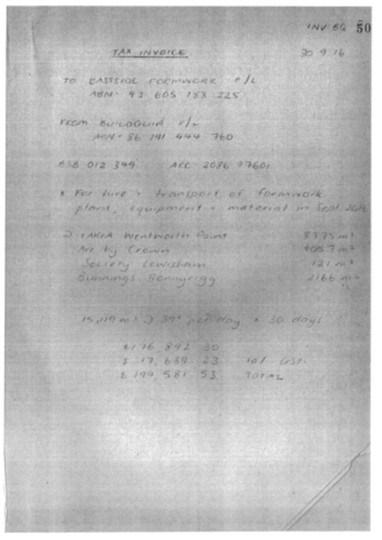
323 The Westpac bank account for the Company appears in Exhibit A. In October 2016, the payments to Buildquip were $50,000 on 17 October, $10,929.45 on 19 October, and $11,113.32 on 26 October. None of those payments references invoice no 50 (the first invoice in September 2016). Mrs Stojic’s reliance on the invoices is not consistent with her submissions in relation to the Buildquip payments, which are said to be “payments … regularly made in anticipation of future supplies being granted by [Buildquip]”.
324 The records kept by the Company disclose inconsistent treatment of the Buildquip payments. MFI-5 is an aide-memoire summary of the Buildquip invoices and amounts disclosed in tax returns. There are significant anomalies. An email from Mr Stojic to Mr Matt Prochnicki of iKeep of 29 November 2019 said “all payments going to buildquip are contractor payments” (as written). That is not consistent with Buildquip having issued invoices for formwork hire.
325 The defendants complained that the plaintiffs did not plead that the Buildquip invoices were not genuine or did not reflect the payments made by the Company to Buildquip.
326 In paragraphs 237 to 247 of the defendants’ closing submissions, the defendants pointed to the plaintiffs’ contention that Buildquip’s invoices were not genuine, that there was no agreement between Holdings and Buildquip in relation to the rate of payment, and that there was no, or inadequate, consideration received from Buildquip for the Buildquip payments. The defendants submitted that if the plaintiffs wished to allege that the Buildquip invoices were not genuine, this should have been pleaded on the well-known basis that allegations of fraud need to be clearly pleaded and proved (see Clone Pty Ltd v Players Pty Ltd (in liq) [2018] HCA 12; (2018) 264 CLR 165 at [62]). The defendants submitted that if assertions that Buildquip had engaged in a fraud and falsely created documents for financial benefit or to cause a financial advantage, being a crime, were to be made, those assertions should be pleaded, and the defendants were not required to respond in submissions to “allegations that are not the subject of the pleadings or the proceedings”. Indeed:
Such a basic failure on the part of the Plaintiffs is not to be legitimised with a substantive response.
327 In response, the plaintiffs said that the defendants put up the Buildquip invoices as part of their case, in response to the pleaded allegation that the Company transferred a net amount of $9,035,830 to Buildquip between 11 October 2016 and 3 July 2020, and did not require proper invoices from Buildquip (see paragraphs 35 and 39A of the Statement of Claim). At paragraph 36 of the Statement of Claim, the plaintiffs alleged that the payments were made pursuant to alleged agreements which set out the per-square-metre rate, which the plaintiffs pleaded were not industry standard.
328 The defendants relied on the undisputed fact that Buildquip provided services in the nature of formwork hire to the Company, and that there was expert evidence that the rates charged may have been uncommercial. It was submitted that in fact the evidence showed that the rates charged were less than the usual market rates, and charged on a flat rate, which would benefit the Company, not Buildquip. Mrs Stojic said she took issue with what she characterised as slow payments by the Company to Buildquip.
329 Mr Pesman cross-examined Mrs Stojic on the fact that the first iteration of the Statement of Claim, filed on 3 June 2021, pleaded that the transactions between Buildquip and the Company were uncommercial, and her examination on 25 August 2021 was adjourned for her to have an opportunity to find the invoices. The invoices were produced on 23 September 2021, and they were, he put to her, “the first time that any document referring to these invoices, including them, was given to the Liquidator”. She accepted that proposition but not the inferences to be drawn from it (and other propositions put to her) that the invoices had been created by her only recently, and after 25 August 2021. She agreed that the invoices did not match the Buildquip tax returns, because “the tax returns were done on bank statements, so they won’t match if they weren’t paid”. It was put to her that the invoices were not real, and that the per-square-metre hire arrangement did not exist prior to 2019; she denied both of those propositions and said that the invoices demonstrated the agreement.
330 Mr Pesman, in his closing submissions, drew attention to the fact that the Defences by each of Mrs Stojic and Buildquip differ slightly; Mrs Stojic does not admit paragraph 39 (which alleges that a reasonable person in the Company’s position would require invoices before making the Buildquip payments) whereas Buildquip denies it. But neither defendant set up a positive defence that there were invoices, and a binding Hire Agreement. For the plaintiffs to take issue with the documents as set up by Mrs Stojic is, as Mr Pesman put it, “not necessary as part of our cause of action that those invoices be real, or not” but they were contested because Mrs Stojic put them into evidence as a positive answer to the pleading.
331 This submission has some force. Mrs Stojic said that Buildquip did issue invoices, and that the Liquidator “sought to ignore the invoices that [had] been provided by suggesting that the invoices that were provided were not in accordance with the particulars at paragraph 39 [of the Statement of Claim]”. She said at paragraph 126 of her affidavit of 17 March 2025 that “I deny any assertion that these invoices are false or fraudulent” and that she would tender the originals. Mr Pesman was entitled, as he indeed did, to cross-examine Mrs Stojic on the validity of the invoices. He tendered Exhibit F, a volume of the invoices referred to by Mrs Stojic in her affidavit, and contended that they were not created on the dates they bore; rather, that they were created in the period between the first examination and the second, when they were presented. I have dealt with above in relation to the books and records of the Company that the invoices were not in fact genuine arm’s-length documents issued by Buildquip and that any payments to Buildquip purportedly relying on the invoices were not in fact referable to them.
332 I accept the plaintiffs’ submissions that the question of the validity of the invoices is not a necessary part of the pleadings, but where Mrs Stojic has asserted that they were genuine, then testing of that assertion goes to her credit and to ground the plaintiffs’ submission of a “pattern of sustained dishonesty”. It also goes to the issue, not whether the invoices were for the correct amount, but whether the transactions were uncommercial in all the circumstances and “exceeded the true and fair market value of the supply [by Buildquip] of the re-usable materials to the [Company]” (as pleaded in paragraph 39B of the Statement of Claim).
333 My rejection of the defendants’ pleading point means that the plaintiffs’ submissions in closing are in effect left without a response in the defendants’ written submissions in closing. However, in their opening submissions, they relied on the expert evidence.
334 The Hire Agreement between Buildquip and the Company dated 16 August 2019 purports to set an amount payable for the hire of formwork and equipment by a flat per-square-metre rate per week. As I have explored above during the discussion on the expert evidence, the evidence demonstrates that the flat per-square-metre rate was not charged pursuant to an agreement which bound the commercial arrangements between Buildquip and the Company, but was brought into existence for the purpose of the sale of the Business to Mr Bryers’ company. I find that the Hire Agreement was created for one purpose, and now is relied upon by the defendants for another – to give a veneer of commerciality to the Transfers.
335 I also find that the invoices were created by Mrs Stojic between the first and second tranches of her examination in bankruptcy, for the purpose of demonstrating to the Liquidator that the Transfers to Buildquip were commercial transactions. I am able to reach this conclusion because of the suspicious timing of their production, and that there are no documents whatsoever in the books and records of the Company which indicate any liability to Buildquip as specified in the invoices, along with my reluctance to accept anything said by Mrs Stojic without independent corroboration. While it can be accepted that the Company did hire formwork from Buildquip, there is nothing to demonstrate that there was any commercial basis on which that was undertaken.
336 Accordingly, the net Buildquip payments were made without reference to any underlying invoices or any agreement as to a rate of hire, and were uncommercial, and were made without any, or any real, consideration.
337 My findings at [87] to [88] and at [334] above as to the failure by Buildquip actually to use the flat per-square-metre rate, and that the Hire Agreement was essentially a sham, means that I do not need to make a finding as to the proper cost of formwork hire, except that the flat per-square-metre rate would have been “significantly below market”.
Payments to Holdings
338 The Liquidator has identified that between 18 November 2016 and 3 July 2025, the Company transferred a total of $3,774,219.60 from the Company Westpac account to Holdings, and received deposits totalling $66,000, with the net amount transferred to Holdings being $3,708,219.60 (the Holdings Payments). These payments appear in Schedule 3 of the Statement of Claim and the Defences state that they were purportedly made “for the procurement of materials and supplies for the Company, and included a margin of profit for [Holdings]”. Included in the pleading as to the amounts paid to Holdings on the Holdings Payments was a margin of $297,093.32 (Holdings Margin). It was accepted by Mrs Stojic that there is no formal binding agreement between the Company and Holdings with respect to the Holdings Margin, and this reflected the evidence at her examination.
339 Evidence produced by Holdings in response to an order for production was a handwritten booklet, and recorded a total of $3,746,539.19 (noted in the plaintiffs’ submissions as $3,806,539.19 although this appears to be in error) paid by the Company to Holdings. The documents in the booklet were handwritten, were issued on a quarterly basis, are noted “incl. GST”, and do not include a breakdown or any third party supplier documents. They are each headed “Receipt of Funds”.
340 The defendants did not deal in the evidence with how the amounts in the booklet were calculated or how the receipts were prepared. However, Mr Fernon pointed me to a number of pages in Exhibit 4, the iKeep records, which demonstrated that the Company had issued invoices including a margin payment. One, for example, was for a progress claim at “as per attached invoices + 25%” (see for example an invoice of 18 December 2018 issued to Concrete Structures Pty Ltd). That invoice was for “costs incurred” and the invoices attached were invoices from a third party.
341 From evidence obtained in the proceedings in the New South Wales Supreme Court, and exhibited by the Liquidator to his affidavit of 4 August 2022, the Company produced invoices issued to Holdings by third parties which totalled $3,180,338.36. The plaintiffs submitted that there is no basis for the payment of the remaining $527,881.24 (based on the Holdings Payments, not the Receipt of Funds produced by the defendants).
342 The defendants do not admit the allegations in relation to the Holdings Payments, but pleaded that the payments to Holdings were made “for the procurement of materials and supplies for the Company, and included a margin of profit for [Holdings]”.
343 The defendants submitted that the plaintiffs’ case in relation to the payments to Holdings departs from their pleadings. They say this on the basis that the Statement of Claim pleads a Holdings Margin (paragraph 26) which totalled “no less than $297,093.32” (paragraph 27(b)). The Statement of Claim pleads that there was no consideration (or no real consideration) for these payments, nor a commercial reason for it to be paid (particulars to paragraph 31). There is a further pleading of “Unsubstantiated Holdings Payments” (paragraph 31A) in the sum of $455,802.71 (paragraph 31C).
344 The defendants contended that Mr Banerjee agreed that there was an overlap between the Holdings Margin and the Unsubstantiated Holdings Payments and that he agreed in cross-examination that to seek both would be a double recovery.
345 The pleading point is that the calculation of the difference between the claim for $527,881.24 (the difference between the third party invoices and the Holdings Payments) is not a figure pleaded in the Statement of Claim. While it is a lesser amount than the two sums claimed in the Statement of Claim, the defendants say that in any event, it was explained by Mrs Stojic, who said in evidence during her public examination (which was included in Mr Banerjee’s affidavit of 4 August 2022 at paragraph 179) that a 10-15% margin was sometimes added to costs incurred by Holdings on behalf of the Company. She also gave evidence of this in her affidavit of 17 March 2025, where she set out the work that Holdings did when it “received the consumables, checked for order accuracy, and then transported the goods to site from the yard that was shared between Buildquip and [Holdings]”.
346 Mr Fernon cross-examined Mr Banerjee on the benefit to the Company of Holdings doing the work of transporting the consumables, and providing deliveries without charge to the Company, as well as not imposing strict trade terms on payment for its invoices. Mr Banerjee agreed that this would be of some value. Mrs Stojic said that the margin was agreed orally between Holdings and the Company (although she did not give details of the conversation in her affidavit in these proceedings). Mr Banerjee cited her evidence in her examination where she said that this arrangement was negotiated with her husband. Mr Fernon submitted that in any event, an agreement could be inferred from a course of conduct and pointed to the invoices in the Court Book from Holdings from March 2017 to June 2020 to show that course of conduct.
347 Unlike the progress payment invoices to third parties, the invoices do not encompass an express claim to a margin payment. The first of those invoices takes the following form:
|
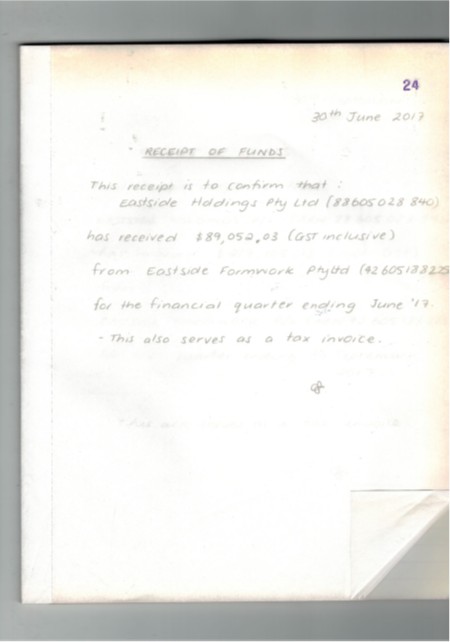
348 The following invoices are in almost the exact wording and while some appear to be in different handwriting, they have the same format. No invoice mentions details of the material provided. It does not appear that they attached any third party invoices. The first invoice is on page 24 of the carbon copy notebook and the final one on page 36; that is, they are continuously numbered. They do not, suffice to say, fill a cynical mind with confidence that they reflect what Mrs Stojic said they reflect – an agreement between Holdings and the Company that the Company would reimburse Holdings for consumables, including administration tasks and transport, with a 10-15% margin added.
349 The defendants’ submission on this point is that the difference between the cost of the consumables is explained, and logical (in that the amount is around 14% of the third party invoices); the Company did not dispute the charges; and there is no pleading in relation to the lack of evidence as to the invoices’ creation.
350 As to the last point, as discussed above in more detail in relation to the Buildquip payments, a contention that evidence was not created in the usual course of business need not be pleaded where the invoices are put up by the defendants to prove their case.
351 As for the pleading point that the Statement of Claim pleads two overlapping claims relating to the payments made by the Company to Holdings, I do not consider that the pleading of these claims, in the light of Mr Banerjee’s concession, is not sustainable; instead, the Statement of Claim sets out that the funds paid by the Company to Holdings were overstated, and the evidence demonstrates that the sum of $527,881.24 is not accounted for by the third party invoices or any proper explanation by Mrs Stojic as to the basis upon which the Company was charged for consumables.
352 In the light of the paucity of any evidence around how the Holdings Payments were calculated, in particular with the lack of any detail around the Receipt of Funds documents and the unwritten agreement for margin (which agreement does not find any corroborative documentary support), I find that the net Holdings Payments, in the sum of $527,881.24, were uncommercial and made without any, or any real, consideration.
Payments to Mr Stojic
353 It is not in dispute that between 11 October 2016 and 3 July 2020, the Company transferred a total of $612,347.98 to Mr Stojic and received a total of $198,000 from Mr Stojic, with the net amount transferred to Mr Stojic being $414,347.98. The plaintiffs allege that there was no consideration, or no real consideration, provided by Mr Stojic for these payments (the Net Dane Payments). The payments are pleaded in paragraphs 40 to 42 of the Statement of Claim, and are particularised in Schedule 5 of the Statement of Claim. Mrs Stojic’s, and Buildquip’s, Defences either do not plead to the allegations, or do not admit them.
354 Mrs Stojic’s evidence is that many of the payments to Mr Stojic were reimbursements for payments made by him on behalf of the Company. The plaintiffs submitted that this is mere speculation and there is no evidence to substantiate the payments made to Mr Stojic. There was of course no evidence from Mr Stojic was available on this point, and the Liquidator gave evidence that he believed there was no commercial benefit to the Company from making the payments to Mr Stojic. The payslips for Mr Stojic in the Court Book are from RIC Admin, so it is unlikely that any payments to him were for wages (despite Mrs Stojic’s evidence that he was the general manager of the Company).
355 Schedule 5 of the Statement of Claim does note that a number of payments to Mr Stojic were included in the description for the transfers as payments for what could be reimbursements for expenses related to the Company – for example, 28 October 2016, $550 for “3DSafety” and 1 December 2016, $1,078 for “Ladder Shop”. Many more were either just noted as “payment” or “repay loan” (including $100,000 on 28 December 2017). There is no indication in the Court Book of any loan from Mr Stojic to the Company (noting that there are a significant number of smaller payments of $10,000 to $20,000 also noted as “repay loan” in Schedule 5).
356 The defendants’ position is that the plaintiffs have not proved their case. It was not put to Mrs Stojic in cross-examination that she had knowledge of, or involvement in, the making of the payments to Mr Stojic. They referred to the passage by White J in Australian Securities and Investments Commission v ActiveSuper Pty Ltd (in liq) [2015] FCA 342; (2015) 235 FCR 181 at [398]-[402] where his Honour said that a person who is “knowingly concerned” in a statutory contravention must have been an “intentional participant, with knowledge of the essential elements constituting the contravention”. Actual knowledge is required (at [399]).
357 The defendants contended that Mrs Stojic could not have been responsible for the payments to Mr Stojic, because she “did not have access to the bank accounts”. That seems like an unnecessary technicality given Mrs Stojic’s deep involvement in the management of the Company, and her own evidence that she often “flicked things to Franca” when they needed to be actioned. I noted above that Ms Banco appeared to do her bidding even in relation to companies for which Ms Banco did not work. I have dealt with Mrs Stojic’s control of the Company under the sub-heading in Part C.3 of “Were Mrs Stojic’s activities ‘administrative at best’?” I do not accept that Mrs Stojic was not engaged in, or unaware of payments to Mr Stojic, in particular where the payments were on her radar since the particularisation of them in the Statement of Claim and her defence was that the payments were legitimate business expenses. I refer to the section in Part B.3 “Jones v Dunkel adverse inferences” and adopt that reasoning here to note that the payments, in effect, speak for themselves, and Mr Banerjee’s evidence as to the lack of documentation supporting them was in evidence as long ago as his affidavit of 4 August 2022 (which is particularised in the Statement of Claim).
358 Given that while Mrs Stojic said that the payments were reimbursements, but neither the Company records nor the documents produced in this case demonstrate any outgoings by Mr Stojic needing reimbursement or loans needing repayment, and the absence of Mr Stojic himself to say that he was entitled to reimbursements or loan repayments, I am able to find that there was no consideration, or inadequate consideration, received by the Company from Mr Stojic. In ActiveSuper at [400], White J noted that:
… actual knowledge of each of the essential elements making up the contravention may be derived from direct evidence but more commonly will be a matter of inference from all the circumstances found to be proved. In some cases, actual knowledge can be inferred from the combination of a defendant’s knowledge of suspicious circumstances and the decision by the defendant not to make inquiries to remove those suspicions …
359 On the evidence, and not accepting the defendants’ contention that the payments were legitimate payments in the course of business for the Company, I find that the net payments to Mr Stojic were uncommercial transactions, or unreasonable director-related transactions.
Did Mrs Stojic breach her duty to the Company in relation to the Transfers?
360 In Stone (liquidator), in the matter of Ironbark Blacksmithing Pty Ltd (in liq) v Mizzi [2024] FCA 696, Halley J set out the relevant principles for contravention of s 588G(2) at [305]-[310]:
In order to establish a contravention of s 588G(2) of the Corporations Act against a person, it is therefore necessary to prove at the time that a debt is incurred by a company:
(a) the person was a director of the company when the company incurred the debt;
(b) the company was insolvent or would become insolvent by incurring the debt;
(c) there were reasonable grounds for suspecting that the company was insolvent or would become insolvent by incurring the debt;
(d) the debt was incurred after the commencement of the Corporations Act; and
(e) the person was aware that there were grounds for suspecting that the company was insolvent or would become insolvent by incurring the debt or a reasonable person in a similar position to the person would be so aware.
The inquiry in s 588G(1)(c) of the Corporations Act is not concerned with the particular director. It is an inquiry into the objectively formed state of mind of a person of ordinary competence. The director’s knowledge of and participation in the incurring of the debts plays no part in the inquiry: Australian Securities and Investments Commission v Edwards (2005) 220 ALR 148; [2005] NSWSC 831 at [249] (Barrett J).
Suspecting is one of suspicion, which is something less developed and less well formulated than expectation: Edwards at [250].
“Reasonable” in this context imports the standard of reasonableness appropriate to a director of reasonable competence and diligence, seeking to perform their duties as imposed by law, when viewed as a whole, and capable of reaching a reasonable informed opinion as to the company’s financial capacity: Smith v Bone (2015) 104 ACSR 528; [2015] FCA 319 at [367] (Gleeson J).
Section 588G(2)(a) of the Corporations Act requires proof of a subjective awareness by the director of grounds, whether or not the director had a subjective suspicion of insolvency, which may be objectively characterised as reasonable grounds for suspecting insolvency. In the alternative, it must be established that a reasonable person would be aware of the existence of reasonable grounds for suspecting insolvency. It does not matter that a particular director was not so aware: Australian Securities and Investments Commission v Plymin [2003] VSC 123 at [426] (Mandie J).
361 In relation to the Mizzi factors, I have already found that Mrs Stojic was a director of the Company when the debts were incurred (in particular the ATO debts, but also by making the Holdings Payments, the Buildquip payments, and the payments to Mr Stojic), that there were reasonable grounds for suspecting insolvency, and that Mrs Stojic was aware as to issues with solvency.
362 The relevant principles arising in the Division 1 of Chapter 2D.1 of the Corporations Act inquiry are that:
(a) I must consider the question of whether Mrs Stojic has discharged her duties with the “degree of care and diligence of a reasonable person” in light of the various circumstances referred to in Australian Securities and Investments Commission v Maxwell [2006] NSWSC 1052; (2006) 59 ACSR 373 at [100] (Brereton J) (see Mizzi at [263]). I find that she did not; particularly relevant is the fact that Mrs Stojic’s involvement in the administration of the family business was significant and she undertook much of its day-to-day administration with the assistance of Ms Banco.
(b) I must determine whether Mrs Stojic’s reliance on her accountants assists her in the question of the Transfers (see Maxwell at [101]). It does not; the Transfers were not the subject of advice from the various firms who acted for the Company and for her during the relevant periods. In fact, when iKeep sought information as to various payments she did not provide answers. By December 2019 there were “significant problems” with the iKeep reconciliation and the Company was not paying Hall Chadwick’s invoices.
363 I am able to find, by reason of my findings above relating to the Scheme, and my findings on the lack of any commercial basis for the Transfers, that Mrs Stojic has contravened the duties required of a director or officer of the Company of care and diligence (s 180) and that of good faith (s 181). Likewise, she has used her position to gain an advantage for herself directly, or through Buildquip and Holdings, or for her husband, and so caused detriment to the Company (s 182(1)).
364 As to s 588G, the plaintiffs submitted that reasonable grounds for suspecting insolvency were made out by the “parlous state” of the Company’s financial records and the extent of Mrs Stojic’s involvement in the Company’s affairs. She would, it was submitted, be aware that the Company was, or would become, insolvent by incurring the Liquidation Debts.
365 I have dealt above with the defendants’ contention that the pleading of the Liquidation Debts was inadequate. The defendants further submitted that s 588G(2) requires actual, not deemed, insolvency as defined in s 95A (see Ford and Austin, Principles of Corporations Law (17th ed) at [20.120]). They pointed to the defences provided for in s 588H of the Corporations Act, which are grounded on the reasonableness of the conduct of the director at the time; whether there were reasonable grounds for suspecting insolvency (see for example s 588G(2)). They relied on Halley J’s definition of “reasonable” in Mizzi at [308].
366 The defendants submitted that an essential element of a transaction being an insolvent transaction within the meaning of s 588F of the Corporations Act is that it be an unfair preference (s 588FA), or an uncommercial transaction (s 588FB). “If it is neither … it cannot be an insolvent transaction”.
367 I have found that the Transfers are uncommercial transactions. The section requires that a “reasonable person in the company’s circumstances would not have entered into the transaction” given the risks and benefits of the transaction. As can be seen from my analysis of the Transfers above, there was no underlying agreement as to the Holdings Payments such as an agreement as to the payment of a margin, or an underlying agreement as to the rate of hire of reusable formwork supplies in the Buildquip payments. There was no evidence of Mr Stojic having expended money for the Company for which he properly required reimbursement. In those circumstances, and where the ATO had been issuing notices to the Company since 2017, a reasonable person would not have caused the Company to have made the Transfers.
368 One of the contentions put forward by the defendants was that the plaintiffs have not made an “attempt to ascertain whether [the Company] was a creditor of [Buildquip] at the time of the actual payment made”. I have noted that the ATO was issuing notices since 2017, and the Statement of Claim cites the ATO debt as incurred from 27 August 2018. The first Buildquip payments were made before then. I have found above that the Company was deemed insolvent from the Incorporation Date, and actually insolvent since 20 June 2017. Mrs Stojic, as a de facto director and one primarily responsible for the day-to-day management of the Company, had reasonable grounds to suspect that the Company was insolvent because of the failure to keep any adequate, or really any at all, books and records which would provide a director in her position with information as to how the Company was travelling, and after 20 June 2017, because of the position with the Liquidation Debts and the notices from the ATO.
369 Buildquip lodged two proofs of debt in the Liquidator’s external administration of the Company. The proofs were completed and signed by Mrs Stojic.
370 The first proof of debt was dated 12 November 2020 for a total of $272,902.81; $84,374.40 for “hire of equipment”; and $188,528,528.41 for “loss of equipment”. The second proof of debt was dated 28 January 2025 and claimed $2,917,512.59, comprising $272,902.81 (“Previous POD”) and $2,644.609.78 for “Updated hire/purchase deficit”. The second proof of debt was based on the invoices and an apparent reconciliation, five years later, by Mrs Stojic “going across the loans that [she] had given the [Company] and hadn’t been repaid, yes. A reconciliation across”.
371 A further anomaly was that Exhibit F demonstrated that the tax returns for Buildquip indicated that Buildquip did not in fact own the assets that it was purportedly hiring to the Company. Mrs Stojic’s answer was that the accountants got it wrong.
372 As discussed above, the defendants cannot take any comfort from the invoices or from the terms of the purported Hire Agreement in establishing that the Buildquip proofs of debt reflect a debt which arose in the usual course of business between two companies dealing at arm’s length. There is no evidence that there was a regular course of hiring formwork from Buildquip to the Company in any regular commercial way. The proofs of debt do not have any foundation in any properly issued invoice or other business record, and there is no basis for the amounts paid or recorded, as there was no hire agreement except for the sham agreement brought into existence in 2019.
373 Mr Fernon’s submission that actual insolvency is required relied on the following passage by the learned authors of Ford and Austin, Principles of Corporations Law (17th ed) at [20.120]:
The insolvency to be suspected would seem to be actual insolvency as defined in s 95A without the benefit of the presumptions creating constructive insolvency that are allowed by s 588E. Hence, for example, reasonable grounds to suspect that the company was not keeping proper financial records would not of itself be reasonable grounds for suspecting that the company is insolvent. The presumptions arise for the purposes of a recovery proceeding: s 588E(2). It seems possible to give them operation for the purposes of a recovery proceeding by using them to prove that when the debt was incurred the company was insolvent. But there is no clear legislative mandate for using them to contribute to a perception of insolvency by the reasonable person or the director.
374 In Smith (in his capacity as liquidator of ACN 002 864 002 Pty Ltd (in liq) formerly known as Petrolink Pty Ltd) v Bone [2015] FCA 319; (2015) 104 ACSR 528 at [367] Gleeson J said that “reasonableness” in the context of s 588E required that a director be in a position to reach a “reasonably informed opinion as to [the company’s] financial capacity”. The defendants submitted that financial capacity was a focus on whether the Company could meet its debts as and when they fell due, being solvency within the meaning of s 95A, and not deemed insolvency.
375 In ReMelbournehomes.com, Heyty AsJ (at [138]) pointed to the fact that the section does not require an analysis of the state of mind of the particular director, Mrs Stojic; instead, it makes inquiry of a reasonable director. As discussed, I am persuaded that there were reasonable grounds to suspect insolvency from the Incorporation Date, not only because of the failure to keep financial records, but because of the almost immediate failure to comply with lodgement requirements, discussed above in Part C.5, presumed and actual insolvency.
376 Mrs Stojic did not make an attempt at proving any of the defences to a s 588G(2) finding, which are provided by s 588H. That section puts the onus on Mrs Stojic to show that she had “reasonable grounds to believe, and did believe” the matters in sub-s (3)(a) and expected that the Company was solvent and would remain solvent (sub-s (3)(b)). She did not put forward that she suffered from illness, or that she had some other good reason for not taking part in the management of the Company (sub-s (4)). Nor did she give evidence of any steps that she took to prevent the Company from incurring the debt (sub-s (5)), nor did she seek to appoint an administrator (sub-s (6)).
377 I find that Mrs Stojic was in breach of her duty to the Company as a director under s 588G to prevent insolvent trading by the Company, from the Incorporation Date. While I have found that the Company was presumed insolvent from the date of incorporation, and actually insolvent from 20 June 2017, the date of the first Liquidation Debt, I am persuaded by Black J’s indicia in Swan Services (particularly the “inability to produce timely and accurate financial information”) picking up those in Plymin at [426] (Mandie J), and Perram J in Morris, being “commonsense” indicators of a company’s inability to pay its debts as and when they fall due, that presumed insolvency is sufficient in these circumstances to satisfy s 588G.
C.7 Liability of Mrs Stojic and Buildquip under the first and/or second limbs of Barnes v Addy with respect to the Transfers
378 The first limb of Barnes v Addy was defined by the High Court in Farah Constructions Pty Ltd v Say-Dee Pty Ltd [2007] HCA 22; (2007) 230 CLR 89 (Gleeson CJ, Gummow, Callinan, Heydon, Crennan JJ) at [112] as:
“Persons who receive trust property become chargeable if it is established that they received it with notice of the trust.”
379 The second limb of Barnes v Addy imports liability onto third parties who give “knowing assistance” (see Karak Rubber Co Ltd v Burden (No 2) [1972] 1 All ER 1210) or, as expressed by Lord Selborne LC in Barnes v Addy, “with knowledge in a dishonest and fraudulent design on the part of the trustees” (at 252). Liability requires dishonesty on the part of the fiduciaries; Hasler v Singtel Optus Pty Ltd [2014] NSWCA 266; (2014) 87 NSWLR 609 per Leeming JA at [123].
380 The plaintiffs put their case on the Barnes v Addy in relation to the Buildquip Transfers. This part of the claim is outlined as follows:
(a) Mr Stojic was a director and thus a fiduciary, as was (as found above) Mrs Stojic;
(b) Mrs Stojic received the benefit of the funds the subject of the Buildquip Transfers by way of misapplication of those funds;
(c) she received those funds herself as a director and sole shareholder of each of Buildquip and of Holdings;
(d) Mrs Stojic and Buildquip had actual knowledge of:
(i) the existence of the fiduciary duty; and
(ii) the misapplication of funds; and
(e) she and Buildquip either shut their eyes, or abstained from making relevant inquiries, or had knowledge of facts which to an honest and reasonable person would demonstrate that the funds the subject of the Transfers were being misapplied.
381 The plaintiffs submitted that the Buildquip Transfers constituted a dishonest and fraudulent design by Mr and Mrs Stojic, and Mrs Stojic and Buildquip assisted in that dishonest and fraudulent design with the requisite knowledge. The case is that Mrs Stojic is liable under the first and second limbs of Barnes v Addy, and Buildquip is liable under the second limb.
382 The defendants did not make specific submissions in relation to this claim. At paragraph 6(p) of their closing written submissions, they referred to one of the key issues in the proceedings being whether Buildquip was liable for its receipt of funds pursuant to the first limb of Barnes v Addy, but did not address it in any detail. In relation to inferences which can be drawn from the evidence, the defendants submitted that the plaintiffs should not succeed “merely by an assumption based on the marriage of the first and second defendants” – I agree. Instead, the plaintiffs relied on their submissions as to Mrs Stojic’s role as a director, the uncommercial transfers to Holdings, Buildquip, and Mr Stojic, and that she has therefore breached the duties she owed to the Company. I have made findings in accordance with these submissions. As the sole director and shareholder of Buildquip, it is difficult to see that that company was not also aware of the same matters.
383 My findings above as to those matters, in the context of the Scheme, mean that I can find in favour of the plaintiffs in relation to their claims under the limbs in Barnes v Addy.
C.8 Liability of Mr Stojic and Mr Zaidan for breaches of statutory and fiduciary duties, and of Mrs Stojic and Buildquip as accessories for breaches of statutory and fiduciary duties
384 Although neither Mr Stojic nor Mr Zaidan took an active role in the proceedings, relief is sought against them for of the Corporations Act as set out above in relation to Mrs Stojic. The questions for determination are:
(a) Whether Mr Stojic and/or the third defendant (Mr Zaidan) breached statutory duties that they owed to the Company under ss 180 to 182 of the Corporations Act, or fiduciary duties that they owed to the Company, with respect to the Transfers?
(b) If Mr Stojic and/or Mr Zaidan breached statutory duties that they owed to the Company under ss 180 to 182 of the Corporations Act, whether Mrs Stojic is liable as an accessory to those breaches pursuant to s 79 of the Corporations Act?
(c) If Mr Stojic and/or Mr Zaidan breached statutory duties that they owed to the Company under ss 180 to 182 of the Corporations Act, whether Buildquip is liable as an accessory to those breaches pursuant to s 79 of the Corporations Act?
385 The plaintiffs put these claims on the basis that:
(a) Mr Zaidan and Mr Stojic were each a director of the Company at the relevant time;
(b) they each owed the Company the duties in ss 180 to 182 of the Corporations Act which they contravened;
(c) Mrs Stojic and Buildquip were involved in the contraventions of ss 181 and 182, noting the requirements of s 79 of the Corporations Act; and
(d) Buildquip was involved in contraventions by Mrs Stojic of ss 181 and 182.
386 They relied on White J in ActiveSuper at [397]-[411], and in particular that a person “knowingly concerned in a statutory contravention … must have been an intentional participant, with knowledge of the essential elements constituting the contravention” (at [397]) and [411], where his Honour said:
A company may be knowingly concerned in a statutory contravention. The intention and knowledge of the directing or governing mind and will of a company may be imputed to the company for this purpose: Tesco Supermarkets Ltd v Nattras [1972] AC 153 at 170-1; Hamilton v Whitehead (1988) 166 CLR 121 at 127. See also the approach of Lord Hoffmann in Meridian Global Funds Management Asia Ltd v Securities Commission [1995] 2 AC 500 and the discussion by Goldberg J in Australian Competition and Consumer Commission v Australian Safeway Stores Pty Ltd (No 2) [2001] FCA 1861 at [806]-[810].
387 The fact that Mr Stojic is agreed to be a de facto or shadow director, and Mr Zaidan’s evidence as to his dummy directorship was uncontested, must mean that those directors cannot hide behind wilful or other blindness as to the essential elements of the contraventions.
388 The plaintiffs pointed to Mrs Stojic’s directorship of each of Holdings and Buildquip, and submitted that the Court could comfortably find actual knowledge by each of Mrs Stojic and Buildquip of the essential matters going to make up Mr Stojic’s and Mr Zaidan’s breaches, and that Buildquip had actual knowledge of the essential matters making up Mrs Stojic’s breaches.
389 Once more, the defendants submitted that there is “no evidence” that Mrs Stojic was an accessory to any breach of duty. Having made the findings that I have, I am able to find that each of Mrs Stojic and Buildquip were aware of the breaches by Mr Stojic (who is admitted to be a de facto director of the Company) and Mr Zaidan (who admitted that he was a director, secretary and shareholder “in name only”), and so liable for the breaches pleaded.
C.9 Are the payments made by the Company to Buildquip, that form part of the Transfers, voidable transactions pursuant to Pt 5.7B of the Act?
390 Paragraphs 90 to 100 of the Statement of Claim plead that the payments to Buildquip, as well as to Holdings and to Mr Stojic, were entered into when the Company was insolvent, or caused the Company to become insolvent. Accordingly, they were insolvent transactions of the Company pursuant to s 588FC of the Corporations Act.
391 The entirety of the plaintiffs’ written submissions in relation this topic is in the penultimate paragraph; that “for the reasons set out above … the [Buildquip payments] were voidable transactions within the meaning of Pt 54.7B of the [Corporations Act]”.
392 At paragraphs 101 to 106 of the Statement of Claim, the plaintiffs plead that the Transfers were voidable, and again no specific submissions were made in relation to this part of the Claim.
393 The defendants took a pleading point; that the plaintiffs alleged in submissions that Buildquip “engaged in a fraud and falsely created documents for financial benefit … being a crime” and that this aspect of criminality was not pleaded. I have dealt at [332] above with this aspect; Mrs Stojic herself tendered and relied on the Buildquip invoices as evidence of debts of which the Transfers were payment. Otherwise, the defendants declined to legitimise “[this claim] with a substantive response”.
394 The factual findings and legal conclusions I have reached above as to the presumed and actual insolvency of the Company, the lack of any commercial basis for the net Buildquip payments and the reasonable basis for Mrs Stojic to suspect that the Company was insolvent, mean that I can easily find that the net Buildquip payments were voidable transactions.
D. ORDERS
395 I am prepared to make the orders sought by the plaintiffs. I will ask the parties to bring in proposed orders reflecting these reasons, and unless my chambers are notified of any application for a special costs order within fourteen days of today’s date, I will order that the defendants pay the plaintiffs’ costs.
I certify that the preceding three hundred and ninety-five (395) numbered paragraphs are a true copy of the Reasons for Judgment of the Honourable Justice Needham. |
Associate:
Dated: 14 August 2026
SCHEDULE OF PARTIES
NSD 246 of 2021 | |
Defendants | |
Fourth Defendant: | EASTSIDE HOLDINGS PTY LTD (ACN 605 028 840) |
Fifth Defendant: | BUILDQUIP PTY LTD (ACN 141 444 760) |


