

Federal Court of Australia
Parkin v Boral Limited (Initial Trial Judgment No 1) [2026] FCA 1135
File numbers: | NSD 602 of 2020 NSD 935 of 2020 |
Judgment of: | LEE J |
Date of judgment: | 13 August 2026 |
Catchwords: | REPRESENTATIVE PROCEEDINGS – securities class action involving several procedural disputes and prolonged history – consideration of overarching purpose and importance of imposing commonsense upon repetitive, prolix and overlapping pleaded case – where applicants’ continuous disclosure and misleading or deceptive conduct case narrowed considerably to assert share price inflation during confined period CORPORATIONS – consideration of continuous disclosure obligations and misleading or deceptive conduct – where listed public company disclosed it had identified “certain financial irregularities” in its North American Windows business – where pre-tax earnings had been overstated by US$24.4 million between March 2018 and October 2019 CORPORATIONS – materiality of information – ex-ante evaluative inquiry informed by commercial commonsense undertaken in the hurly-burly of real-time business decision-making – expert evidence consisting of elaborate and expensive analyses which overcomplicate and over-intellectualise what is fundamentally a question of judgment EVIDENCE – expert evidence – event studies in securities class actions – model-dependent nature of event studies – limitations arising from model specification, event windows and confounding information – event studies properly understood as inferential tools rather than precision instruments – materiality determined by an ex-ante assessment informed by commercial commonsense without resolving competing criticisms of expert evidence relevant to causation and loss |
Legislation: | Australian Securities and Investments Commission Act 2001 (Cth) ss 12BB, 12DA Corporations Act 2001 (Cth) Pts 2M.2, 2M.3, ss 9, 286, 292, 295–297, 344, 674, 674(2), 674(2)(c)(ii), 675, 676(2), 676(3), 677, 769C, 1041H Evidence Act 1995 (Cth) ss 55, 56, 60, 122, 126, 136, 144, 191 Federal Court of Australia Act 1976 (Cth) Pts IVA, VB, s 53A Competition and Consumer Act 2010 (Cth) Sch 2 ss 4, 18 |
Cases cited: | ASIC v King [2020] HCA 4; (2020) 270 CLR 1 Australia and New Zealand Banking Group Limited v Australian Securities and Investments Commission [2024] FCAFC 128; (2024) 305 FCR 383 Australian Competition and Consumer Commission v Colgate-Palmolive Pty Ltd (No 4) [2017] FCA 1590; 353 ALR 460 Australian Securities and Investments Commission v Australian Lending Centre (No 3) [2012] FCA 43; 213 FCR 380 Australian Securities and Investments Commission v Bekier (Liability Judgment) [2026] FCA 196 Australian Securities and Investments Commission v GetSwift Limited (Liability Hearing) [2021] FCA 1384 Australian Securities and Investments Commission v Hellicar [2012] HCA 17; (2012) 247 CLR 345 Basic Inc v Levinson, 485 US 224 (1988) Blatch v Archer (1774) 1 Cowp 63; 98 ER 969 Boral Ltd v Parkin [2024] FCAFC 169 Cessnock City Council v 123 259 932 Pty Ltd [2024] HCA 17; (2024) 281 CLR 39 CMIC Group Ltd v AIG Group Ltd [2022] NSWSC 999 CJMcG Pty Ltd as Trustee for the CJMcG Superannuation Fund v Boral Limited (No 2) [2021] FCA 350; (2021) 389 ALR 699 CJMcG Pty Ltd as Trustee for the CJMcG Superannuation Fund v Boral Limited [2020] FCA 914 Claremont Petroleum NL v Cummings [1992] FCA 446; 110 ALR 239 Communications, Electrical, Electronic, Energy, Information, Postal, Plumbing & Allied Services Union of Australia v Australian Competition and Consumer Commission [2007] FCAFC 132; (2007) 162 FCR 466 Crowley v Worley Ltd (No 2) [2023] FCA 1613; (2023) 171 ACSR 410 Doppstadt Australia Pty Ltd v Lovick & Son Developments Pty Ltd [2014] NSWCA 158 Fabre v Arenales (1992) 27 NSWLR 437 Goldman Sachs Group, Inc v Arkansas Teacher Retirement System, 594 US 113 (2021) Halliburton Co v Erica P John Fund Inc, 573 US 258 (2014) Jones v Dunkel [1959] HCA 8; (1959) 101 CLR 298 Keys Consulting Pty Ltd v CAT Enterprises Pty Ltd [2019] VSCA 136 Masters v Lombe (liquidator), Babcock & Brown Ltd (in liq) [2021] FCAFC 161; (2021) 392 ALR 326 McFarlane v Insignia Financial Ltd [2023] FCA 1628 Parkin v Boral Limited (Class Closure) [2022] FCAFC 47; (2022) 291 FCR 116 Parkin v Boral Limited (Loss of Privilege Issue) [2024] FCA 1039 Parkin v Boral Limited (Loss of Privilege Issue) (No 2) [2024] FCA 1082 Parkin v Boral Limited (Materiality Evidence Ruling) [2025] FCA 70 Parkin v Boral Limited (Opt Out and Registration Notices) [2023] FCA 1300 Parkin v Boral Limited (Opt Out Notices) [2021] FCA 478 Parkin v Boral Limited (Privilege Argument) [2022] FCA 1467 Parkin v Boral Limited (Temporary Stay) [2021] FCA 889; (2021) 155 ACSR 457 Payne v Parker [1976] 1 NSWLR 191 R&B Investments Pty Ltd (Trustee) v Blue Sky Alternative Investments Limited (in liq) (Separation of Issues) [2025] FCA 1097 Roberts-Smith v Fairfax Media Publications Pty Ltd (No 41) [2023] FCA 555; (2023) 417 ALR 267 Shafron v ASIC [2012] HCA 18; (2012) 247 CLR 465 Schellenberg v Tunnel Holdings Pty Ltd [2000] HCA 18; (2000) 200 CLR 121 SSABR Pty Ltd v AMA Group Ltd [2024] NSWCA 175 Stillwater Pastoral Co Pty Ltd v Stanwell Corp Ltd [2024] FCA 1382 Zonia Holdings Pty Ltd v Commonwealth Bank of Australia Limited [2025] FCAFC 63; (2025) 427 ALR 233 Stephen Odgers, Uniform Evidence Law (21st ed, LawBook Co, 2026) |
Registry | New South Wales |
Division | General Division |
National Practice Area: | Commercial and Corporations |
Sub-area: | Corporations and Corporate Insolvency |
Number of paragraphs: | 899 |
Date of hearing: | 12–16, 20–21, 26 August 2024, 19–20 December 2024, 3–5, 8 September 2025, 22–23 December 2025, 30 March 2026 |
Counsel for the applicants: | Mr W A D Edwards KC with Mr R J May and Mr J A Brezniak |
Solicitor for the applicants: | Maurice Blackburn |
Counsel for the respondent: | Mr C Withers SC with Mr T Kane, Mr B Cameron, Ms M Caristo and Ms N Bailey |
Solicitor for the respondent: | Herbert Smith Freehills Kramer |
ORDERS
NSD 602 of 2020 | ||
BETWEEN: | ANDREW PARKIN Applicant | |
AND: | BORAL LIMITED (ACN 008 421 762) Respondent | |
NSD 935 of 2020 | ||
BETWEEN: | MARTINI FAMILY INVESTMENTS PTY LTD ACN 606 000 944 ATF MARTINI FAMILY INVESTMENTS SUPER FUND Applicant | |
AND: | BORAL LIMITED (ACN 008 421 762) Respondent | |
order made by: | LEE J |
DATE OF ORDER: | 13 August 2026 |
THE COURT ORDERS THAT:
1. Within seven days, the parties provide to the Associate to Lee J their mutually convenient dates for a further hearing.
2. The proceeding be adjourned, part-heard, to a date to be fixed.
Note: Entry of orders is dealt with in Rule 39.32 of the Federal Court Rules 2011.
REASONS FOR JUDGMENT
CONTENTS:
LEE J:
A INTRODUCTION
1 This is a securities class action in which two representative applicants, Andrew Parkin and Martini Family Investments Pty Ltd (applicants), commenced proceedings against the respondent, Boral Limited (Boral), seeking compensation for damage suffered as a result of Boral’s failure to comply with various statutory norms.
2 For reasons related to counsel and witness availability, the demands of my hearing calendar, an interlocutory appeal, an extended period requested for written final submissions, and appeals in other similar proceedings (raising numerous issues at stake in the present case), its progress towards resolution has been less than ideal. The initial trial spanned different hearing days in the second half of 2024, in late 2025, and early in 2026. Even now, all issues cannot be safely resolved for reasons I will explain below. But after hearing further submissions from both parties on when I should deliver judgment and on what issues, I consider it best to deliver judgment now on those parts of the issues to be determined at the initial trial that I consider can and should be resolved.
3 The case concerns “certain financial irregularities” in Boral’s North American Windows business which Boral disclosed to the market on 5 December 2019. Those irregularities consisted of finance personnel within the Windows business manipulating accounts and financial statements in a way which artificially inflated the overall profitability of that business. Following an investigation, Boral disclosed on 10 February 2020 that pre-tax earnings had been overstated by US$24.4 million between March 2018 and October 2019.
4 The proceedings were commenced as three substantially duplicative open class actions, namely:
(1) CJMcG Pty Ltd as trustee for the CJMcG Superannuation Fund v Boral (NSD 340 of 2020) (CJMcG proceeding);
(2) Parkin v Boral (NSD 602 of 2020) (Parkin proceeding); and
(3) Martini Family Investments as trustee for Martini Family Investments Super Fund (Martini) v Boral (NSD 935 of 2020) (Martini proceeding).
5 For reasons unnecessary to rehearse, I permanently stayed the CJMcG proceeding and, in relation to the remaining two proceedings, determined the Parkin proceeding was the best vehicle through which to advance group member claims, and that the Martini proceeding should proceed with a closed class: see CJMcG Pty Ltd as Trustee for the CJMcG Superannuation Fund v Boral Limited (No 2) [2021] FCA 350; (2021) 389 ALR 699; CJMcG Pty Ltd as Trustee for the CJMcG Superannuation Fund v Boral Limited [2020] FCA 914.
6 Since then, the matter has given rise to a substantial number of procedural disputes and developments, which are also unnecessary to detail and are the subject of several judgments of the Court: see Parkin v Boral Limited (Opt Out Notices) [2021] FCA 478; Parkin v Boral Limited (Temporary Stay) [2021] FCA 889; (2021) 155 ACSR 457; Parkin v Boral Limited (Class Closure) [2022] FCAFC 47; (2022) 291 FCR 116; Parkin v Boral Limited (Privilege Argument) [2022] FCA 1467; Parkin v Boral Limited (Opt Out and Registration Notices) [2023] FCA 1300; Parkin v Boral Limited (Loss of Privilege Issue) [2024] FCA 1039; Parkin v Boral Limited (Loss of Privilege Issue) (No 2) [2024] FCA 1082 and Parkin v Boral Limited (Materiality Evidence Ruling) [2025] FCA 70. There was even an interlocutory appeal on an evidentiary ruling involving ss 122 and 126 of the Evidence Act 1995 (Cth) (EA), being Boral Limited v Parkin [2024] FCAFC 169 (as to which see the analysis in S Odgers, Unform Evidence Law (21st ed, Lawbook Co, 2026) (at 1214–1216 [EA.126.60])).
7 The writing of this judgment, even on limited issues, has not been straightforward for several reasons that will become evident. One of those reasons was because the documentary and expert evidence adduced at the initial trial was voluminous. That said, before the trial, I ordered the parties to prepare an “Agreed Facts” document, with each fact being an agreed fact within the meaning of s 191 of the EA. This proved a useful exercise, and I have made numerous findings below based upon the Agreed Facts. But many important facts remained contested. Before coming to the facts as either agreed or found, it is worth explaining the nature of the case brought by the applicants and a preliminary issue as to the scope of these reasons.
B THE NATURE OF THE CASE AND A PRELIMINARY ISSUE
B.1 A Continuous Disclosure Case
8 I explained the nature of a continuous disclosure case and the relevant law relating to obligations of continuous disclosure in Australian Securities and Investments Commission v GetSwift Limited (Liability Hearing) [2021] FCA 1384 (at [1065]–[1104]); as a member of the Full Court with Markovic and Button JJ in Australia and New Zealand Banking Group Limited v Australian Securities and Investments Commission [2024] FCAFC 128; (2024) 305 FCR 383 (at 389–396 [21]–[67]); and R&B Investments Pty Ltd (Trustee) v Blue Sky Alternative Investments Limited (in liq) (Separation of Issues) [2025] FCA 1097 (at [17]–[37]).
9 What follows draws upon those reasons. I have adopted the expedient course of not repeating the citations set out in those judgments (although I have updated the analysis by reference to more recent Full Court authority).
B.1.1 The Relevant Provisions
10 During the period between 21 November 2016 and 10 February 2020 (Relevant Period), s 674 of the Corporations Act 2001 (Cth) (Corporations Act) was in the following terms:
674 Continuous disclosure—listed disclosing entity bound by a disclosure requirement in market listing rules
Obligation to disclose in accordance with listing rules
(1) Subsection (2) applies to a listed disclosing entity if provisions of the listing rules of a listing market in relation to that entity require the entity to notify the market operator of information about specified events or matters as they arise for the purpose of the operator making that information available to participants in the market.
(2) If:
(a) this subsection applies to a listed disclosing entity; and
(b) the entity has information that those provisions require the entity to notify to the market operator; and
(c) that information:
(i) is not generally available; and
(ii) is information that a reasonable person would expect, if it were generally available, to have a material effect on the price or value of ED securities of the entity;
the entity must notify the market operator of that information in accordance with those provisions.
(Notes omitted).
…
11 Listing Rule 3.1 relevantly provided:
3.1 Once an entity is or becomes aware of any information concerning it that a reasonable person would expect to have a material effect on the price or value of the entity’s securities, the entity must immediately tell ASX that information.
(Footnotes omitted).
12 It follows from the terms of Listing Rule 3.1 that, to establish a contravention of s 674(2) of the Corporations Act, the applicants must demonstrate facts which make out what can be conveniently described as four elements or “requirements”, namely:
(1) there existed “information”;
(2) the entity had that information and was aware of it;
(3) the information was not “generally available”; and
(4) a reasonable person would expect that information, if it were generally available, to have a “material effect” on the price or value of the entity’s shares.
B.1.2 Information
13 The first requirement is that there must be something constituting “information”.
14 Listing Rule 19.12 relevantly defines “information” as including “matters of supposition and other matters that are insufficiently definite to warrant disclosure to the market” and “matters relating to the intentions, or likely intentions, of a person”. The question of whether there is information can sometimes be a matter of some controversy, partly because the elucidation of its reach “will, invariably, be assisted by analysis against specific factual circumstances”.
15 The ASX has published Guidance Note 8 to assist listed entities to understand and comply with their obligations under the Listing Rules and provides a flow chart of the continuous disclosure process (Guidance Note 8 (at 5 [2])). Guidance Note 8 does not have statutory force, but the ASX states in the note that it reflects the ASX’s position as to how the law is intended to operate. In a note subjoined to Listing Rule 3.1, the ASX sets out examples of the types of information that it considers would require disclosure if that information is material. As the ASX indicates in Guidance Note 8, this list of examples is not exhaustive and there are many other examples of information that potentially could be market sensitive.
16 Obviously enough, given the nature of the obligation, when considering whether an entity has been compliant, it is necessary to identify the relevant information said to be the subject of the disclosure obligation with some precision (although having said this, the obligation is concerned with matters of substance over form).
B.1.3 Awareness of Information
17 The second requirement is that the entity “has” information. It must also be established that the entity was “aware” of the information, in the sense that an officer of the entity has, or ought reasonably to have, come into possession of the information during the performance of their duties as an officer.
18 Two defined terms used in Listing Rule 3.1 are important in understanding this requirement.
19 First, “aware” is defined by Listing Rule 19.12 in the following terms:
[A]n entity becomes aware of information if, and as soon as, an officer of the entity … has, or ought reasonably to have, come into possession of the information in the course of the performance of their duties as an officer of that entity.
20 Secondly, s 9 of the Corporations Act defines “officer” in the following terms (which applies to the Listing Rules pursuant to Listing Rule 19.3(a)):
officer of a corporation means:
(a) a director or secretary of the corporation; or
(b) a person:
(i) who makes, or participates in making, decisions that affect the whole, or a substantial part, of the business of the corporation; or
(ii) who has the capacity to affect significantly the corporation’s financial standing; or
(iii) in accordance with whose instructions or wishes the directors of the corporation are accustomed to act …
21 As can be seen, by reason of the definition of “aware”, s 674(2) operates by reference to the material information of which an officer of the entity has, or ought reasonably to have, come into possession. All such information amounts to information of which the entity is aware. It follows that the information of which an officer ought reasonably to have come into possession includes opinions the officer ought to have held by reason of facts known to the officer.
22 Importantly, the content and limits of the constructive limb of the definition of “aware” were recently considered by the Full Court in Zonia Holdings Pty Ltd v Commonwealth Bank of Australia Limited [2025] FCAFC 63; (2025) 427 ALR 233. In that case, the Full Court (Murphy, Moshinsky and Button JJ) confirmed that an entity may be aware of an opinion or inference which no officer actually formed, provided that the opinion or inference ought reasonably to have been formed from known facts. It rejected, however, an extension of constructive awareness to unknown facts which were merely capable of discovery through an investigation which did not occur, still less to facts whose capacity to be discovered becomes apparent only with the benefit of hindsight: (at 305–309 [265]–[285] per Murphy, Moshinsky and Button JJ). This distinction is of significance both generally and, as I will explain, in the circumstances of this proceeding.
23 The starting point may be facts known to an officer and any opinion or inference which the officer ought reasonably to have formed or drawn from those facts. But it is impermissible to identify information discovered at some later time, posit an investigation which might have revealed that information earlier, and reason that the officer was therefore constructively aware. Such reasoning would amount to constructive awareness of unknown facts discoverable only with hindsight and convert the continuous disclosure regime into a wide-ranging obligation to scrutinise corporate data or investigate circumstances merely because, viewed retrospectively, further analysis or inquiry would have revealed material information.
24 At the same time, the reasoning in Zonia does not deprive the words “ought reasonably to have come into possession” of their operation. It is trite that awareness under Listing Rule 19.12 is not confined to what an officer happened subjectively to know; the inquiry extends to information which the officer ought reasonably to have possessed in the course of performing the officer’s duties. The answer necessarily depends upon the nature of those duties, the corporate function being performed, the information ordinarily generated and conveyed in the performance of that function, and the particular facts known to, or which ought reasonably to have come into the possession of, the officer through that process.
25 It is therefore necessary to distinguish between two different courses of reasoning: one impermissibly supposes that an officer, alerted by some circumstance, should have undertaken a further investigation and then attributes to the officer unknown facts which that investigation might have uncovered; the other asks what information the officer ought reasonably to have possessed through the proper performance of duties which the officer was in fact undertaking. The latter inquiry does not posit a hypothetical investigation but gives effect to the express terms of Listing Rule 19.12 by examining the information which ought reasonably to have come into the officer’s possession in the course of the corporate process in which the officer was actually participating.
26 What is immediately evident is that this distinction may be particularly significant where officers are engaged in preparing, considering and approving an entity’s financial results and guidance. Such a process is not an ad hoc or bespoke investigation undertaken in response to a perceived warning sign. It is a mandatory corporate process undertaken as a matter of course and carried out on a recurring basis, directed to ascertaining, consolidating, reviewing and reporting the financial performance of the entity in accordance with a legal obligation. Depending upon the evidence, the reasonable performance of an officer’s responsibilities in such a process may require the officer to possess and assess information concerning the reliability of the figures proposed to be reported, including material adjustments, unresolved reconciliation issues and other matters bearing upon the accuracy of reported earnings and the reasonable basis for any guidance derived from them.
27 This does not mean that participation in a financial reporting process makes an officer constructively aware of every concealed fraud or irregularity which a perfect investigation might have uncovered; nor does the description of a process as one of financial reporting permit the Court to reason backwards from facts discovered later. It remains necessary to identify the pleaded information and the basis upon which the reasonable performance of those responsibilities ought to have brought that information into the officer’s possession at that time.
B.1.4 General Availability of Information
28 The third requirement is that the information must not be generally available. Sections 676(2) and (3) of the Corporations Act describe when information is taken to be generally available for the purposes of s 674:
676 When information is generally available
…
(2) Information is generally available if:
(a) it consists of readily observable matter; or
(b) without limiting the generality of paragraph (a), both of the following subparagraphs apply:
(i) it has been made known in a manner that would, or would be likely to, bring it to the attention of persons who commonly invest in securities of a kind whose price or value might be affected by the information; and
(ii) since it was so made known, a reasonable period for it to be disseminated among such persons has elapsed.
(3) Information is also generally available if it consists of deductions, conclusions or inferences made or drawn from either or both of the following:
(a) information referred to in paragraph (2)(a);
(b) information made known as mentioned in subparagraph (2)(b)(i).
29 The phrase “readily observable matter” is not defined in the Corporations Act. The requirement is a question of fact to be determined on an objective and hypothetical basis. Information, of course, may be readily observable even if no one has observed it. The test of whether material is readily observable is not whether the matter was observed but whether it “could have been observed readily, meaning easily or without difficulty”. It follows that “observability does not depend on proof that persons perceived the information; the test is objective and hypothetical”.
B.1.5 Materiality
30 The fourth requirement is provided for by s 674(2)(c)(ii) of the Corporations Act.
31 For the purposes of s 674, s 677 relevantly provides that a reasonable person will be taken to expect information to have a “material effect” on the price or value of securities if that information “would, or would be likely to, influence persons who commonly invest in securities in deciding whether to acquire or dispose of [the securities]”. This is in the nature of a deeming provision, which describes a sufficient, but not a necessary foundation for establishing the materiality requirement under s 674(2)(c)(ii). Indeed, “the objective question of materiality posed by ss 674 and 675 by reference to the hypothetical reasonable person in turn has regard to what information would or would be likely to influence a hypothetical class of persons, namely ‘persons who commonly invest in securities’”.
32 Further, “[w]hat s 677 poses is an objective test to be applied at the time it is alleged the disclosure should have occurred. This involves a survey of all the available material including, because they are part of the factual matrix, the views of the company and individual investors while accepting, of course, that those views cannot by themselves be determinative”.
33 To satisfy the “materiality” requirement imposed by s 674(2)(c)(ii), the information must be “non-trivial” and rise beyond information which “may” or “might” influence a decision by investors and it must be shown that the information “would” or “would be likely” to influence a decision.
34 The relevant “influence” is that bearing upon common investors, relevantly, “deciding whether to acquire or dispose of” the relevant securities. Indeed, “[i]nfluence which is productive of mere consideration but no decision either way is not the relevant statutory influence. This is so because the primary question under s 674(2) is whether the information is such that a reasonable person would expect it to have a material effect on ‘the price or value’ of [the relevant securities]. Information which would or would likely influence common investors merely to consider whether to buy or sell [the relevant securities] but not decide to buy or sell could never be expected to have a material effect on the price or value of those securities”.
35 Determining whether information (had it been generally available) would be expected by a reasonable person to have a material effect on the price or value of a company’s securities is a matter which can be addressed by expert evidence. Such evidence may aid the Court in determining the predictive exercise that the sections require. This is not to say that expert evidence will always be useful. After all, the assessment of materiality upon an ex-ante approach involves a matter of judgment, informed by commercial commonsense.
36 Evidence of the actual effect of the information disclosed on the share price may be relevant in determining whether s 674(2) of the Corporations Act has been contravened. Such evidence may constitute what amounts to a cross-check or reality check as to the reasonableness of an ex-ante judgment about a different hypothetical disclosure.
B.1.6 Specificity of Information and “Context”
37 As can be seen, fundamental to assessing compliance with any obligation to disclose is identification of the “news” said to constitute the relevant information. For reasons I will explain, we are presently concerned with the identification of contravening conduct; not issues of causation or loss that might flow from any proven contravention. Like the appeal in ANZ v ASIC, this assists in ensuring different stages are not collapsed.
38 Information may need to be considered in its “broader context” to determine whether it satisfies the statutory test of materiality, including “whether there is additional information beyond what is alleged not to have been disclosed and what impact it would have on the assessment of the information that the plaintiff alleges should have been disclosed”. It is trite that the materiality of information must have regard to all the relevant circumstances, including any matters of context bearing upon materiality.
39 It has been said, more than once, that a contravention of s 674(2) of the Corporations Act must be pleaded precisely and the moving party must “identify the case it seeks to make … clearly and distinctly”. These observations must be understood as directed to the function of a pleading, which is to state with sufficient clarity the case that must be met, hence serving to ensure the basic requirement of procedural fairness that a party should have the opportunity of meeting the case against it and, incidentally, to define the issues for decision.
40 However, it is important not to elide different stages of the relevant inquiry. An applicant in a securities non-disclosure case is required to plead and hence identify the information that it alleges: (a) existed; (b) the entity “had”, and of which, it was “aware”; (c) was not “generally available”; and (d) a reasonable person would expect, if it were generally available, to have a “material effect” on the price or value of the entity’s shares. The pleaded information either had these cumulative characteristics, or it did not. That is the end of the liability inquiry subject to any affirmative defences.
41 As I have previously noted, I am conscious that there are cases where observations have been made that: (a) the “information” must also include all contextual matters of fact and opinion necessary in order to prevent the disclosing company making a misleading disclosure; and (b) to define the “information” narrowly by taking it outside of its broader factual and commercial/corporate context, then gauge whether that information has the deemed material effect by reference to the common investor who assesses the information in the context of publicly available information, is inconsistent with the purpose of the disclosure regime, which is a fully informed market.
42 But, as I have also previously explained, such observations should not be decontextualised. Of course, in assessing ex-ante whether information is market sensitive and requires disclosure, the information needs to be looked at in context, rather than in isolation, against the backdrop of: (a) the circumstances affecting the entity at the time; (b) any external information that is publicly available at the time; and (c) any previous information the entity has provided to the market. This is a point made in Guidance Note 8 (at 12–13 [4.3]).
43 Additionally, considering whether other contextual facts or news existed that would have been required to be disclosed contemporaneously with any disclosure of the pleaded information (to ensure disclosure of the pleaded information would not be misleading) may have some use as an analytical tool to test the relevance of those contextual facts and opinions to the materiality of the pleaded information. But it is for the party alleging the contravention to define the information said to have required disclosure. Of course, there may be other facts present which necessitate the conclusion that the pleaded information, found to exist, was not material. The contextual material does not directly bear upon the anterior question as to whether the pleaded information existed.
44 If and when it comes to questions of causation and loss in this case, attention is directed to the “but for” world. It is at this step, logically subsequent to the establishment of contravening conduct, that attention must be directed to the mode by which the pleaded information would, in the counterfactual world, have been disclosed, including the assessment of any confounding information or other contextual material that may have been disclosed to the market but for the contravening conduct.
45 At the risk of repetition, any notion that it is necessary to consider whether the pleaded information was information that was “appropriate” to be disclosed in its pleaded form is incorrect to the extent that such consideration goes beyond an assessment as to whether the pleaded information was, or was not, material.
46 It is also well to stress, yet again, a point about context or the possibility of further information. Once an entity is aware of material information, it must disclose that information immediately. The obligation cannot be deferred while an entity awaits further detail or additional matters, which might be said to be in some way “contextual”, if this additional material would not change the substance of the material information known (that is, the reason why the information was objectively material in the first place). This is a point also made in Guidance Note 8, which correctly notes that the “question is [sic] each case is whether the entity is going about this process [of disclosure] as quickly as it can in the circumstances and not deferring, postponing or putting it off to a later time” (at 14–15 [4.5]). Commonly, a company may be required to undertake an investigation or take additional steps to identify the entirety of the news it may need, or wish, to announce. But there is a logical and often practical difference in ascertaining whether information is material and assessing the extent of materiality. Once an entity’s officers are aware of material information that is otherwise disclosable, the obligation is extant, even if a supplemental disclosure may be required when investigations or other steps are completed, and which may assist in ascertaining a more precise impact of the fact or opinion disclosed on the price or value of the company’s shares.
47 In Zonia (at 330 [364]), the Full Court observed that, consistently with the analysis in ANZ v ASIC as set out above, contextual information will usually be considered as part of the materiality analysis.
B.2 Zonia and the Issues to be Determined
48 In the present case, Boral placed considerable emphasis upon what it described as the insufficiency of the applicants’ expert evidence on causally related loss. But as Boral’s submissions were developed, a broader, conceptual point was made. In substance, Boral seemed to go so far as to contend that in a securities non-disclosure case of the present kind, proof of loss requires expert econometric evidence demonstrating price impact through what is commonly referred to as an “event study”, typically a regression analysis designed to identify abnormal returns associated with a particular disclosure event. Unless such an analysis can isolate the effect of the alleged disclosure event and demonstrate a statistically significant abnormal return attributable to the relevant information, it is said an applicant cannot establish that the alleged contravention caused loss.
49 More specifically, in the present case, Boral put a related point in emphatic terms. It submitted that “the applicants’ case must fail because it rested on the evidence of Dr Voetmann” (the expert called by the applicants), which was said to be “marred by multiple errors and was irrational”; and that this was not a case where the applicants were unable to adduce evidence on causation and loss, but rather a case where “the evidence which the applicants elected to lead was so obviously flawed that even if the information … was material, causation and loss has not been established”. It further submitted that Dr Voetmann’s evidence “ought not be given any weight”; the applicants’ event study suffered “the same evidentiary and logical problems” identified by the Full Court in Zonia; and that differences between the information allegedly requiring disclosure and the information actually disclosed meant that the applicants had failed to establish either causation or loss.
50 In this way, by the end of the submissions at the hearing, Boral’s contentions proceeded on two bases: first, the premise that what was generally required in cases of this type was a reliable and logically coherent event study, free from errors, confounding matters, and demonstrating economic equivalence; and secondly, these defects as well as others were particularly evident in the evidence called in this case by the applicants (thus infecting the applicants’ case).
51 For reasons I will explain, it is unnecessary at this stage to assess and then evaluate the alleged specific difficulties in the applicants’ expert evidence. That said, it suffices to note for present purposes that the breadth of Boral’s more general submission is potentially open to criticism as elevating the role of event study evidence to a position approaching necessity.
52 Two things should be said at a relatively high level as to the merits of Boral’s general submission.
53 The first is that in cases of this type, like in all other cases, disputed questions of fact, including as to causation and loss, must be decided by a court according to the evidence that the parties adduce, not according to some speculation about what other evidence might possibly have been led; and the principles governing the onus and the standard of proof must faithfully be applied: see Australian Securities and Investments Commission v Hellicar [2012] HCA 17; (2012) 247 CLR 345 (at 412–413 [165]–[167] per French CJ, Gummow, Hayne, Crennan, Kiefel and Bell JJ). Just by way of example, in this case, as is usual, a range of business records have been admitted into evidence, including analyst reports, which the parties accepted were relevant to a fact in issue within the meaning of ss 55 and 56 of the EA. It hardly needs to be said that the representations contained in those documents, and any other representations contained in other parts of the evidence, are before the Court for all purposes (given there is no limitation as to their use): see s 60 of the EA.
54 Secondly, given that Boral’s submissions suggest that event studies are of critical importance, it is worth pausing to explain the methodological nature of such studies and the extent to which they can realistically be treated as precise instruments of proof (as was a recurring theme of the general submissions made in this case).
55 As is well-known, an event study is a statistical technique used in financial economics to measure the impact of a specific event on outcome variables, which, when used to assess securities prices, tests whether the return on a security around a particular event differs from what would ordinarily have been expected. The technique estimates a “normal return” using historical data and compares that predicted return with the actual observed return in a defined event window. If the difference between the two is statistically significant, the study concludes that an abnormal return occurred.
56 But to anyone observing the evidence filed in securities class actions over the last generation, it is apparent that in almost all cases, two event studies are presented: the opinion evidence filed by the applicant discloses a significant abnormal return, while that filed by the respondent discloses the opposite. A cynic might describe this as the econometric equivalent of the medical reports that used to be tendered by a plaintiff and an insurer in a District Court personal injury case. Why is this the case?
57 Part of the reason is that the foundational academic literature emphasises that such analyses are inherently model-dependent. A well-known and widely cited journal article is A Craig MacKinlay, “Event Studies in Economics and Finance” (1997) 35 Journal of Economic Literature 13–39. MacKinlay explains that evaluation of an event’s impact requires a measure of abnormal return, being the actual ex-post return of the security over the event window less its normal return, which he defines as the expected return without conditioning upon the event taking place. The analysis therefore requires the selection of a model of normal or expected returns and an estimation window. Because the counterfactual return cannot be observed directly, it must be estimated through the selected model using historical data.
58 Similarly, Kothari and Warner in “Econometrics of Event Studies” in B. Espen Eckbo (ed), Handbook of Empirical Corporate Finance (Elsevier, 2007) emphasise that all event studies, regardless of horizon, face what they call a “joint-test problem”. That is, the results of event studies reflect not only whether abnormal returns occurred but also whether the assumed model of expected return is correct. They further note that both short and long horizon tests can be “misspecified” when the event causes an increase in return variance.
59 Model dependence has obvious significance in expert evidence adduced in securities litigation. A regression analysis may produce coefficients, t-statistics and confidence intervals that convey an impression of mathematical precision. But those figures remain dependent upon assumptions embedded within the statistical model used. What is being estimated is not an observed fact, but a counterfactual return derived from historical correlations and econometric assumptions.
60 Closely related is the problem of confounding information, the identification of which is often susceptible to the highly subjective views of an expert or assumptions given to the expert. Obviously enough, event studies perform best where the relevant disclosure is discrete and uncontaminated by other information arriving at the same time. In real markets there is reason to think that assumption is frequently, or at least sometimes, infirm. Corrective disclosures may contain several pieces of information simultaneously: the primary underlying information, revised earnings guidance, management commentary, regulatory developments, or broader concerns about governance or internal controls.
61 Fisch, Gelbach and Klick in “The Logic and Limits of Event Studies in Securities Fraud Litigation” (2018) 96(3) Texas Law Review 553 explain that event studies can do no more than demonstrate highly unusual price changes and do not speak to the rationality of those price changes (at 556). Similarly, in cases involving multiple “bundled” disclosures, event studies have limited capacity to identify the contribution of each piece of information or the degree to which the effects of multiple disclosures may offset each other (at 556–557). They also note that determining whether to characterise a price movement as highly unusual is the product of methodological choices, including choices about the level of statistical significance and statistical power (at 557). Event studies may therefore demonstrate that something moved the market without being able to identify what proportion of that movement is attributable to the information alleged to have been the subject of contravening conduct.
62 Speaking generally, it is apparent to anyone who has read numerous event studies produced for litigation purposes that they may be influenced by choices regarding event windows, model specification and control variables that are made after the fact and with knowledge of the observed price movement. That possibility does not render such studies unhelpful, but it reinforces the point that the technique should be understood as a form of inferential evidence rather than a precise measurement of causal effect.
63 With this context in mind, it suffices for present purposes to note that I wish to receive further assistance from both parties in evaluating Boral’s specific complaints as to the flaws in the applicants’ econometric evidence. No doubt, in due course, when final submissions are received on causation and loss (in the wake of consideration by the parties of pending High Court authority), there will be argument about whether the criticisms of the applicants’ event study in this case include bespoke defects undermining the reliability of the expert evidence or are more properly as seen limitations of the methodology itself, long recognised in the academic literature. I have reached no view as to these issues, one way or another.
64 Interestingly, it is worth tarrying to note that jurisprudence from the United States, where event studies have long been used in securities litigation, reflects some appreciation of these general methodological limits. In Halliburton Co v Erica P John Fund Inc, 573 US 258 (2014), the Supreme Court of the United States held that defendants must be afforded an opportunity, before class certification, to rebut the presumption established in Basic Inc v Levinson, 485 US 224 (1988), by showing that an alleged misrepresentation did not affect the market price of the stock. The Court distinguished between the indirect proxy for price impact supplied by proof of the prerequisites for the Basic presumption and direct evidence that a misrepresentation did not affect the market price. It reasoned that an indirect proxy should not preclude direct evidence when such evidence is available and that Basic did not require a court to ignore other direct evidence demonstrating the absence of price impact (at 282).
65 Similarly, in Goldman Sachs Group, Inc v Arkansas Teacher Retirement System, 594 US 113 (2021), the Supreme Court held that the generic nature of an alleged misrepresentation often constitutes important evidence of price impact which a court should consider at class certification. The Court said that, in assessing price impact, courts “should be open to all probative evidence on that question—qualitative as well as quantitative—aided by a good dose of common sense” (at 122, quoting In re Allstate Corp Securities Litigation, 966 F 3d 595 (7th Cir, 2020) at 613 fn 6). The Court further held that all record evidence relevant to price impact must be considered, regardless of whether it overlaps with materiality or another merits issue (at 124).
66 In the present case, and subject to further submissions, the general methodological limitations of event studies may assume importance. Continuous disclosure obligations exist in part because untimely disclosure can have the effect of altering the information upon which markets react. The longer disclosure is delayed, the greater the likelihood that when the truth eventually emerges it will do so in conjunction with other information. The difficulty of disentangling the precise contribution of each component of that disclosure is therefore not surprising. Indeed, it may often be a direct consequence of the very contravention alleged.
67 In any event, it is unnecessary to dwell further on these matters for present purposes and at least part of this debate is presently before the High Court of Australia following a recent hearing of an appeal from the Full Court’s orders in Zonia. It will be recalled that in Zonia, the Full Court concluded that loss had not been established notwithstanding the existence of an abnormal share price movement following the later disclosure of the relevant information.
68 The applicants submit that the reasoning of the Full Court reflects an unduly demanding approach to the proof of causally related loss in continuous disclosure litigation. As I understand it, the appellants contend that the Full Court misapplied what is sometimes described as the “facilitation principle”. They rely upon Cessnock City Council v 123 259 932 Pty Ltd [2024] HCA 17; (2024) 281 CLR 39 (at 96 [129] per Edelman, Steward, Gleeson and Beech-Jones JJ), where the High Court explained that the principle “facilitates the discharge of the plaintiff’s legal onus of proof of loss in circumstances where the defendant’s wrongdoing has resulted in uncertainty regarding the quantum of loss”. The appellants submit that the principle reflects a longstanding recognition that a court is not relieved of the task of assessing damages merely because precise quantification is difficult. Where wrongdoing has created evidentiary uncertainty, the court must do the best it can on the available material in estimating the loss suffered.
69 On the appellants’ case, the Full Court in Zonia approached the matter in the wrong analytical sequence. Once a causal connexion between the contravention and some loss is established, the facilitation principle permits the court to estimate the amount of that loss even if the available evidence does not allow or provide exact measurement. On that approach, the inability of an event study to disaggregate perfectly the proportion of an abnormal share price movement attributable to different items of information does not necessarily defeat proof of loss.
70 One assumes the High Court will be required to consider the merits of a submission that delayed disclosure cases frequently involve the eventual revelation of several pieces of information at once, and that the difficulty of separating their respective effects may itself be a consequence of the wrongdoer’s failure to disclose the relevant information when it should have been disclosed.
71 In the present case, Boral relies upon the reasoning of the Full Court and its emphasis that the legal burden of proving causation and loss always remains with the claimant. Where a party “elects” to prove loss by reference to an event study, the methodology relied upon must provide a rational basis for attributing the relevant share price movement to the alleged contravention. The Full Court observed that where the abnormal return identified by the analysis reflects the combined effect of multiple pieces of information disclosed simultaneously, and where the information actually disclosed differs from the information alleged to have been disclosed earlier, the abnormal return may not logically be equated with the price impact of the pleaded information: Zonia (at 373–386 [567]–[618], particularly 380 [587] and 382–384 [599]–[606]).
72 Boral also calls in aid the fact that in addressing the facilitation principle, the Full Court drew a distinction between a case where the defendant’s wrongdoing has made the quantification of an established loss difficult, and a case where the claimant has failed to adduce evidence capable of demonstrating that the alleged loss was caused by the contravention. In the latter situation the principle does not relieve the claimant of the burden of proof. The Full Court emphasised that the facilitation principle does not permit courts to adopt “irrational bases for making adjustments” to alleged loss and that a plaintiff must prove loss with as much certainty and particularity as is reasonable in the circumstances: Zonia (at 385–386 [614]–[615], referring to Keys Consulting Pty Ltd v CAT Enterprises Pty Ltd [2019] VSCA 136).
73 The submissions in this case therefore reflect a broader and live controversy concerning the operation of proof and the facilitation principle in securities litigation. In those circumstances and despite the helpful submissions of the parties, it is neither necessary nor desirable to attempt finally to resolve aspects of that debate in the present reasons.
74 As I have indicated, the only question presently requiring determination is whether the alleged contraventions occurred. If contravention is established, the question of causally related loss can then be determined following the High Court’s consideration of the issues raised in Zonia. Such a course facilitates the case management imperatives of Pt VB of the Federal Court of Australia Act 1976 (Cth) (FCA Act) by avoiding further delay to the determination of liability, while ensuring that the assessment of loss is undertaken in light of authoritative guidance from the High Court on the governing principles.
75 Importantly, the evidence in this case has closed. Any issue of causally related loss will be determined on the evidentiary record already before the Court. The further determination would therefore proceed without reopening the evidentiary case, but informed by the High Court’s reasons.
B.3 Splitting Liability from Other Issues
76 It is convenient to say something further about the relationship between the issues of liability and causally related loss, because the submissions of the parties revealed a divergence as to whether those questions can sensibly be separated. It is of course correct, as a matter of legal principle, that there is a distinction between contravention, causation and loss. However, as the conduct of the trial demonstrates, there is some potential overlap in the evidence relied upon in addressing each question. But that overlap should not be overstated.
77 As I have previously explained, the distinction between assessment of contravention and subsequent issues reflects a fundamental difference between an ex-ante evaluative inquiry and an ex-post assessment of consequences: R&B Investments Pty Ltd v Blue Sky Alternative Investments Limited (in liq) (Separation of Issues) [2025] FCA 1097 (at [42]–[47]). The question of materiality, central for assessing liability, is necessarily forward-looking. It requires the Court to assess at the time disclosure was required, whether a reasonable person would expect the information, if generally available, to have a material effect on price or value. That task is an evaluative judgment informed by commercial commonsense, undertaken in the “hurly-burly” of real-time business decision-making.
78 Experience demonstrates that this inquiry is often overcomplicated. As I observed in R&B Investments, expert evidence directed to materiality frequently consists of elaborate and expensive analyses which over-intellectualise what is, at bottom, a question of judgment: (at [43]–[44]). In many cases, such evidence adds little to the application of ordinary commercial reasoning to the contemporaneous facts.
79 The position is even clearer when one turns to ex-post evidence, including event study analysis. Such evidence is directed primarily to questions of causation and loss. Its utility in determining contravention is necessarily limited. As I noted in R&B Investments, the ex-ante and ex-post enquiries are often elided, and the commissioning of complex event studies prior to the identification of the precise contravening conduct may result in work that is of little assistance at the liability stage: (at [46], [49]–[52]). Where, as is commonly the case, the actual disclosure comprises multiple strands of information revealed in a different informational setting to the counterfactual disclosure, the capacity of such analysis to provide a reliable guide to the materiality of earlier information is inherently constrained. In many instances, it does little more than provide a retrospective rationalisation of a complex market reaction.
80 None of this is to deny that evidence of actual market reaction may have some relevance. Depending upon the circumstances, particularly in marginal or especially complex non-disclosure cases, it may operate as a form of cross-check or reality check on the reasonableness of an ex-ante conclusion. But it does not assume a determinative role.
81 Boral submitted that the overlap between liability and loss is such that it is not possible to determine materiality without first resolving the issues presently before the High Court in Zonia. That submission significantly overstates the position. While there is some overlap in the evidence, the legal inquiries remain distinct. The applicants bear the burden of proving materiality; they either have, or have not, discharged that burden on the evidence adduced. In the circumstances of this case, the resolution of the alleged defects in the causation and loss evidence the applicants have adduced (and are relied upon by Boral) does not affect my conclusion on the anterior (and commonsense) question of materiality.
82 In the circumstances of this case, I am satisfied that the question of materiality is not to be determined by reference to whether the applicants have succeeded in proving causally related loss or in establishing, by econometric or other means, the extent of any share price impact. To treat the asserted deficiencies in the applicants’ event study evidence as determinative of materiality would be to collapse the ex-ante inquiry into the ex-post one.
83 The developments in the High Court do not alter that conclusion. It is true that the appeal in Zonia raises issues not only as to causation and loss but, potentially, as to liability, including aspects of the statutory test for materiality and the manner in which it is to be proved: see, for example, the notices of appeal and the notices of contention and cross-appeal. However, that possibility does not justify deferring the determination of liability in the present case. The issues raised on the appeals are unlikely to bear upon the core evaluative task required here, and in any event, it would be undesirable to delay further the determination of liability in a proceeding of this kind pending the resolution of appellate issues of uncertain scope.
84 During the hearing, I raised with the parties the possibility of determining liability, including materiality, in advance of any final determination as to causally related loss. That course was subsequently explained in correspondence, and the parties were given the opportunity to be heard in opposition. The applicants submitted that all issues should be determined in the ordinary way. Boral submitted that all issues, including liability, should be wholly deferred pending the outcome of the High Court appeals.
85 In my view, neither submission should be accepted. After some reflection, I have determined that the best course is to adopt a via media. Consistently with the requirements of the overarching purpose in Pt VB of the FCA Act and the evidence in this case, it is appropriate to determine the existence of any contravention, including the question of materiality, now. My impressions of the contested liability evidence remain relatively front of mind and, having taken extensive notes at the time, it is preferable that I record my liability conclusions without further delay. The question of causally related loss can then be determined, if necessary, following the High Court’s consideration of the issues raised in Zonia. A conclusion on issues of contravention may also serve to promote extra-curial resolution.
86 In any event, this course avoids the risk of determining questions of causation and loss in a manner that may shortly require reconsideration in light of authoritative guidance from the High Court.
87 Importantly, this approach does not require the Court to disregard evidence that is relevant to both inquiries. Rather, the evidence will be considered for all purposes for which it is admissible and probative (see ss 55 and 56 of the EA), while maintaining the necessary analytical distinction between the existence of a contravention, causation, and the quantification of any loss said to flow from it.
C OVERVIEW OF THE CASE
88 During the Relevant Period, the applicants acquired and sold shares in Boral. Mr Parkin acquired and sold shares as follows:
Transaction Date | Transaction Type | Number of Shares | Available Balance |
24 January 2019 | Acquisition | 2,000 | 2,000 |
18 February 2019 | Acquisition | 4,000 | 6,000 |
13 January 2020 | Disposal | 3,000 | 3,000 |
14 January 2020 | Disposal | 3,000 | 0 |
89 Likewise, Martini acquired and sold shares as follows:
Transaction Date | Transaction Type | Number of Shares | Available Balance |
4 April 2018 | Acquisition | 1,400 | 1,400 |
18 January 2019 | Acquisition | 1,600 | 3,000 |
26 August 2019 | Acquisition | 7,454 | 10,454 |
28 August 2019 | Disposal | 3,454 | 7,000 |
90 On 8 May 2017 (US time), Boral completed its acquisition of Headwaters Incorporated (Headwaters), a company carrying on business in the United States designing, manufacturing and distributing building products and construction materials. The acquisition was for an aggregate enterprise value of US$2.6 billion. Headwaters became a wholly owned subsidiary of Boral Industries Inc, and therefore, an indirectly held wholly owned subsidiary of Boral. Headwaters ceased to be a publicly traded company in the United States.
91 Prior to the acquisition, on or around 19 August 2016, Headwaters acquired Krestmark Industries L.P and its affiliates, Crest Vinyl Extrusions LLC and Legacy Vinyl Windows L.P (collectively, Krestmark Group), for US$240 million. During the pre-closing phase, on about 2 February 2017, Headwaters acquired a small windows manufacturing business in Atlanta, called Magnolia Windows and Doors (Magnolia), for US$5.9 million.
92 From 9 May 2017 to the end of the Relevant Period, one of Headwaters’ subsidiaries, Headwaters Windows LLC (later known as Boral Windows LLC) (Windows), carried on business designing and manufacturing windows and doors. The Windows business produced windows at three plants: (a) the Krestmark plant in Dallas, Texas; (b) the Legacy plant in Carrollton, Texas; and (c) the Magnolia plant in Baldwin, Georgia. The Windows business also included an operational site in Carrollton, Texas known as “Crest Vinyl”, which manufactured glazing beads and served as a components facility for the Krestmark and Legacy plants.
93 In or around early 2019, Boral was considering opening a new windows manufacturing plant in Houston, Texas, to increase production capacity within the Windows business. Prior to acquiring Headwaters, Boral did not have any windows manufacturing business.
94 At the time of the acquisition of Headwaters, the division of Boral that had been known as Boral USA was renamed to Boral North America (BNA). The renamed division combined the Headwaters business with Boral’s existing businesses in the United States, Mexico and Canada, and was headquartered in Atlanta, Georgia.
95 The applicants allege that, up until 5 December 2019, Boral repeatedly assured the market that Headwaters was being successfully integrated into BNA’s operations. Boral published financial accounts, and gave forward earnings guidance, on that basis. The applicants contend, however, that the systems and controls in place in the Windows business were inadequate (as was its integration with the wider BNA business). Because of those inadequacies, “financial irregularities” are said to have occurred in the Windows business from around March 2018 which, because they in turn fed into BNA’s accounts and Boral’s group consolidated accounts, resulted in Boral’s group earnings before interest, taxes, depreciation, and amortisation (EBITDA) being significantly overstated.
96 Boral’s financial accounts were allegedly impacted to the “tune of millions” in each of FY18 and FY19, with the cumulative overstatement being US$20–30 million. It is said that because the erroneous accounts were the basis for Boral’s forward earnings guidance, the irregularities at Windows resulting from its inadequate systems and controls and flawed integration also impacted the guidance Boral had given to the market. The “true position” was that the Windows business would only deliver low single-digit margins, and Boral’s FY19 EBITDA would, accordingly, be significantly less than the 20% improvement on FY18 to which it had guided the market.
97 The applicants contend that the inadequate systems and controls in the Windows business were not matters which ought to have surprised Boral; nor was the fact that those inadequacies might (and did) lead to substantial misreporting. Boral’s internal audits flagged the deficient control environment soon after the Headwaters acquisition, but the issues identified (including specific issues as to inventory systems and reporting) were never resolved. The applicants allege that Boral’s senior management, including Mr Michael Kane (Chief Executive Officer and Managing Director of Boral), Ms Ros Ng (Chief Financial Officer of Boral), Mr David Mariner (President and Chief Executive Officer of BNA) and Mr Oren Post (Chief Financial Officer of BNA) knew or ought to have become aware of these matters from 16 May 2019, for the purposes of the continuous disclosure case. Of these persons, only Mr Kane gave evidence. I will return to the relevant dramatis personae later in these reasons.
98 Boral eventually revealed the “true position” to the market on 5 December 2019. On that date, it announced that it had identified financial irregularities in its Windows business, which remained the subject of investigation, but which it estimated would result in a US$20–30 million impact on its reported earnings. The applicants submit that the market was surprised by the announcement and concerned about the financial implications of the financial irregularities as well as its wider implications for Boral’s oversight of BNA and its integration of Headwaters. Boral’s share price fell from a closing price of $4.92 on 5 December to $4.61 on 6 December, a fall of approximately 6%.
99 On 10 February 2020, Boral confirmed the precise impact of the financial irregularities, which was that pre-tax earnings were overstated by US$24.4 million between March 2018 and October 2019. This impact fell in the middle of the range Boral had announced in its December announcement. Boral also stated that it would restate comparative financial information to incorporate the correction of Windows earnings in underlying results, such that historic pre-tax earnings would be reduced by US$22.6 million, of which US$18.8 million related to FY19 and US$3.8 million related to FY18.
100 Although the applicants initially pressed a claim up to 10 February 2020, they no longer press a claim that Boral engaged in contravening conduct after 5 December 2019. The applicants also do not press a claim for share price inflation occurring prior to 16 May 2019. They allege that the market was trading on an uninformed basis prior to its impounding of the true position following the December 2019 announcement, and that Boral’s share price was artificially inflated from 16 May 2019 to 6 December 2019 by misleading or deceptive conduct of Boral in connexion with public announcements it had made (contrary to s 1041H of the Corporations Act, and/or s 12DA of the Australian Securities and Investments Commission Act 2001 (Cth) (ASIC Act), and/or s 18 of the Australian Consumer Law (Sch 2 to the Competition and Consumer Act 2010 (Cth)) (ACL)), and/or alternatively non-disclosure of material information required to be disclosed by Listing Rule 3.1.
101 Boral admits that there were financial manipulations by two finance personnel within the Windows business, being Mr Brian Becker and Mr Sean Phillips, and that consequently, Windows’ pre-tax earnings were overstated by a total of US$24.4 million between March 2018 and October 2019. Boral accepts that Messrs Becker and Phillips both directly contributed to the manipulation of accounts and financial statements.
102 Boral submits that the case is centrally concerned with the specific “information” which the applicants state in their pleadings as having been necessary to disclose to the market, and whether that “information”: (a) existed as a matter of fact; (b) was information of which Boral was relevantly “aware”; (c) could be disclosed without misleading the market; (d) was material information; and (e) did not fall within an exception to the Listing Rules. Boral also submits that the applicants’ misleading or deceptive conduct case is “essentially parasitic” on the continuous disclosure case.
C.1 The “red flags” Regarding the Systems and Controls
103 The applicants allege that several “red flags” regarding systems and controls existed prior to Boral’s “discovery” of the issue that was the subject of disclosure in December 2019, which senior management at Boral knew or ought to have become aware of from 16 May 2019, for the purposes of the continuous disclosure case. They included:
(1) Headwaters’ assessment of Windows’ controls conducted prior to Boral’s acquisition, which showed that key controls were “ineffective”;
(2) the outcome of Boral’s first internal audit of Windows in mid-2017, which was “red rated” and contained two “critical” and a number of “high” rated findings;
(3) a Controller at Magnolia (Mr Steve Krisel) was dismissed in February 2018 (Krisel Incident), a fact which the applicants contend was widely known by Boral upper management and resulted in an investigation by Internal Audit known as the “Magnolia Special Review”. The reasons for his dismissal are said to have raised a number of issues common to what had been identified in Boral’s first internal audit of Windows, and the misconduct ultimately disclosed in December 2019;
(4) Windows’ reported inventories were observed to be bloating over time, which was understood to reflect a problem that may warrant an adjustment to inventories on hand;
(5) in May 2019, another Controller at Magnolia (Mr Bruce Tinkey) resigned, alleging that improper journal entries had been made by Mr Phillips, a Windows finance employee that straddled all of the Windows sites (Tinkey Incident). The applicants submit the allegations were known by Boral’s officers, and demonstrated that the controls which were supposed to be in place to prevent such conduct were ineffective; and
(6) at various points in time, there were substantial adjustments to reported inventory, reflecting the instability of Windows’ inventory and accounting systems.
104 The applicants submit that the ultimate incident of the financial misreporting was merely the last of numerous inventory adjustments and related issues in the Windows business of which Boral became aware in the time since it acquired Headwaters.
C.2 Inflections within the Relevant Period
105 The applicants’ claim has three broad “inflections” within the Relevant Period, which may assist in conceptualising the case. The inflections explained by the applicants are:
(1) First, the time period when the systems were inadequate and unreasonable, but the financial manipulation which was ultimately the subject of the 5 December 2019 announcement had not yet commenced. This period is said to run up to around March 2018. The applicants no longer press an allegation that Boral’s share price was inflated during this period;
(2) Secondly, the time period from when the financial manipulation is said to have commenced (March 2018), but during which the extent of its impacts was gradually increasing, and Boral was progressively publishing increasingly inaccurate financial accounts to the market. This time period is segmented by reference to key reporting dates: 1 March 2018 to 29 August 2018 (ie, broadly, 2H18 and FY18), 29 August 2018 to 25 February 2019 (ie, 1H19), and 25 February 2019 to 26 August 2019 (ie, 2H19 and FY19). The applicants allege that Boral’s share price was inflated at times during this period, being on and after 16 May 2019;
(3) Thirdly, the time period during which the impacts of the financial manipulation were largely complete until when it was fully crystallised, being generally after 26 August 2019 (the FY19 results date), albeit that full quantification of the manipulation may not have occurred until 29 October 2019. Again, the applicants allege that Boral’s share price was inflated at all times during this period (up to 6 December 2019).
106 The applicants acknowledged that the stronger parts of their case commence from 16 May 2019. By that time, Mr Tinkey had identified an episode within Magnolia affecting Windows’ accounts which it is said had been manipulated for approximately 15 months (comprising two completed reporting periods in FY18 and 1H19, and was on the verge of also impacting the entirety of the FY19 reporting period).
107 The applicants were at pains to emphasise that the incident was brought to the attention of officers of Boral, who knew various matters of detail as well as important matters of context, such as the shortcomings in Windows’ controls that had been identified by that time. Further, they submit that if the Tinkey Incident had been properly investigated rather than “swept aside and essentially ignored”, it would inevitably have revealed the broader conduct enabled by the deficiencies in Windows’ systems and controls and brought pleaded items of undisclosed information to the attention of Boral’s officers (see Second Further Amended Statement of Claim filed in NSD 602 of 2020 (2FASOC) and Fifth Further Amended Statement of Claim filed in NSD 935 of 2020 (5FASOC) (at [59] and [61A])). For convenience and where necessary, I will refer to the 2FASOC rather than the 5FASOC. Nothing is substantially lost by doing so.
108 Although the applicants advanced a prolix pleading containing numerous overlapping and alternative cases, the possibility of a substantially narrower basis for liability emerged and was squarely identified during the trial. Indeed, in the concurrent evidence, the experts were asked to address the price effect, if any, of disclosure on 26 August 2019 of the information pleaded in [61A] of the 2FASOC, upon the hypothesis that Boral had complied with its continuous disclosure obligations before that date: (T1121.20–T1122.15). Following the close of the evidence, I expressly identified for the parties the possibility that the Court might conclude that no continuous disclosure contravention had been established before 26 August 2019, but that Boral had contravened its obligation from that date until 5 December 2019. I requested written submissions directed particularly to materiality, causation and loss upon that possible outcome, while making clear that I had not reached a concluded view and that the parties would have the opportunity to address the issues fully in their final written and oral submissions: (T1133.44–T1134.37). Both parties subsequently addressed the 26 August case, including the question of awareness, in their comprehensive closing submissions. This procedural course did not relieve the Court of the need to consider the applicants’ broader continuous disclosure cases, which are addressed and rejected below, or to determine the appropriate treatment of the misleading or deceptive conduct cases based upon earlier representations. It did, however, ensure that the parties were given a proper opportunity to address the narrower basis which, for reasons I will explain, was established.
D APPROACH TO FACT FINDING
109 It is unnecessary to rehearse exhaustively the principles concerning the burden and standard of proof and the importance of contemporaneous documents in commercial cases. I recently set them out in Australian Securities and Investments Commission v Bekier (Liability Judgment) [2026] FCA 196 (at [204]–[211]). Reference can be made to the relevant paragraphs of that judgment and the authorities cited therein.
110 However, it is worth dealing with the competing submissions concerning the maxim articulated by Lord Mansfield in Blatch v Archer (1774) 1 Cowp 63; 98 ER 969 that “all evidence is to be weighed according to the proof which it was in the power of one side to have produced, and in the power of the other to have contradicted” (at 65). This maxim reflects the principle that a party bearing the burden of proof is required to discharge it, and that where a party adduces only limited evidence when further evidence was available, a tribunal of fact is entitled to have regard to that failure when assessing whether the party has satisfied the standard of proof: SSABR Pty Ltd v AMA Group Ltd [2024] NSWCA 175 (at [162] per Stern JA, citing the submission of counsel described as “correct” in Australian Securities and Investments Commission v Hellicar [2012] HCA 17; (2012) 247 CLR 345 (at 443–444 [256] per Heydon J)).
111 While there are situations where the fact that a party could have called evidence but decided not to may properly be taken into account, both the circumstances and the manner in which that may be done are confined by “known and accepted principles”. In Hellicar, French CJ, Gummow, Hayne, Crennan, Kiefel and Bell JJ explained that (at 412 [165]–[166]):
Disputed questions of fact must be decided by a court according to the evidence that the parties adduce, not according to some speculation about what other evidence might possibly have been led. Principles governing the onus and standard of proof must faithfully be applied. And there are cases where demonstration that other evidence could have been, but was not, called may properly be taken to account in determining whether a party has proved its case to the requisite standard. But both the circumstances in which that may be done and the way in which the absence of evidence may be taken to account are confined by known and accepted principles which do not permit the course taken by the Court of Appeal of discounting the cogency of the evidence tendered by ASIC.
Lord Mansfield’s dictum in Blatch v Archer that “[i]t is certainly a maxim that all evidence is to be weighed according to the proof which it was in the power of one side to have produced, and in the power of the other to have contradicted” is not to be understood as countenancing any departure from any of these rules. Indeed, in Blatch v Archer itself, Lord Mansfield concluded that the maxim was not engaged for “it would have been very improper to have called” the person whose account of events was not available to the court.
112 Relying on Blatch v Archer, the applicants submit that “in the absence of clear evidence from Boral contradicting any inference available from the material relied upon by the applicants for any particular fact in dispute, the Court may more readily draw the inference proposed by the applicants”.
113 The Court can, of course, draw an inference more readily in the absence of countervailing evidence, but insofar as the applicants seek inferences which are not reasonable and definite, or their case is founded upon mere speculation or conjecture, an absence of evidence from Boral cannot transform that speculation or conjecture into matters proven to the civil standard. Indeed, Boral’s failure to give evidence cannot fill gaps or make up any deficiency in the evidence, nor convert conjecture and suspicion into inference: Jones v Dunkel [1959] HCA 8; (1959) 101 CLR 298 (at 313 per Menzies J); Schellenberg v Tunnel Holdings Pty Ltd [2000] HCA 18; (2000) 200 CLR 121 (at 143 [53] per Gleeson CJ and McHugh JJ).
114 I will return to the applicants’ submissions concerning the absence of evidence, in further detail and by reference to identified persons, in E.4 below.
E BORAL’S BUSINESS DIVISIONS, KEY PERSONNEL AND INTERNAL ORGANISATIONAL STRUCTURE
115 I will set out below my detailed factual findings. I stress that I regard many of these facts to be of little or no ultimate importance. Indeed, the wealth of tangential evidence adduced in this case is striking, even for a securities class action (being a species of litigation often bedevilled by a lack of discrimination as to the facts that matter). But in deference to the submissions of the parties, and in accordance with my obligations as a trial judge, I will be comprehensive in my findings.
116 Before delving into the more particular factual narrative, I will identify and explain Boral’s business divisions, key personnel and internal organisational structure.
E.1 Boral’s Business Divisions
117 At all material times, Boral directly or indirectly held interests in entities which operated in Australia, Asia and North America manufacturing and supplying building products and construction materials (Boral Group). During the Relevant Period, Boral had three business divisions:
(1) Boral Australia, which at all material times was the largest division of Boral and comprised a construction materials business operating in Australia;
(2) BNA, which, as I observed above, was known as Boral USA prior to the Headwaters acquisition; and
(3) USG Boral, a plasterboard joint venture between USG Corporation and Boral operating in Asia, Australia and the Middle East. Boral’s half-share in the joint venture was included in Boral Group’s operations and financial reporting.
118 The revenue contribution as reported in Boral’s reviews for each of FY18, FY19 and FY20 was as follows:
T1 | Division | FY18 | FY19 | FY20 |
% contribution of revenue by division to Boral Group | ||||
A | Boral Australia | 53% | 52% | 50% |
B | BNA | 35% | 36% | 39% |
C | USG Boral | 12% | 12% | 11% |
E.1.1 Boral North America
119 Given that BNA is the division which assumes the most relevance in these proceedings, it is worth exploring its composition in further detail.
120 In May 2017, following the acquisition of Headwaters, BNA had six business units, which were: (1) Fly Ash (a residue produced by the combustion of coal and used to increase concrete durability); (2) Roofing; (3) Stone; (4) Light Building Products (referring to products such as trim, siding, decking and shutters); (5) Windows (referring to the manufacture and supply of window frames, including metal and glass); and (6) Block.
121 During the Relevant Period, Windows was the second smallest or smallest business unit within BNA in terms of total annual reported revenue. The external revenue contribution of Windows to BNA’s revenue (on a continuing operations basis) was 9.1%, 9.9% and 11.8% respectively. On a continuing operations basis, the revenue contribution of Windows to Boral Group’s revenue was 3.4%, 3.8% and 4.9% for FY18, FY19 and FY20 respectively. On a total operations basis, the revenue contribution of Windows to Boral Group’s revenue was 3.3%, 3.8% and 4.8% for FY18, FY19 and FY20 respectively.
E.2 Key Personnel within Boral
122 During the Relevant Period, Boral’s key personnel comprised the following individuals.
E.2.1 Mr Kane
123 Mr Kane was the CEO and Managing Director of Boral. He held that role from 1 October 2012 to 30 June 2020. He was responsible for matters that included managing Boral’s affairs and implementing Boral’s strategy and policy initiatives, and was also an executive director of the Board and a member of the Executive Committee. He was an ex officio member of all sub-committees of the Board, including the Audit and Risk Committee (ARC). It was agreed between the parties that, during the Relevant Period, Mr Kane was an “officer” of Boral within the meaning of s 9 of the Corporations Act.
124 From May 2017 to the end of the Relevant Period, Mr Kane spent approximately half of his time in the USA. Mr Kane has since retired, but he was called by Boral to give evidence, and travelled from the United States to do so.
E.2.2 Mr Laurie
125 Mr Hugh Laurie (not to be confused with the star of stage and screen) was the Group Head of Internal Audit and Risk, and held that role from March 2015 to the end of January 2019. However, he continued to assist managers within Internal Audit with ongoing management of the internal audit function until the appointment of his successor, David Aurelius. In that ongoing role, he attended a meeting of Boral’s Audit and Risk Committee (ARC) in February 2019. As Head of Internal Audit and Risk, Mr Laurie was the head of both the operation of the Group’s internal audit function and risk function.
126 The applicants do not allege that Mr Laurie was an officer of Boral, and by the time that Mr Laurie was called upon to give evidence in these proceedings, he had completed his employment with Boral. He was called by Boral, and was cross-examined.
E.2.3 Mr Aurelius
127 Mr David Aurelius was the Group Head of Internal Audit and Risk and held that role from about March 2019 to the end of the Relevant Period. The applicants do not allege that Mr Aurelius was an officer of Boral.
E.2.4 Ms Ng
128 Ms Ros Ng was the CFO of Boral from 15 September 2013 until 15 October 2020. In this role, Ms Ng was responsible for matters including overseeing Boral’s financial functions such as taxation and treasury. Ms Ng reported directly to Mr Kane, and was a member of the Executive Committee. Boral accepts that Ms Ng was an officer of Boral during the Relevant Period.
129 Ms Ng was also responsible for the project management of the Headwaters transaction up to its completion on 8 May 2017. Two functional finance teams supported Ms Ng in carrying out her duties. These teams were: (a) the corporate finance team, comprising personnel who were responsible for Group-level reporting and involved in preparing and generating the full-year and half-year budgets and forecasts for the Group; and (b) the operational finance team, comprising personnel who were responsible for overseeing the financial aspects of particular Boral business units. Each business unit’s operational finance team contributed to the provision of financial reports in relation to their respective business unit to the corporate finance team, including monthly reports and reports requested on an ad hoc basis. The operational finance team comprised the CFOs of each business division and their financial assistants.
E.2.5 Mr Sullivan
130 Mr Damien Sullivan was the Group General Counsel of Boral and held that role from 1 July 2013 to 8 February 2021. As Group General Counsel, he was responsible for matters that included providing legal advice to Boral. Mr Sullivan was a member of the Executive Committee. In closing submissions, the applicants made clear they no longer press that Mr Sullivan was an officer of Boral.
E.3 Key Personnel within BNA
131 I now turn to consider the key personnel at BNA.
E.3.1 Mr Mariner
132 Mr David Mariner was the operational lead of BNA and held the title of President and CEO of Boral Industries Inc from 1 July 2016 until 31 May 2020. As President and CEO of Boral Industries Inc, he was responsible for matters including overseeing the business and operations of Boral Industries Inc, and was a member of the Executive Committee. Mr Mariner reported directly to Mr Kane. Boral accepts that Mr Mariner was an officer of Boral.
E.3.2 Mr Post
133 Mr Oren Post was the CFO of Boral Industries Inc from September 2013 until March 2020. This was the most senior finance leadership role in BNA.
134 The parties contested whether Mr Post was an “officer” of Boral within the meaning of s 9 of the Corporations Act. The definition of “officer” is set out above (at [20]), but has been reproduced below for convenience:
officer of a corporation means:
(a) a director or secretary of the corporation; or
(b) a person:
(i) who makes, or participates in making, decisions that affect the whole, or a substantial part, of the business of the corporation; or
(ii) who has the capacity to affect significantly the corporation’s financial standing; or
(iii) in accordance with whose instructions or wishes the directors of the corporation are accustomed to act …
135 Persons falling within subpara (b) of the definition need not be in substantially the same position as directors: Shafron v ASIC [2012] HCA 18; (2012) 247 CLR 465 (at 478–479 [25] per French CJ, Gummow, Hayne, Crennan, Kiefel and Bell JJ). Further, subpara (b) of the definition extends the scope of the term “officer” beyond the ordinary meaning of “office holder”, and is not confined to persons having a recognised position within the company with rights and duties attaching to it: ASIC v King [2020] HCA 4; (2020) 270 CLR 1 (at 15 [24] per Kiefel CJ, Gageler and Keane JJ). That said, the officer must be “of” the corporation, in the sense of being engaged, in fact, in the management of its affairs or property (see King (at 20 [39])) and subpara (b) captures only persons who are, in fact, engaged in the corporation’s decision-making qua management: King (at 21 [43]).
136 In Crowley v Worley Ltd (No 2) [2023] FCA 1613; (2023) 171 ACSR 410 (at 471–472 [147]), Jackman J explained, by reference to the relevant authority, what is meant by “participating in making” decisions in subpara (b)(i) of the definition. The notion of “participation” directs attention to the role that a person has in the ultimate act of making a decision, even if that final act is undertaken by some other person or persons. It presents a question of fact and degree in which the significance to be given to the role in question must be assessed, and there must be a real contribution from the postulated participation to the making of the decisions.
137 Mr Post was the CFO of Boral Industries Inc, reporting directly to Mr Mariner, and also reporting to Ms Ng. As will be explained, the evidence demonstrates that Mr Post participated in decisions that affected a substantial part of Boral’s business for the purposes of subpara (b)(i).
138 The “exit arrangements” for Mr Post described his role as “the most senior finance leadership role for that division [i.e., BNA] who is responsible for, among other things, ensuring a compliant accounting and finance control environment is in place and operating effectively”. It will be recalled that BNA was the division of Boral previously known as Boral USA, which combined the Headwaters business with Boral’s existing businesses in the United States, Mexico and Canada.
139 Mr Post was involved in the preparation of Boral’s budget. As Mr Kane acknowledged, Mr Post was a “significant player in the development of the budget” and would have participated in the call or meeting with Mr Kane and Mr Mariner to finalise the budget for submission to the Board for its approval: (T414.34–45). As Mr Mariner acknowledged, Mr Post sat at the top of BNA’s “finance organization [sic] and thus is ultimately responsible for all our [ie, BNA’s] financials”.
140 It is also apparent that Mr Post provided a significant amount of input throughout the due diligence process concerning the Headwaters transaction in late 2016. He was responsible for a number of items concerning the financial workstream in the due diligence process. He attended the meeting of the DDC on 17 November 2016. He was one of the “members of senior management” of Boral that provided a sign-off certificate in respect of the Headwaters acquisition.
141 After the acquisition of Headwaters, Mr Post was a member of the Executive Steering Committee, which was overseen by the Australian Steering Committee (comprising Mr Kane, Ms Ng and Mr Mariner) responsible for, inter alia, managing the “master integration” timeline, providing strategic direction and priorities and ensuring resource allocation. In Mr Post’s words, he was part of the team that “shaped the future of Boral North America, as we integrated the acquisition of Headwaters into the portfolio”.
142 Mr Post interacted with the Board on multiple occasions during the Relevant Period. Prior to December 2019, Mr Post was involved in Board deliberations concerning matters of high strategy regarding BNA, presenting to the Board (with Mr Mariner) on this subject on 12 December 2017 and 6 December 2018. On 23 September 2019, he presented to the Board on the 5-year outlook for returns of funds employed for the BNA division. On and from 5 December 2019, Mr Post attended Board meetings, and on occasion presented, in connexion with the Windows investigation then underway.
143 Mr Post was responsible for preparing reporting packages relating to BNA for Boral’s Board meetings. He was also required to sign off (along with Mr Mariner) on the BNA ARC Questionnaire which fed into the Group ARC Questionnaires presented to the ARC.
E.3.3 Mr Charlton
144 Mr Joel Charlton held the positions, at different times, of: (a) Group President, Energy, Windows and Innovation; and (b) Executive General Manager, Innovation & Group President, Windows, from May 2017 to about August 2018. In these roles, Mr Charlton was a key part of the management team in North America and had Windows reporting directly to him from the date of closure.
E.4 Jones v Dunkel Inferences
145 In seeking to discharge its burden of proof in accordance with s 144 of the EA, the applicants place noticeable reliance upon the rule in Jones v Dunkel [1959] HCA 8; (1959) 101 CLR 298 to support the drawing of inferences from Boral’s failure to call Ms Ng, Mr Mariner, Mr Post and Mr Aurelius.
146 As is well-known, application of the rule in Jones v Dunkel requires the court to be satisfied of three matters: first, that it is expected or natural for the party in question to have called the witness; secondly, that the evidence of the witness would elucidate a particular matter; and thirdly, that the absence of the witness is unexplained: Payne v Parker [1976] 1 NSWLR 191 (at 201–202 per Glass JA); Roberts-Smith v Fairfax Media Publications Pty Ltd (No 41) [2023] FCA 555; (2023) 417 ALR 267 (at 324 [178] per Besanko J). The third condition is satisfied if “no explanation is offered for the absence of the witness, or the tribunal thinks that the explanation given is unsatisfactory”: Payne v Parker [1976] 1 NSWLR 191 (at 202 per Glass JA).
147 While the rule has no application “if there are facts which provide an explanation of why the witness was not called or which show that the reason for not calling [the witness] was not that the party ‘fears to do so’”: Fabre v Arenales (1992) 27 NSWLR 437 (at 445–446 per Mahoney JA, with whom Priestley and Sheller JJA agreed), such “explanation” for the person’s absence must be “sufficient”: Jones v Dunkel [1959] HCA 8; (1959) 101 CLR 298 (at 308 per Kitto J).
148 Boral sought to explain why it did not call Ms Ng, Mr Mariner, Mr Post, or Mr Aurelius. The evidence establishes that Boral’s solicitors made repeated efforts to seek the cooperation of Ms Ng, Mr Mariner, Mr Post and Mr Aurelius to no avail. I will deal with each individual in turn.
E.4.1 Ms Ng
149 Ms Ng’s departure from Boral was announced to the ASX on 14 October 2020 and she left Boral’s employ in early 2021.
150 On 2 August 2022, Boral’s solicitors sent an email to Ms Ng providing an update on the proceeding, including the dates when Boral was required to file evidence and of the trial, and stating “we would like to schedule a short call (no less than 30 minutes) to discuss how this timetable may impact you, as well as how the case might unfold between now and April 2023”.
151 Ms Ng responded by email, stating:
I will be travelling back soon to the USA for my sons [sic] schooling. Unfortunately, so much time has elapsed that I would [not] have significant recollection of the particulars that date back to 2020. I’m afraid I will be of little help. It would be best for you and [the] team to refer back to the conversations / documents and calls we had at the time.
152 On 3 August 2022, Boral’s solicitors sent an email to Ms Ng, stating:
We still think it would be valuable to have a short 15 minute call to walk through how the case might play out, including the privilege dispute … We’re also happy to work around your availabilities, and keep to time.
153 Boral’s solicitors did not receive a response to that email, but some eight months later, on 14 April 2023, Boral’s solicitors sent a further email to Ms Ng which included:
A few of us are meeting with Mike Kane in the US next week in relation to the Australian shareholder class action. I was wondering whether you would be available for a brief 15 minute call for us to discuss the Australian proceedings – in particular, if you are still based in the US, the team (including my colleague Jason Betts) will be on the ground and available to speak whenever suits.
154 On 17 April 2023, Ms Ng responded, “I’m in Canada travelling cross country walking / hiking for the next 5 months. I hope your meeting with Mike goes well”.
155 Accordingly, Ms Ng was repeatedly asked by Boral’s solicitors whether she was available to speak, and she expressed doubt about the utility of her evidence, and then declined to agree to requests to meet or speak for the purposes of the proceeding.
156 But her expressed doubt about the utility of her evidence and unwillingness to speak informally with Boral’s solicitors does not, in my view, sufficiently explain Boral’s failure to call her.
157 The evidence of Boral’s correspondence with Ms Ng ends in April 2023, some sixteen months before the trial commenced in August 2024. Whatever difficulties her travel through Canada “for the next five months” may have presented in mid-2023, those difficulties cannot explain Boral’s position by the time the trial was approaching. There is no evidence that Boral’s solicitors made any further attempt to contact Ms Ng, or ascertain her whereabouts. In those circumstances, I do not accept the evidence adduced as to Ms Ng’s absence is sufficiently cogent to provide an explanation for her non-availability.
E.4.2 Mr Mariner
158 Mr Mariner’s departure from Boral was announced to the ASX on 15 May 2020 and he left Boral’s employ in June 2020.
159 Following email contact, on or around 1 June 2023, Mr Betts of Boral’s solicitors had a telephone conversation with Mr Mariner. To the best of Mr Betts’ recollection, Mr Mariner stated that he was unwilling to provide evidence for Boral. That evidence is limited under s 136 of the EA to evidence of what Mr Betts was told by Mr Mariner.
160 On or around 16 April 2024, Ms Tran of Boral’s solicitors had a telephone conversation with Mr Mariner in which he said he was unwilling to give evidence. That evidence is again limited under s 136 of the EA to evidence of what Ms Tran was told by Mr Mariner.
161 On 18 April 2024, Ms Tran sent Mr Mariner an email recording what he had informed her during the telephone conversation, which included “[w]e confirm that, consistent with the position you took in June 2023, you remain unwilling to assist Boral by providing witness evidence in the shareholder class action proceedings filed against it in Australia”. Ms Tran did not receive a response.
162 On balance, I am satisfied that Boral’s explanation for Mr Mariner’s absence is sufficient. Mr Betts gave evidence that Mr Mariner was unwilling to provide evidence for Boral in June 2023 and Ms Tran gave evidence that he held the same view in April 2024.
E.4.3 Mr Post
163 Mr Post ceased in his role of CFO of BNA in August 2020 and left Boral’s employ in October 2021.
164 In early April 2023, Boral’s solicitors identified Mr Post then worked at “Sukut Construction” in California. On 6 April 2023, Ms Tran attempted to contact Mr Post by calling the general number for Sukut Construction. She was put through by the receptionist to Mr Post’s telephone number, and left a voicemail asking Mr Post to return the call. However, no response was received.
165 On 13 April 2023, Boral’s solicitors sent an email to Mr Post, seeking to arrange a call, which included:
We were hoping to have a brief 15 minute call with you within the next week or so to provide an update on the Australian shareholder class action against Boral. Since our last conversation, the case has progressed through some core milestones relating to discovery and documents. Now that we are though [sic] that phase, we thought it would be timely to connect with you now and give you line of sight on how the case might progress. Given the time difference, generally your afternoons/evenings work well for me but I’m happy to work around your schedule and can speak whenever suits you.
166 On 21 April 2023, Boral’s solicitors sent another email to Mr Post, indicating that they were travelling to the US in mid-May to meet with Mr Kane and, since they were passing through, could meet in person. Boral’s solicitors did not receive a response to either email.
167 Unlike Ms Ng and Mr Mariner, there is no evidence that Mr Post indicated in terms any unwillingness to assist. Nor was Mr Post difficult to locate. Boral’s solicitors identified his known place of employment in California, and obtained his telephone number through the employer’s reception.
168 All of Boral’s attempts to contact Mr Post are confined to a three-week window in April 2023, some sixteen months before the trial commenced in August 2024. There is no evidence of any further attempts to contact Mr Post at any time between April 2023 and trial.
169 In those circumstances, Mr Post’s non-response to three attempts at contact made and abandoned within a short period, over a year before trial, cannot, by itself, constitute a sufficient explanation for Boral’s failure to call Mr Post.
E.4.4 Mr Aurelius
170 The final individual is Mr Aurelius, who left Boral’s employ in August 2021.
171 On or around 8 June 2023, Mr Betts and Ms Tran of Boral’s solicitors met with Mr Aurelius, and during that meeting, Mr Aurelius informed them that he was unwilling to provide evidence for Boral in the proceeding. Again, that evidence is limited under s 136 to evidence of what Mr Betts was told by Mr Aurelius.
172 On or around 19 April 2024, Ms Tran had a telephone call with Mr Aurelius during which Mr Aurelius stated he was unwilling to give evidence for Boral. Again, that evidence is limited under s 136 to evidence of what Ms Tran was told by Mr Aurelius. The same day, Ms Tran sent Mr Aurelius an email, which included “[w]e confirm that, consistent with the position you took in June 2023, you are unable to give evidence in the shareholder class action filed against Boral Limited due to your commitments and role at Transgrid”. Ms Tran did not receive a response.
173 There is no suggestion that Mr Aurelius was outside the jurisdiction or difficult to locate at any relevant time. Transgrid is an Australian business, and Mr Aurelius’ role there was known to Boral’s solicitors.
174 The reason given for Mr Aurelius’ unwillingness, being his “commitments and role at Transgrid”, is not generally a matter of the kind that renders a witness unavailable to give evidence. The evidence that Mr Aurelius simply preferred not to be diverted from his employment does not, by itself, sufficiently explain his absence.
E.4.5 The First Condition in Jones v Dunkel and being in a Party’s “camp”
175 But despite these findings, at the outset, it is important to keep the operation of the rule within its proper bounds. As I noted above, a Jones v Dunkel inference cannot fill gaps in the evidence or convert conjecture or speculation into a reasonable inference. At most, the unexplained absence of a witness may permit an inference otherwise available from the evidence to be drawn with greater confidence.
176 As noted above, the first condition for the operation of the rule is that it is expected or natural for the party in question to have called the witness. That condition has been described in different ways: see Payne v Parker [1976] 1 NSWLR 191 (at 201–202 per Glass JA). One such description is that a witness may be expected to be called by one party rather than the other where the witness might be regarded as being in that party’s “camp”, such that it would be unrealistic to expect the opposing party to call the witness: Roberts-Smith v Fairfax Media Publications Pty Ltd (No 41) [2023] FCA 555; (2023) 417 ALR 267 (at 324 [179] per Besanko J).
177 Recently in Stillwater Pastoral Co Pty Ltd v Stanwell Corp Ltd [2024] FCA 1382, Sarah Derrington J made the following observations regarding former employees (at [362]):
As to former employees, courts have been reluctant to draw a Jones v Dunkel inference against a corporate party that does not call evidence from a former employee or officer. Although a party may be able to appeal to such persons by invoking “ancient loyalties and the companionship of past struggles” (Australian Securities and Investments Commission v Hellicar [2012] HCA 17; 247 CLR 345 at [254] (Heydon J)), it is more readily accepted to be unlikely, whatever a person’s previous position, that “he feels any allegiance or goodwill towards the company or its present management”: Claremont Petroleum NL v Cummings [1992] FCA 446; 110 ALR 239 at 259 (Wilcox J); Australian Securities and Investments Commission v Australian Lending Centre (No 3) [2012] FCA 43; 213 FCR 380 at [153] (Perram J); Australian Competition and Consumer Commission v Colgate-Palmolive Pty Ltd (No 4) [2017] FCA 1590; 353 ALR 460 at [579] (Wigney J); CMIC Group Ltd v AIG Group Ltd [2022] NSWSC 999 at [261] (Peden J); McFarlane v Insignia Financial Ltd [2023] FCA 1628 at [131]-[132] (Anderson J).
178 The applicants sought to displace Sarah Derrington J’s observations by speculating that the decision of Doppstadt Australia Pty Ltd v Lovick & Son Developments Pty Ltd [2014] NSWCA 158 may not have been brought to her Honour’s attention. In that case (at [87] per Gleeson JA, Ward and Emmett JJA agreeing):
The mere fact that an absent witness is or has been an employee of one party is not of itself sufficient to place him or her in the other party’s camp. However the higher the person stands in the structure or confidence of the employer the more likely it is that the witness may be considered to be in the camp of his employer or former employer.
(Citations omitted).
179 Properly understood, there is no real inconsistency between Doppstadt and Stillwater. The passage in Doppstadt identifies the seniority of a present or former employee as a consideration which may make it more likely that the witness is properly regarded as being in the employer’s “camp”. The observations in Stillwater identify a different consideration: the fact that the employment relationship has ended may weaken, or remove, the expectation that the former employee retains sufficient allegiance or goodwill towards the employer to make it natural for the employer, rather than the opposing party, to call the witness. Neither consideration is conclusive, but both form part of the assessment of all the circumstances bearing upon whether it was expected or natural for the party to call the particular witness.
180 The description of a witness as being in a party’s “camp” is, therefore, no more than a useful shorthand. It is not an additional legal test, a fortiori some form of rule that every senior former employee remains indefinitely in the camp of the former employer. The question remains whether, having regard to the witness’s former position, the nature of the matters upon which the witness could give evidence, the circumstances of the witness’s departure, any continuing relationship with the former employer and the parties’ respective practical ability to obtain the witness’s evidence, it was expected or natural for one party rather than the other to call that witness. That question must also be kept distinct from the second and third conditions identified in Payne v Parker: whether the witness could have elucidated a relevant matter and whether the witness’s absence has been sufficiently explained.
181 Each of the individuals identified above formerly held senior responsibilities within Boral’s organisation. Ms Ng, Mr Mariner and Mr Post were c-suite executives, and Mr Aurelius was Group Head of Internal Audit and Risk. Their former positions and their involvement in the events in issue made it natural for Boral to explore whether they could provide relevant evidence. The approaches made by Boral’s solicitors demonstrate that Boral itself regarded their possible evidence as warranting investigation. But that does not establish that any of them remained aligned with Boral, was willing to assist it, or could properly be assumed to give relevant or cogent evidence given the remove from the events under consideration. Each had ceased to be employed by Boral some years before trial, and there is no evidence that any maintained an ongoing relationship with Boral or its current management.
182 The conclusions reached above concerning Boral’s attempts to obtain their cooperation must be kept in their proper place. In Mr Mariner’s case, I have accepted that his repeated and express unwillingness to assist sufficiently explains his absence. In the cases of Ms Ng, Mr Post and Mr Aurelius, I have concluded that the evidence does not sufficiently explain their absence. Those conclusions principally concern the third condition in Payne v Parker; they do not, of themselves, compel the drawing of any inference. Consistently with Sarah Derrington J’s observations, I remain generally reluctant to draw Jones v Dunkel inferences against a corporate party from its failure to call former employees who left its employment years before trial and with whom it has no demonstrated continuing relationship.
183 It is necessary to eschew speculation and, as I have oft remarked, a far surer and more cogent guide to the truth is found in the contemporaneous documents, particularly in commercial cases like the present, which examine events from some years ago.
184 Relatedly, before any inference may be drawn in the applicants’ favour, they must establish that the circumstances appearing in the evidence give rise to a reasonable and definite inference, and not merely to conflicting inferences of equal degrees of probability: Communications, Electrical, Electronic, Energy, Information, Postal, Plumbing & Allied Services Union of Australia v Australian Competition and Consumer Commission [2007] FCAFC 132; (2007) 162 FCR 466 (at 482 [38] per Weinberg, Bennett and Rares JJ). Given all the evidence adduced (and, in particular, the contemporaneous documents which I consider to be highly probative), I am not convinced the applicants have established that the circumstances do give rise to a reasonable and definite inference in relation to any important issue going to awareness.
E.5 Key Windows Personnel
185 I will now identify the key personnel at Windows during the Relevant Period.
186 David Decker was President; Alan Spear was the Vice President of Finance from around late June 2017 until around April 2018; and Mr Becker was the Vice President of Finance from in or around April 2018 to 14 January 2020 (but was moved to special projects in or around November 2019).
E.6 Organisational structure
E.6.1 The Board
187 During the Relevant Period, the Board included Mr Kane, Mr Paul Rayner, Mr John Marlay, Ms Eileen Doyle, Ms Catherine Brenner, Ms Karen Moses, Mr Peter Alexander, and Ms Kathryn Fagg.
188 The Board generally met every one to two months, with more frequent meetings arranged as necessary. The Company Secretary, Mr Millgate, arranged for the agenda along with relevant Board papers to be circulated to the Board in advance of each meeting. The minutes of each meeting were recorded and tabled for approval at the next meeting.
189 Recurring agenda items in the Board meetings included:
(1) an update from the Chairman of the ARC;
(2) an update on operational matters from Mr Kane;
(3) a finance update from Ms Ng; and
(4) after the Headwaters acquisition completed, an update on the integration efforts from Mr Kane and Ms Ng.
E.6.2 The ARC Subcommittee
190 The ARC is a subcommittee of the Board. During the Relevant Period, it was chaired by Mr Rayner and comprised Mr Rayner, Ms Moses and Ms Doyle. The ARC generally met quarterly, in February, May, August and November of each calendar year. Mr Kane, Ms Ng and others from management attended as observers. On occasion, other directors attended ARC meetings.
191 Mr Kane’s usual practice was to receive a draft of the ARC papers in advance, which he reviewed, prior to the meetings. The practice was that before the draft papers came to him, the papers were first provided to Ms Ng for her review and comment. One of the papers presented was the report from the Group Head of Internal Audit (being Mr Laurie until early 2019 and then Mr Aurelius).
192 Mr Kane typically received the draft ARC paper with an email briefing from the Group Head of Internal Audit, which was usually followed by a telephone briefing. Mr Kane used this process as an opportunity to hear from the Group Head of Internal Audit directly about the activities and opinions of the internal audit team and to learn more about the business units from the insights generated.
193 As Chairman of the ARC, Mr Rayner reported to the Board after the committee meetings about the ARC’s activities, which included accounting, financial statements, tax, risk, internal audit and external audit matters. Minutes of meetings of the ARC were included in the papers for the next full Board meeting after each committee meeting.
194 The ARC’s responsibilities included: (a) reviewing and exercising oversight of the financial information provided to shareholders and the public; (b) considering the integrity and quality of Boral’s financial statements and disclosures (including key accounting matters); (c) considering the systems and processes that the Board and management have established to identify and manage areas of significant risk as well as the effectiveness of Boral’s risk management framework; (d) reviewing summaries of internal whistleblower calls and reports of fraud across the Group; and (e) considering reports from Boral’s external and internal auditors and, as part of that, Boral’s accounting and financial reporting processes and control framework.
195 Both the external and internal auditors attended each scheduled meeting of the ARC and reported to the ARC as appropriate on the outcome of their audits and the quality of controls throughout Boral. As part of its usual agenda, the ARC met with the external and internal auditors, in the absence of management, in each meeting.
196 In advance of each Board and ARC meeting during the Relevant Period, Board members were provided with an agenda and a pack of relevant Board and ARC papers. For each ARC meeting, this included papers from both internal and external auditors.
197 The ARC’s “Questionnaires to Management” were presented to ARC. During the Relevant Period, the ARC’s agreed process was that the Chairman of ARC (that is, Mr Rayner) received copies of each of the Divisional Questionnaires completed by the Divisional leaders and Divisional Finance Managers.
E.6.3 The Executive Committee
198 Mr Kane, Ms Ng, Mr Mariner and Mr Sullivan were members of Executive Committee, along with nine other people who are unnecessary to identify for present purposes.
199 Before each Executive Committee meeting, a pack of materials would be prepared which generally included papers: (a) regarding health and safety; (b) summarising the Group’s financial performance; (c) from Boral’s Human Resources team; (d) regarding legal matters involving Boral; (e) regarding strategy and M&A activity; (f) regarding corporate affairs and investor relations; and (g) from each of Boral’s three operating divisions, which summarised the division’s financial performance and provided commentary in relation to operational issues.
E.6.4 Boral’s Internal Audit Function
200 During the Relevant Period, Boral’s auditing processes involved both internal and external audit teams.
201 The Internal Audit function at Boral reported to the ARC regarding the operating effectiveness of the Group’s financial controls.
202 In respect of the Internal Audit function, the Group Head of Internal Audit and Risk was involved in matters that included: (a) developing audit plans; (b) supervising internal audit managers in executing the audit plans; (c) planning, overseeing and signing off on internal audits conducted by Boral’s internal audit team; (d) reporting to the ARC in relation to internal audit activities; and (e) engaging with senior management and Boral business units in relation to internal audit activities.
203 The internal audit team had approximately three to five internal audit managers, two to four senior analysts and two to three analysts, with the team size fluctuating by about one to two staff members from time to time. Where necessary, external consultants were also engaged to assist with performing internal audits. Where internal audits were conducted into BNA, they were conducted by some combination of internal audit members based in North America, Boral Australia internal audit team members, and external consultants.
204 Internal audit team members involved in undertaking internal audits of BNA included: (a) Mr James Minai (Internal Audit Senior Manager, Boral Australia); (b) Kim Gouws (Internal Auditor, Boral Australia); (c) Lois Fowler (Internal Audit Manager, BNA); and (d) Wayne Keirn (Internal Audit Manager, BNA). One of the responsibilities of the Group Head of Internal Audit and Risk was to formulate an “Internal Audit Plan” for each financial year, and present that plan to the ARC for approval (typically in May).
205 Once a proposed scope of audits had been prepared by Internal Audit, executive management were consulted as to their views on the proposed plan. Although there was consultation with the business, it was the Internal Audit function which prepared the Internal Audit Plan and made decisions about its scope before it was presented to the ARC. The final plan was ultimately reviewed and approved by the ARC.
206 The Internal Audit Plan, once approved, was also subject to ongoing consideration as the financial year progressed, and could be amended with the approval of the ARC. The proposed timings of audits may be amended as the financial year progressed, either by moving the audit timing forward or backwards.
207 Once an Internal Audit Plan was approved by the ARC, audits were generally conducted by members of the Internal Audit team in accordance with that plan, subject to any amendments to that plan as the year progressed.
208 Some aspects of the audit process included:
(1) the audit team scoping the audit to be conducted; this involved identifying the specific process areas of focus for the audit, determining the extent of review which would be conducted on these specific topics, and considering the resources required to undertake the audit; once Internal Audit devised a proposed scope, the Group Head of Internal Audit discussed and tested the proposed scope with management such as the CFO of the relevant division or senior executives within the business, for their input;
(2) conducting the audit, including any testing and fieldwork;
(3) to the extent an audit identified issues that needed to be addressed, working with management to identify: (a) action items to address those issues; (b) a person responsible for those action items; and (c) due dates for implementation of those action items;
(4) preparing and finalising a report into the audit, which rated the individual issues identified as well as the overall audit, in accordance with ratings methodologies (see below); and
(5) reporting the results of the audit to the ARC, to management responsible for the particular area the subject of the audit, and to senior executive management within Boral.
209 Within the Internal Audit framework, Boral had a defined audit rating methodology for individual control issues which had been identified as part of the internal audit process (referred to as issue ratings or finding ratings). The rating methodology utilised a rating scale of “critical”, “high”, “medium” and “low”, which is extracted below:
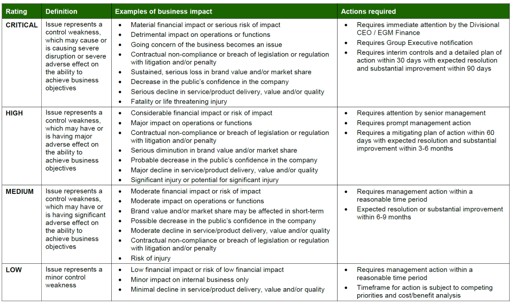
210 There was also a methodology for giving audits overall a “red”, “yellow” or “green” rating (referred to as “report ratings”). Report ratings were based on the frequency, risk, severity and pervasiveness of observations identified during the internal audit. Guidance on what these report ratings meant is extracted below:
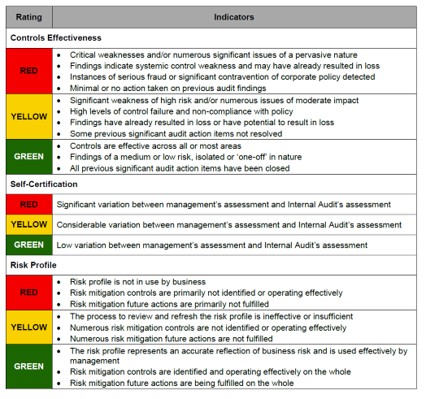
211 The Group Head of Internal Audit was responsible for applying the ratings in accordance with the methodologies above and, after completing an internal audit, the Internal Audit function tracked the completion of any action items arising from the relevant audit.
212 To assist with the process of recording and tracking the action items, Boral had a web-based tool known as the “Concern Tracking System” (CTS) to track issues, actions, responsible person, due dates and evidence of completion. CTS allowed members of the Internal Audit team to record all of the action items arising from any given audit, each of which could then be assigned to the person who had been allocated as the responsible person for that action item. The web-based tool could either be accessed by the business (to the extent a business had access to the CTS) to directly update an action and attach evidence of completion for review by Internal Audit, or the business could liaise with Internal Audit about the action and its completion, and Internal Audit then updated the CTS.
213 As part of the Group’s internal audit framework, a “self-certification” assessment process also occurred annually. This was a process by which each business unit was required to “self-assess” and rate the controls within that business unit, using a prescribed checklist and scale.
214 During the Relevant Period, Boral undertook the following Internal Audits in relation to Windows:
(1) the fieldwork for the first internal audit for Windows commenced in June 2017 and a final full report was issued in January 2018 (First Windows Audit);
(2) the fieldwork for a special business review audit of Magnolia commenced in March 2018 and a final memorandum issued in June 2018 (Magnolia Special Review);
(3) the fieldwork for the second internal audit for Windows commenced in January 2019 and a final full report was issued in June 2019 (Second Windows Audit); and
(4) the fieldwork for the third internal audit for Windows commenced in November 2019 and a final full report was issued in February 2020 (Third Windows Audit).
E.6.5 External Audit Function
215 During the Relevant Period, KPMG was the external auditor which audited Boral’s full year and half year accounts. KPMG attended ARC meetings and presented on external audit issues and had access to Internal Audit materials and information.
216 The responsibilities of the external auditors included confirming that the results presented in year-end accounts were accurate, and that those numbers were a true reflection of the business.
E.6.6 Boral’s Risk Function
217 The role of Boral’s risk function was to assist management with identifying, assessing, and monitoring key risks (both financial and non-financial) for the Group, as well as identifying controls to mitigate those risks. The Group Head of Internal Audit and Risk worked with management to identify and assess core strategic, operational, financial and compliance risks; and to monitor and mitigate those risks.
218 The Group Risk Manager reported to the Group Head of Internal Audit.
219 The “Group Risk Summary” paper was typically tabled before the ARC each year. The process for preparing the Group Risk Summary involved aggregating key risks across each business division and the Group. In addition, the risk function conducted half-yearly “risk reviews” across each business unit.
E.6.7 Operational Review
220 During the Relevant Period, it was standard practice within Boral for each divisional operational and finance lead to hold a monthly “operational review” meeting to review the performance of their respective divisions with the operational and finance leads of each business unit within the division. Mr Kane and Ms Ng had a standing invitation to join the monthly operation review meetings for each division.
221 In the case of BNA, a paper entitled “Monthly Operations Review” was normally circulated by Mr Post in advance of the meeting, which provided a summary of the financial performance of BNA and each of its business units (BNA Operations Review Papers). The BNA Operations Review Papers contained sections on financial performance and sections dedicated to operational updates.
E.7 Systems and Controls
222 I will now outline the nature of the primary systems and controls that were in place during the Relevant Period.
E.7.1 Enterprise Resource Planning Systems and Associated Controls pertaining to User Access and Segregation of Duties
223 An enterprise resource planning system (ERP system) is a type of business process management software, designed for an organisation to capture and extract information that could be used to support the organisation’s strategy, operations, management analysis and decision-making functions.
224 The functions of an ERP system may include: (a) standardisation and streamlining of business processes; (b) providing a common database and a single source of information; (c) enabling date to be viewed in real time; and (d) facilitating analysis, and standard and bespoke reporting.
225 There is no standard requirement for an organisation to implement an ERP system across all functions. However, it would be unusual for a large or complex organisation not to have some form of ERP system. It may be implemented as a single unified system to run all business functions or may be implemented to operate alongside or be integrated with other systems.
226 An ERP system may consist of a range of modules (e.g. accounting, payroll, inventory, and project management modules), which can be adapted and customised to cater for an organisation’s objectives, functions and operating practices. Each business area within the organisation may utilise different ERP modules to log and analyse the data using standardised processes, data fields and units. This data can typically be viewed in real time and used by other functions within the organisation for reporting purposes.
227 An ERP system typically includes: (a) tools to monitor data quality across various dimensions such as amount, accuracy, timeliness, completeness, consistency, accessibility, and redundancy; (b) security features, including encryption, audit trails, and security updates; and (c) features which facilitate segregation of duties including access controls and segregated workflows.
228 The parties helpfully provided a table summarising the ERP systems used in Windows and Boral from May 2017 to the end of the Relevant Period:
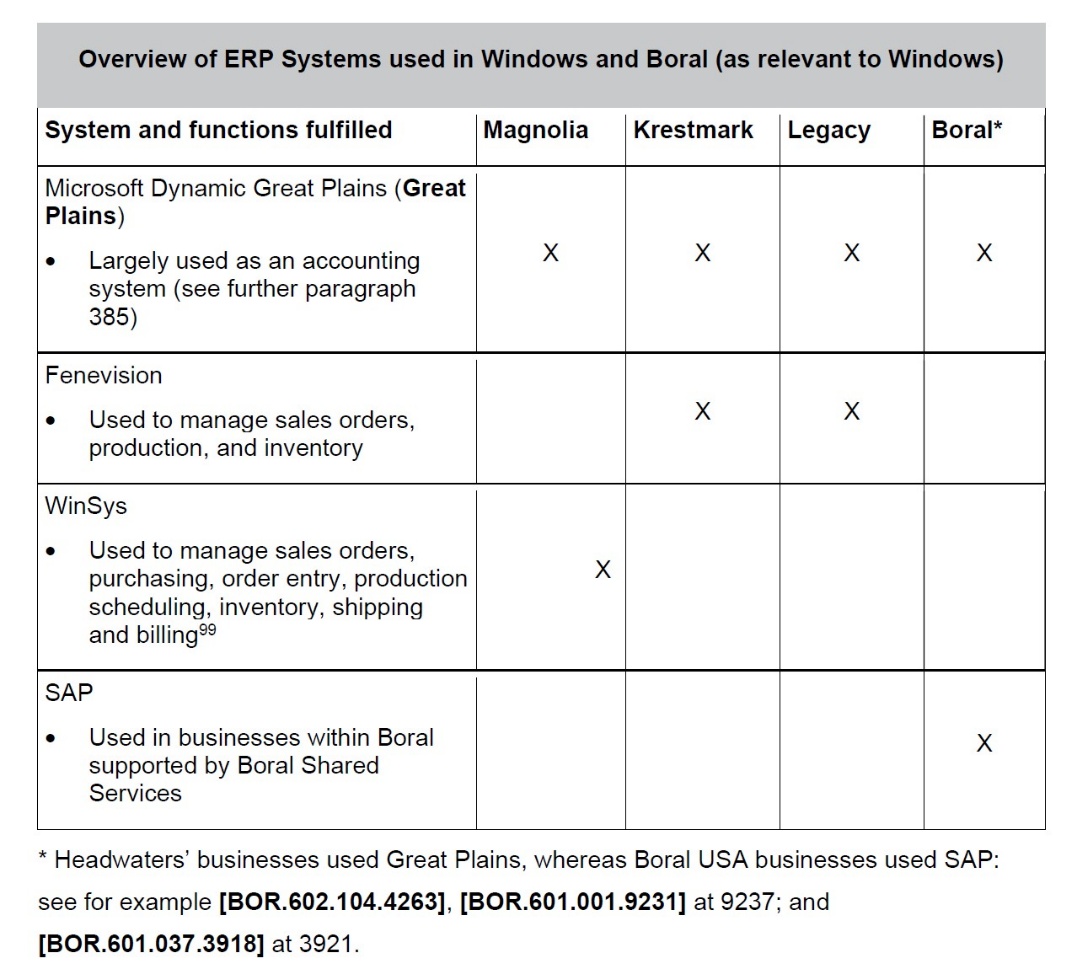
229 FeneVision is an industry-specific ERP system for the windows manufacturing industry. Krestmark and Legacy utilised FeneVision to manage sales orders, production, and inventory. FeneVision’s functionality incorporates an inventory management system and may also provide functionality supporting an inventory accounting system.
230 The website related to WinSys describes WinSys as follows: “[f]or small-to-medium manufacturers of residential windows, the WinSys product provides a complete, end-to-end solution for the entire business, including dealer order entry, true ‘to-order’ manufacturing, and lineal optimization [sic]”.
231 Relevantly, the Magnolia Special Review states that WinSys was an “order processing, inventory management (production/shipping/receiving) system used by Magnolia”. The First Windows Audit Report states that “[s]ales orders, production, and inventory are managed through … WinSys at Magnolia”.
E.7.2 Accounting Systems and Associated Controls pertaining to User Access and Segregation of Duties
232 An accounting system is, obviously enough, a system upon which bookkeeping activities are carried out. Within the system, there is a general ledger which is used to classify financial transactions. The general ledger should be the organisation’s source of truth for financial transactions, which are recorded and reflected in the general ledger by the process of creating a journal entry.
233 An accounting system allows the tracking of financial transactions from all aspects of the organisation, including the organisation’s revenue, operational expenses, human resource expenses, assets, and liabilities.
234 Modern accounting systems are usually maintained in an IT system, which may be part of the ERP system used by the organisation or may otherwise be a standalone system. An accounting system is typically used by the organisation’s finance function, and those operating the organisation’s finance function are often tasked with making journal entries in the accounting system. Within an IT based accounting system, journal entries may be “entered” and “posted”. When a journal entry is “entered”, that means that the journal entry is created or drafted but not yet recorded in the general ledger. It is only once the journal entry is “posted” that the journal entry is reflected in the general ledger. Journal entry approval is typically inherent in the posting process (that is, in posting an entry, it is considered to be approved).
235 While an accounting system permits the tracking of financial transactions from all aspects of the organisation and reflects them in the general ledger, it is not the case that on a day-to-day basis the general ledger is complete, such that it fully reflects the financial performance and position of the entity.
236 A number of accounting entry types which affect the general ledger and, ultimately, the financial reports prepared on the basis of the general ledger, do not arise from day-to-day transactions but from balance day reconciliations and adjustments, where balance day is the date at which financial reports are prepared. The nature and extent of such adjustments will vary between businesses, but typical examples include adjustments for: (a) fair value of assets, including recognition of inventory values at net realisable value; (b) provisions, including providing for slow or obsolescent inventory; (c) accruals and prepayments; (d) depreciation; and (e) results of physical verification of inventory.
237 An accounting system typically includes: tools to monitor data quality, security features including audit trails, and features to facilitate segregation of duties including access controls and segregated workflows. Importantly for this proceeding, “segregation of duties” is an internal control that distributes responsibilities for performing particular tasks between different individuals or functions. More particularly, it is a control to minimise the risk that error or fraud may occur because a transaction is initiated, executed and recorded by the same person. In this context, the duties which are typically segregated are: (a) custody of an asset; (b) authorisation of transactions concerning that asset; (c) recording of transactions concerning that asset; (d) verification and review of transactions concerning that asset.
238 Auditing Standard ASA315 Identifying and Assessing the Risk of Material Misstatement describes segregation of duties as a control activity in the following terms:
Assigning different people the responsibilities of authorisation transactions, recording transactions, and maintaining custody of assets. Segregation of duties is intended to reduce the opportunities to allow any person to be in a position to both perpetrate and conceal errors of fraud in the normal course of the person’s duties.
239 Segregation of duties, as an internal control, is subject to inherent limitations of internal controls, as identified in ASA315 as follows:
Limitations of Internal Control
Internal control, no matter how effective, can provide an entity with only reasonable assurance about achieving the entity’s financial reporting objectives. The likelihood of their achievement is affected by the inherent limitations of internal control. These include the realities that human judgement in decision-making can be faulty and that breakdowns in internal control can occur because of human error. For example, there may be an error in the design of, or in the change to, a control. Equally, the operation of a control may not be effective, such as where information produced for the purposes of internal control (for example, an exception report) is not effectively used because the individual responsible for reviewing the information does not understand its purpose or fails to take appropriate action.
Additionally, controls can be circumvented by the collusion of two or more people or inappropriate management override of internal control. For example, management may enter into side agreements with customers that alter the terms and conditions of the entity’s standard sales contracts, which may result in improper revenue recognition. Also, edit checks in a software program[me] that are designed to identify and report transactions that exceed specified credit limits may be overridden or disabled.
Further, in designing and implementing controls, management may make judgements on the nature and extent of the controls it chooses to implement, and the nature and extent of the risks it chooses to assume.
240 Accordingly: (a) management makes judgments, when designing and implementing controls, on the nature and extent of the controls it chooses to implement or not implement; (b) where segregation of duties cannot be achieved, compensating controls may be implemented to address the resulting vulnerabilities; and (c) segregation of duties controls may be rendered ineffective where those among whom duties are segregated do not act independently and honestly.
241 User-access controls are a method of achieving segregation of duties by assigning user-access profiles which permit users to see only specified information and perform only specified functions within a system. A user access profile may be specific to an individual or to a role.
242 User access controls are mechanisms by which: (a) segregation of duties may be enforced systemically; and (b) access to view and change information within systems can be limited to those whose roles require such visibility and capability.
243 As an internal control, user access controls are subject to the inherent limitations of internal controls described above. Accordingly, the effectiveness of user access controls may be supported, or undermined, by the prevailing control environment, management’s judgement on the nature and extent of controls, the competency of those implementing the controls, and the honesty and integrity of those using the system. For example, the controls may be rendered ineffective through sharing of passwords or inappropriate accessing by IT administrators.
244 During the Relevant Period, the Windows business used the Great Plains ERP system as its accounting system. However, at the time of Boral’s acquisition of Headwaters, Magnolia operated on a different version of Great Plains. Magnolia subsequently transitioned to the version of Great Plains that was used at Krestmark and Legacy at some time before the First Windows Audit.
245 Great Plains had financial functionality including: sales and accounts receivable, accounts payable, general ledger maintenance including journal entries, inventory maintenance as well as other functionalities.
246 Great Plains enabled users to be assigned user-access profiles which allowed them to see specified information and undertake specified tasks within Great Plains, and prevented them from accessing other information and tasks. This functionality supports systematic segregation of duties.
247 The use of user access profiles is reflected in internal audit reports of user access profiles for Great Plains at Krestmark as at 1 May 2018 and 15 November 2019. The First Windows Audit Report showed that, at the time of the audit, all users within Great Plains had the “POWERUSER” role, which granted unlimited access to all parts of the accounting system.
248 A series of emails in evidence indicate that, in 2017, Great Plains could not be configured to enforce segregation of duties between the originator and approver of a general journal entry and that there had been some miscommunication with Boral Internal Audit in this regard. The chain of email correspondence shows: (a) a system limitation within Great Plains insofar as it could not systemically prevent an individual from raising and approving a general journal; and (b) Boral Internal Audit believed this issue had been fixed soon after it had been identified in the 2017 Audit.
E.7.3 Inventory Management or Accounting Systems and the Interface with the System that maintains the General Ledger
249 It is trite to observe that inventory is a key asset of a manufacturing organisation. According to the Australian Accounting Standards Board’s definition of “inventory”, inventory may comprise three elements: raw materials, work in progress and finished goods.
250 Two systems that relate to inventory are inventory management systems and inventory accounting systems.
251 The purpose of an inventory management system is to enable inventory holdings to be managed efficiently by ensuring that inventory required for manufacture or sale is on hand as and when it is needed and avoiding the holding of inventory which is surplus to these requirements. In this way, it can be said that it is focused on the quantity of inventory, particularly raw materials and finished goods.
252 The purpose of an inventory accounting system is to record the value of inventory for financial reporting purposes. Critical dates for valuing inventory are the entity’s balance dates, that is, the dates at which financial reports as to financial performance and position are prepared for use by the users of those reports.
253 Inventory accounting systems may be integrated with inventory management systems and/or housed within the ERP system being used by the organisation.
254 There are two common inventory accounting systems: periodic inventory systems and perpetual inventory systems.
255 A periodic inventory system is an inventory accounting system which accounts for inventory at certain periods (annually, quarterly or monthly) through stocktake activities. This requires individuals to physically attend the location where inventory is stored and sight, count and record the physical inventory. A record of inventory is made during this process and, together with cost data, used to update the inventory accounting system. These periodic inventory systems are considered to be better suited to smaller businesses with lower amounts of inventory to manage.
256 In general terms, a periodic approach to accounting for inventory determines the “Cost of Goods Sold” or “COGS” expense by applying the equation:
Opening Inventory + Goods in (Purchases) – Closing inventory = Goods out (Cost of Goods Sold)
257 In other words, one brings forward the opening inventory value (based on the previous stocktake and valuation), adds the purchases recorded in the purchase or general ledger, and deducts the inventory value on the closing balance date based on the quantities of inventory held as ascertained by a physical inventory count and valued in accordance with the lower of cost or net realisable value rules.
258 A periodic inventory system has consequences for the valuation of inventory. As raw materials, work in progress and finished goods are counted and valued only periodically, between counts it is not possible to accurately identify the quantum or value of inventory. Similarly, where stock is slow moving, damaged, or obsolete and should be in the accounts at a lower value than cost, this may not be recognised between stocktakes.
259 A periodic inventory system is generally better suited to smaller businesses with lower amounts of inventory to manage. That is because a periodic inventory system requires a lower initial capital investment than a perpetual inventory system. Where inventory turnover is lower, a periodic inventory system may be sufficient to meet operational needs.
260 A perpetual inventory system differs from a periodic inventory system in that each item of inventory is logged and tracked throughout the lifecycle of the purchase, manufacturing and sale process.
261 In general terms, a perpetual approach to accounting for inventory seeks to maintain a real time running balance of inventory by accounting for transactions as they occur, typically by:
(1) debiting (increasing) the inventory accounts for purchases of raw materials and any other inputs to the production of finished goods, for example, direct labour, power, machine usage;
(2) accounting for movements of inventory between categories of inventory from raw materials to work in progress to finished goods; and
(3) crediting (decreasing) finished goods for the cost of the goods actually sold. To do this, a system is required to identify the costs applicable to each finished good. The methodology used to determine such costs will depend on the nature of the business; for example, businesses which manufacture non-customised goods may use a standard cost system, and businesses which manufacture customised goods may use a job costing system. Subject to the reliability of the costing system, a perpetual inventory system will provide greater visibility of costs of goods sold.
262 A perpetual inventory system involves a physical infrastructure to be implemented and maintained (e.g., barcode scanners, radio frequency identification scanners, point-of-sale systems, and supporting software, which can be maintained within the ERP system of the organisation).
263 Once a perpetual inventory system is established, the reliance on physical counts is reduced but physical stocktakes remain necessary to validate the reliability of the perpetual accounting system by comparing what it records to what is actually physically on hand.
264 If a perpetual inventory system is in place, physical stocktakes may be undertaken: (a) on a cyclical basis where, typically, higher risk inventory categories/items are physically verified at regular intervals; and/or (b) in a full stocktake, which may occur at any time, but is typically an important part of the procedures undertaken to obtain complete and accurate financial information as at balance date, being the date at which financial reports are prepared. Reflecting the importance of the balance date physical inventory count, it is commonly observed by the external auditors.
265 Variances between the inventory recorded in a perpetual system and the results of a physical stocktake can arise from variances in quantity and/or unit value for a range of reasons: (a) variances in quantity may arise from theft, wastage, miscounts, misallocation or misdescription of inventory line items and inaccurate recording of inventory movements; and (b) variances in value may arise from obsolescence, inaccuracies in the determination of the cost attributed to goods sold, misdescription of inventory line items, and error in recording inventory costs.
266 A perpetual inventory system is better suited for larger businesses with significant inventory and complex manufacturing processes.
267 At Windows from May 2017 to the end of the Relevant Period, Great Plains did not interface automatically with WinSys or FeneVision. Windows had a process in place to manually input the inventory records from WinSys and FeneVision to Great Plains. This involved manually entering data into the Great Plains system on a periodic basis.
268 Krestmark and Legacy both used FeneVision which did not support a perpetual inventory system. A periodic inventory system was in use.
269 Work was undertaken to upgrade FeneVision so that it would support a perpetual inventory system. A perpetual inventory system was never implemented using FeneVision after Boral’s acquisition of Headwaters. As of May and September 2019, there were a number of technical issues associated with updating FeneVision to enable a perpetual inventory system to operate.
F FACTUAL NARRATIVE
270 I now turn to the findings of fact more directly bearing upon the issues in the case. Before doing so, it is necessary to say something about the presentation of the documentary and factual material.
271 Neither party’s written submissions (and, in particular, the applicants’ submissions) provided a consistently chronological account of the relevant events. This was understandable to some extent, given the volume of material and the number of overlapping pleaded allegations, but it made the task of identifying the significance of particular events at particular times more difficult than it ought to have been.
272 I have therefore reconstructed the chronology from the contemporaneous documents and the evidence, while addressing the parties’ submissions at the points at which they bear upon the events in question. This is important because the significance of the various audits, adjustments, complaints and reporting processes can only be assessed by reference to the information available at the particular time.
F.1 The Headwaters Acquisition and Due Diligence
F.1.1 Headwaters
273 As noted above, Headwaters carried on business in the United States designing, manufacturing and distributing building products and construction materials. It was a publicly traded company listed on the New York Stock Exchange and had two core divisions. The first was Building Products, which primarily comprised light building products, roofing, manufactured stone and concrete block products; the second was Construction Materials, which was the largest supplier of fly ash in the United States. Headwaters also had an Energy Technology division. The significance of the company to Boral lay not only in its size, but in the extent to which it provided a substantial platform in North America across adjacent and complementary product lines.
274 By around mid-2016, Boral and Headwaters were both major participants in the North American fly ash market. Their fly ash businesses in the United States each had approximately 40% of the market for the supply of fly ash for use in concrete. Together, the two entities consistently accounted for approximately 80% of supply in North America, and Headwaters was fairly consistently the largest supplier. In relation to stone, Headwaters was the second largest supplier in North America, while Boral’s United States stone business was the largest. The next closest competitors were significantly smaller, with about 12% in market share behind Boral and Headwaters. The strategic attraction of the proposed transaction is obvious from those features alone: it would combine two already dominant positions in important building products and construction materials markets in North America and materially increase scale.
275 On 11 August 2016, Boral’s Board met and resolved to submit a non-binding indicative offer to Headwaters. The Board noted papers, including a paper entitled “Project Enterprise – Acquisition Proposal” dated 8 August 2016. The paper makes clear that the primary drivers of the proposed acquisition were to increase BNA’s scale and put it in a strong market position for fly ash, stone and roofing. The paper summarised the “Overall Investment Case” as follows:
* Creates a diverse, profitable and market leading exterior solutions provider with revenue of ~US$2.5bn+1
* #1 in fly ash, stone and brick: strong position in roofing
* #1 in block (South Central Region)
* Strong Light Building Products (“LBP”) platform
* Allows BNA to execute on its portfolio strategy while generating significant value and synergies
* Combined business will be well placed to be the supplier of choice across the residential, non-residential and repair and remodel (“R&R”) segments.
276 As noted above, on or around 19 August 2016, and prior to completion of the proposed transaction with Boral, Headwaters acquired the Krestmark Group for US$240 million. Krestmark Group operated a windows manufacturing business. At this time, and prior to acquiring Headwaters, Boral did not have a windows manufacturing business.
277 Accordingly, insofar as the proposed acquisition of Headwaters involved the acquisition of the Krestmark Group, this represented an entirely new business line for Boral. That is of some significance in understanding later events, because Windows was not being folded into an established Boral windows platform, but was an acquired business requiring fresh integration.
F.1.2 Boral’s Due Diligence of Headwaters
278 On 10 June 2016, a meeting of the Board was held in Sydney. Among the matters discussed at that meeting was a proposal for Boral to acquire Headwaters in a transaction codenamed “Project Enterprise”. The use of a transaction codename, the involvement of the Board at that early stage, and the later establishment of a dedicated due diligence structure all reflect the scale, complexity and strategic importance of the proposed acquisition to Boral.
279 On 11 August 2016, management reported back on Project Enterprise at a meeting of the Board. At that meeting, the Board approved the establishment of a Due Diligence Committee (DDC). The DDC was tasked with overseeing the due diligence process into the potential acquisition of Headwaters, together with an associated equity raising which Boral proposed to assist in funding the transaction. The DDC comprised senior executives and directors at the highest level of Boral’s management and governance structure, namely: Mr Rayner (as DDC Chairman), Mr Brian Clark (Chairman of the Board), Mr Kane (CEO), Ms Fagg (Director), Ms Moses (Director), Ms Ng (CFO), Mr Mariner (CEO of Boral USA), and Mr Sullivan (General Counsel). The composition of the DDC demonstrates that the acquisition was treated as a matter of major corporate significance and that those responsible for its oversight included the most senior operational, financial and legal decision-makers within Boral.
280 The responsibilities and functions of the DDC in overseeing the due diligence process were broad. They included overseeing the adequacy of internal and external resources deployed for the due diligence exercise; identifying key issues requiring investigation and analysis prior to finalisation of the acquisition; reviewing reports and materials provided to the DDC; ensuring that material issues arising from those reports and materials had been appropriately resolved or otherwise addressed prior to finalisation; and reviewing the final structure, key metrics and proposed market announcements in relation to the acquisition before submission to the Board for approval. The remit of the DDC was therefore not merely administrative. It was intended to function as the central body through which material issues arising from the transaction would be surfaced, tested and addressed prior to completion.
281 Between 7 October 2016 and 19 December 2016, the DDC met on ten occasions. It is important to note that the attendees at those meetings were not confined to the formal members of the DDC. Other Boral directors and personnel attended, as did external advisers. This reinforces the point that the due diligence process was extensive and that the DDC meetings functioned as a focal point for the flow of information and advice concerning the transaction. The repeated meetings over a relatively short period also indicate that the transaction was being advanced intensively and that governance attention to the acquisition was sustained.
282 One of the DDC meetings was held on 20 November 2016. Immediately after that meeting, a meeting of the Board was convened. At that Board meeting, the Board resolved, inter alia, to acquire Headwaters. The sequence is noteworthy: the DDC met immediately before the Board meeting, and the Board’s decision followed directly upon the due diligence committee’s work and consideration of materials prepared in connexion with the proposed acquisition.
F.1.3 ASX Announcement on 21 November 2016
283 On 21 November 2016, Boral announced that it had entered into a binding agreement to acquire Headwaters for an aggregate enterprise value of US$2.6 billion, then equivalent to approximately A$3.5 billion.
284 Boral published to the ASX a document entitled “ASX Release 21 November 2016”. The Release included an announcement entitled “Boral to acquire Headwaters Incorporated – a strategically compelling portfolio of US businesses – supported by capital raising” and a presentation entitled “Acquisition of Headwaters: Investor Presentation 21 November 2016”.
285 The parties engaged in what are plainly peripheral factual disputes concerning the contents of those materials and analyst reports released after the announcement. It is unnecessary to consider those disputes in determining contravening conduct as pleaded. The key point is that those materials emphasise the complementary nature of the US businesses and the significant scale that would be delivered to Boral’s fly ash business. “Synergies” were expressly said to derive primarily from the complementary nature of Boral’s and Headwaters’ businesses in fly ash, roof tile, manufactured stone and light building products.
286 After Boral’s announcement, Mr Kane participated in an investor conference call hosted by Boral on 25 November 2016. The purpose of that call was to explain the transaction to the market, answer questions and provide reassurance as to the rationale and expected benefits of the acquisition. The fact that the CEO personally fronted that call underscores the importance of the acquisition from the perspective of external investors and analysts, and the degree to which the transaction was being presented as a carefully considered strategic step for Boral.
287 An analyst enquired about Windows, asking whether Boral would divest or be committed to grow that business. Mr Kane responded by saying, inter alia:
It’s still early days. We really need to get in the other side of this, spend the time in the interim period while waiting for approvals to understand the organisation better, get to the other side and really get some experience under our belt with these businesses.
288 Contrary to the applicants’ submission, it can hardly be contended that Mr Kane intended to ensure Windows’ customers did not think Boral would sell the business. Mr Kane’s evidence was that announcing to customers that Windows would be sold would, in his view, be a “premature announcement” because Boral was not at liberty to discuss certain matters when decisions had not yet been made, and any premature announcement would harm the business because customers would react negatively: (T419.2–22).
289 Immediately after the acquisition was announced, Boral began to develop an integration plan. The workstream for integration was led by Mr Mariner (President and CEO of BNA) and Mr Ryan (Group Strategy and M&A Manager). The immediacy with which integration work commenced following announcement reflects that Boral understood that the success of the acquisition depended not only upon completion of the transaction itself, but upon the effective combination of operations, systems, personnel and reporting structures.
290 In early January 2017, an “Australian Steering Committee” was formed with Mr Mariner and Ms Ng to oversee executive leads responsible for integration planning and synergy capture for the Headwaters transaction. The committee was organised into four workstreams: Corporate, comprising IT, Finance, HR, Safety and Legal; Building Products, comprising light building products, roofing and stone; Construction Materials, comprising fly ash and block; and Other, comprising Energy and Windows. The express inclusion of “Windows” within a distinct workstream is notable. It reflects that the Windows business was recognised as a discrete component of the acquired operations requiring its own integration attention, notwithstanding its comparatively smaller scale within the broader Headwaters business.
F.1.4 Headwaters’ Acquisition of Magnolia
291 On 12 January 2017, Mr Kane received an email from Mr Benson, addressed to him and Mr Mariner, stating that Headwaters intended to acquire Magnolia, a small windows manufacturing business in Atlanta, for a purchase price of US$5.9 million. Attached to that email was a copy of the presentation to the Headwaters Board providing the details of the proposed Magnolia transaction. Headwaters was not contractually obliged to inform Boral of that transaction under the merger agreement because, owing to its small size, it did not meet the US$20 million disclosure threshold. Nonetheless, Mr Kane and Mr Mariner were informed of the proposed acquisition and were provided with Board-level material concerning it.
292 During the pre-closing phase of Project Enterprise, on or about 2 February 2017, Headwaters acquired Magnolia for US$5.9 million. That acquisition was, obviously enough, quite a small acquisition relative to Boral’s US$2.6 billion acquisition of Headwaters and Headwaters’ acquisition of the Krestmark Group for approximately US$240 million.
F.1.5 Approval of the Headwaters Acquisition and ASX Announcements on 5 May 2017 and 9 May 2017
293 On 3 February 2017, the shareholders of Headwaters voted to approve the acquisition of Headwaters by Boral. Following that approval, the BNA team, led by Mr Mariner, arranged a “Day One Planning” session with Headwaters personnel for 21 and 22 February 2017 in Salt Lake City, Utah. The purpose of that session was to plan for the integration of the two businesses once completion occurred, including the structure, responsibilities and communications that would apply from “Day One” onwards.
294 On 25 February 2017, Mr Mariner sent an email to Ms Ng and Mr Kane reporting on the joint Boral/Headwaters integration meetings. The email was titled “Integration Planning Update” and attached both the Integration Plan and the “Day 1 Communication Playbook” used for the meetings in Salt Lake City on 21 and 22 February 2017. The involvement of Mr Kane and Ms Ng in receiving those materials indicates that senior executive management at Boral was being kept informed about the intended operating and reporting structures for the acquired business prior to completion. A further copy of the integration plan, as at 28 March 2017, was sent to Mr Kane by Mr O’Boyle, then Vice President of Growth and Performance for Boral Industries Inc. The integration plan, in relation to Windows, stated that one of the key objectives was to “assess divestment opportunities”.
295 A meeting of Boral’s Board was held on 4 May 2017 in Melbourne. Mr Kane attended the meeting to give a CEO Briefing which stated, inter alia, in relation to investors:
Sentiment is upbeat outside of Australia and improving inside. This is reflected in our share price and HW share price. Most overseas investors get the industrial logic of the deal but are concerned about FTC approval and synergies. Hopefully, an early decision by May can refocus attention to the upside of the deal.
The bulk of investor questions remains focused on Fly Ash, have had many robust conversations since few have ever focused on cement substitutes and the complex utility interface, long term outlook for coal in the US, and how to manage an asset light brokerage business with the promise of 1 billion tons of landfilled ash waiting to be harvested.
296 The CEO Briefing enclosed a presentation entitled “Integration Update: Boral-Headwaters”. The presentation included a slide entitled “Workstream Report – Highlights/Issues” addressing IT, finance, safety, HR, legal/environmental, building products, construction materials and windows/energy. In respect of the Windows business, the presentation stated: “Windows: assess potential divestment and integrate recent Magnolia acquisition”.
297 On 5 May 2017, Boral informed the market, by way of ASX announcement, that it would complete the acquisition of Headwaters in early May.
298 On 9 May 2017, Boral published an ASX announcement stating that it had completed the acquisition of Headwaters following approval by Headwaters’ shareholders and receipt of all necessary regulatory approvals.
299 Completion occurred on 8 May 2017 (US time). The transaction value was approximately US$2.6 billion. Headwaters thereby became a wholly owned subsidiary of Boral Industries Inc and, through that vehicle, an indirectly wholly owned subsidiary of Boral. Headwaters thereafter ceased to be a publicly traded company in the United States.
300 On or around the acquisition date, Mr Joel Charlton was appointed as President of Energy, Windows and Innovation. As part of Boral’s integration plan for the Headwaters business, Mr Mariner and his team devised a new structure for BNA and selected Boral employees to hold senior leadership and oversight roles within that structure. The plan included allocating the Windows business to the newly created “Energy, Windows and Innovation” group within BNA. The integration plan further contemplated that the Windows business would be managed by a President of the Windows business, who would report directly to Mr Charlton, and be supported by a Vice President of Finance within Windows. The design of that structure shows that Boral contemplated that Windows would have both operational and finance leadership within a defined reporting hierarchy after completion.
F.2 Events Immediately Following the Acquisition
F.2.1 Mr Kane visits Magnolia
301 Within a week of closing the Headwaters deal, Mr Kane visited the Magnolia facility in Atlanta, Georgia. This was at least in part because of his interest in the twenty per cent EBITDA margins of that business, which he characterised as “high”, and whether Windows’ profitability could be improved upon under Boral’s ownership: (T402.32–T403.4). In the light of this evidence, the applicants contend that the newly acquired Windows’ business was not as insignificant a component of the Headwaters business as Boral now seeks to paint it.
302 While curiosity about the high margins was a reason why Mr Kane visited the Magnolia plant, Mr Kane also gave evidence that “I must admit, with everything going on at the time and us chasing the $100 million in synergies, we weren’t spending a lot of time thinking about windows” and so he “simply told the US division, set it aside in the for – to be decided later box … and to be potentially sold”: (T402.26–40). Mr Kane continued, “I got in my car, because [the Magnolia plant] was close to where I lived … The first order of business after the close on the deal was to get the matter out to Headwaters about what our safety standards were. So, I tried to do that when I was up at the Magnolia plant”: (T402.43–T403.04).
303 The fact that Mr Kane visited Magnolia and gave the above evidence is of little moment in the scheme of things. It is unsurprising that Mr Kane was keen to visit and tour the Magnolia plant after closing the deal. He was intrigued by the twenty per cent EBITDA margins and was interested in seeing how Boral could extract value and improve performance (s 144 of the EA would allow one to conclude that there may be, of course, another powerful reason to visit Augusta, Georgia in around April or May each year, but this was not explored in the evidence).
F.2.2 Mr Laurie Informed of Part Audit of Windows Conducted by Headwaters
304 On 17 May 2017, just over a week after the acquisition of Headwaters had completed, Mr Laurie had an initial telephone call with Mr Davis (who had been Headwaters’ Director of Internal Audit prior to the acquisition). On the call, Mr Davis informed Mr Laurie that Headwaters was in the process of an audit at Windows prior to the acquisition.
305 Between 18 and 19 May 2017, Mr Laurie and Mr Davis engaged in email correspondence concerning the audit of Windows that the Headwaters’ team was part-way through completing, including:
(1) on 18 May 2017, Mr Laurie sent an email to Mr Davis, requesting that Mr Davis provide a copy of the scope for that audit; and
(2) in a reply email sent on 19 May 2017, Mr Davis provided a copy of a spreadsheet entitled “Windows SOX Control Status Jan 2017” (SOX Status Spreadsheet).
F.2.3 The ARC’s First Meeting Following the Acquisition
306 On 22 May 2017, the ARC held its first meeting following completion of the acquisition. At the meeting, the ARC noted the papers from Mr Laurie entitled “Internal Audit Report to the Audit & Risk Committee” and the “FY18 Internal Audit Plan”, each dated 16 May 2017.
307 In relation to “North American Operations”, the FY18 Internal Audit Plan proposed baseline audits for “Boral North America core financial controls” and “Boral North America IT general and security controls review”. It also noted that “[f]urther audits [were] to be proposed subject to a detailed assessment of Headwaters[’] control environment and internal audit function”.
308 The ARC resolved to approve the FY18 Internal Audit Plan as it related to Boral Australia and noted that Mr Laurie would provide an updated Internal Audit Plan covering the combined Boral and Headwaters businesses in North America at the next meeting of the ARC (which was scheduled for 14 August 2017).
F.2.4 Preparations for Initial Audit of Windows
309 Between 24 May 2017 and 16 June 2017, Mr Laurie communicated with Mr Post (CFO of BNA), Mr Davis and Mr Charlton (Group President of Windows and Innovation) about the proposed scope of an audit at Windows.
310 On 24 May 2017, Mr Laurie sent an email to Mr Post forwarding a copy of the SOX Status Spreadsheet. Mr Laurie informed Mr Post that he proposed to revise the scope of the audit over the Windows business “to get a bit more coverage” and to include Magnolia within the scope of the audit.
311 On 25 May 2017, Mr Post responded to Mr Laurie’s email and stated that he had “heard this was one to take a look at, nothing specific”. Shortly after receiving Mr Post’s email, Mr Laurie sent a further email to Mr Post. He stated it was proposed that the internal audit look at procure to pay, accounts receivable and credit, inventory management and costing, and general accounting.
312 On 26 May 2017, Mr Post responded to the email Mr Laurie had sent the previous day. In his email, he stated that he agreed with Internal Audit auditing Windows, and raised matters regarding the Windows business including with respect to an inventory issue which had been brought to his attention.
313 On 30 May 2017, Mr Post and Mr Laurie exchanged further emails in relation to the scope of the Windows audit.
314 On 1 June 2017, Mr Laurie received an email with an attachment from Mr Davis relating to inventory issues at the Krestmark facility in around January 2017. The materials explained that issue, and various steps which had been implemented or were proposed in response to it. On 3 June 2017, Mr Davis forwarded his email to Mr Post, copying Mr Laurie.
315 On 7 June 2017, Mr Laurie received comments from Mr Davis on an updated draft scope of the First Windows Audit (which included sections on cash banking and credit management controls) by way of email.
316 On 8 June 2017, Mr Laurie sent Mr Post an email with a revised proposed scope of the First Windows Audit and proposed resourcing to complete the audit. Mr Post did not indicate any disagreement with the proposed scope.
317 Mr Laurie sent Mr Charlton a calendar invitation for a call, attaching the draft scope of the First Windows Audit as at 29 May 2017 and the SOX Status Spreadsheet. On 16 June 2017, Mr Laurie had a call with Mr Charlton to discuss these documents and provide him with an update of the proposed plan.
F.3 June 2017 Windows Audit (the First Windows Audit)
318 Between 19 June 2017 and 30 June 2017, fieldwork for the First Windows Audit was undertaken.
319 An external consultant from Protiviti Pty Ltd, Mr Connor Hammersmith, was engaged to assist with the audit. The engagement of an external consultant reflects that the audit was not confined to routine internal review but involved specialist assistance.
320 On 15 June 2017, Mr Laurie sent an email to Mr Hammersmith attaching copies of an example “Risk and Control Matrix” spreadsheet and a copy of the draft scope for the First Windows Audit.
321 On 16 June 2017, another representative of Protiviti, Mr Mike Purvis, sent an email to Mr Laurie attaching a statement of work in respect of Mr Hammersmith’s engagement for the First Windows Audit. As the audit was underway, Mr Laurie received updates from Mr Hammersmith.
322 Sometime in June 2017, Mr Alan Spear became Vice President of Finance for Windows. Mr Spear had worked for Boral for many years in its “Bricks” business. On 23 June 2017, Mr Laurie sent an email to Mr Spear attaching a copy of the planning memorandum for the First Windows Audit, informing him that the audit was by that stage underway and suggesting a meeting with Mr Spear.
F.3.1 The Initial Observations Summary and Initial Draft Report of the First Windows Audit
323 On 30 June 2017, Mr Davis sent an email to Mr Laurie, Mr Spear and Mr Decker (among others), attaching a summary of the audit team’s initial observations arising from the First Windows Audit (Initial Observations Summary). The Initial Observations Summary contained 21 observations concerning business and financial controls within Windows. The observations were categorised by “critical”, “high”, “medium” and “low” ratings. Those ratings reflect Boral’s defined audit rating methodology for individual control issues which had been identified as part of the internal audit process (see [209]).
324 In the Initial Observations Summary, a “critical” risk rating was assigned to the following observation:
User Security within Great Plains has not been defined to date. All users within Great Plains are assigned the “POWERUSER” role granting excessive privileges to users within the accounting system.
325 In practical terms, this meant that users could create, modify and process accounting entries without system-imposed constraints or independent verification. The assignment of such privileges to all users is inconsistent with basic control principles requiring restriction of access and segregation of duties (see [239]–[243]).
326 The summary also included five observations categorised as “high”. One of those findings related to accounting controls, namely that “[t]here is limited or no segregation of duties within key accounting functions”. The functions identified were journal entry preparation, general ledger account reconciliation and financial statement preparation. All those functions were said to be “currently performed by the same individual”.
327 Another observation categorised as “high” concerned inventory controls (which was later reclassified as “critical”), namely that “Raw Material, WIP and Finished Good movement is not tracked in the system”. The absence of system-based tracking of inventory meant that movements of inventory were not recorded in a manner that permitted reliable reconciliation between physical stock and accounting records. This created a risk that inventory balances could be misstated and that discrepancies might not be detected through routine processes.
328 A further observation categorised as “high” concerned pricing governance controls:
Pricing strategy and objectives have not been formally documented and approved. Pricing decisions historically were made for each customer by Bill Robinson, with little or no documentation. A formalized [sic] pricing strategy could help ensuring pricing is consistent and results in adequate margins. Recommended proceeding with the plan to review and approve pricing for each customer.
Sales order entry personnel may enter pricing different than the customer pricing in FeneVision. Lack of segregation between sales and pricing administration increases risk of fraud or error.
329 Considered holistically, the Initial Observations Summary identified significant deficiencies across multiple aspects of the control environment within Windows. These deficiencies spanned system access controls, accounting processes, pricing controls and inventory management.
330 The categorisation of certain findings as “critical” and “high” reflects the significance attributed to them by the audit team at the time. Indeed, shortly after receiving the Initial Observations Summary, Mr Laurie emailed Mr Spear saying:
I would like to discuss this ASAP. Realise there is a lot to do however a number of these are fundamental controls that need to be implemented immediately, e.g. the segregation of duties and access controls.
331 Mr Spear responded shortly thereafter saying, inter alia:
I have spent 2 days at Krestmark, and obviously a lot to do on all fronts. … Appreciate the need for triage on the most critical items, and will move quickly to shore things up.
332 Boral Internal Audit and Windows management subsequently discussed and agreed an action plan to address the issues identified. On or about 21 July 2017, Mr Laurie met with Mr Hammersmith. Following this discussion, on 25 July 2017, Mr Laurie received an email from Mr Hammersmith attaching a draft report for the First Windows Audit. The draft report incorporated the observations previously made and set out action items in response to them. It identified persons responsible for implementing the action items and specified due dates for completion.
333 For the observation concerning user security within Great Plains, an implementation date of “End of August 2017” was identified. For the observation concerning limited or no segregation of duties within key accounting functions, an implementation date of September 2017 was identified. For the observation concerning pricing governance, an implementation date of “End of September 2017” was identified. Finally, for the observation concerning raw material, work in progress and finished goods movements not being tracked in the system, which had now been assigned a “critical” risk rating, an implementation date of “December 2017” had been identified.
334 The inclusion of action items, responsible persons and timelines indicates that the audit process moved from identification of deficiencies to a remediation phase. That is, the draft report did not merely record the existence of deficiencies but established a framework for addressing them.
335 Having said that, the documentary record does not disclose that, at this stage, the findings were escalated beyond those directly involved in the audit and remediation process. Nor does it disclose any contemporaneous assessment of the implications of those deficiencies for the reliability of financial reporting at a broader level or for the information provided to the market.
336 The applicants submit that the findings in the First Windows Audit identified structural weaknesses in the control environment which could permit irregular accounting practices. Boral does not dispute the existence of the findings but submits that they were typical of issues identified during post-acquisition integration and were being addressed through remediation. The contemporaneous documents establish that the deficiencies were identified and that steps were proposed to address them, but do not record any synthesis of those findings into a broader assessment of risk at this stage.
F.3.2 ARC Meeting on 14 August 2017
337 On 14 August 2017, a meeting of the ARC was held. The minutes of the meeting record that Mr Laurie provided an overview of the matters outlined in the “FY18 North America Internal Audit Plan”, and that the ARC “accepted” the FY18 North America Internal Audit Plan.
338 The FY18 North America Internal Audit Plan relevantly provided:
The North American divisions are no longer required to comply with the SO reporting framework, as it is no longer a US listed entity. The North American business will therefore be aligned to the current Boral Group internal audit framework. Under this approach, internal audits undertaken in North American will be undertaken through a combination of detailed process reviews and whole of business reviews. The plan has also assumed that KPMG will require controls reliance on specific processes/businesses in FY18.
339 Against the backdrop of the North American business being aligned to Boral’s internal audit framework, the FY18 North America Internal Audit Plan recorded that Windows, along with 14 other business units, would be subject to an internal audit scheduled for Q1 FY18, which was in about July to September 2017. The audit of Windows was directed to: (a) procurement and payables; (b) inventory management; (c) general accounting; (d) sales and pricing (including governance, Masterfile, quoting and invoicing); and (e) credit functions. The FY18 North America Internal Audit Plan also proposed audits across various aspects of the fly ash, roofing, and stone businesses, and a series of site-specific audits to ensure core onsite processes and controls were being undertaken and maintained.
340 The FY18 North America Internal Audit Plan also recorded that the Internal Audit team proposed to undertake a “follow up” audit of Windows in Q4 FY18, which would have the same scope as the initial audit.
341 As will become apparent, the audit of Windows planned for Q4 FY18 did not occur at that time, and when it eventually happened, it did not have the same scope. There were “several reasons” why the proposed timing and scope for the follow-up audit changed, including because “the team is currently still making some changes” and Mr Post “wanted those to settle in a bit before we audit”, which Mr Laurie accepted.
342 At the same meeting, the ARC noted the paper entitled “Boral Group key matters identified based on Divisional Questionnaires” for the year ending 30 June 2017 (FY17 Questionnaire Summary). The FY17 Questionnaire Summary included responses to the questionnaires distributed to the operating divisions and completed by the Divisional Managing Directors and Divisional Finance Managers.
343 In response to a question asking for identification and quantification of any material factors which impacted positively or negatively on the operating results from ordinary activities for the period, the FY17 Questionnaire Summary noted, inter alia:
Windows – 6/30/17 Inventory Count:
Inventory Write down (unusable windows) - $142k
Leakage (Theft) - $378k Potential break in process has been identified and closed. Scanning process associated with manufacturing software upgrade will mitigate this issue.
344 In response to the question “[h]ave any material errors or irregularities come to your attention?”, it noted:
Windows - Leakage (Theft) - $377k. Potential break in process has been identified and closed. Scanning process associated with manufacturing software upgrade will mitigate this issue. Individuals believed to have been responsible have been terminated and management has been changed.
345 The applicants summarised the FY17 Questionnaire Summary as identifying prior incidences of suspected inventory theft, inventory write downs of $142,000 due to unusable windows, and that “significant internal control weaknesses” relating to Windows were “in process”.
346 While the references are correct, the applicants fail to appreciate the full content of the document. When read as a whole, the FY17 Questionnaire Summary demonstrates that the suspected inventory theft issue was being addressed. It states, in terms, that the potential break-in process was identified and closed; scanning processes associated with a manufacturing software upgrade will mitigate the issue; and individuals believed to have been responsible have been terminated and management has been changed. It also noted, in another section:
Management believes there were multiple incidences where there was theft of finished windows. Appropriate steps have been taken to lessen the likelihood of this occurring in the future.
347 Further, it is hardly surprising that the correction of issues with internal controls was in process and that the control action items had not been resolved. The questionnaire was completed at the beginning of August 2017, before Internal Audit had determined the agreed actions for the First Windows Audit, and before a draft report for the audit with proposed action items had been circulated by Internal Audit to Windows management.
F.3.3 Board Meeting on 28 August 2017
348 Mr Rayner provided an update on the ARC meeting to the Board during the Board meeting held on 28 August 2017. The meeting papers included:
(1) the draft minutes of the ARC meeting held on 14 August 2017 at which the FY18 Internal Audit Plan was approved;
(2) a paper on the results for Boral for July 2017;
(3) a paper providing an updated budget for FY18 following completion of detailed budgets for Headwaters and consideration of the June 2017 financials;
(4) a detailed paper updating the Board on the Boral-Headwaters Integration dated 22 August 2017 (which was an update on the June version of the paper);
(5) a CEO Briefing dated 22 August 2017; and
(6) a CEO report dated July 2017.
349 At the board meeting, Mr Kane presented a CEO report which indicated that there would be a site visit with 32 analysts in September 2017, which included a visit to a Windows site. The slides that were ultimately presented at the site visit show some granularity was provided in relation to Windows’ capital expenditure and other matters.
F.3.4 Further Preparation of the First Windows Audit Report
350 On 29 August 2017, Mr Laurie sent an email to Mr Decker and Mr Spear, attaching a draft copy of the report for the First Windows Audit, for the purpose of them reviewing the report and confirming they were comfortable with the description of the issues, action items and completion dates.
351 Mr Laurie noted that the First Windows Audit had been “red” rated for both business and financial controls “given the weakness identified at the Krestmark site in relation to segregation of duties, inventory management and pricing”. In accordance with Boral’s audit rating methodology (see [210]), a “red” rating for control effectiveness meant that there were critical weaknesses and/or numerous significant issues of a pervasive nature; findings indicating systemic control weaknesses and may have already resulted in loss; instances of serious fraud or significant contravention of corporate policy detected; and minimal or no action taken on previous audit findings.
F.4 30 August 2017 Announcement of FY17 Results
352 On 30 August 2017, Boral announced its financial results for the year ended 30 June 2017 (FY17 Results). Those results were the first to reflect, albeit only for a relatively limited period, the incorporation of the Headwaters business into Boral’s consolidated financial reporting following completion of the acquisition on 8 May 2017 (US time). The results announcement placed considerable emphasis on the strategic significance of the Headwaters acquisition, including the expansion of Boral’s North American footprint, the integration of complementary product lines, and the anticipated realisation of synergies across the combined operations.
353 For present purposes, it suffices to deal with the extracts from the ASX announcement and investor call upon which the applicants rely in their submissions. The applicants rely on those extracts to submit that Boral was providing reassurances as to “integration”.
354 The applicants identify that the announcement stated “[i]ntegration is tracking well and in line with our expectations” and BNA “is expected to deliver significant growth in EBIT in FY2018, primarily as a result of a full year of contribution from Headwaters, coupled with targeted year 1 synergies of US$30-35 million, and continued steady market growth”.
355 The applicants also identify that, during an investor call on 30 August 2017, Mr Kane acknowledged the shift from synergies of approximately US$100 million to in excess of US$100 million, stating:
So I’ll pick up on synergies first. Yes, we’re – the $100 million synergies is 4 years out. It’s difficult to get your crystal ball out and to pull that number, but let me phrase it this way. Anyone who thinks that we’re not going to achieve the synergies we’ve announced for this deal is making the wrong bet. We – now have several months under our belt and looking deeply inside this business, we’re seeking opportunities and synergies beyond what we expected. So we expect to do well on synergies. As I – I think I set the audience up when we announced the deal saying that it would be really challenged to see them in the first year. I underestimated the ability of our team. I don’t think they’ll be as challenged as we thought to be able to clearly deliver those synergies and possibly more in the first year. I underestimated the ability of our team. I don’t think they’ll be as challenged as we thought to be able to clearly deliver those synergies and possibly more in the first year. So I’m more optimistic today than I was when we announced this deal about our ability to achieve these synergies and to exceed these synergies in the long run. So that’s about all I wanted to say about synergy attainment without giving you a specific number, but our confidence is running high on synergies…
356 The applicants submit that any reasonable investor who interpreted these remarks would have understood that Boral’s ability to deliver on the synergies targets was closely hitched to the skill and competence of Boral’s management team.
357 However, Boral correctly indicates that there are relevant aspects of those materials with which the applicants do not critically engage. For example, on the investor call, Mr Kane also said:
Now the exercise of slamming together 2 very large businesses across a large geography, to consolidate back office between these 2 large platforms, to do manufacturing rationalization [sic] across a host of building products businesses, to integrate the networks of businesses that have been competing against each other for years is like operating on a patient with no anaesthesia. The patient’s on the table, he’s wide wake, and he’s talking to me, and we’re inside making adjustments. So, this is a delicate operation. The patient will not die. There may be some pain points. David, who's sitting here in the audience can talk about some of the pain points. He's living them every day, but we’re going to get there. We’re going to get there, and everything’s going to be fine, but it is a complex exercise. And so the things we have to balance, the first is the integration of the organizations [sic]. Highly confident about how we’ve integrated these organizations. The team is set. We know where we’re going. We’re – everyone understands their mission. The second piece are the synergies. We were very concerned that our credibility’s at stake, we have to do deliver these synergies, are we going to be able to do it? Well, early reports are highly confident in our ability to deliver these synergies now. If we were confident, we’re now highly confident. And the last is the underlying performance of the business. When you’re trying to rationalize [sic] businesses, put competitors together, sort through distributors who are either aligned with us on the one side or Headwaters’ on the other, there’s a lot of complexity, there’s a lot of angst going on in the marketplace. So, we’re well aware of that, and we’re across it, but we have to deliver the underlying performance of the business. And in the middle of all that, the odd hurricane shows up in Texas. So, you have all these things sort of conflating around and complicating the exercise, but we have a full team of seasoned executives going after it, and we’re confident in our ability to execute. It’s still early days …Boral’s approach to integrating Windows (as opposed to Headwaters more broadly) needs to be understood in context. It will be recalled that Boral did not have an existing windows business. Hence there were no real “synergies” expected to be achieved from Windows in the integration, because Boral US did not have an existing windows business.
358 There was also good reason why Windows would not be integrated into Boral’s accounting or IT systems or would not be integrated as quickly into such systems, if there was a possibility that Windows would be divested. Mr Kane explained in his evidence in relation to the Windows business (T403.23–27):
So we were not – because they were held for potential sale, we were not going to integrate them into our SAP system, for example. Because if we then were going to sell it, we would have to disaggregate it out of the SAP system and bring back in a new platform so they could close their books.
359 By the time of the FY17 Results announcement, Boral’s Internal Audit team was still preparing the report for the First Windows Audit, and internal activity remained focused on remediation.
360 The draft report identified action items and allocated responsibility for implementing changes to controls and processes, but the findings were not escalated beyond those directly involved in the audit and remediation process.
361 The FY17 Results announcement did not refer to any issues within the Windows business. There was no disclosure of the audit findings, the identified control deficiencies or any concerns regarding its accounting processes or internal controls. The absence of disclosure reflects the fact that these matters were not, at that time, treated as requiring disclosure.
362 The position as of 30 August 2017 was therefore one in which Boral operational personnel knew of control deficiencies within the Windows business and had commenced remediation efforts, but had not escalated those matters beyond operational management, had not synthesised them into a broader assessment of financial reporting risk, and had not disclosed them to the market.
F.5 The Krisel Incident and Other Events Prior to Announcement of HY18 Results
F.5.1 Matters Relating to the First Windows Audit During this Period
363 On 6 September 2017, Mr Spear emailed Mr Laurie, attaching a marked-up copy of the draft report for the First Windows Audit. In his email, Mr Spear provided an update on several steps that had been taken within the Windows business.
364 In the draft report, the observation concerning user security within Great Plains had been identified as “complete” (which was previously given an implementation date of “End of August 2017”); the observation concerning limited or no segregation of duties within key accounting functions had an unchanged implementation date of “September 2017”; the observation concerning pricing governance had an implementation date of “September 2017” (which was previously “End of September 2017”); and the observation concerning raw material, work in progress and finished goods movements not being tracked in the system also had an unchanged implementation date of “December 2017” (see [333]).
365 In their submissions, the applicants correctly refer to the agreed action concerning the implementation of a perpetual inventory system being “pushed back”. The implementation of a perpetual inventory system was the agreed action to resolve the “critical” finding that raw material, work in progress and finished goods movements were not tracked in the system. As I observed above, the draft report for the First Windows Audit had initially specified an implementation date of December 2017, but June 2018 was subsequently agreed between management and Internal Audit after Mr Spear indicated in his email that it would take until “at least” June 2018 for Windows to have a functioning perpetual inventory system. In his marked-up copy of the draft internal audit report, he stated there was “no way to do this by December”. This was because an initial upgrade of FeneVision needed to be completed first, which he said was in progress, but would not be completed until December.
366 On 11 September 2017, Mr Laurie sent an email to Mr Post and Mr Charlton seeking to arrange a time to discuss the draft First Windows Audit Report with Mr Hammersmith.
367 On 14 September 2017, Mr Laurie sent an email to Mr Spear and Mr Decker attaching a revised draft of the First Windows Audit Report. In his email, Mr Laurie requested that Mr Spear and Mr Decker confirm that they were happy with the “owners” of the various remedial actions, the due dates, and the actions themselves.
368 On 18 September 2017, Mr Laurie sent an email to Mr Post and Mr Charlton intending to attach a draft of the audit report for their review, and stating that Mr Hammersmith and Mr Laurie would take them both through a summary of the findings, agreed actions, the ratings assigned, and the progress to date. On 19 September 2017, Mr Laurie sent an email to Mr Post and Mr Charlton attaching a draft of the First Windows Audit Report for their review, which had failed to attach to the earlier email.
369 Also on 19 September 2017, Mr Laurie met with Messrs Post, Charlton and Hammersmith to discuss the First Windows Audit Report. Later that day, Mr Spear informed Mr Laurie that he had reviewed the revised draft of the report and wanted to suggest some changes. Mr Laurie said that he would make the updates to the report and send through a revised version. Later that same day, Mr Laurie sent an email to Mr Spear and Mr Decker attaching an updated audit report.
370 Following his call with Mr Post and Mr Charlton, Mr Laurie sent an email to Mr Charlton requesting that he attend the meeting of the ARC on 20 November 2017 to discuss the outcome of the First Windows Audit. As Mr Laurie explained to Mr Charlton in his email, where a report has a “red” rating (which was the proposed rating for the First Windows Audit), the relevant EGM/President was generally asked to attend the ARC. Mr Laurie noted that Ms Ng had also confirmed that she was keen for Mr Charlton to attend the ARC.
371 Sometime in September 2017, Mr Brian Becker was hired as the new Financial Controller for Windows. On 26 October 2017, Mr Laurie received an email from Mr Becker which outlined “a laundry list of items outside of the [Windows] audit report that we [the Windows business] are working on and addressing”. Mr Becker further observed that “we are using the audit report as a tool and have prioritized [sic] based on risk and value creation for the business”.
372 On 10 November 2017, Mr Laurie sent an email to Mr Kane attaching a draft internal audit papers for the upcoming ARC meeting and summarising the main areas of focus for each paper. On 11 November 2017, Mr Kane responded to Mr Laurie’s email, stating that he had reviewed the papers, but that he would not be calling in to the 20 November 2017 ARC meeting as he was going to be travelling.
F.5.2 The First and Second “substantial adjustments”
373 The applicants identified that the draft internal audit papers observed that a US$500,000 inventory adjustment was posted at the end of June 2017 due to, at least in part, “inappropriate removal” by Windows staff. The applicants call this “the first substantial adjustment in relation to Windows’ accounts during the Relevant Period”.
374 Mr Kane gave evidence about the suspected theft to which this adjustment related, stating (T406.1–16):
… we had an issue that arose in the windows business in Texas where we found out that – that the company had been selling windows to employees and they were installing them in competition with out [sic] customers on weekends and nights. And we found very little evidence or documentation of these sales going on and we were quite concerned. So we shut – shut that whole process down and we asked internal audit and KPMG to come in and take [a] look at this thing…
375 I am satisfied that this adjustment related to events before Boral acquired Headwaters. It concerns suspected inventory theft at Krestmark prior to the Headwaters acquisition, by employees who were operating as independent windows installers (as well as a write down to account for some “unusable” windows).
376 Internal Audit’s findings in relation to this issue are recorded in the FY17 Questionnaire Summary, which are set out above (see [343]–[346]). Management stated that appropriate steps had been taken to lessen the likelihood of theft occurring in the future. Internal Audit’s findings are also reported in the Internal Audit Report to the ARC dated 13 November 2017, which records that:
[BNA] requested that the audit be prioritised in the plan for FY18 as a result of identification of the inappropriate removal of windows from the Krestmark facilities by employees who were also operating as independent window installers. As a result of the lack of inventory controls, management is unable to accurately estimate the value of the windows that may have been removed as a result of these practices. All sales of Windows to employees have been ceased and the identified individuals have been removed from the company. As at the end of June 2017 an inventory adjustment of USD $500k was posted by the business.
377 It is quite a leap from this “adjustment” to suggest, as the applicants do, that “inventory issues plagued Windows prior to Boral’s ownership” and that “weaknesses in inventory systems and controls at Windows were a chronic issue throughout the Relevant Period”. The evidence demonstrates that the issue was relatively confined, and that appropriate remedial steps were taken to address it.
378 The applicants also refer to what they call “the second substantial adjustment in relation to Windows during the Relevant Period” recorded in Mr Post’s “Monthly Operating Review” for BNA for October 2017 that was circulated to Ms Ng, among others. That report recorded that Windows had “an inventory adjustment, that increased costs by nearly $200k”.
379 The inventory adjustment was for $200,000, related to the Magnolia plant only, and concerned what was understood internally as a nuance in the WinSys system which had been misunderstood. The Monthly Operating Review did not state the reason for the adjustment. It simply stated, “[a]lthough a significant improvement was made through a reduction in outside purchases of IG units, the improvement was offset by an inventory adjustment, that increased costs by nearly $200k”.
380 The issue was later described in correspondence in February 2018 by Mr Spear as:
In October, [Mr Krisel] determined that we were essentially double counting certain raw material inventory because of a misunderstanding in the way inventory was relieved in WinSys… it is somewhat understandable how this nuance in WinSys could have been missed.
381 Boral accepts that Mr Kane would have been aware of the adjustment having read the “Monthly Operating Review” for BNA for October 2017. It also accepts that Mr Post would have known of the adjustment (having circulated the “Monthly Operating Review” by email on 12 November 2017) and that Ms Ng, a recipient of that email from Mr Post, can be inferred to have read the Monthly Operating Review. Boral also accepts that Mr Mariner may have known of the adjustment as recorded in the Monthly Operating Review. But in the end, knowledge of the adjustment does not take matters very far. Like the first inventory adjustment, this second inventory adjustment reflected an issue which, at the time, was understood to be relatively confined, involving a nuance in the WinSys system.
F.5.3 The ARC Meeting of 20 November 2017 and the Papers Presented at that Meeting
382 The ARC met on 20 November 2017. The papers tabled at the meeting included a paper from KPMG entitled “Boral Limited – 2018 External Audit Plan” (FY18 KPMG External Audit Plan), and a paper from Mr Laurie entitled “Internal Audit Report to the Audit & Risk Committee” (November 2017 IA Paper). Each paper was dated 13 November 2017.
383 The FY18 KPMG External Audit Plan provided that KPMG was to conduct a limited scope audit of Windows’ account balances in inventory, accounts receivable, sales, and cost of goods sold. It also provided that KPMG was to apply a materiality threshold of A$29 million to its work and was required to report any individual adjusted and unadjusted differences impacting profit by greater than $1.5 million. This was in the context of inventory being added to the scope of external audits because Windows was operating a periodic inventory system.
384 The minutes record that, at the meeting:
(1) Mr Laurie provided an overview of the matters outlined in the November 2017 IA Paper, noting the business and process reviews conducted during the period and the “red” report rating for the Windows business due to limited and immature financial controls and governance;
(2) Mr Charlton spoke to the corrective actions, which included replacing the management team, upgrading systems, revising and developing policies and procedures and renewing focus on improving safety and the broader culture;
(3) Mr Laurie was asked to report back to the next ARC meeting on key actions and respective completion dates by 9 February 2018, with a further update on the Windows business to be scheduled by 13 August 2018, after the next follow-up audit scheduled for July 2018.
385 The November 2017 IA Paper summarised the First Windows Audit. In the “Summary of Audits” section of the paper, it states:
Innovation & Windows – Windows Business Review – The audit was rated ‘Red’ for business and financial controls due to the severly [sic] limited and immature financial controls identified within the business. Since the acquisition, significant improvements have been implemented by the [BNA] Executive to replace the leadership team and embed core financial controls processes through the upgrading of systems and the development of policies and procedures.
Key themes identified during the review included a lack of formal policies and/or procedures, risks pertaining to segregation of duties, lack of a formalised inventory management and costing system, limited back office accounting controls, limited formalised pricing strategies or delegations of authority in relation to discounting and immature financial reporting of systems. A further detailed summary of the audit findings are included in section 2.1.
(Emphasis in original).
386 The applicants place some emphasis on Mr Kane, Ms Ng and the ARC being informed by drafts of the November 2017 IA Paper of the “red” rated audit and the identification of Windows having “relatively rudimentary accounting and financial management processes” upon acquisition. However, that submission fails to appreciate what followed in the relevant reporting:
Since the time of the audit, significant steps have been made by Management to revise and improve the control environment. These improvements have been underpinned by a full revision of the management structure including the replacement of the business unit President, the employment of a VP of Finance (formally VP Finance for Boral Bricks), an experienced Financial Controller and an Assistant Controller. Other functional changes have also been implemented to remove the risks associated with the historic ties to the previous owners. The Management team initiated a fully outsourced review of user access within the Great Plains accounting system to enable appropriate segregation of duties to be formalised and maintained. The review of these accesses and segregation will now form part of the quarterly IT General Controls review undertaken centrally. As part of these improvements formalised accounting policies are being developed and the revised finance team now allows for the separation of preparation and review of back office processes including journals and reconciliations.
The business has also recently completed the upgrade and implementation of the FeneVision manufacturing, inventory management and purchasing system. The upgrade of FeneVision will enable the business to implement product level performance reporting, standard costing and inventory tracking through barcode technology, and formalise the purchasing processes through the implementation of purchase orders and approval limits. The upgrade also enables the business to report on the financial performance of the product lines, both from a revenue and cost perspective and therefore provide insights into the relative margins of customers and products. Further analysis will be made available to sales managers through the introduction of Microsoft’s Power Business Intelligence tool or other analytics tool, and the revision of the pricing strategies and inclusion of business aligned price lists and delegations is due for completion by half year end.
Therefore, while the control environment at the time of the audit was significantly limited, the improvements made since acquisition have greatly reduced the risks identified and also provided the management team with a solid basis from which to take the business forward. All levels of management have given the business significant assistance to drive swift and lasting improvement to the control frameworks. Given the weaknesses identified and the significant improvements made, Internal Audit will perform a follow up audit in July 2018.
(Emphasis added).
387 The November IA Paper also provided a “management response” from Mr Decker (the President at Windows), in the following terms:
We appreciate the work and insight provided by the Internal Audit team. As noted, this business was essentially a privately held enterprise without the processes and controls normally expected in a publicly held corporation. Obviously, there is a great deal of change needed to meet those standards and we are committed to addressing all the issues noted and achieving an effective business and financial control environment. Over the balance of the current year, we will be implementing systems and restructuring roles and responsibilities to allow us to better manage our business while creating an appropriate control environment. In the interim, we will immediately implement processes and controls to mitigate the most significant risks identified to ensure that we can effectively manage all aspects of our business and that our financial reporting is complete and accurate.
Please also note that the management team of this business has only been in place since July 2017. In particular, the Finance function has been restructured over the last several months beginning with the hiring of a new Financial Controller in September 2017. The audit was conducted prior to the start of Alan Spear, the current VP Finance, although he did participate in the review of this report and has agreed with the proposed changes required herein. Further staff changes have been implemented since the employment of the Financial Controller.
(Emphasis added).
388 While the November 2017 IA Paper states in terms that the First Windows Audit was rated “red” for business and financial controls “due to severly [sic] limited and immature financial controls”, and that the control environment at the time of the audit was “significantly limited”, many of the issues with the control environment were remediated quickly. The November 2017 IA Paper informed the ARC about the improvements made to the control environment following acquisition which had significantly reduced the risks identified by the audit and which provided the management team with a solid basis from which to take the business forward. Management’s response indicated that they would be implementing systems and restructuring roles and responsibilities to better manage the business and create an appropriate control environment, and in the interim, would immediately implement processes and controls to mitigate the most significant risks identified.
F.5.4 Finalisation of the First Windows Audit Report
389 On 21 December 2017, Mr Laurie sent an email to Mr Spear and Mr Becker attaching a copy of the First Windows Audit Report. Shortly after sending that email, Mr Laurie sent a further email to Mr Spear and Mr Becker attaching a revised version of the First Windows Audit Report, containing revisions to the body of the report.
390 On 22 December 2017, Mr Spear provided his comments concerning the report Mr Laurie had provided him the day earlier.
391 On 12 January 2018, Mr Laurie sent an email to Mr Decker attaching the final version of the First Windows Audit Report. Although Mr Laurie’s email was directed to Mr Decker, he was providing a copy of the final First Windows Audit Report to all recipients of the email, including those that were copied (including Mr Kane, Ms Ng, Mr Mariner, Mr Post and Mr Charlton). The email included a summary of the findings and outcomes from the audit.
392 As to those items that had been given a “critical” or “high” rating in the Initial Observations Summary (see [323]–[328] above):
(1) “User Security within Great Plains has not been defined to date. All users within Great Plains are assigned the POWERUSER role granting excessive privileges to users within the accounting system”, which had been assigned a “critical” rating, was marked as “completed”;
(2) “There is limited or no segregation of duties within key accounting functions”, which had been assigned a “high” rating, was marked as “completed”;
(3) “No formalised pricing strategy or delegated limits are in place”, which had been assigned a “high” rating, was given an “implementation date” of 31 March 2018; and
(4) “Raw Material, WIP and Finished Good movement is not currently tracked in the system”, which had been assigned a “high” rating, was given an “implementation date” of 30 June 2018.
393 Considered against the draft report circulated on 6 September 2017 (at [364]), the observation concerning limited or no segregation of duties within key accounting functions had changed from having an implementation date of “September 2017” to being marked “completed”; the observation concerning pricing governance had changed from having an implementation date of “September 2017” to “31 March 2018”; and the observation concerning raw material work in progress and finished goods movements not being tracked in the system had changed from having an implementation date of “December 2017” to “30 June 2018”. The latter reflected the implementation of a perpetual inventory system being “pushed back” after Mr Spear indicated it would take until at least June 2018 for Windows to have a functioning perpetual inventory system following a FeneVision upgrade (see [365]).
394 The First Windows Audit Report provided detail about each of these items and the steps that were being taken to address them. In relation to the observation concerning raw material, work in progress and finished goods movements, the report noted:
Internal Audit reviewed the Inventory tracking method with the Brand Manager, the Controller, and the Purchaser.
A perpetual inventory system is not utilized [sic] at the Krestmark location, and the Cost of Goods Sold (COGS) is calculated based upon the value of purchases within Accounts Payable.
The reduction of inventory is tracked in one of two ways. Firstly, by completing a quarterly inventory count. The dollar value of Raw Materials, WIP and Finished Goods is adjusted at that time to match what is currently in stock. This feeds into the COGs account and gives the Controller a COGs % which is used for the following two months. For the following two months until the next Inventory count is performed, Inventory levels are adjusted to maintain the % calculated at the time of the last count. Root cause: System limitation.
395 The First Windows Audit Report also provided a summary of the completed action items as follows:
A critical upgrade to FeneVision has now been completed which was a prerequisite for the automation of business processes, strengthening the control environment and improving reporting on production volumes based on product type. The upgrade will also allow for the implementation of product costing and a perpetual inventory system which will support better tracking of raw materials, WIP and finished goods. Historically the Cost of Goods Sold was manually calculated when the quarterly inventory count was performed and the COGS % was used to adjust inventory levels for the months in between. In addition, implementing barcode scanning technologies to track a window throughout the manufacturing process will help mitigate the risk of inventory leakage or theft (as used at the Legacy location) and improve accuracy in billing. In addition, FeneVision was configured to allow for pricing changes to be made when an order is entered instead of controlled by the customer master record. However, once this issue was identified Management immediately made the necessary configuration update to mitigate this risk.
Since the audit, management have undertaken a number of actions to improve the control environment of the business. An external consultant has completed a review and update of the user access profiles of the Great Plains system in order to segregate and manage access system, and as part of this effort, the Poweruser access has been eliminated for all users, except an administrator. The upgrade of FeneVision has enabled the business to implement an end to end purchasing process, which includes the use of purchase orders. Training has begun with all users and the formal system controlled three- way matching process will be “turned on” pending completion of a required interface with Great Plains, which has been contracted to FeneVision, and is scheduled for January 2018. Management has recently implemented more granular revenue reporting by customer and segment to provide greater insight into the business. Further reporting enhancements will occur later this year when product costing has been completed (implementing procurement is a requisite to this functionality). The formalisation of the general accounting controls in relation to reconciliation and journal preparation, support and approval has been in place from October 2017. The completion of these actions highlights management focus on improving the internal control environment.
Management also identified a finished goods shrinkage issue within the Krestmark operations that was believed to be the result of fraudulent activity by certain employees in the manufacturing department. One of the potential control gaps involved submission and completion of “hot rush” production orders, orders which bypass the usual order entry and approval process as they need to be completed within a shorter timeframe than normal orders. These “hot rush” orders were not following the same production approval process. Remediation steps have already been put in place including requiring approval for all “hot rush” orders. In addition, Krestmark has made changes to ensure that they no longer accept cash at the production warehouse and have eliminated employee discounted sales.
396 In relation to further reporting, Mr Laurie noted in his email attaching the First Windows Audit Report that: “As agreed we will be formally reporting the progress made in relation to the issues identified to the [ARC] in February 2018 and we will also complete a follow up audit of the business unit in July 2018”. This corresponds with what was recorded in the minutes of the ARC meeting on 20 November 2017 (at [384]).
F.5.5 Monitoring Open Action Items from the First Windows Audit
397 The parties’ Agreed Facts document details correspondence concerning the open action items arising from the First Windows Audit, which is unnecessary to rehearse here. It suffices to observe that, on 1 February 2018, Mr Gouws sent an email to Mr Becker (to which Mr Laurie was copied) stating that she had closed out all the action items due at the end of January 2018. The email chain below Ms Gouws’ email indicated that Mr Becker and Ms Gouws had continued to exchange emails regarding the action items between 24 January and 1 February 2018.
F.5.6 ARC Meeting on 9 February 2018
398 The ARC met again on 9 February 2018. The minutes of the meeting record that the ARC noted a paper entitled “Internal Audit Report to the Audit & Risk Committee” (February 2018 IA Paper) and that Mr Laurie provided an overview of the matters outlined in the paper. The February 2018 IA Paper summarised the audit of the Windows business and the actions that had been completed to date, which included:
The completion of a full review of all user access permissions in Great Plains has been completed by an external consultant and all conflicts have been rectified.
Management has recently upgraded FeneVision which has enabled the business to implement and end to end purchasing process including the use of purchase orders. Training has been complete with all users and the formal system controlled three-way matching process enabled in January. The upgrade will also allow Management to implement product costing and a perpetual inventory system by the end of the financial year.
The formalisation of the general accounting controls in relation to reconciliation and journal preparation, support and approval has been in place from October 2017.
(Emphasis added).
399 The February 2018 IA Paper further noted that “[a]ll critical and high rated observations have been rectified and as part of this process, management has identified further areas for improvement or rectification that were outside of the audit scope”. That was obviously an error, because the perpetual inventory system had not yet been implemented. But in any event, the February 2018 IA Paper made clear that the perpetual inventory system at Windows had not yet been implemented (see the emphasis reproduced above at [398]). Further, a table of key audit findings and subsequent management actions was included in Appendix 1 to the February 2018 IA Paper, which made clear that a perpetual inventory system that listed all raw materials and finished goods was still in progress.
400 The minutes of the meeting also record that the ARC noted the paper entitled “Boral Group key matters identified based on Divisional Questionnaires for the half year ended 31 December 2017”. In relation to whether management had implemented the recommendations of the external and internal auditors to correct material weaknesses in the internal controls they have identified at Windows, the paper noted that:
This business was acquired by Headwaters in August 2016 and then by Boral in May 2017. It was previously privately held and not subject to the same level of controls and procedures expected at Boral or any other public company. The business received a “red” audit in July 2017 prior to the formation of the current management team. The audit action items are currently being addressed as agreed with Boral internal audit, many of which involve implementing automation and employing technology to replace manual processes. The most significant weaknesses have been addressed or interim mitigating controls have been established until more permanent controls can be established.
F.5.7 The Krisel Incident
401 This part of the factual narrative details the circumstances of Internal Audit’s review of an inventory issue at the Magnolia plant within Windows in early 2018. Windows finance management had identified that Mr Krisel, the Controller at Magnolia, had not been performing the required monthly reconciliation process between accounting and inventory systems. This issue did not form any part of the financial manipulations disclosed to the market on 5 December 2019.
402 In any event, on 6 February 2018, Ms Lois Fowler (Audit Manager, Boral Industries Inc) sent Mr Spear (Vice President of Finance, Windows) an email saying she had spoken with Mr Post and understood that Mr Spear might have an issue regarding inventory discrepancy at Magnolia. As recorded in that email, Mr Spear and Ms Fowler then engaged in email correspondence about that issue on 7 and 8 February 2018.
403 On 7 February 2018, Mr Spear sent an email to Cheryl Brisson (Director, Boral Industries Inc) copying Mr Decker and Mr Becker amongst others, seeking approval to terminate Mr Krisel’s employment. In a reply of the same day, Ms Brisson supported his immediate termination.
404 On 11 February 2018, Mr Spear sent Ms Brisson an email recording the issues leading to the termination of Mr Krisel’s employment. It is unnecessary to rehearse those issues here.
405 Subsequently, Ms Fowler and Mr Keirn of Internal Audit performed a review of this issue, at management’s request. Mr Laurie was updated from time to time on the progress of this review, including as follows:
(1) in an email from Ms Fowler sent on 28 February 2018, she reported on a call that she and Mr Keirn had with Mr Spear;
(2) in an email from Ms Fowler sent on 2 March 2018, she attached a further memorandum following the call with Mr Spear;
(3) Mr Laurie sent a copy of that memorandum with a covering email entitled “printing” to Jane Beament (Executive Receptionist) on 2 March 2018;
(4) Mr Laurie received a draft special results memorandum entitled “Magnolia Windows Inventory Costs Review” dated 30 April 2018, which recorded fieldwork conducted by Ms Fowler and Mr Keirn, and which was addressed to Messrs Post, Decker, Spear and Becker and copied to Mr Laurie and Mr Charlton;
(5) Mr Laurie received draft reports from Ms Fowler which he commented upon; and
(6) on 24 April 2018, Ms Fowler sent Mr Laurie an email with the subject “Windows Investigation” in advance of an anticipated meeting between Mr Laurie and Ms Ng.
406 On 4 July 2018, Ms Fowler sent an email to Messrs Decker and Spear, copying Messrs Laurie, Charlton, Post and Becker, attaching the final report of the Magnolia Special Review (Magnolia Special Review Results Memorandum).
407 I will return to the Magnolia Special Review Results Memorandum below, but for present purposes, it suffices to note it recorded that: (a) BNA Internal Audit was requested to review the inventory management controls at the Magnolia plant; and (b) this review was requested because approximately $650,000 of unadjusted variance between the perpetual inventory records and the general ledger at the end of December 2017 was identified, and significant increases in raw material costs per unit of sales between August 2017 and December 2017 were unaccounted for.
408 The Memorandum states that Windows finance management had identified that the Controller at Magnolia, who had responsibility over finance and accounting duties, had not been performing monthly inventory reconciliations between the perpetual inventory record (in WinSys) and the general ledger (in Great Plains) for some time. It also records that the Controller was relieved of all duties in mid-February 2018, prior to Internal Audit’s review.
409 While Mr Kane accepted in cross-examination that he became aware the issue had been identified (T647.25–35), he said that it “… was described to me – as laziness, not – not any type of a theft situation” (T647.34–35). When shown a copy of the 11 February 2018 email from Mr Spear recording the issues leading to the termination of Mr Krisel’s employment, he noted it was not addressed to him, but said it was “… consistent with what [he] was told verbally” (T647.44–45). When asked to elaborate on who had told him verbally, Mr Kane said (T648.1–22):
I – I don’t recall. I know Mariner would have been part of that discussion with me, and I don’t recall talking with anyone else. Maybe – perhaps I had a discussion with Ros, but I – Ros Ng, but I don’t recall. I recall discussing it with David Mariner. This was what I wanted him to – to – to understand as to what happened, and this is in reference to what I said before. This was in Magnolia. It – it didn’t appear to be an issue of fraud; it appeared to be an issue of not doing your job and - - -
Well - - -?--- - - - penalty for it.
Well, can I suggest this to you, Mr Kane. It’s actually not just an issue of not doing your job, this being - - -
HIS HONOUR: Well, he finished, Mr Kane – I think he said “more an issue”.
MR EDWARDS: This is about – I’m sorry, your Honour.
HIS HONOUR: I think Mr Kane said, “It was more an issue,” and I think – and you were putting it in more binary terms when he was putting it in more relative terms.
MR EDWARDS: Thank you, your Honour.
410 Considering this evidence, I am satisfied that Mr Kane understood the incident as being more of an issue of someone not doing their job rather than reflecting a material control deficiency within Windows. It is too speculative to infer that Mr Mariner knew of the adjustment or the surrounding circumstances. Mr Kane’s evidence rises no higher than a recollection of a discussion Mr Mariner purportedly “would have” had.
411 The applicants’ submission that Mr Kane, Ms Ng, Mr Mariner and Mr Post must each “be fixed with knowledge of the details of Mr Krisel’s conduct in February 2018” is speculative and unpersuasive. The applicants do not point to any evidence to explain thoroughly how each of these individuals (aside from Mr Kane) are to be attributed with such knowledge in the absence of a swingeing and unprincipled Jones v Dunkel inference being drawn. Ms Ng, Mr Mariner and Mr Post did not receive the Magnolia Special Review Results Memorandum at this time. But even if those individuals knew of such details, Mr Krisel’s conduct had appropriately been dealt with. As is recorded in the Magnolia Special Review Results Memorandum, Mr Krisel was relieved of all duties, Internal Audit conducted a thorough review, and action plans to further improve controls at Magnolia were identified.
412 The applicants submit that the Krisel Incident must be understood as an instance of the risk inherent in the deficient control environment which had been identified in the First Windows Audit. That is, the deficiencies identified in the audit created the conditions in which irregular accounting conduct could occur and remain undetected until identified through subsequent review. Boral does not dispute that the control deficiencies existed but submits that the Krisel Incident was an isolated case of misconduct which was identified and addressed, and that it does not support an inference of broader irregularity.
413 The evidence demonstrates the Krisel Incident was treated within Boral as a matter confined to the Magnolia plant and attributable to the conduct of a particular individual. The contemporaneous materials do not disclose any suggestion, at the time of the incident or review, that the Krisel Incident was symptomatic of a broader pattern of conduct across the Windows business or that it reflected systemic deficiencies beyond those already identified in the First Windows Audit.
414 The materials suggest the Krisel Incident was treated as discrete, being addressed through separate investigation and disciplinary action, while the audit findings were being addressed through ongoing remediation. The contemporaneous record is consistent with a position in which the matters were compartmentalised and not considered collectively in assessing the reliability of financial reporting within the Windows business.
415 The Krisel Incident was not disclosed to the market at the time it was identified or thereafter. The absence of disclosure is consistent with the internal treatment of the matter as confined and addressed.
F.6 13 February 2018 Announcement of HY18 Results
416 On 13 February 2018, Boral announced its financial results for the half-year ended 31 December 2017 (HY18 Results) and convened a call with investors. The HY18 Results represented the first reporting period in which the Headwaters acquisition had been reflected for a full six months following completion in May 2017.
417 The applicants submit that, by the results announcement, Boral “reassured investors that it had the situation in hand and these integration issues were a one-off”. But the extracts they rely on to support that submission do not withstand scrutiny.
418 The first extract is from the announcement itself: “Operational improvement initiatives at Magnolia’s plant, which includes installation of key new plant component and implementation of LEAN manufacturing principles, should deliver improved performance in 2H”. That extract is clearly a reference to the implementation of operational initiatives at the plant. Mr Kane said as much in his evidence (T405.8–15):
The strategy we were implementing was – was instituting the lean manufacturing process in all the plants. We were working on – on waste generating and waste managing. We – so we had an operating focus on and we were trying to make a decision about what was the most cost-effective thing to do with the plant in Georgia because it had outgrown the site that it was sitting on and so in order to get the full advantage of the … production system we needed a larger footprint. So those were the – those were the issues that I was certainly aware of and working on.
419 It can hardly be contended that the extract supports the proposition that Boral was reassuring investors that these integration issues were a one-off.
420 The applicants also rely on statements made by Mr Kane during the investor call. They note he said in relation to integration issues, “these are small dollar impacts, identifiable issues, there’s nothing on this chart we don’t understand or understand how to fix” and “we expect EBITDA to be substantially skewed to the second half as a result of … progress in resolving identified operational issues, which we had completed in terms of identifying them and now putting the fixes in place…”. They also rely on Mr Kane’s statement that “now that we have the keys that have been driving Headwaters integration, we are more than confident that this acquisition will be every bit the transformative deal we anticipated it to be”.
421 Those statements are not assurances as to financial controls in the Windows business; nor are they assurances that there would never be further integration issues with the Headwaters acquisition. Indeed, on the investor call, Mr Kane made the point that there may be more “surprises” in an acquisition the size of Headwaters:
When you consider the size of the North American footprint, I'm sure there’ll be some surprises as we travel along. The acquisition of a publicly traded company and the fact that we were a direct competitor of theirs in many, many markets, made it extraordinarily difficult in the due diligence process to get full access to all the information we needed. There were some sites that we were not allowed to see. There was some information which was given to us that was more aggregated information and less precise information. So in fairness to the team that did the due diligence, we saw some of the issues but not all of the issues as [sic] went through the due diligence. Did it surprise me that we had some surprises? Not at all. You don’t buy a business of this size without coming across some unanticipated impacts.
(Emphasis added).
422 Mr Kane also said:
While there are issues to work through in the integration phase, and as we bring additional capacity to market, we are pleased with where the Boral North America division is heading.
(Emphasis added).
423 In relation to the analyst reports, the applicants submit that “investors cared about operational issues within what was previously Headwaters and took comfort from the reassurances that were given by Boral by these issues”. This is simply not borne out by the reports. The reports demonstrate that analysts were concerned with the “synergies” to be realised from the integration of overlapping businesses, which was a driver of profits anticipated from the acquisition. Notably, of the 30 analyst reports released after the ASX announcement on 13 February 2018, only Bank of America and Deutsche Bank made any reference to Windows.
F.7 Events between March 2018 and 1 May 2018
F.7.1 The ASX Announcement on 24 April 2018
424 On 24 April 2018, Boral made an announcement to the ASX concerning property earnings, as well as a trading update for the March quarter by reference to revised divisional outlooks for earnings for Boral Australia and BNA.
425 Contrary to the applicants’ submission that the ASX announcement should have mentioned control issues at Magnolia, a reasonable investor would not have expected to be updated on the status of the resolution of reconciliation controls at the Magnolia plant within Windows in such an announcement. Indeed, even if there might be such an expectation, the BNA Internal Audit tasked with the review into Magnolia had not yet finalised its draft paper.
F.7.2 The Draft Magnolia Memorandum
426 On 30 April 2018, BNA Internal Audit circulated a draft special results memorandum entitled “Magnolia Windows Inventory Costs Review” (Draft Magnolia Memorandum). The Draft Magnolia Memorandum was addressed to Messrs Post, Decker, Spear and Becker (and copied to Messrs Laurie and Charlton) and recorded fieldwork conducted by BNA Internal Audit that had commenced in March 2018. It noted that the CFO of BNA Internal Audit had requested the audit in the light of “1) approximately $650k of unadjusted variance between the perpetual inventory records and the General Ledger (GL) at the end of December 2017, and 2) rapid increases in raw materials cost per unit of sales between August 2017 and December 2017,” as well as the high material costs at the Magnolia plant when compared to the costs at the Krestmark and Legacy Windows plants.
427 The Draft Magnolia Memorandum also recorded that the Controller at Magnolia (Mr Krisel), who had responsibility over finance and accounting duties and had not been performing monthly inventory reconciliations between the perpetual inventory record (WinSys) and the General Ledger (Great Plains), had been relieved of all duties in mid-February 2018. In relation to the physical inventory count of raw materials and finished goods performed at the plant on 30 March 2018, the Draft Magnolia Memorandum noted the absence of any “significant internal control weaknesses” and that no significant exceptions were noted in the reconciliation process.
F.7.3 Windows’ Systems and Controls at this Point in Time
428 The applicants submitted that the issues Boral had identified with Windows’ systems and controls in the First Windows Audit, some of which were rated “critical” and “high”, remained unresolved.
429 By mid-April 2018, two of the four key observations identified above were marked as “completed” (see [392]), being:
(1) “User Security within Great Plains has not been defined to date. All users within Great Plains are assigned the POWERUSER role granting excessive privileges to users within the accounting system”, which was marked as “completed” in January 2018 in the First Windows Audit Report; and
(2) “There is limited or no segregation of duties within key accounting functions”, which was also marked as “completed” in January 2018 in the First Windows Audit Report.
430 However, the following observations remained unresolved (see [392]):
(1) “No formalised pricing strategy or delegated limits are in place”, which was given an implementation date of 31 March 2018 in the First Windows Audit Report; and
(2) “Raw Material, WIP and Finished Good movement is not currently tracked in the system”, which was given an implementation date of 31 March 2018 in the First Windows Audit Report.
F.8 Boral’s 1 May 2018 Investor Call
431 On 1 May 2018, Boral held a property earnings and trading update call. For present purposes, it suffices to deal with the extracts upon which the applicants rely in their submissions.
432 The applicants characterise the call as enabling senior management to provide market participants with reassurance. This is because they contend Boral was concerned about the market’s reaction to its 24 April 2018 announcement and sought to provide reassurance about operational issues, given the prominence of those issues that were given by Mr Kane during the call.
433 The transcript of the call is consistent with the characterisation that it provided the market clarity and reassurance on operational issues previously flagged. Mr Kane said:
While the intention of our trading update was to provide transparency around some key issues impacting our March quarter and to provide an update on how we now see our full year earnings for Boral Australia and Boral America playing out, we recognize [sic] some of you may have additional questions. While this is not a full results announcement briefing, we’ll try to provide further clarity and respond to any outstanding questions where we can.
434 Mr Kane also framed the call as answering a backlog of investor questions: “… we announced this because there was just a host of questions that obviously need to be answered the best we can. Hopefully, we tried to do that tonight”.
435 There is also extensive reassurance-type language around operational issues, particularly for North America. Mr Kane said:
Turning now to the trading update for [BNA], which focuses on some short-term issues impacting the business. I want to stress that there are no concerns [with] the fundamentals of the North America business. Synergy delivery is progressing well and on target and will exceed the targets. We are very pleased with successful integration of the 2 businesses. We remain highly confident about what the businesses can and will deliver. As you know, the March quarter takes in winter in North America, when construction activity is very slow.
…
In the announcement we also referred to [two] of the operational issues raised in the first half. We have not found any new operation issues nor are they tracking worse than expected, so we have reminded people that there have been impacts in the March quarter as expected. At the half year, I said that I expected to see the majority of the operating issues resolved during the second half and that’s still the case.
(Emphasis added).
436 Mr Mariner provided similar comments, including specifically in relation to Magnolia:
… improvements have been made to the Magnolia Windows operation in Georgia, which will be fully tested as the market grows in the upcoming June quarter. We have not identified any new operational issues across the network and as Mike said, we are very pleased with how integration and synergy delivery is progressing.
437 But the transcript does not explicitly state that Boral was “concerned about the market’s reaction” to the 24 April announcement, or that reassurance was the predominant purpose of convening the call. That is an inference for which the applicants contend, which overstates the content of the call. Further, a very large portion of the opening remarks on the call is about positive news, rather than operational reassurance. Mr Kane said:
Last week, we announced the completion of a property transaction that will see this year’s contribution from Property within the order of $55 million to $65 million, a significant lift from our previous guidance … The sale of the Prospect property was completed ahead of our earlier expectation, and we are very pleased with its contribution of $56 million to this year’s earnings.
F.9 Events Leading up to the Announcement of FY18 Results
F.9.1 The ARC Meeting of 14 May 2018 and the Papers Presented at that Meeting
438 On 14 May 2018, an ARC meeting was held. The minutes of the meeting record that the ARC noted a paper entitled “Internal Audit Report to the Audit & Risk Committee” (May 2018 IA Paper) and that the ARC resolved to approve the FY19 Internal Audit Plan as set out in a paper entitled “FY19 Internal Plan” (FY19 Internal Audit Plan) noting increased resources and planned audits for BNA.
439 The May 2018 IA Paper summarised the five actions that had been previously identified for BNA Windows and which had been completed as at the time of the report. The five actions were: (a) document the pricing strategy and objectives to guide pricing decisions for the company; (b) review and approve the factor sheet for each customer for consistency with the strategy and objectives established; (c) require documented approval for any variance from standard customer pricing; (d) set up delegations of authority for approval of non-standard pricing, showing who may approve such items and at what level; and (e) update configuration within FeneVision to eliminate the ability to adjust item pricing upon sales order entry.
440 It will be recalled that the FY18 Internal Audit Plan provided for a follow-up audit to occur at Windows in Q4 FY18 with the same scope as the initial audit (see [340]). No audit occurred in Q4 FY18. Instead, it was proposed that an audit occur in Q3 FY19 with a different scope to that of the First Windows Audit, addressing pricing and sales order management, accounts receivable and credit management, and payroll processing and reporting. The minutes of the ARC meeting also record that Mr Laurie was to provide “an update on the Windows business to be scheduled after the next follow up audit scheduled for July 2018” at the next ARC meeting scheduled for 13 August 2018.
F.9.2 Board Meeting on 14 June 2018
441 A board meeting was held on 14 June 2018 to approve the budget for the financial year ending 30 June 2019. Windows comprised about 10% of BNA’s EBIT ($24.5 million of $242.8 million).
F.9.3 Status of Windows’ Perpetual Inventory System as at June 2018
442 In June 2018, Internal Audit followed up with Windows management on the status of the perpetual inventory system and was told about complexities which the business was facing in implementing that system and proposed to extend the due date to August 2018 as a result. Windows management reported, inter alia:
I believe that Legacy we [sic] will have the perpetual inventory by end of August, Krestmark may be more of a challenge based on the items we have left to install, but we are moving as quick as possible given the resources that exist who know FeneVision including outside consultants. I believe September may be more likely for Krestmark. Since establishing a perpetual inventory not only involves several components of FeneVision, that were not installed when they put the systems in as well as involvement from production, we are having to make sure we test at each phase. We have conducted a majority of the cost studies and part alignment between engineering, the system and what is actually being produced.
…
Legacy and Krestmark really had nothing set up and there are a number of programming groundwork items that are having to be set up before this can be installed.
F.9.4 Magnolia Special Results Review Memorandum
443 As I observed above at [406], on 4 July 2018, Ms Fowler sent the Magnolia Special Review Results Memorandum to Messrs Decker and Spear, copying Messrs Charlton, Post, Becker and Laurie. That memorandum was relevantly in the same terms as the Draft Magnolia Memorandum summarised (at [426]–[427]) above.
444 It is necessary to consider the Magnolia Special Review Results Memorandum again, given the applicants’ repeated reliance on it at this juncture of the factual narrative. They submit the report “showed that the systems pertaining to inventory and accounting were not adequately integrated, and that manual processes in place were not working”. While that submission is accurate, it fails to appreciate the full content of the document.
445 Under the heading “General Observations”, the memorandum recorded that “[c]ontrol over the physical security of stock needs improvement”. In relation to inventory management processes, the memorandum recorded that inventory accounts were “not adequately maintained and reconciliations were not being performed timely, resulting in the adjusted variance of $650k between the general ledger and the perpetual system at the end of December 31, 2017”. It also recorded that “[r]aw materials inventory valuation was not being accurately reported from the perpetual system resulted in double booking of cost in the general ledger”. It later stated:
Based on a detailed review of historical inventory records available between the period January 2017 to January 2018, and detailed analysis performed by finance management, [Internal Audit] noted that except for a small unreconciled difference of $8k, the raw materials GL properly reflected the perpetual inventory records and results of the physical count at the end of April 2017, prior to the date of acquisition. The controller [Mr Krisel] did not perform regular stock accounts or inventory reconciliations between the two systems after June 2017.
446 The Magnolia Special Review Results Memorandum summarised the “root causes” of the issue as well as the remedial actions that had been taken to date and the further actions that were required. In relation to actions taken it was noted, inter alia:
1. Performed full physical inventory count at the end of February and March 2018 to confirm the accuracy and integrity of the data within the perpetual inventory system (WinSys)
…
3. Hired a new plant controller, effective April 16, 2018
…
6. Finance management working with WinSys and Great Plains consultants to determine whether interfaces between the two systems can be done with limited investment, pending FeneVision implementation.
447 As to further actions required, they included:
7. Reinstate the quarterly full physical inventory counts – next physical count planned for June 30, 2018
…
8. Implement FeneVision at the Magnolia plant – planned implementation pending IT resources by end of FY19
448 The Magnolia Special Review Results Memorandum demonstrates that the problem was identified within a relatively short period after the Headwaters acquisition, it was remedied, and the physical inventory counts were reinstated. By December 2018, 26 of the 27 action items set out in the Magnolia Special Review Results Memorandum had been implemented. The only one that had not been implemented was tying the perpetual inventory system at Magnolia into the Great Plains general ledger.
449 The circumstances and events that the Magnolia Special Review Results Memorandum addresses fundamentally differ from those that gave rise to the financial irregularities announced to the ASX in December 2019. The circumstances and events occurred in 2017 and relate only to Magnolia. There is no suggestion of any involvement by the persons who were involved in the financial irregularities that occurred from March 2018, Mr Phillips and Mr Becker.
F.9.5 The ARC Meeting of 13 August 2018 and the Papers Presented at that Meeting
450 The ARC held another meeting on 13 August 2018. The minutes record that the ARC noted several papers, including: (a) a paper entitled “Internal Audit Report to the Audit & Risk Committee – 7 August 2018” (August 2018 IA Paper); (b) a KPMG paper entitled “30 June 2018 Report to the Audit & Risk Committee” (FY18 KPMG External Audit Report); and (c) a paper titled “Boral Group key matters identified based on Divisional Questionnaires” (FY18 ARC Questionnaire).
451 The August 2018 IA Paper summarised the business and process reviews that were completed as part of the FY18 Internal Audit Plan, current and upcoming audits, and other activities, including the Magnolia Special Review. After summarising the Magnolia Special Review, the August 2018 IA Paper noted:
Internal Audit observed the physical inventory account at the Magnolia plants on 30 March 2018 and did not identify any significant internal control weakness related to the physical inventory count of raw materials and finished goods or any material reconciling differences. The GL account properly reflected the inventory value at 31 March 2018.
452 The paper then summarised the findings of the Magnolia Special Review and continued:
Management has committed to addressing the observations by implementing new processes and improving existing processes and controls per the internal audit recommendations. Management will now reconcile all vendor invoices for goods received to POs, move the month-end close process to the Krestmark corporate office and perform monthly inventory reconciliations and full physical inventory counts.
453 The FY18 KPMG External Audit Report stated, inter alia, that “[b]ased on audit procedures completed to date, we anticipate an unqualified audit opinion and independence declaration will be issued for the 30 June 2018 year end” and that “[n]o matters have come to our attention that indicate material misstatement in the financial statements due to fraudulent activity”. In relation to Windows, it said “Windows revenue increased however, EBIT growth was constrained partly due to production issues at the Magnolia plant”. Relevantly, the report did not indicate any systems or control weaknesses at Windows that would lead to the likelihood of misstatement in the financial reports for Boral. It is significant that KPMG signed off on the accounts after conducting an audit. Officers of Boral were entitled to rely on KPMG’s provision of an unqualified audit opinion.
454 The FY18 ARC Questionnaire included the key responses to the questionnaires distributed to the operating Divisions and completed by the Divisional Managing Directors and Divisional Finance Managers. It did not include any items relating to Windows.
F.9.6 Status of Windows’ Perpetual Inventory System as at August 2018
455 In August 2018, Internal Audit followed up on the status of the perpetual inventory system and was again informed about complexities with its rollout. Windows management provided the following update:
Legacy: Final scanning training to be completed by 8/31 for WIP and FG scanning. Have 80% of BOMs built look to turn on BOMs into system in September. We will have the infrastructure in place for Legacy by 8/31, however reporting and training will take place over Sept/October. Once we prove out the costing and reporting we will then look to turn on at Krestmark. Studies are almost complete for overhead portion as well, which will be added to BOMS for go live in September. Also procurement re-launch done on September 7th for EDI and Inventory ins and out.
Krestmark: Working on setting up routes with logistics, which is first step. Scanning will then be turned on, tested and trained. We have completed the BOMs studies, with the exception of some additional overhead components. Once scanning is working we will then install BOMs, test reports, etc... Legacy must prove out concept first.
Magnolia: Will be leaving Magnolia on Avg. cost for now. When we implement FeneVision sometime in calendar year 19 we will be moving them to Standard using same system as Krestmark and Legacy that will be tested.
Change to GL: Will also need to make reporting structure change to our GL. We are waiting on Legacy to finalize BOMs and reporting and then will be designing more complex GL for standard cost analysis. This will require GP reprogramming and possible consolidation.
F.9.7 The Quality of Windows’ Audit Data as at August 2018
456 In late August 2018, Mr O’Boyle (Vice President, Strategy and Corporate Development) was asked if two years of audit data could be provided in the context of a potential divestment of Windows. The applicants contend that his email response of 29 August 2018 demonstrates that Windows’ financial data lacked, or was of low, integrity. He said:
If we have to do this to get a deal done, then yes, we could find a way I am sure. But it would be complicated - multiple systems, low data integrity, all the typical issues you don’t want. Would maybe need to change materiality, but that would impact the opinion.
If [there is] an issue, let me know because we will need to tell Ros and broaden the scope. Once we do this, then we will need to be 100% on divestment, because the business will know what is going on.
457 When Mr O’Boyle was asked to provide the data on 28 August 2018, he stated he could provide the data “going back to 1 [July] 2017” but that “unfortunately, can’t do 2 years of audit because the data is too much of a mess”. That is unsurprising given Boral acquired Windows (as part of Headwaters) in May 2017 and therefore data before that time would not have been prepared by Boral or by external auditors engaged by Boral.
F.10 29 August 2018 Announcement of FY18 Results
458 On 29 August 2018, Boral announced its financial results for the year ended 30 June 2018 (FY18 Results). The announcement comprised a media release and an investor presentation. For present purposes, it suffices to consider the extracts of these materials relied upon by the applicants in their submissions.
459 The media release and investor presentation addressed the performance of Boral’s various divisions, including its North American operations, and provided commentary on the integration of the Headwaters business and the achievement of synergies.
460 The applicants sought to make something of the fact that the results presentation stated “[s]hort-term operational issues largely addressed” with the exception being Oceanside metal roofing in California and the Greencastle stone plant in Pennsylvania. The presentation stated:
Operational issues largely resolved – Oceanside metal roofing (California) will continue to improve in FY2019. Capacity upgrades will ramp up in FY2019
461 When read in context, it is clear that the “operational issues” concerned plant integration. They were described as follows:
Operational issues – plant integration (Oceanside, Entegra, Magnolia), commissioning capacity (Lake Wales, Greencastle), safety interventions (StoneCraft)
462 Further, the media release makes clear that the operational issues at Magnolia included “the installation of a key new plant component and implementation of LEAN manufacturing principles”, which were completed in FY18 and expected to deliver improved performance in FY19.
463 Issues concerning plant integration are not the subject of these proceedings. The media release and results presentation did not disclose any financial irregularities, control deficiencies or matters affecting the reliability of financial reporting within Windows. The statements were directed to specific operational issues which had been identified and were being addressed.
464 It is uncontroversial that Boral overstated its financial performance for FY18 because of the financial irregularities occurring within Windows. The reasons for this will become apparent in due course. Even though those irregularities had only impacted the books in the last quarter of FY18, they had caused Windows and Boral North America’s earnings to be overstated by at least US$3.8 million.
465 At this point in time, however, the applicants have not established that Boral was aware of the financial irregularities, nor that it had overstated its financial performance having regard to the financial information available to it at the time.
F.11 Events Occurring between August 2018 and Announcement of HY19 results
F.11.1 The Krestmark Walkout
466 During the last week of October 2018, an event described as the “Krestmark walkout” occurred at the Krestmark plant. This involved an apparently coordinated mass resignation and staged walkout by approximately 25 employees, including supervisors, leads and office personnel.
467 It was suspected this arose because of the former owner of Krestmark setting up competition in Texas. The event resulted in significant upheaval within Windows, with management bringing in and training temporary workers and taking steps to focus on maintaining safety and quality with a temporary workforce.
468 By December 2018, it was apparent that the former owner had started a competing business while a non-compete was still in effect and had recruited most of the managerial workforce at Windows.
F.11.2 Status of Windows’ Perpetual Inventory System as at November 2018 and January 2019
469 In November 2018, Internal Audit again followed up on the status of the perpetual inventory system and was informed by Windows management that it required more work and time:
We are having FeneVision complete some programming that is needed for the glass BOM portion that is taking some time, but is needed. For the other portions of the BOMs we now have initial BOMs built. As originally discussed we are starting with Legacy first here, and then moving to Krestmark.
…
We are still working on this. … we are in the process of building BOMs for Legacy as our initial test plant. This will not be completed in December as FeneVision is also having to build Glass BOMs for EDI. If we set up a conference call/ can continue to update you on the status and the many steps we have under way.
470 In January 2019, Mr Becker included an update on the status of the perpetual inventory system in the form of a PowerPoint presentation, and stated that, for the detailed reasons set out in the presentation, “we are aiming to have this hopefully installed this FY however conservatively 12/31/19 would be an ultra conservative date to shoot for”.
F.11.3 The ARC Meeting on 28 November 2018 and the Papers Presented at that Meeting
471 On 28 November 2018, the ARC held another meeting. The minutes of the meeting record that:
(1) the ARC noted the FY19 KPMG External Audit Plan and resolved to approve it as presented; that plan, inter alia, proposed an audit of account balances at Windows in relation to inventory, accounts receivable, sales and cost of goods sold; it provided an overview of how KPMG interacts with Boral’s internal audit function and referenced KPMG’s access to the materials of Boral’s internal audit function; it also provided that it was to apply a materiality threshold of A$30 million to its work across the Group, and was required to report any individual adjusted and unadjusted differences impacting profit by greater than $1.5 million;
(2) Mr Bryan Ashworth introduced the November 2018 BNA Risk Summary;
(3) Mr Mariner “went on to discuss the key risks for BNA – particularly those that had changed in the period – as well as corresponding actions to mitigate key risks”; and
(4) the ARC noted a paper dated 22 November 2018 and entitled “Internal Audit Report to the Audit & Risk Committee” (November 2018 IA Paper); that paper, inter alia, noted that a follow-up audit for Windows was scheduled for January 2019 and that an update to the business and audit findings would be presented to the ARC following the audit (the paper otherwise did not comment upon Windows).
F.11.4 The ARC Meeting on 15 February 2019 and the Papers Presented at that Meeting
472 The ARC held a further meeting on 15 February 2019. The minutes record that KPMG presented a paper entitled “31 December 2018 Report to the Audit & Risk Committee” dated 8 February 2019 (HY19 KPMG External Audit Report). The report:
(1) recorded that “[b]ased on our review procedures completed to date, we anticipate issuing an unqualified review report and independence declaration for the 6 months ended 31 December 2018”; and
(2) in relation to Windows, stated “Windows: Volumes were lower due to weather in Texas though underlying demand remained strong. Earnings benefitted from an ASP increase of 2%, and improved manufacturing performance, particularly at the Magnolia plant”.
473 The minutes also record that Mr Laurie presented a paper entitled “Internal Audit Report to the Audit & Risk Committee – 8 February 2019” (February 2019 IA Paper) and that the ARC noted the paper. The February 2019 IA Paper noted that the “Windows Business Review” was “in progress” and “due for completion in Q3 FY19”.
474 The minutes further record that the ARC noted the paper titled “Boral Group key matters identified based on Divisional Questionnaires” (HY19 ARC Questionnaire) for the half year ending 31 December 2018. The HY19 ARC Questionnaire did not contain any significant items relating to Windows other than noting that poor weather negatively impacted volumes.
F.11.5 Other Matters concerning Documents during this Period
475 The applicants submit that, by January 2019, the “spike, ballooning or steady increase” in Windows’ reported inventory had become apparent to management within BNA, and that such increase was consistent with the financial irregularities which had occurred when Mr Krisel was the financial controller at Magnolia. Mr Laurie accepted that the growth in reported inventories was an indicator that the inventories required an adjustment: (T98.21–27).
476 In support of their submission, the applicants relied upon an exchange of emails from mid-January 2019 between Lynn Turner (Vice President, Finance and Tax at BNA) and Mr Becker. This correspondence shows a usual process of testing numbers of inventory year-on-year and shows Mr Becker giving a plausible reason for the increase in inventory being weather related, which was driving up finished goods and raw material. Contrary to the applicants’ submission, there is no clear link between this correspondence and the events at Magnolia involving Mr Krisel, nor previous inventory adjustments or the absence of a perpetual inventory system. Further, the increase in numbers at this time is not properly characterised as a “spike, ballooning or steady increase”, and the paper for ARC on the Windows Investigation into the financial irregularities in November 2019 notes that increases in inventory at about this time were more of a steady rise.
477 The applicants also refer to a divisional questionnaire for the ARC for the half year ending 31 December 2018. That questionnaire was not provided to the ARC, who instead received a summary and, in response to the question: “[h]as management implemented the recommendations of the external and internal auditors to correct material weaknesses in internal controls they have identified?” the questionnaire stated “Windows – Yes with the exception of perpetual inventory at our Krestmark and Legacy facilities, which is being worked on”.
478 Further, the applicants criticised the divisional questionnaire dated 31 December 2018 as making “no mention of the controls implemented regarding segregation of duties concerning accounting processes or the failure of the controls concerning the interaction of the inventory and accounting systems which had been identified as part of the Magnolia Special Review”.
479 As at December 2018 (and indeed January 2018), the action items from the First Windows Audit relating to segregation of duties regarding accounting processes had been completed. Further, by December 2018, 26 of 27 action items arising from that review had been completed, with the only item not completed being the implementation of a new perpetual inventory system. Indeed, that is why the response in the questionnaire records management as having implemented the recommendations of the external and internal auditors to correct material weakness in internal controls identified but for perpetual inventory at Krestmark and Legacy.
480 Mr Laurie presented an Internal Audit paper at the ARC meeting that occurred on 15 February 2019. The minutes to that meeting noted that no red-rated audits had occurred since the last meeting, however the minutes note that the red-rated audit was a matter that was carried forward and a further update was scheduled following the audit scheduled for FY19. It will be recalled that the FY19 Internal Audit Plan had provided for a further audit of Windows in the third quarter of FY19, which had a different scope to that of the First Windows Audit.
F.12 25 February 2019 Announcement of HY19 Results
F.12.1 ASX Announcement of 25 February 2019
481 On 25 February 2019, Boral announced its financial results for the half-year ended 31 December 2018 (HY19 Results). Those results included:
(1) BNA’s EBITDA (excluding significant items) for the six months ended 31 December 2018 was $196 million or US$141 million;
(2) BNA’s EBITDA for HY19 was up 18% in Australian dollars and 9% in US dollars when compared with HY18;
(3) BNA’s EBIT (excluding significant items) for HY19 was $115 million or US$83 million; and
(4) BNA’s EBIT for HY19 was up 28% in Australian dollars and 18% in US dollars when compared with HY18.
F.12.2 The ARC Meeting on 13 May 2019 and the Papers Presented at that Meeting
482 The ARC held a meeting on 13 May 2019. The minutes record that the ARC noted a paper entitled “Internal Audit Report” (May 2019 IA Paper). That paper noted that a follow-up audit to the “Windows Red-rated audit” “is currently in reporting stage, with results to be provided to the Committee in August 2019”.
483 The minutes of the ARC meeting of 13 May 2019 also record that Mr Aurelius provided an overview of a paper dated 6 May 2019 and entitled “FY20 Internal Audit Plan” (FY20 Internal Audit Plan) “including its alignment with the Group’s key risks, and responded to comments and questions from the Committee”, and that the ARC resolved to approve the FY20 Internal Audit Plan.
F.12.3 16 May 2019: The Tinkey Incident
484 Finally, after wading through a morass of material, I turn to the Tinkey Incident. The incident formed a central part of the applicants’ broader case concerning awareness from 16 May 2019 and therefore requires careful consideration, notwithstanding my ultimate rejection of that case.
485 In February 2019, Mr Tinkey commenced employment with Boral at Magnolia.
486 Approximately three months later, on 12 May 2019 at 4:47pm, Mr Tinkey sent an email to Mr Becker, copying Mr Shon Stamper (General Manager, Magnolia) and Mr Rey Reyes (Senior HR Business Partner, Boral Industries Inc), in which he resigned and raised several concerns with Mr Becker. The email is lengthy, but given its importance, it is worth setting out in full:
Brian,
I was asked to review Magnolia’s balance sheet accounts and make sure there were reconciliations done for all active accounts. During this exercise. [sic] I came across several accounts that concerned me: 20000 – Accounts Payable and 24050 – Accrued Payroll. First off, they both had a large debit balance in a liability general ledger account. Upon closer examination there were some questionable “adjustments” being made in both accounts. The Accrued payroll adjustment concerns were only applicable to the 4/30/19 and 5/1/19 entries being made.
However, the accounts payable account really concerns me. There were nine specific entries that came into question. The description of all the questionable entries were [sic] “Account Review.” There were others, but they had reversing entries that cancelled/corrected the entries. The nine in question did not have reversals. The questionable nature of the entries made me very uncomfortable, and has left me with the impression that there were some improprieties taken.
Fact 1: I do not know for certain who made the entries. An analysis of Great Plains would provide that information. A date and time stamp, with log in [sic] information, would be able to provide that information.
Fact 2: According to the month end journal entry log report, done for each month end, my predecessor, Shannon Donaldson, did not make any adjustments to the Accounts Payable account between September and December. Either Trina Boykin or Sean Phillips made the month end adjustments involving accounts payable during that period of time.
Fact 3: While my predecessor may have had faults, she was meticulous in maintaining a file each month for the month end closing entries. None of the questionable entries were documented in her file except for one. A copy of journal entry #60978 was in the October file with a large blue question mark drawn at the top of the page.
Fact 4: The majority of the general ledger accounts utilized [sic] are not typically run through accounts payable. Payroll should never be put through accounts payable; and, it has its own liability account. Commissions has its own liability account. Inventory Adjustments should only be utilized [sic] when making an adjustment to Inventory, and should never affect Accounts Payable.
Fact 5: The entries in question began in August, 2018 and ceased in January, 2019; and, the sum total of the questionable entries amounted to $630,000. This had a debit effect on Accounts Payable while crediting the expense accounts utilized [sic].
…
The only conclusion I could arrive at is that whomever made these entries did so to make Magnolia look more profitable. These entries are not done in accordance with GAAP or SEC regulations; and, are the very reason the Sarbanes Oxley Act came into existence. It is my belief that whomever made the entries did so to mislead anyone who viewed Magnolia’s financial data.
While on a corporate level this amount may not be significant, but on a local level this amount is very significant. The morality of the entries speaks for itself. If anyone had knowledge of these entries, I was never informed of such during the hiring process, or thereafter.
I love North Georgia. I have thoroughly enjoyed working with everyone I have met at Magnolia Windows and Doors and at the Boral Window Division locations in Texas. That being said, the significance of this finding has kept me awake for almost a week now, and has damaged my trust beyond repair. Therefore, I am resigning my position as Plant Controller at Magnolia Windows and Doors. My last day will be May 24, 2019.
(Emphasis in original).
487 The following should be noted regarding the email.
488 First, Mr Tinkey “was asked to review Magnolia’s balance sheet accounts and make sure there were reconciliations done for all active accounts”.
489 Secondly, Mr Tinkey encountered some “adjustments” in the Accounts Payable and Accrued Payroll accounts which “concerned” him, were “questionable”, made him “very uncomfortable”, and left him “with the impression that there were some improprieties taken”.
490 Thirdly, Mr Tinkey did “not know for certain who made the entries” but “[e]ither Trina Boykin or Sean Phillips made the month end adjustments involving accounts payable during that period of time”, and that “[w]hile my predecessor may have had faults, she was meticulous in maintaining a file each month for the month end closing entries. None of the questionable entries were documented in her file except for one”.
491 Fourthly, “[t]he only conclusion [Mr Tinkey] could arrive at is that whomever [sic] made these entries did so to make Magnolia look more profitable. These entries are not done in accordance with GAAP or SEC regulations; and, are the very reason the Sarbanes Oxley Act came into existence. It is [Mr Tinkey’s] belief that whomever [sic] made the entries did so to mislead anyone who viewed Magnolia’s financial data”.
492 Fifthly, “the total sum of the questionable entries amounted to $630,000” and that “[w]hile on a corporate level this amount may not be significant, … on a local level this amount is very significant” (emphasis in original).
493 Boral accepts that, later in 2019, it emerged that the recipient of Mr Tinkey’s email, Mr Becker, along with one of the persons mentioned in his email, Mr Phillips, had been colluding to manipulate Windows’ accounts.
494 On the same day at 5:18pm, Mr Becker responded to Mr Tinkey, also copying Mr Stamper and Mr Reyes, stating:
Bruce,
I would like to understand more of what you have found. I do know our results are signed off by KPMG so if fraud was being committed I am sure we would have known. This is also the reason we do the recons as well to make sure that no GL accounts are left in touched [sic].
If this is something you have been sitting on for a couple of weeks I am surprised it’s the first I have heard. When you have a moment can you call me.
495 At first glance, this might seem a curious email for a Vice President of Finance to write in response to a complaint of potential misconduct concerning manipulation of financial accounts. Rather than acknowledging the complaint and responding with concern, the email invokes KPMG’s sign-off and the existence of a reconciliation process as a form of reassurance. By suggesting that Mr Tinkey might have “been sitting on” the issue “for a couple of weeks”, and that he was “surprised it’s the first [he had] heard”, Mr Becker also seeks to attribute blame to Mr Tinkey in some way.
496 In any event, on 12 May 2019 at 5:19pm, approximately 24 minutes after receiving Mr Tinkey’s email, Mr Becker forwarded it to Mr Phillips.
497 On 15 May 2019 at 5:35am, Mr Phillips sent Mr Becker an email which was headed “INITIAL PROPOSED RESPONSE”. Mr Phillips’ email provided as follows:
Brian, reviewing the information below and the questions raised, in reconciling the activity, here is what I have found:
* Each month, both on a consolidated and individualized [sic] plant basis, the financial statements are reviewed for reasonableness and trended analysis.
* Between Sep18 and Jan19, in light of the monthly trended analysis, with Magnolia’s IS specifically, there were a few expense accounts that appeared to be consistently outside of their normal spend without reasonable explanation. To that end, in an effort to investigate and research the activity in greater detail, top-side estimated adjustments were made with the expectation of resolution in the subsequent month.
* Each of the top-side adjustments were [sic] to be recorded in one month and reversed in the next month, however, in a few of those months, the entries did not reverse. Due to a lack of reconciliation being done at the plant level on the balance sheet accounts (i.e. Accounts Payable), the balances that did not reverse created an irregular balance in the financial statements and were never corrected.
* At the beginning of May, in light of our normal year-end review activities, and in anticipation of our pending financial statement audit, each of the Plant Controllers were asked to do a “deep dive” of their financial statements, in particular the balance sheet, to ensure clarity of the information being presented; most of the questions raised below were a by-product of this review.
* The review noted that Magnolia’s AP account, as well as their Accrued Payroll account, both ended with irregular balances at the end of April, again, in light of the lack of reconciliation done at the plant level which would have identified and highlighted these issues prior to now. To begin to reconcile the Accrued Payroll account as of May 1, 2019, an adjusting entry was made to ensure that the debit balance that existed in the Accrued Payroll account agreed to the supporting schedule for each entity.
* The estimated financial impact of this issue is approximately $630k, as mentioned below. For May19 month end, adjusting entries need to be made to unwind this activity and bring Magnolia’s AP balance back to its correct amount (which will be done in light of a detailed Great Plains review). In addition, in light of the current structure of how invoice activity is processed for Magnolia, we will need to assess the intercompany impact of this activity, as this could have an offsetting impact on Krestmark’s AP balance.
* In order to rectify this going forward, as has been our policy from the beginning, all balance sheet accounts, where reasonable, must be reconciled on Business Day 1 as part of the normal month-end close process. In addition, I will personally work with each Controller to ensure the balances appear reasonable and contain supporting schedules.
* In light of the below, both Krestmark & Legacy’s balance sheet accounts will also be investigated and detailed review for reconciliation purposes, with appropriate adjusting entries being made as needed.
498 On 15 May 2019 at 8:25am, Mr Phillips sent Mr Becker a further email, headed “UPDATED PROPOSED RESPONSE”, which included variations on his initial proposed response. Such variations are unnecessary to rehearse here.
499 On 15 May 2019 at 1:13pm, Mr Becker sent an email to Mr Decker and Mr Reyes concerning a “Recon Sheet”, with a spreadsheet attached. The spreadsheet included as follows:
Cause
1) Entries were supposed to be reversing and were not done as such
a. Report exists checker has to ensure that reversing entries do in fact reverse
2) Recons not being done timely by Controllers. Evidence AP had not been reconciled since at least Sept
a. Recons are done monthly by Controllers
3) April Excel Accrual sheet did not correctly book auto entry due to account recall change from Corporate
500 This email was forwarded by Mr Reyes to Ms Brisson (Director of Human Resources, Boral Industries Inc) on 16 May 2019.
501 On 15 May 2019 at 3:03pm, Mr Reyes sent an email to Ms Brisson, forwarding the original email from Mr Tinkey, and setting out the following “steps taken”:
Brian and I spoke Sunday after the email was sent.
Brian advised me that he would like some time to look into the claims and meet with David. He wanted to verify if what Bruce is saying is correct.
David was traveling Monday and Tuesday and returned today.
Brian provided an explanation of what happen[ed] to David and I today ( I will send in a separate email )
Brian called Bruce and explained that this was an honest mistake and was missed by Sean Phillips and Trina Boykin. He also provided detail on how it was missed.
Bruce did not feel comfortable with the answer and stated that he would like to resign.
During the call, I [sic] seemed that Bruce was recording the conversation. He did not respond much and allowed Brian to state his reason and explanation.
502 On 15 May 2019 at 4:08pm, Lynn Turner (VP of Finance and Tax, Boral Industries Inc) sent an email to Mr Becker and Mr Decker, copying Mr Post, with subject line “$600k issue”, stating:
David, Brian,
I was able to update Oren [Post] on the payroll reconciliation issue. He did suggest that David D reach out to David M to advise him of the change in the outlook for May.
503 Mr Becker responded to Ms Turner’s email on 16 May 2019 at 7:15am, copying Mr Post:
Oren,
Will do. We will reach out to him. I will say looking at our current couple we might be able to absorb this if the weather turns in the initial numbers I turned in as I was accounting for continued rain.
504 On 15 May 2019 at 8:57pm, Mr Reyes sent a further email to Ms Brisson stating:
Do we need to forward these claims to Orem [sic] to look into just in case Bruce reports anything to the commissions he mentioned below? Just to ensure we are covered?
505 There was no evidence of a response to Mr Reyes from Ms Brisson.
506 On 15 May 2019 at 10:25pm, Mr Becker sent an email to staff (including Mr Tinkey, Mr Decker, Mr Reyes, Mr Phillips and Ms Boykin) with a “Daily Revenue Update”, which included a note below an excerpt of a spreadsheet of financial accounts: “We are finalizing [sic] details [sic] may have $630k adjustment Magnolia”.
507 On 16 May 2019 at 5:53am, Ms Turner emailed Mr Post stating:
…I had a call from Brian Becker and David Decker looks like a $600k reduction in EBITDA. I can discuss when you have a moment.
508 On 16 May 2019 at 7:24am, Ms Turner emailed Mr Post attaching a BNA Weekly Report as of 10 May 2019. The email stated that:
The updated weekly is attached. I added a brief comment around the 600k adjustment at Windows. Please let me know when ok to send.
509 The attached document stated, under the heading “Windows”:
May has started off like April with a large amount of wet weather in Texas, Oklahoma and Louisiana resulting in a reduced sales pace. Currently the division is pacing being ~$2m or roughly 17% in revenue. The hope is the rainy weather will stop so that the profit expectations can be met. In addition, a $600k unfavourable accounting adjustment related to payroll clearing has been identified.
(Emphasis added).
510 On 16 May 2019 at 7:53am, Ms Brisson sent an email to Tommy Balas (Vice President of Human Resources, Boral Industries Inc) with the subject line “Situation – Magnolia” and attaching Mr Tinkey’s email. Ms Brisson stated:
You will probably hear about this. We had an accountant resign stating that Sean Phillips and the Magnolia accounting team have been processing transactions to make Magnolia’s financials more favourable (see attached communications). This has been relayed now to Oren and to Dave M.
Brian Becker has reviewed and in summary has determined these were honest mistakes due to clerical error. I have Rey reaching back out to Bruce to ask some follow up questions so that we can feel confident we have researched as thoroughly as possible. The accusations and the way the information was communicated from Bruce makes us still feel a little uneasy that we have proven these were innocent mistakes.
We can discuss more tomorrow.
511 On 16 May 2019 at 7:22pm, Ms Ng sent an email to Mr Post asking:
What was the Windows issue ? Re the negative $0.6m ??
512 Mr Post responded to Ms Ng’s email on 17 May 2019 at 9:23am:
They had accruals that got hung up on the balance sheet and were not reconciling the AP subledger.
513 On 16 May 2019 at 10:41pm, Mr Becker sent an email to certain staff (including Mr Tinkey, Mr Decker, Mr Reyes, Mr Phillips and Ms Boykin) with a “Daily Revenue Update”, which included a note below an excerpt of a spreadsheet of financial accounts: “We are finalizing [sic] details [sic] may have $885k adjustment Magnolia”.
514 On 20 May 2019, Mr Becker sent an email to Mr Decker, Mr Phillips and others a “Weekly Profit Update”, which under the heading “Magnolia” stated:
Last week the new Controller was completing monthly reconciliations. It was discovered that the prior Controller failed to complete reconciliations timely. As a result, it was not discovered until this past week that that [sic] reversing entries had not reversed timely creating an accrual out of balance issue that will result in a ($700k) adjustment.
515 On 22 May 2019, Mr Becker sent an email to Mr Reyes, including as follows:
Per the reconciliation accounting error that was made that resulted in a ~$700k adjustment during May 2019.
1. After an audit was conducted it was determined the following mistakes were made resulting in the error:
a. Three journal entries were not entered correctly resulting in a non-reversing situation[.]
b. All three journal entries were reviewed, however the portion stating whether the entry was reversing or not was missed.
c. The Magnolia Controller at the time did not perform the monthly reconciliations per policy and because the month end accrual check list was not up to date there was not accountability driven by direct supervisors.
As a result, both David Decker and myself [sic] spoke with Sean Phillips and Trina Boykin concerning the importance of making sure each process is done timely as well as accurately and did make them aware that failure to do so in the future could lead to termination. Accounting’s main goal is to accurately reflect the financial picture of the company and if the process is not followed misstatements can occur.
An extra process was re-implemented that had not been followed regarding a check list as well that must be signed off on prior to close.
516 On 28 May 2019, Mr Becker sent an email to Mr Decker, Mr Phillips and others with a “Weekly Update for Corporate”. As part of the “monthly outlook” for Magnolia, Mr Becker stated:
Two weeks ago, the new Controller was completing monthly reconciliations. It was discovered that the prior Controller failed to complete reconciliations timely. As a result, it was not discovered until this past week that that [sic] reversing entries had not reversed timely creating an accrual out of balance issue that will result in a (~$700k) adjustment.
517 On 13 June 2019, Mr Post sent an email to Ms Ng, Mr Kane’s Executive Assistant, and others, copying Mr Mariner, with the subject “BNA Ops reports - May”, and with an attached document entitled “Boral USA Monthly Operating Review May 2019”. The attached review included as follows:
The Window division finished with an EBITDA before STI of $2.3m for the month of May. EBITDA fell short of budget expectations by ($597k) and QF3 expectations by ($2.1m). Weather, an accrual issue at Magnolia, continued labor [sic] inefficiencies and additional unexpected expenses were the primary driver for EBITDA shortfall. YTD, the Window’s [sic] Division has generated $24.8m in EBITDA on a budget of $28.7m. YOY the [W]indows [D]ivision has seen a 9% growth in EBITDA on 5% revenue growth.
…
As previously mentioned, Magnolia had a [sic] significant accrual issues for three journal entries that had not been previously reversed in prior months resulting in a ($700k) negative adjustment to EBITDA effecting [sic] Material ($371k), Labor [sic] ($170k), Lease Expense ($20k), Commissions ($70k), and Revenue ($70k). Additionally Magnolia also experienced a rise in quality related credits ($10k) due to a previous faulty seal issue for 84 Lumber. This problem has been resolved.
…
Magnolia’s March EBITDA before STI was ($859k), which was below expectation by ($994k). Currently Magnolia’s EBITDA YTD is ($984k), which is a $1.1m improvement over the prior year. During May’s general ledger reconciliation it was discovered that three entries did not reverse timely from a prior month resulting in a negative ($700k) entry. The prior Controller who left had not been performing timely reconciliations. The remaining group was counselled through upper management and HR about policies surrounding reconciliations. Additional steps were taken to ensure recons occur throughout Window’s platform using check lists.
…
F.12.4 Conclusions from the Facts surrounding the Tinkey Incident
518 The following conclusions emerge from the facts surrounding the Tinkey Incident.
519 First, the reasonable and definite inference arising from the evidence is that the explanations provided by Mr Becker and Mr Phillips in response to Mr Tinkey’s allegations were false. Boral accepted that when Mr Tinkey raised his allegations with Mr Becker, the two wrongdoers (Mr Becker and Mr Phillips) immediately worked together to create a false explanation for the concerns raised by Mr Tinkey, setting out to deceive other Boral staff. The following evidence gives rise to that inference:
(1) Mr Becker’s email to Mr Phillips forwarding Mr Tinkey’s complaint, sent approximately 24 minutes after receiving that complaint (see [496] above); absent malfeasance, it is difficult to conceive why Mr Becker would forward Mr Tinkey’s email to Mr Phillips (and only to Mr Phillips) so quickly after it was received, especially in circumstances where the allegations referred to Mr Phillips, and Mr Becker had not yet discussed the allegations with Mr Tinkey;
(2) the emails from Mr Phillips to Mr Becker in response, whereby Mr Phillips provided Mr Becker with an “initial proposed response” to the allegations, and shortly thereafter, an “updated proposed response” (see [497]–[498] above); again, absent malfeasance, it is difficult to conceive why Mr Phillips and Mr Becker would together need to develop proposed responses to Mr Tinkey’s allegations, to the exclusion of any other Boral staff; and
(3) the evidence of what was subsequently uncovered about the deceitful conduct of Mr Phillips and Mr Becker from late October 2019 onwards, which is summarised below ([577]–[596]).
520 Secondly, the evidence demonstrates that the deception by Mr Becker and Mr Phillips worked for some time. As Mr Tinkey’s allegations, which referred to Mr Phillips, were made to Mr Becker, Mr Tinkey understandably had no reason to suspect that Mr Becker was himself working with Mr Phillips.
521 Thirdly, Mr Tinkey’s email, which set out the detail of his allegations, was provided to senior Boral Industries HR representatives, being Mr Reyes and Ms Brisson, as well as Mr Becker. The evidence demonstrates that those senior Boral Industries HR representatives relied upon Mr Becker to investigate Mr Tinkey’s allegations and upon his view that there was an innocent explanation for the concerns raised by Mr Tinkey.
522 Fourthly, apart from the part of Ms Brisson’s email to Mr Balas which referred to a feeling of unease about whether it had been established that the errors were innocent mistakes (see [510]), Ms Brisson and Mr Reyes did not suspect that Mr Becker was colluding with Mr Phillips in manipulating financial accounts. These findings explain what occurred at the level of Boral Industries and why Mr Tinkey’s allegations were not escalated in their true form.
F.12.4.1 Knowledge of Mr Kane, Ms Ng, Mr Post and Mr Mariner
523 It is necessary to keep distinct the receipt of Mr Tinkey’s email by Mr Reyes and Ms Brisson from the question of Boral’s awareness for the purposes of Listing Rule 19.12. The latter question turns upon whether an officer of Boral had, or ought reasonably to have come into possession of, the relevant information in the course of performing his or her duties. At this juncture, it is therefore convenient to consider whether Mr Kane, Ms Ng, Mr Post or Mr Mariner knew, or ought reasonably to have come into possession of, Mr Tinkey’s email or the substance of the allegations it contained.
524 I will first consider Mr Post.
525 Boral submits the Court should infer that Mr Post understood the issue as concerning accruals not being reconciled in an accounts payable subledger, and that he did not have actual awareness of Mr Tinkey’s allegations. Boral also contends the “proper inference” is that Mr Post was deceived by Mr Becker and Mr Phillips. The applicants, on the other hand, submit that Mr Post was aware of Mr Tinkey’s allegations by no later than 16 May 2019.
526 It is necessary to consider the chronology in some detail.
527 The first reference to Mr Post being informed of an issue was in the email of 4:08pm on 15 May 2019 (see [502]) whereby a VP of Finance and Tax sent an email to Mr Becker and Mr Decker, copied to Mr Post. The email records that Mr Post was informed of an issue concerning “payroll reconciliation”, and that Mr Post suggested that Mr Mariner be made aware of the impact on the financial outlook.
528 There is then a response to that email, to which Mr Post is again copied, where Mr Becker conveyed to Mr Post that there was an issue with the “initial numbers” which might be absorbed if the weather improved (see [503]). Mr Becker also confirmed that Mr Mariner would be contacted.
529 Mr Post then received an email from the VP of Tax and Finance stating that a “brief comment” concerning “the 600k adjustment at Windows” had been added to the attached BNA Weekly Report (see [508]). The BNA Weekly Report described the issue as an “unfavourable accounting adjustment related to payroll clearing” (see [509]).
530 Next, Ms Ng sent an email to Mr Post asking “What was the Windows issue ? Re the negative $0.6 m ??”, to which Mr Post responded “[t]hey had accruals that got hung up on the balance sheet and were not reconciling the AP subledger” (see [511]–[512]).
531 Following that exchange, Mr Post sent a report to Ms Ng and Mr Mariner, which described the issue as follows (being an extract worth repeating because it explains the nature of the issue as Mr Post understood it) (see [517]):
During May’s general ledger reconciliation it was discovered that three entries did not reverse timely from a prior month resulting in a negative ($700k) entry. The prior Controller who left had not been performing timely reconciliations. The remaining group was counseled [sic] through upper management and HR about policies surrounding reconciliations. Additional steps were taken to ensure recons occur throughout Window’s platform using check lists…
532 The evidence demonstrates pellucidly, in my view, that Mr Post understood the issue to be as he described it, being an accounting issue involving the reconciliation of accruals in the accounts payable subledger. That said, the applicants focus upon two other contemporaneous documents, suggesting that Mr Post understood the issue to be something different to what was recorded in his emails.
533 First, the email of 16 May 2019 (see [510]) recording that an issue had been relayed “to Oren and to Dave M”. The email suggests that what was “relayed” to Mr Post was that an accountant had resigned “stating that Sean Phillips and the Magnolia accounting team have been processing transactions to make Magnolia’s financials more favourable (see attached communications)”.
534 Secondly, the monthly operating review circulated by Mr Post on 13 June 2019 (see [517]), which contains the words “as previously mentioned” with respect to the Magnolia issue. The applicants submit that this reference “assume[s] familiarity with the subject”. Boral submits that is an unsafe assumption; and rather, that a safer assumption is that the words “as previously mentioned” refer to a paragraph directly above in the report, which mentions an accrual issue at Magnolia. The first paragraph on the page states, “Weather, an accrual issue at Magnolia, continued labour inefficiencies and additional unexpected expense were the primary drivers for EBITDA shortfall”. Consistently with that list, the second paragraph on the page relates to weather; the third paragraph on the page relates to the accrual issue at Magnolia; the fourth paragraph on the page relates to labour inefficiencies, and the sixth paragraph relates to one-time expenses. On balance, and having considered the monthly operating review in detail, I am more persuaded by Boral’s submission, but in the end, it does not take matters very far.
535 The email recording that an issue had been “relayed” to Mr Post (as well as Mr Mariner) is far more relevant. In summarising the relevant aspects of the email (see [533]), I used the word “suggests” advisedly. It is not entirely clear from the email precisely what Ms Brisson understood was relayed to Mr Post and Mr Mariner, or by whom, or how she came to that understanding. Having regard to the other contemporaneous communications, it is more probable that this email is referring to the events recorded in the email chain at [502]–[503]. That corresponds with Mr Post understanding the issue to be as he subsequently described it, being an accounting issue involving the reconciliation of accruals in the accounts payable subledger (at [512]). I am not persuaded that he knew the contents of Mr Tinkey’s email.
536 I will now consider whether Mr Post ought reasonably to have come into possession of Mr Tinkey’s email.
537 Mr Post held the most senior finance leadership role within BNA and was responsible, inter alia, for ensuring that an appropriate accounting and finance control environment was in place and operating effectively. But neither his position (nor the general nature of those responsibilities) is sufficient to establish that he ought reasonably to have come into possession of Mr Tinkey’s email. The constructive limb of Listing Rule 19.12 does not attribute to an officer every item of information which, because of its subject matter, might ordinarily be expected to concern a person occupying that office.
538 The question is what information Mr Post ought reasonably to have possessed in the course of performing his duties in the circumstances which actually arose. The contemporaneous documents establish that the matter conveyed to him was an accounting issue involving accruals which had remained on the balance sheet because entries had not reversed and the accounts payable subledger had not been reconciled. He was told that the problem had arisen because a former controller had not performed timely reconciliations, that the remaining personnel had been counselled, and that additional procedures had been implemented. He was not sent Mr Tinkey’s email and was not told that Mr Tinkey had alleged that entries had been made to improve Magnolia’s reported profitability.
539 The applicants’ contrary case depends upon the proposition that, because Mr Post was the senior finance officer within BNA, Mr Tinkey’s complaint should have been escalated to him, and he should then have discovered the true position following an investigation which, in fact, did not occur. That reasoning encounters the difficulty identified in Zonia. It begins with a reporting and investigative process which did not occur and seeks to attribute to Mr Post information which might have been obtained had that process occurred. It does not establish that the information was among the facts known to Mr Post or that it was an opinion or inference which he ought reasonably to have formed from the information he possessed.
540 The same difficulty attends the applicants’ reliance upon Boral’s Fraud Reporting Policy and the general responsibilities of its senior finance officers. Even if the policy contemplated that a properly characterised allegation of financial dishonesty would be escalated to Mr Post, the evidence does not establish that the matter was conveyed to those responsible for escalation in that form. Mr Becker and Mr Phillips concealed their involvement and provided an apparently innocent explanation. A failure to escalate the original complaint in accordance with a reporting policy does not, without more, make Mr Post constructively aware of either the complaint or the facts which a different investigation might have uncovered.
541 The applicants have not established that Mr Post had, or ought reasonably to have come into possession of, Mr Tinkey’s email or the substance of the allegations it contained. The evidence establishes that Mr Post was deceived as to the nature of the issue and understood it to be the confined reconciliation problem he described in his communications with Ms Ng and Mr Mariner.
542 I turn to Mr Mariner. The contemporaneous documents suggest that Mr Becker assumed responsibility, on his own behalf and on behalf of Mr Decker, for updating Mr Mariner. There is no indication that Mr Mariner then suspected that Mr Becker was himself involved in any impropriety.
543 The information subsequently provided to Mr Mariner was consistent with the confined explanation conveyed to Mr Post. Mr Post sent him the Monthly Operating Review which described the problem as one caused by a former controller’s failure to perform timely reconciliations and recorded that the remaining personnel had been counselled and that additional procedures had been implemented. Although an internal HR email recorded that an issue had been “relayed” to Mr Mariner, it does not identify precisely what was conveyed, by whom it was conveyed or the basis upon which the author understood it to have been conveyed. Read with the other contemporaneous documents, it does not establish that Mr Mariner received Mr Tinkey’s allegations.
544 Mr Mariner was the President and CEO of Boral Industries Inc, the operational head of BNA and an officer of Boral. Mr Post reported directly to him. Again, however, his position and the reporting relationship do not establish constructive possession of information which the evidence shows was not conveyed to him; nor can the absence of evidence from Mr Mariner be used to fill the gap in the applicants’ proof or to contradict the contemporaneous record of what he was told.
545 The proposition that reasonable management procedures would have brought Mr Tinkey’s email to Mr Mariner’s attention (which was unknown to him at the time) engages in the impermissible ratiocination identified in Zonia. It does not demonstrate that the information was known to him or that it was an opinion or inference which he ought reasonably to have formed from known facts. I therefore accept Boral’s submission that the applicants have not established that Mr Mariner had, or ought reasonably to have come into possession of, Mr Tinkey’s email or its substance.
546 I turn to Mr Kane. There is no evidence that Mr Kane was informed of Mr Tinkey’s resignation or the allegations contained in his email. The applicants did not directly put to Mr Kane that he had received or knew of the allegations, and no contemporaneous document suggests that they were communicated to him.
547 Mr Kane gave evidence of a “clear understanding” with his direct reports, including Ms Ng and Mr Mariner, that, if Boral encountered employees acting dishonestly, immediate steps would be taken to remove their access to the company’s books, to involve Internal Audit and, if appropriate, to obtain external assistance. He would have expected an issue of that character to be escalated to him.
548 That evidence does not assist the applicants in establishing awareness. The understanding described by Mr Kane was premised upon senior management encountering or being informed of suspected dishonesty. The contemporaneous evidence establishes that the matter communicated to senior management was not characterised in that way. It was presented as a reconciliation problem caused by a former controller’s failure to follow existing procedures, for which an apparently innocent explanation had been supplied, and remedial measures had been taken.
549 To conclude that Mr Kane was constructively aware of Mr Tinkey’s allegations because the agreed reporting arrangement, had it operated differently, would have caused those allegations to be escalated to him would again attribute to him information which he did not possess and which was not conveyed through the process that actually occurred. It would also disregard the active deception practised by Mr Becker and Mr Phillips. The applicants have not established that Mr Kane had, or ought reasonably to have come into possession of, Mr Tinkey’s email or its substance.
550 Finally, the evidence does not establish that Ms Ng knew of Mr Tinkey’s allegations. To the contrary, she asked Mr Post what the Windows issue was and was told that accruals had remained on the balance sheet and were not reconciling with the accounts payable subledger. There is no evidence that she received Mr Tinkey’s email or any communication conveying its substance. Nor does her position as Boral’s CFO permit the information to be attributed to her in the absence of such evidence. Any contention that she ought to have obtained the original complaint following an investigation which did not occur rests upon the same impermissible chain of hypothetical inquiry. The applicants have therefore failed to establish actual or constructive awareness of Mr Tinkey’s allegations on the part of Ms Ng.
F.12.5 The Second Windows Audit
551 On 19 June 2019, Mr Aurelius sent an email to Mr Kane, Ms Ng, Mr Mariner, Mr Post, Mr Becker and others, attaching a document entitled “Internal Audit Report – Windows Business Review – Final” (Second Windows Audit Report). The draft report for the Second Windows Audit had been provided to Mr Post and others a few days prior.
552 The Second Windows Audit “focused on the design and operating effectiveness of the existing controls in key areas of pricing and discount, sales order management, credit management and accounts receivable, and procurement processes”. It gave a “yellow” rating for business controls and a “green” rating for financial controls, although it noted there were “opportunities for improvement” in the areas upon which the audit focussed.
553 The executive summary included a comment from Mr Decker that he was “encouraged that the business had made significant progress since the prior internal audit review”. In addition, Mr Aurelius stated in the cover email that “[t]he internal audit has been rated Yellow for business controls and Green for financial controls, which is a material improvement on the prior red-rated audit” (emphasis in original).
554 The Second Windows Audit Report also provided an update on the prior issues that had been rated “critical” and “high” and noted that, of the agreed actions from the First Windows Audit, 13 had been closed, two were incomplete and one remained open and was in progress. The two issues with incomplete agreed actions were that “[t]here is no formalized [sic] pricing strategy or delegated authorization [sic] limits in place” and that “[t]here is limited or no segregation of duties within key accounting functions”.
555 The issue with an agreed action categorised as “in process” concerned the absence of a “perpetual inventory management system in place”. The report noted that the absence of such a system meant that “inventory movements are not tracked systematically” and “[i]nventory is put at risk from theft and damage”.
556 It will be recalled that similar findings were made in the Initial Observations Summary and the First Windows Audit Report. In the First Windows Audit Report, the observation that there was no formalised pricing strategy was marked with an implementation date of 31 March 2018 (which is now marked as “incomplete” in the Second Windows Audit Report); the observation that there was limited or no segregation of duties within key accounting functions was marked as “completed” (which is also now marked as “incomplete” in the Second Windows Audit Report); and the observation that raw materials, work in progress and finished goods movements were not tracked in the system was marked with an implementation date of 30 June 2018 (reflecting the initial forecast to implement the perpetual inventory system) (see [392], [428]–[430]).
557 While the evidence demonstrates that implementation of the perpetual inventory system was complicated and pushed back multiple times, one might have thought, by this time, that it had become inordinately protracted. The date for implementation of the perpetual inventory system had been initially specified as December 2017 and revised to June 2018 (see [365]). In relation to the update provided in the Second Windows Audit Report about the perpetual inventory system, Mr Kane’s evidence was that “things can’t be in process forever, and ultimately the time did run out”: (T668.1–2). The same might be said of the failure to implement a formalised pricing strategy, which had an initial implementation date of “September 2017” (see [364]).
558 Mr Kane’s evidence was that given the incompleteness of “high” and “critical” rated findings from the First Windows Audit, this was a focus of “everyone in the chain of management” including Ms Ng, Mr Mariner and Mr Post, as well as Internal Audit: (T669.44–T670.11).
F.12.6 The ARC Meeting on 16 August 2019 and the Papers Presented at that Meeting
559 The ARC met again on 16 August 2019. The minutes record that the ARC noted papers from Mr Aurelius, including a paper entitled “Internal Audit Report” (August 2019 IA Paper), which summarised the various audit activities undertaken across the Boral Group. The minutes further noted that Mr Aurelius provided an overview of the matters outlined in the papers, responded to comments and questions from directors, and recorded matters which Mr Aurelius had noted, including as to the Second Windows Audit:
Boral North America: Windows – business review – noted three high-rated and eight medium-rated actions were identified, primarily around pricing controls, customer set up processes and system user access controls; Management explained this outcome was a material improvement on the prior year red-rated audit; the two prior year critical-rated actions had been addressed or were in progress to complete by the end of September; internal audit will conduct a further review of Windows in November 2019 and check the close out of the actions.
560 The minutes also record that the ARC noted the report by KPMG entitled “30 June 2019 Report to the ARC” dated 9 August 2019 (FY19 KPMG External Audit Report) and the paper entitled “Boral Group key matters identified based on Divisional Questionnaires” for the year ended 30 June 2019 (FY19 ARC Questionnaire). As to the FY19 KPMG External Audit Report, it stated, inter alia:
(1) KPMG had “performed detailed testing of high risk manual journal entries posted during the year” and that “[t]here are no entries that indicate a material misstatement in the financial statements due to fraudulent activity”;
(2) “[n]o actual or suspected fraud involving group or component management, employees with significant roles in group-wide internal control, or where fraud results in a material misstatement in the financial statements was identified during the audit”;
(3) in relation to Windows, “revenue and EBITDA showed slight improvements notwithstanding challenging operational conditions at Krestmark”; market share gains offset by lower volumes due to adverse weather; and reductions in raw material and logistic costs offset by an increase in labour costs;
(4) subject to finalising certain matters, KPMG expected “to sign an unmodified audit report and Lead Auditor’s Independence Declaration”.
561 As to the FY19 ARC Questionnaire, it did not include any significant items relating to Windows other than noting that “significant wet weather” was “negatively impacting” volumes at Windows and the resolution of an unrelated legal matter. Under the heading “illegal acts/fraud”, the FY19 ARC Questionnaire did not identify any illegal or possible illegal acts as having come to its attention within Windows or BNA during the period.
F.13 26 August 2019: Publication of the Preliminary Final Results and FY20 Guidance
562 On 26 August 2019, Boral published its full-year results for the year ended 30 June 2019 and guidance for FY20. The documents published included the Appendix 4E Preliminary Final Report, the Results Announcement comprising the media release and Management Discussion and Analysis, and the accompanying results presentation. These documents are to be distinguished, of course, from Boral’s FY19 Annual Report, which was later published on 19 September 2019.
563 The financial results published on 26 August included the following:
(1) Boral’s NPAT excluding significant items for FY19 was $440 million;
(2) BNA’s EBITDA excluding significant items for FY19 was $415 million or US$297 million;
(3) BNA’s EBIT excluding significant items for FY19 was $252 million or US$180 million;
(4) BNA had an increase in EBIT for FY19 of 27% in Australian dollars or 17% in US dollars when compared with FY18; and
(5) Boral’s NPAT before significant items for FY20 was expected to be approximately 5 to 15% lower than in FY19.
564 The published analysis descended below the level of BNA’s aggregate result and dealt specifically with Windows. The Management Discussion and Analysis identified Windows’ revenue as US$158 million, an increase of 5%, stated that the growth in BNA’s revenue was driven partly by an “improved contribution from Windows”, and referred to “higher earnings from Roofing and Windows”. It further stated that Windows’ earnings were higher and attributed that result to higher volumes, modest price growth, reduced raw material costs and improvements in logistics, offset by higher labour costs.
565 The Appendix 4E was a Preliminary Final Report required to be given to the ASX under Listing Rule 4.3A. But “preliminary” did not mean that the figures were the product of some incomplete accounting exercise. The Appendix 4E stated that the disclosures of profit before significant items, which were non-IFRS measures, were extracted or derived from the financial report for the year ended 30 June 2019, although those disclosures had not themselves been subject to audit or review. Separately, the compliance statement recorded that the Preliminary Final Report was based upon accounts which had been audited, that the audit report was unmodified and would be made available with the Annual Report on 19 September 2019, and that the Annual Report was then being finalised in publishable form.
566 It is uncontroversial that the results published on 26 August were overstated because of the financial manipulation within Windows. Boral admits that, when those results were subsequently restated, the EBITDA of the controlled entities within BNA for FY19 was reduced by approximately US$19 million. Of the US$22.6 million reduction in historic pre-tax earnings ultimately announced, US$18.8 million related to FY19 and US$3.8 million related to FY18. Boral also admits that finance personnel within Windows manipulated accounts and financial statements from about March 2018 to October 2019 to inflate artificially the profitability and apparent financial health of the business. None of this was disclosed on 26 August.
567 The FY19 result also provided the expressed foundation for the guidance announced for FY20. In the media release, Mr Kane stated that, after taking account of where Boral had finished FY19, the outlook for Boral’s markets in FY20 and the trading conditions observed in July and August, Boral expected its NPAT before significant items to be approximately 5 to 15% lower in FY20 relative to FY19.
568 The documents published on 26 August therefore reflected the outcome of substantial work already performed in preparing Boral’s periodic financial information for FY19 and its annual financial report (although, of course, the Annual Report itself was not published until September). Having regard to the nature and content of those documents, the audit and ARC materials described above, and Boral’s own characterisation of its budget and audit processes as “detailed and rigorous” processes involving multiple employees and layers of review and analysis, that work included collecting and consolidating divisional financial information; reviewing and analysing divisional performance; considering material adjustments and reconciliation issues; making management judgments, estimates and assumptions; examining information bearing upon the reliability of the figures; assessing the financial foundation for the proposed FY20 guidance; and presenting the resulting information through Boral’s audit, management and corporate governance processes.
569 The published Windows analysis provides a concrete illustration of the work undertaken: Boral had collected and assessed information concerning Windows’ revenue, earnings, contribution to BNA and the supposed reasons for its improved performance. The significance of that work to the question of awareness is addressed in section H below.
F.14 Events Leading up to 5 December 2019 (Including Discovery of the Discrepancy)
F.14.1 Status of the Perpetual Inventory System at Windows in September and October 2019
570 In September 2019, the Boral USA Monthly Review (September 2019 Operating Review), which Mr Post emailed to Ms Ng and others, copying Mr Mariner, reported upon the testing of perpetual inventory at Windows. The report stated:
Management also performed the first parallel test of perpetual inventory. Initial results due to [bill of materials] issues did not prove successful. Management will continue to run parallel inventory methodologies until the issues are resolved. There is expected to be some financial impact when perpetual inventory is launched.
571 The applicants rely on the September 2019 Operating Review to submit that, by no later than 12 October 2019, management’s expectation of some financial impact when the perpetual inventory system was finally launched was “relayed” to Mr Kane, Ms Ng, Mr Mariner and Mr Post.
572 The email attaching the September 2019 Operating Review, along with other documents and spreadsheets, contained no substantive text. Although the email was sent to Ms Ng and copied to Mr Mariner, the fact that they received a lengthy operating review does not, without more, establish that either read or directed attention to the particular statement concerning an expected financial impact upon the introduction of perpetual inventory. Additionally, there is no evidence that the report, which was sent to Mr Kane’s Executive Assistant rather than directly to Mr Kane, was brought to his attention. As to Mr Post, the fact that he sent the email does not, without more, establish that he personally reviewed every part of the attached materials. I am unpersuaded that the applicants have established that any of these individuals directed attention to that particular statement or appreciated its significance at that time. It is too speculative to reach that conclusion purely by reference to inference.
573 That conclusion is confined to whether the evidence establishes actual knowledge by those individuals of the particular statement in the September 2019 Operating Review and of the more precise information which the applicants seek to derive from it.
574 I interpolate to stress that although it should be obvious, for clarity, this finding does not qualify in any way the conclusion reached below in section H.4.2 that, by 26 August 2019, Boral was aware, within the meaning of Listing Rule 19.12, of the Alternative Financial Reporting Quantum and Duration Information pleaded in 2FASOC [61A]. Even if the individuals identified by the applicants knew of management’s expectation, the statement that “[t]here is expected to be some financial impact when perpetual inventory is launched” did not identify the nature, amount or source of that impact. In context, the natural inference is that the expected impact was adverse, but the statement does not establish actual knowledge of the approximately US$7 million discrepancy revealed in the October 2019 Presentation (explained and defined below), still less any precise assessment of the ultimate financial effect of the manipulation.
575 The applicants also rely upon a PowerPoint presentation dated October 2019 (October 2019 Presentation) to submit that testing of the perpetual inventory system in September 2019 revealed a ~US$7 million “gap” on the balance sheet. The relevant slide provided:
* During September attempted to finally close using perpetual inventory
* Noticed significant value and quantity gap ~$2.1m vs. ~$9m on balance sheet, assumed it was system related given we did not perform full physical old way.
* Also used other facilities as benchmark given volume produced and not having seen variances at year end or prior counts.
* Throughout out [sic] October kept validating through constant cycle counts while continuing to fix BOMs
* Reported to North American Leadership may have issue mid October
576 Subsequent slides in the October 2019 Presentation provided:
(1) “Still have multi hurdles to overcome for true perpetual from a system and reporting standpoint (Krestmark and to smaller extent Legacy) - IT is a main driver for this”; and
(2) “Next Steps” included “continue system validation” and “Need IT assistance in moving perpetual system project along”.
F.14.2 Discovery of Financial Irregularities
577 On 29 October 2019, Mr Becker informed Mr Post of a potential error in the physical inventory balance at the Legacy plant with respect to reconciling the General Ledger, which could be millions of dollars. Indeed, a report dated 19 November 2019 on the financial irregularities titled “Boral North America – Windows Investigation” (BNA – Windows Investigation Paper) notes that on 29 October 2019:
Brian Becker (VP Finance Windows) contacts Oren to inform that he believes there may be a potential error in the physical inventory at the Legacy plant with respect to the tie up to the general ledger - could be a couple million $
578 On 2 November 2019, a physical count was conducted at the Legacy Facility.
579 On 4 November 2019, Mr Becker informed Mr Post that “there is a large discrepancy in the physical count and GL”, that “[h]e is unable to quantify amount nor explain anything around why there is variance” and that “his staff is still working to finalise the inventory counts”.
580 On 5 November 2019, Mr Becker emailed a presentation entitled “Legacy Inventory Adjustment Oct 2019” to Mr Post, copying Mr Decker, which stated that recorded inventory was overvalued at US$5.5 million to US$6 million based on a physical count conducted in October, and that they “still have multi hurdles to overcome for true perpetual from a system and reporting standpoint (Krestmark and to a smaller extent Legacy) … IT is a main driver for this”.
581 Also on 5 November 2019, Mr Post sent an email to Mr Mariner with the subject line “Window inventory” and said:
David. The windows team has informed me that they believe they may have a $6m inventory problem. May I call you to discuss. Oren.
582 On 5 to 6 November 2019, at the request of Mr Post, Mr Becker began investigating “various items, including the trial balance history, purchases detail, count history, count history accuracy, percentage of materials to percentage of sales etc”.
583 Pausing here, on 6 November 2019, Boral held an annual general meeting and provided the market with an update on FY20. Investors were told that “the consolidation of Boral North America’s back office, finance and information systems is also continuing in line with expectations” and that the “integration of the Headwaters acquisition has progressed well”.
584 On 7 November 2019, Mr Phillips admitted to adjusting the physical count at Legacy, totalling approximately $5 million. Human Resources reported the matter to Mr Post who then reported it to Ms Ng, and a “[p]lan for mobilising external resources is developed”. Mr Aurelius was also informed at this time.
585 A series of actions that took place on 8 November 2019 are summarised in the BNA – Windows Investigation Paper, which was prepared by Ms Ng. The paper records that:
Windows bank account split off from sweep within Boral. Manual processes set up to manage and fund disbursements accounts. BNA CFO to receive and review a copy of all cash disbursements out of the business. Legal holds placed on emails of key positions, accounts payable, inventory management, shipping, receiving, purchasing, plant management.
586 Mr Kane knew of Mr Phillips’ confession by 9 November 2019. Indeed, on 9 November 2019, Mr Mariner sent Mr Kane and Mr Harper the following email:
Mike / Ross,
The windows inventory item I noted to you this past week has gone through initial examination and investigation. Not good outcome to date. One employee has confessed to some level of fraud. Our Boral Fraud procedures have been put in place as of this morning. KPMG, HR, internal audit from both the US and AU as well as Oren will be on sight [sic] Monday. I have no further details as to what has occurred at the time, only speculation which I will forego until the investigation findings are material to provide an update. Ros [Ng] has been informed of the issue and actions moving forward.
Over the weekend I will be pulling together thoughts on short term organizational [sic] changes and needs depending on what the investigation concludes. We are preparing for the worst from an HR perspective and if you have time this weekend to discuss I’m happy to get on a call. I envision the scope and scale of culpability will surface within a few days of next week.
Regards,
Dave
587 On 9 and 10 November 2019, Mr Post engaged Alston & Bird and EY to be on site on 11 November 2019.
588 Between 12 and 13 November 2019, Mr Aurelius made enquiries regarding the number of audit action items concerning Windows that remained open and had been extended. From the First Windows Audit, it was noted that the “critical” item relating to the implementation of the perpetual inventory system remained open. Mr Aurelius continued with a line of inquiry into what may be characterised as a concerning pattern of extensions for the implementation of the perpetual inventory system.
589 On 14 November 2019, Ms Ng sent an email to Mr Kane and Mr Sullivan noting:
I’m in discussions with Oren and David around putting someone temporarily in place as CFO/Controller for Windows and moving Brian to a “temporary position” so he can still assist in the investigation until we can further establish his role in this inventory disaster.
590 On 15 November 2019, Ms Ng sent an email to Mr Mariner, Mr Spear and Mr Post, stating that the EBITDA % margins “aren’t real” unless Boral could establish actual fraud. By no more than 10 days later, the analysis regarding Windows’ margins had progressed to the point that only single digit EBITDA margins were estimated for FY19 and FY20, with double digit margins expected some time in FY22 or FY23. The analysis was refined over the following two and a half months.
591 That analysis underwent refinement over the following two and a half months. By way of example:
(1) a “Project Phoenix” was established by mid-January 2020 with one of its aims being to determine the profitability of the Windows business. A “Project Phoenix” briefing note was prepared by Mr Charlton around mid-January 2020; the memorandum contained pro-forma results for the Windows business (which were based on a combination of EY’s work and Boral’s own analysis led by Mr Spear); it also contained a forecast. Focussing on EBITDA % the results and forecast were in the single digits for FY19 and FY20 as follows:

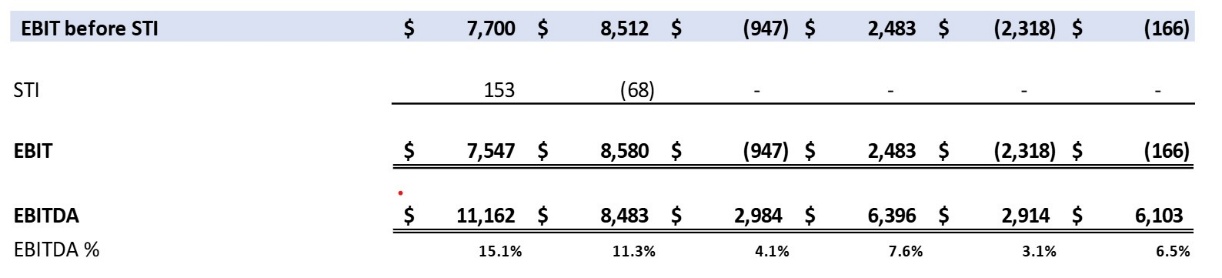
(2) by the Board meeting held on 24 January 2020, it was known that the Windows business was expected to deliver low single digit EBITDA margins for FY2020, and “the margin recovery plan expected to see the business achieve double digit margins in the medium term”; and
(3) the assessment of EBITDA margins continued to undergo refinement into February 2020.
592 The ARC held a meeting on 20 November 2019 at which the ARC noted the BNA – Windows Investigation Paper that had been circulated by email to the directors the evening prior. The BNA – Windows Investigation Paper set out the accounting activity that had occurred; the matters that remained unknown; the action taken immediately upon notification of the incident; the immediate and proposed changes to Management; the additional actions proposed; prior Internal Audit activity and action closure validation and a timeline of events since 29 October 2019.
593 As to the accounting activity that occurred, the BNA – Windows Investigation Paper recorded the following in relation to Legacy and Krestmark:
* For the balance of FY19, inventory continued to increase on a month-by-month basis (as noted in the table below). This included increases to Raw Materials and, to a lesser extent, Finished Goods. For example, at year-end, in order for the actual physical count results to reconcile to the trial balance amount, an additional 46 line items were added and finished good quantities modified totalling $5.5m which caused the inventory count to agree to the trial balance.

* During this time [that is, June 2018 to September 2019], cycle counts, and physical counts were conducted on periodic (typically quarterly) basis; it is understood that the General Ledger balances were never adjusted to reflect the results of the counts. The current inventory valuation methodology in FeneVision consists of valuing inventory at historical cost. All purchases are expensed to the income statement, estimated adjustments for material costs are made on a monthly basis to close out the P&L. On a quarterly basis the trial balance amounts were to have been trued up to the actual accounts.
* KPMG (External Auditors) were on-site and inspected / participated in the physical count at June 2019.
* While the Legacy site was the initial focus upon identification of the balances, it is believed that a similar issue exists in Krestmark inventory where balances have increased from approximately $6m at the beginning of the year to $13m by 30 June 2019.
* Collectively, the two inventories may be overstated up to $12m.
594 To summarise, physical counts of inventory had occurred at Krestmark and Legacy typically on a quarterly basis, and those counts were to be reconciled with the general ledger (being Great Plains). What the BNA – Windows Investigation Paper indicated is that the required physical count was occurring at the Krestmark and Legacy plants, but the general ledger was not being updated to reflect the results of the physical counts.
595 The final two dot points reproduced (at [593]) above demonstrate that, at this time, Boral was being informed that the issue to which Mr Phillips had confessed was not limited to Legacy but also included Krestmark.
596 In relation to the actions taken to date and changes to management, the BNA – Windows Investigation Paper noted that Mr Phillips had been suspended with all system access removed. It also noted that Internal Audit, before the incident became known, had been scheduled to undertake an audit and was on site conducting assurance activity over Asset Maintenance (at Krestmark/Legacy), Procurement and FeneVision, but that the scope of its audit would now be limited so as not to overlap with the investigation by Alston & Bird.
597 On 18 November 2019, Mr Aurelius sent what may aptly be described as an alarming email to Mr Post:
Oren,
Do you recall this report?! [being the attached Magnolia Special Review Results Memorandum] This is the first time I’ve seen it and I can’t see it having been reported to the ARC.
It’s a special request re: Magnolia, for exactly the same issue we’re seeing now. What’s curious is that it relates to activity up to December 2017, and then it appears process changes were made and personnel removed. But then no more than 18 months later we have a new controller resigning over basically the same issues.
And now we have exactly the same issues at Legacy and Krestmark, so who knows how long this has been going on?
David
598 Mr Aurelius was mistaken in his email to Mr Post regarding the reporting of the Magnolia Special Review to the ARC. That audit was reported to the ARC on 13 August 2018. But in any event, as Mr Aurelius observed, the conduct in which Mr Krisel had engaged more than 18 months earlier at Magnolia was similar to the conduct identified in the allegations Mr Tinkey had made to Mr Becker and the BNA HR representatives some six months earlier. As explained above, however, that similarity does not establish that the substance of Mr Tinkey’s allegations was then known to any relevant officer of Boral.
599 The minutes of the ARC meeting of 20 November 2019 record that, in addition to the ARC noting the BNA – Windows Investigation Paper, the ARC also noted the following in relation to the Windows Investigation:
* urgent mitigating actions are underway to secure the relevant information for further review, suspend certain finance personnel within the Windows business, install new trusted finance and other personnel and work through additional Management controls as appropriate.
…
* the above information is highly uncertain at this point in time, and various matters remain unknown, including root cause, ongoing impact on margins and profitability, possible motive and whether there has been a cash loss or whether theft could have been involved.
600 The minutes also record that the ARC:
requested that further work be undertaken on an urgent basis, including in respect of reviewing Boral’s processes and controls, with an update to the Board at its next meeting scheduled for 5 December 2019, unless there are material developments in the meantime that the Board should be made aware of.
F.14.3 Factual Conclusions from Discovery of Financial Irregularities
601 From the above factual narrative, I reach the following conclusions. These conclusions concern the actual discovery, commencing in late October 2019, of the particular Legacy discrepancy, the involvement of Mr Phillips and the increasingly precise nature and extent of the manipulation. To repeat, they should not be understood as identifying the first time at which Boral became aware, within the meaning of Listing Rule 19.12, of the information addressed below in section H.4.2.
602 On 7 November 2019, Mr Phillips admitted to having adjusted the physical inventory count at Legacy, in an amount of approximately US$5 million (see [584]). This was reported to Ms Ng and Mr Post by 7 November 2019. Mr Mariner was told of this by 8 November 2019, and Mr Kane knew this by 9 November 2019.
603 Physical counts had been conducted periodically at Legacy and Krestmark, but the general ledger balances were never adjusted to reflect the results of those counts. Instead, the physical count was adjusted. For instance, at one year-end, an additional 46 line items were added and finished goods quantities modified, totalling $5.5 million so that the physical count would agree with the trial balance. On this basis, the two inventories were assessed as potentially overstated by up to US$12 million (see [593]).
604 Mr Phillips’ admission followed a discrepancy between the physical count and the general ledger, first flagged by Mr Becker to Mr Post on 29 October 2019, and confirmed by Mr Becker on 4 November 2019, as “a large discrepancy in the physical count and GL” which he was, at that time, unable to quantify or explain (see [577]–[579]).
605 As a matter actually identified and reported in that form, the emergence of a discrepancy of that magnitude was qualitatively different from the earlier “adjustments” identified at Magnolia. Unlike the Krisel and Tinkey incidents, which had involved adjustments of less than US$1 million and had been explained to those outside Windows as confined accounting or reconciliation issues, the Legacy discrepancy involved a substantially larger amount and was soon accompanied by an admission from Mr Phillips that he had adjusted the physical inventory count.
606 The specific Legacy discrepancy, once identified and reported in that form, was escalated more rapidly than the earlier issues. The evidence demonstrates that Boral personnel recognised that the magnitude and nature of that particular discrepancy required investigation beyond the level of the business unit. This is reflected in the steps taken shortly thereafter, including the initiation of a more formal investigation process and the preparation of an investigation paper. The investigation involved both internal inquiries and the engagement of external advisers. In particular, Boral engaged Alston & Bird to conduct an investigation, with the assistance of EY ([587]–[598]).
607 That course of actual escalation stands in contrast to the earlier treatment of Mr Tinkey’s email, which did not progress beyond Mr Becker and the BNA HR representatives involved, and in respect of which those representatives relied upon the apparently innocent explanation provided by Mr Becker. For reasons already given, the difference in the treatment of the two matters does not establish that any relevant officer had, or ought reasonably to have come into possession of, Mr Tinkey’s email in May 2019. It explains why the allegations made by Mr Tinkey did not then lead to the investigation which commenced in November.
608 The events commencing in late October produced actual knowledge of the particular Legacy discrepancy, an admission by one participant and, through the ensuing investigation, increasingly precise information concerning the mechanisms, participants and quantum of the manipulation. The engagement of external legal and accounting advisers demonstrates that the Legacy discrepancy was then understood to require investigation beyond an ordinary accounting adjustment. But, again, this does not establish that Boral first became aware in November (in the Listing Rule sense), of the other pleaded information which I find existed (as I explain in detail below).
F.15 5 December 2019 Announcement
609 On 4 December 2019, Ms Kylie Fitzgerald (Boral’s Group Communications & Investor Relations Director) sent Ms Ng, Mr Sullivan, Mr Post and Mr Mariner an email attaching a document entitled “DRAFT as at 4.12.19 as at 5.30pm EST, Windows Announcement Q&A December 2019”. The document contained 23 draft questions and answers in advance of Boral’s disclosure, including the following:
4. Why did it take such a long time for the issue to be discovered?
* One of the biggest contributors to the extended time it took to identify the issue is the apparent involvement of a number of individuals within the Windows business. The Windows business had increased ability to conceal accounting issues as they are not part of the shared business services group, which limits the independent financial oversight in other businesses in North America, and their IT systems are stand alone and relatively unsophisticated, enabling posting and approval of entries by the local finance time.
* Inquiries into the rising nature of balances were responded to with assertions that increased materials and finished goods were necessary due to the disruption of the business (with a new competitor entering the market), in support of increased sales volumes (Legacy up +55% in window volume), and particularly to allow the business to meet demand which was discussed to have been pent up due to the excessively and record wet conditions across the Texas markets.
FURTHER BACKGROUND – NOT SUGGESTED FOR DISCLOSURE:
* Internal Audit performed three recent reviews of the Windows business (October 2017, February 2018 and January 2019) and are currently finishing the November 2019 review. The inventory management process was highlighted as a finding in the October 2017 review (for Krestmark and Legacy), purely on the basis of an absence of a perpetual inventory system.
* The additional reviews included revisiting inventory management controls (for Magnolia only) in February 2018 at management’s request. While it was noted there was a perpetual inventory system (within the WinSys system), inventory records were not adequately maintained and reconciliations were not being performed timely. This culminated in a difference of $650k between perpetual records and physical inventory at 31 December 2017.
* Given the Windows business was still in the process of implementing the necessary inventory system functionality across all three sites, inventory management was not included in the January 2019 review and would be included in the November 2019 review. It was during this period that the valuation issue escalated. As a result of the incident, and subsequent investigation, inventory management was removed from the scope of this audit.
5. Why wasn’t this communicated to the market sooner?
* When the inventory level issues were drawn to the attention of Group management and the Board, an immediate investigation into the matter commenced.
* The situation has been evolving during the investigation.
* While the investigation is still progressing, our communication to the market coincides with us having increased certainty around the extent and financial impact of the issue.
…
7. Why didn’t the auditors pick this up sooner?
From an internal audit perspective:
* Windows was part of the internal audit program[me] in October 2017 and January 2019, and was scheduled to be reviewed in November 2019.
* During the October 2017 internal audit, issues were identified around inventory management, system access and segregation of duties, with several other needed improvements identified. All issues (apart from inventory management) were reported as completed by management. The January 2019 audit noted continued gaps around procure to pay (but did not include Accounts Payable reconciliation controls).
* The scheduled November 2019 internal audit would have been confirmed if the identified issues had been addressed or proven otherwise, which may have been the trigger for self-reporting of the issue by an individual involved in the misreporting.
In terms of our external auditors:
* Given the relative size of the windows business, the KPMG audit plan for FY19 set the scope for the Windows business as audit of specific account balances, which included Inventory, but not payables. The audit was performed based on Group materiality relevant to Boral North American business as a whole, not at a Windows level.
* Approaching the year ended 30 June 2019, KPMG attended physical stock counts at Krestmark, Legacy, and Magnolia, amongst other procedures. Sample counts (floor to sheet and sheet to floor) did not identify any significant discrepancies and samples were followed through to general ledger records.
FURTHER BACKGROUND ON INTERNAL AUDIT – NOT SUGGESTED FOR DISCLOSURE
* In the October 2017 Audit, controls testing was performed over the Procure to Pay (P2P process. The scope included the purchasing process and vendor Masterfile activity (vendor set-up, change management and user access). However, testing Accounts Payable subledger and General Ledger reconciliation processes and controls (including Supplier Statement reconciliation testing) was not part of the P2P scope area.
* General accounting controls were also included in scope, and included testing of reconciliations and assessing sufficiency of supporting documentation. However, this audit was outsourced and we are awaiting the exact testing schedules to be provided.
* For the January 2019 audit, Procure to Pay was again in scope and, similar to the previous internal audit (in October 2017), reconciliation controls were not specifically included. The reason being was that the planned audit for November 2019 was to include General Accounting controls as well as Inventory Management and Valuation.
….
F.15.1 ASX Release of 5 December 2019
610 On 5 December 2019, Boral made an announcement entitled “Financial irregularities in Boral’s North American Windows business” (BOR.602.067.7108). Given the significance of its precise terms to the issues which will follow in this case, it is appropriate to set out its substantive contents:
Financial irregularities in Boral’s North American Windows business
Boral advises that it has identified certain financial irregularities in its North American Windows business, involving misreporting including in relation to inventory levels and raw material and labour costs at our Windows plants.
With oversight by the Board and senior management, a privileged and confidential investigation is being conducted by lawyers retained by Boral, who have also engaged forensic accountants to assist the investigation. This is being treated with the highest priority.
The investigation is ongoing so details are preliminary at this point but the irregularities appear to relate to the period between September 2018 and October 2019.
Based on information currently available, it is estimated the irregularities relating to the period between September 2018 and October 2019 will result in a one-off impact on earnings before interest, tax, depreciation and amortisation (EBITDA) in the order of US$20 million to US$30 million.
Any potential ongoing impact on earnings from the Windows business (beyond October 2019) is still being determined.
Boral’s CEO & Managing Director, Mike Kane said that the Company is committed to thoroughly investigating the matter and taking appropriate action.
“We are undertaking a comprehensive and urgent investigation of this matter to fully understand the events and what we need to do in order to address the problem. We have implemented immediate steps to bolster the management and controls within this business. Once we have all the facts, we will ensure that appropriate action is taken at all relevant levels.”
In addition to the measures already taken, Boral is reviewing its management, operating procedures and internal control processes for its Windows business and will adapt that review as the investigation results become clear.
This matter was not factored into Boral’s first half and full year FY2020 guidance provided at its Annual General Meeting on 6 November 2019.
A brief conference call for investors in relation to today’s announcement will be held tomorrow morning, 8:30 am Friday 6 December. …
(Errors in original)
611 Several features of the announcement are relevant.
612 It described the matter expressly as “financial irregularities” involving misreporting in relation to inventory levels and raw material and labour costs. It said that the investigation was ongoing and that the details were preliminary. It identified an apparent period of approximately 14 months and estimated a one-off EBITDA impact of US$20 million to US$30 million, while stating that any ongoing impact beyond October 2019 was still being determined. It also disclosed that immediate steps had been taken to bolster management and controls within Windows, that Boral was reviewing its management, operating procedures and internal control processes for that business, and that the matter had not been factored into the FY20 guidance given at the AGM on 6 November 2019.
613 Between the close of the market on 5 December and 6 December 2019, the price of Boral shares fell from $4.92 to $4.61, or approximately 6%.
614 On 6 December 2019, Boral convened a call with investors. During that call, an equity analyst asked Mr Kane to clarify the allocation of the US$20 million to US$30 million across the financial years. In response, Mr Kane and Ms Ng made clear that investigations were ongoing.
615 Mr Aurelius emailed members of the Internal Audit team on 6 December 2019, reflecting on the matters that had arisen. He wrote about “big learnings for our team”, which were “the diligence we need to apply to validating the closure of actions, ensuring the control improvements continue to consistently [sic] operate effectively and to call out where actions continue to have due dates extended (which we need to report to [the] ARC on)” as well as “that our audit testing needs to cover entire populations where we can identify anomalies more easily”.
616 On 9 December 2019, Mr Aurelius responded to an email from an internal auditor. In that email, he complained about the manner in which the Tinkey Incident was dealt with in the following terms:
Re: the previous controller at Windows, yes, he raised concerns (I’ve actually seen the email). It was raised in May, and it went up through BNA HR, then got pushed back down into the Windows business to investigate. The current investigation is looking into this sequence of events. It’s a fundamental breakdown in awareness and communication. This is the one aspect of this whole mess that bothers me more than anything, because had it been escalated in accordance with Fraud policy, I’d have known in May and we’d have uncovered the issue before year end.
617 On the same day, Mr Aurelius sent some newspaper reporting to members of the Internal Audit team, which included “[a] series of internal audits failed to detect the irregularities at Boral’s US windows plants between September last year and October this year”. Mr Aurelius’ comment on this report was “[c]ertainly a few misrepresentations on internal audit, not sure we failed to detect. Think it was more the business failed to listen and take action”.
618 Boral sought to diminish the significance of Mr Aurelius’ observations in the above documents by submitting that he “had no special insight … above and beyond any employee at Boral”. That submission is heroically ambitious, particularly insofar as it seeks to place Mr Aurelius in a position comparable to that of any Boral employee.
619 Mr Aurelius was the Global Head of Audit at the time, reported directly to the ARC and assisted Ms Ng in preparing the paper for the ARC concerning the Windows investigation. He plainly had relevant insight into the internal audit and reporting processes. But his observations were made retrospectively, after the financial irregularities had been discovered and the investigation had commenced. His view that, had the Tinkey allegations been escalated in accordance with the Fraud Reporting Policy, he would have known of them in May, and the broader issue would have been uncovered before year end describes a counterfactual course of investigation. Again, it does not establish that any officer of Boral had, or ought reasonably to have come into possession of, Mr Tinkey’s email or its substance in May 2019. Moreover, it does not provide the basis for my conclusion concerning Boral’s awareness on 26 August 2019, which, as I will explain, rests independently upon the information that ought reasonably to have come into the possession of the relevant officers through the proper performance of their responsibilities in the FY19 reporting and approval processes.
F.16 Events Leading up to and including the 10 February 2020 Announcement
620 Before turning to these events, it is appropriate to explain their limited significance to the issues requiring determination. The applicants do not allege that Boral contravened its continuous disclosure obligations after 5 December 2019, and my ultimate conclusion as to awareness does not depend upon matters subsequently uncovered in the investigations conducted after the December announcement.
621 Care must therefore be taken not to reason backwards from the more complete understanding attained in January and February 2020, or to treat facts then discovered as demonstrating, merely by reason of their later discovery, what an officer knew or ought reasonably to have known at an earlier time. Nevertheless, the parties devoted considerable attention to this evidence, and parts of it assist in identifying the ultimate financial consequences of the manipulation; explaining how it had evaded earlier audit procedures; and distinguishing the preliminary information disclosed on 5 December 2019 from the more complete and quantified position announced on 10 February 2020. Consistently with the approach explained at [115]–[116], I will therefore record the principal events and address the parties’ submissions concerning them, while keeping their limited relevance to the anterior questions of awareness and liability firmly in mind.
F.16.1 Third Windows Audit
622 On 16 January 2020, a draft report for the Third Windows Audit, which had been undertaken in December 2019, was circulated by Mr Aurelius to Mr Spear and Mr Charlton. The draft report is similar to the final report that was provided to the ARC in February 2020.
623 Unsurprisingly, the audit was red-rated. The draft report refers to “fraudulent” activity which had occurred and cited the ongoing investigation as a reason for limiting the scope of the audit to asset maintenance, and some aspects of the procure to pay and general accounting processes.
624 In relation to the “high” rated finding concerning general accounting, the observation was “[i]nsufficient segregation of duties relating to journal entry and approval in Great Plains”. The key observations were:
(1) any of 13 users with the relevant access could enter a journal;
(2) there was one administrator password for the business that allowed the user to approve a journal entry in Great Plains, meaning anyone with access to enter journal entries (i.e. the 13 users identified above) who had the password could self-approve their own journals; and
(3) the user who entered a journal was not shown on the journal screen on Great Plains, though this information was accessible via the database.
625 It will be recalled that a similar segregation of duties finding (rated “high”) was made as long ago as in the First Windows Audit. Indeed, the agreed action which related to that finding was the implementation of the control which was found to be deficient in the Third Windows Audit, and the issue was later described by Internal Audit as a “recurring finding”.
F.16.2 Board Meeting on 24 January 2020
626 On 24 January 2020, the Board met to discuss, inter alia, the Windows investigation. Ernst & Young and Alston & Bird presented to the Board. Aside from the directors, Mr Kane and Ms Ng, Mr Mariner and Mr Post were also in attendance.
627 The minutes record that the Board discussed:
(1) the report by Alston & Bird entitled “Preliminary Report on Internal Investigations Concerning Financial Irregularities at Boral Windows” dated 21 January 2020 and marked “Privileged and Confidential, Subject to Attorney-Client Privilege, Attorney Work Product”; and
(2) a paper prepared by Mr Aurelius entitled “Internal Audit – Windows Internal Audit Activity – Summary” dated 22 January 2020 (Windows Internal Audit Activity – Summary Paper).
628 The minutes also record that Boral noted and discussed matters that included the following:
(1) the investigation determined that finance personnel within the Windows business manipulated accounts and financial statements primarily to inflate artificially the overall profitability and health of the Windows business;
(2) the investigation found no evidence that the manipulations were to hide systematic theft of raw materials or finished goods inventory;
(3) the misconduct occurred over an approximately 20-month period to the end of October 2019;
(4) as set out in the financial summary in the report, pre-tax earnings were overstated by an amount broadly in line with Boral’s preliminary estimated impact on EBITDA of US$20 million to US$30 million announced on 5 December 2019.
629 The Windows Internal Audit Activity – Summary Paper noted:
Why were the accounting irregularities not identified through internal audit testing?
The primary factor as to why the accounting irregularities were not identified by Internal Audit was the existence of collusion within the Windows finance function.
However, the other key factor related to the timing and scope of internal audit activity …
Another key factor was that the Windows business was not part of the broader Boral North America Shared Business Services function, which would have acted as an independent processor and monitor of back office transactions (such as journals, payments and collections).
630 Mr Aurelius disagreed with the “primary factor” identified in this board paper. In a comment bubble in a draft version of this document, a comment by “DA”, which it is inferred referred to Mr Aurelius, stated “not really the primary reason” and then continued to comment to the effect that the main reason related to the timing and scope of Internal Audit’s activity.
631 On 25 January 2020, presumably as a consequence of the previous day’s Board meeting, Mr Kane took steps to procure Mr Mariner and Mr Post’s attendance at the next board meeting, which was to take place on 29 January 2020. Mr Kane emailed Mr Millgate (Boral’s corporate secretary) and Mr Mariner:
Send David and Oren the timeline document about the Magnolia finance persons [sic] resignation letter. I don’t think they have access to it.
…
David – for next weeks [sic] call you and Oren need to be prepared, in addition to a further explanation of what you are doing to respond to market (and Karen’s question on Windows document ex Houston), yo[u] both need to tell [the] Board how we missed the opportunity presented by this Magnolia letter. Lastly, if controls were as bad as EY suggests how did KPMG, inside audit and Allan and Oren miss it?
632 I referred to this email in Parkin v Boral Limited (Loss of Privilege Issue) [2024] FCA 1039, and stated (at [113]):
What is presently opaque is the actual controls to which Mr Kane was referring, the time such controls were in place, and any explanation as to why Mr Kane believed that EY had concluded that the controls were, in an ambiguous, general and unparticularised sense, “bad”.
633 My characterisation of Mr Kane’s email was undisturbed on appeal: Boral Ltd v Parkin [2024] FCAFC 169 (at [32] per Perram, Colvin and Abraham JJ). But I used the word “presently” advisedly. Having now traversed the evidence, the “Magnolia finance persons [sic] resignation letter” is obviously a reference to Mr Tinkey’s email (see [486]). Further, it is apparent that EY had concluded that Windows’ controls were “bad”, and Mr Kane recognised that Mr Tinkey’s (i.e. the “Magnolia finance person”) allegations were such that they presented an opportunity to have prevented further account manipulations.
F.16.3 Board Meeting on 29 January 2020
634 On 29 January 2020, another Board meeting was held at which the Board received a further progress update on the Windows investigation. At that meeting, Mr Mariner and Mr Post provided what was recorded as their “self-reflections and perspectives” on the Windows issues.
635 A document, which is undated and without an identified author, appears to contain Mr Post’s notes to prepare for his attendance (as directed by Mr Kane) at the Board meeting on 29 January 2020. The document commences as follows:
* Found EY statements around lack of controls in the business shocking!!!
* As heard from EY – created an environment where theft or misappropriation could occur
* With collusion of two or more key positions, particularly in the finance function – it would render some controls ineffective.
636 A timeline is then provided as follows:
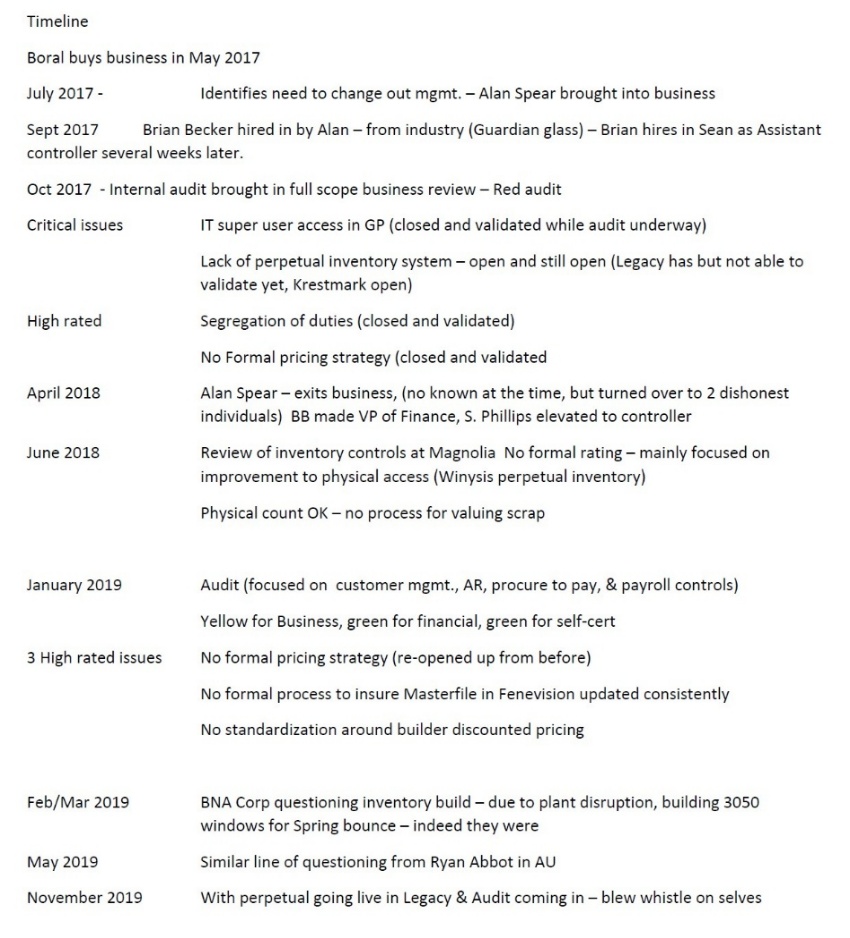
637 The document then provides some analysis of the controls which are said to have allowed fraud to occur:
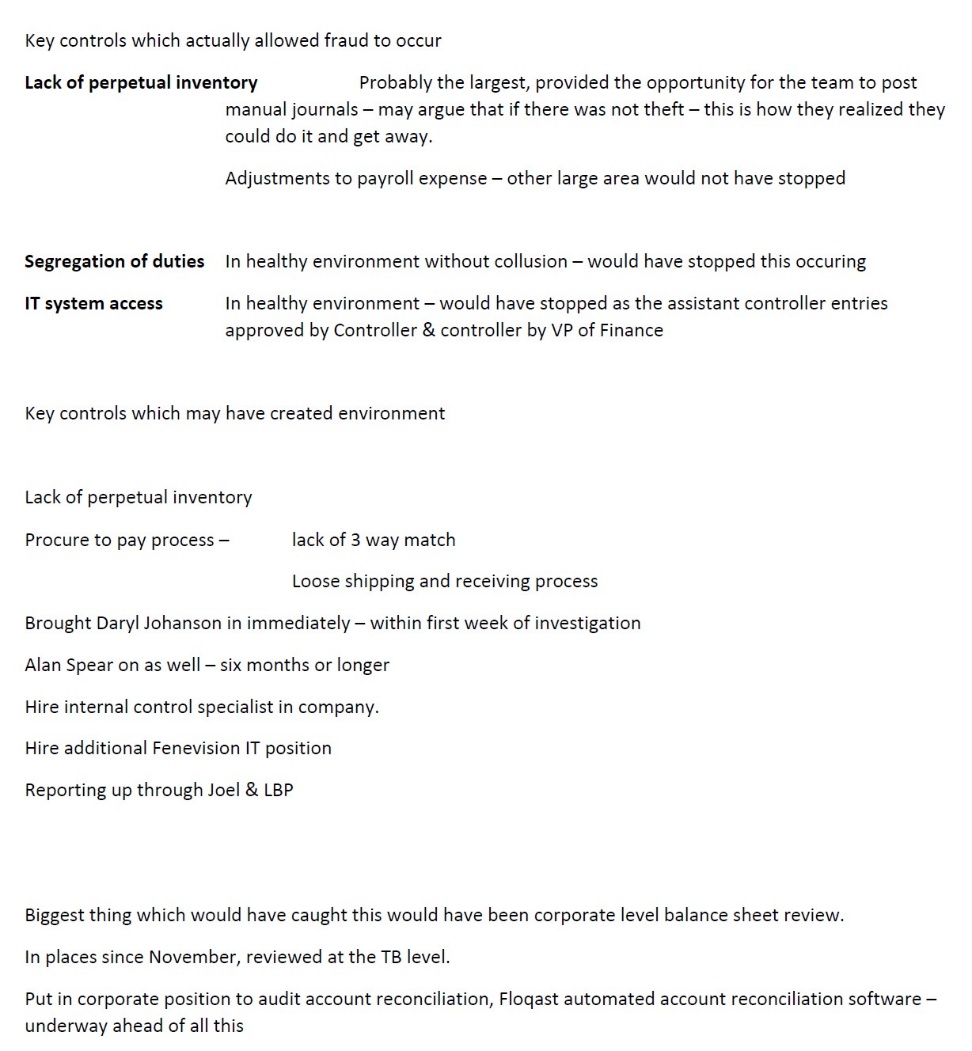
638 This document goes some way to demonstrating, albeit with the benefit of hindsight, the system and control weaknesses which permitted the accounting manipulation to occur. It is not possible to say the document reflects a complete articulation of the causes of the accounting misstatements, but it does show at least some elements.
639 A 31 January 2020 Remuneration & Nominations Committee (a Board subcommittee) paper reflects upon the consequences of the recent misreporting on Boral. It identified that the “flow on” impacts to Boral from this event and announcement included: a significant deterioration in share price at the time; reputational damage; and investor trust and confidence in Boral deteriorating.
640 On 7 February 2020, Mr Millgate sent Mr Rayner the divisional ARC questionnaires. The questionnaire prepared by Mr Post and Mr Mariner contained references to the restatement relating to Windows. The questionnaire, in effect, criticised Internal Audit’s approach to monitoring and following up on issues identified in the course of audits. It also contained an assessment of the risk of misstatement in the following terms:
The risk of material misstatement resulting from fraudulent reporting is higher where the financial control function is decentralised and not overseen by the shared service centre. As a result of the irregularities identified in the Windows business, additional assurance and audit procedures have been performed over the balance sheets of each business with no issues identified that would indicate a material misstatement in the financial statements.
641 On the same day, Mr Mariner provided input on questions and answers in advance of the 10 February 2020 disclosure. By this time, the investigation had shown that the misreporting occurred over 20 months between March 2018 and October 2019, and that it was done primarily to inflate artificially the overall profitability and health of the Windows business. It also referred to the introduction of additional processes and controls to strengthen segregation of duties and oversight and an expedited rollout of a new inventory management system.
F.16.4 Investigations and Reports by KPMG
642 In early February 2020, KPMG, who had been Boral’s external auditors during the period of the financial irregularities and who had undertaken their own investigations to ascertain how the financial irregularities had occurred, provided a report to Boral. A summary document set out the accounting activities that KPMG had performed at Windows as follows:
* Windows management held full inventory counts on 28 and 29 June at Krestmark, Legacy and Magnolia for the purposes of determining the inventory balance at 30 June 2019.
* The inventory count process followed by Windows staff was based on written instructions from Windows management to counters. Items were counted by a two person Windows team, with a tag system to mark counted items. Counts were verified by a Windows supervisor.
* A KPMG representative attended each of the inventory counts at Krestmark, Legacy and Magnolia on the day of the count. A senior plant representative accompanied the KPMG counter.
* Standard KPMG inventory account attendance procedures were carried out, which included assessment of the controls to ensure management counts were checked before finalization [sic] and controls over cut-off and completeness of recording were operating.
* KPMG representatives performed their own counts of sample of items based on KPMG sampling methodology which gave sample sizes of 39 at Krestmark, 24 at Legacy and 12 at Magnolia. KPMG counts were done both ways – ie sheet to floor and floor to sheet to cover completeness. Some minor differences between Windows count values and KPMG count values were identified. These were immaterial both individually and when extrapolated. There was no report of valued inventory by site provided for the sites and given to KPMG on the day of the count because on the inability of Windows inventory system to provide this information. Windows count amounts and costs were entered into the system based on the results of the inventory counts to arrive at an inventory value per site. The costed inventory listing based final counts was not available at the end of KPMG’s count attendance.
643 The document also explained how the data was manipulated:
This inventory quantity and cost report (for Krestmark and Legacy) was subsequently manipulated by Phillips (Boykin also appears to be aware of this manipulation) by adding rows and manipulating quantities - 33 rows (out of 2,531) at Krestmark and 64 rows (out of 1,089) at Legacy. Recorded quantities of counted inventory were also increased on 25 lines at Legacy and 324 lines at Krestmark. Phillips had knowledge of the items that were test-counted by KPMG when he manipulated the files. The manipulated file was presented to KPMG as the final inventory listing from the input of count values from the inventory count. This agreed to the adjusted general ledger inventory value post-count, and KPMG’s test counts were followed through to the listing without exception.
644 KPMG also considered the steps it could have taken that may have identified the manipulations:
* The manipulation of the files would likely have been picked up if:
* A costed final post inventory count listing was available at the end of the inventory count while KPMG were still in attendance (this was actually created post inventory count);
* KPMG had insisted that this was prepared by the site and waited until this was available (ie before Phillips had the opportunity to manipulate it); or
* The full population of count sheets at the completion of the count had been copied and retained by KPMG, and subsequent additional testing of completeness had been carried out by means of one to one checks against the final listing.
F.16.5 ARC Meeting on 9 February 2020
645 The ARC met on 9 February 2020. The minutes record that the ARC noted the following reports in relation to the Windows investigation:
(1) “Boral Limited, Windows Business - KPMG Response” dated 5 February 2020 (Windows Business - KPMG Response);
(2) “Internal Audit - BNA Windows - Prior Internal Audit Activity” dated 6 February 2020;
(3) “Internal Audit - BNA Windows - Future Internal Audit Activity” dated 6 February 2020;
(4) a paper by Ms Ng and Mr Gashel titled “Windows - accounting and reporting considerations” dated 6 February 2020; and
(5) a draft ASX release “Update on Boral’s North American Windows business” as at 6 February 2020.
646 The Windows Business – KPMG Response stated that it addressed:
KPMG’s re-cap of FY18 and FY19 Windows business audit scoping as part of the audit of Boral North America (“Boral NA”). It also sets out our hindsight assessment and our audit response to the issues identified.
647 As part of the Executive Summary, the Windows Business - KPMG Response observed that in FY18 and FY19:
* Management held full inventory counts at all 3 Windows locations on 28 and 29 June 2019. KPMG staff attended, observed processes and controls and performed sample counts (floor to sheet and sheet to floor).
* KPMG followed through the sample counts to final inventory listings (which reconciled to the GL) and did not identify any material issues.
648 As to why “the issue [was] not identified”, the Executive Summary stated, “Collusion between Windows personnel and manipulation of inventory records post inventory counts”.
649 The ARC also noted the paper from Mr Aurelius entitled “Internal Audit Report”, which reported upon the fieldwork for the Third Windows Audit that had commenced in November 2019. The Third Windows Audit Report noted “[d]uring the planning of the audit, fraudulent accounting was revealed to have been conducted during the FY19 and FY20 financial years” and that, given the subsequent external investigations that were being undertaken into that accounting, the Third Windows Audit focused on the asset maintenance process and some aspects of the procure to pay and general accounting processes (being matters that were not the focus of the external investigations).
F.16.6 Board Meeting on 9 February 2020
650 There was a further meeting of the Board on 9 February 2020 immediately after the ARC meeting. The papers presented at the meeting included a paper entitled “December 2019 and FY20 QF2 Update” dated 7 February 2020.
651 That paper, which was presented by Mr Kane, Ms Ng and Mr Mariner, considered the impact of the misreporting on Boral’s FY20 guidance. It provided as follows:
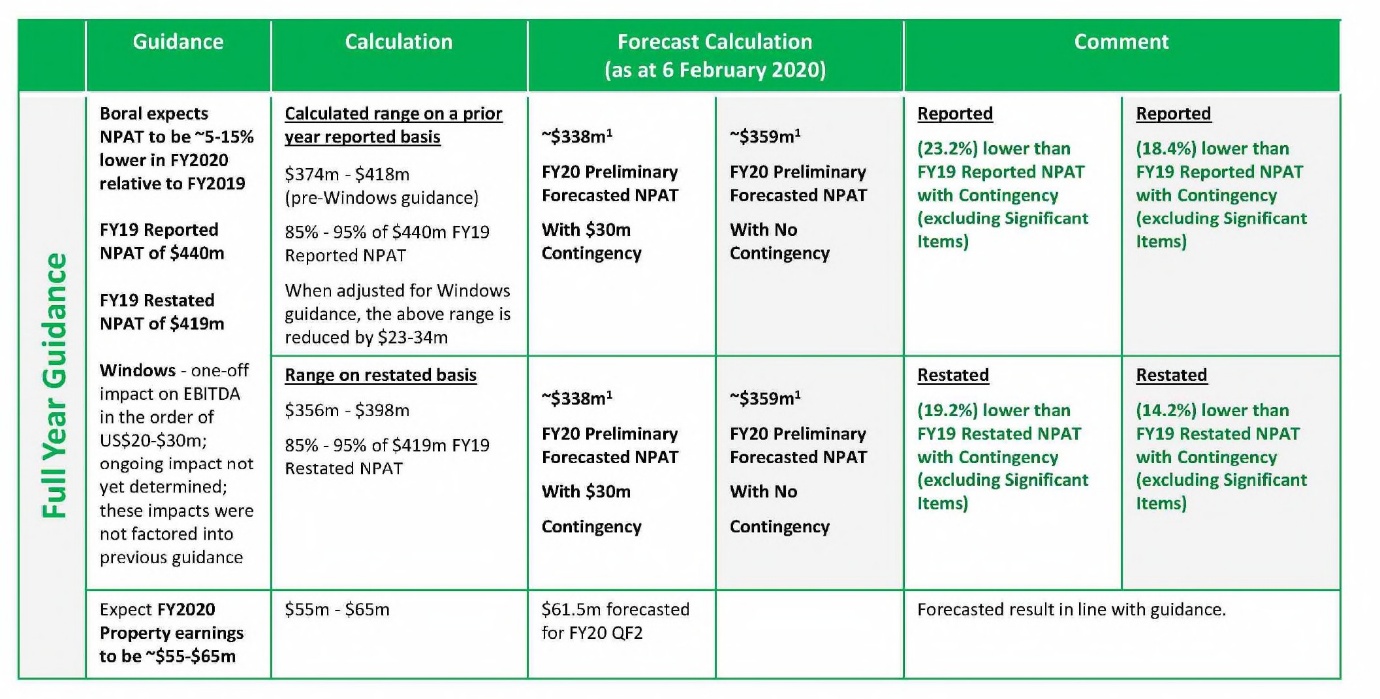
652 Mr Kane was taken to this table during cross-examination. The applicants contend that his evidence, in effect, was that the approach taken in this table, which involved adjusting the guidance to remove the erroneous overstatement of profitability in FY19, was inaccurate.
653 He was asked “[a]nd having changed the base figure because of the Windows issue what it shows, I suggest to you, Mr Kane is that that does translate into a downward adjustment; correct?” Mr Kane then explained that what the table represents is “an oversimplification of the process. But there’s no other way to do it, looking back retrospectively in the past. You can’t change any other assumptions. You can’t do something differently in the business to adjust for – for disappointment in one part of the business”: (T685.28–T685.33).
654 Mr Kane’s evidence was not that the document was inaccurate; rather, it was that changes to financial guidance, done retrospectively, have their limitations.
F.16.7 ASX Release of 10 February 2020
655 On 10 February 2020, Boral published to the ASX a covering letter dated the same day enclosing four documents: “Update on Boral’s North American Windows Business”; “Update on 1H FY2020 Results, FY2020 Outlook Guidance, Interim Dividend”; “Intended Retirement of Mike Kane, Boral’s CEO & Managing Director”; and “Reactivation of Dividend Reinvestment Plan” (10 February 2020 Release).
656 The 10 February 2020 Release included the following statements:
Update on Boral’s North American Windows business
On 5 December 2019 Boral Limited (ASX:BLD) advised that it had identified certain financial irregularities in its North American Windows business, involving misreporting including in relation to inventory levels and costs associated with raw materials and labour at its Windows plants.
Boral announced today that the privileged and confidential investigation undertaken by lawyers retained by Boral, and forensic accountants engaged to assist the investigation, had now been substantially completed.
The investigation determined that finance personnel within the Windows business manipulated accounts and financial statements primarily to artificially inflate the overall profitability and health of the Windows business. The investigation found no evidence that the manipulations were to hide systemic theft of raw materials or finished goods inventory. The misconduct occurred over an approximately 20-month period prior to the end of October 2019.
Together with audits and reviews of other businesses in Boral North America, which have also been undertaken, the Company can confirm that the financial misreporting is limited to the Windows business.
…
Impact on FY2020 and prior year results
Pre-tax earnings were overstated by a total of US$24.4 million between March 2018 and October 2019. This is in line with Boral’s preliminary estimated impact on earnings before interest, tax, depreciation and amortisation (EBITDA) of ~US$20 million to US$30 million. In addition, legal and associated investigation costs incurred in the first half are around US$1 million.
Boral will restate comparative financial information to incorporate the correction of Windows earnings in underlying results. Historic pre-tax earnings will be reduced by US$22.6 million, of which US$18.8 million relates to FY2019 and US$3.8 million relates to FY2018.
As part of the FY2020 interim results to be announced on 20 February, the restated prior period (1H FY2019) pre-tax earnings will be reduced by US$7m (A$10m). The accompanying table on page 3 shows these adjustments.
In a separate ASX release Boral has today issued an update in relation to the Company’s results for the six months ended 31 December 2019 (1H FY2020) and its FY2020 full year earnings guidance. This update uses Boral’s FY2019 adjusted earnings as a base.
…
(Emphasis in original).
657 The 10 February 2020 Release also stated that “KPMG has reported to the Board that the half year financial report of the Windows business and of Boral North America as a whole were fairly stated at 31 December 2019” and that “the employment of both the Vice President Finance and the Financial Controller in Windows have been terminated”.
658 The 10 February 2020 Release also included a table setting out the key contributing factors that made the misreporting of accounts in Boral’s Windows business possible, as well as the actions that were being taken to address them. The key contributing factors were identified as being that: “Windows is a relatively small, non-core business with less sophisticated accounting systems not integrated into shared services” and that “Finance personnel in Windows who engaged in the manipulations operated in an environment where business processes and culture were not acceptable, creating an opportunity for coordination and cover-up of wrongdoing”.
659 The significance of the period identified in the 10 February 2020 announcement should not be understated. The overstatement was said to have occurred between March 2018 and October 2019. That period included not only the time after the 26 August 2019 FY19 Results announcement, but also much earlier periods. It therefore encompassed a substantial portion of the Relevant Period and made plain that the issue was not confined to events immediately preceding the December 2019 disclosure. The effect of the announcement was to demonstrate that the accounting irregularities had persisted over a lengthy period and had affected reported results during that time.
660 The 10 February 2020 Release also represented the point at which Boral’s public characterisation of the issue moved from identifying “financial irregularities” in a general sense to articulating the financial outcome of those irregularities in quantified terms. The language of the announcement, that “[p]re-tax earnings were overstated by a total of US$24.4 million”, was more direct and more exact than the December 2019 announcement. It no longer spoke only in terms of an estimated one-off impact on EBITDA but identified that earnings had in fact been overstated over a defined period. That distinction is of some importance because it reflects the difference between an ongoing investigation and one that had, in substance, reached a concluded view as to the financial effect of the conduct uncovered.
661 The 10 February 2020 Release also needs to be understood against the background of what had been disclosed to the market in December 2019. In December, the market had been told that irregularities had been identified, that the investigation was continuing, and that the likely EBITDA impact was between US$20 million and US$30 million. By February, the investigation had largely been completed, and the figure ultimately disclosed (US$24.4 million) sat within the earlier range. In that sense, the February announcement did not merely reveal a new order of magnitude; rather, it confirmed and crystallised the significance of the issue previously disclosed. It nevertheless did so in a more precise and more serious form, because it located the overstatement within Boral’s reported earnings over a sustained period.
662 The 10 February 2020 Release also marked the culmination of a process by which matters previously treated as confined, explained or resolved had come to be understood differently. The earlier incidents at Magnolia had involved adjustments measured in hundreds of thousands of dollars and had been treated as localised. The Legacy issue had then emerged as a discrepancy in the order of US$5 million. By February 2020, the outcome of the investigation was that the Windows business had overstated pre-tax earnings by US$24.4 million over approximately nineteen months.
663 It is also relevant that the overstatement identified in the 10 February 2020 Release covered the period from March 2018 to October 2019, which included the time of the Tinkey Incident and the period leading up to the FY19 Results announced on 26 August 2019. The announcement therefore established, at least with the benefit of the investigation then largely completed, that the accounting practices later found to be irregular had been operating during periods in respect of which Boral had already reported financial results to the market.
664 The announcement of 10 February 2020 did not arise in a vacuum. It was the product of the investigation commenced after the Legacy discrepancy emerged in November 2019 and publicly disclosed in December 2019. The progression from November 2019 to February 2020 is therefore one in which Boral moved from identifying a serious issue in the Windows accounts, to disclosing irregularities and uncertainty, and finally to quantifying the overstatement of earnings over a defined period. That chronology is central to understanding both what Boral came to know and when it came to know it.
665 The importance of the 10 February 2020 Release for present purposes lies not merely in the figure of US$24.4 million, but in the way in which it retrospectively illuminated the significance of earlier events. It established that the issue was not a discrete Legacy anomaly, nor a series of unrelated incidents, but a pattern of accounting irregularity within the Windows business over time. At the same time, it is necessary to recognise that this understanding was reached only after the investigation had been undertaken with the assistance of external legal and accounting advisers.
G THE ISSUES FOR DETERMINATION AND RESOLUTION
666 In addition to the Agreed Facts document, the parties filed a “Factual and Legal Issues for Determination” document (Issues Document). I will not set it out because it contains some 130 separately enumerated questions and represents an attempt to distil the case, as originally pleaded, into a series of discrete issues said to require determination. Although it reflects considerable effort and no doubt was intended to assist, in substance it is a pleading-derived checklist which disaggregates the applicants’ case into many parts, which are repeated across different dates and expressed in alternative formulations which substantially overlap.
667 The structure of the document is readily apparent, because it identifies a series of categories of “information”, including what are described as the Non-integration of Windows Information, the Alternative Non-integration of Windows Information, the Inadequate Systems Information, the Inadequate Understanding of Headwaters Information, the Financial Reporting Information and a number of alternative formulations of overstated financial performance, margins, guidance, quantum and duration, and then poses, in relation to each such category and at a succession of dates, the same sequence of questions as to existence, awareness, general availability, materiality, the application of Listing Rule exceptions and contravention, while also overlaying those questions with a further series directed to alleged representations and misleading or deceptive conduct.
668 It is convenient to say at once that, although the document identifies the universe of matters which were at one point said to be in issue, it is a far from useful framework for determining the proceeding or for the preparation of reasons, because its granularity is excessive, its repetition is manifest, and it reflects the atomisation of the pleadings rather than the substance of the controversy, with the result that, if followed literally, it would require the Court to decide the same essential question repeatedly, merely because it has been expressed in slightly different language or attached to different dates, which is not how judicial decision-making is undertaken and not how reasons are properly written.
669 There is, however, a broader difficulty of which the Issues Document is a manifestation, and it is one which has become increasingly evident in complex class action litigation of this kind, namely that proceedings have a tendency to expand beyond what is necessary for their proper determination, as pleadings are refined and re-refined, alternative formulations are layered one upon another, issues are broken down into ever smaller components, and the evidentiary record grows in volume and complexity, with the result that what is presented as precision is often illusory, because the real controversy becomes harder, rather than easier, to discern.
670 This is not a matter of mere preference as to style or presentation, but goes to the proper administration of justice in a system in which the Court’s resources are necessarily finite and in which the time devoted to one proceeding by a judge is time which cannot be devoted to another, with the consequence that litigants with claims of their own, many of which are of vital importance to them (and some of which involve the liberty of the subject), are required to wait longer for their disputes to be heard and determined.
671 It is therefore incumbent upon parties, particularly in representative proceedings brought under Pt IVA of the FCA Act, to have regard to Pt VB and actively assist the Court by identifying and presenting the real issues in a way which is manageable and proportionate, rather than by multiplying permutations which add to the burden of the case without real forensic benefit.
672 The Issues Document does not advance that objective; it is, as I have said, an artefact of the pleadings, and although it identifies the range of matters which were said to arise, it does so in a way which fragments what is, in substance, a more confined controversy.
673 Although the case was pleaded and advanced in a complex and highly particularised form, the numerous pleaded formulations may, for the purpose of determining the continuous disclosure case, be understood as presenting two broadly different routes to liability. The applicants had earlier recognised that the case was best understood by reference to three “inflection points”, but the two cases that mattered emerged during the hearing (and following preliminary views I formed concerning the case).
674 The first is the applicants’ broader case, which seeks to establish awareness and contravention at an earlier time by reference to non-integration, systems deficiencies, the asserted warning signs and, in particular, the investigation said to have been required following the Tinkey Incident; the second is the more confined case concerning the information pleaded in 2FASOC [61A] and the position reached by 26 August 2019 (the FY19 results date). Both routes were addressed by the parties and require determination, although, for reasons which I will explain, only the latter succeeds.
675 The first, broader case, seeks to attribute contraventions to an earlier period by reference to matters such as non-integration, systems deficiencies, an asserted lack of understanding of the acquired business and a series of matters said to amount to “red flags”, and proceeds on the footing that those matters, taken either individually or cumulatively, constituted material information which should have been disclosed and, in the applicants’ case, also bore upon a wide range of statements made over time. As I will explain below, when the evidence is examined in its proper temporal and commercial context, it becomes apparent that this way of putting the case depends upon treating those earlier matters as if they had a degree of coherence and significance at the time which they did not in fact possess.
676 The second, narrower case, focusses upon the Alternative Financial Reporting Quantum and Duration Information pleaded in 2FASOC [61A] and the position reached by 26 August 2019. It does not depend upon establishing that Boral was aware of that information at the time of the Tinkey Incident or upon attributing to Boral the results of an investigation which might then have been undertaken. It proceeds instead upon the footing that, by 26 August 2019, Boral had completed the processes necessary to prepare, consider and approve its FY19 Results and FY20 guidance, and that the reasonable performance by the relevant officers of their duties in those processes ought to have brought the substance of the information pleaded in [61A] into their possession. On this case, the disclosure obligation arose on 26 August 2019 and continued until Boral’s announcement on 5 December 2019. The events occurring after 26 August remain relevant to the identification and confirmation of what had occurred, but do not provide the starting date of the contravention alleged on this narrower basis.
677 As I will explain, the broader continuous disclosure case required the Court to conclude that matters which were, at the time, capable of being understood as isolated, explained or remediable issues, or as aspects of a complex post-acquisition environment, nonetheless constituted material information of the kind which engaged the continuous disclosure regime. That conclusion is not supported by the evidence when regard is had to the information which was (or was not) known to, or ought reasonably to have come into the possession of, Boral’s officers at the relevant times.
678 That is not to say that the earlier matters are unimportant; on the contrary, they provide essential context, illuminate the control environment within which the Windows business operated, and explain how it was that the later irregularities could arise and persist, but their significance lies in that contextual role.
679 The narrower case is different. As noted above, it is directed to the Alternative Financial Reporting Quantum and Duration Information pleaded in 2FASOC [61A] and to the position reached on 26 August 2019. The relevant distinction is not merely that the events had, by then, assumed a more serious complexion. It is that Boral had completed the processes necessary to prepare, consider and approve its FY19 Results and FY20 guidance, and the reasonable performance by the relevant officers of their responsibilities in those processes ought to have brought the substance of the information pleaded in [61A] into their possession.
680 It is important to preserve the distinction between that conclusion and the broader case advanced by the applicants. I do not find that the Tinkey Incident, the earlier audit findings, the systems deficiencies or the other asserted warning signs themselves gave rise to awareness of the pleaded information at an earlier time. Nor do I reason that those matters should have prompted an investigation which, had it been undertaken, would have revealed the financial manipulation (for reasons already given, that course of reasoning would encounter the difficulty identified in Zonia).
681 The analysis which follows must accordingly distinguish between, on the one hand, the various broader categories of information which the applicants contend existed and required disclosure at earlier times and, on the other, the particular information pleaded in [61A]. As to the latter, the questions are whether that information existed by 26 August 2019; whether, through the FY19 reporting and approval processes, Boral was then aware of it within the meaning of Listing Rule 19.12; whether it was generally available and material; whether any exception applied; and if not, the period during which the resulting disclosure obligation remained unfulfilled.
682 Events occurring after 26 August 2019, including the discovery and investigation of the Legacy discrepancy and the later quantification of the financial manipulation, remain relevant in confirming the nature, duration and financial effect of the conduct which had occurred. They do not, however, provide the foundation for attributing constructive awareness to Boral on 26 August by reasoning backwards from matters discovered later but unknown at the time. That would be to engage impermissibly in the kind of hindsight reasoning also rejected by the Full Court in Zonia.
683 I will therefore address the applicants’ broader categories of information sufficiently to explain why they do not establish any earlier contravention, before turning to the Alternative Financial Reporting Quantum and Duration Information pleaded in [61A].
H THE RELEVANT INFORMATION AND MATERIALITY
H.1 The Non-integration of Windows Information and the Alternative Non-integration of Windows Information
684 The applicants identified, as a discrete category of information, the Non-integration of Windows Information, and by a further alternative formulation, the Alternative Non-integration of Windows Information.
685 The primary formulation is pleaded by reference to the continuation, within the Windows business following the Headwaters acquisition, of a standalone legacy ERP system separate from that used by Headwaters and/or BNA (2FASOC (at [56(a)])); the non-utilisation by Windows of Boral’s shared business services function (being the Boral Shared Accounting Service or BSAS) (2FASOC (at [56(b)])); the absence of adequate integration and effective controls between Windows’ inventory systems and the general ledger which was part of the accounting and/or financial reporting systems for BNA and Boral (2FASOC (at [56(c)])); and the absence of adequate controls and supervision over the making and approval of entries in Windows’ accounting system (2FASOC (at [56(d)])). By the alternative formulation, the information is pleaded as the non-integration of Windows into the BSAS and/or into the systems used to report on and forecast BNA’s financial performance (see 2FASOC (at [57])).
686 Questions 10, 11 and 14 to 17 of the Issues Document are directed to whether each of those categories of information existed, whether Boral was aware of them on or after 30 August 2017, and whether, at the time of awareness, the information was generally available, material and required disclosure.
687 As is evident, the applicants did not merely plead as a background fact that the Windows business, following the Headwaters acquisition, continued to operate using separate legacy systems and processes. They went further and alleged that this state of affairs constituted “information” of a relevant kind, being information which, as they put it in substance, revealed that the Windows business had not been integrated into Boral’s systems and processes.
688 The same conception of the case was maintained in closing submissions, albeit there the terminology shifted somewhat, because the applicants grouped the pleaded Non-integration of Windows Information in 2FASOC [56] and the pleaded Inadequate Systems Information in 2FASOC [64], together with what they described as “various permutations of those core concepts” in 2FASOC [57] and [65], into what they called “Item E”, namely that Windows’ accounting and financial systems did not have adequate or effective controls, or adequate integration between inventory systems and Boral’s accounting systems, and that these matters “conceptually relate to a systemic situation of weakness which had the potential to, and ultimately did, permit the financial manipulation to occur”.
689 This grouping reflected the applicants’ reliance on both the factual and expert evidence, including the systems evidence and the financial expert evidence, to contend that the absence of integration increased the likelihood of misstatement and reduced the effectiveness of controls designed to detect discrepancies in inventory and financial reporting.
690 That reformulation is important, not because it alters the pleading (which it does not), but because it reveals how the applicants’ broader case on this topic was ultimately being put. It was not put as a case simply about post-acquisition “untidiness”. It was put as a case that the non-integration of Windows into Boral’s systems and processes itself conveyed, or at least materially contributed to, information of a systemic character, namely that there existed a weakness in the control environment of the Windows business which had the capacity to permit financial manipulation and which, on the applicants’ case, should have been understood by Boral and disclosed to the market.
691 The critical question is whether the evidence establishes the existence of that informational state at the relevant times, as opposed to demonstrating only the existence of system characteristics which, with hindsight, may be said to have created risk.
692 That inquiry must be undertaken by reference to the contemporaneous documents, including integration materials, audit reports and internal communications, together with the expert evidence concerning the design and operation of the systems in question.
693 The applicants called Ms Katherine Shamai of Grant Thornton and Boral called Ms Robyn McKern of McGrathNicol to give evidence concerning the systems and controls operating within Windows. They prepared a joint report and gave concurrent evidence. Although they differed about the reasonableness and adequacy of some controls, there was substantial agreement about the systems which existed and the work they required.
694 Most of this evidence was of limited or no assistance in determining whether the particular information pleaded existed, whether Boral was aware of it and whether it was material. The experts were principally concerned with whether particular systems or controls could be characterised as reasonable or adequate, whereas the real questions required identification of the information which existed at the relevant time, whether an officer possessed or ought reasonably to have possessed it in the course of performing his or her duties, and its likely significance to investors. Their exercise was also confined to Windows and did not establish the broader propositions advanced by the applicants concerning the systems and controls of BNA as a whole. One aspect of their agreement is, however, relevant. Because Windows’ inventory systems did not exchange information automatically with the general ledger, the inventory figures used for financial reporting required validation through physical counts and manual processes of comparison, reconciliation, review and adjustment. I return to that point below.
695 The other relevant evidence is plain enough. It is unnecessary to wade into the wealth of it. The factual narrative already set out demonstrates that before the Headwaters transaction, Boral did not operate any windows manufacturing business; that the Windows business came into the Boral group only through the acquisition of Headwaters completed on 8 May 2017; that the integration workstreams which followed the announcement and completion of the acquisition treated Windows as part of the “Other” stream, being Energy and Windows; that the Windows business itself operated through the plants at Krestmark, Legacy and Magnolia; and that it remained, functionally and operationally, a distinct business line within BNA.
696 The evidence further establishes that Magnolia itself had only recently been acquired by Headwaters prior to the Boral acquisition, such that the Windows business comprised operations which were themselves recently integrated at the Headwaters level, thereby reinforcing the existence of layered legacy systems.
697 These are not matters of controversy. They emerge from the agreed and documentary evidence concerning the acquisition, the integration planning materials, the restructuring of Boral USA into BNA, and the organisation charts and management arrangements post-completion. They also demonstrate that integration was, in practical terms, a staged process rather than an immediate outcome, and that the persistence of legacy systems in the short to medium term was an inherent feature of the acquisition.
698 The evidence also establishes, again without any real dispute, that the Windows business was not operating on a fully integrated system in the sense for which the applicants contend. As appears from the material on systems and controls, Windows operated on a periodic inventory system; there was no automatic integration between the inventory system and the accounting system; inventory values were not fed automatically into the general ledger through an integrated perpetual system; and the business necessarily relied upon manual processes, including physical inventory counts, variance reports and reconciliations, to align stock information with accounting records.
699 The applicants relied upon this as one of the central factual pillars of their broader case and Ms Shamai’s evidence, which they pressed, was that without automatic exchange of information afforded by a perpetual and integrated system, Boral was left relying heavily on “manual interventions” to ensure the information in the inventory and accounting systems aligned. She also expressed the view that accurate inventory records mattered because they bore directly upon the recorded value of one of Windows’ major assets and upon the general ledger and the tracking of profitability.
700 The contemporaneous audit material relied upon by the applicants included findings that discrepancies between physical inventory and recorded inventory required adjustment through journal entries, that reconciliation processes were critical controls within that system, and that weaknesses in those processes could permit inaccuracies to persist until detected through periodic review.
701 In cross-examination, Ms Shamai accepted that manual controls can operate effectively if properly designed and consistently applied, but maintained that reliance upon such controls increases risk where those controls depend upon human execution and where there exists the possibility of override or error in journal processing.
702 The point, however, is not whether these facts existed but rather whether these facts, at the time and in their proper context, amounted to the pleaded Non-integration of Windows Information.
703 This is where the applicants’ broader case first begins to encounter difficulty. The evidence that Windows used non-integrated systems and manual controls is not the same thing as evidence that Boral thereby possessed information to the effect that the control environment was materially deficient or that financial reporting in the Windows business was unreliable. The evidence establishes the existence of system characteristics and associated risks, but does not, without further evaluative reasoning, establish that those characteristics were understood, at the time, as constituting a systemic weakness of the kind alleged.
704 The applicants sought to bridge this gap in several ways. First, they relied upon the early audit material, especially the First Windows Audit and the later Magnolia Special Review, to contend that the absence of integration was not a neutral feature of a newly acquired business, but a red rated or critical problem which was exposed early and was never adequately addressed. Secondly, they relied upon the eventual occurrence of financial manipulation and the discovery of irregularities in late 2019 as showing that the risks latent in non-integration were real, not chimerical. Thirdly, in their materiality submissions they pressed the evidence of Ms Shamai (the applicants’ systems expert), Associate Professor Jackson (an academic with expertise in capital markets) and Mr Sammut (an institutional investor with decades of relevant experience), and to an extent Dr Voetmann, to support the proposition that investors would attach significance to such systems and integration deficiencies because they conveyed broader concerns about management competence, financial integrity and oversight. Each step depends substantially on reasoning that draws, to a significant extent, on later events or expert reconstruction, thereby attributing to earlier system features a significance that they were not shown to possess at the relevant time.
705 But that way of putting the case reveals the problem identified by Boral in response, namely that the applicants’ broader case on this topic tends to reason from the end of the story back to the beginning, and to convert facts which may have formed part of the later narrative of financial irregularity into earlier “information” of a kind which they did not amount to at the time. Boral’s criticism, which appears in a number of places in its submissions, was that the applicants’ grouping of 2FASOC [56], [57], [64] and [65] into a single “Item E” created difficulties because it amalgamated discrete pleaded concepts, made it difficult or impossible to identify the materiality of any particular pleaded item, and had the further vice that the closing submissions no longer married up with the assumptions put to the experts and the conclusions they expressed.
706 In my view, that criticism has some substance. The fact that a business unit remains on legacy systems after acquisition, even where those systems are periodic and require manual reconciliations, does not, without more, amount to information that the business is operating with materially deficient systems and controls. One can accept entirely that the lack of automatic integration increased reliance on manual controls and therefore increased the possibility of error, manipulation or delay in detection. But the applicants’ case is not merely a case about the possibility of weakness. It is a case about the existence of “information” which conveyed a systemic state of weakness of such significance as to be material and hence require disclosure.
707 The evidence does not demonstrate that such a systemic conclusion was drawn, or was reasonably available to be drawn, at the relevant times.
708 What must not be lost to sight is that Windows was, in group terms, a relatively small business, contributing, on a total operations basis, about 3.3%, 3.8% and 4.8% of Boral Group revenue in FY18, FY19 and FY20 respectively, and that, on a continuing operations basis, it was between about 3.4% and 4.9%. The evidence of Mr Singer (who was called by Boral to give evidence relevant to materiality) and Ms McKern (Boral’s systems expert) was that Windows was geographically and operationally separate, that there was no obvious business overlap giving rise to expected synergies of the kind the applicants posited, that the market would not necessarily have expected full integration in the sense urged by the applicants, and that issues within Windows would not logically have been understood by investors as affecting the group as a whole merely because Windows continued to operate using separate systems. Those contextual matters bear directly upon both the existence and significance of the alleged information.
709 To that may be added the evidence, accepted by both systems experts in their different ways, that there is no professional or regulatory rule requiring, as a universal proposition, automatic integration of inventory and accounting systems.
710 Ms Shamai accepted that there is no mandatory professional standard to this effect, though she expressed the view that listed companies with material inventories would typically have critical financial information interfacing automatically. Ms McKern, for her part, accepted that integration would be “ideal”, but contended that it was not a panacea, was not always realistic for a newly acquired business, and that the existence of physical stocktakes and reconciliations remained important even in integrated systems. Whatever may be made of those differences in emphasis, it might be thought that there is some difficulty in concluding that the fact of non-integration itself constituted the pleaded information. Certainly, the evidence establishes that integration may be desirable and that non-integration may require compensating controls, but that is not how it is put.
711 There is then the question of what the contemporaneous documents conveyed to those within Boral. Here the applicants’ broader case puts the matter too highly. The contemporaneous materials do reveal that the early audits identified issues, including in relation to the lack of automatic integration and the need for manual controls, and that remedial action was contemplated. But they do not reveal that Boral’s officers or relevant managers synthesised those matters into a conclusion that the Windows business was operating with materially deficient systems and controls of such significance that disclosure to the market was required. The documents are more prosaic. They disclose operational concerns, audit findings, remediation items, and the ordinary management of a newly acquired business.
712 The applicants’ broader case seeks to convert those matters into a coherent body of market sensitive information. In my view, that conversion is not warranted. The absence of contemporaneous recognition of such a systemic informational state is telling.
713 This is confirmed by the later events upon which the applicants seek to rely. The eventual discovery of financial irregularities in late 2019 no doubt demonstrates that the control environment within Windows was less robust than it should have been. It may also assist in understanding, with hindsight, why the earlier systems process was vulnerable. But it does not follow that, at the earlier time, Boral therefore possessed the pleaded Non-integration of Windows Information. The continuous disclosure regime operates by reference to the information which existed and which an officer possessed, or ought reasonably to have come into possession of in the course of performing the officer’s duties, at the relevant time. The applicants’ reliance on later events cannot retrospectively supply the existence of earlier information.
714 I therefore accept that the factual components of the applicants’ case were established: Windows continued to operate on legacy, non-integrated systems, employed a periodic inventory model and relied upon manual controls and reconciliations. To that extent, an attenuated form of the Non-integration of Windows Information existed. What the evidence does not establish is the further evaluative proposition embedded in the applicants’ case, namely that those characteristics themselves conveyed that Windows was operating with materially deficient systems and controls or that its financial reporting was unreliable.
715 In any event, the broader case fails at the materiality stage. Boral’s answer on materiality accords with commonsense. Investors in a company such as Boral were naturally focused upon macroeconomic and group-level financial matters. Windows was a small and operationally distinct component of the group; there was no demonstrated direct effect of non-integration itself upon Boral’s published financial metrics or guidance at the times alleged; and the applicants’ attempt to attribute market significance to that information depended heavily upon a hindsight-driven inference from the subsequent financial irregularities. The fact of non-integration, viewed ex-ante and without hindsight, was not information which a reasonable person would have expected to have a material effect upon the price or value of Boral securities.
716 It follows that the applicants do not establish a continuous disclosure contravention by reference to the Non-integration of Windows Information or the Alternative Non-integration of Windows Information. The factual features upon which those formulations were based were largely established, but they did not possess the significance required by the applicants’ broader case.
H.2 The Inadequate Systems Information
717 The applicants also identified, as a further discrete category of information, the Inadequate Systems Information. The pleaded Inadequate Systems Information is set out in 2FASOC (at [64]), which alleges that, at all material times from when Boral acquired Headwaters, Boral did not have adequate accounting and/or financial reporting systems, controls and oversights in place in respect of the whole of the BNA business, including Headwaters.
718 Questions 12 and 18 to 21 of the Issues Document are directed to whether that information existed, whether Boral was aware of it on 30 August 2017 or thereafter, and whether, at the time of awareness, the information was generally available, material and required disclosure.
719 Boral denies the Inadequate Systems Information existed. It correctly submitted that the Inadequate Systems Information contains an ambiguous qualitative assessment to the effect that “Boral did not have adequate accounting and/or financial reporting systems, controls and oversights in place in respect of the whole of the [BNA] business (including Headwaters)” (emphasis added).
720 The applicants have not brought a case or identified facts which prove that the alleged inadequacies applied to the whole of the BNA business. The pleaded case is limited to the environment at Windows, not the environment of all the other divisions in BNA (such as Fly Ash, Roofing, Stone, Light Building Products, and Block). Indeed, the questions posed to the joint systems experts were themselves limited to questions about Windows.
721 In their closing submissions, the applicants point to examples directed to the Windows business to submit that “[a] necessary consequence of Windows’ poor systems and a lack of integration is the implications that it had for the systems, controls and oversights in place in respect of the whole of the [BNA] business”. In this way, the applicants seek to establish the existence of information concerning the whole of the BNA business from evidence directed to the Windows business.
722 For those reasons, the applicants’ case, insofar as it depends on the pleaded Inadequate Systems Information, fails at the threshold. Further, even if such information existed, I would have rejected the applicants’ case on this topic at the materiality stage.
H.3 The Inadequate Understanding of Headwaters Information
723 The pleaded Inadequate Understanding of Headwaters Information is defined as follows (2FASOC (at [65])):
At all material times from when it acquired Headwaters, Boral did not understand the whole of the Headwaters’ business, and could not reliably report on, and forecast, the financial performance of those businesses.
724 Questions 13, 22 to 25 of the Issues Document are directed to whether that information existed, whether Boral was aware of it on 30 August 2017 or became aware of it thereafter, and whether, at the time of awareness, the information was generally available, material and required disclosure.
725 Boral contends that the information did not exist, submitting that, at all material times, it understood the Headwaters’ business sufficiently to report and forecast reliably on the financial performance of the acquired business.
726 The expression “Inadequate Understanding of Headwaters Information” does not cease to be capable of constituting information merely because it concerns the adequacy of Boral’s own understanding. The difficulty is that the pleaded information alleges that Boral did not understand the whole of the Headwaters business and could not report or forecast reliably upon the financial performance of those businesses. That composite proposition is not established by evidence concerning deficiencies within Windows alone.
727 Windows was, on the applicants’ pleading, one of Headwaters’ subsidiaries: 2FASOC (at [11]). It was not the whole of the Headwaters business Boral acquired. Yet the particulars to [65] repeat only the matters pleaded at [56], [59], [62], [63] and [64], each of which is concerned either with Windows specifically, or with systems adequacy at the level of BNA generally. No particulars, and no evidence, were identified as going to Boral’s understanding of, or capacity to report or forecast on, the parts of the Headwaters business other than Windows. The pleaded conclusion that Boral did not understand “the whole of the Headwaters’ business”, and could not reliably report on or forecast the financial performance of “those businesses” is broader than anything the particulars and evidence are capable of supporting. The applicants have therefore not established the existence of the Inadequate Understanding of Headwaters Information in the form pleaded.
H.4 The Alternative Financial Reporting Quantum and Duration Information
728 I now finally turn to the narrower case which does succeed. It concerns the Alternative Financial Reporting Quantum and Duration Information. Paragraph [61A] alleges that, as at and from 29 August 2018, the impacts upon the profitability of Windows referred to in [59]: (a) had commenced on or around 1 February 2018; (b) had extended from that time onwards; and (c) involved pre-tax earnings being overstated by millions of dollars over that period.
729 The particulars limit the period referred to in [61A(b)] to no more than 20 months and the amount referred to in [61A(c)] to no more than US$24.4 million. The pleaded information does not specify the precise amount eventually identified or the precise means by which every manipulation was effected. It is expressed at the more general level that the conduct affecting Windows’ profitability had continued over an extended period and had overstated pre-tax earnings by an amount measured in millions of dollars.
730 Paragraph [61A] refers to the impacts upon the profitability of Windows of the matters pleaded in [59]. Paragraph [59] contains two limbs: [59(a)] pleads that personnel within Windows manipulated accounts and financial statements in a way which artificially inflated the overall profitability of the Windows business in relation to inventory levels and costs associated with raw material and labour (defined as the Manipulated Financial Reporting Information); [59(b)] pleads that other financial irregularities occurred which concealed the true position concerning Windows’ underlying profitability (defined as the Other Financial Irregularities Information). The pleading then provides that “each” of those two species is Financial Reporting Information.
731 Boral submitted that, on its terms, [61A] encompassed both species of Financial Reporting Information pleaded in [59] and that, because the Other Financial Irregularities Information had not been established, the Alternative Financial Reporting Quantum and Duration Information had not been established to the extent that it relied upon that information. I accept the qualification inherent in the concluding words of that submission, but not that the failure to establish [59(b)] necessarily causes the whole of the case under [61A] to fail. The text and structure of [59] treat [59(a)] and [59(b)] as distinct species of Financial Reporting Information. Paragraph [61A] refers generally to the impacts upon profitability of the matters referred to in [59]; it does not provide that both species must be established before any such impact can answer the description in [61A].
732 It is therefore sufficient, for the narrower case under consideration, that the manipulation pleaded in [59(a)] existed and produced impacts upon Windows’ profitability having the duration and financial magnitude described in [61A]. That is not a different or unpleaded species of information. It is a finding that [61A] has been established to the extent that its reference to [59] engages the Manipulated Financial Reporting Information in [59(a)]. I do not rely upon the Other Financial Irregularities Information pleaded in [59(b)], which the applicants have not separately established. The remaining question is whether Boral was aware by 26 August 2019 of the resulting composite informational state: that the manipulation had affected Windows’ profitability over the period and by the amount described in [61A].
H.4.1 Did the Alternative Financial Reporting Quantum and Duration Information Exist by 26 August 2019?
733 Boral admits that, after it acquired Headwaters, from about March 2018 until October 2019, finance personnel within Windows manipulated accounts and financial statements primarily to inflate artificially the overall profitability and apparent financial health of the Windows business, including in relation to inventory levels and costs associated with raw materials and labour. This sufficiently engages the pleaded Manipulated Financial Reporting Information in [59(a)].
734 Boral also admits that the extent to which pre-tax earnings were overstated changed over time from the commencement of the conduct until its conclusion. Those admissions establish the existence of the course of conduct to which [61A] is directed, although they do not establish that Boral was aware of it from the time it commenced.
735 The pleaded formulation initially referred to conduct commencing “on or around 1 February 2018”, but it was amended to refer to conduct commencing “on or around March 2018”. Boral’s admission identifies its commencement as being “about March 2018”.
736 By 26 August 2019, that conduct had therefore persisted for approximately 18 months and so was not confined to one accounting period (it affected FY18 and the whole of FY19). On that date, as we have seen, Boral published the preliminary final results for FY19, which were based upon audited accounts.
737 The evidence also establishes that, by 30 June 2019, the conduct had caused pre-tax earnings to be overstated by millions of dollars. Boral ultimately announced that historic pre-tax earnings would be reduced by US$22.6 million, of which US$3.8 million related to FY18 and US$18.8 million related to FY19. Those figures establish that, by 26 August 2019, the accumulated overstatement was not merely capable of description as “millions of dollars”; it substantially exceeded the lower boundary conveyed by that expression.
738 Reliance upon the later restatement to prove that historical fact does not involve reasoning backwards to attribute later knowledge to Boral. Evidence obtained later may prove what the objective historical position was at an earlier time. The anterior and different question of when Boral became aware of that position must be determined separately.
739 I am therefore satisfied that, by 26 August 2019, the Alternative Financial Reporting Quantum and Duration Information existed. The financial manipulation pleaded in 2FASOC [59(a)] had commenced about March 2018, had continued for approximately 18 months and had caused pre-tax earnings to be overstated by millions of dollars.
H.4.2 Was Boral Aware of that Information by 26 August 2019?
740 The applicants have not established, to my reasonable satisfaction on the balance of probabilities, that any officer of Boral had actual knowledge of the Alternative Financial Reporting Quantum and Duration Information on 26 August 2019. Their case at that date therefore depends upon the constructive limb of the definition of “aware” in Listing Rule 19.12.
H.4.2.1 A Preliminary Procedural Matter
741 Before going further, it is necessary to resolve a procedural matter.
742 Boral submitted that this case was not pleaded because 2FASOC [148(a)] identified 29 August 2018, alternatively 16 May 2019, and alternatively 29 October 2019 as the dates from which awareness of the Alternative Financial Reporting Quantum and Duration Information was alleged: Respondent’s Closing Submissions (at [9]).
743 Boral further submitted that the case concerning awareness on 26 August was necessarily one of constructive awareness; that this case had not been pleaded; and that the case advanced by the applicants depended upon the Tinkey Incident having prompted a proper investigation which would have uncovered the broader conduct: Respondent’s Closing Submissions (at [5] and [9]–[10]).
744 I do not accept this submission. It is redolent of an artificial approach to pleading and ignores the way in which the issues emerged during a lengthy trial.
745 But in any event, the first answer to an allegation of a want of procedural fairness is found in the terms of the pleading itself. Paragraph [61A] alleged that the Alternative Financial Reporting Quantum and Duration Information existed “as at and from 29 August 2018”. Paragraph [148(a)] alleged that Boral was aware of that information by and from 29 August 2018, alternatively 16 May 2019, or alternatively 29 October 2019, expressly providing that each alternative included “each day after” the nominated date.
746 Paragraphs [149]–[152] then alleged that the information was not generally available, was material, attracted an immediate obligation of disclosure and remained undisclosed. The pleading therefore alleged a continuing informational state, continuing awareness and a continuing failure to disclose. Although 26 August 2019 was not separately identified as an alternative commencement date, it fell squarely within the period covered by the allegation that Boral was aware from 16 May 2019 and on each succeeding day. A finding that the applicants have failed to prove awareness on 16 May, but have proved it by 26 August, does not alter either the information pleaded in [61A] or the nature of the awareness alleged in [148(a)]. It fixes a later point within the period pleaded.
747 Secondly, the way the applicants advanced their case removed any possible uncertainty about the significance they attributed to 26 August and the reporting obligations falling due at that time.
748 Their submissions identified the post-May case as including a case “as at and from 26 August 2019”, when they said the FY19 financial accounts were published, and described the case from that date as a continuation, and stronger version, of the earlier case: Applicants’ Closing Submissions (at [17]). In developing their case on constructive awareness, the applicants submitted that the Listing Rules attributed awareness where reasonable management and reporting processes would have drawn information to the attention of officers: Applicants’ Closing Submissions (at [436(a)]). They relied upon Boral approaching year-end close and needing to finalise its accounts for the auditor and for release to the market in August: Applicants’ Closing Submissions (at [436(b)]). As an alternative backstop to their earlier awareness case, they submitted that the precise extent of the overstatement would have been known by about 16 August, before Boral’s reporting date for its FY19 accounts, and that Boral would have ascertained the required restatement in time to ensure that those accounts were published correctly: Applicants’ Closing Submissions (at [437]–[438]).
749 In the section devoted specifically to 26 August, the applicants submitted that their awareness case was the earlier case “rolled forward in time”; that it was at least equally strong, and indeed stronger, by 26 August; and that even if the Court were not satisfied of constructive awareness in May, it could be satisfied of it as at and from 26 August: Applicants’ Closing Submissions (at [600]–[602]). They then expressly sought a finding that Boral had contravened s 674 from 26 August onwards: Applicants’ Closing Submissions (at [610]–[611]). Following the expert evidence, the applicants also filed a separate outline upon the express premise that Boral had contravened its continuous disclosure obligations in respect of 2FASOC [61A] from 26 August 2019, but not beforehand: Applicants’ Outline of Submissions on 26 August 2019 Case (at [1]).
750 Thirdly, all these submissions reflected the forensic reality that the alternative, narrower case was brought into sharp focus during the hearing. Indeed, in the concurrent evidence, the parties and the experts expressly examined the hypothesis that [61A], rather than the more precise information in [61], was the relevant information on 26 August.
751 Dr Unni agreed that [61A], pleaded as existing from 29 August 2018, included the position from 26 August 2019 onwards: (T1079.6–24). When an objection was taken concerning the assumptions upon which the experts were being questioned, I stated that an alternative case that [61A] ought to have been disclosed on 26 August, with a contravention continuing until 5 December, was open on the pleading: (T1088.20–34). The subsequent debate was directed not to any inability to understand or answer that case, but to the precise content of the counterfactual disclosure and whether it included a statement that the irregularities had ceased: (T1088.39–T1089.20).
752 Both experts remained available to be questioned upon any relevant assumption, and Boral was afforded a full opportunity to challenge the evidence: (T1090.40–T1092.10). I then reiterated that the 26 August case formed part of the case pleaded: (T1093.1–5). At the conclusion of the expert evidence, I identified the possible outcome that the information pleaded in [61A] existed on 26 August and that the contravention ran from that date until 5 December, and requested further assistance concerning materiality, causation and loss: (T1133.44–T1134.37).
753 It is true that the applicants’ principal explanation of how the information would have been brought to the officers’ attention depended upon the Tinkey Incident provoking a proper investigation. I have rejected that route to awareness.
754 Given it was a subset of a broader case, the applicants may not have articulated with precision each aspect of the reasoning I accept below, namely that the work actually required and undertaken in preparing Boral’s FY19 results ought itself to have brought the information into the possession of the responsible officers. But all the factual and forensic components of that reasoning were squarely in issue. The applicants relied upon reasonable management and reporting processes, the FY19 close, the audit and the need to finalise the accounts for publication in August.
755 The conclusion I reach below does not introduce a different item of information, a different conception of constructive awareness or a date outside the period pleaded. It reaches the pleaded conclusion by a narrower route, based upon duties which the relevant officers were actually performing and processes which Boral had actually undertaken.
756 Of course, as I have already mentioned, Boral itself placed those processes in issue by relying upon the detailed and rigorous character of its budget and audit processes, involving multiple Boral employees and processes for review and analysis, as establishing a reasonable basis for its FY19 results: Respondent’s Closing Submissions (at [1220]–[1224]). Boral also expressly recorded that the Court’s focus included the continuous disclosure case from 26 August to 5 December, particularly the information pleaded in [61A], and devoted the opening section of its closing submissions to answering that case: Respondent’s Closing Submissions (at [2]–[10]).
757 Boral identified the case as one of constructive awareness, made the pleading objection now under consideration, relied upon Zonia and explained why it said the evidence did not establish awareness on 26 August. The matter was further addressed in oral closing submissions, during which Boral submitted that there had “obviously” been a focus upon [61A] and urged the Court to decide the case by going through the pleaded information seriatim: (T1245.1–7). The information, the relevant date, the constructive basis of the alleged awareness, the relevance of the FY19 reporting process and Boral’s answers were therefore all within the forensic contest. Boral had more than adequate notice of the case and every opportunity to meet it.
758 Having had the benefit of seeing the case and arguments develop as the primary judge presiding over a lengthy and complex trial, I am amply satisfied that determining that Boral became aware of the information pleaded in [61A] on 26 August, rather than on an earlier date alleged by the applicants, involves no departure from the pleading as properly understood and occasions no procedural unfairness.
H.4.2.2 The Substantive Issue
759 For the reasons explained in section B.1.3, the constructive limb of the definition of “aware” in Listing Rule 19.12 does not permit the Court to posit an investigation which was not undertaken and then attribute to an officer the unknown facts which such an investigation might have revealed. It does, however, require attention to the information which an officer ought reasonably to have come into possession of through the proper performance of duties which the officer was in fact undertaking.
760 The applicants do not establish awareness on 26 August merely by relying upon the earlier Tinkey Incident. I have rejected their contention that Mr Tinkey’s email was known to, or ought reasonably to have come into the possession of, Mr Kane, Ms Ng, Mr Post or Mr Mariner in May 2019. I have also rejected the proposition that the officers should be attributed with the results of an investigation which might have been initiated had that email been escalated differently.
761 The position on 26 August was different. By then, Boral had undertaken the work necessary to prepare, consider and approve the preliminary final results and FY20 guidance published on that date. The Appendix 4E was a formal step in Boral’s periodic financial reporting process, was based upon audited accounts, and was published while the Annual Report was being finalised in publishable form. The relevant question is what information Boral’s officers ought reasonably to have possessed at that time (which necessarily needs to be assessed by reference to the proper performance of their responsibilities in the reporting and approval processes which had in fact occurred).
762 To repeat, Ms Ng was Boral’s CFO and was responsible for overseeing its financial functions. She was supported by the corporate finance team, which was involved in preparing and generating full-year budgets and forecasts, and by the operational finance teams responsible for the financial aspects of Boral’s business divisions. Mr Post, as we know, was the CFO of BNA, held its most senior finance leadership position and was responsible for ensuring that an appropriate accounting and finance control environment was in place and operating effectively. Both were officers of Boral.
763 The evidence makes plain that Mr Post was also centrally involved in preparing reporting packages concerning BNA and in the development of its budget. The operational finance reporting for BNA fed into Boral’s group-level reporting processes overseen by Ms Ng. The resulting financial information was considered through Boral’s internal management and corporate governance arrangements before the preliminary final results and FY20 guidance were released.
764 As I have found (at [565]–[569]), preparation and publication of the preliminary final results and FY20 guidance necessarily involved substantial antecedent work. That work included collecting and consolidating divisional financial information; reviewing and analysing divisional performance; considering material adjustments and reconciliation issues; making management judgments, estimates and assumptions; examining information bearing upon the reliability of the figures; assessing the financial foundation for the proposed FY20 guidance; and presenting the resulting information through Boral’s audit, management and corporate governance processes.
765 The agreed systems evidence is relevant here in the confined respect identified (at [694]). The processes differed between the plants, but each required Windows’ inventory information to be translated into the accounting records used for financial reporting. At Krestmark and Legacy, adjustments were to be made following quarterly physical counts. The intended process included a checklist requiring preparer and reviewer sign-off and the preparation by the Windows controller of a summary identifying the inventory subledger balance, the general ledger balance and the difference between them. At Magnolia, the controller was to download the on-hand inventory valuation report from WinSys, reconcile that report and use the reconciliation to update the general ledger. Following the Magnolia Special Review, its month-end close processes, including reconciliations, were moved to the Krestmark corporate office in Dallas. The process then required the relevant inventory reports to be generated and reviewed for accuracy and the reconciliations to be reviewed before the inventory balances were recorded in the general ledger: SOAF (at [410]–[424]).
766 Boral emphasised that the monthly reconciliation of the inventory system with the accounting system was distinct from the quarterly physical count, that the physical count was the source of truth for financial reporting, and that automatic integration would not itself assure accuracy. I accept that distinction. It does not diminish the significance of the work which the existing arrangements required.
767 On Boral’s own characterisation, the physical counts and the related processes of comparison, reconciliation, review and adjustment were the means by which the inventory figures used in the general ledger were to be validated at the relevant balance dates. This was part of the ordinary operation of Windows’ financial reporting arrangements and hence part of the work required to prepare the financial information incorporated into BNA’s and Boral’s results. I draw the inference from the work those controls were designed to perform and the cumulative financial information (which the responsible officers ought reasonably to have possessed when that work was performed for the FY19 close), rather than from any assumption that every manipulated entry would inevitably have been detected or that the controls were themselves unreasonable or inadequate.
768 The significance of those controls and processes is reinforced by the statutory scheme governing financial records and periodic financial reporting in Pts 2M.2 and 2M.3 of the Corporations Act. Section 286 required Boral to keep written financial records that correctly recorded and explained its transactions and financial position and performance and enabled true and fair financial statements to be prepared and audited. As a public company and disclosing entity, Boral was required by s 292 to prepare an annual financial report. Sections 295–297 prescribed the contents of that report, required compliance with the accounting standards and required the financial statements and notes to give a true and fair view of Boral’s financial position and performance.
769 Before the directors made their declaration under s 295(4), s 295A required them to receive declarations from the chief executive officer and chief financial officer that, in their opinion, the financial records had been properly maintained in accordance with s 286, the financial statements and notes complied with the accounting standards and they gave the true and fair view required by s 297. Section 344 made it a contravention for a director to fail to take all reasonable steps to comply with, or secure compliance with, the financial records and reporting requirements of Pts 2M.2 and 2M.3.
770 The Appendix 4E obligation under Listing Rule 4.3A was a distinct and obligatory reporting step, but it was not detached from the statutory reporting process. The Appendix 4E contained Boral’s consolidated financial results for the year ended 30 June 2019, was based upon audited accounts and was published while the Annual Report was being finalised. The financial work underlying it had therefore reached a mature and concrete stage by 26 August. The significance of Listing Rule 4.3A should, however, be kept within proper bounds. The applicants do not allege a separate contravention arising from any failure by Boral to comply with that rule. Its relevance is that the preparation and publication of the Appendix 4E formed part of the reporting process which informs the question of what information Boral’s officers ought reasonably to have possessed by 26 August.
771 Compliance with the periodic reporting obligation in Listing Rule 4.3A did not displace or qualify Boral’s separate obligation under Listing Rule 3.1 immediately to disclose material information of which it was aware. If the requirements of Listing Rule 3.1 were otherwise satisfied, the fact that Boral had published, or was publishing, its preliminary final results under Listing Rule 4.3A provides no answer to the obligation of immediate disclosure. Separately, the representations actually conveyed by the documents published on 26 August form the basis of the misleading or deceptive conduct case considered in section I below.
772 That statutory framework obviously informs the practical content of the group reporting and approval responsibilities performed by Ms Ng and the directors, and of Mr Post’s divisional responsibilities feeding into that process (like it does, more generally, for the financial reporting processes of any reporting entity). The work required the collection, consolidation, reconciliation and assessment of financial information generated within BNA so that Boral could publish its preliminary final results and its senior officers could perform their responsibilities in the completion and approval of the annual financial report.
773 Moreover, lest there be any doubt, the documents published on 26 August demonstrate that this work by officers must have descended below the aggregate results of Boral and BNA. The Management Discussion and Analysis separately identified Windows’ revenue as US$158 million, recorded its 5% increase, referred to an improved contribution from Windows and to higher earnings from Roofing and Windows, and attributed Windows’ higher earnings to identified movements in volumes, prices, raw material costs, logistics and labour costs.
774 These were matters directly connected with Windows’ reported profitability. They could not be stated without obtaining and assessing financial information about Windows’ revenue, earnings, costs and contribution to BNA. Those were the same aspects of Windows’ financial performance which had been distorted by the manipulation pleaded in 2FASOC [59(a)] and whose duration and financial effect constituted the information pleaded in [61A]. Put shortly, Boral had in fact obtained and assessed information about Windows’ earnings and the reasons for their asserted improvement and had used that information in explaining BNA’s FY19 performance to the market.
775 Periodic financial reporting brings together the transactions and financial information generated throughout the reporting period and produces a statement of the company’s financial position and performance at the reporting date. The relevant information may emerge cumulatively from the consolidation, reconciliation and assessment of the underlying records without appearing, fully formed, in any single document or accounting entry. KPMG’s audit provided an additional safeguard, but its failure to detect the manipulation does not diminish the work which Boral and its officers were themselves required to perform in preparing the preliminary final results and completing the annual reporting process.
776 It is again worth stressing that the financial manipulation was not confined to an immaterial entry made shortly before balance date. By 26 August, its duration was approximately 18 months. The information pleaded in [61A] did not require identification of the precise entries, the identity of every participant or the final figure of US$24.4 million. It concerned the substance of the position: conduct affecting Windows’ reported profitability had persisted over an extended period and produced an overstatement measured in millions of dollars.
777 I have considered the matters which point in the opposite direction. KPMG’s FY19 audit included detailed testing of high-risk manual journal entries but did not identify any entry indicative of material fraud; its audit opinion was unmodified; and the FY19 ARC Questionnaire did not identify any relevant fraud or illegality within Windows or BNA. Windows represented a relatively small part of Boral’s overall business, and Mr Becker and Mr Phillips deliberately concealed their conduct. These matters demonstrate that the manipulation was not readily apparent and tell against an inference based merely upon the fact that Boral’s accounts were subsequently shown to have been wrong.
778 The question, however, is directed to the less specific information pleaded in [61A]. It is not whether KPMG or any officer should have identified every manipulated entry, discovered the identity of those responsible or reconstructed by 26 August the precise figure ultimately established by the later investigation. It is whether the responsible officers, in collecting, consolidating, reconciling and assessing Windows’ financial information for the purposes of the preliminary final results, annual reporting process and FY20 guidance, ought reasonably to have come into possession of the substance of the position described in [61A].
779 I am satisfied on the balance of probabilities that the proper performance of those responsibilities would have brought that information into the possession of the officers responsible for BNA and group financial reporting.
780 At the risk of repetition, this conclusion on the evidence arises from the combined effect of the duration of the conduct, its operation across two financial years, its cumulative effect, the nature of the work required to collect, reconcile, scrutinise and approve the financial information used in Boral’s published results, and the fact that Boral’s published analysis specifically addressed Windows’ earnings and the asserted reasons for their improvement.
781 The Tinkey Incident also forms part of the factual context in which the FY19 reporting process was undertaken. It will be recalled that by May 2019, personnel within Boral Industries had received a specific allegation that a review of Magnolia’s balance sheet accounts and reconciliations had exposed questionable journal entries affecting its financial data. As I have explained, Mr Tinkey identified nine non-reversing entries made between August 2018 and January 2019, with a cumulative value of approximately US$630,000, and expressed the view that they had been made to make Magnolia appear more profitable and to mislead anyone reviewing its financial data. His email was received by Mr Becker and provided to Mr Reyes and Ms Brisson. Ms Brisson subsequently recorded that the nature of the accusations and the manner in which they had been communicated left the HR personnel involved feeling uneasy as to whether it had been established that the entries were innocent mistakes (see [486]–[492], [500]–[510] and [518]–[522] above).
782 Of course, the applicants seek to use those circumstances to establish awareness in May 2019 and to attribute to Boral’s officers the information which a further investigation of Mr Tinkey’s allegations might have revealed. I have rejected that case. I have found that the evidence does not establish that Mr Kane, Ms Ng, Mr Post or Mr Mariner knew the contents of Mr Tinkey’s email or that the email ought reasonably to have come into their possession at that time. But even so, the later reporting work was not undertaken in some form of factual vacuum. Before the FY19 close, a Boral controller, when reviewing balance sheet accounts and checking whether reconciliations had been completed, had identified a concrete instance of questionable entries said to have distorted the profitability of a Windows business, and those allegations had been received and considered by other Boral personnel. The deception practised by Mr Becker and Mr Phillips explains why that incident did not produce awareness in May. But the incident remains part of the setting in which the subsequent collection, consolidation, reconciliation and examination of Windows’ financial information occurred. It reinforces the inference arising from the reporting work actually undertaken, although it is not itself a separate basis for attributing the information in [61A] to the responsible officers.
783 This reasoning does not posit an investigation which was not undertaken or attribute to Boral the results of such an investigation. It identifies information which ought reasonably to have come into the officers’ possession through reporting, approval and guidance processes which Boral had in fact undertaken. I am therefore satisfied that, by no later than 26 August 2019, the Alternative Financial Reporting Quantum and Duration Information ought reasonably to have come into the possession of at least Ms Ng and Mr Post in the course of performing their duties as officers. Boral was accordingly aware of that information within the meaning of Listing Rule 19.12 from that date.
H.4.3 Was the Information Generally Available?
784 The Alternative Financial Reporting Quantum and Duration Information was not generally available on 26 August 2019. It had not been disclosed to the market or otherwise made known in a manner likely to bring it to the attention of persons who commonly invest in Boral securities.
785 It was not readily observable matter: it concerned the cumulative duration and financial effect of conduct occurring within Windows’ accounts and financial statements. The information could not be derived by investors from generally available material within s 676(3) of the Corporations Act.
H.4.4 Was the Information Material?
786 I am satisfied that the Alternative Financial Reporting Quantum and Duration Information was material on 26 August 2019. Its substance was that Windows’ reported profitability had been affected by the financial manipulation pleaded in 2FASOC [59(a)], which had persisted for approximately 18 months, had straddled more than one reporting period and had caused pre-tax earnings to be overstated by millions of dollars.
787 The amount conveyed by the expression “millions of dollars” was not de minimis. More importantly, it was not the amount viewed in isolation that gave the information its significance. Importantly, the duration and cumulative nature of the conduct bore upon the reliability of Windows’ reported profitability and upon the financial information incorporated into BNA’s and Boral’s reported results.
788 Boral correctly emphasised that Windows was a comparatively modest component of the group. That is relevant context, but it is not determinative. Information that a sustained course of manipulation had affected the reported profitability of a business for approximately 18 months and by non-trivial amounts was capable of influencing investors for reasons extending beyond the immediate proportion of group earnings represented by Windows.
789 I am comfortably satisfied that the information would likely have caused investors to question the reliability of the financial information reported from Windows, the effectiveness of the controls under which the conduct had persisted and the capacity of management to identify and address a problem which had affected successive reporting periods. Those are inferences arising from the substance of [61A]; they do not require separate acceptance of the applicants’ broader (and unnecessarily complex) pleaded systems cases.
790 The information also had to be assessed in the context existing on 26 August 2019. Boral was announcing its FY19 Results and providing guidance for FY20 by reference, among other matters, to where it had finished FY19. Information that the profitability of part of BNA had been overstated over an extended period by millions of dollars bore directly upon the reliability of the historical “platform” from which those statements were made.
791 The applicants also relied upon the subsequent movement in Boral’s share price and the contemporaneous reaction of analysts following the disclosures made on 5 and 6 December 2019. Those matters must be approached with real care because, as I have stressed, materiality is an objective and ex-ante inquiry and does not depend upon proof that the information, when eventually disclosed (including sometimes as part of a larger body of information), caused a particular movement in share price. Nor, in this case, does it depend upon any acceptance of the applicants’ case concerning economic equivalence, causation or the quantification of loss. Nevertheless, consistently with authority, I am required to accept that subsequent events may provide a limited and imperfect cross-check upon an assessment of materiality reached independently by reference to the information and the circumstances existing on 26 August 2019.
792 This is not to lose sight of the reality that the starting point remains the assessment already explained. The information was that financial manipulation within Windows had persisted for approximately 18 months, had straddled successive reporting periods and had significantly overstated pre-tax earnings. It bore upon the reliability of Windows’ reported profitability, the financial information incorporated into BNA’s and Boral’s results, and the capacity of management to identify and address conduct which had affected the accounts over an extended period. Assessed in the context in which Boral was announcing its FY19 Results and FY20 guidance, ordinary commercial commonsense overwhelmingly indicates that such information would, or would be likely to, influence persons who commonly invest in securities in deciding whether to acquire or dispose of Boral securities.
793 But as I have already noted, after Boral made its announcement following the close of trade on 5 December 2019, its share price fell from a closing price of $4.92 on 5 December to $4.61 on 6 December, a fall of approximately 6%: SOAF (at [338], [351]). It is not in contest that this was a statistically significant price reaction: SOAF (at [353]). Moreover, the parties did not suggest I ought not proceed, at this stage of the analysis, upon the agreement of the experts, Dr Voetmann and Dr Unni, that the abnormal return experienced on 6 December was approximately negative 6.8%: see Applicants’ Closing Submissions (at Part 2 [901]). I hasten to add I do not rely upon this figure as establishing what part, if any, of the movement was attributable to the information pleaded in 2FASOC (at [61A]).
794 Of course, the information disclosed on 5 and 6 December was not identical to the information which I have found ought to have been disclosed on 26 August. The disclosures made on 5 and 6 December included a more precise estimate of the financial effect, statements concerning an ongoing investigation, and information concerning management, controls and the operation of Windows on a stand-alone system. Boral also submitted that the market reaction occurred against the background of earlier disappointing announcements and reflected uncertainty as to whether the investigation might reveal wider or more extensive problems: Respondent’s Closing Submissions (at [778AD], [1398]–[1417]). It will be argued that those matters prevent the subsequent price movement from being used to attribute a price effect to the information in 2FASOC [61A], so as to determine causation, or to quantify loss. But the present point is that the fact that the disclosures were followed immediately by a substantial adverse movement does not jar with, nor provide any reason to reconsider, the conclusion independently reached on an ex-ante basis. In that very limited sense only, the movement is confirmatory.
795 The contemporaneous analyst commentary is also capable of performing the same limited function. The reaction was not confined to one analyst or to the immediate arithmetic of the announced EBITDA adjustment. Jefferies stated that “the financial impact is arguably less important than the credibility impact” and questioned how the conduct could have occurred within a company of Boral’s size and escaped earlier attention. Bank of America Merrill Lynch described Windows as the smallest contributor to Boral’s group revenue, but also as its second fastest-growing division over FY17-FY19, and observed that the credibility of the FY19 numbers was then in doubt. Credit Suisse identified for explanation the “dramatic deterioration in true profitability in FY19” and asked whether there had been such a deterioration or whether past profitability had been overstated.
796 JP Morgan expressed concern that the significant discrepancy in Windows’ reported profitability had not been identified by management and that the reported financial information was likely to have underpinned the investment case for new Windows capacity in Houston. The applicants also referred to Citi’s statement that the announcement would trigger consensus downgrades likely to raise concerns about management credibility, and UBS’s observation that, although the difficulties appeared confined to Windows, a failure of oversight was apparent.
797 I stress that these reports do not establish that each analyst attributed the price movement to the information pleaded in 2FASOC [61A]. I do not treat the analysts’ opinions as proof of the truth of every proposition contained in them. They do unsurprisingly demonstrate, however, that some analysts immediately directed attention to the duration and financial effect of the irregularities, the reliability of Windows’ historical profitability, the implications for investment decisions concerning that business, and what the persistence of the conduct suggested about management oversight and credibility.
798 I have not overlooked Boral’s submission that other passages in the analyst reports reflected uncertainty arising from the continuing investigation, the possibility of consequences beyond those then identified, and the accumulation of earlier disappointing news concerning Boral and BNA. Even though the reports are not presently being used to isolate the cause or amount of any price movement, they do not deprive the reports of limited confirmatory significance for the anterior question of materiality (in the sense that the absence of the sort of comments relied upon by the applicants would occasion some pause in accepting the soundness of the ex-ante assessment already reached). Put another way, the matters upon which the analysts focused overlap substantially with the considerations which inform the ex-ante assessment.
799 To repeat (or “flog the dead horse”), the price movement and analyst commentary do not prove materiality and are not the foundation of my finding; still less do they, in any way, determine whether the contravention caused any inflation in Boral’s share price or any compensable loss. They provide no more than an imperfect cross-check and, properly confined in that way, they are not inconsistent with, and hence do not disturb, the conclusion reached by applying the statutory test to the information and circumstances existing on 26 August 2019.
800 It is important, before expressing my ultimate conclusion on materiality, to address a further matter emphasised by Boral. Boral placed considerable weight upon the preliminary and incomplete state of the information available while the investigation was continuing. It submitted, in substance, that it was appropriate to engage external lawyers and forensic accountants to determine what had occurred, who was responsible, whether the problem extended beyond Windows, and its precise financial consequences before making an announcement. It also relied upon the fact that, when an announcement was eventually made on 5 December 2019, Boral stated that the investigation was ongoing, that the details then available were preliminary, and that any potential ongoing impact upon earnings beyond October 2019 was still being determined. Boral submitted that the information then disclosed was materially different from the less specific information pleaded in 2FASOC (at [61A]).
801 That submission does not answer the applicants’ narrower case. As explained above, it is necessary to distinguish between the existence and materiality of information and the extent to which further investigation may refine, supplement or quantify it. For the purpose of determining whether the obligation of immediate disclosure has arisen, information is either material or it is not. There is no intermediate category of information which is sufficiently definite and significant to satisfy the statutory test, but which may nevertheless be withheld because further investigation may reveal additional detail or permit a more exact assessment of its consequences. As I have observed more than once, if an entity is aware of material information which is otherwise disclosable, it cannot adopt a wait-and-see approach while seeking greater qualitative or quantitative specificity. The disclosure obligation is then extant, even though continuing investigation may later produce further material information and require one or more supplemental announcements.
802 The relevant question is therefore not whether, on 26 August 2019, Boral knew the precise amount eventually identified, the identity and conduct of every participant, every means by which the manipulation had been effected, or every consequence for Windows, BNA or the Boral group. It is whether the information pleaded in 2FASOC [61A] then existed, whether Boral was aware of it, and whether that information, at the level of specificity at which it was pleaded, was material.
803 By 26 August 2019, the information was not merely a rumour, supposition or possibility which further inquiry might or might not establish. Further investigation could identify the precise duration, amount, participants and mechanisms, and could require a later supplemental announcement. But the need for that work did not suspend the obligation to disclose material information which already existed and of which Boral was already aware. To hold otherwise would permit materially price-sensitive information to be withheld while the market continued to trade without it, contrary to the evident purpose of the continuous disclosure regime. Indeed, the form of Boral’s announcement on 5 December demonstrates that the substance of material information can be disclosed while making clear that an investigation remains ongoing and that further particulars may follow.
804 Considered objectively, information that the financial manipulation pleaded in 2FASOC [59(a)] had overstated the profitability of Windows by millions of dollars over approximately 18 months would, or would be likely to, influence persons who commonly invest in Boral securities in deciding whether to acquire or dispose of those securities. It was therefore material within ss 674(2)(c)(ii) and 677 of the Corporations Act.
H.4.5 Did any Exception Apply?
805 The conclusion just reached concerning the character of the information, and the distinction between the existence of material information and the further investigation required to ascertain its precise extent, anticipates a substantial part of the answer to Boral’s reliance upon Listing Rule 3.1A.
806 Boral deployed the preliminary nature of the information and the continuing investigation both in resisting the conclusion that the information was material and in invoking the exception. The issues are nevertheless analytically distinct. Having determined that the Alternative Financial Reporting Quantum and Duration Information existed, that Boral was aware of it, and that it was material notwithstanding that further investigation remained necessary, it is appropriate to deal separately with whether Listing Rule 3.1A relieved Boral of the obligation to disclose it.
807 Listing Rule 3.1A provides that Listing Rule 3.1 does not apply to particular information only while each of three cumulative requirements is satisfied: first, one or more of the five situations specified in Listing Rule 3.1A.1 must apply; secondly, the information must be confidential and the ASX must not have formed the view that it has ceased to be confidential: Listing Rule 3.1A.2; thirdly, a reasonable person must not expect the information to be disclosed: Listing Rule 3.1A.3.
808 Boral bears the onus of establishing the application of the exception: Masters v Lombe (liquidator), Babcock & Brown Ltd (in liq) [2021] FCAFC 161; (2021) 392 ALR 326 (at 349 [142], [146] per Middleton, Beach and Colvin JJ). Because these requirements are cumulative, failure to establish any one of them is fatal to Boral’s reliance upon the exception.
809 Boral’s reliance upon Listing Rule 3.1A was developed in its closing submissions (at [779]–[781] and [1009]–[1012]). So far as the information which has succeeded is concerned, the situations under Listing Rule 3.1A.1 upon which Boral developed its reliance were that the information comprised matters of supposition or was insufficiently definite to warrant disclosure, and that the information had been generated for the internal management purposes of the entity.
810 Boral submitted that information concerning systems and controls, internal audit activities and measures directed to improving those matters was quintessentially information generated for internal management. It submitted further that information concerning potential wrongdoing which was the subject of a confidential investigation by solicitors and accountants remained confidential and insufficiently definite, at least until Boral had sufficient knowledge of the problem and was able to estimate the nature and quantum of its financial effect. Boral also contended that a reasonable person would not expect information of those kinds to be disclosed.
811 The applicants unsurprisingly submitted that the fact that an investigation was continuing went to the state of Boral’s understanding, rather than to the character of the information which existed; that the information did not comprise supposition or become insufficiently definite merely because further investigation might produce additional particulars; and that information concerning an existing event or circumstance does not become information generated for internal management merely because it is recorded in a document prepared for an internal management purpose. As to confidentiality, the applicants submitted that Boral’s reliance upon descriptions of the later investigation and particular documents as “confidential” did not establish that the underlying information itself was confidential in the sense required by Listing Rule 3.1A.2.
812 The first of the situations upon which Boral relied under Listing Rule 3.1A.1 is not established. For the reasons given (at [800]–[803]), the Alternative Financial Reporting Quantum and Duration Information did not comprise matters of supposition and was not insufficiently definite to warrant disclosure. By 26 August 2019, the manipulation had occurred, had affected Windows’ profitability over approximately 18 months and across successive reporting periods, and had caused an overstatement of pre-tax earnings measured in millions of dollars. Further investigation remained necessary to identify the precise amount, every means by which the manipulation had been effected, all persons involved and its complete consequences. But that did not convert the information which already existed into supposition, nor deprive it of the degree of definiteness required for disclosure. Boral’s submission again elides the existence and materiality of the information with the extent to which later investigation might refine, supplement or quantify it.
813 Nor was the information generated for Boral’s internal management purposes within Listing Rule 3.1A.1. It is important in this respect to identify the information which has succeeded. There is a distinction between information generated for an internal management purpose and information concerning an existing event or circumstance which happens to be identified, recorded or discussed in the course of internal management. The underlying events and their financial consequences were not brought into existence by Boral’s reporting, audit or investigative processes. Although those processes supplied the occasion upon which the information was, or ought reasonably to have been, assembled and brought into the possession of Boral’s officers, that does not alter the character of the information itself.
814 It is unnecessary to reach a concluded view as to whether Listing Rule 3.1A.2 was satisfied. Boral relied upon the confidential character of the investigation, the treatment of relevant Board and investigative materials as confidential, the limited dissemination of the information and the involvement of legal advisers. The applicants submitted that those matters established, at most, the confidentiality of particular communications, documents and investigative work, rather than the confidentiality of the underlying information itself.
815 Because the requirements of Listing Rule 3.1A are cumulative, I am prepared to assume in Boral’s favour, without deciding, that the confidentiality requirement in Listing Rule 3.1A.2 was satisfied. But each of the requirements in Listing Rule 3.1A must be satisfied, and, for the reasons already given and those which follow, Boral has not established that the information fell within one of the situations identified in Listing Rule 3.1A.1.
816 Moreover, and finally, Listing Rule 3.1A.3 was not satisfied. This conclusion is not merely a repetition of the finding that the information was material. The question under Listing Rule 3.1A.3 is whether, notwithstanding its materiality, something in the surrounding circumstances would cause a reasonable person not to expect its disclosure. The circumstances upon which Boral relied do not have that effect. The question is whether a reasonable person would expect disclosure of the Alternative Financial Reporting Quantum and Duration Information. For reasons I have already explained, they would.
817 Accordingly, Boral has not established either of the situations upon which it relied under Listing Rule 3.1A.1, and Listing Rule 3.1A.3 was not satisfied. Even assuming in Boral’s favour that the confidentiality requirement in Listing Rule 3.1A.2 was satisfied, the Alternative Financial Reporting Quantum and Duration Information was therefore not excluded from the operation of Listing Rule 3.1 by Listing Rule 3.1A.
H.4.6 Contravention and its Duration
818 By 26 August 2019, the Alternative Financial Reporting Quantum and Duration Information existed; Boral was aware of it within the meaning of Listing Rule 19.12; it was not generally available; it was material; and no exception applied.
819 Boral was therefore required immediately to notify the ASX of that information. It did not do so. Boral contravened s 674(2) of the Corporations Act from 26 August 2019.
820 The obligation and contravention continued until Boral’s announcement on 5 December 2019. That announcement disclosed the existence of financial irregularities in Windows and estimated a one-off impact upon EBITDA of US$20–30 million. The applicants do not allege any continuing contravention after that announcement.
H.5 The Remaining Pleaded Information
821 It remains necessary to explain the treatment of the other species of information pleaded in the 2FASOC. The applicants do not establish an additional or earlier continuous disclosure contravention by reference to any of those formulations.
822 As I have already explained, the Manipulated Financial Reporting Information in [59(a)] supplies part of the factual and informational content to which [61A] expressly refers. The existence of that conduct is established by Boral’s admissions. But the successful case is the composite information pleaded in [61A], including its duration and its non-trivial cumulative financial impact. I do not find that [59(a)], considered as an independent species of information, gave rise to an earlier or separate contravention.
823 The Other Financial Irregularities Information in [59(b)] is not established. The applicants did not identify evidence proving the miscellaneous irregularities comprehended by that formulation or establish Boral’s possession of them. The Other Financial Irregularities Information forms no part of the successful case.
824 The Financial Reporting Margin Information pleaded in 2FASOC [60(b)] is a more particular counterfactual proposition concerning the margins Windows would have reported absent the Financial Reporting Information. The applicants contended that this information existed from 26 August 2019 and relied upon the analysis undertaken after discovery of the Legacy discrepancy, including the position reached by 25 November 2019 that Windows’ EBITDA margins for FY19 and FY20 were estimated to be in the single digits, with double-digit margins not expected until the medium term. Boral disputed both the existence and materiality of that information and submitted that the relevant conclusions emerged only through the later investigation and analysis.
825 This is a further needless involution of the case. It is unnecessary to determine whether the Financial Reporting Margin Information existed, and whether Boral became aware of it, by 25 November 2019. Any disclosure obligation arising from that information at that time would fall wholly within the period of contravention already established in respect of 2FASOC [61A], would arise from the same underlying financial manipulation and would end upon the same announcement on 5 December 2019. Determining that overlapping alternative would not enlarge the period of liability or substantively alter the contravening conduct. I therefore make no finding of a separate contravention concerning the Financial Reporting Margin Information, including the alternative case commencing on 25 November 2019.
826 The Financial Reporting Quantum and Duration Information pleaded in 2FASOC [61] contains the precise duration of 20 months and the total overstatement of US$24.4 million. That precise information was not established before the later investigation had sufficiently progressed. It was ultimately disclosed in February 2020. The applicants do not establish a separate contravention in respect of that more precise formulation during the period presently relevant.
827 The various species of Overstated Financial Performance Information pleaded in 2FASOC [66]–[70], and the risk formulations associated with them, are not the basis upon which the continuous disclosure case succeeds. Some depend upon precise restated figures which were derived only after further analysis; others are expressed at a level of generality or by reference to a “material risk” which is not established as a separate item of information. I make no additional finding of contravention in respect of them.
828 The same applies to the Overstated FY19 Guidance Information and Overstated FY20 Guidance Information pleaded in [73] and [75]. The relationship between the FY19 Results, the FY20 guidance and the information pleaded in [61A] is relevant to materiality and to the misleading or deceptive conduct case. It does not establish an additional continuous disclosure contravention by reference to those separately pleaded species of information.
829 The Non-integration of Windows Information, the Alternative Non-integration of Windows Information, the Inadequate Systems Information and the Inadequate Understanding of Headwaters Information have been rejected for the reasons given in H.1–H.3.
830 To the extent that any other pleaded formulation depends upon attributing awareness to Boral before 26 August 2019 by reference to the Krisel Incident, the Tinkey Incident, the earlier audit findings or a hypothetical investigation arising from those matters, it fails for the reasons already given.
831 Events after 26 August 2019 provide evidence concerning the nature and extent of what had occurred and explain the course which culminated in the December announcement. They do not give rise, in these reasons, to separate overlapping contraventions under differently expressed pleaded categories.
832 The applicants therefore succeed in their continuous disclosure case only in respect of the Alternative Financial Reporting Quantum and Duration Information and only for the period from 26 August 2019 until 5 December 2019.
833 No finding made in relation to the other pleaded species of information should be understood as enlarging either the content of the information in respect of which liability is established or the period of the contravention.
H.6 Conclusion on Continuous Disclosure
834 It is useful to collect the dispositive continuous disclosure findings.
835 The Alternative Financial Reporting Quantum and Duration Information pleaded in 2FASOC [61A] existed by 26 August 2019. The manipulation pleaded in 2FASOC [59(a)] had commenced about March 2018, had persisted for approximately 18 months and had overstated pre-tax earnings by millions of dollars.
836 Boral was not shown to have been aware of that information at any earlier time. In particular, the applicants did not establish awareness by reference to the Tinkey Incident or to an investigation which they contend should have followed it.
837 By 26 August 2019, however, the reasonable performance by at least Ms Ng and Mr Post of their duties in the FY19 reporting and approval processes ought to have brought the substance of the information pleaded in 2FASOC [61A] into their possession. Boral was therefore aware of that information within the meaning of Listing Rule 19.12 from that date.
838 The information was not generally available, was material and was not subject to an exception under Listing Rule 3.1A.
839 Boral contravened s 674(2) of the Corporations Act by failing immediately to disclose the information. The contravention commenced on 26 August 2019 and ended upon Boral’s announcement on 5 December 2019.
840 The applicants’ broader continuous disclosure cases seeking to establish a contravention before 26 August 2019 fail. No separate or additional contravention is established in respect of the other pleaded species of information; where an alternative case would arise wholly within the contravention period already established and add nothing of present utility, it has not been separately determined.
841 Those findings concern contravening conduct. Whether the contravention caused compensable loss, and the amount of any such loss, remain to be determined.
I THE MISLEADING OR DECEPTIVE CONDUCT CASE
842 Before descending, for my sins, into the applicants’ misleading or deceptive conduct case, it is important that I make a few observations.
843 Unhelpfully, the applicants invoke three substantially overlapping statutory prohibitions: s 1041H of the Corporations Act, s 12DA of the ASIC Act and s 18 of the ACL. They do not explain what forensic purpose is served by invoking each of them, nor did the parties identify any material difference between their operation which bears upon the representations requiring determination.
844 It follows axiomatically that the same unnecessarily cumulative approach is taken to the provisions concerning representations about future matters, with reliance placed upon s 769C of the Corporations Act, s 12BB of the ASIC Act and s 4 of the ACL. It is neither necessary nor desirable for these reasons to wade through that legislative porridge and determine a series of duplicative questions which the parties themselves did not distinguish.
845 I will determine the substantive questions in controversy: whether the relevant representations were made; whether they were misleading or deceptive, or likely to mislead or deceive; and, where relevant, whether Boral had reasonable grounds for making them. Before any declaratory relief is formulated, the applicants should notify to Boral the statutory norm by reference to which they seek a declaration, and explain any forensic utility in granting cumulative declarations. Boral will then have an opportunity to state its position, and the precise statutory foundation of any declaration can be determined when final orders are made.
846 The applicants pleaded that the various representations and continuous disclosure contraventions caused inflation in the price of Boral shares. Although they no longer press a claim for market-based share price inflation before 16 May 2019, that forensic position does not remove the need to determine whether the HY19 representations made on 25 February 2019 were misleading or deceptive, or likely to mislead or deceive. Other causation or loss cases (not dependent upon share price inflation) are at least possible.
847 The misleading or deceptive conduct case is freestanding. Unlike the continuous disclosure case, it does not depend upon establishing that Boral was aware, within the meaning of Listing Rule 19.12, of information falsifying the representations. If factual statements of historical financial performance were objectively incorrect when made, they may constitute misleading or deceptive conduct notwithstanding that Boral did not then know that its accounts were wrong.
848 This is a common question having potential continuing significance. The applicants allege that the HY19 representations continued until they were overtaken by publication of the FY19 Results on 26 August 2019. A group member who acquired Boral securities between 16 May and 26 August 2019, while those representations remained operative, may seek to establish that the contravening conduct caused inflation in the acquisition price and consequent loss. Whether such causation and loss can be proved is a question for the next stage, but the anterior question of contravening conduct should be determined now.
I.1 Representations from 25 February 2019
849 The HY19 Financial Performance Representations were made on 25 February 2019. They were that BNA had: (a) EBITDA, excluding significant items, for HY19 of A$196 million or US$141 million; (b) an increase in EBITDA compared with HY18 of 18% in Australian dollars and 9% in US dollars; (c) EBIT, excluding significant items, of A$115 million or US$83 million; and (d) an increase in EBIT compared with HY18 of 28% in Australian dollars and 18% in US dollars.
850 Those representations were expressly conveyed by the investor presentation and associated HY19 results documents published to the ASX. For the same reasons given below in relation to the FY19 Financial Performance Representations, I reject Boral’s submission that the numerical statements of achieved historical performance were merely expressions of opinion. The figures were conveyed as Boral’s results for a completed half-year. The qualifications concerning the summary character of the presentation and the use of judgments, estimates and assumptions in preparing financial accounts did not convert the results ultimately adopted and published into opinions about what Boral’s historical performance might have been.
851 The HY19 Financial Performance Representations were incorrect when made. Boral subsequently restated BNA’s results for the six months ended 31 December 2018. The restated figures reduced EBITDA, excluding significant items, from approximately A$196 million or US$141 million to A$185 million or US$134 million, and EBIT, excluding significant items, from approximately A$115 million or US$83 million to A$105 million or US$76 million. It followed that the reported percentage increases in EBITDA and EBIT were also overstated.
852 The unqualified publication of those incorrect historical results was misleading or deceptive, or likely to mislead or deceive. That conclusion does not depend upon proof that Boral knew on 25 February 2019 that the figures were wrong. Awareness of their falsity is not an element of the statutory prohibitions upon misleading or deceptive conduct.
853 The HY19 Financial Performance Representations remained Boral’s publicly stated account of its performance for that half-year until they were overtaken by the FY19 Results published on 26 August 2019. During that period, they were neither withdrawn, corrected nor qualified. They therefore continued to be misleading or deceptive, or likely to mislead or deceive, until 26 August 2019.
854 The HY19 Financial Performance Basis Representation requires separate consideration. It was an implied representation that Boral had a reasonable basis for publishing the HY19 Financial Performance Representations. The subsequent discovery that the reported figures were wrong does not, without more, establish that Boral lacked a reasonable basis for publishing them at the time.
855 The applicants’ case that Boral lacked such a basis depended substantially upon the broader systems and controls case and, alternatively, upon the proposition that the Tinkey Incident deprived Boral of any reasonable basis for continuing to maintain the representations. I have rejected the broader systems case in the form advanced and have not found that the Tinkey Incident brought the allegations or the information pleaded in [61A] into the possession of any relevant officer. The Tinkey Incident, in any event, occurred almost three months after the representations were first made. In the absence of some further established basis for concluding that the processes upon which Boral relied were insufficient as at 25 February, the applicants have not proved that the HY19 Financial Performance Basis Representation was false.
856 I therefore find that the HY19 Financial Performance Representations were misleading or deceptive, or likely to mislead or deceive, from 25 February until 26 August 2019. The applicants have not established that the HY19 Financial Performance Basis Representation was misleading or deceptive. Questions as to whether the contravening HY19 representations caused inflation or loss to any applicant or group member remain for determination at the causation and loss stage.
I.2 Representations from 26 August 2019
857 The FY19 Financial Performance Representations were that: (a) Boral’s NPAT, excluding significant items, for FY19 was $440 million; (b) BNA’s EBITDA, excluding significant items, for FY19 was $415 million or US$297 million; (c) BNA’s EBITDA for FY19 had increased compared with FY18 by 19% in Australian dollars and 10% in US dollars; (d) BNA’s EBIT, excluding significant items, for FY19 was $252 million or US$180 million; and (e) BNA’s EBIT for FY19 had increased compared with FY18 by 27% in Australian dollars and 17% in US dollars.
858 Those representations were expressly conveyed by the Management Discussion and Analysis and associated documents published to the ASX on 26 August 2019. Boral submitted that the statements were expressions of its opinion concerning its financial results, based upon what it understood from its accounts, rather than absolute statements of fact. I do not accept that characterisation. The statements reported numerical results said to have been achieved during a completed financial year. They were conveyed to the market as statements of Boral’s historical financial performance, not as provisional estimates or expressions of opinion about what that performance might have been. The fact that the preparation of financial accounts involves management judgments, estimates and assumptions does not convert the numerical results ultimately adopted and published as Boral’s achieved FY19 performance into mere statements of opinion.
859 The FY19 Financial Performance Representations were incorrect when made. The published FY19 results incorporated the effects of the financial manipulation. Boral accepts that its FY19 results were overstated by approximately US$19 million as a consequence of the irregularities within Windows. When the historical results were restated, Boral’s pre-tax earnings were reduced by US$22.6 million, of which US$18.8 million related to FY19. The unqualified publication of the misstated historical results was therefore misleading or deceptive, or likely to mislead or deceive. Again, that conclusion does not depend upon proof that Boral actually knew when it published the results that the figures were wrong.
860 In contradistinction to the earlier period, the publication of those results also conveyed the FY19 Financial Performance Basis Representation, namely that Boral had a reasonable basis for reporting the figures as its FY19 financial performance. For the reasons given in relation to awareness of the information pleaded in [61A], the reasonable performance of the FY19 reporting and approval responsibilities ought to have brought the duration and non-trivial cumulative effect of the manipulation into the possession of the relevant officers. Boral’s reliance upon its budget, reporting and audit processes does not establish a reasonable basis for the unqualified publication of the results once it is found that the reasonable performance of the officers’ responsibilities within those processes ought to have brought that information into their possession. The FY19 Financial Performance Basis Representation was therefore also misleading or deceptive, or likely to mislead or deceive.
861 The FY19 Financial Performance Representations and the FY19 Financial Performance Basis Representation continued after 26 August 2019. The results remained Boral’s publicly stated account of its FY19 performance and were neither withdrawn, corrected nor qualified before 5 December 2019. In circumstances where Boral had published the figures as its completed full-year results, the market was entitled to understand, while they remained uncorrected, that Boral continued to maintain both the accuracy of those figures and the existence of a reasonable basis for reporting them. The representations therefore remained misleading or deceptive, or likely to mislead or deceive, until the announcement on 5 December 2019 disclosed the financial irregularities affecting the Windows results.
862 The FY20 Guidance Representation was that Boral’s NPAT, before significant items, was expected to be approximately 5 to 15% lower in FY20 than the $440 million reported for FY19. Expressed numerically, it conveyed an expected FY20 NPAT range of approximately $374 million to $418 million. That representation was conveyed in the media release accompanying the FY19 Results. The FY20 Guidance Basis Representation, namely that Boral had a reasonable basis for giving that guidance, arose by implication from its publication.
863 The FY20 Guidance Representation was a representation concerning a future matter and is not to be treated as a statement of historical fact merely because it incorporated a historical comparator. Nor does the fact that a forecast may ultimately prove inaccurate, without more, establish that it was misleading when made. The question is what the guidance conveyed in its context and whether Boral had a reasonable basis for conveying it at the time.
864 Understood in context, the guidance did not convey an abstract prediction that FY20 NPAT would be 5 to 15% lower than whatever Boral’s true FY19 result might eventually be found to have been. It expressly identified the reported FY19 NPAT of $440 million as the historical starting point from which the expected FY20 range was derived. The guidance was issued as part of the same package of FY19 results and, as Mr Kane explained, took account of where Boral had finished FY19, the outlook for its markets and the trading conditions observed in July and August. It therefore conveyed that the announced $440 million result was a reliable historical foundation for the expected FY20 range and that the financial information employed in deriving that range was itself sufficiently reliable for that purpose.
865 That premise was false. The reported FY19 result incorporated the effects of the manipulation within Windows, and the information pleaded in [61A] bore upon the reliability of the financial information incorporated into BNA’s and Boral’s results. The significance of the error was not confined to substituting one historical figure for another while leaving the forecast untouched. The guidance was presented as an expected numerical range derived, in part, from where Boral had finished FY19, when the stated historical position was overstated and the reasonable performance of the reporting and approval responsibilities ought reasonably to have brought into the possession of the responsible officers the duration and non-trivial cumulative effect of the conduct which produced that overstatement.
866 In those circumstances, the FY20 Guidance Representation, understood as a prediction founded upon the reported FY19 result and the financial information underlying it, was misleading or deceptive, or likely to mislead or deceive when made. That conclusion does not depend upon proving at this stage what Boral’s actual FY20 NPAT ultimately would have been or whether it ultimately fell within the announced range.
867 For substantially the same reasons, I am affirmatively satisfied on the evidence that Boral did not have reasonable grounds for the FY20 Guidance Representation. This conclusion does not rest upon the evidentiary presumptions in s 769C of the Corporations Act, s 12BB of the ASIC Act and s 4 of the ACL. The budget, guidance and reporting processes upon which Boral relied could not supply reasonable grounds for guidance founded upon financial information whose material unreliability ought reasonably to have come into the possession of the officers performing their responsibilities within those processes. The FY20 Guidance Basis Representation was therefore also misleading or deceptive, or likely to mislead or deceive.
868 The FY20 Guidance Representation and the FY20 Guidance Basis Representation also continued until 5 December 2019. They were not merely left uncorrected. At the AGM on 6 November 2019, Boral expressly reaffirmed the FY20 outlook guidance provided in August and repeated that it continued to expect NPAT, before significant items, to be approximately 5 to 15% lower in FY20 relative to FY19. That reaffirmation maintained both the substantive guidance and the implied representation that Boral had a reasonable basis for it. Both remained misleading or deceptive, or likely to mislead or deceive, until the announcement on 5 December 2019 disclosed the irregularities affecting the financial foundation upon which the guidance had been given.
869 To repeat, these findings determine contravening conduct only. They do not determine whether any of the representations caused inflation in Boral’s share price or other compensable loss, whether the applicants’ event-study or other evidence reliably establishes such causation, or the amount of any loss.
I.3 Representations as at and from 6 December 2019
870 The applicants have abandoned their claims with respect to the representations alleged from 6 December 2019, being the Duration of Misreporting Representation (2FASOC [124(a)]), the Duration of Misreporting Basis Representation (2FASOC [125(a)]), the Impact of Misreporting Representation (2FASOC [124(b)]) and the Impact of Misreporting Basis Representation (2FASOC [125(b)]). It is therefore unnecessary to consider those representations further.
J CONCLUDING SUMMARY
871 As I observed in the introduction of these reasons, this case has progressed at a less than ideal pace given it has involved a substantial number of procedural disputes and developments, difficulties with counsel availability and the demands of my hearing calendar, as well as appeals in other similar proceedings.
872 Bearing that in mind, I have endeavoured to resolve the liability stage of the proceeding as justly and efficiently as possible.
873 The applicants have established one continuous disclosure contravention. As noted above, the Alternative Financial Reporting Quantum and Duration Information existed by 26 August 2019. Boral was not shown to have been aware of that information before 26 August 2019. By that date, however, the reasonable performance by at least Ms Ng and Mr Post of their duties in the FY19 reporting and approval processes ought to have brought the substance of the information into their possession. The information was not generally available, was material and was not subject to an exception under Listing Rule 3.1A. Boral’s contravention of s 674(2) commenced on 26 August 2019 and ended on 5 December 2019.
874 The applicants’ broader continuous disclosure cases seeking to establish an earlier contravention fail. No separate or additional contravention is established in respect of the other pleaded species of information, although, for the reasons given above, I have not separately determined overlapping alternative cases which could neither enlarge the period of liability nor affect the relief granted.
875 In the misleading or deceptive conduct case, the HY19 Financial Performance Representations were misleading or deceptive, or likely to mislead or deceive, from 25 February until 26 August 2019, although the applicants did not establish their case concerning the HY19 Financial Performance Basis Representation. The FY19 Financial Performance Representations, the FY19 Financial Performance Basis Representation, the FY20 Guidance Representation and the FY20 Guidance Basis Representation were misleading or deceptive, or likely to mislead or deceive, from 26 August 2019 until Boral’s announcement on 5 December 2019 disclosed the financial irregularities affecting the results and the financial foundation of the guidance. The applicants abandoned the representations alleged from 6 December 2019.
876 Questions of causation and loss remain unresolved. Those questions include whether the continuous disclosure contravention or any of the misleading representations caused inflation in Boral’s share price or other compensable loss, the reliability and effect of the applicants’ expert evidence, and the quantification of any loss established.
877 It is important to stress again why the determination of materiality in these reasons neither required the Court to resolve the substantial criticisms Boral directed to the applicants’ expert evidence nor involves any prejudgment of those criticisms. Materiality, causation and loss are distinct inquiries, notwithstanding that some evidence may bear upon more than one of them. Materiality is determined objectively and ex-ante. The question is whether, on 26 August 2019, a reasonable person would have expected the information pleaded in [61A], if generally available, to have a material effect on the price or value of Boral’s securities, including by influencing persons who commonly invest in securities in deciding whether to acquire or dispose of them.
878 I have determined that question by reference to the content of the information, the circumstances existing on 26 August 2019 and ordinary commercial expectations and commonsense. At the risk of repetition, the information was that the financial manipulation pleaded in 2FASOC [59(a)] had persisted for approximately 18 months, had straddled successive reporting periods and had overstated pre-tax earnings by millions of dollars. It bore upon the reliability of the financial information reported from Windows and incorporated into BNA’s and Boral’s results, the controls under which the conduct had persisted and the historical financial platform from which Boral announced its FY19 Results and FY20 guidance. Considered in that setting, it is evident there is a sufficient basis for concluding that the information would, or would be likely to, influence investment decisions.
879 It was unnecessary, in reaching that conclusion, to determine any price effect which a disclosure of 2FASOC [61A] would have produced on 26 August 2019. Nor was it necessary to accept Dr Voetmann’s estimate of inflation, to resolve the criticisms Boral made of his methodology, or to determine whether the market reaction following the December disclosures provides a reliable measure of the price effect of the materially less specific information pleaded in 2FASOC [61A]. Evidence of the subsequent price movement and analyst commentary was capable of operating as an imperfect confirmatory cross-check in the limited sense explained at [791]–[799], but neither was necessary for, nor the foundation of, the materiality finding.
880 Boral’s criticisms of the expert evidence have not been rejected nor treated as immaterial. They remain highly relevant in considering whether causation and any loss can be proved on the evidence adduced at the initial trial.
881 Among other things, Boral contests the asserted economic equivalence between disclosure of [61A] on 26 August 2019 and the information actually disclosed in December; the treatment of confounding information; the capacity of the event study to isolate any price effect attributable to the contravening conduct established; the assumptions adopted by the applicants’ experts; and the existence of a rational basis for quantifying any resulting inflation or loss. To repeat, those matters were not required to be resolved in order to determine the objective question of materiality and remain open for full consideration.
882 At the causation and loss stage, it will be necessary to assess the expert evidence and Boral’s criticisms of it for the purposes to which they are properly directed. That will include determining whether the applicants have proved that timely disclosure of the information in [61A] would probably have caused Boral’s shares to trade at a lower price; whether any part of the observed movement following the December announcement provides a rational basis for estimating that difference; whether and how any confounding information is to be accommodated; and whether the evidence permits the existence and amount of any loss to be established. Nothing in these reasons forecloses, assumes or prejudges the answers to those questions.
883 I am anxious that the remaining stage be determined as promptly as reasonably possible. The evidence has closed and the issues will be determined upon the evidentiary record already before the Court. But given the issues concerning the proof of causally related loss presently before the High Court in Zonia, there is no utility in requiring further submissions or determining those questions before the High Court delivers judgment. To do so will require the parties and the Court to duplicate work or approach the remaining issues without the benefit of imminent authoritative guidance.
884 Although I am anxious that the remaining issues be resolved without unnecessary delay, it is appropriate to hear the parties before determining what orders should now be made. The available courses, and their consequences for the future conduct of the proceeding, are addressed in the final observations below.
K FINAL OBSERVATIONS AND THE WAY FORWARD
885 It will be evident that, at various points in these reasons, I have expressed frustration at the course this proceeding has taken. A substantial part of that vexation arises from the applicants’ persistence with allegations of remarkable amplitude, notwithstanding that, as the hearing progressed and the evidence was exposed to closer examination, significant aspects of their contentions appeared problematical. The forensic net was cast high, wide and (depending upon one’s perspective) handsome; but the case which has ultimately succeeded is much narrower than the multitude of historical and overlapping alternatives advanced in the pleadings and submissions.
886 I should make clear that this is no reflection upon the highly experienced counsel and solicitors who conducted the applicants’ case with their customary skill and diligence. I do not know, and should not speculate about, the extent to which forensic choices reflected specific instructions and funding considerations. My point reflects a broader concern. The author of Ecclesiastes observed (at 12:12) that “of making many books there is no end; and much study is a weariness of the flesh”. The modern forensic equivalent is the multiplication of overlapping and highly complex class action pleadings, expert reports and written submissions, each requiring attention lest the one point which ultimately matters be concealed somewhere within them.
887 The result is commonly prodigious complexity and expense, while the case which succeeds, if one does, emerges from a much narrower compass. The earlier parties concentrate upon the real controversy (and applicants focus upon the most probable period of alleged contravening conduct), the more likely it is that such proceedings can be resolved justly, efficiently and at a cost proportionate to what is truly at stake.
888 But responsibility for the course of this proceeding cannot be laid at the applicants’ door alone. Boral took several pleading and other points which were excessively technical or otherwise unsound. As these reasons explain, its submissions concerning the procedural fairness of the conduct of the successful 26 August case were among them.
889 More fundamentally, of course, Boral has been found to have contravened its continuous disclosure obligations over the period from 26 August to 5 December 2019 and for making and maintaining misleading representations during the periods identified above.
890 Against that background, it is curious that this proceeding, like so many securities class actions, has displayed an unusual resistance to the ordinary gravitational pull of settlement. The Court is not privy to the parties’ negotiations, and no inference should be drawn about the reasonableness of any position previously taken in settlement discussions. It is nonetheless now apparent that each side faced significant risk: the applicants have succeeded on a substantially narrower case than the one they advanced, while Boral has failed in its attempt to resist liability altogether. Further litigation concerning causation and loss will be expensive and attended by uncertainty for both sides, particularly given the substantial and unresolved controversy concerning the expert evidence.
891 Subject to hearing from the parties, I propose to order the referral of the proceeding to mediation pursuant to s 53A of the FCA Act before the causation and loss stage is determined. This will be one final and properly constituted attempt to resolve the proceeding before the parties incur the substantial additional costs which the remaining issues will inevitably generate.
892 For the mediation to have any real prospect of success, it must be attended by persons capable of making decisions rather than merely conveying offers elsewhere for approval. I therefore propose to order that Boral be represented in person by those having sufficient authority to negotiate and conclude a resolution, subject to final board approval. The applicants should also ensure the attendance of every person whose participation or approval is necessary to achieve a settlement subject to court approval, including an appropriately senior and authorised representative of any litigation funder who is involved.
893 Given the nature of the proceeding and the issues which remain, the mediator should be an experienced former judge with substantial experience in securities class actions and complex commercial litigation. Fresh eyes sometimes assist in mediations. As I have already noted, the parties are represented by some of the most highly experienced and able counsel and solicitors in this area of the law. With the assistance of an appropriately chosen mediator, they should be capable of testing their respective assessments of risk and determining whether there is a principled basis upon which the dispute can finally be ended.
894 I will hear the parties as to the timing of the mediation. They may consider it preferable to mediate promptly, while the findings in these reasons are fresh and before further costs are incurred. Alternatively, they may consider that the mediation should await the High Court’s judgment in Zonia, which may clarify principles bearing upon causation and loss. If the latter course is adopted, the mediation should occur within three weeks after delivery of the High Court’s judgment. The proceeding should then be relisted promptly, either for approval of any resolution reached or to make directions for the determination of the remaining issues.
895 There is also the not insubstantial question of the costs of the liability hearing. The applicants have succeeded on a case very significantly narrower than the case they initially advanced, and numerous other pleaded cases have been abandoned, failed or have not required determination. The appropriate costs order will raise issues of some complexity. At this stage, however, resolving the costs dispute may distract from, and potentially complicate, the proposed mediation. Subject again to hearing the parties, I propose to reserve all questions concerning the costs of the contravention stage until the mediation has occurred and the Court is satisfied that it has not resulted in a resolution. Nothing said in these reasons should be understood as expressing any view about the costs order which should ultimately be made (and upon what basis it should be made).
896 There are several possible ways of recording the result reached in these reasons. One course, which I previously discussed with the parties, would be to make a declaration identifying the contraventions established. Such a declaration would formally record the findings made at the liability stage and could be accompanied by orders referring the proceeding to mediation and providing for the determination in due course of causation, loss and costs.
897 But this course presents a potential procedural difficulty. A declaration would be a final order and may produce an immediate appeal while substantial parts of the proceeding remain unresolved. For a variety of reasons, it would be suboptimal to bifurcate the proceeding still further and create the prospect of multiple appeals arising from successive final orders. If a declaration is to be made now, my present inclination would be, subject to hearing from the parties as to the available procedural mechanism, to make appropriate provision concerning the time for filing any notice of appeal, so that any appeal may be brought after the Court has made final orders either granting relief upon proof of causation and loss or dismissing the applicants’ claims, and after I have determined the outstanding question of costs. That would permit any and all matters sought to be challenged to proceed to the Full Court together.
898 Another course would be to simply defer making any declaration and adjourn the proceeding sine die, with liberty to apply following delivery of the High Court’s judgment in Zonia. On that approach, the only substantive order presently required may be an order referring the proceeding to mediation under s 53A of the FCA Act. The Court could then later, if necessary, determine causation and loss, enter final judgment and deal with costs. This would avoid the procedural complication of entering a final liability order while leaving the balance of the proceeding undetermined.
899 I do not propose to select between these alternatives without giving the parties an opportunity to consider these reasons and make informed submissions. The proceeding will therefore be adjourned, part-heard, to a date to be fixed. The date for the further hearing will be fixed during the next seven days, having regard to the availability of counsel, but the hearing itself need not occur within that period. At that resumed hearing, I will receive submissions concerning the form and timing of any declaration, the proposed reference to mediation and the future conduct of the causation and loss stage.
I certify that the preceding eight-hundred-and-ninety-nine (899) numbered paragraphs are a true copy of the Reasons for Judgment of the Honourable Justice Lee. |
Associate:
Dated: 13 August 2026


