

Federal Court of Australia
Australian Securities and Investments Commission v McPherson’s Limited [2026] FCA 1130
File number: | NSD 1063 of 2022 |
Judgment of: | MARKOVIC J |
Date of judgment: | 13 August 2026 |
Catchwords: | CORPORATIONS – breach of continuous disclosure obligations – whether the first defendant, McPherson’s Limited (MCP) contravened s 674(2) of the Corporations Act 2001 (Cth) by failing to disclose particular information in connection with its financial forecast to the Australian Securities Exchange (ASX) – whether the information was information to which Listing Rule 3.1 of the ASX Listing Rules applied – whether the exception in Listing Rule 3.1A applied – contravention of continuous disclosure obligations by MCP as at 12 November 2020 CORPORATIONS – misleading and deceptive conduct – whether MCP engaged in misleading or deceptive conduct in contravention of s 1041H(1) of the Corporations Act and s 12DA(1) of the Australian Securities and Investment Commission Act 2001 (Cth) by not withdrawing or updating, or by failing to disclose particular information in connection with its financial forecast – whether, for the particular information not disclosed, there was a reasonable expectation of disclosure of that information – MCP engaged in misleading and deceptive conduct as at 12 November 2020 CORPORATIONS – defective cleansing notice – whether MCP issued a defective cleansing notice by breaching its continuous disclosure obligations or representing there was no “excluded information” to disclose in contravention of s 708A(7) of the Corporations Act – no contravention by MCP in issuing cleansing notice CORPORATIONS – breach of director’s duties – whether the second defendant, Mr McAllister, contravened s 180(1) of the Corporations Act by failing to exercise the degree of care and diligence that a reasonable person in his position would have exercised – whether Mr McAllister contravened s 1309 of the Corporations Act by making available or giving or, alternatively, authorising or permitting the giving of information that was false or misleading in a material particular – contravention by Mr McAllister of s 180 and s 1309 |
Legislation: | Australian Securities and Investments Commission Act 2001 (Cth) ss 12BAA, 12BAB, 12BB, 12DA(1) Corporations Act 2001 (Cth) ss 9, 180(1), 674(2), 677, 708A, 769C, 1041H(1), 1309, 1317G Evidence Act 1995 (Cth) ss 55(1), 56(2), 59, 76(1), 79(1), 135 |
Cases cited: | Addenbrooke Pty Ltd v Duncan (No 2) [2017] FCAFC 76; (2017) 348 ALR 1 Australian Competition and Consumer Commission v Employsure [2021] FCAFC 142; (2021) 392 ALR 205 Australian Securities and Investments Commission v Austal Ltd [2022] FCA 1231 Australian Securities and Investments Commission v GetSwift Limited (Liability Hearing) [2021] FCA 1384 Australian Securities and Investments Commission v Hellicar [2012] HCA 17; (2012) 247 CLR 345 Australian Securities and Investments Commission v Holista Colltech Ltd [2024] FCA 244 Australian Securities and Investments Commission v iSignthis Limited [2024] FCA 669 Australian Securities and Investments Commission v Maxwell [2006] NSWSC 1052; (2006) 59 ACSR 373 Australian Securities and Investments Commission v Noumi Limited (No 4) [2024] FCA 1192 Australian Securities and Investments Commission v Rich [2005] NSWSC 417; (2005) 216 ALR 320; 53 ACSR 752 Australian Securities and Investments Commission v Rich [2009] NSWSC 1229; (2009) 75 ACSR 1 Australian Securities and Investments Commission v Vocation Ltd (in liq) [2019] FCA 807; (2019) 371 ALR 155 Blatch v Archer (1774) 1 Cowp 63 Bonham atf Aucham Super Fund v Iluka Resources Ltd [2022] FCA 71; (2022) 404 ALR 15 Campbell v Backoffıce Investments Pty Ltd [2009] HCA 25; (2009) 238 CLR 304 Cassimatis v Australian Securities and Investments Commission [2020] FCAFC 52; (2020) 275 FCR 533 CCL Secure Pty Ltd v Berry [2019] FCAFC 81 Crowley v Worley [2022] FCAFC 33; (2022) 293 FCR 438 Cruickshank v Australian Securities and Investments Commission [2022] FCAFC 128; (2022) 292 FCR 627 Demagogue Pty Ltd v Ramensky (1992) 39 FCR 31 Forrest v Australian Securities and Investments Commission [2012] HCA 39; (2012) 247 CLR 486 Grant-Taylor v Babcock & Brown Ltd (in liq) [2015] FCA 149; (2015) 322 ALR 723 Jones v Dunkel [1959] HCA 8; (1959) 101 CLR 298 Jubilee Mines NL v Riley [2009] WASCA 62; (2009) 40 WAR 299 Masters v Lombe (liquidator), in the matter of Babcock & Brown Limited (in liq) [2021] FCAFC 161; (2021) 392 ALR 326 McFarlane as Trustee for the S McFarlane Superannuation Fund v Insignia Financial Ltd [2023] FCA 1628 Minister for Immigration, Local Government and Ethnic Affairs v Dela Cruz (1992) 34 FCR 348 Re Golden Gate Petroleum Ltd [2010] FCA 40; (2010) 77 ACSR 17 Self Care IP Holdings Pty Limited v Allergan Australia Pty Limited [2023] HCA 8; (2023) 277 CLR 186 Shafron v Australian Securities and Investments Commission [2012] HCA 18; (2012) 247 CLR 465 TPT Patrol Pty Ltd as Trustee for Amies Superannuation Fund v Myer Holdings Limited [2019] FCA 1747; (2019) 293 FCR 29 Vines v Australian Securities and Investments Commission [2007] NSWCA 75; (2007) 73 NSWLR 451 Zonia Holdings Pty Ltd Pty Ltd v Commonwealth Bank of Australia Limited [2025] FCAFC 63; (2025) 427 ALR 233 |
Division: | General Division |
Registry: | New South Wales |
National Practice Area: | Commercial and Corporations |
Sub-area: | Regulator and Consumer Protection |
Number of paragraphs: | 832 |
Date of last submissions: | 4 July 2025 |
Date of hearing: | 10-13, 16, 17 and 24-26 June 2025 |
Counsel for the Plaintiff: | Mr J Hewitt SC, Ms L Hulmes and Mr M Bui |
Solicitor for the Plaintiff: | HWL Ebsworth |
Counsel for the Defendants: | Mr D Williams SC and Mr N Riordan |
Solicitor for the Defendants: | Thomson Geer |
ORDERS
NSD 1063 of 2022 | ||
| ||
BETWEEN: | AUSTRALIAN SECURITIES AND INVESTMENTS COMMISSION Plaintiff | |
AND: | McPHERSON’S LIMITED First Defendant LAURENCE McALLISTER Second Defendant | |
order made by: | MARKOVIC J |
DATE OF ORDER: | 13 August 2026 |
THE COURT ORDERS THAT:
1. By 4 pm on 27 August 2026:
(a) the parties are to provide the Associate to Markovic J with proposed declarations giving effect to these reasons and draft orders leading to a hearing on penalty, including as to questions of reliance on s 1317S and s 1318 of the Corporations Act 2001 (Cth); and
(b) if the parties cannot agree on the form of declarations and orders as contemplated by Order 1(a) above, each party is to provide its proposed form of orders together with its submissions, not exceeding two pages in length with size 12 font and 1.5 paragraph line spacing, to the Associate to Markovic J.
2. If the parties do not reach a consent position on the form of declarations and orders or it is otherwise necessary to do so, the proceeding will be listed for case management hearing for the purposes of making declarations giving effect to these reasons and orders leading to a hearing on penalty on 28 August 2026 at 9.30 am.
Note: Entry of orders is dealt with in Rule 39.32 of the Federal Court Rules 2011.
REASONS FOR JUDGMENT
MARKOVIC J:
1. Introduction
1 McPherson’s Limited ACN 004 068 419 (MCP), the first defendant, is a publicly listed company. It trades in fast moving consumer goods across health, beauty and wellness sectors in both domestic and international markets. At the time of the alleged conduct in this proceeding, MCP had six core brands: Dr LeWinn’s (DRL), a range of skincare products; Multix, a range of kitchen products; Manicare, a range of beauty implements and personal care tools; Swisspers, a range of cleansing products such as cotton pads and cotton balls; Lady Jayne, a range of hair accessories; and A’kin, a range of skin and haircare products.
2 Laurence McAllister, the second defendant, was an executive director, the managing director (MD) and chief executive officer (CEO) of MCP from about 21 November 2016 to about 10 December 2020.
3 I will refer to MCP and Mr McAllister collectively as the defendants.
4 This proceeding largely concerns the DRL product which the plaintiff, the Australian Securities and Investments Commission (ASIC), alleges was MCP’s “key core brand” with a high profit margin and was a significant driver of MCP’s revenue and growth. DRL was sold almost exclusively to the market in the People’s Republic of China through MCP’s joint venture partner, ABM AU Limited (company no. 2805517), a company registered in Hong Kong.
5 In summary ASIC relies on the following events:
(1) on 20 October 2020 MCP announced forecast growth in the financial year ended 30 June 2021 (FY21) profit before tax (PBT) based on total forecast sales for FY21 of $228.3 million and forecast DRL sales via ABM AU (and its related company, Access Brand Management Pty Ltd ACN 618 170 639) of $48 million (20 October Profit Forecast);
(2) on 26 October 2020 ABM AU provided MCP with a revised purchasing forecast for DRL products for FY21 in the amount of $26,032,282 (26 October Purchase Forecast);
(3) following receipt of the 26 October Purchase Forecast ASIC alleges that MCP should have made a corrective disclosure in relation to its FY21 PBT because it was likely to be materially lower than the disclosure made in the 20 October Profit Forecast and because there was no longer a reasonable basis for that forecast;
(4) MCP did not make a corrective disclosure until 1 December 2020;
(5) on 2 November 2020 MCP issued a notice pursuant to s 708A of the Corporations Act 2001 (Cth) (Cleansing Notice) in connection with a placement of shares at a price of $2.27 per share, raising $36.5 million (Placement), and a share purchase plan raising $10 million (SPP), both of which are more fully described commencing at [277] below;
(6) on 4 November 2020, at MCP’s annual general meeting (2020 AGM), Mr McAllister and other MCP officers restated the 20 October Profit Forecast but did not mention the 26 October Purchase Forecast; and
(7) on 1 December 2020 MCP withdrew its 20 October Profit Forecast via an announcement to the Australian Securities Exchange (ASX) (1 December Announcement). Following the 1 December Announcement MCP’s share price closed at $1.195 (34.5% lower than the previous day’s closing price).
6 In summary, in its amended statement of claim (ASOC) filed on 16 November 2023 ASIC alleges that from 30 October 2020 to 1 December 2020 (Relevant Period) MCP:
(1) failed to disclose to the ASX material information in contravention of the Corporations Act and the ASX Listing Rules;
(2) issued a defective Cleansing Notice; and
(3) made and failed to correct misleading statements in its 20 October Profit Forecast in contravention of the Corporations Act and the Australian Securities and Investments Commission Act 2001 (Cth) (ASIC Act).
7 ASIC contends that MCP misled the market by reason of the contraventions referred to in the preceding paragraph such that MCP contravened its continuous disclosure obligations under s 674(2) of the Corporations Act and that it breached its duty not to engage in conduct that is or is likely to be misleading or deceptive in relation to a financial product and service contrary to s 1041H of the Corporations Act and s 12DA of the ASIC Act.
8 As against MCP in its amended originating process (AOP) filed on 16 November 2023 ASIC seeks declarations of contravention and the imposition of a pecuniary penalty under s 1317G of the Corporations Act for the alleged contravention of s 674(2) of the Corporations Act.
9 ASIC also alleges in its ASOC that Mr McAllister breached his duties to exercise his powers and discharge his duties as a director of MCP with due care and diligence under s 180 of the Corporations Act and contravened subs 1309(2) and (12) of the Corporations Act by giving information to the ASX relating to the affairs of MCP that was false or misleading in a material particular or alternatively by omitting matters that, by their omission, rendered the information misleading in a material respect.
10 As against Mr McAllister in its AOP ASIC seeks declarations of contravention in respect of each of the alleged contraventions by him, the imposition of a pecuniary penalty under s 1317G of the Corporations Act for each alleged contravention and an order pursuant to s 206C(1) of the Corporations Act disqualifying Mr McAllister from managing a corporation for a period to be determined by the Court.
11 Both MCP and Mr McAllister have filed defences in answer to the allegations raised by ASIC. In effect, MCP and Mr McAllister deny that they breached the Corporations Act and/or the ASIC Act as alleged by ASIC. Underpinning that denial is a dispute about the nature and effect of the 26 October Purchase Forecast, which is central to ASIC’s case. In short, MCP contends that ASIC’s failure to recognise the true character of that document permeates ASIC’s case against it.
12 The hearing before me was limited to questions of liability. On those questions, for the reasons set out below, I have reached the following conclusions in relation to the claims made by ASIC against MCP and Mr McAllister (noting that capitalised terms in this paragraph are defined further in these reasons and in Annexure B):
(1) from about 12 November 2020 to 30 November 2020 MCP contravened s 674(2) of the Corporations Act by failing to inform the ASX of the Revised ABM Purchasing Forecast and the 11/11 Results and not withdrawing or updating the October Profit Forecast;
(2) MCP contravened s 1041H of the Corporations Act and s 12DA(1) of the ASIC Act by failing to disclose the “Revised ABM Purchasing Forecast” and the 11/11 Results and not withdrawing or updating the October Profit Forecast on or about 12 November 2020 or at any time between 12 November 2020 and 30 November 2020;
(3) Mr McAllister breached s 180(1) of the Corporations Act by failing to take adequate steps to prevent MCP’s conduct constituting the contraventions at subparas (1) and (2) above; and
(4) Mr McAllister breached subs 1309(2) and (12) by authorising the 1 December Representation and not taking reasonable steps to ensure that the 1 December Representation was not false or misleading in material particulars.
2. The hearing and evidence
13 Before turning to the facts, I outline the evidence relied on by each of the parties, address the submissions made by the parties in relation to the reliability of certain witnesses and provide reasons for my rulings in relation to certain objections raised by the parties.
14 ASIC relies on a voluminous documentary tender comprised of MCP’s company records and other contemporaneous materials it obtained during its investigation. MCP and Mr McAllister invite me to draw certain inferences from ASIC’s decision to advance a documentary case in this manner. I will return to that submission in due course.
15 By way of preliminary observation, I note that some of the evidence given by witnesses does not accord with, or is not expressly consistent with, the contemporaneous documentary evidence relied on by the parties. That is not entirely unusual in a case such as this where considerable time has passed since the events the subject of the proceeding. Where a witness’ recollection was inconsistent with the contemporaneous documents, I have considered the evidence in its context and, where appropriate, given greater weight to the contemporaneous documents.
2.1 Lay witnesses
16 ASIC relies on evidence given by the following lay witnesses.
2.1.1 Anthony Vardy
17 Anthony Vardy is a senior specialist (market enforcement) at ASIC. In his role Mr Vardy conducts investigations in relation to suspected contraventions of the laws regulated by ASIC, including the Corporations Act and the ASIC Act. Mr Vardy was involved in ASIC’s investigation into MCP and its officers and directors (including Mr McAllister) in relation to what ultimately became the subject matter of this proceeding. He gave evidence in relation to the notices issued to MCP, Mr McAllister and others under the ASIC Act requiring production of documents or the provision of reasonable assistance with the investigation. Mr Vardy was cross-examined.
2.1.2 Lushan Charles Qin
18 Lushan Charles Qin is a NAATI certified translator in Chinese languages. Mr Qin translated numerous text messages and spreadsheets from Chinese to English. Mr Qin was not cross-examined.
19 The defendants rely on evidence given by the following lay witnesses.
2.1.3 Jade Marie Peak
20 Jade Marie Peak was the commercial director – international at MCP. Ms Peak graduated from the University of Sydney with a Bachelor of Education in 2000. Since that time, Ms Peak has held the following positions:
(1) from 2001 she worked as a primary school teacher for the New South Wales Department of Education;
(2) from October 2003 to May 2006 she was an international sales manager at The Book Publishing Company and thereafter, until May 2007, held the same position at Make Believe Ideas;
(3) in June 2007 she moved to a health and wellness company, PharmaCare Laboratories, initially in the position of “brand manager – skin doctors” before moving to the position of “brand manager – international” which she held until December 2016;
(4) from January 2017 to March 2018 she worked as international key account executive at skincare company, Sukin; and
(5) in March 2018 she moved to health and wellness company, Perrigo, where she held the role of Asia Pacific sales manager until August 2018.
21 In August 2018 Ms Peak moved to MCP where she initially held the role of senior export manager, before being promoted to the position of general manager – international exports in July 2019, which was the role she held during the Relevant Period. As general manager – international exports Ms Peak reported to David Fielding (see [28] below) and worked with MCP’s existing customers in key geographical areas, including in China. She had a team of four people who reported to her in Australia, four or five direct reports based in either Singapore or Malaysia and was responsible for managing members of the sales and marketing team at MCP’s Asia affiliate company, McPherson’s Consumer Products Pte Ltd, who were based in Singapore or Malaysia.
22 From about 2 November 2020 to April 2021, Ms Peak worked as general manager of Dr LeWinn’s China Limited (DRL China), which was a joint venture between MCP (through its subsidiary company McPherson’s Consumer Products Pty Ltd ACN 000 020 495) and ABM AU (see [127] below). In that role, she continued to use her MCP work email address and the delineation between her two roles was not always clear.
23 In August 2021 Ms Peak moved to the role of commercial director – international at MCP. In that role Ms Peak was a member of the internal committee within MCP known as the senior leadership team (SLT) which comprised the CEO, the chief financial officer (CFO) and senior managers from the different divisions within MCP. She was not a member of the SLT in her previous role or during the Relevant Period.
24 At the time of the hearing, Ms Peak was no longer employed by MCP.
25 Ms Peak was cross-examined.
26 ASIC submits that, overall, I should find Ms Peak to be an honest and relatively candid witness, making concessions where appropriate, including where those concessions were, in ASIC’s submission, against MCP’s and/or Mr McAllister’s interest and that, in giving evidence, she sought to distinguish between when she had an independent recollection of events and where she relied wholly or in part on her review of contemporaneous documents. However, ASIC also contends that Ms Peak was at times “somewhat evasive” during cross-examination and that I should treat some of her evidence in chief with caution, having regard to the qualifications and elaborations made during cross-examination.
27 Overall, I found Ms Peak to be an honest and thoughtful witness. She gave detailed evidence in relation to her role and the steps taken during the Relevant Period, including in relation to the 26 October Purchase Forecast. She was, as ASIC accepts, diligent in identifying those parts of her evidence in respect of which she did not have an independent recollection and made concessions when she considered it appropriate to do so. That Ms Peak did not readily accept propositions put to her by the cross-examiner does not in my view support a finding that she was “somewhat evasive”. Ms Peak was entitled to seek clarification from the cross-examiner and/or provide further explanation.
2.1.4 David Fielding
28 David Fielding is a freelance consultant providing marketing, strategy and/or planning consultancy services to various clients. Mr Fielding has a Bachelor of Commerce from the University of New South Wales (1989) and a Diploma in direct marketing from the Australian Direct Marketing Association (1990).
29 Mr Fielding joined MCP in March 2017 as director, agency business before being promoted in April 2018 to the position of director, strategy, planning and innovation, a role he held during the Relevant Period and until October 2021. In that role Mr Fielding was also a member of the SLT.
30 As director of strategy, planning and innovation, Mr Fielding reported to the CEO and MD who in 2020 was Mr McAllister. Mr Fielding had four broad responsibilities: overseeing the international markets division including Europe, China and Singapore; reviewing merger or acquisition opportunities; overseeing the joint ventures undertaken by MCP; and managing a portfolio of agency brands on behalf of overseas brand owners.
31 Mr Fielding had three direct reports: Ms Peak, Rosemary Chegwyn, commercial business manager, and Jamie De-Teliga, business intelligence and customer insights. They provided information that went into the CEO/MD’s monthly report to the Board of Directors and information that went into MCP’s internal budgeting and forecasting processes.
32 Mr Fielding’s other professional experience includes:
(1) from 1989 to 1991 he held the position of assistant brand manager at Overseas Telecommunications Corporation (now Telstra Group Limited);
(2) from August 1991 to March 2011 he worked at The Coca-Cola Company in various positions including general manager, new beverages (based in Sydney), head of marketing and new beverages for Asia-Pacific (based in Hong Kong), vice-president in global tea and coffee (based in Atlanta) and chief marketing officer (based in Japan); and
(3) from May 2011 to May 2014 he held the position of vice president of marketing, Asia-Pacific at Visa Inc, based in Singapore.
33 Mr Fielding was cross-examined.
34 ASIC submits that I should treat Mr Fielding’s evidence with caution and should prefer the contemporaneous documents. It says that his recollection of events appeared to be affected by the passage of time and the overlay of the proceeding and that his knowledge of the relevant events and documents was not derived from his direct knowledge but rather from conversations with others.
35 I accept that some evidence given by Mr Fielding was not from his direct knowledge and, to the extent that is so, have attributed little weight to it. However, I do not accept that I should treat Mr Fielding’s evidence as a whole with caution and generally prefer the contemporaneous documents. Mr Fielding did his best to recall events and to assist the Court in as full and frank a way as possible, given the passage of time.
2.1.5 Paul Witheridge
36 Paul Witheridge is the CFO of MCP. Mr Witheridge has a Bachelor of Commerce from the University of Wollongong (1987). He is a chartered accountant and a fellow of the Institute of Chartered Accountants Australia and New Zealand.
37 Mr Witheridge has held and/or continues to hold the following positions:
(1) from 1987 to 1992 he worked as an auditor in the audit and assurance practice at KPMG Australia;
(2) from 1992 to 2000 he held various finance roles at OPSM Protector Limited (now OPSM Group Limited);
(3) from March 2000 to March 2007 he was employed by then ASX listed jewellery chain, Angus & Coote (Holdings) Limited as group financial controller and then as CFO;
(4) from October 2007 to April 2010 he was the CFO of Babies Galore; and
(5) in May 2010 he commenced as CFO of a subsidiary of MCP, before moving on 1 December 2011 to the role of MCP’s CFO and joint company secretary.
38 As CFO of MCP, Mr Witheridge has a number of responsibilities including:
(1) overseeing the financial functions of MCP including: its budgeting and forecasting processes; managing MCP’s balance sheet and preparing financial statements in accordance with the Corporations Act and relevant accounting standards; and assessing and reporting on the company’s risk profile, including the preparation of an Enterprise Risk Management report for the audit, risk management, and compliance committee (audit committee);
(2) developing investor relations including meeting with present and prospective equity and debt investors; and
(3) overseeing the information and technology function.
39 In 2020 Mr Witheridge shared the role as MCP’s joint company secretary with Philip Bennett who carried out the day-to-day company secretarial function. Mr Witheridge’s role was to assist Mr Bennett from time to time, or to serve as a backup for Mr Bennett in the event that he was on annual leave or unwell, to ensure the company secretarial functions were fulfilled at all times. In that role Mr Witheridge reported directly to the Board.
40 Mr Witheridge is not a member of the Board but prepares reports for and attends all Board meetings as well as meetings of the audit committee. Mr Witheridge was a member of the SLT during the Relevant Period.
41 Mr Witheridge was cross-examined.
42 ASIC submits that, although Mr Witheridge was frank in relation to the materiality of the 26 October Purchase Forecast, he was in other respects influenced by “his desire to justify his own conduct” and his explanations were “unsatisfactory and the Court would not accept [them] as a reasonable explanation for his inaction”, in particular in relation to a text message he received in relation to the 26 October Purchase Forecast (see [334] below).
43 The defendants submit that the explanations provided by Mr Witheridge ought to be accepted and that it is only with the benefit of hindsight and under the microscope of this proceeding that the veracity of his evidence has any cause for questioning. They also submit that I should view Mr Witheridge’s evidence in relation to his conduct during the Relevant Period in the context of his role as CFO of MCP, having regard to the broad range of his responsibilities and noting that the 26 October Purchase Forecast was only one aspect of those responsibilities.
44 On balance I found Mr Witheridge to be a satisfactory witness who comprehensively answered the questions put to him. That said, I accept that, at times, his evidence may have been given with a view to placing himself in a better light. However, that Mr Witheridge did so does not impugn the totality of his evidence nor does it translate to any wrongdoing by him. In short, rejection of any of Mr Witheridge’s evidence on certain topics does not necessarily dictate that I not accept his evidence on other topics: see CCL Secure Pty Ltd v Berry [2019] FCAFC 81 at [94] (McKerracher, Robertson and Lee JJ).
2.2 Expert evidence
45 ASIC and the defendants each called one expert witness, albeit not in like fields.
2.2.1 Harold Shapiro
46 ASIC relies on a report dated 26 May 2023 prepared by Harold Shapiro, a chartered accountant, stockbroker and former MD and co-founder of Shaw Stockbroking Ltd (now known as Shaw and Partners Ltd). Mr Shapiro has worked in the financial sector over the last 40 years during which time he has received awards and accolades in his field. During that time, his responsibilities and duties included: conducting and publishing research in relation to publicly listed companies; advising institutional and retail clients in relation to publicly traded companies and/or the share market as a whole; assisting publicly listed companies with capital raising; assisting companies with initial public offerings; and advising publicly listed companies on corporate governance matters, completion of mergers and acquisitions and dividend policies.
47 Mr Shapiro prepared a report opining on how persons who commonly acquire securities of an ASX listed company such as MCP would likely have been influenced by the 1 December Announcement, including in deciding whether to acquire or dispose of MCP shares, had the information in the 1 December Announcement been available to them during the Relevant Period. Mr Shapiro was cross-examined.
48 The defendants objected to those parts of Mr Shapiro’s report in which he opined on the status and character of the “Revised ABM Purchasing Forecast” (a definition that I return to starting at [604] below) at, among others, [121]-[149] and [195]-[197] of his report. I allowed that evidence and set out below my reasons for doing so.
49 In summary, the defendants submitted that Mr Shapiro does not explain how his specialised knowledge as a stockbroker enables him to opine on the status and character of the 26 October Purchase Forecast and that he does not have any specialised knowledge of the use of purchase forecasts in supply chains between suppliers and customers and no specialised knowledge of the use of such documents for commercial purposes, including to extract incentives such as marketing support. Thus, the defendants submitted that, as Mr Shapiro is not relevantly qualified to express the opinions at [123]-[126] of his report, his analysis which derives from those opinions also ought to be excluded.
50 I have already set out briefly Mr Shapiro’s experience starting at [46] above. The details of his experience are more extensively set out in the curriculum vitae at Annexure 2 to his report. There was no dispute that Mr Shapiro is an experienced stockbroker, qualified to give evidence relevant to the question of whether certain information would likely influence persons who commonly invest in securities in deciding whether to buy or sell securities, which is the question which arises in the context of s 674(2) and s 677 of the Corporations Act.
51 The questions posed to Mr Shapiro to consider and on which he gave his opinion relevantly included:
Question 3
“In the period between 30 October 2020 and 1 December 2020, would knowledge of the Revised ABM Purchasing Forecast and its impact on the [20 October Profit Forecast], if that information had been generally available, have been likely to influence persons who commonly invest in securities (Relevant Investors) in deciding whether to acquire or dispose of McPherson’s shares?”
Question 4
“In the period between 2 November 2020 and 1 December 2020, would knowledge of the Revised ABM Purchasing Forecast and its impact on the [20 October Profit Forecast], if that information had been generally available, have been likely to influence persons who commonly invest in securities (Relevant Investors) in deciding whether to acquire or dispose of McPherson’s shares?”
Question 5
“In the period between 12 November 2020 and 1 December 2020, would knowledge of, cumulatively:
(i) the Revised ABM Purchasing Forecast and its impact on the [20 October Profit Forecast] on or about 30 October 2020; and;
(ii) the 11/11 Sales Results and their impact on the [20 October Profit Forecast] on or about 12 November 2020.
If that information had been generally available, have been likely to influence persons who commonly invest in securities (Relevant Investors) in deciding whether to acquire or dispose of McPherson’s shares”?
52 As is apparent, Mr Shapiro was not asked to opine on the nature of the 26 October Purchase Forecast, but on the questions relevant to a determination of an aspect of the claims made by ASIC in the proceeding, namely how particular information might influence a person who commonly invests in securities in making the decision to buy or sell. That is a matter wholly within Mr Shapiro’s specialised knowledge or training. To the extent Mr Shapiro opined on the nature or content of the 26 October Purchase Forecast, he did so as part of his consideration of that question.
2.2.2 Anton van Heerden
53 The defendants relied on a report dated 18 August 2023 prepared by Anton van Heerden, a chartered accountant with experience in global supply chain logistics. Mr van Heerden has held supply, logistics and operations roles at Accolade Wines, Murray Goulbourn and SABMiller.
54 Mr van Heerden prepared a report which, in summary, canvasses general features of demand forecasts, including factors that may impact the accuracy of those forecasts, the use of demand forecasts in negotiations with suppliers and the person(s) within a supplier’s organisation who typically review and approve those forecasts.
55 Mr van Heerden was cross-examined.
56 ASIC objected to Mr van Heerden’s report being admitted into evidence on three bases:
(1) as inadmissible irrelevant evidence within the meaning of s 55(1) and s 56(2) of the Evidence Act 1995 (Cth);
(2) as inadmissible opinion evidence within the meaning of s 76(1) of the Evidence Act (which does not fall within the exception under s 79(1) of that Act); and
(3) on the basis that it should be excluded pursuant to s 135 of the Evidence Act because its probative value is substantially outweighed by the danger that the evidence might be unfairly prejudicial to ASIC, misleading or confusing or cause or result in an excessive waste of time.
57 As to the first basis for objection, ASIC submitted that Mr van Heerden’s evidence was not relevant because it could not rationally affect the assessment of the probability of the existence of a fact in issue in the proceeding.
58 ASIC submitted that nothing in Mr van Heerden’s report would assist the Court in determining the question in issue in the proceeding in relation to purchasing forecasts. Namely, that from 30 October 2020, following receipt of the 26 October Purchase Forecast, corrective disclosure to the ASX was required because MCP’s FY21 PBT was likely to be materially lower than the 20 October Profit Forecast and because that forecast no longer had a reasonable basis.
59 ASIC submitted that Mr van Heerden does not address the features of the 26 October Purchase Forecast or the circumstances in which it was provided by ABM and received by MCP and that his high level observations and opinions about the behaviours and usual practices of suppliers, distributors and retailers (even if accepted) say nothing about the particular conduct engaged in by the relevant persons and entities in this proceeding. ASIC thus submitted that there was no logical connection between Mr van Heerden’s evidence and the facts in issue in the proceeding.
60 The defendants submitted that the relevance of Mr van Heerden’s report is twofold. First, it addresses how a person in the position of MCP’s witnesses might rationally react to specific features of supply chain behaviour, in particular in relation to purchase forecasts. Secondly, in his report Mr van Heerden gives evidence on the types of measures that can be taken (and are customarily taken) when an unexpected purchase forecast is received. Hence, while the defendants accepted that Mr van Heerden’s report assists the Court in a general sense, as opposed to answering the ultimate issue, they say the report is relevant because it adds weight or probative force to the rational assessment of the evidence of MCP’s lay witnesses as to the presence and impact of the contextual matters relevant to this proceeding. In those circumstances, I was satisfied that the evidence to be given by Mr van Heerden could rationally affect the assessment of the probability of facts in issue in the proceeding such that it was relevant.
61 In relation to the second basis for its objection, premised on s 76(1) and s 79(1) of the Evidence Act, ASIC submitted that Mr van Heerden does not have the requisite specialised knowledge and that he fails to articulate the connection between many of his opinions and his purported specialised knowledge.
62 As to the former, ASIC submitted that Mr van Heerden has not identified the field of specialised knowledge from which he has drawn in preparing his report, nor is it apparent from the report itself. It says Mr van Heerden’s experience is predominantly from working in global supply chain and logistic roles for food and beverage companies, but his report “purports to opine on everything from the role, behaviour and beliefs of distributors, retailers and suppliers within and outside the demand forecasting process”, “the purchasing power and practices of customers in China and Australia”, “export and import processes and timeframes”, “the credit terms and limits of distributors and suppliers” and “the way in which negotiations between suppliers and customers work” among other things.
63 As to the latter, ASIC submitted that Mr van Heerden’s opinions amount to bare assertions and fails to articulate a connection between his opinion and purported specialised knowledge. In particular, ASIC problematises the use of “often” and “sometimes” at various points of Mr van Heerden’s report, in circumstances where he does not explain what these terms mean in the relevant context, or how he has purportedly determined the frequency with which these matters occur across all suppliers, distributors, retailers and customers.
64 The defendants submitted that Mr van Heerden has considerable experience in the fast moving consumer goods sectors in China due to his experience in senior positions at large multinational corporations such as Accolade Wines and SABMiller, the latter for which he was based in Hong Kong from 2008 to 2016. They say that in giving his opinions Mr van Heerden explains his opinion by reference to his relevant experience.
65 Having regard to Mr van Heerden’s experience and having considered the opinions he gave in his report, I was satisfied that Mr van Heerden had experience of the requisite kind to enable him to provide the opinions which he did and which were of relevance to the proceeding. Put another way, the matters on which Mr van Heerden opined were within his area of specialised knowledge.
66 As to the final basis for ASIC’s objection to the tender of Mr van Heerden’s report, I was not persuaded that the probative value of Mr van Heerden’s evidence would be substantially outweighed by the danger that the evidence might be unfairly prejudicial to ASIC, misleading or confusing or cause or result in an excessive waste of time such that it should have been excluded pursuant to s 135 of the Evidence Act.
67 As I have already observed, I was satisfied that the evidence to be given by Mr van Heerden could rationally affect the assessment of the probability of facts in issue in the proceeding. ASIC was entitled to, and indeed did, cross-examine Mr van Heerden and, as expected, doing so did not unduly add to the time required to hear this matter. Those countervailing considerations went some way to addressing any prejudice to ASIC in allowing Mr van Heerden’s report and were sufficient to satisfy me that any prejudice did not outweigh the probative value of that evidence.
2.2.3 Witnesses not called
68 Each of ASIC and the defendants identify people involved in the events the subject of this proceeding who were not called to give evidence or, in the case of Mr McAllister, did not give evidence in response to the allegations made against him. I address the relevant submissions below.
2.2.3.1 Mr McAllister
69 Mr McAllister did not give evidence electing, as he is entitled to do, to maintain his claim to privilege against self-exposure to civil penalties. ASIC contends and it was not in dispute that “inferential Jones v Dunkel reasoning is applicable to proceedings … that involve a claim for the imposition of a civil penalty and reliance on the privilege against civil penalties”: see Australian Securities and Investments Commission v GetSwift Limited (Liability Hearing) [2021] FCA 1384 at [126] (Lee J) and the authorities cited therein. I address ASIC’s particular submissions as to any such inferences that it says should be drawn against Mr McAllister (to the extent made) in considering the claims made against him below.
2.2.3.2 Ms Wang and Ms Dong
70 The defendants criticise ASIC for failing to call representatives of companies within the ABM AU group who they say are central to the issues in dispute in this proceeding and instead opting to run a documentary case. In particular, Livia Wang, CEO and chief brand manager, Access Corporate Group Pty Ltd (ACG), and Tina Dong, brand manager, ACG.
71 As will become clear, it is the characterisation of an email from Ms Dong to Ms Peak and its attachment, being the 26 October Purchase Forecast, that is of central importance in this case.
72 Relying on Australian Securities and Investments Commission v Rich [2009] NSWSC 1229; (2009) 75 ACSR 1 (ASIC v Rich) at [369] (Austin J), the defendants submit that, where a document is ambiguous and of uncertain nature and status, the Court ought to be assisted by a witness who can give an assurance about the significance to be attributed to it and who can explain, amongst other things, whether it is a draft. The defendants note that Austin J concluded in ASIC v Rich (at [373]) that ASIC “should not have invited the court to reach conclusions by inference from contentious documents without seeking to lead evidence to explain them”, a finding which the defendants say has significance in terms of the application of the principles in Blatch v Archer (1774) 1 Cowp 63; and Jones v Dunkel [1959] HCA 8; (1959) 101 CLR 298.
73 The defendants submit that the same is true in this case and that ASIC could have called Ms Wang and/or Ms Dong to give evidence about the 26 October Purchase Forecast but declined to do so. The defendants note that both of those witnesses had been issued with s 19 notices under the ASIC Act and were examined prior to commencement of the proceeding. Further, ASIC sought to tender many documents produced by Access Brand in answer to a notice issued pursuant to s 33 of the ASIC Act in support of its case. However, rather than call witnesses to shed light on the true nature and status of the 26 October Purchase Forecast, ASIC invites the Court to draw its own inferences.
74 Having regard to, among other things, evidence given by Mr Vardy and considering that Ms Wang was the subject of a s 19 notice and co-operated with ASIC, as well the contemporaneous documents, the defendants submit that all of the features of the rule in Jones v Dunkel are present, namely that: (1) the absent evidence would have been expected to be called by ASIC (in this case); (2) the absent evidence would have been relevant to determining the facts in issue; and (3) no explanation is given for the absence of the evidence.
75 On the other hand, ASIC submits that disputed questions of fact must be decided according to the evidence that the parties adduce, “not according to some speculation about what other evidence might possibly have been led”, citing Australian Securities and Investments Commission v Hellicar [2012] HCA 17; (2012) 247 CLR 345 (ASIC v Hellicar) at [165] (French CJ, Gummow, Hayne, Crennan, Kiefel and Bell JJ). It contends that a regulator acting in civil proceedings has no duty to call any particular witness. That is so.
76 In ASIC v Hellicar the High Court held that the New South Wales Court of Appeal had erred in holding that ASIC breached a duty of “fairness” in not calling a solicitor and in concluding that failure to call the solicitor, in breach of a duty of “fairness”, diminished the cogency of the evidence that was called: at [9]. In relation to the latter, French CJ, Gummow, Hayne, Crennan, Kiefel and Bell JJ said at [165]-[166]:
165 Disputed questions of fact must be decided by a court according to the evidence that the parties adduce, not according to some speculation about what other evidence might possibly have been led. Principles governing the onus and standard of proof must faithfully be applied. And there are cases where demonstration that other evidence could have been, but was not, called may properly be taken to account in determining whether a party has proved its case to the requisite standard. But both the circumstances in which that may be done and the way in which the absence of evidence may be taken to account are confined by known and accepted principles which do not permit the course taken by the Court of Appeal of discounting the cogency of the evidence tendered by ASIC.
166 Lord Mansfield’s dictum in Blatch v Archer that “[i]t is certainly a maxim that all evidence is to be weighed according to the proof which it was in the power of one side to have produced, and in the power of the other to have contradicted” is not to be understood as countenancing any departure from any of these rules. Indeed, in Blatch v Archer itself, Lord Mansfield concluded that the maxim was not engaged for “it would have been very improper to have called” the person whose account of events was not available to the court.
77 The defendants rely on ASIC v Rich. In that case, among other things, the defendants raised concerns about documents on which ASIC relied as “authoritative” which were not traditional business records such as board papers or ledgers: at [342]. One such category of documents was management accounts which “contained figures that are at odds with board papers and flash reports”. The defendants’ evidence was that those documents were incomplete drafts and they submitted that ASIC had not called any witness to give evidence about the status or reliability of the documents, but asked the court to infer that they were final management accounts and thus to conclude that the figures contained in the board papers were incorrect, to the knowledge of all concerned: at [344]. Justice Austin accepted that submission as “substantially correct”. His Honour noted that “[t]he status of the documents could have been clarified if evidence had been given by one of the company’s finance executives responsible for the preparation of those accounts, such as Mr Holmes or Ms Nassif, but they were not called”: at [345].
78 At section 3.7 of ASIC v Rich commencing at [464] Austin J considered the “[a]pplication of Blatch v Archer and Jones v Dunkel to ASIC’s omission to call witnesses and ask questions”. Among other things, the defendants contended that, because of its statutory powers, ASIC was in a position to secure the co-operation of potential witnesses, and therefore (absent evidence to the contrary) the court should infer that it was able to bring to court certain former executives. In considering that submission Austin J referred to his earlier decision in Australian Securities and Investments Commission v Rich [2005] NSWSC 417; (2005) 216 ALR 320 which concerned the admissibility of documents which ASIC sought to tender in the proceeding. In referring to that decision his Honour relevantly said at [470]:
I held (at [378]) that ASIC’s submissions on this matter were not supported by evidence, and that such evidence as was available suggested a willingness on the part of Mr Holmes and Mr Basman to co-operate with ASIC. I see no reason to vary that conclusion now. The evidence I considered in my earlier judgment indicates that Mr Holmes and Mr Basman would be expected to be called by ASIC in view of their record of assistance to ASIC …
79 At [472] his Honour relevantly said:
… Bearing in mind ASIC’s onus of proof and its tender of documents needing explanation, it seems to me that if a potential witness has co-operated with ASIC by providing a statement or draft statement or attending a voluntary interview, or has voluntarily assisted the accountants engaged by ASIC in their investigations, that potential witness would be “expected to be called” by ASIC rather than the defendants for the purpose of Glass JA’s first condition for the application of Jones (in Payne, noted above), even if some or all of the results of the co-operation have been provided to the defendants. That is particularly so if the co-operation with ASIC related to the particular matter to which a Jones inference is sought to be applied, and there is a reasonably strong likelihood that the witness’s evidence would elucidate that matter.
80 The position is different here. The evidence before me is that Ms Wang and Ms Dong were each required, by reason of the notices served on them pursuant to s 19 of the ASIC Act, to provide all reasonable assistance in connection with the investigation and to appear before a specified member or staff member for examination on oath or affirmation and to answer questions. There is no evidence that Ms Wang or Ms Dong gave voluntary assistance by providing statements or affidavits or otherwise co-operated with ASIC in the preparation of its case. Thus, to the extent that the defendants suggest, based on ASIC v Rich, that Ms Wang and/or Ms Dong should have been called by ASIC, I reject that submission.
2.3 Notices issued pursuant to s 19 of the ASIC Act and extracts of transcripts of the compulsory examinations of Ms Wang and Ms Dong
81 During the hearing the defendants sought to:
(1) ask Mr Vardy questions about the notices issued pursuant to s 19 of the ASIC Act to each of Ms Wang and Ms Dong and the evidence given by Ms Wang and Ms Dong recorded in the transcript of their respective examinations undertaken pursuant to those notices (s 19 transcripts); and
(2) tender the notices issued pursuant to s 19 of the ASIC Act to each of Ms Wang and Ms Dong and extracts of the s 19 transcripts.
82 Over objection by ASIC, I allowed the defendants to ask Mr Vardy questions of the nature described and to tender the notice and extracts of the s 19 transcripts in relation to Ms Wang.
83 As to the former, I was satisfied that the defendants sought to adduce the evidence from Mr Vardy for a non-hearsay purpose, namely in relation to their contention that there was evidence available to be called that was contrary to ASIC’s case. The defendants did not rely on their line of questioning of Mr Vardy for the truth of the representations or the evidence given by the examinees as recorded in the s 19 transcripts but to establish that ASIC had, in their submission, failed to call a witness which it had compulsorily examined about the central issue in the proceeding: the nature and status of the 26 October Purchase Forecast.
84 The defendants asked Mr Vardy questions about Ms Wang’s evidence recorded in the s 19 transcripts at pp 29, 33-37, 52-60 and 69 on 16 November 2021 and recorded in the s 19 transcripts at pp 17-18 and 25 on 24 November 2021. The defendants did not ask Mr Vardy questions about evidence given by Ms Dong as recorded in the extract of the s 19 transcripts of her evidence which the defendants sought to tender.
85 As to the latter, ASIC opposed the tender of the s 19 notices addressed to each of Ms Wang and Ms Dong and the extracts of their s 19 transcripts on the basis that those extracts are hearsay and, therefore, s 59 of the Evidence Act is engaged and there is no available exception. ASIC submitted that there is no pleaded issue about the circumstances in which it determined to commence the proceeding such that any non-hearsay purpose under s 60 of the Evidence Act could be substantiated. This was essentially the same submission advanced to support the objection to the proposed questions to be put to Mr Vardy about the examinations of Ms Wang and Ms Dong. In the alternative ASIC submitted that, if I was satisfied that the s 19 transcripts should be permitted for a non-hearsay purpose, an order should be made under s 136 of the Evidence Act limiting their use to that non-hearsay purpose.
86 I determined that my ruling on the line of questions to be put to Mr Vardy about the content of the examinations of Ms Wang and Mr Dong applied equally to the extracts of the transcripts of those examinations to the extent they were put to Mr Vardy. Therefore, I allowed the tender of the extract of the s 19 transcripts of Ms Wang’s examination on 16 November 2021 and 24 November 2021 as well as the tender of the s 19 notice addressed to Ms Wang. The balance of the documents which the defendants sought to tender (namely, the s 19 notice addressed to Ms Dong and extracts of the transcript of Ms Dong’s compulsory examination) were not put to Mr Vardy and their tender was rejected as I was not persuaded that there was any relevant non-hearsay purpose to which those documents could relate.
87 I was not persuaded that I would apply any limitation under s 136 of the Evidence Act to the documents to be tendered. The evidence was admitted on the same basis as the questions put to Mr Vardy were permitted.
3. The facts
88 I set out below a summary of the relevant facts.
89 To assist the reader I attach to these reasons:
(1) as Annexure A a dramatis personae setting out the names and respective roles of certain employees of MCP and ABM AU involved in the events the subject of this proceeding, some of whom were called to give evidence and whose roles and background are set out in more detail above; and
(2) as Annexure B a list of definitions used in these reasons.
3.1 MCP
90 MCP is and was at all material times an Australian publicly listed company. It trades as a health, wellness and beauty supplier in the consumer products sector with operations in Australia, New Zealand and Asia. It sources and develops new products through the acquisition of, or alliances with, existing brands or by developing new products internally for sale to customers. MCP’s customers are retailers who purchase the products on a wholesale basis and on sell to end consumers.
91 As set out at [1] above, in 2020 MCP owned and managed six core brands, including DRL. In addition to its core brands, MCP’s portfolio included Maseur, a range of shoe insoles and foot care products, SugarBaby, a range of skincare products, Moosehead, a range of men’s hair grooming products, Happy Flora, a range of digestive health products, Oriental Botanicals, a range of herbal medicine products, and Fusion Health, a range of vitamin products.
92 MCP’s core asset value is in the intangible asset value of its brands. Across all brands and divisions MCP reported a total of $222.2 million in sales for the financial year ended 30 June 2020 (FY20).
93 In FY20:
(1) DRL contributed $57.5 million of total sales comprising:
(a) $38.2 million (or 66.4%) in export sales which in turn comprised:
(i) approximately $37.2 million in sales to ABM AU (i.e. 97.4% of all DRL export sales); and
(ii) approximately $1 million in sales to the Chemist Warehouse group of companies which sold DRL products to China through an e-commerce sales platform called Tmall; and
(b) $19.3 million (or 33.6%) in domestic sales to Australian pharmacy channels such as Chemist Warehouse and Priceline Pharmacy; and
(2) DRL export sales to ABM AU made up approximately 16.7% of MCP’s total sales.
94 MCP also operated an agency business, offering its logistics facilities to third party brand owners for a fee, private label sales, and providing marketing and sales support to third party brand owners. In FY20 MCP’s agency business division generated statutory sales of $13.1 million and its private label sales division generated statutory sales of $23.6 million. The revenue from these divisions forms part of MCP’s quarterly forecast review process.
3.1.1 The Board and SLT
95 During the Relevant Period, bar Mr McAllister, the Board members were all independent non-executive directors as follows:
(1) Graham Cubbin. Mr Cubbin was Chair of the Board from 1 July 2015 until his retirement on 21 February 2022;
(2) Jane McKellar;
(3) Grant Peck;
(4) Geoffrey Pearce; and
(5) Alison Mew.
96 The frequency of Board meetings varied based on the corporate activities MCP proposed to undertake. During periods of high corporate activity, the Board convened more frequently to consider and, if appropriate, approve resolutions. On average, the Board met nine to ten times per year.
97 Unless a meeting was called on an ad hoc or unscheduled basis, the Board was provided with a board pack in advance of each scheduled meeting, usually containing financial information and reports and other materials prepared by MCP senior management relevant to the matters to be considered at that meeting. During the Relevant Period, Mr Bennett, joint company secretary of MCP, was predominantly responsible for the preparation and compilation of the Board papers. Once prepared, the papers were provided to the Board via the software platform “Diligent” which Board members could access electronically.
98 Mr Witheridge prepares and presents a CFO report to the Board on a monthly basis, the purpose of which is to provide an overview of MCP’s financial performance and corporate actions it is undertaking. This includes the status of any current merger and acquisition activity, the status of any equity raisings, any relevant updates about investor and/or lender relations, financial data of MCP’s actual results tracked against the current budget and last year’s results, any relevant updates regarding cashflow, working capital and gearing and the status of any claims and/or litigation.
99 One of the Board sub-committees was the audit committee which was tasked to oversee, evaluate and make recommendations to the Board in relation to, amongst other things, MCP’s operations, financial and non-financial reporting, risk appetite and tolerance and compliance. The audit committee meets approximately four times per year and is provided with a suite of papers in a similar manner to those provided to the Board as described above. During the Relevant Period the members of the audit committee were Messrs Cubbin and Peck (who was the chair of the audit committee) and Ms McKellar.
100 While he was not a member, Mr Witheridge attended all audit committee meetings. It was, and is, common practice for the CFO, the joint company secretaries, the group financial controller and representatives from MCP’s external auditors (PriceWaterhouse Coopers) to attend audit committee meetings as guests to report on agenda items or to answer questions at those meetings. It is also not unusual for the balance of the Board, who are not members of the audit committee, including Mr McAllister as CEO/MD, to attend audit committee meetings as guests, subject to their availability. The rationale behind doing so is to attempt to reduce the volume of reporting at Board meetings. Key outcomes from Board sub-committee meetings can then be presented in summary form at Board meetings for the benefit of any Board members who were not in attendance at the sub-committee meetings.
101 MCP also had an internal committee of senior personnel within the organisation known as the SLT (defined at [23] above) which met approximately once a month. During the Relevant Period, the SLT members were Messrs McAllister, Witheridge, Fielding, Mark Brady, supply chain director, and Brett Owers, director, commercial and mergers and acquisitions, Lori Pirozzi, commercial sales business unit director Australia & New Zealand, Donna Chan, marketing director, Mary Pearce, research and development director and Sarah Stockwell, human resources director.
3.1.2 Budgeting and forecasting process
102 As CFO Mr Witheridge was and is responsible for overseeing MCP’s budgeting and forecasting processes. In doing so he is assisted by the finance team, the members of which report to him, and which comprises: Omar Kasdi, group financial controller, with primary responsibility for preparing the financial accounts, Wei Chen, group management accountant, with primary responsibility for preparing forecasts and budgets, Rachel Ters, head of commercial finance, with primary responsibility for commercial analysis, inventory provisioning and accounting for brand valuation and Andrew Douglass, group information technology manager.
103 MCP commences its budgeting process in about March or April with a view to obtaining a final budget with Board approval by mid-July. By way of example, by 1 July 2020 MCP had prepared its budget for FY21 which the Board approved at a scheduled Board meeting on 21 July 2020.
104 MCP’s budgeting process is detailed and time-consuming and involves the business undertaking various steps, including:
(1) an interrogation of each of its different business divisions in Australia, Singapore and New Zealand for their forecasted monthly sales revenue at a product level for the next financial year (that is, the forecasted sales revenue of each and every product within each and every product range that MCP owns or manages);
(2) forecasting the expenses of the business for the next financial year including but not limited to product costs, freight costs, and marketing, advertising and promotion costs;
(3) forecasting revenue growth from any growth strategies to be deployed in the next financial year such as forecasted upside from strategic partnerships, new product launches and exclusive product lines;
(4) forecasting any costs-savings to the business for the next financial year; and
(5) building in assumptions around growth in consumer demand and the economic outlook for the next financial year.
105 MCP also undertakes a forecast review and update process each quarter to reassess how the business is tracking against budget or the last forecast. Following the approval of the budget in July, the quarterly forecast reviews occur in about mid-October, mid-January and mid-April. The forecasts are reviewed by the Board on a quarterly basis, and if a forecast is to be included in an ASX announcement, a draft of that ASX announcement is tabled and approved by the Board.
106 Like the budgeting process, Mr Witheridge also describes MCP’s forecasting process as detailed and time-consuming, taking about one month to complete. This is because the forecast is built from the “bottom up” with input from the operational sales staff in each of the different business divisions within MCP co-ordinated by the senior managers of each division. The operational sales staff in each division review actual sales results and then assess forecasted sales at a product and sales channel level for the remainder of the financial year, having regard to the factors set out in [104] above. The finance team then pulls together the information provided by each of the divisions in order to formulate the forecast for Mr Witheridge’s review.
3.1.3 ASX Announcements and Communications Policy
107 MCP has an “ASX Announcements and Communications Policy” (Announcements Policy) which the Board approved on 27 May 2020. Mr Witheridge’s responsibilities include ensuring shareholders and the market are provided with timely and factual information that is not deficient in any material respects in accordance with the requirements of the Corporations Act and the Listing Rules.
108 The Announcements Policy includes:
‘Price sensitive’ information is information which is not generally available and which a reasonable person would expect that if the information were disclosed it would have a material effect on the price of the Company’s shares.
The requirement to immediately disclose ‘price sensitive’ information to the ASX does not apply where each of the following elements are satisfied in relation to the information:
* One or more of the following applies:
* It would be a breach of a law to disclose the information;
* The information concerns an incomplete proposal or negotiation;
* The information comprises matters of supposition or is insufficiently definite to warrant disclosure;
* The information is generated for the internal management purposes of the entity; or
* The information is a trade secret; and
* The information is confidential and the ASX has not formed the view that the information has ceased to be confidential; and
* A reasonable person would not expect the information to be disclosed.
109 Mr Witheridge categorises the ASX announcements made by MCP into two broad categories: procedural and non-procedural. Procedural ASX announcements (such as announcements in relation to changes in directors’ shareholdings) will typically be drafted and lodged by Mr Bennett without consultation with Mr Witheridge. In contrast, Mr Witheridge will usually prepare a first draft of non-procedural ASX announcements and seek input from Messrs Bennett and McAllister, prior to circulating it to the Board for approval. In some cases, MCP will also seek advice in relation to a draft announcement from external advisors such as its corporate and/or legal advisors.
110 According to Mr Witheridge, the practice of making ASX announcements, outlined in the Announcements Policy, is a well-trodden path. If price sensitive information comes to Mr Witheridge’s attention he will make a recommendation to the chair of the Board and MD about whether the information must be disclosed to the ASX. The same applies to information which comes to Mr Witheridge’s attention which casts a new light on the content of an earlier announcement. If that information suggests that an earlier announcement is misleading, Mr Witheridge will make a recommendation to the chair of the Board and MD about whether the information must be disclosed to the ASX. In making such recommendations, Mr Witheridge has regard to Listing Rule 3.1 and the exceptions in Listing Rule 3.1A. Under the Announcements Policy, an ASX announcement of information considered to be price sensitive and which does not fall within the exceptions under Listing Rule 3.1A, or an announcement required to correct or comment upon information that is in the public domain which may be considered incorrect or misleading, requires Board, including MD, approval.
111 Mr Witheridge relies on other members of the SLT to provide him with information obtained in the course of their work for him to consider as part of his responsibility for disclosure to the market.
3.1.4 Share Register
112 As at 31 August 2020 the ordinary shares in MCP were held as follows:
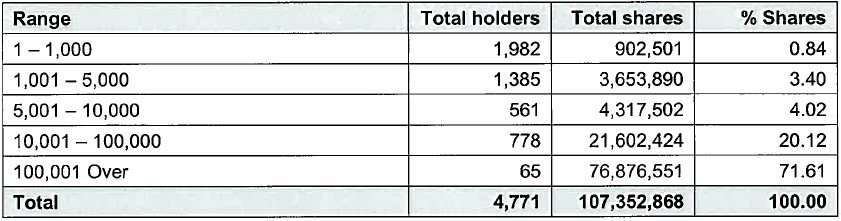
113 By reference to the table in the preceding paragraph Mr Witheridge observes that 17.7% of MCP’s shareholders held more than 10,001 shares and 1.4% of MCP’s shareholders held more than 100,001 shares such that MCP’s shares are largely held by sophisticated investors. Further, as at 31 August 2020 MCP’s 21 largest shareholders held a combined total of 69,333,315 shares or 64.58% and its nine largest shareholders as at that date were institutional investors.
3.2 Access Brand Management Pty Ltd
114 Access Brand was incorporated on 24 March 2017. It manages and represents various Australian and international brands in the global market with a particular focus on the China market. Its offices are located in North Sydney, New South Wales. It sits within a broader corporate group (in which ABM AU is a related entity). ACG is another company within that group.
115 As far as Ms Peak was concerned, there was no practical difference between Access Brand and ABM AU. When colleagues referred to ABM AU in discussions with her, they used the two company names interchangeably and she did the same.
116 Access Brand operates an international e-commerce sales platform through which it offers various skincare, make up, health and wellness products to its customers for purchase (ABM Platform). A customer is required to register as a member with the ABM Platform in order to purchase products from it.
117 The ABM Platform is primarily used by resellers (based in China and Australia) who are not the end consumers of the products. The resellers purchase products in bulk with a view to on-sell those products to other resellers and/or to end consumers located in China. A presentation prepared by Ms Wang for MCP’s 2020 AGM records that ABM had 50,000 resellers worldwide servicing 10 million customers globally.
118 In early October 2020, Access Brand launched a new sales platform known as “Veritas Tempus Naturae” (VTN) which sells products directly to end consumers. Like the ABM Platform, VTN requires its customers be a member of the platform to purchase products. Its customers included both resellers and the end consumers themselves. The ABM Platform and VTN operated concurrently.
119 Given its focus on the China market, Access Brand typically reported revenue and product value in Chinese currency, renminbi (RMB). It reported sales results in a metric described as “gross merchandise value” (GMV) which, as explained by Ms Peak, is a measure of total website transaction volume across all products on the ABM Platform. It is not a revenue figure.
120 Mr Fielding was responsible for overseeing the operating team, comprising Ms Peak and her team, in relation to the ABM AU account and reporting to the CEO. In doing so he did not interact with anyone at Access Brand on a day-to-day basis but was aware that Ms Peak and her team met with their counterparts from Access Brand’s operational team on a weekly basis (as described below). Mr Fielding was not involved in those meetings.
3.3 DRL
121 DRL is a skincare brand with a product range which includes moisturisers, serums and face masks. According to Ms Peak it is not a typical skincare product range because some of the DRL products involve detailed and complex formulations requiring extensive research and development and clinical trials before coming to market.
122 MCP markets DRL as an innovative beauty skincare brand which provides clinically proven anti-ageing solutions by using scientific ingredients in its products that have been tested by clinical trials. The nature of the DRL product range makes it a complex product to manufacture and contributes to the manufacturing lead times.
123 Ms Peak explained that there are particular products within the DRL product range that are considered to be core or the most popular products in the China market, referred to as “Hero SKUs” (a SKU or stock keeping unit is the industry term for a product). The number of Hero SKUs marketed and sold to the China market increased over time from one Hero SKU in FY17 to five Hero SKUs by FY20.
3.4 The relationship between MCP and ABM AU/Access Brand
124 MCP and Access Brand’s relationship came about through a connection to Ms Wang, Access Brand’s CEO. Mr Witheridge understands that MCP engaged Ms Wang as a marketing advisor in 2016. In 2017, Access Brand’s business expanded into a distribution business and Ms Wang approached Mr McAllister with a proposal to become a distributor of the DRL product range to consumers in the China market, which MCP accepted.
125 Mr McAllister and Ms Wang had a good working relationship. It was usual practice for important decisions affecting Access Brand’s account with MCP to be determined at CEO level between Ms Wang and Mr McAllister during the course of their regular meetings. Decisions made at that level were communicated to the operating levels of each business for implementation.
3.4.1 Supply and distribution agreement
126 Commencing in 2017 McPherson’s Consumer and ABM AU had a supply and distribution relationship by which ABM AU exclusively purchased the DRL product range from MCP for distribution in the China market, subject to one exception for Chemist Warehouse. The “Term Sheet Distributor Agreement” between McPherson’s Consumer and ABM AU dated 10 May 2018 set out the terms on which McPherson’s Consumer was to supply DRL products to ABM AU for distribution by e-commerce in China. The Term Sheet relevantly included:
… | |
Brands / Products | * Dr. Lewinn’s |
Territory | * China only |
Commencement date | * This agreement commences on 1 April 2017 |
… | |
Exclusivity | * Exclusive distribution of Dr. LeWinn’s via ecommerce channel in China (except for any Australian local retailers who sell into China, for example the Chemist Warehouse Tmall site). |
… | |
Term | * Subject to the termination clauses included within this agreement, the initial term is for a period from the commencement date to 30 June 2020 (Initial term) * At the end of the initial term, the agreement will automatically renew for a further 12 month period unless either party has given notice in writing of its intention to terminate the agreement not less than six (6) months prior to the expiry of the Term or any renewal period(s). |
… | |
Obligations of ABM | * ABM must provide MCP with a quarterly sales and marketing report outlining sales performance of the products (by SKU), closing stock on hand (quantities and dollar values) and a summary of marketing activities undertaken. * ABM will maintain full and accurate records in relation to sales of the Products. … * ABM is to provide MCP with a rolling six monthly forecast each month and provide a commitment to the associated stock purchases outlined in the forecast. |
… | |
3.4.2 Joint venture agreement
127 On 8 November 2019 MCP (through its subsidiary McPherson’s Consumer) and ABM AU entered into a joint venture agreement (JV Agreement) for the purpose of expanding sales of DRL products in China and to jointly develop new products to sell into that market. The JV Agreement provided for the incorporation of a joint venture vehicle, DRL China, a Hong Kong incorporated company, to implement the JV Agreement. Mr Witheridge described the salient terms of the JV Agreement in the following way:
(1) ABM AU would acquire 51% of DRL China for a nominal value and MCP would transfer to DRL China certain of its DRL trademarks for a nominal value;
(2) ABM AU and DRL China were granted exclusive distribution rights, subject to certain exceptions, for DRL branded products throughout China;
(3) ABM AU was required to achieve either:
(a) $35 million in annual purchases of DRL products from MCP in any year prior to 30 June 2022; or
(b) $82.5 million in aggregate purchases of DRL products from MCP over the three-year period ended 30 June 2022,
(each a Qualifying Event);
(4) if ABM AU failed to achieve a Qualifying Event, the DRL trade marks that were transferred to DRL China were to be sold back to MCP at their initial nominal valuation;
(5) ABM AU undertook to increase net purchases of DRL products from MCP in each of the financial years ended 30 June 2020, 30 June 2021 and 30 June 2022 by a minimum of 5% on the year prior (each a Net Purchases Target) (cl 4(a)); and
(6) if ABM AU failed to achieve the Net Purchases Target for a relevant financial year, it must pay MCP an amount equal to the shortfall in MCP’s earnings before interest and tax (EBIT) associated with ABM AU’s failure to achieve the Net Purchases Target for that financial year (EBIT Shortfall) in immediately available funds (cl 4.1(d)). That provided ABM AU with a strong incentive to at least reach the Net Purchases Target in any given financial year.
128 The terms set out in the preceding paragraph at (4)-(6) were included in cl 4 of the JV Agreement titled “Joint venture undertakings and agreements” which relevantly provided:
4.1 ABM Net Purchases Target undertakings
(a) Subject to any adjustments pursuant to clause 4.3, ABM undertakes to increase Net Purchases of [DRL] from MCP in each of:
(i) the Financial Year ending on 30 June 2020 by a minimum of 5.00% on the year prior; and
(ii) the Financial Year ending on 30 June 2021 by a minimum of 5.00% on the year prior; and
(iii) the Financial Year ending on 30 June 2022 by a minimum of 5.00% on the year prior,
(each a Net Purchases Target).
(b) Within 30 Business Days of the end of each Financial Year referred to in clause 4.1(a), MCP and ABM must meet in good faith to discuss and agree in writing:
(i) whether ABM achieved the Net Purchases Target for that relevant Financial Year; and
(ii) if ABM failed to achieve the Net Purchases Target for that relevant Financial Year, the shortfall in MCP’s earnings before interest and tax, calculated in accordance with the Accounting Standards, associated with the failure of ABM to achieve the Net Purchases Target for that relevant Financial Year (EBIT Shortfall).
…
(d) Within 10 Business Days of receipt of the agreement of the EBIT Shortfall under clause 4.1(b)(ii) or the determination of the EBIT Shortfall under clause 4.1(c)(ii), ABM must pay to MCP an amount equal to the EBIT Shortfall in immediately available funds. MCP acknowledges and agrees that receipt of the EBIT Shortfall under this clause is MCP’s sole and exclusive remedy in respect of a failure of ABM to achieve the Net Purchases Target for that relevant Financial Year.
129 As set out above, in order to implement the joint venture, in about November 2020 Ms Peak was tasked with managing the operational aspects of DRL China, although the formalities of her role were never fully clarified. In her role as general manager, DRL China, Ms Peak was required to work more closely with Access Brand than before, including by working from Access Brand’s North Sydney offices. Ms Peak’s responsibilities included working with Access Brand on new product development for exclusive DRL products for the China market and a business plan for DRL for the 2021 calendar year. However, Ms Peak only had access to Access Brand’s internal information that was provided to her to enable her to carry out her role.
130 Between 2017 and 2020 MCP’s sales to ABM AU increased exponentially, culminating in sales of approximately $37.2 million in FY20 which, as set out above, was approximately 16.7% of MCP’s total sales for that financial year. This also meant that ABM AU achieved a Qualifying Event for the purposes of the JV Agreement and pursuant to the terms of that agreement was entitled to retain the DRL trade marks transferred to it and its exclusive distribution rights.
131 In the balance of these reasons, save where it is necessary to differentiate between the entities, I will refer to Access Brand, ACG and ABM AU collectively as ABM.
3.4.3 The Chemist Warehouse Conflict
132 As set out above, Chemist Warehouse was another MCP customer that purchased DRL products and sold those products in the China market through the Tmall e-commerce sales platform (owned by the Alibaba Group, a Chinese multinational e-commerce company). The Term Sheet contained an express carveout for Chemist Warehouse (see [126] above).
133 Mr Fielding was aware from his discussions with Mr McAllister and Ms Peak that there was commercial rivalry between ABM and Chemist Warehouse, such that it affected the relationship between MCP and ABM. Similarly, Ms Peak understood that in 2020, including in the lead up to, and during, the “11/11 Event” (see [174(6)] below), ABM raised concerns with MCP about the recurrent “channel conflict” between it and Chemist Warehouse. Ms Peak explained that “channel conflict” occurred when Chemist Warehouse’s promotional activity in relation to the DRL product range coincided with ABM’s promotional activity for the same product range (CWH Conflict).
134 The CWH Conflict presented in two ways: first, the sale of DRL products by Chemist Warehouse directly into the China market via Tmall which was in direct competition with the sale of DRL products by ABM via the ABM platform; and secondly, the sale of DRL products through the “daigou channel” which involved the Chinese community based in Australia purchasing DRL products in bulk from Chemist Warehouse (typically during a promotional period) and shipping them to China which competed with ABM’s reseller strategy.
135 Management of the CWH Conflict involved ongoing dialogue between MCP and ABM. ABM had an internal team that monitored the pricing of products for the brands it distributed in the market. When ABM’s pricing team identified promotions by Chemist Warehouse for DRL products, it raised the issue with Ms Peak’s team.
136 For example, on 5 and 6 August 2019 Ms Peak and Ms Dong exchanged emails about the CWH Conflict. In her email sent on 6 August 2019 Ms Dong wrote:
Regarding CW Beauty Break issue, as said we need to have an alignment between us how to sort this out. My suggestion will be:
1. 1. Stop selling LSC range from CW, only sell this range in Priceline
OR
2. 2. If option 1 doesn’t work at your end, ABM has to apply the promotional campaign as a counter move, but you have to take the cost for the profit that we give to the distributors.
To be very honest with you, the massive promotion of CW will have significant negative impact on ABM sales rev. in China which I believe we share the same view. Roughly speaking if we let it go for current situation, the impacted Rev. from ABM will be around $7M, meaning we might only achieve $18M rather than $25M.
(Emphasis added.)
137 On 7 August 2019 Ms Peak raised the CWH Conflict with Mr McAllister, noting that ABM had asked for his intervention. She wrote:
I’ve pushed back quite a bit on this with ABM over the last few weeks and this is the first time a threat has been issued from them and they also have now asked me to get you involved.
138 On 15 August 2019 Mr McAllister sent an email to Ms Wang with the subject “Thanks for a solution drive/progressive meeting today”. Mr McAllister attached a slide deck which set out various “promotional solutions” to the CWH Conflict to his email in which he relevantly wrote:
…
It feels we have short term & long term alignment on how we manage this dynamic moving forward?
Jade mentioned that the Team had severely amended the forecast down late last week…it appeared to be quite a dramatic over consideration downwards …post today’s meeting I am hoping this can be rectified back to the teams build prior forecast, otherwise we will need to significantly call back much procurement and componentry and communicate this to the Aware group regarding supply priorities ASAP as its approximately half of where we have been collectively forecasting.
…
139 Further, on 15 October 2020 at 5.07 pm Ms Peak sent a text message to Mr Fielding in the following terms:
CWH team at it again.
We found out from ABM that DRL is currently on promo - CWH funding some of it but we didn’t know - nothing communicated by Simon [Kent]. We are also now aware there will be another 40% off at the same time we are launching new masks in China - Cathy only found out because she was asking about the current promo.
Cathy is putting an email together with all details for you and I.
ABM will absolutely flip as they are already upset about existing promo we didn’t warn them of.
Simon Kent was the MCP customer business manager of the Chemist Warehouse team.
140 On 20 October 2020 at 11.43 am Ms Peak sent an email to Mr Kent about the CWH Conflict and the conflict between Chemist Warehouse’s 40% off DRL promotion and ABM’s new product launch. Ms Peak informed Mr Kent that it was “important [they] catch up because [Ms Peak] need[ed] to understand why [she was] not alerted to another series of promotions ahead of time”.
141 As will become apparent, the CWH Conflict was a matter of concern for ABM and one that it attempted to use as leverage in its commercial dealings with MCP.
3.5 The ABM account
142 Ms Peak was primarily responsible for the management of ABM’s account with MCP. She managed the sales processes, including filling purchase orders and reviewing purchase forecasts, engaged with ABM on investment and marketing activities, provided support to ABM to increase both customer and ABM’s demand for DRL products, monitored product quality and stock holding levels and managed the client relationship more generally. She was assisted in that role by the following employees who reported to her:
(1) Cathy Shen (who without intending any disrespect and for ease I will refer to as Cathy), export account manager, China, and from October 2020, senior business manager, China;
(2) Michelle Shen (who without intending any disrespect and for ease I will refer to as Michelle), international sales and marketing coordinator;
(3) Whitney Lan, export business manager; and
(4) Zoe Xu, international sales and marketing coordinator,
(collectively, Export Team).
143 In carrying out her day-to-day responsibilities managing the ABM account, Ms Peak did not deal with ABM’s team in China. Rather, she and her team frequently communicated with ABM’s staff based in Australia, including Ms Wang, Ms Dong, Ada Foo, responsible for supply chain management, and Ivy Yang, responsible for brand management.
144 Ms Peak colloquially referred to the Australian based ABM group as the “ABM side”. She and her team met with their fellow operating group on the ABM side once a week, usually on a Wednesday, to discuss operational matters in relation to ABM’s account (weekly operating team meeting). The purpose of these weekly meetings was to review outstanding items, discuss operational matters and upcoming promotions and review plans. Ms Peak was also in frequent contact with Ms Dong, who she describes as her counterpart on the ABM side.
145 It was, and is, Ms Peak’s usual practice to take handwritten notes in most meetings that she attends in a dot point format. Her notes therefore reflect some but not all of the discussions which took place. Following the relevant meeting, Ms Peak sometimes transcribes all or parts of her handwritten notes into an electronic format, such as an email, so that she can share them with relevant people.
146 As set out above, important decisions affecting the ABM account were decided at CEO level between Mr McAllister and Ms Wang and instructions would then flow down to their respective operating groups. This was because of the importance MCP placed on the relationship with ABM, the success of DRL in the China market for ABM and because the evolution of the relationship between the businesses into joint venture partners grew out of an initial CEO to CEO relationship.
3.5.1 The “exponential” growth of the ABM account
147 Ms Peak observed that ABM’s business had grown at an exponential rate between 2017 and 2020. As the person responsible for the day-to-day management of the customer account, she considered that growth had occurred well ahead of the internal business processes, people and structures required to support it. As a result of ABM’s exponential growth over a short period, its supply planning and forecasting processes were still in development.
148 Mr Witheridge also gave evidence about the exponential growth of ABM’s business from 2017 to 2020. He explained that during that period MCP’s sales to ABM grew exponentially from about $500,000 in the financial year ended 30 June 2017 (FY17) to about $37 million in FY20, which was a 133% increase on the financial year ended 30 June 2019 (FY19) sales to ABM of $16 million. In each of FY19 and FY20 customer demand and ABM’s demand for the DRL product range outperformed MCP’s expectations.
149 ABM being in a rapid growth phase, with its business driven through the cross-border e-commerce channel into China, presented product supply challenges for MCP. For the most part, since the inception of the ABM account, MCP had struggled to meet ABM’s future demand. Another impact of ABM’s rapid growth and its underdeveloped internal processes was that it regularly changed its purchasing requirements at short notice which did not provide MCP with adequate time to plan for the demand having regard to the lead times involved in the manufacture of DRL products.
150 MCP was not able to supply ABM with DRL products at short notice because the products have a manufacturing lead time of about four to six months. Thus, when MCP receives a purchase forecast from ABM, it begins to order the manufacturing of stock in the expectation that ABM will submit a purchase order at some point in the near future.
151 Where MCP did not have sufficient visibility or notice of ABM’s purchasing demand it was, on a number of occasions, unable to fulfil (or fulfil completely) purchase orders from ABM because of stock shortages and manufacturing delays. There were a number of emails in evidence before me of instances where ABM asked at short notice for the supply of higher volumes of particular DRL products because of higher than anticipated sales and where MCP attempted to fulfill those requests.
3.5.2 ABM’s purchase forecasts and purchase orders
3.5.2.1 The role of purchase forecasts
152 In an attempt to solve the problem of ABM’s unpredictable demand and the consequent problem of MCP’s inability to fulfil purchase orders because it had insufficient stock of the relevant DRL products, MCP encouraged ABM to provide it with an indication of its forecasted purchasing demand ahead of time in the form of purchase forecasts (which are further described below). They were intended to enable MCP to undertake its demand and supply chain planning processes, including by factoring in necessary manufacturing lead times, and to plan for and meet ABM’s future demand. MCP also worked with ABM to assist it in developing its processes so that it could more accurately estimate its future purchasing requirements.
153 On 8 November 2018 Liping Wan (ABM) sent an email to Ms Peak in which she summarised the key features of the purchase forecast practices to be implemented by ABM as follows:
1. ABM to send through updated rolling forecast around the 15th of each month and [purchase order] at the beginning of each month which will be sent by James.
2. DRL team to respond within 2 -3 days if able to supply the full quantity.
* For the quantity that MCP is not able to supply, this amount will be cancelled from the [purchase order]. The remaining quantity that can be supplied needs to be delivered within the same month, ideally by third week of each month.
* Any current open [purchase orders] that cannot be cleared by November will be considered as cancelled.
* ABM will decide if to include the unfulfilled quantity in the next [purchase order] depending on the updated forecast.
3. To have buffer stock for some selected SKUs at MCP warehouse that are available for ABM when there is an unexpected increase in sales. The quantity will be clearly stated in the forecast.
4. The [purchase orders] placed each month indicates only the quantity required in that month.
154 It was common, over the course of a financial year, for ABM to provide purchase forecasts which fluctuated significantly in value, sometimes by millions of dollars. There were also instances where ABM’s purchase forecasts reflected significant increases or decreases in value, in millions of dollars, when compared with the purchase forecast received in the preceding month. That is illustrated by the following table compiled by Ms Peak which sets out the purchase forecasts received from ABM over the course of FY20:
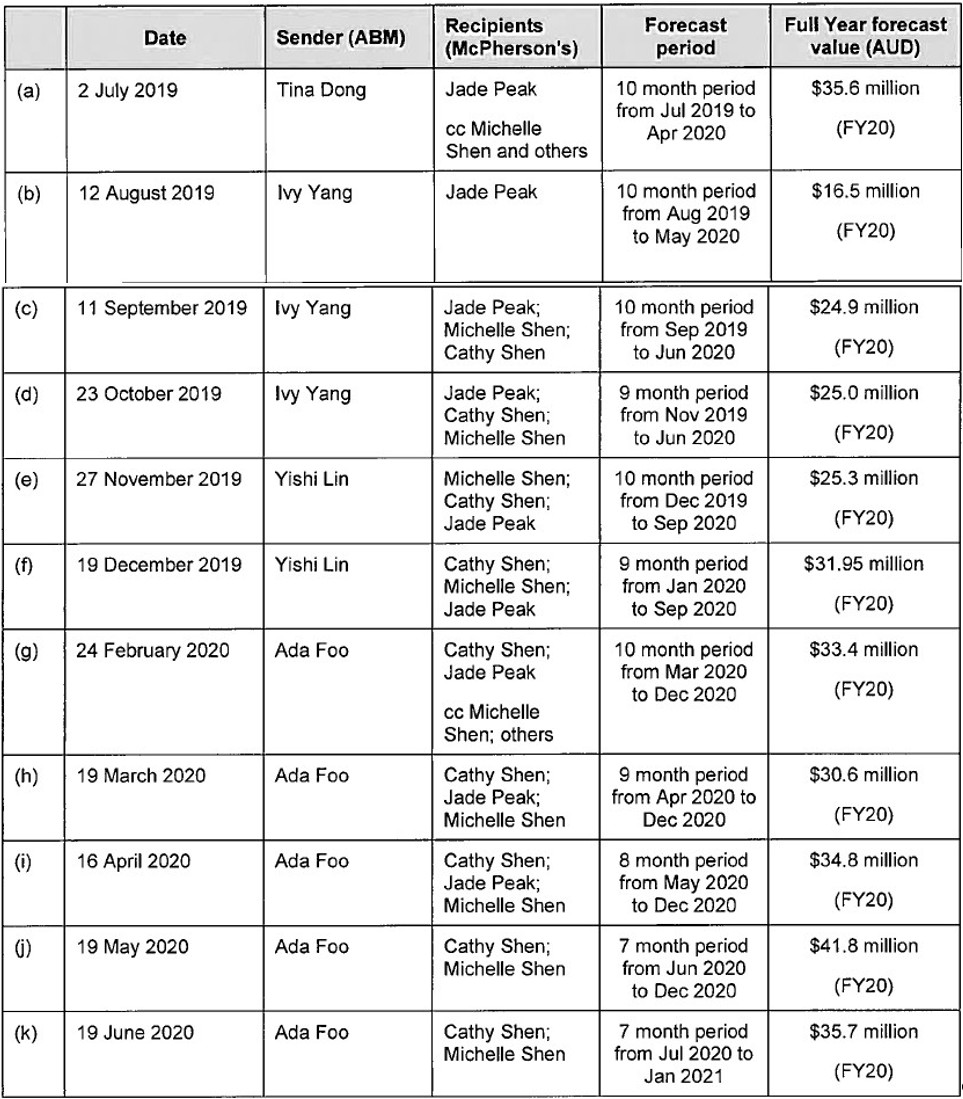
155 To meet ABM’s changing requirements for DRL products MCP began to hold additional DRL inventory or “buffer stock” in an effort to get ahead of ABM’s purchasing demands and avoid lost sales. Ms Peak explained that “stock buffering” is a common tool for managing the problem of unpredictable demand. MCP also invested $6 million in Aware Environmental, the manufacturer of DRL products, in order to support the supply chain processes to fulfil the strong demand from China for the DRL product range.
156 In the period from 2018 to 2020 MCP’s line of sight into ABM’s sales or stock holding position was dictated by the amount of internal information ABM was willing to share with MCP. In fact, ABM shared very little, if any, internal information relating to its sales and stock holdings until 2020 when it began to share some information, including because of the JV Agreement. From August 2020 ABM began to share some monthly information about its stock of certain Hero SKUs. However, Ms Peak explained the information that was shared was difficult to interpret because, as ABM was a relatively new company, there was limited historical data against which to compare the information and as ABM’s processes were still in development, there was a question about the reliability of the information. As Ms Peak did not know if ABM had robust stocktaking and distribution chain analysis processes across its supply chain, she did not know how it was calculating the figures it provided and was not certain if the figures provided were accurate or reliable.
3.5.2.2 Receiving and processing purchase forecasts
157 The purchase forecast is an excel spreadsheet prepared by a customer, in this case ABM, and provided to MCP ideally on a monthly basis. It provides a forward-looking estimate of the customer’s forecasted monthly volume of purchases for each product for a specified number of months into the future.
158 A purchase forecast is provided on a “rolling basis” which means that new iterations provide an updated indication of the customer’s monthly demand in terms of volume at a product level. Occasionally, the new iteration will roll forward to provide a view about forecasted demand for additional months into the future. MCP uses purchase forecasts to plan future purchases of product by its customers.
159 As explained by Ms Peak, MCP’s usual process when it receives a purchase forecast from ABM, including in 2020, was as set out below.
160 First, once the ABM purchase forecast was internally approved, it was sent via email to MCP. From the beginning of 2020, it was sent by a member of ABM’s supply chain team, Ms Foo, to Ms Peak, Cathy and Michelle (i.e. the Export Team). MCP expected ABM to provide an updated purchasing forecast every month which contained forecasted purchases for at least nine months into the future (to accommodate the fact that ABM reported on a calendar year and MCP reported on a financial year basis). ABM did not always meet this expectation. There were some months where the purchase forecast did not extend over the full nine months, its provision was delayed or, in some instances, where a given month was missed altogether.
161 The occasions where ABM was delayed in providing its purchase forecast would typically coincide with significant promotional sales event periods. ABM would allow time for it to complete its evaluation of the outcome of promotional events and their implications on its stock levels. Where there was delay or non-issue of a purchase forecast in a particular month, MCP would rely on the existing purchase forecast for the purposes of its monthly demand planning for the financial year.
162 Secondly, a member of Ms Peak’s team, usually Cathy, would review the purchase forecast. This review involved: translating the purchasing forecast into English, if necessary; transferring the data to MCP’s template spreadsheet; attributing a monetary value in Australian dollars to the purchase forecast by multiplying the wholesale price of each product with the forecasted volume of purchases for that product; and presenting a monthly analysis by comparing the purchase forecast for that particular month against the prior financial year’s actual sales results and the current budget.
163 Thirdly, once the Export Team reviewed an ABM purchase forecast, Ms Peak would report the information to Mr Fielding and from time to time (as instructed by Mr Fielding) provide information about ABM’s purchasing intention in an appropriate format to be included in a monthly report to the SLT and/or to the finance team in connection with budgeting or forecasting processes.
164 The ABM purchase forecast, once transferred onto MCP’s template, was provided to Kim Le, who was responsible for reporting on customer forecasts, customer demand over time and forecasting accuracy. Ms Le conducted a second review of the value reflected in the ABM purchase forecast, and input the information into MCP’s software system, Mercia, which in turn made the information available to MCP’s supply chain team which is responsible for supply planning and placing orders with the manufacturers. The information was then used by various teams within MCP (such as the operational demand planning, supply chain, financial and sales teams) to conduct demand and supply chain planning to ensure MCP could meet ABM’s demand in future periods, to monitor any changes in ABM’s demand and to track actual sales to ABM against MCP’s forecast and budget.
165 In addition, the Export Team and the demand planning and supply chain team circulate between them, usually weekly, an internal spreadsheet which sets out MCP’s stock holdings for certain Hero SKUs as compared to ABM’s purchase forecast. That spreadsheet was a special planning tool used by MCP to manage the significant challenges of fluctuations in ABM’s forecasting of its demand and in an attempt to manage MCP’s stock holdings of DRL.
166 Fourthly, at any given time, there were a number of discussions happening between the various teams within MCP and between MCP and ABM in relation to the ABM account about, for example, stock holdings, marketing, advertising and promotional (A&P) investment and other support actions, new product development, new product launches, month-to-month phasing of demand, promotional sales event periods and logistics.
167 Fifthly, ABM formalised its purchasing intent by submitting a purchase order document with MCP, usually on a monthly basis.
168 Sixthly, at all times Ms Peak and her team treated any purchase forecasts received from ABM as confidential as between MCP and ABM. They only disclosed the information contained in any ABM purchase forecast within MCP on a need-to-know basis. Ms Peak was also conscious of her confidentiality obligations as an employee of MCP in relation to any documents received from MCP’s customers in the course of her employment. To the extent information contained in any ABM purchase forecast was held on a software system such as Mercia, that software is only accessible by authorised personnel within MCP. Ms Peak does not have access to Mercia.
3.6 Marketing, advertising and promotional activities for DRL products
169 The role of marketing and A&P activities is important to the DRL product range because its success relies on it being able to differentiate itself within a competitive skincare market. MCP sought to achieve this by promoting the attributes of DRL products which make them particularly desirable to consumers in the China market. Namely, that those products use scientific ingredients to provide clinically proven anti-ageing solutions.
170 MCP sets a marketing budget for DRL for the full financial year which it allocates across different marketing and A&P proposals for DRL based on discussions with ABM. Ms Peak’s experience was that ABM typically sought to obtain additional investment from MCP by way of an allocation of additional investment for MCP to carry out marketing and A&P activities for DRL or additional investment to ABM to support it to carry out marketing and A&P activities for DRL. Ms Peak described ABM as a tough commercial negotiator which sought to obtain the best commercial terms and additional marketing and A&P investment from MCP.
3.6.1 Support proposals
171 There are a number of different marketing, A&P and other support proposals and corporate actions which MCP could and often did deploy or offer to customers, including ABM, to stimulate or support consumer demand (Support Proposals). Insofar as Support Proposals offered to ABM were concerned, they included:
(1) managing the direct channel conflict between ABM and Chemist Warehouse: this often arose where Chemist Warehouse ran promotional campaigns and discounts on DRL products at the same time as ABM to coincide with key China sales event periods. One action considered to manage this sort of conflict was for MCP to supply the same DRL products in different product volumes to ABM and its competitors (in particular, Chemist Warehouse). This allowed MCP to manage and mitigate tensions between ABM and Chemist Warehouse, although it was not always effective;
(2) forward orders: this is a tool used to bring forward sales into a particular month or financial period in return for offering additional marketing and A&P investment or other support to ABM (e.g. particular credit terms, price relief, or free samples) in an effort to generate consumer demand. Having regard to the manufacturing lead times for DRL products, ABM typically agreed to place forward orders ahead of promotional sales event periods so that it could hold buffer stock to meet any additional customer demand;
(3) extension of credit to ABM: involved a renegotiation of the terms upon which credit was extended to ABM or an extension of payment terms for particular orders;
(4) A&P investment which involves investment by MCP of its marketing budget into marketing and A&P activities for DRL: these activities included brand deals with social media personalities, text or graphic social media campaigns and/or special promotional activities to promote the launch of new DRL products;
(5) additional funding to support aggressive brand building for DRL in the China market: this involved MCP investing above its marketing budget. Examples included undertaking special promotional activities including collaborations with other brands, brand deals with social media personalities across multiple geographies, merchandising (which is the provision of a “merchandise” gift as opposed to a free gift or a sample) or paid media;
(6) developing exclusive DRL products and undertaking new product development: this involved the research and development of new DRL products or DRL products which could be sold exclusively to the China market in order to increase brand awareness and brand reputation in China;
(7) trial size goods and free samples: this involved MCP funding the costs of ABM offering free trial size products or samples with purchases made by customers; and
(8) price relief or discounting: this involved MCP offering certain products at discounted wholesale prices to ABM to enable ABM to maintain its margin when offering discounts on DRL during promotional sales events. MCP would typically offer this for discontinued DRL products or DRL products that had a shorter than usual shelf life.
3.7 Chinese e-commerce sales events
172 As is apparent, ABM’s business is China facing. It engages its own reseller network, some based in China and some based in Australia, to buy and resell the products to end consumers in China.
173 At specific times during the calendar year, various e-commerce sales platforms, including the ABM Platform, participate in major Chinese promotional e-commerce sales events, which are known in China as “shopping festivals”. They typically feature products sold at discounted prices, often with other sales incentives such as gifts with purchase or benefits for purchasing more than one product at a time (e.g. a buy one get one free promotion).
174 The major Chinese promotional e-commerce sales events include:
(1) Chinese New Year, which usually falls on a date between January and February;
(2) Women’s Day in March;
(3) 6/6 also known as “Double 6” in June (6/6 Event);
(4) Super Brand Day, which is usually on a date between August and October with the specific date chosen by each e-commerce sales platform proprietor;
(5) Mid-Autumn Festival in September;
(6) 11/11 also known as “Double 11” or “Singles Day” (11/11 Event) in November; and
(7) Double 12 in December.
175 Ms Peak explained that of the Chinese sales events, the 11/11 Event is one of the largest, if not the largest, event in the Chinese e-commerce channel. It occurs over a series of days in the lead up to and including 11 November and on each day certain deals and promotions are offered to consumers who purchase the products online by accessing an e-commerce platform that is participating in the sales event. The biggest day of trading is 11 November. The 11/11 Event is not proprietary to ABM. It was initially founded by Alibaba. The e-commerce platform operated by Alibaba, known as Tmall, is the biggest e-commerce platform in China and leads the market in sales during the 11/11 Event.
176 A summary of ABM’s DRL sales results (in RMB) for four of the major promotional sales events referred to at [174] above prepared by Ms Peak on about 17 November 2020 and included in a presentation titled “Dr LeWinn’s China Forecast & Support Proposal” is set out below:
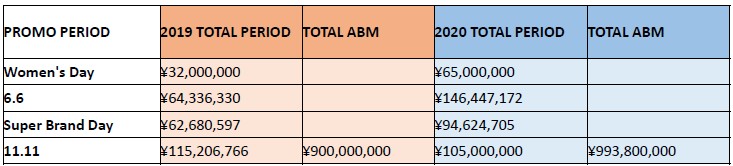
177 There were no reporting lines between MCP and ABM in relation to ABM’s sales results following the conclusion of a sales event. Accordingly, following such an event, Ms Peak’s team would typically ask ABM if it could share the results for DRL. Otherwise, Ms Peak’s team would collect data from any general marketing posts published by ABM on the ABM Platform, which, for example, might report “Collagen Surge Plumping Gel 50,000+jars sold during Brand Day”.
3.8 Purchase forecasts in 2019
178 During 2019, ABM issued purchase forecasts to MCP on a near monthly basis (with the exception of February 2019 and June 2019 where Ms Peak believes ABM did not provide a purchase forecast for those months as she was unable to locate any purchase forecasts received from ABM in her records). The following summary table compiled by Ms Peak sets out the purchase forecasts received by MCP from ABM over the course of the 2019 calendar year:
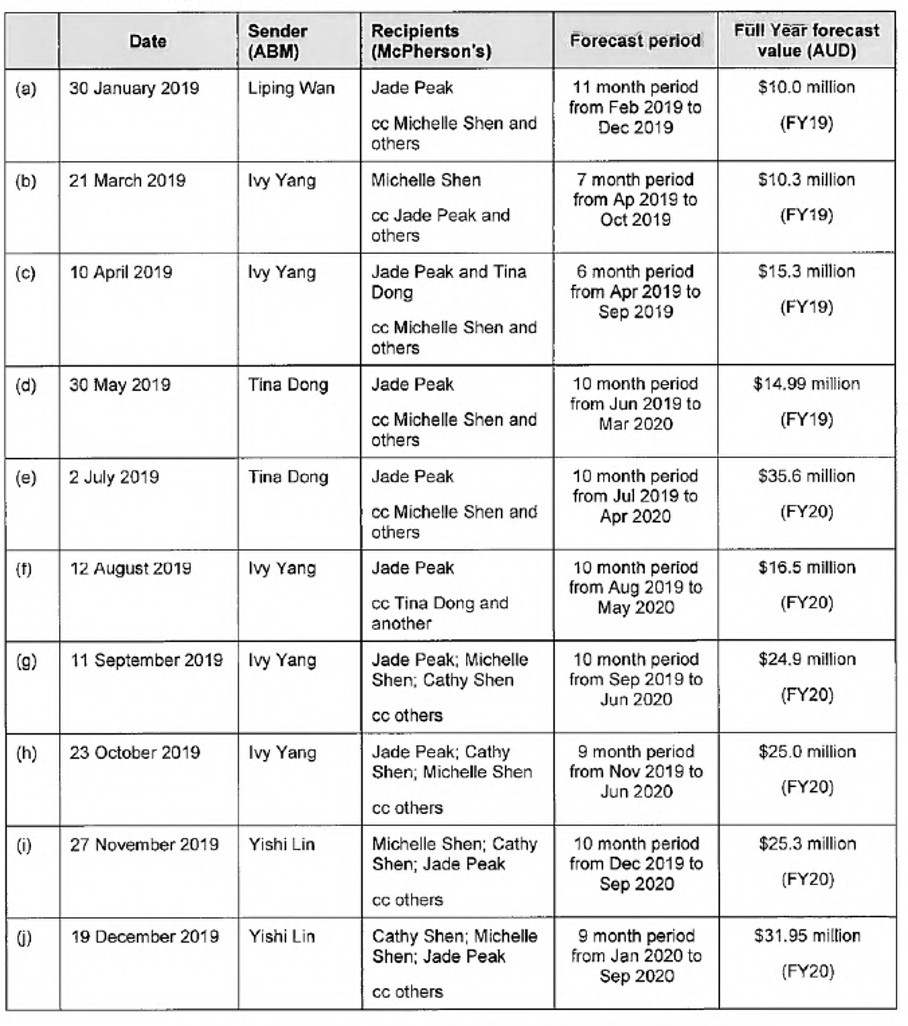
179 In addition to the summary extracted above, and based on the evidence before me, I make the following observations about the purchase forecasts provided by ABM to MCP in 2019.
180 First, on 21 March 2019 Ms Yang, brand manager at ABM, sent an email to Michelle, copying Ms Peak, which attached two versions of an updated DRL purchase forecast for a seven month period from April 2019 to October 2019. In her email, Ms Yang wrote:
Please see the attached Dr. Lewinns purchase forecast.
There are two versions attached in this email. The first version (V1) is a realistic sales target we could achieve. The second version (V2) is more optimistic version which we could try our best to achieve under certain level of marketing support.
181 Secondly, on 19 and 23 August 2019, in response to a request for Ms Le to provide an update on the “DRL forecast”, Ms Peak foreshadowed the possibility of “big changes” and a likely “large downgrade” in ABM’s purchase forecasts.
182 Thirdly, on 13 September 2019 Ms Le sent an email to Ms Peak and others which set out the changes in ABM’s demand as compared to its purchase forecast denoted as “before” and “after” for its top 11 SKU’s for the period September 2019 to June 2020.
183 Fourthly, during October 2019 and November 2019, MCP received “draft” purchase forecasts from ABM before receiving a “final” purchase forecast. For example, on 21 October 2019 Ms Yang sent the following email to Ms Peak (21 October 2019 Email):
Hi team,
Please see the attached Nov purchase forecast. Please aware that this is the draft version, and the final version needs Livia’s approval which we haven’t received yet. We will share with you once it is available.
Compared with last purchase forecast we shared with you, the total purchase forecast from Nov 2019 to June 2020 increases from 826,424 to 1,165,213 with 41% growth rate. We have confidence in 2020 sales with right marketing strategy and sales policy.
…
(Emphasis in original.)
184 Ms Peak understood that the purchase forecast attached to Ms Yang’s email was a draft version of ABM’s purchase forecast for the month of November 2019 (October 2019 Draft Purchase Forecast). Ms Peak also understood that the October 2019 Draft Purchase Forecast required Ms Wang’s internal approval before a final version was provided and that a final purchase forecast for November 2019 would be provided to MCP once it was available.
185 On 23 October 2019 Ms Yang sent an email to Ms Peak, among others, in which she confirmed that “the draft version which I previously share[d] is same as the final one. Ada will place the [purchase order] by this week”. Ms Peak understood from Ms Yang’s email that ABM had provided a final version of the draft “Nov purchase forecast” referred to in the 21 October 2019 Email (October 2019 Purchase Forecast). The October 2019 Purchase Forecast was ABM’s forecast for the period from November 2019 to June 2020.
186 Similarly, on 20 November 2019 Yishi Lin, brand manager at ABM, sent an email to Ms Peak, among others, attaching a purchase forecast for December 2019 to September 2020, which included:
Please kindly see the Dec purchase forecast attached with the email. Additionally, please noted that this is only the draft version for your reference. The final version is still under the internal approval process and we will share with you once it is available.
(Emphasis in original.)
187 Mirroring the sentiments at [184] above, Ms Peak understood that the draft attached to Ms Lin’s email was a draft version of ABM’s purchase forecast for December 2019 (November 2019 Draft Purchase Forecast) which was subject to a final version requiring Ms Wang’s approval and that a final purchase forecast for December 2019 would be provided to MCP once it was available.
188 Notwithstanding that it was in draft, Ms Peak asked Cathy to review the November 2019 Draft Purchase Forecast. Cathy’s review showed that the value of DRL products to be purchased by ABM based on the draft for the full FY20 was approximately $27.8 million.
189 On 27 November 2019 Ms Lin provided Ms Peak with the “final version of December purchase forecast”. Ms Peak understood that ABM had provided a final version of the November 2019 Draft Purchase Forecast (November 2019 Purchase Forecast), that Ms Wang had approved the November 2019 Purchase Forecast and the November 2019 Draft Purchase Forecast no longer applied.
3.9 Events in 2020
3.9.1 January to September 2020
190 Based on a search of her records, and the email described in [193] below, Ms Peak believes that ABM did not provide a purchase forecast in January 2020.
191 On 28 January 2020 Ms Foo sent an email to Ms Peak, among others, in relation to the potential impact of the then recent outbreak of COVID-19 on ABM’s business. Ms Foo wrote:
As you may already heard of an outbreak of a new coronavirus that began in the Chinese city of Wuhan, infections have been confirmed in many other cities in China and worldwide as well.
We begin to anticipate the possible influences of the deadly Wuhan virus outbreak on our business.
…
2) Suspending transportation and delivery services. Many cities are suspending all public transportation, including buses, trains, airplanes and ferries, to better combat the coronavirus outbreak. This will lead to unknown delay in delivering necessary components or packaging materials.
Therefore, we need your cooperation to help us better understand the supply risks.
…
192 The COVID-19 pandemic presented unique challenges for ABM. As a China facing business the impact of the pandemic created a volatile and complex market. Ms Peak says that this added complexity permeated the business relationship between MCP and ABM during 2020 and required ongoing assessment and reassessment of demand in order to manage the nature and volume of export sales to the China market. In particular MCP and ABM were generally uncertain about what impact COVID-19 would have on consumer demand for fast moving consumer goods, including whether that impact would be positive or negative, and had to manage shipping, freight and logistics impediments which affected ABM’s ability to move stock from warehouses in Australia to China.
193 On 14 February 2020 Cathy sent an email to Ahmed Khan, copied to Ms Peak and others, which included:
Sorry ABM’s updated forecast has not released yet which is delayed due to the coronavirus outbreak. According to the latest update, we can expect the new forecast by end of next week (21/02).
Since you may be aware the impact of this coronavirus shall have significant to the supply and demand in China, I suggest keeping the PO pending for a while until we have a clearer picture of the forecast.
…
194 On 19 February 2020 at 9.53 am MCP made an announcement to the ASX (19 February ASX Announcement) which included:
McPherson’s Announces 1H FY20 Results
9% increase in Profit Before Tax (PBT) to $8.5 million
FY20 PBT guidance maintained
…
McPherson’s Limited (“McPherson’s” or “the Group”) today announced its results for the six months ending 31 December 2019. Underlying and statutory profit before tax for the half year was $8.5 million (1H19: $7.8 million), representing a 9% increase. …
Total sales revenue of $106.0 million was in line with 1H19 ($106.5 million). Importantly, sales increased by 6% excluding the impact of recently terminated distribution agreements with Trilogy and Karen Murrell. McPherson’s recorded significant growth from its portfolio of owned brands, up 13% to $87.9 million on pcp (1H19: $78.2 million). Key owned brand, Dr. LeWinn’s, continues to deliver exceptional growth in export markets with sales up 272% to $13.9 million for 1H20, as well as robust growth in the domestic market with sales up 49% to $11.2 million (1H19 $7.5 million).
…
“Our owned brands continue to perform well with a 13% uplift in sales compared with 1H19, maintaining significant outperformance of Australia’s pharmacy channel. Our key core brand Dr. LeWinn’s has again delivered very strong sales growth, up 124% against 1H19 with domestic growth, bolstered by exceptional growth in the export market, in particular, China. This is a testament to our investment in product innovation, our evolving strategic partnership with Access Brand Management (ABM) and our ability to maintain sustainable supply through the Aware Group.”
…
Strategy Update
…
McPherson’s expanded its successful export business model in 1H20 with the establishment of a joint venture with trusted Greater China distributor, Access Brand Management (ABM), for Dr. LeWinn’s products. The joint venture will expand sales of McPherson’s most profitable brand by granting exclusive distribution rights to ABM for Dr. LeWinn’s products in China. The JV requires ABM to achieve a target of $35 million in annual purchases of Dr. LeWinn’s products from McPherson’s in any year prior to 30 June 2022, or aggregate purchases of Dr. LeWinn’s products from McPherson’s of $82.5 million over the three year period ended 30 June 2022. During 1H20, Dr. LeWinn’s achieved export sales of $13.9 million, demonstrating solid momentum for the year.
…
Impact of Coronavirus
Many of the Group’s products, particularly in the essential beauty and household essentials categories, are sourced from suppliers based in China, which is being particularly impacted by the recent coronavirus outbreak.
…
ABM has not experienced any noticeable disruption to inbound orders from its Chinese customer base, however its internal supply chain and courier services have been impacted by delays in office re-openings and low staff levels. At this stage ABM does not expect this disruption will materially impact its 2H20 orders of Dr. LeWinn’s, however the situation is evolving and is being closely monitored.
…
195 Mr Witheridge accepted that the “exceptional growth in export markets” referred to in the 19 February ASX Announcement was a reference to sales of DRL products and was consistent with his understanding that from FY17 to FY20, MCP had experienced exceptional growth in the sale of DRL products and that throughout the period demand for DRL products had outperformed MCP’s expectations. He also accepted that in 2020 it was this sort of growth that made MCP’s shares attractive to investors interested in investing in high growth companies and that, after discussions with investors who were interested in high growth companies, he learned that a very significant matter for investors was MCP’s sale of DRL products to ABM for export to China. This led him to understand that the ABM relationship was very important in considering the matters that may influence MCP’s share price.
196 On 24 February 2020 Ms Foo sent an email to Ms Peak, among others, attaching a spreadsheet with the purchase forecast for the period from March 2020 to December 2020 (February 2020 Purchase Forecast) and the February purchase order. The estimated value, based on the February 2020 Purchase Forecast, of DRL products to be purchased by ABM in FY20 was approximately $33.4 million.
197 On or about 8 March 2020 ABM participated in the “Women’s Day” promotional sales event. ABM shared its sales results from that event with MCP confirming it had achieved a result of 65 million RMB GMV, which was just over double its sales results from the same event in 2019.
198 The COVID-19 pandemic continued to create uncertainty. On 9 March 2020 Cathy sent an email to Ms Le, copied to Ms Peak and others, which included (as written):
Due to the uncertainty of international logistics in the coming months caused by Coronavirus, ABM may consider take our SOH in advance.
Could you please help to check what SOH are available to ABM for below products, taking away domestic forecast and orders in processing?
Could you please confirm ASAP but sill today? We need these information urgently to find solution with ABM.
199 On 19 March 2020 Ms Foo sent an email to Ms Peak attaching a purchase forecast which contained the March purchase order and the purchase forecast for the period from April 2020 to December 2020 (March 2020 Purchase Forecast). The value of DRL products to be purchased by ABM in the full FY20 year, based on the March 2020 Purchase Forecast, was approximately $30.6 million.
200 On 23 March 2020 Cathy sent an email to Ms Foo, among others, in which she provided feedback from MCP’s supply team in response to ABM’s request for a weekly supply plan for forecasted items. Cathy’s email recorded the following feedback from MCP’s supply team:
We already provide weekly summary with top hero SKUs which shows PO arrival for next 4-6 months broken down weekly buckets.
As you are aware doing above for a small number of SKUs is a manual and time consuming task. Also, looking at the template you have shared below, I don’t think its possible to provide these details. Sorry.
Our suppliers do not automatically share a weekly production plan with us. I believe we have previously provided production capacity on key SKUs to ABM team. As most of ABM’s forecast is increased within lead time (4 months) our suppliers challenge is to complete production ‘as soon as possible’ basis. The concept of ‘weekly production run’ doesn’t work in the scenario where we have a jump from 23k to 120k units in a month (Example Collagen Surge). Hoping ABM team can provide more accurate forecast moving forward so we can plan accordingly and avoid supply issues.
201 On 24 March 2020 Ms Foo sent an email to Cathy, among others, in which she noted:
… please note the logic behind this forecast has been reformulate[d] since last month onwards.
The number that reflected on the reg month are the demand that we requested to purchase accordingly.
Due to the impact of the coronavirus breakout, the logistics situation is kinda tense at this stage, please help provide the further plan onto the forecast we raise (especially for following April & May) as discussed.
…
202 On 16 April 2020 Ms Foo sent an email to Ms Peak, among others, attaching a purchase forecast which contained the April purchase order and the purchase forecast for the period from May 2020 to December 2020 (April 2020 Purchase Forecast). The estimated value of DRL products to be purchased by ABM in the full FY20 year based on the April 2020 Purchase Forecast was $34.8 million.
203 On 19 May 2020 Ms Foo sent an email to Cathy and Michelle, copied to Ms Peak, attaching a purchase forecast which contained the May purchase order as at that date and the purchase forecast for the period from June 2020 to December 2020 (May 2020 Purchase Forecast). The estimated value of DRL products to be purchased by ABM in the full FY20 year based on the May 2020 Purchase Forecast was approximately $41.8 million.
204 On or about 6 June 2020 ABM participated in the 6/6 Event. ABM shared its sales results from that event with MCP confirming it had achieved a result of approximately 146 million RMB GMV. For the same event in 2019 ABM had achieved a result of approximately 64 million RMB GMV.
205 On 19 June 2020 Ms Foo sent an email to Cathy and Michelle, copied to Ms Peak, attaching a purchase forecast which contained the June purchase order as at that date and the purchase forecast for the period from July 2020 to January 2021 (June 2020 Purchase Forecast). The estimated value of DRL products to be purchased for the full FY20 year based on the June 2020 Purchase Forecast was approximately $35.7 million.
206 Following receipt of the June 2020 Purchase Forecast, MCP initiated negotiations for a Support Proposal, namely support in exchange for ABM executing a proportion of its forecasted orders ahead of time.
207 On 22 June 2020 Ms Peak sent an email to Ms Dong, among others, which included:
Further to our conversation regarding some forward orders, please find below my proposal. This uses the demand from July for some SKUs as well as the demand for August for Trinity only.
…
Let me know if we can discuss further and what will be possible.
208 Later that day Ms Dong sent an email to Ms Peak in response querying “what’s the offer if we consider to take some forward orders in terms of payment or anything else?”
209 On 23 June 2020 at a meeting of the MCP Board, among other things, there was a presentation in relation to the draft FY21 budget. The minutes of that meeting record that “[f]ollowing discussion it was agreed that Mr. McAllister and Mr. Witheridge should give consideration to the matters raised and re-present the budget to the July Board meeting for final approval, ahead of it being shared with lenders”.
210 On 23 June 2020 further emails were exchanged between Ms Peak and Ms Dong about the proposal for forward orders by ABM and the support MCP could provide. Ultimately, by email sent on 23 June 2020 at 5.38 pm Ms Peak informed Ms Dong that MCP agreed to the following:
I can confirm that for the forward orders the board has approved this additional credit along with the 90 day terms.
To confirm the current status:
$1.5m standard credit with 30 day terms
$5.5m related to June PO with 60 day terms
$1.2m related to July forward orders with 90 day terms
…
211 On 20 July 2020 Cathy sent an email to Ms Dong with a further Support Proposal in relation to a DRL product known as “Trinity” which included:
Further to our discussion on Trinity last week, our proposal is as below for your consideration:
Proposal:
Focus will be on moving 62,583 units with 2-2.5 year shelf life status. These [sic] stock status is as below:
…
Offer: 20% free goods for any and all orders of Trinity over the next 3-4 months (from Jul to Oct);
Credit: Extended credit terms and limit would be offered outside of standard or other ongoing extended credit
We’d like to leave it to you for the best approach for your internal rationale for additional stock up take?
Feel free to let us know if you have any suggestion to the above.
Look forward to hearing from you! Thank you very much for your support as always!
212 On 21 July 2020 Ms Dong sent an email to Cathy, copied to Ms Peak, in which she noted that the “volume of Trinity [ABM] tightened to purchase from Jul-Dec can cover the volume” set out in Cathy’s email referred to in the preceding paragraph.
213 Also on 21 July 2020 there was a Board meeting at which each of Messrs McAllister and Witheridge gave a report with Mr Witheridge presenting the FY21 budget for final approval. The total budget for DRL in FY21 was $67.571 million made up as follows:
(1) $48.055 million for export sales of DRL to ABM (FY21 DRL China Budget);
(2) $1.442 million for the remainder of export sales of DRL; and
(3) $18.074 million for domestic sales of DRL.
214 Mr Witheridge explained that the basis for the FY21 DRL China Budget included:
(1) anticipated sales of DRL to ABM having regard to consumer demand for DRL in circumstances where ABM had recently achieved approximately 130 million RMB GMV in sales of DRL at the 6/6 Event which exceeded MCP’s expectations. It was indicative of both strong demand for DRL products in the China market and ABM’s demand for them. This is because ABM would begin to purchase stock in about June and July for the 11/11 Event in November given manufacturing lead times and logistics;
(2) in June 2020:
(a) month to date statutory sales of DRL to ABM were $9.2 million which was 328.7% above budget and 66.5% above June 2019; and
(b) year to date statutory sales were $37.2 million which was 48% above budget and 132.9% above the previous year;
(3) historical strong growth in sales of DRL;
(4) the FY21 DRL export budget of approximately $48 million budgeted for about a 30% increase in export sales based on the prior year results, which was a conservative estimate having regard to the DRL sales trajectory between FY17 to FY20;
(5) ABM had a history of overachieving on its purchase forecasts provided to MCP; and
(6) the budget built in assumptions around projected growth and demand as well as commercial incentive.
215 In cross-examination Mr Witheridge accepted that if for some reason the 11/11 Event performed below expectations, the consequence would be that ABM would have excess stock on hand. This may, subject to other actions which may be taken to address the situation, affect future purchases of certain DRL products in the months following the 11/11 Event.
216 On 23 July 2020 Ms Foo sent an email to Cathy and Michelle, copied to Ms Peak, attaching an updated purchase forecast which contained the July purchase order as at that date and the purchase forecast for the period from August 2020 to January 2021.
217 On 24 July 2020 Ms Foo sent an email to Cathy and Michelle, copied to Ms Peak, attaching an updated purchase forecast which contained the July purchase order as at that date and the purchase forecast for the period from August 2020 to July 2021. The second July 2020 purchase forecast superseded the first July 2020 purchase forecast and, based on it, the estimated value of DRL products to be purchased by ABM in the full FY21 year was $38.5 million. Ms Le arrived at this figure after a second review as described at [164] above.
218 On 28 July 2020 MCP made an ASX announcement titled “McPherson’s FY20 Preliminary Results” which included under the heading “Highlights”:
* Underlying PBT of $22.9 million, 33% growth on pcp from continuing business excluding two discontinued distribution relationships
* 133% growth in Dr. LeWinn’s export sales revenue on prior corresponding period (pcp) through our strategic and exclusive China facing partner ABM
* $10.6 million non-cash impairments of A’kin and Moosehead brands and Investment in the Kotia Joint Venture
* Strong balance sheet with net bank debt of $9.2m and underlying operating cash conversion of 96%
219 On 18 August 2020 Mr McAllister sent Ms Wang a presentation about a review of ABM’s forecast for DRL products in which he wrote:
Thanks for your time yesterday…as discussed please find attached…Really appreciate your support on this forecast situation.
I will get to work on the CW and JV Mgt / leadership piece as also discussed.
220 The attached presentation included the following slide titled “Total DRL China Forecast Value Change – July to Dec 2020 Sales Period”:
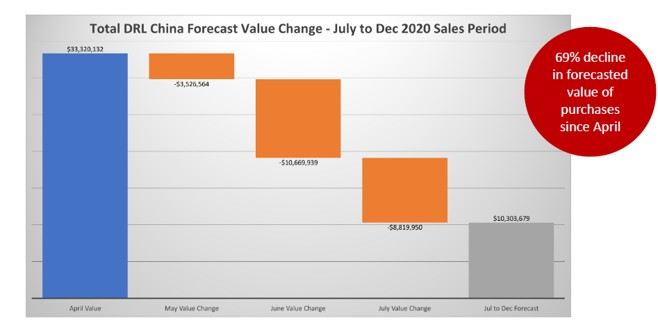
221 Between about 18 to 21 August 2020 ABM participated in the promotional sales event known as “Super Brand Day” (see [174(4)] above) achieving a sales result of approximately 94 million RMB GMV. In the previous year, ABM had achieved a result of approximately 62 million RMB GMV for the same event.
222 On 19 August 2020, following a Board meeting held the previous day, MCP made an announcement to the ASX titled “McPherson’s 2020 Results” (19 August Announcement) which included:
Highlights
…
75% growth in Dr. LeWinn’s sales revenue on pcp through our strategic and exclusive China facing partner ABM and strong domestic growth
…
McPherson’s Limited (“McPherson’s” or “the Group”) today announced its final audited FY20 results, which are consistent with the preliminary results released to the ASX on 28 July 2020. FY20 generated underlying profit before tax of $22.8 million (FY19: $19.0 million) and statutory profit before tax of $13.3 million (Fy19 $19.0 million), with a $10.7 million pre-tax non-cash impairment in its A’kin and Moosehead brands and its investment in the Kotia joint venture.
…
McPherson’s Chief Executive Officer and Managing Director, Mr. Laurence McAllister said: “The impressive growth in sales revenue and underlying earnings combined with the strong operating cash conversion achieved in FY20, in a very challenging external environment, is testament to the consumer appeal and resilience of our market leading brands – Dr. LeWinn’s, Manicare, Lady Jayne, Swisspers, A’kin and Multix.
…
“The potential, transformational opportunity of an acquisition in the Health, Wellness and Beauty space is no better illustrated than the Group’s acquisition of the Dr. LeWinn’s brand in 2014 for approximately $20 million. This brand has generated revenue of $57.6 million in FY20 and is on a remarkable growth trajectory, with sales to ABM increasing from $0.5 million in FY17 to $37.2 million in FY20, with 133% growth in FY20.”
…
Category Performance
During FY20, McPherson’s generated substantial growth in skincare, haircare and bodycare brands, with revenue increasing 59% to $63.8 million. This was driven by strong growth in Dr. LeWinn’s, in both the domestic and export channels.
…
(Emphasis in original.)
223 In cross-examination Mr Fielding accepted that the growth in sales of DRL to ABM as recorded in the 19 August Announcement was a significant contributor to MCP’s share price.
224 On 24 August 2020 Ms Foo provided Cathy and Michelle with an updated purchase forecast covering an 11 month forecast period from September 2020 to July 2021. The updated value of DRL products to be purchased by ABM during FY21 in this forecast was $43.2 million (up from $38.5 million for the same period in the July 2020 forecast) (August 2020 Purchase Forecast).
225 The CWH Conflict arose in August and September 2020 with Chemist Warehouse’s promotional activity conflicting with ABM’s promotional activity at the time, including during the Super Brand Day event.
226 On 9 September 2020 at 1.18 pm, Ms Foo sent an email to Cathy and Michelle, copied to Ms Peak, attaching a purchase order for September 2020. The value of purchases by ABM from MCP recorded in that purchase order was $36,321.54.
227 Ms Peak was unable to locate in her records any purchase forecast received by MCP in September 2020. She believes that ABM did not provide a purchase forecast that month.
228 On 25 September 2020 MCP held a Board meeting. The minutes record:
(1) under the heading “Management presentation – acquisitions”, among other things:
Mr. Fielding and Mr. Owers provided an outline of the major transactions currently under consideration along with a timeline setting out indicative milestones associated with each transaction.
Mr. McAllister provided background information to add context to the M&A presentations and discussion.
Mr. Fielding and Mr. Owers then gave a detailed presentation and update regarding each of three major M&A opportunities currently under consideration:
…
(2) under the heading “capital raising” that Mr Witheridge “tabled a paper and a proposal from [Moelis Australia (now known as MA Financial Group)] relating to capital raising considerations” and provided relevant background and other information.
229 Messrs Witheridge and Fielding recall that September to October 2020 was a very busy period because MCP was considering different acquisition opportunities and related capital raising activities. The primary purpose of the 25 September 2020 Board meeting was for senior management to present on the opportunity to acquire Global Therapeutics Pty Ltd ACN 089 188 698, which presented a strategic opportunity for the business to expand its health portfolio.
230 As Mr Witheridge had primary responsibility for the capital raising he prepared a memorandum dated 24 September 2020 for the Board titled “proposed capital raising” which included:
Given the three acquisition opportunities currently under consideration and the desire to make further meaningful acquisition, [Mr McAllister] and I have given consideration to the optimal form for funding the initial acquisition phase and recommend that an equity raise is the best approach at this time for the following reasons:
* Strong share price, ie PE ratio > 20 times.
* Inherent economic uncertainties – uncertain path of COVID-19, fiscal cliffs and walls, potential for high unemployment, etc, etc
* Unwise to signal future requirement for equity as it can be a drag on our share price in future, best to go early with equity and late with debt.
* Strong appetite from existing and new investors & general confidence in MCP in broker community.
* Increase in market capitalization will increase our index weighting and free float liquidity.
…
231 While Mr Witheridge’s memorandum referred to three acquisition opportunities, only the acquisition of Global Therapeutics was pursued. Mr Witheridge explained that Moelis and other brokers had indicated to him that there would be “strong appetite” from existing and new investors in the event of a capital raising.
232 A presentation titled “Board Meeting 25 Sept 2020 Trading Update” was also prepared for the 25 September 2020 Board meeting. While Mr Witheridge cannot recall to what extent the presentation slides were shown to the Board, he believes that he may have provided some input into them. The presentation slides included a slide titled “ABM performance update” which, among other things, set out for ABM “Q2 Performance Drivers” and Q3 and Q4 “Levers” as well as some general information about ABM’s payment terms and its payments.
3.9.2 1 October 2020 to 20 October 2020
233 Ms Peak was on annual leave from 5 to 25 October 2020. While she was able to check her work emails while on leave, she did not necessarily do so carefully or closely, if at all.
234 On 12 October 2020 at 11.33 am Mr Fielding sent an email to Cathy and Pei Ling Lim, who was based in Singapore in MCP’s finance and administration department, in which he wrote:
Hi have an SLT meeting tomorrow starting at 9:30am and the agenda has just come out.
Could I please get your help by 5pm today.
Cathy are you and Michelle able to update slides 3& 4
Pei Ling are you able to update slides 6 & 7?
Thanks. I know this is short notice
235 On 12 October 2020 at 2.58 pm Cathy sent an email to Mr Fielding in response to his query, copied to Ms Peak. Cathy’s email, which attached a document titled “Board Meeting EXPORT 12 Oct Update.pptx”, included (as written):
Please find my updates on slide 3&4 which are highlighted in red.
1. 1. Oct LE dropped from 4.2m to 2.5m as ABM Sep purchasing forecast and PO are still outstanding.
2. 2. Oct LE 2.5m comes from 1.2m mask orders (Orders at hand which was delayed from Sep to mid-end Oct dispatch) and estimated 1.3m from Sep PO to be placed in 4th week of Oct.
3. 3. Jan/Feb forecast may need to be brought forward to delivery Q2 shortfalls due to delayed Sep forecast.
4. 4. Full year 48m budget is at risk of uncertainty due to outstanding Sep forecast.
If any question to the update, please let me know.
236 Ms Peak understood from point 4 of the email set out in the preceding paragraph that Cathy was indicating that, as at that date, ABM had not provided its monthly purchase forecast for September 2020.
237 Mr Fielding noted that Cathy provided commentary from her perspective at an operating level. Insofar as her email and updates to slides 3 and 4 were concerned, Mr Fielding interpreted the information in the following way:
(1) in relation to slide 3 which was titled “October LE”, he observed that:
(a) the latest estimate (LE) of forecasted DRL sales for the month of October was $2.5 million (October LE) which represented sales by MCP to ABM and was made up of actual orders referable to a purchase order submitted by ABM of $1.2 million and forecast orders of $1.3 million; and
(b) the October LE was below budget for October but that was because ABM’s purchase forecast and purchase order for September were still outstanding as at 12 October 2020; and
(2) in relation to slide 4 which was titled “ABM Performance Update”:
(c) there were a number of second quarter (Q2) performance drivers including LSC Eye Serum launch in December, Trinity acceleration activity to be executed, expanded mask portfolio in October, Chinese New Year and Women’s Day stock buy up in December;
(d) there were two Q2 performance risks, including that ABM’s September forecast was still outstanding and the January and February forecasts may need to be brought toward to meet the shortfalls in Q2; and
(e) ABM payments were up-to-date and it was currently under the $1.5 million credit limit and all due payments had been paid.
238 Ms Peak cannot recall whether she read Cathy’s email at the time as she was on annual leave. However, having regard to the context provided by the email chain and based on her experience from working closely with Cathy and Mr Fielding for a number of years, Ms Peak made a number of observations about the email and slides 3 and 4 of the attached slide deck as updated by Cathy that were in some respects similar to Mr Fielding’s interpretation of the slides set out above. In addition, Ms Peak noted that the information in slides 3 and 4 reflect that:
(1) the October LE was 54% above the actual results achieved in October the previous year;
(2) while the October LE was tracking below the FY21 budget, the November and December forecasts were to deliver the balance of the shortfall from September and October; and
(3) upfront payments were still forming part of regular trading with ABM to enable MCP to supply the full value of a purchase order to ABM without ABM exceeding its credit limit.
239 Mr Fielding was not concerned that the October LE was behind budget because:
(1) MCP had recently completed a strong FY20 and the business was three months into the new financial year where year to date sales from July to September 2020 to ABM were in a good position against the prior corresponding periods (PCP);
(2) the 11/11 Event was still to come and, as it was the biggest sales event in the year, it presented a substantial sales opportunity for ABM to move stock which would create the need for it to replenish stock following the event; and
(3) his experience with how the forecasting relationship worked between MCP and ABM was that a number of factors affected ABM’s purchase forecast and the subsequent fulfilment of purchase orders by MCP which meant that MCP’s sales to ABM often fluctuated from month to month. Given that ABM followed a sales curve that was driven by different promotional activities, the relationship was such that for certain months, forecasted orders for later months were brought forward into the present month (e.g. ahead of major promotional sales periods or new product launches) and for other months forecasted orders might be pushed back into later months (e.g. if MCP was out of stock and unable to supply certain products).
240 On 16 October 2020 at 4.13 pm Cathy sent an email to Mr Fielding and Ms Peak which included:
For your information, I just got the update from Tina for the sales of the mask launch:
* * Expected KPI: > 90% reserved stocks sold
* * Achieved: 49% reserved stocks sold
However, ABM may just show Sold Out on their APP to create some buzz for the launch.
The performance is below expectation so their forecast may be downgraded.
CW discount may not be the only reason of down performance, but definitely a negative factor as some of ABM top distributors are complaining in their group hence influenced distributors purchasing decision.
…
241 Mr Fielding said that he did not know if Cathy’s reference in her email to a downgrade in ABM’s forecast concerned only the products the subject of the email exchange or the forecast for FY21 but he accepted that this was the first occasion on which he had been told about a downgrade in relation to DRL product for FY21.
242 On 19 October 2020 at 9.49 am Mr Witheridge sent an email to the Board, copied to Mr McAllister, attaching a draft ASX release titled “McPherson’s Q1 FY21 Trading Update” which MCP proposed to release to the market the following day in which he wrote (as written):
Refer attached the latest draft that includes an outlook statement.
Laurie and I are in 2 minds re whether to go with:
1. Approx 10% as attached.
2. Or range of 5% to 10%.
1. Is clearly a stronger statement and does align with the Q1 forecast I emailed with my CFO Report. However, it does put us under a bit more pressure though.
Note that FY20 Underlying PBT was $23.9m so 5% = $1.2m.
Of relevance, average consensus PBT is $26.0m & Moelis (our lead analyst) has $25.6m.
Please let me know your thoughts.
243 Mr Witheridge explained that his reference to “average consensus PBT” was to the average of all published guidance about MCP’s financial results and his reference to Moelis as “lead analyst” was because most of the trading volume was via Moelis as broker. He provided the average consensus PBT to the Board as a reference point. Ultimately the Board settled on expressing the outlook as a range.
244 On 19 October 2020 at 11.49 am a Board member, Ms Mew, sent an email to Messrs McAllister and Witheridge in which she wrote:
Just going through the board papers and noted the YTD shortfall of sales to ABM of $2.6M to budget.
I can’t see any commentary regarding this, but maybe I have yet to find it. Can you provide me with a quick explanation? Is it a timing issue or supply issue or a bullish budget issue?
245 On 19 October 2020 Mr McAllister forwarded Ms Mew’s query to Mr Fielding who, in turn, forwarded it to Ms Peak noting that there was a Board meeting the following day and that “obviously [Board] are just getting through the board papers. Can we please supply an answer on the YTD Sep performance Vs budget and then the approach for remainder of the half”.
246 In response, on 19 October 2020 at 2.25 pm Ms Peak sent an email to Messrs McAllister and Fielding (19 October Email) in which she wrote:
Below is the commentary I put together in my monthly report which hopefully addresses Alison’s question.
September sales are well behind budget for September which is reflective of phasing and availability of specific SKUs. The supply for out of stocks will roll forward into October Whilst gross contribution was way down, CM was strong vs budget
YTD DRL has fallen behind budget however this will be positively shifted in Q2. The brand is still in a strong position vs last year
247 In her email Ms Peak refers to commentary she had put together in her “monthly report” which was a reference to the section she contributes to the monthly report provided to the SLT, parts of which Ms Peak believes then formed part of a monthly report that went to the Board. Ms Peak’s commentary is taken from the monthly report which was prepared for the SLT meeting on 13 October 2020. Ms Peak explained that it addressed Ms Mew’s question in the following way:
(1) while September sales had fallen behind FY21 budget for September, that was reflective of “phasing” whereby MCP was unable to sell specific products in September because those products were out of stock. However, those sales will roll forward into October;
(2) while gross contribution was down, the contribution margin for DRL was strong versus FY21 budget;
(3) although year-to-date (YTD) DRL sales had fallen behind budget, Ms Peak expected that the shortfall would be recovered in Q2 (i.e. October to December); and
(4) DRL was in a strong position against the prior year, which was a significant measure of performance for MCP.
248 The 19 October Email was consistent with Mr Fielding’s understanding at the time of the YTD shortfall in sales to ABM against budget for September. In particular, Mr Fielding was not concerned that YTD and September sales of DRL had fallen behind budget and, in any event, MCP was yet to receive a purchase forecast from ABM for September and October because:
(1) there was an explanation for the September shortfall against budget, namely MCP’s inability to supply certain DRL products in that month such that those sales would roll forward into October;
(2) he believed that the YTD shortfall against budget would be positively shifted in Q2 of FY21 having regard to the performance drivers for Q2 and the strong demand for DRL products in the market;
(3) the strong demand for DRL products in the market had been demonstrated through three major sales events which occurred earlier that year, including the Women’s Day event in March 2020, the 6/6 Event in June 2020 and Super Brand Day in August 2020;
(4) there were a number of factors that influenced the way MCP interpreted sales to ABM including that, at the time, the 11/11 Event period had yet to occur and MCP’s sales to ABM often fluctuated from month to month; and
(5) he understood that in the past ABM would sometimes use information, such as an indication of a downgraded purchase forecast, to its commercial advantage, for example, to influence MCP to take actions to improve its competitive position against Chemist Warehouse. At the time Mr Fielding considered this might also explain why ABM had yet to provide its purchase forecast for September and October.
249 On 19 October 2020 at 2.32 pm Mr Fielding sent an email to Mr McAllister and Ms Peak in which he noted, “fingers crossed”, which he explained was a reference to the fact that MCP was waiting for a forecast, that he expected that MCP would have an updated forecast from ABM on Wednesday and that he was looking to put a time into Mr McAllister’s diary on Thursday to “talk through the latest updates from ABM”. For reasons set out starting at [273] below, the meeting Mr Fielding proposed to take place on Thursday did not go ahead.
3.9.3 20 October 2020
3.9.3.1 Board meeting
250 On 20 October 2020 at 10 am MCP held a Board meeting. The minutes record, under the heading “Chief Financial Officer’s Report”, among other things, that:
A report was tabled by the Chief Financial Officer (CFO), Mr. Paul Witheridge, relating to accounting, financial and other issues, and a status report on foreign exchange hedging.
…
Mr. Witheridge referred to the Q1 forecast included in his report, noting a solid lift in underlying performance for FY2021 compared with the budget. He outlined the basis of the forecast’s preparation and explained each of the main drivers behind the improved performance outlook. Mr. Witheridge confirmed there were no major forecast variations in balance sheet or cashflow outcomes compared with budget, and that compliance with bank covenants would continue inclusive of the impact of the hand sanitiser inventory provisioning.
Mr. Witheridge responded to a range of questions relating to the Q1 forecast, including relating to:
⮚ Forecast FY2021 STI outcomes and related accruals. The agreed approach to separating H1 and H2 outcomes for STI purposes in FY2021 was noted.
⮚ The assumptions around ABM revenue.
⮚ Major risks in achievement of the forecast.
⮚ Degree of conservatism and any potential upsides.
⮚ It was noted that the forecast assumed an AUD/USD FX rate of 70.5c (budget 69.0c), but given the FX hedging programme in place and potential commodity price offsets, any currency decline in FY2021 was considered unlikely to have a material impact on financial outcomes.
Following further discussion the Q1 forecast was approved.
The proposed release to the ASX was considered including the extent to which the financial outcomes for the half and full FY21 year should be disclosed. Following discussion, the level of disclosure was agreed and certain other amendments to the contents and wording of the ASX release, including regarding the dividend policy, were considered and agreed.
Mr. Witheridge made certain amendments and re-circulated the revised draft ASX release. Following further consideration and subject to some further minor amendments being actioned and recirculated after the meeting, the document was approved for release to the market.
251 Mr Witheridge recalls that when he responded to questions from the Board in relation to the “assumptions around [ABM] revenue” the figure he identified was about $48 million (i.e. the budget figure).
252 The CFO’s report tabled at the October Board meeting included:
INVESTOR & LENDER RELATIONS
In October Laurie and I have responded to questions from a number of MCP’s current “growth” investors (Ophir and MX Capital) and well as Sarah Mann Analyst from Moelis, with a focus on (i) current demand for Dr. LeWinn’s in China and (ii) the impact of the ABM/MCP Dr. LeWinn’s China JV. Zoom meetings have been held with Wilson Asset Management and UK Based $US4.5B International Small Caps “long only” Fund Highclere Investors, again with the primary focus on the DLW China business model.
Q1 FY21 FORECAST
Detailed schedules in relation to the Q1 FY21 forecast are attached. Note that these figures exclude any P&L or balance sheet impacts associated with the draft proposed Game On hand sanitiser provision.
In summary the underlying PBT forecast for FY21 is $3.8m higher than the FY21 budget, noting that our year to September actual PBT is $1.3m above budget. The key drivers of the $3.8m increase are:
1) $2.4m increase in contribution from Multix brand sales to Woolworths, Coles and Metcash, with sales forecast to be 9% higher than budgeted and contribution 21% higher than budgeted, due to favourable changes in product mix. Note that Multix sales are 10% above last year for Q1 FY21;
2) $1.2m increase in contribution from Dr. LeWinn’s export sales, due to a change in forecast product mix and product cost assumptions;
3) $0.5m decrease in A&P to support Dr. LeWinn’s domestic sales;
4) $0.5m decrease in travel expenses;
5) $0.2m reduction in COGS due to AUD/USD appreciation net of commodity cost increases; and
6) $1.1m decrease in contribution from Dr. LeWinn’s sales in Chemist Warehouse.
The above improvement in underlying PBT translates to a full year forecast underlying PBT of $26.1m, $2.1m or 9% above FY20 - $24.0m. Given the strong favourable COVID-19 impact on 2H20, the increase in PBT is heavily weighted to the first half which is projected to increase by $3.4m or 40% on 1H20. 2H21 is forecast to be $1.3m or 8% below 2H20.
There has been no material change to the forecast balance sheet. Cash Conversion (Operating cashflow before interest and tax payments / Underlying EBITDA) is forecast is be 90% (budget 95%). All bank covenants are forecast to be satisfied with significant headroom.
3.9.3.2 Weekly operating team meeting
253 On 20 October 2020 at 2.23 pm, ahead of the weekly operating team meeting scheduled the next day, Ms Peak sent an email to Michelle, copied to Cathy, titled “ABM Meeting Agenda Items” in which she wrote:
I’ve got a few items for our meeting tomorrow
Forecast availability
Mask order cancellation
Profit challenges at a SKU level
11/11 additional support
Competing with CWH
254 On 20 October 2020 at 2.52 pm Michelle circulated a new agenda for the weekly operating team meeting scheduled to take place the following day, 21 October 2020, to Ms Peak and Cathy. As at that time Ms Peak was still waiting for the next iteration of the monthly purchase forecast.
255 Cathy proposed a meeting with Ms Peak and Mr Fielding to take place by Microsoft Teams on 20 October 2020 from 3 pm to 3.30 pm “to discuss the challenges we are facing from ABM”. Neither Ms Peak or Mr Fielding could recall if that meeting took place and, if it did, what was discussed.
256 On 20 October 2020 at 3.15 pm Mr Brady sent an email to Ms Peak, Cathy and Michelle, copied to Ms Le and Mr Khan, in which he wrote:
We are looking through some forecasted information with TADD & Surge in particular (and other Hero SKUs) for ABM, and wondering when we might get a new and improved forecast? I’m sure you will shout when you receive it – but wanted to check in together of course We are presently in a ‘good’ stock position for bringing forward Jan (or FEB) ABM forecast into Dec, but with Jan & Feb delays from a Chinese NY perspective both in beads manufacturing and packaging manufacturing – just want to stay ahead.
We then also notice (as you will of course too) with the eyes on bringing July (or AUG?) too into June – the forecast for July & August is effectively only 3-5,000, whereas I expect it might be a bit bigger in reality. Especially to make up our $50M!!!
So checking in – and any intel and expectations are welcomed.
TADD will need ordering Finished goods for a [sic] end Jan deliver by end of Oct, and Surge maybe a little more time with our SOH, not to order towards end Nov.
But both statements change if we can get a handle on the July/Aug real size
Thank you – thoughts from anyone?
257 According to Ms Peak, Mr Brady was checking in with the Export Team about whether there was an updated ABM purchase forecast because they were thinking ahead to Chinese New Year and were conscious of manufacturing lead times and logistics. Ms Peak considered this email to be an ordinary enquiry which formed part of usual prudent business practice on the part of MCP’s supply chain team.
3.9.3.3 20 October Profit Forecast
258 On 20 October 2020 at 4.13 pm MCP made an announcement to the ASX titled “McPherson’s Q1 FY21 Trading Update” (i.e. the 20 October Profit Forecast) which included the following “Key points”:
* 4% growth in sales revenue to $49.7 million
* 8% growth in sales revenue from owned brands $41.7 million
* 84% growth in underlying PBT to $2.9 million
…
* Continued strong China sales trajectory fuelled by ABM partnership model
* $5.7 million non-recurring full provision for write down in hand sanitiser inventory
* Forecast growth in first half FY21 underlying profit before tax in the range of 20% to 30% above FY20 and forecast growth in full year FY21 profit before tax in the range of 5% to 10% above FY20.
…
First Quarter Trading Update
…
McPherson’s Chief Executive Officer and Managing Director, Mr. Laurence McAllister said: “The strong growth in sales from our owned brands in the midst of the disrupted COVID-19 trading environment confirms the market strength and resilience of our brand portfolio. This top line growth in combination with improved contribution margins across the majority of our brands has generated a very strong lift in first quarter FY21 profitability from our core business, noting that the first quarter of our financial year is our seasonally lowest in terms of profitability.
The majority of our brands continue to grow their category market share, with four of our six core brands increasing market share over the year ended September 2020.”
The Group’s Manicare, Lady Jayne and Multix brands have all recorded double-digit growth in sales revenue in comparison with the prior corresponding period (pcp), while sales from Dr. LeWinn’s continued its growth in the Export channel, albeit at a seasonally slower pace, through McPherson’s successful exclusive strategic partnership with ABM, increasing 19% on pcp.
…
Outlook
Commenting on the outlook, Mr McAllister said: “While we are very disappointed with the non-recurring provision to fully write down legacy hand sanitiser inventory, our core business has made a strong start to FY21. Following the reported 20% increase in underlying profit before tax in FY20, our positive underlying momentum is forecast to continue through FY21, despite the challenges presented by the current macro environment. Consequently, we forecast growth in first half underlying FY21 profit before tax in the range of 20% to 30% and growth in full year underlying FY21 profit before tax in the range of 5% to 10%, noting that we are cycling strong COVID-19 demand from 2H20 in our 2H21 forecast.
…
259 According to Mr Witheridge the basis for the 20 October Profit Forecast was the Q1 forecast which was formulated by following the detailed forecast review process described at [106] above. He explained that, in circumstances where the Q1 forecast recorded forecasted PBT of $11.9 million in the first half of FY21, which was a 40% increase on the PCP, the forecast growth in the first half of FY21 of underlying PBT in the range of 20% to 30% above FY20 in the 20 October Profit Forecast was on the conservative side.
260 The 20 October Profit Forecast also contained a statement that MCP was “cycling strong COVID-19 demand from 2H20 in [its] 2H21 forecast”. Mr Witheridge explained that there was buoyant domestic demand for retail consumer goods generally during the COVID-19 pandemic as mandatory lockdowns meant that people stayed at home and purchased more home and personal care products. The demand for DRL in China at the time also remained strong against the PCP despite the COVID-19 pandemic. The 20 October Profit Forecast was therefore conservative in stating that the business was cycling strong demand as a result of COVID-19.
261 On 20 October 2020 at 7.24 pm Ms Peak responded to Mr Brady’s email set out at [256] above noting that:
The forecast is unusually delayed and we are to understand there are many factors impacting this however we are fairly confident of the next iteration sometime this week but we are expecting a downgrade. As yet we don’t know what SKUs are affected.
262 Ms Peak told Mr Brady that the ABM purchase forecast was “unusually delayed” because at the time ABM had not provided an updated purchase forecast in September and was yet to provide one in October. Ms Peak recounts that a delay in the provision by ABM of an updated purchase forecast was not uncommon. She cannot recall whether ABM provided a specific reason for the delay on this occasion. However, ABM had concluded a significant promotional sales event for DRL in August and it was not unusual for there to be a lag in the provision of information following a sales event.
263 Ms Peak also explained the basis for her belief, expressed to Mr Brady in her email, that ABM would provide an updated purchase forecast sometime that week and that it would involve a downgrade. By that stage Ms Peak and her team had been chasing ABM for an updated purchase forecast for some time and, in that context, although she cannot recall precisely when or where, Ms Peak believes that Ms Dong informed her, maybe a week or two earlier, that the next iteration of ABM’s purchase forecast would be a downgrade but did not provide any further details at that time. Ms Peak did not think it was likely that Ms Dong had provided her with the information about the downgrade to ABM’s next purchase forecast at the time she sent the 19 October Email but accepted she was aware of the information by 20 October 2020.
3.9.4 21 October 2020
264 On 21 October 2020 Ms Peak and Mr Brady again exchanged emails. Mr Brady wrote:
Separately – do you think there is fall out (correctly or not) on quality issues? And will this be used as a blame game for the reasons for downgrade?
Just thinking
265 Ms Peak responded by email sent later that day:
No not quality issues – the issue is CWH activity and 40-50% off 3 months in a row without visibility. Same situation as August just happened again
266 On 21 October 2020 at 1.30 pm Ms Peak and her team attended the weekly operating team meeting with ABM. Michelle had circulated the agenda for the meeting earlier that day. Ms Peak explained that the usual attendees at the weekly meetings were: for MCP, herself, Cathy and Michelle; and for ABM, Ms Dong and Ms Foo.
267 In accordance with her usual practice, Ms Peak made notes at the meeting which, among other things, record:
(1) “CWH Competitive Trinity x 3 impacted by CWH promotions”, which was a reference to ABM saying their sales in relation to one of the Hero SKUs known as “Trinity” had been impacted by the CWH Conflict;
(2) “10th October warm up package is slow moving”, referring to ABM’s sentiment that the “warm up” to the 11/11 Event was slow moving. The warm up period is a period prior to a sales event designed to excite customers by inviting them to register their interest in certain products and by hosting initial promotional activities;
(3) “ABM stock exposure”, referring to ABM’s opinion that it had high volumes of stock in relation to particular products at that point in time;
(4) “Below expectations in warm up for 11/11”, referring to ABM’s position that the warm up to the 11/11 Event was below expectations across ABM so far, noting that the warm up period to the 11/11 Event ran until 31 October;
(5) “More realistic demand planning Demand vs KPI target”, referring to ABM’s intention to improve its planning processes, including forecast modelling, so that its planning was more reflective of demand in the market versus ABM’s aspirational key performance indicator (KPI) targets for its business;
(6) “CWH activity”, referring to the CWH Conflict and its impact on DRL sales results and, in this context, its impact on the warm up for the 11/11 Event. ABM said it was unable to compete with Chemist Warehouse’s promotions on DRL; and
(7) “DRL/MCP inability to control situation = no advance purchases from ABM”, referring to ABM’s position it would not buy forward if the CWH Conflict was not properly managed.
3.9.4.1 21 October presentation
268 On 21 October 2020 at 2.41 pm Ms Peak sent an email to Mr Fielding, copied to Cathy, attaching a slide deck titled “ABM Update Laurie Oct 2020.pdf” (21 October Presentation). Ms Peak believes that she prepared the presentation in anticipation of a meeting scheduled to take place on 22 October 2020 with Messrs McAllister and Fielding, observing that it was common to share updates. The 21 October Presentation included:
(1) learnings from an event hosted by ABM for its stakeholders and brand owners called the “ACG Strategy Session” on or about 28 to 29 September 2020 which Ms Peak attended and which Mr McAllister attended in part. The information provided by ABM at the ACG Strategy Session included that in the 2021 calendar year it was targeting across its entire brand portfolio 10 new products per week, 100 million users on its sales platform, 10 billion in GMV per year (which would be achieved if 100 SKUs deliver more than 100 million RMB each), 300,000 full time resellers (an increase from the 60,000 full time resellers they had at that time), 67 exclusive brands with equity in 35 brands (an increase from their then portfolio of 32 exclusive brands with equity in 24 brands);
(2) an overview of the CWH Conflict including its impact on ABM and proposed actions to manage that channel conflict;
(3) an overview of the ABM purchase forecast influences which reflected learnings from the weekly operating team meeting which occurred earlier that day (see [266] above) including:
1. ABM stock exposure
2. Warm up to 11/11 is below expectations across the ACG group
3. More realistic planning – reflective of demand vs KPI targets
4. Perception of MCP inability to control DRL in the local market
5. CWH promotional activity and inability of ABM to compete
* Next forecast will be available next Wednesday
* Expected downgrade of more than 15% in value
* ABM will not place an October order
* ABM & MCP will collectively review stock situation to develop a plan to clear for mutual benefit
(4) an overview of product profit issues ABM had identified. ABM had informed MCP that it had under-priced certain DRL products, which it claimed had resulted in negative profit.
269 Ms Peak was cross-examined about the 21 October Presentation. She said that the reference to:
(1) “ABM stock exposure” was a reference to ABM holding more stock than it believed it needed at the time which, if correct, was likely to affect its purchasing in October to December 2020 for certain SKUs and that it was something to follow closely;
(2) “more realistic planning-reflective of demand vs KPI targets” was a reference to ABM’s view that it had very high targets and it needed to better plan how they matched demand with more realistic targets. Ms Peak accepted that it was possible that one of the consequences of more realistic planning may be a decrease in purchases;
(3) “next forecast will be available next Wednesday” was a reference to the availability of the next purchase forecast the following Wednesday, 28 October 2020; and
(4) the references to “expected downgrade of more that 15% in value” and “ABM will not place an order in October” were both things that Ms Peak had learned earlier that day at the weekly operating meeting. As to the latter Ms Peak understood that was related to the warm up to the 11/11 Event being below expectations and that it was a significant amount of sales to ABM that would not go ahead.
270 Ms Peak was not concerned that ABM was not purchasing stock ahead of the conclusion of the 11/11 Event as replenishment would typically come after the end of a big sales event. In any event, Ms Peak’s understanding was that DRL’s strong performance at Women’s Day in March, the 6/6 Event in June and the Super Brand Day in August meant that there was strong demand for DRL in China and, despite the fact that the warm up to the 11/11 Event was below expectations, she was optimistic about the upcoming 11/11 Event.
271 Mr Witheridge was also cross-examined about the 21 October Presentation. He was not a recipient of it and was not informed on about 21 October 2020 that MCP was expecting a downgrade of more than 15% in value in the forecast of DRL sales, or that ABM would not be placing an order in October 2020. Mr Witheridge said that if Mr Fielding considered there was some substance to the matters included in the 21 October Presentation, then he would have expected to be made aware of those matters. Mr Witheridge had the following exchange with senior counsel for ASIC, Mr Hewitt SC:
Mr Hewitt SC: Do you agree that if you had been told, you would have regarded an expected downgrade of more than 15 per cent in value in relation to the forecast of DRL sales to China as a significant matter that was important for you to consider; correct?
Mr Witheridge: Yes. In terms of consideration, yes, it would have been something to consider. Yes.
Mr Hewitt SC: Would it have struck you as being something that was likely to have a material effect on the price of McPherson’s securities?
Mr Witheridge: Only if we couldn’t take action to address that issue. If we could take action to address the issue, the answer would be “no”, but obviously it requires further thought and action on our behalf.
Mr Hewitt SC: So sitting here now, do you think this is something that you should have been made aware of at the time this document was prepared on or about 21 October?
Mr Witheridge: Not necessarily. It would depend on, I guess, whether David and Jade thought that they could respond in a way to – to address the potential impact on our first half result and full year result. It depends on whether their view is that it’s a draft, that it’s work in progress, or whether it’s some sort of final expression of view.
Mr Hewitt SC: And you didn’t see it as part – or you don’t see it as part of your role to be involved in those considerations and discussions?
Mr Witheridge: Not in the first instance. I think those considerations and discussions would be occurring between our – our operational management team and the customer in the first instance.
Mr Hewitt SC: And so at what point would you have expected Mr Fielding to draw that sort of information to your attention?
Mr Witheridge: I guess at the point where they thought there was some risk to our first half result and full year result.
272 On 21 October 2020 at 4.26 pm Michelle circulated the minutes and action items from the weekly operating team meeting which had taken place earlier that day to Ms Peak, the Export team and attendees on the ABM side. They included in relation to “Forecast availability”:

3.9.5 Cancellation of proposed meeting with Mr McAllister
273 On 22 October 2020 at 9.23 am Mr Fielding sent an email to Ms Peak in which he wrote:
One thing I am thinking is that given we are trying to get all these deals done by next Tuesday and we wont [sic] have the Forecast till Wednesday I think we should delay the catch up with Laurie…I feel we wont get the “air time”/engagement we want due to so many other things going on
274 Mr Fielding explained that the “deals” to which he was referring were the acquisition of Global Therapeutics as well as the capital raising and the potential acquisition of the Aware Group.
275 Ms Peak responded to Mr Fielding’s email referred to in [273] above by text message sent on 22 October 2020 at 10.39 am saying:
Just saw your email. Have you asked Connie to cancel?
Doesn’t he need to know there no orders from ABM for October and downgrade is coming?
276 Ms Peak said that it was usual practice for Messrs Fielding and McAllister to receive any important updates in relation to the ABM account from time to time and that she thought that the two items she identified in her text message were matters about which Mr McAllister should be made aware urgently. However, given her exchanges with Mr Fielding, Ms Peak believes that the proposed Thursday meeting with Messrs McAllister and Fielding did not go ahead.
3.9.6 26 October 2020
3.9.6.1 Board meeting and following
277 On 26 October 2020 commencing at 7 am MCP held a Board meeting. The minutes of that meeting include:
(1) under the heading “Background”:
Mr. McAllister and Mr. Owers provided an update on transaction status, and Mr. Owers provided a summary of the final agreed terms of the proposed acquisition of Global Therapeutics Pty Ltd. Management responded to questions from Directors regarding the proposed transactions, and confirmed there were no significant outstanding matters.
…
The Chairman noted that:
(a) McPherson’s Consumer Products Pty Ltd (MCP PL) is proposing to acquire the business and assets of Global Therapeutics Pty Ltd (GT), a subsidiary of Blackmores Limited (BKL) (Acquisition);
…
(d) in order to fund the consideration payable for the Acquisition and the consideration which may be payable for the Potential Acquisitions, as well as other associated costs, the Company is proposing to raise:
(i) approximately $38 million through a placement of fully paid ordinary shares in the Company (Shares) with professional and sophisticated investors, at a price of $2.27 per Share (or at such other price as is finally approved by the Directors) (Placement); and
(ii) approximately $10 million through a share purchase plan with existing eligible shareholders, at an issue price being the lower of:
* the issue price under the Placement; and
* a price equal to a 2.5% discount (rounded down to the nearest cent) to the volume weighted market price of MCP shares traded on ASX during the five trading days up to and including the plan closing date (or at such other price as is finally approved by the Directors) (SPP);
…
(2) under the heading “Acquisition”:
After due and careful consideration, RESOLVED that the Company is authorised to undertake the Acquisition.
(3) under the heading “Placement and SPP”:
After due and careful consideration, RESOLVED that:
1 the Placement and SPP are approved and the Company is authorised to undertake the Placement at a price in compliance with ASX Listing Rule 7 and ASIC Corporations (Share and Interest Purchase Plans) Instrument 2019/547;
2 the SPP offer be made to registered holders of Shares whose addresses (as recorded in the register of members) are in Australia and New Zealand only;
3 in the reasonable opinion of the Board, it is either not lawful or not practical to extend the SPP offer to registered holders of Shares whose addresses (as recorded in the register of members) are outside of Australia and New Zealand;
4 if required, the Company is authorised to request a trading halt in connection with the Placement; and
5 the Company is authorised to issue a cleansing notice that complies with section 708A of the Corporations Act 2001 (Cth) (Corporations Act) in respect of the Shares issued under the Placement.
(Emphasis in original.)
278 Mr Witheridge was the primary lead in relation to the Placement and SPP (collectively, Equity Raising) assisted from time to time by Mr Bennett and some members of the finance team such as Mr Kasdi. Mr McAllister was also updated in relation to the Equity Raising from time to time but largely relied on Mr Witheridge to coordinate it. MCP engaged external advisers in relation to the Equity Raising, namely Moelis (external corporate advisors), Thomson Geer (external legal advisors) and Computershare (registry manager).
279 The Board authorised the Cleansing Notice. Mr Witheridge was involved in considering whether, at the time the Cleansing Notice was issued (2 November 2020), MCP had complied with its continuous disclosure obligations and formed the view that was the case. He also had a role in considering whether there was any “excluded information”, as defined by the Corporations Act, to be included in the Cleansing Notice and considered that there was no such information. Mr Witheridge did not agree that, assuming he had known about it at the time, the content of 26 October Purchase Forecast should have been disclosed in the Cleansing Notice. This was because of its status and what was known about it at the time. However, Mr Witheridge accepted that by the time the Cleansing Notice was issued he was aware of actual sales achieved in July to October 2020 inclusive, and the FY21 budget and, based on that information, he was aware that MCP was behind its budget for sales of DRL. However, it was not apparent to Mr Witheridge that MCP was not going to achieve its first half budget of $18.587 million and, at that point in time, he did not perceive that to be unlikely.
280 Mr Fielding was also present at the 26 October 2020 Board meeting. In cross-examination Mr Fielding was asked whether he thought someone should have informed Ms Mew in response to her email (see [244] above) about what he had learned from Ms Peak. Namely, that there would be no orders from ABM for October and a downgraded forecast was expected. Mr Fielding’s view was that: (1) it was not his role to inform Ms Mew about those matters; (2) he had responded to Ms Mew’s specific query in relation to the September results; (3) they were still working through the information Ms Peak had received in order to understand it; and (4) his topic for that Board meeting was the acquisition of Global Therapeutics. He said that if he was going to “weigh in on the forecast issue then [he] would need a solution for it as well, and [he] didn’t have that solution in place”. Solving the shortfall was to be addressed in November and December.
3.9.6.2 26 October Purchase Forecast
281 On 26 October 2020 at 11.06 am Ms Dong sent an email with the subject “DRL double 11 support” to Ms Peak attaching the 26 October Purchase Forecast (26 October Email) in which Ms Dong wrote:
The Booster will be sold in buy 2 get 50% off and the targeted volume is at 50K units which equals $4.9M GMV.
The total unit need allowance support is 25K units and ABM takes 10% of the allowance apart from promoted support on other products and that makes 22.5K unit allowance for your side.
Double 11 could be the best opportunity to facilitate the movement of the stock from both sides. I understand the challenge, so to what extent the credit could be or in which way could be more possible, for example combined model (credit+products)?
I also attached draft version of purchasing forecast for your reference only. According to that forecasting, the only mkt budget we can use apart from the essential investment will be only $36K till next Jun.
If you can also ask Cathy to help check the impact on your stock, we will work together on how to solve the issue
282 The 26 October Purchase Forecast forecasted total purchases of $26,032,282.40 for FY21. Ms Peak accepted that this was reflective of the downgrade Ms Dong had told her to expect. She explained that when discussing a downgrade with ABM that was to be measured against the last purchase forecast MCP had received, which in this case was in August 2020, based on which FY21 sales were estimated to be $43.2 million (see [224] above). That the 26 October Purchase Forecast was lower than the previous purchase forecast received by MCP did not come as a surprise to Ms Peak given Ms Dong’s earlier warning, although she did not know what the number would be. However, Ms Peak accepted that a downgrade from $43.2 million to $26 million is a substantial downgrade.
3.9.6.2.1 Ms Peak’s evidence in relation to the 26 October Purchase Forecast
283 Ms Peak gave the following evidence about her understanding of the 26 October Email attaching the 26 October Purchase Forecast.
284 First, she believed the 26 October Purchase Forecast was a draft version of ABM’s purchase forecast for the month of October 2020. That was because:
(1) the attachment to the 26 October Email was titled “draft version of purchase forecast_reference only.xlsx” while each of the purchase forecasts for February to August 2020 were titled “Dr. LeWinn [Month] Purchase Forecast”;
(2) Ms Dong expressly stated in her email that the 26 October Purchase Forecast was a draft;
(3) Ms Dong stated in her email that the 26 October Purchase Forecast was for Ms Peak’s reference only, or as Ms Peak put it “for [her] eyes only”;
(4) Ms Dong, brand management at ABM, provided the 26 October Purchase Forecast rather than Ms Foo, supply chain at ABM. Since the start of 2020, ABM had developed a “usual channel” for the provision of its final purchase forecasts to MCP, namely via email from Ms Foo to Ms Peak, Cathy and Michelle (in any combination). The provision of the 26 October Purchase Forecast by Ms Dong to Ms Peak alone was a departure from that usual channel which had become routine by that stage; and
(5) Ms Peak had a reference point because ABM had in the past provided MCP with draft purchase forecasts, namely the October 2019 Draft Purchase Forecast and the November 2019 Draft Purchase Forecast (see [184] and [187] above).
285 Secondly, unlike each of the purchase forecasts received by MCP earlier in 2020, the 26 October Purchase Forecast had the following features:
(1) the document was predominantly in Chinese and was missing English translations of the column/row headings and of the product names in column D;
(2) the document had red mark up and red highlighting in it;
(3) the document did not contain a supply plan, whereas each of the final purchase forecasts for February to August 2020 did so;
(4) the document contained a sheet titled “mkt budgeting” which was a marketing budget, whereas none of the purchase forecasts for February to August 2020 contained a marketing budget; and
(5) the document contained a figure of $26,032,282.40 in the sheet titled “mkt budgeting” whereas none of the purchase forecasts for February to August 2020 did so as they were provided only in terms of volume at a product level.
286 Thirdly, Ms Peak believed that the 26 October Purchase Forecast was subject to Ms Wang’s final approval which had not been received at the time Ms Dong sent her email. Ms Peak considered this to be so because:
(1) Ms Dong’s email expressly stated that the 26 October Purchase Forecast was a draft. It was thus implicit that it was subject to a final approved version, by Ms Wang;
(2) the context in which ABM provided the October 2019 Draft Purchase Forecast and the November 2019 Draft Purchase Forecast to MCP was that those draft purchase forecasts were subject to a final version which had been approved by Ms Wang; and
(3) based on her day-to-day experience in managing the ABM account, she understood that Ms Wang had the ability to, and did, influence final purchase forecasts and was the decision-maker at ABM.
287 Fourthly, the 26 October Purchase Forecast was provided to Ms Peak in the course of an email exchange between Ms Peak and Ms Dong about ABM wishing to obtain additional marketing, A&P and other support for DRL for the 11/11 Event. Ms Peak informed Ms Dong about an hour prior to receiving the 26 October Purchase Forecast that there was a challenge by MCP to one of ABM’s requests for additional support. Ms Peak noted that ABM had in the past provided two versions of its purchase forecast where the purchase forecast containing a higher purchase intention was based on it receiving a certain level of marketing support (see for example, at [180] above).
288 In that regard, it is instructive to set out the emails exchanged by Ms Peak and Ms Dong leading up to the 26 October Email:
(1) on Thursday, 22 October 2020 at 11.52 am Ms Dong sent an email to Ms Peak with the subject “DRL double 11 support” which said:
Regarding 11.11 support and further to our last communication, below are the figure/volume for your reference.
If you can give me the confirmation today regarding in which way you prefer (credit note or free good), that would be great as the team is waiting for the “green light” to proceed.
…
(2) on Friday, 23 October 2020 at 1.53 pm Ms Peak responded to Ms Dong’s email in the following way:
Confirming we can go ahead with free goods to be supplied for Collagen Surge and LSC Mask.
For Boosters – I need to have another discussion internally for approval.
(3) on Friday, 23 October 202 at 3.25 pm Ms Dong sent an email to Ms Peak in which she wrote:
Thanks for the confirmation.
Regarding booster, as the promotional mechanism announcement to reseller will be on next Tuesday,can we confirm you will support in a way either in credit note or free goods?
(4) on Monday, 26 October 2020 at 10.01 am Ms Peak responded to Ms Dong informing Ms Dong that:
I have a challenge with the Boosters requested support.
This could not be covered by A&P I would assume and if credited reduces our sales by this amount. I believe it equates to 22,500 units.
Is there something you can share that shows the proposed usage of the units for 11/11 and the return expected in sales or is this related to having too much stock of this SKU?
(5) one hour later at 11.06 am Ms Peak received the 26 October Email attaching the 26 October Purchase Forecast from Ms Dong.
289 Fifthly, Ms Peak’s understanding was that the 26 October Purchase Forecast was a single data point that could not be used to make decisions in circumstances where it was a draft. Indeed, there were indications of a very high level of demand for DRL in the China market with the peak period of the 11/11 Event still to come. Relevantly, the 26 October Purchase Forecast was received on 26 October 2020 which is during the warm up period for the 11/11 Event (between 20 and 31 October 2020), one week prior to the DRL Brand Day (4 November 2020) and two weeks prior to the sales period for the 11/11 Event (between 1 and 11 November 2020).
290 Relatedly, it was Ms Peak’s understanding that the Super Brand Day event in August 2020 achieved a very strong sales result for ABM of 94.6 million RMB GMV, exceeding MCP’s expectations and indicating a very high level of demand for DRL in the China market. Given that context, in circumstances where the 11/11 Event had achieved 115 million RMB GMV in the prior year, Ms Peak was of the view that it was likely that ABM could equal or exceed that result for the 11/11 Event in 2020. A successful 11/11 Event would result in the rapid and significant sell through of DRL stock and ABM would need to replenish its stock holdings prior to the next promotional period in December and/or the new year. Ms Peak accepted in cross-examination that, in contrast, an unsuccessful 11/11 Event would possibly have the opposite effect, namely, that ABM would not need to replenish its stock holdings in November and December 2020.
291 Ms Peak did not accept that a purchase forecast was not a matter for negotiation. She had the following exchanges with Mr Hewitt SC:
Mr Hewitt SC: All right. Now, I asked you earlier about the purchase forecast that you were in the practice of receiving on a more or less monthly basis from ABM, and I think you said that you didn’t typically regard those as being drafts; correct?
Ms Peak: Correct.
Mr Hewitt SC: Is it correct to understand that you didn’t typically regard those as being the opening point in some negotiation?
Ms Peak: Not typically.
Mr Hewitt SC: And that’s because you didn’t consider that a purchase forecast itself was something that was open to negotiation; correct?
Ms Peak: It was always open to negotiation.
…
Mr Hewitt SC: What I want to suggest to you is that the forecast was ABMs best estimate at the particular point in time of their purchases for the period in question, in this case, FY21; correct?
Ms Peak: That is the nature of a forecast.
Mr Hewitt SC: And so that’s not something that is – well, directly lends itself to negotiation, does it?
Ms Peak: It – it had been part of negotiations.
Mr Hewitt SC: It had been part of negotiations, but when you say it had been part of negotiations, the part that it played is that the negotiations were around other matters like marketing and support and price and the like; correct?
Ms Peak: So the negotiations around the support and the elements of that were directly related to the impact they would have on the forecast.
Mr Hewitt SC: All right. So is the – is what you say that there were negotiations around marketing support, price incentives, other matters that you call support plans? Is that the right descriptor of those sorts of matters?
Ms Peak: Yes.
Mr Hewitt SC: And you say that they could have an impact on purchases; correct?
Ms Peak: Correct.
Mr Hewitt SC: And so that’s the relationship between the negotiation and the purchase forecast; correct?
Ms Peak: Yes, sometimes.
Mr Hewitt SC: So that if there was a – if there was a successful negotiation and it resulted in some step being taken, then a forecast could take that step into account and that might affect the assessment of future purchases; correct?
Ms Peak: Yes.
Mr Hewitt SC: But the point in time estimate ABM was making about its prospective purchases: that assessment itself was not a matter for negotiation, was it?
Ms Peak: Can you ask that again, please?
Mr Hewitt SC: The forecast itself, the figure: that wasn’t a matter for negotiation, was it?
Ms Peak: I believed that it was. It was a draft forecast. Livia also did not have all of the detail, in my recollection, and was heavily involved in a forecast and the value of it.
Mr Hewitt SC: Are you talking now about the purchase forecast that was received on 26 October 2020?
Ms Peak: The draft forecast on 26 October, yes.
292 While Ms Peak accepted that she did not typically regard purchase forecasts received from ABM as drafts nor as being an invitation to negotiate, she said that a purchase forecast is always open to negotiation. Further she was clear in her evidence, which I accept, that she believed that the 26 October Purchase Forecast was a draft forecast.
293 Ms Peak had the following further exchange with Mr Hewitt SC about the 26 October Purchase Forecast:
Mr Hewitt SC: And when you say it was a draft, can you tell her Honour, please, what you mean by that?
Ms Peak: I mean that it was an indication as provided by my counterpart, Tina Dong. She explicitly referenced it as a draft and I believe the file name was also as such.
Mr Hewitt SC: And you didn’t think Ms Dong was trying to mislead you about the purchasing intention in providing that forecast, did you?
Ms Peak: I’m not quite sure what you’re asking.
Mr Hewitt SC: I’m asking you whether you thought Ms Dong was trying to mislead you somehow in providing that document to you?
Ms Peak: I wouldn’t use the word “misleading”. I – but perhaps there may have been a tactic.
Mr Hewitt SC: But you took it as Ms Dong’s assessment of what the likely purchases were going to be at that point in time for FY21; correct?
Ms Peak: It was an indication from her.
294 That is, Ms Peak describes the 26 October Purchase Forecast as “an indication” from Ms Dong. In other words, it had not been approved by Ms Wang and in that sense was a draft.
295 On 26 October 2020 at 6.22 pm Ms Peak forwarded the 26 October Email to Cathy asking her to “take a look and give [Ms Peak] her thoughts”. Although Ms Peak made this request of Cathy, it remained her understanding that MCP would receive a final purchase forecast from ABM but, in the meantime, Ms Peak gave the 26 October Purchase Forecast appropriate attention consistent with the draft nature of the document. That involved Ms Peak requesting Cathy to review the 26 October Purchase Forecast as the starting point for further analysis, discussion and negotiation both internally and with ABM in relation to the question of additional support for the 11/11 Event and, as Ms Peak understood, as part of obtaining an approved view from ABM about its purchasing intent.
3.9.6.2.2 Mr Witheridge’s evidence in relation to the 26 October Purchase Forecast
296 Mr Witheridge did not hear about the 26 October Purchase Forecast until 30 October 2020 in the circumstances described at [334]-[335] below and did not receive an update directly from Ms Peak about it until 10 November 2020 during the SLT meeting (see [380] below). Mr Witheridge is aware that he was copied into correspondence sent by Ms Ters and Ms Dennis in early November 2020 which makes reference to MCP’s receipt of a draft forecast from ABM (see [387] below). However, he expected that, once a final purchase forecast was received from ABM, he would be informed if it contained anything materially different to MCP’s expectations.
297 Mr Witheridge was asked what he meant by a “final forecast”. He explained that to be:
A forecast which isn’t work in progress. So a forecast that involves interaction with ABM to discuss actions we might take as an organisation to improve an outcome. If the team – if our operational team believe a forecast is – can be improved through implementing certain proposals, then I would expect that I would be engaged at that point in time, once those proposals had been worked through properly with the customer.
And it would also require:
… the appropriate input from the right level of management within the customer. So there will be people who are authorised to, I guess, make commitments on behalf of the customer. So ensuring that the forecast does have the imprimatur of the appropriate person in that chain of command is also an important element to being comfortable that we’ve got something which isn’t a work in progress or a draft.
3.9.6.2.3 Mr Fielding’s evidence in relation to the 26 October Purchase Forecast
298 Mr Fielding’s evidence, which I accept, is that until the commencement of this proceeding he never saw the 26 October Email or the 26 October Purchase Forecast, that he does not know who generated that document or to whom it belongs. Mr Fielding also explained that it was not Ms Peak’s practice to provide him with purchase forecasts in the form they were provided by ABM to MCP, that he would not expect her to do so because he did not need to receive that level of operational detail and the document itself would be confidential as between MCP and ABM. Thus, he would expect Ms Peak to treat the purchase forecasts in a way which involved reporting or providing updates in an appropriate format and only to the people within MCP who needed to know.
299 To the best of Mr Fielding’s recollection, Ms Peak informed him at the time that the 26 October Purchase Forecast was a draft document only and that it had not been endorsed by Ms Wang. Mr Fielding understood that the 26 October Purchase Forecast was a draft, was yet to be brought to the attention of Ms Wang by her internal reports for approval and was, accordingly, not ABM’s final view as to its purchasing intention.
300 However, in cross-examination, Mr Fielding accepted that when Ms Peak sent her email (see [318] below) she did not say that the forecast was a draft. His view was that the forecast “was a shot over the bow from ABM” and was ABM’s view of what the forecast was going to be. He had the following exchange with Mr Hewitt SC:
Mr Hewitt SC: She doesn’t say it was a draft, does she?
Mr Fielding: Correct. She doesn’t, no.
Mr Hewitt SC: And there was no reason for you to think it was a draft if she wasn’t telling you it was a draft - - -?
…
Mr Fielding: Okay. There’s a – I guess – this – this is the piece in my mind which was – it depends – depends on how you define a forecast.
…
Mr Fielding: It depends on how you define a forecast. My view on the forecast was that this was a significant opportunity to start to engage and listen to what ABM was saying to us. It wasn’t a number that I sat back and said, right. The year is lost. Let’s roll up our sleeves, pack up our camp bags and leave, because we’ve gone from a $48 million budget. Wow. You know, we had a $43 million August forecast, and now we’re down to 26. We had no understanding about why – why that number dropped so – like a lead balloon. No understanding – real – real understanding, apart from what they were telling us, which was Chemist Warehouse predatory behaviour, dropping prices and promoting prices over exactly the same period that we’re doing it.
Mr Hewitt SC: So in saying all that, is what you’re saying that the figure that was recorded in this document of 26 million had come as a shock? Correct?
Mr Fielding: Correct.
Mr Hewitt SC: You were surprised by the - - -?
Mr Fielding: Correct.
Mr Hewitt SC: - - - extent of the downgrade; correct?
Mr Fielding: Correct.
Mr Hewitt SC: What you were hoping would happen was that there would be negotiations in coming weeks with ABM about steps that might be taken by ABM and by McPherson’s try and increase demand for DRL product in China; correct?
Mr Fielding: At the top-to-top level, with Livia Wang, the decision-maker within ABM, yes.
Mr Hewitt SC: You were hopeful that there would be - - -?
Mr Fielding: I was – I was hope - - -
Mr Hewitt SC: - - - discussions and negotiations to that effect?
Mr Fielding: Very expectant that there would be, yes.
Mr Hewitt SC: And you were hopeful that at the end of that process, there might be some agreement reached around steps that might be taken; is that right?
Mr Fielding: Correct.
Mr Hewitt SC: And you were hopeful that if that all played out as hoped, that might result in increased demand for DRL; correct?
Mr Fielding: Increased purchases from ABM. Correct.
Mr Hewitt SC: Increased purchases?
Mr Fielding: Yes, and – and increased ABM off-selling; remember, we always talked about those two pieces going hand in hand. Yes.
Mr Hewitt SC: And that that might in turn, or in time, result in an increase in the forecast for FY21 purchases from ABN for DRL; is that what you were hoping might - - -?
Mr Fielding: Yes, I - - -
Mr Hewitt SC: Might happen in the future?
Mr Fielding: I was hoping that we would be able to move back to the budget.
301 In later questioning Mr Fielding accepted that a forecast could change from month-to-month and in that respect, there is no such thing as a “final” forecast.
302 According to Mr Fielding, he and his colleagues did not treat the 26 October Purchase Forecast lightly. Rather, Mr Fielding considered it to be the opening salvo from ABM and its means of initiating commercial negotiations about initiatives and support to give it a competitive advantage over Chemist Warehouse.
303 Mr Fielding considered that it would be necessary for negotiations to occur between Mr McAllister and Ms Wang for the deployment of different Support Proposals to accelerate consumer demand and accordingly ABM’s demand for DRL. At an operating level Ms Peak could attempt to understand ABM but, ultimately, these types of discussions could only usefully occur at a CEO level between Mr McAllister and Ms Wang. This was because Ms Wang was the decision maker in ABM’s Australian business and she was the mouthpiece at a top level with Mr McAllister regarding any final purchase forecast.
304 As MCP received the 26 October Purchase Forecast in the run up to the 11/11 Event, which was a busy time for ABM, attempting to schedule a meeting with Ms Wang prior to the conclusion of that sales event would have been near impossible.
305 Mr Fielding also believed that the 26 October Purchase Forecast may have been commercial retaliation by ABM against MCP for not dealing, from its perspective, with the CWH Conflict. He understood that ABM had engaged in similar retaliatory conduct in the past.
3.9.7 The Equity Raising and acquisition of Global Therapeutics
306 On 27 October 2020 at 8.12 am Blackmores Limited ACN 009 713 437 made an announcement to the ASX titled “Blackmores Limited divests Global Therapeutics to McPherson’s Limited”.
307 On 27 October 2020 at 9.53 am MCP initiated a trading halt in accordance with Listing Rule 17.1 in connection with undertaking the Placement and MCP’s anticipated announcement to the market about the SPP and associated acquisition of Global Therapeutics.
308 On 27 October 2020 at 10.32 am MCP made an announcement to the ASX titled “McPherson’s acquisition of Global Therapeutics and associated Equity Raising” in which it announced the acquisition of Global Therapeutics and the Equity Raising.
309 The following day, MCP made an announcement to the ASX titled “Successful Completion of Institutional Placement $36.5 million Raised” which confirmed that MCP had successfully raised $36.5 million via the Placement and a SPP was offered to eligible shareholders in Australia and New Zealand to raise up to $10 million.
3.9.8 27 October 2020 to 1 November 2020
310 On 27 October 2020 at 10.17 am Cathy sent an email to Ms Peak with her thoughts on the 26 October Purchase Forecast in which she wrote (as written):
My thoughts are as below:
1. 1. Ampoule support * I’m a bit confused of the $4.9m GMV, the promotion is RMB398 for 2 units, the calculation for 50k units should be ~$2m GMV at the promotion price, unless the GMV is calculated at original price;
* I wonder if ABM will lose money at the promotional price and to what extent? If we are supporting 22.5k (45%), which means ABM only spend 5% on the biggest promotion and they can still get majority of the margin?
* Both ABM and MCP have heavy stock of Ampoules which were built upon ABM’s forecast, to my opinion it’s the joint responsibility to spend on Ampoule sales, so 50:50 support is fair to both.
* ABM’s SOH for ampoule is 77k by end Sep, and no purchasing plan till Jun 2021. I wonder if the Double 11 target is 50~60k, ABM will have low stock level after the promotion, why it’s not reflective on the forecast?
* According to the new forecast, we will have no A&P left in 2nd half, and only have about 4m sales YTD, I doubt if the credit is workable as I guess Paul or Laurie may not agree to take it away from YTD sales.
Given the above, I would suggest:
Scenario 1 : We commit to support 10~12.5k ampoule free goods instead of credit, and the free goods will be supplied in Dec and booked in 2nd half A&P — The current 26m sales in FY21 may eventually go up to 30m (my estimation to bring July forecast forward), thus give us more room to play in A&P.
Scenario 2: We commit to support 10~12.5k ampoule by credit, but the credit will only be issued at end of FY21 when the July forecast is bring forward.
The above may be not workable at all from ABM side, just for your reference and consideration.
2. 2. The new forecast
1 put the forecast in the ‘Forecast Analysis Oct’ file so you will have an overview of the situation.
H1 is only 5m and FY26m in total.
According to this forecast, the SOH at MCP and ABM will have big issue especially for Collagen surge, Ampoule and LSC mask. We need more discussion on this.
311 On 28 October 2020 Ms Peak and her team attended a weekly operating team meeting with the operating group on the ABM side. Later that day at 3.57 pm Michelle circulated the minutes and actions items from that meeting to the operating group. The action items included in relation to the topic “Forecast” that “ABM to send official forecast (next Friday availability)” and “MCP to review draft forecast & marketing budget and provide commentary on stock levels”.
312 On 28 October 2020 at 5.08 pm Ms Peak sent a text message to Mr Fielding in which she said “[n]eed to speak urgently about ABM forecast”. Mr Fielding responded with the message “15 mins? Just on Aware acquisition call”.
313 Ms Peak’s practice was to report important updates to Mr Fielding. As Ms Peak had become aware of the value of the 26 October Purchase Forecast she wished to speak to Mr Fielding. It was not unusual for Ms Peak to seek out Mr Fielding in order to apprise him of information at the earliest point in time, particularly if it was information that he was waiting to receive. Mr Fielding cannot recall if he in fact spoke to Ms Peak at that time.
314 On 28 October 2020 at 5.10 pm Ms Peak received a series of text messages from Mr Brady in which he wrote:
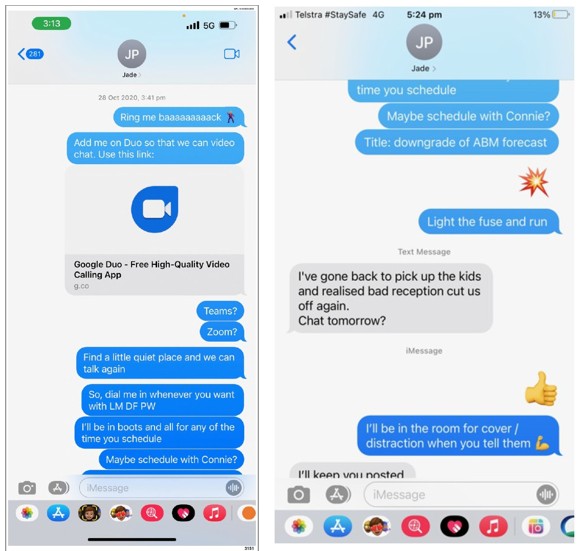
315 Ms Peak described Mr Brady as a close work colleague with whom she spoke casually in her communications. She did not treat her communications with Mr Brady as a report to a senior manager and did not have any reporting lines to Mr Brady. At the time, Ms Peak was hesitant about the change to her role pursuant to the JV Agreement and Mr Brady often checked in with Ms Peak to support her. Ms Peak did not schedule the meeting suggested by Mr Brady with Messrs McAllister), Fielding and Witheridge. That was because Ms Peak thought there was more information to be gathered before convening such a meeting.
316 On 28 October 2020 at 5.23 pm Cathy sent an email to Ms Peak explaining that she “put ABM’s forecast draft on your template” so that it was easier to analyse. Ms Peak explained the document prepared by Cathy titled “DRL. Forecast Analysis Oct 20-26.10 update.xlsx” had the following features:
(1) row 3 in column A “FY20 ACTUAL” is a reference to MCP’s actual sales results for DRL in FY20 which was $37.2 million;
(2) row 4 in column A “BUDGET” is a reference to MCP’s FY21 budget which was $48 million;
(3) rows 5 to 10 in column A refer to the various iterations of final purchase forecasts provided by ABM between March and August 2020;
(4) row 11 “28-Oct-20” concerns the 26 October Purchase Forecast, as reviewed by Ms Shen, and is marked up in red text because it reflects a draft purchase forecast; and
(5) the document indicates that the full year value of the 26 October Purchase Forecast is $26.9 million (as opposed to $26,032,282).
317 At around this time Ms Peak had discussions with Mr Fielding about the drop in the purchase forecast. On 29 October 2020 at 8.56 am Ms Peak and Mr Fielding exchanged text messages. Mr Fielding wrote:
Hey one other thing I just thought of is that if the forecast dropped so dramatically the A&P investment should drop in tune with it so that it would move from $4 mill to $2 mill. so there is obviously a reduction in expenses as well that we should let Laurie know about
Ms Peak responded:
Yes we have already looked at that
ABM are well aware of what that means. It means no spend in the second half because all the budget has been used up already
318 On 29 October 2020 at 10.22 am Ms Peak sent an email to Mr Fielding with the message “[a]ttached” attaching a document titled “DRL Forecast Analysis Oct Update.xslx” (First 29 October Presentation). Ms Peak believes that she sent the First 29 October Presentation to Mr Fielding ahead of a meeting which he proposed take place that afternoon at 3 pm with Mr McAllister but which was in fact rescheduled to take place the following day, 30 October 2020, at 8 am by Zoom.
319 Mr Fielding’s interpretation of the First 29 October Presentation was as follows:
(1) the first sheet “forecast value” contained:
(a) MCP’s FY20 actual sales on a month-by-month basis;
(b) MCP’s FY21 budget on a month-by-month basis;
(c) a series of ABM purchase forecasts received from ABM and reviewed by MCP on or about 19 March, 27 April, 20 May, 22 June, 27 July and 24 August 2020 and their respective half or full FY21 values presented on a month-by-month basis; and
(d) in the final row, the draft forecast monthly totals based on the 26 October Purchase Forecast for the months of October 2020 through to September 2021, the draft full year (to 30 June 2021) forecast of $26,936,731 and actual sales figures for the months of July, August and September 2020;
(2) the second sheet “YOY” contained a summary of the information in the first sheet and a table comparing actual results from FY17 to FY20 and the 26 October Purchase Forecast; and
(3) the third sheet “ABM SOH tracker” contained information provided by ABM in relation to its stock on hand for Hero SKUs at particular points in time.
320 Mr Fielding did not know how to interpret the ABM stock on hand information in the third sheet of the First 29 October Presentation. That information was new as ABM had only started providing MCP with stock on hand information relating to certain Hero SKUs in about August 2020. He had various questions about how ABM was calculating these monthly estimates and whether the data could indicate whether ABM was in a good, bad or neutral stock position, especially in light of the significant fluctuations throughout the year depending on promotional sale periods.
321 On 29 October 2020 at 10.30 am and 11.40 am respectively Mr Fielding sent text messages to Mr McAllister requesting a discussion on the 26 October Purchase Forecast. He considered that it was important that he meet as soon as possible with Mr McAllister to inform him of the information he had just received about the ABM forecast.
322 On 29 October 2020 between 4.42 pm and 4.54 pm Ms Peak and Ms Dong exchanged the following WeChat messages:
Ms Peak: Does Livia know the value of the downgraded forecast?
Ms Dong: She knows the downgrade value of sales forecast, but will see the downgrade purchase value on tomorrow’s purchasing meeting
Ms Peak: Ok thanks
323 Ms Peak understood from this exchange with Ms Dong that Ms Wang was yet to see the 26 October Purchase Forecast.
324 On 29 October 2020 at 8.07 pm Ms Peak sent an email to Mr Fielding attaching a document titled “ABM Forecast Review Oct 20.pptx” which was a six-page presentation document (including a cover page) (Second 29 October Presentation) for the meeting with Mr McAllister which was now scheduled to take place on 30 October 2020.
325 The first slide of the Second 29 October Presentation was titled “Summary” and provided:
* Total forecast value is $26.9m down from $43.2m
* Half 1 is $5.3m down from $13.6m
* Livia is aware of the ABM internal sales forecast but full visibility on purchasing impact being presented to her today
* A&P investment downgrade has been planned for
326 In cross-examination Ms Peak accepted that in the “Summary” slide she did not refer to the “[t]otal forecast value” as a draft, or that it was part of a negotiation and that, while she was trying to communicate to Mr McAllister that MCP had received a draft forecast to the value of $26.9 million, the slide conveyed that the total forecast value was $26.9 million.
327 The second slide of the Second 29 October Presentation was titled “Forecast Drivers” and provided:
1. ABM stock exposure
2. Warm up to 11/11 is below expectations across the ACG group
3. More realistic planning – reflective of demand vs KPI targets
4. CWH promotional activity and inability of ABM to compete
5. Uncertainty in China
328 The third slide in the Second 29 October Presentation was titled “FY21 Tracking” and, among other things, tracked the FY21 forecast against budget for ABM based on the 26 October Purchase Forecast based on Cathy’s review (see [162] above).
329 The fourth slide titled “Year on Year View” tracked performance and percentage growth based on actual results for FY17 to FY20 on the 26 October Purchase Forecast for FY21.
330 The fifth and final slide was titled “Stock Holding Analysis” and provided an analysis of ABM and MCP’s respective holdings of certain Hero SKUs. Ms Peak notes that stock information provided by ABM was limited to those Hero SKUs.
3.9.8.1 Mr McAllister is informed of the 26 October Purchase Forecast
331 On 30 October 2020 at 8 am Ms Peak joined the meeting organised by Mr Fielding. Mr McAllister was also invited to join the meeting. Neither Ms Peak nor Mr Fielding can recall whether the meeting took place, and neither has any independent recollection of its content. However, I am satisfied, given the preparation of the Second 29 October Presentation, that the electronic records show that Ms Peak was invited to, and in fact joined, the meeting organised by Mr Fielding and, having regard to Ms Peak’s exchange of text messages later in the day with Mr Brady (see [332] below), that the meeting did take place. I am also satisfied that Mr McAllister was informed about the status of the ABM account and the value of the 26 October Purchase Forecast at that meeting. That, contrary to her usual practice, Ms Peak has no notes of the meeting does not detract from that conclusion.
332 On 30 October 2020, during a Zoom meeting concerning the upcoming 2020 AGM, Ms Peak and Mr Brady exchanged the following text messages:
Mr Brady: How did that all go in the end?
Ms Peak: I spoke to him twice
He was angry this morning
Then spoke to Livia who calmed him down
He’s appropriately panicked
But has no guidance on what to do next
Mr Brady: Eeek
Yesterday was shock I guess🤷♂️
And then today transferred to anger you say. But Livia calmed him COD she will buy forward? Or broadly - don’t panic it’s all okay?
Ms Peak: The latter
Ms Peak: Are you in AGM meeting?
Mr Brady: Elephant in the room
Yes
Just heard that mention of CW
Ms Peak: $48m slide?!?!?!?

Mr Brady: Where did you land? $26M? Or higher?
Ms Peak: $26.9m is the forecast
He is pretending it’s not happening
Mr Brady: I guess he’s giving himself time to not say it outside yet🤷♂️
We are $2.25 share price
You announce the 1/2 ish off and sport for DRL and its then $1.00 share price ?
Ms Peak: 
333 In cross-examination Ms Peak said that when she texted “he is pretending it’s not happening” she was referring to Mr McAllister and that in her opinion he was ignoring the forecast.
334 On 30 October 2020 at 2.48 pm Mr Witheridge received a text message from Mr Owers, director, commercial and M&A, in which Mr Owers wrote:
Yeah bit distracted but overall ok so far.... David told me today ABM had just given a forecast of $26m for the year and weren’t happy with the ongoing cwh promos. Laurie then apparently called Liv trying to sort it out, but could be an issue brewing there?
335 Mr Witheridge said that he did not pay much attention to the above message on receipt, did not reply to it, and does not recall speaking to anyone about it. Mr Witheridge regarded it as “corridor gossip” and interpreted it as an attempt by ABM to threaten MCP in order for it to deal with the CWH Conflict and to provide additional marketing investment to ABM. Mr Witheridge expected that Mr McAllister would follow up with Ms Wang to negotiate the position and that he would be informed when, and if, anything material came out of those discussions.
336 It was put to Mr Witheridge in cross-examination that when he received Mr Owers’ text message, he would have immediately appreciated that the forecast of $26 million was a very material amount below what the market was expecting in DRL sales. In response, Mr Witheridge stated that would be the case “if credible” and then elaborated on that response:
… this information is coming to me in the form of an SMS. All credible information I’ve ever received as a CFO, in any role, has not come through an SMS. It comes through email or written form from people who are appropriately in a position to inform me of that, not an SMS from a – a gentleman one step removed from what’s going on. And that, combined with the reference to the Chemist Warehouse promotion, made me think, “Well, this is” – “this is ABM mentioning something, providing a figure, which is designed to” – “to achieve a certain commercial negotiation and outcome.” So I did not regard it as credible.
337 Mr Witheridge accepted that Mr Owers was not prone to disseminating non-credible information. However, he was of the view that Mr Owers was repeating information he had heard from Mr Fielding, and Mr Fielding was told this figure by someone unknown at ABM.
338 Mr Witheridge also accepted that when he read Mr Owers’ text message he did not understand that the $26 million forecast figure was a draft. In response to the proposition that he understood it to be ABM’s best estimate of its forecast sales of DRL product to China, Mr Witheridge said:
… ABMs best estimate. No. I – I mean, I received this as an SMS. It’s not coming to me in any form of sort of commercial – commercially professional manner. I – the key thing I took out of it was the fact that they weren’t happy with ongoing Chemist Warehouse promotions. So my reaction to it was that this is a number which is being put out by – by ABM in an attempt to negotiate some sort of outcome or address some sort of issue that they’re experiencing with their major competitor – well, the only competitor for Dr. LeWinn’s in that channel. So I wasn’t – I wasn’t really sure what to make of the number itself other than it lacks some serious credibility given that it’s coming to me in the form of an SMS.
339 As to the issuing of the Cleansing Notice Mr Witheridge had the following exchange with Mr Hewitt SC:
Mr Hewitt SC: And what about before the cleansing notice was issued? Did you think it might be a good idea before McPherson’s issued the cleansing notice to check with Mr Fielding to see if the information in Mr Ower’s text might have something to it?
Mr Witheridge: No. For the reasons I’ve just explained, no, I fundamentally did not have – I fundamentally doubted the credibility of this text message in terms of - - -
Mr Hewitt SC: And I suggest that was a serious failure on your part, Mr Witheridge, to not take steps before the cleansing notice was issued to try and work out what in fact Mr Fielding had received from ABM?
Mr Witheridge: I disagree.
340 On 30 October 2020 at 1.18 pm Cathy sent an email to Ms Dong, copied to Ms Peak, with the subject line “ABM Oct Forecast Draft” identifying potential overstock SKUs for ABM’s internal discussions, based on the “shared forecast draft”, referring to the 26 October Purchase Forecast.
3.9.8.2 Steps leading up to the issue of the Cleansing Notice
341 On 30 October 2020 at 3.05 pm Mr Bennett sent an email to the Board, copied to Messrs McAllister and Witheridge, attaching the final Cleansing Notice and accompanying appendix, and the SPP offer booklet.
342 Ms Peak accepted that by 30 October 2020 she:
(1) was aware that the 2020 AGM was approaching;
(2) had arranged a meeting with Mr McAllister to make him aware of the situation with ABM and thought it was important to inform him of the 26 October Purchase Forecast;
(3) had informed him of the 26 October Purchase Forecast that morning;
(4) assumed, based on the information given to her by Ms Dong, that Ms Wang would be made aware of the 26 October Purchase Forecast;
(5) understood that Mr McAllister had spoken to Ms Wang who at that point had not come back with a different figure; and
(6) was aware that ABM was not likely to place any orders in October 2020 which was going to have a very substantial impact on MCP’s budget for October 2020 and possibly on the budget for the first half of FY21.
343 Ms Peak said that by 30 October 2020 she was treating the 26 October Purchase Forecast as a draft but accepted that she regarded it as ABM’s best estimate at that point in time of their purchase forecast for FY21.
3.9.9 The Cleansing Notice is issued to the market
344 On 2 November 2020 at 8.30 am MCP issued the Cleansing Notice by its announcement to the ASX titled “Cleansing Notice - Placement and Share Purchase Plan” which referred to the Equity Raising and continued:
In respect of the Placement, the Company gives notice as required under section 708A(5) of the Corporations Act 2001 (Act) that:
1 the Company issued the Shares without disclosure to eligible shareholders under Part 6D.2 of the Act;
2 this notice is being given under section 708A(5)(e) of the Act;
3 as at the date of this notice, the Company has complied with:
(a) the provisions of Chapter 2M of the Act as they apply to the Company; and
(b) section 674 of the Act; and 4 as at the date of this notice, there is no “excluded information” as defined in sections 708A(7) or 708A(8) of the Act.
The Company notes that, in accordance with ASIC Corporations (Share and Interest Purchase Plans) Instrument 2019/547 (Instrument), this cleansing notice will also apply to the issue of Shares under the SPP provided the SPP Offer opens within 30 days of this notice.
(Emphasis added.)
345 The Placement occurred on 27 October 2020 and the SPP opened on 2 November 2020 at 9 am with the relevant offer booklet and application form being despatched to eligible shareholders.
346 On 2 November 2020 Ms Peak commenced working from ABM’s North Sydney offices as part of her role in relation to the joint venture. The transition to her new role had not yet been the subject of any detailed discussions and Ms Peak was still performing her usual duties for MCP. At 3.25 pm Ms Peak exchanged text messages with Mr Brady as follows:
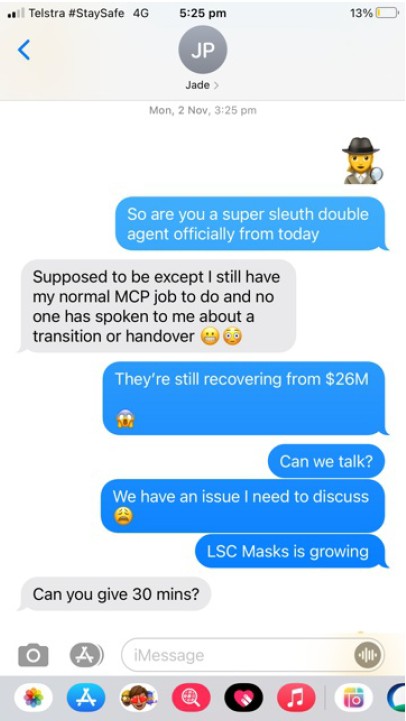
3.9.10 3 November 2020
3.9.10.1 Excess stock committee meeting
347 On 3 November 2020 at 9.52 am Belinda Dennis, senior commercial accountant at MCP, sent an email to Mr Fielding, copied to Ms Peak, Mr Witheridge and Ms Ters, in relation to an internal excess stock committee meeting scheduled to take place on 9 November 2020. Her covering email noted that “[e]xcess stock… is a big concern for the business at present… many of the large balances are in [DRL]” and “large initial forecasts from ABM have now dramatically reduced, and we are really needing assistance to get these moving”.
348 The excess stock committee, which is led by Ms Dennis, assists with the accurate provisioning of stock in MCP’s financial accounts. Mr Fielding did not attend excess stock committee meetings but received a copy of the excess stock report that was circulated to the SLT on a quarterly basis. He believes Ms Dennis sent the email to him because Ms Peak had informed Ms Dennis that she was no longer available to attend excess stock committee meetings as she was transitioning into her role in connection with the ABM joint venture.
349 Mr Fielding explained that MCP’s ability to plan for how much stock it will manufacture varies depending on the brand and the type of product. For example, brands like Manicare or Lady Jayne, where 100% of sales by MCP are into the domestic market, experience very stable sales curve on an annualised basis meaning that the supply chain team could more accurately plan ahead for demand.
350 In contrast, ABM sales of DRL did not follow a normal sales curve because they were focused around specific promotional sales periods during the year. Given ABM’s forecasting processes were still being developed, ABM had difficulties with accurately forecasting its own demand which led to significant volatility in its purchasing demand (which was often communicated to MCP at short notice). Where ABM’s purchasing demands increased at short notice beyond forecasted levels, MCP had in the past been unable to fulfil those orders because its own stock levels had been based on ABM’s original forecasts (see above at [149] to [151]). In 2019 and throughout 2020, MCP’s supply chain team began to hold additional levels of DRL stock as buffer stock so that it had the capacity to meet any increases in ABM’s purchasing demand at short notice. As a result, it was not uncommon for MCP’s stock on hand position for DRL to fluctuate.
351 Thus, Mr Fielding was not concerned by Ms Dennis’ comment in her email referred to at [347] above that MCP was holding excess levels of DRL stock, particularly given that:
(1) the position of the business at that time was that MCP had to accumulate buffer stock at the right times of the year to ensure it had adequate stock to meet ABM’s demand during promotional sales periods;
(2) having regard to ABM’s exponential sales trajectory, it had historically shown that it had the ability to move through large volumes of stock quickly during promotional sales periods; and
(3) the 11/11 Event had not yet concluded, including the key trading day on 11 November, following which ABM would typically replenish stock.
3.9.11 2020 AGM
352 On 4 November 2020 at 2 pm MCP held the 2020 AGM virtually given the ongoing COVID-19 pandemic and (as is required by the Listing Rules) released the relevant presentation, chairman’s address and CEO’s address presented at the 2020 AGM to the ASX shortly prior.
353 Ms Peak attended the 2020 AGM virtually with Ms Wang from ABM’s North Sydney offices.
354 At the 2020 AGM:
(1) Mr Cubbin presented his Chair’s address and referred to the strong start to FY21 and the 20 October Profit Forecast and said that MCP remained in a strong underlying trading and financial position;
(2) Mr McAllister presented his CEO address and restated the outlook for the first half FY21 and full year FY21 contained in the 20 October Profit Forecast, referred to MCP having a strong underlying trading and financial position, and repeated the guidance of 5% to 10% growth in underlying FY21 PBT compared to the PCP;
(3) Mr Witheridge presented on the financial outcomes of the business for the first quarter of FY21, which included restating the outlook for the first half FY21 and the full year FY21 contained in the 20 October Profit Forecast;
(4) Mr Fielding presented on mergers and acquisitions (such as the recent acquisition of Global Therapeutics) and stated that for FY21, MCP was targeting $48.2 million in sales of DRL products to China, up 30% on FY20; and
(5) Ms Wang presented on ABM.
355 Mr Witheridge says that in the context of speaking to the 2020 AGM presentation slide titled “Commentary on Q1 FY21 Financial Outcome”, among other things, he said:
We have provided a forecast for the first half and that is underlying profit before tax growth in the range of 20 per cent to 30 per cent above last year and we have forecasted growth for the full year fiscal 21 underlying profit before tax in the range of 5 to 10 per cent above FY20.
Mr Witheridge recalls that the basis for these statements was the Q1 forecast (see [259] above). In other words, the basis for the statements was the budget of approximately $48 million.
356 Mr Witheridge also said that, since the preparation of the Q1 forecast, no new material information had come to his attention. That evidence was challenged in cross-examination. It was suggested to Mr Witheridge that prior to 4 November 2020 it had come to his attention that ABM had provided a forecast for FY21 of $26 million. However, Mr Witheridge maintained that at that time he had not received a credible forecast from Mr Fielding or any information from Messrs Fielding or McAllister that would alter his Q1 forecast assumption. Mr Witheridge said that the information he received from Mr Owers by text message (see [334] above) would have been material if it was credible. That is, if it had come from a credible source as a final or considered forecast.
357 Mr Witheridge does not recall Ms Wang’s presentation word for word, but recalls the headlines of her presentation were to the following effect:
(1) ABM’s target for DRL for the 11/11 Event was 154 million RMB GMV (11/11 Target), which was 35% growth on the prior year; and
(2) Ms Wang was confident about the demand for DRL in China and that ABM would achieve 35% growth on the prior year for the 11/11 Event.
358 Mr Witheridge gave evidence that Ms Wang’s remarks were made in the formal forum of the 2020 AGM and were made by her in her capacity as the CEO of ABM to all attendees at the AGM, including MCP employees and shareholders. At that time, ABM had a proven track record of achieving exponential year on year growth of its purchases of DRL products from MCP, led by Ms Wang who was knowledgeable about the China market. Mr Witheridge took note of Ms Wang’s positive remarks and trusted her confidence about the demand for DRL in China and that ABM was targeting 35% growth on the prior year for the 11/11 Event.
359 Similarly, Mr Fielding recalls that Ms Wang made the following statements, among others, about DRL in the course of her presentation at the 2020 AGM:
(1) significant GMV sales growth of ABM’s business as a whole;
(2) significant GMV sales growth of DRL between 2019 and 2020 at major promotional events including the 6/6 Event and Super Brand Day;
(3) she anticipated the 11/11 Event would be a great success;
(4) there was strong consumer demand for DRL which was expected to continue to grow; and
(5) ABM was targeting RMB GMV of around 154 million for the 11/11 Event.
360 According to Mr Fielding, Ms Wang did not indicate that there were any issues with the DRL brand or ABM’s business model and the positive messages that Ms Wang conveyed in her presentation were, insofar as he was concerned, at odds with the downgrade in the 26 October Purchase Forecast. That gave Mr Fielding confidence that Ms Wang would not endorse that forecast after the conclusion of the negotiations between MCP and ABM. Ms Wang’s presentation also buttressed Mr Fielding’s view that there was strong demand for DRL in the market and that the brand would continue to grow.
361 Mr Fielding presented on ABM after Ms Wang. The first slide on which he presented showed year on year results for DRL commencing in FY17 as follows:
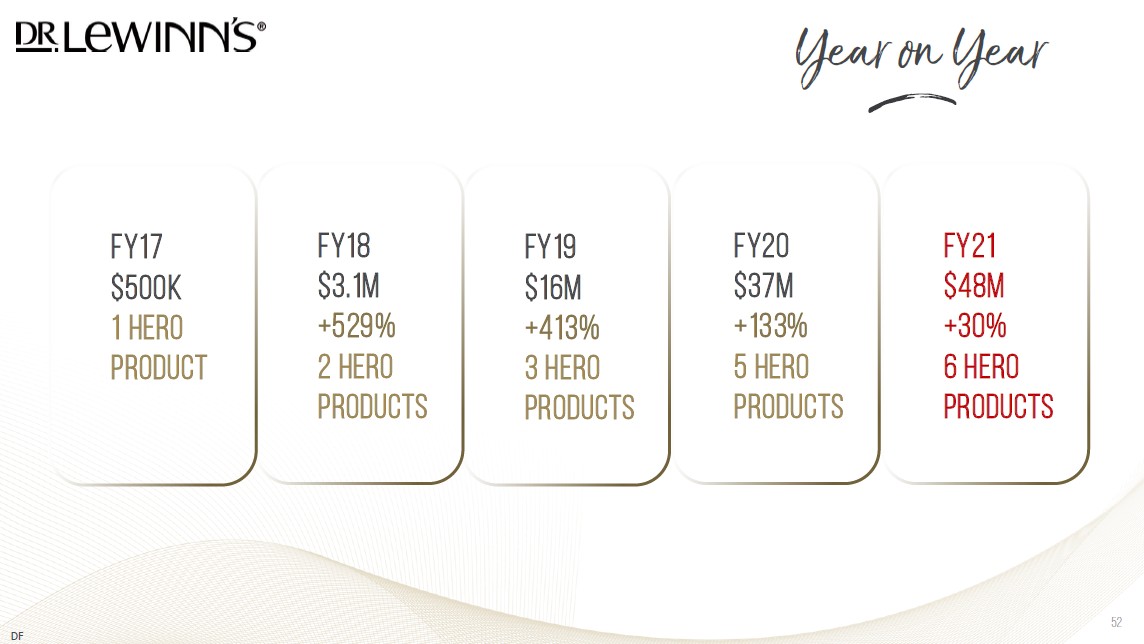
362 In cross-examination Mr Fielding explained that the slide extracted above (slide 52) included a forecast result for FY21 based on the budget of $48 million and that it indicated to readers the continuation of the significant growth that had been achieved year on year since FY17. The speaking notes which accompanied the 2020 AGM presentation which were released to the ASX provided for slide 52:
The growth trajectory of [DRL] in China is a testament to the strength of the [MCP] & ABM relationship and the joint approach to innovation, strengthening the portfolio and building engagement in the [DRL] brand.
Starting with only 1 hero back in FY17, the business has strengthened in revenue and scope achieving more than $37m in sales in FY20 and expanding to 5 hero products.
For the current year we are targeting $48.2 million in sales, up 30% on FY20 expanding to six hero products or SKU’s.
363 Mr Fielding cannot recall if he used the exact language set out in the speaking notes but the notes represented the key messages that he would have conveyed. As to the appropriateness of saying that MCP was targeting $48 million in sales having regard to the information it had just received about the downgraded purchase forecast, Mr Fielding said:
… Yes. If I can draw your attention to Livia Wang’s presentation on 3398 and the four or five slides that follow. She gives incredible testimony to our shareholders to say that there’s tremendous growth in the [DRL] ABM business. This is calendar year – so if I can explain it, it’s a calendar year versus a fiscal year. They use a calendar year fiscal year which ends in December. So she’s talking about the full year ending 2020. The numbers – the year on year growth isn’t quite right. It’s 133 per cent growth that she’s talking about. ABM GMV sales. She then goes on to talk about the fact that there’s tremendous global expansion both in geographic sense and also in engagement of ABM’ers. …
364 Mr Fielding had the following further exchange with Mr Hewitt SC about the presentations given at the 2020 AGM in relation to ABM:
Mr Hewitt SC: Now, you accept, don’t you, that the comments that you’re referring to from Ms Wang there were not consistent with the purchase forecast that had been received from ABM?
Mr Fielding: That’s correct.
Mr Hewitt SC: Did you take any steps to try and understand what the reason for that divergence was before you addressed the AGM?
Mr Fielding: My view was this – this was Livia Wang’s presentation.
Mr Hewitt SC: Did you take any steps?
Mr Fielding: I – I didn’t take any steps, no.
Mr Hewitt SC: to address the divergence before you addressed the AGM, Mr Fielding?
Mr Fielding: No.
Mr Hewitt SC: You say at paragraph 106 of your affidavit that you took confidence from the message conveyed in the presentation. Do you say that that – something – that’s confidence you held at that time, or is that something that you’ve reflected on since in preparing your affidavit?
Mr Fielding: No. As you can imagine, I think we – we talked about this when that 26th number hit, it was – it was very heavy, lots of action to try to get going. And then three, four days later, we have Livia presenting on her view of the strength of the [DRL] business in ABM, its past view, its present view, and its future view. And so I took great confidence that – that Livia Wang, who makes the fundamental decisions about purchases and the platform as far as Australia is concerned, was speaking in glowing terms about the business.
Mr Hewitt SC: Ms Wang didn’t say anything at all in support of ABM purchases of 48 million for FY21, did she?
Mr Fielding: No, that’s correct. She didn’t, no.
365 And in further questioning about the effect of the 26 October Purchase Forecast and whether Ms Wang had accepted or rejected it, Mr Fielding and Mr Hewitt SC had the following exchange:
Mr Hewitt SC: You had no reason to doubt that that 26.9 million figure remained ABMs forecast as at 4 November, did you?
Mr Fielding: Only that we’ve received this on 3 November and Livia presented on 4 November. So I guess the implications of this fundamentally, in my view, change what that forecast would be. If she’s talking about 133 per cent growth in their fiscal year 2020, then she’s continuing to – and she’s saying 154 million GMV in 11.11, then – then this is where there was a lot of confusion – right – which is – this is a positive tract. A $26 million hit after 48 is basically the business going back 50 per cent. If Livia fundamentally believed that, she would be saying 11.11 is going to be 75 or 60.
366 Ms Peak recalls that during her presentation Ms Wang relevantly said:
(1) ABM is a very new and growing business that had been able to achieve aggressive growth in the last three years, despite the COVID-19 pandemic;
(2) ABM projected whole business growth from the 2019 to 2020 calendar year to be 233% in terms of GMV;
(3) ABM manages a number of brands but focuses on around 25 brands which are exclusive brands, one of which is DRL;
(4) ABM manages around 300 physical stores worldwide in 25 countries and shipped around 1,500 containers of product so far that year;
(5) she believed that as long as ABM continued to attract a lot of customers, the performance of DRL would continue to grow strongly;
(6) the 11/11 Event was around the corner and ABM’s target RMB GMV will be around 154 million;
(7) there was a special promotional sales event for DRL during the 11/11 Event known as the “Brand Day” on 4 November 2020 (being that day) and she thought Brand Day would be a great success; and
(8) there was a Chinese international import/export event between 5 to 10 November which would feature the DRL brand.
367 In cross-examination Ms Peak said that she did not necessarily think that the target GMV announced by Ms Wang for the 11/11 Event was in jeopardy because of what they had learned about ABM’s position and that the warm up event had been below expectation. They were still optimistic about the results of the 11/11 Event.
368 During the AGM Ms Peak and Mr Brady exchanged text messages as follows:
Ms Peak: She’s absolutely furious about CWH activity - am surprised she still agreed to do this
Mr Brady: Later we can speak. Your mentioned it had happened again. I didn’t hear the details if it was big big or small but generally the result
Basically - CW 40% off again? Or some such
Ms Peak: CWH in China. Cheaper than any ABM promo offer in the same week as our 11/11 brand day
Mr Brady: Jesus
369 On 4 November 2020 at 4.48 pm Ms Ters sent an email to Mr Witheridge, copied to Ms Dennis, asking Mr Witheridge if they could discuss DRL excess stock and warehousing capacity. Ms Ters’ email included:
We think we need to escalate this to [Mr McAllister] to have ABM push [DRL] sales again. The result of the excess stock in [DRL] is again as a result of a drop in Export forecasts.
370 Mr Witheridge did not consider that he would have been across the detail of the operational matters raised by Ms Ters in her email and, as it related to the ABM account, an update directly from Mr Fielding or Ms Peak would have been relevant. He does not believe he had received any such update from them as at that time.
3.9.12 5 November 2020 to 9 November 2020
371 On 5 November 2020 at 8.29 am Mr Brady sent an email to Ms Peak in which he wrote:
Hey hey - can we talk about when we input the ‘correct’ forecast?
372 Ms Peak understood Mr Brady’s reference to “correct forecast” to mean an official forecast that had gone through the normal process and channels and rejected the suggestion that Mr Brady was referring to the 26 October Purchase Forecast.
373 Later that day at 2.41 pm Ms Peak responded to Mr Brady’s query informing him that:
[Mr Fielding] wants a meeting with you, me and [Mr McAllister] to discuss orders and stock before we do anything with the forecast.
I’ll try and set something up.
374 On 9 November 2020 at 11.02 am Daniel Hutchinson of Moelis sent Messrs Witheridge and McAllister an email which attached “a summary of the feedback received around the time of the capital raising” (Moelis Presentation). Mr Witheridge described the Moelis Presentation as a summary of investor feedback from the Equity Raising and the 2020 AGM which suggested that investors’ key area of focus at the time was the strategic rationale and merits of the Global Therapeutics acquisition. Mr Witheridge also observed that the second last point of the Moelis Presentation related to the FY21 outlook and that it was generally the view of investors that management was conservative with its outlook, which was consistent with Mr Witheridge’s understanding.
375 On 9 November 2020 at 11.53 am Cathy sent an email to Ms Peak attaching a document titled “ABM Forecast Review Nov 20.pptx” which she had prepared ahead of a meeting scheduled to take place at 3.30 pm between Messrs McAllister, Fielding and Brady, Cathy and Ms Peak. That presentation included an agenda for the meeting which set out three topics: forecast status and summary; MCP stock on hand; and ABM forward orders. The slide titled “summary” provided:
▪ Total forecast value is $26.9m down from $43.2m
▪ Half 1 is $5.3m down from $13.6m
▪ Official forecast due after 11/11 from ABM
376 On 9 November 2020 at 5.11 pm Mr McAllister sent an email to, among others, the SLT and Ms Peak in which he wrote:
I am worried about the ABM forecast …As a build to Connie’s email, I want to have a solution driven meeting in DEEP DEEP detail …so I propose I relieve Brett, Paul, Mary & Sarah…Jade can you Join around 11.00am?
Can the rest of you please be availibe [sic] on the phone or be ready for a zoom?
377 Mr Fielding understood from Mr McAllister’s email set out on the preceding paragraph that he wanted to have a team that could put together a plan for ABM and come up with a solution.
378 On 9 November 2020 at 5.49 pm, in response to a query from Ms Peak as to what she should prepare for the SLT meeting the following day, Mr Fielding sent an email which included:
think your deck is fine…I guess we need to develop a scenario which is $18 mill for the first half and what we believe we need to work on with ABM/ACG to make that happen…both.
…
379 It was Mr Fielding’s understanding that notwithstanding that the 26 October Purchase Forecast was a draft, management gave it appropriate attention because it was viewed within the SLT as ABM’s way of initiating commercial negotiations with MCP having regard to the Support Proposals. Thus, MCP focused on building up Support Proposals which could be presented to, and discussed with, ABM to drive both consumer and ABM demand.
3.9.13 10 November 2020
3.9.13.1 SLT meeting and presentation
380 On 10 November 2020 commencing at 9.30 am an SLT meeting was held in a meeting room at the Middle Harbour Yacht Club, Mosman, New South Wales (10 November SLT Meeting). Ms Peak attended the 10 November SLT Meeting in person for the portion of the meeting concerning ABM which, according to the agenda, was scheduled for 2 pm.
381 Ms Peak prepared a presentation for the 10 November SLT Meeting (SLT Presentation) which she spoke to at the meeting, together with Messrs McAllister and Fielding. Ms Peak describes the following features of the SLT Presentation:
(1) the slide titled “Forecast Drivers” set out an overview of the drivers behind the 26 October Purchase Forecast;
(2) the slide titled “Forecast Movement Summary” set out a summary of the status of the 26 October Purchase Forecast including its value, that a final purchase forecast was due from ABM after the 11/11 Event, and the most impacted Hero SKUs;
(3) the slide titled “ABM Forecast – Phased” was an extract from Cathy’s review of the 26 October Purchase Forecast;
(4) the slide titled “Year on Year Review” was a year on year comparative view of the sales performance of the ABM account over time with FY17 to FY20 reflecting actual results and FY21 reflecting the 26 October Purchase Forecast;
(5) the next three slides set out a stock holding analysis in relation to certain Hero SKUs;
(6) the slides in the section titled “Closing the Gap” provided an overview of the different Support Proposals which MCP could offer to ABM to assist in the generation of demand for DRL;
(7) the slides in the sections titled “Reseller Recruitment” and “ABM Activity” set out updates in relation to various ABM activities;
(8) the slide titled “Double 11 – Early Results” provided a summary of ABM’s RMB GMV results in 2019 as compared to 2020, including that ABM had achieved sales of 80 million RMB GMV at the Brand Day held on 4 November 2020; and
(9) the slide titled “Calendar 2021 – Communication” set out an overview of ABM’s promotional campaigns in relation to the DRL product range for FY21.
382 On 10 November 2020 at 12.21 pm, on the instructions of Mr McAllister, Ms Peak sent a copy of the SLT Presentation (titled “SLT Meeting EXPORT 9 Nov 20 v1.pptx”) to Mr Witheridge.
383 On 10 November 2020 at 2 pm Ms Peak sent an email to Mr McAllister, copied to Mr Fielding, attaching a document titled “SLT Meeting EXPORT 9 Nov 20 v2.pptx”, which I presume is an updated version of the presentation.
384 On 10 November 2020 at 2.26 pm Mr Witheridge sent an email to Ms Peak and Mr Fielding, copied to Mr McAllister, attaching a further update of the SLT Presentation (SLT Meeting EXPORT 9 Nov 20 vl.pptx) in which he wrote (as written):
Thanks for the attached preso Jade.
As discussed today, the attached is essentially in draft form pending completion of significant 11/11 trading tomorrow.
Please update the deck post 11/11 so that we can:
1. 1. have an updated view of ABM stock on hand and MCP stock on hand per your slides 8 & 9;
2. 2. have a revised view of the first half and FY21 sales and contribution forecasts; and
3. 3. given 2) agree the support we are prepared to provide ABM re free goods, reduced sell prices and A&P.
In terms of credit terms and any suggested sales pull forward, this will require board consideration and approval in the context of the above updated deck.
We’ll also need to consider any continuous disclosure obligations, which I think will also feed into consideration of how we approach the above.
…
385 Ms Peak explained that Mr Witheridge’s request to update the deck post the 11/11 Event could not occur following the end of that shopping event. While she understood from Mr Witheridge’s email that there was a need to update the slide deck as quickly as possible, she noted it would “take days at a minimum” to do so. Mr Fielding had a similar understanding as to the need to complete the task as soon as possible. He explained that his and Ms Peak’s task were those at points 1, 2 and 3 of Mr Witheridge’s email and that as soon as MCP could get the information from ABM they would update the slides.
386 Mr Witheridge explained that the task of updating the slide deck was to be completed as soon as MCP could meet with ABM to present the Support Proposals, receive ABM’s feedback and agree an action plan. Mr Witheridge described this as the key step to enable MCP to promptly finalise the forecast.
387 Mr Witheridge said that, while he had heard about a draft purchase forecast received from ABM anecdotally via Mr Owers’ text message sent on 30 October 2020 (see [334] above) and was copied into emails sent by Ms Dennis and Ms Ters in early November 2020, the 10 November SLT Meeting was the first time that he received an update in relation to the 26 October Purchase Forecast directly from Mr Fielding and Ms Peak. This was because Mr McAllister wished to have a solution driven discussion about initiatives that could be put forward to ABM to negotiate the position in relation to the 26 October Purchase Forecast.
388 Mr Witheridge observed that, having regard to the SLT Presentation, the update given by Ms Peak at the 10 November SLT Meeting included that:
(1) ABM had begun providing some information around its own stock holding;
(2) the warm up to the 11/11 Event was below the 11/11 Target across ABM; and
(3) ABM had provided a draft purchase forecast to MCP which indicated a downgrade in purchasing intention to $26.9 million for FY21 (i.e. the 26 October Purchase Forecast). Mr Witheridge regarded this as more credible information about ABM’s purchasing forecast for October given it was from Ms Peak who was maintaining the relationship with ABM.
389 According to Mr Witheridge, the 26 October Purchase Forecast needed to be addressed and resolved in negotiation with ABM including in light of ABM’s purchase commitments under the JV Agreement. Mr Witheridge believed that it was treated with appropriate diligence in light of it being a draft forecast. Ms Peak’s team was tasked with putting together a series of Support Proposals with a view to arranging a meeting between Mr McAllister and Ms Wang as soon as possible. Mr Witheridge also shared the SLT Presentation, containing information about the 26 October Purchase Forecast, with the finance team and scheduled a meeting because it falls within the responsibility of the finance team to monitor excess stock and brand valuation. Mr Witheridge wanted the finance team to be alive to the negotiation so that they were prepared to react quickly if it became necessary to consider the implications of any change in ABM’s final purchase forecast.
390 Mr Witheridge regarded it as prudent for MCP to take steps to address the 26 October Purchase Forecast. He was aware that the forecast was in draft and understood that an official forecast would be provided after the conclusion of the 11/11 Event once a discussion had taken place with ABM about the appropriate Support Proposals and ABM had worked through the implications of the 11/11 Event on its own business. Mr Witheridge also had regard to the following:
(1) Ms Peak had informed him at the 10 November SLT Meeting that ABM provided the 26 October Purchase Forecast to MCP in draft form and awaited a final version with Ms Wang’s approval and the completion of negotiations between the two businesses;
(2) ABM provided the 26 October Purchase Forecast before the 11/11 Event;
(3) Ms Wang had expressed confidence as recently as the 2020 AGM that ABM was targeting 35% growth on the prior year of DRL sales at the 11/11 Event;
(4) Mr Witheridge was aware of the CWH Conflict and understood that it was possible that ABM was using the messaging of its downgraded purchasing intention as commercial leverage to influence how MCP dealt with Chemist Warehouse and to obtain additional marketing support. He also believed that if ABM was using the CWH Conflict as commercial leverage to seek to obtain additional marketing investment, it would make sense to delay purchases until a meeting had taken place between MCP and ABM to negotiate the position;
(5) Mr McAllister had a very strong working relationship with Ms Wang and Mr Witheridge was confident that he could use that relationship to deliver mutually favourable business outcomes for MCP and ABM;
(6) Ms Peak’s team was tasked with putting together a series of Support Proposals to present to ABM which Mr Witheridge considered was likely to affect its purchasing intent and that Mr McAllister would meet with Ms Wang to negotiate the position;
(7) ABM was at the time yet to complete the 11/11 Event sales period and accordingly did not have a view of its own position post the 11/11 Event including its broad position across its stock holdings, how DRL performed relative to other brands on its sales platform, and its own working capital position;
(8) MCP and ABM were joint venture partners. The relationship between the two businesses was unlike the typical supplier/customer relationship, and so Mr Witheridge considered there were good prospects of coming to a mutually satisfactory resolution on the Support Proposals; and
(9) that “ABM had heavy stock holding” and “the warm up to the 11/11 Event was below expectations across [ABM]”, as recorded in the SLT Presentation, did not provide a complete picture given all of the moving parts at that time and were, in any event, matters that MCP could, and would, work with ABM to address such as by deploying the Support Proposals.
391 Mr Witheridge did not think that it was necessary at this point for MCP to take immediate steps to disclose the 26 October Purchase Forecast. He still regarded the forecast as a work in progress. He said that:
… Obviously, the purpose of the discussion was to go through potential solutions to improve the – the forecast. 11.11 hadn’t completed. This has been presented a day before the completion of 11.11, so this is coming through on 10 November. I’m aware still that we have some tension with ABM around the commercial conflict with Chemist Warehouse and we are keen to provide some solutions to them that will resolve that conflict and we’re yet to work through that with them.
392 Mr Witheridge had the following further exchange with Mr Hewitt SC:
Mr Hewitt SC: In any event, you didn’t think, did you, when you read this slide pack from Ms Peak that the forecast value of 26.9 million at this point in time was a work in progress? Did you?
Mr Witheridge: I did.
Mr Hewitt SC: And may we take it that what you mean by that is that work was being undertaken to devise some support proposal and negotiate those support proposals with ABM?
Mr Witheridge: Yes.
Mr Hewitt SC: And that the purpose of that exercise was to hopefully come to some sort of agreement that might result in further demand for DRL product in the future; correct?
Mr Witheridge: Correct. Yes. 11.11 was also yet to complete, of course, so we haven’t finalised 11.11. And importantly with a major sales event like that, I anticipated that – and [Mr McAllister] and [Ms Peak] and [Mr Fielding] anticipated that there were learnings that were going to come from ABM around what had led to that – what might have led to that decline in forecast. So we were yet to go through the whole process of debriefing with them what had happened in market to give rise to this forecast and therefore work with them to come up with an approach to – to make sure that it didn’t happen again with the next two promotions to come up.
3.9.13.2 Support Proposal Presentation
393 On 10 November 2020 between 2.49 pm and 3.13 pm Ms Peak and Ms Dong exchanged the following WeChat messages:
Ms Dong: Laurie wants an urgent call with Livia, any idea what it could be about?
Ms Peak: It’s about the forecast.
I met with Laurie yesterday and today. He wants me to share a ppt proposal to you and then have a meeting with you, me Livia and Laurie this week
I’ll share the deck this afternoon
394 On 10 November 2020 at 7.03 pm Ms Peak sent an email to Messrs McAllister and Fielding and Ms Pirozzi attaching a document titled “DRL China Forecast & Support Proposal_ACG Share Version.pptx” (Support Proposal Presentation) which she had prepared at Mr McAllister’s request. Once finalised, Mr McAllister intended to present the Support Proposal Presentation to, and discuss it with, Ms Wang. The Support Proposal Presentation considered various Support Proposals that MCP could deploy or offer to ABM to assist in the generation of consumer demand and ABM’s demand for DRL.
395 On 11 November 2020 at 7.34 am Ms Peak sent an email to Cathy, Ms Lan and Mr De-Teliga, copied to Mr Fielding, which attached a document titled “MDReport Oct Expansion Draft _EDITED 10 Nov - Df Builds.xlsx”. Ms Peak explained that:
(1) the attached document is a monthly report provided to the SLT, and parts of which she understands form part of a monthly report that goes to the Board. The monthly report records actual sales (which MCP refers to as “statutory sales”) for the month just ended and year to date, and the contribution margin for the month just ended and year to date, and how each of those figures compare to MCP’s budget for the current year and actual results in the year prior;
(2) Mr De-Teliga populates the monthly report using data retrieved from MCP’s internal accounting system, following which he circulates the report to the different divisions within the business for each to add their respective commentary. Ms Peak understands that, once that commentary has been added, Mr De-Teliga provides the monthly report to Connie Meintanis, Mr McAllister’s executive assistant, who reformats the report as appropriate for SLT and Board circulation;
(3) she was involved in reviewing some of the data related to the ABM account in the version of the monthly report attached to her email and adding some of the comments. Given the content of her covering email (referring to the “one comment added to China”) and because it is Mr Fielding’s practice to rename a document “Df Builds” if he has amended it, Ms Peak believes the document contains an additional comment added by Mr Fielding under the heading “Oct FY21 China Update”. That additional comment was “Jade/Laurie to meet with Livia/Tina 13th Nov to talk through first half acceleration plan, 2nd half program plus FY21 over budget/forecast”; and
(4) that part of the document also included the following comment by Ms Peak, “October sales result shows a softening in demand and is reflective of [ABM] changes in strategy around demand planning and purchasing”.
396 In cross-examination Ms Peak explained that she was informed from two sources in making the comment referred to at [395(4)] above: the weekly operating team meetings; and ABM strategy meetings which she had attended where ABM had talked about its planning which was constantly evolving.
397 On 11 November 2020 at 9.48 am Mr Witheridge sent the SLT Presentation to Mr Kasdi, Ms Ters and Ms Chen, all of whom were members of the finance team, and proposed a Microsoft Teams meeting at 10 am that morning. The meeting invitation was titled “ABM draft forecast”. Albeit a somewhat innocuous document, this meeting invitation is of some significance. It demonstrates that as at 11 November 2020, after discussion at the 10 November SLT Meeting, Mr Witheridge considered that the 26 October Purchase Forecast was a draft.
398 On 11 November 2020 at 9.59 am Mr McAllister sent an email to Mr Fielding, Ms Peak and Ms Pirozzi in which he wrote:
Hi Lori...No need talk later... David/Jade can we connect ASAP. just finished up with Shaw
399 On 11 November 2020 Ms Peak and Ms Dong met. Ms Peak took notes at the meeting which, among other things, record:
(1) “DRL MCP Proposal” which was a reference to the agenda for the meeting which was for Ms Peak to begin engaging with ABM to provide some indication of the Support Proposals that MCP was putting together at this time;
(2) “JV KPIs - 5% YOY $80M CUM” which was a reference to the KPIs under the JV Agreement which required ABM to increase purchases during relevant financial years by a minimum of 5% on the year prior and, separately, to meet a joint venture trigger of either $35 million in annual purchases in any year prior to FY22, or about $80 million in aggregate purchases over the three year period to FY22;
(3) “Direct conflict * timing CWH Tmall” which was a reference to the CWH Conflict;
(4) “Forecast Impact (1) Purchasing ahead of the sales forecast is rough too far ahead” which was a reference to Ms Dong’s belief that it was difficult for ABM to purchase ahead of demand;
(5) “11/11 stock taken in end Q of FY - too early for 2021” was a reference to Ms Dong’s admission that ABM had purchased stock as early as June (in FY20 and FY21) to build up stock for the 11/11 Event, and in hindsight that was too early;
(6) “A&P- 11/11 investment demonstrated a return when compared to top brands” was a reference to Ms Dong rationalising the injection of investment made by MCP as it did actually deliver a return for DRL whereas other brands without the same investment did not get as close to their prior year results;
(7) “DRL is now #2. 1. Vida Glow 2. DRL 3. MitoQ” is a reference to DRL ranking #2 on the ABM Platform which was a rank not previously held by DRL. Ms Peak says that this was information that MCP sought to receive after every promotion which was important information because it reflected performance of the brand, where DRL sat in comparison to other brands on the ABM Platform and the value that DRL added to the ABM Platform;
(8) “Brand awareness has made it easier for reseller” refers to the marketing and A&P spend around the 11/11 Event which was designed to build brand awareness and assisted with the brand achieving the #2 rank on the ABM Platform;
(9) “Samples – mix” is a reference to Ms Dong saying that out of the five different samples offered during the 11/11 Event not all were useful and the mix should be revisited; and
(10) “Price Relief” refers to Ms Dong saying that ABM require assistance from MCP in the form of price relief.
400 On 11 November at 11.09 am Mr Kasdi sent Mr Witheridge an extract of cl 4.1 of the JV Agreement (see [128] above) which set out ABM’s undertaking to achieve its Net Purchase Target and the consequence of failing to do so. Mr Witheridge likely requested Mr Kasdi to send that information so he could refresh his recollection of ABM’s obligations under the JV Agreement. Mr Witheridge considered that it was relevant that ABM was obliged under the terms of the JV Agreement to meet the Net Purchases Target in FY21 by purchasing a minimum of 5% more stock than it had in FY20 and that, if it failed to do so, it would be required to pay an amount equal to the EBIT Shortfall to MCP as compensation.
401 On 11 November 2020 at 11.57 am Ms Peak sent an email to Messrs McAllister and Fielding and Ms Pirozzi, copied to Cathy, which attached a document titled “DRL China Forecast & Support Proposal_ACG Share Version v2.pptx” (Support Proposal Presentation V2). Ms Peak informed the recipients of the email that she had revised the Support Proposal Presentation following her discussion with Mr McAllister that morning and sought guidance in relation to slide 4.
402 On 11 November 2020 at 1.03 pm Ms Peak sent an email to Ms Wang, copied to Messrs McAllister and Fielding and Ms Dong, which attached a document titled “DRL China Forecast & Support Proposal.pdf” (Support Proposal Presentation V3). The Support Proposal Presentation V3 set out a series of Support Proposals that MCP intended to put to ABM to drive discussion with Ms Wang and ABM about accelerating sales of DRL between the period after the end of the 11/11 Event to the end of FY21.
403 Mr Fielding believed at the time that once MCP and ABM reached an agreement on the Support Proposals, ABM would be in a position to provide a final purchase forecast for the remainder of the financial year, which he expected would be broadly in line with the forecast MCP had received in August prior to the 26 October Purchase Forecast.
404 At the time Mr Fielding believed that MCP’s sales performance could be accelerated over the remainder of the financial year because:
(1) ABM had achieved sales of $37.2 million in FY20;
(2) Ms Wang had made very positive statements about the continued growth of the DRL brand at the 2020 AGM;
(3) there were initiatives which MCP could deploy to accelerate sales which involved, among other things, mitigating the CWH Conflict and engaging with ABM on both marketing and A&P investment and new product development to drive demand for DRL;
(4) there were numerous sales events still to come including the 12/12 Event in December, Chinese New Year in February, Women’s Day in March and the 6/6 Event in June, where sales could be further accelerated by deploying different Support Proposals; and
(5) during the 2020 year, there had been three major sales events other than the 11/11 Event all of which had significantly exceeded MCP’s expectations which created confidence in ABM’s business model and demand for the DRL brand.
405 Mr Fielding was confident that all or some of the Support Proposals put forward by MCP would be adopted by ABM. They drew on actions which MCP understood would be attractive to ABM and were actions that MCP could realistically implement and that could be taken by both parties to improve the sales trajectory of DRL for FY21.
406 Mr Fielding gave evidence about the page in the Support Proposal Presentation V3 titled “Where We Are Today” which includes the following flowchart diagram:

407 He explained that:
(1) “JV Trigger $35m” is a reference to the clause in the JV Agreement which required ABM to meet a “trigger” of $35 million in annual purchases of DRL products from MCP in any year prior to 30 June 2022 (or otherwise meet an alternative “trigger” requirement under that agreement) (JV Trigger);
(2) “FY20 Actual $37.2m” is a reference to MCP’s actual sales to ABM in FY20, being a year in which ABM met the JV Trigger as it purchased more than $35 million in DRL products during that year;
(3) “ABM PREVIOUS F/C FY21 $43m” is a reference to the purchase forecast received from ABM in August 2020 which indicated a purchasing intention of $43 million for FY21;
(4) “MCP F/C FY21” is a reference to MCP’s budget for DRL for FY21; and
(5) “ABM REVISED F/C FY21 $26m” is a reference to the 26 October Purchase Forecast.
408 On 11 November 2020 at 1.13 pm Ms Peak sent an email to Mr Witheridge, copied to Ms Ters and Cathy, which attached a document titled “Overstocked SKU 11.11 update.xlsx” and in which she wrote:
Further to our conversation, please find attached the analysis Cathy has put together and if this format works for you it can be sent every month when the ABM stock on hand has been updated.
Please note the below:
* * SKUs represented we consider the biggest issues
* * ABM stock on hand is shown in column E - this is not part of the calculation of stock cover for MCP because their SOH has been taken into account in their purchase forecast
* * ABM SOH is prior to any material movement resulting from 11/11 promotions
* * An assessment of shelf life risks is indicated in columns N-Q
409 The document attached to Ms Peak’s email, prepared by Cathy, is a stock analysis which included a column “ABM 12m Forecast Draft* (Oct 20-Sep 21)”. The “*” referred to a note below the analysis which was “ABM 12m Forecast Draft has taken into account ABM SOH as of 02/11”.
410 On 11 November 2020 at 1.36 pm Ms Peak sent Mr Witheridge an email attaching the Support Proposal Presentation V2. Ms Peak sent the email in response to Mr Witheridge’s earlier email requesting a copy of the presentation containing the Support Proposals because Mr McAllister had indicated (in an email sent at 12.52 pm) that he wished to discuss the Support Proposals with Mr Witheridge. Mr Witheridge considers that was because the Support Proposals involved additional financial investment in ABM and/or sought to rephase FY21.
411 Mr Witheridge considered that the Support Proposals were sensible, targeted and reflected common tools which MCP used to stimulate demand in respect of its other customers. The Support Proposals were designed to be mutually beneficial in that, for example, ABM may be offered extended credit terms in return for placing a forward order which would bring forward ABM’s forecasted orders for a later month or quarter into the current month or quarter. Mr Witheridge recalls that he informed Mr McAllister at or about this time that the business was in a position to finance the Support Proposals with a view to stimulating ABM’s demand. Once ABM indicated a commitment to any of the Support Proposals, they would require Board approval which was in line with previous practice.
412 On 11 November 2020 at 4.09 pm Ms Ters sent an email to Mr Fielding, copied to Cathy, Mr Witheridge and Ms Dennis, in which she requested an urgent update on the DRL stock on hand, which was to be included in the audit committee paper being submitted shortly. Shortly thereafter, Mr Fielding sent an email to Ms Ters, copied to Ms Peak, Cathy, Ms Dennis and Messrs McAllister and Witheridge, in which he noted that Mr McAllister and Ms Peak were meeting with Ms Wang and Ms Dong to discuss the “latest forecast”.
413 On 12 November 2020 at 7.45 am Ms Wang sent Ms Peak a WeChat message which was a screenshot of the following text message exchange between Ms Wang and Mr McAllister:
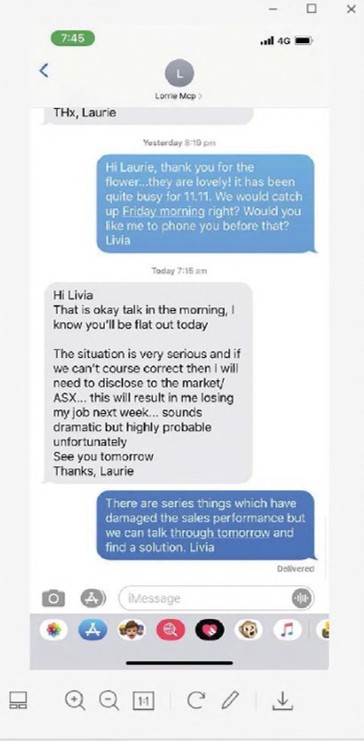
414 Following receipt of the screenshot of the text message exchange, commencing at 7.51 am Ms Peak and Ms Wang exchanged the following messages via WeChat:
Ms Peak: An interesting message! I spent Tuesday with the SLT at MCP sharing details of the challenges and the things that have damaged performance for DRL. Tina and I have worked through some things in preparation for tomorrow as well.
Ms Wang: did not know what he was talking about though
Ms Peak: He is talking about the downgraded forecast for DRL China vs the MCP expectations. It relates to what part of the gap we can close
3.9.14 Receipt of the 11/11 Results
415 On 12 November 2020 commencing at 10.59 am Ms Peak, Michelle and Cathy exchanged WeChat messages about the results of the 11/11 Event. In short Michelle reported that ABM had achieved sales of DRL of 105.76 million RMB and that DRL ranked no. 2 on the ABM Platform, after Vida Glow (11/11 Results). Michelle also reported that in 2019 the GMV for the 11/11 Event was 116 million RMB. In an email sent later that day Ms Peak reported the 11/11 Results to Mr McAllister.
416 On 12 November 2020 at 11.36 am Ms Chan sent an email to Mr Fielding, copied to Messrs McAllister and Witheridge, which forwarded an enquiry from Frida Wang, an analyst at Select Equities (a stockbroking firm which covered MCP stock). Frida Wang made the following inquiry:
I was dialling in MCP AGM two weeks ago, and in one of Livia’s slides, I see the projected sales of DLW during D11 is very accurate to 154.98m RMB.
Clearly ABM/VTN had achieved another super successful D11 for the managed 30 brand including DLW, can you help me a bit in terms of understanding how ABM forecast the 154.98m so accurately~?
417 By email sent the same day at 12.02 pm Mr McAllister responded to Ms Chan’s request for comment on Frida Wang’s enquiry, stating that there should be no response. Mr Fielding echoed Mr McAllister’s response in his email sent at 12.05 pm in which he wrote:
Totally agree. We are gathering information on how DRL has performed over 11/11 and what worked for the brand with ABM’ers. Will make sure this is part of the discussion with Livia/Tina on Friday
418 On 12 November 2020 at 2.05 pm Ms Peak sent an email to Messrs McAllister and Fielding, copied to Cathy, in which she wrote:
We have some results coming through for 11/11 for DRL.
2019 | 2020 | |
ABM TOTAL GMV (RMB) | 900m | 993m |
DRL GMV (RMB) | 116m | 105m |
RANK | #4 | #2 |
SHARE OF TOTAL | 11% | 11% |
* Vida Glow #1 in 2020
* DRL contributed 11% of total GMV in 2020 which is the same percentage as last year however more impressive because there are a lot more brands on the platform with heavy competition in skincare.
* DRL has never held a position as high as #2 on the platform so this is also a great result
419 On 12 November 2020 at 7.31 pm Ms Peak sent a further email to Mr McAllister, copied to Mr Fielding, in which she wrote:
A few notes on the Double 11 results as per our discussion:
* ABM was up 10% in total sales vs LY – whilst we don’t have data it is reasonable to assume that new brands in the portfolio have contributed to the growth
* DRL achieved 105m RMB in sales this year which was down 10% vs LY for the same period however the brand gained the #2 brand position overall which is a great result and a rank not held previously for the brand.
* DRL contributed 11% of total GMV in 2020 which is the same percentage as last year however more impressive because there are a lot more brands on the platform with heavy competition in skincare
420 In cross-examination Ms Peak said that she expected the 11/11 Results to be less than achieved. Given the 11/11 Results she accepted that she must have expected more than a 10% decrease in sales on FY20 but could not say when she came to that view and said that she did not have a figure in mind.
3.9.15 13 November 2020 meeting between MCP and ABM
421 On 13 November 2020 at 9 am Mr McAllister and Ms Peak attended a breakfast meeting with Ms Wang and Ms Dong (13 November Meeting). Ms Peak explained that the primary purpose of the 13 November Meeting was for MCP to understand ABM’s position after the 11/11 Event. With that sales event complete, MCP intended to put forward Support Proposals to ABM and to discuss the measures that both businesses could put in place to increase demand for DRL and influence an uplift in ABM’s final purchase forecast. The secondary purpose of the meeting was to discuss how to manage the CWH Conflict.
422 Ms Peak took notes at the meeting. As best she can recall during the meeting Ms Wang provided some feedback around challenges that ABM was facing such as the CWH Conflict and Ms Peak and Mr McAllister referred to the different Support Proposals that MCP could offer, having received the 26 October Purchase Forecast. The key part of the discussion concerned what could be done by MCP and ABM together to increase demand for DRL and influence an uplift in ABM’s final purchase forecast. Ms Peak’s notes taken during the meeting record the following:
(1) “CWH activity biggest issue” which referred to Ms Wang’s comments about the CWH Conflict and ABM’s perceived challenges because it has to compete with Chemist Warehouse;
(2) “Super Brand Day > 20% down as a result of CWH China” which refers to Ms Wang’s comments that she believed the Super Brand Day sales event in August 2020 could have been bigger had there not been direct conflict with Chemist Warehouse which she considered had an adverse impact of more than 20% on sales;
(3) “Friday 20th Nov meeting to review [ABM] proposal” which refers to Ms Wang’s comments that she did not wish to get into the detail of the deck containing the Support Proposals during the meeting but that they would meet again on Friday, 20 November 2020 to discuss them and, in the interim, ABM would consider the proposals;
(4) “[AGM] consideration around risk for their business” which refers to Ms Wang’s comments that ABM needed time to consider their business before coming back to MCP; and
(5) “MCP SOH levels well over forecasted amount” which refers to Mr McAllister’s comments that MCP had stock on hand levels well over the forecasted amount in the 26 October Purchase Forecast.
423 Ms Peak recalls that the 13 November Meeting was inconclusive because Ms Wang could not meaningfully discuss the Support Proposals as ABM had to undertake further work to understand its own position after the 11/11 Event. Ms Peak recalls that Ms Wang explained:
(1) she could not yet provide a final approved view as to ABM’s purchase forecast for the future period which made up MCP’s FY21;
(2) ABM would review the 11/11 Results for DRL at a product level, including impact on stock holding;
(3) ABM would complete business planning processes for 2021 by the week commencing 16 November to enable a full assessment of forecast influences;
(4) ABM would review the draft ABM purchase forecast and submit a November iteration of its purchase forecast to MCP. I pause to note that Ms Peak accepted that Ms Wang may not have described the purchase forecast as a draft;
(5) ABM would review the Support Proposals; and
(6) ABM would meet with MCP again on 20 November 2020.
424 On 13 November 2020 at 10.40 am Mr Fielding sent an email to Mr McAllister and Ms Peak, copied to Cathy, in which he wrote:
This is a stronger result than we thought it would be. Be interesting to know what brands drove their 10% increase. For example I think that Vita Glow despite being their No1 brand last year at close to 300-400mill RMB in GMV looks like it was in the 100’s this year meaning that some of their new brand must have driven the overall growth of ABM
425 Mr Fielding was of the view that the 11/11 Result presented a new situation and sent mixed messages to MCP because:
(1) DRL gained the no. 2 brand position overall which is a rank not held previously for the brand;
(2) DRL contributed 11% of ABM’s total GMV in 2020 which matched the result for the PCP despite increased competition on the platform in the skincare category; and
(3) in circumstances where the warm up sales during Brand Day on 4 November 2020 were lower than the prior year, ABM’s overall performance across all of its brands of 10% above the prior year, was a stronger result for ABM than he had expected.
426 Mr Fielding considered that the 11/11 Results were relevant for MCP because they provided another point of engagement, namely enabling MCP to better understand what drove ABM’s sales outcome. The financial information that MCP received from ABM was not information that it used, or could use, to track against its own sales forecast or budget. ABM is a separate organisation with its own forecasts and budgets and there is no perfect alignment between MCP and ABM on such matters. The 11/11 Results were an indication of DRL sales from the ABM platform in RMB GMV and was confidential information On the other hand, MCP’s forecast is a month-to-month forecast of sales from MCP to ABM at a product level in Australian dollars and is not specific to the 11/11 Event. This is because sales by MCP to ABM for the 11/11 Event would have occurred earlier, between about June to July 2020, to accommodate shipping and logistics timeframes. The two types of information do not perfectly align such that one figure cannot be tracked against the other.
427 Mr Fielding also explained that ABM, as a separate organisation and a customer of MCP, was unwilling to share all of its confidential financial information with MCP. ABM was different to other customers. MCP could purchase third party scan data for customers such as Coles and Woolworths from companies such as Nielsen who compile scan data to provide accurate sales information at a product level. It did not have that option for ABM due to the opacity of its business model. As such, during 2020:
(1) MCP did not know precisely how ABM calculated its GMV, which is not a metric used by MCP;
(2) MCP did not know ABM’s sales forecast for the 11/11 Event nor how the 11/11 Results compared with ABM’s own sales forecast;
(3) MCP did not know ABM’s daily sales results or year-to-date sales performance for DRL;
(4) MCP did not completely know what was occurring within ABM’s reseller network;
(5) MCP did not know ABM’s full year sales forecasts or budgets for DRL;
(6) ABM’s target for the 11/11 Event is not the same as a sales forecast and MCP did not know how ABM’s target for that event compared to its sales forecast; and
(7) while the 11/11 Target was not achieved, ABM considered it had achieved a great result.
428 However, Mr Fielding accepted that the 11/11 Results, of which he became aware on 12 November 2020, were below its expectations at 105 million RMB GMV against a target of 154 million RMB GMV referred to by Ms Wang in her presentation at the 2020 AGM.
429 Following the 13 November Meeting Ms Peak had an informal debrief with Mr Fielding. She also sent an email at 2.47 pm to Mr McAllister, copied to Mr Fielding, in which she provided a summary of next steps following the meeting that morning with Ms Wang and Ms Dong. She wrote:
Further to the meeting this morning with ABM, please find below summary of status and next steps
ABM to review 11/11 results for Dr LeWinn’s at a product level including impact on stock holding 16th
ABM to complete business planning process for 2021 w/c November to enable full assessment of plans influencing forecast
ABM to review purchase forecast and submit November iteration
430 Mr Fielding understood that the reference in Ms Peak’s email to ABM submitting a “November iteration” of the purchase forecast was that ABM would be providing a purchase forecast for November 2020 which was the normal monthly forecast.
431 On 13 November 2020 at 2.51 pm Ms Peak sent an email to Ms Dong which attached a document titled “DRL Forward Order Proposal.xlsx” (Forward Order Proposal). That document outlined the various Support Proposals put by MCP to ABM across the balance of FY21 (i.e. December 2020 to June 2021) to assist ABM when considering the Support Proposals. Later that afternoon Ms Peak provided an updated version of the Forward Order Proposal to Ms Wang.
3.9.16 Preparations for presentation to 17 November 2020 Board meeting
432 Mr Fielding instructed Ms Peak to put together a slide deck for a Board meeting scheduled to take place on 17 November 2020 which provided an update on the status of the 26 October Purchase Forecast and an overview of the Support Proposals MCP had started to discuss with ABM.
433 On 16 November 2020 an SLT meeting was held. The agenda for the meeting included as an item “China/ABM Update”. While Mr Fielding was present at the meeting, he no longer has a recollection of what was discussed.
434 On 16 November 2020 at 3.41 pm Ms Peak sent an email to Mr Fielding attaching the draft presentation for the Board meeting scheduled on 17 November 2020. The draft presentation slides went through subsequent iterations including an iteration provided later that evening which included an ABM forecast slide showing FY21 H1 forecast at $5,315,417, and a slide titled “Where we are today – forecast downgrade driven by” which noted the “ABM revised F/C FY21” as “$26m”. Mr Fielding does not know whether the presentation that went to the Board included this slide.
3.9.17 17 November 2020 to 19 November 2020
435 On 17 November 2020 at 11.58 am Mr Fielding sent an email to Mr McAllister with the subject line “FYI. Are you aligned with the attached for ABM/Board discussion?” attaching a document titled “Board Meeting EXPORT Nov 20 v2.pdf”. The attachment to Mr Fielding’s email was an iteration of the presentation slides referred to in the preceding paragraph. Mr Fielding posed his question to Mr McAllister because he thought that “if the Board was going to be up to date, they were very clear that … we were basically asking to bring forward purchases from January, February, March, which would have working capital and extended credit term issues.” Mr Fielding was not concerned that Mr McAllister was not going to inform the Board of where the ABM forecast was at that point in time.
436 On 17 November 2020 commencing at 1 pm MCP held an audit committee meeting at which Mr Witheridge presented the enterprise risk management report (ERM Report) which included in relation to ABM:
3. China Growth & Significance of ABM (RA = 7).
The rapid and successful expansion of trading with the key Export customer ABM (forecast to be $48m / 21% of Group sales in FY21), has evolved into a closer strategic relationship with ABM through the establishment of a JV in relation to [DRL] and potentially other brands in China, with ABM now owning 51% of [DRL] IP registered in Greater China.
At 2 November 2020, approaching the key 11/11 trading period, ABM is holding relatively high levels of [DRL] inventory, with between 6 to 11 months cover on key product line. The newly employed ABM supply planning team may seek to reduce the amount of stock held by ABM Australia, with the potential for a short term reduction in sales demand from ABM.
The ABM JV agreement includes a minimum purchase obligation on ABM of 5% above the prior year in both FY21 and FY22. Given that sales to ABM in FY20 were $37.2m, this effectively establishes a baseline minimum purchase obligation of $39.1m in FY21, subject to MCP being in a position to supply ABM and ABM not being impacted by a force majeure event. [Mr McAllister] is in direct discussion with [Ms Wang] in relation to ABM’s FY21 forecast with clarity expected next week, post the 11/11 sales period.
Regarding credit risk, ABM currently owes MCP $1.0m and is in compliance with its payment obligations, with one minor payment oversight at end October that will be corrected in November. Working capital risk is also taken in advance of credit risk, as production of forward orders is committed to meet anticipated demand. The ABM/MCP China JV and the strengthening of ABM’s internal forecasting capabilities should reduce this risk over time. Improved visibility of ABM’s stock levels and underlying sales of [DRL] product will also assist MCP with its upstream production planning.
(Emphasis added.)
437 Mr Witheridge explained that the ERM Report contained the current information about ABM’s inventory position available to him as at the time the report was uploaded to Diligent on or about 12 or 13 November 2020, ahead of the audit committee meeting scheduled on 17 November 2020. Mr Witheridge used the ERM Report as a basis for talking through the points raised in it and would have provided little additional commentary beyond its content.
438 Mr Witheridge also explained RA (or risk appetite) as a guide to MCP’s risk tolerance and refers to the maximum risk that MCP is prepared to take in relation to areas of risk from a scale of 1 to 10 with 1 being very low tolerance for risk and 10 being very high tolerance for risk. In the ERM report Mr Witheridge assigned China growth and ABM a risk appetite rating of 7 because MCP is in the business of taking commercial risk, China is a big market and because the potential gain that could be obtained from successful growth in China justified the risk.
3.9.17.1 Board meeting and following
439 A Board meeting was held on 17 November 2020 commencing at 2.45 pm in person and via videoconference. Mr Fielding joined for part of the Board meeting but, given the passage of time, does not have an independent recollection of the meeting. Mr Witheridge was also present at the Board meeting and presented the CFO report. The minutes of the meeting record, among other things, that Mr Witheridge “provided commentary around the October 2020 financial results” as set out in his report which, in turn, included:
OCTOBER 2020 FINANCIAL SUMMARY
…
In summary the positive underlying EBIT outcome of $1.7m for October 20 was 17% above budget, 23% below forecast and 6% above last year. Sales were $1.5m below budget, $1.8m below forecast and $0.6m below last year. The underlying EBIT favourable variance to budget has been driven by an 88% increase in sales of Footcare, 44% increase in A’kin, 37% increase in Lady Jayne, 30% increase in Manicare, 18% increase in Swisspers and a 9% increase in Multix, offset by a 30% decrease in [DRL].
The primary reasons for the $1.8m unfavourable variance to the Group sales forecast were:
(i) [DRL] - $1.4m unfavourable due to below forecast sales in ABM, Priceline and Chemist Warehouse.
(ii) Manicare - $0.3m unfavourable due to below forecast sales in Priceline, Woolworths and Pharmacy.
(iii) A’kin - $0.3m favourable due to above forecast sales in export customers TJX and Graphters, partially offset by shortfalls in Priceline.
…
Year to October 20 underlying EBIT is $3.9m above budget, $0.5m below forecast and $1.5m above last year. Sales are $1.8m or 2.6% above budget, $1.7m or 2.6% below forecast and $1.2m or 1.8% above last year. Sales from owned brands are $1.1m or 2.1% above budget, $1.7m or 3.2% below forecast and $2.4m or 4.9% above last year.
…
(Emphasis added.)
440 The CEO/MD report was also before the Board. It included in relation to “China”:
ABM: Forecast concerns from ABM… I met this morning in North Sydney with [Ms Wang, Ms Peak and Ms Dong]… We meet again next Friday 20th November, same time, same place for a solution discussion.
[11/11 Results] very favourable in context of the environment:
▪ ABM was up 10% in total sales vs [last year] – whilst we don’t have data it is reasonable to assume that new brands in the portfolio have contributed to the growth
▪ DRL achieved 105m RMB in sales this year which was down 10% vs [last year] for the same period, however, the brand gained the #2 brand position overall which is a great result and a rank not ever held previously for the brand.
▪ DRL contributed 11% of total GMV in 2020 which is the same percentage as last year, however, more impressive because there are a lot more brands on the platform with heavy competition in skincare.
441 The minutes of the 17 November 2020 Board meeting included in relation to the CEO/MD report given by Mr McAllister that:
(1) a number of issues had come from the discussions with Ms Wang from the 13 November Meeting, including the need to review and possibly increase the ABM product portfolio and potentially review the balance of promotional activity;
(2) the full year ABM forecast was achievable, with the seasonal sales pattern developing along similar lines as the prior year; and
(3) another meeting was scheduled with ABM on 20 November 2020 to discuss related issues.
442 The minutes also noted other matters that were discussed including: the need for closer cooperation with ABM; the need for ABM to be included in new product development processes and the prioritisation of accelerating that process; and an agreement that there be an increased level of focus by ABM on inventory levels and ordering.
443 Notwithstanding the reference in the CEO/MD report to the 11/11 Results, Mr Witheridge does not recall hearing about those results at that Board meeting. His evidence is that it is possible that he was briefly distracted or stepped out during Mr McAllister’s update on ABM at that meeting.
444 Mr Witheridge understood from Mr McAllister’s CEO/MD report to the Board that the 13 November Meeting was inconclusive and that Mr McAllister would meet with Ms Wang on 20 November 2020. Mr Witheridge was not surprised by this. To the contrary, he was a little surprised that Ms Wang indicated she could meet again on 20 November 2020, so quickly after the first meeting. This is because, having regard to his own executive experience within the retail consumer goods industry, Mr Witheridge is aware of the time it can take to pull together and digest the information required to provide meaningful feedback to third parties. Whilst MCP wished to meet with Ms Wang as soon as possible, not providing ABM with a reasonable period of time post completion of its 11/11 Event to analyse the trading results for that event and the implications for its own business would have been unrealistic and disrespectful to ABM.
445 On 17 November 2020 at 6.50 pm Mr McAllister sent an email to the SLT distribution email, copied to Ms Peak, in which he wrote:
Thank you for ALL your hard work going into today’s meeting.
Obviously the ABM situation is very worrying and hopefully we can make some strong progress at our Friday morning meeting with Livia, Jade and Tina.
446 On 17 November 2020 at 7.01 pm Ms Pirozzi sent an email to Mr McAllister, copied to Mr Fielding, which included:
I’ve just given David debrief of actions from domestic team. But so you are across it Matt C Simon and I are reshaping the domestic strat [sic] in channel plan for your review next week and I have shared iinutual [sic] thinking with David but will support what you need is to do.
447 To the best of Mr Fielding’s recollection, Ms Pirozzi provided him with a debrief of the actions her team proposed to take to mitigate the CWH Conflict including steps by Ms Pirozzi’s team to reshape the strategy in the domestic channel for Chemist Warehouse.
448 On 18 November 2020 at 9.28 am Mr Witheridge sent a series of text messages to Ms Chan in which he said:
Did Laurie just say that DLW was down 10% over 11/11
Number 2 overall and still down 10%?
They must be alit [sic] broader this year than last year
And:
Hey I thank [sic] this is the first time I’ve heard that we were down 10% on 11/11
…had u heard that before today?
And:
Board should have been told that yesterday!
449 Based on his text exchanges with Ms Chan set out in the preceding paragraph, Mr Witheridge believes that he became conscious that the 11/11 Results for 2020 were 10% down on the previous year on or about 18 November 2020. Mr Witheridge described his text as an error because the 11/11 Results were included in Mr McAllister’s CEO/MD report prepared for the 17 November 2020 Board meeting but, as set out above, he believes he must have overlooked that fact.
450 On 18 November 2020 commencing at 1.50 pm Ms Dong sent various WeChat messages to Ms Peak which, in effect, noted that Ms Wang’s schedule was full and she would “let [Ms Peak] know of the volume/value by [the meeting on 20 November 2020]” and that Ms Wang would communicate directly with Ms Peak as to ABM’s take-in volume.
451 On 19 November 2020 Ms Peak exchanged WeChat messages with Cathy in the course of which Cathy informed Ms Peak that, according to Ms Foo, ABM’s updated forecast and purchase order would be circulated in early December for all brands.
452 On 19 November 2020 at 10.27 am Mr Witheridge sent an email to Mr McAllister, copied to Messrs Owers and Fielding, which summarised ABM’s obligation to meet its Net Purchases Target for FY21 (i.e. $39 million) or otherwise be liable to compensate MCP for the EBIT Shortfall. In particular, Mr Witheridge’s suggested approach was “for MCP to proactively assist ABM to exceed its minimum purchases targets, with free products, appropriate A&P support… .”
453 Mr McAllister responded to Mr Witheridge’s email referred to in the preceding paragraph at 10.38 am. He wrote:
Great note…Can we keep this to ourselves for the moment…= not share with Jade
454 Mr Witheridge does not know why Mr McAllister sent a response in the terms set out in the preceding paragraph but did not think much of it.
3.9.18 Rescheduled meeting between MCP and ABM
455 On 19 November 2020 Ms Wang rescheduled the proposed meeting between Mr McAllister, Ms Peak and Ms Wang originally scheduled for 20 November 2020 to 27 November 2020.
456 Ms Chan informed Mr Witheridge of the cancellation of the proposed 20 November 2020 meeting with Ms Wang. He was not surprised that Ms Wang had cancelled the meeting for the reasons set out at [444] above.
457 On 19 November 2020 at 4.46 pm Mr Fielding sent an email to Ms Pirozzi and Mr McAllister explaining that Ms Peak was preparing a one-page summary document for alignment internally within MCP before using it to prepare for the meeting on 27 November 2020 with Ms Wang.
458 On 20 November 2020 at 9.16 am Mr McAllister sent an email to the Board and Messrs Bennett and Witheridge, copied to Mr Fielding, in which he wrote:
Unfortunately Livia asked to postpone this morning’s 8.30am meeting late yesterday as She didn’t feel prepared enough on the solutions…I initially was disappointed, however after discussions with Jade & David it appears they are taking this extremely seriously…= which is a good thing…We will meet next Friday and then I’ll have coffee with Graham immediately afterwards to de-brief.
Having some very solid marketing support dollars is very fortunate for us to drive a growth backhalf… however moving into 2022…I really feel we need to cool the jets - big time!
3.9.19 The 11/11 Results a “mixed bag”
459 On 20 November 2020 at 1.06 pm Ms Chan sent an email to Mr Witheridge with the 11/11 Results. Mr Witheridge described the 11/11 Results as a “mixed bag”. This was because ABM’s GMV sales of DRL were down by 10% compared to the PCP but:
(1) ABM as a whole performed 10% up on the prior year;
(2) DRL’s ranking rose for the first time to number 2 on ABM’s sales platform; and
(3) DRL contributed 11% to ABM’s total GMV sales. While this was the same percentage as the prior year, it was more impressive because there were more brands on the sales platform with heavy competition in skincare.
460 Receipt of the 11/11 Results did not change the position in relation to the 26 October Purchase Forecast for Mr Witheridge. His view was that, while ABM had completed its 11/11 Event sales period and was aware of its top line 11/11 Results, there were still a number of factors which continued to influence his thinking in relation to the 26 October Purchase Forecast including:
(1) he believed that the 26 October Purchase Forecast remained in draft form and awaited a final version, the completion of negotiations between MCP and ABM, and Ms Wang’s approval;
(2) he was alive to the possibility that ABM was using the messaging of its downgraded purchasing intention as commercial leverage to influence how MCP dealt with the CWH Conflict and to obtain additional marketing support and, if so, it would make sense for ABM to delay purchases until a meeting had taken place with MCP to discuss that issue;
(3) Mr McAllister had a very strong working relationship with Ms Wang and there was a degree of confidence that, because they had worked together in the past, they could deliver mutually favourable business outcomes for MCP and ABM;
(4) Ms Peak’s team continued to work on a series of Support Proposals to be presented to ABM to stimulate and support its purchasing intent;
(5) ABM still did not have a view of its own position post the 11/11 Event including its broad position across its stock holdings, how DRL performed relative to other brands on its sales platform, and its own working capital position;
(6) as Ms Wang cancelled the meeting scheduled on 20 November 2020, MCP was yet to have a further meeting with ABM to obtain a final view as to its purchasing intent; and
(7) MCP and ABM had entered into the JV Agreement under the terms of which ABM was obliged to meet the Net Purchases Target in FY21 by purchasing a minimum of 5% more than it had in FY20, failing which it would be required to pay an amount equal to the EBIT Shortfall to MCP.
461 Mr Witheridge remained of the view that there was continued significant uncertainty in relation to the 26 October Purchase Forecast. Whilst the 11/11 Results indicated that the sales of DRL had fallen short of expectations, Mr Witheridge considered that it was too soon for MCP to revise its sales forecasts of DRL because ABM’s attitude to the Support Proposals and the impact they may have on ABM’s purchase forecasts were not yet known. The 11/11 Results related to sales by ABM, a customer of MCP, into the China market rather than sales by MCP to ABM. Thus the 11/11 Results were a topic for discussion and negotiation between MCP and ABM in relation to the type of support MCP could offer to ABM in order to stimulate demand for DRL within ABM’s customer base. Nevertheless, Mr Witheridge considered that the final outcome of those negotiations may result in MCP needing to revise its sales forecast if ABM confirmed as a final position any downgraded purchasing intention.
3.9.20 Further development of the Support Proposal Presentation
462 Ms Peak continued to prepare further versions of the Support Proposal Presentation (see [394], [401]-[402] above) and on 20 November 2020 at 3.18 pm she circulated the “final” version of that presentation to Messrs McAllister and Fielding. Later that day at 5.05 pm Mr McAllister sent an email to Ms Wang and Ms Dong, copied to Mr Fielding and Ms Peak, which attached a document titled “DRL China 2021 Support Plans FINAL (002).pptx” (Support Proposal Presentation V7). In his email Mr McAllister wrote:
Understand this morning was not possible…Please find attached a very assertive approach to support a course correct
ion for growth…key pages being 4,6 and 19.
This is not a presentation about delaying issues but addressing significant investment for growth.
Look forward to meeting next week when I return from Melbourne.
463 Mr Fielding provided the following commentary on Support Proposal Presentation V7:
(1) the slide titled “Channel Management Levers” sets out proposed initiatives to mitigate the CWH Conflict;
(2) the slide titled “Year on Year Investment” sets out the proposed initiative in relation to additional A&P investment into the DRL brand which demonstrates incremental growth of A&P spend of $14,000 in FY19, $1.6 million in FY20 and a proposed A&P spend of $7 million in FY21 (to be increased from initial proposed A&P spend of $4 million) with the investment criteria as to where that spend would fall to be agreed by both parties;
(3) the slide titled “Investment - Over & Above Opportunities” sets out some examples of where some of the additional A&P spend could be applied such as a new product launch, a major brand event, audio visual advertisements and merchandising;
(4) the slide titled “2021 China First NPD” sets out the proposed initiative in relation to the launch of new DRL products, exclusively available to China, in March 2021 and August 2021 in order to drive sales;
(5) the slide titled “New Product Introductions” sets out a timeline for new DRL product launches;
(6) the slide titled “Trial and Sample Size Range” sets out the proposed initiative of A&P support in the form of free trial size products and samples, which ABM could provide to customers in connection with purchases to support strategic sales periods in 2021;
(7) the slide titled “Trial and Sample Strategy” sets out the rationale behind offering A&P support in the form of free trial size products and samples;
(8) the slide titled “Price Adjustment” sets out the proposed initiative in relation to MCP offering certain products at discounted wholesale supply prices to ABM so that ABM could maintain a positive margin despite offering discounts during promotional sales events; and
(9) the slide titled “Exploratory Markets” sets out the proposed initiative in relation to ABM looking to expand into other geographic markets with high migrant Chinese populations such as Toronto or the UK, which would increase the exposure and sales of the DRL brand.
3.9.21 Preparations for meeting between MCP and ABM
464 Based on her notes, Ms Peak believes that she attended an internal ABM meeting with Ms Wang and Ms Dong on or about 23 November 2020. Ms Peak’s notes record that “11/11 did not meet expectations so stock holding has built months cover”. Ms Peak says this is a reference to comments made by Ms Wang, paraphrased by her, to the effect that the 11/11 Results did not meet the 11/11 Target and that ABM had accordingly built months of stock cover for DRL.
465 On 23 November 2020 at 12.04 pm Mr Kasdi sent an email to Messrs Fielding and Owers, copied to Ms Chen and Mr Witheridge, which included:
Paul & Wei are likely to revise the FY21 forecast early December in order to reflect [11/11 Results], a potential downgrade of ABM’s forecast (pending the Livia/Laurie meeting) and associated consequences (e.g. inventory provision for excess DRL stock.
…
(Emphasis in original.)
466 Shortly thereafter, Mr Witheridge responded to that email as follows:
Post Laurie’s meeting with Livia this Friday I think that we will need to recut the 1H21 and FY21 forecasts next week, particularly as November is so far behind forecast.
My aim is to have this reforecast completed by the end of next week.
So Wei,
Please introduce yourself to Leesa directly and ask Leesa to provide a draft updated forecast for GT for the 7 months ended 30 June 21 by month, ie P&L, Balance Sheet and Cashflow.
David, Brett & I can then review and we’ll go from there.
467 Mr Witheridge did not think it was possible to complete the revisions to the forecast prior to the proposed meeting between Mr McAllister and Ms Wang because it was only after the meeting that MCP would have a level of certainty around any revisions to ABM’s purchase forecast having regard to the Support Proposals which MCP intended to put forward to ABM.
468 On 24 November 2020 Ms Peak and Ms Wang exchange the following WeChat messages:
Ms Wang: hi jade... any updates from our last communications?
Ms Peak: have asked Leslie for a quick catch up time with you tomorrow. Tina and I are working on round 2 for business planning but I don’t feel we have a compelling case for growth above what was already in the numbers.
Ms Wang: so we will need to put together the catch up deck with laurie
will forward the information laurie email [sic] me last week
oh ~ you are in the email chain
Ms Peak: I’ll work up a draft for Friday meeting and we can align on the key messages from our perspective
469 On 25 November 2020 at 8.52 am Ms Peak sent an email to Ms Wang attaching a “DRL Support Plan Summary” document for discussion that morning.
470 On 25 November 2020 at 9.44 am MCP released an ASX announcement which announced the successful completion of the SPP, totalling $9.4 million, and the issue of 4.37 million new ordinary shares at a price of $2.15 per share.
471 On 25 November 2020 at 2.33 pm, in anticipation of a meeting with Messrs McAllister, Fielding and Witheridge, among others, Ms Peak sent an email to Mr Fielding with subject line “What is the purpose of the ABM pre meeting tomorrow?” in which she queried whether she had to prepare something. At 2.37 pm Mr Fielding sent an email in response in which he wrote:
I think Laurie wans [sic] to get really comfortable with the deck for Friday. Obviously Lori P has been working with us however not sure that she has put anything on to paper? …especially things we can use in the Chemist Warehouse update section.
I’m guessing there will be questions on what you/Tina found in the data, i.e. SOH post 11/11, key stats re: ABM resellers and what is happening with the DRL brand
472 On 26 November 2020 at 10.02 am Ms Peak sent an email to Ms Wang, copied to Ms Dong and Leslie Luo, Ms Wang’s personal assistant, attaching two documents titled “Forward Order Scenario_Example Only.pdf” and “DRL China 2021 MCP Support Plan Review v2.pdf”. In her email Ms Peak wrote:
Further to our conversation yesterday, I have prepared some slides for the meeting tomorrow with [Mr McAllister] as per the attached.
I have looked at the 3 key areas we discussed and identified timing and mechanics for how we would use the committed investment from MCP as well as gaps in commitment.
There is a brief look at performance to reaffirm the brand is in a good position and then a view on current stock holdings.
Separately I have put together a purchasing scenario example as a starting point for our discussion.
I believe Laurie is planning to represent the same deck that you have already seen so I will advise that is not necessary and that we will present the [ABM] response instead.
If you have time it would be good to chat briefly today to align on how you want to handle the meeting, any updates to the deck and whether there are any further scenarios I need to put together. I can be available any time today.
473 Ms Peak gave evidence about the two draft presentations included in her email referred to in the preceding paragraph. The first presentation titled “Forward Order Scenarios” set out the terms which ABM would propose in return for placing a forward order with MCP including full credit terms of 120 days, free goods for the forward orders of three Hero SKUs, and for MCP’s marketing investment to be confirmed prior to placing a forward order. Ms Dong formulated these terms, without prior discussion with Ms Wang, and on the assumption that they were terms Ms Wang would propose at the upcoming meeting. The second presentation titled “Dr. LeWinn’s 2021 MCP Support Plan Review” set out some key themes of what was important to the joint venture partnership and the DRL brand.
474 Ms Peak prepared the two draft presentations in consultation with Ms Dong and with the understanding that, subject to Ms Wang’s review and approval, she would share the presentations with Mr McAllister ahead of the meeting on 27 November 2020. However, that did not occur because Ms Wang did not respond to Ms Peak’s email or discuss the content of the presentations with Ms Peak.
475 Ms Peak attempted, but failed, to meet with Ms Wang during the course of 26 November 2020. However, an “ABM pre-meeting” was convened with Messrs McAllister, Fielding, Witheridge and Owers, Ms Peak, Ms Chan and Ms Pirozzi at 11 am on 26 November 2020 where Ms Peak went through her slide presentation which outlined the Support Proposals to be presented to ABM the following day.
476 Mr Witheridge’s expectation for the meeting with ABM on 27 November 2020 was that MCP would receive from ABM:
(1) a final view as to its purchase forecast, in other words, moving from the 26 October Purchase Forecast to a final forecast;
(2) a response to the proposed Support Proposals in the Support Proposal Presentation V7;
(3) feedback on ABM’s view of how the 11/11 Event went, including any implications of the 11/11 Event upon ABM; and
(4) information in relation to ABM’s stock holding, given that ABM had employed a new supply planning team.
477 That is, Mr Witheridge expected that MCP would receive a considered forecast from ABM based on the action plan and a response to the proposed Support Proposals. Mr McAllister told Mr Witheridge, as part of a report to the SLT, that ABM did give MCP a commitment which was different to the 26 October Purchase Forecast (see [484] below). Mr Witheridge never saw a written purchase forecast provided by ABM but he would not usually receive a written forecast and he would not expect to do so.
3.9.22 The meeting between MCP and ABM on 27 November 2020
478 On 27 November 2020 at 8.30 am Mr McAllister and Ms Peak attended a breakfast meeting with Ms Wang at ABM’s Sydney offices (27 November Meeting). Ms Peak described the purpose of the meeting in similar terms to Mr Witheridge (see [476] above).
479 To the best of Ms Peak’s recollection, Ms Wang provided the following feedback during the 27 November Meeting:
(1) the 11/11 Event was below the 11/11 Target;
(2) ABM had been left with residual stock following the conclusion of that event;
(3) ABM will not place any orders or forward orders in December. This was because the 11/11 Event was below the 11/11 Target and ABM had been left with residual stock following the conclusion of that event; and
(4) having regard to the implications of the outcome of the 11/11 Event on ABM’s stock levels, the final ABM purchase forecast was in the range of $37 million to $40 million for DRL for FY21 (Final ABM Purchase Forecast). Ms Wang indicated at the meeting that a purchase forecast for that amount would be provided.
480 Ms Peak took notes during the meeting. It is not necessary to set out all of Ms Peak’s detailed evidence about her notes. However, it is relevant to observe that those notes included:
(1) “technical forecast but not a commitment”. Ms Peak explained that the language “technical forecast” came from Mr McAllister “but not a commitment” referred to the fact that the technical forecast was not a binding commitment, though the fact was immaterial because at an operating level ABM purchase forecasts had always been an indication until a formal purchase order was received; and
(2) “LM $37M FY” was a reference to Mr McAllister proposing a final ABM purchase forecast of $37 million for FY21. Ms Peak accepted that Mr McAllister was the source of the $37 million figure.
481 On 27 November 2020 at 11.36 am Ms Peak sent an email to Mr Fielding in which she wrote:
Below are the notes I took from Laurie’s proposed messaging:
MCP was unable to supply previously which led to OOS for China
MCP over built stock cover to ensure demand was met
DRL China has strong sales and is in growth year on year through the ABM platform
Working capital related to stock cover needs to be addressed
Forecast will reflect managing this with a projected FY result of $37-$40m
From July 2021 growth will be fuelled by innovation
482 Mr Fielding recalls that he participated in a call with Mr McAllister and Ms Peak after the 27 November Meeting during which he was apprised of Ms Wang’s feedback provided at that meeting which was to the effect recorded at [479] above.
483 As far as Mr Fielding was concerned, MCP and ABM had been negotiating Support Proposals involving strategic levers to reset the trajectory of sales post the 11/11 Event in circumstances where there was still seven months left in the financial year and three major promotional sales periods yet to occur. As a result of Ms Wang’s decision not to purchase in December 2020 and her confirmation of the Final ABM Purchase Forecast, MCP had to consider any implications of that new information on the whole of the business. That involved understanding what was going on in the remainder of the domestic business and other international business (besides China) to understand if MCP could cover the shortfall created by the downgrade in ABM’s purchase forecast to the range of $37 million to $40 million. As MCP’s domestic business was by far the largest contributor to MCP’s total statutory sales, the work that was required of the business to gain this understanding was substantial.
3.9.22.1 The SLT meeting
484 On 27 November 2020 at midday MCP held an urgent SLT meeting so Mr McAllister could provide an update on the outcome of the 27 November Meeting (27 November SLT Meeting). As best Mr Witheridge can recall, at that meeting Mr McAllister informed the attendees that:
(1) the consequence of the 11/11 Event being below the 11/11 Target was that ABM was not intending to order any more DRL inventory from MCP in the first half of FY21;
(2) ABM was eager to work with MCP in the second half of FY21 (i.e. the six months ended June 2021);
(3) Ms Wang gave the Final ABM Purchase Forecast; and
(4) ABM had accepted various Support Proposals put forward by MCP.
485 Mr Witheridge’s evidence is that each of the matters which Mr McAllister reported to the 27 November SLT Meeting was new information to him which was provided for the first time at the meeting. However, he accepted in cross-examination that the 11/11 Results were conveyed to MCP generally on 12 November 2020.
486 Mr Witheridge also gave the following evidence:
(1) prior to 27 November 2020, including following the 11/11 Results on 12 November 2020 and up until Mr McAllister and Ms Wang were able to meet on 27 November 2020, MCP had not received from ABM a final view, namely a view with the express endorsement of Ms Wang, as to its purchasing intent for the full FY21 year. Since it received the 26 October Purchase Forecast, MCP had been negotiating with ABM about its purchasing intent, its response to the Support Proposals, its feedback on the 11/11 Event and how the DRL brand and its business as a whole was tracking; and
(2) until MCP received confirmation from ABM of the matters identified in [484] above he was unable to revise MCP’s sales forecasts and, as a result of that inability, was unable to evaluate the impact of any such revisions on MCP’s profit outlook for FY21. Accordingly, Mr Witheridge was not in a position to issue any correction to the profit guidance that MCP had already given to the market because he could not measure the impact of any revised forecasts until they had been finalised.
487 On 27 November 2020 at 12.14 pm Ms Peak sent an email to Ms Dong who, although invited, had not attended the 27 November Meeting, in which she wrote:
During the meeting this morning it was agreed that ACG would update the rolling purchase forecast for DRL to indicate something in the order of $37 - $40m for the MCP financial year for orders from April onwards. This is a technical forecast and acts as an indication only with no commitment from ABM to purchase to this level.
YTD purchases are $4.4m from ABM which means a further $32.6m needs to be built into Jan - June 2021.
Can we chat through best approach for this?
3.9.23 Revised Forecast
488 Having received a final position from ABM as to its purchasing intention for the full FY21 year, there was a real sense of urgency as the financial implications of the variation had to be analysed and assessed. Mr Witheridge informed the finance team that they would need to move very quickly to revise the sales forecast for the entire business, not just the ABM account, in order to promptly undertake a financial assessment to understand the financial consequences, if any, of ABM’s position on its forecast on the business as a whole. That work took place over the weekend of 28 and 29 November which, as described by Mr Witheridge, was a huge undertaking that required the team to create an updated forecast of the entire business over one weekend, in circumstances where a forecast review process would take at least two weeks and the entire forecast review process would typically take one month.
489 The process undertaken by MCP to revise the forecast is the subject of detailed evidence. At a high level, it involved the following:
(1) the domestic sales team, as well as MCP’s international teams in Singapore and New Zealand, provided updated forecasts based on their view of the remaining eight months in FY21;
(2) working directly with Ms Peak to determine how the Final ABM Purchase Forecast would feed through into a financial forecast for DRL for FY21; and
(3) the information at (1) and (2) above was provided to Wei Chen in the finance team who pulled together the information for Mr Witheridge’s review.
490 Mr Witheridge, who typically shares the responsibility of drafting company ASX announcements with Mr Bennett, was occupied with the reforecasting process. Accordingly, Mr McAllister requested Mr Fielding to prepare a draft ASX announcement. Drafting ASX announcements was not a task that usually fell within Mr Fielding’s responsibilities.
491 On 27 November 2020 commencing at 12.29 pm Ms Peak conveyed to Cathy via WeChat that “ABM will provide an updated forecast… [i]t will list to $37m” but that there would be no forward orders in December.
492 On 27 November 2020 at 1.50 pm Mr Fielding sent an email to Vanessa Burns, national communications and activations manager, MCP, copied to Ms Pirozzi, Messrs McAllister and Witheridge and Ms Peak, attaching a document titled “Communications Briefing Document-Tues 1st Dec ASX announcement.docx” which was a communications brief that Mr Fielding had compiled to assist Ms Burns, in which he wrote:
I know you are expecting this brief per your discussion with Lori P. We are looking at getting a first DRAFT back mid morning Monday. Paul and his team will populate this with the key financial data. Please call me if you have any questions or thoughts that you need to get further clarity on?
493 On 27 November 2020 at 4.49 pm Mr Witheridge sent an email to Ms Peak raising a series of queries about the 27 November Meeting and whether, for the purpose of MCP’s modelling, ABM agreed with certain matters which he set out. Ms Peak provided her responses later that evening (at 6.47 pm) as follows (the matters raised by Mr Witheridge are in black and Ms Peak’s responses appear in blue):
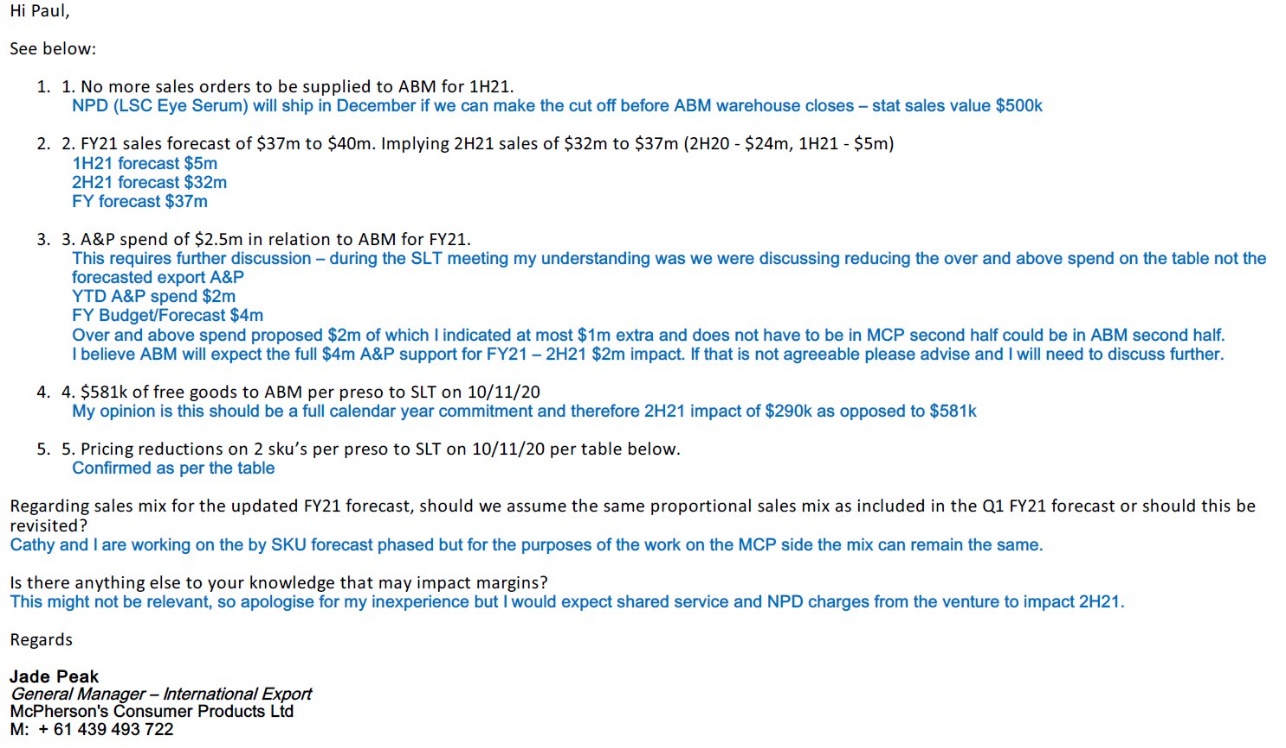
494 Mr Witheridge explains that the email exchange referred to in the preceding paragraph is consistent with his understanding of what Mr McAllister informed the attendees at the 27 November SLT Meeting. In sending his email, Mr Witheridge was seeking confirmation from Ms Peak that his understanding of the position, based on the information provided at the 27 November SLT Meeting, was correct.
495 On 27 November 2020 at 6.59 pm Mr Fielding sent an email to Ms Peak, copied to Messrs McAllister and Witheridge, in which he wrote:
Just keeping this email to a smaller group. The agreed A&P of $4.x mill for FY21 was for a budget of $48 mill. I think it’s fair that if the forecast comes down to $37 mill which is a -22.9% reduction then the base A&P should reflect that, a new A&P base for FY21 closer to $3 mill. Given we have already invested close to $ 2 mill. The balance in the base is $1 mill with the potential to invest beyond on a case by case basis.
Shouldn’t this be the fair way to think this through?
496 Later that evening at 8.39 pm Mr Witheridge sent an email responding to Ms Peak’s email sent at 6.47 pm (see [493] above), copying the SLT email distribution list, Ms Chen, Mr Kasdi and Ms Ters, which included:
All understood noting further consideration re point 3).
Regarding JV related expenses, given the JV structure has not been established yet, my presumption is that any shared service or NPD charges in FY21 are likely to be negligible, also noting that ABM/MCP have not determined a budget/business plan as yet.
497 On 28 November 2020 at 12.14 pm Ms Peak sent an email to Mr Fielding, copied to Messrs Witheridge and McAllister, which included:
I have been reviewing numbers and proposal again and would like to clarify our position based on [Mr Fielding’s] comments since I realised Women’s Day support was not discussed yesterday with the SLT – apologies for my oversight on that.
A&P FY forecast $3m (down from $4m)
Trial size $290k (reflective of Jan – June with $290k to be allocated to Jul – Dec)
Price relief Surge & LSC Masks – permanent change to pricing effective from Jan 21
Over and above investment – assume this is off the table?
Women’s Day financial support to compete with CWH – is this off the table?
MCP most recent proposal $6.7m investment in calendar year 2021. Changes as above for A&P, trial size and price relief only indicate $2.8m for 2021.
I don’t think this impacts the workings for the $37m projections however it will impact the business planning for total 2021 calendar for ABM and by default the actual forecast.
The actual forecast would be significantly impacted should we decide not to support Women’s Day since China will not be able to compete with CWH 50% off during that period.
498 In cross-examination Ms Peak accepted that when she sent the email referred to in the preceding paragraph the actual forecast for DRL sales by ABM was still to come. Ms Peak also accepted a decrease in A&P spend, as suggested by Mr Fielding, could have an impact on the forecast and that she thought it was likely to have a downward impact.
499 On 28 November 2020 at 12.25 pm Ms Peak sent an email to Ms Wang, copied to Ms Dong, in which she wrote:
MCP are generating an indicative forecast to reflect approximately $37m as per the discussion with Laurie yesterday. We do not need to submit anything formally for them.
I am waiting for confirmation on the investment levels to be committed since the MCP leadership team yesterday were suggesting a significant reduction versus the proposal shared. I have indicated this would severely impact the demand and actual forecast as well as the business planning for 2021. I hope to have more clarity from them by Monday morning.
Laurie is also looking to accept your offer to speak with investors. Connie will reach out to Leslie on scheduling.
Ms Peak accepted in cross-examination that by this time she was not expecting to receive a purchase forecast for November 2020. MCP was generating its own indicative forecast to reflect the $37 million figure which Mr McAllister had proposed at the 27 November Meeting.
500 On 28 November 2020 at 5.11 pm Mr Witheridge sent an email to Ms Peak, copied to the SLT distribution list, among others, in which he wrote:
As agreed on Friday it’s really important that we start to get some clarity around key numbers in relation to ABM’s DLW business.
I imagine that ABM (with yours & Cathy’s help) have been doing some modelling of the calendar 21 year & that this was instrumental in providing confidence that ABM could support a forecast of $32m in purchases of DLW for the six months Jan to June 21.
I’ve attached 2 spreadsheets that I’d like you and Cathy to complete ASAP to the best of your ability. I understand that you were due to receive updated DRL stock figures last Thursday. You can use this as your starting stock figure in spreadsheet 1.
At this stage the “ABM Forward forecast model” is the higher priority than the “History of ABM COGS”. The forward forecast is obviously indicative & your best guess at this stage.
I expect that Laurie and I will be faced with a significant step up in the granularity of questions relating to our ABM business next week, and the more clarity we can provide, the greater confidence we can instil in our investor base. As Laurie said on Friday it will all be about the numbers. I agree 100% with this.
It some stage soon it would be good to break the forward forecast model down for each of the top 10 sku’s, but that can wait.
I welcome a call anytime over this weekend if you have any questions.
501 Mr Witheridge also forwarded his email set out in the preceding paragraph to Messrs McCubbin and Peck.
502 In response Ms Peak informed Mr Witheridge that she would start work as requested.
503 There was further activity on 28, 29 and 30 November 2020 working on the ABM forecast model and its inputs. Mr Witheridge recalls that by the morning of 30 November 2020 he felt quite stressed because the recutting of the forecast was not finalised and was taking him longer than he had initially anticipated.
504 On 30 November 2020 at 9.12 am Ms Peak sent an email to Mr Witheridge, copied to Mr Fielding in which she wrote:
Apologies I made an error with the A&P – revised version attached and below the background.
A&P Budget $4m
A&P Jul – Dec Actual $2m
David’s proposed balance of A&P available Jan – Jun $1m
Trial size support Jan – Jun $0.3m
Total FY21 $3.3m
Please note I am expecting a push back from ABM on the perceived reduction vs the two proposals put to them and expect it to impact the demand plan for DRL for 2021.
505 During the course of the morning Mr Witheridge and Ms Peak exchanged further emails in relation to the content of Ms Peak’s email sent at 9.12 am.
506 On 30 November 2020 at 11.58 am Mr Witheridge sent an email to the SLT email distribution list attaching a document titled “1H21 revised forecast.xlsx” (Revised Forecast) for “discussion at noon”. An SLT meeting was held commencing at midday at which Mr Witheridge tabled a first draft of the updated forecast for the first half of FY21 for the SLT’s input and discussion, given the updated forecast was effectively an aggregation of the information the finance team had received from many of those senior managers.
507 Mr Witheridge explained that the key part of the Revised Forecast was its second page titled “Updated 1H21 Forecast” which relevantly records:
(1) the updated forecast for the first half of FY21 was $101.3 million down from $113.6 million; and
(2) that there was more work that needed to be done as Mr Witheridge was still waiting on:
(a) the New Zealand sales team to provide its forecast;
(b) the Singapore sales team to provide some further data;
(c) Ms Peak to confirm any projected revenue from the JV Agreement in terms of new product development;
(d) Ms Chan to confirm any potential other expense savings; and
(e) firming up information relating to forecast distribution costs.
3.9.23.1 Preparation of the 1 December Announcement
508 At the same time MCP also continued to work on a draft ASX announcement (which would become the 1 December Announcement) in relation to, among other things, ABM.
509 On 30 November 2020 at 7.51 am Ms Burns circulated a draft ASX announcement to Mr Fielding, Ms Pirozzi and Ms Peak, seeking input from Ms Pirozzi and Ms Peak. Ms Peak responded at 9.04 am noting that she would leave the “China content” to Mr Fielding and Ms Meintanis (Mr McAllister’s executive assistant) to verify with Ms Wang, as it required data from ABM to which Ms Wang had to agree.
510 On 30 November 2020 at 9.33 am Mr Fielding sent an email to Ms Meintanis requesting that she share the “draft strategy update” prepared by Ms Burns with Ms Luo and ask her to get Ms Wang’s “Ok to the quote that [MCP] built”. By email sent at 9.39 am Ms Meintanis asked Ms Luo to have Ms Wang approve the wording of a paragraph which had been drafted for an ASX announcement (which was extracted into her email) and to “check with Cindy on the numbers” included in the same paragraph. Ms Meintanis asked Ms Luo to get back to her “as soon as possible”.
511 On 30 November 2020 at 10.55 am Mr Fielding sent an email by way of update to Ms Burns, Ms Pirozzi, Ms Peak and Messrs McAllister and Witheridge, copied to Ms Meintanis, informing her that “Connie is following up with Livia on her quote for China & Lori P is talking to her team about YTD results [vs] full first half forecast”.
512 On 30 November 2020 at 11.02 am Mr Witheridge sent an email to Ms Meintanis and Mr Fielding, copied to Messrs McAllister and Owers and Ms Chan, which included:
Yes I have a call in with Daniel Hutchinson to discuss this and will aim to tee up a 9.30am investor call that will involve Laurie, Livia, David, Brett, Donna and I. I expect that Sarah Mann will host this.
I’ve discussed and agreed timing with Laurie. I expect the call will go from 9.30 to 10.30.
Obviously David and Brett will cover the GT update / integration piece, Donna any market/product questions, me Financials.
Practically, it would be good to get our announcement out to the market this afternoon around 5pm so that it can be read by investors before the call.
David, it would be good to see the draft from Vanessa Burns ASAP. I’ve attached my suggested narrative for 1H21 forecast.
513 On 30 November 2020 at 12.21 pm Ms Meintanis sent an email to Messrs McAllister and Witheridge attaching the draft ASX announcement providing a market update which included an update on ABM.
3.9.23.2 30 November 2020 Board meeting
514 On 30 November 2020 a Board meeting was held commencing at 1 pm (30 November Board Meeting). Mr Witheridge presented an updated forecast for the first half of FY21. He believes that while he was prepared to do so, there were still a couple of points of clarification required on his calculations. The minutes of the Board meeting record, among other things:
(1) by way of outline:
Mr. McAllister provided an update regarding ABM and the matters discussed with Ms. Livia Wang at a meeting held on Friday 27 November 2020, noting that the meeting earlier scheduled for 20 November had been deferred by ABM. He advised that updated information had now been provided by Ms. Wang on the outcome of the “11/11” promotion and that the results of this had been below ABM’s expectations. Mr. McAllister advised that this had resulted in ABM holding significantly higher inventories than planned which had implications for MCP’s forecast future sales to ABM.
(2) under the heading “financial forecast HI FY21”:
Mr. Witheridge advised that based on the updated information from ABM, the finance team had immediately prepared a draft updated forecast, and he tabled an updated summary financial forecast for H1 of FY21. Mr. Witheridge explained the relevant assumptions regarding the ABM revenue and PBT impacts from the updated information provided by Ms. Wang. Other revenue and PBT variations to the previous Q1 forecast were also considered and explained.
The updated forecast was discussed and Mr. Witheridge responded to a number of questions from Directors. He noted that some matters required further analysis but stressed he appreciated the need to have the forecast updated urgently so the market could be promptly updated.
The implications from the updated forecast relative to existing market guidance for H1 FY21 and the full year were considered and discussed.
(3) under the heading “draft ASX release”:
A preliminary draft ASX release was tabled and considered and all aspects of the information contained in it were discussed. Mr. Fielding lead the discussion and responded to questions from Directors.
A number of comments and suggested amendments to the draft release were made. It was agreed that management should give further consideration to certain aspects of the information and incorporate a range of suggested changes in an updated draft.
Following further discussion the Chairman adjourned the meeting until 6.00 pm to allow management to further consider the matters raised, to finalize the forecast and to implement the agreed amendments.
515 On 30 November 2020 Ms Wang contacted Ms Peak. She wanted to discuss the draft quote of which had been provided to her by MCP for inclusion in the 1 December Announcement. After that discussion took place at 3.21 pm Ms Peak sent an email to Mr Fielding in which she wrote:
I believe the quote will need to be amended especially for the numbers.
Growth this year will be around 50% (2019 448m RMB – YTD 2020 663m RMB)
Livia will unlikely want to quote the 30% growth for next year because she disagrees with the MCP approach in the past to over build confidence but let’s see.
DRL is the #3 brand (#2 was only Double 11)
DRL is in the top 5 brands for active penetration
516 On 30 November 2020 at 4.08 pm Mr Witheridge sent an email to, among others, Messrs McAllister, Fielding, Bennett and Owers, attaching a first working draft of the ASX announcement, where he noted that (with reference to amendments made by Ms Wang) “all growth numbers must be validated. If we can’t access the source data then we’ll need to amend the quote to remove reference to numbers”.
517 On 30 November 2020 at 5.31 pm Mr Witheridge sent an email to Messrs McAllister and Fielding, copied to Mr Bennett, attaching a second working draft of the ASX announcement where he said “[t]he comment from Livia in yellow seems inconsistent with our messaging and what we understand about 11/11 ie that its growth outcome was well below [the 11/11 Target].”
518 At 6 pm the 30 November Board Meeting was reconvened. The minutes relevantly record that the draft ASX announcement referred to in the preceding paragraphs was considered and it was agreed that: (1) a final version of the ASX announcement would be circulated to the Board as soon as it was available; and (2) the release should be uploaded to the ASX prior to market opening on Tuesday, 1 December 2020.
519 The Board meeting was closed at 6.20 pm.
520 On 30 November 2020 at 6.07 pm Ms Peak sent an email to Messrs Fielding, Witheridge and McAllister, copied to Ms Burns and Ms Pirozzi, in which she wrote:
See below revised version of Livia quote….
Livia Wang, Chief Brand Officer Access Corporate Group, commented: “The Dr LeWinn’s brand has shown strong sales this year, forecasted to grow over 60% in GMV in calendar year 2020 and next year we are looking to grow the brand further, targeting 40-50% increase in GMV for calendar 2021.
We are leveraging the true brand positioning in the cosmeceutical skincare space with a focus on clinically proven formulations and innovative product launches to fuel the brand and we will keep investing to deliver exciting growth for 2021.
I am personally excited about the coming year for Dr. LeWinn’s”, said Livia Wang, Chief Brand Officer Access Corporate Group.
(Emphasis in original.)
521 On 30 November 2020 at 6.27 pm Mr Fielding sent an email to Ms Peak and Mr Witheridge in which he wrote:
Just an FYI. The investor community does really understand GMV so we thought sales to ABM resellers would be a simpler way of articulating it. No material change to the quote
Mr Fielding explains that his email contains a typographical error in that the word “not” was missing in the first sentence, such that his view was that the investor community did not understand the GMV metric used by ABM.
522 On 30 November 2020 at 6.37 pm Mr Witheridge sent an email to Messrs McAllister and Fielding attaching “the final version with changes made and Livia’s quote added”. He asked whether Messrs McAllister and Fielding were happy with the attached version as the final ASX announcement to be released and noted that Ms Meintanis would load it to the ASX the following morning at 7.30 am.
523 On 30 November 2020 at 7.03 pm Ms Peak sent an email to Mr Fielding, copied to Messrs McAllister and Witheridge, which included:
Can we discuss a final position on the investment for DRL China?
I am conscious that it has changed dramatically from what was shared with Livia as a proposal and it did not have a minimum forecast commitment attached to it so an explicit conversation regarding the new investment available will need to be had with ABM.
…
524 In cross-examination Ms Peak accepted that as at 30 November 2020 there was no concluded agreement with ABM about the A&P investment that had been discussed at the 27 November Meeting. Ms Peak was making Messrs Fielding, McAllister and Witheridge aware that there was an issue because the position on A&P investment had changed dramatically since the 27 November Meeting.
525 On 30 November 2020 at 7.43 pm Mr Witheridge sent an email to the Board, copied to Messrs McAllister, Fielding and Bennett, to which he attached a further revised ASX announcement incorporating comments from Moelis. At 7.54 pm Mr Witheridge sent a further email to the Board, copied to Messrs Bennett and Fielding, attaching a clean version of the amended draft ASX release, anticipating that this was the final version.
526 During the evening of 30 November 2020 between 7.50 pm and 8.20 pm the Board members responded to Mr Witheridge approving the amended draft ASX announcement.
527 On 1 December 2020 at 5.41 am Mr McAllister sent an email to Messrs Witheridge and Fielding and Ms Peak in which he wrote:
Don’t mean to be a pain in the butt…however, as I mentioned yesterday morning, I am struggling to comprehend row 6 / columns B & C …How can this PBT impact be so high …in simple terms - $12m of total MCP Sales = 5%, however -$5.3m PBT = 23% of total MCP PBT?…it still feels out of whack?
Again if extrapolated …and I know it’s not linear…MCP would be printing money from ABM.
Can you share the detail for me to have a quick look at…No doubt you are right and I’m not… I just want to get more comfortable with this crucial anchor number!
528 On 1 December 2020 at 6.19 am Mr McAllister sent an email to Mr Fielding and Ms Chan, copied to Mr Witheridge and Ms Pirozzi, which included:
Can you capture the following in a brief email?
1. 1. ABM inventory post 11/11 (dollars and months)
2. 2. MCP DRL inventory (I think $17m?)
3. 3. 1st half is $5.0m actual versus $17m budget? Correct?
4. 4. 2nd half $32-35m …key drivers???
5. 5. YTD performance of the ABM resellers at calendar and fiscal year
529 By email sent at 8.27 am Mr Fielding responded to Mr McAllister’s request for information.
530 On 1 December 2020 at 6.38 am Mr Witheridge sent an email to Mr McAllister attaching a document titled “ABM Forecast.xlsx”. Mr McAllister had a question about the finance team’s calculation of the impact on PBT and Mr Witheridge explained the figures to Mr McAllister.
531 On 1 December 2020 at 7.02 am Mr Witheridge sent an email to the Board, copied to Mr Bennett, attaching a final draft of the 1 December ASX Announcement in which he stated:
FYI a few minor changes made this morning as marked up in attached.
No need for you to respond to this email.
532 On 1 December 2020 at 7.51 am Mr Witheridge sent an email to Ms Meintanis, copied to Mr McAllister, attaching a document titled “MCP ASX Trading Update 1 December 2020 - Final final final [clean], docx”, in which he wrote:
FYI Connie, please load this ASAP.
3.9.23.3 1 December Announcement
533 On the morning of 1 December 2020 at 8.23 am, before the market opened, MCP made the 1 December Announcement which was titled “McPherson’s Trading Update”. The 1 December Announcement included:
⮚ Weaker than expected 11/11 trading event leads to excess Dr. LeWinn’s stock
⮚ Reduced 1H21 forecast sales to ABM results in revision of underlying PBT in the range of $6.5 million to $7.5 million and withdrawal of FY21 underlying PBT guidance
…
Revised 1H21 guidance and withdrawal of FY21 guidance
On Friday 27 November, McPherson’s key China joint venture partner Access Brands Management (ABM), provided feedback that its significant 11/11 event, the largest online trading event in the world, was below expectation. Sales to the ABM reseller network were below expectations formed by the impressive run rate that the joint venture has been experiencing to date, leaving ABM with higher than forecast inventory levels of Dr. LeWinn’s product at the end of November.
After urgent and detailed consideration of the updated information, McPherson’s has reduced the Group’s 1H21 underlying profit before tax forecast of $10.2 million to $11.1 million1 to a range of $6.5 million to $7.5 million (1H20: $8.5 million) and has withdrawn full year FY21 guidance.
…
534 In cross-examination Mr Witheridge accepted that ABM had provided feedback on the 11/11 Results on 12 November 2020.
535 Mr Fielding said that the purpose of the 1 December Announcement was for MCP to update the market about the revised first half FY21 guidance and the withdrawal of its full FY21 year guidance. Mr Fielding believes that the background information, being the statement that “[w]eaker than expected 11/11 trading event leads to excess [DRL] stock” and the first paragraph under the heading “Revised 1H21 guidance and withdrawal of FY21 guidance” (see preceding paragraph), was new information provided by ABM to MCP on 27 November 2020. He understood that, although MCP had received the top line 11/11 Results from ABM on 12 November 2020, it was not until the 27 November Meeting that MCP understood the implications of those results, including that ABM was left with higher than forecast inventory levels of DRL product at the end of November and, as a consequence, it would not be placing purchase orders with MCP in December 2020. It is Mr Fielding’s understanding that the following was new information: (1) that ABM would not be placing purchase orders in December 2020; and (2) that the Final ABM Purchase Forecast was in the range of $37 million to $40 million for FY21, which led to MCP undertaking its reforecast. The purpose of MCP doing so was to understand any implications of the new information upon the whole of the business, which ultimately culminated in the 1 December Announcement.
536 Mr Fielding was cross-examined about his evidence recorded in the preceding paragraph. He did not accept that it was apparent to him from 12 November 2020 that the new information he described was going to have an effect on ABM’s purchasing for the balance of 2020 if the 11/11 Event was below expectations. In explaining the reason for rejecting that proposition, Mr Fielding set out the history of the interactions between MCP and ABM after 11 November 2020 including the Support Proposals that were put to ABM, managing the CWH Conflict and so on. Mr Fielding and Mr Hewitt SC then had the following exchange:
Mr Hewitt SC: But what on 27 November had been learned in relation to any of that?
Mr Fielding: Well, we presented – I think what had happened – what we learned is the forecast changed from 26 to 37 to 40. So that was the first thing. Livia had modified the forecast, and she had agreed that there were – there were actions that were going to happen over the course of our fiscal year that would deliver 37 to 40, but obviously it wasn’t enough for her to, sort of, have comfort in the – in – in the December period, which is why she cancelled the forecast.
Mr Hewitt SC: But you accept, don’t you, that an 11.11 event which fell below expectations was in all likelihood going to have the effect that ABM would not need to subsequently replenish its stock following the event; correct?
Mr Fielding: I think we’ve talked about this. When Livia Wang talks to Laurie McAllister at a top-to-top, that’s when purchase forecasts can change. And so my expectation was we would put together a detailed plan. That plan was sent in multiple iterations over the course from 11 November through to the meeting on the 27th. All efforts were made by all teams in McPherson’s to give Livia a significant picture of what the future could be, including increased advertising and promotion dollars, and so my expectation was that – yes. She would see that plan for what it was, which was significantly different from what we had for the remainder of the year before, and that she would buy into that plan.
Mr Hewitt SC: But that’s not something you learned on 27 November, was it?
Mr Fielding: On 27 November, I learned that we – she wasn’t going to buy stock and that she had taken the forecast to 37 to 40 and that …
537 Ms Peak was also cross-examined about the 1 December Announcement. She accepted that ABM had provided feedback about the 11/11 Results on 12 November 2020 and that it was apparent to her on 12 November 2020 that the results were below the 11/11 Target.
538 On 1 December 2020 at 5.14 pm Mr Fielding sent an email to Ms Peak and Cathy forwarding an email from a shareholder seeking feedback in relation to the 1 December Announcement. In his email Mr Fielding wrote:
No doubt going forward we are going to have to get greater transparency on a more frequent basis on the offtake of DRL via ABM. With this we are also going to have to have an aligned way that both parties manage stock, e.g. safety stock principles etc Jade…I thought it really interesting some of the insights on how they perceive DRL to be performing on the App, in VTN, vs other brands (Vida Glow) etc
539 Ms Peak responded to Mr Fielding’s email set out in the preceding paragraph by email sent on 2 December 2020 at 9.47 am in which she wrote:
Certainly a pointed email from this investor.
Whilst increasing visibility and frequency are relevant, I think it is important to recognise that lack of information from ABM was not the issue here.
540 In cross-examination Ms Peak confirmed that the point she sought to make in her email was that the issue was not a lack of information from ABM.
3.10 Analyst reports
541 A number of research analysts cover MCP’s stock from time to time including analysts from Moelis, which was also engaged to assist MCP with its capital raising in connection with its acquisition of Global Therapeutics, Shaw & Partners, Select Equities and Ord Minnett. They are third parties who perform their own assessments of MCP’s financial performance and stock and typically prepare brief research papers and provide them to their client base.
542 It was Mr Witheridge’s practice to review all analysts’ reports in relation to MCP shares as part of his role in ensuring that MCP complied with its continuous disclosure obligations. Mr Witheridge understood that the matters referred to in those reports may shed light on what might influence investors in MCP stock.
543 On 8 July 2020 Ord Minnett issued a report in relation to MCP. Mr Witheridge recalls reviewing the report at the time it was published. Ord Minnett calculated the total enterprise value of MCP at $358 million with DRL accounting for $250 million of that total value at the time.
544 On 28 July 2020, shortly after MCP issued its FY20 preliminary results to the ASX, Ord Minnett reported on those results. Once again, Mr Witheridge reviewed the report at the time it was issued. The report included:
Progress in Dr. LeWinn’s is ahead of expectations, generating $37m worth of sales in the China territories, setting a strong signal for prospects in FY21e.
…
Dr. LeWinn’s provides the tailwind
▪ The key growth driver, Dr. LeWinn’s recorded A$37m of sales via the ABM distribution channel, beating our $35m expectations and activating the JV. …. We forecast A$55m of sales via the ABM channel in FY21e.
545 Mr Witheridge understood that Ord Minett was treating the DRL brand as the key growth driver for MCP shares and that it was likely that investors in MCP shares also held that view.
546 On 28 July 2020 Shaw and Partners also issued a report in relation to MCP. Mr Witheridge accepted that it was likely that he read the report which included:
Event
MCP provides FY20 results to market early that are broadly ahead of guidance in an uncertain environment and with a particularly strong result out of Dr.Lewinn’s.
Highlights
…
* International likely to continue accelerating – Dr. LeWinn’s continues to shine and be a massive profit driver with FY20 revenue up 75% and export revenues exceeding the $35m JV target 2 years prior to hurdle. Total export revenues for Dr. LeWinn’s were $37.2m in FY20, up 132% on PCP. Importantly this infers 2H20 export revenues of $24m, up 72% on 1H20 and when viewed in the context of COVID in China is a super result. …
…
547 Mr Witheridge accepted that the Shaw and Partners report was another example for analysts who covered MCP, reporting that the performance of DRL was a substantial component in MCP’s success.
548 On 19 August 2020, following the release by MCP of its FY20 results, Moelis issued a report which included:
EVENT
A very strong result with no headline surprises. Given MCP pre-reported its result in July, the result was as expected. Despite the unusual trading conditions MCP delivered a very strong FY20 underlying PBT result of $22.8m (+20% pcp, excluding the lease accounting changes benefit of $1.1m) which came in significantly ahead of guidance for +10% PBT growth. The beat was driven by stronger than expected Dr LeWinn’s China sales (+133%) and improved sales and profitability from Multix (+4%). … No quantified guidance provided, however trading in FY21 to date has been strong.
IMPACT
▪ Dr LeWinn’s continues to outperform, with ANZ sales of $20.4m (+21% pcp) and China sales of $37.2m (+133% pcp). Whilst domestically the rate of growth moderated in 2H due to the international border closure, new product launches should allow Dr LeWinn’s to deliver modest domestic growth in FY21. In China, MCP’s distributor ABM has continued to deliver strong growth which shows no sign of abating. As a result, we believe MCP should be able to deliver >$75m in sales from the Skin, Hair and Body division in FY21 (FY20 $63.8m).
…
EARNINGS AND VALUATION
We reinstate our earnings estimates for MCP, opting to take a cautious approach considering the stage 4 restrictions imposed on Victoria during 1H21. In FY21 we assume: (1) moderate domestic growth for Dr LeWinn’s with strong China sales of $50m (FY20 $37.2m); …
Clearly the key driver of valuation remains Dr LeWinn’s sales in China and given revenue has grown from $3m in FY18 to $37.2m in FY20 we believe there could be upside to our FY21 earnings. …
549 Once again Mr Witheridge accepts that at the time he also understood that sales of DRL in China was the key driver of valuation of MCP shares.
550 On 20 August 2020 Ord Minnett also issued a report after MCP announced its FY20 results. Mr Witheridge read that report at the time it was published. Ord Minnett reported that MCP had “delivered a solid set of numbers, confirming the momentum in [DRL] and the benefit of the house of brands strategy” and “forecast A$55m in sales through the ABM JV in FY21e”.
551 On 30 October 2020 Ord Minnett issued a report on MCP which included:
FY21e profit growth guidance of 5-10% pre-acquisitions
▪ FY21e underlying profit before tax is expected to be 5-10% above the FY20 result, pre-acquisitions. We have adjusted FY21e forecast PBT to $25m (from $26.9m), at the upper end of guidance. 1H21 PBT is expected to be 20-30% higher than PCP, which at the midpoint implies $10.6m first half PBT and a flat YoY PBT during the second half. 1QFY21 sales revenue grew by 4% to $49.7m including the write-down of $5.7m in hand sanitiser inventory from a failed customer order. The first half guidance reflects strong growth in company owned brands +8%, underpinned by growth in the high margin Dr. LeWinn’s product range into the China markets.
(Emphasis added.)
552 Mr Witheridge accepted that highlighted part of the Ord Minnett report (see above) reflected his understanding that Ord Minett had interpreted MCP’s Q1 guidance as being significantly underpinned by DRL sales to China and that investors would have interpreted the Q1 guidance in the same way.
4. The alleged contraventions
553 I turn to consider the claims made by ASIC in the ASOC against each of MCP and Mr McAllister. As set out above, there are two categories of claim pleaded against MCP, alleged breaches of s 674(2) of the Corporations Act, and alleged breaches of the prohibition against misleading or deceptive conduct, and two categories of claim against Mr McAllister, alleged breaches of s 180 of the Corporations Act and alleged breaches of s 1309 of the Corporations Act.
554 I will consider each category of claim, commencing with the claims against MCP.
555 MCP’s and Mr McAllister’s respective defences to the ASOC are substantially the same, although, in his defence, Mr McAllister exercises a claim for privilege against self-exposure to penalty.
4.1 Continuous disclosure contraventions
556 The first category of claims made by ASIC concern an alleged failure on the part of MCP to comply with its continuous disclosure obligations. In summary, ASIC contends that MCP contravened s 674(2) of the Corporations Act:
(1) from 30 October 2020, having regard to the Revised ABM Purchasing Forecast (as that term is defined in the ASOC at [20]) provided to MCP on 26 October 2020 or, alternatively the Purchase Forecast Information (as defined in the ASOC at [44A]);
(2) from 2 November 2020, following the issue of the Cleansing Notice and in light of representations made by issuing that notice; and
(3) alternatively, from 12 November 2020, in circumstances where MCP was aware of both the Revised ABM Purchasing Forecast and the 11/11 Results.
4.2 Statutory framework and legal principles
4.2.1 Corporations Act
557 Chapter 6CA of the Corporations Act imposes disclosure obligations on listed entities and refers to and gives statutory force to the Listing Rules.
558 At the time of the alleged contraventions and, subject to the matters addressed at [560]-[563] below, s 674 of the Corporations Act relevantly provided:
Obligation to disclose in accordance with listing rules
(1) Subsection (2) applies to a listed disclosing entity if provisions of the listing rules of a listing market in relation to that entity require the entity to notify the market operator of information about specified events or matters as they arise for the purpose of the operator making that information available to participants in the market.
(2) If:
(a) this subsection applies to a listed disclosing entity; and
(b) the entity has information that those provisions require the entity to notify to the market operator; and
(c) the information:
(i) is not generally available; and
(ii) is information that a reasonable person would expect, if it were generally available, to have a material effect on the price or value of ED securities of the entity;
the entity must notify the market operator of that information in accordance with those provisions.
…
(4) Nothing in subsection (2) is intended to affect or limit the situations in which action can be taken (otherwise than by way of a prosecution for an offence based on subsection (2)) in respect of a failure to comply with provisions referred to in subsection (1).
559 Section 677 of the Corporations Act provides:
For the purposes of sections 674 and 675, a reasonable person would be taken to expect information to have a material effect on the price or value of ED securities of a disclosing entity if the information would, or would be likely to, influence persons who commonly invest in securities in deciding whether to acquire or dispose of the ED securities.
560 For a period, which included the Relevant Period, temporary changes were made to the operation of certain of the continuous disclosure provisions in the Corporations Act, namely ss 674(2)(c), 674(2)(b) and 677 of the Corporations Act, by the Corporations (Coronavirus Economic Response) Determination (No. 2) 2020 dated 25 May 2020 and the Corporations (Coronavirus Economic Response) Determination (No. 4) 2020 dated 22 September 2020 (together, Determinations). Determination (No. 2) came into force on 26 May 2020 and was repealed by Determination (No. 4) which came into force on 23 September 2020 and remained in force until 23 March 2021 when it was repealed: see s 4 and s 11, Sch 1 of Determination (No. 4).
561 The Explanatory Statement issued in relation to Determination (No. 4) provided that the purpose of Determination (No. 4) “is to ensure that the temporary modification of the continuous disclosure provisions in the Act provided by [Determination (No. 2)] will continue in force for a further period” and that “[t]he temporary modifications facilitate the continuation of business in circumstances relating to COVID-19”.
562 The effect of Determination (No. 4) is that, during the Relevant Period and as they applied at the time of the conduct the subject of this proceeding, the following provisions, amongst others, were modified in the manner set out below:
(1) s 674(2) of the Corporations Act:
(2) If:
(a) this subsection applies to a listed disclosing entity; and
(b) the entity has information that those provisions require the entity to notify to the market operator; and
(c) that information:
(i) is not generally available; and
(ii) is information that a reasonable person would expect, if it were generally available, to have a material effect on the price or value of ED securities of the entity;
(c) the information is not generally available; and
(d) the entity knows or is reckless or negligent with respect to whether that information would, if it were generally available, have a material effect on the price or value of ED securities of the entity;
the entity must notify the market operator of that information in accordance with those provisions.
(2) s 677 of the Corporations Act:
For the purposes of sections 674 and 675, a reasonable person would be taken to expect information to have a material effect on the price or value of ED securities of a disclosing entity if an entity knows or is reckless or negligent with respect to whether information would have a material effect on the price or value of ED securities of the entity if the entity knows or is reckless or negligent with respect to whether the information would, or would be likely to, influence persons who commonly invest in securities in deciding whether to acquire or dispose of the ED securities.
563 The alleged contraventions of s 674 of the Corporations Act in this case are to be assessed by reference to the provisions as modified above.
4.2.2 The Listing Rules
564 Chapter 3 of the Listing Rules sets out the continuous disclosure requirements that a listed entity must satisfy.
565 Listing Rule 3.1 sets out the general rule with respect to continuous disclosure. It provides:
Once an entity is or becomes aware of any information concerning it that a reasonable person would expect to have a material effect on the price or value of the entity’s securities, the entity must immediately tell ASX that information.
(Footnotes omitted.)
566 The general rule of disclosure in Listing Rule 3.1 is subject to the exceptions set out in Listing Rules 3.1A, on which MCP and Mr McAllister rely in their respective defences. It provides:
3.1A Listing Rule 3.1 does not apply to particular information while each of the following is satisfied in relation to the information:
3.1A.1 One or more of the following 5 situations applies:
* It would be a breach of a law to disclose the information;
* The information concerns an incomplete proposal or negotiation;
* The information comprises matters of supposition or is insufficiently definite to warrant disclosure;
* The information is generated for the internal management purposes of the entity; or
* The information is a trade secret; and
3.1A.2 The information is confidential and ASX has not formed the view that the information has ceased to be confidential; and
3.1A.3 A reasonable person would not expect the information to be disclosed.
567 Listing Rule 3.1B concerns a “false market” and provides:
If ASX considers that there is or is likely to be a false market in an entity’s securities and asks the entity to give it information to correct or prevent a false market, the entity must immediately give ASX that information.
568 Chapter 19 of the Listing Rules is titled “Interpretation and definitions” and includes:
19.1 The listing rules are based on the principles set out in the Introduction.
19.2 An entity must comply with the listing rules as interpreted:
* in accordance with their spirit, intention and purpose;
* by looking beyond form to substance; and
* in a way that best promotes the principles on which the listing rules are based.
…
19.3 In these rules unless the context otherwise requires:
(a) Expressions that are not specifically defined in the listing rules, but are given a particular meaning in the Corporations Act, have the same meaning in the listing rules.
569 Listing Rule 19.12 sets out the following relevant definitions:
(1) “aware” which is defined as:
an entity becomes aware of information if, and as soon as, an officer of the entity (or, in the case of a trust, an officer of the responsible entity) has, or ought reasonably to have, come into possession of the information in the course of the performance of their duties as an officer of that entity.
(2) “information” which is defined as:
for the purpose of Listing Rules 3.1 3.1B, information includes:
(a) matters of supposition and other matters that are insufficiently definite to warrant disclosure to the market; and
(b) matters relating to the intentions, or likely intentions, of a person.
570 ASX Listing Rules Guidance Note 8 titled “Continuous Disclosure: Listing Rules 3.1 – 3.1B” aims to assist listed entities to understand and comply with their disclosure obligations under Listing Rules 3.1, 3.1A and 3.1B. It does not have statutory force but, as stated in that guidance note, it reflects the ASX’s position on how the law is intended to operate: see Cruickshank v Australian Securities and Investments Commission [2022] FCAFC 128; (2022) 292 FCR 627 at [86] (Allsop CJ, Jackson and Anderson JJ). I return to Guidance Note 8 below.
571 It is not in dispute that in this case s 674(2) of the Corporations Act is engaged because the condition in s 674(1) is met. That is, it is not in dispute that the Listing Rules required MCP, a disclosing entity and a listed disclosing entity within the meaning of s 111AC(1) and s 111AL(1) of the Corporations Act, to notify the ASX, a listing market within the meaning of s 111AE(1) of the Corporations Act, of information about specified events or matters as they arose for the purpose of the ASX making that information available to participants in the market.
572 In order to establish a contravention of s 674(2) during the Relevant Period, s 674(2) (as modified by Determination (No. 4)) and Listing Rule 3.1 require ASIC to establish that:
(1) there existed “information” within the meaning of Listing Rule 3.1 and s 674(2)(b);
(2) the entity, MCP, had that information and was aware of it (see s 674(2)(b) and Listing Rule 3.1);
(3) the information was not generally available (see s 674(2)(c) and Listing Rule 3.1A.1); and
(4) MCP knew or was reckless or negligent with respect to whether the information would, if it were generally available, have a material effect on the price or value of MCP’s shares (see s 674(2)(d) and Listing Rule 3.1).
See Australian Securities and Investments Commission v Vocation Ltd (in liq) [2019] FCA 807; (2019) 371 ALR 155 at [511]-[512] (Nicholas J), albeit addressing s 674(2) prior to the modifications introduced by Determination (No. 4).
4.2.3 Corporations Act - cleansing notices
573 Chapter 6D of the Corporations Act concerns fundraising.
574 Section 710 of the Corporations Act sets out the general disclosure test for a prospectus. That section relevantly provides:
(1) A prospectus for a body’s securities must contain all the information that investors and their professional advisers would reasonably require to make an informed assessment of the matters set out in the table below. The prospectus must contain this information:
(a) only to the extent to which it is reasonable for investors and their professional advisers to expect to find the information in the prospectus; and
(b) only if a person whose knowledge is relevant (see subsection (3)):
(i) actually knows the information; or
(ii) in the circumstances ought reasonably to have obtained the information by making enquiries.
Disclosures | [operative] | |
Offer | Matters | |
1 | offer to issue (or transfer) shares or debentures | * the rights and liabilities attaching to the securities offered * the assets and liabilities, financial position and performance, profits and losses and prospects of the body that is to issue (or issued) the shares or debentures |
…
575 Section 707(1) of the Corporations Act provides that an offer of securities for sale requires disclosure to investors under Pt 6D.2 of that Act only if disclosure is required by subs (2), (3) or (5). Relevantly, s 707(3) provides:
Sale amount to indirect issue
(3) An offer of a body’s securities for sale within 12 months after their issue needs disclosure to investors under this Part if:
(a) the body issued the securities without disclosure to investors under this Part; and
(b) either:
(i) the body issued the securities with the purpose of the person to whom they were issued selling or transferring the securities, or granting, issuing or transferring interests in, or options over, them; or
(ii) the person to whom the securities were issued acquired them with the purpose of selling or transferring the securities, or granting, issuing or transferring interests in, or options over, them;
and section 708 or 708A does not say otherwise.
(Notes omitted.)
576 Section 708A of the Corporations Act sets out a regime by which a listed entity may offer its securities for sale without the need for a disclosure document (such as a prospectus) provided certain criteria as set out in the section are followed. This is an exception to the requirement to give disclosure for offers for the sale of securities that would otherwise contravene s 707(3) of the Corporations Act. Section 708A(5) sets out when a sale offer does not need disclosure to investors. The situations provided for include where, as is the case here, “the body gives the relevant market operator for the body a notice that complies with subsection (6) before the sale offer is made”: see s 708A(5)(e)(i).
577 When raising capital through the regime set out in s 708A, the entity is required to issue a “cleansing notice” which complies with s 708A(6) which provides:
A notice complies with this subsection if the notice:
(a) is given within 5 business days after the day on which the relevant securities were issued by the body; and
(b) states that the body issued the relevant securities without disclosure to investors under this Part; and
(c) states that the notice is being given under paragraph (5)(e); and
(d) states that, as at the date of the notice, the body has complied with:
(i) the provisions of Chapter 2M as they apply to the body; and
(ii) section 674; and
(e) sets out any information that is excluded information as at the date of the notice (see subsections (7) and (8)).
578 “Excluded information” for the purposes of s 708A(6) is defined in s 708A(7). It is information:
(a) that has been excluded from a continuous disclosure notice in accordance with the listing rules of the relevant market operator to whom that notice is required to be given; and
(b) that investors and their professional advisers would reasonably require for the purpose of making an informed assessment of:
(i) the assets and liabilities, financial position and performance, profits and losses and prospects of the body; or
(ii) the rights and liabilities attaching to the relevant securities.
(Notes omitted.)
579 The term “continuous disclosure notice” is defined in s 9 of the Corporations Act to mean:
(a) a document used to notify a market operator of information relating to a body under provisions of the market’s listing rules referred to in subsection 674(1); or
(b) a document under section 675 lodged in relation to the body.
580 Section 708A(8) provides that a notice given under s 708A(5) “must contain any excluded information only to the extent to which it is reasonable for investors and their professional advisers to expect to find the information in a disclosure document”.
581 Sections 708A(9) and (10) concern the effect of a “defective” notice given under s 708A(5). They provide:
Obligation to correct defective notice
(9) The body contravenes this subsection if:
(a) the notice given under subsection (5) is defective; and
(b) the body becomes aware of the defect in the notice within 12 months after the relevant securities are issued; and
(c) the body does not, within a reasonable time after becoming aware of the defect, give the relevant market operator a notice that sets out the information necessary to correct the defect.
(10) For the purposes of subsection (9), the notice under subsection (5) is defective if the notice:
(a) does not comply with paragraph (6)(e); or
(b) is false or misleading in a material particular; or
(c) has omitted from it a matter or thing the omission of which renders the notice misleading in a material respect.
582 Where a cleansing notice includes an express statement that a company has complied with the provisions of s 674 of the Corporations Act and that is incorrect, it will be false in a material particular: Vocation at [715] (Nicholas J).
4.2.4 Some general principles
4.2.4.1 Case law
583 In McFarlane as Trustee for the S McFarlane Superannuation Fund v Insignia Financial Ltd [2023] FCA 1628 Anderson J summarised the general principles in relation to the operation of s 674 and s 677 of the Corporations Act at [147]:
(1) the test posed by the statute is an objective one, namely, whether there is information which a reasonable person “would expect” to have a material effect on the price or value of shares (s 674(2)), including because the information “would, or would be likely to influence” investors in deciding whether to acquire or dispose of shares (s 677). Accordingly, the question is to be determined ex ante the relevant event which requires disclosure. That a corporate respondent has convinced itself that information would not be expected to have a material effect on the price or value of its securities, does not answer the question whether the material was disclosable as required by s 674: Australian Securities and Investments Commission v Vocation Ltd (in liq) (2019) 371 ALR 155 (Vocation) at [515]; James Hardie Industries NV v Australian Securities and Investments Commission (2010) 274 ALR 85 (James Hardie) at [527], [546];
(2) while the question is determined ex ante, an ex post analysis of what happened in the market, in terms of movements in share price, is a relevant cross-check that assists the Court in applying the “would expect” and “likely influence” test: Earglow Pty Ltd v Newcrest Mining Ltd (2015) 230 FCR 469 (Earglow) at [84(d)]; Australian Securities and Investments Commission v Fortescue Metals Group Ltd (No 5) (2009) 264 ALR 201 (Fortescue) at [474]-[629]; James Hardie at [531]-[540];
(3) it follows that, if on the day the information is disclosed to the market there is a statistically significant movement in the share price that can be attributed to the disclosed information, then this provides some evidence of materiality: Earglow at [84(d)];
(4) a company can be “aware” of an opinion which it ought reasonably to have formed on the facts known to it, regardless of whether it did or did not in fact form that opinion: Crowley at [5] (Perram J), [160(4)], [166] (Jagot and Murphy JJ);
(5) it is necessary to identify the relevant “information” said to be the subject of the disclosure obligation with some precision: Myer at [1121]; Grant-Taylor v Babcock & Brown Limited (in liq) (2015) 322 ALR 723 (Grant-Taylor (Trial)) at [73]; GetSwift at [86]-[89]; Australian Securities and Investments Commission v Big Star Energy Limited (No 3) (2020) 389 ALR 17 (Big Star) at [258];
(6) identifying the relevant information, proving it existed, and also proving it was not generally available and material is fundamental: GetSwift at [89];
(7) it does not follow simply that the information an applicant alleges should have been disclosed is in fact the correct expression of the relevant information. Where it would be misleading to only disclose that part of the information for which an applicant contends, then the “whole situation” must be disclosed, and it is that information which must be assessed as material or not: Grant-Taylor (Trial) at [101]; Grant-Taylor v Babcock & Brown Ltd (in liq) (2016) 245 FCR 402 (Grant-Taylor (Full Court)) at [137]; Vocation at [566]; Jubilee Mines NL v Riley (2009) 40 WAR 299 (Jubilee) at [88] (Martin CJ); Cruickshank v ASIC (2022) 292 FCR 627 at [124];
(8) the continuous disclosure provisions should not be construed as countenancing the disclosure of incomplete or misleading information just because that information alone would influence persons who commonly invest to buy or sell shares: Jubilee at [162] (McLure JA).
(9) the disclosure of non-material information might in fact be misleading because the disclosure of information by a company itself is likely to convey an imputation that, in the company’s assessment, the information disclosed is likely to have a material effect on the share price: Jubilee at [162]; Big Star at [262];
(10) the information must be “non-trivial” and rise beyond information that merely “might” influence a decision by investors: “[i]t is insufficient that the information ‘may’ or ‘might’ influence a decision: it is ‘would’ or ‘would be likely’ that is required to be shown”: Grant-Taylor (Full Court) at [96];
(11) “materiality” is a question for the Court. Applying the statutory materiality test involves a matter of judgment informed by commercial common sense. Expert evidence from persons who have practical experience in buying and selling shares and in the workings of the stock market can assist but is not essential: Fortescue at [482] and [511]; GetSwift at [1144], [1153], [1259];
(12) the provisions seek to ensure that the price of securities reflects their underlying economic value: GetSwift at [1070]; Crowley at [157] (Jagot and Murphy JJ);
(13) the use of the word “invest” rather than “purchase” or “acquire” in s 677 suggests that the hypothetical reasonable person referred to in that section will be someone who makes an assessment as to whether to buy or sell securities on the basis of a company’s earnings or potential earnings and the potential return the investment offers after making an allowance for risk: Vocation at [552]-[553]. The Court excludes from consideration the anticipated reaction of “irrational” investors: Grant-Taylor (Full Court) at [115]. It also excludes the anticipated reaction of speculators and day traders who seek to profit on the back of rumour or momentum rather than company fundamentals: Vocation at [553];
(14) information that is inconsequential to a company’s future earning potential cannot be expected to change investors’ collective valuation of the company and accordingly is not information that a reasonable person would expect to have a material effect on the share price: Myer at [670].
584 Contextual information is relevant to and will usually be considered as part of the assessment of materiality: see Zonia Holdings Pty Ltd Pty Ltd v Commonwealth Bank of Australia Limited [2025] FCAFC 63; (2025) 427 ALR 233 at [364] (Murphy, Moshinsky and Button JJ). So too where a respondent contends that the pleaded information is incomplete and therefore misleading. The impact of the contextual material on the information which it is said ought to have been disclosed will be considered as part of the analysis of materiality (and not as a threshold issue): Zonia Holdings at [366].
585 The defendants emphasise the importance of the expression of the relevant information or, put another way, the specification of the information and its proper context and the need to disclose the whole, and not part only, of the information. That point was made in Jubilee Mines NL v Riley [2009] WASCA 62; (2009) 40 WAR 299 (Martin CJ, McLure JA and Le Miere AJA) which concerned an appeal from orders requiring the appellant, Jubilee, to pay damages for loss and damage suffered by the respondent, a shareholder in Jubilee, by reason of a failure to immediately disclose information it had received from WMC, a neighbouring tenement holder, in relation to the results of drilling that WMC had inadvertently carried out on a tenement that belonged to Jubilee in contravention of s 1001A of the Corporations Law (repealed). Ground 2 of the appeal alleged that if Jubilee had notified the ASX of the data it had received from WMC it would also have been obliged to notify the ASX of additional information it had in its possession and ground 3 alleged that when regard was had to the additional material which Jubilee would have disclosed together with the information it had received from WMC, the information as a whole was not information which was likely to have influenced persons who commonly invest in securities in deciding whether or not to buy or sell shares in Jubilee.
586 In addressing those grounds Martin CJ observed at [87]:
There are a number of preliminary observations appropriately made in relation to these grounds. The first is that the evident purpose of each of the listing rule and the relevant statutory provisions is to ensure an informed market in listed securities. Put another way, the legislative objective is to ensure that all participants in the market for listed securities have equal access to all information which is relevant to, or more accurately, likely to, influence decisions to buy or sell those securities. It would be entirely contrary to that evident purpose to construe either the listing rule or the statutory provisions as countenancing the disclosure of incomplete or misleading information.
587 To similar effect McLure JA said at [162]:
The respondent would narrowly confine the “information” by taking it out of its broader factual and commercial/corporate context then gauge whether that information has the deemed material effect on the price of the companies securities by reference to the common investor who assesses the information in the context of publicly available information. That in my view is inconsistent with the purpose of the disclosure regime which is a fully informed market. Where share price sensitivity depends upon the company having an expert assessment of core information and business decisions are made based on that expert assessment, the disclosure of only the core information (conveying an imputation that it is, in the company’s assessment, likely to have a material effect on the share price) may be misleading. The disclosure regime does not countenance disclosure of incomplete information just because that information alone would influence persons who commonly invest to buy or sell shares
588 In Vocation Nicholas J, after referring to the observations of Martin CJ and McLure JA in Jubilee Mines extracted above, said at [566]:
Properly understood, Jubilee is authority for the proposition that information that is alleged by a plaintiff to be material, may need to be considered in its broader context for the purpose of determining whether it satisfies the relevant statutory test of materiality. For that reason it will often be necessary to consider whether there is additional information beyond what is alleged not to have been disclosed and what impact it would have on the assessment of the information that the plaintiff alleges should have been disclosed. The judgment of the Court of Appeal in James Hardie (referred to above) is authority for the same general proposition.
(Emphasis added.)
589 The passage in Vocation set out in the preceding paragraph was approved in Zonia Holdings at [360]. The Full Court noted that Nicholas J’s analysis of Jubilee Mines supports an approach of considering additional material at the materiality stage of the analysis.
590 The effect of Listing Rule 3.1 read in conjunction with the definitions in Listing Rule 19.12 is that an entity “is aware of” information, once an officer of the entity “has, or ought reasonably to have, come into possession of the information in the course of the performance of their duties as an officer of the entity”.
591 In Crowley v Worley [2022] FCAFC 33; (2022) 293 FCR 438 Perram J disavowed his earlier interpretation of Listing Rule 19.12 in Grant-Taylor v Babcock & Brown Ltd (in liq) [2015] FCA 149; (2015) 322 ALR 723 at [157] and accepted that where Listing Rule 19.12 applies to an entity, the entity is “aware” of an opinion which it ought reasonably to have formed on the facts known to it regardless of whether it did or did not in fact form that opinion: at [3]-[5].
592 In Crowley Jagot and Murphy JJ summarised the position in the following way at [160]:
(1) s 674(2) operates by reference to the material information the Listing Rules requires the listed corporation to notify to the ASX. The obligation is to do whatever the Listing Rules requires. If a listing rule deems a corporation to have information which it ought to have, and establishes an obligation to disclose that information, then the obligation applies by operation of the Corporations Act;
(2) the material information the Listing Rules requires the corporation to notify includes information that an officer of the entity has, or ought reasonably to have — as that is the information of which the corporation is “aware” pursuant to Listing Rule 19.12;
(3) the information required to be disclosed extends to opinions of officers of the corporation. If, for example, officers hold opinions about market sensitive matters which are not generally available then, subject to the other requirements and exceptions in the Listing Rules, these are required to be disclosed to the market. WOR did not contend otherwise; and
(4) the information that a corporation has or ought reasonably to have is not confined to information (including opinions) that an employee of the company has and ought to have informed the corporation about. Contrary to obiter dicta in Grant-Taylor and Myer, in our view the information that a corporation ought reasonably to have includes opinions that an officer ought to have held by reason of facts known to the officer.
4.2.4.2 Guidance Note 8
593 As foreshadowed, I return to Guidance Note 8.
594 Insofar as Listing Rule 3.1 is concerned, among other things, reflecting the authorities, Guidance Note 8 provides that “[i]n assessing whether or not information is market sensitive and therefore needs to be disclosed under Listing Rule 3.1, the information needs to be looked at in context, rather than in isolation, against the backdrop of: the circumstances affecting the entity at the time; any external information that is publicly available at the time; and any previous information the entity has provided to the market…”. It also provides that the need to assess information in context means that new information may need to be disclosed because of its impact on information previously disclosed: at [4.3].
595 Guidance Note 8 also provides guidance in relation to Listing Rule 3.1A which provides for an exception to immediate disclosure under Listing Rule 3.1.
596 It discusses the third requirement in Listing Rule 3.1A.3, the “reasonable person test”: at [5.9]. In doing so it notes that the reasonable person test is an objective test and that it “has a very narrow field of operation” and “will only be tripped if there is something in the surrounding circumstances sufficient to displace the general rule” that “information that falls within the prescribed categories in Listing Rule 3.1A.1 and that meets the confidentiality requirements in Listing Rule 3.1A.2 will also satisfy the reasonable person test in Listing Rule 3.1A.3”. The Guidance Note provides two examples where it may be “tripped”:
* where an entity has “cherry-picked” its disclosures, disclosing “good” information of a particular type that is likely to have a positive effect on the price or value of its securities but then declining to disclose “bad” information of the same type that is likely to [have] a negative effect on the price or value of its securities, on the pretence that it is not market sensitive or is protected from disclosure by Listing Rule 3.1A …; or
* where the information needs to be disclosed in order to prevent an announcement of other information under Listing Rule 3.1 from being misleading or deceptive.
597 Guidance Note 8 goes on to observe that the reasonable person test does not operate to protect information from disclosure if the information is required to correct or prevent a false market which, as explained at [6.1], refers to “a situation where there is material misinformation or materially incomplete information in the market which is compromising proper price discovery”. That is because a reasonable person would expect an entity, acting responsibly, to disclose immediately any information necessary to correct or prevent a false market in its securities.
598 As to earnings guidance, Guidance Note 8 provides (at [7.1]) that “[a]ll other things being equal, an entity is not required by Listing Rule 3.1 to release its internal budgets or earnings projections to the market”. They are generated for internal management purposes. However, Guidance Note 8 also recognises that some entities provide periodic earnings guidance to the market or “one off” earnings guidance. Where an entity has provided earnings guidance and thus set the market’s expectations of its earnings, and the entity becomes aware that its earnings for the reporting period will differ from market expectations, it needs to consider whether it has an obligation to notify the market of that fact, which is an obligation that may arise under Listing Rule 3.1 and s 674 of the Corporations Act: at [7.3]. Guidance Note 8 provides guidance on the factors that might be considered in assessing whether an “earnings surprise” is of such magnitude that a reasonable person would expect it to have a material effect on the price or value of the entity’s securities: at [7.3].
4.2.4.3 The Determinations
599 As set out above, the alleged contraventions of s 674(2) of the Corporations Act in this case are to be assessed by reference to the modifications introduced by Determination (No. 4).
600 Australian Securities and Investments Commission v Holista Colltech Ltd [2024] FCA 244 concerned an alleged breach by Holista Colltech Ltd of s 674(2) of the Corporations Act, among other things. The parties provided the Court with a statement of agreed facts and admissions, although some matters were not agreed including whether Holista’s state of mind in relation to the materiality of the relevant information, during the time of operation of Determination (No. 2), was merely negligent, or whether Holista was reckless, or had knowledge.
601 Justice SC Derrington considered the operation of Determination (No. 2) which first introduced the modifications to s 674(2) and were extended by Determination (No. 4). At [58] her Honour relevantly observed:
The purpose of the Coronavirus Determination as described in the Explanatory Statement was “to temporarily modify the continuous disclosure provisions in the [Corporations Act] to facilitate the continuation of business in circumstances relating to COVID-19”, albeit that the modifications were subsequently made permanent. In other words, its purpose was to ameliorate the strict liability for breach of the continuous disclosure obligations under the Corporations Act by imposing liability only for breaches committed knowingly, recklessly, or negligently. …
602 At [72] her Honour also said:
From 26 May 2020, it is necessary to establish not merely that Holista failed to notify the ASX of the Non-Disclosed Information, but that it also had the requisite state of mind. Holista has admitted to negligence. An admission that it was at least negligent as to those matters as from 26 May 2020 is to be construed as an admission that Holista fell short of the standard required by s 674(2) to notify the ASX of the Non-Disclosed Information. As Professor Bant has pointed out (Elise Bant, “Modelling Corporate States of Mind through Systems Intentionality” in Elise Bant (ed), The Culpable Corporate Mind (Hart, 2023) 231 at 241):
Negligence is a standard that may apply to conduct and, indeed, to states of mind. Consistently, a person may breach that same standard through conduct so as to attract liability in negligence without any mental state at all. Advertent or inadvertent conduct may both count as negligent: the main focus of the law is on whether the defendant’s conduct breached the required standard.
(Emphasis in original.)
603 ASIC relies on the negligence standard and must establish that MCP was negligent with respect to whether the pleaded information would, if it was generally available, have a material effect on the price or value of MCP shares. The explanatory statement issued with Determination (No. 4) provides that “‘[n]egligence’ is not defined in the Determination. It is a common law concept and appropriate for courts to decide what constitutes negligence in a given case”. Thus, the standard of “negligence” in the Determinations is to be construed by considering common law principles of negligence.
4.3 The pleading issue
604 Before considering these claims, it is necessary to consider a pleading issue raised by the defendants which they say arises on ASIC’s pleaded case and concerns the “information” it contends that MCP was required to disclose.
605 The defendants refer first to [20] of the ASOC where ASIC contends that:
On 26 October 2020, ABM provided McPherson’s with a draft revised purchasing forecast for FY21 which:
(a) included year-to-date sales for the months of July to October 2020; and
(b) contained ABM’s forecast purchases of DRL products in the amount of $26,032,282.40 for the full year FY21 (Revised ABM Purchasing Forecast).
Particulars
Email from Tina Dong (Dong) (Senior Manager, Brand Management Centre, ABM) to Peak dated 26 October 2020 with attachment “draft version of purchase forecast_reference only.xlsx” [MCP.0002.0002.0305]; [MCP.0002.0002.0308].
The revised purchasing forecast figure of $26,032,282.40 is contained in the tab of the spreadsheet titled “mkt budgetint”.
606 The defendants observe that the defined term “Revised ABM Purchasing Forecast” is then used throughout the ASOC, including at [44] to [47], where the principal allegations of contraventions of s 674(2) of the Corporations Act are pleaded.
607 The defendants read the pleading as an allegation that MCP was required to disclose the 26 October Email and its attachment. They submit that ASIC’s expert on materiality, Mr Shapiro, was provided with the statement of claim (SOC) and his letter of instruction dated 6 April 2023 extracted the definition of “Revised ABM Purchasing Forecast” as it appeared in the SOC (which was not the subject of any amendment in the ASOC) and proceeded on the basis that the allegation was the failure to disclose the email and attachment itself, as distinct from some other formulation of information. So much seems to be the case on a review of Mr Shapiro’s report dated 26 May 2023 at [123]-[129].
608 The defendants submit that, despite relying on Mr Shapiro’s evidence, ASIC never sought to have him opine on the basis that the definition of “Revised ABM Purchasing Forecast” meant only the figure of $26,032,282.40. They point out that in his affidavit sworn on 20 May 2025, in which Mr Shapiro corrected aspects of his report, he did not attempt to opine on an alternative construction of the instruction originally given to him. The defendants submit that evidently ASIC did not suggest to Mr Shapiro that he had misunderstood the pleaded case in his report.
609 ASIC submits that the defendants’ submissions are based on a misconception of the pleaded case which appears to treat the purchase forecast as being anchored in the document provided by ABM on 26 October 2020 in which it was contained (i.e. the 26 October Purchase Forecast). However, the relevant information which ASIC contends should have been disclosed is the “Revised ABM Purchasing Forecast” being the figure of $26,032,282.40 that is included in that document.
610 It was not in dispute that an allegation of a contravention of a civil penalty provision such as s 674(2) must be finally and precisely pleaded and must identify the case it seeks to make and do so clearly and distinctly. In Cruickshank at [120]-[122] (Allsop CJ, Jackson and Anderson JJ), the Full Court said:
120 A pleading which involves the contravention of a civil penalty provision such as s 674(2) must be “finally and precisely pleaded”: Australian Securities and Investments Commission v GetSwift Ltd [2021] FCA 1384 (GetSwift) per Lee J at [84] referring to Truth About Motorways Pty Ltd v Macquarie Infrastructure Investment Management Ltd (1998) 42 IPR 1 per Foster J at [4]. The party making the allegations “must identify the case which it seeks to make and do so clearly and distinctly”: Forrest v Australian Securities and Investments Commission (2012) 247 CLR 486 per French CJ, Gummow, Hayne and Kiefel JJ at [25].
121 Whilst pleadings must be drafted with precision, “this does not mean that one should lose sight of the fact that the fundamental purpose of pleadings is procedural fairness and ensuring that an opposing party is aware of the case that it was required to meet. Pleadings are a means to an end and not an end in themselves”: GetSwift at [85].
122 In GetSwift at [89], Lee J observed (in the context of continuous disclosure proceedings) that identifying the relevant information, proving it existed, and also proving it was not generally available and material, is fundamental. His Honour further stated that, in cases of any complexity, “there are aspects of the information that are integral and other aspects that might be described as peripheral or supplementary and may not, in and of themselves, be material”: GetSwift at [89]. A common-sense judgment must therefore be made about how the “information” is identified and described in the pleading.
611 However, contrary to the defendants’ submissions, it is not the case that ASIC’s pleaded case at [20] and following and, in particular at [44] to [47] of the ASOC does not meet that requirement. As ASIC submits, it does not plead in the ASOC that MCP should have disclosed the entire spreadsheet attached to the 26 October Email. Rather it contends that it was that spreadsheet (i.e. the 26 October Purchase Forecast) which included year to date sales for July to October 2020 and contained ABM’s forecast of approximately $26 million for FY21. It is the latter information which is defined as the “Revised ABM Purchasing Forecast” and which is then the subject of the allegations of breach of s 674(2) of the Corporations Act at [44] to [47] of the ASOC. The ASOC identifies the “information” with sufficient precision.
612 That Mr Shapiro may have understood the case differently or may have had regard to surrounding circumstances in providing his opinion does not affect the conclusion which I have reached about the pleaded case, which is to be considered and determined based on the terms of the ASOC.
613 ASIC alleges that MCP breached its obligations in s 674(2) of the Corporations Act in four different ways. I turn to consider each of those claims. In doing so I will adopt the term used in the ASOC of Revised ABM Purchasing Forecast for the information that ASIC contends should have been disclosed, namely the sum of approximately $26 million as the revised purchase forecast for the full FY21 year. I will continue to refer to the document provided under cover of the 26 October Email to Ms Peak as the 26 October Purchase Forecast.
4.3.1 The first claim: 30 October 2020 to 1 December 2020 following receipt of the 26 October Purchase Forecast which included the Revised ABM Purchasing Forecast
614 ASIC alleges that from 30 October 2020 to 1 December 2020 MCP contravened s 674 of the Corporations Act by failing to disclose the Revised ABM Purchasing Forecast and its impact on the 20 October Profit Forecast (see ASOC [44], [47(a)]).
615 In summary in the ASOC at [44] ASIC contends that:
(1) as at 30 October 2020, MCP was aware of the Revised ABM Purchasing Forecast and its impact on the 20 October Profit Forecast;
(2) the Revised ABM Purchasing Forecast and its impact on the 20 October Profit Forecast was not generally available;
(3) the Revised ABM Purchasing Forecast and its impact on the 20 October Profit Forecast was information which a reasonable person would expect, if it were generally available, to have a material effect on the price or value of MCP’s shares;
(4) MCP was negligent with respect to whether the Revised ABM Purchasing Forecast and its impact on the 20 October Profit Forecast would, if generally available, have had a material effect on the price or value of its shares;
(5) from 30 October 2020, MCP was required by Listing Rule 3.1 and s 674(2) of the Corporations Act to disclose immediately the Revised ABM Purchasing Forecast or to withdraw or update the 20 October Profit Forecast; and
(6) MCP took neither of the actions referred to in the preceding subparagraph until 1 December 2020.
616 The first question that arises is whether MCP was aware of the information, namely the Revised ABM Purchasing Forecast and its impact on the 20 October Profit Forecast.
617 ASIC submits that the Court would find that by 30 October 2020 MCP was aware of ABM’s revised purchase forecast for DRL products for FY21 of $26.9 million, and the impact of that revised forecast on the 20 October Profit Forecast.
618 In my view the evidence clearly establishes, and MCP accepts, that as at 30 October 2020 MCP was aware of the purchase forecast for DRL products of $26.9 million. The following facts support that finding:
(1) by 20 October 2020 Ms Peak had been told that the next iteration of the purchase forecast would be a downgrade and by 21 October 2020, upon receipt of the 21 October Presentation, Mr Fielding was aware that ABM’s next forecast would be available “next Wednesday” and that a downgrade of more than 15% in value was expected (see [268(3)] above);
(2) on 26 October 2020 Ms Peak received the 26 October Email attaching the 26 October Purchase Forecast which included ABM’s purchase forecast for FY21 of $26,032,282, i.e. the Revised ABM Purchasing Forecast (see [281]-[282] above);
(3) the Second 29 October Presentation, prepared for a meeting with Mr McAllister, recorded that the “[t]otal forecast value is $26.9m down from $43.2m” (see [325] above);
(4) on 30 October 2020, at the meeting she attended with Messrs McAllister and Fielding, Ms Peak informed Mr McAllister of the content of the 26 October Purchase Forecast (see [331] above);
(5) on 30 October 2020 Ms Peak and Mr Brady exchanged text messages in which Ms Peak informed Mr Brady that $26.9 million is the forecast (see [332] above); and
(6) on 30 October 2020 Mr Witheridge received a text message from Mr Owers informing him that “ABM had just given a forecast of $26 m for the year” (see [334] above).
619 However, it does not follow that as at 30 October 2020 MCP was aware of the effect or impact of the Revised ABM Purchasing Forecast on the 20 October Profit Forecast.
620 ASIC submits that it does not matter whether MCP in fact analysed the impact of ABM’s revised forecast on the 20 October Profit Forecast and formed the opinion that its profits were likely to be materially lower than the forecast, because an entity to which Listing Rule 19.12 applies is “aware” of an opinion which it ought reasonably have formed on the facts known to it, regardless of whether it did or did not form the opinion, relying on Crowley at [5], [160] and [172]. ASIC relies on the following facts:
(1) the 20 October Profit Forecast was based on sales of DRL products to ABM of $48 million in FY21;
(2) ABM purchased its stock for the 11/11 Event from MCP as early as June 2020. Mr Fielding’s evidence was that the 11/11 Event, as the biggest sales event of the year, presented a substantial opportunity to move stock which would create the need for ABM to subsequently replenish stock following the event. The obvious corollary of that was that if the 11/11 Event did not live up to expectations, it would reduce the amount of stock that ABM needed to purchase;
(3) by 28 October 2020, Ms Peak’s team had undertaken its own analysis of the Revised ABM Purchasing Forecast and calculated the value of the revised forecast to be $26.9 million;
(4) by 30 October 2020, MCP was aware that:
(a) ABM’s revised purchase forecast was $26.9 million;
(b) the warm up to the 11/11 Event was below expectations;
(c) ABM’s advice was that it would not place orders in October;
(d) sales of DRL stock to ABM in November and December were also likely to be materially affected; and
(e) it was tracking well below its first half FY21 budget, with first half FY21 forecast sales of $5.315 million compared to budgeted sales of $18.587 million, and well behind its full year FY21 budget.
621 These submissions assume that the 26 October Purchase Forecast (and the Revised ABM Purchasing Forecast) were of sufficient certainty to engage the obligation of disclosure. MCP could not have reasonably formed an opinion about the effect of the Revised ABM Purchasing Forecast on the 20 October Profit Forecast if the former lacked certainty. Hence, the question that arises is whether the 26 October Purchase Forecast was a draft or, put another way, whether the Revised ABM Purchasing Information was of sufficient certainty to engage the duty of disclosure. Determination of that question is central to both the question of materiality in Listing Rule 3.1 and the assessment of MCP’s defence grounded in Listing Rule 3.1A. As other aspects of ASIC’s pleaded case focus on later dates in the Relevant Period, it is convenient to assess that question for present purposes as at 30 October 2020.
622 ASIC submits that the evidence, including relevant contextual matters, demonstrates that by 30 October 2020 MCP was not treating the forecast as a “draft”, in the sense that word would ordinarily be understood. Rather it was being treated as the purchase forecast from ABM.
623 First, ASIC submits that the word “draft” does not appear on any of the contemporaneous documents in the period 30 October 2020 to 27 November 2020. ASIC submits that I would place primary reliance on the contemporaneous documents rather than the ex post facto characterisation of the events given in the defendants’ evidence. It says that any negotiations that took place between 30 October 2020 and 27 November 2020 concerned the Support Proposals and measures to increase demand and were not negotiations relating to the forecast itself.
624 That submission is not accurate. There is evidence that the 26 October Purchase Forecast was referred to as a draft in contemporaneous documents both at the time it was provided to MCP by Ms Dong and thereafter within MCP:
(1) Ms Dong provided the 26 October Purchase Forecast under cover of the 26 October Email in which Ms Dong referred to the “attached draft version of the purchasing forecast for your [i.e, Ms Peak’s] reference only”. Similarly, the attachment to that email was called “draft version of purchase forecast_reference only.xlsx” (emphasis added) (see [284(1)] above);
(2) the minutes of the weekly operating team meeting which took place on 28 October 2020 record that MCP is to review “draft forecast” (emphasis added) with ABM to send the “official” forecast next Friday (see [311] above);
(3) on 28 October 2020 Cathy informed Ms Peak that she put “ABM’s forecast draft” (emphasis added) on the MCP template to make Ms Peak’s analysis of it easier (see [316] above);
(4) emails sent on 30 October 2020 by Cathy to Ms Peak and Ms Dong had subject line “ABM Oct Forecast Draft” (emphasis added) and in her first email Cathy referred to the “shared forecast draft” (emphasis added) (see [340] above). Using the same email chain, Cathy sending further emails to Ms Dong on 4 and 5 November 2020, copied to Ms Peak and Ms Yang, but with a slightly amended subject line “ABM Oct Forecast Draft – Overstocked SKU update”;
(5) on 11 November 2020 Mr Witheridge sent a calendar invitation to his team for a meeting titled “ABM draft forecast” (emphasis added) (see [397] above); and
(6) on 11 November 2020 Ms Peak sent an email to Mr Witheridge, among others, attaching a stock on hand analysis which extracted data from and referred to the “ABM 12m Forecast Draft” (emphasis added) (see [409] above). Cathy circulated the stock on hand analysis to Ms Ters and Ms Dennis on 24 November 2020 under cover of an email in which she noted that the high level catch up with ABM had been postponed and that accordingly “the forecast is postponed too” from which I would infer that Cathy understood the 26 October Purchase Forecast to be draft.
625 Further, ASIC’s submission that the negotiations did not concern the forecast itself (and were instead negotiations relating to Support Proposals) misunderstands the relationship between the Support Proposals and their effect on any purchase forecast. MCP submits, and I accept, that the negotiations between MCP and ABM concerned Support Proposals or incentives relevant to the business plan to drive demand for DRL products. This, in turn, directly affects any purchase forecast. Indeed, there is evidence before me that market support can, in some scenarios radically, affect purchase forecasts (see [180] above). This proposition is also supported by two further matters:
(1) MCP and ABM are joint venture partners under the JV Agreement. That is to say, the relationship between them is different to a typical supplier-customer relationship. Under the JV Agreement, which developed from an initial CEO-to-CEO relationship between Ms Wang and Mr McAllister, it was in the interests of both parties to reach the Net Purchases Target (see for example [452] above); and
(2) Ms Peak and Messrs Fielding and Witheridge each gave evidence to the effect that ABM has historically used the CWH Conflict as leverage to negotiate further A&P and marketing support. It is not apparent to me why those individuals did or would think this instance was any different.
626 Secondly and relatedly, ASIC submits that the word “final” is not used in any of the contemporaneous documents in connection with the purchase forecast. That is so. Different language was used by MCP to refer to the anticipated forecast. One such term was “official”. The 9 November Presentation and the SLT Presentation referred respectively to the “[o]fficial forecast” due from ABM after the 11/11 Event and “[o]fficial forecast due after 11/11”.
627 Each of Ms Peak and Messrs Fielding and Witheridge gave evidence about what they understood or meant by a “final” purchase forecast (see [283] – [305] above). Their evidence, which was largely consistent, was that it was a forecast which was issued after negotiation and discussion with ABM, a forecast that was not a work in progress and one that had the imprimatur of the right level of management, being Ms Wang. I accept that evidence.
628 Thirdly, ASIC submits that Ms Peak and Mr Fielding both gave evidence that by 30 October 2020 the 26 October Purchase Forecast was not being treated as a “draft” by MCP but as the purchase forecast by ABM.
629 In that regard ASIC relied on evidence given by Ms Peak that: a downgrade from $43.2 million (included in the August 2020 Purchase Forecast) to $26.9 million was substantial; that MCP did not typically view ABM’s purchase forecasts as drafts or a starting point for negotiations; Ms Peak regarded the forecast of $26.9 million as ABM’s best estimate at the time; the negotiation that was possible concerned marketing and A&P support; and when referring to a final forecast, she was referring to a forecast that might be provided at a future point in time after negotiations had taken place, reflecting the outcome of those negotiations.
630 It also relied on evidence given by Mr Fielding that: the 26 October Purchase Forecast was a significant change from the August 2020 purchase forecast; he considered that it was a means of initiating commercial negotiations about initiatives and support and that any negotiations would relate to initiatives that could be deployed to accelerate demand; the 26 October Purchase Forecast was ABM’s best estimate at the time; by using the word “draft” he was referring to the prospect that negotiations might have an effect on future purchases and result in an increased forecast; and his agreement that there is no such thing as a final forecast.
631 Further, ASIC says that despite the 26 October Email stating the 26 October Purchase Forecast was for Ms Peak’s “reference only”, she messaged Mr Fielding on 28 October 2020 stating she “need[ed] to speak urgently about ABM forecast” and her evidence was that she took a number of steps to arrange an urgent meeting with Mr McAllister because she thought it was important to inform him about it (see [312] above).
632 That evidence taken together does not establish that MCP was treating the 26 October Purchase Forecast as the final ABM forecast, and not a draft. That is particularly so when the relevant evidence is considered as a whole.
633 I have already referred to the evidence concerning the way in which Ms Dong expressly provided the 26 October Purchase Forecast to Ms Peak as a draft and the treatment of the document by MCP employees and officers, in particular, Ms Peak, Cathy and Mr Witheridge. Ms Peak gave detailed evidence about the 26 October Email and the 26 October Purchase Forecast which is set out starting at [283] above. It is not necessary to repeat that evidence here. However, in my view the evidence establishes that:
(1) contrary to the position put by ASIC, ABM had in the past provided MCP with draft purchase forecasts in October 2019 and November 2019;
(2) the description of the 26 October Purchase Forecast as a draft emanated from ABM;
(3) the 26 October Purchase Forecast had particular features, both as to form and content, as described by Ms Peak which differentiated it from the final or official purchase forecasts Ms Peak had received in the past;
(4) the 26 October Purchase Forecast was not provided through the usual channel at ABM, the supply chain channel, but by Ms Dong, who was part of brand management at ABM;
(5) Ms Peak understood the 26 October Purchase Forecast had not been approved by Ms Wang. That understanding was confirmed at the 28 October 2020 weekly operating team meeting and in a WeChat message sent by Ms Dong on 29 October 2020 to the effect that Ms Wang would see the “downgrade purchase value” the following day;
(6) the 26 October Purchase Forecast was provided in the context of an email chain in relation to additional A&P support sought by ABM from MCP and shortly after Ms Peak had communicated to Ms Dong that there was a challenge to that request; and
(7) the 26 October Purchase Forecast was a single data point that could not be used to make decisions, particularly given the indications of a very high level of demand for DRL products in China and that the 11/11 Event was to take place shortly; and
(8) that Ms Peak considered the July 2019 Purchase Forecast and the August 2019 Purchase Forecast to be ABM’s “best estimate” at the time of each of those forecasts says nothing about the characterisation of the 26 October Purchase Forecast.
634 As was apparent from the 26 October Email, Ms Wang had not seen the 26 October Purchase Forecast. The first time she may have seen it was on 30 October 2020. Even then, as far as MCP was concerned, Ms Wang had not approved it. It was also apparent that on 30 October 2020 Mr McAllister spoke with Ms Wang who “calmed him down” (see [332] above) from which I infer that Ms Wang gave Mr McAllister some assurance about the forecast but did not approve it.
635 An extract of the transcript from Ms Wang’s s 19 examination was before me in evidence. Ms Wang also described the 26 October Purchase Forecast as a draft. She had the following exchanges with ASIC officer, Lisa Koczerbski:
Ms Koczberski: And while it’s a draft purchasing forecast, was it based on at least, the best information that ABM had at that time so they could at least provide some level of I guess, certainty to McPherson’s as to what was likely to be their purchasing intentions over that period?
Ms Wang: That was the intention to share a draft and also
Ms Koczberski: M’hmm?
Ms Wang: a baseline for discussion to say, what can we do differently and we need to be brainstorming together because September hasn’t come. March - ah sorry, November hasn’t come. What can we do as a promotion or activity so we can move a lot.
Ms Koczberski: M’hmm?
Ms Wang: Then the purchase forecast can change accordingly.
And:
Ms Wang: I think that Laurie called me as well to say, well this draft ah, what does that mean? And then I mentioned to say, ‘Well this is a draft, it looks like it’s not going to sell as good as what it could be.’ And I say, ‘I understand um there is a level of the complexity when it comes to the stock level be a lot higher than we expected. So can we work out some promotion activities together.’
(Emphasis added.)
636 In my view when provided to MCP the 26 October Purchase Forecast was provided as a draft. As at 30 October 2020 MCP understood, and was treating, the 26 October Purchase Forecast as a draft. It follows that as at 30 October 2020 MCP was not obliged to disclose the 26 October Purchase Forecast or, more relevantly its content, specifically the Revised ABM Purchasing Forecast. Disclosure of that information at that time would have been misleading. As the defendants submit, if disclosed, the information would have conveyed the impression that the drop in ABM’s purchasing forecast and the consequent impact on the 20 October Profit Forecast had a proper and credible foundation when, for the reasons set out above, it did not.
637 For the same reasons the information was not material.
638 In the event I am wrong about my finding above, and ASIC establishes all the elements required by Listing Rule 3.1, I address MCP’s reliance on Listing Rule 3.1A as at 30 October 2020.
639 MCP relies on three of the alternative limbs of Listing Rule 3.1A.1. It says that:
(1) the 26 October Purchase Forecast concerned “an incomplete proposal or negotiation”;
(2) the 26 October Purchase Forecast comprised “matters of supposition” or was “insufficiently definite to warrant disclosure”; and
(3) the information in the 26 October Purchase Forecast had been “generated for the internal management purposes” of MCP.
640 I do not accept that the 26 October Purchase Forecast was generated for MCP’s internal management purposes only. The 26 October Purchase Forecast was generated by ABM and provided to MCP. The covering email, which provided “for your reference only”, did not change the document into a document generated for MCP’s internal management purposes.
641 However, I accept that the 26 October Purchase Forecast (and by extension the Revised ABM Purchasing Forecast) was insufficiently definite to warrant disclosure. That is for the reasons already discussed above including that it was a draft, was provided for Ms Peak’s reference only, had not been seen or approved by Ms Wang and MCP had the capacity to influence the forecast through other measures, such as Support Proposals. As such, the 26 October Purchase Forecast is, borrowing the terms of Guidance Note 8 at [5.5], “so uncertain that a reasonable person would not expect it to be disclosed to the market”.
642 Although the arguments are more finely balanced, the 26 October Purchase Forecast (and the Revised ABM Purchasing Forecast) could also be classified as an incomplete proposal. While, as ASIC submits, it was an estimate by ABM of its purchase forecast for FY21 at the time, it was also a draft and subject to Ms Wang’s approval which suggests that it was incomplete.
643 Australian Securities and Investments Commission v iSignthis Limited [2024] FCA 669 concerned, among other things, the termination by Visa Inc of its relationship with the defendant, iSignthis, and iSignthis’ disclosure about that information to, relevantly, the ASX and the market. iSignthis relied on the exception to Listing Rule 3.1 on the basis that the relevant information concerned an incomplete proposal or negotiation. Justice McEvoy considered that the question of whether that was so was finely balanced but concluded that the information could be so categorised in that case. His Honour provided his reasons for coming to that view at [337]-[338]:
337 First, I consider that fairly viewed and analysed as a whole, the correspondence exchanged between iSignthis and Visa in the period 17 April 2020 to 12 May 2020 and the conduct of the parties more generally in that period is more properly to be characterised as constituting an incomplete negotiation in circumstances where the underlying information was confidential and a reasonable person would not have expected the information to be disclosed. Although it is true that Visa, in its 17 April letter, expressed the termination of its relationship with iSignthis in the language of finality, it is also the case that Visa continued to engage, one way or another, in a process of active dialogue with iSignthis until 12 May 2020. It seems that Visa continued to review documents provided by iSignthis and to engage on a person to person basis in relation to the underlying issues. In my assessment, properly understood, in the period 17 April 2020 to 12 May 2020 iSignthis and Visa were negotiating about the legitimacy of the decision that Visa had communicated that it would terminate its relationship with iSignthis. I consider that for as long as Visa continued to engage with iSignthis in the way that it did, which was until 12 May 2020, its “decision” lacked finality in the relevant sense.
338 There are a number of features of the interaction between Visa and iSignthis at this time that are consistent with the existence of an ongoing dialogue. One is that it is apparent from Visa’s letter of 1 May 2020 in response to Mr Karantzis’ 21 and 27 April 2020 emails that Visa had, in fact, reviewed and considered the further information which iSignthis had provided. This covers the period from 17 April to 1 May 2020. Another is Mr Gianniotis’ representation to Mr Karantzis on 7 May 2020 that he would obtain more information and come back to Mr Karantzis. Finally, and conclusively, on 12 May 2020 Visa told iSignthis that it had reviewed the further information that iSignthis had provided in its letter of 5 May 2020 but had decided not to alter its decision. Once again, the back and forth suggests that while, at one level, Visa had made a decision, that decision was not in fact final and there was still a negotiation on foot until 12 May 2020.
644 The facts that faced the Court in iSignthis were not dissimilar to those before me. As the evidence shows ABM and MCP continued to discuss the 26 October Purchase Forecast after it was provided to MCP on 26 October 2020 and, indeed after 30 October 2020 until 27 November 2020.
645 Listing Rule 3.1A.2 requires that the information is confidential. That did not seem to be in dispute. In any event, the JV Agreement contained obligations of confidentiality between the parties about all information relating to the joint venture entity or the business conducted by it under the DRL brand and disclosed between the parties, and Ms Peak and Mr Fielding both gave evidence about the confidentiality of purchase forecasts and Ms Peak gave evidence about her obligations of confidentiality more generally as an employee of MCP.
646 Listing Rule 3.1A.3 requires MCP to establish that a reasonable person would not expect the information to be disclosed to the market. The defendants submit that the finding ought to follow from the satisfaction of Listing Rules 3.1A.1 and 3.1A.2, referring to Masters v Lombe (liquidator), in the matter of Babcock & Brown Limited (in liq) [2021] FCAFC 161; (2021) 392 ALR 326 at [178].
647 ASIC submits that the reasonable person test is not satisfied. ASIC submits that this is a case where the information needed to be disclosed to prevent an announcement of other information, the 20 October Profit Forecast, from being misleading. In support of this submissions ASIC makes three points about the position as at 30 October 2020.
648 First, ASIC contends that the fact that MCP issued the 20 October Profit Forecast meant that, for the purpose of Listing Rule 3.1A.3, a reasonable person would expect corrective disclosure to be made when MCP became “aware” that its profits were “likely to be materially lower than the forecast” by reason of receiving the 26 October Purchase Forecast, referring to Guidance Note 8 at [5.9] citing TPT Patrol Pty Ltd as Trustee for Amies Superannuation Fund v Myer Holdings Limited [2019] FCA 1747; (2019) 293 FCR 29 at [1298]-[1299], [1303] (Beach J). ASIC says that it does not matter whether MCP in fact formed the opinion that its profits were “likely to be materially lower than the forecast” because an entity to whom Listing Rule 19.12 applies is “aware” of an opinion which it ought reasonably to have formed on the facts known to it regardless of whether it did or did not in fact form that opinion, referring to Crowley at [5] (Perram J), [160] and [172] (Jagot and Murphy JJ) and Zonia Holdings at [269], [272] (Murphy, Moshinsky and Button JJ).
649 Secondly, ASIC submits that the fact that MCP issued a profit forecast in the 20 October Profit Forecast based on total forecast sales of $228.3 million of which sales to ABM of DRL branded products accounted for approximately $48 million meant that, for the purpose of Listing Rule 3.1A.3, a reasonable person would expect corrective disclosure to be made when MCP became “aware” that sales of DRL products were forecast to be materially below $48 million. Following receipt of the 26 October Purchase Forecast showing a forecast for purchases of DRL products of $26 million, MCP did not have reasonable grounds for the 20 October Profit Forecast (because the grounds relied upon were no longer reasonable): Crowley at [177] (Jagot and Murphy JJ); Australian Securities and Investments Commission v Austal Ltd [2022] FCA 1231 at [67] (O’Bryan J).
650 Thirdly, even if the 26 October Purchase Forecast was a “draft” that was provided by ABM as the opening gambit in a negotiation relating to marketing support, a reasonable person would still have expected disclosure in circumstances where cogent business reasons for the downgraded forecast were articulated by ABM at around the time the revised forecast was provided, particularly concerning the 11/11 Event.
651 In short, ASIC suggests that MCP ought to have formed the opinion that its 20 October Profit Forecast required correction because of the 26 October Purchase Forecast (or more precisely the Revised ABM Purchasing Forecast) or that it was obliged to make a corrective disclosure as soon as it became aware that there was no longer a reasonable basis for it to assume that the 20 October Profit Forecast was correct. But ASIC’s submissions largely ignore the fact that the 26 October Purchase Forecast was provided in draft to Ms Peak on 26 October for “your eyes only”, had not yet been seen by Ms Wang and remained subject to her approval, and was considered to be a negotiating tactic. In other words, the 26 October Purchase Forecast was incomplete and subject to Ms Wang’s approval. In addition, the 26 October Purchase Forecast was not information which was generated internally by MCP. As at 30 October 2020, it was not information on which MCP could reliably provide corrective disclosure without also disclosing to the market the uncertainty surrounding it.
652 As the defendants submit, this case can be distinguished from Myer. In that case, Myer had disclosed its expected NPAT and thereafter internal draft profit forecasts were generated. Justice Beach found that the reasonable person test in Listing Rule 3.1A.3 was not satisfied in that case because Myer’s CEO had made his earlier public forecast thus making it necessary to disclose the subsequent forecast to correct that earlier position. In contrast, given the draft status of the 26 October Purchase Forecast, it was not possible for MCP to determine with any certainty the effect it would have on its earnings forecast and anticipated future profits. That could only occur at a later stage once the purchase forecast was no longer in draft and had been approved by Ms Wang.
653 In my view, a reasonable person would not expect the Revised ABM Purchasing Forecast to be disclosed to the market as at 30 October 2020.
654 It follows that if, contrary to my conclusion above, MCP was obliged to disclose the Revised ABM Purchasing Forecast as at 30 October 2020, MCP could rely on the exception in Listing Rule 3.1A at that time. Given my findings, I need not determine the questions of whether MCP was negligent in relation to the information and whether it would have a material effect on the price or value of MCP’s shares.
4.3.2 The second claim: failure to disclose the “Purchase Forecast Information”
655 In the alternative, ASIC contends (at ASOC [47(aa)]) that MCP contravened s 674(1) of the Corporations Act by:
(1) failing to inform ASX of the “Purchase Forecast Information” in the period 30 October 2020 to 1 December 2020; and
(2) not withdrawing or updating the 20 October Profit Forecast or disclosing that MCP was assessing the impact of the “Purchase Forecast Information” and would provide a further announcement once that impact was known, in the period between 30 October 2020 and 30 November 2020.
656 The term the Purchase Forecast Information is defined at [44A] of the ASOC to mean the combination of:
(1) the August 2020 Purchase Forecast;
(2) the Revised ABM Purchasing Forecast; and
(3) that, although the extent of the reduction was not known, for FY21 ABM’s purchases from MCP of DRL stock would be less than MCP’s budget or forecast of approximately $48 million, with the consequence that MCP’s revenue and profit would be less than forecast in the 20 October Profit Forecast.
657 Relevantly at [44A] of the ASOC, ASIC pleads that:
(1) during the period from 30 October 2020 to 1 December 2020 MCP was aware of the Purchase Forecast Information;
(2) the Purchase Forecast Information was information that was not generally available;
(3) the Purchase Forecast Information was information that a reasonable person would expect, if it were generally available, to have a material effect on the price or value of MCP shares;
(4) MCP was negligent with respect to whether the Purchase Forecast Information would, if generally available, have a material effect on the price or value of MCP’s shares;
(5) Listing Rule 3.1 and s 674(2) of the Corporations Act required immediate disclosure of the Purchase Forecast Information or disclosure that MCP was assessing the impact of the Purchase Forecast Information and would provide a further announcement once that impact was known; and
(6) MCP did not disclose the Purchase Forecast Information at all and did not update or withdraw the 20 October Profit Forecast (until 1 December 2020) or disclose that MCP was assessing the impact of the Purchase Forecast Information and would provide a further announcement once that impact was known.
658 ASIC makes this alternative case on the basis that even if, as MCP contends, the Purchase Forecast Information was insufficiently definite to warrant disclosure, the appropriate course was for MCP to announce immediately to the market the information that was in its possession, and to signal that it would make a further announcement once it had the opportunity to assess the financial impact of the information, relying on Guidance Note 8 at [5.5].
659 Paragraph 5.5 of Guidance Note 8 concerns “[m]atters of supposition or that are insufficiently definite to warrant disclosure” and relevantly provides:
The term “supposition” refers to something which is assumed or believed without knowledge or proof.
Information about a matter will be “insufficiently definite to warrant disclosure” if:
…
* the likelihood of the matter occurring, or its impact if it does occur, is so uncertain,
that a reasonable person would not expect it to be disclosed to the market. …
The situation identified in the last bullet point above needs to be differentiated from the situation where an entity is aware of information about a known event or circumstance and also aware that the event or circumstance will have a material effect on the price or value of its securities, but where it may take time for the entity to put a figure or estimate on the financial impact of the event or circumstance. Listing Rule 3.1 will generally require such information to be disclosed immediately and it is not appropriate for the entity to delay announcing the information just because it is not in a position to state the financial impact of the event or circumstance in its announcement. Example G in Annexure A illustrates the point.
If an entity is not in a position to disclose to the market the financial impact of information that it knows to be market sensitive, the appropriate course is for it to announce whatever information is in its possession immediately but to signal that it will make a further announcement when it has had the opportunity to assess the financial impact of the information. …
(Footnotes omitted.)
660 By this ground ASIC contends that because of the Purchase Forecast Information, MCP should have informed the market that its sales and therefore its revenue and profits for FY21 would be less than announced in the 20 October Profit Forecast. However, for the reasons I have given above, the Revised ABM Purchasing Forecast (which was included in the 26 October Purchase Forecast) was a draft. It had not been endorsed by Ms Wang. Thus, this was not a case of requiring more time for MCP to determine the impact that the Purchase Forecast Information would have on its revenue and profits. There remained a number of anterior steps to complete before MCP might be in a position to do that. Critically, ABM needed to provide a purchasing forecast that was not a “draft” or that had more certainty about it. Until that occurred, MCP could not assess whether there was an event or circumstance which would have a material effect on the price or value of its securities and thus whether it was in the position contemplated by [5.5] of Guidance Note 8.
661 Further, the third limb of the definition of Purchase Forecast Information sits uncomfortably with the fact that information would only require market disclosure if, objectively, the information would be expected to have a material effect on the price of MCP’s shares. If the “extent of the reduction [on the share price is] not known”, as set out in the third limb of that definition, then it follows that the materiality criterion cannot be satisfied.
662 In any event, even if I am wrong about that, my findings in relation to the application of Listing Rule 3.1.1A at [638]-[654] above would apply equally here.
663 The second alleged basis on which ASIC contends that MCP breached s 674(2) of the Corporations Act is not made out.
4.3.3 The third claim: contravention from 2 November 2020
664 In the alternative, ASIC contends (at ASOC [47(b)]) that MCP contravened s 674(2) of the Corporations Act by failing to inform the ASX of the Revised ABM Purchasing Forecast in the period from 2 November 2020, the date of issue of the Cleansing Notice, to 1 December 2020, and by not withdrawing or updating the 20 October Profit Forecast in the period between 2 November 2020 and 30 November 2020.
665 At [45] of the ASOC ASIC pleads that during the period from 2 November 2020 to 1 December 2020:
(1) MCP was aware of the Revised ABM Purchasing Forecast and its impact on the 20 October Profit Forecast;
(2) the Revised ABM Purchasing Forecast and its impact on the 20 October Profit Forecast was not generally available;
(3) the Revised ABM Purchasing Forecast and its impact on the 20 October Profit Forecast was information that a reasonable person would expect, if it were generally available, to have a material effect on the price or value of MCP’s shares;
(4) MCP was negligent with respect to whether the Revised ABM Purchasing Forecast and its impact on the 20 October Profit Forecast would, if generally available, have had a material effect on the price or value of MCP’s shares;
(5) Listing Rule 3.1 and s 674(2) of the Corporations Act required immediate disclosure of the Revised ABM Purchasing Forecast or an announcement withdrawing or appropriately updating the 20 October Profit Forecast; and
(6) MCP did not disclose the Revised ABM Purchasing Forecast at all and did not update or withdraw the 20 October Profit Forecast until 1 December 2020.
666 The particulars to (5) of the preceding paragraph refer to the Cleansing Notice and provide:
If the Revised ABM Purchasing Forecast and its impact on the [20 October Profit Forecast] did not require disclosure prior to the issuing of the Cleansing Notice because it fell within the exceptions to ASX Listing Rule 3.1 and was therefore “excluded information” within the meaning of s 708A(7) of the Corporations Act, then by issuing the Cleansing Notice which included (as required by s 708A of the Corporations Act) a statement that there was no “excluded information”, a reasonable person would expect that the Revised ABM Purchasing Forecast was and its impact on the October Profit Forecast were required to be disclosed in the Cleansing Notice as “excluded information”.
667 ASIC submits that from 2 November 2020 to 1 December 2020, by reason of issuing the Cleansing Notice, MCP contravened s 674 of the Corporations Act in failing to disclose the Revised ABM Purchasing Forecast and its impact on the 20 October Profit Forecast. ASIC says that this contravention is alleged in the alternative to the first alleged contravention as at 30 October 2020 and is premised on MCP having no obligation to disclose the relevant information from 30 October 2020 because, as it contends, it fell within an exception to Listing Rule 3.1. ASIC argues that, upon the issuing of the Cleansing Notice, MCP’s position changed such that its obligation to give disclosure arose.
668 ASIC contends, and I accept, that for the reasons already given at [618] above, by November 2020 MCP was aware of the 26 October Purchase Forecast (and the Revised ABM Purchasing Forecast). The next question is whether MCP was aware as at 2 November 2020 of the impact of the Revised ABM Purchasing Forecast on the 20 October Profit Forecast.
669 Nothing material occurred between 30 October 2020 and 2 November 2020 such that my findings at [618]-[637] apply equally to this claim.
670 In addition, Mr Witheridge was asked about his consideration of MCP’s continuous disclosure obligations at about this time. Mr Witheridge did not agree that it was apparent to him at the end of October 2020 that it was unlikely that MCP was going to reach its first half budget for FY21 of $18.5 million. He explained why that was so:
Well, one reason is if you look at FY20 and compare the first four months of FY20 to our actual result, I don’t think we’re significantly below the actual outcome in FY20. So my mind goes to phasing and the potential for us to recover that shortfall to budget over the remainder of the year. We’re about to – we haven’t completed the most significant of three – sorry, we haven’t completed one of three significant trading events, ie, the 11.11 trading event. It still has two weeks to run. We’ve just entered into a joint venture agreement with ABM where ABM has a 51 per cent ownership of the Dr. LeWinn’s brand in China, and has a very significant interest in working with us to improve the value of that brand commercially. And we have a very strong relationship with that particular customer. So all is not lost at this point in time, particularly given that we’re not tracking too far below last year, and we may achieve a different phasing result than the one we have budgeted.
671 That leaves the question of whether MCP can rely on the exemption in Listing Rule 3.1A. ASIC says it cannot.
672 ASIC says that even if I find (as I have) that MCP did not contravene s 674(2) of the Corporations Act as at 30 October 2020 by virtue of all three limbs in Listing Rule 3.1A being satisfied, that position changes as at 2 November 2020 when the Cleansing Notice is issued to the market. ASIC submits that if the three requirements of Listing Rule 3.1A were satisfied from 30 October 2020, then it follows that the relevant information was “excluded information” within the meaning of s 708A(7) of the Corporations Act. It says that by issuing the Cleansing Notice, which stated that as at the date of the notice “there is no excluded information”, MCP triggered its disclosure obligations under Listing Rule 3.1 at that time because a reasonable person, for the purpose of Listing Rule 3.1A.3, would now expect the information to be disclosed as “excluded information” under the Cleansing Notice (even if it otherwise did not require disclosure). That is, disclosure was necessary so as to prevent the Cleansing Notice from being misleading.
673 Section 708A(7) of the Corporations Act is set out at [578] above. The defendants advance an argument about the construction of that section which I address, and reject at [750] below, in the context of ASIC’s claim for misleading or deceptive conduct in relation to the Cleansing Notice.
674 The question is whether a reasonable person would expect the information to be disclosed as “excluded information” in the Cleansing Notice. However, as I have already observed between 30 October 2020 and 1 November 2020 not much had changed. The ABM Revised Purchasing Forecast remained in draft for the reasons already given, Ms Wang had not seen or approved it, and the important 11/11 Event was not yet complete. Accordingly, while that information remained in draft and uncertain, investors and their advisors would not reasonably require the information for the purpose of making an informed assessment of, among other things, the assets and liabilities, financial position and profits and losses of MCP. For those reasons, the information is not “excluded information”.
4.3.4 The fourth claim: contravention from 12 November 2020
675 ASIC contends (at ASOC [47(c)]) that MCP contravened s 674(2) of the Corporations Act by failing to inform the ASX of the Revised ABM Purchasing Forecast and the 11/11 Results and not withdrawing or updating the 20 October Profit Forecast in the period between 12 November 2020 and 30 November 2020.
676 At ASOC [46] ASIC pleads that from about 12 November 2020 to 1 December 2020:
(1) MCP was aware of the Revised ABM Purchasing Forecast, the 11/11 Results and their impact on the 20 October Profit Forecast;
(2) the Revised ABM Purchasing Forecast, the 11/11 Results and their impact on the 20 October Profit Forecast was not generally available;
(3) the Revised ABM Purchasing Forecast, the 11/11 Results and their impact on the 20 October Profit Forecast was information which a reasonable person would expect, if it were generally available, to have a material effect on the price or value of MCP’s shares;
(4) MCP was negligent with respect to whether the Revised ABM Purchasing Forecast, the 11/11 Results and their impact on the 20 October Profit Forecast would, if generally available, have had a material effect on the price or value of MCP’s shares;
(5) upon becoming aware of the 11/11 Results, Listing Rule 3.1 and s 674(2) of the Corporations Act required immediate (i.e. promptly and without delay) disclosure of the Revised ABM Purchasing Forecast and the 11/11 Results or an announcement withdrawing or appropriately updating the 20 October Profit Forecast; and
(6) MCP did not disclose the Revised ABM Purchasing Forecast at all, and did not disclose the 11/11 Results, or update or withdraw the 20 October Profit Forecast, until 1 December 2020.
677 This alleged contravention relies on the cumulative effect of receipt of the 26 October Purchase Forecast and, approximately two weeks later, the 11/11 Results. The defendants submit that the claim will again fail at the materiality stage.
678 Before proceeding to consider it, I make an observation about the way in which ASIC pleads this claim at ASOC [46] and [47(c)]. Relevantly, at ASOC [46] ASIC pleads that MCP did not disclose the Revised ABM Purchasing Forecast and the 11/11 Results or update or withdraw the 20 October Profit Forecast until 1 December 2020 (see [676(6)] above).
679 In contrast, at ASOC [47(c)], in setting out the contraventions by MCP of s 674(2), ASIC contends that MCP contravened that subsection by failing to inform the ASX of the Revised ABM Purchasing Forecast and the 11/11 Results and not withdrawing or updating the October Profit Forecast in the period from 12 to 30 November 2020.
680 While the difference in pleading seems slight, it has some significance. As pleaded at ASOC [47(c)] ASIC must establish all three alleged failures, as opposed to establishing the alternatives as pleaded at ASOC [46]. In the circumstances I have proceeded on the basis that to succeed on this ground ASIC must establish the former (in line with ASOC [47(c)]) rather than the latter.
681 ASIC submits that the Court would find that by 12 November 2020, MCP was aware of:
(1) the Revised Purchasing Forecast for DRL products for FY21 of $26.9 million;
(2) the 11/11 Results; and
(3) the impact of both of those matters on the 20 October Profit Forecast.
682 As set out above at [618] I am satisfied that as at 30 October 2020 MCP was aware of the 26 October Purchase Forecast and thus of ABM’s Revised Purchasing Forecast for FY21 of $26.9 million.
683 I am also satisfied, and it does not appear to be in dispute, that as at 12 November 2020 MCP was aware of the 11/11 Results. Ms Peak reported the 11/11 Results to Messrs McAllister and Fielding by email sent on 12 November 2020 (see [418] above).
684 ASIC submits that the Court would also find that, based on the information reasonably in its possession, by 12 November 2020 MCP ought reasonably to have formed the view that its profits were likely to be materially lower than the 20 October Profit Forecast. This is because it had the following additional information based on which it ought reasonably to have formed a view about the impact on the 20 October Profit Forecast:
(1) by 10 November 2020 MCP knew that ABM’s forecast downgrade had been driven by a number of matters including ABM’s heavy stockholding and that the warm up to the 11/11 Event was below expectations. These matters were recorded as “forecast drivers” on two slide presentations prepared by Ms Peak on 10 November 2020 (see [381] above);
(2) by 12 November 2020 MCP knew that the 11/11 Results of 105.76 million RMB (approximately $21.2 million) were significantly less than the figure of 154 million RMB (approximately $31 million) which Ms Wang had referred to at the 2020 AGM and that sales of DRL were down 10% compared to the previous year (see [419] above); and
(3) on the morning of 12 November 2020 Mr McAllister sent a text message to Ms Wang acknowledging that disclosure to the market would be required unless they could “course correct” (see [413] above).
685 MCP submits that it was not made aware of the implications of the 11/11 Results on ABM’s demand for future purchases of DRL until the 27 November Meeting and, it was only upon learning of those matters from Ms Wang at that meeting, that it was placed in a position where it could perform its own assessment of its forecast profit before tax position for the first half of FY21 and FY21, and it did so immediately, in the sense of “promptly and without delay” thereafter. MCP contends that if it had attempted to inform the market of the impact of the 11/11 Event on its 20 October Profit Forecast, it would have been engaged in speculation, in a situation where “speculation was to be avoided”, referring to Vines v Australian Securities and Investments Commission [2007] NSWCA 75; (2007) 73 NSWLR 451 at [864] (Ipp JA).
686 As at 12 November 2020, the nature of the Revised ABM Purchasing Forecast had not changed. It remained a draft. However, MCP was now in possession of the 11/11 Results. Having regard to the evidence before me, as at that time, the following was apparent.
687 First, on 10 November 2020 the 26 October Purchase Forecast and its potential impact on full year FY21 results was brought to the attention of the SLT, namely that a forecast for FY21 of $26.9 million would result in negative growth for full year FY21 of (27.7%).
688 Secondly, Mr Witheridge accepted that as at 10 November 2020 he was getting “credible information” from Ms Peak who was responsible for maintaining the relationship with ABM (see [388] above). A relevant factor in considering whether MCP should disclose the 26 October Purchase Forecast at that point was that the 11/11 Event was not complete.
689 Thirdly, by 11 November 2020 Mr McAllister was clearly concerned about the 26 October Purchase Forecast. His text message to Ms Wang was evidence of that concern and of his awareness of the “need to disclose to the market/ASX” if MCP could not “course correct”. In response, Ms Wang referred to “series [sic] things” which had damaged sales performance but provided some optimism noting that they could talk the following day and “find a solution” (see [413] above). However, that (subjective) optimism is not relevant to the objective assessment of whether MCP had information based on which it ought reasonably to have formed a view that the information would have a material impact on the 20 October Profit Forecast: see Vocation at [515] (Nicholas J).
690 Fourthly, the 11/11 Results were provided to Mr McAllister on 12 November 2020. They were higher than Ms Peak had anticipated but well below Ms Wang’s expectations announced at the 2020 AGM, and DRL products were down 10% on the previous year’s results. Further, MCP was aware that as at 2 November 2020 and approaching the key 11/11 Event, ABM was “holding relatively high levels of [DRL] inventory, between 6 to 11 months cover on key product line[s]” (see [436] above) such that poor 11/11 Results would inevitably affect ABM’s purchase forecast. Having regard to those results and the knowledge of ABM’s excess DRL stockholding, MCP ought to have reasonably formed a view that the combination of the information which it had as at that point would have a material impact on the 20 October Profit Forecast.
691 Fifthly, while it is true that the 11/11 Results were a “mixed bag” (in that ABM’s GMV sales of DRL were down 10% compared to the PCP, but DRL’s ranking rose for the first time to number 2 on the ABM sales platform), the fact was that DRL sales were some $10 million less than the 11/11 Target (of approximately $31 million). Where ABM sat in the sales ladder during the 11/11 Event or whether negotiations about Support Proposals or A&P investment were live as between MCP and ABM that could remediate the effect of any shortfall in DRL sales compared to the 11/11 Target, is of little moment. Those factors do nothing to change the fact of the 11/11 Result. Indeed, Ms Peak accepted in cross-examination that she expected the results from the 11/11 Event to be less than achieved and, given the 11/11 Results achieved, that she expected more than 10% decrease in sales on FY20 (although she did not have a specific figure in mind) (see [420] above).
692 Sixthly, that MCP did not know of the precise effect of the 11/11 Results on the 20 October Profit Forecast or the effect of the pending negotiation in relation to Support Proposals and A&P investment is of no assistance. It was the case that by 12 November 2020 MCP was on notice that a key driver for the so-called final purchase forecast had not met expectations. This must have put MCP on notice that its profit for FY21 would be affected, and likely lower than disclosed in the 20 October Profit Forecast.
693 Mr Witheridge’s evidence is that there was continued uncertainty about the 26 October Purchase Forecast as at 12 November 2020 and that it would have been too speculative at that point in time to take any steps to disclose information in it and/or the 11/11 Results to the market and/or to update the 20 October Profit Forecast. In light of the way in which the 11/11 Results changed the complexion of the Revised ABM Purchasing Forecast, I do not accept that was the case. In my view the 11/11 Results, which were materially below the 11/11 Target, and which were considered to be an important inflexion point in determining any final purchase forecast, cast the Revised ABM Purchasing Forecast in a different light, making the potential for a lower and possibly significantly lower purchase forecast for FY21 more realistic.
694 In support of its submission that providing the information to the market after the 11/11 Results would have seen it engage in speculation, MCP points to the 13 November Meeting at which it submits the headline issue was the CWH Conflict, which was a matter which MCP could mitigate, and thus it was reasonable for MCP to regard it as likely that ABM would accept the Support Proposals, including the forward orders, which were accompanied by measures to address the CWH Conflict, and which, if accepted, would ensure MCP met its first half FY21 budget. I do not accept that submission.
695 In Vines a principal question that arose for consideration was whether Mr Vines, the CFO of GIO, had breached his statutory duty of care by not taking appropriate steps to assess the reliability of the estimated loss from Hurricane Georges and the profit forecast published in the Part B statement. In his reasons Ipp JA set out a summary of the facts known to Mr Vines in relation to the accuracy of the forecast. Commencing at [863] his Honour referred to warning signals which as at 8 December 1998 would have led a reasonable person in Mr Vines’ position to take steps to verify advice given to him by Mr Fox that GIO’s exposure to liability for claims from Hurricane Georges would be in the order of $60-$65 million. At [864] Ipp JA said:
The fundamental importance of the profit forecast in the context of the Part B Statement was fully understood by Mr Vines. Great care had to be taken in arriving at a reliable figure. Sensible inferences had to be drawn from known facts. Speculation was to be avoided. It seems that the profit forecast, at least on 8 December 1998, was based to a significant degree on material that was not substantiated or verified as at that date. Mr Vines should have ensured that no decision as to the publication of a profit forecast would be taken without regard to the most recent information available.
696 The problem for Mr Vines was that the profit forecast was based on speculative or unsubstantiated material. However, the facts known to MCP as at 12 November 2020 were not unsubstantiated in the same way given the 11/11 Results which came directly from ABM. There was no reason to doubt that figure and there is no evidence before me to suggest that it was not reliable or that it required verification. Any further information received by MCP in relation to the 11/11 Results from 20 November 2020 was supplementary or further contextual information and did not change the 11/11 Results received on 12 November 2020. As I have already observed, that information gave some credence to the 26 October Purchase Forecast and the Revised ABM Purchasing Forecast.
697 The reality was that as at 12 November 2020 the important 11/11 Event was complete, the 11/11 Results were below expectations and that outcome, together with the (albeit draft) 26 October Purchase Forecast (which contained the Revised ABM Purchasing Forecast), ought to have led MCP to form the view that its profits for FY21 would be materially lower than disclosed in the 20 October Profit Forecast.
698 There was no dispute that the Revised ABM Purchasing Forecast, the 11/11 Results and their impact of the 20 October Profit Forecast was information that was not generally available.
699 The next question is whether the information was material.
700 Mr Shapiro opines that if “Relevant Investors” (defined in his report) knew of the cumulative effect of the 26 October Purchase Forecast and its impact on the 20 October Profit Forecast, and the 11/11 Results and its impact on the 20 October Profit Forecast, had that information been generally available, it would have been likely to influence those investors to dispose of their MCP shares. Mr Shapiro considered the information to be material to investors because stockbrokers who had undertaken analysis of MCP’s securities had placed emphasis on sales of DRL products as a key driver of MCP’s future product sales and MCP had also raised investor expectations around the growth in DRL sales from FY17 to FY20.
701 The defendants submit that one of Mr Shapiro’s primary thesis was that the price of MCP’s securities would be influenced by the assessments in published analyst reports on MCP and that their analyses, which were reactive to the various public announcements made by MCP over this period, would be relied upon by “Institutional Investors” and “Retail Investors” (defined therein) as part of the research that such groups of investors would carry out when deciding whether to buy or sell shares.
702 The defendants submit that if that thesis is correct, one would expect a correlation between the movement in price and recommendations in the analyst reports. That is, if all analysts spoke in positive terms about MCP and recommended that their audience buy their securities, one would expect the price of MCP’s securities to rise in the immediate term. However, in cross-examination Mr Shapiro accepted that his thesis was incorrect.
703 Mr Shapiro was cross-examined about the difference between the actual and target prices included in analysts’ reports over the period from 8 July 2020 to 2 July 2020. The relevant information was recorded in a document which became Exhibit 3 in the proceeding. He accepted that the actual price of MCP shares in that period was usually significantly less than the target price given by the analysts, notwithstanding the recommendation to “buy”.
704 However, as Mr Shapiro explained in re-examination target prices can relate to a period up to 12 months into the future, thus providing a viable explanation for the discrepancy between actual and target as at the dates of the various analysts’ reports referred to in Exhibit 3.
705 Mr Shapiro did not accept that if the market accepted analysts’ reports, it was likely that investors would have been purchasing stock to take the actual price closer to the target price recommended by those analysts. That was because as Mr Shapiro explained “there are numerous… reasons that it could occur, one of which was that the market itself was weak, or… the stock market may not have been moving upwards, and… while that target was above the share price, investors may not have been willing to go into the market at that time”.
706 Mr Shapiro also explained that in his experience share price will not always rise to a target price indicated by an analyst or broker but that did not mean that the Relevant Investors were not paying any attention to the reports.
707 I do not accept that Mr Shapiro’s opinion on the materiality of the pleaded information is of no assistance to the Court. His evidence was, as ASIC submits, relevantly unchallenged. Mr Shapiro gave his evidence honestly with a view to assisting the Court and providing explanations as to his approach when asked. In my view, his fundamental opinion as to the materiality of the information, summarised at [700] above, was not undermined and is accepted.
708 Mr Witheridge also gave evidence which supports a finding that the information was material. He accepted that the growth in DRL sales to China made MCP stock attractive to investors looking to invest in high growth companies and was an important matter for investors; that analysts reporting on MCP published in their reports that the performance of DRL was a substantial component of MCP’s success and a substantial driver of its stock price (as is evident from the analyst reports extracted at [544], [546], [548] and [551] above); and that a figure of approximately $26 million for sales of DRL to ABM would be materially below expectations and would likely have a material effect on the price of MCP’s shares if disclosed.
709 It follows that I accept that the information (i.e. Revised ABM Purchasing Forecast and the 11/11 Results) and their impact of the 20 October Profit Forecast was material.
710 MCP seeks to rely on the exception in Listing Rule 3.1A. As at 12 November, the 26 October Purchase Forecast arguably retained its characteristics as an incomplete negotiation and/or was insufficiently definite to warrant disclosure. However, the critical question is whether Listing Rule 3.1A.3 is satisfied in relation to the information referred to in the preceding paragraph. That is whether a reasonable person would not expect the information to be disclosed.
711 There is a key difference between the position as at 30 October 2020 and 2 November 2020, on the one hand, and 12 November 2020, on the other. That is that one of the central factors identified by Ms Peak as influencing the 26 October Purchase Forecast was now known. The 11/11 Results had been communicated to MCP and were below expectation by a material margin, i.e. 105.76 million RMB (or approximately $21 million) from a forecast 154 million RMB (or approximately $31 million). As ASIC submits, any expectation on the part of MCP that a strong 11/11 Event would assuage ABM’s concerns, expressed at the time it issued the 26 October Purchase Forecast, must have dissipated significantly.
712 MCP considered the 11/11 Event to be a key event and one which would influence ABM’s future purchasing. The results that were provided must have signalled to MCP that its sales to ABM of DRL products, and therefore its profits, were likely to be materially lower than those notified in the 20 October Profit Forecast. It follows that, in the circumstances, a reasonable person would have expected disclosure as at 12 November 2020 and MCP cannot rely on the exception in Listing Rule 3.1A.
713 As set out above, during the Relevant Period, the Determinations were in place. Thus, to establish that MCP contravened s 674 of the Corporations Act ASIC must establish that MCP was “negligent with respect to whether” the information would, if it were generally available, have a material effect on the price or value of MCP’s securities.
714 ASIC submits that the materiality of the information was reasonably foreseeable, and MCP was negligent in that it did not consider the cumulative impact of the 26 October Purchase Forecast and the 11/11 Results on the 20 October Profit Forecast until after the 27 November Meeting. ASIC relies on the following matters which it says were present as at 30 October 2020 and were still present as at 12 November 2020:
(1) Mr Witheridge was the person at MCP responsible for continuous disclosure. He expected that members of the SLT would draw to his attention relevant information that came to them in order for him to carry out his duties;
(2) Mr Witheridge was not informed of the expected downgrade of 15% below $43.2 million until 30 October 2020. That is something about which he should have been informed;
(3) Mr Witheridge received a text message about a revised forecast of $26 million from a member of the SLT Mr Owers, on 30 October 2020 but “did not pay much attention” to the message, does not recall speaking to anyone about it and considered it to be “corridor gossip” that lacked credibility. Mr Witheridge’s failure to consider the materiality of the information, or even seek further information about it from Mr Fielding, was negligent, given that the materiality of the information was clearly foreseeable;
(4) Mr Witheridge did not receive any further update concerning the 26 October Purchase Forecast until the SLT meeting on 10 November 2020. After that meeting he sent an email seeking information and referring to the need to consider continuous disclosure issues, but then did not take any steps to consider the impact of the 26 October Purchase Forecast (or the Revised ABM Purchasing Forecast) on MCP’s profit for first half FY21 and FY21 until after the 27 November Meeting (which did not, in fact, result in any resolution); and
(5) clause 3.5 of MCP’s Announcements Policy required all directors, senior managers and employees of MCP to promptly disclose full details of any potentially “price sensitive” information to Mr Witheridge as CFO and company secretary. None of Mr McAllister, Mr Fielding or Ms Peak (all of whom were aware of the 26 October Purchase Forecast and its impact on the 20 October Profit Forecast by 30 October 2020) disclosed the relevant information to Mr Witheridge promptly in accordance with the requirements of that policy.
715 In addition, ASIC submits that on 10 November 2020 Mr Witheridge emailed Ms Peak and Mr Fielding referring to the need to have a revised view of MCP’s first half and FY21 sales forecasts after the results of the 11/11 Event were received and to consider any continuous disclosure obligations. Notwithstanding this, and in circumstances where Mr Witheridge himself became aware by 18 November 2020 that the results of the 11/11 Event were down 10% compared to the previous year, he did not in fact revise MCP’s first half and FY21 sales forecasts until 27 November 2020.
716 ASIC submits that in some circumstances the question of negligence for the purpose of the Determinations is co-extensive with the underlying obligations. That is, if a reasonable person in the company’s position would expect the information to have a material effect on the price or value of its securities, the requisite negligence is established by the information’s non-disclosure. I accept that proposition. I also accept that approach may apply here and that my findings at [712] above equally lead to a finding that MCP was negligent in failing to consider the impact of the information on the 20 October Profit Forecast.
717 However, even if that was not the case, there is sufficient evidence before me to establish that MCP did not meet the requisite standard, namely the standard required by s 674(2) of the Corporations Act (as amended by the Determinations). As the evidence discloses, Mr McAllister, who as CEO and MD, had a responsibility for MCP’s continuous disclosure to the market and for causing MCP to consider and make announcements, and was aware of the 11/11 Results on 12 November 2020. There is no evidence that Mr McAllister took any steps to consider the effect of those results, combined with the ABM Revised Purchasing Forecast, on the 20 October Profit Forecast to the market until 27 November 2020.
718 Similarly, Mr Witheridge, who was primarily responsible for MCP’s continuous disclosure, was aware of the Revised ABM Purchasing Forecast, at first anecdotally, but received more credible information about it and its drivers at the 10 November SLT Meeting. Following that meeting he identified the importance of the imminent 11/11 Results, the need to update the information provided to the SLT once those results were received and the need to consider continuous disclosure obligations at that time. The materiality of information was foreseeable.
719 There was no direct response to Mr Witheridge’s request immediately upon receipt of the 11/11 Results, nor did Mr McAllister, Mr Fielding or Ms Peak inform Mr Witheridge immediately of those results, despite his identification of their importance to MCP’s continuous disclosure obligations. It is apparent that Mr Witheridge did not seek out those results, which in my view he should have given his role. He did not hear about the 11/11 Results until 18 November 2020. Even then, Mr Witheridge did not consider the impact of the information he then had, (i.e. the Revised ABM Purchasing Forecast and the 11/11 Results) on the 20 October Profit Forecast or MCP’s continuous disclosure obligations. Nor was the Board informed of that information at that time so that it could consider the question of its materiality on the 20 October Profit Forecast.
720 MCP’s failure to ensure that the 11/11 Results were promptly escalated to those responsible for disclosure and its failure to consider the combined effect of those results and the Revised ABM Purchasing Forecast on the 20 October Profit Forecast fell short of the standard required by s 674(2) of the Corporations Act. In my view MCP was negligent as to whether the information would, if it were generally available, have a material effect on the price or value of MCP’s shares. MCP contravened s 674(2) by failing to inform the ASX of the Revised ABM Purchasing Forecast and the 11/11 Results and not withdrawing the 20 October Profit Forecast in the period between 12 November 2020 and 30 November 2020 (see ASOC [47(c)]).
5. Misleading or deceptive conduct contraventions
721 ASIC contends that MCP engaged in misleading or deceptive conduct in contravention of s 1041H(1) of the Corporations Act and s 12DA(1) of the ASIC Act by:
(1) making certain representations in the Cleansing Notice;
(2) making certain representations at the 2020 AGM; and
(3) failing to update or withdraw the 20 October Profit Forecast after it received the Revised ABM Purchasing Forecast (or alternatively, after it received the Revised ABM Purchasing Forecast and the 11/11 Results) in circumstances where the 20 October Profit Forecast was a representation by MCP that caused or contributed to market expectations as to MCP’s forecast growth in PBT and forecast sales to ABM of DRL stock.
5.1 Statutory framework and legal principles
722 Section 1041H of the Corporations Act provides that “[a] person must not, in this jurisdiction, engage in conduct, in relation to a financial product or a financial service, that is misleading or deceptive or is likely to mislead or deceive”.
723 Section 769C(1) of the Corporations Act provides:
For the purposes of this Chapter, or of a proceeding under this Chapter, if:
(a) a person makes a representation with respect to any future matter (including the doing of, or refusing to do, any act); and
(b) the person does not have reasonable grounds for making the representation;
the representation is taken to be misleading.
724 Section 12DA(1) of the ASIC Act is substantially to the same effect. It provides that “[a] person must not, in trade or commerce, engage in conduct in relation to financial services that is misleading or deceptive or is likely to mislead or deceive”.
725 Section 12BAB of the ASIC Act sets out the meaning of “financial service” and relevantly provides that “[f]or the purposes of this Division, subject to paragraph (2)(b), a person provides a financial service if they deal in a financial product”: s 12BAB(1)(b).
726 The term “dealing” is defined in s 12BAB(7) of the ASIC Act which provides:
For the purposes of this section, the following conduct constitutes dealing in a financial product:
(a) applying for or acquiring a financial product;
(b) issuing a financial product;
(c) in relation to securities or interests in managed investment schemes—underwriting the securities or interests;
(d) varying a financial product;
(e) disposing of a financial product.
727 Section 12BAA of the ASIC Act includes the following related definitions:
General definition of financial product
(1) Subject to subsection (8), for the purposes of this Division, a financial product is a facility through which, or through the acquisition of which, a person does one or more of the following:
(a) makes a financial investment (see subsection (4));
…
Meaning of makes a financial investment
(4) For the purposes of this section, a person (the investor) makes a financial investment if:
(a) the investor gives money or money’s worth (the contribution) to another person and any of the following apply:
(i) the other person uses the contribution to generate a financial return, or other benefit, for the investor;
(ii) the investor intends that the other person will use the contribution to generate a financial return, or other benefit, for the investor (even if no return or benefit is in fact generated);
(iii) the other person intends that the contribution will be used to generate a financial return, or other benefit, for the investor; and
(b) the investor has no day‑to‑day control over the use of the contribution to generate the return or benefit.
…
Specific things that are financial products (subject to subsection (8))
(7) Subject to subsection (8), the following are financial products for the purposes of this Division:
(a) a security;
…
(Notes omitted.)
728 Section 12BB of the ASIC Act concerns misleading representations with respect to future matters and relevantly provides:
(1) If:
(a) a person makes a representation with respect to any future matter (including the doing of, or the refusing to do, any act); and
(b) the person does not have reasonable grounds for making the representation;
the representation is taken, for the purposes of Subdivision D (sections 12DA to 12DN), to be misleading.
(2) For the purposes of applying subsection (1) in relation to a proceeding concerning a representation made with respect to a future matter by:
(a) a party to the proceeding; or
(b) any other person;
the party or other person is taken not to have had reasonable grounds for making the representation, unless evidence is adduced to the contrary.
(3) To avoid doubt, subsection (2) does not:
(a) have the effect that, merely because such evidence to the contrary is adduced, the person who made the representation is taken to have had reasonable grounds for making the representation; or
(b) have the effect of placing on any person an onus of proving that the person who made the representation had reasonable grounds for making the representation.
…
729 The principles that inform an assessment of whether conduct is misleading or deceptive or likely to mislead or deceive in contravention of s 1041H of the Corporations Act or s 12DA of the ASIC Act (or cognate provisions in other Acts) were not in dispute. I set out a summary of those principles below.
730 Determining whether a person has breached the relevant prohibition against misleading or deceptive conduct involves four steps. Relevantly:
(1) the first step is to ask, “what is the alleged conduct” and to consider whether the evidence establishes that the person engaged in the conduct;
(2) the second step is to consider, where relevant, whether the identified conduct was in trade or commerce;
(3) the third step considers what meaning that conduct conveyed to its intended audience; and
(4) the fourth step is to ask whether the conduct in light of that meaning meets the statutory description of “misleading or deceptive or … likely to mislead or deceive” or, put another way, whether it has the tendency to lead into error,
see Self Care IP Holdings Pty Limited v Allergan Australia Pty Limited [2023] HCA 8; (2023) 277 CLR 186 at [81]-[82] (Kiefel CJ, Gageler, Gordon, Edelman and Gleeson JJ).
731 In Self Care at [82] the High Court observed that “[t]he third and fourth steps require the court to characterise, as an objective matter, the conduct viewed as a whole and its notional effects, judged by reference to its context, on the state of mind of the relevant person or class of persons”. Context includes the immediate context, that is all of the words in the document and the way they are conveyed, and the broader context of the relevant surrounding facts.
732 In addition, where the conduct was directed to the public or part of the public, the third and fourth steps are to be undertaken by reference to the effect or likely effect of the conduct on the ordinary and reasonable members of the relevant class of persons which may be defined by reference to the nature of the conduct, geographical distribution, age or another common attribute. The High Court said “[i]t is necessary to isolate an ordinary and reasonable “representative member” (or members) of that class, to objectively attribute characteristics and knowledge to that hypothetical person (or persons), and to consider the effect or likely effect of the conduct on their state of mind”: Self Care at [83].
733 The inquiry is an objective one and the court must determine the question for itself: Australian Competition and Consumer Commission v Employsure [2021] FCAFC 142; (2021) 392 ALR 205 at [95] (Rares, Murphy and Abraham JJ).
734 For the purpose of s 1041H of the Corporations Act and s 12DA of the ASIC Act, silence can be misleading if the circumstances give rise to the reasonable expectation that if some relevant fact exists it will be disclosed: Myer at [1482] citing Demagogue Pty Ltd v Ramensky (1992) 39 FCR 31 at 41 and the cases referred to therein.
735 In GetSwift Lee J summarised the principles in relation to s 1041H of the Corporations Act commencing at [2109] including at [2115]-[2116] as follows:
2115 In relation to the sale of securities in the market, the relevant conduct is directed to the public at large, rather than a specific individual. As such, the Court is required to determine whether “ordinary” or “reasonable” members of the class of individuals to whom the conduct was directed at would be misled or deceived: see Google Inc v Australian Competition and Consumer Commission (ACCC) [2013] HCA 1; (2013) 249 CLR 435 (at 443 [7] per French CJ, Crennan and Kiefel JJ). In isolating the “ordinary” or “reasonable” members of that class, certain characteristics are objectively attributed, notwithstanding the class is expected to include a wide range of persons: Campomar Sociedad, Limitada v Nike International Ltd [2000] HCA 12; (2000) 202 CLR 45 (at 85 [102]–[103] per Gleeson CJ, Gaudron, McHugh, Gummow, Kirby, Hayne and Callinan JJ).
2116 In Forrest, in respect of a company’s letters to the ASX and related media release, the intended audience of the company’s communications was found to be “investors (both present and possible future investors) and perhaps, as some wider section of the commercial or business community”: Forrest (at 506 [36] per French CJ, Gummow, Hayne and Kiefel JJ).
736 In Myer Beach J identified two circumstances in which a court may find liability for misleading or deceptive conduct where a forecast is given to the market:
(1) where there is an existing breach by a company of its continuous disclosure obligations, implying that there was materially price sensitive information which it was obliged to disclose but had not, the failure to make a corrective disclosure will also be misleading or deceptive: Myer at [1497]; and
(2) if a company has made a continuing representation about a future matter and becomes aware of additional available information which means that it no longer has reasonable grounds for the representation, the failure to correct the representation is misleading or deceptive: Myer at [1498].
737 In Australian Competition and Consumer Commission v Mazda Australia Pty Limited [2023] FCAFC 45 the Australian Competition and Consumer Commission (ACCC) contended that by making certain representations to consumers, referred to as the “Opinion Representations” and the “ACL Representations”, Mazda Australia Pty Limited engaged in conduct that was misleading or deceptive or likely to mislead or deceive, in contravention of s 18(1) of the ACL and made false or misleading representations about the existence or effect of consumer guarantees, rights or remedies in contravention of s 29 of the ACL. The primary judge found that Mazda had engaged in the contravening conduct as alleged by the ACCC.
738 On appeal Mazda contended that the Opinion Representations did not necessarily convey any representation because by implication Mazda had reasonable grounds for making them, and the primary judge ought to have so found. In addressing this ground, a Full Court of this Court (Mortimer J (as the Chief Justice then was) and Lee and Halley JJ) relevantly said at [87] and [89]-[90]:
87 A statement of opinion may carry with it one or more implied representations. Those implied representations may include a representation that the opinion is based on reasonable grounds or that it was formed on the basis of reasonable inquiries: Campbell v Backoffice Investments Pty Ltd (2009) 238 CLR 304; [2009] HCA 39 at [33] (French CJ).
…
89 To consider whether a representation that a party has reasonable grounds for expressing an opinion is conveyed, it is necessary to approach the issue from the perspective of the target audience. The relevant question is whether the person or persons to whom the statement of opinion was made would reasonably understand that the person expressing the opinion was also representing by implication that they had reasonable grounds for expressing it.
90 An answer to that question requires a consideration of the context in which the opinion is expressed and the specific content of the opinion. ...
739 A forecast or prediction is a matter of opinion or judgement: see Myer at [1167] (Beach J).
740 In Bonham atf Aucham Super Fund v Iluka Resources Ltd [2022] FCA 71; (2022) 404 ALR 15 at [674] Jagot J observed that the observations in Campbell v Backoffıce Investments Pty Ltd [2009] HCA 25; (2009) 238 CLR 304; at [33] and Forrest v Australian Securities and Investments Commission [2012] HCA 39; (2012) 247 CLR 486 at [102] “that a statement of opinion may or may not imply that the maker of the statement has reasonable grounds for the opinion, are relevant to statements of presently held opinions and do not take account of the statutory deeming provisions that operate when a person makes a representation about a future matter”. The relevant deeming provisions in this case are s 769C of the Corporations Act and s 12BB of the ASIC Act (see [723] and [728] above). As a result, the evidentiary onus of proving reasonable grounds for a forecast is with the company that published the forecast: Bonham at [4].
5.2 The Cleansing Notice representations
741 ASIC contends at [51] to [53] of the ASOC that the Cleansing Notice contained the following express representations:
(1) a representation that MCP had complied with s 674(2) of the Corporations Act (First Cleansing Notice Representation); and
(2) a representation that there was no “excluded information” as defined in s 708A(7) of the Corporations Act (Second Cleansing Notice Representation).
742 ASIC pleads that:
(1) the First Cleansing Notice Representation was misleading or deceptive in that MCP had not complied with s 674(2) of the Corporations Act for the reasons set out at ASOC [44]-[45]; and
(2) the Second Cleansing Notice Representation was misleading or deceptive because:
(a) MCP had received the Revised ABM Purchasing Forecast on or about 30 October 2020;
(b) the Revised ABM Purchasing Forecast and its impact on the 20 October Profit Forecast was not disclosed prior to the making of the Second Cleansing Notice Representation;
(c) in the alternative to (a) and (b) above:
(i) MCP became aware of the Purchase Forecast Information on or about 30 October 2020; and
(ii) the Purchase Forecast Information was not disclosed prior to the making of the Second Cleansing Notice Representation; and
(d) if the Revised ABM Purchasing Forecast and its impact on the 20 October Profit Forecast (or alternatively the Purchase Forecast Information) was not required to be disclosed pursuant to the Listing Rules, that was because they were “excluded information” as defined in s 708A(7) of the Corporations Act.
743 ASIC’s primary contention is that the First Cleansing Notice Representation was misleading or deceptive. It contends, relying on Vocation at [715] (Nicholas J), that where a cleansing notice includes an express statement that a company has complied with the provisions of s 674 of the Corporations Act and that is incorrect, a cleansing notice will be false in a material particular.
744 However, I have found that MCP was not obliged between 30 October 2020 and 2 November 2020 to disclose the Revised ABM Purchasing Forecast and its impact on the 20 October Profit Forecast. It follows therefore that the First Cleansing Notice Representation is not made out and the Cleansing Notice is not misleading within the meaning of s 1041H of the Corporations Act or s 12DA of the ASIC Act.
745 In the alternative ASIC submits that the Second Cleansing Notice Representation was misleading or deceptive by representing that there was no “excluded information”. ASIC contends that if MCP’s conduct did not amount to a breach of its continuous disclosure obligations because it can rely on the exemptions provided by Listing Rule 3.1A, then it must follow that the Second Cleansing Notice Representation was misleading, because the Revised ABM Purchasing Forecast and its impact on the 20 October Profit Forecast was “excluded information” which should have been included in the Cleansing Notice. ASIC says that it was information that investors or their professional advisers would reasonably require for the purpose of making an informed assessment about, among other things, the financial position of MCP.
746 Section 708A(6)(e) of the Corporations Act requires a cleansing notice to set out any information that is “excluded information” as at the date of the notice. MCP submits that applying the definition of “continuous disclosure notice” in s 9 of the Corporations Act to the definition of excluded information in s 708A(7), excluded information is “information that has been excluded from a document used to notify [the ASX] of information relating to [MCP] under Listing Rule 3.1” (Emphasis in original).
747 MCP submits that it is incumbent upon ASIC to identify the document from which the ABM Revised Purchasing Forecast and its impact on the 20 October Profit Forecast (and alternatively, the Purchase Forecast Information) was excluded but it has not done so. MCP says that ASIC simply submits, without reference to any authority and contrary to the terms of the definition of “continuous disclosure notice” in s 9 of the Corporations Act, that “a continuous disclosure notice could include information that is within the exceptions to Listing Rule 3.1, which are outlined in Listing Rule 3.1A”.
748 MCP submits that the document for the purposes of s 708A(5) of the Corporations Act from which the information has been excluded cannot be the Cleansing Notice itself, as that reasoning would be circular and that it did not make any announcements to the ASX between 30 October 2020 (being the date on which MCP became aware of the 26 October Purchase Forecast and thus the Revised ABM Purchasing Forecast) and 2 November 2020 (which might be said to be the date relevant continuous disclosure notice was issued).
749 There are two requirements for “excluded information” as defined in s 708A(7) of the Corporations Act. They are: (1) information that has been excluded from a continuous disclosure notice in accordance with the Listing Rules; and (2) information that investors and their professional advisors would reasonably require for the purpose of making an informed assessment about the financial position and performance, and various other matters, with respect to the relevant securities.
750 MCP’s submissions should be rejected. The construction for which MCP contends is too narrow. It proceeds on an assumption that the reference to a “continuous disclosure notice” in s 708A(7) must be to a notice which has been given. I do not accept that is so and that s 708A(7) should be construed in that limited way. Rather s 708A(7)(a), properly construed, must extend to a continuous disclosure notice that would have been required to be given but for the application of an exception to the Listing Rules.
751 That conclusion is supported by the decision in Re Golden Gate Petroleum Ltd [2010] FCA 40; (2010) 77 ACSR 17 in which McKerracher J considered the operation of s 708A of the Corporations Act commencing at [30]. His Honour explained that s 708A provides for three exceptions to the requirement to give disclosure for offers for the sale of securities that would otherwise contravene s 707(3) of the Corporations Act in circumstances where comparable information to that which would be given in a disclosure document is publicly available before an offer for sale is made. Those exceptions are set out in subs 708A(5), (11) and (12). His Honour explained the application of s 708A(5) at [33] as follows:
As can be seen, s 708A(5) (referred to both in commerce and in the explanatory memorandum as a cleansing notice) applies, relevantly, if:
(a) the securities offered for sale are in a class that were quoted on the ASX at all times in the 3 months before the day on which they were issued: s 708A(5)(a);
(b) trading in the class was not suspended for more than a total of 5 days in the shorter of the period during which the class was quoted or the period of 12 months before the day on which the securities were issued: s 708A(5)(b);
(c) the body complied with the disclosure obligations under Pt 2M and s 674 of the [Corporations Act]: s 708A(5)(c), (d) and (6)(d)… ; and
(d) a cleansing notice was given to the ASX within 5 days of issue of the securities stipulating certain information and including any information of a character that would have been in a disclosure document (had one been provided), which had been excluded from a continuous disclosure notice in accordance with the ASX listing rules: s 708A(5)(e), (6), (7) and (8)… ;
752 The construction which I prefer is also apparent when one has regard to the purpose of the Corporations Act provisions concerning disclosure generally and s 708A in particular, which include ensuring that before sales of securities can proceed, the market is provided with information that is excluded from continuous disclosure. Relevantly, the Explanatory Memorandum to the Corporate Law Economic Reform Program (Audit Reform and Corporate Disclosure) Bill 2003 provides at [5.538] that a notice under s 708A(6):
* verifies to the market that the issuer has compiled with its continuous disclosure and reporting obligations; and
* provides the market with information that is excluded from continuous disclosure to ensure investors receive prospectus-like disclosure.
753 As ASIC submits, the construction advanced by MCP would have the unlikely consequence that the disclosure provisions would apply to a company that provides a continuous disclosure notice which withholds information, but not to a company that fails to issue any continuous disclosure notice at all, even though the consequence for investors and the market would be the same in both cases, being that information investors require to make an informed decision was withheld. That construction would be contrary to the purpose of the relevant provisions.
754 Thus, MCP’s reliance on its narrow construction of s 708A(7) is not an answer to the claim by ASIC that it engaged in misleading or deceptive conduct in the manner alleged.
755 Putting that to one side, MCP also submits that the relevant “excluded information” relied upon by ASIC does not satisfy the second limb of s 708A(7). That is because it is not information that investors and their professional advisers would reasonably require for the purpose of making an informed assessment of the assets and liabilities, financial position and performance, profits and losses and prospects of MCP or the rights and liabilities attaching to MCP’s shares. I accept that submission for the same reasons set out above at [674].
756 It follows that ASIC’s claim based on the Cleansing Notice representations is not made out.
5.3 The 2020 AGM representations
757 ASIC contends at ASOC [54] that MCP made the following representations at the 2020 AGM:
(1) MCP’s forecast growth in full year FY21 profit was in the range of 5-10%;
(2) sales to ABM of DRL stock of $48 million was forecast for FY21; and
(3) the 20 October Profit Forecast remained attainable,
(together, AGM Representations).
758 At [55] of the ASOC ASIC alleges that the AGM Representations were misleading or deceptive in that, having received the Revised ABM Purchasing Forecast on or about 30 October 2020, MCP did not have reasonable grounds for making the AGM Representations on 4 November 2020.
759 ASIC contends, and I accept, that the AGM Representations were representations as to future matters. Therefore, MCP is taken not to have had reasonable grounds for making the representations, unless evidence is adduced to the contrary: see s 769C of the Corporations Act and s 12BB(2) of the ASIC Act.
760 ASIC relies on the statements made by each of Messrs McAllister, Cubbin, Witheridge and Fielding at the 2020 AGM (see [354] above). In summary ASIC submits that:
(1) in his Chair’s address, Mr Cubbin referred to the strong start to FY21 and the 20 October Profit Forecast and said that MCP remained in a very strong underlying trading and financial position;
(2) in his CEO address, Mr McAllister restated the outlook for the first half FY21 and full year FY21 in the 20 October Profit Forecast, referred to MCP having a strong underlying trading and financial position and repeated the guidance of 5% to 10% growth in underlying FY21 PBT above FY20;
(3) in his address, Mr Fielding stated that for FY21 MCP was targeting $48.2 million in sales of DRL products to China, up 30% on FY20; and
(4) Mr Witheridge provided a summary of the Q1 FY21 results and restated the outlook for first half FY21 and full year FY21 in the 20 October Profit Forecast.
761 ASIC also refers to the statement made by Ms Wang at the 2020 AGM in relation to the sales target for the 11/11 Event.
762 ASIC submits that there was no mention at the 2020 AGM of MCP’s receipt of a revised forecast of approximately $26 million from ABM, or of any impact that revised forecast would or might have on the 20 October Profit Forecast. Instead, MCP’s target of $48 million in sales of DRL products to ABM for FY21 was highlighted and the 20 October Profit Forecast restated. ASIC contends that this occurred notwithstanding that:
(1) MCP had been told, prior to the 20 October Profit Forecast, to expect a downgrade to ABM’s purchase forecast of at least 15% (which was at least 23% below MCP’s FY21 budget figure of $48 million for DRL sales to ABM);
(2) MCP had received the revised forecast from ABM more than a week prior;
(3) MCP had been told that the revised forecast was going to be presented to Ms Wang by the ABM operations team on around 29 October 2020 and MCP had no reason to believe that had not occurred;
(4) ABM had informed MCP that it held excess stock, that there would be no orders placed in October and that the warm up to the 11/11 Event was below expectations, and Ms Peak had included this information in the slides she prepared for her meeting with Mr McAllister; and
(5) no information had been received from ABM since 26 October 2020 to suggest that its forecast was inaccurate or did not reflect ABM’s best estimate of its likely purchases for the balance of FY21. In cross-examination, Mr Fielding agreed that it would have been prudent for Mr McAllister to have discussed the revised forecast with Ms Wang prior to Mr Fielding referencing the $48 million figure for DRL sales for FY21 at the AGM.
763 In addition, ASIC submits that:
(1) the 20 October Profit Forecast was based on sales to ABM of DRL branded products of approximately $48 million but, by the time of the AGM, MCP was aware that sales to ABM of DRL branded products for FY21 were likely to be materially below $48 million;
(2) by the time of the AGM, MCP was also aware that its profits were likely to be materially lower than the 20 October Profit Forecast by reason of receiving the Revised ABM Purchasing Forecast; and
(3) the Revised ABM Purchasing Forecast represented a significant downgrade from the last purchase forecast received from ABM in August 2020 of $43.2 million.
764 ASIC submits that MCP was, by reason of those matters, aware of matters that falsified the representation of opinion and its basis.
765 MCP relies on Ms Wang’s presentation at the 2020 AGM, which was provided on 3 November 2020, to contend that it had reasonable grounds for the AGM Representations. Ms Wang’s presentation portrayed an optimistic outlook which was inconsistent with the 26 October Purchase Forecast (and the Revised ABM Purchasing Forecast). That is evident from the slides provided by Ms Wang, to which she spoke at the 2020 AGM, and from Messrs Fielding and Witheridge and Ms Peak’s evidence.
766 Mr Fielding’s recollection of Ms Wang’s presentation at the 2020 AGM is set out at [359] above. Based on Ms Wang’s remarks, Mr Fielding was confident that she would not endorse the 26 October Purchase Forecast. When it was put to Mr Fielding that he had no reason to doubt that the “$26.9 figure remained ABM’s forecast as at 4 November”, Mr Fielding referred to Ms Wang’s presentation at the 2020 AGM, the implications of which, in his view, “fundamentally … change what that forecast would be”. That was because Ms Wang was talking about 133% growth in ABM’s fiscal year 2020 and 154 million GMV for the 11/11 Event, which was a “positive tract”. Mr Fielding explained that if Ms Wang believed in the $26 million forecast, which is “the business going back 50 per cent”, she would be saying that the 11/11 Event “is going to be 75 or 60” million GMV (see [365] above).
767 Mr Witheridge’s evidence about Ms Wang’s presentation is set out at [358] above. Again, he took her remarks to be positive. Particularly her confidence about the projected growth in sales for the 11/11 Event.
768 ASIC submits that I would reject Mr Witheridge’s evidence that, prior to restating the outlook for the first half and full year FY21 from the October Profit Forecast at the 2020 AGM, “no new material information had come to [his] attention”. That is because Mr Owers had told him about ABM’s $26 million purchase forecast in a text message, but he did not ask questions or seek further information in respect of it from those likely to have that information, namely Mr Fielding and Ms Peak. ASIC contends that had Mr Witheridge done so, he likely would have been made aware of further details concerning the revised forecast including the factors influencing it. But Mr Witheridge’s evidence was that he regarded Mr Owers’ text message as corridor gossip which was not credible. He had not received any information from Messrs McAllister or Mr Fielding that would lead him to reconsider or alter the assumptions underlying the 20 October Profit Forecast. I accept that evidence.
769 ASIC invites me to reject MCP’s reliance on Ms Wang’s presentation at the 2020 AGM in support of its submission that it had reasonable grounds for some or all of the AGM Representations because of Mr Fielding’s evidence given in cross-examination that:
(1) Ms Wang did not say anything at the 2020 AGM in support of ABM purchases of $48 million for FY21;
(2) Mr Fielding had not spoken to Mr McAllister about the $48 million slide;
(3) Ms Wang’s comments at the 2020 AGM were not consistent with the 26 October Purchase Forecast of approximately $26 million;
(4) Mr Fielding took no steps to try to understand the reason for that divergence;
(5) Mr Fielding understood Ms Wang had been provided with the 26 October Purchase Forecast;
(6) MCP had not had a discussion with Ms Wang at that stage about the forecast; and
(7) it would have been prudent for Mr McAllister to have a conversation with Ms Wang about the 26 October Purchase Forecast before the figure of $48 million was referred to at the AGM.
770 That submission ignores Mr Fielding’s evidence, also given in cross-examination and summarised at [359]-[365] above, about the effect generally of Ms Wang’s presentation at the 2020 AGM and its implications for the 26 October Purchase Forecast.
771 In addition, my findings about the draft status of the 26 October Purchase Forecast (and the Revised ABM Purchasing Information contained within it) apply equally here. The status of that forecast was reinforced by Ms Wang’s presentation at the 2020 AGM.
772 In my view MCP has adduced evidence based on which I would conclude that it had a reasonable basis to make the AGM Representations. The AGM Representations were not misleading or deceptive at the time they were made.
5.4 Misleading or deceptive conduct by failing to make the necessary disclosure
773 ASIC puts its case in this category in three alternate ways.
774 First at [56] to [57] of the ASOC ASIC contends that:
(1) during the period from 30 October 2020 to 1 December 2020, the 20 October Profit Forecast was a representation by MCP that caused or contributed to market expectations of:
(a) forecast growth in full year FY21 profit in the range of 5% to 10%; and
(b) forecast sales to ABM of DRL stock of approximately $48 million in FY21;
(2) MCP was aware of the market expectations referred to in the preceding subparagraph; and
(3) during the period 30 October 2020 to 1 December 2020:
(a) MCP was aware of the Revised ABM Purchasing Forecast, which forecast ABM sales of approximately $26 million in FY21;
(b) the circumstances in [20] to [25], [56], [57] and [58(a)] of the ASOC gave rise to a reasonable expectation of disclosure of the Revised ABM Purchasing Forecast and its impact on the 20 October Profit Forecast; and
(c) in those circumstances, by not:
(i) informing the ASX of the Revised ABM Purchasing Forecast and its likely effect on the 20 October Profit Forecast; or
(ii) updating or withdrawing the 20 October Profit Forecast,
on 30 October 2020, or at any time between 30 October 2020 and 1 December 2020, MCP engaged in misleading or deceptive conduct.
775 Secondly at [58A] of the ASOC ASIC pleads an alternate case during the period 30 October 2020 to 1 December 2020 (although in my view the relevant end date for the alleged contravening conduct must be 30 November 2020) based on the Purchase Forecast Information.
776 Thirdly at [59] of the ASOC ASIC pleads further alternative case that during the period 12 November 2020 to 1 December 2020 (my observation in the preceding paragraph about the end date for any alleged contravening conduct applies equally here):
(1) MCP was aware of the Revised ABM Purchasing Forecast, which forecast ABM sales purchases of DRL products of approximately $26 million in FY21, and the 11/11 Results, pursuant to which ABM had achieved sales of 105.76 million RMB (about $21 million) for the 11/11 Event compared to forecasted sales of 154 million RMB (about $31 million);
(2) the circumstances pleaded in [32(d)], [36], [56], [57] and [59(a)] of the ASOC gave rise to a reasonable expectation of disclosure of the Revised ABM Purchasing Forecast and the 11/11 Results; and
(3) in those circumstances, by not informing the ASX of the Revised ABM Purchasing Forecast and the 11/11 Results or updating or withdrawing the 20 October Profit Forecast on 12 November 2020, or at any time between 12 November 2020 and 30 November 2020, MCP engaged in misleading or deceptive conduct.
777 ASIC submits that in the case of a listed entity such as MCP, a reasonable expectation not to remain silent arises where that listed entity has an obligation to make continuous disclosure under s 674 of the Corporations Act and the Listing Rules, referring to Myer at [1488] (Beach J) and GetSwift at [2118] (Lee J). Accordingly, in the case of each of the contraventions of s 674(2) of the Corporations Act by MCP in failing to make necessary disclosure, there was a corresponding contravention by MCP of s 1041H(1) of the Corporations Act and s 12DA(1) of the ASIC Act. It follows that these claims substantially overlap with the first, second and fourth continuous disclosure claims.
778 In each case the impugned conduct is an alleged failure to take specified action (i.e. inaction).
779 Section 12BA(2) of the ASIC Act provides that “‘engaging in conduct’ is a reference to doing or refusing to do any act” which, in turn, includes “refraining (otherwise than inadvertently) from doing that act” (my emphasis). In cases where the conduct is silence or inaction, it will ordinarily be necessary for the applicant to demonstrate that, in all the circumstances, a reasonable expectation arose which required some positive act of disclosure: Vocation [623] citing Butcher v Lachlan Elder Realty Pty Ltd [2004] HCA 60; (2004) 218 CLR 592 at [109] (McHugh J).
780 A reasonable expectation of disclosure may arise in a variety of circumstances including, relevantly in this case, where there is a legal duty: Addenbrooke Pty Ltd v Duncan (No 2) [2017] FCAFC 76; (2017) 348 ALR 1 at [482(e)] (Dowsett, Gilmore and White JJ). In Myer at [1488] Beach J observed that the “reasonable expectation test” must have regard to the context in which the relevant company’s obligation to disclose matters to the market arises, in particular, as was the case in Myer and here, s 674 of the Corporations Act. His Honour continued:
… A reasonable expectation of disclosure in the context of a listed company subject to the continuous disclosure obligations in s 674 of the Act and the listing rules may only arise in circumstances where disclosure is required under the continuous disclosure regime. Myer says that a reasonable person would not expect Myer to disclose information that does not need to be disclosed under s 674. I tend to agree. But none of this helps Myer because I have found that Myer contravened listing rule 3.1 and s 674 from 21 November 2014 by not making the requisite disclosures in any event.
781 Given the factual overlap, MCP relies on its submissions in answer to the relevant continuous disclosure claims, in response to these misleading and deceptive conduct claims. They have been addressed above. I have found that MCP breached its obligations under s 674(2) of the Corporations Act in relation to the fourth claim, namely from 12 November 2020 by not disclosing the ABM Revised Purchasing Forecast, the 11/11 Results and withdrawing the 20 October Profit Forecast. It follows that in failing to make the disclosure required under that section, there was a corresponding breach on the part of MCP of s 1041H of the Corporations Act and s 12DA of the ASIC Act. In my view as at 12 November 2020 there was a reasonable expectation that MCP would disclose the Revised ABM Purchasing Forecast and the 11/11 Results and their impact on the 20 October Profit Forecast.
6. The claims against Mr McAllister
782 As observed above, there are two broad categories of claim made against Mr McAllister: alleged contraventions of s 180 of the Corporations Act for failure by Mr McAllister to discharge his duties as an officer of MCP with the requisite degree of care and diligence; and alleged contraventions of s 1309 of the Corporations Act for permitting the release of information to a market operator (i.e. the ASX) relating to MCP’s affairs which was, to Mr McAllister’s knowledge, false or misleading in a material particular, without having taken steps to ensure the information was not false or misleading.
783 The former category of claim against Mr McAllister concerns the continuous disclosure and misleading or deceptive conduct contraventions alleged against MCP. ASIC alleges that Mr McAllister failed to exercise the degree of care and diligence that a reasonable person acting as MD, CEO and a director of a company in MCP’s circumstances would have exercised because he failed to take adequate steps to prevent MCP’s conduct which constituted contravention of:
(1) s 674(2) of the Corporations Act; and
(2) s 1041H of the Corporations Act and s 12DA of the ASIC Act.
784 There is an overlap between this category of claims and the claims made against MCP.
785 The latter category of claim against Mr McAllister concerns the Cleansing Notice and the 1 December Announcement. There is no overlap between this category and the claims made against MCP.
6.1 Statutory framework and legal principles
786 Section 180 of the Corporations Act provides:
Care and diligence—directors and other officers
(1) A director or other officer of a corporation must exercise their powers and discharge their duties with the degree of care and diligence that a reasonable person would exercise if they:
(a) were a director or officer of a corporation in the corporation’s circumstances; and
(b) occupied the office held by, and had the same responsibilities within the corporation as, the director or officer.
(Notes omitted.)
787 Section 1309 of the Corporations Act concerns the provision of false information by an officer or employee of a corporation. During the relevant period it provided:
(2) An officer or employee of a corporation who makes available or gives information, or authorises or permits the making available or giving of information, to:
(a) a director, auditor, member, debenture holder or trustee for debenture holders of the corporation; or
(b) if the corporation is taken for the purposes of Chapter 2M to be controlled by another corporation—an auditor of the other corporation; or
(c) an operator of a financial market (whether the market is operated in Australia or elsewhere) or an officer of such a market;
being information, whether in documentary or any other form, relating to the affairs of the corporation that:
(d) is false or misleading in a material particular; or
(e) has omitted from it a matter or thing the omission of which renders the information misleading in a material respect;
without having taken reasonable steps to ensure that the information:
(f) was not false or misleading in a material particular; and
(g) did not have omitted from it a matter or thing the omission of which rendered the information misleading in a material respect;
contravenes this subsection.
(3) The references in subsections (1) and (2) to a person making available or giving, or authorising or permitting the making available or giving of, information relating to the affairs of a corporation include references to a person making available or giving, or authorising or permitting the making available or giving of, information as to the state of knowledge of that person with respect to the affairs of the corporation.
…
(7) For the purposes of subsection (2), a person is taken to have taken reasonable steps to ensure that information was not false or misleading in a material particular if the person proves that:
(a) the person made all inquiries (if any) that were reasonable in the circumstances; and
(b) after doing so, the person believed on reasonable grounds that the information was not misleading or deceptive in a material particular.
(8) For the purposes of subsection (2), a person is taken to have taken reasonable steps to ensure that information did not have omitted from it any matter or thing the omission of which rendered the information misleading in a material respect if the person proves that:
(a) the person made all inquiries (if any) that were reasonable in the circumstances; and
(b) after doing so, the person believed on reasonable grounds that there was no such omission.
(9) For the purposes of subsection (2), a person is taken to have taken reasonable steps to ensure that information was not false or misleading in a material particular if the person proves that:
(a) the person relied on information given to the person by:
(i) if the person is a body—someone other than a director, employee or agent of the body; or
(ii) if the person is an individual—someone other than an employee or agent of the individual; and
(b) the reliance placed on that information by the person was reasonable in all the circumstances.
(10) For the purposes of subsection (2), a person is taken to have taken reasonable steps to ensure that information did not have omitted from it any matter or thing the omission of which rendered the information misleading in a material respect if the person proves that:
(a) the person relied on information given to the person by:
(i) if the person is a body—someone other than a director, employee or agent of the body; or
(ii) if the person is an individual—someone other than an employee or agent of the individual; and
(b) the reliance placed on that information by the person was reasonable in all the circumstances.
(11) A person commits an offence if the person contravenes subsection (1) or (2).
Civil liability
(12) A person contravenes this subsection if the person contravenes subsection (2).
788 In Shafron v Australian Securities and Investments Commission [2012] HCA 18; (2012) 247 CLR 465 the plurality of the High Court described the standard of care imposed by s 180(1) of the Corporations Act at [18]:
The degree of care and diligence that is required by s 180(1) is fixed as an objective standard identified by reference to two relevant elements – the element identified in par (a): “the corporation’s circumstances”, and the element identified in par (b): the office and the responsibilities within the corporation that the officer in question occupied and had. No doubt, those responsibilities include any responsibility that is imposed on the officer by the applicable corporations legislation. But the responsibilities referred to in s 180(1) are not confined to statutory responsibilities; they include whatever responsibilities the officer concerned had within the corporation, regardless of how or why those responsibilities came to be imposed on that officer.
(Emphasis in original.)
789 In Getswift Lee J provided a summary of the relevant principles at [2526] to [2535]:
2526 As s 180(1) makes clear, for the section to be engaged, a director or officer must “exercise their powers” or “discharge their duties”. Accordingly, the power or the duty being exercised or discharged must be identified along with the source of the power or duty: Cassimatis v Australian Securities and Investments Commission [2020] FCAFC 52; (2020) 275 FCR 533 (at 545 [25] per Greenwood J, at 639 [450]–[452] per Thawley J). The section imposes an obligation to meet a statutory standard of care and diligence applicable to the exercise of all of the powers and the discharge of all of the duties of a director or officer, whatever the source: Cassimatis (at 639 [450] per Thawley J). If the required degree of care and diligence is not met, then the section will have been contravened: Cassimatis (at 639 [450] per Thawley J).
2527 Once the section is engaged, the test under s 180(1) is an objective one and is measured by what an ordinary person, with the knowledge and experience of the relevant director, would have done: United Petroleum Australia Pty Ltd v Herbert Smith Freehills (a firm) [2018] VSC 347; (2018) 128 ACSR 324 (at 443 [609] per Elliot J). The ordinary person is a director of the corporation “in the corporation’s circumstances” and occupying the particular office held by the director, and having the same “responsibilities within the corporation” as the director whose conduct is impugned: Cassimatis (at 545–546 [27] per Greenwood J, and at 640 [455]–[457] per Thawley J).
2528 In determining whether a director has breached the duty imposed by s 180(1), it is necessary to balance the foreseeable risk of harm to the company (including the nature and magnitude of the risk of harm and the degree of probability of its occurrence) against the potential benefits that could reasonably have been expected to accrue to the company from the conduct in question, along with the expense and difficulty of taking alleviating action: Vrisakis v Australian Securities Commission (1993) 9 WAR 395 (at 449–450 per Ipp J); Australian Securities and Investments Commission (ASIC) v Maxwell [2006] NSWSC 1052; (2006) 59 ACSR 373 (at 397–398 [102] per Brereton J). Importantly, this is a forward-looking exercise to determine what a reasonable person would have done. It is not a backward-looking exercise to understand what steps would have avoided the relevant harm: Cassimatis (at 556 [87] per Greenwood J).
2529 The balancing exercise not only takes into account commercial considerations and monetary consequences, but extends to “all of the interests of the corporation”: Cassimatis (at 640–641 [459] per Thawley J). While commercial activity necessarily permits a company to take risks that individuals may themselves not be willing to assume, the company fiction does not facilitate unlawful risky activity without personal responsibility: Cassimatis (at 640–641 [459] per Thawley J).
2530 There are two elements as to the content of the duty of reasonable care and diligence under s 180(1) of the Corporations Act, namely: (a) the circumstances of the company; and (b) the position and responsibilities of the director.
2531 As to the circumstances of the company, this includes: the type of company, the provisions of its constitution; the size and nature of the company’s business; the composition of the board, the director’s position and responsibilities within the company; the particular function the director is performing; the experience or skills of the particular director; the terms on which he or she has undertaken to act as a director; the manner in which responsibility for the business of the company is distributed between its directors and its employees; and the circumstances of the specific case: Maxwell (at 397 [100] per Brereton J).
2532 The “responsibilities” referred to by s 180(1) do not just refer to statutory responsibilities that the Corporations Act imposes upon the director, but include whatever responsibilities the director has “within the corporation, regardless of how or why those responsibilities came to be imposed on that [director]”: Cassimatis (at 545–546 [27] per Greenwood J, and at 640 [457] per Thawley J); citing Shafron v Australian Securities and Investments Commission (ASIC) [2012] HCA 18; (2012) 247 CLR 465 (at 476 [18] per French CJ, Gummow, Hayne, Crennan, Kiefel and Bell JJ). In this sense, it refers to “factual arrangements operating within the company and affecting the director or officer in question”: ASIC v Rich (at 131–132 [7202] per Austin J).
2533 Section 180 does not impose a standard of perfection. As such, making a mistake does not in itself demonstrate a lack of due care and diligence: Australian Securities and Investments Commission (ASIC) v Lindberg [2012] VSC 332; (2012) 91 ACSR 640 (at 654 [72] per Robson J). In Rich, Austin J (at 141 [7242]) said:
The statute requires the court to apply a standard defined in terms of the degree of care and diligence that a reasonable person would exercise, taking into account the corporation’s circumstances, the offices occupied by the defendants and their responsibilities within the corporation. That requires the defendants’ conduct to be assessed with close regard to the circumstances existing at the relevant time, without the benefit of hindsight, and with the distinction between negligence and mistakes or errors of judgment firmly in mind. If the impugned conduct is found to be a mere error of judgment, then the statutory standard under s 180(1) is not contravened…
2534 Further, s 180(1) of the Corporations Act does not require the conduct to have caused loss for a contravention to have occurred: Cassimatis (at 639 [449] per Thawley J).
2535 Finally, while directors are required to take reasonable steps to place themselves in a position to guide and monitor the management of the company, they are entitled to rely upon others; however, an exception exists where the director knows, or by the exercise of ordinary care should now (sic), facts that would deny reliance: Australian Securities and Investments Commission (ASIC) v Healey [2011] FCA 717; (2011) 196 FCR 291 (at 330 [167] per Middleton J); Australian Prudential Regulation Authority v Kelaher [2019] FCA 1521; (2019) 138 ACSR 459 (at 476 [41] per Jagot J). A non-executive director may rely on management and other officers to a greater extent than an executive director, but beyond this no general statement can be made: Morley v Australian Securities and Investments Australian Securities and Investments Commission (ASIC) [2010] NSWCA 331; (2010) 274 ALR 205 (at 355 [807] per Spigelman CJ, Beazley and Giles JJA).
790 The conduct of a director or officer in authorising or permitting the company to commit contraventions of the Corporations Act and/or the ASIC Act is conduct which may give rise to a breach of s 180(1) of the Corporations Act. While s 180 does not itself impose a general obligation on officers to conduct the affairs of the company in accordance with the law generally or the Corporations Act, a contravention may arise based on jeopardy to the interests of the company because of the risk of exposure to civil penalties or other liability under the Corporations Act: see Australian Securities and Investments Commission v Maxwell [2006] NSWSC 1052; (2006) 59 ACSR 373 at [104] (Brereton J); Vocation at [730]-[732] (Nicholas J); GetSwift at [2537]-[2538] (Lee J); Cassimatis v Australian Securities and Investments Commission [2020] FCAFC 52; (2020) 275 FCR 533 at [180] (Greenwood J) and [466] (Thawley J).
791 That is, the liability of a director does not automatically follow from the company’s contravention of an obligation under the Corporations Act (such as s 674) but a director may contribute to a company’s breach by exposing the company to civil penalties or other liability. Liability under s 180(1) of the Corporations Act is triggered where the director’s failure to exercise reasonable care and diligence caused, or allowed the company to contravene the Corporations Act, at least where it was reasonably foreseeable that such contravention might harm the company’s interests: see Getswift at [2538] (Lee J).
792 Insofar as s 1309 of the Corporations Act is concerned, in Minister for Immigration, Local Government and Ethnic Affairs v Dela Cruz (1992) 34 FCR 348 a Full Court of this Court (Black CJ, Davies and Neaves JJ) considered the term “false or misleading in a material particular” in different statutory contexts. The Full Court explained at 352:
The expression “false in a material particular” appears in many statutes, both in this country and overseas. It has been discussed in R v Lord Kylsant [1932] 1 KB 442; Murphy v Griffiths [1967] 1 WLR 333; [1967] 1 All ER 424; R v Mallett [1978] 1 WLR 820; R v M [1980] 2 NSWLR 195; R v Brott [1988] VR 1. In the last mentioned case, Brooking J pointed out that the concept is well understood. As his Honour said (at 11): “an assertion that a document is false is to be taken as an assertion that it is false in a material particular.” The term “material” requires no more and no less than that; the false particular must be of moment or of significance, not merely trivial or inconsequential.
Section 20(1) does not apply to statements that are merely false or misleading; there is the added requirement that the statement must be false or misleading in a material particular. In the context of s 20(1), a statement will be false or misleading in a material particular if it is relevant to the purpose for which it is made: see Jovcevski v Minister for Immigration, Local Government and Ethnic Affairs (unreported, Federal Court, Lockhart J, 12 October 1989). A statement will be relevant to that purpose if it may - not only if it must or if it will - be taken into account in making a decision under the Act as to the grant of the visa or entry permit in respect of which the statement is made.
793 This statement has been applied subsequently in numerous cases: see Australian Securities and Investments Commission v Noumi Limited (No 4) [2024] FCA 1192 at [33] (Jackman J) and the cases cited therein.
6.2 The care and diligence contraventions (s 180 of the Corporations Act)
794 The claims against Mr McAllister for breach of s 180(1) of the Corporations Act concern Mr McAllister’s alleged failure to take adequate steps to prevent MCP from contravening its continuous disclosure obligations and engaging in misleading or deceptive conduct.
795 At [62] of the ASOC ASIC alleges that Mr McAllister had the following responsibilities within MCP:
(1) causing MCP to consider and make market announcements, including profit guidance;
(2) considering whether there had been a material change in MCP’s financial forecasts or expectations (including the 20 October Profit Forecast), and deciding whether it was necessary for MCP to release earnings guidance to the ASX or to disclose revisions to the 20 October Profit Forecast, or otherwise to disclose information to the ASX under MCP’s continuous disclosure obligations;
(3) reviewing and approving the Cleansing Notice;
(4) reviewing and approving the content of the presentations for the 2020 AGM and presenting at that AGM; and
(5) ensuring he was aware of all relevant information necessary to effectively discharge the above responsibilities and to make appropriate recommendations to the Board in respect of those matters.
796 At [63] of the ASOC ASIC alleges that from 30 October 2020 to 1 December 2020 Mr McAllister was aware or should have been aware of the following:
(1) the August 2020 Purchase Forecast;
(2) the 20 October Profit Forecast;
(3) the Revised ABM Purchasing Forecast;
(4) the impact that the information in the 26 October Purchase Forecast may have on the 20 October Profit Forecast (as pleaded at ASOC [24]-[24A]);
(5) the Purchase Forecast Information;
(6) the terms of the Cleansing Notice (from 2 November 2020);
(7) the content of the presentations and written materials for the 2020 AGM (from 4 November 2020);
(8) the 11/11 Results (from 12 November 2020);
(9) the market’s expectations referred to at ASOC [56] about the 20 October Profit Forecast; and
(10) the obligations referred to in ASOC sections C1 (continuous disclosure), D1 (misleading and deceptive conduct) and E1 (reasonable care and skill as a director).
797 ASIC contends (at ASOC [63(b)]) that Mr McAllister failed to exercise the degree of care and diligence that a reasonable person acting as MD, CEO and a director of a company in MCP’s circumstances would have exercised, in light of the information referred to in the preceding paragraph by failing to take adequate steps to prevent MCP’s conduct constituting contraventions of s 674(2) of the Corporations Act, and MCP’s conduct constituting contraventions of s 1041H(1) of the Corporations Act and s 12DA of the ASIC Act.
798 By way of particulars to the allegation of breach by Mr McAllister ASIC alleges that it was reasonably foreseeable that Mr McAllister’s action or inaction might harm the interests of MCP if MCP was authorised or permitted to contravene the Corporations Act or ASIC Act, and that the interests of MCP might be jeopardised by the exposure of MCP to civil penalties or to investigation or litigation by regulators or shareholders.
799 ASIC also contends that:
(1) Mr McAllister failed to recommend to the Board that it immediately disclose:
(a) the Revised ABM Purchasing Forecast or the 11/11 Results and their impact on the 20 October Profit Forecast; and/or
(b) the Purchase Forecast Information and that MCP was assessing the impact of the Purchase Forecast Information and would provide a further announcement once that impact was known;
(2) Mr McAllister failed to give any or adequate consideration to the implications of the Revised ABM Purchasing Forecast or the Purchase Forecast Information for the attainment of the 20 October Profit Forecast and failed to cause MCP to update that guidance timeously; and
(3) Mr McAllister approved the Cleansing Notice, despite the fact that he had been provided with sufficient information to take steps to ensure the misleading or deceptive representations were identified and corrected and he attended and spoke at the 2020 AGM and approved the written materials, notwithstanding that he had been provided with sufficient information to take steps to ensure the misleading or deceptive representations were identified and corrected.
800 Mr McAllister asserts a claim for privilege against self-incrimination and privilege against self-exposure to penalty, and denies the allegations made against him.
801 ASIC submits that, having regard to the announcements in evidence before me, an important aspect of MCP’s responsibilities as a listed company was to consider market expectations as to its revenue and growth, acting to prevent those expectations being based on incomplete or misleading information (particularly where it was the source of that information) and in circumstances where it was in the process of the Equity Raising. It contends that the 20 October Profit Forecast was earnings guidance announced to the market which created market expectations and gave rise to a need for ongoing, close attention to its attainability by Mr McAllister.
802 ASIC says, and it was not in dispute, that Mr McAllister had a responsibility as a senior executive of MCP for adherence by MCP to its Announcements Policy, that he approved the Cleansing Notice and that he presented at the 2020 AGM. I accept that Mr McAllister would need to ensure that he was aware of all information necessary to effectively discharge his responsibilities.
803 ASIC submits that Mr McAllister knew, or by virtue of his position as CEO and MD, ought to have known, that:
(1) in August 2020 ABM provided MCP with a purchase forecast with a value of $43.2 million (i.e. the August 2020 Purchase Forecast);
(2) the 20 October Profit Forecast was based on (among other things) total budgeted DRL sales to ABM of approximately $48 million;
(3) by the morning of 30 October 2020 ABM had issued the 26 October Profit Forecast and by extension the Revised ABM Purchasing Forecast;
(4) the consequence of the Revised ABM Purchasing Forecast was that MCP’s revenue for the balance of FY21 would be about $21 million less than what had been forecast by MCP, including as a basis for the 20 October Profit Forecast, and that MCP’s profit for the first half of FY21 and FY21 would be substantially less than projected in the 20 October Profit Forecast, and that there was no reasonable basis for the 20 October Profit Forecast;
(5) the consequence of the August 2020 Purchase Forecast and the Revised ABM Purchasing Forecast was that for FY21 ABM’s purchases from MCP of DRL stock would be less than MCP’s budget of $48 million, with the consequence that MCP’s revenue and profit would be less than forecast in the 20 October Profit Forecast, and that there was no reasonable basis for the 20 October Profit Forecast;
(6) the Purchase Forecast Information, which comprised the August 2020 Purchase Forecast, the Revised ABM Purchasing Forecast and, although the extent of the reduction was not known, that for FY21 ABM’s purchases of DRL stock would be less than MCP’s budget of $48 million with the consequence that MCP’s revenue and profit would be less than forecast in the 20 October Profit Forecast;
(7) the terms of the Cleansing Notice, which included the statements that MCP had complied with its obligations under s 674 of the Corporations Act and that it was not aware of any “excluded information” (that is, the First Cleansing Notice Representation and the Second Cleansing Notice Representation) in circumstances where he knew or ought to have known that MCP had not complied with its obligations under s 674 of the Corporations Act or alternatively, that there was “excluded information”, which was apparent from Mr McAllister’s text to Ms Wang on 12 November 2020 which shows that he was aware that as matters stood (i.e. “if we can’t course correct”) extracted at [413] above, MCP was aware of material information requiring disclosure;
(8) the content of the presentations and written materials for the 2020 AGM, he was present when others spoke at the 2020 AGM and he restated the outlook for full year FY21 during the AGM which involved the making of the AGM Representations in circumstances where Mr McAllister knew or ought to have known those representations were misleading or deceptive;
(9) by 12 November 2020, the 11/11 Results;
(10) during the period 30 October 2020 to 1 December 2020, the 20 October Profit Forecast was a representation by MCP that caused or contributed to market expectations of forecast growth in first half of FY21 and full year FY21 profit in the range of 5% to 10%, and forecast sales to ABM of DRL stock of approximately $48 million; and
(11) MCP’s obligations pursuant to s 1041H(1) of the Corporations Act and s 12DA of the ASIC Act, and s 674 of the Corporations Act, and of his obligations pursuant to s 180(1) of the Corporations Act.
804 ASIC submits that in the circumstances described and given his position as the only executive director of MCP Mr McAllister was in breached s 180 of the Corporations Act by:
(1) failing to recommend to the Board immediate disclosure of:
(a) ABM’s Revised Purchasing Forecast and its impact on the 20 October Profit Forecast (from 30 October 2020); and/or
(b) ABM’s Revised Purchasing Forecast, the 11/11 Results and their impact on the 20 October Profit Forecast (from 12 November 2020);
(2) failing to recommend that the Board immediately disclose the Purchase Forecast Information and that MCP was assessing the impact of the Purchase Forecast Information and would provide a further announcement once the impact was known; and
(3) failing to give any or adequate consideration to the implications of the Revised ABM Purchasing Forecast or the Purchase Forecast Information, for the attainability of the 20 October Profit Forecast, and failing to cause to be prepared an update to the 20 October Profit Forecast until late November 2020.
805 ASIC submits those matters were not raised with the Board during the Relevant Period.
806 Mr McAllister’s defence to the claim made against him is closely aligned with MCP’s defence. He contends that MCP did not breach s 674(2) of the Corporations Act and did not engage in misleading or deceptive conduct contrary to s 1041H of the Corporations Act or s 12DA of the ASIC Act.
807 The defendants submit that the claims made against Mr McAllister for breach of s 180 of the Corporations Act will abide the outcome of the claims made by ASIC against MCP for breach of its continuous disclosure obligations and for misleading or deceptive conduct. I did not understand ASIC to take a different view. In any event, I accept that if MCP is not found to have contravened s 674 of the Corporations Act or s 1041H of the Corporations Act and s 12DA of the ASIC Act, it is difficult to see how it could be said that Mr McAllister breached his duty as a director. On the other hand, where I have found there to be a breach, the question of whether Mr McAllister breached his duty arises.
808 As set out above, I have found that MCP breached s 674(2) of the Corporations Act and s 1041H of the Corporations Act and s 12DA of the ASIC Act in connection with the failure to disclose the Revised ABM Purchasing Forecast and the 11/11 Results and their impact on the 20 October Profit Forecast and by failing to withdraw that forecast from 12 November 2020 to 30 November 2020. However, it does not automatically follow that Mr McAllister contravened s 180 of the Corporations Act. In order to establish whether that is the case, Mr McAllister’s conduct must be considered.
809 The defendants accept that Mr McAllister had a central role in the business and governance of MCP. That is apparent from the evidence. Mr McAllister was CEO and MD of MCP. Among other things, he was responsible for causing MCP to consider and make announcements, and approving the announcement of information considered to be price sensitive and accountable for adherence to MCP’s Announcements Policy. For example, he reviewed and approved the content of presentations given at the 2020 AGM and also gave a presentation. He was required to ensure that he was aware of all relevant information necessary to effectively discharge his responsibilities and for making appropriate recommendations to the Board.
810 I accept that Mr McAllister knew or, given his role as CEO and MD, ought to have known, at least the following matters:
(1) the 20 October Profit Forecast, which was based on budgeted sales of DRL to ABM of approximately $48 million;
(2) by the morning of 30 October 2020 that ABM had issued the 26 October Purchase Forecast which included the Revised ABM Purchasing Forecast to MCP (see [331] above);
(3) the consequence of the Revised ABM Purchasing Forecast (albeit in draft) was that MCP’s revenue for the balance of FY21 would be about $21 million less than it had forecast, including as a basis for the 20 October Profit Forecast, and that MCP’s profit for the first half of FY21 and FY21 would be less than projected in the 20 October Profit Forecast;
(4) given the Revised ABM Purchasing Forecast (albeit in draft) that for FY21 ABM’s purchases of DRL products would be less than the amount MCP had budgeted, $48 million, with the consequence that MCP’s revenue and profit would be likely be less than forecast in the 20 October Profit Forecast;
(5) the terms of the Cleansing Notice;
(6) the content of the presentations given at the 2020 AGM;
(7) critically, by 12 November 2020, the 11/11 Results; and
(8) MCP’s obligations pursuant to s 674 of the Corporations Act, s 1041H(1) of the Corporations Act, and s 12DA of the ASIC Act, and of his obligations pursuant to s 180(1) of the Corporations Act.
811 Mr McAllister was clearly responsible for ensuring that MCP complied with its disclosure obligations. Despite that and his other responsibilities as CEO and MD, following receipt of the 11/11 Results, Mr McAllister did not recommend to the Board that MCP disclose the Revised ABM Purchasing Information and the 11/11 Results and withdraw the 20 October Profit Forecast. Indeed, Mr McAllister did not bring the 26 October Purchase Forecast and the 11/11 Results to the attention of the Board at its meeting on 17 November 2020, despite being aware of both of those matters and their likely impact on the 20 October Profit Forecast. As he acknowledged in his message to Ms Wang recognising the seriousness of the situation, if they could not “course correct” he would need to disclose to the market (see [413] above).
812 A reasonable person acting in Mr McAllister’s role as CEO and MD, armed with that information, should have brought the 26 October Purchase Forecast and the circumstances in which it was provided, and the 11/11 Results to the attention of the Board, explained the possible impact of that information on the 20 October Profit Forecast and recommended the disclosure of the ABM Purchasing Forecast, the 11/11 Results and the withdrawal of 20 October Profit Forecast. Those steps should have been taken on or from 12 November 2020 and most certainly by 17 November 2020 when a Board meeting was in any event scheduled to take place. Mr McAllister did not take any of those steps at that time.
813 In proceeding as he did Mr McAllister put MCP in a position where it was at risk of contravening the Corporations Act and the ASIC Act and exposed it to the risk of civil penalties. It was in my view, reasonably foreseeable that this would be a consequence of his action, or more relevantly, inaction. In doing so, Mr McAllister failed to exercise the degree of care and diligence that a reasonable person acting in the role of CEO and MD would have exercised given the matters of which he was aware at the time. In doing so he contravened s 180 of the Corporations Act.
6.3 False information contraventions (s 1309 of the Corporations Act)
814 ASIC contends that Mr McAllister contravened subs 1309(2) and (12) of the Corporations Act by:
(1) authorising and permitting the issuing of the Cleansing Notice and not taking reasonable steps to ensure that it was not false or misleading in material particulars and did not omit matters or things that, by their omission, rendered it misleading in a material respect; and
(2) authorising and permitting a representation in the 1 December Announcement that was false or misleading in material particulars or omitting matters or things the omission of which rendered it misleading in a material respect.
6.3.1 Cleansing Notice contravention
815 In relation to the alleged contravention in authorising and issuing the Cleansing Notice, ASIC submits that the Cleansing Notice was false or misleading, or omitted from it a matter or thing that was misleading, for the same reasons as it contends that MCP engaged in misleading or deceptive conduct in making the First Cleansing Notice Representation and the Second Cleansing Notice Representation (see ASOC [64] and above at [741]). It says those representations were false or misleading with respect to a material particular.
816 ASIC contends that Mr McAllister had been informed that ABM had issued a revised forecast and the extent of its revision and that he knew or, by virtue of his position as CEO and MD, or ought to have known of the matters set out at [803] above, all of which were relevant to MCP’s continuous disclosure obligations. Despite that, Mr McAllister failed to take reasonable steps to ensure the Cleansing Notice was not false or misleading and did not omit matters or things that rendered it misleading in a material respect.
817 For the same reasons as set out at [744]-[755] above, I am not satisfied that Mr McAllister contravened s 1309(2) of the Corporations Act in connection with the Cleansing Notice.
6.3.2 1 December Announcement contravention
818 In relation to the alleged contravention with respect to the 1 December Announcement, ASIC alleges (at ASOC [66] to [68]) that Mr McAllister contravened subs 1309(2) and (12) of the Corporations Act because:
(1) by issuing the 1 December Announcement, MCP represented that the 27 November Meeting was the first time MCP had become aware that the 11/11 Event had performed below expectations leaving ABM with higher than forecast inventory levels of DRL products at the end of November, and MCP’s decision to revise down its profit forecast was a result of feedback provided during that meeting (1 December Representation);
(2) the 1 December Representation was false or misleading in material particulars or omitted matters or things the omission of which rendered it misleading in a material respect because by 1 December 2020, McAllister and consequently MCP had been aware of the Revised ABM Purchasing Forecast since 30 October 2020 and of the 11/11 Results since 12 November 2020; and
(3) Mr McAllister authorised or permitted the 1 December Representation, did not take reasonable steps to ensure the 1 December Announcement was not false or misleading in material particulars and did not omit matters or things that, by their omission, rendered it misleading in a material respect.
819 The 1 December Announcement is set out, in part, at [533] above. ASIC relies in particular on the following part of that announcement:
On Friday 27 November, McPherson’s key China joint venture partner Access Brands Management (ABM), provided feedback that its significant 11/11 event, the largest online trading event in the world, was below expectation. Sales to the ABM reseller network were below expectations formed by the impressive run rate that the joint venture has been experiencing to date, leaving ABM with higher than forecast inventory levels of Dr. LeWinn’s product at the end of November.
820 The defendants submit that there are at least four problems with ASIC’s claim:
(1) each of the statements about which ASIC complains is literally correct. As stated in the first sentence of the 1 December Announcement, on Friday 27 November 2020 ABM had provided feedback that its significant 11/11 Event was below expectation. MCP relies on Ms Peak’s evidence (see [479] above) on which it says she was not challenged;
(2) MCP’s knowledge of the 26 October Purchase Forecast since 30 October 2020 does not falsify either of the alleged representations, namely: (i) that it was only at the 27 November Meeting that MCP had become aware that the 11/11 Event had performed below expectations leaving ABM with higher than forecast inventory levels of DRL products at the end of November, and (ii) it was as a result of feedback provided during that meeting that MCP decided to revise down its profit forecast;
(3) it was the implications of the 11/11 Event and the higher than forecast inventory levels that meant the stock levels at the end of November did not allow for forward purchases and the likelihood of achieving the purchase forecast given in August 2020; and
(4) ASIC does not allege that MCP became aware of ABM holding excess DRL stock at an earlier point in time to falsify the representation at [820(1)] above.
821 True it is that Ms Peak’s evidence is that Ms Wang informed her and Mr McAllister at the 27 November Meeting that the 11/11 Results were below ABM’s expectations. However, the evidence also discloses that MCP was aware of the 11/11 Results from 12 November 2020 and that it was also aware by the time that ABM was holding excess DRL stock (see [347] above).
822 The evidence also shows that MCP was aware that ABM was holding high inventory levels of DRL stock and that the 11/11 Results, of which it became aware as at 12 November 2020, would affect ABM’s purchasing forecasts going forward. Indeed, in order to bolster sales to ABM in the first half of FY21, the Support Proposals included a proposal to bring forward inventory orders (see [431] above). MCP submits that the information was concerned with ABM’s inventory levels of DRL stock as at the end of November, which was information that could not have been known before that time. While that may be so the fact is that MCP was acutely aware that the below expectation 11/11 Results would affect inventory purchases going forward.
823 The 1 December Announcement contained information relating to the affairs of MCP within the meaning of s 1309(2) of the Corporations Act. It was also information which Mr McAllister authorised to be given or made available to the ASX as required by s 1309(2). Mr McAllister’s involvement in drafting and approving ASX announcements including the 1 December Announcement is set out at [809] to [811] above.
824 As ASIC contends, the 1 December Announcement represents that MCP learned of the 11/11 Results and their consequences on ABM’s inventory of DRL products on 27 November 2020 (i.e. the 1 December Representation). While literally true that MCP was informed of those results at the 27 November Meeting, it knew of them since 12 November 2020. A document may be misleading even if literally correct: see iSignthis at [559] (McEvoy J). The 1 December Announcement also represented that at the time (i.e. 27 November 2020) MCP learned that, as a result of the below expectations performance of the 11/11 Event, ABM was left with higher than anticipated inventory levels as at the end of November. Once again MCP was aware of this consequence prior to 27 November 2020.
825 As ASIC submits, that s 1309 of the Corporations Act expressly contemplates that information may be rendered misleading by the omission of a matter suggests that a statement that is otherwise strictly correct could be rendered false or misleading by omission. The 1 December Announcement omits any information about the fact that MCP had been aware that there had been a weaker than expected performance at the 11/11 Event resulting in excess stock issues for ABM since 12 November 2020, thereby conveying a misleading impression.
826 Given those matters, I am satisfied that the 1 December Representation was false.
827 I am also satisfied that the 1 December Representation was false in material particulars, particularly given the context in which MCP made the 1 December Announcement. On 25 November 2020 MCP announced that all valid SPP applications were accepted and that it was to issue 4.37 million shares on 27 November 2020, having raised $9.4 million (see [470] above). In addition, the 1 December Representation concerned the updating and withdrawal of earlier profit guidance. Given that, a representation as to the time at which MCP became aware of the information that caused it to revise the 20 October Profit Forecast was of “moment” or “significance” and more than merely trivial or inconsequential.
828 Having regard to his role as CEO and MD and a member of the Board at the time, Mr McAllister authorised the 1 December Representation. There is no evidence that he took any steps, let alone reasonable steps, to ensure that the 1 December Announcement was not false or misleading in the manner I have found. It follows that I am satisfied that he took no such reasonable steps.
829 That being so, ASIC has established that Mr McAllister contravened s 1309(2) of the Corporations Act in relation to the 1 December Announcement.
7. Conclusion
830 For these reasons, I am satisfied that ASIC has made out the contraventions set out at [12] above.
831 The parties should provide proposed declarations giving effect to these reasons and draft orders leading to a hearing on penalty, including as to questions of reliance on s 1317S and s 1318 of the Corporations Act, within 10 business days of publication of these reasons. If the parties cannot agree on the form of declarations, each party should provide its proposed form of orders together with its short submissions, not exceeding two pages in length with size 12 font and 1.5 paragraph line spacing, by the same time. If the parties do not reach a consent position on the form of declarations and orders or I otherwise determine it is necessary to do so, the proceeding will be listed for case management hearing for the purposes of making declarations giving effect to these reasons and orders for the hearing on penalty on 28 August 2026 at 9.30 am.
832 I will make orders accordingly.
I certify that the preceding eight hundred and thirty-two (832) numbered paragraphs are a true copy of the Reasons for Judgment of the Honourable Justice Markovic. |
Associate:
Dated: 13 August 2026
Annexure A
Dramatis Personae
Who | Role (held as at 2020) |
McPherson’s Limited | |
Bennett, Phillip | Joint company secretary |
Brady, Mark | Supply chain director, member of the SLT |
Burns, Vanessa | National communications and activations manager |
Chan, Donna | Marketing director, member of the SLT |
Chan, Wei | Group management accountant |
Chegwyn, Rosemary | Commercial business manager |
Cubbin, Graham | Non-executive director, chair of the Board and member of the audit committee during the Relevant Period |
Dennis, Belinda | Senior commercial accountant |
De-Teliga, Jamie | Business intelligence and customer insights |
Douglass, Andrew | Group information technology manager |
Fielding, David | Director of strategy, planning and innovation |
Kasdi, Omar | Group financial controller |
Kent, Simon | Customer business manager |
Khan, Ahmed | Supply planner |
Lan, Whitney | Export business manager |
Le, Kim | Demand planner |
McAllister, Laurence | Second defendant, chief executive officer, managing director |
McKellar, Jane | Non-executive director and member of the audit committee during the Relevant Period |
Meintanis, Connie | Executive assistant to CEO/MD and CFO |
Mew, Alison | Non-executive director |
Owers, Brett | Director – commercial and mergers and acquisition, member of the SLT |
Peak, Jade | General manager – international export |
Pearce, Geoffrey | Independent non-executive director |
Pearce, Mary | Research and development director, member of the SLT |
Peck, Grant | Independent non-executive director and chairman of audit committee during the Relevant Period |
Pirozzi, Lori | Commercial sales business unit director Australia and New Zealand, member of the SLT |
Shen, Cathy | Senior business manager – China |
Shen, Michelle | International sales & marketing coordinator |
Stockwell, Sarah | Human resources director Asia Pacific, member of the SLT |
Ters, Rachel | Head of commercial finance |
Witheridge, Paul | Chief financial officer and joint company secretary |
Xu, Zoe | International sales & marketing coordinator |
ABM AU | |
Dong, Tina | Brand management |
Foo, Ada | Supply chain manager |
Lin, Yishi | Brand management |
Luo, Leslie | Ms Wang’s personal assistant |
Wan, Liping | Account coordinator |
Wang, Livia | Chief executive officer |
Yang, Ivy | Brand manager |
Annexure B
Definitions
Term | Definition |
2020 AGM | MCP’s annual general meeting held on 4 November 2020 |
A&P | Advertising and promotional |
ABM AU | ABM AU Limited (company no. 2805517) |
ABM | The collective term for Access Brands, ACG and ABM AU |
ABM Platform | The international e-commerce sales platform through which ABM offers various skin care, make up, health and wellness products to its customers for purchase |
Access Brand | Access Brand Management Pty Ltd ACN 618 170 639 |
ACG | Access Corporate Group Pty Ltd ACN 630 551 898 |
AGM Representations | Defined at [54] of the ASOC as the following alleged representations made at the 2020 AGM: a) that MCP’s forecast growth in full year FY21 profit was in the range of 5-10%; b) that sales to ABM of DRL stock of $48 million was forecast for FY21; and c) that the 20 October Profit Forecast remained attainable. |
Alibaba | Alibaba group of companies |
AOP | Amended originating application filed by ASIC on 16 November 2023 |
Announcements Policy | MCP’s ASX Announcements and Communications Policy which was approved by the Board on 27 May 2020 |
April 2020 Purchase Forecast | The purchase forecast issued on 16 April 2020 from Ada Foo to Jade Peak |
ASIC | Australian Securities and Investments Commission |
ASIC Act | Australian Securities and Investments Commission Act 2001 (Cth) |
ASOC | Amended statement of claim filed by ASIC filed on 16 November 2023 |
ASX | Australian Securities Exchange |
audit committee | Audit, risk management, and compliance committee |
Board | Board of directors at MCP |
CEO | Chief executive officer |
CFO | Chief financial officer |
Chemist Warehouse | Chemist Warehouse Australia Pty Ltd ACN 629 683 530 and its group of companies |
China | People’s Republic of China |
Cleansing Notice | Cleansing notice issued by MCP on 2 November 2020 in connection with the Placement and SPP |
Corporations Act | Corporations Act 2001 (Cth) |
CWH Conflict | The conflict between Chemist Warehouse and ABM |
Determination (No. 2) | Corporations (Coronavirus Economic Response) Determination (No. 2) 2020 |
Determination (No. 4) | Corporations (Coronavirus Economic Response) Determination (No. 4) 2020 |
Determinations | Determination (No. 2) and Determination (No. 4) |
domestic sales | Domestic sales from MCP of DRL products to Australian pharmacy channels such as Chemist Warehouse and Priceline Pharmacy |
DRL | Dr LeWinn’s |
DRL China | Dr. LeWinn’s China Limited, being the joint venture vehicle incorporated in Hong Kong required under the JV Agreement |
EBIT | Earnings before interest and tax |
EBIT Shortfall | As defined in the JV Agreement |
ERM Report | The enterprise risk management report presented by Paul Witheridge on 27 November 2020 at the audit committee meeting |
Evidence Act | Evidence Act 1995 (Cth) |
export sales | Export sales from MCP of DRL products to international markets |
Export Team | MCP team consisting of Cathy Shen, Michelle Shen, Whitney Lan and Zoe Xu who reported to Ms Peak |
Equity Raising | Collective term for the Placement and SPP |
February 2020 Purchase Forecast | Purchase forecast issued on 4 February 2020 by Ada Foo to Jade Peak |
Final ABM Purchase Forecast | Purchase forecast obtained by MCP during the 27 November Meeting in the range of $37 million to $40 million for DRL for FY21 |
First Cleansing Notice Representation | The representation in the Cleansing Notice that MCP had complied with s 674(2) of the Corporations Act |
Forward Order Proposal | Document titled “DRL Forward Order Proposal.xlsx” sent by Jade Peak to Tina Dong on 13 November 2020 outlining the various Support Proposals put by MCP to ABM across the balance of FY21 |
FY17 | Financial year ended 30 June 2017 |
FY19 | Financial year ended 30 June 2019 |
FY20 | Financial year ended 30 June 2020 |
FY21 | Financial year ended 30 June 2021 |
FY21 DRL China Budget | $48.055 million for export sales of DRL to ABM in FY21 |
Global Therapeutics | Global Therapeutics Pty Ltd ACN 089 188 698 |
GMV | Gross merchandise value |
Guidance Note 8 | ASX Listing Rules Guidance Note 8 (compiled 28 February 2020) being the version applicable during the Relevant Period |
KPI | Key performance indicator |
Hero SKUs | The core or most popular DRL products |
JV Agreement | Joint venture agreement between McPherson’s Consumer and ABM AU dated 8 November 2019 |
JV Trigger | The clause in the JV Agreement that requires ABM to meet a trigger of $35 million in annual purchases of DRL products from MCP in any year prior to 30 June 2022 or otherwise meet an alternative trigger requirement provided for under that agreement |
LE | Latest estimate |
Listing Rules | ASX Listing Rules |
marketing budget | Marketing budget allocated by MCP for DRL for the full financial year |
MCP | McPherson’s Limited ACN 004 068 419 |
McPherson’s Consumer | McPherson’s Consumer Products Pty Ltd ACN 000 020 495 |
MD | Managing director |
Moelis | Moelis Australia (now known as MA Financial Group) |
Moelis Presentation | The presentation sent by Daniel Hutchinson to Messrs Witheridge and McAllister on 9 November 2020 |
Net Purchases Target | As defined in the JV Agreement |
October LE | The latest estimate of forecasted DRL sales for the month of October 2020 being $2.5 million |
PBT | Profit before tax |
PCP | Prior corresponding period |
Placement | The fully underwritten share placement by MCP which completed on 28 October 2020 raising $36.5 million |
Purchase Forecast Information | Defined at [44A] of the ASOC to mean the combination of: a) the August 2020 Purchase Forecast; b) the 26 October Purchase Forecast; and c) that, although the extent of the reduction was not known, for FY21 ABM’s purchases from MCP of DRL stock would be less than MCP’s budget or forecast of approximately $48 million, with the consequence that MCP’s revenue and profit would be less than forecast in the 20 October Profit Forecast |
Q1 | First quarter |
Q2 | Second quarter |
Qualifying Event | As defined in the JV Agreement |
Relevant Period | 30 October 2020 to 1 December 2020 |
Revised ABM Purchasing Forecast | As defined in ASOC[20] to mean ABM’s forecast purchases of DRL products in the amount of $26,032,282.40 for the full year FY21 (and subsequently $26.9 million, following an internal assessment by MCP on 28 October 2020) |
Revised Forecast | Document titled “1H21 revised forecast.xlsx” sent from Paul Witheridge to the SLT email distribution list on 30 November 2020 at 11.58 am |
RMB | Chinese currency, renminbi |
Second Cleansing Notice Representation | The representation in the Cleansing notice that there was no “excluded information” as defined in s 708A(7) of the Corporations Act |
s 19 transcripts | Extracts of the transcripts of Ms Wang’s examination undertaken on 16 and 24 November 2021 pursuant to notices issued under s 19 of the ASIC Act |
SOC | Statement of claim |
SKU | Stock keeping unit |
SLT | Senior leadership team |
SLT Presentation | Presentation titled “SLT Meeting EXPORT 9 Nov 20 v1.pptx” presented by Jade Peak at the November 2020 SLT Meeting, and the subsequent amended versions |
SPP | Share purchase plan issued by MCP on 2 November 2020 |
Support Proposal Presentation | Presentation titled “DRL China Forecast & Support Proposal_ACG Share Version.pptx” sent by Jade Peak to Laurence McAllister and David Fielding on 10 November 2020 |
Support Proposal Presentation V2 | Updated iteration of the Support Proposal Presentation sent by Jade Peak to Laurence McAllister, David Fielding and Lori Pirozzi on 11 November 2020 |
Support Proposal Presentation V3 | Further updated iteration of the Support Proposal Presentation sent by Jade Peak to Livia Wang, copied to Laurence McAllister, David Fielding and Tina Dong |
Support Proposal Presentation V7 | Further updated iteration of the Support Proposal Presentation sent by Mr McAllister to Ms Wang, Ms Dong, copied to Mr Fielding and Ms Peak, on 20 November 2020 |
Support Proposals | The different marketing, A&P and other support proposals and corporate actions which MCP employed to stimulate consumer demand for their products |
Term Sheet | Agreement between McPherson’s Consumer and ABM titled “Term Sheet Distributor Agreement” dated 10 May 2018 |
VTN | A sales platform developed by ABM in October 2020 called Veritas Tempus Naturae |
weekly operating team meeting | The weekly meeting attended by Ms Peak, the Export Team and members on the ABM side to discuss operational matters in relation to ABM’s account |
YTD | Year-to-date |
October 2019 Purchase Forecast | The purchase forecast issued on 23 October 2019 by Ivy Yang to Jade Peak |
October 2019 Draft Purchase Forecast | A draft version of ABM’s purchase forecast for the month of November 2019 |
21 October 2019 Email | Email sent by Ivy Yang to Jade Peak on 21 October 2019 |
November 2019 Draft Purchase Forecast | Draft purchase forecast issued on 20 November 2019 by Yishi Lin to Jade Peak |
November 2019 Purchase Forecast | Purchase forecast issued on 27 November 2019 by Yishi Lin to Jade Peak |
March 2020 Purchase Forecast | Purchase forecast issued on 19 March 2020 by Ada Foo to Jade Peak |
May 2020 Purchase Forecast | The purchase forecast issued on 19 May 2020 by Ada Foo to Jade Peak |
June 2020 Purchase Forecast | Purchase forecast issued on 19 June 2020 by Ada Foo to Cathy Shen and Michelle Shen |
August 2020 Purchase Forecast | Purchase forecast issued on 24 August 2020 from Ada Foo to Jade Peak updating the value of DRL products to be purchased by ABM during FY21 to $43.2 million |
19 February ASX Announcement | The ASX announcement released by MCP on 19 February 2020 announcing its results for six months ending 31 December 2019. |
6/6 Event | A promotional e-commerce sales event in June which is also known as “Double 6” |
19 August Announcement | The ASX announcement made by MCP on 19 August 2020 titled “McPherson’s 2020 Results” |
19 October Email | Email from Jade Peak to Laurence McAllister and David Fielding sent on 19 October 2020 at 2.25 pm |
20 October Profit Forecast | MCP’s forecast growth in underlying PBT in the range of 20% to 30% above the first half of FY20, and forecast growth in full year FY21 PBT in the range of 5% to 10% above FY20, which were based on total forecast sales for FY21 of $228.3 million and forecast DRL sales via ABM of $48 million |
21 October Presentation | Slide deck sent by Jade Peak to David Fielding on 21 October 2020 at 2.41 pm titled “ABM Update Laurie Oct 2020.pdf” |
26 October Purchase Forecast | The revised purchase forecast for DRL products for FY21 provided by ABM to MCP on 26 October 2020 containing the Revised ABM Purchasing Forecast |
26 October Email | Email sent by Tina Dong to Jade Peak on 26 October 2020 attaching the 26 October Purchase Forecast |
First 29 October Presentation | Document titled “DRL Forecast Analysis Oct Update.xslx” sent by Jade Peak to David Fielding on 29 October 2020 at 10.22 am |
Second 29 October Presentation | Document titled “ABM Forecast Review Oct 20.pptx” sent from Jade Peak to David Fielding on 29 October 2020 at 8.07 pm |
10 November SLT Meeting | The SLT meeting on 10 November 2020 at 9.30 am at the Middle Harbour Yacht Club, Mosman |
11/11 Event | A large e-commerce promotional sale event in November which is also known as “Double 11” or “Singles Day” |
11/11 Results | ABM’s actual sales of DRL products during the 11/11 Event of 105.76 million RMB |
11/11 Target | ABM's expected target for DRL for the 11/11 Event, being 154 million RMB |
13 November Meeting | The breakfast meeting between Laurence McAllister, Jade Peak, Livia Wang and Tina Dong on 13 November 2020 to discuss the 11/11 Results. |
27 November Meeting | Breakfast meeting between Laurence McAllister, Jade Peak and Livia Wang at ABM’s Sydney office on 27 November 2020 at 8.30 am |
27 November SLT Meeting | SLT meeting held on 27 November 2020 at midday |
30 November Board Meeting | MCP Board meeting held on 30 November 2020 at 1.00 pm and reconvened at 6.00 pm |
1 December Announcement | The ASX announcement made by MCP on 1 December 2020 withdrawing the 20 October Profit Forecast |
1 December Representation | The representation within the 1 December Announcement that the 27 November Meeting was the first time MCP had become aware that the 11/11 Event had performed below expectations leaving ABM with higher than forecast inventory levels of DRL products at the end of November, and MCP’s decision to revise down its profit forecast was a result of feedback provided during that meeting |


