

FEDERAL COURT OF AUSTRALIA
Hasan v Commissioner of Taxation [2026] FCA 1072
Appeal from: | BHMH and Commissioner of Taxation (Taxation and business) [2025] ARTA 996 (27 June 2025) |
File number: | QUD 480 of 2025 |
Judgment of: | DERRINGTON J |
Date of judgment: | 7 August 2026 |
Catchwords: | TAXATION – Appeal from decision of Administrative Review Tribunal upholding objection decision by Commissioner of Taxation – where taxpayers operated child care business through trustee company of family trust – where child care provided by contractors – where child care services eligible for subsidies under the Family Assistance Law (FAL) – where Tribunal reasoned that the FAL imposed liability or deemed a contract to exist between the child care business and parents – whether the Tribunal erred in law – appeal allowed in part |
Legislation: | A New Tax System (Family Assistance) (Administration) Act 1999 (Cth) A New Tax System (Family Assistance) Act 1999 (Cth) Administrative Review Tribunal Act 2024 (Cth) Income Tax Assessment Act 1936 (Cth) Income Tax Assessment Act 1997 (Cth) Taxation Administration Act 1953 (Cth) A New Tax System (Family Assistance) (Administration) (Child Care Benefit Record Keeping) Rules 2006 (Cth) Child Care Benefit (Eligibility of Child Care Services for Approval and Continued Approval Determination 2000 (Cth) Child Care Benefit (Session of Care) Determination 2000 (Cth) |
Cases cited: | ABB Australia Pty Ltd v Federal Commissioner of Taxation (2007) 162 FCR 189 Andrews v John Fairfax & Sons Ltd [1980] 2 NSWLR 225 Arthur Murray (NSW) Pty Ltd v Federal Commissioner of Taxation (1965) 114 CLR 314 Associated Provincial Picture Houses Ltd v Wednesbury Corporation [1948] 1 KB 223 Australian and New Zealand Banking Group v Frost Holdings Pty Ltd [1989] VR 695 Australian Broadcasting Tribunal v Bond (1990) 170 CLR 321 AVQ15 v Minister for Immigration and Border Protection (2018) 266 FCR 83 BHMH and Commissioner of Taxation [2025] ARTA 996 BHP Billiton Petroleum (Bass Strait) Pty Ltd v Commissioner of Taxation (2002) 126 FCR 119 Bosanac v Commissioner of Taxation (2019) 267 FCR 169 Bosanac v Commissioner of Taxation (2019) 93 ALJR 1327 Carmichael v National Power plc [1999] 1 WLR 2042 Cirrus Real Time Processing Systems Pty Ltd v Jet Aviation Australia Pty Ltd (2025) 311 FCR 408 Collector of Customs v Pozzolanic Enterprises Pty Ltd (1993) 43 FCR 280 Commissioner of Taxes (SA) v Executor Trustee & Agency Co of South Australia Ltd (1938) 63 CLR 108 Construction, Forestry, Maritime, Mining and Energy Union v Personnel Contracting Pty Ltd (2022) 275 CLR 165 Coulton v Holcombe (1986) 162 CLR 1 County Securities Pty Ltd v Challenger Group Holdings [2008] NSWCA 193 Crown Melbourne Ltd v Cosmopolitan Hotel (Vic) Pty Ltd (2016) 260 CLR 1 DAO16 v Minister for Immigration and Border Protection (2018) 258 FCR 175 Federal Commissioner of Taxation v PepsiCo Inc (2025) 99 ALJR 1211 Green v Minister for Immigration and Citizenship (2008) 100 ALD 346 Jones v Dunkel (1959) 101 CLR 298 Macquarie Developments Pty Ltd v Forrester [2005] NSWSC 674 Masterton Homes Pty Ltd v Palm Assets Pty Ltd (2009) 261 ALR 382 Metwally v University of Wollongong (1985) 60 ALR 68 Mineralogy Pty Ltd v Western Australia (2021) 274 CLR 219 Minister for Immigration and Citizenship v SZMDS (2010) 240 CLR 611 Minister for Immigration and Ethnic Affairs v Wu Shan Liang (1996) 185 CLR 259 Minister of National Revenue v Benaby Realties Ltd (1967) 64 DLR (2d) 665 NM Superannuation Pty Ltd v Young (1993) 41 FCR 182 Ramsay v Australian Postal Corporation (2005) 147 FCR 39 Rawson Finances Pty Ltd v Commissioner of Taxation (2013) 133 ALD 39 Realestate.com Pty Ltd v Hardingham (2022) 277 CLR 115 Secretary, Department of Education and Training v Simpson Networks Pty Ltd (2019) 273 FCR 252 Shell Energy Holdings Australia Ltd v Federal Commissioner of Taxation (2021) 113 ATR 262 SZHYH v Minister for Immigration & Border Protections (No 3) (2019) 165 ALD 463 Thorby v Goldberg (1964) 112 CLR 597 Tour Squad Pty Ltd v Fifth Amendment Entertainment Inc (No 2) (2021) 151 ACSR 607 Walker v Walker (1937) 57 CLR 630 Water Board v Moustakas (1988) 180 CLR 491 |
Division: | General Division |
Registry: | Queensland |
National Practice Area: | Taxation |
Number of paragraphs: | 250 |
Date of hearing: | 3 – 4 June 2026 |
Counsel for the Applicants: | Mr D Marks KC with Dr R Schulte and Mr DJ Alexander |
Solicitor for the Applicants: | West Garbutt Lawyers |
Counsel for the Respondent: | Mr AJ McInerney SC with Ms JE FitzGerald KC |
Solicitor for the Respondent: | MinterEllison |
ORDERS
QUD 480 of 2025 | ||
| ||
BETWEEN: | ODAY MAHDI HASAN First Applicant CORYN FRANCES FLOOD Second Applicant MUNA MAHDI HASSAN Third Applicant | |
AND: | COMMISSIONER OF TAXATION Respondent | |
order made by: | DERRINGTON J |
DATE OF ORDER: | 7 August 2026 |
THE COURT ORDERS THAT:
1. The appeal be allowed.
2. The decision of the Administrative Review Tribunal dated 27 June 2025 be set aside.
3. The matter be remitted to the Administrative Review Tribunal for determination according to law.
4. The parties are to be heard on the question of costs.
Note: Entry of orders is dealt with in Rule 39.32 of the Federal Court Rules 2011.
REASONS FOR JUDGMENT
DERRINGTON J:
INTRODUCTION
1 In this matter, the appellant taxpayers appeal from a decision of the Administrative Review Tribunal (Tribunal), which allowed, in part, their application in relation to certain objection decisions made by the Commissioner of Taxation: BHMH and Commissioner of Taxation [2025] ARTA 996 (T). Otherwise, the Tribunal was not satisfied that the taxpayers had discharged their onus under s 14ZZK of the Taxation Administration Act 1953 (Cth) (TAA) of proving that the objection decisions were excessive, or what their actual income was or should have been in the years in dispute. It is the appellant’s dissatisfaction with that conclusion that is the genesis of this appeal.
2 Any appeal to this Court from the Tribunal is limited to questions of law: Administrative Review Tribunal Act 2024 (Cth) s 172 (ART Act). In this case, 11 questions of law, grouped into nine issues, are said to arise. In response, the Commissioner contends that many of the questions raised are either questions of fact, or arise only if the Court effectively interferes with findings of fact made by the Tribunal. From what follows in these reasons, that submission is not without substance. The taxpayers seek to raise for consideration a number of matters which are essentially questions of fact and, in doing so, they seek to have this Court review the merits of the Tribunal’s decision. Many of the purported questions of law fail on this ground.
CONTEXT
3 At this stage, it is unnecessary to set out the background circumstances of the case in any detail. They will be addressed in the course of considering the Tribunal’s reasons. However, it may be useful to provide a brief overview of some of the important issues.
4 The taxpayers were given anonymising pseudonyms before the Tribunal, though their use is not appropriate in these proceedings. In the Tribunal proceedings, BHMH referred to Mr Oday Mahdi Hasan; NQWK referred to Ms Coryn Frances Flood, Mr Hasan’s wife; and HYDW referred to Ms Muna Hassan, Mr Hasan’s sister. They are the first, second and third applicants, respectively, in these proceedings.
5 The Tribunal proceedings concerned a child care business conducted by the taxpayers through Kids First Family Day Care Services Pty Ltd (Kids First), as trustee of the Flood Hasan Family Trust (Trust), of which the taxpayers were beneficiaries. The relevant question was whether the fees charged to parents in respect of the child care services provided, constituted income derived by the Trust and distributed to the taxpayers.
6 The business model of Kids First did not require it to operate a day care facility. Rather, it engaged third parties, referred to as “Educators”, who used, or were required to use, their own home or some other approved premises to provide child care services to parents. It appears that Kids First provided certain administrative services to the Educators, such as connecting them with parents, for which it charged a fee.
7 In these circumstances, the key issue for the Tribunal was whether the parents to whom child care services were provided, contracted with Kids First or the Educators for the provision of those services. The precise way in which the business operated and, in particular, the manner in which parents were engaged, were central to the resolution of that issue. However, the Tribunal’s analysis of these matters was rendered difficult as a consequence of a lack of records relating to the conduct of the business. This was the subject of some adverse comment by the Tribunal and, indeed, the taxpayers’ inadequate explanations for the paucity of evidence formed part of the basis for its conclusion that they had not discharged their onus under TAA s 14ZZK: see, for example, T [317].
8 It appears the parties sought to resolve the central issue by identifying the entity entitled to receive certain government subsidies at the direction of the parents. Whilst it was the parents who were directly entitled to the subsidies, they had all agreed to them being received by Kids First. This gave rise to the question of whether Kids First received the subsidies beneficially, or held them merely for the purpose of remitting them to the Educators.
9 To a degree, the resolution of the above issues necessitated consideration by the Tribunal of the legislative regime governing the provision of the subsidies. In the Tribunal’s reasons, the regime is referred to as the “FAL”, being short for the “Family Assistance Law”, and that nomenclature is adopted here. The FAL comprises the following Acts and legislative instruments:
(a) A New Tax System (Family Assistance) Act 1999 (Cth) (Assistance Act) as in force prior to 2 July 2018;
(b) A New Tax System (Family Assistance) (Administration) Act 1999 (Cth) (Administration Act) as in force prior to 2 July 2018;
(c) Child Care Benefit (Eligibility of Child Care Services for Approval and Continued Approval Determination 2000 (Cth) (Eligibility Determination);
(d) Child Care Benefit (Session of Care) Determination 2000 (Cth) (Session of Care Determination); and
(e) A New Tax System (Family Assistance) (Administration) (Child Care Benefit Record Keeping) Rules 2006 (Cth) (Record Keeping Rules).
10 The Assistance Act and the Administration Act are the most relevant for present purposes.
11 In the 2014, 2015 and 2016 income years (the “Relevant Period”), the total amount charged to parents for the child care services was $35,455,931.83, and Kids First received $24,964,229.44 in Family Assistance subsidies. The difference between these two amounts, being $10,491,702.39, was payable by the parents. These latter amounts are referred to as the “Gap Payments”.
12 Further, in the Relevant Period, Kids First passed on to the Educators the sum of $23,938,903 from the subsidies it received. The difference between that and the total amount of subsidies received, being $1,025,326.44, accounted for administrative fees and other expenses charged to the Educators by Kids First.
13 As will be explained later in these reasons, the entitlement of parents to receive subsidies under the FAL arose only in circumstances where Kids First, in its capacity as an approved child care service, had been engaged by the parents to provide child care services and was entitled to be paid for the rendering of them. In this regard, the Tribunal considered it relevant that the taxpayers claimed that Kids First had, at all times, acted in accordance with the FAL. That was relied upon as providing important context to the company’s contractual relationships: see T [78] – [86].
14 The basis of the Commissioner’s decision in relation to the taxpayers was that Kids First was entitled to be paid the total fees charged to the parents for the provision of child care services, which comprised the amounts received by way of assigned subsidies as well as the Gap Payments. On the accrual accounting method, which had been adopted by Kids First, that income was found to have been derived once it was earned. As the Trust had appointed all of its income in the Relevant Period, the taxpayers as beneficiaries were assessed on the basis that they received or were entitled to a relevant proportion of an amount equal to the subsidies received plus the Gap Payments, less the expenses of the Trust and other distributions.
15 The taxpayers had not adopted this approach in their returns for the relevant period. Instead, they had contended that Kids First, as trustee, was not entitled to either the subsidies or the Gap Payments. The Commissioner considered the statements in the returns to that effect to be false or misleading and that they resulted in a “shortfall amount”. Mr Hasan and Ms Flood were consequently issued penalty assessments on the basis of recklessness as to the operation of the taxation laws. The imposition of these penalties was also the subject of review before the Tribunal and forms part of this appeal.
THE TRIBUNAL’S REASONS
16 After addressing introductory matters, the Tribunal identified (T [43]ff) that the tax issues to be determined concerned whether the total fees charged constituted income received or receivable by Kids First. It noted the taxpayers’ claim that the fees belonged to the Educators, and that the only income derived by Kids First came from the administrative fees and other expenses which it charged to the Educators.
17 On that basis, the questions to be determined were identified as follows (T [45]):
The primary tax issues
1. Have each of the Applicants successfully discharged their onus by demonstrating that the assessments issued to them by the Respondent are excessive?
2. Have the Applicants established their correct taxable income for each of the relevant years?
The penalty issues
1. If the Tribunal finds a tax shortfall exists, was the penalty imposed on BHMH and NQWK at the correct rates?
2. Should it be remitted or reduced?
Kids First’s conduct in the context of the FAL
18 As mentioned, a significant part of the Tribunal’s reasons concerned the operation of the FAL, which it considered to comprise part of the legal context in which the taxpayers’ income was to be evaluated. This is considered more fully below, however, for present purposes, it is appropriate to summarise the Tribunal’s observations as to the relevance of the FAL, which were to the following effect:
(1) Whilst the task was to consider the tax issues as they arose between the parties, and not whether the requirements of the FAL were complied with, the legislative regime had effect to the extent that it shaped or regulated the operations of Kids First (which is also referred to, where relevant, as the “Child Care Service”, being the descriptor used in the FAL): T [78].
(2) Mr Hasan and Ms Flood elected to obtain approval under the FAL for Kids First as a child care service, so that the parents to whom services were provided were eligible for subsidies. In so doing, they agreed to operate the business in accordance with the FAL.
(3) Mr Hasan and Ms Flood were the controlling minds of Kids First and the latter was a “key operator”. Both gave evidence that they understood and complied with the obligations imposed by the FAL: T [80]. Indeed, it was axiomatic that compliance with the FAL was essential in order to attract customers and Educators, because such compliance carried with it the assurance of the receipt of subsidies.
(4) Under the FAL, Educators could not independently provide child care services eligible for subsidies: T [81].
Obligations as an approved child care service
19 The Tribunal recorded that Mr Hasan and Ms Flood lodged Kids First’s application for approval as a child care service under the FAL on 8 May 2012. As part of that process, they were required to indicate their awareness of the FAL and their legal obligations arising under it. Relevantly, the application form included the statement: “A payment made under the family assistance law to the service is generally paid to the operator of the service”: T [91].
20 On 16 April 2012, Kids First was notified by the Department of Education (Department) that it had been approved as a child care service: T [93]. It remained so approved until 23 August 2015: T [94].
21 Under the FAL, a child care service was required to maintain specific record keeping standards, including (a) the reporting of enrolments, (b) the provision of weekly statements to parents and (c) reports to the Department. It was required to maintain those records for a period of 36 months from the end of the year in which the child care services were provided. During the Relevant Period, all reports, statements and data were lodged by Kids First with the Department via an online system called the “Child Care Management System” (CCMS): T [97].
22 An important feature of the FAL is that Educators providing family day care services could not be independently approved as a child care service. They were required to be employed by or contracted to work with an approved child care service to provide family day care services in their own premises. They also had to be registered with the Department as a “registered carer”: T [98].
The role of Educators
23 In the present case, the Educators were engaged as contractors, rather than employees, and the engagement process was set out in Kids First’s Policies and Procedures (referred to as the “Manual”). Written engagement agreements were entered into and, as the Tribunal noted, each Educator expressly agreed to abide by the obligations imposed by the Kids First Manual, its Educator Policy and the FAL: T [103].
24 The Tribunal did not accept the evidence of Mr Hasan and Ms Flood that the Educators set their own fees: T [106] – [108]. To the contrary, the transcripts of interviews with certain Educators conducted by officers of the Commissioner (the “Educator Transcripts”), revealed that some Educators recalled that Kids First set the fees which they were to charge. Though there existed a brochure, produced by Kids First, which suggested that the Educators operated independently, that was given little weight: T [111].
25 The Tribunal also referred to a Department of Social Services fact sheet entitled, “Key Obligations of a Family Day Care Service” (Fact Sheet), which apparently had been received by Kids First. It identified that parents must be charged fees by the approved child care service, and not by Educators, in order for the parents to be eligible to receive subsidies. It also stated that the approved child care service – which was required to report to the Department in relation to fees charged – was “legally entitled” to require Educators to comply with their charging schedule and policies. It further provided:
In order for CCB [Child Care Benefit] to be payable, there must be a direct commercial relationship between the family that is paying for the care, and your service. Importantly, it is not your educator that is charging the family for the care, it is your service that is charging the fee.
(Emphasis added).
26 In an education session with the Department on 6 August 2014, Mr Hasan and Ms Flood acknowledged that they had read and understood the Fact Sheet. In those circumstances, the Tribunal concluded that it was Kids First that set the fees which the parents were charged: T [116].
Enrolment
27 It was not in dispute that Kids First submitted to the Department weekly reports of fees charged to parents, as required by the FAL. It was also found that Kids First created the enrolment for each child and reported it to the Department. In this regard, the Tribunal considered it relevant that the enrolment forms used to enrol children were under the banner of Kids First and, on some of the forms, an employee of Kids First certified that the form had been checked by a representative of the company: T [120].
28 Though, for the purposes of the hearing, a number of enrolment forms were provided to the Tribunal, there was no evidence from any person as to how they were completed: T [122]. Notwithstanding, the Tribunal accepted the description of the enrolment process set out in the Manual, namely that parents were to engage with Kids First, and not the Educators: T [122] – [123]. Specifically, the Manual explained that Kids First would interview the parent before determining the appropriate Educator: T [123].
29 The Tribunal ultimately found that, on enrolment, Kids First was “deemed” to have entered into an arrangement with the parents under the FAL:
130. The most important consequence of enrolment, as I have already noted, was that the parents and the Child Care Service were deemed to have ‘entered into an arrangement under the FAL.’ This process was completed when the Child Care Service reported the new enrolment to the department via the CCMS.
30 The Tribunal was also provided with 133 examples of documents entitled “Educator-Parent Contract”, which, as the name suggests, purported to reflect a contractual arrangement between the Educators and parents. They identified the proposed hours of care to be provided by the relevant Educator, details of the children for whom care was to be provided and, in some cases, the fees to be charged. Though all versions of the Educator-Parent Contract provided for it to be signed by both parents and Educators, some made provision for a representative of Kids First to sign as well: T [131].
31 The Tribunal noted that Kids First did not lead evidence from any Educator, parent, or employee of Kids First about these documents and, though they were referred to in the affidavits of both Mr Hasan and Ms Flood, there was no detail as to how, and at what stage of the enrolment process, they came into existence: T [134]. Ultimately, it inferred that they represented the last step in the administrative process for enrolment and were signed after Kids First had paired the enrolled child with an Educator: T [135].
Timesheets
32 Weekly timesheets were also completed by the parents. These documents recorded the child’s arrival and departure times, and were initialled by the parent and the Educator. At the end of each fortnight, Kids First would receive a copy of the completed timesheet, as would the parent and the Educator. Pursuant to the FAL, Kids First was then to report the sessions of care provided and the total fees charged for those sessions to the Department via the CCMS. By submitting these reports, Kids First triggered the process by which the Child Care Rebates (CCRs) and Child Care Benefits (CCBs) were calculated and subsequently paid: T [139].
Total fees charged
33 There was no dispute between the parties as to the amounts reported to the Department during the Relevant Period. Nor was there any dispute as to the amount of CCRs and CCBs paid, or the residual amount comprising the Gap Payments. Ultimately, the essential debate was whether the fees were charged by Kids First or the Educators.
34 Mr Hasan and Ms Flood each gave evidence to the Tribunal that they understood that the bank accounts of Kids First, and its general commercial operations, were compliant with the requirements of the FAL. This is a matter on which the Tribunal relied heavily in reaching its conclusions because, assuming those matters to be true, it was more likely than not that Kids First was in the relevant contractual relationship with the parents: T [234] – [239].
35 The Tribunal accepted that, in the accounting for Kids First and the Trust, Mr Hasan and Ms Flood made two critical assumptions. First, they assumed that the receipt by Kids First of any CCRs or CCBs was not income of the business, and the payment of the balance of those funds (being the amounts received, less administrative fees and other deductions) to the Educators was not a business expense. Rather, the receipt and payment of the CCRs and CCBs was treated as Kids First merely passing on funds collected on behalf of the Educators. As a consequence, the total amount charged to parents for child care services during the Relevant Period ($35,455,931.83) was not recorded as income of the Trust: T [149]. In this regard, Ms Flood gave evidence that separate bank accounts were established for the purpose of dealing with subsidy payments. In particular, an account referred to as the “CCB Transfer Account” was used as a clearing house for payments so received. From the money paid to that account, administrative fees and other expenses were deducted, and the remainder was paid to the Educators: T [150] – [151].
36 The second assumption was that the Gap Payments payable by the parents (totalling $10,491,702.39) were also not income of the business, and that the collection of those funds was the responsibility of the Educators whom, it was said, were entitled to them. That was so notwithstanding that the total amount charged to the parents was reported to the Department as having been charged by Kids First, and it was that amount which was used to calculate the amount of the subsidies paid.
The Objection Decision
37 After identifying the circumstances which led to the winding up of Kids First, which included allegations of improper conduct in relation to the claiming of government subsidies (see T [156] – [167]), the Tribunal then outlined the Commissioner’s investigations of the taxpayers and the subsequent issuing of amended assessments in respect of the 2014, 2015 and 2016 income years. Objections were made to those assessments, and, on 6 December 2021, the Commissioner issued his decision in respect of them (Objection Decision). He concluded that Kids First had contracted with the parents and that it was entitled to be paid the total fees charged for the child care services provided. As such, all amounts reported to the Department as child care fees constituted income of Kids First and, in turn, the Trust. The Commissioner was also satisfied that the Trust had distributed all of its net income to Mr Hasan and Ms Flood, with the result that they were assessed as having received 50% each. He allowed 70% of the claimed deductions for amounts paid to Educators and the income was reduced accordingly. An alternative assessment was also issued to Ms Hassan, on the basis that she was recorded as having received some distributions, when in fact she had not. In a separate decision, the Commissioner made determinations for the imposition of penalty interest against Mr Hasan and Ms Flood.
Evidence before the Tribunal
38 The Tribunal raised several issues in relation to the veracity and credibility of the evidence given by Mr Hasan and Ms Flood. In the first instance, it was concerned with the form of their affidavits, particularly their stark similarity, and observed that some copying or contrivance had occurred in their preparation: T [192] – [194]. It was also concerned with the fact that the affidavits appeared to have been “carefully crafted”: T [192]. As a result, it approached that evidence with caution: uncorroborated aspects were given little weight, and where inconsistent with contemporaneous documents, the contents of those documents were preferred: T [194].
39 The Tribunal was also concerned about the extent to which Mr Hasan and Ms Flood could speak to the operations of Kids First. It observed that Mr Hasan admittedly had “very little hands-on contact with Educators and parents”, while Ms Flood was primarily occupied by her role as bookkeeper: T [196]. In those circumstances, it concluded that “neither had much insight into the day-to-day interactions which occurred between the Child Care Service, the Educators and the parents”: T [196]. Further, in circumstances where the taxpayers did not call evidence from Kids First employees, Educators or parents, it inferred that such evidence would not have assisted the taxpayers’ case: T [196]. In this regard, it was also observed that the taxpayers adduced no evidence as to the manner in which the Gap Payments were collected: T [197].
40 Further, certain concessions made by Mr Hasan and Ms Flood in cross-examination were considered particularly relevant. Notably, in relation to the effect of the Educator-Parent Contracts, the Tribunal noted Ms Flood’s concession that not all versions of the Educator-Parent Contract made provision for fees to be nominated and that, in a number of cases, no fees were identified: T [199]. It also noted Mr Hasan’s concession that Kids First could ultimately control the fees charged by the Educators. This, the Tribunal considered to be the “most important concession”: T [200]. That was because they tended to negate the taxpayers’ general assertion that the Educator-Parent Contracts regulated the rights of the parties.
41 Ms Hassan also gave evidence before the Tribunal, but it too was considered unreliable: T [211]. It appeared that she did not understand the content of her affidavit which had been “typed up” by her lawyers. Ultimately, she admitted that she had not received any distributions from the Trust, despite that being contrary to the evidence in her first affidavit. The Tribunal described her as being highly evasive when giving evidence, even refusing to answer some questions.
42 In terms of documentary evidence, as has been mentioned, the Tribunal expressed particular concern as to the lack of records in relation to Kids First’s business and the inadequacy of the explanations given as to what had happened to them: T [202]. Ultimately, it was “left to assume that almost every document of this business was either misplaced, lost or destroyed”: T [204].
43 Finally, the Tribunal addressed the evidence of Mr Damien Knoblanche, a chartered accountant and director of the firm, Peak Partnership Pty Ltd (Peak). A former employee of Peak had done accounting and tax return work for the taxpayers during the Relevant Period. However, the Tribunal considered Mr Knoblanche’s evidence to be not that of an independent expert: T [221]. It found that his financial reporting was merely a reflection of his clients’ instructions: T [223]. In those circumstances, the Asset Betterment Assessment (ABA) prepared by him was considered to be of little relevance to the proceedings: T [229].
The primary tax issues
44 The Tribunal identified the primary issue as being whether the fees charged to parents for child care services constituted income of Kids First, and, therefore, of the Trust, which should have been reported in the Trust’s returns during the Relevant Period: T [231]. It noted the taxpayers’ assertions that Kids First engaged the Educators and provided them with administrative support, and that it was the Educators who contracted with the parents to provide the services, such that amounts charged or received in respect of those services constituted income of the Educators. On the taxpayers’ submissions, Kids First acted as the Educators’ agent for reporting to the Department the amount of fees charged and receiving the CCRs and CCBs on their behalf. They further submitted that Kids First then remitted the amounts received to the Educators, less a deduction for administrative fees and other amounts owing.
45 The Tribunal ultimately concluded that, whilst it accepted that the Educators were engaged by Kids First as independent contractors, it was not persuaded of the correctness of the other propositions: T [233].
The relevance of the FAL
46 The Tribunal concluded that the taxpayers’ propositions did not align with the rights and obligations established by the FAL: T [234]. It found that the FAL informed and regulated how Kids First operated and, in that respect, for the CCRs and CCBs to be payable, it was Kids First which was required to contract with the parents. Further, it concluded that Kids First, the Educators and the parents intended and agreed to comply with the FAL for the purposes of deriving the benefits flowing from the regime: T [237].
The evidence did not support the taxpayers’ contentions
47 The Tribunal undertook an extensive fact-finding analysis, from which it concluded that the taxpayers’ case was not made out. Its key findings may be summarised as follows:
(1) Mr Hasan and Ms Flood understood and claimed to be complying with the FAL in relation to Kids First’s operations: T [239].
(2) The available records of Kids First were inconsistent with the taxpayers’ contentions: T [240].
(3) A key pillar of the taxpayers’ case was that parents contracted with the Educators, but that was inconsistent with the concession that Kids First ultimately controlled the fees charged: T [240] – [241].
(4) It had not been shown that the Educators controlled fee setting: T [241] – [242].
(5) The surrounding circumstances were available to inform the nature and scope of the agreement for the provision of child care services, which can include publicly known information: T [243].
(6) The Educator-Parent Contracts were uncertain or incomplete and there was no evidence as to how they were negotiated. The suggestion that they were negotiated by the Educators with parents was not borne out on the evidence: T [245] – [248].
(7) The Educator-Parent Contracts bore Kids First’s logo, and it is likely that parents thought they were contracting with it. That was consistent with the Manual, which suggested that Kids First effectively managed the enrolment process: T [249].
(8) The Educator Transcripts did not support the taxpayers’ contention that the Educator-Parent Contracts were negotiated independently of Kids First: T [250].
(9) The foregoing was supported by reference to the FAL, which prohibited the Educators from engaging with parents as independent principals to provide child care services. This was also consistent with the Manual and the policies contained therein. In this respect, it was concluded (at T [252]) that:
252. … The Manual adopts a consistent approach as did the Service’s policies which constrained them. It tends to support the Respondent’s view that the Educators were engaged and given authority to represent the Child Care Service in their dealings with parents but were not principals who were free to contract with the parents independently.
(10) The Tribunal’s rejection of the proposition that Kids First acted as the Educators’ agent was supported by the absence of any authorisation to that effect. Rather, the Educators were engaged to provide services on behalf of Kids First and under its banner, and they acted as its agents for the provision of the child care services: T [256].
(11) As to the Gap Payments, though the Manual stated that the Educators could retain those payments, there was no evidence as to how they were in fact managed. The Manual also indicated that Kids First could assist in recovering the Gap Payments. Ultimately, the evidence was insufficient to decide this point: T [258].
48 The Tribunal also relied upon the operation of the FAL, in particular s 43 of the Assistance Act, which it said “created liability” from the parents to Kids First for the total amount of fees charged, including the Gap Payments: T [260]. It also relied on the fact that Kids First, in its regular reports to the Department, represented that the parents had a liability to it in respect of the total fees, which were used to calculate the subsidies: T [261]: and it was assumed that it had acted in good faith in doing so.
49 The Tribunal was further persuaded that the parents entered into binding legal arrangements with Kids First upon enrolling their children. Under those arrangements, the parents agreed to pay the total cost of the child care services to Kids First and, in return, Kids First agreed to ensure that the services would be provided by an Educator: T [263]. That had the consequence that the parents’ agreement to pay fees created a debt recoverable by Kids First, which, in accordance with the accrual accounting method, constituted derived income.
50 In contractual terms, the Tribunal reasoned:
277. When assessed in their totality, I am persuaded that these arrangements reveal the necessary elements of an offer - of enrolment (by the Child Care Service), acceptance - by the Parents (acknowledged when they signed the enrolment form, certainty of terms (as I have outlined above) and consideration - acceptance by the parent of the fee payment structure and policies and the fees advised for the selected Educator, and a mutual understanding that the parent will incur liability to the Child Care Service for sessions of care (i.e. a recoverable debt)).
51 On this issue, the evidence given by Mr Hasan and Ms Flood as to the enrolment process was sparse, and the evidence which they did give was found to be contrived and inconsistent with the available documentary evidence. It was also in conflict with Kids First’s reports to the Department, by which it was “confirming for the purposes of s 43 of the Assistance Act that the necessary liability had been incurred by parents for the total child care fees charged for the relevant session/s of care by the service”: T [279]. Again, of significance to this evaluation was the evidence of Mr Hasan and Ms Flood that “at all times they understood and strove to comply with their obligations under the FAL”: T [281].
An alleged Everett Assignment
52 The Tribunal refused to accept an argument, in the alternative, that the circumstances disclosed that there had been an Everett Assignment by Kids First of the right to receive the Gap Payments to the Educators. It was held that there was no present right to the Gap Payments at the time of the alleged assignment and there was an absence of writing for any future assignment: T [284] – [286].
Summary of factual findings
53 The Tribunal concluded by summarising its factual findings as follows:
(1) Kids First managed and oversaw the enrolment process: T [289].
(2) Whilst the Educators had some latitude with fees, Kids First ultimately controlled the total child care fees charged to parents: T [290].
(3) Parents entered into a binding and enforceable arrangement with Kids First pursuant to which they paid fees in return for the provision of the child care services: T [291].
(4) Parents incurred liability to Kids First for the fees once the services were provided, as confirmed by the weekly timesheets and reports to the Department: T [292].
(5) The Educators did not contract as principals with the parents, nor did the parents incur any liability to the Educators: T [294] – [295].
Were the fees charged income of Kids First?
54 From the foregoing, the Tribunal determined that it had not been persuaded, on the balance of probabilities, that the total fees charged did not constitute income of Kids First and, in turn, the Trust: T [297] – [298]. Principally, that was because it was not established that the parents had contracted with the Educators as opposed to Kids First. Rather, as the Tribunal found, the parents incurred a liability to Kids First when they signed the weekly timesheets in respect of the sessions of care provided: T [298].
55 By virtue of the accrual accounting basis adopted by Kids First, once the recoverable debt was incurred by the parents, it was to be treated as income which had been “derived”. The reporting by Kids First to the Department of the amounts charged identified the amount of recoverable debts as against the parents, even if they had not yet been recovered.
Allowable deductions
56 The Tribunal then turned to the question of whether the assessable income of the Trust should be offset by any allowable deductions. In this regard, the main issue was the whether the amounts paid by Kids First to the Educators – that is, the “passing on” of the CCRs and CCBs less administrative fees and other deductions – constituted allowable deductions.
57 On this point, the taxpayers sought to rely upon the ABA prepared by Mr Knoblanche; however, for the reasons previously given, that was not accepted by the Tribunal as reliable evidence: T [314] – [316].
Lack of records
58 The Tribunal also considered that the lack of business records impacted the taxpayers’ ability to discharge their onus on the question of deductions. Weighing that lack of evidence against that which emerged from the Department’s investigation, the Educator Transcripts and other evidence, the Tribunal ultimately could not reach any conclusion in relation to the deductions associated with the payments to Educators.
A 30% reduction
59 In the course of his investigations, the Commissioner determined that there was a material basis on which to doubt that Kids First had, in fact, provided all the services which had been reported to the Department, and which had resulted in the payment of CCRs and CCBs: T [318]. That being so, and adopting a broad-brush approach, the Commissioner applied a 30% reduction to the Trust’s deductions in respect of the payments made to Educators.
60 Before the Tribunal, the taxpayers led no evidence challenging the Commissioner’s reasons for the reduction. Rather, they contended that there were sufficient records before the Tribunal to explain their expenses: T [319].
61 On the available evidence, the Tribunal could not be satisfied that the total amounts of CCRs and CCBs received by Kids First were in respect of services actually provided. Therefore, it was not possible to disturb the Commissioner’s finding: T [321] – [322]. However, the Tribunal was prepared to allow the amount of $3,319,955 in expenses to be deducted from the income: see T [323] – [327].
The assessments were not shown to be excessive
62 On the basis of the foregoing, the Tribunal concluded that the taxpayers had not discharged their onus of establishing that the assessments were excessive: T [328]: nor what their taxable income actually was during the Relevant Period: T [329].
The imposition of a penalty
63 The Commissioner had imposed a penalty on Mr Hasan and Ms Flood at a rate of 50% for each of the disputed income years under s 284-75(1) of Schedule 1 to the TAA, on the basis that they had shortfall amounts resulting from statements that were false or misleading in a material particular which, in turn, had resulted from recklessness as to the operation of the taxation laws.
64 On this issue, the Tribunal was not satisfied that the Commissioner’s imposition of a penalty was wrong. Though Ms Flood asserted that the taxpayers had sought advice from Peak as to how they should treat the fees, the Tribunal preferred the evidence of Mr Knoblanche, who was firmly of the view that no such advice had been sought or given: T [363]. Further, Mr Hasan and Ms Flood were familiar with the FAL and its operation insofar as it affected who could charge fees for child care services so as to attract the entitlement to subsidies, so they could have explained the business structure to their accountants: T [364]. There was no evidence that they discussed this with Peak or sought advice in relation to it: T [364].
65 The Tribunal also concluded that the “safe harbour” provision under s 284-75(6) was not available, notwithstanding that the taxpayers had used a tax agent to prepare their returns. That was because they failed to provide all relevant taxation information to Peak. Specifically, the Tribunal found that they failed to pass on the information given to them by the Department in relation to the entitlement to receive subsidies under the FAL: T [370] – [371].
66 In the result, there was no reason to disturb the penalty.
THE QUESTIONS OF LAW
67 The taxpayers raise nine issues on this appeal, which are said to give rise to 11 errors of law by the Tribunal. These issues were criticised on behalf of the Commissioner as not being true questions of law, but instead attempts to re-litigate the Tribunal’s findings of fact. Though there might be force in that submission, it was only articulated at a general level; the Commissioner largely contested each issue as if validly advanced. That was a cautious approach, which was possibly appropriate in circumstances where the complexity of the underlying facts needed to be surveyed before the gravamen of the complaint was sufficiently identifiable. Nevertheless, as the following discussion reveals, a number of the taxpayers’ grounds, when analysed, do appear to be complaints about mere findings of fact, clothed in the language of questions of law.
68 Further, it needs to be observed that the Tribunal first determined that the taxpayers had not discharged their onus of establishing that the Commissioner’s assessments were excessive and that largely resulted from the paucity of the evidence adduced. That alone was sufficient to dispose of the application. However, it then proceeded to make positive findings as to the actual relationship between the parties. Before this Court, the taxpayers tended to focus on the latter rather than the former.
Issues 1 and 2: The construction of the FAL and its impact on identifying the contract
69 The first two issues raised in the appeal overlap. Both concern the identification by the Tribunal of the relevant contractual relationship from which the taxation liability flows. As the following discussion elucidates, though the Tribunal was able to identify that the relevant agreements were between the parents and Kids First, its conclusions as to the operation of the FAL contributed to, and ultimately unnecessarily delegitimised, that determination.
70 The first issue encompasses the second and third questions of law identified in the Supplementary Notice of Appeal. In substance, the taxpayers contend that the Tribunal erred by (a) purporting to determine the existence of a contractual relationship between the parents and Kids First based on the operation of the FAL, and (b) in doing so, misconstruing the FAL as creating private rights and obligations between the parties. This complaint is directed to the Tribunal’s reasoning that, since the CCRs and CCBs were available under the FAL only where parents had contracted with, and incurred a liability to pay fees to, the approved child care service, it necessarily followed that such a contractual relationship existed.
71 The second issue is concerned more directly with the Tribunal’s conclusions from the evidence as to the existence and terms of the relevant contract for the provision of child care services. The taxpayers submitted that the finding of the existence of a contract involves a mixed question of law and fact, and as a matter of law, the Tribunal’s findings were infected by its erroneous construction of the FAL.
72 In response, the Commissioner initially submitted that, even if one accepts that the Tribunal’s analysis as to the FAL was erroneous, the taxpayers would not succeed on this issue in any event, unless they overcame the finding that there was insufficient evidence on which to establish, on the balance of probabilities, that the relevant contract was between the parents and the Educators, rather than Kids First. That, the Commissioner submitted, was a finding of fact which could not be disturbed on appeal.
The FAL regime and compliance by Kids First
73 These first two issues necessitate consideration, in some detail, of the nature and operation of the FAL and the extent to which it applied to the facts of this case. It is also necessary to identify the evidence of Kids First’s compliance with the obligations imposed by the FAL.
74 Before doing so, it is appropriate to recognise that the taxpayers partially relied upon the pejorative description of the FAL given by the Full Court in Secretary, Department of Education and Training v Simpson Networks Pty Ltd (2019) 273 FCR 252 at 256 [21], to the effect that the constitutive pieces of legislation combine to produce a complex regime which is difficult to understand:
[21] The provisions of the Act and the Administration Act are a thicket of obscurity created by interwoven lengthy provisions that appear to seek to deal in a prescriptive manner with every possible eventuality. They lack both the beauty and precision of an algorithm as well as the mediation that might be facilitated by clear conceptual expression adaptable in the hands of good bureaucracy to ensure efficiency and fairness in every eventuality. They would defy ready interpretation by any person that the legislation is intended to benefit. The legislation has since been repealed. Nevertheless, the burden of these proceedings requires the Court to labour through them.
75 By their invocation of those observations, the taxpayers appear to suggest that Mr Hasan and Ms Flood could not have sufficiently understood the requirements of the FAL – despite their assertions before the Tribunal to the contrary – such that they should not have been found to have complied with them in conducting the Kids First business.
76 Although the FAL lacks clarity in many respects, Mr Hasan and Ms Flood were not required to become conversant with all of it. Rather, they only needed to be aware of how a relatively small number of provisions affected Kids First’s day-to-day operations. Further, and in any event, the operation of those provisions had been explained to them in education sessions and materials supplied by the Department. It was not suggested that anything conveyed to them was incorrect, or otherwise not sufficient for their needs.
77 That aside, it is apparent from the following review of the FAL that the entitlement of a parent to receive a CCB or CCR was dependent upon there being a contractual relationship between them and the approved child care service, pursuant to which the parent became liable to that entity for sessions of child care which had been provided. In equal measure, it is apparent that Educators could not be an approved child care service under the FAL, such that services provided by them on their own behalf could not qualify for subsidies. It follows that, if Kids First had legitimately received payment of the subsidies, it was because it had represented to the Department that it had enforceable contractual relationships with parents. None of this was disputed on appeal.
Approval of service provider
78 Part 8 of the Assistance Act made provision for the approval of child care services. Relevantly, s 194 stated that persons engaged in certain identified businesses were able to apply for approval as a child care service for the purposes of the FAL.
79 Once approved, the child care service was required to remain eligible in order for any entitlement to subsidies to arise: Administration Act ss 196(1), 205(1)(b). In that respect, it was required to comply with the obligations imposed by the FAL and any requirements imposed by a relevant law of the Commonwealth: Administration Act s 196(2), (3).
Educators were not eligible for approval as a child care service
80 By s 194(2) of the Assistance Act, “registered carers” were specifically identified as not being eligible to apply for approval as a child care service. Conversely, by s 209(2), an individual who operated an approved child care service was not entitled to apply for approval as a registered carer. For present purposes, this means that the Educators, who provided the care on a day-to-day basis, could not conduct an approved child care service independently of Kids First.
Child care service was to ensure Educators were suitable
81 By s 9 of the Eligibility Determination, an approved child care service was responsible for ensuring that any prospective Educator was suitable to provide child care. In this case, the process by which Kids First would assess prospective Educators was set out in the Manual.
82 Included in the evidence before the Tribunal were some 60 completed Educator application forms. Each bore the Kids First name and, whilst their precise wording changed over time, they were substantially similar in nature. There is no need to consider in any detail the process by which persons became Educators for Kids First, though it is apparent that they were engaged as independent contractors rather than employees.
Kids First’s obligations of record keeping and reporting
83 The FAL imposed upon Kids First certain record keeping obligations in relation to:
(a) passing on fee reductions to parents: Administration Act s 219B;
(b) providing statements to parents: Administration Act s 219E;
(c) providing reports to the department: Administration Act s 219N; and
(d) keeping records for 36 months commencing at the end of the year in which the care was provided to which the information related: Administration Act ss 219F, 219G.
84 Save for the record-keeping obligation, Kids First largely complied with these obligations. It also used the CCMS when reporting to the Department, as required.
Enrolment and notification of enrolment
85 An important aspect of the FAL in the case before the Tribunal was the procedure for reporting enrolments. Relevantly, s 219A of the Assistance Act provided:
219A Obligation to notify Secretary of enrolment of a child by an individual
(1) An approved child care service must notify the Secretary of the enrolment of a child by an individual for care by the service.
(2) A child is enrolled by an individual for care by an approved child care service if the individual enters into an arrangement with the service for the provision of care to the child by the service.
Note: If 2 individuals each enter into an arrangement for the provision of care to the child by the service, each enrolment will need to be notified to the Secretary.
86 The effect of this provision was that Kids First was generally responsible for enrolment, at least for the purposes of the FAL. This was emphasised in the Child Care Services Handbook prepared by the Department, which was specifically brought to the attention of Mr Hasan and Ms Flood in the education session on 6 August 2014.
87 It would appear that Mr Hasan and Ms Flood ultimately heeded to those requirements, as the evidence established that the enrolment forms were completed as between the parents and Kids First. Those documents were entitled, “Kids First Family Day Care Service – Child Enrolment Form”. They made provision for the recording of relevant information about the child, the parents and the care sought. The forms also included a small box with a space to insert the Educator’s name, though it is not clear who completed that part of the document.
88 Towards the end of the document appeared text to the following effect:
The management of Kids First Family Day Care Service Pty Ltd undertake to collect, use and store information you provide on this form for the purposes of administering the service. The information is confidential and will not be disclosed to third parties without your consent, except in specified law enforcement or public health and safety circumstances. Please ensure your information is kept accurate and up to date.
89 The document concluded with a declaration to the following effect, ostensibly to be completed and signed by an employee of Kids First:
On behalf of Kids First Family Day Care Service Pty Ltd, I declare that this form has been checked and all relevant sections have been completed.
90 Ms Flood accepted in cross-examination that when Kids First reported a new enrolment to the Department, it was effectively notifying the Department that Kids First had entered into an arrangement with the parent to provide child care for the purposes of the FAL: T [121]. That could hardly have been denied, given the content of some of Kids First’s internal documents. In particular, attention was drawn to Section 5 of the Manual, entitled, “Placement of Children”. There, it was identified that, in the ordinary course, Kids First would facilitate the enrolment process and conduct an interview before attempting to match the enrolled child with an appropriate Educator. In the absence of any direct evidence to the contrary from Mr Hasan and Ms Flood, the Tribunal relied upon this when determining how enrolments actually took place. Ultimately, there did not appear to be any great dispute on this question.
91 It follows that the enrolment process appears to have occurred in accordance with the FAL, in that there was an arrangement between the parents and the approved child care service, being Kids First.
The setting of fees
92 As the Tribunal found it, Kids First set the fees charged to parents and had ultimate control over those amounts. This accorded with the evidence that Kids First nominated its total child care fees in its application to the Department for approval as a child care service, and continued to record those amounts, as such, in its regular reports. It is also consistent with the concession by Mr Hasan that Kids First could control the fees charged, as well as the acknowledgment by both him and Ms Flood to the Department that they were responsible for the fee setting policies of Kids First. Again, this evidence supports the conclusion that it was Kids First, and not the Educators, which had relevantly contracted with the parents.
Making a child care arrangement with families
93 It will be recalled that Mr Hasan and Ms Flood were provided with the Fact Sheet at the education session facilitated by the Department. Both acknowledged receipt of this document and agreed to comply with its terms in carrying on the Kids First business.
94 The Fact Sheet contained a summary of an approved child care service’s obligations and responsibilities under the FAL. Notably, it stated that the FAL “requires the [child care] service to make a care arrangement with each family using the service.” Thereafter, it identified that Educators did not have any legal right to independently enter into a care arrangement for CCB approved care. It went on to state:
However, service operators may authorise educators (acting as an agent for their service) to enter into care arrangements on their behalf. In order to be eligible for Australian Government fee assistance (e.g. CCB and CCR), the care arrangement and all associated invoices and receipts must make clear that the care is being provided by the service and that the fees are being paid to the service.
95 In relation to the payment and charging of fees, the Fact Sheet provided, inter alia:
Under Family Assistance Law, parents must be charged fees by the CCB approved service and not by the educator in order to be eligible for Australian Government fee assistance (e.g. CCB and CCR).
Therefore, as the service operator, you are responsible for setting your service’s fee charging schedule and establishing your service’s fee charging policies.
The service operator is legally entitled to require the service’s educators to comply with the service’s fee charging schedule and policies, irrespective of whether they are employees or independent contractors. Furthermore, it is the service operator’s responsibility to do so.
…
In order for CCB to be payable, there must be a direct commercial relationship between the family that is paying for the care, and your service. Importantly, it is not your educator that is charging the family for the care, it is your service that is charging the fee.
96 Again, it was not suggested that the Fact Sheet’s explication of the operation of the FAL was incorrect.
Reporting obligations
97 It was not in doubt that, in order to secure the payment of a CCB or CCR for the parents, Kids First was required to report to the Department details of the care that had been provided for each parent. By s 48(2) of the Administration Act, a child care service was required to give weekly reports to the Secretary of the Department about the care provided to each child.
98 There was evidence before the Tribunal of Kids First’s compliance with this requirement. Each day, parents were required to fill out an attendance form which recorded the time that the child arrived at and left the premises at which the care was provided. These entries were initialled by both the parents and the Educators. The relevant forms were in triplicate, such that three copies were produced. At the end of each week, the parents received a copy of the weekly attendance form, as did the Educators and Kids First. Kids First then used the information on the attendance form to provide a report to the Department, through the CCMS, as to the sessions of care provided and the total fees charged.
99 By s 48(3) of the Administration Act, once a report was given and a relevant determination of conditional eligibility in respect of an individual was in force for the care provided by the approved child care service, the Secretary would calculate the amount by which the fees were to be reduced by reference to the provisions of the Assistance Act. Following that, the relevant rebates were then paid to the child care service. By s 48(5) of the same Act, the child care service was required to pass those benefits on to the individual, though if the child care service had already reduced the fees for that person, it was taken to have already passed them on.
100 Again, Ms Flood, who appeared to have detailed knowledge of the business’s operations, agreed that she understood the foregoing to be the relevant process, and she further acknowledged Kids First’s obligation to submit accurate data to the Department for this purpose: T [139].
101 The evidence before the Tribunal showed that Kids First utilised the CCMS to submit reports. Notably, there were documents produced by the Department in the form of spreadsheets identifying the reporting that took place over the Relevant Period. From the information contained in those spreadsheets, the amounts reported to the Department as the fees charged, and the amount of CCRs and CCBs paid during the Relevant Period, appears as follows:
2013-2014 | 2014-2015 | 2015-2016 | TOTAL | |
TOTAL CHILD CARE FEES CHARGED | 17,805,582.55 | 15,809,876.34 | 1,840,472.94 | 35,455,931.83 |
SUM CCB PROPORTION PAID TO CHILD CARE SERVICE | 10,763,016.36 | 12,047,907.10 | 1,457,900.64 | 24,268,824.10 |
SUM CCR PROPORTION PAID TO CHILD CARE SERVICE | 309,969.93 | 351,431.84 | 34,003.57 | 695,405.34 |
GAP PAYMENTS | 6,732,596.26 | 3,410,537.40 | 348,568.73 | 10,491,702.39 |
102 The Tribunal found that the amounts identified in the table were correct and represented the actual amounts charged and paid. It also accepted that the amounts in the first row represented the amounts reported to the Department by Kids First.
Making a claim for child care benefits
103 In the ordinary course, a person could only become entitled to CCBs or CCRs under the FAL by making a claim in accordance with Part 3, Division 4, Subdivision B of the Administration Act, and the only persons who were able to make such a claim were individuals: Administration Act ss 49, 49A. Pursuant to s 49B of the Administration Act, an individual was entitled to make a claim for:
(a) payment of a child care benefit by fee reduction for care provided by an approved child care service; or
(b) payment of a child care benefit for a past period of care provided by an approved child care service; or
(c) payment of a child care benefit for a past period of care provided by a registered carer; or
(d) payment of a child care benefit by single payment or in substitution because of the death of another individual.
104 Importantly, these provisions, which were applicable in relation to the issues presently under discussion, were concerned with the provision of care by Kids First, as an approved child care service.
The amount of CCB’s payable under the FAL
105 An individual’s eligibility to receive CCBs was governed by s 43(1) of the Assistance Act. That section relevantly provided:
43 When an individual is eligible for child care benefit by fee reduction for care provided by an approved child care service
(1) An individual is eligible for child care benefit by fee reduction for a session of care provided by an approved child care service to a child if:
(a) when the session of care is provided, a determination is in force under Part 3 of the Family Assistance Administration Act with the effect that the individual is conditionally eligible for child care benefit by fee reduction in respect of the child; and
(b) the care is provided in Australia; and
(ba) the care is not provided as part of the compulsory education program in the State or Territory where the care is provided; and
(c) the individual, or the individual’s partner, has incurred a liability to pay for the session (whether or not the liability has been discharged).
106 As subparagraph (c) made clear, in order to be eligible, the parent had to have incurred a liability to pay for the session of care. Of course, the session must also have been provided by an approved child care service.
Claims in relation to CCR’s
107 The relevant provisions for the calculation and payment of CCR’s were found in the Administration Act.
108 Under s 65EAAA of that Act, if the Secretary was satisfied that the individual met the eligibility requirements in s 57EAA(1) of the Assistance Act, and the Secretary had calculated an amount of fee reduction under s 50Z(1), the Secretary was required to calculate the applicable CCR.
109 Thereafter, s 219QC(1) applied such that, once the Secretary had calculated the applicable CCR, and if an individual had made an election under s 65EAAAA(1)(b) for the CCR to be paid to a child care service, the Secretary was required to pay the calculated amount to the service.
The reduced fee option
110 In the operation of Kids First’s business, parents were invariably engaged on the basis of what was called the “reduced fee option”. That occurred where the parent authorised the payment on their behalf of the CCR or CCB directly to the child care service, such that they could pay a reduced amount upfront: Administration Act s 65EAAAA.
Mr Hasan and Ms Flood were aware of their responsibilities and intended to comply
111 The unequivocal evidence before the Tribunal, which it accepted, was that Mr Hasan and Ms Flood understood the requirements of the FAL and intended to comply with them in the course of carrying out Kids First’s business. As the Tribunal found, that was evidenced by, among other things, the fact that the responsibilities of an approved child care service were set out in Kids First’s application for approval, which was signed by Mr Hasan and Ms Flood. There were also many other instances where they each acknowledged their understanding of the obligations and responsibilities imposed by the FAL.
112 In this context, reference was also made to a document entitled, “Education Session Checklist”, which recorded the occurrence of an education session provided by an officer of the Department to Mr Hasan and Ms Flood. It set out certain acknowledgements by them of:
(a) their obligation to conduct the business in accordance with the FAL;
(b) their obligation to ensure the accuracy of data provided, particularly as to attendances and absences;
(c) their responsibilities in relation to fee setting; and
(d) Kids First’s responsibility for enrolling families.
The checklist in that document included a statement by Mr Hasan and Ms Flood that they had received a copy of certain fact sheets and acknowledged that they were responsible for familiarising themselves with the contents of those documents.
Summary of the FAL’s operation
113 As was found by the Tribunal, for the purposes of the issues under consideration, the FAL only operated to provide subsidies to parents in respect of child care provided by an approved child care service, and those subsidies were only provided when the parents had become liable to that provider. Benefits were not available if the parents were liable to Educators and not the approved child care service. It was also sufficiently clear that this was understood by Mr Hasan and Ms Flood, who claimed to have acted in accordance with the FAL.
The alleged error of law
114 Against that background, the taxpayers’ contentions with respect to the first two issues may now be considered. To that end, the crux of the taxpayers’ case is that the Tribunal went beyond determining, as a matter of fact, whom and what were the subject of the relevant agreement, and ultimately decided those matters by relying upon its mistaken characterisation of the operation of the FAL. They submit that the Tribunal impermissibly used the provisions of the FAL to supply the actions or intention of the parties when determining the entity with whom the parents contracted in respect of the child care services.
115 The Commissioner contests the taxpayers’ submissions on two main bases. Firstly, he asserts that, irrespective of any findings made as to the existence of a contract between the parents and Kids First, the Tribunal’s finding that there was insufficient evidence on which to establish that any agreement existed between the parents and the Educators presents an insurmountable hurdle for the taxpayers on appeal. Second, he submits that, notwithstanding any reliance on the FAL, the available evidence supported the Tribunal’s conclusion that a contract existed between the parents and Kids First.
116 As to the first submission, whilst the Tribunal found that the evidence did not support the existence of a contract between the parents and the Educators, it reasoned to that conclusion by establishing that a contract in fact existed between the parents and Kids First. For reasons which will become clear, that finding turned, to a not insignificant degree, on the Tribunal’s interpretation of the effect of the FAL, which necessarily involved a question of law. In those circumstances, while one may accept that, in the ordinary course, questions of who and what was agreed between people are questions of fact, as is the question of whether, in agreeing to certain matters, the parties intended to be contractually bound: Carmichael v National Power plc [1999] 1 WLR 2042, 2049; Cirrus Real Time Processing Systems Pty Ltd v Jet Aviation Australia Pty Ltd (2025) 311 FCR 408; Crown Melbourne Ltd v Cosmopolitan Hotel (Vic) Pty Ltd (2016) 260 CLR 1, 14 [27]: in this case, the reasoning adopted in dealing with those questions turned, to some degree, upon an antecedent question of law.
117 It follows that these first two issues require a consideration of the extent to which the Tribunal relied upon its interpretation of the effect of the FAL in its conclusion that a contract existed between the parents and Kids First. That necessitates a detailed review of its reasons in this respect.
The extent of the available evidence
118 Before the Tribunal, the parties relied upon competing documents supporting the outcomes for which they contended. The Commissioner relied upon the enrolment form and the Manual, whereas the taxpayers relied upon the Educator-Parent Contract. However, as has been mentioned, the Tribunal’s task of evaluating the relative importance of these documents was rendered difficult by a paucity of evidence as to the circumstances in which children were enrolled, the enrolment forms were completed, and the Educator-Parent Contracts were signed.
119 The taxpayers, as the controllers of Kids First, should have been able to produce such evidence. By reason of their failure to do so, the Tribunal was left with very little material from which it could determine the effect of the several documents which were relied upon by the parties as being significant. That being so, it appropriately undertook, as best it could, a holistic consideration of the circumstances surrounding the arrangement of child care services to identify the relevant contracting parties and the terms to which they had agreed: Masterton Homes Pty Ltd v Palm Assets Pty Ltd (2009) 261 ALR 382, 401 – 403 [90]; County Securities Pty Ltd v Challenger Group Holdings [2008] NSWCA 193 [7] – [8]. Indeed, that approach is properly adopted where the relevant agreement was of an informal or casual nature: Realestate.com Pty Ltd v Hardingham (2022) 277 CLR 115, 133 – 135 [45] – [46].
120 Such an approach was particularly necessary in addressing the taxpayers’ submissions, given that it was evident that the Educator-Parent Contract could not have been the sole source of rights as between the parties. They did not have the appearance of a standalone contract, in that a number of relevant terms were absent; for example, in some cases, there was no agreement, nor any provision for agreement, on the fees to be charged.
The preference for the enrolment process being the source of contractual rights
121 A key matter considered by the Tribunal was the manner in which children were enrolled. That is unsurprising, given that the enrolment of a child with a child care service is a concomitant part, or a corollary, of the contractual engagement for the provision of those services.
122 On this topic, the evidence of Mr Hasan and Ms Flood was vague and sparse, and there were limited Kids First records which might have assisted the Tribunal in understanding what occurred. In this regard, it is appropriate to note that the Tribunal was particularly careful in its application of the rule in Jones v Dunkel (1959) 101 CLR 298. That is, it merely drew an inference, on the basis of a party’s failure to adduce available evidence, that such evidence would not have assisted their case. However, the rule is evidentiary and does not necessarily apply in the administrative decision-making process, which is often inquisitorial and where the rules of evidence are often specifically excluded: see, for example, Green v Minister for Immigration and Citizenship (2008) 100 ALD 346, 353 [41].
123 Despite the meagreness of the available evidence, the Tribunal was able to place weight on the enrolment form, and the context in which it was completed as part of the enrolment process, to conclude that the relevant agreements existed between parents and Kids First. In particular, it relied upon the fact that it was a document under the name of Kids First, and that it set out the relevant arrangements in relation to the child care services to be provided in respect of the identified child or children. It also referred to the terms of the form, which included a statement that a parent or person with authority had filled in the document and agreed to follow the payment structure and policies. These established both the legal nature of the agreement and the promise to pay the required consideration for the provision of the services. Similarly, the parents’ acknowledgement of the allocation of the child to a selected Educator, reinforced the contractual nature of the relationship arising from the enrolment process.
124 The Tribunal also had regard to the surrounding circumstances in which the enrolment form was signed, which included that a meeting took place between the parents and a representative of Kids First in order for the latter to assign the child or children to an Educator. It also included the Tribunal’s finding that Kids First was responsible for setting or controlling the fees.
The limitations of the Educator-Parent Contract
125 Further, the Tribunal preferred the contents of the Manual as opposed to the contents of the Educator-Parent Contract, in the absence of any evidence about the context in which the latter document was prepared and executed. The Manual provided that the completion of the Educator-Parent Contract was a final step in the administrative process for enrolment, and that it was Kids First that usually oversaw the signing of those forms. In other words, they were signed as part of the agreement between Kids First and the parents. That view was reinforced by the fact that the some of the “contracts” were completed at the same time as the enrolment forms.
126 The reference to “contract” in the title “Educator-Parent Contract” might, in some circumstances, be a weighty factor in ascertaining whether there existed a binding contractual agreement between the parties who signed it. The use of a description applied to a document is certainly relevant to the assessment of the intention of the parties who might have signed it, but it cannot be determinative. In NM Superannuation Pty Ltd v Young (1993) 41 FCR 182 at 198, Hill J observed:
While it is undoubtedly true that the label used by the parties will not be determinative of the true legal character of their contractual arrangements, it does not follow that the label used between the parties will be totally irrelevant. There are cases many areas of the law where the label used between the parties has been of some assistance in determining the true legal character of the arrangement.
127 It is true that the description given by parties to a document containing the entire agreement between them will often, but not always, be given greater weight compared to descriptions of documents which form part of a more diffuse arrangement, particularly when the document is part of a contract that is only partly written. In the latter circumstance, the label applied to a document is subject to the arrangements which the parties have otherwise put in place. Moreover, even where the arrangement is comprised in one document, the partial characterisation of its legal nature or effect is not determinative, even if it is relevant to the objective understanding of the relationship: Construction, Forestry, Maritime, Mining and Energy Union v Personnel Contracting Pty Ltd (2022) 275 CLR 165, 194 – 195 [63] – [66].
128 Here, the label used on the Educator-Parent Contracts was one of the facts upon which the Tribunal was entitled to, and did, rely in determining the existence or otherwise of any agreement. It ultimately found that, given some forms of the document did not have any provision in which the amount of fees could be inserted, while others had such a provision but the amount had not been inserted, the Educator-Parent Contracts did not reflect binding agreements as between the parents and the Educators. That was because the fees to be paid constituted “essential terms”, and the failure to reach agreement as to the amount precluded the Educator-Parent Contract from reflecting a concluded contract: see Australian and New Zealand Banking Group v Frost Holdings Pty Ltd [1989] VR 695, 700, applying Thorby v Goldberg (1964) 112 CLR 597, 607.
129 Further, some versions of the Educator-Parent Contract made provision for verification of their terms by a representative of Kids First. This too was rightly regarded by the Tribunal as being relevant to whether there existed any agreement between the parents and the Educators. Similarly, it took into account the fact that the document was under the banner of Kids First and bore its name and logo, which lent in favour of the conclusion that the document did not represent a concluded agreement to which the Educator was a party: T [132] – [133].
130 The Tribunal’s view of the effect of the Educator-Parent Contract was further reinforced by its conclusion that it was Kids First that set or controlled the fees payable by the parents, rather than the Educators. That conclusion was consistent with the procedures set out in the Manual, as well as Mr Hasan’s admission in the course of cross-examination: T [108]. It was also supported by reference to the Educator Transcripts, in which some of the Educators indicated that Kids First set the fees.
The effect of the FAL
131 It can be accepted that, so far, the Tribunal’s reasons comprise conclusions of fact based on an unremarkable analysis of the available evidence. However, as the taxpayers submit, the Tribunal went further and considered the presumed effect of the FAL on the factual observations just made.
132 Its reasons reveal that it took into account the provisions of the FAL in two ways. The first was uncontroversial and orthodox, in that it, when addressing the surrounding factual circumstances, considered the extent to which the FAL regime impacted upon the parties’ conduct. That was appropriate and, to a degree, necessary, in circumstances where the taxpayers had failed to adduce any substantial evidence as to the manner in which the relevant arrangements were conducted. In order to understand the import of the documents before it, it examined the interactions of Mr Hasan, Ms Flood and Kids First with the Department, which involved their knowledge of, agreement to comply with, and claimed compliance with the requirements of the FAL.
133 The Tribunal found that Mr Hasan and Ms Flood were aware of the requirement that Kids First was to create enrolments for each child and notify the Department of such enrolments. This was contained in the Department’s Fact Sheet which was specifically brought to their attention at the education session: T [119] – [121]. It also found that this requirement was substantially complied with by Kids First, which reflected the taxpayers’ awareness of the requisite procedure. This was consistent with the Manual, which identified that Kids First, as opposed to the Educators, was required to engage with parents seeking enrolment and, further, that contact with the Educators would occur once the service commenced: T [123] – [125].
134 More poignantly, and in addition to the several documented contemporaneous acknowledgements by Mr Hasan and Ms Flood that they knew and complied with the requirements of the FAL, they both gave evidence to the same effect: T [80]. In circumstances where such compliance was necessary in order for the family assistance benefits to be paid, that was an important admission.
135 The approach just outlined is a purely factual analysis of the conduct of Mr Hasan, Ms Flood and Kids First in the context of their claim that they acted in conformity with the FAL. The analysis was not, as the taxpayers submitted, to merely conclude that because the relevant subsidies were only available if certain requirements were met, as a matter of fact, those requirements must have existed. Rather, the touchstone was the clear evidence of Mr Hasan and Ms Flood as to their compliance with the FAL’s requirements. That was available to the Tribunal as a prism through which it was entitled to view the somewhat ambiguous evidence of what had occurred on a day-to-day basis, in order to determine what had occurred. In this, there was no misapplication of Mineralogy Pty Ltd v Western Australia (2021) 274 CLR 219. In fact, the Tribunal expressly accepted that the FAL did not oblige Kids First to enter into particular agreements or contracts with Educators and parents: T [238]. Similarly, there is nothing to suggest that the Tribunal impermissibly used the FAL to bind the taxpayers in a particular way: Shell Energy Holdings Australia Ltd v Federal Commissioner of Taxation (2021) 113 ATR 262.
136 However, the Tribunal went further in its application of the FAL. In particular, it characterised s 219A of the Administration Act and s 43 of the Assistance Act as creating, by themselves, taxable facts on which it relied for the purpose of making its findings.
137 Firstly, at T [130], the Tribunal characterised the effect of s 219A(2) of the Administration Act as “deeming” the parents to have entered into an arrangement with Kids First as the consequence of the enrolment of a child:
130. The most important consequence of enrolment, as I have already noted, was that the parents and the Child Care Service were deemed to have ‘entered into an arrangement under the FAL.’ This process was completed when the Child Care Service reported the new enrolment to the department via the CCMS.
138 Relevantly, s 219A provides:
219A Obligation to notify Secretary of enrolment of a child by an individual
(1) An approved child care service must notify the Secretary of the enrolment of a child by an individual for care by the service.
(2) A child is enrolled by an individual for care by an approved child care service if the individual enters into an arrangement with the service for the provision of care to the child by the service.
139 With respect to the Tribunal, its construction of s 219A(2) was incorrect. The section does not operate to deem the existence of an arrangement between a parent and a child care service, consequent upon enrolment. On the contrary, the section is definitional, in that it identifies, for the purposes of the Administration Act, that if such an arrangement is entered into, the child is taken to be enrolled. Necessarily, the import of this appears in s 219A(1), which provides that, once a child is enrolled, the child care service must notify the Secretary of that having occurred. That is, of course, important for calculation and payment of subsidies.
140 However, despite what might be an erroneous construction of s 219A, it was immaterial in the context of the Tribunal’s reasons. So much appears from the following observation in the reasons:
121. … Under cross-examination, NQWK [Ms Flood] acknowledged, and I accept, that when the Child Care Service reported a new enrolment to the department, it was notifying the department that the Child Care Service had entered into the arrangement with a parent under the FAL to provide child care for the purposes of the FAL.
141 As Ms Flood was one of the controlling minds of Kids First and had knowledge of its business activities, her acknowledgment in the foregoing passage means that the Tribunal’s erroneous construction of s 219A merely reflected that which had occurred in any event. In this regard, it is also relevant that the Tribunal concluded that the process of enrolment engaged in by Kids First created the “arrangement” required by the FAL, irrespective of any deeming effect which s 219A might have: T [277] – [278].
142 Therefore, despite the Tribunal’s error in giving some deeming effect to s 219A, the other evidence on which it relied inevitably led to the same conclusion. There was no material error of law in this respect.
143 The Tribunal also found that s 43 of the Assistance Act “created” or “imposed” liability on the parents to pay the total fees charged. It held:
260. The FAL created liability from the parents to the Child Care Service for the total child care fees charged – i.e., including the gap payments. Section 43 of the Assistance Act refers to liability for ‘care provided by an approved child care service’. The FAL does not refer to liability between a parent and an Educator. I cannot agree with the Applicants’ submission that there is any basis for the words in s 43 to be read differently to infer that the liability to which it refers was a liability to the Educators.
…
276. The FAL did not specifically require the Child Care Service to enter into written contracts with each parent. Rather, compliance with the FAL was essential to access the promised subsidies. Under the FAL, an enrolment occurred in circumstances where s 43 of the Assistance Act imposed liability for the child care services on the parents once a session of care was provided. There was no suggestion that fees could not be recovered if not subsidised and/or paid.
144 Section 43 relevantly provides:
43 When an individual is eligible for child care benefit by fee reduction for care provided by an approved child care service
(1) An individual is eligible for child care benefit by fee reduction for a session of care provided by an approved child care service to a child if:
(a) when the session of care is provided, a determination is in force under Part 3 of the Family Assistance Administration Act with the effect that the individual is conditionally eligible for child care benefit by fee reduction in respect of the child; and
(b) the care is provided in Australia; and
(ba) the care is not provided as part of the compulsory education program in the State or Territory where the care is provided; and
(c) the individual, or the individual’s partner, has incurred a liability to pay for the session (whether or not the liability has been discharged).
145 This provision neither creates nor imposes a liability on an individual to pay for child care services. It merely provides an eligibility for a child care benefit if the conditions in (a) to (c) are met, with the latter being that the relevant liability exists. Rather than creating the liability, the section is conditioned upon on the existence of an antecedent liability which has been incurred.
146 The Tribunal’s erroneous construction of s 43 was important to its conclusion that the parents had a relevant contractual liability to Kids First. It was specifically relied upon as creating the legal obligation of the parents to pay Kids First for the child care services provided: T [277]. Whilst it is true that, later in its reasons, the Tribunal seems to have also reasoned that the recoverable debt arose from the arrangements into which Kids First entered, irrespective of the operation of s 43 (T [279]), it is not possible to conclude that the erroneous construction of s 43 did not affect its conclusion that a contractual arrangement existed as between the parents and Kids First.
147 Though, it appears that there was sufficient material on which the Tribunal could have relied to conclude that the relevant agreement existed, without reference to s 43, that was not how the Tribunal reasoned. Importantly, given there is no alternative reasoning which does not rely on s 43, it is not possible to divorce the Tribunal’s mischaracterisation of that provision from its conclusions. The necessary consequence is that the mischaracterisation of s 43 of the Assistance Act constitutes a legal error, which was not immaterial to the Tribunal’s conclusion. It follows that the Tribunal’s decision should be set aside for this reason.
148 Though that is sufficient to dispose of the appeal, as the other grounds were argued in full, it is not inappropriate to address them.
Issue 3 – The derivation issue
149 The third issue concerns the derivation of income by Kids First. It is articulated by the taxpayers as follows:
Whether the Tribunal made an error of law in the application of section 6-5 of the Income Tax Assessment Act 1997 (ITAA97) by concluding that the total child care fees (parent fees) charged were derived by the FH Family Trust (trust) (and by reason of comprising the net income of the trust thus assessable to the Appellants as beneficiaries).
150 In general terms, the Tribunal is said to have erred by misapplying the legal test for derivation under s 6-5 of the Income Tax Assessment Act 1997 (Cth) (ITAA97). The taxpayers assert that it failed to identify any debts of the parents recoverable by Kids First, and wrongfully treated the total fees charged as income in circumstances where Kids First was not entitled to receive them. They submit that the only income derived by Kids First was the amount of the administration fees and other expenses payable to it by the Educators.
The circumstances in which the issue arises
151 On the assumption that the parents contracted with Kids First, the relevant fees to consider are those which were agreed to be paid by the parents as consideration for the child care services. These comprised the amount of the government subsidies to which the parents were entitled, being either CCBs or CCRs, plus the Gap Payments. Those amounts are presented at supra [101].
152 The Tribunal held that the total fees charged were derived by Kids First in the Relevant Period because:
(a) Kids First had contracted with the parents to provide child care services in return for the payment of those fees;
(b) the parents understood that they would incur a liability to Kids First for the sessions of care provided; and
(c) by submitting the weekly reports to the Department, Kids First confirmed that the parents had incurred a liability to it.
153 A key element in this reasoning was the Tribunal’s reliance on Kids First’s use of the accrual accounting method. By that method, the parents’ liability for the fees was treated as income of Kids First from the time at which the liability arose. Though the Tribunal acknowledged that the accrual method did not “automatically or solely” determine the time at which income is derived, it found that the evidence was insufficient to substantiate the assertions of Mr Hasan and Ms Flood that it was the Educators, and not Kids First, who were entitled to recover, and in fact recovered, the Gap Payments.
154 On the available evidence, the Tribunal was not persuaded that the total fees charged were not derived by Kids First upon the parents incurring a liability to pay them: T [300]. Further, it held that, by reporting the amounts to the Department, Kids First confirmed that the liability had been incurred to it for the total fees charged. In that sense, it was reporting that it had a recoverable debt against the parents: T [301]. As such, the Tribunal concluded that, at the time of submitting such reports, the trust had “derived” the income in question.
Relevant principles
155 Section 6-5 of the ITAA97 relevantly provides as follows:
6-5 Income according to ordinary concepts (ordinary income)
(1) Your assessable income includes income according to ordinary concepts, which is called ordinary income.
Note: Some of the provisions about assessable income listed in section 10- 5 may affect the treatment of ordinary income.
(2) If you are an Australian resident, your assessable income includes the *ordinary income you *derived directly or indirectly from all sources, whether in or out of Australia, during the income year.
…
(4) In working out whether you have derived an amount of *ordinary income, and (if so) when you derived it, you are taken to have received the amount as soon as it is applied or dealt with in any way on your behalf or as you direct.
156 This definition must be applied in the context of Kids First’s use of the accrual method, which operates such that, generally, readily recoverable debts are treated as income: see ABB Australia Pty Ltd v Federal Commissioner of Taxation (2007) 162 FCR 189.
157 The general principles concerning derivation of income were discussed in the recent decision of the High Court in Federal Commissioner of Taxation v PepsiCo Inc (2025) 99 ALJR 1211 (FCT v PepsiCo). The following broad principles can be ascertained from the reasons of the Court:
(a) income which is “derived” involves “gains” that have “come home” to the taxpayer in a “realized or immediately realizable form”: FCT v PepsiCo 1227 [65], citing Commissioner of Taxes (SA) v Executor Trustee & Agency Co of South Australia Ltd (1938) 63 CLR 108, 155; and
(b) the gains must be received beneficially such that they “may properly be counted as gains completely made, so that there is neither legal nor business unsoundness in regarding them without qualification as income derived”: FCT v PepsiCo 1227 [65], citing Arthur Murray (NSW) Pty Ltd v Federal Commissioner of Taxation (1965) 114 CLR 314, 318 (Arthur Murray).
158 There is no need to consider the application of those principles in the context of that decision.
159 The decision of the High Court in Arthur Murray was heavily relied upon by the taxpayers. There, in the relevant income years, the taxpayer carried on business giving courses of tuition in dancing for fees paid per hour. The courses consisted of a variable number of lessons which were to be taken within a year, and it was often the case that payment for a course of lessons was made in advance. Once payment was made, the student did not have any contractual right to seek a refund in respect of lessons not taken. For the purposes of its internal accounting, Arthur Murray credited the fees received to an account styled, “Unearned deposits – Untaught Lessons Account”. Amounts corresponding with lessons taught were periodically transferred from that account to the credit of another account entitled, “Earned Tuition Account”. The taxpayer lodged its returns on the basis that the fees received in advance formed no part of its assessable income at the time of receipt, but became such on the giving of lessons. The Commissioner rejected that characterisation and assessed the amount paid by a student as income at the time of receipt.
160 The Court, comprising Barwick CJ, Kitto and Taylor JJ, held (at 318) as follows:
(1) The object of the assessment of income is to ascertain what gains have come home to the taxpayer during the period of income “in a realized or immediately realizable form”.
(2) That, however, is not synonymous with “receipts” and extends to amounts which have been received in the sense that they can be counted as gains completely made, such that there is no legal or business unsoundness in treating them, without qualification, as income derived.
(3) The determination of whether income has been derived may be assisted by consideration of standard accounting methods which, as they have evolved, reflect received opinions as to the views to take of particular items.
(4) In some cases, the uncertainty of receipt may dictate that it is inappropriate to regard amounts earned, but which have little prospect of recovery, as constituting income.
161 In the circumstances before the High Court, the existence of the contingency that Arthur Murray might have been required to repay fees in respect of lessons not taken, even if only by way of damages, meant that those fees could not properly be regarded as having been earned. The Court held (at 319) that it would not accord with reality to treat the amounts as income while there remained a possibility that they might have to be repaid. It observed that, consistently with “established accountancy and commercial principles”, amounts received in advance of goods or services being provided are ordinarily kept in a suspense account until they are earned, at which point they are transferred to a revenue account. Accordingly, the money held in the “Unearned deposits – Untaught Lessons Account” did not constitute income derived during the relevant period.
162 Reliance was also placed on certain dicta in BHP Billiton Petroleum (Bass Strait) Pty Ltd v Commissioner of Taxation (2002) 126 FCR 119 (Bass Strait). In that case, a BHP subsidiary was affected by an increase in the petroleum resource rent tax and sought to pass the additional cost onto its customers. It recognised, however, that disputes were likely to arise as to its entitlement to recover such amounts and that any such disputes might require resolution by arbitration. As events transpired, disputes did arise and were ultimately resolved by settlement agreements. Relevantly, although the subsidiary generally prepared its accounts on the accrual basis, it did not recognise the passed-on amounts as income. By contrast, the amounts received pursuant to the settlement arrangements were treated as such.
163 In their reasons, Hill and Heerey JJ assayed several authorities, including international decisions, on the question of when income is derived for the purposes of assessing income tax. In doing so, they noted that in Canada and the United States, taxpayers who account for tax on the accrual basis are not required to include amounts which are the subject of real disputes. Further, it was noted that Canadian authority recognises that a right to compensation may not be capable of characterisation as a trade receipt where the claim is attended by substantial uncertainty, both as to the existence of the right and the quantum recoverable: see Minister of National Revenue v Benaby Realties Ltd (1967) 64 DLR (2d) 665. Their Honours also observed that this principle applies even where only the quantum of compensation is disputed.
164 After considering the authorities, their Honours observed (at 143 [100] – [101]):
100 It is clear that there is no Australian authority which requires the conclusion that where there is a bona fide dispute a taxpayer on an accrual basis is obliged to account for trading income that is the subject of dispute in the year where goods are sold, if the taxpayer is a trader in goods or in the year when services are rendered, if the taxpayer derives income from services performed.
101 As should by now be clear a principle which requires the taxpayer to account for disputed income in the year goods are sold conflicts with accounting practice. That practice regards income to be derived when the dispute is concluded, whether through arbitration, litigation or settlement. The only justification for the principle for which the Commissioner here contends is one that proceeds on the fiction that a successful litigant was always going to be successful and was always going to receive the amount which the arbitral or litigation result achieves. The Court should be slow to adopt a fiction in preference for reality in a case such as the present. The deferral of derivation until the conclusion of the dispute (or perhaps receipt if that occurs earlier) avoids the difficulties which arise where the accounts of the year in which the trader sells goods can not be reopened and where the availability of a deduction for a bad debt may be the subject of doubt. It avoids too the unfairness to a taxpayer in being required to pay tax immediately where recoverability of what is owed to the taxpayer and which is the fund out of which the tax might be expected to be paid, is, as a result of a bona fide dispute, outside the control of the taxpayer. It accords with the common sense solution arrived at in both the United States and Canada where the tax law does not permit reopening of the tax accounts.
Were the total fees charged income derived by Kids First?
165 Kids First did not treat any CCB or CCR payments received from the Commonwealth as income, on the assumption that they were to be passed onto the Educators less any administrative fees. Consistently with that assumption, it maintained a separate ledger account for CCB transactions, referred to as the “CCB Transfer Account”. A separate ledger account was also maintained for the administration fees subtracted from the subsidies received (the “Admin Fee Account”). Other payments from the Commonwealth, referred to as “operational support payments”, were received into the Trust bank account (referred to as the “General Bank Account”). The transactions in the General Bank Account were recorded in a general ledger account known as the “General Fund Account”.
166 The Gap Payments were also not treated as income of Kids First, on the claimed basis that the Educators were responsible for recovering those amounts from parents. However, the evidence before the Tribunal on this point was unclear: notably, the Educator Transcripts revealed differing understandings and practices among Educators. Some said that they were responsible for collecting the Gap Payments, while others recalled reporting receipt of the payments to Kids First. Another group of Educators understood that the payments were collected directly by Kids First.
167 It is convenient to deal with the subsidies and the Gap Payments separately. In relation to both, however, the starting point is the Tribunal’s finding that the relevant contractual relationship was between the parents and Kids First. It follows from that finding that the total fees charged constituted the consideration payable to Kids First for the provision of child care services. By its provision of those services, and no later than the submission of the corresponding reports to the Department, Kids First became unconditionally entitled to receipt of those funds. On this basis, applying the accrual accounting method, the Tribunal was entitled to conclude that the total fees charged were gains that had “come home” to Kids First in a “realized or immediately realizable form”.
168 As to the subsidies, the taxpayers’ reliance on Arthur Murray is misplaced. There, the Court regarded the potential entitlement of students to recover fees paid in advance as being a significant contingency when determining whether Arthur Murray had derived those fees. Though the dance studio had received the money, it had not earned it in the sense of having provided the lessons to the students, with the result that there existed a very real potential that it would be recovered. It was, therefore, appropriate for Arthur Murray to keep the money in a suspense account. Here, though Kids First maintained separate accounts for the CCBs and CCRs received, its entitlement to those funds was not attended by sufficient uncertainty as to prevent it from having derived them. Pursuant to the contract which the Tribunal found to exist, Kids First was entitled to receive the subsidies in discharge of the parents’ liability to it. It follows that, at the time Kids First submitted its weekly reports, the subsidies were amounts which had been fully earned and were unconditionally due and payable. That the subsidies may have been subsequently passed on to the Educators does not create any uncertainty as to Kids First’s entitlement to them.
169 As to the Gap Payments, the paucity of evidence as to who in fact recovered those amounts does not affect the conclusion that Kids First was contractually entitled to recover them and, therefore, they had been derived by it.
170 The taxpayers’ reliance on the dicta in Bass Strait is also misguided. Here, there was no bona fide dispute as to Kids First’s entitlements to the Gap Payments. On the facts as found by the Tribunal, those amounts were due and owing. Further, the accounting for the Gap Payments as having been earned once the parents (a) received the child care services, (b) acknowledged the same, and (c) authorised the Department to send their subsidies to Kids First in part payment of their liability to it, is consistent with the accrual accounting method. It is merely recognising as income to which, on an accrual basis, Kids First had become unequivocally entitled. Importantly, this is not a case in which it is necessary to make an assumption as to any legal entitlement to the amounts in question, nor make any assumption as to the outcome of any litigation or other disputation.
171 In such circumstances, the Tribunal was correct to conclude that the total fees charged had accrued to, and had in turn been derived by, Kids First. That conclusion is not affected by the paucity of evidence, for which the taxpayers bear responsibility, as to the manner in which the Gap Payments were collected.
172 In the course of argument, it was submitted that Kids First would be required to pursue claims against parents in order to recover the amounts the Tribunal identified as being earned in the Relevant Period, in circumstances where Kids First “had never made a claim or accounted for such amounts”. However, having regard to the Tribunal’s finding that it could not reach any conclusion as to how the Gap Payments were collected or managed, that submission proceeds upon an unwarranted assumption as to the manner in which Kids First dealt with those payments. This Court cannot proceed on a factual basis which is inconsistent with that found by the Tribunal. The factual premises upon which the taxpayers’ submission depends were not established before the Tribunal.
173 It follows that, on the Tribunal’s findings as to the relevant parties to and terms of the agreement for the provision of child care, no error of law arises in relation to the question of whether the total fees charged constituted income derived by Kids First.
174 It follows that this issue is determined against the taxpayers.
Issue 4 – Assessments relevant to the review
175 The fourth issue was not raised in the original Notice of Appeal and is one in respect of which leave is required. That leave should be granted, there being no opposition on the part of the Commissioner, who made clear his position that any error was irrelevant and immaterial.
176 The question of law sought to be raised in this issue appears in the Supplementary Notice of Appeal as follows:
13A Whether the Tribunal erred in law by finding that the assessments the subject to (sic) the dispute were further amended assessments issued under s 167 of the ITAA36 following the Respondent’s objection decision, as opposed to amended assessments issued under s 166 of the ITAA36, which were the subject of the Applicants’ objections.
177 Before the Tribunal, the taxpayers sought review of the Commissioner’s Objection Decision, issued on 6 December 2021. That decision dealt with the taxpayers’ objections lodged on 6 August 2018, in respect of Notices of Amended Assessment issued on 26 July 2018 (the “Original Amended Assessments”). The assessments which were the subject of those notices, made under s 166 of the Income Tax Assessment Act 1936 (Cth) (ITAA36), were as follows:
Taxable income | |||
Taxpayer | FY2014 | FY2015 | FY2016 |
Mr Hasan | $11,214,218 | $10,135,746 | $1,478,241 |
Ms Flood | $11,205,481 | $10,127,011 | $1,460,513 |
Ms Hassan | $10,410,622 | $9,274,942 | $1,473,547 |
178 Following the Objection Decision, the Commissioner issued further Notices of Amended Assessment on 17 December 2021, pursuant to s 167 of the ITAA36 (the “Further Assessments”). These reduced the taxable income for each taxpayer in each of the relevant income years and identified it as follows:
Taxable income | |||
Taxpayer | FY2014 | FY2015 | FY2016 |
Mr Hasan | $4,927,831 | $4,576,268 | $381,000 |
Ms Flood | $4,919,095 | $4,567,534 | $363,272 |
Ms Hassan | $833,514 | $686,060 | $407,275 |
179 It is not in doubt that the Commissioner may amend an amended assessment at any time, consequent upon the making of an objection by a taxpayer: ITAA36 s 170(1), (2) and (3). It is also not in doubt that an amended assessment is an “assessment” for the purposes of the ITAA36, and that there can never be more than one assessment in respect of a particular income year operative at any one time: Bosanac v Commissioner of Taxation (2019) 93 ALJR 1327, 1333 – 1334 [17] – [18] (Bosanac HCA).
180 In its reasons, the Tribunal correctly identified the relevant decision of which the taxpayers sought review as being the Objection Decision and the decision in respect of Mr Hasan and Ms Flood’s objections to the penalties imposed upon them, which was issued on 6 May 2022 (Penalty Objection Decision): T [42]. However, in its discussion of the onus and applicable burden of proof, the Tribunal erroneously referred to the Further Assessments – which were issued consequently upon the Objection Decision under s 167 of the ITAA36 – as being in issue: see T [51] – [61]. The taxpayers say this is an actionable error of law.
181 Contrary to the taxpayers’ submissions, it is clear that any error by the Tribunal was inconsequential. It correctly identified (T [61]) that the onus borne by the taxpayers was the same irrespective of whether the assessment under review was made pursuant to ss 166 or 167 of the ITAA36; namely, to establish the true amount of their respective taxable incomes in the Relevant Period: Bosanac v Commissioner of Taxation (2019) 267 FCR 169, 182 [57]. The substance of the Tribunal’s determination was entirely in line with this question, in that it sought to evaluate the taxpayers’ assessable income in the Relevant Period. It was not suggested before this Court that this was not the essence of that which had to be determined, nor was it suggested that any different onus applied depending on whether assessments issued under ss 166 or 167 were in issue. It was also not suggested that any difference in the manner in which the onus might have been discharged affected the outcome in the present case.
182 Accordingly, even if the Tribunal erred in referring to the Further Assessments rather than the Original Amended Assessments, the taxpayers have not demonstrated that such an error affected the Tribunal’s determination. That being so, any error was immaterial and “devoid of relevant consequence”: Bosanac HCA 1335 [23].
183 Therefore, the appeal on this ground also fails.
Issue 5 – The alleged concession by the Commissioner
184 By the fifth issue, which appears as the ninth question of law in the Supplementary Notice of Appeal, it is alleged that the Tribunal erred by misapplying the burden of proof in s 14ZZK of the TAA, by failing to consider the effect of concessions made by the Commissioner in his written submissions.
185 The point raised here is somewhat obscure. The taxpayers assert that the Tribunal effectively failed to take into account certain deductions which the Commissioner had accepted were legitimate business expenses. Those deductions included the amounts paid to Educators by Kids First for their services in providing child care.
186 There is no doubt that the Commissioner accepted the deductions. So much appears from the following table, which the Commissioner submitted to the Tribunal as reflecting the correct position:
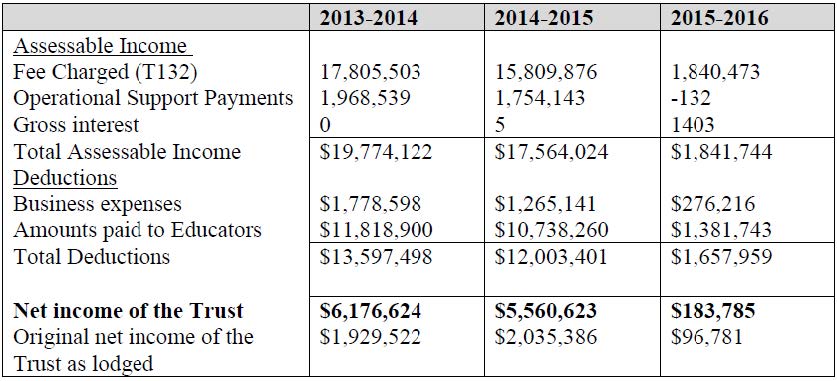
187 The line in question is the “Business expenses” deduction. The taxpayers submit that these expenses were rejected by the Tribunal at T [320]:
320. The Applicants otherwise contended there were sufficient records before the Tribunal to explain their expenses and in any event, they contended the Respondent had conceded the amounts reported to the department. I cannot accept the Respondent has made any such concession. He only proposed it be agreed or found by the Tribunal that ‘the total “Fee Charged” amount entered by [the Child Care Service] for the relevant years was as shown in the Departments records’. He did not agree that the full amounts recorded in the CCMS were allowable deductions and absent records maintained that the Applicants had not discharged their onus.
(Footnotes omitted).
188 The effect of the taxpayers’ submission is that, if the Tribunal had taken into account the “Business expenses” deductions, the net income of the Trust in the Relevant Period should have been found as follows:
FY2014 | FY2015 | FY2016 | |
Net income of the Trust | $6,176,624 | $5,560,623 | $183,785 |
189 The problem, however, is that this is exactly what the Tribunal found. At T [350], it recorded that it accepted the Commissioner’s submission that it was appropriate to recalculate the primary tax owed by Mr Hasan and Ms Flood in accordance with Annexure A to the reasons. That annexure contained a table which recorded the net income of the Trust in each disputed income year for which the Commissioner contended at the hearing. Those amounts are the same as those which appear in the table at supra [188]. So, notwithstanding what is said at T [320], it appears that the Tribunal did act on the Commissioner’s submissions in relation to the amounts paid to Educators. This is reflected in the decision which was to the following effect for each taxpayer:
The Tribunal varies the decisions under review on the basis that the taxable income of the Applicant and penalty is to be re-calculated for each of the financial years ended 30 June 2014, 2015 and 2016 with reference to the adjusted Net Income of the Family Trust as set out in the final row of the table at Annexure A to these reasons.
190 In light of the above, it remains uncertain as to what is precisely in contention. The Tribunal accepted the Commissioner’s revised calculations, which incorporated the “Business expenses” deductions that form the subject of this complaint. Though in the Tribunal’s reasons there was some uncertainty around the degree to which all of the deductions had been established, it is apparent that the Tribunal accepted the Commissioner’s calculation.
191 In the result, there is nothing in this issue which bespeaks of any error in the Tribunal’s decision.
Issue 6 – Procedural fairness
192 By the sixth issue, the taxpayers assert that they were prejudiced by the conduct of the proceedings before the Tribunal, because they did not have adequate notice of the manner in which the Tribunal would rely upon the evidence of the Educators, contained in the Educator Transcripts.
193 It should be noted at the outset that the Educator Transcripts had been relied upon by the Commissioner in the Objection Decision which was the subject of review. There, the Commissioner relied upon the content of the transcripts in support of his conclusions on a number of substantive matters directly relevant to the taxpayers’ assessed income, including: (a) the identity of the party responsible for setting the fees payable by parents; (b) that Mr Hasan gave instructions as to the completion of weekly timesheets, including the making of false entries; (c) the identity of the party responsible for calculating the Gap Payments; (d) that Kids First exercised general control over the operation of the business; and (e) the amounts received by the Educators.
194 It appears that the Educator Transcripts were among thousands of pages of material put before the Tribunal. This was, apparently, the result of the taxpayers’ insistence that all documents relevant to the Objection Decision be included in the hearing book and exhibited. Notwithstanding, towards the completion of the hearing, though prior to the making of final submissions, Counsel for the Commissioner indicated that his client intended to rely upon the transcripts. The Tribunal’s determination of how the information would be dealt with was held over to the next day, so that the parties could consider their position. The following morning, Counsel for the taxpayers indicated that, save for the making of any submissions as to “weight or alternatively procedural fairness”, there was no objection to their tender. There was also no request by or on behalf of the taxpayers to cross-examine any of the Educators who had been interviewed.
195 The Commissioner’s final written submissions made relatively minor reference to the Educator Transcripts. They related to the making of false entries in the weekly timesheets at Mr Hasan’s direction, and Kids First’s control over the setting of fees. That latter point was a not insignificant aspect of the Tribunal’s decision.
196 As it was, the taxpayers did not make any submission to the Tribunal as to the weight which should be given to the Educator Transcripts, nor did they make any submission concerning the procedural fairness implications of their use.
197 The requirement of procedural fairness in Tribunal proceedings is contained in s 55(1) of the ART Act, which provides:
55 Right to present case
General rule
(1) The Tribunal must ensure that each party to a proceeding in the Tribunal is given a reasonable opportunity to:
(a) present the party’s case; and
(b) access any information or documents to which the Tribunal proposes to have regard in reaching a decision in the proceeding; and
(c) make submissions and adduce evidence.
198 The issue raised by the applicants is whether the taxpayers were afforded the rights identified in s 55(1). In essence, the complaint advanced is that the Tribunal did not inform the taxpayers that it would rely upon the statements in the Educator Transcripts in relation to the specific issues which it had to decide. For the following reasons, though questions of this nature are often questions of degree, no unfairness arose in the present case.
199 Importantly, as mentioned, the Educator Transcripts were relied upon substantially by the Commissioner in the Objection Decision. That is a significant fact of which the taxpayers were, or should have been, aware. Moreover, they had been the subject of specific debate as to whether they should form part of the material on which the issues would be determined. Though it is true that much of the evidence from the transcripts concerned apparent falsification of records and potentially fictitious arrangements put in place to obtain benefits under the FAL, that which could be taken from them went directly to the relationships between Kids First, the parents and the Educators. So much should have been apparent from the fact that a substantial portion of the Objection Decision was devoted to analysing the contents of the transcripts, and the results of that analysis appeared under the heading “Direct evidence through formal interviews” in Table 11. It is self-evident that these documents were important to the Commissioner’s conclusions and could not be said to be peripheral.
200 These are important matters which contextualise the application for review before the Tribunal, in that it could not be doubted that the transcripts undergirded parts of the Commissioner’s decision and, although they also included other information not relevant to the issues on review, the Tribunal could not easily disregard them.
201 The taxpayers were fairly informed of the Commissioner’s desire to tender the Educator Transcripts and were given an opportunity to consider their position in that respect. As it transpired, no objection was made, nor were any submissions advanced as to “weight or procedural fairness”. Moreover, it was not submitted that the Tribunal should admit the transcripts for any limited or single purpose, or that they could not be relied upon in the same way as they were in the Objection Decision. Indeed, that would have been a difficult position to take.
202 It is a well-known rule that evidence admitted in curial proceedings for a limited purpose may only be used for that limited purpose, but evidence admitted without limitation is admissible for all purposes: Walker v Walker (1937) 57 CLR 630, 636; Andrews v John Fairfax & Sons Ltd [1980] 2 NSWLR 225, 234 [19]. Granted, this is rule of evidence, but its procedural fairness underpinnings are self-evident and should be applied where natural justice is to be accorded. There is no reason why it should not provide a useful metric in circumstances like the present, even where the rules of evidence do not apply.
203 As mentioned, the steps which are required to be taken to accord a litigant a reasonable opportunity to present their case and answer the evidence will vary upon the circumstances of the case. Here, the taxpayers were represented by very capable Counsel and solicitors, who were given the opportunity to consider their position in relation to the Tribunal’s reception of the Educator Transcripts, and they chose not to advance any objection. They were not, as occurs in many situations before the Tribunal, unrepresented or unaware of the possible uses of the transcripts.
204 Moreover, no explanation was given before this Court as to what would have occurred had the taxpayers been given an opportunity to cross-examine the relevant Educators. In the context of the proceedings, doing so may well have been counter-productive to the taxpayers’ case. A brief perusal of Table 11, and the transcripts themselves, reveals that the Educators gave generally consistent evidence as to what occurred in relation to the engagement of parents. Moreover, many gave evidence of serious defalcations and manipulations by the taxpayers of the FAL scheme. It would have been a very courageous decision indeed to require one or more of the Educators to give evidence, as there would appear to have been a substantial likelihood that their evidence would have damaged the taxpayers’ credibility.
205 It is also relevant that there is no evidence of the forensic decisions taken before the Tribunal. It may be that the taxpayers were completely aware of the contents of the Educator Transcripts and of the possibility that they might be relied upon by the Tribunal in the manner in which it did. There is no evidence to the contrary. It may be that, for the purposes of the hearing, the omission to refer to them in detail was the consequence of a forensic decision not to draw attention to their damaging aspects. In these circumstances, it can be assumed that the tactics displayed were undertaken intentionally, with the result being that the taxpayers are bound by the way in which they ran their case before the Tribunal: Metwally v University of Wollongong (1985) 60 ALR 68, 71; Water Board v Moustakas (1988) 180 CLR 491, 497; Coulton v Holcombe (1986) 162 CLR 1, 7 – 8.
206 It follows that there was no requirement for the Tribunal, upon deciding that the Educator Transcripts were relevant to the question of the identity of the parties to the child care contracts, to cease its deliberations in order to take further submissions. The transcripts went in for all relevant purposes, and the Tribunal was entitled to make use of them as it wished. It would be an almost impossible fetter on decision-makers to require them to cease their deliberations every time they identify some element of the admissible evidence that supports a conclusion, merely because it was not specifically addressed by the parties in submissions. That must be particularly so in circumstances where, as here, the material adduced comprises many thousands of pages. It would be passing strange if the Tribunal were not allowed to rely upon the evidence adduced before it as supporting one argument or the other. Indeed, it is obligated to consider that evidence and reach the preferable decision.
207 Reference was made to the decision in Ramsay v Australian Postal Corporation (2005) 147 FCR 39. No point of principle can be derived from that case. It is merely one example, in a particular scenario, of an application of the obligation to accord natural justice. Given that the circumstances of that case differ substantially from those which arise in the present, it bears no instructive value.
208 It follows that there was no denial of procedural fairness in the manner in which the Tribunal relied upon the Educator Transcripts.
Issue 7 – The imposition of penalties
209 The seventh issue concerns the Tribunal’s decision to uphold the penalties imposed by the Commissioner on Mr Hasan and Ms Flood, at the rate of 50% for each of the disputed years. It will be recalled that those penalties were imposed under s 284-75 of Schedule 1 to the TAA, on the basis that a shortfall had resulted from statements in their returns which were false or misleading in a material particular, and resulted from recklessness as to the operation of the taxation laws. The recklessness relied upon included:
(a) that there was no intention of paying to Ms Hassan the amounts allocated to her from the Trust during the Relevant Period; and
(b) the failure to provide to the accountants, Peak, substantiation of the relationships which gave rise to the entitlement to receive benefits under the FAL, that is, the necessary contractual relationship between the parents and Kids First.
210 The Tribunal was not persuaded that the taxpayers had demonstrated that the penalties should not have been imposed or should be reduced: T [361]. That was because:
(a) no appropriate accounting or taxation advice was sought in relation to the appropriate treatment of the amounts charged to the parents;
(b) the risk involved in Kids First’s treatment of the total fees charged was foreseeable, in circumstances where Mr Hasan and Ms Flood had familiarised themselves with the requirements of the FAL, including by attending education sessions;
(c) from this, they were aware that it was Kids First that was responsible for enrolment, reporting, fee setting, and collection of fees; and
(d) rather than passing on this information, they instructed Peak to the contrary, and the returns were produced accordingly.
211 For similar reasons, the Tribunal determined that the taxpayers would not be entitled to rely upon the “safe harbour” provisions in Schedule 1 to the TAA, because they failed to take reasonable care in supplying all relevant taxation information to Peak: T [370]. Specifically, they did not inform Peak of the necessary requirements for obtaining benefits under the FAL, of which they had acknowledged they were aware.
212 In defending their position, the taxpayers relied upon the affidavits and reports produced by Mr Knoblanche of Peak, in which he purported to characterise the total fees charged as not being income of the Trust. He also sought to verify that the taxpayers did not have any unexplained wealth in the Relevant Period. As will be recalled, that evidence was found to be not independent and was rightly rejected on that basis.
213 As the Tribunal identified, the essential difficulty with Mr Knoblanche’s evidence was that he was not familiar with Kids First’s business during the Relevant Period and had not personally engaged with them at that time. The financial report prepared by him – which purported to conclude that the fees charged did not constitute income of the Trust – was identified as a “certification exercise”: T [223]: and based on his clients’ instructions, rather than an explanation of his independent views by reference to the primary documents. In essence, he merely prepared the financial report on the assumption that the taxpayers’ characterisation of the fees charged to parents was correct. As he indicated in evidence, the process which he undertook involved a somewhat cursory consideration of the accounts to see whether there existed any obvious anomalies.
214 Before this Court, the taxpayers assert that the Tribunal erred on two bases in upholding the penalties:
(a) firstly, by finding that they acted recklessly in relation to the operation of the FAL, as opposed to that of the relevant taxation laws; and
(b) second, by finding that the safe harbour provision in s 284-75(6) of Schedule 1 to the TAA did not apply.
215 This requires a consideration of the relevant penalty provisions and the manner in which they were dealt with by the Tribunal.
The penalty provisions
216 Section 284-75 of Schedule 1 to the TAA relevantly provides:
284-75 Liability to penalty
(1) You are liable to an administrative penalty if:
(a) you make a statement to the Commissioner or to an entity that is exercising powers or performing functions under a *taxation law (other than the *Excise Acts); and
(b) the statement is false or misleading in a material particular, whether because of things in it or omitted from it.
Note: This section applies to a statement made by your agent as if it had been made by you: see section 284-25.
…
Exceptions to subsections (1) and (4)
(5) You are not liable to an administrative penalty under subsection (1) or (4) for a statement that is false or misleading in a material particular if you, and your *agent (if relevant), took reasonable care in connection with the making of the statement.
(6) You are not liable to an administrative penalty under subsection (1) or (4) if:
(a) you engage a *registered tax agent or BAS agent; and
(b) you give the registered tax agent or BAS agent all relevant taxation information; and
(c) the registered tax agent or BAS agent makes the statement; and
(d) the false or misleading nature of the statement did not result from:
(i) intentional disregard by the registered tax agent or BAS agent of a *taxation law (other than the *Excise Acts); or
(ii) recklessness by the agent as to the operation of a taxation law (other than the Excise Acts).
(7) If you wish to rely on subsection (6), you bear an evidential burden in relation to paragraph (6)(b).
217 In relation to the calculation of the base penalty which applies, s 284-90 is relevant and provides, inter alia:
284-90 Base penalty amount
(1) The base penalty amount under this Subdivision is worked out using this table and subsections (1A) to (2), and section 284-224 if relevant:
Base penalty amount | ||
Item | In this situation: | The base penalty amount is: |
1 | You have a *shortfall amount as a result of a statement described in subsection 284-75(1) or (4) and the amount, or part of the amount, resulted from intentional disregard of a *taxation law (other than the *Excise Acts) by you or your agent | 75% of your *shortfall amount or part |
2 | You have a *shortfall amount as a result of a statement described in subsection 284-75(1) or (4) and the amount, or part of the amount, resulted from recklessness by you or your agent as to the operation of a *taxation law (other than the *Excise Acts) | 50% of your *shortfall amount or part |
Alleged Error 1: Recklessness as to the operation of the taxation laws
218 The first aspect of this seventh issue concerns the application of s 284-90 in calculating the base penalty amount. The question before the Tribunal was whether the relevant statements in the returns, which were false or misleading in a material particular and which resulted in the shortfall amount or part of it, resulted from the taxpayers’ recklessness as to the operation of the taxation laws, in accordance with Item 2 of s 284-90(1).
219 As the Tribunal found it, the taxpayers’ recklessness arose from their failure to inform Peak of the matters which gave rise to the entitlement of Kids First to receive the total fees charged to parents, in circumstances where those matters were relevant to the treatment of such amounts in the Trust’s returns. In an attempt to gainsay any allegation of recklessness, Ms Flood claimed in cross-examination that she had sought advice from Peak about these matters. However, the Tribunal preferred the evidence of Mr Knoblanche, to the effect that no such advice had been sought: T [362] – [363]. Nonetheless, the statement by Ms Flood suggests an acceptance on her part that these were matters in respect of which advice ought to have been sought. The finding that Peak was not consulted was, of itself, evidence of recklessness.
220 Importantly, contrary to submissions advanced before this Court, the shortfall in the taxpayers’ returns – consequent upon false statements as to the quantum of the income to which they were entitled from the distributions of the Trust – resulted from recklessness in relation to a taxation law. The misleading character of the statements did not turn on the operation of the FAL. Whilst it is true that the provisions of that regime were relevant to the legal context in which Kids First operated, it was not the cause of the misstatements. At best, it was relevant to the manner in which Kids First’s business was conducted, and to Mr Hasan’s and Ms Flood’s acknowledgement that they understood and complied with the requirements in the FAL, so as to ensure the parents would receive the subsidies. However, it was not those requirements which established Kids First’s entitlement to receive the fees from the parents. That arose out of the contract which existed between those parties. In this respect, it was the misstatement of the implications of that arrangement upon Kids First’s income during the Relevant Period, which constituted the false or misleading particulars provided in the returns. This was sufficient to activate the operation of Item 2 of s 284-90(1) and the Tribunal did not err in relying upon it.
221 For these reasons, there is no need to embark upon any detailed consideration of the intricacies of the FAL. Nevertheless, it should be observed that, whilst the FAL is complex in a number of respects, the applicable provisions in relation to Kids First’s business were relatively straightforward. Moreover, the material provided by the Department to Mr Hasan and Ms Flood accurately informed them of the effect of those provisions and there was no suggestion to the contrary. As the Tribunal found, the taxpayers were informed in a number of ways as to the manner in which the FAL operated. They indicated that they understood it and intended to comply with it, and it appears that they did so.
222 In the result, no error of law arises in relation to the Tribunal’s determination that the relevant shortfalls resulted from recklessness as to the operation of a taxation law.
Alleged Error 2: Safe harbour
223 The second aspect of this issue concerns the taxpayers’ reliance upon the safe harbour provisions in 284-75(6). In this respect, the first question for the Tribunal was whether the taxpayers had given their tax agents, Peak, all relevant taxation information: s 284-75(6)(b). It found that they had not done so, because they did not inform Peak of the matters of which they were aware in relation to the entitlement of parents to benefits under the FAL. In particular, it observed that Peak was not provided with any of the advice and instructions which the Department had provided to the taxpayers: T [370]. Had such information been provided, Peak would have been aware that the FAL required parents to be in a contractual relationship with Kids First, and liable to it for the full amount of fees charged, in order to be entitled to subsidies. That was considered to be relevant taxation information.
224 In the course of so finding, the Tribunal appears to have erroneously referred in a footnote to subparagraph 284-75(6)(d)(ii) in support of the proposition that the safe harbour provision does not operate in circumstances where the penalty arises from recklessness: T [369]. That subparagraph refers to recklessness on the part of the tax agent. The taxpayers submitted that this constitutes an actionable error of law, to the extent that it suggests that the Tribunal wrongly rejected the taxpayers’ reliance on the safe harbour provisions on the basis that they acted recklessly.
225 That submission should be rejected. It is evident that the Tribunal did not rely upon any recklessness in its consideration of s 284-75(6). Notwithstanding the apparent erroneous footnote, the Tribunal expressly found that the taxpayers had not provided all relevant taxation information to Peak, and therefore could not rely on the safe harbour provisions. No error inheres in those reasons.
226 Separately, the taxpayers also contended that the information which was found to have not been provided – namely, the Department advice and instructions – was not “relevant taxation information” for the purposes of s 284-75(6)(b). That should also be rejected. The question of whether the total fees charged constituted income of the Trust turned substantially on the nature of Kids First’s operations, and whether a contract existed between it and the parents. It follows that information demonstrating how Kids First operated for the purposes of the FAL was highly relevant. For that reason, the Department’s guidance as to the operation of the FAL constitutes relevant taxation information which should have been provided to the tax agent. The failure to do so precludes reliance on the safe harbour provisions.
227 It follows that there was no error by the Tribunal in its application of these provisions.
Issue 8 – alleged irrational findings
228 By the eighth issue, the taxpayers allege that the Tribunal made several findings which were unsupported by the evidence or were contrary to incontrovertible evidence. This would appear to be an allegation that errors were committed by the Tribunal in making findings of fact in respect of which there was an absence of evidence: Australian Broadcasting Tribunal v Bond (1990) 170 CLR 321, 355 – 356; Rawson Finances Pty Ltd v Commissioner of Taxation (2013) 133 ALD 39, 66 – 67 [83] – [85].
229 Firstly, the taxpayers allege that the Tribunal wrongly made findings of fact as to the existence of a contractual relationship between the parents and Kids First on the basis of its interpretation of the FAL. They say that such a finding was not supported by any probative evidence. This is merely a re-agitation of the first and second issues, and the concern is answered by reference to the discussion in respect of those: see supra [69] – [147]. Further, and in any event, the Tribunal engaged in a long and detailed consideration of the evidence surrounding the relevant relationships. As has been discussed in relation to the first and second issues, there was more than sufficient evidence to support the finding which it made. Though the Tribunal may have erred in its conclusions as to how the operation of the FAL contributed to the legal relationship, by the deeming of a liability that probably existed otherwise, there was more than sufficient evidence to support the factual finding that a relevant contractual relationship existed between the parents and Kids First.
230 It is noted that the taxpayers sought to base their submissions in relation to irrational fact finding by reference to the observations of Crennan and Bell JJ in Minister for Immigration and Citizenship v SZMDS (2010) 240 CLR 611 at 648 [131], where it was said:
[131] … the test for illogicality or irrationality must be to ask whether logical or rational or reasonable minds might adopt different reasoning or might differ in any decision or finding to be made on evidence upon which the decision is based. If probative evidence can give rise to different processes of reasoning and if logical or rational or reasonable minds might differ in respect of the conclusions to be drawn from that evidence, a decision cannot be said by a reviewing court to be illogical or irrational or unreasonable, simply because one conclusion has been preferred to another possible conclusion.
231 This adopts a narrower conception of legal irrationality, in that it suggests that a decision will not be irrational where, on the available material, another decision-maker could have arrived at the same conclusion, even if by a different process of reasoning. In other words, it matters not that the reasoning applied by the decision-maker is illogical, so long as another person might logically reason to the same outcome. That is an application of the underlying rationale of Associated Provincial Picture Houses Ltd v Wednesbury Corporation [1948] 1 KB 223, and one that appropriately restricts the scope of any attack on administrative decision-making on the grounds of alleged unreasonableness.
232 In the present case, as there was more than sufficient material on which the Tribunal could have reasoned to a conclusion that the parents contracted with Kids First, without reference to the alleged operation of the FAL, it follows that the conclusion was not illogical or irrational.
233 The second finding of which the taxpayers complain is the conclusion that the financial report and ABA were prepared by Mr Knoblanche without reference to any primary documents. The relevant finding appears in T [217] and [223], where the Tribunal said:
217. Mr Knoblanche was also briefed by the Applicants’ solicitors during these proceedings and asked to prepare a report (‘the Financial Report’) and an asset betterment assessment (‘the ABA’).254 Neither Mr Knoblanche nor Peak had access to primary documents in preparing this material.255
…
223. I have ultimately treated the Financial Report as something akin to a certification exercise which Peak undertook for its clients.261 Mr Knoblanche told the Tribunal that the exercise undertaken was not an audit but to produce a set of accounts.262 In this respect, I understand he undertook the task without referring to any primary documents and based on his clients’ instructions.
234 In T [217], the footnote numbered 254 refers to page 71 of the transcript of day 6 of the hearing. There, Mr Knoblanche was cross-examined as to the manner in which he prepared the financial statements and, in particular, his assumption, without reference to underlying agreements or arrangements, that the ledgers of Kids First were correct. Footnote 255 refers to paragraph 50 of Mr Knoblanche’s affidavit of 5 January 2023, which sets out the process by which the ABA was prepared. The process identified makes no reference to primary documents relating to Kids First’s business activities, such as the form of contracts into which it had entered with parents or Educators. Similarly, footnote 261 in T [223] refers to page 74 of the transcript of day 6 of the hearing, where Mr Knoblanche states that he based his report on Kids First’s MYOB accounts, which he assumed were correct with “a high level of confidence”. From this, it is pellucid that the Tribunal was acutely aware that Mr Knoblanche had referred to the ledgers and MYOB accounts of Kids First when preparing his reports, but did not consider the underlying documents which regulated or controlled the rights of the parties inter se.
235 Prima facie, it would appear that the Tribunal’s reference to the “primary documents” was not a reference to the accounts of Kids First. It is clear from the references to the transcript that the Tribunal understood that Mr Knoblanche did have regard to those accounts when preparing his reports. It also acknowledges, at T [225], that he reviewed the MYOB accounts when preparing his reports. It follows that the Tribunal’s reference to “primary documents” must be taken to be a reference to the documents which established and evidenced the contractual arrangements between the parties. They would include the enrolment forms, the weekly timesheets, the Department’s factsheets and the like. As such, the Tribunal’s criticism was that Mr Knoblanche and Peak accepted, without investigation, the assertions of Mr Hasan and Ms Flood as to the character of the payments which Kids First received or to which it was entitled. So much appears from T [226], which reads:
226. As I have already noted, Mr Knoblanche conceded that he had not undertaken any sort of audit for the purpose of his additional work. As such, the ABA wholly reflected documents and instructions provided to him by BHMH [Mr Hasan] and NQWK [Ms Flood].
236 It follows that, on a proper reading of its reasons, the Tribunal did not reach any illogical conclusion about the veracity of Mr Knoblanche’s work. In this respect, it is apt to keep in mind that the Tribunal’s reasons must not be read too critically. The Court should not be concerned with looseness of language, but must rather focus upon the real substance of the determination. That is, the reasons of a decision-maker should not be “construed minutely and finely with an eye keenly attuned to the perception of error”: Minister for Immigration and Ethnic Affairs v Wu Shan Liang (1996) 185 CLR 259, 272, quoting Collector of Customs v Pozzolanic Enterprises Pty Ltd (1993) 43 FCR 280, 287.
237 It follows that no error arises in relation to the eighth issue.
Issue 9 – Credibility findings
238 As to the ninth issue, the taxpayers assert that the Tribunal’s findings in relation to the credibility of the taxpayers and others raise a question of law. In the Supplementary Notice of Appeal, the question is framed as follows:
11. Whether the Tribunal erred in law by making adverse findings regarding the credibility and reliability of the Applicants and Mr Knoblanche without logically probative evidence or adequate reasoning, in paragraphs [182]–[204] of the Tribunal Decision (TD), TD [206]–[211], and TD [223], [225] of its reasons.
239 The specific grounds advanced in respect of this issue do not greatly assist its consideration. They appear to advance arguments of “no evidence”, irrationality, inadequate reasons, and the like. Overall, they appear to be little more than an attempt to seek merits review of the Tribunal’s findings. Of course, that is not to say that errors of law may never arise in the fact-finding process: AVQ15 v Minister for Immigration and Border Protection (2018) 266 FCR 83, 96 – 97 [40] – [41]; SZHYH v Minister for Immigration & Border Protections (No 3) (2019) 165 ALD 463, 475 [40]; DAO16 v Minister for Immigration and Border Protection (2018) 258 FCR 175, 183 [30(1)]: though the occasions on which they do will necessarily be rare.
240 The first alleged ground is that the Tribunal found, without logically probative evidence, that the taxpayers’ evidence was not credible or reliable. That, however, is obviously incorrect. The Tribunal undertook an exhaustive and detailed analysis of their respective evidence, which, as the Tribunal observed, contained striking similarities. In this regard, it is noteworthy that the taxpayers do not contest any of the Tribunal’s observations about Mr Hasan and Ms Flood’s affidavits. That is, they do not deny or contest that one affidavit was used as a template for the other, and that parts of the affidavits were identical, almost identical, or very similar. That, as was said in Tour Squad Pty Ltd v Fifth Amendment Entertainment Inc (No 2) (2021) 151 ACSR 607 at 631 [127], is suggestive of collusion in the preparation of the affidavits: see also Macquarie Developments Pty Ltd v Forrester [2005] NSWSC 674 [90].
241 Here, the Tribunal considered the two affidavits and concluded that “the extent of the similarities in structure, wording, and selection of material in both affidavits struck me as contrived”: T [192]. It also observed that the affidavits were “carefully crafted to advance particular propositions”, and provided a “very selective view” of and “lacked essential detail” about Kids First’s day-to-day operations: T [192] – [193]. None of these propositions were shown to be, or even attempted to be shown to be, in error. Indeed, the Court was not taken to any of the affidavits in any attempt by the taxpayers to gainsay those conclusions.
242 In any event, a side-by-side comparison of the affidavits and their similarities reveals that the Tribunal’s findings were, in fact, modestly expressed. The affidavits contained a number of identical paragraphs and many which were nearly identical. The copying was not confined to prosaic matters and extended to contentious material. This alone supports the Tribunal’s conclusions as to the taxpayers’ credibility, as does the fact that neither Mr Hasan nor Ms Flood could explain certain legal terms which appeared in their affidavits: T [192]. This constitutes “some evidence” on which the Tribunal could have based its conclusions. Other sufficient evidence includes: (a) the inconsistency between the taxpayers’ evidence and the available business records: T [193]; (b) Mr Hasan’s admission that he had very little to do with Kids First’s business operations; (c) the inability of the taxpayers to explain, and their evasiveness in relation to, the absence of business records: T [204]; and (d) the evasiveness of Ms Hassan whilst under cross-examination and her effective refusal to answer questions: T [209].
243 These are sufficient to justify the Tribunal’s findings as to the taxpayers’ credibility. Indeed, rather than being illogical or lacking in foundation, they were likely to be the only conclusions available on the evidence. To that end, it should be noted that this emphasises the lack of veracity of this ground of appeal, and its inclusion tends to cast doubt upon the other grounds.
244 The second ground under this issue is equally baseless. It is to the effect that the Tribunal failed to provide adequate reasons for rejecting the taxpayers’ sworn evidence and impermissibly preferred the information in the Manual. Having regard to the foregoing discussion, on any objective view, the evidence of Mr Hasan and Ms Flood was, at best, unreliable, and it would have been somewhat remarkable for the Tribunal to have accepted it. The Tribunal’s preference for that which was contained in the Manual is supportable on that basis alone. Further, the Manual was a document produced by Kids First, which the taxpayers controlled, and it purported to set out the processes by which children were to be enrolled for child care: T [122] – [123]. In particular, it identified that, initially, the parents were to engage with Kids First. Given the taxpayers’ demonstrated lack of credibility and the generally doubtful nature of their evidence, the Tribunal was entitled to accept that the processes undertaken by Kids First were consistent with its own Manual, rather than as inconsistently described by the taxpayers.
245 The taxpayers further complained that the Tribunal considered their answers under cross-examination to be “very targeted”, but did not provide any particulars of that observation. That is not a legitimate criticism, and Tribunals are not required to refer to every piece of evidence on which they rely when reaching factual conclusions. In this case, a perusal of the transcript of the hearing before the Tribunal quickly reveals that the taxpayers appeared to be evasive when answering questions and sought to advance their own narrative. Again, there is nothing in the taxpayers’ criticism of the reasons in relation to this ground.
246 It is not a valid complaint that the Tribunal accepted some of the taxpayers’ evidence when it was consistent with the contemporaneous evidence. That is a standard and appropriate manner by which to assess evidence of doubtful veracity, and the complaint that the Tribunal fell into error when accepting some of what the taxpayers said lacks any merit whatsoever.
247 In general, the taxpayers’ concerns as to the findings made by the Tribunal were, as submitted on behalf of the Commissioner, mere attempts to engage the Court in merits review of the underlying factual conclusions on which the decision was made. That is impermissible on an appeal of this nature.
248 It follows that no question of law arises in relation to the ninth issue.
CONCLUSION
Appropriate relief
249 For the foregoing reasons, the taxpayers have succeeded on part of the first issue and, consequently, the appeal should be allowed. Though the taxpayers sought orders that the Commissioner’s Objection Decision and Penalty Objection Decision be set aside, and that their objections be allowed in full, the appeal did not demonstrate that those decisions were incorrectly made. Error only on the part of the Tribunal has been established and it was not an error that necessitated a different outcome. It is, therefore, not appropriate to grant the relief sought in full. Instead, it is appropriate to remit the matter to the Tribunal for determination according to law.
Costs
250 The parties should be heard on the question of costs. Though the appeal was successful, the taxpayers only succeeded on one aspect of one issue, of which there were nine. They did not succeed in obtaining a substantive part of the relief sought, namely, the setting aside of the Objection Decision and Penalty Objection Decision and the allowing of the objections. In such circumstances, a question might arise as to whether the case warrants some apportionment of costs.
I certify that the preceding two hundred and fifty (250) numbered paragraphs are a true copy of the Reasons for Judgment of the Honourable Justice Derrington. |
Associate:
Dated: 7 August 2026


