FEDERAL COURT OF AUSTRALIA
Austin on behalf of the Eastern Maar People v State of Victoria (No 3) [2026] FCA 1054
File number(s): | VID 21 of 2019 VID 620 of 2022 |
Judgment of: | murphy j |
Date of judgment: | 30 July 2026 |
Catchwords: | NATIVE TITLE - determination of separate question - whether Gunditjmara applicant able to demonstrate that they hold rights and interests in land and waters of any part of Part C - whether elements of s 223 of the Native Title Act 1993 (Cth) are satisfied - deficiencies in lay and expert evidence as to laws and customs of the applicant acknowledged and observed in relation to the relevant area - not established NATIVE TITLE - whether Gunditjmara applicant able to demonstrate customary rights and interests to access Area C to take resources from it - deficiencies in evidence to make out claim - not established |
Legislation: | Evidence Act 1995 (Cth) ss 60(1), 135, 136, 140(1), 140(2) Native Title Act 1993 (Cth) ss 47, 47A, 47B, 55, 56(1), 67, 86, 87(1), 213, 223, 225 |
Cases cited: | AB (deceased) on behalf of the Ngarla People v State of Western Australia (No 4) [2012] FCA 1268; 300 ALR 193 Akiba on behalf of the Torres Strait Islanders of the Regional Seas Claim Group v State of Queensland (No 2) [2010] FCA 643; 204 FCR 1 Akiba on behalf of the Torres Strait Islanders of the Regional Sea Claims Group v Commonwealth [2013] HCA 33; 250 CLR 209 Austin on behalf of the Eastern Maar People v State of Victoria [2023] FCA 237 Austin on behalf of the Eastern Maar People v State of Victoria (No 2) [2024] FCA 266 Briggs on behalf of the Boonwurrung People v State of Victoria (No 2) [2025] FCA 279 Blucher on behalf of the Gaangalu Nation People v State of Queensland (No 3) [2023] FCA 600 Blucher on behalf of the Gaangalu Nation People v State of Queensland [2025] FCAFC 177; 314 FCR 213 Bodney v Bennell [2008] FCAFC 63; 167 FCR 84 Commonwealth v Akiba on behalf of the Torres Strait Islanders of the Regional Seas Claim Group [2012] FCAFC 25; 289 ALR 400 Commonwealth v Yarmirr [2001] HCA 56; 208 CLR 1 Dale v State of Western Australia [2011] FCAFC 46; 191 FCR 521 De Rose v State of South Australia (No 2) [2005] FCAFC 110; 145 FCR 290 Dimer on behalf of the Marlinyu Ghoorlie Claim Group v State of Western Australia (No 6) [2025] FCA 1641 Drill v Western Australia [2020] FCA 1510 Gumana v Northern Territory [2005] FCA 50; 141 FCR 457 Harrington-Smith on behalf of the Wongahtha People v State of Western Australia (No 9) [2007] FCA 31; 238 ALR 1 Henderson v Queensland [2014] HCA 52; 255 CLR 1 Lithgow City Council v Jackson [2011] HCA 36; 244 CLR 352 Karkdoo on behalf of the Purrukwarra Estate Group and the Arruwarra Estate Group v Northern Territory of Australia [2024] FCA 176 Lovett on behalf of the Gunditjmara People v State of Victoria [2007] FCA 474 Lovett on behalf of the Gunditjmara People v State of Victoria (No 4) [2011] FCA 931 Lovett on behalf of the Gunditjmara People v State of Victoria (No 5) [2011] FCA 932 Luxton v Vines [1952] HCA 19; 85 CLR 352 Mabo v Queensland (No 2) [1992] HCA 23; 175 CLR 1 Malone on behalf of the Western Kangoulu People v State of Queensland [2021] FCAFC 176; 287 FCR 240 Malone on behalf of the Western Kangoulu People v State of Queensland (No 3) [2022] FCA 827 Manado (on behalf of Bindunbur Native Title Claim Group) v State of Western Australia [2017] FCA 1367 Manado on behalf of the Bindunbur Native Title Claim Group v State of Western Australia [2018] FCAFC 238; 265 FCR 68 McLennan on behalf of the Jangga People #3 v State of Queensland [2023] FCAFC 191; 301 FCR 452 Members of the Yorta Yorta Aboriginal Community v State of Victoria [2002] HCA 58; 214 CLR 422 Narrier v State of Western Australia [2016] FCA 1519 Northern Territory v Alyawarr, Kaytetye, Warumungu, Wakaya Native Title Claim Group [2005] FCAFC 135; 45 FCR 442 Rrumburriya Borroloola Claim Group v Northern Territory of Australia [2016] FCA 776; 255 FCR 228 Rrumburriya Borroloola Claim Group v Northern Territory of Australia (No 2) [2016] FCA 908 Stuart v State of South Australia (Oodnadatta Common Overlap Proceeding) (No 4) [2021] FCA 1620 Stuart v State of South Australia [2023] FCAFC 131; 299 FCR 507 Stuart v State of South Australia [2025] HCA 12; 422 ALR 279 Westbus Pty Ltd (Administrators Appointed) v Ishak [2006] NSWCA 198 State of Western Australia v Ward [2000] FCA 191; 99 FCR 316 State of Western Australia v Ward [2002] HCA 28; 213 CLR 1 |
Division: | General Division |
Registry: | Victoria |
National Practice Area: | Native Title |
Number of paragraphs: | 568 |
Date of hearing: | 8-11 May 2023, 11-13 December 2023 and 8-9 July 2024 |
Counsel for the Applicant in VID 21/2019: | J Waters SC (8 - 11 May 2023) and R Kruse |
Solicitor for the Applicant in VID 21/2019: | First Nations Legal & Research Services |
Counsel for the Applicant in VID 620/2022: | M Longhurst (8 May - 13 December 2023) S Phillips (11 December 2023 - 9 July 2024) |
Solicitor for the Applicant in VID 620/2022: | QLD Lawyers |
Counsel for the First Respondent: | P Willis SC and L Hilly |
Solicitor for the First Respondent: | Solicitor for the Victorian Government |
Counsel for the Second Respondent: | D O’Leary SC |
Solicitor for the Second Respondent: | Australian Government Solicitor |
ORDERS
VID 21 of 2019 | ||
| ||
BETWEEN: | JANICE AUSTEN ON BEHALF OF THE EASTERN MAAR PEOPLE Applicant | |
AND: | STATE OF VICTORIA Respondent | |
VID 620 of 2022 | ||
| ||
BETWEEN: | DENISE LOVETT ON BEHALF OF THE GUNDITJMARA AREA C NATIVE TITLE CLAIM GROUP Applicant | |
AND: | STATE OF VICTORIA Respondent | |
order made by: | MURPHY J |
DATE OF ORDER: | 30 JULY 2026 |
THE COURT ORDERS THAT:
1. The questions posed in Order 10(a) of the Orders made on 23 December 2022 in VID21/2019 be answered in the following way:
(a) Do people who are descended from the ancestors identified in the Second Applicant’s claim in VID620/2022 today hold rights and interests in land and waters of any part of Area C in accordance with their traditional laws and customs?
Answer: No.
(b) If so:
(i) in which parts of Area C?
(ii) what is the nature and extent of those rights and interest?
Answer: Does not arise.
2. The proceeding be listed for case management to determine the next procedural steps to be taken in the proceeding on a time and date to be fixed in August 2026.
Note: Entry of orders is dealt with in Rule 39.32 of the Federal Court Rules 2011.
REASONS FOR JUDGMENT
MURPHY J:
1. INTRODUCTION
1 These reasons relate to the determination of separate questions ordered by the Court on 23 December 2022 (Separate Questions) in two native title determination applications before the Court, being:
(a) Janice Austin & Ors on behalf of the Eastern Maar People v State of Victoria & Ors, VID21/2019 (the Eastern Maar claim); and
(b) Denise Lovett & Ors on behalf of the Gunditjmara Area C Native Title Claim Group, VID620/2022 (the Gunditjmara claim).
The two claims both relate to the same area of land and waters in south-western Victoria, called Area C (or Part C) in these reasons. That area falls generally between the Shaw River in the west and the Hopkins River in the east, and encompasses the city of Warrnambool and the towns of Allansford, Dennington, Port Fairy, Yambuk, Orford, Penshurst, Carmut, and Ellerslie.
2 The relevant Separate Questions are as follows:
Question 1: Do people who are descended from the ancestors identified in the Gunditjmara claim dated 19 December 2022 today hold rights and interests in land and waters of any part of Area C in accordance with their traditional laws and customs?
Question 2: If so:
(a) in which parts of Area C?
(b) what is the nature and extent of those rights and interests?
Although both the Gunditjmara applicant and the Eastern Maar have applications for a native title determination on foot, the Separate Questions only concern the Gunditjmara claim.
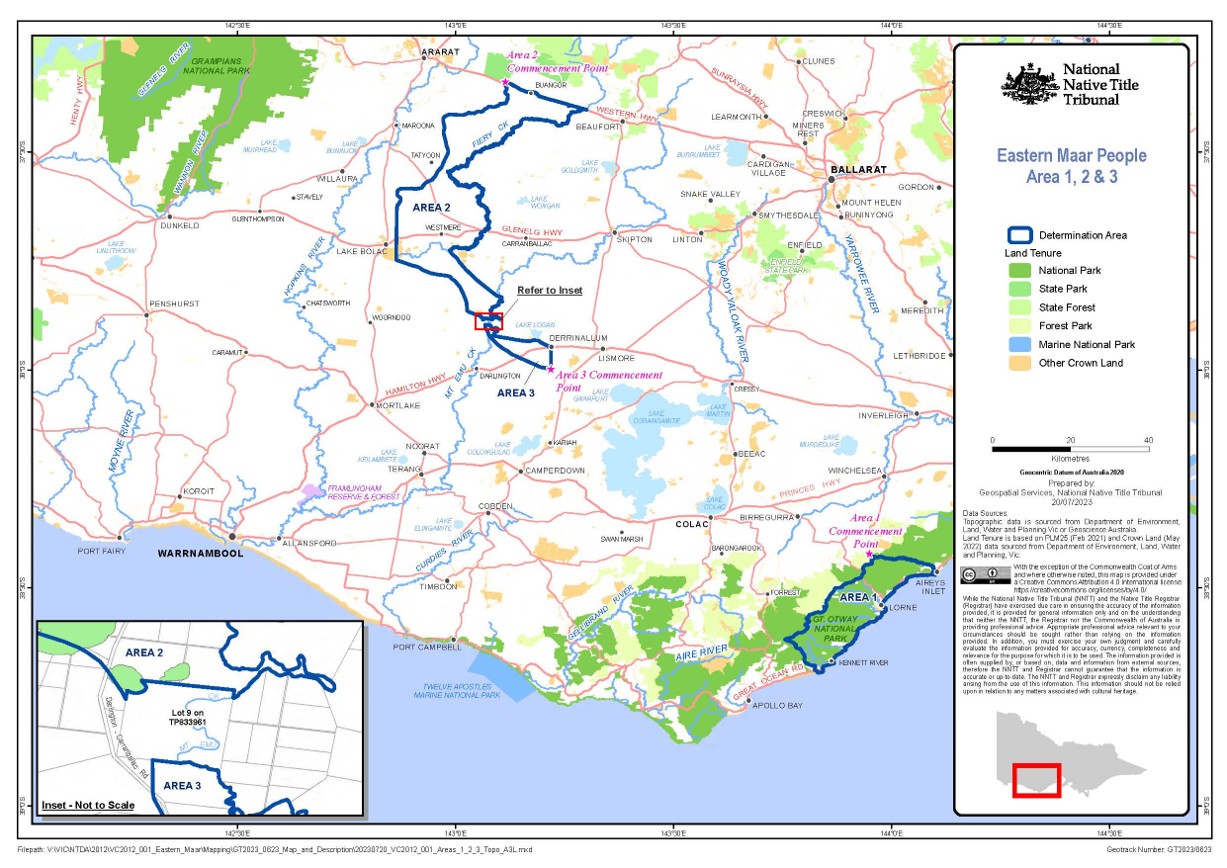
3 The Separate Questions fall to be determined against the backdrop that both the Gunditjmara and the Eastern Maar have previously been recognised as holding native title rights and interests in areas in south-western Victoria adjacent to Area C. Annexure 1 to these reasons is a series of maps demonstrating the Area C claim, and the adjacent areas where native title has been determined to be held by the Gunditjmara and/or the Eastern Maar, including one area in which both were found to hold coexistent native title rights and interests.
4 By reference to the maps in Annexure 1:
(a) “Part A” is the westernmost area depicted in Map 1 of Annexure 1, being between the Glenelg River and the Eumeralla River. In March 2007 in Lovett on behalf of the Gunditjmara People v State of Victoria [2007] FCA 474 (North J) (Lovett 2007) the Court made a consent determination of native title in favour of the Gunditjmara People in relation to this area. This can be seen in Map 1 of Annexure 1, shaded in yellow.
(b) “Part B” is the next area depicted, east of Area A, being between the Eumeralla River and the Shaw River) In July 2011 in Lovett on behalf of the Gunditjmara v State of Victoria (No 5) [2011] FCA 932 (North J) (Lovett 2011) the Court made a consent determination of native title in relation to this area, in favour of both:
(i) the Gunditjmara People; and
(ii) the Eastern Maar Peoples.
It was determined that each held distinct native title rights and interests in relation to this area. This can be seen in Map 1 of Annexure 1, shaded in orange.
(c) “Area C” is the next area depicted, east of Part B, being between the Shaw River and the Hopkins River. That is the area in dispute in the present case. This can be seen in Map 1 of Annexure 1, shaded in pink. Map 1 also labels locations mentioned by the lay witnesses in their witness statements for Area C.;
(d) “Area D” is the next area depicted, east of Area C, being between the Hopkins River eastwards to Aireys Inlet (taking in Port Campbell, Apollo Bay and Lorne) and inland from Dunkeld in the west up to Ararat in the north/north-west, across to Raglan in the north/north-east (near Beaufort) and down to Camperdown in the south/south-east. In March 2023, in Austin on behalf of the Eastern Maar People v State of Victoria [2023] FCA 237 (Murphy J) (Austin 2023) the Court made a determination of native title in favour of the Eastern Maar Peoples in relation to this area. This can be seen in Map 2 of Annexure 1.
(e) “Area E” is the next area depicted, which is a series of three discrete areas in south-west Victoria. In March 2024 in Austin on behalf of the Eastern Maar People v State of Victoria (No 2) [2024] FCA 266 (Murphy J) (Austin 2024) the Court made a consent determination of native title in favour of the Eastern Maar Peoples in relation to this area. This can be seen in Map 3 of Annexure 1.
5 I use the prefixes “Part” or “Area” interchangeably throughout this judgment to describe these areas. That naming and the numbering does not always match the naming and numbering of areas in the judgments referred to.
1.1 The competing claims
6 The Gunditjmara claim was filed on 21 October 2022 by way of a Form 1 application for a determination of native title. The Gunditjmara applicant comprises Denise Lovett, Damein Bell, Eileen Alberts, Walter Saunders and Delise Lillyst who brought the proceeding on their own behalf and on behalf of the descendants of 19 identified ancestors who identify as Gunditjmara (Gunditjmara claim group).
7 As I later explain, the Gunditjmara claim underwent some significant amendments through the course of the proceeding, including during the trial itself. By the time of closing submissions the Gunditjmara applicant advanced a claim that accepted that the Eastern Maar Peoples are the appropriate “land owning” or “land holding” group in respect of Area C, and that the native title rights and interests of the Gunditjmara People in Area C are “more limited”, but that the Gunditjmara People nevertheless have native title rights and interests in relation to the land and water of Area C which consist of:
… the non-exclusive:
(a) right to have access to or enter and remain on the land and waters;
(b) right to take the resources of the land and waters; and
exercised in accordance with the traditional laws and customs observed by and binding upon the members of the Gunditjmara/Maar society.
8 The competing native title claim in relation to Area C is that of the Eastern Maar applicant filed on 14 December 2012 and later amended on 19 December 2022. The Eastern Maar applicant comprises Janice Austin, Vicki Couzens, Thomas Clarke, Jidah Clark and Sheree Lowe which brought a native title determination application on behalf of a native title claim group described as the Eastern Maar Peoples, being those descendants, including by adoption, of the following persons:
King of Port Fairy and Eliza; Old Jack (father of John Dawson); Charlie and Alice (parents of Albert Austin); Samuel Robinson and Mary Caramut; Lizzie (mother of Frank Clarke); Robert and Lucy (parents of Alice Dixon); Barney Minimalk; Nellie Whiturboin; Louisa (mother of William Rawlings) and Richard Sharp; and who:
(i) either identify as being from the eastern domain of the Maar speaking people and are recognised as being from the eastern domain by the Eastern Maar people; or
(ii) otherwise identify as Maar, Gunditjmara, Tjap Wurrung, Peek Whurrung, Keeray Wooroong (Kirrae Whurrung), Kuurn Kopan Noot Yarro Waetch (Tooram Tribe), Djargurd Wurrung, Gulidjan and/or Gadubanud and are recognised as being from the eastern domain by the Eastern Maar people.
9 These Separate Question are not, though, concerned with the establishment of native title rights in Area C by the Eastern Maar applicant. The Separate Questions are concerned only with whether the Gunditjmara applicant can establish that the Gunditjmara People today hold rights and interests in land and waters of any part of Area C in accordance with their traditional laws and customs, and if so the nature and extent of those rights and interests.
10 The trial in relation to the Separate Questions took place in tranches between May 2023 and July 2024. During the period 8 to 11 May 2023 the evidence of the parties’ lay witnesses was heard ‘on country’ in Area C. During the period 11 to 13 December 2023, expert evidence from the anthropologists retained by the parties was heard in Melbourne. The proceeding then returned to mediation between the Gunditjmara and the Eastern Maar, which was unfortunately unsuccessful in resolving the dispute. On 8 and 9 July 2024, oral closing submissions were heard in Melbourne.
11 In the trial:
(a) The Gunditjmara applicant alleged that the Gunditjmara People hold native title rights and interests in the land and waters throughout Area C in accordance with their continuing acknowledgement and observance of traditional laws and customs in relation to that country, and it adduced lay and expert evidence and made submissions in support of a finding to that effect. As I later explain, the Gunditjmara claim changed markedly over the course of the proceeding, including during the trial.
(b) The Eastern Maar applicant opposed a finding that the Gunditjmara People hold native title rights and interests in the land and waters of Area C, and it adduced lay and expert evidence and made submissions in opposition to that claim. It asserted that the Eastern Maar Peoples and not the Gunditjmara People hold native title rights and interests in relation to Area C. The Eastern Maar’s evidence as to that is relevant in the Gunditjmara claim, but the claim by the Eastern Maar applicant did not arise for determination in the Separate Questions.
(c) The State of Victoria and the Commonwealth of Australia (Commonwealth) were each active respondents to the Gunditjmara claim. They did not adduce any lay evidence, but the State adduced expert evidence. Neither expressly advocated for a particular outcome, but they each made their view as to the appropriate outcome sufficiently clear.
12 I had the opportunity during the ‘on country’ hearings to hear evidence from many Gunditjmara lay witnesses and I learned about the Gunditjmara People through their testimony, the historical materials, and the anthropological evidence. The Gunditjmara are a proud and impressive First Nations People and their witnesses gave evidence which I consider reflected their sincere and deeply held convictions about the extent of Gunditjmara country. Nothing that I say in these reasons should be taken as derogating from that respect.
13 Further, it is a fact that the Court has recognised that the Gunditjmara People hold native title rights and interests in relation to country in Areas A and B in south-western Victoria. The determinations made in Lovett 2007 and Lovett 2011 evidence that, in relation to Areas A and B, the Court recognised:
(a) the existence, at effective sovereignty in around 1830, of an Aboriginal group or society united in and by its acknowledgment and observance of a body of law and customs, of which group the Gunditjmara were a part; and
(b) the continuity of that Gunditjmara society and its acknowledgement and observance of its to traditional laws and customs from the past to the present.
14 That the Gunditjmara have been able to maintain their society and culture notwithstanding the devastating impact of European colonisation and more than 150 years of adverse government policies speaks volumes about them as a people. The evidence shows that the impact of European colonisation, and the resultant displacement, dispossession and deaths of First Nations people in south-western Victoria, had devastating effects on their communities. From the 1830s to the 1860s the introduction of new diseases and practices, abduction of women, killings and massacres resulted in a demographic decline of around 90% in the Aboriginal population in south-western Victoria.
15 The Gunditjmara did not easily give up their country. From the 1830s to the 1860s they fiercely fought the Eumeralla Wars against dispossession by Europeans. But the displacement and dispossession, the depredations of that period, and subsequent government policies including forcibly taking Aboriginal children from their families, resulted in profound damage to Gunditjmara culture and their capacity to transmit knowledge and culture by oral tradition. That Gunditjmara society survived and that the Gunditjmara People remain strong today, and have been recognised as holding native title rights and interests in relation to Areas A and B, is a testament to their courage, determination and perseverance.
16 It should also be understood, as Mortimer J (as her Honour then was) explained in Drill v Western Australia [2020] FCA 1510 at [13], that in a case like this the Court’s role is not to decide what the “truth” is, in an absolute sense. The Court is not “the arbiter of history”. Instead, as I emphasised in Briggs on behalf of the Boonwurrung People v State of Victoria (No 2) [2025] FCA 279 at [10]:
… the Court must reach a decision as to whether the party which must prove the necessary facts has shown that the facts it contends for are more likely than not to have existed. That exercise is to be carried out on the basis of the evidence adduced, and inferences which can reasonably be drawn from that evidence, including to decide whether the available evidence is sufficient to enable a decision to be reached on the balance of probabilities. In short, the Court must assess what reasonably and rationally can be made of the evidence before it.
17 The Gunditjmara applicant had the onus to prove its case. It had to prove, on the balance of probabilities, that the Gunditjmara People met the requirements of s 223(1) of the Native Title Act 1993 (Cth) (NTA). Pertinently to the dispute in the present case, it was required to establish that from sovereignty to the present day, and without substantial interruption, the Gunditjmara People have continued to acknowledge and observe their traditional laws and customs such that they continue to have a connection with the land and waters of Area C, and thereby have native title rights and interests in relation to Area C: NTA s 223(1)(a)-(b); Lovett 2011 at [22] (North J); Members of Yorta Yorta Aboriginal Community v Victoria [2002] HCA 58; 214 CLR 422 at [34] (Gleeson CJ, Gummow and Hayne JJ).
18 For the reasons I will explain, the lay evidence and expert evidence adduced by the Gunditjmara in relation to Area C is insufficient to discharge their onus. I also prefer the lay and expert evidence adduced by the Eastern Maar. Based on the evidence before the Court, the answers to the Separate Questions are as follows:
Question 1: Do people who are descended from the ancestors identified in the Gunditjmara claim dated 19 December 2022 today hold rights and interests in land and waters of any part of Area C in accordance with their traditional laws and customs?
Answer: No
Question 2: If so:
(a) in which parts of Area C?
(b) what is the nature and extent of those rights and interests?
Answer: Does not arise.
1.2 A note on spellings, words and descriptions used
19 Many of the names of Aboriginal groups or societies have alternative spellings. For example, an alternative spelling to Gunditjmara is Gournditch-mara, alternative spellings for the name Peek Wurrung include Peek Whurrung, Peek Whurrong, Peek Whuurung and Peek Woorroong, and alternative spellings for the name Keeray Wooroong include Kirrae Whurrung. For reasons of simplicity and consistency, these reasons adopt the spelling of Gunditjmara, Peek Whurrung and Kirrae Whurrung, and I have also made choices in relation to the names of other Aboriginal groups or societies. No significance should be attributed to any such choice; it is just for clarity.
20 There are people who identify, in one way or another, as Gunditjmara on both sides of the dispute in this case. The claim group in the Gunditjmara claim comprises the descendants of a number of identified Gunditjmara apical ancestors, and some members of the claim group in the Eastern Maar claim otherwise identify as Gunditjmara but are recognised as Eastern Maar Peoples. Further, one of the themes of the Gunditjmara lay witness evidence is that there is only one Gunditjmara People, not two distinct communities.
21 As a result, there is an opportunity for misunderstanding the evidence in relation to which of the two Aboriginal disputing groups that a person that identifies as ‘Gunditjmara’ belongs to. In an effort to avoid that confusion, some witnesses used the term ‘western Gunditjmara’ to describe members of the Gunditjmara claim group, referring to people from the western domain or community which coalesced around Lake Condah after effective sovereignty. And some Gunditjmara lay witnesses used the term ‘eastern Gunditjmara’ when referring to people from the eastern domain or community which coalesced around Framlingham after effective sovereignty, which group chose the name Eastern Maar in December 2010. That is not, however, what the Eastern Maar lay witnesses called their people; they generally called themselves Eastern Maar People although some otherwise identified as Gunditjmara.
22 I have generally chosen not to add the identifier ‘western’ or ‘eastern’ to the name ‘Gunditjmara’ unless I consider the context requires that specificity. Generally, when I refer to the Gunditjmara People I mean the native title claim group in the Gunditjmara claim, being people from the western domain. But that is a choice for reasons of convenience and clarity, and it has no significance in the decision. I accept that the identifier ‘Gunditjmara’ can also be used by a person from the eastern domain who now identifies as a member of the Eastern Maar Peoples. Indeed, the claim group definition in the Eastern Maar claim expressly recognises that the group includes persons who otherwise identify as Gunditjmara and are recognised by the Eastern Maar Peoples as being from the eastern domain.
23 It has also been necessary to refer to Aboriginal people who are deceased. In many Aboriginal communities, it is customary not to use the deceased person’s first name for a period of time. However, because these reasons refer to many people who have the same family name, to avoid any ambiguity it has often been necessary to refer to both living and deceased persons by their first and second names.
2. HISTORY OF THE RELEVANT CLAIMS
24 Prior to turning to the evidence, it is appropriate to set out the background of the native title claims in relation to the areas proximate to Area C.
25 On 30 August 1996, native title determination application VID6004/1998 was filed on behalf of the Gunditjmara (initially lodged with the National Native Title Tribunal as VC96/3) seeking a determination of native title in relation to an area in south-west Victoria bounded on the west by the Glenelg River, to the north by the Grampians, and to the east by the Hopkins River. The Aide Memoire to the Gunditjmara written closing submissions dated 20 May 2024 (Gunditjmara written submissions) shows that there were a series of further native title determination applications lodged on behalf of the Gunditjmara in the period from 1996 to 1999 in relation to various areas in south-western Victoria. On 9 July 1999, the various applications were combined under proceeding number VID6004/1998.
26 On 9 June 2006, application VID655/2006 was filed on behalf of Gunditjmara People to include certain further parcels of land within the claim area of VID6004/1998, which had been overlooked in framing the original application. The determination application was later further amended in 2005, and the Gunditjmara withdrew their claims north of the Wannon River to the areas of the Grampians. The claims they withdrew included the eastern area, between the Shaw and Hopkins Rivers, which is now identified as Area C.
27 In 2007 the Gunditjmara, the State, and other active respondents were near to an agreement for a consent determination in relation to approximately 95% of the area of VID6004/1998 and VID655/2006, but the parties had concerns regarding the remaining area: Lovett 2011 at [2]. On 18 January 2007, the Court ordered that the applications be separated to be dealt with in two parts, with the larger area being called Part A and the smaller area Part B. Part A was the country between the Glenelg River and the Eumeralla River, and Part B was the country bounded in the west by the Eumeralla River and in the east by the Shaw River, as shown in Map 1 of Annexure 1.
2.1 Lovett 2007
28 In Lovett 2007, the Court made a consent determination recognising that the Gunditjmara People held native title rights and interests in relation to Part A (as depicted in Map 1 of Annexure 1).
29 In Lovett on behalf of the Gunditjmara People v State of Victoria (No 4) [2011] FCA 931; 195 FCR 198 (North J), the Court included in Part A some areas of land that had been inadvertently excluded from Part A in Lovett 2007. His Honour noted (at [1]) the reason that Part A and Part B had been separated out prior to the consent determination in Lovett 2007 was so that:
… the Court could deal with the first part (Part A) ahead of the second part (Part B), as it became evident there may be additional people with rights and interests in the Part B area together with the Gunditjmara people.
30 The Court determined in Lovett 2007 that the Gunditjmara People held native title rights in relation to Part A consisting of:
… the non-exclusive:
(a) right to have access to or enter and remain on the land and waters;
(b) right to camp on the land and waters landward of the high water mark of the sea;
(c) right to use and enjoy the land and waters;
(d) right to take the resources of the land and waters; and
(e) right to protect places and areas of importance on the land and waters.
2.2 Lovett 2011
31 In Lovett 2011, the Court made a consent determination recognising that the Gunditjmara People and the Eastern Maar Peoples held coexistent native title rights and interests in relation to Part B (as depicted in Map 1 of Annexure 1). Justice North described the genesis of that application in the following way (at [5]):
The applicant in the original application was the Gunditjmara people. In circumstances which will be described later in these reasons, it became clear that Part B was country shared by the Gunditjmara people and the Eastern Maar people. In order to reflect the interests of the Eastern Maar people, on 19 July 2011, the Court granted leave to amend the application by adding the Eastern Maar people as proposed native title holders.
(Emphasis added.)
32 The Court determined that those coexistent rights and interests consist of:
… the non-exclusive:
(a) right to have access to or enter and remain on the land and waters;
(b) right to camp on the land and waters landward of the high water mark of the sea;
(c) right to use and enjoy the land and waters;
(d) right to take the resources of the land and waters; and
(e) right to protect places and areas of importance on the land and waters.
33 The determination described the respective peoples as follows.
(a) The Gunditjmara claim group as:
[T]hose descendants of the following persons who identify as Gunditjmara: Jenny Green (Alberts), Timothy James Arden, Barbara Winter, Mary (mother of James Egan), Billy Gorrie, Mary (wife of Billy Gorrie), William King, Hannah (wife of William King), James Lancaster, Susannah McDonald (Lovett), James McKinnon and Mary, Eliza Mitchell (Saunders), John Henry Rose, Lucy Sutton, James Sutton and Mary, Louisa (mother of Agnes and Alex Taylor), and Andrew Winter.
(b) The Eastern Maar claim group as:
[T]hose descendants, including by adoption, of the following persons, who identify as being from the eastern domain of the Maar speaking people and are recognised as being from the eastern domain by the Eastern Maar people: King of Port Fairy and Eliza; Old Jack (father of John Dawson); Charlie and Alice (parents of Albert Austin); Samuel Robinson and Mary Caramut; Lizzie (mother of Frank Clarke); Robert and Lucy (parents of Alice Dixon); Barney Minimalk; Nellie Whiturboin; Louisa (mother of William Rawlings).
34 The determination appointed two separate prescribed body corporates to hold the respective interests of the Gunditjmara People and Eastern Maar Peoples to Part B in trust. In considering the nomination of the two prescribed body corporates, North J said (at [39]):
It is convenient to the Gunditjmara people and the Eastern Maar people to have their native title rights and interests held by separate bodies corporate. The Gunditjmara people have rights and interests in the Part A area in which the Eastern Maar people do not have rights and interests. The Eastern Maar people assert interests, not yet determined, in relation to areas east of the determination area and their body corporate will be able to represent them in relation to this area.
(Emphasis added.)
35 There, his Honour recognised that, no later than 2011, the Eastern Maar had asserted that they had native title rights and interests in relation to what is now called Area C. It does not appear that the Gunditjmara told the Court that they asserted native title rights and interests in relation to Area C at that time.
36 His Honour noted the anthropological and historical basis for the State’s acceptance that the Gunditjmara and the Eastern Maar held coexistent native title rights and interests in Part B (at [16]). His Honour noted that the State’s submissions explained that the Eastern Maar:
… are one of the Aboriginal societies which existed in south-west Victoria at sovereignty. Historical materials by George Augustus Robinson, Isabella and James Dawson, Norman B Tindale, and Dr Clark bear testimony to the Aboriginal societies in that area at the time. Then, in the 1860s, missions were established at Framlingham / Purnim, and Lake Condah. Between the dates of sovereignty until the mid 1860s the Aboriginal population declined by more than 90 per cent. The eastern people, including the Eastern Maar, tended to live at Framlingham / Purnim, and the western people tended to live at Lake Condah. The Eastern Maar people included the families of the Abrahams, Alberts, Austin, Bert, Chatfield, Clark, Clarke, Couzens, Harradine, Lowe and Rose. The connection material provided to the State established that the Eastern Maar people exercise their rights at and have particular connections with a number of locations in the Part B area, as well as lands to the east of it. For example, the Eastern Maar fish at places like Yambuk Lake and Port Fairy. The Couzens family express a strong connection to Penshurst which is just east of the northern section of the Part B area. Those connected with Frank Clarke identify with the area around the Eumeralla River and many Eastern Maar people speak of both Yambuk and Deen Maar as spiritual places from which people’s spirits ascended to the sky.
(Emphasis added.)
37 His Honour also noted (at [21]) that the State had received anthropological and historical materials from the Gunditjmara and Eastern Maar which, in broad terms provided that:
… at sovereignty, there was an Aboriginal society (sometimes described as the society of Maar-speaking society) whose territory included the land the subject of the Gunditjmara Part A Determination, the area of Part B was a substantial area of land extending for to the east of Part B. The Gunditjmara and the Eastern Maar were said to form two discrete domains within this socio-geographic area. Part B was said to be the overlap area of the domains of the Gunditjmara and the Eastern Maar. Within it, each group asserted the same native title rights and interests, and recognised the coextensive rights and interests of the other.
(Emphasis added.)
38 The effect of the determination is that the Court recognised that Part B was an overlap area between the “two discrete domains” of the Gunditjmara and the Eastern Maar Peoples. It does not appear that the Gunditjmara applicant suggested that the overlap area between the “two discrete domains” of the Gunditjmara and the Eastern Maar Peoples extended further eastward. Rather, the State’s submissions indicated that the Eastern Maar had “particular connections” with the lands to the east of Part B. As noted above, North J said that “[t]he Eastern Maar people assert interests, not yet determined, in relation to areas east of the determination area and their body corporate will be able to represent them in relation to this area”.
2.3 Austin 2023
39 In Austin 2023, the Court made a consent determination that recognised that the Eastern Maar held native title rights and interests in relation to Area D (as depicted in Map 2 of Annexure 1), being country east of the Hopkins River (taking in Port Campbell and Apollo Bay) and inland from Dunkeld in the west, slightly beyond Maroona in the north/north-west and down to Camperdown in the south/south east. The determined native title rights and interests consist of:
… the non-exclusive:
(a) right to have access to or enter and remain on the land and waters;
(b) right to camp on the land and waters landward of the high water mark of the sea;
(c) right to use and enjoy the land and waters;
(d) right to take the resources of the land and waters; and
(e) right to protect places and areas of importance on the land and waters.
40 The determination described the Eastern Maar claim group as follows:
[T]hose descendants, including by adoption, of the following persons: King of Port Fairy and Eliza; Old Jack (father of John Dawson); Charlie and Alice (parents of Albert Austin); Samuel Robinson and Mary Caramut; Lizzie (mother of Frank Clarke); Robert and Lucy (parents of Alice Dixon); Barney Minimalk; Nellie Whiturboin; Louisa (mother of William Rawlings) and Richard Sharp; and who:
(a) either identify as being from the eastern domain of the Maar speaking people and are recognised as being from the eastern domain by the Eastern Maar people; or
(b) otherwise identify as Maar, Gunditjmara, Tjap Wurrung, Peek Whurrung, Keeray Wooroong (Kirrae Whurrung), Kuurn Kopan Noot, Yarro Waetch (Tooram Tribe), Djargurd Wurrung, Gulidjan and/or Gadubanud and are recognised as being from the eastern domain by the Eastern Maar people.
(Emphasis added.)
41 That definition took in one additional apical ancestor, and also otherwise broadened the pathway for membership of the Eastern Maar claim group from that in Lovett 2011. It is noteworthy that the claim group description included persons who otherwise identified as Gunditjmara and are recognised by the Eastern Maar as being from the eastern domain. That recognised the interrelationship between:
(a) the people from the western domain identified as ‘Gunditjmara’ in Lovett 2007 and Lovett 2011; and
(b) the peoples from the eastern domain identified as Eastern Maar in Lovett 2011.
42 The Court acknowledged that (at [13]) as follows:
The parties agree that the Eastern Maar Peoples are the descendants of the apical ancestors identified in the proposed consent determination, and the label “Eastern Maar” encompasses a broad range of identity labels, which designate sub-groupings of a larger regional society to which the native title claim group belongs. Thus, “Eastern Maar” incorporates people who identify variously as Maar, Gunditjmara, Tjap Wurrung (also rendered Djab Wurrung), Peek Whurrong, Keeray Wooroong (also rendered Kirrae Whurrung), Kuurn Kopan Noot, Yarro waetch (Tooram Tribe), Djargurd Wurrung, Gulidjan and/or Gadubanud among others. Any one claimant may refer to themselves by one or more of these descriptions, and other members of the claim group may from time to time refer to the claimant by a different one of those descriptions.
(Emphasis added.)
2.4 Austin 2024
43 In Austin 2024, the Court made a consent determination recognising that the Eastern Maar Peoples held native title in relation to Area E (as depicted in Map 3 of Annexure 1), that being three additional discrete areas in south-west Victoria. The determination described the Eastern Maar Peoples in the same way as in Austin 2023. The determined native title rights and interests consist of:
… the non-exclusive:
(a) right to have access to or enter and remain on the land and waters;
(b) right to camp on the land and waters landward of the high water mark of the sea;
(c) right to use and enjoy the land and waters;
(d) right to take the resources of the land and waters; and
(e) right to protect places and areas of importance on the land and waters.
2.5 The status of a consent determination of native title
44 It is important to understand that an approved native title determination under the NTA, whether made by consent or following a contested hearing, is a determination in rem which binds the world at large: see Dale v State of Western Australia [2011] FCAFC 46; 191 FCR 521 at [92] (Moore, North and Mansfield JJ); McLennan on behalf of the Jangga People #3 v State of Queensland [2023] FCAFC 191; 301 FCR 452 at [28], [40] (Perry J).
3. THE EVIDENCE
45 Set out below is a high-level overview of the evidence relied on by the parties. To the extent that evidence is important to the resolution of a specific issue, it is referred to and analysed in the context of that issue.
3.1 The lay evidence
46 The Gunditjmara relied on evidence from the following lay witnesses:
(a) Damein Troy Bell;
(b) Braydon Gary Saunders;
(c) Delsie Leah Lillyst;
(d) Catherine Victoria Munroe;
(e) Daryl Rose;
(f) Denise Lesley Lovett; and
(g) Jason Oliver Walker.
Each gave evidence in the Separate Questions hearing and was cross-examined.
47 The Eastern Maar relied on evidence from the following lay witnesses:
(a) Vicki Louise Couzens;
(b) Robert William Lowe; and
(c) Thomas William Clarke.
Each gave evidence in the Separate Questions hearing and was cross-examined.
48 There was also some lay evidence from earlier hearings and from affidavits or outlines of evidence made by individuals who are now deceased. I do not here set out all of that evidence, which is voluminous and of varying significance to my decision. It suffices to note that it includes the following:
(a) an affidavit of Henry Charles Leonard Alberts affirmed 7 March 2004 (as well as an unsworn affidavit in draft form from 2005);
(b) an affidavit of Edward Alfred Lovett affirmed 22 March 2004;
(c) an affidavit of Kenneth Saunders affirmed 24 March 2004;
(d) an affidavit of John Maxwell Lovett affirmed 24 March 2004;
(e) an affidavit of Daryl Rose affirmed 23 March 2004 (as well as a draft supplementary affidavit from May 2005 and a summary of evidence dated 8 March 2005);
(f) an affidavit of Denise Lesley Lovett affirmed 25 March 2004;
(g) a draft affidavit by Andrew Alberts from October 2005;
(h) a draft affidavit by Harvey Angus Alberts from May 2005;
(i) a draft affidavit by Wayne McDonald Bell from October 2005;
(j) a draft affidavit by Sandra Elaine Aitken from October 2005;
(k) a draft affidavit by Lorraine Sandra Onus from May 2005 as well as a draft supplementary affidavit from October 2005;
(l) a summary of evidence by Denise Lesley Lovett dated 8 March 2005;
(m) a summary of evidence by Eileen Maude Alberts dated 8 March 2005;
(n) a summary of evidence by John Maxwell Lovett dated 8 March 2005;
(o) a draft statement of Ros Britton (née Clarke) dated 2 April 2009;
(p) a draft statement of Maisie Clark (née Rose) dated 2 April 2009;
(q) a draft statement by Kenneth Ivan Couzens dated 31 March 2009;
(r) a draft statement by Robert William Lowe which is undated; and
(s) a draft statement by Trevor James Abrahams which is undated.
49 This evidence was received into evidence as Schedule A to the order made on 4 April 2023, further amended by Order 9 of the orders made 21 April 2023 and the orders of 13 December 2023.
50 There is no difficulty in relation to the affidavit of Denise Lovett affirmed 25 March 2004, the various statements and affidavits of Daryl Rose, or the draft undated statement by Robert Lowe. They gave evidence in this proceeding and were cross-examined. In that process any asserted deficiencies in that evidence could be exposed and tested.
51 Nobody took this point, so I allowed the summary of evidence by Eileen Maude Alberts into evidence. But it is difficult to understand why her summary of evidence should be given weight when she is one of the named Gunditjmara applicants, and her absence was unexplained.
52 In relation to the statements and affidavits (including draft statements and affidavits) by persons who did not give evidence in this proceeding, I consider this documentary evidence has serious limitations. Amongst other things, there were often ambiguities on the face of the documents, sometimes it was unclear precisely what was meant, sometimes the basis for an assertion was not stated, and none of the assertions could be tested by cross-examination. I have considered this evidence, and I sometimes refer to it, but I do not give it the same weight as the lay evidence called by the parties in the proceeding. The parties’ lay witnesses gave evidence ‘on country’. I had the opportunity to see the witnesses and assess the evidence as it was given and as the case evolved, and the witnesses were cross-examined. Any asserted ambiguity, lack of clarity, or lack of a basis was exposed and tested through cross-examination, and that evidence has substantially greater probative value.
3.2 The expert evidence
53 The Gunditjmara applicant relied on the following expert evidence:
(a) A targeted report prepared for the proceeding by Dr Raymond Madden, an anthropologist engaged by the Gunditjmara applicant, titled “Gunditjmara Native Title Research, Anthropological Report on ‘Separate Question’”, dated 11 September 2023 (Madden 2023 report).
(b) Three earlier reports by Dr Madden, titled;
(i) “Preliminary Anthropological Report on the Gunditjmara Native Title Application (VC 99/7)” dated May 2003 (Madden 2003 report);
(ii) “Gunditjmara Native Title Application (VG 6004/98) Stage Two Anthropological Report” dated February 2004 (Madden 2004 report); and
(iii) “Gournditch-mara Native Title Application (VG6004/98) A Model of Continuity and Transformation in the Amended Application Area”, dated May 2005 (Madden 2005 report).
(c) A report prepared by Dr Madden and Geoffrey Bagshaw (also an anthropologist) who were engaged by the Gunditjmara applicant, titled “Gournditch-mara Native Title Application (VG6004/98), A Targeted Report on Continuity and Transformation in the Amended Application Area”, dated October 2005 (Madden and Bagshaw 2005 report);
54 The Eastern Maar applicant relied on two targeted reports prepared for the proceeding, by Olivia Norris, an anthropologist engaged by the Eastern Maar applicant, titled:
(a) “Eastern Maar Native Title Claim: Anthropological Report” dated December 2021 (Norris 2021 report); and
(b) “Eastern Maar People Native Title Application: Anthropological Report on Separate Question in relation to Area C” dated 13 November 2023 (Norris 2023 report).
55 The State relied on two reports prepared by Dr Suzi Hutchings, an anthropologist engaged by the State:
(a) a targeted report prepared for the proceeding, titled “Anthropological Report on ‘Separate Question’”, dated 13 November 2023 (Hutchings 2023 report); and
(b) an earlier report titled “Ivan Couzens & Ors on Behalf of the Eastern Maar People v State of Victoria (VID21/2019), Confidential Expert Anthropological Report” dated June 2021 (Hutchings 2021 report).
56 The Commonwealth did not file expert evidence for the Separate Questions hearing.
57 A conclave of the expert witnesses in relation to Area C was convened on 13 and 14 October 2022, which produced a joint report titled Report of Conference of Experts convened on 13 and 14 October 2022 (October 2022 Joint Experts’ report).
58 A second conclave of the expert witnesses in relation to Area C was convened on 22, 23 and 24 June 2023, which produced a joint report titled “Report of the Conference of Experts convened on 22, 23 and 24 June 2023” dated 24 June 2023 (June 2023 Joint Experts’ report).
59 Dr Madden, Ms Norris and Dr Hutchings engaged in the expert conclaves and gave evidence in the Separate Questions hearing in concurrent sessions on 11, 12 and 13 December 2023. Each was cross-examined.
3.3 Further expert material
60 The parties also tendered further expert material, including:
(a) three reports of Dr John Morton, an anthropologist:
(i) titled “Assessment of Connection Material relating to Gournditch Mara Native Title application”, dated January 2005 (Morton January 2005 report); and
(ii) titled “Third report on the Connection material provided by Native Title Services Victoria”, dated June 2005 (Morton June 2005 report);
(iii) titled “Assessment of material relating to Part B of the Application Area”, dated August 2010 (Morton 2010 report);
(b) three further reports of Dr Madden being:
(i) “Gunditjmara Native title Research. Part One: February 2021 (Draft), produced for the purposes of mediation in Native Title application VID21/2019 Ivan Couzens & Ors on behalf of the Eastern Maar People and State of Victoria & Ors”, dated February 2021 (Madden 2021(a) report);
(ii) “Gunditjmara Native Title Research: Part 2 June 2021 (Draft), produced for the purposes of mediation in native title application VID21/2019 Ivan Couzens and Ors on behalf of the Eastern Maar People and the State of Victoria and Ors”, dated June 2021 (Madden 2021(b) report); and
(iii) “‘Is and Always Was’ - An Anthropological Report on the East North East Enclave” dated December 2007 (Madden 2007 report);
(c) a report by Dr Deane Fergie, an anthropologist, titled “South West Victoria Native Title Report”, dated April 2009 (Fergie 2009 report);
(d) a report by Mr Bagshaw titled “Anthropological Opinion on Part B of the Gunditjmara Native Title Application Area”, dated September 2009 (Bagshaw 2009 report);
(e) a report by David Martin, an anthropologist, “Anthropological assessment: Connection Materials for the Gunditjmara Native Title Application (VG 6004/98)”, dated January 2005 (Martin 2005 report);
(f) the report of the conclave of experts in relation to the Part B native title claim titled “Report of Conference of the Experts held 27 August 2010”, dated 27 August 2010 (2010 Joint Experts’ report); and
(g) an extract from a book by Dr Peter Sutton, an anthropologist, titled Native Title in Australia: An Ethnographic Perspective, published 27 October 2003 by Cambridge University Press (Sutton 2003).
4. EVIDENTIARY ISSUES
4.1 Onus and standard of proof
61 The Separate Questions are centrally questions of fact. The Gunditjmara applicant has the onus to establish each element of its case that the Gunditjmara People hold native title rights or interests in Area C.
62 The standard of proof required of a party under the NTA is the civil standard under s 140(1) of the Evidence Act 1995 (Cth) (Evidence Act), being the balance of probabilities. Section 140(2) of the Evidence Act provides that when determining the degree of persuasion required for it to be satisfied that a party has proved its case on the balance of probabilities, the Court is to take into account the nature of the cause of action or defence, the nature of the subject-matter of the proceeding, and the gravity of the matters alleged. That does not, however, change the fact that the standard of proof is the balance of probabilities.
4.2 Inferential reasoning
63 As I said in Boonwurrung at [63]-[66], in approaching its task, and in drawing inferences from the evidence, the Court must first be satisfied that there is evidence of some fact, the existence of which is sufficient to justify the drawing of an inference. An inference is not drawn by conjecture or hypothesis if there is no evidence of basal facts. But an inference that is reasonably available on the evidence ought not be discounted because of conjecture about competing explanations of the evidence, unless there is evidence of facts supporting that contrary explanation. In a case such as the present, where there is sometimes a paucity of historical information, conjecture about alternative possibilities that cannot be proved or disproved on the evidence should not stand in the way of the Court drawing reasonable and rational inferences from the evidence that is available.
64 I cannot improve on the explanation in Henderson v Queensland [2014] HCA 52; 255 CLR 1 at [89], [91] where Gageler J (as his Honour then was) explained:
[89] Generally speaking … a party who bears the legal burden of proving the happening of an event or the existence of a state of affairs on the balance of probabilities can discharge that burden by adducing evidence of some fact the existence of which, in the absence of further evidence, is sufficient to justify the drawing of an inference that it is more likely than not that the event occurred or that the state of affairs exists. The threshold requirement for the party bearing the burden of proof to adduce evidence at least to establish some fact which provides the basis for such a further inference was explained by Kitto J in Jones v Dunkel:
‘One does not pass from the realm of conjecture into the realm of inference until some fact is found which positively suggests, that is to say provides a reason, special to the particular case under consideration, for thinking it likely that in that actual case a specific event happened or a specific state of affairs existed.’
…
[91] The process of inferential reasoning involved in drawing inferences from facts proved by evidence adduced in a civil proceeding cannot be reduced to a formula. The process when undertaken judicially is nevertheless informed by principles of long standing which reflect systemic values and experience. One such principle, forming ‘a fundamental precept of the adversarial system of justice’, is that ‘all evidence is to be weighed according to the proof which it was in the power of one side to have produced, and in the power of the other to have contradicted’. Another such principle, ‘reflecting a conventional perception that members of our society do not ordinarily engage in fraudulent or criminal conduct’, is that ‘a court should not lightly make a finding that, on the balance of probabilities, a party to civil litigation has been guilty of such conduct’.
(Citations omitted.)
65 In drawing an inference the Court must be persuaded that it is more probable than not that the particular fact or state of affairs exists, and it cannot choose or elect between competing possibilities, that is, rival facts that are equally plausible on the evidence. But in establishing an inference of a greater degree of likelihood, it is only necessary to demonstrate that a competing inference is less likely, not that it is inherently improbable: Lithgow City Council v Jackson [2011] HCA 36; 244 CLR 352 at [94] (Crennan J). The standard of proof is not met if the circumstances appearing in the evidence do not give rise to “a reasonable and definite inference”, but at most give rise to “conflicting inferences of equal degree of probability, so that the choice between them is a mere matter of conjecture”: Westbus Pty Ltd (Administrators Appointed) v Ishak [2006] NSWCA 198 at [20] (Giles JA, with Handley JA agreeing at [1], Tobias JA agreeing at [25]) citing Luxton v Vines [1952] HCA 19; 85 CLR 352 at 358 (Dixon, Fullagar and Kitto JJ).
4.3 The lay evidence
66 It is established that taking proper account of the oral testimony of present-day Aboriginal lay witnesses can provide a basis for drawing inferences about traditional laws and customs at or near effective sovereignty: see e.g., Gumana v Northern Territory [2005] FCA 50; 141 FCR 457 at [194]-[201] (Selway J); AB (deceased) on behalf of the Ngarla People v State of Western Australia (No 4) [2012] FCA 1268; 300 ALR 193 at [724] (Bennett J); Narrier v State of Western Australia [2016] FCA 1519 at [314]-[318] (Mortimer J, as her Honour then was).
67 The lay witnesses of the Gunditjmara and Eastern Maar each gave apparently candid evidence. In cross-examination no party suggested that any of them were not telling the truth or attacked their credit. I accept that the evidence of each of the lay witnesses reflected their sincere and deeply held convictions and beliefs regarding the extent of Gunditjmara and Eastern Maar country.
68 However, perhaps to state the obvious, each group of witnesses gave a different account in relation to whether the Eastern Maar alone, or both peoples, continued to acknowledge and observe their traditional laws and customs in relation to the land and waters of Area C and continued to have a connection with that country. The evidence of each of the Gunditjmara lay witnesses was corroborative of the other lay witnesses called by the Gunditjmara. And the evidence of each of the Eastern Maar lay witnesses was corroborative of the other lay witnesses called by the Eastern Maar.
69 The Court must decide whether the evidence is sufficient for the Gunditjmara applicant to discharge its onus. I consider all of the Gunditjmara lay witnesses gave evidence which is truthfully expressed their views and convictions and I found Mr Bell and Ms Lovett particularly impressive people and witnesses. I intend no disrespect to any of them. However, for the reasons I explain, I found the Gunditjmara lay evidence in relation to Area C to be scant and unpersuasive. And their evidence must be weighed in the context that the Eastern Maar lay evidence was stronger and more persuasive.
70 Anthropological evidence is commonly adduced to establish links between the acknowledgement and observance of traditional laws and customs in pre-sovereignty society and their acknowledgement and observance in contemporary times. Such evidence is often useful. But it should be borne steadily in mind that a core purpose of anthropological evidence is to assist the Court to understand the nature and content of the traditional laws and customs of a claim group: Dimer on behalf of the Marlinyu Ghoorlie Claim Group v State of Western Australia (No 6) [2025] FCA 1641 at [159] (O’Bryan J). I agree with the remarks of Mortimer J (as her Honour then was) in Narrier at [318], where her Honour approved the remarks of the Wilcox, Sackville and Merkel JJ in De Rose v South Australia [2003] FCAFC 286; 133 FCR 325 at [264]-[265]. Her Honour explained:
There is no difficulty in a Court preferring, as more reliable and persuasive, the evidence of Aboriginal witnesses over the evidence of anthropologists or anthropological sources.
71 It is the evidence of Aboriginal witnesses about the traditional laws and customs they acknowledge and observe today as well as their rights, interests and responsibilities with respect to land and waters that is “of the highest importance in native title cases”: Dimer at [157]. I echo the remarks of North J in Manado (on behalf of Bindunbur Native Title Claim Group) v State of Western Australia [2017] FCA 1367 at [42]:
… the oral evidence of Aboriginal people is usually more able to convey the nature of the spiritual beliefs from which the laws and customs derive and which bind the people to the land. The way in which such evidence is given often displays the extent to which the tradition is both deeply held and is a living tradition governing the everyday lives of the witnesses.
72 The authorities indicate that there are good reasons in native title proceedings to regard the Aboriginal lay evidence as the most important evidence, and that is my view in the present case: see Boonwurrung at [71]-[76] and the authorities there cited.
4.4 The expert evidence
73 Each of Dr Madden, Ms Norris and Dr Hutchings gave evidence and was cross-examined. There was no challenge to the admissibility of their opinions. Their evidence was conventional opinion evidence based on their training and experience as anthropologists, their review and interpretation of historical materials, their conversations with Gunditjmara or Eastern Maar People, and any relevant fieldwork. In the main they expressed opinions wholly or substantially based on their specialised training, study or experience. Their evidence stands to be evaluated as conventional expert opinion evidence.
74 But the Court is not bound by the opinions of expert witnesses even where that evidence is uncontradicted, particularly where the evidence is upon an ultimate issue: Malone on behalf of the Western Kangoulu People v State of Queensland [2021] FCAFC 176; 287 FCR 240 at [124] (Rangiah J) and [218] (White and Stewart JJ). Here, some of the experts’ opinions were on the ultimate issue raised in the Separate Questions.
75 The expert evidence is not of great significance to my decision as the Gunditjmara applicant’s case primarily failed due to the inadequacy of its lay evidence. But it is nevertheless worth recording the following matters going to weight.
4.4.1 Dr Madden
76 Dr Madden was engaged by the Gunditjmara to prepare reports in relation to Gunditjmara native title rights and interests for the Lovett proceedings in 2003, 2004 and 2005, and prepared later reports in 2021 and 2023 for this proceeding.
77 I give little weight to the opinions of Dr Madden. To the extent that his evidence might otherwise have filled in the gaps in the Gunditjmara lay evidence, I found it to be of little assistance. The following matters are material to my view in that regard.
78 First, he changed his position between the experts’ conclave in October 2022 and the further experts’ conclave in June 2023. Importantly, in the October 2022 Joint Experts’ report he agreed with Proposition 10 and Proposition 11 (together with Ms Norris and Dr Hutchings) which stated:
Proposition 10
Area C is part of the eastern Maar region/domain and the Eastern Maar People hold traditional laws and customs as land holders of Area C.
Proposition 11
The western Maar domain (as referred to in Proposition 6) does not extend into Area C.
79 The “western Maar domain” was a reference to the Gunditjmara People who had “formed an association with Lake Condah, which became a key site for the reproduction of the western domain of the Maar People and the practice and evolution of its normative system of traditional laws and customs”. That is, it was a refence to the Aboriginal group referred to as the Gunditjmara People in these reasons.
80 There, each of the three experts, including the Gunditjmara applicant’s own expert, opined that Area C was Eastern Maar country, not Gunditjmara country.
81 Then, in the June 2023, Joint Experts report Dr Madden changed his position. Proposition 13 reiterated Proposition 10 of the October 2022 Joint Experts’ report, as follows:
Proposition 13 (Proposition 10 of October 2022 Report)
Area C is part of the eastern Maar region/domain and the Eastern Maar People hold traditional laws and customs as land holders of Area C.
82 Dr Madden changed his position and opined:
I no longer agree with this proposition on the basis that my opinion is that Area C is coextensive with the Eastern Gunditjmara Domain, this position is consistent with my Anthropological research on this matter. See Madden, R and Bagshaw, G, Goumditchmara Native Title Application (VG6004/98) A Targeted Report on Continuity and Transformation in the Amended Application Area October 2005.
83 Similarly, Proposition 14 reiterated Proposition 11 of the October 2022 Joint Experts’ report, as follows:
Proposition 14 (Proposition 11 of October 2022 Report)
The western Maar domain (as referred to in Proposition 9) does not extend into Area C.
84 Dr Madden changed his position and opined:
I no longer agree with this proposition on the basis that I meant to put forward the response that the Western Gunditjmara Domain does not extend into Area C. When I use the term ‘domain’ I mean the Eastern and Western domains of the Gunditjmara. My use of domain refers to the two landed groups who have foci with Lake Condah and Framlingham. However I acknowledge the potential for western Gunditjmara people to negotiate rights and interests in Area C. See Madden, R and Bagshaw, G, Gournditchmara Native Title Application (VG6004/98) A Targeted Report on Continuity and Transformation in the Amended Application Area October 2005.
85 The issue as to whether the Gunditjmara or the Eastern Maar, or both groups, held native title rights and interests in relation to Area C was the central issue in the dispute between them. On the face of the two Joint Experts’ reports Dr Madden had flipped his position. Having regard to his evidence in the hearing his change of position was not as significant as it first appeared, but the fact remains that the reasons he gave for that change were unclear, and his evidence showed that his changed view was not based upon any further research.
86 Second, Dr Madden’s revised opinion in the Madden 2023 report was that:
(a) the Gunditjmara applicant has “the ability to negotiate access to the land and its resources with the Framlingham-based Gunditjmara People (who may well be represented by the Eastern Maar organisation)”;
(b) “the Lake Condah Gunditjmara [being, the Gunditjmara People] have the ability to access land [of Area C] and its resources as a native title right”; and
(c) “under laws and customs [of the relevant regional society] the Lake Condah Gunditjmara have the right and expectation to be consulted about significant impacts on land and waters and/or their rights and interests in [A]rea C”.
87 Cross-examination however gave me strong reservations about the basis for Dr Madden’s change of opinion. The following exchange occurred in cross-examination:
Mr O’Leary: And so when you say, by inference, the principles that you’re familiar with, with respect to A and B, flow into Area C, apart from the fact that you say Area C includes a Gunditjmara identity, what else is the basis for the inference?
Dr Madden: My - the inference is also informed by - my PhD, but also more general research about law and custom in South-West Victoria, and just, I suppose, general knowledge of that area, without having actually done research on it. So it is a matter of inference that the laws and customs in A and B flow into Area C, when I see it as a society, but in order to fortify those claims about what occurs in Area C, I have other - I’ve done other research and other reading, if you like, reading and thinking about the process. What informs it exactly - I haven’t reported as an anthropologist on Area C, so I don’t have that evidentiary basis to back up my comment, no.
Mr O’Leary: All right. Let me then ask this question. Area C is a large area. Do you say that the principles apply, for example, to Penshurst? Can you see Penshurst on the northern part of Area C there? It’s a -
Dr Madden: Yes. I - I see what you mean now, right on the northern border. I - in terms of the principles, and the laws and customs I identified in Areas A and B, I see them as applying equally across the geographic region. And so, again, by inference, I’m suggesting if those laws and customs continue into Area C, they extend across the whole area, not just part of it.
Mr O’Leary: All right. Let me ask you this, then. Are you simply adopting what you see as Area C there, and then having your opinion apply to what you see as Area C, as it was provided to you, rather than you identified the area that you say your principles apply to? Do you understand the difference?
Dr Madden: I do understand the difference, yes. I do not believe I am being led by the idea of Area C being presented to me. I believe that this is more to do with my understanding of the whole South-West indigenous domain generally speaking, and my appreciation of the Gunditjmara geographic area.
Mr O’Leary: But you can’t point to any particular evidence to base that opinion on.
Dr Madden: Can you ask me that again?
Mr O’Leary: Yes. You said earlier that there wasn’t any particular evidence for you to point to to ground your opinion with respect to the principles flowing in to Area C. You said it was more your general research or general understanding.
Dr Madden: Yes. I don’t have any anthropological reporting of my own to refer to provide an evidentiary basis for those comments. It’s more to do with general research and reading that I’ve done about that area.
(Emphasis added.)
88 Dr Madden had undertaken previous research concerning the “South-West Cultural Bloc” generally (the Madden Bagshaw 2005 report) but he accepted that he had not done any specific research in respect of Area C. That concession is material to my view as to the weight to give Dr Madden’s opinions in respect of Area C.
89 I do not consider Dr Madden had a sound basis for his altered opinions in relation to Area C. His conclusions seemed to be extrapolated from his work in relation to Parts A and B whereas there are strong grounds for seeing the connection of the western Gunditjmara to Area C as different to that in relation to Parts A and B. Those grounds include the deficiencies of the lay evidence in support of the Gunditjmara claim in relation to Area C, to which Dr Madden made no reference whatsoever.
90 Third, his 2023 report and his oral testimony did not adequately explain the basis for his change of opinion in relation to the Separate Questions. The opinions Dr Madden expressed in the October 2022 Joint Experts’ Report in relation to Area C were given in the context of a formal Court-convened joint experts’ conference in a contested native title determination application. It is appropriate to infer that Dr Madden provided those opinions having taken due care and having regard to his obligations to the Court as an expert witness.
91 Given the materials before Dr Madden for that experts’ conference, the context in which he provided his opinions, and his obligations to the Court in doing so, it is appropriate to expect him to maintain those opinions unless he had sufficient reasons to change them. I am not persuaded that Dr Madden had sufficient reasons for his changed opinions in relation to Area C.
92 I do not question Dr Madden’s honesty, and accept that an expert witness is not forever bound to an opinion he or she gives in a joint conference of experts. Amongst other things, the receipt of further information might reasonably prompt an expert to reconsider an opinion he or she had previously expressed. And an expert might, indeed should, give careful attention to the opinions of other experts to see whether it is appropriate to maintain an opinion he or she had previously expressed. That is not, however, the position here.
93 Dr Madden was given an opportunity to explain the basis for his change of opinion and all he could say was “I don’t have any anthropological reporting of my own to refer to provide an evidentiary basis for those comments. It’s more to do with general research and reading that I’ve done about that area”. It appeared that the real issue for Dr Madden was that the reference to “Eastern Maar” in the October 2022 Joint Experts’ Report appeared not to accommodate the possibility of people identifying as Gunditjmara as being included within the land holding group for Area C (11 December 2023, T43.18-20). But as the Eastern Maar Form 1 made clear, that was not so. He also identified the basis for his change of opinion as being referable to either inconsistent usage of domain identifiers and/or a “fractious relationship” between Eastern Maar and Western Gunditjmara (11 December 2023, T44.23-43). Neither explanation is clear and his change of opinion was not justified or explained by reference to his anthropological expertise.
94 Dr Madden did not state that his change of opinion arose because he had conducted further anthropological research in relation to Area C nor because he had been briefed with further materials about Area C. He did not adequately explain what the general research and reading he said he had undertaken was, nor did he adequately explain how it provided a basis for his change of opinion from that he had earlier provided in the context of a formal Court-convened joint experts’ conference in a contested native title determination application.
95 Fourth, and relatedly, Dr Madden’s 2023 report and his testimony did not provide sufficient reasoning to explain the basis for his opinions on the Separate Questions. His targeted report was brief and his opinions largely conclusory. It is inappropriate to accord significant weight to Dr Madden’s proffered opinions when he did not provide detailed reasoning to explain them. Dr Madden candidly explained that because he had not done research as an anthropologist in respect of Area C he did not have an evidentiary basis for some of his answers (11 December 2023, T88.30-31) and he explained that his opinion was drawn from reading other historical materials and reports (11 December 2023, T88.24-31). He did not identify those materials and did not explain what parts he relied on.
96 Fifth, Dr Madden has been working for the Gunditjmara People for more than 20 years and that fact coupled with change to his position between joint experts’ conferences without undertaking further research, his failure to recognise the deficiency of the Gunditjmara lay evidence, his failure to adequately explain the basis for his change of opinion, and the various ways in which he sought to assist the Gunditjmara case in his oral testimony, all left me with the view that he was unable to provide the Court with an independent opinion on the issues to be decided.
4.4.2 Dr Hutchings
97 Dr Hutchings’ targeted report was prepared in response to Dr Madden’s 2023 report. She reviewed the available documentary material relevant to the questions but did not conduct any fieldwork with Gunditjmara or Eastern Maar People. Unlike Dr Madden, Dr Hutchings addressed the Separate Questions by reference to the lay evidence of the witnesses (e.g., at [51]-[55]). She identified a factual basis for the opinions she proffered as to the rights and interests held in Area C. Dr Hutchings also provided a basis for her opinion that the right of the Gunditjmara People to negotiate access to Area C including to take resources is a native title right which she opined is sourced in traditional law and custom in existence at sovereignty (at [15]), and by reference to views expressed by Dr Madden in 2005 and ethnohistorical materials, principally the work of Dawson (1881) and Lang (1865) (at [20] and [44]-[46]).
98 I give greater weight to the opinion of Dr Hutchings than to Dr Madden, although in several important respects her opinions are similar. Dr Hutchings also opined that the Gunditjmara have a right under traditional laws and customs to negotiate (with other Gunditjmara who primarily identify with the Fram mob) access to Area C and its resources. To an extent that opinion was based on her agreement with Dr Madden’s opinion, and to that extent it is subject to the reservations stated above.
99 Dr Hutchings opined that the Lake Condah Gunditjmara “have the ability to access land and its resources as a native title right” and that the Lake Condah Gunditjmara hold non-exclusive native title rights in Area C as members of a broader Gunditjmara society. In my view that opinion was conclusionary. Dr Hutchings opined that:
This native title right, where it may survive in Area C, is based on law and custom that existed at the time of effective sovereignty, and is dependent upon the act of negotiation in accordance with traditional laws and customs as practiced by Gunditjmara people today, and that are based within principles of sanction that accommodate intramural rights of access.
100 That opinion went no further than to state that the asserted right for a Gunditjmara person to negotiate access to the land and resources of Area C, if that right survives in Area C, is based on traditional laws and customs. Dr Hutchings did not seem to opine that that asserted Gunditjmara native title right did, in fact, survive in Area C. And to the extent that Dr Hutchings did opine that the Gunditjmara People had a surviving right to negotiate access to the land and resources of Area C, she failed to identify the traditional laws and customs that the Gunditjmara People continued to acknowledge and observe in relation to Area C that gave the Gunditjmara connection to that country and, therefore, that right. Like Dr Madden, Dr Hutchings failed to recognise the deficiencies of the Gunditjmara lay evidence to show that, in contemporary times, members of the Gunditjmara People have continued to acknowledge and observe traditional laws and customs in relation to Area C. Thus, the basis for Dr Hutchings opinion is absent.
101 It is noteworthy that Dr Hutchings did not agree with Dr Madden’s opinion that the Gunditjmara People have the right and expectation to be consulted about significant impacts on land and waters in Area C. She said that while the Gunditjmara applicant may have had the expectation, as Maar-speaking people, to be consulted on such matters as a cultural right as part of the society, it is her opinion that:
… their ‘right’ to be consulted on the impact to any of their rights and interests in area C as a cultural norm (as normative practice), is only activated where these rights and interests have previously been negotiated.
102 In my view, taken together Dr Madden and Dr Hutchins opinions, are not capable of filling in the gaps in the Gunditjmara applicant’s case.
4.4.3 Ms Norris
103 Ms Norris was engaged by the Eastern Maar to prepare reports in relation to Eastern Maar and Gunditjmara native title rights and interests. She reviewed the genealogical information prepared by anthropologists engaged by First Nations Legal and Research Services and its predecessor, and conducted fieldwork and interviews in relation to Area C in May 2021.
104 Ms Norris’s 2023 report was thorough and she gave thoughtful evidence. In contrast to Dr Madden’s 2023 report, she provided the basis for her opinion in some detail over a number of chapters. She identified the areas within which the apical ancestors of both groups were located and thereby identified the Eastern Maar association with Area C and the Gunditjmara association with Areas A and B: (at [59]-[63] and [66]-[70]). She addressed the evolution of the contemporary land-holding groups (Chapter 3), and referred to the relevant ethnohistorical and ethnographic material and noted that the “South-West Cultural Bloc” manifested, at that time, shared laws and customs with a degree of “collective social and cultural interaction” (at [94]). The experts reached a common position as to that. Ms Norris identified that the Maar-speaking society at that time was broad; it included both the Eastern Maar and Gunditjmara and also other land-holding groups (at [95]-[96]), which also appears to be common ground.
105 Ms Norris explained that from about the mid-1800s to 1865, the number of land-holding groups decreased, but the territory of those land-holding groups that remained increased and formed the two domains that had - as their respective epicentres - Lake Condah and Framlingham Missions, which were associated with the Gunditjmara and Eastern Maar peoples respectively. Ms Norris included Dr Madden’s schematic representation of socio-territorial continuities and transformations in her targeted report, with which Dr Madden affirmed his current agreement (12 December 2023, T191.27-192.9). Ms Norris also provided further explanation for why the Condah and Framlingham frames of reference represent two separate land-holding groups (in Chapter 3).
106 Ms Norris mapped the locations referenced in the witness outlines from the two groups. Her map demonstrated that the preponderance of locations in the Gunditjmara witness outlines were in Parts A and B, whereas the preponderance of locations in the Eastern Maar witness outlines were in Area C (see Map 3).
107 Ms Norris went on to explain her opinion - by reference to the statements of individual, identified Eastern Maar lay witnesses - that the evidence of the Eastern Maar and Gunditjmara lay witnesses, both historically and at the time of her report, suggested that the Eastern Maar People and not the Gunditjmara People held rights in Area C. Ms Norris opined that the Gunditjmara lay witnesses expressed their relationships, familiarity and knowledge of country primarily by reference to country within Part A and such relationships, familiarity and knowledge was not evident in relation to country within Area C (at [166]-[167]). As I later explain, that accords with my view of the Gunditjmara and Eastern Maar lay evidence. I consider it appropriate to give weight to Ms Norris’ opinions in the above regards.
108 Finally, Ms Norris opined that a right to negotiate access to land or resources was not a “native title right”. She said that an anthropological perspective, negotiating access, as well as seeking and obtaining permission to access country and take resources of that country, does not result in the grantee acquiring native title “rights” (at [157]). She said that that laws and customs may well provide for the capacity to grant others permission to access country but opined the existence of such norms serves to reinforce that the source of the grantor’s right lay in its status as the land-holding group.
109 I do not give weight to that opinion. I consider that a connection to land or waters acquired through acknowledgment and observance of customary law and practice can be a native title right or interest recognisable under the NTA, without it being a “land holding” right. Further, I consider that whether or not an asserted right or interest under customary law and practice meets the description of a “native title right or interest” is a question of mixed fact or law, not an anthropological question. But as I have explained it is unnecessary to decide - in the circumstances of the present case - whether the asserted right of the Gunditjmara People to access Area C and take resources, is properly understood as a native title right. Assuming that it is a native title right, the Gunditjmara applicant did not establish that by their continued acknowledgement and observance of traditional laws and customs in relation to Area C, substantially uninterrupted from sovereignty to the present day, the Gunditjmara People have the right to access Area C and take resources from it.
4.5 The further expert material
110 As previously noted, a raft of further expert material was tendered into evidence, including earlier expert reports containing opinions which were relevant directly or indirectly to the Separate Questions (the Additional Material).
111 Insofar as Dr Madden, Ms Norris, and Dr Hutchings relied on the Additional Material as part of the basis for the opinions they expressed, there is no difficulty with that material. Under the common law rules of evidence an expert witness is able to rely upon reputable publications as a basis for their opinions, and can give evidence about the matters stated in such publications, notwithstanding that the publications constitute hearsay. Further, under s 60(1) of the Evidence Act, hearsay basis material referred to in an expert report is rendered admissible for the purpose of showing the basis or foundation for the opinions expressed in the report, and that material having been admitted, it is admitted for all purposes (including proof of a fact asserted in such evidence): see Bodney v Bennell [2008] FCAFC 63; 167 FCR 84 at [92]-[93] (Finn, Sundberg and Mansfield JJ); Malone on behalf of the Western Kangoulu People v State of Queensland (No 3) [2022] FCA 827 at [40] (O’Bryan J).
112 There was no objection to the tender of the Additional Material and that material was admitted into evidence. No party sought orders under ss 135 or 136 of the Evidence Act to exclude or to restrict the use of any hearsay opinions contained in the Additional Material.
113 However, there remains a question as to the weight appropriate to give the asserted facts and opinions expressed in the Additional Material. In circumstances where the Court was only taken to selected parts of some of the reports, where the basis for some of the opinions was not readily apparent or the Court was not taken to the basis, and where the authors of those reports were not available for cross-examination, I consider it appropriate to give little weight to the Additional Material. I sometimes found aspects of the Additional Material useful in buttressing a finding based on other evidence, but:
(a) my reasons are centrally based on the evidence given by the parties’ lay witnesses. That evidence is more critical to the decision than the expert evidence; and
(b) the most important pieces of expert evidence are the targeted expert’s reports prepared for the proceeding, the two Joint Experts’ reports from October 2022 and June 2023, and the experts’ oral testimony. Those reports were specifically commissioned to deal with the Separate Questions. They are more directly relevant and it is appropriate to proceed on the basis that the parties adduced that evidence with a view to supplying the necessary foundation for the Court to make the findings necessary to answer the Separate Questions.
5. UNCONTENTIOUS MATTERS
114 Having regard to the parties’ pleadings and submissions the following matters appear to be uncontentious.
115 First, the Gunditjmara and the Eastern Maar are descended from First Nations people who were members of an Aboriginal society identified as the Maar-speaking society who, at effective sovereignty, occupied and owned an area in south-western Victoria that included (but extended beyond to the north and east) those areas referred to in these reasons as Part A (between the Glenelg River and the Eumeralla River), Part B (between the Eumeralla River and the Shaw River) and Area C (between the Shaw River and the Hopkins River).
116 That is uncontentious because the Gunditjmara Amended Concise Statement filed 2 May 2024 (Gunditjmara ACS) states (at [15]-[16]).
Prior to the acquisition of British Sovereignty there was a society the members of which possessed native title rights and interests and which included Area C. This society has been referred to as a broad Maar speaking society.
The society included territory encompassing Gunditjmara Part A Determination (Part A Area), Gunditjmara Part B Determination (Part B Area) and Area C. The area of the society extended beyond the areas described including areas to the north and east of Area C.
In relation to the Eastern Maar position, the same is clear from the Eastern Maar Amended Concise Statement filed 3 May 2024 (Eastern Maar ACS) (at [4]-[5]).
117 Second, following effective sovereignty, Aboriginal people in the west of the society tended to live and were often forced to live at the Lake Condah Mission, and Aboriginal people in the east of the society tended to live and were often forced to live at the Framlingham/Purnim mission.
118 That is uncontentious because the Gunditjmara ACS states (at [19]):
Between the dates of Sovereignty to the mid 1860s with the decline in the Aboriginal population in the area, Aboriginal people in the west of the society tended to live and were often forced to live at Lake Condah. Many people living in the east tended to live and were often forced to live at Framlingham.
In relation to the Eastern Maar position, the same is clear from the Eastern Maar ACS (at [6]).
119 Third, the western “Condah mob” and eastern “Fram mob” formed two separate communities or domains.
120 In my view, that is uncontentious because the Gunditjmara ACS states (at [20]):
The Gunditjmara and the Eastern Maar formed two communities (also described as domains).
121 In written closing submissions, the Gunditjmara applicant put it this way:
The Gunditjmara Amended Concise Statement sets out how, following European colonisation from the 1830s of the south west region of Victoria, including Area C, that was occupied and owned by the members of the Maar speaking society, by the 1860s its people were forced to live separately in two areas, Lake Condah in the west and Framlingham in the east. These separate but interrelated groups of the Maar speaking people were forced to adapt their laws and customs under the pressures of colonisation. Anthropologists have described the coalescence of the eastern and western dwelling groups as resulting in two separate but interrelated domains. This adaptation gave rise to discrete identities for the two groups who continued to observe the same normative laws and customs derived from the same pre-sovereignty source, which has been recognised in the determination over the Part B Area, which is contiguous to Area C on its western side, in [Lovett 2011] for example at [15] - [23], and on the Eastern side, in [Austin 2023] at [8].
(Citations omitted.)
122 In relation to the Eastern Maar position, the same can be seen in the Eastern Maar ACS (at [6]-[7]).
[6] From the mid-1860s, many Aboriginal people in the claim area were dispossessed and forced onto missions. In the east, Aboriginal people moved into the Framlingham/Purnim mission, which became a key site for the development of the Eastern Maar peoples and the evolution of its distinct normative system of traditional laws and customs including, but not limited to, the territorial limits of the lands and waters associated with the Eastern Maar peoples. Similarly, in the west, a similar adaptation and development occurred in relation to the western domain of the Maar people at and around the Lake Condah mission. As a result of settlement, dispossession and depopulation, the Maar society adapted and formed “families of polity” or cognatic descent groups with the Eastern Maar forming a substantial association with Framlingham/Purnim and other parts of the claim area in VID21/2019, including Area C.
Traditional rights and interests in Area C
[7] Each of the eastern and western Maar domains are a distinct land holding group. The domains overlap in the vicinity of the Shaw and Eumeralla rivers, known as the Eastern Maar/Gunditjmara Part B determination area. This area forms a shared border zone between the two domains, and the western boundary of the eastern domain. A determination of separate but co-existing native title rights and interests was made over the Part B area in [Lovett 2011].
123 Fourth, in Part B, the Gunditjmara and the Eastern Maar hold separate but co-existing native title rights and interests.
124 That is uncontentious because the Gunditjmara ACS states (at [27]):
[Lovett 2011] (Gunditjmara Pt B Determination) (Part B Area). This determination recognises the separate but overlapping determinations of the Gunditjmara and the Eastern Maar.
In relation to the Eastern Maar position, the same is plain in the Eastern Maar ACS (at [7]), as set out above.
125 Fifth, the Eastern Maar Peoples hold native rights and interests in the land and waters of Area C in accordance with their traditional laws and customs.
126 That is uncontentious because the Gunditjmara ACS states (at [22]):
Within Area C the Gunditjmara possess the more limited rights and interests as described at paragraph [13] and further recognise the coextensive rights and interests of the Eastern Maar.
127 In relation to the Eastern Maar position, the same is plain in the Eastern Maar ACS (at [9]), which alleges:
The Applicant contends that the Maar society extended over Area C at sovereignty, and that since sovereignty Area C is part of the eastern domain of the Maar society. The Eastern Maar Peoples hold native title rights and interests in Area C, in accordance with their traditional laws and customs, as land holders of Area C.
128 Sixth, some members of the Eastern Maar as well as some members of the western domain of the Gunditjmara People identify as “Gunditjmara”, and describe “Gunditjmara country” as an area coterminous with Part A, Part B and Area C.
129 That is clear from the lay evidence, and it is also plain from the June 2023 Joint Experts’ report. Each of Ms Norris, Dr Hutchings and Dr Madden agreed with Proposition 15 which stated:
Some members of the Eastern domain as well as some members of the Western domain of the Maar society identify as Gunditjmara. By Gunditjmara in this instance we mean as an identity label, not Gundijtmara People as described in the Gunditjmara Part A and Part B consent determinations.
130 In answering that proposition, the experts defined “Western Domain” and “Eastern Domain” as follows:
“Western Domain” means the western domain of the Maar society (or South West Cultural Bloc), and when referring to an area of land and waters means the aggregate of Part A and Part B. Dr Madden’s use of the terminology “Western Domain” is his reference to Part A and this has the same meaning as his use of the term “Western Gunditjmara”. The experts agree the use of these term [sic] refers to the same people and same area.
“Eastern Domain” means the eastern domain of the Maar society (or South West Cultural Bloc) and when referring to an area of land and waters means the aggregate of Part B and the Eastern Maar claim (including Area C) and the area determined in Austin on behalf of the Eastern Maar People v State of Victoria [2023] FCA 237 on 28 March 2023. The experts agree the use of this term refers to the Eastern Maar People. Dr Madden does not consider a reference to Eastern Domain to refer to the Eastern Domain of the Gunditjmara.
As previously explained, in these reasons, the western domain is referred to as the Gunditjmara People and the eastern domain is referred to as the Eastern Maar Peoples.
131 The experts also agreed with Proposition 16 which stated:
The Gunditjmara identity (as defined in Proposition 15) is bounded on the west to the South Australian border (Glenelg River), to the southern tip of the Grampians continuing to the Hopkins River and extending out to the sea.
132 Seventh, some families and individuals have connection to both the eastern domain (being the Gunditjmara People) and the western domain of this “Gunditjmara identity” (being the Eastern Maar People associated with Area C), but in most instances, individuals predominantly identify with either the Condah mob or the Fram mob.
133 That is clear from the lay evidence, and it is also shown by the June 2023 Joint Experts’ Report. Each of the experts agreed with Propositions 17 and 18 which stated as follows:
Proposition 17
Some families have connection to both the eastern domain and western domain of the Gunditjmara identity as described in Proposition 15, however in most instances individuals predominately identify with either the Condah Aboriginal group (western domain or Condah mob) or the Framlingham Aboriginal group (eastern domain or Fram mob).
Proposition 18
Some families have connection to both the eastern region/domain and western region/domain of the Maar society, however in most instances individuals predominately identify with either the Condah Aboriginal group (western domain or Condah mob) or the Framlingham Aboriginal mob (eastern domain or Fram mob).
134 Eighth, the Eastern Maar written closing submissions dated 3 June 2024 (Eastern Maar closing submissions) tentatively submitted that it was common ground that the Gunditjmara People and the Eastern Maar People are distinct land holding groups holding native title rights and interests under traditional laws and customs derived from the same pre-sovereignty society, giving rise to separate sources of connection to land and waters originally owned and occupied by Aboriginal groups within the broader Maar-speaking society.
135 Having regard to the pleadings that should be common ground between the parties, but that was not always clear from the Gunditjmara applicant’s submissions.
136 In relation to the Gunditjmara position, the Gunditjmara ACS states (at [23] and [30]):
[23] The native title rights and interests of Gunditjmara and Eastern Maar are possessed under and derive from the same system of traditional laws recognised and customs observed which give rise to each group’s separate sources of connection to Area C.
…
[30] Native title for Area C, as determined in accordance with the Gunditjmara Part B Determination, comprises rights and interests possessed under distinct traditional laws recognised and customs observed that give rise to separate sources of connection to the same land or waters. A determination of different native title rights and interests held by different groups in the same area is permissible…
(Emphasis added.)
137 The same proposition is apparent in the Eastern Maar ACS.
6. CHANGING NATURE OF THE GUNDITJMARA AREA C CLAIM
138 The Gunditjmara claim was the subject of significant amendments over the course of the proceeding, including during the course of the trial of the Separate Questions. The significance of those changes can be seen in the Gunditjmara claim as initially made, compared to its position in closing submissions.
139 On 21 October 2022 the Gunditjmara applicant filed a Form 1 Native Title Determination Application (Gunditjmara Form 1) bringing a native title claim on behalf of the descendants of 19 apical ancestors, who identify as Gunditjmara. At the time that it filed that claim the Gunditjmara People had been recognised as a distinct land holding group which held native title rights and interests in the land and waters of Parts A and B pursuant to the determinations in Lovett 2007 and Lovett 2011. In relation to the Part B area, the Gunditjmara People held those native title rights and interests separately from, but coexistent with, the native title rights and interests of the Eastern Maar Peoples. That is, each of the Gunditjmara and the Eastern Maar independently established its native title rights and interests in Part B. While they “shared” the area, their determined native title rights and interests were independently based.
140 Notwithstanding that Part B had been determined on the basis that it was “an overlap area” between the native title rights and interests of the Gunditjmara in Part A, and the native title rights and interests of the Eastern Maar further to the east, the Gunditjmara Form 1 asserted that the Gunditjmara alone held native title rights and interests over the entirety of Area C. The Gunditjmara Form 1 alleged that:
(a) in those parts of Area C where there had been no extinguishment (or where ss 47, 47A or 47B of the NTA apply) the Gunditjmara People had the right to possess, occupy, use and enjoy the land as against all others. That is, they asserted exclusive rights against the world, including the Eastern Maar Peoples; and
(b) in all other parts of Area C, they asserted that the Gunditjmara People held a “full suite” of native title rights and interests, namely:
… the (non-exclusive) rights to:
(a) the right to have access to or enter and remain on the land and waters;
(b) the right to camp on the land and waters landward of the high-water mark of the sea;
(c) the right to use and enjoy the land and waters;
(d) the right to take the resources of the land and waters; and
(e) the right to protect places and areas of importance on the land and waters.
141 Schedules F of the Gunditjmara Form 1 stated that the Gunditjmara “are the ‘right’ people for, or the customary ‘owners’ of that area”. Schedule N said that members of the applicant group “have continued to have and to exercise unlimited access” in the claim area. The Form 1 was supported by affidavits affirmed by Denise Lovett, Damein Bell, Eileen Alberts, Walter Saunders and Delsie Lillyst sworn or affirmed on various dates in September and October 2022. Each of the affidavits stated: “I believe that all of the statements in the application are true”.
142 The acknowledgement and observance of traditional laws and customs alleged to give rise to the claimed connection to the land and waters of Area C were noteworthy for their brevity, and completely uninformative as to the basis of the claim. The application said only in Schedule F:
6. The traditional laws and customs observed by the native title claim group include rules and principles providing for and governing the possession by persons of rights and interests in relation to land and waters.
7. No land or waters in the Claim Area is vacant or without persons who possess rights and interests therein under the traditional laws and customs.
The land and waters of different groups under the traditional laws and customs is often not to be understood as delineated by a fine line ‘boundary’ of the kind that generally defines the subject matter of real property under the non-Indigenous property laws of Australia. Rather, ‘boundaries’ may be imprecise or loose and may be constituted by zones in which the interests of the respective neighbouring groups merge.
143 On 14 February 2023, the Eastern Maar applicant filed an amended Form 1 Native Title Determination Application (Eastern Maar Form 1), which alleged that the Eastern Maar Peoples, and not the Gunditjmara People, held native title rights and interests over the entirety of Area C. Unlike the Gunditjmara Form 1, the Eastern Maar Form 1 properly articulated the basis of their claim and alleged a raft of traditional laws and customs that it said were acknowledged and observed by the Eastern Maar Peoples and gave rise to their claim to possess native title rights and interests in Area C.
144 There the Eastern Maar applicant alleged that the Eastern Maar People hold native title rights and interests in Area C in accordance with their traditional laws and customs, and that the domain of the Gunditjmara People does not extend eastward past the Part B determination area.
145 At this point that the Gunditjmara made the first significant amendment to the Gunditjmara claim. On 27 January 2023, the Gunditjmara applicant filed a Concise Statement (Gunditjmara CS) in which it expressly withdrew the claim that the Gunditjmara were the sole Aboriginal group to held native title rights and interests in Area C. It continued to allege that it held a full suite of native title rights and interests in relation to Area C but it amended its claim to accept that Area C “is shared by the Gunditjmara People and by the Eastern Maar People [i]n a way similar to that found by the Court” in the Lovett 2011 in respect of Part B.
146 The Gunditjmara CS alleged that:
(a) Pre-sovereignty, the Maar society possessed native title rights and interests in and had a connection with the land and waters encompassing Areas A, B and C, including areas to the north and east of Area C.
(b) Since sovereignty, the society has continued to occupy areas including Areas A, B and C and continued, substantially uninterrupted since sovereignty, to acknowledge and observe a body of laws and customs which are rooted in the laws and customs of their pre-sovereignty past.
(c) Post-sovereignty, with the decline in the Aboriginal population in the area, Aboriginal people in the west of that society tended to live and were often forced to live at Lake Condah. Many people living in the east tended to live and were often forced to live at Framlingham.
(d) The Gunditjmara and the Eastern Maar adapted to form two communities or domains. It alleged that the “eastern extent of the Gunditjmara community or domain is the Hopkins River” (that being the eastern boundary of Area C) whereas the country of the Eastern Maar extended beyond Area C including to the north and east of Area C.
(e) The native title rights and interests of the Gunditjmara and Eastern Maar “are possessed and are derived under distinct traditional laws recognised and customs observed which give rise to separate sources of connection to Area C” (emphasis added).
147 Then, in late March and early April 2023 the Gunditjmara applicant filed outlines of its lay witness evidence. Notwithstanding its pleading that the Gunditjmara and the Eastern Maar had adapted post-sovereignty to form two communities or domains, which each had rights and interests derived under “distinct traditional laws recognised and customs observed” (emphasis added), that was not the thrust of the lay witness outlines which it filed.
148 The thrust of each the Gunditjmara lay witness outlines was a denial that there were two distinct communities or domains, being the western Gunditjmara or Lake Condah mob, and the Eastern Maar or Fram mob, which each had rights and interests derived under “distinct traditional laws recognised and customs observed”. Instead, they asserted that the Gunditjmara and the Eastern Maar were all one Gunditjmara People and the country of Areas A, B and C was all one Gunditjmara country. I later deal with the evidence in detail, but for the present it is useful to go to the outline of Damein Troy Bell which he subsequently affirmed to be true and correct.
149 Mr Bell testified that he was aware that there was a “Fram mob” and a “Condah mob” but that his understanding of those two mobs was that both locations were where Gunditjmara People were concentrated and managed after the invasion and colonisation of Gunditjmara country. He said that he had family at both locations. Importantly, he said that:
(a) he had “never believed, understood or been taught that Gunditjmara country was ever separated into two separate countries”;
(b) he had “never been taught, or even heard that there was any geographical line separating East and West or the Condah and Fram mobs of Gunditjmara”; and
(c) he had “never been taught that a Gunditjmara person belongs to a west group or an east group and he would not accept Gunditjmara having different cultural practices and traditions on Gunditjmara country”.
150 Mr Bell said that his connection to Area C is “incorporated into my global connection to all Gunditjmara country (Parts A, B and C)” [and he did] not believe there to be a distinction specifically in relation to Part C”. He said that “it all forms Gunditjmara country, and any purported divide was something arrived at to allow a consent determination in Part B”. That last statement was of particular concern because Mr Bell there sought to disavow the very basis upon which the Gunditjmara had sought and obtained a consent determination in Lovett 2011.
151 I heard the evidence of the Gunditjmara (and Eastern Maar) lay witnesses ‘on country’ in and around Warrnambool in the period 8 to 11 May 2023. I later go to the evidence in detail. At this stage it suffices to note that the evidence of the Gunditjmara lay witnesses provides little support for a finding that, by their continuing acknowledgement and observance of traditional laws and customs, substantially uninterrupted from effective sovereignty to the present day, the Gunditjmara have a connection with the lands or waters of Area C, and therefore possess native title rights and interests in relation to Area C: NTA s 223(1)(a) and (b).
152 Their evidence centred on Parts A and B largely without particulars or focus in relation to Area C. Instead, they contended that their connection to Area C was part of their “global connection” to Gunditjmara country. In my view, the Gunditjmara lay witnesses failed to demonstrate that - by their continuing acknowledgement and observance of traditional laws and customs, substantially uninterrupted from sovereignty to the present day - the Gunditjmara applicant and the Gunditjmara People had a connection to the land and waters of Area C, and therefore had native title rights and interests in relation to that area. Further, the evidence of the Eastern Maar lay witnesses provided solid support for their claim that the Eastern Maar Peoples, and not the Gunditjmara People, had a connection with the lands or waters of Area C through their continued acknowledgement and observance of traditional laws and customs, and therefore had native title rights and interests in that area.
153 That signalled the next significant amendment to the Gunditjmara claim. The reasons for the amendment were not explained to the Court, but I infer that it represented a recognition of the weakness of its lay evidence. On 2 May 2024, the Gunditjmara applicant filed the Gunditjmara ACS in which it significantly amended its claim to accept that:
(a) its native title rights and interests in relation to Area C were “more limited” than the rights and interests held by the Eastern Maar;
(b) that the Eastern Maar Peoples held “land holding” rights in relation to Area C, while the Gunditjmara People did not, and
(c) the Gunditjmara People held a limited suite native title rights and interests in Area C which consist of:
… the non-exclusive:
(a) right to have access to or enter and remain on the land and waters;
(b) right to take the resources of the land and waters; and
exercised in accordance with the traditional laws and customs observed by and binding upon the members of the Gunditjmara/Maar society.
154 That reduced the Gunditjmara claimed native title rights and interests to two, which rights were to be “exercised in accordance with the traditional laws and customs observed by and binding upon the members of the Gunditjmara/Maar society” (emphasis added). There is a lack of clarity to what the Gunditjmara meant by the emphasised passage.
155 First, through that amendment the Gunditjmara applicant recognised that the Gunditjmara People held lesser native title rights and interests in Area C than the Eastern Maar Peoples did, and it said its rights and interests were to be exercised in accordance with the traditional laws and customs of “Gunditjmara/Maar society”. That left unclear what the asserted “Gunditjmara/Maar society” was, when the pleadings and the anthropological evidence were to the effect that there were two interrelated but distinct land holding groups (being the western Gunditjmara group and the Eastern Maar group).
156 Second, perhaps the emphasised passage meant no more than that the two discrete groups, the western Gunditjmara People and the Eastern Maar Peoples continued to observe the same normative laws and customs derived from the same pre-sovereignty source: the broader Maar-speaking society. But if the emphasised passage was meant to convey that the Gunditjmara and the Eastern Maar were members of the same Aboriginal group or society for the purposes of NTA s 223(1)(a) that appeared to be inconsistent with paragraph [23] of the Gunditjmara CS which had alleged that the native title rights and interests of Gunditjmara and Eastern Maar “are possessed and are derived under distinct traditional laws recognised and customs observed which give rise to separate sources of connection to Area C” (emphasis added). The Gunditjmara sought to address that by amending paragraph [23] and removing the allegation of the two groups having “distinct” traditional laws and customs, so as to allege that the native title rights and interests of the respective Gunditjmara and Eastern Maar Peoples “are possessed under and derived from the same system of traditional laws recognised and customs observed which give rise to each group’s separate sources of connection to Area C”.
157 Third, perhaps the emphasised passage was meant to convey some form of mediated rights and interests in respect of Gunditjmara access to the land and resources of Area C, requiring permission or negotiation with the Eastern Maar. As it eventuated (notwithstanding that there had been no mention of this in the Gunditjmara lay evidence) that became the thrust of the Gunditjmara claim. In his 2023 report, Dr Madden and Dr Hutchings moved away from the answers they had given in the October 2022 Joint Experts’ Report, in which they had opined that the western Gunditjmara did not hold native title rights and interests in relation to Area C to a position where they opined that the western Gunditjmara did hold native title rights and interests in Area C on the basis that they have the ability to “negotiate” access to the land and resources of that area with the Fram mob.
158 I saw several problems with that reframing of the case, the most fundamental of which was that the lay evidence had been heard and there was no Gunditjmara lay evidence of any requirement to “negotiate” access to and take resources from Area C through or by the permission of the Fram mob. No lay witness stated that they had ever sought to negotiate access to, and take resources from Area C. The thrust of the Gunditjmara lay evidence was that Area C was Gunditjmara country in the same way as Parts A and B; that the connection of the Gunditjmara People with that country was the same as their connection to Parts A and B, and it followed that they asserted rights to access and take resources from Area C. None of them suggested that they needed to negotiate with the Fram mob or with the Eastern Maar Peoples before they could have and exercise native title rights or interests in relation to Area C.
159 It is noteworthy too that none of the Eastern Maar lay witnesses gave evidence that any member of the Gunditjmara People had ever sought to negotiate, with them, or with other contemporary Fram mob or Eastern Maar Peoples, a right to access and take resources from Area C.
160 Another problem was questions as to whether Gunditjmara rights or interests in relation to Area C, which were required to be “negotiated” with the Fram mob or the Eastern Maar Peoples:
(a) were “rights in relation to land and waters” for the purposes of the NTA;
(b) arose from Gunditjmara traditional laws and customs for the purposes of s 223(1)(a); and
(c) were connected to the land and waters of Area C for the purposes of s 223(1)(b).
Having regard to my conclusions, it is unnecessary to decide those questions.
161 I accept the Gunditjmara submission that the way in which an applicant in a native title case puts its case can be refined through the Court process, and that where it is appropriate for a party to narrow issues it should do so. But to my mind the way in which the Gunditjmara applicant changed their claim gave rise to a disconnection between its lay evidence and the case it then sought to make. It also tended to show that the Gunditjmara applicant amended the Gunditjmara claim as the evidence in support of it fell away.
7. THE LAY EVIDENCE
7.1 The Gunditjmara lay evidence
7.1.1 Denise Lovett
162 Denise Lovett is a Gunditjmara elder. She is 65 years old and was born at Portland Hospital in Leywhollot (Portland), within Part A. She currently resides in Palawarra (Heywood), which also is within Part A, where she went to primary and secondary school. Ms Lovett has held and continues to hold some important roles, including the following:
(a) a respected Gunditjmara elder;
(b) from 1999 to 2006, she was the part-time Cultural Heritage Officer for the South and Wimmera Regional Cultural Heritage Program and for a period the co-ordinator of that program. She said that while employed in that role she worked across Gunditjmara country;
(c) from 2006 to 2012, and from 2021, she has been a member of the Victorian Aboriginal Heritage Council (VAHC), appointed by the State government. This body comprises 11 Victorian Aboriginal traditional owners and makes decisions on applications received from Victorian Aboriginal traditional owners to become a Registered Aboriginal Party, being the corporation responsible for Aboriginal cultural heritage within the traditional boundaries described in the application. At the time of her evidence, she was in her second year as chairperson of the VAHC; and
(d) since 2012, she has been appointed to the Koori Magistrates’ and Children’s Courts, which sit on circuit in Warrnambool, Hamilton and Portland: Warrnambool being within Area C and the latter two being within Part A. More recently, she was also appointed to Koori County Court of Victoria sitting in Warrnambool.
She said that she performed (and performs) these roles as an elder for the Gunditjmara, including in relation to issues concerning Area C.
163 Ms Lovett is Gunditjmara through her apical ancestors: Susannah McDonald, who was her great-great-grandmother (on her grandfather’s side); John Henry Rose, her great-grandfather (on her grandmother’s side); Mary, mother of James Egan, her great-great-great-grandmother (on her grandmother’s side); and James and Mary Sutton, her great-great-great-great-grandparents (on her grandmother’s side). Her mother, Laura Amelia Lovett, was one of nine siblings and the mother to nine children. Ms Lovett’s siblings are Wayne, Kelvin, Kaylene, Dianne, Michael, Darren, Damein and baby Shane. She also has four children: Nathan, Laura, Jessica and Tyson.
164 Ms Lovett’s grandmother, Mary Murray Rose, was born at Framlingham Aboriginal Station (Framlingham being within Area C) and lived at Framlingham Aboriginal Mission at some time after 1929. Purnim was the closest town to Framlingham Mission. As such, the mission was often referred to as Purnim. In these reasons references to “Purnim” are also references to Framlingham Mission. Mary Murray Rose and her husband later lived in Homerton, Heywood, Lake Condah Mission and Greenvale (all being within Part A) until 1940 and she later returned to Heywood in the 1960s after the death of her husband.
165 Her uncle, Uncle John (Jack) Lovett, was born in Warrnambool and continues to live in Framlingham (both within Area C). Her family would travel between Greenvale, the Lake Condah Mission, and Framlingham to visit. She said that her family tracing back several generations has held strong their kin and country from their birth to their burials, being buried on their Gunditjmara country. Her outline of evidence, which she adopted in her testimony, included a list of her ancestors and their children who were born and/or lived at Framlingham or Warrnambool, and/or were buried at Framlingham or Warrnambool. She said that, through oral family history, she knew that the apical ancestors identified in the Gunditjmara claim, and their generations of descendants, have significant ties to both Framlingham and Lake Condah. I need not set out that list. I accept that Ms Lovett and her ancestors have ties to Framlingham or Warrnambool.
166 Ms Lovett testified that:
(a) Gunditjmara People have connection to areas representing Parts A, B, and C, and that those areas “represent Gunditjmara country in combination”. She gave evidence that Gunditjmara country has always been known and taught to be bounded by the Hopkins River to the east (the Hopkins River being the eastern border of Area C);
(b) although there are “Condah and Fram mobs” within Gunditjmara, with some local issues within each mob, “we are one Gunditjmara people”;
(c) the Gunditjmara claim is not a “Condah mob” claim and it was never intended to represent just the people from the western part of Gunditjmara country;
(d) there are no east or west Gunditjmara elders, only Gunditjmara elders; and
(e) her connection to Area C is the same as her connection to Parts A and B, noting that her grandmother was born at Framlingham Mission which was in Area C, and the movement of her family around the area as noted above.
167 Ms Lovett said that she learnt about her family’s history and connections from older people in her family. She explained that Gunditjmara country has many different countries including sea country, river country, forest country and stone country and that Gunditjmara families living on Gunditjmara stone country have cultural practices and traditions that are different from Gunditjmara sea country. Traditionally, Gunditjmara burials were in caves on stone country and in dunes on sea country. She said that this separate practice has nothing to do with the west or east side of Gunditjmara country.
168 She testified that Gunditjmara culture is passed down through generations with families having different ways of holding and passing on the same traditional knowledge, and that Gunditjmara culture is not defined by or dependent upon whether one lived in the north, east, south or west of Gunditjmara country. For example, she noted that the construction of stone fish traps and weirs was the same across Gunditjmara stone country.
169 Ms Lovett said that the Lake Condah and Framlingham Missions had nothing to do with Gunditjmara cultural practice or tradition or law, and that they were “a construct by white people, white government and white Christians and enforced by white people to reinforce white practices, tradition and laws on Gunditjmara”.
170 She testified that at sovereignty there would have been 59 clans across Gunditjmara country. She said that her apical ancestor, Susannah McDonald, was Kerrup Jmara, but another one of her grandmothers, Lucy, was Karragundij. She accepted in cross-examination that these people had country that was and remains closely related to them.
171 Relatedly, Ms Lovett gave evidence that pre-sovereignty, people from different regions would have had a different level of authority as between local and regional levels. She gave evidence that, in pre-sovereignty times, people from different clans within the Gunditjmara region “would have a different level of authority. There would be a local level, then there’d be a regional level of authority”. Her evidence was that before Aboriginal people were forced onto missions, people from the western side (Part A) and people from the eastern side (Area C) were not involved in each other’s local business and decisions, and did not have the same traditions and culture, because that depended on “where you lived and what type of environment you lived in” (8 May 2023, T49.39-T51.28).
172 At the pre-sovereignty regional level, Ms Lovett spoke about sharing resources in times of abundance, for example she said that:
Yeah. They would have a different level of authority. There would be a local level, then there'd be a regional level of authority. They would come together and talk about resources when they - whales beached on the shore, they would send a smoke signal for all Gunditjmara to come and feast on that whale. It would be a shared resource. Same as the kooyang, the eel when the … when they run. It would be a shared resource.
173 This was distinguished from resources that were plentiful across the entire region, for example:
No. Kangaroos were plentiful across the country so that each mob would be looking after - killing the kangaroos that are on their country because they're pretty heavy to carry.
However, she gave no evidence about access to resources in contemporary times.
174 Ms Lovett distinguished her view of the pre-sovereignty position from her view regarding such authority in contemporary times. Ms Lovett’s evidence was that in contemporary times Gunditjmara People can be involved in decisions about country in any part of the broader Gunditjmara country (8 May 2023, T57.30-40).
175 Ms Lovett said that following a massacre, Gunditjmara People would spend time away from country. They would perform a cultural process or protocol and then later that land would be used for resources and ceremony. In her oral evidence, she said that all Gunditjmara People would be involved in the conversation to discuss what would be best for that place moving forward.
176 She gave evidence of her responsibilities under the statutory appointments set out above, which responsibilities she said took in issues which arose within Area C.
177 When she was asked in cross-examination about parts of Area C of which she had particular knowledge, Ms Lovett said that when she was about nine or 10 years old her great uncle Toolybuc (her grandmother’s brother). Uncle Toolybuc took Ms Lovett and her sister down to Hopkins Falls while he stayed in the car and told them to look for eels. They also went out to Framlingham and visited the cemetery. On this trip, Uncle Toolybuc told them stories on the way and he growled at them when he saw them not paying attention.
178 Ms Lovett also said that Uncle Toolybuc made boomerangs at his house, and he showed them how he did that. She said that her Grandma told her that she sold woven baskets that she had made in her younger days, and that Gunditjmara weaving is done differently by different Gunditjmara families.
179 When asked again about parts of Area C, about which he had particular knowledge, Ms Lovett mentioned recent cultural heritage work at Moyjil or Belfast Bay. She noted that there would be other Gunditjmara People with more knowledge of that area than herself. And she accepted that it was Rob Lowe, an Eastern Maar elder, who instigated the request to Aboriginal Affairs Victoria (AAV) for protective work to cultural heritage sites at Moyjil because of his concern about Aboriginal middens there.
180 When asked which person may have particular knowledge about cultural heritage in relation to Minhamite (a site within Area C) rather than another place within Area C, Ms Lovett said that “you’d have to go to Eastern Maar and they would tell you”. In further evidence, Ms Lovett said it could be “someone either Gunditj Mirring or Eastern Maar” but when questioned she did not know the name of anyone with the particular knowledge or responsibility.
181 Amongst other things, Ms Lovett’s evidence shows that:
(a) she has ancestors from Area C, and family who have lived across areas in Area C, including at Framlingham;
(b) she was taught some traditional laws and customs when she was growing up;
(c) she was taught and she believes that all Gunditjmara People have a connection with all areas within Parts A, B and C, and that the borders of Gunditjmara country encompass Area C;
(d) she was taught and she believes that there is only one Gunditjmara country and one Gunditjmara People; and
(e) she considers the ability to speak for country can differ based on a person’s descent, association with a part of Gunditjmara country and knowledge about it. For example, if a person wanted to speak to someone about cultural heritage at Minhamite (a place within Area C), it would be necessary to go to “Eastern Maar and they would tell you”.
182 I found Ms Lovett to be an intelligent and impressive person and witness. She has rightly earned high standing both in her own Gunditjmara community and in the broader community. She gave what I consider to be candid evidence, which reflected her genuinely held convictions and beliefs. However, as I will explain, her evidence showed little knowledge of, affinity with or connection with Area C. Her evidence in relation to Area C was scant and largely non-specific and there was little in her evidence to show that in contemporary times she or other members of the Gunditjmara People have continued to acknowledge and observe traditional laws and customs in relation to Area C sufficient to establish that the Gunditjmara People have a continuing connection with that area, and therefore possess native title rights and interests in that area.
183 Other than to state that the Gunditjmara People had the same rights in Area C as they did in Parts A and B, she did not give evidence about any rights she or other Gunditjmara People had to “access” or take resources from Area C in contemporary times. She did not state that she was required to “negotiate” with the Fram mob or the Eastern Maar People any right to access Area C or take resources from it. Nor did she give any evidence that she or other western Gunditjmara People had, in fact, accessed Area C or taken resources from that area.
7.1.2 Delsie Lillyst
184 Ms Lillyst is a Gunditjmara woman through her mother Margaret Rose Lovett, and her father, Frederick Amos Lovett. Her apical ancestor is Susannah McDonald, who is her great-great grandmother (on her grandfather’s side). Ms Lillyst is 71 years old and was born in Hamilton. Throughout her life she has lived in Heywood, Merino and Port Fairy. All of these locations are within Part A. She said that has family in both Framlingham and Condah Missions (Condah being within Part A).
185 Ms Lillyst came across as a lovely woman, but she was not particularly knowledgeable and her evidence in relation to Area C was almost non-existent. She gave apparently candid evidence in which she expressed her sincerely held views and convictions in relation to Gunditjmara country. There was nothing in her evidence sufficient to show that in contemporary times she or other members of the Gunditjmara People have continued to acknowledge and observe traditional laws and customs in relation to Area C such that they have a continuing connection with that area, and native title rights and interests in that area.
186 Ms Lillyst gave evidence that she learnt about the boundaries in Gunditjmara country through conversations and storytelling, mainly from her grandmother, mother and aunties. She was taught that the boundaries of Gunditjmara country are the Glenelg River, Hopkins River, Wannon River, and the coastline. She teaches her children and grandchildren about tradition by storytelling, walking over country and going to the Lake Condah Mission. She tells them stories for their safety, for instance, not to go near the river because Nett-netts (small ancient ancestors that live in the stones across Gunditjmara country) live there.
187 Ms Lillyst was taught orally about: looking for snake tracks; the family totems (wedge-tailed eagle and red-tail black cockatoo); not to eat a totem, noting that doing so would make you sick; to respect all elders; to look after country and think of country as a mother, noting that disrespecting the land (for example by cutting down too many trees or taking too many eels) would make you sick; and that cutting down trees is a man’s job. She recalls getting lectured if she broke tradition.
188 Ms Lillyst’s grandmother was born in Framlingham, and her grandfather was born in Condah. They both identified as being from Framlingham or Condah but they would say that they were Gunditjmara first, with the Framlingham or Condah designation just being an identifier within Gunditjmara.
189 She testified that her connection to Area C is the same as her connection to Part A and Part B as it is all “one Gunditjmara country”. Other than to thereby suggest that she had the same rights in Area C as she did in Parts A and B, she did not state that she was required to “negotiate” with the Fram mob or the Eastern Maar People any right to access Area C or take resources from it. Nor did she give any evidence that she or other Gunditjmara People had, in fact, accessed Area C or taken resources from that area.
190 She said that the Fram and Condah mobs share the same practices and traditions, and that she was not brought up to believe that there are two separate parts to Gunditjmara country. In her view living in one or other of Parts A, B, or C is akin to “going to another room in [her] house”. When asked what “our area” referred to, Ms Lillyst explained “[t]hat whole area. Around Heywood, Lake Condah, pretty much across to the [South Australian] border, Bridgewater … Glenelg River”. They were all Part A places.
191 Ms Lillyst explained that the connection she has with Area C is that she can “walk safe in [Area C] without breaking any laws”. Nonetheless, she acknowledged that there were other people with greater responsibility for some parts of different areas than others. When asked what she personally did to care of country she replied (8 May 2023, T107:25-30):
I don’t have in terms of say around Framlingham and men’s side, I don’t have a lot to say, I just observe because it’s like their caretaking country in that area. So you trust them to caretake properly. It’s like we’re over this side, we’re caretaking the country over in Heywood around that area, so we just assume as caretakers of country that they’re looking after country too.
192 When asked whom the people caring for that country around Framlingham are, Ms Lillyst referred to “Gunditjmara people from that side” including the Clarke and the Rose families, saying (8 May 2023, T109:40-45):
Well, that’s where I’d go to get the information that they know because they’re still there with all that knowledge. So yeah, respectfully that’s what I would do.
I understood that as a reference to the Eastern Maar People (although that is not a term Ms Lillyst used). Ms Lillyst said that if she went to Framlingham she “would seek out somebody because that person has knowledge that I don’t have”.
193 Her evidence shows, amongst other things, that:
(a) she had ancestors who were born in Framlingham, and that she had family from both missions. Those people identify themselves as Gunditjmara first, and as from the Fram mob or Condah mob just as an identifier within that;
(b) she was taught some traditional laws and customs when she was growing up, and that she has sought to pass that knowledge on to her children;
(c) her connection to Area C is the same as her connection to Part A and Part B as it is all “one Gunditjmara country”, and the different parts are just different rooms in the same house; and
(d) she recognised the distinction between the eastern and western domains because she referred to people on the other “side” having the responsibility to care for that country, which she trusted they would do. She also recognised that based on a person’s descent, association with a part of Gunditjmara country, and knowledge about it, people have differing rights to speak for country.
7.1.3 Damein Bell
194 Mr Bell is 56 years old and was born in Heywood. He has lived in Heywood, Portland, Condah and Cape Bridgewater within Part A, and a variety of other places in Victoria outside of Part A.
195 He is a Gunditjmara man by descent from his mother, Laura Amelia Lovett, a Gunditjmara woman. His ancestors from Gunditjmara country are Susannah McDonald, being his great-great-grandmother (on his grandmother’s side) and Mary Norrit, being his great-great-great-grandmother (on his grandmother’s side). He said that his family lived across Gunditjmara country from the Glenelg River to the Hopkins River including at the Lake Condah and Framlingham Aboriginal Missions. On his father’s side, his family came from the United Kingdom in around the 1850s, and settled in Heywood.
196 He said that he understands:
(a) Gunditjmara country to be located within the area of the Glenelg, Wannon and Hopkins Rivers and the Southern Ocean;
(b) Boanditj country to be located west of the Glenelg River;
(c) Jadawadjali country to be located north of the Wannon rivers;
(d) Kirrae Wurrung country to be located to the east of the Hopkins River; and
(e) Tjap Wurrung country to be located to the north-east of Gunditjmara country.
He said that he was taught about these boundaries from his family and community when he was growing up, by way of oral history.
197 Mr Bell testified that that knowledge was not something passed on only to him. In his experience, the boundaries are common knowledge to all Gunditjmara. He said that his elders, older siblings and cousins told him where Gunditjmara country was and that his Gunditjmara family lived across Gunditjmara country from the Glenelg River to the Hopkins River including at Lake Condah and Purnim Missions. His mother Laura and grandmother Mary Murray Lovett would talk about Framlingham where their family lived. He said that his family would talk about the lives of their ancestors and elders living on both Lake Condah and Purnim Missions. He does not have children of his own, but he teaches his nieces, nephews and young Gunditjmara children “our traditional Gunditjmara boundaries”.
198 Growing up in the Gunditjmara community, Mr Bell understood that “Mara” and “Maar” meant Gunditjmara People and that Lake Condah Mission and Framlingham Mission were both located on Gunditjmara country. He did not know about a Maar-speaking society until he heard about the Maar Aboriginal Land Council in the 1990s. Mr Bell only heard the term “Eastern Maar” in 2009, and he has never identified as Eastern Maar.
199 He testified that he was aware that there is a ‘Fram mob’ and a ‘Condah mob’, but his understanding of those two groups was that they are “both locations where Gunditjmara were concentrated and managed after the invasion and colonisation of Gunditjmara country by the Europeans”. He has family that was concentrated and managed at both locations until the Lake Condah Mission was closed after WWI and when the Framlingham Mission was handed to the Framlingham Aboriginal Trust residents in 1971. He noted that Gunditjmara remained living at both Lake Condah and Framlingham after WWI, and recently the Lake Condah Mission and cemetery was returned to the Gunditjmara in 1987.
200 Mr Bell said that he was taught that the Gunditjmara People comprises around 57 clans that make up the Gunditjmara nation. He believes that any suggestion of a divided Gunditjmara is disrespectful to his culture, ancestors, heritage, and identity. Importantly, he said that:
(a) he has never believed, understood, or been taught that Gunditjmara country was ever separated into two countries;
(b) he was never taught or had even heard that there was any geographical line separating east and west or the Condah and Fram mobs of Gunditjmara. He said “we were never taught that Gunditjmara belongs to a west group or an east group and that [he] … would not accept Gunditjmara having different cultural practices and traditions on Gunditjmara country”;
(c) “My connection to Part C is incorporated into my global connection to all Gunditjmara country (Parts A, B and C). I do not believe there to be a distinction specifically in relation to Part C, it all forms Gunditjmara country” and
(d) “it all forms Gunditjmara country, and any purported divide was something arrived at to allow a consent determination in Part B”.
201 He did not state that he was required to “negotiate” - either with the Fram mob or the Eastern Maar People - any right to access Area C or take resources from it. Mr Bell said that he did not need permission to be at places within Gunditjmara country, except for places designated for women. He did not, though, address Area C specifically. He said people need to be welcomed onto Gunditjmara country to discuss or conduct cultural business, and permission is considered and usually provided. The permission is usually provided with a smoking ceremony and when their dancers perform ceremony.
202 He accepted, however, that certain families were associated with different areas that he considers to be Gunditjmara country. For example: the Couzens and the Clarke families were associated with Framlingham, while the King, Clark and Saunders families were associated with Lake Condah. Mr Bell gave evidence that his Gunditjmara community established the Kerrup Jmara Elders Corporation in the early 1980s, and that it regularly gathered 27 family representatives to discuss cultural business and obligations in Melbourne and at the Lake Condah Mission. Mr Bell recalls attending such meetings with his mother.
203 Mr Bell also acknowledged that a particular connection to a place was important to being involved in decision-making about that place. In cross-examination, he accepted that growing up in the area, being close to that country, and being involved in the cultural heritage in that area were important to him.
204 In relation to his personal knowledge of connection to country and cultural beliefs, Mr Bell said that his knowledge of Gunditjmara connection and culture had been orally passed on to him by the previous generations of his family. Mr Bell said, and I accept, that he was taught:
(a) about Deen Maar Island (an offshore island that is east-south-east of the mainland border between Part B and Area C). This island, he explained, is where the spirits of Gunditjmara People go before moving on to the Dreaming;
(b) Budj Bim is one of the four ancestral creation beings across Gunditjmara country. Budj Bim is also the name of a national park, largely located in Part A. He said that this country is a place where one of the four ancestral creation beings revealed themselves in country. He noted that this is country for Kerrup Jmara, the country of one of his apical ancestors, Susannah McDonald;
(c) by his older brother that the spirits of their ancestors exist in places across Gunditjmara country where they were massacred by European invaders;
(d) about the Nett-netts. He was told to be mindful when out on the stones, especially at night, as Nett-netts would be watching and they could help or harm them depending on what we were doing out on the stones;
(e) that marriage is traditionally done by his moieties/totems, the black cockatoo and the white cockatoo. He was told that the red-tailed and white cockatoos are Gunditjmara totems and that the totems represent how they are related and how they are to be married;
(f) that women own the country and that men protect the country and that elders are to be respected and listened to; and
(g) if Gunditjmara laws and customs weren’t followed, one would cause offence, be talked about, and would be ostracised by members of the Gunditjmara community. He said that he had witnessed Gunditjmara People who do not follow Gunditjmara laws and customs being yelled at and threatened with physical violence. He also said that he heard about Gunditjmara People causing physical violence to other Gunditjmara People for not following laws and customs.
205 He gave evidence that fishing and kooyang (eels) are important to the Gunditjmara People and country, and that they live in the waterways and water bodies across Gunditjmara country. He said his family would go fishing for kooyang in the Fitzroy and Surry Rivers, as well as Darlots Creek (all located within Part A).
206 I found Mr Bell to be an intelligent and impressive person and witness who enjoys high standing in his community. He gave what I consider to be candid evidence which reflected his genuinely held convictions and beliefs in relation to Gunditjmara culture, connection and extent of Gunditjmara country. However, he said little to show that he had knowledge about, and affinity with, or a connection with the land and waters of Area C. His evidence in relation to Area C was scant and non-specific, and there is nothing in his evidence sufficient to show that in contemporary times he or other Gunditjmara People have continued to acknowledge and observe traditional laws and customs in relation to Area C such that they have a continuing connection with that area, and therefore possess native title rights and interests in relation to that area.
207 Other than to thereby say that Gunditjmara People had the same rights in Area C as they did in Parts A and B, Mr Bell did not give evidence about any rights that he or other western Gunditjmara People had to “access” or take resources from Area C in contemporary times. He did not state that he was required to “negotiate”, with the Fram mob or the Eastern Maar People, any right to access Area C or take resources from it. Nor did he give any evidence that he or any other member of the Gunditjmara People had, in fact, “accessed” Area C and taken resources from that area.
7.1.4 Braydon Saunders
208 Mr Saunders is 26 years old and was born in Portland. He traces his ancestors to the apical ancestors listed in the Gunditjmara claim and he learnt about the traditions of Gunditjmara country from both his mother’s and father’s families. Sadly, Mr Saunders’ father was taken away from his people at a young age, and he learnt about the traditions and histories of the Gunditjmara People when he returned to Gunditjmara country. He said that his father was one of the first tour guides in Gunditjmara country and that he learnt a lot from him.
209 Mr Saunder’s great-grandfather was a Gunditjmara man and his family grew up just past Lake Condah Mission. Pop Chris, Mr Saunders’s other great-grandfather, was part of the Framlingham/Purnim Mission. Mr Saunders says that he has family in both Lake Condah and Framlingham Missions. His family in Framlingham identify as Gunditjmara, not eastern Gunditjmara. When Mr Saunders visits those family members in Framlingham, he does not consider himself to be to be ‘off country’.
210 In relation to the location or boundaries of Gunditjmara country, Mr Saunders testified that he was taught by oral history passed down by elders and family members that Gunditjmara country extends to the Hopkins River, and he said that was common knowledge amongst all Gunditjmara.
211 In his view, if a Gunditjmara person who lived in Area C was in Part A, they would be regarded as family and ‘on country’, not an outsider. He said it would be seen culturally as a great insult, warranting punishment, to treat them as anything other than a Gunditjmara person on country. He said that a Gunditjmara person from Area C has the same rights in the Part A area as any other Gunditjmara person, and the same holds in reverse (9 May 2023, T158.27-38). That can be seen in the following evidence:
Mr Waters: Do you think, reflecting on it with the understanding you have, that the Part A Area is an area that every Gunditjmara person, regardless of their ancestors, whether they’re named in the Determination or not, has rights in?
Mr Saunders: Yeah, yeah.
Mr Waters: So you see it as a very large or a larger group than the one that is currently recognised as the Native Title holders?
Mr Saunders: Yeah, I guess, yeah.
212 He was also taught that you will get in trouble if you walk in country that you are not meant to be in, or if you walk somewhere without knowledge of where you are walking. He was also told that you could be punished if you walked off Gunditjmara country.
213 He said that on 26 December each year, people from different clans came to Lake Condah Mission to dance and they all identified as Gunditjmara People, and that when he meets up with other boys and people from Fram they share dances and are proud to be one Gunditjmara People.
214 In relation to connection and culture, he said that:
(a) when he was young, he recalls he went out eeling. In cross-examination he said he had not gone eeling outside of the Part A and Part B places he described. He described a practice of digging channels to control the movement of eels within the Budj Bim cultural landscape (in Part A);
(b) he was taught about Deen Maar Island (spelt Demar in his statement), which he was told was his spiritual afterlife. He said he believe that when Gunditjmara People die, they will be buried with their heads facing Deen Maar Island so that their spirit knows to head in that direction. He noted that Deen Maar is closer to Framlingham Mission than to Lake Condah Mission;
(c) he was told that traditionally if outsiders were found walking on Gunditjmara country, they would be stopped and provided with food if they were hungry, but they would have to leave immediately after, and were not allowed to hunt or take resources from Gunditjmara country; and
(d) he was told that the coastal mobs would come in to feed, and came inland with the belief that they could move between the mainland and the coast because it is Gunditjmara country.
215 Mr Saunders gave evidence that his connection to Area C is the same as to Parts A and B in the sense that “it is all Gunditjmara country and [he is] a Gunditjmara man”.
216 I found Mr Saunders a thoughtful and impressive young man who gave apparently candid evidence in which he expressed his genuinely held views and convictions in relation to Gunditjmara culture and the extent of country. But he said very little specifically in relation to Area C and displayed little knowledge about, affinity for, or connection with that area. There is little in his evidence sufficient to show that in contemporary times he or other Gunditjmara People have continued to acknowledge and observe traditional laws and customs in relation to Area C such that they have a continuing connection with that area, and therefore possess native title rights and interests in that area.
217 Other than to thereby suggest that Gunditjmara People had the same rights in Area C as they did in Parts A and B, Mr Saunders did not give evidence about any rights he or other members of the Gunditjmara People had to “access” or take resources from Area C in modern times. He did not state that he was required to “negotiate” with the Fram mob or the Eastern Maar People any right to access Area C or take resources from it. Nor did he give any evidence that he or other Gunditjmara People had, in fact, “accessed” Area C or had taken resources from that area.
7.1.5 Daryl Rose
218 Mr Rose is 69 years old and was born in Hamilton. He lived in Melbourne for a time as a child, but had regular contact with other Gunditjmara families, and returned to Heywood at Christmas. He ultimately returned to Heywood when he was in grade three and lived there until he finished school.
219 He is a Gunditjmara man through his grandmother, Mary Murray Rose. Mary’s parents were John Henry Rose and Amelia Egan. The Egans are an Aboriginal family from Lake Condah. The Rose family is also an Aboriginal family from around Cavendish (in Part A). John is a Gunditjmara apical ancestor.
220 Mr Rose spent most of his childhood in Heywood. He gave evidence that the people he grew up around were the Lovetts, Auntie Laura Bell and her mob, Uncle Sam Lovett and his mob, Uncle Wal Lovett and his mob, Grandma Mary, Aunty Amy with the Saunders mob, Uncle Sam and his mob, the Alberts. He also recalled going to Dunmore (being close to the border of Part B and Area C) to see Old Tiger Williams, Uncle Charlie Carter and Uncle Hank (Angus) Alberts. References to Dunmore in the lay evidence have the capacity to mislead because Dunmore Forest is within Part A, Dunmore Farm is within Part B and Dunmore itself is close to the border of Part B and Area C. The lay evidence does not always clearly differentiate between these three places.
221 Mr Rose gave evidence that when the family moved back to Heywood, his Nan Fary and Uncle Ian would come up over Easter, Christmas, and long weekends. Uncle Ian would go shooting when he came up and he would go with him. He would sit around just listening to Nan and Mum yarning, and that they would be just yarning about all the old days and would tell the old stories. And they’d be going “we lived on the Mish, and we lived up the road near King's corner, and we did this and that”. And then they would want to go for a drive out to the Lake Condah Mission on a Sunday morning and Nan would show them around the Mission and things like that. He gave evidence that Nan Fary always talked about their family coming from north of Condah, although she never talked about how far north that was.
222 He recalled that even when he stayed in Caulfield whilst studying a course on Community Organisation at Swinburne University in 1975, he used to go home regularly to play football for Heywood and Greenvale.
223 Mr Rose remembered his grandma talking about the red-eyed dog near the “tee tree” at the mission. He was told not to go near the tee tree or the red-eyed dog would come to get him. He recalled spotlighting one night near an old shearing shed and seeing the red-eyed dog. He also heard that there is an area where men would go to talk on the other side of the creek at the mission. Mr Rose expects Uncle Johnny will teach him this when he is ready.
224 Mr Rose said that the relationships and the communal nature of Gunditjmara country were maintained. He remembered visiting certain places with Nan Fary and eating roast lamb to “have a big feed together”. Mr Rose said that this reflected the old days when you would have to share what you harvested or hunted.
225 Mr Rose said he still went to the Lake Condah Mission now. He said that there was a camp for the kids during the school holidays at the Mission. Mr Rose recalls showing the kids country and where they would go shooting with Mookeye Bell. They also rode their bikes to Lake Condah to see the fish traps and visited the Horsham mob and some of the rock art sites.
226 He gave detailed descriptions of places to hunt and fish in Part A, and local knowledge about where to get resources. Mr Rose remembered spending time with older men and going fishing, particularly for eels, as well as hunting for kangaroos, ducks and rabbits. He said they used to go out near Milltown off Three Waterholes Road (in Part A), as well as the general area around Heywood and the Lake Condah Mission. Mr Rose recalled him and other kids going through the bush and hitting cans to make noise to hunt the kangaroos out. All that took place basically between Heywood and the mission site and all along Three Waterholes Road. Mr Rose said that they knew every little bush track. They also went fishing on the Darlots Creek for toupon and eels, and would catch the eels using the bob.
227 He also gave evidence about spiritual connections and superstition in Part A country, which determined where people could go or not go on country. For example, he said:
Auntie Connie Hart was talking about Dunmore where the Alberts family used to live and I said Aunt do you go down the river swimming? She said no. She said Peter Hewitt’s tree was down there. I said what do you mean. It had his bones and stuff in a tree down there so we wouldn’t go down there. Auntie Con said we weren’t allowed to go down there, he’d kidney fat you. There are stories that he turned into an eagle and off he’d go.
228 When Mr Rose was growing up there were elders like Grandma, Uncle Chrissy and Auntie Phyllis Saunders who were the elders in Heywood. He knew of Uncle Herbie and Auntie Emma Lovett up in Hamilton. Mr Rose gave evidence that Auntie Nora - Auntie June Gill’s mum - was in Portland. He said he remembered going down to Portland to catch up with Auntie June’s mob.
229 Mr Rose would go fishing on Darlots Creek and along Tyrendarra Road (in Part A) for toupon and eels. He would catch the eels using the bob. One of the best places was McKinnon’s bend, near the mission. Mr Rose would also go with Aunty Lyle to where the Saunders lived on King’s Corner, also known as King’s Forest. Aunty Lyle would walk home with her flour bag over her back full of tucker.
230 Mr Rose also used to go out to Dunmore Forest near Bessiebelle Road (in Part A) to go hunting for kangaroos. He went shooting with Uncle Ian and his dogs to go hunting for rabbits. Mr Rose particularly remembered one day that he went hunting with Uncle Ian and saw two big wedge-tailed eagles. It was just after the handover of the Lake Condah Mission, and Mr Rose thought that the eagles were “happy about the handover”. Because Mr Rose had been told stories about the significance of the wedge-tailed eagles from his elders, he said that it felt right for him to see them there.
231 Mr Rose also used to go camping at the Fitzroy River outlet. He would take his boat down and go surf fishing to collect worms, bream, mulloway and pippies. He would also go slashing or spearing eels in the mouth of the river when he was young. Mr Rose’s grandmother, Nan Fary, told him that that is where she would go for holidays.
232 Mr Rose gave evidence that it is important that the remains of deceased persons are brought home to country. He said that there are spirits still wandering because their bodies have not been brought home. When Uncle Bob Egan died, Mr Rose took some local soil up to put on his grave.
233 Mr Rose held Uncle Johnny Lovett in high esteem when it came to cultural issues. All the other Gunditjmara elders looked to Uncle Johnny for the same cultural guidance. He recalled going out bush with Uncle Johnny, Mookeye Bell, Lindsay Saunders and Brian Smith. They went to visit the fish traps at Lake Condah. Mr Rose says that camping trip was a test from Uncle Johnny and since then, Uncle Johnny has had confidence in him to go off and do site work. Uncle Johnny knew that Mr Rose was portraying their culture correctly, that Mr Rose knew what he was talking about, and that he was not talking about things that he should not talk about nor taking people to places he should not.
234 He said that they were taught to look after each other, and to listen to each other. In his view, all of the “mapping” of the country they are responsible for had been “pumped into us” all the way through his life. He said that he believed that some of our community would not know how to vocalise it, they just do it. He said that a lot of Aboriginal people do not realise that they are doing cultural things every day, and they saw it as “just what you do”. They do not talk about doing “cultural things”, they just do them.
235 Mr Rose testified that elders give you responsibility and at a certain point you are given more responsibility. He believes that when he was around 19 or 20 years old, he was given responsibility to “get up front” to speak to whitefellas “for his community”. His Aunties pushed him forward and asked him to speak to whitefellas and it seemed to have become his role to represent his community to the white community, particularly to larger groups.
236 He played a large part in the preparation of a book titled “Memories Last Forever” in which he did all the interviews, because people knew and trusted that he would use the information in a way that it was meant to be used, and he wouldn’t embellish the truth or misrepresent them.
237 Mr Rose gave evidence that he believed in the “dreaming” although he prefers to call it “actualities” because it describes their actual stories or actuality. He said that white fellas thought up the word “dreaming” because they do not believe those thing actually happened. He said he believes in God but said that they call him Bunjil, their creator, and that he was Bunjil when he created “this part of the country”.
238 In relation to his knowledge of extent of Gunditjmara country Mr Rose testified that he knows Gunditjmara to be within the borders of the Glenelg River, the Wannon River and the Hopkins River. He has walked all over his country including to Wannon Falls, along the coast at Bridgewater checking out the middens, Cobabony forest (Cobboboonee National Park) with Tina Saunders and around Penola and Casterton. Those areas are on the outer edge, if not beyond the boundaries of Part A (noting Penola and Casterton are outside Part A).
239 He gave evidence describing the difference between the Framlingham and Condah mobs as “based on just geographic things” or a “community construct of what happened”, but not a “cultural construct” (9 May 2023, T182.9-15). He said that he could perform a welcome to country in Area C: “I can do a welcome to country. It’s my country. It’s our Gunditjmara country” (9 May 2023, T183.39-46).
240 Mr Rose came across as an intelligent man who gave thoughtful evidence. He is respected in his community. He gave apparently candid evidence in which he expressed his sincerely held views and convictions in relation to Gunditjmara culture, practices, and the extent of Gunditjmara country. However, his evidence does not show that he has a particular knowledge of, affinity with, or connection to Area C, and his evidence was almost entirely focused on Part A. There is little in his evidence to show that in contemporary times he or other Gunditjmara People have continued to acknowledge and observe traditional laws and customs in relation to Area C, such that they have a continuing connection with that area and therefore possess native title rights and interests in relation to that area.
241 Other than to suggest that Gunditjmara People had the same rights in Area C as they did in Parts A and B, Mr Rose did not give evidence about any rights he or other members of the Gunditjmara People had to “access” or take resources from Area C. He did not state that he was required to “negotiate” with the Fram mob or the Eastern Maar People any right to access Area C or take resources from it. Nor did he give any evidence that he or other members of the Gunditjmara People had, in fact, “accessed” Area C or had taken resources from that area.
7.1.6 Jason Walker
242 Mr Walker is 43 years old and was born in Shepparton (Yorta Yorta land). His family moved back to Heywood when he was three years old and has lived there ever since. He is Gunditjmara through his mother, and is a Kerrup Jmara man of the Gunditjmara Nation.
243 Mr Walker’s great-grandmother is from Framlingham, and his great-grandfather is from Condah. Mr Walker is involved in a traditional dance group which assists in bringing the language back to the Gunditjmara. He is also involved in art and was taught how to make traditional artefacts by Uncle Darryl Rose.
244 He described being taught:
(a) Dreamtime stories by his grandmother, including how Gunditjmara was created and the resting places. When these stories were told, they were about the entire Gunditjmara nation, not just one part of it. He said that in all of these traditions and stories, he had never heard about a division within Gunditjmara; and
(b) by elders from a young age. He said they would “pick us up and take us to explore the country while telling stories along the way”.
245 Mr Walker also gave evidence that he was taught the history of the Gunditjmara nation from a young age. In relation to the distinction between the Fram mob and the Condah mob he gave evidence that “he had never heard about a division within Gunditjmara” and that any person identifying from either the Fram mob or the Condah mob is “part of the Gunditjmara nation, not from a separate nation”.
246 He was taught that there are 59 clans in the Gunditjmara Nation and that borders of the nation are the Glenelg River, Wannon River, and down to the Hopkins River. In oral evidence, Mr Walker testified that, pre-sovereignty, local clans were associated with different places on country, but that at certain seasonal times they could have travelled through other locations (9 May 2023, T195.29-46). He said that he identifies as Kerrup Jmara, which is a clan associated with Lake Condah, but in contrast to pre-sovereignty times Mr Walker described the Gunditjmara People today as a “collective” and said that association with a particular clan did not give people special rights or responsibilities. In his view, in contemporary times all Gunditjmara People within Gunditjmara country are responsible for all of the area (9 May 2023, T201.15-34).
247 Like Denise Lovett, he distinguished between the authority that Gunditjmara People had in relation to country in pre-sovereignty compared to contemporary times. He did not address contemporary rights other than to say that in contemporary times all Gunditjmara People have the same rights in all Gunditjmara country.
248 Mr Walker gave what I consider to be candid evidence regarding what he knew about Gunditjmara culture, society and the extent of Gunditjmara country. He was not, however, as knowledgeable about Gunditjmara matters as, for example, Ms Lovett and Mr Bell. He said very little specifically in relation to Area C, and little to nothing to show that he had knowledge of, affinity with, or a connection to Area C. There is nothing in his evidence sufficient to show that in contemporary times he or other members of the Gunditjmara People have continued to acknowledge and observe traditional laws and customs in relation to Area C such that they have a continuing connection with that area, and therefore possess native title rights and interests in that area.
249 Other than to suggest that he had the same rights in Area C as he did in Parts A and B, Mr Walker did not give evidence about any rights that he or other western Gunditjmara People had to “access” or take resources from Area C. He did not state that he was required to “negotiate” with the Fram mob or the Eastern Maar People any right to access Area C or take resources from it. Nor did he give any evidence that he or other western Gunditjmara People had, in fact, “accessed” Area C or had taken resources from that area.
7.1.7 Catherine Munroe
250 Ms Munroe (née Gill) is 77 years old. She was born in Portland (within Part A), grew up in Casterton, and now resides in Coleraine (both of which are slightly north of the boundary of the Gunditjmara claim).
251 She is Gunditjmara through her grandmother, Norah Agnes Lovett and her grandfather, Samuel Alexander Peacock Lovett. She grew up around her grandparents who were both Gunditjmara. Her grandparents lived at Lake Condah and had three children, including her mother. Ms Munroe’s family grew up around Lake Condah. She is not aware of any family on the Framlingham side.
252 In relation to culture and connection Ms Munroe gave evidence that:
(a) growing up, she learnt about catching eels and not taking too much from the river;
(b) she also learnt about basket weaving and farming practices like fire, and said that they still use those farming practices today. She said that the skill of making traditional baskets was passed down;
(c) her daughter and sons are Gunditjmara, and she and her mother taught those traditions to them;
(d) she heard a lot of ghost stories when sitting around the fire, and being taught about the nett-netts, which she described as little beings seen out in the bush. She taught her daughter and grandchildren about them; and
(e) because her daughter and her sons listened and learned when she and her mother taught them Gunditjmara culture, her traditional knowledge is not dying with her.
253 In relation to the extent of Gunditjmara country Ms Munroe testified that her mother and grandmother taught her and her siblings that the borders of Gunditjmara country are the Glenelg River to the west and the Hopkins River to the east. She said that she was never told that there were divisions in Gunditjmara between the Framlingham and Condah mobs, and that she knows that “the Fram and Condah mobs are all one”. Ms Munroe said that if someone says that they are from either the Fram or Condah mobs, she takes this to mean that they are Gunditjmara and that is the part of Gunditjmara that they are from. She gave evidence that “if people from the Fram and Condah mobs come together, we all identify as Gunditjmara”. She said she only knows “Gunditjmara” as one group without division, and that Framlingham is “under our umbrella, the same as us … same people”.
254 Ms Munroe accepted that people held special responsibilities or had special obligations in relation to their own local areas, and elders within her family had the obligation or responsibility “to teach us as we all grew up about our heritage and where we fitted into the scheme of things in our area”. When she was asked to identify whoever owned the land in a “traditional Aboriginal way” she was able to identify the Clarkes as people at Framlingham, and the “Lovetts, Saunders … down this way” when referring to a Part A area.
255 Ms Munroe presented as a lovely woman, who I consider gave honest evidence in relation to her views regarding Gunditjmara culture, connection and the extent of country. She was not, however, particularly knowledgeable in cultural matters and she said almost nothing in relation to Area C. Her evidence does not show that she has a particular knowledge of, affinity with, or connection to the land and waters of that area. There was nothing in her evidence sufficient to show that in contemporary times she or other members of the Gunditjmara People have continued to acknowledge and observe traditional laws and customs in relation to Area C, such that they had a connection with the land and waters of that area, and thereby possess native title rights or interests in relation to that area.
256 Other than to suggest that she had the same rights in Area C as she did in Parts A and B, Ms Munroe did not give evidence about any rights that she or other members of the Gunditjmara People had to “access” or take resources from Area C. She did not state that she was required to “negotiate”, with the Fram mob or the Eastern Maar People, any right to access Area C or take resources from it. Nor did she give any evidence that she or other western Gunditjmara People had, in fact, “accessed” Area C or had taken resources from that area.
7.2 The Eastern Maar lay evidence
257 The Separate Questions proceed on the basis that the Eastern Maar do not have to establish any of the elements of s 223(1)(a)-(b) of the NTA. Thus, to the extent that the Eastern Maar adduced evidence, it was adduced to do no more than controvert the claim by the Gunditjmara People to have native title rights and interests in Area C. The Eastern Maar lay evidence therefore does not fully address of the basis for Eastern Maar rights or interests in land and waters.
7.2.1 Dr Vicki Couzens
258 Dr Couzens is 66 years old, was born in Warrnambool and grew up in Warrnambool and later Geelong. She has since moved back to Warrnambool, she said so that her children are able to grow their connection to their country and spend time with their cousins and wider family and community.
259 Her paternal grandmother was Georgina Winters. Dr Couzens called her “Nan”. Nan was born at Ararat and lived and is buried at Framlingham. Nan’s mother was Ella Winter who is from the Lake Condah Mission. Dr Couzens’ paternal grandfather was Nicholas Douglas Couzens. Dr Couzens called him “Pop”. Pop’s mother was Harriet. Pop and Harriet are both buried at Framlingham.
260 She gave evidence of her connection to her family’s country in Area C and to the east. Her evidence was based on what she had been taught by her father, and him from his father, and the places and things and stories on and about country that were shown and explained to her. She gave some evidence about spiritual connections, and superstitions, through knowledge passed down as well as her own experiences on country.
261 Dr Couzens testified that her father explained to her that Nellie (her great-great-grandmother) was of the Tooram or Allansford mob, which is part of the language group of Kirrae Wurrung, and that is where she spent a lot of time. She refused to go and live on the mission at Framlingham. Dr Couzens thinks her father learnt this from Pop (her paternal grandfather). Dr Couzens’s father also told her that Ivan Couzens grew up on the Framlingham Mission.
262 She said that when she was growing up, she would visit the mission at Framlingham with her family, usually on a Sunday. She gave evidence that her knowledge of her country, culture, law, and language comes from her dad, his siblings and other people in their community. She said that Pop’s country (her family’s country) is from Mount Noorat, along the Hopkins River, and down the coast to Moonlight Head. She also said that his country is around the Moyne River, Port Fairy and Tower Hill. That is where Nellie, Harriet’s great-great-grandmother, was born. Ms Couzens feels most connected to these places, along with Warrnambool and Framlingham Mission.
263 Dr Couzens gave evidence that she also has connections to the Lake Condah side through her Nan’s family, but that connection is secondary to her connection to Pop’s country. She said that she went over to Condah a few times as a child, but not very often.
264 Dr Couzens said that her father explained their country to her. For example, he would stop and show them kangaroo apples and bracken-fern (a plant that is good for treating stings). He would also take them to places like the Hopkins Falls and tell them about the farms around there and the places he and his family went hunting as kids. Her father told her about Kirrae Wurrung, his language group through Pop’s line. If Dr Couzens was to identify with a clan, she would say that she is from the Tooram or Noorat clan because that is the clan for her dad and her Pop’s country.
265 Her father took her to Stingray Bay, around the blow-hole at the mouth of the Hopkins to Shelly Beach and Thunder Point, as well as to Port Fairy, Tower Hill, the Crags and Killarney Beach (these places all being within Area C). Her father explained things to her about these places, also saying that that “blackfellas used to live here”.
266 She testified that her father told her and her sisters about a place on the Hopkins River near Allansford called Tooram Stones, which is where the salt water meets the freshwater and that the old people camped there. Her father also told them that his Pop took him there to camp and fish, and that there were fish and eel traps there. Dr Couzens said that she has also visited this place.
267 Dr Couzens also said that her father would take her to the Crags, where you can see Deen Maar. When she got older, her father explained to her that the spirit travels to the island and then goes to their ancestors. She explained that she feels a calm presence when she returns to country to visit her ancestors and explained the importance of being buried on country. Her ancestors are buried at both Framlingham and Warrnambool.
268 Dr Couzens testified that she was told by her father that they were Gunditjmara, but that she was taught that this was a nation or collection of smaller clans that “had their own bit of Country where they had primary rights and responsibilities”. Dr Couzens gave evidence that Framlingham is on Gunditjmara country, because it is on the country of a Gunditjmara clan, and Lake Condah Mission is on Gunditjmara country, because it is on the country of a different Gunditjmara clan. She said that rights across the broader region were not uniform for all Gunditjmara People, saying:
Even though they are all Gunditjmara people, that does not mean they all have the same rights over every part of Gunditjmara Country.
269 She gave evidence about spiritual connections and superstitions through knowledge passed down, as well as her own experiences on country. She also gave evidence about various places on country including her connection:
(a) to the Tooram Stones on the Hopkins River. She gave evidence of knowledge of that place passed down to her from her father, who had fished and camped there with his father, and had knowledge about the old people camping and making fish traps there. However, this place is now on private land and Dr Couzens had only been able to go there once, briefly, when the property came up for sale in the early 2000s. She and her father attempted to raise the money to buy the area, which I accept was an example of trying to maintain a connection to country and attempting to overcome the barriers put in place; and
(b) to Tower Hill and the spiritual and cultural significance of that site. She gave evidence of knowledge of the land around Tower Hill and spoke about customary practices at the site and ceremonies that Eastern Maar People still continued there. She gave evidence of sites where her family have buried placentas under particular “birthing” trees and described how she and her daughters were “keepers” with responsibility to care for these women’s sites.
270 Dr Couzens gave evidence that although any person might be able to non-traditionally access Tower Hill, “culturally” an invitation is required. The following exchanged took place in cross-examination (10 May 2023, T240.29-35):
Mr Waters: Are other people welcome, other Aboriginal people, in a traditional way?
Ms Couzens: Sorry, I’m just thinking about that because contextually, culturally people are required to be invited and welcomed, notwithstanding other people access the space and the place at different times, but for ceremony for events and those kind of things, yes, people need to be invited.
271 Dr Couzens did not, though, say whether that “cultural” way was still practised. She did not give evidence of ceremonies where other people had been invited, or where there had been traditional access by other Aboriginal persons or groups.
272 While Dr Couzens identified as a Gunditjmara person of the Eastern Maar People, she said she did not have equal authority for all of Eastern Maar country. For example, she said she had only secondary authority to land in in the Cape Otway region compared to those Eastern Maar People who have more knowledge of that particular area. Her evidence was to the effect that the right to speak for country is based on particular connections to and knowledge of country, as well as an ancestral connection. She gave evidence that she believed that there was a sense of connectedness but separateness between the Eastern Maar and the Lake Condah mob. They are the same people but come from different clans and family groups.
273 She said that although she has connections to the Lake Condah mob through her Nan’s side, she does not go over there and tell them how to look after the country there because she does not live there and does not have a connection to that country that gives her the right to speak for it. It was her evidence that in the absence of a particular connection to country, she would need an invitation or permission in relation to aspects of land with which she had little knowledge. In the course of being cross-examined by Senior Counsel for the State she gave the following evidence (10 May 2023, T366.5-T367.43)
Mr Willis: So a question is to the extent that Area C is a Gunditjmara country - ignore who are the ancestors - you’re a Gunditjmara person and you’re claiming through the Eastern Maar group claiming Area C - couldn’t people who are descended from the Area A, Part A Gunditjmara have rights, even if secondary rights, in Area C giving primacy to the people who live locally or have the closest knowledge of Area C, but the other …
Dr Couzens: Well, if they have apical ancestors and they’re members of Eastern Maar, yes …
Mr Willis: … can it not also work with, or is there not a cultural law, part of Gunditjmara cultural law, historically and still existing today that other Gunditjmara people, while relying on those who are local to look for the local, still have secondary rights, secondary - because they are Gunditjmara and this is Gunditjmara country?
Dr Couzens: No, because I think you’re relying there again on the blanket over-arching statement of Gunditjmara for Gunditjmara country, and it’s not that simple, and that the current status quo is, you know, Area A is being cared for by the Condah side of things, the mob from over there … And we - we look after this side and Area B is shared.
…
Mr Willis: On your explanation of Gunditjmara cultural law, that makes sense, that those who live at Heywood or Bridgewater or Portland, care for their immediate country around them but it doesn’t lock you out who doesn’t live there from having, even if it’s secondary rights, to be recognised as a Native Title holder and to - if you choose and to participate in those affairs.
Dr Couzens: That’s because I’m a member of Gunditj Mirring … And any Gunditj Mirring person who has an apical ancestor in Area C can become a part of the Eastern Maar, join the family group or apply for a new family group, and enjoy Native Title rights if we were to have Native Title rights, and enjoy all the benefits.
274 Dr Couzens’ evidence was to the effect that the traditional organisation of rights and obligations being connected to knowledge of particular areas of country together with descent remained intact and that these matters were critical to the identification of rights in different areas of Gunditjmara country.
275 I found Dr Couzens to be an intelligent and impressive person and witness who gave what I consider to be candid evidence, expressing her genuinely held views and convictions. In my view her evidence showed a strong level of knowledge of, affinity for, and connection with the land and waters of Area C and to the east. Her evidence was specific to Area C and showed that she and other members of the Eastern Maar Peoples have continued to acknowledge and observe traditional laws and customs in relation to Area C, and have a connection to that area.
7.2.2 Thomas Clarke
276 Mr Clarke is 61 years old, was born in Warrnambool, Victoria, and grew up in Garvoc, a town near Warrnambool (in Area C). His father is Gethen Rawlings Clarke, who was born in or around 1932 in Warrnambool. His mother, Gabrielle Leslie Hallowell, is a white woman. When he was about seven or eight years old, his parents separated and he lived with his mother and grandmother in Warrnambool before going to Gippsland. They returned after about six to 12 months, and lived with Mr Clarke’s father again in Garvoc.
277 Mr Clarke’s grandmother is Louisa Ann Rawlings, who he calls “Nanna Louisa Rawlings”. Her great-great grandmother was Louisa (mother of William Rawlings) (one of the apical ancestors in the Eastern Maar application). Mr Clarke’s grandfather is Thomas Clarke. Through his grandfather, Mr Clarke is descended from Andrew Winter (one of the apical ancestors in the Gunditjmara application) who was from around Lake Condah, and he is entitled to join Gunditj Mirring. He spent time at the Framlingham Mission after he left school at around 16 years old and had a particularly strong relationship with Uncle Banjo. He has also lived in Framlingham Forest and among other places Warrnambool where he now resides.
278 Mr Clarke’s grandparents were born and grew up on Framlingham Mission. By the time Mr Clarke’s dad was born, they were living in a house near, but not on, the mission.
279 He testified that he has a connection to the Peek Whurrung clan or language group through his Nanna Louisa Rawlings, and the Kirrae Whurrung and Djargurd Wurrung groups through the Clarke side of his family. He described Peek Whurrung country as running roughly from the west of the Hopkins River to around Hexham and through to the Shaw River. He described Kirrae Whurrung country as being east of the Hopkins River, including Derrinallum and other areas further east. He said that Djargurd Wurrung country was from Mortlake and north-west toward the Grampians. For present purposes, based upon Mr Clarke’s description, it is Peek Whurrung country that is relevant to Area C.
280 I found Mr Clarke to be a particularly impressive witness. He gave apparently candid evidence in which he expressed his sincerely held views and convictions. His evidence showed a deep knowledge, particular affinity with, and connection to the land and waters of Area C. He said that that knowledge was passed down to him from family and elders, and also garnered from his own personal and spiritual experiences on that country. He gave detailed evidence about fishing, hunting and gathering resources on the country of Area C. His evidence was specific to Area C and showed that he and other members of the Eastern Maar Peoples have continued to acknowledge and observe traditional laws and customs in relation to Area C, and have a connection to that area.
281 Mr Clarke gave evidence of extensive knowledge of Area C country, including its sites, practices and history. He spoke about a range of sites including Killarney Beach, where he had been going for around 40 years, fishing, camping and using resources, and looking after that country. He described it as a “spiritual calling” to go to that place, noting that he had camped there for weeks and months at a time, at one stage. He also gave evidence of connection with and knowledge of other sites within Area C, including Levy’s Point, Tower Hill and Merri River. He gave evidence about the way that different foods and plants were harvested and used, including how to make traditional boomerangs and waddis and some medicinal uses for plants.
282 Mr Clarke described his connection with Levy’s Point as important to him due to the number of artefacts, middens and burial sites in the ancient sand dunes there. He considered those artefacts to be indicators of his ancestors having lived there. He described a time in which he camped at Levy’s Point for four months in 2019 as a protest against the destruction of his ancestors’ cultural heritage, which he said he would not have done had he not been connected to this country.
283 He testified that the Framlingham mob had always cared for Peek Whurrung country, and he gave evidence about how he takes care of country, which he has performed throughout his adult life, and more recently through cultural heritage work with the Eastern Maar Aboriginal Corporation. He also described his own “pilgrimages, or spiritual travel” to check on country, including joining Uncle Rob Lowe on boundary walks of Peek Whurrung country. He described himself and other Eastern Maar People as “next of kin” to the country testifying: “This is my country. I’m the next of kin here. The proper people” (10 May 2023, T257.5-10).
284 Mr Clarke gave evidence about pre-sovereignty clans coming together to share in resources at Killarney Beach, including saying when a whale would wash up “we would’ve been inviting mobs in from all of Peek Whurrung country, and other nations as well”. In contemporary times, he said that he had the right to take resources from his country without asking saying: “This is my country … I’m the next of kin here. I should be allowed to harvest whatever I like” (10 May 2023, T254.35-40).
285 But he did not give evidence of contemporary “traditional” rights to access resources. His evidence was that he could not stop anyone, including Aboriginal people, from fishing on Peek Whurrung country because of “white fella” law. However, he had never noticed other Aboriginal people when fishing on his country.
286 He also said he had “no desire” to take fish or resources from country that wasn’t his own, which reflected his strong connection to Area C, and his access to plentiful resources there.
287 Mr Clarke said that he had not, and would not, go to Lake Condah without an invitation. He described relationships between Framlingham people and Condah people, and said he understood them to be “from over that way and associated with Country there”, and he described the Shaw River as being the eastern boundary for the Gunditjmara. He agreed with Ivan Couzens’ statement that the Framlingham and Condah mobs were “related but they belonged to one place or the other”.
288 In this respect, his evidence echoed the evidence of Dr Couzens that rights across country are not undifferentiated by reason of Gunditjmara ancestry alone, but instead that there continued to be differentiation of rights and obligations, albeit at a higher level than was the case prior to sovereignty.
7.2.3 Robert Lowe
289 Mr Robert William Lowe is 78 years old, and an elder of the Eastern Maar Peoples. He was born in Melbourne and resides in Warrnambool. He lived on the Framlingham Mission (where his mother was) from when he was about 5 years old until he got married at 20 years old. Once he married, he moved to Warrnambool, where he still lives.
290 His mother, Amy Clarke, was born on the Framlingham Mission. Mr Lowe’s maternal grandparents were Francis Norman Clarke and Mary Maude Edwards. They lived on the mission with Mr Lowe and his mother. Francis Norman Clarke’s parents were Frank Clarke and Alice Dixon. Frank and Alice are both named in the description of the Eastern Maar People in the Part B determination, Frank being the son of “Lizzie” and Alice being the daughter of “Robert and Lucy”. Frank Clarke was born past the lines of pines near the old Homestead, Eumeralla. Frank’s mother, Lizzie, was from Lake Condah. Grandfather Frank is buried at the Framlingham Cemetery.
291 Mr Lowe’s mother, Amy Clarke, had many siblings including Uncle Banjo and Aunty Mick (Alice Clarke). Aunty Mick was married to Bert Clark from the Lake Condah Mission. Mr Lowe gave evidence that often a person from the Lake Condah Mission would marry someone from the Framlingham Mission. Mr Lowe married his wife, Daphne Proctor, on Framlingham Mission. She grew up on the mission. Mr Lowe said that Daphne identifies as an Austin.
292 Mr Lowe identifies as a Peek Whurrung man. He said that Peek Whurrung, Kirrae Wurrung, and Tjap Wurrung all relate through Framlingham Mission as they all came together there. He said that - if you want to identify it as one people - all the individual tribes are identified within the Maar nation. He said that the Maar nation consists of Kerrup Jmara (which he considers to be another term for Gunditjmara), Tjap Wurrung, Kuurn Kopan Noot, Kirrae Wurrung, Yarro Waetch and Peek Whurrung. Mr Lowe said that when he was growing up, Gunditjmara was a term that was used but only when people were referring to the Eumeralla wars.
293 He said that the boundary of Peek Whurrung country starts at the mouth of the Hopkins and goes up to East Framlingham. In his view, part of the town of Allansford on the other side of the Hopkins River is Peek Whurrung land, halfway between Allansford and the Kraft factory and then up the Hopkins River. He considered Framlingham Cemetery to be on Peek Whurrung country, as well as Bushfield, Woodford, Eumeralla, up the coast and then back to the mouth of the Hopkins River. He also said that the Peek Whurrung boundary goes from the Eumeralla River, starting at the sea and goes up inland towards, Macarthur and Bessiebelle. Purnim Creek is the creek where the Merri River starts. In his view, that divides Peek Whurrung from Tjap Wurrung. Mr Lowe said that when he was growing up his Grandpa Norman never spoke about the boundaries of country and he learned about traditional boundaries from reading James Dawson.
294 Mr Lowe was also an intelligent and impressive witness. He gave what I consider to be candid evidence in which he expressed his genuinely held views and convictions about the culture, the connection to country, and the extent of country of the Eastern Maar. His evidence showed that he has a strong knowledge of the land and waters of Area C, and an affinity or connection with that country. His evidence was specific to Area C and showed that he and other members of the Eastern Maar Peoples have continued to acknowledge and observe traditional laws and customs in relation to Area C, and have a connection to that area.
295 I should, though, note that Mr Lowe’s knowledge about the asserted boundaries of Peek Whurrung country was not passed down to him. He learned it through reading the historical writings of James Dawson. There is nothing wrong with that; people can learn about the history in a variety of ways. But in a proceeding in which there is a dispute between Aboriginal groups about which people are the right people for an area of country, it would be wrong to give much weight to information garnered from a book when the author is not available for cross-examination. Not much, however, turns on that. Wherever the outer boundaries of Peek Whurrung country are, it is abundantly clear that Mr Lowe has a strong knowledge of the land and waters of Area C, and a strong affinity or connection with that country.
296 The Eastern Maar applicant summarised Mr Lowe’s evidence as follows:
Mr Lowe gave detailed evidence about Peek Whurrung country, and his knowledge of its history, stories, places and resources. He has walked the boundaries of Peek Whurrung country twice, and has camped at the same place his great-grandmother camped. He described his spiritual connection or feeling when on country. He spoke about hunting, eeling, fishing and gathering traditional foods in various locations on country, the traditional practices used, and his sharing of this knowledge with younger generations. He spoke about traditional burning on country. He referred to sites of massacres told to him by his family, which he has later taken steps to publicly recognise and acknowledge. He spoke about midden sites across the coast of Area C from Warrnambool to Yambuk, which he has cared for and protected. He spoke about knowledge of burial sites on country, which he has also taken steps to protect, respect and acknowledge. He spoke about knowledge of traditional practices for using resources for artefact and tool production, and the location of these resources.
(Footnotes referencing the evidence omitted.)
I found that to be a fair summary of his evidence.
297 Mr Lowe testified that his great-grandfather Frank’s mother came from Lake Condah and she was a Gunditjmara woman. He described being visited by people from Condah at Framlingham where he grew up. He noted that while he has ancestry in Condah, he identifies mostly with Peek Whurrung and as such, wouldn’t feel comfortable speaking for Lake Condah. Mr Lowe said that he only has the right to speak for his mother’s and grandfather’s country (being Peek Whurrung country), he cannot speak on behalf of others and their country.
298 Mr Lowe said that Deen Maar Island is shared by the whole of the Maar nation, and that it is a spiritual place for all of those people. He said that the Maar bury their deceased facing towards Deen Maar Island. In his view, the grave always needs to be dug by hand. He did this for the graves of Uncle Jim McKinnon, Terrick, George Rose and Uncle Les (Maisie Rose’s brother).
299 He said that Grandpa Norman and Uncle Piebald taught him about Maar laws and customs, and that he also learnt about medicines from Grandpa Norman.
300 Mr Lowe gave detailed evidence about Area C country, including about the fisheries along the Hopkins River. He said that Uncle Banjo, Uncle Piebald and Aunty Mick built them and used them. He recounted that whoever worked on a fishery to make the fish traps usable would get first use and people would respect that. If several people worked on the fishery, they would share what was in the net. Mr Lowe remembered Joe Alberts having a fishery. He said that often the fisheries were shared.
301 He said that he still went hunting and spearing with his grandchildren at places where his old people took him. This included along the Hopkins River where they fish for eels, black fish and trout, as well as hunting for rabbits, swans, ducks and cranes. He recalled his uncles catching the long-necked cranes and echidnas. Uncle Percy taught Mr Lowe a lot about fishing including how to attract fish, such as trout, using a spinner covered in eel skin, and also how to use bugs and corks to attract fish. He said that Uncle Piebald taught him about medicinal uses for local flora, as well as Uncle Piebald and Uncle Banjo showing him how to make boomerangs from black wattle trees.
302 Mr Lowe testified that he went to Moyjil/Point Ritchie about once a month because it is a spiritual place where he feels comfortable, and so that he could check on it. He spoke about being upset by damage he has observed in this area including to caves, midden sites and remnants of volcanic ash, and his feeling of responsibility to protect it. He said that he first took steps to seek to protect Point Ritchie 40 years ago, after he was shown the site by Uncle Percy Clarke. He also said that he usually visited Pickering Point and Levy’s Point with the same frequency as he visited Moyjil/Point Ritchie, and for the same purposes.
303 He testified that in his opinion the Gunditjmara claim in relation to Area C was not “traditionally correct” and said that where people’s ancestors come from is important. In his view, while a person could have a sense of connection through ancestors, they were also required to have “a bit of culture and knowledge about some of the sites”.
304 Mr Lowe performs Welcomes to Country, smoking ceremonies and talks on Peek Whurrung country. He said that sometimes he is invited to talk on the country of other Aboriginal peoples’ country, but he doesn’t feel comfortable doing that because he can’t represent his family on other people’s country. He said that if he gave a talk to schools on Kirrae Wurrung country, he made sure to acknowledge that that country is his great-grandmother’s (Alice Dixon’s) country and that he is there on her behalf.
305 He gave evidence that in pre-sovereignty times Aboriginal groups used “message sticks” which could be used like a passport to travel through the country of other groups. He said that a person would be chased off if they did not carry a message stick. But he said that the traditional law was no longer observed and that “our law’s is [sic] changed so much and I wish it was today that we had that traditional law”.
306 Mr Lowe testified that not long after the Gunditjmara won native title in respect of Part A he called Damein Bell “out of respect” to tell him that he would be visiting Mount Gambier. Although they are one nation, Mr Lowe said that he believes that their country is different and so it was important to ask for permission. Mr Lowe, however, rejected the proposition that his calling Mr Bell had anything to do with tradition or the “Maar Nation”. He said that he “never looked at it that way” and that he called Mr Bell out of respect, noting that Mr Bell had recently obtained native title.
307 Mr Lowe said that he understood that the Framlingham mob was descended from three families: Clark/e, Austin, and Alberts. Their ancestors were from areas that are in the eastern part of the Maar nation. He further understood that the country of the Condah mob, or Kerrup Jmara country starts from roughly the other side of the Eumeralla river and continues west. He said that he believes that the Condah mob (as he refers to the Gunditjmara native title claim group) are stepping over the boundary of their country, and if they had tried to claim this as their country when the Old People were alive, then they would have been speared.
308 His evidence echoed the evidence of Dr Couzens and Thomas Clarke in that he said that rights across country were not undifferentiated by reason of Gunditjmara ancestry alone, and there continued to be a differentiation of rights and obligations. His evidence was to the effect that the rights to country were dependent upon both descent and knowledge derived from that descent.
309 Mr Lowe also gave evidence that the people at Framlingham shared resources when he was growing up, but he said nothing about sharing resources with others. Nor did he give evidence about the contemporary sharing of resources among Aboriginal groups or between the Eastern and Western domains. It is significant that today he still makes traditional spears out of bamboo, because the traditional timber Pomaderris only grows on Kerrup Jmara country (i.e., on Part A). That tends to show that he does not access Part A to get resources. He gave evidence about sharing among clans pre-sovereignty, but he said that this “traditional” right was not “an automatic right”. He said:
… Their land, the land of the Maar nation, was shared between their clans, and they shared whatever was available. For example, the food source along the coast was shared with the inland tribes. But permission of the clan for that Country was needed for other clans to do this, it was not an automatic right. For example, Mr Lowe believes that Kerup Jmara people do not have automatic rights to be on and use the resources of Peek Whurrung Country.
Further, in Mr Lowe’s view those traditional rules and practices are not observed or practised today.
8. Documentary evidence
310 In closing submissions both parties relied upon various statements and affidavits, including draft statements and affidavits, filed in earlier proceedings, including where the witnesses had passed away. Those affidavits were received into evidence pursuant to s 86 of the NTA. As I said earlier, I consider this evidence has serious limitations, including because there are some ambiguities or lack of clarity on the face of the documents, sometimes the basis of an assertion is not made clear, and the evidence could not be tested through cross-examination. Where the affidavits or statements are only in draft, they attract even less weight. I give this evidence substantially less weight than the lay evidence called by the parties in the proceeding.
311 I now turn to refer to the most salient documents.
8.1 Henry Charles Leonard Alberts
312 Mr Alberts made an affidavit affirmed on 7 March 2004 and prepared a draft affidavit dated May 2005. He has since deceased. He was born on 21 November 1928 at the Framlingham Mission, and he had ancestral connections on both the Framlingham and Condah sides. His mother Beatrice Alberts was a descendant of the King of Port Fairy and Eliza, apical ancestors of the Eastern Maar applicant and his father Christopher Saunders was a Condah man. He said that although he was born at Framlingham Mission, he went back and forwards between there and Lake Condah Mission. He said that he went to school at Framlingham and also at Lake Condah for a while, and that he went out in the bush with the old people at both Framlingham and Condah.
313 When he was 12 years old, his family went to live in Melbourne, and he went to school in Fitzroy. When he was living in Melbourne he would go back home for a few months, I infer during the holidays, and then return to Melbourne. Whilst he lived away for a lot of his adult life, he returned to Warrnambool in 1990.
314 He gave a detailed account of hunting and fishing in the areas of both Framlingham and Condah, and he demonstrated a good knowledge of the availability of resources for hunting and fishing in both areas, and evidence going to different methods for catching eels in the two areas. He was taught to hunt and fish by elders in both areas.
315 He recalled women making baskets out of reeds at Lake Condah and he said that his Aunty Connie was the expert. He also recalled men making boomerangs and wadis out of blackwood and wattle, and that his brother Joe taught him how to make them.
316 He said that at Purnim the old people used to tell stories about murrups, the spirit people, and there was another story about a man who had his head chopped off, whose spirit was on the bridge near Framlingham Mission. He was taught that certain birds like the crow and the curlew would tell you about death, and he deposed that a curlew told him that Doris Brooks had died. He said that when he was growing up there were old people at the mission that could turn into birds to get from one place to another. He said that when he was living in a house in Purnim it had spirits and he felt someone behind him.
317 Despite living in Warrnambool, Mr Alberts said that he attended Lake Condah meetings as it was important for him to know what is going on as it is “where my people come from”. Mr Alberts said regarding making decisions on country that:
You need to be from the area to be able to have a say about the country. For example I wouldn’t make decisions on the country where the Karpanys are and people not from my country couldn’t make decisions about my country. I don’t have to ask permission to go fishing on my own country, the old people just went around and did it.
(Emphasis in original)
318 Mr Alberts described the need for permission as something in “the old days” as follows:
In the old days you had to be invited or escorted onto country. Visitors would wait at the top of the hill at Framlingham until someone from the mob would go an invite them in. It was the Naranjeri mob, the visitors were related to his sister in law Minnie Karpanyi. If I went to a strange place I would ask people if I could go in, I would take their advice about where to go fishing or hunting.
319 Dr Madden referred to Mr Alberts as the exception who proves the rule that the eastern and western domains are separate in relation to matters concerning land because he was an example of a person who went backwards and forwards between Framlingham and Lake Condah, and went “out bush with the old people” on both sides. Mr Alberts was one of two examples of people who were comfortable in both the Framlingham and the Condah mobs, with Edward Lovett being the other.
8.2 Edward Alfred Lovett
320 Mr Lovett made an affidavit affirmed 22 March 2004. He has since deceased.
321 He was born on 15 February 1941, and was a Gunditjmara man. His parents were Alfred Edward Egan and Gertrude Christina Lovett. He said that he was brought up with a very strong sense that he was Gunditjmara and was told by his grandfather to “always remember you are Aboriginal. No matter what” and to “always be proud of that”. He said that he did that.
322 Mr Lovett said that the main families he saw as making up the Gunditjmara at the time of writing his affidavit were “the Lovetts, the Clarkes both at Condah and Framlingham and Uncle Banjo's mob too, and the Egans”. He said there were also the Ardens, McKinnons, the Alberts, and the Carters. He said that he went back and forth between Framlingham and Lake Condah. He said: “I call both Condah and Framlingham home. I was brought up in both places”. He also described being taught by his elders in the following way:
I was taught by elders at both Condah and Framlingham. Uncle Banjo Clarke and Uncle Andy Arden taught me hunting and fishing. There were slightly different methods of doing things at Condah and Framlingham.
323 It may be that his family moved him between Condah and Framlingham to avoid him being taken by the authorities. Mr Lovett described how Grandfather Lovett moved him around a lot between Condah, Heywood, Portland and Framlingham to “extended family all through there” to “keep us out of institutions”, describing how “the penny dropped” later in his life when he was made a state ward.
324 He gave a detailed account of hunting and fishing in the areas of both Framlingham and Condah, and he demonstrated a good knowledge of the availability of resources for hunting and fishing in both areas.
325 He said that he would go and sit on the Moyne River (in Area C) where it comes into Port Fairy and watch the waves hit the rock, which he said was a spiritual place for him and he felt calm there. Another place that he felt calm was sitting at the mission (although we did not say which one) and listening to the kookaburras. He also described being shown artefacts littered around in the stones by his mother’s brother, Uncle Bob, saying that “there’s a lot of sacred stuff there too”. He felt a special connection to the eagle, and had some great experiences with them.
326 He deposed that the area he called home is the area from the Hopkins River to Mount Gambier, and north to Casterton and Hamilton.
8.3 Kenneth Saunders
327 Kenneth Saunders made an affidavit affirmed 24 March 2004. He has since deceased. He was born on 28 April 1944 in Portland. He said that his grandmother on his father’s side was Eliza Saunders, who was an Aboriginal person from Bridgewater (in Part A), and that his mother’s parents were Charles Foster and Christina Arden. He said that Christina Arden was an Aboriginal person from Lake Condah.
328 He recalled living in three places growing up: Condah, Tyrendarra and Portland (all in Part A). He went to primary school in Heywood (in Part A). He did not mention visiting any locations in Area C. He said that his Dad, Uncle Wally Carter, and Uncle Harry Carter told him their country included Mount Eccles, Mount Clay, Cobbobbonee, and the coastal areas.
329 Mr Saunders said that they lived on eels, bush honey, toupon and fish roe, and that they used to catch eels and wrap them up in hessian and sell them in the pubs. They used the money to buy food in Heywood and then walked back to Condah. All of the locations he referenced in relation to those activities are within Area A.
330 He said that they used to have picnics down the beach at Portland and around Narrawong, and all the Lake Condah Mission families used to come in and meet there. There used to be Lovetts, Kings, Saunders, Alberts, Fosters and occasionally the mob from Framlingham would come over.
331 He said that Gunditjmara People have responsibility to country for both the political and cultural heritage side. He said that that community makes sure that they do not damage their land. He said that they were taught to be careful where they walk and careful how you handled things, and they were also told where they should and should not go. He said he was taught who his elders were and how to respect them. At the time of writing his affidavit, he described that he was an elder and a decision maker, and people came to him for advice.
332 Mr Saunders also said that he knew that there is another world, by which I infer he meant a spiritual world. He said that his community knows this in every moment and that there are old people walking among them, and whenever they go anywhere the spirits of the dead are watching. He also said that there the community knows that there is a god. He said that they appeal to their parents and old people and god for help and support in making decisions. He said that they accept that there are people that have gone before us and that they help them.
8.4 Wayne McDonald Bell
333 Wayne Bell made a draft affidavit dated October 2005. He was the older brother of Denise Lovett and Damein Bell, born in Portland on 21 April 1955 in Portland. He described in detail fishing and hunting and camping throughout the Part A area; stories and knowledge about Deen Maar Island, Budj Bim and other special places for the western Gunditjmara. He said that he believed that Gunditjmara country went “across to Warrnambool and up to Hamilton” with him having relatives there. He referred to the Framlingham and Condah mobs in this way:
I consider the Fram Mob as Gunditjmara. The Fram families are the Clarkes, Clarks and Harradines. Mob means group. I realise each community has its boundaries, like in the old days.
334 As to decision-making, he said:
The Kirrae mob they can make decisions about their own area, around Fram but not at Lake Condah. I can’t make decisions about Fram, it’s not my area.
Damein Bell gave evidence that he did not agree with Wayne Bell’s opinion about decision-making.
335 Wayne Bell further said:
You have to understand country - people who have lived away, they can’t understand straight away, it’s laid back, it’s more laid back, there is stuff that you need to learn. You must have respect for your ancestors’ land to come back on it.
336 As to accessing the country of other people, and taking resources, he said:
I can’t make decisions about other peoples’ country. I can go hunting and camping with their permission. People have to make a connection before they come.
8.5 Harvey Alberts
337 Harvey Angus Alberts made a draft affidavit dated May 2005. He has since deceased. He was born on 9 October 1956 in Heywood. He is a Gunditjmara man through his father, known as Hank and identifies as being from the Lake Condah mob. His draft affidavit sets out considerable knowledge and connection to the Part A area, as well as recounting a strong connection to Dunmore (a place close to the border of Part B and Area C).
338 He described how a person having knowledge and connection to country relates to using resources in that country, including that a person without that knowledge would need to seek permission to make sure they do the right thing. He said:
This area is my place, I don’t have to ask to go hunting or fishing. I would check if others in the mob would like to come with me. If I want to go hunting on some else’s country. I’d find out the rules first and what’s actually there that I could hunt and if I had someone from there that could.
339 He noted that there were areas in the local landscape that men and women cannot go, including describing a “women only area” called the top stones which he was not allowed to go to. He also said that he had been taught that the bottom of the stones was for the men. He did not specify in which area these places were.
340 He described being told by his father that the Hopkins River was the boundary of Gunditjmara country, which believed to be the boundaries of Gunditjmara country at the time of writing his draft affidavit.
341 He described speaking for country in the following way:
If [a] Gunditjmara person was taken away and brought up elsewhere, they’ve got all the right in the world to come back and live here and learn about country. If people have grown up away and not learned about country and not visited and don’t want to come back they shouldn’t have a say in it.
342 He described the right people for country as those with the knowledge, stating that “they don’t need to learn about country, they already know”. He also described how permission to access resources was required from the local knowledge holders, so that people who were not from the country did not do the wrong thing, such as disturbing an important site or killing a protected animal.
8.6 Sandra Onus
343 Lorraine (‘Sandra’) Onus, a famous figure in Gunditjmara contemporary history, made a draft affidavit dated May 2005 and a supplementary affidavit dated October 2005. Ms Onus lived in a camp in the forest near Lake Condah Mission for about ten years in the 1980s and 1990s.
344 She described her understanding that the eastern boundary of Gunditjmara country as being the Hopkins River, the boundaries being something her grandparents talked about.
345 Ms Onus described the Fram and Condah mobs in this way:
The Warrnambool mob or Fram mob are Kirrae Wurrung. They are Kirrae Wurrung, that’s their language. We have been traditional enemies, I don’t know why, they are different families like the Clarkes, Clarks, and Uncle Henry Alberts (his father is Chris Saunders).
(Emphasis added.)
In contrast, she described “our community” as “the Kings, Bells (Lovetts), Lovetts, Alberts, Fosters, Clarks, Ardens … and the Saunders”, observing:
Our community is from the Gunditjmara area. We are the only ones who come from here. We are the ones to discuss cultural issues. Others who are not from here, have to be married to someone from our community and have children to be able to discuss cultural issues. You need to be able to trace back to an ancestor from the area, it’s a birth right.
(Emphasis added.)
346 Ms Onus described places in Part A known to the people from that country:
There are places that you can’t go. Over the other side of the creek at the mission. There are things over there that people don’t like, there are men’s business areas. Theo Saunders knows that country very well, he has a lot of knowledge in this community about these places.
347 Ms Onus also described special places where people could not go, and gave evidence about her local knowledge in relation to resources and animal behaviour in Part A. She also gave detailed descriptions of places to hunt and fish in Part A and Part B, and local knowledge about where to get resources. She said in her draft affidavit:
[28] We know where the emus are going to be and when the kangaroos eat and where our mob of ‘roos are at the mission. We know what time they’re there, where their trails are, we know all that.
[29] We camped on the Darlot’s and used to go eeling, it was near [Bessiebelle] [in Part A near the border with Part B]. There’s a channel we go to fish in, for eeling, it’s not a creek, it’s a channel, it’s very narrow.
…
[31] We would go fishing at the mouth of the Fitzroy River [in Part A], it has been a fishing place since before the white man, it’s documented in the archival material. We would also go fishing down in the coastal area, Discovery Bay, Crayfish Bay, we still go down there. We used to go to Bridgewater [in Part A] and Crayfish Bay and get our abalone. We get our crayfish there and then we throw pots off the point. Michael used to take Vanelant out and you can just see there are all caves along there, you can’t get in there though, you can only look through the slits and there’s thousands all over along there, them caves.
[32] We also go fishing at Nelson and the Tyrendarra Stones. We used to go fishing in the Fitzroy but we stop fishing at the bridge because Aunty Betty King’s ex-husband died in that river.
[33] We used to salt water fish at the mouth of the Fitzroy and fish in the creek itself until Uncle Willis Clark died, but now we fish in the mouth of the river. Mouth of the river has always been the thing with the family, all the mob used to go there. You would catch mainly toupon and eel, and some black fish too; black fish is a bit bony for me.
[34] We used to go to Nelson, fishing, we would go to the Hopkins and go fishing with Uncle Banjo Clarke and Lloydie Clark, they would know we were coming. We knew that was our country. I don’t have to ask anyone to get anything in these borders.
(Emphasis added.)
As highlighted above, Ms Onus briefly stated that she had gone fishing on the Hopkins River (in Area C) with Uncle Banjo Clarke and Lloydie Clark, albeit without context. That passage suggests that Ms Onus did not consider that she needed “permission”, or had to notify anyone if she wished to fish within Area C. In relation to that evidence the Eastern Maar applicant submitted, and I accept, that context is essential, because not all evidence of such contemporary activities will be demonstrative of the exercise of traditional rights: see Harrington-Smith on behalf of the Wongahtha People v State of Western Australia (No 9) [2007] FCA 31; 238 ALR 1 at [331] (Lindgren J) citing Mason v Tritton (1994) 34 NSWLR 572 at 574 (Gleeson CJ).
8.7 Ivan Couzens
348 Kenneth (‘Ivan’) Couzens, the father of Vicki Couzens, made a signed statement dated 6 December 2012. He has since deceased. He described his country as being from Moyne across to Mortlake, up to Mount Elephant, down to Camperdown, down to Port Campbell and then along the Otway Coast. These locations are either within or east of Area C. He described important sites in Area C, such as Tooram Rocks.
349 In his statement he described the Condah and Fram mobs as related but distinct. He said:
[34] I have always called myself Gunditjmara. We were all one Gundltjmara growing up, Fram and Condah mob. We lived in Framlingham and we called ourselves Gunditjmara. It's all Gunditjmara country from the Glenelg right through to the Hopkins River and then, when you include the people who call themselves Kirrae Whurrong, the country includes Camperdown, Timboon, Port Campbell and then east along the Otway Coast. My father called himself Kirrae Whurrong. There's also Julia Percy Island, 'the Crags', down Yambuk way. Port Fairy is Gunditjmara. Warrnambool is Gunditjmara. We knew this when we were younger. While my dad called himself Kirrae Whurrong, he was still Gunditjmara. Kirrae Whurrong is part of us.
[35] Everyone on Fram called themselves Gunditjmara when I was growing up. I wouldn't say Fram mob and Condah mob are all one mob but we were all Gunditjmara and we look after one another, or we are meant to, and we are related but we are not exactly the same people. There are hardly any Aboriginal people who live between Condah and Fram. People visit one another because they were related but they belong to one place or the other.
[36] My mother's mother was from around Lake Condah and Heywood. The Gunditjmara from out that way say I am one of them because my grandmother was from there; but I have never thought that because I was not born there and did not grow up there.
My country is more the Framlingham side.
[37] To claim connection with the land you have to be born on the land and have lived there and be connected through your ancestors.
(Emphasis added.)
350 In addition, Mr Couzens recounted the gathering of resources, including fishing within Area C and spoke of places within Area C that he had connection with. He described fishing in the following way (at [59]):
We caught eels and fish, but we mostly did eeling. We all had our own areas for the traps.
8.8 Eileen Alberts
351 Eileen Maude Alberts was born in 1953 in Heywood. She is one of the named applicants for the Gunditjmara claim, and she gave evidence in this Court in 2005 for the determination in Lovett 2007. She is not deceased, but she did not give evidence in this case. No explanation was provided in that regard.
352 A summary of her 2005 evidence sets out detailed evidence of her connection and knowledge of the Part A area, including around Dunmore. She described fishing and gathering resources from these areas. A transcript of her evidence shows that she testified that, within Gunditjmara country, different Gunditjmara People may have different connections to particular areas. For Ms Albert she said her connection was with Gunditjmara country west of the Eumeralla River (i.e., Part A). She said:
No, you’re home; wherever you are-on Gunditjmara country you’re home, so it may be here, it may be just over the road over there, it may be, you know, down by the Darlots, you down, down that way, anywhere in Gunditjmara country is home. You have that sense, soon as I - for me it’s soon as I cross that Eumeralla River, I’m home, you know.
(Emphasis added.)
353 Ms Alberts also said:
When we travelled we would have to ring people and let them know if we were travelling to their country. Today when I am going to a meeting in Warrnambool I will ring Framlingham and let them know.
A similar quote is attributed to Ms Alberts in the Madden and Bagshaw 2005 report as evidence of the separateness of the Framlingham and Condah mobs.
354 Ms Alberts described the importance of knowledge of and connection to country to rights to speak for country, as follows:
[61] Unless you’ve initially lived on country and been on country and been part of the community then you don’t tend to have the same sense of belonging and you might not know how things are done …
[62] If you haven’t lived on country you don’t have the same decision-making rights on country because you don’t know the country, you could do some things but not make decisions about things you don’t know anything about. If you come back and live here and learn about country then you would have the same rights. For Gunditjmara peoples rights come from descent plus living here and knowledge. If you are Gunditjmara and live here but are not involved and have not cared for country you could still go hunting and fishing but you would not have full rights to make decisions if you have not learned and been involved in caring for country. You need to know that the waterhole needs clearing out and that parts are deeper.
355 She said that because she had knowledge of and connection to her country, she could tell people where they could and could not go. She said:
I have the right as a Gunditjmara person to advise a non-Gunditjmara person what to do on Gunditjmara country … I have the right to tell people where to go and what they can and can’t do.
8.9 Andrew Alberts
356 Andrew Alberts made a draft affidavit dated October 2005. He was born on 29 March 1959 in Warrnambool. His father was Joseph Alberts and grew up at the Lake Condah Mission, identifying as Gunditjmara. His mother was Rachel Florence Arden and had described to him that she had grown up between Framlingham and Lake Condah Missions. He described Gunditjmara country as extending to the Hopkins River in the east.
357 In terms of connection to country, he said that his family spent a lot of years at Framlingham Mission and he felt as if it was home, having a strong sense of connection there. He described having learned many stories from there.
358 He described the importance of knowledge of and connection to country to rights to speak for country in the following way (at [19]):
I think to speak for country you need to have a Gunditjmara blood line and you need to know about country. If the family has lived away for a long time and don’t know, they’d have to learn. Your connection and living here and learning about country are what’s important. That’s what I learned from the old people and that still operates today and that’s what I teach younger ones.
(Emphasis added.)
359 As someone that identified more strongly with Framlingham, he said that he would ask someone first before he fished in Darlots Creek (in Part A). He said (at [22]):
If I want to go fishing at Darlots Creek I am allowed to because I’m Gunditjmara, but out of respect I would go and ask someone over there first. That’s what I learned growing up and that still works today.
8.10 John Lovett
360 John Maxwell Lovett made an affidavit affirmed 24 March 2004 and prepared a summary of evidence dated and signed 8 March 2005. He has since deceased. He was born on 30 December 1947. He identified as Gunditjmara through his father Herbert Staley Lovett, who was born at Lake Condah and his mother Emma Christine Foster, who spent a lot of her life at Lake Condah.
361 He described the importance of knowledge of and connection to country to rights to speak for country in the following way:
[37] People have to be Gunditjmara, the traditional owners to be talking about this country … I wouldn’t feel comfortable talking about someone else’s country. I would never speak in another person’s country without consent. The same applies on Gunditjmara country, someone from elsewhere would get run straight out of the meeting.
[38] I have the right to speak for country, it’s a traditional right. Traditional rights start with your connection to country and then the status of your connection to country. You are Gunditjmara through your bloodline. All the Gunditjmara have the rights to hunt and fish, live and camp.
[39] I have knowledge about the coast, but I wouldn’t take unless I was with a family who was from that area. I’ve been requested to and helped with survey work along the coast with other Gunditjmara people. I’m not a coastal person. I can do that when I have been asked and when I am doing it with another Gunditjmara person.
[40] We all still make decision about the different areas in our country, even though a family might be from the area.
(Emphasis added.)
362 He said that he had fished in many places including “at the Hopkins” and Port Fairy (in Area C), however not in detail. The bulk of his evidence regarding fishing, hunting and gathering resources was focused on sites within Part A. In relation to whether he required permission, or needed to notify anyone, before he went hunting and fishing he said (at [44]):
I have the right to do these things through my bloodline, by Granny Hannah who came out of the stones. I can live here and camp, I can hunt and fish and I don’t have to ask anyone to do these things. Including fishing without a license, I don’t ever plan to get one. I don’t feel I have the need to have one, we fished here before these departments were implemented, I have a cultural and traditional right.
(Emphasis added.)
8.11 Trevor Abrahams
363 Trevor (‘Reg’) Abrahams prepared an undated draft statement. He was born on 26 December 1962 in Pakenham. He identified as Gunditjmara through his mother Rita Clark. He described living in Framlingham for a few years as a child, before moving to Melbourne and then later Geelong.
364 He described his understanding of Gunditjmara as everyone being the same “from Glenelg to the Hopkins”. His evidence was such that everyone from Warrnambool “called themselves Gunditjmara” and that “[w]e always claimed to be Gunditjmara men”. He described that when he was young he thought that they were all one people with Condah, with strong family associations. He described it as (at [13]):
… quite difficult dealing with being told all of a sudden you’re not who you thought you were. I mean, we still are who we are but they just changed the names.
365 He described fishing at many places including Yambuk, Port Fairy, Hopkins Falls and Framlingham. Regarding his experiences fishing he noted (at [37]):
In terms of knowing which spots are ours for fishing and eeling, you are only taught by the people you know.
8.12 Ros Britton
366 Ros Britton (née Clarke) prepared a draft statement dated 2 April 2009. She was born on 23 February 1966 in Warrnambool. She noted that her mother’s parents grew up in Framlingham.
367 She described her connection to country in this way:
[25] I feel most connected country around Mortlake. I didn’t really use the terms Gunditjmara and Kirrae Whurrong, we just spoke about the areas that were our country and where we were from.
[26] When we were travelling from Ballarat, I feel at home when we get to Purnim, I am coming from the West, I feel at home when I get to Port Fairy. And if I am travelling from the east I feel at home when I get to Terang. We’d take the back way through Panmure to Fram. … I would regard that as all my country.
9. THE GUNDITJMARA SUBMISSIONS
368 I have directly drawn much of the following from the Gunditjmara closing submissions, but on the way I have also flagged some of my concerns regarding those submissions. I will later turn to explain those concerns in more detail.
369 The Gunditjmara claim group is those persons who are descended (including by way of adoption in accordance with traditional laws and customs) from the following apical ancestors:
Jenny Green (Alberts), Timothy James Arden, Barbara Winter, Mary (mother of James Egan), Billy Gorrie, Mary (wife of Billy Gorrie), William King, Hannah (wife of William King), James Lancaster, Susannah McDonald (Lovett), James McKinnon and Mary, Eliza Mitchell (Saunders), John Henry Rose, Lucy Sutton, James Sutton and Mary, Louisa (mother of Agnes and Alex Taylor), and Andrew Winter.
That is the same claim group that the Court determined in Lovett 2007 and Lovett 2011 holds native title rights and interests in Areas A and B.
370 Consequent upon the changes to its case set out above, in closing submissions the Gunditjmara submitted that the Separate Questions should be answered as follows:
(a) The people who are descended from the ancestors identified in the Gunditjmara Claim today, hold certain native title rights and interests in all of the land and waters of Area C.
(b) The native title rights and interests they hold in all of Area C are non-exclusive rights to:
(i) have access to or enter and remain on the land and waters; and
(ii) take the resources of the land and waters
exercised in accordance with the traditional laws and customs observed by and binding upon the members of the Gunditjmara/Maar society. The Gunditjmara People share those rights and interests in Area C with other members of the Gunditjmara/Maar society including those Eastern Maar people who are traditionally connected to Area C.
371 The Gunditjmara submitted that the pre-sovereignty society from which the system of laws and customs observed by Gunditjmara People derives is the Maar-speaking society. It said in its submissions that both Gunditjmara and Eastern Maar claimants possess separate rights and interests in Area C under laws and customs binding upon and observed by those members of the Maar-speaking society who are part of each claimant group.
372 In a passage previously extracted the Gunditjmara described the development of the discrete eastern and western domains or communities as follows:
… following European colonisation from the 1830s of the south west region of Victoria, including Area C, that was occupied and owned by the members of the Maar speaking society, by the 1860s its people were forced to live separately in two areas, Lake Condah in the west and Framlingham in the east. These separate but interrelated groups of the Maar speaking people were forced to adapt their laws and customs under the pressures of colonisation. Anthropologists have described the coalescence of the eastern and western dwelling groups as resulting in two separate but interrelated domains. This adaptation gave rise to discrete identities for the two groups who continued to observe the same normative laws and customs derived from the same pre-sovereignty source, which has been recognised in the determination over the Part B Area, which is contiguous to Area C on its western side, in [Lovett 2011] for example at [15]-[23], and on the Eastern side, in [Austin 2024] at [8].
(Citations omitted.)
373 It noted that both groups had been recognised as holding native title rights and interests in different areas in south-west Victoria adjacent to Area C, the Gunditjmara to the west, and the Eastern Maar to the east. It also noted that both groups had also been recognised as separately holding native title rights and interests in Part B. The Gunditjmara submitted, and I accept, that each of those determinations was based on the acceptance by the parties to those claims and the Court that both the Gunditjmara and the Eastern Maar hold their rights and interests under laws and customs that have survived the impact of colonisation and are still observed and still bind the conduct of the descendants of Gunditjmara and Eastern Maar People through to the present.
374 Then, the Gunditjmara submitted that some of the fundamental matters to be established where recognition of their native title rights and interests is sought by both groups, have already been recognised for the areas surrounding Area C, also apply within Area C such as:
(a) the existence at sovereignty of a body of persons united in and by its acknowledgment and observance of a body of law and customs of which Gunditjmara and Eastern Maar are part; and
(b) the continuity of that society from the past to the present.
375 As I later explain, that submission was an overstatement. Having regard to the determinations in Lovett 2007 and Lovett 2011 in respect of Areas A and B, it is established there was, at sovereignty, a body of persons united in and by its acknowledgment and observance of a body of law and customs derived from the broader Maar society, who held interests in the land and waters of Areas A and B, that being the Maar society of which the Gunditjmara were a part. And having regard to the determinations in Lovett 2007 and Lovett 2011 it is established that the Gunditjmara People have continued to acknowledge and observe those traditional laws and customs substantially uninterrupted from sovereignty to the present, and maintained their connection with the land and waters of Areas A and B. But those determinations do not establish that the Gunditjmara People have continued to acknowledge and observe those traditional laws and customs in relation to Area C and thereby maintained its connection with that country.
376 The Gunditjmara said that the bulk of its submissions above are not disputed between the parties, and that the most significant difference between the Gunditjmara and the Eastern Maar is whether the reduced suite of rights and interests asserted by the Gunditjmara People are native title rights and interests, or a different kind of personal, non-communal interests which can only be enjoyed by individual Gunditjmara People with the permission of Eastern Maar Peoples. It rejected the Commonwealth’s pleading that, insofar as the claim that Gunditjmara native title rights or interests must be “exercised in accordance with the traditional laws and customs observed by and binding upon the members of the Gunditjmara/Maar society” was meant to convey that the Gunditjmara’s rights are either contingent upon, or mediated by, permission of the Eastern Maar Peoples, such rights are not native title rights and interests in relation to land and waters for the purposes of the NTA.
377 The Gunditjmara did not oppose recognition of the native title rights and interests of the Eastern Maar Peoples with a traditional connection to Area C in the terms sought by them, and it did not otherwise address the position of the Eastern Maar Peoples.
378 Then the Gunditjmara advanced its submissions as a series of asserted “propositions”. For clarity, I take the same course.
Proposition 1: Determining native title rights and interests
379 In Proposition 1, the Gunditjmara applicant referred to well-established authorities regarding the requirements of ss 223 and 225 of the NTA. I need not set those matters out. It said that, having regard to the evidence and the determination in Lovett 2011, the Court should be satisfied that the Gunditjmara People are members of a society which has existed from sovereignty to the present time and are a group of people united by their acknowledgement of the traditional laws and customs under which their various native title rights and interests are possessed.
Native title holders are not limited to “land owners”
380 The Gunditjmara applicant contended that, pursuant to s 225 of the NTA, it was required to identify “the persons, or each group of persons, holding the common or group rights comprising the native title are” (which it had), and “the nature and extent of the native title rights and interests in relation to the determination area” (which it had). It argued, and I accept, that a determination in the circumstances of the present case is not restricted to identifying a single group as “land owners” or “land holders” or as those who hold the anthropological construct of “proximate” title. It submitted that the Eastern Maar and Ms Norris erroneously presumed that the rights of the Gunditjmara People in relation to Area C are not native title rights and interests because they are not “land holders’”: see Norris 2023 report at [13]-[14].
381 It relied on a series of authorities to show that a finding that a particular Aboriginal group has “ownership” or “land holding” rights in respect of an area does not mean that no other Aboriginal group could have native title rights or interests in relation to that area: see for example, Stuart v State of South Australia (Oodnadatta Common Overlap Proceeding) (No 4) [2021] FCA 1620 at [918] (White J); Northern Territory v Alyawarr, Kaytetye, Warumungu, Wakaya Native Title Claim Group [2005] FCAFC 135; 45 FCR 442 (Wilcox, French and Weinberg JJ) (Alyawarr FC) at [26], [68]-[69], citing Brennan J in Mabo v Queensland (No 2) [1992] HCA 23; 175 CLR 1 at 62 (Mabo No 2). I accept that.
Native title rights and interests are rights and interests in land not indicia of “ownership”
382 It contended that implicit in those authorities is the fact that inherited rights to access an area and use and take resources found there are capable of being recognised as native title rights, regardless of whether they amount to or approach “ownership” so long as they otherwise meet the requirements of s 223 of the NTA. This, it said, has long been an incontrovertible proposition of native title law citing Mabo No 2 at 51, 70 (Brennan J) and Yorta Yorta at [40] (Gleeson CJ, Gummow and Hayne JJ). I accept that too.
383 The Gunditjmara applicant submitted that recognition of the native title rights and interests they seek is not susceptible to analysis as part of a hierarchy of discrete incidents of land ownership, particularly at the estate level, and rejected the opinion of Ms Norris that a right to access resources “is not the right to own land”. It said that such an approach has been repeatedly rejected by the courts: see e.g., Alyawarr FC: at [95]-[112], especially [101] and concluding at [112], where the Full Court said:
His Honour was correct to treat the relevant title as communal over the whole area rather than as severally held by the estate groups in respect of their particular estates.
384 It also submitted that the concept of “ownership” as descriptive of people’s rights to access resources in Area C was explicitly disavowed by Eastern Maar claimant Robert Lowe in oral evidence, and noted that Denise Lovett similarly said “I don’t have to own country to belong to it”, albeit in her summary of evidence of 2005 from another proceeding.
385 I accept that, so long as they otherwise meet the requirements of s 223 of the NTA, rights to access an area and use and take resources found there are capable of being recognised as native title rights, regardless of whether they amount to or approach ‘ownership’. I need not further set out the Gunditjmara submissions in relation to that.
Proposition 2: Gunditjmara and Eastern Maar are members of the same society
386 The Gunditjmara applicant said that members of the Gunditjmara native title claim group and the Eastern Maar claim group are part of the same society that existed prior to and at the effective assertion of sovereignty. It said that both groups observe and are bound by a normative system of traditional laws and customs which derive from that society. To the extent that the Gunditjmara applicant meant by that submission that the two groups are bound by the same normative traditional laws and customs derived from the Maar-speaking society, I accept that.
387 However, for the reasons I explain, I do not accept that to the extent that the Gunditjmara applicant meant that the Gunditjmara native title claim group and the Eastern Maar claim group are now the same society. In Lovett 2011, the Gunditjmara People and the Eastern Maar Peoples were held to be distinct land holding groups for the purposes of s 223(1)(a) of the NTA in respect of the Part B area.
Gunditjmara as a cultural and jural identity
388 The Gunditjmara applicant said that the Gunditjmara lay witnesses, including those who identify with Eastern Maar have consistently asserted that Gunditjmara People’s country extends from the Glenelg River in the west to the Hopkins River in the east - something they have always been taught. For that contention the Gunditjmara applicant relied on the outlines of evidence of Mr Bell, Ms Lillyst, Ms Munroe, Mr Rose and Ms Lovett, and in relation to the Eastern Maar evidence, the outline of evidence of Ivan Couzens. It noted that in the June 2023 Joint Experts’ Report each of the experts accepted (in Proposition 16) that “the Gunditjmara identity (as defined in Proposition 15) is bounded on the west by the South Australian border (Glenelg River), to the southern tip of the Grampians continuing to the Hopkins River and extending out to the sea”.
389 I accept that that was the evidence of the Gunditjmara lay witnesses in relation to the extent of Gunditjmara country. But this assertion completely overlooked the scant and inadequate nature of the Gunditjmara lay evidence in relation to particular knowledge of, an affinity to, and a connection with the land and waters of Area C.
390 It contended that the evidence establishes that the Gunditjmara identity has a cultural and jural aspect and is not merely a ‘label’, noting that Dr Hutchings (in the Hutchings 2023 report at [23]-[27]) agreed with Dr Madden that there is a subset of the Maar speaking society, which has its roots in pre-sovereignty, that is constituted by the Gunditjmara claim group and those Eastern Maar who identify as Gunditjmara. It noted Dr Hutchings’ opinion that more than one identity can be held at any one time. It relied on Dr Hutchings’ conclusion (at [41]):
It is my opinion that the Gunditjmara of today that are constituent of what has become known anthropologically as the Eastern and Western Domains of a Gunditjmara society, are also members of a broader linguistically based identity of Maar speakers.
391 It said that Ms Norris’ opinion that within the Eastern domain there are no subgroup rights to speak for country could not be sustained under cross-examination, and noted Dr Hutchings and Dr Madden’s evidence that, within Eastern Maar, or more correctly across the Maar-speaking society, rights to speak for country were not uniform and that differentiation of interests in areas persist despite the coalescence of proximate title.
Members of the same society
392 The Gunditjmara applicant contended that there is no dispute between the experts that the Gunditjmara claim group and the Eastern Maar claim group are part of and constitute the same society with a system of laws and customs they observe in common, since prior to the effective sovereignty, which it said was affirmed in Lovett 2007 at [21] and Austin 2024 at [8]. It said that although the fact that the Gunditjmara People and the Eastern Maar Peoples are part of the same society is not in issue, it is relevant because the Eastern Maar seek wrongly to apply the reasoning of the majority in Stuart v State of South Australia [2023] FCAFC 131; 299 FCR 507 at [106] (Rangiah and Charlesworth JJ, O’Bryan J in dissent) (Stuart FC).
393 Contrary to the thrust of the Gunditjmara applicant’s submissions, there is a dispute that the Gunditjmara claim group and the Eastern Maar claim group are part of and constitute the same society. It can be accepted that the two groups are bound by the same normative traditional laws and customs derived from the Maar-speaking society, but the evidence is that, as found in Lovett 2011 and Austin 2023, the Gunditjmara native title claim group and the Eastern Maar claim group have adapted to become two distinct land holding groups for the purposes of s 223(1)(a) of the NTA.
394 The Gunditjmara applicant submitted that the Gunditjmara People do not face the same hurdle identified in Stuart FC (at [212], [245]-[246]) because the system of laws and customs upon which it relies as the source of their rights and interests in relation to land and waters and their connection with Area C are the shared laws and customs of the whole of the Gunditjmara/Maar society as at effective sovereignty. That is, the Gunditjmara People rely on their own laws and customs (which they share with Eastern Maar Peoples) as their source of rights; and at effective sovereignty that this system of law and custom operated in Area C.
395 Since the parties’ closing submissions were filed, the appeal against the decision in Stuart FC was upheld in Stuart v South Australia [2025] HCA 12; 422 ALR 279 (Stuart HC). I have not had submissions on the issue, but it does not appear to me that the basis upon which the appeal was upheld causes any damage to this aspect of the Gunditjmara’s argument. But having regard to my findings in the case, this point is far from central.
Proposition 3: Native title is possessed communally - rights and interests need not be held uniformly
396 The Gunditjmara applicant then turned to submit that native title is possessed communally and that the rights and interests need not be held uniformly. I accept that.
397 It said that the lines of authority relied on by the Eastern Maar, primarily Stuart FC and Akiba on behalf of the Torres Strait Islanders of the Regional Seas Claim Group v State of Queensland (No 2) [2010] FCA 643; 204 FCR 1 (Akiba No 2) (Finn J), have held that relationship-based reciprocity and status rights are not rights and interests in relation to land but are personal in nature. However, it contended that the Eastern Maar’s reliance on those authorities failed to take into account the factual differences between the number of societies and nature of their laws and customs considered by the court in those matters, and the single society and the laws and customs observed by the members of the Maar-speaking society in these proceedings.
398 For the reasons I later explain, it is unnecessary to decide whether the native title rights and interests which the Gunditjmara applicant assert are properly to be recognised as native title rights and interests rather than personal in nature. That is so because, assuming that the rights and interests which the Gunditjmara assert are properly to be recognised as native title rights and interests, its evidence did not establish that the Gunditjmara People by their acknowledgement and observance of traditional laws and customs held such rights in relation to Area C.
Proposition 4: Different types of native title rights and interests in a determination of communal native title
399 The Gunditjmara applicant then submitted that while the authorities have consistently held that the enjoyment and allocation of intramural rights is normally a matter for the common law holders themselves, in accordance with law and custom, there may be circumstances where a degree of specificity is required in a determination where matters are in dispute, citing Bodney [149], [156] (Finn, Sundberg and Mansfield JJ) and State of Western Australia v Ward [2000] FCA 191 at [205] (Beaumont, von Doussa & North JJ). It relied on the decision in Rrumburriya Borroloola Claim Group v Northern Territory of Australia [2016] FCA 776; 255 FCR 228 (Mansfield J) where the traditional laws and customs asserted by the members of the claim groups for the two sets of proceedings before the Court were the same (at [5], [10] and [53]) and the subsequent determination (made in Rrumburriya Borroloola Claim Group v Northern Territory of Australia (No 2) [2016] FCA 908 (Mansfield J)) provided different native title rights and interests to the two claim groups. It also noted that in orders 9 and 10 of the orders made in Karkdoo on behalf of the Purrukwarra Estate Group and the Arruwarra Estate Group v Northern Territory of Australia [2024] FCA 176, O’Bryan J recognised that two groups of people held different rights and interests in the same area under the same body of traditional laws and customs.
400 It is unclear to me where this submission took the Gunditjmara applicant’s case. I have no difficulty in accepting that two groups of Aboriginal people may hold different rights and interests in the same area under the same body of traditional laws and customs. But the central question is not whether that is possible, but whether or not the evidence established that by the Gunditjmara People’s continuing acknowledgement and observance of traditional laws and customs in relation to Area C they had a connection to that area and held native title rights and interests in that area. In Bodney at [179], the Full Court explained that where it is in issue whether connection has been maintained to a particular part of a claim area, there is an “indispensable” need for the claimant to “(i) examine [the] traditional laws and customs for s 223(1)(b) purposes as they relate to that area, and (ii) to demonstrate that connection to that area has, in reality, been substantially maintained since the time of sovereignty” (emphasis in original). As I later explain, that is what the Gunditjmara evidence failed adequately to do.
Activation
401 The Gunditjmara applicant then turned to make submissions about what it called “activation of rights”. It relied on the evidence of Dr Hutchings and Dr Madden to the effect that people from the western Gunditjmara had a right to go onto Area C and to take resources, but that involved notifying eastern Gunditjmara People who may identify as Eastern Maar People. They described it as not so much as asking for permission, but rather as a way of “letting people know”. Dr Madden said it was not just “an act of asking can or can’t I, because people do have rights but it’s also about seeking information about whether it is appropriate in terms of that resource or that activity to be undertaking that”.
402 On the Gunditjmara applicant’s argument, the activation of rights is initiated by the latent rights holder (here a western Gunditjmara person) signalling an intention (to an eastern Gunditjmara person who may identify as Eastern Maar) to access Area C and to gather resources. It said that, importantly, this necessarily required that the rights to do so already exist as a consequence of traditional laws and customs.
403 The Gunditjmara applicant submitted that Ms Lovett was able to show “through her family and personal history, the deep connection that members of her family have to Area C and Purnim/Framlingham” and that “[h]er ongoing work in cultural heritage enabled her to continue to access Area C and help care for country there as activities in enjoyment of the rights and interests she holds as a Gunditjmara person”. As I later explain, I am not satisfied as to that on the evidence.
404 It said further that the interconnection between the claimants of both groups and “their shared obligations to observe the same rules, responsibilities and cultural protocols are inherent in the normative practice observed by members of the Gunditjmara/Maar society”.
405 The Gunditjmara applicant relied upon Dr Hutchings’ evidence (in her 2023 report at [50]-[51]) where she said:
[50] Grounded in my review of Dr Madden’s reports on Gunditjmara people, and the resources Dr Madden has relied on in his report on the Separate Question, including Barwick as discussed above, it is my opinion that the right to negotiate access to land and resources for the Lake Condah Gunditjmara (being those represented in VID620/2022) is based at the societal level of the broader Gunditjmara society that is inclusive of the Eastern and Western domains.
[51] However, in my opinion such rights to access the land and its resources operate at, and remain in, the level of the local between the different domains of the society and such rights are negotiated and implied through the practices of informing others of an intent to enter the country of their domain and/or an intent to speak on issues associated with that domain. In his evidence, Mr Lowe pointed out for instance, that he would show respect by informing members of the Gunditjmara associated with Lake Condah when passing through country in their region that:
… I thought it was appropriate to take some of the ancestors’ ways that they used to best travel by ringing Damein [Bell] and asking him not permission, just letting him know that I was passing through his country.
(Emphasis added.)
In her oral evidence, Dr Hutchings accepted that the “communication protocol” which she called a “right to negotiate” was an aspect of ongoing observation of traditional laws and customs by Gunditjmara People when they did that. Later in her oral evidence, Dr Hutchings agreed with the remark of counsel for the Eastern Maar Peoples that the right of a neighbour to access and take resources from the land of a neighbouring traditional owner could be revoked for “particularly bad” behaviour or “pretty serious” misbehaviour. Dr Madden added that (13 December 2023, T382.6-12):
… if there were a breach in cultural protocol about behaviour and/or use, the - any sanction that would flow from that would emanate from the broader society because the elders of the particular domain would feel they had an obligation to follow through and either teach or tell that person about appropriate behaviour in whatever regard that was.
406 The Gunditjmara applicant contended that the experts agreed that if there was a serious breach of cultural protocol by, for example, a western Gunditjmara person on eastern domain country, the sanction would occur at the societal level. I found the evidence as to that a little ambiguous. Dr Madden accepted that any sanction (i.e., the right to call out a breach and the consequences that flowed from that) flowed from the traditional owners of that country (in relation to Area C, the Eastern Maar). He said that the wellspring of any sanction came from the law and custom of the society but the elders of that domain (in the example, the Eastern Maar) would be involved in its activation as representatives of them all, and Dr Hutchings agreed. Ms Norris said that if there was a cultural breach by a western domain person in relation to eastern domain country, any sanction would not flow from the western domain, it would flow from the next societal level up. Nothing, however, in the decision turns on the issue of responsibility for such sanctions.
407 The Gunditjmara applicant submitted that those rules, responsibilities, and cultural protocols are the very practices which demonstrate the existence of the rights and interests they hold in Area C rights which can recognised under the NTA. The applicant’s submission was that these practices evince the rights and interests for which they seek recognition. As I later explain, the Gunditjmara lay witnesses did not give evidence of any contemporary requirement under traditional law and custom for them to notify eastern Gunditjmara people, including people who identify as Eastern Maar People, that they intended to access Area C and/or take resources.
408 The Gunditjmara relied on the summary of evidence by Eileen Alberts from 2005, in which she said that:
When we travelled we would have to ring people and let them know if we were travelling to their country. Today when I am going to a meeting in Warrnambool I will ring Framlingham and let them know.
409 They also relied on the evidence of Mr Lowe, an Eastern Maar lay witness, to the effect that just after the Gunditjmara People had succeeded in obtaining native title, he telephoned Mr Bell to let him know that he was going to travelling to Mount Gambier, which is Gunditjmara country. That was their evidence, but Ms Alberts did not give evidence notwithstanding, as I infer, that she was available. Mr Lowe said that the traditional requirement to notify an intention to go on to another person’s country and take resources had fallen away. And none of the Gunditjmara lay witnesses gave evidence of any such rules, responsibilities, and cultural protocols which required them to notify eastern Gunditjmara people, including people who identify as Eastern Maar People, that they intended to access Area C and/or take resources.
410 The Gunditjmara applicant relied on the evidence of Braydon Saunders, who testified in relation to Gunditjmara People, whichever group they are from, that
If a Gunditjmara person who lived in area C was in area A, in my experience they would be regarded as family and on Country, not an outsider. It would be seen culturally as a great insult, warranting punishment, to treat them as anything other than a Gunditjmara person on Country.
To my mind, that was just an example of the thrust of the Gunditjmara lay evidence to the effect that there was only one Gunditjmara country and one Gunditjmara People, and no difference between Areas A, B and C. That evidence provides little assistance for the Gunditjmara applicant’s case.
411 It contended that differentiated rights and interests between claimant groups is consistent with communal ownership of native title rights and interests in Area C on the part of both groups as found in the two matters Rrumburriya Borroloola and Karkdoo cited above. The Gunditjmara applicant submitted that a determination can be made that different rights are held by each group in a manner that reflects the traditional laws and customs of the society under which the rights and interests are intramurally allocated. As I have said, I have no difficulty in accepting that two groups of Aboriginal people may hold different rights and interests in the same area under the same body of traditional laws and customs. Here, however, for the reasons I explain, the evidence is insufficient to establish that the Gunditjmara People have native title rights and interests in relation to Area C.
Proposition 5: Communal title is vested in the Gunditjmara/Maar society as a whole
412 The Gunditjmara applicant next turned to address an argument said to have been made by the Eastern Maar applicant to the effect that the proximate title under traditional laws and customs is located at the domain level, and that that is conclusive of the fact that native title rights and interests are held at the domain level in a manner that privileges the recognition of the rights and interests of Eastern Maar People under traditional laws and customs as ‘ownership’ in contra to the interests of Gunditjmara. As the Gunditjmara applicant argued in relation to Proposition 1, that presumed a fact that must be assessed against the laws and customs of the relevant society.
413 Further, the Gunditjmara applicant argued that that premise ignores the evidence of numerous experts in the case that while proximate title vests at the domain or estate level, underlying title vests in the society as a whole, citing the Hutchings 2023 report at [42], the Madden 2005 report at Figure 1, [111], [117]; the Fergie 2009 report at [107], [356], [371], [965], [1057]; the Bagshaw 2009 report: [34]-[35], [44], [51]-[53], each of which relied on Sutton 2003, p 121. It noted that:
(a) Dr Fergie said at [371] of the Fergie 2009 report:
In my opinion underlying title to the South West Aboriginal lands was vested in the Society. Proximate title was held by local conedeet suffixing landholding groups. The obligations of land-holders were mediated, regulated and authorised by associated groups of South Westerners.
(b) Dr Bagshaw (who the Gunditjmara said had the benefit of synthesising the findings of Dr Madden with respect to the western domain and Dr Fergie with respect to the eastern domain) said at [35] of the Bagshaw 2009 report:
Moreover, inasmuch as proximate titles are most appropriately understood in anthropological terms as localised articulations of an underlying title to land (and/or waters) which inheres at the level of the society as a whole (such that proximate titles only derive meaning and legitimacy as mutually referenced elements of an overarching cultural and jural system). I further hold that it is reasonable - and, indeed, fundamentally correct - to conclude from the closely analogous analyses presented in the GDM and SW materials that the ‘society’ itself was/is the primary regional socio-territorial entity and the maximally inclusive repository of relevant regional laws and customs in both the pre- and post-sovereignty contexts.
(Emphasis added. Citations omitted.)
414 The Gunditjmara applicant argued that proximate title depends on the underlying title held at the societal, not the domain level, not only for its existence but for its ongoing meaning, including the mediation and regulation of obligations under it, including in its submission the mediation and regulation of obligations which exists between the Gunditjmara People and Eastern Maar Peoples.
415 I have no difficulty with the anthropological evidence relied upon by the Gunditjmara applicant, but in my view this issue does not require to be decided. My concern with the Gunditjmara submission is that there is an insufficient basis in the evidence to conclude that the Gunditjmara People have, through acknowledgement and observance of their traditional laws and customs, continued to engage in mediation and regulation of obligations with the Eastern Maar Peoples in relation to Area C.
Proposition 6: Gunditjmara connection to the land and waters of Area C under the shared system of laws and customs
416 Under this heading, the Gunditjmara applicant submitted that it having established that the system of law and custom observed and acknowledged by the Gunditjmara People is the system of law and custom that operated in Area C at the time of effective sovereignty, the inquiry turns to the connection of Gunditjmara People to that area.
417 It made a series of uncontentious submissions that:
(a) the applicant must establish all elements in s 223(1) of the NTA: Yorta Yorta at [33]-[35] (Gleeson CJ, Gummow and Hayne JJ);
(b) the “connection” referred to in s 223(1)(b) of the NTA is one having its source in traditional laws and customs: Stuart FC at [19] (Rangiah and Charlesworth JJ);
(c) s 223(1)(b) of the NTA contemplates that connection to the area is maintained by the ongoing observation of traditional laws and customs, not by possession of rights and interests: Yorta Yorta at [83]-[89] (Gleeson CJ, Gummow and Hayne JJ); Western Australia v Ward [2002] HCA 28; 213 CLR 1 (Ward) at [17]-[18], [64] (Gleeson CJ, Gaudron, Gummow and Hayne JJ); Bodney at [165] (Finn, Sundberg and Mansfield JJ);
(d) it is not the exercise or otherwise of rights in the area under claim, but rather the observance of laws and customs that is determinative of whether claimants have sustained their connection to an area for the purposes of s 223(1)(b); Yorta Yorta at [86] (Gleeson CJ, Gummow and Hayne JJ).
(e) the exercise of rights may provide evidence of observance of laws and custom, but a physical connection or presence in the area is not necessary: Bodney at [169] (Finn, Sundberg and Mansfield JJ); Ward at [64] (Gleeson CJ, Gaudron, Gummow and Hayne JJ); De Rose v State of South Australia (No 2) [2005] FCAFC 110; 145 FCR 290 at [62] (Wilcox, Sackville and Merkel JJ) (De Rose No 2). To that list can be added the decision in Stuart HC which postdated the parties’ submissions: see, for example Stuart HC at [22]-[26] (Gageler CJ, Gordon, Edelman, Gleeson and Beech-Jones JJ).
418 It relied upon the remarks in Bodney (at [169]) where the Full Court explained the nature of the connection required by s 223(1)(b):
… the connection inquiry requires, first, an identification of the content of the traditional laws and customs and, secondly, the characterisation of the effect of those laws as constituting a connection of the people with the land. It is often observed, as in [Ward] at [243], that connection can be maintained by the continued acknowledgement of traditional laws and observance of traditional customs. The reason for this is that the laws and customs themselves characteristically will, in significant degree, presuppose or envisage direct connections with land or waters or will, if acknowledged and observed, link community members to each other and to the land or waters in a complex of relationships
419 The Gunditjmara applicant submitted (and I accept) that the testimony of the expert witnesses was to the effect that the source of the rights of the Gunditjmara in Area C was the laws and customs of the wider Gunditjmara or Maar speaking society, sometimes described in the course of the hearing of the expert evidence as “the well spring” of the rights. It relied on a passage in the evidence where each of the experts agreed with the view expressed in Sutton 2003 that the land tenure system of the wider Aboriginal society was the communal wellspring from which individuals and groups could establish local entitlements by way of birth, conception, ancestry, succession and the like (12 December 2023, T215.19-44; 13 December 2023, T285-286). The Gunditjmara accepted that to satisfy s 223(1)(a) of the NTA it was required to establish that the Gunditjmara People had continued to acknowledge and observe those traditional laws and customs in relation to Area C.
420 It submitted that the expert evidence pointed to a shared system of laws and customs across both the Gunditjmara and Eastern Maar groups. It said that the experts agreed that that system of laws and customs is the only system of traditional laws and customs operating in Area C from prior to sovereignty continuously until the present. For that last proposition it relied on the Hutchings 2023 report, where Dr Hutchings summarised her opinion (at [40]-[43]) citing the Madden 2005 report as follows:
[42] … regional language or dialect groupings that existed in the area at the time of effective sovereignty, existed within a wider regional society where underlying customary title was shared (as per Sutton 2003) and was subject to the laws and customs identified by early observers such as Lang (1865) and Dawson (1881). These laws and customs include those around accessing and sharing resources among neighbouring groups.
(Emphasis added.)
It noted a passage in the oral evidence of Dr Hutchings where she agreed that the practice of an Aboriginal person “calling ahead” to notify that he or she was going onto the country of a neighbour was “an aspect of ongoing observation of traditional laws and customs … by Gunditjmara People when they do that” (13 December 2023, T331.31-44). I have previously touched on the deficiencies in the Gunditjmara lay evidence to establish that they engaged in any such practice in relation to Area C, and I need not reiterate that.
421 The Gunditjmara contended that, far from being a request for permission by Gunditjmara individuals from Eastern Maar “land owners”, the evidence both lay and expert showed that ongoing behaviour which involved communication prior to access and resource use, demonstrated observation of traditional norms binding upon the people with rights in Area C. It submitted that it was this compliance with traditional laws and customs that maintained the connection of Gunditjmara People to Area C.
Proposition 7: Gunditjmara/Maar society’s rights are transmitted by descent
422 Then the Gunditjmara applicant submitted that the expert evidence shows that Gunditjmara rights and interests are in relation to land and waters, obtained by descent from the Gunditjmara ancestors and are not dependent on a personal relationship with an Eastern Maar person, relying on the Hutchings 2023 report at [18], [52]; Dr Madden, with Dr Hutchings agreeing, T339.37-340.17; T362.44-363.06; and Dr Hutchings T302.14-46. I have no difficulty in accepting that, in relation to those areas where Gunditjmara can establish that - by their continuing acknowledgement and observance of traditional laws and customs substantially uninterrupted since sovereignty - they have a connection to the land or waters of a particular area, which is passed down by descent. The deficiency in the Gunditjmara applicant’s case is that its lay evidence did not establish such a connection in relation to Area C.
423 It argued that while the eastern and western domains have been acknowledged to be strongly interrelated, the rights of individual Gunditjmara to access Area C and use the resources of the area is based on their descent from a Gunditjmara apical ancestor (whether from Lake Condah or Framlingham) and their membership of the broader Gunditjmara/Maar society. On its argument, those rights are derived from the underlying title and the shared laws and customs of the society it discusses in Proposition 2 above. One of my difficulties with this contention is that it seems to elide the fact that it submitted in Lovett 2011, and the Court accepted, that the Gunditjmara and the Eastern Maar groups had adapted over time into two “discrete domains”.
424 It contended that the possession of the rights and interests asserted by the Gunditjmara are not dependent on having an ancestor or relationship with a descendant solely of Eastern Maar apical ancestors. It relied on the opinions of Drs Hutchings and Madden that Gunditjmara have rights in relation to Area C “because they are Gunditjmara” not because they have a personal relationship (or ceremonial or trade relationship) with an Eastern Maar person: see Hutchings 2023 report [18], [52]; Madden, with Hutchings agreeing 13 December 2023 T339.37-340.17; T362.44-363.06; Hutchings T302.14-46. On the Gunditjmara applicant’s argument, Gunditjmara rights in Area C are held “by reason of the putative holders’ own connection with the land and waters”, citing Commonwealth v Akiba on behalf of the Torres Strait Islanders of the Regional Seas Claim Group [2012] FCAFC 25; 289 ALR 400 at [130] (Keane CJ and Dowsett J); [148] (Mansfield J) (Akiba FC).
425 The Gunditjmara argued that facts in this case are distinguishable from cases where access and use rights are acquired and/or are dependent on personal relationships, reciprocal relationships or are status based, noting that the authoritative articulation of personal, reciprocity and status-based rights per Finn J in Akiba No 2 at [11], [73], [493], [504], [507]-[508]; upheld in Akiba FC at [130] (Keane CJ and Dowsett J); and Akiba on behalf of the Torres Strait Islanders of the Regional Sea Claims Group v Commonwealth [2013] HCA 33; 250 CLR 209 at [45] (French CJ and Crennan J). The Gunditjmara contended that the decisions in Akiba are rooted in the particular facts of that case and the distinctive laws and customs of the Torres Strait societies and are distinguishable from the circumstances of the present case where descent is the source of the rights and interests claimed.
426 I need not further traverse these submissions as the findings in the case are not based in any analogy between the facts in this case and those in Akiba. Further, it is unnecessary to decide whether the rights and interests which the Gunditjmara assert in relation to Area C are “reciprocity-based rights” that do not arise from their own connection with the land and the waters of Area C, or are “dependent on the permission of other native title holders for their enjoyment” and are mediated “through a personal relationship with a native title holder”: see Manado on behalf of the Bindunbur Native Title Claim Group v State of Western Australia [2018] FCAFC 238; 265 FCR 68 at [85] (Barker, Perry and Charlesworth JJ) (Manado FC) summarising Akiba FC at [130].
Proposition 8: Exercise of rights and interests regulated by traditional laws and customs
427 The Gunditjmara then submitted that the exercise of rights and interests regulated by traditional laws and customs, including protocols for access and use and sanctions for breach of traditional laws and customs do not equate to personal rights. It said, and I accept, that each of the experts agreed that the Gunditjmara are able to exercise the rights to access Area C and to use the resources of that area in accordance with law and custom. The difference in the experts’ views is that for Drs Madden and Hutchings, these rights amount to native title rights and interests, but for Ms Norris, they could not be native title rights and interests because they are not ownership rights. It noted that:
(a) in his 2023 report Dr Madden opined (at [8]) that the Gunditjmara People today hold rights and interests in the land and waters of Area C in accordance with their traditional laws and customs, “on the basis that they have the ability to negotiate access to the land and its resources with the Framlingham-based Gunditjmara People (who may well be represented by the Eastern Maar organisation)”;
(b) in her 2023 report Dr Hutchings summarised her opinion as follows (at [15]-[16]):
[15] Regardless, it is also my opinion that this native title right, where it may survive in Area C, is based on law and custom that existed at the time of effective sovereignty, and is dependent upon the act of negotiation in accordance with traditional laws and customs as practiced by Gunditjmara people today, and that are based within principles of sanction that accommodate intramural rights of access.
[16] I therefore agree with Dr Madden in respect to his opinion at paragraph 8 of his report (2023) on the Separate Question.
(c) in her 2023 report Ms Norris said the following (at [156]-[158]):
[156] The author remains in agreement with the opinion expressed and shared by the experts as outlined under Proposition 36 of the [June 2023 Joint Experts Report], that states:
In the material I have considered for this conference, I have not been convinced that the VID620/2022 Gunditjmara Area C Claimants are land owners under traditional laws and customs however, this does not preclude the possibility of a negotiated utilisation of resources.
[157] Laws and customs exist to enable negotiations about permissions to access land and waters and use resources. An example is that people from the western domain seek permission to access land and waters and use resources in the eastern domain (including Area C), and vice versa. The author does not consider the possibility of a negotiated utilisation of resources by Gunditjmara Area C Claimants over the land and waters in Area C, where they are not the land owners, to constitute a native title right. Similarly, the author does not consider the possibility of a negotiated utilisation of resources by Eastern Maar People over the land and waters in Part A, where they are not the land owners, to constitute a native title right.
[158] In the opinion of the author negotiations about permissions to access land and waters and use resources in one another’s Country, between the related but distinct Eastern Maar People and the Gunditjmara People, does not result in them acquiring native title rights in each other’s Country. Nor does it result in a right to speak for one another’s Country. This is because they are not the land owners of that Country. However, the land owners of that Country that are granting the permission by allowing access or utilisation of resources are exercising their native title rights, including for example, ‘the right of possession, occupation, use and enjoyment of land and waters as against all others’.
(Footnotes omitted. Emphasis added.)
428 The Gunditjmara applicant relied on evidence, including:
(a) Dr Madden’s testimony (at T339.33-340.17) that:
… these last few days [in the witness box] have impressed upon me the delicate way one needs to go about talking about terms that I’ve used previously, I thought relatively unproblematic, things like negotiation. And I suppose my comment in relation to all this here is that we - in Gunditjmara country, I see people as having standing, if you like, existing, underlying rights as Gunditjmara. And at one level, there’s the sense that that gives them the right to engage the landscape and its resources. But the process then of so-called seeking permission, again, this is, to me, a really interesting thing to think about. It’s not just an act of asking can I or can’t I, because people do have rights but it’s also about seeking information about whether it’s appropriate in terms of that resource or that activity to be undertaking that.
(Emphasis added.)
Dr Hutchings and Ms Norris both agreed with that, although Ms Norris said she would frame it slightly differently.
(b) Eileen Alberts’ recollection that her father used to get her to ‘ring ahead’ before visiting people at Framlingham, noting that Ms Alberts is also part of the Eastern Maar native title claim group by descent from King of Port Fairy;
(c) Robert Lowe’s evidence (8 May 2023, T455.19-33) that on a singular occasion, to mark the recognition of Gunditjmara native title over Area A, Mr Lowe “thought it was appropriate to take some of the ancestors' ways’ and call Damein Bell to let him know they were passing through”. Mr Lowe expressly disavowed that anyone required permission, but said it was a way of showing respect. Mr Lowe contrasted this with ‘old ways’ that carried much stricter rules for travelling between estates.
(d) Delsie Lillyst’s evidence (8 May 2023, T106.46) that her connection with Area “is that I can walk safe in that area without breaking any laws”, which the Gunditjmara applicant suggested showed that express permission was not required for Gunditjmara People to access Area C or use its resources.
(e) Dr Hutchings’ evidence (13 December 2023, T408.1-16) that the examples of Robert Lowe and Eileen Alberts “calling ahead” were more than just politeness, but rather was indicative of how Aboriginal society operates which “operates on the basis of negotiating your position within society”.
(f) While in her 2023 report, Ms Norris used the examples of “calling ahead” to impress the concept of permission, Dr Madden and Dr Hutchings described activating a “standing right” or in some cases an “implied right” that inheres in Gunditjmara People, as the more accurate way of understanding the processes involved in ‘negotiating’ rights and interests (13 December 2023, T362.16-32).
(g) The Gunditjmara sought to emphasise that there is no sense in which “permission”, in the ordinary sense of that word, is required from Eastern Maar People for a Gunditjmara person to access Area C and/or use its resources. Rather, Dr Hutchings said that the exercise of the right was not contingent on approval by any person (13 December 2023, T342.30-34) whereas Ms Norris saw the act of “letting someone know” that you are coming onto their country as the same thing as seeking permission (13 December 2023, T343.30-34).
Sanction occurs at the level of the society as a whole
429 The Gunditjmara submitted that the experts agreed that if there was a serious breach of cultural protocol by, for example, a western Gunditjmara person on eastern domain country, the sanction would occur at the societal level (13 December 2023, T382.7-385.44). As I have said, I found the evidence as to that somewhat ambiguous, but nothing turns on that.
Normative rules for access and use apply within groups/domains of Maar society
430 The Gunditjmara also argued that a further indication that protocols for accessing land or resources are not determinative of whether such rights are native title rights and interests is that the kind of protocols, rules and obligations concerning access and use that exist as between the eastern and western domains, are also observed, where appropriate, as among the different groups comprising the Eastern Maar Peoples. It said that was established in the evidence, for example, where:
(a) the rights and interests of Gulidjan and Gadubanud as members of Eastern Maar do not extend to and would not be asserted by them in relation to Area C except at the highest levels of decision-making. It relied on Dr Hutchings’ evidence that, for example, descendants of a Gulidjan apical ancestor, Richard Sharp, would not be the right people for the country of Area C and their rights to speak for country would be around the Gulidjan area. Dr Hutchings gave similar evidence in relation to Ron Arnold (13 December 2023, T228.27-46, T237.28-35).
(b) local affiliations persist or are being reinvigorated (e.g., Peek Wurrong, Tjap Wurrong). It relied upon Vicki Couzens’ evidence (at [37] of her outline of evidence) that:
The way her dad used the word, Gunditjmara described a nation or collection of smaller clans and language groups that are closely connected. All of the smaller clans had their own bit of Country where they had primary rights and responsibilities. Framlingham is on Gunditjmara Country, because it is on the Country of a Gunditjmara clan. Lake Condah mission is on Gunditjmara Country, because it is on the Country of a different Gunditjmara clan. Even though they are all Gunditjmara people, that does not mean they all have the same rights over every part of Gunditjmara Country.
(Emphasis added.)
It also relied upon Ms Couzens’ oral testimony where she said that there are traditional Aboriginal groups that are associated with areas such as “traditionally Koroit Gunditj people and Tarra Gunditj over towards Killarney and the coast and within the Peek Whurrung language group” to the Hopkins River (10 May 2023, T242.20-46).
(c) knowledge or proximity privileges individuals or families to speak for particular places or areas. Here the Gunditjmara applicant relied on:
(i) Denise Lovett’s evidence that it would be the Gunditjmara persons who knew about that country, and could actually get to that country who would have an obligation to protect it (08 May 2023, T36.12- T37.43);
(ii) Damein Bell’s evidence that there was a respected group who had obligation to deal with cultural heritage matters who had special knowledge of an area (08 May 2023, T121.23-31);
(iii) Delsie Lillyst’s evidence that if she went out to Framlingham she “would seek out somebody because that person is knowledge that I don’t have” (08 May 2023, T110.38-111.45); and
(iv) the evidence of Dr Hutchings and Ms Norris (Hutchings 13 December 2023 T292-293; Norris 12 December 2023 T231.20-39).
Proposition 9: Exercising rights compatibly with and obligations to protect country
431 The final proposition submitted by the Gunditjmara applicant was that the Gunditjmara People’s connection to Area C includes the underlying rights and obligations as members of a Gunditjmara society to conserve and look after country across all of Areas A, B and C. It said that the Gunditjmara had an overarching responsibility which is concomitant with the rights and interests they hold, to speak for and look after country in Area C in certain circumstances, including in the event that the eastern domain Gunditjmara are unable to do so in the face of a significant threat or where they are particularly well-placed to speak for country through knowledge or proximity.
432 It made this submission notwithstanding the acceptance by Dr Madden and Dr Hutchings that, within the broader land holding group of Eastern Maar, it is the Gunditjmara members of the Eastern Maar Peoples that have the right to speak for Area C.
433 The Gunditjmara applicant said, and I accept, that the evidence shows that certain people may be privileged in decision-making by family connection, knowledge, abode, or proximity. They noted that Dr Vicki Couzens explained that “you can't just speak for all of the country all of the time, particularly when there's knowledge and expertise in family clan groups still that remain and give people the right to speak for those places above others” (10 May 2023, T357.40-46). Dr Hutchings opined that in certain instances such as where “there is a particular resource which is shared and permission is generally granted to access and use it, if there was some decision which might affect that resource, for example, the neighbouring group might be invited or consulted or brought in to have some say in that decision”. Ms Norris generally agreed (10 May 2023, T391.47).
Involvement in decisions about country
434 The Gunditjmara applicant noted that Dr Madden and Dr Hutchings opined that, within the broader land holding group of Eastern Maar, it is the Gunditjmara members of Eastern Maar that have the right to speak for Area C. It also noted that:
(a) in his 2023 report Dr Madden (at [9]) opined that under traditional laws and customs “the Lake Condah Gunditjmara have the right and expectation to be consulted about significant impacts on land and waters and/or their rights and interests in area C”.
(b) in her 2023 report (at [19]) Dr Hutchings did not agree. She opined that a right to be consulted in decisions about country was not a native title right, such a right would only be “activated” where rights had been negotiated. She said:
… In my opinion, while the Lake Condah Gunditjmara may have the expectation to be consulted on such matters as a cultural right as Maar speaking people and as part of the society, it is my opinion that their ‘right’ to be consulted on the impact to any of their rights and interests in area C as a cultural norm (as normative practice), is only activated where these rights and interests have previously been negotiated.
435 It relied on the evidence of Vicki Couzens who, by descent is a member of both the Gunditjmara and Eastern Maar claim groups (8 May 2023, T351.31-36). She said:
… through my cultural understanding of law and law of the land, you know, it's protocol. If I want to go over there and contribute or have a say in anything, that I have to have permission to do that and/or be invited. I can't just go over there and be throwing my so-called perceived from your perspective - my perceived authority as a Gunditjmara person.
436 The Gunditjmara applicant reiterated its contention that, for a right to have the potential to be activated, it must exist. On its argument, for native title purposes, this is a right and interest in relation land and waters that inheres in the Gunditjmara by descent, subject to the operation of law and custom and intramural allocation of rights and interests. It said that that can be contrasted with the status of other neighbours who do not share the same systems of law and customs.
The obligation to care for and protect country
437 The Gunditjmara applicant submitted that there are three bases upon which the evidence suggests that the western domain Gunditjmara, as part of the Gunditjmara/Maar society have a connection to Area C that is spiritual and derives from their own laws and customs, and they relate to the obligations that all Gunditjmara have to all of Gunditjmara country:
(a) Obligations to country that arise from the enjoyment of resources of country;
(b) The obligation to join forces to meet a threat to country;
(c) The obligation to care for country if Eastern Gunditjmara/Maar are unable to do so.
438 It argued that the fact that the Gunditjmara claimants have rights to enjoy and take from the land and waters of Area C that there is a concomitant obligation for them to care for country and protect it. It relied on:
(a) the evidence of Ms Norris in relation to taking too many eels or catching them and not eating them (13 December 2023 T345.20-27, T 384.09-19). To my mind, the cited passages of Ms Norris’ evidence do not support the proposition for which the Gunditjmara sought to use it here. That evidence was concerned with the consequences or sanctions for a breach of cultural protocol, for example by a western Gunditjmara person coming onto the eastern domain and killing a large number of eels and not eating them. It said nothing about any obligation on the part of western Gunditjmara to care for the country of Area C; and
(b) the evidence of Ms Lillyst who said (in her outline of evidence at [16]) that:
I was taught orally about the following … Disrespecting the land could be cutting down too many trees or taking too many eels. I was taught that disrespecting the land would cause you to get sick.
Again, in my opinion that said nothing about any obligation on the part of western Gunditjmara to care for the country of Area C.
439 Then, the Gunditjmara applicant contended that the corollary of the Gunditjmara joining together in times of abundance, is their banding together at times of threat. It said that the underlying duty of all Gunditjmara People to all “Gunditjmara country” is embodied in the legend of the “fighting Gunditjmara” and referred back to the period from the 1830s to the 1860s when the Gunditjmara fought the Eumerella Wars against European colonisers. I have nothing but respect for the way the Gunditjmara fought back against their dispossessors but that staunch resistance, in a period around 170 years ago, does not show that they have continued to observe and acknowledge traditional laws and customs in relation to Area C substantially uninterrupted from effective sovereignty to the present day.
Interdependence and trust
440 The Gunditjmara applicant also argued that the underlying responsibility of the Gunditjmara People to care for Area C was also expressed in terms of trust. It relied on:
(a) the evidence of Delsie Lillyst who said (8 May 2023 T107.20-44, T109.20-24; 27-43) that she did not “have a lot to say” in terms of the position around Framlingham:
… because it’s like their caretaking country in that area. So you trust them to caretake properly. It’s like we’re over this side, we’re caretaking the country over in Heywood around that area, so we just assume as caretakers of country that they’re looking after country too …
She said that while she felt responsibility in relation to the area “from Port Fairy and coming in through Warrnambool” (that being Area C):
… you have a group of people there already caring for country, so you trust them. That’s just how it is. It’s just they’re there, they look after it - you trust them to look after it. The same as we’re over the other side looking after our area, we hope that they trust us.
(b) the evidence of Vicki Couzens, and Eastern Maar person who is also Gunditjmara, who said (T351.44-47):
What I'm trying to explain is that my capacity to contribute to decision-making over Gunditjmara country through my understanding of law and protocol is that I'm trusting they're caring for country over there because it's not my place to be making those decisions.
(c) the evidence of the Dr Madden, where in his Madden 2004 report he noted the Gunditjmara’s desire to protect the spiritual health of the country (as an obligation or responsibility), saying that this in turns leads to them have the right to be consulted about decisions which affect the land they are obligated to protect.
Succession and sustaining the underlying title
441 The Gunditjmara applicant then turned to contend that the ultimate expression of the duty to care for country is in the operation of rights and obligations of neighbourly succession, which it said can be seen in the evidence as to the emergence of the eastern and western domains of Gunditjmara/Maar societies. It relied on Denise Lovett’s evidence about the process by which Gunditjmara People took on responsibility for country of Gunditjmara clans that were decimated by colonisation.
442 It noted that the experts were asked whether the laws of neighbourly succession could have operated as between Gunditjmara and Eastern Maar had, for example, there been no surviving members in the western domain could a succession have occurred such that proximate title in that area passed to the eastern domain in accordance with the rules of succession under the Maar society. Each of the experts agreed that in that hypothetical circumstance, the eastern domain could have succeeded to the country of the western domain (T293-295). It said, and I accept, that the same must be true going the other way.
443 In conclusion the Gunditjmara applicant submitted that the particular rights and interests they hold in Area C are capable of recognition as native title rights and interests, and that they are held by the Gunditjmara claim group as the descendants of the original inhabitants at sovereignty, under traditional laws and customs which have survived the acquisition of sovereignty through their ongoing observation of those laws and customs.
10. THE LEGISLATIVE FRAMEWORK
444 A determination of native title is a creature of the NTA, and not of the common law, and the circumstances in which a determination may be made are defined by the NTA: Commonwealth v Yarmirr [2001] HCA 56; 208 CLR 1 at [7] (Gleeson CJ, Gaudron, Gummow and Hayne JJ); Yorta Yorta at [32] (Gleeson CJ, Gummow and Hayne JJ.
445 To establish that they hold rights and interests in land and waters of any part of Area C in accordance with their traditional laws and customs the Gunditjmara applicant must establish that the Gunditjmara People (as defined in the Gunditjmara claim) have rights and interests in relation to the land or waters of Area C, which
(a) rights and interests are possessed under the traditional laws acknowledged, and the traditional customs observed, by them (NTA s 223(1)(a)); and
(b) by those traditional laws and customs they have a connection with those land or waters (NTA s 223(1)(b)).
446 Section 225 sets out the definition of a determination of native title. It provides:
225 Determination of native title
A determination of native title is a determination whether or not native title exists in relation to a particular area (the determination area) of land or waters and, if it does exist, a determination of:
(a) who the persons, or each group of persons, holding the common or group rights comprising the native title are; and
(b) the nature and extent of the native title rights and interests in relation to the determination area; and
(c) the nature and extent of any other interests in relation to the determination area; and
(d) the relationship between the rights and interests in paragraphs (b) and (c) (taking into account the effect of this Act); and
(e) to the extent that the land or waters in the determination area are not covered by a non-exclusive agricultural lease or a non-exclusive pastoral lease-whether the native title rights and interests confer possession, occupation, use and enjoyment of that land or waters on the native title holders to the exclusion of all others.
447 The requirement in each of s 223 and 225 is that the rights be in relation to land or waters: Ward at [17]-[18], [51]-[52] (Gleeson CJ, Gaudron, Gummow and Hayne JJ), [577] (Kirby J), [644] (Callinan J). The requirements of s 225 and s 223 of the NTA, as explained by the substantial case law on the subject, are that the Gunditjmara applicant must show that there was, at sovereignty, a body of persons united in their acknowledgment and observance of a body of laws and customs, who held rights and interests in the land or waters of Area C pursuant to those laws and customs, and by which they were connected to that land or water. The group must have maintained its identity and its connection with the land or water, and must have continued to acknowledge the laws and observe the customs substantially uninterrupted, from sovereignty to the present: see Lovett 2011 at [22].
448 In Stuart HC the High Court explained at [19] (Gageler CJ, Gordon, Edelman, Gleeson and Beech-Jones JJ) the approach to s 223(1) in the following terms:
The question in any given case is a question of fact that requires not only the identification of the laws and customs said to be traditional laws and customs but, "no less importantly, the identification of the rights and interests in relation to land or waters which are possessed under those laws or customs”. The outcome of these inquiries may well depend on the same evidence as is used to establish connection of the relevant peoples with the land or waters because the connection required by s 223(1)(b) is a connection with the land or waters “by those laws and customs”. Thus, there are two inquiries required by s 223(1): first, identification of the traditional laws and customs and the identification of the rights and interests possessed under those traditional laws and customs and, second, identifying the connection with land or waters by those laws and customs.
(Citations omitted)
449 The connection for the purpose of s 223(1)(b) does not need to be physical; the nature of the connection will depend upon the laws and customs: Stuart HC at [22] (Gageler CJ, Gordon, Edelman, Gleeson and Beech-Jones JJ). Laws and customs can demonstrate connection without physical acts of acknowledgement or observance. It is for this reason that the identification of the laws and customs is a critical first step. Relatedly, the warning given by Gleeson CJ, Gaudron, Gummow and Hayne JJ in Ward at [84] is relevant in this case: the nature of the native title rights and interests cannot be assumed, but should be demonstrated by the nature of the rights and interests that are possessed under traditional law and custom: see also Bodney at [140]-[142]. Native title rights in this respect are rights and interests in land or water, and not indicia of ownership.
450 Pursuant to s 225, the determination as to whether the Gunditjmara People possess native title rights and interests in relation to Area C requires identification of the person or persons who hold those rights and interests. It is not a question of identifying land holders, or those who hold “proximate” title - noting the potential for Western legal concepts to infect such notions: Ward at [84] (Gleeson CJ, Gaudron, Gummow and Hayne JJ).
451 Further, native title rights and interests do not conform to forms of property interest under Western legal concepts. Native title rights and interests are communally held, sui generis, and vary in accordance with the rights and interests under which they are held.
452 It is in this overall context that I turn now to consider the first of the Separate Questions.
11. CONSIDERATION - QUESTION 1
11.1 The Maar-speaking society, and the Gunditjmara and Eastern Maar Peoples
453 There are persuasive anthropological evidence and historical material to show that, at sovereignty, local groups:
(a) spoke a series of mutually intelligible Maar dialects;
(b) were part of a broader regional Maar-speaking society; and
(c) occupied and owned an area in what is now south-western Victoria, which country traversed Areas A, B and C and further.
Those local groups were united by their observance and acknowledgement of normative laws and customs derived from the broader Maar-speaking society.
454 The evidence indicates that, at sovereignty, those local groups held an absolute right to their respective parts of the country in south-western Victoria (Madden 2005 report at [42]). Dr Madden referred (at [53]) to a local pastoralist, Gideon S Lang, who in 1865 described the absolute right of a local tribe to its country in the following way:
Every tribe occupies its own territory, which is as distinctly defined as any estate in England, and is on no account encroached upon by a stranger, unless upon pain of death … This tribal right to exclusive occupation is, however, modified in certain cases for the benefit of the tribes generally.
Besides the general tribal right of property in the land, it belongs to different members of families of the tribe; it is always jealously watched, and transmitted from generation to generation. During seasons when all the members of the tribe are not congregated together, each family hunts on its own ground …
(Citations omitted)
455 The expert witnesses agreed that the rules and customs of those people provided for highly localised rights in the land at the proximate level, and non-localised social interests at the regional level. Dr Madden explained it in this way:
… Lang points to several levels of territorial organisation and land use, the regional ‘inter-tribal’ level (the original society) that organises access for the ‘benefit of the tribes generally,’ the ‘tribal’ level (sub-regional), which ‘occupies its own territory’ and the local level of the family (presumably patrifilial estate groups) who ‘jealously watch and transmit from generation to generation’ a proximate land interest. From these examples one can see a range of landed interests from the broad social aspect of territoriality to the highly localised and proximate aspects of territoriality.
456 Between the 1830s and the 1860s, there was fierce conflict in the region as Aboriginal people fought against dispossession. But by the 1860s, the people from that society had been forced to live in Aboriginal missions. Aboriginal people in the west of the Maar-speaking society were forced to live at the Lake Condah Mission, and Aboriginal people in the east of that society were forced to live at the Framlingham Mission. The expert witnesses agreed that these groups of the Maar-speaking people coalesced into eastern and western dwelling groups, which ultimately resulted in their adaptation into two separate but interrelated communities or domains. That adaption gave rise to discrete identities for the two groups who continued to observe the same normative laws and customs derived from the same pre-sovereignty source.
457 The expert witnesses in the proceeding are in broad agreement on many propositions which underpin the respective Gunditjmara and Eastern Maar claims. The June 2023 Joint Experts’ Report shows the following:
(a) All experts agreed that the Eastern Maar People and the Gunditjmara People are descended from indigenous people who were members of an Aboriginal society identified as the Maar or Maar speaking society at the time of effective sovereignty (approximately between 1830 and 1850) (Proposition 7).
(b) All experts agreed that at effective sovereignty, Area C was part of the Maar or Maar speaking society (Proposition 8).
(c) Ms Norris and Dr Hutchings agreed that following effective sovereignty, land holding in the region evolved so that the Maar-speaking society (or South-West Bloc as defined in the 2010 Conference of Experts Report) now comprises two domains - the eastern Maar domain (the Eastern Maar People) and the western Maar domain (the Gunditjmara People as defined in Proposition 3 of the October 2022 Report) - where:
(i) the Eastern Maar People formed an association with Framlingham/Purnim, which became a key site for the reproduction of the eastern domain of the Maar society and the practice and evolution of its normative system of traditional laws and customs; and
(ii) the Gunditjmara People formed an association with Lake Condah, which became a key site for the reproduction of the western domain of the Maar society and the practice and evolution of its normative system of traditional laws and customs.
Dr Hutchings’ agreement was subject to an exception that has no present significance, and Dr Madden only differed at the edges (Proposition 9).
(d) Ms Norris and Dr Hutchings agreed that the eastern and western Maar domains overlap. This involved recognition that:
(i) Each domain represents a distinct land holding group who hold separate but coexisting native title rights and interests over the Gunditjmara Part B consent determination area;
(ii) Lovett 2011 is a consent determination of native title recognising an overlap of separate but coexisting native title rights and interests of the Gunditjmara People of the western Maar domain and the Eastern Maar People of the eastern Maar domain (Gunditjmara Part B consent determination).
Dr Madden did not agree for what appeared to be semantic reasons. In any event, the basis of the determination in Lovett 2011 is clear, and it does not require interpretation by the expert witnesses (Proposition 11).
(e) Ms Norris and Dr Hutchings agreed that Area C is part of the eastern Maar region/domain and the Eastern Maar People hold traditional laws and customs as land holders of Area C. They differed only in that Dr Hutchings considered that such a finding did not preclude the western Gunditjmara People from negotiating rights and interests regarding use of resources in Area C. Dr Madden’s position was similar to Dr Hutchings (Proposition 13).
(f) Ms Norris and Dr Hutchings agreed that the western Maar domain (that is, the Gunditjmara People) does not extend into Area C. They differed only in that Dr Hutchings considered that that did not preclude the western Gunditjmara People from negotiating rights and interests regarding use of resources in Area C. Dr Madden’s position was similar to Dr Hutchings (Proposition 14).
(g) All experts agreed that some families have connection to both the eastern domain and western domain of the Gunditjmara identity, but they said that in most instances individuals predominately identify with either the western Condah mob or the eastern Fram mob.
(h) All experts agreed that some members of the eastern domain as well as some members of the western domain of the Maar society identify as “Gunditjmara” as an identity label, as distinct from identifying as a member of the Gunditjmara as described in the Gunditjmara Part A and Part B consent determinations (Proposition 15).
458 The fact that these two groups of Maar-speaking people were forced to adapt their laws and customs under the pressures of colonisation and adapted over time into two distinct but interrelated communities or domains that continued to observe the same normative laws and customs derived from the same pre-sovereignty source, was recognised in the determination over the Part B Area (which is contiguous to Area C on its western side) in Lovett 2011 at [15]-[23], and in the determination over the Part D Area (which is contiguous with Area C on its eastern side) in Austin 2024 at [8].
459 Some of the Gunditjmara evidence and submissions seemed to question whether the Gunditjmara People are, in fact, distinct from the eastern domain or at least distinct from the Gunditjmara people of that domain. It is not clear that the Gunditjmara applicant made that submission, and some of its submissions seemed to involve an attempt to dance on the head of a pin.
460 But to the extent that the Gunditjmara applicant made the submission that the Gunditjmara People are not distinct from the Eastern Maar Peoples, or at least not distinct from the Eastern Maar Peoples who otherwise identify as Gunditjmara, I do not consider that it is open to it to bring this claim an a different basis to that recognised in the native title determination in Lovett 2011. That would involve the Gunditjmara applicant blowing hot and cold in a way which would be impermissible.
461 In Lovett 2011 the Gunditjmara applicant advanced a native title claim in relation to the Part B area on the basis that the Maar-speaking society had adapted under pressure of colonisation into two interrelated but distinct eastern and western communities or domains, of which the Gunditjmara People comprised the western domain and the Eastern Maar Peoples the eastern domain. That claim was accepted by the parties and the Court, and a consent determination was made which recognised the separate, coexistent native title rights and interests of the Gunditjmara People and the Eastern Maar Peoples in relation to the land and waters of Part B.
462 Further, on top of it not being open to the Gunditjmara applicant to so argue, on my view of the evidence, it is sufficiently clear that although the two groups are interrelated by descent and intermarriage, they have adapted into two distinct domains.
463 It is not in dispute that the Gunditjmara and the Eastern Maar Peoples have been recognised as distinct “land holding entities” in south-western Victoria in the cases referred to. In those cases, both land holding groups have been recognised as separate land holding groups satisfying the requirements of s 223 of the NTA in those cases. The Gunditjmara land holding group is the same land holding group in Lovett 2007 in respect to Part A and in Lovett 2011 in respect to Part B. The Eastern Maar land holding group is composed of the same apical ancestors as in Austin 2023 and Austin 2024 but in this case with an additional accommodation for people who identify primarily with separate identity labels but who are recognised by the Eastern Maar as belonging to the Eastern Maar. Neither group seeks to deny the existence of the other group as a “society” or a land holding group.
464 They are each a “group” or “society” for the purposes of s 223(1)(a) of the NTA and the only thing that is shared between them is the land and waters in Area B. As the Commonwealth submitted, that is important because references to “regional societies” accommodating both groups are not to be taken as suggesting that such “regional societies” are the relevant group for the purposes of s 223(1)(a) of the NTA.
465 The determinations in Lovett 2011 and Austin 2023 mean that some of the matters which are necessary for the Gunditjmara applicant (or the Eastern Maar Peoples) to prove are more straightforward to establish. Those determinations are decisions in rem that:
(a) at sovereignty, there existed a body of persons united in their acknowledgment and observance of a body of laws and customs, being the Maar-speaking society, which held rights and interests in the land and waters of Parts A, B and D respectively pursuant to those laws and customs, and by which they were connected to that land and water; and
(b) the Gunditjmara People and the Eastern Maar Peoples are descended from members of the Maar-speaking society and, in relation to Parts A, B and D respectively, they have separately continued to acknowledge and observe those traditional laws and customs, substantially uninterrupted from sovereignty to the present day, such that they continue to have a connection with the land and waters of Parts A, B and D respectively.
Those determinations recognised that the Gunditjmara People and the Eastern Maar Peoples hold their respective native title rights and interests in those areas under traditional laws and customs that have survived the impact of colonisation and are still observed and continue to bind the conduct of the descendants of Gunditjmara People and Eastern Maar Peoples through to the present, in respect of those areas.
466 Both the Gunditjmara applicant and the State accept that the Eastern Maar Peoples have native title rights and interests in the land and waters of Area C. The Commonwealth does not take a position. The question is whether the Gunditjmara applicant can establish that by their continuing acknowledgement and observance of traditional laws and customs, substantially uninterrupted since sovereignty, they have the necessary connection to the land and waters in Area C and therefore have native title rights and interests in that area.
467 One might think that it is not much of a step from the recognition of the native title rights and interests of the Gunditjmara People in the Part B area to a finding in this case that by their continuing acknowledgement and observance of traditional laws and customs in relation to Area C the Gunditjmara People have a connection with the land and waters of that area. Such a finding is, however, opposed by the Eastern Maar Peoples who contend that Gunditjmara country finishes at the eastern boundary of Part B (that being the overlap area) and that the country immediately east of the Part B area is Eastern Maar country, noting that the country to the east of Area C was recognised as Eastern Maar country in Austin 2023.
11.2 The Gunditjmara and Eastern Maar: members of the same society?
468 The Gunditjmara applicant contended that the Gunditjmara People and the Eastern Maar Peoples are part of the same society that existed prior to and at the effective assertion of sovereignty. That is one example where the Gunditjmara applicant might be understood as contending that, in fact, the two groups are not distinct. It is not clear that the Gunditjmara applicant meant that. It might have meant no more than that the normative laws and customs of both groups were derived from the same source - the Maar-speaking society. As I have said, I am satisfied on the evidence that the two groups adapted into interrelated but distinct domains, which are bound by the same normative system of traditional laws and customs which derive from the broader Maar-speaking society, or from the part of that society which the anthropologists call the “South-West Cultural Bloc”.
469 But as too often happens in native title cases, the focus on ‘society’ has a tendency to distract. As explained in Blucher on behalf of the Gaangalu Nation People v State of Queensland [2025] FCAFC 177; 314 FCR 213 at [66] (Murphy, Sarah C Derrington and Bennett JJ), it is not the society per se that produces rights and interests. The Full Court in that case emphasised the caution that is required in using the term, noting at [69] that:
In many respects the present appeal illustrates the issues that can arise where there is an oversized emphasis on the concept of “society”: converting it into almost an integer of the claim itself. We join with earlier decisions that have expressed concern at the way in which the concept of “society” sometimes operates in the context of this aspect of the NTA, noting its capacity to distract from the true issues required by the statute for determination.
470 The Full Court (at [83]) warned that the focus upon the question of society was “ripe for misunderstanding” and that questions as to the existence of a “regional society” or a local “Gaangalu society” in that case were “in effect, distractions from the core question of identifying whether the claimant group could identify a traditional normative system that gave the group rights and interests in a particular area of land”.
471 In the present case, issues around the existence of a “regional society” or the existence of a “South-West Cultural Bloc” are only significant insofar as they explain the existence of core similarities of the traditional laws and customs that were held by local estate groups within the region at sovereignty, and from which there later emerged two distinct land holding groups, centred around the eastern and western domains, as identified above.
472 The Gunditjmara applicant in the present case gave an oversized focus to issues arising around ‘society’ and the nature of the asserted native title rights. Its submissions gave insufficient focus to showing that the Gunditjmara People had - substantially uninterrupted from sovereignty to the present day - continued to acknowledge and observe their traditional laws and customs in relation to Area C, pursuant to which they have a connection with the land and waters of Area C such that they possess native title rights and interests in relation to that area.
473 As explained by the Full Court in Bodney at [179] where it is in issue whether connection has been maintained to a particular part of a claim area, it is indispensable:
… (i) to examine the traditional laws and customs for s 223(1)(b) purposes as they relate to that area, and (ii) to demonstrate that connection to that area has, in reality, been substantially maintained since the time of sovereignty.
(Emphasis in original).
See also Bodney at [186]-[187].
474 To establish that the Gunditjmara People have a connection to the land and waters of Area C, and therefore native title rights and interests in relation to that area, it was necessary for the Gunditjmara applicant to put on probative evidence about the continued observance and acknowledgement of traditional laws and customs by members of the Gunditjmara People in relation to that area. It was not sufficient for it to merely put on such evidence about Gunditjmara country in respect of which it has previously been determined that the Gunditjmara hold native title, such as Parts A and B. Area C is a relatively small area which is well known to the parties and, despite that, the Gunditjmara applicant put on scant evidence of the continued acknowledgement and observance of traditional laws and customs by members of the Gunditjmara People in relation to Area C.
475 The Gunditjmara applicant’s case fails at that first hurdle. The Gunditjmara applicant failed to put on evidence that was sufficient to show that in contemporary times members of the Gunditjmara People have continued to acknowledge and observe traditional laws and customs in relation to Area C, and it did not establish that they have a connection to that area. It did not establish that connection of the Gunditjmara People to that area has, in reality, been substantially maintained since the time of sovereignty.
476 Nor does the absence of that evidence arise because the tides of time have washed it away. I say that because, in contrast to the Gunditjmara lay evidence, the Eastern Maar lay witnesses did give persuasive evidence of their continuing acknowledgment and observance of a body of laws and customs which gave them a connection to the land and waters of Area C. How this position came about are not significant to the decision, but I infer that the position at sovereignty was that Gunditjmara members of the Maar-speaking society did acknowledge and observe traditional laws and customs in relation to the land and waters of what is now called Area C, and had a connection with that area. I infer that Gunditjmara People were taught that Area C was part of Gunditjmara country. However, as that society adapted under pressure of colonisation into two distinct communities or domains based in the west around Lake Condah and in the east around Framlingham, bit by bit the acknowledgement and observance of traditional laws and customs in relation to Area C became the province of the eastern domain.
477 I do not propose to descend much into the expert evidence, because the most important evidence in the case is the evidence of the Aboriginal lay witnesses. A core purpose of anthropological evidence is to assist the Court to understand the nature and content of the traditional laws and customs of a claim group: Dimer at [159].
478 I start from the proposition that it is appropriate to infer that the evidence of the Gunditjmara lay witnesses was the best evidence that they could give regarding the continued acknowledgement and observance of traditional laws and customs in relation to Area C and their connection with that area. As I have said, and will explain further below, their evidence as to that was scant and unpersuasive.
479 Moreover, there is nothing in the expert evidence to indicate that the Gunditjmara lay witnesses said one thing to the anthropologists, and another thing when testifying. The reports of Dr Madden and Dr Hutchings did not properly engage with the paucity of the Gunditjmara lay evidence in relation to the continued acknowledgement and observance of traditional laws and customs win relation to Area C. They seemed to take it as a given that the evidence going to the connection of members of the Gunditjmara People to Part A and Part B could be carried across to Area C. Having regard to the paucity of the Gunditjmara lay evidence in relation to Area C, it is sufficiently clear that the evidence going to the connection of members of the Gunditjmara People to Part A and Part B could not just be treated as carried across to Area C. Insofar as the scant and unpersuasive Gunditjmara lay evidence is inconsistent with the expert evidence, I consider the lay evidence to be more reliable: Narrier at [318].
11.3 The Gunditjmara lay evidence
480 I have previously detailed the evidence of each of the Gunditjmara lay witnesses, being Denise Lovett, Delsie Lillyst, Damein Bell, Braydon Saunders, Daryl Rose, Jason Walker and Catherine Munroe.
481 Following the amendments to its claim the Gunditjmara only asserted two native title rights under traditional law and custom:
(a) the right to access to or enter and remain on the land and waters of Area C; and
(b) the right to take the resources of the land and waters of Area C.
482 That claim did not conform to the Gunditjmara lay evidence in which the witnesses said that:
(a) they had rights and interests in all of Area C;
(b) their connection to Area C was no different to their connection to Parts A and B (where they are determined to be “land holders” with a full suite of native title rights);
(c) their rights are not confined to the two rights that are identified in the Gunditjmara ACS.
The Gunditjmara lay witnesses did not say that they needed to negotiate with the Eastern Maar People to access Area C and take resources from it, or somehow activate a latent traditional right to do so.
483 For the reasons I now turn to explain, I consider the Gunditjmara lay evidence to be plainly insufficient to establish that:
(a) the Gunditjmara People have continued to acknowledge and observe their traditional laws and customs as they relate to Area C; nor
(b) that, in reality, they have substantially maintained their connection to Area C since the time of sovereignty.
As explained by the Full Court in Bodney (at [179]) it was indispensable for the Gunditjmara applicant to establish those matters, and in my view it did not come close. There is a paucity of evidence of acknowledgement and observance of traditional laws and customs by the Gunditjmara People in relation to Area C in contemporary times, and of any particular knowledge of, affinity with or connection to the land and waters of Area C that extends beyond the general assertion of entitlement connected to Gunditjmara identity.
484 Using Denise Lovett and Damein Bell as an example, as they are two of the Gunditjmara lay witnesses that expressed the most in depth knowledge of Gunditjmara connection to country in Area C, their evidence shows that, amongst other things:
(a) They both have ancestors from Area C, and family who have lived in parts of Area C, including at Framlingham. They have relatives from Area C. For example:
(i) Ms Lovett gave evidence about her connection that was centred on the Part A area, describing connections to Greenvale, Heywood and the Lake Condah area, all of which centre around Part A. She did, though, refer to substantial family connections between the eastern and western domains due to births, deaths and marriages. That reflected the uncontroversial proposition that there have been many intermarriages between people from the two communities;
(ii) Mr Bell was born in Heywood and, as explained above, he has lived in various places within Part A. His family lived in various places in Part A, as well as Warrnambool and Framlingham (in Area C). He gave evidence that some of his family lived and were buried at Framlingham.
(b) They were both taught Gunditjmara traditional laws and customs when they were growing up.
(c) They were both taught and believe that all Gunditjmara People have a connection with all areas within Parts A, B and Area C, that the borders of Gunditjmara country encompass Area C, and that their connection to Area C country is on the same basis as their connection to the country in Parts A and B.
(d) They were both taught and believe that there is only one Gunditjmara country and one Gunditjmara People, rather than two separate groups.
(e) They both consider that the ability to speak for country can differ based on a person’s descent, association with a part of Gunditjmara country and knowledge about it.
485 It is appropriate to infer that the evidence they gave represents the best evidence that they could give in relation to members of the Gunditjmara People continuing to acknowledge and observe their traditional laws and customs as they relate to Area C such that they have a continuing connection to Area C.
486 In my view, the evidence shows that Ms Lovett and Mr Bell have little particular knowledge about, or affinity or connection with, the land and waters of Area C, and neither of them was able to point to any other member of the Gunditjmara People who had such particular knowledge, affinity or connection.
487 The only evidence Ms Lovett gave in relation to the land and waters of Area C was a recollection of a holiday she had in Warrnambool when she was nine or ten years old, when her great-uncle Toolybuc took her and her sister to Hopkins Falls, while he stayed in the car, and told them to look for eels. He also took them out to Framlingham Mission to visit the cemetery. Uncle Toolybuc told them stories on the way, and he growled at them when he saw them not paying attention.
488 The only place which Ms Lovett said she had a particular knowledge of within Area C was the Hopkins River and the waterfall. In cross-examination the following exchange occurred:
Mr O’Leary: Is there a particular area say within Area C … that you yourself are particularly knowledgeable about?
Denise Lovett: The Hopkins River, the Hopkins River, the waterfall, yeah. I know about that.
Mr O’Leary: I think in your affidavit you said you were taken there first by your Uncle Toolybuc?
Denise Lovett: Yeah and been back there since. It’s a pretty place.
Mr O’Leary: And it was Uncle Toolybuc that took you there?
Denise Lovett: Yeah. My grandmother’s brother.
489 Ms Lovett did not further explain when or under what circumstances she had “been back there since”, and all she said about it was that it is “a pretty place”. I infer that if Ms Lovett could have given better evidence of her particular knowledge of or connection to the Hopkins River and waterfall, she would have done so. Plainly, being taken as a young girl to a river and waterfall by an uncle on one occasion to go fishing (when the uncle did not even get out of the car) and going there on some other unspecified occasion for an unspecified reason is not probative evidence of particular knowledge about, affinity with, or a connection to that place.
490 It can be accepted that the Hopkins River and the waterfall were important places for resource gathering by the Fram mob. But other than that one occasion, Ms Lovett gave no evidence of ever going fishing there, or of any other member of the Gunditjmara People going fishing there, or of any other member of the Gunditjmara People having any particular knowledge of, affinity with, or connection with that place. Nor did she give evidence of ever going to a site of cultural significance on Area C, or that she had ever exercised traditional laws and customs in relation to any part of Area C. Further, and importantly, Ms Lovett did not identify any other contemporary member of the Gunditjmara People who was continuing to undertake such activities. She gave no other evidence and no further detail about any part of Area C, and when she was asked if she could identify who might be the right person with knowledge about specific areas within Area C, she could not do so, and she said that the question would have to be asked of an Eastern Maar person.
491 Ms Lovett described her “personal connections” to Area C as including her appointments to sit on the Koori Magistrates and Children’s Court in Warrnambool, Portland and Hamilton, and on the Koori County Court in Warrnambool. She deserves real credit for her important work in helping young Indigenous people in their interactions with the criminal justice system. As I have said, she is an impressive person who is respected both in the Aboriginal community and the broader community. But Ms Lovett’s work in those roles is not evidence of acknowledgement and observance of traditional laws and customs in relation to the land and waters of Area C. She said, and I accept, that in undertaking her roles she does not distinguish between eastern and western Gunditjmara People, and I consider she is likely to have taken the same diligent approach whatever Aboriginal mob a person belonged to. That does little to show that she has continued to acknowledge and observe Gunditjmara traditional laws and customs in relation to Area C such that she has a connection with the land and waters of that area.
492 Notwithstanding my respect for Ms Lovett, I do not accept the Gunditjmara applicant’s submission that her evidence shows that “through her family and personal history” she and her family have a “deep connection” to Area C and/or Purnim/Framlingham. Nor do I accept its submission that Ms Lovett’s “ongoing work in cultural heritage enabled her to continue to access Area C and help care for country there as activities in enjoyment of the rights and interests she holds as a Gunditjmara person”. Ms Lovett’s evidence regarding her work as a part-time cultural heritage officer from 1999 to 2006 does not establish that she has continued to acknowledge and observe Gunditjmara traditional laws and customs in relation to the land and waters of Area C such that she and, through her, the Gunditjmara People have a continuing connection with that area.
493 First, rather than the evidence showing Ms Lovett’s ongoing work in relation to cultural heritage, the evidence is that she ceased to work as a cultural heritage officer 20 years ago. She did not give evidence that any other member of the Gunditjmara People had taken up that work and was continuing to acknowledge and observe traditional laws and customs in relation to the land and waters of Area C. Her important work on the VAHC, including as chairperson, is at a high level and cannot be described as relating to the land and waters of Area C.
494 Second, the evidence does not establish the extent to which her cultural heritage work in that period related to Area C as distinct from the land and waters of Part A or Part B. I infer that Ms Lovett would have expressly testified that she had undertaken significant cultural heritage work in relation to Area C had that been the case. She did not do so.
495 Further, it is noteworthy that when Ms Lovett was asked about any particular knowledge she had in relation to places within Area C, she only mentioned cultural heritage work undertaken at Moyjil or Belfast Bay. Importantly, she accepted that it was Robert Lowe, an Eastern Maar elder, who instigated that request to AAV because of his concern about midden sites in Area C. She said that Robert Lowe “was concerned about the shell midden sites, so we got AAV to come down and have a look”. She acknowledged that Mr Lowe had “more knowledge” about that area which contributed to his voice carrying more weight on that issue. The reality is that the evidence goes more to show the Eastern Maar Peoples caring for Area C country, rather than Ms Lovett doing so as a member of the Gunditjmara People.
496 Further, when Ms Lovett was asked which person may have particular knowledge about cultural heritage protection in relation to Minhamite within Area C, Ms Lovett said that “you’d have to go to Eastern Maar and they would tell you”. In further evidence, Ms Lovett said it could be “someone either Gunditj Mirring or Eastern Maar” but when questioned she did not know the name of anyone with the particular knowledge or responsibility. That again illustrates the inadequate basis for the submission that Ms Lovett’s evidence from her work as a cultural heritage officer enabled her care for country in Area C “as activities in enjoyment of the rights and interests she holds as a Gunditjmara person”.
497 Mr Bell’s evidence was weaker again. His evidence focused on his knowledge and connection to the Part A and B areas with a particular focus on Budj Bim, and eeling in the rivers and creeks in the Fitzroy and Surry Rivers as well as Darlots Creek. Mr Bell did not give any evidence of connection to Area C by the observance of traditional law and custom, or any evidence about Area C land or waters. For example, he did not state that he had ever:
(a) gathered resources from anywhere in Area C;
(b) visited a site on Area C, which had cultural or spiritual significance for Gunditjmara People;
(c) undertaken cultural heritage work in relation to a place within Area C;
(d) provided “care for country” in some part of Area C in some way; or
(e) in some other way exercised Gunditjmara traditional laws and customs in relation to any part of Area C.
Again, and importantly, nor did Mr Bell state that any other contemporary member of the Gunditjmara People was continuing to undertake such activities. His evidence in relation to Area C was extremely scant and he said nothing capable of establishing that he or any other member of the Gunditjmara People was continuing to acknowledge and observe traditional laws and customs in relation to the land and waters of Area C.
498 In relation to Ms Lillyst, it is again appropriate to infer that the evidence she gave represents the best evidence that she could give in relation to the continuing connection of the Gunditjmara People with the land and waters of Area C. Ms Lillyst gave evidence that she was born in Part A, where she lived most of her life. She spoke of a period living in Port Fairy due to her father’s work. Her evidence focused upon her family’s particular connection to Heywood in Part A. She did not give any evidence of connection to Area C by the observance of traditional law and custom, or any evidence about the land and waters of Area C.
499 The evidence indicates that Ms Lillyst has little or no knowledge about, affinity or connection with Area C, and she did not point to anyone else in the Gunditjmara claim group who had such special knowledge about, affinity or connection with that area. For example, she did not say that she had gathered resources from some part of Area C, visited a site on Area C which had cultural or spiritual significance for Gunditjmara People, undertaken cultural heritage work in relation to Area C, provided “care for country” in some part of Area C in some way, or in some other way exercised traditional laws and customs in relation to any part of Area C. Nor did she give evidence that any other member of the contemporary Gunditjmara People did so.
500 I accept that Ms Lillyst was taught that the borders of Gunditjmara country include Area C, and I accept that she believes that all Gunditjmara People have connection with all of the land and waters of Gunditjmara country. However, she did not say that she, or any other member of the Gunditjmara claim group, had ever acknowledged and observed traditional laws and customs in relation to Area C, and the highest her evidence rose in relation to her having a connection with Area C is that she said that she “could walk safe” there. Ms Lillyst did not, however, state when, or in what circumstances she had actually been on the land and waters of Area C, nor explain how her doing so involved an exercise of her customary rights.
501 The fact that Ms Lillyst and her family chose to identify as Gunditjmara People first and only used the terms “Fram mob” or “Condah mob” as identifiers can be accepted. But it does not show that that was the general approach. The weight of the evidence is that the eastern and western groups of the broader Maar-speaking society have adapted into two interrelated but distinct communities, known as the Condah mob and the Fram mob. And the existence of those two distinct communities was relied upon by the Gunditjmara People as the basis for the consent determination in Lovett 2011 in respect of Part B, in which they were recognised as holding separate, coexistent native title rights and interests with the Eastern Maar Peoples. Ms Lillyst’s evidence seeks to sidestep the fact that the Gunditjmara applicant advanced a native title claim in relation to the Part B area on the basis that the group which may once have been “one Gunditjmara” had adapted into two interrelated but distinct communities. This problem can be seen in the evidence of each of the Gunditjmara lay witnesses.
502 Turning then to the evidence of Braydon Saunders, Daryl Rose, Jason Walker and Catherine Munroe, their evidence is as scant and unpersuasive as that of Mr Bell and Ms Lillyst. It is again appropriate to infer that the evidence they gave represents the best evidence that they could give:
(a) Mr Saunders was born in Portland, which is in Part A, and gave evidence about eeling around Budj Bim, Lake Gorrie and Bessiebelle in Part B. He did not give any evidence of connection to Area C by the observance of traditional law and custom, or any evidence about Area C land or waters. He said that he had visited family in Area C, near Framlingham.
(b) Mr Rose was born in Hamilton, which is located in the north of Part A. He gives detailed evidence about connection to country in that area. He did not give any evidence of connection to Area C by the observance of traditional law and custom, or any evidence about Area C land or waters.
(c) Mr Walker was born in Shepparton, but lived in and around Heywood since he was young, and spent time around Lake Condah. He did not give any evidence of connection to Area C by the observance of traditional law and custom, or any evidence about Area C land or waters.
(d) Ms Munroe grew up near Lake Condah, and gave evidence about her knowledge of that area. She said she could remember going to Framlingham a long time ago, but otherwise did not give any evidence of connection to Area C by the observance of traditional law and custom, or any evidence about Area C land or waters.
None of them gave evidence, viewed separately or together, capable of showing that they or some other member of the Gunditjmara People had particular knowledge about, an affinity to or connection with Area C by their continued observance of traditional law and custom in relation to the land and waters of that area.
503 None of them gave evidence that, for example, he or she had gathered resources from some part of Area C, visited a site on Area C that had cultural or spiritual significance for Gunditjmara People, undertaken cultural heritage work in relation to Area C, provided “care for country” in some part of Area C in some way, or in some other way exercised traditional laws and customs in relation to any part of Area C. Nor did any of them state that any other member of the Gunditjmara People was continuing to undertake such activities. Their evidence in respect of Area C lacked the detail of the lay evidence given by the same witnesses in respect of areas that lay within Parts A and B (which areas were not in dispute given the earlier determinations in Lovett 2007 and Lovett 2011).
504 Their evidence was not capable of establishing that they or other members of the Gunditjmara People have continued to acknowledge and observe their traditional laws and customs in relation to the land and waters of Area C such that they have a connection with the land and waters of that area, and therefore possess native title rights and interests in relation to that area.
11.4 The Eastern Maar lay evidence
505 The sufficiency of the Gunditjmara applicant’s lay evidence to establish that it has native title rights and interests in Area C must be weighed having regard to the other evidence. Its inadequacy becomes even more apparent when that evidence is viewed alongside the evidence of the Eastern Maar lay witnesses. The Eastern Maar lay evidence was adduced to controvert and negative the claim by the Gunditjmara People to have native title rights and interests in Area C. While their evidence speaks to the matters identified in ss 223(1)(a) and (b), it is not assessed on the basis that it was adduced for the purpose of establishing satisfaction of the elements of ss 223(1)(a) and (b) of the NTA in respect of the Eastern Maar’s claims to Area C.
506 Each of Dr Couzens, Mr Clark and Mr Lowe gave detailed evidence about the land and waters of Area C, and their knowledge of its history, stories, places and resources. They described their spiritual connection to that country, they spoke about the cultural or spiritual significance of particular places in Area C and their importance for resource gathering. Mr Clark and Mr Lowe in particular had exercised their resource gathering rights extensively across Area C. They gave evidence which established that they have cared for and continue to care for that country. Overall, their evidence shows that they have a high level of knowledge, affinity to and a strong connection to that country.
507 The matters referred to above are enough to show that the first Separate Question must be answered “no”. However, the deficiencies of the Gunditjmara claim do not stop there and I now turn to address some of those matters.
11.5 The expert evidence
508 Without descending into the minutiae of the expert evidence, I accept the Commonwealth’s submission that there is some disconformity between the expert evidence and the lay evidence adduced by the Gunditjmara applicant, and that disconformity produces some difficulties for the way in which the Gunditjmara now prosecutes its case for Area C. I also consider that the targeted expert reports of Dr Madden and Dr Hutchings with respect to Area C are insufficient of themselves to ground any factual finding that the Gunditjmara People are connected to the land and waters of Area C for the purposes of s 223(1)(b) of the NTA.
509 For the reasons I have previously explained I give little weight to Dr Madden’s evidence, and Dr Hutchings evidence is at least in part based on Dr Madden’s opinions and carries through some of the same defects. Even so, I give Dr Hutchings’ opinions greater weight than those of Dr Madden. I prefer the opinion of Ms Norris that the Eastern Maar claim group are the relevant land holding group for the purposes of Area C (which is common ground between the experts), acknowledging that Gunditjmara people may form part of that land holding group in accordance with the Eastern Maar membership criteria.
11.6 The fundamental disconnection in the Gunditjmara case
510 In my view there is a fundamental disconnection between the case the Gunditjmara applicant advanced and the lay evidence it adduced. At base, the evidence of each of the Gunditjmara lay witnesses was to the effect that it is erroneous to section the “Condah mob” Gunditjmara from the “Fram mob” Gunditjmara and to treat them as two separate groups for native title purposes. As Ms Lovett put it, although there are “Condah and Fram mobs” within Gunditjmara, with some local issues within each mob, “we are one Gunditjmara people”. As Mr Bell put it, “we were never taught that Gunditjmara belongs to a west group or an east group and I would not accept Gunditjmara having different cultural practices and traditions on Gunditjmara country”. He said that “it all forms Gunditjmara country, and any purported divide was something arrived at to allow a consent determination in Part B”.
511 Two things can be said about this.
512 First, the Gunditjmara applicant advanced its native title claim in relation to Part B on the basis that, post-sovereignty, the Maar-speaking society had adapted into eastern and western dwelling groups resulting in two distinct domains, which gave rise to discrete identities for the Lake Condah mob and the Framlingham mob.
513 I accept Ms Lovett’s and Mr Bell’s evidence that the placing of Aboriginal people into the Lake Condah and Framlingham Missions had nothing to do with Gunditjmara cultural practice or traditional law or custom. They were places where colonial authorities forced Aboriginal people to live in that unhappy period in our history. But that does not take away the fact that the Gunditjmara claim - as advanced by the Gunditjmara applicant and accepted by the parties and the Court in Lovett 2011 - found that the Gunditjmara People and the Eastern Maar Peoples had adapted into distinct groups who held separate, coexistent native title rights in Part B.
514 Ms Lovett’s and Mr Bell’s denial of those two distinct identities comes from the heart and from conviction, and their evidence is supported by the evidence of the other Gunditjmara lay witnesses that there is only one Gunditjmara People and that “we are all one Gunditjmara”. Mr Bell expressly stated that the Gunditjmara applicant only came up with the “purported divide” between it and the Eastern Maar claimant in order to achieve the consent determination in relation to Part B. Their evidence implicitly (and in Mr Bell’s case expressly) sought to disavow the basis upon which the Gunditjmara sought and obtained the consent determination in Lovett 2011. It is impermissible for the Gunditjmara People to blow hot and cold in that way. They cannot take the benefit of the consent determination in relation to Part B, which recognised rights in rem in their favour, and now seek to disavow the basis of that determination because it is inconvenient to their native title claim in respect to an adjacent area.
515 Second, the evidence of each of the Gunditjmara lay witnesses was to the same effect in that they each asserted that the native title rights and interests that the Gunditjmara People have in Area C are the same as the native title rights that they have been determined to have in Part A and Part B. For example:
(a) Ms Lovett testified that Gunditjmara People have connection to areas representing Parts A, B, and Area C, and that those areas “represent Gunditjmara country in combination” and “we are one Gunditjmara people”.
(b) Ms Lillyst gave evidence that she was not brought up to believe that there are two separate parts to Gunditjmara country. In her view living in one or other of Parts A, B, or Area C is akin to “going to another room in [her] house”.
(c) Mr Bell testified that his “connection to [Area] C is incorporated into my global connection to all Gunditjmara country (Parts A, B and C). I do not believe there to be a distinction specifically in relation to [Area] C, it all forms Gunditjmara country”.
(d) Mr Saunders gave evidence that his connection to Area C is the same as to Part A and Part B in the sense that “it is all Gunditjmara country and [he is] a Gunditjmara man”.
516 However, following the various amendments to the Gunditjmara claim, the Gunditjmara applicant no longer advanced a claim that by their continuing acknowledgement and observance of traditional laws and custom the Gunditjmara People have a connection with the land and waters of Area C and the same suite of native title rights in respect of that area as they have been determined to have in respect of Part A and Part B. Instead, it advanced a claim that recognised that the Eastern Maar Peoples have the “land holding” or “ownership” rights in respect to Area C under customary law and practice, and the Gunditjmara People have a “more limited” set of native title rights, being:
… the non-exclusive:
(a) right to have access to or enter and remain on the land and waters;
(b) right to take the resources of the land and waters; and
exercised in accordance with the traditional laws and customs observed by and binding upon the members of the Gunditjmara/Maar society.
517 There is no lay evidence to support a claim made on that basis. That claim is contrary to the express evidence of the lay witnesses that the Gunditjmara People have the same native title rights and interests in respect of Area C as they have been determined to have in Parts A and B. The evidence adduced by the Gunditjmara applicant did not establish how or why, by their asserted acknowledgement and observance of traditional laws and customs in relation to Area C (in relation to which the evidence was insufficient), the Gunditjmara People were entitled to the much more attenuated rights they eventually asserted. It is no answer to that to say that the claim ultimately advanced by the Gunditjmara applicant was for a subset of the rights which the lay witnesses asserted. This further illustrates that the Gunditjmara applicant failed to establish the case that it advanced.
11.7 Access to land and resources
518 In many respects, the insufficiency of the Gunditjmara lay evidence in relation to any continuing acknowledgement and observance of traditional laws and customs in relation to the land and waters of Area C shows that the Gunditjmara applicant has not established that the Gunditjmara People have a right of access or a right to take resources from that country in the way that it alleged. Nonetheless, it is necessary to examine the evidence relied on by the Gunditjmara applicant and its relationship to the case which it advanced.
519 First, it is necessary to keep in mind that it is common ground between the parties and the experts that the Aboriginal group which has traditional “land holding” rights in relation to Area C is the Eastern Maar People. Following the amendments to the Gunditjmara claim, its claim essentially boiled down to a contention that, while the Eastern Maar Peoples are the “land owners” of Area C under traditional laws and customs, the Gunditjmara People nevertheless have customary rights and interests to access Area C and to take resources from it.
520 Second, in circumstances where the Eastern Maar Peoples are accepted to be the “land owners” of Area C, the Gunditjmara applicant spent much time and effort in expert evidence and submissions to establish that:
(a) Gunditjmara People nevertheless also have customary rights to go onto Area C and to take resources;
(b) the rights of the Gunditjmara People are rights “in relation to land or waters” and therefore native title rights, and not rights only by “permission” of the Eastern Maar and therefore personal rights; and
(c) a member of the Gunditjmara People who wished to access and/or take resources from Area C did not need to “call ahead” to an Eastern Maar (or eastern Gunditjmara) person to notify an intention to do so or to “negotiate” access to such resources.
521 The Gunditjmara applicant submitted that the Gunditjmara People had a latent right to access Area C and to take resources which did not involve “permission” or even “negotiation” in the ordinary meaning of those words, but instead involved “activation” of their implied right under traditional laws and customs of access and to take resources. It contended that Ms Lovett was able to show “through her family and personal history, the deep connection that members of her family have to Area C and Purnim/Framlingham” and that “[h]er ongoing work in cultural heritage enabled her to continue to access Area C and help care for country there as activities in enjoyment of the rights and interests she holds as a Gunditjmara person”. The Gunditjmara applicant further submitted that those rules, responsibilities, and cultural protocols are the very practices which demonstrate the existence of the customary rights and interests they hold in Area C, which rights can be recognised under the NTA. Importantly, it submitted that the existence of these customary practices evinced the very rights and interests of which the Gunditjmara applicant seeks recognition.
522 Notwithstanding the time and effort the Gunditjmara applicant expended on this aspect of the dispute, this claim fell at the first hurdle. With respect to the right to “negotiate” access to Part C and to take resources - which was a feature of the expert evidence - there was a paucity of Gunditjmara and Eastern Maar lay evidence premised on such a “right” in respect of Area C. While there was evidence of the normative concept of “permission”, it was not tailored to the concept of a negotiation right. That was as expected because that was not how either the Gunditjmara or the Eastern Maar applicants framed their cases in opening submissions. At the time the lay witnesses gave evidence, the evidence of both groups was that their rights were not conditioned on the permission of the other group when it came to Area C.
523 First, contrary to the Gunditjmara applicant’s submissions, Ms Lovett’s evidence did not show that through her family and personal history she and her family had a deep connection with Area C. Nor did her evidence show that her ongoing cultural heritage work enabled her to continue to access Area C and “help care for country there as activities in enjoyment of the rights and interests she holds as a Gunditjmara person”. I have previously explained that evidence, and I need not reiterate its deficiencies.
524 And as I have explained, the other Gunditjmara lay witnesses (Delsie Lillyst, Damein Bell, Braydon Saunders, Daryl Rose, Jason Walker and Catherine Munroe) provided no support in relation to the asserted connection with Area C. They did not establish that there were any places in Area C of which they had particular knowledge, an affinity to, or a connection with. None of them gave evidence that, for example, he or she had gathered resources from some part of Area C, visited a site on Area C that had cultural or spiritual significance for Gunditjmara People, undertaken cultural heritage work in relation to Area C, provided “care for country” in some part of Area C in some way, or in some other way exercised traditional laws and customs in relation to any part of Area C. Nor did any of them state that any other member of the Gunditjmara People was continuing to undertake such activities.
525 The lay evidence of the Gunditjmara witnesses is of critical importance. It is contrary to the thrust of the expert evidence. This disconformity renders the factual foundations for the expert evidence regarding the asserted right under traditional law and custom for Gunditjmara People to “negotiate” with the Eastern Maar (as the land holding group) to access and take resources from Area C problematic from an evidential perspective. That proposition has little underpinning in the evidence.
526 Thus the Gunditjmara applicant did not establish the basis for the existence of the asserted rules, responsibilities and cultural protocols said to give them native title rights in relation to Area C. It did not establish the basis for a finding that the Gunditjmara People have native rights and interests in Area C by their continuing acknowledgement and observance of traditional laws and customs in relation to that area. Further (assuming contrary to my view that the Gunditjmara applicant established that the Gunditjmara People held such rights), the Gunditjmara applicant did not establish that, in contemporary times, any member of the Gunditjmara People had ever exercised a right to take resources from Area C.
527 At a general level, what the Gunditjmara applicant sought to rely upon was the continuously operating law and custom of the Maar-speaking society in respect to Part A and Part B, in combination with the Gunditjmara applicant’s conviction that Gunditjmara country extends over Area C. However, that contention bypassed the post-colonial changes that led to the adaptation of that society into two interrelated but distinct groups. While matters of identity are important, the assertion of a broader Gunditjmara identity as carrying its traditional laws and customs into Area C is simply not supported by the lay evidence.
528 Much of the specific evidence that is relied upon has already been adverted to, but I now turn to make some additional observations about specific aspects of the evidence of the asserted right of members of the Gunditmara People to access and take resources from Area C country where the Eastern Maar Peoples held the land holding rights.
529 Ms Lovett gave brief evidence about pre-sovereignty sharing of resources, saying that in pre-sovereignty times, clans with different levels of authority (local vs regional) would “come together and talk about resources”. Mr Rose also stated there was a general expectation within the community to share food. He said that:
The relationships and the communal nature of the place were maintained. Nan used to say we’d go and visit so and so because they would have the roast lamb we’d take the spuds and the carrots so we’d go and have a big feed together. It reflects back to parts of the old days when you would have to share what you harvested or you hunted. People in the community just keep on doing this sharing of foods and other resources.
530 However, other than to say that Gunditjmara country was all one country and that they had the same rights in Area C as they did in Parts A and B (which must have included a right to gather resources), none of the Gunditjmara lay witnesses gave evidence about any rights that they or other members of the Gunditjmara People had to access or take resources from Area C in contemporary times in circumstances where the Eastern Maar Peoples were the “land owners” of that area. Their evidence did not even acknowledge that the Eastern Maar Peoples held “land holding” rights in relation to Area C.
531 Nor did they give any evidence that they or any other member of the Gunditjmara People had, in fact, accessed or taken resources from Area C. Mr Saunders said that he mainly went eeling around the foot of Budj Bim National Park, as well as a range of places “even beyond that area” (emphasis added), but not, it appears, outside the Part A and B places he described. There was simply no lay evidence which demonstrated the existence of a right of members of the Gunditjmara People to take resources from Area C country in circumstances where the Eastern Maar Peoples were the “land owners”, or of their exercising any such right in practice in contemporary times. I accept that there were examples of access to Area C in the documentary evidence, including Eileen Alberts’ statement that she was always taught to telephone ahead before she went onto the Framlingham area.
532 By contrast, Dr Couzens’ evidence was that, pre-sovereignty, local groups had “more or less absolute” rights to resources in their area, but that at a regional or “next level up” there would be sharing of resources with permission, authorisation or invitation required. In her oral evidence she said that while a person with more local connection may have a right to make decisions about that land absolutely, it was at all times subject to overriding rules. Dr Couzens said “there’s a right of passage through, yes, those kinds of things”, while it nonetheless remained her country.
533 Mr Clarke’s evidence was that while he considered that he could take resources from the land of another Aboriginal group without asking, he had “no desire” to take fish or resources from country that wasn’t his own - an attitude which reflects his strong traditional connection to Area C and is consistent with the proposition that Eastern Maar People today do not exercise a right to access resources outside their country.
534 In relation to the position pre-sovereignty, Mr Lowe stated that:
… the land of the Maar nation, was shared between their clans, and they shared whatever was available. For example, the food source along the coast was shared with the inland tribes. But permission of the clan for that Country was needed for other clans to do this, it was not an automatic right. For example, Mr Lowe believes that Kerup Jmara people do not have automatic rights to be on and use the resources of Peek Whurrung Country.
But in Mr Lowe’s view those traditional rules and practices were no longer observed or practised. Mr Lowe’s evidence was that in contemporary times he commonly saw other Framlingham people (i.e., Eastern Maar People) eeling on the Hopkins River, but gave no evidence about people from other groups. He did not state that he accessed Part A.
535 Turning now to the documentary evidence in relation to access to resources from the country of others, the inherent deficiencies in that evidence should be kept in mind. That documentary evidence includes the following:
536 In his 2005 affidavit Wayne Bell said:
I can’t make decisions about other people’s country. I can go hunting and camping with their permission. People have to make a connection before they come. Even if I go to Horsham I go and ask … if it’s OK and where to go. I don’t do these activities outside my country.
That indicated a need for connection and permission before taking resources and camping on country that is not one’s own.
537 In his draft affidavit Andrew Alberts said:
If someone who is not Gunditjmara, say a Ngarrendjeri person, came to go fishing at Darlots Creek, they would have to ask a Gunditjmara person from over there. If I want to go fishing at Darlots Creek I am allowed to because I’m Gunditjmara, but out of respect I would go and ask someone over there first. That’s what I learned growing up and that still works today.
538 In his 2005 draft affidavit, Harvey Alberts described how having knowledge and connection to country related to using resources in that country, so that a person without that knowledge would need to seek permission to make sure they did the right thing. He said:
This area is my place, I don’t have to ask to go hunting or fishing. I would check if others in the mob would like to come with me. If I want to go hunting on some else’s country. I’d find out the rules first and what’s actually there that I could hunt and if I had someone from there that could go with me from their cultural side because I could go and disturb something that was important to them …
Some people come here from up north, around Horsham or from Mildura, and they ask permission to hunt and sometimes one or two of us will go out with them. We go with them to make sure that they do the right thing and that they don’t shoot the wrong bird or animal. For instance they mustn’t shoot parrots, galah, crow because they are protected and some of the birds have got meaning through different things for different people.
539 In her draft affidavit Sandra Onus said:
We used to go to Nelson, fishing, we would go to the Hopkins and go fishing with Uncle Banjo Clarke and Lloydie Clark, they would know we were coming. We knew that was our country. I don’t have to ask anyone to get anything in these borders.
540 That statement indicated a member of the Gunditjmara People going fishing on the Hopkins River, which is in Area C. But that shows the difficulty of attributing much weight to a draft affidavit untested by cross-examination. Uncle Banjo Clarke was an Eastern Maar man, and Lloydie Clark was a man with links on both sides who had a western Gunditjmara ancestor, but was living at and associated with Framlingham. I accept the Eastern Maar applicant’s submission that the words “[w]e knew that was our country. I don’t have to ask anyone to get anything in these borders” are not entirely clear as to who precisely had the rights to fish, whether it was Ms Onus’ rights (because it was “her country”) or whether it was because the fishing was done with Framlingham people who “would know we were coming” (emphasis added).
541 In his affidavit John Lovett described the places he had fished when he was visiting his family. He said that he fished in the Wannon River and Lake Bolac, and went eeling in Lake Linlithgow and Bessiebelle. He said he had also fished near Mortlake on the Hopkins and on the McCarthur River, and that he had
… fished in other rivers and lakes in my country including the Eumerella River, the Crawford, the Nelson, the Glenelg, the Wannon, Sunday Creek, and Darlot’s Creek. I have also hunted kangaroo in the Grampians National Park and all around the Lake Condah area.
These places are generally within Part A and Part B, and areas such as “near Mortlake on the Hopkins”, Lake Bolac and the Grampians are all outside of Area C.
542 Ms Norris’ 2021 report included some further information from Eastern Maar informants discussing general rights of access to the country of the Condah mob:
Andrew Charles Alberts states: ‘Condah is mum’s country but out of respect I ask people when I go. Although I feel a strong connection there, I think it is only right for me to pop into the Heywood coop and the let them know that I am going out to Condah. Just say I am taking Uncle Henry there we always drop in and tell them that we are going out to Condah, or in and around the lake and the bush … I can go to Fram whenever I want. I wouldn’t have to ask anyone. It’s my father’s country. I feel a responsibility for the graves at the cemetery. I tend to my family’s graves, but I also tend to other peoples’ out of respect, if they need tending to. Out at Fram I can fish and eel and camp. I can get wood a spear or a boomerang if I want one. I can’t just do that at Condah. I would have to ask.’
John Clarke states: ‘it would be highly inappropriate for a stranger to come into our Country and cut a boomerang or take our cultural resources without asking us first’.
John Clarke further states: ‘there is an expectation that people from elsewhere, can’t just help themselves to our cultural resources, they have to come and ask permission for that. Even whitefellas seek permission, say to get firewood, and the elders will say ‘yes, you can get fire wood over there’.
(Emphasis added. Citations omitted)
543 I take into account the documentary materials but for the reasons I have explained it is appropriate to give substantially greater weight to the lay evidence that was called by the parties. In my view, the evidence falls well short of establishing that members of the Gunditjmara People consider that in contemporary times they have a traditional right to take resources from the country of the Eastern Maar Peoples. None of the Gunditjmara lay witnesses asserted the existence of any such right by traditional law and custom in contemporary times, and none of them said they have ever exercised any such right by traditional law and custom in contemporary times.
544 The evidence of the Gunditjmara lay witnesses was generally to the effect that they had the same rights in Area C as they did in Part A and Part B which would necessarily carry with it a right to take resources because they are “land holders” in relation to those areas. Those witnesses said nothing about a traditional right to take resources from Area C in circumstances where the “land holders” are the Eastern Maar Peoples. Their evidence did not contemplate that the Gunditjmara applicant would subsequently accept that the “land holding” rights in Area C were held by the Eastern Maar Peoples.
545 From the Eastern Maar side, its witnesses gave evidence of a strong connection to Area C through their continued acknowledgement and observance of traditional laws and customs. Mr Lowe and Dr Couzens explained that under traditional laws and customs access required an invitation or a message stick but in Mr Lowe’s view those traditional rules and practices were no longer observed or practised.
546 In the documentary materials regarding access by the Fram mob to take resources from Condah mob country, Andrew Alberts spoke about accessing resources in Condah country (with respectful permission), but through his Condah ancestry. Harvey Alberts noted that if fishing on another’s country he would find out the rules first and would get someone from their cultural side to accompany him. Similarly, John Lovett described fishing in areas beyond Area C, which indicates that if he was relying upon a traditional rule, it is not limited to “Gunditjmara” country. Ms Onus’ draft affidavit gives the only (very brief) description of fishing on the Hopkins, but without any context.
547 Further, one must be careful in assuming that a person engaged in fishing is doing so in exercise of customary rights. The mere act of fishing in an area, without additional context linking it to the existence or exercise of customary rights does not identify a right or interest: see Harrington-Smith at [331] citing Gleeson CJ in Mason v Tritton (1994) 34 NSWLR 572 at 574.
548 The Gunditjmara applicant relied upon Mr Lowe’s evidence, asserting that he had disavowed the need to get permission, but rather to show respect when accessing Part A. This was said to suggest that the “old ways” which required permission had fallen into disuse, and that it follows that access in contemporary times is as of right. It also relied on Ms Lillyst’s evidence that “[t]he connection is that I can walk safe in that area without breaking any laws”. I do not accept that.
549 In my view the evidence tended to show that, in this area of Victoria, the traditional laws and customs regulating access and taking resources the country of another Aboriginal group have attenuated and are now expressed at such a high level of abstraction so as to be rendered without substance. It is the Gunditjmara applicant that relied on the contemporary existence of traditional rules or customs which permitted access to the country of a neighbour to take resources. If those traditional rules or customs have fallen away through disuse, that does not assist the Gunditjmara case that it has such a right.
550 The Gunditjmara applicant also relied upon Dr Madden’s opinion, with which Dr Hutchings relevantly agreed. In oral testimony, he opined:
Who is local to that area or close to there who knows something about it who can tell me about that. So I’m seeing - and I’ve long argued this, an underlying system, if you like, of Gunditjmara standing rights in land and its resources, but the process of activating that through issues like negotiation and information seeking helps clarify how one does that interaction. And I would add to that there is a social dimension that I find really interesting, and that there are some people with seniority who don’t feel they need to do any of this, sort of, they can do whatever they like, because they’re - they’re senior, and they are in a position to do that.
551 Dr Madden’s opinion was, though, dependent upon an extrapolation from his work in relation to Part A, and he undertook no fieldwork in relation to Area C. Further, as explained above, that opinion which concerned a standing Gunditjmara right to access resources in Area C is completely unmoored from the evidence of the Gunditjmara lay witnesses. They said nothing regarding a right to access and take resources from Area C in circumstances where the Eastern Maar had “land owning” rights to that area. Their evidence did not contemplate that possibility. And none of them said that they had in fact ever taken resources from Area C.
552 That is not to suggest that a neighbour’s right of access to country, including to take resources, can never be recognised as a native title right or interest under s 225(b) or s 223(1) of the NTA. It is a question of specific facts in the context of particular cultural settings (as was the case in Manado FC at [73] (Barker, Perry and Charlesworth JJ). For the reasons that I have explained, the Gunditjmara applicant did not establish the existence of such a right in the present case.
553 Because of that conclusion, it is unnecessary to consider whether a neighbour’s right of access to country, conditioned upon requesting ‘permission’ or some other form of activation, is a native title right or interest. As a matter of logic, any such analysis would first require the identification of the nature of the customary right and the method of its activation. Because the Gunditjmara applicant did not establish the existence of such a right or interest connected with customary law and custom, I cannot consider how - hypothetically - such a right might be activated and thus whether such a right is or is not a native title right or interest.
11.8 Differential rights and interests in land
554 Another difficulty with the Gunditjmara applicant’s case is that, in part, it is based on the proposition that all Gunditjmara People have the same undifferentiated rights in Gunditjmara country, regardless of the level of their knowledge or association with that area of country. That part of the Gunditjmara case is important because it partly explains the basis for the assertion of rights in Area C by people such as Ms Munroe, Ms Lillylist and Daryl Rose who have lived their lives a long way away from Area C, and whose evidence was scant in relation to any particular knowledge, affinity to or connection with the land and waters of Area C.
555 The State contended that the native title rights and interests of the Eastern Maar People in respect of Area C have embedded in them the recognition of the rights and interests accorded by the traditional laws and customs of the Maar-speaking society. So much can be accepted. But that does not account for the adaptation of the laws and customs since sovereignty. The evidence tends to show that the localised rights and obligations that were connected to knowledge of or association with specific areas gave way post-sovereignty. And they were not subsumed by the two groups in an equal way. The degree of localisation adapted to the post-colonial construction, and became focused around Framlingham Mission and Lake Condah. Thus, differing rights and interests inhered in each of the eastern and western sides of what was once Maar Country. Further, the evidence tends to show that the right to speak for country continues to be connected to descent and knowledge associated to place.
556 The Gunditjmara lay witnesses emphasised a right to speak for country across Gunditjmara country as a whole, while at the same time recognising the limits to that authority when it came to Framlingham. That can be seen in the evidence of Ms Lillyst, who spoke of having an unconstrained right over Area C but at the same time constrained rights with respect to Framlingham (8 May 2023, T106.45-46, T107.21-29). Similarly, Ms Munroe identified families having authority to speak for particular country by reference to geographical locale (9 May 2023, T219.5-25; T 223.20-25). Some of the documentary evidence also showed the continuing significance of connection to Lake Condah and Framlingham, and in some instances highlighted the complexity of relationships that emerged as a result. For example, Henry Alberts moved between both places as he was growing up. The evidence indicates the continuing significance of Condah and Framlingham as cultural and normative frames of reference.
557 The evidence supports the conclusion that the traditional society from which the Gunditjmara People and the Eastern Maar Peoples descend included laws and customs providing for differential rights to speak for, access and use country. Those laws and customs adapted following the forced relocation of the descendants of that group but proximity to or association with country and knowledge of country have remained an important feature of the adapted groups.
558 So much can be seen from the lay evidence of both the Gunditjmara applicant and the Eastern Maar applicant. For example:
(a) Dr Couzens spoke of her right to speak for country by reference to particular connections, referring to “knowledge and expertise in family clan groups” which still remain and give people “the right to speak for those places above others”. She (with her daughters) is a keeper of the sacred birthing trees and women’s sites at Tower Hill.
(b) Mr Clarke described looking after country in terms of obligation and responsibility that was directly linked to knowledge of particular country, and connection to that country: “from spending time, knowing their stories and caring for them”. Such an understanding draws a connection between actual contact, knowledge and connection to specific parts of country and the responsibility that gives rise to rights.
(c) Mr Lowe spoke of culturally significant sites in Area C which he took steps to protect, respect and acknowledge having learned about these areas from elders.
(d) Mr Rose gave evidence about spiritual connections and superstition in Part A country, linking that connection to where a person could or could not go. In one example, he said:
Auntie Connie Hart was talking about Dunmore where the Alberts family used to live and I said Aunt do you go down the river swimming? She said no. She said Peter Hewitt’s tree was down there. I said what do you mean. It had his bones and stuff in a tree down there so we wouldn’t go down there. Auntie Con said we weren’t allowed to go down there, he’d kidney fat you.
(e) In an affidavit affirmed 25 March 2004, Ms Lovett described Uncle Johnny Lovett as someone who knew where all the sites were, having been taught by his father and uncles. She listed several sites within Part A in this affidavit, noting their spiritual significance and her work in protecting these sites. That evidence was, of course, given in a different context.
559 The documentary evidence also supports a differential approach to rights to speak for country based on the nature and extent of a person’s knowledge of and connection to an area of country. For example:
(a) In his 2005 draft affidavit, Harvey Alberts described the right people for country as those with the knowledge, saying “they don’t need to learn about country, they already know”. He described how permission to access resources was required from the local knowledge holders so that people who were not from the country did not do the wrong thing, such as disturbing an important site or killing a protected animal.
(b) In his 2005 draft affidavit Andrew Alberts said that in order to speak for country you need to know about country, and that requires living there and learning about country.
(c) In her 2005 affidavit Eileen Alberts described the centrality of connection and knowledge to rights in country. Her summary of evidence records her evidence that:
For Gunditjmara peoples rights come from descent plus living here and knowledge. If you are Gunditjmara and live here but are not involved and have not cared for country you could still go hunting and fishing but you would not have full rights to make decisions if you have not learned and been involved in caring for country.
(d) In his 2004 affidavit John Lovett gave evidence about how his elders controlled where he could go, what he could do, what he could take and how much he could take, and that was their traditional role. This evidence is consistent with the overall thesis of the Eastern Maar applicant that knowledge of and entitlement to rights in country are linked.
560 The expert evidence also reflects differential rights and obligations in relation to country in the two different domains.
561 I accept that Ms Lovett’s evidence is that the pre-sovereignty differential levels authority in relation to parts of country did not carry over into contemporary times. Ms Lovett testified that, post-sovereignty, members of the Gunditjmara People could be involved in decisions about country in any part of broader Gunditjmara country. I have no difficulty in accepting the significant adaptations that the Gunditjmara were forced to make as a result of the dispossession and dislocation of European colonisation but there is an air of unreality in Ms Lovett’s evidence that a member of the Gunditjmara People living more than 100 km away would have the same rights to speak for the land and waters of the Area C country as a person like Rob Lowe who had lived there and cared for that country his whole life. Ms Lovett gave the following evidence, which I consider to be insufficiently nuanced having regard to the rest of the evidence (8 May 2023, T57.30-40):
His Honour: So your evidence is that, post-invasion and the depredations and the destruction that followed, a mob - people from a mob in from Kirkstall might find themselves making decisions about country as far away as Glenelg.
Denise Lovett: They would be coming together to talk about things that were - that required that - that covered that wider country, yeah.
11.9 An overarching responsibility, to conserve and look after country across all of Areas A, B and C?
562 The Gunditjmara applicant further submitted that the Gunditjmara People have an overarching responsibility, to conserve and look after country across all of Parts A, B and C. It submitted that was a concomitant of the rights and interest they hold, to speak for and look after country in Area C in certain circumstances, including in the event that Eastern Maar Peoples are unable to do so or in the face of significant threat or where they are particularly well-placed to do so through knowledge or proximity.
563 This assertion sits uncomfortably with the narrowed scope of the Gunditjmara claim, and it goes no further than a general assertion of Gunditjmara identity and the extrapolation of rights from one area in which they hold determined native title to another where they do not. The Gunditjmara applicant submitted that there are three bases upon which the Gunditjmara People have a connection to Area C which is spiritual and derives from their own laws and customs:
(a) obligations to country that arise from the enjoyment of resources of country;
(b) the obligation to join forces to meet a threat to country; and
(c) the obligation to care for country if Eastern Gunditjmara/Maar are unable to do so.
564 The first assertion is dependent upon an anterior finding that the right to access Area C and take resources has been established. As I have explained above, the Gunditjmara applicant did not discharge its onus to establish that it held such rights by its acknowledgement and observance of traditional laws and customs in relation to Area C. Further, none of those assertions are grounded in the lay evidence. None of the Gunditjmara lay witnesses gave evidence of a contemporary obligation to ‘join forces’ to meet a threat to country, and none of them gave evidence of an obligation to care for Area C if the Eastern Maar Peoples are unable to do so. Indeed, their lay evidence did not contemplate the possibility that “land holding” rights in Area C were held by the Eastern Maar Peoples. These assertions are all theoretical, or based on expert evidence, which is itself unmoored from the lay evidence.
565 Finally, I do not accept the Gunditjmara applicant’s assertion that expectation of hospitality afforded to all descendants of the Maar society provides a proper basis for a finding of native title rights and interests in the present case. The fact that there might be expectations of hospitality afforded to all descendants of the Maar society is not, in and of itself, sufficient to establish that the Gunditjmara laws and customs may be seen as creating a “real” or “direct” connection to Area C: Stuart FC [290], [294].
12. CONCLUSION
566 For the reasons set out above, the answer to Question 1 is “no”. It follows that question two does not arise.
567 The answers to the Separate Questions accordingly are:
Question 1: Do people who are descended from the ancestors identified in the Gunditjmara claim dated 19 December 2022 today hold rights and interests in land and waters of any part of Area C in accordance with their traditional laws and customs?
Answer: No
Question 2: If so:
(a) in which parts of Area C?
(b) what is the nature and extent of those rights and interests?
Answer: Does not arise.
568 Following this, the matter will be listed for a case management hearing as soon as the business of the Court permits to allow the parties to make submissions as to how the matter ought to proceed in light of the above answers to the Separate Questions.
I certify that the preceding five hundred and sixty-eight (568) numbered paragraphs are a true copy of the Reasons for Judgment of the Honourable Justice Murphy. |
Associate:
Dated: 3 August 2026
ANNEXURE 1
Map 1: Part A (Lovett 2007) shaded in yellow, Part B (Lovett 2011) shaded in orange and Area C shaded in pink
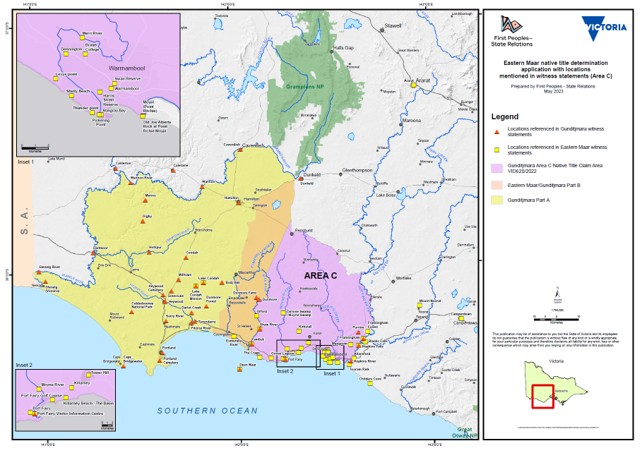
Map 2: Area D (Austin 2023)
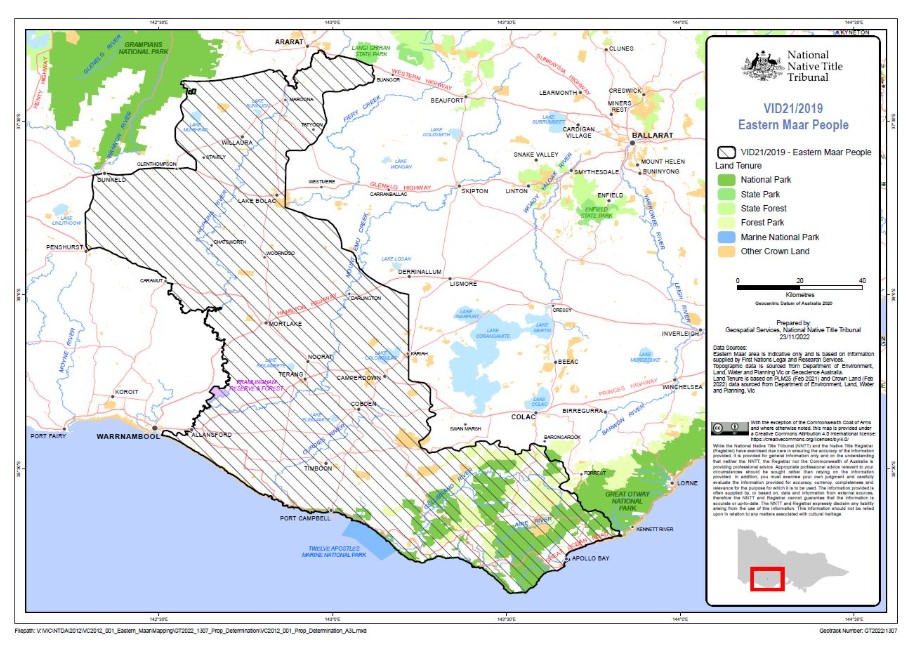
Map 3: Area E (Austin 2024)