

Federal Court of Australia
Inspector-General in Bankruptcy v Thomson [2026] FCA 982
File number: | WAD 465 of 2025 |
Judgment of: | JACKSON J |
Date of judgment: | 15 July 2026 |
Date of publication of reasons: | 23 July 2026 |
Catchwords: | BANKRUPTCY – application for removal of trustee of bankrupt estates under s 90-15 and s 45-1 of Insolvency Practice Schedule (Bankruptcy), Schedule 2 to the Bankruptcy Act 1966 (Cth) – first respondent consented to his removal as trustee – conduct of the trustee in administering bankrupt estates was not to the required standard – in best interests of each of the estates to remove first respondent as trustee – orders made – first respondent removed as trustee – Official Trustee in Bankruptcy to assume role of trustee by operation of s 160 of the Act |
Legislation: | Bankruptcy Act 1966 (Cth) ss 140(1), 160, 181A, Schedule 2 (Insolvency Practice Schedule (Bankruptcy) ss 90–15, 45–1 |
Cases cited: | Adsett v Berlouis (1992) 37 FCR 201 Frigger v Trenfield (No 10) [2021] FCA 1500 Mokhtar v Piscopo [2024] FCA 493 |
Division: | General Division |
Registry: | Western Australia |
National Practice Area: | Commercial and Corporations |
Sub-area: | General and Personal Insolvency |
Number of paragraphs: | 31 |
Date of hearing: | 15 July 2026 |
Counsel for the Applicant: | Ms P McGill |
Solicitor for the Applicant: | Sparke Helmore Lawyers |
Counsel for the First Respondent: | Ms J Kein |
Solicitor for the First Respondent: | Blackwall Legal LLP |
Counsel for the Second to Sixth Respondents: | The second to sixth respondents did not appear |
ORDERS
WAD 465 of 2025 | ||
BETWEEN: | THE INSPECTOR-GENERAL IN BANKRUPTCY Applicant | |
AND: | ROSS STEPHEN THOMSON First Respondent BANKRUPTCY ADVISORY CENTRE PTY LTD (ACN 620 248 491) Second Respondent COMMONWEALTH BANK OF AUSTRALIA (ABN 48 123 123 124) (and others named in the Schedule) Third Respondent | |
order made by: | JACKSON J |
DATE OF ORDER: | 15 July 2026 |
BY CONSENT, THE COURT ORDERS THAT:
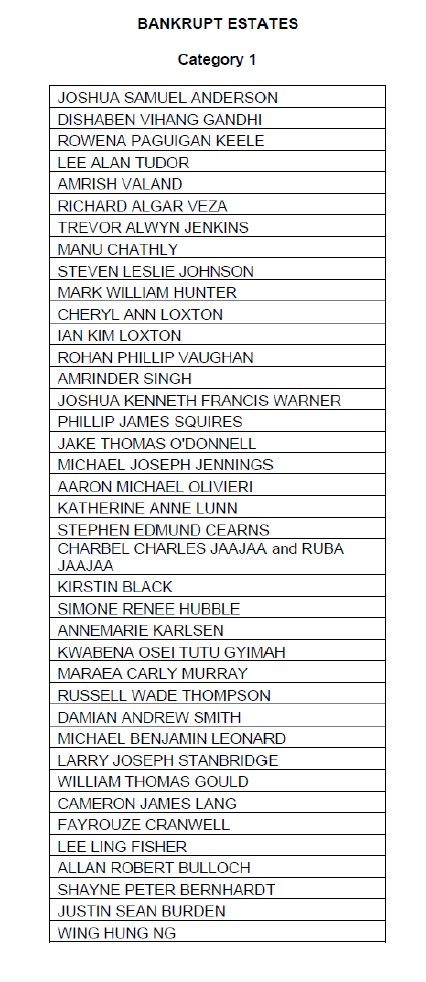
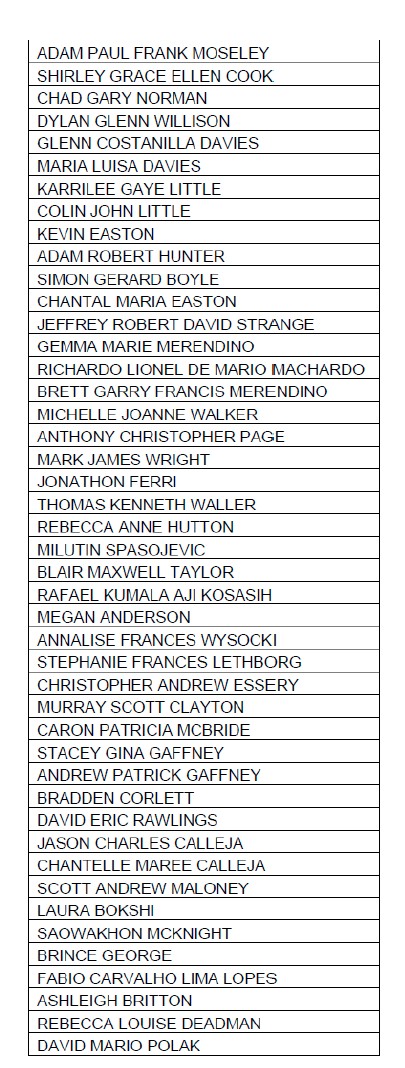
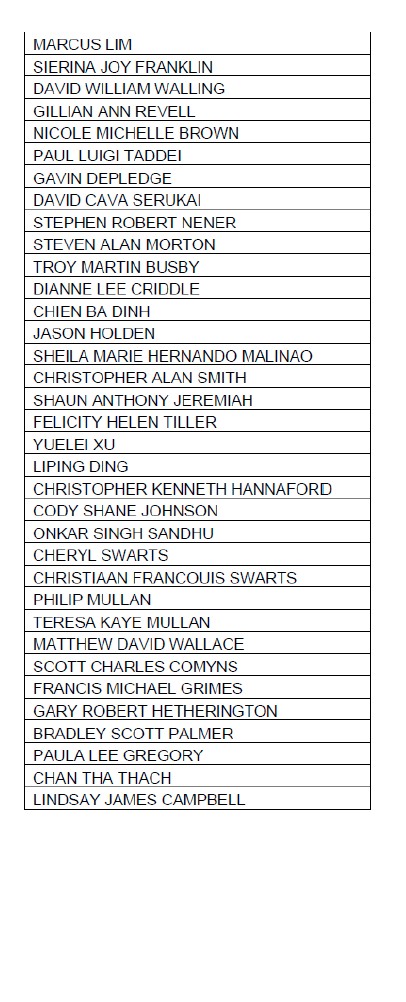
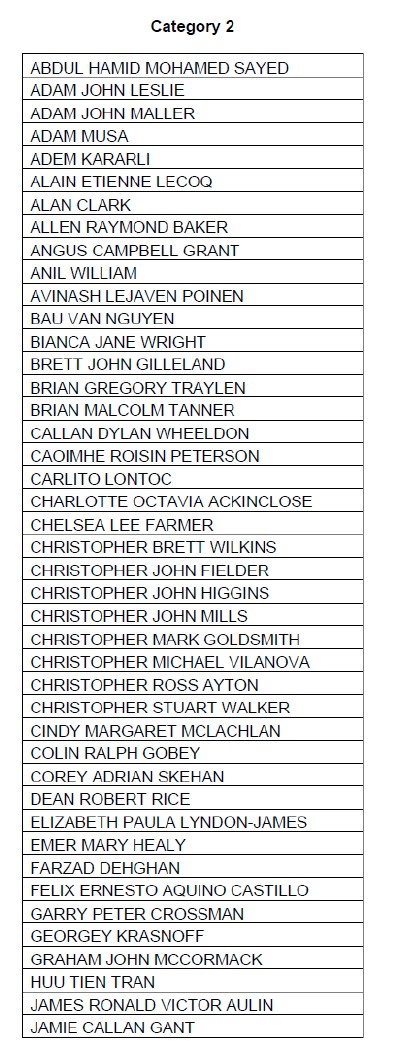
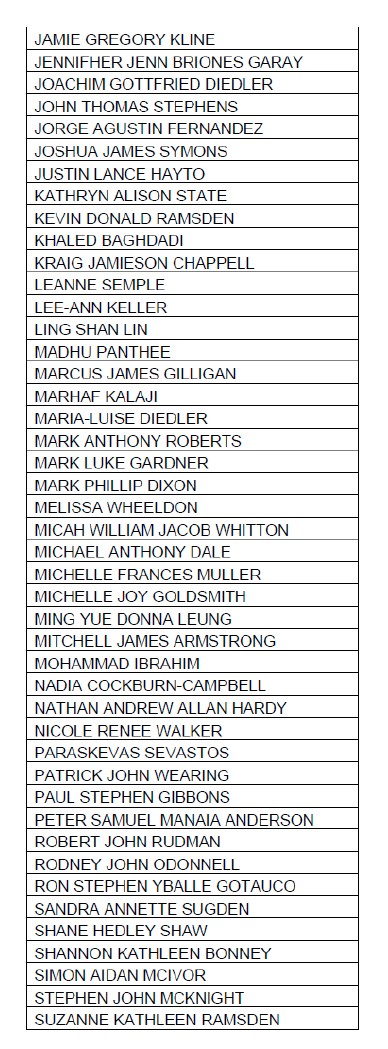
1. Pursuant to ss 90–15(1) and 45–1 of Schedule 2 (Insolvency Practice Schedule (Bankruptcy)) of the Bankruptcy Act 1966 (Cth), and with effect from the date of these orders, the first respondent ceases to be the trustee of the bankrupt estates listed in Annexure A (Bankrupt Estates) to the extent that the first respondent has not already ceased to act as trustee of any such estate.
2. Pursuant to s 160 of the Bankruptcy Act 1966 (Cth), the Official Trustee in Bankruptcy is the trustee of the Bankrupt Estates from the date on which the first respondent ceases to be the trustee of that Bankrupt Estate, pursuant to paragraph 1 of these orders.
3. The applicant is entitled to reasonable access to all documents and material relevant to the Bankrupt Estates wheresoever held for the purpose of administering the Bankrupt Estates.
4. The applicant is entitled to give the Official Trustee in Bankruptcy access to all documents and materials relevant to the Bankrupt Estates to which the applicant has access wheresoever held to facilitate the Official Trustee’s administration of the Bankrupt Estates.
5. The proceedings are otherwise discontinued against the first respondent with no order as to costs.
6. The case management hearing is adjourned to 10.00 am AWST on 19 August 2026.
7. There is no order as to costs.
Note: Entry of orders is dealt with in Rule 39.32 of the Federal Court Rules 2011.
ANNEXURE A

REASONS FOR JUDGMENT
JACKSON J:
1 This proceeding concerns the position of the first respondent, Ross Stephen Thomson, as trustee in bankruptcy of a large number of bankrupt estates. On 15 July 2026, I made orders by consent, removing him as trustee of those estates. By operation of s 160 of the Bankruptcy Act 1966 (Cth), he was thus replaced by the Official Trustee in Bankruptcy. These are the reasons for those orders.
Background
2 The applicant, the Inspector-General in Bankruptcy, commenced the proceeding by an application seeking orders requiring the preservation and production of documents relating to the administration of the bankrupt estates. The relevance of the various other respondents to the matter is limited to that purpose, and for the most part they need not be mentioned further in these reasons.
3 By leave, the application was amended to add an order for the removal of the first respondent as trustee of the bankrupt estates.
4 Shortly before a case management hearing on 15 July 2026, the applicant and first respondent sent a minute of proposed consent orders to my Chambers, seeking orders that the first respondent cease to be the trustee of the bankrupt estates.
5 The discretionary powers to make orders of that kind are found in s 90–15 and s 45-1 of the Insolvency Practice Schedule (Bankruptcy), being Schedule 2 to the Bankruptcy Act. Those powers fall to be exercised as part of the Court’s supervisory jurisdiction in bankruptcy proceedings. As such, and because the order could potentially affect the interests of a large number of bankrupt estates, bankrupts and creditors, I informed the parties at the hearing that I would necessarily need to be satisfied on the basis of evidence that I should make the proposed orders, even though they were proposed by consent.
6 In support of the proposed orders, the applicant relied on an affidavit of Paula Therese Chiverall, affirmed on 29 May 2026. This affidavit was read into evidence without objection at the hearing, and it forms the evidentiary basis for the orders made on 15 July 2026.
7 It is worth noting that, at the hearing, I asked the solicitor for the first respondent whether her client contested any of the evidence set out in Ms Chiverall’s affidavit regarding the administration of the bankrupt estates. The matter was briefly stood down to allow her time to take instructions, and although she was unable to obtain instructions within that time, she confirmed that her client’s position was that he consented to his removal as trustee, but that he did not accept the allegations made against him in Ms Chiverall’s affidavit, although he would not be putting on any responsive evidence. I therefore decided the matter on the basis that the evidence in the affidavit was not admitted to be true by the first respondent, but that he advanced no specific matter to contradict it. For the following reasons, the evidence thus furnished a proper basis to make the orders by consent.
Principles
8 The applicable legal principles are well established. Section 90–15(1) of the Insolvency Practice Schedule empowers the Court to ‘make such orders as it thinks fit in relation to the administration of a regulated debtor’s estate’. Section 90-20(1)(c) authorises the applicant to make application under s 90-15. Relevantly, s 90-15(3)(b) gives, as an example of an order that may be made under subsection (1), an order that a person cease to be the trustee of the estate. Section 90-15(4) provides that:
Without limiting the matters which the Court may take into account when making orders, the Court may take into account:
(a) whether the trustee has faithfully performed, or is faithfully performing, the trustee's duties; and
(b) whether an action or failure to act by the trustee is in compliance with this Act and the Insolvency Practice Rules; and
(c) whether an action or failure to act by the trustee is in compliance with an order of the Court; and
(d) whether the regulated debtor's estate or any person has suffered, or is likely to suffer, loss or damage because of an action or failure to act by the trustee; and
(e) the seriousness of the consequences of any action or failure to act by the trustee, including the effect of that action or failure to act on public confidence in registered trustees as a group.
9 Section 45-1(1) of the Insolvency Practice Schedule similarly empowers the Court to make such orders as it thinks fit in relation to a registered trustee. Section 45-1(3)(b) authorises the applicant to make an application for an order under s 45-1(1). Section 45-1(4) identifies matters identical to the list in s 90-15(4) as potentially relevant to the exercise of that power.
10 The effect of these provisions, taken together, is that the Court had a discretion to make an order removing the first respondent as trustee upon application by the applicant. As such, I was satisfied that I had power to make the orders of 15 July 2026.
11 The relevant principles governing the exercise of discretion in making an order removing a trustee under s 90–15(1) were helpfully summarised by Perry J in Mokhtar v Piscopo [2024] FCA 493 at [29]-[42]. In circumstances such as these, where the trustee consents to his removal and there was no contradicting evidence, it is not necessary to describe these principles in any detail.
12 The ultimate question for me was whether the removal of the first respondent as trustee of the bankrupt estates would be in the best interests of the bankruptcy: Piscopo at [42] (Perry J). It was therefore necessary to consider the evidence before me in respect of the first respondent’s administration of the bankrupt estates, in order to satisfy myself that an order removing him as trustee of those estates was appropriate, in circumstances where creditors and bankrupts were not given an opportunity to be heard.
13 Any exercise of discretion under s 90-15 should be informed by the interests of the insolvency administration as a whole, but the behaviour of the trustee, and in particular breaches by the trustee of their duties, are matters of particular importance: see Frigger v Trenfield (No 10) [2021] FCA 1500 at [554] (Frigger (No 10)).
14 A trustee in bankruptcy has a dual function: to administer the bankrupt estate in the interests of creditors and the bankrupt; and to exercise certain powers given and duties imposed under the Bankruptcy Act, as a public duty and for the public welfare: Adsett v Berlouis (1992) 37 FCR 201 at 208 (Northrop, Wilcox and Cooper JJ). In doing so, a trustee in bankruptcy must act to the standard expected of an officer of the court, given that their acts and omissions are (generally) reviewable by a court: Frigger (No 10) at [555].
Evidence
15 I assessed the evidence in Ms Chiverall’s affidavit on the basis of the principles above.
Factual background to the administration
16 The evidence established that, in around December 2024, the first respondent had, in his words a ‘falling out’ with a director of his employer, Bankruptcy Advisory Centre Pty Ltd (BAC), Andrew Bell. The first respondent had advised that he intended to retire and Mr Bell had begun searching for replacement trustees for the administration of the ‘200-or-so’ bankrupt estates of which the first respondent was trustee.
17 The first respondent had been removed as a director of BAC in December 2024, and from that time was denied access to bank accounts with Commonwealth Bank of Australia and electronic administration files. Subsequently, however, he continued to work at BAC, albeit under strained circumstances. BAC then granted him full access to all administration resources (including accounts and insolvency software) and agreed not to interfere in his administration of the bankrupt estates.
18 In around August 2025, however, approximately 93 bankrupt estates were transferred from the trusteeship of the first respondent to that of two trustees from the firm Cor Cordis. There is evidence suggesting that the first respondent initiated those transfers under s 181A of the Bankruptcy Act, but it was not necessary to make a finding about that.
19 In any event, in November 2025, Mr Bell advised the applicant that he intended to cut off the first respondent’s access to BAC’s systems and programs, including administration bank accounts. The applicant initiated these proceedings on that basis, seeking the preservation and delivery up of the relevant bank accounts and records.
The first respondent’s administration of the bankrupt estates
20 The evidence relevant to the removal of the first respondent as trustee of the bankrupt estates is set out at paragraphs [22] to [28] of Ms Chiverall’s affidavit.
21 In broad terms, the evidence was that:
(a) the first respondent does not have, and has not had, at least since November 2025, sufficient access to the books and records of the bankrupt estates to properly administer them, and has not made any attempt to regain control or resolve his lack of access;
(b) as a sole trader with no staff from at least March 2025, the first respondent does not have sufficient staff resources to adequately administer the bankrupt estates;
(c) the first respondent had established the bankrupt estate administration accounts in the name of BAC, rather than in the names of the bankrupt estates, thereby failing to ensure appropriate safeguards for trust funds, which meant that he ultimately lost control of them; and
(d) the first respondent has failed to keep impacted debtors and creditors informed of these matters.
22 The applicant has received numerous complaints about the first respondent’s administration of the bankrupt estates from impacted bankrupts and creditors. It has been informed by several of these bankrupts and creditors that the first respondent has advised them that he does not have access to the electronic books, records and estate accounts that would enable him to properly administer the bankrupt estates. That tended to be confirmed by other evidence that the first respondent’s access to BAC’s systems was cut off in November 2025.
23 The first respondent’s lack of sufficient access to books, records and accounts necessary for the proper administration of the bankrupt estates led to further complaints to the applicant by individuals named in Ms Chiverall’s affidavit, with varying interests in the bankrupt estates.
24 For example, in January 2026, the applicant received a complaint from Mr Greg Dudley of RSM Australia in his capacity as the liquidator of Taddei United Pty Limited (in liquidation), whom Ms Chiverall’s affidavit identifies as having a significant claim in a bankrupt estate of which the first respondent was the trustee. The subject of that complaint is the payment of a dividend which has been outstanding since November 2023 and has prevented the finalisation of the liquidation of Taddei United. The first respondent advised RSM Australia in January 2026 that he had been ‘locked out’ of the estate bank account, and therefore could not distribute the dividend or advise a timeframe for doing so.
25 In February 2026, creditors of another one of the bankrupt estates of which the first respondent was trustee advised the applicant about a dividend that has been outstanding since December 2025. When the creditors enquired with the first respondent, he told them that the relevant bank accounts had been frozen by his former business partner and that the dividend could not be paid until that issue was resolved.
Determination and conclusion
26 There is no need to multiply the examples further. On the basis of the evidence outlined above, and in the absence of any objection to the factual matters raised in Ms Chiverall’s affidavit by the first respondent, I was satisfied that it was in the best interests of each of the bankruptcies to remove the first respondent as trustee.
27 It appeared that since November 2025, if not before, the first respondent was unable (at least) to exercise his powers and perform his functions as trustee to the standard required by his statutory office. He could not comply with his duties without sufficient access to the accounts, books and records relevant to the bankrupt estates.
28 In relation to the matters listed in s 90-15(4), it cannot be said that the first respondent has been faithfully performing his duties. His inability to take various steps has resulted in contraventions of the Bankruptcy Act, for example a failure in relation to various estates to distribute dividends among creditors who have proved their debts ‘with all convenient speed’, contrary to s 140(1) of the Act. These failures, taken together, are serious and have the potential to damage public confidence in registered trustees as a group.
29 In those circumstances, I made the orders of 15 July 2026 removing the first respondent as the trustee of various bankrupt estates. As has been said, by operation of s 160 of the Bankruptcy Act, the Official Trustee in Bankruptcy replaced the first respondent, to the extent that he had not already ceased to act as trustee.
30 I also made orders entitling the applicant and the Official Trustee in Bankruptcy to reasonable access to all documents and material relevant to the bankrupt estates for the purpose of administering those bankrupt estates. In light of this resolution, the proceedings were discontinued against the first respondent.
31 The proceeding remains on foot because there is an outstanding issue in relation to the preservation and production of electronic back-ups of records that one of the remaining respondents may have. Hopefully that issue can be resolved by consent.
I certify that the preceding thirty-one (31) numbered paragraphs are a true copy of the Reasons for Judgment of the Honourable Justice Jackson. |
Associate:
Dated: 23 July 2026
SCHEDULE OF PARTIES
WAD 465 of 2025 | |
Fourth Respondent: | TURNKEY PTY LTD (ACN 053 280 729) |
Sixth Respondent: | PERIGON ONE PTY LTD (ACN 096 480 616) |


