

FEDERAL COURT OF AUSTRALIA
Australian Competition and Consumer Commission v Magnamail Pty Ltd [2026] FCA 969
File number: | NSD 1588 of 2024 |
Judgment of: | DOWNES J |
Date of judgment: | 24 July 2026 |
Catchwords: | CORPORATIONS – trade and commerce – alleged false, misleading and deceptive conduct concerning notification of prize conducted as part of trade promotions by direct mail-order catalogue business – alleged contraventions of sections 18, 29(1)(b), 29(1)(g), 29(1)(m) and 34 Australian Consumer Law – consumers for majority of promotions had participated in prior promotions – whether targeted promotions contained representations made to public for purpose of section 34 Australian Consumer Law – whether supply of services under the Australian Consumer Law – whether holding company was knowingly concerned or party to alleged contraventions – proceedings dismissed with costs |
Legislation: | Competition and Consumer Act 2010 (Cth), s 139B(2), Sch 2 (Australian Consumer Law) ss 18, 29(1)(b), 29(1)(g), 29(1)(m), 34, 224(1)(e) |
Cases cited: | Australian Competition and Consumer Commission v Coles Supermarkets Australia Pty Ltd (2014) 317 ALR 73; [2014] FCA 634 Australian Competition and Consumer Commission v Employsure Pty Ltd (2021) 392 ALR 205; [2021] FCAFC 142 Australian Competition and Consumer Commission v GlaxoSmithKline Consumer Healthcare Australia Pty Ltd (2019) 371 ALR 396; [2019] FCA 676 Australian Competition and Consumer Commission v Google LLC (No 2) (2021) 151 ACSR 335; [2021] FCA 367 Australian Competition and Consumer Commission v Olex Australia Pty Ltd [2017] FCA 222 Australian Competition and Consumer Commission v TPG Internet Pty Ltd (2020) 278 FCR 450; [2020] FCAFC 130 Australian Competition and Consumer Commission v Valve Corp (No 3) (2016) 337 ALR 647; [2016] FCA 196 Australian Competition and Consumer Commission v viagogo AG [2019] FCA 544 Australian Competition and Consumer Commission v We Buy Houses Pty Ltd [2017] FCA 915 Campbell v Backoffice Investments Pty Ltd (2009) 238 CLR 304; [2009] HCA 25 Campomar Sociedad Limitada v Nike International Limited (2000) 202 CLR 45; [2000] HCA 12 Comité Interprofessionnel du Vin de Champagne v Powell (2015) 330 ALR 67; [2015] FCA 1110 Google Inc v Australian Competition and Consumer Commission (2013) 249 CLR 435; [2013] HCA 1 Lee v Evans (1964) 112 CLR 276 National Exchange Pty Ltd v Australian Securities and Investments Commission (2004) 49 ACSR 369; [2004] FCAFC 90 Parkdale Custom Built Furniture Pty Ltd v Puxu Pty Ltd (1982) 149 CLR 191 Productivity Partners Pty Ltd v Australian Competition and Consumer Commission (2024) 281 CLR 338; [2024] HCA 27 Self Care IP Holdings Pty Ltd v Allergan Australia Pty Ltd (2023) 277 CLR 186; [2023] HCA 8 Trade Practices Commission v J&R Enterprises Pty Ltd (1991) 99 ALR 325 |
Division: | General Division |
Registry: | New South Wales |
National Practice Area: | Commercial and Corporations |
Sub-area: | Regulator and Consumer Protection |
Number of paragraphs: | 418 |
Date of hearing: | 15, 16 and 18 June 2026 |
Counsel for the Applicant: | Ms V Brigden SC, Ms P Abdiel and Ms J Ibrahim |
Solicitor for the Applicant: | Norton Rose Fulbright |
Counsel for the Respondents: | Mr N de Young KC and Mr A Vial |
Solicitor for the Respondents: | Maddocks |
ORDERS
NSD 1588 of 2024 | ||
| ||
BETWEEN: | AUSTRALIAN COMPETITION AND CONSUMER COMMISSION Applicant | |
AND: | MAGNAMAIL PTY LTD (ACN 063 154 174) First Respondent DIRECT GROUP PTY LTD (ACN 065 432 199) Second Respondent | |
order made by: | DOWNES J |
DATE OF ORDER: | 24 July 2026 |
THE COURT ORDERS THAT:
1. The Amended Originating Application is dismissed.
2. The Applicant pay the Respondents’ costs to be agreed or, failing agreement, to be assessed.
Note: Entry of orders is dealt with in Rule 39.32 of the Federal Court Rules 2011.
REASONS FOR JUDGMENT
DOWNES J:
1. SYNOPSIS
1 Between 9 May 2022 and 7 July 2023, the first defendant Magnamail Pty Ltd (Magnamail) operated a direct mail-order catalogue business in Australia selling goods such as clothing, homewares, gardening products, health aids and tools.
2 Magnamail is a wholly owned subsidiary of the second defendant, Direct Group Pty Ltd (Direct Group).
3 In order to promote its catalogue business, Magnamail ran 12 trade promotions being M267, M268, M269, M270, M271, MSS21, MSS22, MSS23, MWA31, MWA32, PS60 and PS61/RD206 (the Trade Promotions). Each Trade Promotion was open for a fixed period of time (Promotion Period).
4 In each of the Trade Promotions, there was a major cash prize of either $10,000, $20,000 or $25,000 (Major Cash Prize). In all Trade Promotions other than M271, there were major prizes such as an Apple iPad Air, cash (for example $1,000 or $500) or jewellery (together with the Major Cash Prize) (Major Prizes) and minor prizes (such as a pen or cross-body bag) (Minor Prizes). In M271, there was only a Major Cash Prize of $25,000.
5 The Australian Competition and Consumer Commission (ACCC) alleges that, in running the Trade Promotions, Magnamail contravened ss 18, 29(1)(b), 29(1)(g), 29(1)(m) and 34 of Sch 2 to the Competition and Consumer Act 2010 (Cth) (CCA), being the Australian Consumer Law (ACL). In summary, it alleges that Magnamail made false, misleading and/or deceptive representations to consumers that they had a right to claim, were eligible for, or had qualified for a prize where that prize could be a Major Prize or a prize valued up to, or in the amount of, either $10,000, $20,000 or $25,000 (depending on the Trade Promotion in question).
6 The ACCC further alleges that Direct Group was knowingly concerned or party to the alleged contraventions by Magnamail contrary to s 224(1) of the ACL by reason of certain alleged knowledge and conduct of Ms Babette Sandler, Mr Chris Eade and Mr Steven Hodgson which was undertaken “on behalf of” Direct Group within the meaning of s 139B(2) of the CCA. Ms Sandler was the General Manager of Magnamail and employed by Direct Group. By its closing submissions, the ACCC narrowed its case, conceding that its case against Direct Group could not succeed “through the vehicle of Mr Eade and Mr Hodgson, as we pleaded” and “[w]e’re purely focussing on Ms Sandler”.
7 By their lengthy written closing submissions, the ACCC addressed what it submits are additional misleading statements in the Trade Promotions, but which appeared in truth to be a complaint that the statement itself was misleading rather than that it gave rise to, or reinforced, the Representations. These matters fell outside the scope of its pleaded case in relation to the Representations.
8 Having regard to the serious nature of the allegations which are pleaded against Magnamail and Direct Group, submissions in this category have not been addressed. Some examples are highlighted below, but this is not intended to be an exhaustive list.
9 For the reasons that follow, the originating application will be dismissed, with costs to follow the event.
2. BACKGROUND TO THE TRADE PROMOTIONS
10 For Trade Promotions M267, M268, M269, M270, M271, MSS21, MSS22, MSS23, MWA31 and MWA32, the promotional materials conveyed to the selected customers that they had been hand selected or individually selected to participate in the Trade Promotions.
11 As to this, Magnamail determined the customers to whom the promotional materials for the Trade Promotions would be sent (selected customers).
12 By her affidavit, Ms Sandler explained the standard process which she engaged in for the purposes of identifying the selected customers for the Trade Promotions (other than PS60 and PS61/RD206). This included preparing a list of customer “segments”. For example, for “hard goods” campaigns (in which the catalogue to be sent to selected customers contained general household and garden merchandise), her first priority was customers who had purchased products from a Magnamail “hard goods” catalogue in the last two years prior to the relevant Trade Promotion, and for “apparel campaigns” (in which the catalogue mailed to selected customers only contained clothing or apparel), she generally focussed on customers who had previously purchased apparel from any Magnamail catalogue (predominantly female customers) and any customer who had purchased apparel from a dedicated Magnamail apparel catalogue. Ms Sandler might also, from time to time, select groups of customers who had made a purchase some time ago, but that purchase was valued at higher than a certain amount that she had selected as a benchmark.
13 Ms Sandler’s evidence was that, by following her standard process, she was confident that the selected customers (apart from customers whose details were obtained from other databases) were generally customers who were on Magnamail’s mailing lists and regularly received marketing materials from Magnamail, and had previously won Minor Prizes from one or more of Magnamail’s trade promotions in which Major Prizes were also available to be won.
14 Ms Sandler also attested that she was confident that these selected customers were generally customers who were familiar with the layout, content and nature of Magnamail’s marketing materials and promotions. This evidence was limited by agreement under s 136 of the Evidence Act 1995 (Cth) to being evidence of her state of mind.
15 However, Ms Sandler was challenged on this evidence during cross-examination, and her answers were not so limited:
Do you accept that you had no way of knowing whether consumers were, in fact, familiar with [the layout, content and nature of Magnamail’s marketing materials and promotions]?---No. So because - - -
How do you say you knew – sorry to cut across you?---Because we had a database and marketed to these customers, I had a record of the group of customers that would be mailed a promotion year – well, each time, and year on year. And we continually mailed active customers, which were customers who had purchased at least once in the last five years. So those people, three to five years – I can’t – those people would be receiving 10 to 12 Magnamail mailings a year, so would have to be familiar with our promotions. Whether or not they placed and ordered every one, no.
Okay, so it’s an assumption that – it was an assumption on your part that because they were receiving multiple catalogues they were familiar with them. Is that right?---Most of those people would have ordered at least once, but in the groups that were multiple buyers they would have ordered two up to 20 times. So by virtue of that they would be familiar with those promotions, definitely.
16 The total pool of selected customers to whom the promotional materials for each Trade Promotion (other than in the case of PS60 and PS61/RD206) was sent ranged between approximately 74,000 to approximately 350,000 people, with the size of the pool being affected by factors such as budget and mailing quantities for the relevant Trade Promotion.
17 Magnamail determined the Major Cash Prizes, Major Prizes (where applicable), and Minor Prizes (where applicable), and prepared the promotional materials for each of the Trade Promotions. The original concept, framework and conduct of the promotions were all developed in conjunction with Magnamail's external legal advisors, Anisimoff Legal, many years ago (in or around the early 2000s), and it was Magnamail’s standard practice to obtain legal advice on each trade promotion before it was published, edit the materials in accordance with legal advice received and then publish the trade promotions once approved by Magnamail’s external legal advisors. An exception to this was when Magnamail re-used design, artwork and text from previous promotions where that documentation had been approved by Anisimoff Legal previously.
18 Once legal advice had been obtained and any necessary edits to promotional materials were made in line with that advice, the promotional materials were provided to the relevant regulatory bodies responsible for granting permits for lotteries and trade promotions in each state and territory where a permit was required. Prior to about 2015, Magnamail did this directly. After about 2015, this was done by Anisimoff Legal.
19 Other than PS60 and PS61/RD206, the winners of the Major Prizes (or the Major Cash Prize for M271) were “pre-drawn” from a pool of selected customers by an independent third party, Handling Matters Pty Ltd (Handling Matters) and identified to Magnamail before the promotional material was distributed to consumers. In the case of PS60 and PS61/RD206, winning claim numbers of the Major Prizes were identified via a pre-draw, and before scratch cards were pre-populated with claim numbers and distributed to selected customers as part of the promotional material.
20 It was common ground that the pre-draws conducted by Handling Matters did not mean that any selected customer had in fact won a prize. Rather, for a pre-drawn winner to receive a prize, they had to receive the promotional materials for the relevant Trade Promotion, and take the step of entering into the Trade Promotion by placing an order from the relevant catalogue within the Promotion Period. In this way, each pre-drawn selected customer notified by Handling Matters to Magnamail was therefore only a “provisional winner” as the placement of an order by that customer within the Promotion Period was a “pre-condition” to winning any prize.
21 Magnamail did not know, and could not know, whether a provisional winner pre-drawn by Handling Matters was going to place an order and enter the relevant Trade Promotion, and, indeed, nor could anyone else know this.
22 Even if a customer had not qualified for the Major Prize or Major Cash Prize (as applicable) at the time of placing an order, each selected customer who placed an order had a chance of winning that prize from a random second chance draw conducted by Handling Matters at the conclusion of the Promotion Period. That second chance draw occurred if the pre-drawn provisional winner did not place an order from the relevant catalogue within the Promotion Period. In that event, any Major Prize or Major Cash Prize (as applicable) was forfeited and each remaining selected customer who had placed an order from the catalogue within the Promotion Period had an equal chance of winning the relevant prize from a random second chance draw conducted by Handling Matters at the conclusion of the Promotion Period. Where a successful selected customer from the second chance draw did not claim or receive their prize (such as where they could not be located), the remaining selected customers who had placed an order from the catalogue in the Promotion Period had an equal chance of winning that prize from an unclaimed prize draw that was conducted by Handling Matters.
23 By reason of these matters:
(1) in each Trade Promotion (other than M271), when a selected customer placed an order for a good from a catalogue within the Promotion Period, they were eligible to receive (and had a chance of winning) a prize where the type of prize and value of the prize was not, and could not be, determined or confirmed until the end of the Promotion Period; and
(2) in Trade Promotion M271, when a selected customer placed an order for a good from the catalogue within the Promotion Period, they had a chance of winning the Major Cash Prize and whether they had won was not, and could not be, determined or confirmed until the end of the Promotion Period.
24 Save for Trade Promotions PS60 and PS61/RD206, Magnamail generally distributed its promotional material by post to the selected customers. In the case of Trade Promotions PS60 and PS61/RD206, Magnamail generally distributed the promotional materials by inserting them into parcels sent to Magnamail customers (in PS60) or by inserting them into the August issue of the Reader’s Digest magazine received by all Reader’s Digest subscribers (in RD206) and into parcels sent to Magnamail customers (in PS61).
25 In respect of promotions M267, M268, M269, M270, M271, MSS21, MSS22, MSS23, MWA31 and MWA32, the promotional materials comprised:
(1) an outer envelope, in which the selected customers were mailed the promotional materials;
(2) a promotional return envelope;
(3) a cover letter;
(4) an order form from which to place an order from the catalogue;
(5) in respect of M270, a scratch card which was enclosed with the cover letter;
(6) summary terms and conditions of the Trade Promotion, which also included a link to Magnamail’s website, whereby it was said that the full terms and conditions could be accessed;
(7) a catalogue;
(8) in respect of M267, M268, M269 and M271, a “lift letter”, which was described as being an extra letter designed to give the promotion a “lift”.
26 In relation to Trade Promotions PS60 and PS61/RD206, the promotional materials included a catalogue (which contained the terms and conditions of the promotion), scratch card and an order form only.
27 Examples of the goods which were for sale in the catalogues are depicted below:
|
|

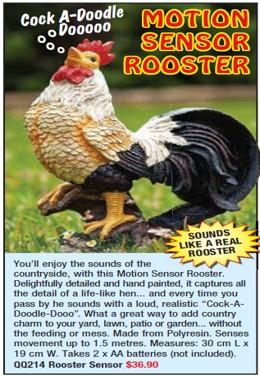
28 Copies of the promotional materials for the 12 Trade Promotions were tendered as part of an agreed court book, and the ACCC made submissions about the small print on some of these documents. However, it became apparent during the course of the trial (and appeared to be common ground) that the documents in the court book did not reflect the actual size of the materials which had been sent to the consumers, and that the size of the print was not representative of what customers saw. For this reason, Ms Sandler was permitted to give oral evidence concerning the actual size of the documents sent to the selected customers in relation to each promotion, and certain original promotional materials were also tendered. Further, some of the statements in the promotional materials which are extracted in these reasons contained yellow highlighting which emphasised certain words in the materials. That highlighting has not been reproduced in these reasons.
3. THE STATUTORY PROVISIONS
29 The ACCC alleges that the promotional material sent by Magnamail for the Trade Promotions conveyed certain representations (together, the Representations). The ACCC alleges that each of the Representations was false, misleading and/or deceptive and that Magnamail contravened ss 18, 29(1)(b), 29(1)(g), 29(1)(m) and 34 of the ACL each time it made them. It is common ground that, if made, the Representations were made in trade or commerce.
3.1 Section 18 ACL
30 Section 18(1) states that a person “must not, in trade or commerce, engage in conduct that is misleading or deceptive or is likely to mislead or deceive.”
31 The word “likely” in s 18 makes clear that it is not necessary to demonstrate actual deception to establish a contravention: see Google Inc v Australian Competition and Consumer Commission (2013) 249 CLR 435; [2013] HCA 1 at [6] (French CJ, Crennan and Kiefel JJ).
32 Assessing an alleged contravention of s 18 involves “first, identifying with precision the “conduct” said to contravene s 18; second, considering whether the identified conduct was conduct “in trade or commerce”; third, considering what meaning that conduct conveyed; and fourth, determining whether that conduct in light of that meaning was “misleading or deceptive or ... likely to mislead or deceive”: see Self Care IP Holdings Pty Ltd v Allergan Australia Pty Ltd (2023) 277 CLR 186; [2023] HCA 8 at [80] (Kiefel CJ, Gageler, Gordon, Edelman and Gleeson JJ).
33 The first step involves asking “what is the alleged conduct?” and “does the evidence establish that the person engaged in the conduct?”.
34 The fourth step involves the question of whether the alleged conduct has “the tendency to lead into error” – it is not sufficient if the conduct “merely causes confusion”: see Australian Competition and Consumer Commission v TPG Internet Pty Ltd (2020) 278 FCR 450; [2020] FCAFC 130 at [22(d)] (Wigney, O’Bryan & Jackson JJ). A statement may be misleading if it fails to disclose the whole truth or conveys an impression that is false: see National Exchange Pty Ltd v Australian Securities and Investments Commission (2004) 49 ACSR 369; [2004] FCAFC 90 at [36] (Dowsett J), [49]-[52] (Jacobson and Bennett JJ).
35 If the conduct is directed to the public or part of the public, the third and fourth steps must be undertaken by reference to the effect or likely effect on the “ordinary and reasonable members of the relevant class of persons” and excludes “extreme or fanciful” assumptions: see Self Care at [83]; Comité Interprofessionnel du Vin de Champagne v Powell (2015) 330 ALR 67; [2015] FCA 1110 at [171] (Beach J). It also excludes people “who fail to take reasonable care to protect their own interests”: see Campomar Sociedad Limitada v Nike International Limited (2000) 202 CLR 45; [2000] HCA 12 at [102] (Gleeson CJ, Gaudron, McHugh, Gummow, Kirby, Hayne & Callinan JJ), citing Parkdale Custom Built Furniture Pty Ltd v Puxu Pty Ltd (1982) 149 CLR 191 at 199 (Gibbs CJ).
36 The third and fourth steps require objectively characterising “the conduct viewed as a whole and its notional effects, judged by reference to its context…”: see Self Care at [82]; see also Campbell v Backoffice Investments Pty Ltd (2009) 238 CLR 304; [2009] HCA 25.
37 The context involves “the immediate context – relevantly, all the words in the document or other communication and the manner in which those words are conveyed, not just a word or phrase in isolation – and the broader context of the relevant surrounding facts and circumstances.”: see Self Care at [82]. A “consequence of the need to consider conduct in light of all relevant circumstances is that any allegedly misleading representation must be read together with any qualifications and corrections to that statement”: see Australian Competition and Consumer Commission v Valve Corp (No 3) (2016) 337 ALR 647; [2016] FCA 196 at [214] (Edelman J); see also Australian Competition and Consumer Commission v Coles Supermarkets Australia Pty Ltd (2014) 317 ALR 73; [2014] FCA 634 at [41] (Allsop CJ). For example, “[i]n a printed format, even an asterisk that indicates the presence of additional information, if it is sufficiently prominent and the qualifying text is sufficiently proximate, may be effective to draw attention to an explanation of, or qualification upon, a statement made in advertising”: see Australian Competition and Consumer Commission v GlaxoSmithKline Consumer Healthcare Australia Pty Ltd (2019) 371 ALR 396; [2019] FCA 676 at [33(8)] (Bromwich J).
38 The “dominant message” of the advertising materials is of crucial importance: Coles at [42], [47].
3.2 Section 29 ACL
39 Section 29(1) relevantly provides that a person must not, in trade or commerce, in connection with the supply or possible supply of goods or services or in connection with the promotion by any means of the supply or use of goods or services:
(b) make a false or misleading representation that services are of a particular standard, quality, value or grade; or …
(g) make a false or misleading representation that goods or services have sponsorship, approval, performance characteristics, accessories, uses or benefits; or …
(m) make a false or misleading representation concerning the existence, exclusion or effect of any condition, warranty, guarantee, right or remedy…
(Emphasis added.)
40 The ACCC’s pleaded case with respect to ss 29(1)(b) and 29(1)(g) of the ACL is confined to “services”. Whether Magnamail made representations in relation to services is disputed, and this issue is addressed below.
41 There is no material difference between “misleading or deceptive” (s 18) and “false or misleading” (s 29(1)): see TPG Internet at [21].
42 Unlike s 18, s 29 does not include the phrase “likely to mislead or deceive”. It follows that s 29 requires proof that the representations made were “actually false or misleading” and it is “not sufficient … to prove only that it was likely that they were”: see Australian Competition and Consumer Commission v Employsure Pty Ltd (2021) 392 ALR 205; [2021] FCAFC 142 at [89] (Rares, Murphy and Abraham JJ).
3.3 Section 34 ACL
43 Section 34 provides that:
A person must not, in trade or commerce, engage in conduct that is liable to mislead the public as to the nature, the characteristics, the suitability for their purpose or the quantity of any services.
44 Relevantly to this case, the ACCC must establish that (a) Magnamail engaged in conduct that was liable to mislead (b) the public (c) as to the nature and characteristics of any services.
45 The words “liable to mislead” impose a higher standard than “likely to mislead” and require an actual probability of the public being misled: Coles at [44].
46 Whether Magnamail made representations to the public in relation to services is disputed, and is addressed below.
4. THE MEMBERS OF THE RELEVANT CLASS
47 The ordinary and reasonable members of the relevant class are the customers who received the promotional materials for the Trade Promotions.
48 Based on Ms Sandler’s evidence referred to above, which I accept, the ordinary and reasonable people within that class (other than for Trade Promotion PS60 and PS61/RD206) were customers who regularly received marketing materials from Magnamail [Sandler [43(a)]]; were familiar with the trade promotions conducted by Magnamail [T123.1–21] and had previously won Minor Prizes from one or more of Magnamail’s trade promotions in which Major Prizes were also available to be won [Sandler [43(d)]].
49 The ordinary and reasonable people within the class who received the promotional materials for the PS60 and PS61 Trade Promotions had ordered goods either from a previous catalogue or from the Magnamail website. Whether such persons had existing familiarity with trade promotions conducted by Magnamail was not established by the evidence.
50 The ordinary and reasonable people within the class who received the promotional materials for the RD206 Trade Promotion were subscribers to Reader’s Digest. Such persons were not familiar with trade promotions conducted by Magnamail.
5. THE REPRESENTATIONS
51 The alleged Representations concerning each Trade Promotion are as follows.
52 First, in respect of Trade Promotions M267, M268, M269 and M270, consumers in receipt of the promotional materials, at that time, had a right to claim, were eligible for, or had qualified for a prize if they purchased a product from the catalogue, where that prize could be valued up to $20,000 (Prize Valued up to $20,000 Representation).
53 Second, in respect of Trade Promotions MSS21, MSS22, MSS23, MWA31, MWA32, PS60 and PS61/RD206, consumers in receipt of the promotional materials, at that time, had a right to claim, were eligible for, or had qualified for a prize if they purchased a product from the catalogue, where that prize could be valued up to $10,000 (Prize Valued up to $10,000 Representation).
54 These representations are alleged to be “false and/or misleading because there had been a pre-draw of the consumers who had a right to claim, were eligible for or had qualified for the Major Cash Prize (or a pre-draw of the winning claim number) prior to the distribution of the promotional materials. At the time these representations were made, other than the consumer who had been pre-drawn for the Major Cash Prize (or the consumer who had received the promotional materials containing the pre-drawn winning claim number for the Major Cash Prize), no consumer who placed an order from the catalogue then had a right to claim, was then eligible for or had qualified for a prize that could be valued up to the amount of the Major Cash Prize”.
55 Third, in respect of Trade Promotions M267, M268, M269, M270, MSS21, MSS22, MSS23, MWA31, MWA32, PS60 and PS61/RD206, consumers in receipt of the promotional materials, at that time, had a right to claim, were eligible for, or had qualified for a prize if they purchased a product from the catalogue, where that prize could be a Major Prize (Major Prize Representation).
56 This representation is alleged to be “false and/or misleading because there had been a pre-draw of the consumers who had a right to claim, were eligible for or had qualified for a Major Prize (or a pre-draw of the winning claim numbers) prior to the distribution of the promotional materials. At the time the representation was made, other than the consumers who had been pre-drawn for a Major Prize (or those who had received promotional materials containing a pre-drawn winning claim number for a Major Prize), no consumer who placed an order from the catalogue then had a right to claim, was then eligible for or had qualified for a Major Prize. In fact, the only prize other consumers had a right to claim, were eligible for, or had qualified for at that time, if they placed an order, was a Minor Prize”.
57 Fourth, in respect of Trade Promotion M271, the promotional materials that the consumer received could contain a winning prize number that, at that time, gave the consumer a right to claim, made them eligible for, or qualified them for the $25,000 cash prize if they purchased a product from the catalogue ($25,000 Prize Representation).
58 This representation is alleged to be “false and/or misleading because there had been a pre-draw of the consumer who had a right to claim, was eligible for or had qualified for the Major Cash Prize ($25,000) prior to the distribution of the promotional materials. At the time the representation was made, other than the pre-drawn consumer, no consumer who placed an order from the catalogue then had a right to claim, was then eligible for or had qualified for that Major Cash Prize”.
59 The following relevant exchange occurred during the ACCC’s oral opening submissions:
COUNSEL: The misleading impression is that the consumer is told that they have a right to claim or entitled to, or have qualified for a prize, which could be valued at up to $20,000 or $25,000, or could be a major prize depending on the particular representation or promotion. And it’s expressed in terms that convey that that is a present right or claim. Not that they have a chance of winning this but they are told by the materials that they have that present entitlement or claim. When in fact, because the pre-draws occurred already, the only consumers who have that right are those who are pre-drawn, whose names or number had been pre-drawn as receiving major prizes. Everyone else, leaving aside the campaign where there were no minor prizes, could only receive a minor prize, unless there was a second chance draw which would occur where the pre-drawn winners of the major prizes did not order a product.
But the fact of the second chance draw was insufficiently explained to consumers, but also, inconsistent with the express language that was used in the promotions of “claiming your prize now. You’re guaranteed a prize” - - -
HER HONOUR: Well, that part is okay. They were guaranteed a prize.
COUNSEL: They were guaranteed a prize. But we rely on those statements in conjunction with the statements as to the value of the prize, because they weren’t guaranteed a prize of up to $20,000. They were only guaranteed a prize that’s valued up to 20 or 30 dollars - - -
HER HONOUR: I see.
COUNSEL: - - - absent the second chance draw.
60 As such, the ACCC’s case appears to depend on ignoring the second chance draw. In this regard, the ACCC later submitted in oral opening that:
And because of the pre-draw, we say, the consumers had no present – well, the consumers who weren’t pre-drawn had no present entitlement to a prize of up to that amount.
61 It follows that the ACCC’s case depends on the promotional material conveying to the ordinary and reasonable selected customers that they had some temporal right to claim prizes in the prize draw, which can be distinguished from them having a chance of winning a Major Prize (or Major Cash Prize) in the prize draw which had occurred, and a chance to win such a prize in any future second chance or unclaimed prize draw. That is, the ACCC’s case appears to be that the alleged representations were nonetheless false or misleading because there was “no right to claim” the Major Cash Prize or Major Prizes at the time that the promotional material was despatched and received as only the pre-drawn winners had such a right.
62 This was confirmed during closing submissions when the following was stated by counsel for the ACCC:
Your Honour needs to be satisfied of what the dominant message was on the materials, and we say, putting it in simple layman’s terms without the precise wording of our representations, the dominant message is, at the time the consumer received the promotional materials, the consumer was entitled to a prize, provided that they went on to purchase a product from the Magnamail catalogue, which prize could be a major prize or a major cash prize. That is, at that point in time, we say the representation was that – or the representations were, that the consumer was already entitled to claim a prize that could be a major prize or could be valued up to the major cash prize amount.
And the vice in the conduct is that, at that time, with respect to all consumers other than the very small number – eight or less – of pre-drawn winners of those major prizes, the consumer’s entitlement to a prize was only to a minor prize. …
6. WEIGHT TO ATTACH TO CUSTOMER COMPLAINTS
63 The ACCC relies on alleged consumer complaints made to Magnamail to establish the alleged contraventions. The ACCC submits that the complaints suggest “that consumers throughout Australia in fact paid money to place orders with Magnamail on the mistaken belief that if they did so, they would be entitled to claim a prize that could be the Major Prize, or a prize valued up to the Major Cash Prize”.
64 Magnamail and Direct Group submit that the complaints are irrelevant, and should be given no weight, as they do not “line up” with the ACCC’s pleaded case. Further, they submit that, if the ACCC wishes to have the Court accept these complaints as being relevant and probative, it needs to go through them one by one, identify that the person is complaining that they were misled (and by what statements) and that it is in the way that the ACCC alleges. However, this was not done by the ACCC, which only referred to a handful of the complaints in a footnote in closing submissions.
65 The communications below are referred to by reference to the tabs in the Court Book in order to preserve the anonymity of the consumers. The vast majority are either irrelevant to, or are not consistent with, the case advanced by the ACCC in this proceeding, or they contain insufficient detail to indicate the mistaken belief of consumers of the kind described by the ACCC.
66 In particular, some of the letters purport to claim the Major Cash Prize, or assert that the promotional materials informed them that they had won the Major Cash Prize. That is a different thing to a representation that the customer had a right to claim, were eligible for, or had qualified for a prize if they purchased a product from the catalogue, where that prize could be the Major Cash Prize or the $25,000 cash prize (in the case of M271).
67 Of those complaints which do at least arguably support the ACCC’s pleaded case, they are so few in number when compared to the number of selected customers who received the relevant Trade Promotion as to carry little weight in advancing the ACCC’s pleaded case. This is especially as the complainants were not called as witnesses, and so could not be cross-examined.
68 The complaints relating to each Trade Promotion will be addressed in turn. Some of these communications attached parts of the promotional materials for more than one Trade Promotion.
6.1 Trade Promotion M267
69 The letter at tab 122 states that “I received an email from [Magnamail] …reminding me to submit [a call for action form] to be eligible for a prize …to date I have not heard anything from you since…”. This complaint supports the view that selected customers understood that if they placed an order from Magnamail’s relevant catalogue they would receive “a prize”, and is not consistent with nor supports the ACCC case.
70 The letter at tab 123 is not consistent with the ACCC’s pleaded case. Further, the letter states “[h]oping you will write back to me and explain … what prizes I have won”. This complaint supports the view that selected customers understood that if they placed an order from Magnamail’s relevant catalogue they would receive “a prize” and enter the draw with a chance they could win the Major Cash Prize or a Major Prize.
71 The letter at tab 169 does not refer to any wording of the promotional material in Trade Promotion M267, and complains about receiving papers “over the last 12 months, some indicating that I have won a prize, but nothing eventuates”. This complaint is not consistent with the ACCC’s pleaded case. No weight will be given to this complaint for this reason.
72 The letter at tab 170 is (in essence) a complaint about not receiving a prize “much less a major one”. Like the complaint at tab 169, this complaint is not consistent with the ACCC’s pleaded case. No weight will be given to this complaint for this reason.
73 The letter at tab 174 is (in essence) a letter claiming the $20,000 cash prize. This complaint is not consistent with the ACCC’s pleaded case, and no weight will be given to it.
6.2 Trade Promotion M268
74 The following communications are (in essence) a complaint that no prize had been received: the letters at tab 124, 125, 128, 130, 136, 145, 149 and 170. These complaints do not align with or support the ACCC’s pleaded case. To the contrary, the communication at tab 136 supports the view that selected customers understood that if they placed an order from Magnamail’s relevant catalogue they would receive “a prize” and enter the draw with a chance they could win the Major Cash Prize.
75 The letter at tab 127 is a complaint that ordered goods had not been received and an entreaty to be awarded a cash prize. This complaint is not consistent with the ACCC’s pleaded case. No weight will be given to this complaint for this reason.
76 The letters at tabs 131, 144, 157, 160, 168, 169 each appear to be from a consumer who claims they were told by the promotional materials that they had won $20,000 (or had won money), and who seeks an explanation as to why no cheque has been received. These complaints are not consistent with the ACCC’s pleaded case. No weight will be given to these complaints for this reason.
77 The letter at tab 134 contains a generalised complaint about “manipulation” and “less than the standards of honesty and quality” concerning the content of the particular cover letters received by the consumer relating to three promotions (none of which appear to be M268). In any event, the letter does not descend to any detail, identify the precise words or complain about being misled, and by what. This complaint is not consistent with the ACCC’s pleaded case. No weight will be given to this complaint for this reason.
78 The letter at tab 150 is a formal demand for payment of $25,000 which appears to relate to Trade Promotion M271. In any event, this complaint is not consistent with the ACCC’s pleaded case, and no weight will be given to it.
79 The letter at tab 162 appears to be a complaint about not winning a prize, and refers to receiving a communication from Magnamail about “a draw event” which says he “could win a prize”. This complaint is not consistent with the ACCC’s pleaded case, but supports the view that selected customers understood that if they placed an order from Magnamail’s relevant catalogue they would receive “a prize”.
80 The letter at tab 171 is a letter asking for the results of the prize draw. They can hardly be called a complaint, and, in any event, are not consistent with the ACCC’s case, but support the view that selected customers understood that if they placed an order from Magnamail’s relevant catalogue they would receive “a prize” from a prize draw.
81 The letter at tab 174 is addressed above.
6.3 Trade Promotion M269
82 The letters at tabs 129 and 130 are from the same customer and contain similar wording. They contain (in essence) a complaint that no prize had been received. These complaints do not align with the ACCC’s pleaded case. No weight will be given to these complaints for this reason.
83 The letter at tab 135 appears to be a complaint that $20,000 was guaranteed, but that a pair of earrings was received instead. This complaint is not consistent with the ACCC’s case. No weight will be given to this complaint for this reason.
84 The letter at tab 138 is (in essence) a complaint that no prize had been received. This complaint is not consistent with the ACCC’s case, and no weight will be given to it.
85 The letters at tabs 150, 169, 170 and 174 are addressed above. While they attach part of the promotional material for M269, their contents do not align with the ACCC’s case. No weight will be given to these complaints for this reason.
6.4 Trade Promotion M270
86 The letter at tab 132 appears to be from a customer who claims they were told by the promotional materials that they had won money, and were disappointed. This complaint is not consistent with the ACCC’s pleaded case, and no weight will be given to it.
87 The letter at tab 142 is (in essence) a complaint that no prize had been received. This complaint is not consistent with the ACCC’s case, and no weight will be given to it.
88 The letter at tab 152 seeks payment of $25,000 which appears to relate to Trade Promotion M271. In any event, this complaint is not consistent with the ACCC’s case, and no weight will be given to it.
89 The letters at tabs 170 and 174 are addressed above. While they attach part of the promotional material for M270, their contents do not align with the ACCC’s case. No weight will be given to these complaints for this reason.
6.5 Trade Promotion M271
90 The letter at tab 137 is a complaint that cash was won on the “scratchy I won $5,000.00 cash”. The letter also refers to winning $1,500 “[i]n my last scratchy” but “I never received the money”. These complaints are not consistent with the ACCC’s pleaded case, and no weight is given to this letter.
91 The letter at tab 141 appears to relate to two Trade Promotions, including M271. This complaint is not consistent with the ACCC’s case, and no weight is given to it.
92 The same may be said of the complaints at tabs 143, 151 and 154 for the same reasons.
93 The letter at tab 142 is addressed above.
94 The letter at tab 146 is not a complaint, but an inquiry about what has happened to the “numbers in the $25,000 draw”. This letter is not consistent with the ACCC’s case.
95 The letter at tab 147 complains that “over the years” letters have been received “advising that I am in the running or have won $25,000 cash”. Relevantly to M271, the letter complains that no prize was received and that the customer “would appreciate a cheque … if not a prize of some considerable value”. This complaint arguably supports the ACCC’s pleaded case, although it lacks detail.
96 The letter at tab 150 is a formal demand for payment of $25,000 by “Mr J”, which is addressed above. This customer also complained to the Office of Fair Trading on the basis that he had won $25,000 and received no response to his letters (tab 164). Such a complaint arguably supports the ACCC’s case. A letter from the same customer is at tab 167 referring to a refund, and is not a letter of complaint.
97 The letter at tab 152 is addressed above.
98 The letter at tab 161 is, in essence, a complaint that the prize draw had been pre-drawn, and the writer appears to be confused about when the time limit had elapsed to enable her to participate in the draw. This complaint is not consistent with the ACCC’s case, and no weight is given to it.
99 The letter at tab 174 is addressed above.
6.6 Trade Promotion MSS21
100 No complaints about this Trade Promotion are in evidence.
6.7 Trade Promotion MSS22
101 The letter at tab 126 is (in essence) a complaint that no prize had been received. This complaint is not consistent with the ACCC’s pleaded case, and no weight is given to it.
102 The letter at tab 170 is addressed above.
6.8 Trade Promotion MSS23
103 No complaints about this Trade Promotion are in evidence.
6.9 Trade Promotion MWA31
104 The document at tab 133 is a notation on an order form stating that an order has not been received and (in essence) that the customer has received no money and Magnamail has been cruel. This complaint is not consistent with the ACCC’s pleaded case, and no weight is given to it.
105 The letter at tab 139 is a complaint that orders have been placed on the basis that the customer is a winner, but when she received a gift, it was cheap costume jewellery. This complaint is not consistent with the ACCC’s case, and no weight is given to it.
106 The letter at tab 148 complains that no money has arrived. This complaint is not consistent with the ACCC’s case, and no weight is given to it.
107 The letter at tab 154 is addressed above.
108 The letter at tab 158 asks where the prize is, despite orders having been placed. This complaint is not consistent with the ACCC’s case, and no weight is given to it.
109 The letter at tab 166 is similar to the letters at tabs 129 and 130 and is from the same customer. It contains (in essence) a complaint that no prize had been received and is not consistent with the ACCC’s case. No weight will be given to this complaint for this reason.
6.10 Trade Promotion MWA32
110 The letter at tab 140 is (in essence) a request for clarification. The customer says that she understands that she “might be the winner of $25,000” and that she had scratched $5,000, but had not received it. She also wrote about receiving the catalogue and letter to “let me know that I am qualified for a prize of $10,000”. This complaint is not consistent with the ACCC’s pleaded case, and no weight is given to it.
111 The letter at tab 153 complains about the length of the time that the “birthday draw” has been running and states “I am sick off [sic] [receiving] letter from you it is about [sic] you paid up now”. This complaint is not consistent with the ACCC’s case, and no weight is given to it.
112 The note at tab 155 asks how to claim a prize. It is not consistent with the ACCC’s case, and no weight is given to it.
113 The notation on the order form at tab 156 complains that the writer was advised she was a confirmed winner, but no cheque was received. This complaint is not consistent with the ACCC’s case, and no weight is given to it.
114 The notation on the order form at tab 159 complains that the competition has been going on for months, maybe years, and the customer asks to be removed from the mailing list. It is not consistent with the ACCC’s case, and no weight is given to it.
115 The letter at tab 163 is similar to the letters at tabs 129, 130 and 166 and is from the same customer. It contains (in essence) a complaint that no prize had been received and is not consistent with the ACCC’s case. No weight will be given to this complaint for this reason.
116 The letter at tab 173 complains that no prize has been received. This complaint is not consistent with the ACCC’s case, and no weight is given to it.
6.11 Trade Promotion PS60
117 No complaints about this Trade Promotion are in evidence.
6.12 Trade Promotion PS61/RD206
118 The communications at tabs 137, 155 and 174 are addressed above.
7. CONSIDERATION
7.1 Overarching findings
119 Before turning to consider each Trade Promotion in detail, there are overarching findings which demonstrate why the ACCC’s pleaded case must fail.
120 First, the first part of the alleged Representations (save for the $25,000 Prize Representation) reads the customer “had a right to claim, were eligible for, or had qualified” for a prize if they purchased a product from the catalogue. However, what was stated in the promotional material (save for Trade Promotion M271 in respect of the $25,000 Prize Representation) was that if a selected customer purchased a product from the catalogue within the Promotion Period, they could “claim” a prize; and to the same effect, would receive a prize.
121 Second, the same first part of the alleged representations (save for Trade Promotion M271) refers to “a prize” – that is, the selected customer could claim “a prize” if they purchased a product from the catalogue. In all Trade Promotions (other than Trade Promotion M271), all selected customers who ordered a product from a catalogue within the Promotion Period would in fact receive “a prize”, and so the representation was accurate.
122 Third, the second part of the alleged Representations (save for Trade Promotion M271) is that the prize “could” be the Major Cash Prize or a Major Prize. In this regard, the promotional material (save for Trade Promotion M271) represented that, if the selected customer purchased a product from the catalogue within the Promotion Period:
(1) they could enter the “prize draw” or “draw”. The reference to “prize draw” or “draw” connotes a chance of winning a prize in a form of lottery or raffle, rather than a right to receive a prize;
(2) their prize “could” be the Major Cash Prize or a Major Prize; and
(3) to the same effect, there was a chance to win the Major Cash Prize or a Major Prize.
123 The promotional materials for Trade Promotion M271 represented to selected customers that, if they purchased a product from the catalogue within the Promotion Period, they would enter the “draw” and there was a chance to win the $25,000 prize.
124 Fourth, what was in fact represented to the ordinary and reasonable members of the relevant class by the promotional material for the Trade Promotions (other than Trade Promotion M271) was that:
(1) there was a prize draw;
(2) they had won “a prize”;
(3) their prize (“a prize”) was “one” of a stipulated set of prizes, being the Major Prizes and Minor Prizes;
(4) they could claim their prize (“a prize”) by ordering a product from the catalogue within time; and
(5) if they did so, they “could” win one of the Major Prizes in the prize draw.
125 Further, what was in fact represented to the ordinary and reasonable members of the relevant class by the promotional material for the Trade Promotion M271 was that:
(1) there was a “prize draw”;
(2) it was a $25,000 prize draw;
(3) the prize draw was linked to “prize numbers”;
(4) they had 6 claim numbers; and
(5) they had a chance to (“could”) win the prize in the prize draw by ordering a product from the catalogue within time.
126 Fifth, in every Trade Promotion (other than Trade Promotion M271), the promotional materials conveyed, and would have been understood by the selected customers as meaning, that the recipient of the promotional materials had won a prize, that the prize already won was one of a range of prizes, and that the prize could only be claimed by placing an order within the Promotion Period.
127 The ACCC appears to accept this, as it submits that “[t]he dominant impression conveyed by the material was that consumers had a present right to claim a prize – that is, they had already won – and that prize could be a major prize”: T165.21–23.
128 On that premise, the promotional materials could not also convey that the selected customer had, at that time, a right to claim or had qualified for or was eligible to receive a prize which could be any one of the range of prizes including a Major Prize (being the ACCC’s pleaded case, in essence) as this is inconsistent with a representation to the effect that the customer had already won a prize, as the latter necessarily refers to a past event which has pre-determined which of the range of prizes has been won by the customer.
129 Sixth, in relation to the Trade Promotions other than PS60 and PS61/RD206, the ACCC’s case fails to grapple with how the ordinary and reasonable members of the relevant class would have understood the promotional materials, and presses an artificial and semantic approach to how the statements in these materials would have been understood. The ACCC’s approach is undermined by the fact that (a) the selected customers were repeat customers with a history of regularly receiving marketing materials from Magnamail, (b) the selected customers had participated, and won a Minor Prize, in previous trade promotions conducted by Magnamail in which Major Prizes were also available to be won, and (c) the products in the Magnamail catalogues were not “high end” products but low cost items. As one Magnamail customer observed, “[s]ome items are great others are crap”. A reasonable representative member of that class would be likely to have familiarity with the promises of prizes won in the trade promotions, and the gimmicks in the materials, but, as they had now won no more than a Minor Prize on more than one occasion, they would be likely to have had low expectations of winning anything else. In this context and having regard to the impugned promotional materials for the Trade Promotions when viewed as a whole, if a member of the relevant class understood that, by purchasing one such low cost item from the catalogue, they had, at that time, a right to claim or had qualified for or were eligible to receive a prize which could be any one of the range of prizes including a Major Prize (or, indeed, a Major Prize itself), then such a reaction would be “extreme or fanciful”, and may be put to one side.
130 Seventh, all selected customers would enter the draw, and “could” win (or had “a chance” to receive) the Major Cash Prize or a Major Prize if they ordered a product from the catalogue within the Promotion Period through the chance that the pre-drawn winner did not purchase a product within the Promotion Period, and they won the second chance draw or any subsequent unclaimed prize draw. The chance was a real one as reflected by the fact that in 11 out of the 12 Trade Promotions, the Major Cash Prize was not won by the pre-drawn customer but was won via the second chance draw or unclaimed prize draw. It was therefore accurate for Magnamail to represent to customers that, by participating in the trade promotion, they “could” receive the Major Cash Prize or a Major Prize.
131 In relation to the second chance draw, the ACCC submits that the promotional materials described the state of affairs as at the time they were received by consumers, and that the dominant message of these materials was that, at that time, the consumer had definitely won a prize which could be a prize valued at up to $20,000 or $10,000, or the $25,000 cash prize (in the case of M271) or which could be a Major Prize, and that in order to win that prize, only a single step needed to be taken by the consumer (that of placing an order). The ACCC submits that the promotional materials largely made either no reference to the second chance draw, or an insufficiently obvious reference, and that the disclosure which was contained in the materials (such as in the Terms and Conditions) did not disclose the fact that a consumer’s eligibility for a Major Prize in the second chance draw also depended on other steps taking place at a later point.
132 However, no further step was required to be taken by the customer in order to be eligible to participate in the second chance draw, and the ACCC did not establish that there was no or inadequate disclosure of the existence of the second chance draw in the promotional materials for almost all of the Trade Promotions. In any event, there was a reasonable prospect that selected customers for the Trade Promotions (other than PS60 and PS61/RD206) had seen reference to the second chance draw (at least) in promotional materials for other trade promotions in which they had participated, and so were aware of its existence.
133 Eighth, the use of the word “could” in the alleged Representations make the alleged right to claim a prize conditional. It is not a right to claim per se. Even as alleged by the ACCC (save for Trade Promotion M271), it is a right to claim “a prize” where doing so meant the customer “could” win a Major Prize. Such a proposition was true and neither misleading nor deceptive because the selected customers “could” win Major Prizes (or the Major Cash Prize in Trade Promotion M271) in one of two ways, namely (a) there was a chance that the customer had been pre-selected as the winner of the Major Cash Prize or a Major Prize in the draw which had occurred and (b) they had a chance of being the winner of the Major Cash Prize or a Major Prize if the person who had been pre-selected to win the Major Cash Prize or a Major Prize did not claim it, and thereby forfeited it.
134 Ninth, for all of the Trade Promotions, the promotional materials convey a sense of urgency or need for immediacy by calling on the selected customers to take urgent action to place an order from the catalogue. Although the ACCC relies upon what it called the “Indicia of Urgency” as something which “reinforced” the alleged Representations, the real complaint made by it appears to be directed to the lack of need for an order to be placed urgently given the Trade Promotions were open for a period of time (some weeks or months) and the customer could place an order at any time up to the closing date of the Trade Promotion. Because of this, I do not accept that the Representations were “reinforced” by this fact.
135 In any event, there was an element of urgency, driven by the need to place an order within the Promotion Period but also by stock levels. As explained by Ms Sandler:
[W]ith a mail-order catalogue, unlike retail, a customer will purchase something in the catalogue because it’s there. And especially with new items that we don’t have a history of sales for, we don’t know how much stock to forecast. So we try to encourage orders as soon as possible, so that we can then project out what the total sales will be, and top up any orders as soon as possible to avoid customers waiting too long for back orders. So whilst we do have urgency in there, the rationale is more around getting orders in to manage stock levels than to do with the promotion. (T12.5.18-25)
136 Notably, one of the letters from a customer in evidence complained about an item not being available even though she had ordered it promptly.
137 Further, the ACCC relies upon what it calls the “Indicia of being Hand-Selected” and “Indicia of Luck” as something which “reinforced” the alleged Representations. However, while it is the case that the promotional materials conveyed to the selected customers that they had been selected for that promotion and that they were lucky because of this fact, the vice in conveying this is not apparent, and adds little weight to the ACCC’s case concerning the Representations. That is because the vast majority of the selected customers had been chosen through the process identified in Ms Sandler’s evidence, and, for that reason, they were lucky because they had received the opportunity to participate in the relevant trade promotion.
138 Finally, the ACCC also relies on the interactive elements of the promotion, such as scratching a scratch card or ticking a “checkbox”. However, considered objectively, these elements do little to support the ACCC’s case, and in some instances, these elements make it more likely that the ordinary and reasonable member of the relevant class engaged with and focussed upon the content of the promotional material and thereby became aware of the details of the promotion, particularly as to the existence of the second chance draw.
7.2 Trade Promotion M267
139 The M267 Promotion ran from 11 July 2022 to 26 September 2022, throughout Australia. There were four Major Prizes, namely: (a) $20,000 Cash (the Major Cash Prize); (b) $1,000 Cash; (c) an Apple iPad Air valued at $929 and (d) a Citizen Ladies Eco-Drive Watch valued at $375. The Minor Prize was a Dakota purse valued at $25.
140 There were 305,607 customers who were selected following the process identified in Ms Sandler’s affidavit evidence. On 19 July 2022, Magnamail instructed Handling Matters to conduct the pre-draw from these customers, and on 20 July 2022, Handling Matters provided Magnamail with the results in the form of a pre-draw schedule, identifying the four customers (by reference to their names, customer numbers and locations) who had been pre-drawn for each of the Major Prizes.
141 On or after 25 July 2022, Magnamail distributed by post the promotional materials for the M267 Trade Promotion to the selected customers throughout Australia. Those promotional materials consisted of an outer envelope, a cover letter and order form, a catalogue, a “lift letter” and a return envelope.
142 There were slightly different versions of some of the promotional materials distributed to residents of New South Wales and South Australia, as compared to the versions of the promotional materials distributed to residents of other Australian states. That is because Magnamail was required to obtain (and had obtained) regulatory approval from the lottery regulators in New South Wales and South Australia. However, nothing turns on the differences between the promotional materials distributed in these States.
143 The ACCC alleges that each version of the promotional materials distributed in respect of the M267 Trade Promotion made the Prize Valued up to $20,000 Representation and the Major Prize Representation.
144 By the particulars to the Statement of Claim, the ACCC cites express statements in the promotional materials as “giving rise” to each of these representations. The particulars are contained in over 30 pages for the M267 Trade Promotion which extract sentences or parts of sentences from the materials, but with a footnote which states that the ACCC “relies on the entire package of the promotional materials … as giving rise to the alleged Representations” and that the particulars serve as a guide but the ACCC relies on the “entirety of the promotional materials in their original form and context”.
145 By its closing submissions, the ACCC emphasises certain statements in the promotional materials such as:
(1) on the outer envelope, that “You have definitely Won! A prize valued up to $20,000 is on hold for the addressee”, and “Prize on Hold Valued Up to: $20,000 cash”;
(2) on the “Call for Action Form”, that:
(a) “Recently, the original holder of the $20,000 winning claim number didn’t respond to our prize notification, and therefore FORFEITED the money. As a result the prize was awarded to an alternative party*. Just imagine the heartbreak you’d feel knowing you missed out on $20,000 cash!...”
(b) “Now you have the opportunity to claim a definite prize – perhaps even $20,000!”
(c) “YOU HAVE WON! The list of Official Winning Claim Numbers has been VERIFIED and CONFIRMED. You are a guaranteed winner in Magnamail’s $1,046,304 Prize Draw”;
(3) on the cover letter that:
(a) “This notice concerns a GUARANTEED PRIZE – valued up to $20,000.00 – found in the [customer name] name and requires your immediate attention.”
(b) “ONE of these fabulous prizes is now yours: $20,000.00 Cash, a fashionable Dakota RFID Purse, $1,000.00 Cash, a classically styled Citizen Ladies Watch or a sleek 10.9-inch Apple iPad 64GB with Wi-Fi. Your valued order from our catalogue will CLAIM it, guaranteed!”
(c) “please note: should you FORFEIT your prize you cannot reclaim it, even if you are the $20,000.00 winner”;
(4) on the M267 catalogue, the words “Congratulations” and “You have definitely WON! One of these prizes is yours…$20,000…”;
(5) on the return envelope, that,
(a) “I have enclosed my completed Order Form in this envelope. Please send my prize valued up to $20,000 with my order”; and
(b) “Furthermore, I hereby acknowledge I am willing to accept a bank deposit of $20,000 cash should I be confirmed as the winner”.
(Emphasis original.)
146 When viewed in their entirety, the promotional materials for the M267 Trade Promotion represent that Major Cash Prizes and Major Prizes would be awarded as part of a “prize draw” which prize draw had occurred, and which selected customers could “enter” by purchasing a product from the catalogue within the Promotion Period in order to claim their prize. For example, on the Call for Action Form, it is stated that “You are a guaranteed winner in Magnamail’s $1,046,304 Prize Draw”. It is also stated “ATTENTION [name] you are the ONLY PERSON IN AUSTRALIA holding the Unique Winning Claim Number shown on the left. To secure the guaranteed prize linked to it, you are urged to order TODAY to claim it…”. Further, reference was made to “Magnamail’s $1,046,304 Prize Draw” at the top of the cover letter. In that letter, it is also stated that “Your exclusive claim number … has been selected as a winner in our $1,046,304 prize draw. One of these fabulous prizes is now yours: $20,000.00 Cash, a fashionable Dakota RFID Purse, $1,000.00 Cash, a classically styled Citizen Ladies Watch or a sleek 10.9-inch Apple iPad 64GB with Wi-Fi” (emphasis original). On the front of the catalogue, it is stated in large letters “You have definitely WON!” and then further prominent yellow words “One of these prizes is yours…” which appear above “$20,000” in large font and, below that, photographs and description of the other prizes in the draw (which included the Minor Prize). Below the photographs, it is stated “In our $1,046,304 Prize Draw - Order today!” (emphasis original).
147 The promotional materials also convey that if a selected customer purchased a product from the catalogue within the Promotion Period, they could “claim” a prize; and to the same effect, would receive a prize. In a green box above a photo of a smiling lady, it is stated “CLAIM your prize and this could happen to you!” and reference is made to a named person who received a prize notification “similar to this one” and “decided to GO FOR IT and CLAIM her prize” (emphasis original). The cover letter explains “Your valued order from our catalogue will CLAIM it, guaranteed!” and the letter discusses “CLAIMING YOUR PRIZE” by returning the order form (emphasis original).
148 The promotional materials also convey that the selected customers would be the recipient of “a prize” which prize “could be” the Major Cash Prize or a Major Prize, and which prize was “valued up to” $20,000. For example:
(1) on the outer envelope, it is stated “You Have Definitely Won! A prize valued up to $20,000 is on hold for the addressee”, and “Prize on Hold Valued Up to: $20,000 cash”;
(2) on the reverse of the Call for Action Form, it is stated: “Now you have the opportunity to claim a definite prize – perhaps even $20,000!”
(3) in the cover letter, it is stated “This notice concerns a GUARANTEED PRIZE – valued up to $20,000.00 – found in the [customer name] and requires your immediate attention.”
(4) on the return envelope, it is stated “I have enclosed my completed Order Form in this envelope. Please send my prize valued up to $20,000 with my order”.
(Emphasis original.)
149 The promotional materials also identify that failure to respond to a prize notification could result in forfeiture of a prize, with it being awarded to an alternative party.
150 In a red coloured and prominent box on the reverse of the Call to Action Form, it is stated “FORFEIT your prize and this could happen to you!”. Next to a blurred photograph are the words: “Recently, the original holder of the $20,000 winning claim number didn’t respond to our prize notification, and therefore FORFEITED the money. As a result the prize was awarded to an alternative party*. Just imagine the heartbreak you’d feel knowing you missed out on $20,000 cash!...” (emphasis original).
151 Below this, the following appears: “*$20,000 is awarded to an alternative responder in the 2nd chance draw”.
152 That was not the only reference to the second chance draw. At the bottom of the same page, it is stated that “All Major Prizes Must Be Awarded” and below that “Follow the instructions in the letter and not only will you receive a prize on hold for you, you will be eligible to win any unclaimed major prizes in the 2nd Chance Draw. This includes $20,000 cash, should the rightful winner ignore this notice and forfeit their prize”.
153 Reference is also made to there being a second chance draw for unclaimed Major Prizes in the “Summary Terms and Conditions of Entry for Magnamail’s $1,046,304 Prize Draw” at the bottom of the order form.
154 The cover letter also states “However, please note: should you FORFEIT your prize you cannot reclaim it, even if you are the $20,000.00 winner. In that case the cash would be awarded to someone else” (emphasis original).
155 In the lift letter, it is stated that:
There will be no exceptions, and no extensions will be granted. This is the ONLY and FINAL NOTICE you will receive by mail before we must award a $20,000 CASH PRIZE. If you are a major prize winner but you don’t claim your prize, BY LAW we must award it to someone else who orders from the enclosed catalogue.
(Emphasis original.)
156 Having regard to these statements in the promotional materials, it is not the case that the promotional materials “overwhelmingly represented that there was no possibility of a further chance to claim a Major Prize” as the ACCC submits.
157 As for the interactive elements relied upon by the ACCC, being (in effect) the affixing of a “CLAIMED” label over the word “FORFEITED”, the ACCC submits that the step of affixing the “CLAIMED” label was purely performative, and was not required by the customer. However, that fact does not support the ACCC’s pleaded case concerning the alleged Representations. That is because such an action reinforced that the customer’s notice was brought to the need to claim a prize to avoid it being forfeited to another customer.
158 When viewed as a whole, the dominant message in the promotional materials for the M267 Trade Promotion was that, if a selected customer purchased a product from the catalogue within the Promotion Period, they could (or had the opportunity to) “claim” a prize in a prize draw which prize “could” be the Major Cash Prize or a Major Prize and to the same effect, that there was a chance to win such a prize. That is how the ordinary and reasonable members of the relevant class would have understood these materials.
159 It is therefore not the case that the promotional materials for the M267 Trade Promotion convey the representation that the selected customers had, at that time, a right to claim, were eligible for, or had qualified for a prize if they purchased a product from the catalogue, where that prize could be valued up to $20,000 or be a Major Prize.
160 For these reasons and in reliance on the findings in section 7.1 above, it follows that the ACCC’s case in relation to the M267 Trade Promotion must fail.
7.3 Trade Promotion M268
161 The M268 Trade Promotion ran from 5 September 2022 to 28 November 2022 throughout Australia. There were seven Major Prizes, namely: (a) $20,000 Cash (the Major Cash Prize); (b) $1,500 cash; (c) $1,000 cash; (d) a 50-inch Smart LG Television valued at $995; (e) $500 cash; (f) an Apple iPad valued at $499, and (g) a digital alarm clock radio valued at $169. The Minor Prize was a set of Santek binoculars valued at $20.
162 There were 347,422 customers who were selected following the process identified in Ms Sandler’s affidavit evidence. On 30 August 2022, Magnamail instructed Handling Matters to conduct the pre-draw from these customers, and that same day, Handling Matters provided Magnamail with the results in the form of a pre-draw schedule, identifying the seven customers (by reference to their names, customer numbers and locations) who had been pre-drawn for each of the Major Prizes.
163 On or after 14 September 2022, Magnamail distributed by post the promotional materials for the M268 Trade Promotion to the selected customers throughout Australia. Those promotional materials consisted of an outer envelope, a cover letter and order form, a catalogue, a “lift letter” and a return envelope.
164 There were slightly different versions of some of the promotional materials distributed to residents of New South Wales and South Australia, as compared to the versions of the promotional materials distributed to residents of other Australian states. That is because Magnamail was required to obtain (and had obtained) regulatory approval from the lottery regulators in New South Wales and South Australia.
165 The ACCC alleges that each version of the promotional materials distributed in respect of the M268 Trade Promotion made the Prize Valued up to $20,000 Representation and the Major Prize Representation.
166 By the particulars to the Statement of Claim, the ACCC cites express statements in the promotional materials as “giving rise” to each of these representations. The particulars are contained in over 18 pages for the M268 Trade Promotion which extract sentences or parts of sentences from the materials, but with a footnote which states that the ACCC “relies on the entire package of the promotional materials … as giving rise to the alleged Representations” and that the particulars serve as a guide but the ACCC relies on the “entirety of the promotional materials in their original form and context”.
167 By its closing submissions, the ACCC emphasises certain statements in the promotional materials such as:
(1) in the cover letter:
(a) “You Have Definitely Won a Prize Valued Up To $20,000.00. Just order today to guarantee its delivery!”;
(b) “YOU [customer name] have been CONFIRMED as a WINNER! Yes it’s true, you have definitely won ONE of the 8 prizes valued up to $20,000 shown on your catalogue. In fact, I could shortly be contacting you to say, “Yes, you are our $20,000 CASH Winner!”;
(c) “Imagine... …An express courier pulling up in your [location] driveway just 48 hours after you have been confirmed as the $20,000 winner. And in their hand is the golden envelope, with a $20,000 cheque inside made out to you, [customer name]!”;
(d) “That’s why I hope you’ll order today to claim your prize. We’d hate you to miss out on $20,000 cash simply for not replying! Act now!”; and
(e) “Now [customer name] it could be YOU holding the $20,000 winning number. There will be no further mail correspondence before we must award the cash to the winner. Don’t miss out – ACT NOW!”;
(2) on the “Official Prize Claim Certificate”, “Records show your Unique Claim Number [claim number] has definitely won a prize in our latest draw – you could be the $20,000 winner”;
(3) on the catalogue, “Congratulations YOU ARE A WINNER! One of these prizes is definitely yours… $20,000”;
(4) on the “Official Memorandum From: Magnamail’s Chief Financial Officer”, “I wanted to contact you personally to confirm that everything is prepared to award the $20,000 cash to you in time should you be verified as the grand prize winner…order now to claim your prize!”;
(5) on the return envelope, “I have enclosed my completed Official Prize Claim Certificate and Order Form in this envelope. Please send my prize with my order”, and “Furthermore, I hereby acknowledge I am willing to accept payment of $20,000.00 cash within 48 hours of winner confirmation should I be confirmed as the winner.”
(Emphasis original.)
168 However, these statements only serve to highlight that the promotional materials for the M268 Trade Promotion represent that there is a “prize draw” and a “draw” which has occurred, and in which the recipient has won a prize. They also convey that Major Cash Prize and Major Prizes would be awarded as part of that “prize draw” which selected customers could “enter” by purchasing a product from the catalogue within the Promotion Period. Other statements in the promotional materials support this. For example, the outer envelope states that it is “Official Prize Draw Committee Correspondence” and states “As a GUARANTEED WINNER in our latest draw, this money could shortly be owing to you”. The cover letter is headed “Prize Draw Committee” and is signed by A. Bautista, Prize Draw Administrator, and it refers to our “latest draw” as having “just taken place” and “you have definitely won ONE of the 8 prizes valued up to $20,000 shown on your catalogue”. On the front of the catalogue, it is stated in large letters “You are a winner!” with the words “One of these prizes is definitely yours…” above $20,000 and photographs of the other prizes (which included the Minor Prize) and below the photographs, the words “Hurry! Order today to claim what you have won!”
169 Further, the promotional materials convey that if a selected customer purchased a product from the catalogue within the Promotion Period, they could “claim” a prize; and to the same effect, would receive a prize. For example, highlighted text in the cover letter states in red letters: “ACT NOW TO CLAIM YOUR PRIZE” (emphasis original). Later in the letter, it states “That’s why I hope you’ll order today to claim your prize”. There is an Official Prize Claim Certificate with a box to be ticked “YES, I want to claim my guaranteed prize!”.
170 The promotional materials also make plain that the selected customers would be the recipient of “a prize” if they purchased a product from the catalogue, which prize “could be” the Major Cash Prize or a Major Prize, and which prize was “valued up to” $20,000. For example:
(1) in the cover letter, it is stated “You Have Definitely Won a Prize Valued Up To $20,000.00” and “as a guaranteed prize winner … this money could shortly be owing to you.” At the conclusion of the letter, it is stated as a postscript “it could be YOU holding the $20,000 winning number. There will be no further mail correspondence before we must award the cash to the winner”;
(2) in the Official Prize Claim Certificate, it is stated that “you could be the $20,000 winner” with similar statements made in the lift letter and the return envelope.
(Emphasis original.)
171 Finally, the promotional materials identify that failure to respond to a prize notification could result in forfeiture of a prize, with it being awarded to an alternative party. This message appeared in a prominent red box in the cover letter with the words “Prize Forfeit Warning” on the left and next to the word “ALERT!” and an arrow pointing to the message on the right.
172 Below the Prize Forfeit Warning is a section entitled “Summary Terms & Conditions of Entry for Magnamail’s $1,164,663 Prize Draw” which includes reference to the prospect of there being a second chance draw and an unclaimed prize draw, and how they would be conducted.
173 For these reasons and contrary to the submissions by the ACCC, it is not the case that “the promotional materials overwhelmingly represented that there was no possibility of a further chance to claim a Major Prize”.
174 As for the interactive elements relied upon by the ACCC, being the ticking of “checkboxes”, such steps do not reinforce the Prize Valued up to $20,000 Representation and the Major Prize Representation or overcome the force of other statements made in the promotional materials which are highlighted above. The ACCC complains that the ticking of these boxes was not required by the customer to enter the promotion. However, that fact has little or no bearing on the ACCC’s pleaded case concerning the Representations and I ascribe no weight to it.
175 When viewed as a whole, the dominant message in the promotional materials for the M268 Trade Promotion was that, if a selected customer purchased a product from the catalogue within the Promotion Period, they could (or had the opportunity to) “claim” a prize in a prize draw which prize “could” be the Major Cash Prize or a Major Prize and to the same effect, that there was a chance to win such a prize. That is how the ordinary and reasonable members of the relevant class would have understood these materials.
176 It is therefore not the case that the promotional materials for the M268 Trade Promotion convey the representation that the selected customers had, at that time, a right to claim, were eligible for, or had qualified for a prize if they purchased a product from the catalogue, where that prize could be valued up to $20,000 or be a Major Prize.
177 For these reasons and in reliance on the findings in section 7.1 above, it follows that the ACCC’s case in relation to the M268 Trade Promotion must fail.
7.4 Trade Promotion M269
178 The M269 Promotion ran from 3 October 2022 to 12 December 2022, throughout Australia, except for South Australia. There were four Major Prizes, being: (a) $20,000 cash (the Major Cash Prize); (b) an amethyst and diamond bracelet valued at $699; (c) $750 cash and (d) an amethyst and diamond pendant valued at $589. The Minor Prize was a set of amethyst earrings valued at $20.
179 There were 176,375 customers who were selected following the process identified in Ms Sandler’s affidavit evidence. On 5 October 2022, Magnamail instructed Handling Matters to conduct the pre-draw from these customers, and on 6 October 2022, Handling Matters provided Magnamail with the results in the form of a pre-draw schedule, identifying the four customers (by reference to their names, customer numbers and locations) who had been pre-drawn for each of the Major Prizes.
180 On or after 14 October 2022, Magnamail distributed by post the promotional materials for the M269 Trade Promotion to the selected customers throughout Australia (except for South Australia). Those promotional materials consisted of an outer envelope, a cover letter and order form, a catalogue, a “lift letter” and a return envelope.
181 There was a slightly different version of some of the promotional materials distributed to residents of New South Wales, as compared to the versions of the promotional material distributed to residents of other Australian states (outside of South Australia). That is because Magnamail was required to obtain (and had obtained) regulatory approval from the lottery regulators in New South Wales.
182 The ACCC alleges that each version of the promotional materials distributed in respect of the M269 Trade Promotion made the Prize Valued up to $20,000 Representation and the Major Prize Representation.
183 By the particulars to the Statement of Claim, the ACCC cites express statements in the promotional materials as “giving rise” to each of these representations. The particulars are contained in 12 pages for the M269 Trade Promotion which extract sentences or parts of sentences from the materials, but with a footnote which states that the ACCC “relies on the entire package of the promotional materials in the Promotional Bundle … as giving rise to the alleged Representations” and that the particulars serve as a guide but the ACCC relies on the “entirety of the promotional materials in their original form and context”.
184 By its closing submissions, the ACCC emphasises certain statements in the promotional materials such as:
(1) on the outer envelope, that the customer was a “CONFIRMED WINNER”, that there was a “$20,000.00 Major Cash Payout”, “20,000 CASH payout guaranteed in this mailing. Prize is ready for immediate delivery. ACT NOW!” and “CASH ON HOLD”;
(2) on the cover letter, that:
(a) “Guaranteed Prize valued up to $20,000”;
(b) “YOU HAVE BEEN NAMED AS A CONFIRMED WINNER! Your prize is now ready for immediate delivery to [customer address]. Order today to claim it”;
(c) “YOU [customer name] have just been named an Official Winner! I can confirm that one of these prizes is definitely on hold for you: a beautiful Amethyst Pendant, $750 cash, an elegant pair of Amethyst Earrings, a stunning Amethyst Bracelet or better still, you could receive a call from us with the fantastic news that you are the 2022 Customer of Honour Grand Prize WINNER of $20,000 CASH”; and
(d) “We hope that you’ll maintain your record of excellence with us and order today. That way, you’ll instantly secure your guaranteed prize...which could be $20,000 plus a $1,000 loyalty bonus!”
(3) On a “Customer of Honour” certificate, that:
(a) Be it known, [customer name], in appreciation of your customer record, your Claim Number [claim number] has been accorded full benefits worthy of a Magnamail Customer of Honour, including the receipt of a GUARANTEED PRIZE valued up to $20,000 … ”
(b) “Affix your “Guaranteed Prize” seal at right to claim your exclusive prize valued up to $20,000”; and
(c) “CASH ON HOLD”;
(4) On the catalogue, that “Yes you have definitely WON! One of these prizes is yours…$20,000…Just Order Today to Claim your Prize!”;
(5) On the return envelope, that:
(a) “YES, I WANT TO CLAIM MY PRIZE! I have validated my Prize Claim Certificate with my gold seals and am returning it enclosed with my order. Should I be the latest grand prize winner, I am willing to accept payment of $20,000 plus $1,000 BONUS CASH”; and
(b) ATTENTION PROCESSORS: Valued Customer Prize Claim & Order enclosed. This envelope requires immediate processing. Further, please confirm if valued customer is our latest grand prize WINNER for a $20,000 CASH prize plus $1,000 Bonus”.
(Emphasis original.)
185 However, these statements only serve to highlight that the promotional materials for the M269 Trade Promotion represent that there is a “prize draw” and a “draw” which has occurred in which the recipient has won a prize, and that Major Cash Prizes and Major Prizes would be awarded as part of a “prize draw” which selected customers could “enter” by purchasing a product from the catalogue within the Promotion Period and thereby “claim” their prize.
186 That there was a prize draw is made plain by the cover letter from A. Bautista, Prize Draw Administrator on behalf of the Prize Draw Committee refers to a “strictly limited draw” (emphasis original). There is a Customer of Honour certificate stated to be issued by the Prize Draw Committee which has a large secondary heading “$499,038 Prize Draw”. The terms and conditions are entitled “Summary Terms and Conditions of Entry for Magnamail’s $499,038 CUSTOMER OF HONOUR DRAW”. The letter from the Prize Draw Administrator and the message from the Customer Relations Manager also refer to the Customer of Honour Draw.
187 The prizes available to be won in the draw are identified, and the materials convey that the selected customers will be the recipient of “a prize” if they purchased a product from the catalogue, which prize “could be” the Major Cash Prize or a Major Prize, and which prize was “valued up to” $20,000. For example, the cover letter states that “I can confirm that one of these prizes is definitely on hold for you” (emphasis original) with the prizes then listed, including the Major Cash Prize. The letter states “you could receive a call from us with the fantastic news that you are the 2022 Customer of Honour Grand Prize WINNER of $20,000 CASH” (emphasis original). The letter also refers to placing an order because “That way, you’ll instantly secure your guaranteed prize …which could be $20,000 plus a $1,000 loyalty bonus!” (emphasis original).
188 The Customer of Honour certificate refers to receipt of the Major Cash Prize and bonus “in the event you are declared the 2022 Customer of Honour”, states “You could be our $20,000 Customer of Honour Grand Prize Winner” (emphasis original) and also refers to a $1,000 bonus “[i]f declared the $20,000 Customer of Honour Grand Prize Winner”.
189 Further, the front of the catalogue has a prominent banner stating in large letters “YES YOU HAVE DEFINITELY WON!” followed by the words “One of these prizes is yours…” above “$20,000 and photographs and descriptions of the other prizes including the Minor Prize. Below are the words “Just Order Today To Claim Your Prize!”.
190 On page 2 of the catalogue in a message at the top, the question is asked in red letters “Will you be named our FINAL MAJOR PRIZE WINNER OF 2022?”. That there was a chance that the selected customer could be the winner of the Major Cash Prize is also reinforced by the words on the return envelope “ATTENTION PROCESSORS: …please confirm if valued customer is our latest grand prize WINNER for a $20,000 CASH prize plus $1,000 Bonus”. A box is also available to tick next to a sentence beginning “Should I be the latest grand prize winner…”. The interactive element of ticking this box drew to the customer’s attention that there only was a chance that they were the latest grand prize winner.
191 As for the interactive element relied upon by the ACCC, being the affixation of the “Guaranteed Prize” seals, this does not detract from or undermine the impact of the other statements made in the promotional materials which are highlighted above. The ACCC submits that this step was not required by the customer to enter the promotion. However, that fact has little or no bearing on the ACCC’s pleaded case concerning the Representations, and I ascribe no weight to it.
192 Unlike the Trade Promotions M267 and M268, the only reference to the second chance draw for the unclaimed major prizes appears in the Summary Terms and Conditions which appear below the cover letter and the message from the Customer Relations Manager. The ACCC submits that the promotional materials represent that there was no possibility of a further chance of claiming a Major Prize, and submits that a reasonable reaction of the member of the relevant class would be to not read the terms and conditions. However, even if that is the case, an ordinary and reasonable member of the relevant class who is being invited to enter a prize draw and who is taking reasonable care to protect their own interests would observe and understand that there are terms and conditions of the prize draw, and therefore any apparent ability to claim a prize is conditional and would be governed by those terms. This cuts across any notion of the customer understanding that they had a “right” to a prize. Further, as addressed in section 7.1, there was a reasonable prospect that they were aware of the existence of second chance draws which occurred as part of Magnamail’s trade promotions.
193 In any event, the selected customers who received the promotional materials for the M269 Trade Promotion did have a chance of being the winner of the Major Cash Prize or a Major Prize if the person who had been selected to win the Major Cash Prize or a Major Prize did not claim it, and thereby forfeited it. It is not the case, as the ACCC submits, that they had “no chance”.
194 When the promotional materials for the M269 Trade Promotion are viewed as a whole, the dominant message is that, if a selected customer purchased a product from the catalogue within the Promotion Period, they could (or had the opportunity to) “claim” a prize in a prize draw which prize “could” be the Major Cash Prize or a Major Prize and to the same effect, that there was a chance to win such a prize. That is how the ordinary and reasonable members of the relevant class would have understood these materials.
195 It is therefore not the case that the promotional materials for the M269 Trade Promotion convey the representation that the selected customers had, at that time, a right to claim, were eligible for, or had qualified for a prize if they purchased a product from the catalogue, where that prize could be valued up to $20,000 or be a Major Prize.
196 For these reasons and in reliance on the findings in section 7.1 above, it follows that the ACCC’s case in relation to the M269 Trade Promotion must fail.
7.5 Trade Promotion M270
197 The M270 Trade Promotion ran from 15 December 2022 to 6 March 2023. There were eight Major Prizes, being: (a) $20,000 cash (the Major Cash Prize); (b) $1,500 cash; (c) $1,000 cash; (d) an Apple iPad Air valued at $929; (e) a gold ring curb bracelet valued at $699; (f) a diamond ring valued at $624; (g) $500 cash and (h) a gold anniversary clock valued at $248. The Minor Prize was a Catalina cross-body bag valued at $20.
198 There were 210,619 customers who were selected following the process identified in Ms Sandler’s affidavit evidence. On 17 November 2022, Magnamail instructed Handling Matters to conduct the pre-draw from these customers, and on that same date, Handling Matters provided Magnamail with the results in the form of a pre-draw schedule, identifying the seven customers (by reference to their names, customer numbers and locations) who had been pre-drawn for seven of the Major Prizes, including the winner of the Major Cash Prize. The result for the eighth Major Prize (being the gold anniversary clock) was inadvertently not included in the original spreadsheet sent by Handling Matters to Magnamail on 17 November 2022 but was included in an updated version of the spreadsheet provided by Handling Matters on 7 March 2023.
199 On or after 29 December 2022, Magnamail distributed by post the promotional materials for the M270 Trade Promotion to the selected customers throughout Australia (except for South Australia). Those promotional materials consisted of an outer envelope, a cover letter and order form, a scratch card, catalogue and a return envelope.
200 There was a slightly different version of the promotional materials distributed to residents of New South Wales, as compared to the versions of the promotional material distributed to residents of other Australian states. That is because Magnamail was required to obtain (and had obtained) regulatory approval from the lottery regulators in New South Wales.
201 The ACCC alleges that each version of the promotional materials distributed for the M270 Trade Promotion made the Prize Valued up to $20,000 Representation and the Major Prize Representation by express statements.
202 By the particulars to the Statement of Claim, the ACCC cites express statements in the promotional materials as “giving rise” to each of these representations. The particulars are contained in 12 pages for the M270 Trade Promotion which extract sentences or parts of sentences from the materials, but with a footnote which states that the ACCC “relies on the entire package of the promotional materials … as giving rise to the alleged Representations” (which statement is repeated in submissions) and that the particulars serve as a guide but the ACCC relies on the “entirety of the promotional materials in their original form and context”.
203 By its closing submissions, the ACCC emphasises certain statements in the promotional materials including as follows:
The Cover Letter contained seven separate references to the $20,000 cash prize (being the Major Cash Prize). It also contained repeated references suggestive of the fact that the consumer had already won, and had a present entitlement to claim, a prize, including using present or past (rather than future) tense language, such as “CONFIRMED WINNER”; “PRIZE ON HOLD”; “Act now to claim it”; “Claim your prize now [consumer’s title surname]!”; “Claim your prize today without delay”; “…claim your win today!”; “Don’t miss out on your prize … order NOW to claim it!”; “Congratulations on your win [consumer’s title surname]!”; “YOU HAVE DEFINITELY WON!”. The version of the cover letter sent to consumers in New South Wales contained slight differences in language (for example, using the word “winner nominee” in the “hand-applied” stamp at the top of the page, rather than “confirmed winner”, and use of the term “prize privilege” instead of “prize”) but conveyed the same messages to consumers.
(Emphasis original.)
204 As the ACCC submits, the continued reference to a prize which the customer had already won (using past tense language) indicates that a draw has occurred in the past, and the prize which the customer has won has been determined. The references to the customer claiming their prize supports this. Thus, the promotional materials convey that there has been a prize draw which has already occurred.
205 That a prize draw has occurred is reinforced by other aspects of the promotional materials such as:
(1) the front of the catalogue which has a heading in large letters “Congratulations YOU HAVE WON!” followed by the words “One of these prizes is yours…” above “$20,000 and photographs and descriptions of the other prizes including the Minor Prize. Below are the words “Hurry! Order today to claim what you have won!”.
(2) a message on the order form from the customs relations manager referring to the enclosed “winning scratch card” and stating “So Scratch and order NOW [name] and you will definitely WIN a share in over $600,000 DOLLARS worth of cash and prizes. All you have to do is order to claim your prize!” (emphasis original).
206 Notwithstanding this, the ACCC also submits that:
(1) The Prize Valued up to $20,000 Representation was made to all 210,619 consumers. However, for every consumer other than Mrs W (who had been pre-drawn for the $20,000 Major Cash Prize) that representation was false or misleading: no-one who placed an order from the catalogue then had a right to a claim a prize that could be valued up to $20,000, other than Mrs W. Expressed another way, 210,618 consumers had no chance of winning a prize that could be valued at up to $20,000 as the immediate consequence of placing an order.
(2) The Major Prize Representation, too, was made to all 210,619 consumers. However, for every consumer other than the seven consumers who had been pre-drawn for a Major Prize, that representation was false or misleading: no-one who placed an order from the catalogue then had a right to a claim a prize that could be a Major Prize, other than the seven consumers who had been pre-drawn.
(3) In fact, the only prize that 210,611 of the 210,619 consumers who received the promotional material had a current right to claim (by placing an order) was a Minor Prize. Expressed another way, those 210,611 consumers had no chance of winning any prize other than a Minor Prize as the immediate consequence of placing an order.
(Emphasis original.)
207 The ACCC also submits that the promotional materials described the state of affairs as at the time they were received by consumers, and that the dominant message of these materials was that, at that time, the consumer had definitely won a prize which could be a prize valued at up to $20,000 or which could be a Major Prize, and that in order to win that prize, only a single step needed to be taken by the consumer (that of placing an order).
208 However, the promotional materials for the M270 Trade Promotion represent that Major Cash Prizes and Major Prizes were being awarded as part of a “prize draw” which selected customers could “enter” by purchasing a product from the catalogue within the Promotion Period. For example, there is a reference on the outer envelope to the $685,500 draw and the Magnamail Prize Draw Committee. There is another reference to the draw on the cover letter from A. Bautista, Prize Draw Administrator. The terms and conditions are entitled “Summary Terms & Conditions of Entry for Magnamail’s $685,500 Prize Draw”.
209 The promotional materials also convey that if a selected customer purchased a product from the catalogue within the Promotion Period, they could “claim” a prize; and to the same effect, would receive a prize. The prizes available to be won are identified. For example, the cover letter states that “your prize is definitely ONE of the NINE great prizes valued up to $20,000 shown on the front cover of your enclosed catalogue” (emphasis original).
210 The scratch card is depicted below which refers to winning “one” of these prizes. The ACCC complains that every selected customer received an identical scratch card, but it is not apparent why that matters. The ACCC also criticises the reference in the promotional materials to the scratch card being a “winning scratch card”; however, each card was a winning scratch card.
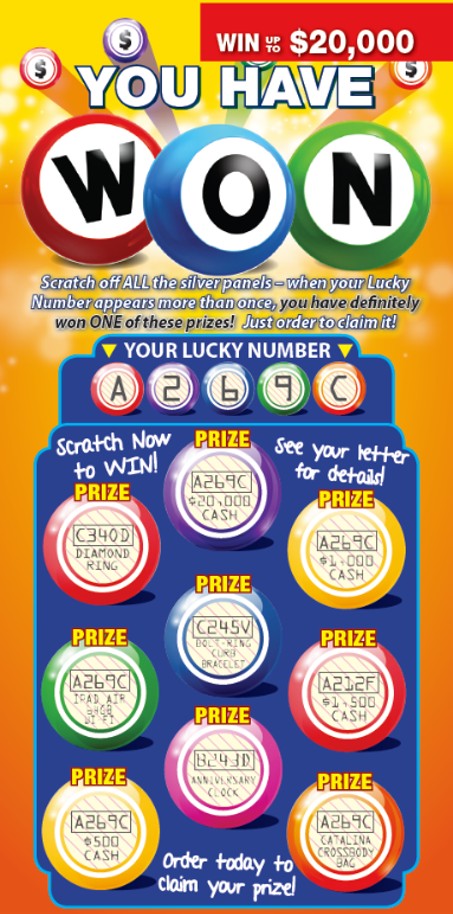
211 Importantly, the scratch card (and the interactive element of removing the outer coating on the card) would have brought to the customer’s attention and reinforced that, while they had won a prize, that prize could be one of any of the prizes revealed under the coating. Notably, the instructions for the scratch card also state that “when your Lucky Number appears more than once, you have definitely won ONE of these prizes!”
212 The only reference to the second chance draw for the unclaimed major prizes appears in the “Summary Terms & Conditions of Entry for Magnamail’s $685,500 Prize Draw” which appears in a text box below the instructions relating to the scratch card and the steps to claim the prize. The summary terms and conditions appear on the reverse side of the scratch card, which included statements that “A second chance draw for those unclaimed major prizes will take place at Handling Matters [etc]” and “In the event of a second chance draw or unclaimed prize draw, prizes will be awarded in descending order of value”.
213 The ACCC submits that the promotional materials represent that there was no possibility of a further chance of claiming a Major Prize, and that a reasonable reaction of the member of the relevant class would be not to read the terms and conditions. However, even if that is the case, an ordinary and reasonable member of the relevant class who is being invited to enter a prize draw and who is taking reasonable care to protect their own interests would observe and understand that there are terms and conditions of the prize draw, and therefore any apparent ability to claim a prize is conditional and would be governed by those terms. This cuts across any notion of the ordinary and reasonable customer understanding that they had a “right” to claim a prize. Further, these selected customers had participated in previous trade promotions conducted by Magnamail and had (at least) won a Minor Prize, and for that reason, there was some prospect that they were aware of the existence of second chance and unclaimed prize draws which occurred as part of its trade promotions.
214 In any event, the selected customers who received the promotional materials for the M270 Trade Promotion did have a chance of being the winner of the Major Cash Prize or a Major Prize if the person who had been selected to win the Major Cash Prize or a Major Prize did not claim it, and thereby forfeited it. It is not the case, as the ACCC submits, that they had “no chance” of winning such a prize.
215 When the promotional materials for the M270 Trade Promotion are viewed as a whole, the dominant message is that, if a selected customer purchased a product from the catalogue within the Promotion Period, they could (or had the opportunity to) “claim” a prize in a prize draw which prize “could” be the Major Cash Prize or a Major Prize and to the same effect, that there was a chance to win such a prize. That is how the ordinary and reasonable members of the relevant class would have understood these materials.
216 It is therefore not the case that the promotional materials for the M270 Trade Promotion convey the representation that the selected customers had, at that time, a right to claim, were eligible for, or had qualified for a prize if they purchased a product from the catalogue, where that prize could be valued up to $20,000 or be a Major Prize.
217 For these reasons and in reliance on the findings in section 7.1 above, it follows that the ACCC’s case in relation to the M270 Trade Promotion must fail.
7.6 Trade Promotion M271
218 The M271 Promotion ran from 16 January 2023 to 14 April 2023, throughout Australia, except for South Australia. There was only one Major Prize for the Pre-Draw aspect of the M271 Promotion, being $25,000 cash (i.e. the Major Cash Prize). There were no Minor Prizes.
219 There were 166,763 customers who were selected following the process identified in Ms Sandler’s affidavit evidence. On 14 December 2022, Magnamail instructed Handling Matters to conduct the pre-draw from these customers, and on the same date, Handling Matters provided Magnamail with the results in the form of a pre-draw schedule, identifying the single customer (by reference to her name, customer number and location) who had been pre-drawn for the Major Cash Prize.
220 On or after 30 January 2023, Magnamail distributed by post the promotional materials for the M271 Trade Promotion to the selected customers throughout Australia (except for South Australia). Those promotional materials consisted of an outer envelope, a cover letter and order form, a catalogue, a “lift letter” and a return envelope.
221 The ACCC alleges that the promotional materials distributed in respect of the M271 Trade Promotion made the $25,000 Prize Representation, being a representation that the promotional materials that the customer received could contain a winning prize number that, at that time, gave the customer a right to claim, made them eligible for, or qualified them for the $25,000 cash prize if they purchased a product from the catalogue.
222 By the particulars to the Statement of Claim, the ACCC cites express statements in the promotional materials as “giving rise” to this representation. The particulars are contained in eight pages for the M271 Trade Promotion which extract sentences or parts of sentences from the materials, but with a footnote which states that the ACCC “relies on the entire package of the promotional materials … as giving rise to the alleged Representations” and that the particulars serve as a guide but the ACCC relies on the “entirety of the promotional materials in their original form and context”.
223 By its closing submissions, the ACCC emphasises certain statements in the cover letter:
(1) “Right now you could be holding the winning number for $25,000.00 CASH!”;
(2) “You are the only person in Australia holding the SIX numbers above – any one of them could be the winning match we are looking for – guaranteeing the payment of $25,000.00 Cash to you [customer name]”;
(3) “if we do not hear from you by the deadline your SIX Prize Numbers will be FORFEITED and you will have no legal claim on any money won by them.”
(Emphasis original.)
224 The ACCC also emphasises the statement in the Customer Appreciation Draw entry form, which state, “You are the only person in Australia to receive the [6] prize numbers above. If they are returned as directed and one found as a match to the Winning Number already drawn: YOU will definitely receive $25,000.00 cash.” It also refers to express statements on the outer envelope that there was a “Major Cash Payout”, that “Draw results have just been released” and “$25,000 CASH PAYMENT is on hold and waiting to be claimed”. (Emphasis original.)
225 The ACCC submits that none of these statements could be true, for any person other than the single consumer whose promotional materials did contain the winning claim number that would entitle them to claim the $25,000 if they placed an order from the catalogue, and that person had already been pre-drawn.
226 However, the promotional materials for the M271 Trade Promotion refer to a “customer appreciation draw” which had taken place and which the customer could have won.
227 The cover letter conveys that the customer had been issued with six numbers and that the winning claim number could be among those numbers.
228 The cover letter also conveys that there has been a draw which has already occurred. It states at the top “$25,000 customer appreciation draw>> Winning Number Already Drawn. Funds Must Be Paid To Winner”.
229 In the cover letter, it is also stated that “The $25,000 Winning Number has ALREADY been selected and we are now waiting for the winner to come forward and claim their prize…and it could be YOU!”
230 On the entry form, there is reference to, for example, matching the numbers allocated to the customer to the winning number “already drawn”. Similarly, on the outer envelope, it is stated that “Draw results have just been released”.
231 On page 2 of the catalogue, it is stated that:
…The winning number has already been drawn and we are just waiting for the person holding the winning match to come forward and claim the cash. Any of the prize number(s) printed on your documents enclosed could be the very one we are searching for…
232 That the customer only had a “chance” of having the winner number is reinforced by, for example, the front cover of the catalogue which asks “Will it be you next? Don’t miss out – Order Today!” underneath photographs of previous cash winners. On page 2 of the catalogue, the question is again asked: “It’s true: a valued customer must win a huge payout … will it be you?” The lift letter also asks “Will [the $25,000] be deposited into your account?”
233 As each selected customer is assigned six numbers and is informed that they will win $25,000 cash if one of those numbers is found as a match to the winning number already drawn, an ordinary and reasonable member of the relevant class who receives the promotional material knows that they have a “chance” or opportunity of winning $25,000, but also knows that whether they have won has been pre-determined. They therefore participate in the “game of chance” with that knowledge.
234 Viewed as a whole, the dominant message in the promotional materials for the M271 Trade Promotion was that, if a selected customer purchased a product from the catalogue within the Promotion Period, they could (or had the opportunity to) “claim” a prize in a prize draw which prize “could” be $25,000 and to the same effect, that there was a chance to win such a prize. That is how the ordinary and reasonable members of the relevant class would have understood these materials.
235 It is therefore not the case that the promotional materials for the M271 Trade Promotion convey the representation that the promotional materials that the customer received could contain a winning prize number that, at that time, gave the customer a right to claim, made them eligible for, or qualified them for the $25,000 cash prize if they purchased a product from the catalogue.
236 For these reasons and in reliance on the findings in section 7.1 above, it follows that the ACCC’s case in relation to the M271 Trade Promotion must fail.
7.7 Trade Promotion MSS21
237 The MSS21 Promotion ran from 1 August 2022 to 19 December 2022, throughout Australia. There were four Major Prizes, being: (a) $10,000 cash (the Major Cash Prize); (b) $1,000 cash; (c) pearl earrings valued at $465, and (d) $500 cash. The Minor Prize was a Rose Quartz pendant valued at $20.
238 There were 113,656 customers who were selected following the process identified in Ms Sandler’s affidavit evidence. On 16 August 2022, Magnamail instructed Handling Matters to conduct the pre-draw from these customers, and on 17 August 2022, Handling Matters provided Magnamail with the results in the form of a pre-draw schedule, identifying the four customers (by reference to their names, customer numbers and locations) who had been pre-drawn for each of the Major Prizes.
239 On or after 17 August 2022, Magnamail distributed by post the promotional materials for the MSS21 Trade Promotion to the selected customers throughout Australia. Those promotional materials consisted of an outer envelope, a cover letter and order form, a catalogue, and a return envelope.
240 There were slightly different versions of the promotional materials distributed to residents of New South Wales and South Australia, as compared to the versions of the promotional material distributed to residents of other Australian states. That is because Magnamail was required to obtain (and had obtained) regulatory approval from the lottery regulators in New South Wales and South Australia.
241 The ACCC alleges that each version of the promotional materials distributed for the MSS21 Trade Promotion made the Prize Valued Up to $10,000 Representation and the Major Prize Representation.
242 By the particulars to the Statement of Claim, the ACCC cites express statements in the promotional materials as “giving rise” to each of these representations. The particulars are contained in 10 pages for the MSS21 Trade Promotion which extract sentences or parts of sentences from the materials, but with a footnote which states that the ACCC “relies on the entire package of the promotional materials …as giving rise to the alleged Representations” and that the particulars serve as a guide but the ACCC relies on the “entirety of the promotional materials in their original form and context”.
243 By its closing submissions, the ACCC emphasises certain statements in the promotional materials such as:
(1) on the cover letter, that:
(a) “Respond as instructed today and within 48 hours of winner verification you could be holding a cheque which reads… Pay to the order of: [consumer name], The sum of: TEN THOUSAND DOLLARS”;
(b) “Yes it’s true [customer name], CONGRATULATIONS… The following prizes valued up to $10,000 are now ready for immediate award and one of them is labelled for delivery to [customer address]: $10,000 Cash; a beautiful Rose Quartz Pendant; $1,000 Cash; an elegant pair of Natural Pink Freshwater Pearl Earrings or $500 Cash. All you have to do is order to claim it”;
(c) “Claiming your win is the only way to discover which prize you have won! To receive your prize valued up to $10,000: simply return your completed PRIZE CLAIM CERTIFICATE below, along with your valued order from our exclusive Spring Fashion Catalogue, in the envelope provided”;
(d) “Should you be the grand prize winner I will personally arrange the cash payment to you within 48 hours of confirmation. That’s why I hope you’ll order today to claim your prize”;
(2) on the “Prize Claim Certificate”, “I am returning this form along with my order to claim my prize valued up to $10,000 in your latest draw. Please send my prize which I have won with my order”;
(3) on the return envelope:
(a) “YES! I want to claim my guaranteed prize and have enclosed my completed Prize Claim Certificate and order in this envelope”;
(b) “Please deliver my prize valued up to $10,000 along with my order”.
(4) on the catalogue, “Are you our next $10,000 winner? Order now to find out!”
(Emphasis original.)
244 The ACCC submits that the “true position is that if the consumer returned the claim form with an order, unless they had been pre-drawn – as most were not – they would only have been eligible for a Minor Prize, and not the $10,000 prize, or any of the other Major Prizes.”
245 However, the promotional materials for the MSS21 Trade Promotion convey that there has been a prize draw which has already occurred, that the recipient of the promotional materials has won a prize in that draw and that, of the available prizes, one of those prizes was a Major Prize (including $10,000). They also convey that the customer could claim their prize by placing an order within the Promotion Period.
246 For example, the cover letter conveys that there has been a prize draw which has already occurred. It states at the top: “Draw Results Just Released. Good news! Our Latest Draw Results are in – and YOU [name] have been named as a confirmed winner! See below and act now…” (emphasis original).
247 The cover letter states that the “following prizes valued up to $10,000 are now ready for immediate award and ONE of them is labelled for delivery to [address] [followed by a list of the prizes including the Minor Prize].” It continues further down the page “Claiming your win is the only way to discover which prize you have won!” and “Should you be the grand prize winner…”.
248 At the bottom of the order form in a text box were the words “Exclusive Draw” and in prominent gold font are the words “Increase your chances of winning even further…”. The ACCC submits that the statement “Increase your chances of winning even further” is misleading. However, I do not accept that this statement gave rise to the Prize Valued Up to $10,000 Representation and the Major Prize Representation, as alleged in the ACCC’s pleading.
249 Below that in white text on purple background are the words “Any major prizes which are not claimed must be given away! So if you send this Prize Claim Certificate with your order, you will be eligible to win any unclaimed major prizes. ACT NOW! DON’T MISS OUT!”.
250 This was in addition to references to the second chance draw contained in the “Summary Terms & Conditions of Entry for Magnamail’s Exclusive Prize Draw” which appear beneath that text box.
251 For these reasons and contrary to the submissions by the ACCC, it is not the case that the promotional materials represented that there was no other draw for the Major Prize.
252 The interactive element for the MSS21 Trade Promotion was in the form of a “Prize Claim Certificate”, which a consumer is directed to fill out and sign, and return with their order. The certificate asked the consumer to check a box, against the statement “Should I win the $10,000 cash, the best time to contact me is: 9am, Midday, Afternoon, After 6pm”, and to identify the things on which the consumer would spend $10,000. The certificate was official-looking and contained a reference to the consumer’s “winning number” in the top left-hand corner, and in the right a statement “Prize Valued up to $10,000”. However, contrary to the submissions by the ACCC, this interactive element did not reinforce the Prize Valued Up to $10,000 and Major Prize Representation. Rather, it emphasises the chance that the selected customer could win the Major Cash Prize, which chance was real.
253 When viewed as a whole, the dominant message in the promotional materials for the MSS21 Trade Promotion was that, if a selected customer purchased a product from the catalogue within the Promotion Period, they could (or had the opportunity to) “claim” a prize in a prize draw which prize “could” be the Major Cash Prize or a Major Prize and to the same effect, that there was a chance to win such a prize. That is how the ordinary and reasonable members of the relevant class would have understood these materials.
254 It is therefore not the case that the promotional materials for the MSS21 Trade Promotion convey the representation that the selected customers had, at that time, a right to claim, were eligible for, or had qualified for a prize if they purchased a product from the catalogue, where that prize could be valued up to $10,000 or be a Major Prize.
255 For these reasons and in reliance on the findings in section 7.1 above, it follows that the ACCC’s case in relation to the MSS21 Trade Promotion must fail.
7.8 Trade Promotion MSS22
256 The MSS22 Promotion ran from 12 September 2022 to 30 January 2023, throughout Australia, excluding South Australia. There were four Major Prizes, being: (a) $10,000 cash (the Major Cash Prize); (b) $1,000 cash, (c) a gold ruby ring valued at $764 and (d) $500 cash. The Minor Prize was a ruby heart locket bracelet valued at $20.
257 There were 103,614 customers who were selected following the process identified in Ms Sandler’s affidavit evidence. On 30 August 2022, Magnamail instructed Handling Matters to conduct the pre-draw from these customers, and on the same date, Handling Matters provided Magnamail with the results in the form of a pre-draw schedule, identifying the four customers (by reference to their names, customer numbers and locations) who had been pre-drawn for each of the Major Prizes.
258 On or after 30 September 2022, Magnamail distributed by post the promotional materials for the MSS22 Trade Promotion to the selected customers throughout Australia (except for South Australia). Those promotional materials consisted of an outer envelope, a cover letter and order form, a catalogue, and a return envelope.
259 There were slightly different versions of some of the promotional materials distributed to residents of New South Wales, as compared to the versions of the promotional materials distributed to residents of other Australian states. That is because Magnamail was required to obtain (and had obtained) regulatory approval from the lottery regulators in New South Wales.
260 The ACCC alleges that each version of the promotional materials distributed for the MSS22 Trade Promotion made the Prize Valued Up to $10,000 Representation and the Major Prize Representation.
261 By the particulars to the Statement of Claim, the ACCC cites express statements in the promotional materials as “giving rise” to each of these representations. The particulars are contained in eight pages for the MSS22 Trade Promotion which extract sentences or parts of sentences from the materials, but with a footnote which states that the ACCC “relies on the entire package of the promotional materials …as giving rise to the alleged Representations” and that the particulars serve as a guide but the ACCC relies on the “entirety of the promotional materials in their original form and context”.
262 By its closing submissions, the ACCC emphasises certain statements in the promotional materials such as:
(1) on the cover letter, that:
(a) “A $10,000 winning ticket will definitely be released. As you are one of our lucky ticket holders, I can now reveal - you have definitely won ONE of these prizes: $10,000 Cash; an elegant Ruby Heart Locket Bracelet; $1,000 Cash; a beautiful Solitaire Ruby Ring or $500 cash!”
(b) “Your ticket is a Guaranteed Winning Ticket! You may not be aware of the importance of this statement, but it could mean $10,000 to you!”
(2) on the “Gold Winning Ticket”, “This Gold Ticket is unique to you and it has definitely WON a prize in our latest $288,264 Prize Draw. Prize in question is valued up to: $10,000.00”;
(3) on the return envelope: “Please deliver my prize valued up to $10,000 along with my order”.
(4) On the catalogue, “Are you our next $10,000 winner? Order now to find out!”
(Emphasis original.)
263 The ACCC submits that the “true position is that if the consumer returned their Golden Ticket with an order, unless they had been pre-drawn – as most were not – they would only have been eligible for a Minor Prize, and not the $10,000 prize, or any of the other Major Prizes.”
264 However, the promotional materials for the MSS22 Trade Promotion refer to a “draw” which had taken place. The promotional materials also represent that Major Cash Prize and Major Prizes had been awarded as part of that “prize draw”, and the selected customers could “claim” their prize by purchasing a product from the catalogue within the Promotion Period.
265 For example, the cover letter states at the top: “Notice of Win” and “Guaranteed Winner! [name] Your Gold Ticket has definitely won a prize in our $288,264 Prize Draw!”. The cover letter also states “I can now reveal – you have definitely won ONE of these prizes: $10,000 Cash; an elegant Ruby Heart Locket Bracelet; $1,000 Cash; a beautiful Solitaire Ruby Ring or $500 cash!” (emphasis original).
266 It also states on the Gold Winning Ticket “YOUR TICKET MUST BE RETURNED OR YOU WILL IMMEDIATELY FORFEIT THE PRIZE YOU HAVE WON”. There is a further reference to forfeiture of the prize “currently linked” to the ticket at the bottom of the cover letter. Blue writing also stated “REMEMBER! You must respond or you’ll FORFEIT your prize!”.
267 The enclosed Gold Winning Ticket states “[name] This Gold Ticket is unique to you and it has definitely WON a prize in our latest $288,264 Prize Draw” (emphasis original).
268 On the reverse of the Gold Winning Ticket, there is a heading “ALL MAJOR PRIZES MUST BE GIVEN AWAY!” and below that this appears before the Summary Terms & Conditions:
That means, return your Gold Ticket and order and not only will you receive the prize reserved in your name, you will be entered into a 2nd Chance Draw to win any unclaimed major prizes. This includes the $10,000 CASH, should the rightful winner ignore this Confirmed Winner Notice.
269 The Summary Terms & Conditions of Entry for Magnamail’s $288,264 Prize Draw also contain reference to a second chance draw occurring for unclaimed major prizes.
270 The ACCC advances various complaints about the Gold Ticket such as: (a) it was not unique to the customer; (b) it did not increase the customer’s chances of winning; (c) it was purely performative; (d) it was not required to be returned to enter the promotion. However, these complaints do not support the pleaded case concerning the Representations as they raise separate complaints.
271 The ACCC also refers to communications received from the Attorney-General’s Department in South Australia concerning the application of South Australian legislation and regulations to the proposed trade promotion, and the reasons for refusal to permit Trade Promotion MSS22 in South Australia. Although the ACCC properly accepts that the opinion of the South Australian Government is not determinative of whether the MSS22 promotional materials were misleading, it submits that “the Court can take from the South Australian Government’s view of the materials, an indication that on the balance of probabilities, the ordinary and reasonable consumer would not have appreciated from the MSS22 Promotional Materials” that:
(1) “they were not more likely to claim a Major Prize than any other “non-pre-drawn” customer”;
(2) “that if they placed an order, they were only entitled at that time to claim a Minor Prize (being a “free gift”)”;
(3) “that the Gold Ticket was not required to be sent back to Magnamail to claim a prize, and was not linked with a special prize”; and
(4) “the second chance draw was the customer’s only chance of winning a Major Prize, but that was only if the Major Prize winners did not themselves place an order.”
272 In circumstances where the South Australian regulator is engaged in assessing the promotional materials by reference to a regulatory framework peculiar to that State, and not from the perspective of the ordinary and reasonable members of the relevant class of persons who received the promotional materials, the opinions expressed by that person on behalf of the regulator carry no weight, and do not assist in the manner submitted by the ACCC.
273 When viewed as a whole, the dominant message in the promotional materials for the MSS22 Trade Promotion was that, if a selected customer purchased a product from the catalogue within the Promotion Period, they could (or had the opportunity to) “claim” a prize in a prize draw which prize “could” be the Major Cash Prize or a Major Prize and to the same effect, that there was a chance to win such a prize. That is how the ordinary and reasonable members of the relevant class would have understood these materials.
274 It is therefore not the case that the promotional materials for the MSS22 Trade Promotion conveyed the representation that the selected customers had, at that time, a right to claim, were eligible for, or had qualified for a prize if they purchased a product from the catalogue, where that prize could be valued up to $10,000 or be a Major Prize.
275 For these reasons and in reliance on the findings in section 7.1 above, it follows that the ACCC’s case in relation to the MSS22 Trade Promotion must fail.
7.9 Trade Promotion MSS23
276 The MSS23 Trade Promotion ran from 17 October 2022 to 3 March 2023, throughout Australia, excluding South Australia. There were four Major Prizes, being: (a) $10,000 cash (the Major Cash Prize); (b) $1,000 cash, (c) a tennis bracelet valued at $589 and (d) a silver anniversary clock valued at $237. The Minor Prize was a topaz pendant valued at $20.
277 There were 103,446 customers who were selected following the process identified in Ms Sandler’s affidavit evidence. On 5 October 2022, Magnamail instructed Handling Matters to conduct the pre-draw from these customers, and on 6 October 2022, Handling Matters provided Magnamail with the results in the form of a pre-draw schedule, identifying the four customers (by reference to their names, customer numbers and locations) who had been pre-drawn for each of the Major Prizes.
278 On or after 24 October 2022, Magnamail distributed by post the promotional materials for the MSS23 Trade Promotion to the selected customers throughout Australia (except for South Australia). Those promotional materials consisted of an outer envelope, a cover letter and order form, a catalogue, and a return envelope.
279 There were slightly different versions of some of the promotional materials distributed to residents of New South Wales, as compared to the versions of the promotional materials distributed to residents of other Australian states (other than South Australia). That is because Magnamail was required to obtain (and had obtained) regulatory approval from the lottery regulators in New South Wales.
280 The ACCC alleges that each version of the promotional materials distributed for the MSS23 Trade Promotion made the Prize Valued Up to $10,000 Representation and the Major Prize Representation.
281 By the particulars to the Statement of Claim, the ACCC cites express statements in the promotional materials as “giving rise” to each of these representations. The particulars are contained in seven pages for the MSS23 Trade Promotion which extract sentences or parts of sentences from the materials, but with a footnote which states that the ACCC “relies on the entire package of the promotional materials …as giving rise to the alleged Representations” and that the particulars serve as a guide but the ACCC relies on the “entirety of the promotional materials in their original form and context”.
282 By its closing submissions, the ACCC emphasises certain statements in the promotional materials such as:
(1) on the cover letter that:
(a) “Your assigned claim number - MM1234567 - has been identified and confirmed as a DEFINITE WINNER. You could be the $10,000 winner we are searching for”;
(b) “return your certificate along with your valued order in the envelope provided. These simple actions will definitely claim the prize linked to your Winning Claim Number...which could be $10,00 [sic] CASH!”
(2) on the “Winner Search Claim Certificate”, “Winning Number: MM1234567” and “Prize Valued up to: $10,000.00”
(3) on the return envelope that:
(a) “YES! I want to claim my guaranteed prize and have enclosed my completed Certificate and order in this envelope”;
(b) “Please deliver my prize valued up to $10,000 along with my order”.
(Emphasis original.)
283 The ACCC submits that the true position is that if the consumer placed an order, unless they had been pre-drawn – as most were not – they would only have been eligible to claim a Minor Prize, and not the $10,000 prize, or any of the other Major Prizes.
284 However, the promotional materials for the MSS23 Trade Promotion refer to a “draw” which had taken place. The promotional materials also represent that Major Cash Prize and Major Prizes had been awarded as part of that “prize draw”, and the selected customers could “claim” their allocated prize by purchasing a product from the catalogue within the Promotion Period.
285 For example, at the top of the cover letter appear the words “$277,826 Draw Results Released”. The letter is headed “Confirmed Winner Notification” and an arrow points to a number and states “You are definitely holding a WINNING NUMBER. Use this seal to claim what you have won!” In a pink text box, it is stated “WINNER SEARCH UNDERWAY” and “You could be the $10,000 winner we are searching for. Please read this letter carefully”.
286 The cover letter continues:
CONGRATULATIONS [name], you could be the $10,000 winner we are searching for! …I can confirm that ONE of the following prizes is definitely yours: $10,000 Cash; a Classic Swiss Blue Topaz Tennis Bracelet; a stunning Blue Topaz Swirl Pendant; $1,000 Cash or a regal Anniversary Clock!
(Emphasis original.)
287 The customer is asked to affix the seal with their number to the Winning Claim Certificate by the words: “To secure the prize linked to your Winning Number …simply affix your seal at the right where indicated, and return with your order today”. The ACCC submits that this was entirely performative, and that the consumer’s “Winning Number” only entitled them to a Minor Prize. The first complaint adds no weight to the ACCC’s case concerning the Representations, and the second complaint is incorrect for the reasons explained above in relation to the prize mechanics of the Trade Promotions generally.
288 At the bottom of the order form in a text box were the words “Increase your chances of Winning Even Further...” and “Any major prizes which are not claimed must be given away! So if you send this Prize Claim Certificate with your order, you will be eligible to win any unclaimed major prizes. ACT NOW! DON’T MISS OUT!”. This was in addition to references to the second chance draw contained in the “Summary Terms & Conditions of Entry for Magnamail’s $277,826 Prize Draw beneath that.”
289 The ACCC submits that this notification “contributed to the misleading nature of the materials”. However, I do not agree that this notification gave rise to the Prize Valued Up to $10,000 Representation and the Major Prize Representation, as alleged in the ACCC’s pleading. The ACCC also complains that “the notification insisting that the customer return their “Winner Search Claim Certificate” to enter the promotion and the second chance draw, …was a purely performative step”. Again, this fact adds little to the ACCC’s case.
290 When viewed as a whole, the dominant message in the promotional materials for the MSS23 Trade Promotion was that, if a selected customer purchased a product from the catalogue within the Promotion Period, they could (or had the opportunity to) “claim” a prize in a prize draw which prize “could” be the Major Cash Prize or a Major Prize and to the same effect, that there was a chance to win such a prize. That is how the ordinary and reasonable members of the relevant class would have understood these materials.
291 It is therefore not the case that the promotional materials for the MSS23 Trade Promotion convey the representation that the selected customers had, at that time, a right to claim, were eligible for, or had qualified for a prize if they purchased a product from the catalogue, where that prize could be valued up to $10,000 or be a Major Prize.
292 For these reasons and in reliance on the findings in section 7.1 above, it follows that the ACCC’s case in relation to the MSS23 Trade Promotion must fail.
7.10 Trade Promotion MWA31
293 The MWA31 Promotion ran from 13 February 2023 to 12 June 2023, throughout Australia, excluding South Australia. There were four Major Prizes, being: (a) $10,000 cash (the Major Cash Prize); (b) $1,000 cash, (c) a garnet pendant valued at $579 and (d) $500 cash. The Minor Prize was a garnet link bracelet valued at $20.
294 There were 101,576 customers who were selected following the process identified in Ms Sandler’s affidavit evidence. On 27 January 2023, Magnamail instructed Handling Matters to conduct the pre-draw from these customers, and on 31 January 2023, Handling Matters provided Magnamail with the results in the form of a pre-draw schedule, identifying the four customers (by reference to their names, customer numbers and locations) who had been pre-drawn for each of the Major Prizes.
295 On or after 13 February 2023, Magnamail distributed by post the promotional materials for the MWA31 Trade Promotion to the selected customers throughout Australia (except for South Australia). Those promotional materials consisted of an outer envelope, a cover letter and order form, a catalogue, and a return envelope.
296 There were slightly different versions of some of the promotional materials distributed to residents of New South Wales, as compared to the versions of the promotional materials distributed to residents of other Australian states. That is because Magnamail was required to obtain (and had obtained) regulatory approval from the lottery regulators in New South Wales.
297 The ACCC alleges that each version of the promotional materials distributed for the MWA31 Trade Promotion made the Prize Valued Up to $10,000 Representation and the Major Prize Representation.
298 By the particulars to the Statement of Claim, the ACCC cites express statements in the promotional materials as “giving rise” to each of these representations. The particulars are contained in eight pages for the MWA31 Trade Promotion which extract sentences or parts of sentences from the materials, but with a footnote which states that the ACCC “relies on the entire package of the promotional materials …as giving rise to the alleged Representations” and that the particulars serve as a guide but the ACCC relies on the “entirety of the promotional materials in their original form and context”.
299 By its closing submissions, the ACCC emphasises certain statements in the promotional materials such as:
(1) on the front of the outer envelope “Winning Claim Number Enclosed exclusively for the use of the named addressee. Over $200,000 in cash and prizes to be won. Your prize is on hold and waiting to be claimed - ACT NOW!” The back of the same envelope includes the statements “Confirmed Winner” and “Prize Claim Documents Enclosed”.
(2) in the cover letter and order form:
(a) “Your Confirmed Winning Claim No. > No one else has this number: MM1234567”
(b) “A prize valued up to $10,000 has been linked to your unique number above. …”
(c) “Mrs [AC]: YOU ARE A CONFIRMED WINNER! Order urged within 14 DAYS to claim your prize!”
(d) “CONGRATULATIONS Mr [A], this means: YOU HAVE DEFINITELY WON A PRIZE valued up to $10,000 cash!”
(e) “Now one thing is certain - as a CONFIRMED WINNER, one of the following prizes is definitely yours: $10,000 Cash, a stunning Garnet Link Bracelet, $1,000 Cash, an elegant Garnet Solitaire Pendant, or $500 Cash. All you have to do now is order to claim it!”
(3) on the return envelope “Use This Envelope To Claim Your Guaranteed Prize!” and “ YES! I want to claim my guaranteed prize and have enclosed my completed Confirmed Winner Certification and order in this envelope.”
(Emphasis original.)
300 However, the promotional materials for the MWA31 Trade Promotion convey that there has been a prize draw which has already occurred, that the recipient of the promotional materials has won a prize in that draw and that, of the available prizes, one of those prizes was a Major Prize (including the Major Cash Prize). They also convey that the customer could claim their prize by placing an order within the Promotion Period.
301 For example, on the front of the outer envelope, it is stated “Winning Claim Number Enclosed exclusively for the use of the named addressee. Over $200,000 in cash and prizes to be won. Your prize is on hold and waiting to be claimed - ACT NOW!” (emphasis original).
302 In the cover letter, it is stated that “[name]: YOU ARE A CONFIRMED WINNER! Order urged within 14 DAYS to claim your prize!” and “YOU HAVE DEFINITELY WON A PRIZE valued up to $10,000 cash!” (emphasis original) and “Now one thing is certain - as a CONFIRMED WINNER, one of the following prizes is definitely yours: $10,000 Cash, a stunning Garnet Link Bracelet, $1,000 Cash, an elegant Garnet Solitaire Pendant, or $500 Cash. All you have to do now is order to claim it!” (emphasis original). The Confirmed Winner certification also referred to having won a prize “in our latest draw”.
303 It is not the case, as the ACCC submits, that the promotional materials for MWA31 also convey the overwhelming “message” that there was no possibility of a further chance to claim a Major Prize. At the bottom of the order form in a text box were the words “Increase your chances of winning even further” and in white text on purple background “Any major prizes which are not claimed must be given away! So if you send your Confirmed Winner Certification with your order, you will be eligible to WIN any unclaimed major prizes. ACT NOW! DON’T MISS OUT!”. This was in addition to references to the second chance draw contained in the Summary Terms & Conditions of Entry for Magnamail’s $258,079 Prize Draw beneath that.
304 The ACCC also submits that the MWA31 promotional materials contain interactive elements in the form of “checkboxes” on the return envelope, and the order form. However, no “checkboxes” are contained in the order form (other than ones to be used for the order of goods), and the ticking of the “checkboxes” on the reply envelope reinforced to the selected customer that they have a guaranteed prize (which was the case).
305 When viewed as a whole, the dominant message in the promotional materials for the MWA31 Trade Promotion was that, if a selected customer purchased a product from the catalogue within the Promotion Period, they could (or had the opportunity to) “claim” a prize in a prize draw which prize “could” be the Major Cash Prize or a Major Prize and to the same effect, that there was a chance to win such a prize. That is how the ordinary and reasonable members of the relevant class would have understood these materials.
306 It is therefore not the case that the promotional materials for the MWA31 Trade Promotion convey the representation that the selected customers had, at that time, a right to claim, were eligible for, or had qualified for a prize if they purchased a product from the catalogue, where that prize could be valued up to $10,000 or be a Major Prize.
307 For these reasons and in reliance on the findings in section 7.1 above, it follows that the ACCC’s case in relation to the MWA31 Trade Promotion must fail.
7.11 Trade Promotion MWA32
308 The MWA32 Promotion ran from 8 March 2023 to 7 July 2023, throughout Australia, excluding South Australia. There were four Major Prizes, being: (a) $10,000 cash (the Major Cash Prize); (b) $1,000 cash, (c) a pair of amethyst earrings valued at $589 and (d) $500 cash. The Minor Prize was an amethyst pendant valued at $20.
309 There were 74,363 customers who were selected following the process identified in Ms Sandler’s affidavit evidence. On 3 March 2023, Magnamail instructed Handling Matters to conduct the pre-draw from these customers, and on 4 March 2023, Handling Matters provided Magnamail with the results in the form of a pre-draw schedule, identifying the four customers (by reference to their names, customer numbers and locations) who had been pre-drawn for each of the Major Prizes.
310 On or after 15 March 2023, Magnamail distributed by post the promotional materials for the MWA32 Trade Promotion to the selected customers throughout Australia (except for South Australia). Those promotional materials consisted of an outer envelope, a cover letter and order form, a catalogue, and a return envelope.
311 There were slightly different versions of some of the promotional materials distributed to residents of New South Wales, as compared to the versions of the promotional materials distributed to residents of other Australian states. That is because Magnamail was required to obtain (and had obtained) regulatory approval from the lottery regulators in New South Wales.
312 The ACCC alleges that each version of the promotional materials distributed for the MWA32 Trade Promotion made the Prize Valued Up to $10,000 Representation and the Major Prize Representation.
313 By the particulars to the Statement of Claim, the ACCC cites express statements in the promotional materials as “giving rise” to each of these representations. The particulars are contained in eight pages for the MWA32 Trade Promotion which extract sentences or parts of sentences from the materials, but with a footnote which states that the ACCC “relies on the entire package of the promotional materials …as giving rise to the alleged Representations” and that the particulars serve as a guide but the ACCC relies on the “entirety of the promotional materials in their original form and context”.
314 By its closing submissions, the ACCC emphasises certain statements in the promotional materials such as:
(1) on the front of the outer envelope “Confirmed Winner” and “Selection for our latest $250,089 Draw has ruled in your favour. YOU HAVE WON a prize valued up to $10,000.00 cash. Open now for instructions on how to claim your prize. ACT NOW!” The back of the same envelope includes the statement “PRIZE READY TO DELIVER OPEN NOW!”
(2) in the cover letter and order form:
(a) “Your ticket is a Guaranteed Winning Ticket!”
(b) “Guaranteed Winner! [customer name]. Your Gold Ticket has definitely won a prize in our $250,089 Prize Draw!”
(c) “I can now reveal - you have definitely won ONE of these prizes: $10,000 Cash; an elegant Amethyst Leaf Pendant; $1,000 Cash; a beautiful pair of Amethyst Earrings or $500 cash!”
(d) “GOLD WINNING TICKET” (noting that this is on the Gold Winning Ticket rather than the cover letter and order form).
(Emphasis original.)
315 However, even these statements highlighted by the ACCC make plain that there has been a prize draw which has already occurred, that the recipient of the promotional materials has won a prize in that draw and that, of the available prizes, one of those prizes was a Major Prize (including the Major Cash Prize). They also convey that the customer could claim their prize by placing an order within the Promotion Period. Other statements reinforced this message.
316 For example, the cover letter states at the top: “Notice of Win” and “Guaranteed Winner! [name] Your Gold Ticket has definitely won a prize in our $250,089 Prize Draw!”. The enclosed Gold Winning Ticket states “[name]: This Gold Ticket is unique to you and it has definitely WON a prize in our latest $250,089 Prize Draw” (emphasis original). The cover letter states “you have definitely won ONE of these prizes: $10,000 Cash; an elegant Amethyst Leaf Pendant; $1,000 Cash; a beautiful pair of Amethyst Earrings or $500 cash!” (emphasis original).
317 The Gold Winning Ticket also states that “YOUR TICKET MUST BE RETURNED OR YOU WILL IMMEDIATELY FORFEIT THE PRIZE YOU HAVE WON”. There is a further reference to forfeiture of the prize “currently linked” to the ticket at the bottom of the cover letter. Blue writing also stated “REMEMBER! You must respond or you’ll FORFEIT your prize!”.
318 It is not the case, as the ACCC submits, that the promotional materials for MWA32 also conveyed the overwhelming message that there was no possibility of a further chance to claim a Major Prize.
319 That is because, on the reverse of the Gold Winning Ticket, there is a heading “ALL MAJOR PRIZES MUST BE GIVEN AWAY!” and below that these words appear above the Summary Terms & Conditions:
This means, return your Gold Ticket and order and not only will you receive the prize reserved in your name, you will be entered into a 2nd Chance Draw to win any unclaimed major prizes. This includes the $10,000 CASH, should the rightful winner ignore this Confirmed Winner Notice.
320 The “Summary Terms & Conditions of Entry for Magnamail’s $250,089 Prize Draw” also contain reference to a second chance draw occurring for unclaimed major prizes. However, contrary to the ACCC’s submissions, this was not the only reference to a second chance draw in the promotional materials.
321 The ACCC’s closing submissions also refer to the “interactive elements in the form of “checkboxes” on the order form”. These “checkboxes” relate to an additional draw which was being offered for an additional cash amount of $5,000, and have no relevance to the ACCC’s case concerning the Representations.
322 When viewed as a whole, the dominant message in the promotional materials for the MWA32 Trade Promotion was that, if a selected customer purchased a product from the catalogue within the Promotion Period, they could (or had the opportunity to) “claim” a prize in a prize draw which prize “could” be the Major Cash Prize or a Major Prize and to the same effect, that there was a chance to win such a prize. That is how the ordinary and reasonable members of the relevant class would have understood these materials.
323 It is therefore not the case that the promotional materials for the MWA32 Trade Promotion convey the representation that the selected customers had, at that time, a right to claim, were eligible for, or had qualified for a prize if they purchased a product from the catalogue, where that prize could be valued up to $10,000 or be a Major Prize.
324 For these reasons and in reliance on the findings in section 7.1 above, it follows that the ACCC’s case in relation to the MWA32 Trade Promotion must fail.
7.12 Trade Promotion PS60
325 The PS60 Trade Promotion ran from 1 June 2022 to 21 November 2022, throughout Australia. There were five Major Prizes, being: (a) $10,000 cash (the Major Cash Prize); (b) $1,000 cash; (c) $500 cash; (d) a Google Nest Hub valued at $289 and (e) a Citizen Ladies Eco Drive Watch valued at $281. The Minor Prizes were a garnet pendant and earring set, each valued at $20.
326 On 9 May 2022, Magnamail instructed Handling Matters to conduct the pre-draw for the PS60 Trade Promotion and, on 10 May 2022, Handling Matters provided Magnamail with the results in a pre-draw schedule, identifying a 7-digit winning claim number for each of the five Major Prizes. The scratch cards distributed to customers were pre-populated with claim numbers and five of those claim numbers had been pre-drawn by Handling Matters as a winning claim number.
327 On or after 4 July 2022, Magnamail distributed by post the promotional materials for the PS60 Trade Promotion to approximately 50,000 customers throughout Australia.
328 The promotional materials consisted of an insert in the catalogue that included a scratch card and an order form.
329 The ACCC alleges that each version of the promotional materials distributed in respect of the PS60 Trade Promotion made the Prize Valued up to $10,000 Representation and the Major Prize Representation.
330 By the particulars to the Statement of Claim, the ACCC cites express statements in the promotional materials as “giving rise” to each of these representations. The particulars are contained in three pages for the PS60 Trade Promotion which extract sentences or parts of sentences from the materials, but with a footnote which states that the ACCC “relies on the entire package of the promotional materials …as giving rise to the alleged Representations” and that the particulars serve as a guide but the ACCC relies on the “entirety of the promotional materials in their original form and context”.
331 By its closing submissions, the ACCC emphasises certain statements in the promotional materials such as:
(1) on the scratch card / wrap:
(a) “Scratch off ALL the silver panels – you are eligible for ONE of the prizes that matches your LUCKY NUMBER. Just order to claim your prize...”;
(b) “Scratch now to discover what you’re eligible to WIN!”; and
(c) “Scratch off all the silver panels overleaf. If your number appears more than once, I can confirm – you are eligible for ONE of the prizes that matches your number!”.
(2) on the front page of the catalogue “Order Now to claim what you have won!”
(Emphasis original.)
332 However, the promotional materials for the PS60 Trade Promotion convey that there has been a prize draw which had already occurred, that the recipient of the promotional materials has won a prize in that draw (which had been assigned to the scratch card) and that, of the available prizes, one of those prizes was a Major Prize (including the Major Cash Prize). They also convey that the customer could claim their assigned prize by placing an order within the Promotion Period.
333 For example, on the scratch card, it is also stated “Congratulations! You could be a WINNER!” and then “Scratch off ALL the silver panels – you are eligible for ONE of the prizes that matches your LUCKY NUMBER. Just order to claim your prize”. On the reverse of the scratch card, it is stated “Scratch off all the silver panels overleaf. If your number appears more than once, I can confirm – you are eligible for ONE of the prizes that matches your number!” (emphasis original). It is also stated:
Warning → ATTENTION: This is the ONLY opportunity you will receive to claim the prize privilege assigned to this scratch card. Failure to respond will FORFEIT your eligibility for a prize. Don’t miss out – reply today!
334 On the Prize Claim Form, it is stated: YES, I want to claim a prize! These words appear next to a “checkbox”, which would have drawn the customer’s attention to the further words, “I am returning this form along with my order to claim my prize privilege in Magnamail’s latest prize draw…” (emphasis original).
335 On the front page of the catalogue, the following appears in large letters: “Congratulations WIN! One of these fabulous prizes…” above “$10,000” and photographs and descriptions of the other prizes, including the Minor Prize. At the bottom of the front page, it is stated “Order now to claim what you have won!”
336 At the bottom of the Prize Claim Form, the customer’s attention is drawn to page 26 of the catalogue for the terms and conditions. On page 26 of the catalogue, the “Magnamail Pty Ltd Terms and Conditions of Entry” occupied nearly the entire page. It is not a summary of those terms, but is the entire terms and conditions. As it appeared in the catalogue itself, it is likely that the customer would have seen these terms and conditions when perusing the catalogue and either read them, or, at the least, understand that there are terms and conditions of the prize draw, and therefore any apparent ability to claim a prize is conditional and would be governed by those terms. This cuts across any notion of the customer understanding that they had a “right” to claim a prize.
337 Paragraph 4 of those terms explains that all catalogues are allocated a unique claim number, the winning claim numbers had been selected prior to any catalogues being distributed and that “[o]n receiving entries the number allocated to each customer order will be compared against the list of winning claim numbers”.
338 It is not the case, as the ACCC submits, that the promotional materials “conveyed the overwhelming message that there was no possibility of a further chance to claim a Major Prize”. That is because paragraph 7 of the Terms and Conditions refer to the second chance draw “for any unclaimed major prizes and additional prizes” and that “[a]ll entrants that have ordered from the accompanying catalogue during the Promotion Period will be included in the second chance draw”. Reference was also made to an additional unclaimed prize draw being conducted after the second chance draw.
339 The ACCC’s closing submissions also refer to the “interactive elements in the form of “checkboxes”” on the Prize Claim Form. One such “checkbox” is addressed above. Other “checkboxes” reinforced to the selected customer that they only had a chance of being the winner of the Major Cash Prize, stating “Please tick your preferences should you be the $10,000 winner” (emphasis added).
340 Viewed as a whole, the dominant message in the promotional materials for the PS60 Trade Promotion was that, if a selected customer purchased a product from the catalogue within the Promotion Period, they could (or had the opportunity to) “claim” a prize in a prize draw which prize “could” be the Major Cash Prize or a Major Prize and to the same effect, that there was a chance to win such a prize.
341 Such a chance is not dissimilar to the chance of winning a cash prize which a consumer has when they purchase an “Instant Scratch-It” card. Only a small number of such “Instant Scratch-It” cards will contain the winning numbers under the scratch-off coating (with those winning cards being pre-determined before the cards are made available for sale). A consumer must pay money to purchase an “Instant Scratch-It” and then remove the scratch-off coating on the card in order to ascertain if they have won a prize and, if they have, they must take further steps in order to claim that prize. Such steps will be contained in the terms and conditions which commonly appear on the reverse of these cards. Further, such a consumer will be encouraged to purchase an “Instant Scratch-It” by promotions which represent that the consumer “could” win the major cash prize on offer at the relevant time, even though the vast majority of such cards will not be prize winning at all. Such “Instant Scratch-It” cards are well known and commonplace in Australia, and the ordinary and reasonable member of the relevant class would have been aware of them.
342 When the scratch cards are pre-printed in the PS60 Trade Promotion, a prize is assigned to each card following the pre-draw. An ordinary and reasonable member of the relevant class who obtains such a scratch card in the promotional materials is aware that they have obtained a “chance” or opportunity of winning one of the available prizes, but also knows that whether and what they have won has been pre-determined. They therefore participate in the “game of chance” with that knowledge.
343 For these reasons, the evidence did not establish that the promotional materials for the PS60 Trade Promotion convey the representation that the selected customers had, at that time, a right to claim, were eligible for, or had qualified for a prize if they purchased a product from the catalogue, where that prize could be valued up to $10,000 or be a Major Prize. That is not how the ordinary and reasonable members of the relevant class would have understood these materials.
344 For these reasons and in reliance on the findings in section 7.1 above, it follows that the ACCC’s case in relation to the PS60 Trade Promotion must fail.
7.13 Trade Promotion PS61/RD206
345 The PS61/RD206 Trade Promotions ran from 11 July 2022 to 27 January 2023, throughout Australia. There were five Major Prizes, being: (a) $10,000 cash; (b) $1,500 cash; (c) $1,000 cash; (d) a Michael Kors watch valued at $489 and (e) an Apple iPad valued at $729. The Minor Prize for PS61 was a shimmer pen valued at $14.90 and the Minor Prize for RD206 was a clock radio valued at $20.
346 The number of selected customers for the PS61 Trade Promotion was approximately 55,000 and for the RD206 Trade Promotion was approximately 40,000.
347 On 30 May 2022, Magnamail instructed Handling Matters to conduct the pre-draw for the PS61/RD206 Trade Promotions. On 31 May 2022, Handling Matters provided Magnamail with the results in a pre-draw schedule, identifying a 7-digit winning claim number for each of the five Major Prizes. The scratch cards distributed to customers were pre-populated with claim numbers and five of those claim numbers had been pre-drawn by Handling Matters as a winning claim number.
348 Magnamail distributed by post the promotional materials for the PS61/RD206 Trade Promotions to approximately 95,000 consumers throughout Australia. The promotional materials for the PS61/RD206 Trade Promotions consisted of an insert in the catalogue that included a scratch card and an order form.
349 The ACCC alleges that each version of the promotional materials distributed in respect of the PS61/RD206 Trade Promotions made the Prize Valued up to $10,000 Representation and the Major Prize Representation.
350 By the particulars to the Statement of Claim, the ACCC cites express statements in the promotional materials as “giving rise” to each of these representations. The particulars are contained in seven pages for the PS61/RD206 Trade Promotions which extract sentences or parts of sentences from the materials, but with a footnote which states that the ACCC “relies on the entire package of the promotional materials …as giving rise to the alleged Representations” and that the particulars serve as a guide but the ACCC relies on the “entirety of the promotional materials in their original form and context”.
351 By its closing submissions, the ACCC emphasises certain statements in the promotional materials for the PS61 Trade Promotion such as:
(1) on the scratch card / wrap:
(a) “You are eligible for ONE of the prizes that matches your lucky number!”
(b) “YOU COULD BE A $10,000…WINNER”
(c) “Scratch now to discover what you’re eligible to WIN!”
(d) “Scratch off all the silver panels overleaf. If your number appears more than once, I can confirm – you are eligible for ONE of the prizes that matches your number!”
(2) on the second page of the catalogue “Someone must win a huge cash prize – and you could be holding the $10,000 winning number right now! Just one order from this catalogue is all it takes to claim your prize privilege.”
(Emphasis original.)
352 By its closing submissions, the ACCC emphasises certain statements in the promotional materials for the RD206 Trade Promotion such as:
(1) on the scratch card, “Scratch off ALL the silver panels – you are eligible for ONE of the prizes that matches your Lucky Number below. Just order to claim it!”
(2) on the scratch card instructions:
(a) “$10,000 COULD BE YOURS!”
(b) “Scratch now to discover what you’re eligible to WIN!”
(c) “Scratch off all the silver panels overleaf. If your number appears more than once, I can confirm – you are eligible for ONE of the prizes that matches your number!”
(d) “This is no hoax! What could your prize be?... $1,500 Cash, Apple iPad 256GB, Liliane Dress Watch, Santek Clock Radio, $1,000 Cash, Or $10,000 Cash”
(e) “We’re just waiting for you to order & claim it! … In the coming weeks we’re giving away HUNDREDS OF THOUSANDS OF DOLLARS in cash and prizes – and this is your opportunity to grab a share of the winnings!”
(Emphasis original.)
353 However, the promotional materials for the PS61/RD206 Trade Promotions convey that there has been a prize draw which had already occurred, that the recipient of the promotional materials has won a prize in that draw (which had been assigned to the scratch card) and that, of the available prizes, one of those prizes was a Major Prize (including the Major Cash Prize). They also convey that the customer could claim their assigned prize by placing an order within the Promotion Period.
354 For example, on the scratch card for the PS61 Trade Promotion, it is stated “Congratulations, you could be a WINNER. Are you holding a winning scratch?” and “You are eligible for ONE of the prizes that matches your lucky number! Just order to claim it…” (emphasis original). Similar words appear on the scratch card for the RD206 Trade Promotion.
355 On the reverse of the scratch card in both Trade Promotions, it is stated “Scratch now to discover what you’re eligible to WIN!” (noting that this word is underlined in RD206 only) and “Scratch off all the silver panels overleaf. If your number appears more than once, I can confirm – you are eligible for ONE of the prizes that matches your number!” (emphasis in original). It is also stated:
Warning → ATTENTION: This is the ONLY opportunity you will receive to claim the prize privilege assigned to this scratch card. Failure to respond will FORFEIT your eligibility for a prize. Don’t miss out – order today!
356 On the Prize Claim Form for both Trade Promotions, it is stated: YES, I want to claim a prize! These words appear next to a “checkbox”, which would have drawn the customer’s attention to the further words, “I am returning this form along with my order to claim my prize privilege in Magnamail’s Latest Prize Draw…” (emphasis original).
357 At the bottom of the Prize Claim Form, attention is drawn to page 24 of the catalogue.
358 On page 24 of the catalogue for both Trade Promotions, the “Magnamail Pty Ltd Terms and Conditions of Entry” occupy an entire page. It was not a summary of those terms, but the entire terms and conditions. As it appears in the catalogue itself, it is likely that the customer would have seen these terms and conditions when perusing the catalogue and either read them, or, at the least, understand that there are terms and conditions of the prize draw, and therefore any apparent ability to claim a prize is conditional and would be governed by those terms. This cuts across any notion of the customer understanding that they had a “right” to claim a prize.
359 Paragraph 4 of those terms explains that all catalogues are allocated a unique claim number, the winning claim numbers had been selected prior to any catalogues being distributed and that “[o]n receiving entries the number allocated to each customer will be compared against the winning claim numbers”.
360 It is not the case, as the ACCC submits, that the promotional materials “conveyed the overwhelming message that there was no possibility of a further chance to claim a Major Prize”. That is because paragraph 7 of the Terms and Conditions refers to the second chance draw “for any unclaimed major prizes and additional prizes” and that “[a]ll entrants that have ordered from the accompanying catalogue during the Promotion Period will be included in the second chance draw”. Reference was also made to an additional unclaimed prize draw being conducted after the second chance draw.
361 The ACCC’s closing submissions also refer to the “interactive elements in the form of “checkboxes” on the Prize Claim Form.
362 One such “checkbox” is addressed above. Other “checkboxes” reinforced to the selected customer that they only had a chance of being the winner of the Major Cash Prize, stating “Please tick your preference should you be the $10,000 winner” (emphasis added).
363 Viewed as a whole, the dominant message in the promotional materials for the PS61/RD206 Trade Promotions was that, if a selected customer purchased a product from the catalogue within the Promotion Period, they could (or had the opportunity to) “claim” a prize in a prize draw which prize “could” be the Major Cash Prize or a Major Prize and to the same effect, that there was a chance to win such a prize.
364 Such a chance is not dissimilar to the chance of winning a cash prize which a consumer has when they purchase an “Instant Scratch-It” card, as addressed in relation to the PS60 Trade Promotion. Such “Instant Scratch-It” cards are well known and commonplace in Australia, and the ordinary and reasonable member of the relevant class would have been aware of them.
365 When the scratch cards are pre-printed in the PS61/RD206 Trade Promotions, a prize is assigned to each card following the pre-draw. An ordinary and reasonable member of the relevant class who obtains such a scratch card in the promotional materials is aware that they have obtained a “chance” or opportunity of winning one of the available prizes, but also knows that whether and what they have won has been pre-determined. They therefore participate in the “game of chance” with that knowledge.
366 For these reasons, the evidence did not establish that the promotional materials for the PS61/RD206 Trade Promotions convey the representation that the selected customers had, at that time, a right to claim, were eligible for, or had qualified for a prize if they purchased a product from the catalogue, where that prize could be valued up to $10,000 or be a Major Prize. That is not how the ordinary and reasonable members of the relevant class would have understood these materials.
367 For these reasons and in reliance on the findings in section 7.1 above, it follows that the ACCC’s case in relation to the PS61/RD206 Trade Promotions must fail.
7.14 Whether services within meaning of ACL
368 A legal issue which arose is whether Magnamail supplied services within the meaning of ss 29(1)(b), 29(1)(g) and 34 of the ACL.
369 The definition of “services” in s 2(1) of the ACL “does not include rights or benefits being the supply of goods”.
370 By contrast, by s 11(c) of the ACL, a supply of goods “includes a reference to the supply of goods together with other … services”.
371 The ACCC submits that the proper inquiry begins with the question of whether the alleged services are services.
372 However, because the legislation stipulates that a supply of goods includes the supply of services with the goods (but not the reverse), the transaction must first be characterised to determine whether it involves a supply of goods: see Valve at [131] and [135]. Contrary to the ACCC’s submissions, the observations by Edelman J in Valve are not confined to the context of the case which his Honour was deciding.
373 If the transaction, properly characterised, involves a supply of goods, then it cannot be a supply of services, applying the plain words of the statutory definition of “services”.
374 As to whether the transactions in this case involve a supply of goods, it is notable that:
(1) by its pleaded case, the ACCC accepts that the relevant transactions involve a supply of goods: (i.e. “a consumer who purchased a product”);
(2) the ACCC submits that the alleged services are “Magnamail conferring on consumers who purchased a product a right to claim a prize from Magnamail”;
(3) the ACCC also submits that:
[T]he services are those offered by Magnamail, whereby a consumer who purchased a product from a Magnamail catalogue, had, at that time, a right to claim, was eligible for or qualified for a prize from Magnamail, being a right, benefit or privilege provided, granted or confirmed in trade or commerce.
375 Notwithstanding this, the ACCC submits that the alleged services in this case are “distinct from the provision of goods by Magnamail because they were severable”.
376 However, such an approach to the characterisation of a transaction is flawed as it “reverses the proper enquiry: the first question is whether there has been a supply of goods not whether there is a supply of services”: see Valve at [135] (emphasis original).
377 A similar approach to that advanced by the ACCC was raised by it in relation to an equivalent provision in the CCA in Australian Competition and Consumer Commission v Olex Australia Pty Ltd [2017] FCA 222. In that case, Beach J stated at [652]–[653]:
In my view, the ACCC’s analysis based upon cutting services being separate is flawed. The definition of “services” in s 4(1) [of the CCA] excludes “rights or benefits being the supply of goods”. Section 4C(c) [which is equivalent to s 11(c) of the ACL] provides, relevantly, that a reference to the supply of goods includes a reference to the supply of goods together with other services. The effect of these provisions is that if services are supplied together with goods, the package is treated as one supply of goods for the purpose of the Act. It is impermissible to artificially disaggregate the supply into component parts and purport to apply the statutory provisions to each component of the product. …
As Olex contended, it supplied many services to its customers when supplying cable. Those services included stock availability, technical support, hedging currencies and hedging copper prices as well as cutting and storing cable. Olex might have chosen to charge a separate fee for any of those services, but any such service did not become disaggregated from the supply of cable merely because Olex charged a separate fee. Such a service was part of the supply of cable by Olex.
(Emphasis added, citations omitted.)
378 The ACCC seeks to distinguish Olex by submitting that the supply of services in this case was “practically speaking” not included as part of the supply of the good purchased from the catalogue.
379 That submission is not accepted. In this case, while a customer could acquire goods from the catalogue without entering the Trade Promotions (say, by ordering after the Promotion Period), a customer could not enter the draw associated with the Trade Promotion (the services) without purchasing a good from the catalogue (the good). Thus, “practically speaking”, the supply of the services and the good in the latter scenario formed part of the one transaction, and were not severable.
380 It follows that a part of the relevant transactions involved the supply of goods.
381 As the services were supplied together with the goods, each transaction is treated as one supply of goods for the purposes of the ACL.
382 For this reason, the characterisation of the relevant transactions on the facts of this case are that they are a supply of goods together with other services, being the entry into the relevant draw, and, as such, are not “services” within the meaning of s 2(1) of the ACL.
383 This provides an additional reason to find that the case brought by the ACCC against Magnamail for contraventions of ss 29(1)(b), 29(1)(g) and 34 of the ACL must fail.
7.15 Whether Representations made to public
384 A legal issue which arose is whether the alleged Representations were made to the public within the meaning of 34 of the ACL.
385 Section 34 does not require that the alleged representation be made to “the world at large or the whole community”: see Australian Competition and Consumer Commission v viagogo AG [2019] FCA 544 at [23] (Burley J). Rather, that requirement is satisfied where the public approach is “general and random, and if the number of people who are approached is sufficiently large”: Australian Competition and Consumer Commission v We Buy Houses Pty Ltd [2017] FCA 915 at [73] (Gleeson J); see also Trade Practices Commission v J&R Enterprises Pty Ltd (1991) 99 ALR 325 at 347-348 (O’Loughlin J).
386 The thrust of the submissions by Magnamail and Direct Group was that, when the selected customers were sent the promotional materials, the requisite element of randomness was absent. They submit that Ms Sandler’s uncontested evidence established that a detailed selection process was applied in determining which customers would receive particular promotions and that, accordingly, the promotional materials were not distributed in the “general and random” way contemplated by the authorities. On that basis, Magnamail and Direct Group submit that the representations were not made to the public for the purposes of s 34 of the ACL.
387 However, the representation does not need to be made to a segment of the general population on a “random” basis in order for the representation to be “public” within the meaning of s 34. This is especially as the word “random” does not appear in the legislation. For this reason, the mode of selection of the segment of the general population said to fall within s 34 is not necessarily decisive.
388 This accords with the approach taken by Thawley J in Australian Competition and Consumer Commission v Google LLC (No 2) (2021) 151 ACSR 335; [2021] FCA 367 who stated at [127]:
[A] representation will be made to the public if the approach is general and the number of people who are approached is sufficiently large or if the approach is to all within a sufficient segment of the community at large. …
389 In that case at [133], his Honour found that, as most members of the public were entitled to become Google Account holders and they constituted a sufficient “segment of the community at large” (citing Lee v Evans (1964) 112 CLR 276 at 285), the requirement that the relevant conduct mislead “the public” was satisfied.
390 Similarly, in Lee v Evans (which was also cited in J&R Enterprises at 348), Barwick CJ stated:
... the basic concept is that the invitation, though maybe not universal, is general; that it is an invitation to all and sundry of some segment of the community at large. This does not mean that it must be an invitation to all the public either everywhere, or in any particular community.
(Emphasis added.)
391 In this case, most members of the public were entitled to be a subscriber to Reader’s Digest, to acquire a product from Magnamail (including from their website) or to be on either Magnamail’s databases or on a database of a related company to which Ms Sandler had access. That Ms Sandler undertook a selection process of the customers contained in those databases based on considerations such as budget and the type or relative timing of acquisitions of products by a customer (for example) does not detract from the fact that the promotional material was sent by Magnamail to a segment of the community at large, the approach was general (in the sense that the same approach was made to all members of the community within that segment) and the number of people who were approached on each occasion was significant, being at least 50,000 if not many tens of thousands more. That the promotional material bore the name and address of the recipient does not alter this conclusion.
392 For these reasons, the alleged Representations were made to the “public” within the meaning of s 34 of the ACL.
7.16 Conclusion on liability of Magnamail
393 The case against Magnamail must fail.
394 It follows that, for the same reasons, the case against Direct Group must also fail. However, there are additional reasons addressed below that the case against Direct Group must fail in any event.
8. ACCESSORIAL LIABILITY OF DIRECT GROUP
395 Section 224(1)(e) of the ACL provides that if a Court is satisfied that a person “has been in any way, directly or indirectly, knowingly concerned in, or party to, the contravention by a person of such a provision”, then the Court may order that person to pay a pecuniary penalty. The ACCC alleges that Direct Group was knowingly concerned or party to the alleged contraventions by Magnamail contrary to s 224(1) of the ACL by reason of certain alleged knowledge and conduct of Ms Sandler which was undertaken “on behalf of” Direct Group within the meaning of s 139B(2) of the CCA.
396 Ms Sandler was the General Manager of Magnamail and was employed and remunerated by Direct Group. Direct Group had two primary divisions, being the “TVSN” and “Innovations” divisions. Ms Sandler reported to the General Manager of the “Innovations” division, which position was occupied by Mr Eade until 30 October 2022 and thereafter the role was filled on an interim basis.
397 Magnamail conducted its own business which was “a mail order catalogue business in Australia and New Zealand, selling goods such as clothing, homewares, gardening products, health aids and tools through catalogues”. The Trade Promotions were conducted as part of that business.
398 In her capacity as General Manager of Magnamail, Ms Sandler was largely autonomous. She gave unchallenged evidence that she was generally able to perform her day-to-day responsibilities without needing to obtain approval.
399 As to these responsibilities, Ms Sandler:
(1) was responsible for achieving the objectives and managing the strategic direction, success and profitability of the Magnamail business, including managing Magnamail’s cash flow; growing the business’ profit and revenue; managing its inventory levels, sourcing and selecting merchandise; and developing promotional creative, development and product acquisitioning to ensure that the business’ revenues were maximised;
(2) prepared the overall budget and marketing plans for the Promotions by Magnamail (referred to internally by Magnamail staff as a ‘mailing schedule’ or ‘lodgement plan’), which included information about: the number of campaigns to be carried out; the type of promotions for each campaign (including whether they were scratch card promotions); the quantity of customers to be mailed; and sales forecasts;
(3) for each financial year, submitted the overall budget and marketing plan for the Promotions by Magnamail, to Mr Eade;
(4) from time to time sought approval from Mr Eade to access the mailing lists of other brands within the Innovations division to mail promotional materials to them or to add them to Magnamail’s mailing list;
(5) was the direct line manager of Ms Natasha Taylor, Catalogue Manager of Magnamail, who instructed Handling Matters to conduct a pre-draw in relation to the M267, M268, M269, M270, M271, MSS21, MSS22, MSS23, MWA31 and MWA32 Trade Promotions;
(6) in respect of Trade Promotions M269, M270, MSS23, MWA31, MWA32, PS60 and PS61/RD206, was copied on emails sent to Ms Michelle Chapman of Handling Matters by Ms Taylor and Ms Iva Hariono, in which those individuals instructed Handling Matters to conduct a pre-draw;
(7) in respect of Trade Promotions M268, M269, M270, MSS21, MSS22, MSS23, MWA31 and MWA32, was copied on emails sent by Mr Ian Dukes, Business Systems Manager Innovations Direct Pty Ltd, enclosing data files for Handling Matters to conduct a pre-draw;
(8) in respect of Trade Promotions M269, M270, MSS21, MSS23, MWA31 and MWA32, was copied on emails sent from Ms Michelle Chapman to Ms Taylor and Mr Dukes, containing the results of the pre-draw.
400 Ms Sandler gave evidence that she did not consider that the Trade Promotions were false or misleading and, to the contrary, believed they were operated in accordance with relevant laws and regulations. She gave evidence that the original concept, framework and conduct of the promotions were all developed in conjunction with Anisimoff Legal. She also gave evidence that she was aware that it was Magnamail’s standard practice to seek and obtain legal advice from Anisimoff Legal on each trade promotion before it was published (and that she relied on that legal advice). Ms Sandler confirmed under cross-examination that, after receiving advice from Anisimoff Legal that “it was all legally compliant”, she was the person responsible for providing final approval of the promotional materials for 10 of the 12 Trade Promotions (excluding PS60 and PS61/RD206) “for printing purposes”.
401 Ms Sandler gave evidence during the trial that, when approving the promotional materials, it was important to her that the information was accurate and this is “why we obtained legal advice every time, so that we could ensure that everything was accurate”. Ms Sandler said that Ms Bautista was the “attention to detail person” and that she “trust[ed]” her to check the documents. Ms Sandler’s role in approving the promotional materials involved “a lot of checking around printing formats and whether or not there were any changes required by our attorney”.
402 Ms Sandler generally read through the promotional materials before they were sent to Magnamail’s lawyers. Ms Sandler explained that “in each and every case, [Anisimoff Lawyers] would be provided with terms and conditions” for the trade promotions “without question” and “no matter what” as part of a “standard process”. In addition, Anisimoff Lawyers would be provided with any artwork or changes to artwork that had not been signed-off by Anisimoff Legal previously. Ms Sandler made clear that Anisimoff Legal’s task was “Reviewing that everything is lawful for marketing purposes, not just permits”, and “always first and foremost about making sure the artwork was lawful”.
403 Under cross-examination, Ms Sandler accepted that she was not involved in the decision to retain Anisimoff Lawyers, and that she had not seen a retainer letter with that firm. However, she gave evidence that she knew the scope of their retainer with respect to what she expected from them, and that she had been clear in communicating over the telephone what was expected and what was needed by Magnamail.
404 On Magnamail’s own admission, “Anisimoff Legal was not briefed to, nor did they, advise our client [i.e., Magnamail] with respect the compliance of the Relevant Cash Prize Promotional Material with the Australian Consumer Law”. When Ms Sandler was taken to the document which contained this admission, she said “I would never have said that”, and appeared surprised to see that statement.
405 The ACCC submits that, in light of Magnamail’s admission as to the scope of the advice provided by Anisimoff Legal and in the absence of any contemporaneous evidence as to Ms Sandler providing or receiving advice as to compliance with the ACL, the Court would not accept Ms Sandler’s evidence that she communicated with Anisimoff Legal her “expectations”, including to ensure that “everything we did” was compliant and lawful. I disagree. Ms Sandler was an impressive witness who appeared to give honest and forthright answers to the questions asked of her. The formal admission by Magnamail and the lack of contemporaneous evidence which referred to the ACL specifically does not cause me to doubt that Ms Sandler gave reliable evidence about her interactions with Anisimoff Legal; that, because of those interactions, she gained comfort that the content of the Trade Promotions was legally compliant; and that it did not occur to her prior to receipt of the letter from the ACCC in March 2023 that the Trade Promotions may have been in any way misleading, as stated by her in her affidavit.
406 Magnamail also applied for and obtained permits from the relevant regulatory bodies responsible for granting permits for lotteries and trade promotions in each state and territory where a permit was required. Ms Sandler gave evidence that “Magnamail’s long history of satisfying the requirements of, and obtaining permits from, state and territory regulatory bodies for its trade promotions”, was a further basis on which she gained comfort that the content of the Trade Promotions was legally compliant.
407 Ms Sandler was asked questions about the communications that she had received from the South Australian regulator in relation to the MSS22 Trade Promotion. Ms Sandler gave evidence that, “despite Matt [Hansen from Anisimoff Legal] saying that he couldn’t understand it and that it was a lawful promotion”, she decided not to run that promotion in South Australia. In reliance on Anisimoff Legal’s advice, Ms Sandler did not consider these materials or the promotional materials used in other states to be misleading despite the concerns raised by the South Australian regulator. Ms Sandler considered the issue to be “isolated with the South Australia concerns around some of our wording” and that “Matt said that he thought it was fine”.
408 The ACCC submits that Ms Sandler’s evidence should not be accepted as the communications from the South Australian regulator put her “on notice of the potential misleading or false nature of the Representations from at least 5 September 2022”, being before eight of the Trade Promotions were distributed to customers. However, I disagree, having regard to:
(1) the differences between the content of the Trade Promotions;
(2) the differences between the regulatory framework being applied by the South Australian regulator, as compared to the regulatory framework applicable in New South Wales (in which no concerns were raised);
(3) the legal advice given by Anisimoff Legal about this topic upon which Ms Sandler relied;
(4) my views on Ms Sandler’s general credit referred to above.
409 In a further attempt to impugn Ms Sandler’s credit, the ACCC also relies on Ms Sandler’s awareness of a letter from “Mr J”, who wrote to Magnamail and also complained to the Office of Fair Trading (Qld) (OFT). Mr J’s letter commenced “As the confirmed winner of $25,000…” and later stated “I now make Formal Legal Claim for the payment of $25,000 within 7 days…”. His complaint to the OFT sought payment of $25,000. This complaint relates to Trade Promotion M271. In respect of Mr J’s complaint, Ms Sandler’s evidence under cross-examination was that Mr J was both expressing a complaint that he felt he should have won a Major Prize and that he had thought he had, in fact, won a Major Prize. She said that the letter did not give her pause as to whether the promotional materials may have been misleading because “that was one issue that came across my desk from one customer. And over the course of just one year we would have thousands, and thousands, and thousands of orders with most customers who would be satisfied, and happy, and send positive letters. So I really took that to mean it was something more in relation to just Mr J”.
410 The ACCC does not refer to this explanation in its submissions, or explain why, in light of that explanation, Ms Sandler’s evidence should not be accepted. In circumstances where Ms Sandler’s attention is brought to one letter of complaint about M271, Ms Sandler’s email correspondence with the OFT (tab 165) is consistent with her oral evidence that Mr J’s complaint did not cause her to be concerned that the promotional materials were misleading, and there is no evidence that the OFT took Mr J’s complaint any further with Magnamail after communicating with Ms Sandler, I accept Ms Sandler’s evidence.
411 The ACCC next relies upon evidence given by Ms Sandler that when she approved the promotional materials for M267 (which she understood to include statements that a consumer could claim a prize valued at up to $20,000), she understood that (i) a pre-draw was going to take place, (ii) only one consumer would be pre-drawn by Handling Matters as the “provisional winner” of the $20,000 prize and all other Major Prizes (iii) there was only one $20,000 cash prize.
412 By its closing submissions, the ACCC submits that, under cross-examination, Ms Sandler conceded that various express statements in the materials gave rise to the pleaded representations, as follows:
(a) in relation to the outer envelope of promotion M267, the statement “You have definitely won” and “…a prize valued up to $20,000 is on hold for the addressee” meant that the prize the consumer was able to claim was valued at up to $20,000 (T115.37-38; T121.36-37).
(b) in relation to the whole bundle of promotional materials received for promotion M267, the message conveyed to the consumer was that they had a right, eligibility or qualification for a prize which could be valued up to $20,000 or one of the other Major Prizes – or a chance to claim that prize: T119:01-30.
(c) with the exception of the M271 promotion, Ms Sandler understood the message conveyed in all other promotions was the message described in the subparagraph immediately above: T120.05-09.
(d) in relation to M271, the message conveyed to consumers from all of the promotional materials was that the promotional materials could contain a winning prize number that at the time gave the consumer a right to claim a $25,000 cash prize if they purchased a product from the catalogue: T121.12-15.
(e) in relation to MSS21, the statement on the Prize Winner Notification … “Because it was your name, our computer drew from thousands of others as a definite winner in a very exclusive $285,965 draw” was, literally, not true: T134.01-12.
(f) the promotional materials conveyed a sense of “excitement and urgency”: T124.32-33. However, there was no actual need for a consumer to urgently place an order given the Promotions were open for a period of time and consumer could place an order at any time up to the closing date: T124.41-43.
(Emphasis removed).
413 However, this summary of Ms Sandler’s evidence is not a fair reflection of the totality of the evidence of her evidence, and (5) and (6) relate to issues which carry no weight in establishing that Ms Sandler had actual knowledge of the Representations, and that they were false, misleading or deceptive or liable to be so.
414 The following passage of evidence provides the proper context for the evidence in (1)–(4) above:
Do you see on this document, the statement, a prize, so on the top left-hand side, the top left corner [of outer envelope for M267] - - -?---Yes.
Under the words, “You have definitely won...”?---Yes.
Below that, the words, “...a prize valued up to $20,000 is on hold for the addressee?---Yes.
Do you agree with me that what that statement means is, that the person who is receiving this envelope was able to claim a prize from Magnamail?---Subject to other conditions, yes.
Okay, but it just – that statement, it doesn’t refer to any other conditions, does it?---No.
No. And that the way – well, the statement doesn’t convey this, but I’m asking you as a matter of fact – the way that a consumer claimed a prize from Magnamail was by ordering a product - - -?---Yes.
- - - in the catalogue?---Yes.
And would you agree with me that the statement also meant that the prize that the consumer was able to claim was valued at up to $20,000?---Yes.
And you knew, when you were approving these materials, that a pre-draw was going to take place, correct?---I did.
And that as part of that pre-draw, one name would be drawn out by Handling Matters in respect of the $20,000 prize?---As a provisional winner, yes.
Yes. And there was only one $20,000 prize, correct?---Yes. Yes.
And likewise, for the other major prizes for this promotion, one name would be drawn out - - -?---Yes.
- - - for each of those?---Yes.
And so, you agree with me, don’t you, that at the time consumers were sent this material, the statement:
A prize valued at up –
Sorry:
A prize valued up to $20,000 is on hold for the addressee
Was only correct at that time for the one person whose name had been drawn in respect of that prize?---So in – it’s a bit of a tricky one to answer because – my answer is no, because of the way the whole promotion worked.
I see. Just looking at this – I understand there are other statements - - -?---Yes.
- - - but just looking at this statement, do you agree with me that this statement was only correct with respect to the person whose name was drawn out for that prize?---I think if you take it just out of context, and look at just the envelope, possibly. But I don’t think you can look at the promotion only in light – and the understanding – only in light of the outer envelope.
I see. But you agree with me – well, with respect to this statement, you agree it’s possibly incorrect with respect to all other consumers who are receiving this envelope other than the person - - -?---I don’t believe it is, but I can see that you have another perspective.
…
So - - -?---I feel – I feel differently, but I see you’re coming from somewhere else.
MS BRIGDEN: I understand?---My appreciation of it is not that.
…
Do you accept that when consumers received that bundle of materials that the message that was conveyed to them was that they had a right, an eligibility, or qualification for a prize which could be valued at up to $20,000?---So the prize – yes, it was a prize up to the value of $20,000 that they were eligible to win. Yes.
And do you agree with me that that was what was conveyed by these materials?---Yes. Well, I – I think particularly when you read the letter, it goes into more detail of explaining that they could be a winner of 20,000, but that the – or what could your prize be, it could be this or that or - - -
It could be up to $20,000. And equally, with respect to the other major prizes?---Yes, yes, your prize could be one of those.
Yes?---Correct.
That’s right?---Yes.
…
Yes. And do you agree that what was conveyed on these materials was that consumers had a right to claim a prize of one of those?---So that they had won a prize, and all they needed to do to claim their prize was place an order.
…
[In relation to M271] And so with respect to this promotion as you said, Ms Sandler, there was only one prize?---Yes.
$25,000 no minor prizes?---Yes.
And do you accept that the message that was conveyed to consumers from all of this material, is that these promotional materials could contain a winning prize number, that at the time gave the consumer a right to claim a $25,000 cash prize if they purchased a product from the catalogue?---Yes.
And, Ms Sandler, I understood from your earlier answer that you otherwise agreed, this was the only promotion that was different in terms of what you agreed to as what the materials conveyed?---Except for PS60 and 61. That’s different.
Yes, okay. Well let’s go to those?---It’s the same in terms of the draw mechanics, so yes, just a different execution.
…
And what was it?---I think you said that they could win a prize up to 20,000. Is that - - -
MS BRIGDEN: They had a right to claim a prize valued at up to $20,000?---So, no. I think, not a right, but they had a chance to claim - - -
Right, I thought you agreed with me as to the right?---Okay, sorry, but they were definitely in sending out these pieces – I just want to be clear so that the words are semantics.
Yes. No, please be clear.?---When we send these out, definitely everybody who orders from the catalogue will win a prize.
Yes, and that prize could be valued up to whatever the maximum value of the prize pool is?---Yes
…
And that what I’m suggesting to you is, what the materials conveyed is, that the consumer had a right to claim a prize of up to that amount?---They had an opportunity, if that makes sense, because there were conditions on how to claim that price [sic], so I’m just not sure what you mean by right versus chance opportunity. I’m not sure what you mean.
Turning back to the first example I took you to which said, “Prize on hold”?---Yes.
Does that assist - - -
HER HONOUR: What do you mean by right, Ms Brigden? The witness doesn’t understand.
MS BRIGDEN: I mean that the consumer could claim a prize valued at up to that amount, and the way that they claimed that was by placing an order?---Yes. Yes.
As in, it was more than a chance?---Yes, they had definitely been allocated a prize. If they placed an order they would receive a prize.
And at that - - -?---The prize that was drawn at the end of the promotion, if there – if that was what they were entitled to.
And what I then suggest to you is that that message was false insofar as it referred to a prize of up to $20,000 with respect to anyone who hadn’t been pre-drawn as the winner of the $20,000?---No, I disagree.
415 Notwithstanding this passage of evidence, the ACCC submits that “Ms Sandler had direct knowledge of (and indeed responsibility for) the fact that the Promotions were “pre-drawn”; and therefore had actual knowledge of the falsity of the representations made in the promotional materials”. The ACCC also seeks a finding that “Ms Sandler had actual knowledge that the representations (as conveyed and understood by Ms Sandler) were false, because at the time they were made to consumers, only the consumers who had been pre-drawn – the pre-drawing of which Ms Sandler had direct knowledge – had a right to a [sic] claim a prize, which prize could be valued up to $20,000 or a Major Prize”. I decline to make that finding as Ms Sandler had no such actual knowledge because the evidence fell far short of establishing that she did. Mere knowledge of facts from which a person might have deduced or inferred falsity is insufficient: see Productivity Partners Pty Ltd v Australian Competition and Consumer Commission (2024) 281 CLR 338; [2024] HCA 27 at [82]–[83] (Gageler CJ and Jagot J).
416 For these reasons, the ACCC failed to establish that Direct Group was knowingly concerned in, or party to, the alleged contraventions by Magnamail in any event.
9. CONCLUSION AND DISPOSITION
417 The ACCC has failed to establish that Magnamail contravened the ACL, and that Direct Group was knowingly concerned, or party to, any such contraventions for the purposes of s 224 of the ACL.
418 The Amended Originating Application will be dismissed with costs to follow the event.
I certify that the preceding four hundred and eighteen (418) numbered paragraphs are a true copy of the Reasons for Judgment of the Honourable Justice Downes. |
Associate:
Dated: 24 July 2026


