

FEDERAL COURT OF AUSTRALIA
Gall v Domino’s Pizza Enterprises Limited (No 4) [2026] FCA 967
File number(s): | VID 685 of 2019 |
Judgment of: | MURPHY J |
Date of judgment: | 22 July 2026 |
Catchwords: | REPRESENTATIVE PROCEEDINGS - consumer law - misleading or deceptive conduct under s 18 of the Australian Consumer Law - where alleged misleading or deceptive conduct by a franchisor is alleged to have caused loss or damage to employees of franchisees - correct approach for representations made to a class - whether conduct conveyed representations - whether representations of fact or opinion - whether reasonable grounds for alleged representations of opinion - whether conduct “in trade or commerce” - whether conduct that was not apparently misleading at the time can constitute misleading conduct - requirement for counterfactual under s 236 of the Australian Consumer Law - whether loss or damage referable to unpaid award entitlements are recoverable under s 236 - whether unpaid award entitlements are recoverable under s 236 - damages for loss of opportunity under s 236 INDUSTRIAL LAW - whether clause to bind future employers to certified agreement under the Workplace Relations Act 1996 (Cth) is inconsistent with the Act - effect of inconsistency of certified agreement with authorising statute - whether the Fair Work Act 2009 (Cth) is an exclusive code in relation to recovery of unpaid award entitlements |
Legislation: | Acts Interpretation Act 1901 ss 15AA, 15A Australian Consumer Law ss 2, 18, 31, 236 Business Franchise Licences (Tobacco) Act 1987 (NSW) Civil Procedure Act 2005 (NSW) Part 10 Commonwealth Conciliation and Arbitration Act 1904 (Cth) ss 24, 29, 73, 74 Commonwealth Conciliation and Arbitration Act (No 2) 1914 (Cth) s 29 Companies Act 1961 (NSW) s 76 Competition and Consumer Act 2010 (Cth) sch 2 Conciliation and Arbitration Act 1904 (Cth) ss 16AW, 16Q, 24, 28, 29, 31, 61, 73, 77 Conciliation and Arbitration Act 1956 (Cth) ss 7, 31, 61 Conciliation and Arbitration Act 1972 (Cth) ss 13, 28 Constitution s 51(xx), 51(xxxv) Fair Trading Act 1987 (NSW) s 68 Fair Work (Transitional Provisions and Consequential Amendments) Act 2009 (Cth) Fair Work Act 2009 (Cth) Pt 3-1, Pt 3-2, ss 3, 14, 43, 45, 46, 47, 48, 50, 136, 139, 172, 185, 186, 193, 194, 207, 208, 249, 311, 312, 313, 314, 319, 345, 349, 539, 540, 544, 545, 546, 550, 558B, 725, 732 Federal Court of Australia Act 1976 (Cth) Pt IVA, ss 33ZB, 37AF, 37AG Human Rights and Equal Opportunity Commission Act 1986 (Cth) s 46PO Industrial Arbitration Act 1912 (NSW) s 49 Industrial Relations Act 1988 (Cth) ss 4, 115, 116, 134B 149, 178, 179 Industrial Relations Act 1996 (NSW) Pt 2 Ch 7, ss 365, 376 Industrial Relations Legislation Amendment Act 1992 (Cth) Trade Practices Act 1974 (Cth) ss 52, 53B, 82 Workplace Relations Act 1996 (Cth) Pt VIB, ss 3, 4, 149, 170L, 170LB, 170LE, 170LJ, 170LK, 170LO, 170LS, 170LT, 170LY, 170M, 170MA, 170MB, 170MG, 322, 330, 718, 719, 720 Workplace Relations Amendment (Work Choices) Act 2005 (Cth) Workplace Relations and Other Legislation Amendment Act 1996 (Cth) |
Cases cited: | .au Domain Administration Ltd v Domain Names Australia Pty Ltd [2004] FCA 424; 207 ALR 521 Abigroup Contractors Pty Ltd v Sydney Catchment Authority (No 3) [2006] NSWCA 282; 67 NSWLR 341 ABN Amro Bank NV v Bathurst Regional Council [2014] FCAFC 65; 224 FCR 1 ACTEW Corporation Ltd v Pangallo [2002] FCAFC 235; 127 FCR 1 Addenbrooke Pty Ltd v Duncan (No 2) [2017] FCAFC 76; 121 ACSR 406 Ahuja Investments Limited v Victorygame Limited [2021] EWHC 2382 Alcan (NT) Alumina Pty Ltd v Commissioner of Territory Revenue [2009] HCA 41; 239 CLR 27 ALDI Foods Pty Limited v Shop, Distributive & Allied Employees Association [2017] HCA 53; 262 CLR 593 ALDI Foods Pty Ltd v Transport Workers’ Union of Australia [2020] FCA 269; 294 IR 407 ALDI Foods Pty Ltd v Transport Workers’ Union of Australia [2020] FCAFC 231; 282 FCR 174 All Class Insurance Brokers v Chubb Insurance [2021] FCA 782; 154 ACSR 78 Allstate Life Insurance Co v ANZ Banking Group [1994] FCA 636; 217 ALR 226 Amcor Limited v Construction, Forestry, Mining and Energy Union [2005] HCA 10; 222 CLR 241 Associated Minerals Consolidated Ltd v Wyong Shire Council [1975] AC 538; 4 ALR 353 Australian Competition and Consumer Commission v ACM Group Ltd (No 2) [2018] FCA 1115 Australian Competition and Consumer Commission v Air New Zealand Ltd (No 3) [2012] FCA 1430 Australian Competition and Consumer Commission v Breast Check [2014] FCA 190 Australian Competition and Consumer Commission v Dateline Import Pty Ltd [2015] FCAFC 11 Australian Competition and Consumer Commission v GlaxoSmithKline Consumer Healthcare Australia Pty Ltd [2019] FCA 676; 371 ALR 396 Australian Competition and Consumer Commission v Jones (No 5) [2011] FCA 49 Australian Competition and Consumer Commission v Origin Energy Electricity Ltd [2015] FCA 278 Australian Competition and Consumer Commission v TPG Internet Pty Ltd [2013] HCA 54; 250 CLR 640 Australian Competition and Consumer Commission v TPG Internet Pty Ltd [2020] FCAFC 130; 278 FCR 450 Australian Competition and Consumer Commission v Valve Corp (No 3) [2016] FCA 196; 337 ALR 647 Australian Competition and Consumer Commission v Valve Corporation (No 5) [2016] FCA 741 Australian Competition and Consumer Commission v Woolworths Limited [2019] FCA 1039 Australian Education Union v Royal Melbourne Institute of Technology [2018] FCA 1985 Australian Meat Industry Employees’ Union v Belandra Pty Ltd [2003] FCA 910; 126 IR 165 Australian Securities and Investments Commission v Big Star Energy Ltd (No 3) [2020] FCA 1442; 389 ALR 17 Australian Securities and Investments Commission v Dover [2019] FCA 1932; 140 ACSR 635 Australian Securities and Investments Commission v Enterprise Solutions 2000 Pty Ltd [1999] QSC 387; 33 ACSR 403 Australian Securities and Investments Commission v Knightsbridge Managed Funds Ltd [2001] WASC 339 Australian Softwood Forests v A-G (NSW) (Ex rel Corporate Affairs Commission) [1981] HCA 49; 148 CLR 121 Baltic Shipping Co v Dillon [1993] HCA 4; 176 CLR 344 Barclay Mowlem Construction Ltd v Dampier Port Authority [2006] WASC 281; 33 WAR 82 Barker v Commonwealth Bank of Australia [2012] FCA 942; 296 ALR 706 Bauer Consumer Media Ltd v Evergreen Television Pty Ltd [2017] FCA 507; 349 ALR 679 Baxter v British Airways (1988) 82 ALR 298 Benlist Pty Ltd v Olivetti Australia Pty Ltd [1990] ATPR 41-043 Bianca Hope Rinehart v Georgina Hope Rinehart [2014] FCA 1241 Boase v Seven Network (Operations) Ltd [2004] WASC 245 Boddington v British Transport Police [1999] 2 AC 143; [1998] 2 All ER 203 Botany Bay City Council v Jazabas Pty Ltd [2001] NSWCA 94 Brambles Holdings v Carey (1976) 15 SASR 270; 2 ACLR 176 at 279 Brewer v AAL Aviation Ltd [2016] FCA 93 Brookfield Multiplex Ltd v International Litigation Funding Partners Pty Ltd [2009] FCAFC 147; 180 FCR 11 Builders Licensing Board v Inglis [1985] 1 NSWLR 592 Bullabidgee Pty Ltd v McCleary [2011] NSWCA 259; 15 BPR 29,421 Butcher v Lachlan Elder Realty Pty Ltd [2004] HCA 60; 218 CLR 592 Byrne v Australian Airlines Ltd [1995] HCA 24; 185 CLR 410 Campbell v Backoffice Investments Pty Ltd [2009] HCA 25; 238 CLR 304 Campomar Sociedad Limitada v Nike International Ltd [2000] HCA 12; 202 CLR 45 Carey v Freehills [2013] FCA 954; 303 ALR 445 Cargill Australia Ltd v Viterra Malt Pty Ltd (No 23) [2019] VSC 417; 58 VR 611 Cargill Australia Ltd v Viterra Malt Pty Ltd (No 28) [2022] VSC 13 Carr v Western Australia [2007] HCA 47; 232 CLR 138 Certain Lloyd’s Underwriters Subscribing to Contract No IH00AAQS v Cross [2012] HCA 56; 248 CLR 378 Clark v Digital Wallet Pty Ltd [2020] FCA 877 Commissioner of Police v Eaton [2013] HCA 2; 252 CLR 1 Commonwealth Bank of Australia v ZYX Learning Centres Ltd [2014] NSWSC 1676; 103 ACSR 476 Communications, Electrical, Electronic, Energy, Information, Postal, Plumbing and Allied Services Union of Australia v Heyday 5 Pty Ltd [2018] FCA 2109 Computer Interchange Pty Ltd v Microsoft Corporation [1999] FCA 198; 88 FCR 438 Concrete Constructions (NSW) Pty Ltd v Nelson [1990] HCA 17; 169 CLR 594 Construction, Forestry, Mining and Energy Union v Gordonstone Coal Management Pty Ltd [1997] FCA 1014; 78 FCR 437 Construction, Forestry, Mining and Energy Union v The Australian Industrial Relations Commission [2001] HCA 16; 203 CLR 645 Cooper Brookes (Wollongong) Pty Ltd v Commissioner of Taxation [1981] HCA 26; 147 CLR 297 Co-Operative Building Society of South Australia v Australian Securities Commission (1993) 113 ALR 244 Curtin v University of New South Wales [2008] NSWSC 586 Dafallah v Fair Work Commission [2014] FCA 328; 225 FCR 559 Domain Names Australia Pty Ltd v .au Domain Administration Ltd [2004] FCAFC 324; 139 FCR 215 Dominelli Ford (Hurstville) Pty Ltd v Karmot Auto Spares Pty Ltd (1992) 38 FCR 471 Downey v Carlson Hotels Asia Pacific Pty Ltd [2005] QCA 199 Electrolux Home Products Pty Ltd v Australian Workers’ Union [2004] HCA 40; 221 CLR 309 Ethicon Sàrl v Gill [2021] FCAFC 29; 387 ALR 494 Fakhouri v The Secretary for NSW Ministry of Health [2022] NSWSC 233 Federal Commissioner of Taxation v Consolidated Media Holdings Ltd [2012] HCA 55; 250 CLR 503 Federal Treasury Enterprise (FKP) Sojuzplodoimport v Spirits International BV [2024] FCAFC 152 Ferdinands v Commissioner for Public Employment [2006] HCA 5; 225 CLR 130 Finance Sector Union of Australia v Commonwealth Bank of Australia [2003] FCA 435 Fonterra Brands (Australia) Pty Ltd v Bega Cheese Ltd [2021] VSC 75; 159 IPR 494 Forrest v Australian Securities and Investments Commission [2012] HCA 39; 247 CLR 486 Fraser v NRMA Holdings Limited [1995] FCA 9; 55 FCR 452 Gall v Domino’s Pizza Enterprises Ltd (No 2) [2021] FCA 345; 304 IR 300 George Hudson Ltd v Australian Timber Workers’ Union [1923] HCA 38; 32 CLR 413 George v Rockett [1990] HCA 26; 170 CLR 104 Gestmin SGPS SA v Credit Suisse (UK) Limited [2013] EWHC 3560 (Comm) Gill v Ethicon Sàrl (No 5) [2019] FCA 1905 Global Sportsman Pty Ltd v Mirror Newspapers Pty Ltd (1984) 2 FCR 82 Google Inc v Australian Competition and Consumer Commission [2013] HCA 1; 249 CLR 435 Gould v Vaggelas [1985] HCA 75; 157 CLR 215 Grainger v Williams [2009] WASCA 60 Greco v Bendigo Machinery Pty Ltd [1984] FCA 147; ATPR 40-521 Hawkins v Clayton [1988] HCA 15; 164 CLR 539 Henville v Walker [2001] HCA 52; 206 CLR 459 Hogan v Australian Crime Commission [2009] FCAFC 71; 177 FCR 205 Hogan v Australian Crime Commission [2010] HCA 21; 240 CLR 651 Hornsby Building Information Centre Pty Ltd v Sydney Building Information Centre Ltd [1978] HCA 11; 140 CLR 216 Huntsman Chemical Co Australia Ltd v International Pools Pty Ltd (1995) 36 NSWLR 242 I & L Securities v HTW Valuers (Brisbane) Pty Ltd [2002] HCA 41; 210 CLR 109 Inn Leisure Industries Pty Ltd v McCloy Pty Ltd [1991] FCA 30; 28 FCR 151 Ireland v WG Riverview Pty Ltd [2019] NSWCA 307; 101 NSWLR 658 Janssen-Cilag Pty Ltd v Pfizer Pty Ltd (1992) 37 FCR 526 John Pangallo v ACTEW Corporation Ltd [2002] ACTSC 15 Johnson Tiles Pty Limited v Esso Australia Pty Ltd [2000] FCA 1572; 104 FCR 564 Jones v Dunkel [1959] HCA 9; 101 CLR 298 Josephson v Walker [1914] HCA 68; 18 CLR 691 Keys Consulting Pty Ltd v Scaturchio [2019] VSCA 136 Krakowski v Eurolynx Properties Ltd [1995] HCA 68; 183 CLR 563 Kuhl v Zurich Financial Services Australian Limited [2011] HCA 11; 243 CLR 361 Lacey v Attorney-General (Qld) [2011] HCA 10; 242 CLR 573 Londgen v Kenalda Nominees Pty Ltd [2003] VSCA 128 Mallinson v Scottish Investment Company [1920] HCA 51; 28 CLR 66 Marks v GIO Australia Holdings [1998] HCA 69; 196 CLR 494 Martin v Tasmania Development and Resources [1999] FCA 593; 163 ALR 79 McAleer v The University of Western Australia (No 3) [2008] FCA 1490; 171 FCR 499 McGrath v Australian Naturalcare Products Pty Ltd [2008] FCAFC 2; 165 FCR 230 Mealey v Power [2015] NSWSC 1678 MGICA (1992) Ltd v Kenny & Good Pty Ltd [1996] FCA 766; 140 ALR 313 Middleton v AON Risk Services [2008] WASCA 239 Minister for Employment and Workplace Relations v Gribbles Radiology Pty Ltd [2005] HCA 9; 222 CLR 194 Minister for Urban Affairs and Planning v Rosemount Estates Pty Ltd (1996) 91 LGERA 31 Mitsubishi Motors Australia v Begovic [2022] VSCA 155; 403 ALR 558 Minister for Immigration, Citizenship, Migrant Services and Multicultural Affairs v Moorcroft [2021] HCA 19; 273 CLR 21 Moore v Scenic Tours Pty Ltd [2020] HCA 17; 268 CLR 326 Mulcahy v Hydro-Electric Commission [1998] FCA 605; 85 FCR 170 Murphy v State of Victoria [2014] VSCA 238; 45 VR 119; 298 FLR 337 MWH Australia Pty Ltd v Wynton Stone Australian Pty Ltd [2010] VSCA 245; 31 VR 575 National Roads and Motorists’ Association Limited v Construction, Forestry, Maritime, Mining and Energy Union [2019] FCA 1491; 291 IR 28 New South Wales v Kable [2013] HCA 26; 252 CLR 118 Noone (Director of Consumer Affairs Victoria) v Operation Smile (Australia) Inc [2012] VSCA 91; 38 VR 569 Norton Property Group Pty Ltd v Ozzy States Pty Ltd [2020] NSWCA 23 O’Donnell v Reichard [1975] VR 916 Optus Administration Pty Ltd v Wright [2017] NSWCA 21; 94 NSWLR 229 Parkdale Custom Built Furniture Pty Ltd v Puxu Pty Ltd [1982] HCA 44; 149 CLR 191 Pasmore v Oswaldtwistle Urban District Council [1898] AC 387 Payne v Parker [1976] 1 NSWLR 191 Percy v Hall [1997] QB 924 PP Consultants Pty Ltd v Finance Sector Union of Australia [2000] HCA 59; 201 CLR 648 Project Blue Sky Inc v Australian Broadcasting Authority [1998] HCA 28; 194 CLR 355 Qantas Airways Limited v Automotive, Food, Engineering, Printing and Kindred Industries Union (Munro J, 8 May 2000, Print 5786) Qantas Airways Limited v Gama [2008] FCAFC 69; 167 FCR 537 RCR Energy Pty Ltd v WTE Co-Generation Pty Ltd [2017] VSCA 50 Re Bakers Delight Holdings Ltd (2002) 119 IR 20 Re Ku-Ring-Gai Co-operative Building Society (No 12) Ltd [1978] FCA 50; 36 FLR 134 Re NewSat Ltd (in liq) [2022] FCA 1559 RHG Mortgage Ltd v Ianni [2015] NSWCA 56 Robinson v Western Union Business Solutions (Australia) Pty Ltd [2018] FCA 1913; 284 IR 414 Roxborough v Rothmans of Pall Mall Australia Ltd [1999] FCA 107; 161 ALR 253 Roxborough v Rothmans of Pall Mall Australia Ltd [1999] FCA 1535; 167 ALR 326 Sagacious Legal Pty Ltd v Wesfarmers General Insurance Ltd [2011] FCAFC 53 Saraswati v The Queen [1991] HCA 21; 172 CLR 1 Schellenberg v Tunnel Holdings Pty Ltd [2000] HCA 18; 200 CLR 121 Self Care IP Holdings Pty Ltd v Allergan Australia Pty Ltd [2023] HCA 8; 277 CLR 186 Sellars v Adelaide Petroleum NL [1994] HCA 4; 179 CLR 332 Smith v East Elloe Rural District Council [1956] AC 736 Smith v Noss [2006] NSWCA 37 Steiner v Magic Carpet Tours Pty Ltd (1984) ATPR 40-490 Stellar Call Centres Pty Ltd v Community & Public Sector Union [2001] FCA 106; 106 FCR 302 Taco Co of Australia Inc v Taco Bell Pty Ltd (1982) 42 ALR 177 Taylor v Lederman [2013] VSC 99 Thomson v STX Pan Ocean Co Ltd [2012] FCAFC 15 Tobacco Institute of Australia v Australian Federation of Consumer Organisations (1992) 38 FCR 1 Toyota Motor Corporation Australia Limited v Marmara [2014] FCAFC 84; 222 FCR 152 TPT Patrol Pty Ltd as trustee for Amies Superannuation Fund v Myer Holdings Ltd [2019] FCA 1747; 293 FCR 29 Travel Compensation Fund v Tambree [2005] HCA 69; 224 CLR 627 Urquhart v Automated Meter Reading Services (Australia) Pty Ltd [2008] FCA 1447; 172 FCR 73 Wattyl Ltd v Australian Liquor, Hospitality and Miscellaneous Workers Union [1995] IRCA 645; 134 ALR 203 Westpac Banking Corp v Wittenberg [2016] FCAFC 33; 242 FCR 505 White v Overland [2001] FCA 1333 White v South Derbyshire District Council [2012] EWHC 3495 (Admin); [2013] PTSR 536 Williams v Toyota Motor Corp Australia Ltd (Initial Trial) [2022] FCA 344 Wyzenbeek v A/Asian Marine Imports Pty Ltd (in liq) [2019] FCAFC 167; 272 FCR 373 Zaghloul v Woodside Energy Ltd (No 7) [2019] FCA 818 |
Division: | Fair Work Division |
Registry: | Victoria |
National Practice Area: | Employment and Industrial Relations |
Number of paragraphs: | 1,725 |
Date of last submission/s: | 3 March 2023 |
Date of hearing: | 2-4, 7-10, 14-16 and 29-30 November 2022 |
Counsel for the Applicant: | Ms R Doyle SC with Ms S Kelly and Mr J Page |
Solicitor for the Applicant: | Phi Finney McDonald |
Counsel for the Respondent: | Mr GP Harris KC with Mr E Gisonda and Mr TB Maxwell |
Solicitor for the Respondent: | DLA Piper |
Table of Corrections | |
3 August 2026 | Removal of the first sentence of [1697], which read: “In relation to Common Question 29(a), the applicant’s Underpayment Loss was not assessed using the methods described in 29(a)(i) and (ii) and was instead assessed by the method in 29(a)(iii).” |
REASONS FOR JUDGMENT
VID 685 of 2019 | ||
| ||
BETWEEN: | RILEY GALL Applicant | |
AND: | DOMINO’S PIZZA ENTERPRISES LIMITED (ACN 010 489 326) Respondent | |
MURPHY J:
1. INTRODUCTION
1 At all material times, the respondent to this proceeding, Domino’s Pizza Enterprises Limited (Domino’s), operated a fast food business in Australia from stores trading as Domino’s Pizza (Domino’s Stores). Some of the stores were operated by third parties (franchise operators) in assigned territories pursuant to the terms of sub-franchise agreements (as I have defined below) with Domino’s (Franchise Stores) and others were operated by Domino’s itself (Corporate Stores). The applicant, Mr Riley Gall, was employed as a casual Delivery Driver by two successive franchise operators of the Franchise Store at North Caboolture, Queensland, from October 2015 when he was 17 years old and still in high school through to March 2018 while he studied at university.
2 The applicant brought this proceeding as a class action under Pt IVA of the Federal Court of Australia Act 1976 (Cth) (FCA Act) on his own behalf and on behalf of all persons who, at any time between 24 June 2013 and 23 January 2018 (the Relevant Period), were employed as Delivery Drivers or In-Store Workers by a franchise operator of Domino’s, and were covered by the Fast Food Industry Award 2010 (the Award) but were not paid the rates of pay nor afforded the terms and conditions of employment in accordance with the Award (group members).
3 The proceeding is novel in that the applicant and group members brought claims grounded in alleged underpayment of Award entitlements but did so against Domino’s rather than against their employers, the franchise operators, and claimed misleading or deceptive conduct under s 18 of the Australian Consumer Law (ACL) rather than under the Fair Work Act 2009 (Cth) (FW Act). But the appearance of novelty fades when it is understood that it is claimed that through documents, workplace training, a centralised payroll system, pay calculation tools, compliance and audit activities and provision of payroll services under which Domino’s calculated the wages for those franchise operators who took up that service, Domino’s represented to franchise operators during the Relevant Period that the applicable minimum rates of pay and terms and conditions of employment for both Delivery Drivers and In-Store Workers at Franchise Stores were those contained in a number of certified agreements made under the Workplace Relations Act 1996 (Cth) (WR Act) and the FW Act (defined as the Agreements), when the alleged true position was that the Award applied. It is further alleged that, in reliance on those representations, franchise operators provided Delivery Drivers and In-Store Workers the rates of pay and terms and conditions of employment under the Agreements, which were less than those applicable under the Award, and that the applicant and group members thereby suffered loss and damage pursuant to s 236 of the ACL.
4 In short, the applicant’s case proceeded on the footing that Domino’s was the source of the pleaded contravening conduct, that franchise operators received and acted upon the impugned representations in operating their Franchise Stores, and that Delivery Drivers and In-Store Workers employed in those stores thereby suffered compensable loss under the ACL.
5 The applicant advanced the case in two principal ways:
(a) The applicant’s primary case was that, by Domino’s provision of four categories of documents to franchise operators and prospective franchise operators during the Relevant Period, and by engaging in and providing what the Second Further Amended Statement of Claim (2FASOC) defined as the “Compliance and Audit Activities” and the “Payroll Services”, Domino’s made representations of fact broadly to the effect that the Agreements applied to all Delivery Drivers and In-Store Workers employed in Domino’s Stores and supplied the minimum rates and conditions with which franchise operators were required to comply.
(b) The applicant’s alternative case (very much put as a secondary alternative) was that the representations conveyed by Domino’s were representations of opinion to the effect that the Agreements applied to all Delivery Drivers and In-Store Workers and supplied the minimum rates and conditions, and carried an implied representation that Domino’s had reasonable grounds for that opinion, when in fact, Domino’s did not have reasonable grounds for that opinion.
6 The hearing was a pitched battle at many levels, including that:
(a) Domino’s denied that it was open to the applicant to bring a claim for damages under the ACL because such claims are based in an underpayment of award entitlements. It submitted that the FW Act is an exclusive code in relation to claims for underpayment of award entitlements and proceedings under that Act are the only available avenue for recovery of any such loss or damage (the FW Act Code Contention).
(b) Domino’s denied that its impugned conduct was “in trade or commerce”, and said therefore s 18 of the ACL did not apply.
(c) Domino’s denied that its conduct conveyed any of the alleged representations of fact. If its conduct is found to have conveyed one or more of the alleged representations, Domino’s said they could only be representations of opinion.
(d) If they were representations of opinion, Domino’s said that they did not carry an implied representation that it had reasonable grounds for that opinion. If they were representations of opinion with an implied representation that Domino’s had reasonable grounds, Domino’s said that the applicant did not establish that Domino’s lacked reasonable grounds for that opinion. Further, Domino’s did have reasonable grounds for its opinion.
(e) If the alleged representations of fact or opinion are found to have been conveyed by Domino’s conduct, Domino’s submitted that, as a matter of statutory construction of the authorising legislation, the extended coverage clause in the 2005 Agreement (as later defined) was valid, which meant that the true industrial position was that it and not the Award covered the terms and conditions of Delivery Drivers and In-Store Workers employed by franchise operators during the Relevant Period.
(f) Domino’s submitted that, if new franchise operators that opened a Greenfields Store/s (as later defined) before 26 March 2006 were not bound by the 2005 Agreement through the Extended Coverage Clause, the true industrial position was that they were bound by the Agreements by reason of their being the successor, transmittee or assignee of part of Domino’s business through the transmission of business or transfer of business provisions of the relevant industrial relations legislation.
(g) If, as a matter of statutory construction, the extended coverage clause in the 2005 Agreement did not operate according to its terms, and the true industrial position was therefore that the Agreement did not cover the terms and conditions of Delivery Drivers and In-Store Workers employed by franchise operators during the Relevant Period, Domino’s submitted that the 2005 Agreement must be treated as having had full force and effect throughout the Relevant Period. It argued that was so because, during that period, the 2005 Agreement had been certified by the Australian Industrial Relations Commission (AIRC or Commission), there had been no challenge (or decision) as to its validity, and the parties and the Fair Work Ombudsman (FWO) and its predecessor the Workplace Ombudsman (WO) had treated the Agreement as operating according to its terms.
(h) If, as a matter of statutory construction, the extended coverage clause in the 2005 Agreement did not operate according to its terms, and if that Agreement was not to be treated as having had full force and effect during the Relevant Period, Domino’s submitted that its conduct in representing that the 2005 Agreement applied cannot now be found to have been misleading or deceptive because throughout that period the Agreement had been certified by the Commission, there had been no challenge (nor decision) as to its validity, and all parties and the FWO and WO treated the agreement as operating according to its terms.
(i) If Domino’s is found to have engaged in misleading or deceptive conduct, Domino’s denied that the applicant adduced sufficient evidence to establish causation.
(j) If the applicant established causation, Domino’s denied that the applicant adduced sufficient evidence to establish loss or damage under s 236 of the ACL.
(k) If the applicant established causation, Domino’s denied that the applicant and group members had suffered loss because they have “unimpaired rights” to bring proceedings under the FW Act against the franchise operators for any underpayment of Award entitlements they have suffered. Domino’s submitted that their entitlements under the Award are a “statutory debt” owed by the relevant franchise operators, and they have therefore suffered no damage to their economic interests and are not entitled to damages under s 236 of the ACL (the No Damage Contention).
7 At its core, the proceeding required the determination of what was likely to have been conveyed to franchise operators by Domino’s conduct; whether Domino’s impugned conduct was conduct “in trade or commerce”; if Domino’s conduct conveyed the alleged representations of fact; if Domino’s conduct conveyed the alleged representations of opinion with an implied representation of a reasonable basis for that opinion and whether there existed a reasonable basis for Domino’s to hold such an opinion; what the true industrial position was in relation to whether the Agreements or the Award applied to the employment of the applicant and group members in Franchise Stores during the Relevant Period; whether it is appropriate to characterise Domino’s conduct as misleading or deceptive and, if so, whether the applicant and group members have suffered causally connected loss.
8 By pre-trial case management orders, the Court directed that the initial trial would determine the applicant’s individual claim, including quantum, and would answer specified common questions as agreed between the parties or in the absence of agreement as determined by the Court. The parties put forward 35 common questions (and many more sub-questions) for decision in the initial trial (the Common Questions). Certain matters, including the identification of all Franchise Stores where the Award was alleged to apply (Award Stores) and the identification of all Delivery Drivers and In-Store Workers employed in those stores during the Relevant Period (Award Workers), and issues relating to aggregate damages were not fixed for determination in the initial trial.
9 Through the trial the issues were refined in a way which is important for understanding the structure of these reasons. By direction, the parties’ written submissions were organised by reference to the agreed Common Questions through an agreed template of submissions, and the parties joined issue by reference to those questions. There were, however, substantial overlaps between some of the Common Questions which led to some prolixity in the submissions, particularly those of Domino’s.
10 Determining whether Domino’s conduct contravened s 18 of the ACL requires a staged approach, and omitting or conflating the stages is apt to confuse the analysis: Mitsubishi Motors Australia v Begovic [2022] VSCA 155; 403 ALR 558 at [55]-[61] (Emerton P, McLeish and Macaulay JJA). For ease of analysis and to minimise the level of repetition that arises from the Common Questions, I have largely structured the reasons around the necessary stages of inquiry, answering the Common Questions along the way.
11 For the reasons I explain, I am satisfied that it is more likely than not that:
(a) Domino’s engaged in the impugned conduct.
(b) Domino’s relevant conduct was “in trade or commerce”.
(c) Domino’s conduct conveyed the alleged representations of fact, which were broadly to the effect that the Agreements governed the terms and conditions of employment of all Delivery Drivers and In-Store Workers employed by franchise operators during the Relevant Period and that the rates of pay provided for in the Agreements (as affected by the Agreed Base Rate Increases and/or the Deemed Base Rates (defined below)) were the ones which it was lawful for Dominoids (defined below) and MC Pizza (defined below) (as franchise operators) to pay Delivery Drivers and In-Store Workers in their employ.
(d) In the alternative, Domino’s conduct conveyed the alleged representations that Domino’s held an opinion broadly to the same effect and that Domino’s had reasonable grounds for that opinion. The applicant did not, though, establish that Domino’s lacked reasonable grounds for its opinion that the Agreements governed the rates of pay and terms and conditions of employment for all Delivery Drivers and In-Store Workers employed by franchise operators during the Relevant Period.
(e) During the Relevant Period, as a matter of statutory construction of the authorising statute, the extended coverage clause in the 2005 Agreement was invalid to the extent of its inconsistency with the statute, and required to be read down to that extent. As a result, the true industrial position was that the Award rather than the Agreements applied to the employment of the applicant and a substantial cohort of Delivery Drivers and In-Store Workers employed by franchise operators during the Relevant Period.
(f) Domino’s conduct which conveyed the alleged representations of fact was therefore misleading or deceptive conduct or conduct that was likely to mislead or deceive in contravention of s 18 of the ACL.
(g) The applicant established causation in respect of his individual case, and the applicant established one type of the loss that he claimed. I do not accept Domino’s No Damage Contention nor its FW Act Code Contention.
It is likely that similarly situated group members employed in Award Stores also suffered causally connected loss, but the scope of the initial trial only allows determination of the applicant’s loss. Deciding the claims for loss and damage by group members, whether individually or in aggregate, will require a further hearing.
2. THE EVIDENCE
12 The pleadings are lengthy and complex, running to 198 pages, and the parties’ closing submissions ran to 836 pages.
13 The proceeding was, in very large measure, a documentary case and the documentary evidence is voluminous. At the commencement of the trial, the parties produced an agreed electronic Court Book with a hyperlinked electronic index, and at the end of the trial the parties produced an agreed electronic index of additional documents. At the commencement of the trial, the parties also produced an agreed hardcopy of the Court Book comprising 25 lever arch binders, and hard copies of some of the additional documents were added into that during the course of the trial.
14 At the commencement of the trial, I informed the parties that the Court would not treat the documents in the Court Book as having been tendered. Instead, only those documents to which the Court was expressly taken, to which the parties expressly referred in opening or closing submissions, or which were explicitly tendered would be treated as having been admitted into evidence. That is, the Court Book was to be treated as a repository of the documents from which the documentary evidence would be adduced.
15 The great bulk of the documentary evidence consisted of:
(a) disclosure documents that Domino’s provided to prospective franchise operators and to franchise operators proposing to renew or extend the term or scope of a sub-franchise agreement, including the sub-franchise agreements themselves; and
(b) training and policy documents that Domino’s provided to franchise operators during the life of their sub-franchise agreements, including documents relating to the industrial instruments applicable to franchise operators’ employees; pay rate notices Domino’s sent to franchise operators setting out the applicable pay rates for their employees; documents Domino’s provided to franchise operators regarding the payroll systems and bookkeeping service that Domino’s made available to franchise operators; and information that became available to franchise operators through Domino’s Compliance and Audit Activities and provision of the Payroll Services.
16 The applicant relied on the following evidence:
(a) documents from the Court Book;
(b) the affidavit of Mr Gall affirmed 9 February 2022 and his oral testimony. He was cross-examined;
(c) the affidavit of Ms Natasha Jane Griffin affirmed 9 March 2022. She was not cross-examined;
(d) the affidavit of James Gibson affirmed 7 February 2022. He was not cross-examined;
(e) four expert reports by Ms Dawna Kathleen Wright in relation to loss, dated 28 January 2022, 19 July 2022, 15 August 2022, and 4 October 2022; and
(f) the joint report of Ms Wright and Domino’s loss expert, Mr Michael Potter, dated 1 November 2022 (the Joint Experts’ Report).
17 Domino’s relied on the following evidence:
(g) documents from the Court Book;
(h) two expert reports by Mr Potter in relation to loss, dated 16 September 2022 and 7 October 2022, and an affidavit of Mr Potter dated 4 November 2022, which concerned his qualifications and experience; and
(i) the Joint Experts’ Report.
3. THE PREPARATION OF THESE REASONS
18 Given the delay in the provision of these reasons, it is appropriate that I provide some explanation. I do so not in an attempt to justify the delay, but to explain that I do not consider that it reduced my ability to make the factual findings that I have. I again apologise to the parties for my delay.
19 I worked very hard through the years the parties waited for these reasons. I fell behind because I listed three major trials (two class actions and one native title) one after the other (this being one of them), with no judgment writing time between them. I thought at least one of them would settle but none did. Having now written the judgements from those three trials, they comprise 828,331 words, taking up 2,159 pages. I estimate that I would have needed to have been taken off docket for well over 12 months to accommodate the necessary writing time. I do not know how that could have been done.
20 My already busy docket of listings meant I never recovered from that listing mistake. I do not blame Court administration for that outcome. I should have requested relief, and I did not. There are also quicker ways to write than mine, but I always wanted to be satisfied, particularly in big cases like this, that the judgment was the best that I could do.
21 The delay caused a deal of inefficiency as I was required to go back over all of the evidence. But I reread the transcript, re-read the opening and closing submissions, re-read the documents referred to, and re-read my notes of the evidence made each day of the trial and after Court on the hard copy documents in the Court Book and on pages interposed into those hard copy documents.
22 Although inefficient, the delay did not reduce my ability to make the factual findings that I have. Nothing in these reasons depends upon my impressions of witnesses or my recall. This was a documentary case, not a case involving contested lay evidence. The only lay witness was the applicant and his evidence was largely uncontentious. I have set out the evidence in detail in part because it seems likely that this matter will go on appeal. I wanted to be sure that all of the relevant evidence is before the Full Court.
23 The difficult issues in the case are all legal questions, and I am either right or wrong in my findings in relation to those. The Full Court will be in as good a position as I (indeed a better position) to decide those questions if the matter does go on appeal.
4. THE FACTS
24 The following identifies those matters which bear upon the issues to be determined, including the development of Domino’s franchise system, the industrial framework on which it relied, the dissemination of documents and systems across the network, and the conduct said to have conveyed the pleaded representations.
4.1 Domino’s business
25 These matters are uncontentious and I have largely drawn them from Domino’s submissions.
26 Domino’s is a pizza home-delivery and take-out business from which customers may buy ready-to-eat food including, but not limited to, pizza, beverages and associated products. The business originated in the United States where Domino’s Pizza Inc (the Master Franchisor) developed a chain of stores known as “Domino’s Pizza Stores”. Those stores specialised in the sale of pizza and featured carry-out and delivery services, operating with a uniform business format comprising specially designed equipment, recipes, methods, procedures and designs (the Domino’s System). The Master Franchisor owned, used, promoted and licensed certain trade and business names, trade and service marks and commercial symbols in connection with the operation of Domino’s Stores (the Domino’s Marks).
27 Domino’s Pizza came to Australia in May 1993 when the Master Franchisor (through its licensee, Domino’s Pizza International Inc) executed a Master Franchise Agreement with Domino’s Home Delivery Pty Ltd which granted Domino’s Home Delivery the exclusive right to develop and operate Domino’s Stores and to use the Domino’s System and the Domino’s Marks throughout metropolitan Sydney. Domino’s Home Delivery was a subsidiary of Competitive Foods Australia Ltd (CFA), the national operators of the “Hungry Jack’s” franchise.
28 In 1993, the Master Franchisor granted a licence for Domino’s Home Delivery to operate across the whole of Australia. The Master Franchisor also agreed to the amalgamation of Domino’s Home Delivery with Silvio’s Dial-A-Pizza Pty Ltd, an existing chain of pizza stores operating around Australia that was also owned by CFA, which stores were to be converted into Domino’s Stores in 1995.
29 In 1998, Domino’s Home Delivery assigned all of its rights under the Master Franchise Agreement to Silvio’s Dial-A-Pizza, which changed its name in 1999 to Domino’s Pizza Australia Pty Ltd. In 2005, Domino’s Pizza Australia became a public company, and following an expansion into New Zealand was renamed Domino’s Pizza Australia New Zealand Limited. Then, in 2006, following an expansion into Europe, the company was renamed Domino’s Pizza Enterprises Limited - which name the respondent still holds today.
30 Under the Master Franchise Agreement, Domino’s has the exclusive right to develop and operate Domino’s Stores and to use the Domino’s System and the Domino’s Marks throughout Australia. The Master Franchise Agreement requires Domino’s to use its best endeavours to develop, promote and grow the Domino’s System and the Domino’s Marks within the licensed territory and to diligently recruit suitable franchise operators in that territory. Domino’s has the right to own and operate its own Corporate Stores, and it also has the power to grant a third party the right to open, own and operate a Domino’s Store in Australia, but only where the third party executes a standard form of sub-franchise agreement approved by Domino’s.
31 Domino’s submitted, and I accept, that the essence of the Domino’s System is the adherence by franchise operators to the standards and policies of the Master Franchisor providing for the uniform operation of all Domino’s Stores including, but not limited to: serving designated food and beverage products; the use of only prescribed equipment and building layout and designs; and strict adherence to designated food and beverage specifications and prescribed standards of quality, service and cleanliness (Domino’s Specifications).
4.2 The sub-franchise agreements
32 Adherence to the Domino’s System by franchise operators was centrally achieved through standard form sub-franchise agreements which required uniformity of operation in a number of different ways. Domino’s accepted that, although small changes were made to the sub-franchise agreements, the terms of those agreements remained materially unchanged over the years and, within their own territories, required each franchise operator operating a Domino’s Store to do so using the Domino’s System and the Domino’s Marks and in accordance with the Domino’s Specifications.
33 At all material times, franchise operators were:
(a) granted a sub-franchise to operate a Domino’s Store under the Domino’s System in accordance with the Domino’s Specifications and a licence to use the Domino’s Marks in the operation of a Domino’s Store;
(b) required to operate the store within the allocated territory for that store, with Domino’s agreeing not to operate or grant another store within a territory significantly overlapping the allocated territory (subject to limitations);
(c) required to sell all pizza and beverage products and all take-away and delivery services that Domino’s authorised, and to not sell unauthorised products or services;
(d) required to purchase the nominated product (defined to mean the product required to be used in the Domino’s System as nominated by Domino’s, including pizza ingredients, packaging and print material, beverage products and cooking materials, containers, uniforms, menus, and other supplies and materials used in the operation of the store) from Domino’s or an approved supplier;
(e) required to ensure that all nominated product conformed to the specifications and quality standards of the Domino’s System as established by Domino’s;
(f) required to comply with the Domino’s Specifications, including all specifications, standards and operating procedures and rules prescribed for the Domino’s Store relating to:
(i) the function and appearance of the Domino’s Store premises and its equipment;
(ii) dress and general appearance of employees;
(iii) quality, taste, portion control, uniformity, and manner of preparation and sale, of all pizza and beverage products sold by the Domino’s Store and of all ingredients, supplies and materials used in the preparation, packaging and sale of these items;
(iv) methods and procedures relating to receiving, preparing and delivering customer orders; and
(v) advertising and promotion; and
(g) required to conduct the franchise in accordance with the Operating Manual (defined to mean the operating manual that contains proprietary know-how, mandatory and suggested specifications, standards and operating procedures and rules as prescribed by Domino’s).
34 Importantly, the sub-franchise agreements provided that the franchise operator was responsible for employing a sufficient number of staff to effectively conduct the “Sub-Franchised Operation”. Unless there was some arrangement to the contrary, during the Relevant Period each franchise operator was the employer of fast food workers employed to work in the Franchise Store (or Stores) operated by that franchise operator.
35 Relevantly to these proceedings, the employees of the franchise operators fell into two main classifications: Delivery Drivers (being persons who delivered pizzas to consumers at their homes using a vehicle, including electric bikes and scooters) and In-Store Workers (being persons who performed duties in the store, such as taking orders, making pizza, and cleaning).
36 Separately, Domino’s was the employer of fast food workers employed in Corporate Stores.
4.3 Relevant industrial history
37 The existence and terms of the relevant industrial agreements and the Award are not contentious. It is not their terms, but their effect, which is in dispute. I have drawn the following from the parties’ submissions and the industrial instruments themselves.
4.3.1 The Shop, Distributive and Allied Employees’ Association (SDA)
38 Fast food workers employed by Domino’s in Corporate Stores or by franchise operators of Franchise Stores were at all material times represented by the Shop, Distributive and Allied Employees’ Association (SDA).
4.3.2 The 1999 Award and the 2003 WA Award
39 On 2 July 1999, the AIRC approved the Silvio’s Pizza (Delivery Drivers) Award 1995 by making the Domino’s Pizza Delivery Drivers Award 1999 (the 1999 Award). The 1999 Award bound Domino’s and the franchise operators listed in the Schedule to the Award and their employees who were employed as Delivery Drivers.
40 In November 2003, the AIRC varied the SDA Domino’s Dial-A-Pizza Interim Award 1996 by making the SDA Domino’s Dial A Pizza (WA) Award 2003 (the 2003 WA Award). The 2003 WA Award bound Domino’s and the franchise operators listed in the Schedule to the Award and their employees in Western Australia. A further award which ‘roped-in’ additional franchise operators and their employees was made in November 2005.
4.3.3 The Workplace Relations Act Agreements
41 Between 2001 and 2007, the following 26 agreements were certified by the AIRC, or lodged with the Office of the Employment Advocate, pursuant to the terms of the Workplace Relations Act 1996 (Cth) (which I have defined earlier as the WR Act) as in force from time to time. Those agreements, during their period of operation, contained the rates of pay and terms and conditions of employment required to be afforded to the Delivery Drivers and In-Store Workers employed to perform work in all Corporate Stores and some (on the applicant’s case) or all (on Domino’s case) Franchise Stores throughout Australia (the WR Agreements).
4.3.3.1 The 2001 Agreement
42 On 8 October 2001, the AIRC certified, in accordance with s 170LT of the WR Act, an agreement between the SDA and Domino’s titled SDA - Domino’s Pizza Agreement 2001, made pursuant to s 170LS of the WR Act (the 2001 Agreement).
43 The 2001 Agreement was binding on “Domino’s Pizza” and the SDA. It applied to all employees of “Domino’s Pizza” in all States and Territories of Australia under the classifications in the Agreement being “Retail Food Employees Grades I, II and III” and “Delivery Assistants” (described in this proceeding as In-Store Workers and Delivery Drivers). “Domino’s Pizza” was defined to mean Domino’s and the “franchisees of [Domino’s] listed in Schedule A”, which listed 55 franchise operators. “Domino’s Store” was defined to mean “an establishment which is operated by any one of the parties to this Agreement named in Schedule A hereof”; i.e., a store operated by one of the 55 listed franchise operators in Schedule A.
44 The 2001 Agreement prescribed minimum rates of pay and minimum hours per shift for employees, as well as minimum entitlements to overtime, meal breaks, and leave, although the rates of pay for employees in Western Australia and Queensland differed from the rates of pay for employees in other parts of Australia.
45 The 2001 Agreement did not contain any clause purporting to extend its coverage to future franchise operators or to franchise operators not named in Schedule A.
4.3.3.2 Twenty “Roping-In” WR Agreements
46 In the period from December 2001 to 2 April 2004, the AIRC approved a further 20 certified agreements (the Roping-In WR Agreements). With one exception, each of the Roping-In WR Agreements was made under Div 2 of Pt VIB of the WR Act.
47 The terms of these agreements were identical to each other and to the terms of the 2001 Agreement, save that “Domino’s Pizza” in these agreements was defined to mean the “franchisees of Domino’s Pizza Australia Pty Ltd listed in Schedule A” and did not include Domino’s. In turn, Schedule A to each of these agreements had one franchise operator listed, save for one agreement that had two franchise operators listed. Each of the named franchise operators in the Roping-In WR Agreements was additional to the franchise operators named in the 2001 Agreement. Although Domino’s appears to have signed each of these agreements as agent for the named parties, it was not itself a party to, or bound by, any of these 20 agreements. Each of the Roping-In WR Agreements remained in force until they were terminated on 1 November 2017.
48 None of the Roping-In WR Agreements contained a clause purporting to extend the coverage of the Agreement to franchise operators not named in the Schedule or to future franchise operators. The effect of the Roping-In WR Agreements was that those new franchise operators who had entered sub-franchise agreements with Domino’s, but were not parties to the 2001 Agreement, were brought within an enterprise agreement framework by the making and certification of further agreements binding them to the same terms and conditions as the 2001 Agreement.
4.3.3.3 The 2005 Agreement
49 In 2005, Domino’s and the SDA adopted a different approach to bringing new franchise operators within an enterprise agreement framework.
50 On 2 November 2005, the AIRC certified an agreement between Domino’s and the SDA titled SDA - Domino’s Pizza Agreement 2005 to operate from certification until 1 December 2005 (the 2005 Agreement). The 2005 Agreement was made under Div 3 and certified under Div 4 of Pt VIB of the WR Act, as in force on 2 November 2005 (the Pre-Reform WR Act).
51 In these reasons, a reference to the Pre-Reform WR Act is a reference to the Workplace Relations Act 1996 (Cth) prior to 27 March 2006, when the Workplace Relations Amendment (Work Choices) Act 2005 (Cth) (Workchoices Amendments) was introduced. A reference to the Post-Reform WR Act is a reference to the Workplace Relations Act 1996 (Cth) from 27 March 2006 until 30 June 2009 when the WR Act was repealed.
52 Clause 4 of the 2005 Agreement provided:
INCIDENCE AND PARTIES BOUND
This Agreement shall be binding on Domino’s Pizza and the Shop Distributive and Allied Employees’ Association and shall apply to all employees of Domino’s Pizza in all States and Territories of Australia in the classifications in this Agreement whether members of the Union or not.
53 The relevant classifications in the 2005 Agreement were Retail Food Employees Grades I, II and III and Delivery Assistants. It is uncontentious that those classifications reflect the classifications described in this proceeding as In-Store Workers and Delivery Drivers. Save in the following two respects, the 2005 Agreement was in substantially the same terms as the 2001 Agreement and each of the Roping-In WR Agreements.
54 First, the 2005 Agreement contained updated wage rates.
55 Second, and critically in the present case, the 2005 Agreement contained cl 5.1 (the Extended Coverage Clause), which included an extended definition of Domino’s Pizza as the entity bound by the Agreement. It provided:
“Domino’s Pizza” or “the Company” or “the employer” means Domino’s Pizza Australia New Zealand Limited and those franchisees that are listed in Appendix “A” and those franchisees who, through entering into a franchise agreement are a successor, assignee or transmittee of part of the business of Domino’s Pizza Australia Pty Ltd.
(Emphasis added.)
56 On the terms of cl 5.1, the employer entities bound by the 2005 Agreement were not confined to Domino’s and the 24 franchise operators listed in Appendix “A”. Rather, the clause extended (or at least purported to extend) the application of the 2005 Agreement to persons who later became franchise operators by executing a sub-franchise agreement (and who perhaps did not even exist at the time the 2005 Agreement was made), and thus their employees. I should note that although the parties in the certification hearing referred to there being 28 named franchise operators in Appendix “A” there are only 24 persons named on that list.
57 The 2005 Agreement included cl 50, which provided as follows:
SUPERSESSION OF AWARD
This Agreement shall apply to the exclusion of all other Awards or Agreements.
58 The parties did not make submissions on the operation of this provision. On its face it meant that the 2005 Agreement superseded or replaced the 2001 Agreement and operated to the exclusion of any applicable Award (to the extent that it purported to bind the same franchise operators).
4.3.3.4 Four “Greenfields” WR Agreements between 2006 and 2007
59 Between 28 July 2006 and 26 February 2007, four “employer greenfields agreements” (as defined in s 330 of the WR Act) were lodged with the Office of the Employment Advocate under the WR Act (the Greenfields Agreements). These agreements were made after the Workchoices Amendments which came into effect on 27 March 2006. Each agreement applied only to a single named franchise operator, and except for the Extended Coverage Clause, the agreements were in materially similar terms to the 2005 Agreement, including as to the classifications of employees that were bound by the agreements. The bargaining agent for each Greenfields Agreement was Mr Muir, Domino’s industrial relations agent. They were not agreements made with the SDA.
60 The effect of the Greenfields Agreements was that the four new franchise operators who had entered sub-franchise agreements with Domino’s were brought within an enterprise agreement framework by the making and certification of agreements that bound those new franchise operators to the same terms and conditions as the 2005 Agreement. The roping-in of the franchise operators named in the Greenfields Agreements did not depend upon the Extended Coverage Clause in the 2005 Agreement.
4.3.4 The Fair Work Act Agreements
61 In 2009, six enterprise agreements were approved under the FW Act which contained, during their period of operation, the rates of pay and terms and conditions of employment required to be afforded to In-Store Workers employed by Domino’s in Corporate Stores and by the franchise operators whom those agreements covered and applied to (the FW Agreements) (together with the WR Agreements, the Agreements, which I have defined earlier). They were as follows.
4.3.4.1 The 2009 Agreement
62 On 13 November 2009, Fair Work Australia made a “single interest employer authorisation” decision (SIEA) under s 249 of the FW Act, which related to Domino’s and 156 franchise operators: Domino’s Pizza Enterprises Limited [2009] FWA 493. This SIEA permitted Domino’s and those 156 franchise operators to seek certification of an agreement that would bind them all. Section 250(1)(a) of the FW Act required that the SIEA specify the employers “that will be covered by the agreement”.
63 On 24 December 2009, the SDA and Domino’s lodged a proposed enterprise agreement with the Fair Work Commission (FWC) seeking approval of that agreement pursuant to the SIEA. On 25 May 2010, Commissioner Ashbury of the FWC approved for a nominal term of three years the SDA - Domino’s Pizza Agreement 2009 (the 2009 Agreement), doing so pursuant to s 185 of the FW Act: see Domino’s Pizza Enterprises Limited re SDA - Domino’s Pizza Agreement 2009 [2010] FWAA 3943.
64 This agreement applied to In-Store Workers employed by Domino’s and to the 156 named franchise operators listed in Schedule “A”. It did not regulate the terms and conditions of employment of Delivery Drivers.
4.3.4.2 Five “Roping-In” FW Agreements
65 In the period around the 2009 Agreement, the FWC approved five enterprise agreements with single named franchise operators, doing so pursuant to s 185 of the FW Act (the Roping-In FW Agreements). In each case, the agreement was in identical terms to the 2009 Agreement but related to a single named franchise operator. Each was certified on the basis of the SIEA obtained in November 2009. As with the 2009 Agreement, the Roping-In FW Agreements were confined to In-Store Workers and did not regulate the terms and conditions of employment of Delivery Drivers.
4.3.5 Agreed pay rate increases
66 In the period between 2006 and 2017, Domino’s made a number of agreements with the SDA, pursuant to which Domino’s agreed to increase the rates of pay for Delivery Drivers and In-Store Workers to be paid by Domino’s at Corporate Stores and franchise operators at Franchise Stores (the Agreed Base Rate Increases).
4.3.6 The Fast Food Industry Award 2010
67 On 1 January 2010, the Fast Food Industry Award 2010, a “modern award” under the FW Act, came into effect by order of the FWC. It covered employers throughout Australia in the fast food industry and their employees in the classifications prescribed in cl 16 and listed in Schedule “B”. The listed classifications included “Fast Food Employee Level 1” defined as:
An employee engaged in the preparation, the receipt of orders, cooking, sale, serving or delivery of meals, snacks and/or beverages which are sold to the public primarily to take away or in food courts in shopping centres.
It is uncontentious that that classification covered In-Store Workers and Delivery Drivers.
68 Clause 4.3, though, provided that the Award did:
…not cover employees who are covered by a modern enterprise award, or an enterprise instrument (within the meaning of the Fair Work (Transitional Provisions and Consequential Amendments) Act 2009 (Cth)), or employers in relation to those employees.
As a result, if the 2001, 2005 or 2009 Agreements or the various Roping In agreements applied to the employment of an In-Store Worker or Delivery Driver employed by a franchise operator, then the terms and conditions of the Award did not apply to them.
69 During the Relevant Period, the Award provided rates of pay and terms and conditions of employment which were, depending to an extent on the employee’s particular circumstances:
(a) more beneficial with respect to Delivery Drivers than those provided by the WR Agreements, including by reason that the Award provided for:
(i) a 25% casual loading;
(ii) evening work penalties;
(iii) weekend penalties;
(iv) public holiday penalties;
(v) a meal allowance;
(vi) a special laundry allowance;
(vii) an excess travelling cost payment;
(viii) a travelling time reimbursement payment;
(ix) a different kilometre-based delivery allowance; and
(x) minimum 3-hour shifts for casual employees; and
(b) more beneficial with respect to In-Store Workers than those provided by the FW Agreements, including by reason that the Award provided for:
(i) a 25% casual loading;
(ii) evening work penalties;
(iii) weekend penalties;
(iv) public holiday penalties;
(v) a meal allowance;
(vi) a special laundry allowance;
(vii) an excess travelling cost payment;
(viii) a travelling time reimbursement payment; and
(ix) minimum 3-hour shifts for casual employees.
4.3.7 The sequence of industrial instruments
70 Relevantly, the sequence of industrial instruments between 2001 and 2010 was:
(a) the 2001 Agreement under the WR Act, which expressly bound Domino’s and 55 named franchise operators and covered Delivery Drivers and In-Store Workers;
(b) 20 Roping-In WR Agreements, which mirrored the terms and conditions of the 2001 Agreement and bound additional named franchise operators;
(c) the 2005 Agreement under the WR Act which covered Delivery Drivers and In-Store Workers and bound Domino’s and 24 named franchise operators listed in Appendix “A”, and in which the Extended Coverage Clause also purported to bind unnamed future franchise operators;
(d) the 2009 Agreement under the FW Act, which bound Domino’s and 156 named franchise operators and relevantly covered only In-Store Workers (and not Delivery Drivers);
(e) five further Roping-In FW Agreements, which mirrored the terms and conditions of the 2009 Agreement and bound an additional five named franchise operators; and
(f) the Award was then made, which commenced on 1 January 2010. It covered all employers in the fast food industry in Australia and their employees in the listed classifications including, relevantly, In-Store Workers and Delivery Drivers. The Award did not, though, cover fast food employees who were already covered by one of the Agreements.
71 There is no dispute between the parties as to the efficacy of:
(a) the 2001 Agreement, or the 20 Roping-In WR Agreements that followed it; or
(b) the 2009 Agreement, or the five Roping-In FW Agreements that followed it.
It is common ground that at all material times those Agreements were binding on Domino’s and the franchise operators named in the schedule annexed thereto.
72 The dispute centres on (but is not limited to) the validity of the Extended Coverage Clause in the 2005 Agreement. The applicant contended that that clause is inconsistent with the Pre-Reform WR Act and is invalid to the extent of its inconsistency. On the applicant’s argument, the 2005 Agreement therefore only covered Delivery Drivers and In-Store Workers employed by Domino’s in Corporate Stores and the 24 franchise operators listed in Appendix “A” plus any genuine successors, assignees or transmittees of those franchise operators’ businesses, but not those who Domino’s argued were successors, assignees or transmittees of part of Domino’s business by reason only of their having entered into a sub-franchise agreement post-certification of the Agreement.
73 It should also be noted that there was some inconsistency in various Agreements as to how the franchise operators in Appendix “A” were referred to and presented. While the text of the Agreement would refer to franchise operators listed in Appendix “A”, said list would sometimes be presented as Annexure “A” or Schedule “A”. For consistency and comprehensibility, I will defer to primarily using Appendix “A” in reference to such lists.
74 The applicant contended that the true industrial position is that the Award, and not the 2005 Agreement (nor the 2001 or 2009 Agreements or the Roping In agreements) applied to a substantial cohort of the Franchise Stores which employed Delivery Drivers and In-Store Workers during the Relevant Period.
75 The industrial history outlined above demonstrates that the 2005 Agreement formed part of an evolving framework of agreements made over time, including agreements binding named employers and agreements made under different statutory regimes. That framework provides the industrial context within which Domino’s dissemination of pay-related materials, training materials and system-based information is to be understood.
4.4 Expansion of the franchise network
76 Throughout the Relevant Period, Domino’s continued to expand its franchise network across multiple stores in various States and Territories, with additional Franchise Stores being established and operated by new or existing franchise operators. Domino’s Amended Answers to Interrogatories dated 14 November 2022 (answers to interrogatories) show that as at 30 June 2013 there were 421 Franchise Stores, and as at 28 January 2018 there were 621 such stores. The evidence does not show how many of the new Franchise Stores were taken up by existing franchise operators who were already named in Appendix “A” to one or another of the Agreements.
77 It is uncontentious that the new franchise operators entered into sub-franchise agreements in substantially the same form as the existing franchise operators, and they were thereby brought within the existing operational framework that had previously been developed and implemented across Domino’s franchise network.
78 As I later explain in more detail, the entry of franchise operators into the Domino’s network occurred after Domino’s had provided documents and information to prospective franchise operators which were in standard or generic form, including sub-franchise agreements and franchise information and the documents required to be provided under the Trade Practices (Industry Codes - Franchising) Regulations 1998 (pre-2015) and the Franchising Code of Conduct in the Competition and Consumer (Industry Codes - Franchising) Regulations 2014 (Cth) sch 1 (post-2015) (together, the Disclosure Documents). The documents and information provided were not bespoke to individual prospective franchise operators but were materially the same documents and information disseminated to all prospective franchise operators.
79 As new franchise operators entered Domino’s franchise network and commenced operating a Franchise Store, they were required to adopt and use Domino’s established systems and processes. Those systems included information and training systems, store management systems and payroll-related systems and services that formed part of the ordinary operation of Franchise Stores. The use of those systems was not confined to particular Franchise Stores but was a feature of the network as a whole. One of the payroll-related services, the Domino’s Bookkeeping Service (DBS), was a service through which Domino’s would perform pay calculations and payroll functions for and on behalf of the franchise operator. Throughout the Relevant Period, DBS was available to all franchise operators, but its use was not mandatory for existing operators, and the take-up rate of DBS varied over time. From September 2012 to December 2014, use of DBS was mandatory for all new franchise operators for a period of 24 months. From 1 January 2015 to the end of the Relevant Period, new franchise operators were required to use DBS permanently.
80 As a result of Domino’s approach, as the network expanded franchise operators did not develop materially independent or divergent systems at a Franchise Store level. Rather, they operated within a framework in which materially the same information was provided by Domino’s to franchise operators and the same systems and processes were used across different Franchise Stores. Franchise operators entering the network were required to operate within that system and to use the same information, systems and processes in the conduct of their businesses. In this way, the expansion of the Domino’s franchise network involved the replication of Franchise Stores across an increasing number of outlets, which were run by different franchise operators but were centrally controlled.
81 The operation of that materially uniform system was not limited to the initial establishment of a new franchised Domino’s Store or to the takeover of an established Domino’s Store by a new franchise operator. It continued throughout the life of the relationship between Domino’s and the franchise operator through the provision of standardised documents, training materials, and payroll-related systems and services.
82 This provides the context in which the content and effect of the information, documents and processes provided to franchise operators is to be assessed, including whether Domino’s information, systems and processes conveyed the alleged representations to prospective and existing franchise operators.
4.5 The North Caboolture Store
83 Dominoids Pty Ltd purchased a Domino’s Store business at North Caboolture, Queensland (the North Caboolture Store) from Domino’s pursuant to a Business Sale and Purchase Agreement dated 18 December 2012 and entered into a sub-franchise agreement with Domino’s on the same date, under which it was licenced to operate the North Caboolture Store. The sub-franchise agreement was signed by Ms Belinda Smith as Dominoids’ director and as “owner” (as defined in the sub-franchise agreement). Dominoids operated the North Caboolture Store from then until 28 August 2016.
84 Ms Smith was an experienced Domino’s franchisee. She operated four Franchise Stores at the following locations for the periods specified below:
(a) the Beerwah Store, from 29 June 2012 until 28 June 2014 through Sturn Enterprises Pty Ltd, and from 29 June 2014 until 4 December 2017 through Dominoids;
(b) the North Caboolture Store, from around 17 December 2012 to 28 August 2016 through Dominoids;
(c) the Moranbah Store, from 25 March 2013 through the Relevant Period through Sturn Enterprises; and
(d) the Strathpine Store, from 26 May 2014 to 21 June 2018 through Dominoids.
85 On 28 August 2016, Dominoids sold the North Caboolture Store business back to Domino’s pursuant to a Business Sale and Purchase Agreement dated 28 August 2016. Domino’s sub-franchise agreement with Dominoids in relation to that store terminated as a consequence of the sale.
86 On 29 August 2016, Domino’s entered into a Store Asset Rental Management Deed with MC Pizza Pty Ltd, pursuant to which MC Pizza commenced operating the North Caboolture Store business from that date. It operated the store under that agreement until 10 October 2016 when Domino’s sold the North Caboolture Store business to MC Pizza pursuant to a Business Sale and Purchase Agreement dated that day. On the same date, MC Pizza also entered into a sub-franchise agreement with Domino’s which licensed it to operate the North Caboolture Store. The agreement was signed by Mr Mark Glynn and Mr Casey Benson as directors and as “owners” (as defined). MC Pizza operated the North Caboolture Store as the franchise operator from 10 October 2016 until the end of the Relevant Period.
87 Mr Glynn and Mr Benson were also experienced Domino’s franchise operators. They operated three Franchise Stores at the following locations from the dates below during the Relevant Period:
(a) the Burpengary Store, from 27 June 2008;
(b) the Morayfield Store, from 10 October 2011; and
(c) the North Caboolture Store, from 29 August 2016.
Mr Glynn also held various senior positions within Domino’s over the Relevant Period.
4.6 The lay evidence
88 The applicant gave evidence and adduced evidence from two lay witnesses in relation to their work at different Franchise Stores, as to the uniformity of procedures and systems across Franchise Stores, and as to the information, training and payroll systems in use at those stores.
4.6.1 Mr Gall
89 The applicant gave evidence and was cross-examined. He deposed that he was employed as a Delivery Driver at the North Caboolture Store from 18 October 2015 to 18 March 2018, during which period the franchise operators were:
(a) Dominoids in the period from 18 October 2015 to 28 August 2016; and
(b) MC Pizza in the period from 29 August 2016 to 18 March 2018.
90 He said that he worked primarily in the classification of Delivery Driver but he also undertook in-store work when there were fewer deliveries required to be performed. He said that when he was not performing delivery duties his work included washing up, maintenance, preparing sides, filling the drinks fridge, preparing pizza toppings, cleaning duties and taking orders. Delivery work occupied about 30% of his time when he worked on weekdays, and about 50-60% of his time on weekday evenings. On weekends during the day, delivery duties occupied about 30-40% of his time, but on evenings including Friday nights it occupied as much as 70% of his time.
91 The applicant deposed that the North Caboolture Store used several of Domino’s information and training systems, and that he interacted with those systems in the following ways.
(a) A system named PULSE, which he used to clock on and clock off and to receive pizza delivery orders assigned to him. He noted that PULSE recorded shift time, attendance and delivery time data, but other evidence shows it had greater functionality than that.
(b) An online training and information system named DOTTI. The applicant deposed that this system contained training modules, instructional files, and policy and entitlement documents for employees. He said that he accessed DOTTI from home, using his personal computer. He said that he was told by the Domino’s Store Managers that it was mandatory to complete the training and that, to complete a training module, it was necessary to read through a PowerPoint document, and then perform a multiple-choice test. Importantly, he testified that it was possible to read information and training modules on DOTTI either in the web browser (without a requirement to download it), or by downloading the document. He was not challenged on that aspect of his evidence.
(c) An online electronic rostering system named TANDA. He said that his only interaction with that system was that he received emails on TANDA setting out his weekly roster. Other evidence shows that it had much greater functionality than that.
(d) GPS Tracker, which was an electronic box used in the delivery vehicle that provided data to Domino’s, including the “ignition on” time, “sign in back to store” time, number of deliveries carried out per trip and distance travelled.
92 Much of the applicant’s testimony was not contentious. He gave credible evidence which I accept.
4.6.2 Ms Griffin
93 The applicant relied on the affidavit of Ms Griffin which concerned her experience working as a Delivery Driver, In-Store Worker, Shift Supervisor, Shift Runner and Store Manager from September 2014 to March 2017 at the following Franchise Stores in Queensland:
(a) at the Beerwah Store, as a Delivery Driver from September 2014 to August 2015;
(b) at the North Caboolture Store, as an In-Store Worker from August 2015 to January 2016;
(c) at the Moranbah Store, as a Store Manager from January 2016 to May 2016;
(d) at the North Caboolture Store, as a Shift Supervisor and Shift Runner from May 2016 to March 2017; and
(e) at the Kedron and Woolloongabba Stores, as a Shift Supervisor and Shift Runner from January 2017 to March 2017.
94 She deposed as to the day-to-day operation of the Franchise Stores in which she worked. Similarly to the applicant, she said that when she was working as a Delivery Driver at the Beerwah Store, if there was downtime for delivery work she would perform in-store work, initially starting with the dishes while more experienced drivers might be asked to answer phones or attend to the counter. If some of the In-Store Workers had finished their shifts, she was also sometimes asked to do food preparation tasks such as cutting pizzas. At the North Caboolture Store, in addition to delivery driving she undertook food preparation, made pizzas, manned the ovens, cut pizzas, boxed pizzas, prepared pizzas for delivery, answered the phones and served customers.
95 Ms Griffin said that, over time, she became interested in taking on a managerial role at the Franchise Stores operated by the franchise operator running the North Caboolture Store, and she was made a Shift Supervisor and a Shift Runner. She deposed as to her use of several Domino’s information, training and payroll systems in the various Franchise Stores in which she worked, and that she interacted with those systems in the following ways. Her evidence indicated a high level of uniformity in procedures and systems between Franchise Stores.
96 PULSE: Ms Griffin deposed that when she was working as a Delivery Driver and In-Store Worker she used this system in similar ways to the applicant - to clock on and clock off, and to receive delivery orders.
97 Then, when she became a Shift Supervisor and Shift Runner at the North Caboolture Store, she used PULSE to generate rosters and provide information for payroll. She said that employee profiles for each employee were held in the PULSE database, which included the number of hours worked, the shifts, and the applicable rates of pay for each employee. She used PULSE to generate a weekly roster spreadsheet which had a list of employees along with their ages, to which were attached their pay rates but which pay rates were not visible to her. The spreadsheet generated a total roster cost, and in generating it she needed to take into consideration which Store Managers and Shift Runners would be on duty and their skill sets, because she had to ensure that there was the right balance of workers (In-Store Workers and Delivery Drivers) and the right mix of skills (supervisors, food preparation, and customer service).
98 She said that PULSE had functions accessible by Store Managers, Assistant Store Managers and Shift Supervisors that included tracking and recording employee shift information and deliveries, amending and rounding down staff hours, and performing daily/weekly employee expenditure reconciliations. She said that she was sometimes asked to generate spreadsheets from PULSE to be used for payroll, which she then emailed to the store owner.
99 Ms Griffin deposed that when she was Store Manager of the Moranbah Store she could see all employee profiles on PULSE, including the number of hours they had worked and their rates of pay. Importantly, she said once she entered in the relevant employee’s name, date of birth and other personal information, PULSE auto-generated that employee’s rate of pay. She could not recall being able to amend the hourly rates of pay and to the best of her recollection she never did.
100 Ms Griffin said that the Moranbah Store was a small store and experienced low sales. While the rostering process was the same as for the North Caboolture Store, one of the Moranbah Store owners did the budgeting and roster because the budget was so tight. The labour budget always had to be close to 17% of (as I infer) takings, as there was no margin for error.
101 DOTTI: Ms Griffin described this as an online training system, which she used at each of the stores where she worked, except for the Beerwah Store. She said that when she moved to the North Caboolture Store there was a big push towards everyone undertaking their DOTTI training, which included training modules in matters such as safe pizza delivery, customer service and basic health and safety. She also said that DOTTI hosted Domino’s employment policies.
102 GPS Tracker: Ms Griffin said that the GPS Tracker went out with the delivery vehicles and that there was a screen in the Domino’s Store which showed where the Delivery Drivers were in real time. When she was a Shift Supervisor and Shift Runner she used the GPS Tracker for the purpose of looking at driver delivery times, and sometimes to check when a driver would be back to pick up the next delivery. She said that the time taken for deliveries was a key focus at all the Franchise Stores she worked at.
103 Ms Griffin was not cross-examined. Her evidence is unchallenged and I accept it.
4.6.3 Mr Gibson
104 The applicant also relied on the affidavit of Mr Gibson which concerned his experience working as a Delivery Driver and Shift Runner at the Mindarie and Jindalee Stores in Western Australia, between January 2012 and June 2015. Similarly to the applicant and Ms Griffin, he said that when he was working as a Delivery Driver and there was downtime, he would wash dishes or do other in-store duties until a delivery was ready to go out. When he undertook in-store duties, his work included making pizzas, taking orders, washing dishes, and keeping the store clean and tidy.
105 He deposed that he was often rostered on duty for Sunday and public holidays because, as a casual, he did not receive double time for those days. He said that was a discussion point among all the Delivery Drivers, who accordingly expected to be rostered on public holidays. He said that was also something that Delivery Drivers who had transferred to the Mindarie and Jindalee Stores from other Domino’s Stores had spoken about.
106 He said that when he became a Shift Runner, his duties were extended to include being the main point of contact with staff throughout the shift, ensuring that the store was prepared for peak hours in the morning and afternoon, and when working the last shift, closing up the store and performing end of day procedures including conducting stocktake. On top of those duties he worked as a Delivery Driver or In-Store Worker. His evidence indicated a high level of uniformity in procedures and systems between the two Franchise Stores in which he worked.
107 He gave evidence as to his use of Domino’s information, training and payroll systems in those stores, including that he interacted with those systems in the following ways.
108 PULSE: Similarly to the applicant and Ms Griffin, Mr Gibson deposed that when working as a Delivery Driver he used PULSE to clock on and off and to receive delivery orders. Then, when he became a Shift Runner, he said that he used the system to clock Delivery Drivers in and out, and to input shift data.
109 Unlike Ms Griffin, he did not use PULSE to generate rosters as he worked during the week and the rosters were set at the beginning of the week. He said that PULSE had a screen which recorded the statistics for the day, including the number of pizzas ordered and daily takings, and it enabled a direct comparison to the same day the previous year and the generation of weekly and daily reconciliations regarding takings.
110 He said that PULSE was also used to generate daily and weekly Excel spreadsheets that set out takings. At the end of each day there was a macro used to update the figures for the day, extracting data from various sources. The spreadsheet included cash and online sales and food costs and labour costs, and generated a gross profit margin, which was reconciled to cash in bank and was sent to the franchise operator and to Domino’s head office.
111 Mr Gibson deposed that he was sometimes asked to generate an Excel spreadsheet from PULSE for the franchise operator, which included hourly pay rates and which he understood was to be used to calculate the weekly payroll. The franchise operator had an external bookkeeper who calculated the pay due to each employee based on the hours of work in the spreadsheets generated from PULSE.
112 DOTTI: Mr Gibson said that this was a training platform which had training modules. When he was a Shift Runner, he was required to follow up with people to make sure they undertook the training every time a new training module was introduced.
113 Mr Gibson was not cross-examined. His evidence was unchallenged, and I accept it.
4.7 Investigations by the WO
114 In the first half of 2009, inspectors appointed by the WO commenced investigations into complaints of underpayments of employees by Domino’s franchise operators in Queensland and Western Australia.
4.7.1 Pizza Perfection (May 2009)
115 The first investigation conducted by the WO was into a Franchise Store operated by Mr James Willard through Pizza Perfection Pty Ltd. That investigation turned on the issue of whether Pizza Perfection’s employees were subject to the 2005 Agreement, when Pizza Perfection was not a named respondent in that Agreement. It is unnecessary at this point to descend to the minutiae of the determination. It suffices to note that the WO sent two letters to Pizza Perfection dated 6 May 2009 (the First WO Letter and the Second WO Letter), which set out its determination that it accepted the representations by Pizza Perfection and Domino’s that Pizza Perfection was bound by the 2005 Agreement, by operation of the Extended Coverage Clause.
4.7.2 Kalgoorlie (May 2009)
116 On 1 May 2009, Ms Rebecca Cutler, a WO Inspector, emailed Mr Mark McPherson, Domino’s Franchise Operations Manager (WA/SA), setting out her opinion that she did not consider that the 2005 Agreement applied to the Kalgoorlie Store in WA because no relevant entity was named as a respondent to that agreement. Mr McPherson sent Ms Cutler the First WO Letter and the Second WO Letter and there is no record of any further communication.
4.7.3 Alexander Heights (June 2009)
117 On 13 May 2009, Mr Muir (Domino’s agent) provided Ms Ashley Chapple (a WO Inspector) with copies of the First WO Letter and the Second WO Letter in the context of a complaint by an employee of Kando Pizza Pty Ltd, which was the franchise operator of the Alexander Heights Store in WA. Kando was not a named respondent to the 2005 Agreement and the FWO nevertheless determined that Kando was bound by it.
4.7.4 The June 2009 Australian Franchisee Email
118 Following those determinations by the WO, on 21 June 2009 Mr Steve Klaassen (Employee Relations Manager, Domino’s) sent an email to the distribution lists entitled “Franchise Ops Team” and “Australian Franchisees”, which I infer covered all Australian franchise operators at that time (June 2009 Australian Franchisee Email). The email stated:
As you may know, the Workplace Ombudsman is a Federal Government authority which audits employers to see if they are not paying their staff correctly.
Recently, some franchisees in different States have been visited by the Workplace Ombudsman’s Inspectors. Some Inspectors initially formed the incorrect view that the [2005 Agreement] did not currently cover our franchisees because of subsequent changes to employment legislation that came into effect as part of Workchoices in March 2006.
After discussion with the Workplace Inspectors, we have now had written confirmation from the Workplace Ombudsman that the [2005 Agreement] DOES cover franchisees where these franchisees haven’t registered their own agreement i.e, if you are paying the same rates of pay for drivers and in stores that DPE’s corporate stores are paying (as set out in the attached document), this is correct and does NOT need to be changed.
We often find that a Workplace Ombudsman office in one State is not aware that their colleagues in another State have already looked at an issue and made a determination about it. It is therefore VERY important that all franchisees deal with queries raised by Workplace Inspectors on this issue in the same way. What we do NOT want to happen is that a Workplace Ombudsman in one State inadvertently makes a determination about one franchisee that is inconsistent with the one that has already been made by the Workplace Ombudsman in another State.
Where you are contacted by the Workplace Ombudsman please do the following:
1. Always be polite and helpful towards the Inspector.
2. Inform the Inspector that [Domino’s] head office has had written confirmation that the 2005 SDA Agreement does apply to you (assuming you are paying these rates and have not registered your own agreement).
3. Ask the Inspector to speak directly to: Gil Muir, Employer Services, [telephone number supplied] who will inform them further of the previous correspondence from the Workplace Ombudsman
Please don’t hesitate to contact me if you have further questions.
4.8 Interactions between Domino’s and the FWO
4.8.1 The First FWO Compliance Deed
119 On 19 December 2011, Domino’s and the FWO entered into a Pro-Active Compliance Deed (the First Compliance Deed), which required Domino’s to undertake certain compliance activities, including the implementation of a “National Self-Audit Program”. The First Compliance Deed relevantly stated:
1. Domino’s must ensure that it complies at all times and in all respects with Relevant Commonwealth Workplace Laws by developing systems and processes to ensure ongoing compliance.
2. Domino’s must facilitate compliance with Relevant Commonwealth Workplace Laws by its franchisees by developing systems and processes to provide appropriate guidance and training to franchisees.
120 In June 2013, the FWO released its “Final Report on the Pro-Active Compliance Deed” (First Compliance Activity Report), which noted that from 11 December 2011 to 31 May 2012, Domino’s and its franchise operators undertook a self-audit to test compliance for payments made to Delivery Drivers across the period 1 January 2010 to 8 December 2011 and for payments made to In-Store Workers during two fortnightly audit periods. The report relevantly stated:
The findings from the self-audit program conducted by Domino’s and its franchisees found that approximately 7.3% of the adult delivery drivers were underpaid the amount of $588,160 between 1 January 2010 and 8 December 2011. The audit of the in-store employees for two fortnightly pay periods in April 2010 and April 2011 found that only 2 employees were underpaid.
Following the completion of these initiatives, Domino’s and the Fair Work Ombudsman have continued to work together, including the resolution of issues raised by employees and engagement on matters such as interpretation of industrial instruments.
121 Those audits were conducted by Domino’s on the basis that the Agreements applied to the pay rates and terms and conditions of employment of Delivery Drivers and In-Store Workers. It is appropriate to infer that the FWO concurred in that approach.
122 On 21 June 2016 Domino’s issued a “Notice to Require Audit” to Dominoids, the franchise operator of the North Caboolture Store at that time, because Domino’s suspected that Dominoids was not complying with the applicable employment laws. On 29 September 2016 Domino’s sent a further letter to Dominoids providing the outcome of the external audit, which found numerous breaches of the Agreements. No Domino’s internal audit activities were conducted in relation to MC Pizza.
123 It is uncontentious that when Domino’s conducted a compliance audit of a Franchise Store it did so by reference to the pay rates and terms and conditions of employment in the relevant Agreement, and not by reference to the Award. Domino’s admitted that where an audit of a franchise operator established that its employees were not being paid in accordance with the relevant Agreement, Domino’s stated to the franchise operator that those employees should have been paid in accordance with the relevant Agreements (as adjusted by agreement with the SDA). Again, it is appropriate to infer that the FWO concurred in that approach.
4.8.2 The Second FWO Compliance Deed
124 In September 2014, Domino’s entered into a Second Compliance Deed with the FWO, which focused on improving franchisees’ awareness of workplace obligations and establishing centralised processes for resolving requests for assistance from workers.
125 In September 2016, towards the end of the operation of the Second Compliance Deed, the FWO said that it began to receive information from a variety of sources (industry, ex-franchisees, ex-employees wishing to remain confidential, and the media) indicating that underpayment of employees was common throughout the Domino’s network.
126 In a report titled “Half Year Results - Period ending 31 December 2017” (December 2017 Half Year Report) published 5 February 2018, Domino’s reported that its assessment of Australian stores was close to completion and the results from the 669 stores were reported as follows:
• 646 stores requiring little or no action
• 15 stores (relating to 4 Franchisees) have been issued breach notices for a variety of issues
• 5 store assessments have been delayed, as a result of change in ownership, and are expected to be completed by the end of February
• 3 full external audits being conducted
• 10 stores have not been captured by this assessment, due to having opened recently. These stores will be captured in the new investigative process that has been developed on the basis of the Deloitte recommendations
127 The Deloitte recommendation referred to a “comprehensive action plan” which “involved the development of a new monitoring and investigative process which [would] utilise sophisticated systems and methodologies developed in conjunction with Deloitte as a proactive strategy for the identification of undesirable activities”, which process was expected to be in use by mid-March 2018.
128 Subsequently, to satisfy itself about the level of compliance with workplace laws across the Domino’s network, the FWO commenced its own compliance investigation into a sample of 33 Domino’s Stores (the Activity). In its report the FWO said some stores were selected for auditing across the Domino’s network due to reported issues (including 10 stores owned by one franchise operator) and others were randomly selected to test the overall national level of compliance.
129 In September 2018, following that investigation, the FWO published a report entitled “Domino’s Compliance Activity Report” (Second Compliance Activity Report), the executive summary of which stated as follows:
The Activity found significant non-compliance with Commonwealth workplace laws contained in the Fair Work Act 2009 (FW Act) and the applicable Domino’s enterprise agreements (Enterprise Agreements).
Of the 33 Domino’s stores audited, 10 stores operated by a single franchisor remain under investigation. Of the 23 finalised investigations, 19 of those stores were found to have at least one breach of workplace law.
The Activity found breaches covering underpayments of overtime and minimum shift engagements, as well as non-payment for hours worked, delivery allowance, annual leave loading and personal leave entitlements. The Activity also disclosed unauthorised deductions.
In reviewing a month of wage payments from 6 February to 5 March 2017 at each store, the Activity disclosed underpayments for 20 workers totalling $1978.77 (an average of $99 per worker). If the FWO was to extrapolate the results from this sample over a longer period and across the whole of the Domino’s network, it is likely that total underpayments of Domino’s employees are both significant and widespread.
By focusing in-depth on 33 stores (twenty-seven (27) franchise, six (6) corporate (including a joint venture) (collectively the Stores) the Activity to date has resulted in the following enforcement outcomes for a range of breaches:
• 17 Formal Cautions
• Four (4) Compliance Notices.
…
While noting the steps taken by Domino’s since late 2016 to address non-compliance in its network by auditing its stores, the FWO remains concerned about the levels of non-compliance as disclosed by its Activity.
The FWO recommends that Domino’s immediately commence a review of compliance with workplace obligations in relation to all employees across its network, including at both franchisor and franchisee owned stores.
130 The Second Compliance Activity Report shows that the FWO also assessed compliance by franchise operators by reference to the pay rates and terms and conditions of employment in the relevant Agreements, as adjusted by agreements with the SDA, and not by reference to the Award.
4.9 Domino’s information, training and payroll systems and services
131 The lay evidence was useful in providing a base-level description of the uniformity of procedures and systems across Franchise Stores, and of Domino’s information, training and payroll systems. More detailed evidence of those matters was adduced through tendered documents, admissions by Domino’s, and Domino’s answers to interrogatories. Domino’s answers to interrogatories were admitted into evidence without challenge.
132 For present purposes, the important feature of Domino’s national franchise system is that it was conducted through a standardised set of franchise documents, Disclosure Documents, training materials, operating requirements and systems, which were centrally prepared and disseminated and which franchise operators were required to use in the establishment and operation of their Franchise Stores.
133 Domino’s had various systems for distributing uniform documents to franchise operators and prospective franchise operators at different points, including Disclosure Documents for prospective franchise operators, business sale and purchase materials, store asset rental management documents, training documents provided during compulsory induction, training and policy documents distributed by email or through DOTTI, and pay rate notices distributed by email. The evidence shows that Domino’s provided many uniform documents to franchise operators which contained information about the applicable industrial instrument or pay rates for franchise operators’ employees. It did so through emails, information uploaded to DOTTI, and mandatory training modules uploaded to DOTTI for existing franchise operators and as part of induction training for new franchise operators.
134 Domino’s also provided information to franchise operators about the applicable pay rates for their employees through centralised payroll information and services such as Payroll Award Interpreter (PAI) and TANDA, and through DBS for those franchise operators who used that service. Either by itself, or through a third party provider, Domino’s configured PAI and TANDA to calculate employee entitlements in accordance with the Agreements (as adjusted) - not by reference to the Award - and applicable pay rates could be viewed by franchise operators (or at least by those using DBS). Through DBS (for those franchise operators who used it), Domino’s payroll team (Domino’s Payroll) processed the franchise operators’ weekly payrolls and provided payslips to employees using the applicable pay rates in the Agreements (as amended) and prepared bank upload files for franchise operators to pay their employees.
135 I now turn to explain the various uniform or generic documents that Domino’s provided, and the methods or systems by which it did so. Much of what follows is drawn from Domino’s answers to interrogatories.
4.9.1 Standard form sub-franchise agreements
136 Domino’s admitted that the sub-franchise agreements and other Disclosure Documents that it provided to prospective franchise operators during the Relevant Period were in standard or generic form, with materially the same terms. I later address those parts of those documents upon which the parties relied.
4.9.2 DOTTI
137 Domino’s admitted that during the Relevant Period it operated an online internal information system named DOTTI. The evidence shows that during the Relevant Period Domino’s used DOTTI to make uniform information available to franchise operators, and also to franchise operators’ employees, including mandatory or recommended online training modules in relation to numerous topics.
138 At the commencement of the trial, it appeared that there was a controversy between the parties as to whether the Domino’s provision of documents to franchise operators through DOTTI provided a sufficient basis to infer that those documents were more likely than not to have been seen by franchise operators. In its Amended Defence (AD), Domino’s pleaded partial denials advanced on the basis that, while Domino’s admitted that it had made the particular documents relied upon by the applicant available to franchise operators on DOTTI, many franchise operators had not downloaded them. For example, Domino’s admitted that:
(a) on and from 2 May 2012, it had made available on DOTTI to franchise operators a document entitled “Fair Work Laws - Australia” dated 30 April 2012. Domino’s alleged, however, that that document was downloaded by only approximately 4% of all franchise operators; and
(b) on and from 28 October 2014, it had made available on DOTTI to franchise operators a document titled “Fair Work Laws: Franchisee Orientation Program” dated 20 May 2014. Again, Domino’s alleged that that document was downloaded by approximately less than 1% of all franchise operators.
It made the same contention about most of the documents the applicant alleged that Domino’s had provided to franchise operators on DOTTI through the Relevant Period.
139 In opening written submissions filed prior to trial (at [41]), Domino’s accepted that it provided many of the pleaded documents to franchise operators by uploading those documents to DOTTI. However, it submitted that its AD:
…identifies that the download rate for these documents was low. Certainly, some franchise operators downloaded some of these documents. But many did not. The combination of documents downloaded will vary from Franchise Operator to Franchise Operator.
140 I understood the point of Domino’s contention as being that, although it admitted that it provided the relevant documents to franchise operators on DOTTI, the evidence did not establish that its doing so was likely to have conveyed the alleged representations to franchise operators, because the applicant had not established that any particular franchise operator had read the documents.
141 Further, shortly before the trial, Domino’s filed an affidavit of Mr Dustin Ross, a Learning Systems Specialist in Domino’s employ, sworn 17 October 2022. The thrust of his proposed evidence was that he had undertaken searches of the DOTTI database to ascertain which documents had been downloaded by the franchise operators and Store Managers of the North Caboolture Store during the Relevant Period. I infer that Mr Ross was in a position to give evidence as to whether it was necessary to download a document from DOTTI in order to view it. During the course of the hearing there were discussions before the Court as to whether Mr Ross would be required for cross-examination, and one of the issues to which his evidence was expected to go was whether a document could be viewed on DOTTI without downloading it. Ultimately Domino’s decided not to call Mr Ross. Domino’s was left with no evidence to support its allegation in relation to the significance of downloading documents from DOTTI.
142 This aspect of the forensic history is important because the applicant gave unchallenged evidence that when seeking to view documents on DOTTI, it was possible to read a document in the web browser without a requirement to download it. The decision by Domino’s not to challenge the applicant’s evidence, and not to call any evidence to show that a document on DOTTI could only be read by downloading it, meant that the line of defence it foreshadowed in its Amended Defence and opening submissions was ultimately not supported by evidence. As a result, Domino’s submissions about the low level of downloads of the relevant documents carry no weight.
4.9.3 Pay rate emails to franchise operators
143 The evidence shows that during the Relevant Period, Domino’s regularly sent standard form emails to existing franchise operators that set out the applicable wage rates for, relevantly, Delivery Drivers and In-Store Workers. I will set out the relevant emails and attachments when precisely identifying the impugned conduct.
4.9.4 PULSE
144 At all material times, Domino’s provided a suite of software applications titled PULSE to its franchise operators. The software was developed for and owned by Domino’s Pizza Distribution LLC, a US company, which licensed the software to Domino’s.
145 PULSE could be accessed from all Franchise Stores and remotely, and it was used by all franchise operators for certain operational purposes such as taking, making and dispatching orders. PULSE included five applications - Management, Time Clock, Order Entry, Makeline, and Dispatch - which I now turn to explain.
146 Management: This function could be accessed by franchise operators, Store Managers, persons given authorisation by store management, and also by Domino’s head office.
147 When a franchise operator hired a new employee, the franchise operator was required to populate certain fields in this application for the employee to be recorded in PULSE (and given a PULSE Team Member Code), including the employee’s name, address, telephone number, email, date of birth, hiring date, emergency contact, job position, and user identification number and password.
148 The user identification number was a different field to the PULSE Team Member Code, although franchise operators were encouraged to use the same number for both. The employees of the franchise operators used their user identification number and password to log into the Time Clock and thereby enable their access to PULSE applications, such as Order Entry. Until they did so, they could not use those applications, and accordingly could not, for example, take telephone orders. There were, however, a number of tasks, including dough making, that an employee could perform without being logged in through Time Clock. The same employee could be given authority to log in under a number of different positions, to allow for working shifts in different capacities.
149 The entry of this information into PULSE through the Management application was undertaken by franchise operators and Store Managers without any input from Domino’s. Store Managers would allocate a position from the list of options to an employee without any input from Domino’s, but the job positions were set by Domino’s and could not be altered by franchise operators. Domino’s IT could, at the request of Domino’s operations teams, alter the positions available, including by adding new positions (for example, Domino’s added the position of Shift Runner in or about July 2011).
150 In addition, if the franchise operator was using DBS, it was also required to enter the employee’s payroll number into Management, which the franchise operator would obtain from Domino’s Payroll. The employee’s payroll number was used by other Domino’s systems, such as PAI, TANDA and Meridian (each explained below) to identify the employee.
151 Franchise operators could enter a pay rate for an employee in the Management application, but that pay rate was not used by PAI, TANDA, Meridian or Domino’s Payroll. The pay rate used in PAI would come from Meridian. When TANDA was being used, the pay rates and conditions were held in TANDA and updated by Domino’s Payroll. The pay rates stored in PULSE were not used for payroll purposes, but were instead used to help calculate an approximate labour cost as a percentage of sales that the Domino’s operations team used as a KPI to compare against previous weeks.
152 Management also had a function named Team Member Checkout, which enabled a Store Manager to clock out any employee who had not yet clocked out through Time Clock (defined below) and to review all of the shifts that had been recorded in PULSE through Time Clock. Through this function the manager could edit the recorded start and finish times of each shift and the position under which the employee was logged in, so that the record reflected the times and positions actually worked. In this function the manager was also prompted to check all of the payments that were recorded as having been collected by Delivery Drivers, and a reconciliation report was available recording the deliveries made and the total value of those orders.
153 Time Clock: This was the function that employees used to log in to all PULSE applications. Franchise operators that used DBS and TANDA were required to use Time Clock and Management for time recording. Other franchise operators were not required to do so, but some used it to capture employees’ time worked during the Relevant Period, and others used other methods.
154 When employees clocked in and clocked out using Time Clock, that information was stored on the PULSE database, including the PULSE Team Member Code, the position they logged in for that shift (e.g., Delivery Driver), meal breaks (if the franchise operator required this information to be recorded in PULSE) and the number of shifts worked by the employee that day (on the basis of the number of times they had clocked in and clocked out through Time Clock). Some franchise operators asked employees to clock out at the start of a meal break so that this time could also be captured.
155 Domino’s noted that the accuracy of the time data was dependent on the employee clocking in and clocking out and the position they chose when doing so, and that if an employee forgot to do so the time record would be inaccurate. Domino’s also noted that there were some tasks that an employee could perform without being logged in through Time Clock. It further noted that at the end of each day Store Managers were required to clock out any employee who had not properly clocked out through Time Clock, and to check and correct each shift recorded in the PULSE database. Once that had been done, the manager could record that the shift record had been checked.
156 Once the shift information for each employee, as checked by the Store Manager, was recorded in the PULSE database, the time record was available to be used by the franchise operator for payroll calculation through PAI (but, as explained below, in Franchise Stores not using DBS (non-DBS Stores) the PAI application did not have pay rates loaded into it by Domino’s). When the TANDA software superseded PAI during the Relevant Period, PULSE would automatically push employee and shift information to TANDA, including employee name and code, telephone number, email address, date of birth, position, store number and location, clock-in and clock-out times and delivery information (e.g., delivery count and location of deliveries).
157 Order Entry: This function was used by all Domino’s Stores to take telephone and store counter orders. For an employee to use Order Entry, they had to be logged in through Time Clock.
158 Makeline: This function was used by all Domino’s Stores to guide In-Store Workers in making pizzas and to prioritise deliveries.
159 Dispatch: This function was used in all Domino’s Stores by its Delivery Drivers to associate themselves with delivery orders, and by Store Managers to assess whether multiple delivery orders could be efficiently delivered together by one Delivery Driver in a single delivery. Dispatch ran on terminals in the stores, which were available to Delivery Drivers. Dispatch recorded in PULSE the time between the placing of the order and the Delivery Driver logging leaving the store with the order, and the time the order was logged as completed.
4.9.5 GPS Tracker
160 GPS Tracker was third-party software that allowed Store Managers to track Delivery Drivers’ progress on a screen in the Domino’s Store, and also allowed customers to view the progress of the delivery on the Domino’s website or mobile application. It was used from around July 2015 to 1 December 2021. Corporate vehicles had GPS Tracker installed, and when Delivery Drivers were using their own vehicle the GPS Tracker was part of the “car topper” A-frame, which displayed Domino’s branding, that Delivery Drivers were required to fix to the top of their personal vehicle.
161 During the Relevant Period, Domino’s could access a subset of the collected GPS Tracker data which included the routes and distances travelled; when they travelled those routes and distances; the identity of the Delivery Driver; the order(s) assigned; geofence data (that is, a virtual geographic boundary around a GPS coordinate that enables software to trigger a response when a mobile GPS device enters or leaves that particular area); and GPS-triggered events (for example, “order assigned” and “ignition on”).
4.9.6 Domino’s Bookkeeping Service (DBS)
162 During the Relevant Period, Domino’s offered DBS to all of its franchise operators, under which Domino’s would perform certain payroll functions on behalf of the franchise operators. Importantly, the payroll functions included calculating the pay entitlements of the franchise operators’ employees. Domino’s had configured DBS with a default setting to calculate the pay entitlements of Delivery Drivers and In-Store Workers by reference to the Agreements (as adjusted through agreements with the SDA), rather than by reference to the Award.
163 The evidence is that, from September 2012, each new franchise operator not related to an existing franchise operator was required to use DBS for a period of 24 months from the date of their entry into a sub-franchise agreement. In answers to interrogatories Domino’s stated that, from about 1 January 2015, the requirement for new franchise operators to use DBS was changed from 24 months to an ongoing requirement; i.e., the requirement did not cease at 24 months. It is therefore appropriate to infer that all new franchise operators from September 2012 until the end of the Relevant Period (except for any new franchise operators who commenced their franchise in the period from September 2014 to January 2015) entered into a Bookkeeping Services Agreement (DBS Agreement/s) with Domino’s in substantially the same form. Further, certain other franchise operators (including, for example, a franchise operator that purchased an additional store once already using DBS) were required to use the service permanently.
164 Dominoids executed a DBS Agreement on 21 November 2014 in relation to the Beerwah Store, which agreement provided for other stores managed by Dominoids to also use DBS. Dominoids used DBS at the North Caboolture Store from about 1 November 2015 to 28 August 2016. MC Pizza did not use DBS.
165 The number of Franchise Stores in Australia varied over the course of the Relevant Period, as did the percentage take up rate of DBS. Domino’s answers to interrogatories show that over the Relevant Period the number of Franchise Stores ranged between 421 (at its lowest point) and 623 (at its highest point). In relation to the percentage take-up rate of DBS, Domino’s answers to interrogatories show that as at 30 June 2013, 32 Franchise Stores were using DBS out of the then existing 421 Franchise Stores (approximately 7.6%), whereas by 28 January 2018, 211 Franchise Stores were using DBS out of the then-621 Franchise Stores (approximately 34%). I also accept:
(a) Mr Potter’s evidence that there were 313 Franchise Stores that used DBS during the calendar years 2017 to 2019; and
(b) Ms Wright’s evidence that, during the Relevant Period, approximately 46.1% of all Franchise Stores used DBS at some point for some period, and that 56.6% of workers who worked at least one shift during the Relevant Period worked at a Franchise Store that used DBS.
4.9.7 Payroll Award Interpreter (PAI)
166 During the Relevant Period, from about December 2011 to 31 August 2017, Domino’s provided franchise operators with access to a software application titled “Payroll Award Interpreter” (which I have previously defined as PAI). The software was an internal industrial agreement interpreter used by Domino’s prior to the introduction of TANDA to calculate the wages payable to franchise operators’ employees for each shift in accordance with the appropriate rates and allowances, using pay class codes.
167 PAI was only available to be used by franchise operators that used DBS (DBS Stores), and it had to be used by those franchise operators. Each DBS Store ran a separate PAI application with a separate SQL database. PAI could only be accessed by franchise operators, Store Managers (and other authorised employees), and Domino’s Payroll. In addition to being able to access each store’s PAI application, Domino’s Payroll also ran a separate PAI application with its own SQL database, to which the data from each store’s PAI application was uploaded.
168 For DBS Stores, Domino’s set up PAI to calculate the pay rates for franchise operators’ employees using the rates, conditions and classifications under the Agreements, as amended to reflect additional payments agreed with the SDA. PAI used pay class codes that combined the applicable rate of pay (obtained from Meridian) based on the duties being performed by a particular employee with those based on the employee’s age. PAI would apply the pay class code that reflected the classification from the Agreements that correlated to the position under which the employee logged in at the start of the relevant shift (obtained from PULSE). In addition, Domino’s Payroll would make any changes to those rates of pay, positions and conditions as requested by a franchise operator in relation to one or more of its employees. Such changes were made by amending the rules within PAI (for example, when introducing the TTENA (as later defined) allowance which was a 9% loading on a Delivery Driver’s pay rate) and other changes could be made manually by Domino’s Payroll (for example, Sunday loading).
169 The default classifications and conditions of employment set up in PAI were based on instructions from Domino’s Payroll and Domino’s employee relations and human resources teams.
170 Domino’s Payroll used the employee information provided by the franchise operator to create a unique employee record (in Meridian) and payroll identification number for each employee, and to assign each employee a default pay class code. PAI used the employee Time Clock records and position recorded for each shift in the PULSE database (as checked and verified by the manager) to inform the calculation of the wages payable.
171 Once the manager of a DBS Store had approved the time recorded for employees (with any necessary corrections) in PULSE, that data was then available for use by PAI. A Store Manager could, however, access PAI and again correct any inaccurate information concerning the hours worked by employees, when those hours were worked, and the number of deliveries made, and then approve and upload the data to the SQL databases. This upload could be performed on a daily or end-of-week basis. The information uploaded would include what the employee was to be paid, on the basis of the calculations performed by PAI. After the data had been exported at the end of the week by Domino’s Payroll via its PAI payroll application, a franchise operator or Store Manager could no longer alter the information.
172 Non-DBS Stores could also use PAI, but the only data the application would receive would be PULSE data from that store, being that store’s Time Clock data (if it used the Time Clock function). The PAI application in non-DBS Stores did not have any pay rates loaded into it automatically, nor could a non-DBS Store load any pay rate information into the application manually. A non-DBS Store could not use the PAI application to perform payroll calculations and a non-DBS Store was unable to upload any data from PAI onto another payroll software platform (for example, MYOB).
4.9.8 TANDA
173 TANDA was a third-party-operated online software platform that Domino’s made available to all franchise operators to manage rosters and timesheets and to perform wage calculations. Franchise operators using DBS were required to use TANDA for those functions. It replaced PAI and, following a testing period from 19 September 2016 to the end of that year, was progressively rolled out to all franchise operators from late December 2016.
174 From July 2017, all franchise operators were expected to use TANDA, but that was not enforced by Domino’s. TANDA began to be used as an industrial agreement interpreter (replacing PAI) from August 2017. TANDA could be accessed by any Domino’s employee, franchise operator, Store Manager or worker through TANDA’s website and the TANDA App. Although TANDA was available for use by non-DBS Stores, Domino’s does not know to what extent it was used by those stores.
175 Similarly to PAI, Domino’s caused TANDA to be set up by a third-party provider to assist in calculating what an employee was owed for approved shifts according to the Agreements, any additional payments agreed with the SDA, and any other conditions for particular employees set by particular franchise operators. The positions, rates of pay and other conditions entered into TANDA were initially inputted by the third-party provider on the instruction of Domino’s Payroll and Domino’s employee relations team. Amendments to those positions and conditions were then made by the third-party provider at Domino’s Payroll’s request or by Domino’s Payroll directly in accordance with the Agreements (as adjusted with the SDA) and any additional changes requested by a franchise operator in relation to one or more of its employees, including rates of pay.
176 For DBS Stores, an employee’s classification was set by Domino’s Payroll. The franchise operator or Store Manager could see, through the TANDA interface, an employee’s classification and all of the employee pay rates and conditions. The franchise operator could ask Domino’s to change an employee’s classification from a list of available classifications.
177 For non-DBS Stores franchise operators could themselves change an employee’s classification, choosing from a list of classifications. The franchise operator could also see, through the TANDA interface, all of the employee pay rates and conditions. Those non-DBS franchise operators could not add or delete classifications from that list.
178 For the purposes of performing pay calculations, PULSE regularly pushed data to TANDA concerning hours worked by employees on shifts, the job position recorded for those shifts, and the number of deliveries made and by whom. Store Managers (and other authorised employees) at DBS Stores would access TANDA when they were closing a store for the day. TANDA displayed the timesheets recorded for the employees working at the store for that day, including the number of deliveries recorded. The manager was required to check those timesheets, make any necessary changes, and approve them. When they were approved, TANDA automatically sent a notification via the TANDA App to each employee informing them of what had been recorded as their hours worked and deliveries made that day. Employees could access their timesheets through TANDA to check what was recorded there to enable them to raise any inaccuracies with their manager, but could not make any changes in TANDA. Once employees’ timesheets had been approved by a Store Manager in TANDA, the information they contained was available to be extracted by Domino’s Payroll (for those stores using DBS).
179 TANDA would use some of the employee information that Store Managers had entered into the PULSE database through the Management application, in conjunction with employee information provided by franchise operators, entered into Meridian by Domino’s Payroll and sent to TANDA by a separate application, to finalise the TANDA employee profile. TANDA would then use the employee profile to inform the calculation of the wages payable for each shift based on the timesheets approved by the franchise operator or Store Manager.
180 In non-DBS Stores, franchise operators could change that employee information for employees working at their store. They were themselves able to change job positions, rates of pay and conditions within TANDA, including base pay rates. If the pay rate was set to below the minimum for the classification, a warning would display on the screen stating that the pay rate was below the minimum and advising that if the franchise operator wanted to pay the minimum for the classification, they should set the base rate field to zero to use the standard rate from the Agreement. A lower base rate could nevertheless be saved and could be used by the system to calculate the labour cost for that employee’s shifts. In DBS Stores, the franchise operator could not do this, but they could ask Domino’s Payroll to add different positions, rates of pay and conditions.
181 For non-DBS Stores, what employees saw when they logged in to check their pay in TANDA was the rates entered into TANDA by the franchise operator. Non-DBS Store franchise operators could export data from TANDA in an Excel file showing the hours worked and the classification under which those hours were worked for all employees at the relevant Domino’s Store. The exported spreadsheet did not include a pay rate associated with the employee’s classification, but did include the gross wage total for the pay period.
182 TANDA also offered non-DBS Store franchise operators automated integration with other third-party payroll software. This functionality was set up by the franchise operator dealing with TANDA directly. Like the data exported to an Excel file, the data automatically exported from TANDA and imported to the third-party payroll software would be hours worked and employee classification, but not pay rates. The third-party software would then associate the classifications with the pay rates entered into that software manually.
4.9.9 Meridian
183 Meridian was Domino’s payroll application during the Relevant Period. It was used by Domino’s from 2007 to June 2018. Meridian was used by Domino’s Payroll to provide DBS to DBS Stores, and it was not used by or for non-DBS Stores. Meridian was internal to Domino’s and not available for franchise operators to access directly.
184 As I explained, Domino’s Payroll used the information provided by franchise operators of DBS Stores to set up a unique employee record in Meridian. The employee record included pay rates, conditions and positions that were selected by Domino’s Payroll to be in accordance with the Agreements, as amended, and any additional changes requested by a franchise operator in relation to one or more of its employees. DBS Stores could ask Domino’s Payroll to alter an employee’s rates of pay, conditions and position by adding different conditions and rates of pay to be available within Meridian for a particular employee.
185 On a weekly basis, or as required, Domino’s Payroll would review those pay rates, conditions and positions to make any necessary changes, such as an increase in pay rates that had been agreed as part of the Agreements (as amended), or changes due to an employee having a birthday.
186 When PAI was being used, Store Managers would upload approved timesheets to the relevant database. This data was used by Domino’s Payroll to create an export file to be imported into Meridian. Once the data had been exported by Domino’s Payroll, the timesheet became ‘locked’ in PAI, and it could not be changed by a Store Manager in that application. Domino’s Payroll would undertake basic quality assurance checks on the timesheet data provided by franchise operators and managers, such as ensuring that shifts worked on public holidays were identified as attracting any applicable penalty rates, and identifying overlapping shifts supposedly worked by the same employee.
187 Following the introduction of TANDA, every Monday, Domino’s Payroll would extract the data from timesheets that had been approved in TANDA. Again, once the data had been extracted from TANDA, the relevant timesheets would be ‘locked’ and unable to be changed in TANDA. Once that information was extracted to Meridian each week (whether from PAI or TANDA), Domino’s Payroll would generate reports for each DBS Store and check for any basic errors in the data, such as incorrect overtime and uniform deductions.
188 When that quality assurance process was complete, Domino’s Payroll would generate an email providing a PDF to each franchise operator that showed what had been recorded in Meridian for each of the franchise operator’s employees that week for:
(a) hours worked and the date on which those hours were worked;
(b) rate of pay for those hours;
(c) any additional entitlements and the value of those entitlements;
(d) net and gross pay amounts;
(e) tax payable on those amounts that had been deducted; and
(f) superannuation entitlements.
189 If the franchise operator requested any changes, Domino’s Payroll would make changes in Meridian and send a new report to the franchise operator to be checked. The changes that could be requested by a franchise operator included:
(a) changes to the classification worked on a particular shift (because, for example, an employee had accidentally logged into PULSE as a Delivery Driver, but actually worked as an In-Store Worker);
(b) changes to the hours worked, as well as any subsequent changes to loading if the change in hours also required changes to the loading;
(c) changes to the number of deliveries made in a private vehicle;
(d) requests for an employee to be paid a particular bonus amount;
(e) changes to the number of training hours completed by an employee;
(f) changes to any leave entitlements and related payments;
(g) changes to any uniform deductions;
(h) changes to expenses and allowances, including training allowances; and
(i) changes to the rates of pay.
190 Once the franchise operator had approved the information contained in the report, Domino’s Payroll would generate an Australian Banking Association (ABA) file and a PDF electronic funds transfer (EFT) report that reflected the information that had been approved by the franchise operator. Both the ABA file and the EFT report were generated using Meridian, which would also produce payslips for employees. That payslip data was also received by another software application that allowed all employees to view their payslips online. Domino’s Payroll would provide the final payroll report, ABA file, EFT report and payslips to the franchise operator.
191 A franchise operator could use those files to pay their employees automatically by EFT or use the details in the EFT report to pay their employees by some other means. Domino’s noted that ABA files were text files and a franchise operator could change what an employee was to be paid if they wished to do so before uploading the file to their bank to have their employees paid automatically by EFT.
5. THE APPLICABLE PRINCIPLES
192 The applicable principles in relation to claims of misleading or deceptive conduct under the ACL are well established. The parties were in broad agreement about the principles, except in relation to one important matter which I will go to after setting out the principles which I do not understand to be in dispute.
193 The inquiry required by s 18 is objective. It does not depend upon the subjective intention of the respondent. Whether conduct conveys a representation is to be determined objectively, in all of the circumstances. This involves consideration not only of the literal meaning of any words, phrases and figures used, but also the context in which they are used, including the nature of the parties, the character of their dealings, and their respective states of knowledge. In relation to whether conduct is misleading or deceptive or likely to mislead or deceive, the central question is whether the impugned conduct, viewed in light of all relevant surrounding facts and circumstances and having regard to the conduct as a whole, has a sufficient tendency or is apt to lead a person or class of persons exposed to the conduct into error; that is, to form an erroneous assumption or conclusion about some fact or matter: Parkdale Custom Built Furniture Pty Ltd v Puxu Pty Ltd [1982] HCA 44; 149 CLR 191 at 198 (Gibbs CJ); Taco Co of Australia Inc v Taco Bell Pty Ltd (1982) 42 ALR 177 at 199-200, 202 (Deane and Fitzgerald JJ); Campomar Sociedad Limitada v Nike International Ltd [2000] HCA 12; 202 CLR 45 at [98] (Gleeson CJ, Gaudron, McHugh, Gummow, Kirby, Hayne and Callinan JJ); Butcher v Lachlan Elder Realty Pty Ltd [2004] HCA 60; 218 CLR 592 at [109]; Campbell v Backoffice Investments Pty Ltd [2009] HCA 25; 238 CLR 304 at [102] (McHugh J); Australian Competition and Consumer Commission v TPG Internet Pty Ltd [2013] HCA 54; 250 CLR 640 at [39] (French CJ, Crennan, Bell and Keane JJ).
194 A number of subsidiary principles directed to that central question have been developed:
(a) Conduct is likely to mislead or deceive if there is a real or not remote chance or possibility that relevant persons may be misled or deceived: Global Sportsman Pty Ltd v Mirror Newspapers Pty Ltd (1984) 2 FCR 82 at 87 (Bowen CJ, Lockhart and Fitzgerald JJ); Noone (Director of Consumer Affairs Victoria) v Operation Smile (Australia) Inc [2012] VSCA 91; 38 VR 569 at [60] (Nettle JA, with Warren CJ and Cavanough AJA agreeing at [33]).
(b) It is not necessary to prove an intention to mislead or deceive: Hornsby Building Information Centre Pty Ltd v Sydney Building Information Centre Ltd [1978] HCA 11; 140 CLR 216 at 228 (Stephen J, with Jacobs J agreeing at 232), 234 (Murphy J); Puxu at 197 (Gibbs CJ). But where a representation is made in terms apt to create a particular mental impression in the person or class of persons exposed to the conduct, and is intended to do so, it may properly be inferred that it has had that effect: Gould v Vaggelas [1985] HCA 75; 157 CLR 215 at 237-8 (Wilson J).
(c) A corporation could contravene s 18 of the ACL even though it acted reasonably and honestly: Google Inc v Australian Competition and Consumer Commission [2013] HCA 1; 249 CLR 435 at [9] (French CJ, Crennan and Kiefel JJ). Conduct may be misleading or deceptive without knowledge or fault on the part of the corporation, and notwithstanding the exercise of reasonable care: Johnson Tiles Pty Limited v Esso Australia Pty Ltd [2000] FCA 1572; 104 FCR 564 at [66] (French J, with Beaumont J agreeing at [1], Finkelstein J agreeing at [99]), citing Fraser v NRMA Holdings Limited [1995] FCA 9; 55 FCR 452 at 465 (Black CJ, von Doussa and Cooper JJ).
(d) It is unnecessary to prove that the conduct in question actually deceived or misled anyone: Puxu at 198; Google at [6]. The question as to whether conduct is misleading or deceptive or likely to mislead or deceive is objective and the Court must determine the question for itself: Taco Bell at 202.
(e) A consequence of the need to consider the conduct in light of all relevant circumstances is that a representation that is alleged to be misleading or deceptive or likely to mislead or deceive must be considered having regard to any qualifications or disclaimers to the impugned statements: Campbell at [29]-[30].
(f) To be effective, a qualification or disclaimer must have the effect of erasing or neutralising whatever is alleged to be misleading or likely to mislead in the conduct: Downey v Carlson Hotels Asia Pacific Pty Ltd [2005] QCA 199 at [83] (Keane JA, Williams JA agreeing at [1], Atkinson JA agreeing at [145]); Benlist Pty Ltd v Olivetti Australia Pty Ltd [1990] ATPR 41-043 at 51,590 (Burchett J). Relevant considerations include the prominence and clarity of the disclaimer and its placement in relation to the alleged misleading statement. Ultimately, the question is one of the overall assessment of the publication or communication in the context it was made: Australian Competition and Consumer Commission v TPG Internet Pty Ltd [2020] FCAFC 130; 278 FCR 450 (ACCC v TPG (FC)) at [25] (Wigney, O’Bryan and Jackson JJ). The party alleging that a disclaimer has the effect of erasing or neutralising the alleged misleading conduct ordinarily has the onus to establish that: Australian Competition and Consumer Commission v GlaxoSmithKline Consumer Healthcare Australia Pty Ltd [2019] FCA 676; 371 ALR 396 at [33(3)] (Bromwich J).
5.1 Representations to a class
195 The parties disagree as to the appropriate approach to determining whether Domino’s conduct conveyed the alleged representations and to assessing whether that conduct should be characterised as misleading or deceptive.
196 The applicant submitted that, by providing the Franchise Information, the Franchise Agreement Documents, the Franchise Disclosure Documents and the Compliance Information (as later defined) to franchise operators and prospective franchise operators, and by engaging in the Compliance and Audit Activities, and providing the Payroll Services to franchise operators and configuring the Payroll Services and computer systems as alleged, Domino’s made a series of uniform representations to a class of persons: franchise operators and prospective franchise operators (the franchise operator class). He contended that where conduct is directed to the public or part of the public (here a class comprising several hundreds of franchise operators), determining whether that conduct conveyed the alleged representations, and assessing whether it is appropriate to characterise any representations conveyed as misleading or deceptive, must be undertaken by reference to the effect or likely effect of the conduct on the ordinary and reasonable members of the relevant class of persons.
197 Domino’s argued to the contrary. It submitted that, in the particular circumstances of this case, whether its impugned conduct conveyed the alleged representations, and whether that conduct is properly characterised as misleading or deceptive, must be assessed by reference to the individual franchise operators to whom (as it submitted) the conduct relevantly applied.
5.1.1 Domino’s submissions
198 Domino’s submitted the “sufficiency” of a tendency to mislead depends on the persons to whom the conduct in issue is directed, as well as the nature of the remedy sought. It relied on the remarks of the plurality in Butcher (at [36]-[37]), where Gleeson CJ, Hayne and Heydon JJ said:
The alleged representation made
[36] The relevant class addressed. Questions of allegedly misleading conduct, including questions as to what the conduct was, can be analysed from two points of view. One is employed in relation to “members of a class to which the conduct in question [is] directed in a general sense”. The other, urged by the purchasers here, is employed where the objects of the conduct are “identified individuals to whom a particular misrepresentation has been made or from whom a relevant fact, circumstance or proposal was withheld”; they are considered quite apart from any class into which they fall. Adoption of the former point of view requires isolation by some criterion or criteria of a representative member of the class. To some extent the trial judge adopted the former approach, pointing out that the class - potential home buyers for Pittwater properties in a price range exceeding $1 million - was small (as suggested by the fact that only 100 brochures were printed), and its members could be expected to have access to legal advice.
[37] The former approach is common when remedies other than those conferred by s 82 (or s 87) of the Act are under consideration. But the former approach is inappropriate, and the latter is inevitable, in cases like the present, where monetary relief is sought by a plaintiff who alleges that a particular misrepresentation was made to identified persons, of whom the plaintiff was one. The plaintiff must establish a causal link between the impugned conduct and the loss that is claimed. That depends on analysing the conduct of the defendant in relation to that plaintiff alone. So here, it is necessary to consider the character of the particular conduct of the particular agent in relation to the particular purchasers, bearing in mind what matters of fact each knew about the other as a result of the nature of their dealings and the conversations between them, or which each may be taken to have known. Indeed, counsel for the purchasers conceded that the mere fact that a person had engaged in the conduct of supplying a document containing misleading information did not mean that that person had engaged in misleading conduct: it was crucial to examine the role of the person in question.
(Domino’s emphasis, citations omitted.)
199 Domino’s also relied upon the remarks of French CJ in Campbell (at [24]-[28]), where his Honour said:
[24] The question whether conduct is misleading or deceptive or likely to mislead or deceive within the meaning of s 42 of the Fair Trading Act is logically anterior to the question whether a person has suffered loss or damage thereby for the purposes of s 68. The distinction between characterisation of the conduct and determination of the causation of the claimed loss said to result from it must be maintained. In so saying, it is necessary to acknowledge that there may be practical overlaps in the resolution of these logically distinct questions. The characterisation of conduct may involve assessment of its notional effects, judged by reference to its context. The same contextual factors may play a role in determining causation.
[25] Characterisation is a task that generally requires consideration of whether the impugned conduct viewed as a whole has a tendency to lead a person into error. It may be undertaken by reference to the public or a relevant section of the public. In cases of misleading or deceptive conduct analogous to passing off and involving reputational issues, the relevant section of the public may be defined, according to the nature of the conduct, by geographical distribution, age or some other common attribute or interest. On the other hand, characterisation may be undertaken in the context of commercial negotiations between individuals. In either case it involves consideration of a notional cause and effect relationship between the conduct and the state of mind of the relevant person or class of persons. The test is necessarily objective.
[26] This court has drawn a practical distinction between the approach to characterisation of conduct as misleading or deceptive when the public is involved, on the one hand, and where the conduct occurs in dealings between individuals on the other. In the former case, the sufficiency of the connection between the conduct and the misleading or deception of prospective purchasers “is to be approached at a level of abstraction not present where the case is one involving an express untrue representation allegedly made only to identified individuals.” Where the conduct is directed to members of a class in a general sense, then the characterisation enquiry is to be made with respect to a hypothetical individual “isolate[d] by some criterion” as a “representative member of that class”. In the case of an individual it is not necessary that he or she be reconstructed into a hypothetical, “ordinary” person. Characterisation may proceed by reference to the circumstances and context of the questioned conduct. The state of knowledge of the person to whom the conduct is directed may be relevant, at least in so far as it relates to the content and circumstances of the conduct.
[27] In Butcher v Lachlan Elder Realty Pty Ltd the approach to characterisation of conduct directed to identified individuals was set out in the joint judgment of the majority as follows:
“The plaintiff must establish a causal link between the impugned conduct and the loss that is claimed. That depends on analysing the conduct of the defendant in relation to that plaintiff alone. So here, it is necessary to consider the character of the particular conduct of the particular agent in relation to the particular purchasers, bearing in mind what matters of fact each knew about the other as a result of the nature of their dealings and the conversations between them, or which each may be taken to have known.”
Although this passage begins by referring to the need to establish a causal link between the impugned conduct and the claimed loss, it is clear that thereafter their Honours were addressing the task of characterisation.
[28] Determination of the causation of loss or damage may require account to be taken of subjective factors relating to a particular person’s reaction to conduct found to be misleading or deceptive or likely to mislead or deceive. A misstatement of fact may be misleading or deceptive in the sense that it would have a tendency to lead anyone into error. However, it may be disbelieved by its addressee. In that event the misstatement would not ordinarily be causative of any loss or damage flowing from the subsequent conduct of the addressee.
(Domino’s emphasis, citations omitted.)
200 Domino’s cited Middleton v AON Risk Services [2008] WASCA 239 at [21] where, in the context of characterising whether a statement is one of fact or belief, McLure JA explained:
Whether or not a statement is one of fact or opinion depends upon all the relevant circumstances known to the representee, including the form in which the statement is made and the personal knowledge or likely personal knowledge of the person making the statement.
In that case Buss JA also said (at [80]):
Thus, whether a statement is or conveys a representation of fact or opinion depends upon all of the relevant circumstances, including the facts known to the recipient or representee, the form and subject matter of the statement, and the actual and likely personal knowledge of the maker of the statement or representor.
The applicant also relied upon Middleton.
201 Domino’s then turned to develop the contentious part of its argument. Using the example of a public advertisement, it submitted that in the case of such conduct directed to the public or part of the public, practical necessity informs the basis for departing from the requirement to characterise the conduct by reference to the individuals to whom the relevant conduct was directed. It accepted that, in such circumstances, the nature of the relief claimed and the causal chain may necessarily require that characterisation be undertaken at a level of abstraction. But it said that in the case of identified individuals there is no such necessity and the Court is able to assess whether the conduct is likely to mislead or deceive in light of the objective circumstances, which include the known characteristics of the individuals concerned.
202 Domino’s argued that, in the circumstances of the present case, the state of knowledge of each franchise operator is important to whether the conduct is properly understood to be a statement of fact or of opinion/belief on the part of Domino’s and to the characterisation of the conduct. On its argument, the characterisation of the conduct vis-à-vis each franchise operator will take on a complexion determined not only by the franchise operator’s own personal commercial acumen and experience, but also by their actual dealings with Domino’s, and Domino’s and the individual franchise operator’s mutual understanding about matters relevant to the conduct’s characterisation.
203 Domino’s relied on the finding in Australian Competition and Consumer Commission v Breast Check [2014] FCA 190 at [105] (Barker J), and it said that in the present case there are “different, albeit perhaps not extensive, circumstances” that may be considered to exist from one franchise operator to another, and that in such circumstances it is not appropriate to effectively aggregate all franchise operators and say that they are a relevant section of the public. In reliance on the remarks of Barker J, it said that in the circumstances of this case such a description is “too loose” for the purposes of the ACL. Domino’s submitted that in the present case the appropriate inquiry is not by reference to the notional effect of Domino’s conduct on a hypothetical ordinary or reasonable member of the class of persons to whom the conduct was directed, but by reference to its effect on individual identified franchise operators.
204 In support of that argument, Domino’s noted that there is likely to be a diversity of individual circumstances, knowledge and sophistication across the cohort of franchise operators, including in respect of their education, training, business experience, length of time over which they had operated a Franchise Store, the number of stores they operated, and the size and complexity of the Franchise Store(s) they operated having regard to turnover and staffing requirements. It further argued that it can readily be inferred that all franchise operators knew that Domino’s and the SDA agreed annual increases to wage rates on the understanding that the Agreements applied to the employees of franchise operators. It also argued that it can readily be inferred that many franchise operators knew that the FWO had, from time to time, examined whether franchise operators’ employees were being paid their correct entitlements and resolved those claims by finding that the Agreements applied.
205 It submitted that because of the ongoing relationships that existed between it and each franchise operator, which varied over time, the whole of the circumstances relevant to each individual franchise operator must be considered in assessing whether there has been a contravention in respect of the conduct directed to that franchise operator.
206 Domino’s was, though, confronted by the difficulty that many single judge and appellate decisions have held that questions as to whether conduct directed to a class of persons is likely to have conveyed a representation, and how that conduct should be characterised, must be undertaken at a level of abstraction through the prism of an ordinary or reasonable member of the class. It sought to distinguish the decision in Gill v Ethicon Sàrl (No 5) [2019] FCA 1905, in which Katzmann J characterised the alleged misleading conduct by reference to the classes of persons to whom the conduct was directed, rather than to identified individuals within the class. It noted that her Honour found that there were two relevant sections of the public or class to whom the representations were made, being “medical practitioners, principally gynaecologists and urogynaecologists” and “women suffering from stress urinary incontinence and/or pelvic organ prolapse” (at [3552]), and that her Honour characterised the representations as misleading or deceptive by reference to those two classes.
207 Domino’s accepted that it was open to Katzmann J to take that course, but argued that the facts in Gill were different to the facts in the present case because franchise operators are not members of the public, and are instead individuals who were “directly and personally engaged with” the alleged conduct; and also because the conduct relied on in this case is not marketing conduct.
208 Accordingly, so Domino’s submitted, the Court should focus the questions as to whether the alleged representations were conveyed by its conduct and as to whether the conduct should be characterised as misleading or deceptive by reference to each particular franchise operator and their personal commercial acumen and experience, their knowledge, their actual dealings with Domino’s, and the mutual understanding between Domino’s and the franchise operators about matters relevant to the characterisation of the impugned conduct. And it said the same applied to all other franchise operators
5.1.2 Consideration
209 I do not accept Domino’s submissions.
210 In Self Care IP Holdings Pty Ltd v Allergan Australia Pty Ltd [2023] HCA 8; 277 CLR 186 at [80]-[83] Kiefel CJ, Gageler J (as his Honour then was), Gordon, Edelman and Gleeson JJ explained as follows:
[80] The principles are well established. Determining whether a person has breached s 18 of the ACL involves four steps: first, identifying with precision the “conduct” said to contravene s 18; second, considering whether the identified conduct was conduct “in trade or commerce”; third, considering what meaning that conduct conveyed; and fourth, determining whether that conduct in light of that meaning was “misleading or deceptive or … likely to mislead or deceive”.
[81] The first step requires asking: “what is the alleged conduct?” and “does the evidence establish that the person engaged in the conduct?” The third step considers what meaning that conduct conveyed to its intended audience. As in this case, where the pleaded conduct is said to amount to a representation, it is necessary to determine whether the alleged representation is established by the evidence. The fourth step is to ask whether the conduct in light of that meaning meets the statutory description of “misleading or deceptive or … likely to mislead or deceive”; that is, whether it has the tendency to lead into error. Each of those steps involves “quintessential question[s] of fact”.
[82] The third and fourth steps require the court to characterise, as an objective matter, the conduct viewed as a whole and its notional effects, judged by reference to its context, on the state of mind of the relevant person or class of persons. That context includes the immediate context - relevantly, all the words in the document or other communication and the manner in which those words are conveyed, not just a word or phrase in isolation - and the broader context of the relevant surrounding facts and circumstances. It has been said that “[m]uch more often than not, the simpler the description of the conduct that is said to be misleading or deceptive or likely to be so, the easier it will be to focus upon whether that conduct has the requisite character”. That said, the description of the conduct alleged and identified at the first step should be sufficiently comprehensive to expose the complaint, because it is that conduct that will ultimately, as a whole, be determined to be or not to be misleading or deceptive.
[83] Where the conduct was directed to the public or part of the public, the third and fourth steps must be undertaken by reference to the effect or likely effect of the conduct on the ordinary and reasonable members of the relevant class of persons. The relevant class of persons may be defined according to the nature of the conduct, by geographical distribution, age or some other common attribute, habit or interest. It is necessary to isolate an ordinary and reasonable “representative member” (or members) of that class, to objectively attribute characteristics and knowledge to that hypothetical person (or persons), and to consider the effect or likely effect of the conduct on their state of mind. This hypothetical construct “avoids using the very ignorant or the very knowledgeable to assess effect or likely effect; it also avoids using those credited with habitual caution or exceptional carelessness; it also avoids considering the assumptions of persons which are extreme or fanciful”. The construct allows for a range of reasonable reactions to the conduct by the ordinary and reasonable member (or members) of the class.
(Emphasis added. Citations omitted.)
211 There the High Court explained, in terms, that in cases of alleged misleading or deceptive conduct in which the impugned conduct is directed to the public or a section of the public:
(a) the third step - determining the meaning that the impugned conduct is likely to have conveyed to its intended audience; and
(b) the fourth step - determining whether the impugned conduct (in light of the meaning found to have been conveyed) meets the statutory description of misleading or deceptive or likely to mislead or deceive,
must be undertaken by reference to the effect or likely effect of the conduct on the ordinary and reasonable members of the relevant class of persons.
212 Contrary to Domino’s submissions, the authorities provide a clear distinction between the proper approach when the impugned conduct is directed in a general sense to the public or a section of the public, and the approach when the conduct is directed to an identified individual or individuals: see Puxu at 198-9; Campbell at [26]. When the impugned conduct is directed to the public or a section of the public, it is established that the necessary inquiries must be approached at a level of abstraction. In such circumstances the Court must consider the likely characteristics of the persons who comprise the class to whom the impugned conduct is directed, isolate a hypothetical ordinary or reasonable member of the class by some criterion (including by the objective attribution of characteristics), and determine what was conveyed by reference to what was likely to be conveyed to that hypothetical individual. Then the Court must decide whether, as an objective matter, that conduct considered as a whole and in context should be characterised as misleading or deceptive or likely to mislead or deceive, having regard to its likely effect on the state of mind of that hypothetical individual and disregarding reactions to the conduct that might be regarded as extreme or fanciful: Campomar at [101]-[105]; Campbell at [26]; Google at [7]; Self Care at [83].
213 In this context, the phrase “a section of the public” does not have a special meaning and it means or includes a group or class of persons identifiable by some criterion: .au Domain Administration Ltd v Domain Names Australia Pty Ltd [2004] FCA 424; 207 ALR 521 at [18] (Finkelstein J), upheld on appeal in Domain Names Australia Pty Ltd v .au Domain Administration Ltd [2004] FCAFC 324; 139 FCR 215 at [24]-[26] (Wilcox, Heerey and Nicholson JJ); Self Care at [83].
214 The impugned conduct in this case comprises materially uniform conduct directed to a class of franchise operators and prospective franchise operators, and it is not based on individualised conduct or communications with identified individual franchise operators. For example, the alleged Franchise Representations (or in the alternative, the alleged Franchise Opinion Representations) (as later defined) are alleged to arise from Domino’s provision of standard form materials and services to all franchise operators and prospective franchise operators or to a substantial subset of them.
215 The materially uniform conduct by Domino’s is alleged to have conveyed uniform express and implied representations to franchise operators in general, the gist of which was that the Agreements governed the terms and conditions of employment of all Delivery Drivers and In-Store Workers employed by franchise operators and provided for the rates of pay which it was lawful for franchise operators to pay their employees, which were representations of present fact or, in the alternative, representations of opinion. Then, configuring of the Payroll Services and computer systems and engaging in the Compliance and Audit Activities (together comprising the Franchise Conduct as later defined) are also alleged to be “across-the-board” activities addressed to all or a substantial subset of franchise operators, and are alleged to give rise to uniform rather than individualised implied representations of fact (or alternatively, opinion). None of the alleged conduct or alleged representations are individualised or bespoke or otherwise tailored to the particular circumstances of individual franchise operators. This is not a case in which similar, but separate and distinct, representations were made to a group of individuals, such that it is appropriate to examine each individual representation in the hands of each member of the group.
216 Domino’s submitted that an individualised approach is necessary in the circumstances of the case because there were “different, albeit perhaps not extensive, circumstances that may be considered to exist from one statement relied on by the applicant to another, from one franchise operator to another”. Relatedly, it submitted that the “ongoing relationships between Domino’s and each franchise operator, which also varied temporally” meant that it was necessary to consider the whole of the circumstances relevant to each particular franchise operator in determining what was conveyed and in assessing whether there had been a contravention of s 18.
217 The authorities are, though, replete with examples in which it is likely that the target audience included persons who might be expected to have different reactions to the impugned conduct because of their particular circumstances, and yet the authorities show that representations to the public or a section of the public must be approached at a level of abstraction. Here, Domino’s impugned conduct was plainly directed to the franchise operator class rather than to any identified individual or individuals.
218 Further, there is no evidence that individual franchise operators possessed individualised or special knowledge regarding the applicability of the Agreements or the Award. Domino’s did not adduce evidence sufficient to show any widespread material difference in the individual circumstances of franchise operators, or any relevant distinction in the ongoing relationships between Domino’s and its franchise operators, which was likely to affect a franchise operator’s understanding of the meaning conveyed by the impugned conduct. Indeed, Domino’s accepted that the relevant differences in circumstance between franchise operators were “perhaps not extensive”.
219 Domino’s submissions also skip over the fact that, whether Domino’s conduct was directed to a class of persons or to identified individuals, the assessment as to whether that conduct is misleading or deceptive remains objective. Even when a representation is made to an identified individual it is not necessary, as part of the liability inquiry, to establish that the individual was in fact misled.
220 Finally, even if Domino’s could establish that it had individualised communications with franchise operators about, for example, the applicability of the Agreements to that franchise operator’s employees (which it did not) the position would be the same. It would remain necessary to decide what meaning was conveyed by Domino’s conduct by reference to the likely effect of the conduct on the hypothetical ordinary or reasonable member of the class, and the characterisation of that conduct must also be undertaken, as an objective matter, having regard to its likely effect on the state of mind of that hypothetical individual, disregarding reactions to the conduct that might be regarded as extreme or fanciful. That is so because conduct by Domino’s which may not be likely to mislead or deceive a franchise operator with whom it had individualised dealings, may nevertheless be likely to mislead or deceive a reasonable member of the class of franchise operators who had not had any relevant individualised dealings with it.
221 At base, Domino’s erroneous submissions are grounded in its conflation of characterisation of the impugned conduct with the requirement for the applicant to establish causally connected loss. Characterisation of the impugned conduct as misleading or deceptive or likely to mislead or deceive is “logically anterior to the question whether a person has suffered loss or damage thereby”, and the distinction between characterisation of the conduct and determination of the causation of the loss said to result from it must be maintained (although there may be practical overlaps in the resolution of those logically distinct questions): Campbell at [24], approved in TPG Internet at [49].
222 While a finding that a representation made to a class of persons is likely to mislead an ordinary or reasonable member of that class will generally be sufficient to establish a contravention of s 18, it does not follow that all members of the class to whom the representation was directed will be entitled to relief. When dealing with causally connected loss, account may be taken of subjective factors relating to a particular individual’s reaction to conduct found to be misleading or deceptive or likely to mislead or deceive. For example, a representation to a class may have a sufficient tendency to lead members of the affected class into error and give rise to causally connected loss, but be disbelieved by an individual within the class and therefore not be relied upon by that person and consequently not be causative of loss: Campbell at [28]. To recover any compensation each member of the class will need to establish that they suffered loss “because of” the contravening conduct: Williams v Toyota Motor Corp Australia Ltd (Initial Trial) [2022] FCA 344 at [231] (Lee J).
223 Properly understood, the remarks in Butcher (at [36]-[37]) and Campbell (at [24]-[28]), upon which Domino’s relied, do not support its contention that, where monetary relief is sought, it is inevitable that the characterisation of the impugned conduct must be made by reference to identified individuals (in this case, individual franchise operators). The critical difference between the present case and the decisions in Butcher and Campbell is that the alleged representations in those cases were made to identified individuals, whereas this case is concerned with representations directed to a class of persons.
224 In Australian Securities and Investments Commission v Dover [2019] FCA 1932; 140 ACSR 635 the respondent made similar arguments to those advanced by Domino’s. Justice O’Bryan noted that the issue in dispute in Campbell ultimately concerned whether the plaintiff was misled and suffered loss as a result of the impugned conduct. His Honour said (at [104]), and I agree, that understood in that context nothing said by French CJ in Campbell (at [26]-[28]) supported the respondent’s argument. As O’Bryan J noted, the discussion by French CJ at [27] and [28]:
…concerns the proof of loss and damage by reason of the misleading conduct, which will often involve proof that the individual concerned was misled and suffered loss by acting in reliance on the misleading conduct. Those paragraphs provide no assistance to the defendants in this case.
(Emphasis added.)
I take the same view in the present case.
225 Domino’s submitted that in cases where advertisements were published to the public at large the characterisation inquiry could properly be undertaken at a level of abstraction, but it argued that that approach was not appropriate in the circumstances of the present case. That contention is contrary to a raft of decisions at first instance and intermediate appellate level. It is sufficient to note two of them.
226 In Gill, the applicant brought a class action seeking damages on behalf of herself and a class of women who alleged that the respondents’ conduct in releasing and marketing urogynaecological medical devices for surgical implantation, without proper disclosure or warning as to the risk of complications and their gravity, constituted misleading or deceptive conduct. The representations were alleged to have been conveyed to two classes of persons:
(a) to medical practitioners who surgically implanted the medical devices, principally gynaecologists and urogynaecologists, conveyed through the instructions for use that Ethicon Sàrl provided to accompany the devices; and
(b) to the women suffering from stress urinary incontinence and/or pelvic organ prolapse who went on to have the medical device implanted, conveyed through brochures Ethicon Sàrl published and provided to the medical practitioners and to the women.
Justice Katzmann held that it was appropriate to determine what representations were conveyed, and whether the representations were misleading or deceptive, by reference to the effect of the conduct on an ordinary or reasonable member of those two distinct classes of persons (at [3552]).
227 On appeal, in Ethicon Sàrl v Gill [2021] FCAFC 29; 387 ALR 494 (Gill (FC)) (Jagot, Murphy and Lee JJ), Ethicon contended that Katzmann J misapplied the statutory test and erred in finding that its conduct was misleading or deceptive in circumstances where her Honour did not have evidence of the surrounding facts and circumstances of the supply of each device in Australia. It contended that it was necessary for Ms Gill to establish the effect of the alleged representations on individual medical practitioners, and she had not done so: Gill (FC) at [790]. The Full Court rejected that argument and held that:
(a) in circumstances where the representations were made to a class of persons, the characterisation exercise required consideration of a notional cause and effect relationship between the conduct and the state of mind of the relevant person or class of persons, which was necessarily objective (at [798]); and
(b) it was important to remain alive to the distinction between the characterisation task and the causation inquiry, noting that the first task is logically anterior to the second (at [799]).
Special leave to appeal that decision was refused by the High Court.
228 Gill cannot be distinguished on the basis that the representations in the present case were not made to the public at large. The representations in Gill were made to a section of the public (the women) and also to a class of specialist medical practitioners. There is no principled basis to treat representations conveyed to a class of franchise operators any differently from representations conveyed to a class of specialist medical practitioners.
229 Nor do I accept:
(a) Domino’s attempt to distinguish Gill on the basis of the asserted diversity of individual circumstances, knowledge and sophistication across the cohort of franchise operators, who were in an ongoing relationship with Domino’s. In Gill, there was a diversity of the individual circumstances of the women in the class in relation to the complexity or difficulty in treating their urogynaecological problems, and a diversity in the knowledge, experience or competence of the treating specialists in relation to implanting the relevant medical devices. Nevertheless, at first instance and on appeal the Court approached the characterisation of the impugned conduct having regard to the likely effect of the impugned conduct on the ordinary or reasonable member of each relevant class.
(b) Domino’s submission that the difference between the present case and Gill is that franchise operators were “directly and personally engaged” with the impugned conduct. First, the evidence does not show that franchise operators were, in fact, “directly and personally engaged” in the impugned conduct other than as recipients of the alleged representations. Second, the decision in Gill cannot be distinguished on that basis. In Gill the class of medical practitioners who implanted the relevant medical devices could be said to be “directly and personally engaged” in the impugned conduct. The central allegation was of a failure to warn of risks of complications by Ethicon Sàrl, in circumstances where the treating specialists had their own obligation to warn patients of the risks of complications.
230 Domino’s reliance on the decision in Breast Check was also misconceived. That case concerned alleged misrepresentations made by a breast health checking service in promoting and providing breast health checks to its customers. Justice Barker noted (at [101]) that each customer of the respondent received a separate communication at a separate point in time, following the provision of a breast imaging service to that particular customer, which included a breast health report tailored to their particular circumstances, and found that there was no single piece of conduct or representation made to all members of that class. His Honour held (at [105]) that in the circumstances of that case it was not appropriate to characterise the respondent’s conduct through the prism of representations made to the asserted class of customers of the breast health checking service.
231 That case is plainly distinguishable from the present case. Here, the alleged conduct involved Domino’s providing uniform documents to a class of franchise operators and prospective franchise operators, engaging in uniform Compliance and Audit Activities and Payroll Services and configuring its Payroll Services and computer systems “across the board”. Here, the communications were directed to the franchise operator class or to a significant cohort of the class. They were made at the same time, and none of the documents or activities relied upon were tailored to the individual circumstances of any identified individual.
232 I am satisfied that in the circumstances of the present case the Court’s task in determining:
(a) whether Domino’s impugned conduct conveyed one or more of the alleged representations; and
(b) if so, whether the representations found to have been conveyed are properly characterised as constituting misleading or deceptive conduct or conduct likely to mislead or deceive,
must be undertaken having regard to the likely effect of the impugned conduct on the hypothetical ordinary or reasonable member of the franchise operator class.
5.2 The pleading dispute
233 In another iteration of its contention regarding representations to a class, Domino’s submitted that the first occasion upon which the applicant contended that the Court should characterise the impugned conduct by reference to the reasonable franchise operator was in the applicant’s written opening submissions. Domino’s contended that if the applicant wished to make that contention he was required to plead it, and he had failed to do so.
234 Domino’s further argued that it was evident from the applicant’s abandoned amendment application (to insert a proposed new paragraph 34B into the 2FASOC) that the applicant had not isolated the necessary criterion that he said was common to all franchise operators and by which a reasonable class member could be identified for the purpose of assessing whether such a class member would or might be misled or deceived by the impugned conduct.
235 Domino’s submitted that if such a criterion or criteria had been advanced by the applicant as the basis of such a characterisation, it would have needed to have been pleaded, and it was not. It relied upon the remarks of French J (with whom Beaumont and Finkelstein JJ agreed) in Johnson Tiles (at [63]), where his Honour said:
The touchstone of liability [under s 18] is the conduct by act or omission of Esso and its characterisation as misleading or deceptive. The analysis of the statement of claim must begin by identifying the conduct and the facts relied upon to give it that character.
236 It also relied upon Taylor v Lederman [2013] VSC 99 at [25], where Ferguson J (as her Honour then was) said:
[A] defendant is entitled to know how the case is put against them. To this end, a plaintiff must specify in its pleading what particular conduct is alleged to be misleading or deceptive and it must also plead facts which constitute the circumstances in which the conduct occurred such that it is alleged that the statutory provisions have been contravened.
237 Domino’s submitted that it would be unfair if the applicant was to belatedly seek to advance a criterion or criteria by which he said the conduct alleged may be characterised by reference to a class rather than by reference to individual franchise operators. It also contended that the applicant’s attempt to assert that Domino’s was on notice, prior to the parties’ openings, that he would invite the Court to undertake the characterisation task on that basis should also be rejected, relying upon the remarks in All Class Insurance Brokers v Chubb Insurance [2021] FCA 782; 154 ACSR 78 at [122] (approving his earlier remarks in White v Overland [2001] FCA 1333 at [4]), where Allsop CJ said that the practice of leaving “footprints” at directions hearings as to how a case was to be put should be firmly discouraged.
238 I do not accept Domino’s submissions.
239 First, it is sufficiently clear from the 2FASOC that the applicant advanced the proceeding on his own behalf and on behalf of the group members on the basis of representations alleged to have been conveyed to a class of franchise operators and prospective franchise operators rather than to any identified individuals. The 2FASOC did not use the word “class” but the defined terms “Franchise Operators” and “Prospective Franchise Operators” referred to a substantial cohort of people who met that description during the Relevant Period. As previously noted in relation to the Franchise Representations and Franchise Opinion Representations, the proceeding alleged (2FASOC [28], [28A], [28B], [28C], [29], [29A], [29B], [29C] and [29D]) that Domino’s provided standard form documents to all franchise operators and/or prospective franchise operators in the Relevant Period, and, in respect of some categories of documents, to all franchise operators undergoing induction training. It further alleged (2FASOC [30], [30A]) that the representations conveyed by the provision of those documents were uniform in nature rather than individualised, and were conveyed to all franchise operators and prospective franchise operators in the Relevant Period.
240 The applicant’s personal claim made allegations based on Domino’s provision of documents to Dominoids and/or MC Pizza and/or their directors (e.g. 2FASOC [49A] and [50F]), but that conduct is pleaded “as part of” the conduct that conveyed the Franchise Representations and Franchise Opinion Representations to all franchise operators (e.g., 2FASOC [50] and [50A]).
241 Relatedly, the Common Questions, which were set well before trial, are not addressed to individualised representations. The relevant Common Questions concern representations alleged to have been made to all franchise operators and prospective franchise operators during the Relevant Period. For example, Common Question 3 in relation to the Franchise Representations asks the following:
3. In all the circumstances, by providing any (or any combination) of the Pleaded Information to Franchise Operators and/or to Prospective Franchise Operators, did Domino’s make the Franchise Representations pleaded at:
(a) 2FASOC [30(aa)]
(b) 2FASOC [30(a)]
(c) 2FASOC [30(b)]
(d) 2FASOC [30(c)]
(e) 2FASOC [30(d)]
(f) 2FASOC [30(e)]
and, if so, what particularised conduct constituted those representations?
242 The same is true in relation to Common Question 4 regarding the Franchise Opinion Representations. Those questions confirm that the issue as to whether Domino’s impugned conduct conveyed the alleged representations was to be decided by reference to the likely effect of the impugned conduct on the franchise operator class rather than by reference to individual franchise operators.
243 It is sufficiently clear from the 2FASOC that the claim was advanced on the basis of alleged representations made to the franchise operator class.
244 Further, it has long been the law that in cases involving alleged representations to the public or a section of the public the Court’s task in determining whether the representations were conveyed by the impugned conduct, and whether it is appropriate to characterise any representations found to have been conveyed as misleading or deceptive, must be undertaken by reference to the likely effect of the impugned conduct on an ordinary or reasonable member of the target audience.
245 That is a proposition of law which was not required to be pleaded. Rule 16.02(3) of the Federal Court Rules 2011 (Cth) provides that a pleading may raise a point of law, but that is clearly permissive rather than mandatory: Federal Treasury Enterprise (FKP) Sojuzplodoimport v Spirits International BV [2024] FCAFC 152 at [9] (Jackman J, Markovic J agreeing at [1], Rofe J agreeing at [2]). Here, the 2FASOC pleaded the relevant material facts, and it was not necessary for the applicant to plead the proper approach to characterising the impugned conduct. Ordinarily, assertions of law need not be pleaded, except by way of clarification of a case already pleaded by reference to material facts: Allstate Life Insurance Co v ANZ Banking Group [1994] FCA 636; 217 ALR 226 at 235 (Beaumont J).
246 Second, the main purposes of pleadings include giving notice to the other party of the case it has to meet, so the other party is not taken by surprise. That purpose must also be understood in the context of contemporary case management techniques, including pre-trial exchange of evidence, pre-trial case management hearings and written opening submissions, which leave little opportunity for surprise or ambush at trial. The result is that in the modern era a more robust and less technical or restrictive approach to pleadings is appropriate: see Barclay Mowlem Construction Ltd v Dampier Port Authority and Another [2006] WASC 281; 33 WAR 82 at [4]-[7] (Martin CJ); Thomson v STX Pan Ocean Co Ltd [2012] FCAFC 15 at [13] (Greenwood, McKerracher and Reeves JJ).
247 In this case, the Common Questions were set two months before trial and after considerable debate; the applicant’s evidence was filed well before trial; the Court Book comprising the documents that could be tendered was agreed and filed before trial; and the applicant’s opening written submissions were filed two weeks before trial. In opening written submissions, the applicant argued:
[18] It is critical before embarking on an analysis of the representations the applicant alleges were made by the respondent to consider the characteristics of the audience to which they were made.
[19] The tendency of the conduct or representation to mislead or deceive is to be considered or tested against the ordinary or reasonable members of the class to whom the representation was made, or the conduct directed: Optical 88 Ltd v Optical 88 Pty Ltd (No 2) [2010] FCA 1380 at [336]-[342] (Yates J).
[20] Here, the impugned representations were directed at a class of persons, namely the franchise operators, and not at specified individuals. Williams v Toyota Motor Corporation Australia Ltd (Initial Trial) [2022] FCA 344 at [227]-[231] and [251]-[262] (Lee J). Once the effect of the impugned conduct on the hypothetical reasonable or ordinary member of the class of franchise operators has been determined, the issue of whether the conduct had the character of being misleading will have been “determined for the class, that is, the whole class”. Bodum v DKSH Australia Pty Ltd [2011] FCAFC 98; (2011) 280 ALR 639 at [206] (Greenwood J, with whom Tracey J agreed at [272]); Williams v Toyota Motor Corporation Australia Ltd (Initial Trial) [2022] FCA 344 (Lee J) at [227]-[231] and [251]-[262]…
[21] The question whether the representations made here were likely to mislead or deceive is to be answered by reference to an “ordinary” or “reasonable” member of the class of prospective franchise operators and franchise operators. There are characteristics of the class of franchise operators which are relevant to any assessment of how that class as the intended audience of Domino’s representations would have understood those representations.
(Emphasis added. Footnotes added into text.)
248 That made the applicant’s position clear. Domino’s written opening submissions, filed a week later, advanced an alternative case. It submitted that the Court’s task in deciding whether the impugned conduct conveyed the alleged representations, and assessing whether that conduct was misleading or deceptive, was required to occur “on a franchise operator by franchise operator basis”. Having regard to the authorities, I have concluded that that proposition was wrong. To my mind, the true position is not that Domino’s suffered procedural unfairness because of the asserted deficient pleadings of the applicant, but that it took a view of the law which did not prevail.
249 Third, Domino’s contended that it suffered procedural unfairness because the applicant had not isolated the necessary criterion or criteria that he said were common to all franchise operators by which a reasonable hypothetical class member could be identified.
250 I do not accept that. As explained by five members of the High Court in Self Care (at [83]), “[t]he relevant class of persons may be defined according to the nature of the conduct, by geographical distribution, age or some other common attribute, habit or interest. It is necessary to isolate an ordinary and reasonable ‘representative member’ (or members) of that class”. Here, the pleadings and the relevant Common Questions made it sufficiently clear that the impugned conduct was said to be directed to all franchise operators and/or prospective franchise operators during the Relevant Period. Domino’s complaint was at a more granular level. Domino’s argued that it suffered procedural unfairness because the applicant did not plead the characteristics that he contended should be attributed to the reasonable franchise operator. In particular, it objected to the applicant’s opening submissions to the effect that Domino’s was a large and commercially sophisticated franchisor, whereas the franchise operators were relatively smaller and less commercially sophisticated than Domino’s.
251 In written opening submissions, the applicant submitted:
[22] Domino’s revenue from royalties, franchise service and supplier fees was $326m in the financial year ending 1 July 2018. Domino’s status as a large and commercially sophisticated franchisor is part of the factual context within which the franchise operators received the representations made by Domino’s. The franchise operators were, in contrast, small and far less sophisticated commercial operators than their Franchisor:
(a) As at 1 July 2018, there were approximately 733 franchised stores in Australia and New Zealand, with 50 being added to the Domino’s network that financial year.
(b) Of the 50 new stores added to the Domino’s network in the financial year ending 1 July 2018, 96% were opened by existing franchisees or their employees, and many franchise operators (including Belinda Smith of Dominoids), come up from the shop floor.
(c) Franchise operators were not large corporates. They were entities which typically operated only one or two franchises. During the relevant period, approximately 56% of franchise operators operated a single store, while about 78% operated one or two stores. Only about 7% of franchise operators operated 3 stores, and about 4% operated 4 stores. Only 19 franchise operators in total operated more than 10 stores during the relevant period.
(d) Franchise stores enjoy only modest profits. For example, in FY16, the average annual profit of a Domino’s franchise store was $137,000. In FY17, after paying all wages, average franchisee EBITDA was $241,000 and the average EBITDA per store was $134,000. Moreover, in FY17, 45 stores were unprofitable and received assistance.
[23] Franchise operators were typically small businesses. As can be seen from the above, more than half of all franchise operators run a single franchised store, and very few operated three or more at the same time. In short, the audience which received the misrepresentations in question was constituted by relatively small, inexperienced and potentially unsophisticated small business operators.
252 Each of those asserted facts was sourced in publicly available documents, being Domino’s FY2018 Annual Report and Full Year Results Presentation or in Domino’s records in the Court Book, which the parties called “Store Transaction Records”. None of that information was out of the blue. All that was new was that the applicant had gone through Domino’s 2018 Annual Report to get some detail about Domino’s size, and had gone through the Store Transaction Records to tabulate how many franchise operators owned more than one Franchise Store, from which he made a number of submissions.
253 The matters the applicant asserted in opening submissions about the characteristics of the reasonable franchise operator were just submissions. They were not required to be pleaded. And the parties’ different positions regarding the commercial sophistication of franchise operators were not new. In a case management hearing on 25 August 2022, which centrally concerned the Common Questions, Mr Harris, Senior Counsel for Domino’s, said (T26:1-10):
Mr Harris: Well, it may be that the actual characteristics of the individual franchise operator are important to your Honour’s analysis, or they may not be. That will have to be a matter for trial.
…
Some of these stores are very substantial sophisticated businesses, your Honour. So one franchise operator may understand from a particular document compared to another the impact of disclaimer or all kinds of things, your Honour, could be relevant…
254 Later in the case management hearing, the following exchange took place with counsel for both sides (T31:20-45):
Ms Doyle: So your Honour might, for example, say “with respect to those who were users of the DBS system, I find that the same representation about pay rate was made every week and acted upon by all those who engaged with the system because of its high degree of automation. However, with respect to those who were the target of the Audit Activities, I make the following findings and I wait for another day as to who they were with respect to those who were the target of the compliance activities. I find that all those who engaged received this form letter which means they received a representation of the same kind”. So in our respectful submission, the answer will come out and will flesh it out. One doesn’t need to craft a [common] question to drive the result because - - -
His Honour: Whether a piece of conduct constitutes an implied representation can involve an analysis of - will involve analysis - definitely - conduct to a class - a broad class of franchise operators will involve an analysis of the characteristics of the group.
Mr Harris: Yes.
His Honour: It won’t involve at that point an analysis of any individual. So, for example, if I accept what Mr Harris says, which sounds correct, that there will be some sophisticated operators and then there will be some quite unsophisticated operators. The answer might be different. Might.
Ms Doyle: We would say almost impossible to be different with respect to a Payroll Service. But with respect to other matters, possibly.
(Emphasis added.)
255 In that exchange, although the transcript of my remarks at the case management hearing (which was conducted on Microsoft Teams) appears incomplete, Mr Harris accepted that the necessary analysis in the case would include an analysis of the characteristics of a broad class of franchise operators.
256 Further, I do not accept that Domino’s suffered procedural unfairness because the applicant did not plead that many franchise operators ran small-to-medium size franchise businesses and were potentially unsophisticated. Had Domino’s wished to contest the applicant’s submissions about the commercial sophistication of franchise operators it would have been straightforward for it to make submissions about those matters and refer to those aspects of the documents which supported its position. Further, I informed Mr Harris that if Domino’s wished to call some evidence about the sophistication of franchise operators he could. There was plenty of time for Domino’s to do so. In my view, it did not do so because it was contrary to its proposition that whether its conduct conveyed the alleged representations was required to be assessed on an individual franchise operator by franchise operator basis rather than by reference to a hypothetical ordinary or reasonable franchise operator.
257 Fourth, there is little force in Domino’s submission that the applicant’s application to amend the 2FASOC so as to plead the characteristics of franchise operators showed a recognition of the deficiencies in the pleading.
258 The true position is that, on the first day of the hearing (2 November 2022) and in the course of the applicant’s oral opening, Mr Harris flagged an objection to the applicant’s written opening submissions at [18]-[20] (extracted above). Similarly to the submissions set out previously, Domino’s contended that it was not open to the applicant to invite the Court to characterise Domino’s impugned conduct by reference to an ordinary or reasonable member of a class of franchise operators. Alternatively, if that was open, Domino’s submitted that the applicant was required to plead it, and he had not (T50:40-T51:5). Relatedly, Domino’s objected to the applicant’s reliance on the Store Transaction Aide Memoire (MFI #A1) prepared from Store Transaction Records that were said to show how many and what percentage of franchise operators owned more than one Franchise Store.
259 In oral opening, Ms Doyle, Senior Counsel for the applicant, relied on the observations of Lee J in Williams at [229], where his Honour said:
Where, as here, the impugned conduct is directed to the public generally, or a section of the public, the question of whether the conduct is “likely to mislead or deceive” must be approached at a level of abstraction. The Court must consider the likely characteristics of the persons who comprise the relevant class to whom the conduct is directed, and the likely effect of the conduct on ordinary or reasonable members of the class, disregarding reactions that might be regarded as extreme or fanciful.
(Citations omitted. Emphasis added.)
260 Ms Doyle said that the applicant’s principal position was that there was no requirement to plead out the likely characteristics of the persons who made up the relevant class and deciding the attributes of the hypothetical ordinary or reasonable franchise operator was a matter for the Court. Ms Doyle said, however, that she would give the issue more thought (T99:5-25). On the third day of the hearing (4 November 2022), Ms Doyle said that the applicant was still considering the position, but it remained the applicant’s primary position that he was not required to plead out the characteristics of the class. I told counsel that that was also my preliminary view, but asked: “Why you would chance your arm on that?” (T238:30-31). In response, Ms Doyle said that the applicant would give a response as to whether or not to make an application for leave to amend on the following day of the hearing (after the weekend).
261 On the Monday of the following week (the fourth day of the hearing), Ms Doyle informed the Court that the applicant had decided to seek leave to amend to plead and particularise the likely characteristics of the franchise operator class, the application to amend had been served on Domino’s, and the applicant sought to have the application heard when Domino’s had had time to consider the application. The proposed amendment particularised the specific characteristics of the class of franchise operators which were the subject of the applicant’s written opening submissions. The applicant, however, maintained the primary submission that the amendment was not necessary to bring those matters to the attention of Domino’s, which had been put on notice in written opening submissions (T316:5-24).
262 The application for leave to amend came on for hearing on 10 November 2022. After being taken through the background to the application I told counsel for the applicant that I did not consider the amendments to be necessary, as the pleading was sufficiently clear. I told counsel for Domino’s that if Domino’s wished to call evidence about the sophistication of franchise operators it could (T624:18-25). Domino’s made a forensic choice in not taking up that opportunity.
263 I should also note that the pleadings dispute regarding what level of sophistication to attribute to the ordinary or reasonable franchise operator assumed a significance that, in my view, it did not have. To my mind, a franchise operator that owned a single Franchise Store was running a small-to-medium-size business and had to have enough initiative, commercial nous and acumen to buy that business for a not insignificant sum (usually $400-500,000) and then run the business. And those franchise operators who had the capacity to run multiple Franchise Stores were likely to have a high level of commercial nous and acumen. I doubted that anyone in the class would be naïve or completely unsophisticated in commercial matters. In that sense, Domino’s concern about the applicant’s pleading as to the likely level of sophistication of franchise operators, was overstated.
6. THE CONDUCT AT ISSUE
264 The first stage of the necessary inquiry under s 18 of the ACL is to precisely identify the conduct that is alleged to meet the statutory description of conduct which is misleading or deceptive or likely to mislead or deceive.
265 There are two main parts to the conduct at issue.
266 First, that during the Relevant Period, Domino’s provided franchise operators and prospective franchise operators with four categories of documents, namely:
(a) the Franchise Information (2FASOC [28]);
(b) the Franchise Agreement Documents (2FASOC [28B]);
(c) the Franchise Disclosure Documents (2FASOC [28C]); and
(d) the Compliance Information (2FASOC [29], [29A], [29B], [29C] and [29D]),
together, the Pleaded Information. It is alleged that Domino’s provision of those documents to franchise operators and prospective franchise operators conveyed representations of fact (the Franchise Representations (2FASOC [30])) or, in the alternative, representations of opinion (the Franchise Opinion Representations (2FASOC [30A])).
267 It should be kept in mind that although some of the Pleaded Information was provided to prospective franchise operators, any representations arising from the provision of those documents are only relevant in the proceeding if that prospective franchise operator went on to execute a sub-franchise agreement and employed Delivery Drivers or In-Store Workers. It is only if a person became such a franchise operator that any representations Domino’s made to them become relevant to the case.
268 Second, that during the Relevant Period, Domino’s engaged in conduct, being the Compliance and Audit Activities (as defined in 2FASOC [32]), the provision of the Payroll Services (as defined in 2FASOC [33]), and provision and configuration of the Payroll Services and its computer systems as alleged; together, the Franchise Conduct. It is alleged that by engaging in the Franchise Conduct, Domino’s conveyed:
(a) three implied representations of fact to franchise operators (the Franchise Conduct Implied Representations (2FASOC [34])); and, in the alternative,
(b) three implied representations of opinion to franchise operators (the Conduct Opinion Implied Representations (2FASOC [34A])).
269 I deal first with the conduct alleged to have conveyed the Franchise Representations or alternatively the Franchise Opinion Representations.
7. THE CONDUCT ALLEGED TO CONVEY THE FRANCHISE REPRESENTATIONS, OR ALTERNATIVELY THE FRANCHISE OPINION REPRESENTATIONS
270 Common Questions 1 and 1A concern whether Domino’s provided the alleged documents to some or all franchise operators during the Relevant Period, and Common Question 2 concerns whether the documents included a disclaimer.
271 The first three categories of documents referred to above (the Franchise Information, Franchise Agreement Documents and Franchise Disclosure Documents) were provided to prospective franchise operators.
272 It should be understood that the parties defined “prospective franchise operator” differently. Domino’s defined it to mean persons applying to become a franchise operator. The applicant defined it to mean both persons applying to become a franchise operator and also existing franchise operators seeking to renew a sub-franchise agreement or extend its scope. I have adopted the applicant’s definition as that seems more consistent with the Franchising Codes (defined below). Little, however, turns on that.
273 As I will explain, there is no material disagreement between the parties as to Domino’s provision of these categories of documents.
7.1 The Franchise Information
274 It is alleged (2FASOC [28] and [29]), and Domino’s admitted (AD [28]), that since no later than 1999 Domino’s was required to provide certain information to prospective franchise operators (which I defined as the Franchise Information) which complied with the Trade Practices (Industry Codes - Franchising) Regulations 1998 (Cth) (Pre-2015 Code) and the Franchising Code of Conduct found in schedule 1 to the Competition and Consumer (Industry Codes - Franchising) Regulation 2014 (Cth) (2015 Code) (collectively, the Franchising Codes).
275 The applicant further alleged that, in compliance with its obligations under the Franchising Codes, Domino’s provided documents to prospective franchise operators during the Relevant Period which included the Franchise Information. Domino’s admitted that it was obliged to provide the Franchise Information to prospective franchise operators and that during the Relevant Period it discharged that obligation.
276 I conclude that, during the Relevant Period, Domino’s provided the Franchise Information to all prospective franchise operators. That inference includes Dominoids and MC Pizza.
277 That inference is sufficient, of itself, in relation to the provision of the Franchise Information to Dominoids and MC Pizza, but in any event the evidence shows that:
(a) on 30 November 2012, Domino’s provided Dominoids with a document titled “Disclosure Document for Sub-Franchisee or Prospective Sub-Franchisee” (the Pre-2015 Code Disclosure Document), which included a series of annexures. Annexure D was the proposed sub-franchise agreement between Domino’s and Dominoids in respect of the North Caboolture Store in the form in which it was to be executed. Annexure K was the Domino’s Pizza Code of Conduct with which Dominoids, the proposed operator, would be required to comply; and
(b) on 14 September 2016, Domino’s provided MC Pizza with a document titled “Disclosure Document for Sub-Franchisee or Prospective Sub-Franchisee” (2015 Code Disclosure Document), which included a series of annexures. Annexure D was the proposed sub-franchise agreement between Domino’s and MC Pizza in respect of the North Caboolture Store in the form in which it was to be executed. Again, Annexure K was the Domino’s Pizza Code of Conduct with which MC Pizza, the proposed franchise operator, would be required to comply.
278 I now turn to set out the parts of the Franchise Information upon which the parties relied.
7.1.1 The Pre-2015 Code Disclosure Document
279 The applicant relied on cl 22.3(a) of the Pre-2015 Code Disclosure Document provided by Domino’s to prospective franchise operators, which stated:
Approved Sub-Franchisee Structure
The following is the policy of the Master Franchisee in relation to the acceptable corporate structures for a Prospective Sub-Franchisee or Multi Unit Sub-Franchisee.
…
It is a non-waiverable requirement that all Domino’s sub-franchisees operate via an incorporated entity. This is especially so to ensure that each sub-franchisee has the legal jurisdiction to becoming party (at their election) to any enterprise bargaining agreement that may be entered into with the SDA for the employment of store staff.
(Emphasis added.)
280 Domino’s also relied on the following disclaimer in the Pre-2015 Code Disclosure Document:
You should make your own enquiries about the Sub-Franchise and about the business of the Sub-Franchise.
The Master Franchisee strongly recommends that you have the Sub-Franchise Agreement explained to you by a lawyer experienced in franchising and also that you obtain independent accounting and business advice on the sub-franchise proposition from an accountant/business advisor experienced in franchising before signing the Sub-Franchise Agreement.
(Emphasis in original.)
281 Annexure K to the Pre-2015 Code Disclosure Document was a document titled Domino’s Pizza Code of Conduct, to which the proposed franchisee was required to agree. Domino’s relied on cl 2.3.1 of the Domino’s Pizza Code of Conduct, which stated as follows:
2.3.1 Know the laws and policies that apply to your work
You must have a working knowledge and apply the laws, policies, industrial entitlements and relevant State or Territory road and traffic regulations that apply to your work, including the Code of Conduct.
Managers have a special responsibility to assist employees to understand relevant legislation or policies including specific legal requirements.
All employees are entitled to have access to legislation, policies and industrial instruments such as awards that apply to their work.
7.1.2 The 2015 Code Disclosure Document
282 The applicant identified that the 2015 Code Disclosure Document did not have a clause equivalent to cl 22.3 of the Pre-2015 Code Disclosure Document.
283 Domino’s relied on the following disclaimer in the 2015 Code Disclosure Document under the subtitle “Statement” on the covering page:
You should make your own enquiries about the Sub-Franchise and about the business of the Sub-Franchise.
You should get independent legal, accounting and business advice before signing the Sub-Franchise Agreement.
284 Domino’s also relied on cl 2.3.1 of the Domino’s Pizza Code of Conduct, which was unchanged from the Pre-2015 Code Disclosure Document.
285 The parties also relied upon parts of the standard form sub-franchise agreement. I will deal with those parts under the next category of documents.
7.2 Franchise Agreement Documents
286 The applicant alleged (2FASOC [28B]) that, during the Relevant Period, Domino’s provided franchise operators with documents that were in substantially similar terms as the following:
(a) the sub-franchise agreement it entered into with Dominoids and MC Pizza on specified dates;
(b) the Business Sale and Purchase Agreement it entered into with Dominoids and MC Pizza on specified dates; and
(c) the Store Asset Rental Management Deed it entered into with MC Pizza on a specified date,
(collectively, as earlier defined, the Franchise Agreement Documents).
7.2.1 Sub-Franchise Agreements
287 Domino’s admitted that during the Relevant Period:
(a) it provided all prospective franchise operators with a proposed sub-franchise agreement in the form in which it was to be executed (AD [28B.1.1.]);
(b) it provided a proposed sub-franchise agreement to Dominoids in respect of the North Caboolture Store on or about 18 December 2012 (AD [49A(b)]), and to MC Pizza in respect of North Caboolture Store on or about 10 October 2016, and those parties executed those agreements (AD [50F(c)]); and
(c) the sub-franchise agreements it provided to prospective franchise operators (including franchise operators seeking to renew a sub-franchise agreement or extend its scope) were in substantially the same generic form as those entered into by Dominoids and MC Pizza (AD [28B]).
By definition, each person who became a franchise operator had executed a sub-franchise agreement.
7.2.2 Business Sale and Purchase Agreements
288 Domino’s admitted that during the Relevant Period:
(a) it provided Business Sale and Purchase Agreements to Dominoids in respect of the North Caboolture Store on or about 18 December 2012 (2FASOC [49A(b)(ii)], AD [49A]), and to MC Pizza in respect of the North Caboolture Store on or about 10 October 2016, and those parties executed those agreements (2FASOC [50F(c)(ii)], AD [50F]); and
(b) where it provided a Business Sale and Purchase Agreement to a franchise operator, it was in substantially the same generic terms as those it entered into with Dominoids or MC Pizza (2FASOC [28B(b)], AD [28B.1]).
289 While Dominoids and MC Pizza each executed a Business Sale and Purchase Agreement, there is no evidence that all franchise operators executed such agreements.
7.2.3 Store Asset Rental Management Deeds
290 Domino’s admitted that during the Relevant Period:
(a) it provided MC Pizza with a Store Asset Rental Management Deed on or about 29 August 2016, which the parties executed (2FASOC [50F(a)]; AD [50F]); and
(b) where it provided a Store Asset Rental Management Deed to a franchise operator, it was in substantially similar generic terms as that it entered into with MC Pizza (AD [28B.1.3]).
There is no evidence that Dominoids executed a Store Asset Rental Management Deed, and no evidence that all franchise operators executed such deeds.
291 I find that prior to and during the Relevant Period Domino’s provided:
(a) a sub-franchise agreement to all prospective franchise operators (including existing franchise operators seeking to renew a sub-franchise agreement or extend its scope), which were in substantially the same or similar terms; and
(b) Business Sale and Purchase Agreements and/or Store Asset Rental Management Deeds to some existing franchise operators (where the particular business circumstances required it), which were in substantially the same or similar terms.
292 In my view there is nothing in the Business Sale and Purchase Agreements or Store Asset Rental Management Deeds that could be said to give rise to the alleged representations. They have little relevance in the case.
7.2.4 Sub-Franchise Agreements
293 The applicant relied on the following parts of the standard form sub-franchise agreements. There were some minor variations in the content relied upon between the standard form agreements, and I identify this where relevant:
(a) Under the heading “Background”:
Background
…
G You acknowledge that You have read this Agreement and been given an opportunity to obtain clarification of any provision that You did not understand. You also understand and agree that the terms and conditions contained in this Agreement are necessary to maintain DPIF’s high standard of quality and service and the uniformity of those standards at all Domino’s Pizza Stores and thereby to protect and preserve the goodwill of the Marks.
(b) Clause 1.36 which defined the Domino’s “Operating Manual” (numbered as cl 1.39 in the MC Pizza sub-franchise agreement):
1.36 “Operating Manual” means operating manual, operational bulletins and similar materials containing proprietary know-how, mandatory and suggested specifications, standards and operating procedures and the rules prescribed from time to time by Domino’s or the Master Franchisee, and information relative to the operation of the Store.
(c) Clause 2.4.2, which related to compliance with enterprise agreements and employment laws, altered slightly over the Relevant Period:
(i) in the Dominoids sub-franchise agreement (executed 18 December 2012), the clause stated:
2.4.2 [You] [m]ust comply with the terms and conditions of any enterprise bargaining agreement or other workplace agreement to which the Master Franchisee is a party in respect of its corporate store employees.
(ii) in the later MC Pizza sub-franchise agreement (executed 10 October 2016), the clause stated:
2.4.2 [You] [m]ust comply with any Australian employment laws and regulations and the terms provided under any relevant industrial instrument.
(d) The evidence shows that cl 2.4.2 was in the same form as the Dominoids sub-franchise agreement until at least 23 December 2014, as shown by a sub-franchise agreement executed by Shree Shiridi Pty Ltd on that date.
(e) Clause 11.1.1, which provided:
11 TRAINING
11.1 Initial Training
11.1.1 You (or the Director, Controlling Shareholder or Partner if You are a corporation or partnership and, if so, the Director, Controlling Shareholder or Partner may substitute a designated individual) must enrol and complete all training programs and classes which the Master Franchisee require for the operation of a Domino’s Pizza Store.
(Emphasis added.)
(f) Clause 15, in which there were some small, immaterial differences over the Relevant Period:
15 RECORDS AND REPORTS
15.1 Bookkeeping and Recordkeeping
You agree to establish a bookkeeping and recordkeeping system conforming to the requirements prescribed by the Master Franchisee, relating, without limitation, to the use and retention of daily sales slips, coupons, purchase orders, purchase invoices, payroll records, check stubs, bank statements, value added tax records and returns, cash receipts and disbursements, journals and general ledgers, as well as any bookkeeping and recordkeeping systems required by applicable law.
15.2 If the Sub Franchisee fails to provide to the Master Franchisee any information detailed in clause 15 then the Sub-Franchisee agrees to allow the Master Franchisee to appoint a qualified accountancy advisor to the Sub-Franchised Operation.
…
15.5 Sales Reports and Financial Statements:
You agree to submit to the Master Franchisee:
15.5.1 with the Royalty Fee due, a weekly report of the Sales of the Store and all other information and supporting records as the Master Franchisee may require.
…
15.5.5 such other information as the Master Franchisee may reasonably require to determine You and the Owners’ compliance with this Agreement or to assist You in the operation of the Store or to otherwise evaluate the performance of the Store.
15.6 Right to Require Audit
The Master Franchisee reserves the right to audit or cause to be audited the sales reports, financial statements and tax returns You are required to submit to the Master Franchisee.
…
15.9 Financial Information and Record Keeping:
15.9.1 The Master Franchisee (or its Agent) may in its absolute discretion elect to assume any and/or all of your obligations to keep books of account, records, finance and accounting systems and related obligations set out in clauses 15.1 and 15.2 and 15.3.
(Emphasis added.)
(g) Clause 16:
Operating Requirements
…
16.5 Operating Manual
…
16.5.2 You will conduct the Sub Franchised Operation in accordance with the Operating Manual as modified by the Master Franchisee from time to time and the mandatory specifications, standards and operating procedures and rules prescribed from time to time by the Master Franchisee. You acknowledge that compliance with the Operating Manual, specifications, standards, operating procedures and rules is an essential and fundamental term of this Agreement.
…
16.5.7 You acknowledge the necessity and importance of all specifications and standards for the overall performance of the obligations set forth herein. You agree to use and apply the Domino’s System as described herein and as set forth in the Operating Manual and any specifications, standards, rules and procedures.
(Emphasis added.)
(h) Clause 19, in which there were also some small, immaterial differences over the Relevant Period:
19 TERMINATION
19.1 Termination for breach - special circumstances
…
19.2.1 [cl 19.2.1 of the Dominoids franchise agreement and cl 19.2 of the MC Pizza franchise agreement] In addition to all other rights of the Master Franchisee to terminate this Agreement, the Master Franchisee can terminate this Agreement by delivering a Breach Notice to You if any of the following occur and is not remedied within a reasonable time (not exceeding 30 days) after the Master Franchisee has given You reasonable notice of the default or in the time otherwise identified in this clause:
…
19.2.14 [of the MC Pizza franchise agreement]: [In addition to all other rights of the Master Franchisee to terminate this Agreement, the Master Franchisee can terminate this Agreement by delivering a Breach Notice to You if …] You or any of the Owners fail to comply with any other material provisions of this Agreement, or the Operating Manual or any specification, standard or operating procedure, and You fail to correct this failure within 30 calendar days (or such longer period as nominated by the Master Franchisee in writing) after written notice is delivered to You.
19.2.15 [of the Dominoids franchise agreement]: You or any of the Owners fail to comply with any other material provisions of this Agreement, or the Operating Manual or any specification, standard or operating procedure, and You fail to correct this failure within thirty (30) calendar days after written notice is delivered to You…
(Emphasis added.)
(i) Schedules of fees payable by franchise operators to Domino’s:
SCHEDULE 12
“ROYALTY FEE” [means] An amount equal to seven per centum (7%) of Sales.
SCHEDULE 13
“MARKETING CONTRIBUTION” [means] An amount equal to a maximum of six per centum (6%) of Sales
…
SCHEDULE 16:
“SPECIAL CONDITIONS”
SC1 ROYALTY FEE [in the Dominoids SFA]
The Royalty Fee will be an amount equal to 5% of Sales for the first 12 months commencing on the Date of Commencement.
The Royalty Fee will then revert to the standard rate of 7% of Sales commencing on the first anniversary of the Date of Commencement unless otherwise agreed in writing by the parties.
SC2 LOCAL STORE MARKETING [in the Dominoids SFA]
The Master Franchisee will provide to the Sub-Franchisee an amount of $833.33 each month for the first 12 months commencing on the Date of Commencement, which must be used for the purposes of Local Store Marketing which has been approved by the Market Manager and is to be arranged through Domino’s Direct for the Store.
…
SCHEDULE 19
“LEASE LIABILITY FEE”
An amount equal to five per centum (5%) of weekly rental and outgoings
294 In addition to those parts of the sub-franchise agreements upon which the applicant relied, Domino’s relied upon the following:
(a) Clause 2.4.3, which provided that a franchise operator could:
2.4.3 Request and give authority to the Master Franchisee, effective immediately:
(a) to act in relation to any letters of demand and logs of claim made by any relevant union or employee representative on the Sub-Franchisee and in any proceedings in the Australian Industrial Relations Commission which deal with the making of a dispute finding in relation to the letter of demand and log of claim; and
(b) to act as agent for and on behalf of and in the name of the Sub-Franchisee in making an agreement with any relevant union and in having the agreement certified by the Australian Industrial Relations Commission.
(b) Clause 16.2.1, which provided that a franchise operator agreed, among other things, to:
…operate the Store in full compliance with all applicable laws, ordinances and regulations.
7.2.5 Prior Representations Deeds
295 The evidence shows that Domino’s also provided a document titled “Prior Representations Deed” (PR Deed) to both Dominoids and to MC Pizza prior to their entering into their respective sub-franchise agreements. Dominoids executed its PR Deed on 18 December 2012 and MC Pizza executed its PR Deed on 10 October 2016. These were included as Schedule 20 in the sub-franchise agreements of both Dominoids and MC Pizza. The applicant did not rely upon the provision of a PR Deed for the alleged representations.
296 Domino’s relied on the following parts of the PR Deed:
2. Representations
2.1 Exhaustive record
You and the Guarantors warrant and declare that all Representations upon which you and/or the Guarantors relied or may have relied in entering into the Franchise Agreement and/or the Associated Franchise Documentation are exhaustively recorded in:
(a) the Franchise Agreement and the Associated Franchise Documentation. and
(b) the schedule or the answers to the Questionnaire that comprise annexure A.
2.2 No other Representations made
You and the Guarantors warrant and declare that no Representations have been made by us, or our Associates other than those referred to in clause 2.1.
2.3 Specific denial of certain Representations
Without derogating from clause 2.2, you and the Guarantors specifically deny that any Representations have been made by us, our Agents, or our Associates, Authorised Representatives to you, your Agents, or Authorised Representatives, other than those referred to in clause 2.1, with regard to:
(a) the historical, present or future turnover of the Business or any other franchised business;
(b) the historical, present or future income or profit or profitability of the Business or any other franchised business;
(c) population or business statistics in the area in which the Premises are situated covered by the Franchise Agreement;
(d) the suitability, or aptitude or ability of you or the Guarantors to own or operate the Business;
(e) the suitability of the equipment which we recommend be used to conduct the Business;
(f) the success or economic viability of the Business;
(g) the overheads or costs of goods sold or any other costs of the Business or any other franchised business;
(h) the ratios of turnover to costs or any other ratios;
(i) the value of the Business;
(j) the existence or location of any competitor or proposed competitor;
(k) the market for services proposed to be sold by the Business;
(l) the number of customers the Business is likely to attract; and
(m) the saleability of the Business or the price for which it might be sold.
2.4 No reliance
You and the Guarantors warrant and declare that in entering into the Franchise Agreement and the Associated Franchise Documentation:
(a) the only Representations relied upon by you and the Guarantors were the Representations referred to in clause 2.1
(b) they did not rely upon any other Representations, and in particular without limitation, did not rely on any Representations of the kind referred to in clause 2.3;
(c) they relied upon their own and legal, accounting and financial advice and their own investigations into the viability of the Business; and (d) that if there are any verbal representations that have been made by us or our agents upon which you or the Guarantors have relied then they have been reduced to writing in the schedule to this Deed or the Questionnaire.
…
7. Independent Advice
You and the Guarantors warrant that:
(a) we have advised you and the Guarantors to obtain, and you and the Guarantors:
(a) have taken independent legal, accounting and/or business advice; or
(b) have chosen not to take independent legal advice notwithstanding our recommendation, as to the nature, effect and extent of this Agreement, the Franchise Agreement and the Associated Franchise Documentation;
(b) you and the Guarantors are aware that we are relying upon the warranty contained in paragraph (a) of this clause in executing the Franchise Agreement and the Associated Franchise Documentation.
297 As Domino’s submitted, those franchise operators who entered into the standard form Prior Representations Deed warranted:
(a) that all representations they had relied on in entering into their sub-franchise agreements and other related documentation were exhaustively recorded in that documentation, and that no other representations had been made or were relied on; and
(b) that Domino’s had advised them to obtain, and that they had taken, independent legal advice, or had chosen not to take independent legal advice notwithstanding Domino’s recommendation, as to the nature, effect and extent of the sub-franchise agreement and other related documentation, and that they were aware that Domino’s was relying on that warranty in executing the sub-franchise agreement and other related documentation.
7.3 Franchise Disclosure Documents
298 It is alleged that prior to and during the Relevant Period, Domino’s provided documents to franchise operators (the Franchise Disclosure Documents) (2FASOC [28C]) which are alleged to have been in the same or substantially similar terms to the Pre-2015 Code Disclosure Document provided to Dominoids on or around 30 November 2012, and the 2015 Code Disclosure Document provided to MC Pizza on or around 14 September 2016.
299 Domino’s admitted that during the Relevant Period:
(a) it provided the pleaded Franchise Disclosure Documents to every franchise operator at a time when it was a prospective franchise operator in relation to that franchise (AD [28A.1]);
(b) by definition, every franchise operator executed a sub-franchise agreement, although Domino’s said that the form of that agreement may have differed from time to time, especially in relation to clause 2.4.2; and
(c) the Franchise Disclosure Documents it provided to prospective franchise operators were in substantially the same generic terms as the Disclosure Documents it provided to Dominoids and MC Pizza.
300 Domino’s denied that all of the documents listed by the applicant as Franchise Disclosure Documents were required to be disclosed to prospective franchise operators pursuant to the Franchising Codes, but nothing turns on any difference between what was required to be disclosed and what was actually disclosed. What is important is that there is no dispute that Domino’s provided the Franchise Disclosure Documents to all prospective franchise operators during the Relevant Period and that they were in substantially the same generic terms.
301 In relation to Dominoids and MC Pizza, Domino’s admitted that it provided Dominoids and MC Pizza with a Disclosure Document on 30 November 2012 and 14 September 2016 respectively. It admitted the Disclosure Documents included a copy of the sub-franchise agreement in the form in which it was to be executed, and a copy of the Domino’s Pizza Code of Conduct that the franchisee would be required to acknowledge and agree.
302 I infer that during the Relevant Period Domino’s provided the Franchise Disclosure Documents to all prospective franchise operators in substantially the same generic terms.
7.4 The Compliance Information
303 I now turn to deal with the fourth category of Pleaded Information, the Compliance Information, which Domino’s is alleged to have provided to franchise operators during the life of their sub-franchise agreements.
304 The 2FASOC alleged that since no later than 30 April 2012, Domino’s provided information and training to franchise operators, including information in relation to prevailing employment laws and compliance with industrial obligations (Compliance Information) (2FASOC [29]), which comprised the documents pleaded in 2FASOC [29B], [29C] and [29D].
305 The Compliance Information falls into three broad categories:
(a) information and policy documents that Domino’s is alleged to have uploaded to DOTTI and thereby made available to franchise operators from the date of upload to the end of the Relevant Period. Some of those same documents are also alleged to have been sent to franchise operators by email;
(b) Pay Rate Notices that Domino’s is alleged to have sent to franchise operators via email; and
(c) training modules that Domino’s uploaded to DOTTI and thereby made available to franchise operators from the date of upload to the end of the Relevant Period, and training documents that were provided to new franchise operators in hardcopy or on DOTTI as part of their induction training.
306 As I explain in more detail below, there is no material disagreement between the parties as to Domino’s provision of these categories of documents to franchise operators. Domino’s admitted that, during the Relevant Period, it provided each of the alleged types of document to some franchise operators but contended that the evidence does not show that it provided them to all franchise operators. As I will explain, I consider it reasonable to infer that Domino’s provided the most important documents to the applicant’s case to all franchise operators, and that it provided other important documents to a significant subset of franchise operators.
307 I now go to each of the documents comprising the Compliance Information, and make findings as to whether Domino’s provided that document to all franchise operators or only to some of them. I then set out the parts of those documents relied upon by one or other of the parties, including any disclaimer.
7.4.1 The Fair Work Laws Training Materials
308 The 2FASOC alleged that Domino’s uploaded three documents to DOTTI (the Fair Work Laws Training Materials) and thereby made them available to target groups including the “Franchisee/RL target group” (comprising franchise operators) and “Regional Leaders” (comprising individuals who oversaw either multiple Franchise Stores operated by the same franchise operator or multiple Corporate Stores operated in the same region) until the end of the Relevant Period, and also provided some of those documents to franchise operators by email. Domino’s admitted that the Franchisee/RL target group included franchise operators, and it made no suggestion that that group excluded any existing franchise operators at any particular point in time. I infer that documents that Domino’s made available to the “Franchisee/RL target group” on DOTTI were available to all existing franchise operators in Australia throughout the Relevant Period.
309 First, the 2FASOC alleged that on the dates specified, Domino’s uploaded to DOTTI and made available to target groups, including the Franchisee/RL target group, until the end of the Relevant Period, the following Fair Work Laws Training Materials:
(a) on 2 May 2012, a PowerPoint presentation titled “Fair Work Laws - Australia” dated 30 April 2012 (Fair Work Training Presentation) and, from an unknown date until the end of the Relevant Period, that presentation as a training module (2FASOC [29B(b)]);
(b) on 2 May 2012, a document titled “Fair Work Laws - Australia, Domino’s Pizza Franchisee Training Guide” dated 2 May 2012 (Workplace Laws Training Manual) (2FASOC [29B(b)]); and
(c) on 28 October 2014, a PowerPoint presentation titled “Fair Work Laws: Franchisee Orientation Program” dated 20 May 2014 (2FASOC [29D(c)]).
310 Second, the 2FASOC alleged that on 2 May 2012, Domino’s sent the Fair Work Training Presentation and the Workplace Laws Training Manual by email to all existing franchise operators (2FASOC [29D(a)]), to the email addresses of each franchise operator’s primary contacts (primary franchisees) and to any relevant franchise operator’s secondary contacts that had been advised to Domino’s.
311 The email under cover of which Domino’s sent those documents (2 May 2012 Training Email) was sent by Domino’s Learning and Development Coordinator. It relevantly said:
Dear all,
From 1 July 2009, most Australian workplaces are governed by a new system created by the Fair Work Act 2009. From 1 January 2010, most employers and employees who were previously covered by state workplace relations laws are under the national workplace relations system.
To assist our Franchisees with understanding the new Fair Work requirements we have put together some training materials which are now available on DOTTI (attached). This information covers the requirements in relation to the National Employment Standards, record keeping requirements, employee leave entitlements and so forth.
The Fair Work Laws Manual and the Fair Work Laws Training Presentation can be found in DOTTI at Manual and Files - Employee Relations - Fair Work laws Training. There is also a mandatory training module in DOTTI under Your Training - Leadership Training - Fair Work Laws Training.
If you have any questions regarding this training, please contact training@Domino’s.com.au.
If you have any questions regarding the Fair Work Laws, please contact either the Fair Work Info Line on 13 13 94, or Domino’s Industrial Relations Advisor at tim.vanschyndel@Domino’s.com.au.
(Emphasis added.)
312 It is noteworthy that the sub-franchise agreements required each franchise operator to “arrange an email address to which [Domino’s] is able to communicate” and required each franchise operator to “ensure that the email account remains active, does not become full and is able to receive email at all times” (cl 2.17.4). The evidence is that the email distribution lists were set up to contain the email addresses of all primary franchise operators but, occasionally, if requested, secondary contacts were added to the distribution list. It is appropriate to infer that the email distribution list that Domino’s used to send the Fair Work Laws Training Materials to franchise operators was comprehensive and reasonably accurate.
313 Third, and overlapping in part with the earlier allegations, the 2FASOC alleged that Domino’s provided the following training materials to new franchise operators during their induction training (2FASOC [29D(b)]):
(a) after 2 May 2012, the Fair Work Training Presentation;
(b) after 2 May 2012, the Workplace Laws Training Manual;
(c) after 20 May 2014, the Fair Work Laws: Franchisee Orientation Program; and
(d) after 8 September 2016, a PowerPoint presentation titled “Industrial Relations Facts: Australia” dated 20 May 2014 (the Industrial Relations Facts Presentation).
314 Domino’s admitted that conduct. Specifically, it admitted that:
(a) it uploaded the following documents to DOTTI on the dates specified, which I infer made those documents available to all franchise operators until the end of the Relevant Period:
(i) on 2 May 2012, the Fair Work Training Presentation and the Workplace Laws Training Manual (AD [29B.4]-[29B.5]);
(ii) on an unknown date, the Fair Work Training Presentation as a training module (AD [29B.4]); and
(iii) on 28 October 2014, the Fair Work Laws: Franchisee Orientation Program (AD [29B.6]);
(b) on 2 May 2012 it sent the Fair Work Training Presentation and the Workplace Laws Training Manual by email to all existing franchise operators at that time (AD [29D.3]); and
(c) from the following dates it provided the following training materials to new franchise operators during their induction training (AD [29D(b)]):
(i) after 2 May 2012, the Fair Work Training Presentation;
(ii) after 2 May 2012, the Workplace Laws Training Manual;
(iii) after 20 May 2014, the Fair Work Laws: Franchisee Orientation Program; and
(iv) after 8 September 2016, the Industrial Relations Facts Presentation.
315 Domino’s also admitted to uploading the Fair Work Training Presentation as a training module and that it remained available to franchise operators until the end of the Relevant Period, but the date of its uploading is not pleaded. Having regard to the 2 May 2012 Training Email, I consider it appropriate to infer that Domino’s uploaded that training module for franchise operators on or around 2 May 2012. The email referred to “a mandatory training module in DOTTI under Your Training - Leadership Training - Fair Work Laws Training”, and I infer that referred to the Fair Work Training Presentation uploaded as a training module.
316 In relation to the Fair Work Training Presentation and the Workplace Laws Training Manual, I am satisfied that Domino’s provided those documents to all franchise operators from 2 May 2012 until the end of the Relevant Period. I say that because:
(a) Domino’s uploaded the Fair Work Training Presentation and the Workplace Laws Training Manual to DOTTI on 2 May 2012, thereby making them available to all existing franchise operators from that date (in relation to the first document, Domino’s also uploaded it at a later date as a training module). Domino’s made no suggestion that it subsequently removed those documents from DOTTI and I infer that those documents remained available to all new and existing franchise operators from then until the end of the Relevant Period. Domino’s thereby made those documents available to all franchise operators during the Relevant Period;
(b) on 2 May 2012 Domino’s directly emailed the Fair Work Training Presentation and the Workplace Laws Training Manual to all existing franchise operators, and informed them of a mandatory Fair Work Laws training module that had been uploaded to DOTTI, thereby providing those documents to all existing franchise operators at that time; and
(c) from 2 May 2012 Domino’s provided the Fair Work Training Presentation and the Workplace Laws Training Manual to all new franchise operators (from that point) during their induction training. Thus, the new franchise operators after 2 May 2012 (who had not received the 2 May 2012 Training Email) were provided with those documents.
317 It seems likely that from 20 May 2014 the Fair Work Laws: Franchisee Orientation Program superseded the Fair Work Training Presentation as the training document provided to new franchise operators. But little turns on that because the relevant PowerPoint slides in the Fair Work Laws: Franchisee Orientation Program substantially replicated the relevant slides in the Fair Work Training Presentation.
318 The inference that Domino’s provided the Fair Work Training Presentation and the Workplace Laws Training Manual to all franchise operators from 2 May 2012 applies to Dominoids and MC Pizza. I note that:
(a) Domino’s made those documents available on DOTTI to all franchise operators from 2 May 2012 until the end of the Relevant Period. Ms Smith was a franchise operator in that period and she was thereby provided with those documents. Although Dominoids did not commence to operate the North Caboolture Store until December 2012, Ms Smith operated the Beerwah Store (through Sturn Enterprises) from late June 2012. It is reasonable to infer that Ms Smith attended compulsory induction training for either the Beerwah Store or the North Caboolture Store at some point after 2 May 2012 and was provided with the Fair Work Training Presentation and the Workplace Laws Training Manual in the course of her induction training. In any event, Domino’s admitted that it provided those documents to Dominoids and Ms Smith’s training record shows that she downloaded the Fair Work Training Presentation and the Workplace Laws Training Manual on 28 April 2013; and
(b) Domino’s made those documents available on DOTTI to all franchise operators from 2 May 2012 until the end of the Relevant Period. Mr Glynn and Mr Benson were franchise operators in that period and they were thereby provided with those documents. Further, although MC Pizza did not commence as the franchise operator of the North Caboolture Store until October 2016, Mr Benson and Mr Glynn, its directors and the owners, were operating the Burpengary and Morayfield Store as at 2 May 2012. It is appropriate to infer that Domino’s sent them (or one of them) the 2 May 2012 Training Email, which attached the Fair Work Training Presentation and the Workplace Laws Training Manual. Domino’s accepted this in submissions.
319 In relation to the Fair Work Laws: Franchisee Orientation Program, I am satisfied that Domino’s provided this document to all franchise operators from 28 October 2014 to the end of the Relevant Period. I say that because:
(a) Domino’s uploaded the Fair Work Laws: Franchisee Orientation Program to DOTTI on 28 October 2014, thereby making it available to all franchise operators from that date. Domino’s made no suggestion that it subsequently removed the document from DOTTI and I infer that it remained available to franchise operators from then until the end of the Relevant Period. Domino’s thereby made this document available to all franchise operators from 28 October 2014 until the end of the Relevant Period; and
(b) from 20 May 2014, Domino’s provided that document to all new franchise operators during their induction training.
320 That inference applies to Dominoids and MC Pizza. I note that:
(a) in the period from December 2012 to August 2016, Dominoids was the franchise operator of the North Caboolture Store and Ms Smith was its director and owner. When Domino’s uploaded the Fair Work Laws: Franchisee Orientation Program to DOTTI on 28 October 2014, it thereby provided that document to Dominoids and Ms Smith; and
(b) in the period from October 2011 to the end of the Relevant Period, MC Pizza was the franchise operator of the Morayfield Store and from 11 October 2016 the franchise operator of the North Caboolture Store, and Mr Glynn and Mr Benson were its directors and owners. When Domino’s uploaded the Fair Work Laws: Franchisee Orientation Program to DOTTI on 28 October 2014, it provided that document to MC Pizza, Mr Benson and Mr Glynn.
321 I find that Domino’s did not provide the Industrial Relations Facts Presentation to all franchise operators. Rather, it provided this document to all new franchise operators from 8 September 2016, as part of their induction training. That finding means that Dominoids and MC Pizza are unlikely to have been provided with this document. They were established franchise operators at and from 8 September 2016 and would not have been required to undergo induction training.
322 I now turn to set out those parts of the Fair Work Laws Training Materials on which the parties relied.
7.4.1.1 The Fair Work Training Presentation
323 The applicant relied on four slides in this presentation.
324 Slide 32 stated:
Our Instrument
The terms and conditions of Domino’s Employees are governed by two Enterprise Bargaining Agreements (EBA). The 2001 agreement provides the conditions for Drivers, and the 2009 agreement for In-stores and Managers.
(Emphasis added.)
325 Slide 33 stated:
Our Instrument - In-Stores & Managers
IN-STORES AND MANAGERS
The wage rates for In-stores are provided by the 2009 EBA which was negotiated with the Union under the Fair Work Act. The rates were agreed and certified by Fair Work Australia. These rates are not transitioning at this stage to the MFFA rates in 2014. The EBA does although come up for renegotiation in 2013.
(Emphasis added.)
326 Slide 34 stated:
Our Instrument - Drivers
DRIVERS
Currently, the wage rates for all Domino’s driver employees are defined into two specific transitioning groups. Which group each individual store falls into is dependent on their interaction with the Fair Work Act Transitional Provisions. Ultimately, all drivers wages are transitioning to the rates provided under the Fast Food Modern Award (MFFA) and will reach this point at the beginning of 2014. How you get there and your starting point is what differs between Category A & B.
327 Slide 35 stated:
Our Instrument - Drivers
DRIVERS
What are Category A and Category B?
Category A is where there is an Enterprise Bargaining Agreement that is currently in effect, and there is an Enterprise Award that underpins that particular business. In this circumstance, unless otherwise negotiated with a Union, the wage rate can be no less than the Federal Minimum Wage (FMW) Rate.
Category B is where there is an Enterprise Bargaining Agreement that is currently in effect, but there is no Enterprise Award but rather, an Industry Award. In this circumstance, the rate is based on the Industry Award rate as set by the relevant State Government for that particular Award, which is then put through a “transitioning calculation”, which is then increased every year until it reaches the Modern Fast Food Award rate in 2014.
328 Beyond the slides on which the applicant relied, it is relevant that slide 37 of the presentation stated:
For More Information…
Refer to:
• The training guide document “Fair Work Laws - Australia. Domino’s Pizza Training Guide” located in DOTTI - Manuals and Files - Employee Relations - Fair Work Laws Training.
• The Fair Work Australia website www.fairwork.gov.au
• The Fair Work infoline on 13 13 94
• Domino’s Industrial Relations Advisor, Tim Van Schyndel at tim.vanschyndel@Domino’s.com.au.
(Emphasis added.)
329 Domino’s highlighted that slide 36 stated:
If you require information from the Fair Work Ombudsman, you can contact the Fair Work Infoline on 13 13 94 or visit www.fairwork.gov.au
(Emphasis in original.)
330 Domino’s also noted that the final slide of the presentation had the following disclaimer:
Disclaimer
The content of this document is intended as a guide only and in no way constitutes legal advice on behalf of Domino’s Pizza Enterprises Limited. When making any decisions regarding employees, advice should be sought from Fair Work Australia, the Fair Work Ombudsman, or an independent legal advisor.
7.4.1.2 The Workplace Laws Training Manual
331 The applicant relied on the following passages of the Workplace Laws Training Manual:
3. Our Industrial Instrument
The terms and conditions of Domino’s Employees are governed by two Enterprise Bargaining Agreements (EBA). The 2001 agreement provides the conditions for Drivers, and the 2009 agreement for In-stores and Managers.
DRIVERS
Currently, the wage rates for all Domino’s driver employees are defined into two specific transitioning groups. Which group each individual store falls into is dependent on their interaction with Fair Work Act Transitional Provisions. We term the 2 groups as Category A and Category B.
Ultimately, all drivers wages are transitioning to the rates provided under the Fast Food Modern Award (MFFA) and will reach this point at the beginning of 2014. How you get there and your starting point is what differs between Category A & B.
What are Category A and Category B?
Category A is where there is an Enterprise Bargaining Agreement that is currently in effect, and there is an Enterprise Award that underpins that particular business. In this circumstance, unless otherwise negotiated with a Union, the wage rate can be no less than the Federal Minimum Wage (FMW) Rate.
Category B is where there is an Enterprise Bargaining Agreement that is currently in effect, but there is no Enterprise Award but rather, an Industry Award. In this circumstance, the rate is based on the Industry Award rate as set by the relevant State Government for that particular Award, which is then put through a “transitioning calculation”, which is then increased every year until it reaches the Modern Fast Food Award rate in 2014.
It is important to note that despite the Category A rate which is based on the FMW being less than the Category B rates, come 1 January 2014, all Enterprise Awards will be terminated, resulting in all Category A stores in essence becoming Cat B stores. This means that their wage rates will no longer be based on the FMW but instead, they will be equal to the Modern Fast Food Award.
In-Stores
The wage rates for In-stores are provided by the 2009 EBA which was negotiated with the Union under the Fair Work Act. The rates were agreed and certified by Fair Work Australia. These rates are not transitioning at this stage to the MFFA rates in 2014. The EBA does although come up for renegotiation in 2013.
On 1 January 2014 wage rates will be no less than the Modern Award. The terms and conditions of the employees will continue to be dictated by the 2001/09 EBAs until a party decides to either terminate or renegotiate one of the agreements (as described above). Please note that after 2014, any renegotiations of the EBA’s will need to be compared to the Modern Fast Food Award with what is called the BOOT (Better Off Overall Test).
(Emphasis added.)
332 Domino’s referred to the same parts of the Workplace Laws Training Manual as the applicant, but emphasised the following passages in relation to minimum wages under applicable enterprise agreements and modern awards:
From 1 January 2010, modern awards replaced most existing awards and transitional pay scales, and contain the minimum terms and conditions for employees in particular industries and occupations. While modern awards contain minimum wages, some modern awards have transitional arrangements in place, under which the wage-related components may be phased in over five years.
Employers should check their relevant modern award(s) to determine if transitional arrangements apply. If there are no transitional arrangements, the modern award pay rates applied from 1 January 2010
…
For further information on modern awards, including who is covered by a modern award and the appropriate transitional arrangements, please go to www.fairwork.gov.au.
333 It noted the disclaimer on the front cover of the document, which replicated the terms of the disclaimer in the Fair Work Training Presentation.
7.4.1.3 The Fair Work Laws: Franchisee Orientation Program
334 The applicant relied on a number of slides from the Fair Work Laws: Franchisee Orientation Program, most of which replicated the slides of the Fair Work Training Presentation. Specifically, the applicant relied on slides 32-34 which replicated slides 32-34 of the Fair Work Training Presentation and slides 35 and 36 which replicated slide 35.
7.4.1.4 The Industrial Relations Facts Presentation
335 The applicant relied on seven slides from this presentation.
336 Slide 9 stated:
National Employment Standards (NES)
For more information on the NES please refer to the Fairwork website: https://www.fairwork.gov.au
Or contact the Domino’s Pizza Industrial Team in head office, they can explain any of the NES guidelines or the Domino’s Pizza Enterprise Bargaining Agreement conditions.
337 Slide 19 stated:
DOTTI
Every employee is to be given a DOTTI account for training purposes.
Mandatory training includes:
• NEO [New employee orientation]
• Policies & Procedures
…
338 Slide 21 stated:
Wage Rates
The SDA - Domino’s’ Pizza Agreement has minimum wage rates for team members which must be adhered to.* To access the wage rates referred to DOTTI:
Manuals and Files > Employee Relations > National Wage Rates.
* It is permissible to pay wages higher than the minimum level if you wish.
(Emphasis added.)
339 Slide 22 is reproduced below:
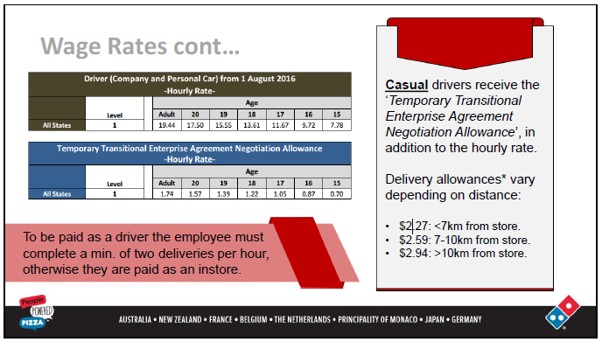
340 Slide 49 stated:
Domino’s Industrial Relations Team
We investigate concerns from: Employee; Fair Work Commission; SDA Union; Department of Immigration; DPO; Franchisees.
Everything from underpayment of wages, breaches in VISA conditions, Bullying, Discrimination and Harassment and more.
341 Slide 54 stated:
Domino’s Bookkeeping Service (DBS)
Payroll and bookkeeping complete on your behalf by experience[d] accountants. Allows you to concentrate on the important part of your business, customer service
(Emphasis added.)
342 Slide 56 concluded:
Non-compliance with IR laws can result in large penalty fines and negative media coverage about your store and Domino’s in general
The recent 7Eleven controversy was an example of this.
If you have any doubts about how your current system is working then please contact the Industrial Relations team for assistance.
Alternatively, you may wish to consider getting the Domino’s Bookkeeping Service to handle all your payroll and your IR paperwork.
(Emphasis added.)
7.4.1.5 Whether it is likely that franchise operators read the Fair Work Laws Training Materials
343 As noted above, Common Questions 1 and 1A concern whether Domino’s provided the alleged documents to some or all franchise operators during the Relevant Period, and Common Question 2 concerns whether the documents included a disclaimer. I have dealt with those issues in relation to the Fair Work Laws Training Materials.
344 Domino’s, however, made several submissions directed at showing that the applicant had not established that franchise operators had read the Fair Work Laws Training Materials. Strictly speaking, those submissions go to whether the provision of those documents is likely to have conveyed the alleged representations, but it is convenient to deal with those submissions now, while the contents of the documents and their dissemination by Domino’s are fresh to mind.
345 First, Domino’s submitted that the fact that it had uploaded the Fair Work Laws Training Materials to DOTTI did not show that franchise operators had read them, and it alleged in the AD that they were downloaded from DOTTI by very few franchise operators. In particular, it alleged that:
(a) the Fair Work Training Presentation was downloaded by approximately 4% of all primary franchisees and secondary contacts;
(b) the Workplace Laws Training Manual was downloaded by approximately 10% of all primary franchisees and secondary contacts;
(c) the Fair Work Laws training module on DOTTI was completed by approximately 43% of all primary franchisees and secondary contacts; and
(d) the Fair Work Laws: Franchisee Orientation Program was downloaded by approximately less than 1% of all primary franchisees and secondary contacts.
346 Second, Domino’s submitted that only those franchise operators who were in existence as at 2 May 2012 could have received the 2 May 2012 Training Email and the attached Fair Work Training Presentation and Workplace Laws Training Manual. Furthermore, it said that whether a franchise operator who received the email then read it and its attachments is another question. It accepted that, in the absence of evidence to the contrary, it is open to be inferred that a document that was received by email was also read. But it submitted that, as pleaded, it would seek to adduce evidence in relation to whether the franchise operators at that time read the 2 May 2012 email (i.e., computer evidence that shows whether an email was read or not).
347 I found little force in those submissions.
348 First, and importantly, the applicant gave unchallenged evidence that it was possible to read a document that had been uploaded to DOTTI in the web browser, without a requirement to download it. I accept that evidence. Further, Domino’s filed an affidavit by Mr Ross, Domino’s Learning System Specialist, in which he deposed as to the level of downloading of documents by franchise operators and Store Managers at the North Caboolture Store during the Relevant Period. He was scheduled to give evidence in the trial, and given his role within Domino’s, I infer that he was in a position to give evidence about how documents could be viewed on DOTTI. That issue was front and centre in the trial, but as it eventuated Domino’s decided not to call Mr Ross, or any other witness, in support of its allegation about the level of downloading of those documents. That left its allegation in the AD about the level of downloading unsupported by any evidence. Accordingly, the extent to which a document was downloaded by franchise operators is not probative in relation to the extent to which franchise operators read those documents.
349 Domino’s made the same contention about the level of downloading in relation to a raft of the documents relied upon by the applicant. The same reasoning applies in relation to those documents.
350 Second, whether or not franchise operators downloaded the Fair Work Training Presentation or the Workplace Laws Training Manual has little significance when, as Domino’s admitted:
(a) it emailed those documents to all existing franchise operators as at 2 May 2012; and
(b) from 2 May 2012, it provided those documents to all new franchise operators as part of their induction training (or from 20 May 2014 the successor document, the Fair Work Laws: Franchisee Orientation Program).
Thus, every franchise operator in the Relevant Period was provided with those documents.
351 Third, the fact that on 2 May 2012 Domino’s directly emailed the Fair Work Training Presentation and the Workplace Laws Training Manual to franchise operators does not of itself establish that they read those documents. However, I consider it appropriate to infer that it is more likely than not that all franchise operators read those documents. The following matters are material to my view:
(a) Domino’s uploaded the Fair Work Training Presentation and the Workplace Laws Training Manual to DOTTI on 2 May 2012, as training documents for the assistance of its franchise operators, and left the documents available on DOTTI until the end of the Relevant Period. Franchise operators are likely to think that Domino’s would not upload training documents for them unless they were important.
(b) On their face, those documents were important to franchise operators as they addressed matters that were significant to operating their Franchise Stores in accordance with their obligations under the applicable industrial instruments. It will be recalled that it was a requirement of the sub-franchise agreements that franchise operators must comply with the terms and conditions under any relevant enterprise agreement or applicable industrial instrument (see cl 2.4.2).
(c) On the same date as it uploaded the documents to DOTTI, Domino’s sent the same training documents directly to franchise operators by email, which underlined the fact that Domino’s considered them to be important. Domino’s did so under cover of the 2 May 2012 Training Email, which informed franchise operators that it sent the documents to assist franchise operators “with understanding the new Fair Work requirements” and advised them of a “mandatory” Fair Work Laws Training module on DOTTI.
(d) Domino’s told franchise operators that the training was mandatory, which further underlined the importance of the documents. As earlier noted, cl 11 of the sub-franchise agreements provided:
TRAINING
11.1 Initial training
11.1.1 You (or the Director, Controlling Shareholder or Partner if You are a corporation or partnership and, if so, the Director, Controlling Shareholder or Partner may substitute a designated individual) must enrol and complete all training programs and classes which [Domino’s] require for the operation of a Domino’s Pizza Store.
…
11.1.4 All training programs and classes must be completed to [Domino’s] satisfaction.
(Emphasis added.)
(e) Thus, the sub-franchise agreements required franchise operators to conduct their franchise in accordance with the Operating Manual and adhere to all directions issued by Domino’s. Domino’s statement that the Fair Work Laws Training module was “mandatory” was such a direction.
352 In those circumstances, it is more likely than not that all franchise operators who received the 2 May 2012 Training Email and its attachments read them either as attachments to the email or online through DOTTI. Thereafter, until the end of the Relevant Period, Domino’s provided all new franchise operators with those documents (or the Fair Work Laws: Franchisee Orientation Program) as part of their induction training. In circumstances where:
(a) those persons had newly commenced a franchise involving considerable financial outlay and associated risk;
(b) the induction training was compulsory under their sub-franchise agreements; and
(c) the documents concerned matters that were significant to the profitable operation of their Franchise Store,
I consider it to be substantially more likely than not that franchise operators who were provided with those documents read them.
353 Fourth, Domino’s submitted that it would adduce evidence in relation to whether existing franchise operators as at 2 May 2012 read the 2 May 2012 Training Email and its attachments (i.e., computer evidence that shows whether an email was read or not). However:
(a) in relation to the applicant’s personal claim, Domino’s did not adduce any such evidence in relation to the principals standing behind Dominoids and MC Pizza (Ms Smith, Mr Glynn or Mr Benson) or the relevant Store Managers of the North Caboolture Store; and
(b) in relation to the Common Questions, Domino’s did not adduce any such evidence in relation to whether or not any existing franchise operator on 2 May 2012 read the email and attachments.
Thus, there is no evidence before the Court that any franchise operator did not read the email and its attachments. For the reasons I have explained, it is reasonable to infer that all franchise operators who were provided with those documents read them.
354 The same can be said of the Fair Work Laws: Franchisee Orientation Program. The following matters are material to my view in this regard:
(a) Domino’s uploaded the Fair Work Laws: Franchisee Orientation Program to DOTTI on 28 October 2014 as a training document for the assistance of its franchise operators, and it remained available to them on DOTTI until the end of the Relevant Period. Again, most franchise operators were likely to think that Domino’s would not upload a training document for franchise operators unless it thought it was important.
(b) On its face, the document was important to franchise operators as it addressed matters which were significant to operating their Franchise Store in accordance with their obligations under the applicable enterprise bargaining or industrial instrument. Under their sub-franchise agreements they were required to comply with the terms and conditions under any applicable enterprise agreement or industrial instrument (cl 2.4.2). They were likely to want to read this training document, unless they were already on top of their obligations by reading the Fair Work Laws Training Materials.
(c) From 20 May 2014 until the end of the Relevant Period, Domino’s provided all new franchise operators with this document as part of their induction training. In circumstances where those persons had newly commenced a franchise involving a considerable financial outlay, the induction training was compulsory under their sub-franchise agreements, and the documents concerned matters which were significant to the profitable operation of their Franchise Store, I consider it to be substantially more likely than not that they read those documents when Domino’s provided them.
It is reasonable to infer that all franchise operators from 28 October 2014 until the end of the Relevant Period read the Fair Work Laws: Franchisee Orientation Program.
7.4.2 Employment Law Compliance Policy
355 The applicant alleged (2FASOC [29B(e)]) that on 8 October 2015 Domino’s uploaded to DOTTI and made available to franchise operators, until on or around 18 July 2017, a document titled “Policy - Employment Law Compliance v1.2” dated 7 October 2015 (Employment Law Compliance Policy Version 1.2). Domino’s admitted that. Thus, there is again no dispute regarding the provision of this document to franchise operators, nor that it remained available to franchise operators on DOTTI in the period specified.
356 Two earlier versions of this policy are also in evidence, dated 17 April 2014 (Employment Law Compliance Policy Version 1) and 28 May 2014 (Employment Law Compliance Policy Version 1.1). The relevant parts of those policy documents are materially the same as Version 1.2 relied upon by the parties.
357 It is reasonable to infer that Domino’s provided Employment Law Compliance Policy Versions 1, 1.1 and 1.2 to all franchise operators in the period from 17 April 2014 to 18 July 2017. Domino’s did not contend to the contrary.
358 That inference includes Dominoids and MC Pizza as they and the natural persons behind them were operating one or more Franchise Stores in that period. In any event, Domino’s admitted it provided those documents to Dominoids and MC Pizza.
359 I now turn to set out the parts of the Employment Law Compliance Policy Version 1.2 relied upon by the parties.
360 The applicant relied upon the following parts of the policy:
(a) On page 1:
Sub-Franchisees must…pay all employees at a rate not less than the minimum rates provided for under the applicable Domino’s Enterprise Bargaining Agreement (EBA) (where applicable to the employee);
(Emphasis added.)
(b) On page 2:
If [Domino’s] suspects, has reason to suspect or has clear evidence to support that a Sub-Franchisee is not complying with their obligations under Australian employment law (and therefore the terms of their Sub- Franchise Agreement “SFA”) then, without prejudice to its rights under the SFA, [Domino’s] may take any or all of the following steps:
a) serve an Investigation Notice on the Sub-Franchisee …;
b) serve a Notice to Remedy Breach of Sub-Franchise Agreement …:
…
c) require the Sub-Franchisee to submit to an audit of their employees’ entitlements, such audit to be performed either by DPE or an external auditor.
361 Domino’s relied on the following disclaimers:
(a) On page 1:
It is the Sub-Franchisee’s sole responsibility to inform themselves of, and comply with, their legal obligations in connection with the employment of team members.
(b) On page 2:
This Policy is not intended as legal advice. Sub-Franchisees must obtain their own legal, accounting and business advice in connection with the operation of their stores and it is their sole responsibility to maintain compliance with all applicable laws.
7.4.2.1 Whether it is likely that franchise operators read the Employment Law Compliance Policy
362 Again, it is convenient to now address Domino’s arguments to the effect that, although admitting that it uploaded this policy to DOTTI, the applicant did not establish that franchise operators read it.
363 Domino’s stated that it was not established how many, if any, primary franchisees and secondary contacts downloaded this document. For the reasons I have explained, such evidence is not probative of whether franchise operators read the document. They could read the document in the web browser.
364 In my view all franchise operators who operated a Franchise Store between 17 April 2014 and 18 July 2017 and were provided with the document were more likely than not to have read it. The following matters are material to my view:
(a) Domino’s uploaded the Employment Law Compliance Policy Version 1 to DOTTI on 17 April 2014, followed by two later but materially similar versions, thereby making it available to franchise operators until on or about 18 July 2017. Most franchise operators are likely to think that Domino’s would not upload a policy document for them unless it thought the document was important.
(b) On its face, the document was likely to be seen as important by many franchise operators as it was titled “Company Policy” in large font on the sidebar, and under their sub-franchise agreements they were required to comply with all Domino’s policies and directions. Further, on its face, the policy was important as it addressed matters that were significant to operating their Franchise Store in accordance with their obligations under the applicable enterprise agreement or industrial instrument. Under their sub-franchise agreements they were required to comply with the terms and conditions under any relevant enterprise agreement or applicable industrial instrument (cl 2.4.2).
(c) The Employment Law Compliance Policy included the following warning in bold text:
We reiterate that a failure by a Sub-Franchisee to comply with the applicable laws in connection with the store has serious consequences for that store, the Sub-Franchise Agreement and the directors of a Sub-Franchisee personally.
(Emphasis in original.)
(d) It also provided that where a franchise operator fraudulently represented minimum pay rates to an employee, Domino’s reserved its right to terminate the sub-franchise agreement.
365 That inference applies to Dominoids and MC Pizza and the natural persons standing behind them. Both were operating one or more Franchise Stores between 17 April 2014 and 18 July 2017.
7.4.3 The TANDA Training Materials
366 The applicant alleged (2FASOC [29B(f)-(j), (l)-(p)]) that Domino’s uploaded to DOTTI and made available until the end of the Relevant Period to target groups, including the Franchisee/RL target group and the “Manager target group” (being a group to which employees’ access was controlled by franchise operators), ten documents comprising training materials in relation to the TANDA software (which Domino’s was in the process of introducing, or had introduced as compulsory for all Franchise Stores) (the TANDA Training Materials).
367 The applicant alleged that Domino’s uploaded the following TANDA Training Materials to DOTTI on the dates specified, and thereby made them available to all franchise operators from that date until the end of the Relevant Period:
(a) on and from 21 November 2016, a PowerPoint presentation titled “Introducing My Domino’s” (My Domino’s and TANDA Training Presentation) (2FASOC [29B(f)]);
(b) on and from 29 November 2016, a video titled “TANDA - Bookkeeper Webinar” (2FASOC [29B(g)]);
(c) on and from 12 December 2016, a document titled “TANDA Help Guide - Bookkeepers and Payroll Officers” (TANDA Help Guide) (2FASOC [29B(h)]);
(d) on and from 16 March 2017, a document titled “New Instructions for the Sales Report - using TANDA” (TANDA - New Instructions for the Sales Report) (2FASOC [29B(i)]);
(e) on and from 18 May 2017, a document titled “Policy - TANDA Software Implementation” (TANDA Software Policy) (2FASOC [29B(j)]);
(f) on and from 7 July 2017, a document titled “TANDA Information Kit - May 2017” (TANDA Information Kit) (2FASOC [29B(l)]);
(g) on and from 18 October 2017, a document titled “Policy - TANDA Timesheet Approvals” (TANDA Timesheet Approvals Policy) (2FASOC [29B(m)]);
(h) on and from 15 January 2018, a document titled “TANDA, Reclassifying Team Members for the new Domino’s EBA” (Reclassifying Team Members on TANDA) (2FASOC [29B(n)]);
(i) on and from 18 January 2018, a PowerPoint presentation titled “Fast Food Industry Award 2010 TANDA” (TANDA Fast Food Industry Award Presentation) (2FASOC [29B(o)]); and
(j) on and from 18 January 2018, a PowerPoint presentation titled “Classifying staff (non DBS stores only)” (Classifying Staff (non-DBS Stores) in TANDA) (2FASOC [29B(p)]).
368 Domino’s admitted the allegation in respect of each of these documents. There is again no dispute as to the provision of the documents to franchise operators, nor that they remained available to franchise operators on DOTTI throughout the Relevant Period.
369 I infer that Domino’s provided these documents to all franchise operators in the period from the date of their upload to the end of the Relevant Period.
370 That inference applies to Dominoids and MC Pizza. I also note:
(a) in relation to Dominoids, that it was operating the Moranbah and Strathpine Stores after 21 November 2016 and through the Relevant Period. Dominoids was no longer the applicant’s employer in this period as it had ceased to operate the North Caboolture Store in August 2016; and
(b) in relation to MC Pizza, that it was operating the North Caboolture Store during this period. Further, Domino’s admitted that MC Pizza used TANDA from 1 July 2017, and also that it provided the TANDA - Bookkeeper Webinar to MC Pizza on or about 13 December 2016.
371 I now turn to set out the parts of those documents relied upon by the parties.
7.4.3.1 My Domino’s and TANDA Training Presentation
372 The applicant relied on slide 26 of this presentation, reproduced below:
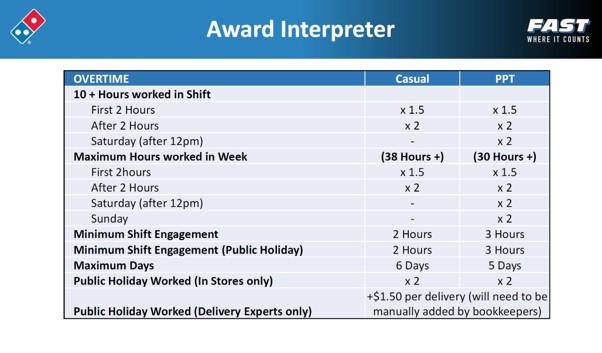
7.4.3.2 TANDA - Bookkeeper Webinar
373 The applicant relied on the following statements in the webinar:
(a) at 00:01:00:4:
We look after rostering, we do timesheets, leave, we also do payroll integration so taking information that’s in TANDA, inputting it or exporting it directly into your payroll system to remove many of those manual processes and we also do award interpretation.
(b) at 00:02:09:0:
“… we basically look after a full range of business types and both modern awards so award rules coming from Fair Work and then obviously personal EBA agreements, things like that, that means we can build in specific award rules for each organisation as required and then be able to effectively build in specific award rules for each organisation as required …”
(Emphasis added.)
(c) at 00:12:03:8:
[TANDA has] worked with Domino’s to build up the award rules that apply to Domino’s users or employees at this stage, we’ve crafted those rules, we’ve built them into the TANDA system and they will therefore apply for every employee depending on their circumstances, so that includes hire duties…and overtime…and…other allowances.
(Emphasis added.)
(d) at 00:14:07:1:
[W]e pop over to the right hand side, we can see that there’s an industry award, now this award will already be defaulted in your account so that you won’t need to come in and select which award applies to you; it’s already be there. We have an instance the other day where there’s a couple of stores that are using something a little bit different and if there’s anyone in the room here that might be using the fast food modern award please feel free to let us know or let training at Domino’s know because there some small changes we can make in order for the system to work with your current set up.
(Emphasis added.)
(e) at 00:15:14:4:
…what you will find though is this classification level field is blank and this is what really drives the pay rate that we sort of have or is available to each of our employees. So what you will need to do is select the lowest possible base rate but applicable to that individual person…then those rates would automatically apply in TANDA.
(Emphasis added.)
(f) at 00:41:01:0:
… I am sure we can all, you know, we would all agree that labour laws in Australia are very complicated and they are often difficult for people to understand so TANDA is really committed to making this as easy to understand and as clear and accurate as it possibly can so you have complete confidence when you are going through and completing your payroll.
374 Domino’s drew attention to the following statement in the webinar, at 00:14:07:
We did have an instance the other day where there’s a couple of stores that are using something a little bit different and if there’s anyone in the room here that might be using the Fast Food Modern Award, please feel free to let us know or to let Training at Domino’s know because there’s some small changes that we can make in order for the system to work with your current set up.
(Emphasis added.)
375 It also noted the following section of the webinar, at 00:16:23:
If for example you have a team member which you pay differently to the award, so there might be a higher rate perhaps or you pay someone different based on an individual agreement, TANDA could also account for that situation and for that you would actually fill out the base hourly rate, so you’ll pop a separate base salary rate in here and that would override any rate that is generated automatically by this classification and level. If it is a higher rate or a different rate for a driver, please do keep in mind that TANDA is currently applying that TTA, the temporary transitional arrangement allowance, automatically.
376 Domino’s submitted, and I accept, that the webinar was conducted by a TANDA representative, and the statements in it were made by that representative. I do not, though, consider anything turns on that. Domino’s provided the webinar to franchise operators on DOTTI, and it is responsible for any representations found to have been conveyed by that publication.
7.4.3.3 TANDA Help Guide
377 The applicant relied on the following statements in the TANDA Help Guide:
(a) On page 7:
Tanda automatically applies the Temporary Transitional Arrangement (TTA) for all casual Delivery Experts. This means that if you are providing a separate base hourly rate to your casual drivers, this rate should not include the TTA.
(Emphasis added.)
(b) On page 16:
Award Interpretation
Tanda’s award interpretation engine completely automates the calculation process for award/pay rates. This means that Tanda will automate pay rates and allowances for each employee. Tanda has worked with Domino’s over many months to custom build the current enterprise agreement - so you can be sure that you’re paying staff correctly.
(Emphasis added.)
(c) On page 19:
Allowances
The following allowances are currently recorded in Tanda:
• Delivery Zone A, B and C
• Temporary Transitional Arrangement
• Company Car deliveries Should there be any other allowances or deductions that apply in your store, such as uniform deductions or partner foundation deductions, continue to process these as usual in your payroll system.
378 Domino’s relied on the same passage at page 16 (as extracted above).
7.4.3.4 TANDA - New Instructions for the Sales Report
379 The applicant relied on the following passages from the document:
(a) On page 1:
2. If you click on a Labour$ or Mileage$ cell in the sales report, this will cause it to open the TANDA Labour data popup allowing you to enter the correct values from TANDA.
(b) On page 2:
4. Enter the following data only:
• Labour Hrs
• Total Labour $ (this includes TTA and/or Sunday Loading and any overtime)
• Delivery Zone A:
• Delivery Zone B:
• Delivery Zone C:
…
5. To view delivery allowances, use the drop down to view Delivery Zone A, B or C.
7.4.3.5 TANDA Software Policy
380 This document was titled “COMPANY POLICY”, and it included the following opening passages relied on by the applicant:
Overview
TANDA (Time and Attendance) Workforce Management Solution launched in November 2016. It is expected that all Domino’s stores will have the TANDA software program implemented and utilised in place of any other rostering program by 1 July 2017.
Purpose
The purpose of this policy is to inform all Stores and Franchisees that the rollout of national workforce management solution TANDA will now be mandatory and every store in Australia and New Zealand will be required to have the program up and running by 1 July 2017.
Rationalisation
The installation of the TANDA workforce management program will assist DPE and its Franchisees achieve better compliance with employee entitlements.
It will also allow Franchisees and managers to efficiently roster and record team member attendance and provide greater insight into labour costs across the network.
…
(Emphasis in original.)
7.4.3.6 TANDA Information Kit
381 The applicant relied on the following passage from page 8 of this document:
AWARD INTERPRETER
Overtime
Tanda has the Domino’s award details pre-loaded. Overtime and public holiday rates will automatically be applied to roster calculations and timesheets.
7.4.3.7 TANDA Timesheet Approvals Policy
382 The applicant relied upon the entirety of the document, as extracted below:
COMPANY POLICY
TITLE: | Policy - TANDA Timesheet Approvals |
CATEGORY: | Store Operations |
APPLICATION: | Corporate & Franchise (Aust/NZ) |
ISSUE: | 11 October 2017 |
EFFECTIVE DATE: | 11 October 2017 |
VERSION: | 1.0 |
Overview
This policy outlines the mandatory process for the daily approval of timesheets in TANDA and approval of weekly timesheets by 7am Monday morning.
Best practice requires store managers to approve timesheets in TANDA on a daily basis as part of the End of Day process, with all weekly timesheets to be approved by 7am (Brisbane Time) Monday morning.
Daily approval of timesheets allows for easier rectification of issues with clock-ins and clock-outs and provides daily feedback on wage costs. It also provides the employees sufficient time to query any edits prior to the weekly pay run.
Effective immediately, it is mandatory for all stores to apply this standard. Franchisees, Store Managers and Shift Runners are to approve timesheets via the Timesheets - Daily page in TANDA.
We recommend all stores check the following details nightly: -
• Employees are clocked in using the correct position in Pulse, that is Delivery Expert, Instore, Shift Runner or Manager and if required adjust accordingly, all employees must clock out at the end of their shift.
• All clock in and out records are correct and educate team members on the correct procedure, as required.
• Employees who worked a shift longer than 5 hours received a break and this is recorded correctly in Tanda.
• Employees applied for leave in Tanda and this is approved prior to the end of the week.
• All shifts are approved daily using the daily timesheets.
• On Sunday night weekly timesheets must be checked and any record that appears to be white must be checked, corrected and approved.
DBS Stores
Payroll no longer approve timesheets on a stores behalf. Timesheets must be approved by 7am (Brisbane Time) Monday to ensure pays are processed on time.
If in the event a store fails to approve timesheets by the 7am Monday cut off, the Payroll team will be unable to pay the employees that week until the approvals are received. If the team is required to complete a manual pay run because of this delay, this may attract an administration fee of $50 plus GST.
Payroll can no longer make amendments to shift positions, hours and deliveries in the draft reports; these changes must be made in Tanda prior to Monday morning cut off. In the event these changes need to be made in the draft report, Payroll will require employee’s authorisation.
Approved:
Lynn Carruthers | Nick Knight |
CFO, Australia and New Zealand | CEO, Australia and New Zealand |
(Emphasis in original.)
7.4.3.8 Reclassifying Team Members on TANDA
383 The applicant relied on the following passage on page 4 of this document:
Base Hourly Rate
Tanda will automatically assign an ordinary wage rate (according to the EBA) to a team member where their Classification/Level and Date of Birth has been set on their Payroll Page.
If the team member is paid above the ordinary wage rate for their age and classification; however, you should manually enter their base hourly rate in the Base Hourly Rate field.
(Emphasis in original.)
7.4.3.9 TANDA Fast Food Industry Award Presentation
384 The applicant relied on the entire 24-page presentation. The significance of this presentation is that it explained to franchise operators how the TANDA system would apply the classifications, pay rates and terms and conditions of employment for a franchise operator’s employees under the Award, noting that for DBS Stores this would be automated through TANDA. For non-DBS Stores, the presentation provided instructions as to how to input the relevant information. The final slide, titled “Support”, is reproduced below:
7.4.3.10 Classifying Staff (non-DBS Stores) in TANDA
385 The applicant relied on the entire document. To my mind the significance of the presentation is that it explained to franchise operators of non-DBS Stores how the TANDA system was to be used in relation to the Award entitlements of their employees in such stores.
7.4.3.11 Whether the TANDA Training Materials were read by franchise operators
386 Again, it is convenient to now address Domino’s submission to the effect that, although it admitted that it uploaded these documents to DOTTI, the applicant did not establish that franchise operators read them.
387 Domino’s pleaded that:
(a) the My Domino’s and TANDA Training Presentation was downloaded by approximately 8% of all primary franchisees and secondary contacts;
(b) the TANDA - Bookkeeper Webinar was downloaded by approximately 3% of all primary franchisees and secondary contacts;
(c) the TANDA Help Guide was downloaded by approximately 5% of all primary franchisees and secondary contacts;
(d) TANDA - New Instructions for the Sales Report was downloaded by approximately 2% of all primary franchisees and secondary contacts;
(e) the TANDA Software Policy was downloaded by approximately 1% of all primary franchisees and secondary contacts;
(f) the TANDA Information Kit was downloaded by approximately 2% of all primary franchisees and secondary contacts;
(g) the TANDA Timesheet Approvals Policy was downloaded by approximately less than 1% of all primary franchisees and secondary contacts;
(h) Reclassifying Team Members on TANDA was downloaded by approximately less than 1% of all primary franchisees and secondary contacts;
(i) the TANDA Fast Food Industry Award 2010 Presentation was downloaded by approximately less than 1% of all primary franchisees and secondary contacts; and
(j) Classifying Staff (non-DBS Stores) in TANDA was downloaded by approximately less than 1% of all primary franchisees and secondary contacts.
388 For the reasons I have explained, that is not probative of whether franchise operators read the documents. The documents could be read by franchise operators, and the webinar viewed, in a web browser.
389 Further, for the reasons I now turn to explain, I consider it to be more likely than not that all franchise operators who were provided with access to these documents during the period from 21 November 2016 to the end of the Relevant Period, read them. The following matters are material to my view:
(a) Domino’s provided those documents to its franchise operators on DOTTI on the dates specified, and it left them available to franchise operators on DOTTI until the end of the Relevant Period. Most franchise operators are likely to think that Domino’s would not upload training documents for them unless it thought they were important. The fact that few franchise operators may have downloaded the documents says nothing about how many read the documents, because they could be read in a web browser;
(b) Domino’s uploaded the TANDA Training Materials to DOTTI and left them available on DOTTI in circumstances where it was progressively rolling out TANDA to all franchise operators from late December 2016, and use of TANDA by franchise operators was to be compulsory from July 2017. The introduction of TANDA constituted a significant change in the operating software for franchise operators, and it was important to many aspects of the operation of a Franchise Store. In the circumstances, franchise operators are likely to have seen the TANDA Training Materials as important and necessary reading;
(c) any additional training directed by Domino’s was mandatory (although it is not clear whether this training was mandatory);
(d) the TANDA Software Policy and the TANDA Timesheet Approvals Policy were titled “Company Policy”, and on their face, they were important to franchise operators because their sub-franchise agreements required them to comply with all Domino’s policies and directions;
(e) the TANDA Timesheet Approvals Policy was important to franchise operators on the face of the document because it set out mandatory processes for the daily and weekly approval of timesheets in TANDA; and
(f) the TANDA Fast Food Industry Award Presentation concerned the operation of TANDA in relation to the Award and changes to the applicable pay rates for employees which flowed from the Award, which were important for franchise operators to understand.
390 That inference does not apply to Dominoids in relation to the applicant’s individual case, as it ceased to operate the North Caboolture Store in August 2016. The inference does apply to MC Pizza in relation to the applicant’s individual case, as it was operating the North Caboolture Store during this period.
7.4.4 The Pay Rate Notices
391 The applicant alleged that Domino’s regularly provided Pay Rate Notices to franchise operators, in which it set out the applicable pay rates for Delivery Drivers and In-Store Workers from time to time. It did so by uploading such notices to DOTTI and making them available to franchise operators, and/or by directly emailing the Pay Rate Notices to franchise operators.
392 First, the applicant alleged (2FASOC [29C]) that during the Relevant Period, Domino’s regularly sent Pay Rate Notices by email to the email addresses of the primary franchisees, which stated the applicable wage rates for Delivery Drivers and In-Store Workers. As earlier noted, Domino’s email distribution list to franchise operators contained the email addresses of all primary franchisees but occasionally, if requested, a franchise operator’s secondary contacts were added to the distribution list.
393 It is alleged that Domino’s sent 15 Pay Rate Notices to franchise operators regarding the applicable wage rates for Delivery Drivers and In-Store Workers between 24 June 2013 and 14 December 2017, as follows:
(a) two on 24 June 2013, relating to the Delivery Driver and In-Store Worker wage rates respectively to apply from 1 July 2013;
(b) two on 27 June 2014, relating to the Delivery Driver and In-Store Worker wage rates to apply from 1 July 2014;
(c) two on 26 June 2015, relating to the Delivery Driver and In-Store Worker wage rates to apply from 1 July 2015;
(d) two on 8 July 2016, relating to the Delivery Driver and In-Store Worker wage rates to apply from 1 July and 1 August 2016 respectively;
(e) one on 28 November 2016, relating to the In-Store Worker wage rates to apply from 1 January 2017;
(f) two on 30 June 2017, relating to the Delivery Driver and In-Store Worker wage rates to apply from 1 July 2017;
(g) two on 27 October 2017, relating to the Delivery Driver and In-Store Worker wage rates to apply from 1 December 2017;
(h) one on 13 December 2017, relating to the In-Store Worker wage rates to apply from 1 July 2015, 1 July 2016 and 1 July 2017; and
(i) one on 14 December 2017, relating to the In-Store Worker wage rates to apply from 1 July 2017.
(collectively, the Pay Rate Notices by email).
394 Second, the applicant alleged (2FASOC [29B(k)]) that on 30 June 2017 Domino’s uploaded to DOTTI and made available to all target groups (including franchise operators), until the end of the Relevant Period, the following two documents:
(a) a document titled “Confidential: Domino’s Pizza Enterprises Driver Pay Rates to apply from 1 July 2017” dated 30 June 2017 (Delivery Driver pay rates to apply from 1 July 2017); and
(b) a document titled “Confidential: Domino’s Pizza Enterprises Instore Pay Rates to apply from 1 July 2017” dated 30 June 2017 (In-Store Worker pay rates to apply from 1 July 2017).
(collectively, the Pay Rate Notices on DOTTI).
395 Domino’s admitted the allegations in respect of all of these documents. Again, there is no dispute as to the provision of the documents to franchise operators.
396 I infer that Domino’s provided these documents to all franchise operators in the period from the date they were either directly emailed to franchise operators or uploaded to DOTTI for franchise operators through to the end of the Relevant Period.
397 This inference applies to Dominoids in relation to the applicant’s individual case, as it operated the North Caboolture Store from 17 December 2012 to 28 August 2016, and other stores from earlier dates. The inference also applies to MC Pizza as it operated one or more Franchise Stores during the Relevant Period, including the North Caboolture Store from 29 August 2016 until the end of the Relevant Period. In any event, Domino’s admitted that it provided those documents to Dominoids and MC Pizza.
398 I now turn to set out those parts of the Pay Rate Notices upon which the parties relied.
7.4.4.1 The Pay Rate Notices by email
399 These documents had many similarities. Domino’s admitted that the Pay Rate Notices for Delivery Drivers and In-Store Workers for the Relevant Period invariably described the rates as the “applicable” rates or the rates that were “to apply”.
7.4.4.1.1 Pay Rates to apply from 1 July 2013
400 The evidence shows that Domino’s sent two documents to all franchise operators, under cover of an email dated 24 June 2013, setting out the National Driver and In-Store Worker wage rates to apply from 1 July 2013. The covering email relevantly stated:
Good afternoon
Attached are the new minimum national wage rates for both in-stores and drivers due to take effect on 01 July 2013. These new rates take into account the recent 2.6% national wage case decision by the Fair Work Commission earlier this month.
Please note that the increase can be absorbed into any rate that you are currently paying that is higher than these new rates. Eg. Drivers that are currently on $18.92 per hour will remain on $18.92 per hour if the new prescribed rate is less than $18.92.
(Emphasis in original.)
401 The applicant relied upon the following parts of the attached documents.
402 The first document was headed “National Drivers’ Wage Rates from 1 July 2013 - NATIONAL SUMMARY”. Beneath that heading a table (reproduced below) set out the applicable minimum wage rates for casual and permanent drivers by store location, age, and length of service (where applicable).
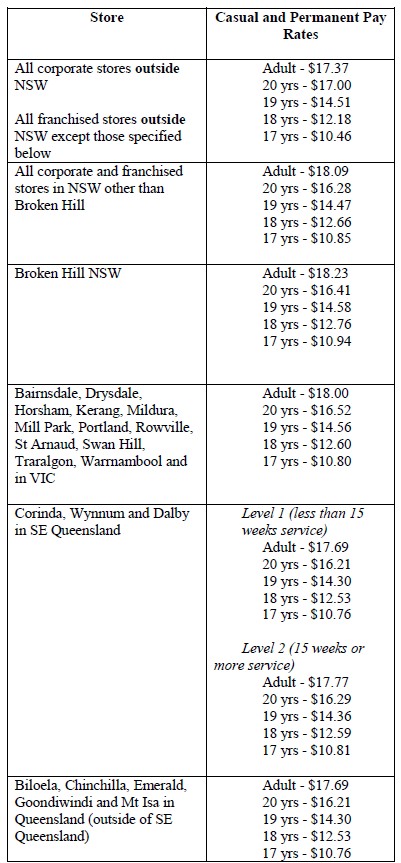
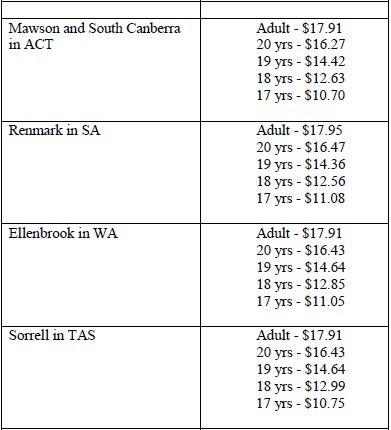
403 The notice also specified three delivery allowances payable to Delivery Drivers applicable to all Domino’s Stores, which increased with the distance travelled from the store. Those allowances did not vary with location, age, or length of service.
404 The second document concerned the wage rates for In-Store Workers and was headed “To apply from 1 July 2013 and allowing for 2.6% increase to minimum wage announced in June 2013”. Beneath that heading was a series of tables applicable to Domino’s Stores in each state and territory (reproduced below):
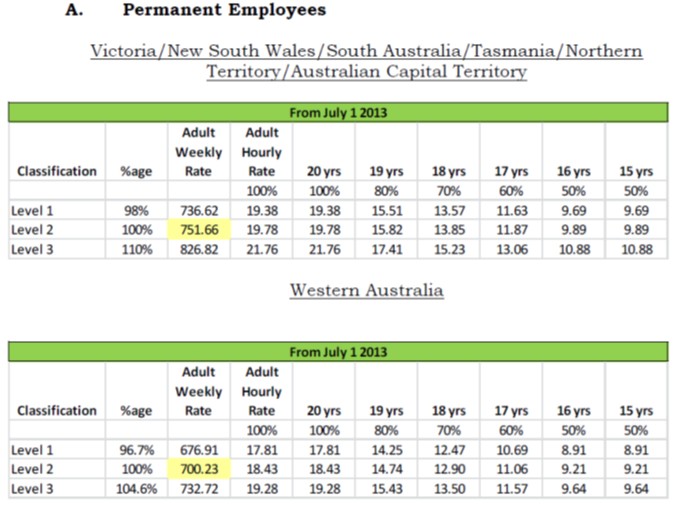
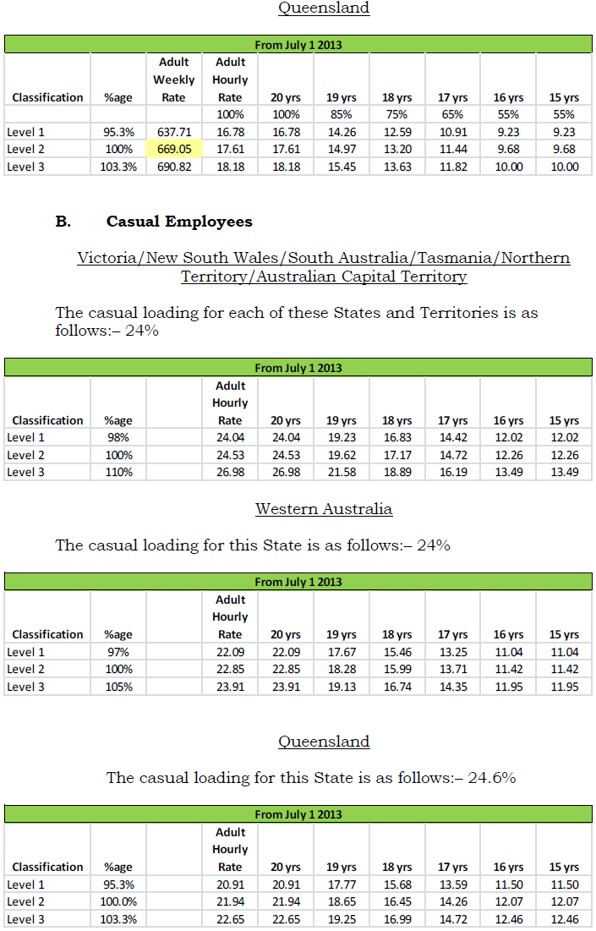
7.4.4.1.2 Pay Rates to apply from 1 July 2014
405 On 27 June 2014, Domino’s sent two documents to franchise operators, via an email to all franchise operators styled in the form of a “Fast Facts” flyer, with hyperlinks to the new national Delivery Driver and In-Store Worker wage rates to apply from 1 July 2014. The applicant relied upon the following parts of the documents.
406 Page 2 of the flyer contained a text box with hyperlinks which stated:
New wage rates from 1 July
New wage rates will take effect from 1 July 2014 to 30 June 2015.
Click here to view Domino’s new national in-store wage rates.
Click here to view Domino’s new national driver’s wage rates.
(Emphasis in original.)
407 If the franchise operator clicked the hyperlink for the new national In-Store Worker wage rates, he or she was taken to a document with the title “Confidential, National Domino’s In-Store Wage Rates to Apply from 1 July 2014 to 30 June 2015”. Under that, the new wage rates were presented in tables, by states and territories, depending upon whether the workers were permanent or casual (as reproduced below).
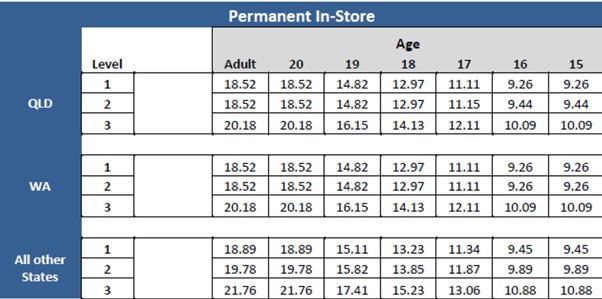
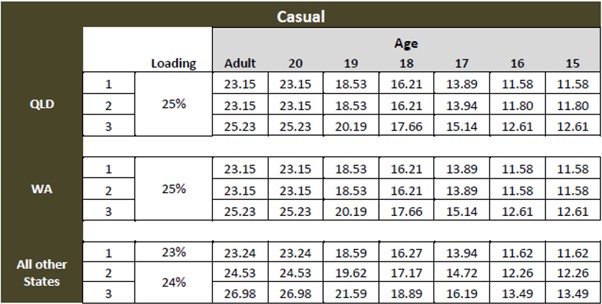
408 If the franchise operator clicked the hyperlink for the new national Delivery Driver wage rates, he or she was taken to a document with the title “Confidential, National Domino’s Drivers’ Wage Rates to Apply from 1 July 2014 to 30 June 2015”, which set out the new wage rates in the same format as in the Pay Rate Notices for 1 July 2013, but with higher rates and delivery allowances. Above the table, it included some information about “Makeup deliveries” and stipulated differential rates for drivers using company vehicles and private vehicles, which themselves made reference to applicable rates in the table.
7.4.4.1.3 Pay Rates to apply from 1 July 2015
409 On 26 June 2015, Domino’s sent two documents to franchise operators via an email to all franchise operators, styled in the form of a “Fast Facts” flyer. It included hyperlinks to the new national Delivery Driver and In-Store Worker wage rates to apply from 1 July 2015. The applicant relied upon the following parts of the documents.
410 Pages 1-2 of the email flyer contained a text box with hyperlinks that stated:
Employee relations update - Wage rates from 1 July
New wage rates will take effect from 1 July 2015.
View the new national in-store wage rates here and view the new national driver’s wage rates here as negotiated with the SDA Union effective 1 July 2015 for all Domino’s employees.
Click here to view the updated location allowances for Alice Springs, WA and NT also effective 1 July 2015.
Please take note of the special clauses at the top of the driver rates.
(Emphasis in original.)
411 The hyperlinks took the reader to new national Delivery Driver and In-Store Worker wage rates to apply from 1 July 2015, which set out the new wage rates in the same format as in the Pay Rate Notices for 1 July 2014, but with higher rates and allowances.
7.4.4.1.4 Pay Rates to apply from 1 July 2016 and 1 August 2016
412 On 8 July 2016, Domino’s sent two documents to franchise operators, under cover of an email to all franchise operators styled in the form of a “Fast Facts” flyer, with hyperlinks to the new national Delivery Driver and In-Store Worker wage rates to apply from 1 July 2016 and 1 August 2016 respectively. The applicant relied upon the following parts of the documents.
413 Page 1 of the email flyer contained a text box with hyperlinks which stated:
Interim wage conditions and rate charts
We are pleased to advise today that the SDA have agreed to support an interim pay increase proposal while we await the finalisation of Domino’s new enterprise agreement.
During this time, the following wage conditions will be applicable:
• All Drivers will be paid the same base hourly rate, regardless of whether they are using a company or private vehicle (junior rates still applicable)
• Drivers using a private vehicle will still be entitled to a delivery allowance
• The ‘Temporary Transitional Enterprise Agreement Negotiation Allowance’ will be payable to all drivers, in addition to their base hourly rate. This allowance will remain in place until Domino’s has finalised the new enterprise agreement with the SDA
• The minimum wage increase has also been applied to base hourly rates for both drivers and [In-Store Workers]
The new driver rates and enterprise agreement allowance will be applicable as of 1 August 2016, with existing (2015) rates payable until then. The Instore rates are effective as of 1 July 2016.
Click here to view the National Instore Wage Rates
Click here to view the National Driver Wage Rates
(Emphasis in original.)
414 The hyperlinks took the reader to new national Delivery Driver and In-Store Worker wage rates to apply from 1 July 2016 and 1 August 2016 respectively, which set out both new national Delivery Driver and In-Store Worker wage rates in the same format as for the In-Store Pay Rate Notices for 1 July 2014 and 1 July 2015 but with higher rates and allowances.
7.4.4.1.5 Pay Rates to apply from 1 January 2017
415 On 28 November 2016, Domino’s sent a document to franchise operators, via an email to all franchise operators styled in the form of a “Fast Facts” flyer, with hyperlinks to the new national In-Store Worker wage rates to apply from 1 January 2017. Page 1-2 of the email flyer contained a text box with hyperlinks that stated:
Important
1 Jan 2017
Sunday loading and wage rate
Please read below important information about the Sunday Loading pay rate that will apply from January 1, 2017 and how it will work with other pay rates.
If you have any further questions, please contact wages@Domino’s.com.au
• The Sunday loading only applies to shifts that start on the Sunday
• The Sunday loading will apply to the entire shift.
• The Sunday loading applies to Drivers, Instores and Shift Runners both Casual and Permanent.
• If a public holiday falls on a Sunday, only the public holiday penalty will apply instead of Sunday loading.
• If an employee falls into overtime on a Sunday, only the overtime penalty applies instead of the Sunday Loading.
• Payment for annual leave or sick leave taken on a Sunday when it is a rostered day, does not attract the Sunday Loading.
Instore Wage Rates 1 Jan 2017
Driver Wage Rates 1 Jan 2017
(Emphasis in original.)
416 Although the email provided a hyperlink to wage rates for Delivery Drivers from 1 July 2017, the applicant’s submissions focused only on the new In-Store Worker wage rates. The hyperlink took the reader to new national In-Store wage rates to apply from 1 January 2017, and the document set out wage rate tables for In-Store Workers split into two groups: “Queensland & Western Australia”, and “All Other States and Territories”. The three tables in each group presented wage rates according to Level 1, Level 2, and Level 3. Each table further divided rates according to age, and the applicable “Base Hourly Rate”, “Base Casual Hourly Rate”, and “Sunday Loading”.
7.4.4.1.6 Pay Rates to apply from 1 July 2017
417 On 30 June 2017, Domino’s sent two documents via email to all franchise operators styled in the form of a “Fast Facts” flyer, with hyperlinks to the new Delivery Driver and In-Store Worker wage rates to apply from 1 July 2017. The applicant relied upon the following parts of the documents.
418 Page 1-2 of the email flyer contained a text box with hyperlinks which stated:
New Wage Rates in TANDA
Wage rates will be increasing this coming week.
Please note that the new rates apply to the first full pay periods which commences Monday 3 July 2017. Stores will not see the new rates in TANDA until mid-week and as such the rostered labour amount will be incorrect. This is only temporary until the new rates are backdates to apply from Monday.
Stores using TANDA for labour calculations in the sales sheet will also be affected by the delay in rate appearing.
• Driver wage rates can be found HERE
• Instore wage rates can be found HERE
If you are not with DBS, you are not required to action anything with TANDA unless you have custom rates set up for team members. However, please ensure that these new wage rates are provided to your bookkeeper.
Please contact the Employee Relations Department should you have any questions regarding the wage rate increase.
419 Domino’s also made those Delivery Driver and In-Store Worker wage rates available to franchise operators on DOTTI (see above).
420 The hyperlinks took the reader to documents that tabulated the new national Delivery Driver and In-Store Worker wage rates to apply from 1 July 2017.
7.4.4.1.7 Pay Rates to apply from 1 December 2017
421 On 27 October 2017, Domino’s sent two documents via an email to all franchise operators, with hyperlinks to the new Delivery Driver and In-Store Worker wage rates to apply from 1 December 2017. The applicant relied upon the following parts of the documents.
422 The email said:
Good afternoon franchisees,
We’re currently in negotiations for a new EBA that will see adjusted entitlements for our employees.
The below entitlements are a transitional step for the business and from the first pay period following 1 December 2017 evening & late night penalties for all Level 1 & 2 employees (permanent & casual) will apply.
Similar to TEENA and Sunday Loading, it is a requirement that all Franchisees provide employees with these evening & late night penalties which are as follows:
• 10% loading for work performed between 10:00pm - 12:00am where a shift begins on Monday to Friday (inclusive);
• 15% loading for work performed between 12:00am - 06:00am where a shift begins on Monday to Friday (inclusive);
The updates wage rates with these additional penalties can be found at the links below:
• Driver Wage Rates - 1 December 2017
• Instore Wage Rates - 1 December 2017
Please note we are currently working with TANDA to have the necessary changes implemented within the system prior to the 1 December commencement date. We will keep you updates on progress with this change.
423 The hyperlinks took the reader to:
(a) a document in which In-Store Worker wage rates were tabulated into Level 1, 2 and 3, by age, by reference to each state or territory, and by reference to “Base Hourly Rate”, “Base Casual Hourly Rate”, “Sunday Loading”, “Evening Penalty” and “Late Night Penalty”; and
(b) a document in which Delivery Driver wage rates were tabulated by reference to each state or territory, by age, and by reference to “Base Hourly Rate”, “TTEAN Allowance”, “Sunday Loading”, “Evening Penalty” and “Late Night Penalty”, together with three rates for delivery allowances.
7.4.4.1.8 Pay Rates to apply retrospectively from 1 July 2015, 1 July 2016 and 1 July 2017
424 On 13 December 2017, Domino’s sent an email to all franchise operators with a hyperlink to In-Store Worker wage rates to be applied retrospectively from 1 July 2015, 1 July 2016 and 1 July 2017 for specified categories of In-Store Workers. The applicant relied upon the following parts of the documents.
425 The email relevantly said:
Good afternoon franchisees,
As part of our ongoing Enterprise Agreement negotiations we have been continually reviewing the store positions that exist in our business and the applicable wage classifications that are applied to those positions.
Recently it was identified that the wage classification being applied to some management positions differed between our current EBA and the provisions being provided for under the Fast Food Award. The key factor that has caused this difference is the varying in classifications across the two employment instruments.
After a detailed review of this matter it has been determined that where an employee falls within the Level 2 classification under the Fast Food Award they are entitled to be paid the applicable Level 2 wage rate as prescribed by the Award.
…
Employees that typically fall within the Level 2 classification are Manager in Training and Assistant Managers.
The level 2 wage rate under the Award is slightly higher compared to the Level 2 wage rate under the EBA.
Please find updated wage rates along with previous rates from 2015 and 2016 HERE.
It is strongly advised that you apply this wage rate retrospectively to ensure you are meeting all of your employment law obligations as per Fair Work Act 2009. Please contact the Employee Relations Department for additional wage rates that are not included in the above link.
For DBS Franchisees, applicable changes to the level 2 wage rates will be carried out by DBS and take effect as of pay period ending 17 December 2017.
The set-off clause in our EBA can continue to be used where employees have been paid above EBA entitlements. For example, if you have paid bonuses to Level 2 Managers you can use these additional payments to off-set the higher Level 2 rate that is outlined above.
As always our Employee Relations team is available to answer any questions you have on 1800 810 999 or wage.assistance@Domino’s.com.au.
Regards
Tim Van Schyndel
426 The hyperlink took the reader to a document containing a series of tables setting out pay rates for In-Store Workers relevant to franchise operators from 1 July 2015, 1 July 2016 and 1 July 2017, by geographic location, age, and applicable rate, to be applied retrospectively.
7.4.4.1.9 Pay Rates to retrospectively apply from 1 July 2017
427 On 14 December 2017, Domino’s sent an email to all franchise operators with a hyperlink to In-Store Worker wage rates to be applied. The email corrected an error in the email the day before. The applicant relied upon the following parts of the document.
428 The email was substantively the same as the 13 December 2017 email, but contained the following text above the header:
Correction to 2017 L2 casual rates
Franchisees please note, unfortunately there was an error in the 2017 in store wage rate information sent yesterday. We sincerely apologise for any confusion and have corrected the information in the link below.
429 The hyperlink directed franchise operators to a document containing a table with revised In-Store Worker pay rates to be applied retrospectively from 1 July 2017.
7.4.4.2 Pay Rate Notices on DOTTI
430 The evidence shows that on 30 June 2017, Domino’s uploaded documents to DOTTI and made them available to all target groups (including franchise operators) until the end of the Relevant Period. These documents set out the Delivery Driver and In-Store Worker pay rates to apply from 1 July 2017. These were identical to those distributed via email on 30 June 2017 which I identified above.
431 In relation to the document stating the Delivery Driver pay rates to apply from 1 July 2017, the applicant relied upon the following parts of the notice:
CONFIDENTIAL
Domino’s Pizza Enterprises Driver Pay Rates to apply from 1 July 2017
Important Notes
1. All casual Drivers will be entitled to receive the ‘Temporary Transitional Enterprise Agreement Negotiation Allowance’ (TTEANA) in addition to their hourly rate;
2. A Driver using a private vehicle will receive a delivery allowance per delivery, in addition to their hourly rate and any other applicable allowances/loadings.
3. If a shift begins on a Sunday, all hours worked for that shift will receive a 25% ‘Temporary Transitional Enterprise Agreement Negotiation Loading’ (Sunday Loading), in addition to the base rate of pay.
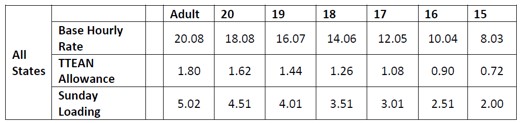
Delivery allowances - All stores
$2.27 For deliveries less than 7 kilometres’ radius from the store (Zone A)
$2.59 For deliveries at a distance of 7 to 10 kilometres’ radius from the store (Zone B)
$2.94 For deliveries at a distance of over 10 kilometres’ radius from the store (Zone C)
432 In relation to the document stating the In-Store Worker pay rates to apply from 1 July 2017, the applicant relied upon the following parts:
CONFIDENTIAL
Domino’s Pizza Enterprises Instore Pay Rates to apply from 1 July 2017
1. Important Notes for Level 1 & 2 Instores 1. If a shift begins on a Sunday, all hours worked for that shift will receive a 25% ‘Temporary Transitional Enterprise Agreement Negotiation Loading’ (Sunday Loading), in addition to the base rate of pay.
All States
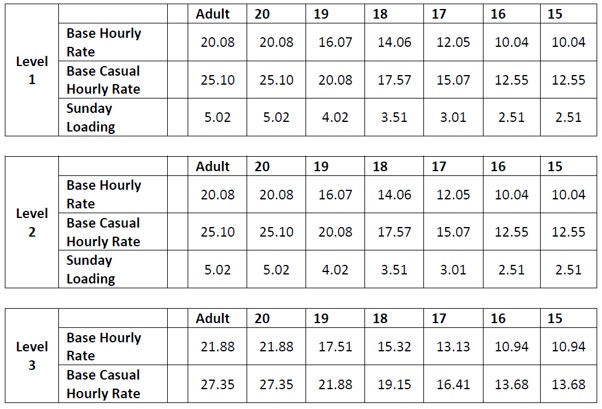
7.4.4.2.1 Whether the Pay Rate Notices were read by franchise operators
433 Again, it is convenient to now address Domino’s arguments to the effect that, although Domino’s admitted that it regularly emailed Pay Rate Notices to franchise operators, and it uploaded some Pay Rate Notices to DOTTI and thereby made them available to franchise operators, the applicant did not establish that franchise operators read those documents.
434 Domino’s pleaded that the Pay Rate Notices on DOTTI were downloaded by very few franchise operators. It alleged that the Delivery Driver pay rates to apply from 1 July 2017 and the In-Store Worker pay rates to apply from 1 July 2017 were downloaded by approximately 14.5% and 15% respectively of all primary franchisees and secondary contacts. It also pleaded that (depending on which Pay Rate Notice by email is referred to) only between approximately 13% and 14% of primary franchisees and secondary contacts viewed those emails.
435 I do not accept those contentions.
436 First, in relation to Domino’s contention regarding the level of downloading of the Pay Rate Notices on DOTTI, as I have explained, the level of downloading is not probative as to whether or not franchise operators read those notices. They could be viewed on the web browser. In any event, Domino’s sent the same information by email to franchise operators.
437 Second, although Domino’s pleaded that only between 13% and 14% of primary franchisees and secondary contacts viewed the Pay Rate Notices by email, it did not adduce any evidence to establish that allegation:
(a) in relation to the applicant’s personal claim, Domino’s did not adduce any evidence to the effect that Dominoids and MC Pizza did not view the Pay Rate Notices by email; and
(b) in relation to the Common Questions, Domino’s did not adduce any evidence to the effect that other franchise operators did not view the Pay Rate Notices by email.
438 Third, in my view, where a franchise operator was sent an email by Domino’s in relation to the applicable pay rates for the franchise operator’s employees for the ensuing period, it is more likely than not that the franchise operator read the email and hyperlinked Pay Rate Notice. That is so because:
(a) the Pay Rate Notices were important on the face of the email, going as they did to the obligation of franchise operators to pay their Delivery Drivers and In-Store Workers the correct pay rates;
(b) in the context of the relationship between Domino’s and its franchise operators, it is likely that most franchise operators would expect Domino’s to inform them of the correct pay rates, rather than calculating them for themselves;
(c) absent active research by each franchise operator into the applicable pay rates each year, the Pay Rate Notices regularly provided by Domino’s were the most readily available information regarding the applicable pay rates for Delivery Drivers and In-Store Workers; and
(d) Ms Wright’s evidence (to which I will later refer in more detail) shows a high degree of uniformity between the pay rates entered into PULSE by franchise operators and the base hourly rates under the Agreements (as amended by the ad hoc arrangements and allowances agreed with the SDA). Her evidence was that 23.6% of the wage values entered by franchise operators into PULSE were within $0.01 of the Agreement rates, and another 18% were within $1 on either side. I accept the applicant’s submission that those minor variations were likely explained by PULSE’s function as an estimator of labour costs, the absence of classification data on part-time and casual status, and the failure to account for applicable allowances. That uniformity is unlikely to have occurred absent most franchise operators reading the Pay Rate Notices.
7.4.5 DBS Documents
439 The applicant alleged that Domino’s provided franchise operators with documents relating to DBS (the DBS Documents), doing so by uploading such documents to DOTTI and thus making them available to franchise operators; by providing those documents to franchise operators who entered into a DBS Agreement; and by providing them to new franchise operators as part of their induction training.
440 First, the applicant alleged that on 25 June 2015 Domino’s uploaded to DOTTI and made available to franchise operators, until on or about 22 September 2017, a document titled “Policy - Bookkeeping Services v 3.1” dated 24 June 2015 (Bookkeeping Services Policy Version 3.1) (2FASOC [29B(d)]).
441 Second, the applicant alleged that since 1 September 2012, Domino’s required all new franchise operators to use DBS for a period of at least 24 months from the date of commencement of their sub-franchise agreement for services including payroll, bookkeeping, accounting and reports (I defined this previously as the DBS Agreement/s) (2FASOC [31(fd)] and [33(a)]).
442 Third, the applicant alleged (2FASOC [29D(d)(i)-(xiii)]) that Domino’s provided PowerPoint slides to new franchise operators, containing several versions of a document titled “Bookkeeping Service - Franchise Orientation Program”, typically in hardcopy format (and not via email or on DOTTI), presented in person during induction training sessions in the approximate periods set out below:
(a) 4 March 2014 and 1 April 2014;
(b) 2 April 2014 and 27 April 2014;
(c) 28 April 2014 and 22 May 2014;
(d) 23 May 2014 and 10 June 2014;
(e) 11 June 2014 and 4 August 2014;
(f) 5 August 2014 and 11 August 2014;
(g) 12 August 2014 and 25 November 2014;
(h) 26 November 2014 and 21 February 2015;
(i) 22 February 2015 and 17 March 2015;
(j) 18 March 2015 and 24 May 2015;
(k) 25 May 2015 and 24 May 2016;
(l) 25 May 2016 and 27 June 2016; and
(m) 28 June 2016 and 28 March 2017.
443 Fourth, the applicant alleged that Domino’s provided PowerPoint slides to new franchise operators, containing several versions of a document titled “Domino’s Bookkeeping Service Business School” (Bookkeeping Service Business School Presentation) (2FASOC [29D(d)(xiv)-(xv)]), typically in hardcopy format (and not via email or on DOTTI), presented in person during induction training sessions in the approximate periods set out below:
(a) 29 March 2017 and 19 September 2017; and
(b) 20 September 2017 until the end of the Relevant Period.
444 Domino’s admitted that it provided the DBS Documents to franchise operators as alleged. There is again no dispute between the parties regarding the provision of these documents to franchise operators.
445 In relation to the DBS Documents I find as follows.
446 In relation to the Bookkeeping Services Policy Version 3.1, it was published on DOTTI and available to all franchise operators in the period between 25 June 2015 and 22 September 2017. Domino’s therefore provided that document to all franchise operators in that part of the Relevant Period. That inference includes Dominoids and MC Pizza as they were franchise operators in that period. In any event, Domino’s admitted that it provided that document to Dominoids and MC Pizza.
447 In relation to DBS Agreements, during the Relevant Period:
(a) DBS was made available to any existing franchise operator who wished to take up that service. Obviously, any franchise operator which executed a DBS Agreement had been provided with one. Further, I infer by around 30 November 2012 a standard form DBS Agreement was part of the pack of disclosure documents that Domino’s provided to prospective franchise operators. That inference is appropriate because a standard form DBS Agreement was Annexure J to the Pre-2015 Code Disclosure Document that Domino’s provided to Dominoids on or around 30 November 2012. The evidence shows that Ms Smith executed a DBS Agreement in relation to the Beerwah Store on or around 21 November 2014.
(b) As earlier explained, from 1 September 2012 until the end of the Relevant Period (except during the three-month period from 1 September 2014) use of DBS was compulsory for new franchise operators. I therefore infer that over that period (except for in the three-month period referred to) Domino’s provided all new franchise operators with a DBS Agreement and they executed it.
448 The evidence as to the number of franchise operators who used DBS during the Relevant Period is not precise, but I am satisfied that Domino’s provided DBS Agreements to a substantial cohort of franchise operators. Any franchise operator who was using DBS was required to sign a DBS Agreement and the evidence shows that:
(a) the percentage of Franchise Stores using DBS increased from approximately 7.50% at the start of the Relevant Period to 33.98% at the end of the Relevant Period;
(b) there were 313 Franchise Stores that used DBS during the calendar years 2017 to 2019; and
(c) during the Relevant Period, approximately 46.1% of all Franchise Stores used DBS at some point for some period of time, and 56.6% of workers who worked at least one shift during the Relevant Period worked at a Franchise Store that used DBS.
449 In relation to the Bookkeeping Service - Franchise Orientation Program and the Bookkeeping Service Business School Presentation, I find that from 4 March 2014 until the end of the Relevant Period all new franchise operators were provided with either the Bookkeeping Service - Franchise Orientation Program or the Bookkeeping Service Business School Presentation as part of their induction training. Existing franchise operators as at 14 March 2014 are unlikely to have been provided with either of those documents as they were not new franchise operators who were required to undergo induction training.
450 Dominoids and MC Pizza are unlikely to have been provided with these documents, because, as at 4 March 2014, they were not new franchise operators.
451 I now turn to set out those parts of the DBS Documents upon which the parties relied.
7.4.5.1 Bookkeeping Services Policy
452 An earlier version of the Bookkeeping Services Policy is in evidence, titled “Policy - Bookkeeping Services v 1.0” dated 13 August 2012 (Bookkeeping Services Policy Version 1.0). It stated:
DPE’s Bookkeeping Services
Domino’s Pizza Enterprises Limited (DPE) will provide bookkeeping services … to all new external Sub-Franchisees that sign a Sub-Franchise Agreement on or after 1 September 2012 for a period of 24 months from the Date of Commencement of the applicable Sub-Franchise Agreement…
453 The applicant relied on the following parts of the later Bookkeeping Services Policy Version 3.1.
454 First, the Bookkeeping Services Policy Version 3.1 increased the categories of franchise operator who were required to use DBS. It stated that unless Domino’s “specifically waived in writing” the requirement, franchise operators in the following circumstances were required to use the service for the duration of the sub-franchise agreement:
1. all new external Sub-Franchisees that sign a Sub-Franchise Agreement on or after 1 September 2012;
2. all Sub-Franchisees that purchase an additional store once already receiving the Bookkeeping Services from Domino’s;
3. a Sub-Franchisee with 1 or more existing stores under the same ABN/IRD Number that are not receiving Bookkeeping Services prior to the Effective Date of this Policy but come across to the Bookkeeping Services in accordance with items 4 - 9 of this Policy, all stores operated under the same ABN/IRD Number of the Sub-Franchisee will be required to take on the Bookkeeping Services;
4. any Sub-Franchisee who, on or after the Effective Date of this Policy, has drawn loan finance with Domino’s;
5. any Sub-Franchisee who, on or after the Effective Date of this Policy, has entered into an Option Deed with Domino’s;
6. any Sub-Franchisee that fails to submit, for 4 or more consecutive months, an unaudited balance sheet and unaudited profit and loss for the month within 21 days of the end of each month for the Store (as required by the Sub-Franchise Agreement); or
7. any Sub-Franchisee that has any of their direct debits to either Domino’s or their food supplier rejected 4 or more times in a consecutive 3 month period;
8. the Master Franchisee has reason to believe that the Sub-Franchisee has submitted, for two (2) or more consecutive months, a balance sheet or profit and loss for the month which contains amounts which have been materially misrepresented or are intentionally incorrect;
9. the Master Franchisee becomes aware that the Sub-Franchisee has failed to comply with an obligation under any Australian or New Zealand employment law or the terms provided under any relevant industrial instrument, being the “Bookkeeping Term”.
455 Second, the Bookkeeping Services Policy Version 3.1 stated:
The Bookkeeping Services are subject to the Bookkeeping Services Agreement and include:
1. Payroll
a. Use of PULSE payroll system and reporting;
b. Use of Connx (an employee self-service system);
c. Processing weekly payroll and providing payslips to employees via Connx;
d. Preparing bank upload file for payroll payment by the Sub-Franchisee;
e. Ensuring pay rates are updated according to the applicable Award;
f. Superannuation/KiwiSaver calculations and reports (excluding payment processing via bank);
g. Workers compensation calculations (if requested, however excludes payment processing via Bank);
h. End of Year reports and payment summaries (previously known as group certificates).
(Emphasis added.)
456 Domino’s accepted that each relevant version of the Bookkeeping Services Policy stated that the payroll service available through DBS included ensuring that “pay rates are updated according to the applicable Award”, with “the Award” being understood as a reference to the relevant enterprise agreement.
7.4.5.2 DBS Agreements
457 Both parties also relied on clauses of the DBS Agreements themselves. The applicant relied on the following clauses:
1. BOOKKEEPING TERM
…
1.3 The parties acknowledge and agree that the Bookkeeping Services will apply in respect of the Sub-Franchisee’s operations at the Stores listed in Schedule 1 and any other Domino’s store managed, owned or operated by the Sub- Franchisee on or after the date of this Agreement.
…
2 Bookeeping Services
2.1 The Bookkeeping Services to be provided by Domino’s to the Sub-Franchisee will include:
2.1.1 PAYROLL
(a) Use of PULSE payroll system and reporting;
(b) Use of Connx (an employee self- service system);
(c) Process weekly payroll and provision of payslips to employees via Connx;
(d) Prepare bank upload file for payroll payment by the Sub-Franchisee;
(e) Ensure pay rates are updated according to the applicable Award;
(f) Superannuation calculations and reports;
(g) WorkCover calculations (if requested);
(h) End of Year reports and payment summaries (group certificates).
…
3 PAYMENT
3.1 The Sub-Franchisee shall pay to Domino’s the following fees:
(a) $165 plus GST per week per Store (“Bookkeeping Fee”) commencing on the Date of Commencement;
(b) an Initial Set-Up Fee contained in Schedule 1;
(c) a once-off software fee of $120 plus GST (per ABN used by the Sub-Franchisee) (“Software Fee”) paid upon the Date of Commencement; and
(d) an annual software maintenance and support fee of $30 plus GST (per ABN used by the Sub-Franchisee) (“Annual Software Maintenance Fee”) charged in July of each year.
…
16 REPRESENTATIONS AND WARRANTIES AND INDEMNITIES
16.1 Domino’s represents and warrants to the Sub-Franchisee that:
…
16.1.2 it has the necessary skills, experience and resources and is properly qualified to complete the Bookkeeping Services to a professional standard;
16.1.3 the services to be provided under this Agreement are fit for their intended purpose in accordance with generally accepted accounting practices and principles. Domino’s acknowledges that all services provided will be of professional and workmanlike quality and will be provided within a reasonable time.
…
SCHEDULE 1
…
D - Bookkeeping Services Fees | |
Bookkeeping Services Fee | $165 plus GST per week per Store |
Software Fee | $120 plus GST per ABN paid upon the Date of Commencement |
Annual Software Maintenance Fee | $30 plus GST per ABN paid annually in July |
(Emphasis added in cl 2.1.1.)
458 Domino’s relied on two further clauses in the DBS Agreements:
16.6 To the maximum extent permitted by law, all other terms and warranties expressed or implied by any legislation, common law, equity or otherwise in connection to the supply of the Bookkeeping Services are expressly excluded.
16.7 Domino’s does not provide any legal or accounting services, opinions or advice in respect of the Bookkeeping Services or the results of the performance of the Bookkeeping Services.
7.4.5.3 Bookkeeping Service - Franchise Orientation Program
459 The relevant content of the Bookkeeping Service - Franchise Orientation Program, and the Bookkeeping Service Business School Presentation, did not take things much further than the description of “Bookkeeping Services” in cl 2 of the standard form DBS Agreements which I have extracted above.
460 The applicant relied upon the following parts of the Bookkeeping Service - Franchise Orientation Program:
(a) Slide 2:
DBS - Domino’s Bookkeeping service
Mandatory service for all new franchisees
Available to existing franchisees upon request
Payroll and Bookkeeping functions
(Emphasis in original.)
(b) Slide 2 also included the following annotation beneath the slide:
Facilitator to say: The aim of the service is to use the existing business knowledge of the team to make your job easier and allow you to concentrate on running and building your new business.
(c) Slide 3:
Weekly payroll up to ABA file stage - franchise then uploads file to bank
Pay rate reviews in accordance with the award and government guidelines
ConnX - employee self-service system. Payslips, payment summaries, etc
Monthly superannuation and deduction reports
PAYG Payment summaries and reporting
(Emphasis added.)
(d) It is common ground between the parties that the reference to “award” would have been understood by franchise operators as a reference to the relevant enterprise agreement.
(e) Slide 20 (which did not appear in every version):
Homework
Login to DOTTI and complete the associated module.
(Emphasis in original.)
7.4.5.4 Bookkeeping Service Business School Presentation
461 The applicant relied upon the following part of the Domino’s Bookkeeping Service Business School Presentation on Slide 2:
The DBS Services include:
• Weekly payroll processing up to ABA file stage - franchisee then uploads ABA file to the bank
• Pay rate reviews in accordance with the award and government guidelines
• Monthly superannuation and deduction reports
• Preparation of monthly financial accounts
• Upload monthly Profit and Loss statement to the Domino’s portal
• Preparation and lodgement of quarterly BAS and/or monthly IAS
• Preparation of PAYG Payment Summaries - reporting and lodging the annual payment summaries directly with the ATO
(Emphasis added.)
7.4.5.5 Whether it is likely that franchise operators read the DBS Documents
462 In relation to the Bookkeeping Services Policy, Domino’s submitted, in effect, that it is unlikely that many franchise operators read it. In support of that contention it alleged that only 1% of all primary franchisees and secondary contacts downloaded the Bookkeeping Services Policy. For the reasons I have explained, that evidence is not probative as to whether franchise operators read the document. The document could be read by franchise operators on the web browser.
463 Further, Domino’s argued that only those franchise operators who used DBS during the alleged period were likely to have read the DBS Documents. I accept that. In my view it is more likely than not that only franchise operators who used DBS during the Relevant Period, or who were interested in using DBS, would have bothered reading the DBS Documents. That subset of franchise operators is, however, substantial. As I have said, Mr Potter testified that there were 313 Franchise Stores that used DBS during the calendar years 2017 to 2019. Ms Wright testified that, during the Relevant Period, approximately 46.1% of all Franchise Stores used DBS at some point for some period of time, and that 56.6% of workers who worked at least one shift during the Relevant Period worked at a Franchise Store that used DBS.
464 Having regard to the fact that:
(a) from March 2014 until the end of the Relevant Period, Domino’s provided hard copies of either the Bookkeeping Service - Franchise Orientation Program or the Bookkeeping Service Business School Presentation to new franchise operators as part of their induction training;
(b) from 1 September 2012 until the end of the Relevant Period (except for a three-month period) new franchise operators not related to an existing franchise operator were required to use DBS;
(c) on the face of the documents, those presentations were important to franchise operators as they comprised training materials in relation to DBS that they were required to use; and
(d) induction training was compulsory and from May 2014 attendance was recorded,
it is appropriate to infer that all new franchise operators (apart from those who joined during the three-month period from 1 September 2014) from 4 March 2014 until 28 March 2017 read the Bookkeeping Service - Franchise Orientation Program; all new franchise operators from 29 March 2017 until the end of the Relevant Period read the Bookkeeping Service Business School Presentation; and all of those persons read and executed a DBS Agreement.
465 That inference applies to Dominoids since it used DBS, and it does not apply to MC Pizza since it did not use DBS at any point.
7.5 Conclusion
466 To recap, I find that during the Relevant Period, Domino’s provided:
(a) the following documents to prospective franchise operators, doing so in standard or generic form:
(i) the Franchise Information to all prospective franchise operators;
(ii) of the Franchise Agreement Documents:
(A) sub-franchise agreements to all prospective franchise operators. By definition, every franchise operator entered into a sub-franchise agreement; and
(B) Business Sale and Purchase Agreements and Store Asset Rental Management Deeds to some prospective franchise operators;
(iii) the Franchise Disclosure Documents to all prospective franchise operators; and
(b) each category of documents comprising the Compliance Information to franchise operators during the life of their sub-franchise agreements, doing so in standard or generic form.
I reiterate that neither the Business Sale and Purchase Agreements nor the Store Asset Rental Management Deeds are important in the case.
467 Domino’s submissions only went to whether it provided those documents to some franchise operators rather than to all of them. In relation to the Compliance Information, I find that during the Relevant Period, Domino’s provided each of the documents comprising the Compliance Information to either all franchise operators or to a substantial cohort of them. I am satisfied that Domino’s provided the most important documents in the case, being the sub-franchise agreements, Domino’s policy documents, the Fair Work Training Presentation, the Workplace Laws Training Manual, the TANDA Training Materials and the Pay Rate Notices to all franchise operators, and that Domino’s provided the DBS Documents to those using DBS, which comprised a different proportion of the franchise operators at different times, but was a large cohort numerically.
468 I am therefore satisfied that Domino’s engaged in the conduct that the applicant alleged conveyed the Franchise Representations or, alternatively, the Franchise Opinion Representations.
469 I found little force in the various attempts by Domino’s to downplay the significance of the documents that it provided to franchise operators.
470 First, as previously noted, in relation to those documents and training modules that it uploaded to DOTTI, Domino’s submitted that only those franchise operators who were in existence at the time and downloaded the document or viewed it could be treated as having received it. I do not accept that. Once uploaded to DOTTI by Domino’s those documents could be viewed by franchise operators who later joined the Domino’s network. Thus, in my view it provided those documents to all franchise operators from the date it uploaded them.
471 Second, as previously noted, Domino’s submitted that many of the relevant documents that it had uploaded to DOTTI were downloaded by very few franchise operators, and that there were many documents that neither Dominoids nor MC Pizza downloaded. I do not accept that. As I have said, Domino’s did not adduce any evidence as to the documents downloaded by Dominoids or MC Pizza or as to the documents downloaded from DOTTI by franchise operators in general. Its submission was left without supporting evidence. In any event, the submission went nowhere because the applicant gave unchallenged evidence that documents could be viewed on DOTTI without downloading them.
472 Third, in relation to the TANDA Training Materials that it uploaded to DOTTI, Domino’s submitted that many of the documents would only be relevant to those franchise operators who were in operation from some time in the first half of 2017. I accept that, but that is still a substantial cohort of franchise operators. In its answers to interrogatories Domino’s stated that, as at 9 April 2017, there were 580 Franchise Stores in Australia, and by the end of the Relevant Period there were 621 such stores. I infer that from early 2017 until the end of the Relevant Period, the TANDA Training Materials were highly relevant to franchise operators, and likely to be read by them once provided because use of TANDA was to be compulsory from 1 July 2017.
473 Fourth, in relation to documents that Domino’s sent by email to franchise operators (notably the Fair Work Training Presentation and the Workplace Laws Training Manual, emailed on 2 May 2012, and the series of Pay Rate Notices emailed from June 2013 until June 2017), Domino’s submitted that only those franchise operators who were in existence at the time the email was sent could possibly have received it. I accept that, but that comprises all franchise operators at the points in time that Domino’s sent those documents. Domino’s sent the Pay Rate Notices to all franchise operators regularly throughout the Relevant Period.
474 Fifth, Domino’s submitted that whether franchise operators then read those emails was another question. It said in submissions that it would seek to deploy evidence in relation to whether the franchise operators read the emails (i.e., computer evidence that shows whether an email was read). However, in relation to the applicant’s personal claim, Domino’s did not adduce any such evidence to show that Dominoids and MC Pizza did not read those emails. In relation to the Common Questions, Domino’s did not adduce any such evidence to show that any franchise operator during the Relevant Period did not read those emails. Thus, there is no evidence that any franchise operator did not read the relevant emails. For the reasons I have explained, I consider it appropriate to infer that all franchise operators who received those emails read them.
475 Sixth, in relation to the documents Domino’s provided to new franchise operators during their induction or other training (either in hardcopy or otherwise), Domino’s submitted that only those franchise operators who were both new at that time and in receipt of such training after the document was published could have received the document. I accept that, but that group comprises a substantial cohort of franchise operators. Domino’s answers to interrogatories show that there were 421 Franchise Stores in Australia as at 30 June 2013 and 621 Franchise Stores by the end of the Relevant Period. Taking into account that, in that period, some stores were likely to have ceased to operate and some of the additional stores are likely to have been operated by existing franchise operators, it is reasonable to infer that approximately 200 franchise operators received induction training during the Relevant Period.
476 I am satisfied that Domino’s engaged in the conduct alleged to give rise to the Franchise Representations and the Franchise Opinion Representations. The answers to the relevant Common Questions are as follows.
7.5.1 Common Question 1
477 Common Question 1 asked the following:
Did Domino’s provide to some or all Prospective Franchise Operators or Franchise Operators:
(a) The Franchise Information 2FASOC [28]
(b) The Franchise Agreement Documents 2FASOC [28B]
(c) The Franchise Disclosure Documents 2FASOC [28C]
(d) The Compliance Information 2FASOC [29], [29A], [29B], [29C] and [29D]
(e) The Disclosure Documents AD [28A]
together, “the Pleaded Information”.
478 For the reasons I have explained, the answer to each of Common Questions 1(a) to (e) is “yes”.
7.5.2 Common Question 1A
479 Common Question 1A asked:
If the answer to any part of question 1 is “yes”, which parts of the Pleaded Information were provided to:
(a) all Franchise Operators; or
(b) any of the categories of Franchise Operators identified by the Applicant’s in response to Order 2 of the orders of Justice Murphy made 29 August 2022,
in the Relevant Period.
480 I now turn to answer this Common Question in relation to each type of “Pleaded Information”.
7.5.2.1 The Franchise Information
481 I find that during the Relevant Period, Domino’s provided:
(a) the Franchise Information to all prospective franchise operators (including franchise operators renewing or extending the term or scope of a sub-franchise agreement);
(b) the Franchise Agreement Documents as follows:
(i) sub-franchise agreements to all prospective franchise operators (including all franchise operators renewing or extending the term or scope of a sub-franchise agreement), doing so in uniform or generic terms;
(ii) Business Sale and Purchase Agreements to those prospective franchise operators and franchise operators who entered into such an agreement (including franchise operators who appear in the Store Transaction Records in each instance in which the relevant transaction was a species of “store sale”); and
(iii) Store Asset Rental Management Deeds to those prospective franchise operators and franchise operators who entered into such an agreement (which included each instance in which the Store Transaction Records state that the relevant transaction was a “management deed”);
(c) the Franchise Disclosure Documents (and the Disclosure Documents) in substantially the same terms to all prospective franchise operators (including franchise operators renewing or extending the term or scope of a sub-franchise agreement); and
(d) the Compliance Information to franchise operators as detailed above, which may be summarised as follows:
(i) in relation to the Fair Work Training Presentation, and the Workplace Laws Training Manual which Domino’s sent by email to all franchise operators on 2 May 2012 (2FASOC [29D(a)]), Domino’s provided those documents to, and they were accessible by, all existing franchise operators at that time;
(ii) in relation to the materials that Domino’s uploaded to DOTTI, being:
(A) the Fair Work Laws: Franchisee Orientation Program uploaded on 28 October 2014;
(B) the Fair Work Training Presentation uploaded on 2 May 2012, and on an unknown date as a training module; and
(C) the Workplace Laws Training Manual uploaded on 2 May 2012,
(iii) Domino’s made those documents available to, and they were accessible by, all franchise operators from the date that they were each uploaded until the end of the Relevant Period.
(iv) in relation to the materials that Domino’s provided to all new franchise operators who attended compulsory induction training, Domino’s provided those documents to new franchise operators in the following periods:
(A) the Fair Work Training Presentation and the Workplace Laws Training Manual in the period from 2 May 2012 to the end of the Relevant Period;
(B) the Fair Work Laws: Franchisee Orientation Program in the period from 20 May 2014 to the end of the Relevant Period; and
(C) the Industrial Relations Facts Presentation in the period from 8 September 2016 to the end of the Relevant Period;
(v) in relation to the Pay Rate Notices that Domino’s sent to all franchise operators by email from June 2013 to June 2017, Domino’s provided those documents to, and they were accessible by, all franchise operators during that period;
(vi) in relation to the TANDA Training Materials that Domino’s uploaded to DOTTI on various dates, Domino’s made those documents available to, and they were accessible by, all franchise operators from the date that they were each uploaded until the end of the Relevant Period;
(vii) in relation to the Employment Law Compliance Policy Version 1.2 that Domino’s uploaded to DOTTI on 8 October 2015, Domino’s made that document available to, and it was accessible by, all franchise operators from that date until 18 July 2017; and
(viii) in relation to the DBS Documents:
(A) Domino’s uploaded the Bookkeeping Services Policy Version 3.1 to DOTTI on 25 June 2015, and thereby made it available to and accessible by all franchise operators from that date until 22 September 2017;
(B) Domino’s provided the Bookkeeping Service - Franchise Orientation Program to all new franchise operators undergoing induction training from 4 March 2014 until 28 March 2017; and
(C) Domino’s gave the Bookkeeping Service Business School Presentation to all new franchise operators undergoing induction training from 29 March 2017 until the end of the Relevant Period.
482 I conclude that Domino’s provided the Pleaded Information to franchise operators and prospective franchise operators. It was not necessary for the applicant to call evidence from any individual franchise operator to show that they read the particular document relied upon. The relevant conduct of providing the documents occurred when Domino’s disseminated those documents to franchise operators in a manner that would be expected to bring the document to their attention: Dover at [105] (O’Bryan J). I am satisfied that by making the relevant documents available to franchise operators on DOTTI, by sending the relevant documents to franchise operators by email, and by providing the relevant documents to new franchise operators as part of their induction training, Domino’s was communicating with its franchise operators in a way that it expected would bring the documents to their attention.
483 In any event, for the reasons I have explained, in respect of each category of document I infer that those franchise operators to whom the relevant documents:
(a) were made available by Domino’s on DOTTI;
(b) were sent by Domino’s by email; and
(c) were provided by Domino’s as part of induction training,
were more likely than not to have read those documents.
7.5.3 Common Question 2
484 Common Question 2 asked as follows:
Did any of the Pleaded Information provided contain a disclaimer of the type alleged at AD [30.2.5], [48.3.1]? To the extent that a disclaimer was provided, what was its effect?
485 I find that the Pleaded Information contained the following disclaimers:
(a) The Pre-2015 Code Disclosure Document included the following statement on the opening page under the heading “Statement”:
…You should make your own enquiries about the Sub-Franchise and about the business of the Sub-Franchise.
The Master Franchisee strongly recommends that you have the Sub-Franchise Agreement explained to you by a lawyer experienced in franchising and also that you obtain independent accounting and business advice on the sub-franchise proposition from an accountant
(Emphasis in original.)
(b) The 2015 Code Disclosure Document included the following statement on the opening page under the heading “Statement”:
You should make your own enquiries about the Sub-Franchise and about the business of the Sub-Franchise.
You should get independent legal, accounting and business advice before signing the Sub-Franchise Agreement.
(c) The Fair Work Training Presentation said the following on slide 36:
If you require further information from the Fair Work Ombudsman, you can contact the Fair Work Infoline on 13 13 94 or visit www.fairwork.gov.au
(Emphasis in original.)
(d) The Fair Work Training Presentation and the Workplace Laws Training Manual each contained a disclaimer in the following terms:
The content of this document is intended as a guide only and in no way constitutes legal advice on behalf of [Domino’s]. When making any decisions regarding employees, advice should be sought from Fair Work Australia, the Fair Work Ombudsman, or an independent legal advisor.
(e) The Employment Law Compliance Policy Version 1.2 contained the following statements:
It is the Sub-Franchisee’s sole responsibility to inform themselves of, and comply with, their legal obligations in connection with the employment of team members.
(f) and
This Policy is not intended as legal advice. Sub-Franchisees must obtain their own legal, accounting and business advice in connection with the operation of their stores and it is their sole responsibility to maintain compliance with all applicable laws.
(g) Clause 2.3.1 of the Domino’s Pizza Code of Conduct contained the following statement:
2.3.1 Know the laws and policies that apply to your work
You must have a working knowledge and apply the laws, policies, industrial entitlements and relevant State or Territory road and traffic regulations that apply to your work, including the Code of Conduct.
Managers have a special responsibility to assist employees to understand relevant legislation or policies including specific legal requirements.
All employees are entitled to have access to legislation, policies and industrial instruments such as awards that apply to their work.
(Emphasis in original.)
486 I will deal with the effect of those alleged disclaimers when considering whether the alleged representations were conveyed.
8. THE CONDUCT ALLEGED TO CONVEY THE FRANCHISE CONDUCT IMPLIED REPRESENTATIONS, OR ALTERNATIVELY THE CONDUCT OPINION IMPLIED REPRESENTATIONS
487 The applicant alleged, and Domino’s admitted, that during the Relevant Period it engaged in conduct defined previously as the Franchise Conduct. The Franchise Conduct comprises three categories of conduct (2FASOC [34]):
(a) providing the centralised Payroll Services (2FASOC [33]) through DBS to franchise operators via a contractual arrangement with those franchise operators who used it;
(b) configuring a payroll system (which included the Payroll Services and other computer systems) that calculated employee entitlement rates and conditions by reference to the relevant Agreements and not by reference to the Award; and
(c) Compliance and Audit Activities (2FASOC [32]), in which, amongst other things, if the activities identified that employees were not being paid in accordance with the Agreements, franchise operators were told that the employees needed to be so paid.
488 It is alleged that by engaging in the Franchise Conduct, Domino’s conveyed three implied representations of fact to franchise operators (which I call the Franchise Conduct Implied Representations) and in the alternative, conveyed three implied representations of opinion to franchise operators (which I call the Conduct Opinion Implied Representations).
489 I now turn to set out the Franchise Conduct (which Domino’s essentially admitted).
8.1 Compliance and Audit Activities
490 The applicant alleged (2FASOC [32]):
Since no later than December 2011, and in the course of managing the Domino’s Business, Domino’s engaged in conduct in relation to the performance of compliance and audit activities (the Compliance and Audit Activities).
Particulars
1. Since no later than December 2011, Domino’s undertook compliance activities pursuant to the terms of two compliance deeds into which Domino’s entered with the FWO in 2011 and 2014 respectively.
2. The compliance activities included conducting audits and reporting on the results of those audits in relation to wages and allowances paid to Delivery Drivers and In-Store Workers employed to perform work in Corporate Stores and in Franchise Stores.
3. The compliance audits were predicated upon the basis that the rates of pay required to be paid and the terms and conditions of employment required to be afforded to Delivery Drivers and In-Store Workers employed by all Corporate Stores and Franchise Stores were derived from the Agreements.
4. Since no later than July 2013, Domino’s provided Compliance Information to Prospective Franchise Operators and Franchise Operators, and the particulars to paragraph 29 are included.
491 Domino’s admitted those allegations (AD [32]).
492 Domino’s said that the Compliance and Audit Activities were part of Domino’s Business’ Internal Existing Employment Systems (AD [32]). It stated (AD [27S]) that since at least April 2012, it had configured and operated the internal employment affairs of its business, including its operating procedures, training, software systems and audits, on the basis that the pay rates and terms and conditions of employment of Delivery Drivers and In-Store Workers in both Corporate Stores and Franchise Stores were governed by the terms of the Agreements (as adjusted).
493 The applicant further alleged (2FASOC [32A]) that during the Relevant Period Domino’s conducted audits of franchise operators, and where an audit established that employees were not being paid in accordance with the relevant Agreements, Domino’s told those franchise operators that those employees should have been paid in accordance with the relevant Agreements (adjusted as agreed with the SDA), and never stated that the franchise operators ought to have paid those employees in accordance with the Award.
494 Domino’s admitted that it had made statements to that effect (AD [32A.1]).
495 Accordingly, I find that during the Relevant Period Domino’s engaged in the Compliance and Audit Activities as alleged.
8.2 The Payroll Services and configuring the Payroll Services and computer systems
496 The applicant alleged (2FASOC [33]):
At all material times during the Relevant Period, and in the course of managing the Domino’s Business, Domino’s engaged in conduct in relation to provision of:
(a) centralised payroll services through the bookkeeping service, DBS; and
(b) services for delivery tracking, roster construction, employee time and attendance and the interpretation of industrial instrument entitlements, including TANDA, Pulse, Payroll Award Interpreter (being a system used prior to the introduction of TANDA to calculate the award applicable to each employee and each shift) and GPS Tracker (being a delivery tracking system),
(the Payroll Services).
Particulars
1. At all material times during the Relevant Period, Domino’s provided Franchise Operators with access to centralised payroll services hosted, operated or made available by Domino’s.
2. The centralised payroll service contained a method of ascertaining the applicable rates of pay and terms and conditions of employment required to be afforded to Delivery Drivers and In-Store Workers and a method for calculating the amounts of pay and the periods of leave or other benefits required to be paid or afforded to those Delivery Drivers and In-Store Workers in each pay period.
3. The rates of pay and terms of conditions of employment upon which calculations were made by the centralised payroll service were derived from and configured around the requirements of the Agreements.
4. Since 1 September 2012, Domino’s required all new Franchise Operators to use DBS for a period of at least 24 months from the date of commencement of the applicable sub-franchise agreement for services including payroll, bookkeeping, accounting and reports. The payroll services provided by DBS included processing the weekly payroll, provision of payslips to employees, preparing the bank upload file for payroll payment to the Franchise Operator, and ensuring pay rates were updated according to the applicable award. DBS performed functions including calculating the wages to be paid to In-Store Workers and Delivery Drivers, and determining the terms and conditions to be afforded, to In-Store Workers and Delivery Drivers.
5. Since no later than 1 July 2017, Domino’s required all Franchise Operators to use an electronic rostering, attendance and time system known as TANDA which was configured around the requirements of the Agreements.
I assume that the reference to the “applicable award” in particular (4) is a typographical error, and it was intended to state, “the applicable Agreement”.
497 Domino’s admitted providing the Payroll Services (AD [33]). Domino’s also admitted that, during the Relevant Period, the Payroll Services it provided to those franchise operators who used DBS were configured to calculate the amounts to be paid to employees in accordance with the Agreements (as adjusted), subject to the Deemed Base Rate that had been approved by the FWO (AD [33.5]). The “Deemed Base Rate” means the base rate of pay required to be paid by Domino’s and by franchise operators to Delivery Drivers and In-Store Workers under the Award or to those to whom the Award did not apply but a WR Agreement did.
498 In making the admission at AD [33], Domino’s referred to and relied on AD [31.10] and [31.11] in which:
(a) in relation to DBS, Domino’s said that:
(i) since about 1 September 2012, as part of Domino’s Business’ Internal Existing Employment Systems, new franchise operators not related to another existing franchise operator were required to use DBS for a period of 24 months;
(ii) existing franchise operators were permitted to engage DBS to provide payroll services, as part of Domino’s Business’ Internal Existing Employment Systems;
(iii) DBS offered payroll services that included processing the weekly payroll, the provision of payslips to employees, and the preparation of bank upload files for franchise operators; and
(iv) DBS had been configured to calculate amounts to be paid to employees in accordance with the Agreements and those agreed rates, but subject to the Deemed Base Rate that had been approved by the FWO; and
(b) in relation to TANDA, it said that:
(i) TANDA was part of Domino’s Business’ Internal Existing Employment Systems and was able to be used by franchise operators from about 2016;
(ii) from 1 July 2017, those franchise operators who had engaged DBS to provide payroll services were also required to use TANDA;
(iii) TANDA constructed rosters and recorded employee time and attendance; and
(iv) during the Relevant Period, TANDA had been configured to calculate amounts to be paid to an employee in accordance with the Agreements and those agreed rates, but subject to the Deemed Base Rate that had been approved by the FWO.
499 The applicant further alleged (2FASOC [33A]):
As part of Domino’s conduct in providing the Payroll Services
(a) in relation to DBS, Domino’s stated to franchise operators in the Bookkeeping Services Agreement that:
(i) “Domino’s represents and warrants to the sub-franchisee that: it has the necessary skills, experience and resources and is properly qualified to complete the Bookkeeping Services to a professional standard”; and
(ii) “Domino’s represents and warrants to the sub-franchisee that: The services to be provided under this Agreement are fit for their intended purpose in accordance with generally accepted accounting practices and principles. Domino’s acknowledges that all services provided will be of professional and workmanlike quality and will be provided within a reasonable time”; and
(b) in relation to TANDA, during the delivery by Domino’s of training to Franchise Operators which included:
(i) the delivery of the “TANDA - Bookkeeper Webinar” dated 13 December 2016, a representative of TANDA stated to Franchise Operators (at 11.40-13.00mins) that “so what TANDA basically does, it’s worked with Domino’s to build up the award rules that apply to Domino’s users or employees at this stage, we’ve crafted those rules, we’ve built them into the TANDA system and they will therefore apply for every employee depending on their circumstances, so that includes higher duties, so a driver that might be acting as an In-Store, it includes overtime...and certainly we have other allowances and things built into that”;
(ii) the provision to Franchise Operators of a “TANDA Information Kit” dated May 2017, Domino’s stated to Franchise Operators (at page 8) that TANDA has the Domino’s award details pre-loaded, and overtime and public holiday rates will automatically be applied to roster calculations and timesheets;
(iii) the provision to Franchise Operators of a “Policy - TANDA Software Implementation” document dated 18 May 2017, Domino’s stated to Franchise Operators that “…every store in Australia and New Zealand will be required to have the program up and running by 1 July 2017… The installation of the TANDA workforce management program will assist DPE and its Franchisees achieve better compliance with employee entitlements”; and
(iv) the delivery of the “TANDA Timesheet Webinar” dated 24 May 2017, Domino’s stated to Franchise Operators (at 6.05mins) that “Payroll will be managing all the payroll side of things for you in TANDA, so the pay rates and all that kind of stuff. Just be aware that payrates don’t come from Pulse, they actually come from our payroll system.”
500 Domino’s admitted 2FASOC [33A(a)] above in relation to DBS (AD [33A]), save that it relied on cl 16.7 of the DBS Agreements (reproduced above), that provided that:
Domino’s does not provide any legal or accounting services, opinions or advice in respect of the Bookkeeping Services or the results of the performance of the Bookkeeping Services.
Domino’s admitted 2FASOC [33A(b)] above in relation to TANDA.
501 Finally, the applicant alleged that the Payroll Services and each of the computer systems that operated during the Relevant Period calculated the rates of pay and conditions of employment of Delivery Drivers and In-Store Workers by reference to the relevant Agreements (as adjusted) plus additional payments, and not by reference to the Award (2FASOC [33B]). Domino’s admitted that (AD [33B]).
502 Accordingly, I find that Domino’s provided the Payroll Services and configured the Payroll Services and computer systems as alleged.
9. THE FRANCHISE REPRESENTATIONS
503 I have found that, during the Relevant Period, Domino’s engaged in the conduct alleged to have conveyed the Franchise Representations to franchise operators (or alternatively the Franchise Opinion Representations). I now turn to determine whether that conduct, as found, conveyed one or more of the alleged Franchise Representations, being representations of fact. I later deal with the alleged representations of opinion.
10. WHETHER DOMINO’S CONDUCT CONVEYED THE FRANCHISE REPRESENTATIONS
10.1 The Franchise Representations
504 The alleged Franchise Representations are as follows (2FASOC [30]):
From not later than April 2012, Domino’s represented by providing the Franchise Information, the Franchise Agreement Documents, the Franchise Disclosure Documents, and Compliance Information to Franchise Operators and to Prospective Franchise Operators, that:
(aa) the terms and conditions of all Domino’s employees were governed by two enterprise bargaining agreements, the first of which provided the conditions for Delivery Drivers, and the second of which provided the conditions for In-Store Workers;
(a) one or more of the Agreements (as affected by the Agreed Base Rate Increases and the Deemed Base Rates) was binding upon all Franchise Operators with respect to the rates of pay required to be paid, and the terms and conditions of employment required to be afforded, to all Delivery Drivers and In-Store Workers employed by Franchise Operators to perform work in Franchise Stores;
(b) one or more of the Agreements (as affected by the Agreed Base Rate Increases and/or the Deemed Base Rates) applied to each of the Franchise Operators with respect to the rates of pay required to be paid, and the terms and conditions of employment required to be afforded, to all Delivery Drivers and In-Store Workers employed by Franchise Operators to perform work in Franchise Stores;
(c) the Agreements (as affected by the Agreed Base Rate Increases and/or the Deemed Base Rates) contained the rates of pay required to be paid, and the terms and conditions of employment required to be afforded, to all Delivery Drivers and In-Store Workers employed to perform work by Franchise Operators in Franchise Stores;
(d) the rates required to be paid, and the terms and conditions of employment required to be afforded to, all Delivery Drivers and In-Store Workers employed to perform work in Franchise Stores were the same as those required to be paid and afforded to Delivery Drivers and In-Store Workers employed to perform work in Corporate Stores; and/or
(e) it was lawful to pay Delivery Drivers and In-Store Workers employed to perform work in Franchise Stores, the rates of pay, and to afford them the terms and conditions of employment, set out in the Agreements (as affected by the Agreed Base Rate Increases and/or the Deemed Base Rates),
(together and severally the Franchise Representations).
505 As is apparent, there is little difference between the six alleged representations of fact.
10.2 Domino’s submissions
506 Domino’s submissions in relation to whether its impugned conduct conveyed the Franchise Representations were unclear, and it ultimately contended that it was impossible for the Court to answer Common Questions 3, 4 and 5. In large part, the lack of clarity in its submissions seemed to arise because it (erroneously) approached the question as to whether its impugned conduct conveyed the alleged representations by reference to what its conduct was likely to have conveyed to Dominoids and MC Pizza, rather than by reference to what its conduct was likely to have conveyed to an ordinary or reasonable member of the franchise operator class.
507 Domino’s made the following submissions, restricted to Dominoids or MC Pizza, regarding the relevant facts and context in light of which, on its argument, it falls to be determined whether its conduct conveyed the alleged Franchise Representations (or Franchise Opinion Representations). I treat these submissions as relevant to the task of determining whether it is likely that Domino’s impugned conduct conveyed the Franchise Representations to the ordinary or reasonable franchise operator.
508 Domino’s submitted in relation to Dominoids, and I accept, that Ms Smith was an experienced franchise operator. The evidence shows that she had worked at Domino’s Stores since she was 14. She had worked in many different stores, and she operated four Franchise Stores by the age of 23. She was ambitious and had always wanted to be a manager. She believed training was the most important factor in running a successful store and she attended “plenty of education classes and seminars”. Ms Smith would have had responsibility for a significant number of employees across her four stores. For example, in the period from June 2015 to August 2016, Dominoids had 134 employees working at the North Caboolture Store (as I infer, mostly part-time employees), with a total salary and wages bill of $564,814. In the single pay period ending 25 October 2015, a total of 44 employees were paid wages for work the previous week. Those matters, and the fact that Ms Smith purchased the North Caboolture Store from Domino’s on 18 December 2012 for $425,000 and that by 29 August 2016, the store’s value had increased to $999,686, indicate that she had a good level of commercial nous and business acumen.
509 Domino’s relied upon a series of factual matters in relation to Dominoids and Ms Smith, each of which I accept.
(a) First, that Ms Smith received the Fair Work Training Presentation which contained:
(i) 38 PowerPoint slides that set out a range of employment-related information, including information about the FW Act, leave entitlements, record-keeping, payslips, termination, and agreement-making
(ii) Slide 32, which said:
The terms and conditions of Domino’s Employees are governed by two Enterprise Bargaining Agreements (EBA). The 2001 agreement provides the conditions for Drivers, and the 2009 agreement for In-stores and Managers
(iii) Slides 33 to 35, which set out information regarding the transitioning of wage rates to the Award in 2014, depending on whether an enterprise agreement applies to a particular Domino’s business;
(iv) Slide 36, which explained that the role of the FWO included educating employers about ensuring compliance with workplace laws. It said that where appropriate the FWO would commence proceedings against employers for breaches of workplace laws. The slide then said:
If you require further information from the Fair Work Ombudsman, you can contact the Fair Work Infoline on 13 13 94 or visit www.fairwork.gov.au.
(Emphasis in original.)
(v) A disclaimer in the following terms, on the final slide:
The content of this document is intended as a guide only and in no way constitutes legal advice on behalf of Domino’s Pizza Enterprises Limited. When making any decisions regarding employees, advice should be sought from Fair Work Australia, the Fair Work Ombudsman, or an independent legal advisor.
(vi) The presentation did not define the 2001 or the 2009 Agreements and did not provide an explanation of the terms and conditions to be found in either Agreement, nor the circumstances in which an enterprise agreement might apply to a Domino’s Store.
(b) Second, that Ms Smith received the Workplace Laws Training Manual, which was 74-pages long contained:
(i) A range of employment-related information, including information about the FW Act, leave, record-keeping, termination, consultation, dispute resolution and privacy.
(ii) The same information as set out in slides 32 to 35 of the Fair Work Training Presentation, including the statement that:
The terms and conditions of Domino’s Employees are governed by two Enterprise Bargaining Agreements (EBA). The 2001 agreement provides the conditions for Drivers, and the 2009 agreement for Instores [Workers] and Managers.
(iii) The following additional statement:
On 1 January 2014 wages rates will be no less than the Modern Award. The terms and conditions of the employees will continue to be dictated by the 2001/09 EBAs until a party decides to either terminate or renegotiate one of the agreements…
(iv) The following statements in relation to minimum wages:
From 1 January 2010, modern awards replaced most existing awards and transitional pay scales, and contain the minimum terms and conditions for employees in particular industries and occupations. While modern awards contain minimum wages, some modern awards have transitional arrangements in place, under which the wage-related components may be phased in over five years.
Employers should check their relevant modern award(s) to determine if transitional arrangements apply. If there are no transitional arrangement, the modern award pay rates applied from 1 January 2010….
For further information on modern awards, including who is covered by a modern award and the appropriate transitional arrangements, please go to www.fairwork.gov.au.
(v) Examples providing information about the obligations on an employer if an award applies to the employer. For example, the section entitled: “Which dispute resolution procedure applies to me or my business?” states:
If there is no enterprise agreement in the workplace or an enterprise agreement does not cover the employees involved in the dispute, the procedure outlined in the modern award that applies to the employer and employee should be followed.
(vi) A disclaimer on its front cover in the same terms as the Fair Work Training Presentation.
(c) Third, that when Ms Smith was a prospective franchise operator in relation to the North Caboolture Store in December 2012, she was provided with a Pre-2015 Code Disclosure Document, which told her that:
The Master Franchisee strongly recommends that you have the Sub-Franchise Agreement explained to you by a lawyer experienced in franchising and also that you obtain independent accounting and business advice on the sub-franchise proposition from an accountant/business advisor experienced in franchising before signing the Sub-Franchise Agreement.
(Emphasis in original.)
(d) Fourth, that when Dominoids entered into a sub-franchise agreement for the North Caboolture Store, Dominoids certified and acknowledged that it had been “strongly advised” by Domino’s to obtain independent legal, accounting and business advice in relation to the franchise documentation. Dominoids did not obtain that advice, but it was already operating the Beerwah Store at that time.
(e) Fifth, that Ms Smith was operating the North Caboolture Store when the Employment Law Compliance Policy Version 1 was first published, which required franchise operators to “comply with all applicable Australian employment laws in connection with the operation of their stores” and said that they “must: … pay all employees at a rate not less than the minimum rates provided for under the applicable Domino’s Enterprise Bargaining Agreement (EBA) (where applicable to the employee)”. It relied on the fact that the policy included the following express disclaimers:
It is the Sub-Franchisee’s sole responsibility to inform themselves of, and comply with, their legal obligations in connection with the employment of team members
(f) And:
This Policy is not intended as legal advice. Sub-Franchisees must obtain their own legal, accounting and business advice in connection with the operation of their stores and it is their sole responsibility to maintain compliance with all applicable laws
(g) Sixth, that through the Domino’s Pizza Code of Conduct, Dominoids was told the following:
2.3.1 Know the laws and policies that apply to your work
You must have a working knowledge and apply the laws, policies, industrial entitlements and relevant State or Territory road and traffic regulations that apply to your work, including the Code of Conduct.
Managers have a special responsibility to assist employees to understand relevant legislation or policies including specific legal requirements.
All employees are entitled to have access to legislation, policies and industrial instruments such as awards that apply to their work.
510 Domino’s submitted that the Fair Work Training Presentation covered some complex topics, and that the Workplace Laws Training Manual contained information on topics of even greater complexity, and that the information provided was “basic and pitched at a high level”, which suggested to the franchise operator recipients that they were expected to make further inquiries and seek their own further advice. It said that that suggestion was confirmed by the express terms of the disclaimer in both documents, which stated they were intended as a guide only, in no way constituted legal advice by Domino’s, and that before making any decisions regarding its employees the franchise operator should seek advice from the regulator or an independent adviser.
511 Domino’s made similar submissions in relation to MC Pizza and/or Mr Glynn, Domino’s submitted and I accept that Mr Glynn is or was an experienced franchise operator. He started working in a Domino’s Store as a junior pizza maker. He worked for and was trained by Mr Meij (who went on to become Domino’s CEO), including by working as a Delivery Driver and a Store Manager. He was ambitious and he held many positions within Domino’s including Regional Manager and State Manager. He was named Regional Manager of the Year three times and was also the State Manager of the Year.
512 Together with Mr Benson, Mr Glynn operated three Franchise Stores in the Relevant Period, purchasing his first store (Burpengary) in 2008, and he had led his stores to achieve record sales. He was the winner of the Big Red award for the highest average weekly units sold amongst multi-unit franchisees. He would have had responsibility for a large number of employees across his three stores. For example, in the 2016/17 financial year, MC Pizza had 88 employees (as I infer, mostly part-time and/or casual) at the North Caboolture Store and a total annual salary and wages bill of $527,376. In the 2017 calendar year the North Caboolture Store had sales of $2,131,083, and paid wages of $441,518; the Morayfield Store had sales of $2,473,296 and paid wages of $483,434; and the Burpengary Store had sales of $2,330,248 and paid wages of $447,563. In my view he is likely to have had a high level of intelligence and commercial acumen or nous.
513 Domino’s relied on a series of factual matters, each of which I accept.
(a) First, that Mr Glynn was a franchise operator when Domino’s sent out the June 2009 Australian Franchisee Email. It is therefore likely that he was told that Domino’s had received written confirmation that the 2005 Agreement covered franchisees that had not registered their own agreement, whereas some workplace inspectors had initially formed a different view.
(b) Second, that Mr Glynn’s entity (High Energy Pizza Pty Ltd) was named in the 2009 Agreement, and he must have known that MC Pizza was not named in any Agreement.
(c) Third, that Mr Glynn received the Fair Work Training Presentation and the Workplace Laws Training Manual. Domino’s made the same submissions about the effect of those documents as it did in relation to Ms Smith.
(d) Fourth, that Mr Glynn was a franchise operator when the Employment Law Compliance Policy was first published. Domino’s made the same submissions about the effect of those documents as it did in relation to Ms Smith.
(e) Fifth, that when MC Pizza was considering entering into a sub-franchise agreement, it was provided with a 2015 Code Disclosure Document which said:
You should make your own enquiries about the Sub-Franchise and about the business of the Sub-Franchise.
You should get independent legal, accounting and business advice before signing the Sub-Franchise Agreement.
(f) Sixth, that when entering into a sub-franchise agreement MC Pizza certified that it had been advised by Domino’s to obtain independent legal, accounting and business advice in relation to the franchise documentation. MC Pizza did obtain independent legal advice.
(g) Seventh, as with Dominoids, that through the Domino’s Pizza Code of Conduct, MC Pizza was told that it was required to have a working knowledge of industrial entitlements.
514 Domino’s made several admissions as to what its provision of several Compliance Information documents told Dominoids and MC Pizza. It admitted that:
(a) It provided Dominoids and MC Pizza with the Fair Work Training Presentation and the Workplace Laws Training Manual on or around 2 May 2012, and that by doing so it told Dominoids and MC Pizza the following:
(i) “The terms and conditions of Domino’s Employees are governed by two Enterprise Bargaining Agreements. The 2001 agreement provides the conditions for Drivers, and the 2009 agreement for In-stores and Managers”;
(ii) “From 1 January 2014, all wage rates would be no less than the Modern Award”; and
(iii) “The terms and conditions of the employees will continue to be dictated by the 2001/09 EBAs until a party decides to either terminate or renegotiate one of the agreements”.
(b) It subsequently sent emails to both Dominoids and MC Pizza that set out the annual rates of pay for Delivery Drivers and In-Store Workers, that the emails invariably described as the “applicable” rates or rates that were “to apply”.
(c) Clause 2.4.2 of the sub-franchise agreement it executed with Dominoids provided that Dominoids:
Must comply with the terms and conditions of any enterprise bargaining agreement or other workplace agreement to which the Master Franchisee is a party in respect of its corporate store employees.
(d) Clause 2.4.2 of the sub-franchise agreement it executed with MC Pizza provided that MC Pizza:
Must comply with any Australian employment laws and regulations and the terms provided under any relevant industrial instrument.
(the Admitted Statements).
515 Domino’s then turned to make its (erroneous) argument that, in the circumstances of the present case, the Court’s task in determining whether the impugned conduct conveyed the alleged representations should be by reference to what each individual franchise operator was likely to understand from that conduct. It denied that the Court’s task was to determine whether Domino’s conduct conveyed the alleged representations by reference to what the conduct was likely to convey to the hypothetical ordinary or reasonable member of the target audience. I have previously rejected Domino’s submissions in that regard and I will not set them out again.
516 In relation to franchise operators more generally, and the answers to the Common Questions, Domino’s submitted that it was necessary for the Court to examine the whole of the relevant facts and conduct in context, including the provision of the disclaimers. It contended that it was not possible to perform such an analysis for other franchise operators, because the Court does not know:
(a) what document was received by any other franchise operator, or when that document was received;
(b) the background or knowledge of any other franchise operator; and
(c) what else was said to a franchise operator by Domino’s or others, nor does it know what enquiries a franchise operator made of another franchise operator, directly or via the Franchise Advisory Council.
Further, it does not know if any franchise operator was legally represented in the Relevant Period, and does not know what communications passed between Domino’s and the franchise operator’s legal advisers. Nor does the Court know if franchise operators had any interactions with the FWO.
10.2.1 Representations of opinion?
517 Domino’s denied that its provision of the Pleaded Information conveyed the Franchise Representations or the Franchise Opinion Representations to Dominoids or MC Pizza (AD [30.3.3], [30A.2.2]-[30A.2.3]), but it contended that, having regard to the subject matter of the representations (which it characterised as being conclusions of law), its statements were about “inherently contestable” matters and could only have been statements or representations of opinion rather than fact.
518 Domino’s accepted the applicant’s statement of the applicable principles for determining whether a statement is one of fact or opinion as “broadly uncontroversial”, subject to three matters:
(a) That the Court should be cautious in relying upon the decision in Middleton, because that decision concerned statements made by an insurance broker about the cover provided by an insurance policy. Domino’s contended that it has long been accepted statements by insurance companies about the cover provided by their own policies will, wherever possible, be construed as statements of fact: citing KR Handley et al, Spencer Bower and Handley: Actionable Misrepresentation (LexisNexis, 5th ed, 2014) at [2.27].
(b) That French CJ’s description (in Campbell at [32]) of an opinion as “a statement of ‘judgment or belief of something as probable, though not certain or established’” was in a part of the judgment which concerned statements of general principle and “[i]t is not to be understood as prescribing necessary conditions for what conduct, which is said to contravene s 18 of the [ACL], is an ‘opinion’”: see Norton Property Group Pty Ltd v Ozzy States Pty Ltd [2020] NSWCA 23 at [96] (Leeming JA). I accept that.
(c) That the applicant’s statement of the applicable principles is “relatively uncontroversial” in the context of statements as to the existence of a fact capable of empirical or scientific proof, but such statements should be differentiated from the statements or representations in the present case, which comprise statements or conclusions of law.
519 Domino’s first two points are not significant in the present case, but its third point is. Domino’s argued that its impugned conduct “conveyed an opinion about the law, our belief as to what the correct answer was” and that its conduct was “therefore not actionable per se”. It noted that Heydon on Contract, Thomson Reuters, 2019 (at [14.280]) states that “the traditional view is that, in general, statements of legal opinion, like other statements of opinion, are not statements of fact and hence not representations”.
520 In this regard, Domino’s relied on Inn Leisure Industries Pty Ltd v McCloy Pty Ltd [1991] FCA 30; 28 FCR 151 at 165, where French J (as his Honour then was) said that the “application of a statute to known facts” fell into the category of cases where “the matter asserted is only a matter of opinion on law, and what has been said is no more than a representation of the fact that the person to whom the opinion is attributed actually holds it”. His Honour said:
Where there is no more than a statement of the result obtained by applying the provisions of the statute to the circumstances of the particular case, there is no representation of fact.
521 It also relied on the statements by Heydon J in Forrest v Australian Securities and Investments Commission [2012] HCA 39; 247 CLR 486 at [94], where the High Court considered the effect of representations by Fortescue Mining Ltd to the Australian Stock Exchange through a media release including a statement that the company had “entered into a binding contract” with three Chinese-owned companies (CREC) to build, finance and transfer a railway, port and mine project. ASIC brought a proceeding alleging that the representations constituted misleading or deceptive conduct and its principal complaint concerned the announcement that FMG had a “binding contract” with CREC, when on ASIC’s case their framework agreement was not legally binding. Justice Heydon said (at [94]):
The ASX announcement was not expressly stated in the language of opinion, but what it said about the CREC agreement being a “binding contract” was identifiable as an opinion. The binding quality of an alleged contract is an inherently controversial matter of professional judgment. It is distinct from the historical facts that negotiation occurred and a written agreement was signed. In its early days, the Full Court of the Federal Court, in a judgment to which Bowen CJ was party, said:
An expression of opinion which is identifiable as such conveys no more than that the opinion expressed is held and perhaps that there is basis for the opinion. At least if those conditions are met, an expression of opinion, however erroneous, misrepresents nothing.
His Honour’s reference was to Global Sportsman at 88 (Bowen CJ, Lockhart and Fitzgerald JJ).
522 Domino’s submitted that, although in Forrest at [33] the plurality (French CJ, Gummow, Hayne and Kiefel JJ) described the characterisation of representations as either representations of fact or of opinion or of fact or law as being ultimately unprofitable, the “more recent authorities have rather analysed the question by reference to the meaning being conveyed to be rather either one of ‘fact’ or one of the ‘belief’ held by the maker as to the truth of the statement”: citing Ireland v WG Riverview Pty Ltd [2019] NSWCA 307; 101 NSWLR 658 at [2], [17]-[22], [27]-[29], [30] (Bell ACJ, as his Honour then was), Macfarlan JA at [41], [73], [79], Barrett JA at [91]. It contended that the more recent approach is to be preferred because, as Bell ACJ observed in Ireland (at [22]), in “many statements made in everyday life and commerce… matters will often be expressed as objectively the case whereas, in reality, they will (and can only) be statements as to a belief or a judgment”.
523 Domino’s relied heavily on the decision of the New South Wales Court of Appeal in Norton. In that case a property developer (the Principal) entered into an agency agreement with a real estate agent, which entitled the agent to a “buying fee” of 2.2% of the purchase price of certain contiguous properties, if the agent introduced a vendor to the developer and the developer entered into a “contract for the purchase of that property”. The agent introduced some owners of the relevant properties to the developer and the developer entered into option agreements with those owners and paid them option fees. The agent (through his representative) sought payment of buying fees from the developer, including by oral representations, email correspondence and the rendering of invoices to the developer, and the developer paid $200,000 in buying fees to the agent.
524 Ultimately, the options to purchase those properties were not exercised, and the developer sued the agent to recover the buying fees, including on the basis that the agent’s representative engaged in misleading and deceptive conduct as to the developer’s obligation to pay those fees. Justice Leeming (with whom Payne and White JJA relevantly agreed) held that the agent’s conduct in seeking payment of the buying fees was not misleading or deceptive conduct.
525 Justice Leeming explained his reasons for rejecting the claim of misleading or deceptive conduct (at [89]), as follows:
The claimed entitlement to fees was necessarily a statement of legal conclusion, as to the Agent’s entitlement under the Contract. Contrary to submissions made by the Principal, it did not matter whether [the agent’s representative] said, for example, “All we are asking is for our fees that are due and nothing more”, or words to that effect which were repeated on a number of occasions, or else rendered an invoice. All are statements of a legal conclusion of an entitlement to a contractual right. It is immaterial that [the agent’s representative] did not expressly say that his opinion or his position was that the fees were payable. The prohibition in s 18 does not turn on the form of the words used. It turns on the nature of the impugned conduct.
526 At [90] his Honour cited the remarks of Heydon J in Forrest (at [94] as extracted above), and went on to say (at [93]):
The position was that an experienced property developer and a real estate agent were in dispute as to the legal effect of a contract they had entered into by completing a standard form which was not directed to attempts to obtain options from a multitude of landowners. Whether and if so when any entitlement to commission arose was a question of law, based on the legal effect of the contract on undisputed facts. I see no basis for construing what [the agent’s representative] said and wrote as other than his opinion that the fees were due and payable.
527 His Honour then said the following (at [97]-[100]):
[97] As was said in JD Heydon, Heydon on Contract (Thomson Reuters 2019) at [14.260], “A statement about a topic which is inherently disputable, open to disagreement or not based on certain knowledge is likely to be an opinion.” [The Agent’s] statements, unequivocally asserting a present right to be paid, made and repeated when it was known that the parties were in dispute, were opinions as to the legal entitlement, which could only be resolved definitively by a court.
[98] As the joint judgment in Forrest observed at [33], it may not ultimately be profitable to classify a statement by reference to whether it is “fact” or “opinion” or a combination of both. The question is whether there was a contravention of s 18. In the circumstances giving rise to this appeal, where the underlying conduct was undisputed (entry into written contract between the parties, and the obtaining of option agreements), the assertions that the buyers fee was payable could not be understood as anything more than the Agent’s view of the construction of the Buyers Agency Agreement.
[99] There was no suggestion that [the agent’s representative] did not genuinely believe in a construction of the agreement that entitled his company to be paid on the execution of an option agreement. As the parties’ submissions in this appeal well illustrate, the contract which they had entered into amply supported reasonably held divergent views.
[100] It follows that the conduct was not misleading or deceptive or likely to mislead or deceive…
528 Domino’s asserted that its statements in the Pleaded Information about the applicability of the Agreements to the pay rates and conditions of franchise operators’ employees were undeniably statements of legal conclusion. More specifically, it said that they were statements about how the law applied to facts known to both parties. It submitted that whether an industrial instrument applies to an employer or employee is an inherently controversial matter of professional judgment, and that these proceedings self-evidently demonstrate how and why that is so. It contended that is the end of the necessary inquiry in the circumstances of the present case.
529 Domino’s then made the following further submissions:
(a) The form of a statement is not determinative of whether it contains representations of fact or of opinion, but it is relevant that the Fair Work Laws Training Materials Domino’s provided to franchise operators contained disclaimers in clear terms (as earlier extracted).
(b) It is necessary to consider the character of the particular conduct, bearing in mind what matters of fact the representor and representee knew about the other, as a result of the nature of their dealings and the conversations between them, or which each may be taken to have known. That is no more than an acknowledgement that any characterisation of the statements as either representations of fact or opinion must be undertaken having regard to all the surrounding circumstances.
(c) It is important to examine the knowledge or sophistication of the target audience. Domino’s relied on the remarks of Bell ACJ in Ireland (at [32]), where his Honour approved the statement in Colin Lockhart, The Law of Misleading or Deceptive Conduct (LexisNexis Australia, 5th ed, 2019) at [4.43], that “[o]rdinarily, the more informed the target audience regarding the subject of the impugned remarks, the more willing the court will be to construe the statements as opinions” or, as his Honour added, as “reasonably held beliefs”. It argued that the more intelligent and commercially sophisticated the target audience is - particularly in relation to the subject matter of the representation - the more likely it is that the representation will be considered to be a matter of opinion. In this context, Domino’s reiterated its contentions about the knowledge and commercial sophistication of Dominoids through Ms Smith, and of MC Pizza through Mr Glynn. As I have said, I broadly accept Domino’s submissions as to the likely knowledge and sophistication of those two franchise operators, but the necessary inquiry must be conducted through the prism of the ordinary or reasonable franchise operator.
(d) That the nature of the transaction, including its character, complexity and importance for the parties are all relevant. Domino’s argued that the greater the value, importance and complexity of the transaction, the more likely it is that a representation will be considered to be opinion only (citing Butcher at [45], [50] and Ireland at [72]). In this regard, Domino’s argued in relation to cl 2.4.2 of the sub-franchise agreement that the fact that it was mandatory for franchise operators to comply with “the terms and conditions of any enterprise bargaining agreement or other workplace agreement to which [Domino’s] is a party in respect of its corporate store employees” does not show that the impugned statements were representations of fact. It submitted that the fact that the obligation to comply came with consequences for a failure to do so does not assist because the same was true in Norton. It said that the failure to pay the buying fees in that case, which were due under the agency agreement between the developer and the agent, would amount to a breach of a contractual obligation to which damages and interest would apply.
530 Domino’s argued that cl 2.4.2 of the sub-franchise agreements is nothing more than the undertaking of an obligation by the franchise operator, and nothing can be represented by that. For that, it relied on the remarks of Weinberg, Whelan and Santamaria JJA in RCR Energy Pty Ltd v WTE Co-Generation Pty Ltd [2017] VSCA 50 at [64]-[65]:
[64] Subject to what we say in the next paragraph, where the representation is said to appear in a contract, it will be necessary to examine all the terms of the contract to see if the allegation that there is a representation is made good. Where, as is usually the case, a claim for loss and damages is made by reason of a breach of the statutory norm, the fact that the conduct forms part of a contract will raise particular issues when causation (reliance) is to be proved. This is particularly so when persons who are not parties to the contract claim to have relied upon some representation that arises from the contract. Causation and loss and damage would be difficult issues which would depend on the facts of each case.
[65] On the other hand, it may be that, properly construed, a provision of a contract is not a representation but nothing more than the undertaking of an obligation. In that eventuality, there can be no misleading conduct. This is because nothing is ‘represented’ other than that an obligation has been undertaken, which is self-evidently true.
531 Domino’s also submitted that it would be an error for the Court to characterise cl 2.4.2 otherwise than in the context of the whole of the conduct alleged against Domino’s having regard to all of the circumstances. It said that the inquiry includes having regard to the state of knowledge of the franchise operator at the time it is called on to comply with the obligations under that clause; that being when the franchise operator pays its employees.
10.3 Consideration
532 The inquiry required by s 18 of the ACL is objective. It is directed to the effect or tendency of the conduct on the class of persons to whom it is directed or who are likely to be affected by it. That inquiry does not depend upon the subjective intention of the respondent, although evidence of intention may, in an appropriate case, assist in characterising the conduct. What matters is the impression conveyed by the conduct in all the circumstances.
533 Conduct for the purposes of s 18 is not confined to express statements. It extends to the totality of what is said and done, and may include the making available of information, the provision of documents and materials, the operation of systems, and the maintenance of practices within a commercial framework. The Court is not confined to identifying particular words or representations in isolation but must consider the impugned conduct in its full commercial and factual context.
534 It follows that where, as in this case, the impugned conduct is said to arise from a combination of documents, communications and systems, the proper approach is to assess the cumulative effect of those matters. The question is whether, viewed as a whole, the conduct conveys a representation or has a tendency to lead a person or class of persons into error. That may occur notwithstanding that individual elements of the conduct, taken in isolation, are accurate or unobjectionable.
535 Those principles are of particular significance in the present case. The question is whether Domino’s conduct, viewed as a whole and in its practical operation, conveyed a representation as to the applicable pay rates and terms and conditions of employment for Delivery Drivers and In-Store Workers employed in Franchise Stores. The assessment is to be undertaken having regard to all of the circumstances, including the nature of the parties’ relationship, the standardised and centrally maintained framework within which franchise operators operated, and the manner in which information was disseminated and applied within that framework.
536 The six alleged Franchise Representations and Franchise Opinion Representations must be considered together and separately, and the thrust of each of them is similar. In the alternative, it is alleged that the essence of the alleged representations of opinion is that Domino’s held an opinion to that effect, and that it had reasonable grounds for those opinions.
537 I should note that the Franchise Representations are each so similar that if Domino’s conduct conveyed one of them, it is likely to have conveyed each of them. But it is not necessary for the applicant to establish that Domino’s conduct conveyed each of the six Franchise Representations; it is enough for the applicant to establish that its conduct conveyed one of them.
538 Importantly, Domino’s admitted (AD [30.2.1]) that since about 2012 it had provided to franchise operators, or made available to them, various documents “which included statements to the effect alleged in [2FASOC] 30(aa)”. Then, in closing written submissions it conceded that by its provision of the Fair Work Training Presentation and the Workplace Laws Training Manual to Dominoids and MC Pizza on and from 2 May 2012, it conveyed to those franchise operators the following Admitted Statements:
(a) “The terms and conditions of Domino’s Employees are governed by two Enterprise Bargaining Agreements. The 2001 agreement provides the conditions for Drivers, and the 2009 agreement for In-stores and Managers”;
(b) “From 1 January 2014, all wage rates would be no less than the Modern Award”; and
(c) “The terms and conditions of the employees will continue to be dictated by the 2001/09 EBAs until a party decides to either terminate or renegotiate one of the agreements”.
(Emphasis added.)
539 Those admissions were drawn almost verbatim from the Fair Work Training Presentation and the Workplace Laws Training Manual, and they closely follow the terms of the Franchise Representation pleaded in 2FASOC [30(aa)].
10.3.1 The overarching problem with Domino’s submissions
540 In broad terms, Domino’s contended that the documents it provided to franchise operators constituting the Pleaded Information were no more than sources of information, and that it was for franchise operators to form their own view as to the applicable legal position in relation to the pay rates and terms and conditions of employment of the Delivery Drivers and In-Store Workers they employed. It also treated the materials it provided as disparate elements which could not properly be aggregated and contended that its conduct did not convey any uniform representations to franchise operators, such that any conclusion as to the representations conveyed would involve impermissible generalisation across the class. Those submissions cannot be accepted.
541 The overarching problem with Domino’s argument is that it did not adequately engage with the character of the impugned conduct as a structured and centrally administered system, within which the pleaded documents, systems and compliance activities were not presented as optional or merely informative but as part of a framework provided by Domino’s, which was intended to guide the pay rates and terms and conditions of employment of franchise operators’ employees across the Domino’s network. Nor did Domino’s arguments accord with the established principle that the conduct must be assessed as a whole, and that where different elements of conduct operated together and were mutually reinforcing it is necessary to consider them together.
542 The impugned conduct was not confined to discrete statements but comprised a combination of documents, systems and practices which operated together in a coherent and mutually reinforcing way. The salient parts of the Pleaded Information articulated the position said to apply to franchise operators in relation to the applicable industrial instrument, and the pay rates and terms and conditions of employment of their employees, and did so in express terms as part of a series of documents governing their participation in the franchise network and in training materials and policy documents. That was reinforced through the centrally configured Payroll Systems, including PAI, DBS and TANDA, which calculated the pay and entitlements for those franchise operators using DBS on the default footing that the Agreements applied, and did so in a manner which was standardised across the network. Then, Domino’s Compliance and Audit Activities in the course of ongoing operations reinforced that position, by assessing franchise operators’ compliance with their obligations to their employees by reference to the pay rates and terms and conditions of employment in the Agreements, and by requiring franchise operators’ adherence to the Agreements.
543 These elements were not independent or unrelated. Rather, they formed part of a pattern of conduct in which each element confirmed and reinforced the others. In that context, it would be artificial, and contrary to the authorities, to isolate individual elements of the conduct and to assess them in isolation, because to do so would be to ignore the reality of how the system operated and how it would be understood by those subject to it. The proper approach is to consider the conduct as a whole, and to ask what message it conveyed when viewed in its full context. Domino’s submitted that the applicant’s case impermissibly disaggregated conduct into separate representations. However, the identification of representations is a means of analysing the effect of the conduct; it does not involve fragmenting the conduct, which is to be assessed as a whole.
544 Further, as previously noted, Domino’s submission that no class-wide conclusion can be drawn is not supported by the evidence, which demonstrates that the conduct was standardised and system-wide and directed to franchise operators as a class. The evidence does not provide any material basis for concluding that the effect of the conduct varied in any relevant respect across that class. That is not to suggest that every franchise operator was provided precisely the same information by Domino’s, but I am satisfied that the conduct was class-wide and conveyed the alleged representations to the ordinary or reasonable franchise operator.
10.3.2 Whether representations of fact or of opinion/belief?
545 Domino’s described the applicant’s statement of the applicable principles for determining whether a statement is one of fact or of opinion as “broadly uncontroversial” subject to its contentions outlined above (including its overarching argument that the principles are not apposite in relation to statements involving a conclusion of law, which it said are “almost inevitably” statements of opinion). I do not accept the thrust of Domino’s submissions. In my view the applicant’s statement of the applicable principles was apt, which I have relied on below.
546 Where conduct alleged to give rise to false or misleading representations is directed to a class of persons, the characterisation of a statement as one of fact on the one hand, or of belief/opinion on the other hand, is to be viewed from the perspective of the ordinary or reasonable member of the target audience to whom the conduct or statement is directed (as opposed to from the perspective of the maker of the representation): Campomar at [102].
547 The authorities show that whether a statement is one of opinion or fact depends on all the relevant circumstances: Middleton at [22]-[23] (McLure JA, with whom Murray AJA agreed at [92]; see also Buss JA at [80]); see also Grainger v Williams [2009] WASCA 60 at [135] (McLure JA). In Campbell at [32], in describing the general principles applicable to misleading or deceptive conduct, French CJ described the question as being “to ask what kind of statement was made”, distinguishing between a statement of fact made on the basis that its truth was known to its maker and a statement of opinion, being a statement of “judgment or belief of something as probable, though not certain or established”.
548 In Middleton (at [22]-[23]) McLure JA explained as follows:
[22] Whether or not a statement is one of fact or opinion depends upon all the relevant circumstances known to the representee, including the form in which the statement is made and the personal knowledge or likely personal knowledge of the person making the statement. The subject matter of the statement may also be relevant but is not necessarily determinative. Further, a person may make a statement of fact about what he or she merely believes as opinion. For example, a statement as to the value of property or the nature of its tenure may be in such form and made in such circumstances as to be a statement of fact not opinion: Spencer Bower, Turner and Handley, Actionable Misrepresentation 4th ed [31], [32] and the authorities there cited.
[23] Thus, an unqualified assertion by a person who has, or is reasonably expected to have, personal knowledge of a matter may be a statement of fact not opinion. So too, a statement as to the content or general effect of a document, including a legal document, has been held to be a representation of fact: Spencer Bower, Turner and Handley at [43], [44] and the authorities there cited.
549 Buss JA similarly explained (at [80]):
[80] The form of a statement does not determine whether it is of fact or opinion. Rather, what is important is the sense in which the statement is reasonably understood. For example, a statement which appears to assert facts without qualification may nevertheless be merely of opinion if made in circumstances in which the recipient must be taken to know that the maker of the statement has inadequate knowledge or information in relation to the facts apparently asserted. Where, however, the facts are not known equally to both parties, a statement by the party with the better knowledge, which is in form an opinion, may convey a representation that the party making the statement has reasonable grounds for the opinion. See Smith v Land and House Property Corporation (1884) 28 Ch D 7, 15 (Bowen LJ). Thus, whether a statement is or conveys a representation of fact or opinion depends upon all of the relevant circumstances, including the facts known to the recipient or representee, the form and subject matter of the statement, and the actual and likely personal knowledge of the maker of the statement or representor.
550 Thus, whether conduct conveys a representation of fact or opinion depends on all the relevant circumstances, including the facts known to the recipient, the form and subject matter of the representation and the actual or likely personal knowledge of the representor. But the perception of the maker’s intention by the person or class of persons exposed to the conduct will generally be the significant matter. That is, ordinarily the question as to whether a representation is one of fact or one of opinion/belief falls to be determined by looking to the person or class of persons to whom the conduct was directed and (in the case of representations to a class) asking whether the ordinary or reasonable member of the target audience would understand the statement to be one of fact or of opinion: Tobacco Institute of Australia v Australian Federation of Consumer Organisations (1992) 38 FCR 1 at 46-7 (Hill J) and see also 26-7 (Foster J), approved in Dover at [110].
551 Even so, as explained by the plurality in Forrest at [33], it may be “ultimately unprofitable” to attempt to classify representations according to:
…some taxonomy, no matter whether that taxonomy adopts as its relevant classes fact and opinion, fact and law, or some mixture of these classes. It is necessary instead to examine more closely and identify more precisely what it is that the impugned statements conveyed to their audience.
The important questions to determine are precisely what the conduct is likely to have conveyed to the target audience, and whether that conduct was misleading or deceptive or likely to mislead or deceive the target audience.
10.3.3 The express statements
552 The Court’s consideration of the impugned conduct is not to be confined to Domino’s express statements; it must extend to the totality of what was said and done. Even so, it is central to my conclusion that Domino’s impugned conduct conveyed the Franchise Representations, and that through the Fair Work Training Presentation and the Workplace Laws Training Manual (and later the Fair Work Laws: Franchisee Orientation Program) Domino’s expressly told franchise operators the Admitted Statements, that:
(a) “The terms and conditions of Domino’s Employees are governed by two Enterprise Bargaining Agreements (EBA). The 2001 agreement provides the conditions for Drivers, and the 2009 agreement for In-stores and Managers”;
(b) “The wage rates for [In-Store Workers] are provided by the 2009 EBA which was negotiated with the Union under the Fair Work Act. The rates were agreed and certified by Fair Work Australia”; and
(c) “On 1 January 2014 wage rates will be no less than the Modern Award. The terms and conditions of the employees will continue to be dictated by the 2001/09 EBAs until a party decides to either terminate or renegotiate one of the agreements”.
(Emphasis added.)
553 Domino’s provided the Fair Work Training Presentation and the Workplace Laws Training Manual to all franchise operators by uploading them to DOTTI on 2 May 2012 and thereby making them available to all franchise operators from that date until the end of the Relevant Period; by emailing them to all existing franchise operators on 2 May 2012; by providing them to all new franchise operators from 2 May 2012 as part of their compulsory induction training; and, in respect of the Fair Work Training Presentation, by uploading it to DOTTI as a training module from an unknown date until the end of the Relevant Period.
554 Subsequently, the Fair Work Laws: Franchisee Orientation Program expressly told franchise operators the same information as the Fair Work Training Presentation. Domino’s provided that document to all new franchise operators as part of their compulsory induction training from 20 May 2014 until the end of the Relevant Period, and by uploading it to DOTTI on 28 October 2014 and thereby making it available to all franchise operators from that date until the end of the Relevant Period.
555 Then, the Industrial Relations Facts Presentation expressly told franchise operators:
The SDA - Domino’s Pizza Agreement has minimum wage rates for team members which must be adhered to.
(Emphasis added.)
That presentation was provided to all new franchise operators as part of their induction training from 8 September 2016 until the end of the Relevant Period. It told franchise operators how they could access the national wage rates for franchise operators’ employees on DOTTI (and Domino’s admitted that the national wage rates that it there set out were derived from the Agreements). It stated the hourly wage rate for Delivery Drivers, and their hourly Temporary Transitional Enterprise Agreement Negotiation Allowance (TTENA), which Domino’s had negotiated with the SDA.
556 It also said that the “Domino’s Industrial Relations Team” investigated, amongst other things, employee concerns regarding underpayment of wages; and warned that:
Non-compliance with IR laws can result in large penalty fines and negative media coverage about
The recent 7Eleven controversy was an example of this.
If you have any doubts about how your current system is working then please contact the Industrial Relations team for assistance.
Alternatively, you may wish to consider getting the Domino’s Bookkeeping Service to handle all your payroll and your IR paperwork.
(Emphasis added.)
Domino’s provided that document to all new franchise operators as part of their compulsory induction training from 8 September 2016 until the end of the Relevant Period.
557 Over the Relevant Period, the Employment Law Compliance Policy Versions 1, 1.1 and 1.2 (which were relevantly similar in terms) expressly told franchise operators that they must “pay all employees at a rate not less than the minimum rates provided for under the applicable Domino’s Enterprise Bargaining Agreement (EBA) (where applicable to the employee)” (emphasis in original). Domino’s provided those policies to franchise operators by uploading them to DOTTI on or around 17 April 2014, 28 May 2014 and 8 October 2015, thereby making the policy available to franchise operators from April 2014 until the end of the Relevant Period. Pursuant to their sub-franchise agreements, compliance with those policies was mandatory for all franchise operators.
558 Finally, over the period from 2013 to 2017 Domino’s regularly emailed Pay Rate Notices to all franchise operators, which notices set out the rates of pay for all Delivery Drivers and In-Store Workers for the ensuing periods; and Domino’s invariably described the specified pay rates as the “applicable” rates or the rates that were “to apply”.
559 Domino’s documents stated, in express terms, that the rates of pay and terms and conditions of employment of Delivery Drivers and In-Store Workers in all Domino’s Stores were “governed by”, “provided for” or “dictated by” the Agreements; that they applied to franchise operators; and that the Agreements (as adjusted by agreement with the SDA) supplied the rates of pay and conditions required to be afforded. The documents did so not as a matter of tentative or contingent expression but as part of the framework within which franchise operators were expected to conduct their operations.
560 That message was then reinforced by the operation of the Payroll Systems, which (for franchise operators that used DBS) were configured on the default footing that the applicable wage rates and terms and conditions of employment were those derived from the Agreements (as adjusted by agreement with the SDA) and which produced outcomes consistent with the Agreements, thereby conveying that the pay rates and conditions derived from the Agreements were those which were to be applied in practice. Then, the Compliance and Audit Activities further reinforced that position by assessing franchise operators’ compliance with their obligations to their employees by reference to the Agreements and requiring adherence to the Agreements, thereby conveying that compliance with the Agreements was the measure of compliance with applicable industrial obligations.
561 Taken together, these matters conveyed, in a consistent and mutually reinforcing way, that the Agreements constituted the relevant and operative legal framework governing employment within Franchise Stores, and that adherence to that framework - including through the use of the systems provided - would result in compliance with applicable industrial laws. That conclusion arises not from any single statement or document, but from the cumulative effect of the conduct as a whole.
562 Domino’s made those express statements in the course of the provision of formal documentation and compliance-related material, including material required to be provided in connection with entry into, and participation in, the franchise system. It made them in circumstances where it assumed a central role in supplying information to its franchise operators as to their employment obligations. In those circumstances, the ordinary or reasonable franchise operator was likely to understand the statements as conveying that the legal position was as stated, and not as merely expressing a view as to what that position might be. Where a party provides information or guidance in circumstances where it is reasonable to expect that the recipient will rely upon that information in ordering their affairs, statements as to legal rights and obligations are apt to be understood as conveying assertions as to the existence and content of those rights and obligations, rather than as the mere expression of a view.
563 Domino’s statements in the salient documents were unambiguous, conclusory and cast in mandatory language. They were nothing like statements of opinion. Why would franchise operators understand them as mere statements of opinion when Domino’s told them in clear terms that the rates of pay and terms and conditions of employment of Delivery Drivers and In-Store Workers in all Domino’s Stores were “governed by”, “provided for” or “dictated by” the Agreements, and did so in circumstances where Domino’s told franchise operators there were serious consequences for franchise operators if they did not comply with the applicable industrial instruments? And why would franchise operators understand them as mere statements of opinion when Domino’s regularly sent them Pay Rate Notices telling them the minimum rates that were payable and configured its Payroll Systems to pay those rates?
564 The question is not what Domino’s intended to convey by its conduct. Conduct may convey a representation which is misleading or deceptive without an intention on the part of the representor to mislead or deceive. The important question is what the target audience was likely to understand to be conveyed by Domino’s conduct, and where a representation is made in terms apt to create a particular mental impression in the person or class of persons exposed to the conduct, and is intended to do so, it may properly be inferred that it has had that effect: Gould v Vaggelas at 237-8.
565 Here, Domino’s unambiguous and conclusory statements cast in terms of franchise operators’ mandatory obligations under the Agreements, and its statements regarding the consequences for failure to comply with their obligations, were apt to leave franchise operators with the impression that the Agreements governed the terms and conditions of employment of all Delivery Drivers and In-Store Workers employed by franchise operators, and that the rates of pay provided for in the Agreements (as adjusted by agreement with the SDA, and as affected by the Agreed Base Rate Increases and/or the Deemed Base Rates) were the ones which it was lawful to pay their employees. It is relevant that some of the most important documents were training documents that Domino’s accepted reflected its opinion at the time. Those documents were intended to convey the impression that the Agreements applied, and it is only a small step to infer that they had the intended effect. Those statements were likely to be understood by the reasonable franchise operator as statements about a state of affairs the truth of which was “known to its maker” (Campbell at [32]); that is, as statements of fact.
566 Using the first two Franchise Representations as an example, the express statements in the salient documents point strongly to a finding that they are likely to have conveyed, to the ordinary or reasonable franchise operator, representations of fact that:
(a) the terms and conditions of all Domino’s employees were governed by two enterprise bargaining agreements, the first of which provided the conditions for Delivery Drivers, and the second of which provided the conditions for In-Store Workers (2FASOC [30(aa)]); and/or
(b) one or more of those agreements (as affected by the Agreed Base Rate Increases and the Deemed Base Rates of which I infer franchise operators were aware) was or were binding upon all franchise operators with respect to the rates of pay required to be paid, and the terms and conditions of employment required to be afforded, to all Delivery Drivers and In-Store Workers employed by franchise operators to perform work in Franchise Stores (2FASOC [30(a)]).
The same applies to the other Franchise Representations.
10.3.4 Reading the documents as a whole, including the disclaimers
567 But before proceeding to any such conclusion it is, of course, necessary to understand what was conveyed by reference to the relevant documents understood as a whole and in context, including by having regard to any qualifications or disclaimers in the documents.
568 Domino’s made submissions regarding the disclaimers in relation to the documents provided to Dominoids and MC Pizza. I treat those submissions as relevant, but the issue falls to be decided by reference to the likely effect of the impugned conduct on the ordinary or reasonable franchise operator (rather than by reference only to those two franchise operators).
569 In relation to disclaimers, Domino’s relied on the remarks of the plurality in Butcher (at [39]), where their Honours said:
In applying those principles, it is important that the agent’s conduct be viewed as a whole. It is not right to characterise the problem as one of analysing the effect of its “conduct” divorced from “disclaimers” about that “conduct” and divorced from other circumstances which might qualify its character. Everything relevant the agent did up to the time when the purchasers contracted to buy the Rednal land must be taken into account. It is also important to remember that the relevant question must not be reduced to a crude inquiry: “Did the agent realise the purchasers were relying on the diagram?” To do that would be impermissibly to dilute the strict liability which s 52 imposes.
570 It also relied on the remarks of French CJ in Campbell (at [29]), where his Honour said:
A person accused of engaging in misleading or deceptive conduct may claim that its effects were negated by a contemporaneous disclaimer by that person, or a subsequent disclaimer of reliance by the person allegedly affected by the conduct. The contemporaneous disclaimer by the person engaging in the impugned conduct is likely to go to the characterisation of the conduct. A subsequent declaration of non-reliance by a person said to have been affected by the conduct is more likely to be relevant to the question of causation.
(Domino’s emphasis, citation omitted.)
571 Those statements of principle are uncontentious. In broad terms, the question as to the effectiveness of the qualifications or disclaimers is whether they were likely to have had the effect of erasing or neutralising what is alleged to be misleading or likely to mislead in the impugned conduct: Downey at [83]; Benlist at 51,590. Ultimately, the question is one of overall assessment of the publication or communication in the context it was made: ACCC v TPG (FC) at [25].
572 Domino’s contended that the asserted qualifications and disclaimers neutralised the alleged misleading effect of its statements, and it had the evidentiary onus to show that those qualifications and disclaimers meant that the alleged representations were not conveyed: GlaxoSmithKline at [33(3)].
10.3.4.1 The Pre-2015 and 2015 Code Disclosure Documents
573 Commencing with the Pre-2015 and 2015 Code Disclosure Documents that Domino’s provided to all prospective franchise operators, the Pre-2015 Code Disclosure Document said:
…You should make your own enquiries about the Sub-Franchise and about the business of the Sub-Franchise.
The Master Franchisee strongly recommends that you have the Sub-Franchise Agreement explained to you by a lawyer experienced in franchising and also that you obtain independent accounting and business advice on the sub-franchise proposition from an accountant/business advisor experienced in franchising before signing the Sub-Franchise Agreement.
(Emphasis added.)
574 The 2015 Code Disclosure Document said:
You should make your own enquiries about the Sub-Franchise and about the business of the Sub-Franchise.
You should get independent legal, accounting and business advice before signing the Sub-Franchise Agreement.
575 As Domino’s submitted, those passages told prospective franchise operators that they should make their own enquiries about the Domino’s franchise they were considering entering into, and that they should obtain legal advice from a lawyer experienced in franchising and also business and accounting advice. Those qualifications were reasonably prominent and likely to be seen by franchise operators.
576 Those qualifications, however, said nothing to disclaim or disown the express statements in the Fair Work Laws Training Materials and/or the Employment Law Compliance Policy. They exhorted franchise operators to get appropriate legal and business advice before entering into their sub-franchise agreements, which agreements said nothing about the applicable industrial instruments or the applicable pay rates for franchise operators’ employees. They did not in any way cut away or neutralise any representations that Domino’s conduct otherwise conveyed to the ordinary or reasonable franchise operator.
10.3.4.2 The Fair Work Training Presentation and Workplace Laws Training Manual
577 Domino’s submitted that these training materials were “pitched at a basic and high-level” which suggested that franchise operators were expected to make further inquiries and seek their own further advice, which was supported by the express disclaimer. The disclaimers in each of those documents stated:
The content of this document is intended as a guide only and in no way constitutes legal advice on behalf of [Domino’s]. When making any decisions regarding employees, advice should be sought from Fair Work Australia, the Fair Work Ombudsman, or an independent legal advisor.
578 I accept that those training documents did not capture all the complexities of the regulatory framework or application of the Agreements in relation to the pay rates and terms and conditions of employment of Delivery Drivers and In-Store Workers, and in that sense they can be described as “high-level”. I also accept that the documents expressly stated that they were only a guide and not legal advice, and that franchise operators should seek their own advice.
579 I do not, however, accept that those disclaimers operated to qualify or materially cut away any representations that Domino’s conduct otherwise conveyed to the ordinary or reasonable franchise operator.
580 First, the disclaimer in the Fair Work Training Presentation was on the last page of a 38-page PowerPoint presentation. It was far from prominent in the presentation and unlikely to be noticed by many members of the franchise operator class. The disclaimer in the Workplace Laws Training Manual was, though, on the cover page and it was likely to be noticed.
581 Second, and importantly, the disclaimers in both documents were not situated nearby or associated with any of the express statements relied on by the applicant, and they related to the entirety of the documents. If they were to have a qualifying or disclaiming effect, it was across the entirety of the information provided in those training materials. The question as to whether the disclaimers cut away or neutralised the representations that I consider were otherwise conveyed by Domino’s conduct involves an assessment of the entirety of the impugned conduct having regard to all the relevant circumstances: ACCC v TPG (FC) at [25] (Wigney, O’Bryan and Jackson JJ) citing Australian Competition and Consumer Commission v Valve Corp (No 3) [2016] FCA 196; 337 ALR 647 (ACCC v Valve) at [214] (Edelman J).
582 In my view, to the extent that the ordinary or reasonable franchise operator noticed the disclaimers, he or she was likely to know that Domino’s had:
(a) taken considerable time and effort to create those detailed training materials to guide franchise operators;
(b) uploaded those training materials to DOTTI, and also sent them directly to franchise operators under the cover of an email which reminded them of the importance of the documents;
(c) uploaded the Fair Work Training Presentation to DOTTI as a mandatory training module; and
(d) provided that or similar training to all new franchise operators from that date forward.
583 Having regard to those matters, the ordinary or reasonable franchise operator is unlikely to have understood those generic disclaimers - which were not situated nearby nor associated with the express statements about the applicability and governing nature of the Agreements - to mean that Domino’s was disowning or disclaiming the correctness of what it had said about that. He or she is more likely to have understood those generic disclaimers as just boilerplate, or as going to the level of reliance that he or she should place on Domino’s statements in that regard.
584 Third, even accepting Domino’s disclaimer that those documents were just a “guide”, the disclaimers did not disavow or disown the accuracy of the “guide” that Domino’s provided. The unambiguous and conclusory statements in those documents, cast in mandatory language, conveyed that the pay rates and terms and conditions of employment of Delivery Drivers and In-Store Workers employed in Domino’s Stores were “governed by”, “provided by” or “dictated by” the Agreements, which set “minimum rates” which “must be adhered to”, and that franchise operators must pay their employees rates of pay “not less than the minimum rates” under the Agreements. And Domino’s followed up those publications by regularly providing Pay Rate Notices to franchise operators which told them the “minimum rates” or which rates “applied” or were “applicable”.
585 Fourth, as the applicant submitted, Domino’s statements that it provided the information only as a guide and not as legal advice spoke to the purpose to which franchise operators should put the information, rather than as to its quality or accuracy. Properly understood, the disclaimers were statements that franchise operators should not rely upon the information and should check it for themselves by getting their own advice. The disclaimers were as to the reliance that franchise operators should place upon the information Domino’s provided.
586 The distinction between a disclaimer as to accuracy and a disclaimer as to reliance was considered in Cargill Australia Ltd v Viterra Malt Pty Ltd (No 28) [2022] VSC 13 at [2934]-[2935]. There, Elliott J said, and I agree:
A disclaimer as to accuracy goes towards whether the conduct complained of can be considered misleading or deceptive. The question for resolution is whether, considering the whole of the conduct including the existence and wording of any disclaimer, the conduct in question is misleading.
By contrast, ordinarily “no reliance” clauses are particularly relevant when considering causation. The question to be answered is whether a "no reliance" clause agreed to by a person receiving information is evidence that that party in fact did not rely on representations made by the other…It suffices to say for present purposes that, generally speaking, no reliance clauses would not alter the conduct (or the proper characterisation of the conduct) engaged in, such as the making of a representation,. but rather they may be relevant to whether any loss suffered was “because of” the relevant conduct.
(Citations omitted.)
587 Domino’s denied that the distinction drawn in Cargill (No 28) was applicable in the present case. It denied that its disclaimers were “no reliance” clauses because they did not constitute a clause in which a franchise operator agreed that it was not relying on the information contained therein. That contention eluded the point. I accept that Domino’s disclaimers did not constitute a “no reliance” clause in a contractual agreement (as in Cargill (No 28)), but in my view the disclaimers nevertheless went to the extent to which franchise operators should rely on the information, not as to its correctness or accuracy.
10.3.4.3 Employment Law Compliance Policy Versions 1, 1.1 and 1.2
588 The same can be said of Domino’s statements in the Employment Law Compliance Policy which said that franchise operators were required to “comply with all applicable Australian employment laws in connection with the operation of their stores” and “must…pay all employees at a rate not less than the minimum rates provided for under the applicable Domino’s Enterprise Bargaining Agreement (EBA) (where applicable to the employee)” (emphasis in original). The policy included the following qualification or disclaimer that:
(a) it is the “sole responsibility” of the franchise operators “to inform themselves of, and comply with, their legal obligations in connection with the employment of team members”; and
(b) the policy “is not intended as legal advice” and franchise operators “must obtain their own legal, accounting and business advice in connection with the operation of their stores and it is their sole responsibility to maintain compliance with all applicable laws”.
589 Again, those statements did not disclaim or disown the accuracy of the Compliance Information that Domino’s provided to franchise operators. Instead, through that qualification or disclaimer Domino’s told franchise operators that it was not providing legal advice to them, and that they should satisfy themselves as to their obligations and get their own independent legal, accounting and business advice.
590 First, that qualification or disclaimer was not directed specifically to the Agreements. It referred to the more generic statement that they “must…pay all employees at a rate not less than the minimum rates provided for under the applicable Domino’s Enterprise Bargaining Agreement” (emphasis in original). It said nothing about which industrial agreement applied, or whether the Agreements applied.
591 Second, that qualification or disclaimer again went to the reliance which franchise operators should place on its representations, and it did not disclaim or disown the correctness or accuracy of its statements in the Fair Work Laws Training Materials.
10.3.4.4 Domino’s Pizza Code of Conduct
592 The qualification or disclaimer in cl 2.3.1 of the Domino’s Pizza Code of Conduct stated:
Managers have a special responsibility to assist employees to understand relevant legislation or policies including specific legal requirements.
All employees are entitled to have access to legislation, policies and industrial instruments such as awards that apply to their work.
593 Again, that said nothing to disclaim or disavow the correctness of the Domino’s express statements that the pay rates and terms and conditions of employment of Delivery Drivers and In-Store Workers employed at Domino’s Stores were “governed by”, “provided by” or “dictated by” the Agreements. Instead, it went to the extent of the reliance by franchise operators on the information Domino’s had provided. It required franchise operators to have a “working knowledge” and to apply the “industrial entitlements” that related to their store. In my view it is likely that the reasonable franchise operator would treat the information in the Fair Work Laws Training Materials as contributing to his or her “working knowledge” of the industrial entitlements of his or her employees, and those materials conveyed the alleged Franchise Representations.
594 For the reasons explained above, I do not consider the qualifications or disclaimers in the relevant documents operate to neutralise any of the alleged representations otherwise conveyed by Domino’s conduct.
10.3.5 The operation of the sub-franchise agreements
595 It is material to my finding that Domino’s impugned conduct conveyed the Franchise Representations that franchise operators were contractually bound by their sub-franchise agreements, and that through that contract Domino’s had reserved to itself a superior role in relation to setting the terms and conditions of employment of employees in all Domino’s Stores. The contractual relationship between Domino’s and its franchise operators was important in a number of ways.
596 First, the standard form sub-franchise agreements told franchise operators, in effect, that Domino’s was in charge in relation to setting the rates of pay and terms and conditions for franchise operators’ employees. Pursuant to cl 2.4.3 of the sub-franchise agreements, all franchise operators were obliged to request and authorise Domino’s:
(a) to act in relation to any letters of demand and logs of claim made by any relevant union or employee representative on the franchise operator and in any proceedings in the AIRC which deal with the making of a dispute finding in relation to the letter of demand and log of claim; and
(b) to act as agent for and on behalf of and in the name of the franchise operator in making an agreement with any relevant union and in having the agreement certified by the AIRC.
Thus, franchise operators were not contractually entitled to any role in negotiating any industrial agreement that applied to them and their employees.
597 Second, the sub-franchise agreements bound franchise operators to comply with the terms of any enterprise agreement or workplace agreement which Domino’s had entered into or was bound by:
(a) The sub-franchise agreement that Dominoids executed on 17 December 2012 contained cl 2.4.2, which provided that it:
Must comply with the terms and conditions of any enterprise bargaining agreement or other workplace agreement to which the Master Franchisee is a party in respect of its corporate store employees.
(Emphasis added.)
(b) This form of cl 2.4.2 was in use until at least 23 December 2014.
(c) The sub-franchise agreement that MC Pizza executed on 10 October 2016 contained cl 2.4.2 in a slightly modified form, which provided that:
You must comply with any Australian employment laws and regulations and the terms provided under any relevant industrial instrument.
(Emphasis added.)
598 Third, the requirement for franchise operators to pay their employees the pay rates under the Agreements was reinforced by the Employment Law Compliance Policy Versions 1, 1.1 and 1.2 which expressly told franchise operators that they must “pay all employees at a rate not less than the minimum rates provided for under the applicable Domino’s Enterprise Bargaining Agreement (EBA) (where applicable to the employee)” (emphasis in original). Under the generic sub-franchise agreements, franchise operators were required to comply with that policy, at risk of termination of their franchise.
599 Compliance with those policies was reinforced by cl 16.5.2 of the sub-franchise agreements, which provided:
You will conduct the Sub Franchised Operation in accordance with the Operating Manual as modified by the Master Franchisee from time to time and the mandatory specifications, standards and operating procedures and rules prescribed from time to time by the Master Franchisee. You acknowledge that compliance with the Operating Manual, specifications, standards, operating procedures and rules is an essential and fundamental term of this Agreement.
(Emphasis added.)
600 The obligations of franchise operators to comply with Domino’s “Operating Manual” were not limited to food preparation procedures or similar operational matters. Clause 1.36 of the sub-franchise agreements defined the “Operating Manual” to include “the rules prescribed from time to time by Domino’s or the Master Franchisee, and information relative [sic] to the operation of the Store”. Clause 19.2.14 (cl 19.2.15 in the Dominoids sub-franchise agreement) allowed Domino’s to terminate the sub-franchise agreement if a franchise operator failed to comply with the Operating Manual or any specification, standard or operating procedure.
601 By the ordinary meaning of its words, cl 2.4.2 of the sub-franchise agreements (whichever of the two forms of that clause) was a statement of fact expressed in mandatory terms. It told franchise operators that they were required to comply with the terms and conditions of any applicable enterprise agreement or other workplace agreement to which Domino’s was a party in respect of its Corporate Store employees or (in the later form of cl 2.4.2) with any “relevant” industrial instrument.
602 As the applicant submitted, the nature of the relevant clauses of the sub-franchise agreements, and their emphasis on the requirement for franchise operators to conduct their franchise according to Domino’s directions, had the effect that any information of a regulatory or operational kind communicated by Domino’s to the reasonable franchise operator was likely to be understood as constituting a mandatory obligation with which franchise operators were not just recommended, but required, to comply. And the understanding of the ordinary or reasonable franchise operator as to the mandatory nature of the requirement to pay the pay rates under the Agreements could only have been reinforced by Domino’s regular provision of Pay Rate Notices which specified the “applicable rates” for the ensuing period.
603 That was the context in which Domino’s made express statements to the effect that the pay rates and terms and conditions of employment of Delivery Drivers and In-Store Workers employed in Domino’s Stores were “governed by”, “provided by” or “dictated by” the Agreements, which provided “minimum rates” that “must be adhered to”, and that franchise operators must pay their employees rates of pay “not less than the minimum rates” under the Agreements. And they were reinforced by the Pay Rate Notices that Domino’s regularly sent to franchise operators which told them the rates which were the “minimum rates” or which rates “applied” or were “applicable”. Domino’s statements, understood in the context of the sub-franchise agreements, point strongly to a finding that they were likely to have conveyed each of the Franchise Representations to the ordinary or reasonable franchise operator. Again, having regard to that unambiguous and conclusory language, reinforced by the fact that Domino’s knew (and told the franchise operators) there were serious consequences for franchise operators if they did not comply, why would the ordinary or reasonable franchise operator understand them as mere statements of Domino’s opinion or belief?
604 The mandatory obligation under cl 2.4.2 (and in the various versions of the Employment Law Compliance Policy) for franchise operators to comply with the terms and conditions of any enterprise agreement or other workplace agreement to which Domino’s was a party in respect of its Corporate Store employees or any “relevant industrial instrument”, provides strong contextual support for the conclusion that the reasonable franchise operator would understand Domino’s statements as conveying each of the pleaded Franchise Representations.
605 Domino’s argument that cl 2.4.2 was not the type of clause which attracted the operation of s 18 of the ACL missed the point. That clause had the same effect as the Employment Law Compliance Policy, which was part of the Compliance Information. Together with that policy, it reinforced the conclusory and mandatory language of the Fair Work Laws Training Materials, and expressly told franchise operators that compliance with the Agreements was mandatory. I consider cl 2.4.2 must be treated as part of the context in which Domino’s conduct conveyed the alleged Franchise Representations.
10.3.6 The training nature of the documents
606 Another important contextual matter is that Domino’s provided the Fair Work Laws Training Materials (the Fair Work Training Presentation, Workplace Laws Training Manual and Fair Work Laws: Franchisee Orientation Program) to franchise operators as part of their training. The relevant point of that was to educate or train them in relation to their obligations to their employees under the Agreements. Again, that was the context in which Domino’s told franchise operators, in plain terms, that the pay rates and terms and conditions of employment of Delivery Drivers and In-Store Workers employed in Domino’s Stores were “governed by”, “provided by” or “dictated by” the Agreements, which provided “minimum rates” which “must be adhered to”, and that franchise operators must pay their employees rates of pay “not less than the minimum rates” under the Agreements.
607 It is material too that Domino’s held itself out to franchise operators as having the industrial relations expertise to advise on their industrial relations concerns. For example:
(a) the June 2009 Australian Franchisee Email told franchise operators that if they were approached by a workplace inspector from the FWO they should ask the Inspector to speak directly to Mr Gil Muir of Employer Services, Domino’s industrial relations consultant;
(b) the May 2012 Fair Work Training Presentation invited franchise operators to contact Domino’s Industrial Relations Advisor, Mr Tim Van Schyndel, if they needed more information about some of the matters addressed in that training presentation;
(c) the May and October 2014 Fair Work Laws: Franchisee Orientation Program invited franchise operators to contact Mr Van Schyndel if they needed more information about some of the matters addressed in that training presentation; and
(d) the September 2016 Industrial Relations Facts Presentation told franchise operators that the “Domino’s Industrial Relations Team” investigated employee concerns regarding underpayment of wages; and said “[i]f you have any doubts about how your current system is working then please contact the Industrial Relations team for assistance”.
608 It is likely that, during the Relevant Period, the ordinary or reasonable franchise operator would have understood or known that Domino’s was a large and sophisticated multinational franchisor with its own industrial relations team; that it was a party to the Agreements to which the Fair Work Laws Training Materials referred; that (having regard to cl 2.4.3 of the sub-franchise agreements) it negotiated the relevant Agreements; and it was likely to know what was lawful to pay its own employees. The ordinary or reasonable franchise operator is also likely to have understood that Domino’s would not provide the Fair Work Laws Training Materials, which concerned important obligations, to its franchise operators unless it thought those materials were factually correct.
609 Domino’s statements in the Fair Work Laws Training Materials were intended to educate franchise operators to understand that the Agreements regulated the pay rates and terms and conditions of employment of Delivery Drivers and In-Store Workers in Domino’s Stores, and they were apt to do so. In circumstances where Domino’s statements in the Fair Work Laws Training Materials were intended to educate franchise operators as to their obligation to comply with the Agreements, it is a small step to infer that Domino’s conduct actually conveyed representations to that effect to franchise operators: Gould v Vaggelas at 237-8. This too points strongly towards a finding that the reasonable franchise operator is likely to have understood Domino’s conduct as conveying the pleaded Franchise Representations.
10.3.7 The relative size, sophistication and knowledge of Domino’s and its franchise operators
610 The applicant submitted that Domino’s was a large and commercially sophisticated franchisor, and that the ordinary or reasonable franchise operator was smaller and less commercially sophisticated. Domino’s did not contend otherwise. The evidence shows that Domino’s was a large and sophisticated publicly listed multinational franchisor. Its revenue from royalties, franchise service and supplier fees was $326 million in the financial year ending 1 July 2018. It had its own industrial relations team, and it held itself out to Australian franchise operators as having the industrial relations expertise to advise on their industrial relations concerns. It occupied a superior position to franchise operators in relation to the negotiation of enterprise agreements and other industrial instruments. And the evidence indicates that the Agreements and the adjustments to the agreements were negotiated by Domino’s with the SDA, not by individual franchise operators.
611 The franchise operators were, in contrast, smaller and less sophisticated. The applicant submitted, based on calculations from Store Transaction Records which Domino’s did not contradict, that during the Relevant Period, approximately 56% of franchise operators operated a single store; about 78% operated one or two stores; about 7% of franchise operators operated 3 stores; and about 4% of franchise operators operated 4 stores; and about 19 franchise operators operated more than 10 stores. In FY16, the average annual profit of a Franchise Store was approximately $137,000. In FY17, after paying all wages, average franchisee EBITDA was approximately $241,000 and the average EBITDA per store was approximately $134,000.
612 It is appropriate to infer that Domino’s had, or had access to, a substantially greater body of knowledge, experience or expertise than franchise operators in relation to the applicability of the Agreements to the pay rates and terms and conditions of employment of Delivery Drivers and In-Store Workers in Domino’s Stores. It is also appropriate to infer that many franchise operators are likely to have understood that Domino’s knew substantially more about the applicability of the Agreements than they did. They would think or know that Domino’s senior officers and industrial relations advisors were involved in the negotiation of the Agreements and that Domino’s was a respondent to the Agreements whereas a large number of franchise operators were not. Domino’s told franchise operators that it had an industrial relations team, and it invited them to contact its team for advice about employment-related issues.
613 That stands in contrast to the likely knowledge of many franchise operators (and the ordinary or reasonable franchise operator). Many franchise operators were running small-to-medium sized businesses, were unlikely to have in-house industrial relations advice and were unlikely to spend money on obtaining legal or industrial relations advice regarding the applicability of the Agreements. That was particularly so when:
(a) Domino’s told them in unambiguous and conclusory terms that the Agreements governed the pay rates and conditions of employment of Delivery Drivers and In-Store Workers in Domino’s Stores; and
(b) franchise operators would expect Domino’s would know what industrial instruments applied to the Delivery Drivers and In-Store Workers in its employ, when it was a party to those instruments and it was a large and sophisticated company with an in-house industrial relations team.
10.3.8 The Payroll Services and Compliance and Audit Activities
614 Another relevant part of the surrounding circumstances is that Domino’s express statements in the Pleaded Information were made in the context of its other (essentially) admitted Franchise Conduct. I later deal with this question and for the present it suffices to note that I consider that:
(a) Domino’s provision of Payroll Services (as defined), including DBS, PAI and TANDA to franchise operators through the Relevant Period, and its actions in configuring DBS, PAI and TANDA with default settings that reflected the pay rates and terms and conditions of employment in the Agreements, such that in DBS Stores, Delivery Drivers and In-Store Workers were automatically paid the pay rates and terms and conditions of employment in the Agreements; and
(b) Domino’s engaging in the Compliance and Audit Activities (as defined) from 2012 throughout the Relevant Period, in which it audited Franchise Stores in relation to wages and allowances paid to Delivery Drivers and In-Store Workers, which audits were predicated on the basis that the pay rates and terms and conditions of employment required to be provided to Delivery Drivers and In-Store Workers employed in Franchise Stores were derived from the Agreements (as adjusted),
can only have operated to confirm the Franchise Representations to the ordinary or reasonable franchise operator. That conduct conveyed an implied representation that the minimum rates of pay and terms and conditions of employment of Delivery Drivers and In-Store Workers that could lawfully be paid and afforded were those contained in the Agreements; and/or the rates of pay and terms and conditions of employment utilised in the Payroll Services which were derived from the Agreements (as relevantly adjusted). That is another part of the relevant context.
10.3.9 The characteristics, knowledge or sophistication of the target audience
615 The likely characteristics, knowledge or sophistication of the target audience of the impugned conduct is another part of the context in which Domino’s conduct must be considered. The evidence shows that the number of Franchise Stores varied across the Relevant Period from a low point of approximately 421 Franchise Stores to a high point of 623 Franchise Stores, and I infer that the number of franchise operators similarly varied over time (but taking into account that some franchise operators operated more than one store).
616 Domino’s did not make submissions directed to the likely characteristics, knowledge or sophistication of the ordinary or reasonable franchise operator. Instead, for the reasons previously explained, it elected to limit its submissions to the knowledge and sophistication of Dominoids and MC Pizza. I treat those submissions as relevant to this issue, but it is not appropriate to decide whether any of the alleged representations were likely to have been conveyed just by reference to Dominoids and MC Pizza. That must be considered through the prism of the ordinary or reasonable franchise operator. As previously noted, I broadly accept Domino’s submissions regarding the likely level of knowledge and sophistication of Dominoids and MC Pizza. Neither was likely to be unsophisticated.
617 The applicant submitted that small, single-store franchise operators were potentially unsophisticated. For the reasons I now explain, I do not accept that it is appropriate to impute commercial naïveté or a lack of sophistication to the ordinary or reasonable franchise operator.
618 The class of franchise operators to which Domino’s conduct was directed is likely to have included people with a range of levels of intelligence, commercial nous or business acumen. But in my view, unlike a class comprising the public at large the class was unlikely to include persons who were commercially ingenuous, naïve or unsophisticated. Taking a person who operated a single Franchise Store as an exemplar of the bottom end of the likely range in acumen or sophistication, that person had to have sufficient initiative, commercial nous and business acumen to purchase a Domino’s franchise for what was often a substantial sum (e.g., the North Caboolture Store for $425,000) and to run that business. It is unlikely that he or she would be unintelligent, or completely lacking in commercial nous or sophistication. At the other end of the range of likely intelligence or commercial sophistication, I consider it likely that those franchise operators who owned and operated multiple Franchise Stores would have relatively high levels of intelligence, commercial nous and business acumen.
619 As the applicant submitted, I accept that there are likely to be differences between the members of the class of franchise operators in terms of the number of stores operated, earnings, intelligence, experience in business or lack of experience, age, educational background, commercial sophistication and the like, but I do not consider any of those differences are of a nature that they are capable of converting the representations made by Domino’s into mere expressions of opinion to any members of the class.
620 All franchise operators had signed a sub-franchise agreement which obliged them to comply with Domino’s directions and policies, and all were bound to comply with the most current version of the Employment Law Compliance Policy. All received the documents in the same form without any individualised amendments, and all of them were likely to have understood Domino’s statements to them in relation to the application of the Agreements and the applicable wage rates as conveying matters of fact not mere opinions about which reasonable minds may differ.
621 I consider it appropriate to impute a reasonable level of intelligence and business acumen to the ordinary or reasonable franchise operator. Even so, having regard to Domino’s conduct overall, for the reasons explained above, I consider it to be substantially more likely than not that the ordinary or reasonable franchise operator would understand Domino’s impugned conduct as conveying each of the pleaded Franchise Representations.
10.3.10 Whether the application of the Agreements was an “inherently contestable matter”
622 Domino’s sought to rely on the knowledge or sophistication of Dominoids and MC Pizza as showing that they were likely to have understood Domino’s statements in the Compliance Information as merely expressing its opinion/belief on the “inherently contestable” matter of whether the Agreements applied to the pay rates and terms and conditions of employment of Delivery Drivers and In-Store Workers, rather than stating those matters as a fact. It argued that whether an industrial instrument applies to an employer or employee is “an inherently controversial matter of professional judgment”, and that these proceedings self-evidently demonstrate how and why that is so.
623 That submission has numerous shortcomings, and I do not accept it.
624 First, the question as to whether the alleged representations were conveyed, does not fall to be decided by reference to what the impugned conduct was likely to convey to Dominoids and MC Pizza. The authorities are clear that it must be decided by reference to what was likely to have been conveyed to the ordinary or reasonable franchise operator.
625 Second, I accept that “ordinarily, the more informed the target audience regarding the subject of the impugned remarks, the more willing the court will be to construe the statements as opinions”: Ireland at [32]. And I would not describe the ordinary or reasonable franchise operator as commercially unsophisticated, naïve or lacking business acumen. But I do not accept Domino’s contention that the factual matters relevant to the Franchise Representations were equally known to Domino’s and its franchise operators. For the reasons previously explained, in terms of their respective knowledge, experience or expertise in relation to the applicability of the Agreements, in my view there is likely to be a significant disparity between Domino’s and the ordinary or reasonable franchise operator.
626 Third, Domino’s contention that the application of an industrial agreement to identified categories of employees is “an inherently controversial matter of professional judgment” is just an assertion. Whether an industrial agreement applies to identified classes of employees may or may not be genuinely contestable depending on the particular circumstances. A determination that that was so requires evidence. It was Domino’s contention that the application of the Agreements to the pay rates and terms and conditions of employment of Delivery Drivers and In-Store Workers in Franchise Stores was inherently contestable and it had the evidentiary onus to establish that. It did not adduce any evidence to show that. There is little in the evidence to indicate that franchise operators in general, or a substantial cohort of them, thought that the application of the Agreements to the pay rates and terms and conditions of employment of Delivery Drivers and In-Store Workers during the Relevant Period was somehow genuinely contestable. There is no evidence as to what franchise operators thought, and the evidence in relation to Domino’s shows that throughout the Relevant Period it consistently maintained, both internally and externally, that the Agreements were the governing industrial instruments.
627 It is true that in 2009 several workplace inspectors with the WO undertook investigations of alleged underpayments and expressed preliminary views that the 2005 Agreement did not apply to Franchise Stores that were not named respondents to that Agreement. But the evidence shows that, on each occasion, through discussions and correspondence, Domino’s persuaded the workplace inspector away from that preliminary view. On each occasion the workplace inspectors abandoned that view relatively speedily and without commencing a prosecution. The fact that they expressed that view in relation to underpayment claims against several franchise operators does not show that the application of the Agreements to franchise operators’ employees was “an inherently controversial matter of professional judgment”. Amongst other things, the question is what Domino’s impugned conduct is likely to have conveyed to franchise operators, and most of them would have had no idea about the interactions between the WO and the few franchise operators about whom complaints were made.
628 Further, to the extent that anyone may have thought that the application of the 2005 Agreement to franchise operators’ employees was contestable, so far as Domino’s and franchise operators were concerned any such controversy was put to bed by 21 June 2009. On that date Domino’s sent the June 2009 Australian Franchisee Email to all franchise operators informing them that the workplace inspectors’ initial views were “incorrect” and confirming to franchise operators that:
After discussion with the Workplace Inspectors, we have now had written confirmation from the Workplace Ombudsman that the [2005 Agreement] DOES cover franchisees where these franchisees haven’t registered their own agreement i.e, if you are paying the same rates of pay for drivers and in stores that DPE’s corporate stores are paying…this is correct and does NOT need to be changed.
After that email, the ordinary or reasonable franchise operator was not likely to understand that the applicability of the Agreements to his or her employees was somehow “inherently contestable”.
629 Further, why would those franchise operators who received the Fair Work Laws Training Materials and the Pay Rate Notices think that the application of the Agreements to their employees was inherently contestable, when Domino’s expressly told them in unambiguous and conclusory terms that it was not? Domino’s did not establish an evidentiary foundation for its argument, and such evidence as there is points away from accepting Domino’s argument.
630 In my view, by reason of Domino’s unambiguous and conclusory statements regarding the applicability of the Agreements, the contractual relationship between Domino’s and franchise operators, the training nature of the documents, the relative size, sophistication and commercial experience of Domino’s (including its in-house industrial relations team) and the fact that Domino’s statements were made in the context of Domino’s provision of the Payroll Services, and its engagement in the Compliance and Audit Activities, it is quite unlikely that franchise operators understood that the applicability of the Agreements was somehow contestable or controversial. Here, to use the words of McLure JA in Middleton (at [23]), there were unqualified assertions by a representor (Domino’s) who had, or was reasonably expected by the representees (the franchise operators) to have expert knowledge of the applicable pay rates and conditions for Delivery Drivers and In-Store Workers in all Domino’s Stores, and expert knowledge of the application of the Agreements to which Domino’s was a party. In those circumstances, its statements regarding the applicability of the Agreements were much more likely to have been understood as statements of fact rather than of opinion/belief.
10.3.11 The authorities Domino’s relied on
631 Domino’s overstated the position when it contended that representations about the law are “almost inevitably” statements of opinion as they involve “inherently contestable” propositions. It is established that an incorrect statement of or about the law can constitute misleading or deceptive conduct: ACCC v Valve.
632 In ACCC v Valve (at [220]-[221]), when setting out the relevant principles in relation to misleading or deceptive conduct, Edelman J explained as follows:
… an incorrect statement of the law can constitute misleading and deceptive conduct. In Forrest v Australian Securities and Investments Commission [2012] HCA 39; 247 CLR 486, the High Court considered the effect of representations by letters to the Australian Stock Exchange Ltd and media releases, including that a company “has entered into a binding contract”. In the joint judgment of French CJ, Gummow, Hayne and Kiefel JJ, their Honours considered, as one possibility, that the representations “conveyed some message about ‘legal enforceability’” (603[32]). Their Honours said that although it was to be doubted whether the statements were statements of “fact”, (at [33])
it is ultimately unprofitable to attempt to classify the statement according to some taxonomy, no matter whether that taxonomy adopts as its relevant classes fact and opinion, fact and law, or some mixture of these classes. It is necessary instead to examine more closely and identify more precisely what it is that the impugned statements conveyed to their audience.
The High Court concluded that the representations, in the context they had been made and to the audience that they were addressed, did not convey “a lawyer’s question” about “what could or would happen in a court if the parties to the agreement fell out at some future time” such as relief that the court might grant. In the circumstances including the intended audience they did not convey a meaning that “the agreements the parties had made were not open to legal challenge in an Australian court”. Rather, they conveyed “a statement of what the parties to the agreements understood that they had done and intended would happen in the future” (604 [37], 606 [43]).
(Emphasis added.)
633 The facts of the case were that the Australian Competition and Consumer Commission (ACCC) alleged that Valve made misleading representations in contravention of s 18 of the ACL. The alleged misleading representations were centrally derived from the contractual terms including the Refund Policy between Valve and consumers who subscribed to use its online games which provided, in absolute terms, that no refunds were available. Justice Edelman held (at [241]) that the message conveyed by the contractual terms to the reasonable Australian consumer was that subscriber fees were “not refundable in whole or in part” under any conditions. His Honour held (at [260]) that having regard to consumer entitlements to refunds under the ACL, the representation that they had no right to a refund constituted misleading or deceptive conduct.
634 The decision in ACCC v Valve is directly contrary to Domino’s submissions that statements comprising conclusions of law are mere representations of opinion and not actionable as misleading or deceptive conduct.
635 Domino’s relied upon the remarks of Heydon J in Forrest (at [94]), to the effect that the announcement that Fortescue had a “binding contract” with CREC was “identifiable as an opinion”, and that “[t]he binding quality of an alleged contract is an inherently controversial matter of professional judgment”. That was not, however, the basis upon which the plurality decided the appeal. The plurality explained that it was “ultimately unprofitable” to attempt to classify the impugned statement as one of fact or opinion, or fact or law, and instead the Court’s task was to closely examine the conduct in light of all surrounding circumstances to identify what the impugned conduct or statements conveyed to the target audience. That is the exercise I have undertaken above by reference to the express words of Domino’s statements and the various surrounding circumstances or contextual matters.
636 In relation to Domino’s reliance on the remarks of French J in Inn Leisure (at 165), his Honour there held that “[w]here there is no more than a statement of the result obtained by applying the provisions of the statute to the circumstances of the particular case, there is no representation of fact”. That statement must, though, be understood in context. The facts of that case were that a boatbuilder sold a luxury launch to a purchaser for a price including $91,484 in sales tax. The purchaser represented to the boatbuilder that based on unspecified advice from an accountant about the applicability of sales tax, having regard to the proposed business uses of the boat, sales tax was not payable. The boatbuilder did not pay sales tax to the government and refunded that proportion of the sale price to the purchaser. Subsequently, the boatbuilder accepted that it was obliged to pay the sales tax on that sale plus a penalty, and it sought to recover the sales tax from the purchaser on grounds including that the purchaser’s representations that sales tax was not applicable constituted misleading or deceptive conduct.
637 The decision does not support Domino’s argument. First, contrary to the central thrust of Domino’s submissions, French J explained (at 167):
Expert advice as to the law may convey the representation that it is based upon an underlying body of knowledge, experience or expertise possessed by the person proffering it or to which that person has access. The situations in which advice, expert or otherwise, as to the law may be misleading or deceptive for the purposes of s 52 [of the TPA] will depend upon the context and circumstances in which it is proffered and the representations implied or expressed that accompany it.
(Emphasis added.)
His Honour did not find that statements as to the law are inevitably statements of opinion, and therefore not actionable as misleading or deceptive conduct. Instead, his Honour’s view broadly aligned with the view expressed many years later in ACCC v Valve, as upheld by the Full Court.
638 Second, the context and circumstances in which the representations in Inn Leisure were made are quite different from the circumstances in the present case, and it is readily distinguishable. Justice French noted (at 167) that the purchaser’s “assertion that the transaction did not attract sales tax was presented as an opinion based upon unspecified advice”. His Honour held that that assertion was “no more than an opinion on advice and that advice had been received” which could therefore not constitute misleading or deceptive conduct. That stands in contrast with Domino’s impugned conduct in which it made unambiguous, and conclusory statements, expressed in mandatory terms, regarding the application of the Agreements to franchise operators’ employees. Those statements made no reference to Domino’s needing or having received any advice (legal or otherwise) nor did Domino’s statements make any suggestion that the application of the Agreements was somehow contestable or that reasonable minds might differ about the application of the Agreements.
639 Third, another difference between Inn Leisure and the present case is that French J recognised (at 167) that the purchaser representee in that case did not have any special knowledge, experience or expertise in relation to the applicability of sales tax to the purchase. Here, as explained above, I consider it likely that Domino’s had, or had access to, a substantially greater body of knowledge, experience or expertise than the hypothetical reasonable franchise operator, in relation to the applicability of the Agreements to the pay rates and conditions of employment of Delivery Drivers and In-Store Workers in Domino’s Stores.
640 Similarly, Domino’s submissions regarding the decision in Norton are overstated. That case does not stand for the proposition that representations concerning “statements of legal conclusion” are necessarily statements of opinion. As Leeming JA noted (at [92]-[93]) the parties to the transaction were “an experienced property developer and a real estate agent”, and both were parties to an extant dispute about the entitlement accruing under the agency agreement at the time that the agent’s representative made the impugned statements asserting that the buying fee was due and payable. In the circumstances of that case, the agent’s representative’s statements could only be properly characterised as his opinion that the agent was entitled to a payment, in circumstances where the agent and the developer were in dispute about that very matter. His Honour made that abundantly clear (at [97]), when he said:
[The agent’s representative’s] statements, unequivocally asserting a present right to be paid, made and repeated when it was known that the parties were in dispute, were opinions as to the legal entitlement, which could only be resolved definitively by a court.
641 His Honour’s approach involved the application of orthodox principles to determine whether the representation was one of opinion or fact, including consideration of the language used and the context in which the representations were made: see Norton at [89] and [96].
642 Further, Norton is plainly distinguishable from the present case. In that case, one party to a contract asserted an entitlement under the contract vis-à-vis the other. As Leeming JA observed (at [93]) “[w]hether and if so when any entitlement to commission arose was a question of law, based on the legal effect of the contract on undisputed facts”. There is no analogy with the circumstances of the present case. Here, there was no extant dispute between Domino’s and its franchise operators about the application of the Agreements, and no evidence that they thought the application of the Agreements was contestable or controversial. Considered in that context and in light of the relationship between the parties, Domino’s unambiguous and conclusory statements about the applicable Agreements and pay rates were neither framed as “mere opinions” nor presented to the franchise operators as matters which were “inherently disputable”.
643 Similar observations can be made about the differences between the facts in Forrest and those in the present case. In Forrest, the question was whether the ASX announcement by Fortescue Mining to the effect that it had “a binding contract” with CREC to build, finance and transfer a railway, port and mine project conveyed a representation that the contract was legally enforceable against the other parties. The majority, French CJ, Gummow, Hayne and Kiefel JJ, did not accept that. Their Honours held that those statements would be understood by the target audience of investors and other members of the business or commercial community as a statement about “what the parties to the agreements understood that they had done and intended would happen in the future”: Forrest at [37] (emphasis in original). Further, and importantly having regard to Domino’s reliance on the reasoning of Heydon J, the plurality did not take the same approach. They expressly declined to undertake the task by classifying the impugned statement as either one of fact or one of opinion: Forrest at [38].
644 The alleged representation in Forrest was also quite different to the alleged representations in the present case. The present case does not involve the potentially nuanced question as to whether a contract is legally enforceable by one party against another. The representations in the present case were made by a large and sophisticated franchisor, with an in-house industrial relations team, about the applicability of the Agreements to the terms and conditions of employment of Delivery Drivers and In-Store Workers in the stores run by its franchise operators. Domino’s did not make its statements to an “external” audience such as the investment or business community. It made the statements to its franchise operators, largely in training documents aimed at educating franchise operators to understand their obligations under the Agreements. And the evidence does not show that either Domino’s or the franchise operators thought that Domino’s statements about the applicability of the Agreements were somehow contestable.
645 Nor were the representations about “what the parties to the Agreements understood that they had done and intended would happen in the future”, as in Forrest (at [37]). There was no such question in the present case. Instead, the position was that Domino’s was substantially larger and more sophisticated than the franchise operators, it was a party to the Agreements, whereas many franchise operators were not. It had an in-house industrial relations team whereas the ordinary or reasonable franchise operator would not, and it told franchise operators in unambiguous and conclusory terms that the Agreements applied. In circumstances where Domino’s could reasonably be expected to know what industrial instruments and pay rates applied to its own employees, it was not expressing an opinion to franchise operators about an uncertain state of affairs. Instead, it was making those statements to franchise operators to assist them to comply with their obligations to their employees, as required by their sub-franchise agreements and various versions of the Employment Law Compliance Policy.
10.4 Common Question 3
646 I am satisfied that by Domino’s providing the Pleaded Information to franchise operators and prospective franchise operators during the Relevant Period, in the context in which it did so, Domino’s made each of the Franchise Representations to franchise operators.
647 Common Question 3 asked as follows:
In all the circumstances, by providing any (or any combination) of the Pleaded Information to Franchise Operators and/or to Prospective Franchise Operators, did Domino’s make the Franchise Representations pleaded at:
(a) 2FASOC [30(aa)]
(b) 2FASOC [30(a)]
(c) 2FASOC [30(b)]
(d) 2FASOC [30(c)]
(e) 2FASOC [30(d)]
(f) 2FASOC [30(e)]
and, if so, what particularised conduct constituted those representations?
648 The answer to each of Common Questions 3(a)-(f) is “yes”. The particularised conduct which constituted those representations is as explained above.
11. THE FRANCHISE OPINION REPRESENTATIONS
649 I have found that during the Relevant Period Domino’s engaged in the conduct alleged to have conveyed the Franchise Representations to franchise operators.
650 The applicant alleged, in the alternative, that Domino’s impugned conduct conveyed to franchise operators that Domino’s held one or more of six alleged Franchise Opinion Representations, and that it held those opinions on reasonable grounds. I now turn to deal with those questions.
12. WHETHER DOMINO’S CONDUCT CONVEYED THE FRANCHISE OPINION REPRESENTATIONS
12.1 The Franchise Opinion Representations
651 The alleged Franchise Opinion Representations are as follows (2FASOC [30A]):
Further and alternatively, by providing the Franchise Information, the Franchise Agreement Documents, the Franchise Disclosure Documents, and/or Compliance Information to Franchise Operators and to Prospective Franchise Operators, Domino’s represented that:
(a) Domino’s held the following opinions:
(i) the terms and conditions of all Domino’s employees were governed by two enterprise bargaining agreements, the first of which provided the conditions for Delivery Drivers, and the second of which provided the conditions for In-Store Workers;
(ii) one or more of the Agreements (as affected by the Agreed Base Rate Increases and/or the Deemed Base Rates) was binding upon all Franchise Operators with respect to the rates of pay required to be paid, and the terms and conditions of employment required to be afforded, to all Delivery Drivers and In-Store Workers employed by Franchise Operators to perform work in Franchise Stores;
(iii) one or more of the Agreements (as affected by the Agreed Base Rate Increases and/or the Deemed Base Rates) applied to each of the Franchise Operators with respect to the rates of pay required to be paid, and the terms and conditions of employment required to be afforded, to all Delivery Drivers and In-Store Workers employed by Franchise Operators to perform work in Franchise Stores;
(iv) the Agreements (as affected by the Agreed Base Rate Increases and/or Deemed Base Rates) contained the rates of pay required to be paid, and the terms and conditions of employment required to be afforded, to all Delivery Drivers and In-Store Workers employed to perform work by Franchise Operators in Franchise Stores;
(v) the rates required to be paid, and the terms and conditions of employment required to be afforded to, all Delivery Drivers and In-Store Workers employed to perform work in Franchise Stores were the same as those required to be paid and afforded to Delivery Drivers and In-Store Workers employed to perform work in Corporate Stores;
(vi) it was lawful to pay Delivery Drivers and In-Store Workers employed to perform work in Franchise Stores, the rates of pay, and to afford them the terms and conditions of employment, set out in the Agreements (as affected by the Agreed Base Rate Increases and/or the Deemed Base Rates)
(the Franchise Opinion);
(b) Domino’s held the Franchise Opinion based on reasonable grounds,
(together and severally the Franchise Opinion Representations).
652 There is little difference between the six alleged Franchise Opinion Representations in subparagraphs (a)(i)-(vi), which except for being representations of opinion mirror the six alleged representations of fact.
12.2 Domino’s submissions
653 I earlier set out Domino’s submissions as to why its impugned conduct could only have conveyed representations of opinion or belief, doing so in the context of the Franchise Representations. I need not set out those submissions again.
12.3 Whether Domino’s conduct conveyed that it held the Franchise Opinions
654 I concluded that Domino’s impugned conduct conveyed the Franchise Representations, which were representations of fact. It follows that I do not consider that Domino’s conduct conveyed one or more of the Franchise Opinion Representations. But having regard to the possibility that on appeal I am found to have been wrong in so concluding, and that the question as to whether Domino’s conduct conveyed the Franchise Opinion Representations was fully argued, I now turn to consider the applicant’s alternative case.
655 Apart from the statement alleged in 2FASOC [30A(a)(i)], Domino’s denied that by providing the Franchise Information, the Franchise Agreement Documents, the Franchise Disclosure Documents, and/or Compliance Information to franchise operators and prospective franchise operators it represented that it held one or more of the Franchise Opinions pleaded in 2FASOC [30A(a)(ii)-(vi)] (AD [30A.2.2]-[30A.2.3]). But, as previously outlined, it submitted that if its provision of the Pleaded Information conveyed anything, it could only have conveyed representations of opinion.
656 At times, Domino’s seemed to contend (contrary to its Amended Defence) that it held one or more of the Franchise Opinions. For example, in relation to the remarks by Rory in the TANDA - Bookkeeper Webinar (to the effect that it was possible to configure TANDA to reflect the Award if a franchise operator wanted that), it submitted that that was a “significant statement” because it:
…makes plain that [Domino]’s statements about the applicability of the Agreements is - as consistently maintained by [Domino’s] - a guide only. It is [Domino]’s opinion/belief that the Agreements apply.
(Domino’s emphasis.)
657 Domino’s defence also reflected some ambiguity in this regard. For example:
(a) 2FASOC [30A(a)(i)] pleaded that Domino’s held the opinion that:
the terms and conditions of all Domino’s employees were governed by two enterprise bargaining agreements, the first of which provided the conditions for Delivery Drivers, and the second of which provided the conditions for In-Store Workers.
(b) In response Domino’s pleaded (AD [30A.2.2]) that:
the statements referred to in paragraph 30A(a)(i) were statements of opinion and/or statements of a legal conclusion regarding the legal entitlements as to the rates of pay and terms and conditions of all of the Delivery Drivers and Instore Workers;
(c) In light of Domino’s admitted express statements, I understood that as an acceptance by Domino’s that it held the alleged opinion, which was framed in the terms of the First Franchise Opinion.
(d) Although denying that it represented to franchise operators that it held the opinions pleaded in 2FASOC [30A(a)(ii)-(vi)] (the Second to Sixth Franchise Opinions), Domino’s accepted that any such representations - if they were made - were statements of opinion (and/or statements of legal conclusion) regarding the legal entitlements as to the rates of pay and terms and conditions of all Delivery Drivers and In-Store Workers.
(e) It alleged that at all times during the Relevant Period, it held the opinion that, unless a later Agreement applied, the 2005 Agreement applied to all Delivery Drivers and In-Store Workers employed in the Domino’s business by Domino’s or a franchise operator (the 2005 Agreement Opinion) (AD [27R]).
(f) It also alleged that, in accordance with the 2005 Agreement Opinion, and by reference to the terms of the Agreements, the agreements made by Domino’s (on its own behalf and on behalf of the franchise operators) with the SDA, its Compliance and Audit Activities and DBS were configured to calculate amounts to be paid to employees in accordance with the Agreements and those agreed rates (but subject to the Deemed Base Rates during the Relevant Period which had been approved by the FWO) (AD [31.10.4]).
658 Each of the six alleged Franchise Opinions is very similar to the others. Domino’s having accepted that it represented to franchise operators that it held the First Franchise Opinion, and having admitted that it held the 2005 Agreement Opinion, and that it configured its Compliance and Audit Activities and DBS to calculate amounts to be paid to employees in accordance with the pay rates and terms and conditions of the Agreements and to reflect its 2005 Agreement Opinion (that the 2005 Agreement applied to all Delivery Drivers and In-Store Workers employed by Domino’s or a franchise operator), I find it hard to see any basis for Domino’s to deny that it represented to franchise operators that it held the Second to Sixth Franchise Opinions. I can see no proper basis to draw a distinction between the First Franchise Opinion and the Second to Sixth Franchise Opinions, when they all have the same thrust.
659 For the reasons I have explained, I found that Domino’s conduct in providing the Franchise Information, the Franchise Agreement Documents, the Franchise Disclosure Documents, and/or Compliance Information to franchise operators and to prospective franchise operators during the Relevant Period was likely to convey each of the Franchise Representations to the reasonable franchise operator. But if I am wrong in that conclusion, for essentially the same reasons I consider that the ordinary or reasonable franchise operator was likely to have understood Domino’s impugned conduct as conveying each of the Franchise Opinion Representations. Putting to one side my reasoning that Domino’s impugned conduct conveyed representations of fact rather than of opinion or belief, the rest of my reasoning applies mutatis mutandis.
12.4 Whether Domino’s represented that it had reasonable grounds for the Franchise Opinion Representations
660 The applicant contended that, if the representations on which he relied are properly to be characterised as representations of opinion, then Domino’s conduct conveyed an implied representation that it had reasonable grounds for those opinions and that Domino’s did not, in fact, hold that opinion on reasonable grounds. The applicant had the onus to establish that Domino’s representations of opinion carried an implied representation that it had reasonable grounds for that opinion: Ireland at [34].
12.4.1 Domino’s submissions
661 Domino’s denied that by providing the Franchise Information, the Franchise Agreement Documents, the Franchise Disclosure Documents, and/or Compliance Information to franchise operators and prospective franchise operators it represented to franchise operators that it had reasonable grounds for the Franchise Opinions.
662 It set out the authorities regarding the factors that may be relevant to determining whether a statement of opinion carried an implied representation that the maker of the statement had reasonable grounds for the belief at the time. It argued that, having regard to those factors, it did not impliedly represent that it had reasonable grounds for its opinion. I refer to those authorities and factors in my consideration below.
663 Domino’s noted that it was not in the position of a lawyer offering advice to its client, and that in making the statements in the Fair Work Training Presentation and the Workplace Laws Training Manual, it expressly told MC Pizza and Dominoids (and other franchise operators who received those documents):
The content of this document is intended as a guide only and in no way constitutes legal advice on behalf of Domino’s Pizza Enterprises Limited. When making any decisions regarding employees, advice should be sought from Fair Work Australia, the Fair Work Ombudsman, or an independent legal advisor.
664 It also noted that all three versions of its Employment Law Compliance Policy expressly said that it is the franchise operator’s “sole responsibility to inform themselves of, and comply with, their legal obligations in connection with the employment of team members” and expressly instructed franchise operators that they must obtain their own legal advice.
665 Finally, Domino’s argued that a representation that it had reasonable grounds for the Franchise Opinions would be inconsistent with the terms of the June 2009 Australian Franchisee Email, in which it told franchise operators that:
(a) Domino’s had received written confirmation from the WO that the 2005 Agreement covers franchisees that had not registered their own agreement. Some workplace inspectors had initially formed a different view;
(b) it was possible for the WO in one state to make a determination about one franchisee that is inconsistent with the one that had already been made by the WO in another state because they were not aware of the previous determination; and
(c) to prevent this from occurring, upon receiving any contact from the WO, the franchise operator should inform him or her about the existing written confirmation received from the WO.
12.4.2 Consideration
666 An expression of opinion may convey no more than that the opinion is held, but depending on the circumstances it may convey more than that: Global Sportsman at 88. The factors relevant to a conclusion that representations of opinion or belief carry an implied representation that the maker had reasonable grounds for that opinion commonly depend upon the facts of the case: Commonwealth Bank of Australia v ZYX Learning Centres Ltd [2014] NSWSC 1676; 103 ACSR 476 at [212] (Hamill J). The relevant matters of fact may include, but are not limited to:
(a) the qualifications of the maker: ZYX Learning Centres (at [212]);
(b) the importance of the information and the extent to which it may be relied on by those hearing it: ZYX Learning Centres (at [212]);
(c) the circumstances in which the opinion is provided: ZYX Learning Centres at [212]; Carey v Freehills [2013] FCA 954; 303 ALR 445 at [294]-[300] (Kenny J);
(d) whether the person expressing the opinion knew or ought to have known that the other person would rely on the statement: MGICA (1992) Ltd v Kenny & Good Pty Ltd [1996] FCA 766; 140 ALR 313 at 356 (Lindgren J); and
(e) whether the maker of the statement puts themselves forward as having expertise in the subject matter of the opinion in question: MGICA at 356.
667 Applying the relevant factors outlined in the authorities to the facts of this case, I am well-satisfied that Domino’s representations that it held the Franchise Opinions carried an implied representation that it had reasonable grounds for those opinions. The following matters are material to my view.
668 First, the representations were expressed to franchise operators in unambiguous and conclusory terms, and it told them that Domino’s held the opinion that the pay rates and terms and conditions of employment of Delivery Drivers and In-Store Workers employed at all Domino’s Stores were “governed by”, “provided by” or “dictated by” the Agreements, which provided “minimum rates” which “must be adhered to”, and that franchise operators must pay their employees rates of pay “not less than the minimum rates” under the Agreements. Domino’s knew or ought to have known that franchise operators were likely to rely on those representations. The ordinary or reasonable franchise operator is likely to have thought that Domino’s would not make such unambiguous and conclusory statements to franchise operators unless it had a reasonable basis for doing so.
669 Second, the circumstances in which Domino’s provided those opinions to its franchise operators were that it was in a contractual relationship with them, in which relationship it had reserved to itself the superior position regarding the negotiation of industrial instruments covering the employment of franchise operators’ employees. Its standard form sub-franchise agreement required franchise operators to request and authorise Domino’s “to act as agent for and on behalf of and in the name of the franchise operator in making an agreement with any relevant union and in having the agreement certified”. Domino’s was an agent for the franchise operators in connection with making certified agreements, and the various iterations of its Employment Law Compliance Policy required franchise operators to comply with the terms of any enterprise agreement or other relevant industrial instrument, that applied to Domino’s. Further, the sub-franchise agreements were prescriptive about almost all aspects of the relationship between Domino’s and the franchise operators.
670 Again, the ordinary or reasonable franchise operator is likely to have thought that Domino’s would not make those representations unless it had reasonable grounds for that opinion. He or she is likely to think that Domino’s expected him or her to comply with Domino’s opinion and that Domino’s would not express that view and expect compliance unless it had reasonable grounds for that opinion.
671 Third, Domino’s reserved to itself the role of negotiating industrial agreements, and its sub-franchise agreements appointed Domino’s as the agent for franchise operators in relation to reaching industrial agreements. Franchise operators were contractually bound to comply with any industrial agreement Domino’s reached. It told franchise operators that it had an in-house industrial relations team and it held itself out to franchise operators as having the industrial relations expertise to provide advice in relation to their industrial relations concerns. Domino’s also knew or ought to have known that many franchise operators were running small-to-medium sized businesses, were unlikely to have in-house industrial relations advice and were unlikely to wish to spend money on legal or industrial relations advice regarding the applicability of the Agreements. In those circumstances, Domino’s should have known that many franchise operators (and the ordinary or reasonable franchise operator) were likely to rely on Domino’s representations that it held the Franchise Opinions.
672 Fourth, Domino’s intention in providing the Fair Work Laws Training Materials to franchise operators was to educate franchise operators as to their obligations to their employees under the Agreements. In those training materials it made clear statements that represented that it held the Franchise Opinions. Those opinions were not tentative or uncertain, and Domino’s said nothing to indicate that it had not reached its opinion after appropriate research.
673 Many franchise operators (and the ordinary or reasonable franchise operator) were likely to think that Domino’s would not create and provide the lengthy Fair Work Laws Training Materials to franchise operators unless it had reasonable grounds for its representations. The ordinary or reasonable franchise operator was likely to think: Why would Domino’s provide training materials to its franchise operators regarding their compliance with the Agreements unless it had reasonable grounds for its opinion that those Agreements applied, particularly when franchise operators were contractually bound to comply with Domino’s instructions?
674 Fifth, Domino’s argument that it was not a lawyer providing advice to its clients has no force. The authorities show that the circumstances in which a representation of opinion can carry an implied representation that the representor has reasonable grounds for the opinion go well beyond a lawyer/client relationship.
675 Sixth, it is true that the Fair Work Training Presentation, the Workplace Law Training Manual and the Employment Law Compliance Policy carried qualifying statements or disclaimers which stated that Domino’s was not providing legal advice to its franchise operators, that the documents were intended as a guide only, and that franchise operators should seek their own advice. However, Domino’s statement that it was not providing legal advice to franchise operators does not show that, in all the circumstances, the reasonable franchise operator would not rely upon its representations of opinion. A representation of opinion can carry an implied representation that the representor has reasonable grounds for the opinion notwithstanding that it is not a legal opinion. Further, for the reasons previously explained, I do not accept that the disclaimers operated to neutralise the representations otherwise conveyed to the reasonable franchise operator by the statements of opinion.
676 Seventh, I do not understand the basis for Domino’s submission that a representation that it had reasonable grounds for the Franchise Opinions would be inconsistent with the terms of the June 2009 Australian Franchisee Email. It is true that some workplace inspectors initially formed the view that the 2005 Agreement did not cover franchise operators who had not registered their own agreement, and it is true that workplace inspectors in one state did and might again form an initial view different from the view of inspectors in another state. But following discussions and correspondence with Domino’s, and without commencing any prosecution, the workplace inspectors speedily gave up their preliminary views and accepted Domino’s view. In the June 2009 Australian Franchisee Email, Domino’s told franchise operators that it had written confirmation from the WO that the 2005 Agreement covered franchise operators where those franchise operators had not registered their own agreement. I do not see how that is inconsistent with finding that Domino’s represented that it held its opinion on reasonable grounds. In my view it expressly confirms that Domino’s considered it had reasonable grounds for its representations that the Agreements applied.
677 I find that, in making the Franchise Opinion Representations, Domino’s impliedly represented that it had held the Franchise Opinions on reasonable grounds.
12.5 Conclusion
678 I have concluded that by Domino’s providing the Pleaded Information to franchise operators and prospective franchise operators during the Relevant Period (in the alternative) Domino’s represented to franchise operators that it held each of the alleged Franchise Opinions, and that it held those opinions on reasonable grounds.
12.6 Whether Domino’s had reasonable grounds for the Franchise Opinion
679 The next issue is whether, in fact, Domino’s had reasonable grounds for making the Franchise Opinion Representations to franchise operators.
12.6.1 Relevant principles
680 This question is to be determined objectively. The question is whether or not the representor had “a basis which can be objectively described as reasonable, for what was represented”: Australian Competition and Consumer Commission v Woolworths Limited [2019] FCA 1039 at [129] (Mortimer J, as her Honour then was) (ACCC v Woolworths). The question is whether Domino’s held reasonable grounds for its opinion, not whether reasonable grounds existed.
681 A representor will not have reasonable grounds for making a representation if it is established that, at the time of making the representation, the representor did not have facts sufficient to induce, in the mind of a reasonable person, a basis for making the representation: Australian Competition and Consumer Commission v Dateline Import Pty Ltd [2015] FCAFC 114 at [100] (Gilmour, McKerracher and Gleeson JJ); Australian Competition and Consumer Commission v Jones (No 5) [2011] FCA 49 at [32] (Logan J) applying George v Rockett [1990] HCA 26; 170 CLR 104 at 112 (Mason CJ, Brennan, Deane, Dawson, Toohey, Gaudron and McHugh JJ); ACCC v Woolworths at [114]-[116].
682 This is to be assessed objectively and not by reference to the representor’s subjective state of mind: Australian Competition and Consumer Commission v ACM Group Ltd (No 2) [2018] FCA 1115 at [173] (Griffiths J); ACCC v Woolworths at [116].
683 The applicant had the onus to prove each element of his case on the balance of probabilities. He therefore had the onus to demonstrate a lack of reasonable grounds for Domino’s representations of opinion: Ireland at [34].
12.6.2 The applicant’s submissions
684 The applicant commenced by summarising his argument, which had five distinct but interwoven strands:
(a) First, the proper question for determination is whether Domino’s held the Franchise Opinion on reasonable grounds, not whether there existed “a basis” for the opinion. I accept that.
(b) Second, the inquiry is into whether there were reasonable grounds for the Franchise Opinion represented to franchise operators by Domino’s, not whether there were reasonable grounds for the 2005 Agreement Opinion (which Domino’s asserts that it held). I accept that too. Domino’s pleaded that it held the 2005 Agreement Opinion as follows (AD [27R]):
At all times during the Relevant Period, Domino’s held the opinion that unless a later Agreement applied, the 2005 Agreement applied to all Delivery Drivers and Instore Workers employed in the Domino’s Business by Domino’s or a Franchise Operator…
(c) The applicant said that it was important that the 2005 Agreement Opinion is not the opinion that the applicant alleged was conveyed by Domino’s to the franchise operators.
(d) Third, the question as to whether Domino’s had reasonable grounds for the Franchise Opinion represented to franchise operators must be answered in the negative because
(i) the true position was readily ascertainable on the face of the legislation; and
(ii) the question was of such significance both to Domino’s and its franchise operators, that a reasonable person in the position of Domino’s would have obtained legal advice about the application of the 2005 Agreement and conveyed the fact and substance of that advice to the franchise operators.
(e) Fourth, Domino’s had not established that it held the 2005 Agreement Opinion or when it held that opinion.
(f) Fifth, even if Domino’s did establish that it held the 2005 Agreement Opinion, it did not have reasonable grounds for the Franchise Opinion which it conveyed to the franchise operators.
I have drawn the following largely directly from the applicant’s submissions.
12.6.2.1 Domino’s pleading
685 To understand the applicant’s submissions it is necessary to understand that Domino’s alleged at AD [27R] that it held the 2005 Agreement Opinion for the following reasons:
27R.1. the 2005 Agreement was certified under Div 3 of Part VIB of the WR Act on the basis that Domino’s and the Franchisee Operators were the “one employer” of the Delivery Drivers and Instore Workers employed by them because the AIRC was satisfied that the Domino’s Business was a “single business” carried on as a “common enterprise” within the meaning of s.170LB(1)(a) and (2)(a) of the WR Act;
27R.2. the 2005 Agreement had the Extended Coverage Clause;
27R.3. a Franchise Operator who became a franchisee after the 2005 Agreement became part of the Domino’s Business as that Franchise Operator thereafter operated that part of the Domino’s Business using the Domino’s System constituted by the “Territory,” as defined in that Franchisee Operator’s SFA, to the exclusion of Domino’s and any other Franchise Operator and, thereby, became a successor, assignee or transmittee of that part of the Domino’s Business;
27R.4. the SDA advised Domino’s during the negotiation of the terms of the 2005 Agreement that the Extended Coverage Clause would mean that new franchisees would be covered by the 2005 Agreement as successors, assignees or transmittees of part of the Domino’s Business and Domino’s agreed with the SDA to include that Extended Coverage Clause in the 2005 Agreement on that basis and for that purpose;
27R.5. the SDA continued to thereafter negotiate and agree rate adjustments to the 2005 Agreement on the basis that the Agreement applied to all Delivery Drivers and Instore Workers employed by Domino’s and Franchise Operators; and
27R.6. since at least May 2009, the Fair Work Ombudsman (FWO) resolved underpayment claims against, and conducted audits and investigations of, Franchise Operators who were not listed in the annexure to a WR Act Agreement or a FW Act Agreement on the basis that the employee entitlements of employees of those Franchise Operators were governed by a WR Act Agreement or an FW Act Agreement and not an applicable award (including the Award), and not by reference to s.170MB of the WR Act or ss.313 and 314 of Part 2-8 of the FW Act.
Particulars
Those claims included:
(a) Complaint made by Troy Hartwick to the FWO on 10 February 2009 alleging underpayment of wages by Pizza Perfection Pty Limited;
(b) Complaint made by Mitchell Marsland to the FWO in January 2013 alleging underpayment of wages by Divenef Pty Limited;
(c) Complaint by employees of TeenVan Pty Limited trading as Domino’s Bundaberg to the FWO in November 2014 alleging underpayment of wages.
Domino’s also refers to and relies on the Summary of Legal Position agreed as between FWO and Domino’s (on its own behalf and on behalf of Franchise Operators) about 7 December 2011 (Summary of Legal Position) and [the] FWO Domino’s Compliance Activity Report 2018.
…
686 Domino’s alleged at AD [13.4] that:
13.4. says further that by reason of the AIRC’s certification on 2 November 2005 of the 2005 Agreement, Domino’s and all Franchise Operators thereafter were bound by that Agreement because each of them was “the employer” within the meaning of s.170MA of the WR Act, with new Franchise Operators thereafter becoming bound by that Agreement by executing its SFA:
13.4.1. thereby becoming a member of the common enterprise (within the meaning of s.170LB (2)(a) of the WR Act) constituted by the Domino’s Business;
…
12.6.2.2 Whether a reasonable basis for the opinion
687 The applicant submitted that Domino’s did not have a basis for making the Franchise Opinion Representations to franchise operators that could objectively be described as reasonable because the true position (in respect of transmission and transfer of business) was readily ascertainable on the face of the legislation. It also said that a reasonable company in the position of Domino’s ought to have known, or alternatively, ought to have sought advice about the proper construction and application of the legislation.
688 The applicant noted that Domino’s asserted that the 2005 Agreement Opinion was capable of being sustained on either or both of two bases:
(a) the legal contention underpinning the Common Enterprise Defence; i.e., that persons who entered into a sub-franchise agreement post-certification of the 2005 Agreement would join the “common enterprise” of employers upon which basis the Agreement was certified; or
(b) the legal contention underpinning the Extended Coverage Clause Defence; i.e., that persons who entered into a sub-franchise agreement post-certification of the 2005 Agreement became bound by the 2005 Agreement, merely by entering into the sub-franchise agreement.
689 The applicant argued that there was no evidence at all that Domino’s held the opinion that the “common enterprise” operated in the way that was pleaded at AD [27R.1] and [13.4.1] (i.e., that new franchise operators were added to the asserted “common enterprise” of employers after certification of the 2005 Agreement). He said that there was not a single exhibit in this proceeding which suggested that Domino’s believed this was the case when the 2005 Agreement was made, or at any time thereafter. He said that in none of Domino’s responses to inquiries by the regulator or franchise operators did it respond by saying that the 2005 Agreement applied because new franchise operators became part of the common enterprise.
690 The applicant further submitted that the transcript of the certification hearing before Watson SDP on 2 November 2005 showed that:
(a) the Commission considered the issue of “common enterprise” as a pre-condition to certification but did not in the course of the application before it consider or rule upon any question in relation to the coverage of the 2005 Agreement; and
(b) the parties to the 2005 Agreement argued, and Watson SDP found, that a common enterprise existed specifically with respect to “the employers” and “these businesses” that were the subject of the application before the Commission (namely those employers listed by name in Schedule “A” to the 2005 Agreement).
691 On that basis, the applicant submitted that the basis for Domino’s asserted 2005 Agreement Opinion must be limited, on the evidence available, to the Extended Coverage Clause. That is, the only basis on which Domino’s could have held the 2005 Agreement Opinion was the legal contention underpinning the Extended Coverage Clause.
692 As to Domino’s Extended Coverage Clause Defence, the applicant submitted that Domino’s ought to have either known the true position, or have taken specialist advice on it. This submission flowed from the following circumstances:
(a) a franchise operator who contravened the legislation in force from time to time was exposed to serious consequences, including compensation orders and the potential imposition of significant pecuniary penalties. If the opinion communicated by Domino’s was wrong, there were real and financially meaningful consequences for franchise operators; and
(b) the question of what employees were required by law to be paid was a significant matter in the context of the stores run by the franchise operators, given labour costs were a significant overhead. The applicant said this was a matter that called for careful consideration and, where doubt existed, the procurement of advice from a properly qualified adviser.
693 Based on various parts of the evidentiary record, the applicant submitted that Domino’s itself, by retaining industrial advisers and lawyers to assist it with matters in relation to the Agreements, recognised the need for specialist industrial and/or legal advice on this question.
694 The applicant noted (and I accept) that Domino’s did not plead that it relied on legal advice or specialist industrial relations advice in either its forming or maintaining the 2005 Agreement Opinion, and it did not open its case on that basis. The applicant noted that Domino’s confined its basis for the 2005 Agreement Opinion to the matters alleged at AD [27R], being:
(a) its contentions about how the statutory regime works;
(b) the existence of the Extended Coverage Clause;
(c) advice allegedly received from the SDA, about which no evidence at all was called;
(d) the conduct of the SDA in negotiating wage rate increases to the 2005 Agreement on the basis that the 2005 Agreement applied. In relation to this, the applicant said that while the documentary record confirmed that the increases were applied to the prevailing rates in the Agreements, there was no evidence called about the SDA’s state of mind on this topic; and
(e) the conduct of the regulator in and after May 2009.
695 The applicant highlighted an email dated 19 February 2009 from Mr Klaassen (Employee Relations Manager, Domino’s) to Mr Don Meij (CEO and Managing Director, Domino’s), copied to Mr Craig Ryan (General Counsel, Domino’s) and Mr Chris O’Dwyer (Head of Franchise Operations, Domino’s), and Mr Gil Muir of Employer Services Pty Ltd (Domino’s external industrial relations adviser) (19 February 2009 Klaassen Email). The email concerned an investigation by a workplace inspector appointed by the WO, into a complaint of underpayment by a worker at a Franchise Store operated by the franchise operator entity Pizza Perfection through Mr James Willard (I previously referred to this investigation in section 4.7.1).
696 The email read as follows:
Don,
I wanted to give you a brief on our meeting with James Willard in regards to his correspondence from the workplace ombudsman….
We met James here at head office at 1pm on Monday 16th February.
James confirmed the following:
• He had received correspondence from the Workplace Ombudsman (WO) in regards to an alleged underpayment of a driver named Nicole.
• The WO had indicated that they intend to investigate all of James' six (6) stores. As yet, there is no underpayment claimed for other stores.
• The total monies claimed for the college $640 (maximum).
• The WO believes that drivers should be covered by the Australian Fair Pay and Conditions Standards (AFPCS). This rate is $14.75.
• He paid and continued to pay his drivers a rate of $12.09. This is the rates specified by the Domino’s - SDA Enterprise Agreement 2005.
• He engaged a solicitor to write to the WO indicating that clause 5.1 in the 2005 agreement should apply to him. This clause binds all franchisees new and existing to this agreement.
• His solicitor had been pretty aggressive in their correspondence to the WO including claiming that he had been victimised by the WO.
• He indicated he was very confident that this issue will be resolved quickly, as he will be covered by the 2005 agreement, leading to no underpayment. The WO had received his correspondence putting forward the position that the 2005 agreement applies and is now waiting for their response. In response Rian and I put to James: We believe the best approach with the WO is to work amicably with them and to resolve issues as quickly enquired we as possible. We used the words “fly under the radar” with WO. Aggression towards a government department rarely results in a favourable outcome. In his own interests, James should look to resolve this issue quickly, as it has the potential to affect all of his businesses as well as other franchisees. We are very happy if the WO says that the 2005 agreement applies to him as this was of the issue for him and all other franchisees. We are hoping for this outcome. It may be prudent to put a contingency in place in case the WO says the agreement does not apply, and he is therefore covered by the rates set in the AFPCS.
James was open to the idea of putting in place a contingency plan. We put to James on a “without prejudice” basis the following offer:
• As Gil [Muir] and my opinion differed to the SDA's opinion than it would be prudent to ask a Barrister to give us a legal opinion on whether the Workchoices legislation over-rides clause 5.1 in the 2005 agreement.
• DPE will pay for the full cost of the barrister's advice and share it with James and other franchisees.
• Gil Muir nor DPE are suggesting we can circumvent any underpayment claim from the WO. What Gil can help with is to resolve his issue quickly and as cost effective as possible.
• DPE will organise for Gil to initially meet with James at head office in order for Gil to be brought up to speed of all correspondence between James, James' solicitor and the WO.
• DPE would ask Gil at this initial meeting to provide James an estimation of the costs associated from Gil if he was to contest the underpayment claim.
• It is James' decision who he has represent him but if he was to use Gil to correspond on his behalf to the WO then DPE would meet 50% of the total underpayment for Nicole only. This is subject to the WO saying that the 2005 agreement does not apply to James. It would not be efficient to have both Gil and his solicitor represent him.
• James would need to inform Rian at their meeting on Wednesday 18th if he agrees to our “without prejudice” proposal.
I have already spoken to John Merrell (barrister) in regards to the information he needs to form his opinion. I will advise you of his opinion and as soon as I am made aware of it.
(Applicant’s emphasis.)
697 I should note that the WO had received complaints of underpayment from two employees of Pizza Perfection, Nicole and Troy. Their surnames are in evidence, but for privacy reasons I will not use them.
698 The applicant submitted that this document shows that Domino’s knew by February 2009 (well prior to the commencement of the Relevant Period and the making of the impugned representations in this case) that there were differences of opinion about the efficacy of the Extended Coverage Clause. He noted, and I accept, that Domino’s did not call as a witness any person, including those who sent or received the 19 February 2009 Klaassen Email, as to how Domino’s formed or maintained the 2005 Agreement Opinion in the absence of such legal advice. The applicant also contended that despite the serious nature of this topic and the potential for significant legal and commercial consequences for the franchisees, Domino’s did not convey to the franchise operators that its opinion on this topic was formed in reliance upon legal advice or in reliance on advice from an appropriately qualified industrial adviser.
699 In this context, it is appropriate to note that Ms Emma Jacobs, the relevant workplace inspector, sent a letter to Mr Willard dated 6 May 2009 (which I have called the First WO Letter) reporting on the results of her investigation into Pizza Perfection. Relevantly, Ms Jacobs determined that the terms and conditions of employment at Pizza Perfection were governed by the 2005 Agreement. The report noted the following:
Troy [surname supplied] was employed at Pizza Perfection Pty Ltd trading as Domino’s Pizza in October 2008 as a Casual Delivery Assistant.
The terms and conditions of the employment were governed by the SDA-Domino’s Pizza Agreement 2005 (the Agreement).
The reasons for this determination are:
Clause 5.1 of the Agreement states: “Domino’s Pizza” or “the Company” or “the employer” means Domino’s Pizza Australia New Zealand Limited and those franchisees that are listed in Appendix “A” and those franchisees who, through entering into a franchise agreement are a successor, assignee or transmittee of part of the business of Domino’s Pizza Australia Pty Ltd.
A company that was created after the commencement of the Workplace Relations Amendment (Work Choices) Act 2005 can become a party to a pre-reform certified agreement after 27 March 2006, in circumstances where:
• The agreement expressly provides that it applies to the new Company; and,
• The Act does not prohibit the operation of the clause in the agreement that states that the new Company is bound by the agreement.
The Act provides that the terms of a pre-reform certified agreement continue to apply subject to the provisions contained in Part 2 of Schedule 7 of the Act (entitled “Transitional arrangements (pre-reform) Federal agreements etc). Part 2 of Schedule 7 in the Act does not preclude the operation of clauses 4 and 5.1 in the Agreement.
Pizza Perfection Pty Ltd is therefore bound by the Agreement because it entered into a franchisee agreement with Domino’s Pizza Australia New Zealand Limited (the Franchisor).
The transmission of business rules that apply to Pizza Perfection Pty Ltd are set out in schedule 9 of the Act (entitled “Transmission of business Rules (Transitional Instruments)”). However, the Agreement continues to apply during and after the transmission period (12 months from the date of the transmission of business), by virtue of clauses 4 and 5.1 of the Agreement.
That was a determination by the WO that the 2005 Agreement applied to Pizza Perfection because of the operation of the Extended Coverage Clause. The same day the WO made a similar determination in relation to the underpayment claim by Nicole, which it provided to Pizza Perfection (which I have called the Second WO Letter).
700 The WO said further that in determining whether there had been a breach of the WR Act and/or the 2005 Agreement, apart from reviewing the “Wages and Conditions Complaint Form” by the relevant employee, reviewing the payslips, and the time and wage records, and interviewing Troy and Nicole and other employees, it had relevantly relied upon (among other things):
(a) conversations with Mr Willard;
(b) correspondence from Mr Wilson of Aitken Wilson Lawyers on behalf of Pizza Perfection;
(c) conversations with Mr Muir of Employer Services Pty Ltd;
(d) conversations with Mr David Wagner of the SDA; and
(e) conversations with Mr Steve Clarson of Domino’s Australia (which I infer was a mistake, and in fact meant Mr Steve Klaassen).
701 The investigation found a series of breaches of the 2005 Agreement by Pizza Perfection in relation to the complaints by Troy and Nicole, which concerned matters such as underpaid delivery allowances, underpayment for the hours worked, failure to refund deductions for the purchase of uniform, and unauthorised deductions from wages. But none of those findings deflected from the finding that the 2005 Agreement applied to Pizza Perfection because of the operation of the Extended Coverage Clause. Indeed, those determinations of breach were made on the basis that the 2005 Agreement applied.
12.6.2.3 Whether Domino’s held the 2005 Agreement Opinion
702 The applicant’s argument in relation to the 2005 Agreement Opinion had two limbs. It contended:
(a) Domino’s adduced no evidence about the person or persons who held the relevant opinion or how their state of mind is to be attributed to the corporation. Nor did the respondent explain whether it relies to any extent upon the aggregation of the opinions of such persons; and
(b) Domino’s evidence only shows that Domino’s conducted itself in a way that was consistent with an entity that held the 2005 Agreement Opinion, but its evidence did not rise to showing that Domino’s, in fact, held those opinions, or by whom or during which period of time.
703 Based on the above, the applicant submitted that Domino’s evidentiary case did not establish that it held the 2005 Agreement Opinion.
704 The applicant argued that Domino’s needed to identify person or persons “so closely and relevantly connected with the company that the state of mind of that person or those persons can be treated as being identified with the company so that their state of mind can be treated as being the state of mind of the company”, citing Brambles Holdings v Carey (1976) 15 SASR 270; 2 ACLR 176 at 279 (Bray CJ); Krakowski v Eurolynx Properties Ltd [1995] HCA 68; 183 CLR 563 at 582-3 (Brennan CJ, Deane, Gaudron and McHugh JJ); Optus Administration Pty Ltd v Wright [2017] NSWCA 21; 94 NSWLR 229 at [280] (Gleeson JA); Cargill (No 28) at [2617]-[2620] (Elliott J). The applicant contended that Domino’s failure to identify which person or persons within Domino’s held the 2005 Agreement Opinion is significant because “state of mind is not to be imputed to a corporation “generally or in the round” but rather “[i]t is necessary to identify the natural person or persons having management or control in relation to the act or omission in point”, citing Fonterra Brands (Australia) Pty Ltd v Bega Cheese Ltd [2021] VSC 75; 159 IPR 494 at [107] (McDonald J).
705 The applicant submitted that Domino’s did not tender any document constituting a formal record of the formation or adoption of the 2005 Agreement Opinion by an officer of Domino’s (such as Board meeting minutes or papers or advice submitted to the Board). It said that the evidence rose no higher than statements in some documents that are consistent with the author of those emails holding the 2005 Agreement Opinion, but that are equally consistent with other explanations, including that:
(a) Domino’s had determined to press the FWO into maintaining an approach consistent with the indications it had given to Domino’s previously in 2009; and
(b) Domino’s had decided to take the commercial risk associated with conducting its business based on the 2005 Agreement Opinion, whether it was correct or not, and despite what it knew to be uncertainty about the legal foundation.
706 The applicant relied upon the following documents by way of example.
707 First, an email from Mr Ken Lewis (General Counsel, Domino’s) to Domino’s external legal solicitor, Mr Fung, a partner of Phillips Fox, copied to Mr Meij and Mr Pratt, dated 8 June 2005, (the 8 June 2005 Lewis Email). That email stated:
I refer to our discussion today and confirm my advice is that we have had a meeting with the SDA today as a result of the expiration of the current EBA.
It has been agreed that we will enter into a supplementary EBA to cover those franchisees who are not a party to the expired EBA, together with all future franchisees of [Domino’s] that enter into a binding franchise agreement. The SDA is prepared to support an application for certification before the AIRC on the grounds of public interest in ensuring that all DMP franchisees are bound by the same EBA terms.
To this end, it is necessary to amend our current franchise agreement to include provisions to the following effect:
• Upon execution, the franchisee will be bound by the terms of any certified EBA;
• The franchisee grant authority to DMP to act as per the matters set out in the attached Written Authority to Act.
…
(Emphasis added.)
708 As instructed, Mr Fung drafted a new clause 2.4 for the standard form sub-franchise agreements, which relevantly provided:
2.4 Sub- Franchisee’s Staff
You:
2.4.1 Must employ sufficient numbers of staff to effectively conduct the Sub-Franchised Operation.
2.4.2 Must comply with the terms and conditions of any enterprise bargaining agreement or other workplace agreement to which the Master Franchisee is a party and miss picked of its corporate store employees.
2.4.3 Request and give authority to the Master Franchisee, effective immediately:
(a) to act in relation to any letters of demand and logs of claim made by any relevant union or employee representative on the Sub- Franchisee and in any proceedings in the Australian Industrial Relations Commission which deal with the making of a dispute finding in relation to the letter of demand and log of claim…
Mr Fung noted that there was already a franchise disclosure document provided to prospective franchise operators which stated that there was a requirement to employ staff on the same terms as the EBA.
709 The applicant accepted that the 8 June 2005 Lewis Email recorded an agreement between Domino’s and the SDA to enter into a supplementary enterprise agreement to cover the franchisees who were not a party to the expired enterprise agreement, together with all future franchisees of Domino’s that enter into a binding franchise agreement. The applicant also accepted that it recorded that the SDA was prepared to support an application for certification before the AIRC on the grounds of public interest in ensuring that all Domino’s franchisees are bound by the same EBA terms. The applicant argued, however, that the email said nothing about the Extended Coverage Clause, nor anything about the basis upon which any person held the opinion that a clause drafted in those terms would be effective to bind future franchise operators. He said that while the email recorded an intention on Domino’s part (and perhaps on the SDA’s part) to seek to have certified an agreement in that form, the email said nothing about who held the opinion that the desired result could be achieved by use of an Extended Coverage Clause, nor how that opinion was formed or on the basis of what information or advice (if any).
710 Second, the 19 February 2009 Klaassen Email, sent to Mr Meij, Mr Ryan, and Mr Muir, which the applicant submitted shows doubts about whether the Extended Coverage Clause was effective. The applicant said that the email recorded that the opinions of Mr Klaassen and Mr Muir were different from that of the SDA, but noted that it did not explain what Mr Klaassen’s opinion actually was, nor how or why it differed from the opinion of the SDA.
711 Third, an email from Domino’s external lawyer Ms Maree Skinner, Special Counsel with Dibbs Barker dated 7 December 2011, sent to Mr Ryan, Mr Rennie, and Mr Van Schyndel (the 7 December 2011 Skinner Email). The email attached an email dated the same day from Mr Brian Forbes (Assistant Director - Regional Services and Targeting NSW/ACT, FWO) in which he accepted the accuracy of Domino’s attached summary of its legal position (Summary of Legal Position). In her email to her clients at Domino’s, Ms Skinner noted that the FWO had “confirmed the accuracy of our legal summary, which is attached. This is good news. No word on the revised deed as yet”.
712 The attached Summary of Legal Position stated:
Domino s Pizza
Summary of legal position and other issues
1. Delivery Drivers covered by one of the 2001/2005 Agreements and one of the enterprise awards
(a) Adults
• Prior to 1 January 2010 - pay rates in accordance with the relevant 2001/2005 Agreement;
• From 1 January 2010 to date - base rate must be no less than federal minimum wage
(b) Juniors
• Prior to 1 January 2010 - pay rates in accordance with the relevant 2001/2005 agreement;
• From 1 January 2010 to 30 June 2011 - pay rates in accordance with the relevant 2001/2005 Agreement;
• From 1 July 2011 - the driver wage rate must be no less than the special federal minimum wage.
2. Delivery Drivers covered by one of the 2001/2005 Agreements but not covered by one of the enterprise awards
• Prior to 1 January 2010 - pay rates in accordance with the relevant 2001/2005 Agreement;
• From 1 January 2010 to 30 June 2010 - the driver wage rate must be no less than the base rate in any applicable award based transitional instrument;
• From 1 July 2010 - the driver wage rate must be no less than the applicable transitional base rate payable under the Fast Food Industry Award 2010.
• The applicable award based transitional instruments, together with the applicable classification for delivery drivers are:
• NSW (other than Broken Hill) - Shop Employees Award - Level 5;
• Broken Hill - Broken Hill Commerce and Industry Agreement Consent Award 2001 - Deliverer
• VIC - National Fast Food Retail Award 2000 - Grade 1;
• SE QLD - Fast Food Industry Award - South Eastern Division 2003 - Level 1 (first 15 weeks of service) and Level 2 (at least 15 weeks of service);-
• QLD (other than SEQ) - Fast Food Industry State Award (Excluding South East Queensland) 2003 - 2003 - Level 1 (first 15 weeks of service) and Level 2 (at least 15 weeks of service);
• SA - Transport Workers’ South Australia Award - Grade 2
• TAS - Restaurant Keepers Award - Food and beverage Assistant Level 2
• WA - Restaurant, Tearoom and Catering Workers Award 1979 - Level 2
• ACT - Liquor and Allied Industries Catering, Cafés, Restaurant etc (Australian Capital territory) Award 1998 - Level 2.
• NT - Transport Workers (Mixed Industries) Northern Territory Award 2004 - Grade 2.
3. Other issues
• FWO will take into account delivery allowances paid to delivery drivers in calculating back pay liability.
• Where particular franchisees can establish financial difficulty in meeting any back pay liability FWO will consider payment plans.
713 The applicant submitted that this email said nothing about the legal summary that had been prepared or about whether Ms Skinner found it accurate. Further, and more importantly, the applicant submitted that the summary that was attached did not refer to the 2005 Agreement Opinion or the Extended Coverage Clause. The applicant said that the document is not inconsistent with the 2005 Agreement Opinion but equally, it did not expressly or impliedly reflect the 2005 Agreement Opinion. (I take a different view of this document. To my mind it appears to apply pay rates to certain workers on the basis of the Agreements).
714 Fourth, an email from Mr Van Schyndel to Mr Wade of the FWO dated 18 January 2013 (the 18 January 2013 Van Schyndel Email) in which he asserted that the 2005 Agreement applied to Seagan (and consequently to Divenif Pty Ltd, the employer of employee Mitchell Marsland) in reliance on the Extended Coverage Clause. The email said the following:
I have attached Mitchell [Marsland]’s pays sine [sic] his start and compared the rates to the transitional rates and they appear to be correct. As you are aware, 2 hours is the minimum engagement under our EBAs.
The 2005 agreement applies as follows:
• The store was opened on 20 March 2006 by Seagan Pty Ltd, a new franchisee; and
• In January 2011 the store was sold to the current franchisee.
Neither the original franchisee or the current franchisee are a named respondent to any of the “2001 Agreements”. As a result, the store is covered by the SDA-Domino’s Pizza Agreement 2005.
Clauses 4 and 5.1 define the scope of the 2005 Agreement to cover not only those franchisees who are named respondents but also “those franchisees who, through entering a franchisee agreement, are a successor, assignee or transmittee of part of the business of Domino’s Pizza Australia Pty Limited [now Domino’s Pizza Enterprises Limited]”.
This wording was included in the 2005 agreement by the parties with the intention of being a catch all for franchisees who were not specifically named in any of the other enterprise agreements. It was drafted in this way because when a franchisee enters a franchisee agreement they become a successor, assignee or transmittee of part of DPE’s business.
In the course of an investigation back in 2009, the FWO reached the same conclusion about the application of the 2005 agreement in respect of a franchisee who was not otherwise specifically named as a respondent to any of the “2001 Agreements”
Please let me know if you need any further information
(Emphasis added.)
715 The applicant accepted that this email is consistent with Domino’s holding the 2005 Agreement Opinion and consistent with Domino’s having reached an agreement with the SDA to seek certification of an agreement in those terms, but it does not speak to whether or why Mr Van Schyndel in fact held the 2005 Agreement Opinion, or the basis thereof.
716 Fifth, a series of emails from Mr Van Schyndel in April and May 2013 to the franchise operator, Ms Diana Eilert of the Bondi Store. On 2 May 2013, Ms Eilert emailed Mr Van Schyndel and said:
One question the lawyers have raised is regarding the applicability of the EBAs. I have said, the purchase is covered under transfer of business and the old EBAs will therefore apply.
The employment lawyers have also raised that if there has been a “transfer of business”, the EBAs will apply to the transferring employees but the Fast Food Industry Award 2010 (Award) will apply to any new in-store employees. New delivery assistants will also be covered by the Award (as opposed to the Road Transport and Distribution Award 2010).
717 On 16 May 2013, Mr Van Schyndel sent a lengthy email in response to Ms Eilert (the 16 May 2013 Van Schyndel Email) in which, amongst other things, he said the following in relation to Delivery Drivers:
Given the position which has been accepted in relation to the 2005 Agreement by the FWO (clause 5.1), the 2005 Agreement covers all franchisees as a result of the coverage clause of the enterprise agreement. As a result, it is not necessary to rely on the transfer of business provisions of the Fair Work Act 2009 in order to ensure coverage of a franchisee who purchases their business from another franchisee or DPE.
(Emphasis added.)
718 The applicant submitted that Mr Van Schyndel’s advice was incorrect because the corporate entity which was the outgoing franchise operator of that store was in fact bound by the 2001 and 2009 Agreements. But he argued that, in any case, although this email contains statements consistent with the 2005 Agreement Opinion, it did not say whether, or why Mr Van Schyndel or Domino’s in fact held that opinion, or the basis on which he had formed or maintained that opinion.
719 Sixth, on 13 May 2013, Mr Van Schyndel sent an email to a franchise operator named Down South Pty Ltd in relation to which industrial instrument applied to it in circumstances where the regulator had made an inquiry about the correct instrument. Down South was bound by the 2001 Agreement but Mr Van Schyndel said:
To save going through a rather complicated transfer of business explanation, I have attached the 2005 Agreement which contains the catch all clause 4 & 5.1 which would cover your store even in the remote chance that the 2001 agreement doesn’t. The 01 & 05 agreements are mirror agreements.
720 The applicant submitted that the remark by Mr Van Schyndel shed no light on whether there existed any reasonable basis for the 2005 Agreement Opinion. He also noted that it appeared Mr Van Schyndel was of the view that the 2001 Agreement also applied.
721 Seventh, on 6 January 2015, Mr Van Schyndel emailed Mr Meij, Mr Craig Ryan and Mr Nick Knight (Domino’s National Corporate Operations Manager ANZ) in relation to a letter from the FWO outlining its preliminary view that the 2005 Agreement did not apply to non-transferring employees at the Bundaberg store due to the operation of the transfer of business provisions in the FW Act (the 6 January 2015 Van Schyndel Email). In the email he said:
Approximately 5 months ago the Fair Work Ombudsman (FWO) launched an investigation into the Bundaberg store. Part of the investigation was to determine whether the Domino’s Industrial Agreements continue to apply to all existing and new employees as a result of a transmission of business (transfer of the business from one employer to another).
After a transmission of business, the general position under the Fair Work Act is that the transferring agreements only continue to apply to transferring employees (employees transferring from the old employer to the new employer). This means that any new staff engaged by the new employer would generally be covered by the Modern Award (MA). In our case however, the 2005 EBA contains a “catch-all clause” which also provides coverage to those new staff. The application of the 2005 EBA in this way has previously been confirmed in writing by representatives of the FWO and therefore we have proceeded on this basis.
The FWO has now sent us the attached correspondence in which they are again raising the issue of transfer of business. Our impression (although we can’t be sure, because the FWO won’t discuss the matter with us until we respond) is that this correspondence has come from people within the FWO who are unfamiliar with the previous discussions we have had with the FWO on this issue, and are wanting to know what we are relying on in this regard.
Our response will be to outline the previously agreed position and the unfairness of trying to depart from it after we have been relying on it for some time. If necessary, we will fly to Sydney to meet with the FWO to discuss this issue since it has potentially significant consequences for the business.
(Emphasis added.)
722 The applicant accepted that this email contained a statement that is consistent with the 2005 Agreement Opinion, but submitted that it said nothing about whether, or why, Mr Van Schyndel, in fact held the 2005 Agreement Opinion or the basis upon which he had formed or maintained that opinion.
723 On 14 January 2015, Mr Van Schyndel wrote to the FWO about the investigation into the Bundaberg Store (the 14 January 2015 Van Schyndel Email). In that email, he again expressly stated that the 2005 Agreement displaced the transfer of business provisions of the FW Act, in reliance on the Extended Coverage Clause. The applicant, again, accepted that this email was consistent with the 2005 Agreement Opinion, but submitted that it did not establish that Domino’s in fact held that opinion, or the basis on which it was formed.
724 Eighth, on 16 June 2015, Mr Van Schyndel sent an email to Ms Gina Mastroianni, the accountant for a franchise operator named Competitive Dudes Pty Ltd (the 16 June 2015 Competitive Dudes Email). On 15 June 2015 Ms Mastroianni emailed Mr Van Schyndel and asked him:
As the entities are associated entities please confirm that the above situation will still come under the SDA Agreement as we are aiming for the changes to take effect from 1/7/15 for the new financial year.
Mr Van Schyndel responded:
In relation to the industrial instrument, in this particular circumstance the instruments that covered the employees under the old entity become transferring instruments that cover those same employees employed by the new entity. Note though that any new employee’s employed after the transfer will potentially be covered by the 2005 agreement (I won’t go into detail why) which for all intents and purposes provides the same terms and conditions as the 2001 and 2009 agreements.
(Emphasis added.)
725 The applicant submitted that that equivocal statement fell well short of a statement of opinion that the 2005 Agreement applied.
726 The applicant concluded its review of the relevant documents by submitting that there was no evidentiary basis from which the Court was able to infer that Domino’s, in fact, held the 2005 Agreement Opinion, at least after 2009.
727 The applicant accepted that the evidence included various pieces of correspondence from 2009 to 2017 which indicated that Domino’s was continuing to press others to accept that the 2005 Agreement covered any franchise operator that entered into a franchise agreement post-certification of that Agreement. But the applicant argued that there was no document, or combination of documents, that unequivocally demonstrated that the opinion was held by Domino’s after 2009. Instead, on its argument, there are several documents that indicate that there were people in senior management at Domino’s who were alive to the possibility that the Extended Coverage Clause did not have the effect that Domino’s may originally have hoped to achieve by having the 2005 Agreement certified.
728 The applicant then turned to Domino’s pleading of the 2005 Agreement Opinion in AD [27R] (set out above at [685]), and it contended that none of the pleaded reasons, together or separately, support the existence of reasonableness for the 2005 Agreement Opinion. The applicant argued as follows.
729 First, that AD [27R.1] is wrong in fact and law, because the 2005 Agreement was not certified on the basis alleged. He said that the AIRC made no finding about whether the Domino’s Business was carried on as a “common enterprise”. He submitted that it is important to appreciate that the findings made by the AIRC were made in the exercise of a statutory power to certify an agreement for which the statutory criteria were prescribed by s 170LT of the Pre-Reform WR Act, which required the AIRC to be satisfied that Domino’s and the named franchise operators were “one employer” within the meaning of s 170LB of that Act. He said that was the statutory task that was being undertaken, and the scope of the finding was limited to Domino’s and the franchise operators then in existence.
730 Second, as to AD [27R.2], the applicant noted that the fact that the 2005 Agreement contained the Extended Coverage Clause is no more than a statement of fact that said nothing about whether Domino’s held the opinion that the Extended Coverage Clause had the effect encompassed by the 2005 Agreement Opinion.
731 Third, as to AD [27R.3], the applicant said that this was merely a restatement of Domino’s principal contention in relation to the application of the 2005 Agreement. It offered no separate basis upon which it might be said that Domino’s had a reason (much less objectively reasonable grounds) for adopting or maintaining any opinion that any of its officers may have held in relation to the effect and application of the Extended Coverage Clause in the 2005 Agreement.
732 Fourth, as to AD [27R.4], the applicant submitted (and I accept) that that allegation was not made out at trial. The further and better particulars provided in support of AD [27R.4] state that advice was given by Mr John Ryan of the SDA between 12 August 2005 and 2 November 2005. The applicant noted that Domino’s did not call evidence from Mr Ryan, nor as to the receipt of any such advice by Domino’s, nor as to the reliance on any such advice by Domino’s, nor did it adduce evidence of any other advice that might be said to fall within the description in AD [27R.4].
733 The applicant submitted that the only evidence about the position of the SDA in relation to the 2005 Agreement Opinion is the 8 June 2005 Lewis Email from Mr Lewis to Mr Fung, copied to Mr Meij. The applicant characterised that email as describing a meeting which took place in 2005 during the negotiation of the 2005 Agreement. As earlier noted, the email said, in part:
It has been agreed that we will enter into a supplementary EBA to cover those franchisees who are not a party to the expired EBA together with all future franchisees of DMP that enter into a binding franchise agreement. The SDA is prepared to support an application for certification before the AIRC on the grounds of public interest in ensuring that all DMP franchisees are bound by the same EBA terms.
(Emphasis added.)
734 The applicant submitted (and I accept) that the reference to the position of the SDA is hearsay. He accepted that subsequent events confirm that the SDA supported the application for certification of the 2005 Agreement in the hearing before Watson SDP on 2 November 2005. He argued, however (and I accept) that the email cannot be relied on by Domino’s as proof of the truth of the assertion that the SDA’s reason for so doing was “on the grounds of public interest”. Moreover, the applicant contended, the email said nothing about why that might constitute a reasonable basis for any opinion that officers of Domino’s might have formed about the effect of the Extended Coverage Clause once it was certified.
735 Then, the applicant argued that, to the extent that Domino’s relied upon the fact that the SDA is a large union with members, funds, and experience in negotiating industrial instruments, that took matters no further because there was no evidence about whether the SDA ever held the 2005 Agreement Opinion, nor whether it continued to do so after 2009. And there is no evidence about why both the SDA and Domino’s consented to the termination of the 2005 Agreement in 2017.
736 The applicant noted that the 8 June 2005 Lewis Email did not state that the SDA “advised” Domino’s that the Extended Coverage Clause would have the effect pleaded in the Amended Defence. In any event, he argued that the Court should not engage in guesswork in relation to why the SDA agreed to certify a clause in the form of the Extended Coverage Clause. On his argument, there could be a multitude of reasons why it could have done so; none of which have been the subject of evidence. He submitted that, most importantly, there is no evidence that the SDA itself held the 2005 Agreement Opinion or told Domino’s that it held the opinion that the Extended Coverage Clause in the form put before the AIRC would have the effect contended for by Domino’s in this proceeding, or would be immune to challenge based on repugnancy with the authorising legislation.
737 The applicant also said that the 8 June 2005 Lewis Email must be treated with caution because nothing was said during the certification hearing about the scope of the effect of the Extended Coverage Clause. The applicant (correctly) pointed out that neither the SDA nor Domino’s made any reference to the Extended Coverage Clause in the certification hearing, nor was there any discussion of its function or effect. The applicant (correctly) pointed out that the SDA submitted that the 2005 Agreement would cover “approximately 28 Domino’s Pizza franchisees operating in Australia”. The applicant submitted that Domino’s failure to explain why submissions were not made to the AIRC in relation to the Extended Coverage Clause was significant, given that the parties told Watson SDP that the 2005 Agreement was to only operate for one month, and then was intended to provide a common platform for the negotiation of a new agreement that would cover Domino’s and all of its franchise operators.
738 The applicant then noted that, with the exception of the KFC National Enterprise Agreement 2020 (KFC Agreement), 15 years after the 2005 Agreement there is no evidence that the SDA was involved in the negotiation of any other enterprise agreement with a similar extended coverage clause. Instead, as the applicant noted, in 2013, eight years after the 2005 Agreement was certified, the SDA supported an application under s 319 of the FW Act to extend coverage of the KFC National Enterprise Agreement 2009 to non-transferring employees of new franchisees.
739 Fifth, as to AD [27R.5], the applicant noted that paragraph alleged two separate facts:
(a) that after the certification of the 2005 Agreement the SDA continued to negotiate and agree rate adjustments to the 2005 Agreement; and
(b) that the SDA did so “on the basis that the Agreement applied to all Delivery Drivers and In-Store Workers employed by Domino’s and franchise operators”.
740 The applicant accepted that there is evidence that rate adjustments were agreed to by the SDA during the life of the 2005 Agreement and that those adjustments brought about increases to the underlying rate derived from the 2005 Agreement. But he argued that there was no evidence that the SDA agreed to the adjustments to the 2005 Agreement on the basis that the 2005 Agreement “applied to all Delivery Drivers and In-Store Workers employed by Domino’s and franchise operators”.
741 The applicant submitted that if the SDA did at some stage in 2005 agree with Domino’s that the Extended Coverage Clause would (or could or might) have the effect relied on by Domino’s in its Amended Defence and in these proceedings, there was evidence to suggest that the SDA may have changed its position by February 2009. He there referred to the asserted ambiguity in the 19 February 2009 Klaassen Email. The applicant argued that one reading of that email was that the SDA held the opinion that: “the WorkChoices legislation overrides clause 5.1 in the 2005 Agreement”. The applicant said it was impossible to identify, based on the document’s text alone, whether it was the SDA or Domino’s industrial relations advisers (Klaassen and Ryan) who held the opinion that the Extended Coverage Clause was not effective. The applicant argued either conclusion leaves Domino’s in an “invidious” position, and no witness was called by Domino’s to shed light on the position.
742 The applicant further submitted that there was good reason to infer that the SDA did not hold the view that the 2005 Agreement applied to all franchise operators. He noted that the SDA was a party to the 2009 Agreement, and each of the agreements made after that time and he submitted that it can be inferred from that fact that the SDA was aware that the 2009 Agreement, and not the 2005 Agreement, applied to In-Store Workers employed by the franchise operators who were covered by that Agreement. Further, the applicant said that the application by the SDA in 2013 to terminate the 2001 Agreement indicated that it knew that at least some Agreements applied to franchise operators that were not the 2005 Agreement.
743 Sixth, as to AD [27R.6] (which alleged that, since at least May 2009, the FWO resolved underpayment claims against, and conducted audits and investigations of franchise operators on the basis that the entitlements of the employees of those franchise operators were governed by the Agreements, and not the Award), the applicant submitted that the conduct of the FWO when “carefully examined” neither makes good the proposition that Domino’s held the 2005 Agreement Opinion, nor that there was a basis for it holding that opinion.
744 The applicant made the following four arguments in relation to AD [27R.6].
745 First, he said there was no evidence that Domino’s held the 2005 Agreement Opinion prior to May 2009 and there is other evidence that Domino’s was aware that its position as to the Extended Coverage Clause and the effect of the 2005 Agreement may have been incorrect.
746 Second, the position ultimately adopted by the WO can be traced back to a determination on 6 May 2009, in which the WO concluded that the 2005 Agreement applied to Pizza Perfection (James Willard’s entities). The applicant argued that the May 2009 determination was made in circumstances where:
(a) it concerned a single franchise operator;
(b) there was no contradictor, save for the employee alleging that he or she was underpaid (who had no legal or industrial representation);
(c) according to the Second WO Letter headed “Finalisation of investigation” and dated 6 May 2009, the WO received submissions supporting the conclusion that the 2005 Agreement applied to Pizza Perfection from five people, each of whom the applicant argued had an interest in that outcome: Domino’s, the franchise operator, the franchise operator’s solicitor, the SDA and Mr Muir (Domino’s industrial relations agent); and
(d) no contrary view about which industrial instrument applied, or why, was put to the FWO.
747 The applicant (correctly) pointed out that that conclusion was made four years after the Pre-Reform WR Act had ceased to operate, while the WorkChoices Amendments were still in force and on the eve of the FW Act taking effect. The applicant argued that the WO was therefore faced with construing three separate pieces of legislation, one of which had not been in force for four years. Further, it had received five, presumably competent, submissions urging a conclusion that resulted in the status quo for Domino’s franchise operators. In these circumstances, the applicant argued that that conclusion was not a reasonable basis for the formation or maintenance of the 2005 Agreement Opinion. In the applicant’s view, Domino’s knew that there were doubts about the position of the 2005 Agreement, and the result of the WO’s finding does not show that, in fact, Domino’s held the 2005 Agreement Opinion, or that it held that opinion on reasonable grounds.
748 Third, the applicant noted that following the Pizza Perfection finding, various WO and FWO inspectors expressed doubt about the application of industrial instruments. The applicant argued that Domino’s response was not aimed at ascertaining the true industrial position and was instead directed to maintaining the application of the 2005 Agreement to franchise operators, including on the basis that it would be “unfair” for the FWO to subsequently depart from the Pizza Perfection finding.
749 Fourth, Domino’s Summary of Legal Position that agreed with the FWO said nothing at all about the 2005 Agreement Opinion, or the bases upon which that opinion could have been formed or maintained. The applicant accepted that this document was consistent with the 2005 Agreement Opinion because it noted that the base rates of pay had been in accordance with the 2001 or 2005 Agreements. However, he argued that the documents provide no explanation of why that was so in the document. Moreover, the applicant said this document dealt only with two groups of franchise employees - those to whom an Agreement applies and who are covered by an enterprise award, and those to whom an Agreement applies and who are covered by the Award.
750 Next, the applicant turned to argue that it is critical to understand that the view of the WO does not, in and of itself, provide Domino’s with a reasonable basis for the 2005 Agreement Opinion, or reasonable grounds to convey the Franchise Opinion Representations to franchise operators. He argued that a view expressed by a regulatory body is only one of the facts and circumstances that must be considered in assessing whether the representor had reasonable grounds, citing the remarks of Allsop J (as his Honour then was), with Stone J agreeing in McGrath v Australian Naturalcare Products Pty Ltd [2008] FCAFC 2; 165 FCR 230 at [186] and [243]-[244]. His Honour held that, despite the regulator in that case conducting the audits and issuing relevant certificates, there were not reasonable grounds for the representations and it was necessary to examine all the extant facts and circumstances to determine whether there existed objectively reasonable grounds for the representation when it was made, citing Botany Bay City Council v Jazabas Pty Ltd [2001] NSWCA 94 at [85] (Mason P).
751 The applicant argued that, applying that principle here, it is not enough for Domino’s to gesture to the WO’s determinations in its favour and to contend that, flowing from those determinations, there existed objectively reasonable grounds for its representations. He argued that the relevant facts and circumstances in the present case are that:
(a) Domino’s knew that, for the 2005 Agreement Opinion to be correct, the Extended Coverage Clause needed to displace the operation of the transfer of business provisions of the FW Act;
(b) in the period between 2005 and 2009, Domino’s on occasions acted inconsistently with the 2005 Agreement Opinion;
(c) by February 2009, Domino’s did not in any event possess reasonable grounds for the 2005 Agreement Opinion;
(d) Domino’s did not attempt to replicate the Extended Coverage Clause in the 2009 Agreement;
(e) the WO and FWO repeatedly expressed a preliminary view that was contrary to the 2005 Agreement Opinion - and on each occasion appears to have been convinced to maintain the position it had previously adopted following Domino’s advocacy about the merits of consistency between franchise operators and the unfairness of any other approach;
(f) Domino’s itself was equivocal about the 2005 Agreement Opinion and was on notice that there were conflicting opinions about whether the 2005 Agreement Opinion was correct;
(g) Domino’s engaged in various ‘work-arounds’ which would have been unnecessary if it held and believed the 2005 Agreement Opinion; and
(h) Domino’s does not in these proceedings rely on any specialist industrial or legal advice about whether the 2005 Agreement Opinion was correct.
752 The applicant dealt with each of the above propositions separately, and I now set out those submissions.
12.6.2.3.1 Domino’s awareness that the Extended Coverage Clause needed to displace the FW Act
753 The applicant submitted that the 2005 Agreement Opinion rested on the idea that the Extended Coverage Clause constituted an effective transmission of business under the FW Act. The applicant relied on the 16 May 2013 Van Schyndel Email to Ms Eilert in which Mr Van Schyndel said:
… the 2005 Agreement covers all franchisees as a result of the coverage clause of the enterprise agreement. As a result, it is not necessary to rely on the transfer of business provisions of the Fair Work Act 2009 in order to ensure coverage of a franchisee who purchases their business from another franchisee or Domino’s.
(Applicant’s emphasis.)
754 He contended that the highlighted statement shows an awareness of the FW Act regime in relation to the transfer of business, and an awareness that - for the 2005 Agreement Opinion to be correct - it was necessary for the Extended Coverage Clause to displace the operation of the statutory regime. The applicant said this clearly indicated that Domino’s was aware of the statutory scheme regarding transmission or transfer of businesses and its relation to the operation of the Extended Coverage Clause. In the applicant’s submission, the “unusual consequence” that a certified agreement could circumvent the statutory scheme ought to have put a reasonable person in Domino’s position on notice of the potential (or possible likelihood) that their position might have been wrong, and that advice ought to have been obtained.
12.6.2.3.2 Domino’s acted inconsistently with the 2005 Agreement Opinion
755 The applicant submitted that there is evidence which shows that Domino’s acted inconsistently with holding the 2005 Agreement Opinion, or which at least demonstrated an awareness that the legal bases upon which that opinion was held were not objectively reasonable.
756 He noted that post-certification of the 2005 Agreement, Domino’s promoted the entry by several franchise operators into new Greenfields Agreements, that term being a reference to a sub-franchise agreement entered into for a new Franchise Store in a new ‘territory’. Domino’s included an advice sheet and authorisation form in its template Disclosure Documents (date stamped 2006), which stated: “so that your employees will be on the same terms and conditions as other employees of Domino’s… operating in Australia you can, under the WorkChoices legislation enter into this Greenfields Employer Agreement”.
757 He submitted that statement is inconsistent with any reasonable belief in the efficacy of the 2005 Agreement Opinion. He also said that it was not necessary for Domino’s to encourage franchise operators to adopt that course if the certification of the 2005 Agreement had achieved the global coverage of franchise operators in the manner it contended in this proceeding. The applicant therefore contended that if, in 2006, Domino’s apprehended a risk that the 2005 Agreement could not apply of its own force to new franchisees (and that, as a consequence, they ought to be encouraged to enter into a separate Greenfield agreement to which they were a named party instead), then it has to be asked when and why this apprehension of risk evaporated.
758 The applicant submitted (and I accept) that the evidence shows that post-certification of the 2005 Agreement, Domino’s continued to encourage franchise operators to enter into Greenfields Agreements, including through its industrial relations adviser Mr Muir, and also that a number of franchise operators did enter into Greenfields Agreements post-certification of the 2005 Agreement. The applicant submitted, and I accept, that Mr Muir’s involvement means that it can be inferred that Domino’s was involved in or at least aware of the negotiation and certification of those agreements. He contended that encouraging franchise operators to make new Greenfields Agreements is inconsistent with Domino’s, in fact, holding the 2005 Agreement Opinion.
12.6.2.3.3 By no later than February 2009 Domino’s ceased to have reasonable grounds
759 Here, the applicant reiterated its contentions, previously set out, in relation to the Pizza Perfection franchise run by Mr Willard. He referred to the 19 February 2009 Klaassen Email, and highlighted the part where Mr Klaassen said, among other things:
• As Gil and my opinion differed to the SDA’s opinion than it would be prudent to ask a Barrister to give us a legal opinion on whether the Workchoices legislation over-rides clause 5.1 in the 2005 agreement.
• Domino’s will pay for the full cost of the barrister’s advice and share it with James and other franchisees.
760 On the applicant’s argument, that email showed that:
(a) either Mr Muir and Mr Klaassen, or alternatively, the SDA (it is not clear which it is on the face of the document) considered that there was a real risk that the 2005 Agreement did not apply to Pizza Perfection (and, by implication, other similarly situated franchise operators) because the Extended Coverage Clause was inconsistent with the WorkChoices legislation;
(b) Mr Klaassen advised that Domino’s was “hoping for” the outcome that the WO determined that the 2005 Agreement applied to Pizza Perfection and all other franchise operators but that “it may be prudent to put a contingency in place in case the WO says the agreement does not apply, and he is therefore covered by the rates set in the [Australian Fair Pay and Conditions Standard]”; and
(c) such was the level of concern that Domino’s proposed to seek advice from an experienced industrial law barrister, Mr Merrell (although there is no evidence in these proceedings about whether this advice was sought or received).
761 The applicant again noted that the email did not identify whether it was Domino’s industrial relations advisors or the SDA who held the view that the Extended Coverage Clause was not effective. However, the applicant said:
(a) if it was the SDA, then that is evidence that an experienced participant in enterprise bargaining expressed doubt about whether the Extended Coverage Clause operated in the way alleged and that Domino’s was on notice of the SDA’s opinion; and
(b) if it was Mr Klaassen and Mr Muir, then that is evidence that a senior Domino’s industrial relations officer and an external industrial relations specialist advising Domino’s held a view contrary to the 2005 Agreement Opinion.
Regardless of which of the above interpretations may be correct, the applicant argued that the email communicated to the CEO and General Counsel of Domino’s that there was a difference of opinion on this issue.
762 Finally, the applicant submitted that the 19 February 2009 Klaassen Email showed that prior to the First WO Letter in relation to Pizza Perfection, Domino’s was aware of conflicting opinions among its industrial relations advisers about whether the 2005 Agreement Opinion had the effect now pleaded. He contended that it must follow that by no later than February 2009 Domino’s ceased to possess reasonable grounds for the 2005 Agreement Opinion. On that argument, prior to the commencement of the Relevant Period, any reasonable basis upon which Domino’s might have continued to hold the 2005 Agreement Opinion had evaporated.
12.6.2.3.4 Domino’s did not replicate the Extended Coverage Clause in the 2009 Agreement
763 The applicant also relied upon the fact that Domino’s did not include a clause similar to the Extended Coverage Clause in the 2009 Agreement, which was approved in 2010, shortly after the First WO Letter which concluded that the Extended Coverage Clause operated according to its terms. The applicant submitted that if Domino’s had formed and maintained the 2005 Agreement Opinion, and was confident it was correct, Domino’s would have sought to replicate the Extended Coverage Clause in the 2009 Agreement.
12.6.2.3.5 FWO expressed views contrary to the Franchise Opinions
764 The applicant also highlighted that from at least February 2009, several inspectors from the WO and the FWO had independently formed the preliminary view that the 2005 Agreement did not apply to certain franchise operators by operation of the statutory transmission or transfer of business provisions and expressed that view in communications to Domino’s. I accept that they did so, but will not lay out that correspondence. The applicant contended that that too ought to have put a reasonable person in the position of Domino’s on notice that there was real doubt about whether the 2005 Agreement Opinion was correct.
765 To the extent that the documents relied upon by Domino’s established that the FWO acted in the manner it alleged, the applicant argued that that did not prove either that Domino’s held the opinion that the Agreements applied or that Domino’s did so because of or on the basis of the FWO’s position. Indeed, on the applicant’s argument, the evidence is equally consistent with Domino’s preferring that outcome as being in its commercial interests and anticipating or hoping that its approach (which had also been adopted by the FWO) would ultimately be found to be correct if challenged in a legal proceeding.
12.6.2.3.6 Domino’s was on notice that there were conflicting opinions
766 The applicant submitted that, prior to and during the Relevant Period, Domino’s had engaged with several franchise operators regarding, amongst other things, the application of the 2005 Agreement to employees at their stores. He argued that Domino’s communications “laid bare its lack of certainty about the true legal position”.
767 He relied on the 16 June 2015 Competitive Dudes Email from Mr Van Schyndel to the accountant for Competitive Dudes and highlighted his statement about the 2005 Agreement:
Note though that any new employee’s employed after the transfer will potentially be covered by the 2005 agreement (I won’t go into detail why) which for all intents and purposes provides the same terms and conditions as the 2001 and 2009 agreements.
768 The applicant reiterated his submission that the phrase “potentially be covered” fell well short of the unequivocal advice that Mr Van Schyndel might have been expected to give if Domino’s held, on reasonable grounds, the 2005 Agreement Opinion.
769 The applicant contended that another example of Domino’s being on notice of conflicting opinions as to the industrial position was Domino’s approach to non-transferring employees following a transfer of business during the period of 1 July 2009 to the end of the Relevant Period (23 January 2018) (the FW Act Period). The applicant said Domino’s principal basis for defending its position regarding the Extended Coverage Clause was the “unfairness” in departing from the WO’s finding in relation to Pizza Perfection, rather than the legal merits of the 2005 Agreement Opinion. For example, the applicant referred to the 6 January 2015 Van Schyndel Email in which Mr Van Schyndel told Mr Meij, Mr Ryan and Mr Knight, that in response to a letter from the FWO outlining its preliminary view that the 2005 Agreement did not apply to non-transferring employees at the Bundaberg store due to the operation of the transfer of business provisions in the FW Act, that “[o]ur response will be to outline the previously agreed position and the unfairness of trying to depart from it after we have been relying on it for some time.” Then, in the 14 January 2015 Van Schyndel Email to the FWO, he wrote:
The Fair Work Ombudsman’s office has confirmed to [Domino’s] and its franchisees on multiple occasions that delivery drivers employed by [Domino’s] franchisees are covered by the 2005 Agreement on the basis set out above. On two of those occasions the FWO confirmed this position in writing. We have attached to this letter an email from Stephen Wade to Domino’s dated 21 January 2013 and a copy of a letter from the FWO to a franchisee of Domino’s dated 6 May 2009.
770 Similarly, the applicant relied on a 3 May 2013 email from Mr Van Schyndel to Ms Eilert (of the Bondi Store) in which Mr Van Schyndel wrote that delivery drivers “are not entitled to casual loading as casuals…[as] the interaction between the 2001 agreement and the transitional provisions in our circumstances as agreed with the Workplace Ombudsman means that casual and permanent employees are paid the same rate” (emphasis added). The applicant submitted that that again suggested that Domino’s primary bases for defending its position that the Extended Coverage Clause was effective were matters of convenience and prior reliance, as opposed to its views on the legal position (potentially stemming from advice). He submitted that Domino’s failure to defend its position based on legal merits suggested that Domino’s knew that its position was vulnerable.
771 The applicant again relied upon the 16 May 2013 Van Schyndel Email to Ms Eilert in which he replied in effect that the 2005 Agreement applied to, among others, “a franchisee who purchases their business from another franchisee or DPE” because the FWO had accepted the position in relation to the Extended Coverage Clause. The applicant said that Mr Van Schyndel did not attempt to meet the legal advice that Ms Eilert had received from her lawyers on its merits and, instead, he asserted his position by reference to Domino’s reliance on the decision of the FWO.
12.6.2.3.7 Domino’s engaged in “workarounds” inconsistent with the 2005 Agreement Opinion
772 Finally, the applicant submitted that Domino’s engaged in, or looked for, ‘workarounds’ that flowed from the operation of the 2005 Agreement. The applicant said these workarounds show that Domino’s must have been aware by 2009 that either the 2005 Agreement Opinion was incorrect, or there was a real possibility of it being incorrect.
773 The applicant provided three examples of the ‘workarounds’:
(a) First, in November 2009, Ms Shandi Browne, a paralegal in Domino’s employ, emailed the prospective purchasers of the Bexley Store that “if the Bexley staff were to be transferred to your company at completion then those staff would arguably be subject to the terms of the Modern Fast Food Award which comes into effect on 1 January 2010. The terms of the Modern Fast Food Award are more onerous than those of the 2009 EBA”. In the same email, Ms Browne proposed a workaround to apply in circumstances where the proposed 2009 Agreement was shortly to be voted on by employees. She said:
Our proposal is therefore that DPE continues to hire the Bexley staff following the sale of the store, and that you outsource your labour requirements for the store to DPE, until such time as the 2009 EBA is registered. Once the 2009 EBA is registered, the outsourcing arrangement would cease and the staff would be transferred to your company. In this way, we are of the view that the arrangements would constitute a “transfer of business” under the 2009 EBA pursuant to the Fair Work Act, and your company would then be covered by the 2009 EBA
(b) The applicant submitted that, if the 2005 Agreement Opinion was correct, then the Award could not have applied to employees at the Bexley Store and there was no need for Domino’s to propose that workaround to avoid the application of the Award.
(c) Second, the applicant argued a similar situation arose in December 2009 in connection with the Dee Why and Narrabeen Stores. At that time, the franchise operator Northern Beaches Enterprises Pty Ltd (NBE) was running those stores pursuant to the terms of Management Deeds. In an email dated 3 December 2009, Ms Browne advised the prospective purchasers of the Dee Why and Narrabeen Stores, as follows:
Under the Management Deeds currently in place, NBE is employing the staff in the Dee Why and Narrabeen stores (the “Stores”). If those arrangements were still in place on 1 January 2010 then NBE's staff would arguably become subject to the terms of the Modern Fast Food Award which comes into effect on that date. The terms of the Modern Fast Food Award are more onerous than those of the 2009 EBA.
Our proposal is therefore that NBE transfers the staff in the Stores back to DPE in December, and that NBE outsources its labour requirements for the store to DPE, until such time as the 2009 EBA is registered. Once the 2009 EBA is registered, the outsourcing arrangement would cease and the staff would be transferred back again to NBE. In this way, we are of the view that the arrangements would constitute a “transfer of business” under the 2009 EBA pursuant to the Fair Work Act, and NBE would then be covered by the 2009 EBA.
(d) Again, the applicant posited that that workaround was entirely unnecessary if Domino’s, in fact, held the 2005 Agreement Opinion.
(e) Third, the applicant said the same situation arose in December 2009 in connection with the Renmark Store, but on this occasion Ms Browne proposed a slightly different workaround to the prospective franchise operator, MJ and FJ Feild Pty Ltd. In a letter to MJ and FJ Feild dated 14 December 2009, Ms Browne wrote:
Since Feild is not listed on the EBA, it[s] staff would arguably be subject to the terms of the Modern Fast Food Award which comes into effect on 1 January 2010. The terms of the Modern Fast Food Award are more onerous than those of the 2009 EBA.
Our proposal is therefore that DPE, which is an entity listed in the 2009 EBA, hires the Renmark staff from the time of its opening as a Domino's store (expected to be 17 December), and that Feild outsources its labour requirements for the store to DPE, until such time as the 2009 EBA is registered. Once the 2009 EBA is registered, the outsourcing arrangement would cease and the staff would be transferred back from DPE to Feild. In this way, we are of the view that the arrangements would constitute a "transfer of business" under the 2009 EBA pursuant to the Fair Work Act, and Feild would then be covered by the 2009 EBA.
(f) Again, the applicant submitted that had Domino’s been confident of the 2005 Agreement Opinion, it would not have proposed this convoluted arrangement.
12.6.2.3.8 Jones v Dunkel inferences
774 The applicant asked the Court to draw Jones v Dunkel [1959] HCA 9; 101 CLR 298 inferences by reason of the failure by Domino’s to adduce evidence from the following persons, who held the following positions during the Relevant Period, in relation to the formation and maintenance of the 2005 Agreement Opinion and the reasonableness of the basis for that opinion:
(a) Mr Meij (at all material times since 2001, CEO and Managing Director of Domino’s);
(b) Mr Ryan (at all material times since August 2006, General Counsel and Company Secretary);
(c) Mr Van Schyndel (at all material times since September 2011, National Manager of Employee Relations and OHS);
(d) Mr Knight (between 2012 and 2015, National Corporate Operations Manager Australia and NZ, and between July 2015 and September 2021, CEO Australia); and
(e) Mr O’Dwyer (between 2008 and 2013 Head of Franchise Operations; between 2013 and 2016 National Manager of Franchise Operations; between 2016 and July 2019 State Manager of Franchise Operations).
775 The applicant cited the explanation of the rule in Jones v Dunkel in Kuhl v Zurich Financial Services Australian Limited [2011] HCA 11; 243 CLR 361 at [63] (Heydon, Crennan and Bell JJ) as follows:
The rule in Jones v Dunkel is that the unexplained failure by a party to call a witness may in appropriate circumstances support an inference that the uncalled evidence would not have assisted the party’s case. That is particularly so where it is the party which is the uncalled witness. The failure to call a witness may also permit the Court to draw, with greater confidence, any inference unfavourable to the party that failed to call the witness, if that uncalled witness appears to be in a position to cast light on whether the inference should be drawn.
776 He also relied on the decision of the New South Wales Court of Appeal in RHG Mortgage Ltd v Ianni [2015] NSWCA 56 at [78] where McColl JA (Sackville JA agreeing at [126]) approved the remarks of Glass JA in Payne v Parker [1976] 1 NSWLR 191 at 201-2:
[6] Whether the [Jones v Dunkel] principle can or should be applied depends upon whether the conditions for its operation exist. These conditions are three in number: (a) the missing witness would be expected to be called by one party rather than the other, (b) his evidence would elucidate a particular matter, (c) his absence is unexplained.
[7] The first condition is also described as existing where it would be natural for one party to produce the witness: Wigmore, par. 286, or the witness would be expected to be available to one party rather than the other: O'Donnell v Reichard [1975] VR 916, at p. 921, or where the circumstances excuse one party from calling the witness, but require the other party to call him: ibid. [1975] VR 916, at p. 920, or where he might be regarded as in the camp of one party, so as to make it unrealistic for the other party to call him: ibid. [1975] VR 916, at p. 920, Regina v Burdett (1820) 4 Barn & Ald 95; 106 ER 873, or where the witness' knowledge may be regarded as the knowledge of one party rather than the other: Earle v Castlemaine District Community Hospital [1974] VR 722, at p. 733, or where his absence should be regarded as adverse to the case of one party rather than the other: ibid. [1974] VR 722, at p. 734. It has been observed that the higher the missing witness stands in the confidence of one party, the more reason there will be for thinking that his knowledge is available to that party rather than to his adversary: ibid. [1974] VR 722, at p. 728. If the witness is equally available to both parties, for example, a police officer, the condition, generally speaking, stands unsatisfied. There is, however, some judicial opinion that this is not necessarily so: ibid. [1974] VR 722, at p. 728. Evidence capable of satisfying this condition has been held to exist in relation to a party's foreman: Cafe v Australian Portland Cement Pty Ltd (1965) 83 WN (Pt 1) (NSW) 280; his safety officer: Earle v Castlemaine District Community Hospital [1974] VR 722; his accountant: Steele v Mirror Newspapers Ltd [1974] 2 NSWLR 348; his treating doctor: O'Donnell v Reichard [1975] VR 916, at p. 921.
777 Justice McColl said (at [79]) that where those conditions are satisfied, the tribunal of fact may infer that the person’s evidence would not have helped that party’s case and may then use that inference in deciding:
(a) whether to accept any particular evidence, which has in fact been given, either for or against that party, and which relates to a matter with respect to which the person was not call as a witness could have spoken; and
(b) in deciding whether to draw inferences of fact, which are open upon evidence which has been given, again in relation to matters with respect to which the person not called as a witness could have spoken,
citing O’Donnell v Reichard [1975] VR 916 at 929 (Gillard J).
778 The applicant relied on Ahuja Investments Limited v Victorygame Limited [2021] EWHC 2382 which he said was analogous to the present case. In that case, the failure to call witnesses in relation to alleged fraudulent or negligent misrepresentations left the Court to remark that the parties had “signally failed to assist the Court by calling evidence from three highly relevant potential witnesses”. The applicant submitted that the same could be said in respect of senior officers of Domino’s, namely Mr Meij, Mr Ryan, Mr Van Schyndel. The applicant argued that the inference is inescapable that the evidence of at least Mr Meij, Mr Ryan and Mr Van Schyndel would have been material to the Court’s decision-making, and would not have assisted Domino’s.
779 He noted that Domino’s had expressly alleged through its Amended Defence that any representations it made were statements of opinion and that its basis for these opinions was that it held the 2005 Agreement Opinion. The 2005 Agreement Opinion was an opinion for which Domino’s had asserted that it had “reasons”, and it had laid out those underlying reasons in AD [29R.1] to [29R.6]. The applicant alleged (and I accept), in relation to [27R.4] and [27R.5], that those paragraphs make allegations that one of the reasons for which Domino’s held the 2005 Agreement Opinion was the advice given to Domino’s by the SDA, and the agreed rate adjustments with the SDA. In relation to [27R.6], the applicant alleged (and I accept) that another reason Domino’s said it held the 2005 Agreement Opinion was that since at least May 2009 the FWO had resolved underpayment claims against franchise operators and conducted audits and investigations of franchise operators on the basis that the 2005 Agreement applied.
780 The applicant argued that in order to prosecute those parts of its Amended Defence, Domino’s was “required to explain or contradict”, to quote Jones v Dunkel (at 321), who held the 2005 Agreement Opinion, why or for what reasons they did so and why that person’s state of mind is to be attributed to Domino’s. Further, the applicant argued, that evidence had to rise to the level of supplying an objectively “reasonable basis” for the formation and maintenance of the 2005 Agreement Opinion, which was the basis of the Franchise Opinion Representations that Domino’s made to its franchise operators.
781 As to the allegations in AD [27R.4] and [27R.5] regarding the SDA, the applicant submitted that there is no evidence in the proceeding of any oral advice provided by Mr John Ryan of the SDA or by anyone else at the union, to Domino’s. The applicant argued the “only kernel” of evidence is the hearsay fragment in the 8 June 2005 Lewis Email from Mr Lewis to Mr Fung, copied to Mr Meij. The applicant said further that that email only recorded what Domino’s and the SDA had recently agreed to do, and did not contain reference to advice or legal opinion.
782 As to the allegation in AD [27R.6] and the position of the FWO, the applicant submitted that there was little evidence to explain which natural person at Domino’s held the requisite opinion based on these items of correspondence and no attempt had been made by Domino’s to “join the dots” between the person or persons who held the requisite opinion and those who made or authorised the making of the impugned representations during the Relevant Period.
783 The applicant then made submissions regarding each of the senior Domino’s employees or officers in relation to whom it sought a Jones v Dunkel inference, which I need not set out. The thrust of these submissions was that, in relation to each of those persons they sent, received or were copied into emails which would have elucidated the matters around the formation or maintenance of the 2005 Agreement Opinion, and those persons would have been expected to be called by Domino’s rather than the applicant.
784 The applicant submitted the following in relation to inferences it alleged were available to the Court:
(a) faced with the evidence of the 8 June 2005 Lewis Email referring to the agreement between Domino’s and the SDA to seek certification of the 2005 Agreement, and the situation in which its contents are left unexplained by any witness, the Court should infer that Mr Meij’s evidence would have been of no assistance on the question of whether the 2005 Agreement Opinion was formed by Domino’s and, if so, why that opinion was formed and maintained. Further, the Court was invited to infer that Mr Meij’s evidence would have been of no assistance in relation to whether Domino’s had a reasonable basis for the formation and maintenance of the 2005 Agreement Opinion, which was the basis of its Franchise Opinion Representations to franchise operators;
(b) faced with the evidence of the 19 February 2009 Klaassen Email which the applicant argued showed that by 2009 there existed conflicting views in relation to the 2005 Agreement Opinion, the applicant submitted that the Court should infer that the evidence of Mr Meij, Mr Ryan and Mr O’Dwyer would have been of no assistance on the question of whether the 2005 Agreement Opinion was formed by Domino’s, and if so, why that opinion was maintained after 2009 in circumstances where there was a difference of opinion between Mr Klaassen, Mr Muir and the SDA by February 2009 in relation to the continuing efficacy of the Extended Coverage Clause, and Mr Klaassen had suggested obtaining advice from a barrister to resolve that difference; and
(c) the Court should infer that the evidence of Mr Meij, Mr Ryan, Mr O’Dwyer, Mr Van Schyndel and Mr Knight would not have assisted Domino’s case with respect to the question whether it maintained the 2005 Agreement Opinion after February 2009 or on the question whether it possessed a reasonable basis for the maintenance (after February 2009) of that opinion.
785 Further, the applicant reiterated that AD [27R] did not allege that Domino’s relied on legal advice consistent with the 2005 Agreement Opinion in the formation of that opinion. The applicant also contended that having regard to the 19 February 2009 Klaassen Email the Court should infer that Domino’s did not seek the legal advice referred to therein. In light of this, the applicant submitted that the Court must reject Domino’s case that it had a reasonable basis for the 2005 Agreement Opinion.
786 In relation to Mr Van Schyndel, the applicant also submitted that - faced with the body of correspondence which he sent, received, was copied into, or was otherwise the author of, after he commenced in his role in 2011 and throughout the Relevant Period - the Court was invited to infer that the evidence of Mr Van Schyndel would not have assisted Domino’s case on the question whether the 2005 Agreement Opinion was maintained by Domino’s after 2009 and/or was maintained by the respondent after 2011 in circumstances where Mr Van Schyndel (as part of his role as National Employee Relations Manager):
(a) was responsible for many of the dealings after 2011 with the FWO on the topic of the applicable wage rates for employees of franchised stores. In the course of these dealings, he repeatedly referred back to the findings the FWO had made in 2009 and “exhorted”, as the applicant put it, the FWO to maintain conformity with the view it had previously adopted vis-à-vis the agreements; and
(b) had in his internal communications and correspondence with franchise operators expressed views consistent with his holding doubts (e.g., “may apply” or “potentially be”) in relation to the reasonableness of the basis for the 2005 Agreement Opinion.
787 The applicant also asked the Court to draw a Jones v Dunkel inference in relation to Domino’s failure to adduce evidence from the following persons in relation to Domino’s dissemination of training and compliance materials: Mr Van Schyndel, Mr Darmesh Kalyan (presently and at all material times since 2008, Group Head of Business Intelligence Services), and Mr Dustin Ross (presently employed, and since July 2022, Domino’s Learning Systems Specialist). The applicant said the Court should infer that Mr Van Schyndel’s evidence in relation to the bases upon which Domino’s formed the opinions which are impliedly conveyed in those training materials would not have assisted Domino’s case.
788 In relation to Mr Kalyan and Mr Ross, the applicant submitted that they were clearly in a position to assist the Court in relation to matters relevant to Domino’s defence of the applicant’s case insofar as it relates to the question whether franchise operators received documents emailed to them or uploaded to DOTTI. I accept that, but having regard to my conclusion that the evidence shows that documents uploaded to DOTTI could be read on the screen, there is no need to deal with that question.
12.6.3 Consideration
789 I commence by noting that the applicant’s contention that Domino’s relevant representations were representations of opinion was advanced by the applicant only to cover off the possibility that its primary case - that Domino’s representations were representations of present fact - was not accepted by the Court. It was very much a second-level alternative argument, and as is sometimes the case with arguments put in the alternative, it was not strong. There were good reasons for the applicant to prefer his primary argument.
790 I accept the applicant’s submission that the proper question for determination is whether Domino’s held the Franchise Opinion on reasonable grounds, not whether there existed “a basis” for the opinion. I accept too that the proper inquiry is whether Domino’s had reasonable grounds for the Franchise Opinion Representations it made to franchise operators, not whether it had reasonable grounds for the 2005 Agreement Opinion which Domino’s asserted that it held. But that is a semantic point. If Domino’s in fact held the 2005 Agreement Opinion and had reasonable grounds for that opinion, then it effectively held one or more of the Franchise Opinions and had reasonable grounds for the Franchise Opinion Representations.
791 For the reasons I now turn to explain, contrary to the applicant’s submissions I consider it to be clear that Domino’s, in fact, held the 2005 Agreement Opinion. That is, it held the opinion that unless a later Agreement applied, the 2005 Agreement applied to all Delivery Drivers and In-Store Workers employed by Domino’s or a franchise operator, which means that I am therefore satisfied that, in fact, Domino’s held the Franchise Opinions. Further, although this contest was closer, the applicant did not establish that Domino’s lacked reasonable grounds for the 2005 Agreement Opinion or the Franchise Opinion Representations.
792 The following matters are material to my view in that regard.
793 First, the applicant had the onus to prove each element of his case on the balance of probabilities. He therefore had the onus to demonstrate a lack of reasonable grounds for Domino’s representations of opinion: Ireland at [34]. The applicant therefore had the onus to prove that the facts within Domino’s possession, over the course of the Relevant Period when it made the Franchise Opinion Representations, were not sufficient to induce, in the mind of a reasonable person, a basis for those representations: Dateline at [100].
794 The applicant made much of the fact that Domino’s did not call any witnesses on this issue, and that forensic decision gave me cause for some reflection. But Domino’s did not need to prove anything in this regard.
795 As the applicant submitted, his having the onus does not necessarily mark the end of the analysis. If the applicant had adduced cogent evidence that Domino’s did not have reasonable grounds for the Franchise Opinion Representations, the evidentiary onus may have shifted to Domino’s to adduce some evidence. In Noone (at [85]-[86]) Nettle JA observed:
…in the absence of such evidence, [the applicant] was entitled to rely on the [respondent’s] failure to adduce it as something which supported the inference [to be drawn from the applicant’s evidence] that there were no reasonable grounds for the opinion expressed.
Contrary to what appears to have been [the primary judge’s] understanding of the law, the effect of Logan J’s analysis in Australian Competition and Consumer Commission v Jones (No 5) makes that point very clearly…
796 This “persuasive” or “provisional” burden is identified in Cross on Evidence as follows (emphasis applicant’s):
Assume that the proponent of an issue discharges the evidential burden which rests on that proponent by adducing evidence that is… sufficiently weighty to entitle but not oblige a reasonable person to decide in that party’s favour. If the tribunal of fact believes the proponent’s witnesses, the requisite inference may be drawn in the proponent’s favour, and the chances of this happening will generally be increased by the opponent’s failure to adduce evidence. Nevertheless, it is quite possible that the tribunal of fact will not draw the requisite inference, even if the opponent does not adduce any evidence. The opponent merely runs a risk of losing on the issue if the opponent remains silent, and, in such a case, when it is said that the burden of proof has shifted from the proponent to the opponent, all that is meant is that the latter should adduce some evidence as a matter of common prudence.
797 However, the applicant did not adduce anything sufficiently weighty in that regard. The evidence available to the applicant was weak, and his argument largely consisted of supposition and speculation based on the limited documentary record. The applicant’s argument was not hopeless and I was troubled by Domino’s decision not to call any evidence from any of its current or former senior employees or officers going to the existence of reasonable grounds for the 2005 Agreement Opinion. But I concluded that the applicant had not put forward enough to mean that the evidentiary onus had shifted to Domino’s.
798 Second, when one stands back from the applicant’s contention that Domino’s did not, in fact, hold the 2005 Agreement Opinion, it involves the quite unlikely proposition that the senior management of Domino’s, a publicly listed multinational franchisor, would deliberately mislead its network of hundreds of Australian franchise operators regarding Domino’s opinion that the 2005 Agreement applied to franchise operators’ employees. Nothing in the applicant’s submissions explained why Domino’s senior management would tell Domino’s franchise operators over the approximately four and a half years of the Relevant Period that, in Domino’s opinion, they were bound to pay their employees the pay rates and terms and conditions under the 2005 Agreement if senior management did not, in fact, have that opinion. Senior management would have known that doing so would be against the law and would expose franchise operators and Domino’s to substantial and expensive legal action for recovery of underpayments and to civil penalties for contravention of the WR Act or the FW Act. Such a finding would require persuasive evidence, and the matters the applicant relied on did not rise to anywhere near that level.
799 Third, the 8 June 2005 Lewis Email is significant to my view. When determining contested factual issues in commercial litigation such as this, what matters most is usually “the proper construction of such contemporaneous notes and documents as may exist, and the probabilities that can be derived from those notes and any other objective facts”: Mealey v Power [2015] NSWSC 1678 at [4] (Pembroke J). It is generally the case that in contested commercial litigation it is best to “base factual findings on inferences drawn from the documentary evidence and known or probable facts” rather than on witnesses’ recollections of what was said in meetings and conversations: Gestmin SGPS SA v Credit Suisse (UK) Limited [2013] EWHC 3560 (Comm) at [22] (Leggatt J (as his Lordship then was)).
800 I infer from the 8 June 2005 Lewis Email that Domino’s had a meeting with the SDA on that date because of the expiration of then current certified agreement. That inference is unavoidable when the email shows that Mr Lewis, then Domino’s General Counsel, expressly said that to Domino’s external solicitor, Mr Fung of Phillips Fox, and to Mr Meij, the CEO. The email said:
I refer to our discussion today and confirm my advice is that we have had a meeting with the SDA today as a result of the expiration of the current EBA.
The applicant did not contend to the contrary.
801 More importantly, I infer from the email that at that meeting Domino’s relevant senior management and the SDA agreed to enter into a certified agreement that would bind all franchise operators who were not a party to the expired certified agreement and all persons who in the future entered into a sub-franchise agreement to the certified agreement. That inference is appropriate because that is what Mr Lewis expressly told Mr Fung and Mr Meij. The email said:
It has been agreed that we will enter into a supplementary EBA to cover those franchisees who are not a party to the expired EBA, together with all future franchisees of [Domino’s] that enter into a binding franchise agreement. The SDA is prepared to support an application for certification before the AIRC on the grounds of public interest in ensuring that all [Domino’s] franchisees are bound by the same EBA terms.
(Emphasis added.)
802 Mr Lewis went on to ask Mr Fung to draft an amendment to the standard form sub-franchise agreement to provide that “upon execution, the franchisee will be bound by the terms of any certified EBA”.
803 That gives rise to a strong inference that that agreement had, in fact, been reached. Further, the applicant accepted that the email recorded that the SDA was prepared to support an application for certification before the AIRC, which also supports an inference that an agreement had in fact been reached.
804 That inference finds support in what later occurred. The evidence shows that Domino’s and the SDA subsequently entered into the 2005 Agreement in which the Extended Coverage Clause (cl 5.1) provided that together with Domino’s and the 24 franchise operators listed in Appendix “A” to the agreement, the agreement also covered (or at least purported to cover) “those franchisees who, through entering into a franchise agreement are a successor, assignee or transmittee of part of the business of Domino’s Pizza Australia Pty Ltd”.
805 Against that, the applicant argued that the email said nothing about the Extended Coverage Clause. Strictly speaking, that was correct but it missed the point. The email said that the parties had agreed to enter into a certified agreement that would bind “all future franchisees of [Domino’s] that enter into a binding franchise agreement” which is precisely what the Extended Coverage Clause in the 2005 Agreement did (or at least purported to do).
806 Again, the fact that the contemporaneous documentary record shows that Domino’s senior management believed that it had an agreement with the SDA for a certified agreement that would cover all future franchise operators provides strong support for an inference that Domino’s senior management, in fact, held the 2005 Agreement Opinion. To find that, notwithstanding this contemporaneous email, Domino’s senior management did not, in fact, hold the 2005 Agreement Opinion would require cogent evidence, and the evidence that the applicant relied on did not rise to anywhere near that level.
807 I accept the applicant’s submission that the email cannot be relied on by Domino’s as proof of the truth of the assertion that the SDA’s reason for supporting certification of the 2005 Agreement was “on the grounds of public interest”. That assertion was plainly hearsay. But little turns on the SDA’s reasons for agreeing to the 2005 Agreement. What is more important is that the SDA did agree. The fact that the SDA agreed to make a certified agreement which provided that all future franchisees who entered into a binding sub-franchise agreement would be covered by it provides strong support for an inference that the SDA considered that such a term would actually have that legal effect. A clause with that effect would support a conclusion that Domino’s had facts sufficient to provide a reasonable basis for the 2005 Agreement Opinion.
808 I also accept the applicant’s submission that the 8 June 2005 Lewis Email did not state that the SDA “advised” Domino’s that the Extended Coverage Clause would have the effect pleaded by Domino’s, and that the email said nothing about what might constitute a reasonable basis for any opinion that officers of Domino’s might have formed about the effect of such a clause once the proposed agreement was certified. The email said nothing about who held the opinion that the desired result could be achieved by use of an extended coverage clause, nor how that opinion was formed or on the basis of what information or advice (if any). But that does not show that there were not reasonable grounds for that opinion. Again, it was not Domino’s task, to establish that it had reasonable grounds for its opinion. It was the applicant’s task to establish that it did not.
809 Fourth, the fact that the AIRC certified the 2005 Agreement containing the Extended Coverage Clause on 2 November 2005 is also significant to the existence of reasonable grounds. It is true, as the applicant submitted that during the certification hearing:
(a) nothing was said either by Domino’s representatives or by the SDA about the function or effect of the Extended Coverage Clause;
(b) the SDA submitted that the 2005 Agreement would cover “approximately 28 Domino’s Pizza franchisees operating in Australia” and made no reference to the Extended Coverage Clause; and
(c) the parties told the FWC that the 2005 Agreement was only to operate for around one month, and then it was intended to provide a common platform for the negotiation of a new agreement that would cover Domino’s and all of its franchise operators.
But the fact remained that the 2005 Agreement was certified. It was valid on its face, and it was never challenged during the Relevant Period.
810 The certification of the 2005 Agreement provides strong support for an inference that Domino’s senior management, in fact, held the opinion during that period that unless a later Agreement applied, the 2005 Agreement applied to all Delivery Drivers and In-Store Workers employed in the Domino’s Business by Domino’s or a franchise operator. Absent a legal challenge, from 2 November 2005 that was the effect of the 2005 Agreement. It also provides strong support for an inference that Domino’s senior management had a reasonable basis for that opinion. That is so, because unless there was a successful legal challenge to the 2005 Agreement (and there was no challenge let alone a decision in that regard), that was the legal effect of the Agreement.
811 The applicant did not adequately explain why the fact that the Agreement was certified was not sufficient to induce, in the mind of a reasonable person, a basis for the 2005 Agreement Opinion: Dateline at [100].
812 I do not see much force in the applicant’s complaint about the absence of any explanation as to why Domino’s thought that the Extended Coverage Clause would have an effect consistent with the 2005 Agreement Opinion. That was the plain meaning of the words of that clause and the AIRC had certified the agreement which brought the clause into legal effect. As I later explain, in my view the Extended Coverage Clause was inconsistent with the authorising legislation, and therefore invalid to the extent of its inconsistency. But that judicial conclusion, reached after a strenuously contested hearing, does not show that the fact that the Agreement was certified was not sufficient to induce, in the mind of a reasonable person, a basis for the 2005 Agreement Opinion.
813 Fifth, the applicant strenuously argued that, if Domino’s held the 2005 Agreement Opinion following certification of that Agreement, after February 2009 the position had changed and Domino’s management had doubts or should have had doubts about the efficacy of the Extended Coverage Clause following the Work Choices amendments to the WR Act. The applicant was correct in noting that the 19 February 2009 Klaassen Email shows that prior to 6 May 2009 there existed some conflicting views between Domino’s and the SDA in relation to whether the Extended Coverage Clause continued to operate according to its terms. But, as the applicant accepted, it is not clear on the face of that email whether it was Mr Muir and Mr Klaassen or the SDA who had doubts.
814 Having regard to the balance of the contemporaneous documentary record I consider it appropriate to infer that it was not Domino’s management that had doubts. I say that because various members of Domino’s management team continued to assert, whenever the occasion arose, that the Extended Coverage Clause operated according to its terms. I consider it to be unlikely that they would have done so had Domino’s management held a different opinion, or had serious doubts in that regard. In any event, whatever doubts Domino’s management may have had, it is more likely than not that those doubts were put to bed when the WO provided the First WO Letter which determined that the Extended Coverage Clause operated according to its terms.
815 Apart from Mr Van Schyndel’s equivocal statement about the operation of the Extended Coverage Clause in the 16 June 2015 Competitive Dudes Email (which was inconsistent with some other statements he made at the time), and the conflicting views referred to in the 19 February 2009 Klaassen Email (which did not explain who held what view), the weight of the contemporaneous documentary record favours an inference that throughout the Relevant Period, Domino’s senior management, in fact, held the opinion that unless a later Agreement applied, the 2005 Agreement applied to all Delivery Drivers and In-Store Workers employed in Franchise Stores. That can be seen in the following matters.
816 First, in or around April or early May 2009 Mr Muir and Mr Klaassen made representations to the WO in relation to its investigation of Pizza Perfection. The representations are not in evidence but it is appropriate to infer that they stated that unless a later Agreement applied, the 2005 Agreement applied to all Delivery Drivers and In-Store Workers employed in Franchise Stores. It is unlikely that they would have done so, unless they, in fact, held the 2005 Agreement Opinion.
817 Second, the WO determined on 6 May 2009 that the Extended Coverage Clause operated according to its terms, and therefore that Pizza Perfection (which was not a named party to the 2005 Agreement) was bound by that Agreement. If, as the applicant contended, Domino’s senior management did or should have had some doubts about the efficacy of the Extended Coverage Clause, following the First WO Letter, it is more likely than not that any such doubts were resolved. After all, the independent workplace regulator had concluded that as a result of the Extended Coverage Clause Pizza Perfection was, as a matter of law, covered by the Agreement.
818 I accept the applicant’s submissions that the determination in the First WO Letter was made in circumstances where it concerned a single franchise operator; there was no contradictor save for the employee alleging that he was underpaid (who had no legal or industrial representation); the WO received submissions supporting the conclusion that the 2005 Agreement applied to Pizza Perfection from five people, each of whom had an interest in that outcome (Mr Klaassen for Domino’s, the franchise operator of Pizza Perfection, Pizza Perfection’s lawyer, the SDA and Mr Muir); and that no contrary view about which industrial instrument applied, or why, was put to the WO. I accept that the WO was therefore faced with construing three separate pieces of legislation, one of which had not been in force for four years, and it had received five, presumably competent, submissions urging a conclusion that resulted in the status quo for Domino’s franchise operators. All that can be accepted, and for the reasons that I later explain in section 18 in relation to the true industrial position, I consider the determination in the First WO Letter to have been wrong. But the fact that the independent workplace regulator made that determination erodes the basis for the applicant’s proposition that Domino’s lacked reasonable grounds for its 2005 Agreement Opinion, and therefore for the Franchise Opinion Representations.
819 Third, Domino’s opinion regarding the efficacy of the Extended Coverage Clause could only have been strengthened by other interactions between it and the WO in the same period. The evidence shows that around April 2009 there was a complaint made to the WO about underpayments in the Kalgoorlie Store in WA, which was operated by 8way Slice Pty Ltd. The documentary record is incomplete, but it shows that on 1 May 2009 Mr Mark McPherson (Franchise Operations Manager WA/SA, Domino’s) sent an email to Ms Rebecca Cutler (a workplace inspector with the WO) in which he provided Ms Cutler with a copy of the 2005 Agreement, which he said “should cover the Kalgoorlie store”. Ms Cutler replied by email on the same date and said, among other things:
• This agreement came into force from 2 November 2005 and shall remain in force until 1 December 2005.
• Section 3 - Date and Period of Operation states “This Agreement will operate from certification until the 1 December 2005.”
• This is a Pre-reform Federal Award to which Mark Fong of 8way Slice Pty Ltd, was never a respondent to, nor is the Domino’s Kalgoorlie franchise a respondent to this Award.
Therefore, I am of the opinion that this Agreement does not apply to the Domino’s Kalgoorlie store, and as Mark Fong of 8way Slice Pty Ltd was not covered by this Award the Award does not remain in force for 12 months for transferring employees. …
820 On 20 May 2009, Mr McPherson replied to Ms Cutler, and he attached the First and Second WO Letters dated 6 May 2009. He said:
I have attached two letters regarding a determination that was issued from your Brisbane office. In it the determination was that the franchisee in question was covered by the SDA agreement.
The uncertainty is quite difficult for us when we thought we had a clear determination regarding this issue.
821 No response from the WO is in evidence. I accept Domino’s submission that there is no evidence of the WO taking any action in relation to the Kalgoorlie Store, nor any evidence that the WO determined that the 2005 Agreement did not apply. It is appropriate to infer that the dispute went away because the WO determined the issue in the same way as it did with respect to Pizza Perfection.
822 The same can be said of an issue which arose in June 2009 in relation to the Alexander Heights Store in WA, which was operated by Kando. The incomplete documentary record shows that on or around 13 May 2009, Mr Muir (acting on behalf of either Kando or Domino’s) had a telephone conversation with Ms Ashley Chapple, a workplace inspector with the WO, regarding the issue. On 13 May 2009 Mr Muir provided Ms Chapple with copies of the First and Second WO Letters dated 6 May 2009. That is not completely clear from the email, but the applicant did not contest this point. She responded by saying she would get back to him regarding “the applicability of the SDA Agreement” to Kando. Ultimately, on 5 June 2009 Ms Chapple responded:
… I have raised, and will reiterate again at our next statewide meeting next week, the Dominos agreement respondency matter, so hopefully this will alleviate any inconsistencies or need for repetition of the respondency issue in Dominos matters.
With relation to the Kandos/Alexander Heights matter, I can confirm that with the additional information that was brought forward from both yourself and also from my discussions with various people in our Brisbane Office (regarding their investigation into the respondency matter), there are now no breaches identified for Kandos to rectify. …
823 As Domino’s submitted, the WO determined the issue in relation to the Alexander Heights Store in the same way that it determined the Pizza Perfection issue. That is, it was satisfied that the 2005 Agreement covered Kando, notwithstanding that it was not a named respondent to that Agreement. Further, as Domino’s submitted, because nothing changed thereafter, it is reasonable to infer that at the statewide meeting of the WO that shortly followed it is more likely than not that the WO accepted the position that had been communicated to Domino’s.
824 Fourth, on 21 June 2009, Domino’s Employee Relations Manager, Mr Klaassen, sent the June 2009 Australian Franchisee Email to all Australian franchise operators at that time. As above, that email told franchise operators the following:
Recently, some franchisees in different States have been visited by the Workplace Ombudsman’s Inspectors. Some Inspectors initially formed the incorrect view that the [2005 Agreement] did not currently cover our franchisees because of subsequent changes to employment legislation that came into effect as part of Workchoices in March 2006.
After discussion with the Workplace Inspectors, we have now had written confirmation from the Workplace Ombudsman that the [2005 Agreement] DOES cover franchisees where these franchisees haven’t registered their own agreement i.e, if you are paying the same rates of pay for drivers and in stores that DPE’s corporate stores are paying (as set out in the attached document), this is correct and does NOT need to be changed.
…
Where you are contacted by the Workplace Ombudsman please do the following:
1. Always be polite and helpful towards the Inspector.
2. Inform the Inspector that [Domino’s] head office has had written confirmation that the 2005 SDA Agreement does apply to you (assuming you are paying these rates and have not registered your own agreement).
3. Ask the Inspector to speak directly to: Gil Muir, Employer Services, [telephone number supplied] who will inform them further of the previous correspondence from the Workplace Ombudsman
…
825 Again, I consider it to be quite unlikely that Mr Klaassen would have sent that email unless he, in fact, believed that unless another Agreement applied, the 2005 Agreement applied to all franchise operators. Why would he deliberately mislead franchise operators as to Domino’s opinion regarding the applicability of the 2005 Agreement? Why would he expose franchise operators to claims for underpayment and civil penalties? For the applicant to establish that Mr Klaassen did not actually hold that opinion would require cogent evidence to the contrary, and there was none.
826 What the sending of that email also shows is that, as could be expected, Domino’s relied on the existence of the WO determinations in the First and Second WO Letters as providing reasonable grounds for its 2005 Agreement Opinion. It took the position that the independent workplace regulator had ruled in its favour, and it was entitled to rely upon that. Notwithstanding all of the matters noted about that determination, it was not unreasonable for Mr Klaassen or other members of Domino’s management to do so. This email provides strong support for an inference that Domino’s management, in fact, held the 2005 Agreement Opinion, as at 21 June 2009, and also supports a finding that management had a reasonable basis for that opinion because they were relying upon a finding by the independent workplace regulator.
827 Fifth, on 25 February 2010, Mr Craig Ryan, then Domino’s General Counsel, sent an email to the franchise operator, Gilbridge Pty Ltd, in which he said that:
Domino's stores are covered by the SDA-Domino’s Pizza Agreement 2001, and the terms and conditions have been mirrored in the SDA-Domino's Pizza Agreement 2005 as updated.
The attached letters from the Workplace Ombudsman in relation to a previous matter concerning another franchisee may be of assistance to you.
828 Gilbridge was not a named respondent to the 2005 Agreement. Again, in my view it is quite unlikely that Mr Ryan would have sent that email to a prospective franchise operator unless he actually held that opinion. If that was not, in fact, his opinion he would have been walking the franchise operator into legal problems for no good reason. I accept that the email said nothing about whether there was a reasonable basis for that opinion. But it was not Domino’s task to prove that. It was the applicant’s task to prove that there was not.
829 Sixth, it is also material to my view that the evidence shows that in the period between 2006 and 2017 Domino’s and the SDA negotiated and agreed rate adjustments to the rates of pay for all In-Store Workers and Delivery Drivers. Contrary to the applicant’s submissions, what this tends to show is that the SDA continued to believe that the Extended Coverage Clause operated according to its terms and that all franchise operators that entered into a sub-franchise agreement post-certification of the 2005 Agreement were covered by that Agreement. Why else would the SDA be negotiating agreed increases to the pay rates in the Agreements? If those franchise operators who entered into sub-franchise agreements post-certification of the 2005 Agreement were not covered by that Agreement (and not bound by another later Agreement) they were covered by the Award and entitled to the higher Award pay rates. In that event there was no need for any separate negotiation and rate adjustments between Domino’s and the SDA.
830 I accept that the fact that Domino’s and the SDA negotiated these rate adjustments does not say anything about the reasonableness of their basis for holding the 2005 Agreement Opinion, but it provides no assistance to the applicant’s argument.
831 Seventh, from late 2011 to 2018 Domino’s continued to operate on the basis that it held the 2005 Agreement Opinion. Why else would it configure its Payroll Systems with default settings to reflect the pay rates and terms and conditions of the Agreements unless it, in fact, believed that?
832 Eighth, that opinion, and the reasonableness of the basis for it, can only have been confirmed by the actions of the FWO. On 19 December 2011, Domino’s and the FWO entered into the First Compliance Deed, which required Domino’s to undertake certain compliance activities, including the implementation of a “National Self-Audit Program”. With the concurrence of the FWO, Domino’s conducted those audits on the basis that the pay rates and terms and conditions of employment in the relevant Agreement, including in relation to franchise operators that entered into franchise agreements post-certification of the 2005 Agreement, applied - and not by reference to the Award. Where an audit of a franchise operator established that its employees were not being paid in accordance with the relevant Agreement, Domino’s stated to the franchise operator that those employees should have been paid in accordance with the relevant Agreement (as adjusted by agreement with the SDA). I infer that the FWO agreed that, where no later Agreement applied, the 2005 Agreement applied to the pay rates and terms and conditions of all franchise operators.
833 That agreement can also be seen in the fact that, from December 2016, the FWO undertook its own audits of 33 Domino’s Stores and in each case, it appeared to assess compliance by franchise operators by reference to the pay rates and terms and conditions of employment in the relevant Agreements, together with the informal agreements or memoranda of understanding with the SDA, and not by reference to the Award.
834 That too provides strong support for an inference that throughout that period Domino’s continued to, in fact, hold the 2005 Agreement Opinion, and some support for the conclusion that it had reasonable grounds for that opinion. Over that period, it had a certified agreement which contained the Extended Coverage Clause, there had been no challenge to the validity of the agreement or the clause, and the WO and the FWO had both looked into the situation and had determined that the Extended Coverage Clause operated according to its terms. I accept most of the applicant’s criticisms as to the quality of the consideration the WO and the FWO appear to have given to that issue, and as I have said, I consider their conclusions were erroneous. But the applicant did not establish that the facts within Domino’s possession at the time it made the Franchise Opinion Representations over the course of the Relevant Period were not sufficient to induce, in the mind of a reasonable person, a basis for those representations.
835 Ninth, the applicant submitted that Domino’s actions in encouraging several franchise operators to enter into Greenfields Agreements post-certification of the 2005 Agreement were inconsistent with it holding the 2005 Agreement Opinion. I accept that Mr Muir’s involvement in those agreements means that it can be inferred that Domino’s management was involved in or at least aware of the negotiation and certification of those agreements. I accept that the behaviour of Domino’s management in that regard points away from it continuing to hold the 2005 Agreement Opinion. But there is no evidence as to why these agreements were made. Domino’s submitted that they were anomalous and noted that in the period from certification of the 2005 Agreement to 2009 there were approximately 68 new Franchise Stores, and neither Domino’s nor the SDA applied to have them roped-in to the 2005 Agreement. The applicant did not persuade me that the few Greenfields Agreements that were made in this period had the significance for which he contended.
836 I accept too that in November and December 2009, in the period immediately prior to the certification of the 2009 Agreement, Ms Browne, a paralegal in Domino’s employ, suggested workarounds which would have been unnecessary had management continued to hold the 2005 Agreement Opinion. There is no evidence as to the extent to which Ms Browne was acting under direction from more senior management, but with that proviso I accept that the behaviour of Domino’s management in that regard points away from continuing to hold the 2005 Agreement Opinion.
837 Having regard to the other evidence pointing away from the finding that the applicant sought, these two matters are insufficient to show that Domino’s management no longer held the 2005 Agreement Opinion. There are many reasons why those things might have happened, and it would be wrong to speculate.
838 Tenth, the applicant made much of Domino’s being “on notice” to conduct enquiries or to obtain legal advice, and it made much of Domino’s failure to call any of the senior employees or officers who could have shed light on whether, in fact, Domino’s held the 2005 Agreement Opinion and, if so, the reasonableness of the basis for that opinion.
839 Under the rule in Jones v Dunkel the unexplained failure by a party to call a witness may, in appropriate circumstances, lead to the inference that the uncalled evidence would not have assisted that party’s case. The following conditions must be established for the rule in Jones v Dunkel to apply:
(a) the uncalled witness would be expected to be called by one party rather than the other; that is, the witness is in the party’s ‘camp’;
(b) the evidence would elucidate a particular matter; and
(c) their absence is unexplained.
See Jones v Dunkel at 308 (Kitto J), 312 (Menzies J) and 320-1 (Windeyer J); Australian Securities and Investments Commission v Big Star Energy Ltd (No 3) [2020] FCA 1442; 389 ALR 17 at [34] (Banks-Smith J), citing Payne v Parker at 201-2.
840 Here, the evidence of one or more of Mr Meij, Mr Ryan, Mr Van Schyndel, Mr Knight or Mr O’Dwyer would have assisted in elucidating whether, in fact, Domino’s held the 2005 Agreement Opinion and, if so, the reasonableness of the basis for that opinion. If any of those persons were to be called, it would be expected that Domino’s would call them, and their absence was unexplained. The three conditions for the application of the rule are therefore met.
841 However, while the rule may make certain evidence, or the inferences that may be drawn from the evidence, more probable, it cannot fill gaps in the evidence, or convert conjecture and suspicion into inference: Bauer Consumer Media Ltd v Evergreen Television Pty Ltd [2017] FCA 507; 349 ALR 679 at [57] (Perry J) citing Schellenberg v Tunnel Holdings Pty Ltd [2000] HCA 18; 200 CLR 121 at [53] (Gleeson CJ and McHugh J). Much of the applicant’s argument was based in supposition and speculation to the effect that Domino’s must have apprehended a risk that the Extended Coverage Clause no longer operated according to its terms and that Domino’s was on notice and should have obtained advice. In my view, even if I was to infer that the uncalled evidence would not have assisted Domino’s case, that could not have converted the applicant’s conjecture into a finding that, in fact, Domino’s did apprehend such a risk or should have obtained legal advice, and therefore lacked reasonable grounds for its opinion.
842 Further, generally speaking, an inference that the uncalled witness would not have assisted the party only becomes material where the balance of the evidentiary record is equivocal: Sagacious Legal Pty Ltd v Wesfarmers General Insurance Ltd [2011] FCAFC 53 at [79] (Besanko, Perram and Katzmann JJ). Here, the balance of the evidentiary record is not equivocal. The weight of the documentary evidence tends to show that the facts within Domino’s possession at the time it made the Franchise Opinion Representations over the course of the Relevant Period were sufficient to induce, in the mind of a reasonable person, a basis for those representations.
843 For the reasons above, I conclude that the applicant did not establish that Domino’s lacked reasonable grounds for the Franchise Opinion Representations.
12.7 Common Questions 4 and 5
844 Common Questions 4 and 5 asked as follows:
4. Further or alternatively, in all the circumstances, by providing any (or any combination) of the Pleaded Information to the categories of Franchise Operators set out in question 1A, did Domino’s:
(a) represent that it held the opinion at:
(i) 2FASOC [30A(a)(i)]
(ii) 2FASOC [30A(a)(ii)]
(iii) 2FASOC [30A(a)(iii)]
(iv) 2FASOC [30A(a)(iv])
(v) 2FASOC [30A(a)(v)]
(vi) 2FASOC [30A(a)(vi)]
(b) to the extent that the answer to (a) is “yes”, what particularised conduct constituted those representations?
(c) to the extent that the answer to (a) is “yes”, did Domino’s convey that it held that opinion on reasonable grounds?
5. To the extent that question 4(a) and (c) is answered "yes", did Domino’s have reasonable grounds for the opinion?
845 In the alternative (that is, on the assumption that I am held to be wrong in concluding that Domino’s impugned conduct conveyed the Franchise Representations) I would find as follows in relation to the Franchise Opinion Representations:
(a) the answer to sub-questions 4(a)(i)-(vi) is “yes”;
(b) the answer to sub-question 4(b) is the same particularised conduct as in relation to the Franchise Representations;
(c) the answer to sub-question 4(c) is “yes”; and
(d) the answer to question 5 is “yes”. I mean that in the sense that the applicant did not establish that Domino’s lacked reasonable grounds for the Franchise Opinion Representations.
13. THE FRANCHISE CONDUCT IMPLIED REPRESENTATIONS
846 Domino’s essentially admitted that it engaged in the Franchise Conduct (engaging in the Compliance and Audit Activities and providing the Payroll Services, including DBS, PAI, and TANDA to franchise operators and configuring the Payroll Services including DBS, PAI, and TANDA to reflect the pay rates and terms and conditions of employment in the Agreements), but it denied that that conduct conveyed the alleged implied representations of fact.
847 The applicant alleged that the (essentially) admitted Franchise Conduct conveyed three implied representations of fact to franchise operators. I now turn to consider those questions.
14. WHETHER THE FRANCHISE CONDUCT CONVEYED THE FRANCHISE CONDUCT IMPLIED REPRESENTATIONS
14.1 The Franchise Conduct Implied Representations
848 The 2FASOC alleges three implied representations as follows (2FASOC [34]):
The engaging by Domino’s in the Compliance and Audit Activities as alleged in paragraph 32 and 32A above and the provision by Domino’s to Franchise Operators of the Payroll Services and computer systems with the attributes alleged in paragraphs 33, 33A, and 33B above (together, the Franchise Conduct):
(a) constituted an implied representation made by Domino’s to Franchise Operators that the minimum rates of pay and the minimum terms and conditions of employment of Delivery Drivers and In-Store Workers employed to perform work in Franchise Stores that could lawfully be paid and afforded were:
(i) those contained in the Agreements; and/or
(ii) the rates of pay and terms and conditions of employment utilised in the Payroll Services which were derived from the Agreements (as affected by the Deemed Base Rates and/or the Agreed Base Rate Increases); and/or
(c) constituted an implied representation made by Domino’s to Franchise Operators that by engaging DBS for the provision of services including payroll services, the Franchise Operator would pay Delivery Drivers and In-Store Workers rates of pay, and afford Delivery Drivers terms and conditions of employment, that were compliant with applicable industrial laws; and/or
(d) constituted an implied representation made by Domino’s to Franchise Operators that by using the TANDA system, the Franchise Operator would pay Delivery Drivers and In-Store Workers rates of pay, and afford Delivery Drivers terms and conditions of employment, that were compliant with applicable industrial laws.
849 I call those three alleged representations the First, Second and Third Franchise Conduct Implied Representations. Each is alleged to be a representation of fact. As is readily apparent the thrust of the alleged implied representations, particularly the First Franchise Conduct Implied Representation, is similar in thrust to the express Franchise Representations, which I have found Domino’s made.
14.2 Domino’s submissions
850 Domino’s essentially admitted that it engaged in the Franchise Conduct. I say “essentially” because there were a few small carve-outs from its admissions. But it denied that in engaging in the Franchise Conduct it conveyed any of the three implied representations pleaded in 2FASOC [34(a)-(c)].
851 It also made a series of submissions aimed at undercutting the significance of its admissions that it engaged in the Franchise Conduct. It contended that if its impugned conduct conveyed any of the alleged implied representations, they could only be implied representations of opinion or belief. Domino’s submissions continued to (erroneously) focus on the likely effect of its impugned conduct on Dominoids and MC Pizza, rather than on the likely effect of its conduct on an ordinary or reasonable member of the franchise operator class.
852 In relation to its (essentially) admitted engagement in the Compliance and Audit Activities, Domino’s argued that the conduct was only relevant to those franchise operators who were audited by Domino’s, and who were found to have not paid their employees in accordance with the Agreements. It accepted that Dominoids was audited and it was found not to have paid its employees in accordance with the Agreements, but said that the results of that audit were not communicated to Dominoids until 29 September 2016, by which time Dominoids was no longer the franchise operator of the North Caboolture Store and no longer the employer of the applicant. Separately, Domino’s noted that no audit activities were conducted against MC Pizza.
853 In relation to its admitted configuring of DBS with default settings to reflect the pay rates and terms and conditions of the Agreements, Domino’s contended that the “critical proposition” to understand is that DBS only applied automated wage rates based on the Agreements for those franchise operators who took up DBS, and that only a limited number of franchise operators did so. It noted that Dominoids used DBS for the North Caboolture Store from about 1 November 2015 to 28 August 2016 and that MC Pizza did not use DBS at all.
854 Domino’s also noted that the standard form DBS Agreement included the following clauses:
16.6 To the maximum extent permitted by law, all other terms and warranties expressed or implied by any legislation, common law, equity or otherwise in connection to the supply of the Bookkeeping Services are expressly excluded.
And
16.7 Domino’s does not provide any legal or accounting services, opinions or advice in respect of the Bookkeeping Services or the results of the performance of the Bookkeeping Services.
855 Domino’s further submitted that there is no evidence that Ms Smith underwent the training provided in the Bookkeeping Service - Franchise Orientation Program. I accept that. That document was provided by Domino’s to new franchise operators as part of their compulsory induction training in the period from 4 March 2014 through to 28 March 2017. Neither Ms Smith nor Mr Glynn were new franchise operators in that period.
856 In relation to its admitted provision and configuring of TANDA with default settings to reflect the pay rates and terms and conditions of the Agreements, Domino’s submitted that TANDA was only rolled out to all Domino’s Stores from January 2017 to July 2017, and it was therefore only relevant for a relatively short period of time (as the Relevant Period expired on 23 January 2018). Relatedly, Domino’s submitted that the TANDA Training Materials it provided to franchise operators in November 2016, December 2016, March 2017, May 2017, June 2017, July 2017 and October 2017 had limited relevance to the proceeding, and those it provided in January 2018 had little relevance.
857 It accepted that MC Pizza was the franchise operator for the North Caboolture Store when TANDA was rolled out to all stores from January 2017 to July 2017, and the applicant’s employer, but it argued that Dominoids was no longer the applicant’s employer and no longer the operator for the North Caboolture Store in that period. I accept those matters. Domino’s also submitted that there is no evidence that MC Pizza downloaded from DOTTI any of the TANDA Training Materials relied on by the applicant. I accept that, but the evidence is that documents can be viewed on DOTTI without downloading them, so Domino’s point goes nowhere. Further, for the reasons I have explained, I consider it to be more likely than not that all franchise operators who were provided with access to the TANDA Training Materials in the period from 21 November 2016 to the end of the Relevant Period, read them.
858 Domino’s noted that the applicant relied on the TANDA - Bookkeeper Webinar that Domino’s uploaded to DOTTI on 13 December 2016. It said that the remarks in the webinar were made by a representative from TANDA by the name of Rory. That contention goes nowhere. I infer that Domino’s arranged that webinar to occur, the evidence shows that it uploaded it to DOTTI and that it remained on DOTTI throughout the Relevant Period. If Domino’s considered that the webinar contained wrong or misleading material, it should have removed if from DOTTI, or posted a correction.
859 It relied on one of Rory’s remarks in that webinar, in which he said (00:14:07):
We did have an instance the other day where there’s a couple of stores that are using something a little bit different and if there’s anyone in the room here that might be using the Fast Food Modern Award, please feel free to let us know or to let Training at Domino’s know because there’s some small changes that we can make in order for the system to work with your current set up.
Domino’s characterised that as a “significant statement” because it “makes plain that DPE’s statements about the applicability of the Agreements is - as consistently maintained by DPE - a guide only. It is DPE’s opinion/belief that the Agreements apply”.
860 Domino’s concluded by stating that it admitted that:
(a) After it conducted an internal audit, it said to Dominoids that its employees should have been paid in accordance with the relevant Agreements. However, this was after Dominoids stopped being the Franchise Operator of the North Caboolture Store and was no longer the applicant’s employer.
(b) It said to Dominoids that the Payroll Service in DBS ensured that pay rates were updated according to the applicable Agreements, and Dominoids used DBS for the North Caboolture Store from about 1 November 2015 to 28 August 2016.
(c) MC Pizza used TANDA from no later than July 2017. TANDA was presented as having automated pay rates and allowances for employees in accordance with the applicable Agreements. But TANDA was flexible. And if a franchise operator was using the Award, that could be facilitated.
861 Domino’s submitted that the representations made by Domino’s arising from the Franchise Conduct were no more than further or complementary representations of the same opinion/belief set out in its Admitted Statements.
862 It said that none of the Compliance and Audit Activities or the provision of Payroll Services or the DBS documentation would have conveyed to Dominoids or MC Pizza a separate implied representation. It said that those franchise operators would have understood that, unless they directed payroll otherwise:
(a) (in the case of Dominoids) DBS would produce for Dominoids payslips and a banking file that would be the product of DBS’s application of the rates and conditions provided for by the Agreements as adjusted by the agreements made with the SDA; and
(b) (in the case of MC Pizza) TANDA had those same rates programmed, but those could be changed, including to the Award rates.
863 It said that Dominoids and MC Pizza would also have understood that DBS and TANDA operated in that way because Domino’s believed that it was those Agreements that governed the terms and conditions of the employees of franchise operators.
864 Domino’s submissions in relation to the alleged Franchise Conduct Implied Representations piggybacked on its earlier submissions to the effect that the Franchise Representations could only be representations of opinion/belief. Again, it erroneously made these submissions only by reference to the likely effect of its conduct on Dominoids and MC Pizza, rather than by reference to the likely effect of its conduct on the ordinary or reasonable member of the franchise operator class.
865 In relation to Dominoids, Domino’s submitted that - having previously explained why its Admitted Statements the subject of Common Questions 3 to 5 -were statements as to its opinion or belief, it necessarily followed from that proposition that subsequent conduct or representations to the effect that the Payroll Service through DBS ensured that pay rates were updated according to the applicable Agreements were similarly representations of Domino’s opinion or belief, not representations of fact.
866 It also noted that it made the following contemporaneous statements cls 16.6 and 16.7 (to which I earlier referred) in the Bookkeeping Services Agreement:
16.6 To the maximum extent permitted by law, all other terms and warranties expressed or implied by any legislation, common law, equity or otherwise in connection to the supply of the Bookkeeping Services are expressly excluded.
And
16.7 Domino’s does not provide any legal or accounting services, opinions or advice in respect of the Bookkeeping Services or the results of the performance of the Bookkeeping Services.
867 It argued that the only natural way to understand those clauses was, consistent with the disclaimers in the Fair Work Training Presentation and the Workplace Laws Training Manual, that any pay rates contained in DBS were inserted as a guide only. It said that as per those documents and the various versions of the Employment Law Compliance Policy, Dominoids was responsible for informing itself of its legal obligations and it was required to obtain its own legal advice.
868 Domino’s said that when viewed in context, the Payroll Service through DBS was no more than a system intended to implement the opinion that Domino’s conveyed to Dominoids, that being that the Agreements applied to the pay rates and terms and conditions of employment of Delivery Drivers and In-Store Workers.
869 It submitted that - consistent with the obligation that it communicated to franchise operators that it was their obligation to know and comply with all relevant laws (including industrial relations laws) - the systems that provided the Payroll Services used by Dominoids were set up to allow Dominoids to alter, or have Domino’s alter at Dominoids’ request, the pay rates, classifications and conditions that applied to Dominoids’ employees.
870 In these circumstances, Domino’s said Dominoids would have understood that no new or further implied representation was being conveyed by its provision of DBS, or its configuring DBS to reflect the Agreements, or the Compliance and Audit Activities, beyond that conveyed by the Admitted Statements, and that any such further implied representations were no more than further or complementary representations of that same opinion/belief.
871 In relation to MC Pizza, Domino’s again submitted that it necessarily followed after it made the Admitted Statements that any subsequent conduct or representations to the effect that the pay rates in TANDA were updated according to the applicable Agreements were similarly representations of Domino’s opinion or belief, not representations of fact. It contended that when seen in context, TANDA was no more than a system intended to implement the opinion that Domino’s conveyed to Dominoids, that being that the Agreements applied to the pay rates and terms and conditions of employment of Delivery Drivers and In-Store Workers.
872 It argued that, consistently with the obligation that it communicated to franchise operators that it was their obligation to know and comply with all relevant laws (including industrial relations laws), TANDA was set up to allow MC Pizza to alter, or have Domino’s alter at MC Pizza’s request, the pay rates, classifications and conditions that applied to MC Pizza’s employees.
873 In these circumstances, Domino’s said, again, that MC Pizza would have understood that no new or further implied representation was being conveyed by its provision of TANDA or its configuration of TANDA to reflect the Agreements, or the Audit or Compliance Activities, beyond that conveyed by the Admitted Statements, and that any such further implied representations were no more than further or complementary representations of that same opinion or belief.
14.3 Consideration
14.3.1 The Payroll Services and configuring of Payroll Services and computer systems
874 I have previously detailed the operation of DBS, PAI and TANDA and I need not do so again. The important things to note include the following.
14.3.1.1 DBS
875 During the Relevant Period:
(a) Domino’s made DBS available to all franchise operators, but it was not compulsory for existing franchise operators.
(b) DBS was not used by all franchise operators, but from 1 September 2012, Domino’s required all new franchise operators to use DBS for a period of at least 24 months. Further, from about 1 January 2015, the requirement for new franchise operators to use DBS was changed from 24 months to always; i.e., the requirement did not cease at 24 months. I infer that all new franchise operators from 1 September 2012 until the end of the Relevant Period (except for any new franchise operators who commenced their franchise in the approximately three-month period from 1 September 2014 to 1 January 2015) used DBS.
(c) Domino’s encouraged franchise operators to rely on DBS, including by representing and warranting in the standard form DBS Agreement used throughout the Relevant Period that:
(i) it had the necessary skills, experience and resources and was properly qualified to complete the “Bookkeeping Services to a professional standard” (cl 16.1.2); and
(ii) the services to be provided under the DBS Agreement were “fit for their intended purpose and were in accordance with generally accepted accounting practices and principles” (cl 16.1.3).
(d) Domino’s Bookkeeping Services Policy Version 1.0 which was uploaded to DOTTI for franchise operators on 13 August 2012 and updated on 24 June 2015 told franchise operators that DBS could be used to “[p]rocess weekly payroll” and “[e]nsure that pay rates are updated according to the applicable Award” (by which, Domino’s meant the Agreements). The Bookkeeping Service - Franchise Orientation Program that Domino’s provided to incoming franchisees during induction training in the period from March 2014 to March 2017 made statements to the effect that:
(i) the DBS Payroll Service included “Pay rate reviews”, in accordance with the applicable agreements; and
(ii) DBS was configured to “process” wages in accordance with the Agreements.
(e) The service provided to franchise operators using DBS included updating the pay rates in accordance with the Agreements as amended from time to time, processing weekly payroll, provision of payslips to employees, and preparing the bank upload file to the franchise operator for payroll payments.
(f) For Franchise Stores using DBS, once variable data such as the hours and shifts worked by employees was obtained from those stores, the processing of employee pay was centralised and automated by Domino’s. Domino’s configured (or hard-coded) DBS to calculate the rates of pay and terms and conditions of employment of Delivery Drivers and In-Store Workers employed in Franchise Stores, as derived from the Agreements, and not by reference to the Award.
876 I do not accept Domino’s contention that it is “critical” to understand that DBS only applied automated wage rates based on the Agreements for those franchise operators who took up that service, and that only a limited number of franchise operators did so. It is true that not all franchise operators used DBS, but Domino’s submission was overstated.
877 Its answers to interrogatories show that, while as at 30 June 2013 only 32 Franchise Stores were using DBS out of the then existing 421 Franchise Stores (representing approximately 7.6%), by the end of the Relevant Period (23 January 2018) 211 Franchise Stores were using DBS out of the then 621 Franchise Stores (representing approximately 34.0%). Further, Mr Potter’s evidence shows that during the calendar years 2017 to 2019 there were 313 Franchise Stores that used DBS. That is a significant cohort of the Franchise Stores. In that three-year period - based on available data to January 2018 - the number of stores fluctuated between 572 (at its lowest point in January 2017) and 623 (at its highest point in January 2018). Ms Wright’s evidence shows that, during the Relevant Period, approximately 46.1% of all Franchise Stores used DBS at some point for some period of time, and that 56.6% of workers who worked at least one shift during the Relevant Period worked at a franchised store that used DBS.
878 I accept that it is unlikely that the proprietors of Dominoids and MC Pizza (Ms Smith and Mr Glynn/Mr Benson) read the Bookkeeping Service - Franchise Orientation Program. They were not new franchise operators when Domino’s began to provide that compulsory induction training to all new franchise operators from 4 March 2014 through to 28 March 2017. But for the following reasons that is not significant to my view in the case.
(a) The relevant statements in the Bookkeeping Service - Franchise Orientation Program do not take things any further than the contents of the standard form DBS Agreements, and Ms Smith signed a DBS Agreement.
(b) Domino’s focus on the likely effect of the impugned conduct on Dominoids and MC Pizza was erroneous. The question as to whether the alleged implied representations were conveyed falls to be determined by reference to the likely effect of the impugned conduct on the ordinary or reasonable franchise operator. Even so, I consider the likely effect of the conduct on Dominoids and MC Pizza is relevant evidence.
(c) Because of its erroneous focus on Dominoids and MC Pizza, Domino’s seemed to miss the point that in the period from 4 March 2014 to 28 March 2017 (that being when various versions of the Bookkeeping Service - Franchise Orientation Program were used as part of the compulsory induction training for new franchise operators) the number of Franchise Stores increased from 469 to 578 and the number of Franchise Stores using DBS increased from 64 to 189. This estimate is imprecise because some of the new Franchise Stores may have been operated by existing franchise operators, but I infer that in that three-year period approximately 100 new franchise operators received induction training which included the provision of the Bookkeeping Service - Franchise Orientation Program. In that period (except for one three-month period) all new franchise operators were required to use DBS.
879 I accept Domino’s submissions that there were opportunities for franchise operators in DBS Stores to change the pay rates payable to their employees and to change the pay actually paid to their employee even after receipt of an ABA file for uploading to their bank. There are many possible circumstances that would justify a franchise operator making such changes, including correction of mistakes. But, that does not cut away from the fact that by configuring DBS with default settings to automatically afford Delivery Drivers and In-Store Workers the pay rates and terms and conditions of employment under the Agreements, Domino’s impliedly represented that by using DBS the franchise operator would pay Delivery Drivers and In-Store Workers the rates of pay and terms and conditions of employment that were compliant with applicable industrial laws. Nor did Domino’s put on any evidence to show that, outside of administrative error, it was common or widespread for franchise operators to require material adjustments to the minimum pay rates under the Agreements automatically generated through the use of DBS.
880 Apart from correction of error there is no proper basis in the evidence to infer that when a franchise operator using DBS has received an ABA file from Domino’s, the franchise operator might alter it and pay the employee a different amount. Absent evidence to the contrary, it is appropriate to infer that franchise operators would pay the relevant employee the amount calculated by DBS based on the timesheets supplied by the franchise operator and the hard-coded pay rates maintained by Domino’s Payroll. That inference is appropriate because the point of a franchise operator paying for DBS was to remove the administrative burden of payroll and bookkeeping, because they were warned that non-compliance with industrial relations laws could result in large penalties and fines, and because, absent any evidence of such conduct, it should not be inferred that franchise operators would deliberately underpay their employees.
14.3.1.2 PAI
881 PAI was an internal industrial agreement interpreter available for use by stores using DBS, in use by Domino’s between December 2011 and 31 August 2017 to calculate the wages payable to franchise operators’ employees for each shift in accordance with appropriate rates and allowances, using pay class codes. It was replaced by the progressive roll-out of TANDA between January and July 2017.
882 PAI was only available to be used by franchise operators that used DBS, and it had to be used by those franchise operators. Thus, during the Relevant Period PAI was used by a substantial cohort of franchise operators. In relation to stores using DBS, Domino’s configured PAI to use the rates, conditions and classifications under the Agreements (as amended from time to time) as the default terms and conditions, and those rates could only be amended by Domino’s Payroll. However, in non-DBS stores the PAI application did not have pay rates loaded into it by Domino’s and a non-DBS store was not able to load any pay rate information into the PAI application. A non-DBS store could not use the PAI application to perform payroll calculations.
14.3.1.3 TANDA
883 During the Relevant Period:
(a) TANDA was a third-party operated online software platform that Domino’s made available to all franchise operators to manage rosters, timesheets and perform wage calculations. Franchise operators in DBS Stores were required to use TANDA for those functions. It replaced PAI and was used by Domino’s from 19 September 2016. It was rolled out to all Domino’s Stores from January to July 2017. From no later than 1 July 2017 all franchise operators were required to use it, but Domino’s said that requirement was not strictly enforced. I infer that all or at least the great majority of franchise operators were using TANDA by no later than July 2017.
(b) TANDA began to be used as industrial agreement interpreter (replacing PAI) from August 2017.
(c) On Domino’s instructions, TANDA was configured to use the rates, conditions and classifications under the Agreements (as amended from time to time) as the default terms and conditions. For franchise operators in DBS Stores, these terms and conditions could only be amended by Domino’s Payroll.
(d) For franchise operators in non-DBS Stores, the rates, conditions and classifications under the Agreements (as amended from time to time) could be changed by the franchise operator but (if the amendment was below the pay rates or terms and conditions of the Agreement) would be subject to an on-screen warning that the inputted terms and conditions were below the minimum allowable.
(e) The TANDA Training Materials told franchise operators that Domino’s had “pre-loaded” into TANDA various matters relating to employee pay rates, including overtime and public holiday rates and allowances (which were all derived from the Agreements), as well as information in relation to base pay rates and conditions for employees. For example, the TANDA Help Guide that Domino’s uploaded to DOTTI on 12 December 2016 which made it available to franchise operators from that date until the end of the Relevant Period stated that:
(i) “Tanda automatically applies the Temporary Transitional Arrangement (TTA) for all casual Delivery Experts. This means that if you are providing a separate base hourly rate to your casual drivers, this rate should not include the TTA” (emphasis in original); and
(ii) “Award Interpretation - Tanda’s award interpretation engine completely automates the calculation process for award/pay rates. This means that Tanda will automate pay rates and allowances for each employee. Tanda has worked with Domino’s over many months to custom build the current enterprise agreement - so you can be sure that you’re paying staff correctly”.
(f) TANDA had various functions for franchise operators in a non-DBS Store, including, relevantly to pay rates, that the franchise operator could:
(i) change the default employee rates (derived from the Agreements), which had been pre-loaded into TANDA;
(ii) export TANDA employee data into an Excel file to determine the gross wage total (in combination with the hours worked and classifications); and
(iii) integrate TANDA with any third-party software (such as MYOB) so that the hours worked and employee classifications were imported directly into that software (which would then calculate entitlements by reference to rates derived from the Agreements).
884 Domino’s overstated the position by submitting that, because TANDA was only rolled out to all stores from January 2017 to July 2017 (and the Relevant Period ended on 23 January 2018), there is limited significance in the fact that it was configured to use the pay rates, conditions and classifications under the Agreements as the default settings. The evidence shows that as at 1 January 2017 there were 572 Franchise Stores (of which 186 were using DBS) and by 2 July 2017, there were 598 Franchise Stores (of which 197 were using DBS). Taking into account that some franchise operators owned more than one Franchise Store, it is reasonable to infer that around 500 franchise operators began to use TANDA between January 2017 and the end of the Relevant Period. In relation to each of those franchise operators, Domino’s had configured TANDA with default settings using the pay rates, conditions and classifications under the Agreements.
14.3.2 The Compliance and Audit Activities
885 Domino’s admitted that since no later than December 2011, pursuant to the terms of the two compliance deeds into which it entered with the FWO in 2011 and 2014 respectively, it conducted compliance audits, and reports on the results of the audits in relation to the wages and allowances paid to Delivery Drivers and In-Store Workers employed to perform work in Corporate Stores and Franchise Stores. The compliance audits were undertaken on the basis that the pay rates and terms and conditions of employment required to be afforded to Delivery Drivers and In-Store Workers employed in Domino’s Stores were those derived from the Agreements (as adjusted).
886 Domino’s also admitted that whenever an audit established that employees were not being paid by a franchise operator in accordance with the relevant Agreements, Domino’s told those franchise operators that those employees should have been paid in accordance with the relevant Agreements (as adjusted), and never told those franchise operators that they should have paid those employees in accordance with the Award.
887 It is appropriate to infer that all franchise operators who were audited by Domino’s were told the basis upon which the audit was to be conducted. Thus, a significant cohort of franchise operators during the Relevant Period were likely to have understood from the Compliance and Audit Activities that the Agreements governed the pay rates and terms and conditions of employment of Delivery Drivers and In-Store Workers and that the rates of pay provided for in the Agreements (as adjusted) were the ones that it was lawful to pay franchise operators’ employees.
888 I do not accept Domino’s submission that its engagement in the Compliance and Audit Activities could only have conveyed the Franchise Conduct Implied Representations to those franchise operators who were audited by Domino’s, and who were found to have not paid their employees in accordance with the Agreements. In my opinion it is likely that franchise operators who were audited by Domino’s during the Relevant Period told other franchise operators; that was likely to have been important news within the franchise operator community. It is more likely than not that the knowledge of franchise operators regarding the audits, and that they were based on compliance with the Agreements, went well beyond just those franchise operators who were audited.
14.3.2.1 My view
889 Again, whether, by engaging in the Franchise Conduct Domino’s is likely to have conveyed the Franchise Conduct Implied Representations to the ordinary or reasonable franchise operator involves consideration of the conduct as a whole and in the context of all surrounding circumstances. It requires consideration of the natural and ordinary meaning of the conduct in its context, including the commercial setting in which it occurred and the audience to whom it was directed. The Court is not concerned with a process of finely parsing or with identifying the most literal or technically available meaning of particular conduct. The focus must be upon substance and practical operation rather than formal or technical distinctions.
890 The identification of an implied representation does not depend upon proof that every member of the class to whom the conduct is directed was likely to have understood the conduct in a particular way. It is sufficient that the conduct is apt to convey the implied representation to the ordinary or reasonable member of that class.
891 The operation of a system, including the way in which information is generated, presented and applied, may convey a representation as to the correctness or applicability of that information. The representation may arise from the practical use of the system rather than from any express statement as to its operation. In the present case it is important that the implied representations are alleged to arise from the combined effect of multiple communications, materials and practices, and in circumstances where those communications and practices are consistent with one another and are repeated over time. In such a case, the representation is to be identified by reference to the cumulative impression created.
892 Here, it is alleged that the implied representations were conveyed by the provision and operation of Domino’s Payroll Systems, which were configured on the default footing that the Agreements applied and which produced outcomes consistent with that, thereby conveying that the rates and conditions derived from the Agreements were those which were to be applied in practice. Then it is alleged that Domino’s Compliance and Audit Activities further reinforced that position by assessing franchise operators against that framework and requiring adherence to it, thereby conveying that compliance with the Agreements was the measure of compliance with applicable industrial obligations.
893 That conduct must be assessed in the context that the Court has found that Domino’s provision of the Pleaded Information is likely to have conveyed the Franchise Representations to the ordinary or reasonable franchise operator. In circumstances where the thrust of the Franchise Representations found to have been conveyed is very similar to the thrust of the alleged Franchise Conduct Implied Representations, it is likely that the implied representations were readily conveyed; as they were complementary to or confirmatory of what had already been conveyed. Further, the reasonable franchise operator was likely to think that Domino’s would not configure its systems to automatically pay the pay rates and afford the terms and conditions under the Agreements, unless they applied as a matter of fact. The consistency of that message through various mechanisms was likely to mean that the ordinary or reasonable franchise operator would understand Domino’s conduct to convey each of the alleged implied representations.
894 The implication of a representation does not depend upon the identification of a necessary or “inescapable inference” in a logical sense. It is sufficient if the conduct, viewed in context, is apt to convey the alleged implied representations to the ordinary or reasonable member of the class to whom it is directed. The Court must consider the impression created, including by what was said, what was not said, and the manner in which the conduct operated in practice.
895 I do not accept Domino’s submission that franchise operators would understand that it configured the default pay rates and terms and conditions derived from the Agreements into PAI, DBS or TANDA merely as a guide. I consider the hypothetical reasonable franchise operator was much more likely to understand Domino’s conduct as representing that by using those pay rates and/or by using DBS the franchise operator would pay Delivery Drivers and In-Store Workers the rates of pay and terms and conditions of employment that were compliant with applicable industrial laws. He or she would understand the Compliance and Audit Activities the same way.
896 In my view, the DBS Documents and the TANDA Training Materials were intended to convey to franchise operators that, through use of TANDA and/or through use of DBS Domino’s had set up its systems in such a way that franchise operators could be confident that they were paying their employees in accordance with the law. It is significant that the information on TANDA concerning employee pay rates and conditions (derived from the Agreements) could be accessed and viewed by franchise operators whether or not they used DBS, including doing so for the purpose of rostering and estimating the staff costs per shift.
897 For essentially the same reasons as in relation to the Franchise Representations, I do not accept that the reasonable franchise operator would understand Domino’s engaging in the Franchise Conduct to convey implied representations that it held an opinion about an inherently contestable matter. The reasonable franchise operator would understand Domino’s conduct to convey implied representations of fact. He or she was more likely to think that Domino’s would not provide and configure PAI, DBS or TANDA with default settings of pay rates and terms and conditions derived from the Agreements, and would not conduct audits on the basis of the Agreements, if the application of the Agreements was somehow contestable and it was merely Domino’s opinion or belief that they applied. Without turning to reiterate all of the matters previously canvassed:
(a) the ordinary or reasonable franchise operator would expect Domino’s to know whether the Agreements applied to the Delivery Drivers and In-Store Workers in its employ, when it was a party to those instruments and it was a large and sophisticated company with an in-house industrial relations team; and
(b) Domino’s held itself out to franchise operators as having industrial relations expertise;
(c) Domino’s knew or should have expected franchise operators to rely upon its advice because of that and because:
(i) of the contractual relationship between Domino’s and franchise operators and because they were obliged to comply with any industrial agreement that bound Domino’s;
(ii) Domino’s had reserved to itself the superior position in relation to industrial relations matters. It was appointed as agent for franchise operators in relation to making industrial agreements; and
898 In circumstances where, through its provision of the Pleaded Information to franchise operators, Domino’s had represented to them that the Agreements governed the terms and conditions of employment of all Delivery Drivers and In-Store Workers employed in Domino’s Stores and that the rates of pay provided for in the Agreements (as adjusted) were the ones which it was lawful to pay franchise operators’ employees. Domino’s conduct in:
(a) configuring PAI with default settings of pay rates and terms and conditions derived from the Agreements (for those franchise operators who used DBS), configuring DBS with default settings derived from the Agreements (for those franchise operators who used DBS), and configuring TANDA with default settings derived from the Agreements (for all franchise operators operating in the period from early 2017 to the end of the Relevant Period; and
(b) engaging in the Compliance and Audit Activities in which it undertook compliance audits on the basis that the pay rates and terms and conditions of employment required to be afforded to Delivery Drivers and In-Store Workers employed in Domino’s Stores were those derived from the Agreements (as adjusted);
is likely to have easily conveyed the Franchise Conduct Implied Representations. Those implied representations just complemented and confirmed representations that had already been conveyed.
14.3.3 Common Questions 7 and 8
899 For the reasons I have explained, I am satisfied that Domino’s conduct in providing the Payroll Services and configuring the Payroll Services and its computer systems, and by engaging in the Compliance and Audit Activities, conveyed each of the Franchise Conduct Implied Representations to franchise operators.
900 Common Questions 7 and 8 asked as follows:
7. In all the circumstances,
(a) did the performance of or the engagement in by Domino’s of:
(i) the Compliance and Audit Activities as admitted at AD [32A.1]); and/ or
(ii) the Payroll Services as admitted at AD [33A]); and/ or
(iii) the configuration of the Payroll Services and the computer systems as admitted at AD 33B (the Franchise Conduct)
(b) constitute an implied representation to those Franchise Operators who were the subject of the Compliance and Audit Activities or who used the Payroll Services that the minimum rates of pay and the minimum terms and conditions of employment of Delivery Drivers and In-store were those in the Agreements;
(c) to the extent that the answer to (a) is “yes”, what particularised conduct constituted the implied representations to those who were the subject of the Compliance and Audit Activities or who used the Payroll Services? 2FASOC [34]
8. If yes to 7, was the Franchise Conduct a representation of fact?
901 The answer to each of Common Questions 7(a), (b), (c) and 8 is “yes”.
15. THE CONDUCT OPINION IMPLIED REPRESENTATIONS
902 Domino’s essentially admitted that it engaged in the Franchise Conduct (engaging in the Compliance and Audit Activities and providing the Payroll Services including DBS, PAI and TANDA to franchise operators and configuring the Payroll Services including DBS, PAI and TANDA to reflect the pay rates and terms and conditions of employment in the Agreements), but it denied that that conduct conveyed the alleged implied representations of opinion.
903 The applicant alleged, in the alternative, that Domino’s (essentially) admitted Franchise Conduct conveyed implied representations of opinion to franchise operators, and that it held those opinions on reasonable grounds. I now turn to consider those questions.
16. WHETHER DOMINO’S CONDUCT CONVEYED THE CONDUCT OPINION IMPLIED REPRESENTATIONS
16.1 The Conduct Opinion Implied Representations
904 The 2FASOC alleged the following implied representation of opinion (2FASOC [34A]):
Further and alternatively, Domino’s conduct in engaging in the Compliance and Audit Activities as alleged in paragraph 32 and 32A above and in providing to Franchise Operators the Payroll Services and computer systems with the attributes alleged in paragraphs 33, 33A, and 33B above (together, the Franchise Opinion Conduct):
(a) constituted an implied representation to Franchise Operators that:
(i) Domino’s held the opinion that the minimum rates of pay and the minimum terms and conditions of employment of Delivery Drivers and In-Store Workers employed to perform work in Franchise Stores that could lawfully be paid or afforded were:
(1) those contained in the Agreements; and/or
(2) the rates of pay and terms and conditions of employment provided in the Payroll Services (which were derived from the Agreements); and/or
(ii) Domino’s held the opinion that by engaging DBS for the provision of services including payroll services, the Franchise Operator would pay Delivery Drivers and In-Store Workers rates of pay, and afford Delivery Drivers terms and conditions of employment, that were compliant with applicable industrial laws;
(iii) Domino’s held the opinion that by using the TANDA system, the Franchise Operator would pay Delivery Drivers and In-Store Workers rates of pay, and afford Delivery Drivers terms and conditions of employment, that were compliant with applicable industrial laws,
(together and severally the Conduct Opinion); and
(iv) Domino’s held the Conduct Opinion based on reasonable grounds; and/or
(b) was conduct which conveyed to the Franchise Operators:
(i) the Conduct Opinion; and/or
(ii) that Domino’s held the Conduct Opinion based on reasonable grounds.
905 I call the three alleged Conduct Opinion implied representations the First, Second and Third Conduct Opinion Implied Representations. The alleged Conduct Opinion Implied Representations mirror the Franchise Conduct Implied Representations. As is readily apparent, the thrust of the alleged implied representations, particularly the First Conduct Opinion Implied Representation, are similar in thrust to the Franchise Opinion Representations, which I have found Domino’s made.
16.2 Domino’s submissions
906 In the context of considering the Franchise Conduct Implied Representations, I earlier set out Domino’s submissions as to why its impugned conduct could only have conveyed implied representations of opinion or belief. I need not do so again.
16.3 Whether Domino’s conduct conveyed that it held the Conduct Opinion
907 I have concluded that, by engaging in the Franchise Conduct, Domino’s conveyed each of the three Franchise Conduct Implied Representations to franchise operators, being representations of fact. It follows that I do not consider that Domino’s conduct conveyed one or more of the Conduct Opinion Implied Representations. But having regard to the possibility that on appeal I am found to have been wrong in so concluding, and that the question as to whether Domino’s conduct conveyed the Conduct Opinion Implied Representations was fully argued, I now turn to consider the applicant’s alternative case.
908 Domino’s denied that, by engaging in the Franchise Conduct, it impliedly represented that it held one or more of the Conduct Opinions pleaded in 2FASOC [34A(a)(i)-(iii)]. But it submitted that its impugned conduct could only have conveyed representations of opinion.
909 Again, Domino’s submissions sometimes seemed to contend (contrary to its AD [34A]) that, in fact, during the Relevant Period it held one or more of the Conduct Opinions. For example, Domino’s submitted that:
(a) Dominoids would have understood that no new or further implied representation was being conveyed by its provision of DBS or its configuring DBS to reflect the Agreements, or by it engaging in the Compliance and Audit Activities, beyond that conveyed by the Admitted Statements, and that any such further implied representations were no more than further or complementary representations of that same opinion or belief;
(b) MC Pizza would have understood that no new or further implied representation was being conveyed by its provision of TANDA or its configuring TANDA to reflect the Agreements, or by engaging in the Compliance and Audit Activities, beyond that conveyed by the Admitted Statements, and that any such further implied representations were no more than further or complementary representations of that same opinion or belief.
910 Its pleadings also reflected some ambiguity in this regard. For example, at AD [34A] it denied that its conduct in engaging in the Franchise Conduct conveyed any of the Conduct Opinion Implied Representations. Yet at AD [34], in denying that its engaging in the Franchise Conduct conveyed any of the Franchise Conduct Implied Representations it said that that conduct:
(a) “did not constitute a representation of fact but rather conveyed a statement of opinion and/or statements of a legal conclusion regarding the legal entitlements as to the rates of pay and terms and conditions of all of the Delivery Drivers and Instore Workers”; and
(b) “was conduct in accordance with the 2005 Agreement Opinion, and by reference to the terms of the Agreements”.
911 For the reasons I have explained, I found that Domino’s conduct in engaging in the Franchise Conduct was likely to convey the three Franchise Conduct Implied Representations to the reasonable franchise operator. But if I am wrong in that conclusion, for essentially the same reasons I consider that the reasonable franchise operator was likely to understand Domino’s conduct in engaging in the Franchise Conduct, in the context in which it did so, was, at the least, conveying that Domino’s held the three Conduct Opinion Implied Representations. Putting to one side my reasoning that Domino’s conduct in engaging in the Franchise Conduct conveyed implied representations of fact rather than of opinion or belief, the rest of my reasoning applies mutatis mutandis.
16.4 Whether Domino’s represented that it had reasonable grounds for the Conduct Opinion Implied Representations
912 The next question is whether, by engaging in the Franchise Conduct which conveyed the Conduct Opinion Implied Representations, Domino’s also represented that it held the Conduct Opinions on reasonable grounds. The applicant has the onus to establish that a statement of opinion carried an implied representation of reasonable grounds: Ireland at [34].
913 For essentially the same reasons that I explained in relation to the Franchise Opinion Representations I find that Domino’s represented that it had reasonable grounds for the Conduct Opinion Implied Representations.
16.5 Whether Domino’s had reasonable grounds for the Conduct Opinion Implied Representations
914 For essentially the same reasons that I explained in relation to the Franchise Opinion Representations the applicant did not establish that Domino’s lacked reasonable grounds for the Conduct Opinion Implied Representations.
16.5.1 Common Questions 9, 10 and 11
915 Common Questions 9, 10 and 11 asked as follows:
9. Further, or alternatively, did the performance of or the engagement in by Domino’s of the Franchise Conduct constitute an implied representation made by Domino’s to those Franchise Operators who were the subject of the Compliance and Audit Activities or who used the Payroll Services that Domino’s held the opinion that the minimum rates of pay, and minimum terms and conditions of employment, were those contained in the Agreements (the Conduct Opinion)?
10. If yes to 9, by engaging in the Franchise Conduct did Domino’s also represent to those Franchise Operators who were the subject of the Compliance and Audit Activities or who used the Payroll Services that it held the Conduct Opinion on reasonable grounds?
11. If yes to 10, did Domino’s have reasonable grounds for the opinion?
916 In the alternative (that is, on the assumption that I am held to be wrong in concluding that Domino’s impugned conduct conveyed the Franchise Conduct Implied Representations), I would find as follows in relation to the Conduct Opinion Implied Representations:
(a) the answer to Common Question 9 is “yes”;
(b) the answer to Common Question 10 is “yes”; and
(c) the answer to Common Question 11 is “yes”.
I mean that in the sense that the applicant did not establish that Domino’s lacked reasonable grounds for those representations.
17. WHETHER CONDUCT IN TRADE OR COMMERCE
917 Having identified Domino’s impugned conduct with precision, and determined that its impugned conduct is more likely than not to have conveyed the alleged representations to franchise operators during the Relevant Period, I now turn to the question as to whether that conduct was conduct “in trade or commerce” as required under s 18 of the ACL.
17.1 Domino’s submissions
918 Domino’s denied that its impugned conduct was conduct “in trade or commerce” as that phrase was construed by Mason CJ, Deane, Dawson and Gaudron JJ in Concrete Constructions (NSW) Pty Ltd v Nelson [1990] HCA 17; 169 CLR 594 at 602-4. The facts of the case were that an employee of a construction company was injured in a fall down an air-conditioning shaft after a co-employee, the company’s foreman, allegedly misinformed him that the grate covering the shaft was securely fixed, and it was safe to remove the bolts in the manner explained by the foreman. The injured employee sued his employer for misleading or deceptive conduct under s 52 of the Trade Practices Act 1974 (Cth) (TPA) (the predecessor to s 18 of the ACL) which required the employee to establish that the foreman’s misleading statement was conduct “in trade or commerce”.
919 The plurality held (at 604-5) that the alleged misleading statement of the company’s foreman consisted of an internal communication by one employee to another employee in the course of their ordinary activities in and about the construction of a building and such conduct was not “in trade or commerce”. Their Honours said (at 602-3):
The phrase “in trade or commerce” in s. 52 has a restrictive operation. It qualifies the prohibition against engaging in conduct of the specified kind. As a matter of language, a prohibition against engaging in conduct “in trade or commerce” can be construed as encompassing conduct in the course of the myriad of activities which are not, of their nature, of a trading or commercial character but which are undertaken in the course of, or as incidental to, the carrying on of an overall trading or commercial business…. Alternatively, the reference to conduct “in trade or commerce” in s. 52 can be construed as referring only to conduct which is itself an aspect or element of activities or transactions which, of their nature, bear a trading or commercial character. So construed, to borrow and adapt words used by Dixon J. in a different context in Bank of N.S.W. v. The Commonwealth, the words “in trade or commerce” refer to “the central conception” of trade or commerce and not to the “immense field of activities” in which corporations may engage in the course of, or for the purposes of, carrying on some overall trading or commercial business.
(Citations omitted.)
920 The plurality concluded that the proper construction was the narrow construction and said (at 603-4) that:
…it is plain that s 52 was not intended to extend to all conduct regardless of its nature, in which a corporation might engage in the course of, or for the purposes of, its overall trading or commercial business. Put differently, the section was not intended to impose, by a side-wind, an overlay of Commonwealth law upon every field of legislative control into which a corporation might stray for the purposes of, or in connection with, carrying on its trading or commercial activities. What the section is concerned with is the conduct of a corporation towards persons, be they consumers or not, with whom it (or those whose interests it represents or is seeking to promote) has or may have dealings in the course of those activities or transactions which, of their nature, bear a trading or commercial character.
921 Domino’s submitted, and I accept, that when examining whether conduct is “in trade or commerce” it is the impugned conduct itself that must be an aspect or element of activities or transactions that bear a trading or commercial character.
922 Domino’s accepted that at all material times it was carrying on a trading and commercial business, and that it had ongoing contractual relationships with its franchise operators, which was a commercial relationship. It accepted that much of its conduct could properly be characterised as being “in trade or commerce” including its promotional activity to potential franchise operators, the sale of pizza and other food and beverages to customers, and some of its dealings with existing franchise operators. But it submitted that the statements that it made to its franchise operators containing information about the industrial instrument that applied to employees of franchise operators fell into a different category.
923 On Domino’s argument, nearly all fast food workers in Australia must by law be afforded the minimum terms and conditions described by an applicable industrial instrument, that being either the Award or an enterprise agreement. It said that to disseminate information that an enterprise agreement rather than the Award is the applicable industrial instrument stands outside “the central conception” of trade or commerce, and is thus not in trade or commerce. It contended that, at best for the applicant, its conduct can be described as incidental to or in connection with or in respect of the trade or commerce of Domino’s or its franchise operators.
924 Domino’s relied upon a series of decisions that considered whether representations made by an employer to an existing employee or employees regarding employment-related matters could properly be characterised as conduct “in trade or commerce”. In each case the court decided it could not: see Mulcahy v Hydro-Electric Commission [1998] FCA 605; 85 FCR 170 at 212-3 (Heerey J); Martin v Tasmania Development and Resources [1999] FCA 593; 163 ALR 79 at [77] (Heerey J); Boase v Seven Network (Operations) Ltd [2004] WASC 245 at [40] (Newnes M); Curtin v University of New South Wales [2008] NSWSC 586 at [54] (Malpass AsJ); Barker v Commonwealth Bank of Australia [2012] FCA 942; 296 ALR 706 at [384]-[385] (Besanko J); Westpac Banking Corp v Wittenberg [2016] FCAFC 33; 242 FCR 505 at [340] (Buchanan J, McKerracher J agreeing at [334], White J agreeing at [341]); Brewer v AAL Aviation Ltd [2016] FCA 93 at [131] (Buchanan J); Robinson v Western Union Business Solutions (Australia) Pty Ltd [2018] FCA 1913; 284 IR 414 at [86] (Flick J); Zaghloul v Woodside Energy Ltd (No 7) [2019] FCA 818 at [114] and [121] (McKerracher J).
925 Relatedly, Domino’s relied on three decisions concerned with alleged misleading representations made by an employer to their employees regarding the application of industrial instruments, being Finance Sector Union of Australia v Commonwealth Bank of Australia [2003] FCA 435 at [10] (FSU) (Merkel J); Australian Education Union v Royal Melbourne Institute of Technology [2018] FCA 1985 at [47], [51]-[52] (AEU v RMIT) (Wheelahan J) and Communications, Electrical, Electronic, Energy, Information, Postal, Plumbing and Allied Services Union of Australia v Heyday 5 Pty Ltd [2018] FCA 2109 at [13]-[14] (Bromwich J). It specifically relied on FSU which concerned alleged misleading representations by an employer to its employees that they were employed under an enterprise agreement; Robinson, which concerned the alleged misleading effect of an employer inserting the name of a union into a proposed enterprise agreement sent to employees; and AEU v RMIT, which concerned alleged misleading representations by an employer to its employees in explaining the operative effect of a proposed enterprise agreement. In each case the Court was not satisfied that the union had an arguable case that the relevant conduct was conduct “in trade or commerce”.
926 Domino’s also relied upon two decisions in which the alleged misleading conduct was by a trade union undertaking an industrial campaign seeking improved wages and conditions of employment on behalf of the employees whose industrial interests they represented. The employers alleged that their conduct conveyed misleading representations to the public which was alleged to be conduct “in trade or commerce”: National Roads and Motorists’ Association Limited v Construction, Forestry, Maritime, Mining and Energy Union [2019] FCA 1491; 291 IR 28 (Griffiths J) (NRMA v CFMMEU); ALDI Foods Pty Ltd v Transport Workers’ Union of Australia [2020] FCA 269; 294 IR 407 (Flick J) upheld in ALDI Foods Pty Ltd v Transport Workers’ Union of Australia [2020] FCAFC 231; 282 FCR 174 (Besanko, Bromberg and O’Bryan JJ) (ALDI (FC)). In each case the court held that the conduct was not “in trade or commerce”.
927 Having regard to those decisions, Domino’s submitted that providing information about what industrial instrument applies is not conduct that itself bears a trading or commercial character and so is not in trade or commerce. It argued that such conduct is not in the trade or commerce of an employer, and by extension it is not in the trade or commerce of a third party giving the relevant information to the employer. It submitted, by analogy, that if it is not “in trade or commerce” for an employer to inform their employee about their eligibility to participate in a retirement benefit scheme (as in Mulcahy), or a superannuation scheme (as in Brewer), or about the targets for the payment of a retention incentive (as in Wittenberg), or whether their position has been made redundant (as in Curtin), or whether their employment would change more generally (as in Barker), it follows that it is not “in trade or commerce” for information to be given that an employee is to be paid in accordance with one industrial instrument rather than another.
928 Domino’s accepted that there is no authority directly on point concerning the issues in the present case, but contended that courts have been reluctant to hold that providing information closely connected to the processes of the FW Act (or its predecessor) more broadly, or industrial instruments more specifically, is conduct “in trade or commerce”.
929 Domino’s cited the observations of Wheelahan J in AEU v RMIT (at [51]) where his Honour said:
I was not referred to any authority in which s 18 of the Australian Consumer Law has been held to apply to representations made by an employer to existing employees concerning their workplace rights or their exercise, or concerning the effect of the terms of a proposed enterprise agreement. It might be said that the Fair Work Act proceeds on the premise that the Australian Consumer Law would not generally apply, because s 180(4C) provides that the employer must not knowingly or recklessly make a false or misleading representation in a document required under s 179A of the Act, relating to disclosure of a benefit, and s 345 of the Act makes provision for false or misleading statements about workplace rights.
(Emphasis added.)
930 Domino’s also cited the remarks of Griffiths J in NRMA v CFMMEU (at [152]), where his Honour said:
Finally, it is relevant to note that acceptance of the NRMA’s position concerning the ACL would bring the entire field of industrial relations within the operation of consumer legislation. It is highly unlikely that was the intention of either the Commonwealth or NSW State Parliament. It is not without significance that at the Commonwealth level, detailed and specialised legislation, principally in the form of the Fair Work Act 2009 (Cth), has been enacted to regulate industrial matters. That legislation contains specific prohibitions on misrepresentations relating to workplace rights or industrial activities (see, for example, ss 345 and 349 of the Fair Work Act), as well as an array of specific regulations governing the conduct of the participants in industrial disputes. This is a relevant, but not determinative, contextual consideration.
931 Domino’s submitted that the authorities provide clear authority for the proposition that “internal communications or internal affairs in the employment context are not amenable to s 18 of the ACL”. It denied that the present case is distinguishable from the authorities it relied upon, on the basis that Domino’s is a third-party to the internal employment relationship between a franchise operator and its employees. It contended that in granting the SIEA and approving the 2009 Agreement the AIRC accepted that Domino’s and its franchise operators were the one employer and part of a “common enterprise”. It said that the nature of that common enterprise did not change during the Relevant Period and that the provision of information by Domino’s to franchise operators about the industrial instrument that applies to the common enterprise is equally an internal communication or internal affair as in the cases involving representations by employers to employees.
932 Domino’s further contended that the Fair Work Training Presentation and the Workplace Laws Training Manual were prepared for franchise operators to assist them with their understanding of their obligations under Australia’s industrial relations regime. It argued that they were prepared in fulfilment of an obligation Domino’s had towards the FWO to ensure the ongoing compliance by franchise operators with the law, and that the communications therefore did not bear a trading or commercial character, and were not “in trade or commerce”.
933 On Domino’s argument, its impugned conduct was only in respect of trade or commerce, and not in trade or commerce, because:
(a) that information was about the industrial instrument under the FW Act that applied to that franchise operator’s employees, which was an industrial instrument that also bound Domino’s; and
(b) the AIRC had approved the industrial instrument on a common enterprise basis between Domino’s and its franchisees in circumstances where Domino’s had granted the franchisee the right to operate a Domino’s Store under the Domino’s System, which was a system based on a “uniform business format”.
17.2 Consideration
934 Section 2 of the ACL defines “trade or commerce” to mean “trade or commerce within Australia; or between Australia and places outside Australia; and includes any business or professional activity (whether or not carried on for profit)”. As Deane J (with whom Brennan J agreed at 152) explained in Re Ku-Ring-Gai Co-operative Building Society (No 12) Ltd [1978] FCA 50; 36 FLR 134, the words “trade” and “commerce” have a broad meaning. His Honour said (at 167):
The terms “trade” and “commerce” are not terms of art. They are expressions of fact and terms of common knowledge. While the particular instances that may fall within them will depend upon the varying phrases of development of trade, commerce and commercial communication, the terms are clearly of the widest import… They are not restricted to dealings or communications which can properly be described as being at arm’s length in the sense that they are within open markets or between strangers or have a dominant objective of profit-making.
(Emphasis added.)
935 But that does not take the applicant’s case far because the language of s 18 of the ACL requires that the alleged misleading conduct be conduct “in trade or commerce”, and in Concrete Constructions the High Court expressly declined to give that phrase a broad meaning. That decision concerned s 52 of the TPA but its construction of the phrase is equally applicable to s 18 of the ACL: Murphy v State of Victoria [2014] VSCA 238; 45 VR 119; 298 FLR 337 at [77] (Nettle AP, Santamaria and Beach JJA).
936 In NRMA v CFMMEU at [132], Griffiths J usefully summarised the key principles established in Concrete Constructions, as follows:
(a) The prohibition on misleading or deceptive conduct is not confined to cases involving the protection of consumers alone, but consumer protection nevertheless lies at the heart of the legislative purpose of the prohibition, as was reflected in the heading “Consumer Protection” to Pt V of the Trade Practices Act and now in the very name of the Australian Consumer Law which is Sch 2 to the CC Act and this affects the proper construction of the phrase “in trade or commerce” (at 601-602).
(b) The phrase “in trade or commerce” has a restrictive operation. It refers only to conduct “which is itself an aspect or element of activities or transactions which, of their nature, bear a trading or commercial character.” Thus it refers to the central conception of trade or commerce and not to the immense field of activities in which corporations may engage in the course of, or for the purpose of, carrying on some overall trading or commercial business (at 603). The focus is on the conduct which is alleged to be in breach of the prohibition and not upon the range of activities in which the relevant corporation engages.
(c) The prohibition was not intended to impose “by a side-wind, an overlay of Commonwealth law upon every field of legislative control into which a corporation might stray for the purposes of, or in connection with, carrying on its trading or commercial activities” (at 604).
(d) It is insufficient that conduct concerns matters of trade or commerce or that it could be said to be in relation to trade or commerce or have some connection with trade or commerce (at 614). Rather, the relevant conduct must actually be “in” trade or commerce or, alternatively, “as part of trade or commerce”.
(e) The section is concerned with “the conduct of a corporation towards persons, be they consumers or not, with whom it (or those whose interests it represents or is seeking to promote) has or may have dealings in the course of those activities or transactions which, of the nature, bear a trading or commercial character” (at 604).
(f) Importantly, the dividing line between what is or is not conduct “in trade or commerce” may be less clear and may require the identification of what imports a trading or commercial character to an activity which is not, without more, of that character (at 604).
937 As the plurality in Concrete Constructions explained (at 604), conduct “in trade or commerce” is concerned with the conduct of a corporation towards persons with whom it has or may have dealings in the course of its activities or transactions “which, of their nature, bear a trading or commercial character”. Writing separately, Toohey J expressed a similar view (at 614), by stating that the phrase “as part of trade or commerce” comes close to the intended meaning of “in trade or commerce”. When examining whether conduct is “in trade or commerce” it is the impugned conduct that must be an aspect or element of activities or transactions that bear a trading or commercial character.
938 It is plain on the authorities (and the applicant accepted) that representations made by an employer to existing employees, or by an employee to co-employees, concerned with matters to do with their employment, will generally not be representations in trade or commerce. In Concrete Constructions the plurality said that, without more, a misleading statement by one employee of a company to another employee “in the course of their ordinary activities” or by way of an “internal communication by one employee to another employee in the course of their ordinary activities” does not constitute conduct “in trade or commerce” (at 604-5).
939 Each of the decisions that Domino’s relied on was based on the ruling in Concrete Constructions, but each is clearly distinguishable from the present case. Most of the relevant decisions were confined to circumstances in which the alleged misleading conduct involved representations by an employer directed to its existing employee(s) or by an employee to a co-employee, where the communication was internal to the employment relationship, and concerned with employment-related matters. On that basis the conduct was found to not have the necessary commercial flavour or character to constitute conduct “in trade or commerce”.
940 That can be seen in the following decisions Domino’s relied on:
(a) in Mulcahy and Brewer, employees made claims of misleading or deceptive conduct against their employers based on allegations of an employer policy to not advise certain employees of their eligibility to contribute to the applicable retirement benefits scheme, or to exclude certain employees from the applicable superannuation scheme;
(b) in Martin, an employee made a claim of misleading or deceptive conduct against his employer based on the employer’s reasons for terminating the employee’s employment;
(c) in Boase, an employee made a claim of misleading or deceptive conduct against his employer based on statements made in a formal warning letter from the employer in respect of his ongoing employment;
(d) in Curtin, an employee alleged that his employer had engaged in misleading conduct when informing him that his position had been declared redundant;
(e) in Barker, an employee alleged that his employer had engaged in misleading conduct by representing to him that his position would remain unchanged following the appointment of a new manager;
(f) in Wittenburg, employees alleged that their employer had engaged in misleading conduct based on statements made to them regarding their entitlement to a retention incentive benefit through their employment;
(g) in Robinson, an employee alleged that his employer had engaged in unconscionable conduct in trade or commerce by terminating his employment when he suffered from a disability; and
(h) in Zaghloul, an employee alleged that his employer had engaged in unconscionable conduct in trade or commerce by its treatment of the employee in his employment, including acts of bullying.
941 Domino’s also submitted, by analogy, that if it is not “in trade or commerce” for an employer to provide information to its employees regarding the type of employment matters dealt with in Mulcahy, Brewer, Wittenberg, Curtin or Barker, it follows that it is not “in trade or commerce” for information to be given to existing franchise operators that an employee is to be paid in accordance with one industrial instrument rather than another. It argued that by analogy or by extension from the decisions it relied upon, if a third party provides information to the employer about the applicable industrial instrument or appropriate pay rates for the employer’s employees, that could also not constitute conduct “in trade or commerce”.
942 I do not accept Domino’s submissions. The following matters are material to my view.
943 First, Domino’s impugned conduct occurred in the context that Domino’s - which was in a commercial relationship with the franchise operators and which sat outside the employment relationship between the franchise operators and their employees - made representations to franchise operators regarding matters which related to the employment of franchise operators’ employees. Representations by a third-party sitting outside the employment relationship, to employers about matters related to the employment of the employers’ employees, when the third party is in a commercial relationship with the employer and its revenue is connected to the employers sales revenue, are not analogous to “internal” representations by an employer to its employee(s) about employment-related matters.
944 The assessment of whether conduct is undertaken “in trade or commerce” is “necessarily fact-specific”: ALDI (FC) at [36]. The Court’s task is to analyse the conduct having regard to all the surrounding circumstances to ascertain whether the conduct had the necessary commercial flavour. Determining whether communications by a third party sitting outside the employment relationship, to an employer about matters concerned with the employer’s employees, when the third party is in a commercial relationship with the employer, constitutes conduct “in trade or commerce” requires attention to all the surrounding circumstances. It cannot just be extrapolated by analogy or by extension from authorities in relation to different circumstances.
945 Second, Domino’s reliance on the decisions in FSU, AEU v RMIT, and Heyday 5 was misplaced.
(a) In FSU, the alleged misleading conduct concerned:
(i) conduct by one employer (the first employer) to its employees by failing to disclose to them its intention of transferring their employment to a second employer; and
(ii) conduct by the second employer by representing to its employees that they were employed under an enterprise agreement when they were in fact employed under individual contracts.
(iii) The union sought an interlocutory injunction to restrain the conduct.
(b) In AEU, the alleged misleading conduct concerned a proposed enterprise agreement provided by the employer to its employees, which the union alleged contained misleading information in relation to employee superannuation entitlements and attendance time. The union sought an interlocutory injunction to restrain voting on the approval of the proposed enterprise agreement.
(c) In Heyday 5, the alleged misleading conduct concerned a proposed enterprise agreement provided by the employers to their employees, which the union alleged conveyed a misleading representation that the proposed enterprise agreement had approval or support from the union, when it did not. The union sought an interlocutory injunction to restrain voting on the approval of the proposed enterprise agreement.
946 Each of those decisions was interlocutory and therefore did not involve a final determination of whether the relevant conduct was “in trade or commerce”. More importantly, those decisions were confined to circumstances in which the impugned conduct was internal to the employer to its employee(s), internal to the employer and employee(s), and concerned with matters in relation to their employment. They are not the facts of the present case.
947 Domino’s reliance upon the decisions in NRMA v CFMMEU and ALDI (as affirmed in ALDI (FC)) was also misplaced, as the facts of those cases are even further removed from the present case. Those cases concerned alleged misleading statements made by trade unions about the practices of NRMA and ALDI respectively in the context of industrial campaigns aimed at securing improved terms and conditions of employment for the relevant union’s members working for those companies. In both cases it was held that such conduct was not “in trade or commerce”, for reasons disconnected with the facts of the present case.
(a) In NRMA v CFMMEU, Griffiths J relied on Concrete Constructions and held (at [139]-[141]) that the impugned conduct of the union was part of an industrial and political campaign aimed at securing better terms and conditions for its members and such conduct had no trading or commercial character and was not directed at any person with whom the union had, or potentially had any trading or commercial relationship. At [135], his Honour noted by reference to Wittenberg that conduct in the course of an existing employment relationship is unlikely to constitute conduct “in trade or commerce” and reasoned, by analogy, that representations by a trade union in the context of an industrial campaign in relation to the existing conditions of employment of employees will generally fall outside conduct that is “in trade or commerce”. Respectfully, I do not consider it appropriate to reason by analogy in that way, but the decision was interlocutory and it was, in any event, supported on other grounds.
(b) In ALDI (FC) at [57] the Full Court agreed with the observation of Griffiths J in NRMA (at [135]) that “representations made by a trade union in the context of an industrial campaign in relation to the existing conditions of employment of employees will generally fall outside conduct that is ‘in trade or commerce’”. Their Honours said that, for similar reasons to those reasons expressed in NRMA v CFMMEU, they considered the union’s conduct against ALDI was not “in trade or commerce” because it occurred in the course of an industrial campaign which was directed to securing improved terms and conditions for the union’s members; the union’s communications were directed to the public generally and not specifically directed to ALDI’s customers. Their Honours also said that to the extent that the union’s communications were directed to ALDI’s customers, there was no commercial or trading relationship between the union and ALDI’s customers and the union was not involved in the grocery trade.
948 Those decisions do not take Domino’s argument far.
949 Third, the representations by Domino’s to the franchise operators about the applicable rates of pay for franchise operators’ employees were of a different kind to the representations considered in Concrete Constructions. The representations in that case were truly ‘internal’, being representations by one employee to another about the safety of a manner of performing work. Domino’s representations to franchise operators were not representations by an employer to its existing employees; they were not ‘internal’ to the employer-employee relationship between franchise operators and their employees. Instead, they were representations by a third-party outside that employment relationship, where the third party was in a commercial relationship with the employer and its revenue was connected to the employer’s revenue.
950 The plurality in Concrete Constructions (at 604) recognised that the dividing line between what is or is not conduct “in trade or commerce” is sometimes unclear, and accepted that in some cases it is necessary to identify “what imports a trading or commercial character to an activity which is not, without more, of that character”. Justice Griffiths also recognised that the expression “in trade or commerce” is somewhat chameleonic and “does not lend itself to dogmatic prescription”: see NRMA v CFMMEU at [153]. In my view, when one gives close consideration to the impugned conduct by Domino’s it had a sufficient trading or commercial character to constitute conduct “in trade or commerce”. The following matters are material to my view.
951 First, at all material times Domino’s was carrying on a trading and commercial business. Part of Domino’s business model was directed at having prospective franchise operators enter into a sub-franchise agreement with Domino’s, through which Domino’s would derive earnings by selling licences to operate a Domino’s Store in exchange for the agreement of franchise operators to pay an upfront franchisee fee and then various ongoing fees, levies and charges, derived from the revenue those franchise operators earned by employing workers to make and deliver pizzas and other food and beverages. For example, the standard form sub-franchise agreement provided for the franchise operator to pay:
(a) a “Royalty Fee” of a fixed proportion per annum of the franchise operator’s sales for the first 12 months, and another fixed proportion per annum of sales thereafter;
(b) a “Marketing Contribution” fee of a fixed proportion per annum of sales relating to the franchise operator’s Domino’s Store; and
(c) a “Lease Liability Fee” of a fixed proportion of weekly rental and outgoings.
952 Second, at the commencement of the contractual relationship between Domino’s and a prospective franchise operator, when Domino’s provided some of the Pleaded Information, Domino’s was promoting a business opportunity to the prospective operator. Such conduct is plainly conduct of a commercial nature, as Domino’s accepted. As the franchisor Domino’s set the commercial terms on which licences to prospective franchise operators were offered, and when franchise operators accepted those terms and executed a sub-franchise agreement, those terms governed the relationship between the parties.
953 Third, in entering into a sub-franchise agreement with Domino’s, franchise operators agreed to run their franchise in the manner required by Domino’s, using the Domino’s Marks, in accordance with the Domino’s System, and according to the Domino’s Specifications and the Domino’s Operating Manual. They were all commercial requirements, and they point to a conclusion that the representations Domino’s made to franchise operators were of a commercial character, and carried a sufficient commercial flavour to constitute conduct “in trade or commerce”.
954 Fourth, Domino’s was in ongoing commercial relationships with its franchise operators. The financial returns Domino’s earned were related to the returns its franchise operators made. Domino’s representations centrally concerned the applicable wage rates for franchise operators’ employees and thus their labour costs. These costs were a matter of direct significance to the profitable operation of franchise operators’ businesses, that being a commercial matter. The representations also, less directly, concerned matters with commercial consequences for Domino’s business. Higher wage costs might mean that some franchise operators considered their business to be insufficiently profitable and ceased trading. If so, Domino’s would no longer receive those fees, or higher wage costs might mean that some franchise operators engaged fewer employees and therefore provided slower service and deliveries, leading to reduced business. This would result in Domino’s receiving less Royalty Fees and Marketing Contribution fees from franchise operators, which are sales-revenue based.
955 Thus, Domino’s impugned conduct was:
(a) directed to prospective franchise operators, to whom Domino’s was promoting the opportunity to enter into a sub-franchise agreement;
(b) directed to franchise operators, with whom Domino’s was in an ongoing commercial relationship;
(c) in relation to matters concerning the employment of franchise operators’ employees, by an outsider to the employment relationship;
(d) in relation to the cost of labour, which was significant to the profitable operation of franchise operators’ businesses, and connected to the fees Domino’s received from franchise operators, both of which were commercial matters.
956 I consider Domino’s impugned conduct was conduct “in trade or commerce” within the meaning of that phrase in s 18 of the ACL.
17.3 Common Question 13
957 Common Question 13 asked:
To the extent that the Court has answered “yes” to questions 3, 4, 7, 9 was the relevant representation or conduct as found made or engaged in by Domino’s in trade or commerce or in respect of trade or commerce? 2FASOC [35], [36]; AD [35], [36]
958 The answer to that question is “yes”.
18. THE TRUE INDUSTRIAL POSITION
959 Having found that Domino’s impugned conduct conveyed the alleged express and implied representations of fact, and that that conduct was “in trade or commerce”, the next stage of the inquiry is whether the applicant established that the true industrial position was that, in fact, during the Relevant Period, the Award rather than the Agreements applied to the rates of pay and terms and conditions of employment of Delivery Drivers and In-Store Workers employed by franchise operators. Unless the applicant is correct about the true industrial position, Domino’s conduct was not misleading or deceptive, or likely to mislead or deceive in contravention of s 18 of the ACL. If, however, the applicant is correct and in fact the Award applied to Delivery Drivers and In-Store Workers employed by franchise operators during that period, the central premise conveyed by Domino’s representations to its franchise operators was wrong.
960 The true industrial position during the Relevant Period centrally depends upon the following.
(a) The validity of the Extended Coverage Clause in the 2005 Agreement. It will be recalled that the 2005 Agreement included the Extended Coverage Clause (cl 5.1), which provided that the employers bound by the Agreement were:
“Domino’s Pizza” or “the Company” or “the employer” means Domino’s Pizza Australia New Zealand Limited and those franchisees that are listed in Appendix “A” and those franchisees who, through entering into a franchise agreement are a successor, assignee or transmittee of part of the business of Domino’s Pizza Australia Pty Ltd.
(Emphasis added.)
(b) On the terms of that clause, the employers bound by the 2005 Agreement were not confined to Domino’s and the 24 franchise operators listed in Appendix “A”. Rather, the Agreement purported to cover and therefore bind persons who later became employers by their executing a sub-franchise agreement (the Extended Coverage Clause Issue). The evidence indicates that the majority of franchise operators were purported to be covered by the 2005 Agreement, the great bulk of them were not named respondents to that Agreement.
(c) Whether new franchise operators (i.e., a franchise operator not already bound by a certified agreement through another store or otherwise) who entered into a sub-franchise agreement to open a “Greenfields Store” before 26 March 2006, became bound by one of the WR Agreements by reason of being a successor, assignee or transmittee of part of the business of Domino’s (the Greenfields Stores Issue).
961 I commence with the Extended Coverage Clause Issue, and later deal with the Greenfields Stores Issue.
18.1 The Extended Coverage Clause Issue
962 Domino’s submissions on this issue were lengthy and it is convenient to start with a summary. In summary, it contended as follows:
(a) At all material times the Extended Coverage Clause was valid and binding on the parties because Domino’s and its franchise operators (from time to time, including entities that later executed a sub-franchise agreement) carried on a business as a “common enterprise” and were therefore “one employer” and a “single business” within the meaning of ss 170LB(1)(a) and 170LB(2)(a) of the Pre-Reform WR Act.
(b) The 2005 Agreement was certified by the AIRC on the basis that Domino’s and its franchise operators were the one employer, which meant that the AIRC was satisfied that Domino’s and its franchise operators from time to time were the “one employer”, conducting a “single business” and carrying on as a “common enterprise”.
(c) By reason of the Extended Coverage Clause, by execution of their respective sub-franchise agreements, each future franchise operator became a member of the “common enterprise” and thereby became bound by the 2005 Agreement. Thus, the 2005 Agreement applied from the date of its certification to all franchise operators who executed a sub-franchise agreement thereafter (the Common Enterprise Defence)
(d) Even if (contrary to Domino’s submissions) the Court finds that Domino’s and its franchise operators from time to time (including entities that subsequently executed a sub-franchise agreement) were not “one employer” and did not conduct a “single business” carried on as a “common enterprise”, throughout the Relevant Period the 2005 Agreement had been certified by the AIRC, there had been no application (nor decision) to declare the 2005 Agreement or the Extended Coverage Clause void ab initio, the parties had treated the Extended Coverage Clause as operating, in fact, according to its terms, and the clause and the Agreement had force and effect according to its terms (the Force and Effect Argument).
963 Domino’s therefore submitted that the true industrial position was that the 2005 Agreement applied to franchise operators that executed a sub-franchise agreement post-certification of that Agreement. If that was the true industrial position, Domino’s conduct in informing franchise operators that the Agreements applied was not misleading or deceptive, or likely to mislead or deceive, in breach of s 18 of the ACL and the group members could have suffered no loss.
964 In summary, the applicant submitted that:
(a) A certified agreement was only capable of binding entities beyond the named parties to the agreement in circumstances that were exhaustively regulated by the Pre-Reform WR Act. That is obvious considering that the nature of such agreements is that they are usually entered into at the enterprise level and on terms required to be agreed to by a majority of affected employees and required to be approved by the AIRC.
(b) The Pre-Reform WR Act was the continuation of a legislative regime in the context of industrial relations, which prescribed the circumstances in which a transmission of business occurs, and required an analysis of whether the incoming business operator had taken on the tangible and intangible assets of the predecessor business: see Minister for Employment and Workplace Relations v Gribbles Radiology Pty Ltd [2005] HCA 9; 222 CLR 194 at [8], [27], [39]-[40] (Gleeson CJ, Hayne, Callinan and Heydon JJ).
(c) If the Extended Coverage Clause is construed as Domino’s contended to be appropriate, then any employer would be able to circumvent the statutory test (and the conclusion of the High Court in Gribbles), merely by drafting a clause for inclusion in an agreement which styles all persons who sign a document in form X supplied by the master franchisor as transmittees within the meaning of the Pre-Reform WR Act. This cannot have been intended by the legislature.
(d) The Court should conclude either that:
(i) as part of a construction exercise, it is appropriate to read down the Extended Coverage Clause in a manner so that it is consistent with the Pre-Reform WR Act and goes no further. Therefore, a person could not become bound by the 2005 Agreement by reason only of that person signing a sub-franchise agreement post-certification of the 2005 Agreement. Unless listed in Appendix “A” to that Agreement, a franchise operator would only become bound by that Agreement if that franchise operator was genuinely a successor, assignee or transmittee of the business or part of the business of another person that was bound by that Agreement, pursuant to the applicable industrial relations legislation; or
(ii) to the extent that the Extended Coverage Clause purported to transform persons (who were not otherwise successors, assignees or transmittees of the business or part of the business of another franchise operator that was bound by the 2005 Agreement) into persons bound by the Agreement, only by reason of their having executed a sub-franchise agreement, that is inconsistent with and repugnant to the statutory scheme: Toyota Motor Corporation Australia Limited v Marmara [2014] FCAFC 84; 222 FCR 152 at [94]. The clause could not validly operate with that effect; it could only have an effect within the limits of what was consistent with the Pre-Reform WR Act.
965 The applicant submitted that whichever of those two routes is taken, the result is the same. On either approach, the 2005 Agreement would then be effective to bind only the named parties to it (Domino’s and the franchise operators listed in Appendix “A”), plus any franchise operator that was genuinely a successor, assignee or transmittee of the business or part of the business of another person that was bound by that Agreement, pursuant to the applicable industrial relations legislation.
966 It is convenient to separate consideration of the Extended Coverage Clause Issue into two main parts.
967 First, whether on a proper construction of the Pre-Reform WR Act, ss 170LB(1)(a) and (2)(a) permit a certified agreement under Div 3 of Pt VIB to include a term that purports to bind persons to that certified agreement who subsequently become employers and purport to join the “common enterprise” of employers comprising a “single business” which underpinned the certification of the agreement. It is uncontentious that the Extended Coverage Clause was such a term. I call these “the Construction Arguments”.
968 Second, the Force and Effect Argument, as explained above.
969 I will first deal with the Construction Arguments.
18.2 The Construction Arguments
18.2.1 The legislative framework
970 The 2005 Agreement was made under Div 3 and certified under Div 4 of Pt VIB of the Pre-Reform WR Act as in force on 2 November 2005. At all material times, Pt VIB was titled “Certified agreements”, and it provided a regime for the making and certification of certain types of collective agreements.
971 Division 1 of Pt VIB dealt with preliminary matters. Among other things, s 170L provided that the object of the Part was “to facilitate the making, and certifying by the AIRC, of certain agreements, particularly at the level of a single business or part of a single business”.
972 Section 170LN, the first provision in Div 3 of Pt VIB, provided:
170LN What this Division covers
This Division sets out requirements that must be satisfied for an application to be made to the Commission to certify certain agreements:
(a) to settle, further settle or maintain the settlement of, or to prevent, industrial disputes; or
(b) to prevent industrial situations from giving rise to industrial disputes.
(Emphasis added.)
973 The definitions provision, s 4(1), defined “industrial dispute” as follows:
industrial dispute (except in Part XA) means:
(a) an industrial dispute (including a threatened, impending or probable industrial dispute):
(i) extending beyond the limits of any one State; and
(ii) that is about matters pertaining to the relationship between employers and employees; or
(b) a situation that is likely to give rise to an industrial dispute of the kind referred to in paragraph (a);
and includes a demarcation dispute…
974 Section 4(1) defined “industrial situation” as follows:
industrial situation means a situation that, if preventive action is not taken, may give rise to:
(a) an industrial dispute of the kind referred to in paragraph (a) of the definition of industrial dispute; or
(b) a demarcation dispute of the kind referred to in that definition.
975 Division 1 provided important parts of the legislative framework. First, and most importantly in respect of the present case, it contained s 170LB, which defined “single business” and “single employer” for the purposes of Pt VIB. It relevantly provided that:
170LB Single business and single employer
(1) For the purposes of this Part, a single business is:
(a) a business, project or undertaking that is carried on by an employer; or
…
(2) For the purposes of this Part:
(a) if 2 or more employers carry on a business, project or undertaking as a joint venture or common enterprise, the employers are taken to be one employer…
976 The Pre-Reform WR Act did not define the phrase “common enterprise”, which was not used elsewhere in the Act. Section 170LB(2) did not define “employer” (that definition appeared in s 4(1)), but it operated to mean that two or more employers carrying on a business, project or undertaking as a joint venture or common enterprise could be taken to be “one employer” and a “single business” for the purpose of a certified agreement made under the Part.
977 Under s 170LC, a different species of certified agreement was available, known as “multiple-business agreements”. This referred to agreements involving “one or more single businesses” and “one or more parts of single businesses” carried on by “one or more employers”. That species of agreement is different from the 2005 Agreement which was a “single business” agreement made on the basis of two or more employers carrying on a business as a common enterprise, and therefore taken to be “one employer”.
978 Section 170LE in Div 1 included a requirement for a “valid majority” of employees proposed to be covered by a proposed agreement to “approve or genuinely approve” the agreement. The section provided:
170LE Valid majority
For the purposes of this Part, a valid majority of persons employed at a particular time whose employment is or will be subject to an agreement:
(a) make or genuinely make the agreement; or
(b) approve or genuinely approve:
(i) the agreement; or
(ii) the extension of the nominal expiry date of the agreement; or
(iii) the variation or termination of the agreement;
if:
(c) the employer gives all of the persons so employed a reasonable opportunity to decide whether they want to make the agreement or give approval; and
(d) either:
(i) if subparagraph (ii) does not apply-a majority of the persons; or
(ii) if the decision is made by a vote-a majority of the persons who cast a valid vote;
decide, or genuinely decide, that they want to make the agreement or give approval.
(Emphasis added.)
979 Division 2 of Pt VIB was concerned with agreements with constitutional corporations or the Commonwealth. It does not directly apply in the present case. It relied on the corporations power in s 51(xx) of the Constitution for its validity.
980 Division 3 of Pt VIB provided for the making of agreements concerning industrial disputes and industrial situations. It relied on the power in s 51(xxxv) of the Constitution for its validity.
981 Section 170LN explained that Div 3 set out the requirements that were to be satisfied for an application to be made to the Commission to certify certain agreements. It stated:
170LN What this Division covers
This Division sets out requirements that must be satisfied for an application to be made to the Commission to certify certain agreements:
(a) to settle, further settle or maintain the settlement of, or to prevent, industrial disputes; or
(b) to prevent industrial situations from giving rise to industrial disputes.
982 Section 170LO provided for the types of agreements that could be made about “industrial disputes”. It said:
170LO Agreement about industrial dispute
If an employer who is carrying on a single business is or was a party to an industrial dispute, the employer may agree with one or more organisations of employees with whom the employer is or was in dispute on terms for:
(a) settling or further settling all or any of the matters that are in dispute; or
(b) maintaining a settlement of all or any of the matters that were in dispute, whether the settlement was made by an award, a certified agreement or otherwise; or
(c) preventing further industrial disputes between them.
(Emphasis added.)
983 Section 170LP separately dealt with agreements about “industrial situations” and provided as follows:
170LP Agreement about industrial situation
If the parties to an industrial situation are, or include, an employer carrying on a single business and one or more organisations of employees, the employer and any of the organisations may agree on terms for preventing the situation from giving rise to an industrial dispute involving them.
984 Section 170LQ provided that a single agreement may deal with two or more disputes or situations.
985 Section 170LR provided that an agreement made under Div 3 “must be approved by a valid majority of the persons employed at the time whose employment will be subject to the agreement”. It imposed an obligation on the employer to take reasonable steps to ensure that the relevant employees had access to the agreement and its terms were explained to them.
986 Division 4 of Pt VIB prescribed the process for certification that applied to agreements made under both Div 2 and Div 3. Relevantly, s 170LT(1) provided:
170LT Certifying an agreement
If an application is made to the Commission in accordance with Division 2 or 3 to certify an agreement, the Commission must certify the agreement if, and must not certify the agreement unless, it is satisfied that the requirements of this section are met.
That was followed by a series of requirements.
987 As the applicant submitted, s 170LT had the effect that, in deciding whether to certify the proposed agreement, the AIRC was not called on to conduct a wide-ranging inquiry into the terms of the agreement to determine whether each clause was valid or enforceable. Instead, the Commission was required to reach a state of satisfaction about whether the requirements of s 170LT were met. If that state of satisfaction was reached, the Commission was required to certify the agreement. If that state of satisfaction was not reached, the Commission was required to refuse to certify the agreement (subject to the operation of s 170V).
988 Then, s 170LU prescribed the circumstances in which the Commission must refuse to certify an agreement. It relevantly provided:
170LU When Commission to refuse to certify an agreement
Despite section 170LT, if the application for certification states that it is made under Division 3, the Commission must refuse to certify the agreement unless it is satisfied that the agreement will: …
That was followed by a series of requirements.
989 Division 5 of Pt VIB was concerned with the effect of certified agreements. Relevantly, an agreement came into operation when it was certified (s 170LX(1)). While an agreement was in operation, it prevailed over an award or order of the Commission to the extent of any inconsistency (s 170LY(1)).
990 Division 6 was concerned with the persons bound by certified agreements. It dealt separately with agreements made under Div 2 and Div 3. In the case of a Div 3 agreement, s 170MA provided that the certified agreement bound “the employer and the one or more organisations of employees concerned” and “all members of the one or more organisations of employees”.
991 Section 170MB in Div 6 applied to both Div 2 and Div 3 agreements and it set out the circumstances in which “successor employers” would be bound by a certified agreement. It provided:
170MB Successor employers bound
(1) If:
(a) an employer is bound by a certified agreement; and
(b) the application for certification of the agreement stated that it was made under Division 3; and
(c) at a later time, a new employer becomes the successor, transmittee or assignee (whether immediate or not) of the whole or a part of the business concerned;
then, from the later time:
(d) subject to any order of the Commission made under subsection 170MBA(2), the new employer is bound by the certified agreement, to the extent that it related to the whole or the part of the business; and
(e) the previous employer ceases to be bound by the certified agreement, to the extent that it relates to the whole or the part of the business; and
(f) subject to any order of the Commission made under subsection 170MBA(2), a reference in this Part to the employer includes a reference to the new employer, and ceases to refer to the previous employer, to the extent that the context relates to the whole or the part of the business.
(2) If:
(a) an employer is bound by a certified agreement, and
(b) the application for certification of the agreement states that it was made under Division 2; and
(c) at a later time, a new employer that is a constitutional corporation or the Commonwealth becomes the successor, transmittee or assignee (whether immediate or not) of the whole or a part of the business concerned;
then, from the later time:
(d) subject to any order of the Commission made under subsection 170MBA(2), the new employer is bound by the certified agreement, to the extent that it relates to the whole or part of the business; and
(e) the previous employer ceases to be bound by the certified agreement, to the extent that it relates to the whole or the part of the business; and
(f) subject to any order of the Commission made under subsection 170MBA(2), a reference in this Part to the employer includes a reference to the new employer, and ceases to refer to the previous employer, to the extent that the context relates to the whole or the part of the business.
(3) This section does not affect the rights and obligations of the previous employer that arose before the later time.
Subsection (1) concerned Div 3 agreements.
992 As the applicant submitted, the effect of s 170MB was that where a “new employer” became “the successor, transmittee or assignee (whether immediate or not) of the whole or a part of the business” of the “previous employer” then, subject to any order of the Commission made under s 170MBA(2), the new employer was bound by the certified agreement that applied to the previous employer.
993 Section 170MBA conferred power on the Commission to make an order displacing the effect of s 170MB where certain criteria were met. It relevantly provided:
170MBA Commission may make order about extent to which successor employer bound by certified agreement
Application and terminology
(1) If:
(a) an employer is bound by a certified agreement; and
(b) another employer becomes at a later time, or is likely to become at a later time, the successor, transmittee or assignee (whether immediate or not) of the whole or a part of the business of the employer referred to in paragraph (a);
then, for the purposes of this section:
(c) the outgoing employer is the employer referred to in paragraph (a); and
(d) the incoming employer is the employer first referred to in paragraph (b); and
(e) the business concerned is the whole or that part of the business; and
(f) the transfer time is the time at which the incoming employer becomes the successor, transmittee or assignee of the business concerned.
Commission may make order that certified agreement does not bind incoming employer
(2) The Commission may make an order that the incoming employer:
(a) is not, or will not be, bound by the certified agreement; or
(b) is, or will be, bound by the certified agreement, but only to the extent specified in the order.
The order must specify the day from which the order takes effect. That day must not be before the day on which the order is made or before the transfer time.
(2A) The Commission shall not make an order under subsection (2) unless:
(a) the parties to the certified agreement and the incoming employer agree to the proposed order; or
(b) the Commission is satisfied that the majority of employees who are covered by the certified agreement and who would be affected by the proposed order agree to the proposed order; or
(c) the Commission is satisfied that either:
(i) the proposed order does not disadvantage employees in relation to their terms and conditions of employment; or
(ii) the proposed order is part of a reasonable strategy to deal with a short-term crisis in, and to assist in the revival of, the transmitted business.
In this subsection, a proposed order disadvantages an employee or employees in relation to their terms and conditions of employment, if, on balance, its approval would result in a reduction in the overall terms and conditions of employment of that employee or those employees.
(2B) In making an order the Commission must take into account:
(a) the proposed new terms and conditions that the employee would be subject to and the effect of any loss of conditions; and
(b) the length of time remaining on the certified agreement.
(3) Without limiting paragraph (2)(b), the Commission may make an order under that paragraph that the incoming employer is, or will be, bound by the certified agreement but only for the period specified in the order.
18.2.2 Domino’s submissions
994 Domino’s submissions on statutory construction were unfortunately lengthy and in my view had limited merit. It advanced largely purposive, contextual and circumstantial arguments, and directed insufficient attention to the plain and ordinary meaning of the text of the pivotal provisions.
995 Domino’s noted that for the purposes of Pt VIB of the Pre-Reform WR Act:
(a) section 170LB(1)(a) provides that a “single business” is “a business, project or undertaking that is carried on by an employer”; and
(b) section 170LB(2)(a) then provides that “if 2 or more employers carry on a business, project or undertaking as a joint venture or common enterprise, the employers are taken to be one employer”.
996 It submitted that any reference to “the employer” in Pt VIB therefore includes a reference to multiple employers if the employers are part of a “common enterprise”. On its argument, the word “employer” in Pt VIB may be substituted with the phrase “common enterprise” as and when necessary. It contended that in circumstances where any reference to “the employer” in Pt VIB may be read as a reference to a “common enterprise” of multiple employers, and the participants in the common enterprise may be expected to change while a certified agreement is in operation, the meaning of “the employer” in such circumstances is not limited to those employers who comprised the common enterprise at the time that the agreement is certified. It argued that it includes any employer who later joins the common enterprise subsequent to the certification of the agreement (in the present case, by later executing a sub-franchise agreement).
997 Domino’s also submitted that in certifying the 2005 Agreement, the AIRC found that Domino’s and its franchise operators carried on a business as a common enterprise, meaning that together they constituted “one employer” that was carrying on a “single business”. It submitted that in the absence of challenge to the AIRC’s orders, it remained the fact that the 2005 Agreement was certified in accordance with s 170LB of the Pre-Reform WR Act. It said that any reference to the “employer” in the Pre-Reform WR Act must, in the context of the case, be read as a reference to Domino’s and its franchise operators (from time to time).
998 On Domino’s construction, there is nothing in the Pre-Reform WR Act that would:
(a) preclude other persons who subsequently (post certification) become franchise operators thereby joining the common enterprise; or
(b) preclude employers in the common enterprise from making and having certified an agreement that binds persons who later become franchise operators (and their employees).
999 Domino’s framed the question for the Court as follows:
Did the 2005 Agreement apply to franchise operators that executed a franchise agreement after the 2005 Agreement was certified?
1000 It submitted that at all material times, s 170MA in Pt VIB of the Pre-Reform WR Act answered that question by providing that the persons bound by a Div 3 certified agreement were the employer and the organisations of employees concerned and all members of the organisations of employees concerned. But it accepted that s 170MA was “ambiguous” in answering whether the 2005 Agreement applied to franchise operators that executed a sub-franchise agreement post-certification of that agreement.
1001 It said (and I accept) that there is no authority directly on point.
18.2.2.1 Meaning of “employer”
1002 Domino’s noted that s 4(1) of the Pre-Reform WR Act included an extended definition of the word “employer” as follows:
(1) In this Act, unless the contrary intention appears …
employer includes:
(a) a person who is usually an employer; and
(b) an unincorporated club.
1003 It highlighted that the definition was extended in amendments in 1952 to the Commonwealth Conciliation and Arbitration Act 1904 (Cth) (CCA Act 1904). The reasons for that change were discussed in Senate discussions in Committee, following the second reading of the Conciliation and Arbitration Bill 1952 (Cth) which introduced the extended definition. The following exchange occurred (as cited in Australian Meat Industry Employees’ Union v Belandra Pty Ltd [2003] FCA 910; 126 IR 165 at [31]):
Senator SHEEHAN (Victoria) [1.2 am] - Will the Minister inform me of the reason for the alteration of the interpretation of the word ‘employer’. The definition of employer in the principal act is -
‘Employer’ means any employer in any industry and includes a club.
The words proposed to be added to that definition after the word ‘includes’ are -
Any person who is usually an employer in an industry and also includes Will the Minister explain the significance of the addition of those words?
Senator O’SULLIVAN (Queensland - Minister for Trade and Customs) [1.3 am] - It is proposed to add those words to the definition of employer to bring it into line with the definition of employee. The Registrar of the Commonwealth Court of Conciliation and Arbitration has held that an association that makes application for registration as an association of employers under section 70A may consist only of persons who are actually employing labour at the time of the application. The amendment was suggested by employers.
Senator SHEEHAN - The addition of the proposed words will mean that a person who is not in business at the time of the application may be deemed to be an employer?
Senator O’SULLIVAN - That is so.
(Commonwealth, Parliamentary Debates, Senate, 1952, 1511)
(Emphasis added.)
1004 It is uncontentious that the definition of “employer” includes a person who is not in business at the relevant time or who is not an employer at the relevant time but is usually an employer. Domino’s went further, however, and argued that “because a franchise operator is usually an employer, it is open for the word ‘employer’ in s 170MA of the Pre-Reform WR Act to be construed as including any franchise operator that would commence operation in the future”.
1005 Domino’s further argued that it is not unusual for the word “employer” to be used in a way that is “without temporal significance”, citing ALDI Foods Pty Limited v Shop, Distributive & Allied Employees Association [2017] HCA 53; 262 CLR 593 at [83] (Kiefel CJ, Bell, Keane, Nettle, Gordon and Edelman JJ) and [107] (Gageler J, as his Honour then was).
18.2.2.2 Objects and purpose
1006 Domino’s then turned to advance its construction of the Pre-Reform WR Act by purposive considerations, including an asserted “historically accepted purpose” of Commonwealth industrial relations legislation.
1007 It noted that at all material times, s 3 of Pre-Reform WR Act provided:
3 Principal object of this Act
The principal object of this Act is to provide a framework for cooperative workplace relations which promotes the economic prosperity and welfare of the people of Australia by:
…
(b) ensuring that the primary responsibility for determining matters affecting the relationship between employers and employees rests with the employer and employees at the workplace or enterprise level; and
(c) enabling employers and employees to choose the most appropriate form of agreement for their particular circumstances, whether or not that form is provided for by this Act; and
(d) providing the means:
(i) for wages and conditions of employment to be determined as far as possible by the agreement of employers and employees at the workplace or enterprise level, upon a foundation of minimum standards; and
…
(h) enabling the Commission to prevent and settle industrial disputes as far as possible by conciliation and, where appropriate and within specified limits, by arbitration;
…
(Domino’s emphasis.)
1008 It contended that those objects support an expansive construction of “the employer” in Pt VIB, being one that is capable of including any employer who later joins a “common enterprise” of employers post-certification of an agreement. It contended that that is so because the language of the legislative objects refers to the facilitation of agreements at the “enterprise level” to an extent that is “as far as possible” in aid of “providing a framework for cooperative workplace relations which promotes the economic prosperity and welfare of the people of Australia”.
1009 Domino’s then turned to note that at all material times, s 170L in Pt VIB of the Pre-Reform WR Act said the following:
170L Object
The object of this Part is to facilitate the making, and certifying by the Commission, of certain agreements, particularly at the level of a single business or part of a single business.
It highlighted that s 170LB expressly provided that a “single business” includes multiple employers which “carry on a business, project or undertaking as a…common enterprise” as they are taken to be “one employer”.
1010 Domino’s then turned to note s 170LA in Pt VIB which provided:
170LA Functions of Commission
(1) The Commission must, as far as practicable, perform its functions under this Part in a way that furthers the objects of this Act and, in particular, the object of this Part.
(Emphasis added.)
Domino’s submitted that the use of the words “as far as practicable” in the context of furthering the objects of the Pre-Reform WR Act and Pt VIB suggests that an expansive and not a restricted meaning be given to the concept of “the employer” in the Pre-Reform WR Act.
1011 Finally, Domino’s contended that “it has been long recognised” that Commonwealth legislation generally dealing with industrial disputes should be given a broad and liberal interpretation. For this contention it relied on the observations of Isaacs J in George Hudson Ltd v Australian Timber Workers’ Union [1923] HCA 38; 32 CLR 413 regarding the CCA Act 1904. In that case, Isaacs J said (at 434) that the CCA Act 1904 embodied a “great public policy”, the purpose of which is to “encourage and maintain industrial peace in the Commonwealth”. His Honour went on to say that the Court should not restrict the application of the Act “to the smallest ambit consistent with any possible construction of its words” and instead “the very opposite construction should be given to it as a remedial statute” and construe the Act “in the spirit of its manifest purpose” (at 436).
1012 Domino’s then cited Isaacs J’s remarks (at 441):
The very nature of an “industrial dispute,” as distinguished from an individual dispute, is to obtain new industrial conditions, not merely for the specific individuals then working from the specific individuals then employing them, and not for the moment only, but for the class of employees from the class of employers limited by the ambit of disturbance or dislocation of public services which has arisen or which might arise if the demand were not acceded to and observed for a period really indefinite. The concept looks entirely beyond the individuals who are actually fighting the battle. It is a battle by the claimants, not for themselves alone and not as against the respondents alone, but by the claimants so far as they represent their class, against the respondents so far as they represent their class.
(Emphasis in original.)
1013 Domino’s submitted that, if it is accepted that the certification of industrial agreements helps give effect to the “great public policy” of encouraging and maintaining industrial peace, and if it is further accepted that the very nature of an industrial dispute is a battle not for the parties themselves but also so far as they represent their class, it follows that “the Court should embrace an interpretation of the legislation that would facilitate certified agreements having application to future entrants of a common enterprise if that is the intention of the parties”.
18.2.2.3 Domino’s other contextual arguments
1014 Domino’s then made a series of contextual submissions.
18.2.2.4 A valid majority
1015 Domino’s first contextual argument was based on the fact that, at all material times, s 170LE of Pt VIB (extracted above at [978]) included a requirement for a “valid majority” of the employees to be covered by a proposed agreement to “approve or genuinely approve” the agreement.
1016 Domino’s highlighted that a “valid majority” related to persons employed at a particular time whose employment is or will be subject to an agreement and that current employees could make an agreement that binds future employees of a common enterprise. It submitted that, that being so, nothing in the concept of a valid majority would foreclose an agreement binding employers who later join the common enterprise, or their employees.
18.2.2.5 Preventing industrial disputes or industrial situations
1017 Domino’s next contextual argument related to Div 3 agreements, and the terms of ss 170LN, 170LO and 170LP in Div 3 of Pt VIB, and the definitions of “industrial dispute” (see above at [982]) and “industrial situation” (see above at [983]).
1018 Domino’s submitted that these provisions show that where the employer is a common enterprise, it is open for the common enterprise and organisation of employees to agree on terms which bind future participants in the common enterprise. It advanced five reasons in support of that contention.
1019 First, the definition of an industrial dispute in s 4(1) includes “a situation that is likely to give rise to an industrial dispute”, including a “probable industrial dispute” (emphasis added). It submitted that in circumstances where a common enterprise and a union are in dispute about the terms and conditions of employees of the common enterprise, and the membership of the common enterprise is likely to change because it is a fast-growing national franchise, then the situation is one which is likely to give rise to an additional or probable industrial dispute as more franchise operators begin to employ their own members performing the same work.
1020 More specifically, Domino’s argued that it is likely that future franchise operators (as members of the common enterprise) will have similar disputes pertaining to the employment relationship as existing franchise operators, especially in circumstances where employees of future franchise operators will be performing the same work as the employees of existing franchise operators.
1021 Second, Domino’s submitted that even if a dispute or probable dispute involving future franchise operators (as members of the common enterprise) is not regarded as likely, the definition of “industrial situation” allows for an agreement to be made to prevent a situation that may give rise to an industrial dispute or probable industrial dispute. On Domino’s argument, it followed that if the current members of a common enterprise were in a dispute with an organisation of employees, there could be no doubt that such a situation may give rise to a further dispute in circumstances where employees of future franchise operators will be performing the same work as the employees of existing franchise operators.
1022 Third, Domino’s contended that it follows from the above that the prospect of new employers joining the common enterprise and employing staff to do the same or similar work as existing employers is itself an “industrial dispute” and/or an “industrial situation” as so defined.
1023 Fourth, the common enterprise and an organisation of employees may agree on terms for “preventing further industrial disputes between them” (s 170LO(c)) or terms for “preventing the situation from giving rise to an industrial dispute involving them” (s 170LP). On Domino’s argument, by reason of the above, the further dispute will “necessarily involve” subsequent entrants to the common enterprise, and it therefore follows that the common enterprise and the union may agree on terms that apply to subsequent entrants to the common enterprise.
1024 Fifth, as a single agreement may deal with two or more disputes or situations (s 170LQ), it can address the current members of a common enterprise and their employees, as well as subsequent entrants to the common enterprise and their employees.
18.2.2.6 Div 2 Agreements
1025 In another contextual argument, Domino’s relied on s 170LI in Div 2 of Pt VIB, which concerned the requirements for another type of agreement; those between employers who are constitutional corporations or the Commonwealth and their employees.
1026 It noted that at all material times, s 170LI in Div 2 provided:
170LI Nature of agreement
(1) For an application to be made to the Commission under this Division, there must be an agreement, in writing, about matters pertaining to the relationship between:
(a) an employer who is a constitutional corporation or the Commonwealth;
(b) all persons who, at any time when the agreement is in operation, are employed in a single business, or part of a single business, of the employer and whose employment is subject to the agreement.
1027 It submitted that that language is consistent with the nature of an agreement permissibly being about matters pertaining to the relationship between participants in a common enterprise from time to time during the operation of the agreement, whether they are employers or employees.
18.2.2.7 Analysis of the legislative history
1028 Domino’s then made submissions about the temporal meaning of “employer” in the Pre-Reform WR Act based on an analysis of the history of the provisions in Commonwealth industrial relations legislation dealing with the persons who are bound by an industrial instrument.
1029 First, Domino’s reiterated its contention (but without further developing or buttressing it) that the subject matter of the terms of a certified agreement made under Div 3 may include matters pertaining to the relationship between employers who later join a common enterprise and their employees. It said, that being so, if the terms of a certified agreement include such matters, it necessarily follows that the reference to “the employer” in s 170MA must be construed as being capable of including any employer that later joins the common enterprise, for so long as the agreement remains in operation.
1030 Second, Domino’s submitted that this conclusion becomes more evident when s 170MA (and other provisions) in the Pre-Reform WR Act are compared with provisions dealing with the persons who are bound by an industrial instrument in earlier Commonwealth industrial relations legislation. To make out that contention, Domino’s embarked on a lengthy excursion into the history of such provisions in Commonwealth industrial relations legislation, which is (unfortunately) necessary to set out.
1031 Domino’s commenced by referring to ss 73 and 77 of the CCA Act 1904 which provided that “any organisation may make an industrial agreement with any other organisation or with any person for the prevention and settlement of industrial disputes by conciliation and arbitration”, and that every such agreement during its continuance shall be binding on “all parties thereto” and “all members, at any time during such continuance, of any organisation which is a party thereto”. Those provisions were renumbered in subsequent pieces of industrial relations legislation but remained in effect until March 1989.
1032 It noted that the CCA Act 1904 also provided:
(a) In s 24(1), that upon certification such an agreement “shall, as between the parties to a dispute, have the same effect as, and be deemed to be, an award”, which was renumbered but remained in effect until 1956;
(b) In s 29, for the coverage of awards, as follows:
The award of the Court shall be binding on-
(a) all parties to the industrial dispute who appear or are represented before the Court;
(b) all parties who have been summoned to appear before the Court as parties to the dispute, whether they have appeared in answer to the summons or not, unless the Court is of opinion that they were improperly summoned before it as parties;
(c) all organizations and persons on whom the award is at any time declared by the Court to be binding as a common rule; and
(d) all members of organizations bound by the award.
(c) This provision was renumbered but remained in effect until 1956.
1033 Domino’s then noted that s 10 of the Commonwealth Conciliation and Arbitration Act (No 2) 1914 (Cth) amended s 29 of the CCA Act 1904 to provide an additional category of persons bound by an award, namely:
(ba) in the case of employers, any successor, or any assignee or transmittee of the business of a party bound by the award, including any corporation which has acquired or taken over the business of such a party;
1034 Then Domino’s noted that the CCA Act 1904 was repealed and reorganised in 1956, whereupon a new s 16Q(2) provided that any memorandum of agreement, if certified by the Commonwealth Conciliation and Arbitration Commission, would “as between the parties to the agreement” or “any successor to, or any assignee or transmittee of, the business of a party bound by the agreement, including any corporation which has acquired or taken over the business of such a party, have the same effect as, and be deemed to be, an award for all the purposes of this Act”: see Conciliation and Arbitration Act 1956 (Cth) s 7 (introduced as s 16Q and renumbered as s 31).
1035 Section 7 of the Conciliation and Arbitration Act 1956 (Cth) also introduced s 16AW which was renumbered as s 61, which provided that an award determining an industrial dispute would be binding on:
(a) all parties to the industrial dispute who appeared or were represented before the Commission;
(b) all parties to the industrial dispute who were summoned or notified, either personally or as prescribed, to appear as parties to the dispute, whether they appeared or not;
(c) all parties who, having been notified, either personally or as prescribed, of the industrial dispute and of the fact that they were alleged to be parties to the dispute, did not, within the time prescribed, satisfy the Commission that they were not parties to the dispute;
(d) in the case of employers, any successor to, or any assignee or transmittee of, the business of a party to the dispute or of a party bound by the award, including any corporation which has acquired or taken over the business of such a party;
(e) all organisations and persons on whom the award is binding as a common rule; and
(f) all members of organizations bound by the award.
1036 Then, Domino’s noted that in 1972, the above provisions dealing with agreements were repealed and replaced with provisions to similar effect which provided for parties to reach an agreement settling their dispute before arbitration, which could, on request to the Commission, be made the subject of an order or award. A new s 28(1) inserted by the Conciliation and Arbitration Act 1972 (Cth) s 13 provided:
(1) If, before an industrial dispute has been referred to arbitration in accordance with this Act, the parties to the dispute or any of them reach agreement on terms for the settlement of all or any of the matters in dispute, they may either-
(a) make a memorandum of the terms agreed on and request a Conciliation Commissioner to certify the memorandum; or
(b) request a Conciliation Commissioner to make an award or order giving effect to their agreement,
and, subject to this section, the Conciliation Commissioner may, by order to which a copy of the memorandum is attached, certify the memorandum or may make an award or order accordingly.
1037 The new s 28(4) provided that:
(4) An award or order made in accordance with this section, or an award constituted by a memorandum certified in accordance with this section, is binding on-
(a) each of the parties making the request under this section;
(b) all members of an organization that is such a party; and
(c) an employer who is a successor to, or an assignee or transmittee of, the business of such a party, including a corporation that has acquired or taken over the business of such a party.
1038 Domino’s then noted that in 1988, the CCA Act 1904 as amended was repealed and replaced with the Industrial Relations Act 1988 (Cth) (IR Act 1988). From its commencement, s 115 provided for the parties to an industrial dispute to agree on terms for settlement of all or any of the matters in dispute, and for the certification of such agreements by the AIRC. An “award” was defined in s 4(1) to include “a certified agreement”. Section 116(4) provided under the title “Operation of certified agreements” that:
(4) An award constituted by a certified agreement is binding on:
(a) each of the parties to the agreement;
(b) all members of an organisation that is a party; and
(c) an employer who is a successor, assignee or transmittee (whether immediate or not) to or of the business or part of the business of a party, including a corporation that has acquired or taken over the business or part of the business of the party.
1039 Section 149 of the IR Act 1988 provided as follows, under the heading “Persons bound by awards”:
Subject to any order of the Commission, an award determining an industrial dispute is binding on:
(a) all parties to the industrial dispute who appeared or were represented before the Commission;
(b) all parties to the industrial dispute who were summoned or notified (either personally or as prescribed) to appear as parties to the industrial dispute (whether or not they appeared);
(c) all parties who, having been notified (either personally or as prescribed) of the industrial dispute and of the fact that they were alleged to be parties to the industrial dispute, did not, within the time prescribed, satisfy the Commission that they were not parties to the industrial dispute;
(d) any successor, assignee or transmittee (whether immediate or not) to or of the business or part of the business of an employer who was a party to the industrial dispute, including a corporation that has acquired or taken over the business or part of the business of the employer;
(e) all organisations and persons on whom the award is binding as a common rule; and
(f) all members of organisations bound by the Award.
1040 Domino’s then noted that ss 115 and 116 of the IR Act 1988 were repealed by the Industrial Relations Legislation Amendment Act 1992 (Cth), which introduced a separate provision for the making of certified agreements by the parties to an industrial dispute. The text in s 149 of the IR Act 1988 above was converted into sub-s (1), and sub-s (2) was introduced in the following terms:
(2) An award that is constituted by a certified agreement, or that otherwise is made by consent of the parties to an industrial dispute, is binding on:
(a) each of the parties to the agreement; and
(b) all members of an organisation that is a party; and
(c) an employer who is a successor, assignee or transmittee (whether immediate or not) to or of the whole or part of the business of a party, including a corporation that has acquired or taken over the whole or part of the business of the party.
Subsequently, s 149 was not amended when further reforms were introduced for the making of enterprise agreements through the Industrial Relations Reform Act 1993 (Cth).
1041 Domino’s then noted that the IR Act 1988 was amended through the Workplace Relations and Other Legislation Amendment Act 1996 (Cth) and renamed the WR Act. Section 149(1) was retained, and remained operative for the duration of the Pre-Reform WR Act. But the existing certified agreement provisions were repealed, together with s 149(2) (extracted immediately above), and replaced by the provisions of Pt VIB, including ss 170M and 170MA, which identified persons who were bound by Div 2 and Div 3 agreements respectively.
1042 Based upon that legislative history, Domino’s argued that the introduction of ss 170M and 170MA was the first time in the history of Commonwealth industrial relations legislation that the legislation provided for certified agreements to bind “the employer”, rather than the “parties thereto”, the parties who had “appeared or [were] represented before” the Commission, or the “parties to the agreement”.
1043 Domino’s submitted that that showed a legislative intention to move away from the position that there was a temporal limitation on the range of persons bound by an agreement (whether that temporal limitation was expressed by reference to those persons who signed up as a party to the agreement, or who appeared before the Commission or were able to do so, or who made a request for the agreement). It contended that, instead, it showed a legislative intention to allow for persons who later meet the description of “employer” to be bound by the agreement.
1044 It contended that the shift in language and evident change in intention can be seen in the fact that it was not until 1992 that the concept of a “single business” comprising two or more employers carrying on a business as a “common enterprise” was first introduced to the legislation, and it was not until 1996 that the concept of a “common enterprise” was broadened. It argued that those changes, alongside ss 170M and 170MA, were drafted to permit “what was only recently possible: future participants joining the common enterprise”.
1045 Domino’s then made essentially the same argument in relation to s 170M and agreements under Div 2 of Pt VIB.
18.2.2.8 Successor employer provisions
1046 Next, Domino’s advanced a contextual argument based on the history of provisions in Commonwealth industrial relations legislation regarding the transmission of an employer’s business. It submitted that while the persons bound by an award or certified agreement were invariably described in the relevant provisions in a way that might suggest some temporal limitation, there was consistently a reference to “the employer” in sub-paragraphs to those same provisions that provided for the industrial instrument to also bind, in the case of an employer, a relevant “successor”, “assignee” or “transmittee”.
1047 Domino’s accepted that that “arguably” suggested that the only subsequent employers who could be bound by the industrial instrument were those that answered such a description. Domino’s accepted that that “made sense” but said that was only so in the absence of the legislation recognising the concept of a “common enterprise” between employers.
1048 Domino’s argued that the “successor employer” provisions in the Pre-Reform WR Act were structured differently to earlier industrial relations legislation, and the question of successors, assignees and transmittees was dealt with in a separate provision. It submitted that s 170MB (extracted above at [991]) was deliberately separated out from ss 170M and 170MA so that s 170MB was not mistakenly construed as being the only instance in which a “future” employer can be bound by an agreement, but was instead seen as providing an additional yet different set of circumstances in which a “future” employer can be bound. It said that where a new employer joins the common enterprise, all existing employers remain as employers, and the number of employers increases by one. However, in the situation dealt with by s 170MB, the existing employer is replaced by a new entity and there is no increase in the number of employers bound by the agreement.
1049 Domino’s submitted that s 170MB is targeted at a different mischief to ss 170M and 170MA, with the former provision concerned with the unfairness to employees of allowing an employer to escape their obligations under an instrument through transmission of business and substitution of an existing employer. It said that there was no good reason to construe s 170MB as providing the sole basis by which future employers may come to be bound by a certified agreement.
18.2.2.9 Expanded scope of common enterprise
1050 Domino’s submitted that another contextual consideration is the expanded scope of “common enterprise”. It noted that the definition of “single business” (originally inserted as s 134B of the IR Act 1988 by the Industrial Relations Legislation Amendment Act 1992 (Cth)), which became s 170LB, was limited to a “business” carried on by two or more employers as a joint venture or common enterprise, but otherwise defined a “single business” as “a single project or undertaking” without reference to multiple employers.
1051 It noted that in 1996, s 170LB was repealed and re-inserted and the definition of a “single business” was expanded to include if “2 or more employers carry on a business, project or undertaking as a joint venture or common enterprise” (Domino’s emphasis). Domino’s contended that that change was significant to its preferred construction, as a project or undertaking is more likely to have future entities join the common enterprise as an employer - especially, for example, a major infrastructure project that may take many years to complete.
18.2.2.10 The KFC Decision
1052 Domino’s also relied on the decision of the FWC in Application for approval of the KFC National Enterprise Agreement [2020] FWCA 2020 (the KFC Decision) for its argument regarding the proper construction of s 170LB. I explain the decision and my view of its significance in consideration.
18.2.2.11 Other broad submissions
1053 Domino’s then made the following broad arguments in support of its construction of s 170LB.
1054 First, Domino’s submitted that it was relevant to the proper construction of the provisions that an arrangement whereby other persons subsequently joined the “common enterprise” of employers was only possible with the agreement of the relevant organisation of employees. It noted that as an important protection and said that under the Pre-Reform WR Act, it was up to the organisation of employees:
(a) to suggest, agree, not agree, or refuse to have any terms in an agreement that provide for the agreement to apply to employees who later join the common enterprise, depending upon what it considers will best protect its members;
(b) to ensure that the nominal expiry date of an agreement is brought forward, thus providing an additional layer of protection for its members; and
(c) to seek agreement to a mechanism that enables the agreement to be terminated in a specific way.
1055 Second, Domino’s submitted that it was relevant to the proper construction of the provisions that, should there be any unwillingness on the part of a subsequent employer to be bound by the certified agreement, it is important to bear in mind the remarks in George Hudson, in which Isaacs J said of the CCA Act 1904 that an award in respect of an industrial dispute could be effective for and against those who, during the period of the operation of the award, “are or voluntarily come within the area of the dispute” (at 441) (Domino’s emphasis). Domino’s submitted that the same could be said of franchise operators who voluntarily come within the operation of a certified agreement based on a “common enterprise” by entering into a sub-franchise agreement.
1056 Third, Domino’s submitted that it was relevant that the employees of an employer who had subsequently joined the common enterprise, or their organisation of employees, could enter into a new agreement with the employer, which would enable them to effectively “opt out” of the operation of the earlier certified agreement subject only to the nominal expiry date of the earlier agreement having passed: Pre-Reform WR Act ss 170LJ, 170LK, 170LY(1).
1057 Fourth, Domino’s argued that it remained open for the 2005 Agreement to be terminated should it later be treated as working some unfairness. It identified two features of the Pre-Reform WR Act in support of this contention:
(a) At any time, the employer and their organisation of employees are able to terminate the agreement in writing: s 170MG(1). The AIRC must only approve the termination if a “valid majority” of employees whose employment is subject to the agreement genuinely approve of its termination: s 170MG(3). It follows, then, that later entrants to the common enterprise had a say in terminating the agreement, and in ending any latent unfairness brought about by an expired agreement; and
(b) Following the passage of the nominal expiry date, the employer, a majority of employees, or an organisation of employees were able to apply to the AIRC to have the agreement terminated: s 170MH(1). The AIRC was required to terminate the agreement if it had taken steps it considers appropriate to obtain the views of persons bound by the agreement about whether it should be terminated and, after doing so, if it considers that it is not contrary to the public interest to do so: s 170MH(2)-(3). In Domino’s view, it followed that employees of future franchise operators were able to apply to the AIRC for termination.
18.2.2.12 Application to the 2005 Agreement
1058 For those reasons Domino’s submitted that it was permissible for the terms of a certified agreement under Div 3 of Pt VIB of the Pre-Reform WR Act to include a term which provided that future employers in the “common enterprise” carried on by Domino’s and its franchise operators would be bound by that agreement.
1059 Domino’s also submitted that, in fact, the Extended Coverage Clause in the 2005 Agreement had the effect that persons who entered into a sub-franchise agreement and became employers post-certification were bound by the Agreement to pay their employees the minimum pay rates and afford them the minimum terms and conditions of employment under that Agreement.
18.2.3 Consideration on the Construction Arguments
1060 I do not accept Domino’s submissions. For the reasons I now explain, I consider that, on a proper construction of the Pre-Reform WR Act, it did not authorise a certified agreement under Div 3 of Pt VIB (made under ss 170LB(1)(a) and (2)(a) on the basis that two or more employers carried on a business as a common enterprise and were taken to be “one employer” and a “single business”) to include a term which had the effect that persons who subsequently entered into a sub-franchise agreement would be bound by the agreement other than in accordance with the transmission of business provisions in the Pre-Reform WR Act. As noted above, the Extended Coverage Clause was such a term.
18.2.3.1 The constructional task
1061 The starting point in the task of statutory construction is the text of the relevant provisions according to their natural and ordinary meaning. That task must begin with consideration of the text itself as the “language which has actually been employed in the text of legislation is the surest guide to legislative intention”: Alcan (NT) Alumina Pty Ltd v Commissioner of Territory Revenue [2009] HCA 41; 239 CLR 27 at [47] (Hayne, Heydon, Crennan and Kiefel JJ). Where the language of the statutory provision is clear and unambiguous, consistent and harmonious with other provisions of the enactment, and can be intelligibly applied to its subject matter, it must be given its ordinary and grammatical meaning even if it leads to a result that may seem inconvenient or unjust: Cooper Brookes (Wollongong) Pty Ltd v Commissioner of Taxation [1981] HCA 26; 147 CLR 297 at 305 (Gibbs CJ).
1062 The process of construction of a particular section or sections must also take in their broader statutory context, as the natural and ordinary meaning of a provision may, indeed is likely to be, coloured by that context: Project Blue Sky Inc v Australian Broadcasting Authority [1998] HCA 28; 194 CLR 355 at [69] (McHugh, Gummow, Kirby and Hayne JJ). Understanding context has utility if, and insofar as, it assists in fixing the meaning of the statutory text. That context may include legislative history and extrinsic materials but such materials cannot displace the meaning of the statutory text: Federal Commissioner of Taxation v Consolidated Media Holdings Ltd [2012] HCA 55; 250 CLR 503 at [39] (French CJ, Hayne, Crennan, Bell and Gageler JJ).
1063 The construction of a provision should be consistent with the language, and also with the purpose of the provisions of the statute. Where there is a conflict between competing interpretations, that conflict must be resolved by giving effect to the construction which “best achieve[s] the purpose or object of the Act”: Acts Interpretation Act 1901 (Cth) s 15AA. This purpose is not to be identified by statements about high public policy or generalisations about the purpose of the legislation, but rather should be identified from the Act itself. As was explained in Lacey v Attorney-General (Qld) [2011] HCA 10; 242 CLR 573 at [44] (French CJ, Gummow, Hayne, Crennan, Kiefel and Bell JJ):
The application of the rules will properly involve the identification of a statutory purpose, which may appear from an express statement in the relevant statute, by inference from its terms and by appropriate reference to extrinsic materials. The purpose of a statute is not something which exists outside the statute. It resides in its text and structure, albeit it may be identified by reference to common law and statutory rules of construction.
(Emphasis added.)
18.2.3.2 A detailed code
1064 At all material times Pt VIB of the Pre-Reform WR Act was a detailed statutory code for the making and certification of certified agreements. It was concerned, as provided by s 170L, with facilitating the making and certification of agreements, particularly at the level of a single business or part of a single business. Section 170LB provided the foundational concepts of “single business” and “single employer”, and it was the pivotal provision.
1065 Sections 170LB(1)(a) and (2)(a) in Pt VIB provided that, for the purposes of that Part:
(a) section 170LB(1)(a) defined a “single business” as “a business, project or undertaking that is carried on by an employer”; and
(b) section 170LB(2)(a) provided that “if 2 or more employers carry on a business, project or undertaking as a joint venture or common enterprise, the employers are taken to be one employer”.
1066 Under the statutory scheme, if two or more employers carried on a business as a common enterprise, they could be “taken to be one employer” under s 170LB(2)(a) and therefore a “single business” under s 170LB(1)(a). That “single business” (comprised of multiple employers in a common enterprise) would be able to make an agreement with their employees and (subject to other requirements) have the agreement certified so as to bind those employers and their employees under s 170MA. Also, by s 170LC, the operation of Pt VIB was extended to one or more single businesses or parts of single businesses carried on by one or more employers, and businesses and employers falling within that extended operation were authorised to make another species of certified agreement, namely a multiple-business agreement.
1067 As the applicant submitted, the Pre-Reform WR Act regulated the circumstances in which a certified agreement might be made and operate, and it did so by reference to identified employers and identified businesses within that statutory regime. The overarching problem with Domino’s contentions was that its proposed construction of the Pre-Reform WR Act provisions cannot be reconciled with the Act’s detailed regime. It treated the Extended Coverage Clause not as a clause operating within the limits of the Pre-Reform WR Act, but as an ambulatory device by which future franchise operators, who were not parties to the 2005 Agreement and whose employees had not participated in the process that the statute required for the making and certification of the 2005 Agreement, would become bound only by their subsequent execution of a sub-franchise agreement.
1068 The applicant’s criticism of that contention as circular was well-founded. As the applicant submitted, if the word “employer” in Pt VIB already included future employers who later became part of the same common enterprise, there was no need for the Extended Coverage Clause at all. The statute would itself have produced the effect for which Domino’s contended as part of its Common Enterprise Defence. Conversely, if the Pre-Reform WR Act did not itself produce that effect, the Extended Coverage Clause cannot be used to circumvent the limits of the statutory scheme. That was the difficulty to which the applicant directed attention, and it is a real one.
1069 Domino’s construction finds no direct expression in the Pre-Reform WR Act and it also sits uneasily beside the express statutory provisions dealing with the making of agreements, the other provisions regarding the circumstances in which industrial obligations pass to successor employers, and the employees’ entitlement to be covered by the proposed agreement to vote whether or not to approve an agreement before it can be certified.
18.2.3.3 The meaning of “common enterprise”
1070 The meaning of “common enterprise” is, in my view, relevant but not central to the question for determination. Domino’s, however, referred to a series of decisions which considered the phrase, and it is necessary to explain my view in relation to those cases.
1071 In Australian Softwood Forests v A-G (NSW) (Ex rel Corporate Affairs Commission) [1981] HCA 49; 148 CLR 121, Mason J (as his Honour then was) considered the meaning of “common enterprise” in the context of a business arrangement entered into between companies that owned land which was used to grow pine trees, and pine tree growers. The arrangement related to planting and harvesting of pine tree plantations for profit. A question in the proceeding was whether an interest in that business fell within the definition of “interest” in s 76(1)(b) of the Companies Act 1961 (NSW) which included “in any common enterprise… in which the holder of the right or interest is led to expect profits, rent or interest from the efforts of the promoter of the enterprise or a third party”.
1072 Justice Mason (at 133) (with whom Gibbs CJ and Stephen J agreed at 125) rejected the argument that to constitute a “common enterprise” within the meaning of that provision, there must be “joint participation in all the elements and activities”. His Honour said:
An enterprise may be described as common if it consists of two or more closely connected operations on the footing that one part is to be carried out by A and the other by B, each deriving a separate profit from what he does, even though there is no pooling or sharing or receipt of profits. It will be enough that the two operations constituting the enterprise contribute to the overall purpose that unites them. There is then an enterprise common to both participants and, accordingly, a common enterprise.
1073 In Co-Operative Building Society of South Australia v Australian Securities Commission (1993) 113 ALR 244, Johnson J applied Mason J’s reasoning in Australian Softwood Forests to a similarly worded provision. His Honour emphasised the need for the existence of closely connected operations contributing to the overall purpose that united them (at 253). Justice Mason’s reasoning has also been applied in other statutory contexts: see Australian Securities and Investments Commission v Enterprise Solutions 2000 Pty Ltd [1999] QSC 387; 33 ACSR 403 at [5]-[6] (Douglas J); Australian Securities and Investments Commission v Knightsbridge Managed Funds Ltd [2001] WASC 339 at [47] (Pullin J).
1074 In Brookfield Multiplex Ltd v International Litigation Funding Partners Pty Ltd [2009] FCAFC 147; 180 FCR 11 at [283], Jacobson J applied Mason J’s reasoning in the context of litigation funding, as follows:
Those early authorities establish that an enterprise is a common enterprise if it consists of two or more closely connected operations with one part to be carried out by A and the other by B, each deriving a separate profit, and even in the absence of pooling or sharing of receipts of profit: Australian Softwood Forests 148 CLR at 133; Knightsbridge Managed Funds [2001] WASC 339 at [47].
1075 Justice Jacobson was in the minority in the substantive decision in Brookfield Multiplex, but the majority did not differ much from him on the issue of “common enterprise”. Their Honours expressed a less restrictive test. They said, and I agree, that Mason J was not proposing an exhaustive definition of the term (at [95]). They said further (at [97]):
The example given by Mason J demonstrates that separate actions by different participants, deriving separate profits, may constitute a joint enterprise if the actions are sufficiently closely connected and contribute to a shared purpose.
1076 In Qantas Airways Limited v Automotive, Food, Engineering, Printing and Kindred Industries Union (Munro J, 8 May 2000, Print 5786), a decision of the AIRC, Munro J held that Qantas and its contract labour supplier, Forstaff, were not in a “common enterprise” with each other pursuant to s 170LB of the Pre-Reform WR Act. His Honour said (at [32]):
I consider that the words “carry on a business… as a common enterprise” imply that some weight, or at least some consideration, must be given to the declared collective intent of the relevant employers. In the circumstances of this matter the commonality of interest, or closeness of connection or sharing of operations, in the absence of a declared intent to carry on a common enterprise, is not made out to a degree that establishes a common enterprise… I am not persuaded that the contractual relationship shown and the degree of interaction or supervision of work is sufficient to constitute a common enterprise comprised of Qantas and Forstaff operations at the Avalon site.
1077 In Re Bakers Delight Holdings Ltd (2002) 119 IR 20 (Ives DP), a franchisor, Bakers Delight Holdings Ltd, applied to certify an agreement under Div 3 of Pt VIB of the Pre-Reform WR Act on behalf of itself and nine Bakers Delight franchisees and their employees, doing so on the basis that they were a “single business” under s 170LB as they carried on a business as a “common enterprise”. Deputy President Ives referred to several earlier decisions of the AIRC, including an earlier application by Domino’s and some franchise operators which was certified on the basis that it was a “multi-business agreement” within the meaning of s 170LC of the Pre-Reform WR Act rather than as a joint venture and “single business” under s 170LB: Re SDA - Domino’s (WA) Dial-a-Pizza Agreement 1998 (Ross VP, Fielding DP and O’Connor C, 22 July 1999, Print R6382).
1078 The Deputy President approached the issue of what may constitute a “common enterprise”, first, by reference to whether the franchisees were engaged in a common enterprise with each other. He concluded that they were not, and said the following (at [29]-[30], [32], [36]-[38]):
[29] Notwithstanding the substantial degree of uniformity of their operations, I am not of the view that each Franchisee is “closely connected” with the operations of each other Franchisee “on the footing that one part is to be carried out by [Franchisee] A and the other by [Franchisee] B” (Australian Softwood Forests at 133).
[30] Albeit that they may be located some distance from each other, the Franchisees operate in the same market and are in competition with one another. To state that the Franchisees are in anything other than competition with one another would be to suggest that the Franchisees, or perhaps Bakers Delight, is in breach of the Trade Practices Act 1974 (Cth). I note that Mr Burns did not make any submissions regarding the uniformity or otherwise of pricing across the Franchisees’ stores.
…
[32] On the submissions before the Commission, although each Franchisee has a contractual relationship with Bakers Delight, there does not appear to be a ‘‘declared collective intent’’ between the Franchisees. While operations may be close to identical between Franchisees, there is no evidence that the Franchisees share operations or resources. Subject to the restraints imposed by the franchise agreements between Bakers Delight and each Franchisee, the Franchisees operate independently of one another.
He concluded that while Bakers Delight could carry on a common enterprise with one franchisee such that they were a “single business”, franchisees had an insufficient relationship with each other to be in a common enterprise (at [36]-[38]).
1079 The AIRC also considered the meaning of “common enterprise” when it certified the 2005 Agreement: see Application by Shop, Distributive and Allied Employees Association & Domino’s Pizza AG2005/5753, AG2005/6514 (Watson SDP, 2 November 2005). The decision is not in the bundle of authorities or the evidence, and my own researches could not locate it, but the parties relied on the transcript of the approval application which records the ex-tempore reasons of Watson SDP. He said the following (at [127]-[128]):
The first issue that arises in relation to the certification of the agreement is whether the agreement relates to a single employer within the meaning of the Act or requires application pursuant to section 170LB…agreement, the parties rely on section 170LB(2)(a) [of the Pre-Reform WR Act] on the basis that there are two or more employers carrying on a business project or undertaking as a joint venture or common enterprise, in which case the Act permits that the employers are taken to be one employer. Submissions were put to me by Ms Heagney for the union, Mr Lewis for the company, which satisfy me that each of the franchisees is indeed engaged in a common enterprise subject to uniform operations in terms of product menu, product price, product quality and a range of other uniform requirements upon the franchisees arising out of franchise agreement with Domino’s Pizza Australia New Zealand Limited and in turn, master agreement between Domino’s Pizza International and the Australia New Zealand group.
I also note that the franchise arrangements involve, on the submissions of Ms Heagney, designated areas for each franchisee to operate, removing the issue of competition which was a relevant decision in the matter dealt with by Deputy President Ives in print PR923670. I note also that in that matter before his Honour, Deputy President Ives, neither the union or the franchisees argued in that case that the operations were conducted as a joint venture. Having regard to the strict controls and limitations upon the operations of the franchisees arising from the franchise agreement and the common purpose in respect to the Domino’s brand, I am satisfied that the employers may be taken to be one employer pursuant to section 170LB(2) of the Act.
(Emphasis added.)
1080 It should, though, be understood that there is nothing in the transcript of the certification hearing to show that Watson SDP was taken to or considered the Extended Coverage Clause, and nor does it show that consideration was given to the basis upon which s 170LB could permit a certified agreement to include a term that would bind unknown future employers (and their employees) to the proposed 2005 Agreement. For example:
(a) Mr Muir, who appeared for Domino’s together with Mr K Lewis, Domino’s general counsel and company secretary, said that he was appearing as an agent for Domino’s “and the franchisees who are sought to be bound by the proposed agreement” (at [2]). That could not have been a reference to persons who had not yet become franchise operators.
(b) Ms Heagney, who together with Mr John Ryan, appeared for the SDA said in opening (at [4]-[5]):
… your Honour this is an application under section 170LJ of the Workplace Relations Act to certify the SDA/Domino’s Pizza Agreement 2005. This is an agreement to cover approximately 28 Domino’s Pizza franchisees operating in Australia. This is an LJ application as these businesses operate as a single employer in a common enterprise that is they operate with a collective intent, they do not compete with each other. They have separate and distinct [defined] geographical areas particularly necessary because they all employ delivery drivers so each franchisee buys a defined no competition area.
This is a joint venture operation with Domino’s Australia New Zealand Ltd who also own and operate [corporate] Domino’s stores at various times. …
(Emphasis added.)
(c) There, the SDA specifically told the Commission that the proposed agreement was to cover Domino’s and the “28” franchise operators listed in Appendix “A” to the proposed agreement, and said nothing about the operation of the Extended Coverage Clause.
(d) Mr Muir submitted in relation to s 170LB(2)(a) (at [21]):
… we rely upon only the provision of 170LB(2)(a) in that we’re not looking at the second part of the test we’re looking at the fact that we have two or more employers carrying on a business project or undertaking as a joint venture or a common enterprise. And on that basis we say that once we’ve satisfied that test as that [reading] makes clear, once we can satisfy that part of it then the employers are taken to be one employer and that is in our submission. That’s the end of the process that we need to satisfy the Commission, if the Commission pleases.
(Emphasis added.)
(e) Mr Ryan explained the history of the proposed 2005 Agreement to the Commission as follows (at [66]-[68]):
We’ve called the agreement that we’ve asked to be certified the SDA-Domino’s Pizza Agreement 2005, but it is a mirror version of the agreement which applies to Domino’s Stores and in fact there’s 23 agreements which are currently in operation. We started out with the main agreement made in 2001 and we then added as franchisees came on board, we added those to the agreement so that there are now 23 separate agreements and they’re numbered up to number 23. We now have got what is essentially either going to be the 24th or the 24th and 25th agreement, it’s just that we just put this up as SDA-Domino’s Pizza Agreement 2005. The association and Domino’s are in the process of negotiating a replacement agreement to the 2001 agreement [which] - - -
…
… has been continued in operation with the company simply applying a safety net wage increase on top of it so that the wages haven’t been frozen since 2004.
(Emphasis added.)
(f) There the SDA described the proposed agreement as a mirror of the 2001 Agreement but with updated pay rates. Neither the SDA nor Domino’s said anything about the fundamental difference between the 2001 Agreement and the proposed 2005 Agreement as a result of the Extended Coverage Clause.
(g) Mr Muir also referred to the proposed 2005 Agreement as binding Domino’s and the named 28 franchise operators. He said (at [110]-[111]):
…could I say that the Domino’s Pizza has always had a collective approach to its industrial relations and the 2001 certified agreement reflected that. Now, over the intervening period as Mr Ryan has said, there were about 23 additional agreements that were made. Now, the 28 that are currently before you were in a sense missed out or it was an administrative oversight that they were not brought in line with the 2000 agreement [sic, presumably “2001” was intended] and subsequent amendments this year which have been ratified by the Commission.
So, it’s always been the position of Domino’s that there be one industrial instrument covering all corporate stores and all franchisees. …
1081 In my view the definitions of “common enterprise” expressed in Australian Softwood Forests and in Brookfield Multiplex) can reasonably be applied to the meaning of a “common enterprise” under s 170LB of the Pre-Reform WR Act. However, the expression “a common enterprise” in the present context means an extant common enterprise between existing or identified employers.
18.2.3.4 The meaning of “carry on a business as a common enterprise” (s 170LB(2)(a)) and “a business that is carried on by an employer” (s 170LB(1)(a))
1082 Having regard to the text of ss 170LB(1)(a) and (2)(a), considered in the context of the detailed statutory regime in which they appear, I consider the meaning of two or more employers that “carry on a business as a common enterprise” and who can be taken to be “one employer” (s 170LB(2)(a)) and a “single business” (s 170LB(1)(a)), does not extend to unknown persons who are not employers at the time of certification, but who become employers in the future.
1083 I say that, first, because in my view the existence of an extant common enterprise of identified employers that are taken to be “one employer” is the basis of any conclusion by the AIRC that those businesses are a “single business”. The requirement for an extant common enterprise points away from concluding that the common enterprise could include, at that time, unknown future employers.
1084 Second, and more fundamentally, it is because the phrase in s 170LB(2)(a) “[f]or the purposes of this Part… if 2 or more employers carry on a business as a common enterprise, the employers are taken to be one employer” (emphasis added) is expressed in the present tense. It does not refer to persons who become employers in the future and who “will carry on”, “could carry on”, or “might carry on” on a business as a common enterprise. Instead, it directs attention to the identity of the employers in the common enterprise at that time, when the application for certification of the proposed agreement is made. That is, it does not refer to an inchoate “common enterprise” of employers which might subsequently include presently unknown future employers.
1085 Relatedly, it is because the phrase in s 170LB(1)(a) “[f]or the purposes of this Part, a single business is…a business, project or undertaking that is carried on by an employer” (emphasis added) is also expressed in the present tense. Again, it does not refer to a “business, project or undertaking” that “will be carried on”, “could be carried on”, or “might be carried on” by or including persons who become employers in the future. It directs attention to the identity of the employers comprising the “single business” when the application for certification of the proposed agreement is made.
1086 On the natural and ordinary meaning of the text of ss 170LB(1)(a) and (2)(a), those provisions refer to two or more employers carrying on an existing common enterprise between identified employers, not to an inchoate joint enterprise between employers which unidentified future employers can join at some indeterminate later point.
1087 Third, there is nothing in the text of s 170LB that indicates any other basis for concluding that the agreed terms of a certified agreement relating to a specified common enterprise of employers and their employees could include a term that made that agreement binding on other future employers (and their employees). One might ask, by what right could the employers in an existing common enterprise purport to bind future employers to a certified agreement of which they had no notice and to which they were not a party? Similarly, by what right could the employers in an existing common enterprise purport to bind the employees of future employers to a certified agreement of which they had no notice and no opportunity to vote on whether to approve that agreement?
1088 It can be accepted that, at the time of certification, the AIRC proceeded on the basis that Domino’s and its then-franchise operators together carried on a common enterprise and could be treated as one employer for the purposes of Pt VIB of the Pre-Reform WR Act. But that does not take Domino’s argument far. The conclusion that multiple employers were “one employer” and a “single business” which was given effect by s 170LB(2)(a) was for the purposes of Pt VIB. It did not redefine “employer” in a way that permitted the automatic annexation of every future franchise operator to the industrial coverage of an earlier certified agreement.
1089 The effect of s 170LB(2) was not to define “employer” as including future employers who later became part of the same common enterprise, but to deem certain identified employers to be “one employer” for the purposes of the Part. Domino’s submissions elide that distinction. It moves from the statutory premise that the original employers could be treated as a common enterprise for Pt VIB purposes to a proposition which is patently not warranted by the statute: that every later franchise operator thereby became bound by the 2005 Agreement merely upon entry into a sub-franchise agreement (and not as a result of the transmission of business provisions in the Act).
18.2.3.5 Contextual considerations
1090 Contextual considerations point strongly in the same direction, including that some provisions in Pt VIB would be rendered otiose or would have a restricted operation if Domino’s construction of s 170LB is accepted.
1091 First, I accept the applicant’s submission that such a construction would be inconsistent with the transmission of business provisions in s 170MB of the Pre-Reform WR Act. Section 170MB reflected a longstanding legislative regime that prescribed the circumstances in which a transmission of business occurs, and which required an analysis of whether the incoming operator of a business has taken on the tangible and intangible assets of the predecessor business: see Gribbles at [8], [27], [39]-[40] (Gleeson CJ, Hayne, Callinan and Heydon JJ). As the applicant submitted, if the Extended Coverage Clause operated as Domino’s contended, then any employer was able to circumvent the statutory test (and the conclusion in Gribbles) by drafting a clause for inclusion in a certified agreement which styled all persons who “sign a document in form X supplied by a franchisor” as transmittees within the meaning of the Pre-Reform WR Act. That cannot have been envisaged by the legislature.
1092 The applicant’s submission was not that the Extended Coverage Clause must be ignored altogether. He accepted, correctly, that the signing of a sub-franchise agreement might be the first factual step in any later inquiry as to whether a franchise operator was a transmittee within the meaning of the Pre-Reform WR Act. But that is a very different thing from saying that the mere signing of a sub-franchise agreement makes the franchise operator a successor, assignee or transmittee for the purposes of the statute.
1093 Against that, Domino’s argued that the Pre-Reform WR Act was different to earlier Commonwealth industrial relations legislation because it split the provisions governing coverage of the agreements. It said that in Div 3 cases, s 170MA set out the persons ordinarily bound by the certified agreement, and s 170MB(1) specified that successor employers would be bound. On Domino’s argument, the split between s 170MA and s 170MB indicated that Parliament, for the first time, intended to provide two distinct channels by which a “future” employer could be bound. It said that it indicated that s 170MA was directed specifically to a situation concerned with increasing the number of employers bound by the certified agreement.
1094 I do not accept that argument. It suffered from the same basic defect as Domino’s submissions about the meaning of s 170LB. Section 170MA relevantly provided that a certified agreement under Div 3 bound “the employer and the one or more organisations of employees concerned”. Textually, there is no reason to read “employer” as encompassing unknown future employers who were not part of the common enterprise of employers when it was certified. And for the reasons I explain below, the expanded definition of “employer” in s 4(1) of the Pre-Reform WR Act does not in any way change this result.
1095 Further, the context of ss 170MA and 170MB is readily understood when viewed in the context of s 170M. Unlike the IR Act 1988, the Pre-Reform WR Act bifurcated certified agreements into two relevant types, being Div 2 and Div 3 agreements. The former was concerned with agreements made with the Commonwealth or with constitutional corporations, and relied on the corporations power in s 51(xx) of the Constitution for its validity, whereas the latter was concerned with agreements concerning industrial disputes and industrial situations, and relied on s 51(xxxv) of the Constitution.
1096 Rather than showing a legislative intent that presently unknown persons, who might or would subsequently meet the description of “employer” at some time in the future, could be bound by a certified agreement entered into by a common enterprise of other employers, it is more likely that ss 170M, 170MA and 170MB reflected a reorganisation of the provisions so as to accommodate unique provisions about coverage of Div 2 and Div 3 agreements, which reflected their different constitutional footing.
1097 Second, and relatedly, at all material times the Pre-Reform WR Act included a regime which authorised the AIRC to make orders about the extent to which a “successor employer” was bound by a certified agreement entered into by a predecessor employer. Section 170MBA(2) (extracted above at [993]) empowered the AIRC to make an order that the incoming employer was not bound by the certified agreement, or was only bound by the certified agreement to the extent specified in the order. Section 170MBA(2A) provided that the AIRC shall not make such an order unless:
(a) the parties to the certified agreement and the incoming employer agree to the proposed order; or
(b) the Commission is satisfied that the majority of employees who are covered by the certified agreement and who would be affected by the proposed order agree to the proposed order; or
(c) the Commission was satisfied that either:
(i) the proposed order does not disadvantage employees in relation to their terms and conditions of employment
(ii) the proposed order is part of a reasonable strategy to deal with a short-term crisis in, and to assist in the revival of, the transmitted business.
In this subsection, a proposed order disadvantages an employee or employees in relation to their terms and conditions of employment, if, on balance, its approval would result in a reduction in the overall terms and conditions of employment of that employee or those employees.
(Emphasis added.)
1098 I infer that Parliament intended that regime to protect the interests of employers and employees in the circumstances of transfer of business. On Domino’s construction of s 170LB, the parties to an agreement under Pt VIB could effectively circumvent the protections built into s 170MBA by having a clause in the certified agreement which would automatically apply the terms and conditions of that agreement to the future employer (and its employees), and the parties would be subject to that agreement without having the protections contemplated by s 170MB. For those future employers and their employees, those protections would be rendered otiose.
1099 Domino’s argued that its construction does not render the transmission of business provisions in the Pre-Reform WR Act “entirely otiose”. It contended that the transmission of business provisions still had work to do if the relevant certified agreement (unlike the 2005 Agreement) did not provide for future employers to be bound by the Agreement. And it said that the transmission of business provisions still had work to do in any event, such as in the case of an assignment of a business other than only through the execution of a sub-franchise agreement. Those matters can be accepted, but they divert attention from the fact that Domino’s construction displaces the operation of s 170MBA for all relevant future employers in circumstances where the statute said nothing about coverage clauses operating in that way and otherwise prescriptively regulated the circumstances in which a successor employer could be bound by a certified agreement. This too points strongly away from accepting Domino’s construction.
1100 Third, at all material times s 170LE (extracted above at [978]) provided that a certified agreement under Pt VIB required approval from a “valid majority” of the employees to be covered by the proposed agreement. The right of employees to approve or disapprove of a proposed agreement was a fundamental protection in relation to making and certifying agreements under the Part.
1101 Domino’s construction of s 170LB would mean that it permitted two or more employers that carried on a business as a common enterprise and were therefore taken to be “one employer” to make and have certified an agreement with a term that meant that the employees of future employers would be bound by the agreement reached between the employers in that “single business”, and those employees would not have had the opportunity to vote on approval of the agreement. For those employees, the certified agreement would not be an agreement at all and the protection under s 170LE for those employees would be rendered otiose.
1102 As Domino’s submitted, it is usual that where an employer is bound by an industrial instrument, any persons who are subsequently employed by that employer are bound by that industrial instrument. But that provides little support for Domino’s construction of s 170LB. There is a clear policy rationale for ensuring that future employees of an existing employer that is bound by an industrial agreement are bound by the same agreement once they commence their employment. If that were not the case, it would have the result of creating two classes of employees doing the same work for the same employer, but subject to different terms and conditions under industrial instruments.
1103 Domino’s argument was different to that. It contended that where two or more employers that carry on a business as a common enterprise and are therefore taken to be “one employer” and a “single business” under s 170LB, they can make and have certified an agreement that automatically binds other subsequent employers and their employees. Whether future employers and their employees should be bound by an agreement entered into by earlier employers involves quite different policy considerations. Doing so may or may not be appropriate depending upon the circumstances. On Domino’s construction of s 170LB, (at that time) unknown persons who subsequently become employers are automatically bound by the earlier agreement of which they had no notice, and their employees are automatically bound without having a vote to approve or disapprove the earlier agreement, and without the AIRC having any oversight as to the appropriateness of those future employees being bound by the earlier agreement. One would expect that if the Commission had an opportunity to consider that question, one relevant consideration would have been the terms and conditions available to future employees under the industry-wide Award.
1104 Fourth, s 170LT of the Pre-Reform WR Act was prescriptive in relation to the criteria that were required to be met before the Commission could be satisfied that it was appropriate to certify an agreement under Div 2 or Div 3. Section 170LU was prescriptive in relation to when the AIRC was required to refuse to certify an agreement. It would be a curious result if the AIRC was required to be satisfied by reference to prescriptive conditions that it was appropriate to certify an agreement on the basis that two or more employers carried on a business as a common enterprise such that they were taken to be “one employer” and a “single business”, while persons who later became employers would be accepted to be part of that “single business” (in the present case merely by signing a sub-franchise agreement) and without scrutiny by the AIRC.
1105 Fifth, s 170MG of the Pre-Reform WR Act included a regime in relation to the termination of certified agreements. It provided, amongst other things, that one or more of the organisations bound by a certified agreement under Pt VIB could terminate the agreement, subject to the approval of the AIRC. Pursuant to s 170MG(3), the Commission could not approve termination of the certified agreement unless satisfied that a “valid majority” of the employees subject to the agreement “genuinely approve” of that termination.
1106 Domino’s submitted that, on its construction of s 170LB, employees of future franchise operators (who on its construction were automatically bound by the 2005 Agreement) were not forced to remain bound by that agreement because those employees would have a say in regard to terminating the agreement if they wished. There is little force in this submission. First, that said nothing to explain how (at that time) unknown future franchise operators (and their employees) could be bound by a certified agreement in relation to which they had no say. Second, it overlooked the reality that an application to terminate an agreement which bound unknown employees of future employers would require a “valid majority” of employees covered by that agreement to “genuinely approve” (i.e., vote) in favour of termination under s 170MG. That was likely to mean that the employees of future employers had a termination right of lesser quality to the rights of the employees of existing employers.
1107 For example, in the context of Domino’s, the votes of the employees of a future franchise operator were unlikely to be determinative in a business with the headcount the size of Domino’s. The views of that relatively insignificant cohort of employees in relation to termination of the 2005 Agreement would be unlikely to be influential, let alone determinative. Thus, not only would the cohort of employees of future franchise operators have had no vote on whether to be part of the 2005 Agreement, they would have a say of lesser quality than other employees in relation to whether to terminate that agreement.
18.2.4 Domino’s other arguments
18.2.4.1 The definition of employer
1108 Domino’s relied on the definition of “employer” in s 4(1) of the Pre-Reform WR Act, which relevantly provided that an “employer” includes a person “who is usually an employer”. It contended that because a franchise operator is usually an employer, it is open to construe the word “employer” in s 170MA of the Pre-Reform WR Act as including any franchise operator that would commence operation in the future. Essentially, it submitted that since a future franchise operator will commence employment of workers in the future, then it would be a person who is “usually an employer”.
1109 In my view, the extended definition of “employer” in s 4(1) does little to advance Domino’s construction of ss 170LB and 170MA.
1110 First, it is unlikely that in extending the definition of “employer”, Parliament intended that, for the purposes of two or more employers that carry on a business as a common enterprise and who are therefore taken to be “one employer” under s 170LB(2)(a), the meaning of “employer” would include (at that time) unknown persons who were not yet employers but who might or would become so at some indeterminate time in the future, and may not at that point even exist. Had Parliament wished to achieve that unusual result it would have done so in clear terms.
1111 Second, as the applicant submitted, the terms “an employer” and “the employer” appeared extensively throughout Pt VIB and were employed for distinct purposes. For example, the term “an employer” was used to describe a class of person to whom a right or obligation attached, while the term “the employer” was used to denote a particular employer within that class who exercised a right or who became subject to an obligation. I accept the applicant’s contention that for the term “the employer” to operate (as Domino’s submitted) by reference to a class of employers (namely any employer who subsequently signed up to a sub-franchise agreement) would be inconsistent with the intended operation of the Part. Domino’s construction requires the adoption of an unnaturally strained meaning of the term “the employer” and it pays insufficient attention to the deliberate way in which Pt VIB employs the terms “an employer” and “the employer” for different purposes.
1112 Third, Domino’s proposed construction and its proposed application in the circumstances of the present case is inconsistent with the text of s 4(1). At all material times Domino’s required that its franchise operators be incorporated. I infer that many franchise operators will only have been incorporated when they decided to enter into a sub-franchise agreement, and many future corporate franchise operators were unlikely to have even existed when the 2005 Agreement was made. It does not follow from Domino’s construction that an employer who has not yet come into existence, does not employ labour, but might at some point in the future, should be understood to be a person who is “usually” an employer. Of course, a future franchise operator may have existed when the 2005 Agreement was made and may “usually” employ labour before it executed a sub-franchise agreement - but that does not mean that the definition in s 4(1) reveals any parliamentary intention to capture persons who have never been employers, may not even have been incorporated yet, but who may be employers at some indeterminate time in the future.
1113 Fourth, the exchange in Hansard between Senator O’Sullivan and Senator Sheehan provides little support for Domino’s argument. The exchange was concerned with existing employers who were not in business at the time of an application and who were not “actually employing labour” at that time. If s 4(1) is intended to apply to entities which become employers in a common enterprise at some point in the future, the obvious question is: to whom would the application be directed if the employer did not yet exist? The exchange between Senator O’Sullivan and Senator Sheehan contemplated an entity with some prior existence which otherwise usually employs labour, rather than a potential future employer that may not yet even exist.
1114 Fifth, the observations of Gageler J in ALDI Foods (at [107]) were not proposed as a general interpretive principle but instead as a remark in relation to particular provisions of the FW Act relating to coverage provided by an enterprise agreement. His Honour’s comments were confined to that context. That can be seen in the full extract set out below:
Given that a greenfields agreement, as defined in s 172(4) by reference to s 172(2)(b) and (3)(b), is an agreement made by an “employer” or “employers” who “have not employed any of the persons who … will be covered by the agreement”, the reference in s 186(3) and (3A) to “employees covered by the agreement” cannot be read as limited to employees to whom the agreement will apply immediately on coming into operation. The word “employees” in s 186(3) and (3A), like the words “employer” and “employers” in s 172(2)(b) and (3)(b), is without temporal significance. The “group” to which s 186(3) and (3A) refer is the totality of persons who might at any time during the operation of the agreement meet the description of employees covered by the agreement.
(Emphasis added.)
18.2.4.2 Objects and purpose
1115 Without Domino’s ever properly coming to grips with the ordinary and natural meaning of the text of ss 170LB and 170MA, Domino’s submitted that its preferred construction better comported with the purpose of the Pre-Reform WR Act. It asserted those purposes by reference to the objects of the Pre-Reform WR Act, and an asserted “historically accepted purpose” of Commonwealth industrial relations legislation. Taking such a broad purposive approach is contrary to established principles of statutory construction. As discussed above in these reasons, the starting point in the task of statutory construction is the text of the relevant provisions, according to their ordinary and natural meaning. The language which has actually been employed in the text of legislation is the surest guide to legislative intention: Alcan at [47]-[48]. Here the language of s 170LB is sufficiently clear and unambiguous, and consistent with other provisions of the Pre-Reform WR Act, and those words can be intelligibly applied to their subject matter.
1116 Section 15AA of the Acts Interpretation Act only requires a purposive interpretation in cases where there are competing plausible interpretations. Put differently, only where there is a choice between an interpretation that would promote the purposes of a statute as opposed to an interpretation that would not, should the former interpretation be preferred: Project Blue Sky at [70]. Here, I am not persuaded that there is a plausible competing interpretation of s 170LB such that consideration of purpose is relevant in order to decide between the one that best promotes the purpose of the Pre-Reform WR Act.
1117 Further, as the High Court noted in Lacey (at [44]), statutory purpose does not fall to be assessed above the level of the text and structure of the statute itself. And there are limits to the utility of relying on an asserted statutory purpose even where there are competing interpretations. As Gleeson CJ explained in Carr v Western Australia [2007] HCA 47; 232 CLR 138 at [5], purposive interpretation:
…may be of little assistance where a statutory provision strikes a balance between competing interests, and the problem of interpretation is that there is uncertainty as to how far the provision goes in seeking to achieve the underlying purpose or object of the Act. Legislation rarely pursues a single purpose at all costs.
(Emphasis added.)
A particular Act “may have many purposes” (Saraswati v The Queen [1991] HCA 21; 172 CLR 1 at 21 (McHugh J)), and the task is not an “easy” one where “the objects of the Act are conflicting” (Minister for Urban Affairs and Planning v Rosemount Estates Pty Ltd (1996) 91 LGERA 31 at 38 (Handley JA)).
1118 Domino’s reliance on George Hudson was therefore misconceived. It argued that if it is accepted that the certification of industrial agreements helps give effect to the “great public policy” (at 434) of encouraging and maintaining industrial peace, it follows that the Court should embrace an interpretation of the Pre-Reform WR Act that would facilitate certified agreements having application to future entrants of a common enterprise if that is the parties’ intention. And in oral submissions, Domino’s argued that the observations of Isaacs J in George Hudson buttressed its submission that (at T550:25-35):
…there’s no reason why you should read that as “existing employers”, because the High Court made it plain that it can be future employees in the 20th century. It’s uncontroversial that the Act binds, in the appropriate circumstances to these agreements, future employers where the union thinks it’s in their interest to be bound.
(Emphasis added.)
1119 None of Domino’s arguments based on George Hudson have merit.
1120 First, the purpose of the Pre-Reform WR Act is not to be identified by sweeping generalisations about public policy and must be identified from the Act itself. As the High Court explained in Lacey (at [44]), the purpose of a statute is “not something which exists outside the statute”, rather it “resides in its text and structure”. To similar effect in Certain Lloyd’s Underwriters Subscribing to Contract No IH00AAQS v Cross [2012] HCA 56; 248 CLR 378 at [26], French CJ and Hayne J said:
A second and not unrelated danger that must be avoided in identifying a statute’s purpose is the making of some a priori assumption about its purpose. The purpose of legislation must be derived from what the legislation says, and not from any assumption about the desired or desirable reach or operation of the relevant provisions.
(Emphasis added.)
1121 Here, the principal objects of the Pre-Reform WR Act did not expressly include the aim of “encouraging and maintaining industrial peace”, as exhorted by Isaacs J in George Hudson more than 70 years before the passage of the Pre-Reform WR Act.
1122 Second, Domino’s argument failed to recognise that the principal objects of the Pre-Reform WR Act in s 3 show a multiplicity of statutory purposes. Importantly, the principal objects included:
…
(c) enabling employers and employees to choose the most appropriate form of agreement for their particular circumstances; and
(d) providing the means:
(i) for wages and conditions of employment to be determined as far as possible by the agreement of employers and employees at the workplace or enterprise level, upon a foundation of minimum standards; …
1123 In my view, Domino’s preferred construction of s 170LB would cut across those objects. It would permit the making and certification of an agreement based upon two or more employers that carry on a business as a common enterprise, but that would bind future employers (and their employees) to an agreement of which they had no notice and which they had not made.
1124 Third, I found little force in Domino’s reliance on the remarks of Isaacs J (at 441), that an award in respect of an industrial dispute could be effective for and against those who during the period of the operation of the award “are or voluntarily come within the area of the dispute” (emphasis in original). Domino’s submitted that that could be said of franchise operators who would voluntarily come within the operation of a certified agreement by signing a sub-franchise agreement. If the Pre-Reform WR Act is to be construed to permit identified employers carrying on a common enterprise to bind presently unknown persons who might or do later become employers (and their employees), that must fall from a proper construction of its provisions beginning with the text of the relevant provisions understood in context, and having regard to the statutory purpose. It is not to be drawn from Isaacs J’s broad observation in a different context and in relation to a different Act.
18.2.4.3 Preventing industrial disputes or industrial situations
1125 Next, Domino’s noted that the definition of “industrial dispute” in s 4(1) of the Pre-Reform WR Act included a “situation that is likely to give rise to an industrial dispute” and a “threatened” or “probable” industrial dispute, and employers and organisations of employees could agree on terms under Pt VIB aimed at “preventing further industrial disputes between them” (s 170LO(c)). Further, it noted that the definition of an “industrial situation” in s 4(1) includes “a situation that, if preventive action is not taken, may give rise to… an industrial dispute”. Employers and organisations of employees could agree on terms under Pt VIB “for preventing the situation from giving rise to an industrial dispute involving them” (s 170LP). Domino’s said, and I accept, that in circumstances where the employees of future franchise operators would be performing the same work as those of existing franchise operators, the future franchise operators were likely to have similar industrial disputes or industrial situations pertaining to their employees as existing franchise operators.
1126 I do not accept Domino’s submissions.
1127 First, Domino’s argument begs the question as to the proper construction of s 170LB, which provided for the making and certification of an agreement under Div 3 of Pt VIB on the basis that two or more employers carry on a business as a common enterprise, and the employers are therefore taken to be “one employer” and a “single business”. Domino’s failed to adequately explain how, if an (at that point) unknown person was not a relevant employer, that person could have been carrying on a business as a common enterprise with other employers (in the present case with Domino’s and existing franchise operators). Nor did it grapple with how s 170LB granted authority for Domino’s, and existing franchise operators in the asserted common enterprise, to make and have certified an agreement which bound (at that time) unknown persons who would or might later become franchise operators and therefore employers at some indeterminate time in the future (and also their employees).
1128 Second, contrary to the thrust of Domino’s argument based on the meaning of “industrial dispute” and “industrial situation”, even without the Extended Coverage Clause it remained available to a future franchise operator and an organisation of employees to agree on terms which bound that future employer and their employees to an agreement in the same terms as the 2005 Agreement. The parties to the 2005 Agreement and the new franchise operator could agree to have, or apply to have, the new franchise operator roped-in to the existing agreement.
1129 Third, Domino’s argument relied on the likelihood of disputes about similar issues afflicting both existing franchise operators in the common enterprise and future franchise operators that joined the common enterprise. Domino’s seemed to make a broad purposive argument based on a policy aim of encouraging industrial peace or minimising industrial disputation. But, as earlier noted, that purposive argument failed to recognise that the principal objects of the Pre-Reform WR Act included enabling employers and employees to choose the most appropriate form of agreement for their particular circumstances (s 3(c)) and allowing for wages and conditions of employment to be determined as far as possible by the agreement of employers and employees at the workplace or enterprise level (s 3(d)(i)).
1130 Contrary to those principal objects, Domino’s construction of s 170LB permitted the making and certification of an agreement or agreements on the basis that the members of an existing common enterprise of employers could bind persons who had no notice of and no say in the agreements. Its construction would mean that those future employers (and their employees) would be bound by an “agreement” which they had not made.
1131 Fourth, as the applicant submitted, the constitutional head of power that underpinned s 170LO was the conciliation and arbitration power (Constitution s 51(xxxv)), which was enlivened only by the existence of an interstate industrial dispute in relation to an industrial matter. The existence of such a dispute constituted a jurisdictional fact, required to be found to be in existence for the making of an agreement under that section. Domino’s construction of s 170LB would extend the legal effect of an agreement made under s 170LO beyond its constitutional source to permit the making of agreements which would operate to bind (at that time) unknown persons who might or would become franchise operators at some indeterminate time in the future (including franchise operators that did not even exist at that time), in the absence of any industrial dispute or industrial situation involving them. Section 15A of the Acts Interpretation Act provides that legislation should be “read and construed subject to the Constitution, and so as not to exceed the legislative power of the Commonwealth” (emphasis added). That too points away from accepting Domino’s construction.
18.2.4.4 Analysis of the legislative history
1132 Next, Domino’s undertook a lengthy analysis of the legislative history of Commonwealth industrial relations legislation and contended that the introduction of ss 170M and 170MA in the Pre-Reform WR Act was the first time in the history of such legislation that it provided for certified agreements to bind “the employer”, rather than the “parties thereto”, “parties appearing”, “parties represented”, or “parties to the agreement”.
1133 Domino’s submitted that that showed a legislative intention to move away from the position that there was a temporal limitation to the range of persons bound by the instrument (whether that temporal limitation was expressed by reference to those persons who signed up as a party to the agreement, or who appeared before the Commission or were able to do so, or who made a request for the agreement). It contended that there was an evident change in legislative intention to allow for persons who later meet the description of “employer” to join a common enterprise and be bound by a certified agreement.
1134 I accept that there was a change in the language of the provisions relating to the persons covered by an award or certified agreement in the Pre-Reform WR Act as compared to its predecessor, the IR Act 1988. But I do not accept that that change reveals a legislative intention to allow for entities that later meet the description of an employer to join a common enterprise under s 170LB and be bound by a certified agreement.
1135 First, Domino’s drew a long bow in arguing that the relatively minor change in the language of the coverage provisions in the Pre-Reform WR Act (from the “parties thereto”, “parties appearing”, “parties represented” or “parties to the agreement” to “the employer”) had the significance for which it contended. For example, s 115(8) of the IR Act 1988 - the immediate predecessor of the Pre-Reform WR Act - relevantly provided:
115 Certified agreements
(1) If the parties to an industrial dispute or any of them agree on terms for the settlement of all or any of the matters in dispute, they may make a memorandum of the terms agreed on.
…
(3) The parties to the agreement may apply to the Commission for the certification of the agreement.
…
(8) If it appears to the Commission that the agreement wholly or substantially regulates all the matters pertaining to the relationship between:
(a) the employers who are parties to the agreement; and
(b) the employees whose employment is dealt with in the agreement;
the Commission shall not certify the agreement unless it includes provisions setting out procedures for preventing and settling, by discussion and agreement, further disputes between the parties.
…
(Emphasis added.)
1136 Contrary to the thrust of Domino’s submissions, the IR Act 1988 did refer to “the employer”, and in referring to the “parties to the agreement”, it explicitly contemplated employers in their capacity as parties to the agreement.
1137 Second, and relatedly, Domino’s submissions also failed to properly contextualise the coverage provisions in the predecessor enactments, which made mention of employers and employees in their coverage and certification provisions and contemplated them as the exclusive parties to the certified agreement.
1138 Third, it will be recalled that s 170MA of the Pre-Reform WR Act said:
170MA Persons bound in Division 3 cases
If the application for certification states that the application is made under Division 3, the certified agreement binds:
(a) the employer and the one or more organisations of employees concerned; and
(b) all members of the one or more organisations of employees concerned.
Domino’s made too much of the change in language to that formulation. The better view is that s 170MA merely set out the reality that “the employer” and “one or more organisations of employees” concerned are the parties to the certified agreement. Stating that the employer and the relevant organisations of employees are bound, and stating that the parties to the agreement are bound, are just reformulations of the same thing.
1139 Fourth, it should also be kept in mind that the thrust of Domino’s argument is that that relatively minor change evinced a legislative intent to permit entities that were not participants in a common enterprise of employers at the time of certification of the agreement to later join the common enterprise, and would be automatically bound by the certified agreement (together with their employees). If it had been the intention of the legislature to permit certification of an agreement that would operate to bind unknown and unidentified entities that are not employers in the common enterprise at the time of certification (and may not even exist at the time of certification), but that might or would become relevant employers in the future, I would expect Parliament to have said so. I consider it quite unlikely that the legislature would seek to achieve that significant change through a side wind, and an unclear one at that.
1140 I do not accept that the transition from “parties thereto”, “parties appearing”, “parties represented”, or “parties to the agreement”, to “the employer”, evinces any real intention that “the employer” should be understood as encompassing future employers who, at the point of certification of an agreement, were unknown and unidentified.
18.2.4.5 Expanded scope of common enterprise
1141 Domino’s next contended that another “important contextual consideration” was that in 1996, s 170LB was amended and the definition of a “single business” was expanded to include “project or undertaking” so that the provision read: “if 2 or more employers carry on a business, project or undertaking as a joint venture or common enterprise”. It said that that change was material to its preferred construction as “a project or undertaking” is more likely to have future entities join the joint enterprise as an employer. It submitted that that pointed towards an intention to permit employers in an existing common enterprise to bind future employers who joined the common enterprise.
1142 I accept that the 1996 amendments expanded the ambit of “single business” and “common enterprise”, but I am not persuaded that the amendment expanded the temporal horizon of those matters. This amendment does not show a contrary intent to the natural and ordinary meaning of the words of s 170LB. Again, had Parliament intended that a certified agreement under Div 3 could operate to bind (at that time) unknown persons who might or would become relevant employers in the future, it would have expressly said so. It was unlikely to have sought to do so by way of a side wind, as Domino’s contended.
18.2.4.6 The KFC Decision
1143 Domino’s also relied on the KFC Decision for its argument regarding the proper construction of s 170LB. In that case, cl 2.1 of the relevant enterprise agreement, the KFC National Enterprise Agreement 2020 (the KFC Agreement), contained a clause which operated similarly to the Extended Coverage Clause. It relevantly provided:
This agreement shall apply to -
Kentucky Fried Chicken Pty Limited as well as its subsidiaries, and
• the franchisees and their associated companies listed in the attached Schedule A, and
• any new franchisees and their associated companies,
operating KFC food outlets, and,
• all employees as defined, whether or not they are members of Shop, Distributive and Allied Employees Association
(Emphasis added.)
1144 In the KFC Decision (at [125]), Cross DP recited a submission by the Retail and Fast Food Workers Union (RAFFWU) that:
…the coverage term of the Agreement purports to cover “franchisees” and “associated companies”, and “any new franchisee” and their “associated companies”. Such a term is submitted to be inconsistent with law. Transmission of business (and any transfer of an instrument) is dealt with comprehensively by the Act, and to the extent that the Applicant would seek to have the Agreement apply to any other employer other than the applicant (subject to transmission of business and laws governing the transfer of an instrument), the approach would be contrary to law.
The Deputy President rejected that submission (at [128]), doing so on the basis that the extended coverage clause in the KFC Agreement was not an unlawful term within the meaning of s 194 of the FW Act.
1145 Domino’s contended that this ruling should guide the Court’s construction of s 170LB and that it should be reluctant to conclude that the FWC acted beyond its power under the FW Act in certifying the KFC Agreement.
1146 I did not find the KFC Decision to be of assistance in relation to the constructional task before the Court.
1147 First, it is necessary to understand that Cross DP did not consider whether cl 2.1 was outside the power of the FW Act. At all material times, s 186(4) of the FW Act provided that, in approving an enterprise agreement, the FWC must be satisfied that an agreement does not include any unlawful terms. The inquiry that Cross DP undertook was concerned only with whether cl 2.1 was an unlawful term under s 194.
1148 Section 194 of the FW Act provided the following exhaustive list of unlawful terms:
194 Meaning of unlawful term
A term of an enterprise agreement is an unlawful term if it is:
(a) a discriminatory term; or
(b) an objectionable term; or
(baa) an objectionable emergency management term; or
(ba) a term that provides a method by which an employee or employer may elect (unilaterally or otherwise) not to be covered by the agreement; or
(c) if a particular employee would be protected from unfair dismissal under Part 3-2 after completing a period of employment of at least the minimum employment period-a term that confers an entitlement or remedy in relation to a termination of the employee’s employment that is unfair (however described) before the employee has completed that period; or
(d) a term that excludes the application to, or in relation to, a person of a provision of Part 3-2 (which deals with unfair dismissal), or modifies the application of such a provision in a way that is detrimental to, or in relation to, a person; or
(e) a term that is inconsistent with a provision of Part 3-3 (which deals with industrial action); or
(f) a term that provides for an entitlement:
(i) to enter premises for a purpose referred to in section 481 (which deals with investigation of suspected contraventions); or
(ii) to enter premises to hold discussions of a kind referred to in section 484;
other than in accordance with Part 3-4 (which deals with right of entry); or
(g) a term that provides for the exercise of a State or Territory OHS right other than in accordance with Part 3-4 (which deals with right of entry); or
(h) a term that has the effect of requiring or permitting contributions, for the benefit of an employee (the relevant employee) covered by the agreement who is a default fund employee, to be made to a superannuation fund or scheme that is specified in the agreement but does not satisfy one of the following:
(i) it is a fund that offers a MySuper product;
(ii) it is a fund or scheme of which the relevant employee, and each other default fund employee in relation to whom contributions are made to the fund or scheme by the same employer as the relevant employee, is a defined benefit member;
(iii) it is an exempt public sector superannuation scheme.
1149 In rejecting RAFFWU’s submission that cl 2.1 was an unlawful term, the Deputy President said (at [127]):
The Coverage term of the Agreement is also not unlawful. Indeed, as observed by KFC, the Commission has previously ordered the extension of coverage of the KFC National Enterprise Agreement 2009 to non-transferring employees of new franchisees. Commissioner Cribb characterised the Application, which was approved, as follows:
“The Shop, Distributive and Allied Employees’ Association (the applicant, the union) has made an application under s 319(1)(b) of the Fair Work Act 2009 (the Act). The union is seeking an order that the transferable instrument (the KFC National Enterprise Agreement 2009) (the National Enterprise Agreement) that covers the new employers (franchisees of KFC) will also cover the non-transferring employees who perform the transferring work for the new employers. This means that all of the new employer’s employees who perform the transferring work (whether they are transferring employees or non-transferring employees) will be covered by the transferable instrument. An amended draft order has been provided to this effect. Both the union and KFC consent to the making of this order in the terms sought”
1150 Second, the KFC Decision was an approval decision under a different statutory regime. Approval of the KFC Agreement only required the FWC to be satisfied that the requirements of ss 186 and 187 were met, and it was not asked to determine whether every clause of the agreement was valid and/or enforceable. Relatedly, the decision said nothing about whether cl 2.1 was capable of having any independent operation outside of the statutory scheme. The sole question for determination was whether it was an “unlawful term” - not whether the clause was valid, or repugnant to the statutory scheme.
1151 Third, the decision to approve the clause arose in the context that new KFC franchise operators were already covered by the KFC National Enterprise Agreement 2009. The application referenced by the Deputy President was a 2013 application under s 319(1)(b) of the FW Act, which ordered that the KFC National Enterprise Agreement 2009 had effect as a transferable instrument, and would also cover non-transferring employees who perform the transferring work for the new employers - thereby partially displacing the default operation of s 313 (see Application by Shop, Distributive, and Allied Employees Association [2013] FWC 3859 (2013 SDA Application)). The decision was in the exercise of an established FWC discretion to order that a transferring instrument will apply to both transferring and non-transferring employees, and did not direct any attention to the validity of the coverage clause.
1152 Fourth, save as to reference to the 2013 SDA Application, the basis for the certification of the KFC Agreement is left unexplained. Notwithstanding the difference in the statutory schemes, the reasoning of the Deputy President provides little guidance to this Court in dealing with the Extended Coverage Clause in the 2005 Agreement.
1153 The KFC Decision does not have the broad effect for which Domino’s contended, and it says little that illuminates the Court’s constructional task.
18.2.4.7 Domino’s further general submissions
1154 I found Domino’s further general submissions of no assistance.
1155 First, I accept Domino’s submission that the 2005 Agreement was not possible without the agreement of the SDA. But I do not see how that is material to the constructional task.
1156 Second, Domino’s submitted that any future franchise operators who would become bound by the 2005 Agreement had done so by signing a sub-franchise agreement. That is true, but it does not speak to why the Pre-Reform WR Act should be construed as permitting employees of that future franchise operator to be bound by an “agreement” that they had no right to vote to approve or disapprove, which was provided for under Pt VIB of the Act.
1157 Third, Domino’s said that it was open for the employees of a new employer who has joined the common enterprise, or their union, to enter into a new agreement with their employer subject only to the nominal expiry date of the earlier agreement having passed: Pre-Reform WR Act ss 170LJ, 170LK and 170LY(1). I understood that as an argument that its construction should be preferred because employees of a new employer who joined the common enterprise could agree on better terms and conditions of employment. Of course, that is possible. But it says little to show that Domino’s construction of s 170LB should be preferred.
1158 Fourth, Domino’s argued that it remained open for the 2005 Agreement to be terminated should it later be found to work some unfairness on the employees of future franchise operators. I accept that, but that submission says nothing about the basis for bringing the employees of future franchise operators within the scope of the 2005 Agreement in the first place, without their being accorded any right to vote on the agreement. Further, as previously noted, the right of employees of future franchise operators to vote to terminate the 2005 Agreement may be of a lesser quality than the right of other employees.
18.3 The Force and Effect Argument
1159 I have determined that, on a proper construction of the Pre-Reform WR Act, did not contemplate that a certified agreement under Div 3 of Pt VIB (made on the basis of two or more employers carrying on a business as a common enterprise, and therefore taken to be “one employer” and a “single business under ss 170LB(1)(a) and (2)(a)) could include a term that purported to bind persons to that certified agreement who subsequently become employers and purport to join that “common enterprise” other than through the operation of the transmission of business provisions of that Act. . It is uncontentious that the Extended Coverage Clause was such a term.
1160 The question that now falls to be answered is, what is the effect of that finding.
18.3.1 Domino’s submissions
1161 Domino’s submitted that the finding as to the proper construction of the Pre-Reform WR Act does not determine the true industrial position for Delivery Drivers and In-Store Workers employed during the Relevant Period. It contended that if (contrary to its submissions) on its proper construction the Pre-Reform WR Act did not permit a certified agreement under Div 3 of Pt VIB to include a term such as the Extended Coverage Clause, the fact remained that, throughout the Relevant Period, the 2005 Agreement had been certified by the Commission, there had been no application (nor decision) to declare the 2005 Agreement or the Extended Coverage Clause void ab initio, and the parties had treated the Extended Coverage Clause as, in fact, operating according to its terms. It contended that, as a result, the Extended Coverage Clause had force and effect during the Relevant Period according to its terms.
1162 I should, though, note that Domino’s combined its submissions on the Force and Effect Argument with a different submission which relied on the same factual underpinning and authorities. In the related submission, it argued that based on the same factual matters its conduct cannot now be found, retrospectively, to constitute misleading or deceptive conduct in breach of s 18 of the ACL, (the “Not Misleading Conduct at the Time Contention”). That was not a contention about the true industrial position. Instead, it was a contention that, if the Court finds against Domino’s in relation to the true industrial position during the Relevant Period, Domino’s conduct was not in contravention of s 18.
1163 Unfortunately, Domino’s submissions left it unclear as to where the Force and Effect Argument ended and the Not Misleading Conduct at the Time Contention started, or whether they were coextensive. For safety I have assumed that Domino’s contended that the authorities upon which it relied applied in both arguments.
1164 Turning now to the substance of the Force and Effect Argument, Domino’s contended that since the 2005 Agreement had been certified by the AIRC, and there had been no challenge to its validity, and as a matter of fact the parties to the Agreement and the FWO had treated the Agreement as operating according to its terms, the 2005 Agreement bore “no brand of invalidity upon its forehead”, and until set aside, it remained a statutory instrument in fact which was “effective for its ostensible purposes”, citing Smith v East Elloe Rural District Council [1956] AC 736, 769-770 (Lord Radcliffe).
1165 Domino’s said that throughout the Relevant Period it had regulated its conduct on the basis that the 2005 Agreement was valid, and that “subsequent recognition of its invalidity [could not] rewrite history”, citing Lord Browne-Wilkinson in Boddington v British Transport Police [1999] 2 AC 143; [1998] 2 All ER 203 at 164; see also 165 (Lord Slynn) and 172 (Lord Steyn). It also contended that if the Court now finds that the Extended Coverage Clause is invalid or must be read down, that does not alter the position that, in fact, the 2005 Agreement operated according to its terms from its certification until the Court’s finding.
1166 Domino’s relied on the remarks of Lord Radcliffe in Smith (at 769-70), which concerned a compulsory land acquisition order made by a rural council pursuant to an authorising statute. The order was alleged to have been invalid because it was made in bad faith. His Lordship said:
An order, even if not made in good faith, is still an act capable of legal consequences. It bears no brand of invalidity upon its forehead. Unless the necessary proceedings are taken at law to establish the cause of invalidity and to get it quashed or otherwise upset, it will remain as effective for its ostensible purpose as the most impeccable of orders.
(Emphasis added.)
1167 It also relied on the remarks in Boddington (at 164), where Lord Browne-Wilkinson said:
I adhere to my view that the juristic basis of judicial review is the doctrine of ultra vires. But I am far from satisfied that an ultra vires act is incapable of having any legal consequence during the period between the doing of that act and the recognition of its invalidity by the court. During that period people will have regulated their lives on the basis that the act is valid. The subsequent recognition of its invalidity cannot rewrite history as to all the other matters done in the meantime in reliance on its validity.
(Emphasis added.)
1168 Then it relied on White v South Derbyshire District Council [2012] EWHC 3495 (Admin); [2013] PTSR 536, which concerned a conviction for permitting land to be used for the purposes of a caravan site without holding the required licence. The appellant did hold a licence during the relevant period, but a court subsequently held that the grant of the licence was made without a lawful basis and the licence was therefore invalid. The Court held that the conviction should be quashed. Singh J (with whom Gross LJ agreed), said the following (at [25]-[28], [34], [41]-[42]):
[25] The present appeal raises in stark form a conundrum which arises from the basic principle of English public law that an ultra vires act is void and therefore to be treated as a nullity. Nevertheless, that act may have been relied upon by innocent third parties in the meantime.
[26] In Smith v East Elloe Rural District Council [1956] AC 736, at 769, Lord Radcliffe said:
“An order, even if not made in good faith, is still an act capable of legal consequences. It bears no brand of invalidity upon its forehead. Unless the necessary proceedings are taken at law to establish the cause of invalidity and to get it quashed or otherwise upset, it will remain as effective for its ostensible purpose as the most impeccable of orders.”
That case was concerned with a statutory time limit and a partial ouster clause, which was held to be effective even though, on a strict view of the ultra vires doctrine, it might have been said that a void decision is a nullity and therefore could be ignored.
[27] What is clear is that, once a court of competent jurisdiction has decided that an act is ultra vires, it will normally be treated as having no legal effect. In Hoffmann‑La Roche and Co v Secretary of State for Trade and Industry [1975] AC 295, at 365, Lord Diplock said:
“It would...be inconsistent with the doctrine of ultra vires as it has been developed in English law as a means of controlling abuse of power by the executive arm of government if the judgment of a Court in proceedings properly constituted that a statutory instrument was ultra vires were to have any less consequence in law than to render the instrument incapable of ever having had any legal effect.”
That case was concerned with delegated legislation but the principle would apply also to other decisions or acts of the executive.
[28] This was more recently confirmed by the House of Lords in Boddington v British Transport Police [1999] 2 AC 143. That case concerned the question of whether a defendant in criminal proceedings is entitled to raise by way of defence the suggested invalidity of a byelaw under which he is prosecuted. At page 156, citing the above passage from Lord Diplock with approval, Lord Irvine of Lairg, Lord Chancellor, said:
“...Lord Diplock confirmed that once it was established that a statutory instrument was ultra vires, it would be treated as never having had any legal effect. That consequence follows from application of the ultra vires principle, as a control on abuse of power; or, equally acceptably in my judgment, it may be held that maintenance of the rule of law compels this conclusion.”
…
[34] An example of that analysis in practice, which preceded the literature to which I have referred, can be found in the decision of the Court of Appeal in Percy v Hall [1997] QB 924. In that case the question was whether a person who had been arrested by a constable pursuant to a byelaw which was later found to be ultra vires could sue the constable for false imprisonment. The Court of Appeal held that he could not. In giving the main judgment, Simon Brown LJ, as he then was, said at pages 947 to 948:
“The central question raised here is whether these constables were acting tortiously in arresting the plaintiffs or whether instead they enjoy at common law a defence of lawful justification. This question, as it seems to me, falls to be answered as at the time of the events complained of. At that time these byelaws were apparently valid; they were in law presumed to be valid; in the public interest, moreover, they needed to be enforced. It seems to me one thing to accept, as I readily do, that a subsequent declaration as to their invalidity operates retrospectively to entitle a person convicted of their breach to have that conviction set aside; quite another to hold that it transforms what, judged at the time, was to be regarded as the lawful discharge of the constable’s duty into what must be later found actionably tortious conduct … I see no sound policy reasons for making innocent constables liable in law, even though such liability would be underwritten by public funds.”
…
[41] Mr Mitchell [for the respondent] also submitted that the site licence which was granted to Mrs Hill in the present case in 2001 was clearly invalid on its face. The licence said on its face that it was being granted on the basis that the Applicant was “entitled to the benefit of … existing use rights”. The words “permission (Ref no …)” had been struck out by the person granting the licence. Mr Mitchell submits that it would have been apparent to a reasonable person reading that licence that it was invalid because it referred to a ground for granting it (existing use rights) which had been the subject of transitional provisions in the 1960 Act but which had been repealed in 1993. He submits that the reasonable reader would have known that the only basis on which a site licence could be granted in 2001 was that there was a permission in place, permission being understood in the wider sense, to include a certificate of lawful use and development. He submits that a reference number would then have been given.
[42] In my judgment, this is to assume too much of a reasonable reader. It not only requires that reader to go behind what the author of the document herself has said. It also requires the reader to be familiar with the underlying legislation, both the 1960 Act and the 1990 Act, and to be aware of a change in the legislation which took place in 1993. In my view, the invalidity of this site licence was not apparent on its face. To the contrary, it would have required the reasonable person to go considerably behind the face of the document in order to understand the reason for its invalidity.
(Emphasis added.)
1169 Domino’s also relied on the remarks of Schiemann LJ in Percy v Hall [1997] QB 924 (at 951-952), including the passage below:
The policy questions which the law must address in this type of case is whether any and if so what remedy should be given to whom against whom in cases where persons have acted in reliance on what appears to be valid legislation. To approach these questions by rigidly applying to all circumstances a doctrine that the enactment which has been declared invalid was “incapable of ever having had any legal effect upon the rights or duties of the parties” seems to me, with all respect to the strong stream of authority in our law to that effect, needlessly to restrict the possible answers which policy might require. For instance, in the context of the present case had we held the byelaws to be invalid, as it seems to me a sensible answer might be that no remedy should be given against the policeman who acted in good faith but that a remedy should be given against a Secretary of State who put into circulation invalid byelaws with the perfectly foreseeable consequence that policemen would act on the assumption that they were valid. We are not required in the present case to decide whether that is the answer given by our law as it stands. I merely give it as a possibility.
(Emphasis added.)
1170 Then Domino’s relied on the statements of Gageler J (as his Honour then was) in New South Wales v Kable [2013] HCA 26; 252 CLR 118 at [51]-[52]. There, his Honour said:
[51] Within the framework of the Australian Constitution, and consistently with the justification for that principle stated in Marbury v Madison, there has never been any doubt that a purported law that is determined in the exercise of judicial power to be invalid, as beyond legislative power or as infringing an express or implied constitutional prohibition, is no law at all and is therefore of no legal force. The notion that a law may be invalid only prospectively from the time of the making of a judicial order has been firmly rejected on the basis that “it would be a perversion of judicial power to maintain in force that which is acknowledged not to be the law”. A judicial determination of validity or invalidity is a determination of what the law applicable to the rights or duties of the persons or classes of persons in controversy is or is now - not of what the law is to be …
[52] Yet a purported but invalid law, like a thing done in the purported but invalid exercise of a power conferred by law, remains at all times a thing in fact. That is so whether or not it has been judicially determined to be invalid. The thing is, as is sometimes said, a “nullity” in the sense that it lacks the legal force it purports to have. But the thing is not a nullity in the sense that it has no existence at all or that it is incapable of having legal consequences…The factual existence of the thing might be the foundation of rights or duties that arise by force of another, valid, law. The factual existence of the thing might have led to the taking of some other action in fact. The action so taken might then have consequences for the creation or extinguishment or alteration of legal rights or legal obligations, which consequences do not depend on the legal force of the thing itself. For example, money might be paid in the purported discharge of an invalid statutory obligation in circumstances which make that money irrecoverable, or the exercise of a statutory power might in some circumstances be authorised by statute, even if the repository of the power acted in the mistaken belief that some other, purported but invalid exercise of power is valid.
(Emphasis added.)
1171 Domino’s said (and it can be accepted) that the practical realities of the difficulties for those whose lives an instrument, order or administrative act purported to regulate, where that instrument, order or act is later held to be invalid, can be acute. It noted that the joint decision in Kable (at [39]) (French CJ, Hayne, Crennan, Kiefel, Bell and Keane JJ) identified the reasons decisions of superior courts of record are valid until set aside and said the same reasons apply here. Their Honours said:
Were this not so, the exercise of judicial power could yield no adjudication of rights and liabilities to which immediate effect could be given. An order made by a superior court of record would have no more than provisional effect until either the time for appeal or review had elapsed or final appeal or review had occurred. Both the individuals affected by the order, and in this case the Executive, would be required to decide whether to obey the order made by a court which required steps to be taken to the detriment of another. The individuals affected by the order, and here the Executive, would have to choose whether to disobey the order (and run the risk of contempt of court or some other coercive process) or incur tortious liability to the person whose rights and liabilities are affected by the order.
(Emphasis added.)
1172 Domino’s noted the remarks of McHugh J in Electrolux Home Products Pty Ltd v Australian Workers’ Union [2004] HCA 40; 221 CLR 309 at [108] regarding the significant consequences of certification of an agreement under the Pre-Reform WR Act, including that a certified agreement:
(a) overrides awards and certain other orders of the AIRC to the extent of any inconsistency (s 170LY);
(b) may only be varied in certain circumstances (Div 7 of Pt VIB);
(c) can only be enforced through penalty provisions (s 178);
(d) permits an employee to sue for payment of any amounts due to the employee under the agreement (s 189);
(e) binds a new employer in the case of a transmission of business (s 170MB); and
(f) operates to restrict employers’ common law right of contract, tort and property; prevails over terms and conditions of employment specified in certain prescribed Commonwealth laws (s 170LZ(4)).
1173 Domino’s referred to Marmara (at [90], [97]), where Jessup, Tracey and Perram JJ explained:
[90] An enterprise agreement is a statutory artefact made by persons specifically empowered in that regard, and under conditions specifically set down, by the FW Act. It is enforceable under that Act, and not otherwise.
…
[97] An enterprise agreement made under Pt 2-4 of the FW Act is not, of course, a regulation. But, as stated above, it is something more than a mere agreement in the way of a contract. It is a specific instrument made only under the detailed regime for which Pt 2-4 provides and enforceable only as provided by the FW Act. To this extent, we consider that the general principle applicable to the invalidity of regulations on account of repugnancy with their authorising statute is relevant to the issue presently for resolution. At base, the question which arises under that issue is essentially one of the rule of law.
(Emphasis added.)
1174 The Full Court concluded (at [112]) that the impugned term of the enterprise agreement in that case was inconsistent with the authorising Act, and was invalid to the extent of that inconsistency, and it was therefore appropriate to read down the impugned term to the extent of its inconsistency.
1175 It noted that the applicant in the present case asked the Court to apply Marmara (at [97]) and read down the Extended Coverage Clause in the 2005 Agreement to the extent of its inconsistency with the Pre-Reform WR Act, such that the clause did no more than describe what the transmission of business provisions in the Act provided. It submitted that the applicant did not seek to have the 2005 Agreement set aside and only argued that, as a matter of construction of the Pre-Reform WR Act, the Extended Coverage Clause could not have had the effect that Domino’s believed it had.
1176 Domino’s did not, though, submit that the Full Court’s approach in Marmara was wrong. Nor, in my view, did it adequately explain why the decision in Marmara was not binding authority in the circumstances of the present case.
18.3.2 Consideration
1177 I found little merit in Domino’s arguments.
1178 The 2005 Agreement was a statutory artefact that derived its binding force from the Pre-Reform WR Act: Amcor Limited v Construction, Forestry, Mining and Energy Union [2005] HCA 10; 222 CLR 241 at [102] (Kirby J). In ACTEW Corporation Ltd v Pangallo [2002] FCAFC 235; 127 FCR 1 (ACTEW (FC)) at [33], Whitlam and Gyles JJ said:
The submission for the appellant that a certified agreement is solely a creature of statute having force by virtue of the statute remains correct.
1179 In Construction, Forestry, Mining and Energy Union v The Australian Industrial Relations Commission [2001] HCA 16; 203 CLR 645 at [34], seven members of the High Court observed in a different context that:
The parties to an industrial situation are free to agree between themselves as to the terms on which they will conduct their affairs. Their agreement has effect according to the general law. If their agreement is certified, it also has effect as an award. To the extent that an agreement provides in a manner that exceeds what is permitted either by the Constitution or by the legislation which gives the agreement effect as an award, it cannot operate with that effect. But the underlying agreement remains and the validity of that agreement depends on the general law, not the legislative provisions which give it effect as an award.
(Emphasis added.)
1180 The Full Court decision of Marmara is the leading authority on the consequences for the validity of an industrial instrument made outside the power of an authorising statute. The facts of that case were that the employer entered into an enterprise agreement with the relevant trade union and its employees pursuant to the regime under the FW Act. Clause 4 of the enterprise agreement provided, amongst other things, that the parties agreed that they would not, prior to the end of the enterprise agreement, “make any further claims in relation to wages or any other terms and conditions of employment” (the No Further Claims Term).
1181 The employer subsequently sought a variation of the terms of the enterprise agreement, and then sought to have its employees vote on that proposed variation. The union brought a proceeding alleging contravention of the No Further Claims Term and of s 50 of the FW Act. In response, the employer argued that the No Further Claims Term was inconsistent with and repugnant to the FW Act because it qualified, impaired, and in significant respects, negated the legislative scheme of the FW Act that authorised an employer to request employees to approve a variation to an enterprise agreement by a vote. Section 208(1) of the FW Act was of particular significance as it provided that an “employer covered by an enterprise agreement may request the affected employees for a proposed variation of the agreement to approve the proposed variation by voting for it”.
1182 Justices Jessup, Tracey and Perram found that the No Further Claims Term was inconsistent with ss 207 and 208 of the FW Act, and proceeded to consider the effect of a finding that a term of an enterprise agreement is inconsistent with the authorising statute. While the subject matter of the inconsistency of the clause in that case is different to the present case, the question for the Full Court is on all fours with the question in the present case.
1183 The Full Court explained that an enterprise agreement derived from statute, and had “a legislative character”, and that a term of an enterprise agreement which was inconsistent with or repugnant to the authorising statute fell to be considered pursuant to the general principles applicable to the invalidity of regulations which are inconsistent with their authorising statute. Their Honours said the following (at [89], [90], [94] and [97]):
[89] …although the FW Act provides that an enterprise agreement is “made” otherwise than by the Commission, the Act does more than merely impose conditions upon, and give additional legal effect to, an agreement made between private parties. The effect of the legislation is to empower the employer and the relevant majority of its employees to specify terms which will apply to the employment of all employees in the area of work concerned. The legal efficacy of those terms will arise under statute, not contract, and, as mentioned above, will be felt also by those who did not agree to them… When viewed in this way, it is not difficult to share in the perception that an enterprise agreement approved under the FW Act has a legislative character.
[90] An enterprise agreement is a statutory artefact made by persons specifically empowered in that regard, and under conditions specifically set down, by the FW Act. It is enforceable under that Act, and not otherwise. There is, in the circumstances, no reason to approach the question of legislative intent with a predisposition informed by notions of freedom of contract.
…
[94] There does not appear to be any real doubt about the proposition that a subordinate instrument made pursuant to statutory power which is inconsistent with the Act under which it is made will be invalid and void to the extent of the inconsistency.
…
[97] An enterprise agreement made under Pt 2-4 of the FW Act is not, of course, a regulation. But, as stated above, it is something more than a mere agreement in the way of a contract. It is a specific instrument made only under the detailed regime for which Pt 2-4 provides and enforceable only as provided by the FW Act. To this extent, we consider that the general principle applicable to the invalidity of regulations on account of repugnancy with their authorising statute is relevant to the issue presently for resolution. At base, the question which arises under that issue is essentially one of the rule of law. Parliament having said that an enterprise agreement may be varied, and that the employer may put a request to its employees in that regard, a term of the agreement which states, or has the effect, that the employer may not so proceed must necessarily be inconsistent with or repugnant to the FW Act to that extent…
(Emphasis added.)
1184 Their Honours said (at [108]):
Under a slightly different, but harmonious, line of authority, the no further claims term in clause 4 of the Agreement is to be regarded as repugnant to the FW Act because the Act itself has given detailed, and specific, attention to the matter of the conditions under which a variation to an enterprise agreement may be approved by the Commission. It is true, as the respondents stressed, that the making of such a variation is a much simpler undertaking than the making of an enterprise agreement in the first place. But there are many conditions specified nonetheless: see s 211. On any view, the legislature has given specific attention to the question of the conditions which should be so imposed, and to the discriminations appropriate to be made as between Divs 2, 3, 4 and 8, on the one hand, and Div 7, on the other hand. The situation is, in our view, one in which the approach articulated in Morton v Union Steamship (at 813) and Ex p Martin (at 406-407) should be taken.
(Emphasis added.)
1185 Their Honours went on to hold (at [110]) that the No Further Claims Term in the enterprise agreement was inconsistent with the FW Act, and invalid to that extent. They concluded (at [112]) that the term should be read down to the extent of its inconsistency, and construed so that it no longer involved a prohibition upon the employer utilising the processes for varying an enterprise agreement available under the Act.
1186 While the decision in Marmara was specifically in relation to enterprise agreements made under the regime in the FW Act, as the applicant submitted, the elements of the scheme of the FW Act which led the Full Court to its conclusion show that its reasoning is equally applicable to certified agreements made under the Pre-Reform WR Act. The following elements are important. As with enterprise agreements under the FW Act:
(a) certified agreements under the Pre-Reform WR Act were “made” by agreement between parties;
(b) certified agreements under the Pre-Reform WR Act were certified by the AIRC as made between the parties, subject to certain statutory requirements;
(c) the legal efficacy of the terms of a certified agreement under the Pre-Reform WR Act arises under statute, and was felt by those who did not agree to them as well as by those who did (Marmara at [89]); and
(d) a certified agreement under the Pre-Reform WR Act is a specific instrument made only under a detailed and prescriptive legislative regime and enforceable only under that Act (Marmara at [97]).
1187 As with the FW Act, the Pre-Reform WR Act did more than “merely impose conditions upon, and give additional legal effect to, an agreement made between private parties”, including that it “empower[ed] the employer and the relevant majority of its employees to specify terms which will apply to the employment of all employees in the area of work concerned” (Marmara at [89]).
1188 The applicant (correctly) accepted that there are differences between the certified agreements capable of being made under the Pre-Reform WR Act compared to enterprise agreements capable of being made under the FW Act, but he contended that those differences did not compel a different conclusion about the nature of certified agreements under the Pre-Reform WR Act compared to the nature of enterprise agreements found to be important in Marmara. I accept that. Domino’s did not contend to the contrary.
1189 Marmara is binding authority for the proposition that the terms of an enterprise agreement made under the FW Act have the effect permitted by that Act and not otherwise. I consider it stands for the same proposition in respect of the terms of a certified agreement made under the Pre-Reform WR Act. Consistently with Marmara, a term of a certified agreement made under the Pre-Reform WR Act that is inconsistent with or repugnant to the Act is invalid to that extent, and must be read down to the extent of the inconsistency.
1190 The position in the present case is that at all material times, ss 170LB(1)(a) and (2)(a) of the Pre-Reform WR Act provided that an agreement under Div 3 of Pt VIB could be certified by the AIRC on the basis that there existed two or more employers carrying on a business as a “common enterprise”, who were taken to be “one employer” (under s 170LB(2)(a)), and a “single business” (under s 170LB(1)(a))..
1191 Relevantly, however, s 170MB gave specific attention to the circumstances in which a new employer became the successor, transmittee or assignee (whether immediate or not) of the whole or a part of the business of an outgoing employer bound by a certified agreement, and thereby became bound by the agreement to the extent that it related to the whole or the part of the business subject to an order under s 170MBA.
1192 According to its terms, the Extended Coverage Clause extended the coverage of the 2005 Agreement to “those franchisees who, through entering into a franchise agreement are a successor, assignee or transmittee of part of the business of Domino’s Pizza Australia Pty Ltd”. That had the effect that any person that later signed a sub-franchise agreement was covered and therefore bound by the Agreement whether or not they met the requirements under s 170MB. The Extended Coverage Clause was inconsistent with the Act because it permitted an employer to be bound by the Agreement only by entering into sub-franchise agreement which would avoid the statutory test as to whether the person was a successor, transmittee or assignee under s 170MB and without any of the protections for employers or employees in s 170 MBA(2). Section 170MBA(2) empowered the AIRC to make an order that the incoming employer was not bound by the certified agreement, or was only bound by the certified agreement to the extent specified in the order, and which provided for a vote by affected employees.
1193 In my view the Extended Coverage Clause was repugnant to the Act and invalid to the extent of its inconsistency with the Pre-Reform WR Act. It must be read down to the extent of its inconsistency: Marmara (at [94]). The result is that the words “those franchisees who, through entering into a franchise agreement are a successor, assignee or transmittee of part of the business of Domino’s Pizza Australia Pty Ltd” must be read down to have no effect. In effect those words are to be treated as deleted. Therefore, a person did not become bound by the 2005 Agreement only by reason of the person subsequently signing a sub-franchise agreement and thereby becoming a relevant employer. Unless listed in Appendix “A” to that Agreement, a franchise operator would only become bound by that Agreement if, pursuant to the proper operation of the transmission of business or transfer of business provisions of the Pre-Reform WR Act and successor legislation, that franchise operator was a successor, assignee or transmittee of the business or part of the business of an employer bound by that Agreement.
1194 Domino’s arguments relied on a line of United Kingdom cases pertaining to the treatment of ultra vires acts and orders, and they provide little illumination in relation to the invalidity or repugnancy of an industrial instrument within the Australian statutory scheme. Their jurisprudential foundation is wholly different to the relevant jurisprudential foundation here and those cases are not analogous to the present case.
1195 Here it is not contended by the applicant that the Pre-Reform WR Act is invalid. Nor it contended that the decision of the AIRC to certify the 2005 Agreement was invalid. Rather, the applicant submitted that the decision by the AIRC to certify the 2005 Agreement involved the exercise of a statutory power in which the decision-maker was authorised, and only authorised, to consider certain prescribed criteria set out in the Pre-Reform WR: see e.g. Marmara at [85]-[86], [124]-[129]. He contended that the AIRC had no power to consider whether the Extended Coverage Clause was valid, was not asked to do so, and did not purport to do so. The applicant submitted, and I accept, that an important distinction between this case and the United Kingdom cases is that the operative source of the power to bind a person to comply with the certified agreement was not the making of the agreement or its certification, but the provisions of the statute which gave it force.
1196 I take from Marmara (at [90], [97] and [110]) that the character of a certified agreement “is a statutory artefact”, closest to that of subordinate legislation. The applicant’s challenge to the 2005 Agreement is one of repugnancy with the statutory scheme, as in Marmara. The Full Court in Marmara recognised that there may be terms of enterprise agreements that are of no effect even if the agreement had been approved by the Commission. The Court was there concerned with an agreement approved under the FW Act, but the same applies to an agreement approved under the Pre-Reform WR Act. That is the central basis of my decision.
1197 To my mind there is no useful analogy between a decision that the term of an industrial instrument is repugnant to the statutory scheme, and therefore invalid and of no effect to the extent of its inconsistency, and the UK cases. Nor is there a useful analogy with an (invalid) order of an administrative tribunal that a person be deported in circumstances where the mode of the exercise of the power was later found to be invalid (as in Minister for Immigration, Citizenship, Migrant Services and Multicultural Affairs v Moorcroft [2021] HCA 19; 273 CLR 21 at [3], [17]-[18], [20], [22] and [26]). Nor is there a useful analogy with a decision by a superior court to sentence to prison in circumstances where the source of the power was later found to be invalid (as in Kable). The remarks of Gageler J in Kable were concerned with the validity of an exercise of judicial power until an order is quashed or set aside, not with acts done in reliance on a certified industrial instrument which is subsequently found to have been inconsistent with its authorising legislation. I accept that, unless or until invalidated or set aside, both an order of a superior court and an industrial instrument have an existence in fact. But they are quite different things, and the Court is here concerned with the latter.
1198 In White, the defendant had been granted a licence by the local council to operate a caravan site. Subsequently, it was found that that grant was invalid and the defendant was convicted of permitting the land to be used for the purposes of a caravan site without holding the required licence. The High Court of Justice overturned that criminal conviction in circumstances where, at all material times, the defendant understood on reasonable grounds that she held a licence. This case is far from analogous:
(a) First, the factual circumstances are quite different. It involved a criminal conviction and Singh J said (at [43]) that he was far from persuaded that it was appropriate to resort to the criminal law in a case which arose from the council’s “own unlawful act” in granting the licence when it did not have the proper permission.
(b) Second, in part, the decision in White involved a rejection of the council’s contention that the defendant had not taken proper care in relation to the caravan site licence, as the licence she held was “clearly invalid on its face” (at [41]). Singh J held (at [42]) that there was nothing unreasonable in the defendant’s reliance on the licence. In the present case, no such issue arises.
1199 In Boddington, a railway company implemented a decision to ban smoking in its trains. The appellant, a regular passenger on that railway, was aware of the ban but did not accept its validity. He smoked on the train and was convicted by a stipendiary magistrate of a breach of the relevant byelaw. The magistrate did not accept that it was open to the appellant to challenge a criminal prosecution on the basis of the validity of the byelaw or of the administrative decision to implement the smoking ban. On appeal, the House of Lords held that the byelaw and the administrative decision were valid and dismissed the appeal. Their Lordships also held that a defendant in a criminal prosecution was not prohibited from arguing in defence of the charge that a byelaw or an administrative act undertaken pursuant to it was ultra vires and unlawful. It is of little assistance.
(a) First, the remarks relied upon by Domino’s were in obiter.
(b) Second, the proceeding again involved a criminal prosecution, which involved different policy considerations to the present case.
(c) Third, Domino’s citation of the remarks of Lord Browne-Wilkinson was incomplete. Having regard to the entirety of his Lordship’s remarks, he was doing no more than expressing the policy difficulties associated with cases where people had regulated their conduct on the basis that a subordinate instrument was valid, and the subordinate instrument is later found to be invalid. Those policy difficulties can be accepted. His Lordship did not express a view on the appropriate resolution of such difficult questions, except insofar as it related to that criminal prosecution. His Lordship said (at 164):
The subsequent recognition of its invalidity cannot rewrite history as to all the other matters done in the meantime in reliance on its validity. The status of an unlawful act during the period before it is quashed is a matter of great contention and of great difficulty: see Percy v. Hall [1997] Q.B. 924, 950-952, per Schiemann L.J. and the authorities there referred to; de Smith, Woolf and Jowell, Judicial Review of Administrative Action, 5th ed. (1995), paras. 5.044-5.048 and Calvin v. Carr [1980] A.C. 574, 589-590.
I prefer to express no view at this stage on those difficult points. It is sufficient for the decision of the present case to agree with both my Lords in holding that a man commits no crime if he infringes an invalid byelaw and has the right to challenge the validity of the byelaw before any court in which he is being tried.
(Emphasis added.)
1200 In Percy, the plaintiffs were two protestors against a military communications facility in England used jointly by the United States’ National Security Agency and the British military. Between them, they had been arrested more than 150 times and removed from the facility, pursuant to a byelaw which prohibited them from trespassing on the facility. The stipendiary magistrate dismissed all charges against them, and it was subsequently held on appeal that the byelaw was invalid for uncertainty. The plaintiffs then commenced proceedings against 66 constables of the North Yorkshire Police for wrongful arrest and false imprisonment. On further appeal to the Court of Appeal, it was held that the byelaw was valid, but Brown and Schiemann LJJ said that even if that had not been the case, the proceeding for wrongful arrest and false imprisonment against the constables would have failed. Again, I found this decision to be of little assistance.
(a) First, the remarks of Brown and Schiemann LJJ were obiter.
(b) Second, their Lordships’ remarks were concerned with whether the constables acted tortiously in arresting the plaintiffs. Because the alleged conduct was tortious, one can understand a basis for their conclusion that tortious liability was required to be determined at the time of the events, at which time the byelaws were apparently in effect and were in law to be presumed valid, and in the public interest needed to be enforced. It is unclear to me how this conclusion assists Domino’s argument in the present case, given the applicant’s allegations are breaches of statute.
(c) Third, the remarks of Brown LJ and Schiemann LJ were based on policy considerations. Brown LJ said (at 948):
I see no sound policy reasons for making innocent constables liable in law, even though such liability would be underwritten by public funds.
Schiemann LJ said (at 951):
The policy questions which the law must address in this type of case are whether any and if so what remedy should be given to whom against whom in cases where persons have acted in reliance on what appears to be valid legislation.
1201 In Smith, the local council made a compulsory purchase order pursuant to an authorising statute, through which the council acquired a house and land owned by the appellant. The authorising statute provided that any person aggrieved by a compulsory purchase order must make an application to a court within six weeks of the order. Subject to that strict time limit, a compulsory purchase order could not “be questioned in any legal proceedings whatsoever”. The appellant challenged the compulsory purchase order well outside the time limit, doing so on the basis that the compulsory purchase order was made in bad faith. Amongst other arguments, the appellant contended that a compulsory purchase order made in bad faith was, in law, a nullity, and that the requirement for any application to be brought within six weeks could only be a reference to a compulsory purchase order that had been made in good faith. It was in rejecting that argument that Lord Radcliffe said (at 769) that “[a]n order, even if not made in good faith, is still an act capable of legal consequences. It bears no brand of invalidity upon its forehead”.
1202 Again, I found this decision to be of little assistance in relation to Domino’s argument.
(a) First, the facts of the case bear no relationship to the present case. At its heart, the case was about the proper construction of the statute, and the strict time limit. It was not centrally concerned with whether any and, if so, what remedy is appropriate in a case where persons have regulated their affairs in accordance with what appears on its face to be a valid subordinate instrument, but which is subsequently found to be invalid.
(b) Second, even if they had application to the present case, the remarks of Lord Radcliffe (at 769-770) do not assist Domino’s argument in the way which it said. Domino’s citation of the remarks of Lord Radcliffe was incomplete and a fuller extract is illuminative. His Lordship said:
An order, even if not made in good faith, is still an act capable of legal consequences. It bears no brand of invalidity upon its forehead. Unless the necessary proceedings are taken at law to establish the cause of invalidity and to get it quashed or otherwise upset, it will remain as effective for its ostensible purpose as the most impeccable of orders.
(Emphasis added.)
There, his Lordship said that a compulsory purchase order still had legal consequences and remained effective for its ostensible purpose unless “necessary proceedings are taken at law to establish the cause of invalidity and to get it quashed or otherwise upset”. Here, proceedings have been taken and the Extended Coverage Clause has been found to be invalid to the extent of its inconsistency with the Pre-Reform WR Act. To that extent, the 2005 Agreement has been “otherwise upset”. Having regard to those matters, Smith does not support Domino’s argument.
18.4 The Greenfields Stores Issue
1203 I now turn to consider the Greenfields Stores Issue. “Greenfields Stores” is an expression used by the parties to describe a new Franchise Store that was opened for the first time during the Relevant Period (which had not previously been operated by Domino’s or another franchise operator).
1204 The Greenfields Stores Issue concerns whether a new franchise operator (i.e., a franchise operator not already bound by a certified agreement through another store or otherwise) who opened a Greenfields Store before the introduction of the Workchoices Amendments on 27 March 2006 (the Pre-Reform Period), became:
(a) bound by the 2005 Agreement through the operation of the Extended Coverage Clause, only by reason of their execution of a sub-franchise agreement; or
(b) bound by any relevant Agreement under the Pre-Reform WR Act (which I earlier defined as the WR Agreements), because there had been a transmission of business from Domino’s to the franchise operator as contemplated by s 170MB(1) of the Pre-Reform WR Act, such that the franchise operator was the successor, transmittee or assignee of the business or part of the business of Domino’s, and the franchise operator thereby became bound by the Agreement.
18.4.1 The statutory framework
1205 At all material times s 170MB(1) of the Pre-Reform WR Act set out the transmission of business provisions relevant to an employer bound by a certified agreement under Div 3 of Pt VIB. For clarity, it is worth setting out again. At all material times it provided:
170MB Successor employers bound
(1) If:
(a) an employer is bound by a certified agreement; and
(b) the application for certification of the agreement stated that it was made under Division 3; and
(c) at a later time, a new employer becomes the successor, transmittee or assignee (whether immediate or not) of the whole or a part of the business concerned;
then, from the later time:
(d) subject to any order of the Commission made under subsection 170MBA(2), the new employer is bound by the certified agreement, to the extent that it related to the whole or the part of the business; and
(e) the previous employer ceases to be bound by the certified agreement, to the extent that it relates to the whole or the part of the business; and
(f) subject to any order of the Commission made under subsection 170MBA(2), a reference in this Part to the employer includes a reference to the new employer, and ceases to refer to the previous employer, to the extent that the context relates to the whole or the part of the business.
Section 170MB(2) was concerned with transmission of business relevant to an employer bound by a certified agreement under Div 2 of that Part, which is not this case.
18.4.2 Domino’s submissions
1206 I will put to one side Domino’s submissions to the effect that, by reason of their having executed a sub-franchise agreement, a new franchise operator who opened a Greenfields Store before 26 March 2006 became bound by the 2005 Agreement through the operation of the Extended Coverage Clause. As explained above, I have found that the Extended Coverage Clause did not have that effect.
1207 Turning then to the second part of the Greenfields Stores Issue, Domino’s said (and I accept) that the critical question is whether a new franchise operator who opened a Greenfields Store in the Pre-Reform Period was the successor, transmittee or assignee of the business or part of the business of Domino’s for the purposes of s 170MB(1).
1208 In reliance on the remarks of the majority in PP Consultants Pty Ltd v Finance Sector Union of Australia [2000] HCA 59; 201 CLR 648 at [15] (Gleeson CJ, Gaudron, McHugh and Gummow JJ), Domino’s submitted (and I accept) that, as a general rule, the question as to whether a non-government employer who has taken over the commercial activities of another non-government employer has succeeded to the business or part of the business of that other employer will require:
(a) first, the identification or characterisation of the business or the relevant part of the business of the first employer;
(b) second, the identification of the character of the transferred business activities in the hands of the new employer; and
(c) third, a comparison of the two businesses.
If, in substance, they bear the same character, then it will usually be the case that the new employer has succeeded to the business or part of the business of the previous employer.
1209 Domino’s cited the majority in Gribbles (at [39]) (Gleeson CJ, Hayne, Callinan and Heydon JJ), where their Honours said the following about the first inquiry:
The “business” of an employer may be constituted by a number of different assets, both tangible and intangible, that are used in the particular pursuit, whether of profit (if the “business” is a commercial enterprise) or other ends … In the case of a commercial enterprise, identifying the employer’s “business” will usually require identification both of the particular activity that is pursued and of the tangible and intangible assets that are used in that pursuit. The “business” of an employer will be identified as the assets that the employer uses in the pursuit of the particular activity. It is the assets used in that way that can be assigned or transmitted and it is to the assets used in that way that an employer can be a successor.
1210 Domino’s described its business during the Relevant Period as a pizza home-delivery and take-out business that was operated through a chain of Domino’s Stores. It said that the pizzas were marketed, sold, prepared and delivered using the Domino’s System and the Domino’s Marks in accordance with the Domino’s Specifications. It argued that, properly characterised, a core part of the Domino’s business consisted of its enjoyment of intangible assets, being an exclusive right under licence within Australia to operate Domino’s Stores using the Domino’s System and the Domino’s Marks in accordance with the Domino’s Specifications.
1211 In relation to the second inquiry, Domino’s submitted (and I accept) that the next task is to consider whether the business as so identified was “disposed of” by the first employer and/or was now “enjoyed by” the new employer, citing Gribbles (at [44], [105]) and Urquhart v Automated Meter Reading Services (Australia) Pty Ltd [2008] FCA 1447; 172 FCR 73 at [70] (Kenny J). It said that where, as here, there has been some transaction between the employers, the question of whether the former employer has transferred the whole or part of the business to the new employer will “invariably require consideration of the terms of the transaction”, citing Gribbles (at [38]) and Urquhart (at [77]). In Urquhart (at [77]), Kenny J said:
The majority judgment in Gribbles shows that some aspects of the transaction between [the first employer] and [the new employer] are more relevant than others to the disposal/enjoyment test. In particular, it must be asked whether the new employer has acquired any of the tangible or intangible assets of the old employer: compare Gribbles at 212. In Gribbles, the majority found that, by the relevant transaction, the new employer did not come to enjoy either the tangible assets of the former employer (i.e., the former employer’s equipment) or the intangible assets of the former employer (i.e., the former employer’s goodwill): see Gribbles 214.
1212 Domino’s contended that, once a new franchise operator executed a sub-franchise agreement to operate a Greenfields Store, it commenced to operate a Domino’s Store using the Domino’s System and the Domino’s Marks in accordance with the Domino’s Specifications, in a contractually defined “territory” within Australia. It argued that when it is understood that a core part of the Domino’s business consisted of its enjoyment of an exclusive right under licence within Australia to operate Domino’s Stores using the Domino’s System and the Domino’s Marks in accordance with the Domino’s Specifications, it is readily apparent that, in substance, the part of the business that it transferred to a new franchise operator to operate a Greenfields Store within a contractually defined territory was of the same character and part of the business that Domino’s in fact operated, making it possible to say that there had been a transmission of business.
18.4.3 Seagan Pty Ltd
1213 The parties chose Seagan Pty Ltd as a representative example for the Court to use in deciding the questions regarding employees of Greenfields Stores. Seagan was a new franchise operator which entered into a sub-franchise agreement with Domino’s on 8 February 2006, to open a Greenfields Store at Ulladulla, NSW.
1214 In oral opening submissions, Domino’s highlighted the following matters in the sub-franchise agreement entered into by Seagan to show that that transaction involved a transmission of part of the Domino’s Business from Domino’s to Seagan. It noted that the sub-franchise agreement provided as follows:
(a) the “Domino’s System” means “a method of preparing pizza and a chain of stores known as Domino’s Pizza Stores that specialize [sic] in the sale of pizza featuring carry out and delivery services. This system is based on a uniform business format, specifically designed equipment, recipes, methods, procedures and designs” (cl 1.10);
(b) the “Marks” means “the valuable trademarks, service marks, commercial symbols owned, used, promoted and licensed by Domino’s in connection with Domino’s Pizza Stores” (cl 1.29);
(c) the “Operating Manual” means the operating manual, operational bulletins and similar materials containing proprietary know-how, mandatory and suggested specifications, standards and operating procedures and the rules prescribed from time to time by Domino’s, and information relative to the operation of the Store (cl 1.35);
(d) subject to the terms of the sub-franchise agreement, Domino’s granted the franchise operator a sub-franchise to operate a Domino’s Store under the Domino’s System and a licence to use the Marks in the operation of the Store (cl 2.1);
(e) provided the franchise operator complied with the terms of the sub-franchise agreement, Domino’s would not operate or grant a sub-franchise for the operation of a Domino’s Store during the term of the sub-franchise agreement whose territory significantly overlapped the franchise operator’s territory, as determined by Domino’s (cl 4.2);
(f) the franchise operator would have access to a national telephone number which was operated by Domino’s with the direct costs of receiving and diverting those calls to the franchise operator being charged to the franchise operator (cl 6.5);
(g) the franchise operator could modify Domino’s basic plans for the Store only to the extent required to comply with applicable by-laws, ordinances, building codes, and permit requirements and only with Domino’s prior written approval (cl 8.1.1);
(h) the franchise operator was required to enrol and complete initial training programs and classes as Domino’s prescribed (cl 10.1.2), and also required to implement a training program for employees in accordance with training standards and procedures prescribed by Domino’s (cl 10.2.1);
(i) Domino’s would provide such reasonable operating assistance as it determined to be necessary for the operation of the Store, including advice and guidance regarding methods of pizza preparation, packaging and sale, and formulating and implementing advertising and promotional programs (cl 11.1);
(j) the franchise operator could only offer for sale pizza and beverage products and takeaway and delivery services that Domino’s authorised from time to time (cl 12.1);
(k) Domino’s would formulate, develop, produce and conduct advertising and promotional programs, with the composition of all geographic territories and market areas in which the marketing was to be conducted, to be decided by Domino’s at its sole discretion, and for which franchise operators would pay through the Marketing Contribution fee. Domino’s undertook no obligation in developing, implementing or administering the advertising to ensure that expenditures which were proportionate or equivalent to the franchise operator’s contributions are made for the market area of the Store or that any Store will benefit directly or pro rata from the placement of advertising (cl 13.1 and 13.2);
(l) the franchise operator was required to fully comply with all specifications, standards and operating procedures from time to time prescribed for the Store (cl 15.1);
(m) the franchise operator acknowledged that Domino’s Pizza PMC, Inc. was the owner of all Marks licensed to the franchise operator by the agreement, and that all usage of the Marks and any goodwill established shall inure to its exclusive benefit (cl 16.1.1); and
(n) Domino’s would provide assistance to the franchise operator regarding the computer software required for the Franchise Store, including linking the franchise operators’ compatible equipment with a central computer maintained by Domino’s, and with all such costs to be the franchise operator’s responsibility (cl 24.7).
1215 Domino’s highlighted that through the sub-franchise agreement, Domino’s:
(a) granted Seagan a sub-franchise “to operate a Domino’s Pizza Store under the Domino’s System and a license to use the Marks in the operation or the Store” (cl 2.1), within a “Territory” defined on a map and legend marked Annexure A to the agreement (cl 4.1, Sch 7); and
(a) agreed that, provided Seagan complied with the terms of the sub-franchise agreement, it would not during the term of the agreement grant a sub-franchise for the operation of a Domino’s Store “whose territory significantly overlaps [Seagan’s] Territory as determined by [Domino’s]” (cl 4.2).
1216 Domino’s contended that once that transaction was completed, Seagan came to enjoy Domino’s intangible assets, being the right to operate a Domino’s Store under the Domino’s System using the Domino’s Marks within that territory. It argued that, conversely, Domino’s disposed of the same right in favour of Seagan, save that the extent of the disposal did not relate to the whole of the “territory” as defined in the sub-franchise agreement but only a substantial part of the territory. It submitted that for those reasons, Seagan was a successor, transmittee or assignee of part of the business of Domino’s and thereby bound by the 2005 Agreement in respect of its employees in the Ulladulla Store.
18.4.4 Divenif Pty Ltd
1217 The parties chose Divenif as another representative example. Seagan sold the Ulladulla Store business to Divenif in January 2011 (during the FW Act Period).
1218 I will put to one side Domino’s submissions to the effect that, because Divenif executed a sub-franchise agreement post-certification of the 2005 Agreement, by operation of the Extended Coverage Clause it was bound by that Agreement. As explained above, I have found that the Extended Coverage Clause did not have that effect.
18.4.5 Consideration regarding Greenfields Stores
1219 As noted above, it is unnecessary to deal with Domino’s argument that a new franchise operator who opened a Greenfields Store before 26 March 2006, became bound by the 2005 Agreement through the operation of the Extended Coverage Clause. I have found that the Extended Coverage Clause did not have that effect and I need not reiterate my reasons in that regard. Seagan did not become bound by the 2005 Agreement by that route.
1220 Turning then to Domino’s second argument, it submitted that whenever in the Pre-Reform Period a new franchise operator executed a sub-franchise agreement and opened a Greenfields Store, there occurred a transmission of business from Domino’s to the new franchise operator, and Seagan was therefore the successor, transmittee or assignee of part of the business of Domino’s and bound by any WR Agreement or transitional instrument under the FW Act that bound Domino’s.
1221 Gribbles is the leading authority on transmission of business. As explained by the majority in that case (at [39]) “[t]he ‘business’ of an employer may be constituted by a number of different assets, both tangible and intangible, that are used in the particular pursuit”, in a commercial enterprise in the pursuit of profit. In the case of a commercial enterprise, it is necessary, first, to identify the employer’s “business”, which will usually require identification of the particular activity that is pursued, and identification of the tangible and intangible assets that are used in that pursuit. The “business” of an employer will be identified as the assets that the employer uses in the pursuit of the particular activity. It is the assets used in that way that can be assigned or transmitted, and it is to the assets used in that way that an employer can be a successor.
1222 I first turn to identify Domino’s business. At all material times Domino’s operated a fast food business selling food, predominantly pizzas, beverages and associated products, from stores trading as “Domino’s Pizza” (which I have earlier called Domino’s Stores). Domino’s operated some of those stores itself (Corporate Stores) and some of those stores were operated by franchise operators (Franchise Stores). Domino’s Stores operated with a uniform business format, specially designed equipment, recipes, methods, procedures and designs (the Domino’s System). The Master Franchisor owned certain trade and business names, trade and service marks and commercial symbols (the Domino’s Marks), which it had licensed to Domino’s to use in Australia. In turn, through its sub-franchise agreements, Domino’s had licensed franchise operators to operate Franchise Stores using the Domino’s System in an assigned territory and to use the Domino’s Marks. There were two major parts to the Domino’s business:
(a) first, the pursuit of profit through the sale of fast food, predominantly pizza, from Corporate Stores; and
(b) second, the pursuit of profit through the grant of licences to operate Franchise Stores through which it received fees.
1223 In my view the critical question is, when Domino’s executed a sub-franchise agreement with a new franchise operator to open a Greenfields Store in Australia, what part of the Domino’s business (identified above) was transferred to that new franchise operator such that it was a “successor or assignee or transmittee” of Domino’s within the meaning of s 170MB(1) of the Pre-Reform WR Act?
1224 First, as the majority in Gribbles explained (at [31]), that inquiry must begin with the text of the provision. At all material times, s 170MB was headed “Successor employers bound”. Subsections (1)(a) and (b) required that an employer be bound by a certified agreement and that the agreement be under Div 3. Those conditions were satisfied in relation to Domino’s. Domino’s was bound by the 2005 Agreement and also by other relevant certified Agreements.
1225 Then, sub-s (1)(c) required that at a later time, a new employer “becomes the successor, transmittee or assignee (whether immediate or not) of the whole or a part of the business concerned”. In Gribbles (at [35]), the majority said that while it would be wrong to attempt any general definition of the meaning of “successor”, “to be a ‘successor’ to the business or part of the business of a former employer, the new employer must come to enjoy some part of the “business” of the former employer.” The majority said:
If the new employer does not enjoy any part of the business of the former employer, it cannot be said to be a successor to or of that business, or a part of it.
1226 In my view, the notion of the new employer coming to “enjoy” part of the business of the former employer involves the new employer “succeeding” or “taking over” part of the business from the former employer. That notion has been behind the transmission of business provisions in industrial relations legislation since the CCA Act 1904. The authorities show that the purpose of such provisions has always been to regulate whether and in what circumstances a transfer of business or part of a business from a previous employer to a new employer should result in the terms and conditions of the employees of the previous employer under an award or certified agreement operating to bind the new employer.
1227 The requirement for a “succession” and “taking over” can be seen in sub-ss (1)(d) and (e):
(a) sub-s (1)(d) provided that, subject to any order under s 170MBA(2), “the new employer is bound by the certified agreement, to the extent that it relates to the whole or the part of the business”; and
(b) sub-s (1)(e) provided that “the previous employer ceases to be bound by the certified agreement, to the extent that it relates to the whole or the part of the business”.
The previous employer and the new employer cannot both remain bound by the certified agreement, to the extent that it relates to the transferred business. The new employer “succeeds” or “takes over” from the previous employer. That is confirmed in sub-s (1)(f), which provides that subject to any order under s 170MBA(2), a reference in Pt VIB to “the employer” includes a reference to the new employer, but ceases to refer to the previous employer to the extent that the context relates to the transferred business.
1228 The same notion of “succession” or “taking over” is also clear in s 149(1)(d) of the Pre-Reform WR Act, which provided that an award determining an industrial dispute was binding on:
…any successor, assignee or transmittee (whether immediate or not) to or of the business or part of the business of an employer who was a party to the industrial dispute, including a corporation that has acquired or taken over the business or part of the business of the employer.
Domino’s did not contend that the test for whether a new employer was a “successor, assignee or transmittee” to a previous employer was different, having regard to the differences between s 149(1)(d) and s 170MB(1) of the Act. Indeed, Domino’s relied on Gribbles which was concerned with s 149(1)(d).
1229 In Gribbles (at [42]), the majority explained that it is necessary to show more than the bare fact of acquisition of an asset used in the previous employer’s business to warrant a conclusion that one employer was the successor to a part of the business of the other. Their Honours said (at [43]) that the conclusion that a new employer was a successor to a part of the previous employer’s business involves a conclusion that the previous employer’s “business” does not “continue largely unaffected by what has happened”, and that there will have been no succession if “the former employer has not ceased to enjoy any part of its business”. Their Honours went on to explain (at [44]) that:
…it is necessary to identify what part of that “business” the former employer once had which is now enjoyed by the person allegedly bound by the award.
1230 The same notion of succession to part of a business can be seen in the earlier High Court decision of PP Consultants (at [19]), which was also concerned with s 149(1)(d). There, Gleeson CJ, Gaudron, McHugh and Gummow JJ rejected a claim that the new employer was a “successor” for reasons including that the previous employer had not disposed of any part of its business to the new employer. Their Honours said:
It is correct to say that, in conducting the branch agency, the appellant is involved in banking activities. It is not, however, correct to say that it is carrying on banking business. It is carrying on the business of a bank agent. Moreover, the Bank has not disposed of any part of its business. All that has happened is that the Bank has changed the method by which it carried on its banking business in Byron Bay. Thus, no part of the Bank’s business has been acquired by the appellant, whether as successor, assignee or transmittee.
(Emphasis added.)
1231 The same can be seen in Stellar Call Centres Pty Ltd v Community & Public Sector Union [2001] FCA 106; 106 FCR 302 (Ryan, Lee and Branson JJ at [31]). That case concerned both ss 149(1)(d) and 170MB(1) of the Pre-Reform WR Act, and the Full Court drew no distinction between the two provisions. Having regard to PP Consultants (which concerned s 149(1)(d)), their Honours said (at [31], [34]):
[31] It is thus necessary to identify, within the confines of the case pleaded by the first respondent, what it is that the appellant is alleged to have taken over from Telstra. It is asserted by the first respondent in par 18 of the statement of claim that: “Telstra contracted with Stellar for Stellar to operate a Call Centre or Call Centres and conduct in part, that part of Telstra’s business conducted by C&C Sales referred to in paragraph 16.” Paragraph 16 of the statement of claim refers to C&C Sales Call Centres taking and responding to particular types of calls from Telstra customers. That is, it is the case of the respondents that the appellant has taken over from Telstra part of Telstra’s business, namely that part of Telstra’s business which involves the taking and responding to part only of the total number of telephone calls of particular types from Telstra customers. So understood, in our view, the respondents’ case is untenable.
…
[34] In any event, there was no finding by the learned trial judge of a shifting of any service obligation or other business function from Telstra to Stellar. Telstra continues to operate its own call centres. It has not withdrawn from this activity or contracted out its own call centre operations. His Honour did not find that any person who had been employed by Telstra in a call centre had been transferred to the employment of Stellar or, indeed, that any person had had his or her employment with Telstra terminated by reason of the operation of the Stellar call centre. None of the facilities used by Telstra to operate its call centres has been transferred or assigned to Stellar…. It cannot realistically be said, in our view, that the appellant has “taken over” any commercial activities of Telstra (PP Consultants at par 15).
(Emphasis added.)
1232 Second, it is uncontentious that a new franchise operator that commenced to operate a Greenfields Store did not come to “enjoy” or “take over” the use of any tangible assets used in Domino’s business. That was so because, as a Greenfields Store, there was no existing lease to take over, no existing plant or equipment to take over, and no established customer base or goodwill to take over. The only assets that Domino’s could transfer to a new franchise operator which opened a Greenfields Store were intangible assets.
1233 Third, as applicant submitted, the exclusive right to prepare and sell fast food, predominantly pizza, in the “territory” (as defined) from a Domino’s Store using the Domino’s System and Domino’s Marks is not in my view an identifiable “part” of Domino’s business. That is just a description of the way in which Domino’s conducts its business and not a criterion by which one can identify a part of that business.
1234 Fourth, that brings me to the shopping list of matters that Domino’s relied upon to establish that Seagan was the successor, assignee or transmittee of an identifiable part of Domino’s business. In my view, it is plain that none of those things involved Domino’s disposing of any identifiable part of Domino’s business or Seagan succeeding to or taking over any identifiable part of Domino’s business. For example, Domino’s:
(a) requiring the franchise operator to comply with all operating procedures and the Operating Manual;
(b) providing the franchise operator with access to the Domino’s telephone ordering system in return for a fee;
(c) prohibiting the franchise operator from modifying Domino’s basic plans for the store except to the minimum extent necessary;
(d) requiring the franchise operator to attend such training programs as Domino’s required, and to implement such training programs for its employees as it required; and
(e) limiting the franchise operator to offering only pizza, beverage products, and takeaway and delivery services that Domino’s authorised,
did not involve Domino’s disposing of any part of its business to Seagan, nor did it show that Seagan succeeded to or took over any part of the Domino’s business.
1235 After entering into the sub-franchise agreement with Seagan, Domino’s continued to apply all of its operating procedures and its Operating Manual in its Corporate Stores, and it continued to require all franchise operators to do the same in Franchise Stores. It continued to operate its telephone ordering system, including by continuing to use the telephone ordering system in its Corporate Stores and to provide the telephone ordering system to other Franchise Stores. Seagan did not gain exclusive use of any part of the telephone ordering system, and it took over nothing. Domino’s continued to provide its training programs to all other franchise operators and operators of its Corporate Stores, and it continued to require the operators of those stores to train their employees in the manner prescribed by Domino’s. Again, nothing was disposed of by Domino’s, nor taken over by Seagan. Nor did Domino’s limitation on store modifications or the requirement to only sell products approved by Domino’s have anything to do with a disposal of part of Domino’s business to Seagan. Instead, they were just part of Domino’s business model that involved requiring its stores to operate under a uniform business format.
1236 It is significant that none of the matters that Domino’s relied upon involved Domino’s employing fewer employees, or Seagan employing more employees. That was so because nothing was disposed of or taken over.
1237 Similarly, the requirement for Domino’s to provide reasonable operating assistance to Seagan, provision of advertising (to be paid for by Seagan through a Marketing Contribution fee), and its provision of assistance regarding the required computer software to Seagan (again, with the costs to be paid by Seagan), do not show the disposal of part of Domino’s business, nor does it show Seagan succeeding to or taking over an identifiable part of Domino’s business. Each of these were a service which Domino’s provided to franchise operators in return for fees and a part of Domino’s business model. They were not a disposal of part of Domino’s business. Again, it is significant that those matters did not involve Domino’s employing fewer employees, or Seagan employing more employees. Again, that was so because nothing was disposed of or taken over.
1238 Fifth, going to Domino’s argument regarding the transfer of the use of intangible assets to the new franchise operator, I do not accept that by the execution of a sub-franchise agreement by a new franchise operator to open a Greenfields Store, any identifiable part of Domino’s business was disposed of by Domino’s, or taken over by a new franchise operator. Instead, the new franchise operator was granted a licence to operate in that territory for a specified term, on specified terms and conditions, with a right to terminate in accordance with the agreement, in return for payment of fees to Domino’s. Upon the sub-franchise agreement coming to an end, the franchise operator was not left with any rights in those regards; it had no subsisting right to use the Domino’s System and Domino’s Marks. The reality of that transaction was that it was part of the second limb of Domino’s business; the pursuit of profit through the grant of licences to operate Franchise Stores.
1239 Sixth, as the applicant submitted, the new franchise operator was not a “successor” to Domino’s within the meaning of s 170MB of the Pre-Reform WR Act:
(a) the new franchise operator was not the “successor” to Domino’s in relation to the right to issue a sub-franchise agreement containing an exclusive territory. That “part” of Domino’s business remained with Domino’s;
(b) the right to operate within that defined territory was not an identifiable “part” of Domino’s business. While it is true that Domino’s held the right to operate Domino’s Stores Australia-wide, the right to operate within the specific territory allocated to the new franchise operator did not exist unless and until Domino’s entered into a sub-franchise agreement conferring that right;
(c) in licensing a new franchise operator to commence a Greenfields Store in that territory, Domino’s was opening a new store in a new or additional territory. By the parties entering into the sub-franchise agreement, there was an additional territory within which Domino’s business would operate; and
(d) as I have said, the reality of the transaction through the sub-franchise agreement was that Domino’s granted a licence to the new franchise operator, in return for fees, to operate within that additional territory, for a fixed period, on specified terms, and with a right to termination in accordance with the agreement. That transaction was part of the second limb of Domino’s business which involved the pursuit of profit through the grant of licences to operate Franchise Stores, rather than a disposal of, or the taking over of, any part of Domino’s business.
1240 I also accept the applicant’s submissions that the new franchise operator was not a “transmittee” or “assignee” from Domino’s within the meaning of s 170MB. As I have said, the new franchise operator was granted a licence, in return for fees, to operate within that additional territory, for a fixed period, on specified terms, and with a right to termination in accordance with the agreement. The new franchise operator was a mere licensee. No part of Domino’s business was transmitted or assigned to a new franchise operator.
1241 I therefore do not accept Domino’s contentions on the Greenfields Stores Issue. I do not consider that Seagan was bound by the 2005 Agreement.
1242 In relation to Divenif, Domino’s seemed to submit that there was a transfer of business from Seagan to Divenif by operation of s 311 of the FW Act, and Divenif would have been bound by any WR Agreement to which Seagan was bound. It is uncontroversial that the sale of the Ulladulla Store to Divenif constituted a transfer of business within the meaning of s 311 of the FW Act, and that Divenif would have been bound by any WR Agreement to which Seagan was bound. However, Seagan did not become bound by the 2005 Agreement. As a result, unless Divenif was already bound by a certified agreement through another store or otherwise, it was not bound by any WR Agreement.
18.5 Conclusion on the true industrial position
1243 There are two important matters to understand.
1244 First, when the Extended Coverage Clause is read down, a person did not become bound by the 2005 Agreement by reason only of the person signing a sub-franchise agreement post-certification of that Agreement. Unless listed in Annexure “A” to that Agreement, a franchise operator would only become bound by that Agreement through the proper operation of the transmission of business or transfer of business provisions of the Pre-Reform WR Act and successor legislation. Thus, the only franchise operators who were covered by the 2005 Agreement during the Relevant Period were:
(a) the 24 franchise operators named in Appendix “A” to the Agreement; and
(b) any franchise operator who became bound by the 2005 Agreement through the proper operation of the transmission of business or transfer of business provisions of the Pre-Reform WR Act (prior to 26 March 2006), the Post-Reform WR Act (27 March 2006 to 30 June 2009) or the FW Act (1 July 2009 to 23 January 2018),
unless they fell within subparagraphs (a) or (b) or were otherwise bound by another of the Agreements, franchise operators were covered by the Award.
1245 Second, a new franchise operator (i.e., a franchise operator not already bound by a certified agreement through another store or otherwise) who entered into a sub-franchise agreement to open a Greenfields Store prior to 26 March 2006 (the Pre-Reform WR Act Period) was not the successor, transmittee or assignee of the business or part of the business of Domino’s, and did not thereby become bound by any WR Agreement which bound Domino’s. Those franchise operators, unless they were bound by another of the Agreements (which by definition they were not), were covered by the Award.
1246 Therefore, any franchise operator that was named or listed as one of the employers covered by one or other of the Agreements set out in section 4.3 above (in relation to the 2001, 2005 and 2009 Agreements and the various mirror agreements) was covered by that Agreement (in relation to the classifications of employees it covered) until the Agreement was terminated or replaced. Those Agreements covered Domino’s and:
(a) the franchise operators named or listed in one of those agreements until the Agreement was terminated or replaced; and
(b) the franchise operators that became bound by one or other of those Agreements through the proper operation of the transmission of business or transfer of business provisions of the Pre-Reform WR Act (in the Pre-Reform Period prior to 26 March 2006), the Post-Reform WR Act (in the Post-Reform Period from 27 March 2006 to 30 June 2009) or the FW Act (in the FW Act Period from 1 July 2009 to the end of the Relevant Period),
and their relevant employees. I call those franchise operators “Agreement Franchise Operators” and the relevant employees “Agreement Workers”.
1247 The Award came into effect on 1 January 2010. It covered employers throughout Australia in the fast food industry and their employees in classifications which included Delivery Drivers and In-Store Workers. The Award did not cover “employees who are covered by a modern enterprise award, or an enterprise instrument (within the meaning of the Fair Work (Transitional Provisions and Consequential Amendments) Act 2009 (Cth)), or employers in relation to those employees”. Thus, the Award did not apply to Agreement Franchise Operators or Agreement Workers during the Relevant Period. I call those franchise operators who were not covered by one or other of the Agreements, and were therefore covered by the Award, the “Award Franchise Operators”, and their employees (which I earlier defined as “Award Workers”).
1248 I should note that the provisions in relation to transferring employees following a succession, transmission, assignment or transfer of business are complex, and I was not called on to decide any question in relation to them. Nothing I have said above should be taken as impinging on any contentious issue between the parties regarding transferring employees.
18.5.1 The operation of the transmission of business or transfer of business provisions
1249 There were changes in the transmission of business or transfer of business provisions of the relevant legislation between the Pre-Reform WR Act, the Post-Reform WR Act and the FW Act, all of which are relevant to which franchise operators were, during the Relevant Period, Agreement Franchise Operators or Award Franchise Operators. It is not necessary to work through those changes in relation to specific stores, as the question as to which Franchise Stores were “Award Stores” does not fall to be decided in the initial trial.
1250 But I should note that it is common ground that the transmission of business and transfer of business provisions of the applicable statutes had the following effect:
(a) prior to 26 March 2006 (the Pre-Reform WR Act Period):
(i) where an employer was bound by one or other of the Agreements and at a later time, a new employer became the successor, transmittee or assignee (whether immediate or not) of the whole or part of the outgoing employer’s business, then:
(A) subject to any order made by the Commission under s 170MBA(2), the new employer was bound by the Agreement; and
(B) the outgoing employer ceased to be bound by the Agreement, to the extent that it related to the whole or part of the business;
(ii) the transferred Agreement (until it was terminated or replaced) provided the terms and conditions of employment for each of:
(A) employees who transferred from the outgoing employer to the incoming employer; and
(B) new employees of the incoming employer; and
(C) existing employees of the incoming employer who were not otherwise covered by one or other of the Agreements; and
(b) subject to subparagraph (a) above, during the period of 27 March 2006 to 30 June 2009 (the Post-Reform WR Act Period):
(i) where a new employer became the successor, transmittee or assignee of the whole, or a part, of a business of an old employer; and
(ii) the old employer was an employer within the meaning of s 6(1) of the Post-Reform WR Act; and
(iii) immediately before the time of transmission, the outgoing employer and employees of the outgoing employer were bound by one or other of the Agreements certified under the Pre-Reform WR Act or approved under the Post-Reform WR Act; and
(iv) there was at least one transferring employee in relation to an Agreement certified under the Pre-Reform WR Act or approved under the Post-Reform WR Act;
(c) then, subject to an order of the Commission, the new employer was bound by that agreement:
(i) with respect to the transferring employees only; and
(ii) only until the first of the following occurred:
(A) the agreement was terminated;
(B) there ceased to be any transferring employees;
(C) the new employer ceased to be bound by the agreement in relation to all transferring employees in relation to the agreement; or
(D) a 12-month period following the transmission of the business had elapsed (the sunset period); and
(d) subject to subparagraph (a) above, during the period of 1 July 2009 to 1 January 2010, if a transferable instrument covered an old employer and a transferring employee immediately before the termination of the transferring employee’s employment with the old employer, then the transferable instrument covered the new employer and the transferring employee in relation to the transferring work after the transfer time (where transferring work means work the employee performs for the new employer which is the same or substantially the same as the work performed for the old employer) and any new employees employed by the new employer before 1 January 2010; and
(e) subject to subparagraph (a) above, during the period of 1 January 2010 to 23 January 2018, if a transferable instrument covered an old employer and a transferring employee immediately before the termination of the transferring employee’s employment with the old employer, then the transferable instrument covered the new employer and the transferring employee in relation to the transferring work after the transfer time (where transferring work means work the employee performs for the new employer which is the same or substantially the same as the work performed for the old employer).
(The period of 1 July 2009 to 23 January 2018 cumulatively referred to in subparagraphs (c) and (d) above is the FW Act Period.)
1251 Where a franchise operator which was not otherwise bound by a WR Agreement became bound by a WR Agreement as the result of a transmission of business in the Post-Reform WR Act Period, that franchise operator ceased to be bound by the WR Agreement with respect to any of their employees after the sunset period, provided that the sunset period expired on or before 30 June 2009.
18.6 The Common Questions relevant to the true industrial position
1252 Having regard to the reasoning above, the Common Questions relevant to the true industrial position must be answered as follows.
18.6.1 The Common Enterprise Defence
18.6.2 Common Question 14A
1253 Common Question 14A asked:
Was the 2005 Agreement certified on the basis that Domino’s and its Franchise Operators were the one employer because the AIRC was satisfied the Domino’s Business was a “single business” carried on as a “common enterprise” within the meaning of s 170LB(1) and (2)(a) of the WR Act? (AD [12D])
1254 The answer to this Common Question is “yes”. Having regard to the ex tempore reasons of Watson SDP delivered on 2 November 2005, it is sufficiently clear that the 2005 Agreement was certified on the basis that Domino’s and the 24 franchise operators listed in Appendix “A” to that Agreement were carrying on a business as a “common enterprise”, and were therefore “one employer” and a “single business” within the meaning of ss 170LB(1) and (2)(a) of the Pre-Reform WR Act.
1255 As I explained earlier (at 1080), the transcript tends to show that the proposed 2005 Agreement was put before the Commission on the basis that the asserted “common enterprise” was between Domino’s and those 24 franchise operators, not on the basis that the asserted common enterprise extended, or could extend, to include persons who in the future became franchise operators and therefore somehow joined the “common enterprise”. The transcript does not show that Watson SDP was expressly taken to or considered the Extended Coverage Clause, nor does it show that consideration was given to the basis upon which s 170LB could permit a certified agreement to include a term that would bind unknown future employers (and their employees) to the Agreement.
1256 But nothing turns on that. The applicant did not apply to quash or set aside the certification decision. In my view Domino’s sought to make too much of that. First, it may be doubted that relief in the nature of certiorari would be available in circumstances where the Agreement was terminated by the Commission in 2017. Second, while the applicant did not seek to quash or set aside the certification decision, he did seek a finding that the Extended Coverage Clause was invalid to the extent of its inconsistency with the Pre-Reform WR Act, and that it must be read down accordingly. I have made that finding.
1257 The applicant submitted that Watson SDP was wrong in concluding that Domino’s and the 24 franchise operators listed in Appendix “A” to the proposed 2005 Agreement were parties to a common enterprise. Nothing turns on the applicant’s argument in that regard:
(a) first, the applicant did not seek to quash or set aside the certification decision of the Commission; and
(b) second, the dispute here does not concern the common enterprise that the AIRC was told was being carried on between Domino’s and the 24 named franchise operators listed in Appendix “A” to the 2005 Agreement. As the applicant submitted, whether Domino’s was in a common enterprise with the 24 franchise operators named in the application for certification does not answer the question of whether Domino’s was or could be in a common enterprise with each and every franchise operator in existence from time to time, including those that were not even in existence at the time of certification.
18.6.3 Common Question 14B
1258 Common Question 14B asked:
Were Domino’s and its Franchise Operators (from time to time) a “common enterprise” within the meaning of ss 170LB(1)(a) and 170LB(2)(a) of the WR Act?
1259 The answer to this Common Question is “no”. It can be accepted that Domino’s and those 24 franchise operators who were named in Appendix “A” to the 2005 Agreement could have been carrying on a business as a “common enterprise” and could be taken to be the “one employer” and a “single business” for the purposes of ss 170LB(1)(a) and 170LB(2)(a) of the Pre-Reform WR Act. But the expression “franchise operators (from time to time)” in this question includes persons who entered into a sub-franchise agreement post-certification at some indeterminate time in the future. For the reasons I have explained, on a proper construction of the Pre-Reform WR Act, Domino’s could not have been carrying on a business as a “common enterprise” within the meaning of ss 170LB(1)(a) and 170LB(2)(a), with at that time unidentified persons who became franchise operators at some time in the future.
18.6.4 Common Question 15
1260 Common Question 15 asked:
If yes to 14B, did each Franchise Operator by reason only of the execution by each of them of a Sub Franchise Agreement, become a member of a common enterprise, and thereby become bound by the 2005 Agreement? (AD [13.4])
1261 It is unnecessary to answer this Common Question.
18.6.5 Common Questions 16, 17 and 18
1262 Common Questions 16, 17 and 18 asked:
16. Did Domino’s and its Franchise Operators (from time to time) constitute:
(a) one employer within the meaning of s 170LB(2) of the (pre-reform) WR Act; and (AD [37.2.1])
(b) one employer within the meaning of s 322 of the WR Act (WorkChoices amended); and
(c) single interest employers within the meaning of s 172 of the FW Act. (AD [37.2.2])
17. If yes to 16, were Domino’s and each of its Franchise Operators (from time to time) conducting:
(a) a single business within the meaning of s 170LB of the WR Act; and
(b) a single business within the meaning of s 322 of the WR Act; and
(c) a single enterprise within the meaning of s 172 of the FW Act (AD [37.2.3]).
18. If yes to 16, did each Franchise Operator by reason only of the execution by each of them of a Sub Franchise Agreement, become a member of the single business carried on as a common enterprise, and thereby become bound by the 2005 Agreement?
1263 The answer to Common Question 16(a) is “no”. For the reasons I have explained, on a proper construction of the Pre-Reform WR Act, Domino’s and its franchise operators from time to time (including future franchise operators) were not “one employer” within the meaning of s 170LB(2).
1264 It is unclear to me how Common Questions 16(b) and (c) arise for determination, as there is no allegation of an agreement certified by the Commission on the basis that Domino’s and its franchise operators (from time to time, including future franchise operators) were:
(a) one employer within the meaning of s 322 of the Post-Reform WR Act; or
(b) single interest employers within the meaning of s 172 of the FW Act,
nor did the parties’ submissions address those two questions.
1265 It is unnecessary to answer Common Questions 17 and 18.
18.6.6 The Extended Coverage Clause Defence
18.6.6.1 Common Question 19
1266 Common Question 19 asked:
Did the 2005 Agreement apply (from the date of its certification on 2 November 2005) to all Franchise Operators which executed a franchise agreement by reason only of the definition in cl 13.4.1 of the 2005 Agreement (namely that ‘Domino’s Pizza’ means Domino’s and “‘those franchisees that are listed in Appendix “A” and those franchisee who, through entering into a franchise agreement are a successor, assignee or transmittee of part of the business of Domino’s”)?
1267 For the reasons I have explained, the answer to this Common Question is “no”.
18.6.7 Greenfields Stores
18.6.7.1 Common Question 20
1268 Common Question 20 asked:
Which employees (if any) of Franchise Operators which opened a Greenfields Store prior to 26 March 2006 were Award Workers?
1269 For the reasons I have explained, where a new franchise operator (i.e., a franchise operator not already bound by a certified agreement through another store or otherwise) executed a sub-franchise agreement and opened a Greenfields Store in the Pre-Reform Period, the new franchise operator:
(a) was not bound by the 2005 Agreement through the operation of the Extended Coverage Clause, only by reason of their having subsequently executed a sub-franchise agreement; and
(b) was not the successor, transmittee or assignee of any part of the business of Domino’s and was therefore not as a result bound by any WR Agreement that bound Domino’s.
The employees of a franchise operator which opened a Greenfields Store in the Pre-Reform WR Act Period (unless the franchise operator was bound by an Agreement through another store or otherwise) would be Award Workers. By definition, a “new franchise operator” was not bound by an Agreement through another store or otherwise.
18.6.7.2 Common Question 21
1270 Common Question 21 asked:
Prior to 26 March 2006, was there a transmission of business from Domino’s to Franchise Operators which opened Greenfields Stores?
1271 For the reasons I have explained, the answer to this Common Question is “no”.
18.6.7.3 Common Question 22
1272 Common Question 22 asked:
(a) Was there a transmission of business from Domino’s to Seagan Pty Ltd in respect of the Ulladulla Store, such that Seagan Pty Ltd became bound by a WR Act Agreement in respect of its employees in the Ulladulla Store?
(b) If yes to 22(a), did Divenif Pty Ltd subsequently become bound by a WR Act Agreement in respect of its employees in the Ulladulla Store?
1273 For the reasons I have explained, the answer to Common Question 22(a) is “no”.
1274 In relation to Common Question 22(b), the answer is again “no”. For the reasons I have explained:
(a) Divenif did not become bound by the 2005 Agreement by reason of it entering into a sub-franchise agreement around January 2011. The Extended Coverage Clause did not have that effect.
(b) It is uncontentious that the sale of the Ulladulla Store by Seagan to Divenif was a transfer of business within the meaning of s 311 of the FW Act, and the “transferring employees” were therefore entitled to the terms and conditions of any WR Agreement to which Seagan was bound. But, because Seagan was not bound by the 2005 Agreement, there was no “transferable instrument” within the meaning of s 312 of the FW Act. Accordingly, no such instrument transferred to Divenif, whether in relation to its transferring employees or otherwise.
18.6.8 Award Workers
18.6.8.1 Common Question 23
1275 Common Question 23 asked:
In light of the answers to questions 14 to 22 inclusive, which of the stores operated by the Franchise Operators employed Award Workers during the Relevant Period?
1276 This question falls to be determined after the initial trial. The Court did not hear evidence which went to establish, by location or name, which Franchise Stores were Award Stores.
19. WHETHER DOMINO’S CONDUCT CONSTITUTES MISLEADING OR DECEPTIVE CONDUCT
1277 I have found that Domino’s conduct conveyed the Franchise Representations and the Franchise Conduct Implied Representations to its intended audience, the franchise operator class. Without descending into the minor differences between those representations, the essence of those representations was that the Agreements governed the terms and conditions of employment of all Delivery Drivers and In-Store Workers employed by franchise operators and that the rates of pay provided for in the Agreements (as affected by the Agreed Base Rate Increases and/or the Deemed Base Rates) were the ones that it was lawful to pay franchise operators’ employees. However, the true industrial position during the Relevant Period was that a significant cohort of franchise operators were Award Franchise Operators. They were operating Award Stores and employing Award Workers, and were legally obliged to pay the Delivery Drivers and In-Store Workers in their employ the higher pay rates provided under the Award, and to afford them the terms and conditions of employment provided under the Award.
1278 As previously explained, the authorities provide that in deciding whether representations made to a class should be characterised as misleading or deceptive, or likely to mislead or deceive, the Court’s task is objective, but it is to be undertaken having regard to the likely effect of the conduct on the state of mind of a hypothetical ordinary or reasonable member of that class, disregarding reactions to the conduct that might be regarded as extreme or fanciful. Here, I am satisfied that, considered in light of all the surrounding circumstances, Domino’s conduct is likely to have led the ordinary or reasonable franchise operator to erroneously assume or conclude that the rates of pay and terms and conditions provided for in the Agreements (as affected by the Agreed Base Rate Increases and/or the Deemed Base Rates) were the ones that it was lawful for all franchise operators to pay and afford the Delivery Drivers and In-Store Workers in their employ during the Relevant Period. That was not the true industrial position. In fact, during that period a substantial cohort of franchise operators and their employees were covered by the Award.
1279 The fact that the Franchise Representations and the Franchise Conduct Implied Representations were likely to lead the hypothetical reasonable franchise operator into an erroneous assumption would ordinarily be enough to conclude that Domino’s conduct was misleading or deceptive or likely to mislead or deceive in contravention of s 18 of the ACL. However, as earlier noted, Domino’s argued that its conduct cannot now, retrospectively, be found to constitute misleading or deceptive conduct. I now turn to deal with that argument.
19.1 The Not Misleading Conduct at the Time Contention
1280 As earlier noted, Domino’s argued that its conduct cannot now, retrospectively, be found to constitute misleading or deceptive conduct, because throughout the Relevant Period: the 2005 Agreement had been certified by the AIRC; there had been no application (nor decision) to declare that Agreement or the Extended Coverage Clause void ab initio; the Extended Coverage Clause was in fact treated by Domino’s, the SDA and the FWO as applying according to its terms; and if franchise operators had not paid their employees in accordance with the Agreements, they may have faced civil penalties or suits by their employees.
1281 As I said earlier, Domino’s submissions left it unclear as to where the Force and Effect Argument ended and the Not Misleading Conduct at the Time Contention started, or whether they were coextensive. I proceed on the assumption that they were roughly coextensive.
1282 Proceeding on that assumption, Domino’s again submitted that since the applicant did not make any application to have the 2005 Agreement voided or quashed, and since the 2005 Agreement “bears no brand of invalidity upon its forehead”, then until it was set aside, it remained a statutory instrument in fact which was “effective for its ostensible purposes”, citing Lord Radcliffe in Smith (at 769-770). It argued that it regulated its conduct on the basis that the 2005 Agreement was valid, and that “subsequent recognition of its invalidity [could not] rewrite history”, citing Lord Browne-Wilkinson in Boddington (at 164). On its argument, it followed that conduct which was not misleading when engaged in, could not, after the fact and retrospectively, be declared to have contravened s 18 of the ACL because the Court now - as a matter of statutory interpretation - finds that the Pre-Reform WR Act did not authorise the effect of the Extended Coverage Clause.
1283 It noted the remarks of McHugh J in Electrolux at [108] regarding the significant consequences of certification of an agreement under the Pre-Reform WR Act, and argued that its conduct could not now be found to constitute conduct which was misleading and deceptive, or likely to mislead or deceive for the purposes of s 18 of the ACL. It noted that the applicant made no allegation of fraud on the part of Domino’s, and submitted that the evidence demonstrated that Domino’s believed that the 2005 Agreement operated such that the pay rates and terms and conditions of employment of franchise operators’ employees were governed by the Agreements and not by the Award. It submitted that in such circumstances, it would be “completely artificial” to characterise Domino’s conduct as misleading or deceptive, or likely to mislead or deceive within the meaning of s 18 of the ACL.
1284 Domino’s further submitted that finding its conduct to be misleading or deceptive, or likely to mislead or deceive in breach of s 18 would be inconsistent with the approach taken in analogous authorities regarding the effect of a determination that a legislative instrument or administrative act is beyond power. It argued that there is no principled reason to treat a decision invalidating a legislative instrument or administrative act any differently to a decision to read the instrument down as a matter of statutory interpretation, as was done in Marmara. It contended that in both circumstances, a finding of invalidity or a finding of reading it down is a finding that what the instrument purported to do on its face is later found by a Court to be ineffective. And it said that the fact that the instrument had operated according to its terms from its certification until the Court’s finding cannot be altered by that finding.
1285 Domino’s relied on the same authorities in support of this argument as it relied on in relation to the Force and Effect Argument, being the remarks of:
(a) Lord Radcliffe in Smith (at 769-70);
(b) Lord Browne-Wilkinson in Boddington (at 164);
(c) Justice Singh in White (at [25]-[28], [34], [41]-[42]) (with whom Gross LJ agreed);
(d) Lord Justice Simon Brown in Percy at 947-948, and per Schiemann LJ (at 951-2); and
(e) Justice Gageler (as his Honour then was) in Kable (at [51]-[52]).
I previously set out those remarks, and it is unnecessary to do so again.
1286 Domino’s again noted that the “practical realities of the difficulties” for those whose lives an instrument, order or administrative act purported to regulate, where that instrument, order or act is later held to be invalid, can be acute. It again said that these are the same reasons identified by the joint decision in Kable (at [39]) for why decisions of superior courts of record are valid until they are set aside.
1287 It submitted that the authorities above are analogous to the present case and that for the same policy reasons identified in those authorities, particularly in Percy and Kable in relation to the lawfulness of conduct done in reliance on an instrument valid on its face, Domino’s impugned conduct cannot now be found to have been misleading and deceptive, or likely to mislead or deceive in contravention of the ACL.
1288 Domino’s noted that s 18 of the ACL imposes a norm of conduct and is a “fundamental piece of remedial and protective legislation” which gives effect to matters of high public policy (Marks v GIO Australia Holdings [1998] HCA 69; 196 CLR 494 at [99] (Gummow J)), the purpose of which is to “promote, in the broad sphere of Australian economic activity (trade and commerce), informed commercial activity, based not on misinformation, but rather on accurate information” (citing Bullabidgee Pty Ltd v McCleary [2011] NSWCA 259; 15 BPR 29,421 at [69] (Allsop P)). It contended that the purpose of s 18 could not be promoted by requiring commercial actors to go behind the language of a legislative industrial instrument valid on its face and to undertake the complex task of attempting the novel kind of statutory construction sought by the applicant, which - in this case -it said the applicant accepted in argument involved “reading the words in a particular way that might not be the most natural way”. It said that was particularly so when the SDA, a large and sophisticated union, held the same view as to the operation of the 2005 Agreement, and that was also the view of the FWO.
1289 Domino’s submitted that if, notwithstanding those circumstances, a later interpretation of the 2005 Agreement can retrospectively make its conduct misleading, then the norm of conduct imposed by s 18 of the ACL would make ordinary life impossible. It would inhibit informed commercial activity by preventing market participants from relying on instruments which might be valid on their face for their ostensible purpose, and instead require market participants to obtain an authoritative determination by a Court. Domino’s contended that since the applicant did not argue that the 2005 Agreement was invalidly authorised or ought to be quashed, those policy considerations point even more strongly against finding that its conduct was misleading and deceptive, or likely to mislead or deceive.
1290 Domino’s also relied on the decision at first instance, in Roxborough v Rothmans of Pall Mall Australia Ltd [1999] FCA 107; 161 ALR 253 (Emmett J). In that case, Rothmans was a tobacco wholesaler who supplied tobacco products to the applicants, a group of tobacco retailers. Both parties held the relevant statutory licence. When selling tobacco products to the applicants, Rothmans included as a line item “Tobacco Licence Fee” on their invoices, which the Court found was an indication that it was passing on an amount which it expected it would have to pay to renew its statutory licence. The statutory scheme for the licence fees was later found to be constitutionally invalid. The applicants brought proceedings to recoup the monies paid to Rothmans for “Tobacco Licence Fees”, including a claim for misleading or deceptive conduct under s 52 of the TPA.
1291 Justice Emmett held that several representations were made by the inclusion of “Tobacco Licence Fee” on the invoices, including that Rothmans intended to pay that amount to the relevant authority by way of a licence fee under the Business Franchise Licences (Tobacco) Act 1987 (NSW); and that Rothmans would pay that amount to the relevant authority by way of a licence fee under the Act. His Honour, however, considered that Rothmans’ conduct was not misleading or deceptive, as Rothmans intended to make those payments to the relevant authority subject only to the outcome of the challenge to the licence fee in the High Court. His Honour did not consider that it was misleading or deceptive for Rothmans not to inform the applicants that, if the challenge succeeded, there would be no need for them to make any payment in order to renew a licence (at [79]).
1292 On appeal in Roxborough v Rothmans of Pall Mall Australia Ltd [1999] FCA 1535; 167 ALR 326, the finding that the invoices were not misleading or deceptive was not disturbed. The majority (Hill and Lehane JJ) said the following (at [84]):
The question is whether the separate identification of the tobacco licence fee on the invoices amounted to a representation that, whatever happened, Rothmans intended, or would, pay that amount by way of licence fee under the Act. It is relevant that the evidence indicates that the existence of the High Court challenge was known to a number of tobacco retailers, including Mr and Mrs Roxborough and Mr Balatsias. We do not think that the statement on the invoice, addressed to its audience of retailers, conveyed either that Rothmans would necessarily be liable to pay that particular amount to the government or that, if it were not liable, it would nevertheless pay it. It conveyed that the amount specified was that which, under the statutory scheme then taken to be in force, was expected to be payable in respect of the cigarettes to which the invoice related.
(Domino’s emphasis.)
1293 Domino’s submitted that the decisions of Emmett J and the majority of the Full Court reflect a recognition that there is nothing misleading about propounding rights and obligations imposed by a “statutory scheme then taken to be in force”, and that that does not retrospectively change if and when that scheme is found later to be invalid or read down. It highlighted that in the present case, unlike Roxborough, no party was aware that there would be a challenge to the effectiveness and authorisation of the 2005 Agreement until long after the impugned conduct had occurred.
19.2 Consideration
1294 I was not unmoved by Domino’s submissions, in which it essentially argued that it would be unfair and contrary to the policy behind the prohibition on misleading or deceptive conduct in the ACL to now find that its conduct was misleading or deceptive when, at the time it engaged in that conduct, it had a reasonable basis for thinking that the Extended Coverage Clause operated according to its terms. But I cannot accept its contentions.
1295 First, that is so because intent or “fault” is not necessary for a contravention of s 18 of the ACL. It is established that conduct may be misleading or deceptive without any intent to mislead or deceive, and a corporation could contravene s 18 even though it acted reasonably and honestly: Hornsby (at 228, 232, 234); Puxu (at 197); Google (at [9]). Conduct may be misleading or deceptive without knowledge or fault on the part of the representor, and notwithstanding the exercise of reasonable care: Johnson Tiles (at [66]) (French J, with Beaumont J agreeing at [1], Finkelstein J agreeing at [99]); Fraser v NRMA (at 467).
1296 Second, apart from various English decisions made in quite different contexts to the present case, Domino’s was unable to take the Court to a single case to support its argument. Domino’s reliance on the remarks in White, Boddington, Percy, Smith and Kable was misplaced. Those decisions are not analogous, and they provide little illumination as to the appropriate outcome in this case. One critical difference is that none of the English authorities or the decision in Kable were concerned with whether conduct, undertaken honestly in a reasonable but mistaken belief in the validity of a subordinate instrument, could constitute statutory misleading or deceptive conduct. And the differences did not stop there. That Domino’s was reduced to arguing by analogy from those decisions illustrates the weakness of its argument.
1297 I previously explained the facts in White. This decision is of little assistance in relation to Domino’s argument regarding the proper operation of the statutory prohibition on misleading or deceptive conduct:
(a) First, as earlier explained, the factual circumstances are quite different to the present case. It involved a criminal conviction and Singh J said (at [43]) that he was far from persuaded that it was appropriate to resort to the criminal law in a case which arose from the council’s “own unlawful act” in granting the licence when it did not have the proper permission. It involved different policy considerations to the present civil proceeding.
(b) Second, as earlier explained, in part, the decision in White involved a rejection of the council’s contention that the defendant had not taken proper care in relation to the caravan site licence, as the licence she held was “clearly invalid on its face” (at [41]). In the present case, no such issue arises. Whether Domino’s conduct in reliance on the existence of the Extended Coverage Clause during the Relevant Period is found to contravene s 18 does not turn on whether it took reasonable care or behaved reasonably. The authorities show that Domino’s conduct could contravene s 18 even though it acted reasonably and honestly: Google (at [9]).
1298 I also earlier explained the facts in Boddington. Again, this decision is of little assistance in relation to Domino’s argument regarding the proper operation of the statutory prohibition on misleading or deceptive conduct.
(a) First, the remarks relied upon by Domino’s were in obiter.
(b) Second, the proceeding again involved a criminal prosecution, which involved different policy considerations to what is an essentially no-fault prohibition on misleading conduct in trade or commerce.
(c) Third, as earlier explained Domino’s citation of the remarks of Lord Browne-Wilkinson was incomplete and he was doing no more than expressing the policy difficulties associated with cases where people had regulated their conduct on the basis that a subordinate instrument was valid, and the subordinate instrument is later found to be invalid. Those policy difficulties can be accepted, but they have been resolved in the Australian context of the prohibition on misleading or deceptive conduct. The authorities show that conduct can be found to be in breach of that prohibition even where the respondent acted reasonably and carefully. And his Lordship did not express a view on the appropriate resolution of such difficult questions, except insofar as it related to that criminal prosecution.
1299 I have also previously explained the facts in Percy. Again, I found this decision to be of little assistance in relation to Domino’s argument about the proper operation of the statutory prohibition on misleading or deceptive conduct.
(a) First, the remarks of Brown and Schiemann LJJ were obiter.
(b) Second, their Lordships’ remarks were concerned with whether the constables acted tortiously in arresting the plaintiffs. Because the alleged conduct was tortious, one can understand a basis for their conclusion that tortious liability was required to be determined at the time of the events, at which time the byelaws were apparently in effect and were in law to be presumed valid, and in the public interest needed to be enforced.
(c) Third, the remarks of Brown LJ and Schiemann LJ were based on policy considerations. The policy considerations in relation to tortious liability and liability under an essentially no fault misleading or deceptive conduct regime are different.
1300 I also found Smith of little assistance in relation to Domino’s argument.
(a) First, the facts of the case bear no relationship to the present case. At its heart, the case was about the proper construction of the statute, and the strict time limit. And it had nothing whatsoever to do with the proper operation of the misleading or deceptive conduct regime.
(b) Second, even if they had application to the present case, as previously explained the remarks of Lord Radcliffe (at 769-770) do not assist Domino’s argument in the way which it said.
1301 Third, Domino’s reliance on Roxborough was also misplaced. I previously summarised the facts of that case and the findings of Emmett J at first instance and of Hill and Lehane JJ on appeal. It is not analogous to the present case. In that case, prior to the tobacco tax being declared invalid on constitutional grounds, it had been thought by both the retailers and the wholesalers that the law required the imposition of the tobacco tax, and the parties’ contractual arrangements reflected that. Later, following the High Court’s ruling, it became apparent that the tax need not be paid, and the applicants sought recovery of the monies they had paid to Rothmans for payment of that tax, including on grounds of misleading conduct.
1302 Here the position is different. The applicant alleges (and I am satisfied) that on a proper construction of the Pre-Reform WR Act, the Extended Coverage Clause is inconsistent with and repugnant to the Act, and it must be read down to the extent of that inconsistency. Here, no money was paid over either by Domino’s or its franchise operators to Delivery Drivers or In-Store Workers in excess of what the law required; instead it is alleged that in reliance on Domino’s misleading representations regarding the application of the 2005 Agreement, franchise operators of Franchise Stores in which the Award applied paid their employees less than they were legally obliged to pay them.
1303 Further, in Roxborough the applicants’ misleading or deceptive conduct case failed at first instance and on appeal, for reasons which are not analogous to the present case. The majority in the Full Court described the question as being whether the separate identification of the “Tobacco Licence Fee” on the invoices amounted to a representation that, whatever happened, Rothmans intended to pay, or would pay that amount by way of licence fee: Roxborough (at [84]). Their Honours regarded it as relevant that the existence of the High Court challenge to the tax was known to a number of tobacco retailers, including representatives of Roxborough. Further, their Honours concluded, the statement on the invoice addressed to its audience of retailers did not convey either that Rothmans would necessarily be liable to pay that particular amount to the government or that, if it were not liable, it would nevertheless pay it. Rather, it conveyed that the amount specified was that which, under the statutory scheme then taken to be in force, was expected to be payable in respect of the cigarettes to which the invoice related (at [84]).
1304 That provides little, if any, support for Domino’s submission that the decisions in Roxborough at first instance and on appeal reflect a recognition that there is nothing misleading about propounding rights and obligations imposed by a “statutory scheme then taken to be in force”, which does not retrospectively change if and when that scheme (or an instrument authorised under it) is found later to be invalid or read down.
1305 Fourth, Domino’s argued that to now find (it said retrospectively) that its conduct was misleading or deceptive would make ordinary commercial life impossible. It would mean that business people would be inhibited from relying on industrial instruments which had been certified by the regulator, appeared valid on their face, and to which there had been no challenge, and they would be required to obtain an authoritative determination by a court before doing so.
1306 As a matter of policy, that submission is not without force. It reflects the difficulty of the policy considerations Lord Browne-Wilkinson referred to in Boddington, and touched on by Brown LJ and Schiemann LJ in Percy, in relation to acts done in reliance on a subordinate legislative instrument, where that instrument is later found to be invalid. Those difficulties are real. But in my view, Domino’s submission fails to sufficiently take account of two important matters.
1307 First, the relevant policy considerations have been decided by the authorities. The authorities provide that conduct can be misleading or deceptive, or likely to mislead or deceive without attributing intent or fault to the party that engaged in the impugned conduct, and without a finding of lack of reasonable care. A corporation could contravene s 18 of the ACL even though it acted reasonably and honestly: Google (at [9]). A representation may be “perfectly innocent”, and yet amount to misleading conduct: Greco v Bendigo Machinery Pty Ltd [1984] FCA 147; ATPR 40-521 at 9 (Woodward J).
1308 Second, Domino’s submissions reflected policy considerations relevant to its own commercial interests, but said nothing in relation to competing policy considerations. The evidence does not allow a precise calculation of the number of Award Stores, but it appears on the evidence that there were hundreds of Award Stores operating during the Relevant Period, which were likely to have employed thousands of Award Workers over that period. Domino’s industrial relations advisor, Mr Tim Van Schyndel, told Mr Josh Cullinan of RAFFWU by email on 17 September 2017 that the “vast majority” of Domino’s franchise operators were covered by the 2005 Agreement. Given that there were only 24 franchise operators named in that Agreement, it is reasonable to infer that most of the franchise operators which Domino’s said were bound by the 2005 Agreement were (erroneously) purported to be bound by operation of the Extended Coverage Clause.
1309 The evidence is that the pay rates under the Award, and depending on the employee the other terms and conditions, were materially better than under the Agreements. On the applicant’s case, because Domino’s misled its franchise operators as to the applicability of the Agreements, which franchise operators relied on, thousands of Delivery Drivers and In-Store Workers employed in Award Stores are likely to have been underpaid over the four-and-a-half-year span of the Relevant Period. If the applicant and group members can establish a causal relationship between Domino’s false representations and their loss, that would give rise to a different policy question: Where should the loss and damage suffered by reason of the misrepresentations fall? On Domino’s argument, the losses are to be left with the employees notwithstanding that they were blameless in the outcome that resulted.
1310 Domino’s having made objectively false representations, its conduct constitutes misleading or deceptive conduct, or conduct which is likely to mislead or deceive in breach of s 18 of the ACL.
19.3 The Common Questions regarding contravention of the ACL
19.3.1 Common Question 24
1311 Common Question 24 asked:
In relation to any Franchise Representations and/or Franchise Conduct that the Court has found were made or occurred, were the Franchise Representations and/or Franchise Conduct, misleading or deceptive or likely to be misleading or deceptive?
1312 For the reasons I have explained, the answer to Common Question 24 is “yes”, in respect of each of the Franchise Representations and Franchise Conduct Implied Representations.
19.3.2 Common Question 25
1313 Common Question 25 asked:
Alternatively, in relation to any Franchise Opinion Representations and/or Conduct Opinion that the Court has found were made or occurred, were the Franchise Opinion Representations and the Conduct Opinion misleading or deceptive or likely to be misleading or deceptive?
1314 For the reasons I have explained, the answer to Common Question 25 is “no”. The applicant did not establish that Domino’s did not have a reasonable basis for conveying those representations of opinion.
19.3.3 Common Question 26
1315 Common Question 26 asked:
In relation to any Franchise Representation, Franchise Conduct, Franchise Opinion Representations and / or Conduct Opinion that the Court has found was misleading or deceptive or likely to be misleading or deceptive did Domino’s contravene s 18 of the Australian Consumer Law by making:
(a) the Franchise Representations; and/or
(b) the Franchise Conduct; and/or
(c) the Franchise Opinion Representations; and/or
(d) the Conduct Opinion?
1316 I do not see what Common Question 26 adds to Common Questions 24 and 25, and the answers are the same. I have found that:
(a) Domino’s impugned conduct conveyed each of the Franchise Representations and the Franchise Conduct Implied Representations, which were representations of fact. Those representations were objectively false and that constitutes conduct which is misleading or deceptive, or likely to mislead or deceive in contravention of s 18 of the ACL. Therefore, the answer to Common Questions 26(a) and (b) is “yes”; and
(b) The answer to Common Questions 26(c) and (d) is “no”. The applicant did not establish that Domino’s did not have a reasonable basis for conveying those representations of opinion.
20. THE SPECIFIC REPRESENTATIONS TO DOMINOIDS AND MC PIZZA
1317 The 2FASOC also pleaded that, as part of the same impugned conduct, Domino’s conveyed essentially the same representations specifically to Dominoids and to MC Pizza. It alleged that Domino’s conduct during the Relevant Period conveyed to Dominoids and MC Pizza:
(a) materially the same six express representations of fact as part of the Franchise Representations (defined as the Dominoids Representations and MC Pizza Representations respectively) (2FASOC [50] and [51]); and alternatively
(b) materially the same six representations of opinion as part of the Franchise Opinion Representations and that Domino’s held those opinions on reasonable grounds (defined as the Dominoids Opinion Representations and MC Pizza Opinion Representations respectively) (2FASOC [50A] and [51A]); and
(c) materially the same three implied representations of fact which constituted the Franchise Conduct Implied Representations (2FASOC [50E], [51D]), and/or alternatively materially the same three implied representations of opinion as constituted the Conduct Opinion Implied Representations.
1318 Those alleged express and implied representations are alleged to have been specifically conveyed to Dominoids and MC Pizza, but as part of the same impugned conduct by Domino’s directed to all franchise operators and prospective franchise operators during the Relevant Period. Those specific representations alleged to have been conveyed to Dominoids and MC Pizza are in substantially the same terms as the alleged representations made to all franchise operators.
1319 In my view the pleading of specific representations in relation to Dominoids and MC Pizza was unnecessary, and had a tendency to distract. As I have said, the authorities provide that when, as in the present case, the impugned conduct is directed to the public or a section of the public (here, the franchise operator class) the necessary inquiries must be approached through the prism of the hypothetical ordinary or reasonable member of the target audience. The Court’s task in deciding whether the impugned conduct conveyed the alleged representations, and whether that conduct should be characterised as misleading or deceptive, falls to be undertaken by reference to the effect or likely effect of the conduct on that hypothetical individual.
1320 I have undertaken those inquiries and found it to be more likely than not that Domino’s impugned conduct conveyed the Franchise Representations and the Franchise Conduct Implied Representations, and that that conduct met the statutory description of conduct which was misleading or deceptive or likely to mislead or deceive. The applicant’s case was not based in individualised conduct or communications with Dominoids or MC Pizza and in my view there was no need for separate specific allegations or separate findings in relation to essentially the same conduct and same representations specifically in relation to Dominoids and MC Pizza. The findings that Domino’s conduct conveyed the Franchise Representations and the Franchise Conduct Implied Representations and that that conduct was misleading or deceptive in breach of s 18 of the ACL applies to the specific representations alleged to have been made to Dominoids and MC Pizza as part of Domino’s overall conduct. In relation to liability no more is needed in respect of the claims of the applicant and group members.
1321 What remains to be established is whether that contravening conduct gave rise to causally connected loss, which is an individual rather than a common question and which will require specific attention to the position in relation to Dominoids and MC Pizza.
1322 However, I assume in response to Domino’s various contentions to the effect that the proper approach was to consider Domino’s impugned conduct specifically by reference to its effect on Dominoids and MC Pizza, the applicant also made submissions directed to these specific representations alleged to have been made to them. In my view that is unnecessary and erroneous, but having regard to the possibility that on appeal I am held to be wrong in that approach, I now turn to consider the specific representations alleged to have been conveyed to Dominoids and MC Pizza.
1323 The relevant representations are the six alleged express Dominoids Representations and MC Pizza’s Representations of fact (which essentially match the Franchise Representations) and the three alleged implied representations of fact to Dominoids and MC Pizza (which essentially match the three Franchise Conduct Implied Representations). It is unnecessary to deal with the express and implied representations of opinion alleged to have been conveyed specifically to Dominoids and MC Pizza as, for the reasons previously explained, the applicant did not establish that Domino’s did not have reasonable grounds for those opinions.
1324 Considering these specific representations makes no difference to the outcome.
1325 First, I have already set out my view regarding the documents comprising Pleaded Information which Domino’s either admitted it provided or which I infer it provided to Dominoids and/or MC Pizza during the Relevant Period. For clarity, I recap that below.
1326 Domino’s provided Dominoids with the following documents comprising Pleaded Information during the Relevant Period:
(a) the Pre-2015 Code Disclosure Document on 30 November 2012 which included as annexures:
(i) the proposed sub-franchise agreement, which Dominoids executed on or around 18 December 2012; and
(ii) the Domino’s Pizza Code of Conduct with which Dominoids would be required to comply;
(b) the Fair Work Training Presentation and the Workplace Laws Training Manual which Domino’s uploaded to DOTTI on 2 May 2012, thereby making them available to Dominoids from that date until the end of the Relevant Period. Ms Smith was a franchise operator in that period, and she was thereby provided with those documents. Although Dominoids did not commence to operate the North Caboolture Store until December 2012, Ms Smith operated the Beerwah Store (through a different company to Dominoids) from late June 2012. It is reasonable to infer that Ms Smith attended compulsory induction training for either the Beerwah Store or the North Caboolture Store at some point after 2 May 2012 and was provided with the Fair Work Training Presentation and the Workplace Laws Training Manual in the course of her induction training. In any event, Domino’s admitted that it provided those documents to Dominoids and Ms Smith’s training record shows that she downloaded the Fair Work Training Presentation and the Workplace Laws Training Manual on 28 April 2013;
(c) the Fair Work Laws: Franchisee Orientation Program which Domino’s uploaded to DOTTI on 28 October 2014 thereby making it available to Dominoids from that date until the end of the Relevant Period. Dominoids, of which Ms Smith was the principal, was a franchise operator in that period and it was thereby provided with this document;
(d) the Employment Law Compliance Policy Versions 1, 1.1 and 1.2 which Domino’s uploaded to DOTTI on 17 April 2014, 28 May 2014 and 8 October 2015 respectively, and thereby made them available to Dominoids in the period from 17 April 2014 to 18 July 2017. Dominoids, of which Ms Smith was the principal, was a franchise operator in that period and it was thereby provided with these documents. Domino’s admitted that;
(e) the Pay Rate Notices which Domino’s sent by email to Dominoids on nine dates from 24 June 2013 to 14 December 2017, and two Pay Rate Notices which Domino’s uploaded to DOTTI on 30 June 2017. I infer that Ms Smith and Dominoids were provided with all of those Pay Rate Notices. Dominoids operated the North Caboolture Store in the period from 17 December 2012 to 28 August 2016 and Ms Smith operated other Domino’s Stores after that; and
(f) the DBS Documents:
(i) on or around 30 November 2012 Domino’s provided Dominoids with the standard form DBS Agreement in the Pre-2015 Code Disclosure Document. Ms Smith executed a DBS Agreement in relation to the Beerwah Store (which also applied to the North Caboolture Store), on or around 21 November 2014.
(ii) on 25 June 2015 Domino’s uploaded the Bookkeeping Services Policy Version 3.1 to DOTTI and thereby made it available to Dominoids from that date until the end of the Relevant Period. Dominoids, or Ms Smith as a principal, were franchise operators throughout that period.
1327 Further, Domino’s admitted that:
(a) since about 2012, it provided to and/or made available to Dominoids documents that included the Admitted Statements to the effect that the terms and conditions of all Domino’s employees were governed by two enterprise agreements, the first of which provided the conditions for Delivery Drivers, and the second of which provided the conditions for In-Store Workers;
(b) throughout the period that Dominoids held the franchise for the North Caboolture Store Business, Dominoids used DOTTI, PULSE, GPS Tracker and the award interpreter PAI; and
(c) from approximately 1 November 2015 to 28 August 2016, Dominoids used DBS.
1328 Domino’s provided Dominoids with some other documents during the Relevant Period but these are of limited significance to the representations alleged to have been specifically conveyed to it, at least in relation to the applicant’s individual case. They include:
(a) the Business Sale and Purchase Agreement in respect of the North Caboolture Store, which Dominoids executed on or around 18 December 2012, and the Prior Representations Deed, which Dominoids executed on or around 18 December 2012. I do not consider the provision of those documents contributed to the Dominoids Representations;
(b) the TANDA Training Materials which Domino’s uploaded to DOTTI on dates from 21 November 2016 through to 18 January 2018 and thereby made available to Dominoids. They are not significant to the Dominoids Representations in respect of the applicant’s individual case because, by that time, Dominoids was no longer the applicant’s employer at the North Caboolture Store;
(c) as part of the Compliance and Audit Activities, on 21 June 2016, Domino’s sent Dominoids a “Notice to Require Audit” to determine the level of employment law compliance at the North Caboolture Store;
(d) a rectification notice issued by Domino’s to Dominoids on 10 December 2016 requiring it to rectify underpayments of wages, which were identified in an audit conducted by Domino’s commencing in October 2016, which audit was conducted on the basis that an Agreement applied. That is not significant to the alleged implied representations in respect of the applicant’s individual case, because by that time Dominoids was no longer the applicant’s employer.
1329 Domino’s provided MC Pizza with the following documents comprising Pleaded Information during the Relevant Period.
(a) The 2015 Code Disclosure Document on 14 September 2016 which included as annexures:
(i) the proposed sub-franchise agreement, which MC Pizza executed on or around 10 October 2016; and
(ii) the Domino’s Pizza Code of Conduct with which MC Pizza would be required to comply;
(b) The Fair Work Training Presentation and the Workplace Laws Training Manual which Domino’s uploaded to DOTTI on 2 May 2012, thereby making them available to MC Pizza from that date until the end of the Relevant Period. MC Pizza, or its principals, Mr Glynn and Mr Benson, were franchise operators in that period and they were thereby provided with these documents. Although MC Pizza did not commence as the franchise operator of the North Caboolture Store until October 2016, Mr Benson and Mr Glynn, its principals, were operating the Morayfield and Burpengary Stores as at 2 May 2012. It is appropriate to infer that Domino’s sent them (or one of them) the 2 May 2012 Training Email which attached the Fair Work Training Presentation and the Workplace Laws Training Manual. In submissions Domino’s accepted that;
(c) The Fair Work Laws: Franchise Orientation Program which Domino’s uploaded to DOTTI on 28 October 2014, thereby making it available to MC Pizza from that date until the end of the Relevant Period. MC Pizza, of which Mr Benson and Mr Glynn were the principals, was a franchise operator in that period and it was thereby provided with this document;
(d) The Employment Law Compliance Policy Versions 1, 1.1 and 1.2 which Domino’s uploaded to DOTTI on 17 April 2014, 28 May 2014 and 8 October 2015 respectively, thereby made them available to MC Pizza in the period from 17 April 2014 to 18 July 2017. MC Pizza, or Mr Glynn and Mr Benson as principals, were franchise operators in that period and they were therefore provided with this document. Domino’s admitted that;
(e) The TANDA Training Materials which Domino’s uploaded to DOTTI on dates from 21 November 2016 through to 18 January 2018, thereby making them available to MC Pizza from that date until the end of the Relevant Period. MC Pizza was operating the North Caboolture Store during this period. Domino’s admitted that MC Pizza used TANDA from 1 July 2017, and also that it provided the TANDA - Bookkeeper Webinar to MC Pizza on or about 13 December 2016; and
(f) The Pay Rate Notices which Domino’s sent by email to MC Pizza on nine dates from 24 June 2013 to 14 December 2017, and two Pay Rate Notices which Domino’s uploaded to DOTTI on 30 June 2017. I infer that MC Pizza, or Mr Glynn or Mr Benson, were provided with all of those Pay Rate Notices. MC Pizza operated one or more Franchise Stores throughout the Relevant Period, including the North Caboolture Store from 29 August 2016 until the end of the Relevant Period.
1330 Further, Domino’s admitted that:
(a) since about mid-2016, it provided to and/or made available to MC Pizza various documents that included the Admitted Statements to the effect that the terms and conditions of all Domino’s employees were governed by two enterprise agreements, the first of which provided the conditions for Delivery Drivers, and the second of which provided the conditions for In-Store Workers; and
(b) throughout the period that MC Pizza held the franchise for the North Caboolture Store while the applicant was employed, MC Pizza did not use DBS but it did use PULSE, DOTTI, GPS Tracker, and TANDA from 1 July 2017.
1331 Domino’s provided MC Pizza with some other documents during the Relevant Period but these are of limited significance to the representations alleged to have been specifically conveyed to it, at least in relation to the applicant’s individual case. They include the Store Asset Rental Management Deed which MC Pizza executed on or around 29 August 2016, the Business Sale and Purchase Agreement in respect of the North Caboolture Store which MC Pizza executed on or about 10 October 2016, and the Prior Representations Deed which MC Pizza executed on or around 10 October 2016. I do not consider the provision of those documents contributed to the alleged MC Pizza Representations.
1332 Second, Domino’s submissions were replete with the suggestion that the applicant did not establish that franchise operators actually read the documents which Domino’s provided to them, which suggestion it carried across to Dominoids and MC Pizza. But, had Domino’s wished to establish that Dominoids or MC Pizza did not read the documents which Domino’s provided to them (and therefore the relevant representations were not conveyed) in my view the evidentiary onus had shifted to it.
1333 Domino’s did not call any evidence to show that the principals of Dominoids or MC Pizza:
(a) did not read the 2 May 2012 Training Email and its attachments (the Fair Work Training Presentation and the Workplace Laws Training Manual) sent to Dominoids and MC Pizza by email on that date (either evidence from one of the principals, or computer evidence that shows whether an email was read or not);
(b) did not read the Pay Rate Notices that Domino’s regularly sent to Dominoids and MC Pizza during the Relevant Period which told them the rates that were the “minimum rates” or were rates that were “applied” or were “applicable” (either evidence from one of the principals, or computer evidence that shows whether an email was read or not); or
(c) did not read the documents which Domino’s provided to them through DOTTI, including the Fair Work Training Presentation and the Workplace Laws Training Manual. Domino’s pleaded that few franchise operators downloaded the documents but did not back that up with evidence, and in any event the unchallenged evidence is that documents on DOTTI could be read on the web browser. In the finish, Domino’s suggestion that the documents it uploaded to DOTTI were not read by franchise operators in general (or by Dominoids and MC Pizza in particular) came to nothing.
1334 Having regard to:
(a) the evidence that shows that Domino’s provided Dominoids and MC Pizza with the documents in the context of the structured and hierarchical nature of the relationship between Domino’s and its franchise operators;
(b) the training nature of the documents concerned;
(c) the mandatory nature of the obligations explained in the documents;
(d) the fact that, on their face, they were important documents to the operation of Dominoids’ and MC Pizza’s businesses;
(e) the absence of any evidence to the contrary,
it is reasonable to infer that the principals of Dominoids and MC Pizza read each of the documents comprising the Pleaded Information which Domino’s provided to them.
1335 Third, the six alleged Dominoids Representations and MC Pizza Representations are alleged as part of the conduct giving rise to the Franchise Representations, and they are materially the same as those representations. And the three alleged implied representations to Dominoids and MC Pizza are alleged as part of the Franchise Conduct, and they are materially the same as the Franchise Conduct Implied Representations. That is, the nature of the representations and the manner in which those representations are alleged to have been conveyed to Dominoids and MC Pizza are the same representations in respect of which I found Domino’s conduct conveyed the Franchise Representations and the Franchise Conduct Implied Representations to the ordinary or reasonable franchise operator. For largely the same reasons as those for which I found Domino’s conduct is likely to have conveyed the alleged express and implied representations to the ordinary or reasonable franchise operator, I consider it likely that Domino’s conduct conveyed the specific representations to Dominoids and MC Pizza. The specific express and implied representations complemented each other.
1336 It would be unduly repetitive to reiterate the reasons previously given, but in relation to Dominoids and MC Pizza they include the following:
(a) Domino’s failed to adequately engage with the character of the impugned conduct as a structured and centrally administered system, within which the materials, Payroll Systems and Compliance and Audit Activities were not presented to Dominoids or MC Pizza as optional or merely informative but as part of a framework intended to guide and control the employment practices of franchise operators across the Domino’s network.
(b) The Pleaded Information which Domino’s provided to Dominoids and MC Pizza were the main documents which underpinned the finding that Domino’s conduct conveyed the Franchise Representations to the reasonable franchise operator. It is likely that those documents conveyed the Dominoids Representations and MC Pizza Representations to Dominoids and MC Pizza respectively because of:
(i) the express statements made in those documents in which Domino’s told Dominoids and MC Pizza in mandatory and conclusory language that the terms and conditions of Delivery Drivers and In-Store Workers employed in all Domino’s Stores were “governed by”, “provided by” or “dictated by” the Agreements, which provided “minimum rates” that “must be adhered to”, and that they must pay their employees rates of pay “not less than the minimum rates” under the Agreements;
(ii) the fact that those documents would be read as a whole and in context, including the disclaimers which did not neutralize the otherwise misleading effect of the documents;
(iii) the relationship between Domino’s and Dominoids and MC Pizza including that they were contractually bound by their sub-franchise agreements, and that Domino’s was in charge in relation to setting the terms and conditions of employment of employees in all Domino’s Stores. Dominoids’ and MC Pizza’s sub-franchise agreements told them that it was mandatory that they comply with the terms and conditions of any enterprise agreement or workplace agreement to which Domino’s was a party;
(iv) the fact that the salient documents provided to Dominoids and MC Pizza were training documents intended to educate them as to their obligations to their employees under the Agreements, and they were expressed in mandatory language. Various versions of the Employment Law Compliance Policy expressly told Dominoids and MC Pizza that compliance with those obligations was mandatory. And the Pay Rate Notices that Domino’s regularly sent to Dominoids and MC Pizza told them the rates (which were based on the Agreements) were the “minimum rates” or that those rates “applied” or were “applicable”.
(v) the comparative size, sophistication and knowledge of Domino’s as compared to Mr Glynn and Ms Smith. I accept that neither Mr Glynn nor Ms Smith were commercially unsophisticated, they are both likely to have had a good deal of commercial acumen, and that Mr Glynn appears likely to have been particularly knowledgeable. Mr Glynn and Ms Smith were experienced franchise operators but they are likely to have understood that Domino’s knew substantially more about the applicability of the Agreements than they did. Domino’s told them that it had an industrial relations team, and it invited them to contact its team for advice about employment-related issues.
(vi) I broadly accept Domino’s contentions as to the commercial sophistication and business acumen of Mr Glynn and Ms Smith, but Domino’s sought to make too much out of that. Their likely commercial sophistication and business acumen does not mean that they were likely to understand Domino’s conduct in a materially different way to the ordinary or reasonable franchise operator.
(c) Domino’s provision of the Pleaded Information to Dominoids and MC Pizza occurred in the context of the standardised and centrally maintained framework within which Dominoids and MC Pizza operated, and against the backdrop of the provision of the centrally configured Payroll Systems, including PAI, DBS and TANDA, which were configured as a default setting to reflect the pay rates and terms and conditions of the Agreements, and not the Award:
(i) In relation to Dominoids, for a period Domino’s provided and Dominoids (and Ms Smith) used the centrally configured Payroll Systems during which time Domino’s Payroll automatically calculated the wages and entitlements of Dominoids’ employees on the footing that the Agreements applied. Ms Smith is likely to have understood that Domino’s would not have so configured its system, and would not have so calculated the pay of its employees under the Agreements, unless it was lawful for Dominoids to pay those rates;
(ii) In relation to MC Pizza, it did not use DBS but it used TANDA from 1 July 2017, during the period in which it employed the applicant. Domino’s had configured TANDA to automatically calculate wages and entitlements on the default footing that the Agreements applied. Although MC Pizza used its own payroll processes to pay its employees, it had access to TANDA and it could view each of its employees’ pre-populated terms and conditions (which were configured by Domino’s on the basis that the Agreements applied) through the TANDA interface. In any event, Domino’s expressly told MC Pizza (and Dominoids) the minimum pay rates to pay their employees (which were calculated on the basis of the Agreements) by the Pay Rate Notices it directly emailed to them throughout the Relevant Period; and
(d) The representations conveyed by that conduct are likely to have been complemented and confirmed by Domino’s engaging in the Compliance and Audit Activities during the Relevant Period. Those audits were conducted on the basis that the Agreements applied and Domino’s admitted that whenever an audit established that employees were not being paid by a franchise operator in accordance with the relevant Agreements it told the franchise operator that it should have paid pursuant to the Agreements. There is no evidence that MC Pizza was audited during the Relevant Period, and Dominoids was not told the result of its audit until after the Relevant Period. But it is reasonable to infer that the occurrence of those audits, and the basis upon which the audits were conducted, was important information within the community of franchise operators and likely to be the subject of discussion between them. It is likely that long-standing franchise operators like Mr Glynn and Ms Smith would have known about the audits, and that they were based on compliance with the Agreements. That too was apt to convey to them that it was lawful for Dominoids and MC Pizza to pay the Delivery Drivers and In-Store Workers in their employ the pay rates and terms and conditions of employment under the Agreements.
1337 Fourth, for the same reasons as previously explained I am satisfied that the Dominoids Representations and MC Pizza Representations were made in trade or commerce. There is nothing different about the North Caboolture Store, or the nature of the specific representations, that would change my earlier analysis.
1338 Fifth, I am satisfied that the specific express and implied representations of fact that Domino’s conduct conveyed to Dominoids and MC Pizza were objectively false. The true industrial position was that both Dominoids and MC Pizza were bound by the Award rather than any of the Agreements.
1339 In relation to Dominoids:
(a) Dominoids was not named or listed as an employer in any of the Agreements;
(b) Domino’s alleged that all Delivery Drivers employed by Dominoids were covered by the 2005 Agreement by reason of Dominoids having executed a sub-franchise agreement, by operation of the Extended Coverage Clause. For the reasons I have explained, the Extended Coverage Clause did not have that effect;
(c) When Dominoids commenced to operate the North Caboolture Store on 18 December 2012, it was a national system employer within the meaning of s 14 of the FW Act. At that time the Award applied to Dominoids in relation to such of its employees as were not covered by an enterprise instrument (within the meaning of the Fair Work (Transitional Provisions and Consequential Amendments) Act 2009 (Cth)), and who were employed in a classification set out in cl 16 of the Award. The applicant was employed in a classification under cl 16 and was not covered by an applicable enterprise instrument; and
(d) The Award therefore covered the applicant in his employment with Dominoids.
1340 In relation to the application of the 2009 Agreement to Dominoids, Domino’s alleged that any In-Store Workers who were transferring employees within the meaning of s 311 of the FW Act in connection with Dominoids’ acquisition of the North Caboolture Store franchise from Domino’s were covered by the 2009 Agreement. Because he was not an In-Store Worker, that contention is not relevant to the applicant’s individual case.
1341 In relation to MC Pizza:
(a) MC Pizza was not named or listed as an employer in any of the Agreements;
(b) Domino’s alleged that all Delivery Drivers and In-Store Workers employed by MC Pizza were covered by the 2005 Agreement. I do not accept that. MC Pizza was not named or listed as an employer in that Agreement and, for the reasons I have explained, it did not become bound by the 2005 Agreement by operation of the Extended Coverage Clause. That clause was invalid to the extent of its inconsistency with the Pre-Reform WR Act;
(c) Thus, when MC Pizza commenced to operate the North Caboolture Store on 29 August 2016, the Award applied to MC Pizza in relation to such of its employees as were not covered by an enterprise agreement and who were employed in a classification set out in cl 16 of the Award. The applicant was employed in a classification under cl 16 and was not covered by an enterprise agreement. MC Pizza was therefore covered by the Award;
(d) The applicant accepted that when he came to be employed by MC Pizza, he was a transferring employee from Dominoids within the meaning of s 311 of the FW Act. But he contended, and I accept, that no transferable instrument applied to him, and, consequently, there was no instrument capable of transferring from Dominoids to MC Pizza in relation to the applicant; and
(e) The Award therefore covered the applicant in his employment with MC Pizza.
1342 Domino’s conduct is likely to have led Dominoids and MC Pizza (through Ms Smith and/or Mr Glynn/Mr Benson) to erroneously assume or conclude that the rates of pay and terms and conditions provided for in the Agreements (as affected by the Agreed Base Rate Increases and/or the Deemed Base Rates) were the ones that it was lawful for them to pay and afford the Delivery Drivers and In-Store Workers in their employ during the Relevant Period. That was objectively wrong, and Domino’s specific representations to Dominoids and MC Pizza were therefore misleading or deceptive or likely to mislead or deceive in breach of s 18 of the ACL.
21. THE FW ACT CODE CONTENTION
1343 Domino’s submitted that the FW Act is an exclusive code in relation to claims for underpayment of award entitlements, and that proceedings under that Act are the only available avenue for recovery of any such loss or damage. It said that “the rights of compensation afforded to the group members in the circumstances they allege are those afforded by the FW Act and not otherwise”. The applicant denied that.
21.1 Domino’s submissions
1344 Domino’s submissions on this issue were at two levels.
1345 First, Domino’s submitted that the FW Act is an exclusive code in relation to claims for underpayment of award entitlements, and that proceedings under that Act are the only available avenue for recovery of any such loss or damage. I call this the “FW Act Code Contention” (which I have defined earlier) and I now turn to deal with those arguments.
1346 Second, it submitted that, absent a pleaded counterfactual, the applicant’s and group members’ claims are claims to an entitlement under the FW Act to be paid in accordance with the Award instead of the 2005 Agreement. It contended that any loss or damage stemming from any underpayment arose from a failure to comply with the FW Act, and that such entitlements owe their existence to ss 47-48 of the FW Act and depend on the force of ss 45 and 545 of that Act for their enforcement. It argued that any entitlement to be paid the amounts prescribed by the Award accrued upon their doing the work to which the Award applied and that the employee only needed to prove that the work was in fact done to engage the statutory entitlement. It argued that any unpaid Award entitlement remained intact under the FW Act and had not been lost or injured, and can therefore form no part of the applicant’s or group members’ claims for loss and damage under s 236 of the ACL. This is a version of Domino’s No Damage Contention and I will deal with it under that heading.
1347 Domino’s arguments on the FW Act Code Contention largely reiterated its submissions in the strike-out application, although it made some additional arguments. What follows is largely directly drawn from Domino’s submissions.
1348 Domino’s commenced by explaining the statutory scheme in terms which are uncontroversial. It emphasised provisions including:
(a) section 43 - the terms and conditions of employment provided under the FW Act, which include the terms and conditions set out in a modern award;
(b) section 45 - a person must not contravene a term of a modern award. Item 2 of the table in section 539 in Pt 4-1, Div 2, provides that s 45 is a civil remedy provision and that, amongst other persons, an employee may apply to specified courts, including this Court, for orders in relation to a contravention or proposed contravention of the section;
(c) section 46 - an award does not impose obligations on or give an entitlement to a person unless the award applies to the person;
(d) section 47 - an award applies to the person if the award covers that person;
(e) section 48 - the circumstances in which an award covers a person;
(f) section 136 - the terms that may or must, and must not, be included in modern awards;
(g) section 139 - details of matters about which terms in a modern award may be included;
(h) section 345 - a person must not knowingly or recklessly make a false or misleading representation about the workplace rights of another person or the exercise, or the effect of the exercise, of a workplace right by another person (although no contravention occurs if the person to whom the representation is made would not be expected to rely on it);
(i) section 539 - an employee/employer, an employee/employer organisation or an inspector may apply for orders in a court with jurisdiction in relation to a contravention or proposed contravention by an employer of a civil remedy provision (which includes s 45), including the maximum prescribed penalty;
(j) section 540 - subject to some exceptions which are not presently relevant, an employee may apply for an order in relation to a contravention or proposed contravention of a civil remedy provision only if the employee is affected by the contravention or will be affected, and an employee organisation may only apply for an order if it is entitled to represent the industrial interests of an affected employee;
(k) section 544 - a person may only apply for an order within six years of the contravention;
(l) section 545:
(i) section 545(1) - the Federal Court or the Federal Circuit and Family Court (FCFCOA) “may make any order the court considers appropriate if the Court is satisfied that a person has contravened, or proposes to contravene, a civil remedy provision”;
(ii) section 545(2)(b) - the orders that the Federal Court or the FCFCOA may make include “an order awarding compensation for loss that a person has suffered because of the contravention”; and
(iii) section 545(5) - a court must not make an order in relation to an underpayment that relates to a period that is more than six years before the proceedings commenced;
(m) section 546 - the courts may order that a person who has contravened a civil remedy provision pay that amount to the Commonwealth, an organisation, or a person;
(n) section 550 - a person who is involved in a contravention of a civil remedy provision also contravenes that provision, with “involved in” being defined to mean circumstances where the person:
(ii) has aided, abetted, counselled or procured the contravention; or
(iii) has induced the contravention, whether by threats or promises or otherwise; or
(iv) has been in any way, by act or omission, directly or indirectly, knowingly concerned in or party to the contravention; or
(v) has conspired with others to effect the contravention.
(o) since 15 September 2017, ss 558A and 558B have provided a right by an employee to enforce payment of award entitlements, among other civil remedies, owed by a franchisee by proceeding directly against a head franchisor or relevantly related holding company if the franchisor knew or could reasonably be expected to have known that the contravention would occur;
(p) sections 563 and 566 - the jurisdiction conferred on the Federal Court or FCFCOA is to be exercised in the Fair Work Division of that Court; and
(q) section 570 - save for limited circumstances, proceedings arising under the FW Act will not attract an order for adverse costs.
1349 Domino’s contended that it is particularly relevant that ss 345 and 550 each include a threshold requirement of ‘involvement’ or ‘knowledge’ that is not a requirement of s 18 of the ACL nor under its predecessor s 52 of the TPA. It submitted that it cannot have been the Parliament’s intention that these important threshold requirements might be entirely avoided by an employee taking the course of pursuing damages for unpaid award entitlements under s 18 of the ACL. It also relied upon the Explanatory Memorandum to the FW Act which stated that “to provide the public with an accessible ‘one-stop-shop’”, the operations of Fair Work Australia (the FWC’s predecessor) would be integrated with related but independent institutions, including the FWO, and judicial functions to be performed by specialist Fair Work Divisions of the Federal Court and Federal Magistrates’ Court, as well as in some cases State and Territory courts.
1350 Domino’s submitted that the statutory scheme in the FW Act creates rights and delineates the remedies that are available for the contravention of those rights, and the means by which they are to be enforced, including limitation periods. It said that the rights in the Act extend not only to claims between the employer and the employee, but also claims against persons involved in the contravention. And in the context of franchisors and franchisees, the Act includes an express right to recover where the franchisee employer has underpaid the franchisee’s employees. It said that the fact that the FW Act creates the right to entitlements under an award, together with a remedy for the enforcement of award entitlements, demonstrates that Parliament intended the statutory remedy to be exclusive.
1351 It relied on the principle in Pasmore v Oswaldtwistle Urban District Council [1898] AC 387 at 394, where the Earl of Halsbury L.C. said:
The principle that where a specific remedy is given by a Statute, it thereby deprives the person who insists upon a remedy of any other form of remedy than that given by the Statute, is one which is very familiar and which runs through the law. I think Lord Tenterden accurately states that principle in the case of Doe v Bridges. He says: “where an Act creates an obligation and enforces the performance in a specified manner, we take it to be a general rule that performance cannot be enforced in any other manner.
(Emphasis added.)
1352 That rule is recognised in D Pearce, Statutory Interpretation in Australia (LexisNexis, 9th ed, 2019) at [5.52], which states:
If legislation includes a remedy for breach no other remedy is available
This assumption was defined by Brett MR in Bailey v Bailey (1884) 13 QBD 855 at 859 as follows:
It is an old and well-known rule of construing statutes that when a special remedy is given for the failure to comply with the directions of a statute that remedy must be followed, and no other can be supposed to exist.
The authors went on to note that “[a]s always, a contrary intention may displace the presumption…”
1353 It also relied on Josephson v Walker [1914] HCA 68; 18 CLR 691 where Isaacs J said (at 700-701):
…The right claimed is a new right. It is a right which was unknown before to the law: a right to receive from an employer more than was bargained for. Parliament has on the ground of public policy found that that is a just and a necessary right. But it is a new one. And in the same section we find that Parliament has also enacted a new and special mode of enforcing that right. If the right had been simply created and no specific method of enforcement had been pointed out, the existing law itself would have provided a method through any Court already invested with jurisdiction to determine a claim of that nature (Doe d. Bishop of Rochester v Bridges). But a specific method having been created, it becomes a question whether that method is exclusive or not. That depends, not upon any rigid rule, but upon the intention of Parliament appearing from the Act.
Primâ facie, where the same Statute creates a new right and specifies the remedy, that remedy is exclusive. The natural presumption to begin with is that Parliament in creating the novel right attaches to it the particular mode of enforcement as part of its statutory scheme. To that extent the enactment is a code. Pasmore’s Case is the leading authority.
(Emphasis added.)
1354 At 701-2 his Honour said:
But on examination of the legislation, the legislative intention may be found to be different. In Brain v Thomas Lord Selborne LC., in speaking of a rule on conduct made under a certain Statute, said: -“The ground is said to be that where a Statute creates an offence, and defines particular remedies against the person committing that offence, primâ facie the party injured can avail himself of the remedies so defined, and no other. I see no reason to call that rule in question. But it must be examined with reference to the terms in which the statute deals with the subject.”
So that the terms of this Statute must be looked at. If the fair reading of the Statute leads to the view that Parliament intended to create the right absolutely and independently of any specific form of remedy, the respondent’s action is well brought. If on the other hand the proper construction is that the right and the remedy are inseparable, that they are combined and essential parts of a new scheme of public policy, then the action is wrongly conceived and the demurrer is right.
(Emphasis added.)
1355 Domino’s also relied on the judgment of Griffith CJ in Josephson (at 694-695), including where his Honour cited earlier authority to the effect that “where an Act creates an obligation and enforces the performance in a specified manner, we take it to be a general rule that performance cannot be enforced in any other manner”.
1356 Next, Domino’s relied on the decision in Byrne v Australian Airlines Ltd [1995] HCA 24; 185 CLR 410 which concerned a claim by employees that their dismissal had contravened a term of the applicable federal award, which entitled them to damages for breach of contract and for breach of statutory duty. Domino’s submitted that (at 421) Brennan CJ, Dawson and Toohey JJ endorsed the statement of principles by Isaacs J in Josephson and said that federal awards could not be regarded as conferring private rights enforceable by way of an action for damages, and said further that when “regard is had to the enforcement mechanism provided by the [IR Act 1988], the situation [was] even plainer”: Byrne at 426. Separately, Domino’s said that in Byrne (at 456) McHugh and Gummow JJ referred with approval to the decision of Josephson, in the context of, as submitted, a “long line of authority propounding the general rule that, where a statute creates an obligation and enforces performance in the specified manner, performance is not to be enforced in any other manner”.
1357 Then, Domino’s referred to the decision in Construction, Forestry, Mining and Energy Union v Gordonstone Coal Management Pty Ltd [1997] FCA 1014; 78 FCR 437 (Burchett J). In Gordonstone (at 441), Burchett J referred to Josephson and Byrne in holding that an injunction was not available under the WR Act or the FCA Act because the former contained a “special statutory mode of enforcement” for enterprise agreements that did not contemplate an injunction.
1358 Domino’s then cited the following additional authorities. It noted that:
(1) In Wattyl Ltd v Australian Liquor, Hospitality and Miscellaneous Workers Union [1995] IRCA 645; 134 ALR 203 at 216, Madgwick J remarked upon an argument that the court’s power to grant an injunction might be said to depend upon non-statutory law. He held at 216 that:
Once the ability to recover a statutory penalty has been provided for a breach of an award s 178 (and there are means to have that penalty made payable and recoverable for each day, the breach continues: s 111(1)(e)), it seems to me that there is much to be said for the view that the role of the common law in determining the legal remedies for award breaches is thereby diminished. The availability of legal remedies for award breaches, once those breaches have been committed, is among the legal consequences of such breaches, just as the possible tainting with illegality of a contract may be a legal consequence of some statutory breach.
(2) In John Pangallo v ACTEW Corporation Ltd [2002] ACTSC 15, Miles CJ considered a claim for a declaration of right concerning an enterprise agreement certified under the WR Act. His Honour said at [27]:
Josephson v Walker was concerned with the provisions of a New South Wales statute concerning enforcement of wages rates fixed by award under the same legislation. It was followed in Byrne v Australian Airlines Ltd (1995) 185 CLR 410. From that decision and a number of decisions in the Federal Court including Wattyl Ltd v Australian Liquor, Hospitality and Miscellaneous Workers Union (1995) 134 ALR 203, (Madgwick J); Australasian Meat Industry Employees’ Union v Frugalis Pty Ltd (1987) 14 FCR 535 (Pincus J); Construction, Forestry, Mining and Energy Union v Gordonstone Coal Management Pty Ltd (1997) 149 ALR 296 (Burchett J) and Gregory v Phillip Morris Ltd (1988) 80 ALR 455, the general proposition has been derived, accepted and repeated that the Federal Court will not use its general power to circumvent the code prescribed by the Workplace Relations Act (or its predecessors) as the means of enforcement of the provisions of the code.
(Emphasis added.)
(3) On appeal in ACTEW (FC), Whitlam and Giles JJ said at [34]-[35]:
The argument that the remedies provided by the Act are inadequate to ensure compliance with a certified agreement and that there should be means for enforcing obligations beyond those specifically provided by this statute is contrary to the history of enforcement of industrial obligations, as explained by Madgwick J in [Wattyl Ltd v Australian Liquor, Hospitality & Miscellaneous Workers Union [1995] IRCA 645; 134 ALR 203]. The Act has, for some time, reflected the policy of not specifically enforcing industrial obligations, except insofar as express remedies are provided. …
All in all, we accept the submission that the Act has created the concept of a certified agreement, has given it statutory force and has also regulated the means by which it may be construed and enforced in accordance with the principle in Josephson v Walker. In our opinion, the statute excludes a court of general jurisdiction of a State or Territory from the field, except insofar as it is expressly included, and is inconsistent with the ability of such a court to make a binding declaration of right as to the effect of a certified agreement. This is consistent with the reasoning of Burchett J in Gordonstone Coal Management Pty Ltd, although in this case we need not consider the question as to the jurisdiction of the Court in this field flowing from s39B(1A)(c) of the Judiciary Act as the existence of it alone would not exclude a State or Territory court from the field.
(Emphasis added.)
(4) In McAleer v The University of Western Australia (No 3) [2008] FCA 1490; 171 FCR 499 at [75], Siopis J said:
It is the Workplace Relations Act which provides the statutory character to terms of an agreement which has been privately agreed by the parties to the certified agreement. In so doing, the Act defines and limits the relief available in respect of the agreement. In Actew Corporation Ltd v Pangallo (2002) 127 FCR 1, the Full Court upheld the principle in Josephson v Walker (1914) 18 CLR 691 that the statute which creates the right also regulates the means by which it is to be enforced. The Workplace Relations Act does not contemplate relief in the nature of judicial review in respect of decisions made, or acts undertaken, by an employer or indeed any person, bound by the terms of the certified agreement.
(Emphasis added.)
(5) As earlier noted, in AEU v RMIT at [51], in dismissing an interlocutory application for injunctive relief Wheelahan J said:
I was not referred to any authority in which s 18 of the Australian Consumer Law has been held to apply to representations made by an employer to existing employees concerning their workplace rights or their exercise, or concerning the effect of the terms of a proposed enterprise agreement. It might be said that the Fair Work Act proceeds on the premise that the Australian Consumer Law would not generally apply, because s 180(4C) provides that the employer must not knowingly or recklessly make a false or misleading representation in a document required under s 179A of the Act, relating to disclosure of a benefit, and s 345 of the Act makes provision for false or misleading statements about workplace rights.
(Emphasis added.)
(6) As earlier noted, in NRMA v CFMMEU at [152], in Griffiths J said:
Finally, it is relevant to note that acceptance of the NRMA’s position concerning the ACL would bring the entire field of industrial relations within the operation of consumer legislation. It is highly unlikely that was the intention of either the Commonwealth or NSW State Parliament. It is not without significance that at the Commonwealth level, detailed and specialised legislation, principally in the form of the Fair Work Act 2009 (Cth), has been enacted to regulate industrial matters. That legislation contains specific prohibitions on misrepresentations relating to workplace rights or industrial activities (see, for example, ss 345 and 349 of the Fair Work Act), as well as an array of specific regulations governing the conduct of the participants in industrial disputes. This is a relevant, but not determinative, contextual consideration.
(Emphasis added.)
1359 Domino’s submitted that two points emerge from the case law:
(a) First, that the particular provisions of industrial relations legislation in this country that relate to awards and agreements have consistently been treated as a code in the sense that the provisions of that legislation cover the entirety of the recovery that may be enforced by proceedings at law to the exclusion of other more general provisions. It said that awards and other certified industrial agreements are creatures of industrial statute and the presumption is that because such statutes have created a new right and specified the remedy that attaches to that new right, the remedy is exclusive.
(b) Second, there is no example in the authorities where s 52 of the TPA or s 18 of the ACL have been used to obtain relief by reference to alleged breaches of an award or other certified industrial agreement. Equally, there is no example where another statute has been used to allow an employee to obtain compensation for the non-payment of an entitlement under an award or other certified industrial agreement.
1360 It argued that, standing back and having regard to the pleading, the applicant’s case is concerned with an alleged failure to pay the applicant and group members their award entitlements and the consequences that flow from that. It said that Parliament had looked at those issues and had prescribed, and proscribed, the types of remedies and the means by which they can be enforced. It argued that a claim under s 236 is precluded “in absolute terms”, or alternatively would only be engaged where there is an identified harm done to the statutory right (i.e., some impingement or loss of that right), if that was causally connected to misleading or deceptive conduct.
1361 Domino’s then embarked on an excursion into the history of Commonwealth industrial relations legislation insofar as it created a new right for employees arising from applicable awards and certified agreements and specified the remedy that attached to this new right. And it then considered the introduction of the TPA in the midst of history. It noted that:
(a) In 1904, Parliament enacted the CCA Act 1904 which created a Commonwealth Court of Conciliation and Arbitration having jurisdiction for the prevention and settlement of industrial disputes, and providing for the certification of agreements and the determination of disputes through the making of awards. The Act enabled the Court by its award to prescribe a minimum rate of wages or remuneration: s 40. Section 44 provided for the imposition and recovery of penalties whenever any person bound by an order or award had committed any breach or non-observance of any term of the order or award.
(b) In 1920, the High Court in Mallinson v Scottish Investment Company [1920] HCA 51; 28 CLR 66 (Knox CJ, Isaacs, Gavan Duffy and Rich JJ) decided that a consequence of the statutory duty to observe an award enforceable by penal sanction was that the employer became the employee’s debtor in respect of the prescribed wages.
(c) In 1928, s 49A was inserted into the CCA Act 1904 which gave express effect to the implication as found in Mallinson. It provided that “an employee entitled to the benefit of an award may at any time within six months from any payment by way of wages in accordance with the award becoming due to him, sue for the same in any court of competent jurisdiction”.
(d) In 1947, ss 44 and 49A were renumbered as ss 59 and 63 of the CCA Act 1904 respectively. In 1956, they were renumbered again to sections 119 and 123 respectively. In 1973, the limitation period for the recovery of wages under section 123 (originally, section 49A) was increased to six years.
(e) Throughout this period, however, there was otherwise little change to these provisions. Thus, on the introduction of the TPA, s 119(1) of the CCA Act 1904 which had remained largely unchanged since its original introduction as s 40 of the Act, provided that:
Where any organization or person bound by an order or award has committed a breach or non-observance of a term of the order or award, a penalty may be imposed by the Court or … by any District, County or Local Court or Court of summary jurisdiction …
(f) Separately, s 123 of the CCA Act 1904 which had remained largely unchanged since its original introduction in 1928 as s 49A of the Act, provided that:
An employee entitled to the benefit of an award may, at any time within six years from any payment becoming due to him under the award, but not later, sue for the amount of the payment in the Court, or in any other court of competent jurisdiction.
(g) When the CCA Act 1904 was repealed and the IR Act 1988 was enacted, s 178(1) provided, in similar terms to the former s 119(1), that:
Subject to section 182, where an organisation or person bound by an award or an order of the Commission breaches a term of the award or order, a penalty may be imposed by the Court or, except in the case of a breach of a bans clause, by a court of competent jurisdiction.
(h) Section 179 then provided, in similar terms to the former s 123, that:
An employee entitled to the benefit of an award or order may, not later than 6 years after a payment becomes due to the employee under the award or order, sue for the amount of the payment in the Court or in any other court of competent jurisdiction.
(i) In 1992, the small claims procedure was introduced into the Industrial Relations Act.
(j) In 1996, the IR Act 1988 was renamed the WR Act. Sections 178 and 179 remained unchanged, save for the introduction of a reference to certified agreements in addition to the existing reference made to orders and awards.
(k) In 2006, an additional s 177AA was inserted, which set out those who had standing to apply for a penalty or other remedy, while ss 178 and 179 were further amended, but again not substantively. These sections were then renumbered as ss 718 to 720.
(l) Finally, the WR Act was repealed and the FW Act was introduced in 2009. The relevant provisions are set out above. Whilst ss 718 to 720 of the WR Act have been repealed, Domino’s argued that the core proposition remains that the statute is the exclusive source of rights given to employees in relation to an award or certified agreement, and the statute continues to prescribe the remedy that attaches to this new right.
1362 Against that backdrop, Domino’s contended that the “real issue” is not whether the FW Act effected an implied repeal of the TPA, but rather whether, in enacting s 52 of the TPA in 1974, it was the intention of the Parliament to intrude upon the exclusive character of the existing industrial relations legislation on the question of penalties and relief for unpaid award or agreement entitlements. It submitted that although the question as to the interaction of the FW Act and the TPA remains a matter to be gleaned by reference to legislative intention which is to be extracted “from all available indications”, there is a presumption of interpretation that a later general enactment is not intended to interfere with an earlier special provision unless it manifests that intention very clearly, citing Commissioner of Police v Eaton [2013] HCA 2; 252 CLR 1 at [46] (Crennan, Kiefel and Bell JJ).
1363 Domino’s noted that the purpose of the Bill that introduced the TPA was expressed in general terms to include being “to protect consumers from unfair commercial practices”: Commonwealth, Parliamentary Debates, House of Representatives, 25 October 1973, 2733 (Kep Enderby, Minister for Secondary Industry and Minister for Supply), and that the Second Reading Speech and the legislation itself said nothing as to the rights of employees under an award or industrial instrument. It said in circumstances where the (then) CCA Act 1928 was properly to be seen as a code (in the sense that the provisions of that legislation covered the entirety of the recovery that may be enforced by proceedings at law to the exclusion of other more general provisions) the proper interpretation to be given to s 52 of the TPA is that it was not intended to allow an employee to seek relief that would result in compensation for unpaid entitlements under an award or industrial instrument.
1364 Domino’s then referred to the later introduction of s 53B of the TPA, which it argued was consistent with its proposition. It said that s 53B was originally introduced in 1978 to prohibit the publication of false advertisements seeking persons for employment that contained a statement that was false or misleading in a material particular. The mischief to which the provision was directed was the concern that job-seekers should receive accurate information in relation to employment opportunities. Section 53B was substituted in 1986 so as to provide that a corporation shall not, in relation to employment that is to be, or may be, offered by the corporation or by another person, engage in conduct that is liable to mislead persons seeking the employment as to the availability, nature, terms or conditions of, or any other matter relating to, the employment. The purpose, Domino’s submitted, was to provide greater protection for people looking for work.
1365 Domino’s argued that it was always open to Parliament, when it first introduced the TPA and through later amendment, to provide additional remedies for employees to seek relief that would result in compensation for unpaid entitlements under an award or industrial instrument. It submitted that to the extent that it might be said that the successive iterations of s 53B intruded upon the exclusive provisions of the FW Act with respect to unpaid award entitlements, that provision constituted the metes and bounds of the legislature’s intention in that regard.
1366 Domino’s also contended that once the FW Act was introduced, it was open to the legislature to widen the scope of remedies available to an employee not paid his or her entitlements under an award or industrial instrument. It argued that that is what the legislature did when it enacted such provisions as:
(a) section 345 - a person must not knowingly or recklessly make a false or misleading representation about the workplace rights of another person or the exercise, or the effect of the exercise, of a workplace right by another person (although no contravention occurs if the person to whom the representation is made would not be expected to rely on it);
(b) section 550(1) - a person who is involved in a contravention of a civil remedy provision also contravenes that provision; and
(c) section 558B - a franchisor is liable for a contravention of a civil remedy provision by a franchisee if the franchisor knew or could reasonably be expected to have known that the contravention would occur.
1367 It submitted that those amendments to the FW Act are consistent with its proposition that at all material times the Commonwealth industrial relations legislation was intended to be the sole repository of the remedies that an employee may obtain in relation to an unpaid entitlement arising under an award or industrial instrument. It argued that the legislative intent in 1974 was not to allow s 52 of the TPA to be used to provide relief for an employee with unpaid entitlements arising from an award or industrial agreement, and that no subsequent developments have changed that position.
21.2 Consideration
1368 The question as to whether at all material times the FW Act operated as an exclusive code is principally one of statutory construction. It must be answered by application of the usual principles of statutory construction, by reference to text, context and purpose, and it also involves questions regarding the interaction of the FW Act with s 18 of the ACL.
1369 I start with some general observations about the nature and objects of the two relevant statutes. The FW Act is a general statute applying to industrial relations between employers and employees in Australia. Its object is to provide “a balanced framework for cooperative and productive workplace relations that promotes national economic prosperity and social inclusion for all Australians”: s 3. The ACL is contained in Schedule 2 to the Competition and Consumer Act 2010 (Cth) and is consumer protection legislation.
1370 The TPA was enacted in 1974 and the FW Act in 2009, but the better view is that the TPA should be treated as the later enactment. The relevant provisions of the FW Act, albeit differently worded, have been part of Commonwealth industrial relations legislation since well before enactment of the TPA. Neither statute relevantly expressly repeals or overrides the other.
1371 It is plain that the FW Act creates the obligation for parties to an award to be bound by its terms, and provides specific mechanisms for obtaining orders in relation to contravention of an award and for compensation to be awarded in respect of loss or damage upon a finding of contravention. As Domino’s noted, there is a presumption of statutory construction that when a special remedy is given for the failure to comply with the directions of a statute that is presumed to be the only remedy, subject to a contrary intention appearing. That does not depend on a rigid rule, but upon the intention of Parliament as it appears from the Act: Josephson at 700-1.
1372 For the reasons I explain, I do not consider the FW Act operates as an exclusive code or procedure in the way Domino’s contended.
1373 First, that is because the FW Act does not state that it operates as an exclusive code. The express language of the FW Act does not evidence a legislative intention that the regime for the enforcement of the rights it creates is to operate to the exclusion of all other laws which might somehow bear upon recovery of unpaid award entitlements due to employees in relation to their employment.
1374 Section 45 of the FW Act provides that “a person must not contravene a term of a modern award”, and s 545 of the Act provides that if the Federal Court or the FCFCOA is satisfied that a person has contravened a term of a modern award, the court may make any order the court considers appropriate, including an order awarding compensation for loss that a person has suffered because of the contravention. It can readily be accepted that those provisions are the sole avenue for a person to seek a finding of contravention of the terms of an award and to seek compensation for the contravention found. But the FW Act does not expressly state that those provisions are intended to operate to the exclusion of all other laws that might, depending on the circumstances, somehow bear upon recovery of unpaid award entitlements due to employees in relation to their employment.
1375 That is not to suggest that express words are necessary for a conclusion that the FW Act relevantly operates as an exclusive code, but it is to note that the language which has actually been employed in the legislation is the surest guide to legislative intention: Alcan at [47]. Here the statute said nothing to evidence the asserted legislative intention.
1376 Second, where questions as to the proper interaction of rights granted under separate statutes are concerned they are to be answered by reference to legislative intention: (Eaton at [46] (Crennan, Kiefel and Bell JJ)), which is to be extracted “from all available indications”: Associated Minerals Consolidated Ltd v Wyong Shire Council [1975] AC 538; 4 ALR 353 at 553-554 (Lord Wilberforce for the Court).
1377 It is significant to my view that the FW Act recognises the existence of other statutory regimes and causes of action which would permit recovery of compensation somehow referable to unpaid award entitlements. Federal and state anti-discrimination legislation sits alongside and operates concurrently with the FW Act and provide colinear enforcement mechanisms which, in some circumstances, can relate to unpaid award entitlements. For example, as the applicant submitted, a person who alleges unlawful discrimination on the basis of a failure to classify them at the appropriate level under an award would have a cause of action under ss 45 and 545 of the FW Act for compensation for unpaid award entitlements. The measure of loss would be the person’s entitlements under the award assessed with regard to the person’s correct classification. That person would also have a remedy under federal or state discrimination statutes, pursuant to which he or she could recover compensation for unlawful discrimination, including by reference to unpaid award entitlements.
1378 Further, there are provisions in the ACL that expressly sit alongside and operate concurrently with the FW Act and provide colinear enforcement mechanisms which, in some circumstances, can relate to unpaid award entitlements. Section 53B of the TPA was introduced in 1978. It prohibited the publication of false advertisements seeking persons for employment that contained a statement that was false or misleading in a material particular. That section was substituted in 1986 so as to provide that a corporation shall not, in relation to employment that is to be, or may be, offered by the corporation or by another person, engage in conduct that is liable to mislead persons seeking the employment as to the availability, nature, terms or conditions of, or any other matter relating to, the employment. Its successor, s 31 of the ACL, similarly provides that a person must not in relation to an offer of employment “engage in conduct that is liable to mislead persons seeking the employment as to: (a) the availability, nature, terms or conditions of the employment; or (b) any other matter relating to the employment”.
1379 Therefore, a person who alleged that he or she was misled in a job advertisement or an offer of employment regarding the applicable award rate could bring an action under s 31 of the ACL seeking a finding of contravention of that provision and compensation. If the person had accepted the job and was being paid the wrong award rate the measure of loss would be the person’s unpaid award entitlements. That person would at the same time have a cause of action under ss 45 and 545 of the FW Act for compensation for unpaid award entitlements. Thus the rights in s 53B of the TPA and now in s 31 of the ACL overlap with, and sit alongside, the protections in Part 3-1 of the FW Act.
1380 Those provisions fly in the face of Domino’s contention that the FW Act is an exclusive code or procedure in relation to claims somehow referable to unpaid award entitlements. I do not accept Domino’s contention that in enacting s 52 of the TPA it was not Parliament’s intention to intrude upon “the exclusive character” of the existing industrial relations legislation on the question of relief for unpaid award or agreement entitlements when the FW Act and the TPA (and later the ACL) do not recognise the asserted “exclusive character”.
1381 Domino’s argued that to the extent that it might be said that the successive iterations of s 53B of the TPA and s 31 of the ACL intruded upon the exclusive provisions of the FW Act with respect to unpaid award entitlements, those provisions constituted the metes and bounds of the legislature’s intention in that regard. That is just speculation as to Parliament’s intention, not grounded in the text of either Act.
1382 It is relevant too that the FW Act expressly recognises the existence of other statutory regimes and causes of action. Pt 6-1, Div 3, is headed “Preventing multiple actions” and it regulates the potential for multiple proceedings in relation to equal remuneration applications, applications relating to unfair dismissal, and general protections applications that do not relate to dismissal. Sections 725 and 732 provide that where an application or complaint in relation to unfair dismissal has been made under another law of the Commonwealth or a law of a state or territory, such as anti-discrimination legislation, the applicant is required to elect between proceeding under the FW Act or under the other law. Thus, the FW Act does not operate as an exclusive code in relation to rights concerned with unfair dismissal, and it makes express provision when an election is required between remedies available under different statutes. The FW Act does not prevent an employee who commences a claim for unfair dismissal under Part 3-2 of the FW Act from simultaneously bringing a suit for breach of contract constituted by dismissal other than in accordance with its terms.
1383 Third, there is a general presumption that where Parliament enacts two statutes and where their operation may overlap, the legislature intended that both provisions should operate: Saraswati at 17 (Gaudron J). Deciding whether there is such inconsistency, contrariety or repugnancy that the two provisions cannot “stand or live together (or cannot be ‘reconciled’)” requires the construction of, and close attention to, the particular provisions in question: Ferdinands v Commissioner for Public Employment [2006] HCA 5; 225 CLR 130 at [18] (Gummow and Hayne JJ).
1384 In this regard Domino’s did not adequately explain why the procedure and remedies available under ss 45 and 545 of the FW Act are incompatible or irreconcilable with the procedure and remedies available under s 18 of the ACL in the limited area of their overlap. I do not accept that the two provisions are necessarily incompatible or inconsistent such that the two procedures cannot stand or live together. Indeed, as explained above, the procedure and remedies available under ss 45 and 545 of the FW Act for unpaid award entitlements already sit alongside and operate together with other procedures and remedies in relation to unpaid award entitlements arising under federal or state anti-discrimination statutes and under s 31 of the ACL and its predecessor provisions.
1385 Fourth, it is material to my view that Domino’s argued for an exclusive code and procedure for the recovery of unpaid award entitlements which went well beyond the requirements of ss 45 and 545 of the FW Act. I accept that those provisions provide the only avenue for a person to seek a finding of contravention of the terms of an award in respect of unpaid award entitlements and to seek compensation for any contravention found, but Domino’s argument went much further than that. It asserted an exclusive code which meant that it was not open to the applicant to bring the present case, which:
(a) is not brought against the applicant’s employer;
(b) does not allege a contravention of the terms of an award in respect of unpaid award entitlements;
(c) instead alleges contravention of a different provision of a different statute;
(d) is brought against a third party, for alleged misleading representations made to his employer about obligations under an award; and
(e) seeks damages which are factually referable to underpaid award entitlements, but different to the compensation likely to be payable in a proceeding brought under ss 45 and 545 of the FW Act.
The differences referred to in (e) include that: (i) the applicant claims damages for loss of opportunity; and (ii) the assessment of the applicant’s Underpayment Loss is not to be undertaken just by reference to a comparison between what he was paid during the Relevant Period and what he should have been paid for those hours and shifts under the Award. The assessment must take into account the counterfactual.
1386 The effect of Domino’s argument is that, without the legislature making any express provision in that regard, Parliament should be understood to have enacted a regime in the FW Act which operates to preclude a claim based on a different cause of action under a different statutory right, and not against the employer, merely because the damages claimed are partially referable to an alleged entitlement to unpaid award entitlements.
1387 In this regard it is relevant that the TPA is “a fundamental piece of remedial and protective legislation which gives effect to ‘matters of high public policy’”: Marks at [99]. It is to be construed so as “to give the fullest relief which the fair meaning of its language will allow”: Marks at [99]. The ACL is the successor to the TPA. It would be no small thing to conclude that the legislature intended the FW Act to operate to the exclusion of the remedial and protective function of a remedy under s 18 of the ACL. That is particularly so when there is nothing in the text of the FW Act which supports that exclusion.
1388 As the applicant submitted, it is relevant too that the ACL offers employees an avenue for remedies that are capable of operating where their rights under the FW Act cannot be realised. By way of example, where an employee’s employer no longer exists or does not have any assets to meet any judgment against them, the ACL provides an avenue for remedies against another party. That is apposite in the circumstances of the present case where it seems likely that many of the franchise operators during the Relevant Period may no longer be operating, may no longer exist, or may not have assets. It is appropriate to be cautious before holding that employees are not entitled to the remedial provisions of beneficial legislation.
1389 Fifth, Domino’s analysis of the history of Commonwealth industrial relations legislation does not establish the proposition for which it was propounded. It does not show that the FW Act is an exclusive code of the type or extent for which Domino’s argued.
1390 Sixth, Domino’s reliance on the decisions in Josephson and Byrne was overstated.
1391 In Josephson (at 700-701) Isaacs J reiterated the presumption of statutory construction stated in Pasmore in 1898. That presumption is uncontentious. But Josephson does not establish Domino’s broader proposition that industrial statutes operate as an exclusive code in relation to the recovery of monies owed under an award, to the exclusion of all other laws which might bear upon recovery of unpaid award entitlements due to employees. That case concerned the construction of the Industrial Arbitration Act 1912 (NSW), in which s 49 created procedures for enforcement of obligations imposed on employers by an award. Justice Isaacs described the statute as creating a “new obligation” and a “special mode of enforcing it” which was sufficient to invoke the presumption that it was intended to be “exclusive of any other mode” of enforcement. But the question in Josephson was not whether that Act operated to exclude all other laws which might bear upon recovery of unpaid award entitlements due to employees, but whether an action for recovery of award entitlements could be brought in the NSW Supreme Court. That question arose because the statute enabled recovery by proceedings “in any district court or court of petty sessions” and the NSW Supreme Court was not such a court: Josephson at 696-7 (Griffith CJ).
1392 And Byrne does not directly relate to the issue in the present case. It concerned whether the terms of an award were to be implied into a contract of employment, such that the right to payment of wages payable under an award gave rise to a private right to sue for damages for breach of the contract, and whether breach of the award gave rise to a claim for damages for a breach of statutory duty. The High Court held that the obligation to observe the award arose by force of the IR Act 1988 and not because the award was imported into the contract of employment. The decision said nothing about whether that Act was an exclusive code in relation to the remedies available to an employee in connection with monies payable under an award.
1393 The decision of Fakhouri v The Secretary for NSW Ministry of Health [2022] NSWSC 233 (Beech-Jones CJ at CL, as his Honour then was) throws a little light on the present issue, although it too is not on all fours. In that case, the issue was whether the representative procedure under Part 10 of the Civil Procedure Act 2005 (NSW) (the CPA) was an available procedure for the recovery of unpaid award entitlements. The defendant contended that the provisions in Part 2 of Chapter 7 of the Industrial Relations Act 1996 (NSW) (NSW IR Act) constituted “a code or an exclusive procedure for recovering money owed under an industrial agreement governed by the provisions”, citing Josephson (at 697, 701) and describing Josephson as referring to the “precursor provisions” to the regime under the NSW IR Act for the recovery of unpaid award entitlements (at [36]).
1394 Section 365 of the NSW IR Act provided that an industrial court “may, on application, order an employer to pay any amount payable under an industrial instrument that remains unpaid to the person to whom it is payable”. Section 367 also provided an “alternative procedure” for debt recovery in other courts. It stated that a “person entitled to apply for an order for the payment of money under this Part may, instead of applying for such an order, recover the money as a debt in any court of competent jurisdiction”. Both provisions are located in Part 2 of Chapter 7 of the Act.
1395 Chief Justice Beech-Jones at Common Law (as his Honour then was) reached different conclusions in respect of the two available avenues for recovery of unpaid award entitlements:
1396 In relation to s 365, his Honour found (at [42]) that that section read together with other provisions governing an action under Part 2 of Chapter 7 was “incompatible” with the representative procedure in Part 10 of the CPA, including because of incompatibility between the provisions concerning settlement. That was based on the incompatibility of the procedures under the two provisions which meant that they could not stand or live together, not a conclusion that Part 2 of Chapter 7 of the NSW IR Act was a code or an exclusive procedure. As I have said, in the present case, Domino’s did not adequately explain why the procedures under ss 45 and 545 of the FW Act and the procedure under s 18 of the ACL were incompatible or irreconcilable in the limited area of their overlap.
1397 In relation to s 376, his Honour found that there was no incompatibility between that provision and Part 10 of the CPA (at [46]), and did not accept that the NSW IR Act was a code or an exclusive procedure in respect of any statutory debt that arises in favour of group members in respect of their award entitlements. His Honour held (at [48]) that the plaintiff could bring a representative proceeding under Part 10 in respect of any statutory debt that may be owing.
1398 This decision is useful in illustrating several matters.
1399 First, it demonstrates that the same factual premise (a failure to pay monies due under an award or industrial instrument) can give rise to multiple causes of action and different procedures. Depending on the circumstances, and whether a state or federal award applies, an applicant might, for example, bring a proceeding:
(a) before an industrial court (as defined) seeking an amount payable under an award that remains unpaid and recoverable by an application (s 365 of the NSW IR Act);
(b) in any court of competent jurisdiction seeking payment of a statutory debt that arises in respect of an award (s 376 of the NSW IR Act);
(c) in the Federal Court or FCFCOA seeking a finding of contravention of the terms of an award and an order for compensation for the contravention (ss 45 and s 545 of the FW Act);
(d) in the Federal Court or FCFCOA, or a state court, seeking compensation for a breach of federal or state anti-discrimination legislation by not paying them the appropriate award rate; or
(e) in the Federal Court or FCFCOA, or a state court, seeking damages for misleading conduct in relation to the applicable award rates in an offer of employment (s 31 of the ACL).
1400 Second, it also demonstrates the requirement to have regard to whether the relevant provisions are incompatible or irreconcilable. In the present case, the procedure and remedies available under ss 45 and 545 of the FW Act for unpaid award entitlements already sit alongside and operate together with other procedures and remedies in relation to unpaid award entitlements arising under Federal or State anti-discrimination statutes and under s 31 of the ACL and its predecessor provisions. I am not persuaded that the cause of action and procedure under ss 45 and 545 of the FW Act are incompatible or irreconcilable with the cause of action and procedure which is available under s 18 of the ACL.
1401 Seventh, the other authorities Domino’s relied upon also provide limited illumination. Among other things:
(a) The remarks of Wheelahan J in AEU v RMIT were made in the context of an urgent application for interlocutory relief, without full argument. And his Honour was principally concerned with whether allegedly misleading statements made by an employer to its employees about a proposed enterprise agreement could be conduct “in trade or commerce”. His Honour was not asked to decide any question even remotely concerned with whether the FW Act was an exclusive code or procedure which operated to the exclusion of all other laws which might somehow bear upon recovery of unpaid award entitlements due to employees in relation to their employment.
(b) The remarks of Griffiths J in NRMA v CFMMEU were made in the context of allegedly misleading statements made by a trade union about NRMA as part of the industrial dispute in which it was campaigning for improved wages or conditions of employment for its members. His Honour was principally concerned with whether such conduct could constitute conduct “in trade or commerce”. It was in the context of an industrial dispute and the specific prohibitions in ss 345 and 349 of the FW Act on misrepresentations relating to workplace rights or industrial activities, that his Honour doubted that it was the intention of the Commonwealth or NSW State Parliaments to bring “the entire field of industrial relations within the operation of consumer legislation”: at [152]. And his Honour made it clear that he was not suggesting that there was a global carve-out from the ACL of all conduct and activities of a trade union: at [153].
(c) ACTEW concerned whether the ACT Supreme Court had jurisdiction to make declarations of right in relation to a certified agreement under the WR Act, which is well removed from this case. On appeal in ACTEW (FC) the Full Court reiterated the presumption of statutory construction stated in Josephson, which is uncontentious. The same can be said for McAleer.
(d) Wattyl concerned the role of the common law in determining the legal remedies for award breaches under s 178 of the IR Act. As with Byrne, Wattyl is of little use to me given the issue at hand does not relate to the role of general law, nor does it relate to the function of the NSW IR Act.
21.3 Common Question 32
1402 Common Question 32 asked as follows:
To the extent that a group member’s alleged loss or damage consists of amounts that a court of competent jurisdiction could order be paid to the group member under s. 545 of the FW Act by reason that the group member’s employer contravened s. 50 of the FW Act, is that amount loss or damage within the meaning of s. 236 of the Australian Consumer Law?
1403 The question erroneously referenced s 50 of the FW Act which relates to contravention of an enterprise agreement, and it should reference s 45 of that Act which relates to contravention of a term of a modern award. It is appropriate to amend the question to refer to s 45 of the FW Act rather than s 50.
1404 The answer to Common Question 32, as amended, is “yes”.
22. CAUSATION
1405 The true industrial position and Domino’s contravention of s 18 of the ACL having been established, the next question that falls to be determined is whether that contravening conduct caused the applicant to suffer loss and damage within the meaning of s 236 of the ACL, and, if so, how that loss is to be identified and assessed.
1406 The applicant alleged that Domino’s contravening conduct was relied upon by franchise operators which caused them to pay Delivery Drivers and In-Store Workers the lower rates that were applicable under the Agreements rather than the higher rates payable under the Award, thereby causing the applicant and group members to suffer loss and damage. However, only the applicant’s individual loss claim falls to be decided in the initial trial and the applicant did not seek to establish causation and loss for the group members. His case only concerned causation and loss in relation to his own position.
22.1 The relevant principles
1407 Section 18 of the ACL does not create a cause of action; it sets out a norm of conduct. The cause of action for compensation is provided by s 236 of the ACL, which requires the applicant to establish that he had suffered loss or damage “because of” the contravening conduct.
1408 The elements of s 236 are to be construed in light of the purposes of the ACL. In Travel Compensation Fund v Tambree [2005] HCA 69; 224 CLR 627 at [30] (in relation to s 68 of the Fair Trading Act 1987 (NSW) which is relevantly analogous to s 236) Gleeson CJ explained (with whom Gummow and Hayne JJ agreed (at [49]), and Kirby J expressed the same view (at [75])):
In recent cases, this Court has pointed out that, in deciding whether loss or damage is “by” misleading or deceptive conduct, and assessing the amount of the loss that is to be so characterised, it is in the purpose of the statute, as related to the circumstances of a particular case, that the answer to the question of causation is to be found:
(Citations omitted.)
1409 Section 236 of the ACL is engaged when it has been demonstrated that the claimant is “worse off as a result of a contravention of the relevant parts of the Act”: Marks at [57] (McHugh, Hayne and Callinan JJ). It is the “prejudice or disadvantage” sustained or “the detriment suffered” because of the misleading conduct that is relevant to answering the issues posed by s 236: Marks at [46]; Abigroup Contractors Pty Ltd v Sydney Catchment Authority (No 3) [2006] NSWCA 282; 67 NSWLR 341 at [114] (Beazley JA, with Ipp JA agreeing at [154], Tobias JA agreeing at [155]) citing Henville v Walker [2001] HCA 52; 206 CLR 459 at [132] (McHugh J).
1410 As McHugh, Hayne and Callinan JJ observed in Marks (at [48]):
The central inquiry is what consequence has the contravention of the Act had on the party in question. That requires comparison between the position in fact of the party which alleges loss and the position that would have obtained had there been no contravention.
(Emphasis added.)
1411 This central inquiry necessarily requires that an entitlement under s 236 will not arise unless it is shown that the party misled or deceived is likely to have acted - or refrained from acting in some way - which would have been of either greater benefit or less detriment to it than the course in fact adopted: Marks at [48]. Loss in such circumstances is to be assessed objectively against reasonably available alternatives. The plurality in Marks observed (at [49]):
It is only by comparison with the value assessed in this way that there can be an assessment of whether the party that is misled could have obtained some greater benefit or incurred less detriment. What is important is what that party could have done, not what it might have hoped for or expected.
1412 Such a comparison is often framed in terms of the actions or omissions proceeding from the misled party’s ‘reliance’ on the impugned conduct, or a third party’s acts or omissions in reliance on the same conduct which caused loss or damage. Usually, acts done in reliance on the contravening conduct will “amount to a sufficient connexion to satisfy the concept of causation”: Sellars v Adelaide Petroleum NL [1994] HCA 4; 179 CLR 332 at 348 (Mason CJ, Dawson, Toohey and Gaudron JJ).
1413 But the concept of ‘reliance’ is not a substitute or a proxy for the essential question of causation posed by s 236, which must remain anchored in the statutory language: Marks at [17] (Gaudron J). Causation may be found without evidence of reliance, and strictly requiring such evidence can lead to error: Smith v Noss [2006] NSWCA 37 at [26] (Giles JA, with Beazley JA agreeing at [1], and Ipp JA agreeing at [62]). But it is a heuristic which - while it “must be used with care” - is readily applicable in determining the issue of causation under s 236. Reliance will often be “sufficient to establish causation in misleading or deceptive conduct cases”, but it is not a “necessary condition in all cases”: TPT Patrol Pty Ltd as trustee for Amies Superannuation Fund v Myer Holdings Ltd [2019] FCA 1747; 293 FCR 29 at [1638] (Beach J).
1414 Whether there has been reliance on contravening conduct need not be determined on direct evidence: Dominelli Ford (Hurstville) Pty Ltd v Karmot Auto Spares Pty Ltd (1992) 38 FCR 471 at 481-2 (Beaumont, Foster and Hill JJ); Huntsman Chemical Co Australia Ltd v International Pools Pty Ltd (1995) 36 NSWLR 242 at 263, 266 (Rolfe AJA). It may be determined by way of inference: MWH Australia Pty Ltd v Wynton Stone Australian Pty Ltd [2010] VSCA 245; 31 VR 575 at [106] (Buchanan and Nettle JJA).
1415 The applicant’s claim in the present case is one of third party or “indirect reliance”. It is common ground that an applicant may claim compensation when contravening conduct caused other persons to act in a way that led to the applicant suffering loss or damage: Janssen-Cilag Pty Ltd v Pfizer Pty Ltd (1992) 37 FCR 526 at 529-32 (Lockhart J); Marks at [42] (McHugh, Hayne and Callinan JJ), [101] (Gummow J). As Gilmour and White JJ noted in Addenbrooke Pty Ltd v Duncan (No 2) [2017] FCAFC 76; 121 ACSR 406 at [499]:
Reliance is not a substitute for causation in misleading or deceptive conduct claims… However, generally speaking, it is necessary for parties claiming to have suffered loss or damage “by” the conduct of another to show that they relied on that conduct by doing, or refraining from doing, something by reason of it. The requisite reliance may be proved in more than one way: by evidence of direct reliance by the claimant or by proof that a third party relied on the misleading or deceptive conduct and the claimant’s loss resulted from that person’s reliance.
(Emphasis added.)
1416 In TPT Patrol (at [1659]-[1660]), Beach J explained that indirect causation could be broken down into the following two subcategories:
[1659] The first subcategory is active indirect causation. This is the scenario where a respondent’s misleading conduct induces some reaction in X, and the applicant would have acted differently but for that reaction by X. There is no additional requirement that the applicant was aware of or relied on the respondent’s conduct. It is enough that X relied, and that the applicant would have acted differently but for that reliance by X. Or in other words, it is enough that the applicant relied on X. Thus in Hampic the injured cleaner succeeded because the supervisor had relied on a misleading label which the cleaner herself never saw. So, the investors in Digi-Tech failed, not because active indirect causation is untenable in law, but because their evidence at trial had failed to show that the advisor on whom they relied had himself relied on the defendant’s misleading valuations. And the plaintiffs in Ingot Capital failed on a similar evidentiary basis. Not only were they not themselves misled, but they also failed to show that the board of the company had been misled.
[1660] The second subcategory is passive indirect causation. This is the scenario where the respondent’s misleading conduct induces some reaction in X, and that reaction by X itself causes loss to the applicant without any requirement for a reaction by the applicant. This is the Janssen-Cilag type of case. Significantly, Arrowcrest is not a Janssen-Cilag passive indirect reliance case. Ford was the customer, not the thwarted competitor, and its claim was of direct causation in terms of reliance on the representations of Tristar, a subsidiary of Arrowcrest. In the Janssen-Cilag type case the defendant’s misleading representations to the plaintiff’s customers caused their customers to shift their custom to the defendant’s business. Provided that the plaintiff established, by direct proof or proper inference, that the customers relied upon the defendant’s misleading conduct, there was no second requirement of ‘reliance’ by the plaintiff, either on the defendant or on the reactions of the customers. The plaintiff was relevantly passive, but there was still causation of loss and it was still recoverable.
(Emphasis added.)
1417 Establishing causation does not require that the contravening conduct be the sole or even primary cause of the loss. It is sufficient if it is one of the causes of the loss: Henville at [14] (Gleeson CJ), [111] (McHugh J), [163] (Hayne J); Wyzenbeek v A/Asian Marine Imports Pty Ltd (in liq) [2019] FCAFC 167; 272 FCR 373 at [93]. The “relevant question” is not whether the contravention was “the” cause of the loss, but rather “whether the contravention was a cause of (in the sense of materially contributed to) the loss”: I & L Securities v HTW Valuers (Brisbane) Pty Ltd [2002] HCA 41; 210 CLR 109 at [62] (Gaudron, Gummow and Hayne JJ) (emphasis in original). While notions of reliance and materiality are useful, the Court’s attention ought to be directed to the connection between the conduct and the loss or damage suffered, which will ultimately be a question of fact and context.
1418 Thus, in a case of indirect reliance, the applicant must establish a sufficient and direct link between the loss or damage alleged to have been suffered and the misleading or deceptive conduct found to have occurred. The causation inquiry required to be undertaken for the purposes of s 236 of the ACL entails a determination of whether the contravening conduct is a “real or direct or effective cause of the applicant[’s] loss”; the loss must be “brought about by virtue of” the contravening conduct: ABN Amro Bank NV v Bathurst Regional Council [2014] FCAFC 65; 224 FCR 1 at [1376] (Jacobson, Gilmour and Gordon JJ) citing Janssen-Cilag at 530.
22.2 The expert evidence
1419 The expert evidence was centrally directed to the appropriate measure of loss, but the applicant also relied on some aspects of that evidence in relation to causation. I will go to those sections when dealing with the parties’ submissions.
1420 The applicant relied on four reports from Ms Dawna Wright, a chartered accountant with more than 30 years of relevant experience and Senior Managing Director, Forensic and Litigation Consulting, Australia, FTI Consulting, being:
(a) an initial report dated 28 January 2022 (First Wright Report) prepared in relation to information available in Domino’s databases;
(b) A report dated 19 July 2022 (Second Wright Report) which responded to the following questions or tasks:
(i) prepare a list of workers, excluding certain categories of employees;
(ii) calculate the underpayment loss of the applicant; and
(iii) provide an opinion on certain functions and characteristics of the Domino’s databases;
(c) a supplementary report dated 15 August 2022 (Third Wright Report) that addressed the following matters:
(i) identify the applicant’s gross loss by totalling the loss for each individual entitlement without applying any offsetting as between any amounts;
(ii) calculate the applicant’s base rate loss;
(iii) consider further information and express whether the documents change Ms Wright’s opinion in her second report in relation to special clothing allowance;
(iv) make all necessary enquiries with Domino’s to address or explain the apparent anomalies in the GPS Tracker data and consider whether any additional information changes her opinion in her second report in relation to delivery allowance; and
(v) perform further analysis on the PULSE pay rate; and
(d) a reply report dated 4 October 2022 (Fourth Wright Report) prepared in response to the First Potter Report, which had commented on the Second Wright Report.
1421 Domino’s relied on two reports of Mr Michael Potter, a chartered accountant with more than 24 years of relevant experience, and a partner of Ernst & Young, Claims and Disputes, Forensic Integrity Services:
(a) a report dated 16 September 2022 (First Potter Report) that addressed the following questions:
(i) describe how a reasonable market participant would respond to being required to afford its employees terms and conditions that are different from and more costly than the terms and conditions that the employer has previously been providing to its employees;
(ii) in the period following January 2018, describe how franchise operators’ employment practices changed generally and with reference to the North Caboolture Store, including by having regard to the particulars to paragraph 49AA of the Amended Defence;
(iii) comment on the change in the total cost of labour of franchise operators generally and with particular reference to the North Caboolture Store in the period following January 2018;
(iv) comment on sections 2.3 and 5 of the Second Wright Report; and
(b) a supplementary report dated 7 October 2022 (Second Potter Report), which performed the same analysis of employment practices and total labour cost undertaken in relation to the North Caboolture Store in respect of 313 DBS stores, in order to consider how franchise operators’ employment practices and total cost of labour changed generally.
1422 Both parties relied upon the Joint Experts’ Report dated 1 November 2022 which set out the matters on which the experts agreed and disagreed with a summary of their reasons for disagreement.
22.3 The applicant’s submissions
1423 The following is directly drawn from the applicant’s submissions. The applicant submitted that the franchise operators relied on Domino’s contravening conduct in determining what to pay their employees. He said that the Court could readily infer that with very few exceptions franchise operators paid their employees in accordance with the directions and advice supplied to them by Domino’s to pay according to the rates in the Agreements. He contended that it was inherently unlikely that more than 600 franchise operators over the course of the Relevant Period would have each “independently and simultaneously” determined to pay Delivery Drivers and In-Store Workers the rates of pay contained in the Agreements absent the misleading information and invitation supplied to them by Domino’s that the Agreements were binding on them and applied to the Franchise Stores they operated.
1424 In relation to those franchise operators who used DBS, the applicant said that the only available inference is that the franchise operators relied on the wage rates and terms and conditions of employment which were the default settings in that system. He noted that the DBS services were supplied pursuant to the DBS Agreement which included a term to the effect that Domino’s would “ensure” pay rates were updated according to the “applicable” award. The applicant also noted that the DBS system was effectively an automated process, which did not require input from franchise operators regarding the number of hours worked by a particular employee had been provided to Domino’s Payroll.
1425 On the applicant’s argument, an inference should be drawn that once a franchise operator using DBS received an ABA file from Domino’s, that ABA file would be uploaded by the franchise operator and the relevant employee paid the amount provided for in that file, which had been calculated based upon the default settings in DBS. He said that inference is appropriate because:
(a) in the information it provided to franchise operators Domino’s emphasised the convenience and reliability of DBS, which allowed franchise operators to focus on the important parts of the business; and also emphasised the importance of compliance in light of their obligations under applicable industrial laws and instruments. The training and policy materials contained warnings such as: “Non-compliance with IR laws can result in large penalty fines and negative media coverage about your store and Domino’s in general… Alternatively you may wish to consider getting the Domino’s Bookkeeping Service (DBS) to handle all your payroll and IR paperwork”;
(b) franchise operators that used DBS paid for the provision of that service, and it was unlikely that they would do so, and then disregard the final product and undertake the payroll function themselves manually at the end; and
(c) following processing of the weekly payroll by DBS, each franchise operator received the ABA file, a PDF electronic funds transfer (EFT) report and a payslip for each employee. If the franchise operator amended the ABA file it would be left with payslips for the employees, which were redundant and would need to be recreated.
1426 He that for all franchise operators, including those who did not use DBS, the only logical inference was that franchise operators acted in compliance with the directions and advice given to them by Domino’s with regard to the pay and conditions for their employees, including in their sub-franchise agreements. He noted that throughout the Relevant Period Domino’s regularly sent all franchise operators the Pay Rate Notices which told them the rates which were the “minimum rates” or which rates “applied” or were “applicable”. And the applicant noted that those representations were repeated in information contained in Domino’s computer systems, which all franchise operators had access to, including PULSE, which contained pay rates for franchise operators using DBS; and TANDA, which allowed franchise operators to access and view the hourly rates for employees recorded by Domino’s whether or not they used DBS.
1427 In support of that inference the applicant relied upon the following evidence.
1428 First, that during the Relevant Period, franchise operators were subject to a number of audits which assessed their compliance against the rates of pay and terms and conditions of employment under the Agreements (as amended through the arrangements with the SDA from time to time), and those audits found high levels of compliance by franchise operators with those pay rates and terms and conditions of employment:
(a) In June 2013, the FWO issued the First Compliance Activity Report which detailed the results of Domino’s self-auditing program to assess franchise operators’ compliance against the rates of pay and terms and conditions of the Agreements. The report showed that at Franchise Stores in the period 1 January 2010 to 8 December 2011 only 6.9% of audited Delivery Drivers (1,286 out of 18,438 audited Delivery Drivers) and just 0.5% of audited In-Store Workers (1 out of 195 audited) were underpaid.
(b) In the December 2017 Half Year Report published 5 February 2018, Domino’s reported on its audits of 669 Franchise Stores to assess franchise operators’ compliance against the rates of pay and terms and conditions of the Agreements. That report again revealed a high rate of compliance with the Agreements as the audit identified that 646 stores out of the 669 required ‘little or no action’, and that only 15 stores (operated by four franchise operators) were issued breach notices.
(c) In September 2018, following the FWO conducting its own investigations, it issued the Second Compliance Activity Report which assessed franchise operators’ compliance against the rates of pay and terms and conditions of the Agreements and the informal agreements or memoranda of understanding with the SDA. The FWO reported that it found significant non-compliance with Commonwealth workplace laws and the applicable Agreements, but it did not identify non-compliance resulting from a failure to apply the Agreement rates and conditions (which the applicant argued showed that franchise operators were applying those rates). Instead, the FWO detected a number of shortcomings in the practices of franchise operators in the nature of failures to pay for hours or duties worked and unauthorised deductions from wages. The applicant argued that franchise operators may have on occasion been underpaying employees, but were not doing so by disregarding the terms and conditions of the Agreements.
1429 Second, the applicant relied on Mr Potter’s evidence in cross-examination. In that testimony he said that based on his review of employee data for ‘all Domino’s franchise stores’ (the exact nature of which depended on whether it was a DBS or non-DBS store):
…most business owners would operate within the law with their - with their businesses and pay employees according to the Agreements that are in place, and I had not seen in the materials information to suggest that wasn’t taking place.
The applicant submitted that Mr Potter clearly did not identify any widespread non-compliance by franchise operators with the terms of the Agreements.
1430 Third, the applicant relied upon the Third Wright Report. For that report Ms Wright was instructed to identify the proportion of franchise operators that entered pay rates and conditions into the PULSE database during the Relevant Period. She identified 10,407,471 shifts recorded in PULSE for all workers in the Relevant Period, excluding the shifts recorded by workers at Corporate Stores. She found that of those 10,407,471 shifts, 403,062 shifts (or 3.9%) recorded a pay rate of zero, while all other shifts recorded data in the “pay rate” field. Ms Wright was informed by Domino’s as part of the conferral process that it was not mandatory to enter data into the “pay rate” field and she therefore proceeded on the assumption that a pay rate of zero indicated that the franchise operator did not enter a pay rate into PULSE. Therefore, ~96% of the shifts at stores operated by franchise operators had pay rates and conditions entered into the PULSE database.
1431 Ms Wright was further instructed to identify the extent to which the pay rates and conditions which were recorded in PULSE mirrored the pay rates and conditions set out in the Agreements (as amended by the ad hoc agreements with the SDA). On the basis of some assumptions which are not material, Ms Wright calculated that:
(a) 23.6% of the wage values entered by franchise operators into PULSE were within $0.01 of the Agreement rates (i.e., an exact match); and
(b) 18% of the PULSE shift pay rates were within $1 of the pay rates provided for by the Agreements, and a further 19.6% were within $2 (one way or the other).
1432 The applicant submitted that showed a high degree of uniformity between the pay rates entered into PULSE by franchise operators, and the base hourly rates under the Agreements (as amended by the ad hoc arrangements and allowances agreed with the SDA). He submitted that the minor variations in rates found in the PULSE system was more likely than not to be because:
(a) while certain PULSE functionalities were used in the DBS payroll process, it was not used to perform payroll functions itself, and it was used to estimate labour costs, such as by using average wages or rougher estimates;
(b) Ms Wright was asked to make the conservative assumption that In-Store Workers were engaged on a permanent part-time basis. Because casual In-Store Workers were entitled to a 25% casual loading, Ms Wright’s model would assume that they were being paid “above” the Agreement rates, thereby slightly skewing the results of her model; and
(c) Ms Wright did not factor in any amounts paid on top of the base hourly rates pursuant to the TTEANA (the “Temporary Transitional Enterprise Agreement Negotiation
(d) Allowance”) and TTEANL (the “Temporary Transitional Enterprise Agreement Negotiation
(e) Loading”) allowance amounts agreed with the SDA from 2016 onwards. Therefore, if franchise operators bundled up hourly base rates with TTEANA/TTEANL (i.e., entered a single figure for the applicable hourly base rate that was inclusive of the additional allowance(s)), the applicant argued that Ms Wright’s model would treat those employees as being paid “above” the Agreement rates (thereby skewing the results of her model slightly).
1433 The applicant contended that there is no available inference from those pieces of data, other than that franchise operators relied upon the representations by Domino’s that the pay rates in the Agreements applied.
1434 Then the applicant turned to make submissions on the evidence regarding causation specifically in relation to Dominoids and MC Pizza, as the franchise operators of the North Caboolture Store. He noted that the evidence shows the following:
(a) the rates of pay and conditions of employment actually paid by Dominoids (which used DBS) and MC Pizza (which did not use DBS) to the applicant were calculated by reference to the Agreements;
(b) that Dominoids used the ABA file produced by DBS in unamended form or ensured that the amounts calculated by DBS were reflected in the amounts paid into the applicant’s bank account; and
(c) that both Dominoids and MC Pizza relied on the rates and conditions in the Agreements, as represented to them by Domino’s, to calculate the applicant’s entitlements as paid into his bank account.
1435 The applicant submitted that the Court can therefore readily infer that franchise operators in general, and Dominoids and MC Pizza in particular, relied on Domino’s instructions, information, and advice in relation to the applicable pay rates. He contended that in reliance on that misleading or deceptive conduct, franchise operators paid the Delivery Drivers and In-Store Workers they employed less than they would have paid them had franchise operators been provided with the correct information by Domino’s concerning the applicable industrial instrument. The applicant said therefore that, “because of” Domino’s misleading or deceptive conduct to the franchise operators, the applicant and group members suffered loss or damage.
1436 The applicant further noted that Domino’s advanced a counterfactual (at AD [49AA]), which was directed at the assessment of quantum, rather than denying liability. Domino’s counterfactual, based on Mr Potter’s evidence, was that, had franchise operators been informed that the Award applied to their employees, then franchise operators would have reconfigured their business operations to ensure that the total employment costs, including wages, did not materially increase. The applicant submitted that Mr Potter unhelpfully complicated the relevant counterfactual. The applicant also challenged the reliability of some specific parts of Mr Potter’s analysis, and criticised various of his conclusions, which I will deal with when dealing with loss.
1437 The applicant submitted that the appropriate question for the Court to answer was:
[W]hat would the applicant and group members have been paid had the franchise operator employing them during the Relevant Period been supplied with the correct instruction and advice by Domino’s that the Award rates applied, rather than those derived from the Agreements?
1438 That submission acknowledged the need for a comparison to show how the applicant (and group members) were “worse off” by reason of the fact that Domino’s did not instruct and advise franchise operators that the Award applied during the Relevant Period. I saw that as a change from his position in opening submissions where he denied that any counterfactual assessment was necessary.
1439 In opening submissions, the applicant contended (at [240]-[242]) as follows:
[240] But the obvious issue with framing a counterfactual in this way [as Domino’s did] is that it ignores what actually occurred during the relevant period. It is submitted that a counterfactual which is akin to a species of no transaction or different transaction argument is not apt in circumstances where a worker has in fact offered and provided their labour (and the benefit of that labour in the form of profits from pizza sales has been taken by the franchise operators). Unlike the circumstances in a traditional shareholder action where a group member’s money is invested in circumstances where it would have been invested more profitably had the group member known the true position, here the workers’ labour has been performed by them and used by the franchise operator employing them. As a result, the present case possesses no parallel with so-called “no transaction”, or “different transaction” cases, and nor is the applicant required to adopt such an approach.
[241] The question for the Court under s 236 of the ACL is whether the loss in the nature of underpayment of entitlements to Award Workers was suffered because of Domino’s misleading and deceptive conduct. In circumstances where the franchise operators employed the group members to work in their pizza stores and rostered them to work and paid them (all in reliance on Domino’s misrepresentations), then actual loss has been suffered because of those representations.
[242] It is critical to this analysis that the group members in fact performed the work and, as a matter of law, they were entitled to be remunerated for that work in accordance with the Award. It is not possible now to put them in the position that they would have been in if they had not been employed at all, or if they had been employed on different terms and conditions. That is, in part, because it is not possible to identify with any certainty what might have happened in either of these situations. But it is also because there is no way to undo that which has been done: the workers’ services have already been rendered to their employers; the work was performed; the franchise operators’ profits were earned.
(Emphasis added.)
1440 The applicant’s submissions were not without force; the focus must be on the text of s 236 and the requirement to establish whether the applicant suffered loss “because of” the contravening conduct. But to my mind there remained a difficulty that, to establish causally connected loss, the applicant was required to prove that he was “worse off” because of the contravening conduct. Establishing that, and measuring any associated loss, required more than just comparing the available pay rates under the Award to what he was actually paid during the Relevant Period pursuant to the Agreements.
1441 The benefit of the applicant’s submission as to the appropriate question is that it enabled a comparison between what the applicant would have been paid during the Relevant Period in the counterfactual world in which the contravening conduct did not occur, and what the applicant was in fact paid under the 2005 Agreement during the Relevant Period. It also had the benefit of being consistent with Domino’s argument that the applicant was required to prove what he would have been paid absent the contravening conduct. I consider it to be appropriate to proceed on that approach.
22.4 Domino’s submissions
1442 Domino’s submissions commenced with a lengthy recitation of the relevant principles. I have captured the salient matters in the principles set out above. Domino’s though accented two matters which require comment:
(a) the requirement for the applicant to establish what would have happened had the contravening conduct not occurred; i.e., establish the counterfactual (the counterfactual point); and
(b) that the applicant’s claim involved an allegation of “active indirect causation” rather than “passive indirect causation”, to use the nomenclature of Justice Beach in TPT Patrol (the active indirect causation point).
I turn, first, to discuss those two matters.
22.4.1 The counterfactual point
1443 Domino’s submitted that the applicant pleaded causation and loss by reference to the difference between what the applicant and group members were in fact paid for their work as Delivery Drivers and In-Store Workers employed in Franchise Stores during the Relevant Period, and what they would have been paid had they been paid the pay rates and afforded the terms and conditions of employment under the Award. Domino’s complained that the 2FASOC failed to properly plead the material facts showing the alleged causal chain, with its central complaint being that the applicant failed to plead a counterfactual; i.e., what would have happened had the true industrial position been known during the Relevant Period.
1444 It characterised the applicant’s pleaded claim of loss or damage as being constituted by:
(a) the difference between the rates of pay to which the applicant (and group members) were entitled under the Award and the rates the applicant (and group members) were in fact paid by franchise operators; and
(b) the loss of opportunity to pay for goods and services:
(i) he (and group members) needed or wanted to buy; and
(ii) of superior quality than those which he (and group members) in fact bought.
Domino’s (correctly) characterised the loss of opportunity claim as parasitic on the underpayment claim, being a claim for loss of satisfaction the applicant (and group members) would have enjoyed if they had not suffered the loss or damage from being underpaid.
1445 Domino’s alleged a counterfactual that, if the Award had applied during the Relevant Period, franchise operators would have restructured their operations and employment practices. It alleged as follows:
49AA. Further, if (which is denied) the Award applied to it during the Relevant Period, a Franchise Operator would have reconfigured its operations to ensure that its total employment costs did not materially increase and therefore would not have employed Delivery Drivers or Instore Workers or employed them in the same capacity, on the same roster or on the same terms and conditions as occurred on the basis that an Agreement applied. Rather, the Franchise Operator would have restructured the way in which it utilised employees including by:
49AA.1. increasing the minimum hours worked by each employee in a shift and thereby reducing the number of overall shifts available to be worked by employees;
49AA.2. shifting work that would have been performed at times when penalty rates would have otherwise applies to other periods of time that did not attract penalty rates;
49AA.3. employing workers as part-time employees instead of as casual employees
49AA.4. employing more junior staff and less senior staff; and
49AA.5. using company-owned vehicles for deliveries.
1446 Domino’s submission that the applicant had not pleaded a counterfactual was correct. In opening submissions, the applicant denied that he was required to establish the counterfactual position in order for him and the group members to establish causally connected loss. He submitted that a counterfactual analysis was inapposite in the circumstances of the present case where he and the group members had, in fact, offered and provided their labour to franchise operators during the Relevant Period for which they were paid the pay rates under the Agreements, and that franchise operators had the benefit of their labour through profit from pizza sales. In those circumstances the applicant contended that their loss was appropriately measured by the difference between what they were in fact paid during the Relevant Period, and what they should have been paid under the Award in that period. The applicant did not accept Domino’s contention that it was necessary for him to make out a “no transaction” or “different transaction” counterfactual, and argued that the facts of the present case had no parallel with such cases. He also rejected the counterfactual that Domino's advanced, and submitted that it overcomplicated the position.
1447 Following from that submission by the applicant Domino’s submitted that, absent a pleaded counterfactual:
(a) the applicant’s and group members’ underpayment claims were properly claims to an entitlement under the FW Act to be paid in accordance with the Award instead of the Agreements. It submitted that any loss or damage stemming from any underpayment arose from a failure to comply with the FW Act, and that such entitlements owe their existence to ss 47-48 of the FW Act and depend on the force of ss 45 and 545 of that Act for their enforcement. It argued that contravention of the Award gave rise to “loss” which was recognisable under the FW Act and not otherwise. That submission was a version of the FW Act Code Contention, which I have previously dealt with.
(b) the applicant’s and group members’ underpayment claims were claims under the FW Act, and that any unpaid Award entitlement remained intact under the FW Act and had not been lost or injured. It said they could therefore form no part of the applicant’s (or a group member’s) claim for loss and damage under s 236 of the ACL. That submission was a version of the No Damage Contention, which I later deal with.
1448 Ultimately this point did not go anywhere. I say that, first, because Domino’s made no allegation that it was ambushed with regard to causation or loss, and in my view it is clear that Domino’s well understood the case that it was required to meet. The pleadings are only part of the relevant materials and through pre-trial disclosure of evidence and pre-trial exchange of written submissions there was no opportunity for surprise or ambush at trial. The applicant’s opening submissions put on two weeks before before trial adequately defined the issues and apprised Domino’s of the case that had to be met: see Barclay Mowlem Construction Ltd at [6] (Martin CJ); Thomson at [20] (Greenwood, McKerracher and Reeves JJ). Each party put on submissions on causation and loss which squarely met the other party’s arguments. There was no material procedural unfairness.
1449 Second, and more fundamentally, the applicant ultimately resiled from the position that he was not required to advance a counterfactual. He posited and argued for a counterfactual in which he asserted that, in the hypothetical world in which he was engaged under the Award terms and conditions of employment during the Relevant Period, he would have worked approximately the same hours and shifts, except perhaps that some of his shifts may have become longer to account for the minimum three-hour engagement under the Award. Each party put on submissions based on their posited counterfactual which met the other party’s arguments.
22.4.2 The active indirect causation point
1450 Domino’s characterised the applicant’s and group members’ claims as being claims of “active indirect causation” rather than of “passive indirect causation” using Beach J’s description of the two types of indirect causation in TPT Patrol at [1659]-[1660] (set out above (at [1416]). It contended that the applicant’s allegations of causally connected loss are not analogous to a competitor’s misleading marketing campaign that caused loss in the manner the subject of “passive indirect causation” cases such as in Janssen-Cilag, where the plaintiff was removed from and played no part in the causal chain. It argued that here the applicant did not passively suffer the loss and damage claimed. Instead, the loss and damage he allegedly suffered depended upon him, as a casual employee with all of the flexibility that such a position entailed, agreeing to accept the work offered by the franchise operator at the pay rates offered. Domino’s asserted that the claimed loss was suffered because of the applicant’s active participation in the employment transaction, being his conduct in accepting his engagement on the terms agreed with Dominoids and MC Pizza, and thereafter performing that work.
1451 It said that the applicant’s claim should therefore be characterised as one of “active indirect causation”, such that the applicant (and ultimately the group members) was required to establish two matters:
(a) the likely reaction of the franchise operator to Domino’s contravening conduct; and
(b) what the applicant (and ultimately the group members) would have done had they been informed that the pay rates and terms and conditions of employment under the Award applied (rather than the rates and terms and conditions under the Agreements) at the Franchise Stores at which they were employed.
Domino’s contended that to establish the claimed loss the applicant (and group members) needed to prove that if his or her employer had not been misled, he or she “would have been engaged to work the same shifts, in the same capacity, undertaking the same work that he or she, in fact, did when their employer had been misled”.
1452 In relation to the applicant’s individual claim, Domino’s contended that, had the applicant known during the Relevant Period that he was entitled to be engaged under the pay rates and terms and conditions of the Award, it would have made no difference to his decision to undertake the work. It contended that he therefore failed to prove that Domino’s contravening conduct caused him loss or damage. For that contention, Domino’s relied upon the remarks of Beach J in TPT Patrol (at [1530]) where his Honour said (in relation to indirect causation in a share market context):
[I]t might also be said that permitting such a theory means that, strictly, an investor may have a right to recover even if he did not hold any belief as to the integrity of the market price, rather than had knowledge or constructive knowledge of the true position. But practically, most investors, if asked, would say that they held such a belief (or at least that their broker or agent held such belief) at the time of acquisition. For those that did not have such a belief or would have purchased at the same price even if they knew the true position, again, such circumstances may break or negate any causation chain.
(Emphasis added.)
1453 Domino’s contended that the evidence establishes that, in fact, the applicant was “indifferent” to the rates of pay at the North Caboolture Store, and was focussed more on travel time, and he therefore failed to establish what he would have done had the Award rates applied. For this contention Domino’s relied on the applicant’s evidence that in July 2016 he ceased working at North Lakes store because “the drive was too far”, it being a 50-minute return drive to do a two-to-three-hour shift.
1454 I will deal with this argument in consideration.
22.4.3 Other submissions
1455 Turning now to the balance of Domino’s argument, it submitted that the applicant did not advance evidence that was capable of proving his case on causation. In furtherance of that argument it (correctly) noted that the applicant sought an inference that franchise operators paid their employees in accordance with the Agreements, in reliance on its contravening conduct, in part on the basis of the conduct of franchise operators, including that:
(a) no fewer than 300 franchise operators elected to pay their employees the pay rates and terms and conditions of employment applicable under the Agreements and not the pay rates and terms and conditions applicable under the Award; and
(b) the contention that such an outcome would be inherently unlikely absent the impugned conduct.
1456 First, Domino’s rejected the applicant’s characterisation of the representations it made to franchise operators as having been “conclusory and emphatic” in nature, including by the provision of the DBS services. It said that conclusion was a mischaracterisation of Domino’s conduct, and it repeated its submissions (set out earlier in section 10.2.1) in relation to why its impugned conduct did not convey representations of fact.
1457 Second, it noted the applicant’s submission, based on Ms Wright’s evidence, that there was a “high degree of uniformity between the pay rates entered into PULSE by all franchise operators, and the pay rates under the Agreements”. In particular, Domino’s noted that, according to Ms Wright’s analysis, of 10,403,030 shifts recorded in PULSE in the Relevant Period, “23.6% were within $0.01 of the pay rates provided for by the Agreements, 18% of the PULSE shift pay rates were within $1 of the pay rates provided for by the Agreements, and a further 19.6% were within $2 (one way or the other)”.
1458 Domino’s argued that did not assist the applicant’s case because Ms Wright’s analysis concerned the base rate, not the rate payable once penalties and other loadings are applied, and there are only marginal differences between the base rate under the Agreements and the base rate under the Award. For example, as at 1 July 2017 the base rate in the 2005 Agreement was $1.44 higher than under the Award. It argued that this point was further borne out by the fact that, on the whole, the applicant’s claimed loss regarding the base rate (on total base rate earnings of $25,518) was only $17.
1459 Third, Domino’s accepted that the December 2017 Half Year Report showed that the audit results to that point were that 646 out of 669 stores required “little or no action”. But it argued that it was “not precisely clear” what that statement meant when it comes to the degree of compliance by franchise operators with the pay rates and terms and conditions under the Agreements.
1460 Further, Domino’s noted that the applicant did not lead evidence from any franchise operators as to why they paid their employees in accordance with the terms that they did, or whether they did, in fact, rely on Domino’s contravening conduct in determining the pay rates and conditions they afforded their employees. It accepted that reliance may be inferred in appropriate cases, but it argued that the present case was one in which the Court ought to be reluctant to rely on inference alone because a disclaimer formed part of the relevant conduct (citing Digi-tech at [138]), and also because the evidence showed there may be a number of matters relied upon by a plaintiff or applicant (citing Campbell at [147]).
1461 Fourth, Domino’s noted that the issue of reliance by individual franchise operators other than Dominoids and MC Pizza did not fall to be determined in the initial trial. But it relied on the following evidence relating to three franchise operators to show that franchise operators responded in “materially different ways” to Domino’s contravening conduct:
(a) First, it noted that the evidence shows that in 2013 Ms Eilert took over the Bondi Junction Store, and that she sought independent legal advice regarding the letters of offer she was proposing to send to new employees. She raised with Mr Van Schyndel whether the Award ought to apply to the workers, and he responded by indicating that the Agreements in fact applied. Domino’s submitted that - assuming Ms Eilert did afford rates and conditions in accordance with the Agreements - it would not be possible to determine whether she did so in reliance on the independent legal advice, Mr Van Schyndel’s response, some combination of the two, or neither.
(b) Second, in relation to Dominoids, it submitted that its internal audit showed that during the period 1 June 2015 to 29 May 2016, Dominoids failed to pay employees at the North Caboolture Store in accordance with the 2005 Agreement. The audit found that, in total, Dominoids had paid $620,376.84 of the $702,500.54 gross payment due to its employees under the 2005 Agreement, an underpayment of $82,123.70, or approximately 12%. It also noted that the evidence shows that in March 2017 Domino’s informed the applicant that he had been underpaid $673.60 in gross wages and he was repaid that amount.
(c) Third, in relation to MC Pizza, it paid its employees at the North Caboolture Store in accordance with the 2005 Agreement.
1462 Domino’s also relied on Ms Griffin’s evidence, in which she deposed that when she was working at the North Caboolture, Beerwah and Moranbah Stores, Dominoids failed to afford her the pay and terms and conditions of employment to which she was entitled under the 2005 Agreement. That included unpaid work, pay under the wrong classification, and failure to afford breaks, which practices ultimately ceased when MC Pizza assumed ownership of the North Caboolture Store. It highlighted the following passages from her affidavit:
[16] While the shifts were usually two hours, there was a lot of expectation that we would work back past the two hours. Often, I was not paid for this time. Kelsey would say “I’ve already clocked you out”, and I just had to finish whatever task I was doing.
…
[22] In August 2015, I started at North Caboolture. I was still a delivery driver and being paid the delivery driver rate. However, Belinda said that she was happy for me to do in-store work which was safer. I started doing preparation work and learning to make pizzas. I was still driving, but perhaps doing only two deliveries per shift.
…
[41] Then I had to make sure that the drivers were clocked out correctly. Sometimes a driver would forget to clock out and so PULSE would show that they were still working. Where this happened, I had to correct the length of the shift. We were encouraged to wind back the hours. For example, if a driver had worked 15 minutes over their shift, I might wind it back to the hour. Belinda said that this should be done so that the labour costs were kept down
…
[59] I did not get breaks. Sometimes I grabbed some food and sat in a corner to eat it. If I was on the morning shift, I finished at about 7:00pm or 7:30pm.
…
[68] I found [MC Pizza’s] management team to be much more diligent and regimented than Belinda’s. The managers would arrive on time and stay for the full shift. They seemed to know what they were doing, and my observation was that the store ran much better under them. Things were more organised and calmer. I also felt that Mark and Casey followed the Domino’s rules very closely. For example, if your shift finished at 7 o’clock, you went home at 7 o’clock - there was no waiting around after doing work - and delivery drivers did not work at the counter.
(Emphasis added.)
1463 Domino’s submitted that the evidence demonstrates that the question of whether a particular franchise operator relied upon the contravening conduct in the manner alleged depends heavily on the facts particular to that franchise operator. It said the same in relation to the counterfactual assessment of loss, which would depend upon the work that a particular franchise operator would have asked the employee to undertake if the franchise operator understood that it was required to pay Award Rates.
1464 Specifically in relation to Dominoids, Domino’s submitted that the evidence demonstrates that there is no proper basis to infer that, had Dominoids been advised by Domino’s during the Relevant Period that the pay rates and terms and conditions of employment were governed by the Award, that it would have then paid its employees in accordance with the Award. It contended that the evidence shows that it was “far more likely” that Dominoids would have underpaid its employees regardless of the industrial instrument that it was told applied.
1465 It argued that the applicant’s failure to lead evidence from any franchise operator, including Dominoids and MC Pizza, was fatal to the applicant’s case on causation.
1466 Domino’s then turned to advance submissions based on Mr Potter’s analysis, and Domino’s proposition that if, under the counterfactual, franchise operators were advised during the Relevant Period that the Award applied, it was likely that they would have reconfigured their business operations to ensure that their total employment costs, including wage costs, did not materially increase.
1467 It submitted that the applicant’s argument necessarily involved the contention that had Domino’s not represented to franchise operators that the Agreements governed the minimum pay rates and conditions, the applicant and group members would have been given work on the same hours, on the same days, at the same times, in the same positions, on the same casual, part-time or permanent basis, but afforded the pay rates and conditions that applied under the Award. It submitted that that was inherently improbable and could not properly be the basis of an inference by the Court.
22.5 Consideration
1468 The applicant has the onus to establish that the loss or damage which he claims was suffered was “because of” the contravening conduct. That requires identification of the relevant causal pathway and a comparison between the applicant’s actual position and the position he would have been in had the contravening conduct not occurred.
1469 Domino’s was correct to submit, at least at that level of generality, that the Court must be able to identify the appropriate counterfactual and that the applicant must prove the case he has pleaded. But the counterfactual must be the correct one. It must reflect the contravening conduct which has been found, the way the applicant put his case, and the evidentiary setting in which the case was run.
1470 Here, the relevant counterfactual is not an abstract inquiry about what all franchise operators throughout Australia might have done under all possible trading conditions. The appropriate counterfactual is the applicant’s formulation, which involves asking what the applicant would have been paid had Dominoids and MC Pizza been supplied with the correct instruction and advice by Domino’s during the Relevant Period, i.e., that the Award rates applied, rather than those derived from the Agreements. In my view that counterfactual necessarily must account for Domino’s argument to the effect that - had Dominoids and MC Pizza been instructed and advised during the Relevant Period that the Award applied to their employees - they would have reconfigured their business operations to ensure that their total employment costs, including wage costs, did not materially increase.
1471 It is also necessary to consider Domino’s argument that the applicant’s individual claim involves an allegation of “active indirect causation”. On that argument the applicant was required to establish what he would have done had he known during the Relevant Period that Dominoids and MC Pizza were obliged to pay him the pay rates and terms and conditions of employment under the Award. Domino’s argued that the applicant did not establish what he would have done had he known he was entitled to be paid the higher pay rates under the Award because the evidence shows that he was “indifferent” to getting higher wages, and was more concerned about travel time than the pay rate. As I later explain, I found no force in Domino’s argument that the applicant was in fact “indifferent” to receiving higher wages.
1472 The causation inquiry therefore turns substantially upon what should be inferred from the evidence as to how the franchise operators of the North Caboolture Store acted in fact, and what the evidence discloses, or fails to disclose, as to what would have happened had the Award rather than the Agreements been treated as governing the store during the Relevant Period.
1473 For the reasons I now turn to explain, I am amply satisfied that Dominoids and MC Pizza relied upon Domino’s contravening conduct, and that that caused the applicant to sustain loss or damage.
1474 First, the conclusion that it is more likely than not that Dominoids and MC Pizza relied on Domino’s contravening conduct tends to follow from the findings earlier made as to the character of the contravening conduct as a structured and centrally administered system within which the documents, systems and compliance activities were not presented as optional or merely informative but as part of a framework provided by Domino’s which was intended to guide and control the employment practices of franchise operators across the Domino’s network. This case is not one in which the representations were communicated and then left for Dominoids and MC Pizza to evaluate independently. They were communicated, repeated and operationalised through the machinery of the system itself.
1475 I previously set out the specific documents comprising the Pleaded Information that Domino’s provided to Dominoids and MC Pizza during the Relevant Period (in section 20). For the reasons earlier explained, I consider that the representations Domino’s made in the Pleaded Information it provided to Dominoids and MC Pizza were couched in unambiguous, conclusory and mandatory language. For the reasons I have explained, I consider that Dominoids and MC Pizza were likely to have understood them as representations of fact, not of opinion or belief. Dominoids and MC Pizza were each told that the terms and conditions of Delivery Drivers and In-Store Workers employed in all Domino’s Stores were “governed by”, “provided by” or “dictated by” the Agreements, which provided “minimum rates” which “must be adhered to”, and that they must pay their employees rates of pay “not less than the minimum rates” under the Agreements.
1476 They were given that advice by Domino’s, in circumstances where:
(a) under their sub-franchise agreements, Domino’s had reserved for itself the senior position in relation to setting the rates of pay and terms and conditions for franchise operators’ employees;
(b) Dominoids’ sub-franchise agreement provided that it “must comply with the terms and conditions of any enterprise bargaining agreement or other workplace agreement to which [Domino’s] is a party in respect of its corporate store employees”;
(c) MC Pizza’s sub-franchise agreement provided that it “must comply with any Australian employment laws and regulations and the terms provided under any relevant industrial instrument”;
(d) the Employment Law Compliance Policy Versions 1, 1.1 and 1.2 expressly told them that they must “pay all employees at a rate not less than the minimum rates provided for under the applicable Domino’s Enterprise Bargaining Agreement (EBA) (where applicable to the employee)”; and
(e) clause 16.5.2 of their sub-franchise agreements informed them that compliance was “an essential and fundamental term” of the agreement and Domino’s was empowered to terminate the agreement if a franchise operator failed to comply.
1477 And the provision of that information to Dominoids and MC Pizza occurred against the backdrop of the provision of the centrally configured Payroll Systems, including PAI, DBS and TANDA which were configured as a default setting to reflect the pay rates and terms and conditions of the Agreements, and not the Award. During the period that Dominoids used DBS, Domino’s Payroll automatically calculated the wages and entitlements of its employees on the footing that the Agreements applied.
1478 Domino’s provision of the Pleaded Information to Dominoids and MC Pizza, in the context in which it did so, communicated to them that the Agreements governed, bound and applied to them, that the rates derived from the Agreements were the rates to be used, and that use of the Payroll Services (including DBS and TANDA) would produce outcomes compliant with their legal obligations. Dominoids and MC Pizza relied on that and paid the applicant accordingly.
1479 As the applicant submitted, it can readily be inferred that:
(a) Dominoids and MC Pizza each relied on the express and implied representations of fact made to franchise operators in general, and on the Dominoids Representations and the MC Pizza Representations (as the case may be), and in doing so:
(i) employed the applicant to work in the North Caboolture Store;
(ii) paid the applicant the rates set out in the Agreements and afforded him the terms and conditions of employment derived from the Agreements; and
(iii) did not afford the applicant the rates of pay and terms and conditions in the Award; and
(b) the applicant was in fact paid the rates of pay and afforded the terms and conditions of employment derived from the Agreements instead of the rates of pay and terms and conditions in the Award because Domino’s made the express and implied representations of fact made to franchise operators in general, and because Domino’s made the Dominoids Representations and the MC Pizza Representations (as the case may be).
1480 Further, I accept the applicant’s submission that it is appropriate to find that had Domino’s (correctly) informed Dominoids and MC Pizza during the Relevant Period that the Award applied rather than the Agreement, those two employers would have paid the applicant and the others they employed in the North Caboolture Store the Award rates and conditions. That inference is appropriate, first, because absent evidence to the contrary, the Court should assume employers will obey the law and will not expose themselves to an allegation that they have breached an Award. There is no evidence to the contrary in relation to MC Pizza.
1481 In relation to Dominoids, the position is different because there is evidence that it underpaid the applicant and others during the Relevant Period. However:
(a) For the reasons advanced by the applicant I am satisfied that it is appropriate to infer that in the period that Dominoids was using DBS, when it received an ABA file from Domino’s, it was likely that it would upload that file unchanged and would pay the relevant employee the amount provided for in that file, which had been calculated based upon the default settings in DBS that the Agreements applied. As the DBS rates were set by Domino’s, it was not possible for Dominoids to have underpaid the applicant by applying the wrong base rate of pay or delivery allowance amount. Any underpayment can only have come from different types of unlawful conduct (such as not paying employees for all hours worked). I accept the applicant’s contention that the only available inference during that period is that Dominoids relied on the Agreement-derived wage rates and terms and conditions of employment which were the default settings in that system.
(b) Ms Wright’s evidence indicates that Dominoids paid the applicant pay rates in accordance with the 2005 Agreement. Thus, Ms Smith appears to have followed Domino’s advice in relation to which instrument to apply, even if she did not always remunerate all employees in accordance with that. It is noteworthy that the applicant’s underpayment (measured against the 2005 Agreements) was $673.60 gross for a full year; that is, the underpayment was far from substantial.
(c) The species of underpayment identified in the Second Compliance Activity Report on which Domino’s relied arose did not evidence Dominoids disregarding the representations that the rates in the Agreements applied, but because Dominoids engaged in other unlawful conduct, such as by making unauthorised deductions from wages, failing to pay for hours worked or for deliveries conducted, or failing to pay superannuation.
(d) There was an air of unreality in Domino’s submission that the evidence shows that it is “far more likely” that Dominoids would have underpaid its employees regardless of what Domino’s told it as to the applicability of the relevant industrial instrument. Amongst other things, that submission elides the fact that Domino’s routinely audited the stores of its franchise operators and required compliance with the Agreements. Following Domino’s intervention, Dominoids was required to back pay the amounts due. That submission also suggested that Dominoids’ underpayments were deliberate and made in bad faith. The evidence does not rise to the level sufficient for a finding such as that.
1482 In relation to MC Pizza, it did not use DBS but it used TANDA from 1 July 2017 until the end of the Relevant Period, which Domino’s configured to automatically calculate wages and entitlements on the default footing that the Agreements applied. Although MC Pizza used its own payroll processes to pay its employees, it had access to TANDA and it could view each of its employees’ pre-populated terms and conditions through the TANDA interface. The evidence shows that MC Pizza afforded its employees the rates of pay and terms and conditions of employment provided under the Agreements. I accept the applicant’s contention that it is reasonable to infer that MC Pizza acted in compliance with the directions and advice given to it by Domino’s with regard to the pay and conditions for its employees.
1483 Further, the most sensible understanding of the evidence is that Domino’s made the representations, it intended that they be complied with, and the evidence at least in relation to Dominoids and MC Pizza shows that those representations were complied with. That is consistent too with the fact that, at the same time, more than 300 franchise operators paid the rates under the Agreements. I accept the applicant’s contention that it is inherently unlikely that not fewer than 300 franchise operators, including Dominoids and MC Pizza, would each have independently and simultaneously determined to pay Delivery Drivers and In-Store Workers the rates of pay and terms and conditions of employment derived from the Agreements had Domino’s not misleadingly informed them that those Agreements were binding and applicable.
1484 Domino’s essentially accepted that independent franchise operators overwhelmingly paid their employees base rates derived from those payable under the Agreements, but asserted that the Court could not infer that franchise operators were doing so in reliance on the representations made by Domino’s to the effect that the Agreements applied. I reject that submission.
1485 Nor did Domino’s advance any other explanation as to why that could have occurred except that franchise operators relied upon Domino’s instructions and advice. The inference of reliance by Dominoids and MC Pizza is in my view overwhelming.
1486 Second, I am satisfied that the pay rates and conditions that were due to be paid to Delivery Drivers under the Award during the Relevant Period were, in the applicant’s circumstances, better than the pay rates and conditions paid to him under the 2005 Agreement.
1487 The applicant produced the following table which compared the pay rates and conditions for Delivery Drivers under the Award and under the 2005 Agreement over time. Domino’s did not contend that was incorrect, although it advanced a different “point in time” table as at 1 July 2017.
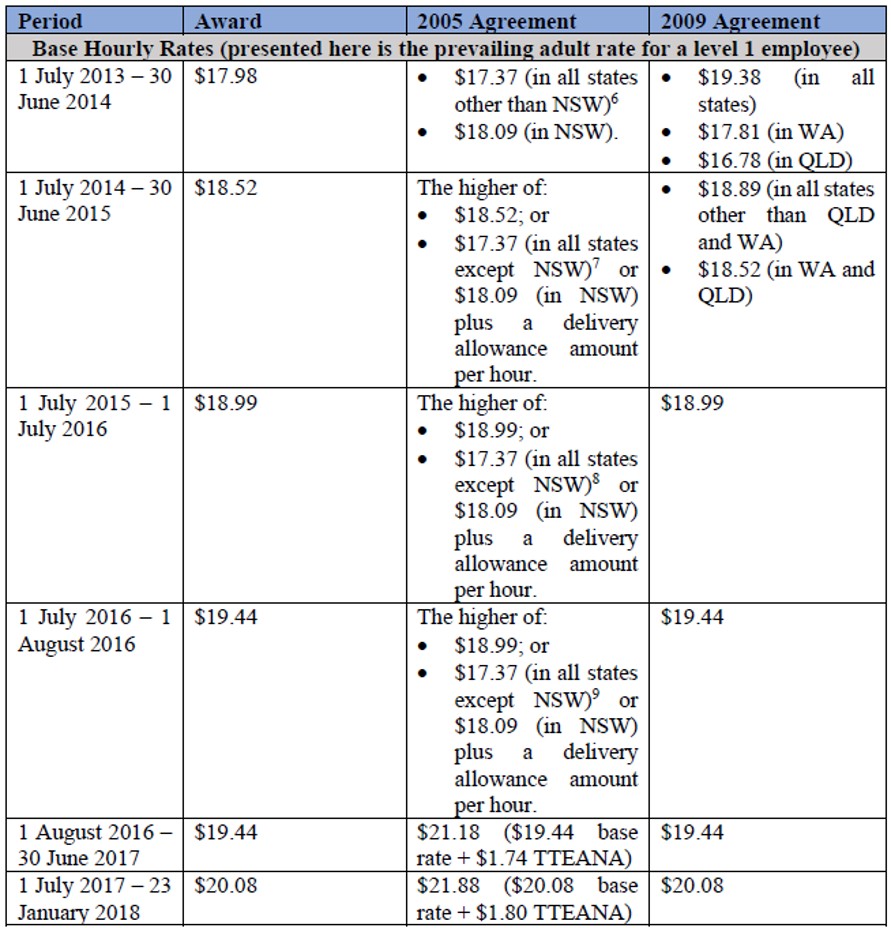
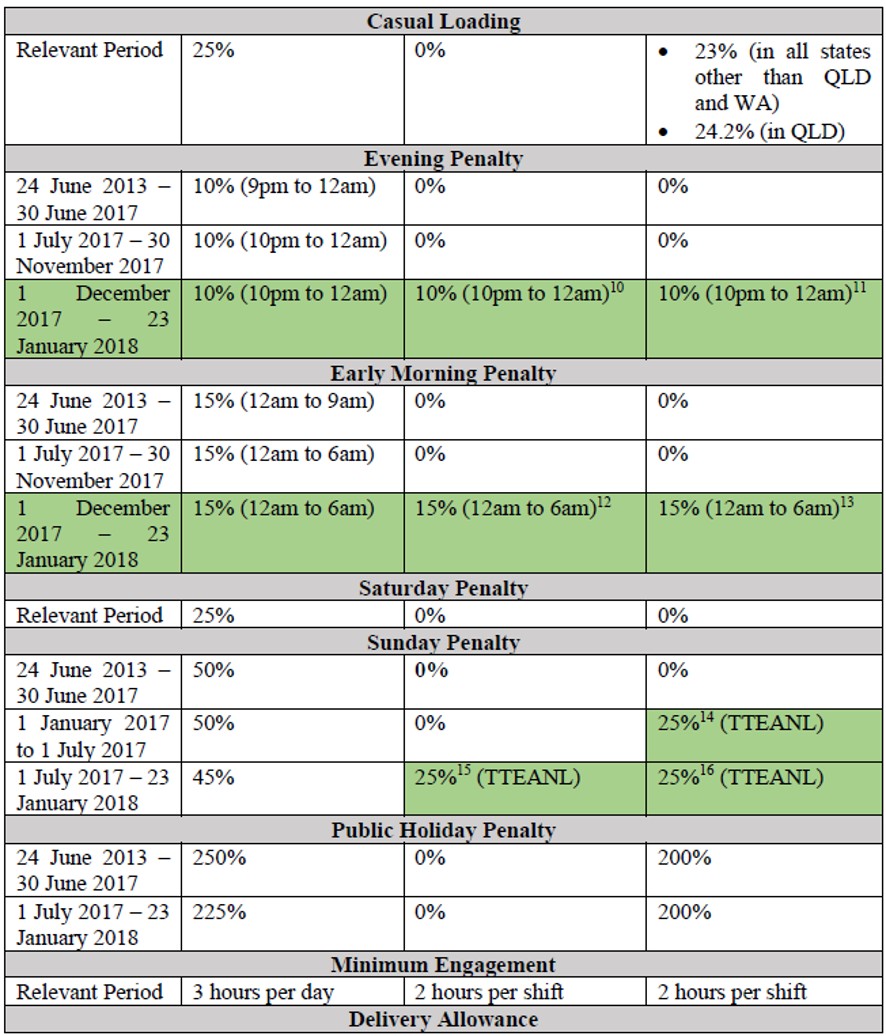
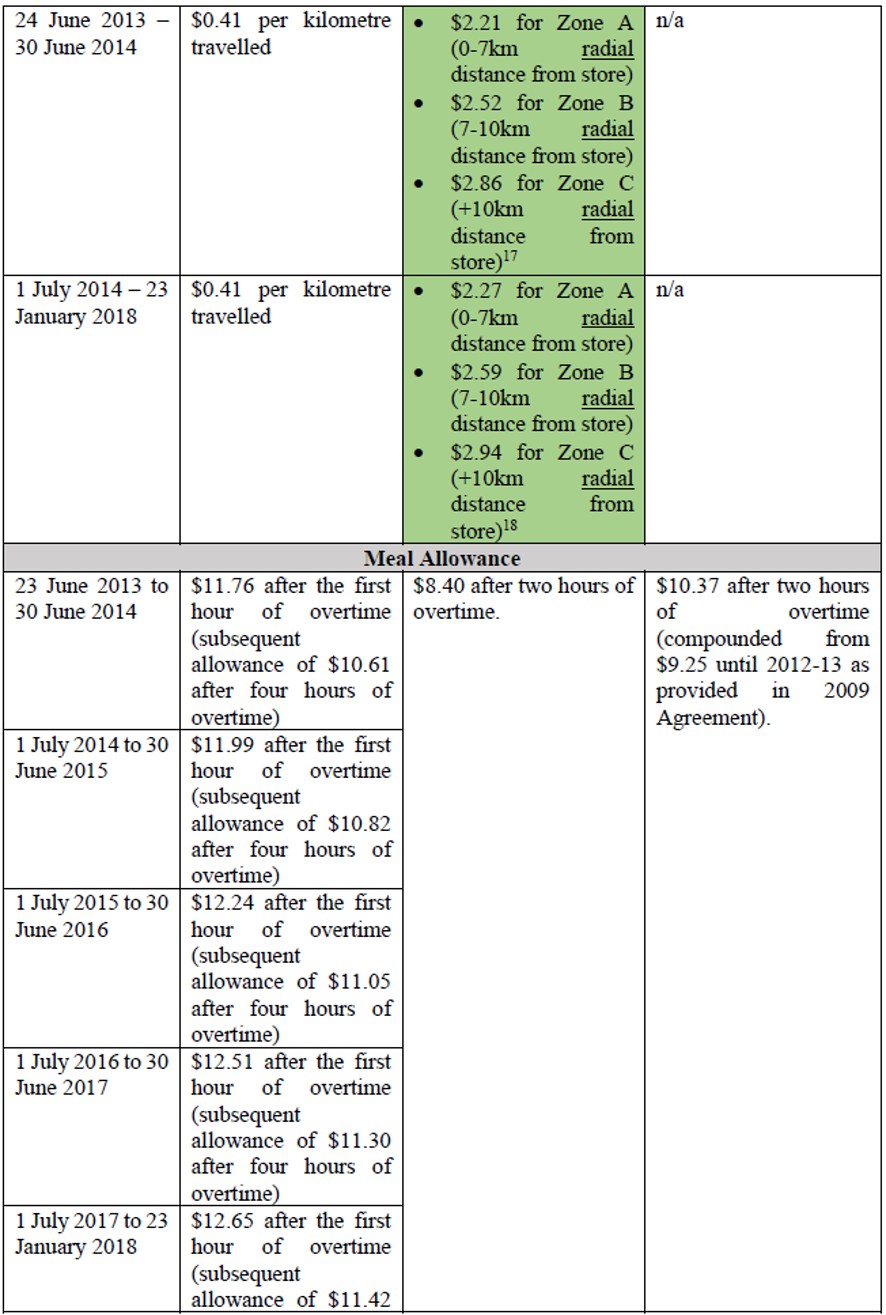
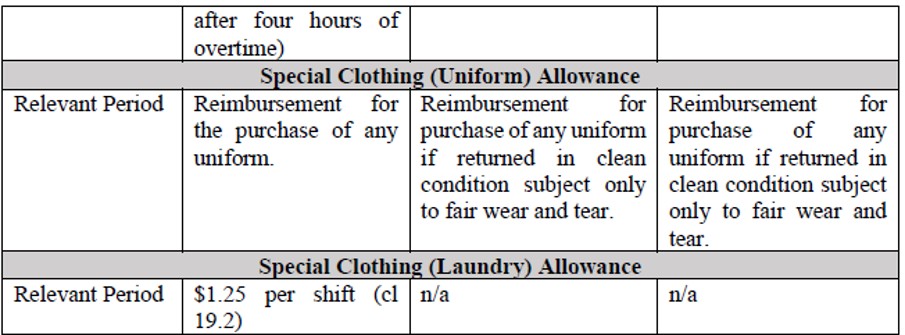
1488 For present purposes, it does not matter whether the applicant’s or Domino’s table is the more accurate. Both tables show that during the Relevant Period the applicant would have been paid more if he had been afforded the pay rates and terms and conditions under the Award.
1489 Third, it is clear from Ms Wright’s report that during the Relevant Period the applicant was paid the rates of pay prescribed by the 2005 Agreement (as increased by agreement with the SDA from time to time), and not the rates prescribed by the Award.
1490 As the applicant submitted, in relation to Dominoids:
(a) the applicant was paid a total of $12,046 during his employment with Dominoids over the Relevant Period, based on base pay rates (as recorded in his pay summary produced by DBS) ranging from $10.46 (when the applicant was 17 years old) to $13.61 (when the applicant was 18 years old);
(a) depending on the applicant’s age from time to time in this period, those pay rates were in line with the pay rates set out in the documents titled “National Domino’s Drivers’ Wage Rates to Apply from 1 July 2015” and “National Domino’s Driver Wage Rates to apply from 1 August 2016”, which Domino’s admitted it provided to Dominoids; and
(b) the applicant’s document “MFI-A2” (which linked the available evidence concerning payroll and amounts deposited into the applicant’s bank account) shows that the gross wages paid to him were calculated in accordance with (a) and (b) above and deposited in the same amount into his bank account by:
(c) in the period 21 October 2015 to 5 November 2015, Dominoids’ accountant; and
(d) in the period from 12 November 2015 to 31 August 2016, Domino’s (through DBS).
1491 Again, as the applicant submitted, in relation to MC Pizza:
(a) the applicant was paid a total of $21,784 based on base pay rates (as denoted in the MA CS Pizza Pty Ltd MYOB records) ranging from $13.61 (when the applicant was 18 years old) to $16.07 (when the applicant was 19 years old);
(b) depending on the applicant’s age from time to time in this period, those pay rates were in line with (or slightly above in the first weeks that MC Pizza operated the North Caboolture Store) the pay rates set out in the documents titled “National Domino’s Driver Wage Rates to apply from 1 August 2016”, “Domino’s Pizza Enterprises Driver Pay Rates to apply from 1 July 2017” and “Domino’s Pizza Enterprises Driver Pay Rates to apply from 1 December 2017”, which Domino’s admitted it provided to MC Pizza; and
(c) the applicant’s document “MFI-A2” which shows that MC Pizza (or its agent) calculated the gross wages payable to the applicant using the rates in (a) and (b) above, and that amount was then deposited into the applicant’s bank account.
1492 For obvious reasons, the fact that the applicant would have been paid higher pay rates under the Award than he was in fact paid under the 2005 Agreement is significant to my conclusion that it is more likely than not that the applicant suffered some loss “because of” Domino’s contravening conduct.
1493 Fourth, I do not accept Domino’s contention that it is appropriate to treat the present case as involving an allegation of “active indirect causation”. In my view the applicant advanced a case of “passive indirect causation”. The applicant summarised his argument on causation as follows:
[The] franchise operators relied on Domino’s instructions, information, and advice in relation to applicable pay rates. In reliance on that misleading or deceptive conduct, franchise operators paid Delivery Drivers and In-Store Workers employed by them less than they would have paid had the franchise operators been provided with the correct information by Domino’s concerning the applicable industrial instrument. Because of the misleading and deceptive conduct of Domino’s vis-à-vis the franchise operators, the applicant and group members have suffered loss or damage.
1494 Throughout the case, the applicant’s submissions were focused on what the likely reaction of franchise operators would have been had they known the true industrial position, and not the likely behaviour of the applicant or group members in response.
1495 In TPT Patrol (at [1659]), Beach J identified active indirect causation as a scenario “where a respondent’s misleading conduct induces some reaction in X, and the applicant would have acted differently but for that reaction by X” (emphasis added). He said further: “It is enough that X relied, and that the applicant would have acted differently but for that reliance by X” (emphasis added). The applicant alleged that Dominoids and MC Pizza relied on Domino’s misleading conduct and as a result they paid him the pay rates and terms and conditions of employment derived from the Agreements. He made no allegation that he would have acted differently but for their reliance, and he did not allege a case of “active indirect causation”.
1496 At [1660], Beach J identified passive indirect causation as a scenario “where [the] respondent’s misleading conduct induces some reaction in X, and that reaction by X itself causes loss to the applicant without any requirement for a reaction by the applicant” (emphasis added). In my view that description best aligns with the present case. The applicant alleged that Dominoids and MC Pizza relied on Domino’s misleading conduct and as a result they paid him the lower pay rates and terms and conditions of employment derived from the Agreements, thereby causing him detriment. That alleged reliance by Dominoids and MC Pizza on the contravening conduct (not any contention that the applicant would have acted differently) is the causal pathway the applicant alleged.
1497 That does not, though, mean that any reaction by the applicant to the misleading conduct by the relevant franchise operators is irrelevant. If it was established that the applicant was “indifferent” to the fact that he was entitled to be employed by Dominoids or MC Pizza on higher pay rates or better terms and conditions of employment and, for example, would not have continued his employment at the North Caboolture Store or would have taken fewer hours, that would be relevant to the comparison between the position in fact of the applicant and the position that he would have obtained had there been no contravention.
1498 Fifth, having regard to the evidence, the question as to whether or not it is appropriate to treat the applicant’s individual claim as involving an allegation of active indirect causation or passive indirect causation has little significance. I say that because Domino’s contention that the applicant was “indifferent” to an entitlement to be paid the higher rates of pay and better terms and conditions of employment under the Award was completely unmoored from the evidence.
1499 The applicant gave the following unchallenged evidence:
(a) In about September 2015, when he was still finishing high school, he found out that his girlfriend Lorryn, with whom he was living at his parents’ home, was pregnant. He and Lorryn did not pay rent to his parents, nor contribute towards the household bills, but they paid for their own food.
(a) The applicant and Lorryn were worried about ensuring that they had enough money to take care of their child, and he wanted to go to university. So in October 2015 he took a job working for Dominoids as a casual Delivery Driver at the North Caboolture Store so that he “could afford things for the baby and to cover costs of studying”.
(b) During 2015 he worked about five shifts per week, with 63% of them being less than three hours and 37% being three hours or more. Forty-one of the 57 shifts he worked in that period were after 5pm. He did not have set working days and his hours varied from week to week, but on average he worked 13.62 hours per week.
(c) In early 2016 he enrolled to study a Bachelor of Science (Computational Science) at the University of Queensland. He was on campus for about 20 contact hours per week spread over several days, and he usually went to university two days per week. Because he was studying, in addition to his pay from working at the North Caboolture Store, the applicant also received a Youth Allowance from Centrelink. In about February 2016 Lorryn became eligible for a Parenting Payment - Partnered from Centrelink. At around that time they started to buy things in preparation for their baby’s arrival, and he testified that he paid for most of the major items including a pram, baby bottles, bottle sterilisation equipment, formula, a car seat, toys and baby clothes.
(d) Between January and May 2016 the applicant started to take on some dayshifts at the North Caboolture Store in addition to the afternoon and evening delivery shifts he was previously doing. From early January 2016 he started to get at least one day shift per week, and his average hours went up by about four hours per week.
(e) Their son, Carter, was born in May 2016. The applicant testified that:
After Carter’s birth, I was taking whatever hours I could get at Domino’s. Hours were always tight, but sometimes I could pick up extra shifts. This was mostly filling in for someone who became sick or was otherwise unavailable for their shift. These extra hours were mostly not rostered hours. I was still in receipt of Youth Allowance. There was no cap on the number of hours I could work, but if I earned more than a threshold amount my Youth Allowance would reduce by 50 cents for every dollar over the threshold. This meant that I took whatever extra hours I could get, even if it meant that I went over the threshold.
(Emphasis added.)
(f) In the period 1 January 2016 to 28 August 2016 the applicant worked an average of 5.57 shifts per week, on average 17.42 hours per week while still undertaking his full-time university course.
(g) In July 2016 he resigned from the North Caboolture Store, because a friend of his became the Store Manager at the Northlakes Store, and she asked him if he wanted to work there instead and told him that she could offer him “better shifts”. He started at the Northlake Store on or around 17 July 2016 but that did not last long. He testified that he found the drive to the Northlakes Store excessive as it involved a 50-minute round trip for a two-to-three-hour-shift, whereas it only took him 10-12 minutes to drive to the North Caboolture Store. He told management at the Northlakes Store that he did not want the job because he thought “the drive was too far”. On 29 July 2016 he returned to work at the North Caboolture Store. In the period that immediately followed his hours increased and he was given more shifts, and sometimes they were longer than two hours.
(h) In August 2016 he was told that management of the North Caboolture Store was being taken over by Mark Glynn and Casey Benson (MC Pizza) and on or about 27 August 2016 he signed the relevant employment documents. Following the commencement of MC Pizza, he still tended to get Friday and Saturday night shifts, and a day shift on Wednesdays. In the period 29 August 2016 to 31 December 2016, he worked on average 4.67 shifts per week and his average weekly hours reduced to 15.31 per week. He only picked up a few day shifts per week. Whilst he preferred day shifts, they clashed with university enough that he started to struggle with his commitments.
(i) Due to the stress of having a newborn baby and his increased work commitments, he became unable to juggle university attendance and his results suffered. In about August he stopped attending university. The applicant gave evidence that after that, he “continued to take as much work as possible” at the North Caboolture Store. While he worked roughly the same number of hours per week, his shifts were predominantly during the day between Sunday and Thursday, and for three hours or more.
(j) In 2017, because by then the applicant had formally withdrawn from university he was no longer eligible for the Youth Allowance. Throughout 2017 he continued to work as a casual Delivery Driver. From 1 January 2017 to 31 July 2017, he worked an average of 4.62 shifts per week, working on average 15.31 hours per week. More of his shifts were worked during the day. In the period 31 July 2017 to 31 December 2017, he worked an average of 4.7 shifts per week, working an average of 13.43 hours per week. 70% of his shifts were daytime shifts, while 30% were worked after 5pm.
(k) In late 2017 he wanted to return to study and he enrolled to study a Bachelor of Computer Science at the University of New England. That university offered remote learning and he did not need to attend lectures as he could watch them online. He graduated with that degree in December 2021.
(l) He left employment at the North Caboolture Store in March 2018, and took up full-time employment, while still undertaking his university degree.
1500 It can be accepted that the evidence shows that the key consideration in the applicant deciding not to continue working at the Northlakes Store, and to return to working at the North Caboolture Store, was because he thought the “drive was too far”. But that does not show that the applicant was indifferent to the better rates of pay that were available to him if, on the counterfactual, the Award applied.
(a) First, the applicant’s decision that the “drive was too far” does not show indifference to the availability of a better pay rate. In circumstances where the drive to the Northlakes Store involved a 50-minute return trip to undertake a two-to-three-hour shift it was entirely rational for the applicant to decide that took too long, or involved too much wasted time, when he was juggling time between his university course, his work as a Delivery Driver, and his having shared responsibilities for a young baby at home. It does not show the suggested indifference to the better rates of pay that were available. Thus, contrary to Domino’s contentions, it does not support an argument that he was unlikely to have wanted to undertake the same shifts and hours at the North Caboolture Store, as he in fact undertook during the Relevant Period.
(b) Second, the decision to cease work at the Northlakes Store and return to the North Caboolture Store had nothing to do with pay rates. The evidence is that the Agreements applied in both stores, and I infer that the pay rates at the stores were the same. On the counterfactual that the Award applied, the better pay rates would have applied in both stores. Again, that does not show the suggested indifference.
(c) Third, the applicant gave evidence that he took up the offer to work at the Northlakes Store because he was told he would be given “better shifts”; that is, more money. That supports an inference that, on the counterfactual that the Award applied, he was likely to be interested in receiving the better rates of pay that were available at the North Caboolture Store.
(d) Fourth, the applicant was a young man with a girlfriend and a baby who he was supporting. He was plainly a hard worker because while still in high school he took on part-time work as a Delivery Driver, working a significant number of hours per week while going to school, then he continued to work a significant number of hours per week while undertaking a full-time degree course at university and sharing in managing the demands of a young baby at home. He took on extra shifts even though he lost 50 cents for each dollar earned above the threshold of his Youth Allowance. He testified that he found it “stressful” trying to prepare for the arrival of their child on the wages he received from Dominoids along with their government benefits, and said:
Even the small improvement in wages and conditions that would have been offered under the terms of the Award would have made a big difference at that time. I could have bought more things or better things if I had been getting even slightly higher wages each week at that time.
1501 The evidence shows that money was tight and that the applicant worked as many hours as possible as a Delivery Driver. It also tends to show that, under the counterfactual, he would have continued to take on significant hours of work at Dominoids and MC Pizza. He gave evidence that, after his son’s birth, he “was taking whatever hours I could get at Domino’s. Hours were always tight, but sometimes I could pick up extra shifts” and also that following his withdrawal from university he “continued to take as much work as possible”. I understood the applicant’s evidence to mean that he took as many hours as he was offered at Dominoids or MC Pizza, but taking into account the difficulty he had in juggling shifts around his study and his domestic obligations having regard to his young child.
1502 I consider it appropriate to infer that if, under the counterfactual, this hard-working young man was entitled to be paid the better pay rates and terms and conditions of employment available under the Award, he would have continued “to take as much work as possible” at the North Caboolture Store. It is more likely than not that he would have worked approximately the same hours as he in fact did during the Relevant Period (but perhaps configured differently over fewer shifts of longer duration because of the minimum three-hour shifts provided under the Award).
1503 Thus, while I do not accept Domino's contention that it is appropriate to characterise the applicant’s case as involving active indirect causation, it makes no difference.
1504 Sixth, it is relevant too that there is no probative evidence to the contrary. Domino’s submitted that the applicant’s failure to lead evidence from Dominoids and MC Pizza was fatal to its case on causation. That is not the case. Reliance can be inferred, and I am satisfied it is appropriate to do so.
1505 Indeed, Domino’s contention cuts both ways. In circumstances where the evidence in support of inferring reliance was strong, if Domino’s wished to put the inference that the applicant sought into question, or to establish that Dominoids or MC Pizza independently arrived at the view that the Agreements applied without relying on Domino’s representations, it should have adduced evidence from those responsible for Dominoids’ or MC Pizza’s payroll decisions to do so. But it did not.
1506 Seventh, Mr Potter’s evidence as to what occurred at the North Caboolture Store after the introduction of the Award does not negate reliance by MC Pizza during the Relevant Period; if anything, it confirms the practical significance of the information that, as I infer, Domino’s provided it at that time in relation to the applicability of the Award. Domino’s own causation case, through Mr Potter, was that once the Award was treated as applicable, MC Pizza reconfigured shifts, opening hours and staffing to manage labour costs. That very contention proceeds on the premise that the industrial instrument advised by Domino’s mattered, and that MC Pizza’s payroll and staffing practices were responsive to it. It tends to confirm, rather than deny, that Domino’s earlier advice (during the Relevant Period) - that the Agreements applied - was likely have to been relied upon and was not a matter of indifference.
1507 Eighth, contrary to Domino’s submissions, the applicant’s contention that the audits showed a high level of compliance by franchise operators with the pay rates and terms and conditions of the Agreements provides material support for the inference the applicant sought. The audits were conducted on the basis that the Agreements applied and:
(a) the First Compliance Activity Report issued in June 2013 showed that, in respect of Delivery Drivers, 93.0% of Franchise Stores were compliant with the pay rates and terms and conditions of employment derived from the Agreements. And in respect of In-Store Workers, 99.5% of Franchise Stores were compliant; and
(b) the December 2017 Half Year Report published 5 February 2018 stated that the audit identified that 646 stores out of 669 required “little or no action”, while only 15 stores (operated by four franchise operators) were issued breach notices. Domino’s contention that it was “not precisely clear” what it meant by “little or no action” in the context of the audit was far-fetched. On the plain and ordinary meaning of those words, the fact that “little or no action”, was required meant that those Franchise Stores had not departed from their obligations under the Agreements. Had Domino’s wished to contend that it meant something different, it was the author of those words, and it could have adduced such evidence.
1508 That evidence supports the applicant’s contention that it is highly unlikely that so many franchise operators would have independently and simultaneously paid their employees pay rates and terms and conditions of employment derived from the Agreements, unless they were doing so because they had been advised by Domino’s in mandatory and conclusory terms that those Agreements were binding and applicable. It does not establish reliance by Dominoids and MC Pizza, but it supports an inference in that regard.
1509 Ninth, Mr Potter gave evidence in relation to the 313 DBS Stores that he reviewed and he said that he had not seen information to suggest that business operators were failing to meet their obligations under the Agreements. That also supports an inference that there was a high level of compliance by franchise operators with the terms of the Agreements, which supports the inference that the applicant sought in relation to Dominoids and MC Pizza.
1510 Tenth, it is true as Domino’s pointed out in relation to Ms Eilert that some franchise operators may have asked for further or other information, and may have obtained their own independent legal advice. But that does not show that it is not appropriate to draw an inference of reliance in relation to Dominoids or MC Pizza. If Domino’s was in a position to put on evidence to show that either Dominoids or MC Pizza was relevantly communicating to their own legal advisers I expect that it would have done so.
1511 I note that Domino’s submitted that the applicant had not proved what Dominoids or MC Pizza would have done if they had been told the Award applied, and that Mr Potter’s evidence demonstrated that they would have reconfigured their operations so as to ensure that their total employment costs would not materially increase. That submission needs to be dealt with specifically, but it is properly understood as a contention going to the quantum of the loss, rather than centrally to causation. It is appropriate to deal with that contention when dealing with loss.
1512 It is true that a respondent may defeat (or reduce) a claim for loss and damage under s 236 by establishing that, absent the contravening conduct, the applicant would have ended up in materially the same economic position because of some other likely course of conduct. At all times the applicant had the onus to prove his pleaded loss, and Domino’s was entitled to point to evidence said to undermine the counterfactual on which he relied. The question is whether that evidence does so.
1513 At the causation stage, the applicant need only establish that he suffered some causally connected loss. I am well satisfied as to that. Mr Potter did not give evidence that the applicant would have suffered no loss. Instead, his evidence was directed to the implicit assumptions underpinning Ms Wright’s calculations and the proposition that the applicant’s loss was likely to be materially lower than alleged because Dominoids and MC Pizza could be expected to reconfigure their employment arrangements and shifts so that their total employment costs, including wage costs, did not materially rise.
1514 In all the circumstances I am well satisfied that the applicant suffered loss “because of” Domino’s contravening conduct. His loss was “brought about by virtue of” the contravening conduct: ABN Amro at [1376] quoting Janssen-Cilag at 530.
22.6 Common Question 28
1515 Common Question 28 asked:
If yes to question 26, have the Group Members suffered loss or damage because of conduct by Domino’s in contravention of s 18 of the Australian Consumer Law, where those Group Members were employed by:
(a) all franchise operators (including Dominoids and MC Pizza); or
(b) those Franchise Operators that used the Payroll System (including Dominoids) as admitted at AD [32A] and [33B]; and/or
(c) those Franchise Operators that were the subject of Compliance and Audit Activities (including Dominoids) as admitted at AD [32A.1].
1516 The difficulty with Common Question 28, as framed, is that it is premised on the basis that causation is a common question, when the initial trial was conducted on the basis that causation and loss would only be determined for the applicant. Accordingly, this question can only be answered in relation to the applicant.
1517 For the reasons I have explained above, I am satisfied that the applicant suffered loss or damage “because of” Domino’s contravening conduct.
1518 I consider it to be likely that the great majority of franchise operators that wrongly afforded their employees the pay rates and terms and conditions of employment under the Agreements rather than the Award will be in a position to establish a sufficient and direct link between Domino’s contravening conduct directed to them and the loss and damage suffered by their employees as a result. But establishing that is a matter for another day.
23. LOSS OR DAMAGE
1519 I now turn to consider what measure of loss the applicant established.
1520 There are two parts to the applicant’s claim for loss and damage:
(a) A claim for payment of the difference between what the applicant would have been paid during the Relevant Period had Dominoids and MC Pizza been instructed and advised by Domino’s that the Award rates and conditions applied, and what he was actually paid for his work in that period (the Underpayment Loss Claim, in relation to the Underpayment Loss).
(b) A claim for damages for loss of opportunity (the Loss of Opportunity Claim, in relation to Loss of Opportunity).
23.1 The Underpayment Loss Claim
1521 I set out above the applicant’s table showing the differences in the pay rates and conditions under the Agreements and the Award.
1522 However, by the time of closing submissions the applicant had accepted that he was required to posit and establish a counterfactual. As previously noted, he said that the appropriate question was:
[W]hat would the applicant have been paid had the franchise operator employing him during the Relevant Period been supplied with the correct instruction and advice by Domino’s that the Award rates applied, rather than those derived from the Agreements?
1523 Thus, the applicant no longer submitted that his Underpayment Loss could be assessed simply by comparison between what he was in fact paid or should have been paid under the Agreements during the Relevant Period, and what he would have been paid for those same hours and shifts under the Award. But the result was not a long way different. He contended that, in the circumstances, in the counterfactual world that Dominoids and MC Pizza were aware that the Award applied, it was more likely than not that he would have worked approximately the same hours as he had in fact worked during the Relevant Period (but perhaps configured differently over fewer shifts of longer duration because of the minimum three-hour shifts provided under the Award).
1524 He said that loss fell to be calculated by reference to the difference between what he was actually paid in the Relevant Period and what he would have been paid had his employers been advised by Domino’s that the terms and conditions of the Award applied. He contended that the approach taken by Mr Potter unhealthily overcomplicated the straightforward and orthodox counterfactual addressed by Ms Wright, being what he would have been paid had Dominoids and/or MC Pizza been supplied with the correct instruction and advice by Domino’s.
1525 In reliance on Mr Potter’s analysis, Domino’s submitted that, in the counterfactual world that Dominoids and MC Pizza were aware that the Award applied, it was more likely than not that they would have reconfigured their employment arrangements and shifts so that their total employment costs, including wage costs did not materially rise. It said, based on Mr Potter’s analysis that, in the counterfactual, it was likely that franchise operators in general, and Dominoids and MC Pizza in particular, would have reconfigured their employment arrangements as follows:
(a) employing more permanent part-time staff and fewer casual staff in an effort to reduce the cost of the 25% casual leave loading under the Award;
(b) shifting work away from times when penalty rates would apply to times when ordinary rates applied;
(c) abandoning two-hour shifts and replacing them with minimum three-hour shifts to accord with the minimum engagement time under the Award;
(d) reducing the use of private vehicles by Delivery Drivers (which incurred a delivery allowance under the Award), and instead providing company-owned vehicles for the Delivery Drivers to use; and
(e) laundering the uniforms of its employees so as to reduce the laundry allowance otherwise payable to employees for laundering their own uniforms.
23.1.1 The expert evidence
1526 By the amended letter of instruction from the applicant’s solicitor, Ms Wright was requested to calculate the Underpayment Loss suffered by the applicant. Importantly, she was instructed to calculate the loss as follows:
7.2 To calculate the Underpayment Loss for Mr Gall, we ask that you:
(a) report the amount Mr Gall was actually paid on an entitlement-by-entitlement basis; and
(b) identify the amount Mr Gall would have been paid under the Award on an entitlement-by-entitlement basis; and
(c) by means of the above comparison, calculate the underpayment loss of Mr Gall.
7.3 To the extent possible, the underpayment losses should be expressed as the result of a comparison on an entitlement-by-entitlement basis as between the amounts in fact paid to Mr Gall with respect to a particular entitlement and the amounts payable under the Award with respect to that entitlement.
1527 Ms Wright was instructed to calculate the applicant’s Underpayment Loss under the following two approaches:
(a) Treating all pay, penalty and loading employee entitlements as a single calculation of loss (Single Calculation of Loss); and
(b) Treating all pay, penalty and loading employee entitlements as separate entitlements of loss, without offsetting; i.e., without setting off any underpayment losses with overpayment losses for each entitlement and across pay periods (Separate Entitlements of Loss Without Offsetting Calculation). The effect of this last item can be seen in the following table extracted from the Joint Experts’ Report which shows the different results if offsetting is permitted, and if offsetting is not permitted.
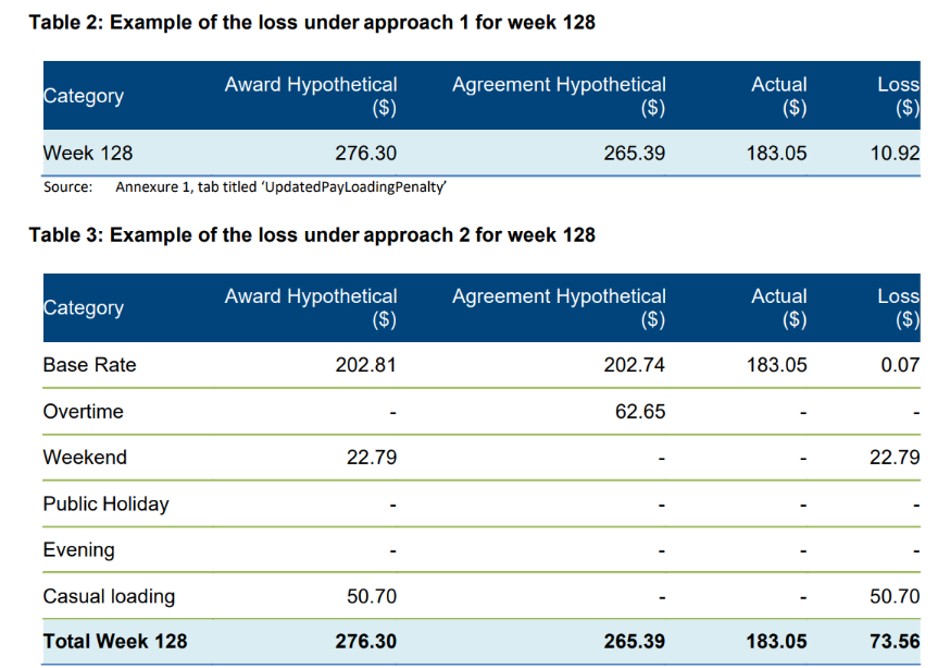
1528 Ms Wright undertook calculations and prepared a report which tabulated the results on those two approaches. Ms Wright presented three scenarios in relation to the “delivery allowance loss” which represented three different ways of calculating the “delivery allowance” which was payable to Delivery Drivers during the Relevant Period under the applicant’s hypothetical. The three methods are as follows:
(a) Scenario 1: the difference between the minimum delivery allowance under the 2005 Agreement and the minimum allowance if the Award applied:
(i) the minimum delivery allowance under the 2005 Agreement provided, in relation to delivery runs with multiple deliveries, that when determining the radial distance between the store and the delivery address (as required under the Agreement to determine the allowance), the closest distance travelled during the delivery run is considered the “delivery address”; and
(ii) the minimum delivery allowance under the Award provided, in relation to delivery runs with multiple deliveries, calculated by the distance to the first address (representing the closest distance travelled during the delivery run) multiplied by $0.41 twice (representing the journey to and from the store);
(b) Scenario 2: the difference between the maximum delivery allowance under the 2005 Agreement and the maximum delivery allowance under the Award:
(i) the maximum delivery allowance under the Agreement provided, in relation to delivery runs with multiple deliveries, that when determining the radial distance between the store and the delivery address (as required under the Agreement to determine the allowance), the furthest distance travelled during the delivery run is considered the “delivery address”; and
(ii) the maximum delivery allowance under the Award provided, in relation to delivery runs with multiple deliveries, calculated by the distance to the second address (representing the furthest distance travelled during the delivery run) multiplied by $0.41 twice (representing the journey to and from the store);
(c) Scenario 3: the difference between an alternative allowance under the Agreement and an alternative delivery allowance under the Award:
(i) the minimum allowance under the Agreement, calculated by treating multiple delivery addresses during a delivery run as each being a separate delivery, and calculated as in Scenario 1 and 2; and
(ii) the maximum allowance under the Award, calculated by treating delivery runs with multiple deliveries, by reference to the distance to the second address (representing the distance travelled to the second delivery address via the first address) plus the radial distance between the store and the second delivery address multiplied by $0.41, using data from GPS Tracker.
1529 Ms Wright calculated (and the experts agreed as a matter of mathematical accuracy) that under the Single Calculation of Loss method the applicant’s Underpayment Loss was in the range from $14,469 to $14,682 (depending on which of the three delivery allowance scenarios was applied), as tabulated below (rounded to full figures):
Description | Award ($) | Agreement ($) | Actual ($) | Loss ($) |
Pay/Penalty/Loading | 35,362 | 27,638 | 26,750 | 7,438 |
Minimum Hour Engagement | 3,131 | 126 | N/A | 3,019 |
Laundry Allowance | 751 | N/A | 5 | 750 |
Uniform Allowance | N/A | N/A | (163) | N/A |
Broken Hill Allowance | N/A | N/A | N/A | N/A |
Meal Allowance | N/A | N/A | N/A | N/A |
Total excluding delivery allowances (A) | 39,244 | 27,764 | 26,592 | 11,369 |
Including Delivery Allowances | ||||
Scenario 1 Delivery Allowance (B) | 9,239 | 6,017 | 5,841 | 3,100 |
Scenario 1 Total (A+B) | 48,484 | 33,781 | 32,434 | 14,469 |
Scenario 2 Delivery Allowance (C) | 9,480 | 6,018 | 5,841 | 3,313 |
Scenario 2 Total (A+C) | 48,725 | 33,782 | 32,434 | 14,682 |
Scenario 3 Delivery Allowance (D) | 9,377 | 6,250 | 5,841 | 3,132 |
Scenario 3 Total (A+D) | 48,621 | 34,014 | 32,434 | 14,502 |
1530 Ms Wright calculated (and the experts agreed as a matter of mathematical accuracy) that under the Separate Entitlements of Loss Without Offsetting Calculation the applicant’s Underpayment Loss was in the range of $16,127 to $16,340 (depending on which of the three delivery allowance scenarios was applied), as tabulated below (rounded to full figures):
Description | Award ($) | Agreement ($) | Actual ($) | Loss ($) |
Pay/Penalty/Loading | 35,362 | 27,638 | 26,750 | 9,095 |
Minimum Hour Engagement | 3,131 | 126 | N/A | 3,019 |
Laundry Allowance | 751 | N/A | 5 | 750 |
Uniform Allowance | N/A | N/A | (163) | N/A |
Broken Hill Allowance | N/A | N/A | N/A | N/A |
Meal Allowance | N/A | N/A | N/A | N/A |
Total excl delivery allowances (A) | 39,244 | 27,764 | 26,592 | 13,027 |
Including Delivery Allowances | ||||
Scenario 1 Delivery Allowance (B) | 9,239 | 6,017 | 5,841 | 3,100 |
Scenario 1 Total (A+B) | 48,484 | 33,781 | 32,434 | 16,127 |
Scenario 2 Delivery Allowance (C) | 9,480 | 6,018 | 5,841 | 3,313 |
Scenario 2 Total (A+C) | 48,725 | 33,782 | 32,434 | 16,340 |
Scenario 3 Delivery Allowance (D) | 9,377 | 6,250 | 5,841 | 3,132 |
Scenario 3 Total (A+D) | 48,621 | 34,014 | 32,434 | 16,159 |
1531 There were some slight differences between this table in the Joint Experts’ Report and the applicant’s submissions as to the agreed position in Annexure A to its closing submissions, but they are immaterial and it was not always clear what the basis of the difference was. I will use the numbers in the agreed table, except where I state otherwise. The “Pay/Penalty/Loading” figure in the table above is broken down into its constituent parts below, specifically casual loading and evening, weekend and public holiday penalties. I have taken these figures from Annexure 1 to the Joint Experts’ Report titled “Joint Report Calculations, ‘Updated Loss Summary’”.
1532 I now briefly summarise the areas of agreement and disagreement between Ms Wright and Mr Potter in the Joint Experts’ Report.
1533 First, Ms Wright and Mr Potter broadly agreed on the mathematical accuracy of the calculations of the difference between the hypothetical amounts that the applicant would have been paid during the Relevant Period if the Award had been applied, the hypothetical amounts that the applicant should have been paid during the Relevant Period under the 2005 Agreement, and the actual amounts that the applicant was paid during the Relevant Period. They also agreed on the mathematical accuracy of the alternative calculations each of them prepared in relation to the loss attributable to the hypothetical increased delivery allowance that the applicant would have been paid during the Relevant Period if the Award had been applied (defined above as “delivery allowance loss”).
1534 Second, and importantly, Mr Potter criticised the assumptions which Ms Wright was instructed to make, in calculating the applicant’s Underpayment Loss in the counterfactual, that during the Relevant Period Dominoids and MC Pizza applied the Award pay rates and conditions to their employees:
(a) First, and this was Mr Potter’s main criticism, in his opinion the instructions Ms Wright was given implicitly assumed that in her loss calculation, in the counterfactual in which the Award applied to all of the applicant’s earnings during the Relevant Period, he would have worked the same number of hours, worked those hours at the same times of day, made the same number of deliveries (all using his own vehicle) and always laundered his own uniform. Mr Potter opined that the reasonableness of that assumption could be tested through examining employment trends in Domino’s Stores during actual periods during which the Award did not apply and did following its commencement in January 2018 (calendar years 2017 to 2019).
(b) Second, in the counterfactual in which Dominoids and MC Pizza applied the Award pay rates and conditions to their employees, Ms Wright was implicitly instructed to adopt the minimum three-hour shift requirement that would apply to the applicant’s employment, whereas under the 2005 Agreement a minimum two-hour shift requirement applied (minimum engagement loss). The minimum engagement loss that Ms Wright calculated in respect of the applicant assumed that any shift of less than three hours that the applicant actually worked during the Relevant Period would be paid under the Award as though he had worked three hours. Mr Potter opined that there was a question as to whether it was reasonable to assume that, in the hypothetical that the Award applied during the Relevant Period, the applicant would have been paid for three hours for every shift he actually worked of less than three hours (as opposed to, for example, instead of working shifts of at least three hours, or in instances where two shifts of two hours were recorded, a single shift of four hours may have been worked instead).
(c) Third, Ms Wright was implicitly instructed to assume that, in the counterfactual, the applicant would be employed as a casual, and therefore earn the casual loading. Mr Potter opined that there was a question as to whether it was reasonable to assume, in the counterfactual, that the applicant would be employed as a casual, when following implementation of the Award, the North Caboolture Store transitioned to using materially fewer casual employees, employing workers as part-time employees instead of as casual employees, and thereby reducing the wage cost of the casual loading.
(d) Fourth, Ms Wright was implicitly instructed to assume that, in the counterfactual, the applicant would be employed undertaking hours, on the same days, and in the same time periods, such that he would have the same penalty rate entitlements. Mr Potter opined that there was a question as to whether it was reasonable to assume, in the counterfactual, that the applicant would have the same penalty rate entitlements when, following implementation of the Award, the average opening hours on weekends and public holidays at the North Caboolture Store were lower, which meant that there were fewer hours available to be worked during periods that attracted penalty rates.
(e) Fifth, Ms Wright was implicitly instructed to assume that, in the counterfactual, the applicant would continue to earn a higher delivery allowance on the basis that he used his private vehicle to undertake deliveries. Mr Potter opined that there was a question as to whether it was reasonable to assume, in the counterfactual, that the applicant would have been paid the higher delivery allowance because, following implementation of the Award, the use of company vehicles for deliveries instead of private vehicles at the North Caboolture Store markedly increased.
(f) Sixth, Ms Wright was implicitly instructed to assume that, in the counterfactual, the applicant would have laundered his own uniform and would therefore have an entitlement to a laundry allowance under the Award. Mr Potter opined that there was a question as to whether it was reasonable to assume, in the counterfactual, that the applicant would receive a laundry allowance when, following implementation of the Award, the North Caboolture Store moved rapidly to laundering its employees’ uniforms itself.
(g) Seventh, Ms Wright’s calculations did not include the backpay which the applicant had received consequent upon his apparent underpayment by Dominoids, which totalled $758.07 gross. Ms Wright was not given any information about these items and so did not include them in her calculation. Mr Potter opined that that represented an understatement of the actual wage component of the Underpayment Loss calculation and, therefore, an overstatement of the Underpayment Loss.
(h) Eighth, Ms Wright calculated that, in the counterfactual that the Award applied during the Relevant Period, the cost to Dominoids or MC Pizza of employing the applicant increased by 40%. Mr Potter considered that, in the hypothetical, the cost to Dominoids or MC Pizza of employing the applicant would have risen by between 42.9% to 44.2%.
23.1.2 Mr Potter’s analysis
1535 Pursuant to the letter of instruction from Domino’s solicitors dated 8 September 2022, Mr Potter was instructed to prepare the First Potter Report and provide his opinion on the following matters:
1.1 Describe how a reasonable market participant would respond to being required to afford its employees terms and conditions that are different from and more costly than the terms and conditions that the employer has previously been providing to its employees.
1.2 In the period following January 2018, describe how Franchise Operators' employment practices changed generally and with reference to the North Caboolture store, including by having regard to the particulars to paragraph 49AA of Domino's defence.
1.3 Comment on the change in the total cost of labour of Franchise Operators generally and with particular reference to the North Caboolture store in the period following January 2018.
1.4 Comment on sections 2.3 and 5 of the expert report of Ms Dawna Wright of FTI Consulting dated 19 July 2022. Your report is not required to comment on sections 2.2, 2.4, 4 and 6 of that report.
Question 1.2 was particularly apposite.
1536 In relation to the Second Potter Report, Mr Potter was instructed to perform a similar analysis to that he had undertaken in relation to the North Caboolture Store, this time, doing so in respect of 313 DBS Stores, in order to consider how franchise operators’ employment practices and the total cost of labour had changed more generally.
1537 Mr Potter provided detailed reports but he did not offer his own opinions as to the extent of any loss or damage suffered by the applicant or group members. In large part, he restricted himself to criticising the assumptions upon which Ms Wright’s calculations were undertaken.
1538 Mr Potter’s central tenet was that, in the counterfactual that franchise operators had been informed that the Award applied, they were operating their stores in a competitive environment and were likely to have sought to offset any increased labour costs associated with the introduction of the Award by seeking to reconfigure their businesses so that total employment costs did not materially increase. That theory was confirmed by analysis which Mr Potter said showed that, both in respect of the North Caboolture Store, and in respect of the 313 DBS Stores, following implementation of the Award in January 2018 franchise operators had, in fact, reconfigured their employment practices and the assumptions underpinning Ms Wright’s calculations were not reasonable.
1539 I found Mr Potter’s analysis of the available data in relation to the changes made at the North Caboolture Store, and in respect of the 313 DBS Stores he considered, before and after the introduction of the Award in January 2018 relevant and useful. His analysis also had the benefit of being consistent with commercial common sense. In a fast food business like a Domino’s Store one would expect a rational businessperson to attempt to reduce the impact on profitability of the significant increase in wage cost through the introduction of the Award. To my mind, the changes to employment practices that Mr Potter’s analysis showed that franchise operators - including at the North Caboolture Store - had actually introduced following the introduction of the Award in January 2018 provided something of a window into what Dominoids and MC Pizza were likely to have done in the counterfactual that they had been advised by Domino’s during the Relevant Period that the Award applied to their employees.
1540 I accept that Ms Wright was implicitly instructed to assume that, in the counterfactual that Dominoids and MC Pizza operated on the basis that the Award applied to their employees during the Relevant Period, they would have given the applicant work on the same hours, same shifts, same days, at the same times, on the same casual basis, but afforded him the pay rates and conditions that applied under the Award. That assumption did not take into account that, in the counterfactual, Dominoids and MC Pizza could take steps to rearrange their employment practices in an effort to address the increased wage costs that would result from the Award terms and conditions. The question as to what, if any, detriment or disadvantage the applicant suffered by reason of Domino’s contravening conduct could not be answered by use of an assumption. It required to be answered by evidence and by appropriate inferences. But as I later explain, that does not mean that Ms Wright’s calculations have no utility in the case.
1541 There were also some deficiencies in Mr Potter’s analysis, or at least in the way that Domino’s tried to use it. Further, his analysis focused on labour costs as the main or only operating cost that franchise operators (relevantly Dominoids and MC Pizza) were likely to attempt to reduce, rather than considering all of the cost reduction and revenue increase possibilities. And much of his evidence involved examples of various scenarios in which, under the counterfactual, the applicant (and group members) may or may not have worked the hours and shifts that they in fact did during the Relevant Period. Acting as rational business people, franchise operators could reconfigure the employment hours and shifts that were made available to employees in particular Franchise Stores, including at the North Caboolture Store, but their desire and capacity to do so was likely to depend upon the particular individual circumstances of that franchise, that particular franchise operator or that particular period in the cycle of that business. Mr Potter’s evidence had some probative value, but it did not provide a robust basis for the counterfactual which Domino’s advanced.
1542 In cross-examination Mr Potter was drawn to make some significant concessions.
1543 First, he accepted that a commercial business operator might seek to adopt measures to reduce costs other than through reconfiguring its employment practices. He accepted that they might choose to increase prices or reduce a mix of other fixed and variable costs including reductions in the size of the product and thus the volume of ingredients necessary to make it, where that was possible and depending upon the prevailing conditions. However, as Domino’s highlighted, he said:
I was trying to identify what actually occurred from the data for the labour measures in the stores following the introduction of the award. So it’s - and it’s identifying what measures are implemented and what happened to the costs in the - as a snapshot, if you like, over that period. The other measures to introduce surcharges, for example, and do other things, they can obviously be put in place. But because labour cost is such a significant thing in pizza stores, it would be a natural thing for a business person to look at the measures available to minimise the costs in such a structural change.
1544 I have no difficulty in accepting that, in the counterfactual, as rational business people the owners of Dominoids and MC Pizza would be motivated to and could take steps to reconfigure their business practices in an effort to address the increased wage costs that would result from the Award terms and conditions. But Mr Potter’s analysis focused almost solely on labour costs and there were some deficiencies in that approach.
1545 Second, the thrust of Mr Potter’s opinion in relation to the possibility of increasing pizza prices to offset increased labour costs was that that was unlikely to occur in the counterfactual because franchise operators operated their stores in a competitive pricing market such that an increase in pizza prices would cause reduced demand. Mr Potter, however, did not provide any analysis of pricing points or pricing trends in relation to Domino’s pizzas during the Relevant Period or after the introduction of the Award. Nor did he undertake any analysis of pricing points or pricing trends in relation to Domino’s competitors in the fast-food market over that time frame (or in the particular market segment which Domino’s occupied called the Quick Service Restaurant category), including its main competitor, Pizza Hut. Nor had Mr Potter tracked the prices of Domino’s or Pizza Hut’s pizzas as against consumer demand; i.e., how the demand for Domino’s pizza responded to price changes. His evidence that, in the counterfactual, Dominoids and MC Pizza were unlikely to increase pizza prices to offset increased labour costs was just an assertion, without evidence to back it up.
1546 Mr Potter ultimately accepted in cross-examination that whether an increase in pizza price was likely to lead to a consequential drop in demand will depend upon the prevailing market circumstances, including upon the success of marketing stratagems such as styling a product as a premium offering to which a higher price is attached. He accepted that he was stating a general proposition, which would not apply in every case. His opinion that, in the hypothetical, pizza prices were unlikely to be increased as a way of offsetting the increased labour costs lacked a foundation in the evidence.
1547 Third, Mr Potter accepted that, with Domino’s support, it was possible to reduce operating costs in Franchise Stores by reducing the size of pizzas, thereby saving on the costs of ingredients, and also through other efficiency measures. In cross-examination, he was taken to an article in Australian Business News dated 7 July 2017. The article reported that in the middle of 2017 Domino’s had, in fact, introduced a trial of smaller pizzas in an attempt to cut costs prior to the introduction of increased wages. The same article described other strategies Domino’s was trialling in an effort to maintain profit in the face of increased labour costs, including weekend and public holiday surcharges, GPS driver tracking (to improve efficiency) and a requirement for a 10-minute turnaround time (to increase throughput). Mr Potter was aware of the surcharge trial, but said nothing about that in his reports. Plainly, in the counterfactual, there were other ways that Dominoids and MC Pizza could seek to offset the increased labour costs from the introduction of the Award, rather than only focussing on labour costs as Mr Potter’s analysis did.
1548 Fourth, in cross-examination Mr Potter accepted that he had not had regard to the broader context in which franchise operators, or Dominoids and MC Pizza in particular, operated their businesses before providing his opinion. Mr Potter said in cross-examination that, based on his experience in small business valuations, he expected franchise operators would expect an annual after-tax return of around 20% on the amount invested in a Domino’s Store. He was taken to a Domino’s document from 2015 which recorded the cost of a new Franchise Store as generally between $400,000 to $650,000 plus GST, and the cost of an existing Franchise Store as generally between $500,000 to $850,000. It was apparent that Mr Potter’s analysis did not take into account what the upfront capital cost of the North Caboolture Store was for Dominoids or MC Pizza, whether the North Caboolture Store was providing an after-tax return of around 20% during the Relevant Period or after the introduction of the Award, or whether the owners of the Dominoids and MC Pizza sub-franchises were obtaining a return on their investment through other structures, for example by paying themselves as an employee or by paying themselves through another Franchise Store which they operated. That too reduced the robustness of the basis for Domino’s submission that, in the counterfactual, Dominoids and MC Pizza were likely to reconfigure their employment practices in the way, or to the extent that Domino’s contended was likely.
1549 Fifth, Mr Potter was taken to several of Domino’s publicly available reports, as published to the ASX:
(a) the December 2017 Half Year Report dated 5 February 2018, reported:
• Strategic productivity initiatives have been put in place to offset forecasted changes in wage rates and conditions
• Reaffirming previous guidance, from H1 17 - as a result of award modernisation, labour as a percentage of sales will increase by an average of 2%, before strategic initiatives are implemented
(b) Mr Potter was unable to explain what these strategic productivity initiatives were. But he testified that increased labour costs of an average of 2% of sales was roughly consistent with what his research showed.
(c) the “2018 Annual Report” dated 14 August 2018, reported:
[Domino’s Australia and NZ] achieved EBITDA of $127.5 million, which represents an increase of 12.0% from prior year. Revenue increased by 4.2% which was driven by SSS growth of 4.5% in the current year. Highlights for the [Australia and NZ) market, included the ‘New Yorker’ and Oven Baked Sandwich menu launches.
Domino’s is the only major Quick Service Restaurant to be fully modernised, with team members paid according to the Modern Fast Food Industry Award. The resulting impact on Franchisee profitability is in line with previous guidance of 0-2% of sales.
[Domino’s Australia and NZ] opened 50 new stores during the financial year
(Emphasis added.)
(d) Mr Potter accepted that Domino’s reported that the impact on franchisee profitability from the introduction of the Award was an average reduction of zero to two percent of sales, which was an actual result rather than a prediction. He also accepted that that was lower than the around two percent of sales which his analysis suggested, as for some stores the effect had been zero.
(e) the “Full Year Results, Period ending 1 July 2018” presentation under the heading “ANZ”:
Highlights and Achievements
• Fastest growing top-10 [Quick Service Restaurant] in Australia
• Well received new product launches, including the New Yorker range and vegan cheese
• Domino’s Australia is now paying its employees to the Modern Fast Food Industry Award
Looking forward
• Strong growth in Franchisee profitability, as labour headwinds are removed
(Emphasis added.)
1550 In my view, that evidence tended to show that, in the counterfactual, the implementation of the Award was unlikely to be as problematic for franchise operators as Domino’s suggested. That too reduced the robustness of the basis for Domino’s contention that, in the counterfactual, Dominoids and MC Pizza would be driven to reconfigure their employment practices in the way, or to the extent it suggested. In considering the counterfactual position Mr Potter should have taken those matters into account but he did not.
23.1.3 Domino’s submissions
1551 Domino’s submissions largely related to whether or not the applicant had proven that he would have been better off under the counterfactual employment that the Award terms and conditions were applied to his employment at the North Caboolture Store during the Relevant Period.
1552 It submitted, that assuming that an employee would have been lawfully employed for different work and assuming the employee would have accepted that employment (as otherwise the causal chain would be incomplete) and thereby would have suffered identified prejudice or disadvantage, the assessment of damages may involve a comparative assessment of the monies paid compared with those that would have been paid for the counterfactual employment. It said that if it could have been established that the person would have been better off under the comparator, then that difference may be the measure of the group member’s loss.
1553 But, as it said in relation to causation, Domino’s argued that the applicant did no more than invite the Court to infer that - had Domino’s advised franchise operators that the Award applied - he and all group members would have been engaged to do the same work that they in fact did during the Relevant Period but that they would have been paid in accordance with the Award. And the applicant engaged Ms Wright to calculate his loss solely on the basis of that hypothetical, and that is what he relied on to quantify his loss.
1554 Domino’s further submitted that the evidence of Mr Potter demonstrates that all franchise operators took steps to minimise the increase in labour costs that arose when the Award was implemented in January 2018, which included employing more younger employees (on lower, junior wages) and fewer older employees. Therefore, as Domino’s argued, the only probable inference available to the Court is that similar steps would have been taken if franchise operators had applied the Award during the Relevant Period.
1555 In circumstances where:
(a) the applicant’s expert was implicitly instructed to calculate loss based upon the hypothetical that, in the counterfactual that the applicant was employed under the Award during the Relevant Period, he would be employed on the same hours, same shifts, same days, and as a casual; and
(b) the applicant did not call either Dominoids or MC Pizza to give evidence as to what they would have done, in the counterfactual that they had been advised by Domino’s during the Relevant Period that the Award applied to their employees.
Domino’s submitted that the applicant made a conscious forensic choice to deprive the Court of evidence capable of proving that he has suffered any loss or to allow any such established loss to be quantified “with as much certainty and particularity as is reasonable in the circumstances”: Londgen v Kenalda Nominees Pty Ltd [2003] VSCA 128 at [33] (Chernov JA, with Buchanan J agreeing at [9]); Keys Consulting Pty Ltd v Scaturchio [2019] VSCA 136 at [75] (Maxwell ACJ, Niall JA and Macaulay AJA). Given that such evidence was plainly available, it submitted that the applicant had failed to prove his case on loss or damage, and his claim must fail.
1556 In the alternative, Domino’s submitted that, were the Court to find that the appropriate quantification of the applicant’s loss is the delta identified by Ms Wright, two adjustments should be made to ensure that the calculation of damages “work no injustice” to the respondent, citing Abigroup at [109], being:
(a) that Ms Wright did not account for the applicant receiving $758.07 in backpay in repayment of the underpayment by Dominoids, and that amount should be removed; and
(b) in calculating the delivery allowance loss, Scenario 1, as identified in the tables above at [1528]-[1530] should be adopted.
23.1.4 Consideration
1557 I do not accept Domino’s contention that the applicant failed to prove that, in the counterfactual, he would have been better off. There is ample evidence to establish some, indeed most, of the applicant’s Underpayment Loss Claim.
1558 I commence by noting the following.
1559 First, I accept that Ms Wright’s calculations have reduced utility because she was implicitly instructed to assume that, in the counterfactual, the applicant would have been given work on the same hours, on the same shifts, on the same days, as a casual, but afforded the pay rates and conditions that applied under the Award. That does not though mean that it is wrong to draw the inference that that was more likely than not, if that is supported by the evidence. It is just that it cannot merely be assumed.
1560 Her calculations, in addition to Mr Potter’s, nevertheless have some utility. First, the mathematics of her calculations are agreed. Thus, to the extent that the evidence supports a finding that, in the counterfactual world, the applicant was likely to have worked particular hours, shifts and days and in particular classifications, her calculations are agreed. Second, Mr Potter’s evidence also assists the applicant because, in relation to most of the disputed categories of loss, he did not opine that, under the counterfactual, the applicant was, for example, unlikely to receive any shifts, casual loading or penalty rate payments. The thrust of his opinion was that it was unreasonable to assume that the applicant would receive the same hours, shifts, hours that attracted penalty rates, or a casual loading, as he had in fact been afforded during the Relevant Period. His analysis did not support a conclusion that the applicant would be no better off at all if, in the counterfactual, he was afforded the terms and conditions under the Award during the Relevant Period. Instead, it supported a reduction in the quantum of the loss that the applicant claimed that he suffered because he was not paid the Award terms and conditions.
1561 Second, Domino’s did not contend that the appropriate counterfactual was that the applicant would not have been employed by Dominoids or MC Pizza at all. In any event, I consider it appropriate to infer that, in the counterfactual, he would have worked as a Delivery Driver at the North Caboolture Store. That is the work that he chose, the evidence indicates his employers were happy with his work, and there is no evidentiary basis to infer that he would have worked somewhere else.
1562 Further, for the reasons I have explained, the applicant was clearly not “indifferent” to the better pay and conditions that he would receive for his work in the counterfactual. The applicant’s unchallenged evidence (set out at [1499] above) is that he took up employment as a Delivery Driver at the North Caboolture Store in October 2015 and he stayed there until 18 March 2018, when he left to take up full-time employment. The evidence shows that he needed the money, he was a hard worker, he had preferred hours and shifts but they moved around, and he took on “as much work as possible” at the North Caboolture Store (meaning as much as he was offered and that he could juggle around his studies and the shared responsibility of having a young baby at home).
1563 It is appropriate to infer that, in the counterfactual that the applicant was entitled to be paid the better pay rates and terms and conditions of employment under the Award, he would have continued “to take as much work as possible” at the North Caboolture Store, and that (insofar as it was up to him) he would have worked approximately the same hours, shifts, and days as a casual, as he in fact did during the Relevant Period, (except to the extent that, under the counterfactual, Dominoids or MC Pizza were likely to change them).
1564 Third, Mr Potter’s analysis comes into play when one is considering the likely response of Dominoids and MC Pizza in the counterfactual world that they knew that the Award applied during the Relevant Period. Based on his analysis, Domino’s argued that in the counterfactual it was likely that Dominoids and MC Pizza would have reconfigured their employment arrangements. As I have said, Mr Potter’s analysis was relevant and useful, but it did not provide a robust basis for the counterfactual which Domino’s advanced. Domino’s had the onus to establish the counterfactual that it advanced, and Mr Potter’s evidence was relevant and useful in that regard. But it had deficiencies and Domino’s did not call anyone from Dominoids or MC Pizza to buttress Mr Potter’s evidence.
1565 I now turn to consider Mr Potter’s analysis and the parties’ submissions as to the six disputed categories of the Underpayment Loss Claim.
23.1.5 The specific categories of loss
23.1.5.1 Minimum engagement loss
1566 This issue concerned Domino’s counterfactual proposition that, had it advised Dominoids and MC Pizza during the Relevant Period that the Award applied, they would have reconfigured their operations such that the minimum number of hours worked by each employee in a shift would have increased, thereby reducing the number of overall shifts available to be worked by employees. That was said to be likely because the Award provided for a three-hour minimum hour engagement for casual employees, which compared to a two-hour minimum engagement for casual employees under the 2005 Agreement.
1567 On the basis of the assumptions that she was instructed to apply, Ms Wright quantified the applicant’s minimum engagement loss on the basis of the following calculation, which effectively involved adding on an unworked ‘third’ hour to each two-hour shift the applicant had actually worked during the Relevant Period. She wrote in her Second Report:
5.6.2. I observed that the Applicant worked less than three hours on 223 days (or 40% of the total 553 days during the Relevant Period).
5.6.3. I calculated the value of the Minimum Hours Engagements shortfall for the Applicant under the Award by multiplying:
(a) The highest hourly rate (after adjustment for any penalty or overtime rate factors, if applicable) on each day the Applicant worked less than three hours; with
(b) The number of hours required to be ‘topped up’ to reach a minimum of three hours per day.
[5.6.4.] The total value of the Minimum Hours Engagement shortfall for the Applicant under the Award during the Relevant Period was $3,127.
(Emphasis added.)
There, after accounting for the shortfall under the Agreements, Ms Wright calculated - using slightly updated data - that the applicant suffered a loss of $3,018.59 attributable to working two-hour shifts during the Relevant Period which, in the counterfactual, would have been paid as though he had worked three hours as required by the minimum engagement term in the Award. This figure is included in the Fourth Wright Report and the Joint Experts’ Report. Mr Potter agreed with Ms Wright’s calculations in the latter report.
1568 In his First Report, Mr Potter said that it was clear on the evidence that the franchise operator of the North Caboolture Store reacted to the implementation of the Award and changed its rostering systems. He found that following the implementation of the Award at the North Caboolture Store in January 2018, shifts of less than three hours were almost completely eliminated, with a corresponding increase in shifts of three and four-hour duration. He provided the following table:
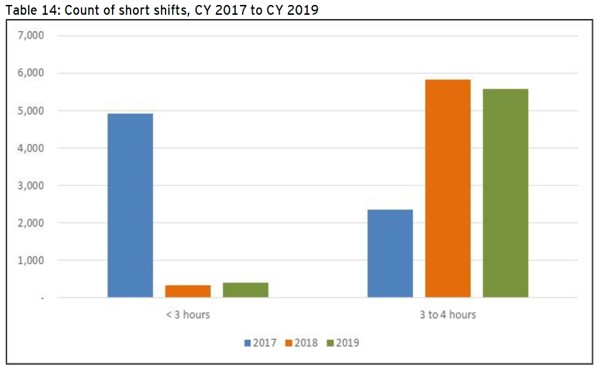
1569 He opined that the effect of the increase in the minimum shift from two to three hours had the effect of increasing the number of staff employed at the North Caboolture Store during the peak period, but it did not have the effect of increasing the number of staff employed per hour beyond a level that was consistent with the increase in orders received. In addition, there was no material increase in the number of hours worked by Delivery Drivers between 2017 and 2019.
1570 Mr Potter made similar observations in the Second Potter Report in relation to the other Franchise Stores he considered as part of his analysis, although he observed that some trends were less noticeable at other stores when compared to the North Caboolture Store.
1571 Mr Potter opined that, on the assumption that:
(a) the substantial reduction in two-hour shifts which occurred at the North Caboolture Store following implementation of the Award would have applied under the counterfactual during the Relevant Period; and
(b) the substantial reduction would have affected the periods and terms of employment for the applicant,
it was not reasonable to assume that the applicant would have continued to be rostered to work two-hour shifts and be paid for the minimum three hours (as was assumed by Ms Wright in calculating the minimum engagement loss).
1572 In reliance on Mr Potter’s analysis Domino’s submitted that had Dominoids and MC Pizza known the true industrial position during the Relevant Period, they would have restructured their roster such that two-hour shifts would have been eliminated, and the work would have been distributed between less frequent shifts of longer duration.
1573 The applicant argued against that submission, and noted that in cross-examination Mr Potter conceded that, notwithstanding his observations based on the data:
(a) it was difficult to translate the changes in practice in the North Caboolture Store to what would have happened specifically for an employee;
(b) one possible way that franchise operators might deal with the new minimum engagement rule under the Award would be, in relation to a Delivery Driver, to roster the driver on for the three hours to undertake whatever delivery was available, or in the alternative, if there was not enough delivery driving work available, then, in the third hour, the person could do other work. In re-examination, Mr Potter confirmed that and said that based on his analysis of the data for the North Caboolture Store, following the introduction of the Award, an employee in the applicant’s position would likely have worked the same number of total hours, but perhaps configured differently over fewer shifts, each of longer duration;
(c) it was possible that the Delivery Driver’s shift might be increased from two hours to three hours with no change to the roster because another worker who was preparing food and ordinarily had a four-hour roster might be reduced to three hours;
(d) it was possible instead of having three Delivery Drivers on two-hour shifts you might have two Delivery Drivers on three-hour shifts; and
(e) each Franchise Store would have a different strategy or practice. Mr Potter accepted that he could not say what individual stores would have done.
1574 Mr Potter accepted that he could not say what individual stores would have done under the hypothetical, nor could he say why they would have done something. But he said that a lot of his work was looking at hypotheticals and the best indicator of what might have happened in a hypothetical is what actually subsequently occurred.
1575 In my view the applicant’s argument rose no higher than its submission that a franchise operator (relevantly Dominoids and MC Pizza) would need to build a bespoke roster to suit the unique needs of its store, and that Mr Potter conceded that there would usually be some amount of useful work that a Delivery Driver could do in-store if there were only two hours of driving work available.
1576 The evidence shows that following implementation of the Award at the North Caboolture Store in January 2018, two-hour shifts were almost completely eliminated and yet the number of hours worked by Delivery Drivers did not increase. The average shift length for Delivery Drivers also increased on weekdays and weekends. The inference is irresistible that the hours of Delivery Drivers were reconfigured into a lesser number of longer shifts.
1577 In my view it is likely that, in the counterfactual that Dominoids and MC Pizza understood that the Award applied during the Relevant Period, they would have taken the same or a similar approach. They are quite unlikely to have rostered the applicant on for two-hour shifts and paid him for an hour that he did not work. Instead they were likely to have provided him with longer but fewer shifts. It is unlikely that all of his two-hour shifts would just be converted into three-hour shifts, because the total hours worked by Delivery Drivers did not increase after implementation of the Award. I accept Mr Potter’s evidence that, in the counterfactual, an employee in the applicant’s position would likely have worked the same number of total hours, but perhaps configured differently over fewer shifts, each of longer duration.
1578 Accordingly I do not accept the claimed minimum engagement loss.
23.1.5.2 Casual loading loss
1579 This issue concerned Domino’s counterfactual proposition that, had Domino’s advised Dominoids and MC Pizza during the Relevant Period that the Award applied, they would have reconfigured their operations such that they would have employed workers (including the applicant) as part-time employees instead of as casual employees.
1580 If, under the counterfactual, Dominoids and MC Pizza were likely to have reconfigured their operations so as to employ casual employees such as the applicant (and other workers) as part-time employees instead, that would have a significant effect upon the applicant’s total loss. The approximate value of the 25% casual loading that would be payable to the applicant under the counterfactual, in accordance with clause 13.2 of the Award, was $5,525.25 (per the Joint Experts’ Report) which was the single largest component of the applicant’s Underpayment Loss.
1581 Mr Potter’s analysis shows that, following the introduction of the Award in January 2018, the North Caboolture Store switched to employing more staff on a permanent part-time basis. It showed that the proportion of casual hours fell from almost 90% before the introduction of the Award, to a figure which hovered around 40%. He usefully captured that in the graph set out below:
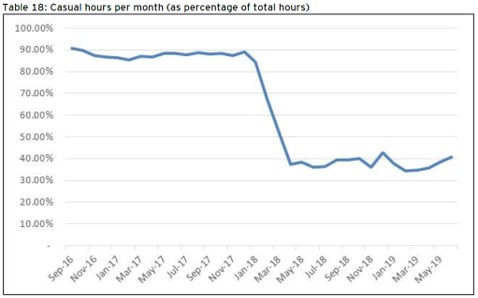
1582 Mr Potter opined in his First Report that the transition in the North Caboolture Store to materially fewer casual employees and a greater number of part-time employees was clear evidence of a restructuring measure aimed at reducing the wage cost of the casual loading in the Award. He opined, as follows (at [114]):
In the context of the categories of loss claimed in Ms Wright’s reports, I am of the opinion that if the transition away from casual employment actually implemented for the North Caboolture employee cohort would have been applied during the Hypothetical Period, and that such a change would have affected the periods and terms of employment for Mr Gall, it is not reasonable to assume Mr Gall would have continued to be employed on a casual basis (Ms Wright’s ‘Pay/Penalty/Loading’ loss).
1583 Unlike other components of the loss, Mr Potter did not identify a broader trend across other Franchise Stores where they shifted towards part-time employment across the network. He said that was because of “difficulties associated with aligning data” from multiple payroll systems and the “limited time” available to him. As a result, Mr Potter’s analysis of the hours worked by classification did not extend beyond the North Caboolture Store.
1584 On the basis of Mr Potter’s analysis, Domino’s submitted that it is not reasonable to assume, as Ms Wright did, that in the counterfactual, Dominoids and MC Pizza would have continued to employ him on a casual basis.
1585 Mr Potter’s analysis had some utility, but several deficiencies led me to conclude that it was not sufficiently robust for the conclusions which Domino’s asked the Court to draw.
1586 First, the evidence did not show whether the increase in part-time hours at the North Caboolture Store was attributable to a conversion of existing casual employees to permanent part-time employees, or simply an increase in the number of part-time employees. The increase does not necessarily show that, if in the counterfactual that Dominoids and MC Pizza knew that the Award governed the applicant’s employment during the Relevant Period, they would have converted him to a part-time employee and he would have had fewer casual hours. He may have continued to be employed as a casual.
1587 Second, Mr Potter’s analysis did not adequately grapple with the associated costs to Dominoids and MC Pizza of a reduction in casual hours and an increase in part-time hours. That should have been part of his counterfactual analysis because the whole point of their reconfiguring their operations would be in an effort to ensure that total employment costs, including wage costs, did not materially increase. By way of example, Mr Potter conceded in cross-examination that his analysis did not consider:
(a) the fact that a greater number of part-time employees would lead to an increase in the number of employees with accrued leave entitlements not afforded to casual employees such as annual leave and personal leave;
(b) the effect of annual leave loading which would apply to part-time employees, which applied at a rate of 17.5%; and
(c) the costs associated with filling gaps in the roster caused by the absence of part-time employees on paid annual leave or paid personal leave.
Mr Potter conceded that he “didn’t do the maths on all the entitlements over the period”.
1588 Thus, on this issue, Mr Potter’s analysis failed to follow his counterfactual through to its natural conclusion. His counterfactual was not, and should not have been, binary in the sense of asking whether the applicant would have received payment of the claimed casual loading as compared to his receiving no casual loading. Rather, the appropriate counterfactual was to ask whether the applicant was likely to receive casual loading and, if not, whether any other entitlement might arise in substitution of that lost casual loading.
1589 Mr Potter posited, in effect, that based on aggregate shift data following the introduction of the Award, in the counterfactual, the applicant was likely to have been transferred to a part-time contract. But there was not a proper basis for that conclusion. Mr Potter’s analysis shows that a considerable proportion of the shift hours completed at North Caboolture Store following the introduction of the Award were still undertaken by casual staff.
1590 In circumstances where:
(a) casual hours still made up 40% of all hours worked at the North Caboolture Store following implementation of the Award;
(b) the applicant was a hard-working and (as I infer) competent Delivery Driver who Dominoids and MC Pizza were likely to wish to retain;
(c) if the applicant was transferred to a part-time contract, Dominoids or MC Pizza would have to pay him annual leave with 17.5% loading which would have accrued pro rata with his service and provide him paid personal leave;
(d) if the applicant was transferred to a part-time contract, Dominoids or MC Pizza would have to plug the gaps in the roster arising from his paid annual leave and personal leave; and
(e) Domino’s did not adduce evidence from anybody from Dominoids or MC Pizza as to what they would have done during the Relevant Period in respect of casual employees, or the applicant in particular, had they known that the Award applied to their employees,
Domino’s did not establish that, in the counterfactual, it was more likely than not that Dominoids and MC Pizza would have employed the applicant on a part-time basis rather than as a casual or given him fewer casual hours.
1591 I consider it to be more likely than not that, in the counterfactual, the applicant would have been employed as a casual and received casual loading in approximately the amount calculated by Ms Wright.
23.1.5.3 Penalty rates for public holidays and weekends
1592 This issue concerned Domino’s counterfactual proposition that, had it advised Dominoids and MC Pizza during the Relevant Period that the Award applied, they would have reconfigured their operations such that they would have shifted work that would have been performed at times when penalty rates would have applied to other periods of time that did not attract penalty rates. On Ms Wright’s calculations, in the counterfactual that the applicant was paid under the Award, he would have been paid penalty rates during the Relevant Period for hours worked on public holidays totalling $1,315.28 and weekends totalling $2,161.40 per the Joint Experts’ Report.
1593 Mr Potter’s analysis showed that average opening hours on weekends and public holidays fell slightly following the introduction of the Award in January 2018, as illustrated in the following graph:
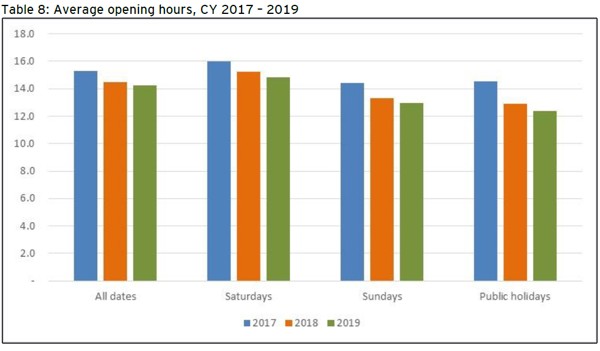
1594 He observed that while the total number of recorded shift hours increased between 2017 and 2018 (consistently with the staffing increase required to process the increased orders) the total number of shifts fell across weekdays, weekends and public holidays while total shift hours went up on weekdays, marginally on weekends, and fell slightly on public holidays. Domino’s highlighted that that change meant that there were fewer hours available to be worked during periods that attracted penalty rates. Mr Potter produced the following table:
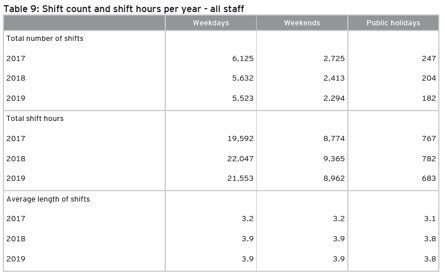
1595 Mr Potter made similar observations in the Second Potter Report in relation to the 313 DBS Stores that he considered as part of his analysis.
1596 He opined that those changes were consistent with the purpose of shifting work from times when penalty rates would have applied under the Award, to other periods of time that did not attract penalty rates. In his opinion, on the assumption that:
(a) the reduced opening hours which were implemented at the North Caboolture Store following implementation of the Award would have applied under the counterfactual during the Relevant Period; and
(b) the applicant’s opportunities for employment at the store would have been limited to those reduced opening hours,
it was not reasonable to assume that the applicant would have continued to be rostered on for the same number of hours during periods eligible for penalty rates under the Award (as Ms Wright had calculated).
1597 Domino’s submitted that Mr Potter’s evidence shows that the measures taken at the North Caboolture Store following the implementation of the Award in January 2018 would have - had they been taken during the Relevant Period - significantly reduced the penalty rates payable to the applicant.
1598 I am not persuaded as to this aspect of Domino’s counterfactual. I accept that Mr Potter’s analysis showed a modest reduction in the opening hours of the North Caboolture Store from 2017 to 2019, and that this reduction was most pronounced on Sundays and public holidays. But Mr Potter’s evidence must be understood in the context of his other findings. At the North Caboolture Store, he found that while the total number of shifts fell across weekdays, weekends and public holidays, the total shift hours which attracted penalty rates (being those on weekends and public holidays) increased from 9,541 to 9,645 between 2017 and 2019. This was made up by a slight fall in public holiday hours which was more than offset by an increase in weekend hours. That is a far more reliable indicator of the availability of shifts and hours which would attract penalty rates as compared with opening hours.
1599 In circumstances where:
(a) total shift hours which attracted penalty rates at the North Caboolture Store actually increased after implementation of the Award;
(b) the applicant was a hard-working Delivery Driver who needed the money and wanted to work “as much as possible”;
(c) weekend nights were likely to be busy times for pizza deliveries; the applicant often worked on weekends, and those hours would attract penalty rates; and
(d) Domino’s did not adduce evidence from anybody from Dominoids or MC Pizza as to what they would have done during the Relevant Period, had they known that the Award applied to their employees, in respect of rostering work in periods that attracted penalty rates,
Domino’s did not establish that, in the counterfactual, it was likely that Dominoids and MC Pizza would have given the applicant fewer hours to which penalty rates applied.
1600 I consider it to be more likely than not that, in the counterfactual, the applicant would have been rostered on for approximately the same number of weekend and public holiday hours which attracted penalty rates under the Award, as he actually worked during the Relevant Period, and he therefore suffered loss in this category in approximately the amount calculated by Ms Wright.
23.1.5.4 Delivery allowance loss
1601 This issue concerned Domino’s counterfactual proposition that, had it advised Dominoids and MC Pizza during the Relevant Period that the Award applied, they would have reconfigured their operations such that they would have supplied company-owned vehicles for deliveries and thereby avoided paying “delivery allowances” to Delivery Drivers who were using their private vehicles. Ms Wright calculated in the Joint Experts’ Report that the applicant lost between $3,100.00 and $3,313.05 in delivery allowances which, in the counterfactual, he would have been paid during the Relevant Period for using his personal vehicle for deliveries.
1602 Mr Potter’s analysis shows that following the implementation of the Award there was a significant and growing percentage of deliveries at the North Caboolture Store which were completed using company vehicles rather than personal vehicles.
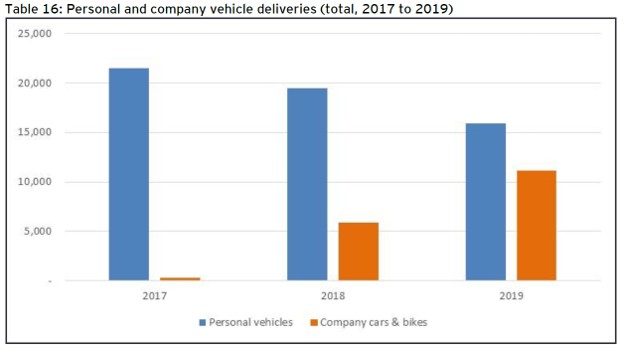
1603 Mr Potter calculated in relation to the North Caboolture Store that of all deliveries made in 2017, 1.4% were completed with a company vehicle. That figure increased in 2018 to 23.1%, and increased in 2019 to 41.2%. In his opinion, on the assumption that the increase in the use of company vehicles which was implemented at the North Caboolture Store following implementation of the Award would have applied under the counterfactual during the Relevant Period, it was not reasonable to assume that the applicant would have continued to use his personal vehicle for 100% of the deliveries completed by him (as Ms Wright had calculated).
1604 By reference to its own table of allowances, Domino’s also submitted that - putting Mr Potter’s evidence to one side - the applicant was better off under the 2005 Agreement in terms of delivery allowances for deliveries of less than 5.54km which it argued Ms Wright’s evidence shows made up a substantial proportion of the deliveries he completed during the Relevant Period.
1605 In the Second Potter Report in relation to franchise operators in general, Mr Potter opined that from 2018 the percentage of deliveries completed with a company vehicle across the network significantly increased above the 2017 average. He concluded that, on average, the percentage of company vehicle usage increased in both 2018 and 2019, which he said was consistent with the results for the North Caboolture Store.
1606 However, for the reasons I now turn to explain, Domino’s did not establish that, if Dominoids and MC Pizza knew during the Relevant Period that the Award governed the applicant’s employment, it was more likely than not that the applicant would not have used his personal vehicle to undertake deliveries in that period.
1607 First, I accept that Mr Potter’s analysis shows a significant increase in the ratio of company cars and bikes used for deliveries at the North Caboolture Store compared to private vehicles following the implementation of the Award in January 2018. But the number of overall deliveries increased materially from 2017 to 2019 such that the reduction in the use of private vehicles was not as marked as that.
1608 Second, and relatedly, the use of personal vehicles was not eradicated. Indeed, their use remained higher than the use of private vehicles in 2018 and 2019. Even in 2019, the majority of deliveries were undertaken using personal vehicles. It continued to be more likely than not that in undertaking deliveries the applicant would use his personal vehicle rather than be provided with the use of a company vehicle.
1609 Third, the evidence does not show how long the trend of decreased use of private vehicles continued. For 18 months to two years after the implementation of the Award, the use of private vehicles still exceeded the use of company vehicles. Unlike, for example, casual loading, which was relatively stable following implementation of the Award, this was a trend in relation to which the evidence does not show whether it continued or not.
1610 Fourth, while it can be accepted at a conceptual level that the higher delivery allowance under the Award for Delivery Drivers using personal vehicles was likely to make company cars and bikes more attractive to MC Pizza or Dominoids, Domino’s did not establish that they were likely, in the counterfactual, to have completely transitioned to the use of company cars. Domino’s argument gave no consideration to the individual circumstances of Dominoids and MC Pizza, including the upfront costs of their acquiring company vehicles sufficient to undertake all deliveries, or whether they had sufficient liquidity or credit available during the Relevant Period to obtain and provide company vehicles to all Delivery Drivers.
1611 Nor did Domino’s argument take into account that, in the hypothetical, moving to the use of company vehicles would involve additional ongoing costs for Dominoids and MC Pizza, whereas Delivery Drivers were required to pay for their own fuel and maintenance. The applicant testified that:
…using my car for deliveries for Domino’s increased the costs of running and maintaining my car. I bought a tank of fuel every week, which I estimate cost me about $25-60 per week.
That too was a necessary part of assessing the likelihood that, in the counterfactual, this restructuring would have occurred.
1612 Fifth, Domino’s did not adduce evidence from anybody from Dominoids or MC Pizza as to what they would have done during the Relevant Period in respect of moving to use company vehicles.
1613 Sixth, Domino’s and Mr Potter gave no consideration to the likely benefit to the applicant in the counterfactual that during the Relevant Period he was employed under the Award. On Mr Potter’s analysis the applicant was unlikely to receive as much by way of delivery allowance because he may not use his personal vehicle, but his analysis did not recognise that the pay the applicant would receive on that counterfactual would not be minus the costs of running and maintaining his personal vehicle.
1614 In my view it is more likely than not that, had Domino’s informed Dominoids and MC Pizza that the Award applied during the Relevant Period, the applicant would have undertaken roughly the same amount of deliveries as he, in fact, did during the Relevant Period, and that he would have used his private vehicle for the great bulk of those.
1615 The experts proposed three alternative methods for calculating the delivery allowance loss for the applicant. In my view it is appropriate to pay the applicant at the lowest of the three scenarios, which will take into account the possibility that, in the counterfactual world, a few of his deliveries would have been made using a company vehicle. Thus, as calculated by Ms Wright (and mathematically agreed by Mr Potter) I allow $3,100.00 for the applicant’s delivery allowance loss.
23.1.5.5 Laundry allowance loss
1616 This issue concerned Domino’s counterfactual proposition that, had it advised Dominoids and MC Pizza during the Relevant Period that the Award applied, they would have reconfigured their operations such that they would have laundered the uniforms of their employees, and thereby avoided paying the laundry allowance to employees that washed their own uniforms.
1617 The Award provided that a laundry allowance was payable at a rate of $1.25 per shift under the Award, and such an allowance was not available under the 2005 Agreement. Ms Wright calculated that, based on the applicant’s shifts during the Relevant Period, under the counterfactual, he had suffered a loss of $750 in unpaid laundry allowance.
1618 Mr Potter’s analysis showed that between January 2018 and April 2018 the franchise operator of the North Caboolture Store paid $1,611 in laundry allowance before its payment of that allowance completely ceased in May 2018. Mr Potter opined that the fact that payment of the laundry allowance stopped four months after implementation of the Award suggested that the operator of the North Caboolture Store no longer required employees to launder their own uniform from that point onwards. He opined that, on the assumption that:
(a) the apparent decision to no longer require employees of the North Caboolture Store to launder their own uniforms would have applied under the counterfactual during the Relevant Period; and
(b) that decision would have been made during the periods of employment of the applicant,
it is not reasonable to assume that the applicant would have continued to receive laundry allowance throughout his employment with Dominoids and MC Pizza, as calculated by Ms Wright.
1619 Domino’s submitted that, in the counterfactual that had Dominoids and MC Pizza been aware during the Relevant Period that under the Award they were obliged to pay the laundry allowance, they would have no longer required employees to launder their own uniforms and therefore the applicant would not have been paid that allowance.
1620 I am persuaded that it is more likely than not that, in the hypothetical, MC Pizza would have laundered the uniforms of their employees during the Relevant Period rather than pay the laundry allowance under the Award. I so infer because that is the course that MC Pizza, in fact, speedily took upon the introduction of the Award.
1621 Domino’s did not however establish that, if Dominoids was aware during the Relevant Period that its employees were entitled to the laundry allowance, that it was more likely than not that Dominoids would have chosen to take on the time and expense of having its employees’ uniforms laundered. The following matters are material to my view.
1622 First, Mr Potter’s analysis shows that following implementation of the Award in January 2018 there was a significant drop-off in franchise operators paying a laundry allowance, but that the number of DBS Stores that continued to pay laundry allowance had reached a relatively stable equilibrium by around April 2019. Mr Potter’s report included the following graph which shows that there was not much change from around April 2019 to December 2019.
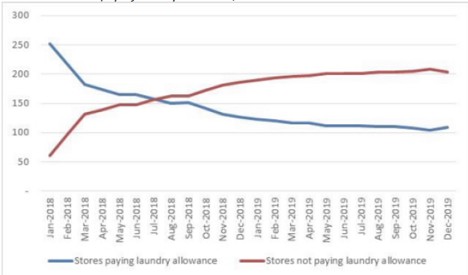
1623 At that point, around one third of franchise operators apparently considered that the cost of paying a laundry allowance to their employees was not so great that it was worth taking on the time, trouble and expense of laundering their employees’ uniforms.
1624 Second, Domino’s had the evidentiary onus to establish its counterfactual. It did not adduce any evidence from Dominoids as to what it would have done in the counterfactual. In the circumstance that Domino’s called no one, and around one third of DBS Stores apparently considered that the expense of paying a laundry allowance to their employees was not so great that it was worth taking on the time, trouble and expense of laundering their employees’ uniforms, I am not satisfied that it is more likely than not that Dominoids would have taken on the time and expense of laundering their employees’ uniforms.
1625 The total claimed laundry allowance loss is $750. Taking account of the fact that the applicant’s employment with Dominoids during the Relevant Period made up around 38% of the total period of his employment at the North Caboolture Store, I will allow 38% of the claimed laundry allowance loss, which totals $285.89.
23.1.5.6 Backpay
1626 Because she was not informed of this, Ms Wright’s calculations did not include the backpay which the applicant had received consequent upon his underpayment by Dominoids, which totalled $758.07 gross. I accept that that involved an understatement of the actual wages that the applicant received during the Relevant Period and, therefore, an overstatement of the applicant’s Underpayment Loss. The applicant’s Underpayment Loss Claim must be reduced by that amount.
23.1.5.7 A similarly negotiated agreement?
1627 Domino’s then posited a counterfactual that if, during the Relevant Period, Domino’s had informed franchise operators that the Award applied, franchise operators would have sought and obtained an enterprise agreement on the same terms as the 2005 Agreement.
1628 That counterfactual has no foundation in the evidence and is just speculation.
1629 Further, whether franchise operators (relevantly for present purposes Dominoids and MC Pizza) would have been able to obtain an enterprise agreement under the FW Act on the same terms as the 2005 Agreement is questionable. During the Relevant Period s 193 of the FW Act provided that an enterprise agreement would only be approved by the FWC if each prospectively covered employee would be better off overall if the enterprise agreement applied than if the relevant modern award applied.
1630 The transcript of the certification hearing for the 2005 Agreement shows that the parties told the Commission that the 2005 Agreement would only operate for a relatively short period while they negotiated another agreement. This was explicitly noted and accepted by Watson SDP in certifying the agreement. That did not, however, occur, and the 2005 Agreement continued to run after its nominal expiry through to 2018, although topped up from time to time through ad hoc adjustments agreed between Domino’s and the SDA. It is uncontentious that the pay rates in the Award were higher than those in the 2005 Agreement even as adjusted. It is unnecessary to decide but it seems unlikely that the franchise operators would have been able to obtain approval of an enterprise agreement in the same form as the 2005 Agreement.
1631 Domino’s submission also seemed to suggest that an enterprise agreement on the same terms as the 2005 Agreement could be obtained unilaterally. That was not so. There is no evidence as to any attempts made to negotiate a fresh agreement following the 2005 Agreement being made with a one-month term. What is clear is that no further certified agreement or enterprise agreement was made. There is no evidence upon which to conclude that the SDA or RAFFWU would have accepted an enterprise agreement on the terms of the 2005 Agreement. Nor is there evidence upon which it could be concluded that the employees proposed to be covered by such an agreement would vote in favour of approving it.
1632 Domino’s further submitted that, under this counterfactual, it would be able to more generally minimise its labour costs and the applicant’s losses would therefore be lower. Having considered the specific examples proposed by Mr Potter, I do not accept that contention.
23.1.5.8 Appropriate method of calculation
1633 The applicant submitted that the Separate Entitlements of Loss Without Offsetting Calculation was consistent with the way in which he put his Underpayments Loss Claim. I accept that. Domino’s did not contend to the contrary.
1634 The applicant further submitted that the Underpayment Loss component of the loss and damage suffered by the applicant and group members should be assessed by reference to the difference between the rates of pay under the Award and the rates the Award Workers were in fact paid by franchise operators. I do not accept that. As noted above, the applicant’s loss falls to be assessed by reference to what, in the counterfactual, the applicant was likely to have been paid during the Relevant Period had Domino’s instructed and advised Dominoids and MC Pizza that the Award applied.
1635 The applicant contended that it is appropriate to approach the loss assessment task on a line-by-line, entitlement-by-entitlement basis, which reflects the measure of what the applicant was entitled to, had Dominoids and MC Pizza not been misled by Domino’s and had they applied the Award, as that reflected the approach to the quantification of such amounts in industrial cases and the traditional assessment rule in that area of “no offsetting”. Domino’s did not argue to the contrary. I accept that.
23.1.6 Conclusion on the Underpayment Loss Claim
1636 I am satisfied that the applicant suffered harm to his economic interests, by reason that:
1637 First, he was paid less than he would have been had Dominoids and MC Pizza not been misled by Domino’s in relation to the applicable wage rates to which he was entitled pursuant to the terms of the Award. The Underpayment Loss that he suffered is to be quantified by assessing the difference between:
(a) what the applicant was likely to have been paid during the Relevant Period had Domino’s told Dominoids and MC Pizza that the Award applied; and
(b) what the applicant was in fact paid by Dominoids and MC Pizza during the Relevant Period.
That assessment has included taking into account any steps which, in the counterfactual, Dominoids or MC Pizza were likely to take to reconfigure their employment practices in an effort to ensure that total employment costs, including labour costs, did not materially rise through the introduction of the Award.
1638 Second, the applicant’s Underpayment Loss is assessed in the amounts set out in the table below.
Item | Award clause | Amount |
25% casual loading | 13.2 | $5,525.25 |
Evening work penalties | 25.5(a) | $76.58 |
Weekend penalties | 25.5(b) and (c) | $2,161.40 |
Public holiday penalties | 30.03 | $1,315.28 |
Uniform allowance | 19.2(a) | $163.00 |
Laundry allowance (38%) | 19.2(b) | $285.89 |
Delivery allowance | 19.6(b) | $3,100 |
Backpay items identified by Mr Potter | - | -$758.07 |
Total: | $11,869.33 (plus interest) |
1639 Third, he is entitled to interest in relation to the Underpayment Loss in (b) above.
23.2 The Loss of Opportunity Claim
1640 The applicant alleged (2FASOC [66]) that because he was not paid the higher wages to which he was entitled as and when those wages fell due to be paid, namely at no less than weekly intervals, he lost the opportunity to purchase identified goods and services and the opportunity to acquire goods or services of superior quality.
1641 Domino’s attacked this claim on four bases. It submitted that:
(a) the loss of opportunity claim only arose if the Underpayment Loss claim were made good;
(b) even if the applicant had been slightly better paid, the evidence did not establish that the pleaded opportunities were lost because of Domino’s conduct, particularly given his and his partner’s combined weekly resources, the financial contribution made by his partner, and the absence of fuller documentary records such as credit card statements;
(c) the claimed lost opportunities are not rights of a commercial nature, and their value is personal not commercial; and
(d) even if the rights were to be viewed as commercial, their commercial value has not been proven or, at least, proven to be more than negligible.
1642 For the reasons already discussed the first premise does not defeat the claim.
1643 In relation to the second premise, the applicant gave evidence that even the small improvement in wages and conditions that would have been afforded to him had he been paid under the Award, which he estimated to be in the order of $50 to $100 per week, would have made a big difference to his life. The applicant gave evidence that such an improvement would have allowed him to:
(a) pay for routine and preventative maintenance on his vehicle, which may have meant that he would not have had to sell the vehicle for scrap and could have instead achieved a higher price for it in the second-hand market;
(b) pay for baby services, goods and necessities;
(c) purchase swimming lessons for his young son;
(d) purchase an age-appropriate and transferable capsule car seat;
(e) purchase a second car seat for his partner’s car and an appropriate third car seat for his father’s car;
(f) save money for emergencies and financial commitments;
(g) purchase a new laptop that was suitable for his needs;
(h) pay a babysitter to allow the applicant and his partner to socialise together more often; and
(i) purchase a better-quality mattress.
1644 Domino’s referred to the applicant’s evidence in which he said that, based on a review of his available bank records and his recollection, he had the following major expenses:
(a) Petrol - about $20-30 a week;
(b) Mobile phone expenses - about $25-49 a month;
(c) Food - about $100 a week; and
(d) Social activities - less than $5 a week.
1645 Then, in cross-examination the following exchange took place between Mr Harris, Senior Counsel for Domino’s, and the applicant.
Mr Harris: Now, if one assumes that your share of the food is $50, doesn’t that mean that you’ve got surplus funds of, every week, between $277 and $311?
Mr Gall: ---In - I suppose so. Yes
Mr Harris: On top of that, we know, don’t we, that Lauren was getting parenting allowance?
Mr Gall: ---Yes
Mr Harris: And that translates to about $240 per week?
Mr Gall: ---Yes
Mr Harris: So that adds another $240 to the surplus, over and above the expenses that are listed in 110?
Mr Gall: ---Yes
The applicant also gave evidence in cross-examination that he had savings of approximately $500, and had had a credit card since 2016.
1646 Domino’s jumped on that in closing submissions. It argued that the applicant had “ample surplus income” which he could have spent on the listed goods and services, but he had chosen not to do so. In my view Domino’s submission mischaracterised the evidence. The applicant’s evidence as to what he spent per week or per month was a reference to his “major expenses” and it was not said to be, and obviously was not, exhaustive. For example, the list of “major expenses” did not include anything for the expenses associated with his young son (nappies, formula, clothes, medical bills etc). Further, he gave evidence that during the period that he worked at the North Caboolture Store he obtained food from a local food bank in Morayfield. In my view that was inconsistent with him having had surplus income.
1647 I also accept the applicant’s submission that, as a matter of common sense, a family with an infant and a combined weekly income of approximately $650 per week in 2016, even without the burden of rent, would not have had much, if any, surplus income. Domino’s contention that the applicant had extra money “behind the couch” was mean-spirited when he was clearly an impecunious casual worker working hard to get a start in life and raise a new child.
1648 Further, I accept that, whatever the amount of the “surplus” that the applicant may have had each week, it remained the case that he was not able to afford to pay, on a regular basis, for the items he listed or at least not all of them. His bank statements show that his discretionary spending was modest and the weight of the evidence is that the applicant was working hard to try and make ends meet so that he could pay his living expenses and the expenses associated with his university course, and to share in meeting the expenses associated with his young son.
1649 However, Domino’s third contention has force. The fact that the applicant was underpaid will support an inference that his capacity to purchase goods and services was reduced, but I accept that the applicant’s pleaded losses of opportunity do not meet the threshold of his having lost opportunities of a commercial nature.
1650 Both parties relied on the decision in Sellars (at 348-9, 355 (Mason CJ, Dawson, Toohey and Gaudron JJ) and at 368 (Brennan J)). That case is authority for the proposition that a loss of opportunity to obtain a commercial advantage or benefit is loss or damage within the meaning of s 82 of the TPA, and the same is true of its successor s 236 of the ACL.
1651 The facts in Sellars concerned the restructuring of an oil and minerals company. The first respondent in the final appeal, Adelaide Petroleum NL, was in 1988 in need of working capital. It entered parallel negotiations with two different companies (Poseidon Ltd and Pagini Resources NL) with the object of persuading one of them to acquire the directors’ shareholdings in Adelaide, or part of them, as an element in a restructuring arrangement. The directors of Adelaide opted to enter into an agreement with Poseidon, only to find out that the heads of agreement had been prepared and its signing procured by an executive who had exceeded his authority. After extricating themselves from this agreement with Poseidon, Adelaide’s directors entered into an agreement with Pagini, but this time on terms less favourable than those which would have resulted if the original Pagini negotiations had been pursued to a conclusion. Adelaide, its directors and certain associated companies commenced actions against Poseidon and Sellars (the executive) seeking, amongst other relief, damages under s 82 of the TPA.
1652 The facts in Sellars, and the authorities relied on by the High Court for the finding in that case, are well removed from the facts of this case. Justice Brennan explained (at 359) that “a lost opportunity may or may not constitute compensable loss or damage”. His Honour made it clear (at 362-4) that the lost opportunities which he considered to be compensable under s 82 of the TPA were lost rights of a commercial value. He said (at 364):
As a matter of common experience, opportunities to acquire commercial benefits are frequently valuable in themselves, not only when they will probably fructify in a financial return but also when they offer a substantial prospect of a financial return. The volatility of the market for speculative shares testifies to both the valuable character of commercial opportunities and the difficulty of assessing the value of opportunities which are subject to serious contingencies. Provided an opportunity offers a substantial, and not merely speculative, prospect of acquiring a benefit that the plaintiff sought to acquire or of avoiding a detriment that the plaintiff sought to avoid, the opportunity can be held to be valuable. And, if an opportunity is valuable, the loss of that opportunity is truly “loss” or “damage” for the purposes of s. 82(1) of the Act and for the purposes of the law of torts. In a statute which is intended to govern commercial transactions, it would be pedantically inappropriate to exclude the loss of a valuable commercial opportunity from the categories of “loss” and “damage” in s. 82(1) of the Act.
(Emphasis added in bold.)
1653 The applicant submitted that s 236 of the ACL is wide enough to cover both damage by reason of being deprived of the pleasure that could have been obtained and, in some cases, suffering commensurate hurt or distress arising from a known inability to secure the good or service (such as the disappointment at being unable to provide for another): Baltic Shipping Co v Dillon [1993] HCA 4; 176 CLR 344; Steiner v Magic Carpet Tours Pty Ltd (1984) ATPR 40-490; Baxter v British Airways (1988) 82 ALR 298 at 305 (Burchett J); Moore v Scenic Tours Pty Ltd [2020] HCA 17; 268 CLR 326.
1654 That is so, but those authorities do not assist the applicant in relation to the Loss of Opportunity Claim. For example, in Moore and Baltic Shipping the alleged loss included, among other things, disappointment and distress for breach of a contract to provide a pleasant and relaxed holiday, which was recognised as a compensable head of loss. They are not analogous cases because the disappointment and distress, or the loss of pleasure, stemmed from the failure to perform explicit contractual agreements, which also fell foul of the ACL’s consumer guarantees. The losses of opportunity alleged here were not stated in any contract to which the applicant was a party.
1655 To my mind the lost opportunities which the applicant claimed are personal and not commercial in nature, and not compensable. Accordingly, while I accept in principle that delayed and reduced wages can occasion loss of opportunity, and while I accept that the applicant’s underpayment reduced his financial capacity during the Relevant Period, I am not persuaded as to the applicant’s claim.
1656 Further, even if (contrary to my view) lost opportunities of the nature that the applicant claimed are compensable under s 236 of the ACL, the evidence was insufficient to quantify their value.
1657 For example, the applicant gave evidence in cross-examination that when he purchased his RAV-4 car it was already 17 years old and had travelled some 350,000km. He said that he used the car for four and a half years until July 2019, which was about 17 months after he left his employment at the North Caboolture Store, and that the car was then scrapped due to a head gasket failure. He adduced no evidence as to what the cost of regular maintenance would have been and therefore whether that was affordable, and no evidence that regular maintenance during the Relevant Period would have saved the car. On my view of the evidence, while his having extra money might have saved the applicant’s 20-year-old RAV-4 from the scrap heap, there is insufficient evidence to conclude that, had Dominoids and MC Pizza paid the applicant under the Award, the car would have been maintained such that the applicant would have been able to sell the car second-hand as opposed to selling it for scrap.
1658 I do not accept the applicant’s Loss of Opportunity Claim.
23.3 The No Damage Contention
23.3.1 Domino’s submissions
1659 Domino’s alleged that the wage underpayments pleaded in 2FASOC [63] and [65] are not compensable within the meaning of s 236 of the ACL because:
(a) the applicant’s and group members’ Award entitlements under the FW Act are unimpaired; and
(b) any Award underpayment is a statutory debt owed by the relevant franchise operator to the applicant or relevant group member.
1660 It submitted that, as pleaded, the alleged wage underpayments are properly understood as an entitlement under the FW Act (FW Act Entitlement). It said that that is the nature of the economic interest that the applicant has identified. It argued that given that their FW Act Entitlement, or statutory debt, remains intact, the applicant’s and group members’ economic interests have not been harmed and no damage has been identified for the purposes of s 236 of the ACL. Therefore, on Domino’s argument the claims must fail for the reason that there is no cause of action.
1661 Domino’s contended that the applicant was wrong in contending in opening submissions that there is no authority which provides that the mere existence of a choice on the part of a plaintiff, to recover loss pursuant to one cause of action against defendant X or another cause of action against defendant Y, operates so as to automatically deny recovery against defendant X if the cause of action as against defendant Y could also or could instead have been instituted.
1662 On its argument, the applicant has only ever had one cause of action, being his claim to be paid his statutory entitlements under the FW Act. It said that because the applicant’s entitlement under the FW Act is unimpaired, there is and never has been a second cause of action under s 236 of the ACL. Again, noting that the gist of a cause of action under s 236 is damage, it said that there has been no damage to the applicant’s economic interest because his FW Act Entitlement remains intact.
1663 Then Domino’s turned to argue, by analogy from the remarks of Gaudron J in Hawkins v Clayton [1988] HCA 15; 164 CLR 539 at 601, and by reference to GE Dal Pont, Law of Limitation, (LexisNexis, 2nd ed, 2021) at [6.5] and [6.7] that, on the applicant’s case:
(a) the date of the statutory contravention under the FW Act was the date on which the applicant did the work;
(b) from that date onwards, the applicant had an entitlement to make a claim under the FW Act;
(c) for the purpose of the ACL, however, no damage has been suffered as a result of the statutory contravention because the applicant’s entitlement to claim under the FW Act has always been available and remains intact; and
(d) damage would accrue only if and when the applicant’s ability to claim under the FW Act ‘becomes impossible’ because of conduct on the part of Domino’s.
1664 Domino’s then submitted that the applicant was wrong in contending in opening submissions that, had the applicant commenced proceedings against the successive franchise operators of the North Caboolture Store under s 45 of the FW Act alleging contravention of the Award, he would no doubt have been met with defences including those Domino’s deployed in this proceeding, which were toward denying the existence of the very same “entitlement” on which this part of Domino’s defence rests (including the Extended Coverage Clause Defence and the Common Enterprise Defence).
1665 Domino’s said that that contention misunderstands, that its No Damage Contention only arises on the assumption that the applicant’s contentions regarding the true industrial position are correct. On that assumption, the applicant would have a good claim under the FW Act. Domino’s said, therefore, that any defences that would be raised against the applicant and any practical forensic difficulties in bringing a claim under the FW Act are therefore irrelevant to that argument.
1666 It submitted, and I accept, that the applicant has expressly acknowledged that the award entitlements of the applicant and group members that arose under the FW Act for the alleged underpayments by franchise operators are unaffected by the allegations against Domino’s. During the strike out application, Senior Counsel for the applicant acknowledged that “[t]he applicant’s case is not that he has some other cause of action that has been impaired or removed nor need it be”. Domino’s relied on that to submit that insofar as the group members’ relevant “economic interests” alleged to have been affected by Domino’s conduct were their Award entitlements, that interest has not been lost or injured, it has just not been enforced by group members.
1667 Domino’s submitted that given that the FW Act Entitlements of the applicant and group members remain intact and unenforced, there can be no “damage” suffered, there remains only enforceable entitlements as against franchise operators. Based on this, Domino’s said that it could not form part of the applicant’s loss and damage case under s 236.
1668 Domino’s then developed its argument that FW Act Entitlements are statutory debts and therefore not damages claims. It cited M Spencer et al, McGregor on Damages (Sweet & Maxwell, 17th ed, 2003) at [1-005] for the proposition that actions for money payable, paradigms example of which are actions for unpaid salary or wages for services rendered, are not actions for damages. Rather, they are claims for a debt. It also relied on the remarks of Brennan CJ, Dawson and Toohey JJ in Byrne at 425-7, where their Honours said:
Having regard to the public aims of the legislation, its scope and purpose is not such as to disclose any intention to benefit or protect employees or any other class of persons by conferring on them a right of action at common law for breach of an award obligation. However, in pursuit of those aims the Act does provide for the enforcement of awards thereby giving them statutory force. The appellants’ argument tended to focus upon the award itself rather than the Act. But an award is not a statute and if a duty imposed by an award is to be regarded as a statutory duty enforceable by way of a civil action for damages, then the necessary intention that it should be so regarded must ultimately be found in the Act and not the award. The Act discloses no such intention and, indeed, cannot do so in the absence of any specification of the duties which might be imposed by an award. On the other hand, the Act can and does disclose a contrary intention in providing a means for the enforcement of awards which does not contemplate the existence of private rights enforceable by way of an action for damages.
Section 178 imposes a penalty for the breach of an award which might be sued for and recovered by, amongst others, a party to the award or a member of an organisation who is affected by the breach. Under s 356 a court that imposes a penalty may order that it be paid to a particular organisation or person. Section 178 also provides that where, in a proceeding against an employer under the section, it appears to the court concerned that an employee of the employer has not been paid an amount to which the employee is entitled under an award, the court may order the employer to pay to the employee the amount of the underpayment. And s 179 provides that an employee entitled to the benefit of an award may sue for wages and other payments due under it. The maximum penalty which may be imposed for a breach of an award is the relatively modest sum of $1,000 which, when regard is had to the fact that a court may order it to be paid to a member of an organisation affected by the breach, is plainly inconsistent with a right to unlimited compensation by way of damages. So also is the express provision for the recovery of underpayments and of wages under awards inconsistent with a right to sue for damages for breach of an award.
Even if it were permissible (and we do not think that it is) to seek the creation of a statutory duty giving rise to private rights in the award itself without regard to the Act, we do not think that as a matter of construction they would emerge. Awards are made in settlement of industrial disputes and represent the degree of compromise necessary to effect such settlements. They are required to be made having regard to the objects of the Act which, as we have observed, extend beyond the interests of the parties to the dispute. The obligations which awards impose are various and are not wholly for the protection or benefit of any one class of persons, be they employers or employees or the organisations which represent them. In those circumstances, as a matter of construction, awards cannot in our view be regarded as conferring private rights enforceable by way of an action for damages. When regard is had to the enforcement mechanism provided by the Act, the situation is even plainer.
(Emphasis added. Citations omitted.)
1669 Domino’s relied on this for the proposition that award entitlements are statutory debts imported into the employment relationship and do not depend on the terms of the employment contract and as such a claim of underpayment of an award entitlement is not a claim for breach of contract. On its argument, a claim that the underpayment of an award entitlement has occurred because of the conduct of a third person does not change the character of the worker’s claim.
1670 To buttress its argument that unpaid/underpaid wages are statutory debts, Domino’s referred to insolvency law and s 556 of the Corporations Act 2001 (Cth). It noted that upon the insolvency of a company, employee entitlements (in order of outstanding wages and superannuation, outstanding leave of absence, and retrenchment pay) are recognised as debts of the company that rank in priority to other unsecured creditors. Based on this, Domino’s submitted that as statutory debts, those employee entitlements are not in the nature of and cannot be claimed as damages under the ACL. It said that, given that damage is a prerequisite to a claim under s 236 of the ACL, the applicant and group members have no claim under that provision.
1671 Domino’s then challenged the applicant’s reliance on statements in authorities, including Marks, to the effect that provisions like s 236 have “no direct analogue in the general law” (at [100], Gummow J) (as to causation, remoteness or measure) and which recognised the remedial purpose of the section including to the effect that it should be construed so as “to give the fullest relief which the fair meaning of its language will allow”: Marks at [99] (Gummow J), see also [17] (Gaudron J) and [38] (McHugh, Hayne and Callinan JJ). It noted that the plurality also said that the words of s 236 should not be “stretched beyond their limit”: at [56] (McHugh, Hayne and Callinan JJ).
1672 Domino’s said that the applicant had failed to distinguish its claim from Byrne and concluded that the loss and damage pleaded at 2FASOC [63] and [65] is a claim for unpaid employee entitlements under the FW Act, and is not compensable loss and damage within the meaning of s 236 of the ACL.
23.3.2 Consideration
1673 For the reasons I now turn to explain, I do not accept Domino’s contentions. I am satisfied that the applicant’s Underpayment Loss Claim is compensable under s 236 of the ACL.
1674 At first, it seemed, at least in part, that Domino’s argument was based in the applicant’s pleading of loss and damage and in the fact that the applicant initially contended that he was not obliged to plead and establish a counterfactual, and the relevant paragraphs of the loss pleading in the 2FASOC reflected that approach.
1675 That can be seen in the version of Domino’s No Damage Contention which was alleged on the basis that, absent a pleaded counterfactual, the underpayment claims were claims under the FW Act, and that any unpaid Award entitlement remained intact under the FW Act and had not been lost or injured. However, as I have previously explained, in the course of the hearing the applicant resiled from his earlier position and posited a counterfactual.
1676 Domino’s reliance on the applicant’s pleaded loss case for its No Damage Contention was, to that extent, artificial. The applicant changed his position and Domino’s made no complaint about that. How could it, when the applicant moved across to the position which Domino’s advocated for (although positing a different counterfactual)?
1677 Turning then to Domino’s other arguments.
1678 First, much of Domino’s argument in relation to the contention that the applicant’s FW Act Entitlement is “unimpaired” was a restatement of Domino’s FW Act Code Contention, which I have already dealt with. For the reasons I have explained (in section 21), I reject the contention that the FW Act operates as an exclusive code or procedure which precludes a claim for damages against a third party to an employment relationship, pursuant to ss 18 and 236 of the ACL, in which the alleged losses are somehow based in unpaid award entitlements.
1679 Second, Domino’s made too much of the contention that a claim for underpaid award entitlements is a “statutory debt”. The High Court in Byrne did not use the phrase “statutory debt” at any point. Rather, the plurality (at 419) described the award entitlements of the appellant as a debt “which owed its origin to the statute and not to contract”.
1680 In my view, the plurality in Byrne should not be understood as having characterised unpaid or underpaid entitlements under Modern Awards as being a statutory debt in the sense that term is used to describe actions for debt recovery in other regimes where mere service of proof of debt will suffice: Builders Licensing Board v Inglis [1985] 1 NSWLR 592 (Kirby P (as his Honour then was), Samuels and Mahoney JJA). In that judgment, Kirby P cited Maitland in The Forms of Action at Common Law (1948), in which Maitland said (at 63) that an action of debt is “an action for a fixed sum of money”. His Honour also said that an action for debt “serves for the recovery, for example, of statutory penalties and moneys adjudged by a court to be due” (at 596).
1681 I do not consider an action seeking an order for compensation under s 545 of the FW Act to be an action for a fixed sum of money. The power to make an order under s 545 in relation to a contravention of s 45 requires the Court to be satisfied that there has been a contravention of a civil remedy provision. A proof of debt document will not suffice. Buttressing this point, the Court is empowered to make an order for compensation for a contravention of s 45. It is not ordering the payment of a debt.
1682 Further and in relation to Byrne, it was concerned with ss 178 and 179 of the IR Act 1988. Sections 178(6) and 179(1) relevantly stated, respectively:
178 Imposition and recovery of penalties
…
(6) Where, in a proceeding against an employer under this section, it appears to the court concerned that an employee of the employer has not been paid an amount that the employer was required to pay under an award or order, the court may order the employer to pay to the employee the amount of the underpayment.
…
179 Recovery of wages etc.
Where an employer is required by an award or order to pay an amount to the employee, the employee may, not later than six years after the employer was required to make the payment to the employee under the award or order, sue for the amount of the payment in the Court or in any court of competent jurisdiction.
Both provisions referred to a right to claim or obtain an order for “the amount of the underpayment” or “amount of the payment”.
1683 That stands in contrast to the relevant provisions of the FW Act. Section 539 of the FW Act sets out which persons may apply to which courts in relation to civil penalty provisions, and the maximum penalty a contravener can receive. Section 540 provides that, upon application by an employee, employer, employee organisation or employer organisation to the FCFCOA or this Court, a civil penalty may be ordered against the contravener.
1684 Section 545 provides that where the Court is satisfied that a person has contravened, or proposes to contravene, a civil remedy provision, it may make any order the court considers appropriate. Such an order may include “an order awarding compensation for loss that a person has suffered because of the contravention”: s 545(2)(b). Section 545(3) provides similar powers (though they are not identical) to eligible state and territory courts.
1685 Before an employee is entitled to an order for compensation under s 545 he or she must prove that his or her employment is covered by a modern award and that the respondent has contravened that award. If the Court is satisfied of both of those facts, it may make an order awarding compensation for loss that a person has suffered because of the contravention.
1686 The power to order compensation under s 545 is discretionary in nature and the width of the power leaves room for compensation which is less than full compensation for the loss suffered: Dafallah v Fair Work Commission [2014] FCA 328; 225 FCR 559 at [157] (Mortimer J); Qantas Airways Limited v Gama [2008] FCAFC 69; 167 FCR 537 at [94] (French J (as his Honour then was) and Jacobson JJ, with Branson J agreeing at [122]).
1687 Gama related to, among other provisions, s 46PO(4)(d) of the Human Rights and Equal Opportunity Commission Act 1986 (Cth), which relevantly stated:
46PO Application to court if complaint is terminated
(4) If the court concerned is satisfied that there has been unlawful discrimination by any respondent, the court may make such orders (including a declaration of right) as it thinks fit, including any of the following orders or any order to a similar effect:
…
(d) an order requiring a respondent to pay to an applicant damages by way of compensation for any loss or damage suffered because of the conduct of the respondent;
That provision is analogous to s 545(2)(b) of the FW Act. In Gama, French and Jacobson JJ said that damages for “compensation for any loss or damage suffered because of the conduct of the respondent” are “entirely compensatory” (at [94]).
1688 This is all to say, as I did in Gall v Domino’s Pizza Enterprises Ltd (No 2) [2021] FCA 345; 304 IR 300 (Gall (No 2)), that the right to bring a proceeding under s 545 of the FW Act and the form of remedy one may receive is not the same as that contemplated in Byrne. For the avoidance of doubt, the provisions in Byrne referred to a right to sue for and obtain an order for payment of “the amount of the underpayment”. In my view ss 178 and 179 of the IR Act 1988 have relevant differences to the present regime and Domino’s was incorrect to construe Byrne as authority for the proposition that an action for compensation under the FW Act, upon a finding of contravention of a modern award, is an action for a “statutory debt” or for a “fixed sum of money” (Builders Licensing Board at 596).
1689 As I said in Gall (No 2) at [107] and [108]:
…the applicant and group members allege that they have suffered loss and damage because, in reliance on Domino’s representations and conduct, the Franchise Operators failed to pay them their pay and other entitlements under the Award as and when those entitlements fell due, and also because they suffered a loss of opportunity arising from that failure.
Domino’s failed to come to grips with the applicant’s argument that their loss and or damage was suffered as at the time that they were underpaid. I consider it to be plain that a worker, particularly a lowly paid pizza delivery driver or in-store worker, can be said to have suffered financial loss and damage if they are not paid their award wages or afforded their award conditions when they were due, particularly when on the applicant’s case they were payable between approximately three and five and a half years ago. Domino’s submission that the claim is really one of delay in payment of award entitlements, and that the fact that the applicant and group members have not been paid those entitlements does not mean that they will not be paid them, is spurious and ignores the reality of their position. The reality is that in the absence of bringing some form of legal proceeding they will never receive their alleged entitlements. The applicant has chosen to pursue his and the group members’ losses through a proceeding under the ACL rather than under the FW Act which (if such a claim is available on a proper construction of the FW Act and the ACL) is his right.
(Emphasis added.)
To my mind the same is true of Domino’s argument at trial.
1690 Third, Domino’s erroneously relied on principles of common law to make arguments relating to a statute. The applicant and group members did not make their case at common law, but under the ACL in circumstances where the facts may also give rise to an entitlement to compensation under the FW Act. The broad points Domino’s made regarding Hawkins are correct, and the loss must be suffered for the cause of action to arise.
1691 But as I said in Gall (No 2), Marks is authority for the proposition that s 236 of the ACL has an expansive remedial function that does not draw upon the general law of damages. As Gummow explained (at [100]) it applies across a spectrum of diverse legal norms, a number of which have no direct analogue in the general law, and the Court should be cautious against treating such a provision:
“as a mere supplement to or eking out of” pre‑existing law. To the contrary, as Mason P put it, the courts should not be “fearing to move far from the familiar coastline of traditional common law and equitable approaches”.
(Citations omitted.)
1692 The ACL is a “fundamentally remedial and protective legislation” giving effect to “matters of high public policy”; and is thus to be construed so as to give the fullest relief which the fair meaning of the legislation will allow: Bullabidgee at [69], Allsop P (Basten JA agreeing at [86], Young JA agreeing at [87]) citing Marks at [99]-[103]. In Bullabidgee, President Allsop (as his Honour then was) went on to say that these descriptors of the legislation are apt because the legislative purpose is to promote, in the broad sphere of Australian economic activity (trade and commerce), informed commercial activity, not based on misinformation, but rather on accurate information.
1693 And as McHugh J explained in HTW Valuers at [84]:
But while analogies with the law of tort and contract are useful aids, they cannot be substituted automatically for the flexible and general language of s 82. Focusing on the similarity of the circumstances involved in s 82 cases with those involved in tort and contract cases may sometimes result in the section being treated “as a mere supplement to or eking out of” pre-existing law. Too much emphasis on tort and contract analogies also overlooks that s 82 provides a remedy for breach of a range of provisions different in kind from that provided by s 52.
1694 I am satisfied that the loss or damage suffered by the applicant arising from Domino’s misleading or deceptive conduct falls within the meaning of s 236 of the ACL.
23.4 Common Questions 29 to 33
23.4.1 Common Question 29
1695 Common Question 29 asks:
If “yes” to question 28 [causation], was that loss or damage:
(a) Underpayment losses, being the difference between the rates of pay and the value of the terms and conditions of employment prescribed by the Award and the rates of pay and the value of the terms and conditions of employment:
(i) the group members were in fact paid and afforded by franchise operators; or
(ii) the rates of pay and conditions of employment derived from the Agreements; or
(iii) the group members would have been paid if the franchise operators knew they were covered by the Award;
(b) Loss of opportunity: namely the loss of opportunity by group members to pay for goods or services and / or to pay for goods or services of superior quality because the group members were not paid the Award wages to which they were entitled during the period of their employment by franchise operators as and when those wages fell due to be paid and were required to be paid?
(c) Interest on the amounts identified at (a) or (b)?
1696 Causation has only been determined in relation to the applicant, and the question of loss can only be determined in relation to the applicant.
1697 To be clear, the applicant’s Underpayment Loss was assessed by deciding, on the evidence and by inference, what it was more likely than not that the applicant would have been paid had Dominoids and MC Pizza known during the Relevant Period that the Award rates applied. The assessment is not a matter simply of calculating the difference between the rates of pay and terms and conditions prescribed by the Award and comparing that to the rates of pay and terms and conditions that the applicant was in fact paid or to which he was entitled pursuant to the Agreements.
1698 The answer to Common Question 29(b) is that the applicant did not establish his Loss of Opportunity Claim. That does not necessarily mean that the answer will be the same for all group members. It will depend upon the evidence.
1699 The answer to Common Question 29(c) is that the applicant is entitled to simple interest applied from the date of loss up to the date of judgment, in accordance with the pre-judgment interest rates set out in the Federal Court’s Interest on Judgments Practice Note (GPN-INT).
23.4.2 Common Question 30
1700 Common Question 30 asked:
If “yes” to any part of question 29, is the loss and damage of group members to be ascertained calculating:
(a) Underpayment losses: the difference in value between the rates of pay and the value of the terms and conditions of employment prescribed by the Award and:
(i) the rates of pay and conditions of employment which the group members were in fact paid and afforded by the franchise operators; or
(ii) the rates of pay and conditions of employment derived from the Agreement.
(b) Loss of opportunity: the difference in value between the goods or services which the group members needed or wished to purchase and the lower value of the goods or services which the group members in fact purchased during their period of employment by a franchise operator
(c) interest on the amounts identified at (a) or (b) being simple interest applied from the date of loss up to the date of judgment in accordance with the pre-judgment interest rates set out in Federal Court’s Interest on Judgments Practice Note?
1701 The answer to Common Question 30 is the same as the answer to Common Question 29, except to note the additional answer that the applicant is entitled to simple interest on the Underpayment Loss, as assessed, applied from the date of loss up to the date of judgment in accordance with the pre-judgment interest rates set out in the GPN-INT.
23.4.3 Common Question 31
1702 Common Question 31 asked:
Is the loss and damage of the kind claimed at 2FASOC [63] and [65] compensable loss or damage within the meaning of s. 236 of the Australian Consumer Law?
1703 I refer to the discussion in relation to the No Damage Contention. In the way it is framed, this question is unnecessary to answer. That was not how the case was ultimately run or decided. The applicant’s Underpayment Loss under s 236 of the ACL was ascertained by deciding what it was more likely than not that the applicant would have been paid had Dominoids and MC Pizza known during the Relevant Period that the Award rates applied. It was not undertaken simply by comparison of the Award pay rates and conditions which the applicant was entitled to be paid during the Relevant Period, with the Agreement pay rates and conditions (as adjusted), which he was actually paid during the Relevant Period.
23.4.4 Common Question 32
1704 Common Question 32 asked:
To the extent that a group member’s alleged loss or damage consists of amounts that a court of competent jurisdiction could order be paid to the group member under s. 545 of the FW Act by reason that the group member’s employer contravened s. 50 of the FW Act, is that amount loss or damage within the meaning of s. 236 of the Australian Consumer Law?
1705 The answer to this question is “yes”. The FW Act is not an exclusive code or procedure which operates to the exclusion of all other laws which might somehow bear upon recovery of unpaid award entitlements due to employees. It was open to the applicant to bring this proceeding under the ACL.
23.4.5 Common Question 33
1706 Common Question 33 asked:
Is the loss of opportunity of the kind claimed at 2FASOC [66] compensable loss or damage within the meaning of s. 236 of the Australian Consumer Law?
1707 The answer to this Common Question is “no” in relation to the applicant. For the group members, the answer may depend on whether the loss of opportunity has a commercial character.
24. CONFIDENTIALITY
1708 In closing oral submissions Domino’s made an application seeking suppression orders under ss 37AF and 37AG of the FCA Act over large swathes of documents tendered into evidence over the course of the original trial. The application was too broad, and I directed Domino’s to return to Court with an application which was narrowed to a more refined suite of documents. The applicant did not, in principle, object to the application.
1709 Following that direction, Domino’s filed submissions which particularised the form of the orders and narrowed and better specified the scope of the documents in relation to which confidentiality was claimed. Domino’s did not seek orders for confidentiality in relation to any document which I considered to be necessary to explain the reasons herein, and the orders sought were restricted to orders in relation to any copies of documents that are available on the Court file and are proposed to be made available for inspection or released by the registry to a non-party.
1710 The onus on a party seeking to persuade the Court to make an order to restrict publication of evidence is “a very heavy one”: Computer Interchange Pty Ltd v Microsoft Corporation [1999] FCA 198; 88 FCR 438 at [16] (Madgwick J). In Hogan v Australian Crime Commission [2010] HCA 21; 240 CLR 651 at [38]-[39] (French CJ, Gummow, Hayne, Heydon and Kiefel JJ), the High Court approved the following statement by Jessup J in Hogan v Australian Crime Commission [2009] FCAFC 71; 177 FCR 205 at [42] (with Moore J agreeing at [1]):
…the question will always be: is an order necessary to prevent prejudice to the administration of justice? Absent an affirmative answer to this question it is, in my view, almost meaningless to propose that documents themselves are, or that the information in them is, inherently confidential to an extent justifying, or assisting in the justification of, the making of an order permanently protecting them from public view.
His Honour’s remarks were made in relation to s 50 of the FCA Act as it then stood, but they apply equally to s 37AF read with s 37AG(1)(a).
1711 The use of the word “necessary” in s 37AG(1)(a) denotes a reasonably strict test; necessary is a “strong word”: Hogan at [30]. The High Court distinguished the test of “necessity” from less demanding standards such as whether a suppression or non-publication order would be “convenient, reasonable or sensible”: Hogan at [31]. To establish that a suppression or non-publication order is necessary to prevent prejudice to the administration of justice requires the party seeking it to show more than that it is desirable that an order be made: Australian Competition and Consumer Commission v Valve Corporation (No 5) [2016] FCA 741 at [8] (Edelman J). Embarrassment or reputational damage is not enough to justify a suppression order, as such results are the price of open justice: Bianca Hope Rinehart v Georgina Hope Rinehart [2014] FCA 1241 at [28] (Jacobson J).
1712 Having said that, I accept that commercial-in-confidence or commercially sensitive information can form a sufficient basis for the grant of an order under ss 37AF and 37AG of the FCA Act, particularly in circumstances where the release of information would advantage or prejudice trade rivals: Australian Competition and Consumer Commission v Origin Energy Electricity Ltd [2015] FCA 278 at [148] (Katzmann J); Australian Competition and Consumer Commission v Air New Zealand Ltd (No 3) [2012] FCA 1430 at [35] (Perram J); Clark v Digital Wallet Pty Ltd [2020] FCA 877 at [21] (Abraham J). I broadly agree with the remarks of Elliott J in Cargill Australia Ltd v Viterra Malt Pty Ltd (No 23) [2019] VSC 417; 58 VR 611 at [67]-[73], although it must be kept in mind that those remarks were made in a different statutory context.
1713 Domino’s sought suppression orders generally on the ground that if the relevant documents were released unredacted, the information may advantage a trade rival or prejudice Domino’s. It did so by reference to the following seven categories of documents which it submitted ought to be covered by such an order:
(a) Category 1: Fees and costs that are payable by sub-franchisees or estimated as payable by sub-franchisees. These include:
(i) Fees and costs that sub-franchisees have a contractual obligation to pay Domino’s;
(ii) Fees that sub-franchisees must pay to a third party in order to use the PULSE system;
(iii) Fees and costs associated with opening a Domino’s Store that Domino’s estimates a sub-franchisee will need to pay;
(iv) Limitation of liability amounts with respect to a claim a sub-franchisee may make against Domino’s;
(b) Category 2: The minimum monetary amount of insurance cover that sub-franchisees are contractually obligated to obtain for the benefit of themselves and Domino’s;
(c) Category 3: Contractual formulae that are used for the purposes of calculating the purchase and sale price of sub-franchise stores. These include:
(i) Inputs used in the formula that is used to calculate the value of Domino’s option to purchase a sub-franchised store at the end of the sub-franchise term;
(ii) Information concerning the formula that Domino’s uses to value Domino’s Stores, which arises when Domino’s is selling a store or when it is advising a sub-franchisee in relation to its intention to sell a store;
(d) Category 4: Contractual obligations that are imposed upon Domino’s to make certain payments to the Master Franchisor;
(e) Category 5: The single balance sheet of a third party;
(f) Category 6: Personal details; and
(g) Category 7: Pieces of information which the Court has already indicated it is prepared to order be marked as confidential.
1714 Domino’s made discrete submissions in support of each category of suppression order. It is not necessary to set those submissions out in full. It suffices to note that the thrust of its submissions was as follows:
(a) in relation to Categories 1, 3 and 4, that Domino’s operated in a competitive market for products and for franchisees, and access to such information would provide competitors with detailed information about how Domino’s operates its franchise network, and would allow them to either replicate Domino’s successful model, or identify trends, consistencies, and trajectories in Domino’s pricing so as to more effectively compete;
(b) in relation to Category 2, that publication of its sub-franchisee insurance limit would inform its litigation adversaries of its appetite to settle, and confer an unfair strategic advantage. It relied on the remarks in Re NewSat Ltd (in liq) [2022] FCA 1559 at [70], where Stewart J said that “information as to a litigant’s financial position is forensically strategic information in the hands of the counterparty to the litigation because it informs the litigant’s appetite to settle”; and
(c) in relation to Categories 5-7, its submissions were brief and in my view uncontroversial. There was only one document in Category 5, and Domino’s had been provided that document under an obligation of confidence. The applicant readily consented to the making of orders in relation to documents in Categories 6 and 7.
1715 I accept those submissions. I appreciate that many of the documents are ‘historical’ in that they do not reflect the current position, but I accept Domino’s contention that even if the figures are not current, Domino’s competitors would still be in a position to understand the structure and trajectory of the relevant figures and they could extrapolate, with some precision, their current value. This would confer an advantage on Domino’s competitors, and impose a correlative detriment to Domino’s. And if such information were made generally available, it would have a value to Domino’s competitors and would likely be sought out accordingly.
1716 Companies ought not to be deterred from defending proceedings in open court because of a fear that, in doing so, they may lose some competitive advantage that derives from material that they rightly consider to be confidential or secret, particularly when such commercially sensitive information is irrelevant to the gravamen of the dispute. The narrow scope of the information sought to be suppressed also weighs in favour of making the orders. In Categories 1-4, Domino’s only sought to suppress amounts, fees, costs, and formulae, and it did not seek to suppress the documents in which those figures inhered.
1717 Further, and importantly, it is significant to my view that making the orders sought by Domino’s in relation to the relevant documents will not in any way interfere with or reduce open justice. None of the redacted material was significant to the dispute and none of the documents were the subject of controversy at trial. No third party inspecting the documents would need to see the redacted information in order to follow or make sense of the real issues in the litigation.
1718 It is appropriate to make the orders in the form sought by Domino’s.
25. RELIEF AND ORDERS
1719 The conclusions reached resolve, in substance, the issues of liability and the applicant’s entitlement to relief. However, it is necessary to be precise as to what has, and has not, been finally determined.
1720 First, the questions of causation and loss in respect of group members have not been determined. Those questions were not apt to be resolved on a common basis at the initial trial and have been deferred.
1721 Second, although I have determined that the applicant has established loss, I have not calculated the interest. I also accept the possibility that there is some small error of calculation which might need to be addressed. Therefore, the final articulation of the amount to be awarded to the applicant, and any necessary adjustments to reflect these reasons, is a matter more appropriately addressed after the parties have conferred.
1722 Third, the parties should confer as to the orders to be made in favour of the applicant and in respect of the form of any declaratory relief, if sought.
1723 In those circumstances, the appropriate course is to direct the parties to confer and to bring in short minutes of order to give effect to these reasons. Those proposed orders should address:
(a) the orders to be made in favour of the applicant, including the amount of damages and interest, and costs;
(b) the form of any declaratory relief, if sought; and
(c) the terms of any orders to be made under s 33ZB of the FCA Act, reflecting the extent of any statutory estoppel arising from the determination of the common questions.
Having regard to my impending retirement, the proposed short minutes of order must be filed within seven days.
1724 In relation to the future conduct of the proceeding, it should be assumed that, subject to hearing from the parties to the contrary, I propose to make an order under s 53A of the FCA Act referring the balance of the proceeding to mediation. Now that the parties have had the benefit of these reasons, one hopes there is a prospect that the matter may resolve, either wholly or in part, without the need for further contested hearings.
1725 I will hear the parties as to the precise form of the orders to be made, including costs, upon the filing of the proposed short minutes of order.
I certify that the preceding one thousand seven hundred and twenty-five (1,725) numbered paragraphs are a true copy of the Reasons for Judgment of the Honourable Justice Murphy. |
Associate:
Dated: 22 July 2026


