

FEDERAL COURT OF AUSTRALIA
Australian Securities and Investments Commission v Noumi Limited (No 7) [2026] FCA 958
File number(s): | NSD 163 of 2023 |
Judgment of: | JACKMAN J |
Date of judgment: | 22 July 2026 |
Catchwords: | CORPORATIONS – second defendant was chief executive officer of company in the business of manufacturing and selling food products – where alleged that at least $20 million of valueless inventory not written off – where revenue alleged to be overstated by at least $9.3 million due to inclusion of invoices for unfulfilled purchase orders liable to cancellation – findings of various contraventions sought against second defendant CORPORATIONS – whether second defendant contravened s 1309(2) of the Corporations Act 2001 (Cth) (the Act) in relation to the FY19 and HY20 financial reports – whether representations in those financial reports were false or misleading in a material particular – where representations made by second defendant in the letter to the board contained the qualification that the representations were made to the best of the knowledge and belief of the second defendant – where representations alleged in pleading were not in fact made CORPORATIONS – whether second defendant contravened s 344(1) of the Act in relation to the FY19 and HY20 financial reports – whether second defendant took all reasonable steps to comply with or to secure compliance with ss 297 and 305 – whether second defendant had actual knowledge that the FY19 Financial Report did not comply with s 297 of the Act, and the HY20 Financial Report did not comply with s 305 of the Act – whether second defendant took reasonable steps to ensure sufficient knowledge CORPORATIONS – whether second defendant contravened s 180(1) of the Act – where second defendant placed himself in a position of sole responsibility for writing off unsaleable inventory – whether second defendant failed to implement necessary write-offs – whether second defendant had actual knowledge that FY19 and HY20 financial reports did not comply with requirements of the Act – whether second defendant failed to take steps to mitigate or prevent risk of company contravening the Act – whether second defendant failed to ensure that company had implemented adequate policies for the preparation of financial statements in accordance with the Act and Australian Accounting Standards – whether second defendant had failed to comply with duty disclose certain financial information to the board and ASX CORPORATIONS – whether second defendant contravened s 674(2A) of the Act – whether pleaded information was Material Price-Sensitive Information (defined in Glossary) – whether second defendant had actual knowledge that pleaded information was Material Price-Sensitive Information – where experts hold contradictory views which are both plausible – where second defendant could honestly and reasonably have adopted one view over the other |
Legislation: | Australian Securities and Investments Commission Act 2001 (Cth) Corporations Act 2001 (Cth) Evidence Act 1995 (Cth) |
Cases cited: | Abbey Laboratories Pty Ltd v Virbac (Australia) Pty Ltd (No 3) [2025] FCA 1179 ACL Netherlands BV v Lynch [2022] EWHC 1178 (Ch) Australian and New Zealand Banking Group Ltd v Australian Securities and Investments Commission [2024] FCAFC 128; (2024) 305 FCR 383 Australian Competition and Consumer Commission v Giraffe World Australia Pty Ltd (No 2) [1999] FCA 1161; (1999) 95 FCR 302 Australian Securities and Investments Commission v Avestra Asset Management Ltd (in liq) [2017] FCA 497; (2017) 120 ACSR 247 Australian Securities and Investments Commission v Cassimatis (No 8) [2016] FCA 1023; (2016) 336 ALR 209 Australian Securities and Investments Commission v Fortescue Metals Group Ltd [2011] FCAFC 19; (2011) 190 FCR 364 Australian Securities and Investments Commission v GetSwift Limited [2021] FCA 1384 Australian Securities and Investments Commission v Healey [2011] FCA 717; (2011) 196 FCR 291 Australian Securities and Investments Commission v Maxwell [2006] NSWSC 1052; (2006) 59 ACSR 373 Australian Securities and Investments Commission v Noumi (No 3) [2024] FCA 862 Australian Securities and Investments Commission v Noumi (No 4) [2024] FCA 1192 Australian Securities and Investments Commission v Noumi Ltd (No 6) [2026] FCA 785 Australian Securities and Investments Commission v Vocation Ltd (in liquidation) [2019] FCA 807; (2019) 136 ACSR 339 Brand v Digi-Tech (Australia) Ltd [2002] NSWSC 416 Cassimatis v Australian Securities and Investments Commission [2020] FCAFC 52; (2020) 275 FCR 533 Commercial Union Assurance Company of Australia Ltd v Ferrcom Pty Ltd (1991) 22 NSWLR 389 Crowley v Worley Ltd [2022] FCAFC 33; (2022) 293 FCR 438 Davis v Wilson [2025] FCA 108 Donau Pty Ltd v ASC AWD Shipbuilder Pty Ltd [2019] NSWCA 185; (2019) 101 NSWLR 679 Gill v Chief Executive Officer of Customs [2001] NSWCCA 470; (2001) 166 FLR 125 Grant-Taylor v Babcock & Brown Ltd (in liq) [2015] FCA 149; (2015) 104 ACSR 195 Grant-Taylor v Babcock & Brown Ltd (in liq) [2016] FCAFC 60; (2016) 245 FCR 402 In the matter of Regional Express Holdings Ltd [2026] NSWSC 756 James Hardie Industries NV v Australian Securities and Investments Commission [2010] NSWCA 332; (2010) 274 ALR 85 Jones v Dunkel [1959] HCA 8; (1959) 101 CLR 298 Kaur v Minister for Immigration and Border Protection [2014] FCA 281 Khan v Minister for Immigration and Citizenship [2011] FCA 75 Kuhl v Zurich Financial Services Australia Ltd [2011] HCA 11; (2011) 243 CLR 361 McDonald v Dennys Lascelles Ltd [1933] HCA 25; (1933) 48 CLR 45 McFarlane v Insignia Finance Ltd [2023] FCA 1628 Medical Benefits Fund of Australia Ltd v Cassidy [2003] FCAFC 289; (2003) 135 FCR 1 Minister for Immigration, Local Government and Ethnic Affairs v Dela Cruz (1992) 34 FCR 348 Productivity Partners Pty Ltd v ACCC [2024] HCA 27; (2024) 281 CLR 338 Shafron v Australian Securities and Investments Commission [2012] HCA 18; (2012) 247 CLR 465 Singh v Minister for Immigration and Border Protection [2019] FCAFC 22 Yorke v Lucas [1985] HCA 65; (1985) 158 CLR 661 Zonia v Commonwealth Bank of Australia [2025] FCAFC 63; (2025) 427 ALR 233 |
Division: | General Division |
Registry: | New South Wales |
National Practice Area: | Commercial and Corporations |
Sub-area: | Regulator and Consumer Protection |
Number of paragraphs: | 395 |
Date of hearing: | 10–12, 15–19, 22–26 June and 6–7 July 2026 |
Counsel for the Plaintiff: | Mr J Arnott SC with Ms N Moncrief, Ms G Westgarth and Ms E Kneebone |
Solicitor for the Plaintiff: | MinterEllison |
Counsel for the Second Defendant: | Mr J Giles SC with Mr S Hartford-Davis, Ms L Rich and Ms M Kearney |
Solicitor for the Second Defendant: | Norton Rose Fulbright Australia |
ORDERS
NSD 163 of 2023 | ||
| ||
BETWEEN: | AUSTRALIAN SECURITIES AND INVESTMENTS COMMISSION Plaintiff | |
AND: | NOUMI LIMITED ACN 002 814 235 First Defendant MR RORY MACLEOD Second Defendant CAMPBELL NICHOLAS Third Defendant | |
order made by: | JACKMAN J |
DATE OF ORDER: | 22 July 2026 |
THE COURT ORDERS THAT:
1. The proceedings be listed for case management on 27 August 2026 at 9.30 am.
2. The question of the costs of the proceedings to date be reserved.
Note: Entry of orders is dealt with in Rule 39.32 of the Federal Court Rules 2011.
REASONS FOR JUDGMENT
JACKMAN J:
Glossary
1 In these reasons, the following defined terms have been used with the following meanings.
Defined Term | Meaning |
Act | Corporations Act 2001 (Cth) as in force in the relevant period |
ASIC | Australian Securities and Investments Commission, being the plaintiff |
ASIC Act | Australian Securities and Investments Commission Act 2001 (Cth) |
ASOC | ASIC’s Amended Statement of Claim in these proceedings |
ASX | Australian Securities Exchange |
Brunker | Expert report of Mr Paul Brunker dated 14 December 2023 |
CB | Court Book |
CEO Instructions | Standing policy implemented by Mr Macleod from at least early 2018 under which no stock was to be disposed of or written off without Mr Macleod’s authority or permission |
CNCA | Certification and Accreditation Administration of China |
DTB | Second Defendant’s (ie Mr Macleod’s) tender bundle |
Evidence Act | Evidence Act 1995 (Cth) |
FFG | Freedom Foods Group Ltd, now known as Noumi Ltd, the first defendant |
FY18 | The financial year ended 30 June 2018 |
FY19 | The financial year ended 30 June 2019 |
FY20 | The financial year ended 30 June 2020 |
FY21 | The financial year ended 30 June 2021 |
FY19 Disclosed Inventories | Inventories valued at $120.2 million as disclosed in the FY19 Financial Report |
FY19 Financial Report | FFG’s financial report released to ASX on 29 August 2019 for the year ended 30 June 2019 |
FY19 Information | The propositions that: (a) the FY19 Disclosed Inventories of $120.2 million included Not Saleable Inventory of at least $20 million or a material value; (b) FFG had not made sufficient or adequate provisions and had failed to write–down the value of the FY19 Disclosed Inventories to account for the Not Saleable Inventory; (c) the FY19 Disclosed Inventories were overstated by at least $20 million or a material value as a result of the inclusion of the Not Saleable Inventory; (d) by reason of one or more of (a)–(c) above, the FY19 Disclosed Inventories were not recorded in the FY19 Financial report in accordance with the Inventory Accounting Policy; and (e) by reason of one or more of (a)–(d) above, the financial statements and notes in the FY19 Financial Report did not give a true or fair view of the financial position and performance of FFG. |
Guidance Note 8 | ASX Listing Rules Guidance Note 8–Continuous Disclosure: Listing Rules 3.1–3.1B |
Houston | Expert report of Mr Greg Houston dated 17 May 2024 |
HY20 | The half-year ended 31 December 2019 |
HY20 Combined Information | HY20 Inventory Information and HY20 Revenue Information in combination |
HY20 Disclosed Inventories | Inventories valued at $122.3 million disclosed as current assets in the HY20 Financial Report |
HY20 Disclosed Revenue | Revenue from sale of goods of $229.7 million disclosed in the HY20 Financial Report |
HY20 Disclosed Profit | Gross profit of $81.2 million and profit before tax of $6.9 million disclosed in the HY20 Financial Report |
HY20 Financial Report | FFG’s financial report released to ASX on 27 February 2020 for the half-year ended 31 December 2020 |
HY20 Inventory Information | The propositions that: (a) the HY20 Disclosed Inventories of $122.3 million included Not Saleable Inventory of at least $20 million or a material value; (b) FFG had not made sufficient or adequate provisions and had failed to write–down the value of the HY20 Disclosed Inventories to account for the Not Saleable Inventory; (c) the HY20 Disclosed Inventories were overstated by at least $20 million or a material value as a result of the inclusion of the Not Saleable Inventory; (d) by reason of one or more of (a)–(c) above, the HY20 Disclosed Inventories were not recorded in the HY20 Financial Report in accordance with the Inventory Accounting Policy; and (e) by reason of one or more of (a)–(d) above, the financial statements and notes in the HY20 Financial Report did not give a true or fair view of the financial position and performance of FFG. |
HY20 Revenue Information | The propositions that: (a) the HY20 Disclosed Revenue included the Lactoferrin Invoice Amounts despite the existence of the Non-Revenue Information; (b) FFG had failed to reduce the value of the HY20 Disclosed Revenue to account for the Non-Revenue Information; (c) the HY20 Disclosed Revenue was overstated by at least $9.3 million or a material value as a result of the Non-Revenue Information; (d) the HY20 Disclosed Profit included the Lactoferrin Invoice Amounts despite the existence of the Non-Revenue Information and the Lactoferrin Profit Information; (e) the HY20 Disclosed Profit was overstated by at least $8.5 million as a result of the Non-Revenue Information and the Lactoferrin Profit Information; (f) by reason of one or more of (a)–(e) above, the HY20 Disclosed Revenue and the HY20 Disclosed Profit were not recorded in the HY20 Financial Report in accordance with the Revenue Accounting Policy; and (g) by reason of one or more of (a)–(f) above, the financial statements and notes in the HY20 Financial Report did not give a true or fair view of the financial position and performance of FFG. |
Interfood | Interfood Singapore Pte Ltd |
Inventory Accounting Policy | FFG’s policy which required inventory to be valued at the lower of cost and net realisable value, the latter being the estimated selling price in the ordinary course of business, less estimated costs of completion and the estimated costs necessary to make the sale |
JER | Joint expert report of Mr Paul Brunker and Mr Greg Houston dated 12 December 2025 |
lactoferrin | A protein by-product extracted from milk |
Lactoferrin Invoice Amounts | The total price of the Lactoferrin Invoices of about AUD 9.8 million (taking into account 3 credit notes in favour of Interfood dated 31 December 2019) |
Lactoferrin Invoices | 16 invoices raised by FFG to Interfood between 1 July 2019 and 31 December 2019 at the Lactoferrin Invoice Amounts |
Lactoferrin Profit Information | The fact that the Lactoferrin Invoice Amounts contributed at least $8.5 million towards FFG’s gross profit recorded in the HY20 Financial Report |
Material Price-Sensitive Information | Information that a reasonable person would expect, if it were generally available, to have a material effect on the price or value of FFG shares (under s 674(2)(c)(ii) of the Act), having regard to s 677 of the Act which provides that a reasonable person would be taken to expect that information to have a material effect on the price or value of FFG shares if the information would, or would be likely to, influence persons who commonly invest in securities in deciding whether to acquire or dispose of FFG shares |
MLOR | Minimum life on receipt |
Mr Macleod | Mr Rory Macleod, the second defendant |
Mr Nicholas | Mr Campbell Nicholas, the third defendant |
Nettable | Capable of being sold at that time |
Non-nettable | Not capable of being sold at that time. The category included stock with the status codes GIT and PEND, noting that those sales codes do not denote Not Saleable Inventory. Some or all of the stock under REWORK and a portion of the stock under MLOR within the DATEDNNN status code may still have been saleable. |
Non-Revenue Information | The propositions that from 1 July 2019 to 31 December 2019: (a) CNCA approval required under the Purchase Order had not been, and was never, obtained; (b) lactoferrin at 95% purity had not been, and never was, produced in sufficient quantities to fulfil the Purchase Order; (c) no lactoferrin the subject of the Lactoferrin Invoices was supplied to, collected by, or delivered to Interfood; and (d) no payment was made by Interfood to FFG in respect of the Lactoferrin Invoices. |
Not Saleable Inventory | Inventory recorded in QAD that was assigned a Non-nettable status code and was otherwise stock for which no sale price or other monetary benefit was likely to be received, including stock that never existed (being the “virtual stock”), had been rejected for quality reasons, had expired, or was subject to MLOR requirements which it did not meet. Stock within the status codes GIT and PEND does not fall within this category. Some or all of the stock under REWORK and a portion of the stock under MLOR within the DATEDNNN status code may still have been saleable. |
Oliver | Ms Christine Oliver’s first expert report dated 18 December 2023 |
P/E ratio | Price to earnings ratio |
Power BI | FFG’s new reporting and analytics platform which was implemented between April and June 2019 |
Purchase Order | The purchase order by Interfood to FFG for 4,000 kg of lactoferrin at USD 1,950 per kg dated 26 April 2019 |
QA | Quality Assurance |
QAD | The enterprise resource planning software system used by FFG which held data and information about procurement, inventory, customer orders and invoices |
Revenue Accounting Policy | FFG’s policy which required that: (a) revenue was measured at the fair value of the consideration received or receivable; and (b) revenue from the sale of goods was recognised when all of the following conditions were satisfied: (1) identification of contract; (2) identification of the performance obligations in the contract; (3) determination of the contract price; (4) allocation of the transaction price to the performance obligations in the contract; and (5) recognition of revenue when performance obligations are satisfied. |
SKU | Stock keeping unit |
virtual stock | Stock that had never existed |
Introduction
2 In these proceedings, ASIC makes various allegations against Mr Macleod in relation to FFG’s financial reporting in FY19 and HY20 and disclosures to the ASX between 29 August 2019 and 25 May 2020. In the relevant period, Mr Macleod was the chief executive officer and managing director of FFG, now known as Noumi Ltd. Mr Macleod was appointed an executive director of FFG in 2008, was the chief financial officer and was then appointed managing director and chief executive officer in August 2012: CB3/1925.
3 The questions of whether, and in what amount, pecuniary penalties and other remedies should be ordered against Mr Macleod are to be dealt with separately from, and subsequently to, the question whether findings of contraventions should be made against Mr Macleod. Further, the parties agreed that Mr Macleod’s pleaded defences under ss 1317S and 1318 of the Act would be decided at this stage of the proceedings only if Mr Macleod gave evidence (which he did not).
4 The contraventions alleged against Mr Macleod concern ss 180(1), 344(1), 1309(2) and 674(2A) of the Act.
5 In Australian Securities and Investments Commission v Noumi (No 3) [2024] FCA 862, I made declarations and pecuniary penalty orders against FFG in relation to contraventions of s 674(2) of the Act. In Australian Securities and Investments Commission v Noumi (No 4) [2024] FCA 1192, I made declarations, pecuniary penalty orders and a disqualification order against Mr Nicholas in relation to contraventions of ss 180(1), 674(2A) and 1309(2) and (12) of the Act. At all relevant times, Mr Nicholas was the chief financial officer of FFG. It must be emphasised at the outset that the proceedings against FFG were decided on the basis of admissions and a statement of agreed facts, in which the contraventions were admitted by FFG and a penalty (which I found to be appropriate) was agreed. The proceedings against Mr Nicholas, as to whether the alleged contraventions were established, were decided on the basis of a series of admissions made by Mr Nicholas in which he admitted all of the contraventions ultimately alleged against him by ASIC.
6 By contrast, Mr Macleod contests ASIC’s allegations of contraventions by him. Accordingly, I have put out of my mind the findings made in those earlier judgments, which were based on admissions by the other defendants, and I have considered the matter afresh. As against Mr Macleod, ASIC must establish its case by admissible evidence. In assessing whether ASIC has discharged its onus of proof on the balance of probabilities, I have taken into account the nature of the causes of action and of the subject-matter of the proceeding, and the gravity of the matters alleged: s 140 of the Evidence Act. I note in that regard that ASIC expressly disclaimed any case of dishonesty against Mr Macleod (ASIC’s closing submissions at [11]).
7 Although I have found it convenient to use many of the defined terms used in those earlier judgments in expressing these reasons, some of the meanings of those terms used in this judgment have been altered in light of the way in which the case against Mr Macleod was contested.
8 ASIC called a large number of lay witnesses, namely:
(a) Mr Figueroa, who was employed by FFG from January 2018 to August 2018 as Supply Planning Manager, and from December 2018 to June 2021 as Group Procurement Manager;
(b) Ms Shepherd, who was employed by FFG as Commercial Finance Manager of FFG’s Shepparton site from October 2018 to February 2021;
(c) Mr Sun, who was employed by FFG as Senior Finance System Analyst within FFG’s Corporate Finance Team from December 2018 to late July 2021;
(d) Ms Sprunt, who was employed by FFG from February 2016 in various roles, including Warehouse and Logistics Manager for FFG’s Shepparton site from early 2019 to March 2022;
(e) Mr Nardi, who was employed by FFG in various roles from January 2015, including Group Manufacturing Finance Manager from March to November 2018 and Group General Manager Operations Finance from November 2018 to July 2021;
(f) Mr Singh, who was employed by FFG from September 2018 to October 2019 as Manufacturing Accountant;
(g) Ms Graham, who was employed by FFG in various roles between July 2014 and December 2018 and between April (or, in my view, more likely March) 2019 and January 2021, including Group Financial Controller from March 2018 to December 2018, and General Manager, Corporate Development from April (or more likely March) 2019 to January 2021 (although Ms Graham’s surname has now changed to Padfield, I will refer to her as Ms Graham in order to maintain consistency with the documentary evidence, affidavits and cross-examination of other witnesses, without intending any disrespect);
(h) Ms Makris, who was employed by FFG from mid-2015, and held the role of General Manager of Demand and Procurement from mid-2018 to early 2021;
(i) Mr Betson, who was employed by FFG in various roles from March 2014, including Operations Manager at FFG’s Shepparton site from 2018 to 2021;
(j) Mr Loudon, who was employed by FFG as Warehouse and Logistics Manager at FFG’s Shepparton site from January 2016 to September 2019;
(k) Mr Senauer, who was employed by Interfood in various roles from July 2012 to January 2021, including Managing Director, Interfood Australia from January 2018 to January 2021; and
(l) Mr Baldi, who was employed by FFG as General Manager for Nutritionals from October 2018 to October 2019, and as General Manager for Shepparton Operations from October 2019 to September 2020.
9 Each of those witnesses gave clear and direct answers in cross-examination, and I accept each of them as generally reliable and creditworthy. There were some minor inconsistencies between their affidavits (or transcripts of examinations pursuant to s 19 of the ASIC Act) and their oral evidence, which was to be expected when witnesses are doing their best to recall events about 7 years ago, and when they made their affidavits almost 3 years ago (or were examined about 5 or 6 years ago). There were also some infelicities of expression in their affidavits, which were helpfully clarified in their oral evidence. None of those matters were of sufficient significance to raise any question concerning their credit. I have resolved significant inconsistencies in the evidence as between the witnesses in the reasons which follow.
10 ASIC tendered portions of the transcript of Mr Nicholas’s examination pursuant to s 19 of the ASIC Act, conducted on 1 December 2020 (CB16/10557–10671) and 8 December 2021 (CB16/10427–10555). I ruled on the admissibility of those portions on 10 June 2026. ASIC also read a short affidavit by Mr Nicholas dated 9 June 2026. Mr Nicholas was not required for cross-examination, in light of the agreement between the parties concerning the dates of certain events referred to in his s 19 examination (Ex 1). Much of his evidence was vague, exaggerated or mistaken in relation to particular matters of detail. I have indicated in the reasons below where I have relied on his evidence, and where I have accepted his evidence with qualifications.
11 ASIC also relied on the following affidavits, which I accept in the absence of any cross-examination:
(a) the affidavit of Ms Leach dated 12 October 2023, who was employed by FFG from May 2016 to January 2021 in various roles, including Group Accountant from October 2016 to September 2019 and Finance Manager from October 2019 to January 2021;
(b) the affidavit of Ms O’Brien dated 10 October 2023, who was employed by FFG as Chief Information Officer from February 2018 to March 2021;
(c) the affidavit of Mr Dent, Senior Analyst in the Markets Enforcement team of ASIC, dated 27 October 2023;
(d) the affidavit of Mr Webb, an investigator at ASIC, dated 1 November 2023; and
(e) the affidavit of Ms Murray, solicitor for ASIC, dated 3 June 2026.
12 Contrary to Mr Macleod’s submissions, I do not draw any inferences adverse to ASIC by reason of ASIC not calling Mr Moses or Mr Benkrouk. There is no evidence that Mr Moses was cooperative with ASIC and willing to assist it by giving evidence. Mr Benkrouk did make an affidavit which ASIC sought to rely on, but I rejected it because of its lateness and the unfair prejudice that would be caused to Mr Macleod. Further, I do not draw any inference of the kind considered in Commercial Union Assurance Company of Australia Ltd v Ferrcom Pty Ltd (1991) 22 NSWLR 389 at 418–9 arising from Mr Nicholas’s evidence not addressing whether the inventory spreadsheet and report of 3 May 2019 were shown to Mr Macleod. I have found below that they were not, without reliance on a Ferrcom inference. In any event, I remain sceptical as to the appropriateness of the Ferrcom principle: see Abbey Laboratories Pty Ltd v Virbac (Australia) Pty Ltd (No 3) [2025] FCA 1179 at [215].
13 In addition, ASIC called an expert accounting witness, Ms Christine Oliver. Ms Oliver is well qualified and gave clear and direct answers in cross-examination. She readily made concessions where appropriate. I accept that she is a reliable and credible expert.
14 Further, ASIC and Mr Macleod each called an expert witness in relation to the conduct and behaviour of participants in the relevant securities markets, namely Mr Paul Brunker (called by ASIC) and Mr Greg Houston (called by Mr Macleod). Both experts were well qualified, and gave cogent reasons for their respective opinions, which were genuinely and strongly held. My findings on the issues on which they disagreed are based on my views as to the respective merits of their reasons, and not on any general view that one of them was more credible than the other.
15 Mr Macleod did not give evidence. To the extent that I have drawn inferences against Mr Macleod, I have drawn them with greater confidence because Mr Macleod did not give evidence in circumstances where he was in a position to cast light on whether such inferences should be drawn: Jones v Dunkel [1959] HCA 8; (1959) 101 CLR 298 at 308 (Kitto J), 312 (Menzies J) and 320–21 (Windeyer J); Kuhl v Zurich Financial Services Australia Ltd [2011] HCA 11; (2011) 243 CLR 361 at [63] (Heydon, Crennan and Bell JJ).
Salient Facts
Corporate Structure
16 FFG’s Constitution contains the usual provision vesting the management of FFG’s business in the board: cl 82 at CB2/1398. FFG’s Corporate Governance Statement identified that the board was responsible for strategic direction, policies, practices, governance and strategic oversight of the operations of FFG: CB3/1854. The board delegated to the managing director the responsibility for the operation and administration of FFG and the “implementation” of the corporate strategy and budgets “approved” by the board: CB3/1855. Thus, as Mr Macleod submits, it was not Mr Macleod alone who set the corporate strategy.
17 FFG had an Audit, Risk and Compliance Committee from 2009, comprising three non-executive directors: CB2/1294. According to its Charter dated 31 March 2016, the purpose of this Committee was to assist the board, including by monitoring and reviewing the integrity of financial statements, the effectiveness of internal financial controls, and FFG’s policies on risk oversight and management: cl 2.1(1) at CB2/1511. Mr Macleod was not a member but did attend its meetings at the Committee’s invitation: CB3/1855.
18 During FY18, the board established a Risk Management Operating Committee with the primary responsibility of assisting the board and the Audit and Risk Management Committee with governance matters: CB3/1861. That Committee was focussed on reviewing management processes for the identification of significant business risks, monitoring and reviewing the effectiveness of the risk management and internal control structure, and providing assurance that FFG was adequately managing risk relating to corporate governance and market integrity: CB3/1862.
19 Mr Macleod, as managing director and chief executive officer, had a broad range of people reporting directly to him within FFG, as can be seen from FFG’s organisational chart dated 24 April 2019: CB3/2154. His direct reports included: the CEO of Commercial Operations; the Chief Operations Officer (Mr Moses); the Chief Financial Officer (Mr Nicholas); the Group Head of Safety and Compliance; the Head of Science & Innovation; and five different Group General Managers responsible for dairy, quality and assurance, demand planning, nutritionals and milk inputs, and logistics and warehousing.
20 FFG had a significant accounting function reporting to Mr Nicholas as Chief Financial Officer. Mr Nicholas actively managed FFG’s financial reporting (as illustrated by Mr Macleod seeking Mr Nicholas’s input on FFG’s financial statements on 28 August 2019: CB5/2645), and actively managed FFG’s finance personnel who reported directly to him: see, for example, CB6/3038 and CB6/3203 in relation to inventory figures. Within the Corporate Finance team, there were 21 employees beneath Mr Nicholas (CB3/2155); within the Commercial Finance Team, there were a further 11 employees beneath Mr Nicholas: see FFG’s organisation chart of 24 April 2019 at CB3/2156.
21 In addition to the Corporate Finance Team, FFG also had a Site Finance Team, which included a finance manufacturing accountant at each of FFG’s sites at Ingleburn, Shepparton, Marrickville and Leeton: affidavit of Ms Leach at [15]. The site accountants were supervised by senior executives within FFG, but not (at least not directly) by the managing director.
22 Deloitte was FFG’s auditor. Deloitte identified inventory as an audit risk in F18, but did not identify any significant issues with inventory (DTB1/417) or any significant deficiencies in internal controls (DTB1/420). Deloitte’s Audit Service Plan for FY19 included evaluating management’s processes and controls in the inventory business cycle and testing relevant internal controls, and Deloitte’s steps included attending a number of stock counts, understanding key site controls and conducting data analytics testing: DTB1/471, and see DTB2/959–60. Having done that work, Deloitte identified an adjustment of $334,000 for a goods in transit error: DTB2/934. In their report to the Audit Committee for HY20, Deloitte stated that their review did not identify any material issues in respect of inventory provisioning: DTB3/1344.
FFG’s increasing levels of inventory
23 As at 2018, FFG manufactured and sold food and beverages including cereals, dairy products, plant-based products, cereals, snacks, nutritionals, and specialty seafood products: CB3/1867–8.
24 In 2018 and 2019, FFG underwent a period of significant capital expenditure and business development, with the company expanding its capabilities (including the production of lactoferrin), launching new products, expanding its processing capacity, and experiencing significant growth in net sales revenue: CB3/1823, 1869–70, 1872, 1898–9; 4/2264; 6/3046, 3065, 3072. FFG invested approximately $740 million over the five years to FY19, 73.5% of which was capital expenditure: CB6/3086, 3094, 5/2679. By FY19, FFG stated that it had reached the peak in a 5-year investment cycle: CB6/3046, 3086.
25 That capital investment occurred during a period of very significant sales growth, of between 34.5% to 86.4% year-on-year, for a total of 420.7% over the period FY15 to FY19: CB3/1875; 6/3049, 3053. By mid-2019, FFG was the second fastest growing branded food and beverage supplier in Australian grocery, and one in six Woolworths shoppers was purchasing FFG-branded products: CB4/2395–6.
26 In that context of rapid growth and capital projects, FFG’s reported levels of inventory were increasing. FFG’s financial reports recorded the following inventory levels in the 2016–2019 financial years:
(a) inventories valued at $45,834,000 for the 2016 financial year (CB3/1733);
(b) inventories valued at $63,388,000 for the 2017 financial year (CB3/1733);
(c) inventories valued at $81,101,000 for the 2018 financial year (CB3/1938); and
(d) inventories valued at $120,211,000 for the 2019 financial year (CB5/2705).
27 FFG’s annual report for FY18, which was dated 30 August 2018, referred to FFG’s group of companies having funded a significant increase in working capital requirements to allow for the smooth transition of production from Taren Point to Ingleburn, including raw materials, packaging, labour, associated costs and the cost of discontinued operation: CB3/1917. That part of the FY18 annual report also referred to FFG having invested in working capital for new product launches in the fourth quarter of FY18. On 29 August 2019, FFG informed the market that with the winding down of the significant capital expenditure period, FFG was working to improve inventory holdings, including packaging and raw materials: CB14/8313. The next day, FFG told the market that, having come out of the major capital expenditure process, FFG was expecting much improved inventory turns for the business in FY20: DTB5/1763–4. That message was repeated on 27 February 2020 in the announcement accompanying the HY20 Financial Report: CB7/3517.
28 By 2019, FFG’s growing inventory levels were known to Mr Macleod and FFG’s management. On 2 March 2019, Mr Nicholas sent an inventory report to Mr Macleod showing that inventories had increased from about $83.8 million in June 2018 to $105.8 million in January 2019: CB3/2055, 2058A and 2058F. On 3 March 2019, Ms Graham sent Mr Macleod an email referring to that inventory report showing that Shepparton was the main contributor to the increase in inventories: CB3/2062. On 4 March 2019, Mr Nicholas told Mr Macleod by email that inventories had reduced by $3.2 million in February 2019, and added: “Still lots of work to do but heading in the right direction!”: CB3/2064. It does not appear that Mr Macleod was given the report for inventory movement in March 2019, showing a reduction of about $3.5 million (CB3/2181 and 2182A), or the report for inventory movement in April 2019, showing an increase of about $6.9 million (of which about $4.4 million was at Shepparton) (CB4/2268 and 2269A–B). On 23 June 2019, Mr Nicholas said in an email to Mr Macleod that a key to managing inventory will be the demand planning software that the company proposed to implement, to which Mr Macleod responded that it would be “good to understand detail behind the inventory movement YTD. That is a key area for focus as we know”: CB4/2336. The minutes of a board meeting of FFG on 23 August 2019 (which was attended by Mr Macleod) refer to management focusing attention on “managing operational efficiencies and controlling inventory levels”: CB16/9847.
The CEO Instructions
29 It is admitted on the pleadings that, from no later than May 2019, FFG had a standing policy disseminated by Mr Macleod that no stock was to be disposed of or written off without his authority or permission, which I refer to as the CEO Instructions. The CEO Instructions were not recorded in any formal document: affidavit of Ms Sprunt of 23.10.23 at [27]. The CEO Instructions were communicated to new employees as a matter of course, shortly after they joined FFG: affidavit of Ms O’Brien of 10.10.23 at [22]; affidavit of Ms Shepherd of 11.10.23 at [11]; affidavit of Mr Figueroa of 12.10.23 at [26]–[27]; affidavit of Mr Nardi of 25.10.23 at [11]. ASIC submits, and I accept, that by reason of the CEO Instructions, Mr Macleod undertook responsibility for decisions as to the writing off of inventory. In my view, that responsibility applied in circumstances where Mr Macleod knew that stock should be written off, irrespective of whether a request for a write-off had actually been made to him.
30 Ms Graham’s evidence is that the policy was in place from at least July 2017 (affidavit of Ms Graham of 12.10.23 at [31]–[32]), whereas Mr Loudon dates the policy from early 2018 (affidavit of Mr Loudon of 12.10.23 at [16]). It is not necessary to resolve that inconsistency, as it is sufficient to find, as I do, that the CEO Instructions were in place from at least early in the 2018 calendar year, and thus for all of the financial year ended 30 June 2019 and the half-year ended 31 December 2019.
31 The policy was enforced in practice. FFG employees were repeatedly told that no inventory was to be written off without Mr Macleod’s permission, and that permission was rarely given: CB4/2251, 2270, 2285, 2294; 6/3290; 8/3733; affidavit of Mr Figueroa of 12.10.23 at [42]; affidavit of Ms O’Brien of 10.10.23 at [22]; affidavit of Ms Shepherd of 11.10.23 at [11]–[15]; affidavit of Ms Graham of 12.10.23 at [31]–[32] and [34]; affidavit of Mr Singh of 13.10.23 at [20]; affidavit of Mr Loudon of 12.10.23 at [16]. Large quantities of Non-nettable stock were stored at FFG’s warehouses: affidavit of Ms O’Brien of 10.10.23 at [23] and [26], affidavit of Ms Sprunt of 23.10.23 at [35], [37]–[38].
32 ASIC submits that between 29 August 2019 and 25 May 2020 (being the period that spans the release of the FY19 Financial Report and HY20 Financial Report) FFG only disclosed one provision in relation to inventory, namely $435,000 in its FY19 Financial Report: CB5/2720. In fact, the inventory figure in the HY20 Financial Report also included a provision, namely $1.133 million attributable to obsolete inventory: CB12/6368–9. However, whether provisions were made in relation to inventory does not strike me as particularly significant. Of more significance is the fact (which is admitted in para 9(c) of Mr Macleod’s defence) that a consequence of FFG’s Inventory Accounting Policy was that FFG was required to write–down, and record as an expense in the period that the write-down or loss occurred, the value of stock for which in the directors’ judgment there was no likelihood of realisable value. Mr Macleod admits that he knew of both that matter and the Inventory Accounting Policy (defence, para 10).
33 In an email dated 28 May 2019, Mr Macleod was told of 72 pallets of a product having been moved to disposition the previous day after testing, due to an issue of rancidity from sunflower oil. Mr Macleod responded as follows (CB4/2294):
We have a group policy where no product can be moved for disposal unless approved by me. Please ensure no product leaves any site until my review of the issues and circumstance.
This is important and no emails should be sent to me or senior personal [sic] with commentary with respect to disposition write off etc.
This process is normally sent by separate documentation prepared by site and forwarded to me, COO and finance.
34 The following evidence illustrates how the policy operated in practice:
(a) Ms Shepherd, FFG’s Commercial Finance Manager for the Shepparton site, recalls that during the period of 2018 to May 2020 only three of her requests to write off stock were approved, and only in circumstances where she understood that the write-off was justified by a business activity (such as closing a warehouse) or where she understood it had no negative effect on FFG’s profit (affidavit of Ms Shepherd of 11.10.23 at [14]–[15]);
(b) Ms Graham, FFG’s General Manager Corporate Development, had visibility over whether inventory was written off on the company’s profit and loss statements, and she did not observe employees writing off stock (affidavit of Ms Graham of 12.10.23 at [32]);
(c) Mr Betson, FFG’s Operations Manager in 2018–2020, recalls that if inventory was going to “explode” (for example due to a sterility issue) if it was kept on site, then approval was usually provided by Mr Moses (FFG’s Chief Operations Officer) and Mr Macleod to dispose of the inventory, but otherwise it was difficult to obtain approval to dispose of any Non-nettable inventory (affidavit of Mr Betson of 16.10.23 at [19]);
(d) on 22 May 2019, Mr Badreddine emailed Mr Moses and Mr Nicholas requesting their approval to move 365 pallets to controlled dumps, to which Mr Moses replied: “Not on board without Rory [Macleod] approval” (CB4/2251);
(e) on 24 May 2019, Mr Badreddine asked for approval to dispose of 900 pallets of expired goods in the Ingleburn warehouse, to which Mr Macleod responded that there would be no decision on that until “the new year” (presumably a reference to FY20), and that all decisions would be made after a detailed review and consultation on why there was a need to dispose of stock (CB4/2270);
(f) on 25 May 2019, Mr Macleod emailed Mr Scott Eastwood (Group General Manager Quality) stating “Under our process product on hold can not be sent for disposition unless subject to final review and sign off by myself. There needs to be significant circumstance for product to be disposed.” (CB4/2285); and
(g) On 28 May 2019, Mr Macleod emailed Mr Eastwood again, stating: “[w]e have a group policy where no product can be moved for disposal unless approved by me. Please ensure no product leaves any site until my review of the issues and circumstance…. This process is normally sent by separate documentation prepared by site and forwarded to me, COO and finance.” (CB4/2294);
(h) however, there appears to have been one write-off which was approved by Mr Nicholas (rather than by Mr Macleod) in February 2020 in the net amount of $248.06 (CB7/3385), and several isolated instances where it is not clear from the evidence whether proposed or actual write-offs were ultimately approved by Mr Macleod (DTB3/1293, 3/1396 and 4/1508).
FFG’s inventory management system: QAD
35 FFG managed its inventory through a software system known as QAD, which held data and information about procurement, inventory, customer orders and invoices: affidavit of Ms Makris of 27.10.23 at [10]; affidavit of Ms O’Brien of 10.10.23 at [14(a)]. QAD contained up-to-date details of the items of inventory including the quantity and value of the inventory items, and their status codes at any given point in time: affidavit of Ms Makris of 27.10.23 at [11].
36 Each status code indicated whether an item was Nettable or Non-nettable: affidavit of Ms Makris of 27.10.23 at [12]; affidavit of Mr Figueroa of 12.10.23 at [7]. Stock that had a status code which showed that it was Non-nettable was not available for sale (affidavit of Ms Graham of 12.10.23 at [28]), and FFG could not raise invoices against inventory marked Non-nettable (affidavit of Ms O’Brien of 10.10.23 at [15]; affidavit of Mr Sun of 12.10.23 at [12]). In short, stock which was marked Non-nettable was stock that, as a matter of FFG’s own internal classification, could not be sold at that time. However, some Non-nettable stock would become saleable in the future. In particular, stock with the stock codes GIT (being goods in transit), PEND (being goods pending confirmation of their status) and, to some extent, REWORK were only temporarily unsaleable. In other words, Non-nettable did not necessarily mean that the stock was unsaleable: Ms Shepherd at T140.33–46; Ms Graham at T304.37–39.
37 A review of the status codes used for inventory in QAD was conducted for two or three months commencing in mid-November 2018 to try to ensure standardisation in the use of status codes across FFG’s four manufacturing sites: Ms Makris at T339.42–340.44. One result of that review was to reduce 23 status codes to 17, although the actual meaning of the statuses did not change: CB4/2378; Ms Makris at T342.23–343.6.
38 FFG was able to produce inventory reports which were exported or extracted from QAD, referred to variously as “inventory review reports”, “inventory movement reports” and “inventory analysis reports”: affidavit of Ms Graham of 12.10.23 at [26]–[27]. These reports could display details of the inventory items, their quantum, value and status codes.
39 The status codes used by FFG for stock which was Nettable included (affidavit of Ms Makris of 27.10.23 at [13]):
(a) AVAIL, being stock that was available to be sold to the customer;
(b) QAHOLD, being stock which had failed testing and was awaiting further testing and/or a final decision. The status code was used for an investigation period when an issue arose concerning the quality of an inventory item, and a limit of 14 days was applied for items given this code to prevent inventory sitting in that status for too long;
(c) QATEST, being the initial status when a product was manufactured. All inventory was coded with this code immediately following production, and if no problems were detected during laboratory testing, the status code for the stock was immediately updated to AVAIL by the QA team;
(d) RETURNYY, being stock which had been returned by the customer and the customer was given a credit; and
(e) UNDTEST, being the status code which was used to raise a packaging slip while the finished goods were going through QA testing.
40 The status codes used by FFG for Non-nettable stock were as follows (affidavit of Ms Makris of 27.10.23 at [13]):
(a) DAMAGNN, being damaged stock, and approval had to be granted at site level to move stock into this status code;
(b) DATEDNNN, being finished goods that had expired or were under MLOR;
(c) GIT, being goods in transit between FFG’s sites;
(d) MISS-NNN, being stock that was missing from its location on QAD and therefore could not be issued to a finished goods order;
(e) OBSOL, being obsolete stock that could no longer be sold due to a discontinuation, and thus had no prospect of ever becoming Nettable stock and had to be disposed of;
(f) PEND, being stock where the status of the stock was unknown and was therefore awaiting confirmation of the status code;
(g) REJECT, being stock which failed QA testing and could not be sold for a quality reason (for example, due to a sterility issue). There was no prospect of stock with this code becoming Nettable after the status code was assigned to it;
(h) REWORK, being stock that could be reworked. For example, if there was excess milk that did not fit into the allocated cartons for an order then it could be reused. Another example is that low fat milk would be reworked to ensure the percentage of fat was correct;
(i) WHHOLD, being stock which was not in the location previously recorded on QAD. Warehouse staff had to use this status code to allow the QAD system to permit the warehouse staff to go to the next item on the picking slip in circumstances where they could not locate the inventory; and
(j) QAHNNN, being stock that was not available to be sold.
41 As to DAMAGNNN, this status code was assigned to stock that had been assessed as damaged and was therefore Non–nettable, being unavailable for sale in its existing condition. Approval was required at site level to move stock into this status code, and individual site finance teams would meet monthly to assess this stock: affidavit of Ms Makris at [13], affidavit of Ms Sprunt at [19]. Ms Sprunt stated she had never seen stock marked as DAMAGNNN when it was in fact Nettable and could be sold: affidavit of Ms Sprunt at [26].
42 As to DATEDNNN, stock would be recorded in the DATEDNNN status if it had expired, or if it fell below the date which was its MLOR. Stock in the DATEDNNN status was Non–nettable because it could generally be sold, if at all, only at heavily discounted prices and in very small quantities. FFG sold some such stock to retailers such as The Reject Shop, but, as Ms Graham said, only in “very small quantities”: T303.38–41, and see also T304.30–32. To the extent that branded stock which had passed its MLOR date was on–sold, Ms Shepherd’s evidence was that it was sold only at a discount to a buyer prepared to accept the branded product, or was donated or sold to Foodbank: T141.34–45. A portion of the DATEDNNN stock could not be sold at all because it was proprietary to a particular retailer; once branded product fell below that retailer’s MLOR it could never be sold to them, as Mr Figueroa explained by reference to ALDI and Coles: T116.46–T117.6. Ms Sprunt’s evidence was that she never observed a situation in which inventory marked DATEDNNN was Nettable and able to be sold: affidavit of Ms Sprunt at [26]. In light of the Inventory Accounting Policy, the inventory coded as DATEDNNN required a write–down to net realisable value, which on the evidence was nil for the proprietary and unrealisable stock and no higher than a deeply discounted clearance price for the remainder.
43 As to MISS–NNN, the witnesses said that sometimes stock recorded as missing was found: T136.6–8 (Ms Shepherd), T304.1–2 (Ms Graham), T344.6–13 (Ms Makris). However this did not occur on a regular basis: T201.40–42 (Ms Sprunt). Stock was first assigned as missing when it was classified as WHHOLD, and then once the inventory controller and their team could not find the product it was moved to MISS–NNN: T201.4–8 (Ms Sprunt).
44 As to OBSOL, stock marked with this status code was inventory that could no longer be sold due to a discontinuation. Stock that went to obsolete had no prospect of ever becoming Nettable stock: affidavit of Ms Sprunt at [19], affidavit of Ms Makris at [13], affidavit of Mr Figueroa at [8]. Ms Sprunt’s evidence, that she had never observed a situation where inventory marked as OBSOL was in fact Nettable and could be sold (affidavit of Ms Sprunt at [26]), was not challenged in cross–examination. Mr Figueroa’s evidence that discontinued or obsolete product could, if not expired, be repackaged or sold through clearances (T127.31–42; T128.18–27) was directed to the item master reclassification of items at the end of their commercial life, not to stock coded OBSOL. As Mr Figueroa said, that was “different to inventory statuses”: T127.44. It does not qualify the position that stock to which the OBSOL inventory status had been assigned had no real prospect of ever becoming Nettable: see affidavit of Mr Figueroa at [8].
45 As to REJECT, stock assigned the status code REJECT had failed QA testing or could not be sold for a quality reason, such as sterility or microbiological issues, and there was no prospect of this stock ever becoming Nettable: affidavit of Ms Sprunt at [25]–[26], affidavit of Ms Makris at [13], affidavit of Mr Figueroa at [8]. Only the QA team was able to assign stock the REJECT status code: affidavit of Ms Makris at [19(a)], affidavit of Mr Betson at [18(a)]. FFG had a process whereby inventory would only be coded as REJECT if it could not be reworked. Mr Betson gave evidence that when stock came off the line and failed to meet customer specification after QA testing, the quality team would either propose that it be reworked or submit a disposition request to change its quality status to REJECT. That request came to Mr Betson, who sat in the approval chain and had to approve it to send it up to the next level: T379.14–26. If he rejected the disposition request, it stopped with him and went back, and the stock would then be moved into REWORK by the QA team rather than into REJECT: T379.27–38. He received these requests once or twice a week: T378.41–45. The witnesses’ evidence that there was no prospect of stock marked as REJECT ever being sold was not challenged in cross–examination.
46 As to REWORK, stock could be assigned a REWORK status code if there was an issue with the product following production. The QA team would review the inventory, and if they were of the view that it could be reworked, would make a request to change its status code to REWORK: affidavit of Ms Sprunt at [23], affidavit of Mr Betson at [18]. Mr Betson would then review the requests, and if approved, it would go to the Group Manager and then to Mr Moses: affidavit of Mr Betson at [18]. If a pallet was assigned a REWORK status code, it would only remain in REWORK for eight months, for QA reasons: Ms Sprunt at T208.19–21. Once it reached eight months after its production date, it would move to REJECT: Ms Sprunt at T208.5–12), affidavit of Ms Sprunt at [23]. Some stock assigned the DATED status code could also be moved to REWORK: Ms Makris at T346.33–44, Ms Sprunt at T199.29–38. Stock would be moved into REJECT status if it had not been reworked eight months after its production date: Ms Sprunt at T208.5–12. While stock with a REWORK status could be reworked, it was only small amounts of stock: Ms Graham at T303.46. Mr Figueroa, for example, did not see a lot of inventory being moved from REWORK to Nettable statuses: T117.20–21. The capacity for stock to be reworked is discussed further at [202]–[207] below.
47 As to WHHOLD, meaning “Warehouse hold”, this status code was used when warehouse staff were unable to find inventory, when they were picking inventory to fulfil an order: T359.45–47. When inventory was classified as WHHOLD, the inventory controller and their team would then investigate if the product could be found, and if it could not, the product would move to MISS–NNN: Ms Makris at T201.06–08.
48 The witnesses accepted that there were occasions where stock marked as DATEDNNN, MISS–NNN, REWORK and WHHOLD may obtain some monetary benefit, or be moved into a Nettable status code: see, eg, T303.30–304.7 (Ms Graham), T346.20–23, T346.40–44 (Ms Makris), T138.19–21, T140.39–141.40 (Ms Shepherd), T375.7–8 (Mr Betson), T199.7–10 (Ms Sprunt). However, overwhelmingly, the witnesses gave evidence that there was only a very small proportion of stock that moved from one of these Non-nettable to Nettable codes: see, eg, T142.42–45 (Ms Shepherd), T303.39–46, T318.14–16 (Ms Graham), affidavit of Mr Betson at [16], affidavit of Ms Shepherd at [70(c)].
49 In addition, and separate to the inventory status codes, FFG utilised item master status. An item master status attached to the item itself and recorded the stage of the product in its commercial lifecycle: an item coded “Active” permitted all transactions; an item coded “Phase out” or “Discontinued” had purchase and production blocked; and an item coded “Obsolete” had all transactions blocked: affidavit of Mr Figueroa at [10]. The item master status attached to the item or product type, whereas the inventory status attached to the particular parcel of stock in the warehouse. By permitting or blocking purchase and production transactions, the item master status determined whether an item could be ordered, such that an item left incorrectly coded “Active” after a product had been discontinued could be re–ordered by a planner in error: affidavit of Mr Figueroa at [41].
Power BI
50 Between April and June 2019, FFG rolled out a new reporting and analytics platform, Power BI, which drew data from QAD and presented it to users in a range of formats: affidavit of Ms O’Brien of 10.10.23 at [30].
51 Power BI was accessible to FFG personnel on both desktop computers and smartphones: affidavit of Ms O’Brien of 10.10.23 at [31]; affidavit of Mr Figueroa of 12.10.23 at [16]; affidavit of Ms Makris of 27.10.23 at [23]. The Power BI pages displayed on laptop or desktop computers were identical to those displayed on smartphones: Ms Makris at T362.10–11. Power BI consolidated data from QAD in a user-friendly way, giving greater visibility on the status of stock: affidavit of Ms Graham of 12.10.23 at [78]. The data were presented as a series of graphs, tables and figures in dashboards in the Business Operations app (discussed at [52]–[53] below) that refreshed multiple times a day from the underlying live data: affidavit of Mr Figueroa of 12.10.23 at [22]. It thus displayed current business information without the need to run reports from QAD directly: affidavit of Mr Figueroa of 12.10.23 at [14]. Related dashboards were grouped into what Microsoft terms “apps”, and a user could mark an app as a favourite for quick access: affidavit of Ms O’Brien of 10.10.23 at [32].
52 There were two Power BI apps that are relevant to these proceedings. The Business Operations app was used by management, and the Site Operations app was used by staff at FFG’s sites: affidavit of Ms O’Brien of 10.10.23 at [33]. The Business Operations app displayed both current inventory data and transactional movements, together with the value of inventory in dollar terms: affidavit of Mr Figueroa of 12.10.23 at [17]. When a user opened the Power BI app on their phone, the home screen displayed data including FFG’s inventory data: affidavit of Ms Graham of 12.10.23 at [80].
53 The Business Operations app contained four inventory dashboards:
(a) “Inventory on Hand”, which displayed data of FFG’s inventory on hand at the relevant time;
(b) “Inventory Turnover”, which displayed data relating to inventory turnover;
(c) “Inventory Flow”, which displayed data regarding inventory demand and supply; and
(d) “Inventory Compliance”, which displayed data regarding fulfilment of work, purchase, and sales orders: affidavit of Mr Figueroa of 12.10.23 at [18].
54 The Inventory Turnover dashboard was available from around July 2019. Shown below is a screen shot of that dashboard taken on 27 November 2019: CB11/5150. Although Mr Figueroa said that the layout and graphics were the same throughout 2019 and 2020 (with the underlying figures changing daily with the live QAD data) (affidavit of Mr Figueroa of 12.10.23 at [21]–[22]), that proposition requires substantial qualification, as discussed at [57]–[65] below.
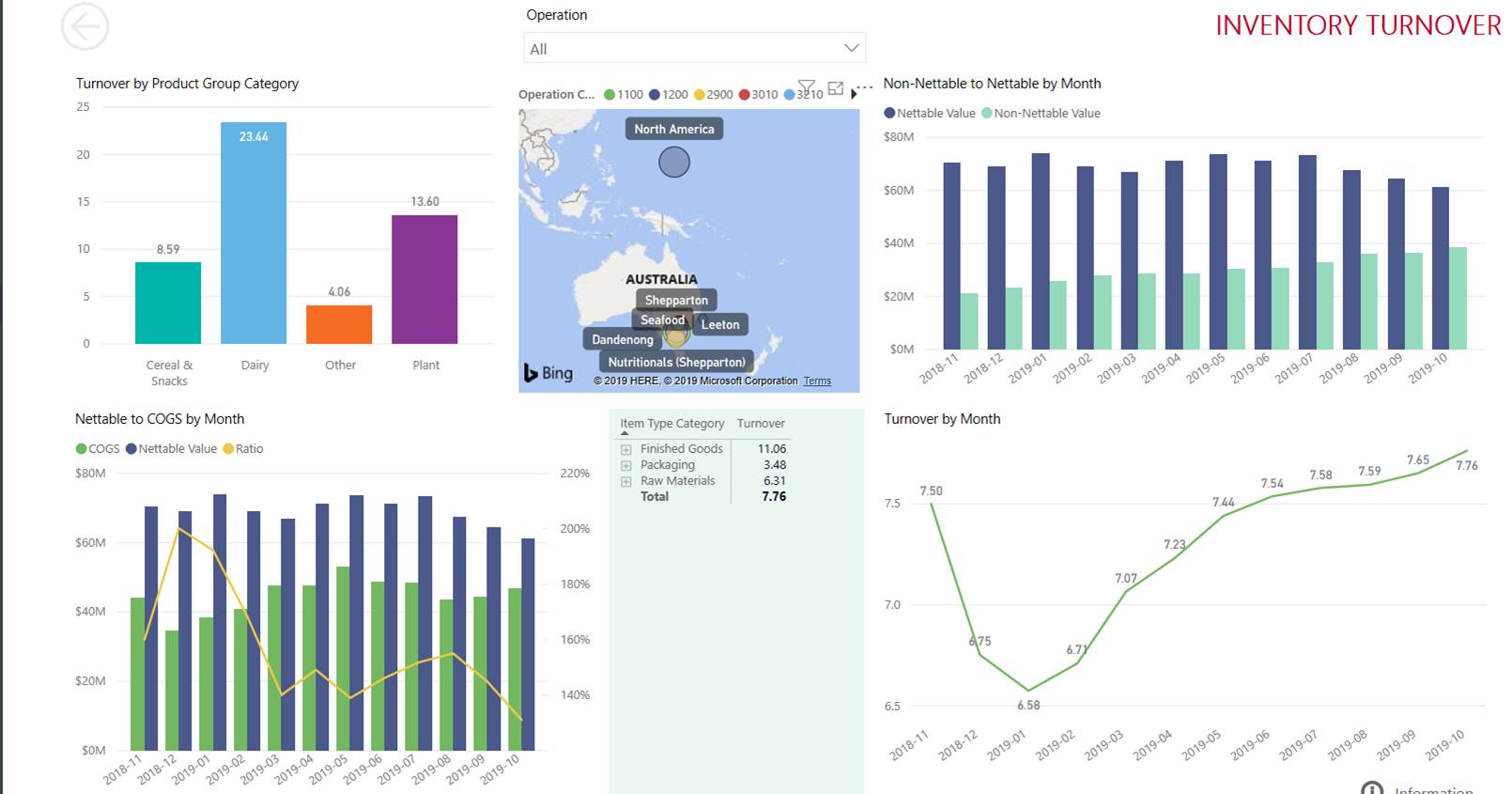
In the top right quadrant of the dashboard as at 27 November 2019 was a bar graph headed “Non-Nettable to Nettable by Month”, which for each month displayed the value of Nettable inventory (in blue) and Non-nettable inventory (in green) on hand at FFG. That graph showed FFG’s Non-nettable exposure increasing across the 2019 calendar year (affidavit of Mr Figueroa of 12.10.23 at [21]), which Mr Figueroa calculates in the total amount of $17.5 million.
55 The Inventory on Hand dashboard was likewise visible to Power BI users from July 2019. Shown below is a screen shot of that dashboard as it appeared in 2021: CB10/4890. Again, Mr Figueroa said that the layout was the same in 2019: affidavit of Mr Figueroa of 12.10.23 at [20]–[21]. However, that proposition requires substantial qualification, as discussed at [57]–[65] below.
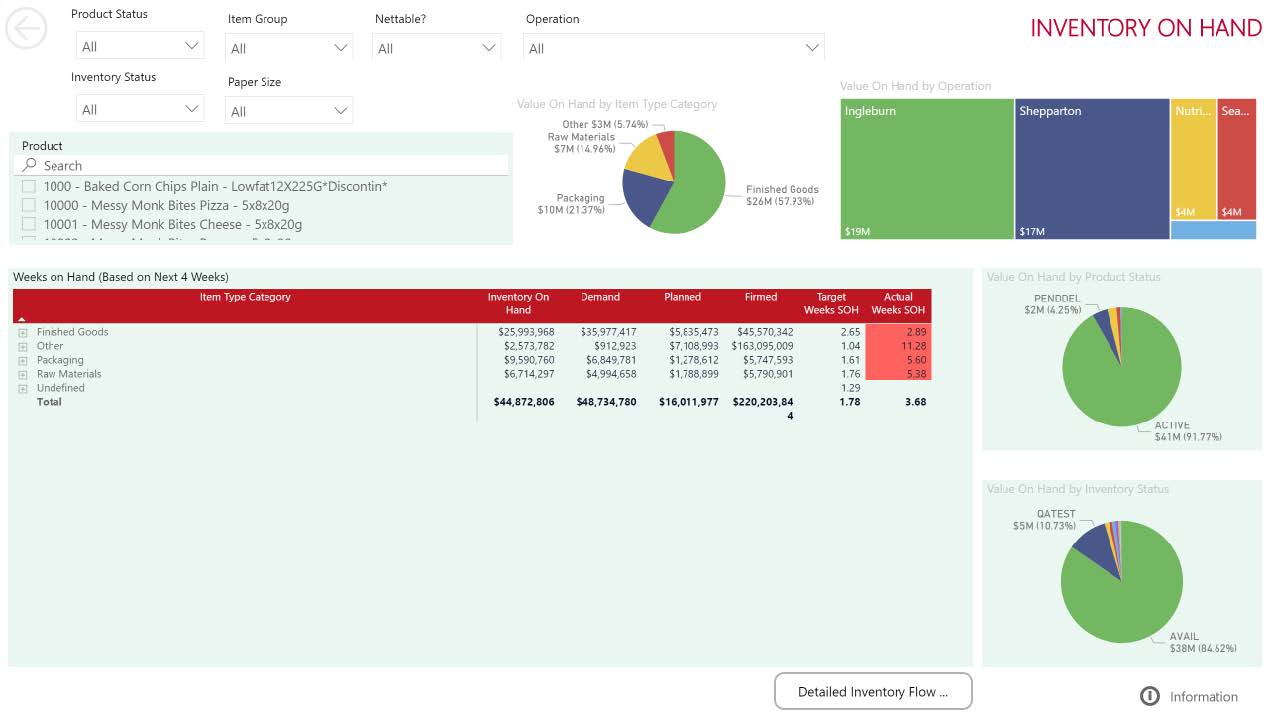
On the left of the dashboard as it appeared in 2021 was a table showing total inventory on hand, broken down into finished goods, packaging, raw materials, undefined inventory and other categories. Across the top were drop-down filters, including one headed “Nettable?”, allowing the user to filter inventory by Nettable or Non-nettable status. On the right were pie charts displaying the value of inventory on hand by category, by site, by product status, and by inventory status, the last drawn directly from the Nettable/Non-nettable coding in QAD: affidavit of Mr Figueroa of 12.10.23 at [20].
56 From July 2019, Power BI also allowed a user to download reports which displayed the data which were then shown in the dashboards, in the form of an Excel spreadsheet: affidavit of Mr Figueroa of 12.10.23 at [23].
57 There were inconsistencies between the witnesses called by ASIC concerning the information about Non-nettable inventory which was available on Power BI from its inception until November 2019. The salient evidence was as follows.
58 Mr Figueroa said that the layout and graphics in the two screen shots shown at [54]–[55] above were the same throughout 2019 and 2020 (affidavit at [21]–[22]), and said that at his meeting with Mr Macleod on 30 July 2019 (see [85]–[86] below), he showed Mr Macleod the value of Non-nettable inventory on the Inventory Flow dashboard in the Business Operations app (affidavit at [40]). In cross-examination, Mr Figueroa adhered to his evidence that both Nettable and Non-nettable inventory levels were visible in Power BI from the outset: T118.20–30. Mr Figueroa was personally involved in the development of the Power BI app: T119.18–19.
59 Ms Graham said that initially the reports generated by Power BI did not include details about Non-nettable stock, which meant that working capital contained in the report was not accurate as the exclusion of Non-nettable stock indicated a reduction in working capital: affidavit of 12.10.23 at [80]. However, Ms Graham said that by at least August 2019, Non-nettable stock was clearly visible, as was the value of inventory under each status code: affidavit at [80]. In cross-examination, Ms Graham was taken to an email dated 3 September 2019 from Ms Makris to Mr Macleod, Mr Nicholas and Ms Graham, which requested input on a number of items, including (CB5/2847):
Inventory Status Reporting
Nettable Vs Non Nettable
Ms Graham accepted that as at 3 September 2019 it was “most likely, probably” that there was no inventory status reporting of Nettable inventory compared to Non-nettable inventory in Power BI: T322.13–22. Ms Graham was then taken to an email dated 27 October 2019 from Ms Makris to Mr Macleod (copied to Ms Graham) which stated (CB6/3214):
What I have seen after interrogating data further in QAd & BI, is that there has been movement at the same time from Nettable to Non Nettable, which will therefore give a more positive reduction in working capital.
On Friday I sat down with Djalal [Benkrouk] an adjusted BI report so you could click “Nettable” and “Non Nettable”.
We must take snapshot of both at the start of each month.
I need to do further analysis of what has gone into Non Nettable status.
Ms Graham said that at that time, Non-nettable inventory status was shown in Power BI, but not the movement over a previous period: T322.40–323.11. However, Ms Graham also said that she did not remember whether Power BI showed the level of Non-nettable inventory before the end of October 2019: T317.28–39; 323.8–16.
60 Ms Makris was taken to her email of 4 November 2019 to Mr Macleod and others summarising the work in progress with the BI apps: CB6/3249. The first point dealt with Inventory Turnover in the Business Operations app, and stated among other things:
Add non-nettable values to bottom left hand graph as snapshot end of each month
100% completed - Fri 1st Nov
Ms Makris was unable to say whether that was a reference to the graph shown in the bottom left of the first of the two screen shots shown at [54] above: T362.6–8. The email later refers to work in showing Nettable stock (only) in the “Inventory on Hand” report in the enhanced Site Operations app as expected to be complete by 6 November 2019. Ms Makris clearly recalled that in the period July to September 2019, Power BI did not display separate figures for Nettable and Non-nettable inventory, and the drop-down box for “Nettable?” (in the middle of the top line of the second screen shot at [55] above) was not then made available; the viewer was simply given all inventory: T364.33–39. However, in that early period, Power BI displayed a pie chart on its opening display showing all inventory separated into inventory status codes, similar to the pie chart in the bottom right corner of the second screen shot shown at [55] above (which has the status codes “AVAIL” and “QATEST” specifically stated): T362.19–29, 364.1–8, 364.33–39. The graph shown in the top right of the first screen shot shown at [54] above (displaying “Non-Nettable to Nettable by Month”) was introduced by the end of calendar year 2019, probably around October or November 2019 but Ms Makris could not give an exact date: T364.44–365.19. Ms Makris said that Power BI never excluded any inventory: T362.38–39. I note that Ms Makris was personally involved in the development of Power BI: affidavit of Ms Makris of 27.10.23 at [22].
61 Mr Sun gave evidence concerning monthly inventory reports which he sent Mr Nicholas from January 2019. Those reports changed in response to discussions between Mr Sun and Mr Nicholas in August 2019, such that beginning with the July 2019 inventory report sent on 19 August 2019 (CB5/2542–2544B), those monthly reports showed separate figures for Nettable, Non-nettable and total inventory: affidavit of Mr Sun of 12.10.23 at [13]–[29]. However, in late October 2019, Mr Nicholas asked Mr Sun to generate his monthly inventory reports using Power BI, and specifically the Inventory Movement Interface on Power BI: affidavit of Mr Sun at [30]–[33]. From that time, Mr Sun did not need to compile and send to Mr Nicholas the complicated Excel spreadsheets he had prepared himself for inventory movement, because this could be done more readily in Power BI, and that was a new kind of function in Power BI as at late October 2019: T190.24–191.17. An email from Mr Sun to Mr Nicholas on 30 October 2019 stated that the “Inventory Movement Analysis” had been built into Power BI and shared and updated monthly: CB6/3243. It also referred to the ability to “drill through” to item levels, which I infer was a new feature of Power BI as at 30 October 2019, and thus was not available on 30 July 2019 (contrary to Mr Figueroa’s evidence referred to at [86] below). Given that Mr Sun’s monthly inventory reports had explicitly identified Nettable and Non-nettable inventory since 19 August 2019, his evidence corroborates Ms Makris’s evidence as to the timing of the enhancement of Power BI to display separate Nettable and Non-nettable figures as being in October or November 2019.
62 I formed the impression that Ms Makris and Mr Sun had the clearest and most reliable recollection of all four witnesses on this issue. Ms Makris’s evidence is also consistent with her emails of 3 September 2019 (CB5/2847) and 27 October 2019 (CB6/3214) which were put to Ms Graham, and with her email of 4 November 2019 (CB6/3249). As I have indicated at [61] above, Ms Makris’s evidence is corroborated by Mr Sun. Accordingly, I find that in the period July to September 2019, the Power BI Business Operation app did not display inventory divided into Nettable and Non-nettable inventory, but did show a pie chart which displayed all inventory by reference to inventory status codes, and expressly identified the status codes for the largest of the segments of that pie chart. Further, as Mr Sun’s evidence indicated, by late October 2019, Power BI displayed figures for month-to-month inventory movement for Nettable and Non-nettable inventory.
63 In ASIC’s closing submissions, ASIC submitted that the pie chart for “Value on Hand by Inventory Status” in the Business Operations app as at July 2019, as described by Ms Makris in her oral evidence, would have appeared as follows, using the inventory status code values as at 31 May 2019 from Tab 211 (CB4/2390–2392I) (with the subtraction of $37,523,440.92 from the AVAIL stock to reflect the error in Tab 211 discussed at [81] below):
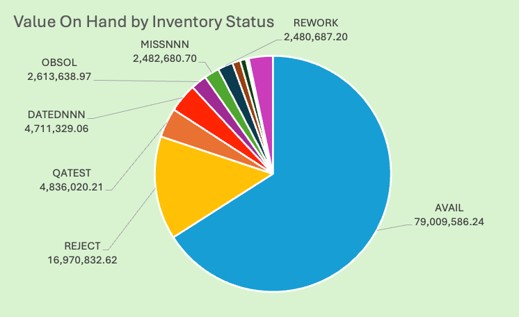
64 I accept that submission, except that the evidence does not support the proposition that dollar figures would have appeared in the pie chart at that time. I note that Ms Makris did say in her affidavit (at [26]) that: “From around July 2019, the breakdown of inventory (including the exact amount of Non-nettable stock) was updated live (approximately every hour) on the Business Operations dashboard of Power BI”. However, the pie chart displayed in July, August and September 2019 could not have displayed the exact amount of Non-nettable stock, because some of the segments were too small and numerous to accommodate such a display, as ASIC accepted in its final address: T642.30–41. Further, it would not be consistent with Ms Makris’s oral evidence (which I accept) to find that the Business Operations app at that time displayed a separate figure for Non-nettable stock.
65 The precise proportions in the actual pie chart shown on Power BI as at 31 July 2019 may well have differed from those indicated by the figures recorded in Tab 211 as at 31 May 2019. ASIC submits, and I accept, that in light of the various inventory reports showing figures for Nettable and Non-nettable inventory and the general reliability of the QAD data (discussed at [181]–[191] below), I should infer that a user of Power BI viewing the “Value on Hand by Inventory Status” pie chart in August, September and October 2019 would have observed approximately 60% or less of inventory with the status code AVAIL, and the remaining 40% or more of inventory consisting primarily of Non-nettable status codes, including 10–15% of stock being REJECT.
66 On 26 July 2019, Mr Macleod was given access to Power BI and the Business Operations app on his desktop computer and mobile phone: CB4/2429; affidavit of Ms O’Brien of 10.10.23 at [35]–[36]; affidavit of Mr Figueroa of 12.10.23 at [24]. Mr Macleod admits in his defence (at [22]) that from around 26 July 2019, he had access to, and began using, Power BI on his desktop computer and mobile phone. Upon receiving the access link from FFG’s IT department, he replied: “Great, thanks Djalal [Benkrouk]. Using it already, look forward to discussing additions etc”: CB4/2429.
67 I have set out below at various points in the chronological narrative what ASIC claims the Business Operations app of Power BI would have displayed at the end of the relevant months in terms of Nettable and Non-nettable inventory values, by reference to a document produced by FFG to ASIC on 16 August 2022: Tab 834 at CB11/5154–90. It is common ground that the document at Tab 834 provides direct evidence of what was recorded in FFG’s systems of accounting for inventory as at 16 August 2022 for the end of each of the months of June 2019 to June 2020, but there is a dispute as to whether the information in Tab 834 was available on the Power BI apps at all relevant times: see Australian Securities and Investments Commission v Noumi Ltd (No 6) [2026] FCA 785 at [2]–[15]. As I have found at [62] above, based on Ms Makris’s and Mr Sun’s evidence, the Business Operations app of Power BI did not display separate figures for Nettable and Non-nettable inventory in the period July to September 2019, but did display a pie chart in that period which showed all inventory by reference to inventory status codes. I deal at [181]–[191] below with the issue of the significance of changes to the data which may have been made in the period between 30 June 2019 (being the earliest time referred to in Tab 834) and 16 August 2022 (when Tab 834 was produced by FFG to ASIC).
Events leading to the FY19 Financial Report
68 On 1 March 2019, immediately before Ms Graham resumed her employment with FFG in the role of General Manager Corporate Development, Mr Macleod discussed with her the need to reduce the level of inventory to improve cashflow: affidavit of Ms Graham of 12.10.23 at [44]–[47]; CB3/2062. On 3 March 2019, after receiving an inventory report for the period 30 June 2018 to 30 September 2018 (CB3/2058A–2058F), Ms Graham emailed Mr Macleod pointing out that Shepparton seemed to be the main contributor to the increase in inventory figures in that period (CB3/2062). When Ms Graham resumed her employment with FFG at about that time, one of the first tasks she was focussed on, at Mr Macleod’s request, was to reduce FFG’s inventory level to improve cash flow and review the level of working capital: T296.44–297.3.
69 From 24 May 2019, Ms Graham and FFG’s chief financial officer, Mr Nicholas, reviewed FFG’s inventory, particularly at FFG’s warehouse in Shepparton: affidavit of Ms Graham of 12.10.23 at [53]–[66]. At that time, the Shepparton site held approximately one third of FFG’s overall inventory. Mr Singh produced an inventory analysis on 3 May 2019, which revealed that there was a substantial amount of Non-nettable stock at the Shepparton site including $11,251,731 with the status code REJECT, $728,372 with the status code MISSNNN and $563.583 with the status code WHHOLD. The spreadsheet refers to total inventory of $40,916,395, of which $8,301,050 was “virtual stock” and $31,926,273 was “physical” stock: Tab 164 at CB4/2290–3. Ms Shepherd and Mr Singh then prepared a powerpoint presentation based on that spreadsheet: affidavit of Ms Shepherd of 11.10.23 at [29]–[32]; affidavit of Mr Singh of 13.10.23 at [26]–[28]. The powerpoint presentation refers to inventory on hand as comprising virtual stock of $8 million, and “physical stock at risk” of $8.7 million, of which $7 million was reject stock: CB4/2221. The powerpoint presentation was admitted subject to an agreed limitation under s 136 of the Evidence Act that it not be used as independent evidence establishing the truth of what is asserted in the inventory spreadsheet at Tab 164 (being CB4/2290–3). However, the powerpoint fairly summarises the contents of the spreadsheet, as Mr Macleod’s submissions appear to accept: closing submissions at [90].
70 The 3 May 2019 inventory spreadsheet and its updates (being Tab 164 and the updates to it at Tabs 176, 179, 233 and 257) were admitted subject to an agreed limitation under s 136 of the Evidence Act that Column C of the “Whse” worksheet may not be used to prove the existence of a fact about which opinions are expressed; that is, to establish that Mr Singh’s descriptions regarding warehouse locations were accurate. The spreadsheet funnelled about 46,000 rows of inventory into 74 different “Description 2” fields by a mapping process: Mr Singh at T282.3–12. The critical integer in the mapping process was the “Description 2” field, which was drawn from Column C of the “Whse” worksheet: Mr Singh at T281.28–37. Mr Singh agreed that the “Description 2” field, in combination with the status codes, “drives what bucket … any given dollar of inventory lands in” (T284.32–34), and downstream in his analysis, the “Description 2” field drives whether inventory is then counted as physical or virtual (T284.36–38).
71 As Mr Macleod submits, Column C of the “Whse” worksheet was the key integer upon which the whole analysis turned. As that key integer cannot be used as evidence of the truth, the spreadsheet is in effect only evidence of the work that Mr Singh performed at the time, and the source of the numbers presented to certain people within FFG’s management at the time. It cannot be given weight as evidence of the actual value of inventory at Shepparton at the time, nor the value of virtual inventory.
72 On 27 May 2019, a meeting was held over Skype with Mr Nicholas, Ms Graham, Mr Nardi and Ms Shepherd, at which the spreadsheet and powerpoint of 3 May 2019 were discussed: affidavit of Ms Shepherd of 11.10.23 at [40]–[43]; affidavit of Ms Graham of 12.10.23 at [56]–[58]. Ms Shepherd explained that wastage of milk resulted in creation of virtual stock because FFG authorised 6% of processed milk to be written off in the bill of materials on a monthly basis, whereas the reports demonstrated that FFG had a wastage rate of 11–12%: affidavit of Ms Shepherd of 11.10.23 at [41]. Ms Shepherd said at the meeting that about $15 million of Non-nettable stock had to be written off, including $8 million in virtual stock, but was told by someone at the meeting (she could not recall who) that the reject stock and virtual stock could not be written off: affidavit of Ms Shepherd of 11.10.23 at [41]–[43]. Ms Shepherd explained that it would be highly unlikely that FFG could reclaim the protein and fat on stock that was well beyond its shelf life: affidavit at [43]; T151.32–34. Ms Shepherd was very frustrated and disappointed that there was no decision to write off the stock or to have an ongoing discussion with Mr Nicholas about it: T152.18–32. Mr Macleod was not present at that meeting and was not sent the spreadsheet: Ms Graham at T298.45–299.2.
73 On 3 June 2019, Mr Sun prepared an inventory movement report for Ms Nicholas (CB4/2303), which recorded an increase in inventory levels from April 2019 to 31 May 2019 of $2.45 million, with total inventory of $11.8 million (CB4/2305B). There is no reference to Non-nettable inventory in that analysis.
74 On 5 June 2019, Mr Singh produced a further spreadsheet (Tab 176 at CB4/2319–2321B) and powerpoint analysis (CB4/2315–7) of the inventory at the Shepparton site, which he sent to Mr Nicholas and others and which his covering email described as showing current inventory of $41.9 million, which included “stock at risk” of $18.9 million, comprising virtual stock ($7.9 million), physical stock at risk ($10.3 million, including reject stock of $7 million) and uncertain stock ($0.6 million) (CB4/2314). The total level of stock had increased from the 3 May 2019 figures largely because of the inclusion of $1.6 million of expired infant formula which had been transferred from FFG’s Dandenong site to the Mooroopna site: affidavit of Mr Singh of 13.10.23 at [35]. Accordingly, the powerpoint stated that there was only $23 million of what the analysis described as “Physical–Good Stock”: CB4/2316. The covering email and powerpoint presentation were admitted subject to a limitation under s 136 of the Evidence Act that they are not to be used as independent evidence establishing the truth of what is asserted in the spreadsheet, although the email and powerpoint presentation fairly summarise what is contained in the spreadsheet (as Mr Macleod’s closing submissions appear to accept at [96]). The inventory spreadsheet was admitted subject to the limitation under s 136 of the Evidence Act referred to at [70] above, with the consequence referred to at [71] above. On receipt of that analysis, Mr Nicholas emailed Mr Moses and Ms Graham on 5 June 2019 and stated: “Let’s all try and catch up with Rory [Macleod] to align on this. Best to show him the Powerpoint.” (CB4/2322). The powerpoint was the document referred to above, attached to Mr Singh’s email. There is no evidence that the analyses by Ms Shepherd and Mr Singh were actually communicated to Mr Macleod, and none of ASIC’s witnesses said that they were. In my view, it is very unlikely that the analyses were communicated to Mr Macleod.
75 On 24 June 2019, Mr Nicholas sent Ms Graham (but not Mr Macleod) an inventory report prepared by Mr Sun showing an increase in inventory from about $84 million on 31 July 2018 to $113.9 million on 31 May 2019: CB4/2338 and 2341A–B. The increase of $29.9 million included an increase of $20.7 million at Shepparton: CB4/2341B.
76 On 25 June 2019, Mr Nicholas sent Mr Macleod a copy of the minutes and action items from a meeting concerning the inventory reduction program, the first item of which was: “The mandate for the business now is for sites to produce only what is required rather than manufacture for the benefit of overhead recoveries i.e. minimise site cash expenditure.” (CB4/2342). From June 2019, as a result of discussions with Mr Nicholas, Ms Makris and her team looked at ways to drive down saleable working capital: affidavit of Ms Makris at 27.10.23 at 42]. Ms Graham regarded the inventory reduction program as a top priority for the business as at 30 June 2019: CB4/2352.
77 In about June 2019, Mr Macleod asked Ms Graham to lead a project focussed on reducing FFG’s working capital, including inventory: affidavit of Ms Graham of 12.10.23 at [63]. On 23 June 2019, Mr Nicholas and Mr Macleod exchanged emails (which I have referred to at [28] above) in which they anticipated a discussion about reducing working capital, and on the same day Mr Macleod wrote a further email to Mr Nicholas saying: “Be good to understand detail behind inventory movement YTD [year to date]. That is a key area for focus as we know.” (CB4/2336).
78 As at 16 August 2022, FFG’s systems showed for 30 June 2019, being the balance date for the FY19 Financial Report, figures for Nettable inventory of $85,402,662.58 and Non-nettable inventory of $31,401,493.37, being a total of $116,804,155.95: Tab 834 at CB11/5189–90. The value of Non-nettable inventory was thus 26.88% of the total inventory, although ASIC accepts that that percentage was not shown on Power BI. I note also that Mr Macleod did not have access to the Power BI app until 26 July 2019. The ASOC does not rely on Tab 834 for the values of FFG’s inventories as at 30 June 2019: see ASOC [17]–[21], and it should be noted that the figures for 30 June 2019 are omitted from the table at ASOC [25]. As I indicated at [67] above, Tab 834 was a document generated on about 16 August 2022 and produced by FFG to ASIC on that day, in the circumstances which I set out in Australian Securities and Investments Commission v Noumi Ltd (No 6) [2026] FCA 785 at [3]–[9].
79 On 1 July 2019, Mr Nicholas forwarded a further inventory review by Mr Sun for the period 30 June 2018 to 31 May 2019 to Ms Graham: CB4/2369. Mr Nicholas said to Ms Graham in his email:
Gotta way to go still with this report but of the $29.9 million increase in total inventory from 30 June 2018 to 31 May 2019, $13.7 m or 46% is non nettable!
The data source that Andy [Sun] currently uses for this report only shows nettable versus non nettable. So we need to bring in another data set to show this movement in non-nettable by category.
On the same date, Ms Graham responded (CB4/2372):
Do you have the status codes used for nettable? Non-nettable seems very high!
Ms Graham forwarded the analysis to Mr Moses, saying that it did not make sense to her that Non-nettable inventory could have increased by $13 million in 11 months: CB4/2374.
80 On 3 July 2019, Mr Sun emailed Mr Benkrouk, saying that Mr Nicholas wanted an inventory valuation report with status codes in order to figure out whether particular categories of stocks had increased, such as rejects, rework or damages: CB4/2386. The email stated that reports in QAD, which Mr Sun used to carry out inventory movement analysis, provided a stock balance at a particular date, but did not have inventory status. (Mr Nicholas had said in an earlier email to Mr Sun on 3 July 2019 that he understood from Ms Leach that it was not possible to run retrospectively the inventory status codes for earlier periods: CB3/2387.) Mr Sun’s email also referred to QAD data giving materially different quantity figures depending on which tool was used to access it: Mr Sun at T183.28–184.14. Mr Nicholas asked Mr Benkrouk to make the requested inventory valuation report with status codes his highest priority: CB4/2386.
81 That request led to the inventory movement analysis at Tab 211, including the “Current Inventory Status” worksheet as at 31 May 2019 (CB4/2391–2392A), which has a total for inventory of $149,413,624. ASIC accepts that the figure is erroneous, and attributes the mistake to the inclusion of an extremely large quantity of chocolate milk (referred to as Aldi Moobox Choc) with the status code AVAIL at a value recorded as $37,523,440.92 (CB4/2392A). I accept that including that item was an error, and most likely a clerical error in the entry of the data for that item. As the entry was given the status code AVAIL, its inclusion does not affect the figures generated for Non-nettable status codes. ASIC insists that that is the only error in the document. There does, however, appear to be another error in the underlying data, which is revealed by Mr Nicholas’s email of 5 July 2019 (CB4/2389), referring to the Non-nettable movement for raw materials as producing a closing balance of negative $139. Mr Sun accepted that that was impossible, and probably reflected a transaction having been missed and not posted: T185.6–44.
82 On 5 July 2019, Mr Nicholas emailed the document to Mr Moses and others (but not to Mr Macleod), asking the recipients to review the attached file, particularly for the increase in Non-nettable inventory at Shepparton from June 2018 to May 2019. Mr Nicholas said: “On face value it seems too high e.g. the increase for [Finished Goods] of $14 m over the 11 months to 31 May 19.” (CB4/2389). Mr Nicholas appears to have misread the document, in that the increase in Finished Goods at Shepparton was $10.1 million with a closing balance as at 31 May 2019 of $13.9 million. Nonetheless, that increase does appear very substantial at a time when FFG was seeking to reduce inventories.
83 On 8 July 2019, at Mr Nicholas’s request, Ms Makris received the inventory reports from 1 July 2018 to 31 May 2019 in relation to the Shepparton site, and provided an explanation for inventory being assigned the status code REJECT, being sterility or microbiological issues with the product: CB4/2399 and T351.41–47. Ms Makris recommended checking that all the stock existed, as a standard inventory control: T353.12–26.
84 By 29 July 2019, the Shepparton site had implemented weekly inventory meetings, a new cycle count process and a higher percentage milk waste to get inventory “more under control”: CB4/2440; Ms Shepherd at T144.11–145.13. At that date, Shepparton reported that it had $9.5 million in virtual stock and $10.2 million in stock with a REJECT status code: Tab 233 at CB4/2434–8, which is subject to the limitation under s 136 of the Evidence Act that I have referred to at [70] above, with the consequence referred to at [71] above.
85 On 30 July 2019, at a meeting held at FFG’s offices, Mr Figueroa showed Mr Macleod how he could view the inventory values on Power BI: affidavit of Mr Figueroa of 12.10.23 at [40]–[41]. Although Mr Figueroa was not sent the calendar invitation for this meeting (CB4/2448), I accept his evidence that he was called into the meeting (T123.3–8). Mr Macleod, Ms Graham, Mr Benkrouk, Mr Nicholas, Mr Moses and Ms Makris were all present (affidavit of Mr Figueroa at [39]), as too was Ms O’Brien (Mr Figueroa at T123.13). Mr Figueroa said that the inventory values on Power BI included the value of Non-nettable inventory, which I regard as true only in the sense that all inventory was included without distinguishing between Nettable and Non-nettable inventory. I do not accept that Power BI displayed at that time separate figures for Nettable and Non-nettable inventory, in light of the contrary evidence of Ms Makris that the Power BI app did not show the value of Non-nettable inventory but only the relative proportions falling within the various inventory status codes by way of a pie chart (see [62]–[64] above).
86 Mr Figueroa took Mr Macleod through the Inventory Flow dashboard in the Business Operations app, and Mr Macleod asked him a lot of questions about the inventory data, including the value of Non-nettable inventory held by FFG as at July 2019. I accept that Mr Macleod’s questions extended to the value of Non-nettable inventory, which were likely to have been prompted by seeing the pie chart, although the evidence does not extend to the content of Mr Figueroa’s answers on that topic. At times during the meeting, Mr Macleod was yelling, particularly when Mr Figueroa talked him through inventory reporting and forecasts which showed FFG had excess levels of finished goods inventory and high levels of working capital. Mr Macleod and Mr Nicholas both asked Mr Figueroa if there were errors in the data (including the item statuses, inventory statuses, inventory quantities and the value of those inventory items). Mr Figueroa in his oral evidence described using a “drill through function in Power BI” looking at the value of inventory at a particular site according to its inventory status, and comparing that with what a different screen showed as the corresponding QAD data for that site, product and status: T124.46–125.10. However, I do not accept that evidence in light of Mr Sun’s email of 30 October 2019 (CB6/3243), which refers to the “drill through” functionality in a way that suggests that this was a newly enhanced feature of Power BI as at 30 October 2019. Mr Figueroa was asked a lot of questions about how FFG had so much product that had either expired or that was in QA status: T125.14–18. Mr Figueroa showed them the data on QAD to demonstrate that Power BI was accurately representing the QAD data. After Mr Figueroa gave them the detailed explanation and after answering multiple questions from both Mr Macleod and Mr Nicholas, each of them stopped asking questions or suggesting that Power BI was incorrect. Instead, Mr Macleod and Mr Nicholas turned to Ms Makris and asked her questions about how the inventory levels could be so high. Mr Figueroa gave several examples of Non-nettable stock that was incorrectly recorded as Nettable stock in QAD, and said that it would be a good idea to introduce measures to identify and reclassify those items of inventory on QAD.
87 As at 16 August 2022, FFG’s systems showed for 31 July 2019 figures for Nettable inventory of $84,583,027.49, and Non-nettable inventory of $33,795,867.70, being a total of $118,378,895.19: Tab 834 at CB11/5186–8. The value of Non-nettable inventory was thus 28.55% of the total inventory, although ASIC accepts that that percentage was not shown on the Power BI app. As I have found at [62]–[64] above, the Power BI app in July 2019 did not display separate figures for Nettable and Non-nettable inventory at that time.
88 In about July or August 2019, Ms Makris and her team (including Mr Figueroa, Ms Hardy and the General Managers of each warehouse) organised meetings to discuss each site reducing working capital, particularly Nettable inventory. Ms Graham gave evidence that Mr Macleod, Mr Nicholas, Mr Moses and Ms Graham also attended the meetings, which Mr Macleod chaired (affidavit of Ms Graham of 12.10.23 at [93]), but as I find at [104] and [106] below, Mr Macleod only attended two of those meetings, namely on 12 September 2019 at Taren Point and on 20 September 2019 at Ingleburn.
89 In early August 2019, Mr Macleod attended another meeting with Mr Figueroa, Mr Nicholas, Ms Makris and Ms Hardy. The evidence of Mr Figueroa (in his affidavit of 12.10.23 at [42]–[43]) is to the following effect, which I accept, except for Mr Figueroa’s reference to Power BI at that time separately identifying the value of Non-nettable stock. Mr Macleod said that the situation with the forecasts and inventory statuses that they had discussed a few days earlier was “unacceptable”. Mr Macleod asked how FFG could possibly have accumulated such large inventories. Mr Figueroa said that FFG needed to clean up the planning data and item master data in QAD. Mr Figueroa said that he had already started correcting item master statuses classed as “Active” in QAD which were known to be commercially discontinued or obsolete so as to facilitate inventory write-off and disposal. Mr Macleod then slammed his fist on the table and interrupted Mr Figueroa while he was speaking and yelled “shut up”. Mr Macleod yelled at Mr Figueroa, saying: “There aren’t going to be any write-offs. Those statuses are not to be changed without my approval and anyone who does so without my approval will be fired.” Ms Hardy interjected and said “Rory, I think you are referring to ‘inventory statuses’, Martin [Figueroa] is talking about making changes to item master statuses”. Mr Macleod yelled in response (while pointing at the Inventory Business Report). At that point, Power BI was displaying the inventory report which Mr Figueroa said included the value of Non-nettable stock held by FFG (although as I have found at [62]–[64] above, Non-nettable inventory was not separately identified and displayed on the Power BI Business Operations app at that time, which displayed a pie chart showing the relative proportions of all inventory by reference to status codes). Mr Macleod said: “It doesn’t matter, that is money. Only I will approve changes like that.” Mr Figueroa said to Mr Macleod that he planned to seek approval for many changes, because he thought there were insufficient controls and practices around the management of inventory statuses and item master statuses which were only worsening the business’s exposure.
90 Mr Figueroa’s evidence, which I also accept, is that they also spoke at the meeting about the reports available on Power BI during that meeting. Mr Macleod asked Ms Makris and Mr Figueroa “who has access to the inventory reporting?”. Mr Figueroa said that they were still in testing stages and mentioned a few names of people in the Finance Team and Operations Team who were testing Power BI. Mr Macleod said that it was not acceptable that the Power BI Business Operations reports (which displayed inventory data in dollar values) had been shared outside senior management. Mr Macleod said that he wanted to approve each person who could access the reports. Ms Makris and Mr Figueroa then each said that some elements of inventory reporting needed to be accessed by the Finance and Operations Teams. Mr Macleod then asked if they could create a report that only displayed unit values, instead of dollar values. Mr Macleod said that inventory reports should only be distributed to the wider business displayed in unit values, not dollar values. Mr Macleod also said that access to financial reports required approval by him. At the end of the meeting, Mr Macleod agreed that Ms Makris and Mr Figueroa could clean up the item statuses and centralise inventory planning.
91 On 12 August 2019, Mr Sun sent an inventory movement analysis to Mr Nicholas showing as at 30 June 2019 Non-nettable inventory of $31,339,701 (CB5/2487 and 2489F), out of total inventory of $114,557,577 (CB5/2489C). The analysis also showed a total for Nettable inventory of $84,829,646: affidavit of Mr Sun of 12.10.23 at [22(b)]. At about that time, Mr Sun explained to Mr Nicholas that the report was generated from the data in QAD (as was the case with all previous inventory movement reports he had created), which meant that inventory items and their value with their status codes would automatically be included in the reports which he generated: affidavit of 12.10.23 at [22]; and see CB5/2490.
92 On 23 August 2019, at a meeting of the Audit Committee, Mr Macleod noted that, moving forward, “management will focus its attention on managing operational efficiencies and controlling inventory levels”: CB16/9847. Mr Macleod attended every Audit and Risk Committee meeting during 2019 (CB12/6322, 13/7581, 15/9165 and 16/9845), and also attended the meeting on 26 February 2020 (CB15/9234).
93 As at 16 August 2022, FFG’s systems showed for 31 August 2019 figures showing Nettable inventory at $80,150,676.92, and Non-nettable inventory of $36,830,795.00, being a total of $116,981,471.92: Tab 834 at CB11/5183–5. The Non-nettable inventories were thus 31.48% of total inventory at that date, although ASIC accepts that the Power BI app did not show that percentage. As I have found at [62]–[64] above, the Power BI app did not give separate figures for Nettable and Non-nettable inventory at that time. Although in the month of August the overall inventory total had decreased by approximately $1.5 million, Non-nettable inventory had increased by more than $3 million. There is no direct evidence of what FFG’s systems recorded in the days leading up to the release of FY19 Financial Report on 29 August 2019, but I infer that the proportion of Non-nettable to total inventory (in dollar value) would have been substantially similar to the figures displayed as at 31 August 2019.
94 Mr Nicholas could not recall talking with Mr Macleod specifically about Non-nettable stock around the time of the FY19 Financial Report: transcript of s 19 examination on 8.12.21 at p 47.6–11; CB16/10473. Mr Nicholas never gave Mr Macleod an inventory report showing the true inventory position: p 57.1–11; CB16/10483.
95 On 28 August 2019, Mr Macleod and Mr Nicholas signed and provided to the FFG board a representation letter: CB14/7984–7. The letter stated that, to the best of their knowledge and belief, the FY19 Financial Report was “free of material misstatements” (CB14/7984), and to the best of their knowledge and belief no inventory was stated at an amount in excess of net realisable value (para 14 at CB14/7986).
96 On 29 August 2019, FFG released to the ASX the FY19 Financial Report: CB5/2681. That report disclosed inventories of $120,211,000 as current assets, being what I refer to as the FY19 Disclosed Inventories: CB5/2705.
97 The FY19 Disclosed Inventories included both Nettable and Non-nettable stock. That is evident from two matters. First, the inventory figure in the FY19 Financial Report was generated from work performed by Ms Leach and Mr Nardi, neither of whom considered any distinction between Nettable and Non-nettable inventory: affidavit of Ms Leach of 12.10.23 at [32]; affidavit of Mr Nardi of 25.10.23 at [8]. Second, the figure of $120 million is not materially different from the total inventory figures (comprising both Nettable and Non-nettable inventory) for 30 June 2019 in documents generated directly from the QAD data, such as the figure of $114,557,577 in Mr Sun’s inventory report of 12 August 2019 for inventory as at 30 June 2019 (CB5/2489C) and the figure of $116,804,155.95 shown in the report produced on 16 August 2022 as at 30 June 2019 (CB11/5189–90).
98 Note 2 to the financial statements in the FY19 Financial Reports dealt with revenue, and stated as follows under the heading “Significant accounting policies” (CB5/2718):
Revenue is measured at the fair value of the consideration received or receivable. Revenue is reduced for terms, rebates and other similar allowances.
Under the further heading “Sale of goods”, Note 2 stated as follows (CB5/2718):
Revenue from the sale of goods is recognised when all the following conditions are satisfied:
• Identification of contract,
• Identification of the performance obligations in the contract,
• Determine the transaction price,
• Allocation of the transaction price to the performance obligations in the contract, and
• Recognition of revenue when performance obligations are satisfied.
99 Note 11 to the financial statements in the FY19 Financial Report (CB5/2720–1) provided a breakdown of the figure for inventories as follows:
Consolidated | ||
2019 | 2018 | |
$ ’000 | $ ’000 | |
Raw materials–at cost | 58,304 | 47,567 |
Finished goods–at cost | 62,342 | 38,636 |
Less: provision for impairment* | (435) | (5,102) |
120,211 | 81,101 | |
*2018 includes a provision for the shutdown of Taren Point
All inventories of the Group are expected to be recovered within a 12 month period.
The cost of inventories recognised as an expense during the year in respect of continuing operations was $358,037,665 (2018: $265,754,170).
100 Under the heading “Significant accounting policies”, Note 11 stated (CB5/2721):
Inventories are measured at the lower of cost and net realisable value.
Costs incurred in bringing each product to its present location and condition are accounted for as follows:
• Raw materials: purchase cost on a first in, first out basis.
• Manufactured finished goods: cost of direct materials, direct labour and an appropriate proportion of manufacturing variable and fixed overheads based on normal operating capacity but excluding borrowing costs.
• Purchased finished goods: purchase cost on a weighted average cost basis.
• Net realisable value is the estimated selling price in the ordinary course of business, less estimated costs of completion and the estimated costs necessary to make the sale.
101 Mr Macleod signed the FY19 Financial Report as Managing Director and Chief Executive Officer, and on behalf of the directors declared that FFG’s financial statements gave a true and fair view of FFG’s financial position as at 30 June 2019 and of its performance for the financial year ended on that date: CB5/2682, 2702, 2755.
102 On the same day, 29 August 2019, FFG announced to the ASX that, with the winding down of the significant capital expenditure period, FFG was working to improve inventory holdings, including packaging and raw materials: CB14/8313.
Period between FY19 Financial Report and HY20 Financial Report: Inventory
103 As at 16 August 2022, FFG’s systems showed for 30 September 2019 figures for Nettable inventory of $78,335,089.56 and Non-nettable inventory of $39,607,877.10, being a total of $117,942,966.66: Tab 834 at CB11/5180–2. The Non-nettable inventory figure was 33.58% of the total inventory figure, although ASIC accepts that that percentage was not shown. As I have found at [62]–[64] above, the Power BI app did not display separate figures for Nettable and Non-nettable inventory at that time. As with the figures for 31 August 2019, Non-nettable inventory had increased by almost $3 million from the previous month.
104 On 6 September 2019, Mr Figueroa sent to Mr Macleod and others working capital summaries for review the following week: CB5/2848. One of them shows that, as at 1 August 2019, Nettable inventory was $68,978,411, and does not provide a figure for Non-nettable inventory: CB5/2850A. A meeting was held at Taren Point on 12 September 2019, which Mr Macleod attended, described as “Working Capital review and Inventory projections”: CB5/2855. A further meeting was held at Ingleburn on 20 September 2019, which Mr Macleod attended, described as “Working Capital Review - Ingleburn”: CB5/2877.
105 On 19 September 2019, Mr Sun emailed Mr Nicholas and others his inventory movement analysis for 31 August 2019, showing Non-Nettable inventory as $36,790,568: CB5/2919 and 2921A.
106 Between about September 2019 and May 2020, there were regular meetings to discuss working capital reports which Mr Figueroa circulated each month, which included the values of Non-nettable inventory at each of the Dandenong, Ingleburn, Leeton and Shepparton warehouses. Although Ms Graham said in her affidavit that Mr Macleod and Mr Nicholas attended these meetings and the value of Non-nettable inventory was explicitly discussed at each of the meetings (affidavit of Ms Graham of 12.10.23 at [103]), that was an over-generalisation, as she accepted in her cross-examination that she could only remember Mr Macleod being at a meeting at Ingleburn in September 2019, and another meeting at Taren Point (T305.28–39). They appear to be the two meetings on 20 and 12 September 2019 respectively, referred to at [104] above. Mr Figueroa gave evidence of one of the working capital meetings that occurred in Ingleburn in September or October 2019, at which Mr Macleod, Mr Nicholas, Mr Moses and Ms Graham were present, and Ms Makris dialled in: affidavit of Mr Figueroa of 12.10.23 at [66]–[67]. I accept Mr Figueroa’s evidence which was to the following effect. The participants in the meeting reviewed the monthly working capital figures for the Ingleburn site, and subsequently reviewed the working capital figures for the whole business. At the meeting, Mr Figueroa went through the Power BI dashboard for inventory held at Ingleburn and held by FFG generally. He explained the current state of Nettable and Non-nettable inventory projections by reference to the data in a spreadsheet which he had circulated before the meeting. Mr Moses, Mr Nicholas and Mr Macleod asked Mr Figueroa many questions about the accuracy of the working capital figures in the reports he had prepared. Mr Moses said he was concerned about the slow rate at which working capital was decreasing, that the Power BI financial reports were dangerous as the inventory projections were problematic for FFG, and that FFG was asking to increase its lending facility so the working capital projections needed to be accurate. In addition, Ms Graham said, and I accept, that at the Ingleburn meeting, Mr Macleod reacted adversely to someone having moved inventory to a location called “the graveyard” without having obtained permission (T306.13–30)
107 In early October 2019, Ms Graham and Ms Shepherd visited the Mooroopna warehouse (near Shepparton) and the Campbells Cash and Carry warehouse (in Shepparton) in Victoria, where they were shown large volumes of stock in Non-nettable status, including stock that Ms Graham described as rotten milk: affidavit of Ms Graham of 12.10.23 at [112]–[113]. Ms Graham saw that some milk had exploded: T309.27. She regarded it as a dangerous site because pallets could fall on top of people: T309.12–19. Ms Graham took a number of photographs (CB6/2940–55), and showed them to Mr Macleod and Mr Nicholas in about the first week of October 2019: affidavit of Ms Graham of 12.10.23 at [114]. Ms Graham told them about the rotten stock at the Campbells Cash and Carry warehouse and said: “It’s enormous. The photos don’t do it justice, its multiple football fields full of rotten milk and milk that I can’t imagine could ever be reworked.” (affidavit of Ms Graham of 12.10.23 at [114]). Ms Graham also told Mr Macleod in October 2019 about a member of FFG’s staff being violently ill for about a week from disposing of some pallets of rotten milk, and told Mr Macleod: “We need to do something. I think that one needs to be cleared out sooner than any of them because these kids are walking through there and could have a pallet crush them.” (affidavit of Ms Graham of 12.10.23 at [115]). Mr Macleod told Ms Graham that he would visit the warehouse himself: affidavit of Ms Graham of 12.10.23 at [116].
108 On 11 October 2019, Mr Figueroa sent an email to Mr Macleod and others attaching the October working capital summaries: CB6/3026–36. The working capital summary showed that FFG held nationally (ie in Australia) as at about 11 October 2019 Non-nettable inventory in the amount of $38,119,774 and Nettable inventory of $77,052,451: CB6/3028; and see affidavit of Mr Figueroa of 12.10.23 at [61]; T109.31–44 and 110.26–46. Mr Macleod submits, and I accept that this was the first time that Mr Macleod received an email (or attachment to an email) in which a figure was attributed to Non-nettable inventory. In my view, it is more likely than not that Mr Macleod read the attachments and became aware of the totals for Nettable and Non-nettable inventory which they provided, given his keen interest in FFG’s inventory levels and whether FFG was succeeding in its plans to reduce them (see [28]–[29], [66], [68], [76]–[77], [85]–[86], [89]–[90], [92], [102] and [106] above). Mr Figueroa’s email also attached the working capital summaries for FFG’s four main warehouses, which showed that total Non-nettable inventory was approximately $37 million, comprising the following:
Site | Total Nettable | Total Non-Nettable | Court Book Reference |
Dandenong | $7,920,394 | $2,292,824 | 6/3030 |
Ingleburn | $18,013,333 | $7,242,514 | 6/3032 |
Leeton | $6,776,932 | $6,567,554 | 6/3034 |
Shepparton | $31,936,123 | $20,963,093 | 6/3036 |
$64,646,782 | $37,065,985 |
109 There appear to be two reasons for why the national figure for Nettable inventory was about $12.5 million more than the sum of the four sites, and why the national figure for Non-nettable inventory was about $1 million more than the sum of the four sites. First, the national total captures inventory that was not attributed to the four sites, such as the locations specified as “Darlington Point”, “Paramount Seafood”, “Shepparton Nutritionals”, “Taren Point”, “SPL” and “Others” (as disclosed by Tab 211 at CB9/2390–2392I, and Tab 834 at CB11/5186–8; the latter showing as at 31 July 2019 those locations holding $11,400,380.96 in Nettable inventory and $770,658 in Non-nettable inventory). Second, the national figure for Nettable inventory was as at 1 July 2019, whereas the other separate Nettable figures and Non-nettable figures were as at about 11 October 2019.
110 On 18 October 2019, Mr Sun sent to Mr Nicholas and others his inventory movement analysis for September 2019 (CB6/3203), showing an increase in Non-nettable inventory that month of about $2.3 million to close at about $39.1 million (CB6/3205A).
111 On 27 October 2019, Ms Makris sent an email to Mr Macleod saying that she had observed, after interrogating data from QAD and Power BI, that there had been movement between 1 July 2019 and 1 October 2019 from Nettable to Non-nettable, which should “therefore give a more positive reduction in working capital”: CB6/3214. Ms Makris referred to an adjusted Power BI report by clicking “Nettable” and “Non-nettable” and having to take a snapshot of both at the start of each month: CB6/3214. Ms Makris sent a further email on 28 October 2019 on the subject “Board Report Sept19 - Procurement Demand Planning”, saying that further analysis was needed on movement from Nettable to Non-nettable over the previous three months, and that Ms Makris did not feel comfortable publishing her results for working capital: CB6/3224. Ms Makris gave evidence that her investigations revealed that what had initially appeared to be a favourable working capital reduction was merely a movement of Nettable to Non-nettable inventory at Shepparton: T357.12–23.
112 As at 16 August 2022, FFG’s systems showed for 31 October 2019 figures for Nettable inventory of $72,876,633.14 and Non-nettable inventory of $39,695,553.50, being a total of $112,572,186.64: Tab 834 at CB11/5179. The Non-nettable inventory figure represented 35.26% of total inventory, although ASIC accepts that the percentage was not displayed. I find that the Power BI app displayed separate figures for Nettable and Non-nettable inventory by the following day, namely 1 November 2019: see CB6/3249. While Nettable inventory had reduced by approximately $5.5 million since 30 September 2019, Non-nettable inventory had increased slightly, and now represented a larger proportion (namely 35.26%) of total inventory.
113 Ms Graham gave evidence that it was quite clear by October 2019 from the work that the working capital group was doing that the Non-nettable inventory was about $37 million (T311.12–14), and that that stock should be written off (T315.10–316.2, 319.13–16).
114 On 4 November 2019, Ms Makris sent an email to Mr Macleod and others concerning work in progress on various aspects of inventory reporting, and stating that the Business Operations app with Non-nettable and Nettable would be accessible only by the senior leadership team: CB6/3249–50. The list of 12 such personnel (including Mr Macleod) was set out in an email from Ms Makris to Mr Macleod and Mr Nicholas on 12 November 2019: CB6/3256. On 7 November 2019, Ms Makris sent an email to Mr Macleod saying that the Site Operations app was identical to the Business Operations app except that it did not show Non-nettable stock, to which Mr Macleod responded: “Ok sounds good” (CB6/3254).
115 On 9 November 2019, Ms Makris sent an email to Mr Macleod and others informing them that the “Compliance app” on Power BI was complete and available in the Business Operations app and the Site Operations app: CB6/3255. As the screen shot in the email shows, the Compliance app showed, among other things, “Nettable Inventory in Non-Nettable Locations”. Ms Makris explained in her affidavit (at [35]), that that stock was coded with a Nettable status code but was not available to be sold because it was in a Non-nettable location, and had arisen from the practice of certain warehouse staff (who were not authorised to change the status codes from Nettable to Non-nettable) putting inventory in a certain location to indicate that it could not be sold.
116 The screen shot reproduced at [54] above of the Inventory Turnover dashboard on Power BI was taken on 27 November 2019: CB11/5150. It shows in the bar graph in the top right-hand corner that Non-nettable inventory was increasing in the period from November 2018 to October 2019, that it was about $30 million in June and July 2019, and that it was about $35–40 million in August, September and October 2019. I infer that Mr Macleod saw that display on Power BI in late November 2019, given his keen interest in inventory levels and their movement (see the references at [108] above to earlier findings).
117 Ms Sprunt gave evidence, which I accept, that in late 2019, she took Mr Macleod on a tour of the Mooroopna site: affidavit of Ms Sprunt of 23.10.23 at [13]. Ms Sprunt cannot recall showing Mr Macleod the Non-nettable inventory at the site, but there was a section of the warehouse that housed the Non-nettable stock and that section was visible to anyone walking through the warehouse. It held four to five thousand pallets of obsolete stock and packaging: affidavit of Ms Sprunt at [38]. Mr Macleod and Mr Nicholas visited Shepparton on 11 and 12 December 2019: affidavit of Mr Nicholas of 4.6.26 at [3]–[4]; CB7/3304.7, 3304.18. On about 6 November 2019, Mr Nicholas had attended the Shepparton warehouse alone and sent Ms Graham a message that said: “I have just walked through all the hidden factories at shepparton - holy holy crap!”, to which Ms Graham responded by saying: “yep, photos don’t do it justice”: CB6/3251. Mr Nicholas said that Mr Macleod and Mr Moses were with Mr Nicholas on that visit to the Shepparton warehouse, which also included the Mooroopna warehouse: transcript of the s 19 examination of Mr Nicholas 8.12.21, pp 72.10–73.15; CB16/10498–9. The reference in Mr Nicholas’s message to “hidden factories” should have been to “hidden warehouse”: p 73.9–10; CB16/10499. Mr Nicholas observed a lot of pallets of long-life milk products that were close to or past the expiry date as well as packaging and straws, which Mr Macleod said could be reworked or re-used: pp 76.15–77.11; CB16/10502–3. Mr Nicholas saw in the warehouse at the back of the Mooroopna premises a large number of pallets of stock that were either obsolete or past their expiry date, and in the back warehouse there were no warehouse staff picking stock to be sent to customers as they were all working in the warehouse at the front of the premises: affidavit of Mr Nicholas of 9.6.26 at [5]. However, I find that Mr Nicholas was confusing the two visits, and that it was in December that he visited Shepparton with Mr Macleod: see CB7/3304.1 and 3304.7. Mr Macleod was overseas at the time of Mr Nicholas’s visit to Shepparton in November 2019: DTB3/1099–1102.
118 Mr Macleod submits, and I accept, that it should be inferred that Mr Macleod instructed Mr Moses to address the stock of Non-nettable inventory at Mooroopna shortly after Mr Macleod’s site visit in December 2019. The inference is supported by: (a) Mr Moses’s “Recovery Plan” attached to his email of 16 December 2019 (DTB3/1216–23); (b) Mr Moses telling Mr Betson that the Mooroopna warehouse needed to be fixed and he was working on a plan to clear it (affidavit of Mr Betson at [27]–[28], and Mr Betson at T395.12–25, 396.34–43); and (c) Mr Moses’s reference in an email dated 7 January 2020 (copied to Mr Macleod) to the need to finalise the reject and rework plan on all stock and materials and packaging (DTB3/1269–70). It appears , however, that little, if anything, was actually done to address the Mooroopna stock by 13 February 2020, given Ms Graham’s statements to Mr Macleod that day, as discussed at [125] below.
119 As at 16 August 2022, FFG’s systems showed for 30 November 2019 figures for Nettable inventory of $70,127,644.56 and Non-nettable inventory of $45,037,149.10, being a total of $115,164,793.66: Tab 834 at CB11/5176. The Non-nettable inventory was 39.11% of total inventory, although ASIC accepts that that percentage was not displayed. The Power BI apps by that time displayed separate figures for Nettable and Non-nettable inventory by 30 November 2019. While Nettable inventory had reduced by approximately $2.7 million since 31 October 2019, Non-nettable inventory had increased by approximately $5.3 million in that period. By 30 November 2019, the Non-nettable inventory was thus increasing and constituted a larger proportion (namely 39.11%) of total inventory.
120 On 3 December 2019, Mr Figueroa emailed working capital summaries for the four FFG sites in Australia to Mr Nicholas and others (but not Mr Macleod). Those reports showed the following:
Site | Total Nettable | Total Non-Nettable | Court Book reference |
Dandenong | $6,069,883 | $2,208,216 | 6/3300 |
Ingleburn | $14,938,578 | $7,084,205 | 7/3303 |
Leeton | $4,809,684 | $5,802,771 | 6/3294 |
Shepparton | $15,192,306 | $13,458,599 | 6/3297 |
$41,010,451 | $28,553,791 |
121 Comparing those figures for the four sites with the figures provided in Mr Figueroa’s working capital summaries of 11 October 2019 (see [108] above), the total Non-nettable inventory was reported to be about $8.5 million lower on 3 December 2019 than it had been on 11 October 2019, and the total Nettable inventory was about $23.6 million lower on 3 December 2019 than it had been on 11 October 2019. Mr Figueroa explained that the reason for the decrease was that there had been a focus in the business to change processes in the warehouses to reduce Nettable inventory by way of inventory targets, which involved deliberately producing less finished goods products: affidavit of 12.10.23 at [65].
122 As at 16 August 2022, FFG’s systems showed for 31 December 2019 figures for Nettable inventory of $74,051,477.37 and Non-nettable inventory of $42,516,287.33, being a total of $116,567,764.70: Tab 834 at CB11/5172–4. The Non-nettable inventory was 36.47% of total inventory, although ASIC accepts that that percentage was not displayed. The Power BI apps by that time also displayed the Nettable and Non-nettable inventory figures.
123 As at 16 August 2022, FFG’s systems showed for 31 January 2020 figures for Nettable inventory of $73,914,326.76 and Non-nettable inventory of $43,979,518.41, being a total of $117,893,845.17: Tab 834 at CB11/5169–71. Non-nettable inventory represented 37.30% of total inventory, although ASIC accepts that that percentage was not displayed. The Power BI apps also displayed the Nettable and Non-nettable inventory figures.
124 In early February 2020, Mr Figueroa had a conversation with Mr Macleod in which Mr Macleod asked: “How is working capital going?” Mr Figueroa said that while Nettable inventories had continued to fall in the month of January 2020, Non-nettable inventories had risen by a larger amount in the same month: affidavit of Mr Figueroa of 12.10.23 at [70]. While that information was readily available to Mr Macleod on the Power BI app, I do not regard Mr Macleod’s question as proving that Mr Macleod was not regularly looking at the Power BI app for information on inventory movement.
125 On about 11 February 2020 (or more precisely, on 13 February 2020: T311.1–6), Ms Graham told Mr Macleod that she intended to resign, partly because she was uncomfortable with how FFG was handling lactoferrin sales and inventory, and partly because she thought something would be done after she showed Mr Macleod and Mr Nicholas photos of the Mooroopna warehouse, but nothing had been done: affidavit of Ms Graham of 12.10.23 at [137] and [146]. Ms Graham does not recall mentioning a dollar figure for the stock that she thought had been written off: T311.8–10. Mr Macleod told Ms Graham that he needed until April 2020 to sell the lactoferrin, and if it was not sold by then he would inform the board that the sale to Interfood was not going ahead. During this conversation, Mr Macleod also told Ms Graham in relation to the rotten stock that was held offsite that she could set up a steering group to get to the bottom of what inventory was where, and to work out a plan to deal with it: affidavit of Ms Graham of 12.10.23 at [146] and [148].
126 As at 16 August 2022, FFG’s systems showed for 29 February 2020 figures for Nettable inventory of $73,021,402.55 and Non-nettable inventory of $45,586,807.40, being a total of $118,608,209.95: Tab 834 at CB11/5166–8. The Non-nettable inventory represented a larger proportion (namely 38.43%) of total inventory than in previous months, but ASIC accepts that that percentage was not displayed. The Power BI apps displayed the Nettable and Non-nettable inventory figures. Although Nettable inventory had reduced from the figures recorded for June to September 2019 (of about $78 million to $85 million), Non-nettable inventory had increased by another $1.6 million since 31 January 2020.
Period between FY19 Financial Report and HY20 Financial Report: Lactoferrin
127 It is admitted on the pleadings that lactoferrin is a protein by-product extracted from milk, and was a high margin and profitable product for FFG. Mr Nicholas said that the margin on lactoferrin was about 90%: transcript of s 19 examination on 1.12.20 at p 24.21–22; CB16/10581. That is confirmed by the “Nutritionals Model” which Ms Graham emailed to Mr Macleod on 20 April 2019 showing that the EBITDA contribution from revenue from lactoferrin sales was expected to be almost 94% in each of FY19 and FY20: CB3/2149 and 2152. Market prices for lactoferrin were extremely volatile: affidavit of Mr Senauer of 16.10.23 at [11].
128 On 3 April 2019, FFG announced to the ASX that it had installed a production plant at Shepparton with an initial annual capacity of 16 tonnes of lactoferrin, had completed a key commissioning step, expected sales of lactoferrin to commence late in the fourth quarter of FY19, had received strong market inquiry for its lactoferrin capacity, and expected to sell its available capacity into FY20: CB3/2121.
129 The lactoferrin transaction which is the subject of these proceedings concerns the Purchase Order between FFG and a Singaporean dairy trading company, Interfood. Interfood purchased dairy products on a large scale from producers and sold them to customers at a mark-up: affidavit of Mr Senauer of 16.10.23 at [8].
130 On 12 April 2019, Mr Moses forwarded to Mr Macleod an unsigned draft Purchase Order from Interfood for lactoferrin, which he had received from Mr Senauer, Managing Director of Interfood Australia: CB3/2137–9. In his email, Mr Moses described this as the first Purchase Order from Interfood for lactoferrin. The Purchase Order from Interfood was for 4,000 kg of lactoferrin at USD 1,950 per kg (that is, yielding total revenue of USD 7.8 million) in May and June 2019: CB3/2138. The conditions were stated as “EXW Shepparton Incoterms ® 2010”. “EXW” is an abbreviation for “ex works”, meaning that title to (and risk in) the goods passed when they were made available to Interfood at the place of manufacture in Shepparton (Mr Senauer at T427.35–428.13, and see DTB1/9–10). Mr Macleod responded the same day to Mr Moses saying: “That’s a great PO !!,. Lets now focus on delivering by 30 June. Well done.” (CB3/2140). On the same day, Mr Macleod forwarded a copy of the Purchase Order to Mr Nicholas: CB3/2133–4.
131 The Purchase Order included the following terms:
(a) the lactoferrin was to be of at least 95% purity;
(b) the Purchase Order was subject to CNCA approval and the grant of an export licence to China; and
(c) Interfood had the right to cancel the Purchase Order if CNCA approval was not obtained by June 2019.
132 CNCA accreditation was granted to companies whose factories and lactoferrin met certain specifications (for example, protein purity of at least 95%), and allowed accredited companies to use lactoferrin in infant formula: affidavit of Mr Senauer of 16.10.23 at [18]. Although it was possible to sell lactoferrin in China without CNCA approval (for example, in the food additive market), that would likely attract about half the price of lactoferrin which did have CNCA approval: affidavit of Mr Senauer at [18]. FFG did not obtain CNCA accreditation during the period April to December 2019: affidavit of Mr Baldi of 13.10.23 at [19]. From mid-2019 until mid-2020, Mr Baldi had regular discussions with Mr Macleod about the CNCA approval process and what steps could be taken to obtain approval more quickly as FFG had not obtained CNCA accreditation: affidavit of Mr Baldi at [19]. Although one of FFG’s subsidiaries, Pactum Dairy Group Pty Ltd, had CNCA approval for other products, including sterilised milk and cream, there were different CNCA approvals for different products and factories: Mr Senauer at T428.30–36. On 16 April 2019, Mr Macleod wrote in an email to Mr Moses that he thought that FFG was approved for export of lactoferrin to China on the basis that it would be classified within FFG’s existing approval for milk and dairy products: DTB2/714. However, Mr Moses met with CNCA representatives in China in late April 2019 and reported to Mr Macleod that FFG should work on a plan to sell without CNCA approval: CB4/2215. Mr Macleod’s view that lactoferrin fell within FFG’s CNCA approval for milk and dairy products did not survive his discussions with Mr Baldi on the topic of CNCA approval from mid-2019, Mr Baldi being in no doubt that FFG did not have CNCA approval for lactoferrin (see his affidavit at [19], [21]–[23] and [25]). On 25 July 2019, Mr Macleod reported to the board the problem of Australian suppliers being on “hold” for any further CNCA approvals (CB13/7310) and discussed at the meeting the Chinese government’s delay in granting CNCA approval for FFG for infant formula (CB14/7860). The former reference appears to have been a reference to a proposal for new CNCA approval for Ingleburn, but it is not clear which site was referred to in the latter reference. In any event, there is no document after April 2019 in which Mr Macleod said that he still believed that FFG had CNCA approval for lactoferrin because of Pactum Dairy Group Pty Ltd’s CNCA approval for milk and dairy products.
133 A further unsigned Purchase Order was sent by Interfood on 26 April 2019 (CB3/2189–94), containing the same terms referred to at [130]–[131] above as the draft Purchase Order which Mr Macleod had seen. A different purchase order was signed on behalf of Interfood on 7 May 2019 (CB4/2247–8), which specified a different price, namely USD 2,100 per kg (correcting the obvious error in the unit of measurement at CB4/2247 from “mt” to “kg”: see Mr Senauer at T430.9–10). Until 23 October 2019, both FFG and Interfood proceeded on the basis that they were bound by the terms of the unsigned Purchase Order of 26 April 2019.
134 Between April and December 2019, FFG was not able to produce the quantity of 4,000 kg of lactoferrin set out in the Purchase Order, as its production equipment could not produce that amount of lactoferrin at 95% purity: affidavit of Mr Baldi of 13.10.23 at [20]; T442.1–41. Between April and either September or October 2019, Mr Baldi (General Manager of the Shepparton Operations of FFG) participated in multiple conversations with Mr Macleod in which Mr Baldi said that FFG’s newly commissioned production equipment was not capable of producing lactoferrin with 95% purity: affidavit of Mr Baldi of 13.10.23 at [20]. During 2019, Mr Baldi regularly had discussions with Mr Macleod about the fact that no lactoferrin had been supplied to Interfood and that FFG had not produced enough lactoferrin at 95% purity to fulfil the Purchase Order: affidavit of Mr Baldi of 13.10.23 at [23].
135 On 22 May 2019, Mr Collis (FFG’s Group General Manager of Nutritionals & Milk Inputs) emailed Mr Macleod, stating (CB4/2261):
Lf [lactoferrin] samples–Dried powder from last Friday has been sent for testing. We have approx. 50% of the results back and expecting the majority of the outstanding product tests back tomorrow (tested for all micro requirements etc). Site has stated that these samples will not meet final product specification for LF and protein contents and potentially some others …
136 On 20 June 2019, FFG announced to the ASX that FFG had commitments for the sale of all its available capacity in FY20 for lactoferrin (among other products): CB4/2329. Mr Macleod sent a copy of that announcement to various FFG managers at the time: CB4/2328.
137 On Sunday 30 June 2019, Mr Moses forwarded to Mr Macleod an email chain of that day, including an email from Mr Baldi requesting that an invoice be issued to Interfood for 400 kg of lactoferrin at USD 1,950 per kg: CB4/2363–5. Later on 30 June 2019, there was an email chain involving Mr Macleod, Mr Collis and Ms Graham on the subject “Nuts and other end June”: CB4/2357–9. In that email chain, Mr Macleod said relevantly that the invoices for lactoferrin should be take up through “dairy ingredients/bulk” not through “consumer nutritionals” for FY19 (at 12.13 pm); Mr Macleod referred to the customer as Interfood and said “Just for this invoice and subject to our business group changes for FY20, just want to ensure we drop it into Dairy Ingredients” (at 5.33 pm); Ms Graham confirmed that Interfood had been “set up to map to Bulk Ingredients” and she could see the invoice dated 30 June 2019 in the system for $1.1 million (which I assume was the AUD equivalent of USD 1950 multiplied by 400 kg) (at 5.45 pm); Ms Graham then corrected that and said the invoice had gone to Nutritional Ingredients, not Dairy Ingredients, which could be changed by way of reinvoice (at 5.54 pm); Mr Macleod responded “Ok, just want to ensure we put this (LF) into Dairy Segment for the full year reporting” (at 5.56 pm); and Ms Graham said that she would do so (at 5.57 pm).
138 That email chain demonstrates that Mr Macleod paid very close attention to the way in which the sales of lactoferrin to Interfood were accounted for by FFG in the FY19 Financial Report, and his insistence that the further supply of lactoferrin to Interfood which had been agreed by 30 June 2019 would be included in the full year reporting for the financial year ending on that day, 30 June 2019.
139 On 11 July 2019, Mr Macleod received an email from Mr Collis attaching a timetable for lactoferrin to the effect that FFG would get 266 kg on 23 August 2019 and another 266 kg on 9 September 2019, and stating that FFG had 40 kg available as of 11 July 2019: CB4/2411. The email also forwarded an email from Mr Baldi with details about the production of lactoferrin, in which Mr Baldi stated that he did not “have a lot of confidence” in the purity results for lactoferrin which were expected the following day: CB4/2411. Mr Macleod responded to Mr Collis and said: “Very surprising … This is way below expectations and not good enough.” (CB4/2413). However, on 27 July 2019, Mr Baldi stated in an email to Mr Macleod and others that FFG had achieved 95.9% purity in its lactoferrin sample tests: DTB 2/851. Mr Senauer was aware in late July 2019 that FFG was able to produce samples of lactoferrin at 95% purity but could not do so at scale to supply the quantity required by the Purchase Order: T430.29–431.3.
140 On 11 September 2019, Mr Macleod wrote to Mr Moses in relation to “LF [lactoferrin] Invoicing”, stating: “Can we get a rec of what we can invoice MTD [month to date] for LF to Interfood. Also, we need to be in a position to invoice 2 more lots of 350 - 400 kg by month end.” (CB5/2875).
141 On 19 September 2019, Mr Moses sent Mr Macleod and Mr Collis an email saying “Great on the volumes” but also saying “Bad news on the CNCA”, and that it was looking “highly unlikely” that anyone (other than Bellamys) was “going to get CNCA for anything anytime soon”, adding that that “creates some huge problems that will take an entire new strategy unfortunately”: CB5/2922. Although the email does not expressly refer to lactoferrin, the references to volumes, CNCA and a new strategy, together with the fact that the email was sent to Mr Collis, indicate that the email was concerned with lactoferrin and the terms of the Purchase Order.
142 Despite the lack of CNCA approval and the problem with 95% purity, FFG sent two invoices for “Lactoferrin 95% GB” to Interfood on 30 September 2019, in the amounts of USD702,000 and USD682,500: CB5/2927–30. “GB” is a reference to “Guobao”, being the relevant Chinese standards: Mr Senauer at T426.20–21. Mr Macleod was sent an email that day concerning the two invoices: CB5/2927. By late September 2019, FFG was able to produce some lactoferrin for commercial supply at 95% purity: Mr Baldi at T443.29–31.
143 On 8 October 2019, Mr Macleod received an email from Mr Moses which confirmed that Interfood had not paid its invoices in respect of lactoferrin but indicated that Interfood was prepared to renegotiate its terms with FFG. Mr Moses wrote (CB6/2966, 2967):
I have been chasing very hard on Interfood for cash. They would like a very firm commitment of supply from me on volume for this year and next. I am holding them to price of initial 4t PO. He has moved to plan B without CNCA and told me. Should have by this Friday paid up, and another 300 kg invoice raised by the end of the week.
Mr Senauer said, and I accept, that the Plan B which he discussed with Mr Moses would have been at significantly lower prices: T433.28–34.
144 On 10 October 2019, FFG emailed Mr Senauer to the effect that it had produced 1,247.5 kg of lactoferrin at 95% purity and were currently drying another 400 kg: DTB3/1054. On 11 October 2019, Mr Senauer sent an email to Mr Collis and Mr Moses about payment of the invoices, stating the conditions for proceeding further with FFG, including being able to get the product into China without CNCA accreditation, samples being approved, and a plant visit: CB6/3168–9. The email stated:
But we need something to assure Interfood that even after we’ve paid for the goods that the “subject” clauses are still valid. Meaning if the customers didn’t approve the samples, we couldn’t get it into China etc.. we would be able to return the goods back to Freedom…
We have completely had to reset the strategy given the delays and not getting CNCA.
145 On 15 October 2019, Mr Senauer received an email from Mr Baldi attaching further invoices addressed to Interfood, which Interfood did not pay. At the time Mr Senauer received those invoices, no lactoferrin had been delivered to Interfood for invoices raised in FY20: affidavit of Mr Senauer of 16.10.23 at [54]. By late October 2019, difficulties in the production of FFG’s lactoferrin persisted and Mr Senauer continued to receive invoices. Mr Senauer had a conversation with Mr Moses and Mr Baldi in late October 2019, in which Mr Senauer told them that the terms of the agreement had not been met, that FFG had no right to insist on any further payment from Interfood, and also that FFG did not have CNCA accreditation and Interfood was not going to pay the invoices issued by FFG: affidavit of Mr Senauer of 16.10.23 at [56].
146 On 23 October 2019, Mr Senauer sent an email to Mr Moses, Mr Baldi and Mr Collis (but not to Mr Macleod) in which he stated (CB6/3209):
… Not one of the terms of the initial agreement has been met. Not one. No May/June shipments, no CNCA. Our contract and price were dependent on those terms with customers, and with Freedom, and none have been met and therefore this contract is void.
…
We will continue to plug away at opportunities. And if they work for Freedom Foods great. If not, you can feel free to go your own way or engage other parties …
But you are grossly understating they [sic] damage done by 4-5 months of delays and not receiving CNCA approval. We have had to start from scratch with new customers/markets and only had the tools to do this less than 2 weeks ago.
… Ending our cooperation would probably be my preference at this point … Unfortunately I’m not wired that way to give up so would like to continue to help if I can.
Up to you gentlemen on how you want to proceed from here. But either we reset and the daily pressure on me gets toned down, or throw Interfood out the door and we will help in turning all the customers over to Freedom directly.
147 Mr Senauer said, and I accept, that his discussions with Mr Moses after 23 October 2019 did not concern any attempt by Mr Moses to hold Interfood to the terms of the Purchase Order, given the clear terms of Mr Senauer’s email of 23 October 2019 which Mr Senauer said he would not have contradicted in subsequent conversations: T436.31–34. Mr Senauer had shown great patience in dealing with FFG but, contrary to Mr Macleod’s submissions, Interfood had not waived any entitlement to terminate the Purchase Order, nor had it made any binding election to affirm the Purchase Order despite FFG’s non-performance. Rather, Interfood was giving FFG every opportunity to demonstrate that it was capable of producing the contracted quantity of lactoferrin at 95% purity, in which case Interfood might decide to proceed at renegotiated prices, despite the absence of CNCA approval. Further, the decision by Interfood to terminate the Purchase Order on 23 October 2019 was made within a reasonable time, having regard to the principles which were helpfully analysed by Bell P in Donau Pty Ltd v ASC AWD Shipbuilder Pty Ltd [2019] NSWCA 185; (2019) 101 NSWLR 679 at [99]–[118], and bearing in mind the teething problems which often arise (and did arise here) in supplying the goods to be manufactured with what the buyer knew to be newly commissioned plant and equipment.
148 Mr Macleod submits that FFG was at least entitled to treat five amounts invoiced before 23 October 2023 as revenue as at 31 December 2019, as follows, given the principle that termination of a contract does not affect rights which accrued unconditionally before termination (McDonald v Dennys Lascelles Ltd [1933] HCA 25; (1933) 48 CLR 457 at 476–7 (Dixon J)):
Date of Invoice | Quantity (kg) | Value (USD) | CB Reference |
12.09.19 | 144.45 | 281,677.50 | 6/2965 |
30.09.19 | 350 | 682,500.00 | 6/2963 |
30.09.19 | 360 | 702,000.00 | 6/2962 |
18.10.19 | 345 | 672,750.00 | 6/3208 |
18.10.19 | 145 | 282,750.00 | 6/3207 |
1,344.45 | 2,621,677.50 |
The documentary evidence indicates that the batches from which each of those amounts of lactoferrin were taken achieved more than 95% purity. However, the Revenue Accounting Policy required that the performance obligations must be satisfied before revenue from the sale of goods was recognised. I have found that CNCA approval had not been obtained at all (let alone by June 2019), and the 1,344.45 kg of lactoferrin which was the subject of these invoices fell short of the 4,000 kg required by the Purchase Order and was not supplied within the contractually stipulated timeframe of May and June 2019. Accordingly, I reject Mr Macleod’s submission that termination by Interfood on 23 October 2019 still entitled FFG to recognise revenue from the five unpaid invoices issued before that date, as CNCA approval by 30 June 2019 was an unfulfilled condition, and FFG had not performed its obligation to make 4000 kg of lactoferrin at 95% purity available for collection at Shepparton in May and June 2019. In any event, on 31 December 2019, FFG issued three credit notes to Interfood in the amounts of (i) $682,500, (ii) $702,000 and (iii) $633,750, because lactoferrin which had been intended for Interfood had been sold to Vastrade (affidavit of Ms Graham of 12.10.23 at [136]; CB7/3325–3329), and those amounts are not included in the Lactoferrin Invoice Amounts (ASOC at [66(a)], which is admitted in Mr Macleod’s defence).
149 On 30 October 2019, Mr Moses sent Mr Macleod two emails which he had exchanged with Mr Senauer that day concerning Interfood’s continued attempts to secure customers for a re-negotiated transaction without CNCA approval: CB5/3244–6.
150 During October 2019, Mr Baldi had several discussions with Mr Macleod and Mr Moses in which Mr Macleod said that the Interfood deal was off: affidavit of Mr Baldi of 13.10.23 at [26]. Mr Baldi said in his cross-examination that Mr Macleod said that FFG was “done” and “finished” with Interfood and had finished dealing with Interfood: T446.21–24. Mr Baldi understood that last comment as meaning that FFG was finished with any future negotiations with Interfood (T446.34–447.8), which I regard as including negotiations concerning the Purchase Order as well as any future purchase order. Mr Macleod said to Mr Baldi that Interfood was trying to set up a new lactoferrin purchase arrangement at a lower price, that Mr Macleod thought Interfood was trying to “lowball” the business, and that Mr Macleod was looking for other companies to sell FFG’s lactoferrin to: affidavit of Mr Baldi of 13.10.23 at [26]; T446.22–24. I accept Mr Baldi’s evidence.
151 On 4 December 2019, Mr Bradford (FFG’s National Credit Manager) emailed Mr Macleod and others with a “Dairy and Nutritional Receivables Ledger” dated 3 December 2019, which stated that FFG had a total of $7,121,995 in outstanding invoices from Interfood, $6,030,363 of which were past their due date: CB7/3304.
152 The only lactoferrin which FFG shipped to Interfood (and which Interfood paid for) was the quantity of 400 kg invoiced on 30 June 2019: affidavit of Mr Senauer of 16.10.23 at [61] and [49(c)]. As a result, Interfood did not make payment to FFG for any of the invoices it received that were raised between 1 July 2019 and 31 December 2019: affidavit of Mr Senauer of 16.10.23 at [61].
153 In late December 2019, Ms Graham heard Mr Macleod say that he had decided to sell some of the lactoferrin originally produced for Interfood to Vastrade, which Ms Graham later noticed had paid a deposit on the same day: affidavit of Ms Graham of 12.10.23 at [135].
154 Mr Senauer continued to deal with FFG from December 2019 to maintain the business relationship, because FFG was a large lactoferrin supplier and was important to Interfood’s long term strategy: affidavit of Mr Senauer of 16.10.23 at [62]. During December 2019, Interfood and FFG renegotiated the price of lactoferrin, and Mr Senauer brokered sales of lactoferrin by FFG to two customers as a favour, because he saw FFG as a long-term supplier for Interfood and wanted to maintain the business relationship: affidavit of Mr Senauer of 16.10.23 at [63]–[64]. I accept Mr Senauer’s evidence, and I reject Mr Macleod’s submission that Mr Senauer was seeking to reduce Interfood’s risk of being held to the Purchase Order (consistently with Mr Senauer’s own rejection of that proposition: T438.15–26). On several occasions in 2020, Interfood purchased lactoferrin from FFG at prices of USD 700 and USD 750 per kg: affidavit of Mr Senauer of 16.10.23 at [65].
155 On 30 January 2020, Mr Collis sent an email to Mr Macleod concerning projections for Nutritionals in FY20 and saying (CB7/3331):
Lactoferrin is the area of most variability to budget. As we have now moved away from Interfood sales strategy and taken the sales in-house, a lot of work has been done to re-canvas and sample etc.
The attached document indicated that the target for sales of lactoferrin to Interfood in FY20 was nil, and listed a number of alternative customers for targeted sales of lactoferrin: CB7/3336.
156 On 7 February 2020, Mr Bradford emailed Mr Macleod and others with a “Dairy and Nutritional Receivables Ledger” dated 6 February 2020, which stated that FFG had a total of $9,820,960 in outstanding invoices from Interfood, all of which were past their due date, including $9,297,919 being greater than 60 days past the due date: CB7/3353. The amount of $9,820,960 purportedly owed by Interfood is shown at line 9 on the attached ledger: CB7/3354A. That figure includes an amount of $503,350.92 invoiced on 30 June 2019 (see line 2 on CB7/3354B) which is not part of ASIC’s case, such that the relevant amount for ASIC’s case is $9.3 million. Ms Shepherd’s reaction to Mr Bradford’s email, which was sent to Ms Graham but was not sent to Mr Macleod, poses the question: “if we backed out the Interfoods , how do we still have so much outstanding????”: CB7/3357.
157 On 13 February 2020, at the meeting when Ms Graham said that she intended to resign from FFG (see [125] above), Mr Macleod said to Ms Graham that he needed until April to sell the lactoferrin which had been produced for Interfood, and if it was not sold by then he would inform the board: affidavit of Ms Graham of 12.10.23 at [146], T325.5–8, 325.34–35. Mr Macleod also said that FFG had a binding agreement and could force Interfood to take the lactoferrin, but FFG was not going to do so: T325.24–27. While I accept that Mr Macleod said that to Ms Graham, I do not regard Mr Macleod’s statement as candid in light of his statements to Mr Baldi in October 2019 that the Interfood deal was off (see [150] above).
158 During FY19 and FY20, FFG’s QAD system automatically recorded sales when goods were invoiced: affidavit of Ms Graham at [122]; affidavit of Ms O’Brien at [40]. FFG’s annual and half-year financial reports were prepared using the QAD data: affidavit of Ms Leach at [31]. It follows that the invoices which FFG sent Interfood in relation to the Purchase Order were included in the HY20 Financial Report. Mr Macleod was aware of that, as evidenced by his report to the board in September 2019 that the sales and margin benefit of commencing full lactoferrin production in September accrued to first quarter results: CB14/8322.
159 A paper prepared by Ms Sutherland for the Audit Committee in late June or early July 2020 confirmed HY20 revenue was overstated by $11,052,078, of which $9,868,193 was attributable to the Lactoferrin Invoices: CB11/5515, being Tab 847.
160 I note at this point that, although the evidence establishes that more than $9.8 million in revenue in the HY20 Financial Report was due to the inclusion of the Lactoferrin Invoice Amounts, ASIC’s pleading is that the HY20 Disclosed Revenue was overstated by at least $9.3 million: ASOC at [73(c)]. I have explained the difference at [156] above. That lower figure is reflected in the assumptions given to the expert witnesses, Mr Brunker and Mr Houston.
HY20 Financial Results
161 On 26 February 2020, Mr Macleod and Mr Nicholas provided a representation letter to the board of FFG: CB7/3400–3. The representation letter stated that, to the best of their knowledge and belief, the HY20 Financial Report was free of material misstatements including omissions (CB7/3400), and, to the best of their knowledge and belief, there were no material transactions that had not been recorded properly in the accounting records underlying the financial report (para 9 at CB7/3401), and no inventory was stated at an amount in excess of net realisable value (para 14 at CB7/3402).
162 On 27 February 2020, FFG released its HY20 Financial Report: CB7/3476–3505.
163 The HY20 Financial Report stated that as at 31 December 2019, FFG had current assets which included inventories valued at $122,309,000: CB7/3481. It also stated that for the half-year ending 31 December 2019, FFG received revenue from the sale of goods of $299,690,000, achieved gross profit of $81,170,000, and profit before tax of $6,897,000: CB7/3480.
164 Note 1 to the condensed consolidated financial statements in the HY20 Financial Report stated that the HY20 Financial Report did not include all the notes of the type normally included in annual financial statements, and accordingly, the financial statements were to be read in conjunction with the FY19 Financial Report and any public announcements made by the group in the interim reporting period in accordance with the continuous disclosure requirements of the Act: CB7/3484. Note 1 then stated that “The principal accounting policies adopted are consistent with those of the previous financial year and corresponding interim reporting period, unless otherwise stated.” (CB7/3484). The significant accounting policies for revenue and inventories as stated in the FY19 Financial Report were not “otherwise stated” in the HY20 Financial Report.
165 Mr Macleod signed the HY20 Financial Report as Managing Director and Chief Executive Officer, and on behalf of the directors declared that the financial statements gave a true and fair view of FFG’s financial position as at 31 December 2019 and of its performance for the financial half-year ended on that date: CB7/3478, 3479, 3502.
Events after publication of the HY20 Financial Report
166 Mr Nicholas said that at about 10.30 am on 10 March 2020, Mr Macleod assured him and Ms Graham that the invoices sent to Interfood would be reversed by May 2020: s 19 examination on 8.12.11 at pp 102.1–16 and 107.4–12; CB16/10528 and 10533. It would appear that Mr Nicholas had been able to refresh his memory from a contemporaneous document, given the unusually precise timing of the conversation, but the document in question does not seem to be in evidence. I find that that conversation occurred, even though Ms Graham did not refer to it in her affidavit.
167 In around April 2020, following Ms Graham’s meeting with Mr Macleod on 13 February 2020, Ms Graham set up the Inventory Review Committee, also known as the Inventory Steering Committee: affidavit of Ms Graham of 12.10.23 at [148]–[149]. The purpose of the Inventory Review Committee was to come up with a plan to resolve issues with the large amount of Non-nettable inventory: affidavit of Ms Graham of 12.10.23 at [150].
168 On 16 April 2020, Ms Graham emailed Mr Macleod and said: “I thought I should kick of [sic] the inventory steering committee. Are you happy with the following people along with yourself?”, listing Mr Moses, Mr Donnelly, Mr Badreddine, Ms Makris, Mr Nicholas and Mr Nardi: CB8/3735.
169 On 30 April 2020, Mr Macleod informed the board that a review of inventory was being undertaken because it was identified that inventory may be out of date or not suitable for use, and that any write–downs or costs arising from the review would be detailed as part of the finalisation of the warehouse restructuring process: CB16/9855.
170 In around May 2020, the committee met for the first time, and continued to meet on a weekly basis via video conference: affidavit of Ms Graham of 12.10.23 at [151]. Mr Macleod did not attend any meeting of the Inventory Review Committee: ASOC at [50(d)]. Although Ms Makris said Mr Macleod did attend the first meeting (at T367.28–31), I disregard that evidence in view of ASIC’s pleading and Ms Graham’s evidence that Mr Macleod never attended any of the meetings (affidavit at [150]). Ms Graham ran the meetings, which focused on identifying the amounts of Non-nettable inventory: affidavit of Ms Graham of 12.10.23 at [151]. Ms Makris, who attended the first meeting of the committee, accepted that the purpose at that time of checking the Non-nettable inventory was to determine the Non-nettable figure, and write-offs were not discussed at that point in time: T368.5–38. The meetings evaluated the status of Non-nettable inventory and its locations: Ms Makris at T348.13–30. Separately, a team was also set up to consolidate the warehouses, consisting of Mr Macleod, Mr Moses, Mr Donnelly, Mr Thomas (Group General Manager–Engineering), Mr Johnston (Senior Project Manager) and Mr Badreddine: affidavit of Ms Graham of 12.10.23 at [152]. Ms Graham attended a meeting of this group in about April or May 2020. During that meeting, Mr Badreddine asked a question about what was happening with the inventory and whether it would be written off, and Mr Macleod stated that this was being dealt with separately (which Ms Graham understood to be a reference to the Inventory Review Committee) and was not his concern: affidavit of Ms Graham of 12.10.23 at [152].
171 On 27 May 2020, Mr Nicholas emailed Ms Graham, forwarding a spreadsheet he had received from Ms Makris: CB8/3186–8. The spreadsheet had been produced as a result of the Inventory Review Committee meetings, and showed the value of Non-nettable inventory as $40,394,376 (CB8/3818), and the value of virtual stock (referred to as “Phantom”) as $15,798,380 (CB8/3819A). Another calculation of Non-nettable inventory in the spreadsheet, seemingly based on more limited data, gives a total for Non-nettable inventory of $37,060,214: CB8/3819A.
172 In “mid-May” 2020 (or more likely, just after Ms Graham had received Mr Nicholas’s email of 27 May 2020: T320.35–321.10), Mr Macleod telephoned Ms Graham, and said he was meeting with Mr Tony Perich (Deputy Chairman and Non-Executive Director of FFG) the next day: affidavit of Ms Graham of 12.10.23 at [156]. Ms Graham told Mr Macleod that they needed to talk to Mr Perich about the inventory, as they had identified $37 million in Non-nettable stock. Ms Graham said to Mr Macleod that the Inventory Review Committee thought that the $37 million needed to be written off: T321.21–22. Ms Graham said that Mr Macleod “flipped out” and said, “that can’t possibly be right”: T321.17–27. Mr Macleod said he was taking this task away from Ms Graham, that he did not trust the numbers, that Ms Graham did not know what she was doing, and that he was going to work with Mr Moses on this task instead: affidavit of Ms Graham of 12.10.23 at [156]. ASIC submits, and I accept, that Mr Macleod’s statement that he did not trust the numbers should be treated as evidence that he did not trust the entirety of the Non-nettable figure of about $37 million, and not that he placed no trust whatsoever in the numbers.
173 In late May 2020, and prior to 29 May 2020, Mr Macleod asked Ms Graham to meet with him, Mr Moses and Mr Nicholas. At that meeting, Mr Macleod told Ms Graham that the board had found out about accounting irregularities and that these needed to be corrected, including writing down obsolete or non-existent stock. Mr Macleod asked Ms Graham to come up with how to get the $37 million figure down to $20 million: affidavit of Ms Graham of 12.10.23 at [157]. During the meeting, which lasted a couple of hours, Ms Graham, Mr Macleod, Mr Moses and Mr Nicholas went through all inventory items on a whiteboard, and Mr Moses went through a list of things he believed they could potentially do to reduce the $37 million figure, such as reworking stock and using paper for trials: affidavit of Ms Graham of 12.10.23 at [158]. That would appear to have been the meeting referred to by Mr Nicholas in his s 19 examination (which is agreed to have taken place on 27 or 28 May 2020) when Mr Macleod questioned who controlled the classification of inventory by status codes and suggested that they would not know if something was Non-nettable or not (transcript of 1.12.20 at p 32.5–17; CB16/10589). Mr Macleod also suggested that certain items could be reworked (p 34.1–7; CB16/10591), such as using old milk for yoghurt (transcript of 8.12.21 at p 85.4–9; CB16/10511). Mr Nicholas identified the meeting (agreed to have been on 27 or 28 May 2020) as the first time that the relevant managers actually sat down and discussed with Mr Macleod the problem with Non-nettable inventory and the value of stock that could not be sold and had to be written down (p 43.20–21, and see generally pp 44.14–47.9; consistently with the agreement between the parties as to the meaning of Mr Nicholas’s evidence: ASIC’s closing submissions at [249], and Mr Macleod’s closing submissions at [73]). I read that evidence as meaning that the meeting was the first time the particular amount of Non-nettable inventory which needed to be written down was discussed by all the relevant managers together. The general problem of Non-nettable inventory had been discussed by the relevant managers at the meetings on 30 July 2019 and in August 2019 (see [85]–[86] and [89] above), but not the particular amount that needed to be written off.
174 On 27 May 2020, Mr Macleod, Mr Nicholas, Ms Graham, Ms Makris, Mr Moses and Mr Badreddine met to discuss a plan of how to reduce the amount of inventory to be written off to $20 million: affidavit of Ms Graham of 12.10.23 at [161]. During the meeting, the attendees discussed using Tetra Pak paper for trials at Ingleburn. Ms Graham said that having four years’ worth of trial paper was unreasonable, and Mr Macleod responded stating that they would go with the paper trial and worry about the rest later: affidavit of Ms Graham of 12.10.23 at [161]. Ms Graham thought that FFG could not use the excess paper for trials alone as there was too much paper: affidavit of Ms Graham of 12.10.23 at [161].
175 On 28 May 2020, Mr Macleod informed the board of the issues with inventory management: CB16/10,231–2; affidavit of Ms Graham of 12.10.23 at [162].
176 On 29 May 2020, FFG released an ASX announcement entitled “COVID 19 Trading Update: April 2020 and performance through May 2020”: CB8/3840–3. In that announcement, FFG:
(a) described its performance since April 2020 under COVID-19 conditions and its future outlook;
(b) provided an update on demand for and contracted supply of lactoferrin;
(c) provided an update on operational management changes;
(d) provided an update on capital expenditure;
(e) announced an inventory write-down in the then estimated amount of $25 million, with the final details to be included in its full year FY20 results;
(f) announced a provision for doubtful debts; and
(g) reported its expectations for its full year results for FY20.
177 As to the proposition in subpara (e) in the previous paragraph, the overview on the first page of the announcement stated (CB8/3840): “Costs of restructuring and write-down of non-cash obsolete and discontinued stock provision to be required for FY2020”. On the fifth page of the announcement, the following was stated under the heading “Inventory” (CB8/3843):
The consolidation of external warehousing activities together with a detailed review of product offerings and formats will result in a one-off non-cash write–down of the carrying value of inventory in FY20.
Initial estimates indicate that the write–down will be approximately $25 million. Final details will be announced with the release of the FY20 results.
Additional amortisation of new product development charges may be required.
178 On 29 May 2020, the closing price of FFG’s shares on the ASX was $3.72, down from $4.36 the previous day: CB11/5224F. The volume of FFG shares traded on the ASX that day represented an 881.65% increase over the previous seven-day average daily volume: affidavit of Mr Dent of 27.10.23 at [28].
179 On 30 November 2020, FFG announced its financial results for FY20: CB10/4661. At that time, FFG re-stated its financial statements for FY19, and gave a figure for inventories as at 30 June 2019 of $79.5 million: CB10/4692. An inventory provision of $26.7 million was also made: CB10/4691.
180 On 26 February 2021, FFG announced to the ASX its half-yearly financial report for the six months to 31 December 2020, in which it re-stated the inventories figure as at 31 December 2019 as $75,674,000: CB10/4738. Gross profit as at 31 December 2019 was restated as $18 million (rather than $81.2 million), and the profit/loss before tax as at 31 December 2019 was restated from a profit of $6.9 million to a loss of $50.2 million: CB10/4736.
How reliable were the QAD data?
181 It is fundamental to ASIC’s case concerning the FY19 Information and the HY20 Inventory Information to establish that FFG’s QAD system was sufficiently reliable to provide a basis for establishing that the reports and other evidence which were generated from the QAD data should be given substantial weight. The evidence contains many examples of stock having been mis-categorised and subsequently corrected. Those instances, however, may well have been consistent with ordinary human error in the entry of data, or differing judgments as to whether, for example, certain items of stock were able to be reworked rather than rejected. Of more significance are the general observations of witnesses concerning the reliability or otherwise of the data and the data systems, which I accept, as set out at [182]–[189] below.
182 Mr Figueroa referred to master data governance concerns during 2018 and at the beginning of 2019, arising from the fact that an employee with access to the data system could change an item status within QAD on the request of another employee (for example, discontinued or obsolete to active or vice versa), and there was not a lot of control over who could authorise the change: T114.1–23. That level of open access and changes without oversight was “quite prevalent”: T114.11–13. Changing an item status from active to obsolete made the product Non-nettable: T114.40–41. An inventory review, in which Mr Figueroa participated, was conducted during 2019 and was still ongoing through May 2020, one purpose of which was to ascertain whether stock recorded as Non-nettable was truly Non-nettable: T115.4–14. Mr Figueroa saw substantial movements from Nettable to Non-nettable inventory through to the end of 2019, as the inventory status was reclassified in the latter part of 2019, although that reduced in the early parts of 2020 and was not as much of a concern to him by May 2020 when Mr Figueroa thought the inventory controls were much better: T115.16–28. Mr Figueroa recalled a meeting in August 2019 (T126.21–22) when Mr Macleod said he wanted fewer people to have the ability to change the status of inventory (T128.33–41).
183 Ms Shepherd said that cycle counts began at Shepparton in 2019 when she and others at FFG realised that there was a challenge with the inventory and its accuracy: T135.28–31. Cycle counts checked the actual stock against what was recorded in QAD and errors were corrected to make sure of its location, but not necessarily to write it off: T144.21–32. When preparing for the stocktake at 30 June 2019, she identified that there was lots of stock that was not recorded accurately: T135.33–36. Ms Shepherd agreed that in about March 2019, her view was that one could not really trust the statuses and locations recorded in QAD as there had been a lack of discipline in those records: T142.11–14. Ms Shepherd then triggered the process shortly after March 2019 to review and correct the records in QAD of stocks, statuses and locations at Shepparton and Mooroopna: T142.16–26. That process continued at least through 2019: T142.39–40. One of the problems that was identified was that there was stock which was recorded as Non-nettable when it was in fact available for sale and should have been recorded as Nettable, although that was minimal and it was mostly the other way: T142.42–143.1, and see Ms Shepherd’s affidavit of 11.10.23 at [20]–[21]. Concurrently with that review, there was a review of the statuses in QAD: T143.43–144.1. By 1 August 2019, Ms Shepherd thought that there had been some “really positive movement” in correcting the location of inventory and the accuracy of inventory records, but not in terms of the true value of inventory or whether or not it should be written off: T146.25–43. In April and early May 2019, Ms Shepherd was uncertain about the reliability of the data in QAD and the accuracy of the recording of Non-nettable stock including virtual stock: T149.42–150.2. As indicated at [72] above, Ms Shepherd was very frustrated by the meeting on 27 May 2019 with Mr Nicholas and others because she thought that she would just be able immediately to write off the value of stock: T152.18–26. I infer from that that Ms Shepherd thought the QAD data which had been used for the spreadsheet and powerpoint discussed at that meeting were sufficiently reliable to justify, and indeed to require, a decision to write off inventory.
184 Ms Makris gave evidence that before March 2019 there had been a problem with the accuracy of the recording of finished goods inventory in terms of some specific items, but not from an overall perspective: T341.34–342.13, 343.8–13. The problem concerned two matters, namely finished goods in transit between sites (T342.5–9), and QA tests where stock had been produced but not yet released by the QA team (T342.9–10). Ms Makris observed in 2019 that a lot of inventory at Shepparton was moved from Nettable to Non-nettable: T357.20–23. That was consistent with her observations in July 2019 that Nettable stock was moved to Non-nettable, and that she noticed inaccuracies with stock that was classified as Nettable: affidavit of 27.10.23 at [44] and [50]–[51].
185 Mr Sun gave evidence that he used data on status codes extracted directly from QAD in his inventory movement reports to determine Nettable versus Non-nettable stock, because that would ensure that the inventory reports were accurate and consistent: affidavit of 12.10.23 at [24]. Mr Sun gave evidence that in performing data finance reconciliations from December 2018 onwards for the purpose of FFG reporting to HSBC as the provider of a receivables finance facility, he did not regard the QAD data as unreliable, and that the fact that he performed reconciliations was simply a routine matter for accountants: T164.37–44; and see affidavit of Mr Sun of 12.10.23 at [6]. Mr Sun regarded reconciliations of QAD data as necessary before QAD extracts were appropriate to be sent to external parties such as HSBC: T164.9–17. In March 2019, Mr Sun regarded the unreconciled inventory valuation data in QAD as more reliable than a reconciliation of inventory performed by Mr Nardi as at June 2018 for the purposes of audit, because changes were probably made to the QAD data after June 2018: T168.36–169.11; and see CB3/2055. In an email to Mr Nicholas on 1 July 2019 concerning Nettable inventory, Mr Sun referred to a significant anomaly arising from a change in the unit of measurement for a particular item of stock which made a $14 million difference as between the August and September 2019 figures unless they were netted off within the same month: CB4/2369. There was no real inventory movement involved in that (T180.34), but the anomaly (if uncorrected) would make the figures for the movement of inventory across that period unreliable (T181.3–12). Mr Sun did not have time to review the data to ensure that there were not any other unit of measurement errors buried in the data set in QAD, but was aware that that kind of problem existed and regarded those kinds of errors as matters that should be ironed out by those who controlled the master data or by those who posted the inventory movement adjustments: T181.14–24. For completeness, when Mr Sun said that he did not do that “because it’s too many” (T181.17), he was saying that there were too many line items to review, not that there were too many unit of measurement errors buried in the data, consistently with his evidence that the QAD data were generally reliable.
186 Mr Sun also gave evidence that the underlying QAD data would give materially different quantity figures depending on whether one was using reports generated by Calumo, on the one hand, or browse reports generated by Excel pivots and Power queries, on the other hand, and said that the latter were preferable, and indeed “the golden rule” for accountants: T183.28–184.14; and see CB4/2386. In an email dated 8 July 2019, Mr Sun stated to Mr Nicholas that QAD could not produce a Non-nettable inventory valuation report, and although Non-nettable inventory could be established by Power query by subtracting Nettable inventory from total inventory, certain elements may be missed out during the subtraction which would lead to an inaccurate calculation: CB7/3367.1. The email identified a variance of $311,000, which Mr Sun could not resolve. Mr Sun agreed that if there was an error in the Nettable or total figures, then that would compound into the Non-nettable figure, and that if the three categories did not add up correctly, then he could not really trust the split between Nettable and Non-nettable inventory: T188.9–19. In that event, the only way to verify the figures would be to analyse inventory by site, month and item code to see which types of transactions were being missed out, which Mr Sun did not have time to do: T188.9–25.
187 Ms Sprunt gave evidence that there was no process to count and reconcile stock that was rejected or obsolete: T195.28–38; clarifying her affidavit of 23.10.23 at [48]. Ms Sprunt rejected the proposition that QAD was not regarded as a source of truth in 2018: T207.8–9.
188 Mr Nardi accepted that the QAD data were not 100% correct or 100% reliable: T223.14–27. He did not, however, think that he was participating in a process leading to materially misstated accounts: T257.9–11. Mr Nardi said in his affidavit that he was responsible for reconciling inventory for each site in QAD as between the general ledger of inventory and the inventory recorded in QAD at the SKU level: affidavit of Mr Nardi of 25.10.23 at [7], and see to the same effect the affidavit of Ms Leach of 12.10.23 at [34]. However, in cross-examination Mr Nardi volunteered that he would not call the process he undertook a reconciliation, and said that he did not turn his mind to whether the accounts were misstated in FY19: T256.27–36. I accept that evidence in his cross-examination.
189 When Ms Graham resumed her employment with FFG in 2019 as General Manager, Corporate Development, she was sent an email by Mr Nicholas dated 28 March 2019 outlining her tasks, roles and responsibilities, including the statement that (CB3/2118):
Your work may lead to a master data cleanse exercise. This point will probably apply to a number of areas where you discover the data needs to be cleaned up. Some of the new nutritional SKU’s set up already look doubled up!
Ms Graham gave evidence in her s 19 examination that in May 2019 it was “a massive exercise to clean up the data” and that she did not think that proper stocktakes had been done for a while: T318.34–42. Ms Graham also gave evidence that in the second half of calendar year 2019, one of the matters that “the committee you were on” (T304.34) focussed on was improving the quality of the reporting of both the level of inventory and its quality (T304.41–43). Part of that involved a review of the Non-nettable inventory to see whether it had been correctly categorised: T304.45–46. Errors were found but they were not material: T305.1–3. By October 2019, Ms Graham regarded the Non-nettable inventory figure as fairly accurate: T303.11–12. The cross-examiner had referred to that committee as both the “Working Capital Committee” (T301.40–41) and the “Inventory Review Committee” (T304.4–7), but Ms Graham must have understood the questions as relating to the working capital meetings, which began in July or August 2019 (affidavit of Ms Graham of 12.10.23 at [93]), as the Inventory Review Committee was not established until mid-February 2020 (affidavit at [148]).
190 I draw the following conclusions from the evidence of those witnesses:
(a) at the beginning of 2019, there were well-justified concerns within FFG’s management as to the accuracy and reliability of some inventory data in QAD, resulting at least in part from a lack of controls over changes to item statuses, although in general it was regarded as reliable (as Mr Sun, Ms Sprunt, Ms Graham, and Ms Makris said);
(b) processes were implemented which improved the accuracy of QAD data during 2019 and continuing into 2020;
(c) as at May 2019, the Commercial Finance Manager at Shepparton (Ms Shepherd), regarded the QAD data as sufficiently reliable to justify and require a decision to write off inventory at Shepparton and Mooroopna;
(d) most of the errors in the QAD data which were corrected in 2019 concerned stock which had been classified as Nettable which should have been classified as Non-nettable, although there was a minimal amount of errors which went the other way (as Ms Shepherd said, consistently with the evidence of Mr Figueroa and Ms Makris);
(e) it follows from the last proposition that the overall effect of the errors in the QAD data as at 30 June 2019 and 31 December 2019 was to understate Non-nettable inventory and overstate Nettable inventory by the same amount;
(f) however, the errors that were found were not material (as Ms Graham said and Ms Makris implied).
191 It follows that I regard each of the inventory reports in evidence, taken from the QAD data, as reliable reflections of what the QAD data showed at the relevant times, including Tabs 211, 339, 793 and 834, and I regard that QAD data as an accurate reflection (within the bounds of materiality) of the true state of FFG’s inventory at those times.
Has ASIC established the FY19 Information?
192 Ms Oliver, the expert accounting witness called by ASIC, expressed the opinion that FFG overstated the FY19 Disclosed Inventories by at least $20 million because:
(a) under Australian Accounting Standards, and specifically AASB 102 dealing with inventories, FFG was required to record its inventories at the lower of cost and net realisable value;
(b) FFG included Not Saleable Inventory in its FY19 Disclosed Inventories at a value in the order of $30.2 to $30.6 million (the difference being due to the provision of $435,000 for the shutdown of Taren Point referred to in Note 11 to the financial statements in the FY19 Financial Report);
(c) the net realisable value of each subcategory of inventory within the Not Saleable Inventory was either nil or unlikely to be materially above nil; and
(d) FFG failed to make sufficient allowance or to write down the value of the FY19 Disclosed Inventories to account for the Not Saleable Inventory (Oliver at [1.4.2(a)]).
In addition, Ms Oliver concluded that FFG did not record the FY19 Disclosed Inventories in accordance with the Inventory Accounting Policy, in that the Not Saleable Inventory was not recorded at the lower of cost and net realisable value: Oliver at [1.4.2(b)].
193 Ms Oliver’s analysis of Not Saleable Inventory at 30 June 2019 was based on two internal documents. One was Tab 339, which gave figures as at 30 June 2019 for Non-nettable inventory of $31.3 million, Nettable inventory of $83.2 million, and total inventory of $114.6 million. That was $5.7 million less than the FY19 Disclosed Inventories of $120.2 million, which Ms Oliver was unable to reconcile: Oliver at [2.3.4]–[2.3.5]. The other was Tab 834, being the document produced by FFG to ASIC on 16 August 2022, which gave figures as at 30 June 2019 for Non-nettable inventory of $31.4 million, Nettable inventory of $85.4 million and total inventory of $116.8 million. That was $3.4 million less than the FY19 Disclosed Inventories of $120.2 million, which Ms Oliver was not able to reconcile: Oliver at [2.3.4]–[2.3.5]. Ms Oliver was unable to form a view as to which document was more reliable (Oliver at [2.3.6]), but assumed (effectively because she was forced by circumstances to do so: T481.22–26) that at least one of those internal inventory records reflected the underlying balance (Oliver at [2.3.5]). Ms Oliver gave reasons as to why, in her experience, an internal inventory report may show a figure less than the financial statements, and regarded the internal inventory reports as entitled to be given some weight because they were sent to the chief financial officer: Oliver at [2.3.5] and T484.23–485.44.
194 Ms Oliver analysed the inventory status codes for Non-nettable inventory in Tab 211 (ie as at 31 May 2019), and concluded from their description that stock with the following status codes had nil value: DAMAGNNN, OBSOL, MISS-NNN and WHHOLD (Oliver at [2.4.3] and T473.12–475.11). Ms Oliver concluded, albeit with less certainty, that stock with the following status codes was not likely to be materially above nil: REJECT, DATEDNNN and REWORK (Oliver at [2.4.4] and T475.1–36). Ms Oliver accepted that some recoverable value might exist through reworking (T478.36–38), but explained that the starting-point was that the stock in its then current state was not saleable (T478.46–479.4), and that as an auditor she would assume that its value was nil unless persuaded otherwise by material showing how the stock was to be reworked, the cost of doing so and the sale of the new saleable good (T479.24–47). As Mr Macleod submits, that assumption (or presumption) tends to reverse the onus of proof which lies on ASIC to establish that the FY19 Information existed, but nothing ultimately turns on the point given my findings at [197] and [202]–[207] below in relation to whether there was a realistic prospect of re-working sufficient stock to undermine the existence of the FY19 Information.
195 Ms Oliver observed that the documents provided to her did not disclose the composition of Non-nettable inventories at 30 June 2019, but she was able to approximate that value by assuming either that the Not Saleable inventory on hand as at 31 May 2019 (as shown by Tab 211) was on hand at 30 June 2019, or that the composition of the Not Saleable Inventory as at 30 June 2019 was the same as 31 May 2019: Oliver at [2.4.5]. As to the first alternative, Ms Oliver calculated the value of the Not Saleable Inventory at 31 May 2019 as $30.6 million, comprising $6.4 million in status codes with nil value and $24.2 million in status codes which were not likely to have a value materially above nil: Oliver at [2.4.6].
196 As to the second alternative, ASIC did not read into evidence the explanation of this approach by Ms Oliver (namely Oliver at [2.4.7]), although ASIC did read Appendix D to Ms Oliver’s report showing the composition of Non-nettable inventory at 31 May 2019. Even without Appendix D, the dollar figures themselves are taken from Tab 211 which is in evidence. I have set out those figures below, and I have also added for purpose of comparison the corresponding figures in Tab 793 (CB10/4695–4698C, being an inventory report generated on 11 February 2020):
Status Code | 31 May 2019 (Tab 211) | Proportion of Non-nettable | 11 February 2020 (Tab 793) | Proportion of Non-nettable |
DAMAGNNN | 5,396 | 0% | 10,090 | 0% |
DATEDNNN | 4,711,329 | 15% | 7,382,979 | 18% |
GIT | 75,814 | 0% | 29,857 | 0% |
MISS-NNN | 2,482,681 | 8% | 4,242,852 | 10% |
OBSOL | 2,613,639 | 8% | 5,225,461 | 13% |
PEND | 168,275 | 1% | 42,772 | 0% |
REJECT | 16,970,833 | 55% | 21,980,211 | 53% |
REWORK | 2,480,687 | 8% | 1,879,895 | 5% |
WHHOLD | 1,309,821 | 4% | 814,596 | 2% |
30,818,474 | 41,638,712 |
197 I note that Tab 211 describes MISS-NNN as a stock code that was proposed to be deleted: CB4/2392C. I infer that was due to the existence of another stock code dealing with stock that was unable to be found, namely WHHOLD, which appears to deal with substantially the same subject matter. I note in that regard the evidence of Ms Makris that in 2019, 23 status codes were reduced to 17 without changing their meaning (see [37] above). The above table showing the composition of Non-nettable stock indicates that even if REWORK stock were entirely excluded from the Not Saleable Inventory, the value of Not Saleable Inventory would still exceed $20 million by a large amount. Moreover, whatever changes may have occurred between 31 May 2019 and 30 June 2019 in the value falling within the particular Non-nettable status codes, the overwhelming probability is that Not Saleable Inventory as at 30 June 2019 exceeded $20 million by a substantial margin.
198 In relation to Tab 793, which bears the date 11 February 2020, that spreadsheet was produced by Mr Nicholas in response to a notice issued under s 19 of the ASIC Act dated 20 November 2020. Beneath the table of Non-nettable inventory classified by locations and status codes (CB10/4696–7), there are some annotations and adjustments, some of which are headed “Total Inventory Summary as per Half Year Accounts”. As the HY20 Financial Report was not issued until 27 February 2020, it follows that at least the annotations appearing under that heading were created after 11 February 2020. I have decided to treat all the annotations and adjustments as post-dating 11 February 2020. However, the table itself (CB10/4696) with the line of totals at CB10/4677) was probably what the spreadsheet disclosed as at 11 February 2020. That is conveyed by the date of the table of 11 February 2020, and is reinforced by the fact that the annotations and adjustments begin with the grand total taken from the table.
199 Ultimately, Ms Oliver’s analysis depended on the reliability of the data within the Non-nettable status codes recorded in QAD, from which the inventory reports on which she relied were generated: T468.9–14. Ms Oliver was cross-examined by reference to a series of assumptions concerning the reliability of the QAD data, and was asked whether making those assumptions would have affected her opinions: T486–496. Those assumptions were as follows, with reference to what Mr Macleod submits provides the evidentiary basis for the assumptions:
(1) there was a view held by Mr Sun in 2019 that reconciliations of QAD data were necessary before QAD data extracts were appropriate to be sent to external parties (eg bankers) (see Mr Sun at T164.9–11), and the QAD data which Ms Oliver relied on were unreconciled;
(2) unreconciled QAD data was known within FFG in 2019 to contain, at times, significant unit of measurement anomalies or errors (and the Moobox Choc example of about $37 million was not an isolated example) (see Mr Sun at T181.14–19);
(3) as at 28 March 2019, the CFO, Mr Nicholas, had formed the view that there may be a need for a master data cleanse exercise and that data needed to be cleaned up in a number of areas (see CB3/2118);
(4) the Group General Manager Operations Finance (Mr Nardi) regarded QAD data in 2019 as not 100% correct and not 100% reliable (see T223.23–27), and he was the person ultimately responsible for reconciliations between QAD and the general ledger (affidavit of Mr Nardi of 25.10.23 at [7]);
(5) the Commercial Finance Manager at Shepparton (Ms Shepherd) took the view in 2019 that she could not really trust the statuses and locations recorded in QAD, because there had been a lack of discipline in recording stock to those statuses and locations (see T142.11–14);
(6) in 2019, there was a lack of control around transfers of SKUs between changes to item statuses, including from active to obsolete (see Mr Figueroa at T114.1–23 and 114.37–41); and
(7) from 2019 and through to May 2020, FFG was conducting a formal inventory review, one purpose of which was to ascertain whether stock recorded as Non-nettable was truly Non-nettable (see Mr Figueroa at T115.4–14).
200 Ms Oliver regarded assumption (6) in that list as particularly important, and said that if there was a reason for the status codes being assigned in an unreliable way, then that would undermine her analysis: T496.6–31. Ms Oliver did not regard the other assumptions, whether taken separately or as a whole, as undermining the analysis: T496.33–35. Ms Oliver accepted that if the assumptions were correct then she could not treat the value attributed to the Not Saleable Inventory categories in Tab 211 as a definitive value for the stock at 30 June 2019: T497.27–30.
201 Despite the skilful nature of Mr Hartford-Davis’s cross-examination on the point, I am not satisfied that the assumptions (including assumption (6)) fairly summarise the overall effect of the evidence concerning the reliability of the QAD data. I have set out my findings on that subject at [190] above, including that the overall effect of the errors was to overstate Nettable rather than Non-nettable inventory and, in any event, the errors were not material. Accordingly, I am not satisfied that the assumptions which were put to Ms Oliver undermine her analysis. The degree of unreliability of the QAD data which existed was certainly not so substantial as to lead to the conclusion that the Not Saleable Inventory that was included in the FY19 Disclosed Inventories was any less than $20 million, or a value that was not material. As to the question of what was a material discrepancy, Ms Oliver explained that, although the Australian Accounting Standards no longer use the rule of thumb of a difference of less than 5% not being material and a difference of more than 10% being material, together with a qualitative overlay, those percentages were still commonly used by competent accountants in 2019 and 2020: T483.33–484.2.
202 A further issue which arises in relation to whether the FY19 Information has been established is whether there was a realistic prospect that FFG’s Non-nettable stock could be reworked, other than inventory already coded as REWORK. The salient evidence concerning that matter is as follows.
203 In the first place, there were many items of inventory which could not be reworked. Aged and expired inventory could not be reworked: Ms Shepherd at T151.31–34. Inventory affected by a sterility issue could not be reworked: Mr Betson at T376.38–41. Certain products could not be reworked, such as flavoured milk (affidavit of Mr Betson of 16.10.23 at [16]), or any products containing sugar (affidavit of Ms Sprunt of 23.10.23 at [24]). No witness gave evidence that any stock marked as REJECT, DAMAGNN or OBSOL was able to be reworked.
204 In practice, only small portions of stock were in fact reworked: Ms Graham at T303.46, 304.9–12; Ms Shepherd at T151.36–38. FFG introduced key performance indicators for processing rework pallets in 2019, specifying a minimum number of pallets to be reworked every week (Ms Shepherd at T145.15–33), but only a nominal amount of stock in the REWORK status was reworked (affidavit of Ms Shepherd of 11.10.23 at [70(c)]). For example, a report in relation to July 2019 states that 19 pallets of rework stock were processed against a target of 186 pallets: DTB2/852, 866. A report in relation to September 2019, shows that 14 rework pallets were processed against a target of 145: CB6/3197. A report in relation to October 2019 shows that 46 rework pallets were processed out of a target of 145: DTB3/1095. A report in relation to October 2019 at Shepparton shows that 54 rework pallets were processed against a target of 145 pallets: CB6/3280. Mr Betson gave evidence that even with more staff, it was not clear that more rework could have been done because rework was constrained by both staff and machinery: T376.22–36. Mr Figueroa also did not see a lot of inventories moving from REWORK to Nettable statuses: T117.20–21.
205 FFG did not have the equipment or capacity to complete large-scale rework: affidavit of Ms Shepherd of 11.10.23 at [70(c)]; affidavit of Ms Sprunt of 23.10.23 at [24]. From September 2019, the Ingleburn facility had the capacity to rework milk products into yoghurt with the introduction of FFG’s new yoghurt processing facility: DTB2/998, 1000; CB14/8709. However, that evidence does not suggest that the commissioning of that facility had a material impact on the value of Nettable stock by way of reworking Non-nettable stock.
206 The evidence does not establish that there was any feasibility study or corporate plan devised to rework inventory at scale: see affidavit of Ms Graham of 12.10.23 at [182]. Even in May 2020, when FFG’s management was focussed on the stock that needed to be written off, it does not appear that rework could be done at scale. The board minutes of 28 May 2020 indicate that Mr Macleod raised rework as a potential solution for some of the “at risk” goods provided that they were within 12 months of expiry, using the protein recovery system, which was expected to cost $7–8 million in rework expenses: CB16/10232. On 29 May 2020, Ms Graham sent an email to Mr Macleod, Mr Nicholas and Mr Moses setting out the inventory discussion points, one of which was “protein recovery system not viable”: CB8/3844. The minutes of the board meeting on 25 June 2020 indicate that on 24 June 2020 a number of directors attended a presentation from management and there was a discussion in relation to the prospect of rework of some of the original proposed write-down of $36.7 million, stating that the directors present “formed the view that the prospects of reworking the stock at a that cost would reduce the write-down by $11.6 million was uncertain and that a reworking of some of the out-of-date or obsolete stock was not going to be feasible”: CB16/10419. ASIC submits, and I accept, that even by June 2020 there was no concrete plan to rework a greater amount of inventory, and it should be inferred that during the earlier period of July 2019 to May 2020, there was also no plan to rework the Non-nettable inventory that was not already classified as REWORK. Ms Graham’s evidence was that the board determined not to rework inventory (T305.15–16) in circumstances where only a small amount of rework was possible (T318.14–16).
207 FFG’s inability to rework substantial quantities of Non-nettable stock was not for want of trying. Mr Macleod submits, and I accept, that Mr Macleod was acutely and genuinely interested in the pursuit of rework strategies to manage inventory, and the capital expansion works facilitated those rework processes taking place: CB14/8709. Ms Graham gave evidence that Mr Macleod often spoke with “some passion” about the ability to rework stock: T316.39–44. Mr Macleod was not alone. Mr Singh was insistent that rework be performed promptly: DTB2/964, 1001. In sum, however, any potential for reworking stock that was not already designated REWORK was not sufficiently substantial to materially affect Ms Oliver’s analysis of the extent to which Non-nettable stock was Not Saleable Inventory. Further, given Mr Macleod’s intense interest in and knowledge of the subject and the lack of any concrete plan to rework greater amounts of stock than were already being reworked, I do not regard Mr Macleod as having had a genuine belief that material amounts of Non-nettable inventory which were not already classified as REWORK could in fact be reworked so as to make them saleable.
208 Accordingly, I find that the Not Saleable Inventory included in the FY19 Disclosed Inventories of $120.2 million had a value of at least $20 million. It follows that each of the elements of paras (a) to (d) in the definition of FY19 Information (see the Glossary at [1] above) has been established.
209 As to the element set out in para (e) of the definition of FY19 Information concerning whether the FY19 Financial Report gave a true and fair view, in Grant-Taylor v Babcock & Brown Ltd (in liq) [2015] FCA 149; (2015) 104 ACSR 195, Perram J stated the principles concerning the concept of “true and fair view” as follows, in a manner which was not the subject of any criticism by the Full Court (see Grant-Taylor v Babcock & Brown Ltd (in liq) [2016] FCAFC 60; (2016) 245 FCR 402 at [152]–[164] (Allsop CJ, Gilmour and Beach JJ)):
(a) the accounts are to comply with the relevant accounting standards (see s 296), but this is not a conclusive answer to the requirements of what is “true and fair” in s 297, as the Act itself contemplates that it is possible for accounts otherwise drawn in accordance with accounting standards not to be true or fair, in which case an additional note is to be added (at [133]);
(b) what is required to give a “true and fair view” is ultimately a legal question, although accountancy practice is admissible evidence on the issue (at [134]; I note that that principle is consistent with the nature of accounting standards in Australia as being legislative instruments made under s 344 of the Act: see Davis v Wilson [2025] FCA 108 at [734]–[737] (Shariff J); I note also that the position is different in the United Kingdom where the accounting standards are not delegated legislation: see ACL Netherlands BV v Lynch [2022] EWHC 1178 (Ch) at [601] (Hildyard J));
(c) (i) financial statements are not “true” when they contain facts which are incorrect or where material facts are omitted; (ii) financial statements are not “fair” where the opinions they contain are not reasonable in the context in which they appear; and (iii) what is material to the former inquiry or contextual in the latter will usually include issues of accountancy but they are not determinative: at [136].
210 In light of Ms Oliver’s opinion, which I accept, that FFG did not comply with AASB 102 para 9, which requires inventories to be measured at the lower of cost and net reliable value (Oliver at [1.4.2] and [2.2.1]–[2.2.4]), the FY19 Financial Report did not give a true and fair view, and para (e) of the FY19 Information is thus established.
Did Mr Macleod know the FY19 Information as at 29 August 2019?
211 ASIC’s allegation that Mr Macleod knew from about 26 July 2019 to 25 May 2020 that FFG’s inventories recorded in its financial statements as at 30 June 2019 included Not Saleable Inventory exceeding $20 million (or alternatively a material value) is made in the ASOC at [51]. The particulars to [51] include the dissemination by Mr Macleod of the CEO Instructions and the lack of significant disposals or write-downs of inventory authorised by Mr Macleod, and include allegations as to the existence of the FY19 Information as a matter of objective fact. The particulars to [51] which specifically concern the question of Mr Macleod’s knowledge of the FY19 Information are contained in the cross-reference to [22] and [24]–[26] of the ASOC.
212 The ASOC alleges at [22] that, from around 26 July 2019, Mr Macleod received access to and commenced using Power BI on his desktop computer and mobile phone. The ASOC at [24] alleges that on and from about 30 July 2019 until 12 November 2019, Mr Macleod instructed Mr Figueroa and/or Ms Makris to restrict access to Power BI so that Non-nettable inventory on Power BI would only be visible to the senior leadership of FFG. The ASOC at [25] sets out a table drawn from Tab 834 as to the exact values of FFG’s inventories for Nettable, Non-nettable and total inventory at the end of each month from July 2019 to 30 April 2020. That paragraph does not contain any reference to the values of inventory as at 30 June 2019. The ASOC at [26] then alleges as follows:
Macleod and Nicholas each knew:
a. from about 31 July 2019 until 30 April 2020, at or around the time that the relevant values were displayed on Power BI, that FFG had total inventory, nettable inventory and Non-Nettable Inventory valued in approximately the amounts pleaded in each of rows (a) to (j) of paragraph 25 above;
b. from about 31 July 2019 until 31 December 2019, that the value of FFG’s total inventory was in the range of approximately $110 million to $120 million, and Non-Nettable Inventory was valued in the range of approximately $30 million to $45 million;
c. from about 1 January 2020 until 30 April 2020, that the value of FFG’s total inventory was in the range of approximately $110 million to $120 million and Non-Nettable inventory was valued in the range of $43 million to $45 million; and
d. from about 31 July 2019 until 31 December 2019, that the value of FFG’s Non-Nettable Inventory was increasing.
213 In other words, ASIC’s allegation of actual knowledge by Mr Macleod of the fact that Not Saleable Inventory as at 30 June 2019 exceeded $20 million (or a material value) depends on the allegation that the relevant values of Nettable, Non-nettable and total inventory were displayed on Power BI from about 31 July 2019, as ASIC accepted in its final address (T638.11–25).
214 The fundamental flaw in that allegation is that Power BI did not display separate values for Nettable and Non-nettable inventory in the months of July, August and September 2019, and did not do so until late October or early November 2019, consistently with the evidence of Ms Makris and Mr Sun referred to at [60]–[64] above. Although it may have been the case that a person in Mr Macleod’s position viewing Power BI in July, August or September 2019 might have drawn inferences from the pie chart (showing the relative proportions of stock in certain status codes) as to the value of Non-nettable inventory (and thus the value of Not Saleable Inventory), that is not the case pleaded by ASIC. ASIC’s case is clearly confined to the display of Nettable, Non-nettable and total inventory by dollar value which it wrongly alleges were displayed on Power BI in those months. Mr Macleod has held ASIC to its pleading, and has made important forensic decisions (including whether to give evidence) based upon that pleading.
215 Accordingly, ASIC’s case that Mr Macleod knew the FY19 Information at the time that the FY19 Financial Report was published on 29 August 2019 fails on its pleading. As I discuss at [220]–[222] below, Mr Macleod did not acquire that knowledge until November 2019.
Has ASIC established the HY20 Inventory Information?
216 Ms Oliver followed similar lines of reasoning in relation to the HY20 Inventory Information to those described at [192]–[201] and [210] above in relation to the FY19 Information. Ms Oliver concluded that the HY20 Disclosed Inventories of $122.3 million included Not Saleable Inventory of about $30.6 to $42.2 million: Oliver at [1.4.2(ii)(B)]. Ms Oliver relied on Tab 834 for the following figures as at 31 December 2019: Non-nettable inventory of $42.5 million, Nettable inventory of $74.1 million, and total inventory of $116.6 million (Oliver at [2.3.4]). As with the FY19 Information (see [193] above), Ms Oliver was unable to explain or reconcile the variance of $5.7 million in total inventory between Tab 834 and the HY20 Disclosed Inventories of $122.3 million: Oliver at [2.3.5].
217 Ms Oliver said that she was able to approximate the value of stock with status codes indicating it was Not Saleable Inventory by assuming that the Not Saleable Inventory on hand as at 31 May 2019 was on hand at 31 December 2019: Oliver at [2.4.5]. That assumption may appear to be more contestable than the corresponding assumption for 30 June 2019, given that a further six months had elapsed by 31 December 2019. However, given that Mr Macleod did not authorise any substantial disposal or write down of inventory from 31 May 2019 to the publication of the HY20 Financial Report on 27 February 2020, I regard the assumption as a reasonable one. That conclusion is reinforced by comparing the figures for particular status codes in Tab 211 (as at 31 May 2019) with those in Tab 793 (as at 11 February 2020), as I have done in the table set out at [196] above.
218 The cross-examination of Ms Oliver revealed one matter which she had overlooked. A provision for obsolete inventory of $1.133 million was made in the HY20 Disclosed Inventories, as evidenced by Deloitte’s report to the Audit Committee on 26 February 2020: CB12/6368–9. Ms Oliver readily conceded that that amount should come off the figure for Not Saleable Inventory as at 31 December 2019: T465.35–38.
219 I am comfortably satisfied that each of the elements of the HY20 Inventory Information has been established, for similar reasons to those given at [192]–[210] above in relation to the FY19 Information. In particular, I find that the HY20 Disclosed Inventories of $122.3 million included Not Saleable Inventory of at least $20 million.
Did Mr Macleod know the HY20 Inventory Information as at 27 February 2020?
220 The pleading problem which undermines ASIC’s case as to Mr Macleod’s knowledge of the FY19 Information does not apply to the pleaded allegation that Mr Macleod knew the HY20 Inventory Information as at 27 February 2020. As I have found at [60]–[62] above, from early November 2019, the Business Operations app in Power BI explicitly displayed a breakdown of inventory values for Nettable, Non-nettable and total inventory. Further, the first of the screen shots displayed at [54] above, being of the Inventory Turnover dashboard, was taken on 27 November 2019, and includes a bar graph in the top right-hand corner showing the amounts of Non-nettable and Nettable by month from November 2018 to October 2019. The increase in Non-nettable inventory in June 2019 was shown at about $30 million, and increased each month thereafter to almost $40 million in October 2019.
221 Mr Macleod had taken a keen interest in controlling or reducing inventory levels throughout 2019 (see [28]–[29], [66], [68], [76]–[77], [85]–[86], [89]–[90], [92], [102], [106], [114] and [117]–[118] above), and had asked Mr Figueroa a lot of questions concerning inventory data, including the value of Non-nettable inventory, at the meetings on 30 July 2019 and in early August 2019 (see [85]–[86] and [89] above). Moreover, Mr Macleod was well aware of the very large quantity of rotten stock at Shepparton, not only because Ms Graham told him about it in early October 2019 (see [107] above) but also because he visited the Mooroopna and Shepparton warehouses himself in December 2019 (see [117] above). Mr Macleod knew that Ms Graham took the issue sufficiently seriously to say on 13 February 2020 that one of her reasons for intending to resign was because nothing had been done about the rotten stock at the Mooroopna warehouse (see [125] above). Against that background, Mr Macleod must have looked at, and thus been aware of, what the Business Operations app on Power BI displayed by way of Non-nettable inventory from November 2019 through to the publication of the HY20 Financial Report on 27 February 2020. Although I accept that Mr Macleod knew or believed that some Non-nettable inventory was saleable (such as that classified as GIT, PEND and, at least to some extent, REWORK), he must have been aware that well over $20 million of the stock indicated as Non-nettable on Power BI could not be sold.
222 I find that Mr Macleod saw at the time on the Power BI app that the Non-nettable inventory at the end of each of November 2019, December 2019 and January 2020 was well in excess of $40 million out of total inventory of between $115 million and $120 million. Although Non-nettable inventory included inventory with the status codes GIT (goods in transit), REWORK and PEND (pending confirmation of the status code), which was only temporarily not available for sale, Mr Macleod must have been aware that these status codes could not conceivably have been as much as half the Non-nettable inventory so as to reduce the Non-nettable inventory that could not be sold at all to an amount of about $20 million or less. Despite Mr Macleod’s enthusiasm for increasing the amount of rework performed by FFG, I have found at [207] above that he did not have a genuine belief that material amounts of Non-nettable stock which were not already classified as REWORK could viably be reworked and sold.
223 In light of that evidence, I am comfortably satisfied that by 27 February 2020, when the HY20 Financial Report was released, Mr Macleod had actual knowledge that the HY20 Disclosed Inventory of $122.3 million included Not Saleable Inventory of at least $20 million, and that Mr Macleod had actual knowledge of the other elements of the HY20 Inventory Information.
Has ASIC established the HY20 Revenue Information?
224 Ms Oliver concluded that FFG overstated the HY20 Disclosure Revenue by at least $9.3 million and the HY20 Disclosed Profit by at least $8.5 million, by FFG including the Lactoferrin Invoices in the HY20 Financial Report, which contributed $9.9 million to the HY20 Disclosed Revenue and $9.9 million to the HY20 Disclosed Profit, because no related cost of sales had been recognised: Oliver at [1.5.2], [3.3.3]–[3.3.6], and [3.4.6]. Ms Graham thought that the cost of goods sold was accounted for at 3% of revenue (affidavit at [130] and [137]), but if so, that amount is not material as the HY20 Disclosed Profit would still be overstated by at least $8.5 million. Deducting the amount of $503,350.92 from the revenue figure (see [156] above) still leaves a net amount of $9.3 million, being the figure adopted in the definition of HY20 Revenue Information.
225 The relevant Australian Accounting Standard was AASB 15 dealing with “Revenue from Contracts with Customers”: Oliver at [3.2.2]. The requirements for revenue recognition under AASB 15 reflected the five conditions set out in FFG’s Revenue Accounting Policy (see the Glossary at [1] above), including that revenue is recognised only when the performance obligations are satisfied: Oliver at [3.2.3].
226 In relation to the failure to satisfy performance obligations, Ms Oliver relied on CNCA approval not having been granted and the lactoferrin not having been produced at 95% purity in sufficient quantities to fulfil the Purchase Order: Oliver at [3.4.4]. In my view, Ms Oliver was plainly correct in reasoning that those matters meant that the performance conditions in the Purchase Order had not been satisfied. Indeed, on 23 October 2019, Interfood had terminated the Purchase Order for those reasons. In addition, Ms Oliver relied on her instructions that no lactoferrin the subject of the Lactoferrin Invoices was supplied to, collected by or delivered to Interfood , and formed an understanding that FFG remained in control of the product at its Shepparton warehouse: Oliver at [3.4.4(b)(ii)]. That additional reason overlooked the term of the Purchase Order stipulating that the goods were to be supplied “ex works” Shepparton (T503.22–508.8), but the point was not necessary for Ms Oliver’s conclusion given the separate reasons based on lack of CNCA approval and failure to produce the product in sufficient quantities at 95% purity.
227 Accordingly, I am comfortably satisfied that each of the elements of the HY20 Revenue Information has been established, with one immaterial exception. The exception is that 1,344.45 kg of lactoferrin was made available to Interfood at Shepparton in September and October 2019 (see [148] above), so that element (c) of the Non-Revenue Information is not strictly accurate, and the concept of the Non-Revenue Information is then picked up in the HY20 Revenue Information. However, for the reasons given at [148] above, that is of no consequence for whether the HY20 Revenue Information is established.
Did Mr Macleod know the HY20 Revenue Information as at 27 February 2020?
228 Mr Macleod was the driving force behind FFG producing and selling lactoferrin, and was keenly interested in its production and potential sales (as discussed at [128]–[157] above).
229 Mr Macleod must have been aware of the announcement on 3 April 2019 concerning FFG’s installation of a production plant for lactoferrin (see [128] above). He was also aware of the terms of the Purchase Order, having seen the draft of 12 April 2019 (see [130] above). He knew from his conversations with Mr Baldi, and from Mr Collis’s emails of 22 May 2019 and 11 July 2019, that FFG’s production equipment was not capable of producing the contracted amount at 95% purity, as required by those terms (see [134]–[135] and [139] above).
230 Mr Macleod knew from Mr Moses’s email of 8 October 2019 that Interfood was not paying its invoices for lactoferrin and that CNCA approval had not been obtained (see [143] above). Mr Macleod told Mr Baldi and Mr Moses several times in October 2019 that the Interfood deal was off (see [150] above). Mr Macleod knew on 4 December 2019 that Interfood had not paid $7.1 million in invoices for lactoferrin (see [151] above). On 7 February 2020, Mr Macleod knew that FFG had a total of $9.8 million in outstanding invoices from Interfood, all of them being past their due date (see [156] above). On 13 February 2020, Ms Graham told Mr Macleod that she intended to resign, in part because she was uncomfortable with how FFG was handling lactoferrin sales, and Mr Macleod told her that he would need until April 2020 to sell the lactoferrin, otherwise he would inform the board that the sale to Interfood was not going ahead (see [157] above). As ASIC submits, Mr Macleod thereby implicitly acknowledged that the true position required disclosure to the board of FFG.
231 Mr Macleod knew the Lactoferrin Invoice Amounts were included in revenue for HY20, as is evident from his conversation with Ms Graham on 13 February 2020. He had taken a very keen interest on 30 June 2019 as to the accounting treatment of lactoferrin sales for the FY19 Financial Report (see [137] above), and I infer that he retained that keen interest for the HY20 Financial Report. He knew the terms of the Revenue Accounting Policy and knew that they were not satisfied in relation to the Purchase Order as FFG had not performed its obligations in terms of obtaining CNCA approval by June 2019 and supplying Interfood with 4,000 kg at 95% purity in May and June 2019. I am satisfied that Mr Macleod was actually aware of all the elements of the Non-Revenue Information. I am also satisfied that Mr Macleod was actually aware that the HY20 Disclosed Revenue was overstated by at least $9.3 million as a result of the Non-Revenue Information.
232 There is no direct evidence that Mr Macleod was actually aware that the HY20 Disclosed Profit was overstated by at least $8.5 million. However, Mr Macleod admits that lactoferrin was a high margin product (defence para 61(a)), and I infer from his keen interest in the subject and his proven direct knowledge that Mr Macleod was aware that at least $8.5 million in gross profit and profit after tax was attributable to the Lactoferrin Invoices and the Purchase Order.
233 Accordingly, I find that Mr Macleod had actual knowledge of all the elements of the HY20 Revenue Information by 27 February 2020.
Section 1309
Legal Principles
234 Section 1309(2) of the Act provides that:
An officer or employee of a corporation who makes available or gives information, or authorises or permits the making available or giving of information, to:
(a) a director, auditor, member, debenture holder or trustee for debenture holders of the corporation; or
(b) if the corporation is taken for the purposes of Chapter 2M to be controlled by another corporation – an auditor of the other corporation; or
(c) an operator of a financial market (whether the market is operated in Australia or elsewhere) or an officer of such a market;
being information, whether in documentary or any other form, relating to the affairs of the corporation that:
(d) is false or misleading in a material particular; or
(e) has omitted from it a matter or thing the omission of which renders the information misleading in a material respect;
without having taken reasonable steps to ensure that the information:
(f) was not false or misleading in a material particular; and
(g) did not have omitted from it a matter or thing the omission of which rendered the information misleading in a material respect;
contravenes this subsection.
235 Section 1309(12) of the Act provides that:
A person contravenes this subsection if the person contravenes subsection (2).
Note: This subsection is a civil penalty provision (see section 1317E).
236 ASIC’s allegations concern para (a) of s 1309(2), by reason of the representations made by Mr Macleod to the directors of FFG in relation to the FY19 Financial Report and the HY20 Financial Report.
237 There is a long line of authority that has considered the meaning of the term “false in a material particular” in different statutory contexts. It has been held that a statement or information will be false in a material particular where it is of some significance and is not inconsequential and that the matter that is said to make the statement or information misleading must be relevant to the purpose for which it was supplied: Minister for Immigration, Local Government and Ethnic Affairs v Dela Cruz (1992) 34 FCR 348 (Dela Cruz) at 352.
238 In Dela Cruz at 352, Black CJ, Davies and Neaves JJ explained:
The expression “false in a material particular” appears in many statutes, both in this country and overseas. It has been discussed in R v Lord Kylsant [1932] 1 KB 442; Murphy v Griffiths [1967] 1 WLR 333; R v Mallett [1978] 1 WLR 820; R v M [1980] 2 NSWLR 195; R v Brott [1988] VR 1. In the last mentioned case, Brooking J pointed out that the concept is well understood. As his Honour said (at 11): “an assertion that a document is false is to be taken as an assertion that it is false in a material particular.” The term “material” requires no more and no less than that the false particular must be of moment or of significance, not merely trivial or inconsequential.
Section 20(1) does not apply to statements that are merely false or misleading; there is the added requirement that the statement must be false or misleading in a material particular. In the context of s 20(1), a statement will be false or misleading in a material particular if it is relevant to the purpose for which it is made: see Jovcevski v Minister for Immigration, Local Government and Ethnic Affairs (Federal Court, Lockhart J, 12 October 1989, unreported). A statement will be relevant to that purpose if it may — not only if it must or if it will — be taken into account in making a decision under the Act as to the grant of the visa or entry permit in respect of which the statement is made.
239 This statement has been applied subsequently on numerous occasions: Singh v Minister for Immigration and Border Protection [2019] FCAFC 22 at [3] (Reeves J, with whom Jagot and Derrington JJ agreed); Khan v Minister for Immigration and Citizenship [2011] FCA 75 at [23] (Moore J); Brand v Digi-Tech (Australia) Ltd [2002] NSWSC 416 at [1194] (Einstein J); Gill v Chief Executive Officer of Customs [2001] NSWCCA 470; (2001) 166 FLR 125 at [74] (Giles JA, with whom Howie J and Carruthers AJ agreed). This reasoning has also been used in the context of the statutory phrase “false in a material respect”: Kaur v Minister for Immigration and Border Protection [2014] FCA 281 at [27], [43]–[44] (Wigney J).
Application to the present case
240 In relation to the FY19 Financial Report, ASIC’s case of contravention by Mr Macleod of s 1309(2) is set out in the ASOC at [130]–[136]. ASIC alleges that by the letter dated 28 August 2019, signed relevantly by Mr Macleod, Mr Macleod made the following express representations to the board of FFG (referred to as the FY19 Financial Report Representations in the ASOC at [131]):
(a) the FY19 Financial Report was prepared and presented in accordance with the Act;
(b) the FY19 Financial Report gave a true and fair view of FFG’s financial position as at 30 June 2019 and of its performance for the financial year ended on that date;
(c) the FY19 Financial Report complied with Australian Accounting Standards; and
(d) no inventory was stated in the financial statements for the FY19 Financial Report at an amount in excess of net realisable value.
241 I note that the ASOC also alleged (at [130]) that those representations were made by Mr Macleod to Deloitte, but that allegation was withdrawn in ASIC’s opening (T36.30–37.15, 57.26–27). Further, the ASOC also alleged that Mr Macleod made representations to the ASX in contravention of s 1309(2) (at [140]–[145]), but those allegations were also withdrawn in ASIC’s opening (see the same passages of transcript).
242 ASIC then alleged (at [132] of the ASOC) that each of the FY19 Financial Report Representations was information that relates to the affairs of FFG that was false or misleading in a material particular by reason of the FY19 Information, or had omitted from it the FY19 Information (being a matter the omission of which rendered the information comprising the FY19 Financial Report Representations misleading in a material respect). The ASOC then alleged that Mr Macleod knew the FY19 Information from about 29 August 2019 until 30 April 2020, and failed to take reasonable steps to inform the board of FFG of the FY19 Information (at [134]), by reason of which Mr Macleod did not take reasonable steps to ensure that the FY19 Financial Report Representations were not false or misleading in a material particular, or did not have omitted from them the FY19 Information (being a matter the omission of which rendered the information comprising the FY19 Financial Report Representations misleading in a material respect) (at [135]). It is then alleged that by reason of those matters, from about 29 August 2019 until 30 April 2020, Mr Macleod contravened s 1309(2) of the Act (at [136]). (I note that the alleged period of contravention includes 29 August 2019, being the day when the FY19 Financial Report was published.)
243 The fundamental flaw in that pleading is that the representations actually made by Mr Macleod in the letter to the board of 28 August 2019 contained the important qualification that the representations in question were made to the best of the knowledge and belief of Mr Macleod and Mr Nicholas, as stated in the chronological narrative of salient facts at [95] above (CB14/7984 and 7986), and as ASIC accepted in its opening submissions (T59.20–39) and closing submissions (at [720]). ASIC’s pleading of what it calls the FY19 Financial Report Representations omits that important qualification, and thus is based on representations that were not in fact made by Mr Macleod. There is a substantial difference between saying that “X is the case”, on the one hand, and saying that “to the best of my knowledge and belief X is the case”, on the other hand. The alleged FY19 Financial Report Representations are fundamental to the way in which ASIC has pleaded this aspect of its case, because it is those alleged representations which are said to be what Mr Macleod failed to take reasonable steps to ensure were not false or misleading in a material particular (or did not have omitted from them a matter the omission of which rendered the information comprising the alleged representations misleading in a material respect). It may be noted that s 1309(2) does not refer to representations, but refers instead to “information”. Nevertheless, ASIC has chosen to plead its case in terms of representations, and it has failed to establish the making of the representations which it actually pleaded. Accordingly, ASIC’s allegations of contravention of s 1309(2) fail on its pleading.
244 The same problem arises in relation to the HY20 Financial Report. ASIC’s pleading concerns the representation letter by Mr Macleod and Mr Nicholas to the board of FFG on 26 February 2020: ASOC at [146]. Although the ASOC makes allegations also concerning a letter to Deloitte on 27 February 2020 (at [147]) and a declaration to the ASX on 27 February 2020 (at [153]–[158]), those allegations were withdrawn in the course of ASIC’s opening (T36.30–37.15, 57.26–27). ASIC alleges at [148] of the ASOC that the letter to the board of 26 February 2020 contained the following express representations (which ASIC refers to as the HY20 Financial Report Representations at [148]):
(a) the HY20 Financial Report was prepared and presented in accordance with the Act;
(b) the HY20 Financial Report gave a true and fair view of FFG’s financial position as at 31 December 2019 and of its performance for the financial half-year ended on that date;
(c) the HY20 Financial Report complied with Accounting Standards; and
(d) no inventory was stated in the financial statements for the HY20 Financial Report at an amount in excess of net realisable value.
245 It is then alleged that each of the HY20 Financial Report Representations was information that related to the affairs of FFG that was false or misleading in a material particular, or had omitted from it matters the omission of which rendered the information comprising the HY20 Financial Report Representations misleading in a material respect (at [149]). Allegations are then made as to Mr Macleod’s knowledge of the HY20 Inventory Information, the HY20 Revenue Information, and the HY20 Combined Information between 27 February 2020 and 30 April 2020, and failure to take reasonable steps to inform the board of that information (at [150]). It is then alleged that by reason of that allegation, Mr Macleod did not take reasonable steps to ensure the HY20 Financial Report Representations were not false or misleading in a material particular, or did not have omitted from them the relevant information, being a matter the omission of which rendered the HY20 Financial Report Representations misleading in a material particular (at [151]). The pleading then alleges that by reason of those matters, between 27 February 2020 and 30 April 2020, Mr Macleod contravened s 1309(2) of the Act.
246 In fact, the representations which were actually made in the letter to the board of 26 February 2020 qualified the relevant representations by reference to them having been made to the best of the knowledge and belief of Mr Macleod and Mr Nicholas (CB7/3400–2) (see [161] above). That is an important qualification which was not included in ASIC’s pleading of the HY20 Financial Report Representations. Accordingly, the HY20 Financial Report Representations as alleged were not made. The allegation of those representations is fundamental to the pleading of the s 1309(2) case, and that case accordingly fails on the pleading.
Section 344
Relevant Provisions
247 Section 344(1) of the Act provides relevantly that a director of a company contravenes s 344 if he or she fails to take all reasonable steps to comply with, or to secure compliance with, Pt 2M.3. Pt 2M.3 relevantly contains ss 296–297 and 304–305. Sections 296 and 304 require that the financial report for a financial year and half-year respectively must comply with the accounting standards.
248 Section 297 provided at the relevant time as follows:
The financial statements and notes for a financial year must give a true and fair view of:
(a) the financial position and performance of the company, registered scheme or disclosing entity; and
(b) if consolidated financial statements are required – the financial position and performance of the consolidated entity.
This section does not affect the obligation under section 296 for a financial report to comply with accounting standards.
Note: If the financial statements and notes prepared in compliance with the accounting standards would not give a true and fair view, additional information must be included in the notes to the financial statements under paragraph 295(3)(c).
249 Section 305 provided as follows:
The financial statements and notes for a half-year must give a true and fair view of:
(a) the financial position and performance of the disclosing entity; or
(b) if consolidated financial statements are required – the financial position and performance of the consolidated entity.
This section does not affect the obligation under section 304 for financial reports to comply with accounting standards.
Note: If the financial statements prepared in compliance with the accounting standards would not give a true and fair view, additional information must be included in the notes to the financial statements under paragraph 303(3)(c).
250 Mr Macleod submits, and I accept, that the assessment of the standard of “all reasonable steps” in s 344 must be made in the circumstances as they were at the time, rather than with the benefit of hindsight, citing Australian Securities and Investments Commission v Healey [2011] FCA 717; (2011) 196 FCR 291 (Healey) at [149] (Middleton J).
Application to the present case
251 I have set out the relevant principles at [209] above concerning the meaning of “true and fair view” in dealing with the question whether the FY19 Information has been established.
252 I have found at [210] above that the FY19 Financial Report did not give a true and fair view of the financial position and performance of FFG in relation to inventories by reason of non-compliance with AASB 102. I have made a similar finding at [219] above in respect of the HY20 Financial Report in relation to inventory. In addition, the HY20 Financial Report did not give a true and fair view in relation to FFG’s revenue and profit by reason of non-compliance with AASB 15 because of the inclusion of the Lactoferrin Invoice Amounts and the Lactoferrin Profit Information (see [225]–[227] above). Accordingly, the FY19 Financial Report did not comply with s 297 of the Act, and the HY20 Financial Report did not comply with s 305 of the Act.
253 The question which is then raised by s 344(1) is whether Mr Macleod failed to take all reasonable steps to comply with or to secure compliance with ss 297 and 305.
254 In relation to the FY19 Financial Report, ASIC’s case particularises five ways in which Mr Macleod allegedly failed to take reasonable steps to secure compliance with s 297: ASOC at [187]. The first is an alleged failure to take all reasonable steps to disclose the FY19 Information to the board of FFG and to the ASX, or to mitigate the risk of such non-disclosure. The particular pre-supposes that Mr Macleod knew the FY19 Information. I have found at [215] above that ASIC’s pleaded allegation of Mr Macleod’s knowledge of the FY19 Information by 29 August 2019 fails on its pleading.
255 ASIC submits that s 344 has an extended operation beyond the time when the financial statements for a financial year or a half-year are published, such that if Mr Macleod acquired knowledge of the FY19 Information after 29 August 2019 and up to 30 April 2020 but did not take reasonable steps to disclose that to the board, then he will have contravened s 344(1). The combined research of counsel for the parties was unable to find any authority or other guidance on the question. I am unable to discern from the text, context or purpose of s 344(1) any legislative intention to extend its temporal operation beyond the time when the financial statements for a financial year or half-year are published. Accordingly, I reject ASIC’s case on this first particular. I discuss at [290] below, however, whether the duty under s 180(1) operates to require a director to inform the board of non-compliance with the relevant provisions of the Act concerning financial statements in the period after the relevant financial statements have been published.
256 The second particular is an allegation that Mr Macleod failed to ensure that FFG had devised and implemented adequate policies and procedures for the write-down of Not Saleable Inventory. That allegation was modified in ASIC’s final address so as to confine it to a failure to implement the CEO Instructions by writing down the Not Saleable Inventory (as I discuss in relation to the s 180 case below, and see T735.38–42). That allegation again pre-supposes knowledge on the part of Mr Macleod of the Not Saleable Inventory, and I have found at [215] above that ASIC’s allegation of that knowledge as at 29 August 2019 fails on its pleading. Accordingly, this particular has not been established.
257 The third particular is an alleged failure to ensure that FFG had devised and implemented adequate policies and procedures for the preparation of financial statements in accordance with the Act and Australian Accounting Standards. That was modified in final address by deleting the reference to “devising” such policies and procedures: see T735.38–42. The allegation again pre-supposes actual knowledge on the part of Mr Macleod of the FY19 Information as at 29 August 2019, which I have found at [215] above fails on the pleading. Accordingly, this particular has not been established.
258 The fourth particular is a failure to take reasonable steps to qualify, withdraw or correct the FY19 Financial Report to mitigate the risk that FFG’s financial statements were inaccurate or misleading. As I have stated at [255] above, I do not regard s 344(1) as having an extended operation beyond the time of publication of the financial statements in question. Accordingly, this particular has not been established.
259 The fifth particular is a failure to take all reasonable steps to ensure that Mr Macleod had sufficient knowledge of FFG’s inventories including the value of Not Saleable Inventory. As I have found at [85]–[86] and [89] above, Mr Macleod asked a lot of questions of Mr Figueroa during the meetings on 30 July 2019 and in August 2019 concerning Non-nettable inventory. As I have found at [86] above, those questions were likely to have been prompted by the pie chart then displayed on Power BI showing the relative proportions of inventory by reference to status code classifications. In light of that evidence, ASIC has not established this particular as at 29 August 2019.
260 Accordingly, ASIC has failed to establish its case that Mr Macleod contravened s 344(1) in relation to the FY19 Financial Report.
261 In relation to the HY20 Financial Report, ASIC’s allegation that Mr Macleod failed to take all reasonable steps to secure compliance with the Act is particularised in five ways (at [191]). That paragraph of the ASOC refers to s 304 of the Act, which requires the financial report for a half-year to comply with the accounting standards, rather than s 305, which requires the financial statements for a half-year to give a true and fair view of the financial position and performance of the company. However, in light of the authorities concerning the meaning of “true and fair view” (see [209] above), that difference is immaterial in the present case.
262 The first particular is a failure to take all reasonable steps to disclose the HY20 Inventory Information and the HY20 Revenue Information to the board of FFG and to the ASX or to mitigate the risk of such non-disclosure. In light of my finding that as at 27 February 2020, Mr Macleod had actual knowledge of the HY20 Inventory Information and the HY20 Revenue Information (see [223] and [233] above), his failure to disclose that information to the board of FFG and to the ASX constituted a contravention of s 344(1). The non-disclosure to the ASX was a contravention irrespective of whether the information was Material Price-Sensitive Information, for the reasons given at [298]–[299] below in relation to the s 180 case.
263 The second particular is an alleged failure to ensure that FFG had devised and implemented adequate policies and procedures for the write-down of Not Saleable Inventory, although in final address that particular was confined to an allegation of failing to ensure that the CEO Instructions were implemented. In my view, that allegation is established, in that Mr Macleod had actual knowledge that in excess of $20 million in recorded inventories were Not Saleable Inventory, and assumed responsibility for writing it down under the CEO Instructions irrespective of whether FFG’s management requested that he do so. Mr Macleod ought to have written down the Not Saleable Inventory in accordance with the Inventory Accounting Policy.
264 The third particular is an allegation that Mr Macleod failed to ensure that FFG had devised and implemented adequate policies and procedures for the preparation of financial statements in accordance with the Act and Australian Accounting Standards. ASIC confined that allegation in its final address by withdrawing the aspect concerning “devising” such policies and procedures. In my view, that particular is established, in that Mr Macleod knew the HY20 Inventory Information and the HY20 Revenue Information, which meant that he knew that the Inventory Accounting Policy and the Revenue Accounting Policy were not complied with in the HY20 Financial Report.
265 The fourth particular is that Mr Macleod failed to take reasonable steps to qualify, withdraw or correct the HY20 Financial Report to mitigate the risk that FFG’s financial statements were inaccurate or misleading. As I have indicated at [255] above, in my view s 344(1) does not have an extended operation beyond the time of publication of the financial statements in question, and thus this particular has not been established.
266 The fifth particular is an alleged failure to take all reasonable steps to ensure that Mr Macleod had sufficient knowledge of FFG’s inventories including the value of Not Saleable Inventory. In light of my finding at [223] above that Mr Macleod did in fact have actual knowledge of the value of Not Saleable Inventory, this particular does not arise.
267 Accordingly, I find that Mr Macleod did contravene s 344(1) in relation to the HY20 Financial Report.
Section 180
Legal Principles
268 Section 180(1) of the Act provides:
A director or other officer of a corporation must exercise their powers and discharge their duties with the degree of care and diligence that a reasonable person would exercise if they:
(a) were a director or officer of a corporation in the corporation’s circumstances; and
(b) occupied the office held by, and had the same responsibilities within the corporation as, the director or officer.
Note: This subsection is a civil penalty provision (see section 1317E).
269 Section 180 applies to Mr Macleod, because as Chief Executive Officer and managing director of FFG he was a director and an officer within the meaning of s 9 of the Act.
270 There are two elements as to the content of the duty of reasonable care and diligence under s 180(1) of Act, namely: (a) the circumstances of the company; and (b) the position and responsibilities of the officer: Australian Securities and Investments Commission v GetSwift Limited [2021] FCA 1384 (GetSwift) at [2530] (Lee J).
271 As to the circumstances of the company, this includes: the type of company; the provisions of its constitution; the size and nature of the company’s business; the composition of the board; the officer’s position and responsibilities within the company; the particular function the director is performing; the experience or skills of the particular officer; the terms on which he or she has undertaken to act as an officer; the manner in which responsibility for the business of the company is distributed between its directors, officers and its employees; and the circumstances of the specific case: Australian Securities and Investments Commission v Maxwell [2006] NSWSC 1052; (2006) 59 ACSR 373 (Maxwell) at [100] (Brereton J); GetSwift at [2531] (Lee J).
272 The “responsibilities” referred to by s 180(1) do not just refer to statutory responsibilities that the Act imposes upon the officer, but include whatever responsibilities the officer has within the corporation, regardless of how or why those responsibilities came to be imposed on that officer: Shafron v Australian Securities and Investments Commission [2012] HCA 18; (2012) 247 CLR 465 at [18] (French CJ, Gummow, Hayne, Crennan, Kiefel and Bell JJ); Cassimatis v Australian Securities and Investments Commission [2020] FCAFC 52; (2020) 275 FCR 533 (Cassimatis) at [27] (Greenwood J) and [457] (Thawley J). This has particular significance in the present case with respect to the CEO Instructions. The standard imposed by s 180 requires consideration of all of the circumstances of an officer’s role including what others within the corporation expected the officer to do and including any special responsibilities that the officer had.
273 The test under s 180(1) is an objective one and is measured by what an ordinary person, with the knowledge and experience of the relevant director, would have done: GetSwift at [2527] (Lee J).
274 Directors and officers are required to take reasonable steps to place themselves in a position to guide and monitor the management of the company: Healey at [16]–[17] and [166] (Middleton J); GetSwift at [2535] (Lee J). A director or officer should become familiar with the fundamentals of the business in which the corporation is engaged; he or she is under a continuing obligation to keep informed about the activities of the corporation: Healey at [16]–[17] and [166] (Middleton J). However, they are entitled to rely upon others, at least except where they know, or by the exercise of ordinary care should know, facts that would deny reliance: Maxwell at [101].
275 The conduct of a director contributing to a company’s breach of the Act which exposes the company to prejudice (including any actual or potential exposure to civil penalties or other liability under the Act) may give rise to breaches of s 180(1), but such liability does not automatically follow from the fact that the company contravened a provision of the Act at the time the defendant was a director: Australian Securities and Investments Commission v Vocation Ltd (in liquidation) [2019] FCA 807; (2019) 136 ACSR 339 (Vocation) at [730] (Nicholas J).
276 Section 180(1) does not impose an obligation on directors to conduct the affairs of the company in accordance with the law generally or the Act specifically: Cassimatis at [460] (Thawley J); GetSwift at [2538] (Lee J). However, liability under s 180(1) may be triggered where a director’s failure to exercise reasonable care and diligence has caused or allowed the company to contravene the Act, at least where it was reasonably foreseeable that such contravention might harm the company’s interests: Vocation at [730] (Nicholas J); Maxwell at [104] (Brereton J); GetSwift at [2538] (Lee J); Australian Securities and Investments Commission v Avestra Asset Management Ltd (in liq) [2017] FCA 497; (2017) 120 ACSR 247 at [216] (Beach J). In considering the foreseeable risk of harm to the company and the potential benefits that could reasonably have been expected to accrue to the company from the conduct in question, the term “harm” should be understood as a broad reference to any of the interests of the company, including its reputation and other non-pecuniary consequences, and does not require any proof of actual loss to the company: Australian Securities and Investments Commission v Cassimatis (No 8) [2016] FCA 1023; (2016) 336 ALR 209 at [480]–[483] (Edelman J).
277 Relevant jeopardy to the interests of the company may be found in the actual or potential exposure of the company to civil penalties or other liability under the Act, and it may no doubt be a breach of a relevant duty for a director to embark on or authorise a course which attracts the risk of that exposure, at least if the risk is clear and the countervailing potential benefits insignificant: Maxwell at [104] (Brereton J); Cassimatis at [180] (Greenwood J) and [427] (Thawley J). It is the failure to guard against the foreseeable harm flowing from the company’s contraventions that leads to the conclusion that the directors or officers did not discharge the degree of care and diligence required of them by s 180(1) of the Act: Cassimatis at [78] (Greenwood J) and [464]–[465] (Thawley J).
278 In relation to financial reporting, directors must carefully read and understand financial statements before approving or authorising them, and bring to that task the information which is known, or ought to be known, by them, and if necessary, make further inquiries if matters revealed in those financial statements call for such inquiries: Healey at [17], [20] and [22].
ASIC’s pleaded case
279 ASIC’s pleaded case against Mr Macleod for contravening s 180 in respect of FY19 is set out in the ASOC at [164]–[166].
280 The first set of allegations concerns the period prior to the issue of the FY19 Financial Report on 29 August 2019 until 30 April 2020 (ASOC at [164]), in which it is alleged that Mr Macleod failed to exercise the degree of care and diligence that a reasonable person acting as chief executive officer and a director of a company in FFG’s circumstances would have exercised in:
(a) failing to ensure that FFG had devised and implemented adequate policies and procedures for the write down of Not Saleable Inventory (noting that the aspect concerning adequate policies and procedures not being “devised” was withdrawn in ASIC’s final address: T671.32–33);
(b) failing to ensure that FFG had devised and implemented adequate policies and procedures for the preparation of financial statements in accordance with the Act and Australian Accounting Standards (noting that “devised” was withdrawn in ASIC’s final address: T672.1–12);
(c) failing to take all reasonable steps to ensure that he had sufficient knowledge of FFG’s inventories including the value of Not Saleable Inventory;
(d) failing to take reasonable steps to ensure that the FY19 Financial Report gave a true and fair view of FFG’s financial position and performance of FFG;
(e) disseminating the CEO Instructions (noting that this allegation was withdrawn during ASIC’s opening: T11.21–36); and
(f) failing to take all reasonable steps to ensure that he had sufficient knowledge of conventional accounting practices to enable him to carry out adequately his responsibilities (noting that this allegation was withdrawn during ASIC’s final address: T674.3–5).
281 The second set of allegations concerns the period on and from about 29 August 2019 until 30 April 2020 (ASOC at [165]), in which it is alleged that Mr Macleod failed to exercise the degree of care and diligence that a reasonable person acting as chief executive officer and a director of a company in FFG’s circumstances would have exercised in:
(a) failing to take reasonable steps to qualify, withdraw or correct the FY19 Financial Report to mitigate the risk that FFG’s financial statements were inaccurate or misleading; and
(b) failing to take all reasonable steps to disclose the FY19 Information to the board of directors and to the ASX, or to mitigate the risk of such non-disclosure.
282 The third set of allegations concerns the period on and from about 29 August 2019 until 30 April 2020 (ASOC at [166]), in which it is alleged that Mr Macleod failed to exercise the degree of care and diligence that a reasonable person acting as chief executive officer and a director of a company in FFG’s circumstances would have exercised in:
(a) causing or permitting FFG to contravene s 674(2) of the Act, or failing to prevent FFG from contravening s 674(2) of the Act, as alleged earlier in the ASOC, in circumstances where it was reasonably foreseeable that such conduct might harm the interests of the company; and
(b) exposing FFG to the risk of legal proceedings for the contraventions of the Act, legal costs and penalties.
283 ASIC’s allegations of contravention by Mr Macleod of s 180 in respect of HY20 are set out in the ASOC at [169]–[170].
284 The first set of allegations concerns the period prior to the issue of the HY20 Financial Report on 27 February 2020 until 30 April 2020 (ASOC at [169]), in which it is alleged that Mr Macleod failed to exercise care and diligence by:
(a) causing or permitting FFG to disclose the HY20 Financial Report;
(b) failing to ensure FFG had devised and implemented adequate policies and procedures for the write down of Not Saleable Inventory (noting that ASIC withdrew the aspect concerning “devising” adequate policies and procedures in its final address: T677.1–4);
(c) failing to ensure FFG had devised and implemented adequate policies and procedures for the recognition of revenue (noting that “devised” was withdrawn in ASIC’s final address: T677.6–13);
(d) failing to ensure FFG had devised and implemented adequate policies and procedures for the preparation of financial statements in accordance with the Act and Australian Accounting Standards (noting that “devised” was withdrawn in ASIC’s final address: T677.15–18);
(e) failing to take reasonable steps to qualify, withdraw or correct the HY20 Financial Report to mitigate the risk that FFG’s financial statements were inaccurate or misleading;
(f) failing to take all reasonable steps to disclose the HY20 Inventory Information, the HY20 Revenue Information and/or the HY20 Combined Information to the board of FFG and to the ASX, or to mitigate the risk of such non-disclosure;
(g) failing to take all reasonable steps to ensure that he had sufficient knowledge of FFG’s inventories including the value of the Not Saleable Inventory;
(h) failure to take all reasonable steps to ensure that the HY20 Financial Report gave a true and fair view of the financial position and performance of FFG;
(i) disseminating the CEO Instructions (noting that this allegation was withdrawn during ASIC’s opening: T11.21–36); and
(j) failure to take all reasonable steps to ensure that he had sufficient knowledge of conventional accounting practices to enable him to carry out adequately his responsibilities (noting that this allegation was withdrawn during ASIC’s final address: T677.45–678.3).
285 The second set of allegations concerns the period on and from about 27 February 2020 until 30 April 2020 (ASOC at [170]), in which it is alleged that Mr Macleod failed to exercise the degree of care and diligence that a reasonable person acting as chief executive officer and a director of a company in FFG’s circumstances would have exercised in:
(a) causing or permitting FFG to contravene s 674(2) of the Act, or failing to prevent FFG from contravening s 674(2) of the Act, in each of the instances alleged previously in the ASOC, in circumstances where it was reasonably foreseeable that such conduct might harm the interests of the company; and
(b) exposing FFG to the risk of legal proceedings for contraventions of the Act, legal costs and penalties.
Application to the FY19 Financial Report
286 In relation to the FY19 Financial Report, the first particular is an alleged failure to ensure that FFG had implemented adequate policies and procedures for the write-down of Not Saleable Inventory. In its final address, ASIC said that this particular was confined to the failure to implement the CEO Instructions: T671.9–35. I have found at [215] above that Mr Macleod did not have actual knowledge of the FY19 Information as at 29 August 2019 as pleaded, and thus this particular has not been established in the period to 29 August 2019.
287 The next particular is a failure to ensure that FFG had implemented adequate policies and procedures for the preparation of financial statements in accordance with the Act and Australian Accounting Standards. In its final address, ASIC stated that this particular was concerned with Mr Macleod’s failure to ensure that Not Saleable Inventory was written off in the FY19 Financial Report, in light of Mr Macleod’s assumption of responsibility for that matter pursuant to the CEO Instructions: T672.1–34. In light of my findings at [215] above concerning Mr Macleod’s lack of knowledge of the FY19 Information on ASIC’s pleaded case as at 29 August 2019, this particular has not been established in relation to the FY19 Financial Report.
288 The next particular is that Mr Macleod failed to take all reasonable steps to ensure that he had sufficient knowledge of FFG’s inventories, including the value of Not Saleable Inventory. This is an alternative case to the allegation of actual knowledge by Mr Macleod of the Not Saleable Inventory: T672.41–49. For the same reasons that I gave in relation to the corresponding particular of alleged contravention of s 344(1) at [259] above, I do not regard this particular as having been established, in light of the evidence of the questions which Mr Macleod actually asked of Mr Figueroa at the meetings on 30 July 2019 and in August 2019 (see [85]–[86] and [89] above). ASIC was not able to identify any other step that it contends Mr Macleod should have taken but did not take on this matter: T678.22–680.5.
289 The next particular is a failure to take reasonable steps to ensure that the FY19 Financial Report gave a true and fair view of FFG’s financial position and performance of FFG. In its final address, ASIC stated that this was the same as the allegation made in relation to s 344(1): T673.7–34. For the same reasons as given in relation to s 344(1) at [257] above, this particular has not been established in relation to the FY19 Financial Report.
290 The next particular is a failure to take reasonable steps to qualify, withdraw or correct the FY19 Financial Report to mitigate the risks that FFG’s financial statements were inaccurate or misleading. In its final address, ASIC stated that this was an alternative case to the allegations concerning continuous disclosure, and had an independent operation distinct from those obligations: T674.14–34. Although I have stated at [255] above that, in my view, s 344(1) does not have an extended operation beyond the time when the financial statements in question are published, I accept ASIC’s submission that under s 180(1) a director may be duty-bound to qualify, withdraw or correct those financial statements upon becoming aware that they were inaccurate or misleading. I also accept ASIC’s submission that that obligation may arise even if the error or inaccuracy does not constitute Material Price-Sensitive Information. Users of financial statements are likely to place reliance on them beyond the date of their publication, and up to the next corresponding reporting period. That is reinforced by the fact that financial statements typically include a set of comparison entries for the previous corresponding reporting period (whether for a financial year or a half-year), and users of the financial statements may well place some reliance on the comparison with the previous reporting period in analysing the company’s financial performance and position. It is common ground that ss 296–297 and 304–305 of the Act were not civil penalty provisions in 2019 and 2020, and thus there was not a risk of penalties being imposed on FFG (or imposed in a higher amount) because of a failure to correct financial statements which had already been published. Further, it appears to me that any risk of a class action against FFG arising from inaccuracies in financial statements would be minimal unless the information in question was likely to be perceived as Material Price-Sensitive Information. Nevertheless, it is contrary to a company’s interests in a broad sense for a material error in its financial statements to go uncorrected when the CEO (who is also a director) is aware of the error. In my view, a director is duty-bound to take reasonable steps to qualify, withdraw or correct financial statements upon becoming aware that they are inaccurate or misleading at a time after their publication, up until the publication of the financial statements for the next reporting period. ASIC accepted that the continuing obligation to correct non-compliant financial statements does not endure past the next reporting period: T751.18–26. I understand ASIC’s position to be that the obligation endures to the next “corresponding” reporting period, such that an error as at 30 June 2019 which became known to Mr Macleod should have been corrected by him in the period up to publication of the 30 June 2020 financial statements, as it is those financial statements which contain the relevant historical comparison. Accordingly, in my view, this particular is established against Mr Macleod in the period from November 2019 to 30 April 2020 (being the end of the pleaded period) by reason of Mr Macleod having acquired actual knowledge in November 2019 of the FY19 Information.
291 The next particular is a failure to take all reasonable steps to disclose the FY19 Information to the board of FFG and to the ASX or to mitigate the risk of such non-disclosure. For substantially the same reasons as have been given in relation to the previous particular, in my view Mr Macleod did fail to take reasonable steps to disclose the FY19 Information to the board of FFG from November 2019 onwards when he acquired knowledge of that information. Further, I regard disclosure of the FY19 Information to the ASX from November 2019 onwards as the reasonably practicable means of discharging the duty to qualify, withdraw or correct the FY19 Financial Report, as considered in the previous particular, irrespective of whether it was Material Price-Sensitive Information. Accordingly, I regard this particular as having been established against Mr Macleod from November 2019 to 30 April 2020 (being the end of the pleaded period).
292 The next particular concerns causing or permitting FFG to contravene, or failing to prevent FFG from contravening, s 674(2) of the Act. In circumstances where I have found that Mr Macleod did not have actual knowledge of the FY19 Information as pleaded until November 2019, this particular has not been established up until that time. Further, I discuss at [386]–[389] below the issue whether Mr Macleod knew that the FY19 Information was Material Price-Sensitive Information at any time up to 25 May 2020, and I find that it has not been established that he did so. That is not itself determinative of the question whether Mr Macleod contravened s 180(1) in this way, as it is conceivable that, although Mr Macleod genuinely believed that the FY19 Information was not Material Price-Sensitive Information, he ought reasonably to have formed the view that there was a sufficient risk of it being so that, acting with reasonable care and diligence, he should not have allowed FFG to run that risk. Mr Macleod certainly had responsibility for considering whether information should be disclosed publicly, both under FFG’s Corporate Governance Policy – Continuous Disclosure effective from August 2014 (CB2/1411–2), and even more so in the update to that policy of 12 February 2020 (CB7/3371–3373). However, for the reasons which I give at [386]–[389] below in relation to the continuous disclosure case, Mr Macleod may well have thought along similar lines to those advanced by Mr Houston, and it would not have been unreasonable for Mr Macleod to have been sufficiently confident in those lines of reasoning for him reasonably to have dismissed the risk of others forming a different view. Accordingly, in my view, this particular has not been established.
293 The final particular is exposing FFG to the risk of legal proceedings for contraventions of the Act, legal costs, and penalties. In light of my findings that Mr Macleod did not have actual knowledge of the FY19 Information as at 29 August 2019, this particular has not been established in relation to that period. Even upon acquiring that knowledge in November 2019, it is difficult to see what risk of this nature Mr Macleod should have contemplated, unless he should reasonably have thought that there was a sufficient risk of proceedings being brought against FFG for a contravention of s 674 of the Act to cast a duty on him to avoid that risk. Such proceedings might conceivably have been brought by ASIC, or by way of class action on behalf of shareholders who had acquired shares in FFG in reliance on the information actually disclosed. However, for the reasons given in relation to the previous particular, I do not regard this particular as having been established.
Application to the HY20 Financial Report
294 The first particular concerns causing or permitting FFG to disclose the HY20 Financial Report. That particular has been established in light of my findings concerning Mr Macleod’s knowledge by 27 February 2020 of the HY20 Inventory Information and the HY20 Revenue Information at [223] and [233] above.
295 The next particular concerns a failure to ensure FFG had implemented adequate policies and procedures for the write-down of Not Saleable Inventory. That particular has been established by my findings that Mr Macleod knew as at 27 February 2020 that the HY20 Financial Report included more than $20 million in Not Saleable Inventory, which he had not written off despite having responsibility for that matter pursuant to the CEO Instructions.
296 The next particular is a failure to ensure FFG had implemented adequate policies and procedures for the recognition of revenue. That particular has been established in light of my findings as to Mr Macleod’s actual knowledge of the HY20 Revenue Information as at 27 February 2020.
297 The next particular is a failure to ensure that FFG had implemented adequate policies and procedures for the preparation of financial statements in accordance with the Act and Australian Accounting Standards. That particular has been established in light of my findings concerning Mr Macleod’s knowledge of the HY20 Inventory Information and the HY20 Revenue Information.
298 The next particular is a failure to take reasonable steps to qualify, withdraw or correct the HY20 Financial Report to mitigate the risk that FFG’s financial statements were inaccurate or misleading. That particular has been established given my findings as to Mr Macleod’s knowledge for the pleaded period of 27 February 2020 until 30 April 2020.
299 The next particular is a failure to take all reasonable steps to disclose the HY20 Inventory Information, the HY20 Revenue Information and the HY20 Combined Information to the board and to the ASX, or to mitigate the risk of such non-disclosure. That particular has also been established in light of my findings as to Mr Macleod’s actual knowledge. The duty to disclose to the ASX arises independently of the question whether the information was Material Price-Sensitive Information, given that disclosure to the ASX was the reasonably practicable means of dealing with the matter raised in the previous particular.
300 The next particular is a failure to take all reasonable steps to ensure that Mr Macleod had sufficient knowledge of FFG’s inventories, including the value of Not Saleable Inventory. This is an alternative allegation to ASIC’s primary case of actual knowledge, and does not arise in light of my findings as to Mr Macleod’s actual knowledge.
301 The next particular is a failure to take all reasonable steps to ensure that the HY20 Financial Report gave a true and fair view of the financial position and performance of FFG. This particular has been established in light of my findings as to Mr Macleod’s actual knowledge of the HY20 Inventory Information and the HY20 Revenue Information.
302 The next particular concerns Mr Macleod permitting FFG to contravene s 674(2) of the Act, or failing to prevent FFG from doing so. For the reasons given at [292] above in relation to the corresponding particular concerning the FY19 Financial Report from November 2019, I do not regard this particular as having been established.
303 The next particular is an allegation concerning exposing FFG to the risk of legal proceedings for contraventions of the Act, legal costs and penalties. For the same reasons given at [293] above in relation to the corresponding particular concerning the FY19 Financial Report from November 2019, I do not regard this particular as having been established.
Section 674
Legal Principles
304 The continuous disclosure regime is set out in Chapter 6CA of the Act. At the time of the alleged contraventions, s 674 of the Act provided:
(1) Subsection (2) applies to a listed disclosing entity if provisions of the listing rules of a listing market in relation to that entity require the entity to notify the market operator of information about specified events or matters as they arise for the purpose of the operator making that information available to participants in the market.
(2) If:
(a) this subsection applies to a listed disclosing entity; and
(b) the entity has information that those provisions require the entity to notify to the market operator; and
(c) that information:
(i) is not generally available; and
(ii) is information that a reasonable person would expect, if it were generally available, to have a material effect on the price or value of ED securities of the entity;
the entity must notify the market operator of that information in accordance with those provisions.
305 FFG was a “listed disclosing entity” to which s 674(2) applied. The relevant rules are the Listing Rules of the ASX.
306 In order for there to be a contravention of s 674(2), three criteria must be satisfied:
(a) the Listing Rules must require notification of the information to the ASX;
(b) the information must not be “generally available”; and
(c) the information must be Material Price-Sensitive Information.
307 The determination of whether or not information was generally available was governed by s 676, which provided that:
(2) Information is generally available if:
(a) it consists of readily observable matter; or
(b) without limiting the generality of paragraph (a), both of the following subparagraphs apply:
(i) it has been made known in a manner that would, or would be likely to, bring it to the attention of persons who commonly invest in securities of a kind whose price or value might be affected by the information; and
(ii) since it was so made known, a reasonable period for it to be disseminated among such persons has elapsed.
(3) Information is also generally available if it consists of deductions, conclusions or inferences made or drawn from either or both of the following:
(a) information referred to in paragraph (2)(a);
(b) information made known as mentioned in subparagraph (2)(b)(i).
308 Section 677 provided that:
For the purposes of sections 674 and 675, a reasonable person would be taken to expect that information to have a material effect on the price or value of ED securities of a disclosing entity if the information would, or would be likely to, influence persons who commonly invest in securities in deciding whether to acquire or dispose of the ED securities.
309 The test of “likely to influence” in s 677(1) is not a high threshold: Australian Securities and Investments Commission v Fortescue Metals Group Ltd [2011] FCAFC 19; (2011) 190 FCR 364 at [188] (Keane CJ, with whom Emmett and Finkelstein JJ agreed). However, the section uses the word “would”, not “may” or “might”: Vocation at [519]. The question of materiality has been described as a matter of judgment, informed by commercial common sense, taking into account any relevant broader context, investor experience and intuitive realism: Australian and New Zealand Banking Group Ltd v Australian Securities and Investments Commission [2024] FCAFC 128; (2024) 305 FCR 383 at [86] (Lee J).
310 In relation to the legal principles relating to the issue of materiality, I gratefully adopt the recent and characteristically meticulous summary of the principles provided by Black J: In the matter of Regional Express Holdings Ltd [2026] NSWSC 756 at [280]–[289].
311 A contravention of s 674(2) occurred where the Listing Rules required disclosure of the information. Listing Rule 3.1 provided that:
Once an entity is or becomes aware of any information concerning it that a reasonable person would expect to have a material effect on the price or value of the entity’s securities, the entity must immediately tell ASX that information.
312 The term “aware” was defined in Listing Rule 19.12 as follows:
an entity becomes aware of information if, and as soon as, an officer of the entity ... has, or ought reasonably to have, come into possession of the information in the course of the performance of their duties as an officer of that entity.
313 The continuous disclosure obligation in Listing Rule 3.1 was subject to certain exceptions set out in Listing Rule 3.1A. One such exception was that the information in question comprises matters of supposition or matters insufficiently definite to warrant disclosure. Another exception was information based on a proposal or negotiation which was incomplete.
314 The statutory purpose of the continuous disclosure regime has been considered by the Full Court in Grant-Taylor v Babcock & Brown Ltd (in liq) [2016] FCAFC 60; (2016) 245 FCR 402 (Grant-Taylor) (Allsop CJ, Gilmour and Beach JJ); and Crowley v Worley Ltd [2022] FCAFC 33; (2022) 293 FCR 438 (Crowley) (Perram, Jagot and Murphy JJ). In Grant-Taylor, the Full Court said at [92]-[93]:
92 The statutory purposes for the continuous disclosure regime were foreshadowed in the 1991 Australian Companies and Securities Advisory Committee Report and in a Second Reading Speech to the Corporate Law Reform Bill 1992 (Cth) (although the 1992 Bill was superseded by the 1993 Bill). The main purpose is to achieve a well-informed market leading to greater investor confidence. The object is to enhance the integrity and efficiency of capital markets by requiring timely disclosure of price or market sensitive information (see James Hardie Industries NV v Australian Securities and Investments Commission (2010) 274 ALR 85 at [353]-[355]; Re Chemeq Ltd (2006) 234 ALR 511 at [42]-[46] per French J (as he then was)) …
93 It is also to be noted that ss 674 to 677 are remedial or protective legislation. They should be construed beneficially to the investing public and in a manner which gives the “fullest relief” which the fair meaning of their language allows (James Hardie v ASIC at [356]).
315 Similarly, in Crowley, Jagot and Murphy JJ stated at [157]-[159]:
157 The purpose of s 674 and the continuous disclosure regime is clear. In Treasury Paper, CLERP Paper No 9, Proposals for Reform–Corporate Disclosure (Part 8 at 8.4) it was described in the following terms:
The primary rationale for continuous disclosure is to enhance confident and informed participation by investors in secondary securities markets … Continuous disclosure of materially price sensitive information should ensure that the price of securities reflects their underlying economic value. It should also reduce the volatility of securities prices, since investors will have access to more information about a disclosing entity’s performance and prospects and this information can be more rapidly factored into the price of the entity’s securities.
158 In Grant-Taylor FFC at [92] the Full Court said, and we agree, that the main purpose of the regime is:
… to achieve a well-informed market leading to greater investor confidence. The object is to enhance the integrity and efficiency of capital markets by requiring timely disclosure of price or market sensitive information.
159 It is necessary to keep in mind that s 674 of the Corporations Act is a remedial or protective provision which should be construed beneficially to the investing public and in a manner which gives the fullest relief which the fair meaning of the language allows: Grant-Taylor FFC at [93]; James Hardie Industries NV v Australian Securities and Investments Commission (2010) 274 ALR 85 at [356].
316 Section 674A(2A) provided at the relevant time that:
A person who is involved in a listed disclosing entity’s contravention of subsection (2) contravenes this subsection.
317 Relevantly, s 79 of the Act provided:
A person is involved in a contravention if, and only if, the person:
(a) has aided, abetted, counselled or procured the contravention; or
(b) has induced, whether by threats or promises or otherwise, the contravention; or
(c) has been in any way, by act or omission, directly or indirectly, knowingly concerned in, or party to, the contravention; or
(d) has conspired with others to effect the contravention.
318 In order for a person to be knowingly concerned in a contravention, that person must have been an intentional participant, with actual knowledge of the essential elements constituting the contravention: Yorke v Lucas [1985] HCA 65; (1985) 158 CLR 661 at 670 (Mason ACJ, Wilson, Deane and Dawson JJ) (Yorke); Productivity Partners Pty Ltd v ACCC [2024] HCA 27; (2024) 281 CLR 338 (Productivity Partners) at [12] and [82] per Gageler CJ and Jagot J; Gordon J at [154] (Steward J agreeing at [308]); Edelman J at [263]; Beech-Jones J at [339], [351]–[352], [364]–[365] (Gleeson J agreeing at [311]). It is not, however, necessary to establish that a person with knowledge of the essential elements making up the contravention also knows that those elements do amount to a contravention: Yorke at 667; Australian Competition and Consumer Commission v Giraffe World Australia Pty Ltd (No 2) [1999] FCA 1161; (1999) 95 FCR 302 (Giraffe World) [185]–[186] (Lindgren J); Medical Benefits Fund of Australia Ltd v Cassidy [2003] FCAFC 289; (2003) 135 FCR 1 at [7]–[13] (Moore J, with whom Mansfield J agreed), [74]–[75] (Stone J); Productivity Partners at [83] (Gageler CJ and Jagot J); [154] (Gordon J, with whom Steward J agreed); [352] (Beech-Jones J, with whom Gleeson J agreed).
Issues Remaining in Dispute
319 I have made findings above to the effect that the FY19 Information, HY20 Inventory Information, HY20 Revenue Information, and HY20 Combined Information existed as a matter of fact. I find that FFG as a corporate entity was aware of each of those four sets of information at the relevant times respectively. In addition, I have made findings that Mr Macleod did not know the FY19 Information before November 2019 (as ASIC pleaded that knowledge) but did know the FY19 Information from November 2019 and did know the other three sets of information in the pleaded period of 27 February 2020 to 25 May 2020. Further, I find that none of that information was generally available within the meaning of s 674(2)(c)(i) of the Act, and that Mr Macleod knew that none of that information was generally available. Nor was it conveyed to the ASX in the pleaded periods, as Mr Macleod knew.
320 In relation to the FY19 Information and the HY20 Inventory Information, Mr Macleod relies on the exceptions in Listing Rule 3.1A concerning matters of supposition or matters that are insufficiently definite to warrant disclosure, and concerning a proposal which is incomplete. Mr Macleod submits that the proposal as to what value of inventory required writing off was not known until at least 27 or 28 May 2020, which falls outside the alleged non-disclosure period by 2–3 days. I reject that submission. FFG as a corporate entity knew by 29 August 2019, and throughout the period to 25 May 2020, that at least $20 million of Not Saleable Inventory had to be written down to nil pursuant to the Inventory Accounting Policy. That is sufficient for ASIC’s s 674 case. Moreover, Ms Graham knew that the figure to be written down to nil was $37 million as early as October 2019 (see [113] above).
321 In relation to the HY20 Revenue Information, Mr Macleod relies on the exception in Listing Rule 3.1A concerning proposals or negotiations that are incomplete. Mr Macleod submits that that is satisfied by reason of the competing positions taken by Interfood and FFG from 23 October 2019 to May 2020, namely that Interfood regarded the Purchase Order as having been terminated on 23 October 2019, whereas FFG sought to hold Interfood to the Purchase Order, particularly in relation to price. I reject that submission. Mr Macleod knew in October 2019 that the Purchase Order had been terminated, and that the negotiations concerned a different transaction or transactions at a different (and lower) price (see [150] above). In any event, any uncertainty of this kind in relation to the Purchase Order would have had the consequence that the five conditions for recognising revenue in the Revenue Accounting Policy were not satisfied, and therefore the Lactoferrin Invoice Amounts could not be accounted for as revenue. The argument based on incomplete negotiations is therefore self-defeating.
322 The real issues concerning the alleged continuous disclosure contraventions which remain are:
(a) whether each of those sets of information was Material Price-Sensitive Information (as defined in the Glossary in [1] of these reasons); and
(b) whether Mr Macleod had actual knowledge that each of the four sets of information was Material Price-Sensitive Information.
323 The first of those issues was the subject of competing expert evidence between Mr Brunker (an investment analyst who was called by ASIC) and Mr Houston (an economist who was called by Mr Macleod). Each of them provided a detailed expert report, and the two experts collaborated in producing an excellent JER. Their oral evidence was given concurrently. I regard both of them as well-qualified experts in relation to the conduct and behaviour of market participants, and I regard both of them as having discharged their obligations as independent experts in an admirable way. As indicated at [14] above, I do not base my reasons in relation to their evidence on any general issues of credibility.
324 Before dealing with the expert evidence in detail, ASIC opened the case by submitting that I should find that Material Price-Sensitive Information was not disclosed on the basis of common sense alone and without recourse to expert evidence having regard to the fall in FFG’s share price when trading resumed in March 2021, citing James Hardie Industries NV v Australian Securities and Investments Commission [2010] NSWCA 332; (2010) 274 ALR 85 at [532]–[537] (Spigelman CJ, Beazley and Giles JJA). In its closing submissions, ASIC withdrew the submission that materiality can be determined in the present case without recourse to the expert evidence (T667.47–48), but then reinstated that submission, and withdrew only its earlier submission that materiality could be inferred from the fall in FFG’s share price when trading resumed in March 2021 (T668.39–669.20). I reject the submission, both in its original and in its re-instated form. As the expert evidence demonstrates, the issues are much too finely balanced to take that approach.
Pleading Issue
325 ASIC’s pleaded case in relation to s 674 refers to the four sets of information referred to above, namely the FY19 Information, the HY20 Inventory Information, the HY20 Revenue Information, and the HY20 Combined Information. Mr Brunker’s expert evidence, and ASIC’s submissions, go beyond that pleaded information and deal with the potential impact on market participants of wider perceptions of the significance of the alleged misstatements in the FY19 Financial Report and the HY20 Financial Report, including perceptions as to the competence and integrity of management and potential concerns as to the quality of FFG’s financial reporting more generally. Mr Macleod submitted that it is not open to ASIC to rely on different information to that which has been pleaded as having been material to an investor. Mr Macleod submitted that it is necessary for ASIC to plead the relevant “information” said to be the subject of the disclosure obligation with some precision, citing McFarlane v Insignia Finance Ltd [2023] FCA 1628 at [147(5)] (Anderson J), where the relevant cases are helpfully collected.
326 However, as ASIC submitted, the information that is alleged by a plaintiff to be material may need to be considered in its broader context for the purpose of determining whether it satisfies the relevant statutory test of materiality, and for that reason it will often be necessary to consider whether there is additional information beyond what is alleged not to have been disclosed, and what impact it would have had on the assessment of the information that the plaintiff alleges should have been disclosed: Vocation at [566] (Nicholas J); Australian and New Zealand Banking Group Ltd v Australian Securities and Investments Commission [2024] FCAFC 128; (2024) 305 FCR 383 at [56] (Lee J); Zonia v Commonwealth Bank of Australia [2025] FCAFC 63; (2025) 427 ALR 233 at [445] (Murphy, Moshinsky and Button JJ). Mr Macleod submitted that the Full Court in Zonia held that contextual information must be pleaded, referring to Zonia at [333], but that paragraph makes the different point (as Mr Macleod ultimately appeared to accept) that if the respondent wants to contend that the pleaded information is incomplete, misleading and/or not in a form that was appropriate for disclosure, it is incumbent on the respondent to plead those contentions, including pleading the additional information without which the pleading was said to be incomplete and/or misleading. Nothing in the Full Court’s reasons in Zonia supports the proposition that ASIC is required to plead any contextual information or contextual facts which it relies upon in support of a conclusion of materiality, as Mr Macleod acknowledged in his final address (T717.48–49). In my view, it is entirely legitimate for ASIC to prove and to submit that the pleaded information was Material Price-Sensitive Information for reasons that extend to matters of context that bear upon materiality, even though those matters of context were not specifically pleaded but emerged from the service of expert evidence well in advance of the trial. Accordingly, I reject Mr Macleod’s pleading point.
Expert Evidence Concerning Information about Inventories
327 There was a large measure of agreement between Mr Brunker and Mr Houston concerning the inventory information in the FY19 Information and the HY20 Inventory Information. In the JER, the two experts agreed on the following matters (at [24]):
(a) a change in the levels of inventory can affect the value of a security by means of the cash outlaid to procure more (or less) inventory; for example, an increase in a company’s spending on inventory in a given period that gives rise to a higher balance of inventory will have reduced the company’s cash flow during that period;
(b) a write-down in the value of inventory is a non-cash expense that reduces a company’s statutory profit but does not, of itself, affect a company’s current or prospective cash flows; that is, it does not give rise to any future cash inflow or outflow;
(c) however, an inventory write-down may affect investors’ expectations of future cash flows (and thereby valuations) if investors apprehend that the company would need to acquire more than the otherwise expected amount of inventory in a future period;
(d) if investors were to apprehend that the inventory that was deemed unsaleable would need to be reacquired by the company, then the $20 million cash flow impact of replacing that inventory would have equated to 1.8% of FFG’s equity value (of $1.1 billion) at the closing price of 29 August 2019; new information that gave rise to such an apprehension by market participants would not have had a valuation impact of sufficient magnitude to have had a material effect on the price or value of FFG’s securities;
(e) although an inventory write-down of $20 million would have reduced the company’s statutory earnings, an inventory write-down would not have affected measures of FFG’s operating earnings, since operating earnings exclude the effect of certain non-recurring or non-cash benefits and costs (such as inventory write-downs);
(f) investors can be expected to have understood that the inventory write-down of $20 million was a “one-off” effect that did not itself reflect the underlying trend of profitability in the period so that the write-down, of itself, would not have substantially altered investors’ opinions about future growth and profitability; and
(g) accordingly, an inventory write-down of $20 million, in itself (that is, as distinct from any implications for investor confidence in the company’s management) would not have reduced market participants’:
(1) expectations of FFG’s underlying earnings and future cash flows; and
(2) valuation of FFG’s securities;
and so would not have been likely to have had a material influence on market participants in deciding whether to acquire or dispose of FFG shares.
328 Although Mr Brunker and Mr Houston thus agreed as to the direct cash flow effects of the FY19 Information and the HY20 Inventory Information, they disagreed in relation to the nature and extent of additional indirect consequences that market participants may have apprehended from that information, and thus disagreed as to the materiality of any effect on FFG’s share price. Specifically, the experts disagreed as to whether that information would have caused market participants:
(a) to change their perceptions of FFG’s management competence;
(b) to induce wider concerns about the quality of FFG’s reported financial information; and
(c) to change their assessment of the integrity and reliability of management statements;
to such an extent that, in their opinion, it would or would be likely to have had a material effect on the price or value of FFG’s securities: JER at [25]–[26].
329 The reasons for that disagreement were helpfully set out in a table in the JER (at [27]). I have set out those reasons in what follows, supplemented by cross-references to the more detailed reasoning in the individual expert reports prepared by each of the two experts.
330 As to perceptions of FFG’s management competence, Mr Brunker’s opinion was that the FY19 Information and the HY20 Inventory Information would have impacted investors’ assessments of FFG’s management competence, especially in relation to inventory management, for the following reasons (Brunker at [80]–[81], [121]):
(a) inventory management was likely to have been seen by market participants as an important dimension of management competence for FFG at the time, particularly because FFG was a food company and a failure to properly manage inventory could lead to reputational damage for the business. The fact that some of FFG’s products had shorter life spans would have increased investors’ sensitivity to this area of management competence;
(b) the Not Saleable Inventory represented one sixth of the reported total, which is a sufficiently large proportion to cause concerns; and
(c) if the FY19 Information and HY20 Inventory Information were taken together, the inference of inventory mismanagement would have become stronger. The combination implied both that the inventory was allowed to become Not Saleable Inventory in the first place, and that this was not noticed throughout the period (assuming the misstatement to have been inadvertent).
331 In sum, Mr Brunker’s opinion was based on market participants’ perceptions as to the reasons for the write-down, rather than the mere fact of the write down: T536.34–41, 537.12–17, 541.3–7.
332 Mr Houston’s first reason for disagreeing with that reasoning was that losses of inventory on account of its condition do not, in themselves, imply poor inventory management. As a matter of principle, Mr Houston said that the optimal level of inventory for any business is that which strikes a balance between the cost of obsolescence or deterioration (arising from holding too much inventory) and the cost of shortages of inventory (arising from holding too little): Houston at [280]–[284]. Mr Houston referred to the significance of the context in which FFG’s inventory had grown rapidly in support of the company’s growth strategy. Mr Houston said that the inventory build largely occurred during FY19 (Houston at [297]–[298]), and it was understood that FFG’s products would typically have a life span that would cause their expiry dates to fall in FY19 and FY20. For example, UHT was one of FFG’s key products (Houston at [69]–[80]), and has a typical shelf-life of between six and nine months. Mr Houston referred to announcements by FFG which suggested that its increased inventory holdings in FY19 were likely to be temporary and in excess of typical requirements, and said that given that FFG’s inventories were perishable, investors would likely have anticipated that the higher levels of inventory holdings would result in higher levels of unsaleable inventory: Houston at [302]. Mr Brunker responded that the growth in inventory would not have allayed investors’ concerns by way of investors having already anticipated the likelihood of inventory issues arising, for two reasons:
(a) the growth would lower the average age of the existing inventory, which would lower the perceived risk of obsolescence or spoilage. The Not Saleable Inventory had become unsaleable by the FY19 balance date (namely 30 June 2019), which cannot be explained by reference to expiry dates that would have occurred in FY20; and
(b) FFG was seen by investors as a company with high growth prospects, and problems in managing the rapid growth of inventory would lead investors to apply a higher level of risk that the growth would not be achieved.
333 The second of Mr Houston’s reasons for his opinion that investors would not have reacted negatively to the information concerning inventory was that when FFG disclosed the existence of a $25 million inventory write-down on 29 May 2020, none of the contemporaneous commentary by analysts referred to the existence of such Not Saleable Inventory as either a reason for their revisions to FFG’s valuations, or as having implications for management competence. Mr Houston regarded that commentary as the best available objective evidence as to the likely perceptions of the market to the lower $20 million magnitude of the FY19 Information and the HY20 Inventory Information: Houston at [285]–[294].
334 Mr Brunker responded by referring to the statement in the 29 May 2020 announcement to the effect that the write-down in inventory was taken because of the “consolidation of external warehousing activities together with a detailed review of product offerings and formats”. Mr Brunker expressed the view that that statement gave the clear sense that any inventory that was Not Saleable had become so because of the company’s decision to discontinue certain products rather than because it was physically impaired. The write-down was thus characterised as a decision taken for reasons arising from the company’s strategy, and conveyed a clear impression that FFG was in control of its inventory management process; hence it was unsurprising that analysts did not explicitly refer to the write-down as a primary reason to change their valuations (see further Mr Brunker’s evidence at T528.25–31, 530.39–42, 536.24–537.10). By contrast, the FY19 Information and HY20 Inventory Information did not contain any equivalent context conveying that FFG was deciding to write-down its inventory for strategic reasons. Mr Brunker expressed the view that, to assume that investors would have inferred a similar context from that information compared to the 29 May 2020 announcement is illogical, in that it would require investors to believe that FFG had proactively decided to write-down its inventory and then omitted to reflect that in two sets of accounts.
335 The same reasoning would apply, in Mr Brunker’s view, to Mr Houston’s proposition that investors would assume that the information concerning inventory was a result of management’s processes to improve its inventory holdings. Mr Brunker reiterated that the FY19 Information and HY20 Inventory Information would have caused investors to be concerned about FFG’s competence in the area of inventory control, which cannot be illuminated by reference to an announcement in which the company asserted that it was writing down inventory proactively, and in a way which carried the clear implication that FFG was in control of its inventory management. Mr Brunker also stated that the FY19 Information and the HY20 Inventory Information would have lowered investors’ assessments of management competence more broadly, in that it would be reasonable to conclude that if one aspect of the business had been mismanaged so as to render a large amount of inventory unsaleable, other aspects of the business might also be at risk of mismanagement.
336 Mr Houston disagreed with Mr Brunker’s rejection of the significance of the contemporaneous commentary by analysts. Mr Houston remained of the view that FFG’s disclosure on 29 May 2020 indicated that, of itself, the magnitude of the FY19 Information and HY20 Inventory Information would not likely have been perceived as material. Mr Houston drew attention to the reference in the 29 May 2020 announcement to the write-down of Not Saleable Inventory by use of the language “obsolete and discontinued stock”, as well as referring to the write-down resulting in part from the consolidation of external warehousing following FFG’s capital expenditure program. Mr Houston interpreted the reference to “obsolete” stock in the 29 May 2020 announcement as including stock that was past its expiry date or otherwise unsaleable (T533.1–19, 552.38–554.15), but accepted that it was likely that some investors would have adopted his interpretation and others would have adopted Mr Brunker’s interpretation (T544.9–545.9). In Mr Houston’s view, FFG’s 29 May 2020 disclosure conveyed that a proportion of the $25 million write-down was accounted for by Not Saleable Inventory. Mr Houston thus expressed the opinion that there was no reasonable basis to conclude that, if disclosure of a $25 million write-down of inventory (of which a portion was unsaleable) on 29 May 2020 did not affect equity analysts’ contemporaneous valuations, nevertheless a write-down of $20 million of inventory (potentially all of which was unsaleable) would be sufficient to affect those valuations.
337 Further, Mr Houston expressed the view that any assessment of the potential materiality of information should be made by reference to the context of all other relevant information known to the market, and referred to FFG having informed the market during the relevant period that it had maintained higher inventories to manage periods of instability and capital expenditure, and that it was working to improve inventory holdings in FY20. Given that FFG’s inventories were known to be both perishable and temporarily greater than its typical requirements, Mr Houston regarded it as reasonable to expect that the market would have anticipated that this may have resulted in high levels of Not Saleable Inventory, without inviting any adverse conclusion as to FFG’s management competence. Accordingly, in the context of the information available to the market, Mr Houston’s opinion was that investors would more likely have inferred that the FY19 Information and HY20 Inventory Information were a result of management’s capital expenditure program and its processes to improve its inventory holdings, as distinct from raising concerns about FFG’s competence in relation to inventory control: Houston at [294]–[304]. Finally, Mr Houston disagreed with Mr Brunker’s opinion that the increase in inventory would be likely to have affected investors’ perceptions of FFG’s ability to manage growth, since the increase in inventory was not for the purpose of growing sales, but was a temporary measure to support its increased capital expenditure: Houston at [100] and [261]–[304].
338 Turning to the question of wider concerns about the quality of FFG’s reported financial information, Mr Brunker expressed the view that the FY19 Information and the HY20 Inventory Information would have impacted investors’ assessments of the controls and procedures operating within FFG, if investors assumed that the inclusion of Not Saleable Inventory was inadvertent, and that would have been likely to raise wider concerns about the quality of FFG’s reported financial information: Brunker at [85]–[86], [122]. Mr Brunker drew attention to the two instances of potential control failure, being the FY19 Information and the HY20 Inventory Information. Mr Brunker said that this involved allowing inventory to become unsaleable, and then failing to notice that fact by the time that the accounts were released, nearly two months after the end of the accounting period, and thereafter until 25 May 2020, so that the Not Saleable Inventory was recorded in both the FY19 and HY20 accounts without correction. Mr Brunker said that the longer it took the company to realise the true condition of the Not Saleable Inventory (again assuming that its inclusion in the accounts was inadvertent), the stronger the inference of control failure on the part of FFG: Brunker at [91], [125].
339 Mr Houston took the view that Mr Brunker had provided no objective basis for this contention (referring specifically to Brunker at [85]). Mr Houston disagreed that investors would be likely to have associated the FY19 Information and HY20 Inventory Information with broader problems in FFG’s systems or accounting controls and procedures, because:
(a) the process for recording inventory is distinct from that for recording other types of financial information, and so the challenges associated with recording inventories cannot be taken to apply to other types of financial information; and
(b) the information known to the market before the HY20 Financial Report was consistent with the existence of unsaleable inventory likely being a consequence of significant capital expenditure, as distinct from the likely weakness in the valuation processes underpinning the preparation of FFG’s accounts (Houston at [305]–[307]).
340 Finally, in terms of investors’ assessment of the integrity and reliability of management statements, Mr Brunker expressed the opinion that it was likely that some investors would have interpreted the FY19 Information and HY20 Inventory Information as indicating a deliberate misstatement of inventory values, which would have had an even stronger impact on investors’ assessments of FFG management than the inference of an inadvertent misstatement: Brunker at [87]–[89], [123]. Mr Brunker said that the likelihood of an investor making that inference would have increased during the period, because the longer the time which had elapsed after 30 June 2019 (being the date when the incorrect inventory balance was first recorded) the less likely it was that the condition of the Not Saleable Inventory could have gone unnoticed, which would have to be the case for the misstatement to be deemed inadvertent (and see Brunker at [91], [125]).
341 Mr Houston disagreed, saying that such an inference would have been at odds with contextual information that FFG had previously disclosed to the market, namely:
(a) FFG had previously indicated that it had maintained high levels of inventory during its capital expenditure process and its intention to reduce inventory levels following that process (Houston at [314]–[315], with reference to the announcements at [113], [117], [146], [148], and [297]–[300]);
(b) that objective sits uneasily with Mr Brunker’s alternative contended inference that management had intentionally withheld information that would have confirmed reduced inventory levels (Houston at [313]); and
(c) even if the FY19 Information and HY20 Inventory Information were to have caused some investors to infer that FFG’s management had consciously failed to implement its own accounting policies, Mr Houston said that Mr Brunker did not explain how this would give rise to a material effect on the price or value of FFG’s securities (Houston at [312]).
342 Mr Brunker did not regard FFG’s stated intention to reduce inventory as a reason to question whether its management would have failed to disclose and write down the Not Saleable Inventory, because proactively managing inventory to a lower level is a different matter from allowing inventory to become unsaleable.
343 Mr Houston expressed the view that the likelihood of the market having not only drawn the inference contended for by Mr Brunker but also strengthened that perception over time was implausible, since the relevant inventory checking process would be presumed to occur only once a year (Houston at [307]), and would likely have been perceived as contingent on the completion of FFG relocating its external warehouse and logistics functions (Houston at [167], [178(b)], and [308]–[316]). In Mr Brunker’s view, while inventory might be subject to an auditor’s physical check only once a year, investors would reasonably assume that FFG’s management would check the state of inventory more frequently than once a year, particularly given the perishable nature of some of the company’s products.
344 As a general matter concerning the three kinds of indirect consequences as a whole which were advanced by Mr Brunker as influencing decisions by investors, Mr Brunker said that there were strong reasons to conclude that the FY19 Information and HY20 Inventory Information would have had a negative effect on investors’ opinions and valuations of FFG securities. Mr Brunker regarded Mr Houston’s interpretations of the two sets of information, if they were adopted by some investors, as having had a neutral effect on their opinions and valuations, and said that there was no reasonable interpretation of the two sets of information that could be expected to have had a positive effect on investors’ opinions and valuations. Accordingly, Mr Brunker expressed the view that if a significant number of investors were to interpret the FY19 Information and HY20 Inventory Information as he did, there would be a net negative effect on market perception and the share price, because there was no plausible positive interpretation that would offset this. Mr Brunker thus reasoned that, in order to reject his hypothesis, it was insufficient simply to present an alternative interpretation, as Mr Houston had done. Rather, one must show that Mr Brunker’s proposed interpretations were sufficiently implausible that they would have been adopted by too few investors to have influenced the share price. Mr Brunker did not regard that standard as having been met by Mr Houston’s arguments concerning the FY19 Information and HY20 Inventory Information. In response, Mr Houston emphasised that materiality does not simply involve a directional conclusion but also involves a conclusion about magnitude; that is, it is not only necessary for some investors to regard a hypothetical disclosure as negative, but that must be to a sufficient extent to cause the price to fall beyond the normal range of day-to-day fluctuations in share prices: T543.33–47, 545.19–43.
345 In my view, the question as to which of Mr Brunker’s opinion and Mr Houston’s opinion is to be preferred over the other is finely balanced. Both experts are highly qualified, and have put forward cogent reasons for their opinions, which are strongly held. Their concurrent oral evidence reinforced those observations. Ultimately, I have reached the conclusion that each of the FY19 Information and the HY20 Inventory Information was Material Price-Sensitive Information, consistently with Mr Brunker’s opinion, albeit by a relatively slender margin. In my view, there are two matters which tip the scales in favour of that conclusion. First, I think that Mr Houston placed too much weight on the contemporaneous analysts’ reports published after FFG’s announcement on 29 May 2020. While I accept that a significant number of market participants would have read FFG’s reference to “obsolete” stock in that announcement as including expired or otherwise physically impaired stock, a substantially greater number were likely to have read it as relating only to the consequence of the positive strategic decisions FFG had taken in relation to the consolidation of warehouses and the review of product offerings and formats. Second, I think that it was likely that a sufficiently large number of market participants would have reacted adversely to disclosure of each of the FY19 Information and the HY19 Inventory Information, relative to those who would have regarded the disclosure as neutral, to have materially lowered the market price of FFG shares beyond ordinary fluctuations.
Expert Evidence Concerning Revenue and Profit Information
346 The HY20 Revenue Information concerns the overstatement of revenue by at least $9.3 million and the overstatement of gross profit and profit before tax by at least $8.5 million, by reason of the Non-Revenue Information concerning Interfood’s purchase order for lactoferrin and the Lactoferrin Invoices. Mr Brunker and Mr Houston disagreed as to the direct effect of the HY20 Revenue Information on the value of FFG’s shares, as well as the nature and extent of the additional indirect consequences that market participants may have apprehended from the HY20 Revenue Information, and ultimately as to whether the HY20 Revenue Information would, or would be likely to, have had a material effect in relation to the price or value of FFG shares. Mr Brunker and Mr Houston set out their respective views in the JER (at [34]), which I set out below with added references from their individual expert reports.
347 As to investors’ expectations of FFG’s future revenue, Mr Brunker said that investors would have reacted more negatively to FFG’s HY20 Financial Report if $9.3 million of revenue had been removed from that result: Brunker at [168]–[169]. The HY20 Revenue Information conveyed that a lower level of revenue should have been recorded in the six months to 31 December 2019 than in fact was recorded. Mr Brunker said that investors would have responded to this by reducing their forecasts for FY20 revenue and profit, unless they had reasons to expect that shortfall to be recovered in the second half of FY20. That would have required an upward revision to their previous forecasts for the second half of FY20, but there was no basis to think that that would have occurred. Mr Brunker also said that it was likely that investors would also have lowered their forecasts for later years, because a lower FY20 forecast would reduce both the starting point for future forecasts and the expected growth rate from FY19 to FY20. A reduction in revenue forecasts for FY20 and beyond would lead investors who based their valuations on forecast cash flows to lower those valuations, because lower revenue implies lower future cash flow.
348 In addition, Mr Brunker said that some investors value companies by comparing the company’s enterprise value to its sales and then comparing this ratio to a group of similar companies. Mr Brunker said that the HY20 Revenue Information would have directly reduced these types of valuations, because it would have led them to reduce their expectations for revenue in FY20 and beyond: Brunker at [170]. If they applied the same multiple of sales as before, Mr Brunker said that investors would have lowered their valuations in line with the reduction in forecast sales. Mr Brunker said that it was likely that such investors would also have lowered the ratio that they were willing to apply to future sales if they also lowered their expectations for future growth. In that case, Mr Brunker said that the valuation would have fallen by more than the sales forecast.
349 Mr Houston responded by saying that, in his opinion, it was unlikely that the HY20 Revenue Information would have caused the market to reduce its expectations of FFG’s future revenues and future cash flows (into perpetuity) because:
(a) it was overly simplistic to suggest that the market typically formed expectations of FFG’s future revenue by reference to its revenue and revenue growth in the first half of FY20 alone, as he regarded Mr Brunker as impliedly contending. Rather, Mr Houston said that the market’s forecasts of future revenues and cash flows would have reflected all available contextual information in relation to FFG’s operating divisions, which encompassed information well beyond FFG’s historic revenues or revenue growth (Houston at [331]–[339]); and
(b) Guidance Note 8 emphasises the need for information to be assessed in context rather than in isolation, and against the backdrop of the circumstances affecting the entity and any other information that was available at the time. Mr Houston said that context was essential for understanding the likely effect of the information on the value of a company’s shares; for example, whether a change in revenue or earnings would have been perceived as one-off or ongoing, or a change in the timing by which revenue or costs were recognised (Houston at [340]–[341] and [356]).
350 Mr Houston said that Mr Brunker assumed that a reduction in current half-year revenue would necessarily lead to a reduction in investors’ perceptions of all future revenue. By contrast, Mr Houston said that the relevant task was to perform an assessment as to whether the HY20 Revenue Information was more likely to have been perceived as having either a one-off or an ongoing effect on the market’s expectations of FFG’s revenue. Mr Houston said that apprehension as to the likely persistence (or otherwise) of the effect of the HY20 Revenue Information on FFG’s future earnings and cash flows was a critical determinant of the effect on the price or value of its shares. Mr Houston said that if the HY20 Revenue Information were to have been perceived by the market as a one-off effect, then a reduction in HY20 revenue of $9.3 million (and the associated profit) could only have reduced the value of FFG’s shares by the amount of that reduction. This would have had a negligible effect on the company’s equity value of more than $1 billion.
351 Further, Mr Houston said that, drawing on the information already available to the market as to the production capacity and contracted nature of FFG’s sales of lactoferrin (which had only commenced part way through HY20), in his opinion the context of the removal of the $9.3 million of revenue associated with the Lactoferrin Invoice Amounts would likely have conveyed that the HY20 Revenue Information involved a timing issue (and thus a one-off effect), as distinct from an anticipated sustained reduction in future revenues (as propounded by Mr Brunker): Houston at [342]–[355]. Mr Houston said that contextual information consistent with that opinion included that:
(a) FFG had only recently commenced production of lactoferrin; and
(b) its already contracted volume of sales would likely indicate that the sales recorded as taking place in HY20 would be achieved in the second half of HY20 or thereafter.
352 Accordingly, Mr Houston expressed the view that the revenue and profits derived from lactoferrin in HY20 did not reflect the likely future earnings potential of the product. In his opinion, it was unlikely that the HY20 Revenue Information would have induced an expectation that FFG’s future revenues and cash flows attributable to lactoferrin would be reduced into the indefinite future, but rather would be more likely to amount to a shift in the timing at which its near-term revenue was achieved: Houston at [357]–[358].
353 Further, Mr Houston disagreed with Mr Brunker’s contention that as a matter of valuation arithmetic, the HY20 Revenue Information would have directly reduced FFG’s enterprise value to sales ratio, or a valuation based on such a ratio, because:
(a) the application of such a “shorthand” form of valuation was necessarily devoid of the countervailing contextual considerations referred to above;
(b) in any case, the arithmetic of an “enterprise value to sales” valuation necessarily causes a lower value of sales to increase the value of the ratio, rather than decrease it as Mr Brunker suggested;
(c) the appropriate input to a “multiple of sales” valuation is a forecast of annual sales, not the disclosed first half revenue for FY20 as suggested by Mr Brunker; and
(d) for the reasons referred to above, it was unlikely that the HY20 Revenue Information would have induced a downward change in the market’s forecasts of FFG’s future revenue and thus valuation (Houston at [359]–[369]).
354 Mr Brunker responded to Mr Houston’s opinion that investors would have assumed that the shortfall in revenue was merely a timing issue by first saying that nothing in the HY20 Revenue Information would have led investors to assume that the $9.3 million of incorrectly booked revenue was merely recognised too early in respect of a sale that in fact slipped into the following period. Mr Brunker also said that, even if some investors did believe this without such evidence, it was a view that would have become progressively harder to sustain between the announcement of the HY20 Financial Report and 25 May 2020, unless the company clarified that the sale had in fact been achieved.
355 Mr Brunker also referred to Guidance Note 8, which gives the example of when a revenue item “that was expected to be booked in one reporting is booked in a different reporting period”. Mr Brunker said that that describes the situation in which the company expects its reported numbers to be below market forecasts, but revenue or profit booked since the end of the period would account for the difference, so that the number (when reported along with that clarification) may not constitute a negative surprise. However, Mr Brunker said that the HY20 Revenue Information described an entirely different scenario, in that the sale relating to the incorrectly booked revenue had not been concluded at the time of the HY20 Financial Report, and nothing in the information conveyed the sense that the revenue in question had merely been delayed into the second half of FY20 or thereafter. Further, such a conclusion would be progressively harder to sustain, in the absence of clarification to that effect by the company, through the balance of the period to 25 May 2020.
356 Mr Brunker referred to the possibility that the notion that the HY20 Revenue Information would have led investors to lower their forecasts for future revenue might be disputed on the grounds that investors’ expectations for HY20 Revenue might have been consistent with the correct lower number, so that their forecasts need not have been adjusted even if the correct number had been released. Mr Brunker said that that possibility was not logical, in that the reaction of investors would still have been more negative or less positive if the correct revenue figure had been reported. In any event, Mr Brunker said that the possibility was contradicted by the evidence of analysts’ forecasts, pointing out the net sales revenue adjusted for the Lactoferrin Invoice Amounts would have been 6.3% below the average of four analyst forecasts.
357 Mr Brunker said that the trading of some investors is based on news flow rather than on a valuation, and such investors can also be expected to react less positively to reported revenue that is lower than had been expected by analysts: Brunker at [171]. Mr Brunker said that if the 6.3% difference between the true revenue number and analyst forecasts was assumed to reflect the extent of the shortfall relative to market expectations, the question that remained was whether that was a large difference. Mr Brunker expressed the view that it was, because it would imply a very large difference in profits (as referred to at [365]–[366] below).
358 Mr Houston referred to Guidance Note 8 as describing a range of considerations by reference to which a listed entity may perform an ex ante assessment of the potential materiality of an item that was not otherwise known to the market. Mr Houston expressed the opinion that the HY20 Revenue Information would not have met the Guidance Note 8 thresholds for materiality (and so a requirement to disclose) for the following two reasons.
359 First, Guidance Note 8 contains guidance in relation to the materiality of “earnings surprises”, including revenue: Guidance Note 8, p 48, footnote 213. Mr Houston said that Guidance Note 8, p 54 indicates that in circumstances (as applied to FFG) where an entity has not provided earnings guidance, a difference of 15% between the company’s actual or expected earnings and the market’s expectations (that is, assessed by reference to analysts’ forecasts) is a suitable threshold. Mr Houston said that the earnings surprise implied by the HY20 Revenue Information was 6.3%, which was less than the ASX’s indicated threshold: Houston at [380]–[382]. Second, the magnitude of an earnings surprise is only one consideration in an assessment of its materiality, and Guidance Note 8 highlights the need to assess the additional factors, including:
(a) whether the earnings surprise is attributable to one-off or recurring factors; and
(b) whether the earnings surprise is permanent or due to a timing issue (Houston at [383]).
Mr Houston said that these additional or contextual factors inform the potential effect of an earnings surprise on a company’s future earnings (that is, beyond the size of the effect on current period earnings), thereby enabling a more comprehensive assessment of the likely effect of the earnings surprise on the price or value of a company’s securities, as given by the discounted value of its future earnings or cash flows.
360 Applying those wider, contextual considerations to FFG, Mr Houston referred to his reasoning that the HY20 Revenue Information would likely have been perceived as a timing issue and so would not have affected the market’s expectations of FFG’s future revenue: Houston at [384]. Further, Mr Houston said that expectations of future revenues were largely underpinned by the lactoferrin production capacity that FFG had developed and sales it had already contracted. Mr Houston said that Mr Brunker’s assessment did not allow for any such contextual considerations.
361 In response, Mr Brunker said that the reference in Guidance Note 8 to a threshold of 15% was to help guide companies as to whether an expected shortfall relative to market expectations should be disclosed. Mr Brunker said that that number cannot have been intended to apply equally to revenue and to all the various definitions of profit, because a given variation in revenue usually produces a much larger variation in profit, and thus applying the same threshold to both revenue and profit would not make sense. Mr Brunker said that the reasonable reading of that section of Guidance Note 8 is that it relates to profit, and therefore the 15% threshold cannot be applied to assess the magnitude of a revenue shortfall relative to market expectations. I admitted Mr Brunker’s statement as to the proper meaning of this aspect of Guidance Note 8 only as an assumption (see T370.39–41 for the ruling on JER [19] at CB2/1241). In Mr Brunker’s view, the correct revenue figure would have produced a shortfall relative to analysts’ net profit forecasts that would have been well above the Guidance Note 8 threshold of 15%.
362 In addition, Mr Brunker said that FFG’s P/E ratios when it released its HY20 Financial Report indicated that the market saw it as having high growth prospects compared to the average for ASX 200 companies: Brunker at [172]. Mr Brunker said that that would make FFG more vulnerable to negative news than the average company. On 26 February 2020, FFG traded at 42.7 times FY19 reported earnings (Brunker at [172]), 26.4 times FY20 earnings as forecast by analysts (Houston at [390]), and 16.1 times FY21 forecast earnings (Houston at [390]). Mr Brunker said that these numbers meant that the market expected FFG to achieve 62% earnings growth in FY20 (to reduce its P/E ratio from 42.7 to 26.4) and 64% growth in FY21 (to reduce its P/E ratio from 26.4 to 16.1). Mr Brunker said that growth in excess of 60% can reasonably be described as high.
363 Mr Houston disagreed with Mr Brunker’s conclusion by reference to his analysis of FFG’s P/E ratio because:
(c) Mr Brunker’s estimate of FFG’s P/E ratio was not comparable with his estimates of the companies included in the ASX 200, in that Mr Brunker used FFG’s historical FY19 earnings per share for the former, but used a consensus of analysts’ earnings forecasts for the latter; and
(d) the ASX 200 index did not represent a comparative group of companies to FFG which was included in the ASX 300 but not the ASX 200, and ASX 300 companies tend to have higher P/E ratios than ASX 200 companies (Houston at [390]).
364 Further, Mr Houston said that Mr Brunker’s surmised relationship between a company’s P/E ratio and the likely effect of an earnings surprise on the price of its shares turned on his premise that the earnings surprise would have undermined the market’s expectations of FFG’s future growth. As referred to above, Mr Houston said that, in his opinion, the HY20 Revenue Information did not convey information that affected the considerations on which the market’s expectations of FFG’s growth were developed: Houston at [393].
365 As to expectations of FFG’s future profits (as distinct from revenue), Mr Brunker expressed the view that the HY20 Revenue Information would have lowered the reported HY20 profit of FFG, and that would have lowered investors’ forecasts for future profits, which in turn would have led them to lower their valuations based on those forecasts: Brunker at [185]–[190]. Mr Brunker said that the removal of the Lactoferrin Invoice Amounts would have resulted in reported EBITDA being 26% below the average of analysts’ forecasts, and for net profit, the shortfall would have been an estimated 78%: Brunker at [163]–[164]. Mr Brunker said that those deviations were well above the 15% threshold used in Guidance Note 8, supporting the view that the correct EBITDA and net profit figures would have represented a significant “negative surprise”. Mr Brunker said that this would have influenced investors to lower their forecasts for future earnings and thus lower their valuations of FFG, and would have negatively influenced investors who traded in response to news.
366 Mr Houston disagreed with Mr Brunker for similar reasons to those referred to above: Houston at [395]–[468]. Mr Houston reiterated that Guidance Note 8 conveys flexibility as to the form of any earnings surprise, while its magnitude is also one factor in the assessment of its effect on the price or value of a company’s securities, with Guidance Note 8 explaining the need to consider additional factors such as whether the earnings effect will be one-off or ongoing. Mr Houston said that the ASX emphasises in Guidance Note 8 that any materiality assessment concerns the effect that the earnings surprise will have on the price or value of the entity’s securities, as distinct from the magnitude of the earnings surprise itself. In other words, Mr Houston said that an earnings surprise of X% would not necessarily translate into an X% change in the price or value of the security, and the difference in the magnitudes of an earnings surprise by reference to EBITDA and net profit underlined the point. Accordingly, Mr Houston said that an assessment of an earnings surprise also required consideration of the contextual factors referred to above. Mr Houston reiterated his views that the HY20 Revenue Information would be unlikely to have affected the market’s expectations of FFG’s future revenues, and that the associated reduction in gross profit of $8.5 million would be seen as amounting to a one-off reduction in profit in HY20 and a shift in timing of when profit would be achieved: Houston at [420]–[423]. Mr Houston said that this would have had a negligible effect on the company’s equity value of more than $1 billion.
367 The debate concerning the threshold of 15% used in Guidance Note 8 was beside the point, because both experts were working from the wrong version of Guidance Note 8. They were using the version published by ASX on 5 June 2021 (CB16/10426.1–98, especially 10426.54), whereas the version applicable at the relevant time was published on 28 February 2020 (CB7/3520–3609). The 28 February 2020 version did not contain the 15% threshold, and stated that where an entity had not published earnings guidance for the current reporting period, the ASX did not consider it appropriate to lay down any general rule of thumb or percentage guidelines on when a difference in actual or projected earnings compared to market expectations ought to be considered to be market sensitive and therefore disclosed under Listing Rule 3.1: CB7/3570; and see T576.34–581.3. While Mr Houston remained of the view that the 15% threshold was suitable, even though it emerged subsequently (T581.1–3), I agree with Mr Brunker that the better view is that the threshold (to the extent it may have been applicable) was appropriately to be regarded as pertaining to profit or net earnings rather than revenue.
368 Turning to the question of the indirect consequence of the HY20 Revenue Information on the market perception of the quality of FFG’s reported financial information, Mr Brunker expressed the view that the knowledge of the HY20 Revenue Information would have negatively affected investors’ perceptions of the controls and procedures that FFG had in place pertaining to the company’s accounts, if investors had assumed that the alleged accounting error was inadvertent: Brunker at [173]–[174], [191]. Mr Brunker said that the context of the HY20 Revenue Information was that the lactoferrin sales in question could not be finalised because the product had failed to reach the customer’s purity threshold, which would have raised two concerns in relation to FFG’s controls.
369 The first concern was that FFG’s production process may have had defects, which may have put this contract and future sales at risk in a segment that the company had targeted for significant growth. Mr Brunker said that, unless FFG updated the HY20 Revenue Information by clarifying that the sale had gone through, that concern would have gained force over the period to 25 May 2020, because it would have implied that the issues with the product had not been rectified. The second concern, in Mr Brunker’s view, was that the incorrect booking, if assumed to be inadvertent, implied that FFG was unaware of both the purity problem and the fact that the product had not been delivered. Mr Brunker said that this combination of errors would have raised heightened concerns about the competence of management.
370 Mr Houston disagreed with Mr Brunker’s contention that the HY20 Revenue Information would have instigated wider concerns as to the quality of FFG’s financial accounts, and to such an extent that there would have been a material effect on the price or value of FFG’s securities: Houston at [472]–[479]. Mr Houston disagreed that the incorrect disclosure conveyed by the HY20 Revenue Information could have affected the market’s assessments of the controls and procedures that FFG had in place, because:
(a) it was unlikely that the incorrect recording of revenue limited to the invoices of lactoferrin would have led the market to apprehend broader concerns about the quality of FFG’s reported financial information, given the unique nature of lactoferrin and its associated purchase order requirements;
(b) rather, it was more likely that the misstatement contained in the HY20 Revenue Information would have been perceived as a consequence of the nature of the invoices (being the first period in which the sale of a new and different type of product was recorded) in combination with the lower level of auditing that applies to a company’s half-year results (Houston at [473]–[475]).
371 Mr Houston said that the HY20 Revenue Information stated that the lactoferrin sale could not be finalised because the product had failed to reach the customer’s purity threshold between 1 July 2019 and 31 December 2019 (that is, during HY20). Mr Houston said that FFG released its HY20 Financial Report on 27 February 2020, at which time it reiterated that there had been challenges with achieving the quality and specification of lactoferrin but that this had now been resolved: Houston at [149] and [348]. Accordingly, Mr Houston said that if the HY20 Revenue Information had been made available to the market between 27 February 2020 and 25 May 2020, in the context of the other information already available, in his opinion it was more likely that market participants would have understood that the purity threshold that had not been met in HY20 had since been resolved.
372 Mr Brunker responded by saying that Mr Houston’s contention that investors would treat errors in interim reports as “only to be expected”, because of a lower level of auditing, implied that interim reports were frequently discovered to contain errors of this type, which in Mr Brunker’s experience was not the case. Further, Mr Brunker said that it was contradictory to argue that errors of this kind did not suggest control weaknesses when they arose in interim results because those results were subject to a lower level of auditing. Mr Brunker said that this implied that management’s controls were so weak as to make mistakes inevitable in the absence of a full audit to catch them.
373 As to that last proposition, Mr Houston noted that Mr Brunker’s statement in relation to the contradictory nature of the level of auditing stood in contrast with Mr Brunker’s premise that the effect of an inadvertent misstatement of reported financial information (being the revenue misstatement in FFG’s HY20 Financial Report) “implies that the controls and procedures governing the preparation of the accounts were weak, and that the auditor of the accounts had been given insufficient information to be able to detect these weaknesses” (Brunker at [173]). Mr Houston said that the premise of Mr Bunker’s contention was that the combination of the controls and processes in relation to the preparation of the accounts and the auditing process would “raise wider concerns about the quality of FFG’s reported financial information” (Brunker at [173]). Mr Houston disagreed, because, in his view, investors would have been aware of the lower level of auditing applied to half-year results, with the implication that their perception of the auditing component of Mr Brunker’s premise would be unlikely to have changed (Houston at [476]–[478]).
374 The second of the indirect consequences in issue in relation to the HY20 Revenue Information concerned market perceptions of the integrity and reliability of management statements. Mr Brunker expressed the view that, if investors had assumed that the HY20 Revenue Information was known to management when the HY20 Financial Report was approved, or subsequently in the period up to 25 May 2020, this would have negatively altered their assessments of the integrity and reliability of management statements (Brunker at [175] and [192]). Mr Brunker said that the purity issue with the product in question would have increased the likelihood of some investors drawing that inference, because they could reasonably have assumed that FFG would have known about the purity issue, and therefore would have known that the amounts were not recognisable as revenue.
375 Mr Houston disagreed and said that Mr Brunker had not demonstrated that the HY20 Revenue Information would have affected investors’ perceptions of management integrity and reliability and, if so, to a sufficient extent as to induce a material share price effect: Houston at [482]–[485]. Mr Houston disagreed that the HY20 Revenue Information would have caused any (or any significant proportion of) market participants to infer that the revenue and profit misstatement was known to management at the time of FFG’s financial reports. In Mr Houston’s view, such an inference would not have taken into account contextual information that FFG had previously disclosed, such as that:
(a) lactoferrin was a new product that FFG commenced selling for the first time during HY20, and so it was more likely that investors would have attributed the inclusion of the Lactoferrin Invoice Amounts in the HY20 Financial Report to a misunderstanding around the recording of the sale of a new product rather than a deliberate distortion of financial results; and
(b) the revenue and profit misstatement concerned half-year results that were subject to relatively weak assurance standards, compared with full year financial reports, indicating that the market would be more likely to perceive an error in FFG’s half-year report as a consequence of the level of auditing as distinct from intentional misstatements (Houston at [484]).
376 Mr Brunker responded to Mr Houston’s view that the novelty of the lactoferrin product was a reason to attribute the revenue misstatement to simple error. In Mr Brunker’s view this was a less plausible inference than its reverse, namely that the product would have been expected to receive enhanced management attention because it was new, and because it had been designated as a growth area for FFG, making an error less likely than for a well-established product. Further, Mr Brunker referred to the Non-Revenue Information (referred to in the elements of the HY20 Revenue Information) as stating that customer approval of the product was required and had not been obtained. Mr Brunker said that an accidental misstatement would have required management to have been either unaware of those facts, or unable to conclude from them that the amounts could not be recognised as revenue. Mr Brunker said that, even if investors did reach the view that the misstatement was accidental, they would then have reached a negative conclusion about management competence.
377 As a general matter concerning all of the potential impacts on decision-making by market participants taken as a whole, Mr Brunker expressed the view that there were strong reasons to conclude that the HY20 Revenue Information would have had a negative effect on investors’ opinions and valuations of FFG securities. Mr Brunker said that Mr Houston’s interpretations of the HY20 Revenue Information, if they were adopted by some investors, would have had a neutral effect on their opinions and valuations, and there was no reasonable interpretation of the HY20 Revenue Information that could have been expected to have had a positive effect on investors’ opinions and valuations. Accordingly, in Mr Brunker’s view, if a meaningful number of investors were to interpret the HY20 Revenue Information as he did, there would have been a net negative effect on market perception and the share price, because there was no plausible positive interpretation that would have offset that. Mr Brunker again expressed the view that, in order to reject that hypothesis, it was insufficient simply to present an alternative interpretation in respect of the HY20 Revenue Information, as Mr Houston did. Rather, in Mr Brunker’s view, one must show that his proposed interpretations were sufficiently implausible that they would have been adopted by too few investors to have influenced the share price, and that standard was not met by Mr Houston’s arguments about the HY20 Revenue Information. I have indicated at [344] above Mr Houston’s emphasis on the question of magnitude, in addition to the directional question in assessing whether the net effect of the hypothetical disclosure on the share price would have been material.
378 In my view, as with the FY19 Information and the HY20 Inventory Information, the question of which expert opinion is to be preferred is finely balanced. Ultimately, I have concluded that the HY20 Revenue Information was Material Price-Sensitive Information, albeit by a relatively slender margin. The decisive factor, in my view, is that I think that a sufficiently large number of market participants would have reacted adversely to the disclosure of the HY20 Revenue Information (as Mr Brunker suggests), relative to those who would have regarded the disclosure as neutral (as Mr Houston suggests), to have materially lowered the market price of FFG’s shares beyond ordinary fluctuations.
The HY20 Combined Information
379 The experts then addressed the combination of the HY20 Inventory Information and HY20 Revenue Information in terms of their potential impact on decision-making by market participants. Mr Brunker and Mr Houston disagreed as to whether the combination of the HY20 Inventory Information and HY20 Revenue Information would have been expected to alter the individual effects of those items of information (if any). Specifically, the experts disagreed as to whether the HY20 Combined Information would have caused market participants:
(a) to increase their concerns about the quality of FFG’s reported financial information; and
(b) to affect their assessment of the integrity and reliability of management statements;
relative to their opinions as to the magnitude of the individual effects of those items of information (on which they also disagreed). The experts set out the reasons for their disagreement in the JER (at [38]), which I set out below with references to their individual expert reports.
380 As to the perception of market participants in relation to the quality of FFG’s reported financial information, Mr Brunker expressed the view that the separate effects of the HY20 Inventory Information and HY20 Revenue Information on investors’ perceptions of the assessments of the accounting controls and procedures that FFG had in place would combine and magnify, on the basis that investors would become aware of two problems with the disclosure of a company at the same time, rather than just one. In Mr Brunker’s view, two such issues were more likely than one issue to indicate a systemic problem, and therefore to raise wider concerns about the quality of FFG’s reported financial information: Brunker at [214]. Mr Brunker said that the processes relating to inventory recording and revenue recognition would be assumed by investors to have significant areas of overlap in that they would both be recorded in, and transmitted by, the company’s accounting system, to produce a set of accounts, and overseen by the same internal function. Mr Brunker said that if some investors did assume these processes to be distinct, that would not lessen their concerns about FFG’s controls and procedures. Mr Brunker said that evidence of problems in two separate processes would have been, if anything, more supportive of such concerns than evidence of problems in one process.
381 Mr Houston disagreed that the HY20 Combined Information would have magnified any of the effects contended for by Mr Brunker because:
(a) individually, and when each is assessed in its relevant context, the HY20 Inventory Information and the HY20 Revenue Information would not have been expected to convey that FFG had deficient accounting controls and procedures;
(b) the HY20 Inventory Information and HY20 Revenue Information were derived by means of separate controls and procedures, with the relevant corrections confined to specific processes that were unrelated to the remainder of FFG’s reported financial information, so that their combination would not increase the likelihood that there were further errors in the company’s financial reporting; and
(c) the alleged misstatements contained in FFG’s HY20 Financial Report would likely have been perceived as a consequence of the level of auditing typically applied to half-year reports (Houston at [501]–[508]).
382 Turning to the question of the perceptions of market participants as to the integrity and reliability of management statements, Mr Brunker similarly expressed the view that the separate effects of the HY20 Inventory Information and the HY20 Revenue Information on investors’ perceptions of the integrity and reliability of FFG management statements would combine and magnify, on the basis that investors would become aware of two problems with the disclosures of the company at the same time, rather than just one. Mr Brunker again said that two such issues were more likely than one issue to indicate a systemic problem, and therefore to call into question the integrity and reliability of FFG management: Brunker at [215].
383 Mr Houston disagreed that the HY20 Combined Information would have magnified any of the effects contended for by Mr Brunker, because:
(a) in the context in which each element of the HY20 Combined Information would have been disclosed to the market, it was unlikely to have caused investors to infer that the alleged errors were known to management at the time of FFG’s financial reports; and
(b) half-year financial reports were subject to relatively weak assurance standards compared to full year financial reports, indicating that the market would be more likely to perceive errors in FFG’s half-year report as a consequence of the level of auditing, as distinct from conscious or intentional misstatements (Houston at [511]–[514]).
384 As a general matter, Mr Brunker expressed the view that both the HY20 Inventory Information and the HY20 Revenue Information implied a failure on the part of FFG management to present accurate accounting information to investors. Mr Brunker said that this could have been ascribed to poor controls, if the misstatements were deemed to be inadvertent, or to a lack of management integrity in the presentation of the company’s financials. In Mr Brunker’s view, either of those conclusions would have negatively affected investors’ willingness to buy or hold FFG securities, as referred to above. Mr Brunker said that if investors became aware of two such incidents, as was implied by the HY20 Combined Information, it would have magnified that negative reaction by suggesting a pattern of poor controls or compromised integrity. By contrast, Mr Houston said that the HY20 Combined Information did not change his assessment of the effect of the HY20 Inventory Information and the HY20 Revenue Information on market participants’ apprehension of either FFG’s future cash flows or the risks associated with its cash flows, as compared to his assessment of those individual items of information having been available to the market.
385 It follows from my conclusion as to each of the FY19 Information, the HY20 Inventory Information and the HY20 Revenue Information that, in my view, the Combined Information was Material Price-Sensitive Information, albeit by a relatively slender margin. In my view, the Combined Information would not have had a significantly greater impact on market participants’ perceptions of FFG than the effect of the HY20 Inventory Information and the HY20 Revenue Information when taken separately.
Did Mr Macleod know that Material Price-Sensitive Information had not been disclosed?
386 There is no direct evidence, whether by way of contemporaneous documents or by witnesses’ testimony, to the effect that Mr Macleod had actual knowledge that any of the alleged information was Material Price-Sensitive Information.
387 I have expressed the view that the question whether any of the pleaded information was Material Price-Sensitive Information is finely balanced. Although I have preferred Mr Brunker’s conclusion by a relatively slender margin, Mr Houston’s reasons and conclusions are cogent, and a person in Mr Macleod’s position could honestly and reasonably have adopted those views. Mr Houston’s conviction in his views was unshaken in the face of Mr Brunker’s criticisms, and a well-constructed challenge by senior counsel for ASIC in the concurrent evidence session. I also bear in mind the different backgrounds in terms of study, training and experience of those, including Mr Brunker (an investment analyst) and Mr Houston (an economist), who seek to assess how market participants would react to information. Mr Macleod’s background differs from both of them. There is a range of perceptions which someone in Mr Macleod’s position may have held, honestly and reasonably, as to how market participants would have reacted to disclosure of the pleaded information. It is no more likely that Mr Macleod would have thought along the lines adopted by Mr Brunker than that he would have thought along the lines adopted by Mr Houston (and with at least as much conviction as Mr Houston), or indeed of some other hypothetical expert or market participant. Mr Macleod certainly did not have the same background and experience as Mr Brunker.
388 ASIC submits that an inference can be drawn from Mr Macleod seeking on 27 May 2020 to reduce the figure of stock to be written down from $37 million to $20 million for what ASIC submits was for the purposes of public disclosure to the ASX, that Mr Macleod understood that the size of the write-down was information that would affect the market’s assessment of FFG: closing submissions at [635(e)] and T682.19–33. I reject that submission. First, there are other plausible explanations as to why Mr Macleod would have wanted to reduce the amount of the write-down from $37 million, including that he did not believe that that was the correct figure (as he had said on 27 May 2020: see [172] above). Second, Ms Graham’s evidence is that Mr Macleod said that the accounting irregularities that the board had found out about needed to be corrected, not that they had to be disclosed immediately to the ASX (see [173] above). The fact that Mr Macleod was apparently seeking to reduce the amount of the write-down to $20 million does not prove that he thought that a write-down of $20 million was Material Price-Sensitive Information. In any event, disclosures to the ASX are often made because they are thought by listed entities to be desirable, not because they are thought to be Material Price-Sensitive Information or legally necessary by reason of the continuous disclosure provisions. Third, Mr Macleod’s state of mind on 27 May 2020 falls outside the pleaded period for the alleged contravention of s 674(2A), which expired on 25 May 2020: ASOC at [89] and [92]. Mr Macleod’s statements were plainly influenced by what he had learnt that day (see [171]–[174] above).
389 For completeness, I do not regard the CEO Instructions, or Mr Macleod’s desire to limit access to inventory reporting on the Business Operations app (see [90] and [114] above), or the other matters relied on by ASIC, as giving rise to an inference that Mr Macleod knew that the FY19 Information or the HY20 Inventory Information was Material Price-Sensitive Information (contrary to ASIC’s closing submissions at [635]).
390 I am thus unable to infer in the circumstances of this case, in the absence of direct evidence, that on the balance of probabilities, Mr Macleod did know or believe that the pleaded information was Material Price-Sensitive Information. Accordingly, I find that ASIC has not established a contravention of s 674(2A) of the Act on the part of Mr Macleod.
Conclusion
391 I am yet to hear and determine Mr Macleod’s defences under ss 1317S and 1318 of the Act, which are to be dealt with at the penalty stage of the proceedings. It is therefore inappropriate to make any declarations of contravention at this stage. Subject to those defences, my conclusions thus far may be summarised as follows.
392 Mr Macleod has contravened:
(a) s 344(1) in relation to the HY20 Financial Report;
(b) s 180(1) in relation to the FY19 Financial Report but only by reason of failing to take reasonable steps from November 2019 to qualify, withdraw or correct the FY19 Financial Report to mitigate the risks that FFG’s financial statements were inaccurate or misleading in the period from November 2019 to 30 April 2020 and to inform the board of FFG and the ASX of the inaccurate and misleading nature of the FY19 Financial Report; and
(c) s 180(1) in relation to the HY20 Financial Report in respect of various of the particularised allegations.
393 ASIC has failed to establish its pleaded case that Mr Macleod contravened:
(a) s 1309(2);
(b) s 344(1) in relation to the FY19 Financial Report;
(c) s 180(1) in relation to the FY19 Financial Report in respect of the allegations other than the aspects already referred to in the preceding paragraph; and
(d) s 674(2A).
394 I have fixed the matter for case management to deal with the preparation of the second stage of the hearing in relation to Mr Macleod’s defences under ss 1317S and 1318, and ASIC’s application for penalties and disqualification.
395 I reserve the question of costs of the proceedings to date, pending the hearing and determination of the remaining issues.
certify that the preceding three hundred and ninety-five (395) numbered paragraphs are a true copy of the Reasons for Judgment of the Honourable Justice Jackman. |
Associate:
Dated: 22 July 2026


