

Federal Court of Australia
DP World (Fremantle) Ltd v Construction, Forestry and Maritime Employees Union [2026] FCA 944
File number(s): | WAD 34 of 2026 |
Judgment of: | BANKS-SMITH J |
Date of judgment: | 20 July 2026 |
Catchwords: | INDUSTRIAL LAW – construction of enterprise agreement – the Fremantle cranes – proposed relocation of quay crane drivers from crane cabin to remote desk in nearby building – crane drivers to operate cranes manually from remote desk with joystick and driver assist features – no expected loss of crane driver or foreman jobs – whether result if relocation implemented will constitute automation – whether process under enterprise agreement must be implemented – whether process applies only where change involves automation – whether proposed change significant – declaratory relief granted |
Legislation: | Fair Work Act 2009 (Cth) ss 50, 51, 53, 54, 183, 205 |
Cases cited: | Amalgamated Metals, Foundry & Shipwrights’ Union v Broken Hill Pty Co Ltd (1984) 8 IR 34 Australian Nursing and Midwifery Federation v Bupa Aged Care Australia Pty Ltd [2017] FCA 1246 DP World Sydney Ltd v Construction, Forestry and Maritime Employees Union [2026] FCA 592 Electrical Trades Union of Australia v A Burton and Sons (1984) 9 IR 115 Ex parte McLean (1930) 43 CLR 472 James Cook University v Ridd [2020] FCAFC 123; (2020) 278 FCR 566 Port Kembla Coal Terminal Ltd v Construction, Forestry, Mining and Energy Union [2016] FCAFC 99; (2016) 248 FCR 18 Short v F W Hercus Pty Ltd (1993) 40 FCR 511 Toyota Motor Corporation Australia Ltd v Marmara [2014] FCAFC 84; (2014) 222 FCR 152 |
Division: | Fair Work Division |
Registry: | Western Australia |
National Practice Area: | Employment and Industrial Relations |
Number of paragraphs: | 168 |
Date of hearing: | 13 July 2026 |
Counsel for the Applicant: | Mr ARM Pollock with Mr AI Thomas |
Solicitor for the Applicant: | MinterEllison |
Counsel for the Respondent: | Mr P Boncardo |
Solicitor for the Respondent | The Maritime Union of Australia |
ORDERS
WAD 34 of 2026 | ||
| ||
BETWEEN: | DP WORLD (FREMANTLE) LIMITED Applicant | |
AND: | CONSTRUCTION, FORESTRY AND MARITIME EMPLOYEES UNION Respondent | |
order made by: | BANKS-SMITH J |
DATE OF ORDER: | 20 July 2026 |
THE COURT DECLARES THAT:
1. The reference to ‘a significant change to the mode of operation at a terminal’ in cl 1 of Appendix 4 to the DP World Fremantle Enterprise Agreement 2024, on its proper construction, is confined to significant changes involving automation of the applicant’s operations at its Fremantle terminal.
2. The applicant’s proposal to introduce remote quayside crane operations, once introduced, would not amount to a ‘significant change to the mode of operation’ at the applicant’s Fremantle terminal within the meaning of cl 1 of Appendix 4 to the DP World Fremantle Enterprise Agreement 2024.
Note: Entry of orders is dealt with in Rule 39.32 of the Federal Court Rules 2011.
REASONS FOR JUDGMENT
BANKS-SMITH J:
1 The applicant, DP World (Fremantle) Limited, operates a container stevedoring terminal at Fremantle in Western Australia.
2 The DP World Fremantle Enterprise Agreement 2024, made under the Fair Work Act 2009 (Cth), applies to DP World and its relevant employees in relation to the Fremantle terminal operations. The Enterprise Agreement is also stated to apply to the respondent, generally referred to by the parties in the proceeding as the MUA, being a division of the Construction, Forestry and Maritime Employees Union.
3 Within Australia, DP World’s related entities operate container terminals at Port Botany in New South Wales, West Swanson in Victoria and Fisherman Islands in Queensland. Enterprise agreements in relevantly similar terms apply at each of those operations.
4 The central issue is whether provisions in Appendix 4 of the Enterprise Agreement that apply when there is a change to a ‘mode of operation’ apply in circumstances where DP World intends to introduce remote quay crane operations. If the provisions apply, there are processes that must be adopted.
5 DP World contends that the Appendix 4 provisions are not applicable to its proposed changes in relation to the quay cranes. The MUA interprets the provisions differently, and contends that they do apply and that DP World must comply with them.
6 As explained below, resolution of this dispute turns on the construction of Appendix 4, and the nature of the proposed changes.
Summary of the remote quay crane project
7 There are relevantly four quay cranes at the Fremantle terminal used to move containers and cargo. The cranes are variously referred to by the parties as quay cranes, ship-to-shore cranes or portainer cranes. They have an overall height of 50 m, with the cabin height at 38 m. They can lift about 75 t.
8 The quay cranes are used to load onto vessels export containers and cargo that arrive at the Fremantle terminal by rail or road. They are also used to unload import containers and cargo from vessels.
9 Between entering and leaving a terminal, containers are generally stored temporarily in a ‘stack’ within a large staging yard. Containers are moved around the staging yard, and from the yard to the vessel or road and rail interfaces, by container handling equipment that includes forklifts, reach stackers and internal transfer vehicles (ITVs).
10 The quay cranes are currently operated by a crane driver from inside a cabin that is physically attached to the crane on a trolley located under the crane’s boom. Access to the cabin is via a lift.
11 Under the proposed remote quay crane project (RQC Project), quay crane drivers will be relocated from the crane cabin into an office environment to operate the cranes from a remote desk within or adjoining the Fremantle terminal precinct. Rather than observing the loading or unloading of containers or cargo through the glass walls and floor of the cabin, the crane driver will observe it on screen from the remote desk, and operate the crane by controls that replicate those within the cabin. The cranes will be operated via live video, sensors, and control systems.
12 According to DP World, under the RQC Project, the crane driver retains overall control of the crane.
The Enterprise Agreement – Appendix 4 and relevant clauses
13 The Enterprise Agreement was approved by the Fair Work Commissioner on 16 April 2024.
14 Clause 3 of the Enterprise Agreement sets out its intent:
3 Intent of the Agreement
3.1 This Agreement is directed towards the achievement of the following:
3.2 The Parties will use their best endeavours to achieve the following performance benchmarks:
3.2.1 30 container lifts per crane hour; and
3.2.2 Average Gate to Gate Truck Turnaround Time within 30 minutes.
3.3 The provision of a safe workplace, job security, constructive and cooperative Employer and Employee relationship, competitive remuneration, non-discriminatory approach, regular and genuine communication with the Employees and the Union, reasonable career paths and job satisfaction embracing modern and flexible forms of work organisation, consistent with optimum use of all the Company's resources. Implicit is an ability for the Company and its Employees to improve on any aspect of the operation and at all times world's best practice will be the goal of any such improvement.
15 The Enterprise Agreement is divided into Part A, which is uniform across the enterprise agreements that apply in each of the four DP World terminals in Australia. Part B contains terms specific to each of those terminals.
16 There are two provisions of particular relevance to changes in operations. They are cl 45 and Appendix 4, both of which are in Part A of the Enterprise Agreement.
17 Whilst there may be some overlap in terms of DP World’s obligations under these respective provisions, they are distinct obligations with different purposes. In short, cl 45 imposes various obligations on DP World where it has made a definite decision to introduce changes in ‘production, program, organisation, structure or technology that are likely to have significant effects on Employees’. Appendix 4 is directed at securing agreement between DP World and the MUA as to the implementation of changes, and where agreement cannot be reached, for arbitration by an independent panel: DP World Sydney Ltd v Construction, Forestry and Maritime Employees Union [2026] FCA 592 at [52] (Shariff J). Another distinction, in issue in the proceeding, is that on its face Appendix 4 applies only to change by way of automation.
18 It is useful to extract cl 1 of Appendix 4 in full:
Appendix 4 – Automation
1. In the event that the Company elects to introduce a significant change to the mode of operation at a terminal during the life of the Enterprise Agreement, the process outlined below will apply.
(a) When the Company has made a definite decision to make a change to the mode of operation (Board approval for mode change), the Company will communicate the decision to both the Employees and their representatives in accordance with the Enterprise Agreement.
(b) The Company will provide the Union with appropriate information in relation to the ongoing operation of the Terminal to assist the Parties to attempt to reach agreement around prospective working arrangements and rostering. Appropriate information shall include, however is not limited to a prospective berth schedule, forecast idle shifts and data relating to working within/above or below grade and roster option data. The Company will not provide commercially sensitive or confidential information. The Company will provide to the Union the labour modelling inputs and outputs in a protected format (that is the Company will not provide the labour model).
(c) The Parties will then immediately commence discussions regarding the Mode Change. The discussions will commence no later than nine (9) months in advance of the scheduled go live date.
(d) The Parties, in the first instance will seek to reach agreement regarding roles, rosters, labour arrangements and requirements. The Parties agree that the hours of work shall be 32 hours per week, unless otherwise agreed by the Parties.
(e) If automation results in the creation of a new role(s) covered by the scope of this Agreement then where practicable the Company will offer Employee(s) whose jobs are made redundant as a result of the automation, training to enable them to be employed in the new role(s) provided that the Employee possesses the necessary aptitude to attain the required skill set within a reasonable time.
(f) The Parties will make themselves reasonably available for intensive discussions between nine (9) months and six (6) months in advance of the scheduled go live date.
(g) An Independent Panel will be formed and finalised at the commencement of intense discussions or no later than nine (9) months from the scheduled go live date.
(h) In the event that the Parties are unable to reach agreement the Parties will refer the outstanding points/issues to the Independent Panel for consideration.
(i) The outstanding matters must be referred to the Independent Panel as early as six (6) months and as late as three (3) months in advance of the go live date of the new mode of operation.
(j) The Independent Panel may conciliate if they determine it, is an appropriate approach. The Independent Panel will be empowered by the Parties to arbitrate the outstanding issues. The Parties agree to be bound by the decision of the Independent Panel.
19 A few textual matters should be noted. Appendix 4 is not expressly referred to in the body of the Enterprise Agreement. The word ‘Automation’ is not defined, and appears only in Appendix 4, and (leaving aside the heading) only in cl 1(e). Although capitalised in cl 1(c), the term ‘Mode Change’ is not defined. Neither ‘mode of operation’ nor ‘significant change’ are defined. Therefore, the construction task is to be undertaken without the benefit of any express definitions.
20 Clause 45 relevantly provides as follows:
45 Introduction of Change
45.1 This Agreement recognises that Company management is obligated to carry out its responsibilities in accordance with Company policies and additionally, where such policies relating to production, program, organisation or technology may also affect the rights and interests of its Employees, Company management is also obligated to consider the rights and interests of its Employees in the implementation of such policies. Any change implemented in accordance with this clause shall not be inconsistent with the intent of this Agreement and shall not erode or diminish conditions of employment.
45.2 Company duty to notify
45.2.1 Where the Company has made a definite decision to introduce changes in production, program, organisation, structure or technology that are likely to have significant effects on Employees, the Company undertakes to notify the Employees who may be affected by the proposed changes and the National Secretary/National Official and relevant Branch Secretary/Official of the Union. For avoidance of doubt where clause 39 has been triggered then this clause will not apply to the proposed changes.
45.2.2 Without limiting the generality thereof, significant effects includes termination of employment, changes in the composition, operation or size of the workforce or in the skills required, the elimination or diminution of job opportunities, promotion opportunities or job tenure, the alteration of hours of work, the need for retraining or transfer of Employees to other work or locations and the restructuring of jobs and the use of contractors.
21 Of particular relevance is cl 45.2, which encompasses changes in technology that are likely to have significant effects on employees by way of, for example, the transfer of employees in terms of work location, and the need for retraining.
22 I will refer to some additional clauses of the Enterprise Agreement for the purpose of context later in these reasons.
Relief sought – history establishes justiciable dispute
23 Because DP World seeks declaratory relief as to the construction of the Enterprise Agreement, I must be satisfied that there is a justiciable dispute.
24 The history of the particular dispute between these parties is largely uncontroversial.
25 In mid-2025, DP World commenced consultation with employees at the Fremantle terminal about the potential RQC Project. At various stages during the consultation, the MUA and employees at the Fremantle terminal expressed the view that the RQC Project amounted to automation and therefore fell within Appendix 4 of the Enterprise Agreement (Mr Sean Jeffries, who is introduced below, gave evidence of these meetings).
26 On 2 February 2026 DP World made a ‘definite decision’ to proceed with the RQC Project at the Fremantle terminal.
27 On 3 February 2026 DP World announced that decision to employees at the Fremantle terminal and to the MUA.
28 Following the announcement, employees at the Fremantle terminal again expressed the view that the RQC Project amounted to automation and fell within Appendix 4.
29 DP World has told the MUA that it does not consider that Appendix 4 applies to the RQC Project.
30 This chronology was not relevantly disputed, and I am satisfied that there is a justiciable issue as to the construction and application of Appendix 4.
The propositions to be addressed
31 The dispute between the parties can be addressed by way of four propositions:
(1) Is the reference to ‘mode of operation’ in cl 1 of Appendix 4 limited to land-side equipment, such that it does not apply to the way in which quay cranes are operated?
(2) Does Appendix 4 apply only where there is automation that constitutes a ‘significant change to the mode of operation’ at a terminal, or does it apply to any form of significant change to the mode of operation?
(3) Does the RQC Project involve ‘automation’?
(4) Does the RQC Project involve ‘significant change’?
Introduction to the witnesses
32 DP World relied on an affidavit of Mr Sean Pitt, who is employed by DP World as a Manager-Training-Cranes-Ports & Terminals-Oceania-APAC. DP World also relied on two affidavits of Mr Sean Jeffries, who is DP World’s Senior Director, Operations for the Fremantle terminal’s operations.
33 Mr Pitt and Mr Jeffries were cross-examined. No issue of credibility arose. Both gave their evidence in a straightforward manner. Neither hesitated to say so if they did not know the answer to certain questions asked of them. Both were clearly experienced and familiar with the RQC Project. Mr Jeffries in particular was frank about his inability to answer certain questions that involved predictions of events further down the track.
34 The MUA relied on an affidavit of Mr Paul McAleer, formerly the Divisional Branch Secretary of the Sydney Branch of the MUA, but now the Asia Pacific Dockers Campaigner for the International Transport Workers’ Federation. It also relied on an affidavit of Mr Shane Freeman, who is a stevedore employed as a foreman by DP World at the Fremantle terminal.
35 Mr Freeman was cross-examined. Mr Freeman was inclined during his evidence to refer to conversations with third parties and other hearsay evidence as the source of some of his information, but putting that to the side, Mr Freeman was clearly genuine in his concerns for what may happen for employees as a result of the RQC Project and no issue of credibility arose.
Applicable principles
36 It is well recognised that enterprise agreements are neither contracts nor legislative instruments, but are instruments given the force of law: Ex parte McLean (1930) 43 CLR 472 at 479 (Isaacs CJ and Starke J); James Cook University v Ridd [2020] FCAFC 123; (2020) 278 FCR 566 at [42] (Griffiths and SC Derrington JJ), [222]-[227] (Rangiah J). See also Toyota Motor Corporation Australia Ltd v Marmara [2014] FCAFC 84; (2014) 222 FCR 152 at [87] (‘statutory artefacts’) (Jessup, Tracey and Perram JJ).
37 As stated in Marmara at [88]:
Under the FW Act, an enterprise agreement is an agreement in name only. Those who, by s 172(2), are empowered to “make” an enterprise agreement are the employer and “the employees who are employed at the time the agreement is made and who will be covered by the agreement”. A contract lawyer would assume that those persons would be parties to the agreement, and that the assent of all of them would be necessary for the agreement to be “made”. But the lawyer would be wrong on both counts. The FW Act does not identify the employer, or any employee, as a “party” to an enterprise agreement. Further, notwithstanding the specific empowering terms of s 172, it is not necessary for all the employees who are employed at the time an agreement is made and who will be covered by the agreement to assent to the terms of the agreement. Once a majority of those employees have agreed by voting, the agreement must be sent to the Commission for approval and, if approved, thenceforth applies to all the employees in the relevant group, even those who did not agree, and even those, subsequently taken into employment, who were not part of the relevant group at the time the vote was taken under s 182.
38 The operation of the provisions of the Fair Work Act that address the manner in which an enterprise agreement gives a person entitlements or imposes obligations on them (relevantly s 50, s 51, s 53, s 54 and s 183) were further summarised by Shariff J in DP World Sydney at [16]-[24]. It is not necessary to expand upon that summary for the purpose of this application.
39 Particular principles have developed as to the construction of enterprise agreements. They have been summarised in a number of authorities, but it is sufficient to extract the majority’s summary in James Cook University at [65] (Griffiths and SC Derrington JJ):
(i) The starting point is the ordinary meaning of the words, read as a whole and in context (City of Wanneroo v Holmes [1989] FCA 553; 30 IR 362, 378; City of Wanneroo v Australian Municipal, Administrative, Clerical and Services Union [2006] FCA 813; 153 IR 426 [53]; WorkPac Pty Ltd v Skene [2018] FCAFC 131; 264 FCR 536 [197]).
(ii) A purposive approach is preferred to a narrow or pedantic approach — the framers of such documents were likely to be of a “practical bent of mind” (Kucks v CSR Limited [1996] 66 IR 182, 184; Shop Distributive and Allied Employees’ Association v Woolworths SA Pty Ltd [2011] FCAFC 67 [16]; WorkPac Pty Ltd v Skene [2018] FCAFC 131; 264 FCR 536 [197]). The interpretation “turns upon the language of the particular agreement, understood in the light of its industrial context and purpose” (Amcor Limited v Construction, Forestry, Mining and Energy Union [2005] HCA 10; 222 CLR 241 [2]).
(iii) Context is not confined to the words of the instrument surrounding the expression to be construed (City of Wanneroo v Australian Municipal, Administrative, Clerical and Services Union [2006] FCA 813; 153 IR 426 [53]). It may extend to “… the entire document of which it is a part, or to other documents with which there is an association” (Short v FW Hercus Pty Ltd [1993] FCA 51; 40 FCR 511, 518; Australian Municipal, Administrative, Clerical and Services Union v Treasurer of the Commonwealth of Australia [1998] FCA 249; 82 FCR 175, 178).
(iv) Context may include “… ideas that gave rise to an expression in a document from which it has been taken” (Short v FW Hercus Pty Ltd [1993] FCA 51; 40 FCR 511, 518).
(v) Recourse may be had to the history of a particular clause “Where the circumstances allow the court to conclude that a clause in an award is the product of a history, out of which it grew to be adopted in its present form…” (Short v FW Hercus Pty Ltd [1993] FCA 51; 40 FCR 511, 518).
(vi) A generous construction is preferred over a strictly literal approach (Geo A Bond and Co Ltd (in liq) v McKenzie [1929] AR 499, 503-4; City of Wanneroo v Australian Municipal, Administrative, Clerical and Services Union [2006] FCA 813; 153 IR 426 [57]), but “Awards, whether made by consent or otherwise, should make sense according to the basic conventions of the English language. They bind the parties on pain of pecuniary penalties” (City of Wanneroo v Holmes [1989] FCA 553; 30 IR 362, 380).
(vii) Words are not to be interpreted in a vacuum divorced from industrial realities but in the light of the customs and working conditions of the particular industry (City of Wanneroo v Holmes [1989] FCA 553; 30 IR 362, 378-9; WorkPac Pty Ltd v Skene [2018] FCAFC 131; 264 FCR 536 [197]).
40 The consideration of whether relief should be granted falls to be considered in accordance with these principles.
Current practices
Mr Jeffries’ evidence about current practices
41 Mr Jeffries relevantly gave evidence as to the current roles of quay crane driver and ship foreman and the nature of their roles should the RQC Project be implemented. He disclosed a breadth of experience in this field. Mr Jeffries has been responsible for the oversight and general management of the operations at the Fremantle terminal since 2022. He has been involved in the maritime industry and managing container terminal and stevedoring operations since 1998, and has held operational roles since 2006. His roles have included general manager operations with DP World (Melbourne); chief executive officer of Linx Cargo Care Stevedoring, Logistics and Ports; various roles with Patrick Terminals including as port manager, general manager, operations manager (in Fremantle); and human resources manager.
42 Mr Jeffries explained that each quay crane is operated by a team (or ‘crane gang’) comprised of:
(a) two crane drivers, with one operating the crane and the other performing the duties of the ‘leading hand’ when not operating the crane;
(b) a ship foreman;
(c) a clerk located in the office looking after multiple cranes;
(d) forklift drivers and ITV drivers transferring cargo and containers to and from the quay cranes to the yard location; and
(e) general duties personnel involved in lashing and placing or removing twistlocks in containers.
43 Mr Jeffries said the crane driver role and the ship foreman role are the only roles that will be affected by the implementation of remote quay crane operations. The Enterprise Agreement provides that there were six foreman positions and 16 crane drivers at its commencement, and Mr Jeffries said those position numbers were still broadly the same.
44 Mr Jeffries’ evidence as to the current role of a crane driver and ship foreman was to the following effect.
45 Crane drivers at the Fremantle Terminal are employed in the role of ‘stevedore’. In Western Australia, quay crane drivers are required to hold a high-risk work licence (CB Bridge and Gantry Crane) issued by WorkSafe WA. All quay crane drivers undergo internal training before being assessed by a registered assessor under Western Australian regulations. The training and assessments are carried out by DP World’s registered training organisation. If deemed competent, successful trainees are issued a CB Bridge and Gantry Crane licence by WorkSafe WA.
46 Quay crane drivers currently operate the quay crane in a crane cabin that is physically attached to the crane on a trolley located under the crane’s boom. The crane driver enters and exits the operator’s cabin via a lift.
47 Crane drivers operate under the direction of the ship foreman. Generally the crane drivers operate the crane for two hours at a time before swapping with the other quay crane driver in the crane gang. This swap over can take up to 20 minutes.
48 The cabin on the quay crane has a solid roof, a glass floor in front of the crane driver’s chair and glass walls on three sides. It is sealed and air-conditioned.
49 The joysticks which control most of the crane’s operational functions are located in each of the arm rests of the driver’s chair. The primary functions of these joysticks are the hoist control function (which raises and lowers the spreader); the trolley travel function (which moves the trolley in or out between the wharf and the vessel); the spreader function (which locks and unlocks twistlocks for container engagement and releases, skews, slews, trims and lists settings for the spreader); and the long travel function which moves the quay crane along the quay lines.
50 The quay crane driver views the containers and cargo that they are lifting through the crane cabin floor. Where this is not possible (for example where their view is obstructed), the crane driver is guided by the leading hand from the deck of the ship or the down quay crane driver on the vessel over the two-way radio.
51 A ship foreman directly supervises each quay crane gang and is ultimately responsible for their activities. The ship foreman is located on the quay line during vessel operations under the quay crane, with responsibilities including:
(a) during discharge of containers from a container vessel to the terminal, the ship foreman uses a hand-held personal digital assistant (PDA) to ‘fire off’ the container being discharged to an ITV under the quay crane. The PDA shows the container number, and the ship foreman will press ‘container gone’ or ‘container onto [x] ITV’. Once the ship foreman presses this button, the terminal operating system (known as Navis) automatically allocates a discharge stack. The ITV driver then takes the container to that location;
(b) during loading of containers from the terminal to the ship, the ship foreman advises the ITV drivers via two-way radio where in the yard to collect container(s) to be loaded onto the ITVs. The location in the yard is also visible to the ITV driver on the remote data terminal screen in the cabin of the ITV. The ship foreman also advises the ITV drivers whether locking pins/twist locks are required, before the containers are transported by the ITV and placed under the quay crane in sequential order for loading onto the ship;
(c) from the ship foreman’s position under the quay crane hook, the ship foreman will set up what is loaded on and off the ship, which includes containers and other non-standardised cargo (non-standardised cargo may require specialised lifting and handling);
(d) managing all members of the crane gang and the interactions between each role;
(e) ensuring members of the crane gang are in the correct location under the hook of the quay crane;
(f) organising cage trips (an open sided container that employees can stand in to unlock containers which cannot be reached from the deck of the vessel); and
(g) guiding the landing and loading of hatch lids on the quay line and ensuring that the quay line is clear of pedestrian and vehicular traffic.
Changes – the effect of the proposed RQC Project
Mr Jeffries’ evidence
52 Mr Jeffries also gave evidence as to the expected role of the crane driver and foreman if the RQC Project is implemented. Mr Jeffries said the implementation of remote quay cranes by the RQC Project will adopt technology that is currently being utilised at the DP World terminal in Busan, South Korea.
53 As to crane drivers, they will be relocated from the crane cabin into an office environment to operate the cranes remotely (at ‘remote desks’). The remote desks will be located in a building at the Fremantle terminal. The crane drivers will not look directly through the window of the crane cabin at the containers being lifted, but rather will look at the containers ‘on screen’, enabled by a number of cameras placed on the crane. As part of this, the existing quay crane controls (for example, joysticks, buttons and operational functionality) will be replicated at the remote desks. The final design of the remote desks will be developed in consultation with current quay crane drivers and will be based on their operational requirements, preferences and ergonomic needs.
54 With the introduction of the remote desk, the crane driver will use two joysticks to control the quay crane. The quay crane will stop if the joysticks have no input from the operator. That is, the quay crane will stop if the operator is not holding the joysticks. This is a feature that already applies to the existing quay cranes – the crane driver is required to maintain control of the joysticks for the quay crane to continue operating.
55 The crane gangs will operate with the same roles with manning consistent with current practices, and all crane gang roles will continue to report to the ship foreman.
56 At the start of each shift, crane drivers along with other operational employees (excluding maintenance employees) currently attend pre-shift toolbox talks. It is anticipated that this will continue.
57 The type of lifts performed and the containers and cargo being lifted by the quay crane drivers will remain the same.
58 The qualifications and requirements for crane drivers to have a verification of competency (referred to above) will be retained. That is, the crane drivers still be required to hold a CB Bridge and Gantry Crane licence. Additionally, there will be familiarisation training for the crane drivers to transition to the remote desk.
59 The existing quay cranes are not being removed or replaced. They will continue to be used, but will be fitted with equipment which provides for remote functionality (Mr Pitt gave evidence which addressed more particularly some of the additional driver assist technology to be used under the RQC Project, summarised below).
60 Mr Jeffries also gave evidence that the quay crane’s existing safety features will be maintained. These include:
(a) different operating modes in the crane operating system that impose limits on operating speeds during crane movements – for example, limit switches, which reduce operating speed during tasks such as hoist, cross travel, long travel and hoist functions which reduce hoist speed;
(b) ‘ultimate limits’, which stop the quay crane and are installed to prevent the spreader/trolley from exceeding hoist limits;
(c) collision sensors relative to cranes moving along the quay line, which are installed on the bogies and crane booms to automatically stop the cranes to prevent collisions with land-side and vessel obstacles such as cargo;
(d) laser alignment lights (referred to as LiDAR), which are installed on each crane to direct ITVs to correctly position themselves under the load point of each crane for cargo loading or discharging;
(e) overweight limits, which stop the quay crane if an overload is detected;
(f) high wind alarms;
(g) a ‘twin-20’ feature, which detects when there are two 20-foot containers to be lifted, allowing the crane to lock and lift them simultaneously (known as ‘twin-lifting’);
(h) automatic shut-off during long travel if a high voltage cable movement is outside operating parameters along the wharf; and
(i) ‘anti-sway’, which automatically controls the natural swing of a suspended load during movement between quay-side and land-side (although this feature has not been activated and is not currently used).
61 According to Mr Jeffries, a ship foreman’s responsibilities will remain largely unchanged, although he gave evidence as to the impact of optical character recognition (OCR) implementation. As part of planned enhancements to the terminal ‘gate-out’ process (all activities and checks performed when a container leaves the terminal by road or rail), OCR technology is expected to be introduced during the rollout of the RQC Project. The introduction of OCR will remove the need for a ship foreman to manually ‘fire off’ containers. According to Mr Jeffries, this does not materially alter the core duties of a ship foreman’s role.
62 Mr Jeffries was cross-examined about changes that might affect the role of the second quay crane driver. A crane gang has two drivers who swap between operating the crane and being ‘down’. Mr Jeffries said the role of the down quay driver, including being located on the vessel, is not expected to change. He said there is no current plan to move them or change their role and they will continue doing ‘exactly what they do’. Even with the anticipated LiDAR feature, the down quay driver will still be needed to guide the crane driver. He said DP World’s position on this had not changed, and that there would be the same manning, same rosters, and no changes other than relocating the crane driver.
63 Other aspects of Mr Jeffries’ evidence are summarised separately below, as the summary is informed by Mr Pitt’s evidence about the functions that are to be introduced by the RQC Project.
Mr Pitt’s evidence
64 Mr Pitt gave evidence that he has personally operated the remote quay crane technology and has trained crane drivers in its use. He also gave evidence as to the various driver assist systems anticipated to be implemented by the RQC Project.
65 Mr Pitt is currently responsible for developing training programmes to train crane drivers in DP World terminals in Australia and the Asia Pacific region. Prior to this role, he worked as Ship to Shore, Shipside Training Manager at the Victoria International Container Terminal (VICT). In that role, he undertook physical crane commissioning processes for incoming cranes. He also played a major role in commissioning ABB’s remote crane applications and operations. Mr Pitt explained that ABB is a robotics company that creates remote control and automated crane technology. In that role, he trained existing crane drivers on how to operate ship to shore cranes. Prior to his employment with VICT, Mr Pitt was employed as a stevedore for DP World at the West Swanson terminal in Melbourne for approximately 16 years, during which he performed various roles, such as gantry operator (crane driver for 16 years), straddle carrier operator, gates clerk, forklift driver and pinner and lasher.
66 Mr Pitt was involved in the implementation of remote quay cranes for DP World in Busan, and had been present when two DP World Fremantle operators went there in August 2025 to look at the technology themselves.
67 Mr Pitt has only visited the Fremantle terminal once, but his role is to work on the training manual, which remains a work in progress. He has also prepared a draft RQC Operators Manual. The Manual includes in its overview a depiction of a Busan remote desk, showing the left and right driver controls and joysticks, four CCTV screens, a driver assist system (DAS) screen, a crane management system (CMS) screen and a touch screen panel:
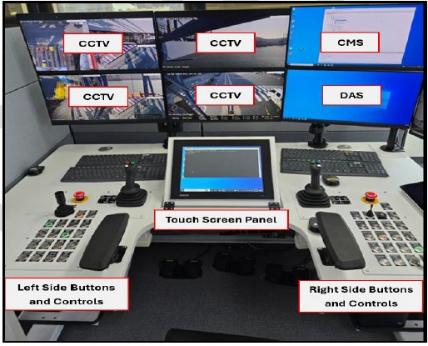
68 Mr Pitt’s evidence was that the remote quay crane operation to be introduced under the RQC Project remains a manual control process. The operator must actively engage input devices such as joysticks for the crane to move. If the operator releases the controls, the crane stops, meaning the operator retains direct control over all crane movements. He said the Fremantle remote desk is likely to be similar to the Busan example.
69 Mr Pitt explained that the RQC Project incorporates various driver assist systems. According to Mr Pitt, driver assist systems support or stabilise aspects of the crane’s operation but do not replace the crane driver’s overall control of the crane.
70 Mr Pitt described a number of those systems.
Anti-sway assist systems
71 Mr Pitt said anti-sway assist systems are existing technology on quay cranes designed to reduce container swing (pendulum effect) during operations. These systems assist in stabilising load movement and improving the precision of the operator's control. In practice, the level to which anti-sway assistance is engaged or relied upon may vary depending on terminal settings, operational procedures, and operator practice. Mr Pitt said that anti-sway systems exist on all cranes.
LiDAR (Light Detection and Ranging) technology
72 Mr Pitt said that LiDAR is already utilised but the technology will be enhanced with a new capability within the remote crane operating model that provides real-time spatial scanning and 3D environmental awareness around the crane’s operating footprint. The system is designed to detect surrounding objects and support operational safety through warnings, controlled slowdowns, and adaptive speed restriction responses on both the land-side and marine-side. This capability is intended to operate in conjunction with existing engineered slowdown and speed restriction functions already present within crane management systems.
Driver assist system (DAS)
73 The DAS will be a new operator assistance function used in conjunction with integrated CCTV systems to assist operators with visual alignment, container positioning, and situational awareness during remote operations. Mr Pitt said these systems provide operator support functions only and do not independently control crane movement.
Optical character recognition (OCR)
74 OCR will be a newly introduced feature within the remote quay crane operating environment, providing container identification and verification functions. OCR operates as a background system process, and the operator has no direct role in its operation or outcomes.
Cross-examination of Mr Pitt
75 In cross-examination, it was suggested to Mr Pitt that a crane operator’s role under the proposed RQC Project is to simply oversee what happens – that the driver does not have to exercise their skill or judgement, and the proposed system does that for them. Mr Pitt described information provided to drivers by the screens as ‘guidelines’. He maintained that the drivers still have to operate the cranes. Drivers might be given a recommended pathway, for example, by the systems being introduced, but the driver can override it and do what they consider is correct.
76 Mr Pitt was questioned about each of the soft-landing function, the loading collision protection, the anti-sway system, the auto twin-20 gap (also known as ‘twin-lift’), and the auto ‘trim and list’ functions.
77 Mr Pitt did not agree that the proposed soft-landing system would permit a container to be landed on an ITV or vessel automatically, without the driver having full control. He said the driver does more than simply hold the joystick: they have ‘100% control of the hoist’, they make sure that a container is landed correctly and stowed correctly, and they unlock or lock it onto the object transporting it. The LiDAR means that the slowdown is adaptive, but the driver continues to monitor the speed.
78 Mr Pitt agreed that the LiDAR system has a role in collision protection, in that if an obstacle is detected, a visual warning is provided to the driver and the crane speed may be reduced. Mr Pitt acknowledged this is part of the safety system, but did not agree it constituted ‘automation’.
79 As to anti-sway, Mr Pitt clarified that the new system will inform the driver if the anti-sway is not working. The new system will attempt to control the sway and stabilise the trolley. It will help with the calculation to keep the load stable, and try to slow the movement.
80 As to twin-lift, Mr Pitt confirmed that the driver currently sets the ‘gap’. Under the proposed system, the LiDAR will measure the gap between the two containers, but the driver can override it if the measure is inappropriate.
81 As to trim or list (referring to the angle and lean of a vessel, calculations that must be taken into account), Mr Pitt agreed that currently drivers make manual adjustments for trim or list, using toggle switches in the cabin. He accepted that LiDAR will be used to assist with those measurements and the system will then seek to make adjustments. He said the driver can still turn this feature off, but its use will ‘make his job easier’.
82 Mr Pitt also said under cross-examination that there currently exists a small screen in the crane cabins which indicates whether there are faults in components of the crane.
83 The following exchange ensued between MUA’s counsel and Mr Pitt:
MR BONCARDO: You would agree with me that the functions that we have gone through, that is the soft landing function, the loading collision protection, the anti-sway, the auto twin-20 gap, and the auto trim and list are functions that the system operates itself, and the driver’s role is to oversee, and if necessary intervene, where that functionality is imperfect.
MR PITT: No, the driver still needs to put the crane where it needs to be for any of these functions to actually become active. They don’t work unless there’s an input from the operator.
MR BONCARDO: Once the driver has put the crane where it needs to be, these systems will operate by themselves with the driver overseeing them, correct?
MR PITT: They’ll work with the driver. It’s not [only that] they’re checking it, but they’re, they’re in control of it.
Mr Jeffries’ evidence on these functions and their impact
84 Mr Jeffries also gave evidence about these functions. He explained that LiDAR is already used on the cranes to avoid collisions, but that it is intended under the project to install additional features. He accepted that the LiDAR system will be able to detect where containers are on a relevant vessel and improve the incidence of blind spots, but disagreed with the proposition that the down quay crane driver’s role in guiding the positioning of containers would be diminished as a result. When asked if the role of the down quay crane driver on the vessel would remain over a 10-year time span, Mr Jeffries was unable to say that it would. This was an example of Mr Jeffries being frank about the potential for further change, including changes that might affect his own role. The fact that he could not promise certainty is unsurprising.
85 Mr Jeffries said that the intended soft-landing system will involve use of the LiDAR to slow the crane, but the driver still moves it through various limits (that are already part of the current operating system). Mr Jeffries denied the proposition that the system can automatically land a particular container. He said the driver will still land the container.
86 Mr Jeffries was asked about training, presumably to ascertain whether it might be of such a nature that current crane drivers might not pass and might not be able to undertake the remote role. Mr Jeffries said that if a driver did not pass any particular assessment, he expected further training would be conducted. He said that some people will require more training than others. He referred to the fact that he had taken two crane drivers to Korea and that within two hours on a simulator, they were operating on a crane and were doing gross moves per hour of 40 and 30, which was above the current rate of moves in Fremantle now. Mr Jeffries accepted that the content of training was still being determined.
87 Mr Jeffries was asked a series of questions about the financial imperatives of the RQC Project. Mr Jeffries said (in cross-examination and re-examination):
(a) it is hoped by the RQC Project to see a productivity improvement of 1.6 gross moves per hour;
(b) DP World hopes that its market share will increase over time;
(c) there would be labour savings under the current projections through fewer crane gangs, but the extent is to be viewed against the annual budget for labour as a whole;
(d) there would be no reductions in pay for the current crane drivers (or those who have those skills) or foremen as they usually fill the permanent roles in a crane gang;
(e) the earnings of permanent employees will not be affected and there is no planned reduction in permanent employees;
(f) the impact on earnings will be on variable salary employees (VSEs) and supplementary employees, who are casual labour used to ‘top-up’ and where non-rostered employees are required;
(g) the roles done by casual labour tend to be forklift and ITV drivers and general hands;
(h) no employees will lose their jobs in 2027 as a result of the RQC Project, if implemented;
(i) there are bonuses available to crane gang members of those crane gangs that show improved gross moves per hour (under separate local agreements) – that is, there are bonuses linked to increases in productivity;
(j) Mr Jeffries could not say whether any crane drivers will lose their jobs in 2030 if the RQC Project proceeds, because he does not know what may happen and (in effect) whether or not he would even be there then; and
(k) similarly, despite being asked, he cannot say that ‘no employee will lose their job until the end of 2035’, as he does not know what the situation will be then.
88 Mr Jeffries also denied that decreased labour hours was one of the aims of the project. He said it may be one of the consequences, but it is not an aim. Rather, the key aim is to increase DP World’s service offering and provide a better service to its customers.
89 The proposition was put to Mr Jeffries that as a result of the technology being employed, quay crane operators could potentially be located at an office in Perth or somewhere interstate, or even overseas. Mr Jeffries accepted that this was ‘possible’ but that he would argue that would not really be the case. Mr Jeffries said that the current plan is not to elect to do that. The current plan is to put them in a nominated building in the Fremantle terminal precinct (Koolinda House) where they have visibility of the crane. He said the plan is to establish the remote desks in that location, although again, he could not promise what might happen in 10 to 15 years’ time.
90 Finally, Mr Jeffries was taken to the minutes of a meeting of 22 August 2025 of the Fremantle health and safety committee. Mr Jeffries attended the meeting. It is apparent that the RQC Project was discussed. Based on the minutes, guests of the meeting included Mr Pitt and the two crane drivers (referred to as BP and BC) who had attended Busan (see [66] and [86] above). Mr Jeffries was taken to the following extract:
MP: Does driver have 100% control of crane at all times during operations?
• No, discussion from BP on his experience with control experienced and full control to landing where it is then assisted
…
SS: Were you in 100% control at all times?
• BC No – assisted with final line up. This doesn’t happen on current operations.
91 Mr Jeffries acknowledged what the minutes said but said that regardless, what is proposed for Fremantle is that the drivers will be in control of container landings.
92 I note for completeness that immediately after those passages, the following is recorded in the minutes:
BC: Response regarding experience with regard to question of being in control 100% of the time
• Draws diagram to explain hands on controls at all times and in control of hoist. When not hoisting driver assist butted up but still hands on joystick to enable.
Mr Freeman’s evidence
93 Mr Freeman, on behalf of the MUA, gave evidence about the proposed driver assist systems. Mr Freeman is employed by DP World at the Fremantle terminal, in the role of foreman. He has worked on the wharf for 30 years, with about a 10-year period of operating cranes. Although he has been a foreman for about 17 years, he still operates a quay crane from time to time.
94 Mr Freeman is also a member of the Employee Representative Committee (ERC) established in the workplace. He was appointed head delegate for Fremantle in 2007 and continues to hold that role.
95 Mr Freeman gave evidence that DP World in its notice to employees of 3 February 2026 referred to the ‘introduction of technology including driver assist systems’. Mr Freeman continued:
I know from the consultation that has occurred around the introduction of this proposed change that the reference to the introduction of ‘driver assist systems’ involves the automation of aspects of the crane movement as the technology effectively takes over the crane movement from the crane driver.
96 Mr Freeman in his oral evidence was asked about these driver assist systems.
97 In cross-examination, Mr Freeman accepted that he has no role in training crane drivers. He has not operated any of the remote quay crane technology. His understanding of the RQC Project was gained by attending various meetings and from what he was told by two employees who had been to the DP World terminal in Busan, South Korea and had experience there with the remote quay cranes. Mr Freeman said he also received information because he is on the ERC, and through the various meetings there was a cross-over of information. He said that on the basis of what he has seen at the meetings ‘and all the stuff the company’s given us’ that there is a ‘vast difference’ in what is proposed (compared with the existing arrangements).
98 Mr Freeman was asked in cross-examination about the various features which had been the subject of Mr Pitt’s evidence. He was asked about the soft-landing feature. He understood that it provides for a gradual slowdown of hoist speed, which would reduce the likelihood of damage to a container, vehicle, or vessel. He said the soft-landing feature takes away the need for a crane driver to input controls. He said that he understood that the driver takes their hands away from the crane and off the joysticks, and the crane automatically positions itself. He said, ‘the green light comes up, then they hoist down. To me that seems to be like an automated feature’. However, Mr Freeman accepted that he had not experienced this feature himself and that he was relying on his discussions with people (referring relevantly to a discussion when BP, one of the employees who had been to Busan, had been in the room). He accepted that he had not been provided with any materials during the course of the consultation process that indicated that the operator would take their hands off the joysticks and ‘let the container drop down’. He also accepted that DP World had indicated it was not yet sure if the system to be used would be exactly the same as used in Busan.
99 Mr Freeman was asked about the load collision warning. He agreed it was a safety feature. An alarm sounds if the speed or the direction of the trolley or the hoist suggests a collision. Mr Freeman agreed that it does not remove the need for the operator to control the crane. He said the alarm alerts a driver and so ‘takes away their judgement’. This appeared to be the basis upon which he considered it was automation. He agreed that he was not familiar with the alarm itself.
100 Mr Freeman was asked about the cone snag warning. This is an alarm that sounds if the container is caught on the container below and is lifting at an angle of higher than five degrees. Mr Freeman agreed that it did not remove the need for the operator to actually operate and control the crane.
101 Mr Freeman was asked about the cabin protection alarm. He explained that when an ITV approaches, there will be a function that detects whether the load is over the cabin ‘so you don’t put a box on the cabin’. If the truck is in the correct position ‘then the driver comes down on the soft-landing, takes [their] hands off, and then it automatically positions so it lands on the truck’. Again, Mr Freeman accepted that this was based on ‘the stuff we discussed’ and that he had no knowledge of the system that was actually to be implemented. Nor had he been provided with any materials by DP World through the consultation process with employees that suggested the operators would take their hands off the controls, or that a part of that function would be automated.
102 The ‘twin-20’ feature was also raised with Mr Freeman. He said it was a form of automation. He said that currently a driver has to manually lock in the distance of the gap between the two containers, and that the size will vary depending upon the vessel and the ITV. That process is repeated ship-side and land-side. Mr Freeman said that by use of the LiDAR, that task is done automatically and there is no need for the crane driver to do anything. He disagreed with the proposition that the crane operator still needs to manually operate the controls in order to lift the container from the vessel quay-side or to land it land-side. Mr Freeman said (in effect) that the only reason a driver is not required to take their hands off the controls under the proposed changed system is that the driver no longer has to take their hands off to set the relevant gap distances.
103 Mr Freeman was asked about the OCR. He maintained the evidence given in his affidavit to the effect that firing off a container using a hand-held PDA was part of a foreman’s core duties.
104 Mr Freeman accepted that forklifts will still be used land-side to transport containers from road to rail and that the main yard stack area will still use forklifts to move containers to ITVs. He accepted that crane operators will still need to make manual inputs, control the joysticks and make decisions in operating the quay crane in lifting and unloading containers, although he added that ‘some of these functions will be assisted’.
Assessment of evidence
105 The question then is what is to be distilled from this evidence? The first two propositions are relatively discrete and do not require analysis of much of the evidence. A broader analysis is required in addressing the third and fourth propositions.
The first proposition – is Appendix 4 limited to land-side operations?
106 DP World submitted that Appendix 4 is not enlivened with respect to the RQC Project because the words ‘mode of operation’ refer only to the class of ‘land-side’ equipment deployed at the Fremantle terminal and not ‘marine-side’ operations. The quay cranes are said to be part of the marine-side operations.
107 The common evidence (Mr Jeffries’ first affidavit at [39] and [40] and Mr McAleer’s affidavit at [16]) was that ‘land-side’ operations refers to the handling of containers and cargo within the terminal and relates to all interactions with inland logistics such as road and rail. ‘Marine-side’ operations involve ship-side activities and the interface between the vessel and terminal. This includes coordination of vessels berthing and unberthing, quay crane operations which extends to the loading and unloading of containers, lashing and unlashing as well as vessel stowage plans and bay sequencing.
108 The MUA’s position (evidence of Mr McAleer) is that despite such distinctions, land-side and quay-side operations are still part of the one terminal. Further, it submitted, quay cranes operate ‘land-side’ in the sense that they are located on the wharf. The MUA submitted that the distinction is somewhat arbitrary.
109 However, Mr Jeffries gave further evidence about the ‘mode of operation’. He stated that each DP World terminal is referred to and distinguished by their yard equipment, which he said is also their ‘mode of operation’. He stated:
(a) the Fremantle Terminal is a Forklift/ITV terminal;
(b) the terminal at West Swanson (Melbourne) is a Straddle terminal. A Straddle is a specialised mobile plant designed for the handling and transport of containers in the terminal yard;
(c) the terminal at Port Botany (Sydney) is an RTG (Rubber Tyred Gantry) terminal. An RTG is a large mobile crane used primarily for stacking and organising containers in the yard; and
(d) the terminal at Fisherman Islands (Brisbane) is an ASC (Automated Stacking Crane) terminal. An ASC is a type of yard crane used in container terminals to stack and handle containers in the yard. ACSs run on fixed rails within container blocks.
110 Regardless of these modes of operation, it was Mr Jeffries’ evidence in cross-examination that all container terminal stevedoring operations require quay cranes.
111 DP World also relies on certain references to ‘modes of operation’ in the Enterprise Agreement.
112 First, DP World refers to cl 21.5 of Part A (which provides for access to training to employees) which in cl 21.5.2 distinguishes ‘Straddle operations’ from the reference in cl 21.5.3 to ‘all other modes of operation’.
113 Second, DP World relies on cl 10 of Part B (DP World Fremantle), which provides that DP World will ‘train VSEs in the Forklift and/or Reachstacker and/or RTG (if the mode of operations still exists and is the primary mode) skills’.
Consideration
114 The starting point in considering DP World’s contention is that nothing in the Enterprise Agreement refers to ‘land-side’ operations or limits its operations in that manner. The only geographic reference is the reference to a change ‘at a terminal’. I am not persuaded as a matter of construction that the Enterprise Agreement is to be understood as applying solely to land-side operations or that its application to operations involving quay cranes is excluded.
115 Nothing in the Enterprise Agreement purports to limit its application to those parts of its terminal or operations that involve the use of forklifts and ITVs, or to exclude those parts of its operations that use quay cranes.
116 The question then is whether the scope of the phrase ‘mode of operation’ is limited in accordance with Mr Jeffries’ evidence.
117 In effect, Mr Jeffries’ evidence was that DP World refers to certain ‘yard equipment’ to classify how operations at different terminals are carried out. Those classifications referred to in the evidence are forklift/ITV; straddle; RTG (rubber tyred gantry); and ASC (automated stacking crane). According to Mr Jeffries, those are then referred to by DP World as ‘modes of operation’ (and notably do not refer to quay cranes). However, his evidence was also to the effect that implementation of each of the ‘modes of operation’ identified by him require the use of quay cranes for container terminal stevedoring.
118 There might be recognised industry use of the phrase ‘mode of operation’ that limits it natural meaning, but neither party sought to rely on evidence in that regard.
119 In my view, the fact that DP World may apply labels and refer to each of the identified categories as a ‘mode of operation’ does not of itself prove that the words ‘mode of operation’ when used in the chapeau to cl 1 of Appendix 4 carry the same meaning or carry any particular agreed meaning in the industry. Without more, I would not accept that DP World’s subjective view as to the meaning of ‘mode of operation’ is determinative of its meaning in the Enterprise Agreement.
120 As noted above, there are no definitions within the Enterprise Agreement of ‘mode of operation’. The MUA referred in its submissions to the Macquarie Dictionary (online edition), which states that the noun ‘mode’ means, relevantly, ‘manner of acting or doing; a method; a way’, whilst the noun ‘operation’ means ‘the act, process, or manner of operating’. Acknowledging the usual cautions on resort to dictionary meanings as an aid to construction, I consider those definitions capture the natural and ordinary meaning of those words. A mode of operation as a matter of natural and ordinary usage means a manner of operating a terminal.
121 Therefore, I am not persuaded that ‘mode of operation’ at a terminal when used in Appendix 4 is to be read to accord with DP World’s labels (labels such as forklift/ITV). Rather, those words are to be read more broadly so as to include (relevantly) changes to its operations that include changes to the manner in which containers and cargo are loaded and unloaded using quay cranes (but subject to the other qualifications in Appendix 4 to which I will turn shortly).
122 In reaching this conclusion I have taken into account the scant other references in the Enterprise Agreement referred to at [112]-[113] above. The distinction drawn between ‘straddle operations’ and ‘all other modes of operation’ does not impose any particular limitation on the meaning of ‘all others modes of operation’. I acknowledge that there is some force in the argument that the words:
train VSEs in the Forklift and/or Reachstacker and/or RTG (if the mode of operations still exists and is the primary mode) skills
suggest that there are identified ‘modes’. However, those words (by ‘primary’) also introduce the prospect that there may be concurrent modes, which tells against assessing the nature of operations solely by reference to a particular ‘mode’.
123 In short, those limited references lack sufficient clarity or connection with the purpose of Appendix 4 to persuade me that DP World’s construction of ‘mode of operation’ where used in Appendix 4 should be preferred.
124 Absent further evidence as to any common history of the use of the phrase by the parties or established industry usage, this outcome accords with the preference for both applying a generous construction and having regard in context to the ordinary meaning of words, as recognised in the authorities to which I have referred.
125 It follows that the application by DP World for a declaration that ‘mode of operation’ within cl 1 of Appendix 4 on its proper construction refers to land-side equipment deployed at the Fremantle terminal and does not extend to the quay cranes is refused.
The second proposition – does Appendix 4 apply only to automation?
126 As noted earlier, Appendix 4 is headed ‘Automation’. However, the chapeau refers to DP World introducing a significant change to the mode of operation in a terminal, and does not expressly tether any such change to automation.
127 According to DP World, Appendix 4 applies only to ‘significant change brought about by automation’. However, it does not suggest it applies only to complete automation, but proceeds on the basis that it may apply where there is a partial automation if that partial automation results in a significant change.
128 According to the MUA, Appendix 4 applies regardless of the how the significant change is brought about. Its application is not limited to change brought about by automation.
129 I am unable to accept the MUA’s contention for the following reasons.
130 First, the text itself does not direct such a finding. The Enterprise Agreement does not include any provision that dictates whether headings form part of the agreement. In my view the heading (in notably large font) is not to be ignored and should be given meaning. Absent a limitation, it forms part of the Enterprise Agreement and is indeed an important indicator of the purpose of Appendix 4.
131 Second, cl 1(e) deals with what happens if automation results in (importantly) redundancies. On the one hand it might seem curious that (leaving aside the heading) the word ‘automation’ is not referred to until cl 1(e), but on the other hand, its inclusion is significant. Assuming the MUA’s construction is correct, and cl 1 operates regardless of the cause of the significant change to the mode of operation, why would there be a provision relating to redundancies that applies only in the case of automation? One would have expected redundancies caused by any ‘significant change’ to have been encompassed.
132 Third, having regard more generally to the purpose of the clause, the steps anticipated by Appendix 4 are also informative. They were discussed in some detail by Shariff J in DP World Sydney at [36]-[38], and summarised at [49]:
Stepping back from the individual subclauses and considering cl 1 of Appendix 4 as a whole, it is evident that the objective purpose of the clause is to establish a process for agreement to be reached between DP World and the MUA within a period of approximately nine months as to ‘roles, rosters, labour arrangements and requirements’ following a definite decision made by DP World to implement a ‘mode change’, and where such agreement cannot be reached, for an Independent Panel to conciliate and arbitrate any outstanding issues that will be binding on those two parties to that dispute.
133 It is relevant that the process is anticipated to take some time (up to nine months); it requires ‘intensive discussions’; and it may result in appointment of an independent panel to arbitrate any outstanding issues. These matters suggest the course is not to be embarked on lightly but rather reserved for ‘significant’ change, as the clause stipulates. The nature of the regime is explicable in the context of automation, with the risk of diminution of human involvement, and concomitant redundancy and reduced employment.
134 Fourth, the conclusion that Appendix 4 is intended to apply only to a significant change brought about by automation is supported by the MUA’s own evidence. As the authorities make clear, when interpreting enterprise agreements there is room to have regard to the history behind the inclusion of provisions: Short v F W Hercus Pty Ltd (1993) 40 FCR 511 at 518. In this case Mr McAleer provided evidence that supports DP World’s construction. Mr McAleer said:
10 I know from my previous experience that Appendix 4 in the 2024 Enterprise Agreement is based on Part B clause 3 of the DP World Sydney Enterprise Agreement 2015 (Sydney Agreement 2015) which is titled ‘AUTOMATION’. A copy of the Sydney Agreement 2015 is attached as Annexure PM-2.
11 …I am aware that in or about 2020, that automation term found in Part B of the Sydney Agreement 2015 was reproduced into Part A of each of the DP World Fremantle Enterprise Agreement 2020, the DP World Brisbane Enterprise Agreement 2020, the DP World Melbourne Enterprise Agreement 2020 and the DP World Sydney Enterprise Agreement 2020.
12 In my role as the Divisional Branch Secretary of the Sydney Branch of the MUA, I had responsibility for the industrial arrangements of members of the MUA employed by DP World Sydney Pty Ltd. As such, I was directly involved in the negotiation of the Sydney Agreement 2015 and, in particular, the automation clause found at clause 3 of Part B.
13 The automation clause found at clause 3 of Part B of the Sydney Agreement 2015 was negotiated between the MUA and DP World in response to the company's February 2015 declaration of plans to automate their Sydney Terminal, or parts of it. It was therefore essential to include a clause to deal with automation. I negotiated the clause directly with Chief Operations Officer Mark Hulme at the time.
14 The insertion of a clause to deal with the introduction of automation at DP World in Sydney was designed to put in place a structure and process for the introduction of automation technologies and to protect the interests of workers affected by these changes to the extent possible in the Agreement.
135 This supports the construction that I have preferred, and indicates that the provisions now included by way of Appendix 4 were intended to and in fact address the consequences of automation, whether partially or in whole. There is no suggestion in Mr McAleer’s evidence that a broader position was sought or negotiated when securing the inclusion of Appendix 4.
136 Further, I also consider the inclusion of cl 45 in the Enterprise Agreement relevant. The Enterprise Agreement thereby provides a complementary method of addressing changes that might have a significant effect on employees. It is not as if limiting Appendix 4 to circumstances involving automation denies employees recourse where other change is proposed.
The third proposition – does the RQC Project involve ‘automation’?
137 The parties were in dispute as to the meaning of ‘automation’. There was subjective evidence given on behalf of both parties as to the meaning of the term in relation to the quay cranes.
138 Mr McAleer on behalf of the MUA said (in effect) that a crane with no driver in the cabin, being operated remotely, is fully automated. Mr Jeffries, on the other hand, said that a fully automated crane would be one that is intended to accomplish its tasks without human intervention or direct control. Mr Jeffries said that he was not aware of any fully-automated quay cranes operating in the world, and that in any event, upon implementation of the remote desks at the Fremantle terminal the quay cranes will remain entirely manually operated by a qualified crane driver.
139 As already noted, the term ‘automation’ is not defined. The parties referred to the Macquarie Dictionary and its online edition definition of ‘automation’, which is:
(1) the science of applying automatic control to industrial processes; the replacement of manpower by sophisticated machinery;
(2) the process or act of automating a mechanical process; or
(3) the degree to which a mechanical process is automatically controlled.
140 Whilst the parties did not refer to a dictionary definition of ‘remote control’, DP World repeatedly referred to the remote control of the cranes, so for completeness I include its Macquarie Dictionary online edition definition:
(1) the control of a system by means of electrical, radio, or other signals from a point at a distance from the system; or
(2) Also, remote. a usually handheld device for the control of domestic appliances such as televisions, air conditioners, etc.
141 These definitions do not resolve the factual issue at hand but provide some context to the processes being considered.
142 I do not consider either expression complex. They bear an ordinary meaning that is readily understood and is consistent with those definitions. I consider ‘automation’ is ordinarily understood to mean a process whereby tasks are processed without human intervention, generally relying on programming, sensors or similar technologies. Remote control, on the other hand, is ordinarily understood to require continuous human intervention to operate an object from a distance.
143 DP World drew a limited analogy with the driver assist features of standard motor vehicles, such as automatic transmission and cruise control, observing that the task of driving remains a manual one, to be performed with manual human input and using human skill and judgement. Sensibly, neither party suggested that there was anything to be gained from a review of the commentary on autonomous decision-making and human deliberation, and whether analogies might be drawn from such sources.
144 Instead, the parties focused on the particular facts relevant to ‘operating’ a quay crane and the changes that are anticipated if the RQC Project is implemented. So much is apparent from the detailed evidence I have set out above.
145 To the extent there is conflict as to the manner of operation of the remote crane, I have preferred the evidence of Mr Pitt to that of Mr Freeman, because Mr Pitt has first-hand experience with a system similar to that which DP World proposes to adopt, whereas Mr Freeman’s evidence was based on hearsay reports. Mr Pitt has 16 years’ experience as a crane driver and has driven a remote quay crane.
146 The evidence centred around whether the change in location of the quay crane driver and the addition of driver assist features are such that, considered cumulatively, the crane driver will no longer be operating the crane but instead will be supervising an automated function.
147 Having carefully considered the evidence, I have concluded that DP World has established to the requisite standard that the RQC Project will not have such result. In reaching this view, I have concluded that there is an element of automation introduced by way of the OCR which affects the role of foreman. However, that effect is minimal and Appendix 4 anticipates a spectrum of effects that might be brought about by automation. It is only triggered where automation, whether partial or fully, results in a significant change. I return to the question of what is meant by ‘significant’ below.
148 In particular, the following aspects of remote quay crane operation have led me to this conclusion.
(1) The quay cranes are not being replaced and the crane drivers will be operating the same cranes as they do presently, with added driver assist functions.
(2) The crane driver located at the remote desk views the actual container (or cargo) being loaded or unloaded by way of the CCTV screens.
(3) The existing quay crane controls (joysticks, buttons and operational functionality) will be replicated at the remote desk. That is, as said by Mr Pitt, the operation remains a manual control process.
(4) The crane driver operates the crane through use of the joysticks, assisted by other features, but at all times controls the load. The quay cranes will stop if there is no input from the crane driver.
(5) The quay cranes are currently operated by the crane driver with the assistance of a number of technological safety features, including limit switches, sensors, automatic cut-off and laser alignment lights. Such features will remain but be enhanced. It was not suggested by the MUA that the existing features mean that the driver’s task is already partly automated.
(6) Further driver assist features will be incorporated. On balance I am satisfied having regard to the evidence of Mr Pitt and Mr Jeffries that the systems do not independently or automatically control crane movement to any relevant extent. I consider Mr Freeman’s evidence that the features will assist in the operations is an accurate description of their role. Having regard to Mr Pitt’s expertise and hands-on experience, I accept his evidence set out above (at [71]-[83]) as to the expected functionality of each of the features. I have taken into account the reference by BP (see [90] above) to assisted landing, but have also taken into account the reference to BC stating that ‘hands on controls at all times and in control of hoist’ and more particularly the evidence of both Mr Pitt (see particularly at [77] and [83] above) and Mr Jeffries to the effect that ‘assisted landing’ is intended to remain under the control of the crane driver.
(7) The crane driver continues to be part of a crane gang, continues to attend toolbox talks, and continues to be supported by a ship foreman and the down quay crane driver.
(8) I accept Mr Jeffries’ evidence that there is no expectation that the role of the crane driver when ‘down’ will change.
(9) Crane drivers must maintain their specialised qualifications.
(10) There will be a change in the role of the ship foreman, in that because of the enhanced OCR, there will no longer be a requirement for a container to be manually ‘fired off’ (see [151] below).
(11) Otherwise there is no expected change in manning, rosters, or the manner in which the quay crane is operated.
149 In my view, giving the word ‘automation’ an ordinary meaning, the level of control of a crane driver in a proposed remote desk replicates the current level of control, save that additional technological features will be introduced that read the surroundings and guide and assist the operator. The continued exercise of judgement and control required by the remote crane driver is inconsistent with an automatic or automated process. An automatic or automated process substantially removes any active human input, skill or judgement.
150 I add four comments. First, even if, contrary to what is said at [148(6) above], the crane driver were able to take their hands off the joysticks for a short period, it would not necessarily follow that they are no longer in control. There may be questions of degree. But based on the evidence, that is not what is currently envisaged.
151 Second, I accept that there is an element of automation introduced by the OCR insofar as the role of the foreman is concerned, and that the role of the foreman is integral to how quay cranes are operated at the terminal. The activities of the crane driver are not to be viewed in isolation, and the parties did not suggest otherwise. Both DP World and the MUA had regard to the foreman’s position in their evidence and submissions.
152 There was some dispute as to the extent of modification of the foreman’s activities in monitoring the sequencing of firing off. I have set out above Mr Jeffries’ evidence that a foreman will no longer be required to fire off containers, as implementation of the enhanced OCR system will convey information to crane drivers. His evidence was consistent under cross-examination. He said that at present the foreman does not actually decide which container is to be handled, but is expected to check the sequencing against information provided via their PDA. Such information will be automatically provided to a driver by the new OCR system. I accept Mr Jeffries’ evidence. Consistently with Mr Jeffries’ evidence, Mr Pitt said that sequencing is currently determined ‘by the system’ and passed onto a foreman. Mr Pitt was uncertain about further aspects of the intended integration of the new OCR, other than to the extent referred to at [74] above. I take into account Mr Freeman’s description of firing off as a core duty, but it is but one of a foreman’s duties and they are currently assisted by technology via use of PDAs through which they receive information.
153 I accept that the manner in which the movement of containers is proposed to be sequenced for handling and located for handling will be automated by the greater capacity of the OCR with a reduction in human input, at least in relation to aspects of communication between the foreman, crane driver or ITV drivers as to firing off. However, in my view, and having regard to the totality of the roles performed by a ship foreman, the limited effect of the OCR on the foreman’s duties overall does not convert the remote operation of the crane under the proposed RQC Project to a process which would properly be described as a whole as automation.
154 Third, having regard to the level of ongoing human control and overview, I do not consider other driver assist features such as enhanced LiDAR and collision detection, anti-sway, twin lift and trim or list, with some manual inputs being replaced or enhanced, detract from the overriding responsibility and control that remains with the driver to judge and assess whether those aspects of the cargo handling are being correctly and safely undertaken. The continued interaction required between the driver and driver assist features does not, to my mind, reflect automation.
155 Fourth, I have taken into account the change anticipated by moving the crane driver from a cabin on the crane to a remote desk in a close-by building. I acknowledge that objectively this has the appearance of a substantial change. However, the focus must remain on how the terminal is operated, and in particular, having regard to the RQC Project, how the crane driver undertakes their duties. That location change does not involve automation and does not elevate the level of automation beyond that relating to the foreman’s role.
The fourth proposition – does the RQC Project involve ‘significant change’?
156 The question arises as to whether the result of any automation is a ‘significant change’ so as to activate the Appendix 4 regime.
157 The Enterprise Agreement does not define ‘significant change to the mode of operation’.
158 I have already rejected the classification of different modes propounded by DP World, having regard to the evidence in this matter. Therefore, I do not consider that ‘change of mode’ means a step as dramatic as a change from, say, forklift/ITV to ASC or RTG before the Appendix 4 regime applies. Rather, having regard to the ordinary meaning of those words in their industrial context, I consider the present question, expressed generally, is whether what is proposed, viewed cumulatively, is properly characterised as automation resulting in a significant change to the manner in which quay cranes are used in loading and unloading containers and cargo at the Fremantle terminal.
159 There is some guidance in the authorities as to the qualitative meaning of ‘significant change’ in the industrial context.
160 DP World submitted that:
(a) the phrase ‘significant change’ and analogous phrases such as ‘significant effects’ (used in cl 45.2) or ‘major change’ have a well-worn industrial genesis and history beyond the terms of the Enterprise Agreement that is relevant in determining the scope of such a clause;
(b) those concepts are echoed in the model consultation term mandated in certain circumstances by s 205 of the Fair Work Act;
(c) that clause has its genesis in the Termination, Change and Redundancy Cases (TCR Cases), Amalgamated Metals, Foundry & Shipwrights’ Union v Broken Hill Pty Co Ltd (1984) 8 IR 34, read with Electrical Trades Union of Australia v A Burton and Sons (1984) 9 IR 115;
(d) the effect of the TCR cases was to create a set of general minimum consultation obligations to be inserted into federal awards on those three topics (termination, change and redundancy);
(e) Amalgamated Metals set the trigger of those obligations at the point at which ‘a firm decision has been taken about major changes in production, program, organization, structure or technology which are likely to have significant effects on employees’ (at 53). Electrical Trades Union defined ‘significant effects’ to include ‘termination of employment, major changes in the composition, operation or size of the employer’s workforce or in the skills required; the elimination or diminution of job opportunities, promotion opportunities or job tenure; the alteration of hours of work; the need for retraining or transfer of employees to other work or locations and the restructuring of jobs’ (at 127);
(f) the wording of cl 45.2.2 of the Enterprise Agreement echoes what was said in Electrical Trades Union;
(g) this Court’s subsequent consideration of TCR terms has emphasised the ‘size and importance’ of the change (rather than simply its subject-matter) in meeting the ‘significant’ or ‘major’ threshold; and
(h) for example, the Full Court majority in Port Kembla Coal Terminal Ltd v Construction, Forestry, Mining and Energy Union [2016] FCAFC 99; (2016) 248 FCR 18 found that an organisational change leading to the redundancy of three employees from a total workforce of 98 employees did not engage the relevant TCR clause (Jessup J at [187], White J agreeing at [499]). In Australian Nursing and Midwifery Federation v Bupa Aged Care Australia Pty Ltd [2017] FCA 1246, O’Callaghan J found a change leading to the redundancy of 23 employees from a cohort of over 3,000 did not engage the relevant TCR clause (at [26]-[31]).
161 The MUA did not engage with this submission but instead focused as a matter of fact on the qualitative nature of the anticipated changes.
162 I accept that clauses such as cl 45 and cl 1 of Appendix 4 of the Enterprise Agreement have a heritage in the industrial law referred to by DP World. An exact linguistic comparison of such clauses is not required. Such heritage reflects the importance of security of employment for workers, including the effects of change. I have considered the prospective changes under the proposed RQC Project the subject of the evidence, and their effects, against the backdrop of the matters raised in the TCR Cases, but have also taken into account the terms of the Enterprise Agreement as a whole.
163 The only aspect of the anticipated operations that I have found to meet the description of automation is the change to the firing off task undertaken by the foreman. Having regard to the approach to be taken ([162] above) and what is said at [133] and [152]-[153] above, I do not consider that to be a significant or major change in the foreman’s role. Having regard to Mr Jeffries’ evidence, it will not affect other aspects of a foreman’s duties. Nor will it affect matters such as employment levels of foremen, their training, job opportunities or promotion. Foremen already work with a level of technology (for example, through PDAs) and changes in how technology is used or implemented is consistent with the intent of the Enterprise Agreement to achieve ‘modern and flexible’ forms of work organisation ([14] above]). Nor is any significant flow-on affect anticipated that might be relevant to other employees.
164 However, even if I am wrong, and there are other aspects of the RQC Project that constitute automation such that the result of their implementation should be considered cumulatively for the purpose of the ‘significant change’ threshold, I do not consider such threshold is met.
165 Having regard to the evidence and all that is said at [148]-[155] above, I do not consider the changes to be significant. The crane driver continues to see the cargo, albeit via CCTV and continues to operate and control the crane, utilising their skill and judgement. Retraining will be provided, and experience suggests that crane drivers will be able to master the new method without significant difficulty (the experience of the crane drivers who visited Busan, as relayed by Mr Jeffries). If further training is required, it will be provided. The operation of the crane is still undertaken in conjunction with a crane gang. The crane driver continues to attend toolbox talks, and continues to be supported by a ship foreman. The down quay crane driver role remains the same. There will be no redundancies of current crane drivers or foremen. To the extent there might be any resulting diminution in employment opportunities going forward, they are anticipated to be in relation to casual positions. There is the prospect of production-linked bonuses for crane drivers. There are no anticipated changes to the role of the down quay crane driver and there will be the same manning and the same rosters.
166 The MUA submitted that the introduction of the RQC Project ‘portends complete automation’ of the role of a crane driver and foreman. The changes, it said, are ‘a necessary step along the way to complete automation’. For example, the MUA raised the potential for cranes to be operated from overseas. That is not any part of the RQC Project. The MUA’s concerns are understandable, but do not respond to what is actually proposed. Any further projects and changes will fall to be considered at the relevant time, having regard to their particular facts.
Relief
167 DP World proposed cascading declarations, some in the alternative. Having regard to the need to consider the facts of every case in the context of the Enterprise Agreement, the relief should not exceed what is reasonably required in order to resolve the construction and factual matters in issue before me.
168 Accordingly, and having regard to my conclusions, I consider the appropriate declarations are those at [2(a)] and [4] of the amended originating application. There will be declarations as follows:
(1) The reference to ‘a significant change to the mode of operation at a terminal’ in cl 1 of Appendix 4 to the DP World Fremantle Enterprise Agreement 2024, on its proper construction, is confined to significant changes involving automation of the applicant’s operations at its Fremantle terminal.
(2) The applicant’s proposal to introduce remote quayside crane operations, once introduced, would not amount to a ‘significant change to the mode of operation’ at the applicant’s Fremantle terminal within the meaning of cl 1 of Appendix 4 to the DP World Fremantle Enterprise Agreement 2024.
I certify that the preceding one hundred and sixty-eight (168) numbered paragraphs are a true copy of the Reasons for Judgment of the Honourable Justice Banks-Smith. |
Associate:
Dated: 20 July 2026


