

Federal Court of Australia
Larkspur Tribeca Ltd v iSignthis Ltd [2026] FCA 908
File number(s): | VID 555 of 2019 |
Judgment of: | NESKOVCIN J |
Date of judgment: | 14 July 2026 |
Catchwords: | TRUSTS AND TRUSTEES – Construction of trust deed – principles applicable to construction of trust deeds –requirement for certainty of subject of trust – where assets subject of trust are shares and rights to shares – where rights to shares convert subject to milestones being met – whether trust assets mere expectancy – chose in action as trust asset EQUITY – Participation in the wrongdoing of a trustee – Barnes v Addy – liabilities as a knowing recipient –– liabilities as a knowing assistant – claims not established EQUITY – Rectification – rectification of a deed –whether common intention established – insufficient contemporaneous materials supporting alleged common intention – claim not established CONSUMER LAW – Misleading and deceptive conduct – representation as to a future matter – allegation of misleading and deceptive conduct by “making” an agreement – claim not established EQUITY – Remedies – equitable compensation for breach of trust – where breach involved failure to transfer shares – compensation to be assessed at time of judgment – expert evidence as to price and value of shares |
Legislation: | Australian Consumer Law, being Sch 2 of the Competition and Consumer Act 2010 (Cth) ss 4 and 18 Evidence Act 1995 (Cth) ss 140 and 191 |
Cases cited: | Ancient Order of Foresters in Victoria Friendly Society Ltd v Lifeplan Australia Friendly Society Ltd (2018) 265 CLR 1; [2018] HCA 43 Argo Managing Agency Ltd for and on behalf of the underwriting members of Lloyd’s Syndicate 1200 v Quintis Ltd (subject to deed of company arrangement) [2022] FCAFC 86 Australian Broadcasting Commission v Australasian Performing Right Association Ltd (1973) 129 CLR 99; [1973] HCA 36 Australian Competition and Consumer Commission v TPG Internet Pty Ltd (2020) 278 FCR 450; [2020] FCAFC 130 Australian Securities and Investments Commission v Retail Employees Superannuation Pty Ltd [2024] FCA 1081 Australian Zircon NL v Austpac Resources NL [No 2] [2011] WASC 186 Byrnes v Kendle (2011) 243 CLR 253; [2011] HCA 26 DC Rd DC Pty Ltd v Zhang (Trial Judgment) [2026] FCA 16 Ellison v Sandini Pty Ltd (2018) 263 FCR 460; [2018] FCAFC 44 Equuscorp Pty Ltd v Glengallan Investments Pty Ltd (2004) 218 CLR 471; [2004] HCA 55 Farah Constructions Pty Ltd v Say-Dee Pty Ltd (2007) 230 CLR 89; [2007] HCA 22 Fox v Percy (2003) 214 CLR 118; [2003] HCA 22 Webb v Getswift Limited (No 5) [2019] FCA 1533 Franklins Pty Ltd v Metcash Trading Pty Ltd (2009) 76 NSWLR 603; [2009] NSWCA 407 GM & AM Pearce & Co Pty Ltd v Australian Tallow Producers Pty Ltd [2005] VSCA 113 Grimaldi v Chameleon Mining NL (No 2) (2012) 200 FCR 296; [2012] FCAFC 6 Harstedt Pty Ltd v Tomanek (2018) 55 VR 158; [2018] VSCA 84 Hasler v Singtel Optus Pty Ltd (2014) 87 NSWLR 609; [2014] NSWCA 266 Icon Co (NSW) Pty Ltd v Liberty Mutual Insurance Company Australian Branch trading as Liberty Specialty Markets [2020] FCA 1493 In the matter of the George Hardi Family Trust [2021] NSWSC 1584 KTC v David [2022] FCAFC 60 Lowther Park Pty Ltd as trustee for the Lowther Park Family Trust v Simon Della Marta [2023] NSWSC 1555 Maralinga Pty Ltd v Major Enterprises Pty Ltd (1973) 128 CLR 336; [1973] HCA 23 Mayo v W & K Holdings (NSW) Pty Ltd (in liq) (No 2) [2015] NSWCA 119 Michael Wilson & Partners Ltd v Nicholls (2011) 244 CLR 427; [2011] HCA 48 Nadinic v Drinkwater (2017) 94 NSWLR 518; [2017] NSWCA 114 Norman v Federal Commission of Taxation (1963) 109 CLR 9 North East Equity Pty Ltd v Proud Nominees Pty Ltd (2012) 285 ALR 217; [2012] FCAFC 1 Quintis (subject to deed of company arrangement) v Certain Underwriters at Lloyd's London Subscribing to Policy Number B0507N16FA15350 (2021) 385 ALR 639; [2021] FCA 19 Re Jimmy’s Recipe Pty Ltd (No 2) [2020] NSWSC 632 Re Sirrah Pty Ltd (in prov liq) (2021) 152 ACSR 212; [2021] NSWSC 413 Righi v Kissane Family Pty Ltd [2015] NSWCA 238 Royal Botanic Gardens and Domain Trust v South Sydney City Council (2002) 240 CLR 45; [2002] HCA 5 Ryledar Pty Ltd v Euphoric Pty Ltd (2007) 69 NSWLR 603; [2007] NSWCA 65 Schreuders v Grandiflora Nominees Pty Ltd [2016] VSCA 93 Secure Parking (WA) Pty Ltd v Wilson (2008) 38 WAR 350; [2008] WASCA 268 Self Care IP Holdings Pty Ltd v Allergan Australia Pty Ltd (2023) 277 CLR 186; [2023] HCA 8 Simic v New South Wales Land and Housing Corporation (2016) 260 CLR 85; [2016] HCA 47 St Vincent de Paul Society Qld v Ozcare Ltd [2011] 1 Qd R 4; [2009] QCA 335 The Trust Company (Nominees) Ltd v Banksia Securities Ltd (Receivers and Managers appointed) (in liquidation) [2016] VSCA 324 Trustee for Michael Hayes Family Trust v Commissioner of Taxation [2019] FCA 426 Turner v O’Bryan-Turner (2022) 107 NSWLR 171; [2022] NSWCA 23 Warman International Ltd v Dwyer (1995) 182 CLR 544; [1995] HCA 18 Xiao v BCEG International (Australia) Pty Ltd (2023) 111 NSWLR 132; [2023] NSWCA 48 Youyang Pty Ltd v Minter Ellison Morris Fletcher (2003) 212 CLR 484; [2003] HCA 15 AIB Group (UK) Plc Ltd v Mark Redler [2014] UKSC 58; [2015] AC 1503 Barnes v Addy (1874) LR 9 Ch App 244 Fowler v Fowler (1859) 4 De G & J 250 Gestmin SGPS SA v Credit Suisse (UK) Limited [2013] EWHC 3560 (Comm) Target Holdings Ltd v Redferns [1996] 1 AC 421 Thomas Bates and Son Ltd v Wyndham’s (Lingerie) Ltd [1981] 1 WLR 505 Canson Enterprises Ltd v Boughton & Co [1991] 3 SCR 534 Jacobs' Law of Trusts in Australia, J D Heydon and M J Leeming (8th ed, 2016) The Law of Trusts, G Thomas and A Hudson (2nd ed, 2010) |
Division: | General Division |
Registry: | Victoria |
National Practice Area: | Commercial and Corporations |
Sub-area: | Commercial Contracts, Banking, Finance and Insurance |
Number of paragraphs: | 220 |
Date of hearing: | 30 June – 4 July and 16 September 2025 |
Counsel for the applicants: | A Donald |
Solicitor for the applicants: | Colin Biggers & Paisley |
Counsel for the respondents: | J Mereine and C Lum |
Solicitor for the respondents: | HWL Ebsworth |
ORDERS
VID 555 of 2019 | ||
| ||
BETWEEN: | LARKSPUR TRIBECA LTD (REPUBLIC OF SEYCHELLES, NO. 113890) First Applicant DAVID EDMONDS Second Applicant | |
AND: | ISIGNTHIS LTD (BVI, NO. 667231) First Respondent NICKOLAS JOHN KARANTZIS Second Respondent SELECT ALL ENTERPRISE LIMITED (BVI, NO. 2003943) Third Respondent | |
order made by: | NESKOVCIN J |
DATE OF ORDER: | 14 July 2026 |
THE COURT ORDERS THAT:
1. By 4.00pm on 21 July 2026, the parties are directed to indicate via email to the Chambers of Justice Neskovcin whether or not they wish to be heard further on the issue of equitable compensation.
2. If the parties do not wish to be heard further on that issue, then the parties are directed to confer and seek to agree upon orders to give effect to the reasons in Larkspur Tribeca Ltd v iSignthis Ltd [2026] FCA 908, and submit a minute of proposed orders via email to the Chambers of Justice Neskovcin by 28 July 2026.
3. Liberty to apply.
Note: Entry of orders is dealt with in Rule 39.32 of the Federal Court Rules 2011.
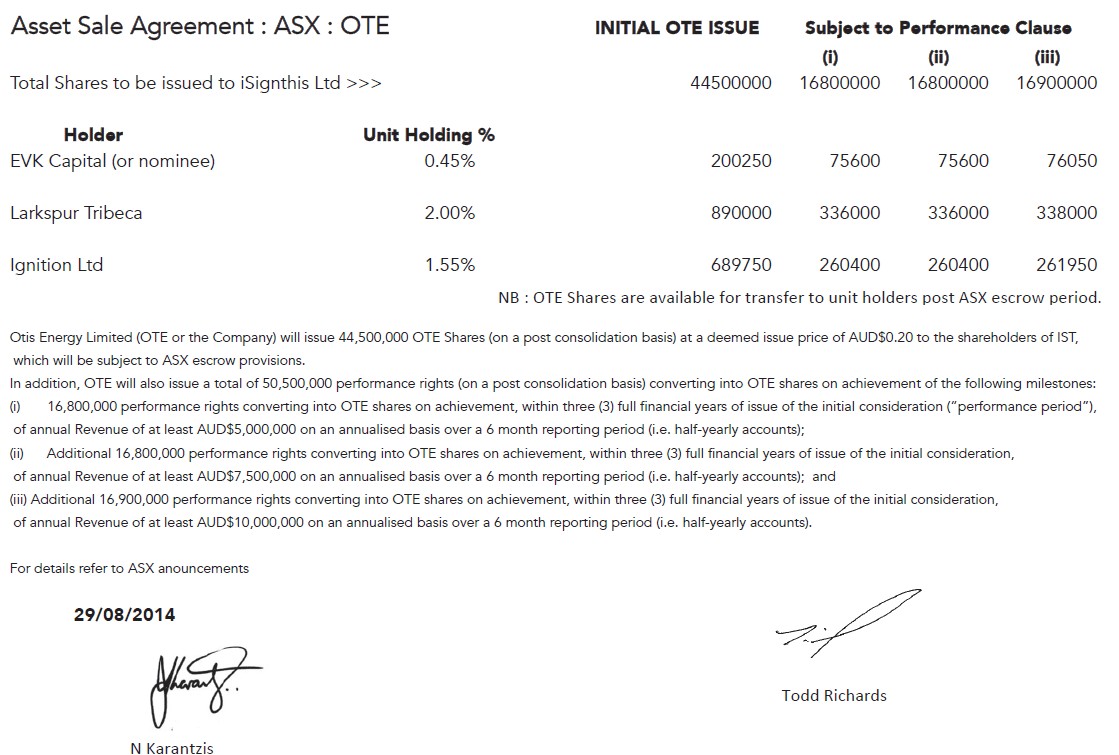
REASONS FOR JUDGMENT
NESKOVCIN J:
1 This proceeding involves a dispute as to whether the applicants are entitled to additional fully paid ordinary shares in iSignthis Ltd (ACN 075 419 715) (ASX code: ISX) which were issued on 5 September 2018, after ISX achieved three Performance Milestones (Milestone A, Milestone B and Milestone C) identified in the Prospectus issued on 22 December 2014 (as defined below).
2 The applicants, Larkspur Tribeca Ltd and Mr David Edmonds, allege that pursuant to a trust constituted by an Acknowledgement of Trust dated 15 June 2015 the first respondent, iSignthis Ltd (BVI) (iSignthis BVI), agreed to hold certain “Trust Assets” on trust for the applicants.
3 The applicants brought claims against iSignthis BVI for breach of trust, alternatively, breach of contract. As against the second respondent, Mr John Karantzis, the applicants alleged knowing receipt of property in breach of trust and knowing assistance of iSignthis BVI’s breach of trust, or alternatively its breach of fiduciary duty. As against the third respondent, Select All Enterprise Limited, the applicants alleged knowing receipt by Select of property in breach of trust. Further or alternatively, on the assumption that the breach of trust claim failed, the applicants sought rectification of the Acknowledgement of Trust to record the common intention of the parties. Finally, the applicants further alleged that Mr Karantzis engaged in misleading and deceptive conduct by making a representation which induced the applicants to execute the Acknowledgement of Trust.
4 The respondents denied each of the applicants’ claims. iSignthis BVI’s position was that the fully paid ordinary shares in ISX, which were issued to it on 5 September 2018 after ISX achieved the Performance Milestones, were owned by iSignthis BVI and were never part of the “Trust Assets” or capable of constituting assets held on trust for the applicants.
5 The applicants’ claim for specific performance of the trust was not opened and was taken to have been abandoned. As a result, the principal relief sought by the applicants was a declaration that Select holds the “Performance Shares” referred to in the Acknowledgement of Trust (the Performance Shares) on trust for the applicants or, alternatively, damages or equitable compensation for breach of trust. The applicants did not open a case about tracing any of the “Trust Assets”, other than to say that the effect of the demerger (referred to below at paragraphs 55 – 57) was to convert 10 ISX shares into one share in its subsidiary.
6 For the reasons that follow, I am satisfied that the applicants have established that, by failing to hold the Performance Shares on trust for the applicants and transfer the rights to the Performance Shares to the applicants, iSignthis BVI acted in breach of trust. Furthermore, the applicants are entitled to equitable compensation in respect of iSignthis BVI’s breach of trust. Otherwise, the applicants’ claims against Select and Mr Karantzis, and the balance of the claims against iSignthis BVI, were either not established or were unnecessary to determine.
7 In the reasons, references to the Performance Shares, Consideration Shares and Trust Assets are references to those terms as defined in the Acknowledgement of Trust (also referred to as the “Trust Deed”, see below at paragraph 61) and references to the “Performance Shares” and “Consideration Shares” are references to those terms as defined in the Prospectus, unless stated otherwise.
background
The applicants and associated persons
8 Larkspur is a company incorporated in the Republic of Seychelles which is associated with Mr Ian Tetro. Mr Tetro’s professional background was in marketing and, in 2013 – 2014, he was a marketing executive for Pepsi Co.
9 Mr Edmonds was a director of Bennick Ltd, a company incorporated in the British Virgin Islands. Mr Edmonds previously practised as a solicitor and, in 2013 – 2014, he was based in Singapore providing corporate finance and wealth management services and advice.
10 In 2013 – 2014, Mr Tetro, Mr Edmonds and Mr Benjamin Walmsley were friends, living in Bangkok.
The respondents and associated entities
11 Prior to 2013, Mr Karantzis had invented a payment verification system which he patented and sought to commercialise through iSignthis BVI, with the assistance of Mr Timothy Hart, Mr Todd Richards and Mr Scott Minehane. At that time, iSignthis BVI was a closely held private company, which was incorporated in the British Virgin Islands.
12 ISX was an eMoney, payments and identity technology company listed on the ASX and the Frankfurt Stock Exchange. At the time it was incorporated, ISX was known as Otis Energy Limited (ASX code: OTE). On 15 March 2015, Otis changed its name to ISX as part of the reverse takeover mentioned below.
13 Select is a company incorporated in the British Virgin Islands. Select was incorporated on 8 January 2019 to hold fully paid ordinary shares in the capital of ISX.
14 Mr Karantzis was:
(a) a director of iSignthis BVI from 18 July 2005 to 23 November 2021;
(b) the managing director and Chief Executive Officer of ISX from about 22 December 2014 to 29 December 2021;
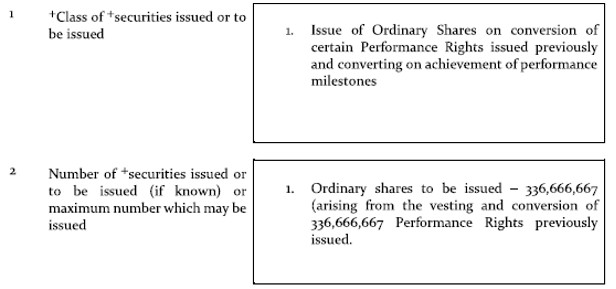
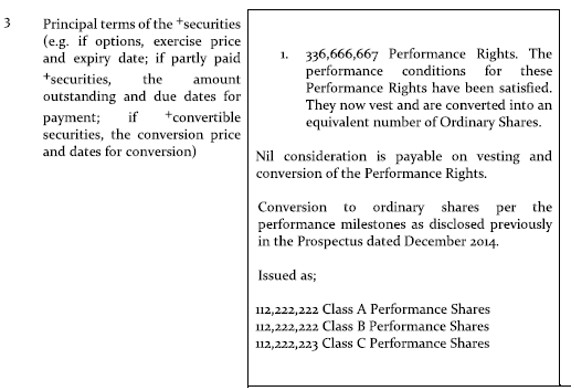
(c) a director of Select from about 17 April 2019 to 23 April 2021 and 13 September 2021 to 23 November 2021; and
(d) the sole shareholder of Select from about 17 April 2019 to 23 March 2021 and 24 June 2021 to 19 October 2021.
Sales and Marketing Agreement
15 In late 2012, Mr Walmsley was introduced to Mr Karantzis as someone with contacts and expertise in Asia. Mr Walmsley introduced Mr Edmonds to Mr Karantzis as a lawyer with experience in assisting start-ups and commercialising ideas.
16 At the time those introductions occurred, iSignthis BVI owned the intellectual property of the ‘iSignthis’ business, comprising a patented system for the authentication of financial instruments used for payment where the owner of the financial instrument is not present.
17 On 8 July 2013, a Sales and Marketing Agreement was executed by iSignthis BVI, Bennick and Ignition Ltd, a Hong Kong company associated with Mr Walmsley. Under the Sales and Marketing Agreement, Bennick and Ignition agreed to pay iSignthis BVI an initial fee of US$500,000 and to establish iSignthis Asia Pte Ltd (Agent), a Singaporean company associated with Mr Edmonds and Mr Walmsley, which was appointed as iSignthis BVI’s agent for the marketing of the iSignthis technology in parts of Asia.
18 By early 2014, a dispute had emerged in relation to the performance of the Agent’s obligations under the Sales and Marketing Agreement. It is unnecessary to mention the nature or reasons for the dispute.
19 On 20 February 2014, the parties to the Sales and Marketing Agreement agreed to resolve the dispute, whereby Mr Walmsley and Mr Edmonds agreed, among other things, to pay an additional US$78,000 (in addition to funds previously paid under the Sales and Marketing Agreement, to make a total capital contribution of US$250,000) for 3% equity in a new holding company (Share Agreement). The commercial intent of the Share Agreement, as stated by Mr Karantzis, both shortly before and after it was signed, was for Mr Walmsley and Mr Edmonds to convert their rights and interests under the Sales and Marketing Agreement into equity in a new holding company.
20 The Share Agreement was later amended to increase the percentage interest to 4% and to include Mr Tetro. Without informing Mr Karantzis, Mr Walmsley and Mr Edmonds arranged for Mr Tetro to pay some of the additional US$78,000 that they had agreed to pay under the Share Agreement. Mr Tetro and Larkspur were not parties to the Share Agreement, and they were not known to Mr Karantzis at the time. After Mr Karantzis became aware of Mr Tetro’s involvement, he spoke with Mr Tetro for the first time in March 2014, and based on that discussion, decided to permit Mr Tetro’s involvement.
21 There was no real dispute that the payments required under the Share Agreement were made.
iSignthis BV
22 In May 2014, iSignthis BV was incorporated in the Netherlands to give effect to Mr Karantzis’ intention of it becoming the entity which would carry on the iSignthis business.
23 The initial plan for iSignthis BV to be the new holding company for the iSignthis business, and for shares in iSignthis BV to be issued to the applicants under the Share Agreement, was overtaken by the idea, which arose in June 2014, of a reverse takeover of Otis.
The reverse takeover
24 The reverse takeover was structured as a sale to Otis of iSignthis BVI’s assets, being shares in iSignthis BV and ISX IP Ltd (by which I infer that the iSignthis business, previously owned by iSignthis BVI, had been or was to be transferred to those entities). iSignthis BVI held all of the issued shares in iSignthis BV, along with all of the shares in ISX IP Ltd, a British Virgin Islands entity, and continued to do so until the reverse takeover was completed.
25 In exchange for the sale of iSignthis BVI’s assets, the “Consideration Shares” in ISX (as defined in the Prospectus, which is mentioned below) were to be transferred to iSignthis BVI. In addition, under the Prospectus, Otis was offering to the public 103,333,333 shares in ISX at an issue price of $0.03, to raise $3,100,000 before expenses.
26 As a result, the new company contemplated by the Share Agreement was not established. However, by September 2014, Mr Karantzis had agreed to the applicants and Mr Walmsley, through Ignition, becoming shareholders in iSignthis BVI (see below at paragraph 35).
27 The reverse takeover, by which shares in Otis were issued to iSignthis BVI in exchange for its assets, was the means by which the founders and shareholders of iSignthis BVI were to profit from their invention and investments and the fundraising under the Prospectus was to fund the business in the early stages.
28 It was not in dispute that the Share Agreement was not a part of the reverse takeover of Otis. Mr Tetro and Mr Edmonds accepted under cross-examination that their investment in the iSignthis business was complete before the reverse takeover of Otis was ever discussed. Further, as the respondents submitted, at the time the idea of the reverse takeover arose, and before it was implemented, neither the applicants nor iSignthis BVI had any interest in or entitlement to the shares in Otis.
Structure and timing of the reverse takeover of Otis by iSignthis BVI
29 In the period from 6 – 31 August 2014, Mr Karantzis, Mr Walmsley, Mr Tetro and Mr Edmonds exchanged correspondence, and on 19 August 2014, attended a meeting on Skype in relation to the reverse takeover of Otis.
30 On 29 August 2014, Mr Karantzis and Mr Richards signed an “Asset Sale Agreement: ASX OTE” (Asset Sale Agreement) purporting to record the proportion and quantity of shares which were to be issued in Otis to iSignthis BVI and available for transfer to the applicants and Ignition (Mr Walmsley’s company) after the mandatory escrow period, which is mentioned below at paragraph 40.
31 On 3 September 2014, Mr Karantzis, Mr Richards, Mr Hart, Mr Minehane, Mr Walmsley and Mr Tetro attended another meeting on Skype in relation to the reverse takeover of Otis.
32 Further correspondence regarding the mechanics of the reverse listing was exchanged between September and November 2014.
Announcement of the reverse takeover
33 On 4 September 2014, Otis announced that it had entered into a “Binding Term Sheet” to acquire 100% of the issued share capital of iSignthis BV and ISX IP Ltd (Acquisition).
34 According to the announcement, in consideration for the Acquisition, Otis was to issue iSignthis BVI:
(a) 298,333,333 fully paid ordinary ISX shares at settlement;
(b) 112,222,222 Class A “Performance Shares” which, on achievement, within three full financial years of Completion, of revenue over a 6 month reporting period equivalent, on an annualised basis, to annual revenue of at least $5,000,000 (Milestone A), would convert on a one for one basis into one ordinary ISX share;
(c) 112,222,222 Class B “Performance Shares” which, on achievement, within three full financial years of Completion, of revenue over a 6 month reporting period equivalent, on an annualised basis, to annual revenue of at least $7,500,000 (Milestone B), would convert on a one for one basis into one ordinary ISX share; and
(d) 112,222,223 Class C “Performance Shares” which, on achievement, within three full financial years of Completion, of revenue over a 6 month reporting period equivalent, on an annualised basis, to annual revenue of at least $10,000,000 (Milestone C), would convert on a one for one basis into one ordinary ISX share.
35 On 15 September 2014, the shareholders of iSignthis BVI passed a resolution to approve the sale of assets to Otis. Mr Walmsley and Mr Tetro were in attendance, and Mr Edmonds gave his proxy to the Chair. I infer that, by this date, Mr Walmsley, Mr Tetro and Mr Edmonds were shareholders of iSignthis BVI.
Share Sale and Purchase Agreement
36 The reverse takeover transaction was documented in a Share Sale and Purchase Agreement dated 21 October 2014 between iSignthis BVI, iSignthis BV, ISX IP Ltd and Otis. That agreement was varied by a letter dated 10 December 2014. The applicants were not parties to the agreement or its variation and they had no direct role in its negotiation.
Prospectus
37 For the purpose of a public offering of shares in Otis, which was part of the reverse takeover, a Prospectus was issued by Otis on 22 December 2014 and a Supplementary Prospectus was issued on 29 January 2015.
38 Under the Prospectus, Otis, which was to be renamed ISX, offered 103,333,333 shares in ISX to the public at an issue price of $0.03, to raise $3,100,000 before expenses (Offer). The Offer was conditional on ISX raising the amount of the Offer and completion of the “Acquisition”, as defined in the Prospectus. The Prospectus stated that, upon completion of the Offer and the “Acquisition”:
(a) 298,333,333 “Consideration Shares” would be issued to iSignthis BVI;
(b) 336,666,667 “Performance Shares” would be issued to iSignthis BVI, on the terms and conditions set out in section 14.2 of the Prospectus, comprising:
(i) 112,222,222 Class A “Performance Shares”;
(ii) 112,222,222 Class B “Performance Shares”; and
(iii) 112,222,223 Class C “Performance Shares”.
39 The Prospectus further stated that:
(a) each class of “Performance Shares” would convert into fully paid ordinary shares in the capital of ISX on a one for one basis upon the achievement of specified Performance Milestones within three full financial years of Completion of the takeover;
(b) the “Performance Shares” were “not transferable”; and
(c) if the Performance Milestone relevant to the “Performance Shares” was not achieved, with the result that conversion into ordinary shares did not occur before the Expiry Date, then the unconverted “Performance Shares” would automatically consolidate into one “Performance Share” and would then convert into a single ordinary ISX share.
40 Under the Prospectus, the “Consideration Shares” to be issued to iSignthis BVI were classified by the ASX as restricted securities and were required to be held in escrow for two years from the date that shares in iSignthis Ltd were reinstated to the ASX.
41 The Supplementary Prospectus was issued to, among other things, provide further information in relation to the sale of the assets to ISX.
The reverse takeover is approved and completed
42 On 22 December 2014, the shareholders of Otis approved the Acquisition.
43 On 5 March 2015, the reverse takeover of Otis was completed and 298,333,333 ordinary ISX shares were issued to iSignthis BVI.
44 On 6 March 2015, ISX made an announcement to the ASX in relation to the completion of the Acquisition.
45 On 16 March 2015, securities in ISX were reinstated to trading on the ASX.
Deed of acknowledgement
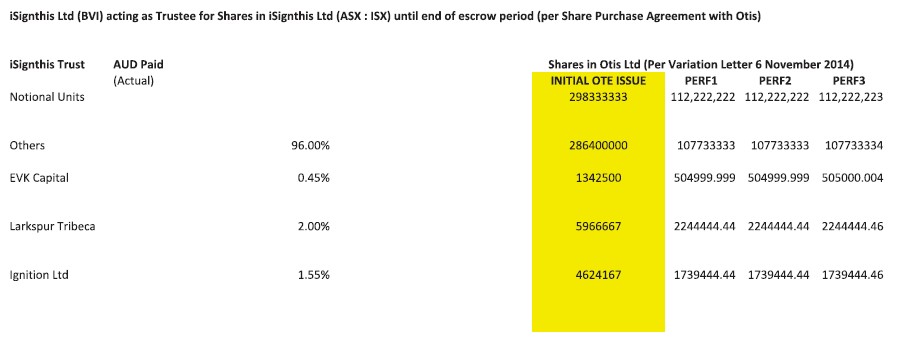
46 On 15 June 2015, as already mentioned, the Acknowledgement of Trust was entered into.
47 Ignition (Mr Walmsley’s company) was not a party to the Acknowledgement of Trust. The reasons why Mr Walmsley did not sign the Acknowledgement of Trust were neither apparent nor relevant to this dispute.
Escrow period under the Prospectus
48 On 16 March 2017, the escrow period under the Prospectus ended. From this date, iSignthis BVI was able to deal with the ordinary ISX shares that had been issued to it under the Share Sale and Purchase Agreement.
49 By 18 May 2017, pursuant to the Acknowledgement of Trust, iSignthis BVI had transferred 2.41% of the Consideration Shares to or at the direction of the applicants. The dispute between the parties did not concern the applicants’ entitlement with respect to the Consideration Shares.
Performance Shares
50 Performance Milestone A, Milestone B and Milestone C were achieved by 30 June 2018.
51 On 29 August 2018, iSignthis Ltd made an announcement to the ASX to the effect that the three Performance Milestones had been achieved and, in the circumstances, 336,666,667 fully paid ordinary shares in the capital of ISX were to be issued.
52 The announcement relevantly stated as follows:
53 On 5 September 2018, following the conversion of the Class A, Class B and Class C “Performance Shares”, ISX issued 149,654,654 fully paid ordinary ISX shares to iSignthis BVI and a total of 187,012,013 fully paid ordinary ISX shares to employees and directors of ISX, or nominees of those persons, other than Mr Karantzis.
54 On 29 April 2019, iSignthis BVI disposed of 446,797,754 ISX shares, with 223,398,878 ISX shares being transferred to Select. As a result, iSignthis BVI was no longer a substantial shareholder of ISX shares.
Demerger
55 On 1 September 2021, ISX announced that it was exploring a proposed demerger of its subsidiary, ISX Financial EU Ltd (ISXFEU), by way of a reduction in the capital of ISX.
56 At a meeting of shareholders of ISX on 12 October 2021, a resolution was passed for the capital of ISX to be reduced by ISX making a pro-rata in specie distribution of approximately 110,079,450 ordinary shares in ISXFEU to all holders of ordinary shares in ISX.
57 The effect of the demerger was that every shareholder of ISX, at the record date, being the date of the general meeting, received 1 ISXFEU share for every 10 ISX shares held on that date.
Delisting of ISX
58 In May 2022, ISX was renamed Southern Cross Payments Ltd and its ASX code was changed to SP1.
59 On 4 November 2022, Southern Cross Payments was delisted from the ASX.
the applicants’ claims
60 The applicants brought the following claims against the respondents.
61 First, the applicants alleged that iSignthis BVI’s conduct in failing and refusing to transfer the Performance Shares to the applicants, disposing of ISX shares (including shares held on trust for the applicants) and giving effect to the demerger resolution, constituted a breach of trust and breach of the “Trust Deed”, constituted by the Acknowledgement of Trust. The document signed by the relevant parties on 15 June 2015, which was entitled “Acknowledgement of Trust”, was executed as a deed and described by the applicants as the “Trust Deed”, which I will adopt from hereon in these reasons.
62 Secondly, and in the alternative to the breach of trust claim, the applicants alleged that iSignthis BVI’s conduct in failing and refusing to transfer the Performance Shares to the applicants was a breach of contract constituted by the Trust Deed.
63 Thirdly, the applicants alleged that the conduct referred to in paragraph 61 was a dishonest, alternatively fraudulent, breach of the fiduciary duties which iSignthis BVI owed to the applicants by reason of the Trust Deed. As against Select and Mr Karantzis, the applicants alleged knowing receipt of property in breach of trust, and they alleged knowing assistance by Mr Karantzis of iSignthis BVI’s breach of trust, alternatively breach of fiduciary duties.
64 Fourthly, and by way of alternative to the above claims, the applicants sought rectification of the Trust Deed to record the common intention of the parties, to the extent that the Trust Deed did not give effect to the applicants’ rights to the Performance Shares.
65 Fifthly, the applicants alleged that, by making the Share Agreement, the composition of which I discuss below at paragraph 157(a), and the Asset Sale Agreement, Mr Karantzis represented to the applicants that they would enjoy rights, including performance rights, if and when issued by Otis and encouraged them to invest in Otis (Representation). The applicants stated that if, as the respondents contended, the trust established under the Trust Deed terminated immediately after seven days following the end of the “Escrow Period” (as defined in the Trust Deed), and the applicants were not entitled to the Performance Shares because, at that time, none had been issued to iSignthis BVI, the Representation was misleading and deceptive or likely to mislead or deceive, and the applicants suffered detriment as a result of their reliance on the Representation, in that they lost their rights in respect of the Trust Assets.
EVIDENCE AND witnesses
66 The parties relied on a Statement of Agreed Facts, setting out facts agreed by the parties for the purpose of s 191 of the Evidence Act 1995 (Cth).
67 The applicants relied on five affidavits, being two affidavits of Mr Tetro, dated 8 March 2023 and 13 March 2025, two affidavits of Mr Edmonds dated 7 March 2023 and 14 March 2025 and one affidavit of Mr Walmsley dated 7 March 2023. They were each required for cross-examination.
68 Mr Tetro gave evidence in relation to the circumstances in which he was brought in, by Mr Walmsley, to be a silent investor in the iSignthis business in Asia, and he agreed to acquire shares in a new holding company. Mr Tetro was a generally good witness. He gave responsive answers to questions in cross-examination. Several propositions were put to him in cross-examination regarding the basis upon which he invested in the iSignthis business and would receive any Performance Shares, which he rejected, without being argumentative or evasive. Mr Tetro had no financial or practical stake in the outcome of the proceeding. Mr Tetro acknowledged that he had agreed to forfeit his interest in the outcome of the proceeding in favour of Mr Walmsley, in return for Mr Walmsley agreeing to hold Mr Tetro harmless in respect of costs.
69 Mr Edmonds gave evidence regarding the resolution of the dispute in relation to the Sales and Marketing Agreement, which led to the relevant parties entering into the Share Agreement and the Trust Deed. Mr Edmonds negotiated and drafted the Trust Deed on behalf of the applicants. Mr Edmonds was also a generally good witness. He had a reasonable recollection of events surrounding his investment and the drafting of the Trust Deed. His answers were direct and responsive. Similarly to Mr Tetro, Mr Edmonds has agreed to forfeit any interest in the outcome of the proceeding in favour of Mr Walmsley on the condition that Mr Walmsley hold him harmless in relation to costs.
70 Mr Walmsley gave evidence in relation to the entry into and dispute concerning the Sales and Marketing Agreement, the resolution of the dispute, discussions regarding the reverse takeover of Otis and emails that were exchanged in relation to the Trust Deed.
71 Mr Walmsley recorded the Skype meetings on 19 August 2014 and 3 September 2014, at which the reverse takeover of Otis was discussed, and later had the recordings transcribed. Although there was an objection to the tender of the transcripts, because Mr Walmsley did not obtain the consent of the participants to record the meetings, the transcript was tendered by agreement on a limited basis under s 136 of the Evidence Act as evidence as to what was said at the meetings, but not as to the truth.
72 Mr Walmsley was not a party to the proceeding and was called to give evidence on behalf of the applicants. Mr Walmsley was, however, funding and conducting the proceeding on behalf of the applicants, who had agreed to forfeit any interest in the outcome of the proceeding to Mr Walmsley, on the condition that he hold them harmless in relation to costs. While Mr Walmsley had less involvement in relevant events than the applicants, it was clear that he had an emotional as well as a financial stake in the proceeding. While this affected his demeanour at times, it is unnecessary to make any findings as to whether this should affect the weight to be given to his evidence for reasons that will follow.
73 The respondents relied on three affidavits, one of Mr Timothy Hart dated 4 April 2025, one of Mr Karantzis dated 6 April 2025 and one of Mr Justin Klintberg dated 7 April 2025. They were each required for cross-examination.
74 Mr Hart was the Executive Chairman of Southern Cross Payments from 29 December 2021 and an independent non-executive Chairman of ISX since March 2015. From 2010 to early 2015, Mr Hart acted as Chairman of the iSignthis business. Mr Hart gave evidence regarding the resolution of the dispute in relation to the Sales and Marketing Agreement, the Share Agreement, discussions and correspondence regarding the reverse takeover of Otis and ISX achieving the Performance Milestones. Mr Hart was a generally good witness who gave forthright answers to questions and made appropriate concessions.
75 Mr Karantzis gave evidence in relation to the entry into the Sales and Marketing Agreement, the resolution of the dispute that emerged, entry into the Share Agreement, the reverse takeover of Otis, the Asset Sale Agreement, the negotiation and entry into the Trust Deed and the issuance of shares to iSignthis BVI after ISX achieved the Performance Milestones. Mr Karantzis was able to recall a significant amount of detail in relation to the relevant events. This, however, contributed to an impression that his evidence and answers to questions in cross-examination were carefully constructed to suit his case. Given his role as a party, Mr Karantzis had an obvious interest in the outcome of the proceeding. Similarly to Mr Walmsley, it is unnecessary to make findings as to whether this should affect the weight to be given to his evidence for reasons that will follow.
76 Mr Klintberg is the founder of a financial services company. Mr Klintberg’s evidence was limited to his involvement, in August 2024, in the acquisition and price of shares in ISXFEU on behalf of a group of buyer entities.
77 The respondents submitted that the Court should disregard the evidence of Mr Walmsley because his stake in the outcome of the proceeding had “tainted” his evidence and because his “vendetta” against Mr Karantzis raised further credibility issues.
78 The applicants made extensive submissions regarding Mr Karantzis’ credit and submitted that Mr Karantzis’ evidence was “recent invention”.
79 The key issue in the proceeding concerns the proper construction of the Trust Deed. Evidence concerning the surrounding circumstances at the time the Trust Deed was entered into was contained in contemporaneous exchanges between the parties. It has been observed that in commercial cases where contemporaneous documents exist, it is often preferable for little if any reliance to be placed on witness testimony, relying on human memory, and for significant weight to be given to evidence contained in contemporaneous documents: Fox v Percy (2003) 214 CLR 118; [2003] HCA 22 at [31] (Gleeson CJ, Gummow and Kirby JJ); Webb v Getswift Limited (No 5) [2019] FCA 1533 at [18] (Lee J), referring to Leggatt J in Gestmin SGPS SA v Credit Suisse (UK) Limited [2013] EWHC 3560 (Comm) at [15 ]– [23]. That observation is apt in the present case. As a result, it is unnecessary to make findings in relation to the credit or credibility of the witnesses, or whose evidence should be accepted where the witnesses’ evidence diverged.
80 Finally, both parties relied on the expert evidence as to quantum. This is dealt with separately below.
Breach of trust
81 The respondents admitted that there was a trust constituted by or under the Trust Deed. They contended, however, that the Trust Assets did not include the Class A, Class B or Class C “Performance Shares” issued under the Prospectus, or any further shares in ISX unless the Performance Milestones were achieved and the Performance Shares had converted into ordinary ISX shares before iSignthis BVI was required to transfer all of the Trust Assets to each beneficiary in their respective proportions. As the former had not occurred before the trust was terminated, the respondents said, they were not obliged to transfer the Performance Shares to the applicants and were free to deal with them, and the corresponding eventual ordinary shares, as they saw fit.
82 The resolution of the breach of trust claim turns on the proper construction of the Trust Deed, which was in dispute between the parties. It is convenient to begin by setting out the relevant terms of the Trust Deed.
The Trust Deed
83 Beginning with the relevant definitions, Trust Assets is defined in clause 1.1 of the Trust Deed, as follows:
Trust Assets means in respect of each Beneficiary and subject to applicable Australian Corporations law, the Australian Securities Exchange rules, and the requirements of the prospectus and supplementary prospectus being met, the Relevant Proportion of:
(a) Consideration shares, representing a total of 298,333,333 ordinary shares of OTE;
(b) Performance Shares, provided that such shares are issued (whether issued before or after the Escrow Period), whereby performance shares shall only be issued upon satisfaction of the Performance Targets nominated in the Prospectus, up to a maximum of three tranches, with each tranche representing 112,222,222 shares that may be issued.
(c) and whilst the Trustee holds on trust the Trust Assets, the proceeds of sale or redemption of any of the property referred to in paragraphs (a) – (d), and
(d) and whilst the Trustee holds on trust the Trust Assets, any rights, dividends, bonus shares or other derivative right of any nature in connection with the property referred to in paragraphs (a) – (e).
84 Consideration Shares and Performance Shares are defined in clause 1.1 to have the meanings given to them in the Prospectus, which are mentioned below.
85 “Escrow Period” is defined in clause 1.1 to mean the period during which the “Trustee”, being iSignthis BVI, is prevented by law from disposing of or otherwise distributing the Trust Assets to the “Subscribers”, being Larkspur and Edmonds.
86 Clause 2, which bears setting out in its entirety as it appears in the Trust Deed, provides as follows:
2. Trust
2.1 Declaration of Trust
The Trustees declare that they hold the Trust Assets on trust for each Beneficiary and the Subscribers in accordance with the terms of this deed. The Trustees may not sell, transfer or dispose of the Trust Assets without the written consent of the Beneficiary.
2.2 Notification regarding Escrow Period
Not later than 21 days before the end of the Escrow Period the Trustees must notify the Subscribers that the Escrow Period will end.
2.3 Transfer of Trust Assets
Not later than seven days after the end of the Escrow Period the Trustees must transfer the Trust Assets to the Beneficiary or otherwise as the each Beneficiary may direct in writing.
2.4 Summary of Trust Assets
The register of interests in below summarises the assets held on trust by the Trustee for each Beneficiary, and includes prospective shares that may be issued subject to the Performance Targets being met. The Beneficiaries have each confirmed in writing their relevant proportions under cover of email dated 17th March 2015
Event/Beneficiary | Larkspur Tribeca | Edmonds |
Consideration shares (post escrow) | 5,966,667 | 1,223,167 |
Performance Tranche 1 (if issued) | 2,244,444 | 460,111 |
Performance Tranche 2 (if issued) | 2,244,444 | 460,111 |
Performance Tranche 3 (if issued) | 2,244,444 | 460,111 |
2.5 No Further Claims
Upon transfer of the Trust Assets by the Trustee, this agreement is in full and final settlement of the Beneficiary’s claims on rights, dividends, bonus shares or other derivative right of any nature in connection with the Trust Assets, jointly or severally.
It is a term of this Agreement that the Beneficiary and/or the Subscribers jointly will not pursue any additional claims relating to the Trust Assets, whether dealt with in this Agreement or not
87 The remaining terms of the Trust Deed dealt with the service of notices and the governing law.
88 Turning to the relevant definitions in the Prospectus, to which the Trust Deed referred, “Consideration Shares” is relevantly defined (in section 13.1(a)), as follows:
The consideration is:
(i) 298,333,333 Shares (on a post consolidation basis);
(ii) 112,222,222 Class A Performance Shares (on a post consolidation basis);
(iii) 112,222,222 Class B Performance Shares (on a post consolidation basis); and
(iv) 112,222,223 Class C Performance Shares (on a post consolidation basis),
(together the Consideration Shares).
The terms and conditions of the Class A Performance Shares, Class B Performance Shares and Class C Performance Shares are set out in Section 14.2
89 “Performance Shares” is defined to mean “the performance shares to be issued on the terms and conditions set out in Section 14.2”.
90 Section 14.2 of the Prospectus relevantly provides:
Class A Performance Shares
1. Conversion of Class A Performance Shares
(a) (Conversion on achievement of Milestone A) On achievement, within three (3) full financial years from Completion, of revenue over a 6 month reporting period (being for a 6 month period ending 30 June or 31 December), on an annualised basis, to annual revenue of at least $5,000,000 (Milestone A), each Class A Performance Share will convert on a one for one basis into a Share.
For the avoidance of doubt, a half year revenue of $2,500,000 will satisfy Milestone A.
(b) (Expiry) Milestone A must be achieved on or before 5.00 pm on the date which is 14 days after the release of the audited financial reports for the third full financial year after Completion being financial year 2017/2018 (Expiry Date).
(c) (Conversion on change of control) If there is a Change of Control Event in relation to the Company prior to the conversion of the Class A Performance Shares, then:
(i) Milestone A will be deemed to have been achieved; and
(ii) each Class A Performance Share will automatically and immediately convert into Shares,
however, if the number of Shares to be issued as a result of the conversion of Class A Performance Shares, together with the number of Shares to be issued as a result of the conversion of the Class B Performance Shares and Class C Performance Shares, due to a Change in Control Event is in excess of 10% of the total fully diluted share capital of the Company at the time of the conversion, then the number of Class A Performance Shares, Class B Performance Shares and Class C Performance Shares to be converted will be prorated so that the aggregate number of Shares issued upon conversion of the Class A Performance Shares, Class B Performance Shares and the Class C Performance Shares is equal to 10% of the entire fully diluted share capital of the Company.
(d) (No conversion) To the extent that Class A Performance Shares have not converted into Shares on or before the Expiry Date, then all such unconverted Class A Performance Shares held by each holder (Class A Holder) will automatically consolidate into one Class A Performance Share and will then convert into one Share.
(e) (Conversion procedure) The Company will issue a Class A Holder with a new holding statement for the Share or Shares as soon as practicable following the conversion of each Class A Performance Share.
(f) (Ranking of shares) Each Share into which the Class A Performance Shares will convert will upon issue:
(i) rank equally in all respects (including, without limitation, rights relating to dividends) with other issued Shares;
(ii) be issued credited as fully paid;
(iii) be duly authorised and issued by all necessary corporate action; and
(iv) be allotted and issued free from all liens, charges and encumbrances whether known about or not including statutory and other pre-emption rights and any transfer restrictions.
91 Section 14.2(2) of the Prospectus dealt with the rights attaching to Class A Performance Shares, and relevantly provides:
(a) (Share capital) Each Class A Performance Share is a share in the capital of the Company.
…
(f) (Not transferable) A Class A Performance Share is not transferable.
92 Section 14.2(3)–(5) contained similar provisions in relation to Class B and Class C Performance Shares, save that the performance milestones were achieved by a higher revenue figure.
Relevant principles
93 It is well established that a share is property that is capable of being held on trust. As Jagot J said in Ellison v Sandini Pty Ltd (2018) 263 FCR 460; [2018] FCAFC 44 at [119 ]–[120]:
A share, it has been said, is “the interest of a shareholder in the company measured by a sum of money for the purpose of liability in the first place and of interest in the second, but also consisting of a series of mutual covenants entered into by all the shareholders” (Archibald at 156). The subsequent abolition of the concept of par value and of authorised capital effected by the Company Law Review Act 1998 (Cth) renders the reference to the measurement by a sum of money in this description inapt (National Mutual Life Association of Australia Ltd v Commissioner of Taxation [2009] FCAFC 96; (2009) 177 FCR 539 at [48] referring to Pilmer v The Duke Group Pty Ltd [2001] HCA 31; (2001) 207 CLR 165 at [19]). In Pilmer at [19] McHugh, Gummow, Hayne and Callinan JJ said:
Once issued, a share comprises "a collection of rights and obligations relating to an interest in a company of an economic and proprietary character, but not constituting a debt" [citing Pennington, "Can shares in companies be defined?", (1989) 10 The Company Lawyer 140 at 144].
For a share to be held on trust there must be “certainty … as to the property bound by the trust” (Herdegen v Federal Commissioner of Taxation [1988] FCA 419; (1988) 84 ALR 271 at [19] citing Federal Commissioner of Taxation v Clarke [1927] HCA 49; (1927) 40 CLR 246 at 283–5; Scott on Trusts, 4th ed, 1987, § 76, 77). In the context of shares which do not need to be numbered and certificated (as permitted by s 1070B(2) of the Corporations Act 2001 (Cth)), as is the case with shares in MIN, the question that arises is the certainty of the subject matter of any trust. This is because shares are considered to be fungible or interchangeable (a concept which, as noted below, itself has attracted criticism).
94 For some time, however, there was uncertainty as to whether a trust could be constituted over a specified number of unidentified shares within a fungible pool. In Ellison v Sandini, after surveying the authorities, Jagot J (with whom Siopis J agreed, at [1]) held that it could. Her Honour said, at [148]:
In terms of principle, the weight of authority is that there can be a valid trust over a fungible pool of assets provided the assets and relevant proportions for the different beneficiaries are identified with sufficient certainty. The better view is that for the requirement of certainty to be satisfied the trust must be over all of the fungible assets in the pool, the beneficial co-ownership proportions reflecting the respective interests of the beneficiaries. In the context of a declaration of trust, there may be a sound basis in principle to uphold the validity of such a trust on the basis that the trustee’s intention must have been to create a valid trust which requires certainty of subject matter.
95 It is also well established that the principles regarding the construction of contracts apply to the construction of trust instruments: Byrnes v Kendle [2011] HCA 26; (2011) 243 CLR 253 at 274-275 [57]-[59] (Gummow and Hayne JJ), 286 [102] (Heydon and Crennan JJ); Trustee for Michael Hayes Family Trust v Commissioner of Taxation [2019] FCA 426 at [55] (Logan J); Schreuders v Grandiflora Nominees Pty Ltd [2016] VSCA 93 at [12]-[15], [21]-[22] (Kyrou, Ferguson and McLeish JJA); The Trust Company (Nominees) Ltd v Banksia Securities Ltd (Receivers and Managers appointed) (in liquidation) [2016] VSCA 324 at [35] (Ashley, Beach and McLeish JJA).
96 The role of the court in interpreting trust instruments is to give effect to the intention of the parties: Banksia Securities at [36]–[37], citing Australian Broadcasting Commission v Australasian Performing Right Association Ltd [1973] HCA 36; (1973) 129 CLR 99 at 109 (Gibbs J, dissenting).
97 As with contracts, the parties’ intentions are to be determined objectively with reference to the instrument they have executed in the context of the surrounding circumstances. As Heydon and Crennan JJ said in Byrnes v Kendle at [98]:
A contract means what a reasonable person having all the background knowledge of the "surrounding circumstances" available to the parties would have understood them to be using the language in the contract to mean. But evidence of pre-contractual negotiations between the parties is inadmissible for the purpose of drawing inferences about what the contract meant unless it demonstrates knowledge of "surrounding circumstances".
[Footnotes omitted]
98 In Schreuders v Grandiflora Nominees, at [21]–[22], the Victorian Court of Appeal said:
… trust instruments are to be given their natural and ordinary meaning unless they have a special or technical meaning. The terms of an instrument must be construed in the context of the entire document and in such a way that renders them ‘all harmonious one with another’.
The parties’ intention must be found in the wording of the trust instrument rather than in what was on their minds when they executed the instrument. Evidence of the actual intention of the parties will not be admissible except in an action for rectification and other limited circumstances. In Byrnes v Kendle, Gummow and Hayne JJ stated:
[T]he expressed intention of the parties is to be found in the answer to the question, ‘What is the meaning of what the parties have said?’, not to the question, ‘What did the parties mean to say?’
[Footnotes omitted]
99 Antecedent correspondence has been considered by the High Court to fall within objective evidence of this kind for the purpose of construing an executed deed: Royal Botanic Gardens and Domain Trust v South Sydney City Council (2002) 240 CLR 45; [2002] HCA 5 at [26] and [30] (Gleeson CJ, Gaudron, McHugh, Gummow and Hayne JJ).
Objective evidence of the surrounding circumstances
100 Although the parties gave evidence about their subjective intentions and understanding regarding the Trust Deed, that evidence must be put to one side. While both parties took the Court to a voluminous amount of correspondence that was exchanged prior to the execution of the Trust Deed, a great deal of that evidence was not relevant or admissible on the question of the proper construction of the Trust Deed. That is because evidence of pre-contractual negotiations between the parties is inadmissible for the purpose of drawing inferences about what the contract meant unless, relevantly here, it demonstrates background knowledge of “surrounding circumstances” available to all parties: Byrnes v Kendle at [98].
101 The Trust Deed was directed at implementing the share issue contemplated by the Asset Sale Agreement, in the context of the mandatory escrow period. In this case, the objective evidence of the surrounding circumstances to which the Court may have regard comprises the Asset Sale Agreement, which purported to record the proportion and quantity of shares which were to be issued in Otis, and the communications referred to below, except where noted. The parties to the Trust Deed had knowledge of the relevant communications referred to below because the communications were either sent or copied to all parties to the Trust Deed or they were public communications, such as prospectuses and ASX announcements, which I infer the parties had knowledge of given their interest in the transaction.
102 The Asset Sale Agreement, which was signed on 29 August 2014 by Mr Karantzis and Mr Richards, stated as follows:
103 On 1 September 2014, Mr Karantzis wrote to Mr Tetro, Mr Walmsley, Mr Edmonds, Mr Richards, Mr Hart and Mr Minehane regarding the Asset Sale Agreement, stating that (emphasis added):
The consideration against the asset sale is for iSignthis [BVI] to be issued 55% of the equity of OTE Ltd, with performance rights to be issued up to ~72.4%.
This is an asset sale agreement with earn-out provisions, with the effect of concluding a reverse takeover of an ASX listed entity, by way of issue of shares as consideration.
[…]
The Shares to be issued as consideration to iSignthis [BVI] for the sale of asset are likely to be held in escrow for 24 months.
At any point following escrow, iSignthis [BVI] is able to transfer the shares off market to individual unit holders.
104 In describing the “key terms”, Mr Karantzis said (emphasis added):
In addition, OTE will also issue a total of 50,500,000 performance rights (on a post consolidation basis) converting into OTE shares on achievement of the following milestones:
(i) 16,800,000 performance rights converting into OTE shares on achievement, within three (3) full financial years of issue of the initial consideration (“performance period”), of annual Revenue of at least AUD$5,000,000 on an annualised basis over a 6 month reporting period (i.e. halfyearly accounts);
(ii) Additional 16,800,000 performance rights converting into OTE shares on achievement, within three (3) full financial years of issue of the initial consideration, of annual Revenue of at least AUD$7,500,000 on an annualised basis over a 6 month reporting period (i.e. half-yearly accounts); and
(iii) Additional 16,900,000 performance rights converting into OTE shares on achievement, within three (3) full financial years of issue of the initial consideration, of annual Revenue of at least AUD$10,000,000 on an annualised basis over a 6 month reporting period (i.e. half-yearly accounts).
[…]
This is consistent with the outline provided during the online meeting held between Tetro/Walmsley/Edmonds + Karantzis/Richards on the 19th August 2015 [sic].
105 On 8 November 2014, Mr Karantzis wrote to Mr Edmonds, Mr Tetro and Mr Walmsley, copying Mr Minehane, Mr Hart and Mr Richards, concerning changes to the mechanics of the agreement with Otis that affected the number of shares to be issued and the issue price. That email contemplated the rights to the Performance Shares to be held by the applicants as something capable of being transferred and sold for value, “off market”, and recorded by iSignthis BVI (bold emphasis added):
Gents,
As you may be aware from the Otis Ltd ASX announcement last Friday, there has been some changes to the mechanics of the agreement with Otis Ltd.
The changes do not affect the sale price of the Intellectual Property etc, which is still valued at $8.95m, nor the market capitalisation at re-list.
It is a change only in the number of shares to be issued, and the issue price.
A change in the ASX listing rules has allowed us to reconstruct the shares at a 10:1 rather than 66.67:1, with a resultant share price of 0.03c rather than 0.20c. Effectively, we are to be issued 6.67 times more shares, but at 6.67 times lower price.
The sale agreement has now moved to unconditional, with the Independent Expert report having concluded that $8.95m is a fair and reasonable price for the acquisition of the IP by Otis Ltd, including technical, patent and commercial due diligence having also been satisfactorily completed by independent parties appointed by Otis.
The attached register of interests has been recalculated based upon the revised Otis shares to be issued as consideration and upon satisfaction of performance requirements.
We are still in discussions with the ASX as to whether (with regards to the re-listed Otis);
1. shares to be allocated to minority interests of the vendor may be released form escrow at any earlier stage
2. If achievement of performance hurdles automatically releases shares from escrow.
We are optimistic as to the second, but consider the first to be unlikely.
Whilst the shares in the newly listed ASX vehicle are likely to remain in escrow, there is no prohibition on any shareholder seeking a buyer for their allocation as noted in the attached register, to be sold off market. The company itself does not facilitate buying or selling of interests or shares, but will record any transaction.
Please do not hesitate to contact myself or Todd with regards to any queries regarding the reconstruction.
Regards
John Karantzis | Executive Director
106 The attached “register of interests” was another version of the Asset Sale Agreement, in which the number of shares to be issued in Otis had changed. The attachment was as follows:
107 On 11 November 2014, in response to a query from Mr Walmsley regarding the shares to be issued as part of the sale transaction, Mr Karantzis sent an email to Mr Walmsley, copying Mr Hart, Mr Minehane and Mr Richards (Mr Tetro was added to the chain subsequently), stating (emphasis added):
iSignthis [BVI] will be issued rights that convert to shares in Otis, per the announcements on the ASX.
Those rights will be held in escrow but notionally by iSignthis [BVI] until the later of;
a) escrow period ending (2 years from re-list), and the rights converting to unencumbered shares or
b) performance hurdles being met, and rights converting to unencumbered shares.
[…]
We have requested the ASX allow us to distribute in specie, but that is not an option the ASX will allow until rights convert to shares, and shares are no longer in the escrow period.
That is, performance rights may convert to shares before the escrow period ends, which means that consideration and converted performance rights would still not be transferable until after escrow.
[…]
Upon issue of the rights (contemporaneous with re-listing), we will issue the individual holding statements, which will bind the directors of isignthis Ltd to transfer the shares (upon conversion of rights) to the holders (or their nominees), after escrow period ends.
108 On 13 November 2014, Mr Karantzis sent to Mr Walmsley an email, copying Mr Edmonds, Mr Tetro, Mr Minehane, Mr Richards and Mr Hart, that included the following (emphasis added):
The position is that we are proceeding with the Otis deal, you (Ignition), and Ian (Lakrspur) and David (Bennick), will be issued documentation to convert your equitable rights into legal rights as soon as reasonably possible following completion with Otis. Your rights will be based mutatis mutandis on the iSignthis Ltd rights with Otis, but will be under escrow for 24 months (like iSignthis).
109 The respondents submitted that the concept of preparing a trust deed arose in early November 2014 in response to Mr Walmsley’s displeasure and that of the applicants about the ASX-imposed escrow period, which prevented iSignthis BVI making an in specie distribution of the shares in ISX that it would receive upon completion of the reverse takeover.
110 On 6 March 2015, ISX made an announcement to the ASX regarding completion of the Acquisition, confirming satisfaction of all conditions precedent and the acquisition by ISX of 100% of the issued share capital of iSignthis BV and ISX IP, which were together referred to as “iSignthis” in the announcement. The announcement also confirmed the issue of the following “Consideration Securities” to the “iSignthis vendors” on 5 March 2015:
Ordinary Shares | Class A Performance Shares | Class B Performance Shares | Class C Performance Shares | |
Consideration Securities | 298,333,333 | 112,222,222 | 112,222,222 | 112,222,222 |
111 In relation to the “Performance Shares”, the announcement further stated that:
Under the terms of the Sale and Purchase Agreement between [Otis] and iSignthis B.V and ISX IP Ltd, the vendors have been issued with Performance Shares as follows:
112,222,222 Class A Performance Shares
112,222,222 Class B Performance Shares
112,222,223 Class C Performance Shares
112 Contrary to the announcement, and as will be explained, “Performance Shares” had not been issued to the “iSignthis vendors” at the date of the announcement. However, 298,333,333 ordinary ISX shares were issued to iSignthis BVI upon completion of the Acquisition.
113 As an aside (because it assists with the chronology but it is not part of the objective surrounding circumstances, as it is unclear whether the below email was passed on to Mr Tetro), Mr Walmsley apparently was confused about the reference in the announcement to the “iSignthis vendors” and, on 8 March 2015, he asked Mr Hart, in his capacity as Chairman of ISX, for details in relation to the “iSignthis vendors” and his “shareholdings in such”. Mr Karantzis replied:
The percentage allocation of the 4% interest in the consideration and performance Shares to be held in Otis to be held in trust on behalf of your parties, has been fixed and agreed between your parties - Tetro/ Edmonds/ Walmsley. We will not revisit that except under signed and written instructions from all parties.
The prospectus (and supp) covers all information that is required to be disclosed.
I am awaiting return comments from David regarding the trust agreement, which I sent approx six weeks ago. I understand that David acts for you in this regard.
To clarify, iSignthis ltd BVI sold its assets to Otis energy ltd. The consideration was shares in Otis, your proportion of which will be held in trust for your parties until end of escrow period.
114 The reference in Mr Karantzis’ email to “the trust agreement” was a reference to a draft of the Acknowledgement of Trust, which Mr Edmonds had prepared. There were five draft versions of the Acknowledgement of Trust provided to the Court, two dated 30 January 2015, one dated 18 March 2015, another dated 20 March 2015, another dated 13 June 2015 and one execution version which was signed on 15 June 2015. Evidence of prior drafts of a deed has been used to assist in establishing the parties’ common understanding or the deed’s context, which is always admissible, as opposed to as a direct aid in construction: see Royal Botanic at [26]–[31] (Gleeson CJ, Gaudron, McHugh, Gummow and Hayne JJ); Righi v Kissane Family Pty Ltd [2015] NSWCA 238 at [46]–[47] (Emmett JA, Ward and Gleeson JJA agreeing at [1] and [99], respectively); Re Jimmy’s Recipe Pty Ltd (No 2) [2020] NSWSC 632 at [54]–[56] (Leeming JA). To the extent that the draft deeds were addressed in closing submissions, the respondents submitted that the “Escrow Period” and clause 2.3 did not change materially after the first draft deed.
115 On 17 March 2015, the percentage split of shares to be allocated to the applicants and Mr Walmsley, totalling an overall 4% in Otis, was confirmed between all the parties as follows:
Ian Tetro (Tribecca [Larkspur]) 2.00%
Benjamin Walmsley (Ignition Limited) 1.59%
David Edmonds (Bennick Ltd) 0.41%
116 On 23 March 2015, Mr Karantzis sent a draft of the Trust Deed to Mr Walmsley’s then solicitor. In the covering email, which was copied to Mr Tetro, Mr Edmonds, Mr Walmsley and Mr Richards, Mr Karantzis described the background to the transaction in the following terms (emphasis added):
Larkspur Tribeca, Ignition and Edmonds jointly subscribed to 4% rights associated with the ‘reverse take over’ by the vendor (iSignthis Ltd (BVI) in the shell Otis Energy Ltd. Each party has a relevant potion [sic] of the 4%, per the attached. The 4% is to be applied to all shares issued to the vendor, as either consideration shares, shortfall shares or subject to meeting performance criteria.
The number of shares to be issued as consideration shares is per the prospectus, and will be held in escrow (and thus trust) by the vendor, on behalf of the subscribers. Shortfall shares have also been issued, per ASX announcement, which will also be held in trust.
Certain performance rights, should performance hurdles be met, will also convert to shares, which shall also be subject to escrow.
The escrow period is 2 years from listing, 16 March 2017.
117 On 15 June 2015, the Trust Deed was signed by Mr Karantzis and Mr Richards, on behalf of iSignthis BVI, Mr Tetro on behalf of Larkspur and Mr Edmonds on his own behalf.
Consideration
118 In my assessment, the Trust Assets comprising the Consideration Shares and the rights to the Performance Shares were identified with sufficient certainty for there to be a valid trust over them, despite the fact that the individual shares or rights were not identifiable by certificates: Ellison v Sandini at [148] (Jagot J). As for the rights to the Performance Shares, the requirement of certainty is satisfied because iSignthis BVI held no other rights to Performance Shares in ISX. Indeed, the parties conducted themselves on the basis that they were bound by the trust in respect of the Consideration Shares, evincing iSignthis BVI’s intention to create a valid trust, over all the Trust Assets, including those referred to in paragraph (b) of the definition of Trust Assets. The matter in dispute concerns whether the applicants had any entitlement to the Performance Shares referred to in paragraph (b) of the definition of Trust Assets.
119 As already mentioned, under the Trust Deed, the Consideration Shares and Performance Shares were defined to have the meaning given to those terms in the Prospectus. In the Prospectus, the “Consideration Shares” incorporated the “Performance Shares” as defined in the Prospectus. However, the incorporation of the “Performance Shares” in the definition of the “Consideration Shares” in the Prospectus did not bring the “Performance Shares” into the trust. It is clear from paragraph (a) of the definition of Trust Assets that, for the purpose of the Trust Deed, the Consideration Shares meant the 298,333,333 ordinary shares in ISX that had been issued to iSignthis BVI upon completion of the Acquisition. That is, they were two separate classes of asset for the purposes of the Trust Deed.
120 Turning then to the meaning of Performance Shares in the Trust Deed, in the Prospectus, the “Performance Shares” was defined to mean the shares to be issued on the terms and conditions set out in Section 14.2. The effect of Section 14.2 was that, if the Performance Milestones, of revenue over a six month reporting period equivalent to annualised revenue between $5,000,000 and $10,000,000, were met before 30 June 2018, the Class A, Class B or Class C “Performance Shares” would convert into ordinary ISX shares on a one for one basis. There were no “Performance Shares” (ie, securities) issued under the Share Sale and Purchase Agreement at the time the Trust Deed was executed. There were, however, rights to be issued “Performance Shares”, on the achievement of the Class A, Class B or Class C Performance Milestones, which would convert into ordinary ISX shares, on a one for one basis. As Mr Karantzis explained, in cross-examination, ‘performance rights’ was a better description, and one that the ASX later adopted, because the “Performance Shares” were not a security per se (T364/26-44).
121 The definition of Trust Assets in the Trust Deed is not simply a list of assets. The additional words in the chapeau of the definition of “Trust Assets”, and alongside the term Performance Shares, shows that the Trust Assets in paragraph (b) of the definition were subject to the requirements in the Prospectus being met.
122 A reasonable person having all the background knowledge of the surrounding circumstances available to the parties set out above, in circumstances where the Performance Milestones had in fact not been met, and the “Performance Shares” therefore had not been issued at the time of the Trust Deed, would have understood paragraph (b) of the definition of Trust Assets to mean the performance rights under the Prospectus, which may convert to “Performance Shares”, “whether issued before or after the Escrow Period”. The performance rights were subject to the proviso in paragraph (b) that such Performance Shares “shall only be issued upon satisfaction of the Performance Targets nominated in the Prospectus, up to a maximum of three tranches, with each tranche representing 112,222,222 shares that may be issued”.
123 It was not in dispute that no “Performance Shares” (ie, securities) were issued until 29 August 2018. At the time the Trust Deed was entered into, the “Performance Shares” could have been issued anywhere between the date of the Trust Deed and up to three years post the date of the Trust Deed. That is, potentially, before or after the end of the “Escrow Period”, which ended on 16 March 2017. This was known by the parties to the Trust Deed at the time the Trust Deed was entered into. If the Performance Milestones had been met before the end of the “Escrow Period”, the Trust Assets, from then on, would include a defined percentage of the Performance Shares issued, otherwise the Trust Assets included the performance rights.
124 Furthermore, clause 2.4 “Summary of Trust Assets”, “summarise[d] the assets held on trust by the Trustee for each Beneficiary” and specifically “include[d] prospective shares that may be issued subject to the Performance Targets being met” (italics added). The Trust Assets also included “the proceeds of sale or redemption of” the Consideration Shares and Performance Shares and, whilst held on trust, any “dividends, bonus shares or other derivative right” in connection with the Consideration Shares and Performance Shares (paragraphs (c) and (d) of the definition).
125 The respondents submitted, and I accept, that the parties’ expressed intention was to end the trust, and for the Trust Assets to be transferred, within seven days of the end of the “Escrow Period”. Contrary to the respondents’ submissions, however, it did not matter for the purpose of clause 2.3 that there were no Performance Shares for iSignthis BVI to transfer “[n]o later than seven days after the end of the Escrow Period”. The applicants’ entitlement was the right to have the Performance Shares issued to them. Such a right was a present chose in action, capable of being held on trust and property subject to a trust: see, although in a particular statutory context, Australian Securities and Investments Commission v Retail Employees Superannuation Pty Ltd [2024] FCA 1081 at [222]–[224], [233], [236], [243] and [249] (Beach J); see, however, for a broader statement of principle Secure Parking (WA) Pty Ltd v Wilson (2008) 38 WAR 350; [2008] WASCA 268 at [100]–[102] (Buss JA); St Vincent de Paul Society Qld v Ozcare Ltd [2011] 1 Qd R 4; [2009] QCA 335 at [56]–[65] (Muir JA, McMurdo P and Chesterman JA agreeing at [2] and [86]); Australian Zircon NL v Austpac Resources NL [No 2] [2011] WASC 186 at [191], [194], [197]–[198] (Corboy J); Jacobs' Law of Trusts in Australia, J D Heydon and M J Leeming (8th ed, 2016) at [1-06]; The Law of Trusts, G Thomas and A Hudson (2nd ed, 2010) at [3.24]–[3.32].
126 The performance rights were valuable rights, and the beneficiaries had a right to call on the Trustee to perform the trust at the end of the Escrow Period. Contrary to the respondents’ submissions, they were not a mere expectancy. The obligation under clause 2.3 could be performed by the Trustee assigning the rights to the “Performance Shares” to the applicants: see, eg, Norman v Federal Commission of Taxation (1963) 109 CLR 9 at 26 (Windeyer J); The Law of Trusts at [5.36]. Indeed, Mr Karantzis contemplated this in his email dated 13 November 2014 to Mr Walmsley, copying Mr Edmonds, Mr Tetro, Mr Minehane, Mr Richards and Mr Hart, that included the following (emphasis added):
… you (Ignition), Ian (Lakrspur) and David (Bennick), will be issued documentation to convert your equitable rights into legal rights as soon as reasonably possible following completion with Otis.
127 It did not matter that the “Performance Shares” were not transferable. The Prospectus prohibited the transfer of the “Performance Shares” themselves, but not the underlying equitable interest. Furthermore, if the Trustee did not perform the obligation under clause 2.3 within the period stipulated, the Trustee was obliged to continue to hold the Trust Assets on trust for the beneficiaries until such time as the trusts under it were performed.
128 The respondents submitted that the applicants were not “entitled” to shares in ISX. Furthermore, that as shareholders of iSignthis BVI, they had no rights or interest in iSignthis BVI’s assets, which in this case were relevantly the shares in ISX. Those submissions selectively overlooked the rights created by the Trust Deed.
129 The respondents further submitted that the trust declared by clause 2.1 of the Trust Deed was a trust in respect of assets that existed at that time, and did not, and could not, include additional shares to be issued by ISX to iSignthis BVI unless, before the trust was dissolved, iSignthis confirmed that the trust applied to those additional ordinary shares. While the respondents were correct that the trust was in respect of assets that existed at that time, this again overlooked that the Trust Assets included existing rights to the Performance Shares, if the Performance Milestones under the Prospectus were met.
130 For completeness, it is necessary to mention a further defence raised by the respondents, to the effect that the applicants were not entitled to “Performance Shares” because they did not perform the obligations in the Sales and Marketing Agreement, or assist ISX to achieve the Performance Milestones in the Prospectus. To say that this defence was poorly pleaded is an understatement. Nevertheless, it was raised in the respondents’ submissions in the terms I have described. There was no substance to this defence. There was nothing in the Prospectus or the contemporaneous documents to support the proposition that the Performance Shares were contingent on the applicants’ performance of the Sales and Marketing Agreement, or their assistance with the Performance Milestones. To the extent that the documents referred to shares being “subject to performance”, or to the need for “us” or “we” to perform, it is clear that the documents were referring to ISX. Furthermore, Mr Karantzis effectively abandoned this defence in cross-examination, in stating that the condition whereby the applicants’ entitlements were contingent on their performance applied to the Share Agreement, which was entered into in 2014, and was not reflected in the Trust Deed (T375/39 – 376/21).
131 For the foregoing reasons, I am satisfied that iSignthis BVI held the rights to Performance Shares on trust for the applicants. At the end of the “Escrow Period”, the applicants were entitled to call on iSignthis BVI to transfer the Trust Assets to them within seven days, pursuant to clause 2.3 of the Trust Deed. At that time, the Performance Milestones had not been met. iSignthis BVI’s obligation to perform the trust meant that it was obliged to assign the rights to the Performance Shares to the applicants, which it failed to do. As a result, iSignthis BVI breached the trust.
132 The remedies that follow from that finding are dealt with below, from paragraph 188.
breach of contract
133 The applicants’ breach of contract claim was to the effect that the Trust Deed was a contract by which the applicants and iSignthis BVI agreed on terms for iSignthis BVI to transfer the Consideration Shares and the Performance Shares to the applicants.
134 The applicants alleged that there were terms of the contract, as follows:
(a) the Consideration Shares would be transferred by iSignthis BVI to the applicants forthwith upon the expiry of the Escrow Period;
(b) the Performance Shares would be transferred by iSignthis BVI to the applicants forthwith upon the issue of the Performance Shares; and
(c) the total number of the Consideration Shares and the Performance Shares to be transferred to the applicants would be the number of shares equating to 2%, in the case of Tribeca, and 0.41%, in the case of Edmonds.
135 In light of those terms, the applicants alleged that the Performance Shares having been issued upon the Performance Milestones being met, iSignthis BVI was obliged to transfer the Performance Shares to the applicants such that the total number of the Consideration Shares and the Performance Shares to be transferred to and held by the applicants was the number of shares equating to, in the case of Larkspur 2% and, in the case of Edmonds 0.41%, of the total number of shares issued by or in ISX. The applicants alleged that, in breach of contract, iSignthis BVI has failed to transfer the Performance Shares to the applicants.
136 In light of the findings that I have reached regarding the applicants’ rights in respect of the Trust Assets under the Trust Deed and the breach of trust claim, it is unnecessary to determine the breach of contract claim.
knowing receipt and knowing assistance
137 The applicants alleged that:
(a) by reason of the Trust Deed, iSignthis BVI owed a fiduciary duty to the applicants in respect of the Trust Assets and it knew, alternatively Mr Karantzis knew or ought to have known, that iSignthis BVI was not permitted to deal with the Trust Assets other than in accordance with the Trust Deed;
(b) after the Performance Milestones were achieved and the Performance Shares were issued on 29 August 2018, iSignthis BVI was obliged to transfer the Performance Shares to the applicants such that the total number of Consideration and Performance Shares issued to them would equate to 2% of the issued shares in ISX in the case of Larkspur and 0.41% in the case of Edmonds;
(c) in April 2019, iSignthis BVI disposed of 446,797,754 ISX shares, 223,398,878 of which were transferred to Select.
138 The applicants alleged that the transfer of shares by iSignthis BVI in April 2019, and the demerger resolution referred to in paragraphs 55–57 above, which has had the effect that every member of ISX thereafter held 1 ISXFEU share for every 10 ISX shares previously held, was:
(a) a breach of trust;
(b) a dishonest, alternatively fraudulent, breach by iSignthis BVI of the fiduciary duties owed to the applicants by reason of the Trust Deed;
(c) the knowing receipt of property in breach of trust by Select and Mr Karantzis; and
(d) the knowing assistance by Mr Karantzis of iSignthis BVI’s breach of trust, alternatively breach of fiduciary duty.
139 The respondents submitted that the knowing receipt and knowing assistance claims were improperly pleaded, lacking in proper particulars, without any basis and unsustainable. I will return to that submission, later.
Relevant principles
140 The applicants relied on the first and second limbs of the rule in Barnes v Addy (1874) LR 9 Ch App 244, as explained by the High Court in Farah Constructions Pty Ltd v Say-Dee Pty Ltd (2007) 230 CLR 89; [2007] HCA 22.
141 As to the first limb (knowing receipt), a person who receives trust property becomes chargeable if it is established that they received it with notice of the trust: Farah Constructions at [112] (Gleeson CJ, Gummow, Callinan, Heydon and Crennan JJ). See also Grimaldi v Chameleon Mining NL (No 2) (2012) 200 FCR 296; [2012] FCAFC 6 at [254] and [555] (Finn, Stone and Perram JJ).
142 As to the second limb (knowing assistance), a knowing assistant who assists a trustee or fiduciary with knowledge of a dishonest and fraudulent design on the part of the trustee or fiduciary is liable and may be amenable to a proprietary remedy by way of constructive trust: Farah Constructions at [160]–[163]; Grimaldi at [256] and [277]; Turner v O’Bryan-Turner (2022) 107 NSWLR 171; [2022] NSWCA 23 at [117] and [119] (White JA, with whom Meagher and McCallum JJA agreed). A dishonest and fraudulent design is one that involves a degree of opprobrium beyond an innocent breach of trust or duty, and which involves a transgression of ordinary standards of honest behaviour: DC Rd DC Pty Ltd v Zhang (Trial Judgment) [2026] FCA 16 at [276] (Jackman J), citing Re Sirrah Pty Ltd (in prov liq) (2021) 152 ACSR 212; [2021] NSWSC 413 at [152] (Black J) citing with approval Hasler v Singtel Optus Pty Ltd (2014) 87 NSWLR 609; [2014] NSWCA 266 at [124] (Leeming JA, with whom Barrett and Gleeson JJA agreed). There will be assistance where, but for the action or inaction of the third party, the breach of fiduciary duty would not have occurred, and there may also be assistance where the third party has facilitated a breach of fiduciary duty that would have occurred in any event or which was a foregone conclusion, given equity’s concern with preventing unconscionability: Harstedt Pty Ltd v Tomanek (2018) 55 VR 158; [2018] VSCA 84 at [116]–[118] (Santamaria, McLeish and Niall JJA).
143 As to the requirement of knowledge, the High Court held in Farah Constructions, at [174]–[178], that the knowledge necessary for knowing assistance under the second limb of Barnes v Addy comprises the first four of the following five categories: (i) actual knowledge; (ii) wilfully shutting one’s eyes to the obvious; (iii) wilfully and recklessly failing to make such enquiries as an honest and reasonable person would make; (iv) knowledge of circumstances which would indicate the facts to an honest and reasonable person; and (v) knowledge of circumstances which would put an honest and reasonable person on enquiry. The same principles have been held to apply to the first limb in Barnes v Addy: Grimaldi at [267]–[269]; DC Rd DC Pty Ltd v Zhang at [277].
144 As Jackman J further explained in DC Rd DC Pty Ltd v Zhang, at [259], putting proprietary remedies by way of constructive trusts to one side, liabilities under the two limbs in Barnes v Addy also expose the persons to whom they apply to personal liabilities: Grimaldi at [253]. Thus, in knowing receipt cases, the recipient can be required to pay compensation for loss arising from the misapplication of the trust property, or to account for gains made from it, and those liabilities do not depend on the third party retaining any part of the property received (or its traceable proceeds) in his or her hands (although if such property is retained, it must be accounted for specifically): Grimaldi at [253]. The personal remedy is therefore useful where the recipient has not retained the property. A claimant who establishes breach of fiduciary duty and knowing receipt or knowing assistance claims against multiple respondents is entitled to make a split election in seeking an account of profits from some respondents and equitable compensation from others: Michael Wilson & Partners Ltd v Nicholls (2011) 244 CLR 427; [2011] HCA 48 at [106] (Gummow ACJ, Hayne, Crennan and Bell JJ); Xiao v BCEG International (Australia) Pty Ltd (2023) 111 NSWLR 132; [2023] NSWCA 48 at [60], [68]–[70] (Gleeson JA, with whom Mitchelmore JA and Griffiths AJA agreed). This flexibility in the award of different remedies against different defendants reflects the “cardinal principle of equity” referred to in Warman International Ltd v Dwyer [1995] HCA 18; (1995) 182 CLR 544 at 559 “that the remedy must be fashioned to fit the nature of the case and the particular facts”.
145 The applicants were required to prove the knowing receipt and knowing assistance claims to the Briginshaw v Briginshaw standard and s 140(2) of the Evidence Act also applied.
Consideration
Knowing receipt
146 The nature of the Trust Assets as unidentified, fungible property within a pool is problematic for the applicants’ knowing receipt claim.
147 A knowing receipt claim depends on the knowing receipt of the trust property by a third party recipient. That is evident from the nature of the relief that can be sought, that is, the right to make the property ‘chargeable’ in the hands of the knowing recipient (ie, that it may be subject to a constructive trust in favour of the beneficiary).
148 The applicants contended that, between 15 April 2019 and 29 April 2019, iSignthis BVI disposed of a substantial volume of ISX shares, including the Trust Assets which were meant to be held on trust for the applicants. The evidence was that, in April 2019, iSignthis BVI transferred 446,797,754 ISX shares, including 223,398,878 ISX shares to Select. The knowing receipt claim is brought against Select and Mr Karantzis in relation to the 223,398,878 ISX shares.
149 The applicants did not explain on what basis the knowing receipt claim was made against Mr Karantzis, who did not receive any of the ISX shares. As a result, it is unnecessary to say anything further about the knowing receipt claim against Mr Karantzis.
150 The applicants did not explain how 223,398,878 of the 446,797,754 ISX shares that were transferred to Select included the Trust Assets to which the applicants were beneficially entitled, rather than the remaining 223,398,876 that were transferred to recipients other than Select. The applicants undertook no tracing or accounting exercise seeking to prove that the rights to “Performance Shares”, the Performance Shares and, following their conversion, the specific ordinary shares transferred to Select constituted the trust property said to be theirs, let alone that Select knew this at the time. No evidence suggested that the relevant Trust Assets were in a numbered or certificated form. Furthermore, it was put to Mr Karantzis in cross-examination, and he agreed, that he, as a director of both entities, caused the transfer by iSignthis BVI of the ISX shares to Select in April 2019. However, it was not put to Mr Karantzis that the shares that were transferred to Select included the Performance Shares that were part of the Trust Assets. The applicants failed to establish that Select had knowledge, to the required standard, of circumstances which would indicate the facts to an honest and reasonable person, that the specific shares transferred to it were those same shares that belonged to the applicants.
151 No constructive trust can exist over the 223,398,878 ISX shares transferred to Select because there is an absence of identified or identifiable trust property, and the applicants failed to establish the required state of knowledge, for a knowing receipt claim.
Knowing assistance
152 As already mentioned, to establish the knowing assistance claim against Mr Karantzis, the applicants were required to establish a dishonest and fraudulent design on the part of iSignthis BVI and that Mr Karantzis was a knowing participant in that breach: Farah Constructions at [160]–[163]; Grimaldi at [256] and [277]; Turner at [117] and [119] (White JA). The applicants did not plead that Mr Karantzis procured or induced iSignthis BVI’s breach of fiduciary duty, which is distinct from the liability of a third party who participates in that breach: Harstedt at [68].
153 In order for Mr Karantzis to be liable under the second limb of Barnes v Addy, iSignthis BVI’s breach must amount to a dishonest and fraudulent design. It has been observed that the requirement that there be a “dishonest and fraudulent design” on the part of the fiduciary means that the breach of fiduciary duty itself must be dishonest and fraudulent: Harstedt at [81]; Farah Constructions at [179]; KTC v David [2022] FCAFC 60 at [76] (Wigney J).
154 The applicants did not plead, particularise or articulate the basis upon which it was alleged that iSignthis BVI’s transfer of shares in April 2019 and/or the demerger resolution was a dishonest, alternatively fraudulent breach of trust, or alternatively the fiduciary duties owed by iSignthis BVI. Nor did the applicants explain what they said constituted a “dishonest and fraudulent” design on the part of iSignthis BVI, bearing in mind that “fraud” is a serious matter which must be pleaded and a finding of fraud is not lightly made: Nadinic v Drinkwater (2017) 94 NSWLR 518; [2017] NSWCA 114 at [108] (Leeming JA, Beazley P and Sackville AJA agreeing).
155 To the extent that, contrary to the authorities I mentioned in paragraph 152, the dishonest and fraudulent design extended past the breach of trust, which occurred in April 2017, and into the transfer of ISX shares to Select in April 2019, I am not satisfied that the applicants have established to the required standard that the transfer of shares by iSignthis BVI was a, or was part of a, “dishonest and fraudulent” design on the part of iSignthis BVI. The applicants did not explain how it was put that the transfer of shares by iSignthis BVI was part of a design that involved a degree of opprobrium beyond an innocent breach of trust: Farah Constructions at [160]–[164] (Gleeson CJ, Gummow, Callinan, Heydon and Crennan JJ); Grimaldi at [259], or a transgression of ordinary standards of honest behaviour: DC Rd DC Pty Ltd v Zhang at [276]. While iSignthis BVI and Mr Karantzis were mistaken in their views regarding the trust and the obligation with respect to the transfer of the Trust Assets, I am not satisfied to the required standard that the refusal to transfer the shares to the applicants was a, or part of a, “dishonest or fraudulent design” or plan to deprive the applicants of their entitlement to the relevant shares. Although the applicants’ demand for the transfer of the Performance Shares preceded the transfer of the ISX shares to Select, Mr Karantzis and iSignthis BVI reasonably maintained their (mistaken) view of the terms of the Trust Deed. Because I am not satisfied that the applicants have established a dishonest or fraudulent design on the part of iSignthis BVI, there can be no assistance in a dishonest or fraudulent design either.
156 For those reasons, I am not satisfied that the knowing receipt or knowing assistance claims against Select and Mr Karantzis have been established.
rectification
157 As an alternative to the breach of trust claim, the applicants sought rectification of the Trust Deed to record the “Applicants’ Prior Rights”, as defined. This requires further explanation.
158 The applicants alleged that:
(a) the Share Agreement, referred to above at paragraph 19, entered into in February 2014, in this context constituted by the Sales and Marketing Agreement and certain other emails, reflected an agreement between the applicants and iSignthis BVI that, subject to payment being made, which was made, the applicants and Mr Walmsley would be entitled to be issued with a combined total of 4% of the issued shares in a newly incorporated company, which turned out to be ISX;
(b) the Asset Sale Agreement, referred to above at paragraph 30, which was signed on 29 August 2014, was consistent with the terms of the Share Agreement, acknowledging the applicants’ interest in the ISX shares and recording the proportion and quantity of shares to be issued in ISX, namely that 4% of the issued shares in ISX would be transferred to iSignthis BVI and available for transfer to the applicants and Ignition;
(c) by reason of the matters set out in paragraphs (a) and (b), the applicants enjoyed the rights acknowledged in the Asset Sale Agreement and were entitled to a portion of shares in ISX (the “Applicants’ Prior Rights”);
(d) between August 2014 and June 2015, the applicants, iSignthis BVI and Mr Karantzis took steps to record the Applicants’ Prior Rights in the Trust Deed; and
(e) it was the common intention of the applicants, iSignthis BVI and Mr Karantzis that the Trust Deed record that the Applicants’ Prior Rights would merge in rights to the Consideration Shares, and any Performance Shares issued during the full term of the performance period referred to in the Prospectus.
159 The applicants alleged that, if the Trust Deed did not have the effect of merging all of the Applicants’ Prior Rights in rights to any Performance Shares issued during the full term of the performance period, then the Trust Deed does not properly record the common intention of the parties to the Trust Deed. Furthermore, it was submitted that the Trust Deed should be rectified to properly accord with the common intention of the applicants, iSignthis BVI and Mr Karantzis, by amending clause 2.3 of the Trust Deed as follows:
Not later than seven days As soon as practicable after the end of the Escrow period, the Trustee must transfer the Trust Assets to the Beneficiary as directed by the Beneficiary, or otherwise as each Beneficiary may direct in writing.
Relevant principles
160 The general principles applicable to a claim for rectification, and the standard of proof necessary to succeed in such a claim, were conveniently set out by Lee J in Quintis (subject to deed of company arrangement) v Certain Underwriters at Lloyd's London Subscribing to Policy Number B0507N16FA15350 (2021) 385 ALR 639; [2021] FCA 19 at [70]–[75]. On appeal, the Full Court found that there was no issue as to the principles applicable to the grant of the equitable remedy of rectification adopted by Lee J: Argo Managing Agency Ltd for and on behalf of the underwriting members of Lloyd’s Syndicate 1200 v Quintis Ltd (subject to deed of company arrangement) [2022] FCAFC 86 at [9] (Allsop CJ, Middleton and Yates JJ). The relevant principles may be summarised as follows:
(a) The purpose of the equitable remedy is to make a contractual instrument “conform to the true agreement of the parties where the writing by common mistake fails to express that agreement accurately”: Maralinga Pty Ltd v Major Enterprises Pty Ltd [1973] HCA 23; (1973) 128 CLR 336 at 350 (Mason J).
(b) Its rationale has been said to be the avoidance of an unconscientious departure from the common intention of the parties to an agreement: Franklins Pty Ltd v Metcash Trading Pty Ltd [2009] NSWCA 407; (2009) 76 NSWLR 603 (at 709 [444] per Campbell JA, with whom Allsop P and Giles JA agreed); Ryledar Pty Ltd v Euphoric Pty Ltd [2007] NSWCA 65; (2007) 69 NSWLR 603 at 667 [315] (Campbell JA, with whom Mason P and Tobias JA agreed); Mayo v W & K Holdings (NSW) Pty Ltd (in liq) (No 2) [2015] NSWCA 119 at [57] (Gleeson JA, with whom Meagher JA and Sackville AJA agreed).
(c) For relief by rectification, it must be demonstrated that, at the time of the execution of the written instrument sought to be rectified, there was an “agreement” between the parties in the sense that the parties had a “common intention”, and that the written instrument was to conform to that agreement. Critically, it must also be demonstrated that the written instrument does not reflect the “agreement” because of a common mistake: Simic v New South Wales Land and Housing Corporation (2016) 260 CLR 85; [2016] HCA 47 at [103]–[104] (Gageler, Nettle and Gordon JJ).
(d) As to the ascertainment of that common intention, it is useful to draw on the observations of Tobias JA in Ryledar (at 642 [182]–[186]), portions of which were cited with approval in Simic (at [104] and [109]):
[F]irst, the common intention which must be established by clear and convincing proof to justify rectification must be the actual or true common intention of the parties. Second, evidence of that intention may be ascertained not only from the external or outward expressions of the parties manifested by their objective words or conduct but also from evidence of their subjective states of mind.
Third, where, for instance, the correspondence between and/or conduct of the parties establishes a positive lack of an “objective” common intention, then that evidence must be taken in conjunction with the evidence (if any) of their subjective states of mind to determine whether the necessary common intention has been established. …
Fourth, in Westland Savings Bank v Hancock [1987] 2 NZLR 21 at 31 it was held by Tipping J that a party subsequently acting as if the instrument stood in the form into which it is sought to be rectified was strong evidence of that party’s intention at the time to execute the instrument in its rectified form. Such conduct is obviously of significance but, depending on other evidence, if any, is not necessarily conclusive although in the absence of any such evidence it may be.
Fifth, it follows that where the correspondence and/or conduct positively establishes the necessary common intention, then assertions by the party opposing rectification of his or her subjective state of mind which is inconsistent with that party’s outward manifestation of his or her intention, being unexpressed and uncommunicated, is unlikely to trump his or her expressed intention. But this is because that party is unlikely to be believed.
Sixth, where … the outward expression of the parties’ common intention is at best inconclusive, then establishing that the subjective states of mind of the parties evinces the relevant common intention becomes critical if the necessary standard of proof to support an order for rectification is to be achieved.
(e) As to whether an “outward expression of accord” is necessary for the grant of relief by way of rectification “[t]here is no requirement for communication of that common intention by express statement, but it must at least be the parties’ actual intentions, viewed objectively from their words or actions, and must be correspondingly held by each party”: Simic at [104] (Gageler, Nettle and Gordon JJ).
(f) As to the establishment of that common intention, the evidence necessary to discharge the onus needs to be convincing: see Fowler v Fowler (1859) 4 De G & J 250 (at 265 per Lord Chelmsford), cited with approval in Maralinga at 349 (Mason J).
(g) Furthermore, the above observations must be viewed in the light of the mandatory considerations in s 140(2) of the Evidence Act, including the nature of the subject matter of the proceeding; namely, the unlikelihood that commercial persons would have formed a common intention which was not reflected in the agreement which they deliberately reduced to writing: Icon Co (NSW) Pty Ltd v Liberty Mutual Insurance Company Australian Branch trading as Liberty Specialty Markets [2020] FCA 1493 at [116]–[118] (Lee J).
161 To those principles I add that rectification may be obtained in relation to a deed: In the matter of the George Hardi Family Trust [2021] NSWSC 1584 at [7]–[8] (Sackar J), and that the principles by which a document may be ordered to be rectified because it mistakenly expresses the common intention of the parties to it are applicable to trust deeds: Lowther Park Pty Ltd as trustee for the Lowther Park Family Trust v Simon Della Marta [2023] NSWSC 1555 at [49] (McGrath J).
Consideration
162 The first question to ask is, what was the actual or true common intention of the parties: Simic at [104].
163 The principal obstacle to the applicants’ rectification claim, by which they sought to amend clause 2.3 of the Trust Deed, was that the Trust Deed contemplated that the trust would terminate on or around the end of the Escrow Period. On the applicants’ case, the alleged common intention would have had the effect that the trust would continue for an indeterminate period of up to approximately 15 months after the Escrow Period. This was at odds with other written terms of the Trust Deed, which the applicants did not seek to impugn (see, for eg, clause 2.2).
164 The applicants required clear and convincing proof to displace what Mason J described as the “hypothesis arising from execution of the written instrument, namely, that it is the true agreement of the parties”: Maralinga at 351, quoted with approval in Simic at [103]; see also Equuscorp Pty Ltd v Glengallan Investments Pty Ltd (2004) 218 CLR 471; [2004] HCA 55 at [33] (Gleeson CJ, McHugh, Kirby, Hayne and Callinan JJ). As Brightman LJ observed in Thomas Bates and Son Ltd v Wyndham’s (Lingerie) Ltd [1981] 1 WLR 505, at 521, “[i]t is not, I think, the standard of proof which is high, so differing from the normal civil standard, but the evidential requirement needed to counteract the inherent probability that the written instrument truly represents the parties’ intention because it is a document signed by the parties.”
165 Beyond a general assertion as to the common intention of the parties to the Trust Deed and Mr Karantzis (who signed but was not a party to the Trust Deed), the applicants did not adduce any documents or evidence in support of the alleged common intention that iSignthis BVI would transfer the Trust Assets “as soon as practicable” after the end of the Escrow Period. To put it another way, the applicants did not endeavour to explain by reference to documents or conduct why it is that clause 2.3 did not reflect the alleged common intention of the parties.
166 Furthermore, the applicants overlooked evidence that was contrary to the alleged common intention. This included a document that Mr Karantzis sent to Mr Edmonds and Mr Tetro, on 8 November 2014, which recorded that iSignthis BVI would only be acting as trustee of shares in ISX “until the end of [the] escrow period”. A similar document was sent on 24 November 2014.
167 Moreover, there was a fundamental disconnect between what the applicants said was the common intention and what they said would rectify the document to bring it in accordance with that intention. The pleaded rectification sought, being to change “[n]ot later than seven days” to “[a]s soon as practicable after” the end of the Escrow Period, would not have given effect to the applicants’ pleaded common intention, being that the Applicants’ Prior Rights would merge in rights to the Consideration Shares, and any Performance Shares issued during the full term of the performance period referred to in the Prospectus.
168 The applicants did not seek to contend that the common intention of the parties was that the Trust Assets were to include the performance rights and there was a mishap in reflecting that common intention in the definition of the “Trust Assets”. That argument would have been more plausible given the evidence mentioned above, the interchangeable use of the terms “performance rights” and “performance shares”, and the intention that the Trust Assets would include a portion of the Performance Shares, subject to the requirements in the Prospectus.
169 For those reasons, the applicants failed to establish to the required standard the common intention alleged, which would be a proper basis for them to seek rectification of the Trust Deed in the manner sought.
Misleading and deceptive conduct
170 The alleged Representation, which is set out above at paragraph 65, was that “by making” the Share Agreement in February 2014 and the Asset Sale Agreement on 29 August 2014, Mr Karantzis represented that the applicants would enjoy rights, including “performance rights”, if and when issued by Otis at any time, and encouraged them to invest “in Otis”.
171 The applicants alleged that the Representation was in respect of a future matter, and they relied on s 4(2) of the Australian Consumer Law (ACL), being Sch 2 of the Competition and Consumer Act 2010 (Cth). The applicants further alleged that, in reliance on the Representation, they were induced to execute the Trust Deed. They also alleged that they suffered loss, damage and detriment as a result of their reliance upon the Representation, in that they have lost their rights in respect of the Trust Assets seven days after the end of the Escrow Period.
172 It was not in dispute that the alleged contravening conduct was in “trade or commerce” for the purpose of s 18 of the ACL and that the Court had jurisdiction to hear and determine the claim.
Relevant principles
173 The relevant principles in relation to misleading and deceptive conduct were not in dispute.
174 Section 18(1) of the ACL provides:
18 Misleading or deceptive conduct
(1) A person must not, in trade or commerce, engage in conduct that is misleading or deceptive or is likely to mislead or deceive.
175 In Self Care IP Holdings Pty Ltd v Allergan Australia Pty Ltd (2023) 277 CLR 186; [2023] HCA 8 at [80] and [81], Kiefel CJ, Gageler, Gordon, Edelman and Gleeson JJ set out the four steps involved in determining whether a person has breached s 18 of the ACL. The steps are:
(a) First, identifying with precision the “conduct” said to contravene s 18. The first step requires asking: “what is the alleged conduct?” and “does the evidence establish that the person engaged in the conduct?”.
(b) Secondly, considering whether the identified conduct was conduct “in trade or commerce”. There is no issue in the present case that the conduct was “in trade or commerce”.
(c) Thirdly, considering what meaning that conduct conveyed to its intended audience. Where the pleaded conduct is said to amount to a representation, it is necessary to determine whether the alleged representation is established by the evidence.
(d) Fourthly, determining whether that conduct in light of that meaning meets the statutory description of “misleading or deceptive or ... likely to mislead or deceive”, that is, whether it has the tendency to lead into error.
176 In relation to the third and fourth steps the High Court stated at [82] (footnotes omitted):
The third and fourth steps require the court to characterise, as an objective matter, the conduct viewed as a whole and its notional effects, judged by reference to its context, on the state of mind of the relevant person or class of persons. That context includes the immediate context – relevantly, all the words in the document or other communication and the manner in which those words are conveyed, not just a word or phrase in isolation – and the broader context of the relevant surrounding facts and circumstances.
177 In Australian Competition and Consumer Commission v TPG Internet Pty Ltd (2020) 278 FCR 450; [2020] FCAFC 130, the Full Court (Wigney, O’Bryan and Jackson JJ) observed, at [22]:
The central question is whether the impugned conduct, viewed as a whole, has a sufficient tendency to lead a person exposed to the conduct into error (that is, to form an erroneous assumption or conclusion about some fact or matter): Taco Co of Australia Inc v Taco Bell Pty Ltd (1982) 42 ALR 177 (Taco Bell) at 200 per Deane and Fitzgerald JJ; Parkdale Custom Built Furniture Pty Ltd v Puxu Pty Ltd (1982) 149 CLR 191 (Puxu) at 198 per Gibbs CJ; Campomar Sociedad, Limitada v Nike International Limited (2000) 202 CLR 45 (Campomar) at [98]; Australian Competition and Consumer Commission v TPG Internet Pty Ltd (2013) 250 CLR 640 (TPG Internet) at [39] per French CJ, Crennan, Bell and Keane JJ; Campbell at [25] per French CJ. A number of subsidiary principles, directed to the central question, have been developed:
(a) First, conduct is likely to mislead or deceive if there is a real or not remote chance or possibility of it doing so: see Global Sportsman Pty Ltd v Mirror Newspapers Pty Ltd (1984) 2 FCR 82 at 87; […] Noone (Director of Consumer Affairs Victoria) v Operation Smile (Australia) Inc (2012) 38 VR 569 at [60] per Nettle JA (Warren CJ and Cavanough AJA agreeing at [33]).
(b) Second, it is not necessary to prove an intention to mislead or deceive: Hornsby Building Information Centre Pty Ltd v Sydney Building Information Centre Ltd (1978) 140 CLR 216 at 228 per Stephen J (with whom Barwick CJ and Jacobs J agreed) and at 234 per Murphy J; Puxu at 197 per Gibbs CJ; Google Inc v ACCC (2013) 249 CLR 435 (Google) at [6] per French CJ and Crennan and Kiefel JJ.
(c) Third, it is unnecessary to prove that the conduct in question actually deceived or misled anyone: Taco Bell at 202 per Deane and Fitzgerald JJ; Puxu at 198 per Gibbs CJ; Google at [6] per French CJ and Crennan and Kiefel JJ. Evidence that a person has in fact formed an erroneous conclusion is admissible and may be persuasive but is not essential. Such evidence does not itself establish that conduct is misleading or deceptive within the meaning of the statute. The question whether conduct is misleading or deceptive is objective and the Court must determine the question for itself: see Taco Bell at 202 per Deane and Fitzgerald JJ; Puxu at 198 per Gibbs CJ.
(d) Fourth, it is not sufficient if the conduct merely causes confusion: Taco Bell at 202 per Deane and Fitzgerald JJ; Puxu at 198 per Gibbs CJ and 209-210 per Mason J; Campomar at [106]; Google at [8] per French CJ, and Crennan and Kiefel JJ.
(e) Fifth, where the impugned conduct is directed to the public generally or a section of the public, the question whether the conduct is likely to mislead or deceive has to be approached at a level of abstraction where the Court must consider the likely characteristics of the persons who comprise the relevant class to whom the conduct is directed and consider the likely effect of the conduct on ordinary or reasonable members of the class, disregarding reactions that might be regarded as extreme or fanciful: Campomar at [101]-[105]; Google at [7] per French CJ and Crennan and Kiefel JJ.
178 Section 4(1) of the ACL relevantly provides that if a person makes a representation with respect to any future matter and the person does not have reasonable grounds for making the representation, the representation is taken, for the purposes of the ACL to be misleading. Section 4(2) provides that for the purposes of applying s 4(1) in relation to a proceeding concerning a representation made with respect to a future matter by a party to the proceeding or any other person, the party or other person is taken not to have had reasonable grounds for making the representation, unless evidence is adduced to the contrary.
179 Section 4(2) is a deeming provision that would apply if the respondents did not adduce evidence as to reasonable grounds: see, in relation to the ACL’s predecessor, North East Equity Pty Ltd v Proud Nominees Pty Ltd (2012) 285 ALR 217; [2012] FCAFC 1 at [28]–[30] (Mansfield, Greenwood and Barker JJ). It imposes an evidential burden on the respondents to adduce some evidence of reasonable grounds for making a representation as to a future matter, but the ultimate onus of proof is on the applicants to prove that the respondents did not have reasonable grounds for making the representations at the time they were made: North East Equity at [28].
Consideration
180 The applicants did not allege that the terms of the Share Agreement or Asset Sale Agreement constituted a representation to the effect alleged, or at all. Rather, the applicants alleged that, “by making” the Share Agreement “and” the Asset Sale Agreement, Mr Karantzis made the Representation, namely, that the applicants would enjoy rights, including “performance rights”, if and when issued by Otis at any time, and encouraged them to invest “in Otis”.
181 The misleading and deceptive conduct claim suffers from the following problems.
182 First, as at the date of the Share Agreement, the applicants were obliged to make an additional capital contribution for equity in a new holding company. The concept of the reverse takeover involving Otis did not exist at that time, and the concept of performance rights did not arise until later.
183 Secondly, Mr Tetro was not a party to the Share Agreement and only became involved after it was entered into. The particulars to the pleading of what defined the “Share Agreement” included emails from Mr Karantzis to Mr Walmsley and Mr Edmonds dated 4 July 2013 and emails between only Mr Karantzis and Mr Walmsley dated 20 February 2014.
184 Thirdly, by the time of the Asset Sale Agreement in August 2014, the applicants had already made their investment. That investment was later recognised as equity in iSignthis BVI, and the applicants received shares in iSignthis BVI. Therefore, the applicants were not encouraged to invest in Otis by any representation that was made by or at the time of the Asset Sale Agreement.
185 Fourthly, the Asset Sale Agreement was entered into because the concept of the applicants acquiring shares in a new holding company, as contemplated by the Share Agreement, was overtaken by the idea of a reverse takeover of Otis. As such, the Asset Sale Agreement was not “consistent with” the Share Agreement, as alleged by the applicants.
186 Finally, the Trust Deed was intended to reflect the agreement behind the Asset Sale Agreement. In addition, as I have already found, the terms of the trust constituted by the Trust Deed required the trustee to hold the Performance Shares on trust for the applicants and, as a result, the alleged Representation, to the extent it was made, was not misleading or deceptive.
187 I am not satisfied that the applicants have established that Mr Karantzis made a statement giving rise to the Representation to the effect alleged, or that the applicants were “induced” to execute the Trust Deed because of the alleged Representation.
188 For those reasons, the misleading and deceptive conduct claim must fail.
Equitable compensation
189 The applicants relevantly claimed, by way of relief, equitable compensation for iSignthis BVI’s breach of trust. In particular, they sought “a sum of money sufficient for them to acquire 811,367 shares in ISXFEU (being the equivalent of 8,113,666 ISX shares), at the time judgment is given in this proceeding”. In support of the claim for equitable compensation, the applicants relied on two expert reports of Mr Richard Johnson.
190 While the respondents accepted that the applicants’ claim for equitable compensation should be determined at the time of judgment, they rejected Mr Johnson’s evidence and adduced alternative evidence, by way of an expert report of Mr Greg Meredith.
191 Before turning to the expert evidence, I briefly summarise the relevant principles in relation to equitable compensation.
Relevant principles
192 In cases such as this, compensation in equity is assessed as the figure necessary to put the trust estate or the beneficiary back into the position it would have been in had there been no breach: Target Holdings Ltd v Redferns [1996] 1 AC 421 at 437 (Lord Browne-Wilkinson), approved in AIB Group (UK) Plc Ltd v Mark Redler [2014] UKSC 58; [2015] AC 1503 [62]–[64] (Lord Toulson) at [93], [105], [110] (Lord Reed) and Youyang Pty Ltd v Minter Ellison Morris Fletcher (2003) 212 CLR 484; [2003] HCA 15 at [35] and [50] (Gleeson CJ, McHugh, Gummow, Kirby and Hayne JJ).
193 In Youyang, at [50], the High Court quoted with approval the following passage of Lord Browne-Wilkinson in Target, at 437, confirming that the quantum of compensation payable may be fixed at the date of judgment, rather than the date of breach:
[T]he fact that there is an accrued cause of action as soon as the breach is committed does not in my judgment mean that the quantum of the compensation payable is ultimately fixed as at the date when the breach occurred. The quantum is fixed at the date of judgment at which date, according to the circumstances then pertaining, the compensation is assessed at the figure then necessary to put the trust estate or the beneficiary back into the position it would have been in had there been no breach.
194 Further, because of the nature of the trustee-beneficiary relationship, the balance of awarding appropriate compensation favours the person wronged, in this context: Youyang at [40], citing Canson Enterprises Ltd v Boughton & Co [1991] 3 SCR 534 at 543 (McLachlin J). Regard should be had to the scope and purpose of the trust created by the Trust Deed: Youyang at [49]. Here, that was to hold the applicants’ escrowed shares, or rights to them, on trust until the end of the Escrow Period and to allow them to liquidate their investment following the satisfaction of the Performance Milestones.
195 When assessing quantum and considering what would or ought to have happened if no breach had occurred, the court should not speculate against the applicant: GM & AM Pearce & Co Pty Ltd v Australian Tallow Producers Pty Ltd [2005] VSCA 113 at [66] (Warren CJ, with whom Chernov JA and Dodds-Streeton AJA agreed). However, the remedy is to properly compensate an applicant, not provide it with a windfall: Ancient Order of Foresters in Victoria Friendly Society Ltd v Lifeplan Australia Friendly Society Ltd (2018) 265 CLR 1; [2018] HCA 43 at [92]–[94] (Gageler J) and [183] (Nettle J).
Expert evidence as to loss and damage
196 To prove the loss or damage suffered, the applicants relied on an expert report of Mr Richard Johnson dated 14 March 2025, and an amended report dated 24 June 2025. Mr Johnson is an Equity Research Analyst with over 35 years’ experience.
197 Relevantly, Mr Johnson was asked to provide an opinion on:
(a) the average price of one ordinary share in ISX, on a daily basis, in the period between 29 August 2018 to 1 October 2019 (Period 1);
(b) at intervals of one month, the price, or range of prices, of one ordinary share in ISX in the period between 2 October 2019 to 19 October 2021 (Period 2);
(c) at intervals of one month, the price of one unlisted ISXFEU share in the period post 19 October 2021 (Period 3).
198 The respondents relied on an expert report of Mr Greg Meredith dated 17 April 2025. Mr Meredith is a Chartered Accountant with over 20 years’ experience specialising in Forensic Accounting. Mr Meredith was asked to consider the same questions as Mr Johnson.
199 The respondents made objections to Mr Johnson’s report regarding Mr Johnson’s opinion in respect of Periods 2 and 3, on the grounds that his opinion was not supported by stated reasoning to establish that the opinion was based on specialised knowledge. The reports were admitted into evidence, subject to the respondents’ objections which were to be taken into account on the question of weight.
200 The respondents submitted that if the applicants’ breach of trust claim succeeded, but the breach of contract and misleading and deceptive conduct claims failed, the evidence in respect of Periods 1 and 2 would become superfluous. I accept that submission because equitable compensation is able to be assessed at the time of judgment: Target at 437 (Lord Browne-Wilkinson), as cited in Youyang at [35] and [50] (Gleeson CJ, McHugh, Gummow, Kirby and Hayne JJ). In any event, in deference to the submissions, and, in case there is an appeal, I have made findings in relation to Periods 1, 2 and 3 below.
Period 1
201 Mr Johnson calculated the average daily closing price of one ordinary ISX share in Period 1 using the closing price each day and averaging it over the relevant period to calculate one (average) price per ordinary ISX share for Period 1, being $0.428. On the other hand, Mr Meredith’s approach was to take the average of the daily high and the daily low price to arrive at an average daily price for each day in Period 1. Mr Meredith accepted that there was very little difference between the two approaches and that the price could be analysed either way. For those reasons, I accept Mr Johnson’s evidence and I find that the price of one ordinary ISX share during Period 1 was $0.428.
Period 2
202 In Period 2, ISX shares were suspended and there was no traded price for ISX shares on the ASX.
203 Mr Johnson was asked to determine the price of ISX shares in this period, which he said he was unable to do. Mr Johnson therefore interpreted his instructions to require him to determine a “value” for ISX shares during Period 2.
204 Mr Johnson used a price to book value (BV) ratio to calculate the equity value of an ISX share in Period 2. This methodology effectively takes the net asset value of the enterprise to imply a value per share. Mr Johnson took the share price at the last day of ISX’s trading, 19 October 2021, and divided that by ISX’s book value at that time to calculate the price to book value ratio at that date as approximately 103x. Then, by assuming that ratio would remain constant, Mr Johnson used the book value of ISX’s assets, as reported in its annual statements, to extrapolate the price per share for those later points in time. Mr Johnson estimated a price of $1.80 per share in Period 2 using this methodology.
205 Mr Meredith evidently understood the methodology used by Mr Johnson, however, he was of the opinion that the “book value per share” methodology is not an appropriate methodology for estimating share values in the future, that is, beyond the initial measuring point. Mr Meredith’s primary concern appeared to be with the assumption that the price to book value ratio would remain constant between a scenario where ISX shares were tradeable and where they were not.
206 Mr Meredith did not provide his own opinion as to the value of the ISX shares in this period. Mr Meredith explained that, in his opinion, “price” and “value” are different things. Instead, Mr Meredith gave evidence that there were only two off market transactions in Period 2 (neither of which involved the applicants), and both transactions occurred in April 2020 at a price of $0.20 per share.
207 I accept Mr Meredith’s opinion that the methodology used by Mr Johnson was not an appropriate methodology to use.
208 Mr Johnson, however, stated there was no market available for trade in ISX shares and any off-market transactions were not publicly available and, even if discovered, would not necessarily represent the fair market value of ISX shares. He said that, in this circumstance, the most common method is to quote the last traded price of shares immediately prior to suspension. This was $1.07 on 2 October 2019, with an intraday high of $1.155 and a low of $1.06. However, these “prices” were not seriously put forward as viable alternatives during this period.
209 As a result, based on the only other available evidence before the Court, I find that the price of one ordinary ISX share during Period 2 was $0.20.
Period 3
210 Mr Johnson was asked to estimate the price of an unlisted ISXFEU share in Period 3, which is post-19 October 2021. As already mentioned above, at [57], the effect of the demerger was that every shareholder of ISX, at the record date, received 1 ISXFEU share for every 10 ISX shares held at that date.
211 Mr Johnson used a hybrid valuation method, being a discounted cash flow model and other comparable multiples valuation methodologies (namely, a price-earnings ratio (PER) method, enterprise value to EBITDA ratio (EV/EBITDA) method, and enterprise value to EBIT (EV/EBIT) method), which he then averaged to arrive at a price of $14.30 per ISXFEU share.
212 Mr Meredith did not take issue with Mr Johnson’s use of the discounted cash flow model, however, he did take issue with three of Mr Johnson’s assumptions. The first was Mr Johnson’s assumption that revenue would increase by 42% in FY2025. Mr Johnson was provided with ISXFEU’s financial statements for FY2020 – FY2024, which showed increases in revenue of 18%, 4%, 21%, 17% and 72% respectively. Mr Johnson used the actual revenue growth rates in FY2020 – FY2024 to calculate a compound growth rate of 25.8%. Mr Johnson conceded that he had to come up with something and he assumed a growth rate of 42% in FY2025. However, in my assessment, he was unable to provide a reasonable explanation or justification for an assumed growth rate of 42% instead of, say, 20 – 30%.
213 Secondly, Mr Meredith said the calculation of the terminal value in Mr Johnson’s discounted cash flow model had not been discounted, which Mr Johnson eventually conceded.
214 Mr Meredith said that these two matters resulted in Mr Johnson’s values being unjustifiably high. Mr Johnson disputed that the second error would have made a material difference. I do not accept, however, that the same could be said for the first matter. The assumption of a 42% growth in revenue in FY2025 would have had a compounding effect on estimated revenue in FY2026 – FY2029 (being the five-year estimate period for the discounted cash flow model), and overestimated the value per ISXFEU share.
215 Thirdly, Mr Meredith took issue with the fact that Mr Johnson had used inputs and assumptions in his model that were typically used for listed (ie, liquid) shares, whereas ISXFEU is an unlisted company, and Mr Johnson had not applied a discount for illiquidity. Mr Meredith put forward cogent reasons as to why a discount for illiquidity was required and well-accepted in a situation like the present. Although Mr Johnson disputed that it was necessary to discount for illiquidity, he was unable to provide adequate reasons or justification for that position.
216 In the result, I am not persuaded that Mr Johnson’s report is sufficiently well-reasoned and explained for his opinion, in relation to the price of an unlisted ISXFEU share in Period 3, to be accepted.
217 The only other evidence before the Court in relation to Period 3 was Mr Meredith’s opinion of three off-market transactions, as follows:
(a) at a price of $0.75 per ISXFEU share in July 2022;
(b) at a price of $0.75 per ISXFEU share on 27 May 2024; and
(c) at a price of $0.85 per ISXFEU share on 11 March 2025.
Conclusion
218 An award of equitable compensation for iSignthis BVI’s breach of trust should put the applicants in the position they would have been in, had there been no breach of trust. The quantum of compensation, which is to be determined at the time of judgment, is an amount that would allow the applicants to acquire 811,367 shares in ISXFEU because, following the demerger, ISX shares are no longer available.
219 The respondents submitted that, if ISXFEU lists on a securities exchange before judgment, the evidence before the Court would be redundant and the listed price of an ISXFEU share at the date of judgment would be relevant. I will raise that with the parties before making final orders. However, on the basis of the evidence available which allows me to determine an amount of equitable compensation at the time of judgment, I accept the respondents’ submission that the applicants are entitled to an award of equitable compensation that would allow the applicants to acquire 811,367 shares in ISXFEU at $0.85 per share, namely, the sum of $689,662.
conclusion
220 I will ask the parties if they wish to be heard further on the issue of equitable compensation. Otherwise, the parties will be directed to submit orders to give effect to these reasons.
I certify that the preceding two hundred and twenty (220) numbered paragraphs are a true copy of the Reasons for Judgment of the Honourable Justice Neskovcin. |
Associate:
Dated: 14 July 2026


