

FEDERAL COURT OF AUSTRALIA
Sampi on behalf of the Nganjuwarr Claim Group v State of Western Australia [2026] FCA 894
File number(s): | WAD 275 of 2024 |
Judgment of: | LONGBOTTOM J |
Date of judgment: | 22 July 2026 |
Catchwords: | NATIVE TITLE – Consent determination – Agreement executed under s 87 Native Title Act 1993 (Cth) – Power of Court to make orders – Appropriate for Court to make orders – Nomination of prescribed body corporate under s 56 of the Native Title Act 1993 (Cth) |
Legislation: | Native Title Act 1993 (Cth), ss 13(1), 56(1), 56(2), 56(3), 57(1), 87, 87(1), 87(1A), 87(2), 87(9), 87(10), 87(11), 94A, 223, 223(1), 225 |
Cases cited: | Ashwin on behalf of the Wutha People v State of Western Australia (No 4) [2019] FCA 308; (2019) 369 ALR 1 Bodney v Bennell [2008] FCAFC 63; (2008) 167 FCR 84 Griffiths v Northern Territory of Australia [2007] FCAFC 178; (2007) 165 FCR 391 King v Northern Territory of Australia [2011] FCA 582 Lovett on behalf of the Gunditjmara People v State of Victoria [2007] FCA 474 Mabo v Queensland (No 2) [1992] HCA 23; (1992) 175 CLR 1 Members of the Yorta Yorta Aboriginal Community v Victoria [2002] HCA 58; (2002) 214 CLR 422 Munn for and on behalf of the Gunggari People v State of Queensland [2001] FCA 1229; (2001) 115 FCR 109 Nelson v Northern Territory of Australia [2010] FCA 1343; (2010) 190 FCR 344 Neowarra v State of Western Australia [2004] FCA 1092 Purdie on behalf of the Yurriyangem Taam Native Title Claim Group v State of Western Australia [2019] FCA 696 Sampi on behalf of the Bardi and Jawi People v State of Western Australia [2010] FCAFC 26; (2010) 266 ALR 537 Western Australia v Ward [2002] HCA 28; (2002) 213 CLR 1 Wyman on behalf of the Bidjara People v State of Queensland [2015] FCAFC 108; (2015) 235 FCR 464 |
Division: | General Division |
Registry: | Western Australia |
National Practice Area: | Native Title |
Number of paragraphs: | 35 |
Date of hearing: | 22 July 2026 |
Solicitor for the Applicant: | Mr B Dunphy and Ms M Wonders of Kimberley Land Council |
Solicitor for the Respondent: | Mr M Allbrook and Mr M Offer of State Solicitor’s Office |
ORDERS
WAD 275 of 2024 | ||
| ||
BETWEEN: | RAPHAEL SAMPI First Applicant PHILLIP SPEEWAH Second Applicant LUCILLA MARTIN Third Applicant EDWARD MUCKARIE Fourth Applicant CAROL JULI Fifth Applicant JACQUELINE GALLAGHER Sixth Applicant IVAN MORGAN Seventh Applicant JOSEPH BEDFORD Eighth Applicant | |
AND: | STATE OF WESTERN AUSTRALIA Respondent | |
order made by: | LONGBOTTOM J |
DATE OF ORDER: | 22 july 2026 |
THE COURT NOTES THAT:
A. The Applicant in proceeding WAD 275/2024 has made a native title determination application (“Nganjuwarr Application”).
B. The Applicant in the Nganjuwarr Application (“Applicant”) and the State of Western Australia (“the parties”) have reached an agreement as to the terms of the determination that is to be made in relation to the land and waters covered by the Nganjuwarr Application (“the Determination Area”).
C. Pursuant to s 87 of the Native Title Act 1993 (Cth) (Native Title Act), the parties have filed with the Court a Minute of Proposed Consent Determination of Native Title setting out the terms of the agreement reached by the parties in relation to this proceeding.
D. The terms of the agreement involve the making of consent orders for a determination that native title exists in relation to the land and waters of the Determination Area pursuant to s 87 and s 94A of the Native Title Act.
E. The parties acknowledge that the effect of the making of the determination is that the members of the native title claim group, in accordance with the traditional laws acknowledged and the traditional customs observed by them, will be recognised as the native title holders for the Determination Area as set out in the determination.
F. The Applicant has nominated the Giliwinggin Aboriginal Corporation pursuant to s 56(2)(a)(i) of the Native Title Act to hold the determined native title in trust for the native title holders.
G. The Giliwinggin Aboriginal Corporation has consented in writing pursuant to s 56(2)(a)(ii) to hold the rights and interests comprising the native title in trust for the native title holders.
BEING SATISFIED that an order in the terms set out below is within the power of the Court, and it appearing appropriate to the Court to do so, pursuant to s 87 of the Native Title Act 1993 (Cth):
BY CONSENT THE COURT ORDERS THAT:
1. In relation to the Determination Area, there be a determination of native title in WAD 275 of 2024 in the terms provided for below.
2. The Giliwinggin Aboriginal Corporation shall hold the determined native title in trust for the native title holders pursuant to s 56(2)(b) of the Native Title Act.
3. There be no order as to costs.
DETERMINATION
BY CONSENT THE COURT DETERMINES THAT:
Existence of native title (section 225 Native Title Act)
1. Native title exists in the Determination Area in the manner set out in paragraph 3 of this determination.
Native title holders (section 225(a) Native Title Act)
2. The native title in the Determination Area is held by the Native Title Holders as identified in Schedule 5.
Nature and extent of native title rights and interests and exclusiveness of native title (sections 225(b) and 225(e) Native Title Act)
3. Subject to paragraphs 4 and 7, the nature and extent of the native title rights and interests in relation to the Determination Area are the right to possession, occupation, use and enjoyment of the Determination Area to the exclusion of all others.
Qualifications on the native title rights and interests
4. Notwithstanding anything in this determination, the native title rights and interests set out in paragraph 3:
(a) are subject to and exercisable in accordance with:
(i) the traditional laws and customs of the Native Title Holders; and
(ii) the laws of the State and the Commonwealth, including the common law;
(b) do not confer exclusive rights in relation to water in any watercourse, wetland or underground water source as is defined in the Rights in Water and Irrigation Act 1914 (WA); and
(c) do not confer any rights in relation to:
(i) minerals as defined in the Mining Act 1904 (WA) (repealed) and in the Mining Act 1978 (WA), except to the extent that ochre is not a mineral pursuant to the Mining Act 1904 (WA);
(ii) petroleum as defined in the Petroleum Act 1936 (WA) (repealed) and in the Petroleum and Geothermal Energy Resources Act 1967 (WA);
(iii) geothermal energy resources and geothermal energy as defined in the Petroleum and Geothermal Energy Resources Act 1967 (WA); or
(iv) water lawfully captured by the holders of the Other Interests pursuant to those Other Interests.
Areas where extinguishment is disregarded (section 47 Native Title Act)
5. Section 47 of the Native Title Act applies to disregard any prior extinguishment in relation to the whole of the Determination Area as set out in Schedule 3.
The nature and extent of any other interests
6. The nature and extent of the Other Interests are described in Schedule 4.
Relationship between native title rights and other interests
7. Except as otherwise provided for by law, the relationship between the native title rights and interests described in paragraph 3 and the Other Interests is that:
(a) the determination does not affect the validity of those Other Interests;
(b) to the extent that any of the Other Interests are inconsistent with the continued existence, enjoyment or exercise of the native title rights and interests, the native title rights and interests continue to exist in their entirety, but the native title rights and interests have no effect in relation to the Other Interests to the extent of the inconsistency during the currency of the Other Interests; and otherwise,
(c) the existence and exercise of the native title rights and interests do not prevent the doing of any activity required or permitted to be done by or under the Other Interests, and the doing of any activity required or permitted to be done by or under the Other Interests prevail over the native title rights and interests and any exercise of the native title rights and interests but do not extinguish them.
Definitions and Interpretation
8. In this determination, unless the contrary intention appears:
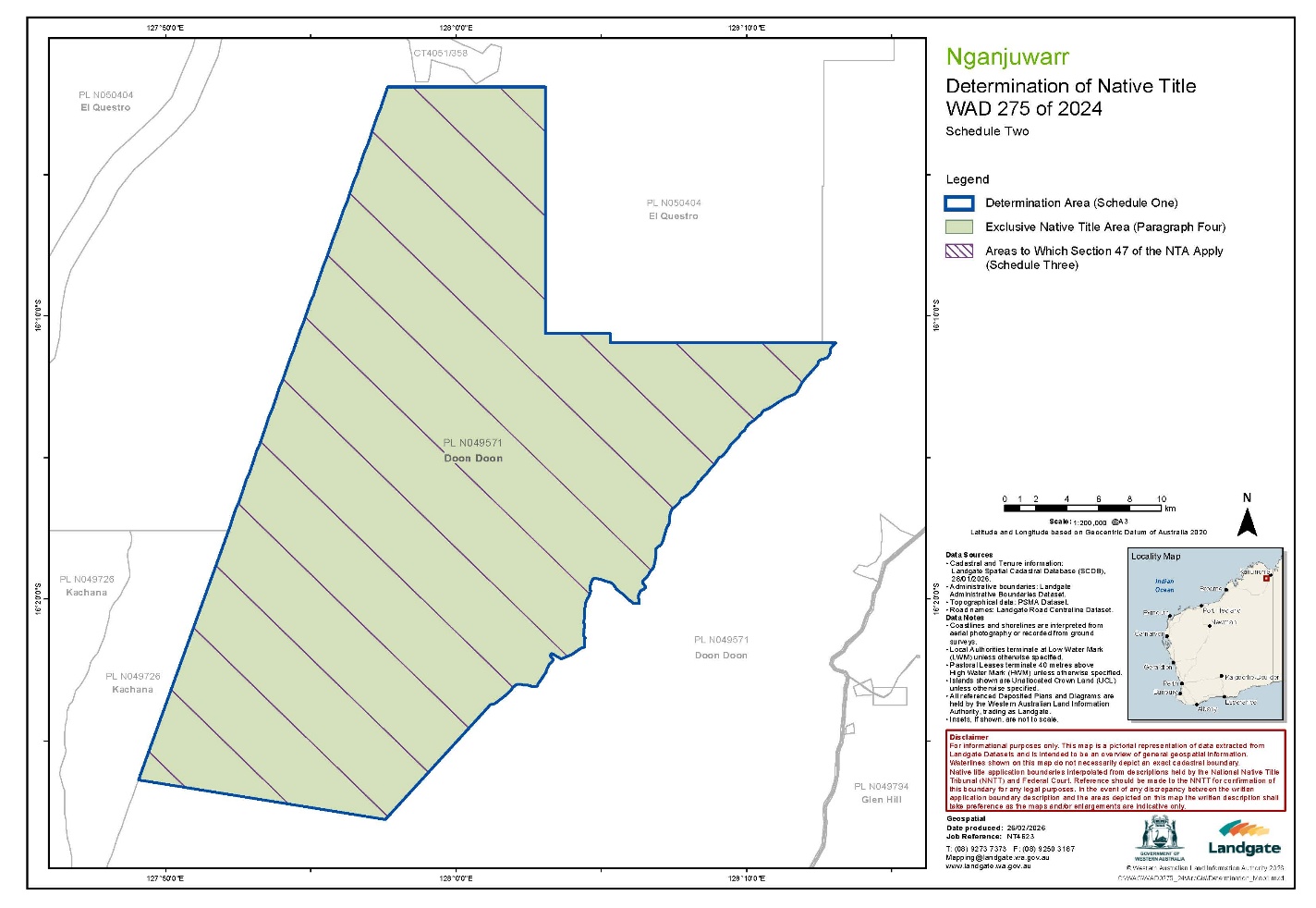
“Determination Area” means the land and waters described in Schedule 1 and depicted on the map in Schedule 2;
“Native Title Holders” means the people described in Schedule 5 and referred to in paragraph 2;
“Native Title Act” means the Native Title Act 1993 (Cth);
“Other Interests” means the legal or equitable estates or interests and other rights in relation to the Determination Area described in Schedule 4 and referred to in paragraph 6; and
“Titles Validation Act” means the Titles (Validation) and Native Title (Effect of Past Acts) Act 1995 (WA).
9. In the event of any inconsistency between the written description of an area in Schedule 1, 3 or 4 and the area depicted on the map in Schedule 2, the written description prevails.
SCHEDULE 1
DETERMINATION AREA
The Determination Area, generally shown as bordered in blue on the map in Schedule 2, comprises all land and waters bounded by the following description:
All those lands and waters commencing at Latitude 16.462936 South, Longitude 127.959469 East being a point on the present boundary of Native Title Determination WAD44/2019 Yurriyangem Taam (WCD2019/006) and extending northwesterly along the boundary of that native title determination to the intersection with a southeastern boundary of Native Title Determination WAD6016/1996, WAD6015/1999, WAD6006/2002 Wanjina – Wunggurr Wilinggin Native Title Determination No 1 (WCD2004/001) at Latitude 16.439444 South; Then northeasterly, easterly, southerly and generally easterly along the boundaries of that native title determination to a southeastern corner of Pastoral Lease N050404 (El Questro) at approximate Longitude 128.210341 East; Then east along the prolongation easterly of the southern boundary of that pastoral lease to the intersection with a northwestern boundary of Native Title Determination WAD44/2019 Yurriyangem Taam (WCD2019/006) at approximate Latitude 16.182525 South; Then generally southwesterly along the boundary of that native title determination back to the commencement point.
Note: Geographic Coordinates provided in Decimal Degrees.
Cadastral boundaries sourced from Landgate’s Spatial Cadastral Database dated 28th January 2026.
All referenced Deposited Plans and Diagrams are held by the Western Australian Land Information Authority, trading as Landgate.
For the avoidance of doubt the application excludes any land and waters already claimed by:
Native Title Determination WAD6016/1996, WAD6015/1999, WAD6006/2002 Wanjina – Wunggurr Wilinggin Native Title Determination No 1 (WCD2004/001) as determined in the Federal Court on the 27 August 2004.
Native Title Determination WAD44/2019 Yurriyangem Taam (WCD2019/006) as determined in the Federal Court on the 23 May 2019.
Datum: Geocentric Datum of Australia 2020 (GDA2020)
Prepared By: Geospatial (Landgate) 26th February 2026
Use of Coordinates:
Where coordinates are used within the description to represent cadastral or topographical boundaries or the intersection with such, they are intended as a guide only. As an outcome to the custodians of cadastral and topographic data continuously recalculating the geographic position of their data based on improved survey and data maintenance procedures, it is not possible to accurately define such a position other than by detailed ground survey.
SCHEDULE 2
MAP OF THE DETERMINATION AREA
SCHEDULE 3
AREAS WHERE EXTINGUISHMENT IS DISREGARDED (SECTION 47 OF THE NATIVE TITLE ACT)
Paragraph 5
1. Section 47
Section 47 of the Native Title Act applies to the whole of the Determination Area with the effect that any extinguishment over the following area is to be disregarded (which is shown in purple hatching on the map in Schedule 2):
| Description |
Portion of N049571 | Doon Doon Pastoral Lease |
SCHEDULE 4
OTHER INTERESTS
Paragraph 6
The nature and extent of the Other Interests in relation to the Determination Area are as follows.
Land tenure interests registered with the Western Australian Land Information Authority are current as at 28 January 2026. Mining tenements and petroleum interests registered with the Department of Mines, Petroleum and Exploration are current as at 24 February 2026. All other interests are current as at the date of the determination.
1. Pastoral Leases_______________________________________________________
(a) The following pastoral lease and the rights and interests of the holder from time to time of that pastoral lease:
Lease No. | Description |
Portion of N049571 | Doon Doon Pastoral Lease |
(b) Any rights and obligations of the pastoralists pursuant to the pastoral lease referred to in subclause (a) above to adopt and exercise best practice management of the pasture and vegetation resources, livestock and soils within the boundaries of the pastoral lease to manage stock and for the management, conservation and regeneration of pasture for permitted uses.
2. Mining Tenements_____________________________________________________
(a) The following mining tenements granted under the Mining Act 1904 (WA) (repealed) and / or the Mining Act 1978 (WA) and the rights and interests of the holders from time to time of those tenements:
(i) Exploration Licences:
Tenement ID |
E 80/2863-I |
E 80/3657-I |
E 80/5889 |
E 80/5939 |
(ii) Mining Leases:
Tenement ID |
M 80/267 |
M 80/268 |
M 80/269 |
(iii) Miscellaneous Licences:
Tenement ID |
L 80/43 |
L 80/124 |
3. Other_________________________________________________________
The following rights and interests in the Determination Area:
(a) Rights and interests, including licences and permits, granted by the Crown in right of the State or of the Commonwealth pursuant to statute or otherwise in the exercise of its executive power and any regulations made pursuant to such statutes;
(b) Rights and interests held by reason of the force and operation of the laws of the State or of the Commonwealth including the Rights in Water and Irrigation Act 1914 (WA);
(c) Rights and interests of members of the public arising under the common law, including but not limited to:
(i) the public right to fish;
(ii) the public right to navigate; and
(iii) the right of any person to use and enjoy any roads in the Determination Area (subject to the laws of the State) over which, as at the date of this determination, members of the public have a right of access under the common law;
(d) The right to access the Determination Area by:
(i) an employee, agent or instrumentality of the State;
(ii) an employee, agent or instrumentality of the Commonwealth; or
(iii) an employee, agent or instrumentality of any local government authority,
as required in the performance of his or her statutory or common law duty where such access would be permitted to private land;
(e) So far as confirmed pursuant to section 212(2) of the Native Title Act and section 14 of the Titles Validation Act as at the date of this determination, any existing public access to and enjoyment of:
(i) waterways;
(ii) beds and banks or foreshores of waterways;
(iii) stock routes; and
(iv) areas that were public places at the end of 31 December 1993.
SCHEDULE 5
NATIVE TITLE HOLDERS
Paragraph 2
The Native Title Holders are:
(a) Those Aboriginal people who:
(i) hold traditional rights and interests in one or more dambun/taam in the Determination Area through their descent from one or more of the people listed at clause (b), below; or
(ii) are recognised by the Native Title Holders under sub-clause (i), above, as having traditional rights and interests in the Determination Area under traditional law and custom.
(b) The people identified at sub-clause (a)(i), above, are:
(i) Yimurruying;
(ii) Left Hand Paddy Laburr/Ngaraman;
(iii) Malgunangga;
(iv) Jimmy Mug-Lagoon (Marlgu);
(v) Paddy Carroll;
(vi) Sambo (Jumbo) Jambomiyng;
(vii) Albert Juwardngo;
(viii) Julunguwyng;
(ix) Baberal Nancy Timms;
(x) Polly Munbi/Mudbi;
(xi) Nyurrginin (brother of Polly Munbi/Mudbi);
(xii) Domaganawul, the maternal grandmother of Brumby Bunggarayi (sister of Namadang); and
(xiii) Namadang (brother of Domaganawul).
Note: Entry of orders is dealt with in Rule 39.32 of the Federal Court Rules 2011.
REASONS FOR JUDGMENT
LONGBOTTOM J:
OVERVIEW
1 These reasons explain why, with the consent of the parties, the Court has today made a determination of native title over a 960 square kilometre area of land and waters comprising part of the Doon Doon Pastoral Lease (N049571) in the Kimberley region of Western Australia (determination area). The determination area is known to the native title holders as “Nganjuwarr” being the name of a Dreaming Snake that travels over the hills of the area.
2 The Nganjuwarr native title holders are those Aboriginal people who hold traditional rights and interests in one or more of the dambun (estates in Ngarinyin language) or taam (estates in Kija language) in the determination area, through their descent from one or more of the people listed at [2(a)] to [2(m)] below, or who are otherwise recognised by those native title holders as having traditional rights and interests in the determination area under traditional law and custom:
(a) Yimurruying;
(b) Left Hand Paddy Laburr/Ngaraman;
(c) Malgunangga;
(d) Jimmy Mug-Lagoon (Marlgu);
(e) Paddy Carroll;
(f) Sambo (Jumbo) Jambomiyng;
(g) Albert Juwardngo;
(h) Julunguwyng;
(i) Baberal Nancy Timms;
(j) Polly Munbi/Mudbi;
(k) Nyurrginin (brother of Polly Munbi/Mudbi);
(l) Domaganawul, the maternal grandmother of Brumby Bunggarayi (sister of Namadang); and
(m) Namadang (brother of Domaganawul).
3 The preamble to the Native Title Act 1993 (Cth) recognised the people, whose descendants include the Nganjuwarr native title holders, were the inhabitants of Australia before non-Indigenous settlement and that those people have been progressively dispossessed of their lands. Against that historical legacy, and following the decision of the High Court in Mabo v Queensland (No 2) [1992] HCA 23; (1992) 175 CLR 1, the Act established a special procedure for the just and proper ascertainment of native title rights and interests which, consistent with the objects stated in the preamble, is directed to ensuring that, if possible, this is done by conciliation.
4 This determination is the culmination of that special procedure insofar as it concerns the Nganjuwarr native title holders and the land and waters they claim. Importantly, it has been achieved by conciliation between the parties – the Applicant and the State of Western Australia – and in less than two years after the application for a determination of native title was filed on 27 September 2024.
5 A process of conciliation such as this involves cooperation by the parties in the administration of justice, careful attention by them and their advisers to the requirements of the Act relevant to the gathering of evidence, to establish the existence of native title as defined by s 223(1) of the Act. The Court recognises the efforts of the parties that have led to the determination now made and congratulates them on this outcome.
MATERIAL
6 The following material has been filed in support of the determination sought:
(a) an agreement under s 87 of the Act dated 17 March 2026, signed by the Applicant and the State, including proposed orders and a proposed determination of native title (proposed consent determination);
(b) a statement of agreed facts in support of the proposed consent determination, signed by the Applicant and the State, dated 17 March 2026;
(c) an affidavit of Benjamin James Dunphy, affirmed 17 March 2026. Mr Dunphy is a solicitor in the employ of Kimberley Land Council who, along with Madelene Wonders, has the day-to-day carriage of the proceeding on behalf of the Applicant and under the supervision of the solicitor on the record, Justine Toohey, Principal Lawyer at the Kimberley Land Council;
(d) the nomination of Giliwinggin Aboriginal Corporation (ICN 11846) to be the prescribed body corporate for the Nganjuwarr common law holders under s 56(2)(a)(i) of the Act, signed 19 November 2025;
(e) the written consent of the Giliwinggin Aboriginal Corporation under s 56(2)(a)(ii) of the Act to its nomination as prescribed body corporate for the Nganjuwarr common law holders, signed 17 March 2026; and
(f) a joint submission of the Applicant and the State in support of the proposed consent determination, signed 17 March 2026.
7 As noted above, the parties rely upon a statement of agreed facts. In considering whether to make a determination of native title by consent, the Court may accept such a statement where the parties to it include the Applicant and the party that the Court considers was the principal government respondent in relation to the proceeding at the time the agreement was reached: Act, s 87(10). Both criteria are met, the latter because that the State is the only government respondent to the proceeding.
8 Section 87(9) of the Act additionally requires that notice that the statement of agreed facts has been filed be given, within the prescribed period, to “the other parties to the proceeding”. However, s 87(9) is not engaged here because there are no “other parties to the proceeding” – only the Applicant and the State. I am persuaded that it is appropriate in the circumstances to accept the statement of agreed facts in support of the determination now sought by the parties: Act, s 87(11).
SECTION 87 OF THE ACT
9 Section 87 of the Act applies if, at the end of the period specified in the notice given under s 66 of the Act, the parties reach agreement in writing on the terms of an order of the Court in relation to the proceeding, and that agreement is signed by or on behalf of the parties to the proceeding and filed with the Court: Act, ss 87(1)(a)(i), 87(1)(aa)(i) and 87(1)(b). The Court must also be satisfied that an order in, or consistent with, those terms would be within its power: Act, s 87(1)(c).
10 When s 87 is engaged, the Court may make an order in, or consistent with, the terms of an order without holding a hearing, if it appears appropriate to do so: Act, s 87(1A) and s 87(2). Where, as here, the application involves the making of a determination of native title, the order needs to comply with s 94A of the Act, which deals with the requirements of a native title determination order: Act, s 87(2).
THE COURT HAS POWER TO MAKE THE DETERMINATION
11 I am satisfied that s 87 of the Act applies, and that the Court has power to make an order in, or consistent with, the proposed consent determination sought by the parties to the proceeding. That is because:
(a) The notification period for the native title determination application brought on behalf of the Nganjuwarr claim group (Nganjuwarr claimant application) under s 66 of the Act (being the notification of the details of the claimant application by the Native Title Registrar to prescribed persons and to the public) ended on 11 June 2025 (Act, s 87(1));
(b) After the end of the negotiation period, an agreement was reached on the terms of an order of the Court in relation to the proceeding (Act, s 87(1)(a)). All of the parties to the proceeding are parties to the agreement (Act, s 87(1)(aa)(i)). The terms of the agreement are in writing and signed by or on behalf of those parties and have been filed with the Court (Act, s 87(1)(b)); and
(c) An order in, or consistent with, the terms of the orders the parties have agreed to is within the power of the Court (Act, s 87(1)(c)). That is because: (i) the Nganjuwarr claimant application is made in relation to an area for which there is no determination of native title (Act, s 13(1)(a)); (ii) the Federal Court has jurisdiction under s 81 of the Act to hear and determine the Nganjuwarr claimant application; (iii) the proposed consent determination complies with s 94A of the Act because it sets out the details of the matters mentioned in s 225 of the Act; and (iv) the native title right and interest to be recognised in the proposed consent determination (being the right to exclusive possession of the determination area) is recognised by the common law of Australia (Act, s 223(1)(c); see also, Nelson v Northern Territory of Australia [2010] FCA 1343; (2010) 190 FCR 344 at [4] (Reeves J)).
IT IS APPROPRIATE TO MAKE THE DETERMINATION
12 I am also satisfied that it is appropriate to make the proposed consent determination annexed to the agreement, signed by the parties and filed with the Court: Act, s 87(1A). That is for the following reasons.
The agreement for the proposed consent determination has been entered into freely by the parties and on an informed basis
13 The focus of the Court, in its considering whether it is appropriate to make a determination of native title by consent under s 87(1A), is on the making of the agreement. In particular, whether the agreement was entered into freely by the parties and on an informed basis: Lovett on behalf of the Gunditjmara People v State of Victoria [2007] FCA 474 at [36]-[37] (North J); see also, Nelson at [10].
14 Of particular relevance is the role taken by the State in the proceeding. The State appears in native title determination applications in the capacity of parens patriae to look after the interests of the community as a whole: Munn for and on behalf of the Gunggari People v State of Queensland [2001] FCA 1229; (2001) 115 FCR 109 at [29] (Emmett J). The State must satisfy itself that there exists a credible basis for the native title rights and interests claimed by the application. But equally, it is incumbent on the State to recognise that the Act contemplates a more flexible process – one which does not intend to substitute a trial, in effect, conducted by the State, for a trial before the Court: Lovett at [38]. I am satisfied that balance has been struck here.
15 In reaching agreement on the terms of the proposed consent determination, the State has reviewed anthropological material and judgments of this Court (along with transcripts of the hearings to which those judgments relate) in respect of native title claims and determinations surrounding the area covered by the Nganjuwarr claimant application. It appears from the joint submissions that material includes: an anthropological report prepared by Dr Anthony Redmond, dated 5 February 2025; the decision, Neowarra v State of Western Australia [2004] FCA 1092, which concerned the Wanjina-Wunggurr Wilinggin native title determination application (WCD2004/001) immediately to the north-east of the determination area, and transcripts of evidence from the trial of that proceeding; and the decision, Purdie on behalf of the Yurriyangem Taam Native Title Claim Group v State of Western Australia [2019] FCA 696, which concerned the Yurriyangem Taam native title determination application (WCD2019/006) immediately to the south of the determination area. The State has also conducted searches of land tenure, mining and petroleum registries to determine the nature and extent of the “other interests” within the area covered by the Nganjuwarr claimant application: Act, s 225(c).
16 Both the Applicant and the State are legally represented in the proceeding and have been since the claimant application was filed in the Federal Court. Each have played an active role in good faith negotiations regarding the terms of the proposed consent determination. Given those matters, and the steps taken by the State to satisfy itself that the Nganjuwarr claimant application has a credible basis, I find that the agreement containing the proposed consent determination was entered into by the Applicant and the State freely and on an informed basis: cf, Lovett at [36]-[37] and Nelson at [10].
Section 223 of the Act
17 Section 223(1) of the Act defines native title as:
(1) … the communal, group or individual rights and interests of Aboriginal peoples or Torres Strait Islanders in relation to land or waters, where:
(a) the rights and interests are possessed under the traditional laws acknowledged, and the traditional customs observed, by the Aboriginal peoples or Torres Strait Islanders; and
(b) the Aboriginal peoples or Torres Strait Islanders, by those laws and customs, have a connection with the land or waters; and
(c) the rights and interests are recognised by the common law of Australia.
18 There are two distinct inquiries under s 223(1)(a) and s 223(1)(b) of the Act: one relating to rights and interests in relation to land and waters, the other to connection with that land and those waters: Bodney v Bennell [2008] FCAFC 63; (2008) 167 FCR 84 at [165] (Finn, Sundberg and Mansfield JJ). Each must be sourced in the traditional laws acknowledged, and the traditional customs observed, by the Aboriginal peoples concerned – being laws or customs having a normative content and deriving, therefore, from a body of norms or normative system that existed before sovereignty: Members of the Yorta Yorta Aboriginal Community v Victoria [2002] HCA 58; (2002) 214 CLR 422 at [38] (Gleeson CJ, Gummow and Hayne JJ). All elements of the definition of native title, as contained in s 223 of the Act, must be given effect: Yorta Yorta at [33].
19 The following findings are based on the agreed facts contained in the statement of agreed facts.
Sovereignty
20 The date of sovereignty in Western Australia is 2 May 1829. Notwithstanding, it may be inferred that the circumstances which existed at, or around the time of, non-Indigenous settlement of the determination area (which is commonly referred to as the date of “effective sovereignty”) is likely to be reflective of the circumstances which existed at, and shortly prior to, sovereignty: Ashwin on behalf of the Wutha People v State of Western Australia (No 4) [2019] FCA 308; (2019) 369 ALR 1 at [276] (Bromberg J), citing Sampi on behalf of the Bardi and Jawi People v State of Western Australia [2010] FCAFC 26; (2010) 266 ALR 537 at [64] (North and Mansfield JJ).
21 Within the determination area, the date of effective sovereignty ranged between the mid-1880s and 1910. At the time of effective sovereignty, the land and waters of the determination area were occupied and used by First Nations Peoples, which occupation and use has continued to the present day.
Language identity
22 The Kija and Ngarinyin languages are associated with the determination area. The identities arising from those languages do not give rise to bounded independent units associated with a particular territory or with distinct traditional laws and customs. Members of the Nganjuwarr native title land-holding group are, however, linked across language labelled groupings through shared interacting networks. These include knowledge of shared mythological tracks and the Wurnan (trading network).
Society
23 The Nganjuwarr native title holders are members of a regional society which is united in, and by, its “acknowledgment and observance of a body of law and customs”: cf, Yorta Yorta at [49]. That regional normative system has had a continuous existence and vitality since sovereignty: cf, Yorta Yorta at [47].
Traditional laws and customs
24 Under the laws and customs of the regional society, the Nganjuwarr native title holders acquire rights and interests in the determination area through membership of land-holding groups or “clans”. The members of a land-holding group share attachment to a tract of dambun or taam.
25 Membership of a dambun or taam is primarily established through one or two-step filiation (including adoption) via a parent or grandparent’s landed association with one or more of the estates. Members of the various dambun or taam may also acquire and hold rights and interests in neighbouring estates by means other than filiation. These other means include having a conception site in that dambun or taam or having a close Wurnan relationship to an estate group.
26 There are four dambun or taam within the determination area:
(a) Gunjarlngarri;
(b) Wanggilwarrawarra;
(c) Jimparla; and
(d) Jiminjirl.
27 Membership of a dambun or taam strongly influences the acquisition of ritual knowledge relevant to not only that particular tract of country, but also to the determination area more broadly. Members of the Gunjarlngarri, Wanggilwarrawarra, Jimparla and Jiminjirl dambun or taam share a sense of responsibility to one another and country, including the determination area.
28 The Nganjuwarr native title holders also possess cosmological beliefs, expressed through Dreaming stories, the focal figure of which is the wunggurr or galaru – the Rainbow Serpent. The Rainbow Serpent is believed to have shaped the world and all within it, including human beings and their social institutions. Another important Dreaming story for the determination area is the Nganjuwarr Dreaming Snake, to which I have referred above.
29 The responsibilities owed by members of the dambun or taam include obligations to maintain and protect significant cultural sites within the determination area, particularly those which hold cultural or cosmological significance. The Nganjuwarr native title holders perform those obligations by, amongst other matters, requiring outsiders to seek their permission before using or accessing the determination area.
30 The laws and customs described above, which the Nganjuwarr native title holders acknowledge and observe today, were passed on to them by their ancestors. Those laws and customs have been acknowledged and observed by successive generations of those ancestors, substantially uninterrupted, since sovereignty. They are “rooted” in the pre-sovereignty normative system: cf, Wyman on behalf of the Bidjara People v State of Queensland [2015] FCAFC 108; (2015) 235 FCR 464 at [175] (North, Barker and White JJ); see also, Yorta Yorta at [79], [82]-[84] and [86]. They are, therefore, properly characterised as “traditional laws and customs”: Act, s 223(1).
Continuity, connection and native title rights and interests
31 Under the traditional laws and customs they acknowledge and observe, the Nganjuwarr native title holders have the right to possession, occupation, use and enjoyment of the determination area to the exclusion of all others: cf, Act, s 223(1)(a) and s 225(b); see also, Griffiths v Northern Territory of Australia [2007] FCAFC 178; (2007) 165 FCR 391 at [127] (French, Branson and Sundberg JJ).
32 The activities undertaken by the Nganjuwarr native title holders on the land and in the waters of the determination area in the exercise of their rights include: hunting, fishing and foraging; camping and dwelling; trading resources; burning country to promote new growth and increase game animals and plants; performing ceremonies and educating younger generations in cultural and practical knowledge with respect to the determination area.
33 By such actions, and the acknowledgment of traditional laws and customs described above, the Nganjuwarr native title holders have asserted, and do assert, the reality of their connection to the land and waters of the determination area so made by their laws and customs: Act, s 223(1)(b); see also, Bodney at [171] (Finn, Sundberg and Mansfield JJ); and Western Australia v Ward [2002] HCA 28; (2002) 213 CLR 1 at [64] (Gleeson CJ, Gaudron, Gummow and Hayne JJ).
PRESCRIBED BODY CORPORATE
34 Section 56(1) of the Act requires the Court to determine whether native title is to be held on trust, and if so, by whom. The Applicant has nominated the Giliwinggin Aboriginal Corporation to hold, as trustee, the rights and interests from time to time comprising the native title in trust for the common law holders: Act, s 56(3). The circumstances regarding the nomination of Giliwinggin Aboriginal Corporation, including its written consent, are set out in the affidavit of Mr Dunphy, to which I have referred: Act, s 56(2)(a)(i) and (ii). Having regard to that evidence, I am satisfied that the nomination of the Giliwinggin Aboriginal Corporation as prescribed body corporate to perform the functions specified in s 57(1) of the Act is appropriate.
CONCLUSION
35 For all of the above reasons, there will be a determination in the terms of the proposed consent determination. The Orders made declare that the Nganjuwarr native title holders were, and are, the traditional owners of the determination area. It is to be emphasised, however, that the Court does not today grant the native title holders that status: King v Northern Territory of Australia [2011] FCA 582 at [6] (Mansfield J). Rather, by these Orders, the Australian community collectively recognises that status, by declaring that the Nganjuwarr native title holders are, and since sovereignty have been, the traditional owners of the determination area: King at [6].
I certify that the preceding thirty-five (35) numbered paragraphs are a true copy of the Reasons for Judgment of the Honourable Justice Longbottom. |
Associate:
Dated: 22 July 2026


