

Federal Court of Australia
Dimer on behalf of the Marlinyu Ghoorlie Claim Group v State of Western Australia (No 7) [2026] FCA 893
File number(s): | WAD 647 of 2017 WAD 46 of 2026 WAD 60 of 2026 |
Judgment of: | O'BRYAN J |
Date of judgment: | 10 July 2026 |
Catchwords: | NATIVE TITLE – where the Court has answered separate questions concerning the existence, ownership and content of native title rights and interests in claim area following lengthy trial – where following judgment by the Court, two new native title determination applications filed claiming native title rights and interests in an area that overlaps the claim area – where new claims are inconsistent with findings previously made by the Court – whether new applications should be dismissed as an abuse of process PRACTICE AND PROCEDURE – where the Court has answered separate questions concerning the existence, ownership and content of native title rights and interests in claim area following lengthy trial – where following judgment by the Court, an application is filed by non-parties seeking to be joined to the proceeding to assert native title rights and interests in an area that overlaps the claim area – where new claims are inconsistent with findings previously made by the Court – whether joinder application should be dismissed as an abuse of process PRACTICE AND PROCEDURE – where the Court has answered separate questions concerning the existence, ownership and content of native title rights and interests in claim area following lengthy trial – where following judgment by the Court, an application is filed by a respondent seeking orders for the Court to conduct a review of the authorisation of the native title claim – whether review application should be dismissed as an abuse of process PRACTICE AND PROCEDURE – where the Court has answered separate questions concerning the existence, ownership and content of native title rights and interests in claim area following lengthy trial – application to remove respondent parties who do not have native title rights and interests in the claim area as found by the Court |
Legislation: | Federal Court of Australia Act 1976 (Cth) Native Title Act 1993 (Cth) Federal Court Rules 2011 (Cth) Noongar (Koorah, Nitja, Boordahwan) (Past, Present, Future) Recognition Act 2016 (WA) |
Cases cited: | Bailey v Marinoff (1971) 125 CLR 529 Bennell v Western Australia (2006) 153 FCR 120 Bennell v State of Western Australia [2021] FCA 1508 Briggs on behalf of the Boonwurrung People v State of Victoria (No 2) [2025] FCA 279 CG v Western Australia (2016) 240 FCR 466 Champion on behalf of the Marlinyu Ghoorlie Claim Group v State of Western Australia (No 2) [2022] FCA 65 Cheedy v Western Australia (No 2) (2011) 199 FCR 23 Colgate-Palmolive Co v Cussons Pty Ltd (1993) 46 FCR 225 Commonwealth v Clifton (2007) 164 FCR 355 Dimer on behalf of the Marlinyu Ghoorlie Claim Group v State of Western Australia (No 6) [2025] FCA 1641 Dimer on behalf of the Marlinyu Ghoorlie Claim Group v State of Western Australia [2023] FCA 930 Drury on behalf of the Nanda People v State of Western Australia (2020) 276 FCR 203 Evans on behalf of the Yarla-Gu Bunna Nangatjara People v State of Western Australia [2021] FCA 1382 Foots v Southern Cross Mine Management Pty Ltd (2007) 234 CLR 52 Forrest on behalf of Nangaanya-ku Native Title Claim Group (Part B) v State of Western Australia (No 3) [2026] FCA 367 Graham on behalf of the Ngadju People v State of Western Australia [2012] FCA 1455 Hamod v New South Wales [2002] FCAFC 97; 188 ALR 659 Kokatha Native Title Claim v State of South Australia [2006] FCA 838 Lawson on behalf of the Badimaya Barna Guda People v State of Western Australia [2020] FCA 104 Melbourne City Investments Pty Ltd v Treasury Wine Estates Ltd (No 2) [2017] FCAFC 116 Northern Territory v Sangare (2019) 265 CLR 164 Ogawa v University of Melbourne (No 2) [2004] FCA 1275 Oshlack v Richmond River Council (1998) 193 CLR 72 Pekar v Holden (No 2) [2021] FCA 343 Reid v South Australia [2007] FCA 1479 Smirke on behalf of the Jurruru People v State of Western Australia (No 3) [2021] FCA 1122 Stock (on behalf of the Nyiyaparli People) v Western Australia (No 4) [2018] FCA 1370 Tomlinson v Ramsey Food Processing Pty Limited (2015) 256 CLR 507 UBS AG v Tyne (2018) 265 CLR 77 Walton v Gardiner (1993) 177 CLR 378 Wu v Avin Operations Pty Ltd (No 2) [2006] FCA 792 |
Division: | General Division |
Registry: | Western Australia |
National Practice Area: | Native Title |
Number of paragraphs: | 142 |
Date of last submission/s: | 22 June 2026 |
Date of hearing: | 19 June 2026 |
WAD 647 of 2017 | |
Counsel for the Marlinyu Ghoorlie Applicant | M Pudovskis |
Solicitor for the Marlinyu Ghoorlie Applicant | Blackshield Lawyers and Houston Legal & Consultants |
Counsel for the State of Western Australia | C Taggart and P J W Ramsay |
Solicitor for the State of Western Australia | State Solicitor’s Office |
Counsel for Desarae Bennell | Ms Bennell is self-represented |
Counsel for Rosanne Dimer | Ms Dimer is self-represented |
Counsel for Sharon Dimer | Ms Dimer is self-represented |
Counsel for Reginald Yarran and Glenys Yarran | Mr Yarran and Mrs Yarran are self-represented |
WAD 46 of 2026 | |
Counsel for Desarae Bennell | Ms Bennell is self-represented |
Counsel for the State of Western Australia | C Taggart and P J W Ramsay |
Solicitor for the State of Western Australia | State Solicitor’s Office |
Counsel for the Prospective Marlinyu Ghoorlie Respondents | M Pudovskis |
Solicitor for the Prospective Marlinyu Ghoorlie Respondents | Blackshield Lawyers |
WAD 60 of 2026 | |
Counsel for Rosanne Dimer | Ms Dimer is self-represented |
Counsel for the State of Western Australia | C Taggart and P J W Ramsay |
Solicitor for the State of Western Australia | State Solicitor’s Office |
Counsel for the Prospective Marlinyu Ghoorlie Respondents | M Pudovskis |
Solicitor for the Prospective Marlinyu Ghoorlie Respondents | Blackshield Lawyers |
ORDERS
WAD 647 of 2017 | ||
| ||
BETWEEN: | HENRY DIMER (and others named in the Schedule of Parties) Applicant | |
AND: | STATE OF WESTERN AUSTRALIA (and others named in the Schedule of Parties) Respondents | |
order made by: | O'BRYAN J |
DATE OF ORDER: | 10 JULY 2026 |
THE COURT NOTES THAT:
A. The respondents Peter (John) Dimer and James Murphy are deceased.
THE COURT ORDERS THAT:
1. Leave is given to Desarae Bennell to discontinue her interlocutory application dated 15 January 2026 seeking a stay of the determination of native title in part of the claim area, and the application will be taken to have been discontinued.
2. The interlocutory application dated 30 April 2026 filed by Glenys Yarran and Reginald Yarran, seeking leave to rely on an affidavit of Glenys Yarran and Reginald Yarran dated 30 April 2026, be allowed.
3. Glenys Yarran and Reginald Yarran be refused leave to file the interlocutory application dated 18 June 2026.
4. The interlocutory application dated 3 February 2026 filed by Glenys Yarran and Reginald Yarran seeking to be joined as respondents to the proceeding (Joinder Application) be dismissed.
5. Glenys Yarran and Reginald Yarran pay the Applicant’s costs of and incidental to the Joinder Application, including the costs of responding to the interlocutory applications referred to in paragraphs 2 and 3 of these orders.
6. The interlocutory application dated 16 January 2026 filed by Rosanne Dimer seeking orders for the review of the authorisation of the native title determination application the subject of this proceeding (Authorisation Review Application) be dismissed.
7. Rosanne Dimer pay the Applicant’s costs of and incidental to the Authorisation Review Application.
8. Pursuant to s 84(8) of the Native Title Act 1993 (Cth), each of Sharon Dimer and Rosanne Dimer cease to be a party to the proceeding.
Note: Entry of orders is dealt with in Rule 39.32 of the Federal Court Rules 2011.
ORDERS
WAD 46 of 2026 | ||
| ||
BETWEEN: | DESARAE BENNELL ON BEHALF OF THE PINDIINI PEOPLE Applicant | |
AND: | STATE OF WESTERN AUSTRALIA (and others named in the Schedule of Parties) Respondents | |
order made by: | O'BRYAN J |
DATE OF ORDER: | 10 JULY 2026 |
THE COURT ORDERS THAT:
1. Henry Richard Dimer, Maxine Dimer, James Champion, Darren Indich, Simon Champion, Tania Champion, Darryl Trott and Leechelle Hammat be joined as parties to the proceeding as the Second to Ninth Respondents.
2. The proceeding be dismissed.
3. The Applicant pay the Second to Ninth Respondents’ costs of and incidental to their interlocutory application dated 13 March 2026 seeking the dismissal of the proceeding.
Note: Entry of orders is dealt with in Rule 39.32 of the Federal Court Rules 2011.
ORDERS
WAD 60 of 2026 | ||
| ||
BETWEEN: | ROSANNE DIMER ON BEHALF OF THE KALLARDOO/KALAAKO/KARLAKU PEOPLE Applicant | |
AND: | STATE OF WESTERN AUSTRALIA (and others named in the Schedule of Parties) Respondents | |
order made by: | O'BRYAN J |
DATE OF ORDER: | 10 JULY 2026 |
THE COURT ORDERS THAT:
1. Henry Richard Dimer, Maxine Dimer, James Champion, Darren Indich, Simon Champion, Tania Champion, Darryl Trott and Leechelle Hammat be joined as parties to the proceeding as the Second to Ninth Respondents.
2. The proceeding be dismissed.
3. The Applicant pay the Second to Ninth Respondents’ costs of and incidental to their interlocutory application dated 13 March 2026 seeking the dismissal of the proceeding.
Note: Entry of orders is dealt with in Rule 39.32 of the Federal Court Rules 2011.
REASONS FOR JUDGMENT
O’Bryan J:
Introduction
1 On 19 December 2025, the Court delivered judgment answering separate questions in two overlapping native title determination applications made under s 61 of the Native Title Act 1993 (Cth) (NTA): Dimer on behalf of the Marlinyu Ghoorlie Claim Group v State of Western Australia (No 6) [2025] FCA 1641 (Dimer No 6).
2 The first of the applications was filed on 22 December 2017 and given the proceeding number WAD 647 of 2017. It is known as the Marlinyu Ghoorlie claim. The Marlinyu Ghoorlie applicant claims native title rights and interests in the claim area on behalf of the Karlamaya Kapurn people. The land and waters the subject of the Marlinyu Ghoorlie claim comprise an area in the Western Goldfields region of Western Australia that is approximately 89,797 square kilometres in size. The claim area is depicted in the map attached as an annexure to these reasons.
3 The second of the applications was filed on 18 February 2022 and given the proceeding number WAD 38 of 2022. It is known as the Karratjibbin claim. The Karratjibbin applicant claimed native title rights and interests in the Karratjibbin claim area on behalf of the Karratjibbin people. The Karratjibbin claim area overlapped the western half of the Marlinyu Ghoorlie claim area. One of the authorised applicants for the Karratjibbin claim was Reginald Yarran (who is referred to as Reginald Yarran Jnr to distinguish him from his deceased father who has the same name), and both Reginald Yarran Jnr and his mother, Glenys Yarran, gave evidence at trial in support of the Karratjibbin claim.
4 A joint trial of the Marlinyu Ghoorlie claim and the Karratjibbin claim was conducted in respect of the area covered by the Marlinyu Ghoorlie claim (trial area) and in respect of separate questions which can be stated as follows:
(a) But for any question of extinguishment of native title, does native title exist in relation to any and, if so what, land and waters of the trial area?
(b) In relation to that part of the trial area where the answer to (a) above is in the affirmative:
(i) Who are the persons, or each group of persons, holding the common or group rights comprising the native title?
(ii) What is the nature and extent of the native title rights and interests?
(separate questions). Those questions reflect the statutory requirements in s 225(1)(a) and (b) of the NTA.
5 Three respondents, or groups of respondents, participated in the trial of the separate questions: the State of Western Australia (State); members of the Cooper family (comprising Gary Cooper, Maria Bandry, Norman Cooper Jnr and Victor Cooper (Cooper respondents)); and Elizabeth Sambo. The Cooper respondents became respondents to the Marlinyu Ghoorlie claim to defensively assert native title rights and interests in the eastern portion of the trial area, which encompasses Bullabulling, Coolgardie, Kalgoorlie and Kanowna. The Cooper respondents contended at trial that, in the eastern portion of the trial area, Western Desert law and custom applies and has applied since the assertion of British sovereignty. Initially, Elizabeth Sambo opposed certain aspects of the Marlinyu Ghoorlie claim. However, at the conclusion of the trial, Ms Sambo supported the Marlinyu Ghoorlie claim.
6 The trial occurred in a number of phases between February 2023 and March 2024 inclusive. In the period 20-23 February 2023, preservation evidence was given in Kalgoorlie. In the period 2-19 October 2023, further lay evidence was given in Kalgoorlie and at locations throughout the trial area. Objections to expert evidence were heard by remote video conference on 5 and 7 December 2023. In the period 11-15 December 2023, expert evidence was given in Perth. In the period 18-20 March 2024, closing submissions were heard in Perth.
7 Judgment in respect of the separate questions was given on 19 December 2025. Relevantly, the following conclusions were expressed in that judgment:
(a) First, the Aboriginal society in occupation of the trial area at the time of effective sovereignty was a society composed of the Kapurn people, who spoke the Karlamaya language, which was also referred to as Karlaku. The traditional country of the Karlamaya Kapurn people at effective sovereignty was likely to cover the trial area (Dimer No 6 at [1763] and [1764]).
(b) Second, Western Desert laws and customs did not apply in the trial area at sovereignty, and did not confer rights and interests in land and waters in the trial area at sovereignty (Dimer No 6 at [1744]).
(c) Third, in closing submissions at the joint trial, the Karratjibbin applicant conceded that it had been unable to establish that, at sovereignty, the Karratjibbin people constituted a distinct society in their own right. The Karratjibbin applicant advanced a new contention that the Karratjibbin people constitute a subsidiary group within a broader normative system which includes persons who variously identify as Kapurn, Karlamaya or Karlaku (Dimer No 6 at [863]). However, the Karratjibbin applicant was unable to establish that any of their forebears were Karlamaya Kapurn people who held rights and interests in any part of the trial area (Dimer No 6 at [1973]).
(d) Fourth, the Cooper respondents were unable to establish that their named forebear, Nada Bilbear, held rights and interests in the eastern part of the trial area under traditional laws and customs (Dimer No 6 at [2008]).
8 As a result, the judgment in Dimer No 6 determined that the Karratjibbin people did not hold native title rights and interests in the trial area and orders were made dismissing the Karratjibbin claim in so far as it concerned the trial area. The judgment also determined that the Cooper respondents had failed to establish that they hold native title rights and interests in any part of the trial area and orders were made removing the Cooper respondents as parties to the proceeding.
9 Orders were made on 19 December 2025 stating the answers to the separate questions. Those answers were as follows:
(a) But for any question of extinguishment, native title exists in relation to the whole of the land and waters of the claim area.
(b) The native title is held by the Marlinyu Ghoorlie claim group which comprises those Aboriginal people who:
(i) are descended from one or more of four apical ancestors, being Nellie Champion, Kaddee, Warada and Lucy Sambo, including by adoption in accordance with the traditional laws and customs of the rights-holding group;
(ii) identify themselves as Karlamaya, Kapurn and/or Karlaku (including alternate spellings of those names) or any combination of those names; and
(iii) are recognised by the other members of the rights-holding group as members of that group in accordance with the traditional laws and customs of the group.
(c) The nature and extent of the native title rights and interests held by the Marlinyu Ghoorlie claim group is appropriately described (at this stage of the proceedings) as the right to possession, occupation, use and enjoyment of the land and waters of the claim area being:
(i) the right to live, being to enter and remain, camp and erect temporary shelters and other temporary structures for that purpose and to travel over and visit any part of the claim area;
(ii) the right to hunt, fish, gather and use the traditional resources of the claim area;
(iii) the right to take and use water on the claim area; and (iv) the right to engage in cultural activities and the transmission of cultural knowledge on the claim area, including:
(A) visiting places of cultural or spiritual importance and protecting those places by carrying out lawful activities to preserve their physical or spiritual integrity; and
(B) conducting burials, ceremony and ritual.
10 The Marlinyu Ghoorlie proceeding has been referred to a Judicial Registrar of the Court for mediation of the residual issues for determination, being the issues arising under ss 225(c), (d) and (e) of the NTA. The Marlinyu Ghoorlie applicant and the State have informed the Court that they expect to resolve the remaining issues by agreement, after which the Court will be able to make a determination of native title in the proceeding based upon the findings made in Dimer No 6 and the agreement of the parties. On 3 February 2026, the Marlinyu Ghoorlie applicant filed an interlocutory application seeking an order pursuant to s 84(8) of the NTA that Sharon Dimer, Peter (John) Dimer, James Murphy and Rosanne Dimer cease to be respondents to the proceeding on the basis that the judgment in Dimer No 6 determines that they do not have rights and interests in the claim area. It has since become known that Peter (John) Dimer and James Murphy are deceased and therefore they are no longer respondents.
11 Following the delivery of judgment in Dimer No 6, several interlocutory applications have been filed in the Marlinyu Ghoorlie proceeding by persons claiming to hold native title rights and interests in parts of the trial area. Specifically, interlocutory applications have been filed by:
(a) Glenys Yarran and Reginald Yarran Jnr, claiming native title rights and interests in the western part of the trial area as Ballardong people;
(b) Desarae “Winna” Bennell, claiming native title rights and interests in the eastern part of the trial area as a Pindiini person; and
(c) Rosanne Dimer, claiming native title rights and interests in the eastern part of the trial area as a Kallardoo person.
12 In addition, two new native title determination applications have been filed in respect of the eastern part of the trial area. Those applications are:
(a) an application dated 29 January 2026 filed by Ms Bennell on behalf of the Pindiini people, being proceeding number WAD 46 of 2026 (Pindiini claim); and
(b) an application dated 3 March 2026 filed by Rosanne Dimer on behalf of the “Kallardoo (also recorded as Kalaako or Karlaku) Bindi/Bindy descendants”, being proceeding number WAD 60 of 2026 (Kallardoo-Bindi claim).
13 The map attached as an annexure to these reasons depicts the Marlinyu Ghoorlie claim area (the trial area) and the overlapping Pindiini claim area and the Kallardoo-Bindi claim area. The map also depicts the residual area of the Karratjibbin claim area that does not overlap the Marlinyu Ghoorlie claim area following the dismissal of that part of the claim that overlapped the trial area.
14 The Yarrans, Ms Bennell and Ms Dimer are not legally represented.
15 Each of the Yarrans, Ms Bennell and Ms Dimer have requested the Court to conduct a further trial of their respective claims to hold native title rights and interests within the Marlinyu Ghoorlie claim area, notwithstanding that a trial has already been conducted, at great expense to the parties to the Marlinyu Ghoorlie proceeding, to answer the questions whether native title exists in relation to any part of the trial area and, if so, who holds the native title, and notwithstanding that the Court has made final orders answering those questions.
16 A foundational principle of the NTA is that there must be a single judicial determination of native title in relation to a particular area. That does not mean that the Court is unable to recognise native title held by more than one claim group in a particular area. Distinct groups of Aboriginal peoples or Torres Strait Islanders may each possess native title rights and interests in the same area: Drury on behalf of the Nanda People v State of Western Australia (2020) 276 FCR 203 (Drury) at [30] and [36]-[37] (Mortimer and Colvin JJ). It means, however, that the Court will determine claims for native title in relation to a particular area in the one proceeding as a single judicial determination by the Court.
17 This foundational principle is reflected in ss 61A and 68 of the NTA. Section 61A(1) stipulates that a native title determination application must not be made in relation to an area for which there is an approved determination of native title. Section 68 similarly provides:
68 Only one determination of native title per area
If there is an approved determination of native title (the first determination) in relation to a particular area, the Federal Court must not:
(a) conduct any proceeding relating to an application for another determination of native title; or
(b) make any other determination of native title;
in relation to that area or to an area wholly within that area, except in the case of:
(c) an application as mentioned in subsection 13(1) to revoke or vary the first determination; or
(d) a review or appeal of the first determination.
18 The NTA establishes a number of procedural safeguards for the making and determination of native title determination applications under Pt 3 of the NTA to ensure there is fully informed decision-making and finality in respect of native title determinations relating to the same area of land and waters: Kokatha Native Title Claim v State of South Australia [2006] FCA 838 at [5] (Finn J). Those procedural safeguards include requirements for the notification of an application in accordance with s 66, to ensure that the application will come to the attention of all persons who may have an interest in the area that is the subject of the application. Persons who claim to have an interest are entitled to apply under s 84 to become a respondent to the application to protect their interests. Such persons are also entitled to make a competing native title determination application in respect of the same area. In those circumstances, s 67 requires that the competing claims be determined in the same proceeding. Section 67 provides as follows:
67 Overlapping native title determination applications
(1) If 2 or more proceedings before the Federal Court relate to native title determination applications that cover (in whole or in part) the same area, the Court must make such order as it considers appropriate to ensure that, to the extent that the applications cover the same area, they are dealt with in the same proceeding.
Splitting of application area
(2) Without limiting subsection (1), the order of the Court may provide that different parts of the area covered by an application are to be dealt with in separate proceedings.
19 Section 67 requires that native title applications that cover the same area are to be dealt with in the one proceeding: Commonwealth v Clifton (2007) 164 FCR 355 at [46] and [58]. As observed by the Full Court in CG v Western Australia (2016) 240 FCR 466 at [25]:
The purpose of s 68 — that there may be only one determination of native title in relation to any area of land — is facilitated by s 67. By s 67, if there are two or more native title determination applications that cover the same area the Court must ensure that, to that extent, the applications “are dealt with in the same proceeding”.
20 By reason of the foundational principle described above, the Court is unable to make a final determination of the Marlinyu Ghoorlie application while the applications made by each of the Yarrans, Ms Bennell and Ms Dimer remain on foot. The effect of those applications is to require a second trial of the separate questions within the Marlinyu Ghoorlie claim area, in order to determine the claims made by the Yarrans, Ms Bennell and Ms Dimer.
21 It is unfortunate that native title proceedings are frequently burdened by applications that are an abuse of process because they seek to re-litigate issues that have been resolved by the Court on a final basis. Commonly, the issues in dispute on a native title determination application are the issues arising under paras (a) and (b) of s 225 of the NTA: whether native title exists in the claim area and, if it exists, who are the persons holding the rights and interests comprising the native title and what is the nature and extent of those rights and interests. The issues arising under paras (c), (d) and (e) are usually less controversial and are commonly able to be resolved by agreement between the parties. It is for that reason that orders are often made under r 30.01 of the Federal Court Rules 2011 (Cth) (FCR) for the determination of the issues arising under paras (a) and (b) of s 225 as separate questions. Following the determination of the separate questions, and assuming the questions are answered in the affirmative, the native title application can usually be finalised by agreement as a consent determination. Although the answers to the separate questions constitute an interlocutory judgment, as the answers do not finally determine the rights of the parties, the resolution of the separate questions is nevertheless a final determination made by the Court of those questions. The usual course adopted by the Court following the determination of separate questions (particularly in the context of native title proceedings) is to make orders giving the answers to the questions: see for example Bennell v Western Australia (2006) 153 FCR 120; Graham on behalf of the Ngadju People v State of Western Australia [2012] FCA 1455; and Briggs on behalf of the Boonwurrung People v State of Victoria (No 2) [2025] FCA 279. As Mortimer J (as her Honour then was) observed in Smirke on behalf of the Jurruru People v State of Western Australia (No 3) [2021] FCA 1122 at [88], the parties are bound by the determination of issues as separate questions unless those answers are overturned on appeal. The importance of the finality of litigation is a long-standing principle. As stated by Gibbs J in Bailey v Marinoff (1971) 125 CLR 529 at 539, it is well-settled that once an order of a court is entered or otherwise perfected, the court has no jurisdiction to alter it and “it would be mischievous if there were jurisdiction to rehear a matter decided after a full hearing”.
22 An application or a proceeding will be an abuse of the processes of the Court if it occasions unjustifiable oppression to a litigant or would bring the administration of justice into disrepute: Tomlinson v Ramsey Food Processing Pty Limited (2015) 256 CLR 507 at [25] (French CJ, Bell, Gageler and Keane JJ); UBS AG v Tyne (2018) 265 CLR 77 at [1] (Kiefel CJ, Bell and Keane JJ) and [62], [72] (Gageler J). An application or proceeding will be unjustifiably oppressive to a litigant if it seeks to re-litigate an issue that has already been determined in favour of the litigant in an earlier proceeding, notwithstanding the absence of an estoppel: Walton v Gardiner (1993) 177 CLR 378 at 393 (Mason CJ, Deane and Dawson JJ). The Court has determined on many occasions that unreasonable delay in bringing a native title claim (or applying to be joined to a native title claim) is capable of constituting an abuse of process: see for example Stock (on behalf of the Nyiyaparli People) v Western Australia (No 4) [2018] FCA 1370 at [45]; Lawson on behalf of the Badimaya Barna Guda People v State of Western Australia [2020] FCA 104 at [133]; Evans on behalf of the Yarla-Gu Bunna Nangatjara People v State of Western Australia [2021] FCA 1382 at [67]; and Forrest on behalf of Nangaanya-ku Native Title Claim Group (Part B) v State of Western Australia (No 3) [2026] FCA 367 at [25]. Even more so, it is an abuse of process to seek to re-litigate an issue that has already been determined on a final basis by a judgment of the Court following a trial.
23 For the reasons elaborated below, it would occasion unjustifiable oppression to the Marlinyu Ghoorlie applicant, and would bring the administration of justice into disrepute, if the Court were to conduct a second trial answering questions that have already been answered by final orders made by the Court following a lengthy trial. It would also be contrary to the public interest in the timely and efficient administration of justice. For those reasons, the interlocutory applications and native tile determination applications that have been brought by each of the Yarrans, Ms Bennell and Ms Dimer are an abuse of process.
24 The Court acknowledges that the Yarrans, Ms Bennell and Ms Dimer are not legally represented and, as such, cannot be expected to have knowledge of legal rules and principles. Nevertheless, the request to conduct a further trial of the separate questions is such an affront to concepts of fairness and justice that they ought to be aware that their applications are unreasonable. This has implications for the question of costs, which is considered below.
Additional background facts concerning the Marlinyu Ghoorlie and Karratjibbin proceedings
25 As stated earlier, the Marlinyu Ghoorlie native title determination application was filed on 22 December 2017 and was amended on 21 June 2023. As required by ss 63 and 66 of the NTA, the claim was entered on the Register of Native Title Claims on 28 March 2019 and was notified by the Native Title Registrar with a notification date of 14 August 2019.
26 The public notification period for the purposes of ss 66(8) and 66(10) of the NTA ran from 14 August 2019 to 13 November 2019, to give persons and organisations who may hold an interest in the claim area an opportunity to become involved in the proceedings. As a result of that process, many people who claimed to have an interest in the claim area became respondents to the proceeding pursuant to s 84 of the NTA. At the date of this judgment, there are 40 respondents to the proceeding excluding the State of Western Australia and the Commonwealth comprising indigenous persons, local governments, pastoralists and companies with mining or telecommunications interests.
27 Relevantly, on 3 September 2019, Rosanne Dimer and Sharon Dimer (together with Peter Dimer and James Murphy) filed a Form 5 notifying the Court that they claimed to have interests in the claim area, and thereby became respondents to the proceeding pursuant to ss 84(3) of the NTA. As stated earlier, Peter Dimer and James Murphy are now deceased. The Form 5 stated that part of the trial area is the traditional country of the Kalaako people, who include the siblings and descendants of Rollick and Colin Dimer, and that the Kalaako people continue to have traditional rights within the trial area.
28 Desarae Bennell has never sought to become a respondent to the Marlinyu Ghoorlie proceeding.
29 The Karratjibbin native title application was filed on 18 February 2022 and was subsequently amended on 2 September 2022. As at the date of the amended application, the named applicants were Jason Colbung, Reginald Yarran Jnr, Norman Pickett, Murray Yarran and Nancy Henry. The Karratjibbin claim area overlapped the western half of the Marlinyu Ghoorlie claim area. As a consequence, s 67 of the NTA required that the two claims be heard together in so far as they overlapped.
30 The Karratjibbin claim was made on behalf of the Karratjibbin people, who were initially identified as the descendants (biological or by adoption) of Karratjibbin traditional owners and apical ancestors Polly, Billy Yambinut, Eva, Nimmo and Toby. At the time of trial of the Marlinyu Ghoorlie and Karratjibbin claims, the Karratjibbin applicant redefined the Karratjibbin claim group as the descendants (biological or by adoption) of apical ancestors Billy Yambinut and Toby. At the conclusion of the trial, the Karratjibbin applicant conceded that they had not adduced any positive evidence establishing that Toby was an apical ancestor for the purposes of the claim. Accordingly, the Karratjibbin applicant proceeded on the basis that the members of the Karratjibbin claim group are the descendants (biological or by adoption) of Billy Yambinut. The Karratjibbin claim group was entirely separate from the Marlinyu Ghoorlie claim group (there were no common apical ancestors). It is also relevant to note that the Karratjibbin claim group was entirely separate from the Ballardong people, who are discussed further below.
31 On 5 October 2022, the Court made an order pursuant to r 30.01 of the FCR in each of the Marlinyu Ghoorlie and Karratjibbin proceedings that separate questions concerning the existence, possession and content of native title rights and interests in the Marlinyu Ghoorlie claim area (referred to as the trial area) be listed for hearing and determination in a joint trial in both proceedings, separately from any issues of extinguishment of native title.
32 On 22 December 2022, timetabling orders for the joint trial of the separate questions were made in the Marlinyu Ghoorlie and Karratjibbin proceedings. Relevantly, the orders provided for the filing of notices by each respondent other than the State indicating whether the respondent wished to take an active part in the joint trial of the separate questions. Neither Rosanne Dimer nor Sharon Dimer filed such a notice.
33 As stated earlier, the joint trial of the separate questions was conducted in a number of phases between February 2023 and March 2024 inclusive. In addition to the Marlinyu Ghoorlie applicant, the Karratjibbin applicant (which included Reginald Yarran Jnr) and the State, two indigenous respondent parties took an active part in the joint trial (the Cooper respondents and Elizabeth Sambo). Twenty-seven lay witnesses and five expert witnesses gave evidence during the joint trial, including Reginald Yarran Jnr and Glenys Yarran. None of Rosanne Dimer, Sharon Dimer or Desarae Bennell participated or sought to participate in the joint trial of the separate questions.
Joinder applications brought by Reginald Yarran Jnr and Glenys Yarran
Applications, evidence and submissions
34 On 12 February 2026, Reginald Yarran Jnr and Glenys Yarran filed an interlocutory application dated 3 February 2026 seeking to be joined as respondents to the Marlinyu Ghoorlie proceeding pursuant to s 84(5) of the NTA (joinder application).
35 Section 84(5) provides as follows:
The Federal Court may at any time join any person as a party to the proceedings, if the Court is satisfied that the person’s interests may be affected by a determination in the proceedings and it is in the interests of justice to do so.
36 It can be seen that, under s 84(5), the Court’s discretion to join a person as a party to a native title proceeding is enlivened if the Court is satisfied of two matters: first, that the person’s interests may be affected by a determination in the proceedings; and second, that it is in the interests of justice to do so. The applicable principles concerning joinder under s 84(5) of the NTA have been stated in a number of judgments in the Marlinyu Ghoorlie proceeding, including Dimer on behalf of the Marlinyu Ghoorlie Claim Group v State of Western Australia [2023] FCA 930 at [35]-[41]. I will apply those principles to the present application.
37 The joinder application made the following claims as the grounds for the Yarrans to be joined as respondents:
(a) Glenys Yarran and Reginald Yarran Jnr are Ballardong people with direct cultural connection and culture rights to Ballardong country, genealogical rights, and native title rights and interests in the area affected by the proceeding.
(b) Reginald Yarran Jnr is a signatory to the Ballardong Indigenous Land Use Agreement (ILUA) executed in 2015.
(c) The Marlinyu Ghoorlie claim area was extended into Ballardong country without lawful authority, without consultation with the Ballardong common law native title holders, and contrary to the Ballardong ILUA boundary.
(d) A determination in favour of the Marlinyu Ghoorlie applicant would directly affect the cultural rights and interests of the Ballardong common law native title holders, including Glenys Yarran and Reginald Yarran Jnr.
38 The interlocutory application also made claims that the relevant representative body, Native Title Services Goldfields (NTSG), extended the Marlinyu Ghoorlie claim area beyond the Goldfields region and into Ballardong country. The claim is non-sensical, as the NTSG has never had any power to extend the Marlinyu Ghoorlie claim area. For that reason, it will not be considered further.
39 The interlocutory application was supported by an affidavit of Glenys Yarran dated 3 February 2026 and an affidavit of Reginald Yarran Jnr dated 11 February 2026. The contents of the affidavits are identical. Many aspects of the affidavits are unclear. However, it is apparent that the Yarrans purport to give evidence that:
(a) the Ballardong native title claim (proceeding number WAD 6181 of 1998) covered part of the Marlinyu Ghoorlie claim area;
(b) the Ballardong ILUA “demonstrates formal recognition of Ballardong traditional ownership over … areas now claimed by the Marlinyu Ghoorlie group”; and
(c) the ILUA reflects the true extent of Ballardong traditional ownership and should be considered in any proceedings involving overlapping claims.
40 The affidavits of the Yarrans also contained a statement that: “Mr Simon Blackshield worked as a lawyer for the South West Aboriginal Land and Sea Council since 2005”. Mr Blackshield is a solicitor who has represented the Marlinyu Ghoorlie applicant since the commencement of its claim in 2017. The relevance of the statement referring to Mr Blackshield was not apparent from the affidavits of the Yarrans. Nevertheless, to avoid any perception of a conflict of interest in representing the Marlinyu Ghoorlie applicant on the Yarrans’ joinder application, Mr Blackshield arranged for separate solicitors, Houston Legal & Consultants, to represent the Marlinyu Ghoorlie applicant on the joinder application.
41 On 24 February 2026, the Court made orders for the filing of submissions by the Yarrans in support of their interlocutory application, for the filing of evidence and submissions by any party that opposed the joinder application, and for the filing of any submissions in reply.
42 Each of the Marlinyu Ghoorlie applicant (represented by Houston Legal & Consultants) and the State filed submissions opposing the joinder application. Both submitted that:
(a) First, the Court has determined on a final basis that native title rights and interests in the Marlinyu Ghoorlie claim area are held by the Marlinyu Ghoorlie claim group (being the Karlamaya Kapurn people), and that determination stands as a complete answer to the Yarrans’ claim to hold rights and interests in the claim area as Ballardong people.
(b) Second, the Yarrans’ claim to hold rights and interests in the claim area as Ballardong people is based on an incorrect factual premise that the Ballardong ILUA extends over the claim area.
(c) Third, it is contrary to the interests of justice for the Yarrans to be joined to the proceeding for the purpose of seeking to re-litigate the question of who possesses native title rights and interests in circumstances where that question has been determined by the Court following a lengthy trial.
43 The State also filed an affidavit of Sheila Begg, a solicitor with the State Solicitor’s Office, dated 19 March 2026. Ms Begg deposed that, on 10 March 2026, she requested an overlap analysis of any existing registered ILUA with the Marlinyu Ghoorlie claim area from the Geospatial Services team at the National Native Title Tribunal (NNTT). Ms Begg exhibited a copy of the analysis to her affidavit. The analysis confirmed that the Ballardong ILUA does not overlap the Marlinyu Ghoorlie claim area.
44 On 24 March 2026, the Yarrans filed a submission in reply to the submissions filed by the Marlinyu Ghoorlie applicant and the State. The submissions largely repeated the assertions made in the joinder application and the affidavits made by the Yarrans. The submissions also made irrelevant submissions concerning the inclusion of Lucy Sambo as an apical ancestor in the Marlinyu Ghoorlie claim, a matter that was fully explained in Dimer No 6 at [1816]-[1851].
45 On 30 April 2026, the Yarrans filed a further interlocutory application seeking leave to rely upon a further affidavit made jointly by Reginald Yarran Jnr and Glenys Yarran on 30 April 2026. The further affidavit exhibits a number of documents relating to the Ballardong native title claim and subsequent Ballardong ILUA, seemingly in support of a contention that either the Ballardong claim remains on foot and covers part of the Marlinyu Ghoorlie claim area, or that the Ballardong ILUA covers part of the Marlinyu Ghoorlie claim area. The affidavit also appears to suggest that there is some impropriety in the fact that, prior to representing the Marlinyu Ghoorlie applicant, Mr Blackshield was employed by the South West Aboriginal Land and Sea Council (SWALSC), which acted as the legal representative of the Ballardong applicant.
46 On 5 May 2026, the Yarrans filed a further submission which contains a number of vague and unfounded criticisms of the Marlinyu Ghoorlie claim. It is unnecessary to reproduce the criticisms. The Yarrans also reiterated their “concern” that Mr Blackshield’s “prior involvement in the Ballardong boundary amendments” gave rise to a conflict of interest in subsequently representing the Marlinyu Ghoorlie applicant.
47 The joinder application was listed for hearing in Perth on 19 June 2026. On the day before the hearing, the Yarrans sought to file yet another interlocutory application and yet another affidavit made jointly by the Yarrans and dated 18 June 2026. Given the proximity to the hearing, those documents were not accepted for filing. At the hearing on 19 June 2026, Reginald Yarran Jnr, who spoke on behalf of himself and Glenys Yarran, pressed the application and provided a copy to the Court. I reserved my decision with respect to the receipt of the application, including whether to seek further submissions from the Marlinyu Ghoorlie applicant and the State in response.
48 By the further application, the Yarrans seek leave to serve a notice to admit facts on the “Champion Applicants” (which appears to be a reference to the Marlinyu Ghoorlie applicant), requiring the facts to be answered in 14 days and any denials to be supported by evidence. A copy of the proposed notice to admit was exhibited to the further affidavit of the Yarrans dated 18 June 2026. The notice contained several assertions concerning the ancestry of Jack and Ted Champion, including purported DNA results from “Ancestry”. The application also seeks an order granting the Yarrans liberty to apply on three days’ notice for the following further orders:
(a) leave to file affidavits from witnesses concerning DNA match evidence;
(b) leave to issue subpoenas for genealogical or DNA records; and
(c) orders requiring Brian Champion Snr to undergo DNA testing, if the fact remains in dispute.
49 Having considered the further application and affidavit, it is unnecessary to seek any further submissions with respect to their receipt by the Court. I refuse to allow them to be filed for two reasons. First, it is unfair to the Marlinyu Ghoorlie applicant to allow them to be filed. The joinder application was originally filed on 3 February 2026, and orders were made on 23 April 2026 listing the application for hearing on 19 June 2026. The Yarrans have had ample opportunity to file evidence and submissions in support of their joinder application and, as noted above, filed a further affidavit on 30 April 2026 and further submissions on 5 May 2026. The orders sought by the application would further delay the hearing of the joinder application. Second, the matters sought to be agitated by the further application and affidavit are irrelevant to the joinder application. The matters sought to be agitated involve a collateral attack on the judgment made in Dimer No 6. The Yarrans have no standing to make such an attack (as they are not a party to the proceeding), even if it were otherwise permissible to entertain such an attack (which it is not). The issues to be determined on the joinder application concern the questions whether the Yarrans have established a basis for their claim to hold an interest in the Marlinyu Ghoorlie claim area and, even if they have, whether it is in the interests of justice to join them as respondents at this stage of the proceeding. The matters sought to be agitated by the further application and affidavit do not bear upon those questions.
50 At the hearing of the joinder application in Perth on 19 June 2026, the parties read the affidavits referred to above (other than the further affidavit of the Yarrans dated 18 June 2026) and relied on the written submissions referred to above. The parties also made relatively brief oral submissions in the same terms as reflected in the written submissions.
Consideration
51 The Yarrans’ joinder application is refused for two independent reasons.
52 First, the factual foundation asserted by the Yarrans for the joinder application is incorrect. Contrary to the submissions of the Yarrans, the registered area of the Ballardong ILUA does not overlap the Marlinyu Ghoorlie claim area and the Ballardong native title determination claim was dismissed as part of the South West Native Title Settlement. At the time of dismissal, the Ballardong native title determination claim also did not overlap the Marlinyu Ghoorlie claim area. The history of the Ballardong claim was the subject of findings in previous decisions in this proceeding, and can also be traced from the Court file in the Ballardong proceeding and the evidence adduced on the joinder application.
53 A summary of the Ballardong native title claim and its resolution as part of the South West Native Title Settlement was given in Dimer No 6 at [25]:
The Ballardong claim covered an area to the south-west of the trial area but, in its original form, included a large part of the Karratjibbin claim area (and, therefore, that part of the Marlinyu Ghoorlie claim area that was overlapped by the Karratjibbin claim), including, for example, Mount Jackson, Southern Cross, Marvel Loch, Westonia and Kalannie. The Ballardong claim was amended in 2008 to withdraw the boundary of the claim area to what is now the south-west boundary of the trial area. The Ballardong claim was subsequently resolved as part of the South West Native Title Settlement. By that settlement, the constituent groups of the Noongar nation (including the Ballardong people) resolved their respective native title claims in the south-west of Western Australia in exchange for a package of benefits. The settlement is constituted by six indigenous land use agreements (ILUAs) and was given legislative recognition in the Noongar (Koorah, Nitja, Boordahwan) (Past, Present, Future) Recognition Act 2016 (WA): see Dimer on behalf of the Marlinyu Ghoorlie Claim Group v State of Western Australia [2023] FCA 930 (Dimer (No 1)) at [51]. The Ballardong ILUA was entered into in 2016. One of the representatives of the Ballardong people who signed the ILUA was Reg Yarran Jnr.
54 As there stated, the boundaries of the Ballardong native title claim as originally filed in 1998 included part of the Marlinyu Ghoorlie claim area, including, for example, Mount Jackson, Southern Cross, Marvel Loch, Westonia and Kalannie. However, on 21 February 2008, the Court made orders by consent of the parties granting leave to the Ballardong applicant to amend the native title claim in the form of an annexure to an affidavit of Mr Blackshield affirmed on 20 February 2008. At that time, Mr Blackshield was the principal legal officer for the SWALSC which, as noted above, acted as the legal representative of the Ballardong applicant. The Ballardong applicant filed its amended application on 21 February 2008. The amended application was accepted for registration on 3 July 2008. At the time that the amendment was made, Reginald Yarran Jnr was one of the named Ballardong applicants. The effect of the amendment to the Ballardong claim was, amongst other things, to exclude from the application all areas of land and water which fall to the north-east and east of the external boundary of the “Single Noongar Claim” in proceeding number WAD 6006 of 2003.
55 The Ballardong claim was subsequently resolved as part of the South West Native Title Settlement. By that settlement, the constituent groups of the Noongar nation (including the Ballardong people) resolved their respective native title claims in the south-west of Western Australia in exchange for a package of benefits. The settlement is constituted by six ILUAs entered into by the State (and Ministers and government authorities) with the constituent groups of the Noongar nation (including the Ballardong people).
56 The Ballardong ILUA was entered into in or around mid-2015 and was registered on 17 October 2018. One of the representatives of the Ballardong people who signed the ILUA was Reginald Yarran Jnr. The recitals to that ILUA record that, in exchange for a range of payments and other benefits provided under the ILUA (including the passage of the Noongar (Koorah, Nitja, Boordahwan) (Past, Present, Future) Recognition Act 2016 (WA)), the Noongar people (including the Ballardong people) agreed to surrender their native title rights and interests, and to the validation of all acts, in the settlement area. The settlement area in respect of the Ballardong people was all of the land and waters within the Ballardong claim area.
57 As noted earlier, the evidence given by Ms Begg confirms that the settlement area of the Ballardong ILUA (which was the same as the Ballardong claim area) does not overlap the Marlinyu Ghoorlie claim area.
58 In accordance with the agreement reached as part of the South West Native Title Settlement, the State and each of the Noongar native title claimants, including the Ballardong people, applied to the Court for a determination that native title does not exist in the areas to which their respective native title claims (and their corresponding ILUAs) related. On 1 December 2021, the Court made that determination: see Bennell v State of Western Australia [2021] FCA 1508. That determination also applied to the Ballardong native title claim and brought that claim to an end.
59 The end result is that, from February 2008, the Ballardong native title claim did not apply to any land or waters that are the subject of the Marlinyu Ghoorlie claim (which was filed in 2017), and the Ballardong claim was extinguished by the consent determination made in 2021. Further, the Ballardong ILUA does not apply to any land or waters that are the subject of the Marlinyu Ghoorlie claim.
60 As a named applicant on the Ballardong claim from 2007, and as a signatory to the Ballardong ILUA, Reginald Yarran Jnr must have been aware of the foregoing matters at all times.
61 It should be added that the Yarrans’ suggestion that Mr Blackshield had a conflict of interest in representing the Marlinyu Ghoorlie applicant from 2017 is entirely baseless. As already explained, the Ballardong claim area was amended in 2008, nearly 10 years prior to the Marlinyu Ghoorlie claim being filed. When it was filed, the Marlinyu Ghoorlie claim area did not overlap the Ballardong claim. Accordingly, no conflict could arise in Mr Blackshield representing the Marlinyu Ghoorlie applicant.
62 It follows that the basis upon which the Yarrans asserted that they have an interest in the Marlinyu Ghoorlie claim area is factually incorrect.
63 Even if the Yarrans were now to claim that Ballardong people have rights and interests in the Marlinyu Ghoorlie claim area (a claim for which no evidence has been adduced), it is not in the interests of justice to permit the Yarrans to bring such a claim at this stage of the Marlinyu Ghoorlie proceeding. To do so would be an abuse of process for the reasons discussed earlier, as it would cause unjustifiable oppression to the Marlinyu Ghoorlie applicant and bring the administration of justice into disrepute. This is the second reason for refusing the Yarrans’ joinder application.
64 I consider that the Yarrans’ joinder application is an extraordinary application having regard to the history of both the Ballardong claim and the Marlinyu Ghoorlie claim. The Ballardong claim was voluntarily amended by the Ballardong applicant, which included Reginald Yarran Jnr, in 2008. The Ballardong people have never claimed rights and interests in the Marlinyu Ghoorlie claim area since that time, until the Yarrans filed this joinder application. Further, Reginald Yarran Jnr was a named applicant in the Karratjibbin native title claim, which asserted that the traditional owners of the western part of the Marlinyu Ghoorlie claim area were a distinct group of people known as the Karratjibbin people. That claim is inconsistent with the claim now advanced by the Yarrans that the traditional owners of the western part of the Marlinyu Ghoorlie claim area are the Ballardong people. During the joint trial of the Karratjibbin and Marlinyu Ghoorlie claims, Reginald Yarran Jnr, who was the principal witness on behalf of the Karratjibbin claim group, gave sworn testimony in support of his belief that the western part of the Marlinyu Ghoorlie claim area was the country of the Karratjibbin people. The evidence cannot be reconciled with the claim now made, through the joinder application, that the traditional owners of the country are the Ballardong people.
65 For the reasons given above, the Yarrans’ joinder application is refused, and the application will be dismissed. It remains necessary to consider the question of costs.
Costs of the joinder application
66 The Marlinyu Ghoorlie applicant applied for its costs of responding to the joinder application on an indemnity basis under s 85A(2) of the NTA. The Marlinyu Ghoorlie applicant acknowledged that an award of costs in a native title proceeding was unusual and that any award of indemnity costs is exceptional. However, the Marlinyu Ghoorlie applicant submitted that an award of indemnity costs against the joinder applicants was justified in circumstances where:
(a) the joinder application was misconceived and untenable; and
(b) it can be inferred that the joinder application was not made in good faith, having regard to the fact that the Yarrans actively participated in the joint trial of the separate questions claiming that the western part of the Marlinyu Ghoorlie claim area was Karratjibbin country, and never previously having claimed that it was Ballardong country.
67 The Marlinyu Ghoorlie applicant submitted that the joinder application had unreasonably put them to unnecessary cost in responding to the application.
68 Section 43 of the Federal Court of Australia Act 1976 (Cth) (FCA Act) gives the Court a broad discretion in awarding costs. The discretion must be exercised judicially, by reference only to considerations relevant to its exercise and upon facts connected with or leading up to the litigation: Northern Territory v Sangare (2019) 265 CLR 164 (Sangare) at [24]. While not a rigid rule, usually the discretion to award costs is exercised in favour of a successful party: Oshlack v Richmond River Council (1998) 193 CLR 72 (Oshlack) at [35] (Gaudron and Gummow JJ), [66]-[67] (McHugh J) and [134] (Kirby J); Foots v Southern Cross Mine Management Pty Ltd (2007) 234 CLR 52 at [25] (Gleeson CJ, Gummow, Hayne and Crennan JJ); Sangare at [25]. The basis for this “usual order as to costs” is not to penalise a losing party, but to compensate a successful party against the costs incurred by reason of the legal proceeding: Oshlack at [67] (McHugh J). The Court also has express powers under s 43(3) of the FCA Act to order that costs be paid in a specified sum or on an indemnity basis and to order a party’s lawyer to bear the costs personally.
69 In respect of proceedings to which it applies, s 85A of the NTA affects the usual approach to the award of costs in this Court. Section 85A provides as follows:
(1) Unless the Federal Court orders otherwise, each party to a proceeding must bear his or her own costs.
Unreasonable conduct
(2) Without limiting the Court’s power to make orders under subsection (1), if the Federal Court is satisfied that a party to a proceeding has, by any unreasonable act or omission, caused another party to incur costs in connection with the institution or conduct of the proceeding, the Court may order the first‑mentioned party to pay some or all of those costs.
70 In Cheedy v Western Australia (No 2) (2011) 199 FCR 23, the Full Court explained the relationship between s 43 of the FCA Act and s 85A of the NTA in the following terms (at [9]):
It is now well established that in proceedings to which s 85A applies:
(1) s 85A(1) removes the expectation that costs will follow the event, but the Court retains its discretion as to costs under s 43 of the FCA Act;
(2) the “unreasonable conduct” of the parties is not a jurisdictional fact which pre-conditions the exercise of the discretion, and on the other hand, s 85A(2) does not control or limit the discretion in s 85A(1);
(3) whilst the exercise of the discretion when making a costs order should be judicial, the starting point is that each party will bear its own costs; and
(4) it is not proper to use the power to award costs to punish either a successful or an unsuccessful party or as a deterrent to other would-be applicants: Reid v South Australia [2007] FCA 1479 at [54].
71 I am satisfied that the joinder application brought by the Yarrans was misconceived and untenable. It was based on a factually incorrect premise, that the Ballardong claim and/or Ballardong ILUA covered the Marlinyu Ghoorlie area, which the Yarrans must have known was incorrect having regard to their close personal involvement in both the Ballardong claim and the Ballardong ILUA. I am fortified in that view by the fact that both Reginald Yarran Jnr and Glenys Yarran gave evidence at the joint trial of the separate questions and neither of them claimed that any part of the Marlinyu Ghoorlie claim area was Ballardong country. As a result, their conduct in bringing the joinder application was unreasonable, and has caused the Marlinyu Ghoorlie applicant to incur unnecessary expense. In my view, the present circumstances justify an order of costs in favour of the Marlinyu Ghoorlie applicant.
72 The Marlinyu Ghoorlie applicant seeks indemnity costs. The Court’s discretion to award costs in a proceeding includes awarding costs on an indemnity basis: Colgate-Palmolive Co v Cussons Pty Ltd (1993) 46 FCR 225 (Colgate-Palmolive) at 228. Accepted bases for the award of indemnity costs include: the making of allegations of fraud knowing them to be false and the making of irrelevant allegations of fraud; the fact that the proceedings were commenced or continued for some ulterior motive or in wilful disregard of known facts or clearly established law; and the making of allegations which ought never to have been made or the undue prolongation of a case by groundless contentions: Colgate-Palmolive at 233. The purpose of an indemnity costs order is to compensate a party in full for their costs when the Court takes the view that it was unreasonable for the party against whom the order was made to have caused the other party to incur costs: Hamod v New South Wales [2002] FCAFC 97; 188 ALR 659 at [20] (Gray J, Carr and Goldberg JJ agreeing); Melbourne City Investments Pty Ltd v Treasury Wine Estates Ltd (No 2) [2017] FCAFC 116 at [3]-[5] (Jagot, Yates and Murphy JJ).
73 In general, courts are more reluctant to make orders for indemnity costs against litigants in person than against legally represented litigants; nevertheless, an order for indemnity costs will be made in an appropriate case: Ogawa v University of Melbourne (No 2) [2004] FCA 1275 (Ogawa) at [42] (Kenny J); Wu v Avin Operations Pty Ltd (No 2) [2006] FCA 792 at [45] (Kenny J); Pekar v Holden (No 2) [2021] FCA 343 at [5]-[6] (Snaden J). As observed by Kenny J in Ogawa at [48], unreasonable persistence in applications that are devoid of merit that prolong a proceeding and unnecessarily increase costs might place a litigant in person in the position where an order for indemnity costs is made against them.
74 The considerations in the present matter are finely balanced. As already stated, the Yarrans’ joinder application is without any merit and was made in disregard of known facts, suggesting that it was brought in bad faith. On the other hand, the Yarrans are not legally represented and the usual approach to the award of costs in native title proceedings is affected by s 85A of the NTA. Weighing all of the circumstances, I consider that costs should be awarded in favour of the Marlinyu Ghoorlie applicant on the usual party/party basis.
Application brought by Desarae Bennell and the Pindiini claim
Applications, evidence and submissions
75 On 16 January 2026, Ms Bennell filed an interlocutory application in the Marlinyu Ghoorlie proceeding, purportedly on behalf of the Pindiini people, seeking a “temporary protective order” in respect of an area of land and waters within the Marlinyu Ghoorlie claim area. The area was intended to be identified in an annexure to the application, but no annexure was included with the application. The application sought orders restraining the final determination of native title in respect of that area to enable the Court to consider all relevant interests in relation to the area. By the application, Ms Bennell also sought leave to file and serve evidence in the Marlinyu Ghoorlie proceeding regarding “other interests” in the area for the purposes of ss 225(c)-(e) of the NTA. I will refer to that application as the stay application.
76 In support of the stay application, Ms Bennell filed an affidavit made by herself on 16 January 2026. The affidavit made clear that Ms Bennell was seeking orders from the Court to stay the final determination of native title in an eastern portion of the Marlinyu Ghoorlie claim area to provide a Pindiini claim group with an opportunity to adduce evidence in the proceeding to assert native title rights and interests in the area. In her affidavit, Ms Bennell deposed that the Pindiini people fully recognise and respect the native title rights of the Marlinyu Ghoorlie claim group, as determined by the Court in Dimer No 6, and they do not challenge or seek to re-open any findings made in the Marlinyu Ghoorlie determination. However, the affidavit also disclosed that Ms Bennell was intending to bring a native title determination application on behalf of a Pindiini claim group and had been in correspondence with the NNTT for that purpose.
77 Ms Bennell’s affidavit also disclosed that, in September 2023, lawyers acting for Ms Bennell or another representative of a Pindiini claim group corresponded with the lawyers for the Marlinyu Ghoorlie applicant. It can be inferred from the correspondence that the Pindiini claim group claimed to be descendants of a man named Tommy Oongar Permit and claimed that Tommy Oongar Permit held rights and interests in the Marlinyu Ghoorlie claim area. The lawyers for the Marlinyu Ghoorlie applicant wrote to the lawyers acting for the Pindiini claim group stating that research undertaken by the applicant’s anthropological team seeking to identify all persons who may have held rights in the Marlinyu Ghoorlie claim area at effective sovereignty did not identify a person named Tommy Oongar Permit and that senior claimant Brian Champion Snr did not recall ever having heard of Tommy Oongar Permit. The lawyers for the Marlinyu Ghoorlie applicant also stated that the Marlinyu Ghoorlie proceeding was listed for trial commencing 2 October 2023.
78 On 29 January 2026, Ms Bennell lodged a native title determination application on behalf of a Pindiini claim group in respect of the area referred to in Ms Bennell’s affidavit dated 16 January 2026 (being an area that wholly overlaps an eastern portion of the Marlinyu Ghoorlie claim area). The application was accepted for filing on 12 February 2026. Ms Bennell is the sole named applicant. The Pindiini claim group is described in the application as the descendants of Minina, who is described as a Pindiini/Wongai man who upheld and transmitted the traditional laws and customs of the Pindiini People and held traditional rights and responsibilities in relation to the claim area. The application states that the Pindiini claim group is governed by, and continues to observe, the traditional laws and customs of the “Pindiini / Wongai People, as part of the Western Desert Cultural Bloc”. The Pindiini claim has not been certified by a native title representative body and is not supported by a report prepared by an expert anthropologist.
79 In accordance with timetabling orders made by the Court, the Marlinyu Ghoorlie applicant and the State filed submissions and evidence opposing Ms Bennell’s stay application. The State relied on an affidavit of Sheila Begg dated 20 February 2026 and the Marlinyu Ghoorlie applicant relied on an affidavit of Simon Blackshield also dated 20 February 2026. The submissions noted that Ms Bennell was not a party to the Marlinyu Ghoorlie proceeding and had not applied to become a party. They submitted that, as a consequence, Ms Bennell had no standing to bring the stay application. They further submitted that, as Ms Bennell had by that time filed the Pindiini claim, the stay application was moot because s 67 of the NTA required that the Pindiini claim, as a claim that overlapped the Marlinyu Ghoorlie claim area, be dealt with in the same proceeding as the Marlinyu Ghoorlie claim.
80 On 6 March 2026, Ms Bennell filed a further submission and affidavit made by herself in support of the stay application. The affidavit confirmed that the stay application was made in support of, and on the basis of, the Pindiini claim.
81 I accept the submissions of the State and the Marlinyu Ghoorlie applicant that, following the filing of the Pindiini claim, the stay application has no utility. Section 67 of the NTA requires the Court to resolve the Pindiini claim as part of the Marlinyu Ghoorlie proceeding because it wholly overlaps an eastern portion of the Marlinyu Ghoorlie claim area. For that reason, I would have dismissed the stay application. However, that has become unnecessary because, on 22 June 2026, Ms Bennell wrote to the Court and the parties stating that she sought leave to discontinue the stay application. The Marlinyu Ghoorlie applicant and the State confirmed that they did not oppose the grant of leave to Ms Bennell to discontinue the stay application. Accordingly, that leave is granted.
82 On 13 March 2026, the Marlinyu Ghoorlie applicant filed an interlocutory application in the Pindiini proceeding seeking orders that:
(a) each of the individuals who comprise the Marlinyu Ghoorlie applicant be joined to the Pindiini proceeding as respondents pursuant to s 84(5) of the NTA; and
(b) the Pindiini proceeding be dismissed under r 26.01(1)(d) of the FCR on the basis that it is an abuse of process,
(summary dismissal application)
83 The summary dismissal application was supported by an affidavit of Mr Blackshield dated 13 March 2026.
84 In accordance with timetabling orders made by the Court, the Marlinyu Ghoorlie applicant filed written submissions dated 30 April 2026. In short, the Marlinyu Ghoorlie applicant submitted that each of the individuals who comprise the Marlinyu Ghoorlie applicant has a clear interest within the meaning of s 84(5) of the NTA in respect of the Pindiini claim area because the Court has determined in Dimer No 6 that the Marlinyu Ghoorlie claim group are native title holders for the whole of the application area. It is in the interests of justice that they be joined as respondents to ensure they can protect this interest against the asserted competing native title interests of the Pindiini claim group. The Marlinyu Ghoorlie applicant further submitted that the Pindiini claim was an abuse of process because it wholly overlapped a part of the Marlinyu Ghoorlie claim area and had been made after the Court had conducted a trial determining, on a final basis, the existence of native title rights and interests in that area. As such, it would be unjustifiably oppressive to the Marlinyu Ghoorlie applicant, and would bring the administration of justice into disrepute, to conduct a further trial in respect of the same area. The Marlinyu Ghoorlie applicant also noted that the Pindiini claim asserts that rights and interests in the overlapping area are held under the traditional laws and customs of the “Pindiini / Wongai People, as part of the Western Desert Cultural Bloc”, which is contrary to the finding made in Dimer No 6 that Western Desert laws and customs did not apply in the trial area at sovereignty, and did not confer rights and interests in land and waters in the trial area at sovereignty: Dimer No 6 at [1744].
85 The State filed submissions on 6 May 2026 supporting the summary dismissal application for materially the same reasons as given by the Marlinyu Ghoorlie applicant. The State observed that the Pindiini claim is entirely inconsistent with the determination made in Dimer No 6. Contrary to Ms Bennell’s submissions, to succeed, the Pindiini claim effectively requires the orders in Dimer No 6 to be set aside and findings of fact to be made that are variously inconsistent with, and rejected in, Dimer No 6. To permit the Court’s findings in Dimer No 6 to be revisited and the separate questions to be decided again would be unjustifiably oppressive and bring the administration of justice into disrepute.
86 Ms Bennell filed submissions and a further affidavit on 29 May 2026. By her affidavit, Ms Bennell sought to provide evidentiary support for the Pindiini claim. For the reasons explained below, it is not necessary for the Court to express any view on the underlying merits of the Pindiini claim, and therefore it is unnecessary to refer to that aspect of Ms Bennell’s affidavit. With respect to the delay in bringing the Pindiini claim, and the failure of any representatives of the Pindiini people to apply to be joined as a respondent to the Marlinyu Ghoorlie proceeding to assert their interests, Ms Bennell deposed that, during 2023 and 2024, she was unable to maintain legal representation due to financial constraints.
87 In her submissions and affidavit, Ms Bennell advanced an inconsistent position with respect to the effect of the Pindiini claim on the Marlinyu Ghoorlie claim. On the one hand, Ms Bennell submitted that the Pindiini applicant did not seek to reopen, qualify, or impugn the determination in Dimer No 6. On the other hand, in her affidavit, Ms Bennell acknowledged that the “relationship between the findings in [Dimer No 6] and the present proceeding raises contested issues concerning overlap, genealogy, continuity of acknowledgment and observance, anthropological interpretation, and the evidentiary significance of the distinct material relied upon by the Applicant” and that “these matters require determination at trial following the reception and testing of the full evidentiary record”.
88 At the hearing of the stay and summary dismissal application in Perth on 19 June 2026, the parties read the affidavits referred to above and relied on the written submissions referred to above. The parties also made relatively brief oral submissions in the same terms as reflected in the written submissions.
Consideration
89 As stated above, on 22 June 2026, Ms Bennell wrote to the Court and the parties stating that she sought leave to discontinue the stay application, and the Marlinyu Ghoorlie applicant and the State have confirmed that they do not oppose the grant of leave to Ms Bennell to discontinue the stay application. Accordingly, that leave is granted and it is unnecessary to consider the stay application further.
90 In respect of the summary dismissal application, it is appropriate to make an order that each of the individuals who comprise the Marlinyu Ghoorlie applicant be joined as a respondent to the Pindiini claim. As submitted by the Marlinyu Ghoorlie applicant, each of those individuals has a clear interest in respect of the Pindiini claim area because the Court has determined in Dimer No 6 that the Marlinyu Ghoorlie claim group are native title holders for the whole of the application area.
91 For the reason explained in the introduction to this judgment, it is abundantly clear that the Pindiini claim is an abuse of process and should be dismissed on that basis. There is no justification for the delay in bringing the claim, and to allow the claim to be conducted would involve unjustifiable oppression to the Marlinyu Ghoorlie applicant and would bring the administration of justice into disrepute.
92 As to delay, the Marlinyu Ghoorlie native title determination application was filed on 22 December 2017 and had a notification date of 14 August 2019. The evidence discloses that Ms Bennell, and likely other members of the Pindiini claim group, have been aware of the Marlinyu Ghoorlie claim since at least 2023, and prior to the trial of the separate questions. While the Court acknowledges that the Pindiini claim group may have had difficulties in obtaining legal representation, that does not prevent a claim being brought forward. Indeed, the Pindiini claim itself has been made in circumstances where the Pindiini claim group does not have legal representation. The failure of the Pindiini claim group to seek to protect their interests in the Marlinyu Ghoorlie proceeding cannot be excused.
93 As to prejudice, I accept the submission of the Marlinyu Ghoorlie applicant that the prejudice to them in allowing the Pindiini claim to proceed would be very severe. The Marlinyu Ghoorlie applicant has diligently pursued its claim to resolution. It has adduced lay and expert evidence at the trial of separate questions. The trial was lengthy and complex, involving competing claims and contentions advanced by the Karratjibbin claim group and the Cooper respondents and, for a period, by Elizabeth Sambo. The Pindiini proceeding has been filed after the final determination of the separate questions by the Court. By reason of its overlap with the Marlinyu Ghoorlie claim and the operation of s 67 of the NTA, the Marlinyu Ghoorlie claim in respect of the overlap area cannot be determined in advance of, or separately to, the Pindiini claim for so long as the Pindiini claim remains extant. To allow the Pindiini claim to proceed would require the hearing of further evidence and would result in a significant wastage of the significant resources the Marlinyu Ghoorlie applicant has expended in the trial of separate questions. The same considerations apply to the State. It would also significantly delay the resolution of the Marlinyu Ghoorlie proceeding.
94 The prejudice to the administration of justice in allowing the Pindiini claim to proceed is an overwhelming factor. The Pindiini claim is entirely inconsistent with the determination of separate questions in Dimer No 6. To succeed, the Pindiini claim effectively requires the orders made in Dimer No 6 to be set aside and requires findings of fact to be made that are inconsistent with the determination of the separate questions. Specifically, the Court found in Dimer No 6 that, at the time of sovereignty, native title rights and interests were not possessed in the eastern portion of the claim area under the system of traditional laws and customs generally known as the ‘Western Desert system’: see at [1041]-[1043], [1722], [1744].
95 For those reasons, the Pindiini claim will be dismissed as an abuse of process.
Costs of the dismissal application
96 The Marlinyu Ghoorlie applicant applied for its costs of responding to the joinder application on a standard (party party) basis under s 85A(2) of the NTA. The principles governing the award of costs in a native title proceeding have been set out earlier in these reasons.
97 In my view, the filing of the Pindiini claim at such a late stage, after the conclusion of the trial of the separate questions in the Marlinyu Ghoorlie proceeding and even after judgment had been delivered on the separate questions, is unreasonable and justifies an award of costs. Indeed, I have found that the Pindiini claim is an abuse of process. Ms Bennell, by her unreasonable conduct, has caused the Marlinyu Ghoorlie applicant unnecessary cost in responding to the claim. The Marlinyu Ghoorlie applicant should not have to bear those costs, particularly given the extent of the costs that have already been incurred in having their rights and interests recognised by the Court through the contested Marlinyu Ghoorlie proceeding. In my view, the present circumstances justify an order of costs in favour of the Marlinyu Ghoorlie applicant.
Applications concerning Rosanne Dimer, Sharon Dimer and the Kallardoo-Bindi claim
Applications, evidence and submissions
98 As stated earlier, on 3 September 2019, Rosanne Dimer and Sharon Dimer (together with Peter Dimer and James Murphy) filed a Form 5 in the Marlinyu Ghoorlie proceeding notifying the Court that they claimed to have interests in the claim area, and thereby became respondents to the proceeding pursuant to ss 84(3) of the NTA. As also stated earlier, Peter Dimer and James Murphy are now deceased. The Form 5 stated that part of the trial area is the traditional country of the Kalaako people, who include the siblings and descendants of Rollick and Colin Dimer, and that the Kalaako people continue to have traditional rights within the trial area.
99 On 16 January 2026, after the delivery of judgment in Dimer No 6, Rosanne Dimer filed an interlocutory application in the Marlinyu Ghoorlie proceeding seeking a review of the authorisation of the Marlinyu Ghoorlie claim “on the basis that there are serious questions as to whether the claim is procedurally deficient and not properly authorised under s 251B of the NTA”. The application also sought an order that no further steps be taken in the Marlinyu Ghoorlie proceeding “until proper authorisation has occurred, including the involvement of all Kalaako/Kallardoo descendants of the Dimer apical ancestor family”. I will refer to that interlocutory application as the authorisation application.
100 In support of the authorisation application, Rosanne Dimer relied on an affidavit made by herself on 16 January 2026. The affidavit commences with Ms Dimer’s ancestry: she is the daughter of Colin Dimer (now deceased), who was the son of Jacob Dimer. Ms Dimer refers to a woman named Belang as her great-great-grandmother. However, later evidence indicates that Belang was Jacob Dimer’s mother and therefore Rosanne Dimer’s great-grandmother. Ms Dimer refers to a woman named Bindy as her “grandmother”. However, later evidence indicates that Bindy is Belang’s mother and therefore Ms Dimer’s great-great-grandmother. In the affidavit, Ms Dimer describes herself as “an Aboriginal woman and a recognised Kalaako/Kallardoo descendant”. Ms Dimer further states that “I descend from the same apical ancestor family line as Maxine Dimer and Henry Dimer”.
101 Maxine and Henry Dimer are members of the Marlinyu Ghoorlie claim group. It is uncontroversial that they are Rosanne Dimer’s cousins. Maxine and Henry’s father was Ollan Dimer (now deceased), who was a brother of Colin Dimer: Dimer No 6 at [261], [314] and [318]. However, Maxine and Henry Dimer’s membership of the Marlinyu Ghoorlie claim group, reflecting their rights and interests in the Marlinyu Ghoorlie claim area, arises through descent from their mother, Dorothy Dimer (née Donaldson), not through descent from their father, Ollan Dimer, who was a Ngadju man: Dimer No 6 at [261], [314] and [318]).
102 Rosanne Dimer’s affidavit asserts numerous conclusions of fact concerning the members of the Marlinyu Ghoorlie claim group and their forebears that are inconsistent with findings made in Dimer No 6 and that are unsupported by any evidence. The affidavit also asserts that “recognised Kalaako/Kallardoo” members or persons were not invited to attend, or were excluded from, meetings of the Marlinyu Ghoorlie claim group. However, no specific details are provided in the affidavit. Further, and more significantly, Ms Dimer does not claim to be descended from any of the Marlinyu Ghoorlie apical ancestors, which defines membership of the Marlinyu Ghoorlie claim group. Ms Dimer deposes that she objects to “the advancement of the Marlinyu Ghoorlie claim on the basis that the named applicants failed to obtain proper authorisation from the extended Dimer family prior to lodging the claim” and that “the Marlinyu Ghoorlie claim failed to initiate an authorisation meeting that included extended members of the Dimer family and Kalaako/Kallardoo people”.
103 On 3 February 2026, the Marlinyu Ghoorlie applicant filed an interlocutory application seeking the removal of, relevantly, Rosanne Dimer and Sharon Dimer as respondents to the Marlinyu Ghoorlie proceeding pursuant to s 84(8) of the NTA. I will refer to that application as the removal application and, in that context, I will refer to Rosanne and Sharon Dimer as the Dimer respondents.
104 In support of the removal application, the Marlinyu Ghoorlie applicant filed an affidavit of Mr Blackshield dated 3 February 2026. Mr Blackshield gave evidence concerning his knowledge of the ancestry of the Dimer respondents sourced from Henry Dimer and an affidavit of Ollan Dimer filed in the Ngadju native title proceeding (WAD 6221 of 1998). As noted above, Ollan Dimer was Henry Dimer’s father and is now deceased. Ollan Dimer’s affidavit states that he was born in 1928 and that his father was Jacob Dimer who was the son of Heinrich Dimer, a German man, and Belang who was a “full descent Ngadju woman”. Ollan Dimer deposed that “Jacob considered himself a Ngadju man and took part in the culture of his people”. Ollan identified his brothers and sisters, who included Rollick and Colin (who are both now deceased). Henry Dimer informed Mr Blackshield that Rollick was the grandfather of Sharon Dimer and that Colin was the grandfather of Rosanne Dimer. Based on that evidence, Mr Blackshield expressed his belief that neither of the Dimer respondents are members of the Marlinyu Ghoorlie claim group who were found, in Dimer No 6, to hold native title rights and interests in the claim area.
105 It should be noted that Henry Dimer’s statement that Colin Dimer was the grandfather of Rosanne Dimer was not accurate. Ms Dimer’s evidence, referred to above, is that Colin Dimer was her father. However, that inaccuracy does not affect the conclusion expressed by Mr Blackshield in his affidavit. In her submissions to the Court on 19 June 2026, Sharon Dimer referred to Rollick Dimer as her grandfather, confirming Henry Dimer’s statement.
106 In his affidavit, Mr Blackshield also gave evidence concerning the failure of the Dimer respondents to participate in the trial of the separate questions in the Marlinyu Ghoorlie proceeding. Mr Blackshield exhibited the Form 5 filed by the Dimer respondents notifying their intention to become respondents, which included the following description of their claimed interest in the Marlinyu Ghoorlie claim area (errors in original):
The area being claimed by the Marlinyi Ghoorlie is the traditional country of the Kalaako People, the People of Fire.
Rollick and Colin Dimer’s siblings and descendants, traditional country includes the Northern Tip of Daveyhurst St, easterly Mt Monger, South Westerly to Kale Johnson.
The Kalaako people have continue to have traditional rights within the claimed area, these included the right to camps, hunt, gather and take resources, care for places, make tracks and roads and to light fire to manage country and access.
The Kalaako People carry out their traditional laws and customs taking family to places within the claim area, to pass on the traditional of the Kalaako People.
The registration of the Marlinyi Ghoorlie would extinguish the Kalaako People's traditional rights.
107 Mr Blackshield also exhibited:
(a) a Form 4 (Notice of Acting) dated 6 October 2021 filed in the Marlinyu Ghoorlie proceeding, notifying the Court that Brendan Loizou of Counsel had been appointed to act as lawyer for Rosanne Dimer; and
(b) an email dated 23 December 2022 sent by the Court’s Senior Legal Case Manager for Native Title to the parties to the Marlinyu Ghoorlie proceeding attaching the orders made by the Court on 22 December 2022.
108 Although Rosanne Dimer had appointed Brendan Loizou of Counsel to represent her in the Marlinyu Ghoorlie proceeding, the email dated 23 December 2022 was sent to both Mr Loizou and Rosanne Dimer (and also to Sharon Dimer). As stated earlier in these reasons, the orders made by the Court on 22 December 2022 listed the separate questions in the Marlinyu Ghoorlie proceeding for hearing and required any respondent that intended to actively participate in the hearing to file a notice with the Court stating that intention. The order also stipulated that the parties participating in the trial of the separate questions were not required to serve documents on a respondent that had not filed such a notice.
109 On 4 February 2026, Rosanne Dimer filed an affidavit made by herself that day in opposition to the removal application. In the affidavit, Ms Dimer relevantly deposed that:
(a) she is “an Aboriginal woman and a descendant of the Kallardoo/Kalaako (Karlaku) people”;
(b) she wishes to remain a party to the Marlinyu Ghoorlie proceeding for the purpose of protecting her ancestral, cultural and genealogical interests in the claim area;
(c) Henry Dimer is her first cousin and shares ancestry and familial ties with Rosanne Dimer;
(d) her brother, Peter Dimer, and James Murphy, who was closely connected to Rosanne Dimer’s family, are both deceased;
(e) she is the daughter of Colin Dimer;
(f) she is a descendant of Bindi/Bindy, who was born in Davyhurst and lived in Kalgoorlie during her lifetime;
(g) while Bindi’s daughter, Belang, is connected to the Ngadju people, Ms Dimer’s claim is not based on descent through Belang;
(h) through descent from Bindi/Bindy, she has a distinct genealogical and cultural connection to Kalaako/Kallardoo/Karlaku country;
(i) the Marlinyu Ghoorlie claim area overlaps with the traditional boundaries of the Kalaako/Kallardoo/Karlaku people;
(j) on 2 February 2026, she lodged a native title determination application, together with an accompanying affidavit, on behalf of Kallardoo/Kalaako/Karlaku descendants.
110 Sharon Dimer filed a submission dated 17 February 2026 opposing the removal application. The submission contains a mixture of inflammatory assertions (for example, the proceeding “has been an ongoing saga of lies and deception”), incoherent propositions (for example, “native title was initiated in 1992 by the British Commonwealth of England” and that the “Federal Court of Perth has placed laws against the People of the Aboriginal Race”) and irrelevant statements (for example, “My property also has a caveat in place, 1998 over the area, therefore unable to sell the land to any 3rd party”). There is nothing in the submission that advances any argument of assistance to Sharon Dimer.
111 Rosanne Dimer filed a submission dated 19 February 2026, purportedly in support of the native title determination application filed on behalf of the Kallardoo/Kalaako/Karlaku people. That application was filed on 3 March 2026 and is referred to below. The submission largely repeated assertions made in Ms Dimer’s affidavit dated 4 February 2026, but also stated that the Kallardoo/Kalaako/Karlaku people do not wish to be part of the Marlinyu Ghoorlie claim and object to “any ambit claim over Kallardoo/Kalaako/Karlaku lands”. It is apparent from the submissions that Ms Dimer seeks to challenge the determination of the Court, made in Dimer No 6, that the Marlinyu Ghoorlie claim group hold native title rights and interests in the whole of the trial area.
112 On 20 February 2026, the Marlinyu Ghoorlie applicant filed written submissions in support of the removal application. The submissions noted that the asserted interest of the Dimer respondents in the proceeding was the claimed possession of native title rights in the claim area in their capacity as ‘Kalaako people’. However, the ‘Kalaako people’ identified by the Dimer respondents are not the same as the Karlaku people referred to in Dimer No 6, being members of the Marlinyu Ghoorlie claim group who were found to hold native title rights and interest in the claim area. That is because the ‘Kalaako people’ identified by the Dimer respondents are not descendants of Nellie Champion, Kaddee, Warada or Lucy Sambo, being the apical ancestors for the Marlinyu Ghoorlie claim group identified in Dimer No 6; instead, they are the descendants of different ancestors (as noted above, Rosanne Dimer claims rights and interests through descent from a woman named Bindi/Bindy). As such, neither of the Dimer respondents hold native title rights and interests in the claim area within the meaning of s 84(9) of the NTA. The Marlinyu Ghoorlie applicant submitted that it is in the interests of justice to remove the Dimer respondents as parties to the proceedings to ensure that the Marlinyu Ghoorlie applicant and the State, and other relevant respondents, can proceed to negotiate the terms of a determination consistent with the decision in Dimer No 6. The Dimer respondents have no role to play in this process.
113 On 27 February 2026, the State filed a submission in support of the removal application and adopted the submissions of the Marlinyu Ghoorlie applicant.
114 On 3 March 2026, Rosanne Dimer filed a native title determination application on behalf of the “Kallardoo (also recorded as Kalaako or Karlaku) Bindi/Bindy descendants”. I will refer to as the Kallardoo-Bindi claim. The Kallardoo-Bindi claim group claims native title rights and interests in relation to an area which overlaps a large portion of the Marlinyu Ghoorlie claim area. The application was accepted for filing on 5 March 2026. The Kallardoo-Bindi claim group is described as the descendants of a single apical ancestor, Bindi/Bindy, who, it is claimed, held native title rights and interests in the claim area at the time of sovereignty under the traditional laws and customs acknowledged and observed by the Kallardoo tribe (which is also spelled Kalaako and Karlaku). The claim has not been certified by a native title representative body, and is not supported by an anthropological report. The claim was authorised at a meeting held on 10 January 2006. Relevantly, the minutes of the authorisation meeting contain the following statements:
2. Objection to Marlinyu Ghoorlie Claim
The meeting discussed the Marlinyu Ghoorlie Claim native title claim and its ancestral and territorial foundations.
It was resolved that the Kalaako Kallardoo family objects to the Marlinyu Ghoorlie claim, noting that their ancestors and boundaries include the area in question.
…
4. Recognition of Traditional Ownership
The meeting confirmed that the Kallardoo Kalaako family does not recognise the Champion family as traditional owners of Kalgoorlie.
…
10. Authorisation of Rosanne Dimer
The meeting authorised Rosanne Dimer to submit the native title claim, represent the Kallardoo Kalaako family, and speak for Wongatha people.
115 On 13 March 2026, the Marlinyu Ghoorlie applicant filed an interlocutory application in the Kallardoo-Bindi proceeding seeking orders that:
(a) each of the individuals who comprise the Marlinyu Ghoorlie applicant be joined to the Kallardoo-Bindi proceeding as respondents pursuant to s 84(5) of the NTA; and
(b) the Kallardoo-Bindi proceeding be dismissed under r 26.01(1)(d) of the FCR on the basis that it is an abuse of process,
(summary dismissal application).
116 The summary dismissal application was supported by an affidavit of Mr Blackshield dated 13 March 2026. In the affidavit, Mr Blackshield noted that Rosanne Dimer became a respondent to the Marlinyu Ghoorlie claim in September 2019. However, Ms Dimer never filed a notice, as required by orders of the Court, that she wished to take an active part in the trial of the separate questions in the Marlinyu Ghoorlie claim, and Ms Dimer did not take an active part in that trial. Mr Blackshield also exhibited correspondence between Rosanne Dimer and himself in September 2021 in relation to Ms Dimer’s claimed interest in the Marlinyu Ghoorlie claim area as a member of the Kalaako people (as per the Form 5 filed on behalf of Ms Dimer). In that correspondence, Ms Dimer stated that she claimed an interest in the Marlinyu Ghoorlie claim area as a descendant of “Bindy, Belang, Jacob Dimer”, and that the descendants of Jacob Dimer were “Arthur Dimer (dec), Rollick Dimer (dec), Ollen Dimer (dec), Colin Dimer (dec), Edward (alive)”. On that basis, Mr Blackshield expressed the belief that the basis of the rights being asserted by Ms Dimer today through the Kallardoo-Bindi claim is materially the same as the basis being asserted as a respondent to the Marlinyu Ghoorlie proceeding.
117 On 30 April 2026, the Marlinyu Ghoorlie applicant filed submissions in support of the dismissal application. In short, the Marlinyu Ghoorlie applicant submitted that each of the individuals who comprise the Marlinyu Ghoorlie applicant has an interest within the meaning of s 84(5) of the NTA in respect of the Kallardoo-Bindi claim area because the Court has determined in Dimer No 6 that the Marlinyu Ghoorlie claim group are native title holders for the whole of the claim area. It is in the interests of justice that they be joined as respondents to ensure they can protect this interest against the asserted competing native title interests of the Kallardoo-Bindi claim group. The Marlinyu Ghoorlie applicant further submitted that the Kallardoo-Bindi claim was an abuse of process because it wholly overlapped a part of the Marlinyu Ghoorlie claim area and had been made after the Court had conducted a trial determining, on a final basis, the existence of native title rights and interests in that area. As such, it would be unjustifiably oppressive to the Marlinyu Ghoorlie applicant, and would bring the administration of justice into disrepute, to conduct a further trial in respect of the same area. The Marlinyu Ghoorlie applicant submitted that the Kallardoo-Bindi claim is especially egregious in circumstances where the Kallardoo-Bindi applicant, Rosanne Dimer, has been a respondent to the Marlinyu Ghoorlie claim since 2019 and yet chose not to actively participate in the trial of the separate questions, but following judgment on those questions has now brought the Kallardoo-Bindi claim that asserts essentially the same interests as she asserted in her capacity as a respondent.
118 The State filed submissions on 7 May 2026 supporting the summary dismissal application for materially the same reasons as given by the Marlinyu Ghoorlie applicant. The State observed that the essential issue raised by the Kallardoo-Bindi claim is inconsistent with the determination made in Dimer No 6. The claim asserts that persons other than the Marlinyu Ghoorlie claim group possess native title rights and interests in part of the Marlinyu Ghoorlie claim area, through descent from an ancestor named Bindi; and the claim also states that the Kallardoo-Bindi claim group do not “recognise the Champion family as traditional owners of Kalgoorlie”. Both assertions contradict the findings made in Dimer No 6. To succeed, the Kallardoo-Bindi claim effectively requires the orders in Dimer No 6 to be set aside and findings of fact to be made that are inconsistent with Dimer No 6. To permit the Court’s findings in Dimer No 6 to be revisited and the separate questions to be decided again would be unjustifiably oppressive and bring the administration of justice into disrepute.
119 Rosanne Dimer filed a submission dated 5 May 2026 in support of her authorisation application. The submissions largely repeated statements made in earlier affidavits and submissions made by Rosanne Dimer.
120 The Marlinyu Ghoorlie applicant filed a submission dated 19 May 2026 opposing Rosanne Dimer’s authorisation application. The Marlinyu Ghoorlie applicant submitted that the Marlinyu Ghoorlie claim has already been the subject of a trial in respect of separate questions and judgment has been given on those questions. Since Ms Dimer was at all material times a party to the proceeding, and had the opportunity to contest all issues concerning the Marlinyu Ghoorlie claim, she is now estopped from contesting or seeking to re-litigate the Marlinyu Ghoorlie claim. In the alternative, the Marlinyu Ghoorlie submitted that it would be an abuse of process to allow Ms Dimer to now contest the Marlinyu Ghoorlie claim.
121 The State also filed a submission dated 19 May 2026 opposing Rosanne Dimer’s authorisation application and adopted the submissions made by the Marlinyu Ghoorlie applicant.
122 Rosanne Dimer filed further submissions dated 21 May and 3 June 2026. The submissions were largely repetitive of assertions made in earlier affidavits and submissions filed by Ms Dimer, referred to above, including criticisms of the authorisation of the Marlinyu Ghoorlie claim and alleged exclusion of persons from authorisation meetings. Ms Dimer briefly addressed her failure to actively participate in the trial of the separate questions as a respondent by stating that she was previously represented by Brendan Loizou but that “there was little or no meaningful communication, guidance, or active legal assistance provided concerning participation requirements, hearing preparation, evidence, or procedural obligations”. I place no weight on those generalised assertions given the lack of detail. Further and in any event, Ms Dimer offered no explanation of why, if she was dissatisfied with her legal representation, she did not seek different representation or participate in the trial without legal representation, as she is now doing.
123 Rosanne Dimer filed a further affidavit dated 4 June 2026. The affidavit largely repeated assertions made in earlier affidavits and submissions filed by Ms Dimer, referred to above. However, two matters should be noted. First, Ms Dimer acknowledges that she became a respondent to the Marlinyu Ghoorlie proceeding because:
… the claim itself referred to Kalaako people and because the Dimer family has historically been recognised as Kalaako descendants through Bindy and Belang, including through the maternal ancestral line connected to Jacob’s mother and grandmother. My participation was for the purpose of protecting the rights and interests of Kalaako descendants.
124 Ms Dimer thereby acknowledges that she became a respondent to the Marlinyu Ghoorlie proceeding to protect the same the rights and interests as are now sought to be protected by the Kallardoo-Bindi claim.
125 Second, with respect to Ms Dimer’s failure to actively participate in the trial of the separate questions as a respondent, Ms Dimer asserted that “substantial barriers existed throughout the process, including limited financial resources, lack of legal funding, self-representation, and ineffective legal communication” and that “correspondence relating to the proceedings continued to be directed to my former legal representative without adequate confirmation as to whether that solicitor remained instructed to act on my behalf”. Again, I place no weight on those generalised and conclusory assertions given the lack of detail. The evidence indicates that Ms Dimer was sent a copy of the orders of the Court made on 22 December 2022 which required any respondent that intended to take an active part in the trial of the separate questions to file a notice with the Court. Ms Dimer’s evidence is insufficient to explain her lack of action to protect her claimed interests as a respondent to the Marlinyu Ghoorlie proceeding.
126 The Marlinyu Ghoorlie filed a further submission on 15 June 2026 responding to Ms Dimer’s further submissions dated 3 June 2026 and her further affidavit dated 4 June 2026. The submission largely reiterates earlier submissions.
127 At the hearing of the authorisation, removal and summary dismissal applications in Perth on 19 June 2026, the parties read the affidavits referred to above and relied on the written submissions referred to above. The parties also made relatively brief oral submissions in the same terms as reflected in the written submissions. The Marlinyu Ghoorlie applicant also drew the Court’s attention to the judgment of Bromberg J in Champion on behalf of the Marlinyu Ghoorlie Claim Group v State of Western Australia (No 2) [2022] FCA 65. The judgment concerned an application to amend the Marlinyu Ghoorlie application by substituting certain named applicants and by including Lucy Sambo as an apical ancestor (and thereby including her descendants as members of the claim group). The application was opposed by Sharon Dimer. The judgment records (at [77]) that Sharon Dimer made several complaints directed at the authorisation meetings held on 16 August 2021 and her opportunity to participate; she stated that she had not been notified of the meetings directly and said that she and others associated with her were forced by police not to attend; she referred to restraining orders and to being discriminated against. However, Bromberg J concluded that none of those allegations were supported by evidence. His Honour also concluded (at [80]) that no evidence had been adduced upon which his Honour could conclude that a person who had a right to participate in the authorisation meetings was denied the opportunity to do so.
Consideration
128 The authorisation application brought by Rosanne Dimer is an abuse of process and should be dismissed. Any challenge to the authorisation of the Marlinyu Ghoorlie claim should have been made at the time that relevant authorisation meetings were held, and certainly well before the trial of the separate questions. Rosanne Dimer has been a respondent to the proceeding since September 2019 and has had ample opportunity to contest authorisation if there was a basis to do so. As referred to above, Sharon Dimer sought to challenge the authorisation of amendments to the Marlinyu Ghoorlie application that were made in 2021, but the challenge was dismissed by the Court. It would bring the administration of justice into disrepute if the Court were to permit a challenge to the authorisation of a native title determination application after the Court has conducted a trial of separate questions concerning the existence of native title rights and interests in the claim area held by the claim group as claimed in the application. As such, the authorisation application is an abuse of process. I would reach the foregoing conclusion even if the authorisation application was supported by material that raised a real question with respect to authorisation. However, the authorisation application brought by Rosanne Dimer was not supported by any probative material that raised a question with respect to authorisation. The complaint is that certain members of Ms Dimer’s family were excluded from one or more authorisation meetings held in respect of the Marlinyu Ghoorlie claim. There is no evidence, however, that those persons were members of the Marlinyu Ghoorlie claim group who had an entitlement to be present at the meetings.
129 For the reason explained in the introduction to this judgment, it is abundantly clear that the Kallardoo-Bindi claim is also an abuse of process and should be dismissed on that basis. There is no justification for the delay in bringing the claim, and to allow the claim to be conducted would involve unjustifiable oppression to the Marlinyu Ghoorlie applicant and would bring the administration of justice into disrepute.
130 As to delay, the Marlinyu Ghoorlie native title determination application was filed on 22 December 2017 and had a notification date of 14 August 2019. The evidence discloses that Rosanne Dimer, and likely other members of the Kallardoo-Bindi claim group, have been aware of the Marlinyu Ghoorlie claim since at least 2019. Further, in 2019, Rosanne Dimer, Sharon Dimer and the now deceased Peter Dimer and James Murphy became respondents to the Marlinyu Ghoorlie proceeding to defend their claimed native title rights and interests in the Marlinyu Ghoorlie claim area. The rights and interests claimed by them at the time of becoming respondents is materially the same as the rights and interests now sought to be claimed through the Kallardoo-Bindi claim. Despite having the opportunity to do so, the Dimer respondents did not participate in the trial of the separate questions. While the Court acknowledges that the Dimer respondents, and/or other members of the Kallardoo-Bindi claim group, may have had difficulties in obtaining legal representation for the trial, that does not prevent a claim being brought forward to the Court. Indeed, the Kallardoo-Bindi claim itself has been made in circumstances where the Kallardoo-Bindi claim group does not have legal representation. The failure of the Kallardoo-Bindi claim group to seek to protect their interests in the Marlinyu Ghoorlie proceeding cannot be excused.
131 As to prejudice, I accept the submission of the Marlinyu Ghoorlie applicant that the prejudice to them in allowing the Kallardoo-Bindi claim to proceed would be very severe. The Marlinyu Ghoorlie applicant has diligently pursued its claim to resolution. It has adduced lay and expert evidence at the trial of separate questions. The trial was lengthy and complex, involving competing claims and contentions advanced by the Karratjibbin claim group and the Cooper respondents and, for a period, by Elizabeth Sambo. The Kallardoo-Bindi proceeding has been filed after the final determination of the separate questions by the Court. By reason of its overlap with the Marlinyu Ghoorlie claim and the operation of s 67 of the NTA, the Marlinyu Ghoorlie claim in respect of the overlap area cannot be determined in advance of, or separately to, the Kallardoo-Bindi claim for so long as the Kallardoo-Bindi claim remains extant. To allow the Kallardoo-Bindi claim to proceed would require the hearing of further evidence and would result in a significant wastage of the significant resources the Marlinyu Ghoorlie applicant has expended in the trial of separate questions. The same considerations apply to the State. It would also significantly delay the resolution of the Marlinyu Ghoorlie proceeding.
132 The prejudice to the administration of justice in allowing the Kallardoo-Bindi claim to proceed is an overwhelming factor. The Kallardoo-Bindi claim is inconsistent with the determination of separate questions in Dimer No 6. The authorisation for the claim, given by the claim group on 10 January 2026, expressly stated that the claim group objects to the Marlinyu Ghoorlie claim and does not recognise the Champion family as traditional owners of Kalgoorlie. Contrary to those statements, Dimer No 6 upheld the Marlinyu Ghoorlie claim and found that members of the Champion family, who are descendants of the Marlinyu Ghoorlie apical ancestors, hold native title rights and interests throughout the trial area including Kalgoorlie. Accordingly, to succeed, the Kallardoo-Bindi claim effectively requires the orders made in Dimer No 6 to be set aside and requires findings of fact to be made that are inconsistent with the determination of the separate questions.
133 For those reasons, the Kallardoo-Bindi claim will be dismissed as an abuse of process.
134 For the same reasons, the removal application brought by the Marlinyu Ghoorlie applicant, to remove the Dimer respondents as parties to the Marlinyu Ghoorlie proceeding, should be allowed. On the findings made in Dimer No 6, the Dimer respondents do not hold native title rights and interests in the trial area. They do not claim to be members of the Marlinyu Ghoorlie claim group, as they are not descendants of Nellie Champion, Kaddee, Warada or Lucy Sambo. The interests in the trial area asserted by the Dimer respondents are in their capacity as Kallardoo/Kalaako/Karlaku people who are descendants of a woman named Bindi/Bindy. It would be an abuse of process to permit the Dimer respondents to continue to assert those interests in circumstances where the Court conducted a lengthy trial of the separate questions, determining who are the persons, or each group of persons, holding native title rights and interests in the trial area, and the Dimer respondents did not participate in that trial. It must be concluded on the basis of the determination made in Dimer No 6 that neither of the Dimer respondents hold native title rights and interests in the claim area within the meaning of s 84(9) of the NTA. Further, as submitted by the Marlinyu Ghoorlie applicant, it is in the interests of justice to remove the Dimer respondents as parties to the proceeding to ensure that the Marlinyu Ghoorlie applicant and the State, and other relevant respondents, can proceed to negotiate the terms of a determination consistent with the decision in Dimer No 6.
Costs of the authorisation and dismissal applications
135 The Marlinyu Ghoorlie applicant applied for its costs of responding to the authorisation application on a standard basis, and its costs of the dismissal application on an indemnity basis, under s 85A(2) of the NTA.
136 The principles governing the award of costs in a native title proceeding, including the principles concerning the award of indemnity costs, have been set out earlier in these reasons.
137 The Marlinyu Ghoorlie applicant acknowledged that an award of costs in a native title proceeding was unusual and that any award of indemnity costs is exceptional. However, the Marlinyu Ghoorlie applicant submitted that an award of indemnity costs in respect of the dismissal application was justified because the bringing of the Kallardoo-Bindi claim after judgment was delivered on the separate questions in the Marlinyu Ghoorlie claim was unreasonable, and unjustifiably oppressive to the Marlinyu Ghoorlie applicant, in circumstances where Rosanne Dimer (being the applicant for the Kallardoo-Bindi claim) had the opportunity to agitate the claim in the Marlinyu Ghoorlie proceeding but did not do so.
138 In my view, the filing of each of the authorisation application and the Kallardoo-Bindi claim at such a late stage, after the conclusion of the trial of the separate questions in the Marlinyu Ghoorlie proceeding and even after judgment had been delivered on the separate questions, is unreasonable and justifies an award of costs. I have found that both the authorisation application and the Kallardoo-Bindi claim are an abuse of process. Rosanne Dimer, by her unreasonable conduct, has caused the Marlinyu Ghoorlie applicant unnecessary cost in responding to both. The Marlinyu Ghoorlie applicant should not have to bear those costs, particularly given the extent of the costs that have already been incurred in having their rights and interests recognised by the Court through the contested Marlinyu Ghoorlie proceeding. In my view, the present circumstances justify an order of costs in favour of the Marlinyu Ghoorlie applicant.
139 Although I have found that both the authorisation application and the Kallardoo-Bindi claim are an abuse of process, I am not satisfied that the conduct of Rosanne Dimer in bringing those applications justifies an award of indemnity costs. I am conscious that Rosanne Dimer is not legally represented and, as a result, not aware that the applications she has brought constitute an abuse of process. Although the applications cannot be permitted to proceed for the reasons explained, I do not doubt Ms Dimer’s sincerity in claiming interests in the trial area. Weighing all of the circumstances, I consider that costs should be awarded in favour of the Marlinyu Ghoorlie applicant on the usual party/party basis.
Conclusion
140 By the judgment and orders given in Dimer No 6, the Court has relevantly determined on a final basis that:
(a) but for any question of extinguishment, native title exists in relation to the whole of the land and waters of the Marlinyu Ghoorlie claim area; and
(b) the native title is held by the Marlinyu Ghoorlie claim group which comprises those Aboriginal people who:
(i) are descended from one or more of four apical ancestors, being Nellie Champion, Kaddee, Warada and Lucy Sambo, including by adoption in accordance with the traditional laws and customs of the rights-holding group;
(ii) identify themselves as Karlamaya, Kapurn and/or Karlaku (including alternate spellings of those names) or any combination of those names; and
(iii) are recognised by the other members of the rights-holding group as members of that group in accordance with the traditional laws and customs of the group.
141 It would occasion unjustifiable oppression to the Marlinyu Ghoorlie applicant, and would bring the administration of justice into disrepute, if the Court were to conduct a second trial answering questions that have already been answered by the judgment and orders in Dimer No 6. For those reasons, the interlocutory applications and native tile determination applications that have been brought by each of the Yarrans, Ms Bennell and Ms Dimer are an abuse of process and will be dismissed. An order will also be made removing Rosanne Dimer and Sharon Dimer as respondents to the Marlinyu Ghoorlie proceeding.
142 Pursuant to s 85A of the NTA:
(a) in the Marlinyu Ghoorlie proceeding, the Yarrans will be ordered to pay the costs of the Marlinyu Ghoorlie applicant of and incidental to the Yarrans’ joinder application;
(b) in the Pindiini proceeding, Desarae Bennell will be ordered to pay the costs of the Marlinyu Ghoorlie respondents of and incidental to their dismissal application; and
(c) in the Kallardoo-Bindi proceeding, Rosanne Dimer will be ordered to pay the costs of the Marlinyu Ghoorlie respondents of and incidental to their dismissal application.
I certify that the preceding one hundred and forty-two (142) numbered paragraphs are a true copy of the Reasons for Judgment of the Honourable Justice O'Bryan. |
Associate:
Dated: 10 July 2026
Annexure A
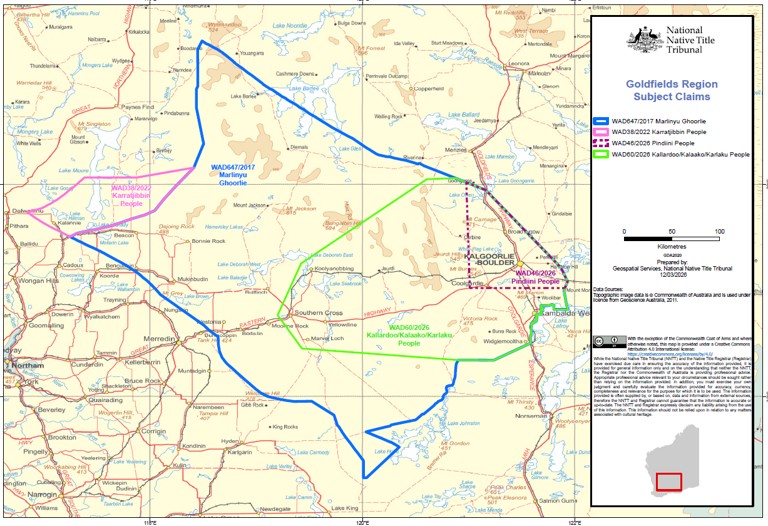
Schedule of Parties
WAD 647 of 2017 | |
Applicants | JAMES CHAMPION |
SIMON CHAMPION | |
TANIA CHAMPION | |
MAXINE PATRICIA DIMER | |
LEECHELLE HAMMAT | |
DARREN INDICH | |
RAELENE PEEL (DECEASED) | |
DARRYL TROTT | |
Other Respondents | COMMONWEALTH OF AUSTRALIA |
SHIRE OF YILGARN | |
SHIRE OF DALWALLINU | |
ELIZABETH SAMBO | |
JAMES MURPHY | |
TREVOR HENRY DONALDSON | |
PETER JOHN DIMER | |
SHARON DIMER | |
ROSANNE DIMER | |
AUSTRALIAN LIVE-STOCK SUPPLIERS PTY LTD ACN 149 409 227 | |
HODSHON SUPER CO PTY LTD | |
BJ CAHOOTS PTY LTD
| |
HONEY RESEARCH & DEVELOPMENT PTY LTD | |
CHARLES JENKIN | |
BARTON JONES | |
AMANDA JONES | |
BURCHELL FRANCIS CECIL JONES | |
JOHN JONES | |
KEITH MADER | |
SKATON NOMINEES PTY LTD | |
MT VETTERS PASTORAL CO (1966) PTY LTD | |
ARTHUR ROBERTS | |
BHP NICKEL WEST PTY LTD | |
CAMECO AUSTRALIA PTY LTD | |
CORONA MINERALS PTY LTD | |
ESPERANCE PIPELINE CO. PTY LIMITED | |
GPM RESOURCES PTY LTD | |
KALGOORLIE ORE TREATMENT COMPANY PTY LTD | |
LYSANDER RESOURCES PTY LTD | |
MH GOLD PTY LTD | |
MONTAGUE RESOURCES AUSTRALIA PTY LTD | |
NORTHERN STAR RESOURCES LIMITED (NST) | |
POLYMETALS (WA) PTY LTD | |
ROBERTSON RESOURCES PTY LTD ACN 118 366 653 | |
SHINE RESOURCES | |
SILVER LAKE (INTEGRA) PTY LIMITED | |
SILVER LAKE RESOURCES LIMITED | |
ST IVES GOLD MINING COMPANY PTY LIMITED | |
TONINO ZOCARO | |
TELSTRA CORPORATION LTD (ABN 33 051 775 556) | |
AMPLITEL PTY LTD | |
Prospective Respondents | REGINALD YARRAN |
GLENYS YARRAN |
WAD 46 of 2026 | |
Prospective Respondents | HENRY RICHARD DIMER |
MAXINE DIMER | |
JAMES CHAMPION | |
DARREN INDICH | |
SIMON CHAMPION | |
TANIA CHAMPION | |
DARRYL TROTT | |
LEECHELLE HAMMAT |
WAD 60 of 2026 | |
Prospective Respondents | HENRY RICHARD DIMER |
MAXINE DIMER | |
JAMES CHAMPION | |
DARREN INDICH | |
SIMON CHAMPION | |
TANIA CHAMPION | |
DARRYL TROTT | |
LEECHELLE HAMMAT |


