FEDERAL COURT OF AUSTRALIA
Australian Securities and Investments Commission v ASX Limited (No 2) [2026] FCA 862
File number: | NSD 1108 of 2024 |
Judgment of: | MARKOVIC J |
Date of judgment: | 3 July 2026 |
Catchwords: | CORPORATIONS – admission by ASX Limited of misleading and deceptive conduct in contravention of s 12DA of the Australian Securities and Investment Commission Act 2001 (Cth) (ASIC Act) – admission by ASX of false and misleading representation in contravention of subs 12DB(1)(a) and (e) of the ASIC Act – whether the agreed declarations of contravention, order for $20.5 million pecuniary penalty and order for costs are appropriate – declaration and orders made |
Legislation: | Australian Securities and Investments Commission Act 2001 (Cth) ss 12BA, 12BAB, 12DA, 12DB, 12GBA, 12GBB, 12GBC, 12GBCA Crimes Act 1914 (Cth) s 4AA Evidence Act 1995 (Cth) s 191 Federal Court of Australia Act 1976 (Cth) s 21 |
Cases cited: | Accounting Systems 2000 (Developments) Pty Ltd v CCH Australia Ltd (1993) 42 FCR 470 Australian Building and Construction Commissioner v Construction, Forestry, Mining and Energy Union [2017] FCAFC 113; (2017) 254 FCR 68 Australian Building and Construction Commissioner v Pattinson [2022] HCA 13; (2022) CLR 450 Australian Centre for Corporate Responsibility v Santos Limited [2026] FCA 96 Australian Competition and Consumer Commission v Australian Private Networks Pty Ltd [2019] FCA 384; (2019) 136 ACSR 80 Australian Competition and Consumer Commission v BlueScope Steel Limited (No 6) [2023] FCA 1029 Australian Competition and Consumer Commission v Coles Supermarkets Australia Pty Ltd [2015] FCA 330; (2015) 327 ALR 540 Australian Competition and Consumer Commission v Optus Mobile Pty Limited [2019] FCA 106 Australian Competition and Consumer Commission v Smart Corporation Pty Ltd [2021] FCA 347; (2021) 153 ACSR 347 Australian Securities and Investments Commission v Commonwealth Bank of Australia [2020] FCA 790 Australian Securities and Investments Commission v MLC Nominees Pty Ltd [2020] FCA 1306; (2020) 147 ACSR 266 Australian Securities and Investments Commission v Westpac Banking Corporations (No 2) [2018] FCA 751; (2018) 266 FCR 147 Australian Securities and Investments Commission v Westpac Banking Corporation [2019] FCA 2147 Commonwealth v Director, Fair Work Building Industry Inspectorate & Ors [2015] HCA 46; (2015) 258 CLR 482 Construction, Forestry, Mining and Energy Union v Cahill [2010] FCAFC 39; (2010) 269 ALR 1 Forrest v Australian Securities and Investments Commission [2012] HCA 39; (2012) 247 CLR 486 Mayfair Wealth Partners Pty Ltd and Others v Australian Securities and Investments Commission and Another [2022] FCAFC 170; (2022) 295 FCR 106 Self Care IP Holdings v Allergan Australia [2023] HCA 8; (2023) 277 CLR 186 Trade Practices Commission v CSR Ltd [1990] FCA 521; (1991) 12 ATPR |
Division: | General Division |
Registry: | New South Wales |
National Practice Area: | Commercial and Corporations |
Sub-area: | Regulator and Consumer Protection |
Number of paragraphs: | 116 |
Date of last submission/s: | 29 June 2026 |
Date of hearing: | 1 July 2026 |
Counsel for the Plaintiff: | Mr D F C Thomas with Ms J Shepard, Mr D Blazer and Mr A Hall |
Solicitor for the Plaintiff: | Norton Rose Fullbright |
Counsel for the Defendant: | Mr J Sheahan with Ms Z Hillman |
Solicitor for the Defendant: | Herbert Smith Freehills Kramer |
ORDERS
NSD 1108 of 2024 | ||
| ||
BETWEEN: | AUSTRALIAN SECURITIES AND INVESTMENTS COMMISSION Plaintiff | |
AND: | ASX LIMITED (ACN 008 624 691) Defendant | |
order made by: | MARKOVIC J |
DATE OF ORDER: | 3 July 2026 |
THE COURT NOTES THAT:
1. In these declarations and orders, terms which are defined in the Statement of Agreed Facts and Admissions filed 15 June 2026 have the same meaning as they do in that document.
THE COURT DECLARES THAT:
2. On 10 February 2022, the defendant (ASX Limited), in trade or commerce, engaged in conduct in relation to financial services that was misleading or deceptive or was likely to mislead or deceive, and thereby on each occasion the relevant document containing the representation was accessed and viewed by a person through ASX’s website or was disseminated or distributed by ASX, ASX contravened s 12DA of the Australian Securities and Investments Commission Act 2001 (Cth) (ASIC Act), in that ASX made an announcement to the market on 10 February 2022 that the CHESS Replacement Project was, in ASX’s opinion, progressing well (Progressing Well Representation), when that was not the case because that opinion was not reasonable.
3. On 10 February 2022, ASX, in trade or commerce, and in connection with the supply or possible supply of financial services, made a false or misleading representation (namely, the Progressing Well Representation) that services (namely, the CHESS Replacement Project or the CHESS Replacement System):
(a) were of a particular standard, quality, value or grade, when that was not the case and so contravened s 12DB(1)(a) of the ASIC Act; and
(b) had performance characteristics, uses or benefits, when that was not the case and so contravened s 12DB(1)(e) of the ASIC Act,
on each occasion the relevant document containing the representation was accessed and viewed by a person through ASX’s website or was disseminated or distributed by ASX.
THE COURT ORDERS THAT:
4. ASX is to pay a pecuniary penalty in the amount of $20.5 million.
5. ASX is to pay the plaintiff’s costs in the agreed amount of $3 million.
Note: Entry of orders is dealt with in Rule 39.32 of the Federal Court Rules 2011.
REASONS FOR JUDGMENT
MARKOVIC J:
1 On 13 August 2024 the Australian Securities and Investments Commission (ASIC) commenced this proceeding against ASX Limited relevantly seeking declarations for breach of s 12DA and s 12DB of the Australian Securities and Investments Commission Act 2001 (Cth) (ASIC Act), a pecuniary penalty in respect of conduct declared to have contravened s 12DB of the ASIC Act and its costs of the proceeding.
2 The proceeding arose out of statements made by ASX in relation to its replacement system for the Clearing House Subregister System (CHESS), Australia’s predominant clearing and settlement system. For several years leading up to 2022 ASX sought to develop a replacement system for CHESS (CHESS Replacement System) using distributed ledger technology (DLT). The programme for the development of the CHESS Replacement System was referred to as the CHESS Replacement Project.
3 The hearing of the proceeding, scheduled to commence on 15 June 2026, did not proceed. Instead, pursuant to s 191 of the Evidence Act 1995 (Cth), the parties filed a statement of agreed facts and admissions (SAFA), a copy of which is Annexure A to these reasons, by which ASX admits the following contraventions:
(1) by making the statement on 10 February 2022 that the CHESS Replacement Project was “progressing well, with the fully integrated industry test environment open and operating successfully”, it made a representation of present opinion to the effect that the CHESS Replacement Project was progressing well (Progressing Well Representation); and
(2) the Progressing Well Representation was misleading because of a combination of the following (capitalised terms are defined later in these reasons):
(a) as at 21 December 2021, the CHESS Replacement Project was not on its critical path to “Go-Live” in April 2023, and needed to “return” to it;
(b) at all relevant times from 21 December 2021, ASX recorded a red RAG overall status to the CHESS Replacement Project and for the Application;
(c) ASX opened ITE1 with a reduced scope and performance compared with the Published Plan resulting in work required to be completed for the CHESS Replacement Project “shifting right”;
(d) as at 10 February 2022, ASX planned to open ITE2 with reduced scope and performance compared with the Published Plan which would have resulted in work required to be completed for the CHESS Replacement Project “shifting right”; and
(e) as at 10 February 2022, ASX planned to open ITE1 Accreditation with reduced scope and performance compared with the Published Plan which would have resulted in work required to be completed for the CHESS Replacement Project “shifting right”; and
(3) by making the Progressing Well Representation ASX contravened s 12DA and s 12DB(1) of the ASIC Act in the manner described below.
4 ASIC and ASX filed joint submissions on liability and relief. They have agreed on a proposed form of declaratory relief, the amount of an aggregate pecuniary penalty and costs.
5 For the reasons which follow I am satisfied that declarations should be made identifying when and how ASX contravened the ASIC Act and that orders imposing a penalty in the amount proposed by the parties, and for ASX to pay ASIC’s costs in the amount agreed, should also be made.
THE AGREED FACTS – A SUMMARY
6 I set out below a summary of the facts as set out by the parties in their joint submissions which, in turn, is based on the SAFA.
7 CHESS has been operated by ASX since about 1994 and was and remains critical financial infrastructure. It facilitates the clearing and settlement of market transactions and allows for the electronic transfer of ownership of financial products, including shares. At all relevant times CHESS was the predominant clearing and settlement services system in Australia.
8 By early 2016, ASX contemplated replacing CHESS.
9 On 22 January 2016, ASX announced that it had selected Digital Asset Holdings LLC to design and develop a potential replacement solution for CHESS, using DLT which is the broad category of technologies that record transactions across decentralised networks; blockchain is an example of a DLT. In December 2017, ASX confirmed that Digital Asset would develop the CHESS replacement using DLT.
Published Plan
10 From the outset of the project to replace CHESS, ASX disclosed its plan for the project’s interim milestones and ultimate “Go-Live” date of April 2021. CHESS users, software developers and vendors were requested to undertake CHESS Replacement System “readiness” activities based on these plans and ASX updates and communications about the project, including by developing and implementing their own third party-systems, interfaces and applications which market participants and software vendors did at significant expense and effort.
11 On 25 March 2020, coinciding with the onset of the COVID-19 pandemic and while an environment known as the customer development environment (CDE) was open, ASX announced that it would be replanning the CHESS Replacement Project and that the then Go-Live date would be delayed.
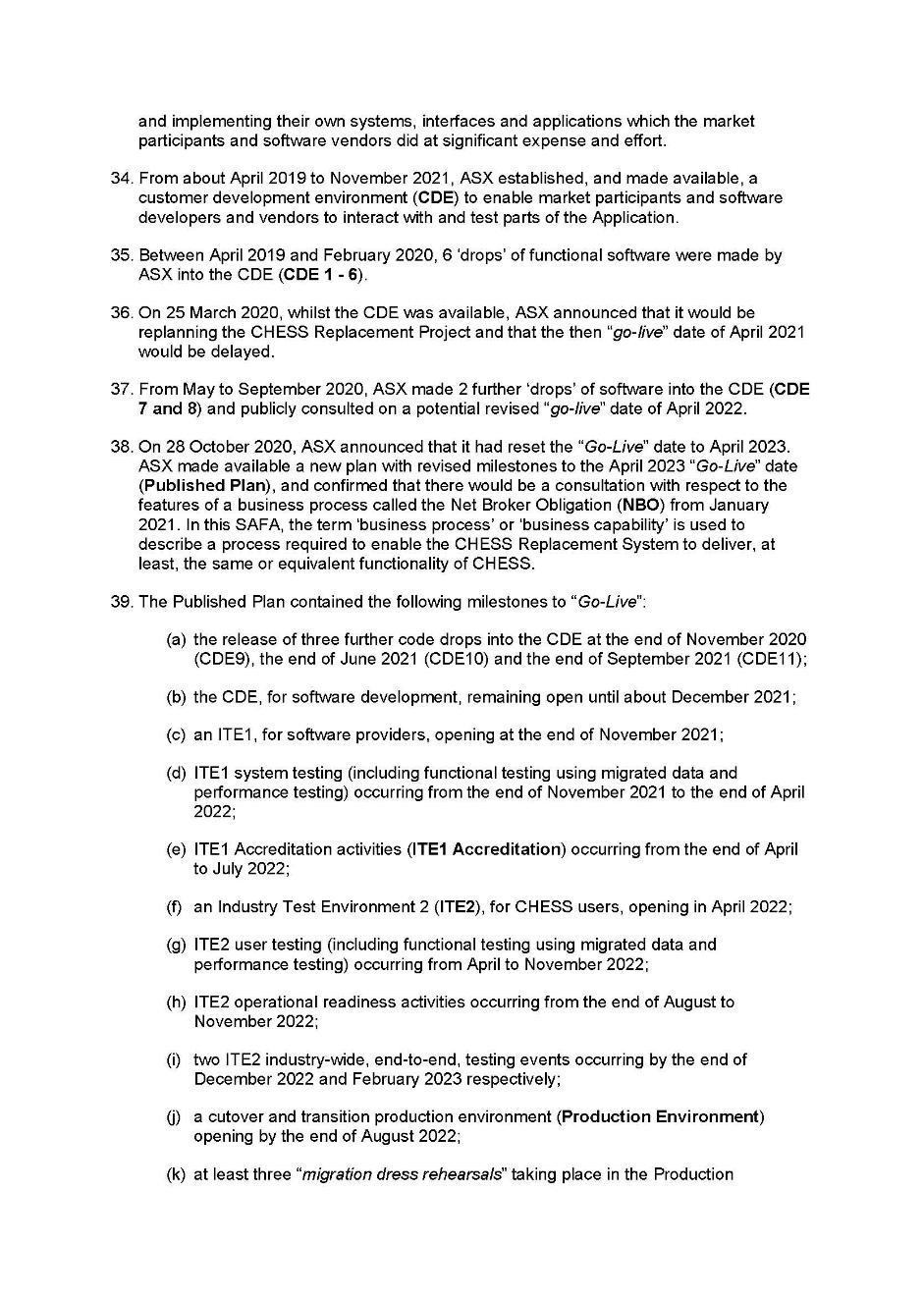
12 On 28 October 2020, ASX announced that it had reset the Go-Live date to April 2023. ASX made available a new plan with revised milestones to the April 2023 Go-Live date (Published Plan). The Published Plan contained milestones to Go-Live including:
(1) the release of three further code drops into the CDE at the end of November 2020 (CDE9), the end of June 2021 (CDE10) and the end of September 2021 (CDE11);
(2) an Industry Test Environment 1 (ITE1) for software providers, opening at the end of November 2021;
(3) ITE1 system testing (including functional testing using migrated data and performance testing) occurring from the end of November 2021 to the end of April 2022;
(4) ITE1 Accreditation activities (ITE1 Accreditation) occurring from the end of April to July 2022;
(5) an Industry Test Environment 2 (ITE2) for CHESS users, opening in April 2022;
(6) ITE2 user testing (including functional testing using migrated data and performance testing) occurring from April to November 2022;
(7) two ITE2 industry-wide, end-to-end, testing events occurring by the end of December 2022 and February 2023 respectively;
(8) a cutover and transition production environment opening by the end of August 2022; and
(9) Go-Live in April 2023.
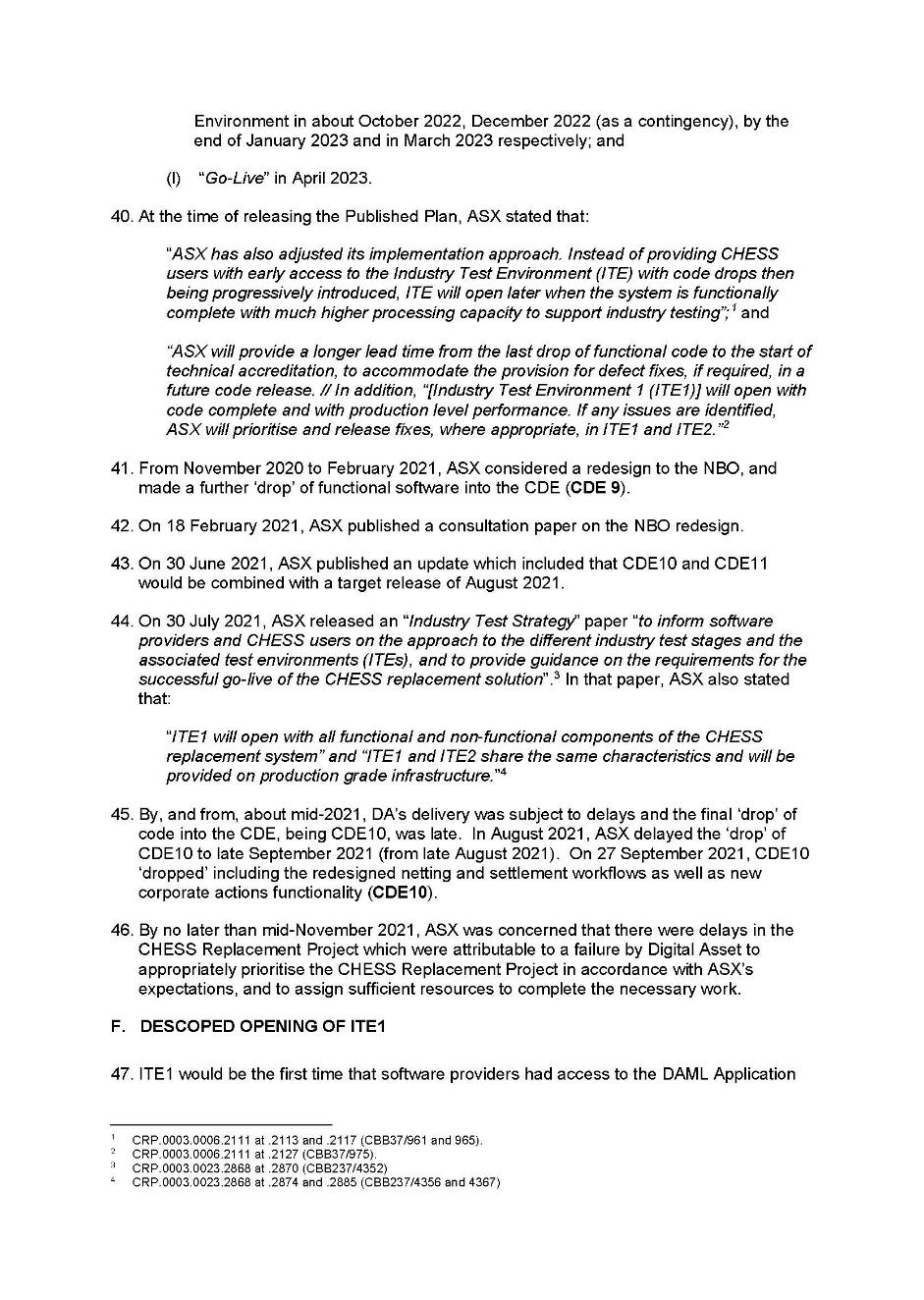
13 At the time of releasing the Published Plan, ASX said that pursuant to the “adjusted implementation approach” prescribed in the plan, the opening of ITE1 would occur “later” when the new system would be “functionally complete”, “code complete” and have “production level performance.”
14 The “functional” aspects of software refer to the actions the software needs to be able to perform (for example in the case of CHESS, registration of trades). The “non-functional” aspects of software refer to how the software performs those “functional” actions (i.e. sufficiently quickly, reliably, under specific loads, and in a way that can scale).
15 On 30 June 2021 ASX published an update to the Published Plan which included that CDE10 and CDE11 would be combined with a target release of August 2021. The dates and milestones in the Published Plan for ITE1 opening, ITE2 opening, ITE1 Accreditation opening and Go-Live did not change.
16 On 30 July 2021 ASX released an “Industry Test Strategy” paper “to inform software providers and CHESS users on the approach to the different industry test stages and the associated test environments, and to provide guidance on the requirements for the successful go-live of the CHESS replacement solution”. In that paper, ASX stated that “ITE1 will open with all functional and non-functional components of the [CHESS Replacement System]” and “ITE1 and ITE2 share the same characteristics and will be provided on production grade infrastructure”.
Delays
17 By and from about mid-2021 Digital Asset’s delivery was subject to delays and the final “drop” of code into the CDE, being CDE10, was late. In August 2021 ASX delayed the “drop” of CDE10 to late September 2021 (as opposed to late August 2021). On 27 September 2021 CDE10 “dropped” including the redesigned netting and settlement workflows, and new corporate actions functionality.
18 By no later than mid-November 2021 ASX was concerned that there were delays in the CHESS Replacement Project which were attributable to a failure by Digital Asset to prioritise appropriately the CHESS Replacement Project in accordance with ASX’s expectations, and to assign sufficient resources to complete the necessary work.
Descoping of ITE1
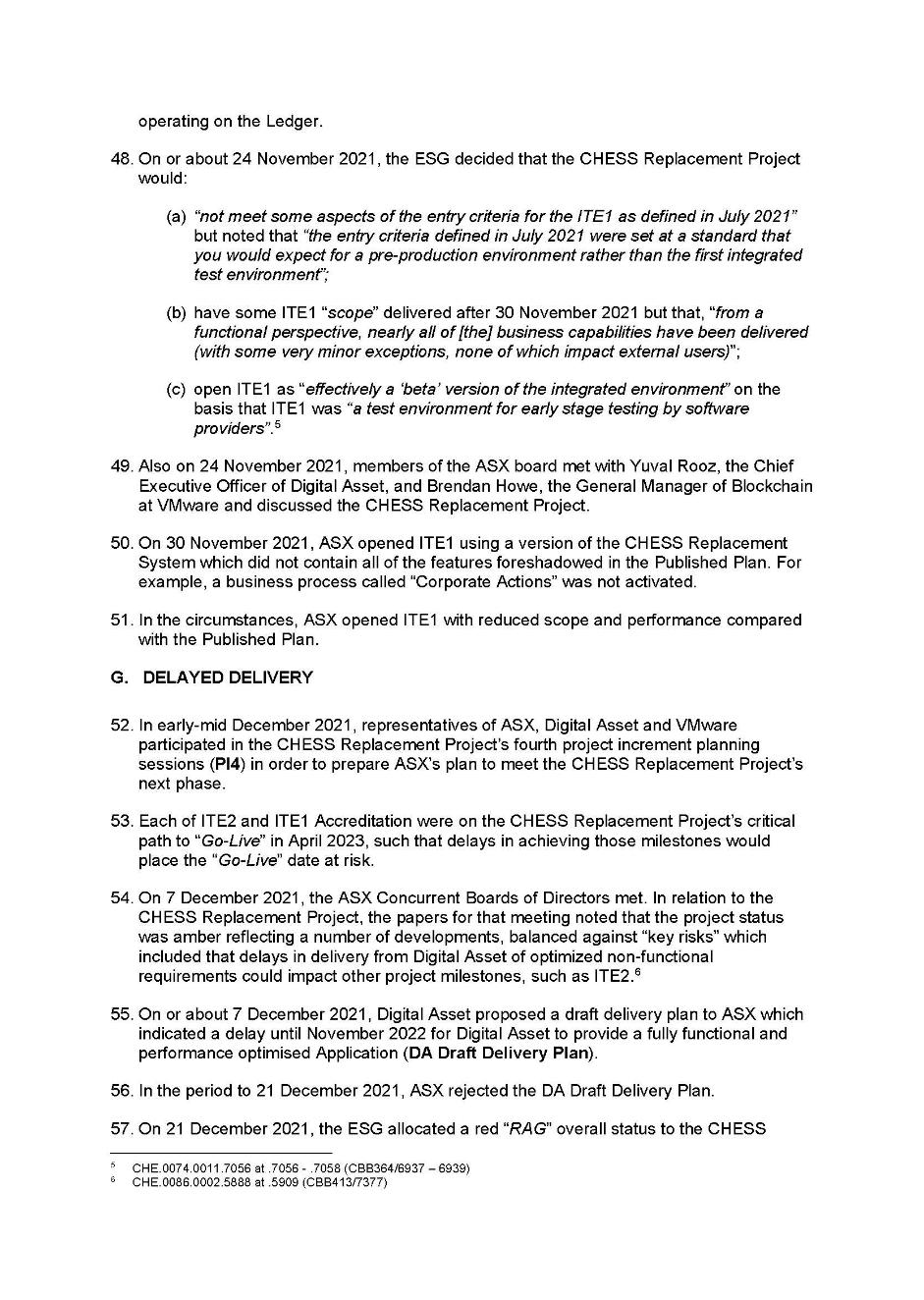
19 ITE1 would be the first time that software providers had access to the software application (Application) operating on the distributed ledger.
20 On or about 24 November 2021 the CHESS Replacement Project’s Executive Steering Group (ESG) decided that the project would:
(1) “not meet some aspects of the entry criteria for the ITE1 as defined in July 2021” but noted that “the entry criteria defined in July 2021 were set at a standard that you would expect for a pre-production environment rather than the first integrated test environment”;
(2) have some ITE1 “scope” delivered after 30 November 2021 but that, “from a functional perspective, nearly all of [the] business capabilities have been delivered (with some very minor exceptions, none of which impact external users)”; and
(3) open ITE1 as “effectively a ‘beta’ version of the integrated environment” on the basis that ITE1 was “a test environment for early stage testing by software providers”.
21 On 30 November 2021 ASX opened ITE1 using a version of the CHESS Replacement System which did not contain all of the features foreshadowed in the Published Plan. Thus, ASX opened ITE1 with reduced scope and performance compared with the Published Plan.
Planned descoping of ITE2 and ITE1 Accreditation
22 In early to mid-December 2021 representatives of ASX, Digital Asset and VMware participated in the CHESS Replacement Project’s fourth project increment planning sessions (PI4) to prepare ASX’s plan to meet the CHESS Replacement Project’s next phase. The next phase included the milestones of ITE2 and ITE1 Accreditation. Each of ITE2 and ITE1 Accreditation were on the CHESS Replacement Project’s critical path to Go-Live in April 2023 so that delays in achieving those milestones would place that Go-Live date at risk.
23 On or about 7 December 2021 Digital Asset proposed a draft delivery plan to ASX which indicated a delay until November 2022 for Digital Asset to provide a fully functional and performance optimised Application (DA Draft Delivery Plan). In the period to 21 December 2021 ASX rejected the DA Draft Delivery Plan.
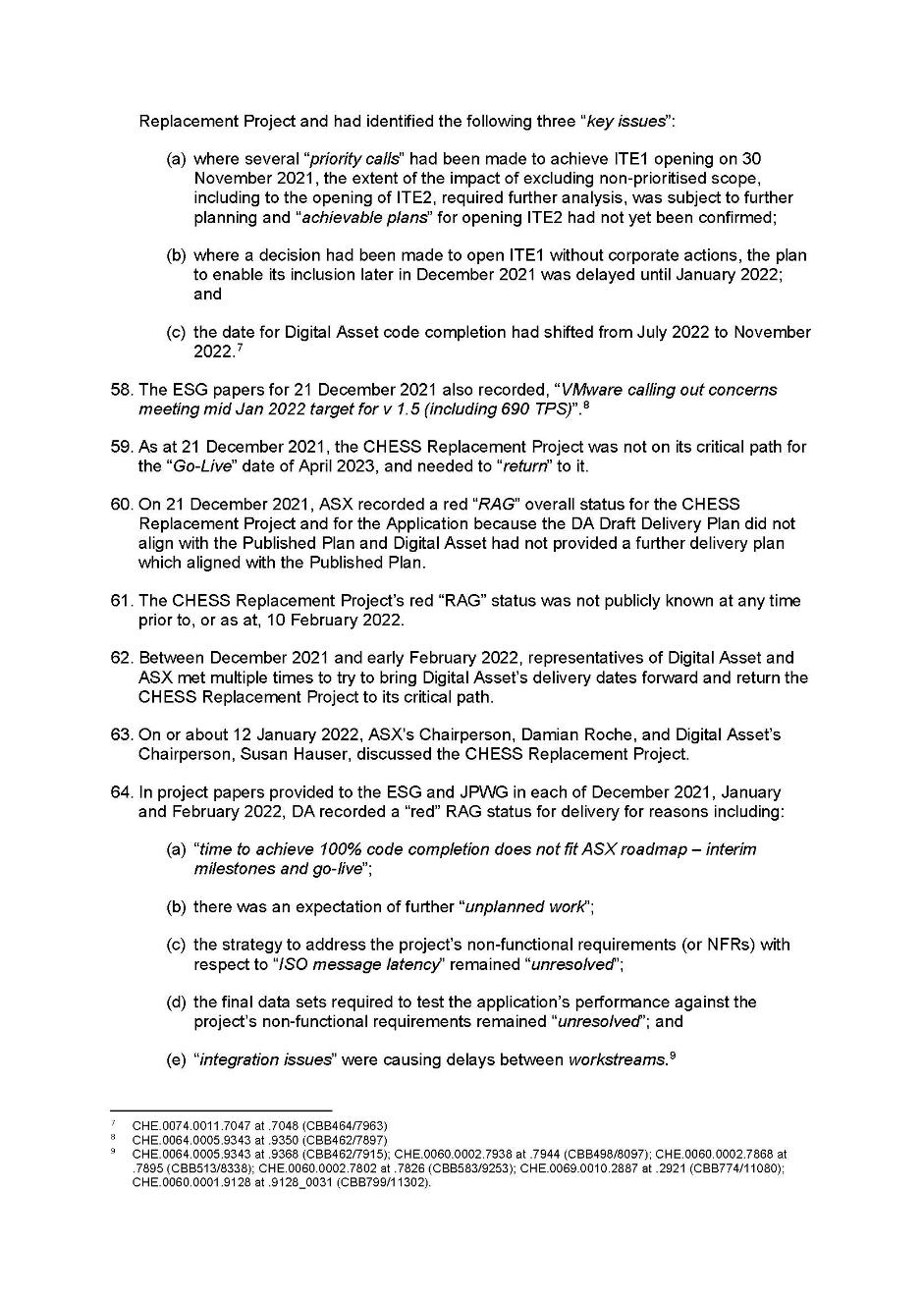
24 The CHESS Replacement Project used a Red/Amber/Green (RAG) system for classifying and reporting on the project to the Joint Project Working Group (JPWG), ESG, Project Governance Group, and relevant ASX boards. “Red” was defined as “heightened awareness or action required”, “confirmed issue with adverse impact”, “significant issues or risks impacting [key performance indicator(s)] where mitigations/resolutions are not in place or have not been effective” and “ESG/[Project Director] has concerns there is a material threat to project outcomes”.
25 On 21 December 2021 the ESG allocated a red RAG overall status to the CHESS Replacement Project for multiple reasons. Similarly, the status of the Application was also recorded by ASX as having a red RAG overall status because the DA Draft Delivery Plan did not align with the Published Plan and Digital Asset had not provided a further delivery plan which aligned with the Published Plan.
26 Between December 2021 and early February 2022 representatives of Digital Asset and ASX met multiple times to try to bring Digital Asset’s delivery dates forward and return the CHESS Replacement Project to its critical path. Those meetings included a meeting between ASX’s Chairperson, Damian Roche, and Digital Asset’s Chairperson, Susan Hauser.
27 In project papers provided to the ESG and JPWG in each of December 2021, January 2022 and February 2022 Digital Asset recorded a red RAG status for delivery for reasons including:
(1) “time to achieve 100% code completion does not fit ASX roadmap – interim milestones and go-live”;
(2) there was an expectation of further “unplanned work”;
(3) the strategy to address the Chess Replacement Project’s non-functional requirements with respect to “ISO message latency” remained “unresolved”;
(4) the final data sets required to test the application’s performance against the Chess Replacement Project’s non-functional requirements remained “unresolved”; and
(5) “integration issues” were causing delays between workstreams.
28 On 31 January 2022 ASX’s Project Governance Group met and was informed that the CHESS Replacement Project “had moved from amber to red largely driven by Digital Asset’s delivery road map not aligning to the critical path of Accreditation and ITE2 opening and no solution currently [being] available to address” that issue.
29 At its 3 February 2022 meeting the ASX Audit and Risk Committee (ARC) was informed that the CHESS Replacement Project’s status had been moved to “Red” because DA’s Draft Delivery Plan did not align with the critical path activities of opening ITE2 and ITE1 Accreditation in April 2022 and that the “risk has been escalated to an issue”. The ARC meeting minutes record that ASX management indicated that they would continue to engage with Digital Asset “with the objective of bringing the delivery roadmap back into alignment”. The ARC members requested that management report back on the outcome of the continued engagement with Digital Asset.
30 As at 10 February 2022 ASX planned to open both ITE2 and ITE1 Accreditation without full functionality or production level performance and therefore with reduced scope and performance compared with the Published Plan.
31 The functionality and performance requirements which had been descoped from the opening of ITE1, ITE2 and ITE1 Accreditation milestones were still required prior to Go-Live, but would need to be completed in less time than had originally been allocated in the Published Plan, assuming that the Go-Live date remained as April 2023, and in circumstances where the remaining steps (after ITE1 Accreditation) in the Published Plan also needed to be completed.
10 February 2022 releases and the Progressing Well Representation
32 On or about 7 February 2022 the papers for the ASX Board and ASX Concurrent Board meetings on 9 February 2022 were provided to directors. The papers included Dominic Stevens’, then the chief executive officer (CEO), CEO Report which said in relation to the CHESS Replacement Project that:
“The [CHESS Replacement Project] continues to focus on finding solutions to Digital Asset’s delivery road map not being aligned with the critical path activities of opening the ITE2 and [ITE1] Accreditation environments in April/May ’22. Management is engaged at various levels within Digital Asset to protect the critical path…”
33 On 9 February 2022 the ASX Concurrent Boards met and considered, among other things, the status of the CHESS Replacement Project. Board members were informed, amongst other things, that:
(1) the CHESS Replacement Project status had changed from “amber” to “red” because Digital Asset’s delivery roadmap was not aligned with the critical path activities of opening the ITE2 and ITE1 Accreditation environments;
(2) ITE1 had been opened with a reduced scope and that, while a release was implemented to ITE1 to include corporate actions, there would need to be additional releases to continue the incremental roll-out of all functional and non-functional requirements;
(3) the actions being taken to elevate the project status back to amber or green included working with Digital Asset to accelerate resolution to maintain critical path and there was escalation to executive level engagement on that issue; and
(4) ASX was also working with Digital Asset to augment Digital Asset’s human resources to offset the delays to application delivery.
34 The ASX Concurrent Board meeting minutes for 9 February 2022 meeting recorded:
The Boards noted the red status of the project as at December 2021, and asked management to provide an update on the progress of software delivery from Digital Asset and the current status of the project, noting comments about project status in ASX's half year results presentation.
Management confirmed that discussions ahead of the December 2021 Executive steering Group meeting had indicated that Digital Asset's delivery schedule was not aligned with ASX's critical path, and that Digital Asset had defined some required deliverables as 'new work'. Since then, management had held a number of discussions with Digital Asset about potential solutions, including additional resourcing. More recently, in discussion with ASX's CEO and Group Executive, Securities & Payments, Digital Asset's CEO had verbally committed to a mid-March to early April delivery for ITE2. On the basis of that commitment, management considered that the project remained on critical path, and that it was accurate to say that the project remained 'on track'.
The Boards then questioned management about the anticipated impact on participants of the descoping of certain functionality from ITE2. After responding to questions, management briefed the Boards on the performance of the industry test environment (ITEl) and observed that this had exceeded stability expectations.
35 The 10 February releases (defined in [38] below) were considered and approved by the ASX Board during its meeting on 9 February 2022.
36 Following the ASX Board meeting on 9 February 2022 the Resignation Release (defined in [38] below) was updated to include a statement that the CHESS Replacement Project was “progressing well, with the fully integrated industry test environment open and operating successfully” (i.e. the Progressing Well Representation). That version of the Resignation Release was sent to both Messrs Stevens and Roche on 9 February 2022. Mr Stevens replied, later that night, that the Resignation Release “looks good”. Earlier that day, at 8.44 am, Tim Hogben, ASX executive for securities and payments and executive sponsor of the CHESS Replacement Project, had been asked to review some proposed drafting describing the CHESS Replacement Project as “progressing well, with the industry test environment open and operating successfully, and the functional build for customers largely complete”. Mr Hogben deleted “the functional build for customers [was] largely complete” and inserted “operating with a broad range of software vendors undertaking various transactional activity”.
37 The CHESS Replacement Project’s red RAG status was not publicly known at any time prior to, or as at, 10 February 2022.
38 On 10 February 2022 between 9.19 am and 9.21 am, the ASX made the following announcements to the market (together, 10 February releases):
(1) ASX Limited Half-Year Results to 31 December 2021 (i.e. 1H22), which referenced accompanying speaking notes and presentation slides;
(2) 2022 Half-Year Results Presentation and Speaking Notes (1H22 Presentation);
(3) 2022 Half-Year Financial Results presentation slides, which included a Strategic Update from the CEO (1H22 Presentation Slides); and
(4) ASX CEO announces plan to retire (Resignation Release).
39 Among other things, the 10 February releases stated:
(1) “CHESS replacement remains on track for Go-Live April 2023. [The] new system’s ITE is open to software vendors ahead of bringing in customers. [The] new system uses Digital Asset’s Daml smart contract development capability, VMware’s DLT (blockchain) platform and other ASX infrastructure that underpins the new [CHESS Replacement System]. [The] new technology is meeting its availability and stability targets for the test environment” (1H22 Presentation);
(2) “CHESS replacement remains on track for go-live and the industry test environment is open to software vendors, with customers joining in the coming months. The system uses Daml smart contracts, VMware’s DLT platform and connects to other ASX infrastructure that underpins the new system. It is meeting its availability and stability targets. The team has plenty of work ahead, as we now transition to the industry readiness stage” (1H22 Presentation);
(3) “Our new CHESS system will be at the leading edge globally, with a DLT system capable of managing a multitrillion dollar ecosystem with millions of trades and billions of value turning over every day. It also means ASX’s clearing and settlement systems are fully contemporary, using global standard ISO20022 messaging, and operating on modern hardware across multiple data centres with improved security” (1H22 Presentation);
(4) the CHESS Replacement Project “remains on track for Go-Live April 2023” (1H22 Presentation Slides);
(5) “New technology is meeting its availability and stability targets for the test environment” (1H22 Presentation Slides);
(6) the CHESS Replacement Project was “progressing well, with the fully integrated industry test environment open and operating successfully” (i.e. the Progressing Well Representation) (Resignation Release); and
(7) ASX’s “focus on technology” had expanded, “including developing a world-leading position on the distributed ledger technology with the [CHESS Replacement Project]” (Resignation Release).
40 In the circumstances outlined in paragraphs [43]-[81] of the SAFA (summarised above), ASX admits that by making the Progressing Well Representation, it made a representation of present opinion to the effect that the CHESS Replacement Project was progressing well.
After 10 February 2022
41 On 28 March 2022 ASX announced that there was a strong likelihood of delay to the Go-Live date of April 2023.
42 In the period September to November 2022 Accenture reviewed the use of the distributed ledger and Application and produced an independent report in which it, with the assistance of Digital Asset and ASX, identified significant challenges with the solution design and its ability to meet ASX’s requirements.
43 On 17 November 2022 ASX announced a pause to the project, that it would reassess all aspects of it, and that it had derecognised $245-255 million (pre-tax) in capitalised costs in circumstances where continued use of the software which was being developed was in doubt.
LEGISLATIVE FRAMEWORK AND LEGAL PRINCIPLES
ASIC Act
44 At the time of the contraventions:
(1) section 12DA of the ASIC Act relevantly provided that:
(1) A person must not, in trade or commerce, engage in conduct in relation to financial services that is misleading or deceptive or is likely to mislead or deceive.
(2) section 12DB of the ASIC Act relevantly provided that:
(1) A person must not, in trade or commerce, in connection with the supply or possible supply of financial services, or in connection with the promotion by any means of the supply or use of financial services:
(a) make a false or misleading representation that services are of a particular standard, quality, value or grade; or
…
(e) make a false or misleading representation that services have sponsorship, approval, performance characteristics, uses or benefits; or
…
45 The purpose of these provisions is remedial. They are to be construed broadly “so as to give the fullest relief which the fair meaning of its language will allow”: see Australian Competition and Consumer Commission v Australian Private Networks Pty Ltd [2019] FCA 384; (2019) 136 ACSR 80 at [15] (Middleton J) quoting from Accounting Systems 2000 (Developments) Pty Ltd v CCH Australia Ltd (1993) 42 FCR 470 at 503 (Lockhart and Gummow JJ).
46 In Australian Competition and Consumer Commission v Smart Corporation Pty Ltd [2021] FCA 347; (2021) 153 ACSR 347 Jackson J, in considering s 29 of the Australian Consumer Law (ACL), observed at [25] that “a representation is a statement, which may be conveyed by words or conduct, explicitly or by implication”. The same is the case for a representation under s 12DB(1) of the ASIC Act. Further while the language used in s 12DA(1) (“misleading or deceptive”) is different to that used in s 12DB(1) (“false or misleading”), there is no meaningful difference between those expressions when it comes to their legal application: Self Care IP Holdings v Allergan Australia [2023] HCA 8; (2023) 277 CLR 186 at [84] (Kiefel CJ, Gageler, Gordon, Edelman and Gleeson JJ).
47 In Self Care the High Court identified four steps involved in establishing whether a person has contravened s 18 of the ACL at [80]:
(1) the first step is to identify the alleged contravening conduct with precision. As the parties submit, “representations” for s 12DB or “conduct” for s 12DA of the ASIC Act;
(2) the second step is to consider the jurisdictional requirements – was the conduct in trade or commerce;
(3) the third step is to consider the meaning the conduct conveyed to its intended audience; and
(4) the fourth step is to ask whether, in light of that meaning, the conduct meets the statutory description. In this case the question is whether the “representation” (s 12DB) or the “conduct” (s 12DA) was either false or misleading (s 12DB) or was misleading or deceptive, or likely to mislead or deceive (s 12DA). For the purposes of this step, the question is whether the impugned conduct has the tendency to lead a person exposed to the conduct into error.
48 The High Court described each of these steps as involving “quintessential questions of fact”: Self Care at [81]. As to the third and fourth steps the High Court said (at [82]) that they “require the court to characterise, as an objective matter, the conduct viewed as a whole and its notional effects, judged by reference to its context, on the state of mind of the relevant person or class of persons”; and (at [83]) that “[w]here the conduct was directed to the public or part of the public, [those steps] must be undertaken by reference to the effect or likely effect of the conduct on the ordinary and reasonable members of the relevant class of persons”. Their Honours continued at [83]:
It is necessary to isolate an ordinary and reasonable “representative member” (or members) of that class, to objectively attribute characteristics and knowledge to that hypothetical person (or persons), and to consider the effect or likely effect of the conduct on their state of mind. This hypothetical construct “avoids using the very ignorant or the very knowledgeable to assess effect or likely effect; it also avoids using those credited with habitual caution or exceptional carelessness; it also avoids considering the assumptions of persons which are extreme or fanciful. The construct allows for a range of reasonable reactions to the conduct by the ordinary and reasonable member (or members) of the class.
(Footnotes omitted.)
49 In Forrest v Australian Securities and Investments Commission [2012] HCA 39; (2012) 247 CLR 486 the plurality (French CJ, Gummow, Hayne and Kiefel JJ) observed at [36] that the intended audience in that case for the impugned statements could be sufficiently identified as investors, both present and possible future ones, and perhaps some wider section of the commercial or business community. No more precision was required. To similar effect, in Australian Centre for Corporate Responsibility v Santos Limited [2026] FCA 96 in relation to representations alleged to have been made in a company’s investor presentation, annual report and climate change report, I found, among other things, that the audience comprised a large and diverse group of investors, both individual and institutional: at [494]-[499].
50 The question of whether conduct is misleading or deceptive or a representation is false or misleading, is objective. It is not necessary to prove that the conduct in question actually deceived or misled anyone: Mayfair Wealth Partners Pty Ltd and Others v Australian Securities and Investments Commission and Another [2022] FCAFC 170; (2022) 295 FCR 106 at [20] (Jagot, O’Bryan and Cheeseman JJ).
The making of declarations
51 Section 12GBA(1) of the ASIC Act permits ASIC to apply to the Court for a declaration that a person has contravened a civil penalty provision. Section 12DB(1) is a civil penalty provision: see s 12GBA(6). Section 12GBA(3) of the ASIC Act provides that the Court must make the declaration if it is satisfied that the person has contravened the provision.
52 Section 21 of the Federal Court of Australia Act 1976 (Cth) (FCA Act) empowers the Court, in civil proceedings in relation to a matter in which it has original jurisdiction, to make binding declarations of right, whether or not any consequential relief is or could be claimed. The Court has a discretion to make a declaration “bounded only by the limits of federal jurisdiction” and the need to exercise the power judicially: see Australian Securities and Investments Commission v Commonwealth Bank of Australia [2020] FCA 790 at [152] (Beach J).
53 In general terms, the power under s 21 of the FCA Act is properly exercised when the question in issue is real and not theoretical, when the person raising the question has a real interest in raising it and where there is a proper contradictor: see Australian Securities and Investments Commission v MLC Nominees Pty Ltd [2020] FCA 1306; (2020) 147 ACSR 266 at [110] (Yates J) and the cases cited therein.
54 In Australian Building and Construction Commissioner v Construction, Forestry, Mining and Energy Union [2017] FCAFC 113; (2017) 254 FCR 68 a Full Court of this Court said at [93] (Dowsett, Greenwood and Wigney JJ):
Declarations relating to contraventions of legislative provisions are likely to be appropriate where they serve to record the Court’s disapproval of the contravening conduct, vindicate the regulator’s claim that the respondent contravened the provisions, assist the regulator to carry out its duties, and deter other persons from contravening the provisions: Australian Competition and Consumer Commission v Construction, Forestry, Mining and Energy Union [2007] ATPR 42-140 at [6], and the cases there cited; Rural Press Ltd v Australian Competition and Consumer Commission (2003) 216 CLR 53 at [95].
Penalties
55 Section 12GBB of the ASIC Act concerns pecuniary penalty orders and relevantly provides:
(1) ASIC may apply to a Court for an order that a person, who is alleged to have contravened a civil penalty provision, pay the Commonwealth a pecuniary penalty.
…
(3) If a declaration has been made under section 12GBA that the person has contravened the provision, the Court may order the person to pay to the Commonwealth a pecuniary penalty that the Court considers is appropriate (but not more than the amount specified in section 12GBC).
(4) An order under subsection (3) is a pecuniary penalty order.
Determining pecuniary penalty
(5) In determining the pecuniary penalty, the Court must take into account all relevant matters, including:
(a) the nature and extent of the contravention; and
(b) the nature and extent of any loss or damage suffered because of the contravention; and
(c) the circumstances in which the contravention took place; and
(d) whether the person has previously been found by a court (including a court in a foreign country) to have engaged in any similar conduct; and
(e) in the case of a contravention by the trustee of a registrable superannuation entity—the impact that the penalty under consideration would have on the beneficiaries of the entity.
56 Section 12GBC provides that the pecuniary penalty must not be more than the pecuniary penalty applicable to the contravention of the civil penalty provision.
57 Section 12GBCA(2) provides that the pecuniary penalty applicable to contravention of a civil penalty provision by a body corporate is the greatest of:
The pecuniary penalty applicable to the contravention of a civil penalty provision by a body corporate is the greatest of:
(a) 50,000 penalty units; and
(b) if the Court can determine the benefit derived and detriment avoided because of the contravention—that amount multiplied by 3; and
(c) either:
(i) 10% of the annual turnover of the body corporate for the 12‑month period ending at the end of the month in which the body corporate contravened, or began to contravene, the civil penalty provision; or
(ii) if the amount worked out under subparagraph (i) is greater than an amount equal to 2.5 million penalty units—2.5 million penalty units.
58 In MLC Nominees Yates J summarised the principles to be applied in determining an appropriate pecuniary penalty including relevantly at [117]:
…
6. Assessment of amount of the penalty is not an exact science. It is not susceptible to scientific or mathematical formulation. Rather, a penalty is to be assessed by an intuitive or instinctive synthesis. The task of the Court is to take account of all the relevant (and potentially competing) factors and to arrive at a single result which takes due account of them all. This involves taking into account the objective circumstances of the contravention and the subjective factors relating to the contravener.
7. Having taken into account all relevant circumstances and discussed their significance, the Court makes a value judgment as to what is the appropriate amount of the penalty.
8. Civil penalty regimes are included in statutory regimes for the purpose of protecting or advancing the public interest in compliance with the statutory regime. Each statutory regime has a statutory purpose of protecting or advancing a particular aspect of the public interest. Where the statutory regime involves a specialist industry or activity regulator, its statutory functions will include securing compliance with the provisions of the regime.
9. For this reason, the appropriateness of the amount of a penalty must be assessed by reference to the specific civil penalty provision which has been contravened in light of its context and purpose, and the objects of the relevant statute as a whole.
…
59 Here, the penalty provision is s 12DB of the ASIC Act, the prohibition on making a false or misleading representation in connection with the supply of financial services.
60 The primary purpose of imposing civil penalties is deterrence: Australian Building and Construction Commissioner v Pattinson [2022] HCA 13; (2022) CLR 450 at [15] (Kiefel CJ, Gageler, Keane, Gordon, Steward and Gleeson JJ). In Pattinson, the plurality referred with approval to the statement of French J in Trade Practices Commission v CSR Ltd [1990] FCA 521; (1991) 12 ATPR 41-076 that the object of imposing civil penalties under s 76 of the (former) Trade Practices Act 1974 (Cth) was to “attempt to put a price on contravention that is sufficiently high to deter repetition by the contravenor and by others who might be tempted to contravene the Act”: at [40].
Agreed declarations and orders
61 Where there is an agreed penalty proposed, the court’s task is to determine whether the parties’ proposal could be accepted as fixing an appropriate penalty. Relevantly, the court must satisfy itself that the penalty is appropriate. If it is within the permissible range, the court will not depart from the proposed figure only because “it might have otherwise have been disposed to select some other figure”: Commonwealth v Director, Fair Work Building Industry Inspectorate & Ors [2015] HCA 46; (2015) 258 CLR 482 (French CJ, Kiefel, Bell, Nettle and Gordon JJ) at [28], [47]-[48].
62 Relevantly, in Director, Fair Work the High Court said at [58]:
… Subject to the court being sufficiently persuaded of the accuracy of the parties' agreement as to facts and consequences, and that the penalty which the parties propose is an appropriate remedy in the circumstances thus revealed, it is consistent with principle and, for the reasons identified in Allied Mills, highly desirable in practice for the court to accept the parties' proposal and therefore impose the proposed penalty. To do so is no different in principle or practice from approving an infant's compromise, a custody or property compromise, a group proceeding settlement or a scheme of arrangement.
(Footnote omitted.)
63 The High Court recognised that “there is an important public policy in promoting predictability of outcome in civil penalty proceedings and that the practice of receiving and, if appropriate, accepting agreed penalty submissions increases the predictability of outcome for regulators and wrongdoers”. This course also encourages corporations to acknowledge contraventions and avoid lengthy and complex trials: Director, Fair Work at [46].
CONSIDERATION
Declarations of breach
64 The parties propose declarations that on 10 February 2022:
(1) ASX, in trade or commerce, engaged in conduct that was misleading or deceptive or likely to mislead or deceive and thereby on each occasion the relevant document containing the representation was accessed and viewed by a person through ASX’s website or was disseminated or distributed by ASX, it contravened s 12DA of the ASIC Act, in that ASX made the Progressing Well Representation on 10 February 2022, when it was not was not the case that the CHESS Replacement Project was progressing well, because ASX’s opinion was not reasonable;
(2) ASX, in trade or commerce, and in connection with the supply or possible supply of financial services, made a false or misleading representation, namely, the Progressing Well Representation, that services, namely, the CHESS Replacement Project or the CHESS Replacement System:
(a) were of a particular standard, quality, value or grade, when that was not the case and so contravened s 12DB(1)(a) of the ASIC Act; and
(b) had performance characteristics, uses or benefits, when that was not the case and so contravened s 12DB(1)(e) of the ASIC Act,
on each occasion the relevant document containing the representation was accessed and viewed by a person through ASX’s website or was disseminated or distributed.
65 I am satisfied that I can make the findings of contravention sought jointly by the parties for the reasons that follow.
66 First, ASX admits that it made the 10 February releases to the market, including the Resignation Release, which included the statements set out at [39] above.
67 Secondly, ASX admits that, by the Resignation Release, it made the Progressing Well Representation. The parties submit, and I accept, that the Progressing Well Representation was made to the audience of the 10 February release which comprised present and possible future investors in ASX, including individual and institutional investors, and a wider section of the commercial or business community which had an interest in CHESS, the CHESS Replacement Project and/or the CHESS Replacement System. This in turn included current users of CHESS, future users of the CHESS Replacement System, and entities developing software for testing and use in the future CHESS Replacement System.
68 Thirdly, ASX admits that the Progressing Well Representation had a sufficient tendency to lead a person exposed to it into error, and was thereby misleading, because as set out in the SAFA:
(1) as at 21 December 2021 the CHESS Replacement Project was not on its critical path to Go-Live in April 2023, and needed to “return” to it;
(2) at all relevant times from 21 December 2021 ASX recorded a red RAG overall status to the CHESS Replacement Project and for the Application;
(3) ASX opened ITE1 with a reduced scope and performance compared with the Published Plan resulting in work required to be completed for the CHESS Replacement Project “shifting right”;
(4) as at 10 February 2022 ASX planned to open ITE2 with reduced scope and performance compared with the Published Plan which would have resulted in work required to be completed for the CHESS Replacement Project “shifting right”; and
(5) as at 10 February 2022, ASX planned to open ITE1 Accreditation with reduced scope and performance compared with the Published Plan which would have resulted in work required to be completed for the CHESS Replacement Project “shifting right”. This meant that, whether or not the CHESS Replacement Project had been restored to its critical path by that date, viewed objectively, as at 10 February 2022 there were not reasonable grounds for an opinion that the CHESS Replacement System was progressing well.
69 Fourthly, ASX admits that the Progressing Well Representation was made in “in trade or commerce”.
70 Fifthly, ASX admits that its conduct in making the representation occurred in connection with the supply or possible supply of financial services for the purposes of s 12DB(1) because the representation was made in connection with:
(1) the supply of ASX securities (see s 12BAB(1AA) of the ASIC Act which provides that a “financial product is a financial service”); or
(2) the possible supply of the CHESS Replacement System, which would be a financial service once it went live by operation of subs 12BAB(1)(g) and (17) of the ASIC Act. Section 12BAB(1)(g) provides that a person provides a financial service if they:
provide a service (not being the operation of a derivative trade repository) that is otherwise supplied in relation to a financial product (other than an Australian carbon credit unit or an eligible international emissions unit); or
Section 12BAB(17) provides:
For the purposes of this section, a clearing and settlement facility is a facility that provides a regular mechanism for the parties to transactions relating to financial products to meet obligations to each other that:
(a) arise from entering into the transactions; and
(b) are of a kind prescribed by regulations made for the purposes of this paragraph.
(3) in connection with the supply of the existing CHESS, which is a “financial service” (see s 12BAB(1)(f) of the ASIC Act which provides a person provides a financial service if they operate a financial market or clearing and settlement facility, and s 12BAB(17) of the ASIC Act).
71 ASX’s conduct was also in relation to a financial service for the purposes of s 12DA(1) of the ASIC Act because it was in relation to the supply of ASX securities or in relation to CHESS, which are financial services.
72 Sixthly, ASX admits that the CHESS Replacement System and the CHESS Replacement Project were each a “service”. Section 12BA(1) of the ASIC Act defines “services” to include “facilities that are, or are to be, provided … in trade or commerce”. The CHESS Replacement System was a facility which, as at 10 February 2022, was to be provided in trade or commerce, once it went “live”. It was an existing software application (in development) which was made available to third party software developers to develop their own applications (for their end clients) within the environments of CDE and ITE1. I accept the parties’ submission that the “service” in subs 12DB(1)(a) need not be the same thing as the “financial service” in the chapeau to s 12DB(1) and ought not, on the ordinary principles of statutory construction, be read down in this way.
73 Seventhly, the representation of present opinion was that services, the CHESS Replacement Project or the CHESS Replacement System, were of a “particular standard, quality, value or grade” (in relation to s 12DB(1)(a)) or had “performance characteristics, uses or benefits” (in relation to s 12DB(1)(e)) because it concerned the status or timeliness of the development of the CHESS Replacement System. In Australian Securities and Investments Commission v Westpac Banking Corporations (No 2) [2018] FCA 751; (2018) 266 FCR 147 Beach J considered subs 12DB(1)(a) and (e) and, among other things, observed that the term quality means “an attribute, property, special feature” or the “nature, kind or character (of something)” and that a wide meaning had been given to the term. His Honour also observed that for the purposes of s 12DB(1)(e) the term “performance characteristics” is to be given a broad interpretation: at [2325]-[2326].
74 As the parties submit, the statement which gave rise to the Progressing Well Representation was that the CHESS Replacement Project was “progressing well, with the fully integrated industry test environment open and operating successfully”. ITE1 had been opened with reduced scope and performance compared to the Published Plan. The Progressing Well Representation was not limited to the status of ITE1 because the progress of the entire project, which necessarily included the development of the CHESS Replacement System, was conveyed in positive terms in the Resignation Release. As the Progressing Well Representation addressed, as a matter of present opinion, the project’s overall progress, which necessarily included the development of the CHESS Replacement System, the representation concerned whether the “services”, namely, the project or system, met the standards prescribed in the Published Plan, the qualities prescribed in the Published Plan, achieved the grade prescribed in the Published Plan, and/or had the performance characteristics prescribed in the Published Plan.
75 The facts and circumstances set out at [66]-[74] above support a finding that the ASX contravened s 12DA of the ASIC Act.
76 For completeness I note that a contrary argument may be made and was made by ASX in its opening submissions filed for the purposes of the trial, as to whether s 12DB of the ASIC Act is engaged. That argument is to the effect that the question whether s 12DB is engaged turns on whether the Court accepts that the Progressing Well Representation is a statement about the quality or performance characteristic of a service. An available argument is that the Progressing Well Representation was only a statement about the progress of the process of building a system, which is not itself a service and was not a representation as to a quality or performance characteristic of the CHESS Replacement System itself.
77 However, the parties jointly submitted that it is open to the Court to find, and that the Court should find, that the Progressing Well Representation was a representation as to the status or timely development of the CHESS Replacement System and the CHESS Replacement Project and that is describes a quality and performance characteristic of a service. I accept that is so for the reasons already given, particularly at [73]-[74] above.
78 ASX admits that for both s 12DA and s 12DB(1) a contravention occurred each time that the Resignation Release which contained the representation was accessed and viewed by a person through ASX’s website or was disseminated or distributed by ASX.
79 I am satisfied that the declarations of contravention proposed by the parties should be made The parties submit, and I accept, that the conduct the subject of this proceeding is conduct of which the Court may appropriately disapprove, making the declarations will assist ASIC in carrying out its regulatory functions and they will act as a deterrent to others from contravening the provisions.
Penalty
80 Sections 12GBC and 12GBCA of the ASIC Act are set out at [56]-[57] above. The dollar value of a penalty unit is fixed by s 4AA of the Crimes Act 1914 (Cth). At the times relevant to this proceeding, the dollar value was, for contraventions that occurred on 10 February 2022, $222. Thus, the maximum penalty for each contravention of s 12DB(1) was the greater of:
(1) $11.1 million which is 50,000 penalty units multiplied by $222 (s 12GBCA(2)(a));
(2) three times the benefit derived and detriment avoided because of the contraventions, if that amount can be determined (s 12GBCA(2)(b)). The parties have not been able to determine and thus quantify this amount; and
(3) 10% of ASX’s annual turnover for the 12 months preceding the contraventions, unless that is greater than $555 million (being 2.5 million penalty units multiplied by $222), in which case the maximum penalty is $555 million (s 12GBCA(2)(c)). ASX’s turnover for the 12-month period ending on 28 February 2022 was $1,011,383,420.161 10% of that annual turnover is approximately $101 million, which is less than $555 million.
81 In this case there are a large number of individual contraventions which in aggregate result in no meaningful overall maximum penalty. Given that, the maximum penalty is not to be applied mechanically and instead is to be treated as one of a number of relevant factors: see Australian Competition and Consumer Commission v Optus Mobile Pty Limited [2019] FCA 106 at [39] (Murphy J). The maximum penalty “is but one yardstick that ordinarily must be applied” and is “one of a number of relevant factors”: Pattinson at [53]-[54].
82 As well as the factors set out in s 12GBB(5) of the ASIC Act the non-exhaustive factors set out in CSR at [42] (the so called “French Factors”) insofar as they bear upon what is necessary to achieve deterrence are relevant to determining the appropriate penalty: Pattinson at [44].
83 The parties submit that these factors can be grouped into two broad categories: those relating to the objective nature and seriousness of the offending conduct, and those relating to the particular circumstances of the contravene: see also Australian Securities and Investments Commission v Westpac Banking Corporation [2019] FCA 2147 at [256]-[260] (Wigney J). Although they acknowledge that the factors (see below) are not to be seen as rigid checklist, given the court’s role is to determine an appropriate penalty in the circumstances: see Pattinson at [19].
84 The factors relating to the objective seriousness of the offence include:
(1) the nature of the conduct, including the extent to which the contravention was the result of deliberate, covert or reckless conduct, as opposed to negligence or carelessness;
(2) whether the contravention comprised isolated conduct, or was systematic or occurred over a period of time;
(3) the seniority of the officers responsible for the contravention;
(4) the existence, within the corporation, of compliance systems and whether there was a culture of compliance at the corporation;
(5) the impact or consequences of the contravention on the market or innocent third parties; and
(6) the extent of any profit or benefit derived from the contravention.
85 The factors that concern the particular circumstances of the contravenor include:
(1) the size and financial position of the contravening company;
(2) whether the company has been found to have engaged in similar conduct in the past;
(3) whether the company has since improved or modified its compliance systems;
(4) whether the company has demonstrated (through its senior officers) contrition and remorse;
(5) whether the company has disgorged any profit or benefit received or made reparation; and
(6) whether the company has cooperated with and assisted the relevant regulatory authority in the investigation and prosecution of the contravention.
86 There are three further principles relevant to a consideration of a proposed penalty.
87 The first is the course of conduct principle.
88 Separate contraventions, arising from separate acts or omissions, ordinarily attract the imposition of a separate penalty appropriate for each contravention. However, in some circumstances, it may be appropriate to treat individual contraventions as part of a single, multi-faceted “course of conduct” when assessing penalty. This is to avoid double punishment of an offender where separate contraventions can nevertheless fairly be characterised as a single act and will be the case where there is an interrelationship between the legal and factual elements of each of the contraventions. Whether separate contraventions should be treated as a course of conduct is a question of fact having regard to the circumstances of the case: see Construction, Forestry, Mining and Energy Union v Cahill [2010] FCAFC 39; (2010) 269 ALR 1 at [39], [47] (Moore, Middleton and Gordon JJ).
89 The second is the parity principle which contemplates consideration of penalties imposed in analogous cases and is directed to the objective of equal treatment in similar cases so as to meet the principle of equal justice. However, they can only be a guide and reliance on penalties imposed in other cases must be treated with caution, given the variety of facts and circumstances across cases considered by the Court: Optus Mobile at [40]; MLC Nominees at [132].
90 The third is the totality principle which provides a final check where there have been multiple separate contraventions. It requires the Court to review the sum of the penalties to ensure that, considered as a whole, they are just and appropriate and that the total penalty for related offences does not exceed what is proper for the entire contravening conduct in question: Australian Competition and Consumer Commission v BlueScope Steel Limited (No 6) [2023] FCA 1029 at [31] (O’Bryan J).
91 I turn then to consider the proposed penalty order.
92 Relevantly, ASIC and the ASX agree that for the contraventions of s 12DB(1)(a) and s 12DB(1)(e) of the ASIC Act an order for a pecuniary penalty ought to be made and that a penalty of $20.5 million is an appropriate amount for the Court to order the ASX to pay.
93 I accept that in the circumstances of this case, an order for a pecuniary penalty should be made and that $20.5 million is, in all of the circumstances an appropriate amount. In coming to that view, I have had regard to the detailed submissions provide by the parties and summarise my reasons, having regard to those submissions, below.
Section 12GBB(5) considerations
94 Section 12GBB(5)(c) of the ASIC Act requires a consideration of the circumstances in which the contravening conduct took place.
95 Relevantly:
(1) ASX performs a central role in Australia’s financial system which includes operating Australia’s primary cash equities market and the maintenance of CHESS. ASX controls a substantial majority of the equity trading market, with approximately 90% of all on-market trades in Australia being executed on the ASX;
(2) ASX, as the market operator, was required to do all things necessary, to the extent reasonably practicable, to ensure that each of its licensed markets is fair, orderly and transparent;
(3) ASX is the entity responsible for developing and issuing the Corporate Governance Principles and Recommendations to be adopted by ASX listed entities and, as the operator of critical market infrastructure, is expected to adhere to high standards. In light of the contraventions, it fell short of those standards; and
(4) given its role, ASX is a gatekeeper for preserving the integrity of, and confidence in, Australia’s financial system and should have been setting a benchmark for accuracy and transparency in its own market disclosures.
96 As to the specific conduct the subject of the proceeding, as the parties submit, it included the most senior decision-makers at ASX at the time: its then chairperson, Mr Roche; CEO, Mr Stevens; its executive for securities and payments and the executive sponsor of the CHESS Replacement Project, and Mr Hogben, all of whom were directly involved in the approval of the relevant announcements from which the misrepresentation arose.
97 Insofar as deterrence is concerned, I note that since the events the subject of this proceeding ASX has made new appointments to each of those roles. In addition, the misconduct concerned announcements by ASX about its own systems, which is a type of conduct inherent in ASX’s market-facing role. Announcements about ASX’s systems are likely to be made in the future. and it is essential that ASX is specifically deterred from repeating such conduct in the future.
98 It is also necessary that the market as a whole understands that misleading announcements made by disclosing entities about their operations will be the subject of significant penalties and there is a need to deter other listed entities from making misleading announcements about the progress of significant projects in which they may be engaging, including where the completion of that project involves third parties.
99 The nature and extent of the contravening conduct (s 12GBB(5)(a)) is summarised at [6]-[43] above and in more detail in the SAFA.
100 The nature and extent of any loss and damage suffered as a result of the conduct must also be considered (s 12GBB(5)(b)).
101 It was agreed that from the inception of the CHESS Replacement Project to 28 March 2022, stakeholders expended substantial costs to meet the readiness expectations of ASX in relation to the CHESS Replacement Project. The readiness expectations were informed, in part, by the announcements that ASX made about the status of the project. Thus, ASX’s misleading conduct from 10 February 2022 to 28 March 2022 exposed market participants, other market operators, and service providers to the risk that they would incur costs during that period, including costs relating to senior management engagement, information technology and infrastructure projects undertaken in response to the CHESS Replacement Project, and lost opportunity costs where key resources deferred the opportunity to focus on other key projects.
102 Additionally, the announcements were made to the market in circumstances where ASX, as a listed entity, risked causing harm to its shareholders and potential shareholders.
103 It is relevant to note in this context that in February 2023, ASX established the CHESS Partnership Program under which it has committed up to $70 million to recognise the extended timeline of the project and provide financial support to key participants who contribute to the successful progress and completion of the new CHESS project. As at 1 June 2026 the CHESS Partnership Program had 21 participants enrolled. With the successful delivery of the CHESS Project Release 1, ASX expects it will distribute approximately 80% of the committed funds by the first quarter of the 2027 financial year.
104 As to previous findings by a court (s 12GBB(5)(d)), ASX has not previously been found to have contravened a provision of the ASIC Act or Corporations Act.
Maximum penalty
105 The maximum pecuniary penalty per contravention is set out at [80] above. They demonstrate that the contraventions of s 12DB(1) are serious. As the parties submit, the penalties which are imposed in this case must be sufficiently high to reflect that seriousness.
106 It is not possible to assess how many contraventions occurred, but I accept that the ASX website was accessed a significant number of times and, it follows, that the number of contraventions was large, albeit unknown, and that the overall maximum penalty is so large as not to be meaningful. In any event, as I have already observed, the maximum penalty cannot be applied mechanically and should instead be treated as one of a number of relevant factors.
ASX’s size and financial circumstances
107 The parties submit, and it is well recognised, that the size and financial circumstances of the contravenor is an important consideration given that the primary purpose of civil penalties is deterrence. The size of the contravenor is also relevant to general deterrence of other participants in the contravenor’s industry: Australian Competition and Consumer Commission v Coles Supermarkets Australia Pty Ltd [2015] FCA 330; (2015) 327 ALR 540 at [92].
108 As set out above, ASX’s turnover for the 12-month period ending on 28 February 2022 was $1,011,383,420.167 and its reported net profit after tax for FY22 was $508.5 million. ASX is also one of ten and, by far the largest, licensed “Tier 1” financial market operator in Australia.
109 The penalty to be imposed is to serve as a deterrent to all listed companies providing market announcements and releases about projects which are important to those companies. In those circumstances I am satisfied that a penalty of $20.5 million is appropriate to ensure the public’s interest in general deterrence is achieved.
Other factors
110 The parties raised the following factors as relevant to the assessment of the appropriateness of the proposed penalty:
(1) there is no suggestion that the contraventions were deliberate. ASIC accepts that, in making the Progressing Well Representation, ASX did not deliberately intend to mislead the market;
(2) since resetting the project, ASX has taken a number of steps to strengthen communication, improve delivery oversight and provide dedicated forums for stakeholder engagement and input. Examples of the systems put in place are set out in the SAFA at [103];
(3) as for contrition and remorse, ASX’s market announcement on 15 June 2026 (reporting the settlement of this proceeding) included the following statement from ASX’s Chair David Clarke:
As the market operator and a steward of critical market infrastructure, our words matter. I am sorry ASX fell short. We recognise the impact this has on trust and confidence, and we take responsibility for the lessons that must be learned from that experience.
(4) ASX has cooperated with ASIC’s investigation into the CHESS Replacement Project as set out in the SAFA at [106]; and
(5) after this proceeding commenced, ASX filed a Response to the Concise Statement in which it denied the contraventions which are now admitted. After evidence and submissions were filed and before the hearing, ASX admitted the contraventions set out in the SAFA and agreed with ASIC to make joint submissions about an appropriate penalty for the admitted contraventions. By doing so, ASX has avoided the need for a three-week contested trial on liability and relief.
Course of conduct and the totality principles
111 The parties note that a single statement is identified as giving rise to the Progressing Well Representation by which contraventions of subs 12DB(1)(a) and (e) of the ASIC Act occurred each time that the representation was accessed and viewed by a person through ASX’s website or was disseminated or distributed by ASX. ASIC accepts that there was one course of conduct. This does not limit the penalty to one contravention, but it is relevant to the quantum awarded and the parties submit has been taken into account by them.
112 As to totality, the parties submit, and I accept, that I can be satisfied that $20.5 million is just and appropriate and does not result in a penalty which is manifestly excessive having regard to the totality of the ASX’s contravening conduct.
113 Finally, the aggregate penalty of $20.5 million is sought by the consent of the parties, including ASIC which is tasked with regulating the supply of financial services to which s 12DB(1) of the ASIC Act applies.
CONCLUSION
114 For those reasons I am satisfied that the declarations should be made in the form jointly proposed by ASIC and ASX and that a pecuniary penalty order should be made in the aggregate sum of $20.5 million.
115 The parties have agreed that ASX should pay ASIC’s costs of the proceeding in the agreed amount of $3 million. This is an amount less that ASIC’s actual costs of the proceeding. There is no reason why such an order should not be made.
116 I will make declarations and orders reflecting these reasons and in accordance with the draft declarations and orders provided to me by the parties.
I certify that the preceding one hundred and sixteen (116) numbered paragraphs are a true copy of the Reasons for Judgment of the Honourable Justice Markovic. |
Associate:
Dated: 3 July 2026
Annexure A