

Federal Court of Australia
Long on behalf of the members of the Ahalper, Alekwarr, Alhalker/Atnangker, Ankweteng, Arnmanapwenty, Atwel, Ilkewartn and Rtwerrpe landholding groups v Northern Territory of Australia [2026] FCA 853
File number(s): | NTD 17 of 2023 |
Judgment of: | BURLEY J |
Date of judgment: | 7 July 2026 |
Catchwords: | NATIVE TITLE – consent determination of native title – where parties have agreed as to native title – requirements under s 87 of the Native Title Act 1993 (Cth) satisfied – appropriate to make orders as to native title |
Legislation: | Native Title Act 1993 (Cth) ss 13(1)(a), 57, 57(2), 57(3), 66, 67(1), 87, 87(1), 87(1)(a), 87(1)(a)(i), 87(1)(aa), 87(1)(b), 87(1)(c), 87(1A), 87(2), 94A, 223(1)(c), 225, 225(c) |
Cases cited: | Clarrie Smith v State of Western Australia [2000] FCA 1249; 104 FCR 494 Cox on behalf of the Yungngora People v State of Western Australia [2007] FCA 588 Freddie v Northern Territory [2017] FCA 867 Jingle on behalf of the Jaru People #2 v State of Western Australia [2022] FCA 1511 Munn for and on behalf of the Gunggari People v State of Queensland [2001] FCA 1229; 115 FCR 109 |
Division: | General Division |
Registry: | Northern Territory |
National Practice Area: | Native Title |
Number of paragraphs: | 32 |
Date of last submission/s: | 17 April 2026 |
Date of hearing: | Determined on the papers |
Counsel for the Applicant: | Ms F Wilson |
Solicitor for the Applicant: | Central Land Council |
Counsel for the First Respondent: | Mr S Bryson |
Solicitor for the First Respondent: | Solicitor for the Northern Territory |
ORDERS
NTD 17 of 2023 | ||
| ||
BETWEEN: | GRAHAM LONG AND OTHERS NAMED IN THE SCHEDULE OF PARTIES ON BEHALF OF THE MEMBERS OF THE AHALPER, ALEKWARR, ALHALKER/ATNANGKER, ANKWETENG, ARNMANAPWENTY, ATWEL, ILKEWARTN AND RTWERRPE LANDHOLDING GROUPS Applicant | |
AND: | NORTHERN TERRITORY OF AUSTRALIA First Respondent TODD RIVER PASTORAL COMPANY PTY. LTD. (ACN 009 606 928) Second Respondent JAMES ROBERT PURVIS Third Respondent | |
order made by: | BURLEY J |
DATE OF ORDER: | 7 JULY 2026 |
THE COURT ORDERS THAT:
1. There be a determination of native title in terms of the Determination set out below.
2. The native title is not to be held on trust.
3. Altyerr Anwekantherrenh Aboriginal Corporation (ICN 9602) is:
(a) to be the prescribed body corporate for the purposes of section 57(2) of the Native Title Act 1993 (Cth);
(b) to perform the functions outlined in section 57(3) of the Native Title Act 1993 (Cth) after becoming a registered native title body corporate.
4. The parties have liberty to apply to establish the precise location and boundaries of any public works and adjacent land and waters identified or otherwise referred to in Schedule C of the Determination.
5. There be no order as to costs.
THE COURT DETERMINES THAT:
The Determination Area
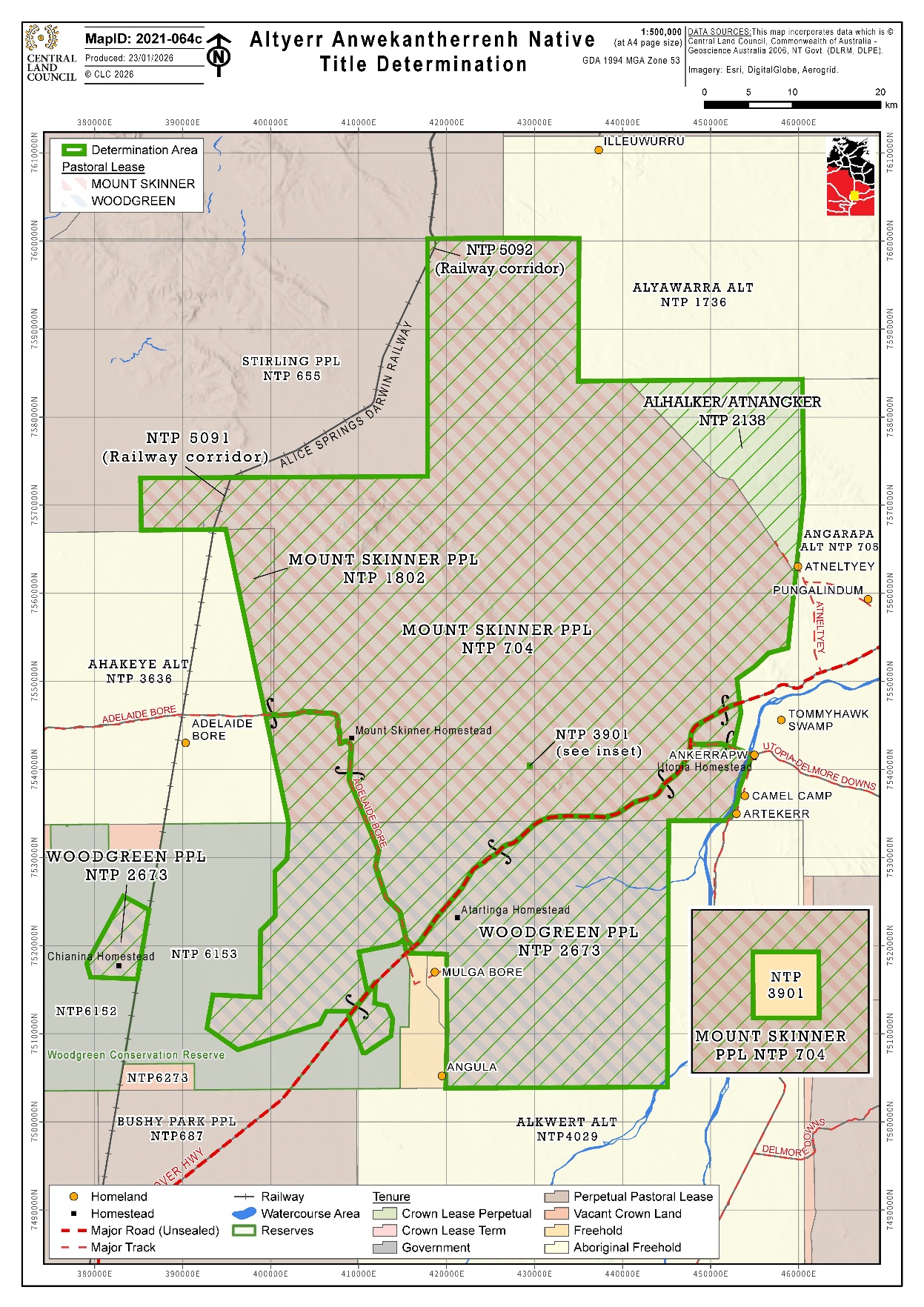
1. The Determination Area comprises NT Portions 704, 1802, 2138, 2673, 5091 and 5092 being the land and waters more particularly described in Schedule A and depicted on the map comprising Schedule B.
2. Native title exists in the Determination Area as follows:
(a) NT Portion 2138 – exclusive native title rights and interests – section 47A of the Act applies;
(b) NT Portions 704, 1802, 2673, 5091 and 5092 – the native title rights and interests in paragraph 7 apply.
3. Notwithstanding paragraph 2, native title does not exist in those parts of the Determination Area described in Schedule C.
The native title holders
4. The Determination Area comprises eight estate areas associated with the Ahalper, Alekwarr, Alhalker/Atnangker, Ankweteng, Arnmanapwenty, Atwel, Ilkewartn and Rtwerrpe landholding groups.
5. The persons who hold the common or group rights comprising the native title are the Aboriginal persons who are:
(a) members of one or more of the landholding groups referred to in paragraph 4 by virtue of descent (including adoption) through father’s father, father’s mother, mother’s father and mother’s mother;
(b) accepted as members of one or more of the landholding groups referred to in paragraph 4 by senior members of a landholding group, referred to in subparagraph (a), by virtue of the following non-descent connections to an estate:
(i) spiritual identification with and responsibility for an estate;
(ii) conception and/or birthplace affiliation with an estate;
(iii) long-term residence in an estate;
(iv) close kinship ties, including intermarriage;
(v) shared section/subsection and/or moiety affiliation;
(vi) a more distant ancestral connection to an estate, for example, mother’s father’s mother;
(vii) possession of traditional religious knowledge, authority and responsibility for an estate;
(viii) authority and responsibility for shared Dreaming tracks and/or places of significance connected with an estate;
(ix) seniority in traditional matters concerning the claim group and/or the estate.
Native title rights and interests
6. In relation to NT Portion 2138, where any prior extinguishment of native title must be disregarded, the native title rights and interests confer possession, occupation, use and enjoyment of the land and waters on the native title holders to the exclusion of all others.
7. In relation to NT Portions 704, 1802, 2673, 5091 and 5092, the native title rights and interests are the non-exclusive rights to:
(a) access, remain on and use the land and waters for any purpose;
(b) access, take and/or use the resources of the land and waters for any purpose;
Note: To avoid doubt, matters excluded from the term “resources of the land and waters” are defined at paragraph 15.
(c) maintain and protect places, areas and things of significance under traditional laws and customs;
and without limiting the generality or scope of (a)-(c) above, the rights to:
(d) live on the land;
(e) erect shelters and other structures;
(f) light fires, but not for the purpose of clearing vegetation;
(g) conduct and participate in the following activities on the land and waters:
(i) cultural activities;
(ii) ceremonies;
(iii) meetings;
(iv) cultural practices relating to birth and death including burial rites;
(v) teaching the physical and spiritual attributes of sites and places on the land and waters;
(h) make decisions about the use and enjoyment of the land and waters by Aboriginal people who recognise themselves to be governed by the traditional laws and customs acknowledged by the native title holders; and
(i) be accompanied on the land and waters by persons who, though not native title holders, are:
(i) people required by traditional law and custom for the performance of ceremonies or cultural activities on the land and waters;
(ii) people who have rights in relation to the land and waters according to the traditional laws and customs acknowledged by the native title holders;
(iii) people required by the native title holders to assist in, observe, or record traditional activities on the areas.
8. The native title rights and interests referred to in paragraph 7 do not confer:
(a) possession, occupation, use and enjoyment of the land and waters on the native title holders to the exclusion of all others;
(b) any right to control access to, or the use of, the land and waters or its resources;
(c) a right to clear vegetation through the use of fire; or
(d) a right to light fires in a manner that creates a material risk of the fire escaping containment.
9. The native title rights and interests are subject to and exercisable in accordance with:
(a) the traditional laws and customs of the native title holders;
(b) the valid laws of the Northern Territory of Australia and the Commonwealth of Australia.
10. There are no native title rights and interests in:
(a) minerals as defined in section 2 of the Minerals Acquisition Act 1953 (NT);
(b) petroleum as defined in section 5 of the Petroleum Act 1984 (NT);
(c) prescribed substances as defined in section 5 of the Atomic Energy Act 1953 (Cth) and section 3 of the Atomic Energy (Control of Materials) Act 1946 (Cth).
Other interests
11. The nature and extent of the other interests in relation to the Determination Area are:
(a) NT Portions 704 and 1802:
(i) the rights and interests of Todd River Pastoral Company Pty Ltd (ACN 009 606 928) under Perpetual Pastoral Lease No. 1138;
(ii) the rights and interests under Access Easement Dealing No 600276 pursuant to section 14A of the AustralAsia Railway (Special Provisions) Act 1999 (NT) registered on 3 January 2006 (NT Portion 704);
(iii) the rights and interests under Access Easement Dealing No 598379 pursuant to section 14A and varied by 14B of the AustralAsia Railway (Special Provisions) Act 1999 (NT) registered on 12 December 2005 (NT Portion 704).
(b) NT Portion 2138: the rights and interests of the Allalgara/Annangara Aboriginal Corporation (ICN 66) under Crown Lease Perpetual No. 562.
(c) NT Portion 2673: the rights and interests of James Robert Purvis under Perpetual Pastoral Lease No. 972.
(d) NT Portions 5091 and 5092: the rights and interests of the AustralAsia Railway Corporation under Crown Lease Term No. 1879.
(e) the rights and interests of the holders of the following mining titles granted under the Mineral Titles Act 2010 (NT) (or its predecessor):
No. | Expiry date | Holder |
EL 24253 | 6 April 2027 | Mithril Silver and Gold Limited |
EL 29475 | 14 January 2027 | Raptor Metals Limited |
EL 30797 | Renewal application pending | Raptor Metals Limited |
EL 31292 | 12 January 2027 | Raptor Metals Limited |
EL 32374 | 3 June 2027 | Baudin Resources Pty Ltd |
EL 32421 | 3 June 2027 | Baudin Resources Pty Ltd |
EL 32696 | 26 October 2027 | Baudin Resources Pty Ltd |
EL 33060 | 14 August 2028 | Baudin Resources Pty Ltd |
EL 34121 | 15 December 2031 | WA1 Resources Ltd |
(f) in relation to NT Portions 704, 1802 and 2673, the rights of Aboriginal persons (whether or not native title holders) pursuant to the reservation in favour of Aboriginal people contained in Perpetual Pastoral Leases No. 1138 and No. 972 respectively set out in sections 38(2) to (6) of the Pastoral Land Act 1992 (NT).
(g) the rights of Aboriginal persons (whether or not native title holders) by virtue of the Northern Territory Aboriginal Sacred Sites Act 1989 (NT).
(h) valid or validated rights and interests held by force and operation of the Water Act 1992 (NT);
(i) rights of access by an employee, servant, agent or instrumentality of the Northern Territory, Commonwealth or other statutory authority as required in the performance of his or her statutory duties.
(j) the interests of persons to whom valid or validated rights and interests have been:
(i) granted by the Crown pursuant to statute or otherwise in the exercise of its executive power; or
(ii) conferred by statute.
Relationship between the native title rights and interests and the other interests
12. In relation to NT Portions 704, 1802 and 2673, the other interests and the doing of an activity in giving effect to them or of an activity required or permitted by them, prevail over but do not extinguish the native title rights and interests, and the existence and exercise of the native title rights and interests do not prevent the carrying on of any such activity.
13. In relation to NT Portion 2138 the relationship between the native title rights and interests referred to in paragraph 6, and the rights and interests of the Allalgara/Annangara Aboriginal Corporation referred to in paragraph 11, is that:
(a) Crown Lease Perpetual No. 562 is partly inconsistent with the continued existence, enjoyment or exercise of the native title rights and interests, however:
(i) the native title continues to exist in its entirety, but the rights and interests have no effect in relation to the lease to the extent of the inconsistency; and
(ii) if the lease or its effects are wholly removed or otherwise wholly cease to operate over any part of NT Portion 2138, the native title rights and interests again have full effect to that extent;
(b) the native title rights and interests that are not inconsistent with Crown Lease Perpetual No. 562 are the non-exclusive native title rights and interests set out in paragraph 7; and
(c) the rights and interests conferred by Crown Lease Perpetual No. 562 and the doing of an activity in giving effect to them or of an activity required or permitted to be done by or under the lease prevail over but do not extinguish the native title rights and interests, and the existence, enjoyment or exercise of the native title rights and interests, to the extent of any inconsistency, does not prevent the carrying on of any such activity.
14. In relation to NT Portions 5091 and 5092, the relationship between the native title rights and interests referred to in paragraph 7, and the rights and interests of AustralAsia Railway Corporation referred to in paragraph 11 as the holder of Crown Lease Perpetual No. 1879, is that the non-extinguishment principle applies. Accordingly:
(a) the grant of the lease is wholly inconsistent with the continued existence, enjoyment or exercise of the native title rights and interests;
(b) the native title continues to exist in its entirety, but has no effect in relation to the grant;
(c) if the grant or its effects is wholly removed or otherwise wholly ceases to operate, the native title rights and interests again have full effect; and
(d) if the grant or its effects is removed to an extent or otherwise ceases to operate only to an extent, the native title rights and interests again have effect to that extent.
Definitions
15. In this determination the term:
(a) “the Act” means the Native Title Act 1993 (Cth).
(b) “resources of the land and waters” does not include:
(i) minerals, petroleum, and prescribed substances as defined in paragraph 10; or
(ii) any water deriving from, or in relation to, the Determination Area which, from time to time, is lawfully captured by a lessee of Perpetual Pastoral Leases No. 972 or No. 1138 or the holder of any mineral lease pursuant to the Mineral Titles Act 2010 (NT).
16. Unless the contrary intention appears, a word or expression used in the Act has the same meaning in this determination as it has in the Act.
Schedule A
Description of the Determination Area
1. The Determination Area comprises the following areas of land and waters:
(a) NT Portions 704 and 1802 comprising an area of 3,036 square kilometres held under Perpetual Pastoral Lease 1138.
(b) NT Portion 2138 comprising an area of 20.7 square kilometres held under Crown Lease Perpetual 562.
(c) NT Portion 2673 comprising an area of 1,230 square kilometres held under Perpetual Pastoral Lease 972.
(d) NT Portion 5091 comprising an area of 62.65 hectares held under Crown Lease Term 1879.
(e) NT Portion 5092 comprising an area of 29.43 hectares held under Crown Lease Term No. 1879.
17. The following areas within the external boundaries of the Determination Area are not included in the Determination Area:
(a) NT Portion 3901 comprising an area of 2.25 hectares held for an estate in fee simple by Amplitel Pty. Ltd. (ACN 648 133 073).
(b) the following roads constructed by or on behalf of the Northern Territory as public roads:
(i) a road 100 metres wide which traverses NT Portion 704 from the Sandover Highway to the boundary of NT Portion 705 (Angarapa Aboriginal Land Trust).
(ii) a road 100 metres wide (Sandover Highway) which traverses NT Portions 704 and 2673 from the boundary of NT Portion 6153 to the boundary of NT Portion 705 (Angarapa Aboriginal Land Trust).
(iii) a road 100 metres wide (Adelaide Bore access road) which traverses NT Portions 1802, 704 and 2673 from the boundary of NT Portion 3636 (Ahakeye Aboriginal Land Trust) to the junction with the Sandover Highway.
Schedule B
Map of Determination Area
Schedule C
Areas where native title does not exist
Native title rights and interests have been wholly extinguished in the following areas of land and waters.
Public works
Those parts of the Determination Area covered by public works as defined in section 253 of the Act (including land and waters within the meaning of section 251D of the Act) that were constructed or established before 23 December 1996 or commenced to be constructed or established on or before that date including, if they are public works:
(a) public roads, namely, rural public roads (50 metres either side of the centreline), rural arterial roads and national highways and associated road infrastructure;
(b) community, pastoral access and other roads (including access roads and tracks to public works referred to in this clause) which are not otherwise public roads;
(c) gravel and fill pits established to maintain the roads referred to in (a) and (b) above;
(d) government bores and associated works;
(e) river and rain gauges;
(f) transmission water pipes (adjacent area 5 metres either side of the centreline);
(g) distribution water pipes measuring 150mm diameter or less (adjacent area of 1.5 metres either side of the centreline) and greater than 150mm diameter (adjacent area 5 metres either side of the centreline);
(h) sewer pipes measuring 150mm diameter or less (adjacent area 1.5 metres either side of the centreline) and greater than 1500mm or greater (adjacent area 5 metres either side of the centreline);
(i) bores, sewer pump stations, and overhead power lines.
Note: Entry of orders is dealt with in Rule 39.32 of the Federal Court Rules 2011.
REASONS FOR JUDGMENT
BURLEY J:
1. INTRODUCTION
1 On 7 June 2023, Graham Long, Sam Dixon, Jennifer Kngwarreye Purvis, Gerry Price and Robin Purvis (together, the Applicant) lodged an application in this Court for a native title determination pursuant to the Native Title Act 1993 (Cth) (the Act) in respect of land and waters comprising the Mt Skinner and Woodgreen pastoral leases, as well as two crown leases (Determination Area). The Applicant gave the application the name Altyerr Anwekantherrenh which in English broadly means “all of our Dreamings together”.
2 The native title claim group comprises the members of the Ahalper, Alekwarr, Alhalker/Atnangker, Ankweteng, Arnmanapwenty, Atwel, Ilkewartn and Rtwerrpe landholding groups.
3 The respondents are the Northern Territory of Australia, Todd River Pastoral Company Pty Ltd (ACN 009 606 928), and James Robert Purvis.
4 After fruitful discussions between the parties, they have approached the court for orders under s 87 of the Act to make a determination of native title by consent.
5 The Applicant has filed:
(a) a Minute of Proposed Determination of Native Title by Consent dated 17 April 2026 which has been signed by the parties (Minute);
(b) a Statement of Joint Agreed Facts of the Applicant and the First Respondent in Support of the Minute; and
(c) Joint Submissions of the Applicant and the Respondent in support of the Minute.
6 The Determination Area is located about 160 kilometres north of Alice Springs in the Northern Territory and consists of:
(a) Woodgreen Pastoral Lease (NT Portion 2673, Perpetual Pastoral Lease (PPL) 972) (Woodgreen PPL);
(b) Mt Skinner Pastoral Lease (NT Portions 704 and 1802, PPL 1138) (Mt Skinner PPL);
(c) NT Portion 2138 held under Crown Lease in Perpetuity 562 (Allalgara / Annangara Aboriginal Community Living Area); and
(d) NT Portions 5091 and 5092 held under Crown Lease Term 1879 (Railway Corridor).
2. BACKGROUND
7 The Applicant and the Northern Territory reached agreement about a number of key factual matters which are relevant to the existence of native title rights and interests pursuant to the traditional laws and customs of the native title claimants, some of which are set out below, by way of background to consideration of the formal aspects of the determination.
8 In respect of the Determination Area, mountain ranges are the defining topographical feature within Mt Skinner Pastoral Lease (NT Portions 704 and 1802, PPL 1138). From the far north-west corner, around Mount Octy, a chain of hills crosses the lease diagonally to Mount Skinner itself, in the south-east. Spring Range occupies the north-most section of the lease, with Tomahawk Range on the east. Woodgreen Pastoral Lease (NT Portion 2673, PPL 972) is generally flatter but there is a stretch of high country in the south-east, culminating in Arno Peak. The region is semi-arid, however, there are semi-permanent rockholes, soakages, swamps, and a perennial major spring filled by run-off from the intermittent hilly country.
9 The Determination Area was occupied by the antecedents of the claim group from time immemorial. The first European presence in the area occurred in 1870, by John Ross and Alfred Giles, both explorers who traversed the landscape along the Waite River, which is adjacent to the boundary of Woodgreen PPL. Ross saw evidence of Aboriginal people living in the area and spoke with some of them but was unable to understand them. Both travelled onward to Mount Skinner and followed the associated mountain range toward Barrow Creek.
10 A telegraph station was established in 1872 at Barrow Creek, 50 km north west of the Determination Area. This became the site of an attack by a contingent of Aboriginal men and led to the death of two Europeans, which resulted in reprisal attacks by police and settlers and led to the massacre of Kaytetye and Anmatyerr people.
11 The landscape became subject to pastoral leases in the 1880s and was used for cattle grazing. This led to the restriction of water sources used by Aboriginal people in favour of the agriculture. Consequently, Aboriginal raids on cattle and property continued, as did reprisal massacres conducted by the community.
12 By the 1890s, starvation, violence, and introduced disease had devastated the population of Aboriginal people in the area, leading to much death, and Aboriginal resistance had largely ceased. No government settlements or missions were established in the immediate vicinity of the Determination Area. Such was the impact of this devastation that telegraph station operators were given rations to issue to Aboriginal people.
13 In the Determination Area and surrounding it, pastoral leases were stocked in the 1910s. In the 1920s and 1930s, Harper Springs (now called Mount Skinner), Woodgreen, and other stations to the east of the Determination Area, were taken up.
14 Arandic laws and customs govern the country in which the Determination Area is situated. Rights are held by eight landholding groups, who are expressly identified earlier in my reasons (at [2] above). They derive the names for their estates with reference to a particularly significant sacred site within it, and each have their own distinctive language. They have linguistic commonalities between them, and substantially the same system of law and custom. This makes this area the Arandic social region or society.
15 The country is divided into land (estates) which have their origin in Altyerre (also spelt as Altyerr in some languages), when Dreaming Beings travelled across the land, giving rise to all physical features of the landscape. The term for an estate is apmer / apmere, also used to describe ‘camp’ or ‘home/house’. The rights and responsibilities of the landholding groups regarding their respective estates are mutually recognised by the claimants, and by neighbouring landholding groups from outside the Determination Area.
16 The land is an inalienable religious resource, and Dreaming Beings are considered responsible for the ritual and cultural institutions that are the basis of the laws and customs which operate throughout the Arandic region.
17 The country was travelled across by the Dreaming Beings celebrated in ritual and songs – it is believed their essence imbues sacred sites and tracks throughout the Determination Area. Some particular examples of this include: Ahakey (Bush Plum); Akarley (Northern Wild Orange); Anaty (Bush Potato); Ankerr (Emu); Arengk Arnwer (Dingo); Aherr (Kangaroo); Arlewatyerre (Sand Goanna); Arlpaty (Port Lincoln Ring-Neck Parrot); Arlatyey (Pencil Yam); Arnkerrth (Mountain Devil Lizard); Arrwa (Rock Wallaby); Artwe (Men); Arwengalker (Sugarbag); Atnwelarr (Bush Yam); Atwakey (Wild Orange); Awey (Travelling Boys); Errtyarte (Spear); Ilkwert (Perentie); Ikwelengk (Snake species); Ikwelengk Atherr (Two Green Snakes); Ilenty (Galah); Ingwa (Night); Intekw (type of plant eaten by emus) Irnpernp (Yellow Throated Miner); Kam (Yam Seed); Kwekaty (Travelling Men); Ngangkar (Bush Doctor); Ntyerrk (Wild Fig), Ntyweyamp (Corkwood Honey); Ntyerrm (Bush Bean); Tyape Atnyemayte (Edible Grub from Witchetty Bush); Utnerrengayt (Emu Bush Caterpillar); and Yerramp (Honey Ant).
18 The rights held by the claimants pursuant to their traditional law and customs are broad, as the claimants’ responsibility for spiritual and secular management of their country invests them both ritual jurisdiction and economic control over the land, and the resources of estates within the Determination Area.
19 A broad range of resources within the Determination Area are used by the claimants. They include: water, clay and ochre, ant nests, stones, various woods, sticks, roots, beans, native plums, raisins, bananas, oranges, tomatoes, onions, figs, bloodwood apple, bush coconut, bush potatoes and yams, honey and honey ants, nectar, lerp, medicinal herbs, bush tobacco, grubs, bush turkey, emu and small birds, eggs, feathers, echidna, sand goanna, perentie, dragon lizard, small lizards, carpet python and marsupial species.
20 Under those traditional laws and customs, the claimants have the right to speak to country and visitors must seek permission from the apmerek/e-artwey/e to access the estate and its resources. Kwertengerl/e have the role of acting as a spokesperson and intermediary between visitors and apmerek/e-artwey/e.
21 Several senior members of the claim group were born, grew up, worked and have lived their lives in the Determination Area. A lifelong connection with the Determination Area has been deeply maintained through hunting, gathering bush food and medicine, using water from soakages, hollow trees and rockholes, and following traditional walking tracks.
22 Claimants were taught about, and shown, their country by their elders. The cultural geography of the Determination Area was taught via songs and stories from their ancestors, and by interacting with the area in company with their elders. This continues today, and senior members of the claimant group pass on localised knowledge to the youth in culturally appropriate contexts and locations.
23 Also, many claimants continue to live in the near vicinity of the Determination Area, in nearby communities and outstations such as Atneltyey (Boundary Bore), Arlparra, Mulga Bore, Angula and Adelaide Bore.
24 The assessment of connection to this country was enabled through the production of several expert anthropological reports, from which the first respondent formed the view that the Applicant has satisfied the requirements of s 223 of the Act. That is, the native title claim group as described in the application as filed, is comprised of persons who hold both exclusive and non-exclusive native title rights and interests within the meaning of s 223(1) of the Act in various parts of the Determination Area, except where native title is extinguished by public works.
3. SECTION 87 OF THE ACT
25 Section 87 of the Act provides that the Court may make a determination of native title by consent over an area covered by a native title application and without holding a hearing where:
(a) the notification period specified in the notice given under s 66 of the Act has ended (s 87(1));
(b) there is an agreement between the parties on the terms of an order of the Court in relation to the proceedings (ss 87(1)(a) and (aa));
(c) the terms of the agreement are in writing and are signed by or on behalf of the parties and filed with the Court (s 87(1)(b));
(d) the Court is satisfied that an order in, or consistent with, those terms would be within its power (s 87(1)(c)); and
(e) the Court considers that it would be appropriate to make the order sought (ss 87(1A) and (2)).
See Jingle on behalf of the Jaru People #2 v State of Western Australia [2022] FCA 1511 at [11] (Mortimer J); Munn for and on behalf of the Gunggari People v State of Queensland [2001] FCA 1229; 115 FCR 109 at [4]–[5] (Emmett J); Freddie v Northern Territory [2017] FCA 867 at [12]–[14] (Mortimer J).
26 In relation to s 87(1)(c) of the Act, in order to be satisfied that the orders sought are within the power of the Court, consideration must be given to the restrictions and/or requirements in the Act, including that:
(a) there is no challenge to the validity of the application;
(b) there is no approved determination of native title in relation to the Determination Area (s 13(1)(a) of the Act), and the terms of s 68 of the Act are not applicable;
(c) there are no proceedings before the Court relating to native title determination applications that cover any part of the Determination Area which would otherwise require orders to be made under s 67(1) of the Act;
(d) the form of the proposed determination outlined in the agreement complies with s 94A of the Act by setting out the details of the matters required by s 225 of the Act (see Freddie at [15]);
(e) the proposed determination concerns rights and interests which the Australian common law is able to recognise (s 223(1)(c)); and
(f) the requirements of s 87 of the Act are otherwise satisfied.
27 The focus of the Court in considering whether the orders sought are appropriate under ss 87(1A) and (2) of the Act is on the making of the agreement by the parties. In that context it is to be noted that the Court’s role in a consent determination is quite different to its role in the case of a disputed claim. As Mortimer J said in Freddie:
16 The Court’s function under s 87 is quite different from its function in a contested application for a determination of native title, and this difference has been confirmed in many authorities of this Court: see Lovett on behalf of the Gunditjmara People v State of Victoria [2007] FCA 474 at [36] (North J), which has been endorsed many times; and see for example Thudgari People v State of Western Australia [2009] FCA 1334 at [25] (Barker J); Goonack v State of Western Australia [2011] FCA 516 at [25]-[26] (Gilmour J), in relation to s 87A; Wurrunmurra on behalf of the Bunuba People v State of Western Australia [2015] FCA 1480 at [27] (Barker J). In Lander v State of South Australia [2012] FCA 427 at [11], and by reference to Lovett, Mansfield J emphasised that the focus of the Court under s 87 is on the making of the agreement by the parties.
17 The Court’s function under s 87, and its discretion, must also be understood in the context of the Native Title Act’s emphasis on negotiation and alternative dispute resolution, whereby one particular object of the Native Title Act is to resolve claims to native title without judicial determination in a contested proceeding: see Munn (for and on behalf of the Gunggari People) v Queensland [2001] FCA 1229; 115 FCR 109 at [28] (Emmett J). I note in this context that the Preamble to the Act envisages that:
A special procedure needs to be available for the just and proper ascertainment of native title rights and interests which will ensure that, if possible, this is done by conciliation and, if not, in a manner that has due regard to their unique character.
(Emphasis in original.)
28 In the context of consideration of the Court’s power, it is apparent that the role of the Court in a consent determination is to ensure that the orders sought are within its power, in the sense that they procedurally conform with the requirements of the Act. Therefore, the Court does not need to embark on its own inquiry of the merits of the claim made in the application to be satisfied that the orders sought are supportable and in accordance with the law: Cox on behalf of the Yungngora People v State of Western Australia [2007] FCA 588 at [3] (French J). However, it might consider that evidence for the limited purpose of being satisfied that the State is acting in good faith and rationally: Munn at [29]–[30] (Emmett J). See also Clarrie Smith v State of Western Australia [2000] FCA 1249; 104 FCR 494 at [38] (Madgwick J):
… State governments are necessarily obliged to subject claims for native title over lands and waters owned and occupied by the State and State agencies, to scrutiny just as carefully as the community would expect in relation to claims by non-Aborigines to significant rights over such land. …
29 To ensure the requirements of s 87(2) of the Act have been met the Court must understand the process undertaken by the Territory. This includes relevantly whether:
(a) the parties have independent and competent legal representation;
(b) the terms of the proposed order are “unambiguous and certain as to the rights declared”; and
(c) the agreement has been preceded by a mediation process.
4. THE APPLICATION OF S 87 TO THE APPLICATION
30 I am satisfied that the requirements of s 87 of the Act have been met. In this regard, the materials before the Court enable me to conclude that:
(a) the period specified in the notice given under s 66 ended on 26 March 2024 (s 87(1));
(b) the Parties have reached an agreement as to the terms of a determination of native title (s 87(1)(a)(i));
(c) the Parties have recorded their agreement in the Minute (s 87(1)(b));
(d) an order in terms of or consistent with the Minute would be within the Court’s power because:
(i) the Application is valid and was made in accordance with s 61 of the Act;
(ii) the Application is for a determination of native title in relation to an area for which there is no approved determination of native title (s 13(1)(a));
(iii) the Minute complies with ss 94A and 225 of the Act (s 87(1)(c));
(e) it is appropriate that the Court make the orders sought because:
(i) the actively participating Parties are legally represented;
(ii) the Northern Territory as Respondent obtained searches of land tenure and mining and other relevant interests to determine the extent of “other interests” within the proposed Determination Area and provided copies of those searches to the Applicant;
(iii) the Parties have agreed the nature and extent of other interests in relation to the Determination Area and those interests are described in paragraph 11 of the Minute (s 225(c));
(iv) there are no other proceedings before the Court relating to native title determination applications that cover any part of the area the subject of the Application which would otherwise require orders to be made under s 67(1) of the Act (ss 87(1) and (2));
(v) the Northern Territory as Respondent has played an active role in the negotiation of the consent determination. In doing so, the Northern Territory, acting on behalf of the community generally, having had regard to the requirements of the Act and having conducted a thorough assessment process, is satisfied that the determination is justified in all the circumstances.
31 For the purposes of satisfying section 57 of the Act, Altyerr Anwekantherrenh Aboriginal Corporation (ICN 9602) is to be the agent prescribed body corporate. I am satisfied that the requirements of s 57(2) have been met such that the corporation can exercise the functions in s 57(3) of the Act.
5. DISPOSITION
32 For the reasons set out above, the Court makes a determination of native title by consent over the area covered by the Determination Area.
I certify that the preceding thirty-two (32) numbered paragraphs are a true copy of the Reasons for Judgment of the Honourable Justice Burley. |
Associate:
Dated: 7 July 2026
SCHEDULE OF PARTIES
NTD 17 of 2023 | |
Applicants | |
Applicant: | SAM DIXON |
Applicant: | JENNIFER KNGWARREYE PURVIS |
Applicant: | GERRY PRICE |
Applicant: | ROBIN PURVIS |


