Federal Court of Australia
David on behalf of the Torres Strait Regional Seas Claim v State of Queensland (No 2) [2026] FCA 842
File number(s): | QUD 227 of 2022 QUD 570 of 2023 QUD 156 of 2026 QUD 278 of 2026 |
Judgment of: | MORTIMER CJ |
Date of judgment: | 30 June 2026 |
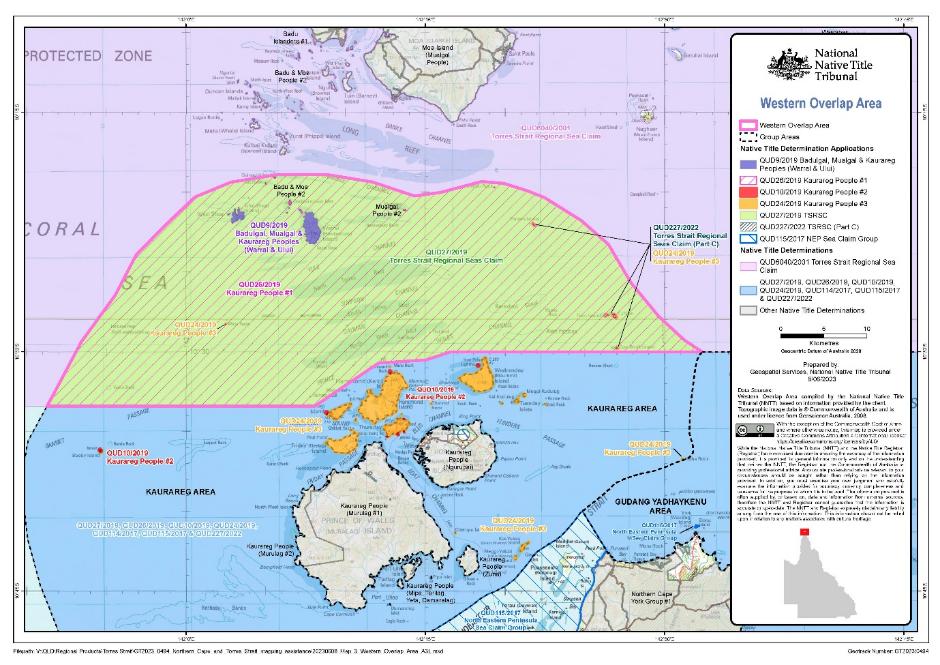
Catchwords: | NATIVE TITLE – case management and hearings – where four proceedings all involve claims to sea country with one or more shared or adjacent overlapping boundaries – where two other proceedings are also sea claims with adjacent boundaries to some of those four sea country claims – consideration of most efficient way to hear and determine all related proceedings – four proceedings to be heard together and not partitioned – parties in other two proceedings to show cause why those proceedings should not also be heard with the other proceedings if negotiated agreement not reached |
Legislation: | Native Title Act 1993 (Cth) ss 66, 67, 86 |
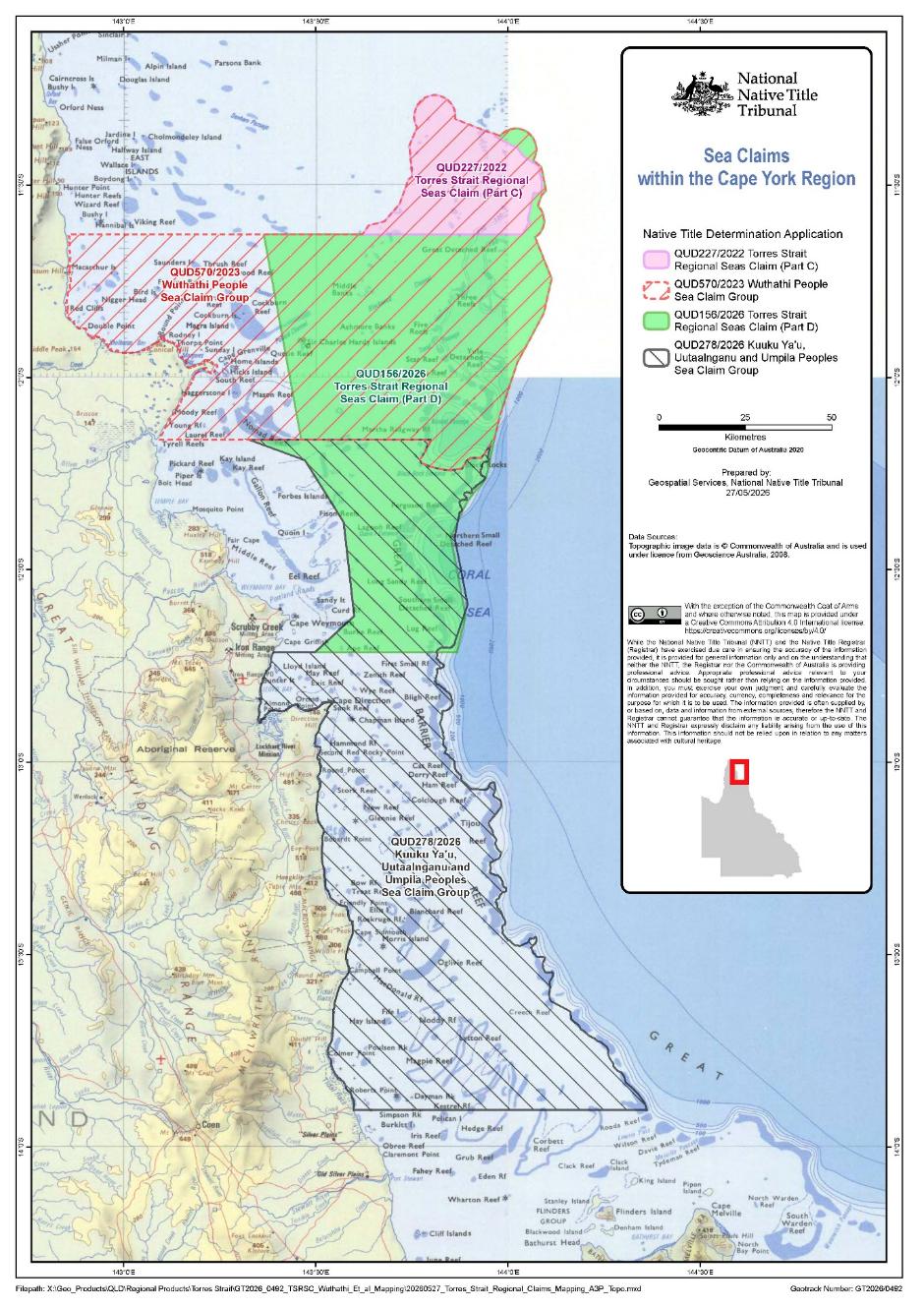
Cases cited: | Akiba on behalf of the Torres Strait Islanders of the Regional Seas Claim Group v State of Queensland (No 2) [2010] FCA 643; 204 FCR 1 David on behalf of the Torres Strait Regional Seas Claim v State of Queensland [2022] FCA 1430 Nona on behalf of the Badulgal, Mualgal and Kaurareg Peoples (Warral & Ului) v State of Queensland (No 6) [2024] FCA 1162 |
Division: | General Division |
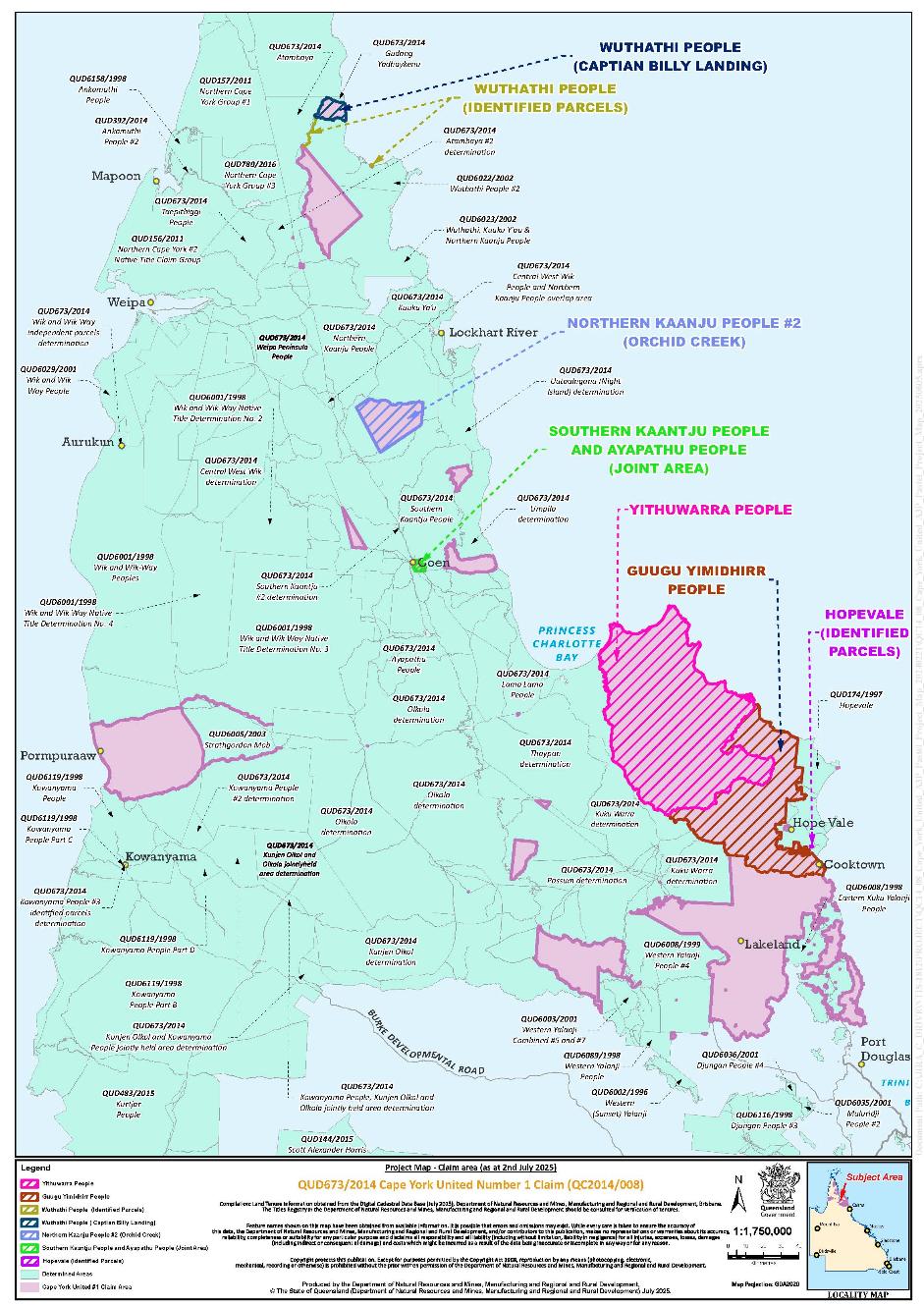
Registry: | Queensland |
National Practice Area: | Native Title |
Number of paragraphs: | 42 |
Counsel for the Applicant in QUD 227 of 2022 and the Applicant in QUD 156 of 2026 | Mr V Hughston SC |
Solicitor for the Applicant in QUD 227 of 2022 and the Applicant in QUD 156 of 2026 | Dillon Bowers Lawyers |
Counsel for the Applicant in QUD 570 of 2023 and QUD 278 of 2026 | Mr D Yarrow SC |
Solicitor for the Applicant in QUD 570 of 2023 and QUD 278 of 2026 | Cape York Land Council Aboriginal Corporation |
Counsel for the State of Queensland | Mr M McKechnie |
Solicitor for the State of Queensland | Crown Law |
Counsel for the Commonwealth of Australia | Ms R Webb KC |
Solicitor for the Commonwealth of Australia | Australian Government Solicitor |
ORDERS
QUD 227 of 2022 | ||
| ||
BETWEEN: | LUI NED DAVID & ORS ON BEHALF OF THE TORRES STRAIT REGIONAL SEAS CLAIM (PART C) Applicant | |
AND: | STATE OF QUEENSLAND & ORS Respondent | |
QUD 570 of 2023 | ||
| ||
BETWEEN: | JOHNSON CHIPPENDALE & ORS ON BEHALF OF THE WUTHATHI PEOPLE SEA CLAIM GROUP Applicant | |
AND: | STATE MINISTER FOR THE STATE OF QUEENSLAND & ORS Respondent | |
QUD 156 of 2026 | ||
| ||
BETWEEN: | LUI NED DAVID AND ORS ON BEHALF OF THE TORRES STRAIT REGIONAL SEAS CLAIM (PART D) Applicant | |
AND: | STATE MINISTER FOR THE STATE OF QUEENSLAND & ORS Respondent | |
QUD 278 of 2026 | ||
| ||
BETWEEN: | GREGORY PASCOE & ORS ON BEHALF OF THE KUUKU YA’U, UUTAALNGANU AND UMPILA PEOPLES SEA CLAIM GROUP Applicant | |
AND: | STATE MINISTER FOR THE STATE OF QUEENSLAND & ORS Respondent | |
order made by: | MORTIMER CJ |
DATE OF ORDER: | 30 June 2026 |
THE COURT NOTES THAT:
A. The claims in these proceedings (QUD227/2022, QUD570/2023, QUD156/2026 and QUD278/2026) all involve claims to sea country with one or more shared or adjacent overlapping boundaries, and in the Court’s opinion it is likely that there will be evidence adduced in each proceeding that is relevant to the determination of one or more of the other proceedings.
B. Proceedings QUD26/2019 and QUD27/2019 are also sea claims with adjacent boundaries to some of the sea country claims referred to in Note A, and/or involving claimant groups constituted by some of the same peoples.
C. The parties will have an opportunity address the Court on whether evidence in the proceedings listed in Note A may also be relevant to the determination of the proceedings listed in Note B.
D. For the avoidance of doubt and to promote compliance with the Court’s orders, these orders in part consolidate and reproduce the effect of the orders mentioned in Order 32 of these orders (which cease to have effect from the date of these orders).
E. In these orders:
(a) “Active Parties” means all of the following:
(b) the Applicants;
(c) the State;
(d) any other party who files a notice in accordance with Order 6 or 7(b) of these orders;
F. “Applicants” means the applicant in each of QUD227/2022, QUD570/2023, QUD156/2026 and QUD278/2026;
G. “First Tranche Hearing” means the hearing of evidence during the period of 5 days commencing on 9 November 2026;
H. “Kaurareg People #1 claim” means QUD26/2019;
I. “NTA” means the Native Title Act 1993 (Cth);
J. “Second Tranche Hearing” means the hearing of evidence during the period of 12 days commencing on 3 May 2027;
K. “Torres Strait Regional Seas Claim (Part B)” means QUD27/2019.
THE COURT ORDERS THAT:
Preliminary
1. Pursuant to s 67(1) of the NTA, and subject to any further order, the proceedings QUD227/2022, QUD570/2023, QUD156/2026 and QUD278/2026 be heard and determined together.
2. If by 12 October 2026 the Court has not been informed that the Torres Strait Regional Seas Claim (Part B) and the Kaurareg People #1 claim are proceeding to consent determination, then the parties to the those claims will be required to show cause at a case management hearing why those proceedings should not be heard and determined together with the proceedings referred to in Order 1.
3. The proceedings be listed for the following initial tranches of hearing:
(a) Tranche 1, being a period of 5 days commencing on 9 November 2026, with evidence to be heard at Mer (Murray Island), Erub (Darnley Island), Lockhart River, Bamaga and Cairns;
(b) Tranche 2, being a period of 12 days commencing on 3 May 2027, with evidence to be heard at Sir Charles Hardy Islands, Raine Island, Horn Island and Cairns.
4. Pursuant to s 86B of the NTA, the proceedings are referred to mediation before Senior Judicial Registrar McGregor.
5. The proceedings are to remain in intensive case management before Senior Judicial Registrar McGregor.
Active Parties
6. By 4pm on 6 July 2026, any respondent, other than the State, who intends to participate actively in the proceedings must file a notice indicating that they intend to do so.
7. If, after the date of these orders, a person becomes a respondent to any of the proceedings:
(a) the applicant in that proceeding must, within 7 days, serve a copy of these orders on that respondent; and
(b) if that respondent intends to participate actively in the proceedings—the respondent must, within 14 days, file a notice indicating that they intend to do so.
8. The Active Parties are excused from serving documents on any party who is not one of the Active Parties.
9. Any party who is not one of the Active Parties will be bound by the outcome of the proceedings.
First Tranche Hearing draft timetable
10. By 4pm on 6 July 2026, the applicant in QUD278/2026 is to file a list of the proposed witnesses upon whose evidence it will rely at the First Tranche Hearing.
11. The Active Parties are then to liaise with Senior Judicial Registrar McGregor to discuss and make arrangements for the First Tranche Hearing.
Filing of any further overlapping or adjacent claims
12. By 9 July 2026, the Applicants are to arrange with Cape York Land Council and the Gur A Baradharaw Kod Torres Strait Sea and Land Council to place a notice of these orders on their respective websites.
13. The notice placed must prominently advertise the fact that the Court has ordered that any person, or group of people, who wish to make a claim to sea country over any of the areas the subject of these proceedings must do so by 12 October 2026 (see Order 14).
14. Any person, or group of people, who wishes to make a claim to sea country over any of the areas the subject of these proceedings must do so by 12 October 2026.
Concise statements
15. By 4pm on 7 August 2026, each of the Applicants is to file a concise statement in accordance with CPN-1.
16. By 4pm on 28 August 2026, each of the Active Parties other than the Applicants is to file a concise response in accordance with CPN-1.
First Tranche Hearing witness statements
17. By 4pm on 28 September 2026, each of the Active Parties is to file:
(a) a statement of evidence for any proposed witnesses upon whose evidence they will rely at the First Tranche Hearing; and
(b) a copy of each photograph or other document (appropriately captioned or described) which it is proposed to tender or refer to in the evidence of each such witness.
First Tranche Hearing final timetable
18. By 4pm on 16 October 2026, the Active Parties are to file a final hearing timetable for the First Tranche Hearing.
First Tranche Hearing objections to evidence
19. By 26 October 2026, the Active Parties are to give each other (but not the Court) notice of any parts of witness statements, expert reports or documents to which they intend to object at the First Tranche Hearing.
20. The parties are to use their best endeavours, including with the assistance of Senior Judicial Registrar McGregor, to resolve any objections prior to the hearing of lay evidence.
21. The Court:
(a) will determine any unresolved objections over witness statements immediately before the relevant witness gives evidence; and
(b) will determine any other unresolved objections at the time that the relevant report or document is sought to be tendered.
Tenure
22. By 8 February 2027, the Active Parties are to file a joint report identifying the extent of any disputed tenure issues in the areas the subject of these proceedings.
Second Tranche Hearing draft timetable
23. By 4pm on 8 March 2027, the Applicants are to file a draft hearing timetable for the Second Tranche Hearing.
24. The Active Parties are then to liaise with Senior Judicial Registrar McGregor to discuss and make arrangements for the Second Tranche Hearing.
Initial filing of s 86 material
25. By 4pm on 8 March 2027, each of the Applicants is to file and serve:
(a) a notice setting out any evidence, recommendation, finding, decision or judgment they contend should be received or adopted under s 86 of the NTA; and
(b) a copy of any record of the evidence, recommendation, finding, decision or judgment referred to in that notice.
Second Tranche Hearing witness statements
26. By 4pm on 8 March 2027, the Active Parties are to file:
(a) a list of the proposed witnesses upon whose evidence they will rely at the Second Tranche Hearing; and
(b) a statement of evidence for each such witness; and
(c) a copy of each photograph or other document (appropriately captioned or described) which it is proposed to tender or refer to in the evidence of each such witness.
Further filing of s 86 material
27. By 4pm on 29 March 2027, each of the Active Parties other than the Applicants is to file and serve:
(a) a notice setting out any evidence, recommendation, finding, decision or judgment they contend should be received or adopted under s 86 of the NTA; and
(b) a copy of any record of the evidence, recommendation, finding, decision or judgment referred to in that notice.
Second Tranche Hearing final timetable
28. By 4pm on 5 April 2027, the Active Parties are to file a final hearing timetable for the Second Tranche Hearing.
Second Tranche Hearing objections to evidence
29. By 5 April 2027, the Active Parties are to give each other (but not the Court) notice of any parts of witness statements, expert reports or documents to which they intend to object at the Second Tranche Hearing.
30. The parties are to use their best endeavours, including with the assistance of Senior Judicial Registrar McGregor, to resolve any objections prior to the hearing of lay evidence.
31. The Court:
(a) will determine any unresolved objections over witness statements immediately before the relevant witness gives evidence; and
(b) will determine any other unresolved objections at the time that the relevant report or document is sought to be tendered.
Other matters
32. The following orders are no longer in effect on and from the date of these orders:
(e) the orders of 13 March 2026 in QUD227/2022 and QUD570/2023;
(f) the orders of 27 May 2026 in QUD227/2022, QUD570/2023, QUD156/2026 and QUD278/2026;
(g) the orders of 27 May 2026 in QUD156/2026.
Note: Entry of orders is dealt with in Rule 39.32 of the Federal Court Rules 2011.
REASONS FOR JUDGMENT
MORTIMER CJ:
1 The orders made today follow on from a case management hearing on 25 May 2026, and the subsequent submission of proposed orders by the parties, with which I do not agree.
2 I therefore give some brief reasons for why I have made orders in the form I have.
3 There are now a number of proceedings in the Cape York and Torres Strait case management region which involve claims to sea country. Much of the land on Cape York is now determined, with two further large consent determinations scheduled for August 2026. With those determinations, a very significant proportion of land on Cape York is the subject of determinations of native title.
4 The situation is less comprehensive in the Torres Strait. While native title has been recognised, to the extent it has been able to be, over most of the middle and outer islands in the Torres Strait, and in the 2022 sea country determination in David on behalf of the Torres Strait Regional Seas Claim v State of Queensland [2022] FCA 1430 in and around the middle and outer islands, there are still some substantial claims to islands and land above the high water mark closer to the mainland which are yet to be finalised. In particular, islands claimed by the Kaurareg People in the three Kaurareg claims in QUD10/2019, QUD24/2019 and QUD26/2019.
Western Torres Strait
5 After the determination in QUD9/2019 (Warral and Ului) (Nona on behalf of the Badulgal, Mualgal and Kaurareg Peoples (Warral & Ului) v State of Queensland (No 6) [2024] FCA 1162), what remains over the Western part of the Torres Strait are the three Kaurareg claims to land and sea country, and claims by the Torres Strait Regional Seas Claim group to sea country, in the Torres Strait Regional Seas Claim (Part B) in QUD27/2019. There are also claims by the TSRSC group to a few small islands above the high water mark, and those claims are made in the Torres Strait Regional Seas Claim (Part C) in QUD227/2022.
6 In the Western Torres Strait, there is also the recently filed claim to the three Sanswit islands, close to the island of Warral. This claim is made on behalf of the Mualgal and Badugal peoples. This claim is part of the Torres Strait Regional Seas Claim (Part D) in QUD156/2026.
Eastern Torres Strait and Easter Cape York sea country
7 In the Eastern part of the Torres Strait are further sea country claims on behalf of the Torres Strait Regional Sea Claims group. Those claims are made in the TSRSC Part C. This claim is now overlapped with claims by the Wuthathi People in QUD570/2023.
8 This year, in the same claim as it made a claim over the three Sanswit islands, the Torres Strait Regional Sea Claims group also made a sea country claim over areas claimed by the Wuthathi people in QUD570/2023. That is, those claims are also in the TSRSC Part D claim. The TSRSC Part D claim also includes sea country further to the south and initially there was no overlap with any other claim.
9 However, by QUD278/2026 the Kuuku Ya'u, Uutaalnganu and Umpila Peoples filed a sea country claim. In this they describe themselves as the Kuuku Ya'u, Uutaalnganu and Umpila Sea Claim Group. Each of these Peoples have determinations over their land in Cape York, but no determinations over sea country. I attach (as Annexure A) a map which shows the land claim determinations in the Cape York United #1 claim (QUD673/2014), as well as earlier determinations.
10 The area to the north and north-west of the Wuthathi and TSRSC Part C areas was included in the David determination (see Map 4). The area to the south of the Wuthathi claim area and west of the TSRSC Part D and Kuuku Ya'u, Uutaalnganu and Umpila Sea Claim Group area is presently unclaimed.
11 I have attached (as Annexures B and C) two further maps to these reasons which show all the various claims in the Western and Eastern areas, as I have described them.
12 These claims together are being managed as the Eastern Cluster.
Management of the proceedings
13 In all of the claims I have described, the active respondents are generally the State of Queensland and the Commonwealth, together with some First Nations respondents, essentially reflecting interests in the overlapping claims. All proceedings are in active and intensive case management by the Court, by me and by a Judicial Registrar, currently Senior Judicial Registrar McGregor. Detailed timetables are prepared, regular reporting in case management hearings has been required, and the various parties are regularly referred to mediation or case management conferences with the Judicial Registrar, and sometimes with outside mediators. Some of the applicants have a “working group” of claim group members who are involved in decision making about process. In others, the members of the applicant have been selected to be representative of different interests within the claim group.
14 The TSRSC Part B is the oldest of these claims, and it has been actively managed but is progressing perhaps more slowly than all parties would like. It is unnecessary to explore the reasons for this. The parties to this, and the three Kaurareg claims, are currently in a mediation process and have been for some time (along with the TSRSC Part C). There are both outstanding connection and tenure issues, which the Court understands have been significantly narrowed but not wholly resolved. Negotiations have been going on for several years. To ensure efficiency in the resolution of native title claims in the Torres Strait areas, it is my view that these mediation processes now need to be brought to a conclusion by agreement; otherwise there is a case for them to be incorporated into the wider hearing process set out in these orders. The parties to TSRSC Part B and the three Kaurareg claims will be given until 12 October 2026 to inform the Court whether these matters will proceed to consent determination, or will not. That is why I have included an order to this effect, insofar as the parties will need to show cause to the Court why these proceedings should not be incorporated into the hearing schedule.
15 Aside from the TSRSC Part B and the three Kaurareg proceedings, which have been generally managed together but separately from the Eastern Cluster, the other sea claims have, as they have been filed, been brought together for joint case management. In the Wuthathi and TSRSC Part C claims, it became apparent earlier in 2026 that there would be a need in the short term to take some evidence from elderly and/or unwell claim group members. With the cooperation of the parties, some dates were set in November 2026 and again in May 2027 for two tranches of evidence to accommodate these circumstances, so as to ensure that evidence likely to be important to the sea claims was able to be taken, and was not lost.
16 After the filing of the TSRSC Part D, that proceeding was also set down for hearing as part of those two tranches. Rather than describe this as “preservation evidence”, which sometimes occurs, I took the view that since it was likely the matters would be going to some kind of contested hearing, and given the need for that to occur in a timely way over the next year or so, it was preferable to treat these two periods as the first and second tranches of lay evidence in a trial of the sea claims, all of which had some overlaps.
The 25 May 2026 case management hearing
17 At the most recent case management hearing on 25 May 2026, there was discussion about the recently filed sea claim by the Kuuku Ya'u, Uutaalnganu and Umpila Sea Claim Group. Counsel for the Wuthathi also appeared for this applicant. That claim is not yet through the notification process under s 66 of the Native Title Act 1993 (Cth), so the description of all the respondents to the sea claim is not yet settled. Nevertheless, it is clear that because of the overlaps, it is the most effective and efficient course to manage all the proceedings together.
18 The parties did not disagree in principle, but there were different approaches suggested in respect of various parts of the four claims: being TSRSC Part C, TSRSC Part D, Wuthathi and Kuuku Ya'u, Uutaalnganu and Umpila Sea Claim Group.
19 For example, the parties proposed to partition the TSRSC Part D to remove the parts that do not overlap with the Wuthathi claim. Essentially, that is the parts which relate to the Western Torres Strait and the claims over the Sanswit islands. The parties also proposed partitioning that part of the Wuthathi claim which, in its western extent and closer to the mainland, was not the subject of any overlapping claims. Counsel for the Wuthathi and TSRSC Part D applicants submitted that these could be partitioned and could progress to consent determination, if that was possible. That has become a common case management tool in many native title claims, including in the CYU#1 claim at various points. The State pointed out that it had not yet responded to the connection material so did not have a firm position.
20 Prior to the hearing, the parties submitted programming orders providing for such partitioning, as well as for the stating of separate questions in the overlap areas and for having those areas dealt with as one proceeding pursuant to s 67(1) of the NTA. The programming orders took the steps in the proceeding well into the second half of 2027 and effectively programmed the matter right through to final closing submissions.
21 After the hearing, at which I indicated that I was not inclined to make such orders, the parties submitted a further set of programming orders. Those orders included some provision for partitioning (said to be not pressed, yet still included) and for the stating of separate questions. They included some more limited programming orders.
22 The Court is grateful for the parties’ efforts to be as efficient as possible. However, I do not agree with the premise which lies behind the proposed orders; namely the partitioning of parts of the claims, and (in relation to the first set of proposed orders) the non-inclusion of the Kuuku Ya'u, Uutaalnganu and Umpila Sea Claim Group claim. As I have explained, I am also concerned about the progress in the TSRSC Part B and the three Kaurareg proceedings.
23 The reason for my view that there should be a more holistic approach stems from the nature of these claims. They are all claims to sea country. They include claims to land above the high water mark as well, mostly small islands and the like. However, at base, the claims will require consideration of how, according to traditional law and custom, native title in the sea country covered by the claims was allocated before sovereignty; and then how, in accordance with traditional law and custom, that title has been passed down, and to whom. Evidence about continuity to the present day will also be necessary.
24 Traditional title to sea country does not necessarily follow the same pattern as traditional title to land.
25 Further, partitioning or splitting can have undesirable forensic consequences, and can inhibit the Court form seeing the “whole picture”. Finn J made this observation in Akiba on behalf of the Torres Strait Islanders of the Regional Seas Claim Group v State of Queensland (No 2) [2010] FCA 643; 204 FCR 1 at [451]:
It is unfortunate that the sea claim had to be split into two parts. Given the obvious connectedness of the two, and the present and historical participation of the Kaurareg community in particular in the life and culture of Torres Strait (I note its apparent past alliance: Haddon, 1935, at 410; and its shared language with Mua), a more complete evidentiary base would have made for more sure-footed findings, both historical and contemporary about a range of matters in this proceeding. I advert to this because of the quite ambiguous attitude demonstrated by the applicant to the Kaurareg. I would add that, to the extent the splitting somewhat artificially contrives the claim if not the claim group, that is a consequence of s 67 of the [NTA]. I also indicated in my opening comments that the splitting of the sea claim precluded my expressing any view on whether the Kaurareg or the Gudang peoples belong to “the society” that is, on the applicant’s case, in issue in this proceeding.
26 At other points in Akiba, Finn J emphasises the need to consider a region as a whole, where the claim spans across large areas of sea, and where island groups are widely dispersed. At [455]-[456]:
I have indicated that, save for shared land and waters, the laws and customs under which native title rights and interests have their application is at the level of the individual island communities. The applicant accepts this. So does it matter that while Mer had elaborate gardening rules: see Laade, 1969, at 40-46 — and indeed tribes who preferred gardening to fishing: Laade, 1969, at 36-38 — Poruma did not? I put the matter this way for this reason. If there are obvious external factors (geomorphology, ecology, population density, community organisation, resource availability, contact history etc) which are likely to provide the, or some, explanation for perceived differences, be it about laws and customs or phenomena more generally (eg the interpenetration of Central and Eastern Island languages), should we be slow to attribute real significance to such differences absent some compelling reason — the more so if the particular differing laws and customs etc in question have their operation only at the local level? I consider this ought be the case, particularly in relation to laws and customs under which rights and interests in land and waters are allocated within the respective island communities. And so my reference above to Haddon on gardening.
I would add that where there are dispersed groups who claim to make up a society, not only should a significant extent of localised difference be tolerated, it should also be expected. Not even separated but related families can be expected to be uniformly the same in their ways. Far less ought be expected of groups dispersed over a region such as Torres Strait.
27 In a nutshell, I am concerned that partitioning the current sea claims will deprive the Court of important perspectives. It is not possible to articulate those perspectives in any kind of list, as the parties have not even filed outlines of their cases. But drawing on my experience in native title cases on this Court, including many in Cape York and the Torres Strait, it seems to me that these perspectives will include the kinds of matters to which Finn J adverted in these passages. Further, the reasons for the lines on maps between the sea country that is subject to overlapping claims, and that which is not, will only become apparent as the evidence is adduced. And the reasons why title to some sea country is accepted as held by a particular group, and reasons as to why title to other sea country is not, will be best considered and evaluated by hearing evidence about both sets of circumstances. Relationships between groups from the mainland and from the islands – not so much a feature in Akiba because of partitioning – will also be important. The earlier extract indicates Finn J felt the Court was deprived of that perspective.
28 The Court is determining the effect of the traditional laws and customs, lives and histories of whole communities over a huge region of sea country, with some of those communities living on the mainland and some living on islands. All being seafaring peoples, and all travelling huge distances over sea country. These matters should not be artificially segmented. They should be presented in their entire complexity. It is only from the whole that the Court can form a proper understanding of the parts in dispute. That is especially so where – and differently from Akiba – the Court is being asked to consider title said to be conferred by mainland traditional law and custom on the one hand (Wuthathi, Kuuku Ya'u, Uutaalnganu and Umpila), and title conferred by island traditional law and custom on the other (the TSRSC group). Whether or not Kaurareg add a third normative system is also yet to be determined, that issue having been split off in Akika, and still being outstanding in the TSRSC Part B.
29 The parties will be able to agree facts as to the areas not in dispute, and by their evidence explain to the Court why those areas are not in dispute while others are. That kind of evidence – perhaps both lay and expert – is likely to be vital to any consideration of the sea claims. It seems to me this kind of evidence, in a more holistic sense, will also be important to the State and the Commonwealth in consideration of their respective positions.
30 Since an important part of what will be in issue is the traditional law and custom of the TSRSC group, as Islanders, it seems to me that if the TSRSC Part B sea claim is not brought to a successful negotiated conclusion very shortly, that proceeding should also be heard and determined with the other four proceedings. The same claim group is involved in TSRSC Part B, TSRSC Part C and TSRSC Part D. It is likely that some of the same people would give evidence in all three proceedings. It is likely that ancestors might be common to more than one claim. It is likely that narratives about elders, about stories connecting groups to sea country, and accounts of use and permission regimes, may span right across the Torres Strait sea country and be relevant to how the TSRSC group puts their claims to the areas to the east of the mainland, where they overlap with the Wuthathi claim and the Kuuku Ya'u, Uutaalnganu and Umpila Sea Claim Group claim. At present, this claim is only partly overlapped (by the TSRSC Part D), but one of the orders I have made today is designed to ensure that if the TSRSC group, or members of it, contend they do have native title in the sea country covered by the rest of Kuuku Ya'u, Uutaalnganu and Umpila Sea Claim Group claim, they will have to bring that claim forward promptly.
31 No doubt this approach will make the proceedings somewhat larger to manage, but a considerable – and, in my opinion, determinative – advantage is that a holistic approach will ensure that the Court has all the evidence and argument it needs, without somewhat arbitrary dissections. There also should be a range of economies in cost and resources that flow from having all the claims being conducted together. Certainly, it should mean that there are resolutions to all the claims in a much shorter period of time, and that is a significant factor which weighed in my decision.
32 Finally, the Court will also not be confronted with what is now a relatively frequent forensic difficulty, of working out what to make of consent determinations in areas adjacent to disputed areas, and how such determinations affect the fact finding exercise in a disputed or overlapping area.
33 For all these reasons, I also do not consider that the stating of any separate questions is appropriate at this time. I am not shutting out the possibility of separate questions, but at the moment, my view is that all these proceedings are best conducted in whole, without any kind of fragmentation.
34 Second, and relatedly, I do not consider that it is currently feasible or practicable to program these matters through to any advanced final stage of a trial. There are too many variables at play for that to occur at the moment. While I appreciate that the parties in these matters are always ready to assist the Court with efficiencies, it is best to wait and see what is the outcome of the notification of the Kuuku Ya'u, Uutaalnganu and Umpila Sea Claim Group claim, and who are the respondents, and then whether any further sea claims are filed. The purpose of making the orders I have about further sea claims is to attempt to ensure the Court has all live disputes before it, and avoid any piecemeal or fragmented approach.
35 None of this precludes the joint witness hearings commencing so as to accommodate witnesses who are elderly or unwell. That should occur as a priority. Indeed, this approach will facilitate the other sea claim applicants bringing forward any witnesses they might have who fall into these categories. That way, the Court can ensure it takes and has before it as much evidence as possible, which otherwise might be lost.
36 So that the Court can understand the evidence in the November 2026 and May 2027 tranches in context, it will be necessary for all parties to set out the substance of their cases and arguments. The most cost effective and efficient way to do this is through concise statements, and that is what I have ordered. These kinds of proceedings can occupy tremendous amounts of resources and time, in circumstances where all representative bodies face real challenges in funding this kind of litigation. The Court should do what it can to minimise the resources and costs involved.
37 I have otherwise kept the orders to a minimum to keep expenditure of time, costs and resources as low as possible. Applicant and respondent parties can put their cases in concise form, and any responsive material will no doubt emerge as the parties open their cases. Counsel and legal representatives will be free to discuss matters themselves so as to gain a better appreciation of aspects of other parties’ cases if they need to. If the need arises, parties and legal representatives can be sent to additional case conferences or mediations to help sort out details of their cases. Flexibility is key, and formal orders requiring formal and cost intensive steps should be kept to minimum.
38 The same is true of witness outlines – matters can be put in chief and then when individual witnesses are called, they can deal responsively with any matters they need to. Parties can exchange whatever material they consider they need to in order to put other parties on notice of responsive matters, and to ensure fairness. Elaborate sets of responsive outlines should not be required. It is likely that common themes will emerge out of the lay evidence given in chief in the outlines, bearing in mind that in neither of the upcoming tranches are the parties being required to adduce their entire lay evidentiary case.
39 The Court can be flexible about allowing additional statements, or additional time for oral evidence, if the need arises.
40 I have, however, made orders for s 86 material as this may be relevant to the examination and cross examination of some of the witnesses in the first and second tranches. I have also made orders in relation to objections to evidence that expect the parties to discuss and resolve the majority of their objections, with or without the assistance of a Registrar, the objective being once again to keep costs and use of resources to a minimum.
41 Finally, the orders made today consolidate orders made on previous occasions, so that there is greater clarity around what the parties are being asked to do.
42 Once we are closer in time to the second tranche of evidence in May 2027, consideration can be given then, in a more practical and less theoretical way, to what the appropriate next procedural steps should be.
I certify that the preceding forty-two (42) numbered paragraphs are a true copy of the Reasons for Judgment of the Honourable Chief Justice Mortimer. |
Associate:
Dated: 30 June 2026
Annexure A
Annexure B
Annexure C