

FEDERAL COURT OF AUSTRALIA
Lock the Gate Alliance Ltd v Tamboran B2 Pty Ltd [2026] FCA 819
File number(s): | NSD 1765 of 2024 |
Judgment of: | OWENS J |
Date of judgment: | 26 June 2026 |
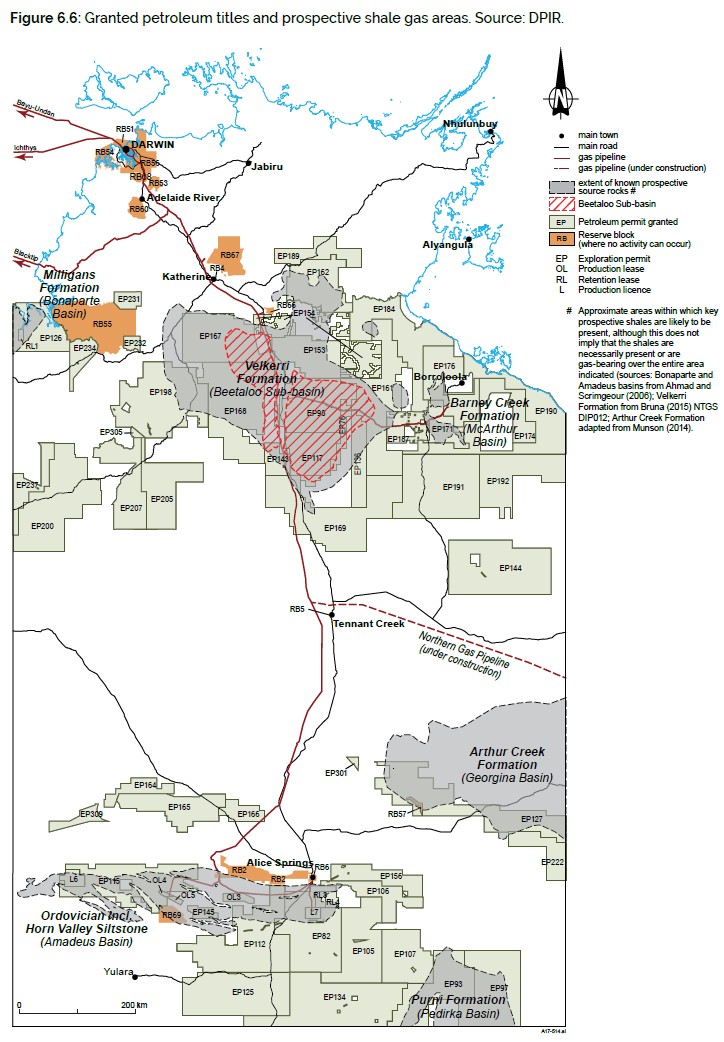
Catchwords: | ENVIRONMENT LAW – project being carried out for the extraction of unconventional gas by hydraulic fracturing in the Northern Territory – application for injunction under s 475 Environment Protection and Biodiversity Conservation Act 1999 (Cth) on the ground that approval is required under Pt 9 – scope of the “action” the impacts of which must be assessed – whether relevant action likely to have a significant impact on a water resource – nature and extent of risk of well integrity failures – nature and extent of risk of contamination of aquifers – likelihood of significant impact on water resource not established on the evidence – proceedings dismissed |
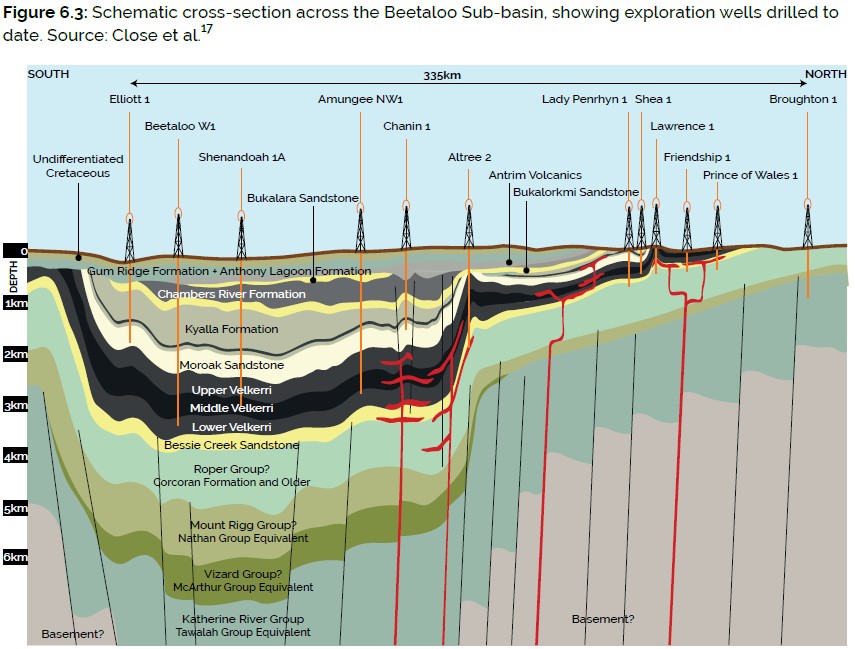
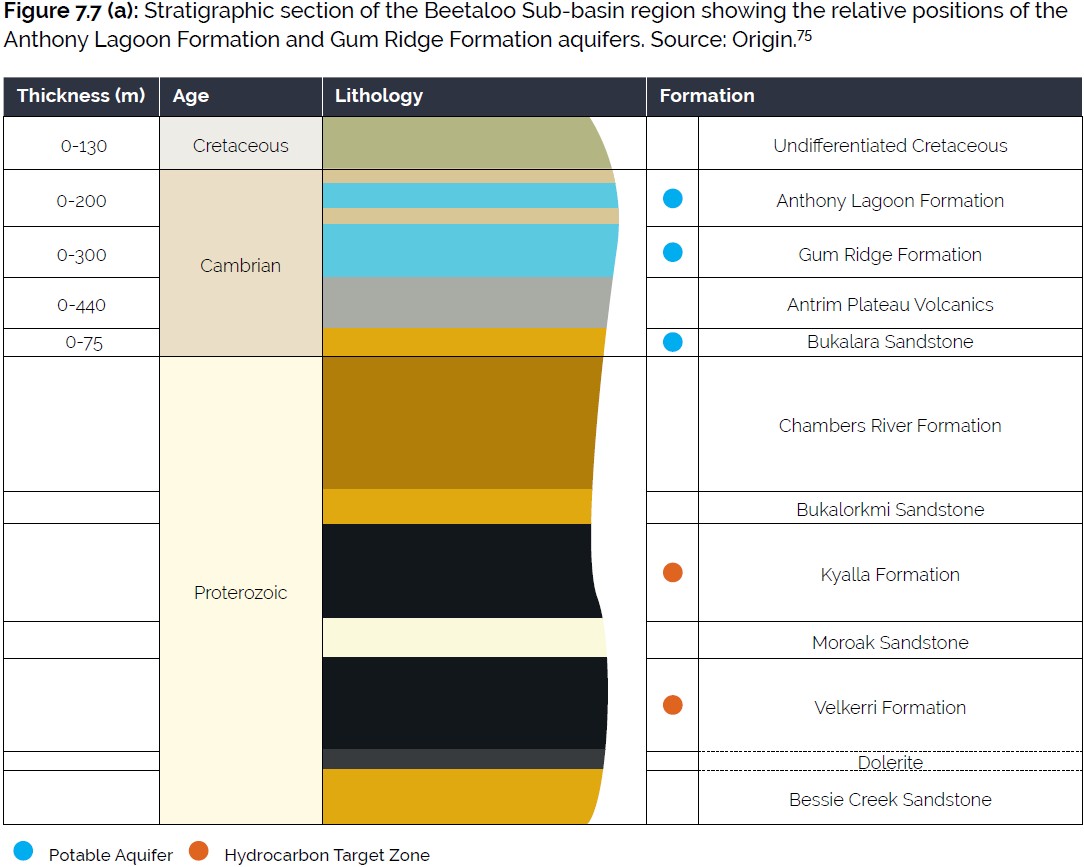
Legislation: | Environment Protection and Biodiversity Conservation Act 1999 (Cth) ss 24D, 24E, 67, 67A, 68, 72, 74A, 87, 101A, 102, 133, 475, 523, 527E, 528, Pt 9 Evidence Act 1995 (Cth) ss 69, 136 Water Act 2007 (Cth) s 4 Environment Protection and Biodiversity Conservation Regulations 2025 (Cth) regs 4.03, 5.04, schs 2, 4 Petroleum Act 1984 (NT) s 20 Petroleum (Environment) Regulations 2016 (NT) |
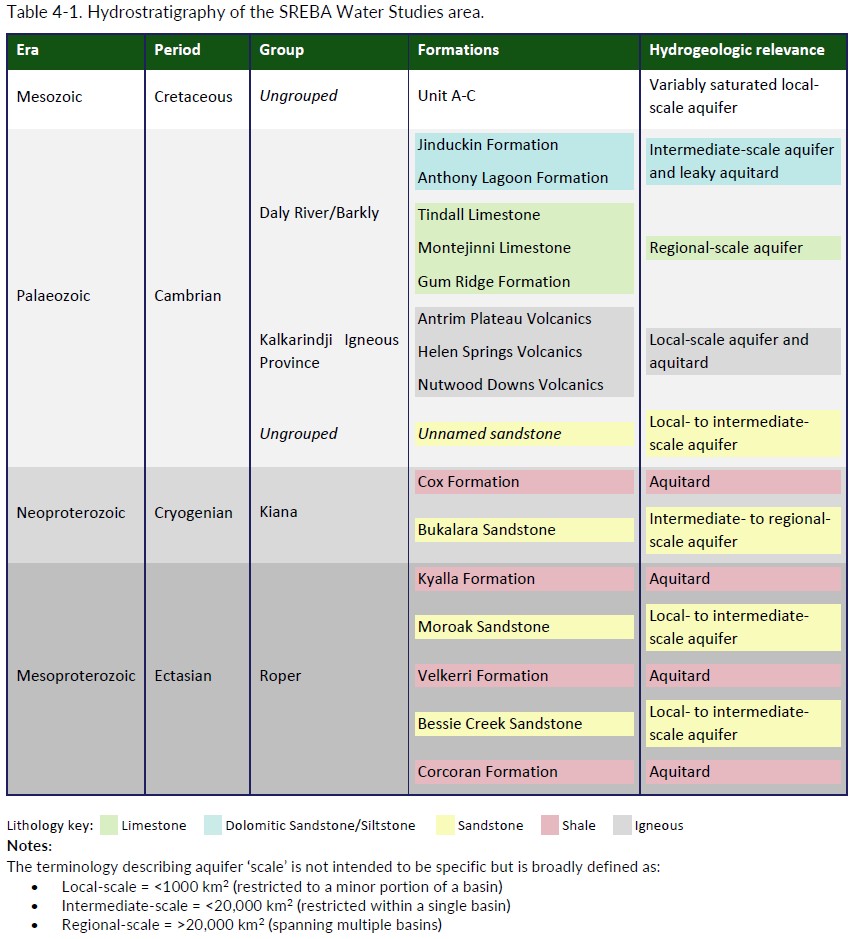
Cases cited: | Allianz Australia Insurance Ltd v Delor Vue Apartments CTS 39788 (2021) 287 FCR 388; [2021] FCAFC 121 Alphapharm Pty Ltd v H Lundbeck A/S [2008] FCA 559 Australian Conservation Foundation (2021) 390 ALR 157; [2021] FCA 550 Australian Federation of Air Pilots v Regional Express Holdings Ltd (2021) 290 FCR 239; [2021] FCAFC 226 Australian Securities and Investments Commission v Westpac Securities Administration Ltd (2019) 272 FCR 170; [2019] FCAFC 187 Blatch v Archer (1774) 1 Cowp 63; 98 ER 969 Bodney v Bennell [2008] FCAFC 63; 167 FCR 84 Booth v Bosworth (2001) 114 FCR 39; [2001] FCA 1453 Borowski v Quayle [1966] VR 382 Friends of Leadbeater’s Possum Inc v VicForests (No 4) (2020) 244 LGERA 92; [2020] FCA 704 Gould v Mount Oxide Mines Ltd (in liq) (1916) 22 CLR 490 H v Schering Chemicals [1983] 1 WLR 143 Ingot Capital Investments Pty Ltd v Macquarie Equity Capital Markets Ltd (2008) 73 NSWLR 653; [2008] NSWCA 206 Karpik v Carnival plc (The Ruby Princess) (Evidential Ruling) [2022] FCA 1318 McNickle v Huntsman Chemical Company Australia Pty Ltd (Initial Trial) [2024] FCA 807 Mees v Kemp [2004] FCA 366 Minister for the Environment and Heritage v Greentree (2004) 138 FCR 198 Northern Inland Council for the Environment Inc v Minister for the Environment (2013) 218 FCR 491; [2013] FCA 1419 Parkin v Boral Limited (Materiality Evidence Ruling) [2025] FCA 70 Polaris Coomera Pty Ltd v Minister for the Environment [2021] FCA 254 PQ v Australian Red Cross Society [1992] 1 VR 19 Queensland Conservation Council Inc v Minister for the Environment and Heritage [2003] FCA 1463 Re BBY Limited (Receivers and Managers Appointed) (in liq) and BBY Holdings Pty Ltd (Receivers and Managers Appointed) (in liq) (No 2) [2022] NSWSC 30 Save Our Strathbogie Forest Inc v Secretary to the Department of Energy, Environment and Climate Action [2024] FCA 317 Save Our Strathbogie Forest Inc v Secretary to the Department of Energy, Environment and Climate Action (2024) 306 FCR 331; [2024] FCAFC 134 Secretary, Department of Primary Industries, Parks, Water and Environment v Tasmanian Aboriginal Centre (2016) 244 FCR 21; [2016] FCAFC 129 VicForests v Friends of Leadbeater’s Possum Inc (2021) 285 FCR 70; [2021] FCAFC 66 |
Division: | General Division |
Registry: | New South Wales |
National Practice Area: | Administrative and Constitutional Law and Human Rights |
Number of paragraphs: | 244 |
Date of hearing: | 23 to 26 June 2025 and 14 August 2025 |
Counsel for Applicant: | Mr J Hutton SC and Mr M Nguyen |
Solicitor for Applicant: | Environmental Justice Australia |
Counsel for Respondent: | Mr E Muston SC, Mr H Baddeley SC and Mr J Willis |
Solicitor for Respondent: | Squire Patton Boggs (AU) |
ORDERS
NSD 1765 of 2024 | ||
| ||
BETWEEN: | LOCK THE GATE ALLIANCE LTD ACN 156 099 080 Applicant | |
AND: | TAMBORAN B2 PTY LTD (ACN 105 431 525) Respondent | |
order made by: | OWENS J |
DATE OF ORDER: | 26 june 2026 |
THE COURT ORDERS THAT:
1. The proceedings are dismissed with costs.
Note: Entry of orders is dealt with in Rule 39.32 of the Federal Court Rules 2011.
REASONS FOR JUDGMENT
OWENS J:
1 These proceedings concern certain gas exploration activities being carried out by Tamboran B2 Pty Ltd in the Northern Territory. While Tamboran has obtained the permissions required under Northern Territory law to carry out those activities, the applicant contends that Commonwealth Government approval is also required. Tamboran says that no such approval is necessary, and it is not in dispute that it has been neither sought nor obtained.
2 The reason that the applicant says Commonwealth Government approval is required is because of a risk said to be posed by the project to aquifers in the vicinity of Tamboran’s activities. That, it is argued, attracts the operation of the Environment Protection and Biodiversity Conservation Act 1999 (Cth).
3 To understand the way in which that risk is said to arise, it is necessary to know a little about what lies beneath the surface in the area in which Tamboran is carrying on the activities in question.
4 The McArthur Basin is a geological formation, comprised of an extensive series of sedimentary rock formations, that stretches across much of the north-eastern Northern Territory. South-east of Katherine, there is a sub-basin (that is, a structural component of the greater McArthur Basin) known as the Beetaloo Sub-basin. The Beetaloo Sub-basin lies entirely under the cover of younger basin sediments. It is bisected by a faulted and uplifted zone (known as the Daly Waters Fault Zone, which corresponds broadly with the path of the Stuart Highway), which runs roughly north-south, and thus divides the Beetaloo Sub-basin into eastern and western domains.
5 The following map, which was contained in the Final Report of an inquiry established by the Government of the Northern Territory known as the Scientific Inquiry into Hydraulic Fracturing in the Northern Territory (and which was referred to as the Pepper Report), shows in red shading the boundaries of the eastern and western domains of the Beetaloo Sub-basin. It also shows the boundaries of various exploration permits granted pursuant to section 20 of the Petroleum Act 1984 (NT). In the eastern domain of the Beetaloo Sub-basin may be seen EP98 and EP117. Those are the relevant permits that have been granted to Tamboran, and which authorise it to undertake certain activities directed to the exploration and appraisal of shale gas resources in those areas. That project is known as the Shenandoah South Pilot Project.
6 The Beetaloo Sub-basin is characterised by the presence of a number of geological formations layered one on top of the other. Of those relevant to the present proceedings, the deepest is that known as the Velkerri Formation, which is in turn comprised of various component members. At the location of central interest to these proceedings, the top of the Velkerri Formation lies more than two kilometres below the surface. Above it, but separated from it by a layer of sandstone known as the Moroak Sandstone, is the Kyalla Formation, the top of which is nearly one kilometre below the surface. Both the Velkerri and the Kyalla Formations are estimated to contain recoverable hydrocarbon resources.
7 As I have already mentioned, sitting above the Beetaloo Sub-basin are a number of younger sedimentary basins. It is not necessary for present purposes to describe their geology in any great detail. What is significant in the context of the issues arising in these proceedings is the presence of a complex aquifer system known as the Cambrian Limestone Aquifer, which sits above a layer of impermeable rock known as the Antrim Plateau Volcanics. That aquifer is in turn comprised of various subunits, including a lower aquifer system known as the Gum Ridge Formation, and an upper aquifer system known as the Anthony Lagoon Formation. The Cambrian Limestone Aquifer provides the principal accessible groundwater resource in the Beetaloo Sub-basin, providing a significant, good quality, groundwater resource for the pastoral industry and communities within the region. Baseflow from the aquifer supports perennial flows in the Roper and Flora rivers, and also supports groundwater-dependent ecosystems.
8 An adequate sense of the broad features I have attempted to describe may be obtained from the following two cross-sections, one schematic, one stratigraphic, each drawn, once more, from the Pepper Report:
9 Another way of understanding the subsurface structures of the relevant area is by reference to the following table, from a “Regional Report” published by the Northern Territory Department of Environment, Parks and Water Security:
10 Tamboran’s exploration of shale gas resources in the Beetaloo Sub-basin is being carried out by means of a process commonly known as hydraulic fracturing, or “fracking”. In very general terms, that involves drilling a well down into a geological formation suspected of containing hydrocarbons, and injecting fluid at high pressure into the rock, thereby fracturing it and freeing the gas that is held within it. The gas then flows back up the well and is collected at the surface.
11 The issue at the heart of these proceedings is whether Tamboran’s activities in connection with the extraction of gas from the Velkerri Formation are likely to have a significant impact on the Cambrian Limestone Aquifer. The applicant contends that by piercing the impermeable rock boundaries that separate the aquifer from the hydrocarbons, creating a conduit running between them, and stimulating the release of hydrocarbons from the rocks in which they are presently contained by introducing hydraulic fracturing fluids into the ground, a substantial risk of contamination of the aquifer is created. Tamboran, on the other hand, contends that the careful design of its well means there is no real risk at all.
THE LEGISLATIVE FRAMEWORK FOR THE APPLICATION
12 The applicant brings these proceedings pursuant to the Environment Protection and Biodiversity Conservation Act 1999 (Cth). That Act establishes a statutory scheme pursuant to which actions that are likely to have significant impacts on certain aspects of the environment are required to be assessed and approved by the relevant Minister.
13 Section 24D(1) of the EPBC Act, which is a civil penalty provision, provides:
A constitutional corporation, the Commonwealth or a Commonwealth agency must not take an action if:
(a) the action involves:
(i) unconventional gas development; or
(ii) large coal mining development; and
(b) the action:
(i) has or will have a significant impact on a water resource; or
(ii) is likely to have a significant impact on a water resource.
14 Section 24E(1) creates an offence in effectively the same terms.
15 The term “action” is defined broadly in section 523, and includes a “project”, a “development”, an “undertaking”, and an “activity or series of activities”.
16 The phrase “unconventional gas development” is defined in section 528 as follows:
unconventional gas development means any activity involving unconventional gas production that has, or is likely to have, a significant impact on water resources (including any impacts of associated salt production and/or salinity):
(a) in its own right; or
(b) when considered with other developments, whether past, present or reasonably foreseeable developments.
17 The term “unconventional gas production” is defined in that same section:
unconventional gas production means extraction, recovery, or intentional release, (whether by drilling, hydraulic fracturing or other means) of gas from:
(a) coal seams or beds; or
(b) layers of shale rock; or
(c) tight gas reservoirs; or
(d) any other sources prescribed by the regulations.
18 The term “water resource” is defined to have the same meaning as in the Water Act 2007 (Cth), namely (in section 4):
water resource means:
(a) surface water or ground water; or
(b) a watercourse, lake, wetland or aquifer (whether or not it currently has water in it);
and includes all aspects of the water resource (including water, organisms and other components and ecosystems that contribute to the physical state and environmental value of the water resource).
19 The word “impact” is also defined. Section 527E of the EPBC Act says:
(1) For the purposes of this Act, an event or circumstance is an impact of an action taken by a person if:
(a) the event or circumstance is a direct consequence of the action; or
(b) for an event or circumstance that is an indirect consequence of the action—subject to subsection (2), the action is a substantial cause of that event or circumstance.
(2) For the purposes of paragraph (1)(b), if:
(a) a person (the primary person) takes an action (the primary action); and
(b) as a consequence of the primary action, another person (the secondary person) takes another action (the secondary action); and
(c) the secondary action is not taken at the direction or request of the primary person; and
(d) an event or circumstance is a consequence of the secondary action;
then that event or circumstance is an impact of the primary action only if:
(e) the primary action facilitates, to a major extent, the secondary action; and
(f) the secondary action is:
(i) within the contemplation of the primary person; or
(ii) a reasonably foreseeable consequence of the primary action; and
(g) the event or circumstance is:
(i) within the contemplation of the primary person; or
(ii) a reasonably foreseeable consequence of the secondary action.
20 Subsection (4) of each of sections 24D and 24E provides that subsection (1) of those sections does not apply (relevantly) to actions in respect of which an approval under Part 9 of the EPBC Act is in operation.
21 An action that would be prohibited without approval under Part 9 is defined by section 67 to be a “controlled action”. Section 67A makes plain that a person must not take a controlled action unless an approval is in operation. Section 68 relevantly says:
(1) A person proposing to take an action that the person thinks may be or is a controlled action must refer the proposal to the Minister for the Minister’s decision whether or not the action is a controlled action.
(2) A person proposing to take an action that the person thinks is not a controlled action may refer the proposal to the Minister for the Minister’s decision whether or not the action is a controlled action.
22 Tamboran does not think that the Shenandoah South Pilot Project is a controlled action, and it has not chosen to make a precautionary referral to the Minister under section 68(2). It follows that there is no approval under Part 9 in respect of the project, and Tamboran is taking the risk that, if it is wrong, by carrying out the project it will be offending against the EPBC Act: see, e.g., Queensland Conservation Council Inc v Minister for the Environment and Heritage [2003] FCA 1463 at [12] (Kiefel J).
23 Section 475 confers a power on this Court to grant injunctions in respect of contraventions of the EPBC Act. It provides:
Applications for injunctions
(1) If a person has engaged, engages or proposes to engage in conduct consisting of an act or omission that constitutes an offence or other contravention of this Act or the regulations:
(a) the Minister; or
(b) an interested person (other than an unincorporated organisation); or
(c) a person acting on behalf of an unincorporated organisation that is an interested person;
may apply to the Federal Court for an injunction.
Prohibitory injunctions
(2) If a person has engaged, is engaging or is proposing to engage in conduct constituting an offence or other contravention of this Act or the regulations, the Court may grant an injunction restraining the person from engaging in the conduct.
24 There is no dispute that the applicant satisfies the definition of “interested person”, which is found in subsection (7).
25 Fundamentally, therefore, the issue in the proceedings is whether the EPBC Act does prohibit Tamboran’s actions in relation to the Shenandoah South Pilot Project. If it does, then, while there is some debate between the parties about the precise scope of the injunction that it would be appropriate to grant under section 475 (see, by way of explication of the general issue, Save Our Strathbogie Forest Inc v Secretary to the Department of Energy, Environment and Climate Action [2024] FCA 317 at [95]-[100] (Horan J)), there was no dispute that an injunction should be granted.
THE ISSUES FALLING FOR DETERMINATION
26 The parties provided the following agreed list of issues for determination:
1. How is the word “likely” in s 24D(l)(b)(ii) (and/or, if applicable, s 24E(l)(b)(ii)) of the Environment Protection and Biodiversity Conservation Act 1999 (Cth) (the EPBC Act) to be construed?
2. How are the words “significant impact” in s 24D(l)(b)(ii) (and/or, if applicable, s 24E(l)(b)(ii)) of the EPBC Act to be construed?
3. What is the “action” for the purposes of s 24D(l)(b)(ii) (applying the definition of the “action” found in s 523 of the EPBC Act)?
4. What is the likelihood of a well integrity failure occurring as a result of the action?
5. Assuming such a well integrity failure were to occur, what is the likelihood that it would cause hydraulic fracturing fluids, brines or released hydrocarbons to be released into the Gum Ridge Formation or other aquifers that constitute “water resources” under the EPBC Act?
6. Assuming such a release were to occur, what is the likelihood that the release of hydraulic fracturing fluids, brines or hydrocarbons would have a significant impact on the Gum Ridge Formation or other aquifers by way of either:
(a) contamination of groundwater; or
(b) resultant harm to ecosystems dependent on this groundwater (if any)?
7. Having regard to the answers given to questions 1 to 6:
(a) is the action an “unconventional gas development” within the meaning of s 24D(l)(a)(i) (and/or, if applicable, s 24E(l)(a)(i)) and s 528 of the EPBC Act?
(b) is the action likely to have a significant impact on the water resource in the sense contemplated by s 24D(l)(b)(ii) (and/or, if applicable, s 24E(l)(b)(ii)) of the EPBC Act?
8. If the answer to each limb of question 7 is “yes”, what is the appropriate form of relief to be granted in the proceedings?
ISSUE 1: THE MEANING OF “LIKELY”
27 It was ultimately common ground between the parties that the word “likely”, as it appears in sections 24D(1)(b)(ii) and 24E(1)(b)(ii) of the EPBC Act, refers to something that is “a real or not remote chance or possibility”, in the sense of “prone” or “with a propensity” or “liable”, rather than requiring a demonstration that the impact is “more probable than not”.
28 That common position is consistent with a number of decisions of this Court: Save Our Strathbogie Forest Inc at [338] (Horan J) (which was unsuccessfully appealed, but not in relation to that issue, in Save Our Strathbogie Forest Inc v Secretary to the Department of Energy, Environment and Climate Action (2024) 306 FCR 331; [2024] FCAFC 134); Polaris Coomera Pty Ltd v Minister for the Environment [2021] FCA 254 at [226] (Rangiah J); Friends of Leadbeater’s Possum Inc v VicForests (No 4) (2020) 244 LGERA 92; [2020] FCA 704 at [1298] (Mortimer J); Northern Inland Council for the Environment Inc v Minister for the Environment (2013) 218 FCR 491; [2013] FCA 1419 at [91]-[92] (Cowdroy J); and Booth v Bosworth (2001) 114 FCR 39; [2001] FCA 1453 at [97]-[98] (Branson J). While each of those decisions concerned prohibitions in the EPBC Act other than sections 24D and 24E, there is nothing that would suggest that the word bears any different meaning in the context of those sections.
29 To the extent that the parties sought to extract subtly different shades of meaning from their common position described above, I do not need to enter into that debate. On no view could the result of these proceedings differ according to such nuances.
ISSUE 2: THE MEANING OF “SIGNIFICANT IMPACT”
30 There was also no real dispute, at least of any kind that might affect the outcome of the proceedings, in relation to the meaning of the phrase “significant impact”. That is to say, it was uncontroversial that:
(a) The phrase refers to “an impact that is important, notable or of consequence having regard to its context or intensity”: Booth v Bosworth at 65 [99]-[100] (Branson J); VicForests v Friends of Leadbeater’s Possum Inc (2021) 285 FCR 70; [2021] FCAFC 66 at 87 [62] (Jagot, Griffiths and SC Derrington JJ).
(b) It excludes impacts that are “minor or negligible”: Northern Inland Council for the Environment Inc at 514 [92] (Cowdroy J).
(c) Whether a proposed action has or is likely to have a “significant impact” is a question of fact: Minister for the Environment and Heritage v Greentree (2004) 138 FCR 198 at 244 [192] (Sackville J); Save Our Strathbogie at [336] (Horan J).
(d) Assessing whether an impact is significant is “not a mathematical exercise, but rather a matter of considering the evidence as a whole”: VicForests v Friends of Leadbeater’s Possum at 130 [267] (Jagot, Griffiths and SC Derrington JJ).
31 The applicant further submitted that where mitigation or risk management measures are relied upon to deny the existence of a “significant impact”, it will be necessary that their effectiveness in the manner of their proposed implementation be demonstrated: Friends of Leadbeater’s Possum Inc at [566]-[568] (Mortimer J). So much may be accepted, but the applicant’s reliance on those statements in these proceedings was misplaced. The applicant appeared, at various times, to suggest that the burden (or what it sometimes referred to as the “tactical burden”) was in fact cast upon Tamboran to prove that its wells would not give rise to a “significant impact” on the aquifers. One of the forms that that submission took was a contention that because Tamboran submitted that the design of its wells meant that there was not a real risk of such an impact, it bore the burden of proving that the design features it pointed to were effective. I do not accept that submission. The burden remains on the applicant to prove that the project (which includes wells of a particular kind) will have, or is likely to have, a significant impact on the aquifers. The risk created by the wells is the risk created by the wells in the form in which they are designed and constructed. It is not correct to identify the risk that might be posed by some other hypothetical well, and then ask whether Tamboran can prove that the improvements in its design reduce or eliminate that hypothetical risk. A different form of the submission invoked the principle in Blatch v Archer (1774) 1 Cowp 63; 98 ER 969, to the effect that it was specially within Tamboran’s power to prove the efficacy and safety of its well design. I am not satisfied, however, that there was any meaningful difference in the ability of the parties to address the issues in dispute in evidence. The applicant had the ability to (and did in fact) serve notices to produce in relation to topics relevant to the assessment of the safety of Tamboran’s wells, and there was no suggestion that the applicant’s experts did not have access to the information that they required.
32 Next, the applicant emphasised that the definition of “water resource” includes “all aspects of the water resource”, and is thus not limited to any narrow concept of economic or instrumental value. As was observed in Australian Conservation Foundation (2021) 390 ALR 157; [2021] FCA 550 at [51] (Perry J):
a significant impact upon any of these aspects of the water resource, including organisms, other water systems, and ecosystems, will engage the prohibition. It is not simply a question of the volume of water being extracted and its potential impact on water supplies.
33 It was said to follow, correctly in my view, that the question of a significant impact on a water resource is not limited to impacts experienced in relation to human uses of the water resource. It is the impact on the water resource itself (in all its aspects) that is relevant.
34 The parties were divided on one question, namely, whether the statutory concept of a significant impact was limited to adverse impacts (as Tamboran contended), or whether a beneficial or neutral impact might also count (as the applicant submitted). But it is not necessary that I resolve that question. The applicant put its case solely on the basis that Tamboran’s activities posed a risk of adverse impacts on the aquifers, and no one suggested that any impact of the project could be both significant and either positive or neutral.
ISSUE 3: DEFINING THE “ACTION”
35 There were two aspects to the parties’ dispute about the scope of the “action” for the purposes of sections 24D(1) and 24E(1) of the EPBC Act. The first concerned the proper approach to the identification of the “action” for the purposes of the EPBC Act, while the second concerned the scope of the applicant’s case. To understand both issues, it is first necessary to understand a little about the project.
36 Mr Faron Thibodeaux, the Chief Operating Officer of the Tamboran Resources Group of companies (of which Tamboran is a member) gave detailed evidence concerning the project generally, and the design and construction of the project wells in particular.
37 He explained that Exploration Permits EP98 and EP117 were granted, under the Petroleum Act 1984 (NT), to Tamboran in November 2022. In order to carry out activities under those permits, however, it was necessary for Tamboran to obtain, amongst other things, approval from the Northern Territory Minister for Environment of an “environment management plan”, or EMP, under the Petroleum (Environment) Regulations 2016 (NT). On 23 May 2024, the Minister issued an approval decision which, subject to certain conditions, allowed Tamboran to carry out the activities specified in the EMP that it had submitted.
38 The EMP described a “series of exploration activities proposed in the Shenandoah South area on Eps 117 and 98 over a period of 5 years”. The approved activities included:
(a) civil construction of up to four exploration and appraisal well sites and associated infrastructure, in addition to the expansion of a previously approved and constructed well site (known as Kyalla 117 N2);
(b) drilling, hydraulic fracture stimulation and well testing of up to fifteen exploration and appraisal wells at those five well sites;
(c) construction and operation of up to two hydrocarbon and wastewater gathering line networks between well sites;
(d) acquisition of two-dimensional seismic data over approximately 77 kilometres; and
(e) decommissioning of all sites and associated infrastructure (where decommissioning includes the permanent plugging, abandonment and/or remediation of the wells).
39 The applicant’s fundamental point in the present context was that, if the project went as well as Tamboran hoped, then it was unlikely that, at the end of the authority provided by the EMP, Tamboran’s unconventional gas activities in the Beetaloo Sub-basin would come to an end. Rather, the applicant submitted:
The 15 horizontal wells under the EMP will be equipped to operate as production wells and are “designed to produce for decades” [Thibodeaux, T124.21-24]. Mr Thibodeaux’s evidence was that, assuming approval is obtained, they will be operated for at least 20 years; and potentially for more than 40 years, subject to economic considerations [Thibodeaux, T114.45-115.37]. That evidence was consistent with publicly available documents that contain clearly expressed expectations and intentions, on the part of Tamboran, that the wells will be pressed into production (and, indeed, supplemented by further wells).
…
The concreteness of Tamboran’s intentions is underscored by the 15.5 year agreement it has entered into with the Northern Territory Government to supply gas from its wells in the Beetaloo Sub-basin. Supply under that agreement is expected to commence in 2026. Tamboran has also entered into an agreement for the construction of a gas pipeline and has approval to build and operate a compression facility which will be used to collect, use and sell the gas collected from the Project. The term of the gas supply agreement extends substantially beyond the five-year duration of the EMP. Mr Thibodeaux’s evidence was that more than the 15 wells currently planned under the Project will be required, in due course, in order to meet Tamboran’s supply obligations – he ventured that about 15 to 25 additional wells could be required.
…
In light of the evidence, it should be concluded that Tamboran B2 is in fact not only undertaking, and proposing to undertake, what it describes as “exploration” or “appraisal” activities involving the wells to be constructed under the EMP, but also proposing to operate them as production wells with an eventual production life cycle of at least 20 years and potentially more than 40 years for each well (following which they will be decommissioned and abandoned). …
40 On the whole, I accept those submissions. Indeed, I did not understand there to be any real dispute as to their correctness. As Tamboran submitted in response:
It may comfortably be inferred that, depending on various contingencies, Tamboran aspires to proceed to future production phase activities if it can. However, for those activities to occur would require, inter alia, the resource in those wells to be feasible to proceed to production from a technical and economic perspective, and for Tamboran to apply for and obtain a ‘production licence’ under the Petroleum Act 1984 (NT) (in place of its current ‘exploration permits’) and submit and obtain approval for an EMP in relation to its production phase activities which sets out details of the proposed activities.
41 In other words, there was no dispute that Tamboran hoped its exploration activities would reveal the existence of gas reserves the exploitation of which was both technically and economically feasible, and was in fact confident that they would. Furthermore, it hoped that it would receive the necessary Government permissions to exploit those reserves and, again, was confident that it would. Tamboran’s point (and, again, I do not think there was any dispute about this) was that the only activities to which it was unconditionally committed, and for which it had approval, were those authorised by the EMP. To give effect to its hoped-for longer-term ambitions, further approvals would be required, and whether they were applied for (and if so in what particular form) would depend on the results of the exploration and appraisal activities that it is presently undertaking. Furthermore, if those approvals were granted, then the terms in which such approval was granted was not presently known. The result, it submitted, was that the activity it was presently embarked on was limited to those activities authorised by the EMP.
The Scope of the Action
42 It is against that background that the first issue – the definition of the “action” for the purposes of the EPBC Act – arises. The competing positions of the parties were as follows:
(a) The applicant submitted that “the ‘action’ includes not only activities presently authorised by the EMP (or otherwise currently permitted by or under Territory law), but also the deployment of wells for the purposes of full-scale unconventional gas production”, with the result that the action “is constructing and operating (as commercial production wells) between 15 and 40 unconventional gas wells for a period of upwards of 20 years, and potentially beyond 40 years (depending on economics) and then ultimately decommissioning and abandoning those wells”.
(b) Tamboran, on the other hand, submitted that the relevant action comprises “the drilling, hydraulic fracturing and operation (i.e. production testing) of the 15 horizontal wells and one stratigraphy well under the EMP”.
43 The applicant also advanced an alternative argument, in the event that its primary position was not accepted. That argument was to the effect that, even if the “action” was confined to those activities for which Tamboran had received authorisation under the EMP, any assessment of the impacts of that action must include consequences that may arise after the activities themselves have ceased.
44 I do not accept the applicant’s primary argument.
45 Section 475 of the EPBC Act empowers the Court to issue an injunction where a person “has engaged, is engaging or is proposing to engage in conduct” contrary to the Act. The relevant prohibited conduct, for the purposes of these proceedings, is specified in sections 24D(1) and 24E(1), each of which provide that a person must not “take an action”. The statutory definition of “action”, while broad, does not expand the concept beyond its ordinary, natural, meaning.
46 The fact that the concept of an “action” provides the subject matter for the operation of a civil penalty provision, an offence provision, and an injunction provision strongly supports a construction that would mean any particular action is at all times capable of reasonably definite and precise articulation. The need for reasonable certainty in delineating the scope of an “action” may also be seen, however, in those parts of the EPBC Act that are concerned with the making, assessment and determination of applications for approval.
47 The statutory scheme contemplates that a proponent will refer a particular action for assessment (or that a State or Territory, or a Commonwealth agency, may refer a proposal, or that the Minister may request that a proposal be referred to him or her: see sections 69 to 71). Under section 72 of the EPBC Act, the referral must contain prescribed information about the proposed action. The required information is set out in schedule 2 to the Environment Protection and Biodiversity Conservation Regulations 2025 (Cth): see regulation 4.03(1). The prescribed information contemplates that each proposed action will be described with reasonable specificity, including as to the details of the project area and the particular property on which the action is to take place, the particular activities to be carried out, and the timeframe in which the action is to be taken. Although section 72(3) contemplates that a referral of a proposal to take an action may include alternative proposals relating to locations, timeframes or activities that may be proposed, those alternatives are themselves plainly required to be identified with equivalent precision (for example, section 133(1A) makes clear that any such alternative proposals may be subject to separate grants of approval).
48 Further, under section 87 of the EPBC Act, if the Minister has decided that an action referred for assessment is a “controlled action”, the Minister must choose one of a number of approaches to assessment of the impacts of that action. One such assessment pathway requires production of an “environmental impact statement”. Tamboran emphasised that such a document could only be prepared, in any meaningful way, if the boundaries of the relevant “action” were clearly drawn. Under section 101A of the EPBC Act, such a document must be prepared in accordance with guidelines provided by the Minister to the proponent. Subsection (3) makes clear that the purpose of these guidelines is to ensure that the document will “contain enough information about the action and its relevant impacts to allow the Minster to make an informed decision whether or not to approve … the taking of the action”. Further, schedule 4 of the EPBC Regulations sets out prescribed matters which must be addressed by any environmental impact statement produced in accordance with tailored guidelines: regulation 5.04; EPBC Act section 102(2)(b). By way of a small selection of illustrative examples only, those matters include:
(a) a clear outline of the objective of the action;
(b) all the components of the action;
(c) the precise location of any works to be undertaken, structures to be built or elements of the action that may have relevant impacts;
(d) an outline of an environmental management plan; and
(e) details of any local or State government planning scheme, plan or policy dealing with the proposed action, including any environmental assessment carried out and any approval obtained from a State, Territory or Commonwealth agency or authority.
49 Those requirements tell strongly against any concept of “action” extending beyond a specifically identified, actual, planned project. How, Tamboran asked rhetorically, could an environmental impact statement be prepared, in any meaningful sense, in relation to 15 to 40 hypothetical unconventional wells operated over a period upwards of 20 years, or perhaps even 40 years, when there are no details as to the particular features of those wells (including because there is as yet no EMP or production licence for them)?
50 Indeed, each of the possible assessment pathways seem to me to be directed at ascertaining the details of the action in sufficient detail to enable the Minister to make an informed decision about the actual nature of its impacts. That objective can only be achieved by reference to an action whose scope is understood with reasonable precision (if not considerable precision, as contemplated by the prescribed requirements relevant to an environmental impact statement noted above). It would not be possible for the Minister to make an informed decision about the impacts of an action with amorphous contours. Similarly, the objects of the Act would not be achieved if approval were granted to carry out an action, the content and limits of which were not able to be specified with precision.
51 The only action that Tamboran is presently able to “take” is that for which it has been granted approval by the Northern Territory Government. Tamboran has no present, or even contingent, ability or entitlement to take any of the additional actions that the applicant contends should be included in the “action” for the purposes of these proceedings. And those limitations on Tamboran’s ability to undertake actions, along with the inherent nature of the endeavour it is currently undertaking, operate to define and limit the conduct that it intends to carry out. I do not think that Tamboran’s aspirations to engage in additional actions in the future mean that they are part of the one action, or that it “proposes” to engage in such actions within the meaning of section 475. Its aspirations are conditional upon the results of its exploration and appraisal activities, and upon receiving relevant Government approvals. In substance, and not merely in form, Tamboran is presently engaged in a process of exploration and assessment. It is not merely carrying out the first stage of a presently determined production project; the existence, nature, and scope of that project will depend on the outcome of its presently planned activities.
52 While I accept that Tamboran is confident, or at least strongly hopeful, that the project will disclose a technically and economically viable commercial production opportunity, that does not alter the fact that whether or not Tamboran will seek to pursue that opportunity, and if it does, the form in which it will seek to do so, is a decision that must await the outcome of the present project. Furthermore, the terms of any Government approval that may be granted to Tamboran have the potential further to define or shape the “action” that it may in fact take. And, ultimately, of course, it is the precise nature of the action that Tamboran may be permitted in the future to take that will be relevant to the nature and extent of the risks that will thereby be posed to the environment.
53 The applicant submitted that:
To the extent that there is any relevant uncertainty about the precise terms of a future production licence – e.g., because it is suggested that the conditions attaching to a production licence might have some bearing on the likelihood of a significant impact – those matters go to how the evidence is weighed and what factual findings can be made, rather than the scope of the “action”.
54 I do not agree. Uncertainty regarding the scope and terms of any permission that may be granted to Tamboran in the future serves to emphasise that the matters that the applicant wishes to bring within the ambit of the definition of “action” are in fact future possible actions that may follow from the action that Tamboran is presently undertaking. It is not possible to treat what is in truth uncertainty about the scope of the action as simply an aspect of the uncertainty of its impacts.
55 I accept that the definition of the “action” for the purposes of the EPBC Act should be approached as a matter of substance, and not in a way that enables what is in truth a single action to be disaggregated into its component parts (especially if by doing so, the total impact of the action as a whole may be minimised or concealed). But I consider that there is sufficient uncertainty about the ultimate nature and scope of Tamboran’s activities in the Beetaloo Sub-basin area to make it impossible to define the “action” in those expansive terms. As a matter of substance, I consider that Tamboran is engaged in a project of exploration and assessment. That is a discrete stage in what may (or may not) become a larger project. The uncertainty of the nature and scope of any ultimate production project by Tamboran means that it would not be possible (for either the Minister or the Court) sensibly to address the impacts of such an “action”.
56 None of that is to deny, as the applicant submitted, that the EPBC Act contemplates that any particular action “may be identified at different levels of generality, rather than permitting of one uniquely correct answer in the abstract”. In support of that submission, the applicant referred to the fact that the definition of “action” includes “a series of activities”, and that section 74A of the EPBC Act empowers the Minister to reject a referral of a proposed action on the basis that that proposed action is part of a larger action, and it is that larger action which should be assessed. The continuation and expansion of production after the EMP expires was, the applicant submitted, part of a “coherent … series of activities” which comprise the relevant action: see Secretary, Department of Primary Industries, Parks, Water and Environment v Tasmanian Aboriginal Centre (2016) 244 FCR 21; [2016] FCAFC 129 at [81] (Allsop CJ, Griffiths and Moshinsky JJ).
57 As I have explained, however, Tamboran is not proposing to engage in a “series of activities” that include those activities that would constitute the production phase of unconventional gas development in the Beetaloo Sub-basin. The activities that comprise a series are still required to be sufficiently definite that they can be described in such a way as to allow an assessment of the likely impacts to be evaluated. So, while an action should not be artificially disaggregated, nor should it be artificially expanded so as to encompass nebulously defined further stages. In this regard, Tamboran submitted, and I agree, that there is a distinction between assessing the potential impacts of a proposed action under a current approval, and the potential impacts of some further action which might follow, but is not certain to follow, from that first action: see Mees v Kemp [2004] FCA 366 at [107] (Weinberg J).
58 I hasten to add that I accept the applicant’s submission that the scope of the relevant action for the purposes of the EPBC Act cannot be controlled by the scope of an approval granted by a State or Territory Government. But here, the scope of the EMP reflected the particular activity that Tamboran was proposing to engage in (and for which it was seeking permission): i.e., exploration and assessment. The scope of the authorisation provided by the EMP thus reinforces, but does not define, the scope of the action. Similarly, the absence of approval for production phase activities is not in itself determinative; but it reflects the fact that those activities have not yet been sufficiently determined or defined (and that the terms of any such approval will, itself, be likely to define the scope of the activities themselves).
59 It follows that the applicant’s primary position in relation to the definition of the “action” must be rejected.
60 Insofar as the applicant’s fallback position is concerned, I must say that I do not think that the way the submission was framed assisted in identifying the real issue. That is to say, I did not perceive it to be genuinely in dispute (subject to the pleading issue that I deal with below) that “the Court’s consideration of the impacts of the action … must take into account consequences that may arise after activities required or contemplated by the EMP have been completed”. An action and its impacts are separate things and, at least in the ordinary course, the latter (being the direct and indirect consequences of the action) will follow the former. The causal mechanism by which an action produces an impact may, of course, operate relatively quickly or slowly. I can see nothing in the language or purpose of the statute that would justify a construction that excluded impacts by reference to the point in time at which they were experienced. The definition of “impact” in section 527E does require an assessment of the nature and strength of the causal connection between an action and its impacts. But, provided the relevant causal connection is established, the length of time over which it manifested seems to me to be irrelevant. It follows that the fact that some impact on the aquifer may be experienced after the five-year period of activity authorised by the EMP has ended cannot mean that it is to be excluded from the assessment of the project’s impacts.
61 The real difficulty in this context, it seems to me, is identifying the basis upon which the consequences of the action beyond the EMP period should be assessed. That is to say, what assumption should be made about the status of the well beyond the period of the “action” the impacts of which are being assessed? The construction of a well in a particular location does not effect a “one off” change to an environment, by reference to which impacts may be determined. It is not, for example, like the change to a forest ecosystem caused by the cutting down of a particular tree. The construction of a well involves the creation of an engineering structure in relation to which choices must continue to be made. That is to say, neither party submitted that the impacts of a well constructed by Tamboran should be assessed on the basis that, at the end of the five-year period of activity authorised by the EMP, the wells would simply disappear, or that Tamboran would just walk away from them. In broad terms, there are two possibilities: either Tamboran will receive permission to continue to operate the wells, or Tamboran will be required to decommission them. On what basis should the project’s impacts into the future be assessed?
62 There are two broad possibilities:
(a) The applicant contended that even if the “action” is confined to the activities specifically authorised by the EMP, that action includes the construction of wells which the applicant argued the evidence established are almost certain to be converted into production wells and are likely to operate for several decades. The applicant argued that this factual hypothesis is the more plausible one for determining what impacts the action is “likely” to have. In other words, the applicant said that it was necessary to make a finding as to the “likely” future use of the wells, and determine their impacts on the basis of such a use.
(b) The alternative, which, as I will explain below, seemed to me to be what Tamboran had argued for in opening (but which it disavowed in closing), was that the consequences of the project should be determined on the basis of the activities for which there existed actual approval under the EMP, and not on the basis of approvals that had not yet been sought or granted.
63 Ultimately, I consider that the only sensible way to approach the issue, consistently with the conclusion at which I have arrived in relation to the applicant’s primary submission, is by reference to the actual obligations attaching to the presently authorised activities that Tamboran is carrying out. That is to say, under the EMP, unless some further permission to operate the wells is granted, then Tamboran is required to decommission the wells (which will involve permanently plugging them). If some new “action”, involving a progression to a production phase of activities, is conceived, then it will be subject to the EPBC Act’s requirements. The impacts of such an activity, if required, will be assessed in light of the detail of whatever is proposed. But, for now, the only “activity” that falls to be assessed in relation to the requirements of the EPBC Act is Tamboran’s exploration and assessment project. That activity is subject to a clear obligation in relation to the abandonment and remediation of the wells that will be drilled as part of it. To adopt the approach for which the applicant contended would involve, it seems to me, assessing the impacts of an action other than the action in question. It follows that I consider that the impacts of the project should be assessed by reference to the requirements of the EMP, and not by reference to the possibility of a different, future, action.
Tamboran’s Pleading Argument
64 Tamboran submitted, however, that, whatever the possible scope of the “action” under the EPBC Act (or whatever the way in which impacts of the action are required to be assessed), the applicant had limited its case to the impacts experienced within the five-year period of the EMP. In particular, Tamboran submitted that the applicant’s case was framed specifically in terms of the risks of a well integrity failure during: 1) the drilling; or 2) the hydraulic fracturing; or 3) the operation (i.e., the production testing) of the 15 horizontal and one vertical stratigraphy wells under the EMP. It followed, it submitted, that the applicant’s case was not framed by reference to the risks of a well integrity failure after the operation (i.e., the production testing) of those wells (e.g., during “suspension” or “decommissioning”) and it was not framed by reference to risks that may occur during a later hypothetical long-term production phase over the next 20 plus years.
65 The applicant’s case was articulated in an Amended Concise Statement. It alleged (at [22]):
The Project is an “action” within the meaning of s 523(1) of the EPBC Act.
66 It defined and described “the Project” as follows (at [1]):
The respondent (Tamboran B2) proposes to conduct hydraulic fracturing on land in the Beetaloo Sub-basin in the Northern Territory, for the purposes of a project known as the Shenandoah South Pilot Project (the Project), commencing in the first quarter of 2025.
The Project comprises a series of activities directed to the “exploration and appraisal” of shale gas resources, including the drilling of wells and the high-pressure injection of hydraulic fracturing fluids into shale rock formations in order to release hydrocarbons (commonly known as “fracking”).
67 A footnote was appended to the end of the first sentence, which said:
Also known as the “Beetaloo Basin Shenandoah South E&A Program”.
68 The reference to “E&A”, I understand, means “exploration and appraisal”.
69 At various other places in the Amended Concise Statement, the applicant makes clear that “the Project” is the exploration and appraisal project authorised under the EMP. For example, it is alleged that “The Project is subject to Environment Management Plan (TAM1-3) issued by Tamboran B2 on 26 April 2024 (the EMP).” (at [7]). The Amended Concise Statement identifies the activities comprising the project as follows (at [10]):
The activities being or proposed to be conducted by Tamboran B2 under the Project include:
(a) the construction of four well sites and associated infrastructure;
(b) the drilling of up to 15 horizontal wells, and a “vertical stratigraphy” well, targeting shale rock formations in which hydrocarbons are trapped;
(c) “hydraulic fracture stimulation” of the horizontal wells, comprising the injection of hydraulic fracturing fluids for the purpose of releasing hydrocarbons;
(d) extended production testing of 16 wells, for period (in respect of each well) of up to 300 days;
(e) the construction and operation of “gathering line networks” to enable the transfer of hydrocarbon and wastewater between well sites; and
(f) the transportation and storage of flowback wastewater and other drilling waste on each site.
70 There is a footnote at the end of the chapeau to that paragraph, which refers to the EMP.
71 The Amended Concise Statement then identified the means by which contamination of the aquifer is likely to occur, and characterised the relevant risk, as follows (at [16]):
The primary means by which groundwater is likely to be contaminated is through well integrity failures during the drilling, hydraulic fracturing or operation of the gas wells – causing hydraulic fracturing fluids, brines or released hydrocarbons to leak into the aquifer, diminishing the quality of water supplies. The magnitude of such contamination will be greatest if the failure occurs in an area that is adjacent to the aquifer. There is a real and not remote chance of at least one such breach occurring during the Project.
72 Tamboran submitted that the limited scope of the case that was outlined in the Amended Concise Statement was reinforced by the evidence upon which the applicant relied:
(a) An affidavit of Retta Berryman (the solicitor responsible for the applicant’s case), affirmed on 14 February 2025, deposed that “the activities comprising the action are described in the Environment Management Plan”, which was annexed to the affidavit.
(b) The report of Professor Currell, dated 24 September 2024, which was referenced throughout the Amended Concise Statement, and which was served with the proceedings, was provided in response to a letter of instruction that (inter alia):
(i) sought Professor Currell’s opinion in relation to the impacts of “the Shenandoah project”; and
(ii) described the “Shenandoah project” as follows:
The Shenandoah project comprises Tamboran’s proposed shale gas exploration and appraisal activities within the company’s exploration permits over a five-year period. Tamboran commenced drilling on 30 August 2024.
…
The proposed activities are described in an Environmental Management Plan (‘EMP’) for the project, prepared by Tamboran pursuant to NT legislative requirements. The EMP consists of a main document … and numerous appendices …
(c) Professor Currell’s report itself described the project by reference to the activities authorised under the EMP, and said that it was those activities that had the potential to cause significant impacts on water resources.
73 The applicant’s response was to submit that the Amended Concise Statement, and the evidence served with the proceedings, were not as definitive as Tamboran suggested. In particular, the applicant submitted:
(a) The identification, in [10], of the activities comprising the project was not exhaustive, and merely stated that the project “included” those activities.
(b) The articulation of the means by which groundwater was likely to be contaminated in [16] was not exhaustive (being an identification of the “primary means”), and in any event included the “operation” of the wells without any temporal limitation.
(c) Professor Currell’s first report was referenced throughout, and it was apparent that Professor Currell did not limit his assessment of the risk of a well integrity failure to the five-year period of the EMP because:
(i) he relied on Davies et al, “Oil and gas wells and their integrity: Implications for shale and unconventional resource exploitation” (2014) 56 Marine and Petroleum Geology, 239, a study which assessed data relating to the whole life cycle of wells; and
(ii) he did not refer to the five-year EMP period in the sections of his report addressing well integrity failures.
(d) In any event, a concise statement is “not a pleading”, but rather is intended “to give a concise summary of the nature of the case alleged and the central issues involved”: Australian Securities and Investments Commission v Westpac Securities Administration Ltd (2019) 272 FCR 170; [2019] FCAFC 187 at 212 [185] (Allsop CJ); Allianz Australia Insurance Ltd v Delor Vue Apartments CTS 39788 (2021) 287 FCR 388; [2021] FCAFC 121 at 417 [144] (McKerracher and Colvin JJ). A concise statement “may be supplemented in other ways”, for example, “by making an order for pleadings, or particulars, or by statements of facts, issues and contentions, or by written opening submissions filed in advance of the hearing to expose the issues”: Australian Federation of Air Pilots v Regional Express Holdings Ltd (2021) 290 FCR 239; [2021] FCAFC 226 at 282 [139] (Bromberg, Kerr and Wheelahan JJ).
74 I will turn, in a moment, to consider whether the applicant’s case was “supplemented” in some way, but subject to that possible qualification, I do not accept that the applicant’s case encompassed a contention that the action included, in addition to those activities authorised by the EMP, the construction and operation (as commercial production wells) of between 15 and 40 wells for a period of 20 to 40 years, followed by the ultimate decommissioning and abandonment of the wells.
75 The Amended Concise Statement and the applicant’s evidence in chief made perfectly clear that it was contending that the “action” was the particular activities that were authorised under the EMP. The matters upon which the applicant relied are not capable of supporting any other reading:
(a) On any fair reading of [10] of the Amended Concise Statement, the word “include” served only to convey that what followed was not an exhaustive statement of all of the activities authorised by the EMP. Given the explicit definition of the “Project” as activities directed to the “exploration and appraisal” of shale gas resources (at [2]), the statement that the project (inferentially in its entirety) was “subject to” the EMP (at [7]), and the footnote reference to the EMP after the word “include” in the chapeau to [10], it is simply not possible to understand the Amended Concise Statement as encompassing a broader “action”.
(b) To the extent that particular words or phrases used in [16] of the Amended Concise Statement may, taken out of context or read in isolation, be capable of including means of contamination other than those that might arise as a result of the activities authorised by the EMP, such a reading cannot be sustained in the context of the paragraph as a whole (let alone the Amended Concise Statement as a whole). The final sentence of the paragraph makes clear that the case being advanced by the applicant was tied to the project.
(c) Insofar as Professor Currell’s first report is concerned, the implications said to arise by silence (or by his use of particular studies) are simply not sufficiently clear or obvious that they are capable of giving any different meaning to the Amended Concise Statement.
(d) While it may be accepted that an amended concise statement is not a pleading, and may not contain the comprehensive detail that would be expected in a pleading, that does not mean that it is not capable of defining in a practical way the scope of the case being advanced by an applicant. The applicant’s broader case about the relevant “action” is not just absent from the Amended Concise Statement, it is inconsistent with it.
76 What, then, of events after the commencement of proceedings? Has the applicant done anything which may have relevantly “supplemented” its case?
77 Tamboran submitted that its evidence was prepared in response to the case advanced by the applicant, and that it did not prepare to meet a case directed at an assessment of risks relating to the construction and operation of commercial production wells into the future and their ultimate decommissioning and abandoning. Had the applicant framed its case based on supposed risks arising from a 20 year or more production phase and after decommissioning, Tamboran argued that it would have sought to obtain and file extensive evidence about such issues.
78 The applicant submitted that its later-served expert evidence (i.e., served after Tamboran had filed its evidence) provided a clear indication that its case would encompass the risk of well integrity failures over the full life cycle of a well. In particular:
(a) Mr McCloskey’s report did refer to the risks posed by the wells after the project had concluded, and included a quantitative analysis of risk of well integrity failures that looked to the entire life cycle of wells. A sufficient indication of the scope of Mr McCloskey’s opinion is obtained, I think, from the following statement:
I understand that the environmental approval under which Tamboran is operating in carrying out its current operations at Beetaloo EP98 and EP117 is for the drilling and testing of pilot wells over a period of about 5 years. The wells might then be decommissioned or put into production. Well-integrity issues (including, potentially, involving contamination of the environment outside the wellbore) that arise in construction may continue after decommissioning. Even in the event of full abandonment with regulatory compliance, wells have been shown to continue to leak into the outside environment. In any event, the wells that are being drilled are equipped for full gas production and Tamboran’s aim is presumably to put them into full production.
(b) Professor Currell’s second report also referred to the “longer term” risks faced by wells as they aged, and opined that:
Maintaining well integrity throughout the full shale gas lifecycle (from initial drilling, through hydraulic fracturing, through to long term maintenance and decommissioning) will be very difficult.
79 The applicant thus submitted that Tamboran “was clearly on notice, as the trial approached, that the applicant’s case would not be limited to the risk of well integrity breaches during the five-year period of the EMP”. Moreover, the applicant relied on the fact that Tamboran did not take any pleading point ahead of trial or in opening, and thus submitted that it would be unfair to allow the pleading point to be taken in closing submissions for the first time, when it was too late for the applicant to take action to address any perceived pleading deficiency: Re BBY Limited (Receivers and Managers Appointed) (in liq) and BBY Holdings Pty Ltd (Receivers and Managers Appointed) (in liq) (No 2) [2022] NSWSC 30 at [29] (Gleeson J), citing Gould v Mount Oxide Mines Ltd (in liq) (1916) 22 CLR 490 at 517 (Isaacs and Rich JJ); Ingot Capital Investments Pty Ltd v Macquarie Equity Capital Markets Ltd (2008) 73 NSWLR 653; [2008] NSWCA 206 at 710 [424(d)] (Ipp JA, with Giles and Hodgson JJA agreeing).
80 The applicant, in this regard, identified a number of instances in its written and oral openings where it had contended for a broad conception of the “action” that went beyond the activities authorised by the EMP. It also referred to the fact that no objection had been taken to evidence that dealt with the longer-term life cycle of the wells (including the cross-examination of witnesses).
81 It is certainly true that the enlarged scope of the action for which the applicant contends was raised by the applicant in both openings and in evidence.
82 In the applicant’s written opening submissions, for example, it said:
[T]he “action” in this case is not strictly delimited by the terms of the EMP – which identifies activities for which Tamboran B2 sought approval for the purposes of Northern Territory legislation – but rather encompasses any of the activities that Tamboran B2 proposes to undertake in respect of the Project site.
83 Tamboran’s written opening submissions disputed that the applicant had correctly characterised the “action”, but did not suggest that the applicant’s case was not open to be put.
84 In his opening submissions at trial, Senior Counsel for the applicant submitted:
[W]e say that the action extends to the drilling, the appraisal, production, which is likely to proceed once these 15 wells are drilled, and ultimately, after production, their decommissioning. And that is the real, if one puts it in the statutory language, activity or series of activities that the respondent is embarked upon. It’s not spending all of this money just because it’s curious; it’s doing it because it expects, no doubt rightly, that it will be able to commercially develop the tenements that it holds in the Beetaloo.
85 Once again, Tamboran did not object to the way in which the applicant put its case in opening.
86 I have already observed that the applicant had filed evidence from its experts that contained material relevant to the risks of the operation of wells beyond the five-year term of the EMP. No objection was taken to those portions of the reports.
87 Mr Thibodeaux was cross-examined by the applicant, with no objection being taken to questions that had no apparent relevance other than to establish the probabilities of Tamboran’s operation of the wells following the expiry of the EMP.
88 The topic of the timeframe within which risks arising from the wells might arise, and the consequences of the abandonment of the wells, were all addressed without objection by Tamboran in the expert witness conclave.
89 In those circumstances, I accept that, whatever the scope of the applicant’s Amended Concise Statement, there was a consensual acquiescence in the applicant conducting its case on the basis that the relevant “action” included activities after the five-year EMP period had expired. I have already held, however, that that case must fail because it does not correctly identify the “action” for the purposes of the EPBC Act.
90 It must follow equally, however, that Tamboran acquiesced in the applicant’s fallback case that the impacts of the action (being the activities authorised by the EMP) included consequences arising after the five-year EMP period (that is even assuming that such a case would not have been open on the Amended Concise Statement). Indeed, in opening submissions, I had understood Tamboran to engage with the issue of the correct analysis of impacts arising in the period after the EMP had expired. To take but one example, I had the following exchange with Senior Counsel for Tamboran in an endeavour to understand the issues in the case:
HIS HONOUR: I don’t understand the facts well enough yet to know precisely how this issue plays out, but if I understand, broadly your case is you’ve got approval to do a limited range of things in a short period of time.
COUNSEL: Yes.
HIS HONOUR: When you’re assessing the impact of whatever it is you’ve got approval to do now, I assume you don’t cut off the inquiry as at – I mean, if you’ve got [approval] to – and I know it’s a lot more complicated than this, but if you’ve got [approval] to drill wells over the next 12 months, I assume you don’t stop the inquiry as to impact as at 12 months; is that correct?
COUNSEL: That’s correct.
HIS HONOUR: Right. So what assumption do you make about the nature of the thing that then continues into the future?
COUNSEL: The assumption you make is the thing that continues into the future is the thing that will continue into the future if no further permission to do something more is obtained. And that might mean you have 15 wells which, at the end of your parcel of rights under the exploration and appraisal licence as regulated by the other suite of documents, will then become abandoned wells. And we have to accept that they would have a life cycle of their own as that.
…
HIS HONOUR: But do you say – in identifying what the impacts of the action are, I don’t, as it were, look to make findings about what the most likely future course of events is. Whether or not I think it’s factually likely or not, I make an assumption that the wells get capped and abandoned even if I thought it was more likely that further activities would be undertaken.
COUNSEL: Yes.
91 I must confess that I had understood the effect of that exchange to be that it was Tamboran’s case that it was permissible (indeed, necessary) to determine the impacts of the activities carried out under the EMP by reference to an assumption that, at the end of the project period, the wells would be capped and abandoned. In its written closing submissions, however, Tamboran said that that exchange involved its counsel “explaining to the Court that after the EMP activities have occurred, the assumption should then be that the wells are abandoned – not that the Court should then somehow consider the impacts arising from the wells post-abandonment”. Tamboran’s ultimate position, as expressed in closing submissions, was thus as follows:
HIS HONOUR: … [D]o you mean once the five-year period is up as it were, I’m not interested any more about what happens after that?
COUNSEL: In the context of the case that’s put, yes.
HIS HONOUR: Or am I still interested in what the ongoing effects are of what happens in that five-year period? Do you say that’s the case or that’s not the case?
COUNSEL: That’s not.
HIS HONOUR: That’s not the case?
COUNSEL: Not the case. Not the case that’s put. Because if the case that was put was the consequences – the threat presented to the aquifer by the operation of these wells during the EMP, which we all know is a five year period, and thereafter sitting as abandoned wells for such period as they might sit abandoned, forever, then that’s a case that could have been articulated – we would say should have been articulated – and it would have been responded to.
…
So whilst it might seem artificial at one level and perhaps for the purpose of the Act, it might seem artificial to bring yourself to the end of that five-year period and say, “We can ignore what happens thereafter”, for the purposes of the case, we say that’s what your Honour would do. Because that’s the case that was put.
92 For the reasons I have already given, I do not accept that the applicant’s case was so limited. It follows that I accept that, in determining the impacts of the action, it is necessary to have regard to consequences that may arise after the expiry of the five-year EMP period, on the assumption that the wells were capped and abandoned.
ISSUES 4 AND 5: WELL INTEGRITY FAILURE
93 It is difficult to draw a neat boundary between Issues 4 and 5, and so I will deal with them together. They represent, I think it is fair to say, the core of the parties’ dispute.
94 Issue 4 is concerned with the likelihood of a well integrity failure, while Issue 5 concerns the likelihood of a particular consequence of such a failure. While Issue 5 was in terms framed more broadly, by the time of closing submissions the applicant had clearly limited its case to one involving a risk of the escape of gas into the Gum Ridge aquifer. There is no suggestion that a “significant impact” on a “water resource” could occur in any way other than as a result of such a release. In other words, for the purposes of these proceedings, it is necessary only to consider the likelihood of well integrity failures insofar as they may result in a release of gas into the Gum Ridge aquifer.
95 There were three expert witnesses who gave evidence relevant to these topics, in addition to the evidence of Mr Thibodeaux to whom I have already referred:
(a) Mr Bernard McCloskey, who was called by the applicant, graduated from The Pennsylvania State University with a Bachelor of Science in Petroleum and Natural Gas Engineering in 1979. He then worked from 1979 to 2014 with Chevron Corporation in a range of roles specialising in subsurface, surface and engineering management. He was responsible for engineering, planning, construction, operation and decommissioning of onshore and offshore wells in the United States, Southeast Asia, and Africa. He now works as an independent energy consultant.
(b) Mr Bradley Stout, who was called by Tamboran, graduated from the University of New South Wales with a Bachelor of Engineering in Petroleum Engineering in 1994. He then worked for a range of oil and gas companies before establishing Aztech Well Construction in 2008 (a well engineering and well project management company). He has been involved in the planning and engineering of construction, production and decommissioning operations for onshore and offshore wells in Australia, Southeast Asia, and the Middle East.
(c) Professor Matthew Currell, called by the applicant, is a professor of hydrogeology and the Head of Civil and Environmental Engineering at Griffith University. He graduated as Bachelor of Earth Sciences from the University of Melbourne in 2006, and as Doctor of Philosophy in geosciences from Monash University in 2011. He has led many applied research projects in the field of hydrogeology, and has published numerous scholarly articles. He is a member of the Great Artesian Basin Stakeholder Advisory Committee, established to advise the Commonwealth Government. Although Professor Currell’s evidence was principally directed to the hydrogeological impacts of a well integrity failure (a topic upon which another expert, Mr Moser, also gave evidence for Tamboran), he did also give evidence relevant to the risk of well integrity failures (based upon his knowledge of the implications of geological and chemical conditions for well integrity, and on his review of relevant academic literature).
96 I will, of course, turn to their evidence in detail below, but one aspect of it warrants mention at this point. A common feature of the evidence of all those experts was a reliance upon published studies concerning incidents involving wells. That reliance gave rise to an issue about the use that could be made of the data, or factual observations or assumptions, that underpinned the various studies to which they referred. There was no dispute that, as a general proposition, the position is as it was described by Stewart J in Karpik v Carnival plc (The Ruby Princess) (Evidential Ruling) [2022] FCA 1318 at [3]:
As it was explained in Bodney v Bennell [2008] FCAFC 63; 167 FCR 84 at [93] by Finn, Sundberg and Mansfield JJ, there is nothing in the Evidence Act 1995 (Cth) that displaces the body of common law that provides that experts are entitled to rely upon reputable articles, publications and material produced by others in the area in which they have expertise as a basis for their opinions. Experts may not only base their opinions on such sources, but may give evidence of fact which is based on them. They may do this although the data on which they base their opinion or evidence of fact will usually be hearsay information, in the sense that they rely for such data not on their own knowledge but on the knowledge of someone else. That statement was approved in Dasreef Pty Ltd v Hawchar [2011] HCA 21; 243 CLR 588 at [110] by Heydon J.
97 With one exception, the particular disputes that initially existed between the parties concerning the application of those general principles to the individual circumstances of the articles relied upon by the experts in this case, and the use that could be made of the data (or primary facts) upon which the analysis in those articles was based, were resolved by agreement. That is, the parties agreed, consistently with the approach taken in Parkin v Boral Limited (Materiality Evidence Ruling) [2025] FCA 70 at [12] (Lee J) (cf. McNickle v Huntsman Chemical Company Australia Pty Ltd (Initial Trial) [2024] FCA 807 at [58]-[63] (Lee J)), to an order pursuant to section 136 of the Evidence Act 1995 (Cth), that any articles cited by the experts were admitted “solely for the purposes of providing a basis for, or understanding, the expert opinions” of the witnesses. I made an order in those terms.
98 The one exception to this consensual approach was that the applicant maintained an objection to the admission into evidence of a submission dated April 2017, prepared by Santos Limited for the inquiry conducted by the Northern Territory that led to the Pepper Report. Amongst other matters, the submission provided information regarding barrier failure and well-integrity failure rates for the 2,736 wells drilled by Santos in the Cooper/Eromanga Basin. That data was one of the matters relied upon by Mr Stout in forming his opinion that the likelihood of a well integrity failure causing aquifer contamination was remote (<0.1%, or 1 in 1,000).
99 The applicant submitted that the Santos submission did not fall within the exception to the hearsay and opinion rules summarised in the quotation from Karpik above. That is, the applicant argued that a submission to a Government inquiry, made by a private entity that was interested in a particular outcome (namely encouraging Government support for hydraulic fracturing operations in the Northern Territory), was not the kind of reputable article or publication in relation to which the exception operates. The barrier failure and well-integrity failure rates reported in the submission were, it was argued, simply hearsay factual assertions by a mining company about its own operations, and which did not fall within the business records exception in s 69 of the Evidence Act.
100 Tamboran submitted, on the other hand, that the features distinguishing the submission from traditional academic research papers did not take it outside the exception, and were relevant only to the weight that should be accorded to it. Tamboran emphasised that the submission was made to an independent scientific panel, which had regard to it in its Report.
101 I upheld the applicant’s objection and ruled that the Santos submission and the corresponding passages in Mr Stout’s report that relied upon it were inadmissible.
102 The boundary for the type of material caught by the exception is not rigidly defined, but a clear thread running through the authorities is that a certain level of independence and rigour, consistent with genuine scientific endeavour, is required. The authorities collected in Bodney v Bennell [2008] FCAFC 63; 167 FCR 84, for example, refer to the exception applying to: “reported data of fellow-scientists, learned by perusing their reports in books and journals” (Borowski v Quayle [1966] VR 382 at 386 (Gowans J), quoting Wigmore on Evidence (3rd ed) Vol 2, pp 784‑785); “information in authoritative scientific publications” (PQ v Australian Red Cross Society [1992] 1 VR 19 at 34‑35 (McGarvie J)); and “research published by a reputable authority in a reputable journal” (H v Schering Chemicals [1983] 1 WLR 143 at 148‑149 (Bingham J)). In Alphapharm Pty Ltd v H Lundbeck A/S [2008] FCA 559 at [779], Lindgren J described the exception as applying to “the reportings of clinical studies published in peer-reviewed articles in scientific journals of high repute”, and in Karpik, Stewart J applied the exception to “learned publications” (at [5]).
103 The Santos submission does not seem to me to fall within any such category. It is a submission to a Government inquiry, evidently made for the purpose of advancing Santos’ commercial interests. That the submission was not prepared for the purpose of (and is not apt to be used for) advancing the state of human knowledge in a rigorous, independent and scientific manner is supported by the fact that it did not disclose the underlying primary data for the barrier and well-integrity failure information it presents (and thus has not exposed that data to scrutiny by experts or researchers in the field). Rather it merely provides a high-level summary of the application of Santos’ own risk level ratings for barrier and well integrity failures over time, and asserts conclusions based on them. It is ultimately a work of advocacy, not objectivity.
104 Before turning to consider the substance of Issues 4 and 5, I should also state that I found all of the experts who gave evidence to be impressive witnesses, who were genuinely doing their best to assist the Court to understand the technical matters to which their evidence was directed. Although the parties made some submissions about the manner in which certain witnesses gave evidence, I do not consider that any of them were adopting the stance of an advocate for the cause of the party calling them, or that anything in the way that they gave evidence suggested that they were doing anything other than genuinely endeavouring to respond to the questions they were asked. Ultimately, I have not approached the resolution of differences between the opinions of the witnesses in any way by reference to their demeanour, as opposed to my assessment of the inherent quality of their reasoning as revealed by the evidence as a whole.
Some Foundational Concepts
105 Any assessment of the dispute in relation to Issues 4 and 5 must commence with the identification of some basic concepts relating to the unconventional gas drilling.
Well Integrity
106 An uncontroversial description of the concept of well integrity is found in the International Organisation for Standardisation’s Petroleum and Natural Gas Industries – Well Integrity – Part 1: Life Cycle Governance (ISO 16530-1: 2017), which defined it as “maintaining full control of fluids within a well at all times by employing and maintaining one or more well barriers to prevent unintended fluid movement between formations”. To a similar effect, is the following statement in a report prepared by the CSIRO for the inquiry that led to the Pepper Report:
Well integrity is the quality of a well that prevents the unintended flow of fluid (gas, oil or water) into or out of the well, to the surface or between rock layers in the subsurface. Well integrity is established through the use of barriers that prevent these unintended fluid flows. For shale gas wells, a two-barrier principle is applied, in which at least two independent and verified barriers are in place. Only if both barriers fail will there be a well integrity failure that results in unintended or uncontrolled fluid flow.
107 There is, in other words, a distinction between a “well barrier failure” and a “well integrity failure” (in that it is possible to have the former without the latter). The two primary barriers for the purposes of maintaining well integrity are the “casing” (which is a steel pipe which lines the well) and a cement barrier that surrounds the casing and extends to the rock through which the mine has been drilled (or to the next higher casing if, as I explain below is the case with Tamboran’s wells, there are multiple overlapping sections of the well).
108 In relation to the casing (sometimes referred to as the “casing string”), the CSIRO report explained that:
The casing prevents the unintended flow of drilling and hydraulic fracturing fluids out of the well, keeps the well open through weak or broken rock layers, and prevents formation fluids from entering the well and from moving between layers of rock via the well.
…
The design of casing for a well will need to take into account the depths of layers of rock or aquifers that need to be isolated from each other, the corrosive nature of fluids or gases (such as hydrogen sulfide or carbon dioxide) that may be encountered, the stresses that the casing will be subjected to and the operational requirements of the well.
109 The purpose of the cement that surrounds the casing, and the way that it is placed around the casing, was explained in the CSIRO report as follows:
Without cementing, the casing alone is not sufficient to ensure wellbore stability. Therefore, the casing is cemented into the well … , to provide strength to the well and a seal between the casing and the surrounding rock.
During the cementing process, a cement slurry is pumped down the centre of the well, and flows up the annulus between the rock formation and the most recently placed casing … The cement works with the casing to mechanically couple it to the surrounding rock, creating a hydraulic seal and protecting the casing.
(Footnotes omitted.)
110 To understand the overall risk of a well integrity failure it is thus necessary to understand not just the risks to individual barriers, but the prospect of the failure of all barriers that guard against a particular outcome. In order to do that, it is necessary to say a little about unconventional gas operations generally.
Unconventional Gas
111 It was common ground that “unconventional gas” is natural gas that is trapped in relatively impermeable source rocks. “Conventional gas”, on the other hand, is natural gas that exists in or has migrated into a reservoir comprised of more porous (that is, the void spaces within the rock are relatively large) and permeable (that is, the pore spaces are relatively well connected) rock (with the reservoir itself bounded by a seal of impermeable rock). Unconventional gas includes coal seam gas (where the gas is trapped in coal), tight gas (where the gas is trapped in sandstone), and shale gas (which is trapped in shale rocks). The wells at issue in these proceedings are intended to extract shale gas, and when I refer to unconventional gas I mean to refer to that.
112 Conventional gas is usually extracted by drilling a well into the area of the gas reservoir, with the gas then generally flowing to the surface under its own pressure without the need for pumping. No additional steps are required to release the gas from the rock in which it is held (because that rock is relatively porous and permeable).
113 Because unconventional gas is held in rocks with low porosity and permeability, on the other hand, it is necessary to “free” the gas, and create space within which it may flow. In the case of shale gas, that may be achieved by hydraulic fracturing (that is, splitting apart those rocks to release the gas and create space for it to flow).
Unconventional Gas Wells
114 Wells are drilled in stages, with each stage being cased and cemented before the next stage is drilled. The first stage involves the widest diameter drill hole, with each successive stage being narrower. In other words, there are a series of nested pipes, with each successive casing being placed inside the previous casing, but extending deeper beyond it. Each casing string is cemented to the rock (or adjacent casing string) through which it passes. The outermost, and shallowest, section of the well is referred to as the “conductor” section, followed by the “surface”, the “intermediate”, and the “production” sections. The general layout of a shale gas well, and its constituent sections, may be seen in the following diagram, taken from the Pepper Report.
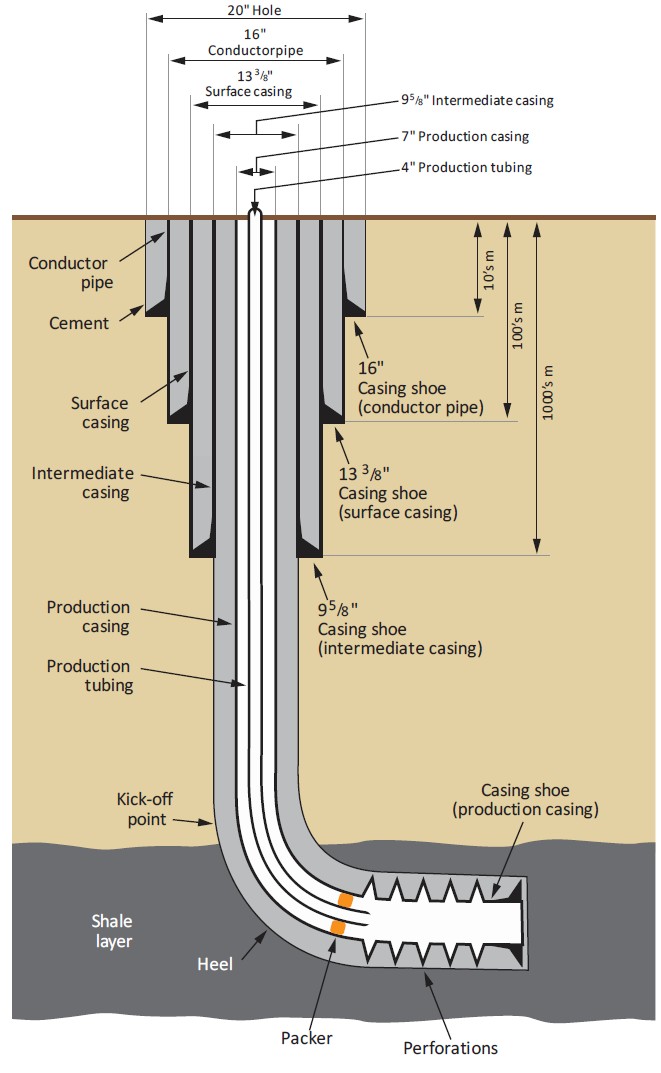
115 It will be observed in that diagram that, once the well has reached the layer of shale rock from which it is desired to extract gas, the well ceases to be drilled vertically, and begins to be drilled horizontally. This is known as “directional” drilling. To carry out the hydraulic fracturing, the casing in the production zone is perforated, and hydraulic fracturing fluid is pumped at high pressure through those perforations into the surrounding rock. The rock is thus fractured, creating space through which gas can flow back up the well and be collected at the surface. A portion of the hydraulic fracturing fluid will also flow back up to the surface.
The Shenandoah South Pilot Project Wells
116 It is important to appreciate certain aspects of the design and construction of the project wells. It was not in dispute that all of the proposed wells would be constructed to a broadly similar design. Moreover, Tamboran has already completed the construction of one additional well site (known as Shenandoah South 2), and two horizontal wells at that well site (known as SS-2H ST1, and SS-3H). At the hearing, the parties explored the issue of the design and construction of the project’s wells primarily by reference to the SS-2H ST1 well. I will do the same, although noting certain features of the SS-3H well that differ (although not in any way that is ultimately relevant to an assessment of the risk posed by the project).
117 In relation to the “conductor” section of the well:
(a) The conductor section extends to a total depth of 183.5 metres. The conductor section thus ended at the bottom of the Anthony Lagoon, and the top of an aquitard that separates the Anthony Lagoon from the Gum Ridge Formation beneath it.
(b) The conductor section was not relied upon to act as a barrier for well integrity purposes. The purpose of the conductor section was to provide a secure foundation or support for the rest of the well. One reason for that is simply because it is very difficult to achieve good cement coverage along the entire casing because, as Mr Stout put it, “you are drilling in unconsolidated formations where you will have losses”. In other words, when the cement is pumped out the bottom of the casing and into the annulus between the casing and the surrounding rock, the karstic nature of the Anthony Lagoon (i.e., the well is being drilled through an area with relatively large cavities) means that the cement will sometimes disappear into the surrounding karsts, and will not continue to fill the annulus all the way back up to the surface. To ensure that an adequate foundation was achieved (and to prevent runoff to enter the aquifer from the surface down the side of the well), cement was backfilled from the surface.
(c) While the design purpose of the conductor section is not to act as a barrier to prevent the escape of gas or fluid from the well into the Anthony Lagoon, the fact remains that the conductor casing is a steel tube (surrounded in at least some places by cement), and thus does in fact act as a barrier. As Mr McCloskey put it: “the conductor itself is typically just forming the foundational element of the first string of casing. It is cemented and it does provide a barrier of sorts. So I do think it can perform both.”
118 In relation to the “surface” section of the well:
(a) The surface section extended to a total depth of 456.6 metres, which was about 70 metres into the Antrim Plateau Volcanics. In other words, the surface section extended, from the bottom of the conductor section, through the aquitard separating the Anthony Lagoon Formation, all the way through the Gum Ridge Formation, and well into the impermeable rock layer below it (being the Antrim Plateau Volcanics). (In the case of well SS-3H, the other well at the Shenandoah South 2 site, the surface section in fact extended beyond the Antrim Plateau Volcanics down into the Cox Formation).
(b) The Gum Ridge Formation was also a highly karstic formation. That posed certain challenges for drilling, one of which was that the size of the karsts meant that the material being displaced by the drill bit was not always returned to the surface. Ordinarily, as drilling is conducted, fluid is pumped down the well to bring the rock cuttings created by the operation of the drill bit back to the surface. Analysis of those cuttings enables the operators to confirm the material through which the well is being drilled, as well as a range of other information. When those surface returns cease, it is known as “drilling blind”.
(c) It also posed similar problems for achieving a good cement coverage along the surface casing inside the Gum Ridge Formation as had been experienced with the production section and the Anthony Lagoon. Those problems ceased, however, once the drill entered the Antrim Plateau Volcanics. In other words, the evidence showed that good cement coverage was achieved between the surface casing and the Antrim Plateau Volcanics down to a depth of about 70 metres into that formation. The combined effect of the existing impermeability of the Antrim Plateau Volcanics, and the good cement coverage of the annulus that had been created by the drilling of the well, meant that there was a clear separation achieved between the Gum Ridge Formation and those geological formations beneath the Antrim Plateau Volcanics. Of course, the surface casing itself, like the conductor casing in the Anthony Lagoon, also operates as a barrier.
(d) The casing and cementing was tested and verified in various ways, designed to replicate the maximum pressure to which it might be subjected.
119 In relation to the “intermediate” section of the well:
(a) The intermediate section extended to a total depth of 560.8 metres, which was about 65 metres into the Cox Formation. (For well SS-3H, it extended down into the Kyalla Formation).
(b) The casing and cementing was tested and verified in various ways, designed to replicate the maximum pressure to which it might be subjected.
120 Finally, in relation to the “production” section of the well:
(a) The production section extended to a total vertical depth of 3,016 metres (which was in the Amungee Member B2 of the Velkerri Formation), at which point the horizontal segment of the well commenced (extending for nearly 2,000 metres).
(b) The casing and cementing was tested and verified in various ways, designed to replicate the maximum pressure to which it might be subjected.
121 Production at the wells involves the insertion of “production tubing” down the production casing. That is another steel tube, which thus operates as another barrier. Mr McCloskey said that the production tubing is the most common failure point, but that it was both easy to detect and remediate. A failure of the production tubing was thus unlikely to pose any real risk of a well integrity failure.
The Approach to Identifying the Risk of Well Integrity Failure
122 The parties were agreed that there were two broad ways in which a well integrity failure, such as might result in a significant impact on the aquifers, could occur:
(a) First, there could be a failure of the casing strings and their surrounding cement, at the point of the aquifer, such that fluids or gas could escape from inside the well out into the surrounding aquifer.
(b) Secondly, there may be a migration of gas up the outside of the well, caused by a loss of integrity of the bond between the cement and the casing, or between the cement and the formation, or through fissures in the cement.
123 Equally, the parties appeared to agree that the former mechanism did not constitute a real risk. As Tamboran submitted, it would:
… require the simultaneous failure (apparently undetected) of multiple layers of steel casing and layers of cement. … [T]his multiple barrier failure would also need to occur in that limited section of the well that passes through the Gum Ridge Formation.
124 I accept that such a mechanism is highly unlikely. The real issue thus related to the second potential mechanism. The applicant’s expert, Mr McCloskey, said that he regarded that as “the most plausible pathway for environmental impact over the life of a well”. Tamboran, however, submitted that it too was “highly unlikely” because it would require:
… gas (or, less likely, liquid in the form of brines or fracking fluids) to migrate upwards through an entirely unbroken pathway, likely over several kilometres, created by cracking in the multiple layers of cement that envelop the steel casing of the well and presumably jumping from the different sections of cement to the outer section of cement as it moves upwards.
125 Dividing the parties was, it seemed to me, a fundamental question of approach. Tamboran emphasised the need for the applicant to demonstrate the existence of a real risk of well integrity failure by reference to the particular design features and other relevant considerations applicable to these wells. The applicant, however, submitted that it was not appropriate to reason from what it called “engineering commonsense”, or “first principles”, because the fact was that well integrity events do occur notwithstanding the careful design and construction of wells. The applicant thus submitted that the only sure guide to ascertaining the extent of the relevant risk was to have regard to statistical studies of well integrity failures. The applicant submitted that, when that was done, it was clear that, whether or not the precise mechanism of failure could be identified, the existence of a real risk could not be denied. Tamboran, for its part, responded by saying that it was simply impossible to draw any conclusions from statistical surveys without having a clear understanding of the precise conditions pertaining to the surveyed wells, as compared to the project’s wells.
126 I will turn to consider the statistical analyses in due course. First, however, I agree that it is necessary to have a clear appreciation of the nature of the relevant risk posed by an unconventional gas well in the Beetaloo Sub-basin, and Tamboran’s engineering response to that risk. That is so if for no other reason than the strength of inferences able to be drawn from the statistical analyses will inevitably vary with the similarity or otherwise of observations that underpin them to the particular circumstances of the project’s wells. But more than that, in order to assess the extent of the risk posed by the project, it is important to understand the mechanism by which hydrocarbons may potentially be introduced into the aquifer.
127 I have already explained that the parties did not contend (and I would have rejected in any event) that there was a real risk of a simultaneous failure of all steel and cement barriers at a location within the aquifers.
128 The real question, therefore, was how hydrocarbons from beneath the Antrim Plateau Volcanics could migrate upwards into the aquifers (it was not in dispute that the shallowest source of hydrocarbons was in the Kyalla Formation). Tamboran emphasised that a highly improbable combination of failures would be required for that to happen.
(a) First, because gas would always follow the path of least resistance, in the event of any failure in the barriers of the production section of the well in the Kyalla Formation or lower, then the likelihood is that gas would nonetheless simply flow up the production section to the surface (and thus without coming into contact with the aquifer).
(b) Secondly, if, for whatever reason, the path of least resistance was not up the inside of the production section, but rather through some gap or fissure in the cement in the annulus between the production casing and the surrounding rock (including through a gap in the cement bond between the casing and the surrounding rock) then:
(i) There would need to be a continuous path all the way from the source of the hydrocarbons up to the beginning of the intermediate casing in the Cox Formation. That could involve a distance of over 4,000 metres.
(ii) At the point of the commencement of the intermediate section, however, that long continuous fault in the production section must cease. That is because, if it continued to extend upwards from that point, the result would be simply that the gas would flow up between the production and intermediate sections (and thus not come into contact with the aquifer).
(iii) At that same point, however, a new fault would need to come into existence that would provide a pathway for the gas to flow around the cement encasing the intermediate section, or between the intermediate section and the cement encasing it, or through that cement.
(iv) That new pathway would need to extend all the way up to (but not past) the commencement of the surface section in the Antrim Plateau Volcanics (a distance of some 100 metres).
(v) Once again, the reason that the fault must not continue past the commencement of the surface section is because, if it did, the gas would continue up in the space between the intermediate and surface sections of the well (and thus not come in contact with the aquifer).
(vi) There must therefore arise a new fault at this point, permitting the gas to flow around the bottom of the surface section, and up into the Gum Ridge Formation (or beyond).
129 There was no real dispute that it would be necessary for the combination of failures identified by Tamboran to occur in order that gas may be introduced into the aquifer. So much may be seen in the following passage from the cross-examination of Mr McCloskey:
COUNSEL: For that process, whether it be microannuli or any other concerns that might have shown up but not been sufficient to result in a dropping of the top of cement figure, but nevertheless blips on a cement bond log that show there might be issues or cracks or bumps or rocks, whatever it might be, for them to actually present a pathway that enables gas to escape from – let’s start with a production zone, to the surface, you would need to have an entirely unbroken series of those pathways going from, as it were, the production zone all the way up to the surface, would you not?
MR McCLOSKEY: You would have to have the holes in the Swiss cheese fully connected. Yes.
COUNSEL: Which, in the context of the well that we were looking at in Exhibit A, for example, we’re talking about something in the order of two kilometres worth of slices of Swiss cheese which have all of their holes lining up in a most unfortunate way.
MR McCLOSKEY: That’s fair enough.
COUNSEL: It’s a lot of cheese, is it not?
MR McCLOSKEY: It would indeed be a lot of holes. Yes.
COUNSEL: … You’ve got your Swiss Cheese holes lined up in the cement that is encasing the production casing, such that the gas is – perhaps in minute quantities, perhaps in larger quantities; we don’t know – travelling upwards. For that to ever be in a position where it’s even possible to get into the Gum Ridge aquifer, those holes in the Swiss Cheese can’t just continue up the cement on the production casing, because that will take you into the intermediate casing, will it not? At which point, it will manifest itself as sustained casing pressure sitting somewhere in that annulus between the intermediate casing and the production casing?
MR McCLOSKEY: That’s correct.
COUNSEL: So that’s not a threat to the aquifer if that’s happening. What we have to get ---
MR McCLOSKEY: Not in and of itself, yes.
COUNSEL: So what we have to do for that to happen is we have to have those microannuli or other bond issues in the cement or corrosion that’s resulting in an escape of gas through – out of the production casing, out into the cement there somewhere. It has to travel all the way through the cement around the production casing and, in a most unfortunate way, escape from that cement into the surrounding formation or around the surface of the cement before it gets into the intermediate casing, is that right?
MR McCLOSKEY: That’s one possible scenario, yes.
COUNSEL: If it’s not, as I think we’ve just been through, it’s just going up and creating sustained casing pressure in that annulus between the production casing and the intermediate casing. But we’ve got this pathway whereby gas has managed to get all the way up from the production zone through the cement. There has been an unfortunately unbroken series of holes in the Swiss Cheese that is the cement, and then there has been a further hole in that series of Swiss Cheese that takes you out to the surface of the formation and takes you around the intermediate casing. At that point, you’ve still got the cement of the intermediate casing that you need to deal with, and so somewhere, there would need to be a pathway through that.
MR McCLOSKEY: Yes.
COUNSEL: That’s another few slices of Swiss Cheese.
MR McCLOSKEY: Yes.
COUNSEL: And then you would have to find that it is able to pass through in some way the Antrim Plateau Volcanics, which create the aquitard, which the well is sealed in, is that right?
MR McCLOSKEY: Yes.
COUNSEL: Then you would have to have another series of either unfortunate cementing issues or microannuli sitting somewhere in and around the cement which lies in the Antrim Plateau Volcanics in order for it to then get to a point where this unknown quantity of gas is potentially escaping into the Gum Ridge Formation, is that right?
MR McCLOSKEY: That’s largely correct, yes.
130 The frequent caseic references in that passage are explained by an analogy used by the engineering experts in this case to describe the use of a range of different precautions, all of which must fail before there will be a failure of well integrity. They called it the “Swiss Cheese Model”, which Mr McCloskey summarised as follows:
In complex systems such as well construction and operation, a layered barrier model of accident prevention is often used in risk analysis and risk management. This conceptual model was first described in Reason (1990). It likens systems involving human designs to multiple slices of Swiss cheese, which have inevitable imperfections or holes in each slice, but stacked together can prevent a threat from becoming a reality. This is similar to the two barrier designs that Stout refers to throughout his report. The threat is mitigated by the different types of defences which are “layered” behind each other. Therefore, in theory, lapses and weaknesses in one defense (e.g. a hole in one slice of cheese or designed barrier) do not allow a risk to materialize, since other defenses also exist (e.g. other slices of cheese/barriers), to prevent failure. The model has gained widespread acceptance.
131 The references to “sustained casing pressure” in the exchange with counsel quoted above also should be explained. That concept refers to the development of measurable pressure at the surface of the well in the space between casing strings, or between a casing string and the surrounding rock, caused by the unintended flow of gas or fluids, and which builds again after being bled to zero (i.e., relieved, for example by the opening of a valve). Mr McCloskey referred to sustained casing pressure as an important indicium of well integrity failure. In his opinion, “the most certain indicator of well barrier breakdowns that can lead to well integrity failure and contamination of the environment outside the wellbore is sustained casing/annular pressure (‘SCP’)”. This is a topic to which it will be necessary to return.
The Risk Posed by the Shenandoah South Pilot Project Wells
132 I have already described the basic design of the project’s wells, and the process by which they are constructed. I have also referred, in describing the activities for which Tamboran has received approval from the Northern Territory Government, to the EMP that was approved under the Petroleum (Environment) Regulations 2016 (NT). The EMP incorporates two other documents that are of particular relevance to the issue of well integrity. The first was referred to as the “WOMP” (or Well Operations Management Plan), while the second is known as the “WIMP” (or Well Integrity Management Plan). Mr Thibodeaux provided a high-level summary of the fundamental way that, as reflected in those documents, the design of the project wells was intended to protect against failures of a kind relevant to these proceedings. Consistently with the broad description of the construction of shale gas wells generally that I provided above, his evidence was to the following effect:
As outlined in the EMP, WIMP and WOMP, the drilling, hydraulic fracturing and operation of the gas wells is designed to ensure that there are no ‘well integrity failures’ leading to hydraulic fracturing fluids, brines or released hydrocarbons leaking into groundwater. This includes ensuring that there is a minimum of two independent, verified well barriers in each well to prevent any such leakage. These well barriers are subject to detailed testing to verify their integrity, independently verified to meet the required standards and are subject to ongoing monitoring. If the testing or monitoring detects any weakness or potential weakness, the impact to well integrity is assessed and if deemed necessary under the conditions of the WOMP, the well is suspended from any further operations whilst the issue is addressed.
In basic terms, the barriers in a well are comprised of a continuous barrier of steel casing and then concrete which is pumped up the gap between the steel casing and the rock (called the casing-hole annulus) forming a concrete barrier on the outside of the casing. As I outline below, as the well goes deeper, increasingly narrow diameter lengths of steel casing are lowered into the well and concrete is then pumped up the outside of the casing and the well to form equivalent concrete barriers at those lower levels.
Each casing string when run has several “shoe joints”. A casing string is a continuous length of steel pipe comprising connected shorter lengths of pipe configured to fit inside the drilled wellbore. A shoe joint includes two backpressure check valves or floats which prevent the cement from coming back into the casing after it is displaced out of the casing and into the annulus. The effect of these shoe joints is that the cement inside the shoe, after hardening up to specifications, allows for the casing to be pressure tested to the designed pressure requirement to meet the well integrity criteria of that section.
Once the well is completed and prior to undertaking any hydraulic fracturing or flowback activities, each well will have a minimum of two tested barriers between the aquifer and the hydrocarbon bearing zones. For a “well integrity failure” to occur which leads to leakage into an aquifer, all well barriers at that point would need to “fail”.
133 The evidence demonstrated, perhaps unsurprisingly, that the risk of contamination of an aquifer decreased with the number of barriers incorporated into a well’s design. Mr Stout referred to Stone et al, “A Continued Assessment of the Risk of Migration of Hydrocarbons or Fracturing Fluids into Fresh Water Aquifers in the Piceance, Raton, and San Juan Basins of Colorado” (2016), an academic study presented at the Society of Petroleum Engineers Annual Technical Conference and Exhibition. That study examined well construction methods for the protection of fresh water aquifers in three basins of the Rocky Mountains region of the United States. It categorised wells by the number and type of barriers, and observed a strong correlation between the wellbore barrier category and the risk of well integrity failure. The categories ranged from 1 to 12 (with category 1 posing the highest risk of well integrity failure, and category 12 posing the lowest risk).
134 The experts agreed that the project wells were Category 11 wells, meaning that they had a deep surface casing, in addition to an intermediate casing, in addition to the production casing being cemented back to a level above the intermediate casing shoe.
135 The applicant sought to emphasise, however, particularly by reference to the evidence of Mr McCloskey, features of unconventional gas wells generally, as well as features of the Shenandoah South Project in particular, that it said contributed to a material risk of well integrity failure notwithstanding the advanced design features they possessed.
136 In relation to the general risks of unconventional gas wells, the applicant identified three particular issues:
(a) First, the wells are directionally drilled wells, which have “historically experienced higher degrees of well barrier failures … purportedly due to difficulties with achieving 360 degrees of even cement grouting when casing pipes ‘lay’ across the angled bore holes as opposed to more easily centralized piping ‘hanging’ in vertical wells”.
(b) Secondly, being used for hydraulic fracturing, the wells “require extremely high pressure treatments to fracture the target zones, exposing the casing and cement throughout the wellbore to stresses not commonly seen in conventional wells”.
(c) Thirdly, while there have been technological advancements, the risks have not been “engineered out”. Rather, the applicant submitted that while Tamboran’s wells were modern, technological improvements were accompanied by commensurate additional challenges resulting from increasingly complex operations, and well integrity failure could not be eliminated.
137 I am not persuaded that those matters are capable of taking things very far in the context of this case, however:
(a) In relation to the first, an increased likelihood of a well barrier failure in the abstract does not translate to an increased likelihood of a well integrity failure that may lead to the contamination of an aquifer. The apparent cause of the increased risk posed by directional drilling identified by the applicant related to the production zone (i.e., the point at which the well starts to be drilled directionally, and thus the point at which it is said to be more difficult to achieve a good cement cover). The failure of a well barrier in or around that point is very unlikely to lead to an integrity failure capable of producing an impact on an aquifer, many thousands of metres towards the surface. It would not, without more, create a pathway to the aquifer. The increased risk observed in directionally drilled wells is thus not obviously relevant to the particular risk of interest in these proceedings.
(b) In relation to the second, it may be accepted that hydraulic fracturing involves exposing the well to higher pressures than would ordinarily be experienced in conventional gas extraction. But the evidence to which I have already referred demonstrates that Tamboran’s wells were specifically designed with that fact in mind (and tested during construction by reference to the pressures to which they would be exposed). The mere fact of higher pressures thus cannot be considered independently of the design of the well, and does not provide a sufficient basis, on its own, to conclude that a risk of any particular magnitude or likelihood exists.
(c) In relation to the third, the evidence simply did not support a finding that there was anything in the particular circumstances of the project that would suggest that the technology was being pushed beyond its limits, or even close to it.
138 In relation to the features of the Shenandoah South Project in particular, the applicant emphasised two key matters by reference to the evidence of Mr McCloskey (but said to be reinforced by the evidence of Professor Currell):
(a) First, the target gas has been identified as having a molar percentage of carbon dioxide of approximately 5 percent, and hydrogen sulphide has also been detected. Those compounds were said to pose a significant risk of corrosion to the steel casing. Equally, some parts of the formation were hyper-saline, which posed an additional risk of corrosion.
(b) Secondly, the Cambrian Limestone Aquifer has a highly karstic geology (meaning there are caves, caverns, cavities or sinkholes throughout it, caused when water dissolves limestone). Two key consequences may flow from this:
(i) First, when the well is being drilled, there may be a loss of drilling fluids into the aquifer.
(ii) Secondly, the presence of karstic features may mean that it is not possible to achieve a continuous vertical coverage of the casing with cement, or a secure bind of the casing to the surrounding rock.
139 In relation to the risk of corrosion, Mr Stout was not alarmed by the composition of the gas, while Mr McCloskey considered that such concentrations are significant as a source of corrosion risk. More significantly, however, Mr Stout emphasised that the design of the wells (and the selection of materials for their construction) had been carried out in the knowledge of the composition of the gas and the environment in which the wells were drilled. The relevant proportions of carbon dioxide and hydrogen sulphide, for example, were identified as geohazards in the WOMP, and appropriate precautions were taken in consequence. As Mr Stout said, “the material selected which will be exposed to this is designed to take those sort of CO2s and those sort of H2Ss”. And Mr McCloskey agreed that there “are materials that – and alloys that can be used to enhance well bores to extend the life through corrosive environments”. Once again, therefore, it is important to focus not only the existence of a risk, but on the way that that risk has been responded to in the design of the wells. And I am satisfied that the composition of the gas has been appropriately accommodated in Tamboran’s design and material selection.
140 In relation to the karstic geology of the aquifers, while I accept that one consequence may be a loss of drilling fluids into the aquifer during construction, I did not understand either side to suggest that that could produce a “significant impact” on the aquifer within the meaning of the EPBC Act. Equally, while I accept that it is also the fact that it is much harder (if not impossible) to achieve good cement coverage within the aquifer, Tamboran’s case did not depend on that being achieved, and I have not assessed the risk of well integrity failure on the assumption that it can. I deal with this particular issue in more detail, in connection with the construction of the wells that has occurred to date, below.
141 Professor Currell raised other potential issues too, but none of them were developed in the evidence to a point where they could be said to contribute to a likely risk of a significant impact on an aquifer. For example, he referred to the fact that the Beetaloo Sub-basin was in the early stages of exploration and development, and, as a result, there have been limited seismic and other geophysical surveys, which he said contributes to a risk of encountering seismic events leading to well damage. This was an example of what I consider to be a tendency on the part of Professor Currell to rely on unknown quantities, or the inability to exclude definitively some matter, as demonstrating positively the existence of a real risk. But I do not consider that it is possible to reason from the fact that something cannot be excluded as a possibility, to a conclusion that the unknown factor does in fact constitute a real risk.
142 Further, the applicant emphasised that there remained a risk of well integrity failure even after the decommissioning and abandonment of a well, which it contended must be taken into account. This included, for example, biogeochemical processes that the applicant submitted would continue to pose a corrosion risk regardless of whether wells are operated. I accept that the risk of a well integrity failure does not cease with the decommissioning of a well. It is another question, however, what the magnitude of that risk may be (one study to which the parties referred, Wisen et al (2019) (which I cite in full below), referred to an extraordinarily wide range of results obtained from field studies in different places, which suggests that, as always, careful attention would need to be paid to the particular circumstances of the project in order to form a view). I will return to that question.
143 To reinforce its point that the construction and operation of unconventional gas wells in the Betaloo Sub-basin involved inherent risks that were not capable of being satisfactorily eliminated, the applicant drew to attention a range of problems or issues that arose in the course of the construction of the wells that have already been built.
144 First, it appears that the shoe of the conductor casing in well SS-2H ST1 was not set in the aquitard between the Anthony Lagoon and the Gum Ridge Formations. The reason that the applicant raised this topic is because the WOMP identified two broad possibilities for setting the casing shoe of the conductor casing (the first being in the undifferentiated cretaceous formations above the Anthony Lagoon, the second being in the aquitard between the Anthony Lagoon and the Gum Ridge Formations). It was not in dispute that Tamboran had pursued the second option, and the applicant thus contended that the failure to achieve it represented a departure from the design of the well. It is clear, however, that ensuring the conductor casing shoe was in the aquitard was not an essential feature of the design of the well. That is because the WOMP expressly contemplated that the conductor shoe might not reach the aquitard, in which case it provided that a “combination stage tool / annular casing packer may be run with the Surface casing to segregate the ALB and Gum Ridge aquifers”. And that is what was done here. There is no basis upon which the placement of the conductor casing shoe could be said to represent a risk to well integrity.
145 Secondly, the highly karstic nature of the Gum Ridge Formation in particular (but also the Anthony Lagoon) led to a range of issues in the construction of the well, most notably in the attempt to obtain a good cement seal around the conductor and surface casings in the aquifer. (I have already referred to this issue in general terms above.) It will be recalled that the process by which a cement barrier is installed around a casing is to pump cement down the casing in question, force it out the bottom, and up the annulus between the surrounding formation and the casing. Where the surrounding formation is karstic (that is, characterised by cavities) there is a risk that the cement will disappear into the formation, rather than flow back up the annulus to the surface. A good indication of the successful creation of a cement barrier is that cement is returned to the surface of the well, outside the casing. Where that does not happen, cement may be poured down the annulus from the surface. In such circumstances, however, it is likely that a continuous and effective cement barrier all the way along the casing in question will not have been achieved.
146 The evidence showed that a continuous cement barrier was not achieved throughout the Anthony Lagoon and Gum Ridge Formations. I am not persuaded, however, that the failure to achieve an effective cement barrier along the conductor and surface casings through the aquifers compromises the design of the wells:
(a) In Tamboran’s design, the conductor section was not relied upon as a barrier. Mr McCloskey agreed, for example, that the “primary purpose of the conductor” was to provide “the foundations for your well and subsequent drilling activities”. Of course, the conductor casing itself constitutes a barrier, (and indeed cement, to the extent that a good bond is able to be achieved), but those barriers are not an essential part of the design of the well insofar as integrity is concerned. In any event, the conductor section did not extend into the Gum Ridge Formation, and was thus never going to function as a barrier to protect that part of the aquifer.
(b) In relation to the surface casing, it is true that it was not possible to achieve an effective cement bond through the Gum Ridge aquifer. As Mr McCloskey said, however, while good bonding all the way across an aquifer “would be ideal”, it is “not always achievable”. And nor is it essential to well integrity, because the critical thing, in terms of the protection of the aquifer, is to separate it from the lower formations. And that could be achieved by ensuring a good cement barrier through the Antrim Plateau Volcanics. As Mr McCloskey said:
COUNSEL: And if that’s right, then what that good cement job for 72 metres or so into the Antrim Plateau Volcanics surrounding the surface casing is giving us, is good separation between the Antrim Plateau Volcanics and everything that sits above them, including the Gum Ridge Formation?
MR McCLOSKEY: “Good” is a relative term, depending on what type of cement bonding. But, yes, in general, yes.
In other words, while the wells cannot be treated as having an effective cement barrier within the aquifers (which would operate to prevent escapes from within the wells at that point), they do contain an effective barrier in relation to gas from lower points.
147 Thirdly, in relation to well SS-2H ST1, a cement barrier was not able to be achieved alongside the production casing all the way to the surface (or, at least, it could not be confidently assessed that a good cement bond had been achieved). That is, it was assessed that the well had only been effectively cemented to a point about 390 metres below the surface (that is, in the Antrim Plateau Volcanics). Furthermore, the evidence showed that it was likely that there were other locations deeper down the well where a hydraulic seal had not been achieved with the cement barrier. Once again, however, I am not satisfied that these failures to achieve a perfect continuous cement bond represent any real risk to well integrity:
(a) First, in relation to the failure to achieve a continuous cement bond from 390 metres to the surface, it is important to appreciate that 390 metres is above the casing shoe of both the intermediate and the surface sections. In other words, an effective cement bond was achieved for a distance of nearly 175 metres upwards from the bottom of the intermediate casing (that is, from a depth of 564 metres at the intermediate casing shoe, up to 390 metres) and 70 metres upwards from the bottom of the surface casing (that is, from a depth of 460 metres at the surface casing shoe, up to 390 metres). It follows that a failure in the cement barrier at that point or above could not, without more, result in the introduction of gas into the aquifers. For that to occur there would need to be a failure of, at the very least, the intermediate casing, the cement barrier around it, and the surface casing. Additional barriers may also be present depending on the precise situation involved, namely, any cement barrier around the surface casing, and the conductor casing and any cement barrier around it.
(b) Secondly, insofar as there may have been a failure to achieve a continuous cement barrier below 390 metres, that is not in itself problematic. While in a “perfect world” a continuous, vertical cement barrier would be achieved, a failure to do so did not mean that there was a failure to meet well integrity requirements. The reason that is so was explained by Mr Stout:
COUNSEL: What you don’t have, though, is a, if I can put it this way, continuous, permanent and hydraulic seal along that section of casing; correct?
MR STOUT: Yes. It’s not necessary to get a hydraulic seal all the way along that piece of – section of casing. It’s important to have periods of isolation or barrier on top of where there has been formation changes.
…
COUNSEL: But what you’re aiming for is to get a continuous, permanent hydraulic seal all the way along the wellbore between the formations and the casing and liner, or between two casings and liners, correct?
MR STOUT: Your objective to stop is to isolate different formations of different pressure regimes, so you don’t have a cross flow.
COUNSEL: Okay.
MR STOUT: Between those zones, you need to get a good piece of cement. It doesn’t have to all be cement, you’re just looking for a couple of metres. You know, yes, the whole thing doesn’t have to be cemented.
COUNSEL: So it would be wrong to say that cement provides a continuous, permanent and hydraulic seal along wellbore between formations and a casing liner or between casing strings?
MR STOUT: I think you’re looking at the word continuous, and you’re assuming that over the continuous length.
COUNSEL: Yes.
MR STOUT: I suppose more continuous as in it’s continuous not in that direction [indicating vertically], but more in that direction [indicating horizontally] that you have a continuous bond all the way across, so it’s a barrier and fluid can’t pass through.
148 Fourthly, in relation to well SS-3H, the applicant emphasised two particular aspects of the results of testing on the production section cement barrier:
(a) First, in the interval between 85 and 600 metres, the testing revealed that “cement bond is poor across this interval”.
(b) Secondly, in the interval between 1110 and 1550 metres, the testing revealed that while there was “better cement bond” there were indications of “micro annulus presence”.
149 The potential significance of these issues was explained by Mr McCloskey to be that there was the potential for gas (or other substances) to be transmitted upwards through any conduit that was created, and also that there was the potential for corrosive substances to be brought into contact with the steel casing. The significance of this to well integrity, however, was answered by Mr Stout, who explained:
(a) The surface casing in the SS-3H well extended down to a depth of approximately 500 metres, and the intermediate casing in the SS-3H well extended down to a depth of approximately 1,700 metres. It followed that the intervals in which issues with the cement had been identified were all at a point when the production casing was within (at least) the intermediate casing.
(b) That was relevant to the risk of the introduction of corrosive substances because, as Mr Stout put it:
The microannulus, if it’s internally, if it’s the microannulus between the cement and the casing, then it’s not the – then the microannulus has to be more exposed to the formation of where you’re going to get the fluid from or the corrosive. But if the microannulus exists right next to the casing and it’s not in contact with points where there’s formation, then there’s no way for that corrosive fluid to get in contact with the casing.
(c) Furthermore, the cement testing results indicated that there were extended sections of good cement above and below the areas of concern, which Mr Stout said shows that “you do have a barrier within the annulus between the [production casing] and the [intermediate] casing. And all that is showing you that there is a point within that there will be little patches or voids that are not in communication with anything and will not serve at risk anything”. Once again, in common with the previous issue, any problem with the cement barrier was at a point above the bottom of the next higher casing, with all that that entails.
150 The cement testing, in fact, identified the presence of “low degree of micro annulus” in lower sections of the well. In relation to those matters, Tamboran emphasised that “the important point is whether there are sections of good cement between the pipe and the formation”. In that regard, the cement testing report identified a large number of sections where good cement bond intervals of more than 10 metres were recorded.
151 Fifthly, an issue arose during the construction of well SS-2H ST1 (which was initially just labelled SS-2H) at the completion of the drilling of the “production” section. While endeavouring to remove the drill string and “bottom hole assembly” (which is comprised of drilling pipe, a drill bit, and additional tools to help drill directionally), the equipment became stuck at the bottom of the vertical section. Despite numerous attempts at retrieval, the entire bottom hole assembly, and 255 metres of drill string, had to be abandoned in the wellbore. Ultimately, the decision was made to plug the production section at the bottom of the intermediate section, and from that point a new sidetracked bore was drilled to establish a new production section. With the new sidetracked production section, the well was designated SS-2H ST1. The evidence does not establish, however, that that deviation from the original design creates any additional risk to well integrity. As Mr Thibodeaux said:
The loss of the [bottom hole assembly] in the production hole above the Velkerri Formation did not create a well integrity failure or any risk of such failure. The various well barriers comprising the casing strings and cement were not impacted by the loss of the [bottom hole assembly] and nor did any of the fishing operations affect the well integrity.
152 Sixthly, after well SS-3H was completed, and hydraulic fracturing had commenced, Tamboran’s monitoring detected stress in a casing connection in the production section. The issue was detected after a “plug” was lost in the wellbore. The plug had been used to isolate different sections of the production casing during fracturing, but was lost during retrieval due to a deformation in the casing. The deformation was said to be “caused by connection stress in the buoyancy sub tool being used” in the relevant part of the production casing. A decision was made to:
… remediate the stress by running a patch across the stress. A patch is a specialised tool consisting of a joint of steel pipe that has seals on top and bottom that will straddle the stress and isolate it from the wellbore.
153 Even if that patching was somehow ineffective, or created a weak point that might increase the risk of failure in the future, it is important to note that the issue occurred in a part of the production section that is either in, or very close to, the part of the well used to carry out the hydraulic fracturing. In other words, in that part of the well (or close to it) the production casing is intentionally perforated as part of the process to extract gas. So no additional pathway would be created by which gas (or other substances) may reach the aquifers.
154 Overall, though, the applicant’s purpose in referring to the various issues that had arisen during the construction and operation of the Shenandoah Pilot Project was not to “demonstrate that any specific incident during the embryonic stages of the Project … constitute well integrity failures, or will give rise to well integrity failures leading to aquifer contamination in the future”. Rather, the applicant contended that:
the primary significance of the evidence relating to those incidents is: (1) to illustrate that technological improvements or better well design choices cannot necessarily “engineer out” the risks, and (2) to expose particular features – including the karstic geology of the formations and the resulting technical difficulties for well construction – which are relevant to the overall assessment of risk across Tamboran B2’s planned activities …
155 The difficulty for the applicant, though, is that, while the evidence upon which it relied comfortably established that, despite the best of intentions and precautions, things might still go wrong, it did not do so in a way that meaningfully engaged with the particular risk that was relevant to this case (that is, the risk of contamination of the Gum Ridge aquifer). What was required was a focussed assessment of those risks that are relevant to the creation of the very specific pathway by which it was agreed gas would need to travel to enter the aquifer. Demonstration of risks unconnected with the creation of such a pathway cannot assist.
156 Nor was the evidence to which I have referred so far, to the extent that it did identify risks that are relevant to the creation of such a pathway, capable of enabling an assessment of the magnitude of the risk. Indeed, overall, the evidence to which I have referred thus far reinforced Tamboran’s submission that the risk of a well integrity failure was vanishingly small. Tamboran’s wells were uncontroversially designed to very high standards to operate safely in the particular conditions in which they were to be drilled. They were shown to have been constructed carefully and competently substantially in accordance with their designs. To the extent that problems had been encountered, they had been identified and dealt with without any risk to well integrity being created.
157 To this point, therefore, I do not think that the applicant has succeeded in proving any more than that there is a possibility that things might go wrong in such a way that gas could enter the Gum Ridge aquifer. The risks that it has pointed to depend on the failure of Tamboran’s well designs to be achieved. Of course, that is a possibility that must be acknowledged. But, subject to consideration of the matter to which I will turn next, the evidence does not positively persuade me that it is likely, in the relevant sense, that the wells will not be built according to their design, or that those designs will not operate as intended.
158 To be clear, my conclusions in this regard take into account the risk posed by the project’s wells following their assumed decommissioning. The process involved in decommissioning the wells is described in the WOMP. It is not necessary to recount that process in detail, but it might be observed that it involves a period of monitoring and, once that monitoring suggests that all barriers are effective, the abandonment of the well. Mr McCloskey and Professor Currell gave evidence, which I accept, that it is possible for well integrity issues to arise even after a well has been abandoned in accordance with relevant regulatory requirements, and that, as materials age they may deteriorate and constitute a threat to integrity.
159 Once again, however, the evidence simply did not demonstrate the existence of any quantifiable risk sufficient to support a finding that a well integrity failure of the relevant kind was “likely”. I accept that there is a risk that something might go wrong, in the sense that the steps taken to plug and make safe a well may, contrary to the expected function of the precautions taken, not prove effective. But the evidence (subject to the matter to which I will turn next) did not support a finding that such a risk was “likely” to be realised. (Indeed, I might observe, that I would have reached the same conclusion on the applicant’s definition of the relevant “action”, or on the applicant’s contended basis upon which the impacts of the action I have found to exist should be assessed. That is to say, even on the assumption that the relevant action (or its impacts) involved more wells, being operated for a longer period, the evidence would not have enabled me to conclude that there was likely to be a well integrity failure of a kind that resulted in the contamination of an aquifer.)
160 To deal with the problem of quantification of the risk, the applicant turned to the studies that I mentioned earlier in these reasons (that is, studies of failure rates in different well populations around the world). By doing so, the applicant sought to quantify the risk that, in spite of the best engineering solutions, something might go wrong in a way that could lead to contamination of the Gum Ridge aquifer. The point was put succinctly by Mr McCloskey as follows:
Again, these pathways are not well-defined. If I could define them, I probably would [be] defining them somewhere to help people, and I would be making a lot of money doing it. But I don’t think we fully understand exactly what it takes to get that type of flow, only that we see it so often that there must be something, a tortuous path inside these nested sections of steel and cement that are allowing these in most cases gas bubbles to reach the upper sections of the pipe and potentially go into the … aquifer.
161 The applicant’s case, ultimately, may thus be summarised as follows:
(a) while engineering solutions to risks may be incorporated into the design of wells:
(i) no solution, even if implemented perfectly, is capable of eliminating those risks entirely; and
(ii) such solutions may not in fact be implemented perfectly;
(b) the result is that well integrity failures do in fact occur; and
(c) the surest guide to the magnitude of the risk that is posed is thus a statistical analysis of the actual failure rate of existing wells.
162 Propositions (a) and (b) may be accepted; with the caveat that the evidence did not establish that it was “likely”, in the relevant sense, that there would be such a failure. The fate of the applicant’s case thus depends on proposition (c), and so it is to that that I now turn.
The Statistical Analyses
163 The statistical analysis performed by Mr McCloskey upon which the applicant relied was based principally upon two academic papers:
(a) Brufatto et al, “From Mud to Cement—Building Gas Wells” (2003) 15 Oilfield Review, 62, which concluded that more than 50 percent of wells showed migration of fluids leading to sustained casing pressure over an expected 20 year well life cycle; and
(b) Wisen et al, “A portrait of wellbore leakage in northeastern British Columbia, Canada” (2019) 117(2) Proceedings of the National Academy of Sciences, 913, from which Mr McCloskey deduced that in 6.2 percent of wells with sustained casing pressure there was contamination of the surrounding environment.
164 Mr McCloskey thus opined:
Applying Wisen et al’s percentage to the [Brufatto et al] data (i.e. 6.2% of 50%), which I consider to [be] the best analogue for the purposes of assessing the risk of well integrity failure, gives approximately a 3% chance of a well leakage outside of casing strings drilled, so as to contaminate the outside environment (which, in the case of the Beetaloo Basin, is the aquifer).
Translating this risk of 3% (0.03) wellbore leakage sufficient to contaminate an aquifer shows:
Probability of failure = 0.03 Probability of success = 1 – p_fail or 1 – 0.03 = 0.97
Probability of no failures occurring in all 15 trials: (p_success)^15 or (0.97)^15 ≈ 0.6332.
Probability of at least one failure equals 1 – 0.6332 or 0.3668 or 37%
165 If this reasoning is to have any relevance to the magnitude of the risk posed by Tamboran’s wells, a critical issue is plainly the extent to which the wells the subject of those studies resemble the project wells (in all relevant respects, including design, method of construction and operation, and the geological conditions in which they are placed). Unless the wells the subject of the studies are sufficiently analogous to the project’s wells, it is difficult to see how the studies could provide a secure foundation for the inference that the failure rate would be equivalent. More than that, though, it will be necessary to consider the extent to which the failures recorded in the studies are the kinds of failures that might, in the circumstances of the project, result in the contamination of the Gum Ridge aquifer.
166 In relation to Brufatto et al (2003):
(a) The article was published in 2003, and described new or evolving technologies in the construction of wells designed to control or mitigate the problem of gas migration and sustained casing pressure.
(b) By way of introduction, the article sought to convey the scale of the problem sought to be addressed by those new technologies. It did so by reference to data obtained from the United States Minerals Management Service in relation to approximately 15,500 wells in the Gulf of Mexico. It said:
In the Gulf of Mexico, there are approximately 15,500 producing, shut-in and temporarily abandoned wells in the outer continental shelf (OCS) area. United Stated Minerals Management Service (MMS) data show that 6992 of these wells, or 43%, have reported SCP [sustained casing pressure] on at least one casing annulus. In this group of wells with SCP, pressure is present in 10,153 of all casing annuli: 47.1% of the annuli are in production strings, 26.2% are in surface casing, 16.3% are in intermediate strings, and 10.4% are in conductor pipe.
The presence of SCP appears to be related to well age; older wells are generally more likely to experience SCP. By the time a well is 15 years old, there is a 50% probability that it will have measurable SCP in one or more of its casing annuli. However, SCP may be present in wells of any age.
(Footnotes omitted.)
(c) The applicant emphasised that, in Mr McCloskey’s view, this data was a good reference point for drilling in the Beetaloo Sub-basin, due to the prevalence of unconsolidated sediments in the Gulf of Mexico (which presented similar issues to those encountered by reason of the karstic nature of aquifers), the fact that drilling in both locations involves complex techniques such as directional drilling, and that such drilling was or is expected to be undertaken by sophisticated and well-resourced companies.
(d) The article provided no particular reasoning, or analysis of data, in relation to the assertion that by the time a well is 15 years old, there is a 50% probability that it will have measurable sustained casing pressure. In cross-examination, Mr McCloskey said:
COUNSEL: In terms of the 50 per cent, do you have any understanding of where that 50 per cent came from or what sort of wells it might have related to or what sort of sustained casing pressure we were talking about?
MR McCLOSKEY: I don’t think that data has been available. It’s from another paper from [Bourgoyne], and he discusses around the edges of these things, but he doesn’t actually go through this data set. This is part of the data set that he utilised to come to some other conclusions about techniques as well as regulatory effects that they would like to have recommended at that time. But this data was very consistent with my experience of being in the Gulf of Mexico at the time, in the mid – early 90s and the early 2000s, where we were having significant difficulties with sustained casing pressure on any number of annuli, not just tubing production casing, but bubbling around platforms, failures that were obviously noticeable.
We were very fortunate that there were no aquifers in the Gulf of Mexico, when it’s overlaid by tens or thousands of feet of saltwater. But integrity of the platform areas, safety of personnel, burst pressure, collapse pressure issues were quite prominent at that time.
(e) The reference to an analysis of Bourgoyne was to a paper published in 2000, entitled “A Review of Sustained Casing Pressure Occurring on the [Outer Continental Shelf]”. It refers to a database for confidential internal use by the researchers, which is consistent with Mr McCloskey’s statement that the data underpinning the figure has not been made available. My own review of that paper confirms the accuracy of Mr McCloskey’s statement that Bourgouyne “discusses around the edges of these things, but he doesn’t actually go through this data set”.
(f) Nor did Brufatto et al (2003) suggest that any limit had been applied to the amount of pressure recorded before it would be included in the analysis. In cross-examination, Mr McCloskey explained it in this way:
COUNSEL: And so the other thing we don’t get – seem to get told in this paper, and you can correct me if I’ve missed something, but of the 50 per cent which is described as measurable SCP, we don’t really know exactly how much pressure that is, just that it’s measurable?
MR McCLOSKEY: The [Bourgoyne] paper describes, I think, 90 per cent of the pressure measurements were below 1000 psi. He didn’t make any cutoffs. Lackey made a 50 psi cutoff so that he could determine some thermal effects. He wanted to eliminate, sort of, noise in the data.
…
This data here reflects a variety of pressures. But I believe that the number was 90 per cent or less than 1000 psi, which is still significant.
COUNSEL: If what Mr Lackey and his colleagues have done has effectively reduced noise by taking out of the data pressure which is caused by things like thermal differentials and the like, which are just part and parcel of operations, as opposed to any sort of barrier failure, the 50 per cent figure that has been seized on here hasn’t had that noise cleaned out, has it? It’s still noisy.
MR McCLOSKEY: You could probably characterise it that way.
(g) The reference in that passage to Lackey is a reference to a paper by Lackey et al, “Public data from three US states provide new insights into well integrity” (2021) 118(14) Proceedings of the National Academy of Sciences, which was an analysis of the records of regulatory agency databases relating to wells in Colorado, New Mexico and Pennsylvania. The approach of that study to the identification of sustained casing pressure was described as follows:
SCP was identified using the API [American Petroleum Institute]-recommended practice for annular casing pressure management in onshore oil and gas wells. API protocol recommends calculating a well-specific diagnostic threshold for annular pressure in wells that is a low percentage of the maximum well operating pressure. We lacked the data necessary to determine the maximum operating pressure of wells and assumed a uniform threshold of 50 psi instead, because it aligns with the action threshold used by the COGCC for wells in the Denver-Julesburg Basin of Colorado and is likely lower than the diagnostic thresholds calculated for most wells (which may be over 689.5 kPa). A relatively low threshold was preferred because assuming a high threshold may have excluded wells with smaller chronic leaks from our SCP designation. Cases of annular pressure >50 psi were classified as either SCP or thermally induced. Annular pressures were considered SCP if 1) pressure did not bleed to zero during bleed-off, 2) pressure bled to zero but exceeded 50 psi in the subsequent test, or 3) pressure bled to zero but no follow-up test was performed. Annular pressures that bled to zero but did not exceed 50 psi in the following test were considered thermally induced. Pressure bleed-off tests are not performed in Pennsylvania. Cases of annular pressure were considered SCP in Pennsylvania if they 1) exceeded 50 psi in two consecutive tests or 2) exceeded 50 psi and no follow-up test was performed.
(Footnotes omitted.)
What Lackey et al (2021) demonstrates is that measurable sustained casing pressure in and of itself may not indicate any well barrier failure. The authors suggest that, ideally, they would have used a well-specific threshold, but in the absence of data chose a “relatively low” threshold of 50 psi. Even then, however, some readings over 50 psi were treated as caused by thermal differentials rather than well barrier failures depending on other testing indicators. The data suggests that the application of those thresholds may materially affect the number of instances of measurable sustained casing pressure that might indicate a well barrier failure. That is (for example):
(i) Of the 22,108 wells that were tested in Colorado:
(A) 13,421 (or 60.7%) had measurable SCP;
(B) but of that, only 4,184 (or 18.9% of the total wells tested) had SCP over 50 psi;
(C) and of that, 473 (or 2.1% of the total wells tested) had SCP over 50 psi that was regarded as thermally induced;
(D) with the result that 3,711 (or 16.8% of the total wells tested) had SCP over 50 psi that may indicate a well barrier failure.
(ii) Of the 25,925 wells that were tested in New Mexico:
(A) 12,199 (or 47.1%) had measurable SCP;
(B) but of that, only 2,260 (or 8.7% of the total wells tested) had SCP over 50 psi;
(C) and of that, 698 (or 2.7% of the total wells tested) had SCP over 50 psi that was regarded as thermally induced;
(D) with the result that 1,562 (or 6.0% of the total wells tested) had SCP over 50 psi that may indicate a well barrier failure.
There is some complexity to the analyses underpinning those figures (which is all the greater in the case of the Pennsylvania data, which is why I have not included that), into which it is not necessary to descend for present purposes. I do not refer to those statistics for any purpose other than to demonstrate that it would appear unsafe to assume that anything like the total number of instances of measurable sustained casing pressure equates to the number of instances of possible well barrier failures. I will return to Lackey et al (2021), and the particular reliance that the applicant places upon it, below.
(h) In any event, Mr McCloskey relies upon Brufatto et al (2003) to support a conclusion that 50% of wells over an expected 20 year life cycle will exhibit what he calls “significant” sustained casing pressure.
167 Overall, I am not satisfied that Brufatto et al (2003) is capable of supporting the weight Mr McCloskey places upon it. As the summary I have just given demonstrates:
(a) The study does not reveal sufficient information about the characteristics of the wells included in it to enable it to be used as a secure basis for the substantial weight that Mr McCloskey placed upon it. In the absence of any real information about, at the very least, when the wells were built, their design, and their method of construction, it is simply not possible to determine the extent to which the results of the study may be applicable to the project’s wells. Of course, Mr McCloskey identified various similarities between drilling in the Gulf of Mexico and the project, but I found those similarities to be expressed at such a level of generality as to be largely unhelpful. For example, even if it were accepted that the unconsolidated nature of the sediments in the Gulf of Mexico presented similar challenges to drilling in the karstic environment of the Cambrian Limestone Aquifer, that does not take matters very far when those challenges did not constitute the principal source of risk to the potential contamination of the aquifer by hydrocarbons from lower formations. A much more detailed understanding of the comparability of the geological conditions would be required before any secure inference could be drawn from one location to the other. To take another example, the fact that companies operating in the Outer Continental Shelf have relatively high levels of organisational capabilities and financial backing (in common with Tamboran), does not seem to me to tell one very much. It does not, for example, shed any real light on the particular characteristics of the wells, let alone allow one to infer that they would share them with the project’s wells. To take a final example, the fact that both locations use directional drilling is not especially helpful, when there is accepted to be a wide range of particular designs in accordance with which, and methods by which, such wells may be constructed. And, in any event, for reasons I have already explained, the fact that the project’s wells are directionally drilled does not seem to meaningfully increase the risk of a failure of a kind that might result in contamination of the aquifer.
(b) The fact that the study does not eliminate the “noise” of measured sustained casing pressure which may not indicate any failure of a well barrier further reduces the reliance that may be placed upon it. It is clear from Lackey et al (2021) that a significant proportion of cases of measurable sustained casing pressure may be benign. Brufatto et al (2003) provides no way of knowing what proportion of the 50% figure it cites would be relevant to an assessment of well integrity. It follows that I do not accept that it is possible to equate Brufatto et al (2003)’s reference to “measurable SCP” to Mr McCloskey’s “significant SCP”.
(c) More generally, the study does not disclose, let alone analyse, the data from which its conclusion is drawn. To the extent that it relies on the earlier analysis of Bourgoyne et al (2000) the position is not improved. That paper provides no basis upon which any informed conclusions may be drawn in relation to the project’s wells.
(d) Even assuming all else in favour of the applicant, I am not persuaded that it is possible to draw useful conclusions from undifferentiated data about the existence of sustained casing pressure in wells. That is because even in circumstances where the existence of sustained casing pressure is indicative of a problem within the well, not all such problems will imply a risk to well integrity. For example, the existence of sustained casing pressure in the production casing may imply nothing more than a problem with the production tubing. That is a common problem, which is easily remedied by removal and replacement of the production tubing. As Mr McCloskey said in cross-examination:
COUNSEL: So, the – but as to the 50 per cent, you don’t really know whether that’s multiple annuli that are under pressure or just one?
MR McCLOSKEY: I believe that the paper this is derived from called half of these wells the tubing casing annulus, which could be, as you described earlier, just a simple problem that could be remedied and the tubing could be replaced. I think some 30 per cent were the surface casing annulus, another 10 per cent in the conductor, and another 10 per cent in the intermediate.
The paper to which Mr McCloskey was there referring was Bourgoyne et al (2000). Mr McCloskey’s summary of its conclusions was broadly accurate, although it is perhaps important to note that the percentages he cited related to the total number of casing strings exhibiting sustained casing pressure, rather than the number of wells. It is thus not possible to interpret Bourgoyne et al (2000) as indicating, for example, that 25% of all wells experience sustained casing pressure in a casing other than the production casing. The lack of detail or precision with which Bourgoyne et al (2000) presents the data it analysed makes drawing any precise conclusion difficult; but the one graph that shows the percentage of wells that experienced sustained casing pressure in a casing string other than the production casing appears to show only two geographical areas with a rate over 20%, and with the average being perhaps being somewhere between 10-15%.
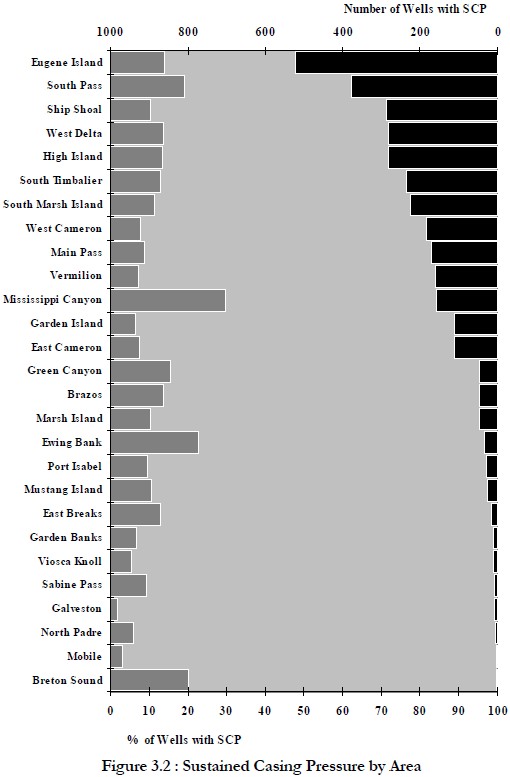
(e) The fact that Mr McCloskey said that the 50% figure was consistent with his experience working in the Gulf of Mexico in the early 1990s to the early 2000s cannot remedy the deficiencies that I have described. It is not possible to understand Mr McCloskey as having intended to convey anything more than that he recalled sustained casing pressure being a prominent issue that was required to be addressed by him in his work at that period in time. He made no attempt to quantify in any rigorous way the instances with which he dealt, nor to establish the comparability of those circumstances to the project’s wells today.
168 The applicant did submit that if I was not persuaded that, on the basis of Brufatto et al (2003), 50% of wells would experience significant sustained casing pressure over their lifetime, other studies would support a lower percentage. I will return to that submission after considering the study relied upon for the second step in Mr McCloskey’s reasoning; that is, Wisen et al (2019), which was relied upon in support of the proposition that 6.2% of wells with significant sustained casing pressure will experience a well integrity failure.
169 In relation to Wisen et al (2019):
(a) The study related to 21,525 wells in British Columbia.
(b) It analysed data from the British Columbia Oil and Gas Commission for the purpose of, amongst other things, quantifying incidents of “leakage” from wells.
(c) It identified three different kinds of leakage:
(i) “surface casing vent flow”, or “SCVF”. SCVF refers to the release at the wellhead of gas or fluids that have entered the annulus between the surface and inner casings. It was uncontroversial that this form of leakage was not relevant to the present proceedings, as it would not pose any risk to an the aquifer.
(ii) “outside the surface casing leakage”, or “OSCL”. OSCL refers to a leak outside of the outermost casing. It is that form of leak that may result in the contamination of an aquifer, and thus was the form that was agreed to be relevant to these proceedings.
(iii) “cap leakage” (or “CL”). CL relates to decommissioned wells only. When a well is decommissioned, the wellhead assembly is replaced with a vented cap, and CL referred to leaks from such a cap. The parties did not suggest that this was relevant to the present proceedings.
(d) It identified leakages of any kind in 10.8% of wells. But the critical results, insofar as Mr McCloskey’s analysis was concerned, were those which quantified separately the incidents of the three different kinds of leakage. That is because Mr McCloskey was interested in understanding the proportion of leakages involving OSCL compared to those involving only SCVF (which he treated as an equivalent concept to sustained casing pressure). In particular, Mr McCloskey relied on the following table of results:
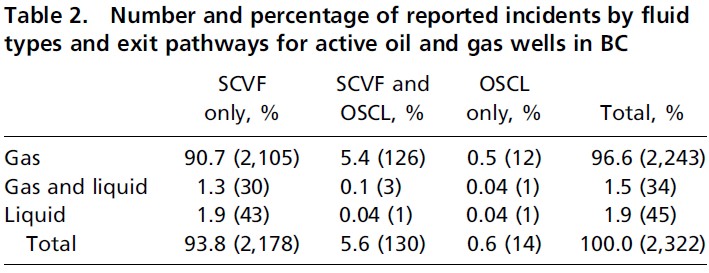
(e) From those results, Mr McCloskey expressed the total number of leakages involving OSCL (whether alone, or in combination with SCVF) (i.e., 144) as a percentage of the total number of leakages involving SCVF (whether alone, or in combination with OSCL) (i.e., 2,308). The relevant figure was 6.2%.
(f) Mr McCloskey thus used the Wisen et al (2019) study to support a conclusion that 6.2% of wells with sustained casing pressure would experience a leak of a kind that might result in contamination of an aquifer.
(g) It goes without saying that the data could be analysed in other ways (for example, it might be observed that the total number of OSCL leakages as a percentage of the total number of wells was less than 0.7%).
170 The following matters are relevant to the weight that may be placed on the Wisen et al (2019) study:
(a) The wells included in the study appear to be, or at least to include, wells of a different (and, from a well integrity perspective, inferior) design to Tamboran’s wells. That is perhaps unsurprising, given that the dataset included wells that were spudded in the period between 1948 and 2017, and the evidence is that there has been a continual improvement in well design from an integrity point of view. The study did not include any real detail about the individual wells in question, but did describe what it called the “standard design”:
The standard design consists of an outer surface casing that is set and cemented in place below the depth of usable groundwater. Inside the surface casing lies the production casing, which conveys production or injection fluids between the target formation and the wellhead (Fig. 2). The production casing may be fully or partially cemented in place and is equipped with an additional replaceable inner production tubing.
Figure 2 was as follows:
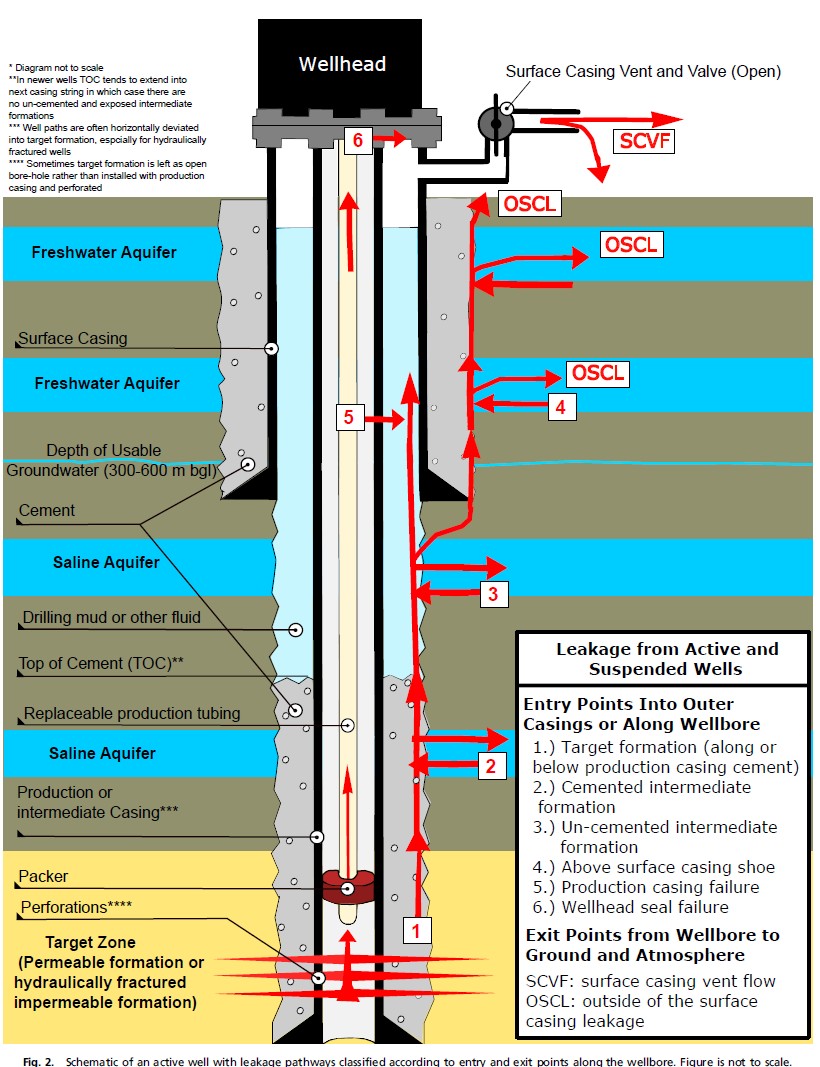
Figure 2 thus provides visual confirmation that the standard design of the subject wells consisted of only two casing strings, and that the production casing was not cemented beyond (and may not even have been cemented up to) the shoe of the surface casing. It also records, however, that in “newer wells” (whatever precisely that may mean) the top of cement “tends to extend into [the] next casing string in which case there are no un-cemented and exposed intermediate formations”.
It may thus be observed that the “standard design” of the wells the subject of the Wisen et al (2019) study appears to differ from Tamboran’s wells in several important respects including the number of casing strings, and the extent of cementing.
(b) The applicant submitted that there was “nothing in the paper to suggest that (all or even most of) the wells represented in the data set were designed in that way”. I accept that it is not possible to infer that all wells the subject of the study were constructed in accordance with the “standard design”. But the paper’s description of such a method of construction as “standard” does support a conclusion that at least a substantial number, if not most, were. And the fact that not all of the wells were constructed in accordance with the “standard design” does not establish, of course, that the rest were constructed to the same standard as Tamboran’s wells.
(c) In any event, it does not appear to be controversial that the study does not disclose information about the individual wells it surveyed sufficient to enable an assessment of the extent of similarity or difference between those wells and the project’s wells. In cross-examination, Mr McCloskey said this:
COUNSEL: Importantly, for present purposes, the well that’s depicted in that diagram [Figure 2], even if it were a well that had a top of cement extending into the next casing, is, to use Mr Stone’s categorisation, at the lower end numerically of the categories described in that paper, is it not?
MR McCLOSKEY: I would agree. Yes.
COUNSEL: Category 2 or 3 maybe. As a result of that, consistent with what I think you’ve told us before, the likelihood of a well integrity failure leading to gas migration, that is the escape of hydrocarbons into one of the freshwater aquifers in the context of these sorts of wells, is obviously going to be greater than will be the case if you’re dealing with a well which is constructed to a higher category.
MR McCLOSKEY: I think, as far as leakage goes – intra-well leakage, yes. He’s using 25,000 plus wells here, and many of them were older wells. I think the point of this study is that after 2010 where they started requiring testing of leakage outside the casing and so forth, that they would have been into a more robust design phase. But he really doesn’t draw – I don’t think he draws any types of correlations between which wells have failed and which wells haven’t.
COUNSEL: So to the extent that we’re looking, though, at prognostication by – in this article about the risk of failure, or using the data in this article to prognosticate about the risk of failure, that important integer, namely the type of well that we’re dealing with, is something that we just don’t really know. Is that right?
MR McCLOSKEY: I would agree. Yes. There’s no differentiation by … the well category.
(d) The applicant relied on a statement by Mr McCloskey in cross-examination that British Columbian regulation was as robust as anywhere as supporting an inference that modern wells in British Columbia would be built to at least the same standard as Tamboran’s wells. The full exchange was as follows:
COUNSEL: … Mr McCloskey, can you say anything about the level of regulation in British Columbia, as compared to other jurisdictions in terms of well design, for instance, or I shouldn’t say regulation, practice or regulation?
…
MR McCLOSKEY: … I believe they’ve been regulated as robustly as – as anywhere. The fact that they require this reporting of leakage is one of the very, very few places that has that requirement. So, based on that, I would say that they’re – they’re fairly robust in their regulatory environment. … It’s not an area that I’ve worked.
It was clear that Mr McCloskey had no actual knowledge of the relevant practices (whether regulatory or otherwise) in British Columbia, save the existence of an obligation to report leaks. Mr Stout, for his part, doubted that any inference could be drawn from the existence of an obligation to report to the standards likely to be required in relation to well construction, because in his experience (albeit experience that did not extend to British Columbia) there were usually different regulators in relation to environmental reporting and for the safety and integrity of wells. While I have little doubt that there would exist robust safety and well integrity standards in British Columbia, I do not think that making such an assumption provides any sufficient basis to conclude that the wells the subject of the Wisen et al (2019) study (or some definable subset of them) are relevantly analogous to Tamboran’s wells.
(e) In addition to the description of the “standard design” of the wells, other information contained in the report suggests a need for caution in assuming that any analogy may safely be drawn with the project’s wells. For example, a more detailed analysis of 29 specific wells (of which three had experienced OSCL) demonstrated that not all instances of OSCL recorded in the Wisen et al (2019) study would be relevant to the risk posed by project wells that is relevant in these proceedings:
(i) Two of the OSCL instances were said to have originated “above the surface casing shoe”. In one case, the surface casing had not been completely cemented to the surface as required, with the result that freshwater from an aquifer entered directly into the well’s outer annulus. In the other, the leakage occurred during drilling, before the production casing had been installed. Neither of those modes of failure appear relevant to the issues in these proceedings.
(ii) The other instance of OSCL occurred as a result of a failure of the production casing. As the report indicated, most commonly, such a failure resulted in “surface casing vent flow”, which is consistent with the engineering logic of the well design that I have already explained (12 such instances were recorded). Certainly, in the case of Tamboran’s well design, a failure of the production casing could only result in contamination of the aquifers if it was accompanied by the simultaneous failures of other barriers.
(iii) There were no instances of OSCL (or indeed SCVF) that originated in the target formation. That provides some support for the inherent unlikelihood of a pathway commencing in the target formation contaminating an aquifer.
(iv) There was one recorded instance of SCVF (but not OSCL) originating in a cemented intermediate formation. That may be compared with 10 instances of SCVF (but again, not OSCL) originating in an uncemented intermediate formation. In both cases, because of the absence of OSCL, no risk to an aquifer could be posed; but perhaps the critical point is to emphasise the apparent significant increase in risk that arises from an uncemented intermediate formation. Tamboran’s wells, of course, do not have such a feature.
(f) For the applicant’s part, it emphasised that the study relied only on data that was said to be likely to underestimate the incidence of leakage (particularly in relation to wells drilled or abandoned before 2010). That is certainly true. But it is difficult to know what to make of that. To the extent that the underreporting was likely to be worse in respect of earlier wells (i.e., pre-2010), that fact is not capable of curing the lack of demonstrated equivalence between those wells and Tamboran’s wells. In relation to later wells, it is not clear how much of a problem underreporting may be. The report said:
The data seem to be strongly influenced by the different regulations making their appearance at different dates, casting doubt on the adequacy of well-testing practices and the accuracy of well-testing data for wells drilled before 2010.
Underreporting of wellbore leakage in BC is an issue that was raised in a previous study, which showed that approximately half of wells that tested positive for SCVF gas leakage did not appear in the BC OGC database; almost all of these wells that were missing from the leakage database were drilled before 2010.
That seems to suggest that, post-2010, underreporting is a significantly reduced problem. In any event the same difficulty of comparability remains.
(g) The net effect of all of this is to emphasise the considerable danger in seeking to apply directly the results of the Wisen et al (2019) study to the project.
171 The applicant sought to meet the criticism that Wisen et al (2019) included older and inferior wells, by performing its own analysis of the dataset that accompanied the report. In particular, the applicant demonstrated that if all wells that were spudded before 2005 were excluded, then there were 1,416 wells that experienced some kind of leakage, of which 105 involved OSCL (or 7.4%). It thus emphasised that, even with more modern wells, a similar (in fact, slightly higher) percentage of OSCL to total leaks was observed.
172 It was not revealed why 2005 was selected as the relevant cutoff for that analysis. If 2010 was, instead, used (being the date from which the authors appeared more confident in their data), the relevant figures were (on my analysis), for 4,573 wells, a total of 752 leaks (of which 713 were SCVF, 35 were SCVF and OSCL, and 4 were OSCL alone). That would suggest that leaks involving OSCL represented about 5% of total leaks. And about 0.85% of wells experienced an OSCL leak.
173 But, in any event, Tamboran submitted that any analysis of that kind was, at best, flawed, and, at worst, impermissible:
(a) First, Tamboran submitted that the applicant could not place reliance upon the dataset that accompanied the Wisen et al (2019) study in the way that it did, because that data was subject to the limitation under section 136 of the Evidence Act that I have described above. That is, as part of the literature cited by Mr McCloskey in his expert report, that study (and its underlying data) could only be used for the purposes of providing a basis for, or understanding, Mr McCloskey’s expert opinion. It could not separately be used for some other purpose, especially one that involved using the data to prove the truth of the matters it records, and calculating some other percentage of OSCL to total leaks by reference to a specific portion of the dataset. The data could not, Tamboran submitted, prove the fact of actual occurrences of leakage in British Columbia, as opposed simply to providing the basis for the calculations performed by Mr McCloskey. Further, Tamboran submitted that the applicant had not overcome this problem by putting it to Mr McCloskey, during his examination in the expert conclave, that if such an analysis was performed, it would “suggest that your conclusion is applicable to newer wells as well as older wells”. Tamboran emphasised that Mr McCloskey had not in fact made such a calculation himself.
(b) But even assuming that recourse to the underlying data was permissible, Tamboran submitted that it did not overcome the insurmountable problem that it remains the case that we know nothing about the nature of the wells, nor the circumstances of the leaks, sufficient to enable any inference to be drawn from that subset of the data about the risk posed by Tamboran’s wells.
174 In relation to the first point, I am satisfied that having recourse to the underlying data in the manner proposed by the applicant is not inconsistent with the section 136 ruling. It does, however, serve to highlight a difficulty in assessing the opinions of the experts in this case insofar as they are based on these kinds of studies.
175 Mr McCloskey expressed an opinion about the rate of well integrity events in unconventional gas wells. The basis for that opinion, relevantly for present purposes, was his analysis of reported studies of the frequency of such events. The studies (and their underlying data) upon which he relied were thus admitted for the purpose of demonstrating that basis (and thus for understanding his opinion), but not to prove the truth of the events they analysed.
176 Of course, implicit in Mr McCloskey’s use of Wisen et al (2019) is an assumption that the data that was analysed was accurate, and that it concerned actual wells (and actual events in relation to them) that were sufficiently comparable to the project’s wells to support an inference that the rate of well integrity failures (as a percentage of wells experiencing significant sustained casing pressure) across the two populations would be the same. But the study (and its data) were not admitted to prove the fact of the studied wells, or their integrity events; it was the study itself that provided the basis for Mr McCloskey’s opinion about the likely failure rate in the project’s wells. In other words, while it is implicit in Mr McCloskey’s use of the study that the data is accurate, it is ultimately Mr McCloskey’s selection and use of the study as a basis for his own opinion that is relevant.
177 In those circumstances, I consider that the applicant is right to say that it was a legitimate use of the underlying data to examine the extent to which Mr McCloskey would adhere to his opinion, or would change it, if the analysis were confined to some particular subset of the data. Such a use does not involve any additional assumption as to the truth or accuracy of the underlying data (or the wells or events it describes). It simply explores the way in which, and the extent to which, the study provides a basis for Mr McCloskey’s opinion (or, put another way, allows a more detailed understanding of his opinion).
178 What, then, of Tamboran’s submission that the applicant has simply performed its own calculation, and did not in fact establish any connection between the data and Mr McCloskey’s opinion? The relevant passage in Mr McCloskey’s oral evidence was as follows:
COUNSEL: But if the publicly available data included the spudding date of the well, you could figure out how many of those 144 wells were spudded after 2005?
MR McCLOSKEY: Yes, I think you could.
COUNSEL: And you could also figure out how many of the total number of wells, the 2322, as shown in the column furthest to the right, were spudded in 2005 or after?
MR McCLOSKEY: I think that would be possible.
COUNSEL: Yes. And if you were to do that, and it turned out that if one only includes 2005 or after wells, the percentage of wells exhibiting SCVF that also had OS, or that were OS – sorry, the total percentage of the total example set, the percentage that had OSCL, either with or without SCVF, was higher than 6.2 per cent, that would suggest that your conclusion is applicable to newer wells as well as older wells. Is that so?
MR McCLOSKEY: I believe that would be true, yes.
179 That passage demonstrates that Mr McCloskey did not perform his own analysis of the data, and nor was he presented with an analysis and asked if he agreed with it. But I do not think that matters. He was asked whether analysis of a particular (and not complicated) kind could be performed, and what a particular result of such an analysis would mean in terms of his opinion. He plainly enough indicated that, on the assumption that was given to him, he would adhere to his opinion. That is enough, in my view, to bring the applicant’s use of the data within the scope of the section 136 limitation.
180 As I said, though, this analysis does seem to me to highlight the difficulty of evaluating the opinion of an expert that ultimately reduces to an assertion about the comparability of the circumstances of the present case to the circumstances of events the subject of a published study, where there is no evidence of the latter beyond the study itself (and where that is subject to a section 136 limitation of the kind I have described). The rate at which wells suffer integrity failures seems to me to be a rather different kind of proposition to those which might ordinarily be extracted by experts from published studies. That rate cannot be regarded as anything like a law of nature, and is likely to be highly fact and circumstance specific. To evaluate the opinion of an expert when it depends, in substance, on the drawing of inferences from a set of facts about which there is no evidence (save to the extent they are described in the study in question, but which does not constitute evidence of their truth) is challenging.
181 It is for related reasons that I would accept Tamboran’s second submission. For reasons I have already given, I do not accept that confining the analysis of the data to wells that were spudded after 2005 (or 2010) permits the inference to be drawn that the design and construction of the wells would have been analogous to that of the project’s wells. Nor do I consider that it is possible to assume that the circumstances of the leaks reported in British Columbia are such as to be relevant to an assessment of the risk posed by Tamboran’s wells. In those circumstances, it is simply not possible to conclude that 6.2% (or indeed any particular percentage) of the time that a Project well develops sustained casing pressure, it will experience a well integrity failure of a kind that might result in contamination of an aquifer.
182 For completeness, I note that Tamboran raised another objection to Mr McCloskey’s reliance on Wisen et al (2019).
183 It will be recalled that Mr McCloskey relied on Brufatto et al (2003) to say that 50% of wells will experience “sustained casing pressure” over their life cycle, and on Wisen et al (2019) to say that in 6.2% of cases of “sustained casing pressure” there will be outside of casing leakage. But Wisen et al (2019) does not speak of “sustained casing pressure”; rather, it refers to “surface casing vent flow”. Tamboran submitted that the report itself does not identify any correlation or relationship between the two concepts, so that one may be inferred from the other.
184 I am not persuaded that this attack succeeds. In cross-examination, when he was being asked about Lackey et al (2021), Mr McCloskey gave evidence that sustained casing pressure and surface casing vent flow were simply two different ways of describing the same underlying phenomenon (namely, an intra-well leak). If the relevant section of the well was capped, allowing gas to build up, then the leak would manifest as sustained casing pressure. If, on the other hand, the relevant section of the well was vented, then the gas from the intra-well leak would flow through the vent into the atmosphere. That opinion was supported by the terms of Lackey et al (2021) itself, which said: “SCP and CVF are different expressions of the same phenomenon: fluid leakage through a well annulus”. To the extent that Tamboran may have submitted that a failure to vent leaking gas or fluid may increase the risk to well integrity, the evidence did not explore that question. In those circumstances, I will proceed on the assumption that sustained casing pressure and surface casing vent flow are relevantly interchangeable for the purposes of Mr McCloskey’s analysis.
185 In any event, for the reasons I have given, I do not consider that the Wisen et al (2019) study provides a sufficient basis upon which I may conclude, on the balance of probabilities, that 6.2% of wells designed and constructed in a similar way to those that have been, or will be, constructed for the project, and drilled in locations that feature relevantly similar geological conditions, that develop sustained casing pressure (in other words, an intra-well leak), will experience a well-integrity failure that may lead to contamination of the Cambrian Limestone Aquifer.
186 The applicant developed various fall-back arguments in the alternative.
187 First, as I foreshadowed above, it submitted that if I was not persuaded, on the strength of Brufatto et al (2003), that 50% of wells will experience significant sustained casing pressure at some point during their lifespan, I ought to be persuaded of some lower percentage on the basis of other studies. In relation to that submission:
(a) In light of the conclusion I have come to in relation to the second step in Mr McCloskey’s reasoning, these alternative arguments are incapable of salvaging Mr McCloskey’s opinion. In other words, the applicant did not advance any case in relation to that second step other than that Wisen et al (2019) supported a 6.2% figure for identifying the proportion of wells experiencing sustained casing pressure that would develop a well integrity failure. Because I have rejected that part of the applicant’s case, alternative arguments in relation to the first step cannot make any ultimate difference.
(b) In any event, the primary fallback relied upon by the applicant was the conclusion in Lackey et al (2021) that 30% of directionally drilled wells exhibited sustained casing pressure. That study, it will be recalled, reduced the “noise” in the underlying data by applying a 50 psi threshold (and certain other requirements) before measured casing pressure would be counted as sustained casing pressure. The applicant thus submitted that the study overcame one of the objections to the Brufatto et al (2003) analysis. The fundamental problem, however, remains that it is not possible to know the extent to which the wells included in the Lackey et al (2021) study are analogous to those of the project. Nor is it possible to know the extent to which the sustained casing pressure that was measured reflects a problem with the production casing or tubing that might not have any real implications for overall well integrity. I am thus not satisfied that Lackey et al (2021) provides a sufficient basis for concluding that there is a 30% chance that the project wells will experience sustained casing pressure over their lifetime.
(c) For much the same reasons, I am not satisfied that any other study relied upon provides a sufficient basis for a conclusion that some different percentage reflects the relevant risk. The analysis in Bourgoyne et al (2000), for example, which perhaps suggests a percentage of wells exhibiting sustained casing pressure somewhere in the range of 10-15%, is simply too opaque to provide a secure basis for any firm conclusion. And Wisen et al (2019), which found sustained casing pressure in just over 10% of wells, is affected by the same basic failure to establish comparability to the project’s wells. Overall, no study has been demonstrated to be applicable to the particular circumstances that I am called upon to consider.
188 Indeed, as a general proposition on the evidence before me, I am not satisfied that the incidence of sustained casing pressure (at least in the general way in which the applicant sought to use it) is capable of providing any secure basis for conclusions about the likelihood of well integrity failures. For reasons I have already explained, the existence of sustained casing pressure does not in itself indicate a well integrity failure, let alone contamination of the environment outside the wellbore. Indeed, depending on the particular reason for it, it may imply almost no risk of either. While it may indicate a failure of a particular barrier, the potential significance of that fact to well integrity is highly fact specific. On one view, the fact that Mr McCloskey considered it necessary to construct his reasoning by reference to the incidence of sustained casing pressure is, itself, telling. He agreed it was “challenging”, and said it was “very hard to find”, data concerning the incidence of gas migration outside of wellbores (which is the particular form of pathway said to pose a risk to the Gum Ridge aquifer). In any event, the relationship between the general incidence of sustained casing pressure and well integrity failure appears to be, at best, highly attenuated. If any useful inferences were to be drawn from the rate of sustained casing pressure in a particular population of wells, a good deal would need to be known, not just about the wells and their circumstances, but about the particular type and cause of the sustained casing pressure experienced. I am not satisfied that the studies upon which Mr McCloskey relied provide the necessary level of detail to enable any useful conclusions to be drawn from them.
189 The applicant’s final fallback was to argue that I should find that there was a risk of well integrity failure equal to the cases of OSCL recorded in Wisen et al (2019) expressed as a percentage of the total number of wells. I have already mentioned that that study found incidents of OSCL in just under 0.7% of wells. The applicant submitted that, even if there was a 0.7% chance of a well integrity failure per well, that would indicate a sufficiently large risk across the project as a whole (which envisaged up to 15 wells), to count as “likely” for the purposes of the EPBC Act. That is:
(a) Probability of failure = 0.007 / Probability of success = 0.993
(b) Probability of no failures occurring in all 15 trials: 0.993^15 = 0.9
(c) Probability of at least one failure: 1 – 0.9 = 0.1 or 10%
190 It seems to me that there may be a range of issues in relation to that kind of reasoning that were not adequately explored in the expert evidence. For example, I am unsure whether the fundamental assumption upon which that calculation is based (namely, that the probability of failure of each well is truly independent) is sound. But putting all such issues to one side, the fundamental problem remains the lack of demonstrated comparability between the wells the subject of the study and the project wells, and, relatedly, the lack of demonstrated relevance of the particular modes of well integrity failure recorded in the study to the risk to the Gum Ridge aquifer posed by the project.
191 It follows that I do not need to decide whether a 0.7% risk of failure per well, or a 10% project wide risk of failure, would constitute a “likely” risk of such failure for the purposes of the EPBC Act. I am prepared to assume that it would. That is because I am not satisfied that the applicant has proved on the balance of probabilities that such a risk in fact exists.
192 Ultimately, therefore, I am not satisfied that the applicant’s recourse to statistical studies has enabled it to quantify (at all, let alone as “likely”) the risk throughout the lifetime of the project’s wells (including following their assumed decommissioning) of a well integrity failure of a kind that may result in the introduction of gas into the Gum Ridge aquifer.
Conclusion
193 The task that the applicant set itself was inherently challenging. It implicitly acknowledged that the design of Tamboran’s wells was state of the art and incorporated a number of features that, if implemented, should be sufficient to protect the aquifers. The applicant’s case thus depended on establishing the existence of a risk that the wells would not operate as intended. The way that it sought to prove the existence and magnitude of that risk was not by an engineering assessment of the wells in question (their design, method of construction, particular features of the geology in which they were to be drilled, and so forth). Rather, the applicant sought to establish the magnitude of the risk by reference to different analyses of different data concerning different populations of wells, built at different times, to different designs, using different materials, in different locations, with different geological characteristics, subject to different operational conditions, and which have failed in different ways.
194 The problem, in those circumstances, is that the applicant has not been able to demonstrate the basis upon which particular conclusions reached in those studies might be applied to the particular question required to be answered in these proceedings. The rate of failure across a population of wells that has not been demonstrated to be equivalent to the circumstances of the project cannot (at least without some further analysis by reference to which the results of the study might be adjusted to account for relevant differences) provide a basis upon which a risk of failure for a project well can be estimated.
195 The evidence showed clearly that wells may fail for a range of reasons and in a range of ways. I have already explained why the various studies upon which the applicant relied included failures that would not occur in the context of the project, whether because of a difference in design of the wells, or because of a difference in the geological conditions in which they are drilled, or for some other reason. And they included failures that, while they could occur in the context of the project, would not be failures that gave rise to any risk to the Gum Ridge aquifer.
196 A persistent theme of the applicant’s submissions was that it had put forward the best data that was available, and that in circumstances where there was no analysis that was squarely addressed to the risk of failure of wells such as those to be constructed as part of the project, that was enough.
197 The question must be, however, whether the applicant has discharged its onus of proof.
198 In circumstances where the evidence showed that the design of the wells was sufficient to prevent a well integrity failure, it is not enough for the applicant to rely on the proposition that there will sometimes be unexplained or unexpected failures. That wells may fail is not in doubt. But the process by which gas or other substances may reach an aquifer from lower geological formations is understood. And the particular design features of the project’s wells that guard against such a possibility are understood. Ultimately, an inability to demonstrate that the risk that the project poses to the aquifers is “likely” is a problem for the party that bears the onus of proof. An inability to exclude a risk does not mean that it has been proven to be likely to be realised.
199 Here I am satisfied that it is not “likely”, in the relevant sense, that the project’s wells will suffer a well integrity failure of a kind that may lead to the contamination of the Gum Ridge aquifer because of the inherent unlikelihood of the concatenation of individually unlikely discrete failures that would need to occur together to bring about that result. In particular, as I noted above, the evidence in relation to the SS-2H ST1 well was that there was good cement coverage between the surface casing and the Antrim Plateau Volcanics immediately below the Gum Ridge Formation, down to a depth of about 70 metres into that layer. That is of special importance in circumstances where the applicant’s case focussed upon the risk of gases being introduced into the Gum Ridge Formation from lower levels. Accordingly, for contamination of the Gum Ridge Formation to occur, not only would there need to be the complicated series of faults required for there to be a continuous path of least resistance from some failure in the barriers of the production section of the well up to the surface section, but then, at that point, there would need to be a further fault which ultimately provided a pathway around cement encasing the surface section and into the Gum Ridge Formation (or through that cement and then out into the aquifer). Good cement coverage of the casing through the Antrim Plateau Volcanics is a common feature of the design of all of the project’s wells, and the evidence does not persuade me that there is any reason, whether relating to geology, engineering, or otherwise, why it should not be achieved in all cases. That feature in particular, in addition to all of the other barriers and precautions that are incorporated into Tamboran’s wells, satisfies me that there is no likely risk of contamination of the Gum Ridge Formation by hydrocarbons.
200 Overall, perhaps, it seemed to me that the parties (and their experts) were divided more by the perspective from which they viewed the issue, rather than any fundamental disagreement concerning it. The applicant’s experts sought to emphasise that the possibility of failure could not be excluded. The lesson from the various studies to which they referred was that in any population of wells there will be failures, and that failures occur even when all possible precautions are taken. The respondent’s expert, on the other hand, while acknowledging that risk could never be eliminated, emphasised the sheer improbability of all safety features failing in such a way as to result in contamination of an aquifer. What united the parties, in other words, was a recognition that the project’s wells were designed to the highest standard in order to guard against integrity failures. What divided them was the significance, and quantification, of the uneliminated risk.
201 In the final analysis, however, I am not satisfied that the applicant has proved anything more than the possibility of the project causing a significant impact on the aquifer. Given the highly specific concatenation of failures that would need to take place for contamination to occur, the number of safeguards in place to prevent that occurring, the absence of any demonstrated reason to think that those safeguards should fail (beyond acceptance that no system or safeguard is perfect), and the absence of any sufficiently rigorous basis upon which the incidence of unexpected failures might be assessed, I am not persuaded that it is “likely” that such an outcome may occur.
202 That conclusion does not depend on adoption of Mr Stout’s opinion of the frequency of well integrity failures. The applicant fairly criticised Mr Stout’s statement that the risk was 0.1% as unsupported by any real reasoning. Ultimately, I regarded it as little more than a rhetorical way of conveying Mr Stout’s opinion that the risk, by reason of the design safeguards that I have described, was very low.
203 The real point, as I have explained, is that the applicant has proved only that the risk of contamination of the aquifer cannot be excluded; it has not proven that it is likely.
204 It follows that I do not consider that the applicant has proved that it is likely that there will be a well integrity failure as a result of the action and, in any event, has not proved that it is likely that a well integrity failure would cause hydrocarbons to be released into the Gum Ridge Formation.
ISSUE 6: IMPACT ON THE AQUIFERS
205 Because I have found that it is not “likely” that there will be a well integrity failure as a result the action taken by Tamboran, the sixth issue identified by the parties does not arise. Nevertheless, in case I am wrong, I will set out the conclusions that I would have reached in relation to that topic, had it been necessary to do so.
206 The applicant could not have succeeded simply by proving that a well integrity failure was likely. It needed to show, in addition, that it was likely that a well integrity failure would have had a “significant impact” on a water resource. As I have already mentioned, by closing submissions, the applicant’s case in relation to the existence of such an impact was addressed to the consequences of the introduction of gas into the Gum Ridge Formation.
207 There were two expert witnesses whose evidence was principally directed to this topic. For the applicant, there was Professor Currell. The respondent called evidence from Mr Andrew Moser, a hydrogeologist who has worked in a variety of government and private sector roles over more than 30 years. Once again, I considered that both witnesses did their best to assist me to understand the complex subject matter of their reports, and I found them both to be impressive experts.
208 The applicant’s case was that the introduction of gas into the aquifer would produce a range of chemical reactions which would, directly or indirectly, adversely affect the quality of the water within it. Those adverse consequences, the applicant submitted, were sufficient to constitute a significant impact within the meaning of the EPBC Act. In addition, however, the applicant pointed to the impact that those changes in the quality of the water would have on small aquatic animals that live within groundwater systems (known collectively as stygofauna).
209 Before I turn to consider the particular chemical pathways by which the applicant contends a significant impact on the aquifer would be caused, it is necessary to address a prior question. Both sides accepted, I think, that the potential impact on the aquifer would depend on the magnitude of the discharge of gas into it. And both sides also accepted that the range of potential discharges consequent upon a well integrity failure was very wide. The evidence, however, provided very little insight into the possibilities and probabilities of the scale of a leak into the aquifer.
210 Each side sought to turn that uncertainty to its advantage. Tamboran submitted that the “big void in the evidence” was inherently a problem for the applicant, upon whom lay the burden of proof. The applicant submitted that the evidence showed the potential for both bigger and smaller leaks, and that there was no evidence to suggest that the leaks would inevitably be small.
211 Acceptance of the proposition that the evidence did not show that any leak would necessarily be small does not, of course, assist in drawing any positive conclusions about the prospect of a leak of sufficient magnitude to give rise to an adverse impact on the aquifer. (And, of course, the corollary of the applicant’s reasoning is that the evidence equally did not show that leaks would inevitably be large.)
212 In his report, Mr McCloskey said that “[t]he rates of gas leakage on a per well basis are likely to be small”, but observed that “the cumulative flux of gas from a large number of wells may be significant”. He referred to Lackey et al (2021), which analysed data from Pennsylvania concerning the rate of discharge experienced in well integrity failures. That analysis disclosed a right-skewed distribution, the median of which was 4.5 cubic metres per day, and the 95th percentile of which was 218.1 cubic metres per day. (It followed, therefore, that the average release would be higher than the median, although by how much was not disclosed).
213 No attempt was made by the experts in this case, however, to relate the circumstances of those wells and their failure, and the resulting discharges, to the conditions of the project. It is simply not possible to draw any firm conclusions from the evidence before me as to the probability of a leak of any particular magnitude. The evidence certainly does show that the consequences of a well integrity failure (in terms of volume of fugitive gas) are likely to fall across a wide spectrum. That fact in and of itself is relevant to the question whether it is “likely” that a well integrity failure may cause a significant impact on a water resource (in the sense that the probability of a well integrity failure is not equal to the probability of such a significant impact). Mr McCloskey’s evidence, including his reliance on Lackey et al (2021), supports the view that many well integrity failures will lead to a discharge of gas on a relatively small scale. But, as the applicant submitted, that does not mean that the possibility of a larger scale release can be dismissed. It does mean, though, that the probability of a larger scale release is even lower that the probability of a well integrity failure.
214 There were a range of other disputes between the parties connected to this question of the probability of significant releases of gas into the aquifer. Chief among them was the efficacy of Tamboran’s well monitoring processes, and the time that it would take to effect a repair in the event that a well integrity issue was identified (assuming a repair was possible). I do not think that it is necessary to resolve these disputes. There is no doubt that any monitoring system will have its limitations, and that repairs will not always be able to be carried out as quicky or effectively as would be liked (or sometimes at all). It follows that I do not proceed on the basis of any assumption that a well integrity issue would necessarily be detected and fixed before any potential adverse impact would be felt. Equally, though, the existence of the monitoring regime must be acknowledged to reduce the risk of an adverse impact below that which would exist without it.
215 Overall, I consider that I am simply unable, on the evidence before me, to make any findings concerning the risk of releases of any particular magnitude following a well integrity failure. That, in itself, provides another reason why the applicant’s case must fail. Whatever the magnitude of the risk I analysed in relation to Issues 4 and 5, the probability that any contamination of the aquifer by gas would be of a sufficient magnitude to cause a significant impact must necessarily be lower.
216 In any event, I turn, then, to consider the two broad processes or pathways by which the applicant contended that the introduction of gas into the Gum Ridge Formation might adversely affect the quality of the aquifer’s water:
(a) First, to the extent that the gas may contain methane or carbon dioxide, it may cause the acidification of the water, which may dissolve elements of the formation, leading to the mobilisation of heavy metals.
(b) Secondly, the release of gas may lead to the production of hydrogen sulphide, which is highly toxic.
217 In relation to the first potential pathway, I did not understand there to be any real dispute that the introduction of fugitive gas into the aquifer may lead to the acidification of the water. There was a debate between the experts as to the way in which methane would be most likely to break down, as only some of those pathways would lead to the acidification of the water. As I understood their evidence, both experts ultimately agreed that there was a real possibility that methane would break down in such a way as to cause acidification. But, in any event, the experts ultimately characterised that debate as “moot”, because carbon dioxide and hydrogen sulphide, both of which would likely be found in fugitive gas, each uncontroversially break down in such a way as to cause an acidification of the aquifer.
218 Nor was there any debate that the creation of a mildly acidic environment in the aquifer may lead to the mobilisation of heavy metals. As Professor Currell put it:
… The heavy metal content of the pure limestone itself is probably pretty low; however, there’s all the interlayers, all the carbonate mud and so forth, that’s associated with it, and those clay minerals that are there are very good at scavenging heavy metals. So most aquifers like this will actually have a[n] adsorbed load of trace metals that will be very harmless and dormant unless an acid environment is introduced and they’re released.
219 The real point of dispute in relation to this topic concerned whether the adverse impacts of liberated heavy metals would be avoided by the impact of the acidified water on the limestone structures in the aquifer. Mr Moser explained what he considered would happen as follows:
When you dissolve limestone, you – and once your acid is used up and you – and the limestone has been dissolved, you – it results in an increase in alkaline bicarbonate, so bicarbonate alkalinity. Bicarbonate alkalinity is quite important because once you create that environment, it creates an environment where those dissolved metals are then encouraged to complex with other parts of the solution and precipitate out. So they precipitate out as hydroxides, sulphides and carbonates.
Now, as Dr Currell says, we – there – there is no study that I found where they have done this in – where there has been an intensive study within a limestone aquifer. However, there is a very large body of literature out there because limestone is used extensively in the treatment of acid mine drainage. So essentially, if you have a sulphate mine, and you have waste rock that has levels of – of metal sulphates that are – are less than economic, they go into a waste rock pile; slightly acidic water falls on them; metals are liberated; and, in most cases, the way that mines deal with that heavy metal-laden water is to somehow treat it with limestone. So there is – there’s a range of – there’s a range of complexity in that, but the lowest end of that complexity is – is actually just taking that acid mine drainage and running it over crushed limestone, which precipitates out most of the heavy metals into a form where they’re not mobile.
220 In other words, while Mr Moser accepted that, as an abstract proposition, the mobilisation of heavy metals in an aquifer would have a significant adverse impact on water quality, in his opinion, any heavy metals that were mobilised in the Gum Ridge aquifer would immediately be harmlessly precipitated out as a result of the chemical changes brought about by the dissolution of the formation’s limestone. The totality of the chemical changes caused by the introduction of fugitive gas into a limestone aquifer would thus not produce any significant adverse impact on water quality.
221 The applicant submitted:
… Mr Moser suggested at trial that acidic conditions capable of liberating heavy metals would also dissolve the limestone, resulting in heavy metals precipitating as inert compounds. Mr Moser did not point to any scientific studies, or undertake any detailed analysis, exploring the extent to which gas release could be offset by the dissolution of limestone.
222 To the extent that the applicant was submitting that Mr Moser’s opinion lacked a proper scientific basis, I do not accept that. The validity of Mr Moser’s point did not need to be established by reference to a study on limestone aquifers. As Mr Moser explained:
MR MOSER: The limestone is, you know – if – if acidification conditions prevail sufficient to liberate heavy metals, it’s definitely going to dissolve the limestone. Dissolving the limestone will definitely result in increased bicarbonate alkalinity, and it’s very, very well documented that that process there results in the precipitation of heavy metals as carbonates, hydroxides and sulphides.
COUNSEL: And when you – there has been no studies of aquifers ---
MR MOSER: Not that I could find.
COUNSEL: --- that have found that, so this is your hypothesis?
MR MOSER: It is not my hypothesis. It is, as I say, extremely well documented in the literature because this process is used so extensively in the – in the treatment of acid mine drainage. The chemistry is the same.
223 In any event, the applicant’s submission ignores the very substantial agreement between the experts on this topic. Professor Currell said this:
… I think the idea that the limestone can actually neutralise acid that’s generated by these types of processes is broadly true. So the question is what’s the, sort of, neutralising capacity and what’s the extent of the gas plume that might contaminate the aquifer. It may be able to, you know, significantly attenuate, which just means, sort of, immobilise, or stop the metals from moving far in the groundwater. But it may not, just depending on, you know, the nature of the leak and how much, sort of, contact there can actually be between the groundwater in the system and enough limestone to, sort of, neutralise acid.
…
… As I said earlier though, it just depends on the nature of the – like, the surface area of the aquifer where the leak is occurring, the rate of that leak. I mean, it may not – you know, you can exhaust the, sort of, neutralising capacity and the capacity to, kind of, attenuate the effect if you, you know, keep injecting a high amount of gas in the system.
224 In relation to the potential for a release of gas to exhaust the capacity of the limestone to neutralise the acidification of the water, Mr Moser said:
… [W]ith reference to Dr Currell’s comments, if you had so much gas that you overwhelmed the system, then, you know, you could – but I don’t believe that that’s the situation we’re looking at. In the likely – in the likely range of releases that I can see, yes, I would say that almost certainly that it would be self-limiting.
225 The Gum Ridge aquifer is, uncontroversially, a limestone aquifer. In those circumstances, it is difficult to see how there could not be “enough limestone” to generate the effects to which Mr Moser referred. There was no reason disclosed by the evidence why that conclusion would not hold true for any realistic rate of release. But even assuming that releases of over 200 cubic metres per day (or any other amount) are likely, the evidence did not reveal whether such a rate of release would be likely to “overwhelm” the capacity of the limestone aquifer to limit the effects of the acidification of the groundwater. While a higher rate of release may, presumably, mean that the immediate impacts of the failure are experienced over a larger area, the fact that the same, ultimately benign, chemical reactions occur over a larger area does not seem to me to constitute a “significant impact”.
226 In the final analysis, it seemed to me that Professor Currell accepted that the risk of contamination of the Gum Ridge aquifer by mobilised heavy metals was low. So much may be observed in the following passage of his evidence in cross-examination:
… Certainly, I think there’s, you know, reasonable theoretical and field evidence to show that limestone is pretty good at neutralising acid. So I think probably the risk associated with acidification from the gas release and that mobilising trace metals may be less than in other aquifer systems. However, there are also, you know, other geochemical changes outlined in a couple of those studies just mentioned that could be equally or more of a concern from a water quality point of view. I’m certainly thinking the generation of the hydrogen sulphide gas, which is not related to the process we just talked about with the CO2 and the trace metals mobilising.
227 In that passage, Professor Currell seemed to accept that the risk to the aquifer from the first pathway identified above was, in the particular circumstances of the Gum Ridge aquifer, low (and sought to emphasise, instead, the second pathway I identified above). In any event, I accept Mr Moser’s evidence on that topic.
228 What, then, of the second pathway that Professor Currell identified in the passage I have just quoted?
229 In relation to hydrogen sulphide that would be introduced into the aquifer as a result of a well integrity failure (i.e., as part of the fugitive gas), I understood it to be common ground between the experts that that gas would break down and contribute to the acidification of the groundwater. So I did not understand the applicant’s case to suggest that introduced hydrogen sulphide would cause a problem, other than through the acidification of the water, and consequent potential mobilisation of heavy metals. In any event, Mr McCloskey gave evidence that gas produced from the Velkerri formation had very low levels of hydrogen sulphide (in the order of 5 to 10 parts per million), and that a threat to human health would only be caused above levels of 50 to 100 parts per million.
230 So what did Professor Currell mean when he referred to “the generation of the hydrogen sulphide gas, which is not related to the process we just talked about with the CO2 and the trace metals mobilising”? As I understood his evidence, Professor Currell was referring here to one potential consequence of the methane reduction pathway that Mr Moser regarded as the most likely (i.e., the reduction of dissolved methane by sulphate reducing bacteria). Mr Moser had explained part of that process to involve:
• The reduction of dissolved methane by sulphate reducing bacteria via a reaction using natural background levels of dissolved sulphate in groundwater;
• The resultant production of water, bicarbonate ions (harmless and already abundant in a limestone aquifer), and temporary hydrogen sulphide;
• The rapid complexation of hydrogen sulphide with native dissolved metals in the groundwater to form metal sulphide minerals, particularly iron sulphide which precipitates out as an immobile solid, and is virtually inert in an anaerobic environment.
231 Of that process, Professor Currell said:
Another possibility that is equally likely is that if sulfate reduction were indeed to be activated by introduction of fugitive gas into the Gum Ridge aquifer, it could result in the production of hydrogen sulfide gas, which would add to the hydrogen sulfide load already naturally present within the leaked gas … Hydrogen Sulfide gas is stable (together with HS-) at neutral pH and is the dominant sulfur-bearing compound in low-oxygen environments below pH 7 (Appelo and Postma, 2005). While some hydrogen sulfide can indeed be removed by reaction with Fe-oxides (Moser paragraph 57), this depends on whether these oxides occur in sufficient quantities to consume the generated H2S (Appelo and Postma, 2005). The Cambrian Limestone aquifer is not known to be an iron-oxide rich lithology (being predominantly composed of carbonate minerals and clays) and as such, the capacity to remove hydrogen sulfide by this process is likely to be limited.
232 It was unclear what the applicant’s case was in relation to the likelihood of hydrogen sulphide being produced as part of the break down of methane. During his cross-examination, Dr Moser agreed with counsel for the applicant that “there are a number of different chemical pathways, not all of which would result in hydrogen sulphide”. The following exchange then occurred with Professor Currell:
COUNSEL: Okay. And, Professor Currell, do you think a view can be expressed as to likelihood on this? And if so, what’s your view?
PROF CURRELL: The geochemistry of releasing a gas that’s a mixture of different components and how that changes the geochemistry of the groundwater is pretty complicated. If it’s pure methane, it gets simpler. But nonetheless, as we’ve seen in those literature studies, there are, you know, a range of different outcomes which may oxidise and reduce different elements and release different components into the groundwater. Again, we rely on, you know, a few good peer-reviewed studies that we have. There’s the Cahill study.
There’s also some really good work from looking at what happened in Parker County in Texas, where there was a much larger scale release of methane which triggered a number of geochemical changes in drinking water wells within a radius of a couple of kilometres away from a gas well. And so in that case, certainly production of hydrogen sulphide by sulphate reduction was an important process. And, you know, as I highlighted later in my expert report, that’s actually, you know, a pretty significant concern, because if that that sulphide can’t be – can’t be released or attenuated by some other mechanism, it’s a pretty hazardous compound that you don’t want accumulating in your groundwater.
So, yes, I certainly don’t disagree that sulphate reduction may be a consequence of introducing methane to the aquifer. But as we’ve seen from those few studies we’ve just looked at and discussed in the reports that we’ve written, there are a few different geochemical pathways that have greater or less impact on the groundwater quality, I suppose.
233 Ultimately, the effect of the evidence seemed to me to be that, as Mr Moser put it, “there’s just not enough body of evidence at the moment” to say what particular set of reactions would likely occur in the Gum Ridge aquifer. The position thus came down to this:
(a) Hydrogen sulphide that was introduced directly into the aquifer as part of the fugitive gas would likely break down, and thus contribute to the acidification of the groundwater. In any event, the concentration of that gas did not appear to be at a level that would be harmful.
(b) While it was possible that the break down of methane would result in the production of hydrogen sulphide, the evidence did not disclose how likely that prospect was.
(c) Assuming that the break down of methane did produce hydrogen sulphide gas, it was possible that hydrogen sulphide gas could be removed by a process involving reaction with iron oxides, but given the lithology of the Gum Ridge aquifer that was unlikely. (Why it would not break down in the same manner as hydrogen sulphide introduced to the aquifer as part of the fugitive gas is unclear to me.)
(d) There was no evidence by reference to which the likely quantity of hydrogen sulphide gas that might be produced according to the likely discharge of gas following a well integrity failure could be determined (and thus by reference to which the likelihood of hydrogen sulphide being produced in an amount that might constitute an adverse impact could be determined).
234 Overall, therefore, even if I had concluded that it was “likely” that a well integrity failure would result in the introduction of gas into the Gum Ridge aquifer, I would have held that it was not “likely” that there would be a “significant impact” on the water resource as a result.
Stygofauna
235 The question of flow-on impacts to stygofauna was never realistically going to affect the outcome of the case. If the applicant had succeeded in demonstrating that it was likely that there would be a significant impact on the groundwater itself, it would not have been necessary to show, in addition, any impact on the stygofauna. If the applicant failed to demonstrate any impact on the groundwater, then there would be no “flow on” impact on stygofauna. In those circumstances, I will express my conclusions on this topic in a summary way.
236 The issue between the parties reduced, I think, to whether stygofauna exist (it being common ground that they would be adversely impacted by any significant adverse impact on the water in which they live).
237 Professor Currell said that studies conducted by the CSIRO had “recently identified new, endemic, groundwater fauna – stygofauna – inhabiting the Gum Ridge aquifer near the boundaries of the project area”. Mr Moser did not dispute that stygofauna were to be found in those regions. He doubted, though, whether the conditions in the aquifer at the location of the project could possibly support life.
238 The principal CSIRO study was published as Oberprieler et al, “Connectivity, not short-range endemism, characterises the groundwater biota of a northern Australian karst system” (2021) 796 Science of the Total Environment. It reported on the testing of existing well bores (that is, no new bores were drilled for the purpose of the study). The location of the bores that were tested, and the results of each bore, may be seen here:
239 The different results indicate the two broad ways in which the presence of stygofauna can be identified, or deduced:
(a) First, bores may be sampled to see if stygofauna are present.
(b) Secondly, bores may be tested for the presence of environmental DNA (which is DNA that is shed by stygofauna as they go about their lives).
240 Mr Moser’s principal reservation in relation to the applicability of these studies concerned the depth of the Gum Ridge Formation at the location of the project. That is because stygofauna, in order to survive, need oxygen and nutrients, both of which generally decrease with depth. The experts were divided principally on the question whether the Gum Ridge Formation at the location of the project (which ranges between about 185 metres to 390 metres) was capable of supporting life.
241 I was not persuaded that the applicant had discharged its onus of proving that stygofauna exist in the particular location of the project. The conditions of the Gum Ridge aquifer, at its depth at the relevant location, appears to be incompatible with the maintenance of life. Once again, it seemed to me that the differing perspectives of the experts played a substantial role in their differing opinions: Professor McCloskey focused on the fact that it was not possible to exclude the existence of stygofauna, while Mr Moser emphasised the improbability of their existence at the relevant location. Ultimately, therefore, I would have concluded that the applicant had not discharged its burden of proof on this topic.
ISSUE 7: CONCLUSION ON WHETHER WATER TRIGGER IS ENGAGED
242 For the reasons set out above, I am not satisfied that the action (on either party’s definition) is an “unconventional gas development”, or that it will have a “significant impact on a water resource”.
ISSUE 8: RELIEF
243 It follows that no issue of relief arises.
CONCLUSION
244 The proceedings should be dismissed with costs.
I certify that the preceding two hundred and forty-four (244) numbered paragraphs are a true copy of the Reasons for Judgment of the Honourable Justice Owens. |
Associate:
Dated: 26 June 2026


