

Federal Court of Australia
Environment Centre (NT) Inc v Minister for the Environment and Water [2026] FCA 811
File number: | VID 555 of 2026 |
Judgment of: | MOSHINSKY J |
Date of judgment: | 23 June 2026 |
Catchwords: | PRACTICE AND PROCEDURE – application for order under s 15 of the Administrative Decisions (Judicial Review) Act 1976 (Cth) suspending the operation of an administrative decision – application for interlocutory injunction – where delegate of the Minister decided that proposed action was not a “controlled action” for the purposes of the Environment Protection and Biodiversity Conservation Act 1999 (Cth) – where the applicant sought judicial review of decision, focussing on the impact of the proposed action on the Ghost Bat – whether prima facie case – whether interests of justice favoured grant of interlocutory relief – application for interlocutory relief dismissed |
Legislation: | Administrative Decisions (Judicial Review) Act 1976 (Cth), ss 13, 15 Environment Protection and Biodiversity Conservation Act 1999 (Cth), ss 68, 74A, 75, 391 Judiciary Act 1903 (Cth), s 39B |
Cases cited: | Australian Broadcasting Corporation v O’Neill [2006] HCA 46; 227 CLR 57 Bob Brown Foundation Inc v Minister for the Environment (No 2) [2022] FCA 873 Century Metals and Mining NL v Yeomans (1988) 85 ALR 54 Friends of the Gelorup Corridor Inc v Minister for the Environment and Water [2023] FCAFC 139; 299 FCR 236 |
Division: | General Division |
Registry: | Victoria |
National Practice Area: | Administrative and Constitutional Law and Human Rights |
Number of paragraphs: | 67 |
Date of hearing: | 22 June 2026 |
Counsel for the Applicant: | Mr C Young KC with Mr M Delany and Ms A Lloyd |
Solicitor for the Applicant: | Environmental Justice Australia |
Counsel for the First Respondent: | Ms HM Douglas |
Solicitor for the First Respondent: | Australian Government Solicitor |
Counsel for the Second Respondent: | Mr N Wood SC with Mr L Spargo-Peattie |
Solicitor for the Second Respondent: | Maddocks |
ORDERS
VID 555 of 2026 | ||
| ||
BETWEEN: | ENVIRONMENT CENTRE (NT) INC Applicant | |
AND: | MINISTER FOR THE ENVIRONMENT AND WATER First Respondent TOP END PASTORAL COMPANY PTY LTD Second Respondent | |
order made by: | MOSHINSKY J |
DATE OF ORDER: | 23 JUNE 2026 |
THE COURT NOTES THAT:
A. The applicant has given the usual undertaking as to damages (but limited to $500,000) in relation to the undertaking by the second respondent (Top End).
B. Top End has extended the undertaking that it gave on 12 June 2026 until midday on 25 June 2026.
THE COURT ORDERS THAT:
1. The applicant’s interlocutory application dated 11 June 2026 be dismissed.
2. The costs of the applicant’s interlocutory application be reserved.
Note: Entry of orders is dealt with in Rule 39.32 of the Federal Court Rules 2011.
REASONS FOR JUDGMENT
MOSHINSKY J:
Introduction
1 By this proceeding, which was commenced by originating application on about 26 May 2026, the applicant, the Environment Centre (NT) Inc (the ECNT) seeks judicial review of two decisions of a delegate (the Delegate) of the Minister for the Environment and Water (the Minister), namely:
(a) a decision made on 13 February 2026 to accept a referral by Top End Pastoral Company Pty Ltd (Top End) under the Environment Protection and Biodiversity Conservation Act 1999 (Cth) (the EPBC Act) (rather than deciding, under s 74A of the Act, not to accept the referral on the basis that the proposed action is a component of a larger action) (the Section 74A Decision); and
(b) a decision made on the same day, pursuant to s 75 of the EPBC Act, that the proposed action is not a controlled action (the Section 75 Decision)
(together, the Decisions).
2 The proposed action is, in summary, to clear native vegetation and develop land for dryland cropping (and to create associated access tracks) on Claravale Farm and Claravale Station (which are approximately 60 kilometres north-west of Katherine, Northern Territory). The proposed action is referred to as “Stage 2” of a three-stage project in many of the documents. The area the subject of the proposed action (i.e. Stage 2) is approximately 2,700 hectares.
3 The ECNT seeks judicial review of the Decisions under the Administrative Decisions (Judicial Review) Act 1976 (Cth) (the ADJR Act) or s 39B of the Judiciary Act 1903 (Cth).
4 This judgment deals with an urgent application for interlocutory relief brought by the ECNT by interlocutory application dated 11 June 2026. The ECNT seeks either:
(a) an order under s 15 of the ADJR Act suspending the operation of the Decisions; or
(b) an interlocutory injunction to restrain Top End from taking the proposed action until the application for judicial review has been determined.
5 The interlocutory application was the subject of a case management hearing on 12 June 2026. During that hearing, Top End’s counsel stated that the works had already commenced. The ECNT’s counsel indicated that the ECNT had not been aware of this. The Court raised whether an interim injunction was appropriate to preserve the status quo pending the hearing and determination of the interlocutory application (which was proposed to be heard on 22 June 2026). The ECNT’s counsel indicated that the ECNT sought such an interim injunction and offered to give the usual undertaking as to damages (but capped at $500,000). After a brief adjournment, counsel for Top End said that he had instructions to give an undertaking to use reasonable endeavours to stop the works as soon as possible (and by no later than 9.00 pm on 12 June 2026) and then not to carry out the works before 4.00 pm on 22 June 2026. This undertaking was given on the basis that the ECNT gave the usual undertaking as to damages (but capped at $500,000).
6 Subsequently, the ECNT filed further affidavit material and Top End filed affidavit material. Also, the ECNT, the Minister and Top End filed outlines of submissions. An electronic Court Book (CB) was provided to the Court for the purposes of the hearing of the interlocutory application.
7 The following affidavits are relied on by the ECNT:
(a) four affidavits of Nicola Silbert, a solicitor employed by Environmental Justice Australia, the solicitors acting for the ECNT, dated 26 May 2026, 11 June 2026, 12 June 2026 and 19 June 2026;
(b) an affidavit of Dr Kirsty Howey, the Executive Director of the ECNT, dated 12 June 2026; and
(c) an affidavit of Allana Brown, a Senior Nature Campaigner at the ECNT, dated 19 June 2026.
8 Top End relies on two affidavits of Michael Simmich, a Director of Top End. The affidavits are dated 17 June 2026 and 21 June 2026.
9 The Minister indicated in his outline of submissions that he takes no position on whether the Court should grant interlocutory relief. The Minister’s submissions addressed the preferable form of relief, in the event that the Court were minded to grant interlocutory relief. The Minister submitted that an injunction would be simpler and more appropriate than an order under s 15 of the ADJR Act.
10 The hearing of the interlocutory application took place on 22 June 2026 and occupied a full hearing day. There was no cross-examination of the deponents to the affidavits. At the end of the hearing, I said that I proposed to give judgment at 4.30 pm on the next day, and asked whether the parties were prepared to extend the undertakings given on 12 June 2026 until 5.00 pm on 23 June 2026. After a short adjournment, Top End indicated that it was prepared to extend its undertaking (provided that the ECNT continued to provide its undertaking as to damages) and the ECNT confirmed that it would continue to provide that undertaking (but capped at $500,000).
Procedural background to the originating application
11 On 8 December 2025, Top End referred its proposed action to the Minister under the EPBC Act (the Referral). As originally formulated, the proposed action covered a larger area than that ultimately proposed by Top End (see further below).
12 The ECNT made a submission about the Referral.
13 On 13 February 2026, the Delegate made the Decisions.
14 On 19 February 2026, the ECNT made an application under freedom of information legislation for a copy of a departmental brief provided to the Delegate (the Decision Brief).
15 On 16 March 2026, the ECNT requested a statement of reasons for the Decisions pursuant to s 13 of the ADJR Act.
16 On 26 March 2026, the ECNT was provided with a copy of the Decision Brief (but without the annexures) (CB 236-266). It is relevant to note that, on the second page of the Decision Brief, the Delegate indicated her decisions on a number of matters (and signed and dated that page). In particular, the Delegate indicated that she:
(a) agreed that the proposed action was a component of a larger action;
(b) agreed to accept the referral under s 74A of the EPBC Act;
(c) agreed that the proposed action was not a controlled action under s 75(1) of the EPBC Act; and
(d) accepted the reasoning in the Decision Brief.
17 Thus, although the ECNT did not yet have a statement of reasons, it was aware from the Decision Brief of the substance of the Delegate’s reasoning.
18 The ECNT did not receive a copy of the Delegate’s statement of reasons (CB 2044-2087) (the Statement of Reasons) until 12 June 2026, which was after the proceeding had been commenced.
Key provisions
19 Section 74A of the EPBC Act provides in part:
74A Minister may request referral of a larger action
(1) If the Minister receives a referral in relation to a proposal to take an action by a person, and the Minister is satisfied the action that is the subject of the referral is a component of a larger action the person proposes to take, the Minister may decide to not accept the referral.
20 Section 75 of the EPBC Act provides in part:
75 Does the proposed action need approval?
Is the action a controlled action?
(1) The Minister must decide:
(a) whether the action that is the subject of a proposal referred to the Minister is a controlled action; and
(b) which provisions of Part 3 (if any) are controlling provisions for the action.
Note: The Minister may revoke a decision made under subsection (1) about an action and substitute a new decision. See section 78.
(1AA) To avoid doubt, the Minister is not permitted to make a decision under subsection (1) in relation to an action that was the subject of a referral that was not accepted under subsection 74A(1).
Minister must consider public comment
(1A) In making a decision under subsection (1) about the action, the Minister must consider the comments (if any) received:
(a) in response to the invitation under subsection 74(3) for anyone to give the Minister comments on whether the action is a controlled action; and
(b) within the period specified in the invitation.
Considerations in decision
(2) If, when the Minister makes a decision under subsection (1), it is relevant for the Minister to consider the impacts of an action:
(a) the Minister must consider all adverse impacts (if any) the action:
(i) has or will have; or
(ii) is likely to have;
on the matter protected by each provision of Part 3; and
(b) must not consider any beneficial impacts the action:
(i) has or will have; or
(ii) is likely to have;
on the matter protected by each provision of Part 3.
Note: Impact is defined in section 527E.
21 Section 391 of the EPBC Act provides in part:
391 Minister must consider precautionary principle in making decisions
Taking account of precautionary principle
(1) The Minister must take account of the precautionary principle in making a decision listed in the table in subsection (3), to the extent he or she can do so consistently with the other provisions of this Act.
Precautionary principle
(2) The precautionary principle is that lack of full scientific certainty should not be used as a reason for postponing a measure to prevent degradation of the environment where there are threats of serious or irreversible environmental damage.
The originating application
22 The originating application first outlines the Decisions, noting that the proposed action is Stage 2 of a larger project (which has three stages) to clear land on Claravale Station and Claravale Farm. I note that, for the purposes of the interlocutory application, the ECNT focussed on Claravale Station.
23 The originating application then refers to statements in and attached to the Referral about the potential impact of the proposed action on the Ghost Bat (which is a vulnerable species). I note that, during the hearing of the interlocutory application, senior counsel for the ECNT said that it was sufficient for present purposes to focus on the Ghost Bat (as distinct from other species).
24 In the next section of the originating application, there is an outline of submissions made by the ECNT and Dr Nicola Hanrahan in relation to the Referral.
25 The originating application contains five grounds of review. Grounds 1 to 3 relate to the Section 74A Decision. Grounds 4 and 5 relate to the Section 75 Decision. During the hearing of the interlocutory application, the ECNT said that it was not necessary to refer to Ground 3; that ground can therefore be put to one side for present purposes.
26 Grounds 1, 2, 4 and 5 can be summarised as follows:
(a) By Ground 1, the ECNT contends that, in making the Section 74A Decision, the Delegate made a decision that was not authorised by s 74A. Further or alternatively, the ECNT contends that the Section 74A Decision was affected by jurisdictional error. The ECNT contends, in particular, that on the proper construction of s 74A(1), the Minister is required to exercise the power in s 74A(1) not to accept a referral where the Minister is satisfied that:
(i) the action the subject of the referral is a component of a larger action;
(ii) a separate component of the larger action has been completed (the Previous Component);
(iii) s 68 of the EPBC Act required the Previous Component to be referred;
(iv) the Previous Component was not the subject of a referral under Pt 7 of the EPBC Act so as to enable the Minister to determine whether the Previous Component (whether by itself or as a component of the larger action) was a controlled action pursuant to Pt 3 of the EPBC Act.
(b) By Ground 2, the ECNT contends that the Delegate’s exercise of the power under s 74A(1) was an improper exercise of the power conferred by the EPBC Act because it was so unreasonable that no reasonable person could have so exercised the power; further or alternatively, it is contended that the Section 74A Decision was affected by jurisdictional error because it was so unreasonable that no reasonable person could have so exercised the power.
(c) By Ground 4, the ECNT contends that, in making the Section 75 Decision, the Delegate made a decision that was not authorised by the EPBC Act, failed to take a relevant consideration into account in the exercise of the power, and/or erred in law, in that the Delegate failed to comply with her obligation under s 391(1) of the EPBC Act to take account of the precautionary principle in making her decision under s 75 of the EPBC Act. Extensive particulars are provided.
(d) By Ground 5, the ECNT contends that:
(i) the Delegate’s exercise of the power under s 75(1) was an improper exercise of the power because it was so unreasonable that no reasonable person could have so exercised the power;
(ii) there was no evidence or other material to justify the making of the Section 75 Decision; and/or
(iii) the Section 75 Decision was affected by jurisdiction error.
This ground refers to and repeats the particulars to Ground 4. Additional particulars are also provided.
The application for interlocutory relief
27 By its interlocutory application dated 11 June 2026, the ECNT applies for an order under s 15 of the ADJR Act (suspending the operation of the Decisions) or an interlocutory injunction to restrain Top End from carrying out the proposed action until the hearing and determination of the proceeding.
28 The ECNT is prepared to give the usual undertaking as to damages, but limited to $500,000.
29 The ECNT puts its application primarily on the basis of s 15 of the ADJR Act, which relevantly provides that “the Court or a Judge may by order, on such conditions (if any) as it or he or she thinks fit, suspend the operation of the decision”.
30 The ECNT submits, and I accept, that although the effect of an order made under s 15 can be similar to an order for injunctive relief, the principles applicable to an application for an order under s 15 are different from the principles applicable to private law injunctions established by Australian Broadcasting Corporation v O’Neill [2006] HCA 46; 227 CLR 57. In particular, in relation to s 15, the ECNT refers to Century Metals and Mining NL v Yeomans (1988) 85 ALR 54 at 57-59 per French J. See also the cases referred to in paragraph 19 of the ECNT’s outline of submissions.
The parties’ submissions
31 The ECNT submits that, in the circumstances of this case, an unlimited undertaking as to damages should not be required, and the undertaking that has been offered is sufficient. The ECNT submits that it makes this application without seeking any financial benefit and in pursuit of its charitable purposes of environmental conservation; the litigation can therefore properly be described as public interest litigation. The affidavit of Dr Howey explains the ECNT’s financial position and why the undertaking as to damages is capped at $500,000.
32 The ECNT’s outline of submissions addresses the issues of prima facie case and the balance of convenience.
33 In relation to prima facie case, the ECNT submits that it has a strong prima facie case on each of Grounds 1, 2, 4 and 5.
34 The ECNT submits that, to the extent that “balance of convenience” arguments apply to an application for an order under s 15 of the ADJR Act, the balance of convenience favours relief. The ECNT submits that the primary matter favouring relief being granted is the fact that cleared land and habitat cannot be restored by money terms.
35 In oral submissions, senior counsel for the ECNT submitted that the Delegate failed to consider the cumulative impacts of the proposed action, having regard to Stage 1 as well as Stage 2. He foreshadowed an application to amend the originating application to include this contention. He also pointed out that this submission is covered, at least to some extent, by particular (d) to Ground 4 (at the foot of page 12 and in sub-paragraph (ix) on page 14 of the originating application).
36 In response, Top End contends that the ECNT delayed in commencing this proceeding and in seeking interlocutory relief. Top End points to the time between the ECNT receiving the Decision Brief (which I take to be 26 March 2026, based on paragraph 17(e) of Ms Silbert’s affidavit dated 26 May 2026, rather than 16 March 2026, being the date referred to in paragraph 2 of Top End’s submissions) and the date when this proceeding was commenced (about 26 May 2026). Top End also notes that the interlocutory application was not filed until 11 June 2026. In oral submissions, senior counsel for Top End submitted that, had the proceeding been commenced and interlocutory relief been sought in a timely way, there could have been an expedited final hearing, enabling the application for judicial review to be determined before the cut-off date (1 July 2026) for commencement of the works during the dry season this calendar year. Senior counsel for Top End submitted that, because of the delay, this possibility did not exist and so Top End has suffered prejudice. Further, in support of the argument based on delay, Top End relies on steps it has taken to commence the works (purchase of equipment and engagement of staff) in reliance on the Decisions and in the absence of any application for judicial review or injunctive relief.
37 Top End submits that there would be significant detriment to Top End and third parties if the interlocutory relief were granted, and the extent of that detriment is likely to be greater than the capped undertaking as to damages that the ECNT is willing to give. Top End relies on the affidavit evidence of Mr Simmich. On the basis of that material, Top End submits that, in order to harvest its crop in 2027, Top End must complete its clearing works by August 2026, so that it is ready to sow its crops by the end of August 2026. Top End submits that, if that does not occur, Top End will forgo profits of approximately $6.6 million and will have to let go the additional seven staff and other contractors it has engaged for the works.
38 Top End submits that, in the circumstances, the balance of convenience points decisively against an order under s 15 being made or an injunction being granted.
39 Top End also submits that, if there is a prima facie case, it is a weak one.
Consideration
Factual and background matters
40 There does not appear to be any issue that Top End did not refer Stage 1 of the project to clear areas at Claravale Farm and Claravale Station to the Minister under s 68 of the EPBC Act. This is confirmed in paragraph 43 of the Statement of Reasons. Having regard to the terms of s 68 of the EPBC Act, and the evidence currently before the Court, it is not possible to form a view on whether Stage 1 should have been referred.
41 The Northern Territory Government prosecuted Top End in relation to Stage 1 of the project: see, eg, paragraph 14 of the Statement of Reasons.
42 To provide context for the issues considered in the Decision Brief and the Statement of Reasons, it is helpful to have regard to two maps. The first is a map appearing in the Decision Brief (at CB 240):
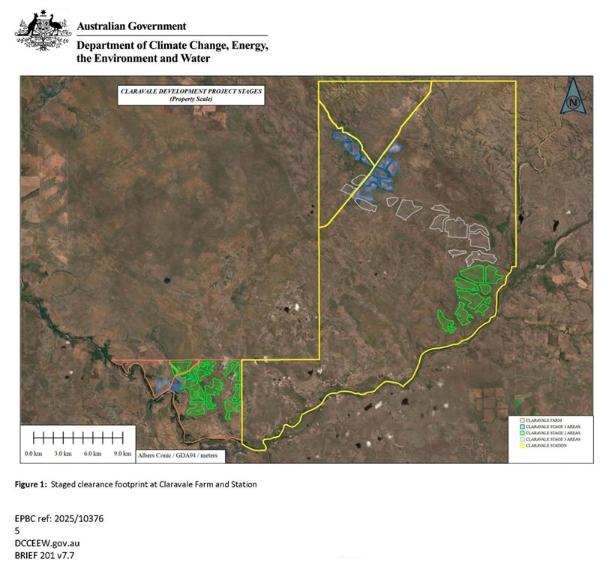
43 In the above map, the orange boundary is for Claravale Farm and the yellow boundary is for Claravale Station. The blue polygons represent Stage 1; the green polygons represent Stage 2; and the white polygons represent Stage 3.
44 The second map is contained within a report of Dr Hanrahan dated September 2025 (the 2025 Hanrahan Report). The map (which is at CB 888) is as follows:
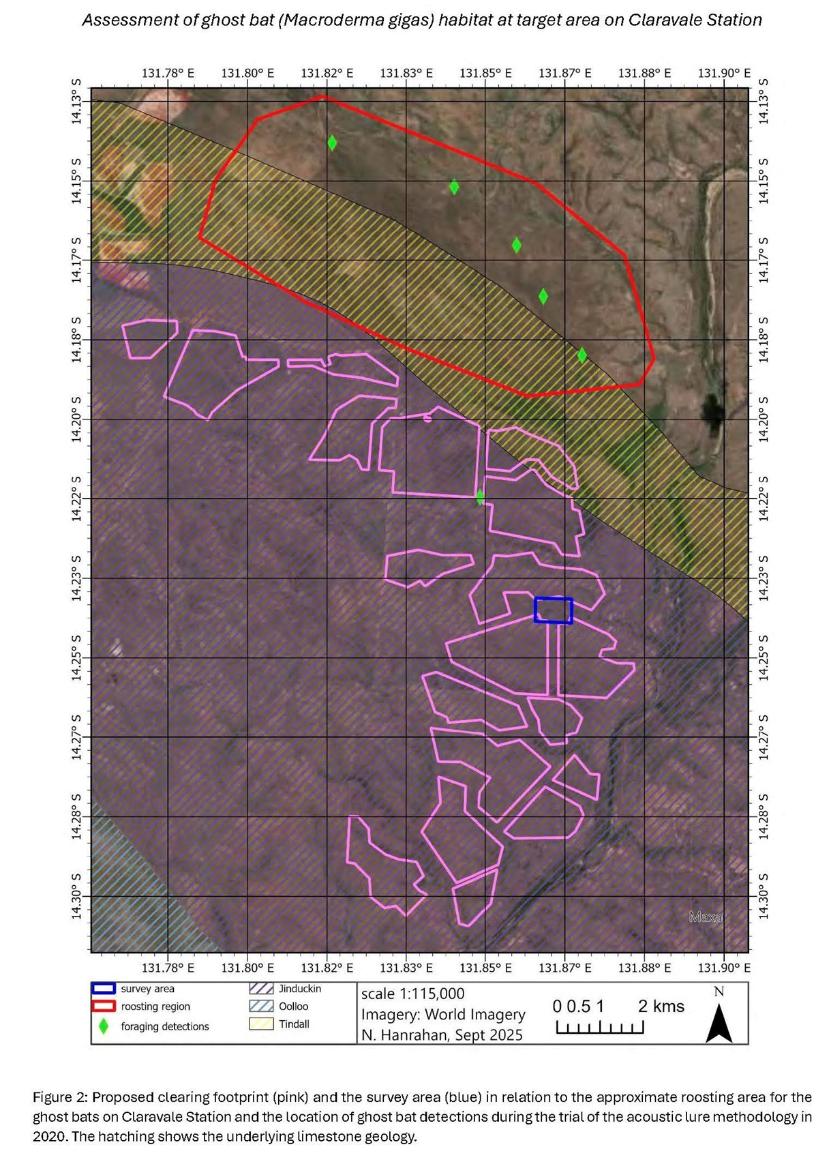
45 In the above map, the blue rectangle is an area surveyed by Dr Hanrahan (approximately 48 hectares), the red line indicates the roosting region (for the Ghost Bat) and the pink polygons represent the proposed action as originally referred. However, after the initial referral, Top End amended its proposal such that the pink polygons south of the survey area became “Stage 2” and the pink polygons north of the survey area became potential “Stage 3”. The decisions that are the subject of the present proceeding concern Stage 2 as so amended. It is apparent that Stage 2 (as so amended) is further away from the roosting area than Stage 3 (which has not yet been referred and may not proceed).
46 During the course of oral submissions, senior counsel for the ECNT highlighted the following key documents which were before the Delegate (some of which the ECNT received copies of only recently):
(a) a report prepared by Dr Hanrahan in 2024 which formed part of the ECNT’s submission to the Minister in relation to the Referral (CB 1183-1193);
(b) a memorandum dated 16 May 2025 prepared by Dr Alaric Fisher, Executive Director, Flora and Fauna Division of the Northern Territory Department of Lands, Planning and Environment (CB 854-862);
(c) the 2025 Hanrahan Report;
(d) an email dated 25 September 2025 from Dr Fisher and related emails (CB 1945-1948);
(e) a letter dated 11 November 2025 from the Northern Territory Department of Lands, Planning and Environment in relation to Claravale Farm (CB 1928-1944);
(f) a report dated 12 January 2026 prepared by Helen Groves of Magnat Agri Services (CB 1951-2011);
(g) an email dated 17 April 2026 from Dr Hanrahan summarising a submission she had made to the Minister in relation to the Referral (CB 926-927); and
(h) a report prepared by Dr Peter Kyne on Stage 1 (CB 2183-2208).
The Decision Brief
47 The Decision Brief deals with the issue raised by s 74A at paragraphs 27-39.
48 The Ghost Bat is dealt with at paragraphs 61-83 of the Decision Brief.
49 The precautionary principle is referred to at paragraph 127 of the Decision Brief (which is near the end and after the recommendation relating to the Ghost Bat).
The Statement of Reasons
50 The Statement of Reasons is generally structured in a similar way to the Decision Brief.
51 The issue relating to s 74A is dealt with at paragraphs 41-49 of the Statement of Reasons.
52 The precautionary principle is referred to in paragraph 54(c) of the Statement of Reasons (which is before the consideration of matters relating to particular species, including the Ghost Bat).
53 The Ghost Bat is considered at paragraphs 79-102 of the Statement of Reasons.
Prima facie case
54 I consider that each of Grounds 1, 2, 4 and 5 is arguable and therefore that the ECNT has established a prima facie case in relation to each of these grounds.
55 While the parties provided outlines of submissions and made oral submissions on each of these grounds, it is nevertheless difficult to assess the strength of the grounds at this stage of the proceeding. Although the material before the Court is probably much the same as would be before the Court at the final hearing, the parties have not had a full opportunity to develop their submissions on the grounds.
56 Assessing the strength of the grounds in a preliminary way, Grounds 1 and 2 (relating to s 74A) appear to be weak. Ground 1 depends on a construction of s 74A that does not find support in the text of the section (which uses the word “may”, suggesting a discretion rather than a duty). Ground 2 appears to be difficult to establish in light of my preliminary view that s 74A confers a discretion rather than a duty.
57 Grounds 4 and 5 (which relate to the Section 75 Decision) appear to be stronger. However, assessing the matter in a preliminary way, I would not describe them as strong. A key aspect of the Delegate’s reasoning in relation to the Ghost Bat is at paragraph 98 of the Statement of Reasons, where she stated (CB 2064):
I considered that the proponent has reduced the total clearance footprint by excluding 1,911.2 ha from the northern extent of the proposed clearing area. This area was removed specifically due to its proximity to foraging habitat associated with recorded roosting sites on Claravale Station. By excluding this land, the proponent has increased the buffer distance between clearing activities and known roosting sites, thereby reducing the likelihood of adverse impacts on essential foraging habitat for Ghost Bats.
58 The above paragraph relates to the amendment to the area of the proposed action, whereby the proposed action was confined to the pink polygons south of the survey area (the blue rectangle) in the second map set out above. The paragraph set out above appears to support the Delegate’s conclusion and appears to make it difficult to establish legal unreasonableness.
59 Further, the Delegate set out at paragraph 99 a number of steps that would be taken by way of avoidance or mitigation. These too support the conclusion reached by the Delegate and make it difficult to establish that the Section 75 Decision was legally unreasonable.
60 Insofar as the ECNT contends that the Delegate erred by failing to comply with her obligation under s 391 of the EPBC Act to take account of the precautionary principle, I note that the principle has been discussed in a number of cases: see, eg, Bob Brown Foundation Inc v Minister for the Environment (No 2) [2022] FCA 873 at [19]-[33]; Friends of the Gelorup Corridor Inc v Minister for the Environment and Water [2023] FCAFC 139; 299 FCR 236 at [75]-[76], [83]-[95]. Having regard to the statement in paragraph 54(c) of the Statement of Reasons that the Delegate “took account of the precautionary principle” and the reasons of the Delegate in relation to the Ghost Bat, as a matter of preliminary impression I do not consider the ECNT’s contention based on the precautionary principle to be strong.
Discretionary considerations
61 I will now consider discretionary matters that are relevant to the exercise of the discretion in s 15 of the ADJR Act. These matters are also relevant to the issue of the “balance of convenience” for the purposes of the application for an interlocutory injunction.
62 An important consideration is that if interlocutory relief is not granted, the proposed action will proceed, meaning that the Stage 2 areas will be cleared and irreversibly changed. This means that if the ECNT’s proceeding is ultimately successful, the ECNT will not achieve its objective. This factor points in favour of the grant of interlocutory relief.
63 In my opinion, there is some force in Top End’s submission that the ECNT delayed in commencing the proceeding and in filing the interlocutory application. In my opinion, the period between receipt of the Decision Brief (26 March 2026) and commencement of the proceeding (about 26 May 2026) was too long in circumstances where (as would have been known) the works needed to be carried out during the dry season if they were to be carried out this calendar year. Had the ECNT commenced the proceeding and sought interlocutory relief within (say) one month of receiving the Decision Brief, there would have been some prospect of the final hearing being expedited and the application for judicial review being determined in time for the works to be carried out during the dry season this calendar year. Thus, Top End has been prejudiced by the ECNT’s delay in commencing the proceeding and in seeking interlocutory relief.
64 A further matter is the cap of $500,000 on the undertaking as to damages. While there are good reasons why the ECNT needs to cap its exposure, given the nature of the proposed action and Top End’s business plans, I am satisfied (on the basis of Mr Simmich’s affidavit evidence) that there is a realistic possibility that any loss or damage suffered by Top End and third parties as a result of an order being made under s 15 of the ADJR Act or an interlocutory injunction being granted will exceed $500,000. While I do not consider this factor to be determinative, it weighs against granting the interlocutory relief sought.
65 Having regard to the matters discussed above, I am not satisfied that the interests of justice favour the making of an order under s 15 of the ADJR Act suspending the operation of the Decisions.
66 For substantially the same reasons, I am not satisfied that it is appropriate to grant an interlocutory injunction restraining Top End from carrying out the proposed action that is the subject of the Section 75 Decision.
Conclusion
67 For these reasons, the application for interlocutory relief is to be dismissed. I will hear from the parties as to costs.
I certify that the preceding sixty-seven (67) numbered paragraphs are a true copy of the Reasons for Judgment of the Honourable Justice Moshinsky. |
Associate:
Dated: 25 June 2026


