

Federal Court of Australia
Mobile Skips (Australia) Pty Ltd v Registrar of Trade Marks [2026] FCA 744
File number(s): | VID 1091 of 2024 |
Judgment of: | HESPE J |
Date of judgment: | 16 June 2026 |
Catchwords: | TRADE MARKS – appeal under s 35 of the Trade Marks Act 1995 (Cth) from decision of delegate of Registrar of Trade Marks refusing registration of plain word mark “MOBILE SKIPS” – plain word mark rejected under s 41 of the Trade Marks Act – whether mark not to any extent inherently adapted to distinguish designated services of the applicant – ordinary signification of “MOBILE SKIPS” to Australian consumers or traders – whether mark descriptive of services involving trailerable skip bins – whether honest traders might legitimately desire to use the words in connection with similar services – relevance of disclaimer sought under s 74 of the Trade Marks Act – whether plain word mark acquired distinctiveness through use |
Legislation: | Evidence Act 1995 (Cth) s 136 Intellectual Property Laws Amendment (Raising the Bar) Act 2012 (Cth) Trade Marks Act 1995 (Cth) ss 7, 17, 41, 74, 190 |
Cases cited: | Apple Inc v Registrar of Trade Marks [2014] FCA 1304; (2014) 227 FCR 511 Bausch & Lomb Inc v Registrar of Trade Marks (1980) 28 ALR 537 Blount Inc v Registrar of Trade Marks [1998] FCA 440; (1998) 83 FCR 50 Bohemia Crystal Pty Ltd v Host Corporation Pty Ltd [2018] FCA 235; (2018) 354 ALR 353 British Sugar plc v James Robertson & Sons Ltd [1996] RPC 281 Burger King Corporation v Registrar of Trade Marks [1973] HCA 15; (1973) 128 CLR 417 Cantarella Bros Pty Ltd v Modena Trading Pty Ltd [2014] HCA 48; (2014) 254 CLR 337 Clark Equipment Co v Registrar of Trade Marks [1964] HCA 55; (1964) 111 CLR 511 F H Faulding & Co Ltd v Imperial Chemical Industries Ltd (1965) 112 CLR 537 Goodman Fielder Pte Ltd v Conga Foods Pty Ltd [2020] FCA 1808; (2020) 158 IPR 9 Henley Arch v Henley Constructions Pty Ltd [2021] FCA 1369; (2021) 163 IPR 1 In re R J Lea Ltd’s Application [1913] 1 Ch 446 Jafferjee v Scarlett [1937] HCA 36; (1937) 57 CLR 115 Koninklijke Douwe Egberts BV v Cantarella Bros Pty Ltd [2024] FCA 1277 Melbourne Bone and Joint Clinic Pty Ltd v Registrar of Trade Marks [2024] FCA 53; (2024) 182 IPR 346 Phone Directories Company Australia Pty Ltd v Telstra Corporation Limited [2014] FCA 373; (2014) 106 IPR 281 Registrar of Trade Marks v W & G Du Cros [1913] AC 624 Smith Kline & French Laboratories Ltd v Sterling-Winthrop Group Ltd [1975] 1 WLR 914; [1975] 2 All ER 578 Woolworths Ltd v BP plc (No 2) [2006] FCAFC 132; (2006) 154 FCR 97 Yarra Valley Dairy Pty Ltd v Lemnos Foods Pty Ltd [2010] FCA 1367; (2010) 191 FCR 297 |
Division: | General Division |
Registry: | Victoria |
National Practice Area: | Intellectual Property |
Sub-area: | Trade Marks |
Number of paragraphs: | 194 |
Date of hearing: | 10-12 February 2026 |
Counsel for the Applicant: | Mr A Sykes |
Solicitor for the Applicant: | Buchanan Law |
Counsel for the Respondent: | Ms M Marcus |
Solicitor for the Respondent: | Australian Government Solicitor |
ORDERS
VID 1091 of 2024 | ||
| ||
BETWEEN: | MOBILE SKIPS (AUSTRALIA) PTY LTD Applicant | |
AND: | REGISTRAR OF TRADE MARKS Respondent | |
order made by: | HESPE J |
DATE OF ORDER: | 16 June 2026 |
THE COURT ORDERS THAT:
1. The appeal be dismissed.
2. The Applicant pay the costs of the Respondent, to be taxed if not agreed.
Note: Entry of orders is dealt with in Rule 39.32 of the Federal Court Rules 2011.
REASONS FOR JUDGMENT
HESPE J:
1 Mobile Skips (Australia) Pty Ltd (the applicant) is the registered owner of the following registered trade marks:
(a) The composite registered trade mark 1387633 (633 Mark) shown below;

This mark is registered in respect of the following services:
Class 39: Handling (transport) of rubbish; clearance (removal and transportation) of waste; collection (transport) of waste and trash; collection of commercial waste; collection of domestic waste; collection of waste materials; collection of waste skips; disposal (transport) of waste; dumping (transportation) of waste; removal of waste; storage and transport of waste and trash; transport and storage of waste; waste collection; waste removal (transport); waste storage; waste transport.
(b) The composite registered trade mark 2140816 (816 Mark) shown below;

This mark is registered in respect of the following services:
Class 39: Clearance (removal and transportation) of waste; Collection (transport) of waste and trash; Collection of commercial waste; Collection of domestic waste; Collection of waste materials; Collection of waste skips; Disposal (transport) of waste; Dumping (transportation) of waste; Handling (transport) of waste products; Removal of waste; Storage and transport of waste and trash; Storage of waste; Transport and storage of waste; Transportation of waste; Waste collection; Waste removal (transport); Waste storage; Waste transport; Transport and storage of trash; Handling (transport) of rubbish.
(c) The composite registered trade mark 2140817 (817 Mark) shown below.

This mark is registered in respect of the same services in class 39 as the 816 Mark.
2 On 2 September 2022, the applicant filed trade mark application number 2297940 to register a plain word mark MOBILE SKIPS in respect of the following services:
Class 39: Collection and clearance of waste and rubbish; Storage, handling and transport of waste and rubbish; Removal and dumping of waste and rubbish; all of the aforesaid services by the provision of trailerable bins capable of being towed by a standard domestic motor vehicle or a light commercial motor vehicle.
3 On 25 September 2024, a delegate of the Registrar of Trade Marks (Registrar) decided to reject the application to register the mark on the basis that a ground of rejection existed under s 41(3) of the Trade Marks Act 1995 (Cth) (the Act). In so doing, the Registrar’s delegate formed the view that the plain word trade mark MOBILE SKIPS was not to any extent inherently adapted to distinguish the applicant’s services in respect of which the trade mark is sought to be registered (designated services) from the services of other persons and the applicant had not used the trade mark before the filing date in respect of the application (being 2 September 2022) to such an extent that the trade mark did in fact distinguish the designated services as being those of the applicant.
4 The applicant appeals from the delegate’s decision pursuant to s 35 of the Act. The appeal under s 35 is an application in the original jurisdiction of the Court and is a hearing de novo. The task for the Court is to determine judicially whether the application should succeed on its merits, not whether the Registrar has lawfully discharged her duties: Jafferjee v Scarlett [1937] HCA 36; (1937) 57 CLR 115 at 126 (Dixon J); Apple Inc v Registrar of Trade Marks [2014] FCA 1304; (2014) 227 FCR 511 at [22] (Yates J). In making its determination, the Court should give weight to the Registrar’s opinion as “a skilled and experienced person”: Jafferjee at 126; Apple Inc at [23]. The weight to be given to the Registrar’s opinion will depend on the circumstances. For example, the weight may be affected by the fact that evidence has been adduced in the appeal which was not before the delegate: Apple Inc at [24].
5 In the present case, the Registrar played an active role in the proceedings, represented by solicitors and counsel.
Statutory context
6 Section 17 of the Act defines a trade mark as a sign used, or intended to be used, to distinguish goods or services provided in the course of trade by one person from those provided by another.
7 Section 41 of the Act relevantly provides:
(1) An application for the registration of a trade mark must be rejected if the trade mark is not capable of distinguishing the applicant’s goods or services in respect of which the trade mark is sought to be registered (the designated goods or services) from the goods or services of other persons.
…
(2) A trade mark is taken not to be capable of distinguishing the designated goods or services from the goods or services of other persons only if either subsection (3) or (4) applies to the trade mark.
(3) This subsection applies to a trade mark if:
(a) the trade mark is not to any extent inherently adapted to distinguish the designated goods or services from the goods or services of other persons; and
(b) the applicant has not used the trade mark before the filing date in respect of the application to such an extent that the trade mark does in fact distinguish the designated goods or services as being those of the applicant.
(4) This subsection applies to a trade mark if:
(a) the trade mark is, to some extent, but not sufficiently, inherently adapted to distinguish the designated goods or services from the goods or services of other persons; and
(b) the trade mark does not and will not distinguish the designated goods or services as being those of the applicant having regard to the combined effect of the following:
(i) the extent to which the trade mark is inherently adapted to distinguish the goods or services from the goods or services of other persons;
(ii) the use, or intended use, of the trade mark by the applicant;
(iii) any other circumstances.
Note 1: Trade marks that are not inherently adapted to distinguish goods or services are mostly trade marks that consist wholly of a sign that is ordinarily used to indicate:
(a) the kind, quality, quantity, intended purpose, value, geographical origin, or some other characteristic, of goods or services; or
(b) the time of production of goods or of the rendering of services.
…
Note 3: Use of a trade mark by a predecessor in title of an applicant and an authorised use of a trade mark by another person are each taken to be use of the trade mark by the applicant (see subsections (5) and 7(3) and section 8).
(5) For the purposes of this section, the use of a trade mark by a predecessor in title of an applicant for the registration of the trade mark is taken to be a use of the trade mark by the applicant.
…
Note 2: If a predecessor in title had authorised another person to use the trade mark, any authorised use of the trade mark by the other person is taken to be a use of the trade mark by the predecessor in title (see subsection 7(3) and section 8).
8 By its terms, s 41(1) requires a trade mark application to be rejected if the trade mark is not capable of distinguishing the trade mark applicant’s goods or services from the goods or services of another person. As Burley J explained in Goodman Fielder Pte Ltd v Conga Foods Pty Ltd [2020] FCA 1808; (2020) 158 IPR 9 (at [207]):
The principle underlying this section is that unless a mark is sufficiently distinctive of the trader’s goods or services, then it will not serve its basic function as a means for identifying to consumers and traders alike the source of the goods or services.
9 As Burley J observed in Goodman Fielder at [210], s 41(2) is a “deeming provision, whereby only if a trade mark falls within s 41(3) or s 41(4) will it fail to be capable of distinguishing within s 41 (1).” In other words, a trade mark application is to be rejected under s 41(1) only if the trade mark falls within ss 41(3) or 41(4) of the Act.
10 By their terms, ss 41(3) and (4) address three categories of trade marks:
(1) Trade marks which are inherently adapted to distinguish the trade mark applicant’s goods or services in respect of which the trade mark is sought to be registered from the goods or services of other persons. Such trade marks will not fall within either s 41(3) or 41(4) and will necessarily be taken to be capable of distinguishing the designated goods or services.
(2) Trade marks which are not to any extent inherently adapted to distinguish the designated goods or services from the goods or services of another. Such a trade mark will fall within s 41(3) if the trade mark applicant has not used the mark before the filing date to such an extent that it does in fact distinguish the designated goods or services from the goods or services of another. That is, the trade mark will not be capable of distinguishing within s 41(1) if the trade mark is not to any extent inherently adapted to distinguish the designated goods or services and the trade mark does not in fact distinguish the designated goods or services based on the applicant’s use of the mark prior to the filing date.
(3) Trade marks which are to some extent, but not sufficiently, inherently adapted to distinguish the designated goods or services from the goods or services of another. Such a trade mark will fall within s 41(4) if the trade mark does not in fact and will not distinguish the designated goods or services from the goods or services of another based on the combined effect of (i) the extent to which the mark is inherently adapted to distinguish; (ii) the use or intended use of the mark by the applicant; and (iii) any other circumstances. The use of the trade mark is not confined to the applicant’s actual use of the mark prior to the filing date. Notably, in s 41(4), use extends to intended use.
(see Blount Inc v Registrar of Trade Marks [1998] FCA 440; (1998) 83 FCR 50 at 56-7 (Branson J) in relation to the earlier version of s 41.)
11 Section 7(1) of the Act provides:
If the Registrar or a prescribed court, having regard to the circumstances of a particular case, thinks fit, the Registrar or the court may decide that a person has used a trade mark if it is established that the person has used the trade mark with additions or alterations that do not substantially affect the identity of the trade mark.
12 The Federal Court is included as a prescribed court under the Act: s 190.
13 The applicant variously described the product the subject of the services for which the mark was sought to be registered as a skip bin on a trailer, a highly transportable domestic dumpster, a trailerable bin and a trailerable skip.
14 In the present case, it was not disputed that the plain word mark MOBILE SKIPS was not sufficiently inherently adapted to distinguish the applicant’s product from those of other providers of trailerable skip bins. The dispute concerned the application of ss 41(3) and (4) of the Act.
Evidence
15 The applicant relied upon the evidence of the following witnesses:
(a) Mr Spencer, the sole director and Chief Executive Officer of the applicant. Mr Spencer affirmed two affidavits dated 10 April 2025 and 15 August 2025;
(b) Mr Buchanan, the applicant’s solicitor. Mr Buchanan affirmed two affidavits dated 11 April 2025 and 14 August 2025;
(c) Mr Simonetti, the managing director of a digital marketing agency. Mr Simonetti swore an affidavit dated 3 April 2025;
(d) Mr Ellich, co-founder and managing director of Blufire Pty Ltd which provided digital marketing services to the applicant, affirmed two affidavits dated 9 April 2025 and 13 August 2025; and
(e) Mr Holland, the former owner of a business in the waste management industry. Mr Holland affirmed an affidavit dated 12 April 2025.
16 Of those witnesses, Messrs Spencer, Simonetti, Ellich and Holland were required to attend for cross-examination.
17 The Registrar relied upon the affirmed affidavit of Ms Hilder, a lawyer employed by the Australian Government Solicitor dated 21 July 2025. Ms Hilder was not required to attend for cross-examination.
Evidence of Mr Spencer
18 Mr Spencer was responsible for managing the day-to-day business and relationships with the applicant’s commercial partners and its franchisees.
19 A significant portion of the cross-examination of Mr Spencer concerned Mr Spencer’s understanding of the meaning of the term “mobile skips” as it was used in various circumstances. Mr Spencer’s evidence was that he understood use of the term “mobile skips” to denote the applicant’s product or service with the applicant’s brand, and was not a reference to the product or service more generally. I attach no weight to this evidence of Mr Spencer’s subjective understanding of how a term is used in documents, particularly documents that he did not author.
History of the Mobile Skips business
20 The Mobile Skips business was founded by Mr Cameron Griffiths in 2006.
21 On 22 August 2012, an entity controlled by Mr Griffiths, MS Franchising Pty Ltd, entered into a franchise agreement with BRC (VIC) Pty Ltd, the first franchisee of the Mobile Skips business. The 633 Mark appears at the top of the cover page of that agreement. Paragraph A in the Background recorded in the document states:
The Franchisor owns a business known as “Mobile Skips” which specialises in the hire of mobile skips for rubbish removal. The Franchisor has through its expertise developed a range of Mobile Skips. The Franchisor has spent significant time, know-how, effort and expenditure in developing the Mobile Skips, the System and Brand and is the owner of valuable Intellectual Property in this regard.
22 The capitalised term “Mobile Skip” or “Mobile Skips” is defined in that agreement in the following terms:
Mobile Skip or Mobile Skips means the mobile skip designated by the Franchisor and hired by the Franchisee in accordance with the terms of this Agreement;
23 In 2013, the Mobile Skips business expanded beyond Melbourne to offer services in Geelong, the Mornington Peninsula and Sydney. In 2014, the Mobile Skips business expanded to offer services in Perth and Brisbane.
24 By November 2016, Mr Griffiths had expanded the franchise network for the Mobile Skips business to seven franchisees.
25 On 18 August 2016, Mr Griffiths was granted innovation patent 2016100763 entitled “Transportable Waste Bin”. The innovation patent expired on 25 May 2024.
26 By 2016, there were other businesses providing a similar product to the trailerable skip bins offered by Mr Griffith’s entities.
Purchase of the business by the applicant
27 In November 2016, the applicant as purchaser and the entities controlled by Mr Griffiths (Mobile Skips Holdings Pty Ltd, MS Franchising Pty Ltd and Mobile Skips Trailers Pty Ltd (together, the vendor)) entered into a sale of business contract. Pursuant to cl 5.2 of the contract, the vendor was required to transfer the Business, the Assets and the Stock to the applicant. The Business was defined as the business conducted by the vendor under the business name “Mobile Skips”. The particulars of sale described the type of business as “the mobile skip bin hire business operated under the name ‘Mobile Skips’ by the Vendors and the franchises identified in Schedule 9” to the contract.
28 Mobile Skips Holdings Pty Ltd initially retained ownership of certain intellectual property rights relating to the Mobile Skips business and licensed those rights to the applicant under a licence agreement. Mobile Skips Holdings Pty Ltd granted a licence to the applicant to use:
(a) the name “Mobile Skips”;
(b) the 633 Mark;
(c) proprietary software used in the Mobile Skips business;
(d) “the mobile skip bins used in connection with the Business”;
(e) the domain name
(f) innovation patent 2016100763,
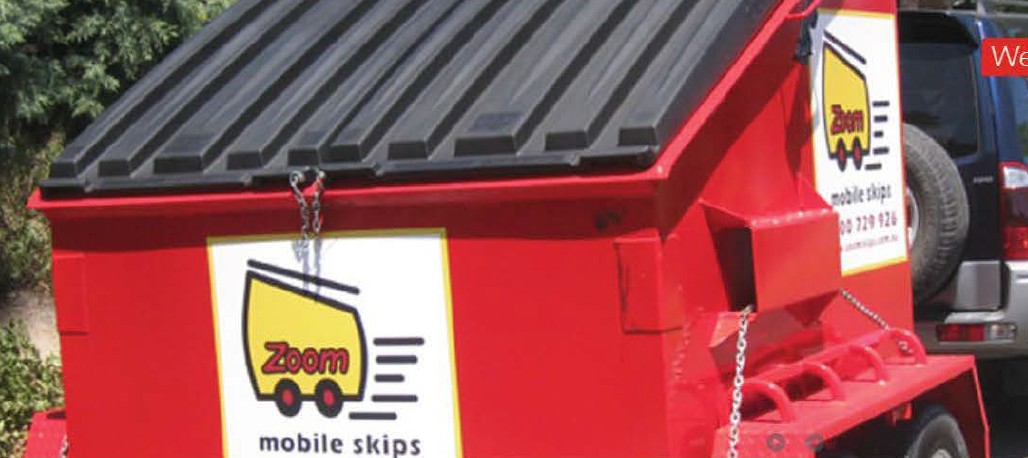
to operate the “Business”. The licence agreement defined the term “Business” to mean, relevantly, “the mobile skip bin hire business operated under the name ‘Mobile Skips’ by the Licensee Group”.
29 On 5 May 2017, Mobile Skips Holdings Pty Ltd and the applicant entered into a deed terminating the licence and assigning the licensed intellectual property rights to the applicant.
30 Mr Spencer’s evidence was that the applicant’s strategic aim was to operate a franchise business model. To this end, from 1 July 2019, the applicant licensed all intellectual property rights owned by the applicant and leased the “mobile skip trailers” owned by the applicant to MS Franchising (Australia) Pty Ltd.
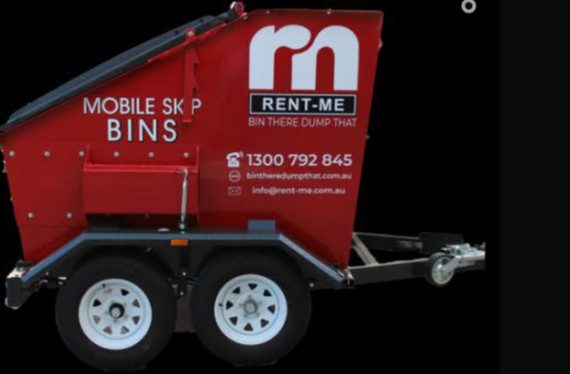
31 Mr Spencer exhibited to his affidavit a template franchise agreement created around 2022, which named MS Franchising (Australia) Pty Ltd as the franchisor. Relevantly:
(1) The 816 Mark appears at the top of the cover page and in the top right hand corner of each subsequent page.
(2) The background to the agreement was set out as follows:
The Franchisor owns a business known as ‘Mobile Skips’ which specialises in the hire of mobile skips for rubbish removal. The Franchisor has through its expertise developed a range of Mobile Skips. The Franchisor has spent significant time, knowhow, effort and expenditure in developing the Mobile Skips, the System and Brand and is the owner of valuable Intellectual Property in this regard.
(3) “Mobile Skip” or “Mobile Skips” was defined to mean:
the mobile skips designated by the Franchisor and hired by the Franchisee in accordance with the terms of this Agreement as further set out in Appendix B, including any additional, replaced or substituted mobile skips which are supplied by the Franchisor to the Franchisee under this Agreement from time to time during the Term.
(4) Appendix B to the template franchise agreement titled “MOBILE SKIPS” set out a table of registration numbers and vehicle identification numbers.
32 As at 1 March 2025, the applicant had 18 franchisees operating in Melbourne, the Mornington Peninsula, Sydney, Brisbane, Adelaide and Perth. The applicant itself operated bin hire operations in three locations covering Geelong and the Bellarine Peninsula, Newcastle and the Sunshine Coast.
The applicant’s bin hiring services
33 Mr Spencer described the bin hiring services of the applicant and its franchisees as:
… involv[ing] the short-term hiring of transportable waste bins to consumers, whereby each bin is moved by a trailer to a premise [sic] and collected by a light vehicle, the bin is then emptied by a front lift compactor truck and the waste is taken to recycling centres for processing.
34 The target market for the hiring services is consumers undertaking DIY tasks at residential homes or tradespeople conducting jobs at residential homes.
35 The product offered for hire is a one-size skip bin with a volume of 4 cubic metres. The bins have always been coloured lime green with one of the device marks or at least in one case, a variation of it.
36 Mr Spencer employed the phraseology “transportable domestic waste bins, mini-skips or trailer skips” to describe the product offered for hire. For example, according to Mr Spencer:
Trailerable bins differ from traditional small skips because they are not delivered by a commercial truck, and are rather mounted on top of a towable double axle trailer. Trailerable bins are mostly just one size (4 cubic meters in volume) and are specifically designed to fit the needs of a customer at a residential location.
37 In his affidavit, Mr Spencer described the market in which the Mobile Skips business operates as:
that [market] represented by small or mini waste bins that are [t]railerable [s]kip [b]ins (the trailer bin market).
…
the trailer bin market … is characterised by particularly small or mini waste bins that are [t]railerable [s]kip [b]ins mounted on a trailer, and can be towed by a domestic vehicle.
38 According to Mr Spencer’s taxonomy, the market for small or mini waste bins sits within the “small skip bin[]” market, directed to use in residential locations. Mr Spencer elaborated:
The small skip [bin] market is characterised by businesses that have bins anywhere from 2 cubic meters to 12 cubic meters and are predominantly used for projects in and around residential locations.
39 Mr Spencer estimated that as at 2 September 2022, there were approximately 738 trailer bins available for hire in Australia and the applicant (taken together with its franchisees) had a 0.5% market share of the Australian small skip bin market and a 75% market share of the Australian trailer bin market, offering over 500 bins for hire.
Marketing and promotion efforts by the applicant and by Mr Spencer
40 Mr Spencer’s evidence was that the “MOBILE SKIPS brand is heavily promoted”. Mr Spencer deposed that the applicant was “diligent and consistent” in using the MOBILE SKIPS plain word mark in marketing and advertising communications “to help guard against genericism”.
41 The applicant had a business relationship with Bunnings Group Ltd, which operates a chain of hardware and garden retail stores, whereby customers could hire the applicant’s product through Bunnings’ website and collect the bins from Bunnings store carparks. Mr Spencer deposed that, as at 2 September 2022, the applicant’s product was situated in the car parks ready for customer hire at 128 Bunnings stores.
42 The applicant derived 15% of its revenue for the 2022 calendar year from the agreement with Bunnings. Mr Spencer accepted that many of the applicant’s customers come across the product by seeing it in a Bunnings car park. Between 1 October 2019 and 2 September 2022, 18,181 visits to the applicant’s website originated from
43 An undated screenshot in Mr Spencer’s affidavit showed that the applicant’s brand page on the Bunnings website was titled “Mobile Skips” and two services were listed under the sub-heading “Skip hire”.
44 In relation to the applicant’s online marketing activities, Mr Spencer testified that:
(1) There were 30,293 views between 8 October 2012 and 15 March 2025 of an animated video explaining the applicant’s product, posted to YouTube.
(2) There were 15,750 views between 22 February 2016 and 15 March 2025 of a Bunnings advertisement video entitled “Tips for Using a Mobile Skip - DIY at Bunnings” posted to YouTube.
(3) There were two interviews with franchisees “promoting the [b]usiness” posted to Vimeo. One of these videos had received over 2,900 views since being posted in 2018. The other video, which was posted in 2020, had received 270 views.
(4) There were a series of infomercials released internally within Bunnings which “featur[ed]” the applicant’s product. This series of infomercials were said to have a “total viewership” of “10,000”.
(5) There was an online training module covering the applicant’s “product and service offering” completed by 6,122 Bunnings Hire Shop team members as of December 2024.
(6) Between the applicant’s social media accounts on Facebook and Instagram, for the period 23 February 2022 to 22 March 2025, the applicant’s posts “had over 1.6million [sic] views, over 550,000 in reach, and over 22,000 link clicks”. Precisely what constituted a “view”, “reach” or a “link click” was neither elaborated upon nor the subject of cross-examination.
(7) 254,599 clicks and approximately 14,500 conversions between 20 December 2011 and 2 September 2022 as a result of paid advertising campaigns run through Google Ads.
45 Mr Spencer’s oral evidence was that about 70% of the business’s customers were repeat customers.
46 As at 11 August 2022, the applicant’s business had an average review score of 5/5 stars from 4,340 reviews on
47 Mr Spencer also gave evidence that the applicant conducts four to five direct email marketing “campaigns” per year and that 16,000 to 22,000 people “are reached each time a campaign is … sent”.
48 Mr Spencer’s evidence was that he “regularly promote[s]” the applicant’s franchising opportunities by representing the applicant’s brand at franchising conferences and speaking on podcasts. An extract of the Small Business Big Marketing podcast episode titled “How to Create an Untouchable Business by Doing Less” published in June 2023 containing an interview of Mr Spencer by the podcast host, Mr Tim Reid, was played to the Court. That extract recorded the following:
HOST: … Jacob Spencer bought the underperforming Mobile Skips business. That’s its name: Mobile Skips. Yes, he owns the category.
…
MR SPENCER: The words “mobile skips” and the business name mobile skips and the– The whole concept was– was invented back 15 years ago. The skip bin on a trailer as it was– as – as a concept as it was called was not known as “mobile skips”. And so, the business was literally how can we make this easy for people to remember and call it what we do which is mobile skip on wheels. So that’s why “mobile skips” was put together. So our business is one of those ones that the name reflects what we do but it’s starting to become synonymous about– within– within the industry because of our size …
49 Mr Spencer deposed that the applicant employs “a proactive brand enforcement policy”.
The applicant’s website and search engine optimisation
50 The website
51 One of Mr Spencer’s aims was to “promote and grow traffic” to the
Competitors’ use of the term “mobile skips”
52 Mr Spencer conceded that there were at least some competitor businesses which appeared in response to a Google search using the term “mobile skips”. Mr Spencer considered that use by competitors to be improperly motivated and illegitimate, seeking to take advantage of the applicant’s reputation as market leader.
53 Mr Spencer prepared a spreadsheet which identified the following competitors as using the term “mobile skips” or “mobile skip” on their website and / or social media accounts as at September 2022:
State | Registered Business Name | Trading As | Number of Trailers |
NSW | CITY HAUL WASTE SERVICES PTY LTD | City Haul Mobile Skips | 8 |
QLD | SKIP TO TIP PTY LTD | Skip To Tip | 6 |
QLD | BRIZZY MOBILE SKIPS | Brizzy Mobile Skips | 4 |
SA | Zoom Mobile Skips | Zoom Mobile Skips | 16 |
VIC | GONE TO WASTE | Gone to Waste | 4 |
VIC | SINGH’S PTY LTD | Singhs Mobile Skips | 4 |
VIC | T F H AUSTRALIA PTY LTD | TFH | 8 |
VIC | ROLLING SKIPS PTY LTD | Rolling Skips | 16 |
VIC | TRAILER TRASH PTY LTD | Trailer Trash | 30 |
WA | mandurahmobileskip | Mandurah Mobile Skips | 8 |
NSW | Monsta Mobile Skips | Monsta Mobile Skips | 8 |
54 Within this spreadsheet, Mr Spencer included notes in respect of each competitor. In these notes, Mr Spencer identified that SKIP TO TIP PTY LTD and T F H AUSTRALIA PTY LTD both used “mobile skip” (in the singular) on their website and / or social media. Mr Spencer identified that GONE TO WASTE used the plural and the singular on its website.
55 Two of these competitors were identified by Mr Spencer as having had exploratory discussions with the applicant or one of its franchisees about becoming potential franchisees and, only after those discussions, launched businesses that used the term “mobile skips” in their name and / or marketing materials.
56 The applicant has taken some action against some of these competitors. The applicant has not taken action against Trailer Trash which commenced its business in 2007.
Conclusion
57 I accept Mr Spencer’s evidence in so far as it recites the history and operations of the Mobile Skips business. I attach no weight to his characterisation of promotional activities. These characterisations are expressions of opinion only. I attach no weight to Mr Spencer’s view about whether competitors’ use of the term “mobile skips” was legitimate. That evidence was entirely speculative.
Evidence of Mr Buchanan
58 The evidence of the applicant’s solicitor (Mr Buchanan) was that he had been instructed by the applicant “on several occasions to send cease and desist letters” to certain competitors. Mr Buchanan’s affidavit gave four examples of instances in which the applicant obtained a signed undertaking, settlement deed or a resolution to the applicant’s “satisfaction” as a result of a cease and desist letter.
59 I accept that the applicant sent cease and desist letters and that these were sometimes complied with in a manner that satisfied the applicant. I do not make any findings (and have no basis from which a finding is to be made) for the reasons why a recipient complied with the applicant’s request.
Marketing experts
Evidence of Mr Simonetti
60 Mr Simonetti provided an expert report. Mr Simonetti has been the Managing Director of the digital agency ANDMINE Pty Ltd since 1998. He described his expertise as “in business, specifically in the online and digital space”.
61 For the purposes of his expert report, Mr Simonetti was asked:
(a) To review and consider the comprehensive user traffic data available directly from the Applicant’s Google Analytics Account and associated with the Applicant’s website at www.mobileskips.com.au (the website).
(b) To assess the Applicant’s use of the MOBILE SKIPS brand on the website both as it currently appears on the website and as it has historically been used on the website – e.g. by reference to the service commonly known as the ‘way back machine’.
(c) To confirm whether or not the term ‘Mobile Skips’ was in use before the Applicant’s adoption of the brand.
(d) To assess and evaluate the user traffic data pertaining to the website and offer an opinion as to the size and reputation of the Mobile Skips brand.
(e) To assess and evaluate the content of the website, particularly relating to consumer reviews, and offer an opinion as to the nature of the consumer reviews and any conclusions that can be drawn from these reviews.
(f) To evaluate and report upon the likely reputation enjoyed by the Applicant in the MOBILE SKIPS brand, as at 3 December 2020, having regard to the factors listed above.
62 Mr Simonetti clarified in his oral testimony that “evaluate” in the context of his expertise referred to examining people’s online experience in searching for a product as compared with the results they find. He considered that the purpose of his report was to help illustrate the differentiation between the product category and the Mobile Skip brand.
63 In relation to question (a), Mr Simonetti reviewed the user traffic data available on Google Analytics for the
64 In relation to question (b), Mr Simonetti used the internet tool called the “Wayback Machine” to retrieve archived screenshots of the applicant’s website as that website stood at particular dates. As at the date of Mr Simonetti’s expert report, the Wayback Machine had archived 187 screenshots of the applicant’s website as it stood at various points in time between 7 October 2008 and 7 March 2022. Mr Simonetti extracted a single screenshot of the applicant’s website as it stood on a particular date in each year for the period 2009 to 2022 and on two dates in 2011. Mr Simonetti concluded based on his search of the Wayback Machine archive that the term “MOBILE SKIPS” has been used on the applicant’s website since at least 29 April 2009.
65 In relation to question (c), Mr Simonetti investigated the use of the search term “Mobile Skips” in Australia using Google Trends, a tool that provides relative search data related to search terms entered into the Google search engine. Mr Simonetti investigated the use of the search terms “mobile skips” in capital letters and in lower case and without parentheses.
66 Based on his investigation, Mr Simonetti concluded:
(1) The term “Mobile Skips” was first searched on Google in Australia in March 2007.
(2) The search volume on Google Search for the term “mobile skips” was approximately 1-2% of the search volume of “skip bins” or “skip hire” over the period 2004-2022.
(3) Mr Simonetti concluded that it was unlikely that the search term “Mobile Skips” or “mobile skips” was a commonly used term before the adoption of the Mobile Skips branding by the applicant’s predecessor because neither search term was searched on Google in Australia prior to March 2007.
(4) The earliest use of “Mobile Skip” (in the singular) on the Wayback Machine was on 29 June 2007 on
67 In relation to question (d), Mr Simonetti examined the user traffic data from Google Analytics for the website
(1) Between 1 September 2011 and 1 October 2017, there were 313,239 “New Users” to the applicant’s website.
(2) Between 1 August 2017 and 28 February 2022, the applicant’s website received 309,734 visits from “unique users”.
(3) The combined number of “unique visitors” and “New Users” to the applicant’s website during the period 2011 to 2022 amounted to 3.05% (or 1 in 32 people) of the Australian population above the age of 15 years as at 12 March 2022 based on population data published by the Australian Bureau of Statistics.
68 Based on the unique visitor numbers to the applicant’s website, Mr Simonetti concluded that the brand reputation in Australia for the plain word mark MOBILE SKIPS was “most prominent”.
69 In relation to question (e), Mr Simonetti concluded that, based on the customer reviews, the applicant “does its u[t]most to service its clients to a 5 out of 5 star quality” and that its customer review results were “exceptional”. Mr Simonetti cited undated screenshots of the listing pages of the Mobile Skips business on the Product Review website and on Google Maps. Based on the customer reviews, Mr Simonetti concluded that, in his opinion, Mobile Skips is “an exceptional organisation with the Mobile Skips brand synonymous with high levels of service”.
70 In relation to question (f), Mr Simonetti concluded that, in his opinion, the applicant enjoys a “widespread reputation in the MOBILE SKIPS brand”. Based on his review of the data, by 3 December 2020, there were over 185,000 Australians that had used the applicant’s website. Given Mr Simonetti’s instructions that the applicant operates in a niche skip hire marketplace, the applicant was in “an extremely well established position” in the market given the audience who had interacted with the brand.
71 Mr Simonetti’s view was that Google searches conducted during 2007 suggested people were looking for the brand “Mobile Skips” (as opposed to a product). Mr Simonetti considered that it is unlikely that a person would search for a term or product of which they have never heard. Mr Simonetti understood from his instructions that the applicant “built the term ‘mobile skips’ in the marketplace” and this led him to believe that if a user was searching the term “mobile skip”, it was to find the applicant as the supplier of the product.
72 Mr Simonetti attributed the increased use in the “mobile skips” search term to the applicant’s marketing, branding consistency and substantial market share rather than an increased interest in the mobile skip bin as a product. Mr Simonetti’s understanding of the applicant’s marketing, branding consistency and substantial market share were based on his instructions.
73 Mr Simonetti’s expert report did not include evidence as to the extent to which visits to the applicant’s website arose as a result of users specifically typing in the domain name for the applicant’s website.
74 The weight to be attached to Mr Simonetti’s evidence is discussed further below.
Evidence of Mr Ellich
75 Mr Ellich is the co-founder and managing director of Blufire Pty Ltd which provides digital marketing services, including search engine optimisation and paid advertising on Google. In September 2024, the applicant engaged Blufire to improve the “organic” ranking of the applicant’s website in Google search results.
76 Blufire was engaged by the applicant at the time Mr Ellich deposed his affidavit. By the time of the hearing, the applicant was no longer a client of Blufire.
77 Organic ranking in Google search results refers to the order websites appear in search results below the sponsored website results. Organic rankings are search results that are not identified in Google search results as “sponsored”. Positions in the sponsored results are purchased through Google Ads whereas positions in the organic rankings are unpaid. Mr Ellich’s evidence was that the organic ranking of websites is based on the relevance of the website to a user’s search query. Mr Ellich believed that users perceive websites appearing in the organic search results as more relevant and trustworthy than those appearing in the sponsored search results.
78 Mr Ellich’s evidence was that, in his experience working with start-up businesses, the high organic ranking of the applicant’s website required “substantial amounts of effort, time, strategic thought and money”. Mr Ellich considered that if the term “mobile skips” describes the product people are searching for, that would be the keyword that he would advise his client to include in the content of its website and also in the domain name of the website. Mr Ellich’s evidence was that:
It is possible for competitors to use and capitalise on the name ‘Mobile Skips’ either in their [search engine optimisation] strategy (e.g. by inserting that term into its website pages or the individual URL page names) and/or their search engine marketing strategy (e.g. by bidding on the key word term ‘Mobile Skips’) to leverage the popularity and trust associated with [the applicant’s] brand and to achieve their own high listing of their business simply by appropriating [the applicant’s] brand despite not having any legitimate connection to that brand.
79 On using keywords within a URL address, Mr Ellich gave the following evidence:
From my experience it is common for businesses to include keywords within their URLs as a means to improve the performance or ranking of their website in the context of individual searches conducted using a search engine such as Google. The inclusion of a popular key term is not necessarily indicative that the owner of the relevant website needs that term to be freely available to them to describe their services. Rather, in some instances, the use of another person's key term within a URL can be an effective tactic to help elevate that business’ ranking in an online search.
Weight to be attached to the evidence of the marketing experts
80 For the following reasons, the evidence of the marketing experts, Mr Simonetti and Mr Ellich, does not greatly assist.
81 First, as Wheelahan J observed at [188] in Koninklijke Douwe Egberts BV v Cantarella Bros Pty Ltd [2024] FCA 1277, the language and — more importantly — the concepts deployed by the marketing experts were the language and concepts of marketing, not trade mark law. The concepts do not necessarily correspond.
82 The question of trade mark use requires the Court to determine whether a given sign is being used as a badge of origin to indicate a connection in the course of trade between goods or services and their source.
83 Mr Simonetti was asked to consider “user traffic” associated with the applicant’s website and to “assess [the applicant’s] use of the MOBILE SKIPS brand on the website” and proffer an opinion on the size and reputation of the “brand”. It was not clear exactly what Mr Simonetti was being asked to do. There was no explanation of how an assessment of use of a brand is carried out or measured. As Mr Spencer emphasised in his evidence, as regards the “brand”, he was concerned that there be consistency in the colour and display of the product and in the marketing of the applicant’s services. There was no explanation for how the concept of a “brand” equated to the concept of a plain word mark as a badge of origin in circumstances where the applicant has used and uses a registered device mark. In these circumstances, it is not clear how consistency of use of a “brand” assists in answering the question of use of the plain words as a badge of origin.
84 Mr Spencer’s evidence was that 70% of the applicant’s (and its franchisees’) customers were repeat customers. Having used the applicant’s services at least once, it is not surprising that repeat customers are aware that there is a business operating under the name Mobile Skips with a logo that uses the words Mobile Skips as part of a device mark and which supplies lime green bins. In these circumstances it is not clear how such an awareness of the business name necessarily means that the plain text words “mobile skip” or “mobile skips” when appearing solus are used by the applicant, and understood by consumers, as a badge of origin.
85 Furthermore, there were certain aspects of Mr Simonetti’s evidence that were not persuasive.
86 Mr Simonetti investigated the use of the search terms “mobile skips” in capital letters and in lower case and without parentheses. As such, the result of Mr Simonetti’s investigation included instances where the words “mobile skips” had words appearing before or after those words. By not using parentheses it was not clear whether Mr Simonetti’s results would include situations where there were words interspersed between “mobile” and “skips”.
87 Mr Simonetti attributed the first use of the search term “mobile skips” to the fact that the applicant was using the words “Mobile Skips” as its business name because there was no widely known product which consumers called a mobile skip in 2007. However, Mr Simonetti accepted that, as at July 2007 at least, there were two businesses using the term “mobile skip” or “mobile skips”. Mr Simonetti’s search results could not reveal whether the term “mobile skip” or “mobile skips” was being used in any instance as a product description or as a trade mark.
88 Nor could Mr Simonetti’s investigation reveal whether a user who inputted the term “mobile skips” was searching for a product with the attributes of a readily moveable skip bin or was searching for the applicant and its particular product. Although Mr Simonetti attributed the increase in the use of the search term “mobile skips” to increased awareness of the applicant’s brand, Mr Simonetti’s expert report did not disclose a basis by which one might objectively ascertain whether the increase in use of the search term is instead attributable to increased market awareness of a product that is a readily moveable skip bin. Mr Simonetti appeared to rely on the amount of effort the applicant had put into marketing its brand and the fact that the applicant has a significant share of the trailerable bin market.
89 Mr Simonetti was of the view that individuals who use the search term “mobile skips” in the Google search engine must be taken to be searching for the applicant’s business rather than a product that may be described as a mobile skip. That conclusion did not appear to be based on empirical data. Absent any evidence from users as to why they were inputting the search term “mobile skip” or “mobile skips” (without parentheses), Mr Simonetti’s opinion is speculative.
90 Mr Simonetti’s expert report did not contain a definition of “New Users” or “unique users”. In cross-examination, Mr Simonetti accepted that Google Analytics tracks users based on inputs such as browser cookies and not based on identifying individual human beings. Use of different devices by a single individual can result in that individual being recorded as multiple unique users. If browser cookies are used, when an individual clears his or her browser cookies or changes web browser, the individual may be regarded by Google Analytics as a new unique user. Mr Simonetti dismissed these scenarios as “edge cases”. The Court does not consider Mr Simonetti’s dismissal in those terms to be persuasive, particularly given the data Mr Simonetti was relying on covered over a decade and given the rate at which mobile devices in particular become obsolete.
91 Based on his review of the unique user data, Mr Simonetti concluded that approximately 1 in 32 people aged 15 years and over visited the applicant’s website. Given that a trailerable skip is unlikely to appeal to school aged adolescents or to much older adults, Mr Simonetti’s analysis would suggest an extraordinary proportion of Australians aged, for example, between 21 and 70 visited the applicant’s website. Mr Simonetti was of the view that the “unique users” would be unlikely to include repeat customers. Mr Spencer’s evidence was that there were 726 trailerable skip bins available for hire as at 10 April 2025 and that 70% of Mobile Skip customers were repeat customers. Even assuming this number of bins was available throughout the period 2011 to 2022, Mr Simonetti’s analysis would appear to translate to an extraordinary amount of interest in so few skip bins to a point which is not consistent with common sense.
92 Mr Ellich’s evidence was that businesses may incorporate words in their business names where those words are search terms that have in the past attracted significant search volumes. He also gave evidence that there are search engine advantages to using a domain name that contains key words that are descriptive of the product or service being offered. This evidence does not support the proposition that use of a word in a domain name is necessarily use of a word as a badge of origin or necessarily reflects an improper intention to exploit the business reputation of another business.
Evidence of Mr Holland
93 Mr Holland worked in the Australian waste management industry between 2002 and 2019.
94 In 2007, Mr Holland co-founded Premier Waste Management Pty Ltd. In 2019, Mr Holland sold his interest in Premier Waste.
95 Mr Holland deposed that he first learned of the Mobile Skips business in around 2007 or 2008. Premier Waste had “commercial relationships” with both the Mobile Skips business and Trailer Trash. Mr Holland’s evidence was that Trailer Trash was “about three to four times the size” of the Mobile Skips business before the applicant acquired the Mobile Skips business.
96 Mr Holland’s evidence was that, as a result of these commercial relationships, he became “quite familiar” with the market segment of the waste management services industry in which Mobile Skips and Trailer Trash operated. Mr Holland termed this market segment “trailer bins” or “trailer skips”. Mr Holland considered this market segment to be a subset of the small skip bin market for consumers, as distinct from the market for large and medium-sized skip bins.
97 Mr Holland’s belief was that the term “mobile skips” is understood “within the industry” as referring to the applicant’s brand and not a product category.
98 In cross-examination, Mr Holland conceded that the use of “mobile skips” on Trailer Trash’s website as at 1 July 2007 appeared to be a reference to the product broadly and not the brand of the Mobile Skips business.
99 Mr Holland’s evidence is of little assistance. He could not provide evidence of what ordinary consumers would understand by the term “mobile skips”.
Evidence of Ms Hilder
100 Ms Hilder’s affidavit annexed screenshots of competitor websites at various points in time. These screenshots were admitted to evidence subject to a limitation under s 136 of the Evidence Act 1995 (Cth) that they be limited to establishing the fact that the webpages as exhibited were published on the internet at the URL indicated on the dates indicated but not the truth of any of the matters stated on the webpages.
101 The screenshots showed pages from various websites of different businesses which use the term “mobile skip”.
Trailer Trash
102 A record as at 1 July 2007 of the website at
103 As Mr Buchanan exhibited to his second affidavit, the terminology of “mobile skip” was not used consistently across the Trailer Trash website. The site map has the header “Trailer Trash Mobile Dumpsters”.
104 A record of the Trailer Trash website from July 2025 showed Trailer Trash using the phrases “Trailer Trash Mobile Skip Bin Hire” and “Melbourne’s Best Mobile Skip Bin Hire”. The product for hire was described as:
[the] best mobile skip bin hire in Melbourne. Trailer Trash mobile skip bins have advantages over regular skip bins and other rubbish removal services. Our mobile skip bins are the best … Our mobile skip bins are also more convenient … 4m3 Skip Bins … [are] our most popular bin size …
Monsta Mobile Skips
105 On 26 March 2020 at
106 On 17 July 2025 at
Rolling Skips
107 A record of the website for Rolling Skips as at 23 September 2021 at

108 The website describes three attributes of the bins under a heading “Brilliant Idea”: mobile, secure and size. It includes:
Under the subheading, “Efficient Skip Hire for Melbourne’s Western Suburbs”, the following text:
There’s plenty of mobile skips in Melbourne of course … RollingSkips is the go-to provider for bin hire in Melbourne’s Western suburbs.
A subheading “Mobile Skip Hire For Any Occasion” beneath which includes the following text:
Home Renovations
One of the most common uses for our mobile skip bins, home renovations can carry a large degree of excess rubbish …
Home Clean Up
Not just for renovations, our mobile skip bins are also perfect for the general spring clean-ups … with the added convenience of mobility …
109 In his first affidavit, Mr Buchanan testified that, in April 2023, his firm wrote to the Rolling Skips proprietors requesting the cessation of use of the “Mobile Skips brand”. That business subsequently referred to its product as providing “Mobile Lockable Skip Bin Hire”.
TFH
110 The website
A description “Mobile Skip Bin (4m)”.
A sub-heading “Mobile Skip Bin Hire”.
A sentence as follows:
Mobile skips are the new smart alternative in skip bin hire. Our mobile skip bins can be placed in driveways, in your garage, the carport or even on the road.
111 On 21 July 2025 at
A text box to the right of the page “TFH Mobiler [sic] Skip Bin (4m)”.
A heading “Mobile Skip Bin (4m)”.
The phrases “TFH’s Mobile Skip Bin Hire” and “our mobile skip bins”.
Zoom Mobile Skips
112 A record of the website

113 The website has a tab at the top labelled “BOOK A MOBILE SKIP” and the webpage contains the slogan in plain text “Zoom Mobile Skips – lockable and reliable” and the phrase “We deliver the mobile skip to you”. The webpage also includes a photograph of the product, extracted as follows:
114 A record of the website
Zoom mobile skips is a South Australian owned and operated business. We focus on Mobile Skip bin hire in Adelaide and proudly serve South Australian [sic] the most affordable skip bin hire services.
…
Zoom Mobile Skips is as easy as 1, 2, 3!
1. We deliver the mobile skip to you
2. You fill [the] skip bin up with your rubbish
3. We take the skip bins away
Rent-Me
115 A record of the website for a business called Rent-Me as it stood at 2 March 2020 and 17 July 2025 at
116 As at 2 March 2020, the website inconsistently refers to the product as “mobile skip bin”, “Mobile Skip Bin” and “Mobile Skip bin”. The attributes of the bin are described as “[v]ersatile[,] low clearance and mobile”. The record of the website as at 17 July 2025 does not display the whole of the website. As at this date, the website refers to “Mobile Skip Bins” and identifies that the product is “also known as trailer bins”. The website also describes the product as “[v]ersatile and mobile”:
Looking for a smarter, more versatile way to handle waste removal? Our Mobile Skip Bins (also known as trailer bins) are the ultimate solution for your rubbish removal needs–whether you're tackling a home renovation, a landscaping project, or even starting a small waste removal business to earn extra income.
Unlike traditional skip bins, our Mobile Skip Bins are designed for convenience and flexibility. Mounted on wheels, they can be easily moved closer to where the rubbish is, parked on the street, or even stored in your garage. No permits are required, and there's no risk of damage to your driveway or lawn. Once the job is done, simply roll the bin out of the way–it's that easy!
Here's why our Mobile Skip Bins stand out:
…
Versatile and mobile: Ideal for tight spaces, residential areas, or job sites where traditional skip bins can’t go.
Skip Bins online
117 A record of the website for a business called Skip Bins online, as it stood at 21 August 2013 at
All Mobile Skip Bins come with lockable lids, preventing others from placing waste in your Mobile Skip Bin.
Mobile Skip Bins are a convenient option to the conventional skip bins for hire, as the mobile skip bin can be moved to your rubbish, rather than you having to move the rubbish to the skip bin.
118 The website as at 17 July 2025 contains the following text:
Mobile skips are the new alternative in skip bin hire. They’re similar to front lift bins you may have seen in industrial areas or loading docks and are on wheels. They’re transported on the back of a trailer …
Most mobile skips have a lockable lid …
Other evidence
119 Ms Hilder’s affidavit also annexed screenshots from the Product Review page for Trailer Trash as at 7 July 2025. The screenshots do not display all of the 62 reviews recorded for Trailer Trash on Product Review. Three of the reviews shown refer to a “mobile bin” or “mobile skip” or “mobile skips”.
120 Mr Spencer’s affidavit annexed an annotated copy of results of Google searches conducted by a trade mark examiner in March 2024. Some of the references to “mobile skips” appearing in these results were references to the applicant’s business which appeared on third party websites (such as the websites of aggregators) and not all of the businesses using the term “mobile skips” in fact offer trailerable skips.
Applicant’s submissions
121 The applicant submitted that the applicable principles were set out by the majority in Cantarella Bros Pty Ltd v Modena Trading Pty Ltd [2014] HCA 48; (2014) 254 CLR 337 and that the test had two parts:
(1) Does the mark have “ordinary signification”?
(2) If the mark does have ordinary signification, whether other traders might legitimately need to use the word for such ordinary signification in relation to the goods or services.
122 The applicant submitted that the inherent ability of the mark to distinguish may be looked at on a “sliding scale”: Yarra Valley Dairy Pty Ltd v Lemnos Foods Pty Ltd [2010] FCA 1367; (2010) 191 FCR 297 at [64] (Middleton J).
123 In determining the use made by the applicant of the trade mark for the purposes of s 41(3), use of the plain word mark MOBILE SKIPS includes use of the mark with alterations or additions that do not substantially affect the identity of the mark: s 7(1) of the Act. The applicant submitted that use of “Mobile Skips” with underscore, overscore and chevrons was use of the plain word mark because the essential features in such logos were the words “Mobile Skips”.
Consideration
124 As is evident from the discussion of the statutory scheme, s 41(3) is concerned with a trade mark that is not to any extent inherently adapted to distinguish whereas s 41(4) is concerned with a trade mark that is to some extent, but not sufficiently inherently adapted to distinguish.
125 What is meant by inherently adapted to distinguish in this context? Yates J in Apple Inc at [11] posited and answered the question as follows:
What does it mean to say that a trade mark is inherently adapted to distinguish the goods or services of one person from the goods or services of another? The notion of inherent adaptation is one that concerns the intrinsic qualities of the mark itself, divorced from the effects or likely effects of registration. Where the mark consists solely of words, attention is directed to whether those words are taken from the common stock of language and, if so, the degree to which those words are, in their ordinary use, descriptive of the goods or services for which registration is sought, and would be used for that purpose by others seeking to supply or provide, without improper motive, such goods or services in the course of trade.
126 Although Yates J’s explanation was given in the context of s 41 of the Act as it stood prior to amendment by the Intellectual Property Laws Amendment (Raising the Bar) Act 2012 (Cth), as Burley J noted in Goodman Fielder at [209] “the practical operation of the new section is similar to the old”.
127 The public has a common right to make honest use of words forming part of the common heritage. In considering a word mark comprised of English words, the test of inherently adapted to distinguish requires the words to be examined from the point of view of the possible impairment of the rights of honest traders and from the point of view of the public. It is in that context that the High Court’s decision in Cantarella is to be understood.
128 Both parties submitted that the majority in Cantarella propounded a two-stage test for determining whether a word mark was inherently adapted to distinguish the trade mark applicant’s goods or services. Those two stages were said by the majority to be:
(1) First, identification of the ordinary signification of the word or words constituting the mark to the target audience. The ordinary signification is ascertained from the perspective of “any person in Australia concerned with the goods to which the proposed trade mark is to be applied”: Cantarella at [70]. More specifically, this refers to “persons who will purchase, consume or trade in the goods”: Cantarella at [59].
(2) Second, the ordinary trader test. The High Court majority at [71] put it in the following terms:
Once the “ordinary signification” of a word, English or foreign, is established an enquiry can then be made into whether other traders might legitimately need to use the word in respect of their goods.
129 The two stages, however, are connected, at least in the case of a word mark that is comprised of ordinary English words. Directly descriptive words are not prima facie suitable for the grant of a monopoly because such words are “plainly not inherently, ie in [their] own nature, adapted to distinguish the applicant’s goods”: Clark Equipment Co v Registrar of Trade Marks [1964] HCA 55; (1964) 111 CLR 511 at 515 (Kitto J). Traders may legitimately want to use words which by their “ordinary signification” (adopting the language of the majority in Cantarella at [57]) are descriptive of the goods or services in connection with their goods or services because of the reference the words are inherently adapted to make to those goods or services.
Ordinary signification
130 The words “mobile” and “skip” are ordinary English words. The word “skip” is commonly used in Australia to refer to a receptacle for building site waste. The word “mobile” is commonly used to denote something that is readily transportable. Assessed from the perspective of consumers and traders in Australia concerned with the services of the applicant, the ordinary signification of the phrase “mobile skip” is a skip bin that is readily transportable with “mobile skips” being the plural form of that term.
Directly descriptive
131 The applicant submitted that Mobile Skips does not describe a skip that can be moved because all trailers can be moved and all skips must be moved. It was submitted that the term “mobile skips” has a “less direct connotation to more easy mobility” rather than being directly descriptive of the product.
132 That submission is not accepted. The words “mobile skips” are directly descriptive of the character of the skip bins offered by the applicant (and its franchisees) for hire. When used in combination with the word “skip”, the term “mobile” is a convenient descriptor of a skip that can be moved by attaching it to a trailer. The words are inherently adapted to make reference to the type of services offered by suppliers of those services. The words “mobile skips” are ordinary English words apt to describe the attributes of the product. So much is demonstrated by the fact that:
The applicant’s predecessor in title used the uncapitalised term “mobile skips” in its franchise agreement to describe the type of bin it hires for rubbish removal with the capitalised term “Mobile Skips” being used to designate those bins as hired by the Franchisee from the Franchisor and then hired out to customers.
The agreement pursuant to which the applicant acquired the business described the business as “the mobile skip bin hire business operated under the name ‘Mobile Skips’”.
Mr Spencer observed in the podcast interview in 2023 that the name Mobile Skips was “easy for people to remember and call it what we do which is mobile skip on wheels” such that “the name reflects what we do”.
133 The applicant submits that the customer reviews demonstrate that the term “mobile skips” is not commonly used to refer to the trailerable waste bin product because customer reviews posted online refer to “Mobile Skips” in reference to the applicant. Mr Spencer annexed to his affidavit a spreadsheet summary of 558 customer reviews said to be posted online and containing reference to “Mobile Skips”. The spreadsheet did not identify the website or webpage to which these customer reviews had been posted. It would not be unexpected for a customer review posted on the Mobile Skips website to refer to the business name Mobile Skips.
134 There are instances of customers using the term “mobile skip” to describe the product. For example, there were references in customer reviews posted about the applicant’s services that referred to the “mobile skip bin”, “We hired a mobile skip from Bunnings”, “if you are looking for a mobile skip bin then Cameron from Mobile Skips is your man”, “the mobile skip is perfect for household cleanup”, “Chris offers a first class mobile skip service”, “Dan delivered the mobile skip on time” and “Dave from Mobile Skips … delivered a mobile skip to our property”.
135 The screenshot of the Google Maps listing in Mr Simonetti’s expert report included two reviews in the following terms:
Very happy with my Mobile Skips experience, the skip was delivered and removed on-time, the lid locking [procedure] was well explained by Adrian and should I ever need a mobile skip again, they will be my first choice.
…
We’ve now used Mobile Skips a couple of times, and have found Adrian & Chris very efficient and helpful. Having the skips mobile is a huge benefit where permits are expensive or access is difficult.
(Emphasis added.)
136 The emphasised phrases indicate use of the term “mobile” as an adjective descriptive of an attribute of the skip bin.
Legitimate desire of other traders
137 The applicant asserted that honest traders trading in trailerable bins, actuated only by proper motives, would not need to use the words “mobile skips” in connection with goods or services similar to those provided by the applicant. Other words such as “trailerable” (instead of mobile) and “bin” (instead of skip) were not only available but were technically more accurate descriptors of the product. The applicant submitted that only traders actuated by a dishonest motive to ride off the applicant’s business reputation as the market leader would want to use the term “mobile skips”.
138 The applicant’s submission is not accepted. The majority in Cantarella (at [52]) explained that the test for whether a word is to be regarded as having a direct reference to the character or quality of the goods as lying “in the probability of ordinary persons understanding the words, in their application to the goods, as describing or indicating or calling to mind either their nature or some attribute they possess”. There is a practical difference between a word making a “covert and skilful allusion” to the goods (prima facie registrable) and a word having a “direct reference” to goods (prima facie not registrable): Cantarella at [50]. The words “mobile” and “skips” are not covert allusions to the characteristics of the product here.
139 The fact that other words may be used by some traders or that synonyms exist that are available to be used, does not mean that the words “mobile skips” are to any extent inherently adapted to distinguish the applicant’s services. The English language is replete with words with similar meanings (for example, the noun “laundry” may be synonymous with washing, “car” may be synonymous with motor vehicle). The fact that a synonym is available for a particular word that is commonly used in connection with a good or service does not mean that any trader using the particular word in connection with that good or service can be taken to do so with an improper motive.
140 The applicant’s reliance on a single sentence from the majority’s judgment in Cantarella is misplaced. The reasons of the majority must be read as a whole. The majority (at [41]) quote the following passage from Lord Parker in Registrar of Trade Marks v W & G Du Cros [1913] AC 624 at 635 that the registrability of a trade mark as “distinctive” should:
largely depend upon whether other traders are likely, in the ordinary course of their business and without any improper motive, to desire to use the same mark, or some mark nearly resembling it, upon or in connection with their own goods.
(Emphasis added.)
141 The majority explicitly observed (at [42]) that this principle was “much relied upon”. The majority described Hamilton LJ’s statement in In re R J Lea Ltd’s Application [1913] 1 Ch 446 as being made in respect of “the distinctiveness of a surname, which others may share and wish to use” (emphasis added) and at [54] quoted Lord Diplock from Smith Kline & French Laboratories Ltd v Sterling-Winthrop Group Ltd [1975] 1 WLR 914; [1975] 2 All ER 578 which referred to Lord Parker in Du Cros and the public policy that a trader not be allowed to obtain by a registration of a trade mark a monopoly in what other traders may “legitimately desire to use”. The majority similarly quoted Kitto J in F H Faulding & Co Ltd v Imperial Chemical Industries Ltd (1965) 112 CLR 537 at 555-557 and Gibbs J in Burger King Corporation v Registrar of Trade Marks [1973] HCA 15; (1973) 128 CLR 417 at 425 both of whom referred to “desire to use” or “want to use” a word. In summarising the content of the “other traders” test from Du Cros, the majority state (at [59]):
When the “other traders” test from Du Cros is applied to a word (other than a geographical name or a surname), the test refers to the legitimate desire of other traders to use a word which is directly descriptive in respect of the same or similar goods.
142 In context, the reference by the majority in Cantarella to “need” at [71] should not be taken as requiring necessity to use rather than desire to use.
143 The phrase “mobile skips” is directly descriptive of the services provided by the applicant, being the provision for hire of skips that are readily transportable. As such, persons concerned with the provision or acquisition of such skip bins would understand the phrase “mobile skips” as indicating or calling to mind the nature of the product sought. The phrase is not a covert or skilful allusion to the character or quality of the product being provided.
144 Even if the phrase “trailerable bin” may be said to be technically more accurate, the words “mobile skips” are descriptive of the product and easier for retail consumers to recall and understand because the words are directly descriptive of the product.
145 The fact that the applicant’s predecessor in title may have been the first to use the term “mobile skips” is not determinative of the issue of inherently adapted to distinguish. As Yates J said in Apple Inc at [210]:
Generally speaking, newly-coined expressions will not be taken to be inherently adapted to distinguish if they comprise ordinary English words (even, in some cases, foreign words) that retain the signification which they bear as a matter of ordinary language in relation to the goods or services for which registration is sought.
146 Based on the evidence before the Court, in 2007 the market for the product was an emerging market with the trailerable bin product being offered by two providers, the applicant and Trailer Trash. The applicant’s website as it appeared in 2006 contained reference to “Mobile Skips”. Mr Simonetti identified use of “Mobile Skip” (singular) on Trailer Trash’s website by at least June 2007. This was the earliest use of “Mobile Skip” identified by Mr Simonetti from his searches using the Wayback Machine. Accordingly, at around the same time, both providers were using the term “Mobile Skip” or “Mobile Skips” to describe their product offerings. At that time, Trailer Trash was a significantly larger supplier of these bins. There is no basis to infer that Trailer Trash came to use the term in order to harvest the applicant’s predecessor’s clients.
147 The evidence establishes that prior to the filing date (2 September 2022), other traders were using the term “mobile skips” or the singular “mobile skip”, often as part of a phrase “mobile skip bins”, to refer to a trailerable skip bin. The Court does not accept the applicant’s contention that each of these traders did so illegitimately or for the purpose of stealing or appropriating the applicant’s business reputation. The evidence in support of this submission was entirely speculative. The fact that the words are descriptive of the product renders it unsurprising that other traders providing such bins use the term “mobile skip” or a close variant as part of their name or product descriptor. As the market grows and these types of bins become more prevalent, it is not unexpected that the term “mobile skip” also will become more prevalent.
148 The Court does not infer from the fact that some competitors may have chosen to comply with desist demands from the applicant that those competitors had been illegitimately using the plain words “mobile skips” or “mobile skip”. Traders, particularly small businesses, may choose to comply with such a demand simply to avoid a dispute: see for example, the finding of fact by Murphy J in Phone Directories Company Australia Pty Ltd v Telstra Corporation Limited [2014] FCA 373; (2014) 106 IPR 281 at [128].
Degree to which inherently adapted to distinguish
149 The fact that s 41(3) refers to a mark that is “not to any extent” inherently adapted to distinguish the applicant’s goods or services whilst s 41(4) refers to “some extent” indicates that there may be “a spectrum of degrees of distinctiveness” displayed by different marks: Melbourne Bone and Joint Clinic Pty Ltd v Registrar of Trade Marks [2024] FCA 53; (2024) 182 IPR 346 at [118] (Moshinsky J).
150 In the case of the plain word mark MOBILE SKIPS, the Court is satisfied that the trade mark is not to any extent inherently adapted to distinguish the designated goods or services from the goods or services of other persons because the trade mark, in its ordinary signification, is directly descriptive of the product provided and the evidence supports a conclusion that, as at the filing date, other traders would and did have a legitimate desire to use the mark, or some mark nearly resembling it, in connection with their own provision of services. The fact that the adjective “mobile” precedes the noun is consistent with ordinary English grammar and usage. This case falls to be considered within s 41(3) rather than s 41(4).
Relevance of disclaimer
151 The applicant has requested a disclaimer be recorded on the registration under s 74 of the Act in the following terms:
Registration of this trade mark gives no exclusive right to use or to authorise the use of the words “MOBILE” or “SKIPS” separately or to use or authorise the use of such words in any manner other than the use of the trade mark, or a substantially identical trade mark, as a whole to distinguish the registrant’s services from those of other traders.
152 The applicant submitted that the disclaimer was intended to make clear that the applicant only regarded its monopoly as being over the words “MOBILE” and “SKIPS” used together in order. The applicant further submitted that the disclaimer should be taken into account when applying the ordinary trader test.
153 Whatever the meaning of the disclaimer, the disclaimer does not form part of the mark for the purposes of determining the extent to which a mark is inherently adapted to distinguish. The test of inherently adapted to distinguish looks at the attributes of the mark itself relative to the goods or services in respect of which the mark is sought to be registered. A disclaimer is not a mechanism to secure registration of a mark that ought not be registered because it does not otherwise pass the tests for registration: Bausch & Lomb Inc v Registrar of Trade Marks (1980) 28 ALR 537 at 549; Phone Directories at [217].
154 The Court does not regard the observation by the majority in Cantarella that “‘inherent adaption to distinguish’ requires examination of the word itself, in the context of its proposed application to particular goods in Australia” (emphasis added) as contradicting Bausch. The majority in that sentence is not using “application” to refer to the entire content of a trade mark application but is using the words “proposed application to” as a reference to how the word mark is proposed to apply to the goods or services specified by the trade mark applicant.
Actual usage
155 The issue which then arises under s 41(3)(b) of the Act is whether the applicant has used the trade mark before the filing date (2 September 2022) to such an extent that the trade mark does in fact distinguish the applicant’s goods and services from those of other traders. The requisite use is use as a trade mark; that is, as a badge of origin: Woolworths Ltd v BP plc (No 2) [2006] FCAFC 132; (2006) 154 FCR 97 at [72] and [76] (Heerey, Allsop and Young JJ).
156 Given that the words “mobile skips” have a descriptive character, the question is whether those words, when used in plain text, have acquired a secondary meaning that “eclipses” their primary descriptive meaning (adopting the phraseology of the majority in Cantarella at [57]).
157 In assessing evidence relating to usage, the issue is not whether the plain text words “mobile skips” have been used by the applicant but whether the plain text words have been used in a way which in fact distinguishes the applicant’s services from those of other providers. Use will not necessarily equate to distinctiveness in fact: British Sugar plc v James Robertson & Sons Ltd [1996] RPC 281 at 302 (Jacob J). It is critical to assess the particular manner in which use has been made: Bohemia Crystal Pty Ltd v Host Corporation Pty Ltd [2018] FCA 235; (2018) 354 ALR 353 at [232] (Burley J).
Device marks
158 The applicant is the registered owner of the 633 Mark, 816 Mark and 817 Mark which each include the words “Mobile Skips” plus a device. The words “Mobile Skips” were used in many cases as part of those device marks. In particular, where the words “Mobile Skips” appeared on the bins, those words appeared as part of one of the device marks.
159 The applicant relies upon s 7(1) of the Act to support a contention that use of the device mark is use of the plain word mark because the additions to the words forming part of the device mark do not substantially affect the identity of the mark.
160 That submission is not accepted. Contrary to the applicant’s submissions, the use of the registered mark comprised the word plus a device is not use of the plain word mark. Essential features of the logo mark are the chevron arrow device, the script and the colour. The chevron arrows in the context of a product that is moveable are more than a design flourish but diagrammatic representations of movement. The green colour used in the chevrons in the device mark is also distinctive. The applicant’s own evidence was that consumers would be able to identify the applicant’s bins by their distinctive green colour (which is in a tone of lime) when seeing those bins in a Bunnings carpark. Both the chevron marks and the colour are important parts of the device. The monopoly secured by registration of the device marks is not a monopoly over the plain words “Mobile Skips”. It secures a monopoly over the words rendered as part of the composite marks in the forms depicted on the Register.
161 The applicant submits that the evidence of use of “Mobile Skips” is so extensive, so long in duration and the applicant so dominant in market share that the plain word mark has acquired a distinctiveness through the applicant’s use of the mark.
162 The applicant relies upon the “uses” of the plain text word mark MOBILE SKIPS through its Australian website, domain name and social media accounts. It describes its website as “very popular”.
Domain name
163 In so far as the domain name is concerned, in the circumstances of this case, the Court does not accept that use of the domain name alone amounts to use of the plain text “mobile skips” as a badge of origin and therefore does not accept that the use of the plain text in the domain name is use of that plain text as a trade mark. Domain names are by their nature plain text. Where the words used in the domain name are descriptive of the product being offered on that website, mere use of those descriptive words in the domain name is unlikely of itself to constitute use of the plain text words as a badge of origin. Even accepting that a domain name may be regarded as the online equivalent of a shop sign, this is a case analogous to circumstances where the shop sign is descriptive of the service or goods offered at the shop. In this respect, this case is distinguishable from Henley Arch v Henley Constructions Pty Ltd [2021] FCA 1369; (2021) 163 IPR 1 (at [826]) where the plain word mark “HENLEY”, although found to be not inherently adapted to distinguish, was not descriptive of the services being provided.
164 Furthermore, where the domain name corresponds to a description of the product being offered, it is difficult to evaluate whether visitors to the site have arrived at the site because they were searching for the applicant’s business (as opposed to the business operated by some other person) or because they were searching for the type of product offered on that website. It is difficult to equate the number of visits to the site with reputation in the words “mobile skips” as a badge of origin.
165 In the circumstances of this case, it is necessary to look at the domain name in combination with the content of the applicant’s website and social media accounts to evaluate the nature and extent of the applicant’s use of the plain text words “mobile skips”.
Applicant’s website
166 Screenshots of the applicant’s website from 2006 to 2011 show prominent use of the 633 Mark with a plain text line in smaller font that reads “Advantages Mobile Skips has over traditional skips”.
167 The fact that the webpage prominently features the 633 Mark is likely to diminish the extent to which the plain words “Mobile Skips” alone distinguished the designated services as those of the applicant (or its franchisees).
168 Screenshots of the applicant’s website as it existed from 2011 to 2017 show prominent use of the 633 Mark together with photographs of the skip bins with Mobile Skips livery, including the 633 Mark. The screenshots feature on the right hand side in plain text in a box with the heading “Testimonials”. The screenshots display the following testimonials in plain text:
We use Mobile Skips every time we need to do a Spring Clean at our office, their friendly and prompt service stands out from traditional skip companies …
We’ve been using Mobile Skips for all our building sites since we began trading …
… I use Mobile Skips regularly for my spring clean.
169 The prominent feature from the screenshots of the applicant’s website during the period 2006 to 2017 is the 633 Mark. Use of the plain words “Mobile Skips” alone, as recorded in customer testimonials, is unlikely to distinguish the designated services as those of the applicant (or its franchisees).
170 Screenshots of the applicant’s website as it existed from 2017 to 2020 show the 633 Mark and from 2020 to 2023 show the 816 Mark. The screenshots do not disclose use of the plain words “Mobile Skips”.
171 A record of the applicant’s website as it stood in February 2020 lists the attributes of the applicant’s product as “Mobile” as it “[f]its in all the tight spaces, right where you need it”, “lockable” and “flexible”. The applicant’s website thus uses the word “Mobile” in plain text as a descriptor.
172 Screenshots of the applicant’s website as it existed from 2023 to 2025 show a use of the plain words “Mobile Skips” on a webpage that has text in the lime green livery and the 816 Mark at the top left corner. This webpage postdates the filing date and is therefore not evidence of use relevant under s 41(3).
173 No customers were called as witnesses. Nor was there any affidavit evidence from customers of the kind referred to by Branson J in Blount.
174 The evidence from Mr Spencer of his customers’ behaviour was speculative. He was of the view that customers use the search term “mobile skips” when they were aware of the business name and wanted the applicant’s bin service as opposed to the service of another provider. Mr Spencer did not provide a factual basis for that assumption. Mr Spencer’s evidence was that he had recorded a higher “conversion rate” of site visits to orders when customers used the search term “mobile skips” and considered that was “because people are searching for our brand” as opposed to looking for a product with the attribute of being readily moveable. It was apparent from Mr Spencer’s responses in cross-examination that, in forming that view, Mr Spencer was relaying and relying on the opinions he had received from his marketing consultants.
Bunnings website
175 The Court accepts that, to the extent that the website displayed the applicant’s trade marks, Bunnings was an authorised user and therefore use by Bunnings is use by the applicant by reason of s 7(3) of the Act.
176 The evidence discloses that the plain text words “mobile skips” appeared on the Bunnings website through the following pathway (as shown on the top of the webpage):
Products > Hire Shop > Trailer, Vehicle & Skip Hire > Skip Hire
177 The webpage displayed the following:
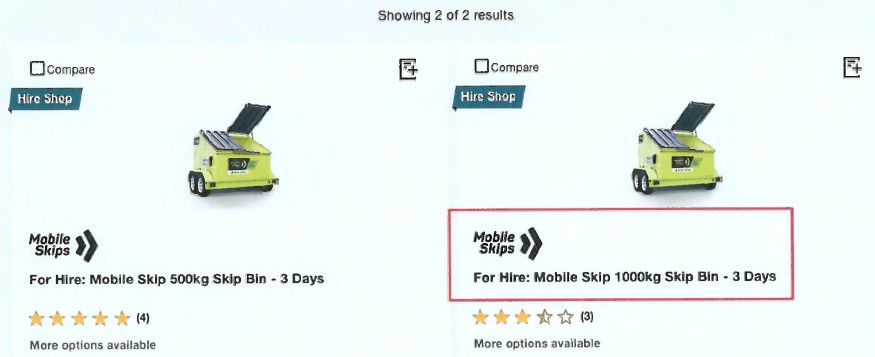
178 The Court does not attach significant weight to this webpage as evidence of use of the plain words “Mobile Skip” as use which does in fact distinguish the designated services as those of the applicant for the purposes of s 41(3) for the following reasons:
(a) The evidence before the Court does not disclose whether this webpage was published before the filing date on 2 September 2022.
(b) Although difficult to see, the livery on the bin itself includes the 817 Mark including the words “Mobile Skips”. The 816 Mark appears under the image of the skip bin. The fact that the webpage so prominently features the device mark is likely to diminish the extent to which the plain words “Mobile Skip” alone distinguished the designated services as those of the applicant (or its franchisees).
(c) The plain text words include “Mobile Skip” in the singular and as part of a series of words that are descriptive of the product being offered for hire. In context, the plain words and use of the singular are not used as a badge of origin; that is the purpose of the device mark. The customer is being informed that what is for hire is a mobile skip that is branded with the Mobile Skips device.
179 The evidence also discloses that the plain text words “Mobile Skips” appeared on the Bunnings website on the following webpage:
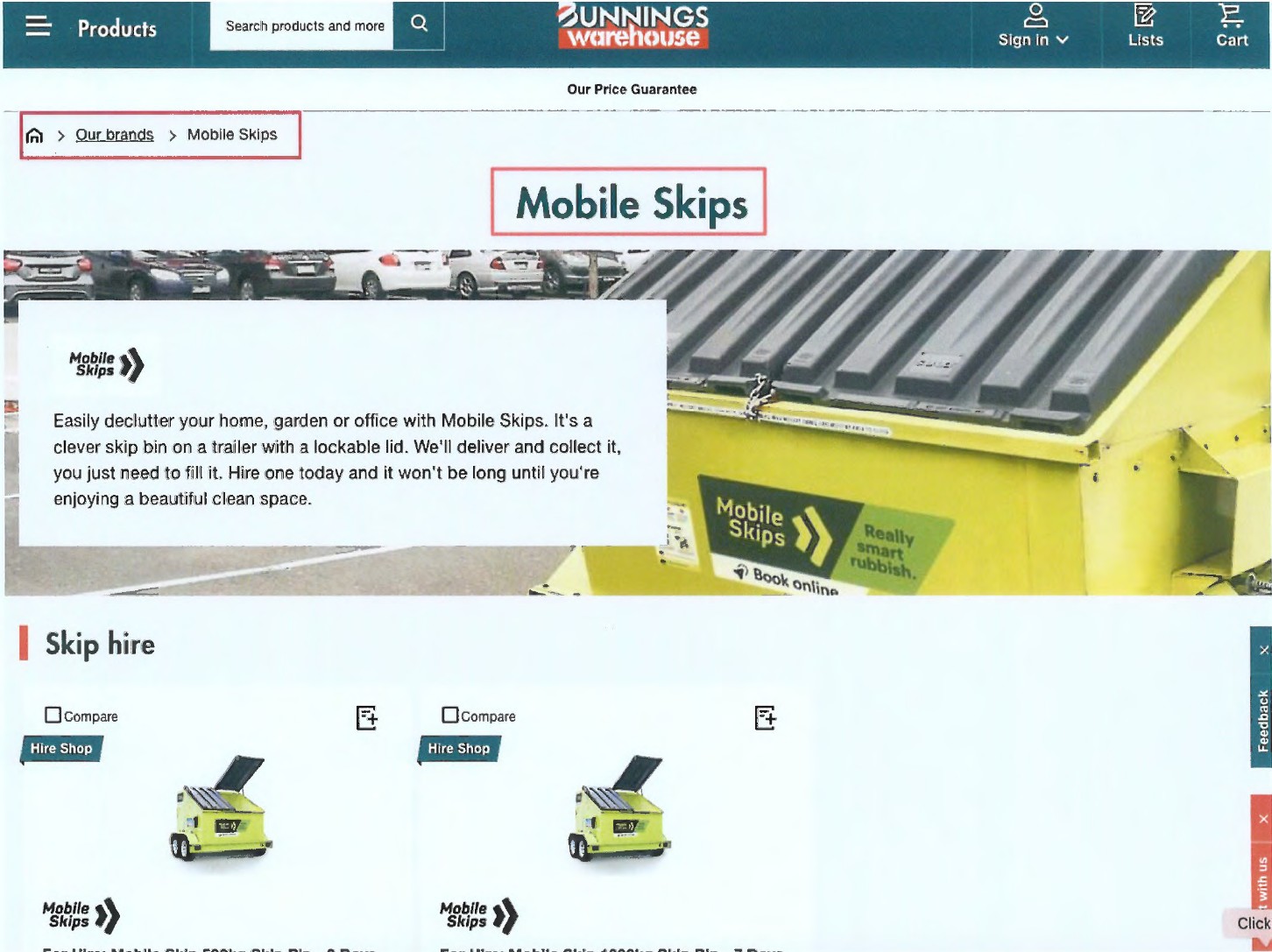
180 The use of the plain text “Mobile Skips” on this webpage is different from the webpage discussed above. First, the plain text words are consistently used in plural form. Second, the pathway description at the top of the page is “Our brands > Mobile Skips” denoting that “Mobile Skips” is a brand rather than a product. Thirdly, the webpage contains a specific description of the product as “a clever bin on a trailer with a lockable lid”. The webpage does not use the singular term “Mobile Skip” to describe the attribute of the product in the same way as the webpage above.
181 Nonetheless, the Court does not consider this webpage as evidence of significant use of the plain words “Mobile Skips” as use which does in fact distinguish the designated services as those of the applicant for the purposes of s 41(3) for the following reasons:
(a) The evidence before the Court does not disclose whether this webpage was published before the filing date on 2 September 2022.
(b) The 816 Mark is displayed prominently. The fact that the webpage prominently features the device mark is likely to diminish the extent to which the plain words “Mobile Skips” alone distinguished the designated services as those of the applicant (or its franchisees).
Social media
182 Mr Spencer referred in his affidavit to a video posted to Vimeo, dated from 2018 with over 2,900 views, and a title in plain text describing the clip as “Mobile Skips Franchisee Interview”. It includes the following:
(a) On the opening screen is a device resembling the 633 Mark with the chevrons above rather than to the right of the words “Mobile Skips”. The chevron is more prominent than the words “Mobile Skips”.
(b) On the next screen, it displays in plain text the name of the narrator and directly beneath his name the words in plain text “Mobile Skips, Melbourne West & CBD” (emphasis original). The picture on the screen is of the narrator standing in front of a skip bin with the same device as on the opening screen and lime green livery prominently displayed in the centre of the bin which is in the centre of the screen. Beneath the narrator is the caption “What is your background?” in plain text and to the left of that caption is the same device resembling the 633 Mark which is displayed clearly and prominently.
(c) The picture on the following screen is of the narrator standing to the right of the bin with the Mobile Skips device and lime green livery prominently displayed in the centre of the bin which is in the centre of the screen. Beneath the narrator is the caption in plain text “Can you describe the Mobile Skips business and what you do?” and to the left of that caption is the same device resembling the 633 Mark which is displayed clearly and prominently.
(d) The pictures on the next four screens are of the narrator standing to the right of the bin with the Mobile Skips device and lime green livery prominently displayed in the centre of the bin which is near the centre of the screen. Beneath the narrator are the captions in plain text “How long have you been a Franchisee Owner, and what about the business appealed to you?” and “What was transitioning from employee to business owner like for you?” and “What does a ‘standard’ day look like in the business?” and “Is there anything specific you found to focus on that has a big impact on success day to day?”. In each case to the left of the caption is the same device resembling the 633 Mark which is displayed clearly and prominently.
(e) On the closing screen is the same device mark resembling the 633 Mark.
183 The Court does not consider this Vimeo video as evidence of significant use of the plain words “Mobile Skips” as use in fact distinguishing the designated services as those of the applicant for the purposes of s 41(3) because the Mobile Skips device mark is displayed so prominently. The fact that the device mark is displayed so prominently makes it unlikely that the plain words “Mobile Skips” alone to any extent serve to distinguish the designated services as those of the applicant (or its franchisees).
184 The video posted by Bunnings to YouTube under a description in plain text “Tips for Using a Mobile Skip - DIY at Bunnings” from February 2016 contains the following:
(a) The title page is in Bunnings livery with a white chalk style plain text “Tips for using a mobile skip” (singular with no capitalisation).
(b) The first scene is of a man wearing a Bunnings uniform standing between two skips with the 633 Mark and lime green livery
185 The Court does not consider this YouTube video as evidence of significant use of the plain words “Mobile Skip” as use in fact distinguishing the designated services as those of the applicant for the purposes of s 41(3). The prominent display of the device mark and the reference on the title page to a “mobile skip” in the singular with no capitalisation makes it unlikely that the plain words “mobile skip” alone to any extent serve to distinguish the designated services as those of the applicant (or its franchisees). In the context of that video clip, the plain words “a mobile skip” are descriptive of the attributes on the product.
186 Mr Spencer in his affidavit also referred to a screenshot from a Bunnings “infomercial” for internal use within Bunnings. That screenshot shows the following:
187 The plain text words featured on the poster are “Mobile Skip”. The Court does not consider this extract as constituting evidence of significant use of the plain words “Mobile Skip” as use in fact distinguishing the designated services as those of the applicant for the purposes of s 41(3). The prominent display of the 816 Mark and the reference to “Mobile Skip” in the singular within the context of the phrase “Mobile Skip Hire” makes it unlikely that the plain words “Mobile Skip” alone to any extent serve to distinguish the designated services as those of the applicant (or its franchisees).
188 Mr Spencer identified screenshots from an interactive training module created with Bunnings for training Bunnings staff. Those screenshots include:
(a) A title page with Bunnings livery that has small print at the top left corner “Mobile Skips” in plain font and the title in large font, plain text “Welcome to Mobile Skips”.
(b) A screen shot of a page that has small print at the top left corner “Mobile Skips” in plain font with the 633 Mark prominently displayed in the centre of the screen.
(c) A screen shot of a page that has small print at the top left corner “Mobile Skips” in plain font with the question “What do Mobile Skips consider to be ‘heavy stuff’?” displayed in plain text. Included in an answer box on the right side of the screen in plain text, are the words “Mobile Skips are not filled with more than 5 wheelbarrows of these heavy items”.
(d) A screenshot of a page that has small print at the top left corner “Mobile Skips” in plain font with the title “How to place an order” in large bold plain text. Beneath that heading, four steps are listed in plain text. The second step is “Select the Mobile Skips logo”.
(e) A screen shot of a page that has small print at the top left corner “Mobile Skips” in plain font with the title “Completing paperwork” in large bold plain text. Beneath that heading is a sentence in plain font that includes “the customer will receive a text message from Mobile Skips confirming their order”. On the right side of the screen are small images that include the 633 Mark.
(f) A screenshot of a page that has small print at the top left corner “Mobile Skips” in plain font with the heading “Thanks for completing this training”. Beneath that heading in plain font includes a sentence: “Your Mobile Skip booking experience should be simple”. On the right of the slide is the 633 Mark.
189 Mr Spencer in his affidavit also referred to a video interview with a franchisee of the applicant’s business which was posted to Vimeo in 2020. The video had received 270 views. The video appears on Vimeo above a title in plain text “What’s it been like starting your own business? With Brian Gore, franchise owner Mobile Skips” and included the following:
(1) The opening images display:
(a) a still image of a skip bin in lime green livery with the 817 Mark displayed and the URL of the applicant’s website below the 817 Mark; and
(b) a still frame showing the franchisee wearing a shirt embroidered with the 816 Mark in green above the tagline from the 817 Mark (“Really smart rubbish”).
(2) Throughout the video, the franchisee appears in front of the lime green livery of a skip bin and the 817 Mark.
(3) Light and dark green coloured title cards with a sepia tone image of the franchisee or a skip bin or both. The sepia tone removes identifiable colours from the image. The title cards relevantly include the following questions in plain text:
(a) “What’s it been like starting your own business?” The sepia tone image is a still frame of the shot of the franchisee in front of a skip bin as described above.
(b) “When did you join Mobile Skips, and what attracted you to the business?” The sepia tone image is of a skip bin with the 817 Mark on the front and sides.
(c) “What has the support been like from Mobile Skips?”
(4) The closing screen features the 816 Mark with lime green chevrons and a logo for another business (“franchise buyer”).
190 Overall, the Court accepts that there is some evidence of use of the plain words “Mobile Skips” as use distinguishing the designated services as those of the applicant for the purposes of s 41(3). However, the evidence of use is diminished by the prominent display of the device mark, the lack of consistency in the use of Mobile Skips to refer to the product or the business.
191 Mr Simonetti’s expert report also included screenshots from the Product Review which provides consumer opinions on products, services and businesses in Australia. The website named “Mobile Skips” in plain text as a winner in the category of “best rubbish removers” in 2021 and 2022. The page also shows the 633 Mark prominently to the left. It is not clear from the evidence before the Court whether all suppliers listed on the Product Review website are displayed in plain text together with the supplier’s logo. In any case, the prominent display of the device mark dilutes the extent to which the plain text “Mobile Skips” is a designator of the origin of the product.
192 The name “Mobile Skips” has been used by the applicant in connection with its business for 16 years up to the filing date and there is no doubt that the applicant’s business is successful. It (together with its franchise network) owns 75% of the trailerable skip bin for hire market in Australia (owning over 540 of the 720 odd trailerable skips for hire in Australia). However, it is the device marks and green livery which have been most prominently used by the applicant to designate its product. The plain text term “Mobile Skips” alone has not acquired a distinctiveness which eclipses the ordinary signification of those words.
Disposition
193 The application is to be dismissed with costs.
194 The Court observes that although the Registrar has refused to register the plain word mark the words plus a device (the 633 Mark, the 816 Mark and the 817 Mark) are registered and remain registered.
I certify that the preceding one hundred and ninety-four (194) numbered paragraphs are a true copy of the Reasons for Judgment of the Honourable Justice Hespe. |
Associate:
Dated: 16 June 2026


