

Federal Court of Australia
Mijalkov v Minister for Immigration, Citizenship and Multicultural Affairs [2026] FCA 741
Appeal from: | Mijalkov v Minister for Immigration, Citizenship and Multicultural Affairs [2023] FedCFamC2G 999 |
File number: | WAD 313 of 2023 |
Judgment of: | VANDONGEN J |
Date of judgment: | 15 June 2026 |
Catchwords: | MIGRATION - appeal from decision of single judge of the Federal Circuit and Family Court of Australia (Div 2) - whether primary judge erred in finding no jurisdictional error by decision-maker - whether decision-maker failed to discharge statutory duty - appeal dismissed |
Legislation: | Migration Act 1958 (Cth) ss 65, 338, 348, 349, 358, 359, 360, 364, 476 Migration Regulations 1994 (Cth) regs 1.21, 1.22, 1.23, 1.24, 1.25, Sch 2 Migration Regulations 1994 - Specification of Evidentiary Requirements - IMMI 12/116 2012 (Cth) |
Cases cited: | Plaintiff M1/2021 v Minister for Home Affairs [2022] HCA 17; (2022) 275 CLR 582 Sok v Minister for Immigration and Citizenship [2008] HCA 50; (2008) 238 CLR 25 Tickner v Chapman (1995) 57 FCR 451 |
Division: | General Division |
Registry: | Western Australia |
National Practice Area: | Administrative and Constitutional Law and Human Rights |
Number of paragraphs: | 69 |
Date of last submission/s: | 10 February and 3 March 2026 (appellant) 24 February 2026 (respondent) |
Date of hearing: | 5 February 2026 |
Counsel for the Appellant: | Mr H Glenister |
Solicitor for the Appellant: | Savannah Legal |
Counsel for the First Respondent: | Mr CM Beetham |
Solicitor for the First Respondent: | Australian Government Solicitor |
Counsel for the Second Respondent: | The second respondent filed a submitting notice save as to costs |
ORDERS
WAD 313 of 2023 | ||
| ||
BETWEEN: | MARIN MIJALKOV Appellant | |
AND: | MINISTER FOR IMMIGRATION, CITIZENSHIP AND MULTICULTURAL AFFAIRS First Respondent ADMINISTRATIVE APPEALS TRIBUNAL Second Respondent | |
order made by: | VANDONGEN J |
DATE OF ORDER: | 15 JUNE 2026 |
THE COURT ORDERS THAT:
1. The appeal is dismissed.
2. The appellant is to pay the first respondent's costs of the appeal to be assessed if not agreed.
Note: Entry of orders is dealt with in Rule 39.32 of the Federal Court Rules 2011.
REASONS FOR JUDGMENT
VANDONGEN J:
1 The appellant was born in present-day Macedonia. In June 2017, the appellant applied for a Partner (Migrant) (Class BC) (Subclass 100) visa (visa). Before granting the visa the Minister for Immigration, Citizenship, Migrant Services and Multicultural Affairs (Minister) was required to be satisfied that certain criteria prescribed by the Migration Regulations 1994 (Cth) (Regulations) had been satisfied: 65(1)(a)(i) of the Migration Act 1958 (Cth) (Act). Two relevant criteria were that, at the time of the Minister's decision: (a) the relationship between the appellant and his sponsoring partner has ceased; and (b) the appellant had suffered family violence committed by his sponsoring partner after he first entered Australia: cl 100.221 in Sch 2 of the Regulations.
2 On 24 January 2020, a delegate of the Minister refused to grant the visa to the appellant because the delegate was not satisfied that the appellant had suffered family violence. The appellant then applied to the Administrative Appeals Tribunal (AAT) for a review of the delegate's decision. Ultimately, the appellant provided several documents to the AAT in support of his application for review including statutory declarations signed by the appellant and by a social worker, letters authored by a medical practitioner and several translated text messages. The appellant also gave evidence before the AAT.
3 The AAT had the further benefit of a report authored by an independent expert. As will be seen, the AAT's decision to obtain that report is part of the focus of the appeal.
4 The AAT ultimately affirmed the delegate's decision to refuse to grant the visa on 21 February 2023.
5 The appellant then applied, under s 476 of the Act, to the Federal Circuit and Family Court of Australia (Div 2) (FCFCOA) for judicial review of the AAT's decision. The primary judge concluded that the AAT's decision was not affected by jurisdictional error and dismissed the appellant's application. The appellant now appeals from that order.
6 For the following reasons the appeal must be dismissed.
7 To properly understand this appeal, it is necessary to begin by setting out the relevant legislative provisions that governed the AAT's review of the delegate's decision to refuse to grant the visa to the appellant.
Relevant legislative scheme
8 Pursuant to s 65 of the Act the Minister was to grant the visa to the appellant if satisfied of the matters set out in paras (i) to (iv) of s 65(1)(a). One of those matters was the criteria prescribed by the Regulations: s 65(1)(a)(ii). At the relevant time those criteria were set out in cl 100.221 in Sch 2 of the Regulations. The criterion that is relevant to the determination of this appeal appeared in cl 100.221(4)(c)(i):
(c) after the applicant first entered Australia as the holder of [a Subclass 309 (Partner (Provisional)) visa] - either or both of the following circumstances applies:
(i) either or both of the following:
(A) the applicant;
…
has suffered family violence committed by the sponsoring partner.
9 There is no issue that the appellant first entered Australia as the holder of a Subclass 309 (Partner (Provisional)) visa. The focus of this appeal is on the question of whether the AAT fell into jurisdictional error in reaching its decision that the appellant had not suffered family violence committed by his then wife, who was his sponsoring partner.
10 Division 1.5 of Pt 1 of the Regulations contained, and continues to contain, various '[s]pecial provisions' relating to 'family violence', including regs 1.22 to 1.25. Pursuant to reg 1.22(1), a reference in the Regulations to a person having suffered family violence is a reference to a person being taken, under reg 1.23, to have suffered family violence. Regulation 1.23 explained when a person was taken to have suffered family violence: reg 1.23(1)(a).
11 Regulation 1.23(9) relevantly provided as follows:
(9) For these Regulations, an application for a visa is taken to include a non‑judicially determined claim of family violence if:
(a) the applicant seeks to satisfy a prescribed criterion that the applicant, or another person mentioned in the criterion, has suffered family violence; and
(b) the alleged victim is:
(i) a spouse or de facto partner of the alleged perpetrator; or
…
(c) the alleged victim or another person on the alleged victim's behalf has presented evidence in accordance with regulation 1.24 that:
(i) the alleged victim has suffered relevant family violence; and
(ii) the alleged perpetrator committed that relevant family violence.
(emphasis in original)
12 There is no issue in this appeal that the appellant's application for the visa was taken to include a non-judicially determined claim of family violence, for the purposes of reg 1.23(9).
13 The phrase 'relevant family violence' was defined in reg 1.21 as follows:
relevant family violence means conduct, whether actual or threatened, towards:
(a) the alleged victim; or
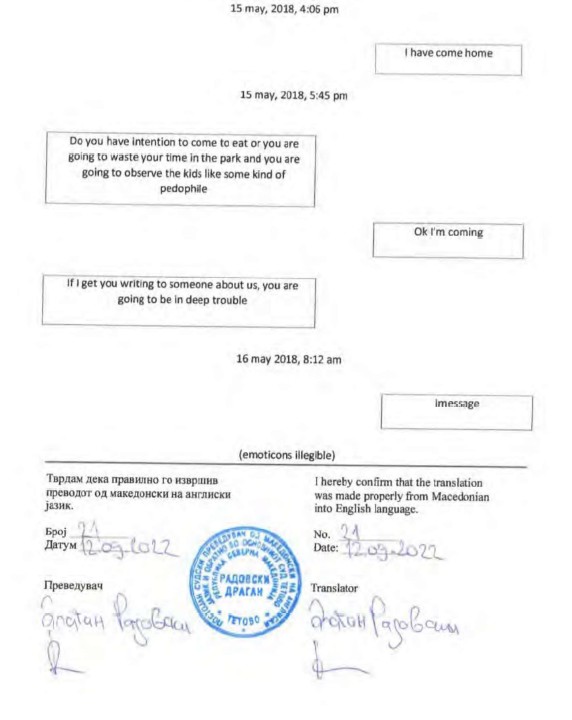
(b) a member of the family unit of the alleged victim; or
(c) a member of the family unit of the alleged perpetrator; or
(d) the property of the alleged victim; or
(e) the property of a member of the family unit of the alleged victim; or
(f) the property of a member of the family unit of the alleged perpetrator;
that causes the alleged victim to reasonably fear for, or to be reasonably apprehensive about, his or her own wellbeing or safety.
14 At the centre of this appeal is reg 1.23(10), which provided that if an application for a visa included a non-judicially determined claim of family violence:
(a) the Minister must consider whether the alleged victim has suffered relevant family violence; and
(b) if the Minister is satisfied that the alleged victim has suffered the relevant family violence, the Minister must consider the application on that basis; and
(c) if the Minister is not satisfied that the alleged victim has suffered the relevant family violence:
(i) the Minister must seek the opinion of an independent expert about whether the alleged victim has suffered the relevant family violence; and
(ii) the Minister must take an independent expert's opinion on the matter to be correct for the purposes of deciding whether the alleged victim satisfies a prescribed criterion for a visa that requires the applicant for the visa, or another person mentioned in the criterion, to have suffered family violence.
15 Pursuant to regs 1.23(11) and 1.23(13), respectively, an alleged victim is taken to have suffered family violence, and an alleged perpetrator is taken to have committed family violence, if an application for a visa includes a non‑judicially determined claim of family violence and:
(1) the Minister is satisfied under reg 1.23(10)(b) that the alleged victim has suffered relevant family violence; or
(2) the Minister is required by reg 1.23(10)(c)(ii) to take as correct an opinion of an independent expert that the alleged victim has suffered relevant family violence.
16 In each case the Minister must also be satisfied that the relevant family violence, or part of the relevant family violence, occurred while the married relationship or de facto relationship existed between the alleged perpetrator and the spouse or de facto partner of the alleged perpetrator: regs 1.23(12) and 1.23(14).
17 The Regulations also prescribed the evidentiary requirements for an application for a visa that included a non‑judicially determined claim of family violence. Under reg 1.24, those requirements were:
(1) a statutory declaration by the spouse or de facto partner of the alleged perpetrator (under reg 1.25); and
(2) the minimum evidence requirements specified by the Minister by instrument in writing, namely in the Migration Regulations 1994 - Specification of Evidentiary Requirements - IMMI 12/116 2012 (Cth).
18 At the relevant time, the delegate's decision to refuse to grant the visa was a 'Part 5-reviewable decision', as defined in s 338 of the Act. Pursuant to s 348 of the Act, the AAT was required to review the delegate's decision. When a visa application was refused and an applicant sought review of that decision by the AAT, and a criterion for granting the relevant visa the applicant claims to meet is that they have suffered domestic violence, the question - whether a person is taken under reg 1.23 to have suffered domestic violence - is committed to the AAT: Sok v Minister for Immigration and Citizenship [2008] HCA 50; (2008) 238 CLR 251 at [27].
19 In carrying out a review the AAT was able to exercise all of the powers and discretions that were conferred by the Act on the delegate: s 349(1). The AAT was also required to conduct the review in accordance with Div 5 of Pt 5 of the Act, including by considering documents given to it by an applicant for review (s 358), seeking information it considered relevant (s 359), inviting the applicant for a visa to appear before it to give evidence and present arguments (s 360) and considering evidence given before it (s 364).
20 Having identified the relevant legislative framework within which the appellant's application for the visa fell to be determined, it is convenient to briefly summarise the delegate's decision to refuse to grant the visa and the AAT's subsequent decision to affirm the delegate's decision.
The delegate's decision to refuse to grant the visa
21 The delegate decided to refuse to grant the visa to the appellant, concluding that the appellant had failed to satisfy the criteria in cl 100.221 of Sch 2 of the Regulations. Most relevantly, the delegate concluded that, although the appellant had advised the Department of Home Affairs (Department) in an unsigned letter dated 6 October 2019 that he had suffered family violence perpetrated by his former wife, he had not met the minimum evidence requirements. In the delegate's decision record it was said:
To date, you have not provided any evidence to support a family violence claim. This includes your own statutory declaration or any evidence to demonstrate that you have attempted to obtain the required documents. I consider that you have been afforded a reasonable time to provide these documents and I am not obliged to defer my decision further because information may be forthcoming in the future.
As you have failed to provide evidence as outlined above, you are not considered to have made a non-judicially determined claim of family violence and therefore you have not established that you have suffered family violence committed by your sponsor. This means that you have not satisfied the requirements of Division 1.5, which in turn means that you cannot satisfy the first alternative … within subclause (4) of clause 100.221.
This means that you cannot satisfy any of the alternative subclauses within clause 100.221. Therefore you and any secondary applicants included in this application cannot meet the requirements for grant of a subclass 100 visa.
22 On 3 February 2020, the appellant applied to the AAT for a review of the delegate's decision to refuse to grant the visa.
The AAT's decision to affirm the delegate's decision not to grant the visa
23 The AAT noted that it had before it the Department's file. It also noted that the appellant had provided it with a copy of the record of the delegate's decision to refuse to grant him the visa.
24 After the appellant was invited by the AAT to provide evidence in support of his application for review of the delegate's decision, the AAT received a statutory declaration made by the appellant on 27 May 2022. In that statutory declaration the appellant alleged that he had been the victim of relevant family violence, and he identified that it was his former wife who he alleged to have been the perpetrator of that family violence. The appellant also appeared before the AAT on three separate occasions 'to give evidence and present arguments'.
25 The AAT also noted that the appellant had provided a letter from his general practitioner, Dr Michael Khalil, dated 25 May 2023. According to the AAT, the letter from Dr Khalil referred to the fact that the appellant had been given antidepressants and referred to a psychologist. The AAT said that it accepted that the description provided by Dr Khalil suggested conditions likely to have been the result of family violence and that Dr Khalil considered that the appellant had been the subject of family violence perpetrated by his former wife.
26 In its reasons for decision, the AAT also recorded that it had received a statutory declaration made by Ms Michèle Cohen, an accredited social worker, on 18 May 2022. The AAT said:
[t]he [appellant] provided a statutory declaration declared by Mich[è]le Cohen, accredited social worker, on 18 May 2022. Ms Cohen reports she first saw the [appellant] in February 2020. Ms Cohen reports she conducted the Depression, Anxiety and Stress Scales and the PCL-5 PTSD checklist for DSM 5. Ms Cohen identifies the [appellant] is a classic victim of family and domestic violence perpetrated by his partner. The statutory declaration contains Ms Cohen's opinion that the [appellant] was subject of family violence, details a reason for her opinion, and identifies the alleged perpetrator of the family violence
27 The AAT also noted that it received oral evidence from a Ms Silvana White.
28 The AAT identified that the critical issue it was required to determine was whether the appellant had suffered family violence committed by his former wife. In that context the AAT said the following at paras 29 to 31 of its reasons for decision:
The [appellant] claims he came to Australia to live with his wife on 1 March 2018 with €700 in his bank account. His wife took him to the casino the day after he arrived. She became enraged at him after he refused to give her his winnings and started throwing his belongings onto the street. The [appellant] claims his wife would transfer money to his bank account and withdraw funds so that her bank statements would not show ATM withdrawals at the casino. The [appellant] claims his wife was put on a blacklist so she could not draw from her account at the casino. The [appellant] was unable to substantiate his claim his wife had a gambling addiction. The [appellant] did not provide copies of his bank account statements to support his contention his wife forced him to use his account to withdraw money at the casino.
The Tribunal was unconvinced by the [appellant's] oral evidence which closely reflected the claims in his statutory declaration. The [appellant] was unable to elaborate on his claims when asked for detail or clarification.
Having considered all of the evidence before it, the Tribunal was not satisfied for the purposes of reg 1.23 that the [appellant] has suffered relevant family violence. In accordance with that regulation, the Tribunal sought the opinion of an independent expert.
29 As will be seen, the ground of appeal on which the appellant relies is concerned with these passages taken from the AAT's reasons for decision.
30 The reasons of the AAT then recorded that the independent expert ultimately provided an opinion that the appellant had not suffered relevant family violence. In the circumstances it is unnecessary to further summarise the AAT's decision. This is because the AAT was required to take the independent expert's opinion to be correct (reg 1.23(10)(c)(ii)), with the result that the appellant was found not to have met the criterion for the grant of the visa in cl 100.221(4)(c)(i) in Sch 2 of the Regulations.
31 The appellant then sought judicial review of the AAT's decision in the FCFCOA.
The primary judge's decision to dismiss the appellant's application for judicial review
32 There was no dispute before the primary judge that the AAT was required to consider the appellant's non-judicially determined claims of family violence. In that regard, the parties approached the question of whether the AAT had fallen into jurisdictional error on the basis that the principles in Plaintiff M1/2021 v Minister for Home Affairs [2022] HCA 17; (2022) 275 CLR 582 were applicable. In other words, that in determining whether the appellant had suffered family violence, and before seeking the opinion of an independent expert under reg 1.23(10)(c)(i) of the Regulations, the AAT was required to read, identify, understand and evaluate the appellant's claims of having suffered family violence.
33 The appellant argued that the AAT had fallen into jurisdictional error because it had failed to consider the appellant's claims that he had suffered family violence, and that it thereby failed to discharge its statutory duty to conduct a review of the delegate's decision. That argument focussed on paras 29 to 31 of the AAT's reasons for decision, which I have reproduced at [29] of these reasons.
34 In essence, the appellant contended that those paragraphs demonstrate that the AAT only addressed one of his claims that he had suffered family violence, namely an incident that was alleged to have occurred at a casino at the start of his relationship with his sponsor, and that it failed to address the other claims on which he relied. In that regard, the appellant asserted that there was evidence of claims that was not referred to in the AAT's reasons for decision. That evidence consisted of the appellant's statutory declaration, letters from the appellant's doctor, Ms Cohen's statutory declaration, correspondence sent to the Department by a family dispute resolution practitioner (Ms Emerson Munro), correspondence sent by the appellant himself to the Department, as well as a series of text messages.
35 The primary judge rejected the appellant's contentions and concluded that the AAT had not failed to consider the appellant's claims that he had suffered family violence. Accordingly, the primary judge dismissed the appellant's application for judicial review.
36 It is unnecessary to further summarise the primary judge's reasons. This is because both parties approached the appeal on the basis that the critical question to be determined is whether the AAT fell into jurisdictional error as alleged.
Did the AAT fall into jurisdictional error?
37 The appellant argues that an inference should be drawn from the AAT's reasons at paras 29 to 31, which I have reproduced earlier at [29] of these reasons, that the AAT failed to consider all of his claims that he suffered relevant family violence and that it thereby fell into jurisdictional error.
38 The appellant contends that, at para 29 of its reasons, the AAT referred in some detail to claims the appellant made about his wife's conduct at Crown Casino, but did not refer to any of his other claims that he had suffered relevant family violence some of which involved physical abuse that the appellant says constituted the most serious of his claims. The appellant argues that, when paras 29 to 31 are read as a whole, it should be inferred that the AAT only considered some but not all of his claims. The appellant also relies on the fact that there was no mention of a series of text messages that were before the AAT, which he argues disclosed abuse from his sponsor and tended to corroborate his claims to have suffered relevant family violence.
39 As I have already explained, in reviewing the delegate's decision to refuse to grant the visa to the appellant, the AAT was required to determine whether the criterion for the grant of the visa prescribed by cl 100.221(4)(c)(i) in Sch 2 of the Regulations had been met, namely, whether the appellant had suffered family violence committed by his sponsoring partner. In the context of the issues raised by the ground of appeal, this relevantly meant that the AAT was required to 'consider whether the [appellant had] suffered relevant family violence' (emphasis added): reg 1.23(10)(a).
40 In Tickner v Chapman (1995) 57 FCR 451 at 495, Kiefel J (as her Honour then was) noted that the word 'consider' is a word having definite meaning in the judicial context. Her Honour concluded that the intellectual process preceding the decision to be made in the statutory context in which that case was decided, under which the relevant decision-maker was required to consider representations made by interested persons, was not materially different. In a passage that was cited with approval by Kiefel CJ, Keane, Gordon and Steward JJ in Plaintiff M1 at [24], her Honour said that, in considering the representations, the decision-maker was required to:
have regard to what is said in the representations, to bring his [or her] mind to bear upon the facts stated in them and the arguments or opinions put forward and to appreciate who is making them. From that point the [decision-maker] might sift [the representations], attributing whatever weight or persuasive quality is thought appropriate.
41 In the circumstances of this case, reg 1.23(10)(a) of the Regulations required the AAT to 'consider whether' the appellant had suffered relevant family violence. The ordinary meaning of the phrase 'consider whether' describes a process involving the assessment or evaluation of different possibilities or outcomes before reaching a conclusion. However, when reg 1.23(10)(a) is considered in the context of reg 1.23 as a whole, it is plain that the AAT was required to not only assess or evaluate whether the appellant had suffered relevant family violence, but also to decide whether it was satisfied or not satisfied that the appellant had suffered relevant family violence. That this is what the AAT was required to do is confirmed by paras (b) and (c) of reg 1.23(10), which operate on the premise that a relevant decision-maker has either been 'satisfied' or was 'not satisfied', respectively, that an applicant for a visa 'suffered the relevant family violence'.
42 The scope of the relevant assessment or evaluation required by reg 1.23(10)(a) will necessarily depend on the claims of relevant family violence that are made by an applicant for a visa and that are before the decision-maker. In that regard, it may be expected that claims will emerge from the evidence that is presented in accordance with reg 1.24, as required by reg 1.23(9)(c). However, in conducting its review the AAT was not confined to consider only the claims of family violence the appellant made to the delegate: Sok at [28] to [29]. By extension, the AAT was not confined to consider only those claims that were made in the evidence the appellant presented to the delegate in accordance with reg 1.24.
43 At the hearing of the appeal, it became apparent that the claims the appellant contended had not been considered by the AAT had not been identified with sufficient particularity. Accordingly, after the hearing of the appeal the appellant filed a document entitled 'List of Conduct Relied Upon Before the [AAT] as Relevant Family Violence' (List of Conduct). The appellant contended that the List of Conduct identified the various claims the appellant had made before the AAT that he had suffered relevant family violence.
44 In written submissions that were subsequently filed by the Minister, no issue was taken with the proposition that evidence of the 'conduct' identified in the List of Conduct had been before the AAT at the time it decided to affirm the delegate's decision to refuse to grant the visa to the appellant.
45 It is necessary to consider each item in the List of Conduct in turn.
Psychological and emotional abuse including isolation from friends and the wider community
46 The appellant contends that this claim was not considered by the AAT. The appellant says that the claim was before the AAT because it was made in an email that was sent to the Department on 3 October 2019 by Ms Munro, a family dispute practitioner who was providing advocacy services in relation to the appellant's visa application. Although there is no specific evidence that this email was before the AAT, I will proceed on that basis because the Minister did not contend otherwise and because the AAT itself said that it had before it a copy of the Department's file.
47 In the email, Ms Munro relevantly claimed that the appellant:
separated from his wife in August 2019 after being subjected to debilitating psychological and emotional abuse including isolation from friends and the wider community
48 Assuming, without deciding, that this could constitute a claim that the appellant had suffered 'relevant family violence' within the meaning of that phrase in reg 1.21, it may be accepted that the AAT did not make specific reference to it in its reasons for decision. However, it does not follow that it was not considered by the AAT.
49 It is important to appreciate that, by operation of reg 1.23(9)(c), the appellant's application for the visa could not have been taken to include a non-judicially determined claim of family violence unless the appellant had presented evidence that he had suffered relevant family violence in accordance with reg 1.24. Relevantly, this meant that the appellant was required to make and present a statutory declaration. In that context, the AAT expressly observed at paras 23 and 25 of its reasons that the appellant sought to rely on evidence that included a statutory declaration that was made by him on 25 May 2022.
50 It is also necessary to note that at para 30 of its reasons the AAT said that it was 'unconvinced by the [appellant's] oral evidence which closely reflected the claims in his statutory declaration. The [appellant] was unable to elaborate on his claims when asked for detail or clarification' (emphasis added). It is plain, therefore, that the AAT considered all of the claims that the appellant had suffered 'relevant family violence' that the appellant made in his oral evidence. The appellant did not suggest otherwise. However, based on the AAT's unchallenged statement that the appellant's oral evidence 'closely reflected the claims in his statutory declaration', it necessarily follows that the AAT must have also considered, and rejected, the claims the appellant made in that document.
51 It is convenient at this point to set out the appellant's statutory declaration in full:
I, Marin Mijalkov …
make the following declaration under the Statutory Declarations Act 1959:
1. I came to live with my wife in Australia on 1 March 2018. Unfortunately, our marriage came under great pressure due to my wife's gambling addiction. I confirm that we separated on the 18 August 2019. Throughout the marriage I was a subjected to on going [sic] psychological and emotional abuse as well as physical abuse, she used to throw glasses and pots at me.
2. The day after I arrived in Australia my wife … took me to the Crown Casino. At one point during the evening, I refused to give her my winnings so she could continue gambling, and we went home [my wife] become [sic] enraged with me and then started, crying and yelling. At about 3.00 in the morning, she started throwing my belongings onto the street. Her daughter intervened and helped to calm her down.
3. I realised that [my wife] had a gambling addiction. Her family have since confirmed that this has been instrumental in the breakdown of her previous relationship.
4. During the time we lived together as husband and wife, [my wife] would often suggest that we go to the casino, usually under the pretext of having dinner. When we arrived, she would not allow me to speak and we could not go home until she was ready. She would transfer money to my bank account and then take my card to withdraw the funds so that the Crown Casino ATM would not register on her bank statement.
5. [My wife] would often go to the casino with a girlfriend … and stay there gambling until 5am in the morning. When she arrived home, I was not allowed to talk to her or ask her if she had lost money. However, if she had lost money at the casino, she would become extremely upset and start screaming and throwing things at me.
6. As the situation worsened, I refused to go to the casinos with her and I suggested we talk with her parents about the gambling problem. [My wife] threatened that if I told her parents or her brother that she was gambling, she would cancel my visa and have me sent back to Macedonia.
7. On 18 August 2019, I visited [my wife's brother] to talk with him about my concerns. When [my wife] found out that I had met her brother, she packed my belongings and put them in our garage. She sent me a text message telling me to collect my things because our marriage was finished. She would not discuss anything with me. She threatened to send me back to Macedonia again and said I 'would not arrive alive.'
8. Throughout the relationship, I suffered with headaches, not eating, and at times contemplated suicide but never self-harmed. After our separation, a friend persuaded me to see a doctor. I am now being treated for anxiety and depression. I hope this will resolve as I build a life for myself away from the stress of my marriage.
9. [My wife] controlled every aspect of my life. She did not want me to go to work or meet new people. She would look at my Facebook page and tell me who I could be friends with and who I could talk with. When I tried to make friends or visit people, she would insist that I stay at home and not meet them. I was so ashamed and too frightened to tell anyone what was going on. I was also too scared to get help because I believed her threats that she would pay someone in my community to kill me and send my body back to Macedonia.
10. Whilst I was married, I enrolled in English classes on Saturday mornings to improve my English so that I could engage more meaningfully with my new community. However, ever [sic] Saturday morning [my wife] would make conflicting arrangements so that I could never attend the classes. She did this deliberately so that I did not mingle with other people or tell anyone what was really going on at home between us.
11. At some point in the marriage we bought a family pack of three iPhones. Without my knowledge, [my wife] set up the phones so that she has full access to all my text messages, emails and could view all records of my phone calls. Her surveillance of my phone continued after our separation. I knew this to be the case because I never divulged to her where I was living but through accessing my text messages she found out that I had an appointment with my doctor on 12 September 2019. On 12 September 2019, [my wife] went to the doctor's office and demanded that the receptionist give her my new address, the reasons for my consultation and information about what I had discussed with my doctor.
12. After we separated, [my wife] told me I was not allowed to speak with anyone at the Department of Home Affairs. When I contacted Immigration Adviser… [my wife] sent a text to my friend … to say that she had reported [the Immigration Adviser] to the Department. By this I think she meant she made a complaint about her to the Immigration Department because she had communicated with me.
13. [My friend] has been helping me since the separation but [my wife] continues to send him abusive text messages and harasses him because of his friendship with me.
14. [My wife] discovered that a friend of hers … was also a friend of mine on Facebook. She sent him a text message saying that the Immigration Department had requested that she provide the Department with all the names of people communicating with me in Australia. [My wife's friend] sent me a copy of her text message and his mobile number in case the AAT would like to speak with him about [my wife].
15. [My wife] has contacted everyone on my Facebook page and threatened to report them to the Immigration Department if they talk with me or have anything to do with me. She has harassed so many people that I have had 'unfriended' many of [indistinct] that she would stop contacting them.
16. [My wife] and I made the application for my partner visa online. I no longer have access to my application and cannot log on to the system. I believe [my wife] may have changed the password settings.
17. I was the victim of family and domestic violence in my marriage to [my wife]. She hit me and threw physical objects at me such as cups, crockery and glasses. She abused me mentally and psychologically by threatening to have me deported to Macedonia if I did not obey all her wishes and instructions such as never to tell anyone she was gambling our money away using my bank account. She isolated me from the Macedonian community by forbidding me to have contact with or talk to anyone from the Macedonian community without her permission. She isolated me socially from the Australian community by not allowing me to attend my English classes on a Saturday morning or to make friends with or talk to anyone without her permission. She abused me mentally by repeatedly threatening to have me killed and my body sent back to Macedonia. She also threatened to hurt my family in Macedonia and would not allow me to have contact with my children unless she knew about it. I did not know that this was called domestic violence. I went to see a counsellor because I felt so lost and depressed. The counsellor explain [sic] to me that [my wife] had perpetrated domestic violence against me. I was so embarrassed and ashamed I could not talk to anyone or tell anyone about what was going on. I couldn't take it anymore so one day I went to talk to her brother. I told him about the abuse and [my wife's] gambling addiction. When she found out I had spoken to her brother she ended our marriage on the same day.
18. Despite the breakdown of my marriage and my loss of confidence and my will to live sometimes, I have grown to love Perth and the Australian community. I now have a full-time job and would like to build a new life in Australia. I would greatly appreciate your consideration of my application to remain in Australia. Please let me know if you require further information, letters from my friends, or a statutory declaration from my doctor.
I understand that a person who intentionally makes a false statement in a statutory declaration is guilty of an offence under section 11 of the Statutory Declarations Act 1959, and I believe that the statements in this declaration are true in every particular.
52 It may be seen that the appellant claimed at para 1 of his statutory declaration that he had been subjected to 'on going [sic] psychological and emotional abuse' throughout his marriage. Further, at paras 9 and 10 of his statutory declaration the appellant claimed that during their marriage, his former wife controlled every aspect of his life, including by isolating him from friends and the wider community. Accordingly, the allegation made in Ms Munro's email on which the appellant relies did not amount to a discrete claim that the appellant had suffered relevant family violence, and it added nothing to the claims made in the appellant's statutory declaration, which, as I have said, were considered and rejected by the AAT.
53 It follows that, contrary to the appellant's contention, in carrying out its statutory task under reg 1.23(10) the AAT did consider the appellant's claim that he had suffered psychological and emotional abuse including isolation from friends and the wider community.
Ongoing psychological and emotional abuse by the sponsor in relation to gambling at the Casino
54 In the List of Conduct, the appellant contended that he had made several claims that he suffered relevant family violence in the form of psychological and emotional abuse by his former wife in relation to gambling at the Casino. The appellant argued that he had claimed that his former wife had become enraged, cried and yelled, and had thrown his belongings into the street, that she had screamed and thrown things, and that she had threatened to cancel his visa and have him removed from Australia, 'perhaps not alive'.
55 The appellant asserted that these 'claims' were made in his unsigned letter to the Department, which I have already referred to at [22] of these reasons.
56 On the assumption that those amounted to claims that the appellant had suffered 'relevant family violence' within the meaning of that phrase in reg 1.21, the AAT did expressly refer to the claim that the appellant's former wife had become enraged and had thrown his belongings onto the street, contrary to the appellant's contentions: see para 29 of the AAT's reasons for decision. Further, although the AAT did not specifically refer to the other 'claims' in its reasons for decision, all of these 'claims' were made in the appellant's statutory declaration, which the AAT considered and rejected: see paras 1, 2, 5, 6, 7 and 17 of the appellant's statutory declaration.
57 It follows that the appellant's argument that the AAT failed to consider the claims that are the subject of this item in the List of Conduct must also be rejected.
Coercive and controlling behaviour
58 In this item in the List of Conduct, the appellant asserted that he had also made the following claims in his unsigned letter to the Department that he had suffered relevant family violence:
(1) When the appellant was at the Casino with his former wife, she had restricted his movement and speech, and had made him provide her with cash for gambling.
(2) The appellant's former wife had controlled whether he could work, meet people and who he communicated with on Facebook.
(3) The appellant's former wife had made conflicting arrangements so that he could not attend English classes.
(4) The appellant's former wife had monitored his messages, calls and appointments, and had essentially 'stalked' him.
59 Once again, on the perhaps questionable assumption that all this alleged conduct could amount to 'relevant family violence', for the purposes of reg 1.21, it can be seen that these claims were all made in the appellant's statutory declaration: see paras 4, 9, 10 and 11. Accordingly, the appellant's contention that the AAT failed to consider the claims that are the subject of this item in the List of Conduct cannot be accepted.
Claims made by Ms Cohen
60 As I have already noted at [27] of these reasons, the AAT recorded in its reasons for decision that it had received a statutory declaration made by Ms Cohen. It did not, however, refer to a letter written by Ms Cohen dated 20 December 2021, on which the appellant relies. Nevertheless, Ms Cohen's letter was in virtually identical terms to her statutory declaration.
61 The appellant contends that several claims that he had suffered relevant family violence were set out in both Ms Cohen's letter and in her statutory declaration, and that the AAT failed to consider those claims. According to the appellant, those claims were that:
(1) The appellant's former wife subjected him to verbal, mental and emotional abuse if he challenged her erratic behaviour and gambling.
(2) The appellant suffered physical abuse and threats to have him deported.
(3) The appellant was subjected to social isolation from the Macedonian community in Perth, his work options were limited and communication with his family in Macedonia were disallowed by his former wife.
(4) The appellant was subjected to verbal and physical abuse when he disobeyed his former wife.
(5) The appellant was denied access to money, and his former wife threw glasses and crockery at him.
(6) The appellant was physically abused by being hit and punched, and glasses and other heavy objects were thrown at him.
62 However, all of those 'claims' were made in paras 1, 2, 5, 6, 7, 9 and 17 of the appellant's statutory declaration, which, as I have already said, was considered by the AAT.
The appellant's sponsor abused him in a text message chain
63 Based on the materials that are before the Court, it appears that the appellant's authorised recipient of communications from the AAT, Ms White, sent an email to the AAT on 20 September 2022 on behalf of the appellant, attached to which were some documents. One of those documents was a translation of a chain of text messages. Those translated text messages were in the following form:
64 The appellant submits that the text message chain 'tends to show the sponsor abusing the [appellant]' and that it 'disclosed abuse directed towards the [appellant] from the sponsor and tended to corroborate his claims to have suffered family violence'. Presumably those submissions focus on the final text message in that chain, and on a contention that the appellant's former wife sent it to the appellant while they were still married.
65 It may be accepted that the AAT did not refer to the text message chain in its reasons for decision. However, to the extent that the appellant's submissions tend to suggest that the AAT failed to have regard to evidence that may have supported his claims that he had suffered relevant family violence, that submission does not advance the contention made in the only ground of appeal, namely that the AAT failed to consider the appellant's claims to have suffered family violence.
66 If the appellant's submission is that the text message chain constitutes a claim by the appellant that he suffered family violence, then that submission must be rejected. Having regard to the meaning of the phrase 'relevant family violence' in reg 1.21, which I have reproduced earlier in these reasons at [14], it may be seen that it is comprised of three elements:
(1) conduct, whether actual or threatened;
(2) towards a person referred to in paras (a) to (f) of the definition who is either the 'alleged victim' or someone, or something, connected to the 'alleged victim'; and
(3) that causes the alleged victim to reasonably fear for, or to be reasonably apprehensive about, his or her own wellbeing or safety.
67 For present purposes it may be accepted that the relevant text message chain, and the final text messages in particular, amounted to conduct towards the appellant. However, there was no evidence before the AAT that the text messages caused the appellant to reasonably fear for, or to be reasonably apprehensive about, his own wellbeing or safety. It follows that this text message chain did not amount to a claim in respect of which the AAT was required to consider whether the appellant had suffered relevant family violence for the purposes of reg 1.23(10)(a).
Conclusion
68 The appellant has failed to establish that the AAT fell into jurisdictional error by failing to consider the appellant's claims to have suffered relevant family violence. It follows that the appellant has failed to establish that the primary judge erred in concluding that his application for judicial review should be dismissed.
69 The appeal must be dismissed.
I certify that the preceding sixty-nine (69) numbered paragraphs are a true copy of the Reasons for Judgment of the Honourable Justice Vandongen. |
Associate:
Dated: 15 June 2026


