Federal Court of Australia
Yalpirakinu Aboriginal Land Trust v Mount Denison Proprietors Pty Ltd [2026] FCA 732
File number(s): | NTD 15 of 2024 |
Judgment of: | O'SULLIVAN J |
Date of judgment: | 11 June 2026 |
Catchwords: | CONSTITUTIONAL LAW — application for declaration that s 27(3) of the Livestock Act 2008 (NT) is invalid or inoperative pursuant to s 109 of the Constitution insofar as it is inconsistent with the Aboriginal Land Rights (Northern Territory) Act 1976 (Cth) — where the power of the Legislative Assembly of the Northern Territory under the Northern Territory (Self Government) Act 1978 (Cth) in relation to the making of laws extends to the making of laws regulating or authorising the entry of persons onto Aboriginal land and that are capable of operating concurrently with Commonwealth laws — whether, by permitting a livestock owner to issue a notice in accordance with s 27(3) of the Livestock Act, s 27, insofar as it purports to apply to Aboriginal land, impairs or detracts from the operation of the Aboriginal Land Rights (Northern Territory) Act — where applicant contends that s 27(3) of the Livestock Act empowers livestock owners to unilaterally grant themselves a licence to enter Aboriginal land and is inconsistent with the protections afforded to traditional owners of Aboriginal land under the Aboriginal Land Rights (Northern Territory) Act — no inconsistency — application dismissed STATUTES — INTERPRETATION — application for declaration that a notice (Third Notice) issued by the respondent to the applicant pursuant to s 27 of the Livestock Act was invalid and of no effect — where applicant contends that the respondent did not make reasonable attempts to reach an agreement with the applicant prior to the issuance of the Third Notice as required by s 27(3) of the Livestock Act — where respondent made unsuccessful attempts to contact one of the Traditional Owners prior to issuing the Third Notice — where respondent subsequently, and prior to issuing the Third Notice, issued notices pursuant to s 27 of the Livestock Act informing the relevant Land Council of its intention to enter the Land and muster its livestock — reasonable attempts made by the respondent in the circumstances — Third Notice valid under s 27 of the Livestock Act — application dismissed DECLARATION — application for declaration that muster of livestock by the respondent on the Land was not authorised by s 27 of the Livestock Act— where respondent did not comply with Third Notice — where applicant contends that the muster was therefore unauthorised by s 27 of the Livestock Act— where non-compliance with a notice issued under s 27 of the Livestock Act creates an offence of strict liability and does not render the muster unauthorised — application dismissed |
Legislation: | Aboriginal Land Rights (Northern Territory) Act 1976 (Cth), ss 3(1), 4(1), 5(1)(b), 19, 19(1), 19(4A), 19(5)(c), 19(7), 19(11), 19(13), 23, 23(1), 66, 69, 70, 70(1), 70(2A)(h), 70(3), 70(5), 70A-70G, 71, 71(1), 73, 73(1), 73(1)(b), 74, 74(1) Commonwealth of Australia Constitution Act, ss 109, 122 Northern Territory (Self-Government) Act 1978 (Cth), s 6 Livestock Act 2008 (NT), ss 23(6)-(9), 27, 27(2), (3), (4), (6)(a), (8), (9) |
Cases cited: | Carr v Western Australia [2007] HCA 47; (2007) 232 CLR 138 Clarkson v The Queen [2007] NSWCCA 70; (2007) 209 FLR 387 Dickson v The Queen [2010] HCA 30; (2010) 241 CLR 491 Director of Public Prosecutions (DPP) v Le [2007] HCA 52; (2007) 232 CLR 562 Ex parte McLean (1930) 43 CLR 472 Jemena Asset Management (3) Pty Ltd v Coinvest Ltd [2011] HCA 33; (2011) 244 CLR 508 Kennedy v Australian Fisheries Management Authority [2009] FCA 1485; (2009) 182 FCR 411 Murray Meats (NT) Pty Ltd v Northern Territory Planning Authority (1982) 69 FLR 32 Project Blue Sky Inc v Australian Broadcasting Authority [1998] HCA 28; (1998) 194 CLR 355 R v Kearney; Ex parte Japanangka [1984] HCA 13; (1984) 158 CLR 395 R v Kearney; Ex parte Northern Land Council [1984] HCA 15; (1984) 158 CLR 365 R v Rogers (1996) 86 A Crim R 542 Williams v Wreck Bay Aboriginal Community Council [2019] HCA 4; (2019) 266 CLR 499 Work Health Authority v Outback Ballooning Pty Ltd [2019] HCA 2; (2019) 266 CLR 428 |
Division: | General Division |
Registry: | Northern Territory |
National Practice Area: | Administrative and Constitutional Law and Human Rights |
Number of paragraphs: | 243 |
Dates of hearing: | 10 - 11 June 2025 |
Counsel for the Applicant: | Ms F Gordon KC with Ms J Wang |
Solicitor for the Applicant: | Central Land Council |
Counsel for the Respondent: | Mr C Ford SC with Ms C Heske |
Solicitor for the Respondent: | Piper Grimster Jones Lawyers |
Counsel for the Intervener: | Mr N Christrup SC with Ms M Moloney |
Solicitor for the Intervener: | Attorney-General’s Department |
ORDERS
NTD 15 of 2024 | ||
| ||
BETWEEN: | YALPIRAKINU ABORIGINAL LAND TRUST Applicant | |
AND: | MOUNT DENISON PROPRIETORS PTY LTD (ACN 009 591 655) Respondent | |
ATTORNEY-GENERAL FOR THE NORTHERN TERRITORY Intervener | ||
order made by: | O'SULLIVAN J |
DATE OF ORDER: | 11 June 2026 |
THE COURT ORDERS THAT:
1. The applicant’s application for a declaration that s 27(3) of the Livestock Act is invalid or inoperative insofar as it purports to apply to Aboriginal land as defined in s 3(1) of the Aboriginal Land Rights (Northern Territory) Act 1976 (Cth), is dismissed.
2. The applicant’s application for a declaration that the notice issued by Mount Denison on 27 August 2024 under s 27(3) of the Livestock Act 2008 (NT)is invalid and of no effect, is dismissed.
3. The applicant’s application for the declaration that Mount Denison’s muster on the Land conducted 12 September 2024 was not authorised by s 27 of the Livestock Act 2008 (NT), is dismissed.
Note: Entry of orders is dealt with in Rule 39.32 of the Federal Court Rules 2011.
REASONS FOR JUDGMENT
O’SULLIVAN J:
1 Yalpirakinu Aboriginal Land Trust was established in 1988 under s 4(1) of the Aboriginal Land Rights (Northern Territory) Act 1976 (Cth), holding Northern Territory Portion 3038 (Land) on trust for the benefit of Aboriginals entitled by Aboriginal tradition to the use and occupation of the Land.
2 The Land covers an area of approximately 2,515 square kilometres and was formerly known as Mount Allan Station. Mount Denison Proprietors Pty Ltd operates a cattle station which is directly to the north of the Land and abuts its northern boundary.
3 An extract from a Northern Territory Pastoral Districts Map showing Yalpirakinu and Mount Denison Station was received into evidence and is at Annexure A to these reasons.
4 A dispute has arisen between Yalpirakinu and Mount Denison in relation to a muster conducted on the Land by Mount Denison on 12 September 2024, purportedly under the authority of a notice dated 27 August 2024 issued pursuant to s 27(3) of the Livestock Act 2008 (NT).
5 At the heart of the dispute is a challenge to the application of s 27 of the Livestock Act to land held under the ALRA.
6 By way of a second further amended originating application filed 13 May 2025, Yalpirakinu seeks:
(1) a declaration that s 27(3) of the Livestock Act is invalid or inoperative insofar as it purports to apply to Aboriginal land as defined in s 3(1) of the ALRA;
(2) a declaration that the notice issued by Mount Denison on 27 August 2024 under s 27(3) of the Livestock Act (Third Notice) is invalid or has no effect; and
(3) a declaration that the muster on the Land conducted on 12 September 2024 was not authorised by s 27 of the Livestock Act.
7 The Attorney-General for the Northern Territory intervened in the proceedings.
Issues for determination
8 There are three issues that arise for the Court’s determination:
(1) Whether by permitting a livestock owner to issue a notice in accordance with s 27(3) of the Livestock Act, in respect of Aboriginal land pursuant to which the livestock owner is authorised to enter Aboriginal land to muster livestock, s 27 is inconsistent with the ALRA and therefore invalid or inoperative insofar as it purports to apply to Aboriginal land;
(2) If s 27 is not invalid or inoperative insofar as it purports to apply to Aboriginal land, whether the Third Notice is a valid notice under s 27; and
(3) If the Third Notice was a valid notice under s 27, whether the muster as conducted on 12 September 2024, was authorised by s 27.
9 It is for the reasons which follow that:
(1) Section 27 of the Livestock Act is not inconsistent with the ALRA and is therefore not invalid or inoperative.
(2) The Third Notice is a valid notice under s 27.
(3) Although Mount Denison did not muster in accordance with the Third Notice, that does not mean that the muster was not authorised by s 27.
Witnesses
Yalpirakinu
10 Yalpirakinu called one witness, Mr Thomas Matthew Dews, a solicitor employed by the Central Land Council.
11 Mr Dews gave his evidence in chief by affidavit affirmed 5 September 2024 (Dews Affidavit) and was cross-examined. Mr Dews gave evidence in a satisfactory manner and I accept his evidence.
12 An affidavit of Mr Dante Mavec, a solicitor employed by the CLC, affirmed 26 August 2024, was also received into evidence. Mr Mavec was not required for cross-examination.
Mount Denison
13 Mount Denison called one witness, Mr Terry Owen Martin, who is the Manager of Mount Denison Station.
14 The Martin family has operated Mount Denison since 1948. Currently, it is operated by Dianne Martin and her three sons, Terry, Allan and Robert. Since there are a number of Martins, I refer to Dianne and Terry Martin by their first names. No disrespect is intended.
15 Terry Martin gave his evidence in chief by two affidavits: Exhibits R10 and R11 respectively and was cross-examined. He was an impressive and knowledgeable witness when it came to the operations of a cattle station in the Northern Territory. I have no hesitation in accepting his evidence.
factual findings – Agreed facts
16 The parties prepared a statement of agreed facts prior to the hearing which was received into evidence. I find those agreed facts as established.
17 Insofar as relevant, those agreed facts are set out below (with some editing for consistency). Paragraph numbers are as per the exhibit and documents annexed to the statement of agreed facts are not referred to unless otherwise indicated.
The Land and the Traditional Owners
3. The Land was granted to Yalpirakinu on 19 October 1988 pursuant to s 12 of the ALRA and is “Aboriginal land” as defined in s 3 of the ALRA.
…
5. Approximately 48 per cent of the total land in the Northern Territory is Aboriginal Land subject to the ALRA.
6. Under s 4(1) of the ALRA, Yalpirakinu holds the Land for the benefit of Aboriginals entitled by Aboriginal tradition to the use or occupation of the Land, whether or not the traditional entitlement is qualified as to place, time, circumstance, purpose or permission. Those Aboriginals include the traditional Aboriginal owners of the Land (Traditional Owners).
7. The Central Land Council is the Land Council for the area in which the Land is situated.
8. The Land was granted to Yalpirakinu as a result of the Mount Allan Land Claim, heard by the Aboriginal Land Commissioner Justice Kearney.
9. In his 1985 report on the Mount Allan Land Claim, Kearney J found that the Traditional Owners of the Land have a very strong traditional attachment to the Land. Justice Kearney recommended that the Land be granted to a Land Trust for the benefit of Aboriginals entitled by tradition to its use or occupation.
10. There are a number of sacred sites and Dreaming tracks on the Land. Justice Kearney’s report on the Mount Allan Land Claim recorded approximately 80 sacred sites and eight Dreaming tracks on the Land. The Central Land Council’s anthropology records for sacred sites presently contain 101 site records in respect of the Land.
[An extract from Kearney J’s report showing sacred sites and dreaming tracks was appended as Annexure A to the statement of agreed facts and is appended as Annexure B to these reasons.]
11. There are four estate or land-holding groups of Traditional Owners on the Land, which collectively encompass the whole of the Land. They are:
(a) Yulumu — in the north-west of the Land;
(b) Ngarlupindi and Ngarlu — from Crown Creek in the north and north-east, across the Land in a south-westerly direction and into Yuendumu;
(c) Yarrangki/Arrangkey — in the eastern and southern parts of the Land; and
(d) Yaljupu — part of this estate extends into the Land from the north, down the arm of Crown Creek to Yaljupu (Brookes Well).
12. Under customary law, the Traditional Owners have rights to access and travel over the Land, use the Land and its resources, conduct cultural activities and ceremonies on the Land, and speak for and make decisions about the use and enjoyment of the Land.
13. Under customary law, the Traditional Owners have responsibilities to maintain the physical and spiritual health of the Land, including sacred sites and Dreaming tracks on the Land.
14. Under customary law, it is a requirement for visitors to another person’s country to seek permission before entering that country and before taking and using resources from that country.
15. Under customary law, permission to enter country can only be granted after consideration by the relevant estate group(s). Permission is made by group consensus, and not by a single Traditional Owner.
16. At the time of granting the Land to Yalpirakinu, there was a commercially successful cattle station running 5500 cattle on the Land. It was the intention of Traditional Owners for the cattle station to continue to operate via the Yuelamu Cattle Company Pty Ltd.
17. A commercial cattle operation was conducted on the Land until the late 1990s. An agreement [with a third party] was entered into by Yalpirakinu in relation to the grazing of cattle on part of the Land.
18. After the commercial cattle operation on the Land ceased, the infrastructure required to maintain controlled cattle on the Land was not maintained.
The boundary between the Land and Mount Denison Station
19. Mount Denison Station is directly to the north of the Land.
20. Mount Denison Station shares a boundary with the Land. The length of that boundary is approximately 50km.
21. There is a fence along the boundary. Mount Denison and Yalpirakinu reached an agreement in 2022 to share the costs of the construction and upgrade of the fence. Yalpirakinu contributed $51,800 towards the cost of the fence, on the understanding that this represented 40% of the total cost (materials and labour) of the boundary fence. Mount Denison contributed $77,000 towards the cost of materials for the fence, and resolved to provide all the labour, machinery and fuel for the machinery at its own expense, to keep the overall cost of the fence down. The fence was completed in March 2023 and deviates from the property line to account for natural obstacles, including hills.
Mount Denison Station
22. Mount Denison’s cattle operation is owned, managed and run by the Martin family, being Dianne Martin, Terry Martin, Allan Martin and Robert Martin. Terry, Allan and Robert are Dianne’s sons. Their father was David Martin.
23. Dianne Martin moved to Mount Denison Station in 1987 around the time she married David Martin.
24. Mount Denison Station covers an area of approximately 2700 square kilometres.
25. Mount Denison runs approximately 6000 head of cattle across Mount Denison Station.
26. Terry Martin is experienced in managing cattle. He has lived and worked at Mount Denison Station for the majority of his life, returning after boarding school and University to work fulltime at the Station at the end of 2018. Pastoralists operating cattle stations are required to comply with animal welfare guidelines, biosecurity risks and various legislation such as the Animal Protection Act 2018 (NT).
27. Terry Martin has knowledge of the Land and has experience organising the mustering of cattle from the Land.
Relationship between the parties and history of arrangements for retrieving cattle
28. Successive members of the Martin family have from time to time worked closely with some of the Traditional Owners. Some of the Traditional Owners view the Martins as family, although this does not give the Martins any rights to speak for country.
29. During the period when there was a commercial cattle operation on the Land, there was a boundary fence between the Land and Mount Denison Station but it was in poor condition. Animals from both sides of the boundary would cross the boundary often. If Mount Denison’s cattle strayed onto the Land, it would be invited to come and help the cattle operation on the Land to muster the cattle, or to take Mount Denison’s cattle that were caught in the musters conducted by the cattle operation on the Land.
30. The historical relationship between the Martin family and some Traditional Owners includes:
(a) Dianne Martin worked as a teacher on the Land between 1986 to 1987, 2002 to 2010 and from time to time between 2011 and the end of 2014;
(b) until about 2018, Mount Denison employed some Traditional Owners and community members to work as stockmen at Mount Denison;
(c) conversations between Dianne Martin and community members on a wide variety of topics, including who to ask about retrieving stray cattle from the Land.
31. In 2014, David Martin died and Dianne took over management of Mount Denison Station and then started handing over its day-to-day operations to her three sons.
32. Since 1987, Mount Denison has mustered its cattle periodically from the Land by helicopter.
33. For the last 10 years, Mount Denison has conducted around 15 to 20 helicopter musters on the Land, with Mount Denison estimating no more than 50 to 200 head in any muster.
34. The areas mustered by Mount Denison are mostly in the vicinity of Natural Dam, Crown Dam, Kadaitcha Dam and Centipede Dam. Mount Denison has also mustered its cattle from areas in the vicinity of the Double Bores area and from the Brookes Well area.
[A copy of a map showing these areas was Annexure U to the statement of agreed facts and is appended as Annexure C to these reasons.]
35. In 2018, Mount Denison made a proposal to Yalpirakinu via the Central Land Council for a grazing licence.
36. Mount Denison was informed by the Central Land Council that the proposal was not accepted by the Traditional Owners.
Disputes regarding ownership of cattle, compensation and the boundary fence
37. Between mid-2021 and mid-2022, tensions developed between Mount Denison and a third party, Neil Bowman, in connection with Mount Denison’s cattle.
38. In the period mid-2021 to April 2022, Mount Denison and the Central Land Council exchanged communications regarding Neil Bowman’s presence and activities on the Land, and about Mount Denison’s cattle on the Land.
39. On 18 May 2022, Mount Denison wrote to the Central Land Council with assistance provided by lawyers for the Northern Territory Cattlemen’s Association (NTCA), regarding the conduct of Neil Bowman on the Land.
40. The muster of Mount Denison’s cattle on the Land planned for 2 October 2022 did not occur because Dianne Martin’s mother passed away and the Martin Family travelled to New South Wales for the funeral at that time.
41. In around May 2023, it was reported that Neil Bowman had been sentenced in the Local Court at Alice Springs for breaches of the Livestock Act relating to cattle on the Land, including Mount Denison’s cattle.
Notices issued in 2023
42. Mount Denison sent Yalpirakinu notices that it intended to muster on 20 June 2023 and 20 July 2023 via email to the Central Land Council.
43. Mount Denison did not receive any response or objection to those muster notices from Yalpirakinu or the Central Land Council.
Damage to the fence and notices issued in 2024
44. This proceeding concerns 165 Mount Denison cattle that strayed onto the Land between 2023 and 2024.
45. On 30 December 2023, Robert Martin discovered about 40 metres of the boundary fence had been cut and was lying on the ground at a location near Crown Hill.
46. The damage to the fence was not caused by Mount Denison.
47. On and after 1 March 2024, heavy rainfalls led to flooding of the boundary area, causing the fence to become damaged in a manner that made parts of it ineffective at holding cattle.
48. It is in the nature of cattle and feral animals that they will push through fences, even when the fence is not already damaged.
49. Despite the construction of the fence referred to in paragraph 21 above, it is likely that cattle from Mount Denison will continue to stray onto the Land periodically.
50. In early July 2024, Dianne Martin attempted to contact Cliffy Tommy, a Traditional Owner for the Yulumu estate group, to request permission to muster Mount Denison’s cattle from the Land but was unable to make contact with him.
51. On 12 July 2024, Mount Denison sent the Central Land Council a notice purportedly issued under s 27 of the Livestock Act 2008 (NT) stating that Mount Denison intended to muster its cattle on the Land on 26 July 2024 (First Notice). This was the first communication between Yalpirakinu and Mount Denison regarding the Mount Denison cattle that strayed on to the Land between 2023 and 2024.
52. Between 16 July 2024 and 8 August 2024, the following communications took place between the Central Land Council on behalf of Yalpirakinu and Mount Denison:
(a) a letter from the Central Land Council to Mount Denison dated 16 July 2024;
(b) a proposal to retrieve livestock from Mount Denison to the Central Land Council dated 19 July 2024;
(c) a phone call between Mr Dews of the Central Land Council and Terry Martin on 19 July 2024 in which Terry Martin confirmed that Mount Denison would not proceed with a muster on 26 July 2024;
(d) a letter from the Central Land Council to Mount Denison dated 25 July 2024; and
(e) an email from the Central Land Council to Mount Denison dated 8 August 2024.
53. Mount Denison mustered Mount Denison Station in late July 2024 and, based on that muster, estimated that there were up to 200 cattle missing. It was not aware whether all of those cattle were on the Land or elsewhere.
54. On 14 August 2024, Mount Denison sent the Central Land Council a notice purportedly issued under s 27 of the Livestock Act stating that it intended to muster cattle on the Land on 28 August 2024 (Second Notice).
55. Between 16 August 2024 and 23 August 2024, the following communications took place between the Central Land Council on behalf of Yalpirakinu and Mount Denison:
(a) a letter from the Central Land Council to Mount Denison dated 16 August 2024;
(b) a letter from Mount Denison’s solicitors to the Central Land Council dated 22 August 2024;
(c) a letter from the Central Land Council to Mount Denison’s solicitors dated 23 August 2024; and
(d) emails between Mount Denison’s solicitors and the Central Land Council on 23 August 2024.
56. Mount Denison sought legal representation following receipt of the Central Land Council’s letter dated 16 August 2024.
57. On 23 August 2024, Yalpirakinu filed the present proceeding, seeking, among other things, an injunction restraining Mount Denison from entering the Land on 28 August 2024 in accordance with the Second Notice.
58. On 26 August 2024, a hearing in the proceeding took place. During the hearing, Mount Denison gave an undertaking that it would not muster or attempt to muster on the Land prior to 10 September 2024, and agreed for the matter to be referred to facilitation before a Registrar of the Court.
59. On 26 August 2024, the Court made orders that the matter be referred to a Registrar of the Court for the purpose of facilitating an agreement between the parties enabling Mount Denison to muster cattle on the Land, noting that the facilitation was to occur as soon as possible and in any event within 14 days of the date of the order.
60. On the afternoon of 26 August 2024, the Federal Court Registry requested that the parties advise of their availability for a facilitation.
61. At approximately 8.01am on 27 August 2024, Mount Denison’s solicitors responded to the Federal Court Registry.
62. At approximately 3.30pm on 27 August 2024, the Central Land Council on behalf of Yalpirakinu responded to the Federal Court Registry.
63. At approximately 4:11pm on 27 August 2024, Mount Denison’s solicitors sent the Central Land Council the Third Notice purportedly issued under s 27 of the Livestock Act stating that Mount Denison intended to muster cattle on the Land on 10 September 2024. The Third Notice was accompanied by a letter from Mount Denison’s solicitors to the Central Land Council.
64. The Third Notice:
(a) stated that Mount Denison intended to enter the Land from Mount Denison Station “behind Natural Dam (-22.20858944560038, 132.0662332571106) at 6.00am on 10 September 2024” (Natural Dam Boundary Point);
(b) stated that Mount Denison intended to muster all cattle that carry the brand or ear tags associated with Mount Denison and Mount Denison Station, and all unbranded cattle that are the offspring of cattle owned by Mount Denison;
(c) stated that Mount Denison intended to leave the Land with its cattle “within 7 days after the date of entry, at Mount Denison Station (-22.20858944560038, 132.0662332571106)”, i.e. the Natural Dam Boundary Point; and
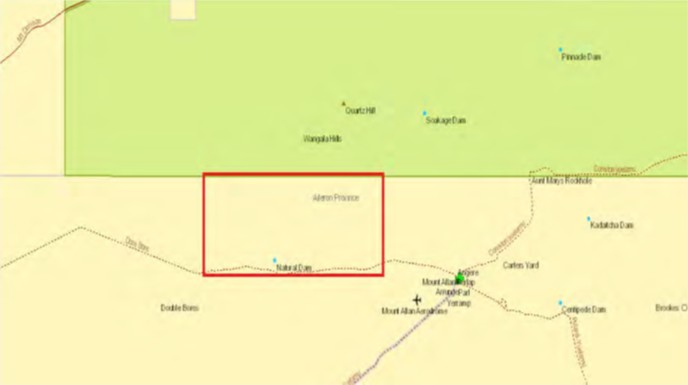
(d) annexed a map showing parts of the Land and Mount Denison Station, and one red box marking out an area within the map annexed to the notice.
(The Third Notice and the map was annexed to the statement of agreed facts as Annexure K. The Third Notice and the accompanying map is reproduced in these reasons and the map is separately appended as Annexure D to these reasons.]
Events leading to the muster
65. On 28 August 2024, the Central Land Council on behalf of Yalpirakinu sent a sheet of proposed terms for settlement to the Court and Mount Denison.
66. On 29 August 2024, the Central Land Council sent a letter to Mount Denison’s solicitors in response to their letter of 27 August 2024.
67. A Court-ordered facilitation commenced on 30 August 2024.
68. During this discussion Yalpirakinu stated it could not provide any indication of where the Mount Denison Cattle were located on the Land or of how many cattle were on the Land.
69. Yalpirakinu also indicated that it had arranged an expedited Sacred Sites Clearance Certificate for the area within the red box depicted on the map annexed to the Third Notice. A Sacred Sites Clearance Certificate sets out conditions of work on the land it covers. It is issued after the Central Land Council consults with Traditional Owners and obtains the Traditional Owners’ views as to what conditions are necessary to be imposed in order to prevent any impacts to sacred sites. A Sacred Sites Clearance Certificate is not an Authority Certificate for the purpose of Part III of the Northern Territory Aboriginal Sacred Sites Act 1989 (NT).
70. It was agreed between the parties that Mount Denison would be permitted to overfly the Land at Mount Denison’s expense in a helicopter to ascertain the location of the Mount Denison cattle on the Land.
71. On 3 September 2024, Terry Martin on behalf of Mount Denison, conducted a helicopter survey of the Land to ascertain the location of the Mount Denison cattle on the Land and was accompanied by a Central Land Council employee. A number of Mount Denison’s cattle were located within the red box while a number were outside the area marked by the red box.
72. Based on that inspection and Terry Martin’s experience with cattle, Mount Denison judged that its cattle on the Land included twenty-three calves less than 8 months old, three calves and a few cows that were heavily pregnant.
73. In the course of the inspection, Terry Martin observed and photographed areas of recent fire and smoke near Natural Dam.
74. Terry Martin observed that Mount Denison’s cattle were dispersing away from Natural Dam and towards Crown Creek.
75. …
76. Mount Denison formed a view based on the location of the cattle that it would not be viable to muster its cattle located in the Crown Creek area through the Natural Dam Boundary Point as this would require the cattle to be walked 30-40km over a full day and would likely cause them stress to be moving such a long distance in the heat.
77. On 4 September 2024, Mount Denison obtained a 10 day forecast of the weather at Yuendumu.
78. On the morning of 4 September 2024, Mount Denison’s solicitor provided the Central Land Council with a map showing the approximate location of small herds of cattle seen by Terry Martin during the helicopter survey.
[A copy of the map was at Annexure P to the statement of agreed facts and is appended as Annexure E to these reasons.]
79. The Court-ordered facilitation resumed on 4 September 2024. The parties were unable to reach agreement.
80. On 6 September 2024, the Central Land Council wrote to the Court stating that the parties had reached agreement about a basis on which Yalpirakinu would not press its application for an injunction, without prejudice to its position as to the validity of the Third Notice or, if the Third Notice is valid, whether the particular method employed to carry out the muster is in accordance with the Third Notice. Mount Denison’s solicitors confirmed by email that Mount Denison agreed to the email sent on behalf of Yalpirakinu.
The muster on 12 September 2024
81. At around 7.30am on 12 September 2024, two helicopters and their respective pilots engaged by Mount Denison entered the Land at the Natural Dam Boundary Point to conduct a muster of the Mount Denison cattle on the Land.
82. The muster of the Mount Denison cattle was conducted over areas of the Land that were outside of the area marked by the red box on the map annexed to the Third Notice [and attached at Annexure C to these reasons.]
83. The muster of the Mount Denison cattle was conducted over areas that intersected with country owned by the Yulumu, Ngarlupindi and Ngarlu, and Yaljupu estate groups.
84. The Mount Denison cattle were mustered from the Land onto Mount Denison Station across:
(a) the Natural Dam Boundary Point; and
(b) the boundary point with approximate coordinates -22°12'28"S 132°21'46"E (the Crown Creek Boundary Point).
85. A total of 177 cattle were mustered from the Land onto Mount Denison Station, with:
(a) 95 cattle mustered across the Natural Dam Boundary Point; and
(b) 82 cattle mustered across the Crown Creek Boundary Point.
86. Both helicopters returned to the Natural Dam Boundary Point to exit the Land.
87. Following the muster, inspections of the cattle occurred on Mount Denison Station as proposed by Mount Denison.
88. One of the 177 cattle mustered by Mount Denison had the brand of Mount Doreen cattle station.
89. On 2 October 2024, Mount Denison returned 11 cleanskin cattle to the Land on the basis that the cattle did not belong to it.
Animal welfare
90. Mount Denison has obligations under the Australian Animal Welfare Standards and Guidelines for Cattle.
91. The weather in the area of Mount Denison Station and the Land starts to get hotter in September.
Map
92. …
Further factual findings
18 I make the following further factual findings based on the evidence of Terry Martin, Mr Dews and Mr Mavec.
19 The Martin family took up the lease on Mount Denison in 1948. There has been a close association with the Aboriginal people of the area who have been employed as stockmen, gardeners and to care for the Martin’s children. Training programs have been run to teach the young men the skills necessary for station work. As at 2018, Aboriginal men were still employed as stockmen.
Mustering generally
20 Each year Mount Denison carries out two musters of its cattle. The first is in May and the second in September/October depending on temperatures. The cattle become distressed if walked too far in high temperatures so the second muster does not involve the cattle being walked long distances.
21 The purpose behind both musters involves assessing each animal as they pass through the yards for visual health inspections in order to detect any potential sick or diseased animals as well as applying vaccinations. There is a biosecurity risk that unvaccinated cattle may be exposed to botulism (which is fatal to cattle), including from scrub bulls (bulls which have gone wild or have been missed in any musters) and cause an outbreak of botulism.
22 When cattle are not on Mount Denison’s property or within its physical control, it is unable to provide that care.
23 On previous occasions, Mount Denison’s practice was to contact by telephone the representative nominated by the Traditional Owners – Cliffy Tommy.
24 In accordance with that prior practice, Dianne Martin attempted to contact Cliffy Tommy by telephone to inform the Traditional Owners that Mount Denison was going to conduct a muster on the Land. Dianne Martin also telephoned Cliffy Tommy’s mother-in-law, Susan Boko, as well as leaving a message for Cliffy at the Mount Allan Council to call Mount Denison. No response was received.
25 Further, it was Mount Denison’s practice to always issue a s 27 notice and use helicopters to retrieve the cattle from the Land with the same entry and exit points. The previous version of s 27 only provided for 2 days’ notice. The Traditional Owners would be notified so that if they wanted to inspect the mustered cattle they could do so. In practice, no one did.
26 Many musters were done on two days’ notice and prior to July 2024, the Traditional Owners never made any request regarding the manner or timing of musters, nor for that matter had the CLC made any requests in relation to those matters.
27 When mustering by helicopter, the helicopters generally fly above 500 feet and the groups of cattle usually number between 10 and 15. The helicopters are used not only to locate the cattle but also to encourage them to start walking in the required direction.
28 A muster ordinarily takes half a day to complete. Terry Martin was at all times unaware of any concern on the part of the Traditional Owners that mustering operations might involve entry or damage to sacred sites on the Land. The first time it was raised was in 2024 by the CLC.
The 2024 muster
29 In the absence of any response from Cliffy Tommy, Mount Denison proceeded on the basis that the muster would occur in the same way as before, by providing a s 27 notice to the CLC, but with a 14-day notice period which was the new time limit provided for in the recently amended s 27.
The period leading up to the First Notice being issued and 14 August 2024 (Second Notice)
30 The first s 27 notice was issued on 12 July 2024 (First Notice). It was addressed to Yalpirakinu Aboriginal Land Trust c/- the CLC. Dianne Martin was named as Mount Denison’s representative.
31 After the first notice, the CLC wrote to Dianne Martin on 16 July 2024 in which it confirmed there was no agreement with Yalpirakinu.
32 In its letter dated 16 July 2024, the CLC contended that the notice dated 12 July 2024 was invalid and did not empower Mount Denison to enter the Land. The letter stated that “Mount Denison has not made reasonable attempts to reach agreement with CLC or the Lands Trust”.
33 The letter continued that CLC’s view is that “reasonable attempts” to make an agreement includes Mount Denison:
1. providing CLC with a detailed proposal to retrieve the livestock (Proposal), including (but not limited to):
a. a map showing which parts of the Land will be accessed;
b. details of how many personnel are proposed to enter the land;
c. a schedule showing which areas will be accessed on each day;
d. a proposal regarding compensation from Mount Denison's unauthorised use of the Land for grazing its cattle;
e. the procedures and policies which Mount Denison will instruct its staff or contractors to follow while on the Land, including procedures to prevent encroachment on sacred sites;
f. where and how mustered cattle will be safely kept on the Land prior to their removal;
g. where and when CLC on behalf of the Land Trust will be provided with an opportunity to inspect the cattle before their removal from the Land; and
h. what steps Mount Denison intends to take to assess and remediate any damage to the condition of the Land as a result of its access; and
(2) allowing CLC a reasonable time to:
a. raise and discuss with Mount Denison any issues arising from the Proposal;
b. identify and consult the traditional Aboriginal owners of the Land about the Proposal in accordance with the statutory functions under the Land Rights Act; and
c. if traditional Aboriginal owners consent to the Proposal:
i direct the Land Trust to grant a licence, pursuant to s 19 of the Land Rights Act, to Mount Denison to enter onto the land for the purposes of the Proposal; and
ii conduct a sacred site clearance on the land prior to Mount Denison carrying out the Proposal.
(emphasis in original)
34 CLC also contended in its 16 July 2024 letter that Mount Denison was required to hold a licence under s 19 of the ALRA permitting it entry onto the Land.
35 Prior to the CLC’s letter, there was no suggestion that a licence under s 19 of the ALRA was required for Mount Denison to muster its cattle. I deal with s 19 later in these reasons.
36 The CLC’s 16 July 2024 letter continued by expressing the view that s 27(3) of the Livestock Act did not apply to Aboriginal land and that that provision was likely invalid in that it detracted from the operation of the ALRA.
37 Three matters arise out of the CLC’s letter dated 16 July 2024.
38 First, s 27(2) requires the livestock owner to make reasonable attempts to reach agreement with the property owner. In this case, Yalpirakinu was the property owner, not the CLC, however it is readily apparent that it was acting on behalf of Yalpirakinu once it received a copy of the First Notice.
39 Second, Mr Dews accepted in cross-examination that the letter sent by the CLC on 16 July 2024 was the first time the CLC had asserted the invalidity of s 27. The significance of that is that although s 27 was amended in 2024, prior to its amendment, the section still mandated a process of giving notice although it did not include the requirement that reasonable attempts be made to reach agreement nor that a copy of the notice be provided to the CLC. As to the latter point, Terry Martin said in his evidence that prior to the 2024 amendments to the Livestock Act, it was Mount Denison’s practice to provide a copy of any notice under s 27 to the CLC as a matter of courtesy.
40 Third, Mr Dews accepted in cross-examination that the CLC’s position as at 16 July 2024 was that if the Traditional Owners consented to the Proposal, it would have directed Yalpirakinu to enter into a licence to enter onto the Land pursuant to s 19 of the ALRA. Mr Dews also accepted that CLC’s position on s 19, i.e. that a licence was required, did not change during the time leading up to the muster on 12 September 2024.
41 Between 16 July 2024 and 14 August 2024, there was an exchange of correspondence between the CLC and Mount Denison. That correspondence reveals attempts to reach agreement between Mount Denison and the CLC acting on behalf of the Traditional Owners.
42 Terry Martin gave evidence that he was surprised when the CLC’s letter dated 16 July 2024 was received given that there had been no objections or responses to s 27 notices previously. That may well be, but that does not mean that the requirements of s 27(2) were satisfied. Nor does Terry Martin’s subjective reaction carry any weight.
43 By letter dated 19 July 2024, Terry Martin responded on behalf of Mount Denison to CLC’s letter dated 16 July 2024 indicating that Mount Denison was happy to work towards an agreement and providing information as to the proposal access on the day of entry. He advised that two helicopters would be used to muster the cattle and that there would be no ground activities, thereby mitigating any risks posed to sacred sites. Terry Martin inquired of the CLC if there were working yards on which to hold the cattle for inspection by CLC and that if so, Mount Denison would arrange to hold the cattle at that point, observing that would require entry onto the Land with vehicles.
44 Mount Denison’s correspondence dated 19 July 2024 also advised the CLC that Mount Denison had tried to contact a number of the Traditional Owners from Yalpirakinu without success and asked for names and contact details for the Traditional Owners. Mount Denison’s response also expressed the view that no compensation was warranted because the boundary fence had been cut and laid down allowing the entry of cattle onto the Land and alleged that residents of the Land had caused the straying of Mount Denison’s livestock onto the Land.
45 During cross-examination, Terry Martin said that the letter of 19 July 2024 was sent in response to the CLC’s letter dated 16 July 2024 and was an attempt to reach an agreement.
46 I accept that the letter was an attempt to reach agreement, however whether it is a reasonable attempt, or part of a reasonable attempt, is an objective test and an issue which I address later in these reasons.
47 On 19 July 2024, Mount Denison also sent an email to the CLC in which it confirmed that Mount Denison would not enter onto the Land on 26 July 2024 to carry out the planned s 27 muster. The email had Dianne Martin’s email address as sender, but was signed by Terry Martin, and reiterated that it would be beneficial to both parties if a reasonable agreement could be reached in a timely manner.
48 In response, CLC replied by letter dated 25 July 2024, which was still prior to the date specified in the First Notice on which Mount Denison had intended to enter the Land (26 July 2024), in which it said it was seeking further instructions but offered its views on Mount Denison’s reply, including that:
(a) a sacred site clearance should be conducted;
(b) the CLC must be satisfied that terms and conditions of any agreement are “reasonable” and referred to s 19(5)(c) of the ALRA;
(c) it was not reasonable for Mount Denison to not offer compensation to the Traditional Owners when its cattle were trespassing on the Land; and
(d) Mount Denison reconsider its position on compensation for the reasons advanced. It also raised the issue of inspection of livestock and gave a timeline for the finalisation of any agreement.
49 The CLC’s qualified timeline in its letter dated 25 July 2024 for the potential finalisation of any agreement is important. According to the CLC, the potential finalisation for any agreement was estimated to be by mid-late September, which it contended would allow a reasonable time for the CLC to reach an in principle agreement with Mount Denison, subject to the two matters below:
…
2 Seek consent from the Traditional Owners about the proposed agreement, and carry out consultations in accordance with CLC’s statutory functions under the [ALRA]; and
3 If traditional Aboriginal owners consent to the proposal, CLC’s Executive Committee then has authority to direct [Yalpirakinu] to grant a licence, pursuant to s 19 of the [ALRA], to Mount Denison to enter onto the Land for the purposes of the Proposal.
(square brackets provided)
50 The CLC continued that its Executive Committee met monthly and that it was not possible for the matter to be brought to the August meeting so that all efforts to consult with the Traditional Owners would be made in time for the September meeting.
51 It is evident that the CLC’s letter assumes that any agreement it negotiates will be approved by the Traditional Owners and then the Executive Committee of the CLC. To that extent, it is qualified.
52 As at that timeline, Terry Martin was concerned that by September (bearing in mind this was July) the health of the cattle may be placed at risk because even assuming an agreement could be reached, a muster by mid to mid-late September 2024 may not be feasible, because of, amongst other things, the rising temperatures.
53 Terry Martin’s concern about the safety of the cattle was for a number of reasons:
(a) high temperatures may have adverse health consequences for the cattle, and in particular those pregnant or with young calves at foot;
(b) the risk of cattle being exposed to botulism from contact with wild cattle and the consequent need to vaccinate the Mount Denison cattle;
(c) any new cattle would not have been vaccinated against botulism;
(d) there were unmanaged fires on the Land such that there was no feed security; and
(e) he did not know how much water was in the dams on the Land which meant that if the dams dried up, the cattle would move further south looking for water.
54 Terry Martin observed further that that timeline was not guaranteed and that Mount Denison had had other proposals rejected in the past so there was no guarantee that any proposal put forward would be accepted.
55 As a result of the letter from the CLC dated 25 July 2024, Terry Martin formed the view that Mount Denison would not get an agreement about the muster in the short term as it was clear the CLC would not finish consulting with the Traditional Owners or put the issue to its Executive Committee, until September 2024.
56 No muster occurred on 26 July 2024 and Mount Denison did not reply to the CLC’s 25 July 2024 letter, despite a follow up email from Mr Dews sent on 8 August 2024.
The period between the Second Notice issued on 14 August 2024 and 27 August 2024 (Third Notice)
57 Having agreed not to proceed in accordance with the First Notice, Mount Denison issued a second s 27 notice on 14 August 2024 (Second Notice), giving notice of its intent to muster its cattle on 28 August 2024.
58 It was suggested to Terry Martin in cross-examination that since Mount Denison had issued the Second Notice, he had ignored what the CLC had put in its letter dated 25 July 2024 about the time required before any proposed agreement could be brought to the September meeting of the CLC Executive.
59 Terry Martin did not accept that suggestion, nor the suggestion that issuing the Second Notice was not the act of someone making attempts to reach an agreement. He said that an attempt had already been made in Mount Denison’s letter dated 19 July 2024 and that Dianne Martin had attempted to contact the Traditional Owners prior to that date. Given the point in the correspondence that had been reached, Terry Martin said any efforts to reach an agreement on the part of Mount Denison was over.
60 I accept that evidence. There was an imperative to muster the cattle. That involved making arrangements for helicopter and logistics to allow that to occur. Further, Mount Denison was facing issues which had not been raised before – the invalidity of s 27(3), the requirement for a s 19 licence and the requirement for a sacred site clearance. Those issues had been raised by the CLC for the first time in the context of Mount Denison needing to muster its cattle in a timely fashion.
61 On 16 August 2024, the CLC wrote to Terry Martin, referring to its previous correspondence on 25 July and 8 August 2024, asserting that the Second Notice did not empower Mount Denison to enter the Land for two reasons:
(a) section 27(3) of the Livestock Act did not apply to Aboriginal land; and
(b) in any event, Mount Denison had not made reasonable attempts to reach agreement with the CLC, pointing to Mount Denison’s failure to respond to its letter dated 25 July 2024.
62 Mount Denison instructed solicitors at about that time and on 22 August 2024 its solicitors, Piper Grimster Jones, responded to the CLC’s letter dated 16 August 2024. Piper Grimster Jones advised the CLC that Mount Denison intended to act on the 14 August 2024 notice and retrieve its livestock. As to the issue of sacred sites, it invited the CLC to identify any sacred sites of concern located in or near the area outlined on the map or GPS coordinates provided in the 14 August 2024 notice, by close of business the next day. I find that time period was unreasonable.
63 Nonetheless, nothing turns on that unreasonable demand because it was inconsistent with what appeared later in the letter which was that to address the risk that cattle may enter upon and damage or destroy sacred sites, the CLC was invited to identify by 26 August 2024 (4 days later) further steps which were feasible in order to identify sacred sites.
64 Piper Grimster Jones’ letter addressed a number of points raised by the CLC by way of the history of the matter and continued that Yalpirakinu was unlawfully withholding Mount Denison’s cattle, that Mount Denison did not believe it would enter any sacred sites when mustering, that the question of any compensation is separate from the requirement to return the cattle, and that it was not open to the CLC to refuse to return cattle or rather to refuse to allow them to be mustered in the absence of a payment by way of compensation. Importantly, the letter referred to the animal welfare concerns given that sources of surface water available to the cattle were rapidly diminishing and burn offs which were occurring on the Land would result in the cattle being left without access to food or shade.
65 On the point of surface water, a response was sought from the CLC concerning the maintenance of bores on the Land to ensure the cattle had an adequate water supply and the location of any cattle relative to the location of any fires, including what steps were being taken by the CLC to protect the cattle from fire.
66 After disagreeing with the CLC’s contentions about the validity of s 27 of the Livestock Act, the letter then dealt with the timing of entry, setting out that water availability, burn off and the requirement to ensure that any cleanskin (i.e. offspring of branded cattle) are located and properly branded and tagged while identifying any relationship to the branded cattle was possible.
67 The letter sought an urgent response from the CLC.
68 On 23 August 2024, the CLC responded to Piper Grimster Jones’ letter. Paragraph 5 of that letter is significant:
5. Contrary to assertions in your letter, our client's position is not that your client cannot muster its cattle. Rather, it is that your client cannot unilaterally decide when and how it went into the Land to do so, without any regard to the rights of our client and the interests of the traditional Aboriginal owners of the Land. We have repeatedly reiterated in our correspondence to your client that we are ready and willing to negotiate an agreement for your client to access the Land to retrieve its livestock.
69 That paragraph misstates what had happened to that point. Mount Denison had made attempts to contact the Traditional Owners and once the CLC became involved for Yalpirakinu, Terry Martin corresponded with the CLC in relation to the basis upon which the muster could occur. There was no “unilateral” decision made without regard to the rights of Yalpirakinu as the property owner and the interests of the Traditional Aboriginal Owners of the Land.
70 Whereas, the CLC’s letter complains that Mount Denison did not respond to the CLC’s letter dated 25 July 2024, or its follow-up email on 8 August 2024, the reasons for no response was that Mount Denison had put its position in the correspondence dated 19 July 2024 and that the timeline before which Mount Denison might get an answer and perhaps an agreement, being some two months, was unacceptable.
71 The CLC’s letter continued by dealing with sacred sites, once again reiterating the invalidity of s 27(3) and asserted that entry into air space above the Land constituted a trespass.
72 I find the CLC’s timeline for what was no more than a potential agreement and a heavily qualified process was, in all the circumstances unsatisfactory and, I accept, unacceptable to Mount Denison. I deal with the demands for compensation, the requirement for a s 19 licence and the alleged invalidity of s 27 later in these reasons when considering the second issue of whether Mount Denison made reasonable attempts to reach an agreement.
73 Following that exchange, Mount Denison did not agree not to conduct its muster as a consequence of which the CLC filed urgent proceedings in this Court on the part of Yalpirakinu. Those matters are dealt with in the statement of agreed facts including that the Court ordered a facilitation which commenced on 30 August 2024.
74 On 27 August 2024, Mount Denison’s solicitors wrote to the CLC advising that an immediate issue was the welfare of the cattle on the Land. It pointed out that the cattle were calving and it would soon become too hot to muster the cattle without causing extreme stress and exposing the mothers and calves to the risk of death. It observed that late September was already likely to be too hot to conduct the muster, that temperatures were rapidly intensifying, that fires were burning throughout the area such that sources of food were diminishing and that although sources of water may be available until early November, the situation was approaching where cattle may die if they were left where they were.
75 The letter provides details of the proposal for retrieving the cattle. That letter was extensive and, in summary proposed that:
(a) the muster will be by helicopter completed within a day but may take further days if required;
(b) the CLC is to provide details of the breed and approximate head count of cattle Yalpirakinu says belongs to it;
(c) after the cattle have been mustered, arrangements will be made for the Traditional Owners to inspect the cattle to see if any belong to them; and
(d) any cattle of the same breed as Mount Denison’s cattle which are not evidently calves at foot or not yet fully grown will be presumed to belong to Mount Denison. Nonetheless, Mount Denison will pay Yalpirakinu half the market value of the cattle of the age, sex, breed and weight of each relevant animal at the time of muster. Mount Denison will make a list of the animals falling into this category.
76 The letter continued that Mount Denison was open to any proposals about how the Land is to be entered or the cattle are mustered to minimise the risk of damage to sacred sites during the muster and indicated that Mount Denison was happy to take into consideration practical measures such as identifying sacred site areas.
77 Amongst other things, the letter continued by setting out what Mount Denison’s solicitors considered were Mount Denison’s reasonable attempts to reach agreement for the purposes of s 27(2).
78 The CLC’s response to that letter dated 29 August 2024 was non-committal as to the time required for the identification of sacred sites.
79 Given that:
(a) the Land was granted to the applicants some 36 years previously; and
(b) Justice Kearney had identified approximately 80 sacred sites and 8 dreaming tracks on the Land; and
(c) as at 2024, the CLC’s anthropology records had identified 101 sacred sites in respect of the Land; and
(d) there had been numerous musters over the relevant portion of the Land since 1988,
there is no evidence of why it was at this stage that the issue was being raised for the first time.
80 Nonetheless, I accept that the records of sacred sites may well be incomplete and/or that the CLC was acting out of an abundance of caution.
81 No muster occurred on 28 August 2024 and I find the Second Notice lapsed.
The period following the Third Notice issued on 27 August 2024
82 On 27 August 2024, Mount Denison issued the third s 27 notice (Third Notice). Pursuant to that notice, which was addressed to Yalpirakinu Aboriginal Land Trust as property owner c/- the CLC, Mount Denison gave notice of a date and location of entry (10 September 2024 at 6.00am), the activity to be conducted (i.e. a muster), the day of exit, being 7 days after the date of entry, and giving GPS coordinates of the exit point, which was the same as the entry point – Natural Dam. It also included a map of the muster area in which it proposed to conduct the muster. The Notice is in the following terms:
Notice of entry to retrieve livestock
Livestock Act 2009 (NT)
Date: 27 August 2024
Issued by: Mount Denison Proprietors Pty Ltd (ABN 54 009 591 655)
Mount Denison Staton Via
Alice Springs NT 0872
Representative: Terry Martin
Email: mount.denison@gmail.com
Phone: 08 89564028
Issued to: Yalpirakinu Aboriginal Land Trust (Property Owner)
c/-: Central Land Council 33 Stuart
Highway
Alice Springs NT 0871
Attention:: Tom Dews
Email: Tom.Dews@clc.org.au
Phone: 08 8951 6242
The livestock Owner hereby gives notice to the Property Owner that the Livestock Owner intends to:
a) Enter the land of the Property Owner (NT Portion 2028) from Mount Denison Station (NT Portion 312) behind Natural Dam (-22.20858944560038, 132.0662332571106) at 6.00am on 10 September 2024; and
b) Muster the following cattle:
i) All cattle that carry the brand or ear tags associated with the Livestock Owner and Mount Denison Station; and
ii) All unbranded cattle that are the offspring of cattle owned by the Livestock Owner, including the offspring of cattle that carry the brand or ear tags associated with the Livestock Owner and Mount Denison Station; and
c) Leave the land of the Property Owner (with the Livestock Owner's cattle) within 7 days after the date of entry, at Mount Denison Station (-22.20858944560038, 132.0662332571106).
Please contact the Livestock Owner's representative (identified above) if you have any queries.
Regards
Signed for and on behalf of the Livestock Owner
83 On 28 August 2024, as part of the facilitation process being conducted in the Court, the CLC sent a term sheet setting out the basis upon which the CLC would direct Yalpirakinu to issue a licence under s 19 of the ALRA to Mount Denison to muster its cattle on the Land.
84 Since the term sheet was issued after the date of the Third Notice, it is not relevant to the issue of whether Mount Denison made reasonable attempts to reach an agreement with Yalpirakinu prior to that date.
85 Nonetheless, a consideration of that term sheet reveals a number of matters which were not acceptable to Mount Denison as had been communicated previously in its letter dated 19 July 2024. In particular the term sheet included a requirement that Mount Denison pay a “removal fee” to account for its cattle grazing unlawfully on the Land since February 2024. It also included a requirement that Mount Denison pay all the costs associated with the CLC preparing and issuing a sacred site clearance certificate.
86 Mr Dews agreed in cross-examination that there were more terms in the term sheet than there were in previous correspondence, although he did not agree that the parties grew further apart during the period between 16 July 2024 and 28 August 2024. Despite Mr Dews’ disagreement, whereas the parties ultimately worked towards the muster occurring, the CLC did so whilst reserving its position such that there were always differences between the parties, as I have set out earlier in these reasons. Insofar as the requirement for compensation was raised, that difference emerged as early as 16 July 2024.
87 One of the matters the CLC had requested in its negotiations with Mount Denison was a sacred site clearance certificate. In circumstances where it did not know where Mount Denison’s cattle were located on the Land between 30 August and 3 September 2024, Mount Denison requested aerial access to the Land to undertake an inspection in order to identify the location of cattle.
88 The facilitation before the Court was still being undertaken at that stage and was adjourned. As noted in the statement of agreed facts, on 3 September 2024, an inspection of the Land was conducted by helicopter by Terry Martin and a representative from the CLC, with Terry Martin making notes of the inspection and identified a number of groups of cattle noting their location, numbers and condition of the land upon which the cattle were on or near.
89 Apart from what is recorded in the statement of agreed facts, the inspection also identified a number of weaners, being cows between eight months and two years but still with their mothers (which were branded to Mount Denison), seven scrub bulls which Mount Denison did not claim and a number of cattle located east of Natural Dam which was outside the area previously discussed with the CLC for the purposes of a sacred site clearance certificate.
90 Terry Martin observed recent fires and smoke near Natural Dam and said in evidence that the recent fires would affect the amount of available feed. He observed that the cattle were dispersing away from Natural Dam and towards Crown Creek to the East of Natural Dam.
91 The consequence of the aerial inspection was that Terry Martin considered more than half a day would be needed to muster the cattle and bring them out at Crown Creek because it was not feasible to muster the cattle in the Crown Creek area through the Natural Dam point. That would involve mustering them some 30 to 40 kilometres which was the estimate of the distance that some of them may need to be driven and was likely to cause stress to the cattle such that some temporary yards might need to be set up. Terry Martin also deposed to the other welfare risks to Mount Denison’s cattle if they walked that distance, which included:
(a) causing pregnant cows distress leading to a potential abortion of the calf;
(b) new calves perishing in extreme heat if forced to walk long distances, extreme heat being anything over 35 of 36 degrees; and
(c) under the Australian Animal Welfare Standards and Guidelines for Cattle, cattle are to be handled in a way that minimises stress and need to be regularly assessed for feed and water. As from in or about October, the temperature in that area can reach mid 40s°C.
92 Terry Martin explained that Mount Denison issued the Third Notice on 27 August 2024 because 14 days’ notice was required and he was becoming increasingly concerned about the cattle as time went on. I accept that evidence which is consistent with his ongoing concern and the CLC’s qualified time for a potential (not actual) agreement.
93 As to Mount Denison’s concerns about water and feed, Terry Martin agreed that CLC’s pastoral expert, Mr Laurence Tait, had expressed his opinion in an email dated 26 August 2026, that conditions at Natural Dam were expected to be sufficient to support the welfare of cattle until at least November 2024 and that Mr Tait held no concerns about water or feed.
94 Mr Tait’s email of 26 August 2024 was sent to the CLC, 12 days after the Second Notice and the day before the Third Notice was issued. Terry Martin accepted those observations but maintained his concerns about the welfare of the cattle in terms of moving them in extreme heat as well as their access to food. Terry Martin also observed that Mr Tait said the risk of fires was hard to gauge and that there were fires around the region at that time.
95 Mr Tait was not called to give evidence, and whilst it is all well and good for the CLC to ask Mr Tait to express his opinion about conditions insofar as they related to another party’s cattle, he did not address the risk of disease or mustering cattle in hot temperatures. In fairness to Mr Tait, I assume that was because he was not asked to do so.
96 As recorded in the statement of agreed facts, Yalpirakinu arranged an expedited sacred site clearance certificate over the proposed muster area prior to the muster.
97 As also recorded in the statement of agreed facts, on 6 September 2024, the CLC informed the Court that it had reached agreement with Mount Denison on the basis it would not press its application for an injunction to prevent Mount Denison from mustering its cattle but without prejudice as to the validity of the Third Notice or if valid, whether the particular muster method employed was in accordance with the Third Notice.
98 Terry Martin was cross-examined about Mount Denison’s reasonable attempts to reach an agreement in accordance with s 27(2) of the Livestock Act. Terry Martin gave evidence that there was an established custom of contacting a nominated Traditional Owner to reach agreement, that Mount Denison adopted that practice over much of the previous decade, and that is what initially occurred on this occasion.
Legislative framework
The ALRA
99 The ALRA governs the administration, control and use of Aboriginal land in the Northern Territory.
100 Section 3(1) defines “Aboriginal land” as including land held by a Land Trust for an estate in fee simple.
101 Pursuant to s 4(1), a Lands Trust established under the ALRA, holds the Land on trust for the benefit of Aboriginal people who are, by Aboriginal tradition, entitled to its use or occupation, regardless of whether their entitlement is specifically defined by place, time, circumstance, purpose or permission.
102 Section 5(1)(b) provides that a Lands Trust, in exercising powers as the title holder of land vested in it in accordance with the ALRA, is to exercise its powers as owner of the Land for the benefit of the Aboriginals concerned.
103 Section 19(1) prohibits a Lands Trust from disposing of or dealing with any estate or interest in land vested in it unless in accordance with the processes provided under the ALRA. Any such dealings must be authorised and formalised.
104 Section 19(4A) provides that a Lands Trust may, with the consent of the Minister and the written directions of the relevant Land Council, grant an estate or interest in land for any purpose. In the event the estate or interest in question does not exceed 40 years, the written consent of the Minister is not required: s 19(7). In the context of this matter, this power is conditional on the CLC being satisfied of the statutory prerequisites set out in s 19(5) which provides:
(5) A Land Council shall not give a direction under this section for the grant, transfer or surrender of an estate or interest in land unless the Land Council is satisfied that:
(a) the traditional Aboriginal owners (if any) of that land understand the nature and purpose of the proposed grant, transfer or surrender and, as a group, consent to it;
(b) any Aboriginal community or group that may be affected by the proposed grant, transfer or surrender has been consulted and has had adequate opportunity to express its view to the Land Council; and
(c) in the case of a grant of an estate or interest – the terms and conditions on which the grant is to be made are reasonable.
105 Section 19(11) provides:
(11) A reference in this section to an estate or interest in land includes:
(a) a reference to a licence granted in respect of that land including, but without limiting the generality of the foregoing, a licence granted under a law of the Northern Territory relating to exploration for, or the mining or development of, extractive mineral deposits; or
(b) a reference to a lease or other interest in that land, or a right granted in respect of that land, under such a law.
106 Pursuant to s 19(13), if a Lands Trust grants an estate or interest in Aboriginal land under s 19, then the relevant Land Council may direct, in writing, the Lands Trust to authorise a specified person, or class of persons, to enter and remain on the land for a specified purpose that is related to that estate or interest.
107 The CLC, being the representative Land Council for the relevant area, carries out a number of functions which are set out in s 23.
108 In so far as relevant, s 23 provides:
23 Functions of Land Council
(1) The functions of a Land Council are:
(a) to ascertain and express the wishes and the opinion of Aboriginals living in the area of the Land Council as to the management of Aboriginal land in that area and as to appropriate legislation concerning that land; and
(b) to protect the interests of traditional Aboriginal owners of, and other Aboriginals interested in, Aboriginal land in the area of the Land Council; and
(ba) to assist Aboriginals in the taking of measures likely to assist in the protection of sacred sites on land (whether or not Aboriginal land) in the area of the Land Council; and
(c) to consult with traditional Aboriginal owners of, and other Aboriginals interested in, Aboriginal land in the area of the Land Council with respect to any proposal relating to the use of that land; and
…
(e) to negotiate with persons desiring to obtain an estate or interest in land in the area of the Land Council:
(i) where the land is held by a Land Trust—on behalf of traditional Aboriginal owners (if any) of that land and of any other Aboriginals interested in the land; and
(ii) …
…
(fa) to negotiate, and enter into agreements, as necessary, for the purposes of subsection 70(4); and
(g) to compile and keep:
(i) a register recording the names of the members of the Land Council; and
(ii) a register recording the names of the members of the Land Trusts holding, or established to hold, Aboriginal land in its area and descriptions of each area of such Aboriginal land; and
(h) to supervise, and provide administrative or other assistance for, Land Trusts holding, or established to hold, Aboriginal land in its area; and
(i) such other functions as are prescribed by the regulations.
(2) A Land Council may, with the approval of the Minister, perform any functions that may be conferred on it by a law of the Northern Territory, including, without limiting the foregoing, functions in relation to:
(a) the protection of sacred sites;
(b) access to Aboriginal land; and
(c) schemes for the management of wildlife on Aboriginal land.
(3) In carrying out its functions with respect to any Aboriginal land in its area, a Land Council shall have regard to the interests of, and shall consult with, the traditional Aboriginal owners (if any) of the land and any other Aboriginals interested in the land and, in particular, shall not take any action, including, but not limited to, the giving of consent or the withholding of consent, in any matter in connexion with land held by a Land Trust, unless the Land Council is satisfied that:
(a) the traditional Aboriginal owners (if any) of that land understand the nature and purpose of the proposed action and, as a group, consent to it; and
(b) any Aboriginal community or group that may be affected by the proposed action has been consulted and has had adequate opportunity to express its view to the Land Council.
(4) The reference in paragraph (1)(e) to an estate or interest in land includes a reference to a licence in respect of that land.
109 Insofar as relevant, s 70 provides:
Entry etc. on Aboriginal land
(1) A person shall not enter or remain on Aboriginal land.
Penalty: 50 penalty units.
…
(2A) In proceedings against a person for an offence against subsection (1), it is a defence if the person enters or remains on the land:
…
(e) in performing functions, or exercising powers, under this Act or another law of the Commonwealth or under a law of the Northern Territory; or
…
(h) in accordance with this Act or a law of the Northern Territory.
110 Insofar as relevant, s 71 provides:
…
(3) A reference in this section to an estate or interest in Aboriginal land includes a reference to:
(a) a licence granted under section 19; and
…
(4) Subsection (3) does not limit section 66.
111 Section 66 provides relevantly:
66 Interpretation
A reference in this Part to an estate or interest in Aboriginal land includes a reference to:
(a) a mining interest;
(b) an interest arising out of the operation of the Atomic Energy Act 1953 or any other Act authorizing mining for minerals;
(ba) a lease or other interest in land or a right granted under a law of the Northern Territory relating to exploration for, or the mining or development of, extractive mineral deposits;
(c) an interest arising out of the taking possession, mining or occupation of land by virtue of an NT mining authority; and
(d) an interest by way of the occupation or use of land in accordance with section 12A, 14, 18, 18A or 18B.
112 Section 73 provides:
Reciprocal legislation of the Northern Territory
(1) The power of the Legislative Assembly of the Northern Territory under the Northern Territory (Self-Government) Act 1978 in relation to the making of laws extends to the making of:
…
(b) laws regulating or authorising the entry of persons on Aboriginal land, but so that any such laws shall provide for the right of Aboriginals to enter such land in accordance with Aboriginal tradition;
…
but any such law has effect to the extent only that it is capable of operating concurrently with the laws of the Commonwealth, and, in particular, with this Act, Division 4 of Part 15 of the Environment Protection and Biodiversity Conservation Act 1999 and any regulations made, schemes or programs formulated or things done, under this Act, or under or for the purposes of that Division.
…
113 Section 74 provides:
74 Application of laws of Northern Territory to Aboriginal land
(1) This Act does not affect the application to Aboriginal land of a law of the Northern Territory to the extent that that law is capable of operating concurrently with this Act.
(2) Without limiting subsection (1), this Act does not affect the application to Aboriginal land of a law of the Northern Territory that makes:
(a) an act or omission that is an offence against a provision of this Act; or
(b) a similar act or omission;
an offence against the law of the Northern Territory.
(3) Subsection (2) applies even if the law of the Northern Territory does any one or more of the following:
(a) provides for a penalty for the offence that differs from the penalty provided for in this Act;
(b) provides for a fault element in relation to the offence that differs from the fault elements applicable to the offence under this Act;
(c) provides for a defence in relation to the offence that differs from the defences applicable to the offence under this Act.
Section 27 of the Livestock Act
114 Effective from 30 April 2024, amendments to s 27 of the Livestock Act clarified and expanded the process for the retrieval of stray livestock which are on land owned by someone other than the livestock owner:
27 Owner may retrieve stray livestock from property
(1) The owner of livestock (the livestock owner) that are on a property owned by someone else (the property owner) may retrieve the livestock in accordance with this section.
(2) The livestock owner must make reasonable attempts to reach an agreement with the property owner to retrieve the livestock.
(3) If, after making reasonable attempts under subsection (2), the livestock owner and property owner have not reached an agreement, the livestock owner may give the property owner written notice that the livestock owner intends to:
(a) enter the property:
(i) at a place specified in the notice; and
(ii) at a time specified in the notice (which must be no earlier than 14 days after the day on which notice is given); and
(b) muster the livestock specified in the notice; and
(c) leave the property (with or without the livestock):
(i) within 7 days after entering the property; and
(ii) at a place specified in the notice.
Note for subsection (3)
The livestock owner is required to comply with a biosecurity management plan that applies to the property under Part 2A.
(4) If the property is on Aboriginal land, as defined in section 3(1) of the Aboriginal Land Rights (Northern Territory) Act 1976 (Cth), a copy of the notice must also be given to the Land Council established under that Act for the area of the Territory in which the property is located.
(5) The property owner may inspect the livestock before the livestock leaves the property.
(6) A livestock owner must not enter or remain on a property to retrieve livestock except in accordance with:
(a) an agreement with the property owner; or
(b) a notice given under subsection (3).
(7) A person commits an offence if the person contravenes subsection (6).
Maximum penalty: 50 penalty units.
(8) An offence against subsection (7) is an offence of strict liability.
(9) It is a defence to a prosecution for an offence against subsection (7) if the defendant has a reasonable excuse.
115 Amongst other things, the amendments to s 27 introduced the requirement for the livestock owner to make reasonable attempts to reach agreement with the property owner and increased the notice period from 2 days to 7 days.
The First Issue – is s 27(3) of the Livestock Act invalid or inoperative for inconsistency with the ALRA?
Principles relating to inconsistency
116 The Northern Territory Legislative Assembly derives its law-making authority from s 6 of the Northern Territory (Self-Government) Act 1978 (Cth) which was enacted pursuant to s 122 of the Commonwealth of Australia Constitution Act.
117 Although s 109 of the Constitution governs inconsistencies between State and Commonwealth laws, the High Court has accepted that the principles apply by analogy to Territory laws: Work Health Authority v Outback Ballooning Pty Ltd [2019] HCA 2; (2019) 266 CLR 428 at [29]-[30] (Kiefel CJ, Bell, Keane, Nettle and Gordon JJ), [58] (Gageler J) [104] (Edelman J).
118 There are two principal types of inconsistency:
(1) Direct inconsistency, where a Territory (or State) law impairs the operation of a Commonwealth law: Outback Ballooning; Dickson v The Queen [2010] HCA 30; (2010) 241 CLR 491; Jemena Asset Management (3) Pty Ltd v Coinvest Ltd [2011] HCA 33; (2011) 244 CLR 508; and
(2) Indirect inconsistency, which arises when a Commonwealth law is intended to govern exclusively a particular subject area, leaving no room for supplementary Territory or State legislation: see Ex parte McLean (1930) 43 CLR 472 at 483-486 and applied in Jemena at [40] (French CJ, Gummow, Heydon, Crennan, Kiefel and Bell JJ).
119 Where an inconsistency exists between a Territory law and a law of the Commonwealth, the latter prevails.
120 In Outback Ballooning, the High Court affirmed that Territory laws are inoperative to the extent that they “alter, impair or detract from” the operations of a Commonwealth law. At [31]-[34] the Court (Kiefel CJ, Bell, Keane, Nettle and Gordon JJ) said:
31 In Victoria v The Commonwealth (“The Kakariki”), Dixon J referred to two approaches which might be taken to the question whether an inconsistency might be said to arise between State and Commonwealth laws. They were subsequently adopted by the Court in Telstra Corporation Ltd v Worthing, Dickson v The Queen and Jemena Asset Management (3) Pty Ltd v Coinvest Ltd.
32 The first approach has regard to when a State law would "alter, impair or detract from" the operation of the Commonwealth law. This effect is often referred to as a "direct inconsistency". Notions of "altering", "impairing" or "detracting from" the operation of a Commonwealth law have in common the idea that a State law may be said to conflict with a Commonwealth law if the State law in its operation and effect would undermine the Commonwealth law.
33 The second approach is to consider whether a law of the Commonwealth is to be read as expressing an intention to say "completely, exhaustively, or exclusively, what shall be the law governing the particular conduct or matter to which its attention is directed". This is usually referred to as an "indirect inconsistency". A Commonwealth law which expresses an intention of this kind is said to "cover the field" or, perhaps more accurately, to "cover the subject matter" with which it deals. A Commonwealth law of this kind leaves no room for the operation of a State or Territory law dealing with the same subject matter. There can be no question of those laws having a concurrent operation with the Commonwealth law.
34 The question whether a State or Territory law is inconsistent with a Commonwealth law is to be determined as a matter of construction. In a case where it is alleged that a State or Territory law is directly inconsistent with a Commonwealth law it will be necessary to have regard to both laws and their operation. Where an indirect inconsistency is said to arise, the primary focus will be on the Commonwealth law in order to determine whether it is intended to be exhaustive or exclusive with respect to an identified subject matter.
(citations omitted)
See also Gageler J (as his Honour then was) at [58] and Edelman J at [104]-[105].
121 The identification of the two types of inconsistencies are analytical tools, not rigid tests. The focus is on resolving whether a “real conflict” exists between Commonwealth and Territory Laws: Jemena at [42]; Outback Ballooning at [32]-[33]. In practice, the categories of direct and indirect inconsistency often overlap, and the question of whether a State or Territory law is inconsistent with a Commonwealth law is one of construction.
Parties’ submissions and consideration
122 Yalpirakinu relies on direct inconsistency in contending that s 27(3) of the Livestock Act is inconsistent with the ALRA. As such, the primary focus is to determine the operation of the ALRA and whether the Livestock Act alters, impairs or detracts from the operation of that Act: Outback Ballooning at [32].
123 In R v Kearney; Ex parte Northern Land Council [1984] HCA 15; (1984) 158 CLR 365 at 392-393, Brennan J said that when land is Aboriginal land, its use or occupation is guaranteed by s 71, such that the laws of the Northern Territory are incapable of interfering with that use or occupation. In R v Kearney; Ex parte Japanangka [1984] HCA 13; (1984) 158 CLR 395 at 420, his Honour observed that a law of the Northern Territory cannot affect the operation of a law of the Commonwealth unless a law of the Commonwealth so provides, either expressly or by implication.
The interaction between ss 73, 74 of the ALRA and s 27 of the Livestock Act
124 It is clear from s 4(1) of the ALRA that Lands Trusts are established to hold title to land in the Northern Territory for the benefit of Aboriginals entitled by Aboriginal tradition to the use or occupation of the land concerned.
125 A first step is to consider the interaction between the ALRA and the ability of the Northern Territory legislature to legislate within the legislated space occupied by the ALRA.
126 At an overarching level, Yalpirakinu submits that the ALRA enjoys constitutional primacy over inconsistent Territory legislation and that ss 73(1) and 74(1) of the ALRA confirm this by providing that any Northern Territory law may only apply to Aboriginal land to the extent that it is “capable of operating concurrently” with the ALRA. As a statement of principle, so much so may be accepted.
127 In response to Yalpirakinu’s overarching contention, the Attorney-General for the Northern Territory submits that the proper construction of s 73(1)(b) of the ALRA is central because it is that provision which empowers the Northern Territory Legislative Assembly to make laws regulating or authorising entry onto Aboriginal land, as long as the laws preserve the rights of Aboriginal people to enter in accordance with Aboriginal tradition. The Attorney-General submits s 73(1)(b) authorises Northern Territory laws that permit activities on Aboriginal land, including laws such as s 27(3) of the Livestock Act, provided they are consistent with Aboriginal traditional rights. The Attorney-General submits such a construction strikes the balance intended by the Commonwealth Parliament between Aboriginal interests and Northern Territory governance and that Yalpirakinu’s reliance on direct inconsistency is misplaced.
128 The Attorney-General submits further that s 73(1)(b) was intended to be construed broadly and beneficially, consistent with its purpose and content within the ALRA. The Attorney-General submits that it is evident from ss 73 and 74 and that the Commonwealth Parliament, in enacting ss 73(1)(b) and 74, opted for a scheme where Northern Territory laws would apply to Aboriginal land, rather than excluding them entirely.
129 The Attorney-General continues that in that sense, s 73(1)(b) not only permits Northern Territory laws to authorise entry, but also to authorise activities conducted on Aboriginal land, provided that they are consistent with Aboriginal traditional rights and that entry for a limited purpose, such as livestock retrieval, is within the Northern Territory legislative power. To construe the provision otherwise would render the Livestock Act ineffectual.
130 Mount Denison adopts the submissions of the Attorney-General and submits that the ALRA anticipated the need for legal frameworks to manage issues such as stray cattle, boundary disputes and fires. Since no federal legislative scheme governs these interactions, the Northern Territory legislature intended to address these issues and represents a compromise between competing interests such that a purposive construction of s 27 enables livestock owners to remove cattle from adjoining land, thereby reducing damage to Aboriginal land and furthering the ALRA’s objectives. These outcomes promote harmony between land use and livestock control, consistent with the legislative design of the ALRA: Carr v Western Australia [2007] HCA 47; (2007) 232 CLR 138 at [5] (Gleeson CJ); Kennedy v Australian Fisheries Management Authority [2009] FCA 1485; (2009) 182 FCR 411 at [44]-[46] (Tracey J).
131 Mount Denison submits further that s 27 of the Livestock Act functions as a contingency provision aimed at the efficient retrieval of stray livestock. It imposes a duty on livestock owners to recover animals at their own expense, aligning with obligations under the Livestock Act.
132 I accept the submissions of the Attorney-General and Mount Denison in relation to the interaction between ss 73 and 74 of the ALRA and s 27 of the Livestock Act.
133 The power of the Legislative Assembly of the Northern Territory under the Northern Territory (Self Government) Act in relation to the making of laws extends to the making of laws regulating or authorising the entry of persons onto Aboriginal land: ALRA s 73(1)(b). This delegation of authority is not constrained other than by it being conditioned upon the requirement that any such laws must be capable of operating concurrently with the Commonwealth laws.
134 On its terms, s 73(1)(b) of the ALRA recognises a shared legislative space between the Commonwealth and the Northern Territory but imposes limits to ensure that both the integrity and purpose of the ALRA are preserved.
135 To that extent, s 73(1)(b) allows the Northern Territory to regulate or authorise entry to Aboriginal land, provided that those laws explicitly uphold the rights of Aboriginal people to determine entry to Aboriginal land in accordance with Aboriginal tradition.
136 The expression “shall provide” used in s 73(1)(b) is directed at ensuring there is no inconsistent provision with the ALRA. That is, that any Northern Territory law regulating or authorising the entry of persons onto Aboriginal land does not carry with it any impairment or impediment of any rights of Aboriginal persons to enter Aboriginal land in accordance with Aboriginal tradition.
137 To similar effect, s 74(1) of the ALRA provides that the ALRA “does not affect the application to Aboriginal land of a law of the Northern Territory to the extent that that law is capable of operating concurrently with the ALRA”.
The interaction between ss 19 and 74 of the ALRA and s 27 of the Livestock Act
138 Given the recognition in the ALRA that the Legislative Assembly of the Northern Territory may make laws which apply to the Aboriginal land, the issue then becomes whether s 27 acts in a way which alters, impairs or detracts from the ALRA.
139 Yalpirakinu submits that the reference in ss 73 and 74 of the ALRA to “… operating concurrently” calls into operation whether the Livestock Act, operates in a manner which alters, impairs or detracts from the ALRA: Williams v Wreck Bay Aboriginal Community Council [2019] HCA 4; (2019) 266 CLR 499 at [88]-[89].
140 Yalpirakinu contends that s 27 purports to allow a livestock owner to issue a notice under s 27(3) authorising entry onto Aboriginal land for the purpose of mustering livestock and is inconsistent with the ALRA and therefore inoperative to that extent.
141 In developing that submission, Yalpirakinu submits that s 27, in effect, enables a livestock owner unilaterally to grant themselves a licence to enter Aboriginal land without any independent oversight, consent or regard for Traditional Owners’ rights. Yalpirakinu submits that as a consequence, the operation of s 27 is fundamentally inconsistent with the process mandated under s 19 of the ALRA for the grant of estates or interests in Aboriginal land, which stipulates Land Council involvement and the informed consent of Traditional Owners: Jemena at [41].
142 Yalpirakinu submits further, and by way of example, that s 70(5) of the ALRA provides for an impartial arbitrator to determine disputes and to consider sacred and residential sites. Yalpirakinu submits that the ALRA does not permit the Legislative Assembly of the Northern Territory to create exceptions which undermine the balance of competing interests provided by the ALRA, which it describes as having a beneficial and protective purpose.
143 I do not accept Yalpirakinu’s submission for a number of reasons.
144 First, it seeks to characterise the entry onto the Land pursuant to s 27 of the Livestock Act as being pursuant to a licence granted pursuant to s 19 of the ALRA which mandates the process for governing estates or interest in land.
145 Section 19(11) of the ALRA provides that an estate or interest in land includes:
…
(a) a reference to a licence granted in respect of that land including, but without limiting the generality of the foregoing, a licence granted under a law of the Northern Territory relating to exploration for, or the mining or development of, extractive mineral deposits; or
(b) a reference to a lease or other interest in that land, or a right granted in respect of that land, under such a law.
See also s 66 of the ALRA.
146 Section 27(3) of the Livestock Act does not grant a licence to the livestock owner, nor any property or proprietary rights. Rather it is a provision regulating or authorising the entry of persons onto Aboriginal land for an identified, specific and limited purpose.
147 The authority conferred by s 27 is not an “interest” or “estate”, nor is it a “licence” of the type contemplated in s 19(11): Murray Meats (NT) Pty Ltd v Northern Territory Planning Authority (1982) 69 FLR 32 at 55 (Toohey J).
148 To that extent, s 27 is a law within the contemplation of s 73(1)(b).
149 Further, notwithstanding the ALRA provides for exclusive occupation of Aboriginal land: s 70(1), that is subject to specified exceptions, including where a person enters or remains on the land as a consequence of the application of Northern Territory legislation: ss 70(2A)(h) and 74. On a proper construction, s 27 provides a statutory defence to an offence under s 70(1) of the ALRA within the meaning of s 70(2A)(h).
150 As to the reference to an impartial arbitrator under s 70(5) of the ALRA, that involves an entirely different circumstance to that being considered by s 27 of the Livestock Act in that it applies where a person has an estate or interest in that subject land: s 70(4) and does not assist Yalpirakinu.
151 Second, the suggestion that a livestock owner may unilaterally grant unto themselves a licence to enter Aboriginal land is not correct. The process in s 27 clearly demonstrates that the process is not one of unilateral action but rather allows for the authorisation or regulation of entry onto Aboriginal land for an identified specific and limited purpose with that authorisation or regulatory approval pre-conditioned upon a particular process being followed. To that extent, there must be a reasonable attempt to reach an agreed position such that the process under s 27 of the Livestock Act specifically contemplates consultation with the Traditional Owners.
152 There is no inconsistency between ss 27(3) of the Livestock Act and s 19 of the ALRA. Section 19 governs the creation of estates or interests in Aboriginal land, not the validity of Northern Territory laws authorising entry for an identified specific and limited purpose.
The interaction between ss 70(1) and 27
153 Next, Yalpirakinu submits that the ALRA provides for a stringent regime regulating access to Aboriginal land. It refers to s 70(1) which creates an offence for entering Aboriginal land without consent, subject only to specific exceptions in ss 70A-70G. As part of that submission, Yalpirakinu submits that the exception to the prohibition in s 70 involves some kind of prior consent and that absent that consent, s 27(3) is inconsistent with the ALRA.
154 The Attorney-General submits that s 70 is as part of the broader statutory balance struck by the ALRA. The Commonwealth Parliament provided for Northern Territory laws to authorise and regulate entry on Aboriginal land. The Attorney-General submits the ALRA does not require that entry to Aboriginal land under a Northern Territory law be subject to consent from Land Trusts, Land Councils or Aboriginal persons and that the omission of such a requirement indicates that Parliament did not intend to limit the legislative power of the Northern Territory in such a manner.
155 The Attorney-General submits further that there is no relevant inconsistency between ss 27(3) and 70 of the ALRA because s 70 is not a complete code governing entry to Aboriginal land, and s 27(3) does not conflict with any express prohibition under it. The Attorney-General submits still further that s 27(3) does not authorise entry to or remaining on a sacred site within the meaning of the ALRA, consistent with the protections under s 69 of the ALRA.
156 I accept the Attorney-General’s submissions. Section 27 creates a regime by which authorisation for an identified, specific and limited purpose is given in a regulated fashion. The effect of s 27(3) is to provide an authority to enter Aboriginal land in a manner consistent with the ALRA.
157 Next, Yalpirakinu submits that s 27 effectively subordinates the rights and interests of traditional Aboriginal owners to the private property interests of livestock owners. It submits that there is no statutory mechanism under the Livestock Act to ensure that Traditional Owners’ spiritual or cultural connection to the land is not interfered with and the extent to which their interests are considered is entirely at the discretion of the livestock owner.
158 As part of its submission on this point, Yalkirakinu submits that s 27 enables livestock owners to act without regard for sacred sites or traditional use which undermines the protective purpose of the ALRA and conflicts with the structured, consultative approach required by it.
159 I do not accept Yalpirakinu’s submissions. The suggestion that there is a unilateral grant of a licence (which I do not accept is the case) is done without any independent oversight, consent or regard for Traditional Owners’ rights is demonstrably not the case when the provisions of s 27 of the Livestock Act and s 23 of the ALRA are considered.
160 It is apparent from the terms of s 27 that Traditional Owners’ spiritual and cultural connection with the land is addressed by the reasonable attempts to reach agreement and, if that is not possible, service of the notice which must be given to the relevant Land Council, in this case the CLC.
161 Section 23(1) of the ALRA relevantly provides that the functions of a Land Council are:
…
(ba) to assist Aboriginals in the taking of measures likely to assist in the protection of sacred sites on land (whether or not on Aboriginal Land) in the area of the Land Council; and
…
162 There is a clear process put in place by ss 27(3) and (4) of the Livestock Act which in turn engages the CLC and its obligations under s 23 of the ALRA.
163 In this matter, the CLC is not the property owner within the meaning of s 27 and is not involved in any attempt to reach an agreement with a livestock owner prior to the issue of a notice under s 27(3), although it may be if asked by the relevant Land Trust. However, once a notice is issued, the CLC is not precluded from raising matters such as sacred sites, in accordance with s 23(1)(ba). Were that not the case, there would be no point in serving a copy of the notice on the relevant Land Council where Aboriginal land is concerned.
164 Next, Yalpirakinu submits that, whilst it accepts the ALRA’s protection of Aboriginal land from non-consensual entry is not absolute, the exceptions reflect a careful balancing of the rights of traditional Aboriginal owners and the competing interests of others which are either consensual or justified under narrowly defined statutory grounds.
165 Insofar as Yalpirakinu submits protection of Aboriginal land from non-consensual entry is not absolute, and that there is a careful balancing of the rights of traditional Aboriginal owners and the competing interests of others, that is precisely what s 27 does. Section 27 mandates a regime of a reasonable attempt to agree, followed by the issue of a notice, which in the case of Aboriginal land, requires that the relevant Land Council be given a copy of the notice. That in turn necessarily puts the relevant Land Council on notice and engages its obligations under s 23.
166 Next, Yalpirakinu submits that the defence of necessity under s 70(3) of the ALRA is of a significantly narrower and more stringent character than the automatic access rights conferred under s 27 of the Livestock Act. It submits that the defence in s 70(3) requires that the entry be based on “necessity, not expediency or strong preference” and must be “strictly controlled and scrupulously limited” to its underlying rationale: R v Rogers (1996) 86 A Crim R 542 at 547; Clarkson v The Queen [2007] NSWCCA 70; (2007) 209 FLR 387 at [78]-[81].
167 Yalpirakinu submits that in contrast, s 27 does not require any demonstration of necessity. Rather, it submits that s 27 enables livestock owners to act based on convenience or preference, thereby facilitating access in circumstances where it would be unlawful under the ALRA.
168 The Attorney-General submits that the argument that Northern Territory laws must be restricted to purposes of public duty, necessity or emergency, misreads the statutory scheme and that there is no textual basis for reading down the defences in s 70 or the power in s 73(1)(b) in such a manner. With respect, that is clearly so and I accept that submission.
169 Further, s 27 requires livestock owners to make a reasonable attempt to reach agreement with the property owner. Whereas, there will always be an element of convenience, preference or necessity when running a cattle station in areas that are exposed to climatic extremes, that is not a disqualifying feature of the s 27 scheme.
170 Still further, necessity is but one of the defences set out in s 70. Were Yalpirakinu’s submissions to be accepted, it may result in all the other defences in s 70 not applying because “necessity” could not be made out. Such a construction leads to an absurdity and I do not accept it.
The interaction between ss 71 and 27
171 In its submissions, Yalpirakinu refers to s 71(1) as guaranteeing to Aboriginal people the use and occupation of Aboriginal land to which they are entitled according to Aboriginal tradition.
172 The submission was not developed but for completeness there is no inconsistency between ss 27(3) and 71 of the ALRA for the same reasons as I have set out in relation to ss 19, 70, 73 and 74 earlier in these reasons.
Conclusion on the alleged inconsistency
173 It is for these reasons that s 27 of the Livestock Act is not inconsistent with the ALRA.
The Second Issue – reasonable attempt to reach agreement
The First Notice
174 Yalpirakinu submits that s 27(2) is a mandatory pre-condition to the issue of a notice under s 27(3) such that an act done in breach of the provision should be invalid: Project Blue Sky Inc v Australian Broadcasting Authority [1998] HCA 28; (1998) 194 CLR 355 at [93] (McHugh, Gummow, Kirby and Hayne JJ).
175 As part of that submission, Yalpirakinu points to the terms of s 27(2) which uses mandatory language in the sense that the livestock owner “must” make reasonable attempts to reach an agreement, with s 27(3) providing that only “after making reasonable attempts under subsection (2)” can a livestock owner give the property owner a written notice.
176 So stated, Yalpirakinu submits that s 27(2) requires the Court to consider the acts of the livestock owner before the issue of the notice and decide whether, objectively, those acts constituted reasonable attempts. In that context, Yalpirakinu further submits that whether the livestock owner has made “reasonable attempts” is to be assessed as at the date of the issue of the notice.
177 I accept that events which post-date the notice cannot be relevant to the issue of whether reasonable attempts were made to reach agreement before a notice is issued. What is required is an objective assessment as to the reasonableness of the livestock owner’s attempts to reach agreement. That will vary depending on the particular factual circumstances in each case.
178 Mount Denison submits that making reasonable attempts is not a pre-condition to a valid notice under s 27. I do not accept that submission. The text of s 27 makes it quite clear that the requirement to make reasonable attempts to reach agreement is a pre-condition to a valid s 27 notice.
179 What is “reasonable” is concerned with the acts of the livestock owner rather than that person’s state of mind: Director of Public Prosecutions (DPP) v Le [2007] HCA 52; (2007) 232 CLR 562 at [127] (Kirby and Crennan JJ).
180 Mount Denison submits that the reasonableness of attempts is influenced by number of factors. It lists some 19 factors, however there is no purpose in attempting to delineate what particular factors in any given factual scenario might bear upon whether objectively considered, reasonable attempts have been made to reach an agreement with the property owner to retrieve the livestock. What is reasonable will vary depending on the facts of any particular matter.
181 Yalpirakinu submits that the obligation to make reasonable attempts was not met. That is because Mount Denison issued the First Notice on 12 July 2024 stating that it intended to muster livestock on 26 July 2024, and that the First Notice was the first communication from Mount Denison to Yalpirakinu in relation to Mount Denison’s cattle straying onto the Land between 2023 and 2024. In support of that contention, Yalpirakinu refers to the statement of agreed facts at [51]:
On 12 July 2024, Mount Denison sent the Central Land Council a notice purportedly issued under s 27 of the Livestock Act 2008 (NT) stating that Mount Denison intended to muster its cattle on the Land on 26 July 2024 (First Notice). This was the first communication between Yalpirakinu and Mount Denison regarding the Mount Denison cattle that strayed on to the Land between 2023 and 2024.
182 That communication appears to be the first successful communication between the CLC for Yalpirakinu and Mount Denison. To that extent, it was the first communication with the property owner within the meaning of s 27. That is so notwithstanding the attempts by Dianne Martin to contact one of the Traditional Owners, Cliffy Tommy, and the evidence of the nomination of a Traditional Owner as the contact point.
183 Since Mount Denison made no attempt to contact Yalpirakinu as property owner, the requirement of s 27(2) was not met prior to the issue of the First Notice.
184 Since Mount Denison agreed not to act on the First Notice, nothing turns on its failure to comply with s 27(2) prior to 12 July 2024.
The Second Notice
185 The Second Notice was dated 14 August 2024.
186 Since the First Notice was not acted upon, the conduct of Mount Denison in the period up to 14 August 2024 falls to be considered as to whether, objectively, it made reasonable attempts to reach agreement with Yalpirakinu.
187 I have dealt with the facts leading to the issue of the Second Notice in the factual findings.
188 Prior to the Second Notice being issued, the CLC had started insisting for the first time in its letter dated 16 July 2024 both that s 27 is inconsistent and thereby invalid, and/or that a s 19 licence was required. That revealed the CLC taking a new position which it maintained throughout its dealings with Mount Denison.
189 It is for the reasons I have set out earlier in these reasons that the CLC’s position on these two points was misconceived.
190 At the time the Second Notice was sent, Mount Denison had not replied to earlier correspondence from the CLC, specifically its letter dated 25 July 2024 and the email sent on 8 August 2024.
191 Notwithstanding Terry Martin’s evidence was that a point had been reached in the negotiations as at 19 July 2024 and there were no further negotiations, that is not the case because there were further discussions with the CLC through Mount Denison’s solicitors prior to the issue of the Second Notice.
192 At the time the Second Notice was issued, the imperative was to muster the cattle and to protect both parties’ interests. Those respective interests were the safety and welfare of Mount Denison’s cattle and the protection of sacred sites on the part of Yalpirakinu.
193 As to the first point, Mount Denison had to muster the cattle, whose welfare was Mount Denison’s prime consideration. That involved making arrangements for helicopter and logistics to allow that to occur.
194 As to the second point, the issue of sacred sites was addressed in Terry Martin’s letter dated 19 July 2025.
195 The question is whether or not objectively, reasonable attempts were made to reach an agreement prior to the issue of the Second Notice on 14 August 2024.
196 It is clear that by the CLC’s letter dated 25 July 2024, Mount Denison found itself in an impossible situation because that letter postulated not being able to take any agreement, if reached, to the Executive Committee of the CLC for approval until its September meeting and even then, without any guarantee that such an approval would be granted. It had cattle on Yalpirakinu, there had been fires, the temperatures in September and October could reach temperatures where either pregnant cows or young calves would suffer distress if not death if mustered, and there was the biosecurity risk from botulism.
197 Further, the position taken by the CLC in relation to the inconsistency point and the s 19 point, as well as the insistence of compensation (the last of which had also been raised in prior years in relation to previous musters) were such that after 19 July 2024 there was no prospect of agreement.
198 I find that Mount Denison made reasonable attempts to reach an agreement with the CLC who was representing the property owner, being Yalpirakinu prior to the issue of the Second Notice.
The Third Notice
199 The Third Notice was issued on 27 August 2024 and communicated Mount Denison’s intention to conduct a muster of its cattle on the Land at 6:00am on 10 September 2024. Entry was proposed from Mount Denison Station at a location described as being “behind Natural Dam” (identified with GPS coordinates). Although the land description included an apparent error, referring to it as “NT Portion 2028”, nothing turns on that as the GPS coordinates are precise.
200 The Third Notice specified that the muster would target cattle bearing Mount Denison’s brand or ear tags, as well as any unbranded progeny of those cattle. It was further stated that all cattle would be removed from the Land within seven days of entry, returning via the same coordinates.
201 I have dealt with the facts leading to the issue of the Third Notice in the factual findings.
202 The differences between the CLC and Mount Denison in relation to the alleged invalidity of s 27, the requirement for a s 19 licence, and the issue of compensation, were never resolved as between the parties and it is an agreed fact that the CLC agreed that Mount Denison could conduct its muster following the Third Notice whilst preserving its rights as to the validity of the Third Notice.
203 Still further, the CLC was pressing for compensation, which it seemed to have used as a bargaining tool. An agreement to pay compensation is not the touchstone of whether attempts to reach agreement are reasonable. If Yalpirakinu wanted to claim compensation for what it contended was cattle trespass, it could issue proceedings seeking that compensation.
204 Yalpirakinu submits there was no reasonable attempt to reach an agreement because there was no consultation with each of the four Traditional Owner Estate Groups, noting that it is an agreed fact that “under customary law permission to enter country can only be granted after consideration by the relevant estate group(s). Permission is made by group consensus and not by a single traditional owner”: Exhibit A2 at [15].
205 I do not accept that submission. Yalpirakinu is the property owner within the meaning of s 27 and it engaged with Mount Denison through the CLC.
206 Yalpirakinu submits that Mount Denison’s attempts to contact a single Traditional Owner from a single estate group do not advance Mount Denison’s position. It points to Terry Martin’s evidence that Mount Denison had contact numbers for a number of the Traditional Owners. I accept that submission. The obligation on Mount Denison was to make reasonable attempts to reach agreement with Yalpirakinu, either directly or on the facts of this case, by engaging with the CLC as its representative.
207 Given the amendments to s 27, the established custom of contacting a particular, nominated Traditional Owner, in relation to mustering has been overtaken by the requirement to deal with Yalpirakinu as property owner.
208 Next, Yalpirakinu submits that Mount Denison’s reliance on animal welfare concerns is baseless and more generally unsustainable in light of Terry Martin’s evidence that Mount Denison had been previously content to leave its cattle to their fate in late 2022 and late 2023.
209 I do not accept that submission which does not align with the evidence. Terry Martin did not agree that Mount Denison had left its cattle on the Land for a prolonged period at that time. That was because during that period the cattle had either been mustered by Neil Bowman or had been pushed back onto Mount Denison.
210 I find that there were negotiations between Mount Denison and the CLC on behalf of Yalpirakinu in an attempt to reach agreement, as well as the correspondence between Piper Grimster Jones and the CLC in relation to reaching an agreement prior to the Third Notice being issued.
211 Nonetheless, the parties were never going to reach agreement in circumstances where CLC was contending that:
(a) s 27 of the Livestock Act was invalid;
(b) a licence pursuant to s 19 of the ALRA was required; and
(c) compensation needed to be paid.
212 Objectively, it is readily apparent to me that reasonable attempts were made by Mount Denison to reach agreement and that those attempts were both ongoing and reasonable prior to the issue of the Third Notice.
213 It is for these reasons that I consider Mount Denison made reasonable attempts to reach agreement with Yalpirakinu as property owner, albeit through the CLC on the particular facts of this matter for the mustering of cattle from the Land prior to issuing the Third Notice.
Third issue - the muster was not conducted in accordance with the Third Notice
214 Yalpirakinu submits that the muster was not conducted in accordance with the Third Notice in three respects and so was not authorised:
(1) Mount Denison entered the Land on a different date and at a different time to that specified in the Third Notice.
(2) Mount Denison exited the Land at two points rather than the single point described as “Natural Dam Boundary Point”.
(3) The area marked on the map accompanying the Third Notice which identified the proposed area to be mustered extended beyond the identified area. Those additional areas mustered had sacred sites within them.
Mount Denison entered the Land on a different date and at a different time
215 The Third Notice notified the time and date of entry onto the Land as 6.00am on 10 September 2024. It is an agreed fact that Mount Denison entered the Land on 12 September 2024 at 7.30am.
216 Yalpirakinu submits that s 27(3) requires identification of a specific place and a specific time at which the livestock owner intends to enter the property and that one evident purpose of these aspects of s 27(3) is to allow the property owner to be present if they wish.
217 Yalpirakinu submits further that strict compliance with s 27(3) is required based on the text context and purpose of s 27 and that the consequence of not complying strictly with the Third Notice was that Mount Denison’s entry onto the Land on 12 September 2024 was not authorised by s 27.
218 Mount Denison submits that commencing two days later than stated in the notice does not mean the muster is unauthorised as the entry is for a period of up to 7 days. It submits further that s 27(3)(a) does not indicate how specific the intended time of entry must be and that the 7-day period is intended to provide a reasonably sufficient window of time to conduct a safe, humane and effective muster of livestock.
219 I do not accept Mount Denison’s submission that s 27(3)(a) does not require that a specific time of entry must be identified. If the purpose of the legislation required simply a date and not a specific time, it would have been easy for that to have been specified in the section. The notice is required to specify the time of entry which I consider involves both date and hour. That is what the Third Notice did.
220 I find that Mount Denison did not comply with the Third Notice in terms of the date and time of entry. What follows from that is another matter and I deal below with the submission as to whether the fact that Mount Denison entered on a different date and at a different time, means that the muster was unauthorised.
Mount Denison did not exit the Land at a single point described as the Natural Dam Boundary Point
221 It is an agreed fact that Mount Denison’s cattle were mustered across two boundary points, over 20 kilometres apart. The point identified in the Third Notice, at which point Mount Denison would leave the Land with its cattle, was the Natural Dam Boundary Point, which was the location identified by the GPS coordinates in the Third Notice. However, the cattle were also mustered across a further point known as Crown Creek Boundary Point with co-ordinates 22°, 12’, 28”S, 130°, 21’, 46”E.
222 Yalpirakinu submits that the Third Notice was required to identify a specific place at which the livestock owner intended to leave the property.
223 Yalpirakinu submits further that the exit point is important because it allows the property owner to exercise a right of inspection under s 27(5).
224 Since the cattle exited the Land at two exit points, Yalpirakinu submits that the Third Notice did not authorise the muster of cattle across the second boundary point.
225 Mount Denison submits that the requirement to identify the point at which Mount Denison would leave the property is directed to a person and not exiting livestock.
226 The point Mount Denison seeks to make about humans and not cattle exiting the Land, whilst novel, does not assist it. That is because s 27 is directed at permitting entry onto another property owner’s land for a specific and limited purpose and the carrying out that activity on that land.
227 Mount Denison submits further that the variation to the exit point was for an appropriate purpose of ensuring the welfare of the cattle and ensuring that the muster occurred in accordance with the obligations under the Animal Protection Act 2018 (NT) and minimising unnecessary, additional interference with the Land.
228 There is force in Mount Denison’s second point. There may be many reasons for which cattle exited the Land at a particular point other than that specified in the Third Notice, including that to drive the cattle to the nominated exit point would involve stressing the cattle or alternatively that the cattle simply decided to exit the Land at that point.
229 In any event, I find that by not exiting at a single point, Mount Denison did not conduct the muster in accordance with the Third Notice. What flows from that is a different matter and I also deal with this issue below when considering whether because of the cattle exiting at two points, the muster was unauthorised.
The muster was conducted outside the area identified in the Third Notice
230 It is an agreed fact that the muster of Mount Denison’s cattle was conducted over areas of the Land that were outside of the area marked by the red box on the map annexed to the Third Notice.
Was the muster authorised
231 Yalpirakinu submits that as a consequence of one or more of the three matters identified above, the muster was not authorised by the Third Notice.
232 I do not accept that submission.
233 Non-compliance with a notice issued under s 27(3) is not such as to render the muster unauthorised. So much so is evident from the provisions of s 27(6)-(9) which provide that:
(6) a livestock owner must not enter or remain on a property to retrieve livestock except in accordance with:
(a) an agreement with the property owner; or
(b) a notice given under subsection (3).
(7) a person commits an offence if the person contravenes subsection (6).
(8) an offence against subsection (7) is an offence of strict liability.
(9) it is a defence to a prosecution for an offence against subsection (7) if the defendant has a reasonable excuse.
234 The provisions of ss 27(6)-(9) indicate that a consequence of a livestock owner entering or remaining on a property other than in accordance with a notice given under s 27(3), does not render the muster unauthorised but rather creates an offence of strict liability: s 27(8).
235 As to the first point concerning entry onto the Land, I have found that Mount Denison did not enter the Land at the time specified in the Third Notice.
236 It follows, that it is not the case that the muster was unauthorised because of the different time and date of entry. To the extent an offence may have been committed, it is open to Mount Denison, if charged, to establish a defence of reasonable excuse if that is available to it: s 27(9).
237 My conclusion as to the time of entry is subject to the condition that it occurs within the 7 days nominated. If outside that period, the entry is likely to be unauthorised because the notice will have been spent.
238 As to the second point, I find that contrary to s 27(3)(c)(ii), Mount Denison did not comply with the Third Notice in relation to the exit from the property. It is for the same reasons in relation to the time of entry that exiting the Land at a point not specified in the notice does not have the effect of making the muster unauthorised.
239 As to the third point, whereas the Third Notice identified an area to be mustered, that is not a requirement of s 27. Identifying the area in the Third Notice was for the assistance of Yalpirakinu and I do not consider that by identifying a particular area, the Third Notice was only valid in relation to that area. Such a construction would make a nonsense of the process with a prospect of cattle being just outside the indicated area and thereby unable to be mustered.
240 Further, the Third Notice specified that the muster would apply to all cattle identified in the Third Notice.
241 Still further, the CLC was aware as from 3 September 2024 that there were cattle belonging to Mount Denison outside the areas identified on the map attached to the Third Notice, yet no objection was raised to cattle being mustered outside the nominated area.
Conclusion
242 It is for these reasons that Yalpirakinu’s claim:
(a) for a declaration that s 27(3) of the Livestock Act is invalid or inoperative insofar as it purports to apply to Aboriginal land as defined in s 3(1) of the ALRA, is dismissed;
(b) for a declaration that the notice issued by Mount Denison on 27 August 2024 under s 27(3) of the Livestock Act is invalid and of no effect, is dismissed; and
(c) for the declaration that Mount Denison’s muster on the Land conducted on 12 September 2024 was not authorised by s 27 of the Livestock Act, is dismissed.
243 I will hear the parties on the question of costs.
I certify that the preceding two hundred and forty three (243) numbered paragraphs is a true copy of the Reasons for Judgment of the Honourable Justice O'Sullivan. |
Associate:
Dated: 11 June 2026
Annexure A
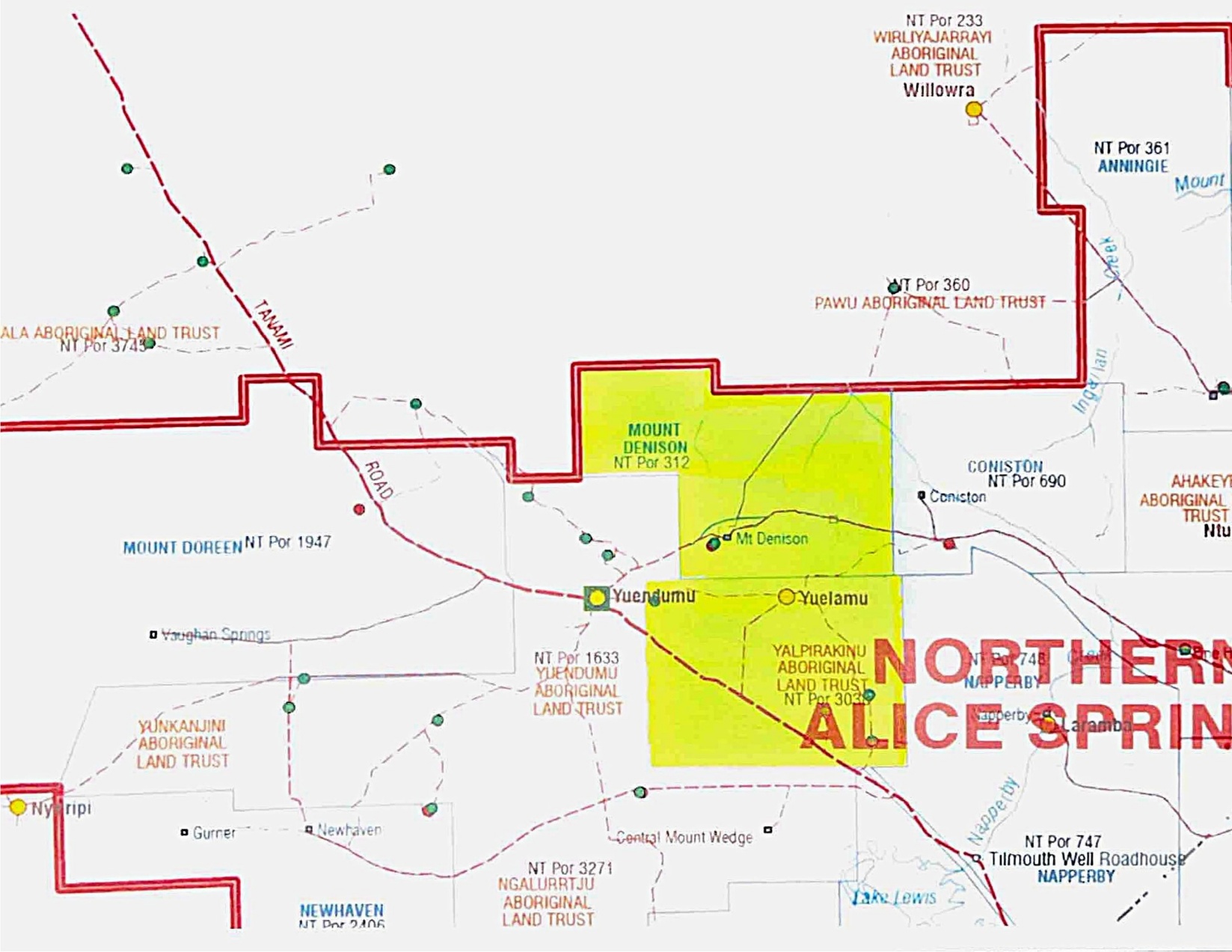
Annexure B
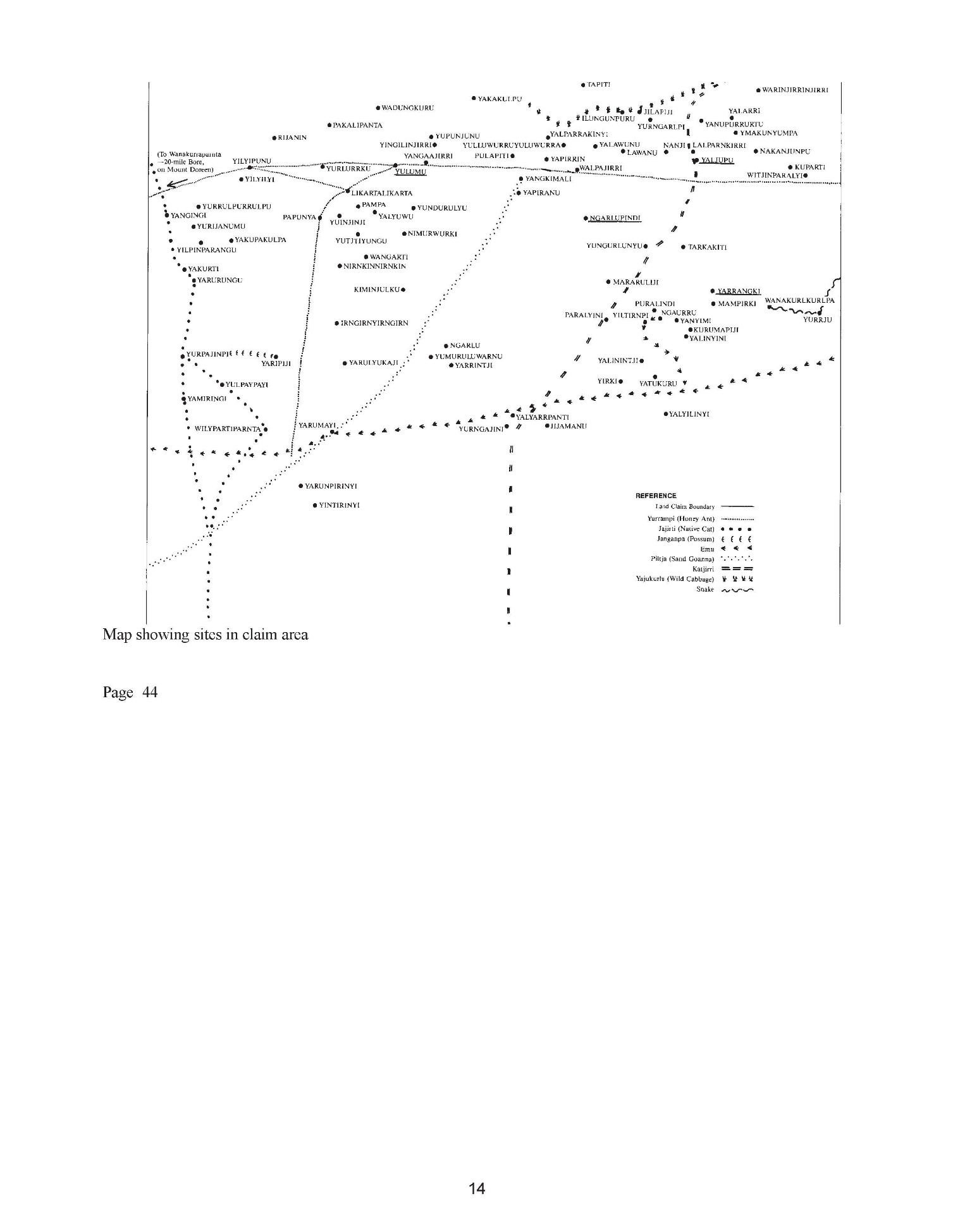
Annexure C
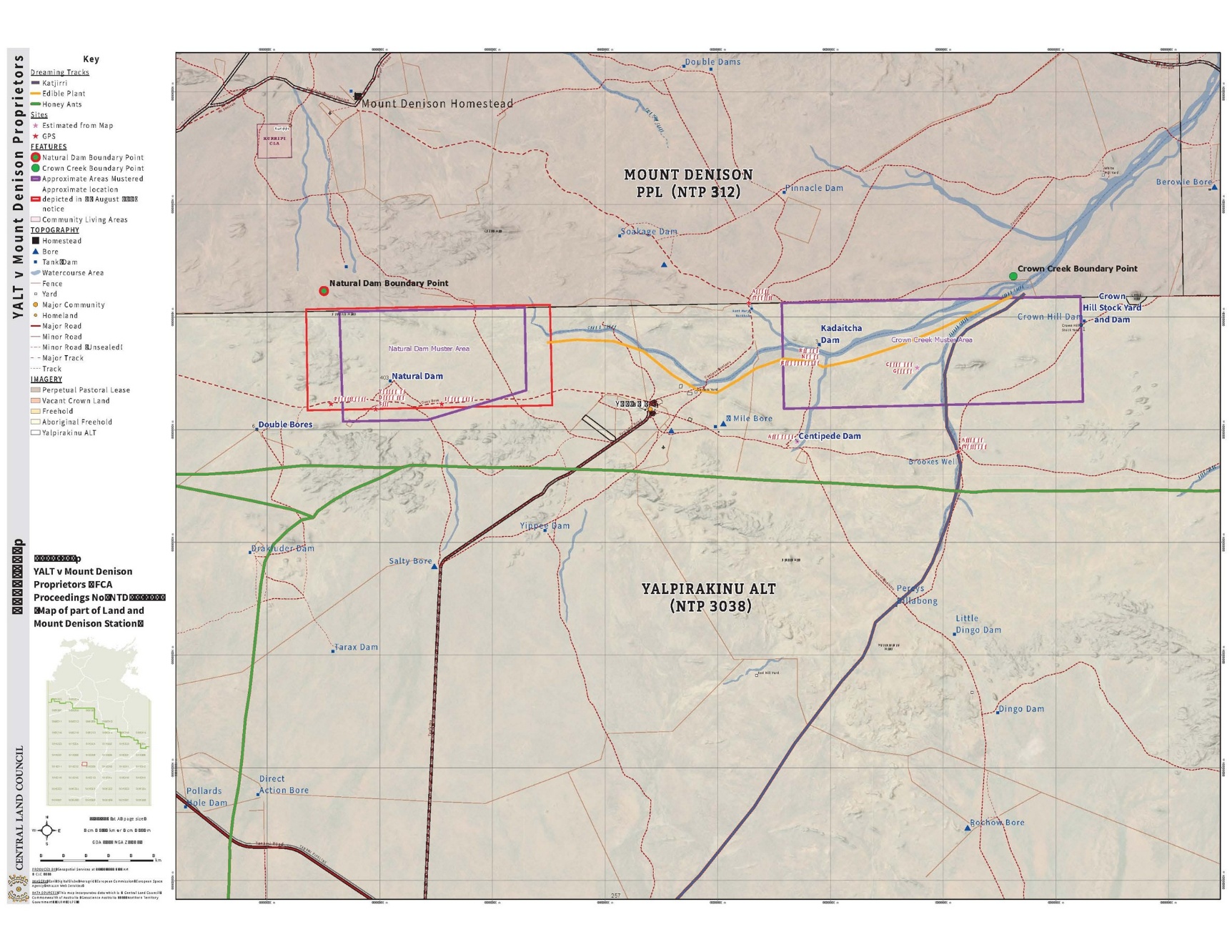
Annexure D
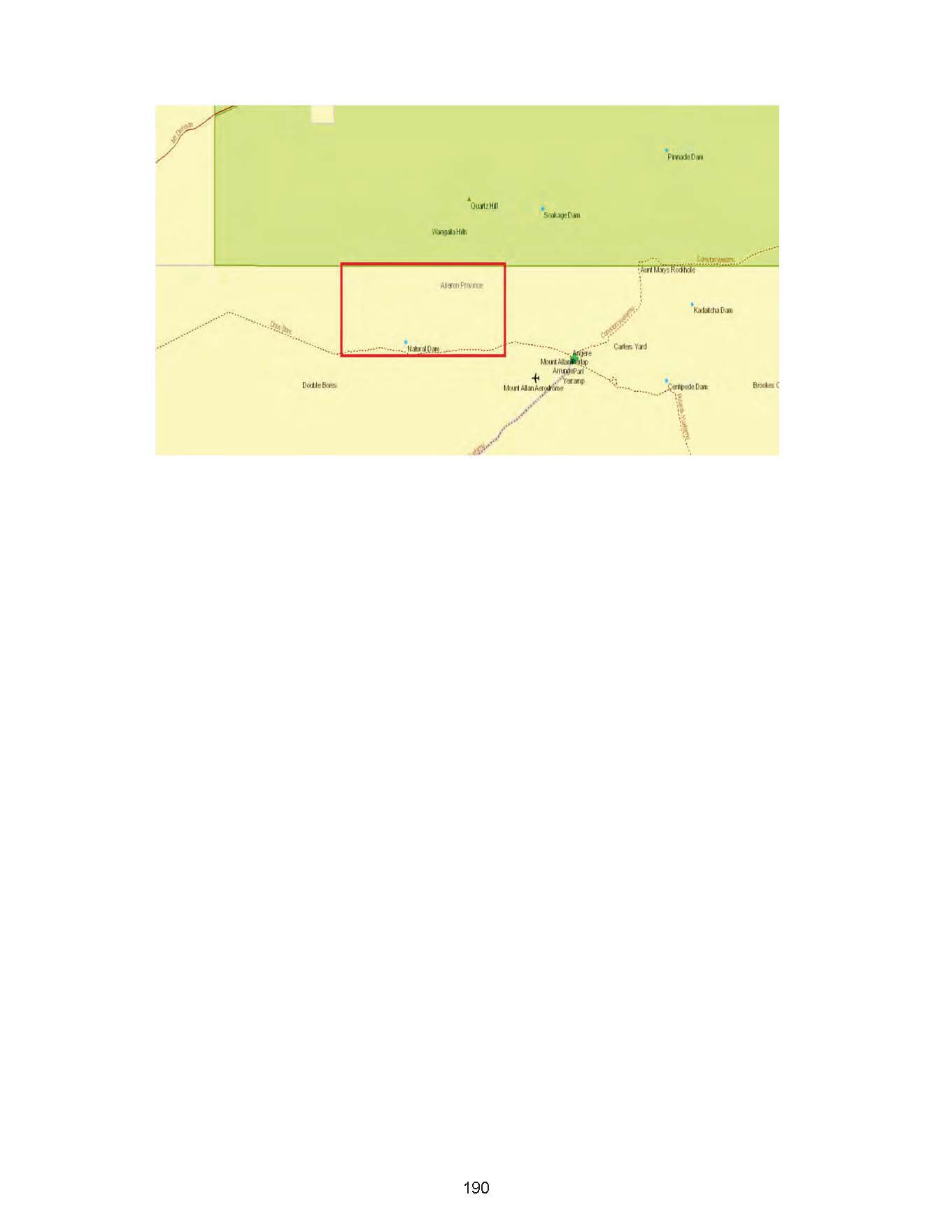
Annexure E