

Federal Court of Australia
Kerr v Minister for Immigration and Citizenship [2026] FCA 726
File number(s): | QUD 176 of 2025 |
Judgment of: | COLLIER J |
Date of judgment: | 11 June 2026 |
Catchwords: | MIGRATION - application for judicial review of a decision of the Assistant Minister - where Assistant Minister set aside and substituted decision of Administrative Appeals Tribunal under s 501A(3)(b) Migration Act 1958 (Cth) - where Assistant Minister cancelled applicant's visa - three grounds of review - alleged failure to consider legal consequence of decision - alleged unreasonable characterisation of offence of assault police officer as very serious - alleged unreasonable failure to obtain transcript of hearing before Administrative Appeals Tribunal - where applicant has significant criminal history - where applicant received previous formal warnings that there were grounds to cancel visa and continued to offend - application dismissed with costs |
Legislation: | Migration Act 1958 (Cth) ss 501, (3A), (6)(a), (7)(d), 501A(3)(b), 501CA(4) Police Powers and Responsibilities Act 2000 (Qld) s 790 |
Cases cited: | AZX21 v Minister for Immigration, Citizenship, Migrant Services and Multicultural Affairs [2024] FCA 1379 BVD17 v Minister for Immigration and Border Protection [2019] HCA 34; (2019) 268 CLR 29 Cotterill v Minister for Immigration and Border Protection [2016] FCAFC 61; (2016) 240 FCR 29 CRRN v Minister for Immigration and Multicultural Affairs [2025] FCA 192 Djokovic v Minister for Immigration, Citizenship, Migrant Services and Multicultural Affairs [2022] FCAFC 3; (2022) 289 FCR 21 GFE24 v Minister for Immigration and Citizenship [2025] FCAFC 165; (2025) 313 FCR 210 Healey v Minister for Immigration, Citizenship, Migrant Services and Multicultural Affairs [2022] FCAFC 188; (2022) 295 FCR 210 26; (2023) 298 FCR 277 Minister for Immigration and Border Protection v SZSRS [2014] FCAFC 16; (2014) 309 ALR 67 NBMZ v Minister for Immigration and Border Protection [2014] FCAFC 38; (2014) 220 FCR 1 Pallas v Minister for Home Affairs [2019] FCAFC 149 Splendido v Assistant Minister for Immigration and Border Protection (No 2) [2018] FCA 1158 Tereva v Minister for Immigration, Citizenship, Migrant Services and Multicultural Affairs [2022] FCAFC 142; (2022) 294 FCR 270 |
Division: | General Division |
Registry: | Queensland |
National Practice Area: | Administrative and Constitutional Law and Human Rights |
Number of paragraphs: | 68 |
Date of last submission/s: | 15 August 2025 |
Date of hearing: | 27 August 2025 |
Counsel for the Applicant: | Mr J. R. Murphy and Mr J. Cameron |
Solicitor for the Applicant: | Zarifi Lawyers |
Counsel for the Respondent: | Mr B. McGlade |
Solicitor for the Respondent: | Clayton Utz |
ORDERS
QUD 176 of 2025 | ||
| ||
BETWEEN: | DANIEL JOHN KERR Applicant | |
AND: | MINISTER FOR IMMIGRATION AND CITIZENSHIP Respondent | |
order made by: | COLLIER J |
DATE OF ORDER: | 11 JUNE 2026 |
THE COURT ORDERS THAT:
1. The Second Further Amended Originating Application for Review of a Migration Decision lodged by the applicant on 19 August 2025 be dismissed.
2. The applicant pay the costs of the respondent of and incidental to the proceedings, to be taxed if not otherwise agreed.
Note: Entry of orders is dealt with in Rule 39.32 of the Federal Court Rules 2011.
REASONS FOR JUDGMENT
COLLIER J:
1 Before the Court is a Second Further Amended Originating Application for Review of a Migration Decision, lodged by the applicant on 19 August 2025 and accepted for filing on 22 August 2025 (the application). The applicant seeks judicial review of a decision of the Minister Assisting the Minister for Immigration and Citizenship (Assistant Minister) made on 2 January 2025 under s 501A(3)(b) of the Migration Act 1958 (Cth) (Assistant Minister’s Decision). The Assistant Minister’s Decision in turn set aside the decision of the Administrative Appeals Tribunal (Tribunal) and cancelled the applicant’s Class TY Subclass 444 Special Category (Temporary) Visa (the visa).
2 The applicant initially relied on five grounds of review in the application, however, only the following three grounds of review were pressed at the hearing before me:
1. The Assistant Minister’s decision was affected by jurisdictional error by reason of his failure to consider a legal consequence of the decision, namely, that the applicant would, after a period of being lawfully at liberty in the community, become liable to be detained, and would be detained, in immigration detention.
…
2. The Assistant Minister’s decision was affected by jurisdictional error by reason of his characterisation of the applicant’s assault police officer offence as ‘very serious’, which characterisation was unreasonable, illogical or irrational.
…
4. The Assistant Minister’s decision was affected by jurisdictional error by reason of his failure to request a copy of, and have regard to, the transcript of the hearing before the Tribunal.
…
(particulars omitted)
3 The applicant pressed the following relief:
1. A writ of certiorari issue quashing the decision of the respondent dated 2 January 2025 to cancel the applicant’s Class TY Subclass 444 Special Category visa.
2. The respondent pay the applicant’s costs, as agreed or assessed.
…
4. An injunction restraining the Respondent, by himself or by his Department, officers, delegates or agents, from giving effect to the decision dated 2 January 2025, whether by continuing to detain the applicant or otherwise.
4 In my view, for the reasons outlined below, the application should be dismissed.
Background
5 The applicant is a 41-year-old New Zealand citizen who moved to Australia in 1998 when he was 15 years old.
6 The applicant has a very extensive criminal history between the years 2001 and 2022. His criminal history check results report spans some nine pages. The applicant’s criminal history includes bail breaches, obstructing police, assaulting police, drug offences, common assault, unlawful possession of stolen property, unlawful use of a motor vehicle, possessing explosives, fraud, possessing shortened firearms, forgery and the unlawful possession of weapons.
7 On 16 May 2006, a delegate of the Minister for Immigration and Citizenship (Minister) notified the applicant that the Minister was considering whether there were grounds to cancel his visa under s 501 of the Migration Act. The delegate decided not to exercise their discretion to cancel the visa but did issue the applicant a formal warning that any further conviction would lead to the prospect of reconsideration of cancellation of his visa.
8 On 24 January 2017, the applicant’s visa was cancelled under s 501(3A) of the Migration Act after the applicant had been sentenced in the Beenleigh Magistrates Court to concurrent terms of imprisonment of 12 months after being convicted of:
Possess shortened firearm, Authority Required to Possess Explosives, Possessing Dangerous Drugs, Possession of Implements That Was Being Or Was Used In Relation To Particular Offences, Possessing Anything For Use In The Commission Of Crime Defined In Part 2 and Fail To Properly Dispose Of Needle And Syringe.
9 However, on 1 March 2017, a delegate of the Minister found that the power under s 501CA(4) of the Migration Act was enlivened, and the mandatory cancellation of the applicant’s visa was revoked.
10 Subsequently, on 13 April 2018, the applicant was convicted in the Brisbane Magistrates Court of the following convictions, for each of which the applicant was sentenced to concurrent terms of six months’ imprisonment:
Possess tainted property, Possessing dangerous drugs, Unlawful possession of weapons category A, B or M, Possess Utensils or pipes etc. for use and Possessing anything used in the commission of crime defined in part 2.
11 On 10 March 2022, the applicant was convicted of additional offences.
12 On 6 May 2024, a delegate of the Minister cancelled the applicant’s visa relying on s 501(6)(a) and (7)(d) of the Migration Act (the Delegate’s Decision).
13 On 22 August 2024, the Tribunal set aside the Delegate’s Decision to cancel the applicant’s visa and substituted it with a non-cancellation decision (the Tribunal Decision). The reasons of the Tribunal were published on 26 September 2024.
14 On 2 January 2025, the Assistant Minister set aside the Tribunal Decision and cancelled the applicant’s visa under s 501A(3)(b) of the Migration Act (the Assistant Minister’s Decision). It is not in dispute that the Assistant Minister made this decision in one hour and 35 minutes without reviewing the transcript from the Tribunal hearing and without seeking any updated information about the applicant.
Decision of the Assistant Minister
15 On 2 January 2025, the Assistant Minister cancelled the applicant’s visa on the following basis:
d. I reasonably suspect that Mr KERR does not pass the character test because of the operation of s501(6)(a), on the basis of s501(7)(d), and I am satisfied that it is in the national interest to cancel Mr KERR’s visa. I have decided to exercise my discretion under s501A of the Act. I hereby set aside the decision of the Administrative Appeals Tribunal dated 22 August 2024 and cancel Mr KERR’s Class TY Subclass 444 Special Category (Temporary) Visa. My reasons for this decision are set out in the attached Statement of Reasons.
16 Section 501A(3)(b) of the Migration Act empowers the Minister (or Assistant Minister, as in this case) to set aside a decision and cancel a person’s visa if:
the Minister reasonably suspects the person does not pass the character test; and
the Minister is satisfied that the cancellation is in the national interest.
The Character Test
17 The Assistant Minister first considered whether the applicant passed the character test under s 501A(3)(b).
18 A person fails the character test if they have a substantial criminal record: s 501(6)(a) Migration Act. Relevantly, s 501(7)(d) provides that a person has such a record if they have been sentenced to terms of imprisonment totalling 12 months or more.
19 The Assistant Minister referred to the applicant’s convictions in the Magistrates Court of Queensland in Brisbane on 13 April 2018 for which the applicant received:
six months’ imprisonment (wholly suspended for two years) for the offence of possess tainted property; and
six months’ imprisonment (wholly suspended for two years) for various offences including possessing dangerous drugs and unlawful possession of weapons category A, B or M.
20 On that basis, the Assistant Minister reasonably suspected that the applicant did not pass the character test.
The National Interest
21 The Assistant Minister then considered whether the cancellation of the applicant’s visa was in the national interest, having regard in particular to the protection of the community and the expectations of the community.
22 As to protection of the community, the Assistant Minister found, in summary:
In regard to the seriousness of the criminal conduct of the applicant, the Assistant Minister observed that the Australian government considers that all offending including violence is viewed very seriously by the Australian community. In particular, offending involving family violence is of special concern.
• The Assistant Minister noted that the applicant was convicted of the offence of assault police officer, which was a violent crime, was sentenced to terms of imprisonment, and engaged in conduct and been convicted of an offence amounting to family violence against two different partners, including his wife (DK). In respect of the Tribunal’s finding that the applicant had not engaged in family violence directed at DK, the Assistant Minister observed:
35. … The AAT records that Mr KERR and DK were questioned about the above excerpt, and both responded to the questions with useful ‘context’, however the record does not set out the content of the evidence itself. Accordingly, it is difficult to see on what basis the AAT made its findings. On the basis of the information before me, I am satisfied that the conduct set out in the excerpt above, when perpetrated against an intimate partner, amounts to family violence. I accept that it demonstrates that Mr KERR has engaged in such conduct against DK, and that DK is Mr KERR's current partner. Accordingly, I am satisfied that Mr KERR has engaged in conduct that amounts to family violence, to some extent, against his current partner DK. I note, however, that the above excerpt only reveals general conduct, as opposed to specific instances of family violence and I therefore attribute this aspect of family violence limited weight in favour of family violence cancelling Mr KERR's visa.
• The Assistant Minister noted that the applicant’s criminal history was extensive and involved repeated offending of a similar kind, and that the applicant’s continued offending displayed a trend of increasing seriousness. The Assistant Minister ultimately found that due to his consistent pattern of offending, the applicant’s offending was serious. The applicant’s offences of violence and family violence were found to be very serious.
With regard to the risk to the Australian community, the Assistant Minister explained that any future offending of a similar nature or seriousness to the applicant’s previous offending would have the potential to cause serious harm to members of the Australian community. In assessing the likelihood of the applicant reoffending in the future, the Assistant Minister made the following findings:
• Although the applicant claimed that he was abstinent from drug use and would not be at risk of reoffending, the applicant gave oral evidence before the Tribunal that there were previous periods in his life where he refrained from using drugs but subsequently relapsed. The applicant’s long-standing issue with drug addiction was a significant driving factor to his offending and other serious conduct.
• The applicant had made various rehabilitation efforts, however one of his primary coping strategies appeared to be to isolate himself, and there were concerns that the applicant had not completed sufficient rehabilitation to adequately address the primary driver of his offending. The Assistant Minister attributed weight to the fact that the applicant attended church every Sunday, was involved in the church’s ‘Iron Men’ group, and had a positive support network.
• The Assistant Minister disagreed with the Tribunal’s finding that the applicant posed a ‘very low’ risk of re-offending because he had struggled to stay abstinent from drugs, did not accept enough opportunities to engage in rehabilitation, provided no real plans to engage in continued rehabilitation, and continued to offend despite being formally warned by the Department in 2006 and again in 2017. Despite the fact that he had family support, that had not prevented the applicant’s drug use and offending in the past.
23 The Assistant Minister made the following findings in relation to the expectations of the Australian community:
Where a non-citizen has engaged in serious conduct, the Australian community expects the Government to not allow such a non-citizen to remain in Australia.
The applicant’s conduct including family violence, crimes against women, and the commission of crimes against government representatives raised serious character concerns. Community expectations should be considered.
24 The Assistant Minister concluded that cancellation of the applicant’s visa was in the national interest.
Discretionary Considerations
25 The Assistant Minister noted that the power to cancel a visa under s 501A of the Migration Act was discretionary, and considered whether there were additional relevant considerations that might support a decision not to cancel the applicant’s visa. The Assistant Minister formed views including:
In relation to the applicant’s ties to Australia:
• The applicant had resided in Australia for over 26 years, having arrived at 15 years old. The Assistant Minister also noted that the applicant began offending soon after arriving in Australia and continued to do so.
• The applicant had immediate family members in Australia, being the applicant’s wife DK, her three children, the applicant’s father and the applicant’s mother.
• DK had been romantically involved with the applicant since 2014, and the couple were trying to conceive a child. DK claimed that the applicant’s removal would have an adverse impact on her because of her complex post-traumatic stress disorder, anxiety, depression, and autism.
• There was independent information that DK was diagnosed with ovarian cancer, however there was no relevant documentary evidence relating to this diagnosis before the Assistant Minister. The Tribunal also found that DK was not a wholly credible witness. The Assistant Minister noted that the applicant had previously forged medical certificates but was ultimately satisfied that DK had received a formal diagnosis for ovarian cancer.
• The removal of the applicant from Australia would have adverse impacts on DK’s children.
• The applicant’s father provided evidence that he suffered from heart and kidney failure and wished to spend time with his son as he would not be able to visit him in New Zealand.
• The applicant had strong links in Australia including to the United City Church in Ormeau.
• The applicant had a limited employment history, which consisted of work as a forklift operator from 2000-2001, and a warehouse manager from 2007-2010. The Assistant Minister also noted that the applicant had been involved in volunteering.
In relation to the best interests of minor children:
• The Assistant Minister noted the submission of the applicant that three minor children in Australia could be affected by a decision to cancel his visa, namely “LR” (14 years old), “LJ” (13 years old) and “JJ” (11 years old), who are the biological children of DK. The Assistant Minister noted that at the time of the Tribunal decision, the children lived with their maternal grandmother and were placed under child safety custody 8 years prior. The Assistant Minister noted that it would be in the best interests of the children not to cancel the visa, and attributed this consideration moderate weight against cancelling the visa.
• The Assistant Minister also noted that the applicant had a 16-year-old biological daughter who lives with her mother and stepfather in Western Australia, but that there is a limited possibility that the applicant would play a positive parental role in her life before she turns 18.
• The Assistant Minister noted that the applicant had 12 nieces and nephews under the age of 18 but that the applicant’s relationship with each of them was non-parental and there were other people to fulfil a parental role for each child.
In relation to the legal consequences of the cancellation decision, the Assistant Minister noted:
97. Mr KERR has not made any claims which require assessment in relation to Australia’s international non-refoulement obligations, nor does the other available evidence indicate that such an assessment is necessary in this case. Further, Mr KERR is not covered by a protection finding as defined in s197C of the Act.
In relation to any impediments the applicant may face if removed to New Zealand, the Assistant Minister noted:
• The applicant is 41 years old and has identified health issues including type 1 diabetes, necrotising pancreatitis, depression and anxiety. There is also information that the applicant has engaged in self-harm and attempted suicide, and that he has been diagnosed with Hepatitis C and has drug addiction issues. The Assistant Minister ultimately noted that the medical treatment available to the applicant in New Zealand was likely to be the same or of similar standard as in Australia.
• The applicant would experience limited difficulties moving to New Zealand given the main language spoken there is English, and that he resided in New Zealand until he was aged 15.
In relation to any impact on Australian business interests if the applicant was removed to New Zealand, the Assistant Minister noted that there would be no impact and attributed this consideration no weight regarding a decision to cancel the applicant’s visa.
Submissions of the parties
Applicant’s Submissions
26 In respect of Ground 1 (failure to consider legal consequences), the applicant submitted, in summary:
The Assistant Minister fell into jurisdictional error by failing to consider that cancellation would result in the applicant being detained in immigration detention. Although it is uncontroversial that being detained was a relevant legal consequence of the decision, the Assistant Minister was still required to consider it during the decision-making process. Despite this, the Assistant Minister did not refer to it in his reasons.
This error by the Assistant Minister was material. Depriving a person of their liberty is “a weighty matter”, particularly given the applicant had regained freedom after a lengthy review process. Returning the applicant to detention would significantly disrupt his life. Given the importance of that consequence, and other factors in the applicant’s favour, there is a realistic possibility the outcome may have differed.
27 In respect of Ground 2 (unreasonable characterisation of the applicant’s offending), the applicant submitted, in summary:
The Assistant Minister erred in characterising the applicant’s offence of assault police officer, for which the applicant was convicted and fined $600, as “very serious”. That characterisation was based solely on the applicant’s criminal history document. The Assistant Minister did not observe s 790 of the Police Powers and Responsibilities Act 2000 (Qld) which provides that the maximum penalty for the offence of assault police officer is 40 penalty units or six months’ imprisonment.
In Cotterill v Minister for Immigration and Border Protection [2016] FCAFC 61; (2016) 240 FCR 29, North J concluded that “[t]he statement of the offences alone did not justify the conclusion that the appellant’s offending was serious…” and found that the conclusion reached by the Minister in that case was without “evidence and intelligible justification”. In the present case, the Assistant Minister similarly characterised the applicant’s offending as “very serious” without evident and intelligible justification because an offence for which a person is fined $600 is not self-evidently very serious, and there was no other information available to the Assistant Minister to support such a characterisation.
The characterisation of the applicant’s offending as “very serious” was material. Had the offence not been so characterised, less weight may have been given to the community protection considerations, with a realistic possibility of a different outcome.
28 In respect of Ground 4 (failure to consider the transcript of the Tribunal hearing), the applicant submitted, in summary:
The Assistant Minister erred jurisdictionally by failing to obtain the transcript of the hearing before the Tribunal. The failure to exercise an implied power to inquire was unreasonable and vitiated the ultimate decision. In the alternative, it rendered the relevant factual finding unreasonable.
By way of background:
24. There was documentary evidence before the Tribunal, in the form of a domestic violence booklet or survey provided by Queensland Corrective Services (survey) that suggested that the Applicant may have engaged in family violence towards DK. However, the other evidence before the Tribunal cut against that conclusion.
25. Each of the Applicant’s witnesses, the Applicant, DK and DK’s mother (given the pseudonym “Ms F” in the Tribunal’s reasons) gave evidence at the Tribunal hearing that was relevant to the Applicant’s relationship with DK and, in particular, whether or not he had engaged in conduct that amounts to family violence in respect of DK. The Tribunal had the benefit of seeing and hearing these witnesses give evidence.
26. Some of the evidence given by those witnesses that was relevant to this issue included:
26.1 Applicant: When the Applicant was asked about what he had allegedly disclosed in the survey he stated “I’ve pushed her out of the way. But, like, not pushed. I pushed past her to get out” and later the Applicant explained “I haven’t actually pushed her” and that the survey was “worded wrong”.
26.2 DK: When the matters in the survey were put to DK in cross-examination, she gave evidence that the Applicant had sworn at her and criticised her, but that he had never been violent towards her.
26.3 DK’s mother: DK’s mother stated that she had not seen any of the behaviours described in the survey, stating “I’ve not seen anything to cause any alarm for domestic violence because if I had I would have got rid of him. I went through it. I know what it’s like. I won’t see my kids go through it”.
27. Having heard the evidence of the Applicant, DK and DK’s mother, the Tribunal declined to find that the Applicant had engaged in family violence against DK (CB 63 [97]). The Tribunal acknowledged that the survey tended directly to suggest that the Applicant had engaged in family violence against DK (CB 62 [92]). However, the Tribunal referred to the oral evidence of the Applicant, DK and DK’s mother that tended against that conclusion (CB 62-63 [93]-[96]). In particular, the Tribunal referred to:
27.1 The Applicant’s evidence at transcript p 21 line 41 to p 22 line 40 and transcript p 53 lines 11-37(CB 62 [94], footnotes 61 and 62);
27.2 DK’s mother’s evidence at transcript p 76 lines 8-36 (CB 62 [95], footnote 63);
27.3 DK’s evidence at transcript p 139 line 39 to p 140 line 30 (CB 63 [96], footnote 64).
28. Importantly, the Tribunal’s reasoning in this respect included nuanced credibility findings about DK, and observations about the way she gave certain answers (e.g., “ferociously assertive”: CB 63 [96]). The Tribunal also clearly had regard to the way DK’s mother gave her evidence (e.g., “vehemently”: CB 62 [95]).
(footnotes omitted)
• The Assistant Minister nonetheless found that the applicant had engaged in family violence towards DK and stated that it was “difficult to see on what basis the [Tribunal] made its findings”. That was unwarranted given the Tribunal’s reliance on oral evidence.
• There was no evident or intelligible justification for failing to obtain the transcript. In CRRN v Minister for Immigration and Multicultural Affairs [2025] FCA 192, Owens J identified that in some circumstances legal reasonableness may require consideration of the Tribunal’s reasons. In this case, the transcript was crucial to the issue of whether the applicant had committed family violence against DK. If the Assistant Minister had obtained and had regard to the transcript, it could have changed the ultimate decision, particularly given the importance of family violence to the national interest considerations.
Assistant Minister’s Submissions
29 In respect of Ground 1 (failure to consider legal consequences), the Assistant Minister submitted, in summary:
The Assistant Minister was required to consider the immediate statutory consequences of his decision, including detention, but any failure to refer to such consequences was not material.
It is unlikely that a Minister administering the Migration Act would be unaware of such consequences.
The Assistant Minister stated in his reasons that he had regard to the documents before him when making the decision. Such documents included the Tribunal’s reasons, which outlined the legal consequence of a cancellation decision.
It is difficult to conclude that the Assistant Minister ignored the detention consequence.
The applicant did not raise detention as a detriment before the Tribunal, making any inference of oversight less compelling.
Administrative decision-makers are not required to set out their mental process in their statement of reasons. As such, a mere non-reference to a matter does not invite an inference that it was not considered.
The Assistant Minister was not required to give any weight to the consideration of the detention consequence, particularly because no claims were made that such a factor should be given weight and otherwise in circumstances where the evidence did not support any inference that any detention would be prolonged or indefinite.
In any event, the Assistant Minister’s primary concern was the protection of the Australian community, and the applicant was found to pose an ongoing risk of reoffending.
30 In respect of Ground 2 (unreasonable characterisation of the applicant’s offending), the Assistant Minister submitted, in summary:
Cotterill is distinguishable from the present case because in that case the relevant offending could have potentially involved a large range of conduct, of which the lower end was not compatible with a conclusion that the relevant conduct was serious. That case turned upon its particular facts and does not establish a broader principle that seriousness cannot be assessed from the fact of conviction.
Decision-makers are generally entitled to assess seriousness based on the general nature of the offence. In this case, the evidence does not suggest that the applicant made any attempt to persuade the Tribunal that the offending was of a less serious nature.
It was open to the Assistant Minister to characterise an offence of assault police officer as serious.
The high threshold for legal unreasonableness was not met. In any event, the requirement for an “evident and intelligible justification” concerns the ultimate conclusion; not each factual finding.
An irrational, illogical or unreasonable finding will only give rise to jurisdictional error if the ultimate decision is not open on all the materials. The applicant did not suggest the unreasonableness in this case rose to that point. The classification of the seriousness of the assault police officer offence was one of many factors on the Assistant Minister’s evaluation of the protection of the Australian community and the case more generally.
31 In respect of Ground 4 (failure to consider the transcript of the Tribunal hearing), the Assistant Minister submitted, in summary:
While there is some authority that a failure to inquire may, in extreme cases, be reasonable, that proposition is doubtful in light of recent High Court decisions. In any event, this is not such a case.
The statutory scheme confers a broad discretion with little expectation of inquiry. The Migration Act does not require consideration of specific material, imposes no duty to inquire, and permits decisions based on incomplete information. The Minister is not reviewing the decision of the Tribunal, is not bound by its findings, and may take broader policy and practical considerations into account.
The finding that the applicant had committed family violence towards DK was not critical, but rather was one of many factors involved in the Assistant Minister’s broad and evaluative decision.
Obtaining the transcript of the Tribunal hearing would simply have given the Assistant Minister an additional body of evidence. To ascertain whether the applicant actually committed family violence would have involved the Assistant Minister undertaking a nuanced and evaluative weighing process. Inquiries of such a nature are not readily compatible with a duty to inquire.
While the transcript may have potentially enabled the Assistant Minister to better understand the Tribunal’s views, the value of the transcript to the Assistant Minister was unclear. Further:
48. …it was open to the Minister to form the view that it was inherently unlikely that the Applicant would admit to the family violence behaviours that he admitted to (in the lengthy, specific and unqualified way that he apparently did in the context that he did – including his acknowledgment that such behaviours were “difficult to admit”) in R[34] if they did not occur and, therefore, that any later self-interested attempt by him and his partner (DK) to deny or downplay such conduct was unlikely to be persuasive to the Minister. That is particularly so when (without limitation):
a) it was open to the Minister to consider that it was inherently unlikely that, of the myriad of family violence behaviours that the Applicant admitted to, he either falsely admitted to them or that they somehow were not acts of family violence when considered in context;
b) the Applicant had denied other family violence conduct which he had been convicted of (R[32]-[33]);
c) the Tribunal’s reasons do not suggest that the Applicant denied any of the conduct (as opposed to providing “useful context” and “clarification” of an undisclosed nature) (T[94]); and
d) it was unclear what conduct DK had denied or sought to qualify and why the Tribunal considered her evidence to be credible (this observation is made noting that the DK was considered to be a generally unreliable witness (T[29]) and the primary credibility matter the Tribunal mentioned in her favour was the fact that DK had been “ferocious” in her position (T[96]) – which is not self-evidently consistent with a narrative being credible).
Any inquiry in this case would further delay the Assistant Minister’s decision and involve the Assistant Minister incurring expenditure to acquire a transcript. The reasonableness of policy decisions concerning the executive expending of public funds is not a matter that this Court is readily able to determine.
Consideration
Ground 1 – Failure to consider legal consequences
32 Counsel for the applicant submitted that, although it is a common occurrence for a visa holder or applicant to be placed in detention if an adverse decision is reached against them, it is still the case that the decision-maker must consider that legal consequence. Counsel for the Assistant Minister accepted this proposition.
33 I note the observations of Allsop CJ and Katzmann J in NBMZ v Minister for Immigration and Border Protection [2014] FCAFC 38; (2014) 220 FCR 1 at [9]:
The Minister must take into account the Act and its operation in making a decision; to make a decision without taking into account what Parliament has prescribed by way of legal consequence is to fail to take into account the legal framework of the decision. At a functional level this is reinforced if the legal consequences of the decision are important in human terms: indefinite detention pending removal.
34 I accept the proposition that, as a general rule, the Assistant Minister was required to take into account the operation of the Migration Act in making a decision.
35 Counsel for the applicant submitted that it can inferred that the Assistant Minister did not comply with that general rule and overlooked the detention consequence as it was not mentioned in the Assistant Minister’s reasons.
36 I agree with the submission by Counsel for the Assistant Minister that any such consideration is a mental process, and it is sufficient if the mind engages with the issue.
37 The obligation to consider the legal consequences of a decision arises from a broader requirement that decision-makers need to be mindful of the framework in which they are making the decision. I note the observations of the High Court in BVD17 v Minister for Immigration and Border Protection [2019] HCA 34; (2019) 268 CLR 29 at [38]:
As the recent decision in Plaintiff M47/2018 v Minister for Home Affairs well enough illustrates, leaving constitutional and legislative facts aside, it is the plaintiff in an application for judicial review of administrative action who has the onus of establishing on the balance of probabilities the facts on which a claim to relief is founded. To the extent that the factual basis for a claim to relief is sought to be founded on an inference to be drawn from a decision-maker's statement of reasons, the appropriateness of drawing the inference falls to be evaluated having regard to two settled principles. One is that such a statement of reasons must be read fairly and not in an unduly critical manner. The other is that it must be read in light of the content of the statutory obligation pursuant to which it was prepared.
(footnotes omitted, emphasis added)
38 I also the observation of the Full Court in Minister for Immigration and Border Protection v SZSRS [2014] FCAFC 16; (2014) 309 ALR 67 at [34] that the fact that a matter is not mentioned does not also mean it has not been considered.
39 I do not accept that the inference that the Assistant Minister did not consider the likely consequence of visa cancellation that the applicant would be placed in detention. The Assistant Minister stated that he had regard to the material before him. That material included the Tribunal’s reasons, which themselves addressed the operation of the Migration Act and the consequences of visa cancellation. Further, the Assistant Minister signed a departmental submission which referred to the consequences of cancellation, including detention. In those circumstances, it is not appropriate to infer, merely from the absence of an express reference in the statement of reasons, that the likely consequence of detention was overlooked.
40 Consistently with the observations in BVD17 and SZSRS, the reasons must be read fairly, and not with an eye attuned to the perception of error. Administrative decision-makers are not required to set out every step of their reasoning, or every matter considered: Pallas v Minister for Home Affairs [2019] FCAFC 149 at [45]; Healey v Minister for Immigration, Citizenship, Migrant Services and Multicultural Affairs [2022] FCAFC 188; (2022) 295 FCR 210 at [36]. The omission of express reference to detention, in circumstances where it is an obvious and well-known statutory consequence, does not justify the inference that it was not considered.
41 In any event, even if such an inference could be drawn, the applicant has not established materiality. Unlike cases involving the risk of indefinite detention or other exceptional consequences (see NBMZ at [9]), there is no evidence that detention in this case would have been prolonged or indefinite.
42 In light of the Assistant Minister’s detailed findings concerning the risk to the community, and the applicant’s history of offending, I am not satisfied that there is a realistic possibility that express consideration of the detention consequence would have led to a different outcome.
43 Ground 1 is not established.
Ground 2 – Unreasonable characterisation of the applicant’s offending
44 In respect of ground 2, the applicant bears the onus of establishing that the Assistant Minister erred in his characterisation of the applicant’s offence of assault police officer as “very serious”. It must then be shown that that error was material.
45 Counsel for the applicant drew the Court’s attention to the criminal history check of the applicant, and in particular the following entry on 10 May 2002:
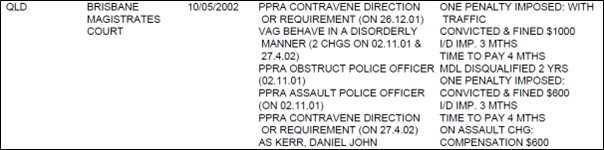
46 In relation to the offence of assault police officer, this entry in the criminal history check was the only information available to the Assistant Minister when he made his decision.
47 Counsel for the applicant submitted that the characterisation of the offence as “very serious” could not have been supported by a rational justification. The information before the Assistant Minister was that the applicant was charged with an offence and sentenced to a fine of $600, where the maximum penalty was six months’ imprisonment. Counsel for the applicant further submitted that it was not rational to characterise the offending as very serious, given a very low sentence was handed down.
48 Counsel for the applicant drew the Court’s attention to the decision in Cotterill, including, but not limited to, the following findings of North J:
91. In contrast to those cases, in the present case the Minister had no information from the sentencing magistrate about the offending. The circumstances involved in the offending were not revealed save for the bare statement of the charges themselves. It was not possible for the Minister, acting rationally, to characterise the offending as serious without information about the circumstances in which the offences occurred.
92. Indeed, the limited information which was available to the Minister was supplied by the appellant, his partner and one of his daughters. That information suggested that the convictions were not justified by the circumstances or, at least, they were at a low level of offending. As noted above in relation to the risk of reoffending, the Minister did not say that he accepted or rejected that information but said that he noted it. Without some resolution about that information the Minister could not come to a rational view about the seriousness of the offending.
93. The information on which the Minister relied for his assessment that the offences were serious was the statement of the offences, the sentences imposed, the sentences which would have been imposed but for the plea of guilty, and the fact that the appellant was placed on the sex offender register. The statement of the offences alone did not justify the conclusion that the appellant’s offending was serious because the offences charged were capable of encompassing a large range of offending conduct from the merry drunken flasher in a public place to the calculated conduct in private of a sexual predator. The practical effect of the sentences as a result of both the part suspension and the significant concurrence of the terms of imprisonment could not, without more, justify conclusion that the offending was serious. Likewise, because registration as a sex offender followed as a mandatory consequence of the convictions, the registration of the appellant could not advance the question of the seriousness of offending.
49 Counsel for the Assistant Minister submitted that there was nothing unreasonable about the Assistant Minister taking a broad view of the seriousness of the offending, based on the Assistant Minister’s knowledge of the elements of the offence. Further, Counsel for the Assistant Minister noted the decision in Splendido v Assistant Minister for Immigration and Border Protection (No 2) [2018] FCA 1158 and that, consist with that decision, the Assistant Minister can logically, rationally and reasonably form broad views of the seriousness of offending, without knowing the minutiae of it.
50 It is well established that there exists a very high threshold to set aside an administrative decision on the basis of unreasonableness: AZX21 v Minister for Immigration, Citizenship, Migrant Services and Multicultural Affairs [2024] FCA 1379 at [46]. If the Assistant Minister’s findings or decision were open on all the materials, the findings or decision cannot be said to be unreasonable due to illogicality or irrationality: Masi-Haini v Minister for Home Affairs [2023] FCAFC 126; (2023) 298 FCR 277; Djokovic v Minister for Immigration, Citizenship, Migrant Services and Multicultural Affairs [2022] FCAFC 3; (2022) 289 FCR 21 at [33]-[34].
51 In my view, the Assistant Minister’s assessment of the applicant’s criminal history and risk of re-offending was not confined to that single offence. Rather, it formed part of a broader evaluation of the applicant’s extensive criminal history over more than two decades, including repeated offending and offending involving violence. The Assistant Minister referred to the frequency and increasing seriousness of the offending in his reasons to form the view that the applicant posed a risk to the Australian community.
52 It was open to the Assistant Minister to characterise an offence of assault police officer as inherently serious by reference to the nature of the offence. The lack of detailed factual circumstances does not necessarily mean a decision-maker cannot make a finding on the level of seriousness.
53 Cotterill turned on its own facts, namely the breadth of conduct encompassed by the relevant offences. It does not establish a general principle that seriousness cannot be assessed without detailed factual material.
54 In any event, the threshold for legal unreasonableness is high. The question is whether the conclusion lacks an evident and intelligible justification. Having regard to the nature of the offence, the applicant’s broader criminal history, and the Assistant Minister’s reasoning as a whole, that threshold is not met.
55 Further, the Assistant Minister’s conclusions as to the seriousness of the applicant’s conduct and the risk he posed were reached by reference to a wide range of offences and considerations. The characterisation of the offence as very serious was only one aspect of the decision-making process.
56 Ground 2 is not substantiated.
Ground 4 – Failure to consider the transcript of the Tribunal hearing
57 The Assistant Minister noted in his reasons that he proceeded under s 501A(3) of the Migration Act, which enables the Minister (or Assistant Minister) to proceed without giving the applicant an opportunity to be heard before making any decision.
58 Counsel for the applicant summarised the issue to be determined under this ground by providing that before the Tribunal, it was accepted that the applicant had committed family violence against a former partner, but it was in issue whether he had committed family violence against his current partner, DK.
59 The relevant findings of the Member of the Tribunal in respect of the acts of family violence on the part of the applicant were as follows:
PRIMARY CONSIDERATION 2: FAMILY VIOLENCE COMMITTED BY THE NON-CITIZEN
88. This paragraph is enlivened by two sets of evidence.
89. The first set relates to events in 2012 involving Mr Kerr and his former partner. The second is more recent and stems from Mr Kerr’s completion of a domestic violence booklet or survey provided by Queensland Corrective Services (QCS) to gauge the level and types of abusive behaviours Mr Kerr has exhibited and subsequent comments and observations by QCS officers.
90. Ms Tattersall’s contentions are summarised as follow [sic]:
Mr Kerr was convicted of family violence involving physical aggression toward his former partner and has also admitted to engaging in acts of family violence with another partner, inferred by the Minister to be his current partner. This suggests some level of frequency: paragraph 8.2(3)(a).
As Mr Kerr committed family violence against two different partners, his offending or misconduct does not result in a cumulative effect: paragraph 8.2(3)(b).
Mr Kerr denies responsibility for the violence against his former partner but has shown some acknowledgment of responsibility for the violence against his current partner. Despite being referred to a domestic violence program in 2019, Mr Kerr disengaged from the probation order and was deemed unsuitable for the program. Consequently, the Respondent contends that Mr Kerr has not participated in any rehabilitation courses directly targeting domestic violence: paragraph 8.2(3)(c).
91. In relation to the first set of evidence from 2012, the Tribunal notes that, while the Queensland Police Service issued domestic violence orders against Mr Kerr, he was not convicted of a domestic violence offence. He was convicted of common assault. These facts temper the weight of the 2012 incident in assessing this consideration.
92. In relation to the latter set of evidence, the Tribunal is concerned that there is no record that Mr Kerr received a warning or caution from as to his privilege to avoid self-incrimination before completing the domestic violence booklet with its Abusive Behaviours inventory. The Tribunal notes that Ms Tattersall had made clear in her written submissions that this evidence was in contention. The evidence is material in that it goes directly to support arguments around whether Mr Kerr has committed family violence as defined in the Direction.
93. Mr Kerr, Ms DK and Ms F were questioned about Mr Kerr’s responses in the booklet as described in the Queensland Corrective Services record before the Tribunal.
94. Mr Kerr gave a lengthy series of answers that provided useful context in examination-in-chief. In cross-examination he provided additional clarification.
95. Ms F vehemently denied observing any of the listed abusive behaviours when cross-examined.
96. The Tribunal has noted above that it did not find Ms DK to be a credible witness, but with some specific exceptions to this finding. One of these exceptions involves this consideration. Ms Tattersall took Ms DK through each of the abusive behaviours that Mr Kerr had agreed to. Ms DK’s answers again provided additional context and substantially mitigating the impact of the abusive behaviours inventory. She was ferociously assertive in rejecting or heavily qualifying claims of each type of abusive behaviour on the part of Mr Kerr.
97. The Tribunal considers that Mr Kerr engaged to an extent in family violence as defined in the Direction in 2012. The Tribunal is not convinced that he subsequently engaged in family violence directed at Ms DK.
(footnotes omitted)
60 Despite the Tribunal having found that the applicant did not engage in family violence directed at DK, the Assistant Minister came to a different conclusion.
61 Counsel for the applicant submitted that in circumstances where the Assistant Minister had identified the commission of family violence as important in considering the national interest (and indeed, in the exercise of discretion), to proceed to make a finding of family violence without requesting and having regard to the transcript or evidence before the Tribunal, was an unreasonable process of fact-finding on the part of the Assistant Minister.
62 As noted earlier in these reasons, the threshold for unreasonableness by a decision-maker is very high. The applicant must show that no other logical or rational person could have made the same finding as the Assistant Minister: Masi-Haini.
63 First, as the evidence before the Assistant Minister demonstrated, the applicant had committed over 100 offences consistently over a 20-year period, and it appears that the Assistant Minister had regard to all of those offences. Although the Assistant Minister did reference the family violence of the applicant a number of times in his reasons, considering his reasons as a whole, it further appears that the family violence conduct of the applicant was but one additional item of conduct in the applicant’s long offending history.
64 Second, as is clear from the reasons of the Assistant Minister at [35], the Assistant Minister attributed the issue of family violence by the applicant against DK only limited weight. This was particularly so where there was evidence that the applicant had also committed family violence against previous partners.
65 Third, in any event there was evidence before the Assistant Minister (and, indeed, the Tribunal), that the applicant had made admissions to Queensland Corrective Services that the applicant had committed acts of domestic violence against DK. The Assistant Minister noted these admissions at [34] of his reasons for decision. As the authorities plainly show, in circumstances such as the present where the Assistant Minister is required to make a personal decision, the Assistant Minister is not bound by the decision or reasons for decision of the Tribunal, and is both entitled and obliged to form his own views on the material, without requirement to consider any views of the Tribunal: Tereva v Minister for Immigration, Citizenship, Migrant Services and Multicultural Affairs [2022] FCAFC 142; (2022) 294 FCR 270 at [28], [39]–[40], GFE24 v Minister for Immigration and Citizenship [2025] FCAFC 165; (2025) 313 FCR 210 at [11].
66 Fourth, I am not satisfied that obtaining the transcript of the hearing before the Tribunal would have led the Assistant Minister to a different conclusion regarding the commission of family violence against DK. The applicant admitted to acts of family violence before Queensland Corrective Services, and the Tribunal’s reasons indicate that the oral evidence given at the hearing provided “useful context” and “clarification”, rather than compelling evidence that no family violence against DK had occurred. Further, I consider it was open to the Assistant Minister to regard it as unlikely that the applicant had falsely admitted to such conduct, particularly in circumstances where he had previously denied family violence of which he had been convicted.
67 In my view ground 4 is not substantiated.
CONCLUSION
68 The appropriate order is that the Second Further Amended Originating Application for Review of a Migration Decision lodged on 19 August 2025 be dismissed, with costs to follow the event.
I certify that the preceding sixty-eight (68) numbered paragraphs are a true copy of the Reasons for Judgment of the Honourable Justice Collier. |
Associate:
Dated: 11 June 2026


