

Federal Court of Australia
Australian Competition and Consumer Commission v RSA Express Pty Ltd [2026] FCA 722
File number: | NSD 1403 of 2023 |
Judgment of: | DERRINGTON J |
Date of judgment: | 11 June 2026 |
Catchwords: | CONSUMER LAW – Misleading or deceptive conduct – Application by regulator for declaration of contravention of sections 18, 29 and 34 of the Australian Consumer Law – where respondent provided online courses for Responsible Service of Alcohol and White Card certification – where respondent represented to consumers that payment would only be required, and sought, upon full completion of the relevant course – where respondent represented to consumers that they had completed their course and prematurely sought payment – whether conduct likely to mislead – whether conduct liable to mislead |
Legislation: | Competition and Consumer Act 2010 (Cth) |
Cases cited: | Australian Competition and Consumer Commission v AGL South Australia Pty Ltd [2014] FCA 1369 Australian Competition and Consumer Commission v Billbusters Pty Ltd [2003] FCA 423 Australian Competition and Consumer Commission v BlueScope Steel Ltd (No 3) (2021) 157 ACSR 77 Australian Competition and Consumer Commission v Coles Supermarkets Australia Pty Ltd (2014) 317 ALR 73 Australian Competition and Consumer Commission v Employsure Pty Ltd (2021) 392 ALR 205 Australian Competition and Consumer Commission v GlaxoSmithKline Consumer Healthcare Australia Pty Ltd (2019) 371 ALR 396 Australian Competition and Consumer Commission v Google LLC (No 2) (2021) 391 ALR 346 Australian Competition and Consumer Commission v Hillside (Australia New Media) Pty Ltd trading as Bet365 [2015] FCA 1007 Australian Competition and Consumer Commission v Kogan Australia Pty Ltd (2020) 145 ACSR 609 Australian Competition and Consumer Commission v Meriton Property Services Pty Ltd (2017) 350 ALR 494 Australian Competition and Consumer Commission v Snowdale Holdings Pty Ltd (2016) 339 ALR 455 Australian Competition and Consumer Commission v TPG Internet Pty Ltd (2013) 250 CLR 640 Australian Competition and Consumer Commission v TPG Internet Pty Ltd (2020) 278 FCR 450 Australian Competition and Consumer Commission v Trivago NV (2020) 142 ACSR 338 Australian Competition and Consumer Commission v Turi Foods Pty Ltd (No 4) [2013] FCA 665 Australian Competition and Consumer Commission v Viagogo AG [2019] FCA 544 Comité Interprofessionnel Du Vin De Champagne v Powell (2015) 330 ALR 67 Global Sportsman Pty Ltd v Mirror Newspapers Ltd (1984) 2 FCR 82 Google Inc v Australian Competition and Consumer Commission (2013) 249 CLR 435 Hornsby Building Information Centre Pty Ltd v Sydney Building Information Centre Ltd (1978) 140 CLR 216 National Exchange Pty Ltd v Australian Securities and Investments Commission (2004) 49 ACSR 369 Self Care IP Holdings Pty Ltd v Allergan Australia Pty Ltd (2023) 277 CLR 186 Shahid v Australasian College of Dermatologists (2008) 168 FCR 46 Taco Co of Australia Inc v Taco Bell Pty Ltd (1982) 42 ALR 177 Trade Practices Commission v J & R Enterprises Pty Ltd (1991) 99 ALR 325 Trivago NV v Australian Competition and Consumer Commission (2020) 384 ALR 496 |
Division: | General Division |
Registry: | New South Wales |
National Practice Area: | Commercial and Corporations |
Sub-area: | Regulator and Consumer Protection |
Number of paragraphs: | 235 |
Date of hearing: | 2-3 September 2025 |
Counsel for the Applicant: | Ms K Richardson SC with Mr J Clark |
Solicitor for the Applicant: | Corrs Chambers Westgarth |
Counsel for the Respondent: | Mr J Arnott SC with Ms H Zhu |
Solicitor for the Respondent: | Polczynski Robinson |
ORDERS
NSD 1403 of 2023 | ||
| ||
BETWEEN: | AUSTRALIAN COMPETITION AND CONSUMER COMMISSION Applicant | |
AND: | RSA EXPRESS PTY LTD ACN 158 645 133 Respondent | |
order made by: | DERRINGTON J |
DATE OF ORDER: | 11 june 2026 |
THE COURT ORDERS THAT:
1. The matter be listed for a further case management hearing at 9:00 am AEST on 17 June 2026.
Note: Entry of orders is dealt with in Rule 39.32 of the Federal Court Rules 2011.
REASONS FOR JUDGMENT
DERRINGTON J:
Introduction
1 RSA Express Pty Ltd (RSA Express), trading as Express Online Trading (EOT), carries on a business of offering and supplying online courses to consumers which enable them to obtain accreditations required to work in certain fields of employment. In this case, the relevant certifications concern the service of alcohol and entry onto construction sites.
2 The Australian Competition and Consumer Commission (the ACCC) alleges that EOT contravened ss 18, 29(1)(b) and 34 of the Australian Consumer Law (ACL) by making certain statements on its website and in paid advertisements generated by online search engines. The alleged contraventions are said to have occurred between 1 October 2019 and 5 November 2023 (the Relevant Period).
3 The parties are not in dispute as to the existence of the statements from which the alleged representations are said to arise, largely because they were conveyed in writing or visual form and copies of them have been produced. The central question in the contest as to EOT’s liability is their characterisation, and whether they convey a misleading representation.
4 For the reasons which follow, the ACCC’s allegations are generally made out. Through a series of communications in advertising on the internet on the EOT website, EOT represented that consumers would not be required to pay, nor be asked to pay, for a course prior to its successful completion. When it, in fact, sought payment before completion, consumers were led to the mistaken belief that they had completed their course. Owing to that mistaken belief, it was likely (and, indeed, common) that they would then pay for the course, despite being under no legal obligation to do so, only to later discover they had not in fact obtained the desired certification. That conduct contravenes ss 18, 29(1)(b) and 34 of the ACL.
5 These reasons are limited to the making of findings in relation to the ACCC’s allegations as the parties requested that no orders or declarations be made pending the hearing of the penalty phase of the proceedings.
The broad issues
6 EOT is alleged to have engaged in misleading conduct through paid advertisements on the Google and Bing search engines, as well as through the content published on its website. This conduct occurred in the context of it offering accreditation courses in certain fields of employment. Those courses were, relevantly:
(a) a Responsible Service of Alcohol self-paced online course, which, if successfully completed, certifies that the person may serve alcohol in licensed venues (the “RSA Course”); and
(b) a White Card self-paced online course, which, if successfully completed, certifies that the person may work safely on construction sites (the “White Card Course”).
7 For both the RSA Course and the White Card Course, the specific certification offered varied depending on the State or Territory in which the consumer intended to use the accreditation. These variations are immaterial to the ACCC’s allegations, though the minor differences between the respective offerings are acknowledged where appropriate in these reasons.
8 In broad terms, the ACCC advances four allegations which are as follows.
9 Firstly, it is alleged that EOT made representations to consumers that they would not be required to pay, nor be asked to pay, for the relevant online training course until after its successful completion (the “Pay When You Pass Representations”). Those representations are said to have been made initially through paid advertisements on Google and Bing, which directed consumers to the EOT website, and were then repeated on the website itself, including on the “Course Information Page” for each RSA Course and White Card Course offered in each applicable State or Territory. They are alleged to have been false or misleading because, in the operation of EOT’s website, consumers undertaking a course were prompted to pay before they had successfully completed it. Many consumers, in fact, paid prior to passing the course.
10 Second, the ACCC alleges that through the design, content and sequence of the EOT website, EOT conveyed to consumers a misleading impression that, when they were prompted to pay for a course, they had successfully completed it and would receive the relevant certification, when in fact that was not the case. This conduct is referred to as the “Course Completion Conduct”.
11 Third, EOT is alleged to have made representations to consumers that they could undertake either the RSA Course or White Card Course and obtain the relevant certification within the same day. These are referred to as the “Same Day Representations” and are said to be false or misleading because both courses could not be, or were unlikely to be, completed within one day.
12 Fourth, it is alleged that EOT made representations to consumers that they could undertake the relevant course and obtain the applicable certification within the same day for the stated price of the course, without having to pay an additional fee. These are referred to as the “Same Day No Additional Fee Representations” and were said to be false or misleading because the relevant courses could not be, or it was unlikely that they could be, completed within a day without paying an additional fee for EOT’s priority service.
13 Prior to the hearing of this matter, EOT agreed that it had engaged in the conduct referred to in the third and fourth points above, with the result being that only the first two allegations remain in issue.
14 The gravamen of the ACCC’s case on those is that EOT’s representations and conduct misled consumers into choosing courses supplied by it on the incorrect understanding that they would only be asked to pay for the course following completion, and that the consumers were subsequently misled into thinking, when prompted to make a payment, that they had passed the course. In this way, they were induced to pay for the course despite not being aware of the true position.
15 In general terms, EOT accepts that it made representations to the effect that the consumer would only be obliged to pay for their course upon completion and that this was the basis on which consumers engaged with it. However, it denies that it made any representation that the consumer would not be asked for payment prior to their completing a course. It also denies engaging in the Course Completion Conduct, and that such conduct was false or misleading.
Applicable ACL provisions and principles
ACL s 18
16 Section 18 of the ACL relevantly provides:
18 Misleading or deceptive conduct
(1) A person must not, in trade or commerce, engage in conduct that is misleading or deceptive or is likely to mislead or deceive.
(2) Nothing in Part 3‑1 (which is about unfair practices) limits by implication subsection (1).
17 As was observed in Self Care IP Holdings Pty Ltd v Allergan Australia Pty Ltd (2023) 277 CLR 186, 225 [80] (Self Care) the application of s 18 involves four steps being: firstly, identifying with precision the alleged contravening “conduct”; second, considering whether the identified conduct was conduct “in trade or commerce”; third, considering what meaning that conduct conveyed; and fourth, determining whether that conduct, in light of that meaning, was misleading or deceptive or likely to mislead or deceive, or in other words, whether the representation has the tendency to lead into error: Self Care 225 [81] citing Australian Competition and Consumer Commission v TPG Internet Pty Ltd (2013) 250 CLR 640, 651 [39] (ACCC v TPG). “Error” in this context means to form an erroneous assumption or conclusion about some fact or matter: Taco Co of Australia Inc v Taco Bell Pty Ltd (1982) 42 ALR 177, 200; Australian Competition and Consumer Commission v TPG Internet Pty Ltd (2020) 278 FCR 450, 458 [22].
18 Where conduct is directed to the public or a part thereof, as occurs in this case, the third and fourth steps referred to above must be undertaken by reference to the impact of that conduct on the “ordinary and reasonable members of the relevant class of persons”: Self Care 226 [83]. This avoids using “the very ignorant or the very knowledgeable to assess effect or likely effect; it also avoids using as a yardstick those credited with habitual caution or exceptional carelessness; and it avoids considering the assumptions of persons which are extreme or fanciful”: Comité Interprofessionnel Du Vin De Champagne v Powell (2015) 330 ALR 67, 104 [171] (Comité Interprofessionnel). These factors permit for a range of reasonable reactions to the conduct complained of by ordinary and reasonable members of the class: Self Care 226 – 227 [83].
19 In this case, the relevant class comprises those persons who were considering obtaining a Responsible Service of Alcohol certification or a White Card during the Relevant Period. As discussed later in these reasons, that encompasses a wide range of persons, though predominantly those with limited academic education and experience.
20 It is now well accepted that the concept of a statement being “misleading” is broad. It captures statements which fail to disclose the whole truth or convey an impression that is false, as well as statements that are “incomplete and inaccurate, or unduly favourable”: see, for example, Australian Competition and Consumer Commission v Meriton Property Services Pty Ltd (2017) 350 ALR 494, 549 [208] (ACCC v Meriton); see also Hornsby Building Information Centre Pty Ltd v Sydney Building Information Centre Ltd (1978) 140 CLR 216, 227 – 228; National Exchange Pty Ltd v Australian Securities and Investments Commission (2004) 49 ACSR 369, 378 [36], 381 [49] – [52].
21 In Australian Competition and Consumer Commission v Coles Supermarkets Australia Pty Ltd (2014) 317 ALR 73 (ACCC v Coles), in the context of advertisements, Allsop CJ referred to the need to view the conduct as a whole and in its proper context, including any relevant disclaimers or explanations. Nevertheless, his Honour went on to observe that, in assessing advertising material, the “dominant message” of the material will be of “crucial importance”. At 83 [47] the Chief Justice observed:
[47] These comments are of particular importance in assessing the evidence in this case. Where advertising material uses simple phrases and words evoking attractive notions, but without necessarily precise meaning, ambiguity or reasonably available different meanings may well arise. Context and the “dominant message” will be important. If one or more of the reasonably available different meanings is misleading, the conduct may well be misleading or deceptive, or false and misleading.
22 It may be that the observations of Allsop CJ will also apply to the use of simple words and phrases evoking attractive, albeit potentially ambiguous or imprecise, notions on a website.
23 Nevertheless, when considering whether conduct is misleading or deceptive, it is necessary to consider the effects of the conduct on the ordinary and reasonable members of the class of persons who would view them in the context in which the conduct occurred, including the immediate context, such as the particular words used or other communications, and the broader context of the relevant surrounding facts: Self Care 225 – 226 [82] – [83].
24 The ACCC specifically relied on the observations of the High Court in ACCC v TPG that actionable misleading or deceptive conduct is not limited to conduct which immediately induces or is likely to induce entry into a transaction. It extends to where members of a target audience have been enticed into the “marketing web” by an erroneous belief engendered by an advertiser, even if the consumer may come to appreciate the true position before a transaction is concluded: ACCC v TPG 656 [50].
25 It must also be kept in mind that conduct is likely to mislead or deceive if there is a real or not remote chance or possibility that it will do so, irrespective of whether the possibility is more than 50%: Global Sportsman Pty Ltd v Mirror Newspapers Ltd (1984) 2 FCR 82, 87; Australian Competition and Consumer Commission v Employsure Pty Ltd (2021) 392 ALR 205, 223 [89] (ACCC v Employsure).
26 Relatedly, it is well established that the prohibition of conduct that is likely to mislead or deceive renders it unnecessary to demonstrate actual deception to establish a contravention: Google Inc v Australian Competition and Consumer Commission (2013) 249 CLR 435, 443 [6]. Further, it is not necessary to show that the impugned conduct actually influenced the person or class of persons to make or be likely to make a particular decision. Nor is it necessary to lead evidence as to the effect of the impugned conduct on consumers: ACCC v Coles 82 [45]: however, evidence from someone who was actually misled or deceived may be given weight: ACCC v Coles 82 [45].
ACL s 29
27 The ACCC further relies upon s 29(1)(g) of the ACL, which relevantly prohibits false or misleading representations that services have certain uses or benefits. It is accepted that the concept of “false or misleading” in s 29 has no material difference to “misleading or deceptive” in s 18. In Australian Competition and Consumer Commission v Billbusters Pty Ltd [2003] FCA 423, Kenny J observed at [69] that whether there is a representation of a relevant “use” or “benefit” in connection with services to be provided will depend upon the nature of the relevant services, though the benefit in question must inhere in them.
28 However, an important distinction between ss 18 and 29 is that the latter requires the applicant to prove the existence of the false or misleading conduct to the requisite standard and it is not sufficient to prove that it was only likely that the conduct had that quality: Australian Competition and Consumer Commission v Google LLC (No 2) (2021) 391 ALR 346, 368 [110] (ACCC v Google LLC); ACCC v Employsure 223 [89].
ACL s 34
29 Reliance was also placed upon s 34 of the ACL, which prohibits conduct liable to mislead the public as to the nature, characteristics, suitability for purpose, or quantity of services.
30 In this regard, reference was made to ACCC v Meriton. There, the respondent, Meriton, provided serviced apartment accommodation at various sites in Queensland and New South Wales, which it advertised on a website operated by TripAdvisor Inc. TripAdvisor enabled consumers to post reviews of accommodation in which they had stayed and offered a service whereby accommodation providers could supply the email addresses of guests, so as to invite them to post reviews. Meriton utilised that service but did so by adopting two practices designed to ensure more favourable reviews. Firstly, it inserted the letters “MSA” before the email addresses of guests who were considered unlikely to give a positive review, which rendered those addresses invalid. Second, it withheld the email addresses of guests who had stayed during periods of major disruption. The issue before the Court was whether those practices constituted conduct contravening, inter alia, s 34 of the ACL.
31 At 544 [191], Moshinsky J identified the accepted difference between “likely to mislead” under s 18 of the ACL and “liable to mislead” under s 34, with the latter applying to a narrower range of conduct where there is an “actual probability” that the public would be misled: ACCC v Coles 82 [44]; Australian Competition and Consumer Commission v Snowdale Holdings Pty Ltd (2016) 339 ALR 455, 530 [527].
32 His Honour also addressed (at 544 – 545 [192] – [193]) the requirement in s 34 that the relevant conduct must be liable to mislead “the public”. In this regard, he relied upon the observations of O’Loughlin J in Trade Practices Commission v J & R Enterprises Pty Ltd (1991) 99 ALR 325 at 347 – 348, to the effect that the public is not to be understood as referring to the world at large or every person within the community, rather, it is sufficient if the conduct is general and random, and that the number of persons to whom the conduct is directed is sufficiently large. As such, conduct can be liable to mislead the public even though it may potentially only affect a few persons. An example of this would be representations made in advertisements for specialised services: Shahid v Australasian College of Dermatologists (2008) 168 FCR 46, 107 [206].
33 Moshinsky J also addressed the concepts of “nature”, “characteristics”, and “suitability for their purpose” in s 34. At 545 [195], his Honour observed:
[195] The expressions “nature”, “characteristics” and “suitability for their purpose” are not defined in the Australian Consumer Law. In my opinion, they are to be given their ordinary meaning, in the context of the consumer protection purpose of the provisions. The word “nature” is defined in the Macquarie Dictionary (6th ed, 2013) as meaning (among other things) “the particular combination of qualities belonging to a person or thing by birth or constitution; native or inherent character” and “character, kind, or sort”. See also Spunwill Pty Ltd v BAB Pty Ltd (1994) 36 NSWLR 290 at 302. The word “characteristic” is defined as meaning (as a noun) “a distinguishing feature or quality”. Different views have been expressed as to whether the word “characteristics” in s 33 (or its predecessor, s 55 of the Trade Practices Act) is limited to the internal constitution or utility of goods, or also extends to the manner of their creation: see Snowdale at [528]–[535]; cf Australian Competition and Consumer Commission v Turi Foods Pty Ltd (No 4) [2013] FCA 665 at [124]–[129]. However, this issue does not arise in the present case. The word “suitability” is defined by reference to the adjective “suitable”, which is defined as meaning “such as to suit; appropriate; fitting; becoming”.
34 Reference was also made to the decision of Tracey J in Australian Competition and Consumer Commission v Turi Foods Pty Ltd (No 4) [2013] FCA 665 (Turi Foods), which concerned the use by certain chicken farmers of the phrase, “free to roam”, and variants of it in packaging, advertising and publications. The evidence was that, whilst the chickens were held in pens within large barns, the number of them rendered their movement difficult, until a thinning out process occurred. In this respect, Tracey J held (at [112] – [114]):
[112] Until the levels dropped at some point between the 33rd and 42nd days of the growth cycle chickens could not, in my judgment, be said to be free to move around the sheds at will and with a sufficient degree of unimpeded movement to justify the assertion that they were free to roam. They could not move more than a metre or so (at most) without having their further movement obstructed by a barrier of clustered birds. Continued movement could only occur if a bird pushed into the group or encountered a small space between other birds.
[113] Thereafter, in my view, the position changed as a result of the thinning out process such that the chickens could fairly be said to be “free to roam”. By this time a bird which wished to move around the barn could weave its way across the floor through gaps between other birds or around smaller clustered groups.
[114] It follows that I accept the ACCC's submissions that Baiada and Bartter contravened ss 52 and 53(a) of the Act to the extent that the representation that the chickens were “free to roam” in large barns prior to day 42 of their growth cycle was likely to mislead or deceive consumers as to the circumstances in which the processed chickens had been raised or grown and by falsely representing that the chickens had a particular history of being raised or grown in barns in which they were “free to roam”.
35 Whilst the representations in Turi Foods were found to be likely to mislead or deceive for the purposes of what is now s 18 of the ACL, the equivalent of what is now s 34 was found not to have been contravened. It was held (at [127] – [129]) that the section had no application because the nature or the characteristics of the chickens were not affected by the stocking densities in which they were raised, or their inability to roam in the sheds. It was further observed that “the nature and characteristics of goods are to be identified by reference to their internal constitution or utility rather than the manner of their creation”, such as the constituent elements of their contents, the nature of their structure or operational capacity: Turi Foods [127]. The “free to roam” representation did not relate to the inherent qualities of the chickens, but only to the circumstances in which they were raised. That being so, the claim under s 34 failed.
The effect of qualifying statements
36 In this case, there exist statements in the relevant advertisements and on the EOT website which, taken alone, could constitute misleading representations. EOT, however, says that the misleading character of those statements is negated by other statements or indicators which qualify that which is initially conveyed.
37 In that regard, it must be borne in mind that the overall effect of the relevant conduct must be considered when determining whether it is misleading or deceptive. Certain instances of conduct cannot be excised from others for the purposes of analysis. In this respect, assistance can be gained from the observations of Thawley J in ACCC v Google LLC at 361 – 362 [83], where, in not dissimilar circumstances, his Honour collected the relevant authorities and propositions which identified the requisite factual analysis:
[83] The following further observations should be made in relation to cases, such as the present, where it is asserted that conduct gave rise to representations which were misleading or deceptive or likely to mislead or deceive:
* representations may be express or they may be implied from words or conduct: Given v Pryor (1979) 24 ALR 442 at 446 (Given v Pryor); Aqua-Marine Marketing Pty Ltd v Pacific Reef Fisheries (Aust) Pty Ltd (No 5) [2012] FCA 908 at [78];
* it is necessary to determine whether the representations were in fact conveyed by the relevant conduct as a whole, assessed in context; examining only isolated parts of the conduct, for example individual express representations, “invites error”: Butcher v Lachlan Elder Realty Pty Ltd (2004) 218 CLR 592; 212 ALR 357; [2004] HCA 60 at [109] (Butcher) per McHugh J; approved in Campbell at [102];
* where a Court is concerned to ascertain the overall impression created by a number of express and implied representations conveyed by one communication, or by a series of representations made during an online process or presentation, it is wrong simply to analyse the separate effect of each representation;
* where a publication, or online process or presentation, contains a misleading statement in one place, but contains material which corrects or explains the misleading statement in another, the question is one of overall assessment of the whole publication or online process: Australian Competition and Consumer Commission v TPG Internet Pty Ltd (2020) 278 FCR 450; 381 ALR 507; [2020] FCAFC 130 at [25] (TPG Internet); a variety of considerations will be relevant, including the prominence of the various statements and the likelihood of the consumer reading or absorbing any neutralising material;
* the conduct must ultimately be assessed as a whole and this means that individual representations must be assessed in the context of the whole of the conduct: Parkdale Custom Built Furniture Pty Ltd v Puxu Pty Ltd (1982) 149 CLR 191 at 199; 42 ALR 1 at 7; 1A IPR 684 at 689 (Puxu); Butcher at [39]; Australian Competition and Consumer Commission v TPG Internet Pty Ltd (2013) 250 CLR 640; 304 ALR 186; 96 ACSR 475; [2013] HCA 54 (ACCC v TPG) at [52].
38 His Honour added at 362 [86]:
[86] The Court must put itself in the position of the relevant consumer. There is no question that the more one pores over the relevant screens, the more one notices matters of detail, the more one appreciates the literal meaning rather than what might first have been understood and the more one sees nuances and subtleties which might have been overlooked by the consumer. The relevant consumers in the classes identified by the ACCC would have read the material in a manner consistent with the consumer’s context. The question is not whether, on close analysis of written material by the Court after detailed argument, the various screens can be seen to be strictly accurate. The question is whether Google’s conduct as a whole, including what was and what was not stated on the various screens, was misleading or deceptive or likely to mislead or deceive reasonable members of the class of consumers likely to be affected by the conduct. The consumers in the relevant classes are in a different position to the Court.
39 Whilst all that should be accepted and is received orthodoxy, it bears emphasis that this analytical process is not one in which the court completely ignores statements that are included by way of explanation for the consumer. The focus of the assessment is the perception of the ordinary and reasonable consumer, not that of someone who is unconcerned to read and comprehend clear explanatory material accompanying a promotion. Courts should not degrade the intelligence of the hypothetical consumer to that of a person incapable of exercising at least some modicum of self-preservation when entering commercial transactions.
40 As a general rule, the ordinary and reasonable Australian consumer is aware that transactions for the purchase of goods and services are ubiquitously circumscribed by terms and conditions affecting their rights and liabilities. Though the ordinary and reasonable consumer is not likely to read those terms and conditions in any detail, if at all (see infra [121] – [122]), it is a quotidian feature of modern advertising that offers to transact are accompanied by the omnipresent assertion that they are subject to “Ts & Cs”. That being so, where a consumer transacts in reliance on promotional material, they generally understand any such arrangement to be subject to terms and conditions, such that any assessment of whether that material is misleading must evaluate the extent to which the ordinary consumer would appreciate that the promoted benefit may be qualified by reasonable conditions.
41 The precise extent to which qualifying statements can negate the misleading character of another statement, which is not unusual in cases of this nature, was considered by the Full Court in Trivago NV v Australian Competition and Consumer Commission (2020) 384 ALR 496 (Trivago v ACCC). There, some aspects of the Trivago website were found to be misleading or likely to be misleading, but Trivago sought to rely on certain “hover-over” text – being text which appears when a cursor is placed on a particular part of the screen – which it said negated the misleading representation. The Court found (at 554 [217]) that such text was not effective to qualify the other misleading statements, because they were only visible to a subset of consumers who happened to hover their mouse cursor over the relevant text. There was nothing to alert consumers to the existence of the text, or that there was some important qualification to the misleading statement. In this regard, the Court cited with approval the observations of the primary judge (Australian Competition and Consumer Commission v Trivago NV (2020) 142 ACSR 338, 387 – 388 [185] – [188]), as to the decisional pathway of ascertaining whether the overall effect of conduct is misleading. His Honour had said:
[185] In relation to the first step, in Australian Competition and Consumer Commission v Jetstar Airways Pty Ltd [2015] FCA 1263, in the context of ss 18 and 29(1)(i) and (m) of the Australian Consumer Law, Foster J noted at (2020) 384 ALR 496 at 552 [39] that where a headline representation is sought to be qualified by other material, the qualifying material must be sufficiently prominent to prevent the headline representation being misleading. The degree of prominence required will vary with the potential of the primary statement to be misleading (citing Medical Benefits Fund of Australia Ltd v Cassidy (2003) 135 FCR 1; 205 ALR 402; [2003] FCAFC 289 at [37]–[41] per Stone J, Moore and Mansfield JJ agreeing). In this regard, it is the overall impression created by the representation that must be assessed.
[186] The second step involves an objective determination by the Court of the effect of the representations on the ordinary or reasonable members of the class of consumers to whom the conduct is directed: Campomar at [102]; Google at [7] per French CJ, Crennan and Kiefel JJ. Conduct is misleading or deceptive, or likely to mislead or deceive, if it has a tendency to lead into error: Australian Competition and Consumer Commission v TPG Internet Pty Ltd (2013) 250 CLR 640; 304 ALR 186; 96 ACSR 475; [2013] HCA 54 at [24]–[25] (TPG) at [39] per French CJ, Crennan, Bell and Keane JJ. As Allsop CJ held in Coles at [39], “[t]he causing of confusion or questioning is insufficient; it is necessary to establish that the ordinary or reasonable consumer is likely to be led into error.” As this passage indicates, and as the High Court held in Campomar at [105], the focus of the inquiry is on the meaning that would be conveyed to a hypothetical ordinary or reasonable member of the relevant class of consumers. In that context, it is relevant to consider: whether any of the alleged reactions are extreme or fanciful such that they should not be attributed to the ordinary or reasonable members of the class of consumers (Campomar at [105]; REA Group Ltd v Fairfax Media Ltd [2017] FCA 91 at [18] per Murphy J); and whether a not insignificant number of consumers are likely to have been led into error (Australian Competition and Consumer Commission v Get Qualified Australia Pty Ltd (in liq) (No 2) [2017] FCA 709 at [42] per Beach J; Australian Securities and Investments Commission v Westpac Banking Corporation (No 2) (2018) 266 FCR 147; 357 ALR 240; 127 ACSR 110; [2018] FCA 751 at [2279] per Beach J).
[187] Whether conduct in relation to a particular class of consumers is misleading or deceptive is a question of fact to be resolved by a consideration of the whole of the impugned conduct in the circumstances in which it occurred: Campbell v Backoffice Investments Pty Ltd (2009) 238 CLR 304; 257 ALR 610; 73 ACSR 1; [2009] HCA 25 per French CJ, at [102] per Gummow, Hayne, Heydon and Kiefel JJ; TPG at [49]; Aldi Foods Pty Ltd v Moroccanoil Israel Ltd (2018) 261 FCR 301; 358 ALR 683; 133 IPR 375; [2018] FCAFC 93 at [74] per Perram J.
[188] In TPG, French CJ, Crennan, Bell and Keane JJ observed at [50] that misleading or deceptive conduct may occur, not only when a contract has been concluded under the influence of a misleading advertisement, but also at the point where members of the target audience have been enticed into “the marketing web” by an erroneous belief engendered by an advertiser, even if the consumer may come to appreciate the true position before a transaction is concluded.
42 What is clear from those observations is that the relevant factual analysis comprises a weighing of the influence of the misleading statements as against the corrective ones. In that, the prominence of each is necessarily relevant and that has to be considered in the overall impact of the engendered belief created by the “marketing web” of the person making the misrepresentation.
43 Similarly, in Australian Competition and Consumer Commission v AGL South Australia Pty Ltd [2014] FCA 1369 at [154], White J observed:
[154] … Despite AGL’s submission, I consider that the cases concerning advertisements which contain a prominent misleading representation qualified by a later less prominent representation do provide assistance by analogy. Those cases indicate that, in general, the qualifying information must be sufficiently clear and sufficiently prominent if it is to neutralise the misleading effect of the primary statement: Medical Benefits Fund of Australia Ltd v Cassidy [2003] FCAFC 289 ; (2003) 135 FCR 1 at [37]; National Exchange Pty Ltd v Australian Securities and Investments Commission [2004] FCAFC 90 at [51]. Account must be taken of the tendency of consumers to absorb the general thrust of what is communicated to them rather than the detail, even when that detail is contained in writing. As Murphy J observed at first instance in Australian Competition and Consumer Commission v TPG Internet Pty Ltd [2011] FCA 1254 at [59], the degree of prominence required to dispel a false dominant message increases with its potential to mislead. When the disparity between the primary message and the true position is great, attention must be drawn to the true position in the clearest possible way.
44 In a like manner, in Australian Competition and Consumer Commission v Viagogo AG [2019] FCA 544 [150], Burley J formulated the question as being whether the qualifying material had “sufficient proximity, prominence or clarity to dispel or qualify the dominant message conveyed”.
45 Reference was also made to Australian Competition and Consumer Commission v Hillside (Australia New Media) Pty Ltd trading as Bet365 [2015] FCA 1007, in which Beach J considered the dominant message conveyed by statements in advertising material, and whether the qualifications relied upon by the defendant were sufficient to neutralise or remedy any misleading impression. In that case, the advertisements offered “free bets” and, although they were available in a sense, they were subject to various terms and conditions which substantially limited their scope. His Honour considered that the dominant message conveyed was that the customer who clicked on the offer of “free bets” would not appreciate or expect that the offer was subject to a significant number of terms and conditions and, moreover, that they would be required to investigate a series of click-through options in order to find the location from which the so-called free bets could be made. It was held (at [90]) that, by the time that this was found, the consumer had been “fully drawn into the marketing web by the headline offer”.
A preliminary comment on the “ordinary and reasonable consumer”
46 There was some debate in the course of the hearing as to the nature of the ordinary and reasonable consumer for the purposes of the present matter. To an extent, EOT sought to raise the perceptive ability of the hypothetical reasonable consumer to that of a student engaged in a learning environment. Whilst it is true that many persons who visited the EOT website could have been persons one might regard as “students”, it would be wrong to elevate their levels of perception to that of a person undertaking a degree of study. The courses offered by EOT enabled consumers to obtain qualifications required for employment involving the service of alcohol or for entry onto construction sites. The persons interested in pursuing such work cover a broad section of society and, though it may include university students and persons who had completed training courses, it would also include others who were without any formal qualifications. After all, the jobs in respect of which the certifications were offered by EOT include those often undertaken by unqualified or low skilled persons.
47 It is also relevant that the alleged representations did not appear in the material which the consumers were required to study in order to answer the necessary questions to pass the course. They were contained in the general information about, and terms and conditions of, EOT’s course offerings.
48 For these reasons, it cannot reasonably be said, as EOT submits, that the relevant representations were made in the context of a person engaging with material in the course of learning and studying.
The “Pay When You Pass” Representations
49 The first alleged representation is that EOT represented to consumers that they would only be obliged to pay, or asked to pay, for their course upon once they had completed it. This is said to arise from specific words and phrases in EOT’s paid advertisements on Google and Bing, as well as the use and positioning of those words and phrases throughout the EOT website.
50 In general terms, the Pay When You Pass Representations comprise two aspects. The first is that consumers would not be obliged to make payment prior to passing and completing their course. This part of the representation is admitted by EOT. In turn, it also accepts that, having offered the courses to the public on that basis, it had no legal entitlement to payment prior to consumers completing their course.
51 The second, and more contentious, aspect of the Pay When You Pass Representations is that the consumer would not be asked or prompted to pay unless and until they had completed their course. This is central to the ACCC’s case and is closely related to, if not intertwined with, the Course Completion Conduct. The ACCC submits that the falsity of the second aspect of the Pay When You Pass Representations is demonstrated by the fact that EOT’s website prompted consumers for payment prior to completion. Indeed, many consumers made a payment under the mistaken belief that they had in fact completed their course.
52 For the reasons that follow, both aspects of the Pay When You Pass Representations are made out, though not in respect of every alleged occasion. In broad terms, EOT’s advertising, together with the structure and content of its website, created a consumer “journey” that conditioned consumers to believe that they would neither be required nor asked to pay until after successfully completing their course. That representation was undoubtedly false, because the website was structured to prompt consumers for payment after completion of an initial component, referred to as the “Knowledge Assessment”.
The Google and Bing advertisements
53 The consumer journey for those wishing to undertake an RSA or White Card Course typically began with an internet search, using a search engine such as Google or Bing, to identify a suitable course. During the Relevant Period, consumers conducting such searches were presented with results that included advertisements paid for by EOT, displayed above and in addition to the “organic” search results generated by the relevant search engine.
54 These were “Expanded Text” and “Responsive” advertisements, generated in response to specific search terms entered by users. Though there is some complexity as to the algorithms used to determine whether an advertisement is displayed, and its placement within search results, that is not relevant to these proceedings. For present purposes, it suffices to note the agreed fact that EOT maintained general control over the material used in the advertisements which appeared on the Google and Bing websites. That material comprised certain words and phrases supplied by EOT, which are collectively referred to as, “assets”.
55 There is also no need here to assay the differences between Expanded Text and Responsive advertisements. It is sufficient to observe that, unlike Expanded Text advertisements, Responsive advertisements are generated with the assistance of certain algorithms that determine which combinations of assets are most likely to engage consumers. Those algorithms draw from a pool of assets provided by the client (here, EOT) and repeatedly test different combinations in the market in order to optimise consumer engagement. By contrast, an Expanded Text advertisement is deliberately composed by the client, and is not generated, curated or optimised by algorithmic processes.
56 The Court was provided with the following example of an EOT advertisement on Google, which comprised a number of assets which EOT had identified as being appropriate:
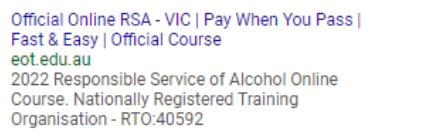
57 The combined words in the larger and more bold print are identified as the “heading” of the advertisement. In this original advertisement, they are purple in colour. The URL “eot.edu.au” is green and designated the EOT website. The remaining text is referred to as the “description” and was less prominent in size, colour and boldness than the heading.
58 For the purposes of these proceedings, the most significant feature of the sample advertisement is the statement in the heading, “Pay When You Pass”. It is an agreed fact that, during the Relevant Period, multiple Expanded Text and Responsive advertisements published for EOT on both Google and Bing included statements of this kind, including “Pay When You Pass” and “Pay Only When You Pass”. These statements appeared predominantly in advertisement headings, though they also appeared in sub-headings and descriptions. It is also agreed that the advertisements did not contain any qualifying text that might have ameliorated the impression conveyed by those statements.
59 The evidence indicates that advertisements containing such statements appeared on the internet from at least 20 November 2020 until November 2022, in various forms and in different parts of Australia. The precise number of occasions on which any particular kind of advertisement was displayed is unclear.
60 The ACCC relies on these advertising statements as constituting an initial claim by EOT, at the outset of the consumer journey, that a key feature of its courses was that consumers would only be required to pay if they passed. As will become clear, this proposition was a central theme promoted by EOT throughout its website.
61 However, the statements in the advertisements are not homogeneous. To the extent that an advertisement states “Pay When You Pass”, it conveys no more than that EOT was prepared to provide a course on terms that payment would not be required unless and until the consumer passed. Standing alone, such a statement does not carry with it an implied representation that the consumer would not be asked or prompted to make payment prior to course completion. Although, as discussed below, such advertisements may, when taken together with the additional statements and features of the EOT website, contribute to the latter representation, they say nothing on their own about the timing of any request or prompt for payment.
62 The advertisements that use the phrase “Pay Only When You Pass” are different. The use of the word “only” creates the impression that EOT would not make any request or demand for payment unless and until the consumer passed. The consequence of this difference is discussed more fully below.
The EOT website
63 During the Relevant Period, if a consumer clicked on an EOT advertisement displayed on Google or Bing, they were taken directly to the EOT website. It can be accepted that, having regard to the content of the advertisements, the consumer would, in most cases, have arrived at the EOT website expecting that EOT was offering a service which would allow them to undertake a course for which they would only be required, or only be asked, to pay upon passing.
64 The ACCC alleges that the content and structure of the EOT website reinforced that understanding, only to then request payment before the course had been completed. The substance of this allegation is that, once consumers accessed the EOT website, they became “caught in the transactional web” in which they believed that payment would only be required or asked for upon completion. It is on that footing that the ACCC alleges that EOT, by prompting payment, misrepresented to consumers that they had completed their course in order to induce payment before they had undertaken the remaining segments.
65 The facts on which the alleged representations are said to arise, comprising the content and structure of the EOT website, are somewhat detailed and complex. That is not to suggest that the case sought to be made was strained in any way, but merely to point out that the representations are said to arise by a combination of obvious indicators and more nuanced factors.
Course Information Page
66 Depending on the advertisement displayed to the consumer, clicking on it would have directed them either to the home page of the EOT website, or the “Course Information Page” for their desired course. The home page listed the various courses offered by EOT, including, relevantly, the RSA and White Card Courses. From there, if the consumer clicked on a particular course, they would be taken to the Course Information Page for that course. These pages were tailored to each course and to each geographical location in respect of which the relevant accreditation was sought. That said, the differences between each Course Information Page are negligible and immaterial for present purposes, and each consumer was shown substantially the same messages and representations in relation to the issues the subject of these proceedings.
67 A sample Course Information Page was provided in the statement of agreed facts for the RSA Course. That course enabled consumers to obtain RSA accreditation for all Australian states and territories, except New South Wales, Victoria and Tasmania. The following describes the content of that sample webpage.
68 First, near the top of the page appeared the words “$[relevant price inserted] - Pay When You Pass*”, positioned adjacent to the course fees and immediately above a button bearing the words, “Start Course Now For Free”. It can be accepted that these words were likely to be among the first read by a consumer upon opening the page.
69 Second, positioned centrally on the page was a row of perpendicular rectangular icons, each containing symbols and text, above which appeared the words, “Course Flow”. Taken together, these icons (referred to as the “Course Flow Icons”) conveyed a sequence of steps that the consumer would follow if they chose to undertake an EOT course. The sequence was as follows:
(a) The first button contained the words “Sign up & Start for FREE”.
(b) The second read “Pause & Resume at Any Time”.
(c) The third contained the words “Complete Remaining Tasks”.
(d) The fourth, which is relied upon by the ACCC, contained an icon of a shopping trolley, being an indicator of the services which have been acquired, and the words, “Only Pay After You Pass*”.
(e) The fifth button in the sequence stated, “INSTANT Certificate Download.
(f) Finally, the sixth button contained the words, “Print or email Certificate”.
70 The Course Flow Icons also included what is known as “hover-over text”, being additional text that appeared superimposed on the page when a cursor was placed over a particular icon.
71 The hover-over text which appeared when the cursor was placed over the first icon, with the words “Sign Up & Start for FREE”, was:
Signing up takes a couple of seconds. You won’t have to pay unless you have successfully completed the course and would like to continue to obtain your full certificate.
72 When a cursor was placed over the third icon, with the words “Complete Remaining Tasks”, the hover-over text read, “Complete any remaining assessment tasks or identification steps”.
73 The hover-over text associated with the fourth icon, bearing the words “Only Pay After You Pass*”, was:
No upfront payment. You only have to pay if you have successfully completed all assessment tasks and would like to continue to receive the certificate. Pay using Credit Card, PayPal or BPAY.
74 Underneath the sequence of Course Flow Icons appeared an asterisk with associated text. It was intended to refer to the other asterisks which appeared on the page, for example, in the phrase “Only Pay After You Pass*”. The words adjacent to the asterisk, which were intended to give meaning to the other words on the page to which an asterisk was attached, were as follows:
If you would like to obtain your … Responsible Service of Alcohol certificate you must successfully complete all assessment tasks, complete your enrolment, and make payment.
75 On the Course Information Pages for EOT’s White Card Courses, the asterisked text was recorded as follows:
If you would like to obtain your [insert course name] certificate, and your White Card you must successfully complete all assessment tasks, complete your enrolment, and make payment. Until you obtain a White Card you cannot begin any work for which a white card is required.
76 Further down the page, there appeared two columns side-by-side. The left-hand column was headed “Features & Benefits – About the RSA Course”, whereas the right-hand column was entitled, “Why we are #1– What the others DON’T do”. Under the latter heading, there were a number of assertions as to the quality of EOT’s courses, which relevantly included the statement, “Pay only when you have passed*”. The asterisk is obviously a reference to the explicatory words extracted above.
77 Other sample Course Information Pages were also provided in the statement of agreed facts. One was for the course entitled “RSA Online NSW”, which enabled consumers to obtain RSA certification in New South Wales. That page was in substantially the same form as the one just described, though it had some additional features. Relevantly, one such difference was the inclusion of a text box which appeared below the button with the words, “Start Course for Free”, and above the Course Flow Icons. That box was shaded blue and contained darker blue text indicating that the course could be completed online, as well as the following statement:
We have made it super simple to complete and submit. Best of all – with us you don’t have to pay until you pass!*
78 It is appropriate to highlight some other features which were common to the several sample Course Information Pages.
79 The first was that each Course Information Page informed consumers that they were able to bundle courses together to obtain a discount. For example, a consumer might have undertaken two RSA Courses so as to obtain certification in multiple states.
80 Second, the first of the two columns referred to above (headed “Features & Benefits – About the [insert name] Course”) contained the following text:
* Fast & Easy
* EOT is Fully NSW Gov Accredited
* Online Course – No Classroom
* Short Audio Assessment
* No extra to pay for NSW Competency Card
* Stop & Resume at any time
* Download & Print Interim Certificate
81 EOT points to the phrase “Short Audio Assessment” as being significant in the context of the ACCC’s allegations. That is discussed later in these reasons.
Frequently Asked Questions
82 The Course Information Pages also contained a “Frequently Asked Questions” tab marked “FAQ”. If a consumer clicked on that tab, they were taken to a separate page dedicated to that topic. There, if the consumer clicked on the question, “When do I have to pay”, the following would appear:
We strongly believe in the need for quality industry education and as such we allow access to our courses without the need for upfront payment. Read the notes, watch the videos, and start the course all for free.
For our self-paced online courses we only require payment if you would like to obtain your full unit of competency and certificate.
83 Another frequently asked question was “Why should I study with you?”. If that was clicked on, amongst other things, the following words were revealed to the user:
Pay Later
* We strongly believe in the need for quality industry education and as such we allow access to your courses without the need for upfront payment. Read the notes, watch the videos, and start the course all for free.
* We only require payment if you wish to receive your certificate.
* This means that unlike most training websites there is no upfront payment commitment and no nasty surprises.
Were the Pay When You Pass Representations made?
The first aspect
84 As mentioned, EOT accepted that it represented to consumers that they would not be required to pay for their course until they passed. That was an appropriate concession, not in the least because it was promoted by EOT as being a point of difference between its services and others on the market.
85 From the very outset of the consumer journey, those wishing to undertake an RSA or White Card Course were conditioned to the understanding that payment was not required until completion. The effect of the Google and Bing advertisements was that consumers would arrive at the EOT website, whether at the home page or a relevant Course Information Page, expecting that to be the case. Though that assumes the consumer accessed the EOT website via such an advertisement, the same expectation was cultivated by the structure and content of the website itself.
86 Upon accessing a Course Information Page, consumers would have been first drawn to the price of the course, which is of obvious importance. They would then have noticed the adjacent words, “Pay When You Pass”, which would either have introduced or reinforced the consumer’s impression of the nature of the arrangement on offer (depending on whether that impression had already been created by a Google or Bing advertisement). That assertion was also emphasised by virtue of its proximity to the button immediately below, bearing the words “Start Course Now For Free”. There is force in the suggestion that the proximity of the representation to that “call to action” button was likely to afford it greater relevance to the reader.
87 The contents of the relevant Course Information Pages demonstrate that the fact that consumers were not required to pay prior to completion was a significant selling point for EOT, and one that distinguished its courses from competing offerings. Additionally, the courses were generally directed toward persons with limited formal skills or qualifications whom, it may not unreasonably be inferred, might be apprehensive about undertaking a course of study. Such consumers are likely to be attracted to a course for which payment is not required until successful completion, because it removes the risk that they might commence a course which they are unable to successfully complete and, thereby, lose the money which they paid for it.
The second aspect
88 EOT does not, however, accept the second aspect of the alleged Pay When You Pass Representations, being that consumers would not be asked for payment until after they had passed. For the reasons which follow, that aspect is also made out to some degree.
89 The Google and Bing advertisements containing the phrase “Pay Only When You Pass”, and the Course Flow Icon bearing the words “Only Pay After You Pass”, both conveyed to the ordinary reasonable consumer the impression that payment would only be sought after they had passed, by reason of the use of the word “only”. Those expressions not only reflected the contractual arrangement between the parties, but also implied that any opportunity for payment would only arise upon completion. This impression was reinforced by the placement of the “Only Pay After You Pass” Course Flow Icon in the sequence after the icon stating, “Complete Remaining Tasks”.
90 A similar statement was made in the right-hand column below the Course Flow Icons (entitled “Why We Are #1”). There, the words, “Pay Only When You Have Passed”, reinforced the consumer’s understanding that, in the dealings between the parties, the occasion for payment would only arise once the consumer had passed. Again, the use of the word “only” in this context is a potent indicator that the consumer would only be presented with an opportunity to make payment upon completion.
91 Moreover, there is force in the submission that the representation was enhanced by the manner in which the Course Flow Icons, as set out above (see supra [69] – [74]), represented the steps to be taken by the consumer. They indicated that the ability to make payment and obtain a certificate would both occur after completion of all course components. This is also relevant to the Course Completion Conduct, discussed later in these reasons.
92 It is also relevant that the Course Flow Icons were set out without any clear or precise articulation of the specific segments of the course. All that appeared on the webpages were general statements referring to the course involving some “Short Audio Assessment”, without any explanation of what that entailed. There was also no explanation of the structure or components of the course, or any indication that it involved anything other than reviewing content and answering questions based on that content.
93 The information found on the FAQ page (see supra [82] – [83]) further reinforced the representations made on the Course Information Pages. The statements to the effect that EOT only required payment if the consumer wished to receive a certificate were, prima facie, indicative of an assertion that EOT would not seek payment from the consumer unless they had completed the course. Though it might be said that the word “require” suggests the making of a legal demand, it should not be interpreted so narrowly in this context. It is unlikely that an ordinary reasonable user of EOT’s services would appreciate any distinction between EOT making payment facilities available and being in a position to demand payment. That is particularly so given the counterpoint used is the absence of any “upfront” payment. This again suggests that payment would be sought only after completion of the course.
94 In sum, the combined force of these statements conveyed to the consumer that payment would only be sought once the course had been completed. Accordingly, the second aspect of the Pay When You Pass Representations is made out.
95 Both aspects of the Pay When You Pass Representations were common across each sample webpage provided in the statement of agreed facts. The additional statement in the RSA NSW Course Information Page, “Best of all – with us you don’t have to pay until you pass”, serves to reinforce the representations, but its absence on the other pages does not detract from the representations otherwise arising therein. That said, the words at the beginning of the statement, “Best of all”, do emphasise the importance which EOT attributed to the representation about the consumer not having to pay prior to completion.
The effect of the asterisk
96 EOT submits that the second aspect of the Pay When You Pass Representations was ameliorated or negated by the existence of the asterisk and the words attributed to it, to the effect that the consumer must “successfully complete all assessment tasks” before being able to obtain a certificate. Such words appeared on each Course Information Page with some slight, but immaterial, differences on those applicable to White Card Courses.
97 That submission should not be accepted for two reasons.
98 Firstly, the asterisk and explicatory words which accompanied it were neither prominent on the webpage, nor proximate to those places on the page where asterisks appeared. They were subordinate to the various statements comprising the Pay When You Pass Representations, which were more likely to attract the consumer’s attention. Necessarily, this diminished the effect of the asterisk and the explicatory message conveyed by it.
99 Second, the explanation provided by the asterisked message did not substantially reduce the effect of the Pay When You Pass Representations. The statement that the consumer must successfully complete all assessment tasks and make payment in order to obtain a certificate is somewhat self-evident. It does nothing to contradict the consumer’s understanding that they would only pay upon completion. To that extent, the explanation tended to buttress, rather than negate, the impugned representations.
100 It is also relevant that the reference in the explicatory text to the consumer completing “all assessment tasks” did not elaborate upon the nature of those tasks. Although the plural, “tasks”, was used, it was not clear what those tasks involved, and there was no attempt at specificity. A consumer might reasonably have understood the initial task, referred to as the “Knowledge Assessment” (see infra [141] – [145]), to comprise all of the required “tasks”. In this sense, the words associated with the asterisk tended to reinforce the representations made. Further, these representations appeared at an early stage, when consumers were not aware of the contents of their chosen course, the tasks involved, or the manner in which the tasks would be presented.
101 It follows that the asterisk and the words attributed to it were insufficient to negate the impugned representations. The asterisked words did not clearly reverse the dominant message conveyed by the Pay When You Pass Representations: see Australian Competition and Consumer Commission v GlaxoSmithKline Consumer Healthcare Australia Pty Ltd (2019) 371 ALR 396, 406 – 407 [33].
The hover-over text
102 EOT also submits that the hover-over text associated with some of the Course Flow Icons (see supra [70] – [73]) provided sufficient context to dispel any understanding on the part of the consumer that they would not be asked to pay prior to completion. That submission can also be rejected.
103 It is somewhat improbable that hover-over text will ever be sufficient to displace a representation conveyed clearly and prominently elsewhere on a webpage. As the Full Court observed in Trivago v ACCC at 554 [217], hover-over text is visible only to a subset of consumers who happen to come across it by hovering their mouse cursor over the relevant part of the page. Indeed, some consumers may not encounter such text at all and for those that do, its appearance is only transitory. This significantly diminishes any explicatory or corrective effect that it might otherwise have.
104 Notwithstanding, even if a consumer did encounter the hover-over text, it would not have materially affected the message otherwise conveyed. The text associated with the “Sign Up & Start for FREE” Course Flow Icon – stating, “You won’t have to pay unless you have successfully completed the course and would like to continue to obtain your full certificate” – did not dispel the impression previously created. Nor did the hover-over text associated with the “Only Pay After You Pass” icon, which was to a similar effect (see supra [73]). Indeed, that text was, if anything, less ameliorative, as it expressly stated, “No upfront payment”, thereby reinforcing the implication that payment would only be sought after the course had been completed.
105 It may be accepted that these statements could be understood as conveying something about the consumer’s legal obligation to make payment if they engaged with EOT – that is, that no payment obligation arose unless and until the course was completed – rather than as a representation that the consumer would not be asked or prompted to pay before that time. However, even if such a nuanced meaning might be discerned, it is not one which assuages the overall impression conveyed by the webpage. That is particularly so because the hover-over text was connected with the Course Flow Icon which more clearly conveyed that payment for the course would occur only when the consumer passed: “Only Pay After You Pass”. It is most unlikely that the ordinary reasonable consumer would notice the subtle distinction in meaning.
106 The hover-over text in relation to completing the remaining tasks also did not alter the overall effect of the representations made. It again referred to “tasks” in the plural; however, in the absence of any explanation as to what those tasks comprised, that reference is of limited significance. Indeed, it is possible to regard those statements concerning the completion of tasks as conditioning the reader to believe that, upon encountering a request for payment, they have completed those tasks.
Short audio assessments
107 Finally, EOT also relies upon the reference to the existence of a “Short Audio Assessment” as countering the existence of the Pay When You Pass Representations. It says that reference indicated to the consumer that a short audio assessment was part of the course, and as such, they should have been aware that they had not passed all components of their course, and therefore had no obligation to pay, until that assessment had been completed.
108 Whilst this is more relevant to the alleged Course Completion Conduct, again, the difficulty is that there was no real meaning attached to the expression, “Short Audio Assessment”. Though it could have meant an online audio assessment, or an interactive assessment done via a telephone call, it might also have been understood as referring to an assessment requiring the consumer to listen to audio material and then answer questions based on what they had heard. Here, the Knowledge Assessment, which was the first element of both the RSA and White Card Courses, required consumers to do just that. It is therefore possible that an ordinary consumer might have reasonably identified that assessment as being the “Short Audio Assessment” referred to on the Course Information Page.
109 In the result, the evidence provides a sufficient basis on which to conclude that both aspects of the Pay When You Pass Representations were made.
The Pay When You Pass Representations were misleading
110 The Pay When You Pass Representations were misleading even though they contained a half truth. The representation that consumers were only obliged to pay for their course upon completion, being that which EOT acknowledged, was not incorrect. In a contractual sense, by reason of the representations made, a consumer who took up the invitation to undertake the course could not be obliged to pay for it unless and until they successfully completed it. There was no submission to the contrary. However, the second aspect of the Pay When You Pass Representations – that payment would not be sought unless the consumer had passed the relevant course – was misleading. As explained in the following section, the EOT website prompted consumers to pay after completing the Knowledge Assessment, being the first substantive component of each course.
111 It follows that the findings sought by the ACCC in relation to the Pay When You Pass Representations should be made. They are set out at the end of these reasons.
The Course Completion Conduct
112 The second alleged representation is concerned with EOT’s conduct which is said to have created an understanding on the part of consumers that they had completed their course when they had not, thereby inducing them to prematurely make payment. In broad terms, it is alleged that through the design, structure and content of the EOT website during the Relevant Period, EOT gave consumers the misleading understanding or impression, when they were prompted to pay for their course, that they had completed it and would receive their certificate.
113 The ACCC’s case in this regard is founded upon an overall analysis of the consumer journey through the EOT website. That journey culminates at what is described as the “Make Payment Page” and reflects the cumulative effect of various representations made to consumers as they progressed through the website. In addressing that case, it is therefore necessary to trace the path taken by a consumer through the site.
114 For the purposes of that analysis, the consumer journey is assumed to be linear, although it may not have been followed in that manner by every individual consumer. Nonetheless, that assumption is appropriate, given the representations are to be assessed from the perspective of the ordinary and reasonable consumer.
115 The consumer journey from the Google and Bing advertisements to the Course Information Page has been described earlier in these reasons. Having reviewed the contents of the relevant Course Information Page, it is assumed that the ordinary consumer would have clicked on the “Start Course Now for Free” button.
The Learner Handbook
116 By clicking on the “Start Course Now for Free” button, the consumer was taken to the Registration Page. There, they were invited to create an account by entering their details and, in some cases, uploading certain documents. At the foot of the page were the words:
* I have read & agree to the Learner Handbook
If you have any special needs or require assistance please contact us.
117 The words “Learner Handbook” were hyperlinked to a separate page on the EOT website which contained that document. Consumers were required to tick the box adjacent to the text before progressing to the next page. However, importantly, the consumer was able to do so without having opened or read the Learner Handbook.
118 The next page was the Terms and Conditions Page. There, the consumer was presented with a number of statements to which they were asked to agree, including the following:
I have read and agree to the Express Online Training (EOT) Learner Handbook.
The learner handbook contains details policies regulations, terms and conditions – Click here to download the handbook
I have read and agree to the Express Online Training (EOT) Academic Conduct Policy.
This policy defines EOT’s expectations of its staff and learners in terms of conduct and integrity – Click here to read the policy
119 However, again, the consumer was able to click on the button at the foot of the page bearing the words, “Agree & Continue”, without having read, or even opened, the handbook.
120 EOT relies upon the fact that, in order to progress through the website and commence a course, the consumer was required to acknowledge that they had read and agreed to the Learner Handbook. It may be accepted that, if read carefully and in full, that document would have alerted the consumer to the detailed structure and content of the course and thereby placed them in a position to understand the extent to which the course requirements had been completed. However, the ACCC submits that it is more likely that consumers either did not open the Learner Handbook at all or, if they did, did not read it carefully. In practical terms, that submission has considerable force. It may be accepted that many consumers would omit to read such documents and instead proceed to the next step without becoming aware of the aspects of the course disclosed only in that material.
121 It can now be accepted as notorious that people often hastily enter into contractual arrangements without reading the terms and conditions or other such information. Indeed, that tendency has become increasingly common in modern society, where online contracting is ubiquitous and the associated standard-form documentation is often dense, technical and time-consuming to review. The ordinary consumer’s primary focus is typically on securing the perceived benefits of the transaction, rather than scrutinising the terms on which they might be acquired. The practical consequence is that consumers frequently regard a declaration that they have “read and agreed” to such material as a mere functional step in progressing through an online process, rather than as evidence of their reading of, and agreement to, the terms circumscribing the arrangement.
122 That is a regrettable state of affairs, and one into which Parliament has sought to intervene by introducing certain protections for consumers under the ACL. Notably, consumers now benefit from statutory protections against contractual terms which the court considers “unfair”: see ACL s 23. While those protections are important, and in many cases necessary, it is not unreasonable to expect consumers who wish to enter contractual arrangements to take some steps to protect their own interests. Nevertheless, the practical reality remains that ordinary consumers are unlikely to read terms and conditions and courts must take account of that reality when assessing the likely effect of representations on the ordinary and reasonable consumer for the purposes of consumer protection laws. In particular, where critical information about the nature or characteristics of a service is contained within lengthy material that is not prominently – or forcibly – drawn to the consumer’s attention, it cannot be assumed that it will correct or neutralise more direct representations made elsewhere.
123 Here, it is more likely than not that a consumer would not have bothered to open and read the Learner Handbook. There was no requirement to do so, and the statement in the Terms and Conditions Page encouraging that step was one of a series of statements to which the consumer was taken to have agreed by clicking the obvious “Agree & Continue” button. It is also of some significance that, on the Terms and Conditions Page for the RSA Course, the statement that the consumer had read the Learner Handbook appeared as the sixth out of seven statements. That position on the page made it less likely that a consumer would click on the accompanying link.
124 The Learner Handbook was also a substantial document, one which would have taken some time to review. It is an agreed fact that, during the Relevant Period, it comprised between 41 and 54 pages. The table of contents reveals that it covered a wide and somewhat eclectic range of topics, with information concerning the structure and content of the relevant courses interspersed among numerous administrative matters relating to EOT’s operations. In those circumstances, it may not unfairly be concluded that information concerning the nature and scope of the courses was effectively “buried” within the document. This is not to suggest that such an outcome was intentional, but rather that the consumer was required to navigate a substantial body of content before encountering the sections describing the components of their chosen course.
125 Though EOT suggested that a responsible and engaged consumer, intent on undertaking a course, would have clicked on the link and read the Learner Handbook until they came across the relevant course content, that should be rejected. Whilst it might be accepted of motivated and careful persons, those are not characteristics that can readily be attributed to the ordinary reasonable consumer likely to use EOT’s services.
126 Ultimately, it is probable that, even if consumers did click on the link to the Learner Handbook, they would not have undertaken the substantial task of reviewing its contents and locating the constituent elements of their course. That conclusion is supported by complaints received by EOT from numerous course participants who, upon completing the Knowledge Assessment, believed that they had completed the course in its entirety. Had those consumers read the Learner Handbook, it would have been apparent that further components were required to be completed.
127 It is not irrelevant that another item, which appeared earlier in the list of matters to which the consumer was asked to agree on the Terms and Conditions Page, was the Academic Conduct Policy. Again, the practical reality is that it is unlikely that the consumer would take the time to read and consider that document. This further informs the likelihood that the consumer would not have clicked on, or read, other linked materials in that list.
The Revised Terms and Conditions Page
128 The ACCC also points to the fact that the Terms and Conditions Page was revised from July 2022, following EOT’s receipt of notices from the ACCC under s 155 of the Competition and Consumer Act 2010 (Cth) (CCA).
129 The revised page introduced two new statements at the beginning of the terms and conditions, which read:
I understand that I am not required to make payment until all tasks are completed
Although you may be provided with the option to pay at various points, you are not required to make payment until you wish to be issued with your certificate. All tasks are able to be completed without payment via your learner account.
I understand that I must successfully complete all tasks before being issued a certificate
To receive your certificate, you must successfully complete all assessment and administrative tasks. These include an audio assessment, a short phone assessment, a simulated workplace assessment, and verification of identity.
130 The ACCC submits that the addition of these statements sought to overcome that which was lacking on the Terms and Conditions Page during the Relevant Period, and constitutes an implicit admission that the previous versions of the page were misleading.
131 Whilst so much might be accepted, it should not be thought that the revised statements effectively nullify the Pay When You Pass Representations or the Course Completion Conduct. That is because, firstly, the text in bold type, to which the consumer’s attention is most likely to be drawn in the first instance, does no more than reinforce the Pay When You Pass Representations. It does not warn the consumer that they will be prompted for payment prior to all course tasks being completed. Second, though the subtext to the bold headings does provide an admonition of sorts as to the possibility of the consumer being asked to make a payment at some point prior to completion, it still indicates that payment is required for the purposes of obtaining a certificate. For reasons which will become clear, the difficulty for EOT’s position is that the Make Payment Page represents that the payment being made is one which will have the consequence of causing the certificate to be issued. It asks the consumer to advise as to which form of certification they desire shortly before seeking payment. If anything, that negates any warning that might be considered as having been given by the words added to the Terms and Conditions Page.
132 The effect of the amendments must also be considered in the context of the webpage as a whole and the making of the Pay When You Pass Representations. That central selling feature of EOT’s courses was emphasised in the advertising on Google and Bing, and on the various Course Information Pages. It is unlikely that the potentially discordant statements in the revised Terms and Conditions Page would have altered the consumer’s perception of that representation. It is also probable that the consumer would not recall the effect of these revised terms and conditions when later presented with the Make Payment Page, having regard to the length of time ordinarily required to complete the Knowledge Assessment (apparently some six hours). Accordingly, it is unlikely that the comparatively less prominent message conveyed by the revised wording would have affected their understanding of the initial representation.
The Instructions Page
133 The next phase of the consumer journey was the “Instructions Page”, to which the consumer was taken after clicking on the “Agree & Continue” button at the foot of the Terms & Conditions Page. The Instructions Page contained four tabs, namely:
(a) An Instructions Tab, which provided instructions about how to complete the course;
(b) A Resources Tab, which contained the course outline and a number of documents and videos relevant to the subject matter of the course;
(c) A Course Notes Tab, which contained a series of slides that the consumer was required to read, providing content relevant to the subject matter of the course; and
(d) A Questions Tab, which set out a series of questions for the consumer, referred to as the “Knowledge Assessment”.
134 Underneath those tabs appeared the following instructions:
Instructions
Step 1 - Read the Course Notes
Step 2 - Answer the Questions
Step 3 – Enrol
Step 4 - Short Audio & Simulated Workplace Assessments
Step 5 - Make Payment
Step 6 - Receive Certificate
135 From Step 1, an arrow directed attention to the Course Notes Tab and, similarly, an arrow from Step 2 directed attention to the Questions Tab.
136 These instructions were the subject of some contention at the hearing as to the extent to which they represented the relevant components of the course. To a degree, they mirrored the Course Flow Icons on the Course Information Page, save that Step 4 referred to a “short audio and simulated workplace assessment” occurring after the Knowledge Assessment (Step 2) and enrolment (Step 3). EOT relied on that reference as indicating the existence of an additional step prior to payment, and as sufficient to dispel any suggestion that the Knowledge Assessment constituted the entirety of the course. However, although it may be accepted that a careful and attentive reader might have noticed the difference between that which appeared in these instructions and that which was illustrated by the Course Flow Icons, there was no clear explanation of that difference for the ordinary consumer. Nor was there any indication of the substance of the “short audio and simulated workplace assessment”, or how it differed from the Knowledge Assessment. Although a distinction existed, it was not one that an ordinary reasonable consumer who might sign up to EOT’s courses was likely to appreciate. That is especially so given that, as the website was structured, consumers were unlikely to have acquired any detailed understanding of the course content before being prompted to make payment.
137 Overall, the instructions tended to reinforce the earlier representations concerning the path of the consumer’s journey through their course. They conveyed that enrolment would occur and the course would be completed prior to payment being sought.
Post-investigation amendments
138 In December 2022, following the commencement of an investigation by the ACCC, EOT made amendments to the Instructions Page to emphasise that payment might be sought prior to completion. Thereafter, Step 3 read, “Enrolment Details & Payment (Optional)”. This was said by EOT to make it clear to the consumer that there was no obligation to make payment when prompted to do so after the Knowledge Assessment. Though it is possible that this might have made some difference, the issue must be judged from the point of view of a consumer being confronted with the information who is unaware of the issue now in question.
139 The Pay When You Pass Representations remained strong at the time the consumer reached the Instructions Page, because they were a central feature of the Google and Bing advertising and the Course Information Page. The vague indication of payment and it being optional at Step 3 does not expressly negate those representations. There was also no clarity as to what constituted the enrolment details or when they were required. Indeed, a reasonable consumer might have believed that they had already provided the necessary enrolment details at the Registration Page, which was two pages prior to the Instructions Page. Further, it is not immediately apparent whether the option relates to the provision of details, or the making of a payment, or both.
140 Overall, there is no context by which the additional words can be given any substantial meaning and, as such, the revised Step 3 is more confusing than clarifying. That is particularly so when it is considered in the context of the overall conduct and the representations otherwise made to the consumer. Specifically, the fact that the Pay When You Pass Representations were created by the Google and Bing advertising and reinforced by the Course Information Pages is important, as is the impact of that which subsequently appeared on the Make Payment Page. Those pages all contributed to the overall representation that payment would only be required when the course was successfully completed and that, by the time the consumer reached the Make Payment Page, that had been achieved. The somewhat ambiguous statement in the revised Step 3 on the Instructions Page, which was not at all prominent, could not have had any significant effect on the impact of the misleading representations already made or made thereafter. The revised words are far from likely to have been in the mind of the consumer at the time when EOT indicated that payment was due.
The Knowledge Assessment
141 After reviewing the Instructions, the consumer then progressed to the Course Notes Tab and read the material therein, before commencing the Knowledge Assessment in the “Questions” tab. It is apparent that study of the Course Notes provided the consumer with the necessary information to be able to successfully complete the Knowledge Assessment.
142 The Knowledge Assessment comprised 100 or more questions of various types, such as short-answer, multiple choice and fill-in-the-blank questions. The consumer was unable to progress through the assessment without answering each question correctly. The questions were generally organised into four sections, though in some courses the Knowledge Assessment was structured differently. It did not appear to be in dispute that an ordinary consumer took between three and six hours to complete the course. It can be accepted that this had the effect of inducing the consumer to understand that, in progressing through the assessment, they were completing substantive components of the course.
143 Importantly, some questions in the Knowledge Assessment were based on video material which was shown to the consumer before the question was asked. Certainly, an ordinary reasonable consumer who had been alerted to the existence of “short audio & simulated workplace assessments”, as identified in the Instructions, may well have understood the video-based questions in the Knowledge Assessment as constituting that component of the course.
144 Following the commitment of several hours to completing the Knowledge Assessment, the consumer encountered a pop-up window stating, “Section Completed. Click “OK” to proceed”. Selecting that option took the consumer to the Enrolment Section. It was submitted that the reference to a “section” made clear that only one component of the course had been completed. Whilst it may be that a careful consumer who had read the Learner Handbook and understood the structure of the course might have appreciated that distinction, the meaning conveyed by the word “section” in this context was ambiguous. The ordinary reasonable consumer is more likely to have considered the reference to “section” as being a reference to the assessment section identified in Step 4 of the instructions (see supra [134]).
145 There also appeared to be an alternative process by which, upon completing the Knowledge Assessment, the consumer was sent an email by EOT advising that they could make payment and enter their “identification details” by clicking on a link. If they did so, they were taken to the Enrolment Section. Notably, this email did not refer to the need to complete additional assessments. It is not apparent to which group this alternative process applied, though it appears that it occurred at least in relation to some who undertook the White Card course.
The Enrolment Section
146 The Enrolment Section is the crux of the ACCC’s case in relation to the Course Completion Conduct. There, the consumer was presented with five tabs across the top of the page: “Details”, “Background”, “Bundles & Discounts”, “Certificate Options” and “Make Payment”. Each tab was linked to a separate page on which the consumer was required to take a certain action.
147 The mere configuration of these steps suggested that the consumer had completed the course and reached the stage at which payment was required. That impression was reinforced by the fact that, to reach this point, the consumer had expended several hours completing the Knowledge Assessment. The subsequent request to provide personal details, select a preferred form of certification, and make payment conveyed the impression that the course had been completed. Tasks of that nature would ordinarily arise upon completion and, here, they appear to have been offered to reinforce that such was the case. In particular, in relation to the “Certificate Options” tab, it was a recurring theme in the content of the EOT website that the provision of certification was coterminous with course completion and payment. Moreover, the effect of this configuration was enhanced in the context of the established Pay When You Pass Representations, which created the understanding that the consumer was neither required, nor would be asked, to make payment until the course was completed.
148 It follows that being requested to make a payment at this point suggested that completion had occurred. As will become clear, that impression was maintained across the other pages within the Enrolment Section.
The Details Page
149 The first tab in the Enrolment Section directed consumers to a page requiring the provision of “details”. Relevantly, that page contained a set of consumer declarations, located among the sections in which the consumer was required to enter certain information. The consumer was required to tick three boxes confirming that they had read the Learner Handbook, provided correct details and consented to the collection of that information, and consented to the use of their personal information in accordance with EOT’s privacy policy. However, like on the Terms and Conditions Page, it was possible for the consumer to tick the box confirming they had read the Learner Handbook without actually having done so. Though true it is that the careful and conscientious consumer might have taken the time and expended the effort to read it prior to ticking the relevant box and proceeding to the next step, it can sensibly be assumed that the ordinary reasonable consumer would not have bothered. On the contrary, they are more likely to have expedited the process by ticking the boxes and moving on.
150 As discussed above (see supra [121] – [122]), though regrettable as it may be, it is unrealistic to expect an ordinary consumer to take the time necessary to understand their rights or to scrutinise the details of that which is being provided. That is particularly so in circumstances where the consumer seeks certification after spending some hours answering the Knowledge Assessment questions. At that stage of the process, it is unlikely that consumers would be so conscientious as to analyse the surrounding materials.
151 This conclusion is reinforced by the nature of the transaction. The consumer did not enter into a prolonged course of study or any extended undertaking involving a significant financial outlay. Rather, that which was offered by EOT was simple and straightforward, and as a result, the consumer would likely have expected little more than reading the relevant material and answering questions, being precisely what occurred in the Knowledge Assessment.
The Bundles & Discounts Page
152 The next tab in the Enrolment Section was a page entitled, “Bundles & Discounts”. It provided the consumer with the option to bundle their chosen course together with other courses. For example, someone undertaking the RSA Course was offered a price for that course alone or it with any combination of several other courses at different prices. To some extent, this offering might have suggested that the consumer was not yet at the completion of their course. However, that is far from clear. At best, the bundling offer is ambiguous when it comes to the question of whether EOT represented that the relevant course had been completed. For instance, a reasonable consumer could have understood the invitation as one to pay for an additional course at the same time as paying for the course just completed. That is the most likely conclusion given that before the list of choices appeared the words:
Select which courses you would like to complete. You can purchase a credit for them now and enrol in them later (any time up to 12 months)
153 Though ambiguous, in the context in which it appeared, including following upon the consumer’s completion of several hours of questions and answers, the option to bundle courses can be taken as an invitation to purchase a credit for a course in addition to that already undertaken, and which may be undertaken in the future. That context also includes the Pay When You Pass Representations, which were such a dominant feature of the consumer’s initial interaction with the EOT website, as well as the fact that the consumer is likely anticipating that they would be given an opportunity to pay for their course on the Make Payment Page. Though EOT claimed that the Bundles & Discounts Page indicated that the consumer had not yet completed the initial course, that is discordant with the occasion on which it appeared, being immediately after completing the Knowledge Assessment. Further, and in any event, any such representation given by the Bundles & Discounts Page is insufficient to outweigh the several clear and direct representations otherwise made.
The Certificate Options Page
154 After the Bundles & Discounts Page, the consumer progressed to the Certificate Options Page. This page is one of the key components of the Course Completion Conduct. Here, the consumer was requested to select their preference for the form of certificate which they were to receive. They could choose from a digital copy, a physical paper copy, a card, or all three options. Whilst the first was identified as being available at no cost, the remaining options were offered at a range of prices. To the ordinary reasonable consumer, the effect of this request is that it was axiomatic that they had reached the completion of their chosen course. Put simply, there would not appear to be any point in them choosing the form of their certificate unless they had completed the course. Therefore, the offering of certificate options at this stage gave the strong impression that the course had been successfully completed.
155 Moreover, if the consumer had kept in mind the Course Flow Icons on the Course Information Page, they would recall that the option to obtain the certificate followed completion of the course. That being so, the presentation to them of certificate options carried with it the strong implication that that had occurred.
The Make Payment Page
156 The ACCC contends that the Course Completion Conduct culminated at the last tab of the Enrolment Section, being the Make Payment Page. As its title suggests, this page provided an opportunity for the consumer to pay for their course. Though, contrary to the Pay When You Pass Representations, this opportunity for payment arose when the consumer still had multiple tasks to complete in order to pass their course.
157 From the outset, in the light of the Pay When You Pass Representations, the very existence of this page tends to give the impression of course completion. That is reinforced by the fact that, to get to this point, the consumer had spent some hours studying for and completing the Knowledge Assessment, and had been asked to choose the format in which they wished to receive their certificate. More importantly, they had been conditioned by the Pay When You Pass Representations to expect the occasion for payment to only arise upon completion of the course. It follows that the request for payment at the Make Payment Page strongly indicated that the consumer had successfully completed their course and that the occasion for payment had arisen. Indeed, it is difficult to comprehend any other impression which might have been conveyed by that sequence of events.
158 In addition, there was no valid reason advanced as to why it might be advantageous for a consumer to pay for their course prior to completion. Though it was suggested that doing so would enable the consumer to receive a certificate immediately upon completion, that submission should not be accepted. Making payment upon completion would only take a few minutes and, accordingly, no material advantage would be gained by paying in advance. Indeed, the consumer would be in a worse position, as they might ultimately not pass the course or fail to complete it, with the result that they would have paid for a service in circumstances where they might not otherwise have been required to do so.
159 It should not be doubted that the prompting of consumers to make payment was deliberate. In a response to a notice issued by the ACCC under s 155 of the CCA, EOT indicated that consumers were deliberately prompted for payment after completing the Knowledge Assessment, in the expectation that some would not continue to complete their course. The letter indicated that the components of the course which were to be completed after the Enrolment Section were more expensive, in terms of both time and cost, for EOT to provide. The letter went on to state:
RSA Express prompts learners for payment before the tasks that incur the most expenses with the hope that enough learners choose to pay at this point that completing the remaining tasks in a compliant manner does not become cost-prohibitive. i.e. RSA Express is able to provide the less labour intensive aspects of our services to learners for free, but if most learners also complete the more labour intensive tasks for free we may find ourselves at risk of either experiencing significant cashflow issues or not be able to properly meet our compliance obligations.
160 The letter also indicated that it would be costly for EOT to remove the payment prompt because it would increase the time and cost spent on facilitating interactive assessment tasks with consumers who ultimately abandon the course before completion.
161 It can, therefore, be accepted that the EOT website was deliberately structured to encourage consumers to pay for their courses prior to being obligated to do so and this was an intended component of EOT’s business model.
162 Notwithstanding that, EOT says that certain features of the Make Payment Page should have disabused the consumer of any misunderstanding as to the completion of their course. In particular, they rely upon certain messages displayed at the top of the page, as well as the ability for the consumer to navigate to the “Your Account” page, which was said to identify with precision the consumer’s progress through their chosen course.
163 As to the first of those features, between 16 October 2018 and 29 October 2018, the Make Payment Page included, at the top of the page, a red or orange box containing red or orange text in the following terms:
Payment is Pending
Payment has not yet been received by us. When it is received you will be notified by email. If you have trouble making payment you can try again or change your payment method.
Payment is not required until you have successfully completed all tasks and wish to be issued a certificate. To complete any remaining tasks please return to your account.
Download invoice
164 In the period from 29 October 2018 to 13 May 2020, the second part of the statement read:
You do not have to make payment unless you have completed all of your assessment tasks as listed in your account and would like to proceed to receiving your certificate
165 In the period from 13 May 2020 to 25 July 2022, the heading to the statement was varied to “Payment not yet received”.
166 In the period from 25 July 2022 to 1 August 2022 the statement was amended to read:
Payment Pending
Payment is not required until you have successfully completed all tasks and wish to be issued a certificate. To complete any remaining tasks please return to your account
167 It is not irrelevant that the amendments which came into effect on 25 July 2022 were made once EOT was on notice that the ACCC had commenced an investigation into it and the content of its webpages.
168 Since 1 August 2022, the heading to the statement reads, “Payment not yet received”.
169 These variations are collectively referred to in these reasons as the “Payment Status Statements”. They were relied upon by EOT as correcting any misunderstanding on the consumer’s part that they had completed their course. It says that, by virtue of the Payment Status Statements, consumers should have been aware that they were under no obligation to pay when they reached the Make Payment Page.
170 That submission should not be accepted. Firstly, the heading “Payment Pending”, which appeared in all versions of the Payment Status Statements except those in use between 13 May 2020 and 25 July 2022, and from 1 August 2022, conveyed the implication that the consumer had a current obligation to pay for their course. The adjective “pending” suggests that payment is waiting or remaining, in the sense that it is presently due. If the payment were not yet due, it would not properly be described pending; to describe it in that way suggests that the obligation to pay has already arisen.
171 Second, though the other heading, “Payment not yet received”, does not carry with it the same assertion that payment is due, it is suggestive of an expectation on the part of the payee that it should have, but has not, been paid. The consumer is more likely to interpret these headings in this way because of the context in which the Payment Status Statements are made, as has been described above.
172 Third, in each of the Payment Status Statements, the subtext under the heading is redolent of an implication that the time for payment has arrived. The use of the expression, “Payment has not yet been received by us”, is again indicative of an expectation that payment should have been made. The reference to the consumer being notified by email when the payment is received bolsters the sense of urgency of the circumstances, as do the statements to the effect that the consumer should try different ways to pay the amount.
173 It is true that part of the subtext reiterated that the consumer was not required to pay for the course unless and until they had successfully completed all “tasks” or “assessment tasks”, and this was relied upon by EOT as an amelioration of the representation that payment was then due and owing. However, there is nothing in those statements which either directly or indirectly contradicts the statements in bold text to the effect that the occasion had arisen for payment. Alternatively, even if the subtext had that effect, it was not strong in the context of the contrary representations. In that sense, they did not undermine the force of the representations otherwise made.
174 The reference to the plural, “tasks”, was again relied upon by EOT as an indicator to the consumer that there were multiple components to the course. So the submission went, as the consumer had only completed the Knowledge Assessment, they should have appreciated that there were other components to complete. Again, however, the reference to there being multiple tasks does not overcome the overall strong representation, as discussed above, that the course had been completed and payment was due. An ordinary reasonable consumer who has undertaken a course on the understanding that payment was required only upon successful completion would be more likely to assume, when asked for payment, that they had in fact completed the course. Though it might be accepted that a more careful or astute consumer might question why, despite being asked to pay for the course, they were also being informed that payment was required only upon completion of all tasks, it is unlikely that the ordinary reasonable consumer would recognise this dissonance. Again, the context is important and here the consumer has, shortly before this point, spent between three to six hours completing the Knowledge Assessment, and also selected the format in which they wished to receive their certificate.
175 In these circumstances, the reference to the consumer being able to ascertain whether there are more tasks to complete by clicking on the button labelled, “Your Account”, or going to the page referred to as “Your Account”, is similarly insufficient to dispel the representations otherwise made. As at this point in time, the consumer had been led to believe that they had successfully completed the course and hence the request for payment. Though the invitation was made to the consumer to consider their account and ascertain what tasks remained, it was hollow in circumstances where they proceeded on the understanding that they finished the course.
176 In the result, EOT’s submissions as to the Payment Status Statements should be rejected. They did not displace the representations otherwise made on the Make Payment Page, and elsewhere, that consumers had reached the end of their course and the occasion for payment had arrived.
The Your Account Button
177 On the Make Payment Page, there were two buttons in the top right-hand corner marked “Your Account” and “Sign Out” respectively. These buttons appear to have been present in the same location on all pages in the consumer journey from the Terms and Conditions Page onwards. If the consumer clicked on the former, they were taken to a page (the “Your Account Page”) which revealed the components of the course which the consumer had completed, and those which they had not. The contents of that page are set out in more detail later in these reasons but, for present purposes, it suffices to note that if the consumer accessed this page, they would have been alerted to the fact that they had not completed all elements of their course. Necessarily, EOT relies upon this as dispelling the existence of the Course Completion Conduct.
178 The difficulty with this submission is that the Your Account Button was not prominent on the Make Payment Page, given its relatively small size and location in the top corner. On the contrary, the structure of the page is such that the reader’s attention would have been drawn to the large orange or red box containing the applicable Payment Status Statement. It was also not self-evident that if the Your Account Button were clicked on, it would reveal the information which it did. Accordingly, there is force in the ACCC’s submission that, given its lack of prominence, it is unlikely that consumers would have noticed the Your Account Button.
179 Though it is true that the Payment Status Statements referred to the existence of the Your Account Page and the ability therein to ascertain which course components were incomplete, those references are insufficient to overcome the strong overall representation that the course had been completed. Even if the consumer took the time to read the relevant Payment Status Statement in full, it would seem more likely that they would conclude that the reference to the “remaining tasks” and the Your Account Page did not apply to them because they had completed the tasks necessary to obtain their certificate. To displace this understanding, which had been engendered by the content and structure of the website to this point, the Make Payment Page should have included a clear exhortation that the consumer should review their progress in relation to the components of their course before making payment. Instead, the references to the Your Account Page were passive and vague.
180 As such, the existence of the Your Account Button is insufficient to displace the Course Completion Conduct.
The Your Account Page
181 A consumer could have accessed the Your Account Page by clicking the Your Account Button in the top right-hand corner of all pages on the EOT website from the Terms and Conditions Page onwards. Alternatively, it appears that if a consumer was to leave the EOT website after completing the Knowledge Assessment (or some other component of their course), they would be automatically taken to the Your Account Page on their return.
182 This page displayed the various components of the course in which the consumer was enrolled and identified those which had been completed. For example, if a consumer in the RSA Course navigated to the Your Account Page after completing the Knowledge Assessment, they would see the following components listed: “Online Assessment” [being the Knowledge Assessment] marked as “Completed”; “LLN Self-Assessment” and “Unique Student Identifier (USI)” marked as “Not Submitted”; and “Simulated Workplace Assessment”, “Skills Assessment (Audio/Video)” and “Live Audio Assessment” marked as “Not Completed”. Those components were listed below a heading which identified the name and code of the relevant course, for example, “SITHFAB002 … Provide responsible service of alcohol (RSA)”. Where a consumer had not paid for their course, adjacent to that heading appeared the words “Payment Pending” and an orange button with the words “Make Payment” therein. That button appears to have been linked to the Make Payment Page.
183 EOT submits that the information so displayed was sufficient to correct any misunderstanding on the part of the consumer that they had completed their course. It says that the page clearly and transparently outlined the progress which the consumer had made. Those submissions, however, should not be accepted. Whilst the Your Account Page did provide information that tended to negate the Course Completion Conduct by identifying the particular components the consumer had and had not completed, it is most unlikely that the consumer would have visited that page before being prompted to make payment. As has been mentioned, the references to the Your Account Page were not prominent in the overall structure of the website and were particularly inconspicuous on the Make Payment Page. The combined effect of the structure and contents of the EOT website is that an ordinary and reasonable consumer would likely have concluded that there was no need to navigate to the Your Account Page, because they appeared to have completed the necessary course components and needed only to make payment in order to obtain their certificate. For that reason, the Your Account Page is insufficient to negate the Course Completion Conduct.
Conclusion as to the Course Completion Conduct
184 For these reasons, it is appropriate to conclude that the structure and contents of the EOT website – particularly the Course Information Page, Knowledge Assessment, Certificate Options Page and Make Payment Page – conveyed to the ordinary reasonable consumer that completion of the Knowledge Assessment constituted completion of the course, which triggered their obligation to make payment. That representation was misleading because consumers had not completed their course at that stage, and no obligation to make any payment had arisen.
185 The findings in relation to the Course Completion Conduct are set out at the end of these reasons.
Additional observations
186 The foregoing establishes that there is more than sufficient evidence to support the objective conclusion that EOT engaged in the Pay When You Pass Representations and the Course Completion Conduct, and that those representations were misleading. However, the ACCC also relies on additional evidence as demonstrating the actual effect of the impugned conduct on consumers. Though the findings sought by the ACCC are capable of being made by reference to the material already discussed, it remains appropriate to make some observations about the additional evidence.
Statistics
187 The statistics illustrating the manner in which consumers engaged in the EOT courses buttress the conclusion that the alleged representations were misleading.
188 In the statement of agreed facts, it is revealed that, as of 26 June 2023, a total of 274,723 consumers had paid for an RSA Course between 1 October 2019 and 16 June 2023, of which 151,836 completed their course and were certified. It follows that 122,887 consumers paid for an RSA Course but did not successfully complete it and were not certified. In total, the amount received from those non-completing customers was $6,545,205.80.
189 It is also agreed that as of 26 June 2023, 55,751 consumers had paid for a White Card Course between 1 October 2019 and 16 June 2023, of which 24,868 completed their course and were certified. Consequently, there were 30,883 consumers who paid for a White Card Course but were not certified, and the total amount paid by them was $1,352,317.29.
190 These figures starkly demonstrate that a large number of consumers paid for their courses prior to the point at which they were required to do so. While there may be a variety of reasons why those persons ultimately did not complete their courses, it is more than worthy of comment that they took the unusual – and, perhaps, illogical – step of making payment before doing so. From this, the strong inference arises that they paid for their courses because they were under the mistaken belief that they had completed them.
191 The ACCC also relies upon other statistics which appear in the statement of agreed facts, particularly the overall course completion rates in the period from 2019 to 2023. Notably, for the RSA Course, the evidence revealed that some 584,125 consumers completed the registration form and, of them, 340,768 completed the Knowledge Assessment, though only 179,339 went on to fully complete the course. Only 4,779 consumers paid for their course at full completion. During the same period, 133,540 consumers registered for the White Card Course, of which 77,871 completed the Knowledge Assessment, and 29,839 completed the course. Again, just 610 paid after full completion.
192 Those statistics can reasonably be taken as indicating that, across both the RSA and White Card Courses, only around 2% of consumers paid for their course upon full completion. That is a curious outcome in circumstances where it was represented to consumers that they did not need to pay prior to that point. Indeed, that was held out as an important point of market differentiation for EOT’s offerings, and there is no apparent or logical reason why one consumer, let alone 98% of them, would pay for their course before being obligated to do so. The inference is that the representations relied upon by the ACCC were effective in inducing consumers to pay for their courses after the Knowledge Assessment, in the mistaken belief that they had achieved completion.
Customer complaints and consumer evidence
193 The ACCC also sought to rely upon a substantial number of complaints received by EOT from consumers, in relation to the RSA and White Card Courses, who were dissatisfied with the service supplied. It also relied upon several affidavits of consumers who gave evidence of their perception of the EOT website as they used it. These all supported the ACCC’s assertion of the existence of the misleading representations.
The utility of evidence of consumers
194 It is accepted that in the determination of whether conduct is misleading or deceptive, the court may consider the evidence of those who claim to have been subjected to the conduct. The relevance and admissibility of such evidence was considered by Allsop CJ in ACCC v Coles at 82 [45], where his Honour said:
[45] Evidence that someone was actually misled or deceived may be given weight. The presence or absence of such evidence is relevant to an evaluation of all the circumstances relating to the impugned conduct. Where the conduct and representations are to the public generally and concern a body of simple direct advertising, the absence of individuals saying they were misled may not be of great significance. There was no such evidence here. The ACCC was criticised for that. That criticism is unfounded. The objective assessment of advertising using ordinary English words in an attempt to persuade can be undertaken without the lengthening of a trial by the bringing of witnesses of indeterminate numbers. Language, especially advertising, seeking to raise intuitive senses and associations, can have its ambiguities and subtleties. The task of evaluating the objective character and meaning of the language in the minds of reasonable members of the public is not necessarily one that will be assisted in any cost-effective manner by calling members of the public. The question is one for the court: Taco Co of Australia v Taco Bell Pty Ltd (1982) 42 ALR 177 at 202.
(See also Australian Competition and Consumer Commission (ACCC) v BlueScope Steel Ltd (No 3) (2021) 157 ACSR 77, 100 [70]).
195 Though it was only implicitly accepted by Allsop CJ that evidence of consumers was admissible – indeed, that has been accepted on a number of occasions – his Honour also identified that the court was capable of making an objective assessment of the effect of the alleged conduct from other evidence.
196 Ultimately, there will be questions as to the value of evidence from unsatisfied consumers as to their perception of a respondent’s conduct, though it can be accepted that it may reveal the manner in which ordinary and reasonable people perceived it, which can be helpful: Australian Competition and Consumer Commission (ACCC) v Kogan Australia Pty Ltd (2020) 145 ACSR 609, 636 [87].
The customer complaints
197 In this case, it was an agreed fact that during the 2021/2022 financial year, at least 1,180 customers submitted refund requests to EOT via email. Of those, 377 were adduced into evidence. There is no need to consider each complaint individually and it suffices to observe that a casual perusal of them reveals a consistent dissatisfaction with the way in which they perceived the courses to have been advertised.
198 A common theme across most, if not all, of the 377 refund requests is that the customers perceived that they would not be required to pay – or, indeed, asked to pay – for their course unless and until they had successfully completed it. They complained that, as a result of EOT’s representations to that effect throughout its website, they took the request for payment after the Knowledge Assessment to mean that they had completed their entire course. Many made payment as a result.
199 To that extent, this case is not one in which consumers have, on their own behalf, mistaken the nature of the services or goods which they expected to receive. Here, EOT’s conduct, specifically its advertising and the structure and content of its website, caused them to form the belief that they were not obligated to pay, and would not be asked to pay, for the courses which they undertook until completion.
200 The following are three examples of such complaints received by EOT:
“Hi, due to the misleading information stating that the rsa would only need to be paid for when passed, id like a refund. I was expecting the [sic] have the certificate once I passed the four part online test and paid on completion, only to have a multitude of other tests and tasks appear. I do not want to proceed. … I only made the payment as after passing the online four part test, a ‘completed’ page and a request for payment came up. I did not do this myself. I made a payment because when I enrolled, it said pay when you pass. I passed the test, it said I passed and it requested payment and asked how I would like to receive my certificate. This was automatically done by the website and was not sort out by me. This is extremely misleading.”
“I completed the online RSA-NSW assessment over the weekend and made payment to receive my RSA certificate. Only after paying was I notified that I would be required to do two LIVE assessments before completing the course. This was not what I believed I was paying for when I made my purchase last night. I had believed that I had completed the RSA course to the sufficient standard to receive the certificate. AS this was not the case, I feel incorrectly informed and wish to receive a full refund. I won’t pursue receiving an RSA any further.”
“Hi, im very dissapointed as this is meant to be an ‘express online training’ service and i did not find out till after spending 3 plus hours doing the online questions and assessmetns AND after paying, that i had to do a phone call which you are booked out for 2 weeks. I really needed my RSA for this weekend and i would either like my RSA immediately or my service prioritised as there was no disclaimer when starting the service that there would be such a long wait time.”
201 There is force in the number of these complaints and their similarity. Whilst a few similar complaints out of thousands of consumers may be irrelevant or of little weight, here, the complaints are numerous and substantially the same. They are also consistent with the completion statistics discussed above. The making of these complaints provides evidential support for the proposition that the vast majority of consumers paid for their courses after completing the Knowledge Assessment, because they were under the mistaken belief that they had completed all that was required.
202 Whilst there may be some who complained merely because their hopes of completing the course were disappointed, that does not detract from the fact that their disappointment arose from the false understanding engendered by EOT. Further, as the test for whether a representation was likely or liable to mislead is assessed by reference to the hypothetical ordinary and reasonable consumer, it can be accepted that the range of persons who were in fact misled includes at least some who might be properly so described.
203 In this way, the customer complaints reflect the conclusions drawn above as to the misrepresentations alleged by the ACCC and which arose from the content of the EOT website.
Affidavit evidence of consumers
204 The ACCC also sought to rely upon the affidavits of five consumers, each of whom had undertaken a course provided by EOT. They each deposed to undertaking searches on Google for courses by which they could obtain either a RSA or White Card, before being drawn to EOT’s advertisement in the search results. Each consumer clicked on the advertisement and was taken to the EOT website and, in their affidavits, they deposed as to their impressions of that website, particularly with respect to the Course Information Page for the course which they sought to undertake. Some deposed to noticing the various “Pay When You Pass” statements, while others were more drawn towards statements representing that the course could be started and completed on the same day (being the Same Day Representations, which have been admitted by EOT). Notwithstanding, all five deponents said that they paid for their respective courses, after completing the Knowledge Assessment, in the mistaken belief that they had completed their course. That belief arose because, in general terms, each deponent perceived that the Knowledge Assessment constituted the totality of the course, and that once it was completed payment was required to be made. Some deposed that that perception was created by what had been presented to them on the EOT website, particularly the representation that they would only be asked for payment upon completion. Some also said expressly that, had they been aware that there were additional components of their course to be completed, they would not have made the payment which they did.
205 It is relevant that each deponent did not become familiar with the nature and content of their course before they commenced. That is to say that they did not read the Learner Handbook, or if they did, they did not locate that part of it which set out the relevant requirements for course completion. Relatedly, a number of the deponents complained of a lack of information in relation to the full content of the course, and that the progression through the website after completion of the Knowledge Assessment, gave the impression that completion had occurred. This concern was expressed by all deponents, regardless of whether they undertook the RSA Course or the White Card Course. Some also indicated that they were, at the time, unaware of what the Your Account Page was or how they might locate it, thus supporting the conclusion referred to above that the Your Account Button is objectively not immediately apparent on the relevant webpages.
206 The five consumers who provided affidavits came from diverse backgrounds and might generally be regarded as intelligent persons. In this respect, it is relevant that they were not persons who would not take care in understanding that in which they were engaged when seeking to acquire certifications of the type offered by EOT. In other words, the representations which have been found to exist were also apparent to more careful or thoughtful consumer.
207 As such, the affidavit evidence supports the conclusion that the Pay When You Pass Representations and Course Completion Conduct occurred and were misleading.
The claim under s 29(1)(g) of the ACL
208 The ACCC has established that, by making the Pay When You Pass Representations, the Same Day Representations and the Same Day No Additional Fee Representations, EOT made false and misleading representations that the RSA and White Card Courses had particular uses or benefits which it did not have.
209 On the basis of the findings which have previously been made, those uses or benefits were that:
(a) consumers would not be required, nor asked, to pay for the course unless and until they had successfully completed it;
(b) consumers were able to complete the course and obtain a certificate in the same day; and
(c) consumers were able to complete the course and obtain a certificate in the same day without having to pay any additional fees to EOT.
210 Each of these uses or benefits were of a nature that, if true, would inhere within the services offered. That is, the courses were offered as having those benefits; a course that did not require payment until completion, one for which a certificate could be obtained on the same day, and one that did not require the payment of additional fees.
211 The evidence established that the RSA and White Card Courses did not have such benefits and thus the representations made were false or misleading within the meaning of s 29(1)(g) of the ACL.
The claim under s 34 of the ACL
212 EOT advances three additional matters in answer to the claim brought against it under s 34 of the ACL in respect of the Pay When You Pass Representations and Course Completion Conduct. It submits that the ACCC’s claim under s 34 is not established because:
(a) Firstly, any misleading conduct that did occur was not about the nature, characteristics or suitability for their purpose of any services.
(b) Second, the representations were not directed to the public at large, but only to certain persons who engaged with EOT on its website.
(c) Third, even if the representations were likely to mislead, they were not of such a nature that they were liable to mislead, such that they did not rise to the higher standard imposed by s 34.
213 The first submission should be rejected. The relevant representation was that the service offered by EOT could be utilised without the consumer being asked to pay for it unless and until they had successfully completed it. That, and the freedom to access and use the service without prior payment, formed an integral feature of the service being offered. It was, plainly, part of the characteristics of the service and one which distinguished it from competing offerings.
214 The nature, characteristics and suitability of an online course are not limited to the extent to which the course can enable consumers to obtain accreditation and its compliance with any applicable legislative requirements. In a market, the price of goods or services and the way they are paid for, including the occasion on which payment is sought, are inherent characteristics of them. Proprietors can offer their goods or services on different payment terms, such as by offering discounts or delaying the time at which payment is made or sought, in order to make their goods or services more attractive to customers or more suitable to their needs. As such, the price of a good or service, and the manner in which that good or service can be paid for, properly fall within the concept of its characteristics. To find otherwise would be to artificially exclude from the operation of s 34 conduct that goes directly to the commercial substance of the service being offered.
215 It should also be accepted that the EOT’s conduct was made to the public, for the purposes of s 34 of the ACL, because it was done openly and on the EOT website such that it was available for any person to consider. It is not to the point that only a proportion of the public (being those who were attracted to the EOT website and who engaged in the RSA and White Card Courses) to whom it is accessible actually venture onto the website and consider it. The conduct occurred publicly and openly and was, therefore, directed to the public. Its consideration was not confined to persons who entered a contractual or other relationship with EOT and, in that sense, the class of persons to whom the representation was made was not closed or limited.
216 The conduct engaged in by RSA was also “liable” to mislead the public. As explained earlier in these reasons, the difference between “likely to mislead” under s 18 of the ACL and “liable to mislead” under s 34, is that the latter applies to a narrower range of conduct in which there is an “actual probability” that the public would be misled: ACCC v Coles 82 [44]; ACCC v Meriton 544 [191]. Here, there was such an actual probability arising from the Pay When You Pass Representations and Course Completion Conduct.
217 A central theme of EOT’s promotion of its courses was that consumers were not required to pay, nor would be asked to pay, until completion. That representation was embedded into the advertising and the EOT website as opposed to it being made on a single occasion or as an aside. It operated as a significant inducement for consumers, many of whom had limited qualifications, to commence the courses. Importantly, there was nothing reasonably accessible to consumers which displaced or qualified that understanding. Further, by reason of the structure of the Knowledge Assessment and subsequent Enrolment Section, an ordinary reasonable consumer was very likely to conclude that completion of the Knowledge Assessment equated to passing the course. Again, there was no reasonably accessible information that dispelled that understanding, increasing the probability that they would be misled.
218 All this is made clear and verified by the statistical evidence adduced by the ACCC. Relevantly, it demonstrates that, across the RSA and White Card Courses, only around 2% of consumers paid for their courses upon completion. The vast majority of consumers paid for their courses after completing the Knowledge Assessment, despite having no obligation to do so. The most, and probably only, plausible explanation for that behaviour is that consumers operated under the mistaken belief that completion of the Knowledge Assessment constituted completion of the course which triggered their obligation to pay. That evidence makes plain that there was an actual probability that consumers would be misled by the Pay When You Pass Representations and Course Completion Conduct. Though not requiring confirmation, that conclusion is well supported by reference to the complaints received by EOT and the sworn affidavits.
219 As such, the Impugned Representations contravene s 34 of the ACL and a declaration may also be made to that effect.
Relief – findings in relation to the alleged misleading or deceptive conduct
220 Given that the proceedings were limited to issues relating to the liability of EOT in relation to the contraventions of the ACL, the parties requested that the Court only make findings as to the components of those contraventions. Were the Court to make declarations as to the contraventions at this point, the time in which EOT might file an appeal would commence to run and will expire prior to any assessment of any civil penalty. That being so, the findings which flow from the foregoing analysis are set out in the following paragraphs and they are largely in accordance with those sought by the ACCC.
Glossary of Terms
221 For the purposes of making the factual findings the following terms are adopted:
“Course Flow Icons” means the icons contained on the Course Information Page which displayed a sequence of steps a consumer would have to follow to complete the course and obtain a certificate: see supra [69] – [73].
“Course Completion Conduct” means the conduct described at supra [112] – [184].
“Course Information Pages” means the course information page contained on the EOT Website for each course for each applicable state and territory: see supra [66] – [81].
“EOT Website” means the website at www.eot.edu.au through which EOT offers and supplies online courses to consumers.
“Pay When You Pass Statements” means the following statements contained on the Course Information Page during the Relevant Period:
(a) “Pay When You Pass*”, located at the top of the screen next to the fees for the course and above the “Start Course Now For Free” button;
(b) “Only Pay After You Pass*”, located within the Course Flow Icons;
(c) “Pay only when you have passed*”, located in the list under the heading “Why Are We #1 – What the others DON’T do”; and
(d) “Best of all – with us you don’t have to pay until you pass!*”, located in the blue text box for the RSA NSW online course (see supra [77]).
Pay When You Pass Representation means a representation that consumers would only pay, or only be asked to pay, for the relevant course after they had passed the course.
“Relevant Period” means:
(a) in relation to the RSA Course for Australia (excluding New South Wales and Victoria), New South Wales, Queensland, Western Australia, South Australia, Tasmania, the Australian Capital Territory and the Northern Territory, from at least 1 October 2019 to 5 November 2023;
(b) in relation to the RSA Course for Victoria, from at least 1 October 2021 to 5 November 2023; and
(c) in relation to the White Card Course for Western Australia and Tasmania, from 1 October 2019 to 5 November 2023.
“RSA Course” means a Responsible Service of Alcohol self-paced online course which, if successfully completed, results in receipt of a certificate certifying that the person can serve alcohol in licensed venues: see supra [6].
Same Day Representation means a representation that consumers could undertake the relevant course and obtain a certificate within the same day.
Same Day No Additional Fee Representation means a representation that consumers could undertake the relevant course and obtain a certificate within the same day for the stated price without having to pay any additional fee.
“White Card Course” means a White Card self-paced online course which, if successfully completed, results in receipt of a certificate certifying that the person can work safely on construction sites: see supra [6].
Pay When You Pass Representations
The making of misrepresentations
222 In relation to the Pay When You Pass Representations which were alleged to have occurred on the Course Information Pages, the following findings should be made:
(a) By publishing the Pay When You Pass Statements and the Course Flow Icons on the Course Information Pages on the EOT Website for the RSA Course for each of Australia (excluding New South Wales and Victoria), New South Wales, Queensland, Western Australia, South Australia, Tasmania, the Australian Capital Territory, and the Northern Territory during the period from at least 1 October 2019 to 5 November 2023, EOT made the Pay When You Pass Representations as referred to herein;
(b) By publishing the Pay When You Pass Statements and the Course Flow Icons on the Course Information Pages on the EOT Website for the RSA Course for Victoria during the period from at least 1 October 2021 to 5 November 2023, EOT made the Pay When You Pass Representations; and
(c) By publishing the Pay When You Pass Statements and the Course Flow Icons on the Course Information Pages on the EOT Website for the White Card Course for each of Western Australia and Tasmania during the period from at least 1 October 2019 to 5 November 2023, EOT made the Pay When You Pass Representations.
223 In relation to the Pay When You Pass Representations which were alleged to have occurred via the Google and Bing advertisements, the following findings should be made:
(a) By promoting the RSA Course for New South Wales during the period from at least 1 November 2020 to 14 November 2022 using online advertisements published on the Google and Bing online search engines with the statement “Pay Only When You Pass” used as an advertising asset, EOT made the Pay When You Pass Representations; and
(b) By promoting the RSA Course for Queensland during the period from at least 20 July 2021 to 14 November 2022 using online advertisements published on the Google and Bing online search engines with the statement “Pay Only When You Pass” used as an advertising asset, EOT made the Pay When You Pass Representations.
The representations were misleading or deceptive or false
224 By making the Pay When You Pass Representations in circumstances where consumers were prompted to pay, and did pay, prior to passing the course, EOT:
(a) engaged in conduct that was misleading or deceptive or likely to mislead or deceive, in contravention of s 18 of the Australian Consumer Law (ACL), being Schedule 2 of the Competition and Consumer Act 2010 (Cth), on each occasion a consumer viewed a Pay When You Pass Representation;
(b) made false or misleading representations as to a use or benefit of the relevant course, in contravention of s 29(1)(g) of the ACL, on each occasion a consumer viewed a Pay When You Pass Representation; and
(c) engaged in conduct that was liable to mislead the public as to the nature, characteristics and/or suitability for purpose of the relevant course in contravention of s 34 of the ACL, on each occasion a consumer viewed a Pay When You Pass Representation.
The Course Completion Conduct
225 The following findings can be made in relation to the Course Completion Conduct as referred to in the Amended Concise Statement:
(a) Through the design, content and sequence of the EOT Website (as described at supra [112] – [184]) for the RSA Course for each of Australia (excluding New South Wales and Victoria), New South Wales, Queensland, Western Australia, South Australia, Tasmania, the Australian Capital Territory, and the Northern Territory during the period from at least 1 October 2019 to 5 November 2023, EOT engaged in the Course Completion Conduct;
(b) Through the design, content and sequence of the EOT Website (as described at supra [112] – [184]) for the RSA Course in Victoria during the period from at least 1 October 2021 to 5 November 2023, EOT engaged in the Course Completion Conduct; and
(c) Through the design, content and sequence of the EOT Website (as described at supra [112] – [184]) for the White Card Course for each of Western Australia and Tasmania during the period from at least 1 October 2019 to 5 November 2023, EOT engaged in the Course Completion Conduct.
226 In relation to that conduct, the appropriate collateral finding is that the Course Completion Conduct gave, or was likely to give, consumers the misleading understanding or impression that, when they were prompted by the EOT Website to pay for the relevant course, they had completed the course and would receive the certificate for that course.
The Course Completion Conduct was misleading or deceptive
227 By engaging in the Course Completion Conduct during the period from at least 1 October 2019 to 5 November 2023, EOT:
(a) engaged in conduct that was misleading or deceptive, or likely to mislead or deceive, in contravention of s 18 of the ACL, on each occasion a consumer viewed the steps described in the Amended Concise Statement at paragraphs [5]-[7]; and
(b) engaged in conduct that was liable to mislead the public as to the nature, characteristics and/or suitability for purpose of services in contravention of s 34 of the ACL, on each occasion a consumer viewed the steps described in the Amended Concise Statement at paragraphs [5]-[7].
The Same Day Representations
228 The making of the Same Day Representations were not the subject of dispute between the parties and the following findings can be made.
229 As to the Same Day Representations made via online advertisements:
(a) by promoting the RSA Course for New South Wales during the period from 1 October 2019 to 23 February 2020 and from before 1 November 2020 to 14 November 2022 using online advertisements published on the Google and Bing online search engines with the statement “NSW Gov Approved – Same Day” used as an advertising asset, EOT made the Same Day Representations;
(b) by promoting the RSA Course for Victoria during the period from 2 July 2021 to 14 November 2022 using online advertisements published on the Google and Bing online search engines with the statement “VIC Gov Approved – Same Day” used as an advertising asset, EOT made the Same Day Representations;
(c) by promoting the White Card Course for Western Australia during the period from 7 September 2021 to 14 November 2022 using online advertisements published on the Google and Bing online search engines with the statement “Same Day Results” or “Same Day” used as an advertising asset, EOT made the Same Day Representations; and
(d) by promoting the White Card Course for Tasmania during the period from before 1 November 2020 to 14 November 2022 using online advertisements published on the Google and Bing online search engines with the statement “Same Day Results” or “Same Day” used as an advertising asset, EOT made the Same Day Representations.
230 As to the Same Day Representations made on the Course Information Page:
(a) EOT made the Same Day Representations by publishing the statement “Same Day Interim Certificate” on the Course Information Page for the RSA Course for New South Wales during the period from 1 October 2019 to at least 1 October 2020, and from at least 1 April 2021 to 24 July 2022; and
(b) EOT made the Same Day Representations by publishing the statement “Certificate issued same day” on the Course Information Page for the RSA Course for New South Wales during the period from 25 July 2022 to 2 December 2022.
231 By making the Same Day Representations in circumstances where the course was unlikely to be completed within a day, EOT:
(a) engaged in conduct that was misleading or deceptive or likely to mislead or deceive, in contravention of s 18 of the ACL on each occasion a consumer viewed a Same Day Representation;
(b) made false or misleading representations as to a use or benefit of the relevant course in contravention of s 29(1)(g) of the ACL on each occasion a consumer viewed a Same Day Representation; and
(c) engaged in conduct that was liable to mislead the public as to the nature, characteristics and/or suitability for purpose of the relevant course in contravention of s 34 of the ACL on each occasion a consumer viewed a Same Day Representation.
Same Day No Additional Fee Representations
232 The Same Day No Additional Fee Representations were also admitted by RSA, and the following findings should be made in relation to them.
233 By promoting the RSA Course for New South Wales from 1 October 2019 to 23 February 2020 and 1 November 2020 to 14 November 2022, using online advertisements published on the Google online search engine with the statement “$126 RSA NSW Online – NSW Gov Approved – Same day” used as an advertising asset, EOT made the Same Day No Additional Fee Representations.
234 By promoting the White Card Course for Tasmania during the period from at least 1 November 2020 to 14 November 2022 using online advertisements published on the Google online search engine with the statements “Only $39 – Fast & Easy” (or similar) and “Same Day Results” used as advertising assets, EOT made the Same Day No Additional Fee Representations.
The representations were misleading or deceptive
235 By making the Same Day No Additional Fee Representations, in circumstances where the course was unlikely to be completed within a day (either at all or without paying for the Respondent’s priority service), EOT:
(a) engaged in conduct that was misleading or deceptive or likely to mislead or deceive, in contravention of s 18 of the ACL, on each occasion a consumer viewed a Same Day No Additional Fee Representation;
(b) made false or misleading representations as to a use or benefit of the relevant course in contravention of s 29(1)(g) of the ACL, on each occasion a consumer viewed a Same Day No Additional Fee Representation; and
(c) engaged in conduct that was liable to mislead the public as to the nature, characteristics and/or suitability for purpose of the relevant course in contravention of s 34 of the ACL, on each occasion a consumer viewed a Same Day No Additional Fee Representation.
I certify that the preceding two hundred and thirty-five (235) numbered paragraphs are a true copy of the Reasons for Judgment of the Honourable Justice Derrington. |
Associate:
Dated: 11 June 2026


