

Federal Court of Australia
Australian Securities and Investments Commission v Union Standard International Group Pty Ltd (No 5) [2026] FCA 719
File number: | NSD 2064 of 2019 |
Judgment of: | WIGNEY J |
Date of judgment: | 11 June 2026 |
Catchwords: | CORPORATIONS – proceedings by the Australian Securities and Investments Commission (ASIC) against defendants operating financial services businesses involving contracts for difference and margin foreign exchange contracts – where defendants provided personal advice in contravention of s 911A(1) of the Corporations Act 2001 (Cth) – where defendants made false, misleading or deceptive representations or engaged in misleading or deceptive conduct in contravention of ss 12DB and 12DA of the Australian Securities and Investments Commission Act 2001 (Cth) (ASIC Act) – where defendants found to have engaged in systems of conduct or patterns of behaviour in connection with the supply of financial services that was, in all the circumstances, unconscionable pursuant to s 12CB(1) and (4) of the ASIC Act – where defendants engaged in conduct towards individuals that was, in all the circumstances, unconscionable pursuant to s 12CB(1) of the ASIC Act – where a defendant was held to have contravened s 912A(1)(a) of the Corporations Act 2001 (Cth) by failing to do all things necessary to ensure financial services covered by its AFSL were provided efficiently, honestly and fairly CORPORATIONS – declarations and orders sought for contraventions against provisions in the Corporations Act 2001 (Cth) and the Australian Securities and Investments Commission Act 2001 (Cth) – where ASIC sought declaratory and injunctive relief pursuant to ss 1101B(1) and (4) and 1324(1) of the Corporations Act with respect to contravening conduct – where non-party redress orders sought pursuant to ss 12GNB and 12GNC of the ASIC Act – pecuniary penalties sought pursuant to ss 12GBA(1) and 12GBB(3) of the ASIC Act and s 1317G(1) of the Corporations Act – applicable provisions and principles regarding the fixing of pecuniary penalties – where primary objective of pecuniary penalty is deterrence – consideration of relevant factors in determining appropriate pecuniary penalty – declarations and orders made against defendants |
Legislation: | Australian Consumer Law (contained in Schedule 2 to the Competition and Consumer Act 2010 (Cth)) s 21 Australian Securities and Investments Commission Act 2001 (Cth) ss 12CB, 12CB(1), 12CB(4), 12CB(4)(b), 12DA, 12DA(1), 12DB, 12DB(1), 12GBA, 12GBA(1), 12GBA(1)(a), 12GBA(2), 12GBA(3), 12GBA(4), 12GBB, 12GBB(1), 12GBB(3), 12GBB(5), 12GBC, 12GBCA,12GBCA(1)(a), 12GBCA(2), 12GBCA(2)(a), 12GBCA(2)(b), 12GBCA(2)(c), 12GBCA(2)(c)(i), 12GBCA(2)(c)(ii), 12GBCE, 12GD(1), 12GH, 12GH(2), 12GH(2)(a) 12GLB(1), 12GNB, 12GNC, 12GNC(d), 33 Corporations Act 2001 (Cth) ss 761A, 766B(1)(a), 766B(3)(b), 769B, 769B(1), 769B(1)(a), 911A, 911A(1), 911A(5B), 912A, 912A(1)(a), 912A(5A), 916A, 1023D(3), 1101B(1), 1101B(4)(a), 1317E, 1317E(1), 1317E(2), 1317E(3), 1317E(3)(d), 1317G(1), 1317G(1)(a), 1317G(2), 1317G(4), 1317G(4)(a), 1317G(6), 1324(1) Criminal Code (Cth) (s 3 and Schedule to the Criminal Code Act 1995 (Cth)) s 70.2, 70.2(5), 70.2(5)(b) Evidence Act 1995 (Cth) s 79 Federal Court of Australia Act 1976 (Cth) s 21 Income Tax Assessment Act 1936 (Cth), s 160ZK(5) Corporations Regulations 2001 (Cth) reg 7.8.03(6) ASIC Corporations (Product Intervention Order – Contracts for Difference) Instrument 2020/986 (dated 22 October 2020) |
Cases cited: | Attorney-General v Tichy (1982) 30 SASR 84 Australian Building and Construction Commissioner v Pattinson (2022) 274 CLR 450; [2022] HCA 13 Australian Competition and Consumer Commission v Apple Pty Limited [2012] FCA 646 Australian Competition and Consumer Commission v Cornerstone Investment Aust Pty Ltd (in liq) (No 5) [2019] FCA 1544 Australian Competition and Consumer Commission v Employsure Pty Ltd (2023) 407 ALR 302; [2023] FCAFC 5 Australian Competition and Consumer Commission v Ford Motor Company of Australia Ltd (2018) 360 ALR 124; [2018] FCA 703 Australian Competition and Consumer Commission v Get Qualified Australia Pty Ltd (in liquidation) (No 3) [2017] FCA 1018 Australian Competition and Consumer Commission v Leahy Petroleum Pty Ltd (No 3) (2005) 215 ALR 301; [2005] FCA 265 Australian Competition and Consumer Commission v Leahy Petroleum Pty Ltd (No 2) (2005) 215 ALR 281; [2005] FCA 254 Australian Competition and Consumer Commission v Phoenix Institute of Australia Pty Ltd (Subject to Deed of Company Arrangement) (No 3) [2023] FCA 859 Australian Competition and Consumer Commission v Productivity Partners Pty Ltd (trading as Captain Cook College) (in administration) (No 6) [2025] FCA 542 Australian Competition and Consumer Commission v Reckitt Benckiser (Australia) Pty Ltd (2016) 340 ALR 25; [2016] FCAFC 181 Australian Competition and Consumer Commission v The Construction, Forestry, Mining and Energy Union (2007) ATPR 42-140; [2006] FCA 1730 Australian Competition and Consumer Commission v TPG Internet Pty Ltd (2013) 250 CLR 640; [2013] HCA 54 Australian Ophthalmic Supplies Pty Ltd v McAlary-Smith (2008) 165 FCR 560; [2008] FCAFC 8 Australian Securities and Investments Commission v AGM Markets Pty Ltd (in liq) (No 4) (2020) 148 ACSR 511; [2020] FCA 1499 Australian Securities and Investments Commission v Forex Capital Pty Limited, in the matter of Forex Capital Trading Pty Limited [2021] FCA 570 Australian Securities and Investments Commission v Maxi EFX Global AU Pty Ltd (2020) 148 ACSR 123; [2020] FCA 1263 Australian Securities and Investments Commission v Union Standard International Group Pty Ltd (No 4) [2024] FCA 1481 Commissioner of Taxation of the Commonwealth of Australia v Sun Alliance Investments Pty Limited (in liquidation) (2005) 225 CLR 488; [2005] HCA 70 Commonwealth of Australia v Director, Fair Work Building Industry Inspectorate (2015) 258 CLR 482; [2015] HCA 46 Johnson v The Queen (2004) 205 ALR 346; [2004] HCA 15 Maxi EFX Global AU Pty Ltd v Australian Securities and Investments Commission (2021) 284 FCR 643; [2021] FCAFC 59 Mill v The Queen (1988) 166 CLR 59 at 63; [1988] HCA 70 R v Jacobs Group (Australia) Pty Ltd (2023) 280 CLR 170; [2023] HCA 23 Singtel Optus Pty Ltd v Australian Competition and Consumer Commission (2012) 287 ALR 249; [2012] FCAFC 20 Trade Practices Commission v CSR Ltd (1991) ATPR ¶41-076; [1990] FCA 521 Walsh v Rother District Council [1978] 1 All ER 510 |
Division: | General Division |
Registry: | New South Wales |
National Practice Area: | Commercial and Corporations |
Sub-area: | Corporations and Corporate Insolvency |
Number of paragraphs: | 273 |
Date of hearing: | 1-2 July 2025 |
Counsel for the Plaintiff: | Mr L Livingston SC with Mr D Birch |
Solicitor for the Plaintiff: | Clayton Utz |
Counsel for the | Ms M Painter SC with Mr F Tao and Ms C Brain |
Solicitor for the | Piper Alderman |
ORDERS
NSD 2064 of 2019 | ||
| ||
BETWEEN: | AUSTRALIAN SECURITIES AND INVESTMENTS COMMISSION Plaintiff | |
AND: | UNION STANDARD INTERNATIONAL GROUP PTY LTD First Defendant MAXI EFX GLOBAL AU PTY LTD Second Defendant BRIGHT AU CAPITAL PTY LTD Third Defendant | |
order made by: | WIGNEY J |
DATE OF ORDER: | 11 June 2026 |
THE COURT DECLARES THAT:
A. AS AGAINST THE SECOND DEFENDANT
1. From 15 August 2018 to 12 March 2019, Maxi EFX Global AU Pty Ltd trading as EuropeFX (EuropeFX) contravened:
(a) s 911A(1) of the Corporations Act 2001 (Cth) (Corporations Act) by conducting a financial services business providing personal advice on 142 occasions when it did not hold an Australian Financial Services Licence (AFSL), and was not acting as a corporate authorised representative of the holder of an AFSL that permitted the provision of personal advice;
(b) s 12DB(1) of the Australian Securities and Investments Commission Act 2001 (Cth) (ASIC Act) by making false and misleading representations to customers on 72 occasions regarding:
(i) the profits its customers might expect to make;
(ii) the risks its customers were exposed to;
(iii) the withdrawal of funds from customers’ trading accounts;
(iv) the recovery of losses;
(v) the returns to be made by reducing investment with equities and increasing investment with EuropeFX;
(vi) the returns to be made by investing with EuropeFX compared with a bank account;
(vii) a plan that would be or had been developed, which had been designed to meet a customer’s objectives, or needs and improve the customer’s financial position; or
(viii) EuropeFX being regulated by the Australian Securities and Investments Commission such that the customer was exposed to less risk than would otherwise be the case.
(c) s 12DA(1) of the ASIC Act by engaging in misleading or deceptive conduct on nine occasions regarding:
(i) the location of its main officers, headquarters, or offices from which it conducted a substantial part of its business, located in Australia; or
(ii) how EuropeFX earned revenue and account managers earned commission.
(d) s 12CB(1) and (4) of the ASIC Act by engaging in a system of conduct and a pattern of behaviour in connection with the supply of financial services that was, in all the circumstances, unconscionable including by:
(i) engaging in the following system of conduct:
A. utilising misleading and deceptive online advertisements, promotions and marketing techniques which were likely to attract customers with little or no relevant knowledge in contracts for difference (CFDs) and margin foreign exchange contracts (Margin FX Contracts) with the targeting of such people being systemic and deliberate;
B. having an “onboarding” system that was not genuinely intended or employed to weed out or discourage inexperienced or vulnerable customers from trading risky products through EuropeFX with that system being, at best indiscriminate and possibly deliberate;
C. deriving its revenue, or the bulk of its revenue, from its customers’ trading losses;
D. having a system of remuneration for its account managers which provided an incentive for them to encourage and pressure customers to trade more and deposit more funds into their trading accounts and which effectively gave rise to a conflict of interest; and
E. having a customer base in which a significant proportion of people were relatively ignorant of and inexperienced in the trading of CFDs and Margin FX Contracts, which was known to EuropeFX and its account managers; and
(ii) account managers engaging in a pattern of behaviour whereby they:
A. failing to give customers any sensible or adequate explanations about the relevant financial products and the risks involved in trading in them;
B. consistently and pervasively providing personal advice in contravention of s 911A(5B) of the Corporations Act in circumstances where they knew they were not permitted to do so and EuropeFX management knew they were doing so and failed to act in respect of it;
C. consistently and pervasively making false, misleading or deceptive representations for the general or common purpose of the customer trading more and depositing more funds than they otherwise would have;
D. encouraging and fostering a relationship whereby the customer relied and depended almost entirely on the account manager in respect of their trading and trading account;
E. pressuring vulnerable customers to trade and deposit more funds into their trading accounts, which conduct was known to EuropeFX management;
F. employing other inappropriate, unfair or sharp practices, including discouraging or impeding withdrawals, advising customers to engage in inappropriate and unfair trading strategies and encouraging ongoing trading by misleading references to the trading balance in the trading account;
(iii) providing no or almost no training to the account managers;
(iv) failing to deal with the consistent and pervasive misconduct of account managers, which was known to EuropeFX management;
(v) having an unfair complaints resolution process;
(e) s 12CB(1) of the ASIC Act on four occasions by engaging in conduct towards four customers that was, in all the circumstances, unconscionable.
2. From 13 March 2019 to 31 January 2020, EuropeFX contravened:
(a) s 911A(1) and (5B) of the Corporations Act by conducting a financial services business providing personal advice on 143 occasions when it did not hold an AFSL, and was not acting as a corporate authorised representative of the holder of an AFSL that permitted the provision of personal advice;
(b) s 12DB of the ASIC Act by making the false and misleading representations referred to in 1.(b) above to customers on 80 occasions;
(c) s 12DA(1) of the ASIC Act by engaging in misleading or deceptive conduct on nine occasions as referred to in 1.(c) above;
(d) s 12CB(1) and (4) of the ASIC Act by engaging in a system of conduct and a pattern of behaviour in connection with the supply of financial services that was, in all the circumstances, unconscionable, by engaging in the conduct referred to in 1.(d) above; and
(e) s 12CB(1) of the ASIC Act on four occasions by engaging in conduct towards four customers that was, in all the circumstances, unconscionable.
B. AS AGAINST THE THIRD DEFENDANT
3. From 12 December 2018 to 12 March 2019, Bright AU Capital Pty Ltd trading as TradeFred (TradeFred) contravened:
(a) s 911A(1) of the Corporations Act by conducting a financial services business providing personal advice on one occasion when it did not hold an AFSL, and was not acting as a corporate authorised representative of the holder of an AFSL that permitted the provision of personal advice;
(b) s 12DB of the ASIC Act by making false and misleading representations to customers on three occasions regarding:
(i) the risks its customers were exposed to; and
(ii) the profits they might expect to make;
(c) s 12CB(1) and (4) of the ASIC Act by engaging in a system of conduct and a pattern of behaviour in connection with the supply of financial services that was, in all the circumstances, unconscionable by:
(i) engaging in the following system of conduct:
A. utilising or taking advantage of online advertising or promotional material which was likely to attract customers who were likely to be inexperienced and unsophisticated in respect of trading in complex derivatives;
B. utilising an onboarding process that facilitated or encouraged the opening of accounts by inexperienced or vulnerable customers;
C. largely deriving its income from customers’ trading losses in circumstances where its customers were unlikely to have been aware of that fact;
D. remunerating its account managers in a way which provided an incentive for them to encourage and pressure customers to deposit more funds into their trading accounts;
E. failing to appropriately train its sales or account managers; and
F. failing to prevent and respond to instances where account managers engaged in inappropriate and improper conduct towards customers; and
(ii) account managers engaging in a pattern of behaviour whereby they:
A. knew that they were generally dealing with inexperienced, financially unsophisticated and therefore vulnerable customers;
B. generally failed to give any, or any adequate, explanations concerning the complex financial products that were being offered to their customers, and the nature and extent of the risks involved in trading in those products;
C. frequently gave the customers personal advice in circumstances where they either knew, or ought to have known, that TradeFred was not authorised or permitted to provide such advice;
D. frequently made misleading or deceptive representations to customers;
E. encouraged customers to depend on them and rely on their advice, despite the fact that they were not permitted to give personal advice;
F. often recommended and pressured the customers to trade and deposit further funds; and
G. employed other inappropriate, unfair or sharp practices, including encouraging customers to deposit further money by employing illusory promotions, encouraging customers to employ inappropriate or unfair trading strategies, encouraging use of funds from inappropriate sources and discouraging or impeding withdrawals; and
(d) s 12CB(1) of the ASIC Act on one occasion by engaging in conduct towards one customer that was, in all the circumstances, unconscionable.
4. From 13 March 2019 to 17 December 2020, TradeFred contravened:
(a) s 911A(1) and (5B) of the Corporations Act by conducting a financial services business providing personal advice on 19 occasions when it did not hold an AFSL, and was not acting as a corporate authorised representative of the holder of an AFSL that permitted the provision of personal advice;
(b) s 12DB of the ASIC Act by making false and misleading representations to customers on 42 occasions regarding:
(i) the risks its customers were exposed to;
(ii) the profits they might expect to make;
(iii) the withdrawal of funds from customers’ trading accounts;
(iv) the recovery of losses;
(v) the returns to be made by reducing investment with equities and increasing investment with TradeFred;
(vi) a customer receiving and being able to access bonus credits after depositing a certain amount of money in their trading account;
(vii) the returns to be made by investing with TradeFred compared with a bank account;
(viii) a plan that would be or had been developed, which had been designed to meet a customer’s objectives, or needs and improve the customer’s financial position; or
(ix) TradeFred being regulated by the Australian Securities and Investments Commission such that the customer was exposed to less risk than would otherwise be the case;
(c) s 12DA(1) of the ASIC Act by engaging in misleading or deceptive conduct on one occasion as to how TradeFred earned revenue;
(d) ss 12CB(1) and (4) of the ASIC Act by engaging in a system of conduct and a pattern of behaviour in connection with the supply of financial services that was, in all the circumstances, unconscionable by engaging in the conduct referred to in 3.(c) above; and
(e) contravened s 12CB(1) of the ASIC Act on three occasions by engaging in conduct towards three customers that was, in all the circumstances, unconscionable.
C. AS AGAINST THE FIRST DEFENDANT
5. From 15 October 2018 to 12 March 2019, Union Standard International Group Pty Ltd (USG) contravened s 12DB of the ASIC Act by making false and misleading representations to customers on four occasions regarding:
(a) the profits they might expect to make;
(b) the reports prepared by an analyst for USG; or
(c) an analyst who prepared reports for USG.
6. From 15 August 2018 to 12 March 2019, USG engaged in the contraventions of EuropeFX and TradeFred set out in paragraphs 1 and 3 above as EuropeFX and TradeFred were at all relevant times the corporate authorised representatives of USG and acting as its agents within their apparent authority (by operation of s 769B(1) of the Corporations Act and s 12GH(2) of the ASIC Act), and thereby engaged in:
(a) 143 contraventions of s 911A(5B) of the Corporations Act;
(b) 75 contraventions of s 12DB(1) of the ASIC Act;
(c) nine contraventions of s 12DA of the ASIC Act;
(d) the contraventions of ss 12CB(1) and 12CB(4)(b) of the ASIC Act set out in paragraphs 1.(d) and 3.(c) above by engaging in a system of conduct and a pattern of behaviour in connection with the supply of financial services that was, in all the circumstances, unconscionable; and
(e) five contraventions of s 12CB(1) of the ASIC Act by engaging in conduct towards customers that was, in all the circumstances, unconscionable.
7. From 13 March to 13 December 2019, USG contravened s 12DB of the ASIC Act by making false and misleading representations referred to in paragraph 5 above to customers on 24 occasions.
8. From 13 March 2019 to 31 January 2020, USG engaged in the contraventions of EuropeFX and TradeFred set out in paragraphs 2 and 4 above as EuropeFX and TradeFred were at all relevant times the corporate authorised representatives of USG and acting as its agents within their apparent authority (by operation of s 769B(1) of the Corporations Act and s 12GH(2) of the ASIC Act), and thereby engaged in:
(a) 162 contraventions of s 911A(5B) of the Corporations Act;
(b) 122 contraventions of s 12DB(1) of the ASIC Act;
(c) 10 contraventions of s 12DA of the ASIC Act;
(d) the contraventions of ss 12CB(1) and 12CB(4)(b) of the ASIC Act set out in paragraphs 2.(d) and 4.(d) above by engaging in a system of conduct and a pattern of behaviour in connection with the supply of financial services that was, in all the circumstances, unconscionable; and
(e) seven contraventions of s 12CB(1) of the ASIC Act by engaging in conduct towards seven customers that was, in all the circumstances, unconscionable.
9. From 11 April 2019 to May 2020, USG contravened ss 912A(1)(a) and (5A) of the Corporations Act by failing to do all things necessary to ensure that the financial services covered by its AFSL were provided efficiently, honestly and fairly, in that it continued to actively solicit customers in China for its Margin FX Contracts and CFDs and issue those customers with Margin FX Contracts and CFDs when it knew, or ought reasonably to have known, that its customers in China were likely to be contravening Chinese law in trading in its financial products, and it failed to take any, or any reasonable steps, to warn its customers that it was exposing them to potential criminal and civil liability in China.
THE COURT ORDERS THAT:
A. AS AGAINST THE SECOND DEFENDANT (EuropeFX)
Pecuniary penalties for misconduct prior to 13 March 2019
1. EuropeFX pay to the Commonwealth a pecuniary penalty of $4,200,000 for its contraventions of s 12DB(1) of the ASIC Act set out in declaration 1.(b), pursuant to s 12GBA(1) of the ASIC Act.
2. EuropeFX pay to the Commonwealth a pecuniary penalty of $2,800,000 for its contraventions of s 12CB(1) of the ASIC Act set out in declaration 1.(e), pursuant to s 12GBA(1) of the ASIC Act.
Pecuniary penalties for misconduct on and from 13 March 2019
3. EuropeFX pay to the Commonwealth a pecuniary penalty in the amount of $17,500,000 for the contraventions of s 911A(5B) of the Corporations Act set out in declaration 2.(a), pursuant to s 1317G(1) of the Corporations Act.
4. EuropeFX pay to the Commonwealth a pecuniary penalty of $14,000,000 for its contraventions of s 12DB of the ASIC Act set out in declaration 2.(b), pursuant to s 12GBB(3) of the ASIC Act.
5. EuropeFX pay to the Commonwealth a pecuniary penalty of $70,000,000 for its contraventions of s 12CB(1) and (4) of the ASIC Act set out in declaration 2.(d), pursuant to s 12GBB(3) of the ASIC Act.
6. EuropeFX pay to the Commonwealth a pecuniary penalty of $5,600,000 for its contraventions of s 12CB(1) of the ASIC Act set out in declaration 2.(e), pursuant to s 12GBB(3) of the ASIC Act.
Other orders
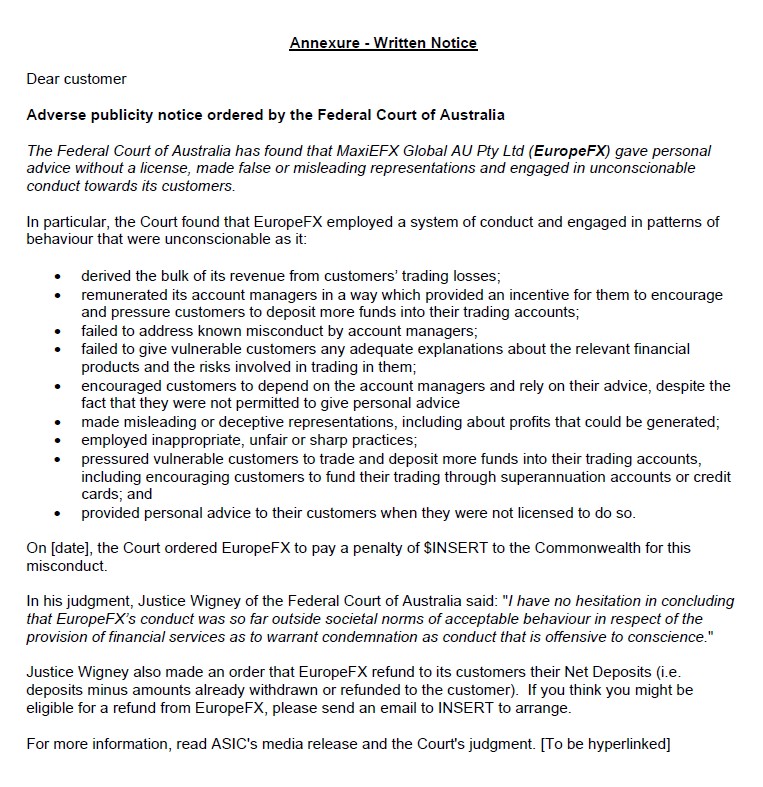
7. Pursuant to s 12GLB(1) of the ASIC Act, within six months of the date of this order, EuropeFX is to cause to be published, at its own expense, a notice in the terms set out in the Annexure to these orders (Written Notice) by sending (by ordinary post or email) to each customer who held a trading account with EuropeFX between 15 August 2018 and 31 January 2020 an email or letter and including within the body of that correspondence the terms of the Written Notice.
8. Pursuant to ss 1101B(4)(a) and 1324(1) of the Corporations Act and s 12GD(1) of the ASIC Act EuropeFX is permanently restrained from carrying on a financial services business, or carrying on a business related to, concerning or directed to financial products or financial services within the meaning of s 761A of the Corporations Act, or otherwise providing financial product advice.
9. Pursuant to ss 12GNB and 12GNC(d) of the ASIC Act, EuropeFX refund to its clients their Net Deposits, being:
(a) the total amount that the client deposited to the client’s trading account(s) with EuropeFX; less
(b) any amounts withdrawn, or already refunded to the client, from the client’s trading account(s); less
(c) any amounts refunded to the client as a result of any arrangement or agreement; less
(d) any amounts which the client in fact receives, pursuant to reg 7.8.03(6) of the Corporations Regulations 2001 (Cth).
B. AS AGAINST THE THIRD DEFENDANT (TradeFred)
Pecuniary penalties for misconduct prior to 13 March 2019
10. TradeFred pay to the Commonwealth a pecuniary penalty of $350,000 for its contraventions of s 12DB(1) of the ASIC Act set out in declaration 3.(b), pursuant to s 12GBA(1) of the ASIC Act.
11. TradeFred pay to the Commonwealth a pecuniary penalty of $350,000 for its contraventions of s 12CB(1) of the ASIC Act set out in declaration 3.(d), pursuant to s 12GBA(1) of the ASIC Act.
Pecuniary penalties for misconduct on and from 13 March 2019
12. TradeFred pay to the Commonwealth a pecuniary penalty in the amount of $1,400,000 for the contraventions of s 911A(5B) of the Corporations Act set out in declaration 4.(a), pursuant to s 1317G(1) of the Corporations Act.
13. TradeFred pay to the Commonwealth a pecuniary penalty of $7,000,000 for its contraventions of s 12DB of the ASIC Act set out in declaration 4.(b), pursuant to s 12GBB(3) of the ASIC Act.
14. TradeFred pay to the Commonwealth a pecuniary penalty of $17,500,000 for its contraventions of s 12CB(1) and (4) of the ASIC Act set out in declaration 4.(d), pursuant to s 12GBB(3) of the ASIC Act.
15. TradeFred pay to the Commonwealth a pecuniary penalty of $2,800,000 for its contraventions of s 12CB(1) of the ASIC Act set out in declaration 4.(e), pursuant to s 12GBB(3) of the ASIC Act.
C. AS AGAINST THE FIRST DEFENDANT (USG)
Pecuniary penalties for misconduct prior to 13 March 2019
16. USG pay to the Commonwealth a pecuniary penalty of $400,000 for its contraventions of s 12DB of the ASIC Act set out in declaration 5, pursuant to s 12GBA(1) of the ASIC Act.
17. USG pay to the Commonwealth a pecuniary penalty of $7,700,000 for its contraventions of s 12DB and s 12CB(1) of the ASIC Act set out in declaration 6, pursuant to s 12GBA(1) of the ASIC Act.
Pecuniary penalties for misconduct on or after 13 March 2019
18. USG pay to the Commonwealth a pecuniary penalty of $4,800,000 for its contraventions of s 12DB of the ASIC Act set out in declaration 7, pursuant to s 12GBB(3) of the ASIC Act.
19. USG pay to the Commonwealth a pecuniary penalty of $135,800,000 for its contraventions of s 911A of the Corporations Act and ss 12DB, 12CB(1) and (4) of the ASIC Act set out in declaration 8, pursuant to s 12GBB(3) of the ASIC Act and s 1317G(1) of the Corporations Act.
20. USG pay to the Commonwealth a pecuniary penalty of $8,000,000 for its contraventions of s 912A(1)(a) and (5A) of the Corporations Act set out in declaration 9, pursuant to s 1317G(1) of the Corporations Act.
Note: Entry of orders is dealt with in Rule 39.32 of the Federal Court Rules 2011.
REASONS FOR JUDGMENT
WIGNEY J:
1 Between about 2017 and early 2020, the defendants in this proceeding, Union Standard International Group Pty Ltd (USG), Maxi EFX Global AU Pty Ltd (EuropeFX or EFX) and Bright AU Capital Pty Ltd (TradeFred) operated financial services businesses. Those services included offering retail customers the opportunity of trading in highly risky over-the-counter derivative products known as contracts for difference (CFDs) and margin foreign exchange contracts (Margin FX Contracts). Each of USG, EuropeFX and TradeFred profited handsomely from the provision of those services. Their customers did not.
2 The applicant, the Australian Securities and Investments Commission (ASIC) commenced this proceeding alleging that EuropeFX and TradeFred engaged in systems of conduct or patterns of behaviour in the conduct of their respective businesses which were unconscionable, and also engaged in unconscionable conduct in their dealings with several identified customers, in contravention of s 12CB of the Australian Securities and Investments Commission Act 2001 (Cth) (ASIC Act). ASIC also alleged that EuropeFX and TradeFred repeatedly gave personal advice to customers when not permitted to do so and thereby contravened s 911A of the Corporations Act 2001 (Cth) (Corporations Act) and that USG, EuropeFX and TradeFred made false or misleading representations to their customers on many occasions in contravention of s 12DA or s 12DB of the ASIC Act. USG, who held an Australian Financial Services License (AFSL), was also alleged to be liable in respect of the contravening conduct of EuropeFX and TradeFred, who were USG’s corporate authorised representatives (CARs), and to have contravened s 912A(1)(a) of the Corporations Act by failing to do all things necessary to ensure that the financial services covered by its AFSL were provided efficiently, honestly and fairly.
3 On 20 December 2024, I handed down a judgment in which I held that USG, EuropeFX and TradeFred had engaged in virtually all the contravening conduct as alleged by ASIC: Australian Securities and Investments Commission v Union Standard International Group Pty Ltd (No 4) [2024] FCA 1481 (liability judgment or LJ). The matter was adjourned to allow the parties to file evidence and advance submissions in relation to the declarations and orders that should be made and any other relief that should be granted consequent upon those findings.
4 The relief sought by ASIC in respect of the contravening conduct included declaratory relief and injunctive relief pursuant to ss 1101B(1) and (4)(a) and 1324(1) of the Corporations Act and s 12GD(1) of the ASIC Act, non-party redress orders pursuant to ss 12GNB and 12GNC of the ASIC Act and pecuniary penalties pursuant to ss 12GBA(1) and 12GBB(3) of the ASIC Act and s 1317G(1) of the Corporations Act.
5 USG and TradeFred, who were being wound-up in insolvency at the time, did not file any evidence and submissions and their liquidators effectively submitted to any orders the Court may make in respect of relief. EuropeFX did not oppose any of the relief sought by ASIC, though it did submit that the pecuniary penalties that were sought by ASIC in its submissions were too high. ASIC submitted that it would be appropriate for the Court to make pecuniary penalties in respect of EuropeFX’s contraventions which totalled $114.1 million. EuropeFX submitted that the pecuniary penalties sought by ASIC were excessive and that pecuniary penalties that totalled about $40 million would be appropriate.
6 For the reasons that follow, it is appropriate for the Court to make the declarations and orders sought by ASIC against USG, EuropeFX and TradeFred. In relation to the size of the appropriate pecuniary penalties to be imposed on EuropeFX, while EuropeFX argued to the contrary, EuropeFX’s contraventions were unquestionably egregious, deliberate and flagrant. By its conduct, EuropeFX systematically exploited many vulnerable and financially naïve and gullible customers for its own financial gain. Only very substantial pecuniary penalties will effectively deter the likes of EuropeFX and those who stand behind them from engaging in such conduct in the future. The penalties proposed by ASIC are, in all the circumstances, entirely appropriate.
7 References to statutory provisions in these reasons may be taken to be references to the text of those provisions as at the time of the relevant contraventions. It should be noted in that context that the contraventions span a lengthy period during which there were significant changes to the applicable provisions, including those concerning the maximum pecuniary penalties that the Court can order.
Overview and summary of findings in respect of contraventions
8 This judgment should be read together with the liability judgment. It is assumed that readers of this judgment will be familiar with the detailed reasons and findings of fact made in the liability judgment. I do not propose to rehearse that reasoning or repeat those findings in this judgment other than where necessary to address the competing submissions made by ASIC and EuropeFX in respect of the appropriate pecuniary penalties. What follows is no more than a thumbnail sketch of the key findings made in the liability judgment. It is not intended to replace or supplant in any way the findings in the liability judgment. If there is any inconsistency, the findings in the liability judgment prevail. The focus of the following summary is mainly on the findings concerning EuropeFX given that only EuropeFX appeared and adduced evidence and advanced submissions in respect of the appropriate relief. As is clear from the liability judgment, the business conducted by TradeFred was relevantly similar to the business conducted by EuropeFX, though TradeFred’s business was perhaps smaller in scale.
9 USG obtained its AFSL in 2016. The AFSL permitted USG to provide general financial product advice to retail clients. It did not permit it to provide personal financial advice. USG’s business mainly involved dealing in derivatives by issuing and making a market for CFDs and Margin FX Contracts. USG was the principal and counterparty to all the CFD and Margin FX contract positions it made available to its customers.
10 Mr John Martin was a director of USG and was its “Responsible Manager” and Head of Compliance.
11 USG appointed EuropeFX and TradeFred as its CARs and authorised them to provide specified financial services on its behalf. That authority did not extend to permit EuropeFX and TradeFred to provide personal financial product advice to their customers.
12 EuropeFX’s director during the period 2018 to 2020 was Mr Pedro Sasso, though he was briefly replaced by Mr Martin in the period from September 2018 to April 2019. It was readily apparent from the evidence adduced during the trial that Mr Sasso was little more than a puppet director who took instructions from others, though mainly a man named Mr Gal Amar. Mr Amar resided overseas and controlled a company based in either Cyprus or Israel which in turn controlled EuropeFX.
13 The financial services business conducted by EuropeFX as USG’s CAR involved offering CFDs and Margin FX Contracts to customers through an online trading platform. CFDs and Margin FX Contracts are complex and highly risky over-the-counter derivative financial products which effectively enable an investor to profit from movements in the price of an underlying asset (a commodity or share or stock market index) or currency pairing (in the case of Margin FX Contracts). Of course, investors could also incur losses from those movements in price, depending on the position they opened and the direction the price moved. At the time, CFDs and Margin FX Contracts could be highly leveraged, which meant that small financial outlays could generate large profits or, conversely, result in substantial losses well beyond the amount outlaid. The evidence adduced at trial indicated that the nature of those financial products was such that inexperienced or unsophisticated investors in CFDs and Margin FX Contracts were almost certain to lose the money that they invested, often within a very short space of time.
14 USG was the principal and counterparty to all the CFD and Margin FX contract positions opened by EuropeFX’s customers. It profited when EuropeFX’s customers incurred losses. Similarly, by virtue of its arrangements with USG, EuropeFX generated revenue when its customers made losses as a result of closing positions that had moved against them.
15 EuropeFX outsourced almost the entirety of its day-to-day business to foreign entities and individuals. It retained a company based in Belize to source and “onboard” customers. Financially unsophisticated and naïve customers were clearly targeted, including by online promotions which included false celebrity endorsements and misleading claims concerning the profits that could be earned by a system of automatic trading in Bitcoin. Prospective customers were onboarded by, or on behalf of, EuropeFX despite it being obvious from the information provided by those customers that they were wholly unqualified and unsuited to investing in complex and risky leveraged financial products.
16 EuropeFX outsourced all its trading and trading account customer interactions to a business based in Israel which provided call centre services. Employees of that business acted as EuropeFX account managers and, in that capacity, regularly spoke with EuropeFX’s customers over the telephone in relation to their trading and trading activities. Those employees regularly gave the customers personal financial advice in respect of their trading, despite the fact that EuropeFX was not permitted to provide such advice and despite the fact that the account managers well knew that they were not permitted to give personal financial advice. The account managers also frequently made false, misleading or deceptive representations to the customers to encourage them to trade and frequently pressured the customers to trade and deposit more and more funds into their trading accounts. That was hardly surprising given that the account managers received commission based on the amount of money their customers deposited.
17 Those supposedly responsible for management at USG (as the AFSL holder) and EuropeFX were well aware of misconduct on the part of the outsourced foreign account managers. While that misconduct was discussed at supposed compliance meetings, little or nothing was actually done to remedy it. That again was hardly surprising given the sizeable revenue that was being derived by EuropeFX from its customers’ losses. It had no incentive whatsoever to put a stop to the misconduct. Indeed, the available and obvious inference was that it was more than content for the misconduct to continue. Such steps as were taken by USG to address the misconduct were obviously either ignored or were, at best, ineffectual.
18 EuropeFX’s complaint and dispute resolution processes were also largely outsourced to a foreign-based person or entity. Those processes turned out to be one-sided and unfair. The primary aim of the processes, such as they were, was to dissuade complainants from lodging complaints with external regulators and pressuring them to accept paltry confidential settlements. EuropeFX was no doubt anxious to avoid its disaffected customers from approaching the regulators because that would put at risk the continuance of their profitable enterprise.
19 Overall, the systems of conduct and patterns of behaviour employed by EuropeFX in the conduct of their businesses were manifestly unconscionable. The indicia of the unconscionable systems of conduct and patterns of behaviour included: misleading advertising and promotions directed to naïve, financially unsophisticated and vulnerable customers; the deliberate onboarding of customers known to have been inexperienced and unsuitable for investing in risky leveraged derivatives; a system of remuneration by which profits were directly referrable to and derived from customers’ losses, unbeknownst to the customers; the inadequate (or non-existent) training of account managers; and the known patterns of inappropriate behaviour of account managers which included: the provision of personal financial advice; the failure to give adequate explanations in respect of CFD and Margin FX trading and its inherent risks; the making of false, misleading and deceptive representations; the pressuring of customers to deposit funds (in circumstances where account managers received commission based on their customers’ deposits) and engage in more and more trading; offering unfair promotions to encourage the customers to make further deposits and continue trading; encouraging the use of inappropriate funds (including borrowed money and superannuation); and the giving of advice in respect of inappropriate or unfair trading strategies.
20 EuropeFX’s unconscionable systems of conduct and patterns of behaviour were shown to have been specifically employed in the case of eight identified customers who were referred to as the EFX8. The EFX8 were all, to some extent, vulnerable because they had relatively limited financial means and no relevant experience in respect of trading in sophisticated and risky financial products. None of them had an adequate understanding of CFDs or Margin FX Contracts and the inherent risks involved in trading in those products. None of them were given any adequate or intelligible explanations or information about the relevant products or the inherent risks in trading in them. They were nonetheless onboarded by EuropeFX and encouraged to deposit more and more money and engage in more and more trading. They were all subjected to egregious account manager misconduct. One need only listen to the recordings of some of the exchanges between the EFX8 and their account managers to appreciate the gravity of the misconduct. They were all given personal advice, misled and deceived, encouraged to rely and depend on their account managers, given inappropriate trading advice and pressured to deposit more and more into their trading accounts, including funds from inappropriate sources. Each of them effectively lost most, if not all, of the money they had deposited into their trading accounts. Those who subsequently complained about their dealings with EuropeFX and its account managers were discouraged from lodging complaints with the regulator and pressured to accept modest settlements.
21 EuropeFX profited handsomely from its business. As adverted to earlier, USG essentially profited or derived revenue from the losses incurred by EuropeFX’s customers and EuropeFX’s arrangements with USG were that it received a very large proportion of those profits or that revenue. Not surprisingly, the losses incurred by EuropeFX’s customers were huge and therefore EuropeFX’s revenue was huge. Evidence tendered during the trial revealed that, between April 2019 and January 2020, EuropeFX received payments from USG which totalled $55,500,616.89. Those payments reflected EuropeFX’s share of the losses made by its customers from trading in CFDs and Margin FX Contracts made available by USG.
22 TradeFred’s business was conducted in a very similar manner to EuropeFX’s businesses. Like EuropeFX, TradeFred, as USG’s CAR, offered CFDs and Margin FX Contracts to customers through an online trading platform. Like EuropeFX, TradeFred outsourced almost all its day-to-day business activities to offshore service providers. Like EuropeFX, TradeFred essentially derived its revenue or income from its customers’ losses. And like EuropeFX, the systems of conduct and patterns of behaviour by which TradeFred conducted its business were manifestly unconscionable. TradeFred’s unconscionable systems of conduct and patterns of behaviour were shown to have been specifically employed in the case of four identified customers who were referred to as the TF4.
23 USG conducted its own financial services business as well as authorising its CARs, EuropeFX and TradeFred, to provide financial services on its behalf. Like its CARs, USG was found to have made false, misleading and deceptive statements to some of its customers in Australia. USG also actively promoted itself and its CFDs and Margin FX Contracts to Chinese citizens in China, despite the fact that in doing so it not only breached Chinese law, but also exposed its Chinese customers to contraventions of Chinese law and possible penalties for doing so.
Findings in respect of contraventions by EuropeFX
24 In the liability judgment I found, in short summary, that EuropeFX had:
(1) contravened s 911A(1) of the Corporations Act on 285 occasions by providing personal advice to customers, through its account managers or representatives, in circumstances where it was not licensed to do so;
(2) contravened s 12DB(1) of the ASIC Act on 190 occasions by making, in trade or commerce, in connection with the supply or possible supply of financial services, or in connection with the promotion of such services, false or misleading representations that the services were of a particular standard or quality, or that the services had certain performance characteristics or benefits;
(3) contravened s 12DA(1) of the ASIC Act on 18 occasions by engaging in conduct, in trade or commerce, and in relation to financial services, where that conduct was misleading or deceptive, or likely to mislead or deceive;
(4) contravened s 12CB(1) of the ASIC Act on one occasion by engaging in conduct, in trade or commerce, and in connection with the supply or possible supply of financial services, where that conduct comprised or constituted a system of conduct or pattern of behaviour that was, in all the circumstances, unconscionable; and
(5) contravened s 12CB(1) of the ASIC Act on eight occasions by engaging in conduct, in trade or commerce, and in connection with the supply or possible supply of financial services to a person, where that conduct was, in all the circumstances, unconscionable.
Findings in respect of contraventions by TradeFred
25 In the liability judgment I found, in short summary, that TradeFred had:
(1) contravened s 911A(1) of the Corporations Act on 20 occasions by providing personal advice to customers, through its account managers or representatives, in circumstances where it was not licensed to do so;
(2) contravened s 12DB(1) of the ASIC Act on 54 occasions by making, in trade or commerce, in connection with the supply or possible supply of financial services, or in connection with the promotion of such services, false or misleading representations that the services were of a particular standard or quality, or that the services had certain performance characteristics or benefits;
(3) contravened s 12DA(1) of the ASIC Act on two occasions by engaging in conduct, in trade or commerce, and in relation to financial services, where that conduct was misleading or deceptive, or likely to mislead or deceive;
(4) contravened s 12CB(1) of the ASIC Act on one occasion by engaging in conduct, in trade or commerce, and in connection with the supply or possible supply of financial services, where that conduct comprised or constituted a system of conduct or pattern of behaviour that was, in all the circumstances, unconscionable; and
(5) contravened s 12CB(1) of the ASIC Act on four occasions by engaging in conduct, in trade or commerce, and in connection with the supply or possible supply of financial services to a person, where that conduct was, in all the circumstances, unconscionable.
Findings in respect of contraventions by USG
26 In the liability judgment, I found, in short summary, that USG had:
(1) contravened s 12DB(1) of the ASIC Act on 56 occasions by making, in trade or commerce, in connection with the supply or possible supply of financial services, or in connection with the promotion of such services, false or misleading representations that the services were of a particular standard or quality, or that the services had certain performance characteristics or benefits;
(2) contravened s 911A(1) of the Corporations Act on 306 occasions, those being contraventions arising from the fact that, on each of the occasions when EuropeFX and TradeFred engaged in conduct that contravened s 911A(1) of the Corporations Act, they did so as agents of USG by reason of s 769B(1)(a) of the Corporations Act;
(3) contravened:
(a) s 12DB(1) of the ASIC Act on 282 occasions;
(b) s 12DA(1) of the ASIC Act on 20 occasions; and
(c) s 12CB(1) of the ASIC Act on 14 occasions;
those being contraventions arising from the fact that, on each of the occasions when EuropeFX and TradeFred engaged in conduct that contravened ss 12DB(1), 12DA(1) and 12CB(1) of the ASIC Act, they did so as agents of USG by reason of s 12GH(2)(a) of the ASIC Act; and
(4) contravened s 912A(1)(a) of the Corporations Act by failing to do all things necessary to ensure that the financial services covered by its financial services licence were provided efficiently, honestly and fairly.
DECLARATIONS in respect of contraventions
27 It is convenient to first consider the declaratory relief sought by ASIC. EuropeFX did not submit that the Court could not or should not make declarations in respect of its contraventions of the Corporations Act and the ASIC Act. As already noted, USG and TradeFred did not make any submissions in respect of the relief sought by ASIC.
28 As a result of material amendments to both the Corporations Act and the ASIC Act that had effect from 13 March 2019, it is necessary to distinguish between those contraventions that occurred before 13 March 2019 and those contraventions that occurred after that date.
Pre-13 March 2019 Corporations Act contraventions
29 Subsection 1317E(1) of the Corporations Act provided that “[i]f a Court is satisfied that a person has contravened a civil penalty provision, it must make a declaration of contravention”. Subsection 1317E(2) provided that a declaration of contravention must specify, among other things, the civil penalty provision that was contravened, the person who contravened the provision and the conduct that constituted the contravention.
30 Subsections 911A(5B) and 912A(5A) of the Corporations Act were not specified as being civil penalty provisions prior to 13 March 2019. They were specified as being a civil penalty provision after that date. It follows that s 1317E(1) of the Corporations Act does not apply in respect of EuropeFX’s and TradeFred’s contraventions of s 911A(5B), USG’s contraventions of s 911A(5B) by virtue of s 769B of the Corporations Act and USG’s contravention of s 912A(5A), that occurred before 13 March 2019.
31 The Court nevertheless has a wide discretionary power to make declarations under s 21 of the Federal Court of Australia Act 1976 (Cth) (FCA Act). The exercise of that discretion in respect of contraventions of legislative provisions is generally accepted to be appropriate because such declarations serve to: record the Court’s disapproval of the contravening conduct; vindicate the regulator’s claim that the defendant contravened the provision; and assist the regulator to carry out its duties and deter other persons from contravening the provisions: see Australian Competition and Consumer Commission v The Construction, Forestry, Mining and Energy Union (2007) ATPR 42-140; [2006] FCA 1730 at [6] and the cases cited therein.
32 It is, in all the circumstances, appropriate to make declarations in respect of the pre-March 2019 Corporations Act contraventions. No party submitted otherwise. For reasons that will be explained later, the declarations ultimately sought by ASIC in respect of the contraventions of s 911A of the Corporations Act, both prior to and after 13 March 2019, did not reference all the contraventions identified in the liability judgment.
Post-13 March 2019 Corporations Act contraventions
33 In the case of EuropeFX’s and TradeFred’s contraventions of s 911A(5B), USG’s contraventions of s 911A(5B) by virtue of s 769B of the Corporations Act and USG’s contravention of s 912A(5A) that occurred after 13 March 2019, the Court is required by s 1317E(1) to make declarations in respect of those contraventions. The declarations sought by ASIC in respect of the contraventions of s 911A(5B) by EuropeFX, TradeFred and USG and the contravention of s 912A(5A) by USG will accordingly be made.
Pre-13 March 2019 ASIC Act contraventions
34 Prior to 13 March 2019, there was no section in the ASIC Act which provided for the making of declarations in respect of contraventions of provisions in the ASIC Act. As noted above in the context of the Corporations Act contraventions, however, the Court has the discretionary power to make declarations in respect of contraventions of the ASIC Act which occurred prior to 13 March 2019 pursuant to s 21 of the FCA Act.
35 It is appropriate to make declarations in respect of the pre-March 2019 ASIC Act contraventions. No party submitted otherwise. For reasons that will be explained later, the declarations ultimately sought by ASIC in respect of the contraventions of ss 12DA and 12DB of the ASIC Act, both prior to and after 13 March 2019, did not reference all the contraventions identified in the liability judgment.
Post-13 March 2019 ASIC Act contraventions
36 From 13 March 2019, s 12GBA(3) of the ASIC Act provided that the Court must make a declaration if (following an application by ASIC) it is satisfied that a person has contravened a civil penalty provision in the ASIC Act. While s 12GBA(3) does not apply in the case of contraventions of s 12DA of the ASIC Act, which is not a civil penalty provision, the Court nevertheless has the power under s 21 of the FCA Act to make declarations in respect of contraventions of that provision. No party submitted that the Court should not make declarations in respect of the s 12DA contraventions.
37 The Court will accordingly make the declarations sought by ASIC in respect of the contraventions of ss 12CB, 12DA and 12DB of the ASIC Act by EuropeFX, TradeFred and USG.
Applicable STATUTORY PROVISIONS AND principles in respect of fixing pecuniary penalties
38 It is necessary to separately consider the applicable provisions concerning the fixing of pecuniary penalties for contraventions of the Corporations Act and the ASIC Act.
Penalties for Corporations Act contraventions
39 As has already been noted, ss 911A(5B) and 912A(5A) of the Corporations Act were not civil penalty provisions prior to 13 March 2019. It is therefore only necessary to have regard to the post-13 March 2019 provisions of the Corporations Act relating to pecuniary penalties.
40 Subsection 1317E(3) of the Corporations Act incorporated a table which specified and categorised the provisions of the Act which were civil penalty provisions. Subsections 911A(5B) and 912A(5A) were “uncategorised” civil penalty provisions because they were neither “corporation/scheme civil penalty provision[s]” or “financial services civil penalty provision[s]”: s 1317E(3)(d).
41 Subsection 1317G(1) of the Corporations Act relevantly provided that a Court may order a person to pay to the Commonwealth a pecuniary penalty in relation to the contravention of a civil penalty provision if a declaration of contravention of the civil penalty provision by the person had been made under s 1317E: s 1317G(1)(a). Subsection 1317G(2) provided that the pecuniary penalty must not exceed the pecuniary penalty applicable to the contravention of the civil penalty provision.
42 Subsection 1317G(4) provided as follows:
Pecuniary penalty applicable to the contravention of a civil penalty provision—by a body corporate
The pecuniary penalty applicable to the contravention of a civil penalty provision by a body corporate is the greatest of:
(a) 50,000 penalty units; and
(b) if the Court can determine the benefit derived and detriment avoided because of the contravention—that amount multiplied by 3; and
(c) either:
(i) 10% of the annual turnover of the body corporate for the 12‑month period ending at the end of the month in which the body corporate contravened, or began to contravene, the civil penalty provision; or
(ii) if the amount worked out under subparagraph (i) is greater than an amount equal to 2.5 million penalty units—2.5 million penalty units.
43 ASIC’s submissions regarding the appropriate penalty to be imposed in respect of the contraventions of s 911A of the Corporations Act by EuropeFX, TradeFred and USG and USG’s contravention of s 912A of the Corporations Act proceeded on the basis that s 1317G(4)(a) was the applicable provision in determining the maximum pecuniary penalty for those contraventions.
44 Subsection 1317G(6) of the Corporations Act provided as follows:
Determining pecuniary penalty
In determining the pecuniary penalty, the Court must take into account all relevant matters, including:
(a) the nature and extent of the contravention; and
(b) the nature and extent of any loss or damage suffered because of the contravention; and
(c) the circumstances in which the contravention took place; and
(d) whether the person has previously been found by a court (including a court in foreign country) to have engaged in similar conduct.
Penalties for ASIC Act contraventions
45 It is necessary to consider the applicable ASIC Act provisions concerning pecuniary penalties both before and after 13 March 2019, when significant amendments to those provisions came into force, because the ASIC Act contraventions by EuropeFX, TradeFred and USG straddled that date.
Pre-13 March 2019 contraventions
46 In the relevant period prior to 13 March 2019, s 12GBA(1)(a) of the ASIC Act relevantly provided that, if the Court was satisfied that a person had contravened, inter alia, a provision of Subdivision C (which included s 12CB) and Subdivision D (which included s 12DB) other than s 12DA, the Court could order the person to pay to the Commonwealth such pecuniary penalty, in respect of each act or omission by the person to which s 12GBA applied, as the Court determined to be appropriate.
47 Subsection 12GBA(2) of the ASIC Act provided as follows:
In determining the appropriate pecuniary penalty, the Court must have regard to all relevant matters including:
(a) the nature and extent of the act or omission and of any loss or damage suffered as a result of the act or omission; and
(b) the circumstances in which the act or omission took place; and
(c) whether the person has previously been found by the Court in proceedings under this Subdivision to have engaged in any similar conduct.
48 Subsection 12GBA(3) of the ASIC Act provided (at all relevant times before 13 March 2019) that the pecuniary penalty payable was not to exceed, in the case of acts or omissions in contravention of Subdivisions C or D (which respectively included ss 12CB and 12DB), 10,000 penalty units if the person who engaged in those acts or omissions was a body corporate. A penalty unit at the time was $210.00.
49 It follows that the maximum penalty that could be imposed for each of the contraventions of ss 12CB and 12DB of the ASIC Act by EuropeFX, TradeFred and USG that occurred before 13 March 2019 was $2.1 million.
50 Prior to 13 March 2019, s 12GBA(4) provided as follows:
If conduct constitutes a contravention of 2 or more provisions referred to in paragraph (1)(a):
(a) a proceeding may be instituted under this Act against a person in relation to the contravention of any one or more of the provisions; but
(b) a person is not liable to more than one pecuniary penalty under this section in respect of the same conduct.
51 Subsection 12GBA(4) was repealed on 13 March 2019. EuropeFX’s submissions concerning the operation or effect of s 12GBA(4) in respect of its contraventions are discussed in detail later.
Post-13 March 2019 contraventions
52 Following the amendments to the ASIC Act which came into effect on 13 March 2019, the relevant provisions concerning the imposition of pecuniary penalties were contained in s 12GBB of the ASIC Act. Subsection 12GBB(1) of the ASIC Act provided that ASIC could apply to a Court for an order that a person who was alleged to have contravened a civil penalty provision pay the Commonwealth a pecuniary penalty. Subsection 12GBB(3) provided in effect that, where the Court made a declaration under s 12GBA (in the form it took after 13 March 2019 as discussed earlier in the context of declaratory relief) that the person had contravened a civil penalty provision, the Court could “order the person to pay to the Commonwealth a pecuniary penalty that the Court considers is appropriate (but not more than the amount specified in section 12GBC)”.
53 Subsection 12GBB(5) provided as follows:
Determining pecuniary penalty
In determining the pecuniary penalty, the Court must take into account all relevant matters, including:
(a) the nature and extent of the contravention; and
(b) the nature and extent of any loss or damage suffered because of the contravention; and
(c) the circumstances in which the contravention took place; and
(d) whether the person has previously been found by a court (including a court in a foreign country) to have engaged in any similar conduct.
54 Section 12GBC provided that the pecuniary penalty must not be more than “the pecuniary penalty applicable to the contravention of the civil penalty provision”. While there appears to have been a legislative glitch in respect of the specification of penalties for civil penalty provisions for a short period after 13 March 2019, ASIC proceeded on the basis that the applicable provision was s 12GBCA(2) of the ASIC Act, which provided as follows in respect of the pecuniary penalty applicable to a contravention of a civil penalty provision by a body corporate:
Pecuniary penalty applicable to the contravention of a civil penalty provision—by a body corporate
The pecuniary penalty applicable to the contravention of a civil penalty provision by a body corporate is the greatest of:
(a) 50,000 penalty units; and
(b) if the Court can determine the benefit derived and detriment avoided because of the contravention—that amount multiplied by 3; and
(c) either:
(i) 10% of the annual turnover of the body corporate for the 12‑month period ending at the end of the month in which the body corporate contravened, or began to contravene, the civil penalty provision; or
(ii) if the amount worked out under subparagraph (i) is greater than an amount equal to 2.5 million penalty units—2.5 million penalty units.
55 ASIC contended that the penalty applicable to the contraventions of s 12DB of the ASIC Act by EuropeFX, TradeFred and USG that occurred after 13 March 2019 was the penalty specified in s 12GBCA(2)(a), namely 50,000 penalty units, which equated to $10.5 million. The basis of that contention appeared to be that: the Court could not determine the benefit derived because of those contraventions and therefore s 12GBCA(2)(b) did not apply; $10.5 million was more than the amount calculated pursuant to s 12GBCA(2)(c)(i); and s 12GBCA(2)(c)(ii) was not applicable in the circumstances of the case. EuropeFX did not appear to dispute ASIC’s contentions in that regard.
56 While the determination of the maximum penalty for a contravention of s 12DB of the ASIC Act in the period between 13 March 2019 and mid-2020 is by no means easy to work out due to the obscurity of the relevant statutory provision, in the absence of any dispute in respect of this issue I will proceed on the basis proposed by ASIC. Accordingly, the maximum penalty for the contraventions of s 12DB of the ASIC Act by EuropeFX, USG and TradeFred that occurred after 13 March 2019 was $10.5 million. In any event, as discussed later, the maximum penalty for a single contravention of s 12DB was somewhat academic given the multiplicity of contraventions.
57 The penalty applicable to the contraventions of s 12CB of the ASIC Act by EuropeFX that occurred after 13 March 2019 was a matter of contention. ASIC contended that the Court could determine the benefit derived by EuropeFX because of the contraventions and that amount multiplied by three exceeded $10.5 million. The penalty applicable to the contraventions was accordingly to be calculated pursuant to s 12GBCA(2)(b) of the ASIC Act. EuropeFX submitted that the Court could not determine the amount it derived because of the contraventions on the evidence before the Court and therefore the penalty applicable to the contraventions of s 12CB was $10.5 million in accordance with s 12GBCA(2)(a) of the ASIC Act. That issue will be addressed and determined later in these reasons.
Applicable principles in respect of pecuniary penalties
58 There was little, if any, disagreement between the parties in respect of the principles which bind the Court in fixing pecuniary penalties for contraventions of civil penalty provisions in the Corporations Act and the ASIC Act. The key principles derived from the authorities may be summarised as follows.
The primacy of deterrence
59 It might surprise the victims and persons otherwise affected by the contravening conduct in this case that the Court’s purpose in imposing a pecuniary penalty for a contravention of a civil penalty provision is not to punish or denounce the conduct. Rather it is to deter and promote compliance. That is, however, unquestionably the current state of the law. The purpose of a civil penalty is “primarily if not wholly protective in promoting the public interest in compliance”: Commonwealth of Australia v Director, Fair Work Building Industry Inspectorate (2015) 258 CLR 482; [2015] HCA 46 at [55] approving the statement by French J in Trade Practices Commission v CSR Ltd (1991) ATPR ¶41-076 at 52,152; [1990] FCA 521 at [40]; see also Australian Building and Construction Commissioner v Pattinson (2022) 274 CLR 450; [2022] HCA 13 at [15], [16], [42].
60 It follows that the “appropriate” pecuniary penalty (to use the word used in the relevant provisions in both the Corporations Act and the ASIC Act) is one that serves the object of deterrence, both specific and general. The Court must “attempt to put a price on contravention that is sufficiently high to deter repetition by the contravener and by others who might be tempted to contravene”; and the penalty must not be one which would be “regarded by [the] offender or others as an acceptable cost of doing business”: Pattinson at [15] and [17]; Australian Competition and Consumer Commission v TPG Internet Pty Ltd (2013) 250 CLR 640; [2013] HCA 54 at [66] citing with approval Singtel Optus Pty Ltd v Australian Competition and Consumer Commission (2012) 287 ALR 249; [2012] FCAFC 20 at 265 [62]. The penalty must also not be greater than is necessary to achieve the object of deterrence because “severity beyond that would be oppression” and the penalty must therefore be one which “strikes a reasonable balance between deterrence and oppressive severity”: Pattinson at [40]-[41].
Relevant factors
61 As the earlier consideration of the relevant pecuniary penalty provisions in both the Corporations Act and the ASIC Act revealed, both sets of provisions include a list of the “relevant matters” that the Court must take into account in determining a pecuniary penalty. The relevant matters in that list include: the nature and extent of the contravention; the nature and extent of any loss or damage suffered because of the contravention; the circumstances in which the contravention took place; and whether the person has previously been found by a court to have engaged in any similar conduct. The statutory list of relevant matters is, however, clearly not exhaustive. The Court must have regard to “all relevant matters”.
62 The matters or factors which might inform the assessment of such a penalty have been said to include both matters pertaining to the nature and character of the contravening conduct and matters pertaining to the character of the contravener: Pattinson at [18]-[19], [57]. The factors pertaining to the former generally include the circumstances in which the conduct took place, the deliberateness of the contravention and the period over which it extended. The factors pertaining to the latter generally include whether the contravener has shown a disposition to cooperate with the relevant regulator and, where the contravener is a company, the size of the company and whether the contravention arose out of the conduct of senior management or at a lower level. There is, however, no “rigid catalogue of matters for attention”: Pattinson at [19], citing with approval Australian Ophthalmic Supplies Pty Ltd v McAlary-Smith (2008) 165 FCR 560; [2008] FCAFC 8 at [91].
63 It is important to emphasise that, given that the purpose of imposing a pecuniary penalty is to deter, not to punish, the types of factors to which reference has been made are only relevant to the extent that they relate to deterrence: Pattinson at [44]. For example, the fact that a contravention of a civil penalty provision was particularly serious because it was deliberate, planned, concealed and carried out by senior management would tend to indicate that a higher penalty should be imposed because only a high penalty would be effective to deter contravening conduct of that nature. The fact that the contravening conduct was serious does not in and of itself compel a higher penalty because, unlike the imposition of sentences for criminal offending, pecuniary penalties are not imposed to punish or ensure that an offender gets his or her “just deserts”.
Relevance of the maximum penalty
64 While the maximum penalty that is prescribed for a contravention may be a relevant consideration when it comes to determining an appropriate pecuniary penalty, the maximum penalty does not constrain the exercise of the discretion beyond requiring “some reasonable relationship between the theoretical maximum and the final penalty imposed”: Pattinson at [55], citing with approval Australian Competition and Consumer Commission v Reckitt Benckiser (Australia) Pty Ltd (2016) 340 ALR 25; [2016] FCAFC 181 at [155]-[156]. The “reasonable relationship”, it would appear, is to be determined having regard to the fact that the maximum penalty is intended “to be imposed in respect of a contravention warranting the strongest deterrence within the prescribed cap” (Pattinson at [58]), not by reference to the fact that the maximum penalty is reserved for the worst category of contravening conduct, as is generally the case when imposing a sentence for a criminal offence: Pattinson at [49]-[51].
Double punishment, course of conduct and totality
65 Cases concerning the imposition of pecuniary penalties frequently refer to the principles that are said to apply when multiple civil penalty contraventions are committed during a single course of conduct. Similarly, reference is frequently made to the so-called “totality principle” which is said to apply when the Court is fixing pecuniary penalties for multiple contraventions. Both the course of conduct principle and the totality principle are derived from the principles that apply when sentencing for criminal offences. They address similar issues but are nevertheless conceptually distinct.
66 When sentencing for criminal offences, the course of conduct principle requires that, where an offender is to be sentenced for a “number of technically identifiable offences”, but the offender was “truly engaged upon one multi-faceted course of criminal conduct”, the sentencing court should avoid double punishment by ordering that the sentences for the separate offences be served concurrently, or partly concurrently, or by lowering the individual sentences: Attorney-General v Tichy (1982) 30 SASR 84 at 92-93; cited with approval in Johnson v The Queen (2004) 205 ALR 346; [2004] HCA 15 at [4].
67 The totality principle in criminal sentencing, on the other hand, requires the sentencing court, when passing a series of sentences in respect of separate offences, to review the aggregate sentence to ensure that it is “just and appropriate”, or “look at the totality of the criminal behaviour and ask itself what is the appropriate sentence for all the offences”: Mill v The Queen (1988) 166 CLR 59 at 63; [1988] HCA 70 at [8], adopting what was said in Thomas, Principles of Sentencing (Heinemann, 2nd ed, 1979) at 56-57.
68 As can be seen, both the course of conduct and totality principles are inextricably linked to the overarching principle that, when sentences are to be imposed for multiple offences, the sentencing court must be astute to avoid doubly punishing the offender in respect of overlapping offences and equally astute to ensure that the overall or effective sentence imposed on the offender is proportionate to the gravity of the offending conduct.
69 The course of conduct and totality principles do not directly apply to the fixing of pecuniary penalties. That is not only because, as has already been noted, pecuniary penalties are not imposed to punish, but also because the notion, drawn from the criminal law, that a penalty must be proportionate to the seriousness of the conduct that constituted the contravention does not apply when fixing pecuniary penalties: Pattinson at [38]. The course of conduct and totality concepts or principles may nevertheless be employed as “analytical tools” that might assist in the assessment of what penalty may be considered reasonably necessary to deter further contraventions: Pattinson at [45]. While the role that those principles may play as analytical tools was not explored in any real depth in Pattinson, the only logical or principled role they could play would appear to be to ensure that, in the case of multiple contraventions, the total penalty is not oppressive or unreasonable, in the sense that it is greater than necessary to achieve the object of deterrence.
Evidence in respect of penalty
70 The parties and the Court proceeded on the basis that all the evidence that was adduced at the liability stage was relevantly before the Court and could be considered in determining the appropriate pecuniary penalty. That evidence was discussed in considerable detail in the liability judgment. I do not propose to refer at length to that evidence in these reasons other than where it is necessary to resolve competing submissions concerning the nature and extent of EuropeFX’s contraventions. ASIC and EuropeFX did, however, tender some additional evidence which was said to be relevant to the fixing of appropriate penalties. It is accordingly necessary to briefly refer to that evidence.
ASIC’s evidence
71 ASIC adduced affidavit evidence from one of its officers which concerned EuropeFX’s compliance with document production notices issued to it pursuant to s 33 of the ASIC Act. ASIC submitted that the evidence of the officer was relevant to the question whether EuropeFX had cooperated with ASIC during its investigation. EuropeFX objected to that evidence on the basis of relevance. It submitted that the evidence was not relevant to the pecuniary penalties that the Court should impose essentially because it did not contend that cooperation should be taken into account as a mitigating factor. Nor, it was submitted, should any lack of cooperation be considered to be an aggravating factor.
72 I admitted the evidence of the ASIC officer concerning compliance with the production notices over EuropeFX’s objection, essentially because I consider that EuropeFX’s lack of cooperation with ASIC is a relevant factor to consider in determining the appropriate penalty. As discussed later, the language of mitigation and aggravation is not entirely apposite when it comes to determining pecuniary penalties. While EuropeFX’s lack of cooperation may not be a particularly weighty consideration in all the circumstances, in my view the evidence concerning cooperation was, and is, nonetheless of some relevance.
73 ASIC also adduced evidence from another officer which, in broad terms, concerned the size of the over-the-counter derivatives market in Australia and USG’s position in that market. The relevance and significance of that evidence is discussed later.
EuropeFX’s evidence
74 EuropeFX tendered a report prepared by a solicitor and “compliance consultant”, Ms Regina (Gina) Block, which purported to contain expert opinion evidence in respect of two broad issues or topics. The first issue concerned the legislative and regulatory regime in respect of holders of AFSLs and CARs and more specifically the duties and obligations that AFSL holders have in respect of their CARs. The second issue concerned whether USG had failed to adequately perform or fulfil its duties and obligations towards EuropeFX. ASIC objected to the tender of Ms Block’s report. I upheld that objection. My reasons for rejecting the evidence of Ms Block were and are as follows.
75 There were several fundamental problems with Ms Block’s evidence. The first problem was relevance. It may be accepted that the statutory and regulatory regime that governed the relationship between USG, as the holder of an AFSL, and EuropeFX, as USG’s CAR, was generally relevant not only to the question of liability, but also to the determination of the appropriate penalties to be imposed. The relevant statutory and regulatory regime was the subject of submissions at the liability stage of the proceeding and was addressed in the liability judgment to the extent that it was relevant to the issues that arose in respect of EuropeFX’s liability. More will be said about that shortly. The general nature of the legislative and regulatory regime, however, is not really a matter for expert opinion evidence and was largely not in dispute or contest. The relevant provisions of the Corporations Act and the ASIC Act speak for themselves and their operation is tolerably clear. ASIC’s published Regulatory Guide 105, which was addressed by Ms Block, also essentially speaks for itself and the content and operation of the guide was not in dispute. What was in issue, however, was Ms Block’s evidence concerning USG’s failure to adequately perform or fulfil its duties and obligations towards EuropeFX and the relevance of that evidence to the question of the appropriate pecuniary penalties that should be imposed on EuropeFX.
76 When pressed to explain the relevance of Ms Block’s evidence to the question of the pecuniary penalties to be imposed on EuropeFX, senior counsel for EuropeFX submitted that the evidence was relevant in two ways. First, the evidence was said to be relevant to EuropeFX’s culpability and the deliberateness of its contravening conduct. In short, it was submitted that Ms Block’s evidence was that the relevant “compliance systems” were USG’s responsibility, not EuropeFX’s responsibility, and that EuropeFX’s contraventions were a result of USG’s failings, not EuropeFX’s failings. Second, it was said that Ms Block’s evidence was relevant to the relationship between the penalties to be imposed on USG and EuropeFX respectively. It was, in short, submitted that Ms Block’s evidence supported the proposition that the penalties to be imposed on EuropeFX should be less than the penalties to be imposed on USG.
77 There are fundamental difficulties with both of those arguments concerning the relevance of Ms Block’s evidence. The difficulty with the first argument is that there was essentially no evidence that was capable of establishing or supporting the inference that EuropeFX relied on USG to provide it with training and adequate compliance systems, or that EuropeFX’s contraventions were somehow the product of USG’s failure to provide adequate training and compliance systems. Ms Block’s evidence concerning USG’s failings therefore could not rationally affect the assessment of EuropeFX’s culpability or the deliberateness of its contravening conduct. Ms Block’s opinion evidence based on her specialised knowledge did not, or could not validly or admissibly, establish that EuropeFX actually relied on USG. More significantly, as I will come to in a moment, the issue of whether EuropeFX relied on USG, or was somehow relieved or absolved of its responsibility for its contravening conduct as a result of USG’s failings as the holder of the relevant AFSL, was an issue that was directly addressed in the evidence, submissions and findings at the liability stage. It was, in short, found that EuropeFX did not rely on USG, but rather ignored or disregarded USG’s attempts to rein in its contravening conduct.
78 I should perhaps note in this context that Ms Block did express some exceedingly broad and general opinions, supposedly drawn or extrapolated from the relevant statutory or regulatory framework, about CARs relying on AFSL holders to provide training and guidance. She stated, for example, (at [113] of her report) that an “AFSL Holder entity has significant power and control over the activities and culture of an Authorised Representative entity”, that “[i]n those circumstances, … the Authorised Representative looks to the AFSL Holder to instruct and direct them in their provision of financial services” and that it would therefore be “reasonable … for that Authorised Representative to rely on a Director and/or Responsible Manager of the AFSL Holder to provide training and guidance and maintain compliance over the operation”. Those opinions were expressed at such a high level of generality, and were so divorced and disconnected from the evidence and findings of fact that were made at the liability stage of the proceeding, that they could not be relevant to any issue that arises in determining the appropriate penalty to impose on EuropeFX. If, contrary to my finding, those opinions were somehow relevant or admissible, I would in any event have given them little if any weight given the evidence and findings made at the liability stage of the proceeding.
79 As for the argument that Ms Block’s evidence was relevant because it supported the proposition that the penalties to be imposed on EuropeFX should be less than the penalties that should be imposed on USG, it may perhaps be accepted that evidence concerning USG’s failings could have some relevance to the penalties to be imposed on USG. It was not suggested, however, that Ms Block’s evidence could or should be admitted against USG. The size of the pecuniary penalties to be imposed on EuropeFX was to be determined on the basis of the evidence and findings concerning the nature and circumstances of EuropeFX’s contravening conduct and failings, not on the basis of general findings concerning USG’s failings. It may be accepted that there should be a logical consistency and some degree of parity between the penalties imposed on EuropeFX and USG in the circumstances, but that is another issue entirely.
80 The second fundamental problem with Ms Block’s evidence has just been adverted to. The question whether EuropeFX relied on USG’s compliance systems was directly in issue at the liability stage of the proceeding and was the subject of extensive evidence and submissions. It was also the subject of findings adverse to EuropeFX.
81 In its defence to ASIC’s statement of claim, EuropeFX pleaded (at [97]) that USG had a “system of quality control” with respect to the conduct of EuropeFX’s account managers, that EuropeFX relied on that system and that EuropeFX was not aware of and did not receive any notice from USG of “any actual or suspected misconduct or failings” of the account managers utilised by EuropeFX. ASIC tendered a trove of documentary evidence in respect of USG’s compliance system, such as it was, and EuropeFX’s supposed reliance on that system. That evidence was addressed at length in the liability judgment. ASIC also adduced expert opinion evidence concerning the steps that a reasonable CAR in EuropeFX’s position would have taken to ensure compliance with the applicable financial services laws. EuropeFX did not adduce any evidence from any current or former officer, employee or agent. Nor did it ask its expert witness to address the issue that was addressed by ASIC’s expert witness.
82 I made the following findings concerning EuropeFX’s contention that it relied on USG’s compliance systems (at LJ [1445]-[1448]):
EuropeFX submitted that it was relevant to have regard to the relevant regulatory framework, and in particular s 912A of the Corporations Act, which obliges the holder of an AFSL to do certain things, take certain steps and comply with various obligations. In EuropeFX’s submission, it followed that USG, as the holder of the relevant AFSL, was responsible in law for many aspects of the conduct upon which ASIC relied.
It may be accepted, as a general proposition, that USG may be liable as a result of some aspects of EuropeFX’s conduct. USG liability is considered separately in these reasons. The fact that USG may also be liable, however, does not somehow absolve EuropeFX of responsibility for contravening conduct on its part, including systemic unconscionable conduct.
EuropeFX appeared to submit, in this context, that ASIC somehow bore the burden of proving that EuropeFX did not rely on USG to provide for the training of its staff, or to provide appropriate dispute resolution. I reject that submission. If EuropeFX contended that its systems of conduct or patterns of behaviour were not unconscionable because it relied on USG to do certain things, it bore at least an evidentiary onus or burden of establishing that it in fact so relied on USG. EuropeFX failed to discharge that evidentiary burden. I was not taken to any evidence which was capable of supporting any inference that EuropeFX relied on USG in respect of the training of the sales representatives and account managers who acted on its behalf.
EuropeFX chose to outsource effectively all its day-to-day business functions to various overseas companies. It engaged XYX, a company based in Israel, to, it may be inferred, provide account management services on its behalf. It ultimately bore the responsibility of ensuring that the account managers retained by XYX to provide services on its behalf were appropriately trained and supervised. For the reasons already given, the overwhelming inference is that EuropeFX failed to discharge that responsibility. It is somewhat fanciful to suggest that it relied on, or could reasonably rely on, USG to train the account managers that were retained by XYX. That is particularly so in circumstances where it was EuropeFX that chose to outsource that aspect of the conduct of its business to a company based on the other side of the world. There was also documentary evidence that USG did raise issues with EuropeFX in respect of the misconduct of the account managers. That evidence was referred to earlier. The available inference is that EuropeFX effectively ignored USG’s entreaties and did little if anything to rein in the inappropriate misconduct of the account managers who were acting on its behalf.
83 There was essentially no dispute at the liability stage of the hearing that the holder of the relevant AFSL, in this case USG, bore the primary responsibility of ensuring compliance, not the CAR. ASIC’s expert witness, Mr Blundell readily agreed that that was the case: see LJ[1409]. There was also little or no dispute that there were deficiencies in some of USG’s training materials. I concluded, however, that the deficiencies in some of the training materials “hardly provides any answer to the question whether EuropeFX, as USG’s CAR, did anything whatsoever to ensure that the account managers who were acting on its behalf had received any training, let alone any adequate training”: LJ[1409].
84 By tendering Ms Block’s report, EuropeFX sought, in effect, to have another go at foisting the blame for its manifest failings on USG. If EuropeFX wanted to rely on Ms Block’s evidence concerning USG’s failings as proving some excuse, explanation or justification of its failings because it supposedly relied on USG, it should have adduced that evidence at the liability stage of the proceeding so that it could be considered and assessed along with all the other evidence on that topic. It was unreasonable for it not to have done so. I reject EuropeFX’s submission that the issues addressed by Ms Block are different to the issues concerning compliance and EuropeFX’s supposed reliance on USG that arose at the liability stage because Ms Block’s evidence goes to mitigation not liability. There was, in my view, merit in ASIC’s submission that EuropeFX was accordingly effectively estopped from revisiting this issue by tendering Ms Block’s evidence at the penalty stage of the proceeding.
85 A third fundamental problem with much of Ms Block’s report was that the basis of many of her statements or opinions was entirely unclear. In particular, in her report Ms Block makes several statements, or expresses several views or opinions, in relation to factual matters relating to the conduct of USG and EuropeFX and their officers or employees in circumstances where the material or information upon which those statements or opinions is based is entirely unclear or uncertain. One of the sources or causes of this problem is that Ms Block was not briefed with all the evidence that was adduced at the liability stage of the proceeding. Rather, she was briefed with a lengthy list of factual assumptions along with a “brief of material” that appears to comprise a highly selective sample of some of the documentary evidence that was adduced at the liability stage. The factual assumptions do not specify their evidentiary source and are not linked to factual findings made in the liability judgment. The problem was exacerbated by the fact that Ms Block purported to express conclusions or opinions about factual issues that were inconsistent with the evidence that was adduced at trial and inconsistent with factual findings made in the liability judgment. It is sufficient to give one example to illustrate this problem.
86 At [147] of her report, Ms Block states that it “appears from the information provided, that Mr Martin handled the compliance oversight process, and did not communicate meaningfully nor engage with Mr Sasso in this regard”. The “information” from which that conclusion was drawn is entirely unclear. Ms Block then goes on to refer to USG’s apparent awareness of EuropeFX’s contravening conduct and states (at [149]) that “[s]uch breaches should have triggered a wider compliance review/audit, reporting to ASIC, and possible disciplinary/punitive measures”, which actions would “certainly have needed to involve EuropeFX’s sole director”. Ms Block then concluded (at [150]) that it “appears that USG, via its Responsible Manager/Director, Mr Martin, took/retained direct control of the compliance process, to the predominant exclusion of EuropeFX’s sole director”. At [151], Ms Block opined that she “would have expected Mr Sasso, as sole director of EuropeFX, to be promptly notified of any compliance deficiencies, and included in any action plan to address such” and at [152] she concluded that “[i]n the absence of involving Mr Sasso, and taking appropriate action to address the misconduct and attendant compliance failures which were accumulating, Mr Martin and USG, effectively left EuropeFX uninformed and unsupported with regard to such failures”.
87 Those conclusion or opinions lie at the very heart of EuropeFX’s reliance on Ms Block’s evidence. EuropeFX contended, in essence, that those conclusions or opinions support the proposition that EuropeFX’s contravening conduct was not deliberate and that EuropeFX was less culpable than USG because it relied on USG. I am not satisfied, however, that those conclusions or opinions were based on any specialised knowledge that Ms Block may have from her training, study or experience: cf Evidence Act 1995 (Cth), s 79. Rather they were blancmange of assertions based on a combination of speculation and inference from unspecified information she had gleaned from the factual assumptions she was asked to make, or perhaps from some other unidentified source. They were also conclusions that were entirely divorced and disconnected from the evidence adduced at the trial and the factual findings made in the liability judgment.
88 Indeed, Ms Block’s factual conclusions were in most respects entirely inconsistent with those findings. Mr Martin was a former director of EuropeFX and I concluded that Mr Sasso was no more than a “puppet director”: LJ [1132]. The individuals who effectively managed and controlled EuropeFX were located overseas. EuropeFX did not call or adduce evidence from Mr Martin or Mr Sasso in relation to the relevant compliance processes or EuropeFX’s supposed reliance on those processes. There was evidence, referred to at length in the liability judgment, that indicated that EuropeFX was anything but “uninformed and unsupported” in respect of the “accumulating” compliance failures on the part of the overseas-based account managers and others it had retained to conduct its business. Indeed, the evidence indicated that, on many occasions USG not only made EuropeFX aware of the misconduct of the account managers, but directed it to take steps to deal with it. Those entreaties were ignored: LJ [1448].
89 The opinions that Ms Block expressed in her report about EuropeFX’s supposed reliance on USG in respect of training and compliance, or its involvement in compliance, or its awareness of the misconduct of its account managers, were not admissible pursuant to s 79 of the Evidence Act or on any other basis. They mostly comprised inference or speculation from unspecified sources and were not demonstrably based on her specialised knowledge. It was not a matter for ASIC or the Court to endeavour to ascertain the basis or source of Ms Block’s views, or disentangle her opinions based on her specialised knowledge, which mostly comprised general opinions concerning the operation of the relevant regulatory regime, from her unsourced factual inferences and speculation about the actual knowledge and actions of USG and EuropeFX.
90 Both ASIC and EuropeFX tendered a large volume of documents. Some of those documents were documents which were in evidence at the liability stage of the proceeding but were tendered again for convenience. Some of the documents in the tender bundle appear not to have been in evidence at the liability stage, which is somewhat surprising given the huge volume of documents that were tendered at that stage. I was not specifically taken to most of the documents in the tender bundle during the parties’ oral submissions, though many of the documents appear to have been referenced in footnotes to the parties’ written submissions. I have had regard to those documents to which it was necessary to have regard in determining the factual issues that still divide the parties, though obviously it is unnecessary to refer to them all in these reasons.
PENALTIES TO BE IMPOSED ON EUROPEFX – SOME GENERALly APPLICABLE factors and FINDINGS
91 As noted at the outset, I do not propose to rehearse in these reasons the many factual findings I made in the liability judgment concerning EuropeFX’s contravening conduct. These reasons should be read together with the liability judgment.
92 Before turning to the penalties that should be imposed in respect of the specific contraventions by EuropeFX, it is useful to address some of the main areas of disagreement between ASIC and EuropeFX in respect of the general factors that are relevant and material in determining the appropriate penalties in respect of all EuropeFX’s contraventions. The main factual issue between the parties was whether EuropeFX’s contraventions were deliberate, or rather were the product of inadequate training, supervision or compliance on the part of USG as the holder of the AFSL pursuant to which EuropeFX provided its financial services as USG’s CAR. Plainly the question whether EuropeFX’s contraventions were deliberate or not is highly relevant in considering the nature and extent of EuropeFX’s contravening conduct and the circumstances in which it occurred.
93 The other issues between the parties included the relevance and significance of: the nature and extent of the loss and damage caused by EuropeFX’s contraventions; EuropeFX’s financial position and revenue; EuropeFX’s lack of cooperation with ASIC; the relevance of other regulatory measures that have been taken by ASIC since EuropeFX’s contraventions, particularly in the context of general deterrence; the concept or notion of “double punishment” and the role it may play in fixing the appropriate pecuniary penalties in circumstances where there was unquestionably some overlap between the various contraventions; and supposedly comparable cases. The parties were also divided in respect of the maximum pecuniary penalty for the contravention involving systemic unconscionability, though that issue will be dealt with separately in the context of determining the appropriate penalty for that contravention.
Deliberateness of the contraventions, corporate culture and the relationship with USG
94 As has already been noted, one of the factors or considerations that the Court must take into account in determining the pecuniary penalty for a contravention of both the Corporations Act and the ASIC Act is the nature and extent of the contravention. Similarly, the Court is required to consider the circumstances in which the contravention took place. Consideration of the nature and extent of a contravention and the circumstances in which it took place will generally include determining whether the contravention was deliberate, in the sense that the conduct that constituted the contravention was engaged in knowingly and intentionally. Generally speaking, contravening conduct that was deliberate in that sense is likely to attract a higher pecuniary penalty than contravening conduct that was accidental, or was the product of inadvertence or mistake, because a higher penalty may be necessary to deter the repetition of deliberate misconduct.
95 ASIC submitted that EuropeFX’s contraventions were deliberate. EuropeFX submitted, however, that the evidence concerning the relationship between USG and EuropeFX “calls into question” the suggestion that EuropeFX’s conduct was deliberate. In EuropeFX’s submission, the evidence indicated that EuropeFX looked to Mr Martin and USG for “guidance” in respect of “compliance issues”, and that USG failed to provide the guidance it was required to provide as the holder of the AFSL pursuant to which EuropeFX provided financial services as USG’s CAR.
96 I accept ASIC’s submission and reject EuropeFX’s submission in respect of the deliberateness of EuropeFX’s contraventions. As is clear from the findings and reasoning in the liability judgment, the evidence clearly and unequivocally indicated that EuropeFX deliberately, knowingly and flagrantly flouted the law. Contrary to EuropeFX’s submissions, the contraventions were not in any relevant sense the product of ignorance, carelessness, or any lack of training, guidance, supervision or compliance by USG. In short, all the contraventions were the product of a business model or system of conduct that was deliberately designed to exploit and derive profit from vulnerable and naïve consumers. It may readily be inferred that EuropeFX’s management, employees and agents knew that they were part of, and were participating in, that unconscionable system of conduct.
97 The appropriate starting point is EuropeFX’s systems of conduct and patterns of behaviour that were found to be unconscionable. Those systems of conduct and patterns of behaviour were addressed at length at LJ[1232]-[1459]. My findings and conclusions were summarised in the following terms at LJ[1458]-[1459]:
I do not propose to rehearse the findings that I have made. Suffice it to say that, for the reasons that have been given, I am comfortably satisfied from the evidence that the systems of conduct that EuropeFX employed, and the patterns of behaviour it engaged in, in the conduct of its financial services business, EuropeFX took advantage of many customers who, by virtue of their lack of any relevant prior knowledge or experience in respect of trading in complex and risky products like CFDs and Margin FX Contracts, were vulnerable and exposed. The patterns of behaviour that were exhibited, and the systems of conduct that were employed, by EuropeFX and its representatives, included, in short summary: the disregard of statutory and regulatory limitations, in particular in respect of the provision of personal advice; the making of misleading or deceptive representations; the employment of several inappropriate, unfair or sharp practices; and the routine exertion of undue influence and pressure on vulnerable customers. EuropeFX also did little or nothing to appropriately train its representatives, and little or nothing to prevent or stop them from engaging in such conduct. The likely and natural consequences of that conduct was that EuropeFX’s customers would deposit, trade with, and ultimately lose, significant sums of money.
I have no hesitation in concluding that EuropeFX’s conduct was so far outside societal norms of acceptable behaviour in respect of the provision of financial services as to warrant condemnation as conduct that is offensive to conscience.
98 I have no hesitation in inferring and concluding that the systems of conduct and patterns of behaviour that were employed by EuropeFX were designed and intended to exploit and profit from vulnerable and inexperienced customers who had little or no idea what they were trading in, and had no real conception of the nature and extent of the risk involved in their trading. I am comfortably satisfied that the evidence supports the inference that EuropeFX management were well aware that EuropeFX’s systems of conduct and patterns of behaviour were well outside societal and commercial norms of acceptable behaviour and yet persisted with that conduct and behaviour because EuropeFX was profiting handsomely from the misfortune and losses of its vulnerable customers.
99 I reject out of hand EuropeFX’s attempt to somehow shift the blame and culpability for its unconscionable systems of conduct and patterns of behaviour onto USG. The suggestion that EuropeFX was somehow ignorant of the unconscionable nature of its systems of conduct and patterns of behaviour, and relied on USG to point out those failings, has no merit and is entirely unsupported by any credible or cogent evidence. Likewise, the apparent contention that EuropeFX’s conduct was simply careless or engaged in mistakenly, because it looked to USG for guidance on compliance and USG failed to perform its duties and obligations in that regard, finds no support whatsoever in the evidence. EuropeFX did not call any of its current or former officers or employees to give evidence concerning its systems of conduct and patterns of behaviour. The smattering of email correspondence relied on by EuropeFX provides no real or meaningful support for the proposition that EuropeFX’s management relied on USG to provide guidance or assistance in respect of compliance. The conclusions I arrived at in respect of reliance in the liability judgment were referred to earlier in considering the admissibility of Ms Block’s report.
100 The person upon whom EuropeFX primarily sought to shift blame was Mr Martin. The problem for USG, however, is that the available inference from the evidence is that the systems of behaviour pursuant to which EuropeFX operated its business were devised and put into practice at a time when Mr Martin was the sole director of EuropeFX. Mr Martin later resigned as a director of EuropeFX and Mr Sasso was appointed in his stead. As I concluded in the liability judgment, however, it may be inferred that Mr Sasso was little more than a puppet director or “cats paw” for the individuals who managed EuropeFX’s day-to-day operations from outside the jurisdiction. The evidence indicated that Mr Martin remained in close contact with the individuals who continued to manage EuropeFX’s business. He too, however, appeared to be somewhat subservient to those who controlled EuropeFX’s business from outside the jurisdiction, and was unable to have them change EuropeFX’s patterns of behaviour. The contention that the controllers and managers of EuropeFX’s business were looking to Mr Martin for guidance in relation to compliance issues is somewhat fanciful and unsupported by the evidence.
101 The idea that EuropeFX management were unaware of the misconduct and unconscionable patterns of behaviour employed by the account managers and other operatives who engaged with EuropeFX’s customers because they were relying on the guidance of USG is equally fanciful. As I concluded in the liability judgment (at LJ[1416]):
The evidence adduced by ASIC clearly indicated that EuropeFX management was aware of the consistent and pervasive misconduct of its account managers towards its customers, but that no effective steps were taken to stop that misconduct. The available inference in the circumstances is that it was simply not in EuropeFX’s interests to put a stop to it. It profited from that conduct. Indeed, it was effectively part of EuropeFX’s business model or system.
102 Having considered the evidence of the “quality control” officers, Ms Ajaz and Mr Liu, and the documentary evidence tendered by ASIC, which included correspondence and minutes of meetings between USG and EuropeFX which referred to misconduct by EuropeFX account managers, I concluded as follows (at LJ[1425]-[1426]):
I would infer, from the evidence as a whole, that the apparent failure on the part of Mr Sasso and EuropeFX’s management to take appropriate or effective action in respect of the known misconduct of the account managers was more likely the product of an unwillingness to appropriately act, rather than an inability to effectively act. EuropeFX was profiting handsomely while the account managers engaged in the identified misconduct….
The inference that EuropeFX management was simply unwilling to stop account manager misconduct can all the more easily be drawn in the absence of any evidence from Mr Sasso or any other officer, employee or agent of EuropeFX in respect of the steps, if any, that were taken to put a stop to that misconduct.
103 None of the documentary evidence adduced by EuropeFX at the penalty stage of the proceeding supported any contrary conclusion.
104 I am also comfortably satisfied that the conduct that EuropeFX engaged in towards the EFX8 that has been found to be unconscionable was engaged in deliberately and intentionally. That conduct displayed all the indicia of unconscionability that formed part of EuropeFX’s business model or system. It was not the product of carelessness, or ignorance or mistake on the part of EuropeFX account managers or EuropeFX management more generally. Nor was it the product of inadequate training or guidance by USG, or inadequate compliance on the part of USG.
105 The EFX8 were essentially the very type of vulnerable consumers that EuropeFX’s unconscionable systems of conduct and patterns of behaviour were designed to exploit. There also could be little or no doubt that they were deliberately exploited. For the reasons given in detail in the liability judgment, I am satisfied that the account managers who dealt with each of the EFX8 knew that the customers were vulnerable, naïve and lacked any relevant knowledge or understanding of the complex financial products in which they were trading and the risks involved in that trading. The account managers also deliberately pressured the EFX8 to deposit more funds, deliberately dissuaded them from withdrawing funds and encouraged them to trade more in circumstances where the account managers knew, but the customers did not, that the account managers’ remuneration was based in part on the size of their customers’ deposits. In short, I have no doubt that the respective account managers well knew that they were unfairly exploiting vulnerable and naïve customers and that their conduct fell well outside the norms of acceptable commercial behaviour.
106 The suggestion that the unconscionable conduct that EuropeFX engaged in towards the EFX8 was not deliberate, but was somehow a product of the fact that the account managers had received inadequate training from USG, or that USG’s supervision or compliance systems were inadequate, is simply not supported by the evidence. Indeed, it is contrary to the evidence. Likewise, as I have already said, the suggestion that EuropeFX’s officers and managers were unaware that account managers were engaging in this sort of misconduct is entirely unsupported by the evidence.
107 There could also in my view be no doubt that the EuropeFX’s many contraventions of s 911A of the Corporations Act and s 12DB of the ASIC Act were deliberate contraventions. The position is perhaps clearest in respect of the contraventions of s 911A of the Corporations Act. The EuropeFX account managers were plainly aware that they were not permitted to provide personal financial advice to their customers. It could scarcely be suggested otherwise in circumstances where the account representatives repeatedly read disclaimers to their customers at the commencement of many of their telephone conversations in which they stated, in effect, that they were not permitted to give personal financial advice.
108 After reciting the disclaimer, the account officers would then often almost immediately proceed to give the customer advice and recommendations that they must have known constituted personal financial advice. The advice generally comprised advice or recommendations concerning trades the customer should make and was plainly made in circumstances where the account manager intended to influence the customer to make decisions concerning their trading: cf s 766B(1)(a) of the Corporations Act. The advice was also provided in circumstances where a reasonable person might expect the account manager to have considered the customers financial situation and objectives: cf s 766B(3)(b) of the Corporations Act. It may readily be inferred in those circumstances that the account managers knew they were giving personal advice that they were not permitted to give. That inference may be more safely drawn in circumstances where EuropeFX called no evidence from any account manager. There was certainly no evidence to suggest that the account managers did not know what relevantly comprised personal advice, or that the contraventions were otherwise the product of ignorance or mistake.
109 Much the same can be said in respect of the contraventions of s 12DB of the ASIC Act. I would infer, in all the circumstances, that the account managers were aware that the statements that they made to their customers that constituted the contraventions were false or misleading. At the very least I would infer that they were reckless in that regard. I do not accept that the contraventions were merely the product of poor training, ignorance or inadvertance.
110 I should finally emphasise two other features of EuropeFX’s contravening conduct which generally fall under the rubric of the nature and extent of the contraventions or the circumstances in which the contraventions occurred. The first feature is that, as is readily apparent both from what I have already said earlier in these reasons and from my findings in the liability judgment, the evidence clearly indicated that EuropeFX’s senior management were not only aware of, but were intimately involved in the contravening conduct. It may readily be inferred that the effective owners, controllers and managers of EuropeFX, who (with the exception of Mr Martin during the brief period while he was a director) all resided overseas, were primarily responsible for establishing the systems of conduct and patterns of behaviour pursuant to which EuropeFX conducted its business. They were also aware of the key elements or features of those systems and patterns that were unconscionable and were aware that they included the contravening conduct by the account managers. It would be wrong to approach the contravening conduct as if the account managers were solely responsible for that conduct.
111 The second feature, which essentially flows from all that has already been said about the nature and extent of the contraventions, or the circumstances in which the contraventions occurred, is that EuropeFX’s corporate culture was the very antithesis of a good corporate culture conducive to compliance with Australia’s financial services laws. While EuropeFX employed compliance officers and convened compliance meetings, there was never any serious attempt to ensure that EuropeFX’s business, which had been outsourced to foreign entities who were effectively beyond the reach of Australia’s financial services laws, was conducted in accordance with Australia’s financial services laws. Compliance was never a genuine element of EuropeFX’s business model.
The nature and extent of the loss and damage suffered as a result of the contraventions
112 Another factor or consideration that the Court must take into account in determining the appropriate pecuniary penalties for contraventions of both the Corporations Act and the ASIC Act is the nature and extent of any loss or damage suffered because of the contravention.
113 ASIC relied on the finding (at LJ[56]) that the net losses by EuropeFX’s customers between August 2018 and December 2019 totalled $69,894,004 and that the losses suffered by the EFX8 as a result of their trading with EuropeFX ranged between $22,500 and $226,770.97.
114 EuropeFX submitted that it is necessary to distinguish the losses arising from the different categories of contraventions. There is some merit in that submission. The figure for the total losses suffered by EuropeFX’s customers is not directly relevant when it comes to determining the appropriate pecuniary penalty for the individual contraventions of s 911A of the Corporations Act, or the individual contraventions of s 12DB of the ASIC Act, or the contraventions of s 12CB of the ASIC Act in respect of the EFX8. That said, the figure for the overall losses is of some contextual relevance to the fixing of the pecuniary penalties for all the contraventions, particularly in circumstances where it is necessary to consider the appropriateness of the totality of the pecuniary penalties and make necessary adjustments to ensure that the total is not oppressive or more than is necessary to secure or achieve the objective of deterrence.
115 It is also undoubtedly relevant to have regard to the overall or total losses suffered by EuropeFX’s customers when determining the appropriate penalty for the systemic contravention of s 12CB of the ASIC Act. As the start date of that contravention is 13 March 2019, however, the relevant figure is the figure for losses suffered after that date. ASIC contended that those losses totalled $58,701,589.68. EuropeFX did not appear to dispute that figure. The basis of that figure was not entirely clear, though there was evidence that indicated that between April 2019 and January 2020, EuropeFX received payments totalling $55,500,616.89 from USG. Those payments reflected EuropeFX’s entitlement to its share of customer losses. That would suggest that the losses suffered by EuropeFX’s customers after 13 March 2019 were likely to have exceeded $55 million.
116 EuropeFX submitted that it cannot be inferred that all its customers’ losses resulted from EuropeFX’s unconscionable systems of conduct or patterns of behaviour. It may perhaps be accepted that it cannot be inferred that the entirety of the losses suffered by EuropeFX customers after 13 March 2019 can be attributed to EuropeFX’s unconscionable systems of conduct or patterns of behaviour. I would, however, readily infer that the vast majority of those losses may be so attributed. That is because the unconscionable systems of conduct and patterns of behaviour employed by EuropeFX in the conduct of its business were persistent, all pervasive and highly effective: see LJ[1340], [1345], [1347], [1348], [1352], [1357], [1366], [1370], [1380], [1381], [1394] and [1419]. It is difficult to imagine that any loss suffered by a customer of EuropeFX was not in some way attributable to the systems employed by EuropeFX to attract and “onboard” vulnerable and naïve customers and the all pervasive misconduct of EuropeFX’s account managers. It is ultimately unnecessary to arrive at a final or precise figure for the total losses suffered by EuropeFX customers that may be attributed to EuropeFX’s unconscionable systems of conduct and patterns of behaviour. I would, however, readily infer that those losses would be in the vicinity of $50 million at the very least.
117 EuropeFX also submitted that it is relevant to have regard to the fact that some EuropeFX customers recovered some of their trading losses from EuropeFX as part of a “settlement process”. It may be accepted that, in determining the total losses suffered by EuropeFX’s customers, some account must be taken of the fact that some EuropeFX customers who lodged complaints with or against EuropeFX were eventually able to recover some of their trading losses as part of a settlement with EuropeFX. That said, it was only those customers who were sufficiently astute and motivated to pursue complaints who were able to recover any of their trading losses and, even then, the amounts recovered were generally only a small proportion of the losses that had been suffered: see LJ[1435]. It must also be borne in mind that EuropeFX’s complaints resolution process was itself found to be unfair and another feature of EuropeFX’s systemically unconscionable conduct: see LJ[1428]-[1439].
118 ASIC submitted that it was also relevant to have regard, in this context, to the non-financial harm suffered by the EFX8 and, it might be inferred, numerous other EuropeFX customers as a result of their trading experiences with EuropeFX. There was, for example, evidence that many of the EFX8 suffered considerable stress, anxiety and other psychological impacts from their mostly disastrous trading experience with EuropeFX: see for example LJ[390], [454], [472] and [1632]. EuropeFX submitted, however, that it would be wrong for the Court to proceed on the basis that the evidence concerning the impacts suffered by the EFX8 as a result of their trading could be extrapolated to a “broader customer base”. I would accept that it cannot be inferred that all EuropeFX customers suffered significant stress, anxiety and other adverse psychological impacts from their trading with EuropeFX. I would, however, readily infer that a large proportion of EuropeFX’s vulnerable customer base was likely to have suffered those impacts. I would also note that the evidence concerning adverse impacts was not restricted to the EFX8. The tapes and transcripts of telephone calls between EuropeFX account managers and EuropeFX customers, other than the EFX8, revealed that many other customers often suffered adverse psychological impacts, as did other evidence concerning complaints and call monitoring.
EuropeFX’s financial position and revenue
119 It is generally accepted that the size or financial position of a contravening corporation may be a relevant factor in determining the size of the pecuniary penalty that would operate as an effective deterrent. The sum required to achieve the object of deterrence will generally be larger where the company has vast resources: Australian Competition and Consumer Commission v Leahy Petroleum Pty Ltd (No 3) (2005) 215 ALR 301; [2005] FCA 265 at [39]; Australian Competition and Consumer Commission v Apple Pty Limited [2012] FCA 646 at [38].
120 There was little, if any, evidence in respect of EuropeFX’s financial position and size as at the date of the liability hearing or the penalty hearing. The evidence established, however, that during the period it traded, EuropeFX generated significant revenue and profits. Its financial statements recorded that, in the 15 months ending on 30 June 2019, its income was $22,906,555 and its net profit after tax for the financial year ending 30 June 2019 was $785,955. The financial statements also recorded that in the seven months ending on 31 January 2020, EuropeFX’s income was $41,987,373 and its net profit after tax for the financial year was $12,820,412.
121 The evidence also indicated that, during the relevant period, EuropeFX had made extremely large payments to its overseas holding company and other offshore entities reportedly for administration and other services. It is not entirely clear how those payments were recorded or reflected in EuropeFX’s account statements. What is tolerably clear, however, is that the ultimate controllers of EuropeFX and their associated entitles located overseas appear to have made substantial financial gains from EuropeFX’s business. Those gains are by now no doubt beyond reach.
122 While there was little reliable evidence in respect of EuropeFX’s current financial position, ASIC conceded that the presently known financial resources of EuropeFX were substantially less than the penalties sought by ASIC. If the penalties sought by ASIC are imposed, the likelihood is that those penalties will not be paid, or not paid in full, and EuropeFX will become insolvent. It does not follow that the large penalties proposed by ASIC should not be imposed. Those penalties may nevertheless be appropriate to ensure that the objective of effective general deterrence is achieved. As Merkel J observed in Australian Competition and Consumer Commission v Leahy Petroleum Pty Ltd (No 2) (2005) 215 ALR 281; [2005] FCA 254 at [9]:
… Size may also be relevant to general deterrence because other potential contraveners are likely to take notice of penalties imposed on companies of a similar size. However, a contravening company’s capacity to pay a penalty is of less relevance to the objective of general deterrence because that objective is not concerned with whether the penalties imposed have been paid. Rather, it involves a penalty being fixed that will deter others from engaging in similar contravening conduct in the future. Thus, general deterrence will depend more on the expected quantum of the penalty for the offending conduct, rather than on a past offender’s capacity to pay a previous penalty.
123 While it may be the case that EuropeFX can no longer be said to be a large company with significant resources at its disposal to pay large pecuniary penalties, the fact that it generated very large revenue and earned significant profits during the period it conducted business and engaged in the contravening conduct remains highly relevant to general deterrence. As has already been noted, the Court’s primary objective in fixing an appropriate penalty is to put a price on contravention that is sufficiently high to deter repetition by the contravener and by others who might be tempted to contravene. That price must be sufficiently high that the contravener and others who might be tempted to engage in similar contravening conduct in the future could not regard it as an acceptable cost of doing business. Where the ultimate objective of the contravening conduct was to generate revenue and profit, the fact that the revenue and profits that were able to be obtained by the conduct in question were very high, as was plainly the case with EuropeFX’s conduct, would tend to suggest that the “price” that may need to be fixed to deter is likely to be correspondingly high. Indeed, the price – the appropriate pecuniary penalty – should generally be significantly higher than the potential revenue or profit that might be earned from the contravening conduct of the type in question: cf Australian Securities and Investments Commission v AGM Markets Pty Ltd (in liq) (No 4) (2020) 148 ACSR 511; [2020] FCA 1499 at [91].
The nature of the industry, regulatory changes and general deterrence
124 For essentially the same reasons, the nature of the industry or market in which the contravening conduct occurred is also likely to be a relevant consideration in determining the appropriate penalty to secure deterrence, in particular general deterrence. That is because the other persons or entities that the pecuniary penalties are intended to deter are mainly those who operate in, or who may operate in, the same or a similar industries or markets. The relevant market in this case was and is the retail market in Australia for over-the-counter financial products, including derivatives like CFDs and Margin FX Contracts. The relevant players or operatives in that market are the issuers of those financial products, or those who facilitate the trading in those financial products, as either holders of AFSLs or as CARs of the holders of AFSLs. That market was, and is, a very large and lucrative market. The evidence indicated that as at June 2024, there were 54 holders of AFSLs who, among other things, were operating as issuers in that market. Those issuers held almost $1.5 billion on behalf of their retail customers.
125 EuropeFX relied on the fact that, since or following its contravening conduct, ASIC had issued ASIC Corporations (Product Intervention Order – Contracts for Difference) Instrument 2020/986 (dated 22 October 2020), a legislative instrument (commonly referred to as a PIO) made under s 1023D(3) of the Corporations Act. That PIO, which commenced operation in early 2021, provided further regulation of the retail market for CFDs in Australia and introduced new or additional restrictions and prohibitions. A media release issued by ASIC in April 2022, when the operation of the PIO was extended, indicated that the further regulation had significantly reduced losses incurred by persons who traded in CFDs. EuropeFX submitted that the “regulatory shift” represented by the PIO should cause the Court to “temper the penalty” to be imposed on EuropeFX, essentially because the need for general deterrence had been reduced.
126 It may be accepted that it is relevant to have regard to the regulatory measures that ASIC has put in place following EuropeFX’s contraventions in assessing the size of the penalties that should be imposed to secure general deterrence. That said, I do not accept that this is a particularly weighty consideration in the particular circumstances of this case. While some of the further regulatory measures appear to have had a positive effect in reducing the size of and scope for losses by persons who trade in CFDs in the current market, that is not to say that the need to deter persons from engaging in the sort of contravening conduct engaged in by EuropeFX has been significantly lessened. Despite the additional regulatory measures, there is no doubt still scope for unscrupulous persons or entities to be tempted to enter or remain in the market and engage in contravening conduct of the sort engaged in by EuropeFX. That is because the scope for securing large monetary benefits from such conduct still exists. The addition of further regulatory provisions alone does not significantly reduce the need for substantial penalties to secure effective general deterrence. The conduct engaged in by EuropeFX was prohibited by the Corporations Act and the ASIC Act, yet EuropeFX engaged in the contravening conduct notwithstanding. Significant penalties are needed to deter others from thumbing their nose at the law, as EuropeFX effectively did, even if there may now be some additional regulatory measures in the market as a result of the relevant PIO.
Cooperation
127 It was common ground that EuropeFX did not cooperate with ASIC during its investigation. Indeed, as ASIC submitted, EuropeFX’s approach was the very antithesis of cooperation. The evidence established that EuropeFX was served with a notice under s 33 of the ASIC Act which required it to produce documents, however it failed to fully comply with that notice. ASIC was effectively forced to commence proceedings to compel EuropeFX to comply. ASIC succeeded in establishing that EuropeFX had, without reasonable excuse, failed to comply with the notice: Australian Securities and Investments Commission v Maxi EFX Global AU Pty Ltd (2020) 148 ACSR 123; [2020] FCA 1263. EuropeFX’s appeal from that decision was dismissed: Maxi EFX Global AU Pty Ltd v Australian Securities and Investments Commission (2021) 284 FCR 643; [2021] FCAFC 59. Despite those judgments, EuropeFX did not produce any further documents to ASIC pursuant to the notice. There could also be little doubt that EuropeFX took an uncompromising and combative approach to this proceeding.
128 It may readily be accepted, as ASIC submitted, that the approach that EuropeFX has taken to both the ASIC investigation and this proceeding “does not warrant any mitigation to the penalty which would otherwise be imposed”. Equally, it may be accepted, as EuropeFX submitted, that its lack of cooperation with ASIC cannot be said to “aggravate” its contravention such that higher pecuniary penalties should be imposed. I do not, however, accept EuropeFX’s submission that its lack of cooperation is an entirely “neutral factor”.
129 The concepts of mitigation and aggravation, in the sense used by the parties in their submissions, have largely been derived or uplifted from the law in respect of sentencing for criminal offences. It is, however, readily apparent from the reasoning of the plurality in Pattinson, that the Court must be cautious in applying principles or concepts that may apply in respect of criminal sentencing to the determination of pecuniary penalties. In those circumstances, it would seem to me to be inapt to approach the factor of cooperation on the basis that it can only be a mitigating factor that may warrant a “discount”, as is the case with criminal sentencing in most jurisdictions, and cannot be considered to be an aggravating factor.
130 If, as the High Court has authoritatively stated, the purpose of imposing a pecuniary penalty is solely to deter, it is difficult to see why a contravener’s failure or unwillingness to cooperate with the regulator cannot be seen to be a factor to take into account in determining the size of the penalty that is necessary to secure deterrence. In some cases, the unwillingness or failure of a contravener to cooperate with the regulator, or evidence that indicated that the contravener had impeded the investigation, may suggest that a higher penalty may be required to achieve effective deterrence than would be the case if the contravener had actively cooperated with the regulator. That is because a failure or unwillingness to cooperate might in some circumstances reflect a degree of recalcitrance or defiance, which in turn might suggest a heightened risk of repetition of the contravening conduct.
131 All that said, I do not consider that the evidence concerning the approach that EuropeFX took to the production of documents, or its approach to the defence of the proceeding more generally, is a particularly weighty consideration in the circumstances of this case.
Double punishment?
132 Subsection 12GBA(4) of the ASIC Act (in the form it took prior to its repeal on 13 March 2019) was set out earlier in these reasons. In general terms, it provided that, where conduct constitutes a contravention of two or more provisions that give rise to the liability to pay a pecuniary penalty, a person is not liable to pay more than one pecuniary penalty in respect of the “same conduct”. EuropeFX submitted that s 12GBA(4) applied in respect of EuropeFX’s contraventions of s 12DB of the ASIC Act which occurred prior to 13 March 2019 because the conduct that constituted those contraventions was the “same conduct” as the conduct that constituted its contravention of s 12CB of the ASIC Act.
133 I reject that submission. While the making, by EuropeFX account managers, of false or misleading representations to customers was one aspect of the systems of conduct and patterns of behaviour that were found to constitute unconscionable conduct on the part of EuropeFX, that is not to say that the conduct of EuropeFX account managers which constituted the specific contraventions of s 12DB of the ASIC Act was the same as the conduct that constituted EuropeFX’s (systemic) contravention of s 12CB of the ASIC Act. The conduct that constituted the systemic contravention of s 12CB of the ASIC Act was obviously far more extensive and broad ranging than the far more limited and specific conduct that constituted the contraventions of s 12DB of the ASIC Act. It is certainly not the same conduct. Justice Perry reached effectively the same conclusion in respect of a similar submission in relevantly identical circumstances in Australian Competition and Consumer Commission v Phoenix Institute of Australia Pty Ltd (Subject to Deed of Company Arrangement) (No 3) [2023] FCA 859 at [48].
134 EuropeFX advanced a similar argument, based on the principles or concepts of course of conduct and totality, in respect of all its contraventions of s 12DB of the ASIC Act and s 911A of the Corporations Act. The principles or concepts of course of conduct and totality, and their application as “tools of analysis” when determining appropriate pecuniary penalties, were discussed earlier in the context of the general principles that apply in respect of the fixing of appropriate pecuniary penalties. EuropeFX submitted that, because the conduct that constituted its contraventions of s 12DB of the ASIC Act and s 911A of the Corporations Act provided a foundation for the Court’s finding that it had engaged in systemic unconscionable conduct and unconscionable conduct concerning the EFX8, there should be no separate penalties imposed in respect of the contraventions of s 12DB of the ASIC Act and s 911A of the Corporations Act. EuropeFX submitted, in the alternative, that if pecuniary penalties are to be imposed in respect of those contraventions, they should be “significantly reduced” to avoid “contravening the proscription on double punishment”.
135 For the reasons adverted to earlier, the principles or concepts of course of conduct and totality should be applied with caution, even as so-called “tools of analysis”, in the context of the determination of pecuniary penalties. That is because those principles or concepts are rooted in criminal law concepts concerning the need to avoid double punishment and the need to ensure that the penalties imposed for criminal offences are proportionate to the offending conduct. Those principles or concepts do not directly apply in the pecuniary penalty context because, as confirmed in Pattinson, pecuniary penalties are imposed to deter, not to punish, and there is no requirement that a pecuniary penalty be proportionate to the contravening conduct.
136 Nevertheless, the concepts of course of conduct and totality may have some role to play in the determination of the appropriate pecuniary penalties. That role, it would seem, is to ensure that, in the case of multiple or overlapping contraventions of civil penalty provisions, the overall or total of the pecuniary penalties imposed by the Court is not oppressive or unreasonable, in the sense that it is greater than necessary to achieve the object of deterrence.
137 EuropeFX has been found to have contravened s 12DB of the ASIC Act and s 911A of the Corporations Act on many occasions. It has also been found to have contravened s 12CB of the ASIC Act in both a systemic way and in respect of eight specific customers, the EFX8. There is no doubt that there is a degree of overlap between the various contraventions. The giving of personal advice and the making of false and misleading representations, including the specific instances of personal advice and false and misleading representations that are reflected in the contraventions of s 12DB and s 911A, formed part of, albeit not a particularly major or predominant part of, the overall unconscionable conduct that constituted the contraventions of s 12CB of the ASIC Act. The Court must be astute to ensure that the overlap between the various contraventions is reflected in the size of the pecuniary penalties that are imposed. Equally, given the multiplicity of contraventions and the considerable overlap between the various contraventions, the Court must be astute to ensure that the pecuniary penalties that are imposed in respect of the contraventions, considered both individually and cumulatively, are not oppressive or greater than is necessary to achieve the object of deterrence. Because there are many contraventions and therefore many pecuniary penalties, the Court must be careful to ensure that, when those penalties are tallied up, the overall or cumulative penalty is not oppressive or greater than necessary to achieve the object of deterrence.
138 That said, I do not accept EuropeFX’s submission that the Court should not impose any penalties for any of the contraventions of s 12DB of the ASIC Act and s 911A of the Corporations Act because the imposition of pecuniary penalties for those contraventions would offend or be contrary to the course of conduct or totality principles. I am unable to see how the imposition of pecuniary penalties for those contraventions would somehow offend or be contrary to the course of conduct principle. EuropeFX did not adequately or persuasively explain how that concept or principle applied to the circumstances of this case. It did not, for example, identify the relevant course of conduct, or courses of conduct, that were said to attract the concept or principle in the circumstances of this case. It was, at best, unclear whether it contended that EuropeFX’s conduct in its entirety constituted a single course of conduct, or whether it was said that there were separate courses of conduct in respect of the EFX8, or separate courses of conduct constituted by the giving of personal advice or the making of false or misleading representations to individual consumers. I am unable to see how it could sensibly be said that the contraventions all formed part of a single course of conduct, or even separate courses of action in respect of each of EFX8, particularly in circumstances where the contraventions of s 12DB of the ASIC Act and s 911A of the Corporations Act occurred in many separate conversations between many different customers and many different EuropeFX account managers over a very lengthy period of time.
139 EuropeFX also did not adequately or persuasively explain how either the course of conduct or totality principles or concepts could justify the imposition of no penalties for the separate contraventions of s 12DB of the ASIC Act and s 911A of the Corporations Act. It is difficult to see how the principles or concepts of totality could warrant or justify the imposition of no penalties for those contraventions in circumstances where such an outcome could not have any deterrent effect in respect of those contraventions. It could not sensibly be said that the imposition of penalties only for the unconscionable conduct contraventions could act as an adequate or sufficient deterrent in respect of potential future contraventions of s 12DB of the ASIC Act and s 911A of the Corporations Act by EuropeFX or others.
140 As I have effectively already observed, however, I accept that, given the large number of contraventions by EuropeFX, the totality principle or concept does have some role to play in determining the appropriate pecuniary penalties for EuropeFX’s contraventions. While I find it more difficult to accept that the course of conduct principle or concept has any real role to play in the determination of the pecuniary penalties in the circumstances of this case, including as a so-called “tool of analysis”, I accept the broader proposition that, in determining the appropriate penalties for the contraventions, it is necessary to take into account the overlap between some of the contraventions. In particular, it may be accepted that the unconscionable conduct contraventions in respect of the EFX8 involve specific manifestations of EuropeFX’s broader unconscionable systems of conduct and patterns of behaviour. It may also be accepted that those systems of conduct and patterns of behaviour included the giving of personal advice and the making of false or misleading representations of the type that constituted EuropeFX’s contraventions of s 12DB of the ASIC Act and s 911A of the Corporations Act. If pecuniary penalties were to be imposed in respect of each of the contraventions in isolation and without regard to the fact that multiple penalties are to be imposed in respect of contraventions that overlap in material respects, that would almost certainly result in penalties that were oppressive, in the sense that they were higher than necessary to achieve deterrence.
141 ASIC accepted that there was a degree of overlap between some of the contraventions and that, given the large number of contraventions, it would be appropriate to reduce the penalties that would otherwise be imposed in respect of the contraventions to ensure that the total or overall penalty imposed by the Court was not oppressive. It proposed, in those circumstances, that the appropriate way to apply the concept of totality was to apply a 30% discount to the pecuniary penalties that would otherwise be imposed in respect of each contravention. That would have the effect of reducing the total or overall penalty by 30%. EuropeFX appeared to accept that approach or proposal in principle (albeit as an alternative to its primary submission that no penalties should be imposed in respect of the s 12DB ASIC Act and s 911A Corporations Act contraventions), though it submitted, in effect, that a 30% reduction of the penalties that would otherwise be appropriate was insufficient.
142 There is no single correct way to apply the totality principle or concept (or the course of conduct principle or concept) as a “tool of analysis” when determining the appropriate penalties for multiple overlapping contraventions. One way is to reduce the total or overall penalty by reducing the penalty for each contravention by a fixed amount or percentage. That is effectively the method that was advocated by ASIC. Another would be to approach the exercise at a more granular level and apply different reductions or discounts to different contraventions depending on the nature and extent of the overlap of the contraventions. In this matter, for example, it would be open to apply little or no discount to, or reduction of, the pecuniary penalty to be imposed in respect of the systemic unconscionable conduct contravention, but apply more substantial discounts to the contraventions involving unconscionable conduct towards the EFX8 and the contraventions of s 12DB of the ASIC Act and s 911A of the Corporations Act. That exercise, however, would be difficult and complex. That is because the granular discounts to the different contraventions may vary according to the nature and extent of the overlap between the particular contraventions in question and the systemic unconscionable conduct contravention. One should not, however, lose sight of the fact that the ultimate objective of the exercise is to ensure that the total of the penalties, or the total or overall penalty, is not greater than is necessary to achieve effective deterrence, specific and general, in the particular circumstances of the case.
143 I am persuaded that the approach or course proposed by ASIC to address the principle or concept of totality in the circumstances of this case is a principled, reasonable and appropriate way to take into account the fact that pecuniary penalties are to be imposed in respect of multiple contraventions the elements of many of which overlap. I am also persuaded that a discount or reduction of 30% applied to all the individual penalties is a reasonable and appropriate discount or reduction in the particular circumstances of this case. Indeed, if anything, in my view it is an overly generous discount. As discussed earlier, while it would be open to take a more granular approach to the reductions to be applied to individual penalties to take into account the multiplicity of overlapping contraventions, that would be a particularly demanding and complex exercise to undertake in the particular circumstances of this case. I am not persuaded that the circumstances of this case compel the Court to take that approach, or that the end result would be materially different in any event.
The relevance of supposedly comparable cases
144 In its submissions, EuropeFX placed considerable reliance on the penalties imposed in two earlier decisions of this Court that were said to be comparable to this case, those cases being AGM Markets (No 4) and Australian Securities and Investments Commission v Forex Capital Pty Limited, in the matter of Forex Capital Trading Pty Limited [2021] FCA 570. EuropeFX submitted, in effect, that the Court should not impose pecuniary penalties in respect of EuropeFX’s contraventions which significantly exceeded the pecuniary penalties, or some of them, that were imposed in respect of the contraveners in those cases.
145 I am not persuaded that the decisions in either AGM Markets (No 4) or Forex Capital provide any real assistance in determining the appropriate pecuniary penalties in this case. I also do not consider that it is correct to approach the determination of the appropriate pecuniary penalties in a case by adopting, as a starting point of the analysis, the size of pecuniary penalties imposed in other cases which are perceived to be similar or comparable, and to then add to or subtract from that starting point to take into account the different facts and circumstances in those comparable cases. The correct approach to take to comparable cases was outlined by the Full Court in Australian Competition and Consumer Commission v Employsure Pty Ltd (2023) 407 ALR 302; [2023] FCAFC 5 at [58]:
Penalties imposed in comparable cases may be of assistance and provide guidance in assessing the appropriateness of the penalty imposed (or to be imposed) as there should be some consistency in the penalties imposed as similar contraventions should incur similar penalties. The consistency sought is not numerical consistency, but rather consistent application of relevant legal principles: R v Pham (2015) 256 CLR 550; 325 ALR 400; [2015] HCA 39 (Pham) at [28] citing Hili at [49]. These concepts have resonance to the imposition of civil penalties: see for example, Australian Competition and Consumer Commission v Cabcharge Australia Ltd [2010] FCA 1261 at [54]; Flight Centre Ltd v Australian Competition and Consumer Commission (No 2) (2018) 260 FCR 68; 356 ALR 389; [2018] FCAFC 53 at [63]; Australian Competition and Consumer Commission v Telstra Corporation Ltd (2010) 188 FCR 238; [2010] FCA 790 at [215]; Viagogo at [128]; Australian Competition and Consumer Commission v Samsung Electronics Australia Pty Ltd [2022] FCA 875 at [54] and Australian Competition and Consumer Commission v Kimberly-Clark Australia Pty Ltd (No 2) [2021] FCA 102 at [46]. Care must be taken when considering other penalties imposed. It must be recognised that the previous penalties imposed do not establish a range which is the correct range, or that the upper or lower limits to the range are the correct upper and lower limits: Hili at [54]. Each case must turn on its own facts, and any reference to comparable cases must encompass the particular circumstances in which the penalty was imposed.
(Emphasis added.)
146 While it may of course be accepted that consistency in respect of the determination of appropriate pecuniary penalties is important, EuropeFX’s submissions based on AGM Markets (No 4) or Forex Capital tended to erroneously focus on the perceived need for numerical consistency, as opposed to the consistent application of relevant legal principles. EuropeFX’s analysis also assumed or proceeded on the basis that the perceived range of penalties imposed in each of those cases was necessarily the correct range.
147 At a more basic level, EuropeFX’s submissions failed to adequately account for the materially different facts and circumstances in both AGM Markets (No 4) and Forex Capital. Those differences included, in short summary: the fact that the contraventions in AGM Markets (No 4) occurred prior to the introduction of the regime of higher penalties which came into effect on 13 March 2019; the unconscionable systems of conduct and patterns of behaviour in both AGM Markets (No 4) and Forex Capital did not include all of the elements of the unconscionable systems of conduct and patterns of behaviour in this matter; the scale of the CFD operations and the size of the customer losses in AGM Markets (No 4) were considerably less than the scale of operations and the size of the losses in EuropeFX’s case; and the contraveners in both AGM Markets (No 4) and Forex Capital cooperated to some extent with ASIC. Overall, in my view, the nature and extent of the contraventions by EuropeFX and the circumstances in which they occurred are far more serious than was the case with the contraventions in AGM Markets (No 4) and Forex Capital. The objective circumstances of EuropeFX also materially differ from the objective circumstances of the contraveners in both AGM Markets (No 4) and Forex Capital.
148 In all the circumstances, I do not consider that the appropriate pecuniary penalties to impose on EuropeFX in respect of its contraventions should be tethered to or constrained in any way by the penalties that were imposed in AGM Markets (No 4) and Forex Capital.
Other potentially relevant factors
149 I am required to take into account the fact that EuropeFX has not previously been found by a court to have engaged in any conduct similar to the contravening conduct in this case. That is undoubtedly a relevant consideration, however I doubt that it is deserving of much weight in the particular circumstances of this case. That is because it may be inferred that EuropeFX was effectively a special purpose company that was registered for the very purpose of providing financial services, including those that were the subject of the contravening conduct, as USG’s CAR. It is, in those circumstances, not surprising at all that it had not previously been found to have engaged in any similar contravening conduct. It may equally be said that EuropeFX had no prior history as a good corporate citizen. In those circumstances, it is difficult to see why or how the absence of any prior court finding that EuropeFX had engaged in similar contravening conduct bears significantly on the question of the size of the penalties necessary to secure deterrence: cf Phoenix Institute at [88]-[89].
EUROPEFX – Penalty for systemic unconscionability
150 It is appropriate to begin with the appropriate penalty to impose on EuropeFX in respect of its contravention of s 12CB of the ASIC Act constituted by it having engaged in a system of conduct and a pattern of behaviour that was, in all the circumstances, unconscionable. That is because it is undoubtedly the most serious contravention and the contravention which warrants the highest penalty.
151 It is also convenient to commence the analysis by resolving the issue between the parties in respect of the maximum pecuniary penalty that the Court is able to impose in respect of that contravention. As discussed earlier, the Court must endeavour to ensure that there is a reasonable relationship between the theoretical maximum penalty for the contravention and the penalty that is imposed in respect of the contravention.
Maximum penalty
152 The conduct that was found to constitute EuropeFX’s systemic contravention of s 12CB(1) of the ASIC Act straddled 13 March 2019, that being the date that the penalties for contraventions of the ASIC Act were significantly increased. It is important to note, however, that ASIC only sought a pecuniary penalty in respect of EuropeFX’s unconscionable systems of conduct and patterns of behaviour that occurred or subsisted after 13 March 2019.
153 As adverted to earlier, there was a dispute between ASIC and EuropeFX in respect of the maximum penalty that could be imposed on EuropeFX in respect of its systemic contravention of s 12CB of the ASIC Act. The dispute mainly turned on whether the Court could determine the benefit derived by EuropeFX because of the contravention for the purposes of s 12GBCA(2)(b) of the ASIC Act. Because ASIC only sought a pecuniary penalty in respect of the systemically unconscionable conduct that occurred after 13 March 2019, the question is whether the Court was able to determine the benefit derived by EuropeFX because of that conduct on and from that date.
154 In summary, ASIC contended that the Court could determine the relevant benefit derived by EuropeFX. The benefit was said to be approximately $55.5 million. It followed, so ASIC submitted, that the amount calculated pursuant to s 12GBCA(2)(b) was approximately $166.5 million, being three times that benefit. That amount was greater than the penalty specified in s 12GBCA(1)(a) in respect of a single contravention, which after 13 March 2019 was 50,000 penalty units which equated to $10.5 million. The amount calculated pursuant to s 12GBCA(2)(b) was also greater than the amount calculated pursuant to s 12GBCA(2)(c)(i) in the circumstances of this case. It was common ground that the amount calculated pursuant to s 12GBCA(2)(c)(i) (based on 10% of EuropeFX’s annual turnover during the specified period) was $7,104,256.85. That amount is significantly less than the amount calculated pursuant to s 12GBCA(2)(c)(ii), which is $525 million (2.5 million penalty units). It followed that, in ASIC’s submission, the maximum penalty for the systemic contravention of s 12CB was approximately $166.5 million.
155 ASIC also advanced an alternative submission which was to the effect that the maximum penalty for EuropeFX’s systemic contravention was not limited to the maximum penalty applicable to a single contravention of s 12CB(1) of the ASIC Act. I will address that alternative submission after considering ASIC’s primary submission in respect of the applicable maximum penalty.
156 EuropeFX contended that the Court could not determine the benefit derived by it because of the systemic unconscionability contravention. It followed, in EuropeFX’s submission, that the maximum penalty for its systemic contravention of s 12CB was the penalty provided for in s 12GBCA(2)(a), which for the period after 13 March 2019 was $10.5 million. That penalty was greater than the penalty calculated pursuant to s 12GBCA(2)(c)(i) which, as already noted, was $7,104,256.85.
157 The first issue that must be determined is what is meant by the expression “benefit derived because of the contravention” as used in s 12GBCA(2)(b) of the ASIC Act. Section 12GBCE of the ASIC Act relevantly provides that the benefit derived because of a contravention of a civil penalty provision is the sum of “the total value of all benefits obtained by one or more persons that are reasonably attributable to the contravention” (emphasis added).
158 In R v Jacobs Group (Australia) Pty Ltd (2023) 280 CLR 170; [2023] HCA 23, the High Court considered the construction of similarly (though not identically) worded provisions which appear in a similar context in s 70.2(5) of the Criminal Code (Cth) (s 3 and the Schedule to the Criminal Code Act 1995 (Cth)). The plurality referred (at [28]) to the “expansive language” of the definition of “benefit” in s 70.2(5)(b) of the Code which, like s 12GBCE, refers to a benefit which is “reasonably attributable” to the offence, and stated that the “offence need not have caused or resulted in the advantage for the advantage to be within the scope of s 70.2(5)(b)” because the “focus is the obtaining of the advantage” (emphasis added). The plurality also reasoned (at [26]) that s 70.2(5)(b) of the Code was “not concerned with the amount of the ‘net benefit’ which the body corporate obtained” and (at [25]) that the benefit is the amount of money provided or received without allowing for any deduction for costs and expenses of any kind.
159 Some assistance can also be gleaned from the judgment of the High Court in Commissioner of Taxation of the Commonwealth of Australia v Sun Alliance Investments Pty Limited (in liquidation) (2005) 225 CLR 488; [2005] HCA 70. In that case, the High Court (at [80]) construed the words “reasonably be taken to be attributable to” in s 160ZK(5) of the Income Tax Assessment Act 1936 (Cth). The Court construed those words as being concerned with the concept of causation, and referred, with apparent approval, to the judgment of Donaldson J in Walsh v Rother District Council [1978] 1 All ER 510 in which his Honour (at 514) stated that the words “attributable to” involved some “causal connection” which “need not be that of a sole, dominant, direct or proximate cause and effect”; rather, a “contributory causal connection is quite sufficient”.
160 Of course, regard must be had to the different statutory contexts in which the words “attributable to” appeared in those cases. Nevertheless, the reasoning in those cases tends to suggest that the words “reasonably attributable to” in s 12GBCE should be given a broad and expansive, not narrow, meaning. They also tend to suggest that, in determining whether a benefit is reasonably attributable to a contravention, it is not necessary to establish that the contravention was the sole, dominant, direct or proximate cause of the benefit being obtained. Rather, it is sufficient to establish a contributory causal connection.
161 Having regard to the broad and expansive construction that should be given to s 12GBCE of the ASIC Act, I am satisfied that the Court can determine the benefit derived from EuropeFX’s systemic contravention of s 12CB of the ASIC Act. In summary, the benefit derived by EuropeFX from that contravention was the sum of the losses made by its customers in the period between 13 March 2019 and 17 December 2019.
162 As found in the liability judgment (at LJ[53]-[61]), the payments which EuropeFX received from USG under the CAR agreement were essentially calculated by reference to the losses suffered by EuropeFX’s customers who were allocated to USG’s “B Book”. The evidence indicated that all EuropeFX’s customers were on USG’s B Book, or at least that EuropeFX received payments from USG which were calculated on that basis. The evidence also indicated that between April 2019 and January 2020, EuropeFX received payments from USG which totalled $55,500,616.89. Those payments reflected EuropeFX’s share of the losses suffered by its customers.
163 Those payments also comprised benefits reasonably attributable to EuropeFX’s systemic contravention of s 12CB of the ASIC Act. That is because the losses suffered by EuropeFX’s customers, which flowed through to EuropeFX from USG, were reasonably attributable to EuropeFX’s unconscionable systems of conduct and patterns of behaviour towards its customers in the conduct of its business. I would readily infer and conclude that the unconscionable systems of conduct and patterns of behaviour applied to all EuropeFX’s customers and in one way or another ultimately caused or resulted in the losses incurred by EuropeFX’s customers. It may be noted, in that regard, that in AGM Markets (No 4) (at [148]), Beach J found, in relevantly comparable circumstances, that there was a “clear causative connection between the relevant contraventions and the consequent losses suffered by clients of the defendants”. As discussed earlier, the contraventions in AGM Markets (No 4) included a systemic contravention of s 12CB of the ASIC Act. The unconscionable systems of conduct and patterns of behaviour in AGM Markets (No 4) were similar to those in the case of EuropeFX, though, if anything, less serious.
164 EuropeFX submitted that the Court could not conclude that all the revenue that it received from USG was the result of its unconscionable conduct. In its submission, there was no basis upon which to conclude that all its customers’ losses were attributable to the unconscionable conduct in circumstances where ASIC did not adduce evidence about every customer that traded over the period from April 2019 to January 2020. I reject those submissions. It may be accepted that ASIC did not adduce evidence about every customer who traded with EuropeFX. It may nevertheless readily be inferred that EuropeFX’s unconscionable systems of conduct and patterns of behaviour, which the evidence suggested were profound and pervasive, applied to and were inflicted upon all EuropeFX’s customers and ultimately caused or contributed to their trading losses. There was no evidence to suggest otherwise.
165 Even if, contrary to the conclusion I have reached, the evidence did not support the inference that EuropeFX’s unconscionable systems of conduct and patterns of behaviour caused or contributed to all its customers losses, I would nevertheless readily infer that the systems of conduct and patterns of behaviour contributed to the vast majority of losses that were suffered by the vast majority of the customers. Taking a broad and expansive approach to the construction and application of s 12GBCA, I would conclude that, at the very least, approximately $50 million of the money EuropeFX received from USG was reasonably attributable to EuropeFX’s systemic contravention of s 12CB of the ASIC Act because that money reflected losses incurred by EuropeFX’s customers and the vast majority of those losses – it may be inferred at least $50 million – were caused by or contributed to by EuropeFX’s unconscionable conduct. The losses, if any, which were suffered by any customers otherwise than as a result of EuropeFX’s unconscionable conduct would have been minimal. It is unnecessary in all the circumstances to determine a precise figure. Either way, the maximum penalty is very large and somewhere in the vicinity of $150 million.
166 I would therefore conclude from the evidence in this case that the benefit derived by EuropeFX because of its systemic contravention of s 12CB of the ASIC Act can be determined and was approximately $50 million. The maximum penalty in respect of that contravention is accordingly the penalty calculated in accordance with s 12GBCA(2)(b) of the ASIC Act, which is three times that benefit. The maximum penalty is therefore $150 million.
167 As noted earlier, ASIC advanced an alternative submission in relation to the maximum penalty for EuropeFX’s systemic contravention of s 12CB of the ASIC Act in the event that the Court held that it was unable to determine the benefit EuropeFX derived from that contravention. That submission was based on the proposition that the maximum penalty for a systemic contravention of s 12CB of the ASIC Act was not limited to the maximum penalty for one contravention of s 12CB, but rather depended on the number of consumers or customers who were subject to the unconscionable systems of conduct or patterns of behaviour that constituted the contravention. In EuropeFX’s case, it may be inferred that its systemically unconscionable conduct was engaged in towards thousands of customers in Australia. ASIC submitted, however, that the Court could certainly determine that the systemically unconscionable conduct was engaged in towards at least 30 customers, being the EFX30. Accordingly, the Court could proceed on the basis that the maximum penalty for EuropeFX’s contravention was at least 30 times the maximum penalty which would otherwise apply to one contravention. The maximum penalty was therefore at least $315 million.
168 That approach to the maximum penalty was supported by the reasoning of Beach J in AGM Markets (No 4). His Honour held (at [62]) that, consistent with his reasoning in Australian Competition and Consumer Commission v Get Qualified Australia Pty Ltd (in liquidation) (No 3) [2017] FCA 1018, he was “not limited to imposing a penalty equivalent to the maximum penalty for one contravention of s 12CB” because he was satisfied that the “approach adopted by the account managers engaged by the three defendants was consistent across clients of all defendants” and that “the conduct of the account managers towards the 21 individual investors identified in my declarations was representative of the conduct towards all clients of the defendants”.
169 In Get Qualified, Beach J found that the defendant had not only contravened s 21 of the Australian Consumer Law (Schedule 2 to the Competition and Consumer Act 2010 (Cth)) (ACL), which is in relevantly identical terms to s 12CB of the ASIC Act, in respect of four identified consumers, but had also contravened that provision by engaging in systemically unconscionable conduct. His Honour concluded, in respect of the systemic contravention, that he was not limited to imposing the maximum penalty for one contravention, reasoning as follows (at [47]):
Section 224(1) provides that a person can be ordered to pay a pecuniary penalty ‘in respect of each act or omission by the person to which [the] section applies’. It would be a strange result if the maximum penalty that could be imposed in respect of a system that has affected at least hundreds of consumers could not exceed the maximum penalty that could be imposed for one of the four individual instances of unconscionable conduct that I have found to have been established.
170 The reasoning and conclusion reached by Beach J in respect of the maximum penalty for a systemic contravention of s 21 of the ACL has been followed in several other single judge decisions of this Court: Australian Competition and Consumer Commission v Ford Motor Company of Australia Ltd (2018) 360 ALR 124; [2018] FCA 703 at [54]; Australian Competition and Consumer Commission v Cornerstone Investment Aust Pty Ltd (in liq) (No 5) [2019] FCA 1544 at [46]; Australian Competition and Consumer Commission v Productivity Partners Pty Ltd (trading as Captain Cook College) (in administration) (No 6) [2025] FCA 542 at [46]-[52]. In Forex Capital, Middleton J referred to some of those authorities but (at [132]) considered that he was bound by the statutory maximum penalty for a single contravention because that is the way the case had been pleaded by the applicant.
171 EuropeFX relied on the reasoning of Middleton J in Forex Capital and submitted that, as in that case, in this case ASIC had never “adopted a position that … the Court could find – and penalise – multiple systems of conduct”. EuropeFX also relied heavily on the fact that, in the summary of conclusions in the liability judgment (LJ [1803(4)]), EuropeFX’s systemic unconscionable conduct was characterised as constituting one contravention of s 12CB(1) of the ASIC Act. In those circumstances, so it was submitted, it would be a “gross denial of procedural fairness” if EuropeFX was “dealt with for multiple contraventions aimed at an unidentified number of ‘customers’”.
172 For reasons that I will develop shortly, it is unnecessary to reach a concluded or final view concerning ASIC’s alternative approach concerning the applicable maximum penalty in respect of EuropeFX’s systemic contravention of s 12CB(1) of the ASIC Act. That is essentially because the maximum penalty that would result from that approach would either not be significantly higher (at least in relative terms) than the maximum penalty arrived at by application of s 12GBCA(2)(b) discussed earlier, or would theoretically be so high as to provide no practical guide or assistance in respect of the fixing of the appropriate penalty. In those circumstances, the preferable course is to proceed on the basis that the applicable maximum penalty in respect of EuropeFX’s unconscionable systems of conduct and patterns of behaviour is $150 million, being the penalty calculated in accordance with s 12GBCA(2)(b) of the ASIC Act.
173 I should nonetheless briefly address the competing arguments.
174 I am not persuaded that the approach taken by Beach J in AGM Markets (No 4) to the maximum penalty for a systemic contravention or contraventions of s 12CB(1) in relevantly identical circumstances is wrong, let alone plainly wrong. I would accept that, in a case like this, where it has been found that the unconscionable systems of conduct and patterns of behaviour involved the supply of financial services to multiple persons who were materially disadvantaged by that conduct, the Court is not bound by the maximum penalty that would apply in respect of a single contravention of s 12CB(1) of the ASIC Act. That is not because the maximum penalty for a systemic contravention is somehow at large. Rather it is essentially because in such a case the result or outcome of the unconscionable systems of conduct and patterns of behaviour is that there are separate contraventions of s 12CB(1) of the ASIC Act in respect of each person so disadvantaged by the unconscionable system or pattern of behaviour. That follows from the proper construction of s 12CB of the ASIC Act.
175 The prohibited conduct in s 12CB(1) is unconscionable conduct engaged in in connection with the supply or possible supply of financial services to a person. Subsection 12CB(4)(b) does not create a separate or distinct prohibition breach of which would constitute a contravention. Rather, it confirms or clarifies, in effect, that a contravention of s 12CB(1) can be made out by establishing a system of conduct or pattern of behaviour that disadvantaged a person without the need to identify any particular person who was disadvantaged by that conduct or behaviour. It follows that, when a defendant is found to have established or carried on an unconscionable system of conduct, or engaged in a pattern of behaviour, in connection with the supply or possible supply of financial services to a number of people, it is not correct to characterise that conduct as constituting a single contravention of s 12CB(4)(b). Rather, such conduct is correctly characterised as constituting or giving rise to separate contraventions of s 12CB(1) in respect of all the persons who were relevantly disadvantaged by the unconscionable systems of conduct or patterns of behaviour. The number of contraventions would depend on the number of people who it is established were disadvantaged by the unconscionable systems of conduct or patterns of behaviour, though it is not necessary for those persons to be specifically named or identified or, it might be added, called as witnesses.
176 In this case, unlike Forex Capital, ASIC did not plead its case in respect of EuropeFX’s unconscionable systems of conduct and patterns of behaviour in a way which suggested that its contravening conduct constituted or gave rise to only a single contravention of s 12CB(1) of the ASIC Act. Nor did it conduct its case in a way which suggested that a finding of an unconscionable systems of conduct and patterns of behaviour would involve only a single contravention of s 12CB(1). Rather, ASIC pleaded that EuropeFX engaged in a system of conduct or patterns of behaviour in connection with the supply of financial services which applied to all its customers in Australia.
177 It may be accepted that the summary of findings in the liability judgment was expressed in terms of a single contravention of s 12CB(1) by reason of s 12CB(4)(b) of the ASIC Act: LJ[1803(4)]. It is, however, abundantly clear from the detailed reasons and findings in respect of EuropeFX’s unconscionable systems of conduct and patterns of behaviour that the systems of conduct and patterns of behaviour extended well beyond the EFX30 and applied to a significant proportion of EuropeFX’s customers: see generally LJ[1232]-[1459]. The short summary of the finding in LJ [1803(4)] is not a complete recording or reflection of the outcome of the overall findings concerning the effect or impact of EuropeFX’s unconscionable systems of conduct and patterns of behaviour. No relevant declaration or other order has been made at this stage in respect of the contravention or contraventions that flow from the findings concerning EuropeFX’s systemically unconscionable conduct.
178 Even accepting that the summary finding at LJ[1803(4)] conveyed to EuropeFX that it contravened s 12CB(1) by reason of s 12CB(4)(b) of the ASIC Act on only one occasion, I reject EuropeFX’s contention that proceeding on the basis that EuropeFX should be dealt with as if it had engaged in multiple contraventions of s 12CB(1) would involve a gross denial of procedural fairness. EuropeFX had every opportunity to adduce evidence and advance submissions in opposition to ASIC’s alternative submission concerning the applicable maximum penalty arising from the findings concerning EuropeFX’s unconscionable systems of conduct and patterns of behaviour. I also reject EuropeFX’s submission that ASIC’s case in respect of the maximum penalty may be characterised as involving the contention that EuropeFX engaged in multiple systems of conduct.
179 In those circumstances it would perhaps be open to the Court to proceed on the alternative basis identified by ASIC, that being essentially the approach taken by Beach J in relevantly identical circumstances in AGM Markets (No 4). As foreshadowed earlier, however, I propose to proceed on the basis that the applicable or appropriate maximum penalty that applies in the unique circumstances of this case is that the maximum penalty is $150 million, being the amount calculated in accordance with s 12GBCA(2)(b) of the ASIC Act. That is essentially because calculating the penalty on the basis of the alternative approach will either result in a relevantly similar maximum penalty, or a theoretical maximum that is so large that it provides no useful comparator or guidepost to the appropriate penalty in the circumstances of this case.
180 ASIC’s submissions in respect of the alternative approach to the maximum penalty proceeded on the basis that EuropeFX’s unconscionable systems of conduct and patterns of behaviour disadvantaged at least 30 customers, being the EFX30. On that basis, the maximum penalty was said to be $315 million. The difficulty with that submission, however, is that only 17 customers out of the EFX30 were the subject of conduct by EuropeFX which occurred after 13 March 2019. As noted earlier, ASIC did not seek any pecuniary penalty in respect of the systemically unconscionable conduct which occurred before 13 March 2019. It follows that on ASIC’s alternative approach the maximum penalty would be $178.5 million which, relatively speaking and in the present context, is not significantly or materially higher than the penalty calculated in accordance with s 12GBCA(2)(b) of the ASIC Act.
181 Otherwise, if the Court proceeded on the basis of the finding, referred to earlier, that EuropeFX’s unconscionable systems of conduct and patterns of behaviour extended well beyond the EFX30 and applied to a significant proportion of EuropeFX’s customers in Australia, the maximum penalty would either be indeterminate, or so large that it would provide no useful guide to the imposition of the appropriate penalty.
182 There was no clear or definitive evidence concerning the number of EuropeFX’s customers in Australia during the relevant period. Such evidence as there was, however, supported the inference that EuropeFX’s customer base in Australia numbered into the hundreds at the very least. It could hardly be said to be appropriate to proceed on the basis that the maximum penalty was effectively indeterminate because there was no proper basis to determine the number of affected customers, other than that there were many hundreds of affected customers. Nor would it be appropriate to proceed on the basis of an estimate, even a conservative estimate, of the number of affected customers. Even if it was appropriate to proceed on the basis of a conservative estimate of, say, 200 customers, that would result in a theoretical maximum penalty of $2.1 billion. A theoretical maximum penalty in that order provides no meaningful assistance in determining the appropriate maximum penalty in the circumstances of this case.
183 In all the circumstances, I consider that it is appropriate to proceed on the basis that the maximum penalty in respect of EuropeFX’s unconscionable systems of conduct or patterns of behaviour is $150 million, being the penalty calculated in accordance with s 12GBCA(2)(b) of the ASIC Act. Adopting that course is, if anything, beneficial to EuropeFX. I should perhaps reiterate in this context that, as discussed earlier, it is clear from Pattinson that, while the maximum penalty for a contravention is undoubtedly a relevant consideration, it does not constrain the exercise of the discretion beyond requiring some reasonable relationship between the theoretical maximum and the final penalty imposed.
184 I should finally note that, for the sake of simplicity and consistency, in these reasons I have continued to refer to EuropeFX’s systemic contravention of s 12CB of the ASIC Act in the singular. That should not detract from the fact that EuropeFX’s systemically unconscionable conduct unquestionably disadvantaged many hundreds of customers and could, in those circumstances, potentially be said to have amounted to multiple contraventions of s 12CB of the ASIC Act.
Factual findings
185 I do not propose to rehearse the factual findings that have been made in respect of EuropeFX’s unconscionable systems of conduct and patterns of behaviour. They are set out at length in the liability judgment at LJ[1232] to [1459]. I also referred to some key factual findings earlier in these reasons in the context of EuropeFX’s meritless submission that its contravening conduct was not deliberate. It is sufficient for present purposes to reiterate that I am satisfied that EuropeFX’s contravening conduct was deliberate, intentional and calculated. The systems of conduct and patterns of behaviour that were employed by EuropeFX were calculated to, and did, exploit vulnerable and inexperienced customers who had little or no idea what they were trading in and had no real conception of the nature and extent of the risk involved in their trading. Senior management of EuropeFX were not only aware of the features of the system which made it unconscionable, they designed and put those features into practice. Profit and greed were the clear motives for the contravening conduct. The vulnerable customers in fact suffered significant losses and it may readily be inferred that the foreign-based entities and individuals that stood behind EuropeFX profited handsomely from those losses.
186 While it is perhaps always possible to imagine, at least in theory, more serious contravening conduct than the conduct in question when imposing a pecuniary penalty, I find it difficult in this case to envisage a more serious case of contravening conduct. In my view, all the relevant circumstances of this case point to it being a case which warrants the strongest deterrence within the maximum penalty. The conduct was planned, calculated, pervasive and involved senior management. There was, needless to say, no corporate culture of compliance. Indeed, the corporate culture plainly valued profit over compliance. The contravening conduct occurred over a lengthy period of time and would no doubt have continued had ASIC not eventually intervened. It resulted in a very large number of vulnerable individuals, many of whom had relatively modest means, to suffer serious financial losses and consequently stress and anxiety. It undermined the integrity of Australia’s financial services markets.
187 There was, and is, no hint of any contrition or remorse, or even any insight into the contravening conduct. Nor are there any real ameliorating circumstances, other than perhaps the fact that EuropeFX has not previously been found to have engaged in any similar contravening conduct. That is hardly a significant ameliorating circumstance given that the evidence suggests that EuropeFX was incorporated for the very purpose of engaging in the venture which has been found to involve unconscionable systems of conduct and patterns of behaviour.
The appropriate penalty
188 ASIC submitted that the effective starting point for the assessment of the appropriate penalty in respect of EuropeFX’s systemically unconscionable conduct, before considering any adjustment that should be made having regard to the overlapping nature of the contraventions and the principle of totality, was $100 million.
189 EuropeFX submitted that an overall penalty of $40 million would be appropriate in respect of all its contraventions, including its systemic contravention of s 12CB(1) of the ASIC Act. As discussed earlier, it in effect submitted that no penalties should be imposed in respect of any its contraventions of s 12DB of the ASIC Act and s 911A of the Corporations Act because the conduct that constituted those contraventions was in effect encompassed by the systemic unconscionability contravention. While that submission did not extend to the contraventions of s 12CB(1) of the ASIC Act in respect of the EFX8, EuropeFX did not advance any separate submissions in respect of the penalties that should be imposed for those contraventions. I will, in the circumstances, approach EuropeFX’s submission that $40 million was an appropriate overall penalty as being in effect a submission that $40 million was an appropriate penalty for its contraventions of s 12CB of the ASIC Act.
190 EuropeFX’s submission that $40 million was an appropriate penalty was largely based on the penalties that were imposed on the contraveners in AGM Markets (No 4) and Forex Capital. In EuropeFX’s submission, the facts and circumstances of AGM Markets (No 4) and Forex Capital are comparable to the facts and circumstances of this case and the penalties to be imposed on it should not be significantly higher than the penalties imposed on the contraveners in those cases.
191 For the reasons given earlier, I do not accept that the facts and circumstances in respect of the contraventions in AGM Markets (No 4) and Forex Capital are comparable to the facts and circumstances of this case. In short, the systemically unconscionable conduct of EuropeFX was in my view more serious in several important respects than the conduct in question in AGM Markets (No 4) and Forex Capital. The objective circumstances of the respective contraveners also differed. While I accept that consistency is generally a relevant consideration when imposing penalties in civil penalty cases, I am not persuaded that the penalties imposed on the contraveners in AGM Markets (No 4) and Forex Capital provide any real guidance or assistance in determining the appropriate penalties in this case.
192 EuropeFX also submitted that a penalty of $40 million had a sufficient “sting” and would send a “strong statement of rebuke and have a deterrence effect on other participants in the OTC derivatives and the financial services market generally”. I reject that submission.
193 It may be accepted that general deterrence is the primary consideration in determining the size of the penalty to be imposed on EuropeFX in respect of its systemically unconscionable conduct. That is because it is highly unlikely that EuropeFX will ever be able to operate in the financial services market in the future. That said, specific deterrence is not entirely irrelevant as the penalty should be sufficiently high to deter those individuals who were responsible for EuropeFX’s unconscionable systems of conduct and patterns of behaviour from engaging in similar conduct in the future, albeit through a different corporate entity or entities.
194 It is uncontroversial that the penalty to be imposed on a contravener must not be one which would be regarded as an acceptable cost of doing business, either by the contravener or by others in a similar position to the contravener who might be tempted to engage in similar contravening conduct in the future. When it comes to contraventions involving the provision of financial services, like the contravention currently under consideration, a critical consideration in determining the “price” that is sufficiently high to deter the contravener and others from engaging in similar conduct in the future is the extent of the benefits that resulted from the contravening conduct. In the case of EuropeFX’s contravening conduct, the benefits were enormous. As discussed earlier, the benefit derived by EuropeFX because of its systemic contravention can be determined and was in the order of $50 million. A penalty less than $50 million would in all the circumstances not be sufficiently high to deter and would likely be regarded not only by EuropeFX, but also by others who may be tempted to engage in similar conduct in the financial services sector, as an acceptable cost of doing business.
195 As I have already made abundantly clear, I have found that EuropeFX’s systemically unconscionable conduct constituted an extremely serious contravention of s 12CB which warrants the strongest deterrence within the maximum penalty. There are virtually no ameliorating circumstances. Unassisted by ASIC’s submission that $100 million was an appropriate starting point for the assessment of the appropriate penalty, I may perhaps have considered that the facts and circumstances of this contravention warranted a higher penalty, almost approaching the maximum penalty of $150 million. I am, however, persuaded by ASIC’s submission that $100 million is an appropriate starting point before considering whether that penalty should be adjusted to take into account totality and the overlap between this contravention and the other contraventions in respect of which penalties should be imposed.
196 For reasons that will be addressed in more detail shortly, it is appropriate to apply a discount of 30% in recognition of the totality principle given the multiplicity of contraventions and their overlapping nature. The penalty to be imposed on EuropeFX in respect of its systemic unconscionability is accordingly $70 million.
EUROPEFX – Penalties for unconscionability IN RESPECT OF THE EFX8
197 Penalties are to be imposed on EuropeFX in respect of eight contraventions of s 12CB of the ASIC Act in respect of identified customers, namely the EFX8. The conduct constituting the contraventions in respect of four of those customers (Ms Boden, Mr Kalusinghe, Ms Kuhn and Ms Love), occurred prior to 13 March 2019, when the penalty for contraventions of s 12CB was increased. It was uncontroversial that the maximum penalty in respect of those contraventions is $8.4 million (four times $2.1 million). The maximum penalty in respect of the contraventions involving the other customers (Mr Wilson, Ms Elford, Ms Nikiforos and Ms Sapor) is $42 million (four times $10.5 million).
198 ASIC submitted that an appropriate penalty (before any totality adjustment) for each of the four contraventions that were complete before 13 March 2019 was $1 million and that the appropriate penalty for each of the other four contraventions was $2 million. The difference between the appropriate penalties proposed for the contraventions that occurred before 13 March 2019 and after 13 March 2019 was, it appears, solely referable to the change in the maximum penalty for contraventions of s 12CB of the ASIC Act that came into effect on 13 March 2019.
199 EuropeFX accepted that separate bespoke penalties should be imposed in respect of each of its eight contraventions of s 12CB of the ASIC Act involving the EFX8, though its submissions did not address what the appropriate penalty or penalties for those contraventions should be. While EuropeFX accepted that each of the contraventions were serious, it submitted that ASIC’s approach to the calculation of the appropriate penalties was flawed because it treated each of the contraventions as being equally serious. In EuropeFX’s submission, the contraventions involving Ms Nikiforos and Mr Wilson were less serious because they traded with EuropeFX for relatively short periods of time as compared to the other EFX8 customers. EuropeFX also drew attention to other differences in the experiences of the EFX8, including that Ms Nikiforos was perhaps not as inexperienced in respect of financial services as the other EFX8 customers and that only three of the EFX8 came to engage with EuropeFX as a result of responding to Bitcoin-related promotions. The submission was, or appeared to be, that different penalties should be imposed for the contraventions depending on their relative seriousness. As has already been noted, however, EuropeFX’s submissions did not descend into any detail as to what those different penalties should be.
200 It may be accepted that there were some differences between the experiences of the EFX8 and their relevant engagement with EuropeFX. There is no doubt that Ms Nikiforos and Mr Wilson did not trade with EuropeFX for as long as the other EFX8 customers, but that was mainly because they decided to stop trading after they suffered their initial losses. It may also be accepted that some of the EFX8 were more inexperienced, naïve and vulnerable than others, and that some traded for longer periods, lost significantly more money and suffered more stress and anxiety than others. It could perhaps therefore be said that some of the EFX8 contraventions were more serious than others and that different penalties could or should therefore be imposed in respect of each of the contraventions. It does not follow, however, that different penalties must be imposed in respect of each of the contraventions depending on their relative seriousness. Indeed, it is apparent that, upon closer analysis, the differences identified by EuropeFX do not compel the imposition of different penalties.
201 The facts and circumstances in respect of EuropeFX’s engagement with the EFX8 are detailed at length in the liability judgment at LJ[174] to LJ[593] and LJ[1460] to LJ[1686]. It is unnecessary to rehearse the findings made in the liability judgment concerning EuropeFX’s conduct towards each of the EFX8. The fundamental point is that the circumstances of each of the EFX8 were relevantly similar and the conduct of the various account managers who dealt with each of the EFX8 was relevantly identical. In each case: the customer was relevantly inexperienced, naïve and vulnerable in respect of the type of trading in which they were encouraged to participate; the account manager failed to ensure that the customer had an adequate understanding of the relevant financial products and the risks involved in trading in those products; the account managers gave the customer personal advice that they were not permitted to give; the account managers made misleading statements to the customer relating to the financial products or trading in those products; the account managers encouraged the customer to rely on them and encouraged or pressured them into depositing more funds and engaging in more trading; and advised the customers to engage in risky trading strategies. The differences between the personal circumstances of the EFX8 were, considered in context, fairly minor, and their different experiences were not the product of any different conduct by the account managers, but rather were mostly a product of how long they were able to continue to trade, or how long it took them to realise that they should stop trading.
202 In all the circumstances, I do not accept that ASIC’s approach to the imposition of penalties in respect of the EFX8 was flawed. While I accept that it would be open to impose different penalties in respect of the contraventions involving the EFX8, I do not accept that the differences identified by EuropeFX compel me to impose different penalties. Moreover, even if I were to impose different penalties, in my view the differences would, in the overall scheme of things, be very small and the end result, in terms of the overall penalties for this group of contraventions, would likely be much the same.
203 I should also perhaps note in this context that it appears somewhat arbitrary to impose different penalties for the contraventions depending on whether they were complete before or after 13 March 2019 when the penalty for contraventions of s 12CB was increased. That said, the maximum penalty for a contravention is a relevant consideration when determining the appropriate penalty because, as discussed earlier, there should generally be a reasonable relationship between the maximum penalty and the penalty imposed.
204 Applying the general principles in respect of the assessment of pecuniary penalties, as discussed earlier, to the facts and circumstances of these contraventions and EuropeFX’s objective circumstances, I am inclined to accept that the penalties proposed by ASIC in its submissions – a total of $4 million in respect of the four contraventions committed before 13 March 2019 and $8 million in respect of the four contraventions committed after 13 March 2019 (before any adjustment to take totality into account) – are appropriate penalties. As was the case with the penalty in respect of EuropeFX’s systemic contravention of s 12CB of the ASIC Act, unassisted by ASIC’s submissions I may well have imposed higher penalties for each of the eight contraventions. As is readily apparent from my findings in the liability judgment, as well as from my findings in this judgment in respect of the deliberateness of EuropeFX’s contravening conduct, I consider that EuropeFX’s contraventions of s 12CB involving the EFX8 were very serious. In each case, EuropeFX and its account managers deliberately preyed on vulnerable and inexperienced customers who had little or no idea about CFDs or Margin FX Contracts or the risks involved in trading in those products. The account managers personally advised and pressured the customers to deposit funds and trade and frequently misled them. The customers inevitably lost the money they deposited and consequently suffered considerable stress and anxiety. Profit and greed were the clear motives of both the account managers and management who were plainly aware of the account managers’ misconduct. In my view, the contraventions warrant substantial penalties to secure the objective of deterrence.
205 As I have said, were it not for ASIC’s submissions I may well have imposed more substantial penalties than those proposed by ASIC. Given the seriousness of the contravening conduct, penalties approaching the maximum penalties may have been appropriate. While I am obviously not bound to accept ASIC’s submissions, I am nevertheless persuaded that the penalties proposed by ASIC are appropriate in all the circumstances.
206 As adverted to earlier, and as will be discussed in more detail later, it is appropriate to apply a discount of 30% in respect of each of the penalties in recognition of the totality principle given the multiplicity of contraventions and their overlapping nature. The penalties to be imposed on EuropeFX in respect of its unconscionability in respect of individual consumers will accordingly total of $2.8 million, in respect of those contraventions that occurred before 13 March 2019, and $5.6 million in respect of those contraventions that occurred after 13 March 2019.
EUROPEFX – Penalties for personal advice contraventions
207 It is necessary to say something briefly about the number of contraventions of the ASIC Act in respect of which ASIC seeks pecuniary penalties before addressing the issue of the appropriate penalties for those contraventions.
Number of contraventions
208 In the liability judgment I found that EuropeFX, through its account managers, gave personal advice to customers and had thereby contravened s 911A(1) and (5B) of the Corporations Act on a total of 285 occasions. ASIC, however, seeks a declaration and pecuniary penalty orders only in respect of 143 contraventions of s 911A of the Corporations Act. The explanation for that is simple. As noted earlier, s 911A of the Corporations Act was only specified as being a civil penalty provision on and from 13 March 2019. Only 143 of the 285 personal advice contraventions occurred on or after 13 March 2019.
The appropriate penalty
209 It was common ground that the maximum penalty for a contravention of s 911A of the Corporations Act that occurred after 13 March 2019 was $10.5 million.
210 ASIC submitted that an appropriate penalty for EuropeFX’s 143 personal advice contraventions of s 911A of the Corporations Act was $25 million. That equated to a penalty of approximately $175,000 for each contravention. As discussed in detail earlier in these reasons, EuropeFX submitted that, by virtue of either, or both, of the course of principle or the totality principle, the Court should not impose any penalty in respect of its personal advice contraventions.
211 For the reasons given earlier, I do not accept that either the course of conduct principle, or the totality principle, applied as tools of analysis to the circumstances of this case, support EuropeFX’s submission that no penalty should be imposed in respect of its personal advice contraventions. I accept that there is a degree of overlap between EuropeFX’s s 12CB ASIC Act contraventions and its contraventions of s 911A of the Corporations Act. That is because the impermissible giving of personal advice was an element or indicia of EuropeFX’s unconscionable systems of conduct. The unconscionable conduct towards the EFX8 also included the impermissible giving of personal advice.
212 As explained earlier, however, the overlap between the various contraventions is not such that it would be appropriate to impose no penalties in respect of the personal advice contraventions. The imposition of no penalty for the personal advice contraventions would have no deterrent effect. I accept ASIC’s submission that the appropriate way to take that overlap into account is to reduce all the penalties that would otherwise be imposed by 30%. I will return to the topic of totality and the discount of 30% shortly.
213 As I have already noted, ASIC submitted that a penalty of $25 million (prior to any discount for totality) was appropriate for all 143 personal advice contraventions. That equates to a penalty of approximately $175,000 for each contravention. I am satisfied that the overall penalty proposed by ASIC in respect of the personal advice contraventions is an appropriate penalty in all the circumstances. The personal advice contraventions were undoubtedly serious contraventions. The provisions of the Corporations Act which prohibit holders of AFSLs and their CARs from giving personal advice unless permitted to do so by the terms of the licence are an important element in the regulation of the provision of financial services. EuropeFX and its account managers deliberately and wantonly ignored that prohibition and did so as part of their overall scheme to exploit the vulnerabilities of their customers. In those circumstances, significant penalties are required to achieve effective deterrence. If anything, the penalties proposed by ASIC are fairly moderate, particularly when regard is had to the seriousness of the contravening conduct and the maximum penalty that could be imposed for each contravention. I certainly do not accept that they are more than is necessary to secure effective deterrence.
214 As has been, and will be discussed in more detail later, it is appropriate to apply a discount of 30% in respect of the penalties for the personal advice contraventions in recognition of the totality principle given the multiplicity of contraventions and their overlapping nature. The total penalty to be imposed on EuropeFX in respect of its personal advice contraventions is accordingly $17.5 million.
EuropeFX – Penalties for false and misleading representation contraventions
215 It is again necessary to say something briefly about the number of contraventions of s 12DB of the ASIC Act in respect of which ASIC seeks pecuniary penalties before addressing the issue of the appropriate penalties for those contraventions.
Number of contraventions
216 In the liability judgment I found that EuropeFX, through its account managers, had made false or misleading representations to customers and had thereby contravened s 12DB of the ASIC Act on a total of 190 occasions. ASIC, however, seeks a declaration and pecuniary penalty orders only in respect of 152 contraventions of s 12DB of the ASIC Act. The explanation for that is that ASIC has taken the view that where more than one false or misleading representations was made in the course of a single telephone conversation, or part of a conversation, between a EuropeFX account manager and a customer, it would be appropriate to treat that conversation as a single contravention of s 12DB of the ASIC Act. That was, in effect, an application of the course of conduct concept or principle.
The appropriate penalty
217 It was common ground that the maximum penalty for a contravention of s 12DB of the ASIC Act that occurred before 13 March 2019 was $2.1 million and that the maximum penalty for a contravention that occurred after 13 March 2019 was $10.5 million. Of the 152 contraventions by EuropeFX of s 12DB of the ASIC Act, 72 occurred before 13 March 2019 and 80 occurred after that date.
218 ASIC submitted that an appropriate overall penalty for EuropeFX’s 72 pre-13 March 2019 contraventions of s 12DB of the ASIC Act was $6 million, which equated to approximately $83,000 per contravention. In respect of the 80 contraventions that occurred after 13 March 2019, ASIC submitted that an overall penalty of $20 million was appropriate. That equated to a penalty of $250,000 for each contravention. As was the case with the personal advice contraventions, EuropeFX submitted that, by virtue of either, or both, of the course of principle or the totality principle, the Court should not impose any penalty in respect of its contraventions of s 12DB of the ASIC Act. I reject that submission for essentially the same reasons as those given in respect of the personal advice contraventions. The overlap between these contraventions and the unconscionable conduct contraventions is not such as to justify the imposition of no penalty for these contraventions. Rather, the overlap and the principle of totality more generally is more appropriately accounted for by way of a percentage reduction or discount to the penalties that would otherwise be imposed.
219 I am satisfied that the penalties proposed by ASIC in respect of EuropeFX’s contraventions of s 12DB of the ASIC Act are appropriate in all the circumstances. Indeed, as was the case in respect of EuropeFX’s personal advice contraventions, if anything the penalties proposed by ASIC are relatively moderate having regard to the seriousness of the contravening conduct and the available maximum penalty. These were very serious contraventions which warrant significant penalties in order to achieve effective deterrence. I am comfortably satisfied that the false or misleading statements made by the EuropeFX account managers were deliberate and formed part of an overall system of conduct and pattern of behaviour on the part of the account managers which was designed to exploit vulnerable customers.
220 It is, however, appropriate to apply a discount of 30% in recognition of the totality principle given the multiplicity of contraventions and their overlapping nature. The penalties to be imposed on EuropeFX in respect of its misleading representations contraventions total $4.2 million in respect of those contraventions that occurred before 13 March 2019 and $14 million in respect of those contraventions that occurred after 13 March 2019.
Totality and conclusions in respect of the penalties to be imposed on EuropeFX
221 As discussed in detail earlier in these reasons, it may be accepted that there is a degree of overlap between the various contraventions by EuropeFX of s 12CB and s 12DB of the ASIC Act and s 911A of the Corporations Act. It is, in those circumstances, necessary for the Court to ensure that multiple penalties are not imposed in respect of what essentially comprises the same conduct. Equally, it may be accepted that, given the very large number of contraventions, the Court must be astute to ensure that the overall penalty resulting from the multiple contraventions is not more than what is required to achieve effective deterrence. ASIC proposed that an appropriate way to address the issues arising from the multiple overlapping contraventions was to adjust all the penalties by applying a discount of 30%. I accept that submission for the reasons given earlier.
222 EuropeFX submitted that ASIC had not explained how it had arrived at a discount of 30% to take into account the overlap. It also submitted that a discount of 30% was inadequate. I reject those submissions. The discount of 30% was ASIC’s assessment of the extent to which the overlap between the contraventions and the multiplicity of contraventions should be reflected in the overall penalty. As explained earlier in these reasons, there is no single correct answer to the question of what adjustment or discount is warranted or appropriate to reflect the overlap between the contraventions and the issue of totality more broadly. As I have already noted, however, I am satisfied that the proposed discount of 30% is fair and reasonable and within the range of discounts that could appropriately be applied to take those issues into account. More significantly, I am satisfied that the overall or total penalty of $114.1 million to be imposed on EuropeFX after the 30% reduction is appropriate and is not more than is necessary to secure deterrence in all the circumstances.
223 In summary, the penalties that I would impose on EuropeFX (taking into account the 30% discount as discussed) are accordingly as follows:
(a) a penalty of $70,000,000 in respect of the systemically unconscionable conduct contrary to s 12CB of the ASIC Act;
(b) a penalty of $2,800,000 in respect of the 4 contraventions of s 12CB of the ASIC Act that occurred before 13 March 2019 (equating to $700,000 per contravention);
(c) a penalty of $5,600,000 in respect of the 4 contraventions of s 12CB of the ASIC Act that occurred after 13 March 2019 (equating to $1,400,000 per contravention);
(d) a penalty of $17,500,000 in respect of the 143 contraventions of s 911A of the Corporations Act that occurred after 13 March 2019 (equating to approximately $122,000 per contravention)
(e) a penalty of $4,200,000 in respect of the 72 contraventions of s 12DB of the ASIC Act prior to 13 March 2019 (equating to $58,300 per contravention);
(f) a penalty of $14,000,000 in respect of the 80 contraventions of s 12DB of the ASIC Act after 13 March 2019 (equating to approximately $175,000 per contravention);
224 The total of the pecuniary penalties to be imposed on EuropeFX is accordingly $114,100,000.
EUROPEFX – Injunctive relief
225 The ACCC applied for an order pursuant to ss 1101B(1) and (4)(a) and 1324(1) of the Corporations Act and s 12GD(1) of the ASIC Act permanently restraining EuropeFX from carrying on a financial services business, or carrying on a business related to, concerning or directed to financial products or financial services within the meaning of s 761A of the Corporations Act, or otherwise providing financial product advice. EuropeFX did not oppose the making of that order. It is accordingly unnecessary to consider in any detail the merits of this aspect of the relief sought by ASIC. Suffice it to say that the Court has the power to make such an order and I am satisfied that injunctive relief is appropriate in all the circumstances.
EUROPEFX – OTHER ORDERS
226 ASIC sought two other orders against EuropeFX, neither of which were opposed.
227 The first was an order pursuant to ss 12GNB and 12GNC(d) of the ASIC Act which requires EuropeFX to refund to its clients their “Net Deposits”, being the total amount that the client deposited to the client’s trading account or accounts with EuropeFX less: any amounts withdrawn, or already refunded to the client, from the client’s trading account or accounts; any amounts refunded to the client as a result of any arrangement or agreement with EuropeFX; and any amounts which the client in fact receives, pursuant to reg 7.8.03(6) of the Corporations Regulations 2001 (Cth).
228 The second was an order pursuant to s 12GLB(1) of the ASIC Act which, in summary, requires EuropeFX to send a letter or email to its former customers which contains information about the liability judgment and this judgment and provides contact details if the customer believes they may be entitled to a refund pursuant to the order just referred to. The purpose of this order is obviously to facilitate and enable former customers of EuropeFX to seek refunds pursuant to the order pursuant to ss 12GNB and 12GNC(d) of the ASIC Act.
229 It is again unnecessary to consider in any detail the merits of making those two orders given the lack of opposition by EuropeFX. I am satisfied that the Court has the power to make the orders sought and that there is a sound basis for making them, even though the utility of them may be somewhat questionable given EuropeFX’s likely financial circumstances.
PENALTIES TO BE IMPOSED ON TRADEFRED
230 As was noted at the outset, at the time of the hearing in respect of relief TradeFred was being wound up in insolvency. Its liquidators did not file any evidence and submissions and effectively submitted to any orders the Court may make in respect of relief. ASIC’s written submissions addressed, albeit very briefly, the quantum of the pecuniary penalties which ASIC considered to be appropriate in respect of TradeFred’s contraventions. Given the brevity of ASIC’s submissions and the absence of any contradictor my reasons in respect of the appropriate penalties to be imposed against TradeFred can also be brief.
231 I will deal separately with each of the categories of contravening conduct. In general, however, I accept ASIC’s submissions concerning: the nature and extent of TradeFred’s contravening conduct; the nature and extent of the loss suffered by TradeFred’s customers; the deliberateness of the contravening conduct; the involvement of senior management; and TradeFred’s objective circumstances, including: its size; the absence of any evidence of prior contriving conduct (and the limited weight that should be given to that consideration); its financial position; and the absence of any material ameliorating circumstances.
Systemic unconscionability
232 My findings in respect of TradeFred’s contravention of s 12CB of the ASIC Act by its systems of conduct and patterns of behaviour are addressed at length in the liability judgment at LJ[1687] to [1700]. TradeFred’s unconscionable systems of conduct and patterns of behaviour were largely the same as EuropeFX’s systems of conduct and patterns of behaviour, though perhaps not as extensive or wide-ranging. My conclusions concerning the egregiousness of EuropeFX’s contravening conduct apply equally to TradeFred’s contraventions.
233 I am satisfied that the benefit derived by TradeFred from its systemic contravention of s 12CB was approximately $13.5 million: see LJ [71]-[73]. The maximum penalty in respect of TradeFred’s systemic contravention of s 12CB of the ASIC Act is accordingly approximately $40.5 million.
234 ASIC submitted that a pecuniary penalty of $17.5 million ($25 million reduced by 30% having regard to totality) was appropriate in respect of TradeFred’s systemic contravention of s 12CB of the ASIC Act. I accept ASIC’s submissions concerning the nature and circumstances of TradeFred’s contravention and am satisfied that $17.5 million is an appropriate pecuniary penalty. In short, as was the case with EuropeFX’s systemic contravention of s 12CB, TradeFred’s contravention was very serious, deliberate, caused or resulted in its customers suffering significant monetary and non-monetary loss and damage and involved senior management. There are virtually no ameliorating circumstances. A very sizeable pecuniary penalty is warranted to effectively secure deterrence, in particular general deterrence. That is so despite the fact that the pecuniary penalty will almost certainly not be paid.
Unconscionable conduct in respect of individual customers
235 My findings in respect of TradeFred’s contraventions of s 12CB of the ASIC Act in respect of four identified customers (the TF4) are addressed at length in the liability judgment at LJ[1701] to [1713]. TradeFred’s unconscionable conduct towards the TF4 was essentially the same as EuropeFX’s unconscionable conduct towards the EFX8.
236 The maximum penalty in respect of one of the four contraventions of s 12CB is $2.1 million as the conduct occurred before 13 March 2019. The maximum penalty in respect of each of the other three contraventions is $10.5 million.
237 ASIC submitted that a pecuniary penalty of $350,000 ($500,000 reduced by 30% having regard to totality) was appropriate in respect of the pre-13 March 2019 contrvention and a total penalty of $2.8 million ($4 million reduced by 30% having regard to totality) was appropriate in relation to the other three contraventions. I accept ASIC’s submissions concerning the nature and circumstances of TradeFred’s contraventions of s 12CB in respect of the TF4 and am satisfied that the penalties proposed by ASIC are appropriate in all the circumstances given the nature and circumstances of the contravening conduct and TradeFred’s objective circumstances. The contraventions were serious, deliberate, resulted in the TF4 suffering significant monetary and non-monetary loss and damage, and involved senior management. There are virtually no ameliorating circumstances.
Personal advice contraventions
238 My findings in respect of TradeFred’s contraventions of s 911A of the Corporations Act are addressed at length in the liability judgment at LJ[889] to [901]. The circumstances of TradeFred’s personal advice contraventions were essentially the same as EuropeFX’s personal advice contraventions.
239 ASIC sought a total pecuniary penalty of $1.4 million ($2 million reduced by 30% having regard to totality) in respect of TradeFred’s 19 contraventions of s 911A of the Corporations Act which occurred after 13 March 2019. The maximum penalty for each of those contraventions is $10.5 million. I am satisfied that the total penalty proposed by ASIC in respect of these 19 contraventions is appropriate given the nature and circumstances of the contraventions and TradeFred’s objective circumstances.
False and misleading representation contraventions
240 My findings in respect of TradeFred’s contraventions of s 12DB of the ASIC Act are addressed at length in the liability judgment at LJ[1139] to LJ[1177]. The circumstances of TradeFred’s false and misleading representation contraventions were essentially the same as EuropeFX’s false and misleading representation contraventions. ASIC sought pecuniary penalties in respect of a total of 45 contraventions, three of which were committed before 13 March 2019 and 42 of which were committed after that date.
241 The maximum penalty in respect of three of the s 12DB contraventions is $2.1 million as the representations were made before 13 March 2019. The maximum penalty in respect of each of the other 42 contraventions is $10.5 million.
242 ASIC sought a total pecuniary penalty of $350,000 ($500,000 reduced by 30% having regard to totality) in respect of TradeFred’s three pre-13 March 2019 contraventions and a total penalty of $7 million ($10 million reduced by 30% having regard to totality) in respect of the 42 contraventions which occurred after 13 March 2019. I am satisfied that the penalties proposed by ASIC in respect of these 45 contraventions is appropriate given the nature and circumstances of the contraventions and TradeFred’s objective circumstances.
Total penalties to be imposed on TradeFred
243 The total of the pecuniary penalties to be imposed on TradeFred is $29.4 million. That figure incorporates a 30% discount for totality.
PENALTIES TO BE IMPOSED ON USG
244 Like TradeFred, USG was being wound up at the time of the hearing in respect of relief and its liquidators submitted to any orders the Court may make in respect of relief and did not file any evidence and submissions. ASIC’s written submissions only briefly addressed the quantum of the pecuniary penalties which ASIC considered to be appropriate in respect of USG’s contraventions. My reasons can accordingly also be brief.
245 I will deal separately with each of the categories of USG’s contravening conduct. In general, however, I accept ASIC’s submissions concerning the nature and extent of USG’s contravening conduct, the nature and extent of the loss suffered by USG’s customers, the deliberateness of the contravening conduct, the involvement of senior management and USG’s objective circumstances, including its size, the absence of any evidence of prior contriving conduct (and the limited weight that should be given to that consideration), its financial position and the absence of any material ameliorating circumstances.
Direct contraventions
246 In the liability judgment, I found that USG had not only directly contravened provisions in the ASIC Act, but was also liable in respect of the contraventions of s 911A of the Corporations Act and ss 12DA, 12DB and 12CB of the ASIC Act by EuropeFX and TradeFred because, when acting as USG’s CARs, EuropeFX and TradeFred were USG’s agents for the purposes of s 769B of the Corporations Act and s 12GH of the ASIC Act. The conduct of EuropeFX and TradeFred was accordingly taken to have been engaged in also by USG.
247 I will first address the appropriate penalties to impose on USG in respect of its direct contraventions of the ASIC Act. I will then address the appropriate penalties to impose on USG in respect of TradeFred’s and EuropeFX’s contravening conduct.
Contravention of s 912A(1)(a) of the Corporations Act
248 My findings in respect of USG’s contraventions of s 912A(1)(a) of the Corporations Act are addressed at length in the liability judgment at LJ[1726] to [1801]. In short summary, I concluded that USG failed to “do all things necessary” to ensure that the financial services covered by its AFSL were provided “efficiently, honestly and fairly” as required by s 912A(1)(a) of the Corporations Act. That was essentially because it encouraged persons located in China to be its customers and issued those customers with Margin FX Contracts and CFDs in circumstances where USG was not registered by the relevant government agency in China to provide Margin FX Contracts to customers in China. As a result, it was illegal for those customers in China to trade in the Margin FX Contracts and CFDs issued by USG and illegal for USG to issue those products to those customers.
249 The maximum penalty for a contravention of s 912A(1)(a) of the Corporations Act committed after 13 March 2019, as USG’s contravention was, is $10.5 million. ASIC submitted that a penalty of $8 million was an appropriate penalty.
250 I am satisfied that the penalty of $8 million proposed by ASIC in respect of this contravention is an appropriate penalty in all the circumstances. This was in my view a very serious contravention. USG knew, or at least ought reasonably to have known, that its conduct exposed its customers in China to potential civil and criminal liability in China. Its actions in actively marketing its financial services to customers in China, as well as its conduct relating to its use of introducing brokers based in China, also clearly contravened Chinese domestic law. In my view, the nature and circumstances of USG’s contravening conduct warrants a very substantial penalty in order to deter other holders of AFSLs in a similar position to USG from engaging in similar conduct.
False and misleading representation contraventions
251 My findings in respect of USG’s contraventions of s 12DB of the ASIC Act are addressed at length in the liability judgment at LJ[1179] to [1198]. ASIC sought pecuniary penalties in respect of a total of 28 contraventions of s 12DB by USG: four of those contraventions were committed before 13 March 2019 and 24 were committed after that date.
252 The maximum penalty in respect of four of the s 12DB contraventions is $2.1 million as the representations were made before 13 March 2019. The maximum penalty in respect of each of the other 24 contraventions is $10.5 million.
253 ASIC sought a total pecuniary penalty of $400,000 in respect of USG’s four pre-13 March 2019 contraventions and a total penalty of $4.8 million in respect of the 24 contraventions which occurred after 13 March 2019. I am satisfied that the penalties proposed by ASIC in respect of these 28 contraventions of s 12DB of the ASIC Act is appropriate given the nature and circumstances of the contraventions and USG’s objective circumstances.
Contraventions flowing from the EuropeFX and TradeFred contraventions
254 I explained the basis of USG’s liability in respect of the contravening conduct of EuropeFX and TradeFred in the liability judgment at LJ[1715] to [1716]. In short summary, EuropeFX and TradeFred were only able to lawfully conduct their financial services businesses without themselves holding an AFSL because they had been appointed by USG, pursuant to s 916A of the Corporations Act, to provide financial services “on behalf of” USG. When they engaged in the contravening conduct, they were therefore effectively acting as USG’s agents. The contravening conduct by EuropeFX and TradeFred was within their apparent authority. The evidence also indicated that USG was largely aware of, and effectively authorised, the impugned conduct, or at least did little or nothing to stop it.
255 The observations and conclusions expressed earlier concerning the seriousness of the contraventions by EuropeFX and TradeFred are of relevance to the determination of the appropriate penalties to impose on USG on the basis that it was EuropeFX’s and TradeFred’s principal. It is unnecessary to repeat what was said earlier when addressing the penalties to be imposed on USG in respect of each of the contraventions.
256 In determining the appropriate penalty, however, it is also to be borne in mind that under the relevant regulatory regime concerning AFSLs and their CARs, holders of AFSL have some supervisory duties and responsibilities in respect of their CARs. As discussed earlier in these reasons, and in the liability judgment, there can be little doubt that USG was generally aware of the misconduct on the part of EuropeFX’s and TradeFred’s account managers and more generally, EuropeFX’s and TradeFred’s unconscionable systems of conduct and patterns of behaviour. The steps it took to rein in that conduct were, however, inadequate and ineffectual. The penalties to be imposed on USG in respect of the contravening conduct of EuropeFX and TradeFred should reflect that fact and should be sufficiently high to deter holders of AFSLs in a similar position to USG from ignoring their duties and responsibilities.
Systemic unconscionability
257 ASIC contended that a total penalty of $87.5 million ($125 million reduced by 30% having regard to totality) should be imposed on USG in respect of its liability, as principal contravener, in respect of EuropeFX’s and TradeFred’s systemic unconscionability contraventions. The maximum penalties for those contraventions, based on the benefits derived, were noted earlier.
258 I am satisfied that the penalty proposed by ASIC is an appropriate penalty in all the circumstances.
Unconscionable conduct in respect of individual customers
259 ASIC contended that a total penalty of $3.15 million ($4.5 million reduced by 30% having regard to totality) should be imposed on USG in respect of its liability, as principal contravener, in respect of EuropeFX’s and TradeFred’s unconscionable conduct in respect of individual customers (a total of 5 contraventions) which were committed before 13 March 2019. It submitted that a total penalty of $8.4 million ($12 million reduced by 30% having regard to totality) should be imposed on USG in respect of its liability, as principal contravener, in respect of EuropeFX’s and TradeFred’s unconscionable conduct in respect of individual customers (a total of 8 contraventions) which were committed after 13 March 2019. The maximum penalties for each of those contraventions was noted earlier.
260 I am satisfied that the penalties proposed by ASIC are appropriate penalties in all the circumstances.
Personal advice contraventions
261 ASIC contended that a total penalty of $18.9 million ($27 million reduced by 30% having regard to totality) should be imposed on USG in respect of its liability, as principal contravener, in respect of EuropeFX’s and TradeFred’s personal advice contraventions (a total of 162 contraventions). As noted earlier, the maximum penalty for each contravention is $10.5 million.
262 I am satisfied that the penalty proposed by ASIC is an appropriate penalty in all the circumstances.
False and misleading representation contraventions
263 ASIC contended that a total penalty of $4.55 million ($6.5 million reduced by 30% having regard to totality) should be imposed on USG in respect of its liability, as principal contravener, in respect of EuropeFX’s and TradeFred’s false and misleading representation contraventions (a total of 75 contraventions) which were committed before 13 March 2019. It submitted that a total penalty of $21 million ($30 million reduced by 30% having regard to totality) should be imposed on USG in respect of its liability, as principal contravener, in respect of EuropeFX’s and TradeFred’s false and misleading representation contraventions (a total of 122 contraventions) which were committed after 13 March 2019. The maximum penalties for each of those contraventions was noted earlier.
264 I am satisfied that the penalty proposed by ASIC is an appropriate penalty in all the circumstances.
Total penalties to be imposed on USG
265 The total of the pecuniary penalties to be imposed on USG is $156.7 million.
disposition
266 EuropeFX, TradeFred and USG have each been found to have engaged in conduct in respect of the provision of financial services which contravened various provisions of the Corporations Act and the ASIC Act. The contraventions were on any view egregious. EuropeFX and TradeFred, as USG’s CARs, lured and encouraged vulnerable consumers to engage in risky derivative trading. They employed unconscionable systems of conduct and patterns of behaviour in the course of their provision of financial services. Those systems and patterns included the impermissible provision of personal advice and the making of misleading representations. USG, as the holder of the AFSL pursuant to which EuropeFX and TradeFred provided financial services as CARs, is liable as principal in respect of EuropeFX’s and TradeFred’s contraventions. It also engaged in its own serious contravening conduct, including the impermissible provision of personal advice and the making of misleading representations.
267 The declarations sought by ASIC in respect of the various contraventions by EuropeFX, TradeFred and USG are appropriate and will be made.
268 The injunction sought by ASIC against EuropeFX will be made. That injunction restrains EuropeFX from carrying on a financial services business, or carrying on a business related to, concerning or directed to financial products or financial services within the meaning of s 761A of the Corporations Act, or otherwise providing financial product advice. ASIC did not seek injunctive relief against EuropeFX and TradeFred, no doubt because they are being wound up in any event.
269 The orders sought by ASIC, the general effect of which is to require EuropeFX to refund the losses incurred by its former clients and to notify those clients of their ability to seek a refund, are appropriate and will be made.
270 I have accepted ASIC’s submissions concerning the appropriate pecuniary penalties to impose on EuropeFX, TradeFred and USG. But for those persuasive submissions, I may well have imposed higher penalties. The penalties to be imposed on the contraveners are undoubtedly high, however high penalties are warranted given the seriousness of the contraventions, the benefits derived, the damage caused by the contraventions and the absence of any material ameliorating circumstances. High penalties are needed to secure effective deterrence. They will send a clear message to other providers of financial services that stern penalties will be imposed for contravening conduct of the sort engaged in by these contraveners.
271 EuropeFX will be ordered to pay pecuniary penalties to the Commonwealth which total $114.1 million.
272 TradeFred will be ordered to pay pecuniary penalties to the Commonwealth which total $29.4 million.
273 USG will be ordered to pay pecuniary penalties to the Commonwealth which total $156.7 million.
I certify that the preceding two hundred and seventy-three (273) numbered paragraphs are a true copy of the Reasons for Judgment of the Honourable Justice Wigney. |
Associate:
Dated: 11 June 2026


