

FEDERAL COURT OF AUSTRALIA
North Limited v Zentree Investments Limited, in the matter of Energy Resources of Australia Ltd [2026] FCA 695
File number: | NSD 787 of 2025 |
Judgment of: | MARKOVIC J |
Date of judgment: | 5 June 2026 |
Catchwords: | CORPORATIONS – application for compulsory acquisition of residual ordinary shares of Energy Resources of Australia Limited – where the applicant is the “90% holder” of the relevant class of securities – where the applicant lodged a compulsory acquisition notice with the Australian Securities & Investments Commission on 11 April 2025 – where at least 10% of the remaining shareholders objected to the compulsory acquisition notice – where the notice relies upon the opinion expressed in an expert’s report dated 2 April 2025 – whether the notice complied with the formal requirements of the Corporations Act 2001 (Cth) or is otherwise deficient – whether applicant has established that the terms set out in the compulsory acquisition notice give a “fair value” for the relevant securities pursuant to s 664F of the Corporations Act – application granted |
Legislation: | Aboriginal Land Rights (Northern Territory) Act 1976 (Cth), s 43 Atomic Energy Act 1953 (Cth), s 41 Corporations Act 2001 (Cth), ss 664A, 664F, 667A, 667AA Federal Court Rules 2011 (Cth), r 9.05 Environmental Protection Act 1986 (WA) Mineral Titles Act 2010 (NT), s 68 |
Cases cited: | Advanced Holdings Pty Ltd atf Demian Trust v Commissioner of Taxation [2021] FCAFC 135 Australian Karting Association Ltd v Karting (New South Wales) Inc [2022] NSWCA 188 Bromley Investments Pty Ltd v Elkington [2003] QCA 407; (2003) 47 ACSR 273 Capricorn Diamonds Investments Pty Ltd v Catto [2002] VSC 105; (2002) 5 VR 61 CCPI Holdings Proprietary Limited v Joan Hose and Ronald Hose [2011] VSC 34 Hudson v National Australia Bank [2022] FCA 1222 Ijack Pty Ltd v Cobb [2018] FCA 1321; (2018) 131 ACSR 418 Macquarie International Health Clinic Pty Ltd v Sydney South West Area Health Service [2010] NSWCA 268; (2010) 383 ALR 577 Pauls Ltd v Dwyer [2002] QCA 545; (2002) 2 Qd R 176 QGold Pty Ltd v Woods [2025] FCA 1201 Re Australian Water Holdings Pty Ltd [2016] NSWSC 254; (2016) 306 FLR 40 Re Navalo Financial Services Group Ltd [2025] NSWSC 317 Teh v Ramsay Centauri [2002] NSWSC 456; (2002) 42 ACSR 354 |
Division: | General Division |
Registry: | New South Wales |
National Practice Area: | Commercial and Corporations |
Sub-area: | Corporations and Corporate Insolvency |
Number of paragraphs: | 469 |
Date of hearing: | 10 – 13, 16 – 18 and 19 – 20 February 2026 |
Counsel for the Plaintiff: | Mr D Thomas SC appears with Mr J Entwisle and Ms M Mellos |
Solicitor for the Plaintiff: | Allens |
Counsel for the First Defendant: | Mr A Sullivan KC appears with Mr A Flick |
Solicitor for the First Defendant: | Piper Alderman |
ORDERS
NSD 787 of 2025 | ||
IN THE MATTER OF ENERGY RESOURCES OF AUSTRALIA LTD | ||
BETWEEN: | NORTH LIMITED ACN 005 233 689 Plaintiff | |
AND: | ZENTREE INVESTMENTS LIMITED First Defendant JIT TSAI LIM (and others named in the Schedule) Second Defendant | |
order made by: | MARKOVIC J |
DATE OF ORDER: | 5 June 2026 |
THE COURT DECLARES THAT:
1. The terms set out in the notice of compulsory acquisition issued to each of the holders of shares in Energy Resources of Australia Ltd ACN 008 558 865 (ERA) by the plaintiff dated 11 April 2025 (Notice) gives a fair value, for the purposes of s 664F(3) and s 667C of the Corporations Act 2001 (Cth), for the shares the subject of the Notice.
THE COURT ORDERS THAT:
2. Pursuant to s 664F of the Corporations Act the acquisition of ERA’s shares by the plaintiff on the terms set out in the Notice be approved.
3. The plaintiff is to file and serve any submissions on the question of costs including in relation to any application to vary the operation of s 664F(4) of the Corporations Act, not exceeding five pages in length, and any affidavits on which it intends to rely by 19 June 2026.
4. The first defendant is to file and serve any submissions in response, not exceeding five pages in length, and any affidavits on which it intends to rely by 3 July 2026.
5. Unless a party seeks an oral hearing, any question arising in relation to the costs of the proceeding will be determined on the papers.
Note: Entry of orders is dealt with in Rule 39.32 of the Federal Court Rules 2011.
TABLE OF CONTENTS | |
[7] | |
[22] | |
[23] | |
[40] | |
[54] | |
[56] | |
[56] | |
[58] | |
[64] | |
[89] | |
[94] | |
[102] | |
[127] | |
[154] | |
[155] | |
[158] | |
[164] | |
[172] | |
[176] | |
4.3.3 ERA fixed assets register as at 31 December 2024 (PPE Register) | [179] |
[182] | |
[186] | |
[188] | |
[191] | |
[199] | |
[206] | |
[217] | |
[221] | |
[225] | |
[239] | |
[254] | |
[258] | |
[266] | |
[271] | |
[292] | |
[300] | |
[304] | |
[305] | |
[317] | |
[320] | |
[324] | |
5.4.3.1 Impossibility of opining on the reasonableness of the Rehabilitation Provision | [326] |
[341] | |
[350] | |
[356] | |
[368] | |
[370] | |
[378] | |
[382] | |
5.5 Zentree’s additional objections to the value of the mineral assets | [386] |
[391] | |
[435] | |
[459] | |
[467] | |
ANNEXURE B - LIST OF OBJECTING SHAREHOLDERS (EXCLUDING ZENTREE) |
REASONS FOR JUDGMENT
MARKOVIC J:
1 The plaintiff, North Limited ACN 005 233 689, has a relevant interest in 98.43% of the shares in Energy Resources of Australia Limited ACN 008 558 865 (ERA) via its subsidiary companies. It seeks the Court’s approval, pursuant to s 664F of the Corporations Act 2001 (Cth), to compulsorily acquire the remaining 1.57% of ERA’s shares for $0.002 (or 0.2 cents) per share (Compulsory Acquisition). It must do so because, as explained below, at least 10% of the remaining shareholders in ERA have objected to the Compulsory Acquisition Notice dated 11 April 2025 served by North on them.
2 This proceeding was commenced naming Zentree Investments Limited ACN 681 690 095 as defendant. Following its commencement, by order made on 10 September 2025, eight additional parties were joined to the proceeding as defendants pursuant to r 9.05 of the Federal Court Rules 2011 (Cth). Zentree and each of those parties has provided a notice of their objection to the acquisition by North of their shares in ERA. However, only Zentree took an active role in the proceeding.
3 Based on its grounds of objection filed in the proceeding, Zentree objects to the Compulsory Acquisition of its shares in ERA on the following grounds:
(1) the Notice is invalid and does not comply with:
(a) s 664C(2)(b) of the Corporations Act including because the expert reports served with the Notice do not comply with Pt 6.4A of the Corporations Act because:
(i) the report of Lonergan Edwards & Associates Limited ACN 095 445 560 (LEA) dated 2 April 2025 (LEA Report):
A. does not comply with s 667A of the Corporations Act insofar as it relies in its entirety, or in substantial part, upon a separate expert report; and/or
B. does not comply with s 667C of the Corporations Act and, or alternatively, Australian Securities and Investments Commission (ASIC) Regulatory Guide 111 (RG 111), including by reason of failing to apply the correct, or an appropriate, valuation methodology;
(ii) the report of SRK Consulting (Australasia) Pty Ltd ACN 074 271 720 (SRK) dated 2 April 2025 (SRK Report) does not comply with s 667C of the Corporations Act and, or alternatively, RG 111, including by reason of failing to apply the correct, or an otherwise appropriate, valuation methodology;
(iii) each or both of the LEA Report and the SRK Report:
A. incorrectly relied on subjective decisions made by or at the direction of North and/or ERA to value ERA’s assets at significant undervalue; and/or
B. failed to identify source material, instructions and/or assumptions relied upon by their authors such that the reports cannot be properly understood or fairly interrogated; and
(b) s 664C(1)(e) of the Corporations Act in that it does not comply with the requirement to disclose information known to North and material to shareholders in deciding whether to object to the Compulsory Acquisition, which was information not already disclosed in the expert reports accompanying the Notice; and
(c) Zentree contends that as a result, the jurisdictional threshold to enliven the power under s 664F of the Corporations Act has not been met; and/or
(d) the terms, and/or the cash amount, set out in the Notice do not give fair value for Zentree’s shares within the meaning of Pt 6A.2, or alternatively section 664F(3) of the Corporations Act.
4 As explained below, Zentree abandoned its claim that the LEA Report does not comply with s 664C(2) of the Corporations Act because it refers to another report, the SRK Report (ground (1)(a)(i) of its notice of objection).
5 Having considered the evidence before me and Zentree’s objections (and, to the extent they differ, those of the other objecting shareholders’), I am satisfied that the terms set out in the Notice give a fair value for the shares in ERA. Accordingly, as required by s 664F(3) of the Corporations Act, the Court must approve the acquisition of the remaining ERA shares on the terms set out in the Notice. My reasons for reaching that conclusion follow.
6 To assist the reader, a glossary of defined terms used in these reasons is attached as Annexure A.
1. Statutory framework and legal principles
7 Before proceeding further, it is convenient to set out the applicable statutory framework and legal principles.
8 The compulsory acquisition regime is found in Pt 6A.2 of the Corporations Act which was inserted into the Corporations Law in 2000 following a comprehensive review. The primary intention of the new provisions was to “make it easier for majority shareholders to obtain the benefits of 100 per cent ownership” and to discourage “greenmailing”: see Ijack Pty Ltd v Cobb [2018] FCA 1321; (2018) 131 ACSR 418 at [13] (Moshinsky J).
9 Section 664A of the Corporations Act enables a 90% holder of securities in a particular class of securities to compulsorily acquire all of the shares in that class. Relevantly, a person is a 90% holder in relation to a class of securities of a company if: (1) the securities are shares or convertible into shares; (2) the person’s voting power is at least 90%; and (3) the persons holds, either alone or with a related body corporate, full beneficial interest in at least 90% by value of all the securities of the company that are either shares or convertible into shares: s 664A(2) of the Corporations Act.
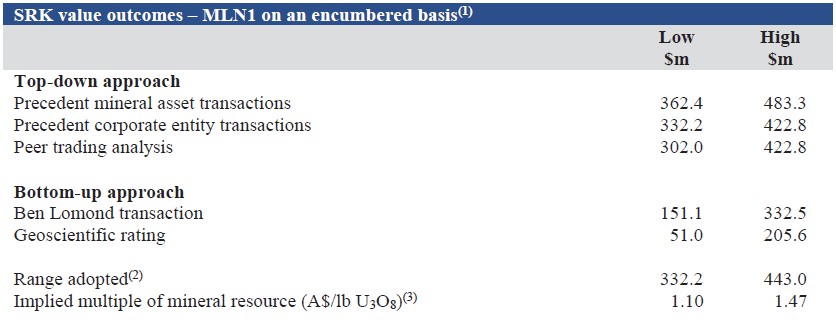
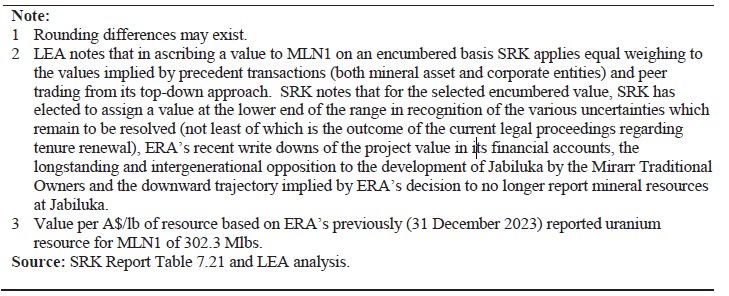
10 The procedure to be adopted by the acquirer is set out in s 644C. The 90% holder must prepare a notice in the prescribed form that, among other things, sets out the cash sum for which the 90% holder proposes to acquire the securities (subs (1)(a)) and discloses any other information that is known to the 90% holder (or any related bodies) that is material to deciding whether to object to the acquisition and is not disclosed in the expert’s report under s 667A of the Corporations Act (subs (1)(e)).
11 The notice in prescribed form must be accompanied by an expert report which has been prepared in accordance with the requirements in s 667A of the Corporations Act: s 664C(2)(b)(ii) of the Corporations Act.
12 An expert report prepared in accordance with s 667A of the Corporations Act must: (1) be prepared by a person nominated by ASIC under s 667AA; (2) state whether in the expert’s opinion the terms proposed in the notice give a fair value for the securities concerned; (3) and set out the reasons for forming that opinion.
13 Where more than 10% of the remaining shareholders object to the notice, as is the case here, s 664A(3)(b) of the Corporations Act requires the acquirer to proceed under s 664F and obtain Court approval. Section 664F of the Corporations Act provides:
(1) If people who hold at least 10% of the securities covered by the compulsory acquisition notice object to the acquisition before the end of the objection period, the 90% holder may apply to the Court for approval of the acquisition of the securities covered by the notice.
(2) The 90% holder must apply within 1 month after the end of the objection period.
(3) If the 90% holder establishes that the terms set out in the compulsory acquisition notice give a fair value for the securities, the Court must approve the acquisition of the securities on those terms. Otherwise it must confirm that the acquisition will not take place.
Note: See section 667C on valuation.
(4) The 90% holder must bear the costs that a person incurs on legal proceedings in relation to the application unless the Court is satisfied that the person acted improperly, vexatiously or otherwise unreasonably. The 90% holder must bear their own costs.
14 While the Corporations Act does not define “fair value”, s 667C sets out how to determine “fair value” for the purposes of Ch 6A of the Corporations Act. It provides:
(1) To determine what is fair value for securities for the purposes of this Chapter:
(a) first, assess the value of the company as a whole; and
(b) then allocate that value among the classes of issued securities in the company (taking into account the relative financial risk, and voting and distribution rights, of the classes); and
(c) then allocate the value of each class pro rata among the securities in that class (without allowing a premium or applying a discount for particular securities in that class).
(2) Without limiting subsection (1), in determining what is fair value for securities for the purposes of this Chapter, the consideration (if any) paid for securities in that class within the previous 6 months must be taken into account.
15 ERA has one class of securities. Thus, the second prescribed step in determining “fair value” in s 667C(1)(b) can be put to one side.
16 The meaning of “fair value” has been considered by courts on a number of occasions. The principles, which were not in dispute and were conveniently summarised by North, are set out below.
17 “Fair” does not mean that there is a search for something which is intrinsically fair according to general notions of fairness: Teh v Ramsay Centauri [2002] NSWSC 456; (2002) 42 ACSR 354 at [12] (Barrett J). There is no scope for the Court to embark upon some general inquiry as to fairness. Rather, “a single and narrow avenue of attack is available” which is “confined to the particular question of adequacy of consideration” and “that question is to be answered solely by reference to the statutory concept of ‘fair value for securities’ defined by s 667C”: Teh at [7] and [9]; Re Navalo Financial Services Group Ltd [2025] NSWSC 317 at [57] (Nixon J).
18 “Fair value” is used in the same sense as “true value”, “real value” and “intrinsic value”: Re Australian Water Holdings Pty Ltd [2016] NSWSC 254; (2016) 306 FLR 40 at [10] (Brereton J). It is to be determined by asking what price would be negotiated in a hypothetical transaction between two willing but not anxious parties: Teh at [14]-[16]; Capricorn Diamonds Investments Pty Ltd v Catto [2002] VSC 105; (2002) 5 VR 61 at [59] (Warren J). Value is to be determined at the date of the compulsory acquisition notice: Teh at [28]-[29].
19 In assessing value, the value of special benefits to the acquirer is not to be included in the calculation of the value of the company as a whole. Nor should an expert add any premium for forcible divestment: Capricorn at [56], [60]-[62].
20 An expert’s opinion is not determinative of whether the terms set out in a compulsory acquisition notice will be endorsed by a court: QGold Pty Ltd v Woods [2025] FCA 1201 at [61] (Derrington J). However, the Court’s decision will ordinarily be largely based on the expert report served with the notice. That report does not need to be beyond criticism for a judge to act on it and conclude that the price was fair: CCPI Holdings Proprietary Limited v Joan Hose and Ronald Hose [2011] VSC 34 at [7] (Davies J), quoting from Bromley Investments Pty Ltd v Elkington [2003] QCA 407; (2003) 47 ACSR 273.
21 There is a range of values which may be said to represent “fair value”: Pauls Ltd v Dwyer [2002] QCA 545; (2002) 2 Qd R 176 at [42] (Davies and Jerrard JJA, Jones J). In Capricorn Warren J observed that “fair value may require a more liberal estimate of value within a range of possible values where there is a compulsory acquisition of property”: at [61]. However, as her Honour also recognised, there is “no hard and fast rule” that some higher value is to be adopted or, as her Honour put it, a “forcing out” premium is to be applied: see Capricorn at [61]; QGold at [183]-[185].
2. The evidence
22 The parties relied principally on documentary and expert evidence. In addition, North relied on one lay witness, Robert Christopher O’Toole, Chief Counsel, Business Development, APAC within the Corporate Legal team of the Legal, Governance and Corporate Affairs function of the Rio Tinto Group (a dual listed structure made up of Rio Tinto Limited ACN 004 458 404, listed on the Australian Securities Exchange (ASX) and Rio Tinto plc, listed on the London Stock Exchange). Mr O’Toole’s evidence was formal in nature, was not challenged and he was not cross-examined.
2.1 North’s expert evidence
23 North relied on the expert reports it served with the Notice, namely the LEA Report and the SRK Report, and further reports prepared by the authors of those reports in reply to Zentree’s expert evidence. The experts and a summary of their qualifications are set out below.
24 Grant Kepler is a director and authorised representative of LEA. Mr Kepler supervised and had overall responsibility for the preparation of the LEA Report on behalf of LEA and was assisted in its preparation by Nathan Toscan, managing director, and other employees of LEA. Mr Kepler joined LEA as a manager in 2002 and was appointed a director in 2008.
25 Prior to joining LEA, Mr Kepler was in the financial advisory services practice of Coopers & Lybrand (which became PricewaterhouseCoopers (PwC)) in 1995, during which time he was seconded to the corporate valuation and strategy group of PwC in London and to PwC’s telecommunications practice in the United States of America (USA). Prior to that Mr Kepler worked in the audit divisions of Price Waterhouse in Sydney and Hall Chadwick in Adelaide.
26 Mr Kepler has a Bachelor of Arts in Accountancy and a Graduate Diploma in Accountancy, both from the University of South Australia. He is a member of Chartered Accountants Australia and New Zealand (CAANZ), an accredited CA Business Valuation Specialist and a Fellow of the Financial Services Institute of Australasia (FINSIA).
27 Jeames McKibben is the principal consultant of SRK. Mr McKibben supervised the preparation of, and had overall responsibility for preparing, the SRK Report. He was assisted in its preparation by other individuals from SRK listed in the report.
28 Mr McKibben joined SRK as a principal consultant in 2016. Prior to joining SRK he held a number of different roles, including:
(1) from 2015 to 2016, technical discipline manager (valuation & property services), SLR Consulting;
(2) from 2009 to 2015, general manager – corporate advisory, Xstract Mining Consultants;
(3) from 2004 to 2009, consultant, senior consultant, then divisional manager – corporate services, Snowden Mining Industry Consultants;
(4) from 2000 to 2002, project manager, Ambase (Morocco) Limited;
(5) from 1998 to 2000, project geologist and project manager, Zamanglo Prospecting;
(6) from 1997 to 1998, project geologist, Consolidated Gold Mines Ltd;
(7) in 1997, project geologist, Johnsons Well Mining NL;
(8) from 1995 to 1996, mineral analyst, Mineral Resources Tasmania; and
(9) from 1994 to 1995, geologist, Normandy Exploration.
29 As a consultant Mr McKibben has specialised in mineral asset valuations and providing independent technical reports for equity and project finance transactions. Mr McKibben has more than 30 years’ experience as a mining professional and has been involved in the preparation of more than 100 independent expert reports (IER) since joining SRK in April 2016.
30 Mr McKibben has a Bachelor of Science (Geology, Geochemistry) from the University of Tasmania and a Masters of Business Administration from Macquarie Graduate School of Management. He is a registered valuer, chartered valuation surveyor and a member of the VALMIN Code Review Committee.
31 Lisa Chandler is a principal consultant at SRK. She assisted in the preparation of parts of the SRK Report, namely location and access for the Ranger Project Area (defined in [58] below) (part 2.1), ownership, land access and tenure of ERA’s mineral assets (part 2.3), permitting and approvals for the Ranger Project (part 3.2), stakeholder engagement (part 3.3), project history for the Jabiluka Project (part 4.1.1) and permitting and approvals for the Jabiluka Project (part 4.2).
32 Ms Chandler joined SRK in 2010 as a principal consultant and remained in that role until 2012. From 2012 to 2014 Ms Chandler was an associate principal consultant with SRK and upon rejoining SRK in 2024 her role reverted to principal consultant. Ms Chandler has over 35 years’ experience as a scientist and engineer in environmental services, including waste geochemistry, due diligence, impact assessment, closure planning, environmental assurance and audit and design.
33 In addition to her roles at SRK Ms Chandler has held a number of other roles including:
(1) from 2008 to 2010 and 2012 to 2024, director and principal consultant, Chandler Redwood Pty Ltd, trading as AEthos Consulting (Ms Chandler’s independent ESG consulting business);
(2) from 2013 to 2017, adjunct senior lecturer in environmental science (especially in relation to environmental management systems, impact assessment, risk management and compliance and audit), Edith Cowan University;
(3) from 2007 to 2008, principal consultant (environmental impact assessment, permitting, mine closure planning, environmental management and audit), Outback Ecology Services; and
(4) from 2004 to 2007, manager audit, West Australian Department of Environment. In that role Ms Chandler was responsible for compliance assessments of significant developments approved under Part IV of the Environmental Protection Act 1986 (WA).
34 Ms Chandler has a Masters of Engineering from the University of Newcastle and a Bachelor of Science (Physical Geography) from McGill University. In 2022 she completed a professional certificate in ESG and Social Responsibility with the Australasian Institute of Mining and Metallurgy (AusIMM), of which she is a member.
35 Raymond Mayne is a principal consultant at SRK. He assisted in the preparation of part 3.4 of the SRK Report which addresses mine closure and rehabilitation costs.
36 Mr Mayne joined SRK in 2022 as a principal consultant. Prior to that he held a number of roles including:
(1) from June 2017 to March 2022, principal environmental scientist, SRK Consulting (South Africa) (Pty) Ltd (SRK SA);
(2) from April 2013 to June 2017, senior environmental scientist, SRK SA; and
(3) from August 2006 to April 2013, environmental scientist, SRK SA.
37 As a consultant Mr Mayne has managed and contributed to closure-related projects as part of multidisciplinary teams, supporting a range of operations with closure liability assessments and the review and updating of mine closure plans. He has also participated in technical reviews of closure aspects as part of due diligence projects.
38 Throughout his professional life, Mr Mayne has regularly managed or contributed to closure cost estimations and liability assessments. He has international experience across a variety of mining commodities and contexts. He has assisted operations internationally in the compilation, updating, or assessment of closure cost estimates. For due diligence projects, Mr Mayne has undertaken reviews and provided opinions on closure aspects, including the appropriateness of cost estimates, the identification of closure risks associated with the operations under review, and, where relevant, any potential opportunities. To date, Mr Mayne has contributed to approximately 10 due diligence projects in which his input has focussed on closure.
39 Mr Mayne has a Bachelor of Science (Environmental Geography) from the University of the Free State in Bloemfontein, South Africa.
2.2 Zentree’s expert evidence
40 Zentree relied on expert reports which responded to the LEA Report and the SRK Report provided by four experts. Those experts and a summary of their qualifications and areas of expertise is set out below.
41 Andrew Ross is a partner of HKA Global Pty Ltd ACN 085 532 047. He has prepared a report in response to the LEA Report in which he addresses the following two questions.
(1) Does the Notice give a “fair value” for the ERA shares described in the Notice when determined pursuant to s 667C of the Corporations Act?
(2) Having reviewed and considered the LEA Report, state whether you agree or disagree with the opinions expressed therein.
42 Mr Ross has been employed as a forensic accountant or been a partner in firms of chartered accountants for more than 35 years. Over that period, he has received training and gained experience in the:
(1) preparation, review and auditing of financial statements for both large and small, listed and unlisted companies;
(2) preparation and review of budgets and forecasts of revenue, costs and profits;
(3) quantification of economic loss and other forms of financial compensation, including the use of tools such as Microsoft Excel to build electronic models which assist in quantifying loss; and
(4) valuation of shares, businesses and other assets or interests in a wide variety of circumstances and industries.
43 Mr Ross has a Bachelor of Commerce (Honours) and a Graduate Diploma in Applied Finance and Investment. He is a Fellow of CAANZ and has been designated as a specialist in both Forensic Accounting and Business Valuation by CAANZ. Mr Ross is also a Fellow of FINSIA.
44 Dr James Burrows is a vice chairman of Charles Rivers Associates (CRA). At Mr Ross’ request he was retained by Zentree to prepare a report to assist in relation to the ERA mineral asset valuation aspects of the SRK Report. Dr Burrows was asked to provide a report that expresses his opinion on the following four matters.
(1) What was the value of the ERA mineral assets (i.e. MLN1, Cooper Creek and R3D) (individually and/or collectively) as at 2 April 2025?
(2) Address whether the values of the ERA mineral assets (individually and/or collectively) set out in the response to the preceding question reflect any particular matters or contingencies, and if so, what are those particular matters or contingencies.
(3) Review the SRK Report and having done so, state whether you agree or disagree with:
(a) the methodology SRK adopted to derive its opinions as to the values of the ERA mineral assets; and
(b) the values derived by SRK through the application of their preferred methodologies for each of the mineral assets.
(4) Paragraph 218 of the LEA Report states that it has cross-checked the findings of the SRK valuation against the implied values attributed to MLN1 based upon the market traded price of ERA shares (over time) as well as the 2023 Interim Entitlement Offer (being the proposed non-underwritten, renouncement offer announced by ERA to the market on 24 June 2022 which aimed to raise approximately $300 million) and the 2024 Entitlement Offer (being the 19.87-for-1 non-underwritten pro-rata renounceable entitlement offer seeking to raise up to approximately $880 million at an offer price of $0.002 or 0.2 cents per share). State whether you agree or disagree with the methodology deployed and conclusions LEA reached in [219] to [240] of the LEA Report.
45 Dr Burrows was formerly chief executive officer (CEO) and president of CRA. He founded CRA’s natural resources practice and managed it for over a decade before becoming head of its dispute resolution practice for about ten years and then President and CEO of CRA for fifteen years. Dr Burrows has authored or co-authored six books, four of which are on metals and minerals markets and policy issues. He has consulted and undertaken research related to the minerals industry over the course of his career, including consulting related to uranium. Dr Burrows’ prior experience relating to the uranium industry includes consulting to the government of Mongolia with respect to negotiating a supply agreement in connection with a uranium mine, consulting to the provincial government of Saskatchewan, Canada with respect to policies and operations of uranium mining in Saskatchewan, and consulting to Freeport-McMoran in connection with clean-up costs and remediation of uranium mines in the USA.
46 Dr Burrows has a Bachelor of Arts in economics from Harvard University and a Ph.D. in economics from the Massachusetts Institute of Technology.
47 Mario Rossi is a mining engineer and a geostatistician with 35 years of industrial, academic, and international experience in the mining industry. Mr Rossi is president and principal geostatistician of GeoSystems International, Inc., a consultancy firm established by Mr Rossi in 1994. Prior to that Mr Rossi held the following roles:
(1) from March 1989 to February 1992, geostatistician at Fluor Daniel Inc., an engineering, procurement, fabrication, construction and maintenance company; and
(2) a consultant with Mineral Resource Development Inc., which operated in geology, resource and reserve estimation and mine planning, and provided consulting services, audits, and reviews to many mining projects and operations around the world.
48 At the request of Dr Burrows, Mr Rossi was asked to:
(1) analyse the Jabiluka Mineral Reserves and Resources;
(2) analyse the Jabiluka mine cash flow spreadsheet; and
(3) analyse the putative comparable uranium properties and companies. In that regard Mr Rossi was instructed to:
(a) identify which of the criteria used by Dr Burrows to define comparability are within his technical expertise, training and experience; and
(b) applying the technical criteria identified in the previous step, evaluate whether each of the uranium projects proposed is comparable to Jabiluka from a technical point of view.
49 Mr Rossi was also instructed in relation to Ranger 3 Deeps (R3D) to:
(1) review documents with respect to the R3D deposit located in the Ranger Project Area;
(2) provide information and data on the mineral resources of R3D; and
(3) provide estimates of mine schedules and capital and operating costs of R3D.
50 Mr Rossi has a mining engineering degree with minors in Project Development and Evaluation, and Metallurgy from the Universidad Nacional de San Juan, Argentina and a Master of Science in Geostatistics from Stanford University. Mr Rossi is a Fellow of AusIMM and a registered member of the Society for Mining, Metallurgy and Exploration, USA.
51 Dr Alexander Lee is a partner at HKA and a chartered geologist, chartered scientist, and chartered European geologist. He was engaged at the request of Mr Ross to provide an expert technical opinion to assist Mr Ross in relation to the rehabilitation cost aspects of the SRK Report. His report addresses the following issues:
(1) the appropriate methodology for assessing the reasonableness of existing cost estimates and the documents and information needed to apply that methodology;
(2) having regard to the preferred methodology, what conclusions can be reached as to the reasonableness of the estimate made by ERA and what issues are material to coming to those conclusions;
(3) where documents or other information are not available, what additional documents or other information would be needed and the reasons why they would be needed, in determining a reasonable cost estimate; and
(4) whether the SRK Report used a suitable methodology, appropriate assumptions and information, and drew appropriate conclusions in 2025 when compiling an ISR related to the Ranger Project Area.
52 Dr Lee has 30 years’ experience assessing land quality liabilities and delivering site remediation and rehabilitation. He has delivered projects internationally and has experience both as a consultant and contractor, with expertise in non-radiological and radiological roles, in both the private and public sectors.
53 Dr Lee has a Ph.D. in Geology and a Masters of Science in Environmental Modelling and Monitoring. He has held or holds the following further professional roles, memberships or affiliations:
(1) served as the elected chair of the UK National Brownfield Forum and is currently its outgoing chair;
(2) member of the Steering Group of the UK National Land Quality Mark Scheme (NQMS) and is NQMS registered as a “suitably qualified and experienced person” and registered as a specialist in land condition;
(3) former chair of the Society of Brownfield Risk Assessors (SoBRA) and is a SoBRA accredited risk assessor holding individual accreditations for human health, permanent gas, vapour, and water environment risk assessments;
(4) director of the Association of Geotechnical and Geoenvironmental Specialists; and
(5) examiner for candidates applying to become a chartered geologist, chartered scientist and SoBRA accredited risk assessor.
2.3 Joint expert reports
54 The parties’ experts prepared a series of joint expert reports having regard to their respective areas of expertise and the questions on which they opined in their individual expert reports. The joint reports relied on by the parties at trial were:
(1) joint report of Mr Rossi and Mr McKibben dated 30 January 2026 which annexes a Microsoft Excel document titled “Copy of Updated_Comparables_Resources JKMR.xlsx”;
(2) joint report of Dr Burrows and Mr McKibben dated 30 January 2026;
(3) joint report of Mr Mayne, Ms Chandler and Mr Lee dated 30 January 2026; and
(4) joint report of Mr Ross and Mr Kepler dated 3 February 2026 which annexes a joint statement of Dr Burrows and Mr Kepler dated the same.
55 The experts gave evidence and were cross-examined in conclaves designed to address the topics covered in their respective reports and the joint reports. Their evidence insofar as it is relevant to the issues to be determined is set out in the balance of these reasons.
3. The facts
3.1 ERA
56 ERA is listed on the ASX. It is a uranium miner with operations in the Northern Territory (NT). ERA’s current tenements comprise two exploration licence applications for the Cooper Creek Joint Venture Project (Cooper Creek JV) comprising ELA23311 and ELA23312, MLN1 (also referred to as Jabiluka) and ELA9644 (which incorporates the Ranger Project Area). The tenements are depicted in the map set out below which has been extracted from the LEA Report:
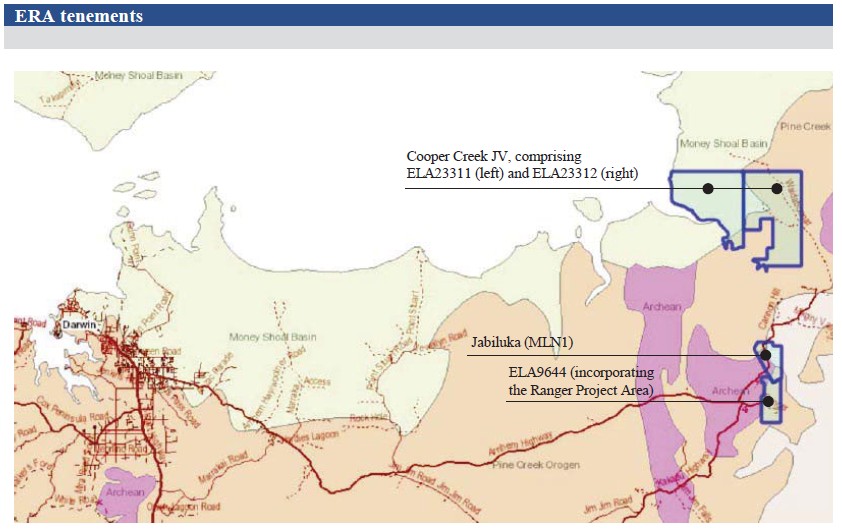
57 As at April 2025 ERA’s principal operation concerned the rehabilitation of the former Ranger uranium mine (see below).
3.1.1 Ranger uranium mine
58 The former Ranger mine lies within the Ranger Project Area which occupies approximately 79 km2 and is surrounded by, but separate from, Kakadu National Park.
59 ERA undertakes its operations in the Ranger Project Area pursuant to an authorisation granted under s 41 of the Atomic Energy Act 1953 (Cth) (s 41 Authority).
60 ERA ceased mining operations at the Ranger mine in 2012 but continued to process stockpiled ore at that site until January 2021, when the s 41 Authority required it to cease. Relevantly, cl 5.1 of the s 41 Authority required ERA to cease or suspend all mining operations by 8 January 2021 and cl 6.1 requires ERA to undertake and complete the rehabilitation of the Ranger Project Area in accordance with Appendix A to the schedule to the s 41 Authority, titled “Environmental Requirements of the Commonwealth of Australia for the Operation of the Ranger Uranium Mine”.
61 In 2009 ERA announced the discovery of the R3D underground resource. However, in 2015 ERA decided not to progress the R3D project, initially placing the exploration into decline and associated infrastructure under care and maintenance. In August 2021 ERA completed backfill works on the R3D decline. No further work is being undertaken on development options for the R3D project. Nor could it given that ERA has no authority to conduct mining operations in the Ranger Project Area and development of R3D is not an authorised activity.
62 Since 1 July 2024 ERA’s operations have been governed by Deemed Mining Licence 0108-18 which comprises Ranger Authorisation 1018-18 and the last approved Ranger Mine Closure Plan (2024 MCP).
63 Activities at the Ranger Project Area are now limited to rehabilitation. Because of the impending expiration of the s 41 Authority, on 12 December 2025 a rehabilitation authority was conferred on ERA by the Commonwealth Minister for Resources pursuant to s 41CA of the Atomic Energy Act which authorises ERA to undertake the rehabilitation work set out in the schedule thereto (s 41CA Authority). The s 41CA Authority requires ERA to rehabilitate the Ranger Project Area as set out in and in accordance with the Environmental Requirements.
3.1.2 Jabiluka
64 Adjacent to the Ranger mine is an area known as Jabiluka, which contains two uranium deposits: Jabiluka I discovered in 1971 and Jabiluka II discovered in 1973. For present purposes, it is the valuation of the Jabiluka II deposit that is in contest. Given North and Zentree’s experts use the term “Jabiluka II” and “Jabiluka deposit” interchangeably in their respective reports and oral evidence, in the balance of these reasons when I refer to the Jabiluka deposit, I am referring to Jabiluka II and vice versa.
65 Since December 1992 ERA has been the holder of MLN1 (being the relevant mining lease) on which the Jabiluka deposit is located.
66 In 1982 Pancontinental Energy NL ACN 003 029 543 and the Northern Land Council (NLC) entered into an agreement under s 43 of the Aboriginal Land Rights (Northern Territory) Act 1976 (Cth) pursuant to the terms of which the NLC consented to the grant of a lease over Jabiluka subject to certain conditions, including making payments to the NLC for the benefit of the local Aboriginal people (Section 43 Agreement).
67 On 12 August 1982 the NT Government granted MLN1 to Pancontinental for a 42-year lease period with an option to renew for 10 years. In 1991 ERA acquired MLN1 from Pancontinental and on 24 December 1991 the Section 43 Agreement was transferred to ERA.
68 A detailed history of the early development of MLN1 is set out in the LEA Report. Relevantly, MLN1 has never been mined.
69 In about February 2005 ERA, the Traditional Aboriginal Owners (Traditional Owners) of the Jabiluka (the Mirarr people) and the NLC entered into a Long Term Care and Maintenance Agreement (LTCMA). The recitals to the LTCMA relevantly include:
A. ERA is the holder of MLNl and is, except as otherwise provided in this Agreement, authorised to develop and mine the Jabiluka Project Area under the Section 43 Agreement, subject to the provisions of the Transfer Agreement.
B. The Traditional Owners are the traditional Aboriginal owners, as defined in the Aboriginal Land Rights (Northern Territory) Act (Cth), of the area that includes the Jabiluka Project Area, being the group which under Aboriginal tradition is responsible for speaking for and making decisions about the Jabiluka Project Area and which asserts native title regarding that area.
…
D. The following issues are of concern to the Traditional Owners and the NLC:
(a) the length of time since MLNl was granted and the current views of the Traditional Owners regarding the Jabiluka Project Area;
(b) the placement of mineralised material above ground on the Jabiluka Project Area; and
(c) the maintenance issues in respect of the Jabiluka Project Area.
E. This Agreement is intended to provide a framework for an agreed phase of long term care and maintenance of the Jabiluka Project Area, and is not intended to set aside or override the effect of Part IV of the Aboriginal Land Rights (Northern Territory) Act (Cth) or the Section 43 Agreement.
F. In the interests of an improved relationship between ERA and the Traditional Owners and the NLC, and ongoing dialogue between the parties as to the management of the Jabiluka Project Area during the proposed care and maintenance phase, the possible end of the proposed care and maintenance phase, and the future management of the Jabiluka Project Area, this Agreement provides, inter alia, that:
(a) ERA will carry out certain rehabilitation and environmental works in relation to the Jabiluka Project Area;
(b) ERA will not carry out further mining development of the Jabiluka Project Area without the approval of the Traditional Owners as provided in this Agreement; and
(c) the NLC and the Traditional Owners will, during the care and maintenance phase, forego certain payments that are claimed to be payable under the Section 43 Agreement and the Deed Poll.
70 Clause 2 of the LTCMA sets out its commencement and term. Relevantly, the LTCMA will remain in force until the later of the end of the “care and maintenance phase”, or the expiry or earlier determination of the Section 43 Agreement. The “care and maintenance phase” is defined to mean “the period starting from the commencement of [the LTCMA] to the date on which approval has been given under clause 6 or the date of expiry or earlier determination of the Section 43 Agreement”.
71 Clause 4.1 sets out ERA’s obligations under the LTCMA including filling and sealing the decline which refers to “the box-cut, main declining tunnel, drive and cross-cut tunnels that have been constructed to uranium ore body no.2” on the Jabiluka Project Area (defined therein), recontouring all disturbed areas providing erosion control and appropriate revegetation, developing and carrying out a water quality program, carrying out a detailed radiation survey at the completion of the works set out in cl 4.1 and carrying out substantial rehabilitation of the Djarr Djarr camp area. Clause 4.2 also requires ERA to remove its infrastructure and equipment located in Jabiluka except as may be required for ERA to comply with its obligations under the LTCMA or any other contractual or statutory obligations or for the purpose of proper environmental management of Jabiluka and surrounds.
72 The NLC and the Traditional Owners’ obligations under the LTCMA are set out in cl 5 of the LTCMA. They agree to forego payments that were otherwise due to them under the Deed Poll (as defined) and the Section 43 Agreement.
73 Clause 6 of the LTCMA is titled “Traditional Owners’ Approval Required”. Clause 6.1 provides:
In further consideration for the NLC and the Traditional Owners entering this Agreement, ERA acknowledges and agrees that prior to ERA undertaking any mining development, or applying for any Authorisation in order to undertake mining development, on the Jabiluka Project Area, ERA will obtain the approval of the Traditional Owners which, if given, is to be in accordance with this clause.
74 Clause 6.2 sets out the manner and circumstances in which the Traditional Owners are to give their approval for the purposes of cl 6.1 and provides:
The approval of the Traditional Owners referred to in clause 6.1 is to be given in the following manner and circumstances:
(a) the Traditional Owners, after having had an opportunity to consider a proposal by ERA for mining development on the Jabiluka Project Area have, as a group, consented to that proposal, and
(b) subject to paragraph (c), a written record of that consideration and consent is prepared which:
(i) is signed by no less than six (6) senior members of the Traditional Owners;
(ii) includes a statement from a legal practitioner that he or she was present when consent was given by the group and that the group was provided with independent legal advice as part of its considerations; and
(iii) includes a statement from the NLC that the NLC is aware of the proposal, had an opportunity to provide advice to the group, were present when consent was given and is satisfied that the decision has been made by the group in accordance with traditional Aboriginal decision-making processes; and
(c) in the event that the number of Traditional Owners who are aged 18 years or over is less than six (6), the written record referred to in paragraph (b):
(i) is to be signed by such number of Traditional Owners as are aged 18 years or over at the time the approval is given; and
(ii) shall include a further statement from the NLC that the number of Traditional Owners who are to sign the written record is appropriate in the circumstances.
75 Clause 6.3 provides for the parties to meet and discuss in good faith the approval referred to in cl 6 within a reasonable time after 1 July 2006 and at least once in every four years thereafter during the term of the LTCMA and at any other time reasonably requested by the Traditional Owners.
76 Clause 10 is titled “Default”. It sets out available remedies for breach of the LTCMA and provides:
10.1 Without limiting the legal or equitable relief or remedies which might be available to them, ERA acknowledges that either or both of the NLC or the Traditional Owners may seek an order for specific performance in relation to the compliance by ERA with the obligations imposed on ERA under clause 4.
10.2 If at any time prior to the giving of written approval in accordance with clause 6 of this Agreement, a breach of clause 6.1 by ERA is found to be proven by a court of competent jurisdiction, being a finding that mining development has been undertaken, or an Authorisation in respect of mining development has been sought or obtained, contrary to that provision, the parties agree that the relief that may be granted for such breach may include any or all of the following;
(a) injunctive relief, which may be indefinite, to prevent the continuation of any application for or grant of any Authorisation, or continuation of any mining development purportedly in accordance with any Authorisation, in breach of this Agreement;
(b) an order that any Authorisation obtained otherwise than in accordance with clause 6 is void and of no effect;
(c) damages; and
(d) an order that specific work be undertaken to restore damage caused by such breach.
77 On 25 February 2005 ERA, the Gundjeihmi Aboriginal Corporation (GAC) and the NLC issued a joint media statement announcing the entry into of the LTCMA. The statement included:
…
While [MLN1] and the [Section 43 Agreement] remain in force, the [LTCMA] obliges ERA (and its successors) to secure Mirarr consent prior to any future mining development of uranium deposits at Jabiluka. The agreement also waives some of ERA's financial obligations flowing from construction of the mine decline in 1998.
…
In welcoming the agreement, Ms Margarula said: “I am pleased that the mining company has listened to the Mirarr people, showing us the respect we deserve as Traditional Owners. This agreement lifts the shadow of Jabiluka off the Mirarr and other Aboriginal people in Kakadu. We now have a chance to solve some of the social problems like alcohol, unemployment and health. Jabiluka will never be mined unless the Mirarr give approval - in future the decision is ours alone for the first time.”
Mr Kenyon-Slaney, said the agreement heralded a new era of cooperation. “The company would like to develop Jabiluka, one of the world's most significant uranium deposits. Under this agreement development would only go ahead with the support of the Traditional Owners and we can now work together to try to find a way forward that meets the expectations of all parties.”
78 As discussed below (see [225]-[238]), the LTCMA effectively gave the Traditional Owners a veto over the right to mine at Jabiluka.
79 Further media statements have been issued by the GAC which reinforce the effect of the LTCMA.
80 On 18 February 2020 the GAC issued a media statement on behalf of the Traditional Owners titled “Rio Tinto majority crucial for Ranger clean-up” which provided:
All investors in [ERA] should understand that the Renounceable Share Entitlement Offer relates solely to funding the vital rehabilitation of the Ranger Project Area at the World Heritage listed Kakadu National Park. The GAC expect that further funds for Ranger’s total clean-up will be needed.
There should be no expectation that any investment in ERA will be recouped from the development of the Jabiluka deposit, for which there is no traditional owner support.
The Mirarr traditional owners applaud the work that ERA has done on the Ranger Mine Closure Plan, with the considerable financial support of its major shareholder, Rio Tinto. ERA and Rio Tinto have demonstrated a clear commitment to working with the traditional owners to address Ranger’s clean-up in a true spirit of corporate social responsibility.
Recent investors in ERA, including Zentree Investments and Willy Packer, should not be speculating about future mining. They are investing in meeting the significant challenge of rehabilitating the traditional land and waters of the Mirarr people and in protecting Kakadu National Park.
81 On 9 April 2022 the GAC issued a media statement which included:
Mirarr Traditional Owners have welcomed statements from mining giant Rio Tinto about the future of the controversial Ranger and Jabiluka sites within the World Heritage listed Kakadu National Park in Australia’s Northern Territory.
Supporters of Mirarr attended Rio Tinto’s London AGM last night Australian time and called on the company to ensure Kakadu is not left with a toxic radioactive legacy given the dramatic increases in the cost and timeframe needed for the rehabilitation of the decommissioned Ranger uranium mine.
Rio Tinto restated its commitment to a comprehensive clean up at Ranger in line with statements at multiple AGMs over the past decade.
“We are happy to hear the commitment from outgoing chair Simon Thompson that Rio Tinto will not walk away from its responsibilities at Kakadu. Mirarr never wanted this mine on our country and we do not want to be left with the poison after it closes” said Mirarr Senior Traditional Owner Yvonne Margarula.
…
In addition to seeking assurance about the Ranger clean up, the Mirarr supporters in London also raised the issue of the future of the Jabiluka site at today’s meeting.
In response to board member Ben Wyatt’s comments [GAC] CEO Justin O’Brien said:
“In recent company statements there is reference to the possible “development or sale” of the Jabiluka deposit. This is of huge concern to us, that place must be permanently protected from mining.
“We are heartened that Rio Tinto has reiterated its support for the wishes of the Mirarr that the Jabiluka site will never be developed without the consent of the Mirarr. We welcome the company’s clear acknowledgement that clear acknowledgement that there is no consent from Mirarr for mining at Jabiluka” Mr O’Brien concluded.
82 That media statement also set out “[b]ackground notes on Rio Tinto and Kakadu uranium mining” which included:
• The Ranger mine and Jabiluka project sites are of enormous cultural heritage significance to the Mirarr Traditional Owners
• Mirarr led a successful international “Stop Jabiluka Mine” campaign to protect their country from mining during the 1990s-2000s. This culminated in:
• no uranium exported from Jabiluka
• mining works being reversed, with mineralised ore returned underground
• extensive rehabilitation works at the site
• a [LTCMA] between Mirarr and Rio Tinto committing the mining company to honour the wishes of the Mirarr
83 On 19 April 2024 the GAC issued a media statement titled ‘Traditional Owners welcome NT Government support at Jabiluka” which included:
Mirarr Traditional Owners of the [Jabiluka Project Area] met with Northern Territory Chief Minister Eva Lawler and Mining Minster Mark Monahan in Darwin today. Senior Traditional Owner Yvonne Margarula, accompanied by her nephew Corben Mudjandi, travelled from Jabiru seeking an end to all talk of mining and certainty about the future of Jabiluka.
This meeting came after mining company [ERA] minority shareholder Willy Packer recently boasted about the prospect of future uranium mining at Jabiluka. Last month, ERA formally applied to extend [MLN1] for 10 years when it expires on 11 August this year.
Senior Traditional Owner Yvonne Margarula said: “We came to this meeting today for an answer. I am happy to say that the Territory Government understands we will never agree to mining at Jabiluka. My father said no, I’ve been saying no for over thirty years.”
…
84 It is also apparent that governments whose permission is required to undertake mining at Jabiluka do not support that course.
85 MLN1 was due to be renewed in August 2024. However, on 26 July 2024, the NT Minister for Mining and Minister for Agribusiness and Fisheries informed ERA that, based on advice from the Commonwealth Minister for Resources and Minister for Northern Australia, ERA’s application to renew MLN1 was refused (Renewal Decision).
86 The advice from the Commonwealth Minister for Resources was contained in a letter dated 25 July 2024 to the NT Minister for Mining which included:
I have considered your correspondence, as well as the views of ERA, the [NLC] and Mirarr Traditional Owners.
I have considered that renewing [MLN1] would be beneficial to ERA, and have considered its submissions including:
• that mining the site could deliver economic benefits for the [NT], the region, and the Mirarr;
• that the site’s uranium, if mined, could be used to produce a significant amount of nuclear energy, contributing to global efforts to lower carbon emissions;
• under the [LTCMA], ERA has committed that mining and development will not occur without the consent of the Mirarr; and
• the arrangements under the [LTCMA] are the best option for all parties.
However, I consider it is significant that the Mirarr strongly object to renewal. I consider it is unlikely that the Mirarr will consent to mining or development within the proposed term of the renewal (ten years). Noting ERA's commitment not to mine without the consent of the Mirarr, I consider the prospects of the site being developed or mined within the proposed term of the renewal are low.
I acknowledge ERA's submission that if the lease is not renewed, future governments and mining proponents may seek to mine the site without Mirarr consent. Decisions about the future of the site should be made at the appropriate time, consistent with the regulatory responsibilities of the Northern Territory and Australian Governments.
I advise you to refuse ERA’s application to renew [MLN1].
…
87 On 27 July 2024 a joint media release was issued by the Commonwealth Minister for the Environment and Water and the Commonwealth Minister for Resources in the following terms:
The Albanese Labor Government has advised the [NT] Government that [MLN1] should not be renewed, allowing the site to be added to Kakadu National Park.
The Commonwealth advice has enabled the Northern Territory Government to decline to extend [MLN1].
The Albanese Government will now begin the process of incorporating the site to the Kakadu National Park, in line with the wishes of the Mirarr Traditional Owners.
Minister for Resources and Northern Australia Madeleine King said the decision would end decades of uncertainty about the project.
“ERA and their major shareholder, Rio Tinto, rightly committed to not developing the site without the support of the Mirarr Traditional Owners, who are completely opposed to the renewal of the lease.
88 On 6 August 2024 ERA commenced a proceeding in this Court against a number of parties including the Commonwealth Minister for Resources and the NT Minister for Mining seeking judicial review of the Renewal Decision. The Renewal Decision is the subject of an interim stay pending the outcome of ERA’s judicial review application. The effect of the stay is that MLN1 continues in force until the decision is made: see Mineral Titles Act 2010 (NT), s 68. It is not necessary or desirable to say more about that proceeding, nor to opine on its merit. For present purposes the position is that MLN1 has not been renewed by the NT Minister for Mining.
3.2 North acquires more than 90% of the shares in ERA
89 North is a wholly owned subsidiary of Rio Tinto. Peko-Wallsend Pty Ltd ACN 000 245 054 is a wholly owned subsidiary of North.
90 Rio Tinto has had a majority interest in ERA since 8 August 2000 and through North and Peko-Wallsend, currently has a relevant interest of 98.43% in the shares in ERA.
91 Commencing in 2019 ERA undertook a series of capital raisings. Most recently, on 29 August 2024 ERA announced its 2024 Entitlement Offer, with net proceeds to be used to fund the planned Ranger Project Area rehabilitation expenditure until “3Q27”.
92 Rio Tinto through its 100% owned subsidiaries, North and Peko-Wallsend, committed those companies to subscribe for their respective pro-rata entitlements but there was limited participation by other existing ERA shareholders and no material participation by new shareholders. Accordingly, approximately 99% of the shares were taken up by Rio Tinto’s subsidiaries and on 21 November 2024, North and Peko-Wallsend were issued a total of 379,916,303,627 ordinary shares in connection with the 2024 Entitlement Offer. On the same day Rio Tinto lodged a substantial holder notice confirming the total number of shares issued with the ASX.
93 Following completion of the 2024 Entitlement Offer North increased its relevant interest in ERA from 86.3% to 98.43%, putting North over the 90% threshold to initiate a compulsory acquisition under Pt 6A.2 of the Corporations Act. The remaining shareholders in ERA hold 1.57% or 6,359,841,384 ordinary shares.
3.3 The Notice
94 On 23 December 2024, after requesting ASIC to nominate an independent expert to prepare a report for the purposes of enabling North to compulsorily acquire the remaining 1.57% of the shares in ERA, North retained LEA to prepare an IER stating whether, in its opinion, the terms proposed in a draft compulsory acquisition notice prepared by North give a fair value for ERA’s shares. LEA was one of three independent experts nominated by ASIC.
95 The draft compulsory acquisition notice provided by North to LEA for the purposes of preparing the IER stated that North intended to acquire the remaining ERA shares for a cash payment of $0.002 or 0.2 cents per share (i.e. the same amount per share as under the 2024 Entitlement Offer).
96 On 16 January 2025 LEA engaged SRK to prepare an ISR to assist with its valuation.
97 LEA completed its IER, being the LEA Report. It annexes the SRK Report.
98 On 11 April 2025 North lodged the Notice to acquire the remaining shares in ERA with ASIC. The Notice provides that:
(1) North proposes to acquire each ordinary share in ERA for the cash amount of $0.002 or 0.2 cents;
(2) the recipient (or anyone who acquired the securities during the objection period) has the right to object to the acquisition of their securities by completing and returning the objection form within one month of receipt of the Notice;
(3) each shareholder has the right to obtain the names and addresses of the other holders from the company register;
(4) North, and its related body corporate, Peko-Wallsend, purchased ordinary ERA shares for $0.002 per new ordinary share pursuant to the 2024 Entitlement Offer and those shares were issued on 21 November 2024; and
(5) North and its related bodies corporate are not aware of any information material to deciding whether to object to the acquisition that had not otherwise been disclosed in the LEA Report and the SRK Report.
99 On the same day ERA lodged the following documents with the ASX:
(1) a letter to its shareholders;
(2) the Notice;
(3) a template objection form; and
(4) a copy of the LEA Report which annexed the SRK Report.
100 On 14 April 2025 all ERA shareholders received copies of the documents referred to in the preceding paragraph.
101 The objection period ended on 19 May 2025. By that date 42.58% of the remaining ERA shareholders holding securities covered by the Notice had objected to the acquisition.
3.4 The LEA Report
102 Mr Kepler, a director and authorised representative of LEA, supervised and had overall responsibility for preparing the LEA Report. As set out above, he was assisted by Nathan Toscan, managing director of LEA and other employees. Mr Kepler’s expertise is set out at [24]-[26] above.
103 At [11] of the LEA Report, LEA summarises its opinion that “the terms of the Compulsory Acquisition give a ‘fair value’ for the ERA shares that are the subject of the Compulsory Acquisition” based on the reasons set out in the report.
104 Under the sub-heading “[a]ssessment of ‘fairness’” the LEA Report provides:
12 ERA conducts no net cash generating activities, with its current operations primarily focused on the rehabilitation of the Ranger Project Area. However, ERA also has other assets, including mineral interest assets (such as MLN1) and cash. Given this, LEA considers the sum of the parts approach to be the most appropriate method for valuing ERA as a whole. This approach allows the value of ERA’s individual assets and liabilities to be separately assessed using the most suitable methodology for each, with the resulting values then aggregated to determine ERA’s overall value. In this regard, we note that:
(a) the future liability for rehabilitating the Ranger Project Area is a finite obligation best assessed using a discounted cash flow (DCF) analysis. LEA has engaged an independent technical specialist, [SRK], to evaluate the reasonableness of the cost estimates prepared by ERA management
(b) ERA’s mineral interest assets (including MLN1, the [R3D] project, and the Cooper Creek JV) are undeveloped mineral interest assets that do not currently generate revenue or cash flow. Given the absence of reliable long-term cash flow projections to support a DCF analysis, LEA has commissioned SRK to independently assess their value
(c) ERA’s other asset and liability items predominantly comprise cash and cash equivalents, or other items that collectively are relatively negligible in value.
(Footnotes omitted.)
105 A summary of the value of ERA’s shares on a 100% controlling basis is set out at [16] of the LEA Report (although I note that the values of MLN1 and the Cooper Creek JV were subsequently updated by Mr McKibben in his supplementary report dated 10 February 2026, which I discuss at [268] below):
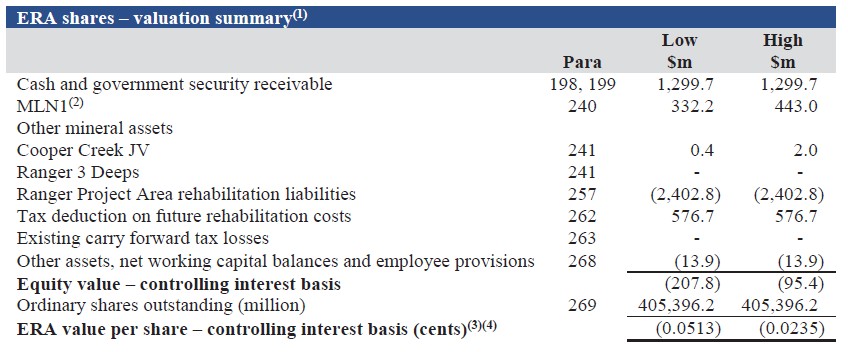
106 At [17] of the LEA Report, LEA observed that RG 111 states that “a control transaction is ‘fair’ if the value of the consideration offered is equal to, or greater than, the value of the securities that are the subject of the offer”. Based on its comparison of the value of the consideration proposed by North to the value LEA assessed on a 100% controlling interest basis, and because the former exceeds the latter, LEA concluded that the proposed consideration of 0.2 cents per share is “fair” to ERA shareholders.
107 The LEA Report sets out detailed reasoning to support its opinion summarised above.
108 Part V of the LEA Report is titled “[v]aluation of ERA”. There LEA notes that it has determined the value of the ordinary shares in ERA “by assessing the market value of ERA as a whole,” and then dividing that value by the number of ordinary shares on issue. That is, LEA has assessed the value of ERA shares on a 100% controlling interest basis. LEA explains at [190] of the LEA Report:
Our valuation of ERA as a whole has been undertaken on the basis of market value as a going concern (consistent with the basis of preparation of ERA’s financial statements) where market value is defined as the price that would be negotiated in an open and unrestricted market between a knowledgeable, willing but not anxious buyer and a knowledgeable, willing but not anxious seller acting at arm's length within a reasonable timeframe. ...
(Footnote omitted.)
109 I pause to observe that there is no dispute between the parties and, in particular their respective experts, about this approach to the valuation.
110 At [192] of the LEA Report, LEA points out that ERA conducts no cash generating activities and that its current operations are primarily focussed on rehabilitation of the Ranger Project Area. LEA also notes that ERA has other mineral assets (such as MLN1) and cash. Given this LEA is of the opinion that the “sum of the parts” approach is the most appropriate method for valuing ERA as a whole, a matter which is also agreed between the parties’ relevant valuation experts, Messrs Kepler and Ross. LEA goes on to explain that this method allows the value of ERA’s assets and liabilities to be separately assessed using the most appropriate method for each and the resulting values to be aggregated to determine ERA’s overall value. In that regard LEA says at [192]:
(a) the future liability for rehabilitating the Ranger Project Area is a finite obligation best assessed using a DCF analysis. LEA has engaged an independent technical specialist, SRK, to evaluate the reasonableness of the cost estimates prepared by ERA management
(b) ERA’s mineral interest assets (including MLN1, the Ranger 3 Deeps project and the Cooper Creek JV) are undeveloped mineral interest assets that do not currently generate any revenue or cash flow. Given the absence of reliable long-term cash flow projections to support a DCF analysis, LEA has commissioned SRK to independently assess their value
(c) ERA’s other asset and liability items predominantly comprise cash and cash equivalents, or other items that collectively are relatively negligible in value.
111 At [195] LEA notes that a key aspect of its valuation is that “it is reasonable to expect an acquirer of 100% of the equity of ERA would need to take responsibility for the full rehabilitation of the Ranger Project Area and cover any shortfall that arises between the rehabilitation costs and the value or cash flows that may be generated by ERA’s assets (including MLN1)”.
112 At [198]-[199] LEA addresses “[n]et cash and government security receivable” noting that as at 28 February 2025 ERA had some:
(1) $760 million in cash and cash equivalents and no debt and that its cash balance increased significantly following the receipt of some $766 million (before costs) from the 2024 Entitlement Offer and the issue of new shares under the shortfall facility; and
(2) $539 million in term deposits held with the Department of Industry, Science and Resources and that ERA’s access to these funds is limited to funding the rehabilitation of the Ranger Project Area.
113 Commencing at [200] the LEA Report addresses the value of MLN1. As set out above, to assist it in attributing a value to MLN1, LEA retained SRK. LEA requested that SRK consider both an “unencumbered value of MLN1”, that is unencumbered by the Renewal Decision and the Traditional Owner consent, and an “as is” opinion of the value of MLN1 “reflecting encumbrances arising from the Renewal Decision and position of the Mirarr Traditional Owners and, if considered appropriate, the circumstance that ERA no longer includes MLN1 in reported mineral resources”.
114 LEA summarises SRK’s opinion of the value of MLN1 on both bases:
(1) in relation to the “unencumbered value”, the LEA Report notes at [214]:
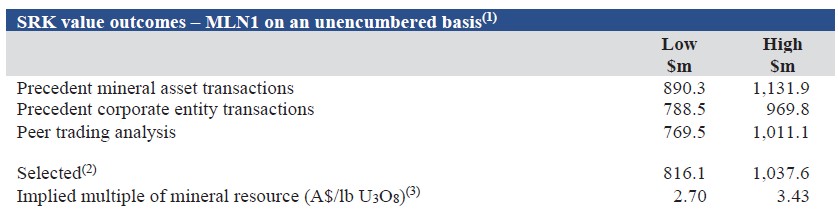
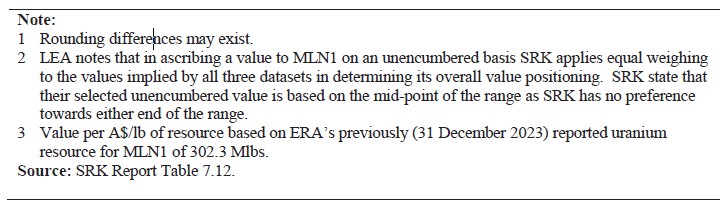
(2) in relation to the “as is” or “encumbered value” LEA notes that SRK adopted two valuation approaches, a top-down approach and a bottom-up approach, and sets out the results of SRK’s opinion at [217]:
115 LEA then undertook “cross-checks” of SRK’s valuations against the implied values attributed to MLN1 based on the market traded prices of ERA shares as well as the 2023 Interim Entitlement Offer and the 2024 Entitlement Offer. Insofar as the cross-checks are concerned, at [222] of the LEA Report, LEA notes that throughout the period in which the analysis was undertaken, 31 August 2022 to 21 March 2025, “ERA was a very thinly traded stock and the analysis should therefore be treated with a high degree of caution”. Moreover, LEA says that the trading period also pre-dates ERA’s decision to no longer recognise a mineral resource for MLN1 and “it is not possible to determine the price at which ERA shares may have traded had no mineral resource been reported by ERA for MLN1”.
116 Notwithstanding that, LEA undertook an analysis of the implied value of MLN1 based on the ERA share price in the period 31 August 2022 to 21 March 2025. LEA observed that while it “is not possible to determine with any certainty the current price at which ERA shares would trade in the absence of the Compulsory Acquisition and thus what the current inferred value of MLN1 may be, as a guide” they:
(1) “estimated the value of MLN1 based on LEA’s view of the ‘undisturbed’ share price of ERA … (which takes into account the Renewal Decision, the dilutive impact of the 2024 Entitlement Offer and adjusts for the decline in the spot price of uranium and ERA’s estimated cash burn through to 28 February 2025) and ERA’s 28 February 2025 balance sheet”. That analysis resulted in an implied value of MLN1 of $1,473 million (with a tax deduction available) and $2,049 million (with no available tax deduction); and
(2) considered the implied values as at the period 19 September 2023 to 25 September 2023, when the spot price of uranium was last around A$104/lb, which approximated to $1.1 billion (tax deduction available) and $1.5 billion (tax deduction not available). Having regard to ERA’s announcement on 26 September 2023 that it now expects that total rehabilitation costs will materially exceed the previous estimated range of $1.6 billion to $2.2 billion and that the expected final completion date will also be delayed, LEA reflected the estimated impact of that announcement on the implied value of MLN1 by including a retrospective adjustment of $974 million based upon the final confirmed provision as at 31 December 2024. LEA notes that “[i]f this same retrospective adjustment is extended through to the period of 19 September 2023 to 25 September 2023 the implied value of MLN1 increases to $1.9 billion (tax deduction available) and $2.5 billion (tax deduction not available)”. LEA cautions that these values do not account for factors such as the Renewal Decision and that “[a]djusting these downward by some 17% (tax deduction available) to 13% (tax deduction not available) results in an implied value for MLN1 of $1.6 billion (tax deduction available) to $2.2 billion (tax deduction not available)”.
117 At [226] of the LEA Report, LEA cautions that “[t]hese estimates should be viewed as illustrative and do not represent a definitive assessment of the implied value of MLN1”. That is because there is no certainty that “the market would have assigned, or would currently assign, these values to MLN1 in the absence of the Compulsory Acquisition or with knowledge of ERA’s decision to no longer include MLN1 in reported mineral resources”. Relevantly, LEA also noted that the calculated ranges exceed the encumbered values calculated by SRK and went on to opine that “[s]etting aside potential mispricing issues that likely result from ERA’s status as a very thinly traded stock and the issue pertaining to ERA’s decision to no longer include MLN1 in ERA’s reported mineral resources, in LEA’s view, this discrepancy may be explained by the existence of optionality”.
118 LEA then addressed what it termed “‘in substance’ call-option value” which is the material disconnect between the manner in which traders of minority interest parcels of ERA shares are able to price those shares and the manner in which a purchaser of 100% of the equity in ERA would be able to price 100% of the shares.
119 Having done so, LEA ultimately concluded that the traded market prices for ERA shares are not a reliable reference point for the determination of the market value of the equity in ERA on a 100% controlling interest basis and any implied value of MLN1 that might be derived from that value is also not reliable. LEA reached the same view in relation to the implied value of MLN1 arising from the 2023 Interim Entitlement Offer and the 2024 Entitlement Offer.
120 At [240] of the LEA Report, LEA concluded that in its view the encumbered value attributed to MLN1 by SRK is reasonable and thus adopted the range of $332.2 million (low) to $443.0 million (high) for that asset.
121 In relation to R3D, at [247] of the LEA Report LEA notes that SRK was not able to identify a viable pathway for the grant or exploration and development of R3D and thus considered it no longer had a reasonable basis to assign material value to it. SRK concluded that R3D has negligible to no value associated with it.
122 Commencing at [248] LEA considered the liability associated with the rehabilitation of the Ranger Project Area. LEA observes at [249]:
Mine Closure Plans have been prepared annually by ERA with the 2023 plan receiving Commonwealth Ministerial approval on 6 February 2025. The Ranger Project Area rehabilitation costs were estimated by ERA to be some $3,079 million on an undiscounted, nominal basis as at 31 December 2024. ERA has recognised a provision at 31 December 2024 of $2,422 million assuming a real (pre-tax) discount rate of 2.5% and assumed inflation rates of 0.6% to 2.5% long term. The provision at 28 February 2025 was some $2,403 million (noting that while this is not an audited etc. figure, it is based upon a roll forward of the same methodology and calculation applied in the determination of the provision as at 31 December 2024).
123 As set out above, LEA also engaged SRK to consider the reasonableness of the cost estimates associated with the rehabilitation and mine closure plans. At [254]-[255] of its report, LEA notes:
254 SRK concluded that:
(a) ERA adopting a commercial costing approach rather than a generic liability estimate calculator is a more accurate method and therefore considers that ERA has made the best attempt to understand its liability to the full extent currently possible in the absence of further studies
(b) the approach to closure planning and liability estimating has been undertaken in compliance with good industry practice.
255 SRK also noted:
(a) that the Ranger Project Area rehabilitation is an inherently complex project, with future activities beyond 2027 requiring additional studies and ongoing approvals, and that it is likely that the current provision will need to be revised once these studies are complete and additional approvals granted
(b) a particular area of uncertainty to SRK involves the formal regulatory approval of certain closure criteria and the mechanisms through which relinquishment can be approved and signed off by both NT and Commonwealth regulators
(c) SRK considers the schedule outlined for the Ranger Project Area rehabilitation is aligned with the data currently available, and that the schedule aligns will with the details of the Tranche 1A (to 3Q27 – Phase 1 demolition, Pit 3 initial and secondary capping and further studies – refer paragraph 100 above) – although also noting that the risks and uncertainties associated with activities and timelines beyond 3Q27 should continually be assessed
(d) based on SRK’s experience, there is a potential for under estimation of the provisions throughout the entire post-closure monitoring and maintenance period (beyond 2027 to 2060), and that SRK recommends a legal review of the site’s obligations particularly concerning property holding and continued monitoring programs up to December 2060. LEA notes that to the extent that SRK are correct in their view, any amendment would not be material (in present value terms) in the context of the $2.4 billion provision
(e) the opportunity for costs to reduce under the MSA, but that budgets and forecasts are currently being assessed.
124 LEA considered that the appropriate basis on which to quantify the value of the Ranger Project Area rehabilitation costs is to use the DCF method, with the best available estimate of future costs discounted to present value thus allowing for the time value of money. LEA was of the view that the best available current estimate of the expected future costs of the Ranger Project Area rehabilitation is ERA’s current estimate of the nominal costs reflected in its adopted total Rehabilitation Provision at 28 February 2025 of $2,403 million. This was made of $2,402 million for the Ranger Project Area and $1 million for MLN1. LEA continued at [257]:
LEA notes that the Ranger Project Area cost estimates have been subject to various studies and reviews, most notably and recently, a 2022 Independent Estimate Review and 2023 Feasibility Reforecast (Tranche 1A) conducted by Bechtel, and the review conducted by SRK for the purposes of this report. The cost estimates are based on the Mine Closure Plans prepared by ERA that are subject to stakeholder review and government approval, with the 2023 Mine Closure Plan having been approved by the Commonwealth Government on 6 February 2025. The [Rehabilitation Provision] recognised within ERA’s financial statements are subject to audits and half year reviews by ERA’s auditors (KPMG), and the 31 December 2024 provision is in the process of being audited. In addition, PwC was engaged by ERA to provide an independent review of the reasonableness of the rehabilitation contingencies applied at December 2024. LEA notes that the 28 February 2025 rehabilitation figure adopted is based on ERA’s 31 December 2024 provision adjusted for the expenditure incurred and the effects of time in the present value calculations.
125 LEA then considered “[t]ax”, namely the tax deduction on future rehabilitation expenditure and existing carry forward tax losses, and “[o]ther sundry assets, net working capital balances and employee provisions”.
126 Commencing at [270] of its report, LEA set out its valuation summary (see [105] above). LEA considered the prices paid for ERA shares in the previous six months as required by s 667C(2) of the Corporations Act, and, by way of additional cross-check, the “undisturbed” traded prices of ERA shares (adjusted for a premium for control). LEA concluded that neither of these methods provided a reliable indicator of the fair value of ERA shares for the following reasons:
(1) in relation to the prices of ERA shares in the previous six months, LEA noted that before and during the relevant period (i.e. 22 September 2024 to 21 March 2025) the value of ERA shares was affected by market announcements relating to the 2024 Entitlement Offer. Accordingly, LEA concluded “it is not possible to determine the price at which ERA shares may have traded had no mineral resource been reported by ERA for MLN1 during the period”; and
(2) in relation to the “undisturbed” traded prices of ERA shares (as a cross-check), after making relevant adjustments, LEA determined the indicated share price of some $0.0022 per share. While this value exceeds LEA’s assessed per share value range at [270] of their report, LEA noted that: (1) ERA is a thinly traded stock and the review period was relatively short; (2) ERA shares are likely to include an optionality element; and (3) where ERA continued to include MLN1 in its reported mineral resources until 26 March 2026, it is not possible to determine the impact this may have had on the “undisturbed” (adjusted) price.
3.5 The SRK Report
127 As set out above, LEA referred to and relied on the SRK Report in forming its opinion as to the valuation of ERA’s mineral assets. Relevantly, LEA asked SRK to provide an ISR incorporating a technical assessment and valuation of ERA’s mineral assets to accompany the LEA Report. In the executive summary included in the SRK Report, SRK set out its conclusion that:
• The unencumbered value for ERA’s mineral assets lies in the range of A$816.5 M to A$1,039.6 M, with a preferred value of A$928.1 M.
• The encumbered value of a 100% interest in ERA's mineral assets resides between A$332.6 M and A$445.0 M, with a preferred value of A$333.0 M.
• This value range and positioning reflects that ERA no longer reports any Mineral Resources or Ore Reserves at Ranger or Jabiluka along with the various uncertainties that remain to be resolved (not least of which is the outcome of the current legal proceedings regarding tenure renewal and the longstanding and intergenerational opposition to the development of Jabiluka by Traditional Owner groups).
• In assigning its valuation range, SRK has endeavoured to keep its valuation range as tight as possible. SRK is cognisant that, should the pending legal action find against ERA, the value of Jabiluka may fall to nil.
128 In describing ERA, SRK observed that its projects range from exploration to post-production, namely rehabilitation and mine closure assets, “with defined and publicly reported JORC Code (2012) Mineral Resources at Jabiluka”.
129 In relation to the Ranger Project Area, which is the subject of rehabilitation and mine closure activities, SRK considered the reasonableness of the estimate of rehabilitation costs of $2,422 million as at 31 December 2024, included in the ERA Audit and Risk Committee memorandum dated 10 February 2025. It summarised its findings in relation to the estimate of rehabilitation costs as follows:
• The approach to closure planning and liability estimating, as adopted at the [Ranger Project Area] and its operations, has been undertaken in compliance with good industry practice. What remains uncertain is the formal approval of completion criteria and the mechanisms through which relinquishment can be approved and signed off by regulators.
• The schedule outlined for the [Ranger Project Area] is aligned with the data made available. The schedule aligns well with the details of Tranche 1A up to the end of 2027. However, the risks and uncertainties associated with activities and timelines beyond Tranche 1A should be assessed. ERA is currently undertaking further studies to better understand and close existing knowledge gaps regarding future tranche activities, and the outcomes of these studies will better refine the schedule and provision going forward.
• There is potential for underestimation of the provision due to activities not extending throughout the entire post-closure monitoring and maintenance period. SRK holding and continued monitoring programs up to the estimated close out certification date of December 2060.
130 SRK also observed that there are no Mineral Resources or Ore Reserves reported within the Ranger Project Area including the R3D deposit and that the R3D deposit is “considered to have minimal options regarding future development and hence negligible value can be reasonably ascribed to this deposit”.
131 Under the heading “[c]ontext” SRK noted that the SRK Report had been prepared “in accordance with the guidelines outlined in the Australasian Code for Public Reporting of Technical Assessments and Valuations of Mineral Assets (VALMIN Code 2015), which incorporates the Australasian Code for Reporting of Exploration Results, Mineral Resources and Ore Reserves (JORC Code, 2012)”. I will refer to these guideline documents respectively as the VALMIN Code and the JORC Code and discuss their relevance commencing at [440] below.
132 Part 3.4 of the SRK Report titled “[m]ine closure” describes the work which has been and is currently being undertaken in relation to closure financial estimation provisioning for the Ranger Project Area. The analysis undertaken by SRK on this topic is considered commencing at [292] below.
133 In part 4 of the SRK Report, SRK sets out an overview and history of Jabiluka. That includes consideration (at 4.3.2 of the SRK Report) of ERA’s Mineral Resources (as defined in the JORC Code) where, among other things, SRK sets out previous Mineral Resource estimates at Jabiluka II, most recently as reported in ERA’s 2023 Annual Report. SRK notes that for the purposes of its valuation exercise it discussed previous Jabiluka II Mineral Resource estimates with the Competent Person (as required by the JORC Code), Stephen Pevely on 16 January 2025. SRK noted the following from that meeting:
• The only reportable Mineral Resource that ERA owns is that associated with the Jabiluka II deposit.
• Jabiluka II is located on NT Mineral Lease, MLN1.
• ERA lodged a renewal application for MLN1 on 20 March 2024, which was ahead of the statutory expiry date of 11 August 2024.
• ERA was notified by the NT Government on 26 July 2024 that MLN1 would not be renewed on advice from the Commonwealth Government.
• Despite having now passed the original expiry date, MLN1 has not been extinguished; but rather remains in a state of legal status quo pursuant to Court orders.
• There is a Court hearing regarding the validity of the NT Minister decision to not renew MLN1 scheduled for the second week of May 2025, with a decision to be published after this date following Court deliberations.
• In preparation of ERA’s 2024 Annual Report and as the stated Competent Person for the Jabiluka II Mineral Resource, Mr Peveley had been contemplating the potential impact to the previously stated Jabiluka Mineral Resource in light of:
- Proposed changes to the JORC Code (which is currently envisaged to be implemented in late 2025), particularly in reference to increased environmental, social and governance disclosures and their influence on the declaration and classification of Mineral Resources and Ore Reserves.
- On-going uncertainty regarding the renewal status of MLN1.
- The requirement for Traditional Owner consent to be granted to enable any future development or mining.
- Traditional Owner’s continued strong opposition to any future development of Jabiluka.
- Rio Tinto’s decision to no longer report a Mineral Resource at Jabiluka deposit (with Mineral Resources last reported by Rio Tinto at Jabiluka on pages 374 and 375 of its 2021 Annual Report), as it does not consider the deposit offers reasonable prospects of eventual economic extraction in light of Traditional Owner opposition and the terms of the LTCMA.
- recent public announcements by the Commonwealth Government with respect to incorporation of Jabiluka into the Kakadu National Park.
• While Mr Peveley had formed some preliminary views with respect to his position, these remained to be discussed and agreed with ERA management and ultimately approved by the ERA Board, prior to any public disclosure.
134 In part 7 of the SRK Report, SRK sets out its detailed analysis of the valuation of ERA’s mineral assets.
135 In relation to the valuation of MLN1, SRK noted its instructions from LEA to provide an “unencumbered” value of MLN1 and an “as is” (or encumbered) opinion on the value of MLN1. After identifying three generally accepted valuation approaches included in the VALMIN Code, SRK concluded that the market approach was the most appropriate to adopt having regard to the mineral assets.
136 SRK divided its valuation of MLN1 into two sections:
(1) in Part A it considered the unencumbered value of MLN1 using a “precedent transaction analysis (using both mineral asset and corporate level datasets) as its primary valuation approach”. The values derived from this approach were then cross-checked against values determined using the peer trading multiples method; and
(2) in Part B it considered the encumbered value of MLN1 by adopting a discount to the values implied in Part A (i.e. the unencumbered value) “to reflect the greater uncertainty toward eventual development (via a top-down approach) and cross-checked this value using a geoscientific rating method and a select form of the precedent transaction method (adopting a bottom-up approach)”.
137 To value the exploration potential at Cooper Creek JV, SRK adopted “values implied by precedent transactions analysis which have been cross-checked using a geoscientific rating approach”.
138 As set out above, SRK adopted the market approach in relation to its valuation of MLN1 (which it also broadly referred to as the Jabiluka Project in its report). This approach, also referred to as the comparables method, involved:
(1) calculating implied resource multiples in dollars per pound of uranium (U3O8) based on comparable transactions;
(2) normalising the implied resource multiples to the prevailing monthly averaged uranium price to remove fluctuations in price between the transaction dates and the Valuation Date (being 2 April 2025); and
(3) applying the normalised implied resource multiples to ERA’s mineral assets.
139 In relation to its precedent transaction analysis for “[m]ineral asset transactions”, SRK notes at 7.5.1 of the SRK Report that it:
… reviewed and assessed transactions involving Australian uranium projects that were completed between January 2018 and the Valuation Date. Other key search criteria included projects that remained in development (spanning scoping to [feasibility study] levels), envisaged conventional underground mining and processing operations, but without significant installed infrastructure in place. SRK notes that due to the paucity of transactions, it has considered a wider ‘lookback’ window than would normally be the case. In this instance, it has placed greater weighting on the values implied by more recent transactions.
140 Because of the paucity of Australian projects (six were identified), SRK also expanded its search to include uranium projects in Canada and the USA. After applying its selection criteria, SRK identified four precedent asset transactions in the scoping to pre-feasibility category (as was the prevailing status at Jabiluka).
141 SRK also considered recent corporate entity transactions identifying corporate entities with their principal activity focussed on the exploration and development of uranium assets in Australia, Africa and North America. Based on certain selection criteria, SRK identified three precedent entity transactions.
142 Finally, SRK considered peer trading analysis. Using the S&P Capital IQ Pro subscription database, SRK compiled data on listed companies involved in the pre-development to development stage and holding total uranium Mineral Resources in excess of 80 Mlb in contained uranium. SRK analysed those companies “according to the stated total Mineral Resource and Ore/Mineral Reserve values on a net attributable basis”. SRK identified seven precedent peer companies.
143 In addition, SRK considered exploration potential. It compiled a list of recent transactions involving broadly similar early to advanced stage Australian uranium exploration projects without defined Mineral Resources. It then used that dataset to support its assessment of the market value of the exploration potential associated with ERA’s mineral assets.
144 Part 7.6 of the SRK Report is titled “[v]aluation of Mineral Resources”.
145 At 7.6.1 of the SRK Report, SRK set out the assumptions made in considering both the unencumbered and encumbered value of MLN1:
Assumptions - Unencumbered value
In considering the unencumbered scenario, SRK has assumed the following (some of which are special assumptions):
• The Measured, Indicated and Inferred Mineral Resource as previously reported by ERA in its 2023 Annual Report as outlined in Table 4.3.
• Further technical studies and modelling are required to demonstrate practical feasibility and economic viability of mining the Jabiluka II deposit within MLN1 prior to any future development or mining.
• MLN1 is granted for a term of up to 10 years (and potentially extendable beyond this timeframe).
• The Traditional Owners duly consent to the development and future mining of the Jabiluka II deposit.
• The Commonwealth and NT duly authorise the development and future mining of the Jabiluka II deposit.
• All parties would readily agree terms to enable a transaction to complete.
Assumptions - Encumbered value
In considering the encumbered scenario, SRK has assumed the following:
• ERA’s decision to longer report the Mineral Resources as outlined in Table 4.3, as announced to the ASX on 26 March 2025 (effective 31 December 2024).
• Further technical studies and modelling are required to demonstrate practical feasibility and economic viability of mining the Jabiluka II deposit within MLN1 prior to any future development or mining.
• Having been rejected by the NT Government on advice from the Commonwealth Government, the renewal of MLN1 remains in statutory limbo pending Court orders.
• The Traditional Owners remain strongly opposed to any future development and/or mining of the Jabiluka II deposit.
• ERA and Rio Tinto remain committed to not undertaking any development and/or mining of the Jabiluka II deposit without the consent of Traditional Owners in accordance with the LTCMA.
• ERA remains responsible for the ongoing rehabilitation and security of the Jabiluka MLN1.
• The NT Government has gazetted a reservation (which excludes any form of mineral tenure and future exploration /extraction of minerals) pertaining to the entire area covered by MLN1, which comes into effect upon the expiry of MLN1.
• The Commonwealth Government has made public statements that it has commenced the incorporation of the Jabiluka site into Kakadu National Park.
• It remains to be determined whether the Commonwealth and/or NT governments would authorise any future development or mining of the Jabiluka II deposit pending an application to do so.
• It remains to be determined if all parties (including Traditional Owners, Commonwealth and NT governments and other stakeholders) would agree terms to enable a transaction to complete.
(Footnotes omitted).
146 A “special assumption” is defined by the International Valuation Standards (IVS) as “an assumption that assumes facts that differ from the actual facts existing at the valuation date”.
147 SRK summarised its analysis of the unencumbered value of “Jabiluka Mineral Resources” as follows:
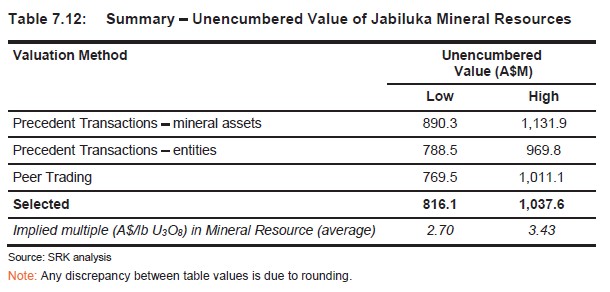
148 In relation to the encumbered value attributable to MLN1, following ERA’s decision to stop reporting any Mineral Resources (because of the Renewal Decision and ongoing opposition of the Traditional Owners to future project development), SRK completed an internal poll of its resource geologists involved in reporting Mineral Resources to better understand the value implications of ERA’s decision. Based on the poll SRK identified two “schools of thought” on how ERA’s decision should be treated and used as the basis for valuation. As set out above, they are:
(1) a top-down view: which SRK notes involves a “[r]isk-weight adjustment to the defined Measured, Indicated and Inferred Resources at Jabiluka given such resources were reported by ERA up until 26 March 2025 (effective date for Resource estimate 31 December 2024)” and “reflects the view that the mineralisation remains reasonably well defined and in place”. SRK states that “[t]o estimate the value under this view, the multiples for an Inferred Resource were discounted by 50%, and then applied to all defined Resource categories”, noting that “this discount is based on that typically applied by SRK (and in many cases by other mineral asset practitioners) when evaluating the value associated with Exploration Targets as defined in Clause 17 of the JORC Code (2012)”; and
(2) a bottom-up view: which is based on a literal interpretation of the JORC Code “which notes that to publicly report Mineral Resources, practitioners must be able to demonstrate ‘reasonable prospects for eventual economic extraction (i.e. more likely than not)’” (RPEEE) prevails. ERA’s (and previously Rio Tinto’s) decision to no longer report Mineral Resources implies that the “defined mineralisation at Jabiluka is unable to demonstrate RPEEE and despite known mineralisation being evident, realistic mining parameters (including the sourcing of associated approvals) and a development pathway are unable to be demonstrated within the foreseeable future”. SRK notes that this “implies the project should be relegated to only consideration of the exploration potential associated with” it and “[i]n doing so, SRK has adopted a geoscientific rating method and cross-checked this with a select form of the precedent transaction method.”
149 SRK carried out those analyses and as a further cross-check used the geoscientific rating method to estimate the market value of a 100% interest in the exploration potential associated with MLN1. SRK explains that:
The geoscientific rating or modified Kilburn method of valuation attempts to quantify the relevant technical aspects of a property through the use of appropriate Multipliers (factors) applied to an appropriate base (or intrinsic) value. The intrinsic value is referred to as the Base Acquisition Cost (BAC) and is critical in that it forms the standard base from which to commence a valuation. It represents the ‘average cost to identify, apply for and retain a base unit of area of title’.
150 SRK also notes in relation to the geoscientific rating cross-check that it has:
… used its professional judgement and applied a discount of between 40% and 65% to the values associated with… MLN1 to reflect the combined uncertainties arising from the legal proceedings regarding the renewal of MLN1, the terms of the various agreements pertaining to Jabiluka in particular the LTCMA, the associated requirement for the consent of Traditional Owners, governmental and other approvals, and the outcome of future techno-economic studies regarding a potential development pathway…
151 SRK set out a summary of its analysis of the encumbered value of MLN1 as follows:
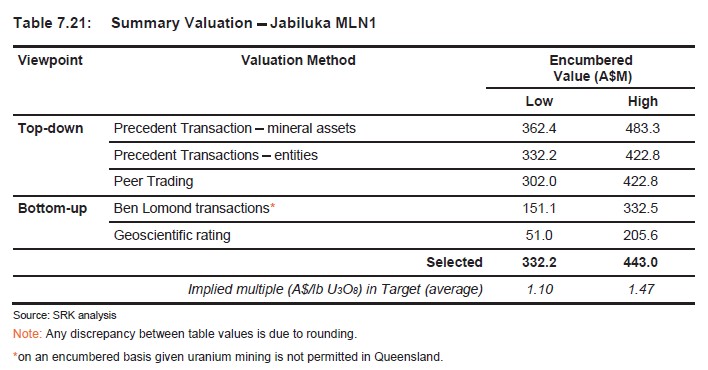
152 In part 7.7 of the SRK Report, SRK considered “[v]aluation of exploration potential” commencing in part 7.7.1 with a consideration of the value of the “exploration potential associated with the [Ranger Project Area] (and the underlying EL9644), with particular reference to the R3D deposit”. In doing so SRK noted a significant number of relevant matters including:
• The [s 41 Authority] which continues until 8 January 2026, no longer permits mining and processing operations to be conducted over the [Ranger Project Area] (since 8 January 2021) and as a result, ERA no longer has the requisite authorisation to conduct exploration, mining and processing activities over this area.
…
• While the R3D deposit within the [Ranger Project Area] has been deemed by ERA to no longer meet the RPEEE criteria outlined in the JORC Code (2012) and hence Mineral Resources are no longer reported by either ERA or Rio Tinto for R3D, no such criteria are required to support an Exploration Target (with the meaning as intended in the JORC Code) within the underlying ELA.
• SRK considers the longer-term potential associated with uranium mineralisation at R3D may be evaluated by some market participants as representing an Exploration Target within EL9644. In doing so, both tonnages and grade must be expressed in a range. The conceptual nature of the defined mineralisation must also be noted, with no guarantee that this will be converted to a Mineral Resource with further exploration or that the ELA will be eventually granted.
• To this end and based on the results of historical exploration and mining studies (as well as historical mining at Ranger 3 open pit), SRK previously considered an Exploration Target for the R3D deposit in the 2022 SRK Report.
…
• The geological setting of the R3D deposit within permeable schists and other metamorphic rocks of the Cahill Formation precludes the use of in situ leach technologies for the recovery of uranium.
• The completion of rehabilitation and closure activities at Ranger (i.e. earthworks currently estimated to be completed in 2035, before entering a prolonged monitoring period to 2060 provided the closure criteria are achieved in line with currently estimate timeframes) effectively sterilises the R3D uranium deposit.
• ERA and Rio Tinto remain committed to maintain involvement with the [Ranger Project Area] (and by association, EL9644) throughout the entirety of the rehabilitation and closure period. In part, this may arise due to the potential for reputational damage associated with the disposal of the [Ranger Project Area] to third parties.
• Furthermore, there is unlikely to be a suitable and socially responsible purchaser willing to acquire the [Ranger Project Area] (and by association EL9644) given the high, and increasing, capital cost estimate and ill-defined environmental thresholds to be achieved as part rehabilitation and mine closure.
• The Mirarr people, NLC and GAC remain steadfast in their opposition to further exploration, development and mining on their lands.
• Rio Tinto, in particular, remains highly sensitive to the long-term opposition of the Traditional Owners, the Mirarr People, to further mining development on their country and acknowledge the previous statement by the GAC on 28 September 2022 regarding the 2022 Grant Thornton Valuation and its perceived “failure to give due weight to their consistent and inter-generational opposition to further uranium mining on their country”.
…
• Based on the recent refusal to renew the nearby [MLN1], there appears to be no compulsion for the NT government to grant mineral tenure (such as EL9644) where there is strong opposition from Traditional Owners and other stakeholders (for example, in some jurisdictions it might be the case that if a tenement holder has adhered to tenement conditions and can demonstrate its capacity and intention to mine, there is effectively an obligation on the part of the approving authority to grant tenure).
• Based on recent statements made in relation to the renewal of the nearby [MLN1], the Commonwealth government clearly considers there is little to no political benefit, and potentially a lot of political harm, in allowing any mineral tenure (such as EL9644) to be granted, which may enable exploration and potentially (but only upon some future conversion to an extractive form of tenure) mining to proceed in proximity to Kakadu National Park (refer sections 4.2.1 and 4.2.2 of [the SRK Report]).
(Footnotes omitted.)
153 Having regard to those matters, SRK concluded that it no longer had a reasonable basis to assign material value to EL9644 and considered that “there is negligible, to no, value associated with EL9644”.
4. Compliance with formal requirements
154 Zentree’s grounds of objection filed in the proceeding raise four complaints in relation to the form of the Notice (see [3] above). As I have already observed, the first of these (concerning the reliance by LEA on the SRK report) was abandoned in closing submissions. I address the remaining three formal objections below.
4.1 Valuation methodology
155 Zentree contends that the LEA Report and SRK Report do not comply with s 667C (and therefore, Pt 6A.4) of the Corporations Act or RG 111 because they each applied an incorrect or inappropriate valuation methodology. I reject that submission.
156 In Capricorn, Warren J in considering the concept of “fair value” and s 667C of the Corporations Act relevantly said at [66]:
Section 667C is concerned with the adjustment of entitlements between the acquirer and the other holders of securities upon a compulsory acquisition proposal. The section leaves to the expert the determination of the appropriate valuation methodology to assess the value of the company as a whole. …
157 The methodologies adopted by LEA and SRK are addressed above. Given the latitude permitted to an expert, the approach adopted by North’s experts is an appropriate methodology for the purposes of the Notice. Even if that was not the case, as North submits, the application of an incorrect or inappropriate valuation methodology would not invalidate the Notice. In QGold at [60] Derrington J said:
The above construction also accords with the regime of Part 6A.2, for it must be kept in mind that the expert’s opinion about fair value is neither the end of the process nor determinative of it. On the contrary, if more than 10% of eligible shareholders object to a proposed acquisition, it is for the Court to approve the acquisition and, to that end, the applicant must establish the terms set out in the compulsory acquisition notice give a fair value of the securities (s 664F(3)). …
(Emphasis added.)
4.2 North’s experts’ reliance on “subjective decisions”
158 The next formal objection raised by Zentree is that North’s experts “incorrectly relied upon subjective decisions made by or at the direction of [North] and/or ERA” and failed adequately to “identify the source material…, instructions and/or assumptions relied upon”. This ground is not made out.
159 As to the latter, RG 111 requires “clear, concise and effective communication”. It relevantly provides:
RG 111.101 An expert report should help security holders make their decision. The report should:
(a) address the varying information needs of a report’s audience;
(b) clearly explain the meaning of the expert’s opinion and the significance of that opinion to the decision to be made by security holders;
(c) highlight key information;
(d) be easy to navigate and understand (e.g. through including an up-front summary of the expert’s opinion and the reasons for the opinion, the use of content tables, signposting, cross-references, numbered sections, sub-sections and the avoidance of jargon); and
(e) be as brief as possible.
RG 111.102 An expert report should only contain information that relates directly to the decision to be made by security holders. Including extraneous information in an expert report undermines the effectiveness of that report. Santow J dealt with this issue in Re Australian Co-operative Foods Ltd (2001) 38 ACSR 71 at 77 in the following terms:
Experts are responsible for what they say in their reports. They must ensure that their reports deal adequately with the kind of concerns that could reasonably be anticipated from those affected by the scheme, in reporting on whether the relevant scheme proposal is fair and reasonable from their viewpoint … This is so those members can then make an informed decision with the benefit of a report that is as simple, clear and useful as possible. A plethora of peripheral information is more likely to distract than illuminate.
160 The LEA Report and the SRK Report respectively comprise some 95 and 207 pages. It is difficult to see how LEA and SRK can be criticised for a lack of identification of source materials and/or instructions or assumptions. To the contrary these reports more than adequately set out those matters, especially having regard to RG 111.101 which requires that expert reports should both clearly explain the meaning of the expert’s opinion and the significance of that opinion but also be “as brief as possible”. I am satisfied that the LEA and SRK Reports adequately achieves both of these objectives.
161 As to the former, Zentree does not explain how LEA and SRK incorrectly relied upon subjective decisions “at the direction of North and/or ERA” or provide any detail of the alleged subjective directions given to the experts, either in its grounds of objection or its submissions. Indeed, despite being pressed, this was not addressed by Zentree in its closing submissions. On my review of the LEA and SRK Reports I am unable to discern any such reliance as alleged.
162 In any event, as set out above, an expert report does not need to be “beyond criticism” in every respect or contain exhaustive detail. In Bromley Williams JA said at [18] (emphasis added):
The essential task of the judge is to determine whether the price offered is fair and that decision must largely be based on the report of the expert furnished pursuant to s 667AA. Of course, if at the end of the hearing the judge was of the view that there were such deficiencies in the report that made it impossible to determine whether or not the price offered was fair, approval would be refused. But that does not mean that the report must be beyond criticism before the judge could act on it and conclude that the price offered was fair.
163 The question of whether there are deficiencies in the LEA and SRK Reports is addressed below. For now, it is sufficient to note that I am not satisfied that there is any basis upon which I would conclude that the Notice is defective because LEA and/or SRK relied on allegedly subjective decisions about the mineral assets at the direction of North and/or ERA. As North submits, it is enough for the expert report to provide sufficient information and explanation so that the security holders can understand, in general terms, the valuation and are able critically to evaluate the opinion: see QGold at [123]. The LEA Report and SRK Report meet this requirement. Each report provides detailed reasons for the opinions set out therein.
4.3 Failure to disclose material information
164 Zentree’s final objection in this category is that the Notice failed to disclose material information as required by s 664C(1)(e) of the Corporations Act. The material which Zentree says was not, but should have been, disclosed is set out in its grounds of objection as follows:
a) all letter(s) of instruction, assumptions and documents and/or source material (including all factual assertions or matters, howsoever described), provided to LEA and/or SRK in relation to their respective reports, and all letter(s) of request and the responses thereto made by LEA and/or SRK;
b) all information relied on by LEA and/or SRK in the preparation of their respective reports including, relevantly, information in those reports where the source is referenced as “ERA management”, or matters “stated” by “ERA’s directors”, or material identified in similar terms;
c) any information, sources or instructions referable to the asserted increase in the rehabilitation obligations of the Ranger [Project Area] by more than 300% between 2019 and 2024, or the reasons for that increase;
d) any information, sources or instructions identifying the use to which funds raised pursuant to the entitlement offers made in 2019, 2023 and 2024 were put referable to the Ranger rehabilitation costs, or to any expenditure actually incurred;
e) any information, sources or instructions referable to the rationale, reasons, or decisions behind or relevant to the material discounts to volume average weighted share price of the entitlement offers made in 2019, 2023 and 2024;
f) all feasibility and/or pre-feasibility studies referenced in the SRK Report concerning the costs, expenditure and rehabilitation costs of the Ranger project area, including but not limited to the material at Section 3.4.1 of the SRK Report;
g) a report prepared by SRK and dated September 2022 (2022 SRK Report) relating to the same mineral assets as are the subject of the SRK Report, together with the letter(s) of instruction, assumptions and documents and/or sources provided to SRK in 2022 for the preparation of the 2022 SRK Report; and
h) further particulars may be provided following the receipt of further documents.
165 In its closing submissions Zentree refined the material which it said ought to have been, but was not, disclosed. It now contends that North failed to disclose at least:
(1) the content and findings of the Grant Thornton and SRK reports in 2022, or the instructions and assumptions which a reader would reasonably infer materially influenced the disparate conclusions reached by SRK in 2022 and in the SRK Report;
(2) the fact or content of communications between Mr Kepler of LEA and North going to the reasonableness and basis of Rio Tinto’s forecast cost savings on rehabilitation;
(3) ERA’s property, plant and equipment (PPE) register;
(4) Rio Tinto’s review of the basis of ERA’s rehabilitation cost estimate; and
(5) the KPMG audit statement.
166 Zentree submits that the information set out in the preceding paragraph cannot be other than material to an investor’s assessment of the Notice and considering whether its terms provide fair value. Zentree says that this is particularly so given the sparse Notice, accompanied only by the LEA and SRK Reports which contain errors and are otherwise “largely unreferenced” and assert that “conclusions be attributed to ‘LEA analysis’ or ‘ERA management’”.
167 Zentree does not suggest that North ought to disclose every document relied on by the experts. Rather, it submits that North bears the onus of demonstrating that the Notice complies with the statutory requirements. It submits that where the Notice is sparse, and there are at least several identifiable discrete documents material to consideration of it which have not been disclosed, North cannot discharge that onus.
168 As set out above, s 664C(1)(e) of the Corporations Act requires the 90% holder of shares to disclose with the notice “any other information” that is: (1) known to the 90% holder or any related bodies corporate; (2) “material” to deciding whether to object to the acquisition; and (3) not disclosed in the expert’s report under section 667A.
169 In Capricorn Warren J described the disclosure required by s 664C(1)(e) of the Corporations Act at [249] as:
… not intended to allow some discrete business assessment to be made by a unitholder as to whether a better outcome might be achieved. The disclosure is only to enable a unitholder to decide whether that which has been proffered is in fact fair value or not fair value. In consequence, the materiality of information for a scheme and for a compulsory acquisition under s 664C are different.
170 After referring to the wide-ranging criticisms of the disclosure (or lack of it) made in the case before her, Warren J relevantly said at [258]:
Ultimately, there was no evidence that any of the matters relied on by the defendants were material to a unitholder’s decision to object and cannot be presumed to be material. Nevertheless, the defendants must show knowledge by Capricorn of the information concerned, that it was material to deciding whether to object to the acquisition, and that it was not disclosed in the expert’s report. Materiality is not to be determined on the basis of the LEA report but by reference to the facts as known to Capricorn at the time of preparing the notice and by reference to the significance of the information concerned to deciding whether to object to the acquisition as set out in s 664C(1)(e) of the Corporations Act. …
171 As is apparent from Capricorn, materiality is to be determined by reference to the evidence. The information identified by Zentree cannot be presumed to be material. To that end, Zentree has not adduced any evidence that the alleged omissions of information were material. I address each category of information which Zentree says ought to have been disclosed below.
4.3.1 The Grant Thornton Report
172 Grant Thornton Corporate Finance Pty Ltd ACN 003 265 987 prepared a report dated 26 September 2022 (Grant Thornton Report) which ERA released to the ASX on the same date. The Grant Thornton Report was also supported by a report prepared by SRK as the independent mining technical specialist. Grant Thornton was engaged as the independent valuation expert to determine the fair value of ERA “on a basis consistent with an independent expert’s valuation prepared under Part 6A.4 of the Corporations Act and in accordance with published ASIC guidance (including [RG 111] …)”. Two points can be made at the outset. First, the Grant Thornton Report was prepared three years earlier and for a different purpose, namely to enable the Independent Board Committee (IBC) of ERA to determine the offer price for an interim entitlement offer. Secondly, as it was released to the ASX upon its completion, the Grant Thorton Report is publicly available. Given the different purpose and time at which it was prepared, I am not satisfied that the Grant Thornton Report is material to shareholders in deciding whether to object to the acquisition.
173 Putting that to one side, the Grant Thornton Report was referred to in the SRK Report. For example, at p. 2 of the SRK Report, SRK noted that:
For the avoidance of doubt, SRK notes that it previously completed an ISR relating to these same mineral assets and dated September 2022 on behalf of [Grant Thornton] (the 2022 SRK Report). This Report updates and amends, where necessary, the 2022 SRK Report. To the extent possible given the passage of time, SRK has attempted to use the same consulting team for this report, as prepared the 2022 SRK Report.
And at p. 104-5:
As outlined in Section 5.1.2 of the 2022 Grant Thornton Valuation, Grant Thorton ultimately selected a resource multiple of A$3.25/lb to A$4.25/lb of U3O8 for its application against the defined Jabiluka Mineral Resource. This range was based on the prevailing trading multiples of listed peers (Trading Multiples) and acquisition of comparable companies prepared by SRK for transactions at a project level which Grant Thornton integrated with transactions at a corporate level (Transaction Multiples). Application of these multiples to the Jabiluka Mineral Resource (302 Mlb of U3O8) resulted in an implied value of between A$982 M and A$1,284 M with a midpoint value of A$1,133 M.
174 Thus, if the Grant Thornton Report needed to be disclosed for the purposes of s 664C(1)(e) of the Corporations Act, it was already sufficiently disclosed.
175 Zentree also submits that there was a need to disclose the “instructions and assumptions which a reader would reasonably infer materially influence the disparate conclusions reached by SRK then and in 2025”. This is said to be particularly so as SRK acknowledged that the SRK Report had “drawn heavily” on its earlier report. It is difficult to understand what types of documents would fall into this category. That said, SRK disclosed its instructions and assumptions in the SRK Report. In addition, as North points out, Mr McKibben explained in cross-examination that in its 2022 report SRK did not “complete the final valuation” of Jabiluka, that was a matter for Grant Thornton. Thus, there are no “disparate conclusions”. I am not satisfied that this category of information was material to deciding whether to object to the acquisition.
4.3.2 Communications with Mr Kepler
176 Zentree submits that certain communications between Mr Kepler and David Pritchard-Davies, ERA’s chief financial officer, should have been disclosed with the Notice. It points in particular to two emails:
(1) an email sent by Mr Kepler to Mr Pritchard-Davies on 8 February 2025 raising queries in relation to the Rehabilitation Provision for the Ranger Project Area which incorporates Mr Pritchard-Davies’ responses provided to Mr Kepler on 12 February 2025; and
(2) an email sent by Mr Kepler to Mr Pritchard-Davies on 14 February 2025 raising further queries in relation to the Rehabilitation Provision for the Ranger Project Area which incorporates Mr Pritchard-Davies’ responses provided to Mr Kepler on 19 February 2025.
177 In these emails Mr Kepler is inquiring into aspects of the provision such as the effect of the management services agreement dated 3 April 2024 between ERA and Rio Tinto Closure Pty Limited ACN 004 489 203 (MSA) on the provision and confirmation of other details. That said, the emails are relatively brief and are sent in order to clarify certain items and to assist LEA and SRK to understand information with which they had been provided or had discussed. Viewed in isolation the emails are somewhat cryptic. It is difficult to see how the queries and the answers given to them could have been material to shareholders in deciding whether to object.
178 In any event, to the extent the emails were focussed on the impact of the MSA, its existence and potential to provide costs savings was referred to in the LEA Report as follows:
93 In April 2024, ERA appointed Rio Tinto to manage the Ranger Project Area rehabilitation project under the MSA. Under the MSA, Rio Tinto will, on ERA’s behalf and in accordance with plans and budgets approved by the ERA Board, manage all aspects of the rehabilitation of the Ranger Project Area, including project management and execution of all rehabilitation activities. In relation to the MSA, ERA noted that ERA’s [IBC] concluded that there was “significant value for ERA, and potential cost savings, in directly leveraging Rio Tinto’s mine rehabilitation, project management experience and capability to support the safe and efficient delivery of the Ranger Rehabilitation Project”.
…
106 As referenced at paragraph 93 above, ERA has noted the potential for cost savings to arise from the MSA. ERA has also noted that:
(a) the MSA is priced on a cost recovery basis and ERA has the right to approve each plan and budget
(b) there is a risk that ERA’s assumptions and expectations, in relation to the value and cost savings arising from the MSA, may change or prove to be inaccurate such that the expected value and cost savings do not materialise to the extent expected by ERA or at all
(c) any savings that might be available are not yet incorporated into the provision.
…
255 SRK also noted:
…
(e) the opportunity for costs to reduce under the MSA, but that budgets and forecasts are currently being assessed.
(Footnotes omitted.)
4.3.3 ERA fixed assets register as at 31 December 2024 (PPE Register)
179 The third category of document that Zentree contends should have been provided with the Notice is the PPE Register. That is an internal spreadsheet which provides a summary and breakdown by category of ERA’s assets made up of land, buildings, plant, machinery and equipment including furniture and fittings, computer equipment, software and so on.
180 The suggestion that North should have obtained this document from ERA and provided it to shareholders with the Notice is rejected. It is clearly an internal document. That North could or would obtain such a document from the company to provide with the Notice is not realistic.
181 Putting that to one side, Zentree’s expert, Mr Ross, valued ERA’s PPE at $32.4 million. Accepting that is so for present purposes, this item can hardly be said to be material to a decision to object to the acquisition relative to other aspects of the overall valuation which includes a rehabilitation liability of approximately $2.4 billion and mineral assets to the value of between $327.6 million to $424.2 million (see [268] below). Indeed, both parties conceded that the value of PPE (as well as franking credits and tax losses) was inconsequential: see [197] below. It follows that the PPE Register cannot be said to be material.
4.3.4 Rio Tinto’s review of the rehabilitation estimate
182 Observations and recommendations by the Rio Tinto review team following its review of the rehabilitation of the Ranger Project Area are outlined in a memorandum dated 1 November 2023 from Peter Harvey to Brad Welsh (Rio Tinto Review) which was included in the board papers for a meeting of the directors of ERA held on 28 November 2023.
183 In his memorandum Mr Harvey described the review undertaken by Rio Tinto as an “initial high-level review of the technical and project execution aspects of the FR”. The FR was described as ERA’s “feasibility study in connection with a lower technical risk rehabilitation methodology (primarily relating to the subaerial (dry) capping of Pit 3) and to further refine the Ranger Project Area rehabilitation execution scope, risks, cost, and schedule”. Mr Harvey also observed that “[w]ithin the timeframe permitted, the initial review by the Rio Tinto review team was limited to a high-level review focussed on material elements of the Ranger Rehabilitation Project” and that the “initial Rio Tinto internal review of the Ranger Rehabilitation Project Feasibility Reforecast was performed in a very compressed timeframe (1 week) and therefore focussed on material elements of the Project”.
184 Dr Lee was cross-examined about the Rio Tinto Review. He considered it to be very important and agreed that the majority of issues raised by Rio Tinto in its review of the FR were to the effect that ERA’s costs estimates were understated, although as I understand Dr Lee’s evidence, Rio Tinto did not quantify by how much. If anything, the Rio Tinto Review may have suggested that the rehabilitation costs of the Ranger Project Area were underestimated.
185 Once again, it is difficult to see how the Rio Tinto Review of ERA’s rehabilitation estimate could have assisted shareholders to decide whether to object to the Notice. Zentree does not identify how it might do so and, having regard to its nature, I am not satisfied that it would.
4.3.5 KPMG’s audit statement
186 Zentree submits that to the extent that North places emphasis on them as going to the reasonableness of the Rehabilitation Provision it failed to disclose the KPMG audit statement which seems to be a reference to the KPMG report to the ERA board for the year ended 31 December 2024 dated 25 March 2025 (KPMG Report to the Audit Committee) and the KPMG audit statement included in the ERA Annual Report 2024 (Independent Audit Report) (together, Audit Statements).
187 I am not satisfied that the Audit Statements were material to a shareholder’s decision to object. As set out above, they cannot be presumed to be material and Zentree has not relied on any evidence to demonstrate that they were of that nature. In any event, the Independent Audit Report was publicly available.
4.4 Formal requirements - conclusion
188 Before concluding on this aspect of Zentree’s objection to the Notice I note that, in its closing submissions, Zentree raised an additional basis upon which it contends that the Notice “falls short at the threshold level”. That is that SRK’s opinion in relation to the reasonableness of the Rehabilitation Provision for the Ranger Project Area, which is a matter fundamental to the integrity of the expert opinions accompanying the Notice, cannot be sustained in light of the concessions made by Mr Mayne during cross-examination and is a matter that would (if accepted by the Court) vitiate LEA’s conclusion as to fair value.
189 Zentree’s submissions in this regard are addressed below in considering the Rehabilitation Provision in the context of the question of fair value. In the meantime, I accept North’s submission that the reasonableness or otherwise of the Rehabilitation Provision is not a matter that goes to validity of the notice. That is, the validity of a notice issued under s 664C of the Corporations Act cannot depend on alleged concessions made in response to evidence relied on at trial months after its issue. Rather, for present purposes and insofar as validity of the Notice is concerned, the reasonableness of the Rehabilitation Provision was addressed in the SRK Report which was served with the Notice. Thus, SRK’s opinion was available to ERA shareholders.
190 It follows that I am satisfied that the Notice itself complies with the formal requirements of the Corporations Act and is valid.
5. Fair value
191 The next issue that arises is whether the Notice gives fair value for ERA shares as required by s 664F(3) of the Corporations Act (see [13] above).
192 As set out above, s 667C of the Corporations Act provides that to determine “fair value” for the purposes of Ch 6 of the Act, it is necessary to: (1) assess the value of the company as a whole; (2) allocate the value among the classes of securities; and (3) allocate the value of each class pro rata among the securities in that class. As I have already observed, as ERA only has one class of securities, the second step can be put to one side. The only other guidance given by s 667C(2) to determine “fair value” is that consideration paid for the class of securities in the past six months, if any, must be taken into account.
193 The legal principles which guide the Court in determining “fair value” for the purposes of s 664F(3) of the Corporations Act are summarised at [16]-[21] above. They are not in dispute.
194 As Zentree submits, my conclusion as to whether the Notice gives “fair value” for ERA’s shares will, to an extent, turn on the assessment of the competing expert reports relied on by the parties and, even if I reject Zentree’s experts, North will still need to discharge its onus of establishing that the terms of the Notice give “fair value”: see QGold at [193].
195 There is a contest between the parties’ respective experts on the question of whether the terms of the Notice give fair value for the shares in ERA. However, the approach to valuation of ERA’s shares was agreed by Messrs Kepler and Ross to be a “sum of the parts” methodology which they explained in their joint report to involve “the identification of all assets and liabilities (recorded or unrecorded) and the valuation of each such asset or liability using a valuation methodology appropriate to the assessment of the value of that asset or liability, followed by the summation of these values to calculate a total”. Messrs Kepler and Ross also agreed that the appropriate valuation method for each asset or liability will, among other things, depend on the nature of the asset or liability and the information available to the valuer.
196 Messrs Kepler and Ross observed that ERA’s assets and liabilities at the Valuation Date included:
a) Cash and cash equivalents (the value of which the experts agree on);
b) ERA’s Mineral Assets (the value of which the experts disagree on);
c) Property, Plant and Equipment (‘PPE’) (the value of which the experts disagree on);
d) Inventory, receivables and other assets (the value of which the experts agree on);
e) Franking credits (the value of which the experts disagree on);
f) Deferred tax assets (the value of which the experts disagree on);
g) The Ranger Project Area rehabilitation liabilities (‘Rehabilitation Costs) (the value of which the experts disagree on);
h) The benefits of potential future tax reductions on the Rehabilitation Costs (the value of which the experts disagree on); and
i) Other recorded liabilities and employee provisions (the value of which the experts agree on).
197 While there was disagreement between the parties’ respective experts about the values of most of these items, the principal dispute in relation to ERA’s assets between the parties concerns the value of its mineral assets. Although there is also dispute about the value of PPE, franking credits and deferred taxes, both parties accepted in closing that the areas of dispute in relation to those items are relatively minor, both in terms of scope of dispute and quantum.
198 Returning to their joint report, Messrs Kepler and Ross also agreed that the carrying values in ERA’s financial statements for its assets and liabilities can differ from their market values and that the absence of a carrying value in the financial statements for an asset or liability is informative but not conclusive evidence that the asset or liability has no value. After referring to an agreed definition for “market value”, sourced from the glossary in the IVS, (effective 31 January 2025 and referred to by Mr Ross in his report), Messrs Kepler and Ross observed that:
(1) their agreed definition of “market value” infers the need to consider a hypothetical transaction between hypothetical buyers and sellers which occurred on the Valuation Date; and
(2) there is a need to consider a hypothetical transaction which reflects a valuation principle that the market value of an asset or interest reflects its “highest and best use”. If the use to which a relevant asset or interest is put by its current owner does not reflect its “highest and best use”, market value should not be addressed by reference to its current use.
5.1 Highest and best use
199 As is apparent Messrs Kepler and Ross agree that the “highest and best use” of an asset or interest is the proper basis on which the market value of an asset or interest is to be determined.
200 Section A90 of the IVS addresses the concept of “highest and best use” including that:
A90.01 Highest and best use is the use, from a participant perspective, that would produce the highest value for an asset.
…
A90.03 The highest and best use must be physically possible (where applicable), financially feasible, legally allowed and result in the highest value. If different from the current use, the costs to convert an asset to its highest and best use would impact the value.
…
A90.06 The determination of the highest and best use involves consideration of the following:
(a) To establish whether a use is physically possible, regard will be had to what would be considered reasonable by participants.
(b) To reflect the requirement to be legally permissible, any legal restrictions on the use of the asset, e.g., town planning/zoning designations, need to be taken into account as well as the likelihood that these restrictions will change.
(c) The requirement that the use be financially feasible takes into account whether an alternative use that is physically possible and legally permissible will generate sufficient return to a typical participant, after taking into account the costs of conversion to that use, over and above the return on the existing use.
(Emphasis in original.)
201 To like effect AASB 13 “Fair Value Measurement” (compiled 31 December 2023) addresses “[h]ighest and best use for non-financial assets” including:
27 A fair value measurement of a non-financial asset takes into account a market participant’s ability to generate economic benefits by using the asset in its highest and best use or by selling it to another market participant that would use the asset in its highest and best use.
28 The highest and best use of a non-financial asset takes into account the use of the asset that is physically possible, legally permissible and financially feasible, as follows:
(a) A use that is physically possible takes into account the physical characteristics of the asset that market participants would take into account when pricing the asset (eg the location or size of a property).
(b) A use that is legally permissible takes into account any legal restrictions on the use of the asset that market participants would take into account when pricing the asset (eg the zoning regulations applicable to a property).
(c) A use that is financially feasible takes into account whether a use of the asset that is physically possible and legally permissible generates adequate income or cash flows (taking into account the costs of converting the asset to that use) to produce an investment return that market participants would require from an investment in that asset put to that use.
(Emphasis in original.)
202 In cross-examination Mr Ross agreed that in valuing ERA’s assets at a specific date a potential purchaser would “consider ERA’s circumstances as they find it” and that he was not suggesting that the “highest and best use” principle entitled the Court to value ERA’s mineral assets without regard to legal, social, political or other constraints.
203 North submits that the agreement by Messrs Kepler and Ross about the requirement to value on a “highest and best use” basis, together with the meaning of that expression, renders the comparables and DCF valuations prepared by Dr Burrows and all of Mr Rossi’s evidence of no assistance. That is because that evidence was, as Dr Burrows and Mr Rossi accepted, prepared on assumptions that excluded any consideration of the legal, social, political and other non-technical constraints that existed in relation to the development of ERA’s mineral assets.
204 On the other hand, Zentree submits that Dr Burrows and Mr Rossi did factor encumbrances into their valuation, and that they first calculated the unencumbered value of the mineral assets and then adjusted that figure to reflect considerations relevant to RPEEE.
205 I consider the competing submissions below, commencing with an analysis of the approach taken by each of Dr Burrows and Mr Rossi to their respective instructions.
5.1.1 Mr Rossi’s and Dr Burrows’ approach
206 It is convenient to commence with Mr Rossi’s report dated 16 November 2025.
207 As Mr Rossi explains in his report under the heading “[i]nstructions”, he was asked to undertake the analyses and provide his views on the matters set out at [48] above in relation to MLN1 and R3D (see [21] and [23] respectively of Mr Rossi’s report). Insofar as Mr Rossi was requested to “analyse” certain matters or material in relation to MLN1 he said at [22] of his report:
I understand that “analyse”, in the context of ¶ 21, means to define whether Resources and Reserves can be publicly reported or not, whether in Annual Forms or Press Releases under the JORC Code, and to provide, if possible, an estimate of Resources and Reserves as of April 2, 2025. I discuss Resources and Reserves in the context of the JORC and VALMIN codes in Section III below.
208 At [24] of his report Mr Rossi relevantly said:
I have understood that my opinions regarding the Jabiluka and R3D projects are to be made considering only mining, processing, metallurgical, infrastructure, economic, and marketing aspects.
209 In Part III of his report, Mr Rossi addresses question 1 and provides an analysis of “Jabiluka Resources and ‘Functional Reserves’ as at [the Valuation Date]”. Mr Rossi commences his analysis by explaining the concept of estimated mineral inventory in a mineral deposit and that resource estimates should be accompanied by a statement of the level of confidence in those resources. He notes that resources are classified into “Measured”, “Indicated” and “Inferred Resources” categories and reserves are classified into “Proven” and “Probable” categories. Mr Rossi explains at [50] of his report that “Proven Reserves can only be derived from Measured Resources and Probable Reserves can be derived from both Measured or Indicated Resources”. Inferred reserves cannot be used to define “Reserves” (as defined under the JORC Code).
210 After referring to definitions in the JORC Code for “Mineral Resource” and “Ore Reserve” Mr Rossi says at [53] of his report:
A Mineral Reserve is thus the economically mineable part of a Measured or Indicated Mineral Resource demonstrated by at least a Preliminary Feasibility Study according to the JORC Code 2012 Edition. This Study must include adequate information on mining, processing, metallurgical, economic, and other relevant factors that demonstrate, at the time of reporting, that economic extraction can be justified. A Mineral Reserve includes diluting materials and allowances for losses that may occur when the material is mined.
211 After including a diagrammatic representation of the general relationship between exploration results, mineral resources and order reserves, Mr Rossi continued at [55]-[57] as follows:
55. Therefore, Reserves and Resources, as defined by JORC, is mineralization that complies with specific requirements. These requirements, in the case of Resources are referred as determining the “reasonable prospects for eventual economic extraction” (RPEEE) that such mineralization may have. For this assessment, a Competent Person (CP), as defined by JORC, must consider mining, processing, metallurgical, infrastructure, economic, marketing, legal, environment, social and government factors, which are known as “modifying factors”. Resources can be reported with a more lenient, less detailed consideration of these “modifying factors”, at the discretion of the CP and accounting for the word “eventual” in the determination of the RPEEE requirement.
56. In the case of Reserves, the requirement implies a stricter application of the “modifying factors” which include mining, processing, metallurgical, infrastructure, economic, marketing, legal, environment, social and government factors, to the estimated Resources to determine what portion of the Resources can be economically extracted at the time of reporting. Additionally, this determination must be supported by a technical study with the level of accuracy and detail corresponding to a Pre-Feasibility or a Feasibility Study.
57. As stated in ¶ 24 above, in this Report I have only considered the modifying factors that deal with mining, processing, metallurgical, infrastructure, economic, and marketing.
(Footnotes omitted.)
212 From there Mr Rossi explains that he has called the proposed reserve estimate “Functional Reserves”, since they are not publicly reportable under the JORC Code. However, in Mr Rossi’s opinion and based on his experience in technical due diligence work, “they are at a level of accuracy and confidence that they would be considered Reserves by would-be buyers when performing their own internal due diligence”: Mr Rossi’s report at [59]. Mr Rossi goes on to set out the process he followed to determine, and his determination of, “Functional Reserves”. I do not need to set out that analysis for present purposes.
213 Dr Burrows was instructed to address the questions set out at [44] above. In doing so he was instructed to assume the following matters recorded at [8]-[11] of his report:
8. In answering the questions set out in paragraph 7 above, Mr. Ross has asked Piper Alderman to instruct me to assume the matters set out below.
9. “As at 2 April 2025 and 11 April 2025, ERA’s assets included the following:
• Mining Lease Northern 1, on which the Jabiluka uranium deposit is located (MLN1);
• the Ranger 3 Deeps deposit in the Ranger Project Area (Ranger 3 Deeps); and
• the Cooper Creek deposit (Cooper Creek JV);
• (together, the “ERA Mineral Assets”).
10. Insofar as MLN1 is concerned:
• A future Government of the Northern Territory (“NT Government”) and/or a future Government of the Commonwealth of Australia (“Commonwealth Government”) (of any persuasion) could determine the Jabiluka resource to be of sufficient national interest to develop Jabiluka without the consent of the Mirarr Traditional Owners;
• the decision of the NT Government not to renew MLN1 on advice from the Commonwealth Government is presently the subject of an application for judicial review by ERA in the Federal Court of Australia. It is a requirement under the applicable Legal Profession Uniform Law Australian Solicitors’ Conduct Rules 2015 that any advice provided by ERA’s solicitors to commence the judicial review proceedings must have been reasonably justified by the material available, and that the factual material available at the time that the proceedings were commenced must have provided a proper basis for allegations of fact in any court documents settled by ERA’s solicitors. It remains to be determined whether or not the application for judicial review will be successful or otherwise. If it is successful, it is expected that the NT Government will be directed to make its decision again in accordance with the law. If unsuccessful, then MLN1 will likely expire depending on whether an appeal is instituted and is successful;
• the Mirarr Traditional Owners may or may not oppose any future development and/or mining of the Jabiluka uranium deposit;
• ERA remains responsible for the ongoing rehabilitation and security of MLN1 contained within MLN1;
• the NT Government has gazetted a reservation (which excludes any form of mineral tenure and future exploration/extraction of minerals) pertaining to the entire area covered by MLN1, which comes into effect upon the expiry of MLN1, however this may be reversed and/or by any future NT Government;
• it remains to be determined whether the current or future Commonwealth Government and/or NT Government would authorize any future development or mining of the Jabiluka uranium deposit, and/or any future renewal of MLN1 beyond the 10-year period should the judicial review proceedings be successful, pending an application to do so; and
• in the event that MLN1 is forfeited,
i. other agreements such as the Jabiluka Long Term Care and Maintenance Agreement with the Northern Land Council and the Traditional Owners of the Jabiluka area will also expire; and
ii. an application may be made (depending on a future reversal of the gazetted reservation) pursuant to section 41 of the Mineral Titles Act 2010 (NT) for a new mining lease concerning Jabiluka.
11. Insofar as Ranger 3 Deeps is concerned:
• It remains to be determined if all parties (including Mirarr Traditional Owners, the Commonwealth Government, the NT Government and other stakeholders) would agree terms to enable the mining of Ranger 3 Deeps;
• the period of time during which mining and processing operations were authorized on the Ranger Project Area, by an authority issued to ERA under the Atomic Energy Act 1953 (Cth) (“Atomic Energy Act”) pursuant to section 41 of that Act (“Section 41 Authority”), has now expired and as a result, ERA no longer has the requisite authorization to conduct exploration, mining and processing activities over this area;
• ERA could apply to the Commonwealth Minister pursuant to section 41CK of the Atomic Energy Act and the Commonwealth Minister may vary the Section 41 Authority to extend the duration of the authority and to permit mining at Ranger 3 Deeps;
• ERA, or any other person, may apply for an authorization pursuant to section 41 of the Atomic Energy Act if:
i the Section 41 Authority expires on 8 January 2026 (as is presently contemplated by clause 5.2 of the Section 41 Authority); or
ii ERA complies with conditions and any requirements regarding rehabilitation of Ranger 3 Deeps:
• required under the Section 41 Authority (as extended or otherwise) and then ERA may make an application to the Commonwealth Minister to revoke the Section 41 Authority pursuant to section 41CR of the Atomic Energy Act which the Commonwealth Minister may revoke; or
• required under any Rehabilitation Authority granted pursuant to ERA’s request on 27 May 2024, which has not yet been determined.’
214 At [12] of his report, Dr Burrows noted that for ease of comparison of his report with the LEA Report and the SRK Report, he defines “‘encumbrances’ as the social license, legal, and political impediments to mining of Jabiluka II and [R3D] described in paragraphs 10 and 11” of his report and that “Jabiluka II and [R3D] were ‘encumbered’ in the sense of being affected by those impediments”. Dr Burrows continued noting that “‘[u]nencumbered mineral assets’ are mineral assets that do not have the impediments summarized in paragraphs 10 and 11, but ‘unencumbered’ mineral assets do have impediments related to technical and regulatory risks (such as obtaining environmental permits) that are not related to social license, legal, or political issues”.
215 In section III of his report, Dr Burrows sets out a summary of his responses to questions 1 and 2 which required Dr Burrows to provide a value for ERA’s mineral assets at the Valuation Date and to indicate whether his response reflects any particular matters or contingencies and, if so, what they are. In doing so, save in one respect, Dr Burrows only provides unencumbered values. The exception is what Dr Burrows calls “Panel A: Implied Public Valuation of All ERA Mineral Resources” which is based on ERA’s market capitalisation and for which Dr Burrows starts with an encumbered value and calculates an unencumbered value using what he calls “LEA/SRK Probability of MLN1 Proceeding”. Dr Burrows summarises his approach at [28] as follows:
Based on the market cap without minority discount, the implied encumbered average value placed by investors on ERA’s total mineral assets as of July 30-August 23, 2024 is A$1.473 billion (with low and high estimates of $1.455 and $1.491 billion). After adjusting for the change in uranium prices between the July 30-August 23 period and April 2, 2025, the estimate as of April 2, 2025, is $1.554 billion (with a low of $1.534 billion and a high of A$1.573 billion). If investors assumed that there was a 42.33% probability of Jabiluka II-R3D proceeding, this would imply an estimate of the unencumbered value of ERA mineral resources of A$3.671 billion, equal to my valuation of the unencumbered market value of Jabiluka II-[R3D] based on the DCF valuation. The unencumbered valuation of all ERA Mineral Assets derived from the public market cap approach (and adopting the LEA/SRK estimate of the discount to the unencumbered value of MLN1) is remarkably close to my estimate of the unencumbered value of Jabiluka II-[R3D] combined based on the income approach. This valuation estimate is also consistent with my estimate of the unencumbered value of Jabiluka II-[R3D] based on the comparable assets market approach.
216 I revisit Mr Rossi and Dr Burrow’s respective approaches commencing at [387] below. However, for present purposes, it is sufficient to note that their approaches sit uncomfortably with the imperative to value ERA’s mineral assets in accordance with their “highest and best use” and thus are of little, if any, assistance. The reasons for coming to this view are explained below.
5.1.2 No present right to mine MLN1
217 As at the Valuation Date, ERA’s interest in MLN1 had expired, albeit the effect of the expiration has been temporarily stayed. In effect, ERA presently has no right to exploit the Jabiluka deposit. As ERA’s internal documents relating to “Project Eagle” make clear, even if it had or were to obtain a right to exploit Jabiluka and to produce and sell uranium from there, before it could do so it would need to:
(1) renew MLN1;
(2) obtain the consent of the Traditional Owners under the LTCMA;
(3) if the Traditional Owners gave consent, obtain new environmental and other approvals under Commonwealth and NT law; and
(4) obtain export licences from the Commonwealth Government.
218 Zentree points out that ERA has challenged the decision not to renew MLN1 with the outcome of that proceeding pending. It submits that there is no basis for this Court to infer that the proceeding would not be successful, or that it was commenced without reasonable prospect of success. Equally there is no basis for this Court to infer that the proceeding will be successful. Indeed, there is no basis upon which I would draw any conclusion about that proceeding. The only relevant fact is that it has been commenced and, as I understand the current position, awaits the outcome of this proceeding.
219 Putting that to one side, even if ERA was successful in the extant judicial review proceeding and secured renewal of MLN1 or otherwise had tenure to mine, it would take more than ten years for it to obtain necessary approvals and commence production. So much is recognised by Zentree’s experts. In his first report dated 16 November 2025, Dr Burrows says the following under the heading “[p]roduction timeline”:
218. For my base case, I use the production schedule embodied in the 2011 ERA spreadsheet. The 2022 cash flow model assumes that there is a delay of eight years before construction starts and a total delay of twelve years before production starts. The delay of eight years before construction presumably reflects an estimate of the time needed to obtain the consent of the Mirarr people in addition to preparing a Feasibility Study, preparing a construction plan, and obtaining all necessary permits and regulatory approvals.
219. In an unencumbered world, the pre-construction period would be much shorter than assumed in the 2022 spreadsheet. The 2012 Project Eagle model projects a total timeline to first production of seven years—two years pre-construction plus four years for construction before initial production in the seventh year (revenues from sales begin in the eighth year).
220. Mr. Mario Rossi states that “ERA in its 2007 OoM study envisaged a pre-development and construction period of 7 years before first ore; and, similarly, three years later in an updated evaluation study…This I find, based on my experience, and compared to similar projects, a reasonable pre- development and construction time allowance to take the Jabiluka to production.” For my estimate of the DCF value of the Jabiluka II project, I adopt the timeline assumed by ERA in the project Eagle analysis (construction beginning in the third year and production starting in the seventh year after initiation of the project).
221. I assume production costs remain constant in 2025 Australian dollars during the forecast period. Since the costs in the model were expressed in first quarter 2011 Australian dollars, I project these costs to 2025 using the Australian Producer Price Index.
(Footnotes omitted, emphasis added.)
220 If that is so, even if ERA is successful in its judicial review proceeding and secures renewal of MLN1, it would ultimately require an extension beyond the 10 year extension permitted in that lease, having regard to Dr Burrows’ base case. Further, even if I was to accept that MLN1 is to be valued in the “unencumbered world”, which I do not for reasons that will become clear, there is no evidence before me that three years (being the 10 year extension minus the 7 year production timeline) would be an adequate time for ERA to extract sufficient value from MLN1.
5.1.3 Lack of government support
221 As uranium is a “prescribed substance” for the purposes of the Mineral Titles Act the Minister cannot exercise his or her power, in this case to renew MLN1, otherwise than in accordance with advice of the relevant Commonwealth Minister: see s 187 of the Mineral Titles Act. As North submits there is nothing before me to suggest that the Commonwealth Minister would give favourable advice. In fact, there is evidence before me that the contrary is true.
222 A joint media statement made on 27 July 2024 by the Commonwealth Government in relation to Jabiluka issued by the then Ministers for the Environment and Water and for Resources said:
The Albanese Labor Government has advised the [NT] Government that [MLN1] should not be renewed, allowing the site to be added to Kakadu National Park.
The Commonwealth advice has enabled the [NT] Government to decline to extend [MLN1].
The Albanese Government will now begin the process of incorporating the site to the Kakadu National Park, in line with the wishes of the Mirarr Traditional Owners.
Minister for Resources and Northern Australia Madeleine King said the decision would end decades of uncertainty about the project.
“ERA and their major shareholder, Rio Tinto, rightly committed to not developing the site without the support of the Mirarr Traditional Owners, who are completely opposed to the renewal of the lease.
223 Zentree submits that North’s submissions ignore matters as simple as the possibility of change in government and government policies and instead assume that a supposed status quo (without understanding the reasons for any such position) will maintain indefinitely. I do not accept this submission. “Fair value” is to be determined at the Valuation Date. As at that date, the government policy was settled and there is no evidence before me that it is likely to change.
224 Relatedly, there is also no evidence before me that the Commonwealth Government would grant any other permits or approvals required by ERA to develop the Jabiluka deposit.
5.1.4 LTCMA and Traditional Owner consent
225 In any event, even if those issues could be overcome (that is, MLN1 was extended and relevant government approvals were given) there is the obstacle presented by the requirement in the LTCMA to obtain the prior approval of the Traditional Owners before any authorisations and/or mining development can take place.
226 As North submits, the upshot is that the most likely outcome is that MLN1 will never be developed and will be returned to Kakadu National Park. In those circumstances, MLN1 has no value to ERA and the only residual value it has at the Valuation Date is the hypothetical prospect that at some point in the future the impediments identified above will be overcome because of a change in government policy and/or a change in the attitude of the Traditional Owners.
227 Zentree classifies ERA’s stated commitment not to develop Jabiluka without the consent of the Traditional Owners as a “subjective decision” and one specific to ERA which cannot be taken into account in a market-based valuation exercise between a hypothetical seller and buyer. It submits that it is also fundamentally inconsistent with the agreement between Messrs Kepler and Ross that valuation must take an asset at its “highest and best use”. It submits in support of that proposition that the IVS requiring consideration of what is legally permissible does not preclude a valuer from looking at the best possible use of the asset, and then adjusting that value to reflect for risk, which is what both SRK did in its first report, and what Zentree’s experts have done.
228 Zentree’s submission ignores the effect of the evidence given by Messrs Ross and Kepler that in valuing an asset including at its “highest and best use”, social, political, legal and other restraints are to be taken into account. Here the social and legal implications of the LTCMA are that the Jabiluka asset cannot be exploited without the consent of the Traditional Owners. To adopt the words of the Traditional Owners after entry into of the LTCMA, “Jabiluka will never be mined unless the Mirarr give approval – in future the decision is ours alone for the first time”. As I have already observed, the LTCMA effectively gives the Traditional Owners a “right of veto” over mining Jabiluka. The evidence set out at [77] and [79]-[83] above suggests that it is unlikely that the Traditional Owners will give their consent, if sought. In fact, the evidence establishes that Traditional Owner opposition against mining at Jabiluka has been consistent and long-standing.
229 Zentree submits that the LTCMA does not confer an effective right of veto on the Traditional Owners but provides for a defined process of approval, requiring engagement and discussion in good faith, and even then, ERA is bound only to have regard to the views of the Traditional Owners. It says that there is no evidence that either the Traditional Owners or ERA have attempted to engage in this process. Those submissions are rejected.
230 The terms of the LTCMA are set out at [69]-[76] above.
231 Clause 4 requires ERA to fill and seal the decline, re-contour all disturbed areas, develop and carry out water quality monitoring program, carry out a radiation survey and carry out rehabilitation of the Djarr Djarr camp areas. The work required is detailed.
232 Clause 6.1 is a prohibition on ERA undertaking any mining development activity (as opposed to exploration activity) at Jabiluka without first obtaining the consent of the Traditional Owners. Clause 6.2 sets out how the Traditional Owners’ consent is to be given and recorded. Clause 6.3 imposes on the parties to the LTCMA an obligation to meet and discuss in good faith the “approval referred to in” cl 6.
233 The promises included in the clauses summarised above were each given for valuable consideration, namely an agreement by the NLC and Traditional Owners to waive their right to certain payments otherwise owing from ERA.
234 There is nothing in the LTCMA which entitles ERA to undertake mining development activity, or seek any authorisation to do so, without first obtaining the Traditional Owners’ consent. Rather, the effect of the LTCMA is that ERA is contractually bound not to develop or apply for authorisations or approvals in respect of MLN1 without the consent of the Traditional Owners. That construction of the LTCMA is fortified by cl 10.2 which sets out the relief which the parties may be granted in the event of a breach of the LTCMA. Relevantly if a court finds that ERA has breached cl 6.1 then it may, among other things, grant an injunction, which may be indefinite, preventing the continuation of any application for the grant of any authorisation or continuation of any mining development in breach of the LTCMA.
235 There is no support for Zentree’s construction of the LTCMA in its text.
236 Zentree suggests that cl 6.3 requires the parties (including the Traditional Owners) to engage in good faith negotiations. But, as North submits, a contractual obligation of good faith (such as, for example, cl 6.3 of the LTCMA) does not require a party to act in the interests of the other party or to subordinate its own legitimate interest to the interests of the other party. Rather, it requires a party to have due regard to the legitimate interests of both parties: see Macquarie International Health Clinic Pty Ltd v Sydney South West Area Health Service [2010] NSWCA 268; (2010) 383 ALR 577 at [147] (Hodgson JA); Hudson v National Australia Bank [2022] FCA 1222 at [386] (Markovic J). Clause 6.3 does not require the Traditional Owners to give consent nor does it permit ERA to act contrary to the prohibition in cl 6.1, having engaged in discussions in accordance with that clause.
237 Relatedly, Zentree submits that there is no evidence that the Traditional Owners’ historical opposition will maintain at all or indefinitely. In support of this submission Zentree criticises and seeks to minimise Ms Chandler’s evidence in circumstances where it says her evidence is “the only evidence” on behalf of North that is before the Court relating to social, legal, political and regulatory restrictions on development of the Jabiluka resource. They seek to do so on various bases.
238 In order to consider Zentree’s submission it is necessary to have regard to relevant aspects of Ms Chandler’s evidence.
5.1.5 Ms Chandler’s evidence
239 In summary, in Ms Chandler’s reply report dated 20 December 2025, she identifies four categories of constraints to the development of Jabiluka: social; legal; political; and regulatory. The category of social includes “Aboriginal landowner opposition to uranium mining”.
240 Under the heading “[l]and access and land tenure” Ms Chandler addresses the instruction given to Dr Burrows and Mr Ross that “a future Government of the Northern Territory … and/or a future Government of the Commonwealth of Australia … (of any persuasion) could determine the Jabiluka resource to be of sufficient national interest to develop Jabiluka without the consent of the Mirarr Traditional Owners.” In doing so Ms Chandler says, among other things:
35. Under normal circumstances, grants of exploration licences (a precursor to approval of other mining interests) require the intending explorer / miner and the relevant Land Council to enter into an agreement setting out the terms and conditions to which a licence would be subject. The Land Council may only agree terms and conditions once it is satisfied that the Traditional Owners of the land consent to the terms and conditions.
36. Based upon my discussions with Ms Susan O’Sullivan in February 2025 and my review of documentation (Schedule C), I am confident that at the date of valuation the Mirarr People would not have consented to the grant of an exploration licence or mining lease over Jabiluka. There is indisputable evidence that the Mirarr People have actively engaged in political and legal processes to frustrate future mining development at Jabiluka by opposing renewal of mineral lease MLN1 (Schedule C).
37. It is my opinion that it remains exceedingly unlikely that such a consent would be granted by the Mirarr People in the foreseeable future (or by the Northern Land Council acting on behalf of the Aboriginal landowners, as it is obliged to do).
241 Later in her reply report, Ms Chandler refers to Dr Burrows’ first report where he seeks to assign a probability of the Jabiluka project proceeding. At [42] of her reply report, Ms Chandler observes that “[i]n footnote 16 on page 11 of his report, Dr Burrows explains that ‘…the unencumbered value of ERA mineral resources can be calculated for alternative estimates of the probability of the resource being developed. The lower the assumption of the probability of development, the higher the inferred public valuation of the unencumbered mineral asset…’”. Ms Chandler notes that she is not competent to express a view on the validity of Dr Burrows’ approach to estimating the unencumbered value of a mineral asset and that she had no direct role in advising SRK on how the “probability of development” as relates to social, environmental or government restraints should be factored into estimating the encumbered value of ERA’s assets. That said, Ms Chandler did not agree with Dr Burrows’ view that “the likelihood of the Jabiluka project proceeding can be described by a simple arithmetic ratio of the encumbered value of the asset to the unencumbered value of the asset”.
242 Ms Chandler continued at [44]-[45]:
44. At the time of SRK’s valuation, the ERA assets were encumbered (using Dr Burrows’ classification system outlined at paragraph 12 of his report). They were affected by the significant social, legal and political impediments (as well as regulatory risks, which are discussed further below). My understanding of the key social, legal and political impediments affecting the ERA assets at the time of valuation were as follows:
a. Social: Traditional Owner opposition to uranium mining and (to a lesser extent) general opposition in the Australian population to uranium mining.
b. Legal: Statutory impediments to land access and use (including those relating to mining tenure, reservation of land under the Mineral Titles Act).
c. Political: Support by the current Australian Commonwealth Government for practical recognition of Aboriginal land rights, support for expansion of Kakadu National Park, promotion of ‘Nature Positive’ agenda.
45. Of these three categories of encumbrance, I consider the social impediments the most severe. I have drawn this conclusion based on my review of documentation setting out the [Traditional Owners’] long history of opposition to mining at Jabiluka, including publicly available correspondence from the GAC to various Commonwealth and Territory Ministers on the matter of renewal of MLN1).
(Footnotes omitted.)
243 Zentree says Ms Chandler’s evidence should be discounted for three reasons.
244 First, it says she did not appropriately consider the MSA. In cross-examination Ms Chandler was asked about the MSA. Ms Chandler explained that she “glanced briefly” at the MSA but did not rely on it in preparing her reply report. However, Ms Chandler was aware that the “parties”, which I understand to be a reference to Rio Tinto Closure (a subsidiary of Rio Tinto) and ERA, hoped that MLN1 would be renewed. She understood that to be so from the 2024 MCP, rather than the MSA.
245 Ms Chandler was taken to Appendix 3 of Schedule 7 to the MSA, titled “strategic issue engagement plans” – renewal MLN1 lease (Engagement Plans). She could not recall looking at that document. However, having regard to parts of it, Ms Chandler accepted that it makes plain that ERA was keen to continue to mine at Jabiluka and to obtain the necessary consents. Ms Chandler recognised that ERA aspires to renew MLN1 and that it is ERA’s view that, in the event it is unsuccessful and MLN1 is surrendered, others may attempt to secure the grant of a tenement. Ms Chandler was aware of the former but not the latter at the time she prepared her report but she did not accept that it was important for her to know the latter because it was merely ERA’s view about what might happen and was not material to SRK’s task.
246 Ms Chandler was then taken to the following appearing under the heading “Post MLN1 extension” in the Engagement Plans:
The development of Jabiluka in a culturally appropriate manner in partnership with Mirrar Traditional Owners has the potential to enhance the lives of generations of Mirrar people, while also offsetting billions of tonnes in carbon emissions through nuclear energy.
247 Ms Chandler said that this was not a view expressed to her. She had the following exchange with senior counsel for Zentree, Mr Sullivan KC, about it:
Mr Sullivan KC: If you had – if a view had been expressed by you, by the operator of Ranger of the lessee of the Jabiluka site that the development of Jabiluka in the way they explained has the potential to enhance the lives of generations of Mirarr people, that would have been a factor you should have taken into account in determining, “Well, if that is true, what is the likelihood”?
Ms Chandler: Okay.
Mr Sullivan KC: or possibility of the traditional owners consenting in due course?
Ms Chandler: The – the opinion of the various owners of the Jabiluka project have for decades expressed their opinion that the development will enhance the life of traditional owners. Whether or not the Mirarr would see their life as being enhanced in the same way that the project owners would consider enhancement – I don’t know whether they mean they will have air conditioning; they will all have big four-wheel – I don’t know what they mean. But I – I – I understand that they – they truly believe that the traditional owners for generations would have their lives enhanced, possibly through income or better health or whatever. But I – I cannot say that the Mirarr would have the same view of what constitutes enhancement. As for the carbon emissions, I don’t know whether that’s intended to say, “And, therefore, the Mirarr should have a moral obligation to – to allow this.
248 There is no dispute that ERA has Engagement Plans. That it does is entirely consistent with ERA’s desire to develop Jabiluka. However, the reality is that as at the Valuation Date its efforts to do so had failed. That is so notwithstanding the view that development could enhance the life of the Traditional Owners. Ms Chandler makes that plain explaining why the Traditional Owners do not accept that proposition given their likely different view of what an enhanced quality of life entails.
249 In any event, as North submits, this is not a matter about which I would or could speculate. The facts before me establish that the Traditional Owners have been and remain opposed to the development of MLN1. That has been their position over a long period, has been publicly stated on a number of occasions and is apparent from the terms of the LTCMA which requires their prior approval. There is nothing before me to suggest that might change.
250 Secondly and relatedly, Zentree submits that if Ms Chandler had properly read the MSA, she would have been able to question Ms Sylvester, who was designated to engage with stakeholders, about the actions she had taken and whether, as contemplated by the Engagement Plans, she had spoken with the Traditional Owners. Zentree says that a consequence of Ms Chandler not considering the MSA and its attachments meant that she did not account for views other than those espoused in a short video conference with Ms O’Sullivan (legal advisor to the GAC) and Ms Margarula, a senior Traditional Owner. Zentree says that Ms Chandler did not question Ms Sylvester about her role set out in the Engagement Plans and thus her evidence in respect of social, legal, political and regulatory restraints should be discounted.
251 This submission is entirely speculative. Ms Chandler was aware of the MSA but did not review it in detail and did not rely on it. She relied on other material and, as set out above, was aware of ERA’s aspiration to mine at Jabiluka. Whether a discussion with Ms Sylvester about the content of the Engagement Plans would have caused Ms Chandler to change her view about the impediments that existed at the Valuation Date is, as Zentree seems to recognise, an unknown. I decline the invitation to discount Ms Chandler’s evidence because she did not speak with Ms Sylvester. There is nothing before me, beyond speculation, to suggest that had Ms Chandler done so, her views expressed in any of her reports would have changed.
252 Thirdly, Zentree refers to aspects of Ms Chandler’s evidence to the effect that she did not meet with anyone who held themselves out to be a member of the Mirarr people or have any discussions with ERA about its ability to persuade the Traditional Owners to consent to mining at Jabiluka, and that her opinion was based on the documents referred to in her report which, to the extent they are relevant to Ms Chandler’s consideration of “social impediments”, in substance only repeat that there is Traditional Owner opposition at a high level. Having characterised the evidence in that way Zentree submits that it is Ms Chandler’s evidence on which North relied in its opening submissions to support the proposition that Traditional Owners have an effective right over mining activities. Zentree submits that Ms Chandler conceded that she does not have the relevant legal experience and cannot properly interpret the LTMCA.
253 It is correct that Ms Chandler is not a lawyer. Her expertise is set out above. Her qualifications as an engineer and scientist and her experience in environmental impact assessment more than qualifies her to opine on the question of whether Traditional Owner consent might be forthcoming or mining at Jabiluka is otherwise likely. A relevant document for the purpose of giving any such opinion is the LTCMA which Ms Chandler is able to review based on her expertise. She does not purport to provide a legal analysis of the effect of that document. Indeed, when the issue of her expertise was put to Ms Chandler in cross-examination, she gave the following evidence, which I accept:
…But as part of my work, I do a lot of work to do with environmental permitting, for example. And even for scientists and engineers, ignorance of the law is no excuse. Therefore, I must familiarise myself with the terms of the law involved in my day-to-day work in permitting. Therefore, I had to be aware that, in this instance, a reservation had been placed over the mining tenement that had the effect of constraining mining.... So I – I would absolutely agree that the – the detail of that and how it would play out is a matter for a lawyer, but I can’t argue that I should be ignorant of this, because my work requires that I be aware of what the legislation requires.
5.1.6 Further matters
254 There are two further matters raised by Zentree which I address below.
255 First, Zentree refers to the decision of the NT Government in relation to a gazette reservation and the possibility of incorporation of MLN1 into the Kakadu National Park. It submits that the material before the Court makes clear that that decision not to renew MLN1 is based on assumptions as to the historical opposition to development of Traditional Owners which suffers from the same vice identified in relation to the LTCMA and the need to obtain the Traditional Owners’ consent before undertaking any development activity. To the extent it does, my findings set out at [225]-[236] above apply equally. Zentree also observes that if MLN1 is renewed, then the gazette reservation has no effect. That may be so but, whether that will occur, is not certain and, as at the Valuation Date, the gazette reservation was effective.
256 Secondly, ERA’s interest in R3D is even more contingent than its interest in MLN1. As set out at [63] above, ERA’s authority to mine and process uranium under the Atomic Energy Act has expired and has been replaced by the s 41CA Authority which obliges it to undertake works that are inconsistent with mining, namely the rehabilitation of the site to a level similar to Kakadu National Park. The rehabilitation work is underway and backfilling of the decline at R3D has been completed. Government authorities would need to completely change their position for R3D to be turned into an operating project.
257 Having regard to those matters ERA’s mineral assets must be valued against the reality that: (1) the Traditional Owners have not and will not consent to the development of MLN1; and (2) R3D is in a rehabilitation phase. No proper valuation of the mineral assets in accordance with its “highest and best use” can be made without those considerations factored therein.
5.2 Do the terms of the Notice give “fair value”?
258 As is apparent from its terms the price offered in the Notice was supported by the LEA Report in which LEA expressed the view that the terms of the Notice give a “fair value” for the ERA shares that are the subject of the Notice. A summary of the findings and analysis in the LEA Report is set out at [102]-[126] above.
259 Mr Kepler valued ERA’s shares on a 100% controlling interest basis as at the Valuation Date. In doing so he adopted a “sum of the parts” methodology in which LEA individually considered the value of each of ERA’s assets and liabilities. There was no dispute that this was an appropriate approach to adopt. It was also the approach adopted by Mr Ross.
260 As set out above, LEA concluded that the value of ERA’s shares on a 100% controlling basis was in the range of ($207.8 million) to ($95.4 million). The two most significant items included in the calculation were:
(1) an asset value of $332.6 million to $445 million for MLN1 and the Cooper Creek JV which was based on the SRK Report (noting these figures were subsequently amended as set out below); and
(2) a liability of $2,402.8 million for the rehabilitation of the Ranger Project Area, which was based on the amount reported in ERA’s audited accounts and which SRK confirmed represented a reasonable estimate.
261 In the LEA Report, LEA states at [14] that:
A key aspect of our valuation is our view that it is reasonable to expect an acquirer of 100% of the equity of ERA would need to take responsibility for the rehabilitation of the Ranger Project Area and cover any shortfall that arises between the rehabilitation costs and the value or cash flows that may be generated by ERA’s assets (including MLN1). That is, an acquirer would need to commit to fully fund the Ranger Project Area rehabilitation costs (either by injecting capital or otherwise guaranteeing ERA’s obligation) before the actual outcomes for MLN1 are resolved (and hence before its final value is known). In effect, this means that an acquirer could not rely upon ERA’s limited liability (corporate) structure to limit its downside exposure to $nil while maintaining full upside potential (being the option-like position enjoyed by ERA’s minority shareholders). …
(Footnotes omitted.)
262 Mr Ross agrees with LEA’s approach. In their joint report Messrs Kepler and Ross record their agreement, in the context of the market capitalisation approach to valuing ERA’s mineral assets, that the price at which ERA shares trade may be greater than the pro-rata value of ERA’s shares as a whole, with the difference in value referred to as “option-like value”. Messrs Kepler and Ross agree that there is no reliable way to assess the option-like benefit reflected in the traded share price as it will ultimately be a function of individual shareholder judgement and there are complexities associated with reliably estimating a large number of potential outcomes and probabilities.
263 As the proposed consideration for ERA shares in the Notice attributed a positive value to ERA, which was above the value based on LEA’s negative valuation of ERA, LEA concluded that the offer amount of 0.2 cents per share gave ERA shareholders “fair value”.
264 In the joint report of Messrs Kepler and Ross, Mr Kepler adjusted his valuation of ERA on a 100% controlling basis to between ($212.9 million) and ($91.5 million). However, that adjustment did not affect LEA’s overall conclusion that the proposed consideration in the Notice gives fair value. The offer price in the Notice remains well above Mr Kepler’s revised valuation range.
265 I make the following further observations relating to the valuation of ERA’s mineral assets:
(1) as set out above, Messrs Kepler and Ross agreed that ERA’s assets must be valued on a “highest and best use” basis by reference to existing encumbrances;
(2) Messrs Kepler and Ross agree that a “comparables approach” may be a valid method to adopt to value ERA’s mineral assets provided it is possible to identify other interests which are sufficiently similar (or comparable) to provide a reliable basis for using that approach. That said, Mr Ross is of the view that the comparables approach is a weaker form of valuation because, once the valuation approach moves away from price information about the asset being valued to price (or other) information about other assets, questions of comparability arise. Mr Ross’ preferred method of valuation is the market capitalisation approach used by Dr Burrows; and
(3) Mr Kepler considered alternatives to the comparables approach (adopted in the SRK Report). Relevantly, he did not consider that the market capitalisation approach could be used to value ERA’s mineral assets because of difficulties in establishing the total value of ERA caused by, for example, thin trading in ERA shares, the difficulty in identifying and valuing all the components that contribute to total value (such as the option-like value and the difficulty in valuing it), any double counting of items in the process and the difficulty with reliably recasting the valuation outcome to the Valuation Date.
5.3 The value of ERA’s mineral assets
266 LEA relied on the SRK Report for the value of ERA’s mineral assets. Mr McKibben was the lead author of the SRK Report. A summary of the analysis and conclusions in the SRK Report is set out at [127]-[153] above. By way of recap, the SRK Report valued ERA’s mineral assets on an encumbered and unencumbered basis.
267 In relation to the encumbered value, Mr McKibben concluded that MLN1 has a value of between $332.2 million and $443 million and the Cooper Creek JV has a value of between $0.4 million and $2 million, making a total value for ERA’s mineral assets on an encumbered basis of $332.6 million to $445 million.
268 In his supplementary report dated 10 February 2026, Mr McKibben adjusted the value of ERA’s mineral assets on an encumbered basis to between $327.4 million and $423.2 million for MLN1 and $0.2 million and $1 million for the Cooper Creek JV making a total value of those assets on an encumbered basis of $327.6 million to $424.2 million.
269 There is no dispute between the parties about the value to be attributed to the Cooper Creek JV. In the joint report between Dr Burrows and Messrs McKibben and Rossi, Dr Burrows agreed with Mr McKibben’s valuation of the Cooper Creek JV. However, there remains a dispute about the values attributed by SRK to MLN1 and R3D (the latter to which Mr McKibben attributed no value).
270 Dr Burrows (and Mr Rossi) used the comparables method as a cross-check to determine the value of ERA’s mineral assets. Dr Burrows preferred valuation method for those assets is the market capitalisation approach (discussed commencing at [391] below). Insofar as the comparables method is concerned, Mr McKibben and Dr Burrows disagree on the criteria used by SRK to determine the appropriate transactions and the peer trading data used to produce the value of ERA’s mineral assets.
5.3.1 Comparables approach
271 Dr Burrows notes that SRK separately analyses precedent transactions of properties and precedent corporate transactions involving the acquisition of companies which own comparable properties. Dr Burrows expresses the view “for the purposes of [his] report” that “there is no fundamental difference … between the two types of transactions” and that “each type involves the acquisition of one or more similar properties, and it is irrelevant whether the transaction is for properties or a company owning properties”. Accordingly, and without providing any further explanation, he consolidates those two types of transactions in his analysis.
272 In his reply report Mr McKibben explains why he disagrees with Dr Burrows and why he adopted different criteria for transaction datasets for mineral assets and corporate entities. In summary he explains, based on an article prepared by Bell et al “Control premia: a transaction based statistical analysis” (2011), that there are two main structures for acquiring a business. They are by way of asset purchase or share purchase. Mr McKibben sets out the key differences between the two structures (sourced from Bell et al) and explains that it is because of those differences that he considered it appropriate to apply different criteria. That evidence was not challenged.
273 Dr Burrows set out his criteria for identifying potential comparable properties “for precedent transactions and peer company valuation analyses” at [139] of his report as follows:
• U3O8 accounts more than 90%, of the undiscounted in-situ value of Mineral Resources.
• Anticipated conventional underground mining and processing a significant percentage of total Mineral Resources.
• Minimum ore grade 0.25% U3O8 equivalent (vs. average Jabiluka II grade of 0.55%).
• Minimum size of total Mineral Resources 50 million pounds of U3O8 equivalent (on a 100% owned basis), with the primary deposit also at least 50 million pounds. Smaller deposits would not enjoy similar economies of scale as Jabiluka II, whose total Mineral Resources are over 300 million pounds of contained U3O8.
• Transaction announcement date between January 1, 2018, and April 2, 2025.
• Project in pre-development stage spanning scoping to pre-construction stage of development.
• Identified Mineral Resources include Measured & Indicated Resources. Projects with all or mostly all Inferred Resources are excluded as being too early stage.
• Mineral assets entirely or predominantly located in Australia, Canada, or the United States, all of which have low country risk.
• Transaction reported as completed.
• There are no significant social, legal, or political encumbrances that have precluded development at the time of valuation. I note that virtually all mineral projects anywhere in the world (other than countries with authoritarian regimes in which social protests are not relevant), have some degree of social license or political encumbrances. In that sense, all the comparable projects may be subject to some discount to reflect such risks to their development. I exclude projects as being comparable if there are explicit, known, and material social license, legal, or political impediments that would preclude development as of the time of the valuation, but all projects that pass my screens have some potential for social license and political impediments that could result in a discount to their valuation.
(Footnotes omitted.)
274 Applying his criteria, with which Mr McKibben did not disagree save for the last point relating to social, legal or political encumbrances, Dr Burrows identified three comparable transactions and one publicly traded company as comparable to Jabiluka II. Those transactions and the company so identified were also identified by SRK as comparable properties. However, SRK identified additional properties which Dr Burrows did not consider to be comparable for reasons he sets out in his report.
275 Based on the comparable transactions he identified, Dr Burrows calculated the average unencumbered value of Jabiluka II “using SRK valuation multiples and the 0.1% Mineral Resource estimate including ‘[F]unctional Reserves’” to be $1.156 billion to $1.424 billion, with an average of $1.290 billion which is higher than the unencumbered value arrived at by SRK (see [127] above).
276 As I have already observed that analysis is of little or no assistance given the agreement between Messrs Kepler and Ross that the asset must be valued having regard to its “highest and best use”.
277 Zentree submits that the Court should conclude that Mr McKibben’s comparable analysis depends upon transactions which are not comparable and that at least four of the pillars on which he relies “are not made out due to the lack of an active and observable market, lack of easily justifiable data and lack of sufficient transactions”. The “pillars” referred to by Zentree are set out by Mr McKibben in his reply report at [340] as follows:
In this regard, I consider comparables analysis of projects at the earlier stage of assessment to be superior to income-based methods for the following reasons:
a. Prices from an active market are generally considered to provide the best evidence of value. Prices from an inactive or imperfect market may still provide evidence of value, however more professional judgement may be required.
b. There is an observable, active and transparent market for mineral assets involving most commodities regardless of the development stage.
c. There is typically sufficient transactions involving similar properties to support a meaningful analysis of the derived dataset.
d. Reference to market data is readily justifiable and auditable
e. Transactions may be at the asset level or alternatively at the corporate entity level.
f. Market data may be inferred from both actual sales of assets as well as from daily trading in company shares
g. Where key techno-economic data remains to be adequately studied and defined within reasonable limits (and hence is either of low confidence, in accurate or uncertain) then future cash flow generation potential may be speculative and / or unreliable
h. It reduces reliance on subjective assumptions about future development scenarios and economic conditions which may or may not eventuate.
278 Given the evidence of both Mr McKibben and Dr Burrows I would not so conclude. First, both Mr McKibben and Dr Burrows agreed that there were no true or perfect comparables to Jabiluka. Secondly, Mr McKibben explained his approach in the following exchange with Mr Sullivan KC:
Mr Sullivan KC: Yes. Thank you. Now, what you – as you’ve said in your evidence and, indeed, you say in the joint report and, indeed, in your main report, you have taken a broad range of companies and transactions, some of which you would agree are not very comparable at all to this project?
Mr McKibben: That’s true. What I was trying to do was to determine bookends to my valuation range, given the limited number that were truly – or, sorry, there’s no direct comparable transactions at all, regardless of what methodology we’re looking for, whether it’s peers, companies or assets.
Mr Sullivan KC: Yes.
Mr McKibben: And I think there has been broad agreement between the parties around that.
Mr Sullivan KC: Yes.
Mr McKibben: So what I was trying to do was work out where, in terms of overall positioning, would they be relative to Jabiluka, whether they were a superior asset or an inferior asset. It was generally easier to find a superior asset. My task then was to find where was the – where was the bottom end of that bookend, hence there are assets in there that, probably, at the same sort of stage, may be of lower grade or in higher risk jurisdictions that were taken into account, but that was largely to find the bottom end of my value positioning.
279 Further, Mr McKibben candidly accepted that his approach of including peer companies with open-pit as opposed to underground mining to obtain bookends “at the expense of true comparability” would decrease accuracy, but only to a degree. This is clear from the following exchange between Mr McKibben and Mr Sullivan KC:
Mr Sullivan KC: Thank you. You would agree, would you not, that including more transactions to obtain bookends at the expense of true comparability would decrease the accuracy of any analysis?
Mr McKibben: To a degree, I would say yes, but at the same time, you’ve got to understand what is the granularity that we’re talking to in the industry. They both produce uranium. They both have similar sales in terms of their ultimate destination. It’s just the cost structure that’s associated with open pit versus underground is different. I admit that. Yes.
280 Mr McKibben was cross-examined about some of the comparable peer corporate transactions he identified which went beyond those identified by Dr Burrows and Mr Rossi. Mr McKibben was asked about Deep Yellow which had a project in Namibia (Tumas) and a project in Australia (Mulga Rock), which were open-cut or open-pit mines. Mr McKibben did not accept that Deep Yellow was not truly comparable to Jabiluka. He believes that it is comparable because his approach was to try to find “bookends” and Deep Yellow was a “bottom end” bookend. Mr McKibben highlighted that, while the cost structure of open-pit versus underground mining differed, there were still a number of similarities in the assets.
281 For each comparable asset, entity and peer company identified by Mr McKibben, he derived implied multiples for each category of Mineral Resource under the JORC Code (that is, Measured, Indicated and Inferred resources) having regard to the U3O8 grade and development status of the Mineral Resource the subject of the relevant transaction. The implied multiples as calculated were included in the SRK Report (at tables 7.4-7.6). Mr McKibben updated tables 7.4-7.6 in his reply report to reflect, in some cases, variables adopted by Dr Burrows and, in other cases, changes in inputs that he was asked to assume. The updated tables appear as tables 8.3-8.5 in Mr McKibben’s reply report.
282 Mr McKibben explains that to remove fluctuations in the uranium price between transaction and valuation dates, he adjusted the multiples he had derived via normalisation using the difference between the average monthly uranium spot price at the time of the transaction, and the average monthly uranium price during the month preceding the Valuation Date.
283 There was disagreement between Mr McKibben and Dr Burrows as to whether the multiples should be normalised using a spot price or long-term price of uranium. However, both conceded that this disagreement was of little significance. Relevantly, the following exchange occurred in response to questioning by Mr Sullivan KC:
Mr Sullivan KC: … Another issue of contention between you and Dr Burrows is the use of the long-term uranium price for the purposes of the discounted cash flow value and for making the adjustments to the comparables tables, isn’t it?
Mr McKibben: To be clear, I have no issues with long-term prices being used for discounted cash flow valuation, albeit that I – I don’t recommend, given my testimony previously, that a discounted cash flow valuation is appropriate.
Mr Sullivan KC: Yes.
Mr McKibben: So I don’t have any issues with long-term prices being used for – for that purpose.
Mr Sullivan KC: Right. Well, just – thank you.
Mr McKibben: My issue …
…
Mr McKibben: My issue is being used when we are looking at a backwards-looking valuation profile, which is for the purpose for – for comparables analysis. My understanding, and from what I understand from representations made by Dr Burrows, is that – and I agree – that the uranium market is dominated by utilities seeking to secure ongoing supply into the future. A small part of that market is based on speculators and financiers and investors. Short-term price is generally reflective of investor sentiment, and for the purposes of normalisation, I believe investor sentiment between the transaction date and the valuation date is more appropriate than long-term price.
Mr Sullivan KC: Dr Burrows, would you wish to comment on that?
Dr Burrows: Sure. First, when we’re trying to normalise the – normalise the prices for the transactions – and I will just sort of define that, because I’m not sure it will be understood by the court. By normalising, it’s taking the – the valuation multiple we derive from the transaction and moving it to the valuation date, 2 April 2025. So if there’s a transaction in 2024, and we establish a value of $5 per pound, and you want to move that to 2 April, that’s – that’s the normalisation. Mr McKibben used the spot price, change in spot price, and I used the term price, and 25 my reasoning was that the term price was more reflective of how the value of – of an investor in that property would change over that period of time, because the values are driven by the long-term prices. I would also point out that if I had used term prices – if I had used spot prices, my multiples would have actually gone up slightly.
Mr Sullivan KC: Right. Are you saying that this debate doesn’t matter, Dr Burrows?
Dr Burrows: No, it doesn’t – it doesn’t matter to me.
Mr Sullivan KC: Thank you. Do you agree with that, Mr McKibben, that this debate on this issue doesn’t really matter at all?
Mr McKibben: I agree.
284 In deriving an unencumbered value for the Jabiluka deposit, Mr McKibben averaged the multiples for each of his precedent assets, corporate entities and peer companies (excluding JCY and Boss-Laramide) and applied these multiples to the amount of Mineral Resource within Measured, Indicated and Inferred categories. In doing so, Mr McKibben adopted ERA’s estimate dated 31 December 2021 (current until 31 December 2024, the date on which ERA announced that it would not report a resource for MLN1) set out in part 4.3.2 of the SRK Report.
285 In deriving an encumbered value for the Jabiluka deposit, Mr McKibben adopted a “top-down” view by applying an average of the Inferred resource multiple for precedent assets, corporate entities and peer companies, and a discount of 50%. He then cross checked the resulting valuation against a “bottom-up” view which derived multiples from recent transactions which, in Mr McKibben’s view, represent encumbered assets, namely Ben Lomond and Boss-Laramide, and the geoscientific rating method described at [149] above.
286 In relation to precedent transactions, in his reply report, Mr McKibben identifies an additional transaction relevant to the encumbered value, the Boss-Laramide transaction in which Boss acquired approximately 9% of Laramide’s shares, which was announced on 13 March 2025 after the SRK Report was issued. SRK notes that “Laramide held [r]esources of approximately 131.1 Mlb U3O8, which reflects an updated resource at Westmoreland on 28 February 2025”. In its ASX announcement in relation to the acquisition, Boss acknowledged Queensland’s current moratorium on uranium mining but said that it “believes it is prudent to secure exposure to the outstanding Westmoreland project asset for the price it has paid given the project’s potential value should the ban be overturned”. Mr McKibben interpreted this statement to mean that Westmoreland is encumbered.
287 Mr McKibben calculates a revised encumbered value of the Jabiluka deposit in his reply report at table 8.15 (although I note this table has been mislabelled unencumbered) of between $265.9 million and $367.3 million.
288 I accept North’s submission that Mr McKibben’s approach to deriving an encumbered value of ERA’s mineral assets was not seriously challenged in cross-examination or by any of Zentree’s experts. Relevantly, Mr McKibben approached his task on the basis of assumptions about encumbrances that reflect the real-world circumstances that existed at the Valuation Date. In that regard his approach differed from that of Dr Burrows and Mr Rossi who confined their analysis (and thus their comparables and DCF valuations) to an “unencumbered world” which paid no regard to legal, social, environmental or political constraints on development.
289 As North points out the following matters are also relevant when considering the SRK Report and Mr McKibben’s approach to valuing ERA’s mineral assets:
(1) Messrs Kepler and, importantly, Mr Ross, opined in their joint report that the comparables approach “may be a valid methodology to adopt when valuing ERA’s [mineral assets]” provided it is possible to identify assets which are sufficiently similar or comparable to ERA’s mineral assets;
(2) Dr Burrows accepted in cross-examination that the criteria to be applied in selecting comparable companies necessarily involves questions of professional judgement, that the view of reasonable valuers’ might differ in making those judgements and that the extent to which two assets, or two companies, or two transactions, are comparable is necessarily a question of degree, again in which reasonable valuers may differ;
(3) Dr Burrows also accepted in cross-examination that Mr McKibben had the expertise and professional experience to undertake a valuation using a comparables approach; and
(4) as I have already observed, only Mr McKibben undertook a comparables analysis based on the real-world assumptions facing ERA’s mineral assets.
290 It is also necessary to consider R3D. Mr McKibben attributes no value to R3D for reasons explained in part 7.7.1 of the SRK Report (see [152] above).
291 In valuing R3D, Zentree’s experts, Dr Burrows and Mr Rossi, did not respond to or consider in any meaningful way any of the matters raised by SRK in its report. Dr Burrows carried out a combined Jabiluka II and R3D valuation on an unencumbered basis using both his DCF method and a comparables method.
5.4 The Rehabilitation Provision
292 In the LEA Report, LEA considers the Ranger Project Area rehabilitation liability commencing at [248]. At [249] LEA relevantly observes that “ERA has recognised a provision at 31 December 2024 of $2,422 million assuming a real (pre-tax) discount rate of 2.5% and assumed inflation rates of 0.6% to 2.5% long term” and also that “[t]he provision at 28 February 2025 was some $2,403 million”. LEA observed that while the latter was not an audited figure, it was based on a “roll forward of the same methodology and calculation applied in the determination of the provision as at 31 December 2024”.
293 LEA engaged SRK to consider the reasonableness of the cost estimates associated with rehabilitation and mine closure plans. After referring to SRK’s opinion, LEA concluded under the heading “[a]dopted value” that in its view “the best available current estimate of the expected future costs of the Ranger Project Area rehabilitation is ERA’s current estimate of the nominal costs, as reflected within ERA’s adopted total Rehabilitation Provision at 28 February 2025 of $2,403 million, comprising $2,402 million for the Ranger Project Area and $1 million for MLN1”. LEA noted that the Ranger Project Area cost estimates had been the subject of various studies and reviews, including:
(1) a 2022 Independent Estimate Review and 2023 Reforecast (Tranche 1A) conducted by Bechtel (Western Australia) Pty Ltd;
(2) the review conducted by SRK for the purposes of the LEA Report;
(3) the Rehabilitation Provision recognised in ERA’s financial statements are subject to audits and half yearly reviews by ERA’s auditors, KPMG, noting that the 31 December 2024 provision “is in the process of being audited”; and
(4) an independent review of the “reasonableness of the rehabilitation contingencies applied as at December 2024” carried out by PwC.
294 In his reply report, Mr Kepler clarified the statement in the LEA Report about the audit of the Rehabilitation Provision referred to in [293(3)] above. Mr Kepler accepts, as identified by Mr Ross, that KPMG had not undertaken a review of the 28 February 2025 provision. However, he goes on to explain (as set out in the LEA Report) that the 28 February 2025 provision is based on the December 2024 provision that was rolled forward. Mr Kepler also accepts that the statement in the LEA Report that the 31 December 2024 provision was “in the process of being audited” was incorrect. He notes that the Independent Audit Report and the 2024 ERA Annual Report were signed on 25 March 2025, whilst the LEA Report was signed on 2 April 2025, and as such, KPMG had completed its audit as at the date of the LEA Report. Mr Kepler observes that no adjustment was made to ERA’s accounting provision as a result of the audit.
295 Relevantly, RG 111 provides under the heading “[r]eview of information”:
(1) at RG 111.109 that:
We expect an expert to:
(a) critically evaluate the information provided to it; and
(b) take note of any grounds held for questioning the truth, accuracy and completeness of the information.
(2) at RG 111.111 that:
For example, the expert must review directors’ valuations and management accounts, partly to detect changes in the way those valuations and accounts have been prepared from period to period: see RG 111.113. If there are no indications of irregularities or omissions, an expert will ordinarily be entitled to take at face value valuations previously prepared by outside experts, audited financial statements and the accounting records of the company. An expert may also rely on management accounts if it has established reasonable grounds: see RG 111.113.
(Emphasis added.)
296 I turn to the review conducted by SRK at LEA’s request.
297 Mr Mayne contributed to that part of the SRK Report which considered the costs estimates associated with rehabilitation of the Ranger Project Area. In the SRK Report, SRK notes that in September 2023 ERA transitioned to a program management approach in relation to mine closure and rehabilitation, with the work being divided into separate tranches. Tranche 1A covers the period 2024 to 2027 and is for “[p]hase 1 demolition, pit 3 initial and secondary capping and further studies on tranche 1B” and tranche 1B covers the period 2025 to 2027 and is for “[i]mplementation of process water treatment and further studies on tranche 2”. Tranche 2 is for work to be undertaken from 2027 to 2035 and timing for tranche 3 is “TBC” (which I infer is “to be confirmed”).
298 In looking at “[c]ost estimation review” SRK considered unit rates, pre-closure water management and monitoring, monitoring and maintenance period, property holding costs, price contingency, project scope uncertainty and schedule contingency. In looking at “[c]losure risks and opportunities” SRK considered approvals, water treatment, closure criteria and ecosystem re-establishment, the MSA, progressive relinquishment and social-economic transitioning.
299 SRK concluded that:
ERA has conducted the closure liability assessments using a commercial costing approach, rather than a generic liability estimate calculator. SRK considers that commercial costing is the more accurate method and therefore considers that ERA has made the best attempt to understand its liability to the full extent currently possible in the absence of further studies.
In SRK's opinion, the approach to closure planning and liability estimation, as implemented at the [Ranger Project Area] and its operations, aligns with good industry practice. The [Ranger Project Area] is inherently a complex project, with future activities beyond 2027 requiring additional studies and ongoing approvals. Consequently, it is likely that the current provision will need to be revised once these studies are complete or additional approvals are granted. …
SRK considers the schedule outlined for the [Ranger Project Area] to be aligned with the data currently available. The schedule aligns well with the details of Tranche 1A up until the end of 2027. However, the risks and uncertainties associated with activities and timelines beyond Tranche 1A should continually be assessed. …
Based on SRK’s experience, there is a potential for underestimation of the current provisions due to activities not extending throughout the entire post-closure monitoring and maintenance period. SRK recommends independent legal review of the site’s obligations, particularly concerning property holding and continued monitoring programs up to the estimated close out certification date of December 2060.
5.4.1 The nature and scope of the rehabilitation project
300 The Ranger Project Area is described at [58]-[63] above.
301 In its 2024 Annual Report ERA describes the “rehabilitation of the Ranger Project Area [as] the largest ever project of its kind in Australia with unique levels of complexity and risk”.
302 As set out above, ERA is required to undertake rehabilitation of the Ranger Project Area in accordance with the Environmental Requirements now imposed by the s 41CA Authority. As North submits, they impose stringent environmental obligations. The Environmental Requirements require as a primary objective that ERA must ensure that operations at the Ranger uranium mine are to be undertaken in a way so as to be consistent with: maintaining the attributes for which Kakadu National Park was inscribed on the World Heritage List; maintaining the ecosystem health of the wetlands listed under the Ramsar Convention on Wetlands; protecting the health of Aboriginals and other members of the regional community; and maintaining the natural biological diversity of aquatic and terrestrial ecosystems of the Alligator Rivers Region (as defined in the Environment Protection (Alligator Rivers Region) Act 1978 (Cth)), including ecological projects. In relation to rehabilitation more specifically, the Environmental Requirements require ERA to “rehabilitate the Ranger Project Area to establish an environment similar to the adjacent areas of Kakadu National Park such that, in the opinion of the Minister with the advice of the Supervising Scientist, the rehabilitated area could be incorporated into the Kakadu National Park”.
303 The 2024 MCP sets out the “closure domains”, which are the “spatial areas” within a mine site. In relation to the Ranger Project Area, they include:
• Domain 2: Pit 3 (~107 ha, being dewatered at the time of writing this MCP to dry out the tailings, allowing them to start consolidating to improve their geotechnical strength ahead of initial capping).
• Domain 3: Tailings Storage Facility (TSF)/Ranger Water Dam (RWD) (~185 ha, previously stored tailings and is now being used to store process water, hence the name change).
5.4.2 External reviews of the Rehabilitation Provision
304 As set out above and observed by LEA, the Rehabilitation Provision in ERA’s accounts (which was adopted by LEA) was the subject of external reviews.
5.4.2.1 KPMG audit of the Rehabilitation Provision
305 First, KPMG audited the Rehabilitation Provision. In the Independent Audit Report, KMPG identified the Rehabilitation Provision as a key audit matter, which is a matter that in KPMG’s professional judgement, was “of most significance in [their] audit of the [financial report] of the current period”. That was because of the size of the provision and its “inherent complexity and judgement in estimating future environmental restoration and rehabilitation costs and timing”. KPMG noted that they:
… focused on the significant assumptions and inputs [ERA] applied in their [Rehabilitation Provision] including:
• Nature and extent of rehabilitation activities required. This impacts the completeness of the [Rehabilitation Provision] estimate;
• Forecasted closure costs and timing of key rehabilitation activities; and
• Economic inputs, such as the discount rate.
And that:
[ERA] utilises both internal and external experts to assist in the determination of the [Rehabilitation Provision].
306 As a result of the significant assumptions KPMG identified, it considered that the matter required significant audit effort and involved sustainability closure specialists and valuation specialists to supplement its senior audit team members to assess the Rehabilitation Provision. KPMG also set out the procedures it adopted to undertake the audit of the Rehabilitation Provision.
307 Similarly, in the KPMG Report to the Audit Committee, KPMG referred to the accounting for the Rehabilitation Provision as a key audit matter for the same reasons as set out above and explained its methodology. In considering the “acceptability of management’s assessment of the [Rehabilitation Provision]”, among other things, KPMG worked with sustainability closure experts to identify “whether the closure planning, cost estimation and scheduling methodology used by management to estimate the [Rehabilitation Provision] is in alignment with the ERA [closure planning standard] and good industry practice including” the International Council of Mining and Minerals.
308 In that report, KPMG concluded (among other things):
(1) in relation to the assessment of the Rehabilitation Provision that through the procedures they adopted, they “concur[red] with management’s assessment of the [Rehabilitation Provision] estimate reported as at 31 December 2024”; and
(2) that ERA’s financial report, which included the balance sheet as at 31 December 2024 and a number of other items, gave a true and fair view of ERA’s financial position.
309 It is apparent that the Rehabilitation Provision was closely reviewed by KPMG as part of its audit. In fact, it was explicitly identified as one of two key audit matters and was examined, not only by the auditors, but by closure specialists with the relevant expertise.
310 Zentree submits that the Audit Statements were not before Messrs Kepler or Mayne at the time of preparation of respectively the LEA Report and SRK Report. That is so. As a matter of fact, KPMG was completing its audit at the time of preparation of those reports. However, LEA was clearly aware that the audit was being undertaken: see [293(3)] above. Further, it is plain from other parts of the LEA Report that LEA was aware of the audits and the half yearly reviews which were undertaken of ERA’s financial position. At [138] of the LEA Report, LEA summarised ERA’s financial position as at 31 December 2023 (based on audited accounts), 30 June 2024 (based on a review of ERA’s accounts) and 31 December 2024 based on audited accounts). For each period the Rehabilitation Provision was substantially the same ranging from $2,420 million (as at 31 December 2023) to $2,422.8 million (as at 31 December 2024).
311 Next Zentree submits that the audit documents are summary documents, and the instructions, basis and substantive content of those documents were not before the Court and no experts involved in those documents gave evidence. Zentree contends that as a result the Court has not heard any evidence from any expert as to what KPMG actually did, what it was instructed to do, or what it relied on. The role of the Court on this application is to consider whether the Notice gives fair value for ERA’s shares. It is not to consider the detail of the audit or how the auditors undertook their role. Mr Kepler considered that given ERA’s financial statement, including the Rehabilitation Provision, had been audited, it was a relevant matter to take into account in undertaking the valuation.
312 Further, RG 111 permits valuers to take audited financial statements “at face value” (see [295] above). Zentree submits that RG 111 does not have the force or law or operate as legal precedent. That may be so. However, it is a guide published by the corporate regulator for a particular purpose and a valuer cannot be criticised for following the guidance given therein. Zentree also submits that it has been unable to find any authority which supports the proposition in RG 111 that an expert can, as a matter of proper practice, rely on an audited financial statement for all purposes and irrespective of the rules of evidence. This submission is difficult to understand. It ignores the reality that in circumstances where Mr Kepler relied on the audited financial statements in preparing the LEA Report (prior to the commencement of any proceeding). In any event, all documents including the Audit Statements and other relevant material, were admitted without objection.
313 Zentree submits that the weight of authority is that where a party to a legal proceeding relies on financial statements as proof of contested facts, the court is required to “consider all the evidence and attribute such weight to the entries in the financial statements as is appropriate in the context of the evidence as a whole”, citing Australian Karting Association Ltd v Karting (New South Wales) Inc [2022] NSWCA 188 at [136] (Gleeson JA, Meagher JA and Simpson AJA agreeing). That was not in dispute.
314 Zentree also makes submissions about s 1305(1) of the Corporations Act which provides that a book kept by a body corporate under a requirement under the Corporations Act is admissible in evidence in any proceeding and is prima facie evidence of any matter stated or recorded in the book, contending that the section does not elevate an entry in a company’s books and records into evidence of the existence of the value of that liability. It relies on the decision in Advanced Holdings Pty Ltd atf Demian Trust v Commissioner of Taxation [2021] FCAFC 135 where a Full Court of this Court (Logan, McKerracher and Perram JJ) said at [169]:
A court may be entitled to accept at face value for all purposes, including the underlying transactions, those documents admitted under the statutory provisions. But it is not obliged to do so. In circumstances where there are factors which may mitigate against the prima facie acceptance of such records as, for example, where there are other findings of fact firmly adverse to the quality of corporate management by a sole director (as there were in this case), a court is not obliged to accept at face value and for all purposes, the existence and efficacy of challenged underlying transactions referred to in a company minute. This may present a sobering bookkeeping reminder to directors of small companies, but the evidentiary rules established under these statutory provisions were not intended to circumvent the need to establish the efficacy of all the underlying transactions recorded in a company’s minutes in all cases. In this case, those underlying transactions were squarely in issue and their efficacy open to being doubted.
315 But here there is no evidence that would cause me to question, or that undermines, the entries in ERA’s financial statements or the quality of KPMG’s audit. On the contrary, having regard to the audit reports in evidence and the report prepared by PwC in relation to the contingencies I am satisfied that ERA’s financial statements can be relied upon and would in fact place significant weight on them to support the Rehabilitation Provision.
316 It follows from the matters set out above that in my view the most reliable estimate of the rehabilitation liability is as recorded by ERA in its published accounts. The provision included therein was audited by KPMG in the manner described, with aspects reviewed by PwC as described below.
5.4.2.2 PwC’s review of the contingency provision
317 Secondly, ERA engaged PwC to carry out an independent review of the rehabilitation contingency provision included within the Rehabilitation Provision. The review was led by Campbell Jaski, who at the time was a partner in the corporate valuation advisory practice at PwC, and its conclusions were set out in a report dated 27 January 2024. Mr Jaski has qualifications, training and experience in mining and valuations spanning almost 30 years. He holds a Bachelor of Science (Hons) in Geology.
318 Mr Jaski was asked to “provide an expert opinion on the reasonableness of the rehabilitation contingencies applied by ERA to 20 work packages, ranging from 2.5% to 15%.” He explained that his review involved “gaining an understanding of the initial contingency estimates for the [Integrated Project Management Team (IPMT)] scope projects of 7.88% and ERA scope projects of 9.00% and then evaluating the basis for adjustments across each work package based on [his] experience and based on [his] consideration and assessment of the risks in the cash flows for each work package”.
319 Mr Jaski concluded that three of the contingency estimates were “unreasonable”: (1) employee costs T1A; (2) IPMT projects - catchment conversion; and (3) owners cost, and that in each case the contingency should be increased (as opposed to decreased). Mr Jaski concluded that the balance of the contingencies were reasonable.
5.4.2.3 SRK’s review
320 As set out above, Mr Mayne contributed to that part of the SRK Report in which the rehabilitation cost estimates were reviewed. Mr Mayne’s qualifications are set out at [35]-[39] above. He is a member of AusIMM and a certified project management professional. Mr Mayne’s curriculum vitae describes his expertise to include project management, where he coordinates and integrates large project teams, manages sub-consultants, undertakes strategic planning, co-develops and monitors schedules, undertakes budgeting, manages client expectations and requirements, and monitors and reports progress. He has worked on a number of mine closure projects and numerous environmental and closure projects. Much of his experience is focussed on reviewing closure management plans and assessing closure cost estimates. While much of Mr Mayne’s experience is international, working on projects outside Australia, that does not detract from his ability to assist the Court nor undermine his evidence which was clearly based on his training and industry experience in estimating and assessing the cost of mine closure projects.
321 Mr Mayne’s approach to reviewing the reasonableness of the rehabilitation cost estimates is set out at [297]-[299] above. In his reply report he confirmed his original opinion expressed in the SRK Report. Mr Mayne explains that he did not accept the Rehabilitation Provision without reservation and that his opinion was and remains that “‘it is likely that the current provision will need to be revised’ given further studies and approvals beyond 2027 will be required and that there is ‘a potential for underestimation of the current provisions due to activities not extending throughout the entire post-closure monitoring and maintenance period’”.
322 Mr Mayne goes on to explain that he took steps to understand the process adopted by ERA. Among other things, he checked sample unit rates against third-party NT rates databases, confirmed alignment between the Rehabilitation Provision and the latest mine closure plan, and verified the assumed contingency against standard engineering definitions.
323 Zentree accepts that PwC performed a review of the contingency provision of the Rehabilitation Provision but says that Mr Mayne’s concessions in cross-examination that the entire Rehabilitation Provision was affected by concerns as to reasonableness, cannot be cured by reliance on a simple statement by PwC. This submission is considered in the context of Zentree’s broader complaints in relation to the Rehabilitation Provision.
5.4.3 Zentree’s objections to the Rehabilitation Provision
324 Zentree submits that the Rehabilitation Provision adopted by LEA is not reasonable. It says that as the Rehabilitation Provision is an integral aspect of LEA’s conclusion as to fair value, if SRK’s opinion was to be rejected, LEA’s opinion as to fair value set out in LEA Report would also be vitiated. Based on the joint report prepared by Messrs Kepler and Ross, Zentree proposes material adjustments to the cost estimate that have the effect of reducing it by around $400 million (net of tax deductions). Zentree principally relies on evidence given by Dr Lee.
325 Zentree suggests that the opinion as to reasonableness of the Rehabilitation Provision is fundamental to the integrity of the expert opinions accompanying the Notice and that if, as it says, the opinion cannot be sustained, the Notice fails at the threshold level and is not valid. I do not accept the latter proposition. As I have already accepted at [189] above, Zentree’s attack on the reasonableness of the Rehabilitation Provision is not a matter that goes to the validity of the Notice but to the question of “fair value”.
5.4.3.1 Impossibility of opining on the reasonableness of the Rehabilitation Provision
326 Zentree submits that I can and should proceed on the basis that there was, in substance, a material agreement between Dr Lee and Mr Mayne as to the impossibility of opining on the reasonableness of the Rehabilitation Provision based upon the materials which were available to each of them. That is not a fair assessment of Mr Mayne’s evidence.
327 In the joint report between Dr Lee, Mr Mayne and Ms Chandler on the topic “what is the appropriate methodology to assess the Ranger [rehabilitation liability]”, the first area of disagreement is the “level of evidence required for estimation of liability”. The joint report provides as “context” for this issue:
A difference of opinion has arisen over the level of information or data required to assess the Reasonableness of a Rehabilitation Cost Provision.
Dr Lee concluded that the level of information available to him was not sufficient to allow him to form a view as to the reasonableness of the Ranger Liability Cost.
Mr Mayne considered that the information to which he had access was adequate and allowed him to estimate rehabilitation liability to a level of confidence normally required in due diligence studies of operational mines in Australia.
328 Mr Mayne’s opinion on this area of disagreement is recorded and includes his view that his “work included sufficient cross checking of material cost elements and input parameters to the cost model” and that the “approach undertaken by [him] in addressing closure costs was consistent with the standard of proof usually applied in other [due diligence] studies in the Australian resources sector”. Mr Mayne was not squarely cross-examined about this evidence. At one stage in his cross-examination he had the following exchange with junior counsel for Zentree, Mr Flick:
Mr Flick: I had forgotten – and I apologise, I know I have gone out of sequence. I’ve forgotten to ask Mr Mayne about whether, having gone through all of this, the areas of disagreement are still maintained. Mr Mayne, by way of summary, would you agree, now, that in light of the uncertainty in relation to the ERA portion of the tranche 1A estimate, that it would have been appropriate to ask for more data concerning the inputs to that estimate?
Mr Mayne: Well, I mean, we asked for the data. I mean, data was asked for. I believe you asked – I mean – so to your point, I believe, you know, going down, even through our table of disagreements – everything we’ve spoken about – I acknowledge that there are those shortcomings. And it would be difficult to develop the cost estimate and all those aspects. So you know, yes. The base data plays a role. We did not – you know, we have accepted things based on our experience, and through the certain projects and works that we’ve done. So yes.
329 Both the question and answer lack clarity, but it is not possible to conclude that Mr Mayne’s response amounts to a concession that it was impossible to opine on the reasonableness of the provision based on the available materials. Mr Mayne did not give evidence to the effect asserted.
330 The fact is that Mr Mayne was able to opine on the reasonableness of the Rehabilitation Provision and did so.
331 Zentree makes a number of submissions about concessions it contends were made by Mr Mayne in relation to his ability to assess the reasonableness of the Rehabilitation Provision.
332 Zentree refers to evidence given in the joint report of Dr Lee, Mr Mayne and Ms Chandler where Dr Lee and Mr Mayne in relation to the question “[d]o ERA's [Rehabilitation Provisions] provide a reasonable estimate of ERA’s Ranger [Project Area] rehabilitation costs? To what extent (if any) is your opinion affected by a lack of access to documents or other information?” said that:
9 The information available to Experts (Dr Lee and M Mayne [sic]) did not allow them to disaggregate the rehabilitation costs so that they could be separately attributed to different categories of rehabilitation outcome (for example, outcomes relating to water quality, land stability or vegetation condition). Whether the cost-estimation method should allow for such disaggregation by rehabilitation outcome category was a point of difference. Mr Mayne notes that in his experience, when undertaking a due diligence assessment, this disaggregation of cost by closure theme/outcome has not been part of the assessment scope.
10 It is agreed that the numerical results for percentage contingency cannot be tested without access to the underlying inputs used for those calculations.
11 The information in the Basis of Estimate (BoE) is not sufficiently detailed that two or more experts, relying solely on this information, would be expected to derive identical cost estimates. The need to adopt a method that enables high reproducibility in rehabilitation cost estimation is a point of difference.
333 Zentree submits that, although the matters of agreement set out in the preceding paragraph contain some caveats, they fall away once Mr Mayne’s oral evidence is understood. By way of example, Zentree says that the caveat in point 11 extracted above falls away where Mr Mayne has agreed that the VALMIN Code requires reasonableness to involve an assessment that would permit another practitioner with the same information to make a similar assessment and has conceded that in substance the reasonableness of the entire estimate is uncertain. Zentree says that Dr Lee’s opinion is that the evidence before him and Mr Mayne did not permit an assessment of reasonableness and that I should find that Mr Mayne substantially agreed with that position.
334 In the submissions recorded below Zentree refers to the Basis of Estimate document dated 24 October 2023 (BoE) which was prepared by Bechtel (who are also referred to as the IPMT) for ERA. Zentree submits that it is that document which is the starting point in assessing the reasonableness of the Rehabilitation Provision and that:
(1) the BoE concerned an estimate of $2.1 billion for the performance of Tranche 1A of the Rehabilitation Provision (the estimate of work for Tranche 1A has since reduced to about $1.8 billion as some of the work has been carried out). I pause to observe that Tranche 1A is the first tranche of work to be completed and involves (amongst other things) the backfilling of Pit 3;
(2) there are additional tranches of work to complete the rehabilitation of the Ranger Project Area, being tranche 1B and tranche 2, but there is no evidence about how the estimate of work for those tranches ($600 million) has been calculated;
(3) the only evidence before the Court as to whether the Rehabilitation Provision is reasonable concerns Tranche 1A as set out in the BoE. In turn, the BOE has two components – the IPMT (or Bechtel) component (roughly 45% of the cost of Tranche 1A) and the ERA component (roughly 55% of the cost of Tranche 1A);
(4) the IPMT provides line-item estimates for items like plant and equipment, bulk material, diesel, freight, professional services and direct labour totalling $810 million. The ERA proportion provides principally for “Owners Costs” totalling $1,173,279, the vast majority of which relates to internal estimates of their employee costs;
(5) according to the BoE the ERA portion of the estimate for Tranche 1A was not reviewed and the IPMT did not review or verify the ERA portion of “the TPC estimate” and was unable to comment on ERA’s portion of the Tranche 1A estimate;
(6) Bechtel ran through comparative assessments of items within the IPMT scope as against the ERA scope and assigned estimates of accuracy from level 0 (+/- 0% accuracy) to level 6 (no accuracy), presenting the information in pie charts; and
(7) the majority of IPMT estimates were assessed to be at or higher than the level 3 accuracy assessment while the majority of ERA assessments were of either 0% accuracy, or at level 5 (+/- 30% accuracy).
335 Mr Mayne accepted in cross-examination that he had not considered the comparative assessment undertaken by Bechtel (see [334(6) and (7)] above) in undertaking his assessment. Mr Mayne had the following exchange with Mr Flick:
Mr Flick: Well, not just these pie charts, Mr Mayne. You would agree that, having not considered them, you haven’t considered the implications of these accuracy assessments?
Mr Mayne: Well, in terms of how we approach these projects, we’re able to – and as I’ve done in all the due diligence work I’ve done, we’re able to assume that figures that have passed through – and as I’ve put in my report – that have passed through audited financial statements, been publicly released, we’re able to reasonably accept those numbers, and where there are, sort of, critical matters to address within those numbers, that’s what we look at. I’ve not gone into this detail in any of the assessments that we’ve done for due diligence purposes.
336 Mr Mayne did not make any concession. He simply explained why he did not consider in any detail the “accuracy assessments” undertaken by Bechtel in the BoE.
337 Zentree then submits that Mr Mayne made “fundamental concessions” and agreed that there was material uncertainty in relation to 55% of the Tranche 1A estimate which “would affect the reasonableness of the Tranche 1A cost estimate”. Mr Mayne did agree that there was uncertainty in relation to 55% of the Tranche 1A costs (i.e. the ERA portion of those costs) which, he accepted was material and accepted that would affect the reasonableness of the Tranche 1A costs estimate.
338 But it does not follow, as Zentree submits, that the effect of Mr Mayne’s evidence is that it is not possible to say that the Rehabilitation Provision is reasonable. The effect of Mr Mayne’s evidence was that there was uncertainty in the Tranche 1A cost estimate. It was never put to Mr Mayne that the Rehabilitation Provision was unreasonable because of the matters he was taken to in the BoE or because part of the Tranche 1A costs were uncertain which in turn affected the reasonableness of those costs. That submission cannot be sustained.
339 Later, in cross-examination Mr Mayne accepted that, in light of the issue with the ERA portion of the Tranche 1A costs, there was a materiality question in relation to the entirety of the Rehabilitation Provision. However, Mr Mayne was not asked how that affected his opinion as to reasonableness of the Rehabilitation Provision which he reached in the SRK Report and confirmed in his reply report.
340 Relatedly, as North accepts, there is no dispute that the ERA portion of Tranche 1A is more uncertain. However, it does not follow that the Rehabilitation Provision related to that work is unreasonable. Dr Lee (whose evidence is considered below) accepted that where a project is at a preliminary stage the bounds of uncertainty are greater. Further, the reviews carried out by KPMG, PwC and Mr Mayne were not limited to the IPMT portion. KPMG confirmed that the Rehabilitation Provision was not materially misstated, its opinion was not confined to a portion only of the provision, and PwC looked at the contingency for the ERA portion as well the IPMT portion.
5.4.3.2 Zentree’s expert: Dr Lee
341 I turn to consider Zentree’s experts, Dr Lee and Mr Ross, who considered the reasonableness of the Rehabilitation Provision.
342 Dr Lee was cross-examined about his expertise which is set out at [51]-[53] above.
343 Dr Lee describes himself as an environment and climate expert adviser in disputes, with formal training as a geologist. Dr Lee’s curriculum vitae (CV) includes a list of the projects with which he has been involved. While his CV did not set out any projects involving mine closure, he claimed to have been involved in projects in the United Kingdom which involved mine closure but could not specify the dates of those projects. Dr Lee accepted that he was engaged on those projects because of his expertise in geology, land contamination, land remediation, options appraisals and negotiating closure criteria.
344 In relation to Dr Lee’s general rehabilitation experience, outside of mine closure projects, he accepted that professionals with project management experience and cost engineering expertise would be engaged for any major project. Dr Lee has no formal qualifications in either of those fields. To the extent he has any such experience, it is through “working with other professionals who held those roles”. Ultimately, Dr Lee accepted that he was not an expert in the preparation of cost estimates for major infrastructure projects. Given Dr Lee’s limited experience in mine closure projects and in the preparation of costs estimates for significant infrastructure projects, and contrary to Zentree’s submission that Dr Lee has very relevant experience in large scale rehabilitation projects, his evidence is of limited assistance.
345 Further, as North observes, Dr Lee’s principal disagreement with Mr Mayne concerned the ability of an expert in his position to assess the reasonableness of the Ranger rehabilitation cost estimate without access to underlying documentation and workings. Given his scientific background, with expertise in the technical aspects of remediation, it is understandable that Dr Lee felt that he could not express a view on the reasonableness of the estimate without access to primary records that would allow him to rebuild material parts of it from the ground up. Dr Lee accepted in cross-examination that there are always alternative ways to assess the reasonableness of a cost estimate and that two experts, with different background and training (which I pause to note is the case here), might apply different methodologies to determine the reasonableness of a cost estimate. He accepted that an expert with subject-matter expertise could look at the outputs of the cost estimation process and assess the reasonableness of the estimate by reference to whether similar costs would be incurred in their experience, for similar projects.
346 Dr Lee had the following exchange with junior counsel for North, Mr Entwistle:
Mr Entwistle: Yes. Okay. Now, just returning to the theme of different ways to assess reasonableness than the one that you’ve adopted. Do you agree with me that another way to form an opinion on the reasonableness for cost estimate is to review the process employed by the cost estimate to see if it’s consistent with industry practice?
Dr Lee: Yes, that’s an option.
Mr Entwistle: Do you agree that another methodology you could adopt is to compare aspects of the estimate to industry benchmarks?
Dr Lee: That can provide assurances.
Mr Entwistle: Yes. And that might include industry benchmarks for assumed unit rates?
Dr Lee: Yes.
Mr Entwistle: And that might include industry-recognised allowances for contingencies?
Dr Lee: Yes.
347 As North submits, these methods, which Dr Lee agreed could be used, were the methods employed by Mr Mayne, KPMG and PwC.
348 North identifies three main criticisms raised by Dr Lee in his reports.
349 The first is the uncertainty of the ERA portion of the Tranche 1A costs. That is addressed at [337]-[340] above. The next criticism is the ability to test or verify the results of the Monte Carlo simulation used by ERA and the final criticism is the question of whether the closure criteria in the mine closure plans might change in the future. These topics are addressed below.
5.4.3.2.1 Monte Carlo simulation
350 It was not in dispute that a costs estimate for a rehabilitation project must include a contingency. ERA determined the contingency rates for the Rehabilitation Provision using a Monte Carlo simulation. As Dr Lee explained in his evidence-in-chief, in a simple equation of A + B = C, C may represent an infinite number of possibilities if either A or B represents a range of numbers. In these circumstances, the Monte Carlo simulation is a commonly applied statistical technique that predicts probability based upon a range of numbers where there is a range of possible outcomes. Mr Mayne agreed with Dr Lee’s explanation. As reported by PwC in its report, using the Monte Carlo simulation for Tranche 1A, ERA adopted a contingency of 7.88% for the IPMT (or Bechtel) scope projects and a contingency of 9% for the ERA scope projects.
351 Zentree submits, and there is no dispute, that: (1) SRK was not given any inputs to the Monte Carlo analysis; and (2) SRK sought material from ERA but none was provided. It contends that evidentiary gap is of particular moment because, as Dr Lee explains, the choice of inputs and parameters assigned by the operator to the analysis will significantly impact on the output.
352 Zentree submits that the suggestion put to Dr Lee that industry benchmarks could provide assurances is of very little moment in light of Mr Mayne’s earlier concessions. Zentree contends that it is to be assumed that Mr Mayne asked ERA for input data because he thought it was relevant. Mr Mayne also conceded that any contingency estimate is only as good as the base number, and there was significant uncertainty in his base data irrespective of the contingency.
353 Zentree submits that here there are $31 million in contingencies and where Dr Lee and Mr Mayne, the two relevant experts, agree in substance that the material they were given means it is not possible to opine on the Rehabilitation Provision, the Court should find that it is not possible to opine on the reasonableness of the contingency, irrespective of the methodology by which it was determined.
354 In the joint report of Dr Lee, Ms Chandler and Mr Mayne, Dr Lee and Mr Mayne agreed that the numerical results for percentage contingency cannot be tested without access to the underlying inputs used for the calculations. However, Mr Mayne was able to, and did check, the reasonableness of the amount of the contingency against industry benchmarks. As he explains in his reply report, SRK conducted cross-checks on the contingency aspects of the Monte Carlo outputs and verified that percentage contingencies for individual activities were within the ranges of standard engineering definitions, with a focus on certain items. Further, as Dr Lee accepted, Mr Jaski of PwC was able to express a view based on the available information, where Dr Lee was not.
355 North submits that the difference in approach is explained by Dr Lee and Mr Mayne’s respective differences in expertise, as opposed to any underlying issue with the provision. That seems to be so. Dr Lee wished to be able to build the provision from the ground up, relying on foundational material. Mr Mayne who has more extensive experience in mine closure projects was able to make an assessment by an alternate method (as was PwC).
5.4.3.2.2 Closure criteria
356 Dr Lee was also concerned that the closure criteria in the 2024 MCP could change and be less onerous in the future which would have an impact on the costs. In the joint report prepared by Dr Lee, Ms Chandler and Mr Mayne, Dr Lee says in relation to the area of disagreement titled “[e]ffect of closure criteria on rehabilitation costs. Need to consider alternative closure criteria as part of liability cost estimation”, among other things, that:
The completion criteria set out in the 2023, 2024, and 2025 Mine Closure Plans are notable for their stringency. These are exceptionally ambitious targets, and, in SRK's view, there are serious doubts about whether such outcomes are realistically achievable. Several of the water-related criteria are identified as “Draft” (see Table 7-2 of the 2024 MCP), but are also Class IV (high) risks to closure delivery. An awareness of the stringency of these water criteria has existed for a long time; Umwelt delivered preliminary review findings in September 2023 of the criteria (I have not seen their final advice), observing that the standards have been largely consistent since 2015.
It is responsible to question whether the pursuit of such criteria is itself an unreasonable proposition. It is plausible and agreed that several of these standards may change and be less onerous in the future (see Step 9 of the WQMF, page 171 of the 2024 MCP). …
In summary, several stringent closure criteria (e.g. Manganese) appear to present a risk to the delivery of the rehabilitation (Class IV). Understanding and identifying how much pricing and schedule allowance/contingency may have been added to the cost estimate (if any) is not available in the information received, and it is unclear whether such costs are reasonable to account for these criteria. Note that it is plausible that the offending draft standards will change, and risk allowances (if any) may not be incurred.
(Footnotes omitted.)
357 Zentree submits that the ultimate concern that relates to the closure criteria identified by ERA is that exceptionally stringent draft criteria have been applied, based apparently on the wishes of the Traditional Owners. It contends based on the SRK Report, that there is serious doubt as to whether the criteria can be achieved, and that they go beyond what is required by the s 41 Authority. Zentree says that it does not intend to criticise the Traditional Owners’ wishes or ERA’s attempts to meet those wishes but submits that in the present valuation exercise there is a real difference between an estimate based on draft criteria, which the experts doubt can be achieved, and an informed valuation based on closure criteria that align to ERA’s rehabilitation obligation.
358 As Ms Chandler and Mr Mayne point out in relation to this issue, the 2024 MCP is the governing document for rehabilitation and ERA is legally bound to comply with it. In order to change closure criteria ERA would need to consult and obtain formal approval and regulator agreement.
359 Given the requirement to comply with the 2024 MCP, I am satisfied that there is no basis on which ERA’s contingency would be discounted because of a potential but unidentified change to closure criteria in the future.
360 As North points out, Dr Lee does not provide any opinion as to whether the Rehabilitation Provision has been overstated or understated. Rather, he says that he is unable to provide a view on the reasonableness of the Rehabilitation Provision. For example at [1.1.10] of his report he identifies four main issues with SRK’s conclusions in relation to the reasonableness of the costs of rehabilitating the Ranger Project Area. Having identified, in answer to the first issue, that the appropriate methodology for assessing the reasonableness of the existing cost estimates is a basis of estimate, Dr Lee identified the second issue as follows (emphasis added):
Having regard to this preferred methodology, what conclusions can be reached as to the Reasonableness of the estimate made by ERA and what issues are material to coming to those conclusions?
I find that the reported results are not reproducible. The information provided is not intuitive to a third-party technical review and lacks clear documentation or explanation regarding tracing liabilities and reforecasting (see Section 6). I cannot reach an overall conclusion on the Reasonableness of the rehabilitation cost estimate based on the information provided.
361 Dr Lee is critical of the use of the BoE by ERA as the basis for the provision, relying on the Rio Tinto Review to ground that criticism. Relevantly, in part 6 of his report Dr Lee set out his conclusions “related to the reasonableness of the Ranger rehabilitation estimate”. In doing so (at [6.2.11]) he refers to selected extracts from the Rio Tinto Review.
362 In part 8 of his report Dr Lee considered the SRK Report with a focus on parts of that report which address the rehabilitation cost estimates. At [8.7.9] Dr Lee refers to a review of the BoE dated 1 November 2023 undertaken by Rio Tinto which, he infers, was not relied on by SRK in preparing the SRK Report. At [8.9.7]-[8.9.8] of his report under the heading “[m]y opinion: SRK’s conclusions” Dr Lee referred again to the Rio Tinto Review saying:
8.9.7 Meanwhile, Rio Tinto, with the advantage of an understanding of the project and documents (not all of which were seen by this author), expressed concern about the cost estimate. I would have expected this Rio Tinto document and those others listed by its authors to have been shared in full with SRK in 2025.
8.9.8 It is my opinion that the findings in the SRK Report may have been different had they been in receipt of such information and considered it in detail in the way I describe in paragraph 8.3.1. Furthermore, it should have prompted a detailed review of the ERA/IMPT [sic] supporting documents, including those of the kind discussed herein, in response to Question 3.
363 I have described the nature of the Rio Tinto Review at [182]-[183] above. It was prepared over a short period and is a high-level review. Relevantly, the Rio Tinto Review includes by way of introduction (emphasis added):
In May 2022, ERA commenced a feasibility study in connection with a lower technical risk rehabilitation methodology (primarily relating to the subaerial (dry) capping of Pit 3) and to further refine the Ranger Project Area rehabilitation execution scope, risks, cost, and schedule (FR). ERA appointed Bechtel to support ERA to undertake the FR. The draft FR was provided to ERA on 3 October 2023 and to the Rio Tinto review team on 6 October 2023. ERA has requested Rio Tinto’s technical and execution assistance to review the FR and the forward-looking plan (including the FR output, organisation model, schedule, estimate), having regard to the scope, execution delivery approach, methodology, cost estimate uncertainty, closure objectives, stakeholder views and approvals risks. The Rio Tinto review team undertook an initial high-level review of the technical and project execution aspects of the FR. Within the timeframe permitted, the initial review by the Rio Tinto review team was limited to a high-level review focused on material elements of the Ranger Rehabilitation Project (Project).
364 The executive summary in the Rio Tinto Review sets out a summary of the review team’s technical observations in relation to the Ranger Project Area rehabilitation execution scope, risks, cost, and schedule undertaken by Bechtel (referred to in the memorandum as the FR). The Rio Tinto review team received the FR on 6 October 2023. The review team’s observations suggest that aspects of the Tranche 1A assumptions, estimates and timeframes, among other things, in the FR are “optimistic”, not at “the FS level of accuracy”, weak in design or not yet approved.
365 The review team’s summary concludes as follows:
The Review Team believe Tranche 1A should progress with its current scope as it contains critical elements (physical, approvals and studies) and the water treatment and management and Pit 3 capping elements are, in essence, no regrets work. In fact, in the Review Team’s opinion, there is a clear need to ramp up treatment capacity (components of Tranche 1B) and focus heavily on catchment conversion related approvals and design. There are however real opportunities related to the execution model and organisational design as the indirect (inc. owners, professional services and common distributable) costs and current burn rate is not considered appropriate and sustainable.
366 It cannot be said, based on this memorandum, that the Rehabilitation Provision is unreasonable or represents an overestimate. On the contrary, the review team’s observations suggest that there is underestimation in a number of elements of the FR. In cross-examination Dr Lee accepted that the majority of items identified in the Rio Tinto Review suggest underestimates, although the amount of the underestimate was unknown in each case.
367 To like effect, Mr Mayne in his reply report opines that the concerns raised by the Rio Tinto Review (as captured in paragraph 6.2.11 of the Lee Report) “align with the uncertainties and risks which [he] identified when forming [his] opinion in the [SRK Report]”. After referring to parts of the SRK Report which raise the same uncertainties Mr Mayne says:
Based on my review of the Rio Tinto Review, the review team raised concerns related to uncertainties, including in connection with the [BoE] which, as noted by Dr Lee, underlies the [cost closure provision]. Those uncertainties are consistent with what I identify in Section 3.4.6 of the [SRK Report] and, in my opinion, indicates a potential for underestimation in the Provision.
5.4.3.3 Zentree’s expert: Mr Ross
368 The other expert relied on by Zentree in relation to the Rehabilitation Provision is Mr Ross. Mr Ross makes two adjustments to ERA’s provision of $2,403 million:
(1) he allows for $240 million in anticipated costs savings arising from the MSA; and
(2) he removes an amount equal to the contingency in ERA’s provision.
369 These adjustments result in a range (before tax deductions) of $1,930.9 million (which removes the amount adopted for contingencies and makes allowance for the costs savings from the MSA) to $2,162.5 million (which retains the amount provided for contingencies but deducts the anticipated costs savings for the MSA). I consider each adjustment in turn below.
5.4.3.3.1 The MSA
370 It was not in dispute that the “Value Case – Management arrangement with ERA for the Ranger Rehabilitation Project” annexed to the MSA sought to achieve overall costs savings of about 10% of the Rehabilitation Provision. However, as at the Valuation Date, ERA could not be certain that those costs savings could be achieved.
371 The minutes of a meeting of the directors of ERA on 28 March 2024 record in relation to the MSA, which at that stage was in draft and not yet executed:
The Chair commended Mr Nolan for the significant work to date to progress the MSA, noting the ongoing discussions with Rio Tinto personnel and external legal advisers.
The Chair, on behalf of the [IBC], provided an update on the status of the negotiations with Rio Tinto. He noted the draft MSA and associated documents, including the Value Case and Transition Plan, were not yet in final form but would likely be finalised in the coming days should the IBC determine that it was in the best interests of the Company to enter into the MSA. …
Mr Nolan noted the timing of the equity raising was being contemplated in conjunction with entry into the MSA, and the preference for the MSA to be entered into next week with the equity raise to be launched thereafter so that the market would be fully informed. He provided an overview of the ongoing negotiations with Rio Tinto, noting that Rio Tinto were careful not to give warranties or guarantees about the potential savings for ERA as a result of entering into the MSA, and that the wording regarding the Value Case was still being deliberated with Rio Tinto.
…
Mr Prest provided an overview of the key aspects and challenges to the Value Case that were currently under negotiation with Rio Tinto which related to short-term and medium-term cost savings, as well as the cost of redundancies, highlighting the suggested edits made by Management which Rio Tinto could not or were unwilling to accept and their overall inability to provide any guarantees relating to the cost savings. …
372 In his report Mr Ross notes that a “Capital Raising Presentation (for Entitlement Offer)” dated 29 August 2024 included disclosures about the MSA including:
As announced to ASX on 3 April 2024, ERA has appointed Rio Tinto to manage the Ranger Rehabilitation Project under a new MSA. The MSA is expected to bring significant value for ERA, and potential cost savings, in directly leveraging Rio Tinto's mine rehabilitation and project management experience and capability to support the safe and efficient delivery of the Ranger Rehabilitation Project. …
There is a risk that ERA's assumptions and expectations in relation to the value and cost savings arising from the MSA, may change or prove to be inaccurate such that the expected value and cost savings do not materialise to the extent expected by ERA or at all. Further, as set out in this presentation, there are many risks associated with the Ranger [rehabilitation project] generally. Such risks or other unforeseen issues and complications may eventuate, which may also mean that the expected value and cost savings from the MSA are not realised. This could adversely impact ERA's operation, financial condition and timeline for rehabilitation.
…
(Emphasis added.)
373 ERA determined not to include potential changes in costs arising from the MSA in the Rehabilitation Provision. An ERA audit and risk committee memorandum dated 10 February 2025 prepared by Mr Pritchard-Davies about the Rehabilitation Provision records in relation to the MSA:
The goal of the MSA is to achieve a 10% reduction in both the Total Project Cost and the cost of the 2023 Feasibility Study estimate for Tranche 1A. Potential changes in costs as a result of the MSA have not been reflected in the provision with Rio Tinto currently developing budgets and forecasts.
A review of the risk register produced by the MSA team has been conducted. No material changes to the identified risks have been observed between periods, and therefore, no significant impact on the Rehabilitation Provision is anticipated.
374 Mr Ross was aware of the risk that the costs savings anticipated by the MSA may not arise. So much is evident from his own report. Further, in cross-examination Mr Ross accepted that the costs savings were contingent and may or may not happen. He accepted that a more conservative view would be to take the Rehabilitation Provision as the audited amount of $2,400 million but that he had taken the more robust view that the cost savings envisaged by the MSA would be achieved and thus reduced the Rehabilitation Provision by 10%.
375 Mr Ross was taken to AASB 137 at [48] which concerns “[f]uture events” and provides:
Future events that may affect the amount required to settle an obligation shall be reflected in the amount of a provision where there is sufficient objective evidence that they will occur.
(Emphasis in original.)
376 Mr Ross accepted that AASB 17 requires that the amount of the obligation for future events is to be reflected in a provision where there is sufficient objective evidence that a cost saving is likely to occur. Mr Ross had the following exchange with Mr Entwistle:
Mr Entwistle: Right. So it follows, doesn’t it, that if ERA had determined that it was likely that the savings referred to in the MSA would eventuate, they were required by the accounting standards to take that into account in their provision?
Mr Ross: If they believe – well, sorry. If they believed, and then if the auditors also agreed that there was sufficient objective evidence that they will occur.
Mr Entwistle: Right. The converse of that is that there must not have been sufficient objective evidence that was likely to occur at the time the accounts were released?
Mr Ross: No, that they will occur. Not that they’re likely to occur, that they will occur.
377 In my view, there is no proper basis to think that a hypothetical purchaser of ERA’s shares would have adopted a more optimistic view than ERA or its auditors of the likelihood of achieving the costs savings and assumed that the savings anticipated by the MSA would be achieved. To the extent that Mr Ross has done that, I do not accept his approach, which he acknowledged was a more robust approach, or his evidence in that regard.
5.4.3.3.2 Contingencies excluded by Mr Ross
378 As set out above, Mr Ross’ “high” value for the Ranger rehabilitation estimate excluded the entire 10% MSA cost saving and the entirety of the contingencies.
379 Dr Lee, Ms Chandler and Mr Mayne agreed in answer to the question “what is the appropriate methodology to assess the Ranger rehabilitation liability” that the “best estimate” is the anticipated final cost or out-turn cost “which is the sum of the base costs, appropriate contingency, and total escalation” (emphasis added). Despite this evidence given by the experts who were called to give evidence in relation to assessment of the rehabilitation estimate, Mr Ross excluded the contingency.
380 As North submits by removing the contingency amount from his “high” value, Mr Ross took into account in his valuation a scenario where ERA delivered the Ranger rehabilitation at the base cost without any buffer for uncertainty or expected cost overruns. That is not realistic and does not seem to reflect Mr Ross’ own understanding of ERA’s experience to date. In cross-examination Mr Ross acknowledged that it was plausible that in the future ERA would exceed its current provision including the contingency, noting that it had a long track record of doing so and that ERA had revised its estimate up almost every year.
381 In my view, in light of all of the evidence and the view taken about the role of contingencies by, in particular, Dr Lee and Mr Mayne, Mr Ross’ approach to excluding the whole of the contingency is not realistic and his adjustment to the Rehabilitation Provision on that basis is rejected.
5.4.3.4 Tax deduction
382 North identifies a subsidiary issue concerning the tax deduction associated with future rehabilitation costs. Messrs Kepler and Ross agree that the tax deductions associated with incurring the rehabilitation costs are a “tax asset” in the hands of a purchaser of 100% of ERA’s shares which must be taken into account in the valuation, effectively producing a rehabilitation figure net of tax deductions. However as recorded in their joint report, Messrs Kepler and Ross disagree on the discount rate to adopt when assessing the value of the tax deduction associated with ERA’s Ranger rehabilitation liability in the context of their respective valuations of ERA’s shares.
383 North conveniently summarises the difference in approach between Mr Ross, on the hand, and Mr Kepler, on the other. As it explains, the difference between Messrs Ross and Kepler concerns whether the present value of the tax asset needs to be discounted to account for the fact that there is uncertainty about whether the entirety of the deduction will ultimately be available, depending on the factual circumstances at the time of the transaction and the taxable income of the purchaser at the time the costs are incurred. Mr Ross takes the view that no such reduction is required and calculates the tax asset by applying the corporate tax rate of 30%, while Mr Kepler proposes a further adjustment to account for uncertainty, representing a 20% discount to the value.
384 North submits that I would prefer Mr Kepler’s opinion on this question. It contends that Mr Ross’ position appears to proceed from the false premise that Mr Kepler’s adjustment only arises because ERA has used a risk-free discount rate to determine the net present value of the rehabilitation cost. Mr Ross says that those costs were based on a risk-adjusted cash flow, so were not “risk-free”. The evidence he gave when asked in cross-examination to comment on Mr Kepler’s approach was:
Firstly, Mr Kepler, once again, references an assertion that he’s comparing something with a risk-free proposition. The contingency that is calculated, and therefore the tax benefit on it, is not calculated as a risk-free proposition. Indeed, if it was, it would violate the standard. The standard says you have to include the risk in the calculation. And my understanding of the way that that has been done is that that risk is incorporated in the cash flows themselves. So from that perspective, it’s not a comparison to a risk-free bond rate argument at all. It’s a comparison to a risk-adjusted cash flow that is discounted – sorry, a risky cash flow that is discounted using a risk-free rate. That’s the first proposition.
Second proposition is Mr Kepler alludes to a potential purchaser, okay. If there was only one potential purchaser, it may be right that that purchaser might seek to take advantage of the fact that ERA can’t access those benefits themselves. But that would be to assume there is only one possible purchaser. If there’s more than one possible purchaser, a competitive environment arises and they’re likely to bid up the price to take into account the combined – or the market assessment of the value of that tax deduction. So, you know, it’s just a false premise to assert – or to suggest that one purchaser could take advantage of ERA’s position and negotiate them down to zero.
385 I accept, as North submits, that Mr Ross’ approach seems to miss the point made by Mr Kepler. That is, that the ability to realise the full tax benefit of any deductions associated with the rehabilitation cost is risky such that a purchaser of ERA would need to make an assessment of the expected risk of the cash flow stream. Mr Kepler is not contending that the Rehabilitation Provision is “risk-free”. Mr Kepler has sought to implement his approach by an adjustment to the discount rate. However, as set out in the joint report it could also be achieved by reducing the value of the tax asset by 20%.
5.5 Zentree’s additional objections to the value of the mineral assets
386 As set out above, Zentree’s principal objection to the Notice is that it does not give fair value. It does so based on opinions formed by its experts. The dispute between the parties centres around the value of ERA’s mineral assets, particularly MLN1, and to a lesser degree the Rehabilitation Provision.
387 The Rehabilitation Provision is addressed above, taking into account the views expressed by Dr Lee and Mr Ross. That leaves a consideration of Zentree’s experts’ approach to valuation of the mineral assets, to the extent I have not already considered their evidence.
388 Insofar as the mineral assets are concerned, Mr Ross relies on the opinion of Dr Burrows who, in turn, relies on Mr Rossi.
389 In summary, Dr Burrows prepared three independent estimates of the value of the mineral assets: an estimate of the encumbered value of the mineral assets based on the public market capitalisation (market capitalisation approach); estimates of the unencumbered values of Jabiluka II standalone and of Jabiluka II-R3D combined based on the income method using discounted cash flow analysis (DCF); and estimates of the unencumbered values of Jabiluka II standalone and Jabiluka II and R3D combined, based on the market method using values of comparable assets (comparables method).
390 Dr Burrows’ principal method of valuation was the market capitalisation approach, while the DCF and comparables method were used as cross-checks. Mr McKibben only used a comparables method for the SRK Report. Dr Burrows’ use of the comparables method and his criticisms of Mr McKibben’s application of that method are discussed above (commencing at [271]). I address Dr Burrows’ application of the market capitalisation approach and DCF method below.
5.5.1 Market capitalisation approach
391 Zentree submits that Dr Burrows’ market capitalisation approach (which is subsequently cross-checked against the DCF and comparables methods) is the most cogent method for valuing the mineral assets. As adopted by Dr Burrows in his supplementary report of 12 February 2026, this approach involves the following steps:
(1) calculation of the average share price paid for ERA’s shares in the period 30 July to 23 August 2024 (being the most recent period of “undisturbed” trading prior to the 2024 Entitlement Offer) and from this, the market capitalisation of ERA by multiplying that share price by the number of issued shares;
(2) adjustment to the value in (1) above by deducting the value of ERA’s assets other than its Mineral Resources (being cash and cash equivalents and tax benefits) and the value of ERA’s liabilities (being principally costs associated with the Rehabilitation
Provision);
(3) attribution of any residual value to the mineral assets for the period 30 July 2024 to 23 August 2024;
(4) application of a discount to the encumbered value of the mineral assets (ranging from 32.5% to 50%) due to Rio Tinto’s control and its stated refusal to develop those assets; and
(5) derivation of an encumbered value for the mineral assets as at the Valuation Date by adjusting the residual value in (4) above having regard to the movement in long-term uranium prices between July 2024 and August 2024, and the Valuation Date (2 April 2025).
392 Based on this method, Dr Burrows calculated the encumbered value of the mineral assets to be $1.285 billion as at 2 April 2025 (midpoint), which is the value adopted by Mr Ross for the purpose of his “sum of the parts” approach.
393 Zentree submits that the market capitalisation approach provides a “direct estimate of investor’s evaluation of the encumbered value of the mineral resources”. They contend that it is important to emphasise that the implied value which Dr Burrows calculates for the mineral assets incorporates every “encumbrance” on the development of those assets, irrespective of whether those matters actually constrain development and that during the relevant period (30 July 2024 to 23 August 2024) investors had knowledge of every relevant encumbrance. Zentree submits that for that reason Dr Burrows’ market capitalisation approach is a clear and unbiased reflection of the price that the informed market placed on the mineral assets, having regard to those encumbrances.
394 North submits that there are a number of reasons why Dr Burrows’ market capitalisation approach is unreliable and overstates the value of the mineral assets.
395 The first difficulty with the market capitalisation approach identified by North is that, for the it to be a reliable indicator of value, ERA’s shares must form part of an active and liquid market, a matter which was not seriously contested.
396 North submits that the need for an active and liquid market reflects the guidance in RG 111 (at 111.86(c)) to the effect that it is generally appropriate for an expert to consider using a methodology based on the quoted price for listed securities “when there is a liquid and active market and allowing for the fact that the quoted price may not reflect their value, should 100% of the securities be available for sale” and is consistent with the purpose of a market capitalisation approach. Namely, to infer value by reference to actual trades of shares in ERA. If ERA’s shares are not traded in an active and liquid market, the utility of the market capitalisation approach is significantly diluted. North observes that, on the evidence, trading in ERA shares was neither active nor liquid.
397 Zentree notes that Dr Burrows conceded that the liquidity (or number of trades) of ERA’s shares is relevant, although his evidence was that consideration had to be paid to how the ERA shares trade relative to other companies in terms of free float and whether the market share price responds to news events as part of determining whether a market is reliable.
398 Zentree submits that the percentage of free float of ERA’s shares as calculated by Dr Burrows was 2.9% which was close to the median of the shares traded for 180 companies in the 70th and 80th percentile, being 2.7% (as calculated by Mr Kepler). Zentree contends that, while Mr Kepler sought to differentiate this position on the basis that the 2.7% figure was based on companies where 100% of the shares were being traded, Dr Burrows’s evidence should be preferred as it reflects the “real-world” position of the liquidity of the shares which are being traded and not the “theoretical” position advanced by Mr Kepler based on shares which were not being traded, in this case, being as high as 86% for the shares owned by North at that time.
399 The evidence before me established that the only undisturbed trading in ERA shares occurred over a 19-day trading period from 30 July 2024 to 23 August 2024. In his reply report Mr Kepler calculated the turnover of ERA shares traded to be approximately 0.4% measured by reference to number of shares traded as a percentage of shares on issue. By way of comparison Mr Kepler also set out the liquidity of 180 companies that broadly comprised the 70th to 80th percentile of ASX listed companies (being the decile applicable to ERA) as at 26 November 2025 and the liquidity of the seven companies referenced by SRK.
400 Mr Kepler observed that during the 19-day period:
(1) the liquidity of ERA shares over the review period was significantly lower than the average of companies in the 70th to 80th percentile of ASX listed companies, and significantly lower that the seven listed companies referenced by SRK, other than Berkeley Energia Ltd (which is the smallest of the seven companies); and
(2) $1.2 million of ERA shares traded, with some $0.8 million (65%) of that occurring on the first two days of that period (30 July and 31 July 2024) and the balance of $0.4 million of shares traded over the remaining trading days, which is an average of about $24,000 per day only.
401 Mr Kepler observed that Dr Burrows’ analysis extrapolated a value for the mineral assets of over $1.5 billion from share trades which amounted to a value less than the Sydney median house price which, in his view, further adds to the unreliability of referencing share trade prices of ERA as a primary valuation methodology.
402 The calculations undertaken by each of Dr Burrows and Mr Kepler are not comparable. Dr Burrows’ calculation took account of the number of ERA shares that were available to be traded, excluding the shares held by North, while Mr Kepler’s calculation looked at the shares traded as a percentage of ERA shares on issue. In my view Mr Kepler’s evidence and approach should be preferred. There was no dispute that liquidity in share trading is relevant. The reality is that North held a majority of shares that it was unlikely to ever trade. As Mr Kepler explained in cross-examination, “the whole exercise is to try and establish what confidence that we can have going from observing the minority parcels of shares, the prices paid for those parcels, extrapolating that to 100 per cent. That’s the exercise. That there are a certain amount of shares traded within free float is interesting, but that doesn’t help with the confidence of going from minority parcels to 100 per cent”.
403 Dr Burrows suggested that the focus should be on the turnover of the “free float” portion of ERA’s shares, excluding those shares held by North and its related entities. However, Dr Burrows was taken to a textbook on valuation which he cited in his report (Mergers Acquisitions and Corporate Restructurings, P Gaughan, 2019 7th ed, Wiley) in which the author said (at 579-580) that “[w]hen the number of float shares is small compared with the total shares outstanding, the valuation provided by the market may not be very useful” and “[w]hen the number of float shares is small, any sudden increase in trading volume can greatly affect the stock price”. He ultimately accepted that this was “a factor” and that “it’s possible” that this factor was at play in the present case, considering that the float shares only constituted around 14% of the total shares on issue. This undermines Dr Burrows’ assertion that the market for ERA shares was liquid.
404 The second difficulty raised by North in relation the market capitalisation approach is that it is unable to deal satisfactorily with the option-like value that inhered in ERA’s share price.
405 Mr Kepler and Dr Burrows agree, in their joint report, that for the market capitalisation method to produce a reliable value for the mineral assets it is necessary to identify all the components that contribute to the total market capitalisation of ERA, correctly value the identified components, and then deduct the sum of those values (other than the mineral assets) from the total. They agree that if this cannot be done, then the residual calculation may be miscalculated. North submits that unless it is possible to accurately assess the value that the market places on every asset and liability other than the mineral assets, this approach cannot provide a reliable indicator of value of those assets.
406 Mr Kepler, Mr Ross and Dr Burrows also agree that ERA’s shares were trading at a premium to the net asset position due to the “option-like” value they offered to the minority shareholders. As Mr Kepler explains, this occurs because minority shareholders are not obliged to contribute any further capital to fund ERA’s rehabilitation liabilities. They have the benefit of the “upside” of any future development of MLN1 without the “downside” of an obligation to pay any more for the rehabilitation of the Ranger Project Area, regardless of the outcome of the renewal of MLN1. In contrast, an acquirer of 100% of ERA’s share capital would need to take responsibility for the costs of rehabilitating the Ranger Project Area. Thus, contrary to the usual position, shares in ERA are more valuable to minority holders than the acquirer of 100% of the share capital.
407 In their joint report and in cross-examination, Messrs Kepler and Ross agreed that there “is no reliable means by which to assess this option-like benefit reflected within the traded share price as it will ultimately be a function of individual shareholder judgement and the complexities associated with reliably estimating a vast number of potential outcomes and probabilities”.
408 Initially Dr Burrows did not separately value the option-like value in his market capitalisation approach but accepted, as part of his consultation in conclave with, relevantly Mr Kepler, that the option-like value existed and should be valued. He sought to do so explaining his approach in the joint report with Mr Kepler as follows:
a. Dr Burrows notes that the ERA Mineral Assets can be characterized as a lottery ticket. The encumbered value of the Mineral Assets is the probability of the Mineral Assets being developed times the probability of development.
b. Dr. Burrows notes that the estimate of the expected value of the lottery ticket (or the encumbered value of ERA Mineral Assets if the lottery ticket analogy is applied to ERA) depends on the probability assumed of the lottery ticket winning (i.e., the probability of the Mineral Assets being developed) and on the premium to the ERA enterprise value to reflect the elimination of Rio Tinto’s control of the asset. As stated in 7.b.viii, “[o]ne could reasonably argue that Rio Tinto’s ownership was depressing the value of ERA’s Mineral Assets by 50%-75%, or more, given Rio Tinto’s opposition to developing the assets.”
c. In Mr. Kepler’s example, if the ERA enterprise value not including the minority discount (32.5% of ERA enterprise value) is A$478 million and the probability of the Mineral Assets being developed is 35.8% (equal to SRK’s estimate of the ratio of encumbered value of ERA Mineral Assets to unencumbered value of ERA Mineral Assets), the estimate of the encumbered value of the ERA Mineral Assets is A$834 million. The discount for Rio Tinto’s control in this example is A$117 million -- equal in Table 4 of the Burrows Report to the ERA market cap not including the minority discount (A$478 million) less the ERA market cap including the minority discount (A$361 million). The estimate in the Burrows Report of the encumbered value of Mineral Assets of A$1.473 billion is consistent with a discount in the value of the encumbered Mineral Assets of a little over 50%, which I consider a low estimate of the discount investors would apply to the encumbered value of the Mineral Assets as a result of the control by Rio Tinto, which had disclosed it had no intention of developing the Mineral Assets. The estimate of the value of encumbered Mineral Assets would be considerably larger if the discount to value of Mineral Assets resulting from Rio Tinto’s control were, say, 75-90%, I conclude that the estimate in Table 4 of the Burrows Report of A$1.473 billion is conservative.
(Footnotes omitted.)
409 That is, Dr Burrows sought to value the option-like value by adopting a probability weighted value of the rehabilitation expenses when calculating the residual value of the mineral assets, intending to reflect that shareholders would only incur the cost of rehabilitation in the event that MLN1 is developed, creating income to pay those expenses. Dr Burrows explains his calculations in further detail. It is not necessary to set out those calculations or related explanations in detail save to note that they are based on an assumption that the probability of MLN1 proceeding is 37.2% which, in turn, is assessed based on a “ratio” between Mr McKibben’s encumbered and unencumbered values. Dr Burrows’ calculations produce an “encumbered” value of $731 million or $771 million before adjusting for the “discount for Rio control” (discussed below). Mr Ross accepted in cross-examination that adopting either of those values as the encumbered (or “low”) value for the mineral assets, and assuming all of his other adjustments to ERA’s assets and liabilities were accepted, would result in North’s offer for the remaining shares in ERA as set out in the Notice representing “fair value”. One of the tables included in an aide-mémoire prepared by North and provided to me during the course of the hearing, which I extract below, illustrates this result.
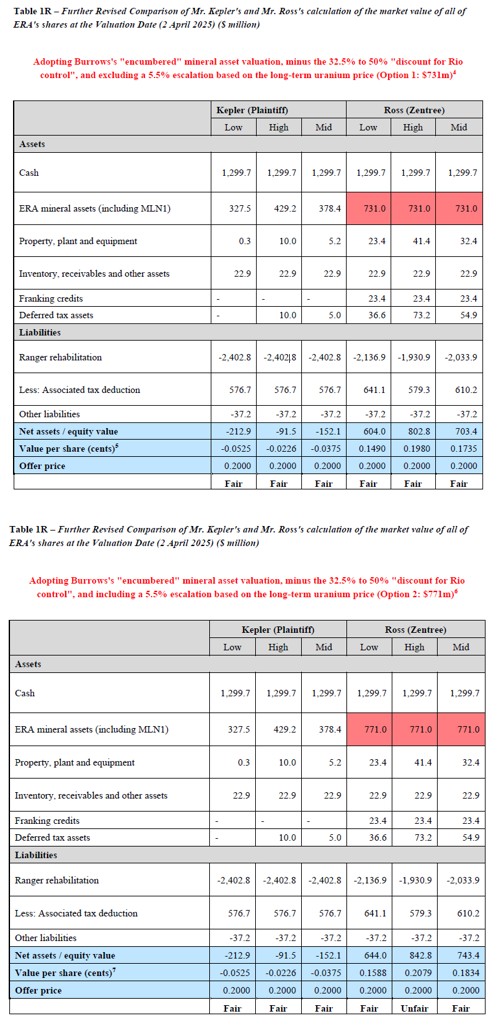
410 North identifies a third difficulty with Dr Burrows’ market capitalisation approach to be his use of a control premium. According to Mr Kepler, in calculating market capitalisation of ERA of $478 million, Dr Burrows applied a control premium of 32.5%. This increased the value of the mineral assets by approximately $124 million.
411 In their joint report Dr Burrows and Mr Kepler agreed that the “control premium” applied by Dr Burrows to ERA’s market capitalisation “is not a conventional ‘control premium’, but instead is intended to represent an unwinding of what Dr Burrows contends is the discount that has been applied by public investors to reflect the majority interest and control of Rio Tinto”.
412 Dr Burrows explained that he considered it to be correct to add a premium to ERA shares to reflect the elimination of a discount arising from ERA’s control and that it is likely that shareholders would have valued ERA much more highly if it had not been controlled by Rio Tinto. Dr Burrows believed that “the application of a conventional 32.5% control premium to the value of ERA shares is extremely conservative”, being an amount less than 10% of investors’ valuation of the mineral assets as depressed by Rio Tinto’s control and that “[o]ne could reasonably argue that Rio Tinto’s ownership was depressing the value of [the mineral assets] by 50%-75%, or more, given Rio Tinto’s opposition to developing the assets”.
413 In his supplementary report, served during the course of the hearing, Dr Burrows addressed this issue again opining at [10] of that report:
My analysis assumes that investors apply a discount to their estimate of the encumbered value of the mineral assets due to Rio Tinto’s control and its stated refusal to develop those assets. Of course, as a result of the encumbrances, Rio Tinto would not have been able to start developing the Mineral Assets until the encumbrances were removed. But shareholders would reasonably be concerned that Rio Tinto would not aggressively pursue all possible avenues to resolve the encumbrances. Under this assumption, the observed encumbered value represents only a fraction of the underlying encumbered value absent Rio Tinto’s control. …
414 Based on these assumptions and using a “Revised Ratio” (defined therein), Dr Burrows grossed up the “encumbered value” of $731 million or $771 million produced by his market capitalisation approach by adopting a 32.5% to 50% discount for Rio Tinto’s control and calculating a final range of $1,142 million to $1,542 million, with a midpoint of $1,285 million.
415 Dr Burrows was cross-examined about the midpoint discount of 40% applied for Rio Tinto’s control in his supplementary report. This included the following evidence given in answer to questioning from senior counsel for North, Mr Thomas SC:
Mr Thomas SC: Can I suggest to you, and – as I will suggest to her Honour – that the analysis you’ve adopted in paragraphs 10 to 12 is inherently speculative. Do you agree with that or disagree with that?
…
Dr Burrows: It’s my judgment based on the evidence I’ve seen.
Mr Thomas SC: Yes, but it’s speculating as to the ability of a purchaser of shares in Rio as to the steps they might aggressively pursue to develop ERA’s mineral assets, correct?
Dr Burrows: No, I’m not making any assumptions about that.
Mr Thomas SC: So you’re not assisting her Honour in identifying the assumptions that you have made that would allow the court to determine the likelihood that aggressive pursuit of development would ultimately be successful?
Dr Burrows: I’m simply representing what investors’ reasonable opinions might be, based on what the investors themselves have said, based on the fact that Rio, much earlier than ERA, decided not to report resources any more, and that Rio had already – had said that they had no interest in developing the asset.
Mr Thomas SC: So your analysis – if I could just understand this – your analysis of discount would be the same irrespective of whether the aggressive pursuit of development by a new owner of ERA would be successful.
Dr Burrows: Again, I’m making a statement of what investors might have thought. I haven’t done an analysis of what steps would lead to any kind of good resolution.
Mr Thomas SC: You accept, don’t you, that the likelihood of an asset being able to be developed is a relevant matter that investors would have regard to in determining 10 the share price – or the share price they’re willing to pay for ERA shares, correct?
Dr Burrows: Well, investors clearly thought that was a possibility, or they wouldn’t have been paying anything for ERA shares, because ERA would have been worth zero if it didn’t – if the mineral assets had no value.
416 Zentree submits that Dr Burrows’ evidence on the value to be attributed to the mineral assets, based on a 40% reduction owing to Rio Tinto’s control utilising the market capitalisation approach, ought to be accepted. It contends that Mr Kepler did not, and it must be inferred cannot, give a more accurate value for this discount for Rio Tinto’s control, given his lack of expertise in uranium pricing, as he accepted. Zentree submits that Dr Burrows’ evidence seeks to establish the value that can be attributed to the mineral assets that was, in the real world, applied based on the evidence of investor behaviour, which is to be preferred over North’s theoretical criticisms of his approach.
417 As North submits, for the following reasons I do not accept Dr Burrows’ analysis set out in his supplementary report and his application of a 40% discount for Rio Tinto’s control.
418 First, Dr Burrows’ assumptions underpinning his analysis (set out at [10] of his supplementary report) are not supported by the evidence. Thus, no foundation for his analysis is established. Relevantly:
(1) ERA had an IBC which was responsible for all decisions where Rio Tinto could have a conflict of interest;
(2) despite Rio Tinto’s stated position that it would respect the wishes of the Traditional Owners, the IBC had caused ERA to apply to renew MLN1 as announced in its release to the ASX on 20 March 2024; and
(3) upon rejection of the renewal application, ERA applied to this Court for review of the decision not to renew MLN1.
419 Dr Burrows was unable to identify what additional steps ERA could have taken to “aggressively pursue” the development of MLN1. He did not know how ERA could resolve the encumbrances or what steps a new owner of ERA could take to pursue development of the mineral assets. Nor was Dr Burrows able to opine on the pathways towards development of the mineral assets from a legal, social, political or environmental perspective.
420 Dr Burrows also explained in his supplementary report (at [17]) that he chose a discount of 40% as his midpoint for Rio Tinto’s control because he considered that shareholders would apply a significantly larger discount to reflect “the value depressing effects of” that control. Similarly, there was no evidence to support that assertion. When asked about his opinion as to the “depressing effect” of Rio Tinto’s control Dr Burrows said that “it pertains to investors’ perception” and that he had not “made a determination of what that likelihood is, other than looking at [what] investors see [which is] a company that’s being run by a party that has no interest in developing the asset and what kind of discount might they apply”.
421 Curiously, as North points out, the assumptions which underpin Dr Burrows’ analysis are contrary to the case theory advanced by Zentree in its cross-examination of Ms Chandler to the effect that steps were being taken to advance development of the mineral assets. I accept North’s submission that a shareholder would have concluded at the relevant time that Rio Tinto’s control was not constraining ERA’s actions and, it follows, that there is no basis for the application of the reduction based on Rio Tinto’s control.
422 Dr Burrows’ selection of the quantum of the discount to be applied for Rio Tinto’s control also appears to be arbitrary and not based on any evidence or theory. In his supplementary report Dr Burrows explains that he chose a discount of 32.5% for his low estimate because “this discount is in the range of what is commonly used for control premia”, he chose a discount of 40% for his midpoint (or referred) estimate because in his judgement “shareholders would apply a significantly larger discount to reflect the value depressing effects of [Rio Tinto’s] control” and he chose a discount of 50% for his high estimate to be consistent with the approach he took at [8(a)(iv)(2)(c)] of his joint report with Mr Kepler.
423 Dr Burrows does not rely on any texts or academic or industry commentary to support his analysis. Indeed, he said in the joint report with Mr Kepler that the “control premium” that he applied is “not conventional”.
424 The next difficulty identified by North is double counting. North says that this arises because the market capitalisation approach is intended to derive a residual value for the mineral assets and to achieve this the value of all of ERA’s assets, other than the mineral assets, must be deducted from the value of ERA’s equity in order to obtain a value. North explains that if this does not occur, the value of those assets will be double counted when Mr Ross re-constructs the equity value of ERA using the “sum of the parts” approach. North submits that this is precisely what has occurred with Mr Ross attributing material value to PPE, franking credits and rehabilitation cost savings, and adding that value to the mineral asset value calculated by Dr Burrows.
425 North submits that if, as Mr Ross contends, these other assets do have value then, to the extent that Dr Burrows has not accounted for them, or accounted for them by way of a lower valuation in his residual analysis, they need to be removed from the residual value calculation of the mineral assets to obtain an accurate assessment of their value. If, as Mr Kepler contends, the other assets do not have value then they should be removed from Mr Ross’ calculation. North contends that, either way, this value needs to be subtracted from the total calculated by Mr Ross to avoid double counting.
426 In their joint report Messrs Kepler and Ross accepted the risk of double counting in the market capitalisation approach in certain circumstances.
427 North submits that, to the extent that Zentree seeks to meet the issue by suggesting that Dr Burrows’ analysis was confined to public information, while Mr Ross’ further adjustments are solely or partly based on private information, it is wrong. That is borne out by the example of PPE where the following is apparent:
(1) Mr Ross gave the following evidence about the information on which he based his views upon in relation to PPE:
When I started, the only information I had was public information, and I made an estimate of value based on that and at the same time said I need access to further information which I did not have. Through the course of the rest of the process, first through Mr Kepler’s reply report, he was given access to the information I had requested, which was private information, and then that, therefore, became information I had access to. And so my final opinion is based on private information.
(2) a review of Mr Ross’ first report, which he says was based on public information only, shows that Mr Ross attributed a value of $23.4 million to $41.4 million to PPE; and
(3) in Mr Ross’ supplementary report, which includes his “final opinion”, Mr Ross attributes exactly the same value to PPE as he did in his first report (i.e. $23.4 million to $41.4 million).
428 This example illustrates that Mr Ross could form a view about value without having regard to private information and that he did in fact do so. As North submits, a well-informed market participant could have done the same thing as Mr Ross and factored the value into the share price.
429 The final issue raised by North in relation to the market capitalisation approach concerns the uranium price.
430 Dr Burrows applies a factor of 5.5% to his estimate of the value of the mineral assets as at July 2024 to August 2024 to calculate the value of the mineral assets as at 2 April 2025. He derives the factor of 5.5% by dividing the AUD long-term uranium price as at 31 March 2025 by the average of the AUD long-term prices as at 31 July 2024 and 31 August 2024. North submits, based on Mr Kepler’s evidence, that any adjustment should have been made by reference to the change in uranium’s spot price because there is a higher correlation between the ERA share price and uranium spot prices, than between the ERA share price and the long-term uranium price. Applying Dr Burrows’ data, this would necessitate a downwards adjustment of 16% as opposed to an upwards adjustment of 5.5%.
431 Zentree submits that, as Mr Kepler conceded, he is not an expert in valuing uranium and given Dr Burrows’ long term experience in valuing uranium mines and the evident logic of his approach, I would prefer Dr Burrows’ evidence on this issue and not give any weight to North’s criticisms.
432 Even accepting Dr Burrows’ experience in valuing uranium mines, I am not satisfied that use of the long-term price was apt in this case. Dr Burrows’ rationale for doing so was because most uranium producers would sell their product through long-term contracts, not on the spot market. That may be so. But as North points out, as at April 2025 ERA was not selling uranium so the real question to consider is what a purchaser would expect the long-term uranium price to be by the time ERA started production, assuming all of the encumbrances could be removed. In responding to that question, the spot price is a better measure of the market. In his joint report with Mr Kepler, in addressing this issue, Mr Burrows said, among other things, that in his “analysis of the liquidity and efficiency of ERA shares… the ERA price in 2024 up to August 23 was affected by the uranium spot price” and that “[a]s the term price was fairly flat in the March-August period, it would have been reasonable for public investors to use fluctuations in the spot price as a leading indicator of term prices, as spot prices and term prices converge over the long run”.
433 It follows that as at April 2025 the market’s view of the long-term pricing that ERA might achieve in the future was in the order of that suggested by the spot price at the time.
434 In any event, perhaps this debate does not matter. That is because if, as I have accepted, the premium for control is excluded, Dr Burrows’ proposed uplift of 5.5% (to account for changes in the uranium price) to his market capitalisation value of $731 million results in an amount of $771 million. That is less than the amount identified by Messrs Kepler and Ross of $810.79 million as being the highest value that can be attributed to the mineral assets for the offer price in the Notice to be fair.
5.5.2 DCF method
435 As set out above, the DCF method has been used by Dr Burrows as a cross-check as part of the overall exercise of calculating the value of the mineral assets. Messrs Kepler and Ross agreed that a DCF method may be a valid method to value the mineral assets provided there is sufficient information available to allow a valuer to prepare cash flow forecasts for those assets.
436 Zentree submits that the Court should accept its DCF analysis as a cogent and reliable cross-check of the market capitalisation approach. On the other hand, North submits that the Court should disregard Dr Burrows’ DCF analysis entirely because, among other things, it was only ever intended as a cross-check. Relatedly, North submits that the DCF method is not a reliable cross-check and no weight should be placed on it because it relies on Mr Rossi’s “Functional Reserves” estimations and mine schedules which are based on outdated and incomplete data.
437 Before I turn to consider the utility of Dr Burrow’s DCF analysis, it is necessary to re-visit Mr Rossi’s evidence and the method he adopted, set out at [206]-[212] above. That is because Dr Burrows relied on inputs calculated by Mr Rossi in undertaking his DCF analysis (and in his comparables method).
438 Having regard to the nature of Mr Rossi’s analysis and for the reasons that follow, I accept that his estimation exercise is, as North submits, unhelpful and artificial.
439 First, by question 1 of his instructions, Mr Rossi understood that he was asked to analyse whether “Resources and Reserves” within the meaning of the JORC Code could be publicly reported by ERA as at the Valuation Date. In cross-examination Mr Rossi conceded that the answer to that question was “no”. Notwithstanding that, on the basis of oral instructions given to him by Zentree’s legal team, Mr Rossi assessed whether ERA could have reported “Functional Reserves” in an “unencumbered world”. Mr Rossi explained that the term “Functional Reserves” is a term he made up to indicate reserves were not reportable under the JORC Code. In his report, Mr Rossi described “Functional Reserves” to be “at an accuracy range and confidence level such that they would be considered Reserves by third parties”.
440 The relevance of the JORC Code (presently the 2012 edition) should not be understated. It has been adopted by AusIMM and the Australian Institute of Geoscientists, endorsed by the Mineral Council of Australia and FINSIA as a contribution to good practice, and has been adopted by, and included in, the ASX Listing Rules. For example, Listing Rule 5.6 under the sub-heading “[r]equirements applicable to all public reporting” says:
Subject to rule 5.10, a public report prepared by an entity must be prepared in accordance with rules 5.7 to 5.24 if applicable and Appendix 5A (JORC Code) if applicable if the report includes a statement relating to any of the following.
* Exploration targets.
* Exploration results.
* Mineral resources or ore reserves.
441 There is no dispute between the parties that, as members of AusIMM, both Messrs McKibben and Rossi are bound by the JORC Code.
442 Similarly, the VALMIN Code (presently the 2015 edition) serves as a companion code to the JORC Code. Its purpose is to provide “a set of fundamental principles (Competence, Materiality and Transparency), mandatory requirements and supporting recommendations accepted as representing good professional practice to assist in the preparation of relevant Public Reports on any Technical Assessment or Valuation of Mineral Assets”. Like the JORC Code, AusIMM members are required to adhere to the VALMIN Code when preparing a “Public Report”, which includes “Technical Assessment Reports” (as defined in the VALMIN Code). Mr Rossi accepted that his report was a Technical Assessment Report.
443 Hence, while not strictly binding, I accept that both the JORC and VALMIN Codes provide highly relevant guidance for the valuation question before me.
444 The JORC Code requires that in order to recognise a “Mineral Resource” it must be concluded to have RPEEE. The rationale for this requirement is clear. That is, the quantum of mineral reserves physically located in the ground is of no consequence if there are no reasonable prospects that it can be extracted. Indeed, in cross-examination Mr Rossi explained that the JORC Code imposes the requirement of RPEEE in order to recognise a Mineral Resource “because the resource is supposed to have some value, and you cannot realise that value if you cannot extract it”.
445 Thus, while Mr Rossi was asked to “analyse whether Resources and Reserves within the meaning of the JORC Code could be publicly reported by ERA as at the Valuation Date” (emphasis added), he in fact assessed whether ERA could have reported “Functional Reserves” in the unencumbered world. As I have already determined at [257] above, any valuation of the mineral assets must be determined in light of any legal, social and political encumbrances.
446 Secondly, the JORC Code requires that in considering whether there is RPEEE, an entity must consider the modifying factors under the JORC Code. They include mining, processing, metallurgical, infrastructure, economic, marketing, legal, environmental, social and governmental factors. In assessing the “Functional Reserves”, Mr Rossi did not have regard to four of those factors, namely legal, environmental, social, and governmental factors.
447 Thirdly, Mr Rossi accepted that the JORC code requires that for an Ore Reserve (which is the economically mineable part of a Measured and/or Indicated Mineral Resource) to be recognised, there must be a study at pre-feasibility or feasibility level, as appropriate, including the application of the modifying factors.
448 Fourthly, Mr Rossi accepted that, as the JORC Code sets out at [39], a scoping study could not be used as the basis for estimation of Ore Reserves and that the 2007 Order of Magnitude Study on which he had relied is a scoping study for the purposes of the JORC Code.
449 Finally, cl 10 of the VALMIN Code headed “[r]isks and opportunities” requires that a “Public Report” (which the LEA and SRK Reports are) “should include an evaluation of the risks likely to apply to the [mineral assets] under consideration” and that a “risk evaluation includes an analysis of the uncertainties inherent in the assumptions made and the effects they may have on the outcome.” There follows a list of potential risks including
(d) operational aspects including the mining/extraction method, dilution and mining losses, equipment sizing and efficiencies, use of selective mining assumptions, waste management, meeting regulatory requirements and mine closure,
…
(j) sovereign risk involving social, political, environmental, cultural and security factors that cannot be controlled by project operators
450 Mr Rossi accepted in cross-examination that Traditional Owner opposition would fall within category (j) above and his report did not include an evaluation of the non-technical risks likely to apply to the mineral assets.
451 Added to the matters set out above, as I have already observed, Mr Rossi’s “Functional Reserves” and his resources estimates are contrary to the position agreed by Messrs Kepler and Ross that ERA’s assets are to be valued on the basis of their “highest and best use”, which directs attention to uses that are legally permissible. Mr Rossi’s estimation was undertaken on an unencumbered basis without any regard to legal, social, political and governmental issues which affect the ability to develop the mineral assets. That factor alone provides a basis on which Mr Rossi’s evidence can be put to one side and not considered further.
452 Given my conclusions about Mr Rossi’s analysis, I do not intend to consider his report or Zentree’s remaining submissions about Mr Rossi’s evidence any further.
453 I turn to consider the utility of Dr Burrows’ DCF method. On balance, for the following reasons, I consider it to be of little to no utility.
454 First, by application of the DCF method, Dr Burrows only derived an unencumbered value. As Dr Burrows explains by way of summary in response to question 2 at [26] of his report:
. . my estimates of unencumbered values of ERA Mineral Assets assume that the Renewal Decision is reversed and ERA has its lease on MLN1 restored for an additional lease period and any needed renewal years after that, and that the consent of the Mirarr people is obtained for the development of Jabiluka II; alternatively, if the Renewal Decision is not reversed, I assume that ERA is able to apply and succeed in obtaining a new mining lease concerning Jabiluka II. With respect to [R3D], my estimates of unencumbered values assume that ERA is able to extend the duration of the authority extended to ERA under the Atomic Energy Act 1953 and to permit mining at [R3D] and that ERA complies with conditions and any requirements concerning the rehabilitation of [R3D]. …
455 Dr Burrows’ provided his valuation of the mineral assets based on the DCF method on a basis that is inconsistent with the agreed approach of Messrs Kepler and Ross that ERA’s assets are to be valued having regard to their “highest and best use”, which requires regard to be had to any impediment to development.
456 Secondly, Mr Ross did not select the value arrived at by the DCF method for his valuation of the mineral assets, relying on it as a cross-check only.
457 These two matters alone are sufficient for me to put Dr Burrows’ valuations based on his DCF method aside.
458 There is also the impact on Dr Burrows’ valuations based on his DCF method of the inputs provided by Mr Rossi, in particular mine schedules in circumstances where I have concluded that Mr Rossi’s evidence is unreliable. However, given the conclusion I have reached in the preceding paragraph, I do not need to consider that matter further save to note Dr Burrows accepted that if the Court concluded that the mining schedules were unreliable, that would impact the reliability of his DCF analysis.
5.6 Other shareholder objections
459 Between 25 June 2025 and 14 July 2025 North received notices of grounds of objection from 28 shareholders, in addition to the notice of grounds of objection received from Zentree. The eight additional parties joined as defendants to the proceeding, but who took no active steps are included in the group of 28 shareholders who provided notices of grounds of objection. Annexure B to these reasons sets out the names of each of the 28 objecting shareholders and the date of their respective notice of objection.
460 North has prepared a schedule which sets out a summary of each category of objection, the shareholders who raised that category of objection and North’s response to it. As North submits, these objections can be classified and addressed in five categories.
461 The first category concerns the question of whether the Notice gives “fair value”. The objections broadly concern the adequacy of the consideration offered in the Notice, market trends, control premium and encumbrances in valuing ERA and the independence and qualifications of North’s experts. As set out above I have formed the view that the Notice does give “fair value”. My reasons for reaching that conclusion are set out in detail above. As for the independence of North’s experts, there is no evidence to support that objection and no basis on which I would conclude the LEA and SRK are not independent. Indeed, as noted at [94] above, LEA was one of three independent experts nominated by ASIC.
462 The second category of objection alleges abuse by North of its position as a dominant shareholder to erode shareholder value and that it prioritises Rio Tinto’s interests over those of minority shareholders. The question before the Court on this application is whether the terms of the Notice give “fair value”. The issue raised by this category of objection does not arise and is not relevant to that assessment. In any event, the allegation is not supported by any evidence and, as North submits, is inconsistent with the governance arrangements established by ERA, including establishing the IBC.
463 The third category of objection concerns loss and harm which shareholders allege will accrue to them if the Court approves the Compulsory Acquisition. Once again, this issue does not arise in the context of this application. It is not the Court’s role on an application under s 664F of the Corporations Act to embark on a general enquiry as to fairness: see Teh at [7], [9].
464 The fourth category of objection concerns questions of procedural fairness to the effect that North did not engage in negotiation or discussion with shareholders outside of Court processes, insufficient opportunity was given to shareholders to access information that would allow a proper assessment of valuation and information should have been provided in hard copy, rather than electronically. North was not required to engage in individual or any negotiations with shareholders. It followed the procedures set out in Pt 6A.2 of the Corporations Act. Further, North provided the information which it is required to provide and did so based on the stated communication preferences of shareholders recorded in ERA’s share register.
465 The final category of objection covers a range of miscellaneous objections which do not fall into any of the categories already addressed. They include allegations against ERA of insolvent trading, mismanagement, failure to maximise value, concerns about the impact of the Compulsory Acquisition on public confidence, concerns about reliance on ERA guidance as to the long-term value of its shares and an allegation by one shareholder that it did not receive the shares it purchased. None of these allegations is substantiated by any evidence. But, in any event, the questions they raise do not arise for consideration on this application.
466 The objections raised by these shareholders do not cause me to change the view I have reached, based on the evidence before me, that the Notice gives a fair value for ERA’s shares.
6. Conclusion
467 For those reasons I will make a declaration that the terms set out in the Notice give a fair value, for the purposes of s 664F(3) and s 667C of the Corporations Act, for the shares the subject of the Notice and an order pursuant to s 664F of the Corporations Act approving North’s acquisition of the remaining shares in ERA on the terms set out in the Notice.
468 The terms of s 664F(4) of the Corporations Act ordinarily require North to pay its own costs and the costs that “a person incurs on legal proceedings in relation to the application” under s 664F save in certain circumstances (see [13] above). North has expressly reserved its position on costs. Accordingly, I will make orders for North to file any submissions, not exceeding five pages in length, and affidavits on which it intends to rely on the question of costs of the proceeding within 14 days of the publication of these reasons and, if filed, for Zentree to file its submissions, not exceeding five pages in length, and any affidavits on which it intends to rely within 14 days thereafter. Unless a party requests an oral hearing, any question that arises in relation to costs of the proceeding will be determined on the papers.
469 I will make orders accordingly.
I certify that the preceding four hundred and sixty-nine (469) numbered paragraphs are a true copy of the Reasons for Judgment of the Honourable Justice Markovic. |
Associate:
Dated: 5 June 2026
ANNEXURE A – DEFINITIONS
Term | Definition |
AASB 13 | Australian Accounting Standard – Fair Value Measurement |
AASB 137 | Australian Accounting Standard – Provisions |
ASIC | Australian Securities and Investments Commission |
ASX | Australian Securities Exchange |
Atomic Energy Act | Atomic Energy Act 1953 (Cth) |
Audit Statements | The KPMG Report to the Audit Committee and Independent Audit Report |
AusIMM | Australasian Institute of Mining and Metallurgy |
Bechtel | Bechtel (Western Australia) Pty Ltd ACN 147 531 226 |
BoE | Basis of Estimate document dated 24 October 2023 |
CAANZ | Chartered Accountants Australia and New Zealand |
CEO | Chief Executive Officer |
comparables method | A valuation method used by Dr Burrows as a cross-check, which is based on the market method using values of comparable assets |
Compulsory Acquisition | North’s compulsory acquisition of the remaining ERA shares under Pt 6A.2 of the Corporations Act for 0.02 cents per share |
Cooper Creek JV | Cooper Creek Joint Venture comprising ELA23311 and ELA23312 |
Corporations Act | Corporations Act 2001 (Cth) |
CRA | Charles River Associates |
CV | Curriculum vitae |
DCF | Discounted cash flow |
Engagement Plans | Appendix 3 of Schedule 7 to the MSA titled “strategic issue engagement plans” – renewal MLN1 lease |
Environmental Requirements | Appendix A to the schedule to the s 41 Authority titled “Environmental Requirements of the Commonwealth of Australia for the Operation of the Ranger Uranium Mine” |
ERA | Energy Resources of Australia Limited ACN 008 558 865 |
FINSIA | Financial Services Institute of Australasia |
FR | Feasibility reforecast |
Functional Reserves | A term created by Mr Rossi for reserves that are not reportable under the JORC Code |
GAC | Gundjeihmi Aboriginal Corporation |
Grant Thornton | Grant Thornton Corporate Finance Pty Ltd ACN 003 265 987 |
Grant Thornton Report | Report prepared by Grant Thornton dated 26 September 2022 which was released to the ASX on even date |
HKA | HKA Global Pty Ltd ACN 085 532 047 |
IBC | Independent board committee |
IER | Independent expert report |
Independent Audit Report | KPMG audit statement included in ERA’s Annual Report 2024 |
IPMT | Integrated Project Management Team |
ISR | Independent specialist report |
IVS | International Valuation Standards |
Jabiluka or Jabiluka Project Area | The area containing the Jabiluka I and II uranium deposits which is subject to MLN1 |
Jabiluka I | One of two uranium deposits within MLN1 and discovered in 1971 by Pancontinental |
Jabiluka II | One of two uranium deposits within MLN1 and discovered in 1973 by Pancontinental |
Jabiluka deposit | Jabiluka II deposit |
JORC Code | Joint Ore Reserve Committee of the Australasian Institute of Mining and Metallurgy (2012 edition) |
KPMG | ERA’s external auditor |
KPMG Report to the Audit Committee | The KPMG report to the ERA board for the year ended 31 December 2024 dated 25 March 2025 |
LEA | Lonergan Edwards & Associates Limited ACN 095 445 560 |
LEA Report | IER of LEA dated 2 April 2025 |
Listing Rules | ASX Listing Rules |
LTCMA | Long Term Care and Maintenance Agreement between the Traditional Owners, the NLC and ERA entered into around February 2005 |
market capitalisation approach | A valuation method used by Dr Burrows as his primary methodology which is based on ERA’s public market capitalisation |
Mineral Resources | Has the same meaning as defined in the JORC Code |
Mineral Titles Act | Mineral Titles Act 2010 (Cth) |
Mlb | Million pounds |
MLN1 | Mining Lease Northern 1 on which the Jabiluka I and Jabiluka II deposits are located |
MSA | Management Services Agreement dated 3 April 2024 between ERA and Rio Tinto Closure |
NLC | Northern Land Council |
North | North Limited ACN 005 233 689 |
Notice | Compulsory acquisition notice issued by North to ERA’s shareholders dated 11 April 2025 |
NQMS | National Land Quality Mark Scheme |
NT | Northern Territory |
NT Minister for Mining | Minister for Mining and Minister for Agribusiness and Fisheries in the NT |
Ore Reserve | Has the same meaning as defined in the JORC Code |
Pancontinental | Pancontinental Energy NL ACN 003 029 543 |
Peko-Wallsend | Peko-Wallsend Pty Ltd ACN 000 245 054 |
PPE | Property, plant and equipment |
PPE Register | ERA fixed assists register as at 31 December 2024 |
PwC | PricewaterhouseCoopers |
R3D | Ranger 3 Deeps uranium deposit located within the Ranger Project Area |
Ranger or Ranger Project Area | The 79 km2 Ranger mine project area located 8 km east of Jabiru and 260 km east of Darwin in the NT |
Rehabilitation Provision | The expected future costs of the Ranger Project Area rehabilitation as at 28 February 2025 of $2,403 million |
Renewal Decision | Decision by the NT Minister for Mining to refuse renewal of MLN1 on 26 July 2024 |
Reserves | Has the same meaning as defined in the JORC Code |
Resources | Has the same meaning as defined in the JORC Code |
RG 111 | ASIC Regulatory Guide 111 – Content of expert reports |
Rio Tinto | Rio Tinto Limited ACN 004 458 404 |
Rio Tinto Closure | Rio Tinto Closure Pty Limited ACN 004 489 203 |
Rio Tinto Review | The observations and recommendations by the Rio Tinto review team following its review of the rehabilitation of the Ranger Project Area as outlined in a memorandum dated 1 November 2023 |
RPEEE | Reasonable prospects for eventual economic extraction |
s 41 Authority | Authority under s 41 of the Atomic Energy Act |
s 41CA Authority | Rehabilitation authority under s 41CA of the Atomic Energy Act |
Section 43 Agreement | Agreement under s 43 of the Aboriginal Land Rights (Northern Territory) Act 1976 (Cth) |
SRK | SRK Consulting (Australasia) Pty Ltd ACN 074 271 720 |
SRK Report | IER of SRK dated 2 April 2025 |
SRK SA | SRK Consulting (South Africa) (Pty) Ltd |
SoBRA | Society of Brownfield Risk Assessment |
Technical Assessment Report | As defined in the VALMIN Code |
Traditional Owners | The traditional Indigenous owners of Jabiluka, the Mirarr people |
Tranche 1A | The first phase of the phased program management approach which has been adopted for the Ranger Project Area rehabilitation works |
U3O8 | Uranium oxide |
USA | United States of America |
VALMIN Code | Australasian Code for Public Reporting of Technical Assessments and Valuations of Mineral Assets (2015 edition) |
Valuation Date | 2 April 2025, being the date in which the LEA Report was issued. |
Zentree | Zentree Investments Limited ACN 681 690 095 |
2022 Grant Thornton Valuation | The IER prepared by Grant Thornton dated 26 September 2022 |
2022 SRK Report | The IER prepared by SRK in September 2022 on behalf of Grant Thornton and which is included as an appendix to the 2022 Grant Thornton Valuations |
2023 Interim Entitlement Offer | The proposed non-underwritten, renouncement offer announced by ERA to the market on 24 June 2022 which aimed to raise approximately $300 million |
2024 Entitlement Offer | ERA’s 19.87-for-1 non-underwritten pro-rata renounceable entitlement offer to raise up to approximately $880 million at an offer price of $0.002 per share, announced on 29 August 2024 |
2024 MCP | 2024 Mine Closure Plan |
ANNEXURE B - LIST OF OBJECTING SHAREHOLDERS (EXCLUDING ZENTREE)
# | Name(s) of objecting shareholders | Date of objection |
1. | Tian Ran Lin and Miao Ling Wang | 24 June 2025 |
2. | Edward Gosek and Jeanette Gosek | 25 June 2025 |
3. | Jit Sai (Mark) Lim and May Kee Wong | 26 June 2025 |
4. | Carl Reginald Stone | 26 June 2025 |
5. | Yvonne Wong-Huynh | 27 June 2025 |
6. | Philip Robert (Phil) O'Donaghoe | 27 June 2025 |
7. | Tew Hua Cameron | 28 June 2025 |
8. | Jennifer Clare Brunacci | 29 June 2025 |
9. | William Ewart (Hughie) Granter | 30 June 2025 |
10. | Martin Seager | 1 July 2025 |
11. | Lorraine Matthews | 2 July 2025 |
12. | Lixin Shao and Hong Wang | 3 July 2025 |
13. | Lixin Shao | 3 July 2025 |
14. | Robert James McCormick | 4 July 2025 |
15. | Christopher Peter Thomas Kelly | 5 July 2025 |
16. | Leigh Douglas Bannister | 6 July 2025 |
17. | Joseph Nappa | 7 July 2025 |
18. | Robert John Charles Catto | 8 July 2025 |
19. | Simon Hempsell | 8 July 2025 |
20. | Mina Tawfik | 8 July 2025 |
21. | Olivier Valery Edmond Nyst | 8 July 2025 |
22. | Craig Andrew George and Marie Anne George | 9 July 2025 |
23. | Teak Projects Pty Limited (David Whitting) | 9 July 2025 |
24. | Kauaterangi Pouramua Tuhura | 9 July 2025 |
25. | Anna Louise Coxon and Teague Damian Czislowski as trustees for the Czisloxon Superannuation Fund | 9 July 2025 |
26. | Milly Elkington | 9 July 2025 |
27. | Justin Matic | 10 July 2025 |
28. | Pinaki Holdings Pty Ltd as trustee for the eLogicDecision Superannuation Fund (Pinaku R Basu) | 10 July 2025 |
SCHEDULE OF PARTIES
NSD 787 of 2025 | |
Defendants | |
Third Defendant: | MAY KEE WONG |
Fourth Defendant: | CARL REGINALD STONE |
Fifth Defendant: | WILLIAM EWART GRANTER |
Sixth Defendant: | MR MARTIN STUART SEAGER |
Seventh Defendant: | LIXIN SHAO |
Eighth Defendant: | HONG WANG |
Ninth Defendant: | OLIVIER VALERY EDMOND NYST |


