

FEDERAL COURT OF AUSTRALIA
Top Energy Holdings Pty Ltd v Liu [2026] FCA 689
File number(s): | NSD 1165 of 2020 NSD 999 of 2021 |
Judgment of: | GOODMAN J |
Date of judgment: | 4 June 2026 |
Catchwords: | CONTRACTS – whether Business Sale Agreement and Loan Agreement between entities on one side of a joint venture were executed prior to entry into the joint venture, or created after the breakdown of the joint venture – held that each Agreement was created after the joint venture broke down and cannot be relied upon MISLEADING OR DECEPTIVE CONDUCT – whether one side of the joint venture engaged in misleading or deceptive conduct in contravention of s 18 of the Australian Consumer Law by failing to disclose another Loan Agreement – held no misleading or deceptive conduct because of an absence of reasonable expectation of disclosure – held no loss in any event because the non-disclosure was not causative of entry into the joint venture EVIDENCE – evaluation of evidence – primary reliance upon contemporaneous documents – inferences to be drawn from a failure to adduce evidence from signatories to an agreement when the date of execution of the agreement is a central issue |
Legislation: | Competition and Consumer Act 2010 (Cth), Schedule 2, ss 18, 236 Corporations Act 2001 (Cth), ss 180, 181, 182 Evidence Act 1995 (Cth), s 140 |
Cases cited: | Addenbrooke Pty Ltd (ACN 055 973 576) v Duncan (No 2) [2017] FCAFC 76; (2017) 348 ALR 1 Bathurst Regional Council v Local Government Financial Services Pty Ltd (No 5) [2012] FCA 1200 Blatch v Archer (1774) 1 Cowp 63; 98 ER 969 Briginshaw v Briginshaw [1938] HCA 34; (1938) 60 CLR 336 Brown v New South Wales Trustee and Guardian [2012] NSWCA 431 CCL Secure Pty Ltd v Berry [2019] FCAFC 81 Commercial Union Assurance Company of Australia Ltd v Ferrcom Pty Ltd (1991) 22 NSWLR 389 Communications, Electrical, Electronic, Energy, Information, Postal, Plumbing and Allied Services Union of Australia v Australian Competition and Consumer Commission [2007] FCAFC 132; (2007) 162 FCR 466 Effem Foods Pty Ltd (t/as Uncle Ben’s of Australia) v Lake Cumbeline Pty Ltd [1999] HCA 15; (1999) 161 ALR 599 Elanor Funds Management Ltd (ACN 125 903 031) v Alceon Group Pty Ltd (ACN 122 365 986) [2024] FCAFC 121; (2024) 424 ALR 601 Fox v Percy [2003] HCA 22; (2003) 197 ALR 201 Gestmin SGPS SA v Credit Suisse (UK) Ltd [2013] EWHC 3560 Hassan v Minister for Home Affairs [2025] FCAFC 57; (2025) 309 FCR 44 Innes v AAL Aviation Ltd [2017] FCAFC 202; (2017) 259 FCR 246 Jones v Dunkel [1959] HCA 8; (1959) 101 CLR 298 Julstar Pty Ltd v Hart Trading Pty Ltd [2014] FCAFC 151 Kuhl v Zurich Financial Services Australia Ltd [2011] HCA 11; (2011) 243 CLR 361 Les & Zelda Investments Pty Ltd (as trustee for Les & Zelda Family Trust) v Whitehaven Coal Limited (No 4) [2026] NSWSC 107 Ling v Pang [2023] NSWCA 112 Manly Council v Byrne [2004] NSWCA 123 Martin v Norton Rose Fulbright Australia [2021] FCAFC 216; (2021) 395 ALR 413 Neat Holdings Pty Ltd v Karajan Holdings Pty Ltd [1992] HCA 66; (1992) 110 ALR 449 Quintis Ltd (subject to deed of company arrangement) (ACN 092 200 854) v Certain Underwriters at Lloyd’s London Subscribing to Policy Number B0507N16FA15350 [2021] FCA 19; (2021) 385 ALR 639 Roberts-Smith v Fairfax Media Publications Pty Ltd (Reopening Application) [2025] FCAFC 66; (2025) 310 FCR 141 Self Care IP Holdings Pty Ltd v Allergan Australia Pty Ltd [2023] HCA 8; (2023) 277 CLR 186 Watson v Foxman (1995) 49 NSWLR 315 Weissensteiner v The Queen [1993] HCA 65; (1993) 178 CLR 217 |
Division: | General Division |
Registry: | New South Wales |
National Practice Area: | Commercial and Corporations |
Sub-area: | Commercial Contracts, Banking, Finance and Insurance |
Number of paragraphs: | 302 |
Date of last submission/s: | 2 July 2024 |
Date of hearing: | 19 to 22, 25 and 26 March 2024; 3 and 21 June 2024 |
Counsel for the Applicants: | Mr A Kaufmann |
Solicitor for the Applicants: | Coleman Greig Lawyers |
Counsel for the Respondents: | Mr D G Healey with Ms B Ng |
Solicitor for the Respondents: | H & H Lawyers |
ORDERS
NSD 1165 of 2020 | ||
| ||
BETWEEN: | TOP ENERGY HOLDINGS PTY LTD ACN 627 716 410 Applicant | |
AND: | YING LIU First Respondent ZAN HUANG Second Respondent WIN SOLAR ENERGY PTY LTD Third Respondent | |
AND BETWEEN: | WIN SOLAR ENERGY PTY LTD Cross-Claimant | |
AND: | TOP ENERGY HOLDINGS PTY LTD ACN 627 716 410 Cross-Respondent | |
order made by: | GOODMAN J |
DATE OF ORDER: | 4 June 2026 |
THE COURT ORDERS THAT:
1. Within 21 days of the date of these orders, the parties provide to the Associate to Goodman J agreed orders (or failing agreement, competing orders).
2. If the parties are unable to agree on the proposed orders referred to in order 1, then:
(a) within 28 days of the date of these orders each party file and serve written submissions of no more than five (5) pages in support of the orders sought by that party; and
(b) the proceeding be listed for further case management on a date and time to be agreed between the parties and the Associate to Goodman J.
3. The name Ms Ying Lui be corrected to Ms Ying Liu.
Note: Entry of orders is dealt with in Rule 39.32 of the Federal Court Rules 2011.
ORDERS
NSD 999 of 2021 | ||
BETWEEN: | DE GRANDLAND PTY LTD ACN 615 314 899 Applicant | |
AND: | JOYO HOLDINGS PTY LTD ACN 620 183 011 First Respondent YING LIU Second Respondent ZAN HUANG Third Respondent | |
order made by: | GOODMAN J |
DATE OF ORDER: | 4 JUNE 2026 |
THE COURT ORDERS THAT:
1. Within 21 days of the date of these orders, the parties provide to the Associate to Goodman J agreed orders (or failing agreement, competing orders).
2. If the parties are unable to agree on the proposed orders referred to in order 1, then:
(a) within 28 days of the date of these orders each party file and serve written submissions of no more than five (5) pages in support of the orders sought by that party; and
(b) the proceeding be listed for further case management on a date and time to be agreed between the parties and the Associate to Goodman J.
3. The name Ms Ying Lui be corrected to Ms Ying Liu.
[Note: Entry of orders is dealt with in Rule 39.32 of the Federal Court Rules 2011.
[1] | |
[28] | |
[28] | |
B.2 Onus and standard of proof and the assessment of evidence | [35] |
B.3 The fallibility of human recollection and primary reliance upon contemporaneous documents | [52] |
[72] | |
[72] | |
[74] | |
[74] | |
[74] | |
[79] | |
[80] | |
[86] | |
[87] | |
[91] | |
[103] | |
[106] | |
[107] | |
[108] | |
[150] | |
[154] | |
[184] | |
C.10 Payment of $330,000 from Top Energy to WSE and removal of Wilson as a director of Top Energy | [192] |
[198] | |
C.12 Lodgement of WSE’s May 2019 Business Activity Statement | [199] |
C.13 Commencement of the De Grandland proceeding | [200] |
[201] | |
[208] | |
[209] | |
[248] | |
[249] | |
[267] | |
[268] | |
[274] | |
[280] | |
E.4 Was the impugned conduct misleading or deceptive or likely to mislead or deceive? | [283] |
E.5 If so, did De Grandland suffer loss by reason of such conduct? | [293] |
[300] | |
F. CONCLUSION | [301] |
REASONS FOR JUDGMENT
GOODMAN J:
A. INTRODUCTION AND OVERVIEW
1 These reasons for judgment concern two related proceedings which, for convenience, I will refer to as the Top Energy proceeding and the De Grandland proceeding. In the reasons which follow, and without intending any disrespect, I follow the course adopted by counsel in these proceedings of referring to various natural persons by their first names.
2 The central players are:
(1) De Grandland Pty Ltd, a company in which the directors and members were Mr Ding (Richard) Li and his business partner Ms Guo Yi (Rebecca) Li;
(2) Ms Ying (Amie) Liu;
(3) the following companies associated with Amie:
(a) Win Solar Energy Pty Ltd (WSE);
(b) Joyo Holdings Pty Ltd;
(c) Joyo Pty Ltd;
(d) GL Holdings Australia Pty Ltd;
(e) Top Energy Holdings Pty Ltd;
(4) Amie’s husband, Yufeng (Sam) Sun; and
(5) Mr Zan (Wilson) Huang. Wilson assisted Amie with her companies and was a director of some of those companies from time to time.
3 Joyo Holdings was the trustee of the Blue Butterfly Trust. In that capacity, Joyo Holdings held shares in GL Holdings as trustee for the benefit of Amie, Sam and Amie’s son.
4 WSE had a business of selling solar energy products and accessories (such as solar panels, inverters and racks) (WSE business).
5 From about April 2019, there were discussions between Amie and Wilson on the one hand and Richard and Rebecca on the other. Those discussions concerned a joint venture. It is common ground that as part of that joint venture, several events occurred.
6 First, the WSE business was transferred from WSE to Top Energy. The basis on which that transfer occurred is the subject of controversy and at the heart of the proceedings.
7 Secondly, De Grandland invested $2,000,000 in GL Holdings (which held all of the shares in Top Energy) in return for a majority interest in GL Holdings. To that end, on or about 25 June 2019, De Grandland, Joyo Holdings and GL Holdings entered into a Subscription and Shareholders Deed (SSD).
8 Pursuant to the SSD, De Grandland agreed to pay $2,000,000 to GL Holdings in return for the issue to it of 466 shares in GL Holdings, with the result that De Grandland held 466/666 (approximately 70 per cent) and Joyo Holdings held 200/666 (approximately 30 per cent) of the issued shares in GL Holdings.
9 The SSD provided for a trial period of twelve months, with each of De Grandland and Joyo Holdings having an option – exercisable during the period commencing three months prior to the end of the trial period and ending one month prior to the end of the trial period – to terminate the trial period by giving written notice to the other parties requiring De Grandland to sell its 466 shares to Joyo Holdings or GL Holdings.
10 If such notice were provided by De Grandland, then the price payable by Joyo Holdings or GL Holdings for the 466 shares would be $2,000,000.
11 If such notice were provided by Joyo Holdings, then the price payable would be $2,200,000.
12 Neither De Grandland nor Joyo Holdings exercised their option. The trial period expired. Discussions between Richard and Amie ended with a falling out between them (and their respective companies).
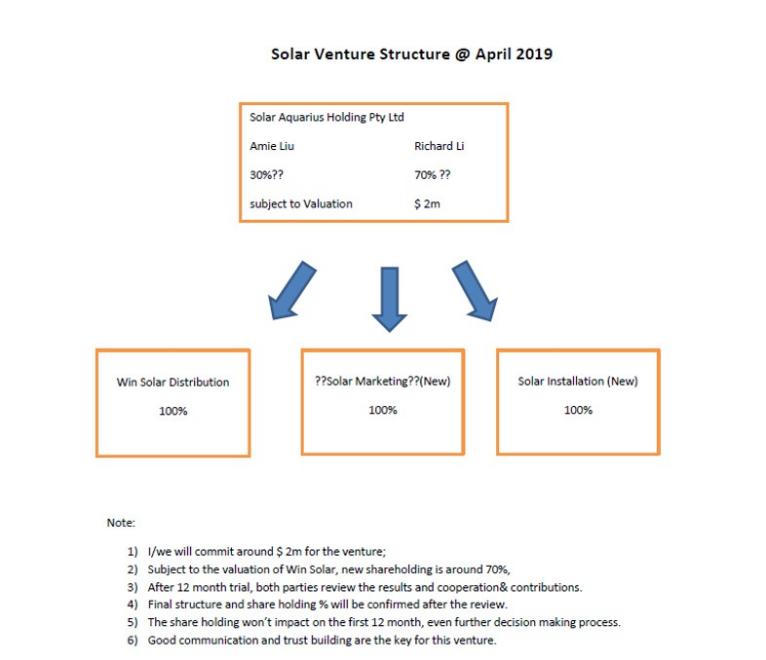
13 During the course of those discussions:
(1) on 30 July 2020 De Grandland, qua member of GL Holdings, called a members’ meeting to be held on 21 August 2020 for the removal of Wilson as a director of GL Holdings;
(2) between 10:00 and 11:00pm on 20 August 2020 (i.e. the night before the scheduled meeting):
(a) WSE demanded payment of $880,000 from Top Energy, purportedly pursuant to a Business Sale Agreement (BSA). The BSA – which was purportedly made on 28 March 2019 between WSE (as seller) and Top Energy (as purchaser) – provided for the sale of the “Business” in return for payment of a Purchase Price of $800,000. (The additional amount of $80,000 demanded was apparently referable to goods and services tax (GST).) The “Business” was defined in the BSA as the “solar system and accessories import and wholesale, trading under the business name Win Solar Wholesale, and running at the domain and website of winsolarwholesale.com.au, excluding the Asset”. The “Asset” was defined in the BSA as meaning “cash, receivables, loan, plant, stock, vehicle, tools and equipment”;
(b) Wilson, qua director of Top Energy caused Top Energy to pay $550,000 to WSE;
(3) on 21 August 2020, De Grandland, using its 70 per cent interest in GL Holdings, removed Wilson as a director of GL Holdings;
(4) on 27 August 2020, De Grandland called a meeting of members of GL Holdings for 17 September 2020 for GL Holdings to pass a resolution, qua sole member of Top Energy, to remove Wilson as a director of Top Energy;
(5) on 15 September 2020,Wilson caused Top Energy to pay a further $330,000 to WSE; and
(6) on 17 September 2020, Wilson was removed as a director of Top Energy.
14 Top Energy then commenced the Top Energy proceeding.
15 In that proceeding, Top Energy seeks an order for the return of the $880,000 ($550,000 plus $330,000) paid to WSE on the basis that the BSA was not a bona fide document and was created not on or about 28 March 2019, but instead in or around August 2020.
16 In this regard, I note that Top Energy’s amended concise statement refers to the BSA as a “sham”. This does not accurately convey the case brought by Top Energy which is, in effect, a case based upon fraud. Further:
(1) the allegation was particularised as one based on fraud. The solicitors for the applicants indicated that “ … the use of the word “sham” refers in respect of each relevant document to a transaction that was fraudulently invented on or about the date referred to above, and not the date recorded in the document, with the intention of it being enforced”. The “date referred to above” for the BSA is 20 August 2020; and
(2) Amie, Wilson and WSE (Top Energy proceeding respondents) have met the case brought against them on the basis that they have been accused of fraudulent conduct. In this regard, there was no greater specificity in the applicants’ case – which was run and defended on the basis of concise statements – as to the precise cause of action (whether in deceit or otherwise) but the case was fought on the basis that if the fraud was established then Amie (via her corporate interests) improperly obtained the $880,000.
17 Each of the Top Energy proceeding respondents denies that the BSA was a fraudulent document and asserts that it recorded a bona fide agreement entered into on 28 March 2019, and thus before the SSD, with its true purpose being to record the terms of a commercial agreement for the sale and purchase of the Business (as defined in the BSA).
18 Top Energy alleges in the alternative – if the BSA was not a fraudulent document – that the payments from Top Energy to WSE totalling $880,000 were made by reason of: (1) a breach of fiduciary duty by Amie; and (2) contraventions of ss 180 to 182 of the Corporations Act 2001 (Cth) by Amie and Wilson (breach of duty case).
19 The essence of the breach of duty case is that the sale of the Business from WSE to Top Energy occurred in circumstances where: (1) there was no due diligence of the Business; (2) no independent valuation of the Business had been obtained; (3) Amie and Wilson knew or ought to have known that the purchase provided little or no benefit to Top Energy; and (4) Amie procured payment, for her own benefit in an amount that she knew or ought to have known was in excess of the value of the Business (as defined in the BSA). Top Energy also alleges that Amie holds moneys allegedly paid to her from the sale of the Business (as defined in the BSA) on trust because she knew that those moneys were the product of her breach of fiduciary duty; and that WSE was knowingly concerned in the contraventions by Amie and Wilson.
20 Each of the Top Energy proceeding respondents contests the allegations made against them on the breach of duty case.
21 WSE brings, in the Top Energy proceeding, a cross-claim in contract against Top Energy for an alleged failure to repay moneys that WSE contends it lent to Top Energy pursuant to a loan agreement purportedly entered into in or about late March or early April 2019 between WSE (as lender) and Top Energy (as borrower) (WSE Loan Agreement), together with interest.
22 Top Energy resists this cross-claim on the bases that:
(1) the WSE Loan Agreement, like the BSA, was not entered into on or about the dates that it bears, but instead was a fraudulent device created on or around 15 September 2022;
(2) alternatively – if the WSE Loan Agreement was not a fraudulent document – then:
(a) the moneys lent were repaid; and
(b) WSE did not advance funds to Top Energy and the only funds advanced to Top Energy were advanced by Joyo Holdings.
23 The De Grandland proceeding was commenced subsequently.
24 In that proceeding, as the case was presented, De Grandland alleges that Joyo Holdings, Amie and Wilson (De Grandland proceeding respondents) engaged in misleading or deceptive conduct or conduct that was likely to mislead or deceive in contravention of s 18 of the Australian Consumer Law (ACL) (being Schedule 2 to the Competition and Consumer Act 2010 (Cth)) by failing to disclose to De Grandland prior to its entry into the SSD, the existence of, relevantly:
(1) the BSA;
(2) the WSE Loan Agreement; and
(3) a loan agreement purportedly entered into in or about late March or early April 2019 between Joyo (as lender) and Top Energy (as borrower) (Joyo Loan Agreement).
25 De Grandland alleges that if it had become aware of these matters, then it would not have entered into the SSD. It seeks damages.
26 The De Grandland proceeding, as presented, is premised upon the BSA, the WSE Loan Agreement and the Joyo Loan Agreement being bona fide documents.
27 For convenience, I will hereafter refer to Top Energy and De Grandland collectively as the applicants, and to Amie, Wilson, WSE and Joyo Holdings collectively as the respondents.
B. THE EVIDENCE AND APPROACH TO FACT FINDING
B.1 The evidence
28 The applicants read lay affidavit evidence of Richard and Rebecca. Richard (but not Rebecca) was cross-examined.
29 The respondents read lay affidavit evidence from:
(1) Mr Donghua Wang, the sole director of Go Solar Group Pty Ltd, a company which carried on a business of solar photovoltaic equipment wholesaling, with offices and warehouses located in various Australian states;
(2) Amie; and
(3) Wilson.
30 The respondents also served lay affidavit evidence from Sam. Sam was the sole director of WSE as at the dates on which the BSA and the WSE Loan Agreement were purportedly signed, and his signature appears on those documents. That evidence was not read, however parts of it were tendered by the applicants.
31 The parties also adduced expert evidence as to the value of:
(1) the Business (as defined in the BSA) as at 28 March 2019 and 30 June 2020;
(2) the shares that De Grandland acquired in GL Holdings as at 25 June and 1 July 2019; and
(3) the shares that Joyo Holdings held in GL Holdings as at 25 June and 1 July 2019.
32 The experts (Ms Michelle Jennings-Jones for the applicants and Mr Ngoc Nguyen for the respondents) also prepared a joint expert report and gave evidence concurrently.
33 There was also a large documentary tender, and the Court Book exceeded 10,000 pages.
34 Before setting out my findings of primary facts, I set out the approach that I have taken to that task.
B.2 Onus and standard of proof and the assessment of evidence
35 As noted above, the applicants allege that the respondents have engaged in fraudulent conduct with respect to the creation of several agreements. As will be seen, the applicants adduce no direct evidence of the commission of such fraud and their case is based upon circumstantial evidence. The following principles are relevant.
36 The onus of proof borne by each of the parties on the cases they seek to prove is proof on the balance of probabilities: see s 140 of the Evidence Act 1995 (Cth) and the definition of “case” in the Dictionary in that Act.
37 However, this does not involve a mere mechanical comparison of probabilities. As Dixon J (as his Honour then was) famously observed in Briginshaw v Briginshaw [1938] HCA 34; (1938) 60 CLR 336 at 361 to 362:
The truth is that, when the law requires the proof of any fact, the tribunal must feel an actual persuasion of its occurrence or existence before it can be found. It cannot be found as a result of a mere mechanical comparison of probabilities independently of any belief in its reality. No doubt an opinion that a state of facts exists may be held according to indefinite gradations of certainty; and this has led to attempts to define exactly the certainty required by the law for various purposes. Fortunately, however, at common law no third standard of persuasion was definitely developed. Except upon criminal issues to be proved by the prosecution, it is enough that the affirmative of an allegation is made out to the reasonable satisfaction of the tribunal. But reasonable satisfaction is not a state of mind that is attained or established independently of the nature and consequence of the fact or facts to be proved. The seriousness of an allegation made, the inherent unlikelihood of an occurrence of a given description, or the gravity of the consequences flowing from a particular finding are considerations which must affect the answer to the question whether the issue has been proved to the reasonable satisfaction of the tribunal. In such matters “reasonable satisfaction” should not be produced by inexact proofs, indefinite testimony, or indirect inferences.
(bold emphasis added)
38 The observations of Mason CJ, Brennan, Deane and Gaudron JJ in Neat Holdings Pty Ltd v Karajan Holdings Pty Ltd [1992] HCA 66; (1992) 110 ALR 449 at 450 are also pertinent:
[T]he strength of the evidence necessary to establish a fact or facts on the balance of probabilities may vary according to the nature of what it is sought to prove. Thus, authoritative statements have often been made to the effect that clear or cogent or strict proof is necessary “where so serious a matter as fraud is to be found”. Statements to that effect should not, however, be understood as directed to the standard of proof. Rather, they should be understood as merely reflecting a conventional perception that members of our society do not ordinarily engage in fraudulent or criminal conduct and a judicial approach that a court should not lightly make a finding that, on the balance of probabilities, a party to civil litigation has been guilty of such conduct. As Dixon J commented in Briginshaw v Briginshaw:
“The seriousness of an allegation made, the inherent unlikelihood of an occurrence of a given description, or the gravity of the consequences flowing from a particular finding are considerations which must affect the answer to the question whether the issue has been proved …”
(italic emphasis in original; bold emphasis added; footnotes omitted)
39 Section 140(2) of the Evidence Act now mandates the taking into account of: (1) the nature of the cause of action propounded; (2) the nature of the subject-matter of the proceeding; and (3) the gravity of the matters alleged.
40 In Communications, Electrical, Electronic, Energy, Information, Postal, Plumbing and Allied Services Union of Australia v Australian Competition and Consumer Commission [2007] FCAFC 132; (2007) 162 FCR 466 at 479 to 482 ([29] to [38]), Weinberg, Bennett and Rares JJ observed:
Standard of proof
29 It follows that proceedings for recovery of pecuniary penalties under the Act are civil proceedings. Accordingly, s 140 of the Evidence Act 1995 (Cth) requires the Court in such proceedings to apply the civil standard of proof on the balance of probabilities. In arriving at a conclusion of satisfaction that a case has been proved on the balance of probabilities, s 140(2) of the Evidence Act provides:
(2) Without limiting the matters that the court may take into account in deciding whether it is so satisfied, it is to take into account:
(a) the nature of the cause of action or defence; and
(b) the nature of the subject-matter of the proceeding; and
(c) the gravity of the matters alleged.
30 The mandatory considerations which s 140(2) specifies reflect a legislative intention that a court must be mindful of the forensic context in forming an opinion as to its satisfaction about matters in evidence. Ordinarily, the more serious the consequences of what is contested in the litigation, the more a court will have regard to the strength and weakness of evidence before it in coming to a conclusion.
31 Even though he spoke of the common law position, Dixon J’s classic discussion in Briginshaw v Briginshaw (1938) 60 CLR 336 at 361-363 of how the civil standard of proof operates appositely expresses the considerations which s 140(2) of the Evidence Act now requires a court to take into account. Dixon J emphasised that when the law requires proof of any fact, the tribunal must feel an actual persuasion of its occurrence or existence before it can be found. He pointed out that a mere mechanical comparison of probabilities independent of any belief in its reality, cannot justify the finding of a fact. But he recognised that (Briginshaw 60 CLR at 361-362):
No doubt an opinion that a state of facts exists may be held according to indefinite gradations of certainty; and this has led to attempts to define exactly the certainty required by the law for various purposes. Fortunately, however, at common law no third standard of persuasion was definitely developed. Except upon criminal issues to be proved by the prosecution, it is enough that the affirmative of an allegation is made out to the reasonable satisfaction of the tribunal. But reasonable satisfaction is not a state of mind that is attained or established independently of the nature and consequence of the fact or facts to be proved. The seriousness of an allegation made, the inherent unlikelihood of an occurrence of a given description, or the gravity of the consequences flowing from a particular finding are considerations which must affect the answer to the question whether the issue has been proved to the reasonable satisfaction of the tribunal. In such matters “reasonable satisfaction” should not be produced by inexact proofs, indefinite testimony, or indirect inferences. Everyone must feel that, when, for instance, the issue is on which of two dates an admitted occurrence took place, a satisfactory conclusion may be reached on materials of a kind that would not satisfy any sound and prudent judgment if the question was whether some act had been done involving grave moral delinquency.
32 Dixon J also pointed out that the standard of persuasion, whether one is applying the relevant standard of proof on the balance of probabilities or beyond reasonable doubt, is always whether the affirmative of the allegation has been made out to the reasonable satisfaction of the tribunal. He said that the nature of the issue necessarily affected the process by which reasonable satisfaction was attained. And, so, he concluded that in a civil proceeding, when a question arose whether a crime had been committed, the standard of persuasion was the same as upon other civil issues. But he added, weight must be given to the presumption of innocence and exactness of proof must be expected (Briginshaw 60 CLR at 362-363).
33 In Rejfek v McElroy (1965) 112 CLR 517 at 520, Barwick CJ, Kitto, Taylor, Menzies and Windeyer JJ held that the criminal standard of proof was inappropriate to the determination of any fact in any civil action tried in any court in Australia where there are no statutory provisions to the contrary. They followed Helton v Allen (1940) 63 CLR 691. They said that the “clarity” of the proof required, where a serious matter such as fraud was to be found, was an acknowledgment that the degree of satisfaction for which the civil standard of proof calls may vary according to the gravity of the fact to be proved (Rejfek 112 CLR at 521). The Court held that it was an error of law for the trial judge to have applied the criminal standard of proof in a civil case. They continued (Rejfek 112 CLR at 521-522):
The difference between the criminal standard of proof and the civil standard of proof is no mere matter of words: it is a matter of critical substance. No matter how grave the fact which is to be found in a civil case, the mind has only to be reasonably satisfied and has not with respect to any matter in issue in such a proceeding to attain that degree of certainty which is indispensable to the support of a conviction on a criminal charge.
…
36 Mason CJ, Brennan, Deane and Gaudron JJ said in Neat Holdings Pty Ltd v Karajan Holdings Pty Ltd (1992) 67 ALJR 170 at 171; 110 ALR 449 at 450 the strength of the evidence necessary to establish a fact or facts on the balance of probabilities at common law may vary according to the nature of that which is sought to be proved. They pointed out that statements in the cases requiring clear, cogent or strict proof as being necessary where a serious matter, such as fraud, is to be found were not to be understood as directed to the standard of proof. They said, rather, those statements should be understood as merely reflecting a conventional perception that members of our society (Neat Holdings 67 ALJR at 171; 110 ALR at 450):
… do not ordinarily engage in fraudulent or criminal conduct and a judicial approach that a court should not lightly make a finding that, on the balance of probabilities, a party to civil litigation has been guilty of such conduct.
(Footnotes omitted.)
Their Honours also said that there were circumstances in which generalisations about the need for clear and cogent evidence to prove matters of the gravity of fraud or crime can be unhelpful or misleading (Neat Holdings 67 ALJR at 171; 110 ALR at 450).
37 In approaching our assessment of the evidence we have borne these principles in mind and have taken into account the matters specified in s 140 of the Evidence Act. The trial judge did so too. Counsel for the CEPU, properly, reminded us of the seriousness of the consequences of a finding that ss 45E(3) and 76(1) of the Trade Practices Act had been contravened, the imposition of a pecuniary penalty and the grant of other forms of relief provided by the Act. We have taken this into account in assessing the evidence and making our findings.
38 Ultimately, because this is a civil, not criminal, proceeding the civil standard of proof applies. Thus, the ACCC had to establish that the circumstances appearing in the evidence gave rise to a reasonable and definite inference, not merely to conflicting inferences of equal degrees of probability, that Edison and the CEPU had made a contract or arrangement or arrived at an understanding within the meaning of s 45E(3) (Trustees of the Property of Cummins (a bankrupt) v Cummins (2006) 227 CLR 278 at [34] per Gleeson CJ, Gummow, Hayne, Heydon and Crennan JJ; see too Bradshaw v McEwans Pty Ltd (1951) 217 ALR 1 at 5 per Dixon, Williams, Webb, Fullagar and Kitto JJ).
(italic emphasis in original; bold emphasis added)
41 See also Brown v New South Wales Trustee and Guardian [2012] NSWCA 431 at [52] (Campbell JA; Bergin CJ in Eq and Sackville AJA agreeing).
42 In Quintis Ltd (subject to deed of company arrangement) (ACN 092 200 854) v Certain Underwriters at Lloyd’s London Subscribing to Policy Number B0507N16FA15350 [2021] FCA 19; (2021) 385 ALR 639 at 669 to 671 ([104] to [106]), Justice Lee made the following observations concerning inferential reasoning:
[104] As Sir Owen Dixon emphasised in a number of cases: (a) when the law requires proof of any fact, the tribunal of fact “must feel an actual persuasion of its occurrence or existence before it can be found” (Briginshaw v Briginshaw (1938) 60 CLR 336; [1938] ALR 334 (at CLR 361)); (b) a party bearing the onus will not succeed unless the whole of the evidence establishes a “reasonable satisfaction” on the preponderance of probabilities such as to sustain the relevant issue (Axon v Axon (1937) 59 CLR 395; [1938] ALR 89 (at CLR 403)); and (c) the “facts proved must form a reasonable basis for a definite conclusion affirmatively drawn of the truth of which the tribunal of fact may reasonably be satisfied” (Jones v Dunkel (at CLR 305)).
[105] However, it is also true that where there is no direct evidence of a fact that a party bearing the onus of proof seeks to prove, “it is not possible to attain entire satisfaction as to the true state of affairs”: Girlock (Sales) Pty Ltd v Hurrell (1982) 149 CLR 155; 40 ALR 45 (at CLR 169; ALR 55 per Mason J). However, in such a case, the law does not require proof to the “entire satisfaction” of the tribunal of fact: see Transport Industries Insurance Co Ltd v Longmuir [1997] 1 VR 125 (Longmuir) (at 141 per Tadgell JA, with whom Winneke P and Phillips JA agreed). Indeed, a party may advance a case relying on circumstantial evidence, on the basis that collectively viewed, a combination of proven facts can provide a sufficient basis for inferring the ultimate fact to be proved. A comprehensive statement as to the sufficiency of circumstantial evidence in a civil case to support proof by inference from directly proved facts was given by the High Court in Bradshaw v McEwans Pty Ltd (1951) 217 ALR 1 (at 5 per Dixon, Williams, Webb, Fullagar and Kitto JJ):
Of course as far as logical consistency goes many hypotheses may be put which the evidence does not exclude positively. But this is a civil and not a criminal case. We are concerned with probabilities, not with possibilities. The difference between the criminal standard of proof in its application to circumstantial evidence and the civil is that in the former the facts must be such as to exclude reasonable hypotheses consistent with innocence, while in the latter you need only circumstances raising a more probable inference in favour of what is alleged. In questions of this sort, where direct proof is not available, it is enough if the circumstances appearing in evidence give rise to a reasonable and definite inference: they must do more than give rise to conflicting inferences of equal degrees of probability so that the choice between them is mere matter of conjecture. But if circumstances are proved in which it is reasonable to find a balance of probabilities in favour of the conclusion sought then, though the conclusion may fall short of certainty, it is not to be regarded as a mere conjecture or surmise …
(Citation omitted).
[106] Furthermore, in assessing a circumstantial case, the question of whether an inference is open and can be drawn as a matter of probability is to be determined by considering the combined weight of all the relevant established facts, rather than by considering each fact sequentially and in isolation: Marriner v Australian Super Developments Pty Ltd [2016] VSCA 141 (Marriner) (at [75] per Tate ACJ, Kyrou and Ferguson JJA). Indeed, as the Full Court of this Court recently stated in Australian Broadcasting Corporation v Wing (2019) 271 FCR 632; 371 ALR 545; [2019] FCAFC 125 (at [134] per Besanko, Bromwich and Wheelahan JJ):
In assessing a circumstantial case, it is important to bear in mind that the facts ultimately to be proven are those that are in issue, and not necessarily all the circumstantial facts themselves. As Dawson J observed in Shepherd v R (1990) 170 CLR 573 at 580; 97 ALR 161 at 165, “[T]he probative force of a mass of evidence may be cumulative, making it pointless to consider the degree of probability of each item of evidence separately.” This invites consideration of the combined weight of circumstantial facts, for it is the essence of a circumstantial case that the combined force of its components should be considered, and proof of some circumstantial facts may be affected by the court’s assessment of other circumstantial facts: Chamberlain v R (No 2) (1984) 153 CLR 521 at 535; 51 ALR 225 at 237 (Gibbs CJ and Mason J). Courts may fall into error by compartmentalising circumstantial facts, rather than standing back and assessing the broader picture.
(italic emphasis in original; bold emphasis added)
43 The following principles concerning the assessment of evidence are also relevant.
44 First, it is well-established that “all evidence is to be weighed according to the proof which it was in the power of one side to have produced, and in the power of the other to have contradicted”: Blatch v Archer (1774) 1 Cowp 63 at 65; 98 ER 969 at 970 (Lord Mansfield).
45 In Weissensteiner v The Queen [1993] HCA 65; (1993) 178 CLR 217 at 227, Mason CJ, Deane and Dawson JJ explained:
We have quoted rather more extensively from the cases than would otherwise be necessary in order to show that it has never really been doubted that when a party to litigation fails to accept an opportunity to place before the court evidence of facts within his or her knowledge which, if they exist at all, would explain or contradict the evidence against that party, the court may more readily accept that evidence. It is not just because uncontradicted evidence is easier or safer to accept than contradicted evidence. That is almost a truism. It is because doubts about the reliability of witnesses or about the inferences to be drawn from the evidence may be more readily discounted in the absence of contradictory evidence from a party who might be expected to give or call it.
46 More recently, in Roberts-Smith v Fairfax Media Publications Pty Ltd (Reopening Application) [2025] FCAFC 66; (2025) 310 FCR 141 at 158 [74], Perram, Katzmann and Kennett JJ observed:
In addressing the evidence relevant to proposed ground 17, it is necessary to keep in mind two important principles which may pull in opposite directions. One is the rule embodied in s 140 of the Evidence Act 1995 (Cth), which was heavily relied upon by the appellant in his submissions in the appeal alleging errors by the primary judge. Here, the allegation concerning Mr McKenzie is pitched at such a level and has such significant consequences that it cannot be taken to have been made out on the basis of what Dixon J referred to in Briginshaw v Briginshaw (1938) 60 CLR 336 at 362 as “inexact proofs, indefinite testimony, or indirect inferences”. The other is the principle in Blatch v Archer (1774) 1 Cowp 63 at 65; 98 ER 969 at 970 (Lord Mansfield CJ) (Blatch v Archer), that evidence on a contested issue is to be weighed according to the relative capacity of the parties to adduce it. Where a matter is particularly within the knowledge of the party that does not bear the onus of proof, relatively slight evidence from the other party may be sufficient to regard the onus as satisfied unless that evidence is rebutted by evidence from the party who has that particular knowledge. Both of these principles can apply at the same time, as discussed recently in Hassan (formerly AFX21) v Minister for Home Affairs (2025) 309 FCR 44 at [52]-[54] (Katzmann & Kennett JJ).
(italic emphasis in original)
47 The concurrent application of the principles in Briginshaw and Blatch v Archer was explained in Hassan v Minister for Home Affairs [2025] FCAFC 57; (2025) 309 FCR 44 by Katzmann and Kennett JJ at 58 [54]:
In making these observations, the primary judge was not inverting principle. The statements in Hampton Court and other cases concerning the parties’ respective capacities to adduce evidence do not provide an exception from the usual principles as to where the onus of proof lies. They concern the weighing of evidence. Here, the onus always lay on the appellant; and the degree of persuasion required to meet that onus was necessarily affected by the principles embodied in s 140(2). Thus, when Dixon CJ said in Hampton Court that “slight evidence may be enough”, his Honour was not excluding the general rule that what is or is not “enough” is affected by the nature of the allegation sought to be proved.
(italic emphasis in original)
48 Secondly, the operation of the rule in Jones v Dunkel [1959] HCA 8; (1959) 101 CLR 298.
49 I respectfully adopt the following summary of relevant principles concerning the drawing of inferences based upon that rule set out by McGrath J in Les & Zelda Investments Pty Ltd (as trustee for Les & Zelda Family Trust) v Whitehaven Coal Limited (No 4) [2026] NSWSC 107 at [76]:
The rule in Jones v Dunkel (1959) 101 CLR 298; [1959] HCA 8, being the principle articulated by Kitto J at 308, Menzies J at 312 and Windeyer J at 320–321, has been distilled, summarised, expanded and explained in a number of authorities in the High Court of Australia, the Federal Court of Australia and the Court of Appeal of this court, principally including (in chronological order): Payne v Parker [1976] 1 NSWLR 191, Glass JA at 201–202; Flack v Chairperson, National Crime Authority (1997) 80 FCR 137, Hill J at 148–149; Adler v Australian Securities and Investments Commission (2003) 179 FLR 1; [2003] NSWCA 131, Giles JA (with whom Mason P and Beazley JA agreed) at [649]; Manly Council v Byrne [2004] NSWCA 123, Campbell J (with whom Beazley JA and Pearlman AJA agreed) at [44]–[61]; Kuhl v Zurich Financial Services Australia Ltd (2011) 243 CLR 361; [2011] HCA 11, Heydon, Crennan and Bell JJ at [63]–[64]; Sagacious Legal Pty Ltd v Wesfarmers General Insurance Ltd [2011] FCAFC 53, Besanko, Perram and Katzmann JJ at [79]; Australian Securities and Investments Commission v Hellicar (2012) 247 CLR 345; [2012] HCA 17, French CJ, Gummow, Hayne, Crennan, Kiefel and Bell JJ at [167]–[169] and Heydon J at [259], [263]–[264]; Jagatramka v Wollongong Coal Ltd [2021] NSWCA 61, Bathurst CJ, Bell P and White JA at [49]; Ling v Pang [2023] NSWCA 112, Kirk JA (with whom Leeming and Mitchelmore JJA agreed) at [20]–[28]; SSABR Pty Ltd v AMA Group Ltd [2024] NSWCA 175 (SSABR appeal decision), Stern JA (with whom Ward P and Price AJA agreed) at [158]–[161]. These authorities support the following legal principles:
(1) The rule in Jones v Dunkel is a principle of judicial reasoning which addresses the drawing of inferences of fact.
(2) The rule in Jones v Dunkel is a principle of plain common sense.
(3) The rule in Jones v Dunkel is that an unexplained failure by a party to call a witness may in appropriate circumstances support an inference that the uncalled evidence would not have assisted the party’s case.
(4) The failure to call a witness may also permit the court to draw, with greater confidence, any inference unfavourable to the party who failed to call the witness, if that uncalled witness appears to be in a position to cast light on whether the inference should be drawn.
(5) The drawing of a Jones v Dunkel inference requires the court to be satisfied that: first, it is expected or natural for the party in question to have called the person; second, the person’s evidence would have elucidated a particular matter that requires explanation, contradiction or an answer; and third, the absence of the person is unexplained.
(6) The rule in Jones v Dunkel only applies once all the evidence in the case is in.
(7) Whether some inference should be drawn, what inference, and with what significance, are all matters of discretion that depend upon the particular case. A particular inference to be drawn will generally only be of material significance where the balance of evidence is equivocal.
(8) In some cases no inference will be drawn merely because corroborative or cumulative witnesses are not called.
(9) The rule in Jones v Dunkel cannot be used to draw a positive inference if the evidence does not otherwise admit of a rationally drawn inference.
(10) The rule in Jones v Dunkel does not permit a court to infer that the uncalled evidence would have been positively damaging to a party’s case.
(11) The rule in Jones v Dunkel does not supply missing gaps in the evidence, or convert conjecture or suspicion into inference; rather, it enables an already available inference to be drawn more comfortably.
(12) The effect of the rule in Jones v Dunkel is not that any inference favourable to the party that failed to call the witness should not be drawn.
(bold and italic emphasis in original)
50 Thirdly, the extension of the rule in Jones v Dunkel in Commercial Union Assurance Company of Australia Ltd v Ferrcom Pty Ltd (1991) 22 NSWLR 389 at 418 to 419, where Handley JA stated:
There appears to be no Australian authority which extends the principles of Jones v Dunkel to a case where a party fails to ask questions of a witness in chief. However I can see no reason why those principles should not apply when a party by failing to examine a witness in chief on some topic, indicates “as the most natural inference that the party fears to do so”. This fear is then “some evidence” that such examination in chief “would have exposed facts unfavourable to the party”: see Jones v Dunkel (at 320-321) per Windeyer J. Moreover in Ex parte Harper; Re Rosenfield [1964-5] NSWR 58 at 62, Asprey J, citing Marks v Thompson 1 NYS 2d 215 (1937) at 218, held that inferences could not be drawn in favour of a party that called a witness who could have given direct evidence when that party refrained from asking the crucial questions.
…
(italic emphasis in original; bold emphasis added)
51 As Heydon, Crennan and Bell JJ explained in Kuhl v Zurich Financial Services Australia Ltd [2011] HCA 11; (2011) 243 CLR 361 at 384 to 385 [63]:
The rule in Jones v Dunkel is that the unexplained failure by a party to call a witness may in appropriate circumstances support an inference that the uncalled evidence would not have assisted the party’s case. That is particularly so where it is the party which is the uncalled witness. The failure to call a witness may also permit the court to draw, with greater confidence, any inference unfavourable to the party that failed to call the witness, if that uncalled witness appears to be in a position to cast light on whether the inference should be drawn. These principles have been extended from instances where a witness has not been called at all to instances where a witness has been called but not questioned on particular topics. Where counsel for a party has refrained from asking a witness whom that party has called particular questions on an issue, the court will be less likely to draw inferences favourable to that party from other evidence in relation to that issue. …
(italic emphasis in original; bold emphasis added; footnotes omitted)
B.3 The fallibility of human recollection and primary reliance upon contemporaneous documents
52 The importance of exercising caution when assessing the veracity of a witness’s recollection of what was said or thought at an earlier time, particularly when the witness has an interest in the outcome of the proceeding, is well-established.
53 As McLelland CJ in Eq observed in the oft-cited passage from Watson v Foxman (1995) 49 NSWLR 315 at 319:
…human memory of what was said in a conversation is fallible for a variety of reasons, and ordinarily the degree of fallibility increases with the passage of time, particularly where disputes or litigation intervene, and the processes of memory are overlaid, often subconsciously, by perceptions or self-interest as well as conscious consideration of what should have been said or could have been said. All too often what is actually remembered is little more than an impression from which plausible details are then, again often subconsciously, constructed. All this is a matter of ordinary human experience.
54 The above passage has been cited with approval by the Full Court of this Court: Julstar Pty Ltd v Hart Trading Pty Ltd [2014] FCAFC 151 at [73] (Dowsett, Rares and Logan JJ); Innes v AAL Aviation Ltd [2017] FCAFC 202; (2017) 259 FCR 246 at 267 to 268 [92] and 274 [125] (Tracey and White JJ), and 285 [186] to 286 [188] (Bromberg J); CCL Secure Pty Ltd v Berry [2019] FCAFC 81 at [44] to [48] (McKerracher, Robertson and Lee JJ); Martin v Norton Rose Fulbright Australia [2021] FCAFC 216; (2021) 395 ALR 413 at 444 [147] (Jagot, Katzmann and Banks-Smith JJ).
55 Thus, the best approach to determining what has in fact occurred “is to place primary emphasis on the objective factual surrounding material and inherent commercial probabilities, together with the documentation tendered in evidence”: Effem Foods Pty Ltd (t/as Uncle Ben’s of Australia) v Lake Cumbeline Pty Ltd [1999] HCA 15; (1999) 161 ALR 599 at 603 [15] to [16] (Gleeson CJ, Gaudron, Kirby and Hayne JJ).
56 In this regard, the earlier statement by Gleeson CJ, Gummow and Kirby JJ in Fox v Percy [2003] HCA 22; (2003) 197 ALR 201 at 210 [31] is also apposite:
Further, in recent years, judges have become more aware of scientific research that has cast doubt on the ability of judges (or anyone else) to tell truth from falsehood accurately on the basis of such appearances. Considerations such as these have encouraged judges, both at trial and on appeal, to limit their reliance on the appearances of witnesses and to reason to their conclusions, as far as possible, on the basis of contemporary materials, objectively established facts and the apparent logic of events. This does not eliminate the established principles about witness credibility; but it tends to reduce the occasions where those principles are seen as critical.
(bold emphasis added; footnotes omitted)
57 Further, as Leggatt J explained in Gestmin SGPS SA v Credit Suisse (UK) Ltd [2013] EWHC 3560 at [22]:
In the light of these considerations, the best approach for a judge to adopt in the trial of a commercial case is, in my view, to place little if any reliance at all on witnesses’ recollections of what was said in meetings and conversations, and to base factual findings on inferences drawn from the documentary evidence and known or probable facts. This does not mean that oral testimony serves no useful purpose — though its utility is often disproportionate to its length. But its value lies largely, as I see it, in the opportunity which cross-examination affords to subject the documentary record to critical scrutiny and to gauge the personality, motivations and working practices of a witness, rather than in testimony of what the witness recalls of particular conversations and events. Above all, it is important to avoid the fallacy of supposing that, because a witness has confidence in his or her recollection and is honest, evidence based on that recollection provides any reliable guide to the truth.
(bold emphasis added)
58 See also Bathurst Regional Council v Local Government Financial Services Pty Ltd (No 5) [2012] FCA 1200 at [1247] to [1248] (Jagot J).
B.4 The reliability of the evidence of the lay witnesses
59 As earlier noted:
(1) Richard, Donghua, Amie and Wilson provided affidavit evidence which was read and they were cross-examined;
(2) Rebecca provided affidavit evidence which was read, but she was not cross-examined; and
(3) Sam provided affidavit evidence which was not read.
60 I accept the evidence of Donghua and Rebecca. No suggestion was made to the contrary.
61 I treat the evidence of Richard, Amie and Wilson – to the extent that it is unsupported by contemporaneous documentary evidence – with great caution for the following reasons.
62 Richard provided many answers that were non-responsive to the questions asked of him and which instead appeared to be directed at arguing his case including the pursuit of proof of particular facts he considered to be favourable to the applicants or unfavourable to the respondents. In doing so, many of his answers were more in the nature of submissions than evidence. By way of example:
Now, and this is on 21 June, this email?---Correct.
Now, you didn’t express any surprise at the time about a loan by Joyo to Top Energy, did you?---So that – that is – answering your question, Mr Healey, that 1.3, second 1.3, is follow with 1.1, 1.2, you know, onwards. So there’s information there. If I can say that 1.1 – say Top Energy purpose Win Solar Wholesale being ..... Win Solar Energy at ..... of 1 million and signed a purchase agreement before 30 September which, of the 800 k is to be paid by Top Energy to Win Solar Energy in instalment of 100 per month after confirming that. So that really contradict to what the BSA say, the goodwill of Win Solar Energy was already done in 2019, either May, June, July. So, at that time, which is a year - - -
HIS HONOUR: Mr Li, I’m going to interrupt you. I will invite you to focus on the question that you’ve been asked about 1.3. I understand there’s a lot of things you want to say about the BSA but your role at the moment is simply to answer the questions that you’re being asked. Mr Kaufmann will make and he has already made a point about - - -?---Okay.
63 Further, in cross-examination he provided a number of answers that cannot be reconciled with the contemporaneous documents. For example, Richard insisted that an email from Amie dated 1 May 2019 ([129(2)] below) which referred to the transfer of “Win Solar Wholesale” to Top Energy was a reference only to a business name and not to the WSE business. Richard’s evidence sought to draw a distinction between the business and the business name which distinction was contrary to the contemporaneous communications between Richard and Amie.
64 A further example is Richard’s evidence that Amie told him on 29 April 2019 that GL Holdings and Top Energy were “clean” companies. Yet, his evidence was that as at that date, he had not heard of Top Energy.
65 Richard also gave evidence which directly contradicted his affidavit. For example, in his affidavit he stated that if Amie could be removed as general manager then he was prepared to maintain his investment. When this was put to him in cross-examination he initially denied this, but accepted it upon being reminded of his affidavit evidence.
66 Amie also provided many answers that were non-responsive to the questions asked of her and which appeared to be directed at arguing her case and identifying facts favourable to the respondents’ case or unfavourable to the cases brought by the applicants.
67 Further, Amie:
(1) in cross-examination made a number of lengthy speeches, typically non-responsive to the question that she had been asked to answer. Those speeches also revealed her animus toward Richard and Rebecca;
(2) in cross-examination repeatedly claimed not to understand the question being asked of her. Even accepting that at times the questions may have been unclear the regularity of the requests for clarification of the questions suggested that Amie was seeking time to compose an answer rather than provide a forthright answer;
(3) in cross-examination, refused to concede obvious points. For example, and as discussed in greater detail below, Amie sent an email to Richard on 21 June 2020 in which she proposed that WSE sell its business to Top Energy, a proposition that is plainly inconsistent with the BSA having been in existence prior to that date. Amie refused to accept that there was such an inconsistency;
(4) in cross-examination claimed to have a clear recollection of a conversation that occurred many years earlier and refused to concede that her recollection could have been mistaken;
(5) in her affidavit evidence claimed that as at 20 August 2020, she believed that it was in the interests of Top Energy to pay WSE’s invoice for the amount payable under the BSA. However, there was no such invoice; and
(6) on 1 December 2018, signed a credit application in which she described herself as a director of WSE. She had ceased to be a director of that company on 1 October 2018.
68 Wilson, in contrast to Richard and Amie, for the most part was more inclined to directly answer the questions put to him and to not advocate a particular position. He also made some concessions as to errors in his evidence. Nevertheless, I have considerable concerns as to the veracity of his evidence where uncorroborated by contemporaneous documentary evidence for reasons including the following.
69 First, Wilson’s affidavit evidence created the clear impression that in June 2019 he had prepared and submitted a Business Activity Statement for WSE for May 2019 which included recognition of an accrued right to $880,000 pursuant to the BSA. That evidence was as follows:
239. When I prepared the May 2019 Business Activity Statement (BAS) for WSE, I included the sale of the goodwill of the Win Solar Wholesale Business to Top Energy. At page 679 of Exhibit ZH-1 is a copy of the May BAS for WSE which was submitted to the ATO. At pages 680 to 707 of Exhibit ZH-1 is a report I generated from WSE’s Dear account on 15 June 2019 which shows the sales which made up the sales reported in the May BAS for WSE, including the sale of the goodwill of the Win Solar Wholesale business. The sale of the business is recorded on the “Summary” worksheet at rows 8 and 9.
240. I included the sale of the goodwill of the Business in the May 2019 BAS because 31 May 2019 was the last day of the month in which the sale occurred (see paragraph 142 above).
241. As the bookkeeper for WSE (via Handy Accounts) I did not issue an invoice for the purchase price in June 2020 or at all because Amie did not ask me to and I was no longer financial controller of WSE.
(bold emphasis in original)
70 This evidence failed to mention that the May 2019 Business Activity Statement was not in fact lodged until March 2021, after these proceedings had been commenced, a fact which came to light by dint of documents produced in answer to a notice to produce. By this omission, and the language used in [239] to [241], Wilson created the clear and false impression that GST referable to the BSA had been paid shortly after May 2019.
71 Secondly, on 1 December 2018, and at a time when he was aware that Amie was not a director of WSE, Wilson signed as a witness to Amie’s signature on a credit application in which she described herself as a director of WSE. Wilson accepted that he knew that Amie was not a director but suggested that he did not sign it knowing that a statement on the credit application that she was a director was wrong. As Wilson acknowledged, this explanation made very little sense.
B.5 Conclusion
72 In circumstances where: (1) the evidence of Donghua and Rebecca is to be accepted but is of limited scope; and (2) the evidence of Richard, Amie and Wilson is to be treated with great caution and covers considerably more ground, the imperative to place greater weight upon the contemporary material, objectively established facts and the apparent logic of events and to place limited reliance upon the recollection of witnesses is heightened.
73 Thus, I have in making the findings of fact set out below placed little weight on the evidence of Richard, Amie and Wilson as to the events that occurred during the period relevant to the determination of the issues in these proceedings. I have little to no confidence in their evidence where it is unsupported by a contemporaneous document to the same effect.
C. FINDINGS OF FACT
C.1 Central players
C.1.1 Richard
74 Richard was born in China and moved to Australia in 1991 in order to study a Bachelor of Economics, majoring in Accounting at Macquarie University.
75 In 2000, he became a Certified Practicing Accountant. In November 2005, he joined Darley Aluminium Trading Pty Ltd as their Business Manager. Darley Aluminium distributes aluminium extrusion products which are used to fabricate, inter alia, solar rails.
76 In 2006, Richard became a Chartered Accountant. In about 2007, he became the General Manager of Darley Aluminium.
77 In or about 2008, Richard became a director and later the sole director of Darley Aluminium.
78 At the time that the SSD was signed on 25 June 2019, Richard was one of two directors of De Grandland, a company which was incorporated in January 2019. His business partner, Rebecca was the other.
C.1.2 Rebecca
79 Rebecca has undertaken a number of business ventures together with Richard, including Darley Aluminium. De Grandland is the investment vehicle that they use for those ventures. Rebecca was a director of De Grandland at the time that the SSD was signed and she signed the SSD.
C.1.3 Amie
80 Amie has an undergraduate degree in International Trade from a university in Nanjing, which was conferred in 1998. She has worked in human resources and then in marketing development as a marketing specialist.
81 In about 2002, she started a fashion business and founded Shanghai Jinying Trading Company Ltd.
82 In 2008 when still in China, Amie started to discover business opportunities in Australia including in the solar industry.
83 In 2009, Amie moved to Australia. She gave up her fashion business because it was difficult to run the business from Australia.
84 In 2011, Amie and Sam bought an accommodation business called Suncoast Backpackers in Maroochydore. They sold the Suncoast Backpackers business at the end of 2013.
85 At all relevant times Amie controlled WSE, Joyo Holdings and Joyo. Amie controlled GL Holdings and Top Energy until the SSD on 25 June 2019 (when De Grandland took a 70 per cent interest).
C.1.4 Sam
86 Sam, as noted earlier, is Amie’s husband. His signature appears on the BSA and the WSE Loan Agreement on behalf of WSE.
C.1.5 Wilson
87 Wilson has a Masters degree in Commerce, majoring in Accounting from the University of Queensland, which was conferred in 2004.
88 Since then he has worked as an accountant and in 2014, he became a Certified Practicing Accountant.
89 On or about 27 March 2015, Wilson became a contractor for Yongxin Accounting Pty Ltd.
90 On 25 January 2017, Wilson caused Handy Accounts Pty Ltd to be incorporated with Wilson as the sole director and sole member.
C.2 October 2018 to March 2019
91 On 1 October 2018, Amie ceased to be a director of WSE and Sam was appointed as the sole director of WSE. Amie remained as the general manager of WSE.
92 In or around October 2018, Donghua and Amie began discussions on WeChat regarding the possibility of integrating the Go Solar business and the WSE business.
93 In November 2018, Donghua introduced Richard, qua director of Darley Aluminium, to Amie.
94 On 1 December 2018, WSE applied for a credit account with Darley Aluminium. The application was signed by Amie who represented that she was a director of WSE. That signature was witnessed by Wilson. This occurred despite Amie no longer being a director of WSE.
95 On 29 January 2019, De Grandland was incorporated. Richard and Rebecca were appointed as directors of De Grandland. They held and continued to hold 49 and 51 per cent respectively of the shares in that company.
96 In early February 2019, Donghua and Amie exchanged WeChat messages regarding Donghua and his wife (Ms Lily Zhou) visiting WSE’s warehouse on the Gold Coast in Queensland. Donghua then conducted an informal due diligence of WSE, during which he and Ms Zhou visited WSE’s warehouse to observe its business operations and inventory management system. During that visit, Donghua and Amie spoke about potentially merging their businesses.
97 Donghua called Amie a few days later and told her that he could probably offer her $1.2 to $1.5 million to acquire the goodwill of the WSE business, but he would need about six to nine months to prepare the acquisition. Amie indicated that she would be exploring her options.
98 Donghua’s evidence was that this was a serious offer which he intended to follow through upon if it were accepted.
99 Donghua made this “offer”, which he described in cross-examination as a “preliminary offer”, in order to acquire the intangible assets of WSE, that is principally its customer base and WSE’s know-how in operating within Queensland. He saw value in those assets in particular, and was not interested in WSE’s other assets such as plant and equipment, inventory, receivables or warehouses. Go Solar had sufficient inventory and other capital – in fact, it supplied such inventory to WSE. Donghua considered WSE’s warehouse to be small, and although Go Solar could make use of it to begin with, he considered it was necessary in the long run to increase warehouse capacity. That being the case, he considered there to be an advantage in commencing operations out of a new warehouse from the beginning, instead of taking over WSE’s existing premises, if he proceeded with acquiring the WSE business.
100 Donghua also believed that there was room to grow the business in Queensland based on his discussions with Amie. In particular, if Go Solar could distribute directly to customers in Queensland (rather than through WSE) it could also take advantage of better margins.
101 However, by mid-March 2019, Donghua had postponed or put on hold the opportunity to purchase the Win Solar Wholesale business because Go Solar was involved in a large project that needed his attention.
102 On 18 March 2019, Wilson replaced Amie as the sole director of Top Energy.
C.3 The BSA
103 The BSA bears a date of 28 March 2019 and as mentioned there is an issue as to whether the BSA was entered into on that date (as the respondents contend) or on or about 20 August 2020 (as the applicants contend). The BSA also bears the signatures of Sam (on behalf of WSE) and Wilson (on behalf of Top Energy), and of Amie as a witness to each of those signatures. There are no dates adjacent to any of the signatures.
104 The BSA includes the following (as written):
BUSINESS SALE AGREEMENT
Business Sale Agreement made 28th March 2019
BETWEEN
(a) Win Solar Energy Pty Ltd of UNIT 813 KAYLEIGH DRIVE, BUDERIM, Queensland, 4556 (‘Vendor’); and
(b) Top Energy Holdings Pty Ltd of Unit 5 54 Newheath Drive, Arundel, Queensland, 4214 (‘Purchaser’)
RECITALS:
A. The Vendor owns and carries on the Business, using the Business Name, at the Premises.
B. The Vendor is the owner of the Intellectual Property.
C. The Vendor is the lessee of the Lease and the Leased Equipment.
D. The Vendor employs the Employees in the Business.
E. The Vendor wishes to sell to the Purchaser, and the Purchaser wishes to buy from the Vendor, the Business is a going concern.
F. The Vendor agrees the Purchaser to run the Business for at most one year before the Purchaser pay the Purchase Price.
THE PARTIES AGREE AND DECLARE AS FOLLOWS:
1. Interpretation
1.1 Definitions
In this agreement unless the context otherwise requires:
Asset means cash, receivables, loan, plant, stock, vehicle, tools and equipment.
Business means solar system and accessories import and wholesale, trading under the business name of Win Solar Wholesale, and running at the domain and website of winsolarwholesale.com.au, excluding the Asset;
...
Completion means completion of the sale and purchase of the Business under clause 5;
Completion Date means the latest of:
(a) 1st May 2019; and
(b) any other date which is agreed in writing before the later of the date referred to in clause (a) by the parties;
...
Premises means the property at Unit 8 13 KAYLEIGH DRIVE, BUDERIM, Queensland, 4556;
...
3. Agreement to sell and buy the Business
3.1 Sale and purchase
On the Completion Date, the Vendor must sell to the Purchaser, and the Purchaser must buy from the Vendor, the Business (including all the right, title, and interest of the Vendor in the Business) free from any security interest or third party interest for the Purchase Price and otherwise on the terms and conditions of this agreement.
3.2 Purchase Price
The Purchase Price payable by the Purchaser for the Business will be $$800,000.
3.3 Purchase Price Payment Date
The Purchase Price Payment Date is 30th June 2020 on which the Purchaser pay to the Vendor the Purchase Price for the Business.
3.4 Title, property and risk
The title to, property in and risk of the Business:
(a) until Completion, remain sole with the Vendor; and
(b) pass to the Purchaser on and from Completion;
and, accordingly, the Vendor is entitled to the takings and profits, and must bear and pay in the proper time all outgoings, of the Business until Completion.
...
5. Completion
5.1 Time and place of Completion
Completion is to occur on the Completion Date at 1st May 2019 at Unit 8 13 Kayleigh Drive, Buderim, Queensland, 4556 or at any other time or place agreed in writing by the parties.
5.2 Obligations of Vendor at Completion
At Completion, the Vendor must give the Purchaser unencumbered title to, and ownership of the Business, and place the Purchaser in effective possession and control of the Business. The Vendor must have taken necessary steps on or before the Completion date to transfer to the Purchaser on Completion (including but not limited to):
(a) ownership of the Business name (if any);
(b) the telephone number, fax number, postal address, email addresses and domain name of the website of the Business; and
(c) licenses, trademarks, patents or other forms of intellectual property rights relating to the Business
5.3 Obligations of the Purchaser at Completion
At Completion the Purchaser must:
(a) Transfer the Business name to under Purchaser;
(b) take possession of the Plant, the Leased Equipment and take over the Lease;
(c) do and execute all other acts and documents that this agreement requires the Purchaser to do or execute at Completion;
(d) On or before the Purchase Price Payment Date, pay all the Purchase Price to the Vendor or as the Vendor may direct by notice to the Purchaser in cash or by bank cheque or in any other form that the parties agree in writing;
(e) the purchaser agreed to use its cash, stock and other form of asset as security of the payment. In case of payment default, the Vendor has the right to possession of the Asset of the Purchaser and cease the Purchaser from using the Intellectual Property.
...
9. GST
9.1 Going concern
The Vendor and Purchaser agree that the supply of the Business is the supply of a going concern pursuant to Subdivision 38-J of the GST Act.
9.2 Taxable Supply
If a party makes a taxable supply to another party under or in connection with this agreement, then (unless the consideration is expressly stated to be inclusive of GST) the consideration for that supply is exclusive of GST, and in addition to paying or providing that consideration the recipient must:
(a) pay to the supplier an amount equal to any GST for which the supplier is liable on that supply, without deduction or set-off of any other amount; and
(b) make that payment as and when the consideration or part of it must be paid or provided, except that the recipient need not pay unless the recipient has received a tax invoice (or an adjustment note) for that supply.
(bold emphasis in original)
105 The evidence of Wilson and Amie is that Wilson prepared the BSA using a precedent he found on the internet.
C.4 The WSE Loan Agreement
106 The WSE Loan Agreement bears two signatures – Wilson’s signature on behalf of Top Energy (next to a handwritten date of 30 March 2019) and Sam’s signature on behalf of WSE (next to a handwritten date of 11 April 2019). As mentioned, there is an issue as to whether it was entered into at about this time (as the respondents contend) or on or about 15 September 2022 (as the applicants contend).
C.5 The Joyo Loan Agreement
107 The Joyo Loan Agreement provides that Joyo is the lender and Top Energy is the borrower. It is otherwise in similar terms to the WSE Loan Agreement.
C.6 Events leading up to the SSD
108 As mentioned, from about April 2019, there were discussions concerning a possible joint venture.
109 On or about 11 to 14 April 2019, an application to transfer the business name “Win Solar Wholesale” from WSE to Top Energy was lodged with the Australian Securities and Investments Commission (ASIC).
110 On 15 April 2019, Richard sent Amie an email attaching a document titled “Solar PV System Distribution and Installation Project”, bearing a date of 13 April 2019. That document included as a project goal: “In 5 years to build business revenue AUD 100m with 5%+ net profit”. At that time, Richard had not been given any financial information about the WSE business and as Richard acknowledged in cross-examination, the lack of a forecast about that business did not stop him imagining the goal of $100 million revenue in five years at five per cent net profit.
111 On 16 April 2019, Richard sent a message to Amie: “When the time is right, I will look at the past financial reports and prepare a high level budget.” In this message, Richard was referring to the previous financial reports of WSE as the operator of the WSE business.
112 On 20 April 2019, Richard sent to Amie documents titled: (1) “Solar PV System Distribution and Installation Project”, bearing a date of 20 April 2019; and (2) “Solar Venture Structure @ April 2019”. His covering email stated:
Please have a look the attached files.
I inserted financial budget as per our Wechat conversations.
With proposed holding company, I suggest we have 12 month trial period then review what we achieved and going to achieve.
Like to have your thoughts and will value your inputs.
...
113 The “Solar PV System Distribution and Installation Project” document was similar to the previous iteration of that document. It included as a project goal: “In 5 years to build business revenue AUD 50m with 5%+ net profit”.
114 The “Solar Venture Structure @ April 2019” was as follows:
115 Richard’s evidence in cross-examination included that as at 20 April 2019:
(1) he had not received any historical financial information from Amie or Wilson;
(2) it was important:
(a) that he had the ability to withdraw from the investment at the end of a 12 month trial period;
(b) to have a review after 12 months and to be able to get his investment back if he chose to, because he did not know if the proposed transaction would work out and he did not want to be locked in; and
(c) to have this “escape route” because it protected him – if the financial position and performance of his investment in WSE was not as he had assumed, he could withdraw from it and get his money back.
116 On 22 April 2019, Richard and Amie exchanged WeChat messages including (as written):
(1) at 7:26am, Amie:
(a)
To ensure that our understanding is ultimately consistent, I have summarised the details of your idea about the joint venture as follows:
1. The trial period of the joint venture is 12 months. Share ratio: Degranand Unit Trust contributes AUD 2 million in cash and takes 70 %shares; Blue Butterfly uses win solar as part of contribution (what is the specific contribution of win solar in your opinion). Subject to a pleasant run-in period (whether there are specific criteria to define a “pleasant run-in”), formal cooperation will commence, and the final shareholder and director structure and share ratio will be determined at that time. If the two companies can’t work together, they will choose to break up after 12 months (what are the breakup details?).
2. In the next 12 months, the joint venture will have three subsidiaries, including a distribution and wholesale company (100%), a branded products company (100%) and an installation company (90%-100%).
What do you mean by “The share holding won’t impact on the first 12 months, even further decision making process”? ; or
(b)
I will continue to sort out the details of your joint venture ideas to ensure that our understanding will not deviate in the end. 1. Use 12 months to test the joint venture, the share ratio is Degranand Unit Trust 2m cash, accounting for 70%, Blue Butterfly uses win soalr as part of contribution (what are the specific win solar contribution in your opinion), if the run-in period is good (whether there are specific criteria for whether the run-in period is good or not), both parties will start formal cooperation, and the final shareholder and director structure and share ratio will be determined at that time. If the two water bottles cannot work together, will choose to break up after 12 months. (What are the details of the break-up?) 2. In the next 12 months, the joint venture company will have three branches, one is the distribution and wholesale company (100%), one is the brand product company (100%), and the other is the installation company (90%-100%) The shareholding won't impact on the first 12 month, even further decision making process. What does this mean.
(2) at 9:35am, Amie:
(a)
1. The trial period of the joint venture is 12 months. Share ratio: Degranand Unit Trust contributes AUD 2 million in cash, taking about 70% shares; Blue Butterfly uses win solar as part of contribution (win solar’s value can be calculated as per the net assets or a multiple of profits). Subject to a pleasant run-in period (whether there is any profit or how much profit is a secondary consideration, and the foundation for long-term cooperation is common values), formal cooperation will commence, and the final shareholder and director structure and share ratio will be determined in light of the actual situation at that time. If the actual situation shows that it is difficult for both parties to have a long-term basis for cooperation during the trial period, Degranand can get back their investment capital if they insist on exiting unilaterally, and if Blue Butterfly asks Degranand to exit, both parties agree that there will be a plan that has the minimal impact on the joint venture.
2. In the next 12 months, the joint venture will have four subsidiaries, including a distribution and wholesale company (100%), a branded products company (100%), an installation company (90%-100%) and a marketing company (100%). ; or
(b)
1. Take 12 months to test the joint venture. The share ratio is Degranand Unit Trust to put in 2m of c-ash Investment, which is about 70%. BlueButterfly uses win soalr [sic: winsolar] as part of contribution (win solar value can either be based on net assets or multiples of profit.), if the run-in period is good (whether or not there is profit or how much profit is a secondary consideration, the shared values of the two parties are the basis of long-term cooperation), the two parties will start a formal joint venture, and the ultimate shareholders, the director structure and share ratio will be determined according to the actual conditions at that time. If the trial cooperation period actually shows that it is difficult for both parties to have a long-term cooperation basis, If Degranand insists on withdrawing, they will get back the investment principal. If BlueButterfly insists on letting Degranand withdraw, the two parties agree that there will be a plan that will have the least impact on the company. 2. In the next 12 months, the joint venture company will have four branch companies, one is the distibution and wholesale
(3) at 9:35am, Amie:
Please review it again.
(4) at 9:38am, Amie:
(a)
We can move forward with the shareholder structure, the terms of the shareholder agreement, and the director structure and ordination. ; or
(b)
We can advance the shareholder structure, the terms of the shareholder agreement, and the director structure and rules. ; and
(5) at 10:24am, Richard:
If everyone has a happy 12-month run-in, this structure is sustainable. Specific shareholder structure-you/your company/trust fund+ "De Granand Unit Trust; every shareholder contributes-DeGrandland cash $2m, you are free to [Tongue] (you can use Win Solar as part of contribution. Director structure-you+ me or agent.
117 The alternative versions of the messages in [116(1) and (2) and (4)] represent the translations from Chinese tendered by: (a) Amie; and (b) Richard respectively.
118 On 24 April 2019, Richard sent an email to Amie attaching: (1) a further document titled “Solar Venture Structure @ April 2019”; and (2) a “Stakeholders agreement” document. The “Solar Venture Structure @ April 2019” document was (as written):
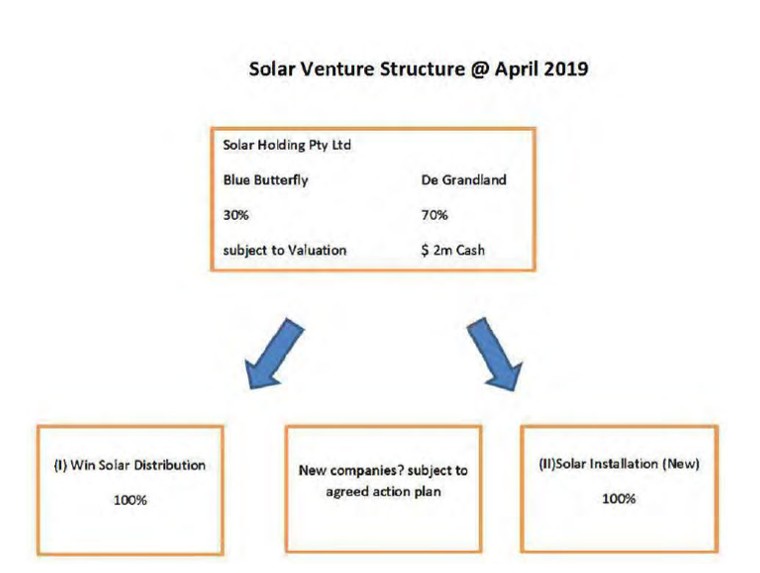
Note:
1) I/we will commit around $ 2m for the venture;
2) Subject to the valuation of Win Solar, new shareholding is around 70%;
3) After 12 month trial, both parties review the results and cooperation& contributions.
4) Final structure and share holding % will be confirmed after the review.
5) The share holding won’t impact on the first 12 month, even further decision making process.
6) Good communication and trust building are key for this venture.
119 The “Stakeholders Agreement” document stated:
Structure and rules:
Shareholder structure | Exit rules after 12 months trial |
De Grandland 70% Blue Butterfly 30% | If De Grandland decides to exit, it is only entitled to take out its investment principle (sic), say $2m. If Blue Butterfly requests De Grandland to exit, De Grandland is entitled up to 10% investment return, say $2.2m |
Director Structure | Decision making rules |
Amie Liu | Before the trial: Both parties to agree all things are available before 1/7/2019, which including but not limited to goals, strategies, budgets, key duties and responsibilities, action plans, etc.. During the trial: Both parties to agree all decisions and actions. In case disagreement arises, both parties will, in good faith, to present to the other party on its rationales and alternatives to consider. If fails to reach mutual agreement, both parties will leave the matter as it is. The parties might revisit the matter in future. After the trial, Both parties will review the decision making processes and set new rules for future journey. |
120 On 25 April 2019, Amie sent an email to Wilson and Richard, addressed to Richard stating:
wilson@ is wilson’s email, should u have queries about win’s current financial situation, pls email him.
121 I infer that the reference to “win” is to WSE.
122 On 26 April 2019 at 9:44am, Richard sent an email to Wilson (as written):
I was introduced by Amie last night.
We are working on a project which will lead to a long term cooperation.
What I am looking for, subject to Amie’s approval:
1) Two financial years (16/17 and 17/18) P/L, BS and tax return;
2) Current year management account
Meanwhile we keep the info at high level. All sub ledges and aging reports we might leave for future discussion. Thanks,
(underline emphasis in original)
123 At 6:57pm that day, Wilson sent an email to Richard (which he copied to Amie) titled “Re: Win Solar financials”, attaching a confidentiality agreement.
124 On 27 April 2019, Amie sent Richard several WeChat messages, including a message at 11:19am that included:
1. If De Grandland exits, it can get back the principal only …If there are acceptable profits, De Grandland can have a certain return. I understand how important it is for investors to get their money back as soon as possible, but we should also take into account the need to minimise the impact of the investment withdrawal on win solar’s normal operation at that time. I believe both parties with their financial backgrounds, have the ability to calculate the cash flow needs of win solar at that time and give a reasonable solution...
2. If Blue Butterfly asks De Grandland to exit, 10% is okay, and it can be higher if the profit exceeds a certain level. I understand how important it is for investors to get their money back as soon as possible, but we should also take into account the need to minimise the impact of the investment withdrawal on win solar's normal operation at that time. I believe both parties with the financial background have the ability to calculate the cash flow needs of win solar at that time and give a reasonable solution; if the directors appointed by Blue have any illegal behaviour during the trial cooperation period, we can forget about this …
125 On 29 April 2019 at 10:23am, Richard sent an email to Wilson, copied to Amie, attaching the confidentiality agreement which he had signed on behalf of Darley Aluminium. The confidentiality agreement was expressed to be an agreement between WSE (as seller) and Darley Aluminium (as purchaser/investor). Clause 16 of the Confidentiality Agreement, which Richard read, provided:
Representations
In providing the Confidential Information, the Seller makes no representations, either express or implied as to its adequacy, sufficiency, completeness, correctness or its lack of defect of any kind, including any patent or trade mark infringement that may result from the use of such information. The Seller will not be liable for any damage or loss that may occur from such provision or use of the Confidential Information.
(bold and underline emphasis in original)
126 Richard agreed in cross-examination, that by reason of that clause, he understood that he should not take WSE as making any representations about the information he had been provided with and that he could not rely upon that information.
127 At 4:15pm that day, Richard sent an email to Amie requesting information for him to provide to the solicitor “who is going to draft the shareholder/partner agreement for us”. Richard stated:
Could you please provide entity details, such as ASIC searches for
1) Blue butterfly;
2) Win Solar (Win Solar Energy Pty Ltd? Top Solar Energy Pty Ltd) please?
...
128 At 9:25pm that day, Amie sent an email to Richard and Wilson by which she asked Wilson to provide to Richard the information requested by him.
129 On 1 May 2019:
(1) at 11:34am, Richard sent an email to Wilson following up the confidentiality agreement; and
(2) at 11:54am, Amie sent an email to Richard and Wilson attaching an ASIC search for Top Energy and various trust documents for the Blue Butterfly Trust. In that email Amie stated (as written):
Pls see the attache company info for top energy Pty ltd and butter fly trust, cause Win Solar Wholesale already was transferred to Top Energy Pty Ltd, so I don’t give you the old company info which is Win Solar Energy Pty Ltd...
130 On 7 May 2019 at 11:57pm, Amie forwarded to Richard an email from Wilson, with the subject line “For Richard – FY 2018 Bas and Financials” attaching: (1) a Profit and Loss Statement for the year ended 30 June 2018; (2) a Balance Sheet as at 30 June 2018; and (3) Business Activity Statements for the period July 2017 to June 2018, for WSE.
131 On 8 May 2019 at 12:37am, Amie forwarded to Richard an email from Wilson with the subject line “For Richard – FY 2017 BAS and Tax Return” attaching:
(1) WSE’s “2017 Financial Statement”; and
(2) WSE’s Business Activity Statements for the period 1 July 2016 to 31 May 2017.
132 On the same day at 1:05am, Amie sent Richard an email with the subject line “For Richard – FY 2019 Financials YTD” attaching:
(1) a Balance Sheet for WSE for the month ended 30 April 2019; and
(2) a detailed Profit and Loss statement for WSE for the year to date ending 30 April 2019.
133 On 9 May 2019 at 6:45am, Amie forwarded to Richard an email from Wilson with the subject line “BAS – 2019 YTD” attaching Business Activity Statements for WSE for the period July 2018 to April 2019. Those statements were typically lodged during the month following the month for which they reported.
134 On the same day:
(1) at 12:16pm, Amie sent Richard a WeChat message:
From now on, Darley and Win Solar Wholesale’s business transactions can be done via Top Energy Pty Ltd; and
(2) at 12:17pm, 12:22pm and 12:27pm, Wilson sent emails to the agents for the lessors of warehouses located on the Gold Coast in Brisbane and on the Sunshine Coast in Queensland leased by WSE. Each email was in the following form:
Since 1st May, The Win Solar Wholesale business has been sold to Top Energy Holdings Pty Ltd. We continue to operate in its current structure and all contacts remain the same.
Please advise how we can transfer our lease from Win Solar Energy Pty Ltd to Top Energy Holdings Pty Ltd. Thanks in advance.
135 On 10 May 2019, Amie ceased to be a director of GL Holdings and Wilson replaced her as the sole director of that company.
136 On 13 May 2019, WSE ceased to be the holder of the business name “Win Solar Wholesale”.
137 On 27 May 2019, Wilson sent an email to WSE’s commercial insurance broker in the following terms (as written):
Win Solar Energy has sold the Win Solar Wholesale business to Top Energy Holdings Pty Ltd. All operation, company structure, contacts are the same.
Can you please advice how can we stop the business insurance from Win Solar Energy Pty Ltd and do the same for Top Energy Holdings Pty Ltd?
(italic emphasis in original)
138 On 6 June 2019 at 4:36pm, Richard sent Amie an email, copied to Rebecca, with the subject line “structure reconfirmation” attaching a document titled “Solar Venture Structure @ April 2019” and “Stakeholder agreement”. Richard’s covering email was:
Could you kindly confirm the attached diagram is accurate please. Thanks.
139 The attached diagram was:
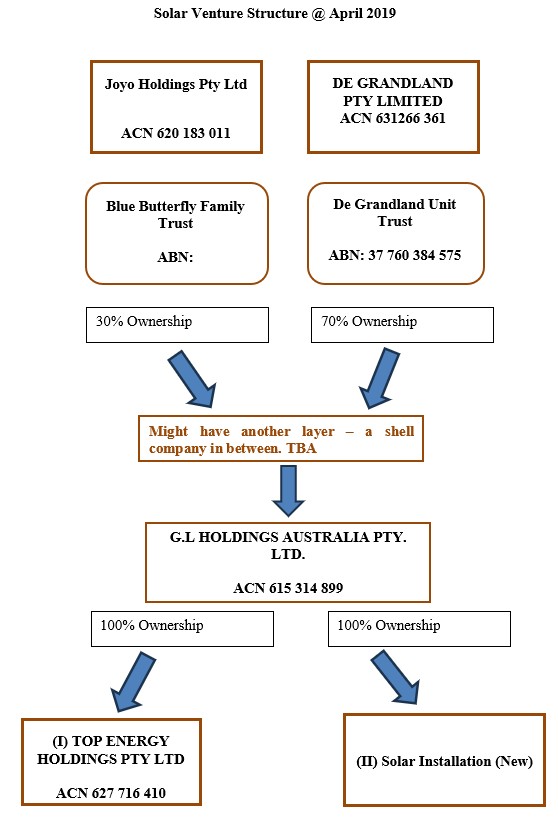
140 The attached “Stakeholder agreement” document was (as written):
Note:
1) I/we will commit around $ 2m for the venture;
2) Subject to the valuation of Win Solar, new shareholding is around 70%;
3) After 12 month trial, both parties review the results and cooperation& contributions.
4) Final structure and share holding % will be confirmed after the review.
5) The share holding won’t impact on the first 12 month, even further decision making process.
6) Good communication and trust building are key for this venture.
Structure and rules:
Shareholder structure | Exit rules after 12 months trial |
De Grandland 70% Blue Butterfly 30% | If De Grandland decides to exit, it is only entitled to take out its investment principle, say $2m. If Blue Butterfly requests De Grandland to exit, De Grandland is entitled up to 10% investment return, say $2.2m Subject to Win Solar’s financial position at that time, both parties might agree to convert the De Grandland equity to a commercial loan after the exit. |
Director Structure | Decision making rules |
Amie Liu | Before the trial: Both parties to agree all things are available before 1/7/2019, which including but not limited to goals, strategies, budgets, key duties and responsibilities, action plans, etc.. During the trial: Both parties to agree all decisions and actions. In case disagreement arises, both parties will, in good faith, to present to the other party on its rationales and alternatives to consider. If fails to reach mutual agreement, both parties will leave the matter as it is. The parties might revisit the matter in future. After the trial, Both parties will review the decision making processes and set new rules for future journey. |
141 On 7 June 2019 at 7:48am, Amie responded (as written):
Hi Richard and Rebecca
We have discussed and confirmed most of the information in it before, and there are two issues that need to be discussed on the 14th.
…
2. If you exit, the basic principle is to change the method of gradual investment withdrawal through a commercial loan if the company is honest and trustworthy and does not have significant operational risks. This principle will be the most responsible for the company and reflect that both of us are highly responsible no matter we choose to cooperate or not. At the same time, if you take the initiative to exit, I will also give you some returns according to the company’s actual situation.
That’s all.
Also, is there an ABN for the trust?
142 At 2:50pm that day, Richard sent Amie a WeChat message requesting access to WSE’s Xero accounting system. Amie then created an email address for Richard and asked Wilson to provide Richard with access to WSE’s Xero system. She also provided Richard with the login details of one her employees to the Dear system for WSE.
143 At 7:56pm and 7:57pm that day, Amie sent Richard screenshots of the bank accounts held by Top Energy. Amie and Richard then had the following exchange:
Amie: Starting in May, transactions were changed from the old company to the new one.
Richard: Okay.
Amie: But we still do bookkeeping at win solar energy
Amie: If it is necessary to reconcile the business software and the financial software,
Richard: I’ll talk to Wilson about the transition if it is necessary to (reconcile)
Amie: We need to
Richard: Reconcile.
Amie: open a Xero account and business software for another round of bookkeeping, and do another reconciliation. Wilson said he hadn’t opened any xero account for the new company because I hadn’t told him about my decision on the business software. He is opening now. The invitation letter has been sent to your email at … It is full authority. Wilson is setting up the basics.
Richard: Okay.
144 On 11 June 2019 at 12:07pm, Richard sent an email to Rebecca, Amie and Wilson attaching a document titled “Meeting Agenda – Date 14th June 2019”. The meeting agenda was in the following form:
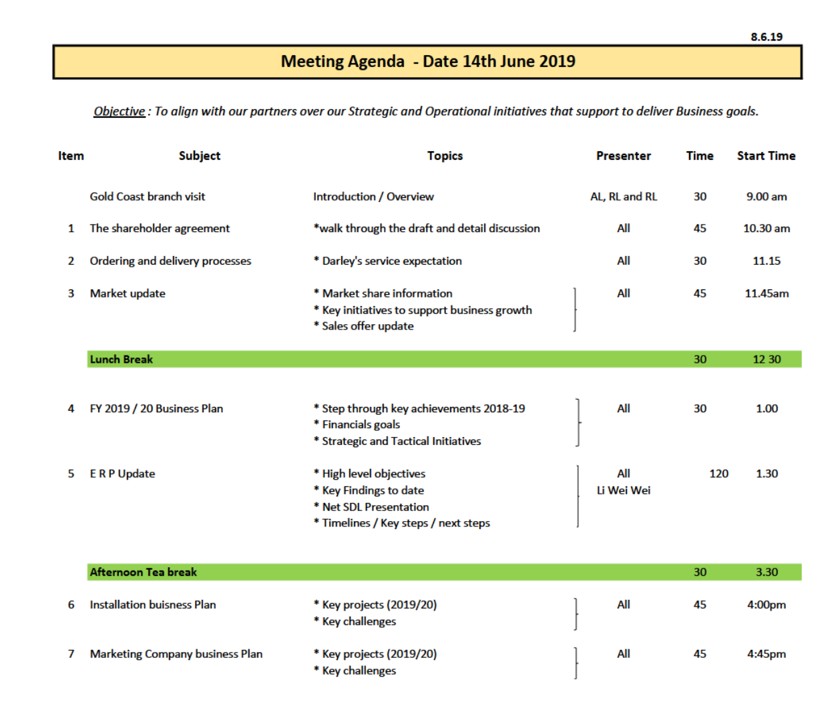
145 On 14 June 2019 Richard, Rebecca, Wilson, Amie and others met on the Gold Coast.
146 On 18 June 2019, Amie ceased to be the director of Joyo Holdings and Wilson was appointed as director of that company.
147 On 21 June 2019, Richard sent to Wilson via WeChat a draft SSD.
148 Between 22 and 28 June 2019, Richard, Amie and Wilson exchanged WeChat messages during which Wilson sent updated “To Do” lists for the matters to be attended to in connection with De Grandland’s investment in Top Energy and Top Energy running the WSE business from 1 July 2019.
149 On 24 June 2019, Richard sent an email to Amie and Wilson attaching a clean and marked up version of a further draft of the SSD and inviting them to execute the SSD if they were happy with it.
C.7 The SSD
150 On 25 June 2019, the SSD was entered into by GL Holdings, Joyo Holdings and De Grandland. The SSD was signed by:
(1) Richard and Rebecca on behalf of De Grandland;
(2) Amie purportedly as sole director of Joyo Holdings (cf. her resignation as director on 18 June 2019); and
(3) Wilson as sole director of GL Holdings.
151 The SSD included (as written):
PARTIES
GL Holdings Australia Pty. Ltd. ACN 615 314 899 (the Company).
The Shareholders set out in Part 2 of Schedule 2.
BACKGROUND
1 The Company is a proprietary company that was incorporated on 13 October 2016.
2 De Grandland will subscribe for the Subscription Shares in accordance with the terms set out in this Document.
3 From Completion, each Shareholder will hold the Shares set out next to its name in Part 2 of Schedule 2.
4 The Parties enter into this Document to record the rights and obligations of De Grandland, the Shareholders and the Company in relation to the subscription for Shares, ownership and management of the Company.
OPERATIVE PART
1 Definitions and Interpretation
1.1 Definitions
In this Document, unless the context otherwise requires the capitalised terms described in Schedule 1 have the meanings ascribed in Schedule 1.
1.2 Interpretation
Schedule 1 contains an interpretation clause that applies to this Document.
...
3. Trial Period
3.1 Trial Period
The Parties will conduct the Trial Period and, subject to clause 3.2, upon conclusion of the Trial Period the Parties will continue to operate the Business in accordance with the terms of this Document.
3.2 Termination
(a) At any time between the date which is 3 months prior to the end of the Trial Period and the date which is 1 month prior to the end of the Trial Period, either Joyo or De Grandland may terminate the Trial Period by giving written notice to the other Parties requiring De Grandland to sell its Subscription Shares to either Joyo or to the Company (at Joyo’s discretion) (Termination Notice).
(b) The price at which Joyo or the Company, as applicable, must purchase the Subscription Shares pursuant to clause 3.2(a) is:
(1) where the Termination Notice is provided by De Grandland, the Subscription Amount; or
(2) where the Termination Notice is provided by Joyo, $2,200,000.
(c) The Parties must procure that all things necessary to execute the sale and purchase of the Subscription Shares in accordance with clause 3.2(a) are undertaken as soon as reasonably practicable following receipt of the relevant Termination Notice (if any), and Joyo or the Company, as applicable, will purchase the Subscription Shares for the price set out in clause 3.2(b).
(d) For the avoidance of doubt, if neither Joyo or De Grandland provide a notice pursuant to clause 3.2(a) then no sale and purchase of De Grandland’s Subscription Shares is required pursuant to clause 3.2(a).
4 Management and decision making
4.1 Decision-making during the Trial Period
(a) During the Trial Period, all decisions in respect of the Company must be agreed between the Shareholders.
(b) If the Shareholders cannot agree a decision, the Parties will meet to negotiate in good faith and will use their best endeavours to reach an agreement.
(c) If the Shareholders are unable to agree a decision after the good faith meeting in accordance with clause 4.1(b), the decision will not be passed and status quo will prevail in respect of the relevant decision.
4.2 Decision-making after the Trial Period
Following the Trial Period and subject to the Corporations Act, the Shareholders must decide all matters concerning the overall management and direction of the Company and all issues for the day-to-day management of the Company by way of Ordinary Resolution.
...
12.11 Entire agreement
This Document, each Deed of Accession and the Constitution contain the entire understanding between the Parties, and supersede all previous discussions, communications, negotiations, understandings, representations, warranties, commitments and agreements, in respect of its subject matter.
...
Schedule 1 Definitions and interpretation
Part 1 – Definitions
…
Business means the business of the Group as at the Effective Date, being a renewable energy related products and services provider, and as modified from time to time in accordance with this Document.
...
Company means the company set out in the parties clause, details of which are set out in Part 1 of Schedule 2.
Completion means the completion of the issue of the Subscription Shares to De Grandland.
Completion Date means 1 July 2019, or such other date as agreed between the Parties in writing.
...
Effective Date means the date on which this Document is signed by each of the Parties, as set out on the execution page.
...
Group means the Company and its Subsidiaries, and Group Company means any one of them.
...
Subscription Amount means $2,000,000.
…
Subsidiary has the meaning given in section 9 of the Corporations Act.
…
Trial Period means the period commencing on the Completion Date and ending on the date which is 12 months following the Completion Date.
…
Schedule 2 Party Details
Part 1 The Company
Name and ACN | Contact Person | Address | |
G.L. Holdings Australia Pty. Ltd. | Zan Huang, Director | … | … |
Part 2 Shareholders and Directors
Shareholder Name | Contact details | No. of Shares held | Share Class | Percentage of Shares held | Key Person |
Joyo Holdings Pty Ltd ACN 620 183 011 ATF Blue Butterfly Family Trust ABN 90 843 493 869 | Address … … | 200 | Ordinary | 30% | Ying Liu |
De Grandland Pty Limited ACN 631 266 361 ATF De Grandland Unit Trust ABN 37 760 384 575 | Address … … | 466 | Ordinary | 70% | Richard Ding Li |
Total | 666 | 100% |
(bold emphasis in original)
152 The SSD, which was drafted by De Grandland’s solicitors, contained no warranties as to the financial position of GL Holdings or Top Energy.
153 Prior to signing the SSD:
(1) De Grandland did not undertake a valuation of the WSE business;
(2) Richard:
(a) was, as he acknowledged, free to ask for whatever information he wished;
(b) did not ask Amie or Wilson whether Top Energy was party to any finance facility;
(c) did not seek any financial information concerning Top Energy at all; and
(d) was aware that the companies associated with Amie were going to lend funds and stock to Top Energy.
C.8 Events subsequent to the SSD
154 Following execution of the SSD, GL Holdings issued 466 shares to De Grandland for the subscription price of $2 million.
155 On or about 29 and 30 June 2019, there was a stocktake check conducted by Amie, Wilson, Richard and Rebecca.
156 Two documents which received some attention during the hearing were:
(1) a document titled “Top Energy Holdings Pty Ltd – Detailed Balance Sheet as at 1 July 2019”;
(2) a document with three columns headed:
(a) “Top Energy Holdings – Detailed Balance Sheet For the Month Ended 30/06/2019”;
(b) “Transition Journal – Initial Postings For the Date During 1/7/2019”; and
(c) “Top Energy Holdings – Detailed Balance Sheet For the Date Ended 01/07/2019”.
157 I will refer to these documents together as the Detailed Balance Sheets.
158 There is a contest as to when Wilson created these documents. Richard says that he was provided with them during the stocktake. Wilson disputes this and says that they were not created until mid-August 2019. I accept Wilson’s evidence, in circumstances where the contemporaneous documents demonstrate that some of the entries in those documents had not been created by the time of the stocktake.
159 Little seems to turn upon the difference in dates, other than, perhaps, to highlight the frailty of recollections and the importance of contemporaneous documentary evidence.
160 The first of the Detailed Balance Sheets recorded goodwill of $857,143 as at 1 July 2019. The second recorded goodwill of:
(1) zero in the first column;
(2) “TBA 30/6/20” and $1.00 in the second column; and
(3) $1.00 in the third column.
161 As Richard acknowledged in cross-examination: (1) he and Amie agreed to record the goodwill of WSE, now in Top Energy’s books, as at 30 June 2019 at $1.00 but subject to review to determine the actual value of the goodwill after the trial period if De Grandland stayed; and (2) the goodwill was to be part of Amie’s contribution to the venture.
162 On 1 July 2019, Richard was appointed as a director of Top Energy and GL Holdings, with the consequence that Richard and Wilson were the only directors of each of those companies.
163 From 1 July 2019, Top Energy conducted the WSE business. In doing so, it had the benefit of stock and funds provided by WSE and Joyo.
164 On 19 September 2019, Wilson sent an email to Richard (copied to Amie and Rebecca), with the subject line “Top Energy Holdings (Win Solar Wholesale) Monthly Financials – 201908”. He wrote:
Apologies for the delay. Finally our first financial pack is out.
Not perfect, will get it improved on the run.
165 That email had a series of attachments including, relevantly, a document titled “Balance Sheet – Win Solar Wholesale – As at 31 August 2019”. That balance sheet recorded:
(1) as at 30 June 2019, total assets and total liabilities each of zero;
(2) goodwill, as a non-current asset, with a value of $1.00 as at 31 July and 31 August 2019; and
(3) under non-current liabilities an “Initial Loan” with a balance of $1,236,822.18 as at 31 July 2019 and $1,243,805.27 as at 31 August 2019.
166 From about February 2020, Richard and Amie started discussing the future of the joint venture. Such discussions occurred in writing. There is also evidence from each of Richard and Amie as to conversations between them. For the reasons earlier discussed, I place little store in their recollections of those conversations.
167 On 20 March 2020, Richard sent Amie and Rebecca, copying Wilson an email titled “Top Energy Business moving forward” which stated (as written):
Hi Amie,
On 18th of March, three of us had an open and frank conversation on how to move forward our business relationship in Top Energy.
You indicated that you had ruled out option A (mentioned in my email dated 8th March 20). However, your insistence on absolute decision making power in the business could potentially conflict with our plan to seek a replacement GM sometime in the future.
But I am delight that we all found and agreed on common ground on the following:
1. Our personal and business relationship will not be jeopardized as a result of this event and should remain sound and professional
2. All of us will do our best to grow the business and increase the business value;
3. It was acknowledged that each has different operations/management styles and strategic focuses when running the business;
Based on the above, and our 2019 Agreement, the most rational and practical approach would be:
1. Both parties might elect one of the following options with a firm timeline of exit:
i. Both parties exit together (sale to a 3rd party);
ii. Rebecca+Richard buy out Amie shares;
iii. Amie buys out Rebecca+ Richard shares
2. Regardless of the option chosen, business valuations need to be conducted, which include:
i. Methodology adopted to be agreed
ii. Valuation as at 30/06/2019 and
iii. valuation as at a date prior to or on 30/06/20
3. Prepare a handover plan to ensure a smooth transit period. This includes but not limited to:
i. Staff retaining and succession
ii. Arrangement/agreement with customers, suppliers and staff
iii. Consistency of business operations
Amie and Rebecca, please go through and amend whatever necessary to reflect your true thoughts. I also copied Wilson in this email. Once done, we will execute it immediately. Thank you.
(underline emphasis in original; bold emphasis added)
168 As counsel for the respondents submitted, regardless of the option chosen, a valuation of the WSE business was required to be conducted because regardless of how WSE transferred that business into Top Energy, WSE had to be compensated for that transfer.
169 On 29 March 2020, Amie and Richard exchanged WeChat messages including the following message from Amie:
I reiterate that if you have confidence in the operation, buy me out now, and then you can take your time to pay for goodwill, and I will be ready to get involved in whatever you need me to do at any time until the day you sell the company. If you can trust another general manager who you may not know yet, you can certainly trust me to be involved in the company operation as an employee instead of a shareholder. After all, there is trust between us, and I won’t leave in the middle of the process. In this way, there will be no possible conflicts with your decisions, and I will be able to concentrate more on my work for you.
170 On 16 June 2020 Amie, Wilson and Richard exchanged WeChat messages including the following:
(1) Amie:
You guys get the valuation estimate as soon as possible…
… ;
(2) Amie:
I am the director of the old company, good will must be calculated, otherwise I will need to pay too. The legal liabilities of the old company…
… ;
(3) Wilson:
Hi all, I am sorry about the long delay. About Goodwill, I have done the preliminary calculation using different methods. Please see the picture below. Could everyone please discuss.
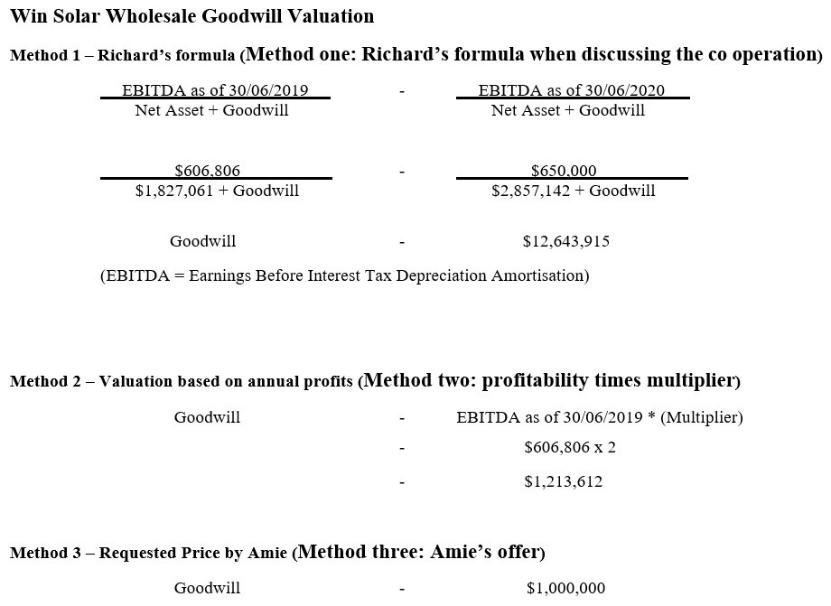
(4) Richard:
Personal view: method one. The maths is correct. The two curves intersect at “infinity [symbol]” [emoji]. On the business level, the result is meaningless [emoji]. Return on equity must be within the reasonable range (above 20%) ;
(5) Richard:
Method two: the multiplier is okay for an investment that is paid back in two years. However, the multiplier should be profit AFTER tax. Figures in this year are more relevant. A hint: I will ask the company to do a comprehensive stock take by the end of this year, any discrepancy + or – add to profit. ; and
(6) Richard:
Method three: [emoji] direct market comparison. Amie/we can find one or two arm length buyers (using the offer for all or part of the shares as the basis) to calculate good will.
171 On 21 June 2020 and during the course of the ongoing discussions between Richard and Amie, Amie sent Richard an email (copied to Rebecca and Wilson) titled “Re: proposed Discussion among shareholders” to the following effect (as written):
Pls see below info we need to confirm now in the name of Director of Win Solar Energy Pty Ltd and Shareholder of Top Energy Pty Ltd. thanks.
1.1. Top Energy purchases the Win Solar Wholesale business from Win Solar Energy at goodwill of 1 million and signed a purchase agreement before 30 September; of which 800,000 is to be paid by Top Energy to WinSolar Energy in installments of 100,000 per month after confirming the purchase agreement, and the remaining 200,000 is to be paid when Top Energy’s annual profit is more than 600,000 (if YingLiu’s assistance to Top Energy is waived at any time after the purchase agreement, the remaining 200,000 must be paid immediately)
1.2 Joyo Pty Ltd will withdraw from Top Energy before 30 September, and its 30% shares will be transferred to De Grandland.
1.3 Top Energy will do a Dividend on 30/06/2020, and distribute the profit of the current financial year to shareholders, it will then be loaned back after-tax; when Joyo exits Top Energy, from 1 July 2020 to the date of withdrawal, the profit will be shared as divident once again, and all divident owed to Joyo must be paid at the same time;
1.4 All shareholders agree to extend the three-month trial period, and the trial period terms remain unchanged. This is the easiest way at present so that I can also have three months to both operate and exit.
or:
1.4. Option 2: Before Joyo Withdraws from Top Energy on 30 September, both shareholders will each appoint a director, and one person appointed by each side will also approve all authorisations of the bank; any company personnel leaving or hiring and a budget of more than 1,000 dollars must be agreed by both parties.
1.5 Ying Liu agrees to remain as the general manager after Joyo exits Top Energy and actively looks for a new general manager to replace her. Ying Liu also agrees to participate in the company’s operations as a consultant before Top Energy is sold to new investors in the future, strive to create the greatest value for Top Energy, and agree to assist Top Energy in finding new investors to sell it in the future. Top Energy will pay due compensation to Ying Liu’s personal contributions to Top Energy after her Joyo withdraws from Top Energy. At any time, if Top Energy believes that Ying Liu’s assistance is not needed, it can be raised at any time.
1.6 Ying Liu agrees that after Joyo withdraws from Top Energy, whether in her personal capacity or as a company, she will no longer engage in solar-related industries unless she obtains written consent from Top Energy.
(bold emphasis added)
172 As is plain, paragraph [1.1] of this email – which proposes a sale by WSE of the WSE business to Top Energy – is inconsistent with the proposition that the BSA was in existence as at the date of the email.
173 Amie sought to explain paragraph [1.1] in this email in her evidence in chief (at paragraph [215] of her first affidavit) as follows:
In preparing this affidavit, I have read the email I sent to Richard on 21 June 2020 and say that paragraph 1.1 is not correct. What I intended to say was that De Grandland would pay Joyo Holdings $1 million for Joyo Holdings 30% share in G.L. Holdings.
174 Amie’s evidence in cross-examination included:
MR KAUFMANN: … at paragraph 1.1, you proposed that Top Energy purchases the Win Solar Wholesale business from WSE at goodwill of $1 million, correct?
THE INTERPRETER: I did wrote in that way.
MR KAUFMANN: I’m sorry, you said you did – what followed – Madam Interpreter, what followed after that?
THE WITNESS: I wrote this. This is what I wrote.
THE INTERPRETER: I did put it in that way.
…
MR KAUFMANN: Thank you. And what you were proposing also in 1.1 is that payments were to be made in instalments towards that $1 million sale of goodwill, correct?
THE INTERPRETER: I repeating my question – my answer again. I wrote the sentence which has 1.1. I wrote the sentence which has 1.2. And the relevant affidavit have already explained this part.
MR KAUFMANN: Well, what you wrote there in 1.1 is directly inconsistent with the business sale agreement having been entered into more than a year before, isn’t it?
THE WITNESS: Disagree.
THE INTERPRETER: Disagree.
MR KAUFMANN: Well, Ms Lui, if the BSA had already been entered into, Top Energy would have already effectively agreed to buy the business from WSE for at least $800,000. Correct?
THE INTERPRETER: It has been already explained in my relevant affidavit.
MR KAUFMANN: Well, I’m just asking you now, Ms Lui, to accept from me - - - THE WITNESS: Okay.
MR KAUFMANN: - - - please, that what you have written there is directly inconsistent with the BSA having already been entered into. Do you accept that?
THE INTERPRETER: I don’t accept this.
MR KAUFMANN: All right. Well, what you’ve said in your affidavit evidence, Ms Lui, is that the email you sent to Richard on 21 June 2020 is not correct. That’s what you said in your affidavit, isn’t it?
THE INTERPRETER: Can you repeat that, please?
MR KAUFMANN: You’ve said in your affidavit that paragraph 1.1 is not correct, didn’t you?
THE INTERPRETER: Can you repeat your question again?
MR KAUFMANN: Maybe its easiest if the witness could be shown court book – court book volume 10, page 842. Sorry, 8242.
THE INTERPRETER: 8242, right?
MR KAUFMANN: Yes, please. Could you just let me know, please, Ms Lui, when you’ve got 8242.
THE INTERPRETER: Yes.
MR KAUFMANN: Now, Ms Lui, the second last sentence of your affidavit at paragraph 215 is what I was referring to a moment ago where you say paragraph 1.1 is not correct, isn’t it?
THE INTERPRETER: Yes. Paragraph 1.1.
MR KAUFMANN: And you say in this following sentence what you intended to say was that De Grandland would pay Joyo Holdings $1 million for Joyo Holdings’ 30 per cent share in GL Holdings, correct?
THE INTERPRETER: Yes.
MR KAUFMANN: Well, Ms Lui, in paragraph 1.2 of your email of 21 June, you referred to Joyo there, didn’t you?
THE INTERPRETER: Because Joyo Pty Ltd is another company of mine.
MR KAUFMANN: Yes. What you were intending to refer to in 1.2 though, obviously, was Joyo Holdings, correct?
THE INTERPRETER: Both 1.1 and 1.2 are not correct. So all these things can only show that very complicated situation at that moment.
THE WITNESS: All kind of mess.
MR KAUFMANN: Ms Lui - - -
THE INTERPRETER: All kind of mess.
MR KAUFMANN: Sorry. Sorry. Please finish.
THE INTERPRETER: Can I finish my explanation?
MR KAUFMANN: Please.
THE INTERPRETER: No review. No new contract. No one mentioned that they are leaving. I’m talking about everything about the other party. So they didn’t give the review. They didn’t provide the new contract. Although they had already made their promise before December. They haven’t done any due diligence or any formal things. In that circumstance – situation – under that circumstance, the very limited background, including the financial information or the information about who is going to be the purchaser, who is going to be the seller – all this information background. Under that circumstance, very limited – okay, under that circumstance, so it doesn’t matter the financial background or the relevant professional – the background of – professional background, yes. So, all these content in the 1.1 and the 1.2 is just showing how messed up my mind was under that circumstance, with this very limited background information, either in financial or in expertise.
THE WITNESS: Confusing.
THE INTERPRETER: Confusing – yes, confusing thinking. But if you refer to the context, the contextual email message – if you check the context for the corresponding of the email with Richard, there is only point in there; they have to buy me out. That is the only possible transaction which might happen. In addition to that, in the latter WeChat, one of the latter WeChat I had with Richard after these emails, he corrected me.
MR KAUFMANN: That all you wish to say, Ms Lui? I want to suggest to you that explanation you’ve just given makes no sense at all and is an attempt to explain away why what you wrote in that document is entirely inconsistent with your case. Do you accept that?
THE INTERPRETER: I disagree.
…
MR KAUFMANN: The lengthy explanation you’ve just given was what you made up over the last week to try to deal with being confronted with this email, correct?
THE INTERPRETER: You asked me to explain, right? It is you who asked me to explain, right?
MR KAUFMANN: Yes. And the explanation you gave you’ve made up, haven’t you?
THE INTERPRETER: I disagree.
MR KAUFMANN: Well, Ms Lui, you clearly referred to Top Energy at 1.1 and 1.3, as well as 1.4, 1.5 and 1.6 of that email. Correct?
THE INTERPRETER: Yes.
MR KAUFMANN: And you refer in a number of places to Joyo too, don’t you?
THE INTERPRETER: Yes.
MR KAUFMANN: So you clearly understood the difference between the entities that you were referring to in that email when you wrote it, correct?
THE INTERPRETER: I don’t understand your question.
MR KAUFMANN: I want to suggest to you when you typed that email, you knew which entities you meant to refer to when you typed them.
THE INTERPRETER: Can you rephrase your question in another way?
MR KAUFMANN: You knew clearly which entities you meant to refer to when you typed that email, correct?
THE INTERPRETER: Sorry, can you repeat that?
MR KAUFMANN: You knew clearly which entities you intended to refer to when you typed that email, didn’t you?
THE INTERPRETER: I know which entity is which.
MR KAUFMANN: Yes. And – yes. And that’s why I want to suggest to you that in fact what you typed in that email at the time was correct, not incorrect. Do you accept that?
THE INTERPRETER: I disagree.
(bold emphasis added)
175 I do not accept Amie’s explanations in her affidavit evidence or in cross-examination. That evidence is not credible on its face, nor when considered in the context of the many other communications from Amie and her experience as a businesswoman. Her evidence in cross-examination when confronted with a clear inconsistency was obfuscatory and the explanation of confusion proffered as a last resort.
176 Wilson did not address the 21 June 2020 email in his affidavit evidence.
177 Wilson gave the following evidence in cross-examination:
MR KAUFMANN: All right. Now, that’s an email on which you were copied, isn’t it, sent on 21 June 2020?
THE WITNESS: Yes. Yes, I was copied, yes.
MR KAUFMANN: Yes. And sent by Amie to Richard and Rebecca was also copied, isn’t it?
THE WITNESS: Yes.
MR KAUFMANN: All right. And, at point one point – sorry, at 1.1 in the top left-hand corner of that email, Amie is proposing there that Top Energy purchases the WSE business and sign a purchase agreement before 30 September 2020, isn’t she?
THE WITNESS: Can you repeat the question?
MR KAUFMANN: Yes. Could you just read 1.1 to yourself, please, and let me know when you’ve gone that?
THE WITNESS: Yes, I read it.
MR KAUFMANN: All right. And I’m told it may assist if you read the Mandarin version as well back on 513. In fairness to you, I might ask you to read that as well.
THE WITNESS: Yes, I read it.
MR KAUFMANN: All right. Now, what Amie is proposing there at 1.1 is that Top Energy purchases the WSE business and signs a purchase agreement before 30 September 2020, isn’t she?
THE WITNESS: I think Amie was saying the will is worth 100 million – 1 million, purchased by Top Energy.
MR KAUFMANN: Well, Mr Huang, the translation there in English says that it’s a – I withdraw that. The translation in English suggests that it is a proposal that Top Energy purchases the Win Solar Wholesale business; correct?
THE WITNESS: Yes.
MR KAUFMANN: That suggests it was part of her proposal that that occur, doesn’t it?
THE WITNESS: Part of the proposal that occur. I do not know what proposal she occur before. I do not know that proposal.
MR KAUFMANN: Well, that suggests, doesn’t it, that Amie was proposing that the purchase by Top Energy of the WSE business happen before 30 September 2020, wasn’t she?
THE WITNESS: If Amie had proposed something before, yes, this looks like that referred to the – her proposal before, if that do has.
MR KAUFMANN: Well – I’m sorry, I didn’t understand that answer, Mr Huang, I apologise. Would you mind repeating that?
THE WITNESS: Are you asking me is that relate to some proposal that occur that Amie has been – done before and I said yes, it looks like that refer to that proposal when I read in this paragraph here if that proposal did had – happen before that – Amie proposed.
MR KAUFMANN: Well, Mr Huang, if that – if the BSA was already entered into prior to that email being sent, Top Energy could not purchase the WSE business because that had already been sold under the BSA, hadn’t it?
THE WITNESS: I think the goodwill – the goodwill like something like a stock; it do have value in different time. So, on the BSA, the goodwill was 800,000. When it comes to Top Energy, you can revalue it to no matter amount that – in time which means, like, you will buy an apple today for $10. It does not mean tomorrow it will be $10 again. So there will be – the valuation can change. I think in here what Amie is saying it is, in her mind, that the goodwill is worth 1 million.
MR KAUFMANN: Well, Mr Huang, if Top Energy had already purchased the goodwill under the BSA for $800,000, why would Amie there be proposing effectively the same transaction but for a different price?
THE WITNESS: Is this the same transaction? This may not be the same transaction.
MR KAUFMANN: Well, Mr Huang, that’s referring to purchasing the goodwill of $1 million, isn’t it?
THE WITNESS: Yes.
MR KAUFMANN: And what was sold under the BSA, to your understanding?
THE WITNESS: Yes, it is sold from the BSA, from Win Solar Energy to Top Energy. But it can be reviewed under Top Energy to a different amount. So that is why Richard want to review after the trial period, the same concept. So ..... can be reviewed from time to time. Every time, it could be different number.
MR KAUFMANN: Is that why you didn’t respond to this email to suggest that it was not possible to do that?
THE WITNESS: No, this is not the reason I did not respond.
MR KAUFMANN: Why did you not respond to that email?
THE WITNESS: Why did I not respond? Why should I respond?
MR KAUFMANN: All right. I want to suggest to you that what’s – I withdraw that. I want to suggest to you, Mr Huang, that what is set out in that email either suggests the BSA was not executed at that time or that it wasn’t intended to be complied with. Do you accept that?
THE WITNESS: I disagree.
(bold emphasis added)
178 As can be seen, Wilson was unable to provide any satisfactory explanation for the apparent inconsistency.
179 After 21 June 2020, Amie and Richard continued to exchange WeChat messages.
180 Those messages included the following messages from Amie:
(1) on 25 June 2020:
(a) at 4.27pm, Amie told Rebecca: “You need to pay good will (before) you get the power”;
(b) at 7.16pm, Amie told Richard: “At the end of the first year of trial cooperation, top energy must pay for the goodwill of the win solar wholesale business to win solar energy, unless the boss of win solar energy is willing to extend the payment period”; and
(2) on 27 June 2020, Amie told Richard: “Second, no matter who quits, win solar energy’s goodwill must be completed. Your first year at top energy is a trial period. When win solar energy transfer business, you are given a one-year trial period. You know, many fixed assets used by top energy are still owned by win solar energy.”.
181 Negotiations continued, but no agreement was reached.
182 On 30 July 2020, Richard, on behalf of De Grandland, circulated a notice of a meeting of members of GL Holdings to be held on 21 August 2020, providing for Wilson to be removed as director and bank account signatory.
183 On 16 August 2020 at 12.22pm, Amie sent a message to Richard which included: “My lawyer will represent Win Solar Energy to recover its goodwill from Top Energy Holding.”
C.9 The payment of $550,000 from Top Energy to WSE and the removal of Wilson as a director of GL Holdings
184 20 August 2020 – the day before the foreshadowed meeting of members of GL Holdings to remove Wilson as a director and bank signatory – was a busy day.
185 At noon, Wilson sent an email to Richard, Amie and Joyo Holdings (as written):
I have been recently made aware that a Notice of shareholders’ meeting has been sent on 30 July 2020 by Richard (Ding Li) of De Grandland Pty Limited to call for a general meeting scheduled to be held on 21 August 2020. I understand that one of the proposed resolutions to be voted is regarding the removal of my directorship of G. L Holdings Australia Pty Ltd (the Company), and another being the removal of me as a signatory of all bank accounts held in the name of the Company.
I now exercise my power under s 198A of the Corporations Act 2001 (the Act) to postpone this meeting for 2 weeks to 4 September 2020. I also refer to the precedence as set out in Wun v CellOS Software Ltd [2018] FCA 1947 to exercise my power as a director to postpone such general meeting. Reasons for the extension are to allow time to address the following issues of this proposed general meeting:
1. Section 249Q of the Act requires that “a meeting of a company’s members must be held for a proper purpose”. I request Mr Ding Li of De Grandland Pty Limited to justify that such a meeting with the purpose of removing my directorship and signatory of all bank accounts of the Company is of a proper purpose. In particular, I request Mr Li to provide reasons for my proposed removal, including but not limited to any evidence of improper actions carried out by me as a director of the Company, and evidence of Mr Li’s qualification and any business plan that Mr Li may have in regards to being the proposed sole director of the Company;
2. If the above resolutions are passed, Mr Li would become the sole director of the Company. As we all know, Mr Li is based in Sydney and has a full‐time job (not with the Company). Mr Li is not and has not been involved in the daily management of the Company. On the contrary, I have been working at least 30 hours a week for the Company and involved in the day‐to‐day business and management of the Company. Therefore, I require an explanation as to why having Mr Li as the sole director would be for the best interests of the Company.
I suggest that these matters must first be resolved and reasons/evidence provided before a general meeting is to be held on 4 September 2020. I note that if a meeting is nonetheless held on 21 August 2020 it will not be a valid general meeting and any resolutions allegedly passed will be invalid and have no force.
I await your reply.
186 At 2:08pm, Richard responded:
You have both written to me to ask for an explanation for the resolution to remove Mr Huang as a director.
Under the Subscription and Shareholders Deed all decisions in respect of the Company were to be agreed between the Shareholders during the Trial Period (clause 4.1).
As the trial period has now finished, clause 4.2 provides that issues regarding the day‐to‐day the management are to be by way of Ordinary Resolution. Given that De Grandland Pty Ltd is a 70% shareholder it is appropriate that it appoint a sole director.
I will of course continue to be mindful of my corporate governance obligations to the Company regarding its management, and will comply in all regards with the Shareholders Deed.
187 At 10:22pm, Sam qua director of WSE, wrote to Wilson, qua director of Top Energy, seeking payment of $800,000 plus GST pursuant to the BSA. Sam’s letter was in the following form (as written):
It has been more than a year since the Business Sale Agreement signed and executed on 1st May 2019. I am sure the business is running successfully and has grown to a higher level.
As stated on the Business Sale Agreement, the Purchase Price of $800,000+GST is payable on 30th June 2020 and the payment is now is overdue by 51 days.
Please remit payment of the Purchase Price ASAP. Payment should be made as below…
188 At 10:44 pm, Wilson caused a payment of $550,000 to be made from Top Energy to WSE.
189 At 11:03pm, Wilson sent Sam an email confirming that payment of $550,000 had been made and stating that the remaining $330,000 would be paid within two weeks.
190 On 21 August 2020 at 7:25am, Amie forwarded Wilson’s 20 August 2020 11:03pm email to Richard. This email was the first notification that Richard received of the BSA.
191 On the same day, Wilson was removed as a director of GL Holdings, in accordance with the notice given on 30 July 2020.
C.10 Payment of $330,000 from Top Energy to WSE and removal of Wilson as a director of Top Energy
192 On 27 August 2020 Richard, on behalf of De Grandland, issued a notice of a meeting of members of GL Holdings to be held on 17 September 2020 for the purpose of GL Holdings, qua sole member of Top Energy resolving to remove Wilson as a director of Top Energy.
193 On the same day, Richard sent an email to Wilson, copied to Amie:
As you are aware there are two directors of Top Energy Holdings Pty Limited. One is myself and the other is Wilson/you.
I have become aware recently of moneys being transferred out of the Top Energy bank accounts without my consent or authorisation.
Please be aware, that until further notice under no circumstances do I authorise the payment of any further moneys from any of the Top Energy bank accounts without my prior approval. Any such payments or transfer without my approval will constitute unlawful payments and I and Top Energy Holdings will hold each of you personally liable for those payments.
If you have any payments that need to be made please email them to me and I will give you my approval.
(underline emphasis in original)
194 On 15 September 2020:
(1) at 6:16pm, H & H Lawyers, acting for WSE and on instructions from Amie sent a letter by email to the directors of Top Energy (Richard and Wilson) demanding payment of $330,000 under the BSA by 23 September 2020. That letter enclosed a copy of the BSA; and
(2) at about 9:15pm, Wilson authorised the transfer of $330,000 from Top Energy’s bank account to WSE’s bank account. He did so without consulting Richard.
195 On 17 September 2020, Wilson was removed as a director of Top Energy.
196 On or about 30 September 2020, Wilson prepared a spreadsheet for WSE as at May 2019. That spreadsheet recorded an amount of -$800,000 for “Sale of Business”, -$80,000 for GST and a receivable of $880,000.
197 There is also in evidence a balance sheet for WSE as at 30 June 2019 which records a receivable of $880,000. Wilson’s evidence is that he prepared this balance sheet. His evidence is silent as to when it was prepared. In view of the previous paragraph and the silence as to when this balance sheet was created, I infer that it was not created before 30 September 2020. No suggestion was made by the respondents that it was prepared between 30 June 2019 and 20 August 2020.
C.11 Commencement of the Top Energy proceedings
198 On 23 October 2020, Top Energy commenced the Top Energy proceeding.
C.12 Lodgement of WSE’s May 2019 Business Activity Statement
199 On 4 March 2021, WSE lodged a Business Activity Statement for May 2019. Wilson lodged it at the request of Amie. That Business Activity Statement included an amount of $880,000 referable to the BSA.
C.13 Commencement of the De Grandland proceeding
200 In September 2021, De Grandland commenced the De Grandland proceeding.
C.14 Transactions between WSE and Top Energy as at August 2022 and the cross-claim in the Top Energy proceeding
201 On 12 August 2022, Sam sent an email to Wilson:
Could you please update the exact amount Top Energy still owe WSE by now and the record support the amount. Thanks.
Looking forward to your reply.
202 Wilson gave evidence that he downloaded a report from WSE’s Dear inventory system, which recorded transactions that went through WSE, dating back to 30 June 2019; and filtered the report so that it was only showing activities and transactions that affected amounts loaned to Top Energy.
203 Wilson then sent an email in response to Sam (as written):
The balance of Loan to Top Energy is $205,976.30 as 31/07/2022.
The attachment is a Trial Balance report for your reference.
204 The attached trial balance report stated:
[Report Period]: Custom
[From]: 01-Jul-2022
[To]: 31-Jul-2022
Account Class | Account Code | Description | Opening Balance | Debit | Credit | Closing Balance |
ASSET | 1812 | Loan to Top Energy | 204,274.02 | 1,702.28 | 0.00 | 205,976.30 |
205 Wilson also gave evidence that as at 31 August 2022, the total outstanding loan balance was $207,692.77. The difference between this amount and the amount owing as at 31 July 2022 appears to be the incurrence of further interest.
206 On 31 August 2022, H & H Lawyers, on behalf of WSE, wrote to Top Energy demanding payment of $207,692.77 under the WSE Loan Agreement (a copy of which they enclosed).
207 On 15 September 2022, WSE filed a cross-claim in the Top Energy proceeding, alleging that Top Energy was indebted to it in an amount of $207,692.77.
D. THE TOP ENERGY PROCEEDING
208 I turn now to the Top Energy proceeding.
D.1 The principal claim
209 The central question for determination in the principal claim in that proceeding is Top Energy’s claim that the BSA was not a bona fide agreement entered into on or about the date it bears (28 March 2019) and instead that it was brought into existence on or about 20 August 2020 at a time after the relationship between Amie and Richard had irretrievably broken down ; and as a means to extract a significant sum of money for Amie’s benefit.
210 I start with the period leading up to 28 March 2019. During that period the following matters are germane.
211 First, no written communications between Amie, Wilson or any lawyer or other adviser assisting WSE in relation to the drafting of the BSA, or drafts of the BSA, are in evidence.
212 Secondly, there is no documentary evidence that (whenever the BSA was prepared):
(1) a valuation of the Business the subject of the BSA; or
(2) due diligence relating to the purchase of that Business,
was carried out.
213 Thirdly, there is no evidence of legal advice having been sought on behalf of Top Energy as to the terms of the BSA (at any time). There is no issue that such advice was not obtained.
214 Turning to events subsequent to 28 March 2019, the germane events are as follows.
215 First, there are several contemporaneous documents which record statements in May 2019 to the effect that WSE had sold the WSE business to Top Energy. In particular:
(1) Wilson’s 9 May 2019 emails to the agents for the lessors of the leased warehouses, which indicated that since 1 May 2019 the “Win Solar Wholesale business has been sold to Top Energy…” and which requested advice as to how each lease could be transferred from WSE to Top Energy ([134(2)] above); and
(2) Wilson’s 27 May 2019 email to WSE’s insurance broker which stated that WSE had sold the “Win Solar Wholesale business to Top Energy…” and which requested advice as to how to substitute Top Energy for WSE as the insured ([137] above).
216 The reference in the 9 May 2019 emails to the sale having occurred on 1 May 2019 ties in with cl 3.1 and the definition of “Completion Date” in cl 1.1 of the BSA ([104] above).
217 Secondly, other contemporaneous documents indicate that steps were being taken consistent with a transfer of the WSE business to Top Energy. In particular:
(1) April 2019 correspondence between ASIC and Top Energy indicating that ASIC had received a request to transfer the registration of the “Win Solar Wholesale” business name ([109] above);
(2) Amie’s 1 May 2019 email to Richard in which she stated (as written): “Pls see the attache company info for top energy Pty ltd, so I don’t give you the old company info which is Win Solar Energy Pty Ltd” ([129(2)] above);
(3) Amie’s 9 May 2019 12:16pm message to Richard which included: “From now on, Darley and Win Solar Wholesale’s business transactions can be done via Top Energy Pty Ltd” ([134(1)] above); and
(4) Amie’s 7 June 2019 message to Richard stating that: “Starting in May, transactions were changed from the old company to the new one”, and Richard’s response “Okay” ([143] above) .
218 Thirdly, on 8 May 2019, Amie sent an email to Richard which attached a balance sheet for WSE for the month ended 30 April 2019 that did not include as an asset of WSE an amount of $880,000 owed to it by Top Energy. The applicants contend that if one assumes that the BSA had been operative as at that date, then such an asset would have been recorded in that balance sheet.
219 Fourthly, from 1 July 2019, Top Energy traded using the goodwill associated with the Win Solar Wholesale business.
220 Fifthly, the Detailed Balance Sheets. The applicants contend that if the BSA had been operative as at 30 June and 1 July then these balance sheets would have recorded a liability from Top Energy to WSE in the sum of $880,000.
221 Sixthly, on 19 September 2019, Wilson sent an email to Richard which attached a financial pack, including a balance sheet for “Win Solar Wholesale” ([164] to [165] above). The applicants contend that if the BSA had been operative from 28 March 2019, then this balance sheet would have recorded a liability from Top Energy to WSE in the sum of $880,000.
222 Seventhly, between about February 2020 and August 2020, Amie and Wilson on the one hand and Richard and Rebecca on the other negotiated the future of the joint venture. During those discussions, Amie and Wilson sent a series of messages concerning the goodwill related to the WSE business. Those messages included:
(1) on 16 June 2020, Amie and Wilson sent the following messages:
(a) Amie:
You guys get the valuation estimate as soon as possible…
…
(b) Amie:
I am the director of the old company, good will must be calculated, otherwise I will need to pay too. The legal liabilities of the old company…
…
(c) Wilson:
Hi all, I am sorry about the long delay. About Goodwill, I have done the preliminary calculation using different methods. Please see the picture below. Could everyone please discuss. ;
(2) on 21 June 2020, Amie sent an email to Richard ([171] above) which included (as written):
1.1 Top Energy purchases the Win Solar Wholesale business from Win Solar Energy at goodwill of 1 million and signed a purchase agreement before 30 September; of which 800,000 is to be paid by Top Energy to WinSolarEnergy in installments of 100,000 per month after confirming the purchase agreement, and the remaining 200,000 is to be paid when Top Energy’s annual profit is more than 600,000…
(bold emphasis added)
(The applicants contend that this email suggests that as at 21 June 2020, WSE still owned the “Win Solar Wholesale business”; and that Amie was proposing a transaction in which WSE would sell that business to Top Energy.);
(3) on 25 June 2020, Amie wrote:
You need to pay good will (before) you get the power ; and
At the end of the first year of trial co-operation, top energy must pay for the goodwill of the win solar wholesale business to win solar energy, unless the boss of win solar energy is willing to extend the payment period ;
(4) on 27 June 2020, Amie wrote:
Second, no matter who quits win solar energy’s goodwill must be completed. Your first year at top energy is a trial period. When win solar energy transfer business, you are given a one-year trial period. You know, many fixed assets used by top energy are still owned by win solar energy. ; and
(5) on 16 August 2020, Amie wrote:
My lawyer will represent Win Solar Energy to recover its goodwill from Top Energy Holding.
223 Eighthly, on 20 August 2020, Sam sent a letter addressed to Top Energy ([187] above), which: referred to the BSA having been signed and executed on 1 May 2019; asserted that payment of the Purchase Price (as defined in the BSA) of $800,000 (plus GST) had become due on 30 June 2020; and sought payment of that amount. The applicants contend that the reference to 1 May 2019 rather than 28 March 2019 bespeaks recent invention of the BSA.
224 Ninthly, on 4 March 2021, WSE lodged its Business Activity Statement for May 2019 ([199] above). That Business Activity Statement included the $800,000 plus GST.
225 Having considered the principles set out at B. above and all of the evidence, I am positively persuaded that the BSA was not entered into on or about 28 March 2019 and was not entered into prior to 16 August 2020.
226 I have reached that view for the following reasons.
227 First, paragraph 1.1. of the 21 June 2020 email, which Amie sent at a time when she and Richard and Rebecca were discussing options for the future of their venture, contained a proposal which expressly contemplated a sale by WSE of its goodwill to Top Energy. Such a sale could not have been conceivable if the BSA had been in existence at that time. Nor would it have been achievable as such a sale would have already occurred.
228 As set out at [173] above, Amie stated in her affidavit evidence that what she “intended to say was that De Grandland would pay Joyo Holdings $1 million for Joyo Holdings 30% share in G.L. Holdings” and in cross-examination that her mind was confused; and I do not accept either explanation. Wilson, who was copied on that email, did not address it in his evidence and he provided no plausible explanation in cross-examination.
229 This email provides strong, contemporaneous and objective evidence that the BSA had not been executed as at 21 June 2020.
230 Secondly, the 21 June 2020 email was but one of a number of messages from Amie which contemplated that WSE would be paid for the goodwill in its business and which did not refer to the BSA.
231 In this regard:
(1) as noted previously, the goodwill associated with the WSE business was transferred by WSE to Top Energy for use in its operations;
(2) that goodwill was treated at the start of Top Energy’s operations as having a value of $1.00, with the intention that it would be valued at the end of the trial period;
(3) between June and August 2020, in negotiations as to the future of the venture, Amie made statements which suggested that Top Energy had not paid WSE for the goodwill transferred by WSE to Top Energy ([170], [180] and [183] above); and
(4) these communications do not refer to the BSA and do not put a price on the goodwill; instead, it was recognised by Amie and Wilson that the value of the goodwill had to be calculated ([170(2) and (3) above]). Had the BSA been in existence, no calculation would have been required as the price had been set. Further, it is highly likely that reference would have been made in those communications to the BSA as the source of the obligation to pay for the goodwill, and to the price specified in that agreement. In other words, normal human and commercial behaviour in such a situation would have been to state that Top Energy owed WSE $800,000 plus GST because of the BSA. This did not occur until the letter of demand of 20 August 2020, signed by Sam, which was sent after De Grandland had moved to take control of Top Energy. That silence is telling and points strongly against the proposition that the BSA existed prior to 16 August 2020.
232 Thirdly, there appears to be no document in evidence prior to 20 August 2020 which refers to: (1) the existence of the BSA; (2) an obligation upon Top Energy to pay $800,000 plus GST to WSE; or (3) a right of WSE to receive such an amount.
233 Fourthly, all of the above matters give rise to a strong inference that the BSA was not executed on or about 28 March 2019 and had not been executed prior to 16 August 2020.
234 Fifthly, other evidence provides some support for an inference that the BSA was executed on or about 28 March 2019. In particular, the contemporaneous emails that refer to the WSE business having been sold or transferred ([215] to [217] above).
235 However, a conclusion that the BSA was executed on or about 28 March 2019 is in my view distinctly less probable than a conclusion that that the BSA was not executed on or about 28 March 2019 and had not been executed prior to 16 August 2020. In this regard, the references to a sale or transfer are equally consistent with there having been a sale or transfer at a nominal price. Relatedly, the operation of the business by Top Energy using the goodwill of the WSE business transferred from WSE is not of itself evidence that a particular price (such as $800,000 or indeed any other number) had been paid for that business or that the transfer occurred pursuant to the BSA.
236 Sixthly, a number of the matters identified above do not provide meaningful support for either hypothesis:
(1) as to the absence of: (a) written communications between Amie, Wilson or any lawyer or other adviser assisting WSE in relation to the drafting of the BSA; or (b) drafts of the BSA in evidence, the force of this circumstance depends upon the extent to which it may be expected that such documents would have come into existence if the BSA had been prepared in March 2019. The evidence does not establish such an expectation;
(2) as to the absence of documentary evidence that (whenever the BSA was prepared): (a) a valuation of the business the subject of the BSA; or (b) due diligence relating to the purchase of that business, was carried out, the force of this circumstance also depends upon the extent to which it may be expected that Top Energy would have such documentary evidence. The evidence establishes that: (a) the companies under the control of Amie – relevantly WSE and Top Energy – were run by her, with the assistance of Wilson; and (b) each of Amie and Wilson was well familiar with the operations of WSE and the business. It follows that one would not expect there to have been a written valuation obtained, nor due diligence carried out;
(3) as to the absence of legal advice on behalf of Top Energy as to the terms of the BSA (at any time), Top Energy has not established that one would expect such advice to have been obtained;
(4) as to the balance sheet for WSE for the month ended 30 April 2019 that did not include as an asset of WSE an amount of $880,000 owed to it by Top Energy, this document is of little moment in circumstances where on the assumption that the BSA existed as at 30 April 2019, the right to receive such an amount did not arise until 1 May 2019 at the earliest;
(5) as to the 20 August 2020 letter, I do not accept the applicants’ submission that the reference to 1 May 2019 rather than 28 March 2019 necessarily bespeaks recent invention of the BSA. Such a reference is equally consistent with the BSA having been in existence since 28 March 2019 and the Completion Date of 1 May 2019 having been erroneously inserted instead of the signing date of 28 March 2019; and
(6) as to the lodgement of WSE’s May 2019 Business Activity Statement on 4 March 2021, I do not accept the applicants’ submission that the lodgement of this statement in March 2021 also bespeaks invention of the BSA in August 2020. At its highest it might be suggested that the BSA was lodged in March 2021 so as to lend legitimacy to a document not created until August 2020. Such a suggestion would have significant force if Top Energy (which accounted on an accrual basis) had: (a) filed a May 2019 Business Activity Statement in accordance with its usual timing of filing such statements and which did not include an amount commensurate with the amount payable under the BSA; and (b) after 20 August 2020 filed an amended Business Activity Statement which did include such an amount. However, that is not this case. Instead, there was a lengthy delay in filing the May 2019 Business Activity Statement, which delay started well before August 2020. The delay in the filing of the May 2019 Business Activity Statement until March 2021 is thus consistent with the cases of both the applicants and the respondents.
237 Finally, the absence of any evidence from Sam as to the circumstances in which his signature came to be on the BSA.
238 As noted earlier, Sam provided lay affidavit evidence but that affidavit was not read and he was not called as a witness.
239 In my view, it was expected and natural for WSE and Amie to have called Sam in circumstances where:
(1) Sam was the sole director of WSE as at 28 March 2019 and was (and remained) Amie’s husband;
(2) Sam was able to provide evidence, as is apparent from his making of an affidavit that was not read; and
(3) the question whether WSE, via Sam’s signature, entered into the BSA on or about 28 March 2019 is central to the determination of the issues before the Court.
240 Relatedly, Sam’s evidence would likely have thrown light upon a matter requiring an explanation or answer, namely the date of execution by WSE of the BSA. That matter is a central issue in the proceeding.
241 Further, Sam’s absence from the witness box was unexplained. In this regard, the trial schedule agreed between counsel included evidence from Sam; but at the end of the fourth day of hearing, counsel for the respondents indicated, without an explanation as to why, that Sam would not be called to give evidence.
242 Counsel for the respondents accepted that it was possible for the Court to draw an inference, as per Jones v Dunkel, that Sam’s evidence would not have assisted the respondents but submitted that his evidence was unnecessary because the respondents had led evidence from Amie and Wilson on the relevant topics. That is, it was submitted that Sam’s evidence should be regarded as merely corroborative (or cumulative) of the evidence of Amie and Wilson as to the date on which the BSA was signed: see Les & Zelda Investments at [76(8)] ([49] above). See also Manly Council v Byrne [2004] NSWCA 123 at [60] to [66] (Campbell J, with whom Beazley JA and Pearlman AJA agreed).
243 I do not accept that Sam’s evidence is merely corroborative or cumulative of the evidence of Amie and Wilson in the requisite sense. In this regard, Amie’s affidavit evidence was that “[o]n 28 March 2019, WSE and Top Energy entered into a business sale agreement…”. Wilson’s evidence was that “[o]n 28 March 2019, I signed a business sale agreement … as director of Top Energy …”. Neither says that they saw Sam sign the BSA.
244 Thus, Sam’s evidence would not have been merely further evidence to establish a fact already established such that the time and resources of the parties and the Court would have been wasted: cf Ling v Pang [2023] NSWCA 112 at [28] (Kirk JA; Leeming and Michelmore JA agreeing). Rather, there is evidence (as described above) which supports a positive answer and considerably stronger evidence which supports a negative answer to the question whether Sam signed the BSA on 28 March 2019.
245 For the above reasons, I infer that Sam’s evidence would not have assisted the respondents. The absence of such evidence also allows the Court to draw with greater confidence an inference that the BSA was not signed by Sam on behalf of WSE on or about 28 March 2019 and was not signed before 16 August 2020.
246 For all of the above reasons, I find that the BSA was not entered into on or about 28 March 2019, and was not entered into before 16 August 2020.
247 As noted above, that document was signed by Sam (qua sole director of WSE) and Wilson (qua sole director of Top Energy); and Amie witnessed each of their signatures. The funds of $880,000 transferred from Top Energy to WSE in reliance upon the BSA should be returned to Top Energy.
D.2 The breach of duty claim
248 As noted above, the breach of duty claim is premised upon the BSA being a genuine document. In view of the findings that I have made to the contrary, this claim falls away.
D.3 The cross-claim
249 The central question on the cross-claim is whether the WSE Loan Agreement – which was signed by Wilson and Sam – was a genuine document (as the respondents contend) or not (as the applicants contend). In this regard, the applicants allege that the WSE Loan Agreement was not entered into in late March or early April 2019 and instead was created on or around 15 September 2022.
250 The question of the authenticity of the WSE Loan Agreement received less attention during the hearing and in the submissions of the parties than the issue of the authenticity of the BSA. Nevertheless, and again taking into account the matters set out in B. above, I am positively persuaded that the WSE Loan Agreement was not entered into in late March or early April 2019 and instead was created after the applicants and the respondents fell out for the following reasons.
251 First, the absence of evidence of any contemporaneous reference to the WSE Loan Agreement in any document prior to the filing of the cross-claim in September 2022.
252 Secondly, the absence of evidence of a demand for payment under the WSE Loan Agreement until 31 August 2022, shortly prior to the filing of the cross-claim, despite the breakdown in the relationship between Amie and Richard from August 2020 (i.e. more than two years earlier) and the acrimony that had developed.
253 Thirdly, I take into account my finding above that the BSA – which Sam and Wilson also signed – was a fraudulent document created in the context of the present dispute.
254 Finally, the nature of the evidence adduced concerning the date of the signing of the WSE Loan Agreement. As noted at [44] above, all evidence falls to be weighed according to the relative capacity of the parties to adduce it.
255 As noted above, the WSE Loan Agreement bears the signatures of Wilson and Sam.
256 Wilson gave the following evidence in his first affidavit (filed 31 August 2022):
In or around March 2019, WSE and Joyo Pty Ltd agreed to loan capital to Top Energy to start running the Business from 1 July 2019. At pages 191 to 204 of Exhibit ZH-1 are copies of the loan agreements with WSE and Joyo Pty Ltd, which I signed as director of Top Energy.
257 As is apparent, Wilson did not give evidence of the date on which he signed the WSE Loan Agreement, beyond perhaps an implied suggestion that it occurred prior to 1 July 2019. Whilst that evidence was filed before the concise statement in response to the cross-claim (filed 19 May 2023) in which the applicants had alleged that the WSE Loan Agreement was not a genuine document, Wilson also did not address this topic in the affidavit he affirmed on 8 December 2023.
258 In this regard the failure of the respondents to adduce evidence as to when Wilson signed the WSE Loan Agreement has the consequence that it is open to draw, as I do, an inference – consistent with the principle in Ferrcom – that WSE feared to adduce such evidence because it would have exposed facts unfavourable to WSE. Further, the Court should be less inclined to draw any other inferences favourable to WSE arising from other evidence (e.g. from the fact that funds were advanced by WSE to Top Energy).
259 I also take into account Wilson’s affidavit evidence as to the filing of WSE’s May 2019 Business Activity Statement and the suggestion in that evidence that such a statement had been filed around June 2019 which suggestion was revealed, by evidence produced under a notice to produce, to be false (see [69] to [70] above).
260 Sam, as noted above, did not give evidence.
261 I explained at [238] to [245] above – in connection with the BSA – that Sam’s evidence would likely have thrown light upon a matter requiring an explanation or answer, namely the date of execution by WSE of the BSA; and that Sam’s absence from the witness box was unexplained. As a result I drew a Jones v Dunkel inference from the failure of the respondents to call Sam.
262 That reasoning applies with equal force with respect to the critical issue of when WSE signed the WSE Loan Agreement.
263 Thus, I infer, as per the rule in Jones v Dunkel, that Sam’s evidence would not have assisted the respondents on the issue of when WSE signed the WSE Loan Agreement. The absence of such evidence also allows the Court to draw with greater confidence the inference which arises from the evidence discussed above that the WSE Loan Agreement was not signed by Sam on behalf of WSE on or about 11 April 2019.
264 In reaching the conclusion that the WSE Loan Agreement was not entered into in late March or early April 2019, I have taken into account the fact that, as I have previously found, WSE made loans to Top Energy from time to time. However, it does not follow that such loans were made pursuant to the WSE Loan Agreement. Further, as noted above, to the extent that an inference might be available from the fact of those advances that they were made under the WSE Loan Agreement, the absence of evidence from Wilson and Sam as to when they signed that agreement weighs against the drawing of such an inference.
265 For completeness, I also note that it may have been open to WSE to bring a claim for the balance of such funds as were owing other than by a claim in contract based upon the WSE Loan Agreement (e.g. a claim in debt), however the case presented to the Court was based squarely upon that agreement.
266 It follows that the cross-claim in the Top Energy proceeding must fail.
E. THE DE GRANDLAND PROCEEDING
267 I turn now to the De Grandland proceeding.
E.1 Introduction
268 The amended concise statement in the De Grandland proceeding contained allegations that the De Grandland proceeding respondents engaged in misleading or deceptive conduct by reason of their contended failure to disclose, inter alia:
(1) that the BSA, the WSE Loan Agreement and the Joyo Loan Agreement were fraudulent documents;
(2) alternatively, the BSA, the WSE Loan Agreement and the Joyo Loan Agreement (on the premise that they were genuine documents); and
(3) that they intended for WSE to provide a loan to Top Energy.
269 However, the case as presented was more limited.
270 The case as presented was limited to the claim in (2) above, namely a claim that the De Grandland proceeding respondents engaged in misleading or deceptive conduct or conduct that was likely to mislead or deceive in contravention of s 18 of the ACL by failing to disclose to De Grandland prior to its entry into the SSD the existence of:
(1) the BSA;
(2) the WSE Loan Agreement; and
(3) the Joyo Loan Agreement.
271 As pleaded, and as counsel for the applicants submitted in his opening and closing submissions, this claim is premised upon the BSA, the WSE Loan Agreement and the Joyo Loan Agreement being bona fide transactions.
272 I have found above that the BSA and the WSE Loan Agreement were not bona fide documents.
273 Thus, I consider below De Grandland’s case that the De Grandland proceeding respondents contravened s 18 of the ACL by not disclosing the existence of the Joyo Loan Agreement.
E.2 Legal framework
274 Section 18 of the ACL provided that a person “must not, in trade or commerce, engage in conduct that is misleading or deceptive or is likely to mislead or deceive”.
275 Section 236 of the ACL provided that if a person suffers loss or damage because of the conduct of another person in contravention of, inter alia, s 18 of the ACL then the first person may recover the amount of the loss or damage by action against the second person.
276 In the present case, there is no issue that to the extent that the De Grandland proceeding respondents engaged in the impugned conduct, such conduct occurred in trade or commerce. At issue is whether the De Grandland proceeding respondents engaged in the impugned conduct; whether that conduct was misleading or deceptive or likely to mislead or deceive; and if so, whether the conduct caused loss to De Grandland.
277 The relevant principles to be applied when considering whether a person has contravened s 18 of the ACL were summarised by the High Court of Australia (Kiefel CJ, Gageler, Gordon, Edelman and Gleeson JJ) in Self Care IP Holdings Pty Ltd v Allergan Australia Pty Ltd [2023] HCA 8; (2023) 277 CLR 186 at 225 to 226 ([80] to [82]). Their Honours explained:
80 The principles are well established. Determining whether a person has breached s 18 of the ACL involves four steps: first, identifying with precision the “conduct” said to contravene s 18; second, considering whether the identified conduct was conduct “in trade or commerce”; third, considering what meaning that conduct conveyed; and fourth, determining whether that conduct in light of that meaning was “misleading or deceptive or … likely to mislead or deceive”.
81 The first step requires asking: “what is the alleged conduct?” and “does the evidence establish that the person engaged in the conduct?”. The third step considers what meaning that conduct conveyed to its intended audience. As in this case, where the pleaded conduct is said to amount to a representation, it is necessary to determine whether the alleged representation is established by the evidence. The fourth step is to ask whether the conduct in light of that meaning meets the statutory description of “misleading or deceptive or … likely to mislead or deceive”; that is, whether it has the tendency to lead into error. Each of those steps involves “quintessential question[s] of fact”.
82 The third and fourth steps require the court to characterise, as an objective matter, the conduct viewed as a whole and its notional effects, judged by reference to its context, on the state of mind of the relevant person or class of persons. That context includes the immediate context – relevantly, all the words in the document or other communication and the manner in which those words are conveyed, not just a word or phrase in isolation – and the broader context of the relevant surrounding facts and circumstances. It has been said that “[m]uch more often than not, the simpler the description of the conduct that is said to be misleading or deceptive or likely to be so, the easier it will be to focus upon whether that conduct has the requisite character”. That said, the description of the conduct alleged and identified at the first step should be sufficiently comprehensive to expose the complaint, because it is that conduct that will ultimately, as a whole, be determined to be or not to be misleading or deceptive.
(italic emphasis in original; footnotes omitted)
278 See also Elanor Funds Management Ltd (ACN 125 903 031) v Alceon Group Pty Ltd (ACN 122 365 986) [2024] FCAFC 121; (2024) 424 ALR 601 at 628 to 629 ([92] to [95]) (Bromwich and Thawley JJ; O’Sullivan J agreeing).
279 As to the approach to be taken where, as here, misleading or deceptive conduct is alleged to have arisen by dint of non-disclosure, Gilmour and White JJ explained in Addenbrooke Pty Ltd (ACN 055 973 576) v Duncan (No 2) [2017] FCAFC 76; (2017) 348 ALR 1 at 118 to 120 ([480] to [483]) that:
Misleading or deceptive conduct by non-disclosure
[480] Conduct is misleading or deceptive, or likely to mislead or deceive, if it has a tendency to lead into error: Australian Competition and Consumer Commission v TPG Internet Pty Ltd (2013) 250 CLR 640; 304 ALR 186; 96 ACSR 475; [2013] HCA 54 (TPG Internet) at [39]. The question of whether conduct is leading or deceptive is one of fact to be resolved by a consideration of the whole of the impugned conduct in the circumstances in which it occurred: Campbell at [102] (citing McHugh J in Butcher at [109], to which reference will be made later); and Miller & Associates Insurance Broking Pty Ltd v BMW Australia Finance Ltd (2010) 241 CLR 357; 270 ALR 204; [2010] HCA 31 (Miller) at [14] (French CJ and Kiefel J).
[481] The High Court considered the principles concerning claims of misleading or deceptive conduct by non-disclosure in Miller. After referring to the statement of Gummow J in Demagogue Pty Ltd v Ramensky (1992) 39 FCR 31 at 41; 110 ALR 608 at 619 that, “unless the circumstances are such as to give rise to the reasonable expectation that if some relevant fact exits it would be disclosed, it is difficult to see how mere silence could support the inference that the fact does not exist”, French CJ and Kiefel J continued:
…
[482] On our understanding, the principles concerning misleading or deceptive conduct by non-disclosure or silence which emerge from the authorities and which are pertinent in the present appeal may be summarised as follows:
(a) conduct involving silence or non-disclosure may, in some circumstances, constitute misleading or deceptive conduct;
(b) in considering whether conduct is misleading or deceptive, silence or non-disclosure is to be assessed as a circumstance like any other;
(c) mere silence without more is unlikely to constitute misleading or deceptive conduct. However, remaining silent will constitute misleading or deceptive conduct if the circumstances are such as to give rise to a reasonable expectation that, if some relevant fact does exist, it will be disclosed;
(d) the existence or otherwise of such a reasonable expectation is to be determined objectively;
(e) it is not possible to categorise all of the circumstances in which a reasonable expectation of disclosure may arise. Such circumstances may exist when either the law or equity imposes a duty of disclosure, when a statement conveying a half-truth only is made (see Winterton Constructions Pty Ltd v Hambros Australia Ltd (1992) 39 FCR 97; 111 ALR 649 at [75]), when the representor has undertaken a duty to advise, when a representation with continuing effect, although correct at the time it was made, has subsequently become incorrect, and when the representor has made an implied representation;
(f) in considering whether a party engaged in commercial dealing may have a reasonable expectation that a fact, if it exists, will be disclosed, it is to be remembered that it will often be the case that one party to a commercial dealing has more knowledge about a relevant matter than the other and yet will not, in accordance with ordinary commercial expectations, be guilty of misleading or deceptive conduct in failing to make that knowledge known to the other.
[483] Ultimately, as indicated at the commencement of this reference to the principles, the determination of whether a failure to disclose a matter is misleading or deceptive requires an examination of all the circumstances. If in the circumstances, assessed objectively, a representee would have been entitled to expect or infer (have a reasonable expectation) that an undisclosed matter would be disclosed, that may well constitute misleading or deceptive conduct: Clifford v Vegas Enterprises Pty Ltd [2011] FCAFC 135 at [198].
(bold and italic emphasis in original; underline emphasis added)
E.3 The impugned conduct
280 As noted above, the impugned conduct is the non-disclosure by the De Grandland proceeding respondents to De Grandland of the existence of the Joyo Loan Agreement.
281 I am satisfied that the De Grandland proceeding respondents did not disclose the Joyo Loan Agreement to De Grandland prior to 25 June 2019, when the SSD was signed. The De Grandland proceeding respondents did not contend otherwise.
282 The De Grandland proceeding respondents submit that to the extent that the impugned conduct was engaged in, it was not their conduct, but rather the conduct of GL Holdings or Top Energy. In view of the conclusions that I have reached as to: (1) whether the impugned conduct was misleading or deceptive; (2) whether that conduct caused loss to De Grandland – both of which are discussed below – it is unnecessary to resolve this issue.
E.4 Was the impugned conduct misleading or deceptive or likely to mislead or deceive?
283 As explained in Addenbrooke ([279] above), it is necessary to consider all relevant circumstances including whether there was a reasonable expectation that if the Joyo Loan Agreement existed, it would be disclosed; and the existence or otherwise of such an expectation is to be determined objectively.
284 The context as referred to in the amended concise statement includes:
(1) the nature of the transaction effected by the SSD;
(2) the broader transaction in which, inter alia, the WSE business including its goodwill was transferred to Top Energy; and
(3) the “due diligence” conducted by De Grandland during which (it is alleged) the De Grandland proceeding respondents provided to De Grandland, for the purposes of the due diligence, “a copy of all financial information in relation to GL Holdings, which included the books and records of Top Energy and Win Solar” (an allegation which is particularised by reference to Amie’s 7 and 8 May 2019 emails to Richard referred to at [130] to [132] above).
285 I have taken into account the findings of fact at C. above. Having done so, I am not persuaded that there was any reasonable expectation of disclosure of the Joyo Loan Agreement, for the following reasons.
286 First, Richard’s “due diligence” was far from comprehensive and the evidence does not establish that he sought or received all of “the books and records” of Top Energy and WSE. Rather, he made some specific requests for information; and he was provided with the information that he requested ([122] to [123], [127] to [133] and [142] above).
287 Secondly, Richard was aware, by 25 June 2019 that companies associated with Amie were going to lend funds and stock to Top Energy.
288 Thirdly, Richard did not request a copy of any agreements recording loans to Top Energy.
289 Fourthly, Richard was an accountant and well able to request particular information, such as copies of loan agreements.
290 Fifthly, there is no suggestion that De Grandland was proposing to undertake a valuation of GL Holdings, the WSE business, or Top Energy before entering into the SSD or that such a valuation was premised upon a particular position with respect to liabilities, much less that this was known to the De Grandland proceeding respondents. Rather, as noted above, the venture was – as the De Grandland proceeding respondents were aware – to be entered into on the basis of a trial period from which De Grandland had a ready exit.
291 Finally, I do not accept Richard’s evidence that Amie told him in about late April 2019 that Top Energy was a “clean” company with no historical transactions. This is because:
(1) of the reservations expressed at B.4 above concerning Richard’s uncorroborated evidence;
(2) to the extent it is relied upon as evidence that Top Energy would have no loan liabilities, it cannot stand together with Richard’s acceptance that funds were to be lent to Top Energy; and
(3) of the absence of any evidence of a contemporaneous record of such a statement or of any reliance upon it (such as an email, or a warranty in the SSD).
292 Thus, the non-provision of the Joyo Loan Agreement to De Grandland prior to the execution of the SSD was not conduct that contravened s 18 of the ACL.
E.5 If so, did De Grandland suffer loss by reason of such conduct?
293 This conclusion is sufficient to dismiss the claim.
294 In any event, I am not persuaded the non-disclosure of the Joyo Loan Agreement was causative of loss to De Grandland.
295 Richard’s evidence was that if he had known of the existence of the Joyo Loan Agreement, then De Grandland would not have entered into the SSD. I do not accept this evidence for the following reasons.
296 First, as noted above, Richard was aware that companies associated with Amie would be lending funds to Top Energy. This did not deter De Grandland from entering into the SSD. It is difficult to understand how the fact that such loans were documented would have made a difference (and it is not suggested in this regard that any particular provision of the Joyo Loan Agreement would have been germane to Richard’s decision-making process). Richard was asked in cross-examination how, if he had been aware that a liability was in existence, the documentation of such a loan would have made a difference. He provided no cogent explanation.
297 Secondly, and relatedly, the option in the SSD allowing De Grandland to recoup all of its investment in Top Energy ameliorated any risk arising from matters not revealed in the limited investigations undertaken by Richard before the SSD but later discovered during the trial period.
298 Finally, the lack of any reliance upon the financial position of GL Holdings and its subsidiary Top Energy is reflected in the limited nature of the due diligence that was conducted, Richard’s acknowledgement that he could not rely upon the information that he did receive ([126] above), and the absence of warranties as to that financial position in the SSD drafted by De Grandland’s solicitors.
299 Thus, I am not persuaded that the non-disclosure of the Joyo Loan Agreements caused any loss to De Grandland. It is unnecessary to enter into a determination of the quantum of the suggested loss.
E.6 Conclusion as to the De Grandland proceeding
300 For the above reasons, De Grandland’s claims in the De Grandland proceeding fail.
F. CONCLUSION
301 For all of the reasons set out above:
(1) in the Top Energy proceeding:
(a) Top Energy’s claim for the recovery of $880,000 plus interest succeeds;
(b) Top Energy’s breach of duty case falls away;
(c) WSE’s cross-claim for recovery of $207,692.77 plus interest fails; and
(2) De Grandland’s claims in the De Grandland proceeding fail.
302 As there are questions as to the form of relief (including interest and costs) to be agreed or determined, I will make orders which allow the parties time to confer as to the form of orders that ought to be made; and for the determination of any disputed questions.
I certify that the preceding three hundred and two (302) numbered paragraphs are a true copy of the Reasons for Judgment of the Honourable Justice Goodman. |
Associate:
Dated: 4 June 2026


