FEDERAL COURT OF AUSTRALIA
Australian Securities and Investments Commission v Walker Stores Pty Ltd (In Liquidation) [2026] FCA 665
File number: | VID 647 of 2025 |
Judgment of: | BEACH J |
Date of judgment: | 18 May 2026 |
Date of publication of reasons: | 29 May 2026 |
Catchwords: | CORPORATIONS — consumer credit — credit contracts — cap on the cost of credit by way of the annual cost rate (ACR) — contravention of s 24(1) and s 32A of the National Credit Code — observations on the calculation of the ACR — respondent markups — meaning of “amount of credit” — meaning of “cost of credit” — meaning of “credit fees or charges” — alternative constructions of s 32B of the Code — observations on credit cost construction — observations on cash price construction — meaning and application of the term “cash price” — rate cap contraventions under s 32A of the Code — whether disclosure contraventions under s 17(3) of the Code — interest rate calculations — use of flat rate calculation method — contravention of s 28 of the Code — key requirements provisions — declarations under s 166 of the National Consumer Credit Protection Act 2009 (Cth) — pecuniary penalties under s 167 of the Act for breach of the Code — application of ss 167A and 167B of the Act — penalties fixed — adverse publicity notice — s 182 of the Act — orders made |
Legislation: | Banking Act 1959 (Cth) s 5 Consumer Credit Legislation Amendment (Enhancements) Act 2012 (Cth) Schedule 4 s 13 Corporations Act 2001 (Cth) ss 553B, 1317E, 1101B National Consumer Credit Protection Act 2009 (Cth) s 5, Division 3 of Part 2, ss 166, 167, 167A, 167B, 175, 182, Schedule 1 (National Credit Code) ss 3, 4, 5, 6, 11, 13, 17, 23, 24, 27A, 28, Division 4A of Part 2, 32A, 32B, Part 6, 113, 116, 204 Consumer Credit Legislation Amendment (Enhancements) Bill 2012 (Cth) Explanatory Memorandum to the National Consumer Credit Protection Bill 2009 (Cth) National Consumer Credit Protection Bill 2009 (Cth) Revised Explanatory Memorandum to the Consumer Credit Legislation Amendment (Enhancements) Bill 2012 (Cth) Consumer Credit (New South Wales) Act 1995 (NSW) Credit (Commonwealth Powers) Act 2010 (NSW) Schedule 3, cl 7 Consumer Credit (Queensland) Act 1994 (Qld) Credit (Commonwealth Powers) Act 2010 (Qld) Part 6 s 34 Consumer Credit (Victoria) Act 1995 (Vic) s 39(1) Credit (Commonwealth Powers) Act 2010 (Vic) s 22(4) Consumer Credit (New South Wales) Special Provisions Regulation 2002 (NSW) regs 7, 8 Consumer Credit (Queensland) Special Provisions Regulation 2008 (Qld) Consumer Credit (New South Wales) Amendment (Maximum Annual Percentage Rate) Bill 2005 (NSW) Schedule 2 New South Wales, Gazette: Legislation, Allocation of Administration Acts, No 133, 23 August 2002 New South Wales, Minutes of the Proceedings, Legislative Council, 27 August 2002 New South Wales, Parliamentary Debates, Legislative Assembly, 19 October 2005 New South Wales, Parliamentary Debates, Legislative Assembly, 9 November 2005 Victoria, Parliamentary Debates, Legislative Assembly, 4 May 1995 |
Cases cited: | Australian Competition and Consumer Commission v Australian Institute of Professional Education Pty Ltd (in liquidation) [2017] FCA 521 Australian Competition and Consumer Commission v Aveling Homes Pty Ltd [2017] FCA 1470 Australian Competition and Consumer Commission v Dataline.Net.Au Pty Ltd (in liquidation) (2007) 161 FCR 513 Australian Competition and Consumer Commission v Get Qualified Australia Pty Ltd (in liquidation) (No 3) [2017] FCA 1018 Australian Securities and Investments Commission v AGM Markets Pty Ltd (in liq) (No 4) [2020] FCA 1499; (2020) 148 ACSR 511 Australian Securities and Investments Commission v Australia and New Zealand Banking Group Ltd [2023] FCA 1150; (2023) 169 ACSR 649 Australian Securities and Investments Commission v BHF Solutions Pty Ltd (2022) 293 FCR 330 Australian Securities and Investments Commission v Darranda Pty Ltd (Penalty) [2025] FCA 938 Australian Securities and Investments Commission v Kobelt [2016] FCA 1327 Australian Securities and Investments Commission v Rent 2 Own Cars Australia Pty Ltd (2020) 147 ACSR 598 Australian Securities and Investments Commission v Westpac Banking Corporation (Omnibus) [2022] FCA 515; (2022) 407 ALR 1 Australian Securities and Investments Commission v Westpac Banking Corporation (No 3) [2018] FCA 1701; (2018) 131 ACSR 585 Australian Securities and Investments Commission v Westpac Banking Corporation [2026] FCA 651 BSF Solutions Pty Ltd v Australian Securities and Investments Commission [2025] FCAFC 88 Bull v Attorney-General (NSW) (1913) 17 CLR 370 Commissioner of State Revenue (Victoria) v Lend Lease Development Pty Ltd (2014) 254 CLR 142 Kwik Finance (Sydney) Pty Ltd v Walker [2014] NSWCA 73 Re Make it Mine Finance Pty. Ltd [2015] FCA 393; (2015) 238 FCR 562 Re Make it Mine Finance Pty. Ltd (No 2) [2015] FCA 1255 The Queen v Khazaal (2012) 246 CLR 601 Walker v Consumer, Trader and Tenancy Tribunal (NSW) [2013] NSWSC 1432 |
Division: | General Division |
Registry: | Victoria |
National Practice Area: | Commercial and Corporations |
Sub-area: | Regulator and Consumer Protection |
Number of paragraphs: | 323 |
Date of hearing: | 20 February and 18 May 2026 |
Counsel for the Applicant: | Ms K O’Gorman SC, Ms E Levine and Mr G Rees |
Solicitor for the Applicant: | DLA Piper |
Counsel for the Respondent: (Receivers) | Ms V Bell (20 February 2026 only) |
Solicitor for the Respondent: (Receivers) | Jones Day |
ORDERS
VID 647 of 2025 | ||
| ||
BETWEEN: | AUSTRALIAN SECURITIES AND INVESTMENTS COMMISSION Applicant | |
AND: | WALKER STORES PTY LTD ACN 007 973 962 (IN LIQUIDATION) Respondent | |
order made by: | BEACH J |
DATE OF ORDER: | 18 MAY 2026 |
OTHER MATTERS:
A. References to Contract A are references to the contract a consumer entered into with Walker Stores on 2 July 2024 for the purchase of a Haier 7.5kg Front Load Washing Machine model HWF75AW3, with payment required to be made to Walker Stores in weekly instalments of $9.93 over a term of 3 years.
B. References to Contract B are references to the contract a consumer entered into with Walker Stores on 5 July 2024 for the purchase of an LG 315L Top Mount Frost Free Silver Fridge model GT-3S, with payment required to be made to Walker Stores in weekly instalments of $15 over a term of 3 years.
C. References to Contract C are references to the contract a consumer entered into with Walker Stores on 1 July 2024 for the purchase of an Apple iPhone 15 256GB Pink model MTP73ZP/A, with payment required to be made to Walker Stores in fortnightly instalments of $54.44 over a term of 3 years.
D. References to the Credit Act are references to the National Consumer Credit Protection Act 2009 (Cth).
E. References to the Credit Code are references to Schedule 1 to the Credit Act.
DECLARATIONS
Rate Cap Contraventions
Pursuant to s 113(1) of the Credit Code, the Court declares that:
1. Between September 2021 and 27 February 2025 (Relevant Period), the respondent (Walker Stores), trading as “Snaffle”, entered into each of Contracts A, B, and C which were credit contracts that imposed an annual cost rate that exceeded the maximum rate of 48% (Rate Cap) in contravention of the key requirement contained in s 32A(1) of the Credit Code.
Pursuant to s 166 of the Credit Act, the Court declares that:
2. During the Relevant Period, Walker Stores contravened s 24(1)(a) of the Credit Code by entering into Contracts A, B, and C on terms imposing a monetary liability prohibited by s 23(1) of the Credit Code in that the amount payable under each contract exceeded the Rate Cap.
Interest Calculation Contraventions
Pursuant to s 166(2) of the Credit Act, the Court declares that:
3. During the Relevant Period, Walker Stores contravened s 24(1)(a) of the Credit Code by entering into 38,562 credit contracts (including Contracts A, B, and C) on terms imposing a monetary liability prohibited by s 23(1) of the Credit Code in that each contract applied interest calculated by applying the applicable interest rate to the total contract amount rather than the unpaid amount owing at any given time, contrary to s 28 of the Credit Code.
4. During the Relevant Period, Walker Stores contravened s 24(1)(b) of the Credit Code, by requiring or accepting payment of interest under each of 38,562 credit contracts (including Contracts A, B, and C), where that interest was calculated on the total contract amount, rather than the unpaid amount owing at any given time, resulting in an amount greater than that permitted under s 28 of the Credit Code.
AND THE COURT ORDERS THAT:
Pecuniary Penalties
5. Walker Stores pay to the Commonwealth of Australia a pecuniary penalty of $1.5 million in respect of the contraventions of s 24(1) of the Credit Code referred to in paragraph 2 above being the Rate Cap Contraventions.
6. Walker Stores pay to the Commonwealth of Australia a pecuniary penalty of $32 million in respect of the contraventions of s 24(1) of the Credit Code referred to in paragraphs 3 and 4 above being the Interest Calculation Contraventions.
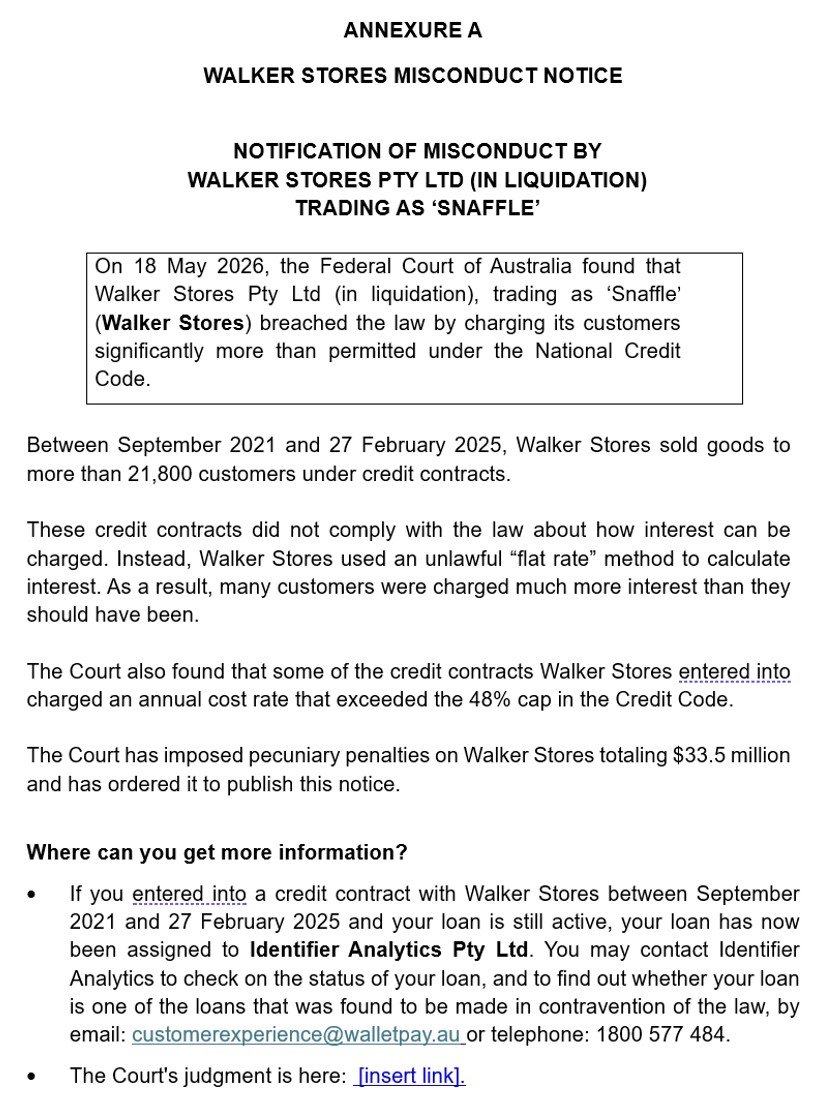
Adverse Publicity Orders
7. Within 14 days of the date of these orders, Walker Stores must:
(a) request Addis Holdings Pty Ltd (Addis Holdings), as the entity which controls and/or operates the websites located at:
(i) https://www.snaffle.com.au (Snaffle Website); and
(ii) https://aspire42.com.au (Aspire42 Website),
to publish, at Walker Stores' expense, a written adverse publicity notice in the terms set out in Annexure A to these orders; and
(b) take all steps reasonably available to it to procure publication of that notice by Addis Holdings in accordance with order 8 below.
8. The notice referred to in order 7 above must be:
(a) published in an immediately visible area of the home page on the Snaffle Website and the Aspire42 Website under a banner titled ‘Notification of Misconduct by Walker Stores trading as Snaffle’;
(b) published in font no less than 14 point; and
(c) displayed on each of the Snaffle Website and the Aspire42 Website for a period of no less than 365 days.
Costs
9. Walker Stores pay the applicant’s costs of and incidental to the proceeding, to be taxed if not agreed, without prejudice to the applicant’s right to apply for a lump sum costs order.
10. Liberty to apply.
Note: Entry of orders is dealt with in Rule 39.32 of the Federal Court Rules 2011.
REASONS FOR JUDGMENT
BEACH J:
1 Walker Stores Pty Ltd (in liquidation) previously carried on an online business supplying consumer goods including home appliances and furniture to consumers by way of “credit contracts”, as defined in s 4 of the National Credit Code (the Code), being Schedule 1 to the National Consumer Credit Protection Act 2009 (Cth) (the Credit Act), with repayments by instalments over 12, 24 or 36 months.
2 Between September 2021 and 27 February 2025, Walker Stores entered into 38,562 credit contracts, including three specific sample contracts that I will identify later.
3 ASIC has alleged that by charging consumers significantly more under those credit contracts than it was permitted to, and by failing to disclose to consumers information about those credit contracts, Walker Stores contravened the requirements of the Code. ASIC’s case is that during the relevant period Walker Stores engaged in the following three categories of contraventions.
4 First, it is said that by entering into the sample contracts pursuant to which it sold goods at marked-up prices, Walker Stores breached s 32A of the Code, which imposes a cap on the cost of credit by way of the annual cost rate or ACR, and thereby contravened s 24(1) of the Code.
5 Second, it is said that the contract documents comprising each sample contract failed to set out the cash price and amount of credit provided, and thereby contravened ss 17(3)(a)(i) and 17(3)(c) of the Code, which is a “key requirement” contravention but not a civil penalty contravention. Section 17 does not include the words “civil penalty” or “penalty units” and so does not meet the definition in s 5(1) of the Credit Act of “civil penalty provision”. It instead refers to Part 6, which provides for penalties for contraventions of “key requirements”. Section 113 of the Code allows for penalties to be imposed for breaches of a “key requirement”. Further, s 116(2) of the Code provides that “section 167B of the National Credit Act [which provides for maximum civil penalties] applies in the same way in relation to the contravention of a key requirement as it would apply in relation to a civil penalty provision under that Act”.
6 Third, it is said that with respect to all 38,562 credit contracts entered into during the relevant period including the sample contracts, Walker Stores imposed an interest charge in excess of the maximum amount permitted under s 28 of the Code. ASIC’s case is that Walker Stores determined the amount of interest on a flat rate basis, contrary to the method for applying interest required by s 28 of the Code. Accordingly, ASIC says that Walker Stores contravened s 24(1) of the Code.
7 ASIC has sought declarations of the rate cap contraventions and the disclosure contraventions in respect of the sample contracts. It has sought declarations of the interest calculation contraventions for all 38,562 contracts which includes the sample contracts. And it has sought pecuniary penalties for each category of contravention, adverse publicity notices and costs.
8 ASIC has not now pressed for the injunctions sought in its originating application because Walker Stores assigned its interest in 24,444 active credit contracts to a related entity and retained other credit contracts which are no longer active.
9 It is useful at this point to say something about the external administrations that Walker Stores has been and is now subject to.
10 On 9 July 2025, Walker Stores entered into voluntary administration and became the subject of a receivership. In the proceeding before me, the receivers have filed a concise response to ASIC’s concise statement on Walker Stores’ behalf, which admitted all of ASIC’s factual allegations.
11 On 3 March 2026, Walker Stores’ creditors resolved to wind up the company. On 17 March 2026, I granted ASIC leave to proceed against Walker Stores now in liquidation.
12 Based on Walker Stores’ concise response it is not in dispute that: (a) Walker Stores priced its credit contracts in the manner alleged and in particular, by aggregating five amounts (the respondent markups) to derive the Walker Stores price, to which it then added GST; (b) interest was calculated using the flat rate calculation method of multiplying the Walker Stores price including GST by the number of years of the contract by the interest rate; (c) the sample contracts were governed by the Code; (d) the sample contracts were priced by way of successive addition of the respondent markups to the acquisition cost; and (e) interest was calculated by the flat rate calculation method across all credit contracts entered into by Walker Stores during the relevant period.
13 ASIC has relied on the documentary evidence annexed to its investigator’s affidavits and various affidavits of its external solicitor. The documentary evidence before me also includes a list of contract particulars for 38,562 contracts provided by the receivers on 3 March 2026.
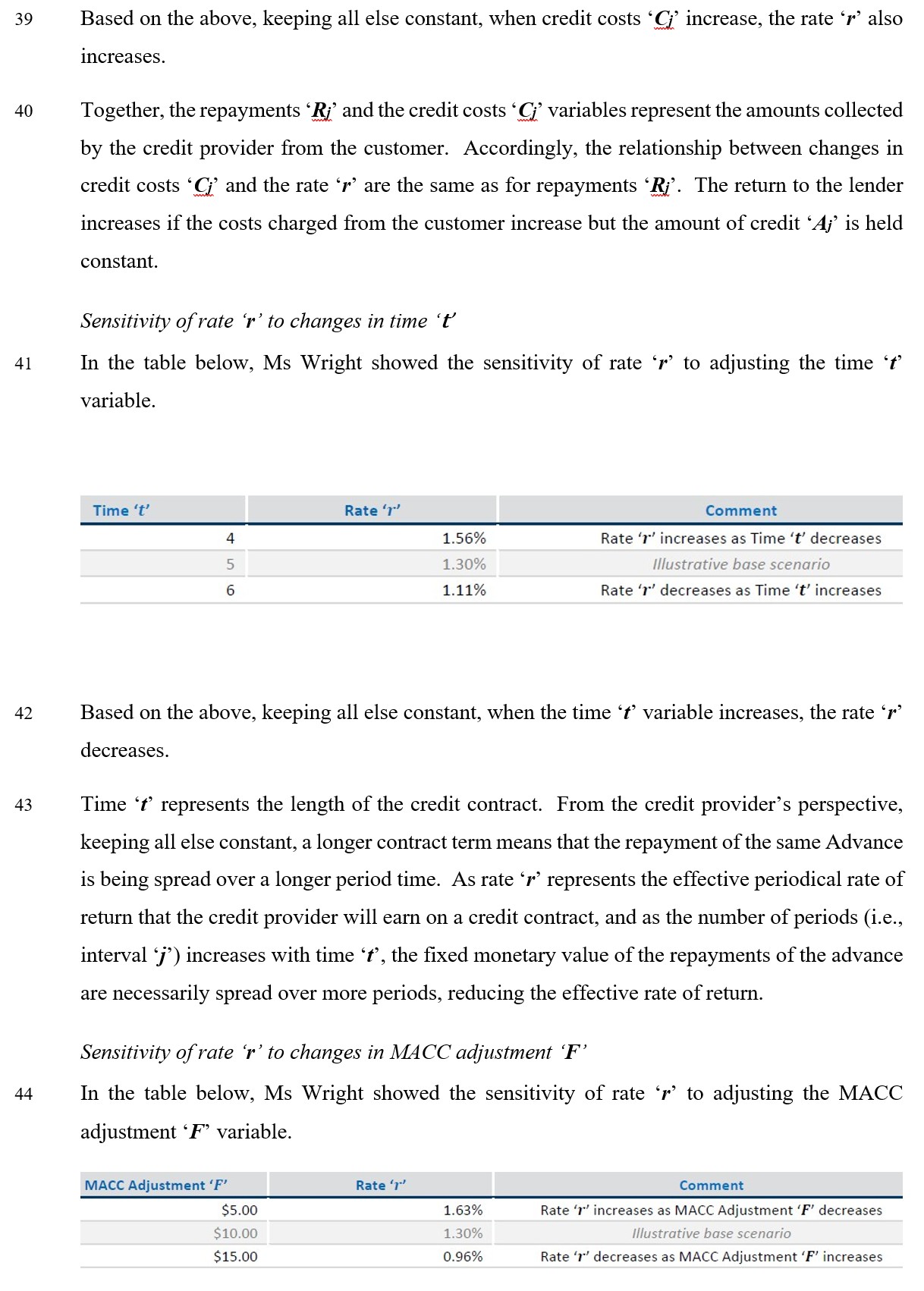
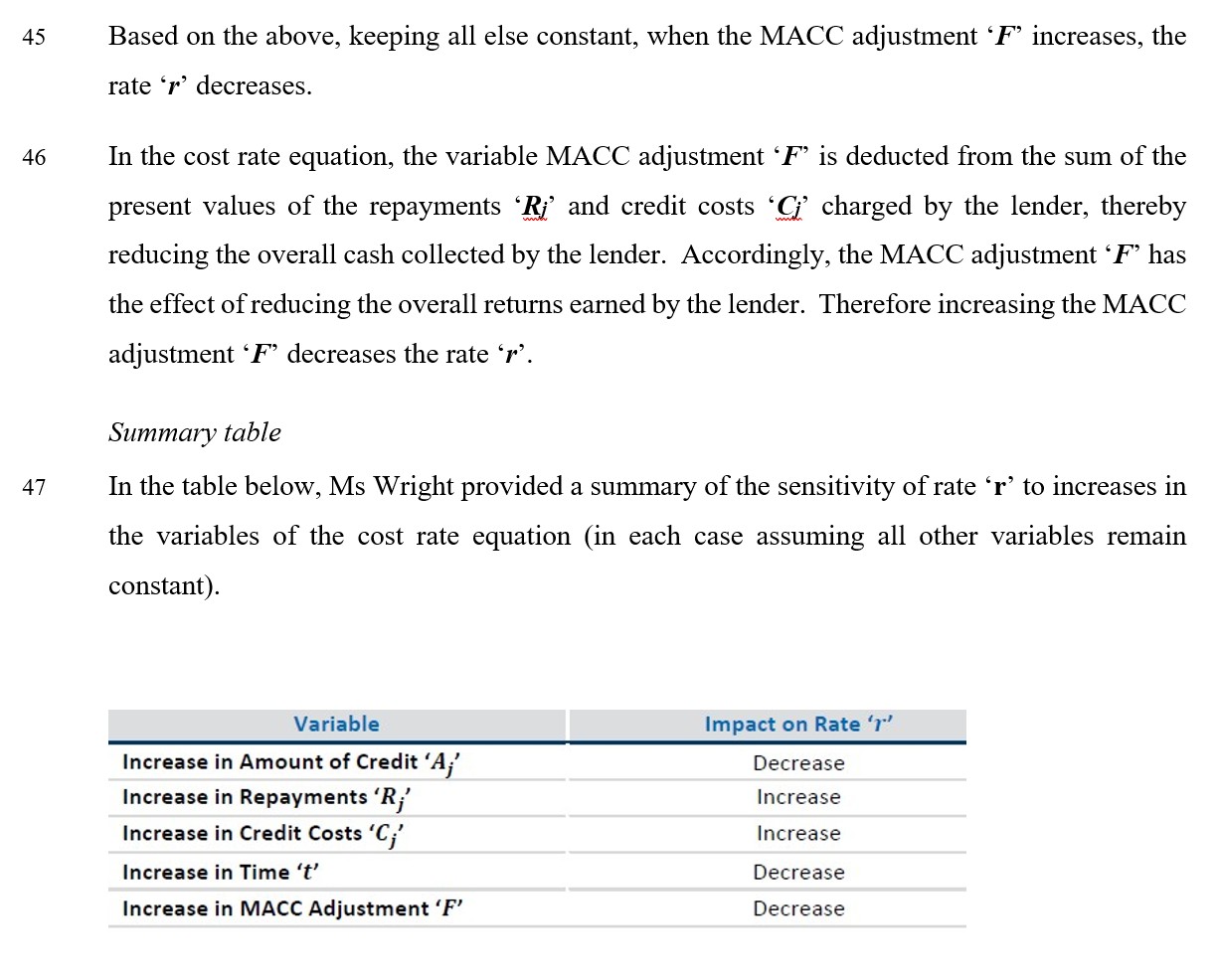
14 ASIC has also tendered an expert report of Ms Dawna Wright, a forensic accountant and principal of FTI Consulting, who prepared a report explaining the operation of the formulae in issue, as well as calculating the total amount overcharged with respect to the rate cap and interest calculation contraventions; annexed to these reasons are some extracts from her report.
15 On 18 May 2026, I imposed on Walker Stores a total pecuniary penalty of $33.5 million and made various other declarations and orders. These are my reasons for so doing.
Some relevant background
16 Walker Stores holds an Australian credit licence, which was first issued on 22 March 2011 and which authorises it to carry on a business of providing credit.
17 Walker Stores is a member of what is known as the Aspire 42 corporate group, as is Aspire 42 Financing Pty Ltd (Aspire 42). Aspire 42 and Walker Stores are related entities. Further, United Wholesale Solutions Pty Ltd (UWS) is a member of a corporate group of companies that has over-lapping shareholders, directors and management executives with the Aspire 42 corporate group.
18 From at least around late September 2021, Walker Stores traded under the name “Snaffle” and operated exclusively online through the website “Snaffle.com.au”. Trading as Snaffle, Walker Stores offered consumers products such as electronics, furniture and household appliances, to be purchased on 12, 24 or 36 month credit contracts with weekly or fortnightly repayment terms. It also offered consumers the option to pay for those goods for cash, and Walker Stores claimed that this formed the retail arm of the Snaffle business. But these cash sales were negligible. In either case, the purchase price of the goods, or the price which was financed with credit, was the same as the Walker Stores price.
19 Now the process by which Walker Stores determined the Walker Stores price is central to this matter.
20 Walker Stores obtained the goods it sold on credit from wholesale or retail suppliers such as JB Hi-Fi and the Good Guys. They were obtained for Walker Stores by way of two associated entities pursuant to a supply agreement dated 13 March 2020.
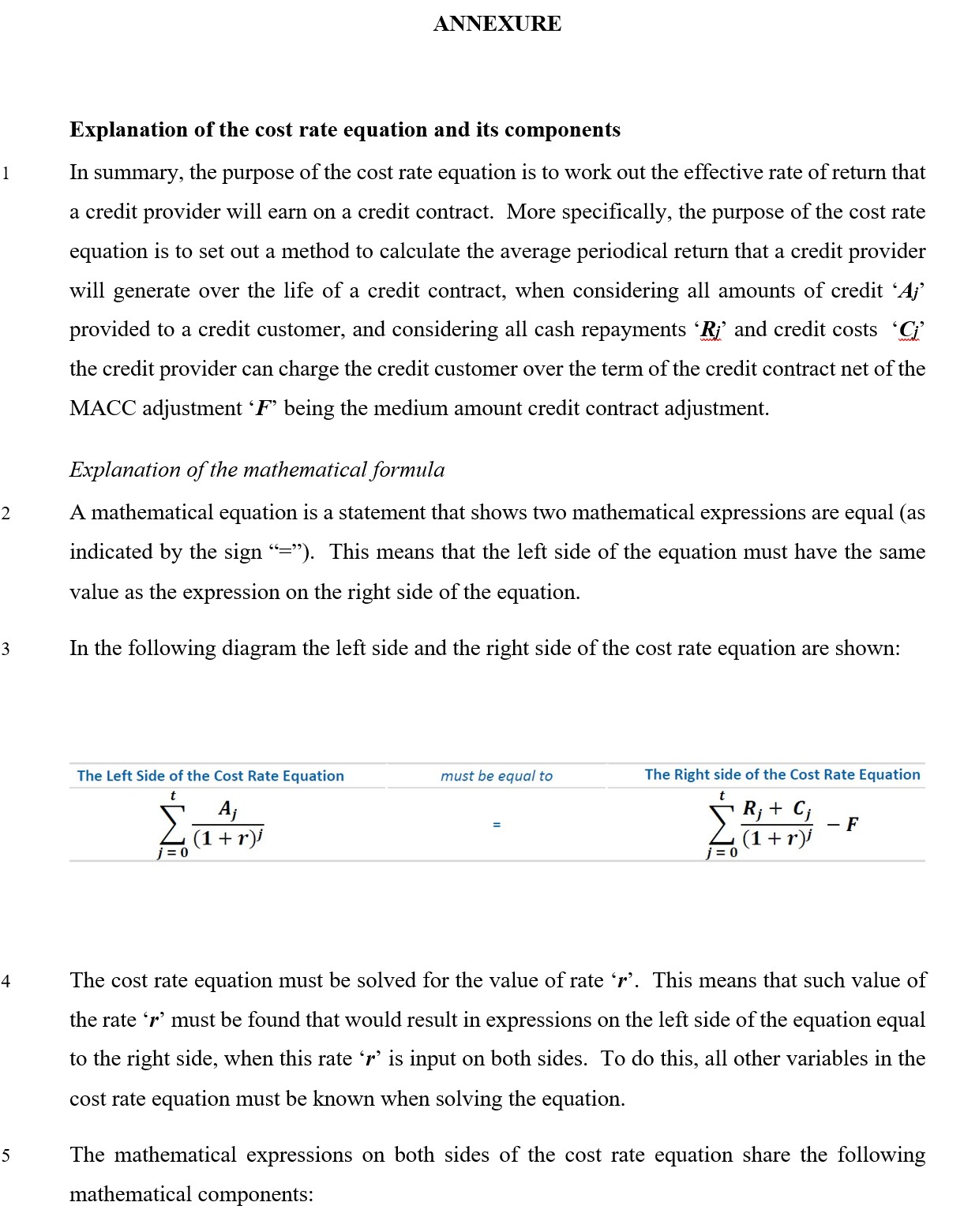
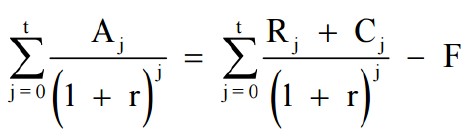
21 The supply agreement was made between Aspire 42 and UWS. It describes Aspire 42 as a service company engaged by Walker Stores, though it does not specify what that engagement is or whether it is in writing. The services required of Aspire 42 include to manage the ordering, delivery, payment and resupply of the household goods to Walker Stores.
22 By the supply agreement, Aspire 42 appointed UWS as its exclusive supplier of household goods for a term of 36 months. Upon Walker Stores requiring a household good to on-sell to the consumer under a credit contract, it was to inform Aspire 42 and Aspire 42 would order those goods from UWS. UWS was to source the household goods from its selected suppliers, and order and pay for those goods and inform Aspire 42 when the goods were available for delivery. UWS was then to deliver the goods as directed by Aspire 42 and issue it a tax invoice. For this service, Aspire 42 was to pay UWS the price charged by the supplier, plus a margin on that price, plus GST and delivery.
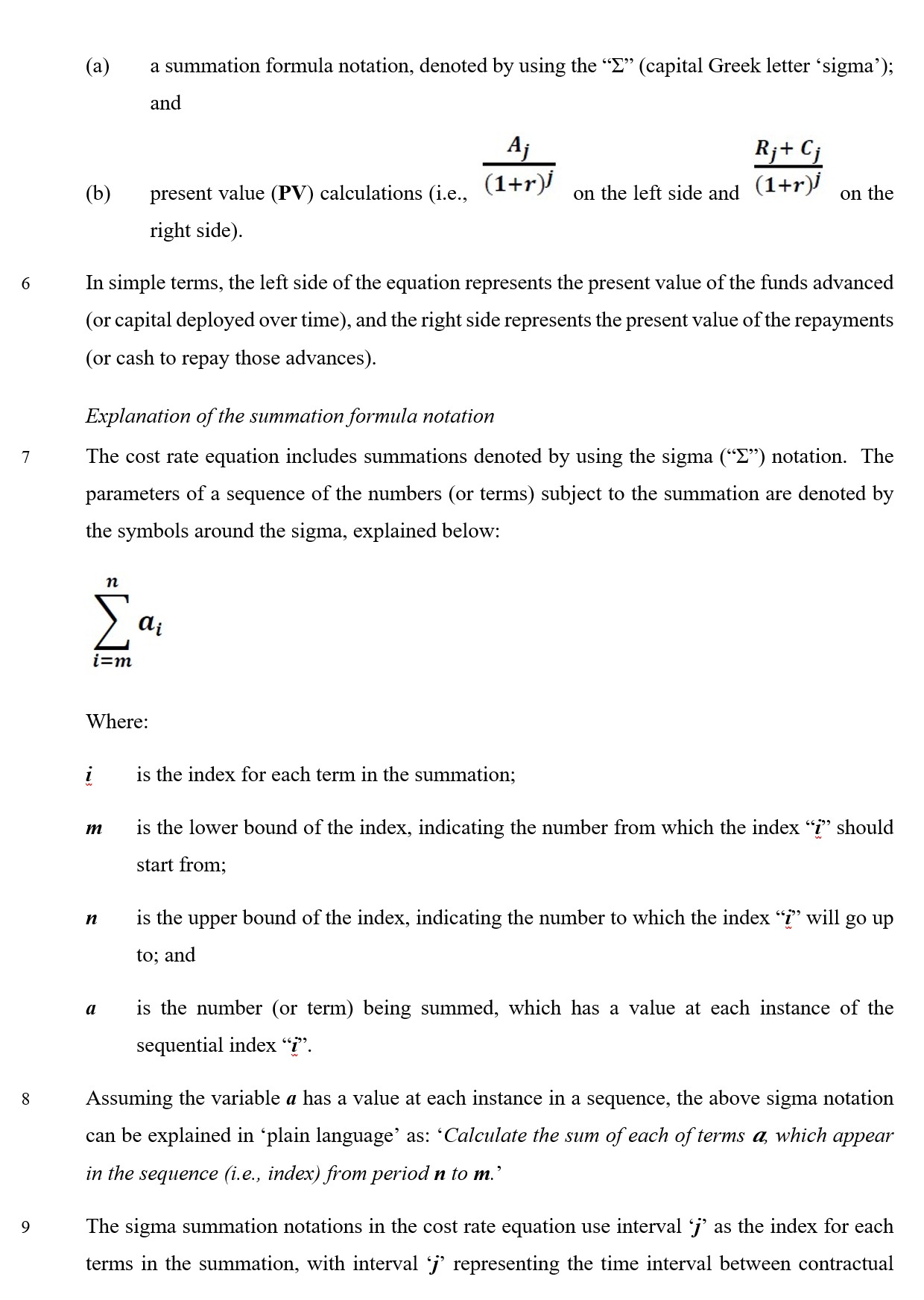
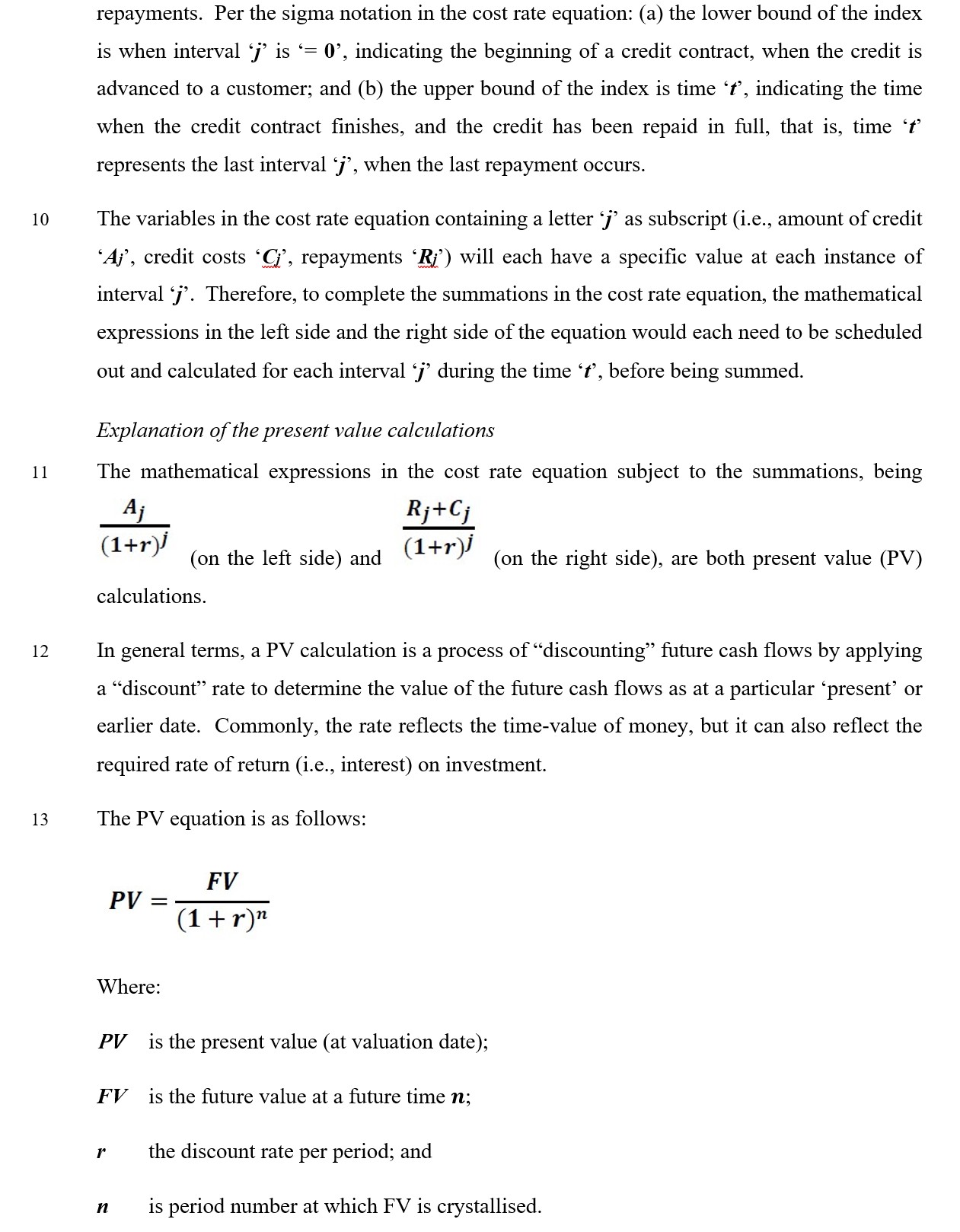
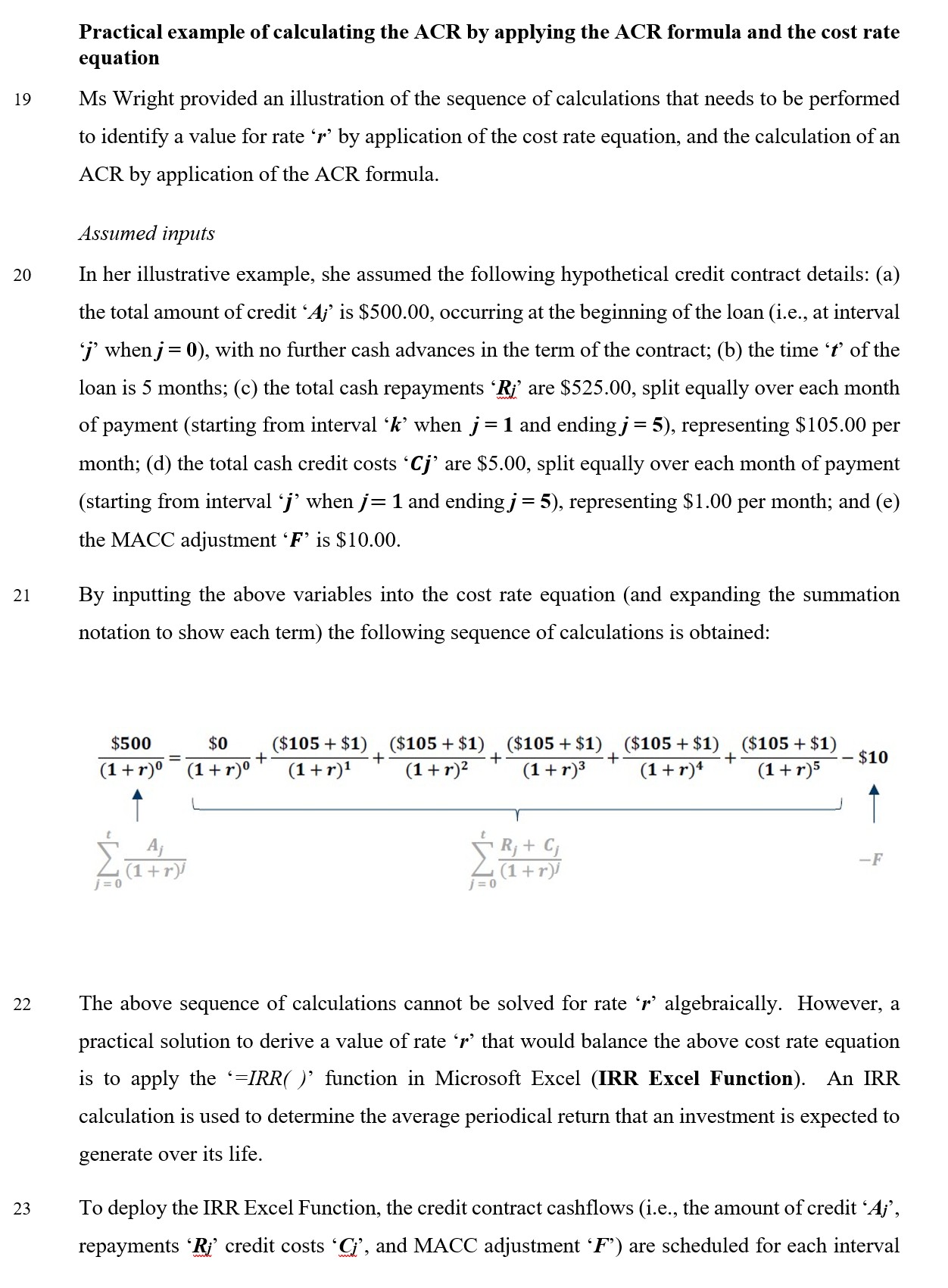
23 The supply agreement was silent as to the quantum of the margin to be applied to pay for UWS’s services. But it would seem that the margin Walker Stores paid UWS for its services was 10%. The supply agreement also did not state how Aspire 42 was to be paid, if at all, for its services.
Respondent markups
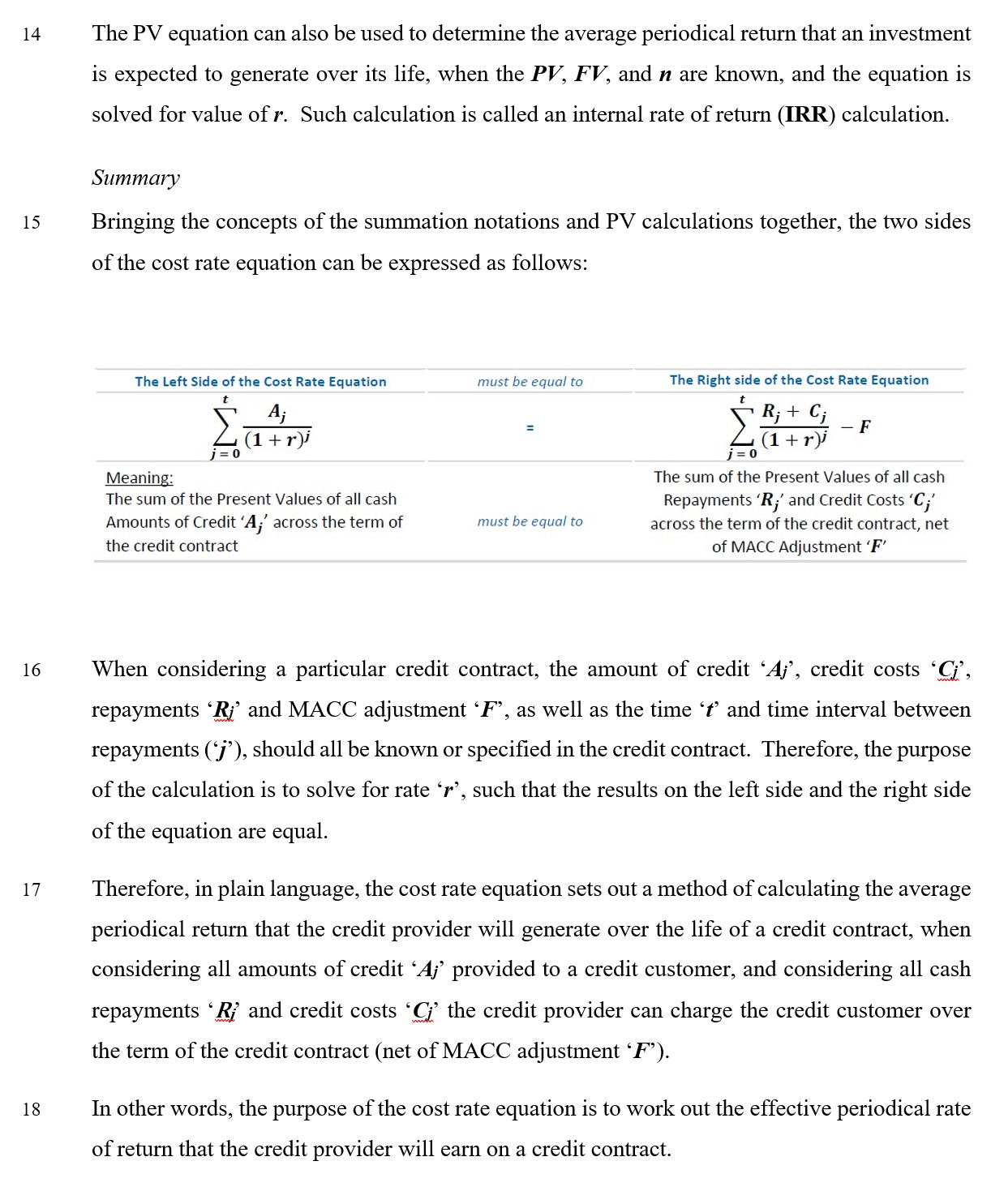
24 The price UWS paid to purchase the good from a supplier is termed the acquisition cost. The 10% of that acquisition cost that Walker Stores paid to UWS for the services of sourcing, managing and delivering the good to the consumer was the UWS markup, being the first markup applied by Walker Stores.
25 To the acquisition cost, raised by 10% by the UWS markup, Walker Stores added a succession of further markups.
26 First, Walker Stores imposed a global 3% markup on the acquisition cost, to cover its operating expenditure including personnel, marketing, sales, occupancy, administration and IT. This markup is termed the operating costs markup.
27 Second, a flat $35 fee described as a delivery fee was added. However, this figure was charged irrespective of whether Walker Stores (or UWS on its behalf) incurred any delivery fee, and the credit contracts did not specify any amount for delivery. This is termed the delivery fee.
28 Third, Walker Stores imposed a further markup on top of the acquisition cost raised by the UWS markup, operating costs markup, and delivery fee, as “profit” or a “margin”. This is termed the profit margin. This markup was determined on a per-product basis, with margins ranging from approximately 5% to 30%, and was further subject to a “dynamic margin pricing process” by reference to factors such as supply conditions, demand, seasonality and promotional considerations. This process was directed to producing a retail price that provided for a profit margin on the retail activity. Walker Stores approached pricing on the basis that the retail sale of the goods and the provision of credit were separate and independent business transactions, with the goods price set so as to achieve a desired retail margin. Interest was then applied as a distinct component of the overall transaction.
29 The sub-total of the acquisition cost and each of these respondent markups is the Walker Stores price. That is, acquisition cost + UWS markup + operating costs markup + delivery fee + profit margin, or algebraically (assuming a 30% profit margin) ((acquisition cost + (acquisition cost x .1) + (acquisition cost x .03) + delivery fee) x 1.3). Walker Stores charged GST on the Walker Stores price, and to this amount added interest.
Walker Stores’ interest charges
30 For each credit contract, Walker Stores applied flat interest. The interest rate it applied increased from 15% at the start of the relevant period to 25 July 2023, to 22.5% between 25 July 2023 and 8 December 2023, and finally to 25.75% from 8 December 2023 to at least the end of the relevant period.
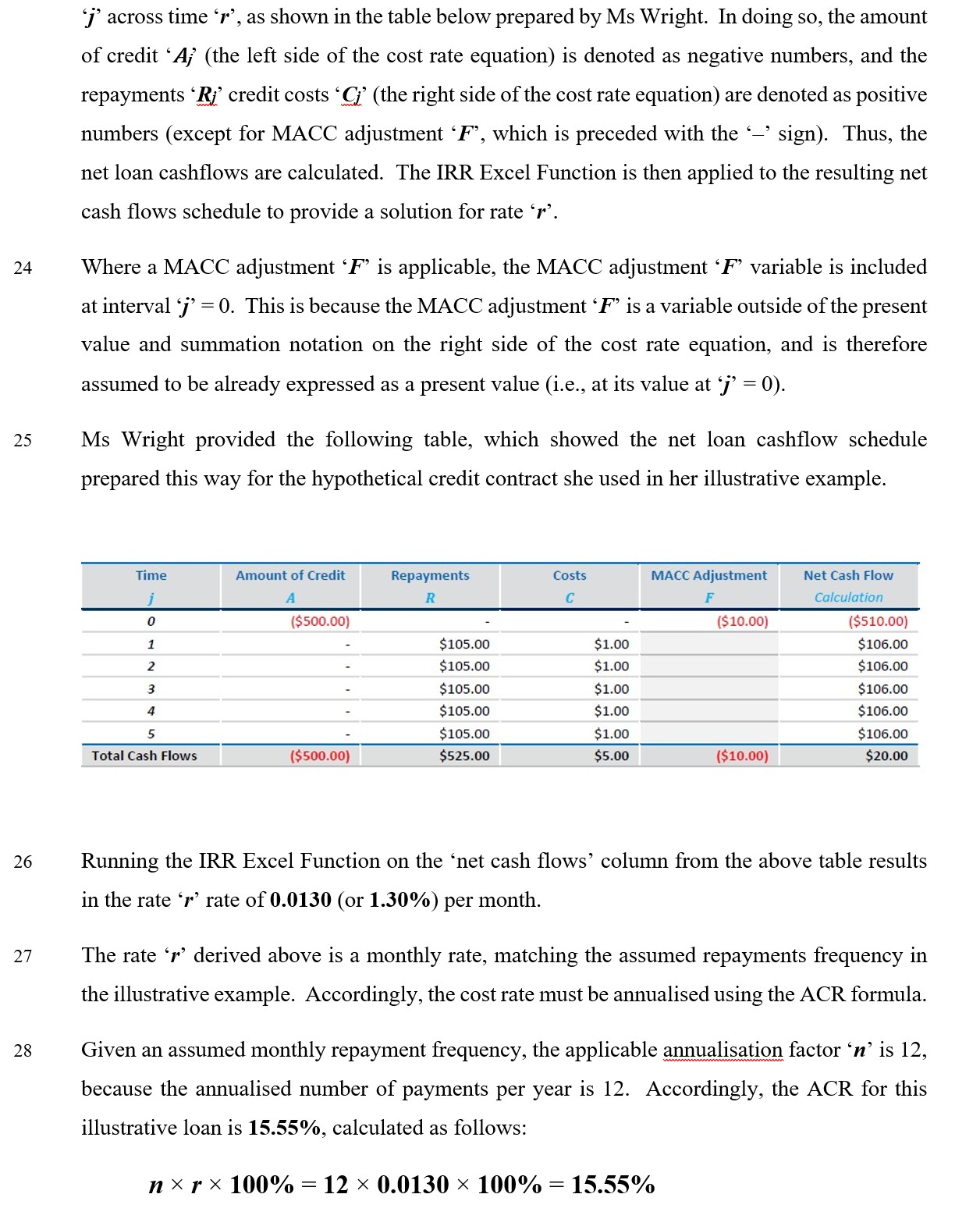
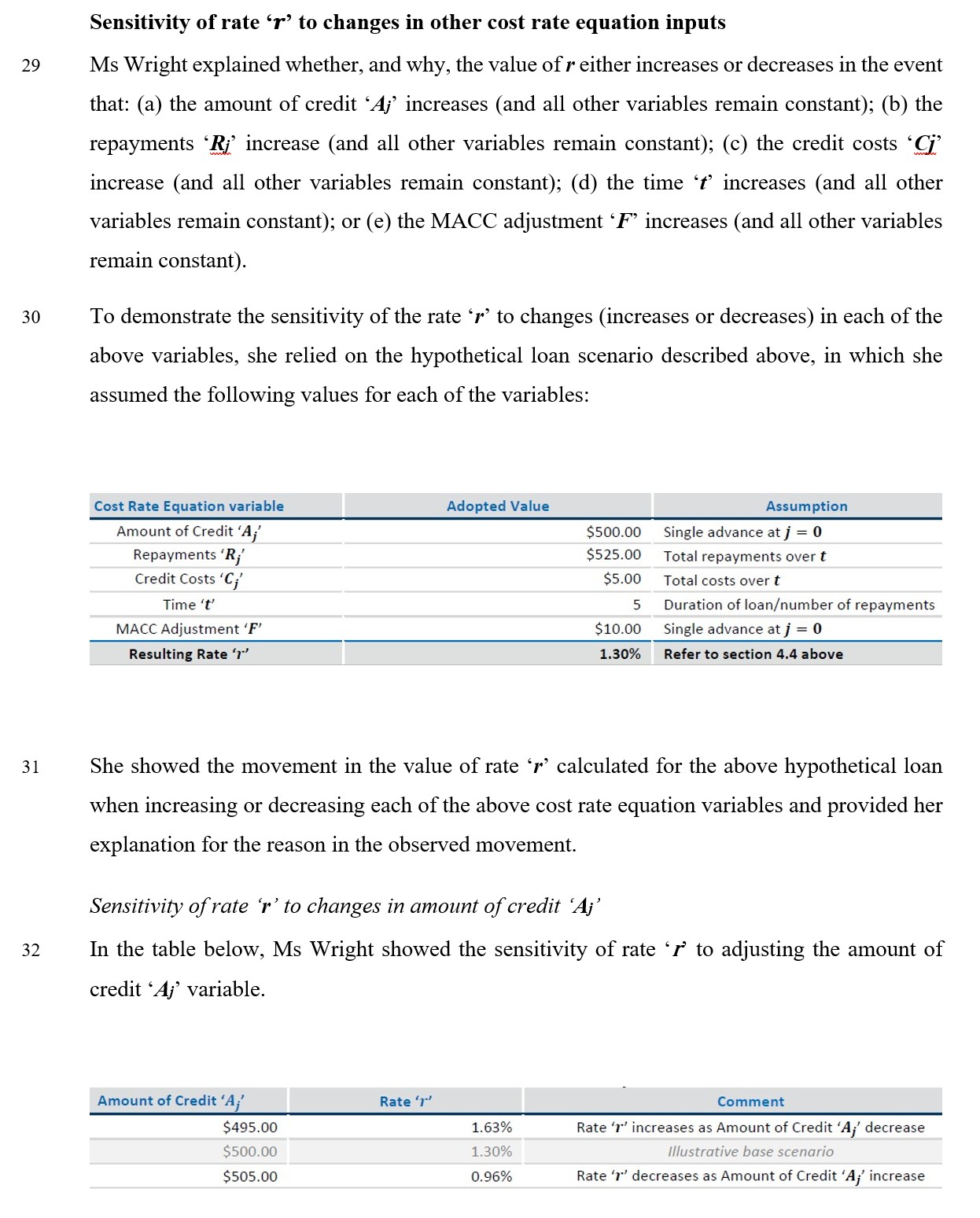
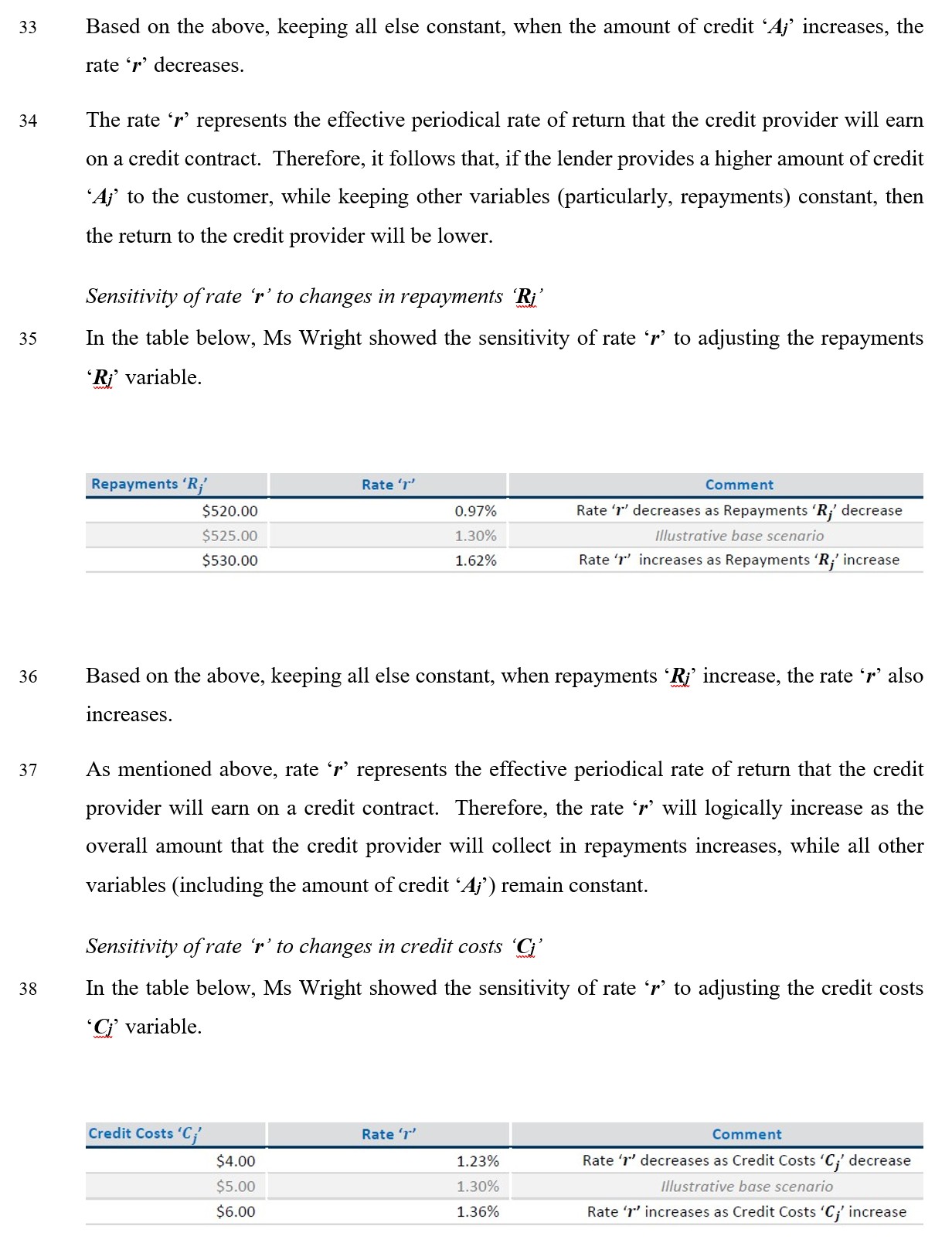
31 It calculated interest by simply taking the Walker Stores price, with GST, and multiplying that figure by the then-current interest rate for each year of the contract. Taking the terms of contract A as an example, a consumer taking out a 3 year instalment contract at a 25.75% interest rate would have to pay Walker Stores 77.25% of the principal (the Walker Stores price with GST) in interest alone. In other words, Walker Stores did not impose reducible interest, by which the interest is calculated only on the remaining outstanding principal.
32 This method of calculation of interest, the flat rate calculation method, was put in place in September 2021, that is, in the period immediately prior to its first offer of credit contracts under the Snaffle brand in October 2021, which is the start of the relevant period.
33 The application of the flat rate calculation method across Walker Stores’ entire loan book is the subject of ASIC’s case concerning the interest calculation contraventions.
The sample contracts
34 For the purposes of its rate cap contraventions and disclosure contraventions cases, ASIC relies on the particulars of the three sample contracts. Under each sample contract the Walker Stores price was determined according to the methodology set out above, that is: (a) the acquisition from a retail supplier by UWS (or Aspire 42) on behalf of Walker Stores at the acquisition cost; (b) the addition to the acquisition cost of the respondent markups; (c) the charging of GST; and then (d) the application to the Walker Stores price + GST of interest calculated using the flat rate calculation method. Of course ASIC alleges that this method was applied to Walker Stores’ entire loan book.
35 The sample contracts were selected by ASIC to present a clear and confined case in respect of the rate cap contraventions and disclosure contraventions.
36 The documents comprising each sample contract and its terms were produced by Walker Stores as “client files”. In respect of each customer, all of Walker Stores’ client files produced to ASIC comprise the same suite of documents being: (a) a document titled “Pre-Contractual Statement (Financial Table), Line of Credit Agreement Schedule and Tax Invoice” (Schedule); (b) a document containing terms and conditions; (c) a credit guide; and (d) a list of payments received to the date of the provision of the contracts to ASIC.
37 The Schedule contains the essential integers of the credit contract. It names Walker Stores, trading as Snaffle under its Australian credit licence, as the credit provider. It gives the contract a unique loan number. It then sets out a description of the goods financed, giving a “unit price” (the Walker Stores price) plus GST as the “total purchase price”.
38 Each sample contract and its accompanying terms and conditions describe the credit product offered to consumers as a “line of credit”.
39 Consistently, the Schedule for each sample contract records that the consumer was approved to borrow a specified maximum amount of credit per month. The Schedules refer to this specified amount as the “amount of credit – line of credit facility (maximum amount of credit approved)”. Although an annual subscription fee was provided for in each Schedule, the subscription fee under each sample contract was $0.
40 Next, the Schedule lists the terms of credit: an annual percentage rate of 25.75%, “calculated for the Term and added to the purchase price of the Goods and divided by the number of months as selected by you for [sic] as the Term”.
41 The Schedule then lists various essential terms under the heading “Repayments”, being: (a) the amount of each repayment; (b) the total number of repayments; (c) the term of the contract in months; (d) when repayments are to be made – in the case of each sample contract, this was monthly in arrears; and (e) the total amount of interest to be paid.
42 The Schedule also provides for an establishment fee (which is “$nil” in all sample contracts), and other contingent fees (such as dishonour fees) which are not relevant.
43 Finally, the Schedule states a grand total payable under each sample contract, which is labelled as the “total credit fees and charges”. This amount is the total of the Walker Stores price, with GST, plus the total amount of interest to be paid.
44 Pursuant to the terms and conditions documents issued with each sample contract, the consumer acquired title to the purchased good, albeit subject to an “Encumbrance” in favour of Walker Stores. Walker Stores stated in those terms and conditions in addition to the Schedule as noted above, contrary to its actual practice for calculating and charging interest, that interest would be “calculated daily by applying the daily percentage rate to the daily outstanding balance (excluding the Subscription Fee) on your account. The daily percentage rate is the Interest Rate divided by 365”.
Contract A
45 Contract A was entered into on 2 July 2024 with consumer A and was made for the purchase by consumer A of a Haier 7.5kg front load washing machine model, with payments by consumer A required under contract A to be made to Walker Stores in equal weekly instalments of $9.93 over a term of 3 years, as implied by there being 156 instalments over a three-year term stated in the Schedule.
46 The Schedule for contract A stated that the “total purchase price” was $873.95, the “total amount of interest” was $675.13, and the “total credit fees and charges” amount was $1,549.08.
47 As with each sample contract, this terminology is both at odds with s 17 of the Code and inapt. The “total purchase price” is not the total payable to purchase the good by instalments but instead denotes the Walker Stores price plus GST. It is the price that would be payable for cash and without interest. The “total credit fees and charges” is not a reference to the statutory term “credit fees and charges” as defined in s 204 of the Code, but instead is the total amount payable by the consumer over the life of the contract, excluding any contingent fees such as dishonour fees.
48 Walker Stores, via UWS and Aspire 42, acquired the washer from Appliances Online, an online seller of appliances, for $539 inclusive of GST. That amount is $334.95 less than the Walker Stores price with GST, and $1,010.08 less than the total amount payable by the consumer over the life of the contract. Consumer A therefore stood to pay almost triple the amount payable for the washer had they purchased it directly from Appliances Online or a similar retailer. Consumer pricing is changeable across retailers and there is evidence before me of competitor online retailers for the same good for a comparable amount to the acquisition cost.
49 The $873.95 Walker Stores required for the washer on credit (before interest) was priced by adding to the $539 acquisition cost the following respondent markups: (a) the UWS markup of $53.90, which UWS applied to the acquisition cost and Walker Stores paid UWS; (b) the operating costs markup of $16.17, being 3% of the acquisition cost; (c) the delivery fee of $35; and (d) the profit margin of $150.43, which was a 23.4% increase on $644.07, being the sum of the acquisition cost plus the UWS markup plus the operating costs markup plus the delivery fee. The sum of the respondent markups was $255.50, and then adding GST of 10% on the Walker Stores price achieved the total purchase price of $873.95.
50 Walker Stores then added interest of 25.75%, which was calculated using the flat rate calculation method, to the principal Walker Stores price plus GST for each of the three years of the contract, being $225.05 each year irrespective of whatever consumer A paid down on the principal over that time.
51 Upon the contract being executed, UWS acquired the washer from Appliances Online and had Appliances Online deliver it to consumer A, for a total payment to Appliances Online of $539, inclusive of GST and with no charge paid by UWS for delivery.
52 Consumer A had, at the time the list of contracts was provided by the receivers on 3 March 2026, paid 85 of 156 instalments against contract A, equal to $844.05.
53 Contracts B and C are similar in form to contract A.
Contract B
54 Contract B was entered into on 5 July 2024 with consumer B and was made for the purchase by consumer B of an LG 315L top mount frost-free silver fridge, with payments by consumer B required under the contract to be made to Walker Stores in equal weekly instalments of $15 over a term of 3 years, as implied by there being 156 instalments over a three-year term stated in the Schedule.
55 The Schedule for contract B stated that the “total purchase price” (the Walker Stores price plus GST) of the fridge was $1,320.17, the “total amount of interest” was $1,019.83, and the “total credit fees and charges” (or really, total payable) was $2,340.
56 Walker Stores, via UWS and Aspire 42, acquired the good from Appliances Online for $925 (inclusive of GST), $395.17 less than Walker Stores priced the fridge, and $1,415 less than the total amount payable by the consumer over the life of the contract. Consumer B therefore stood to pay more than 2.5 times the amount payable for the fridge had they had purchased it directly from Appliances Online or a similar retailer.
57 The Walker Stores price for the fridge was priced by adding to the $925 acquisition cost the following respondent markups: (a) the UWS markup of $92.50; (b) the operating costs markup of $27.75, being 3% of the acquisition cost; (c) the delivery fee of $35; and (d) the profit margin of $119.90, which was an 11.1% increase on $1,080.25, being the sum of the acquisition cost plus the UWS markup plus the operating costs markup plus the delivery fee. The sum of the respondent markups was $275.15, and then adding GST of 10% on the Walker Stores price achieved the total purchase price of $1,320.17.
58 Walker Stores then added interest of 25.75% or $339.94, which was calculated using the flat rate calculation method, for each of the three years of the contract.
59 Upon the contract being executed, UWS acquired the fridge from Appliances Online and had Appliances Online deliver the fridge to consumer B, for a total payment to Appliances Online of $925, inclusive of GST and with no charge for delivery.
60 Consumer B had, at the time the list of contracts was provided by the receivers, paid 83 of 156 instalments against contract B, equal to $1,395.
Contract C
61 Contract C was entered into on 1 July 2024 with consumer C and was made for the purchase by consumer C of an Apple iPhone 15 256GB, with payments by consumer C required under the contract to be made to Walker Stores in equal fortnightly instalments of $54.44 over a term of 3 years, as implied by there being 78 instalments over a three-year term stated in the Schedule.
62 The Schedule for contract C stated that the “total purchase price” (the Walker Stores price plus GST) of the phone was $2,395.67, the “total amount of interest” was $1,850.65, and the “total credit fees and charges” (or really, total payable) was $4,246.32.
63 Walker Stores, via UWS and Aspire 42, acquired the phone from Xtreme Communications, an online retailer mainly of refurbished phones, for $1,733 (inclusive of GST), $662.67 less than Walker Stores priced the phone, and $2,513.32 less than the total amount payable by the consumer over the life of the contract. Consumer C therefore stood to pay more than 2.5 times the amount payable for the phone had they purchased it directly from Xtreme or a similar retailer.
64 The Walker Stores price for the phone was priced by adding to the $1,733 acquisition cost the following respondent markups: (a) the UWS markup of $173.30; (b) the operating costs markup of $51.99, being 3% of the acquisition cost; (c) the delivery fee of $35; and (d) the profit margin of $184.59, which was an 9.3% increase on $1,992.29, being the sum of the acquisition cost plus the UWS markup plus the operating costs markup plus the delivery fee. The sum of the respondent markups was $444.88 and then adding GST of 10% on the Walker Stores price achieved the total purchase price of $2,395.67.
65 Walker Stores then again added interest of 25.75% or $616.89 on that figure by way of interest, which was calculated using the flat rate calculation method, for each of the three years of the contract.
66 Upon the contract being executed, UWS acquired the phone from Xtreme and had Xtreme deliver the phone to consumer C. Unlike under contracts A and B, Xtreme charged UWS a delivery fee, so that the total UWS paid to Xtreme (and Walker Stores paid to UWS) was $1,758, being $1,733, inclusive of GST, plus $25 delivery.
67 Consumer C had, at the time the list of contracts was provided by the receivers, paid 8 of 78 instalments against contract C, totalling $435.52, with a number of dishonoured and failed payments recorded.
The remaining contracts
68 For the interest calculation contraventions case, ASIC further relies on particulars of the 38,562 contracts entered by Walker Stores over the course of its trading. These contracts have not been individually reviewed by ASIC. Instead, it relies on their particulars as set out in the list of contracts provided by the receivers. Contracts A, B and C are part of this set.
69 I should say here that I am prepared to find that each of the 38,562 contracts was a credit contract to which the Code applies. This is so for four reasons. First, Walker Stores’ business model was selling consumer goods on credit. Second, Walker Stores admitted entering credit contracts to which the Code applies. Third, the receivers of Walker Stores provided the list of contracts in response to ASIC’s request for an Excel document containing various particulars of all credit contracts Walker Stores entered in the relevant period, which it represented were credit contracts subject to the Code. Fourth, one has the statutory presumption in s 13(1) of the Code that each contract in the list of contracts was a credit contract to which the Code applies. That presumption applies given that there is no evidence to the contrary.
Walker Stores’ retail arm
70 From 22 January 2024, Walker Stores offered a “Pay Now” option on the Snaffle website, by which consumers could purchase a good for cash, being the Walker Stores price, plus GST. Before 22 January 2024, Walker Stores allowed consumers to purchase goods for cash by contacting Walker Stores by phone. But few consumers ever paid Walker Stores the Walker Stores price to purchase a good for cash. Walker Stores produced only 96 invoices for recorded cash sales, and confirmed that 53 of the 96 invoices were for cash purchases made by staff employed by the Aspire 42 corporate group, which involved promotional discounts, rather than to consumers. It would seem on the evidence that few consumers purchased goods from Walker Stores with cash for the Walker Stores price. And in my view the Walker Stores price was not a price which a cash purchaser could reasonably be expected to pay.
The rate cap contraventions
71 ASIC contends that by reason of Walker Stores’ pricing practice, Walker Stores contravened s 32A of the Code in respect of each sample contract. ASIC says that Walker Stores embedded within the stated price of goods sold under sale by instalments contracts, amounts that are, in substance, charges for the provision of credit. Further, it says that as a result, the ACR under those contracts exceeded the maximum ACR of 48% prescribed by s 32A.
72 Section 32A(1) prohibits a credit provider entering into a credit contract with an ACR of greater than 48%. Section 32B(2) of the Code provides the mathematical formula for calculating the ACR of a credit contract. The formula compares the “amount of credit” (Aj) against the “repayments” (Rj) and “credit cost amount” (Cj). I will set out the statutory provision in a moment. I should note that the integers of ss 32A and 32B of the Code have not been the subject of any detailed judicial attention. Greenwood J considered breaches of s 32A in Australian Securities and Investments Commission v Rent 2 Own Cars Australia Pty Ltd (2020) 147 ACSR 598, although there was no debate before his Honour as to the proper construction of s 32B.
73 Now it is obvious that where the credit provided is in the form of money, the identification of the “amount of credit”, “repayments” and “credit cost amount” is straightforward. But where, as here, the “credit” advanced pursuant to a “credit contract” entails the provision of title to a consumer good, with consideration for that title to be made over a term, the identification of the “amount of credit” is less straightforward. Goods do not have a single value that may be expressed in dollar figures, as money does. Payments of instalments toward the purchase of a good may mix payments for the purchase of the good, payments toward interest, and payments for fees or services relating to the credit, without obvious distinction.
74 Moreover, this complexity is compounded in this case by Walker Stores’ application of the respondent markups. The Walker Stores price, being inclusive of the respondent markups, was in each case substantially greater than the price that Walker Stores paid for the goods, and the price each consumer could have paid for the same goods from other retailers, albeit not under credit contracts. Put simply, ASIC’s case is that the Walker Stores price cannot be treated as being the “amount of credit”.
75 An additional complexity is that the terms “amount of credit” and “cost of credit”, which are integers in the formula used in s 32B(1) to define r, and thus the ACR, do not have obvious application to credit contracts of the type under consideration in the present case. There is therefore some opacity in how those terms are to be construed.
The competing constructions
76 ASIC has identified two alternative candidate constructions of s 32B which can conveniently be referred to as:
(a) the credit cost construction; and
(b) the cash price construction.
77 On the credit cost construction, ASIC says that the “amount of credit” is exclusive of the respondent markups, because they are in substance “credit fees or charges” or “fee[s] or charge[s] payable by” the consumer to reimburse Walker Stores for its services of, and in relation to, the provision of goods on credit and thus form part of the “credit cost amount”; see the definition of “credit cost amount” in s 32B(3) of the Code. Being costs of credit, they are thereby excluded from forming part of the “amount of credit”. As a result, on this construction, the “amount of credit” is equal to the Walker Stores price plus GST, less the respondent markups.
78 Alternatively, on the cash price construction, ASIC says that the “amount of credit” is the “cash price” for the goods as defined by s 204(1) of the Code. As a result, the Walker Stores price is not, by reason of the respondent markups, a price a consumer would reasonably be expected to pay from the supplier and so is not the “cash price” and thus is not the “amount of credit”.
79 ASIC says that on either of its two constructions, the phrase “cost of credit” captures a sum that is referable to the cost to consumers of the good being provided on “credit”, which cost is calculated in different ways by reference either to s 32B(3)(b) or s 204(1) of the Code. ASIC says that this phrase should be interpreted so as to prevent credit providers from avoiding the operation of s 32A of the Code by defining the “amount of credit” as whatever the credit contract defines it to be.
80 ASIC says that each of its constructions is supported by the text and context of ss 32A and 32B of the Code and in light of the purpose and history of Division 4A of Part 2 in which those provisions appear. Let me delve more deeply into s 32B.
Part 2 Division 4A – the ACR
81 Division 4A of Part 2 imposes a limit on the ACR of certain credit contracts and gives the means of its calculation. The ACR provides a single annualised expression of the relationship in any regulated credit contract between the amount of credit provided, on the one hand, and the total of all repayments and payments of the cost of credit, on the other, in each case over the life of the contract.
82 The ACR combines two formulae in ss 32B(1) and (2).
83 Section 32B(1) provides the annualisation formula of the ACR in the following terms:
(1) The annual cost rate of a credit contract must be calculated as a nominal rate per annum, together with the compounding frequency, using the formula:
n x r x 100%
where:
n is the number of repayments per annum to be made under the credit contract (annualised if the term of the contract is less than 12 months), except that:
(a) if repayments are to be made weekly—n is 52.18; and
(b) if repayments are to be made fortnightly—n is 26.09; and
(c) if the contract does not provide for a constant interval between repayments—n is to be derived from the interval selected for the purposes of the definition of j in subsection (2).
r is the solution of the equation specified in subsection (2).
84 Section 32B(2) is a cost rate equation that provides the r input to that annualisation formula, in the form of an equation of two different summations:
(2) The equation for the purposes of the definition of r in subsection (1) is:
where:
Aj is the amount of credit to be provided under the credit contract at time j (the value of j for the provision of the first amount of credit is taken to be zero).
Cj is the credit cost amount (if any) for the credit contract that is payable by the debtor at time j in addition to the repayments Rj.
F is:
(a) if the credit contract is a medium amount credit contract—$400 (or such other amount as is prescribed by the regulations); or
(b) if the credit contract is not a medium amount credit contract and an amount is prescribed by the regulations in relation to the contract—that amount; or
(c) otherwise—$0.
j is the time, measured as a multiple (not necessarily integral) of:
(a) if the credit contract does not provide for a constant interval between contractual repayments—an interval of any kind selected by the credit provider as the unit of time; or
(b) otherwise—the interval between contractual repayments that will have elapsed since the first amount of credit is provided under the credit contract.
Rj is the repayment to be made at time j.
t is the time, measured as a multiple of the interval between contractual repayments (or other interval so selected), that will elapse between:
(a) the time when the first amount of credit is provided under the credit contract; and
(b) the time when the last repayment is to be made under the contract.
85 The equation in essence equating two summations has the following interesting features relevant to its construction.
86 The cost rate equation includes summations denoted by the capital sigma (“Σ”) notation, which indicates that a summation of a sequence of numbers (or terms) is to be performed. The sequence is bounded by the lower and upper bounds shown below and above the sigma, respectively. Each expression in the cost rate equation subject to the summations, being the left and right sides of the equals sign, is a present value calculation of, respectively, the “amount of credit”, and of the amount of all “repayments” and “credit cost amounts”. Of course, a present value calculation is a process of discounting future cash flows by applying a discount rate to determine the value of the future cash flows as at a particular present or earlier date. Commonly, the rate reflects the time-value of money, but it can also reflect the required rate of return on an investment.
87 Now adopting the defined terms in s 32B, the following may be noted.
88 The left hand side of the cost rate equation gives the sum of the present values of all cash amounts of credit ‘Aj’ across the term of the credit contract from interval j=0 (the initial provision of credit) to t (the time for final repayment).
89 The right hand side summation formula gives the sum of the present values of all cash repayments ‘Rj’ and credit costs ‘Cj’ across the term of the credit contract, from interval j=0 (the initial provision of credit) to t (the time for final repayment), net of the medium amount credit contract (MACC) adjustment ‘F’.
90 The rate r is the rate which, added to 1 in the denominator of each summation formula, reduces those formulae so that each is equal to the other.
91 Now in each of the sample contracts, there is one provision of credit at time j=0, by reason of the definition of Aj in s 32B(2), such that the denominator on the left hand side formula resolves down to (1+r)0 or 1 obviously, such that the entire left hand side equation becomes equal to Aj (when j=0) or simply A, the “amount of credit”.
92 So, the cost rate equation sets out a method of calculating the average periodical return that the credit provider will generate over the life of a credit contract, when considering all amounts of credit ‘Aj’ provided to a credit customer, and considering all cash repayments ‘Rj’ and credit costs ‘Cj’ the credit provider can charge the credit customer over the term of the credit contract (net of the medium amount credit contract adjustment ‘F’).
93 In simple terms then, the ACR equation measures the proportion between the “amount of credit”, and the sum of all “repayments” and payment of any “credit cost amounts”, weighted over the life of the contract. So, the purpose of the cost rate equation is to work out the effective periodical rate of return that the credit provider will earn on a credit contract. The greater the sum of repayments and payments over a given amount of credit, the higher the r rate must be to equalise the two.
94 A lower r corresponds to a smaller “gap” between what is lent and what is recovered. The rate r is therefore a measure of the total “cost” of the credit. This “cost” is then annualised by the simple formula in s 32B(1) to give a single percentage figure showing the “cost” as an annualised rate being the annual cost rate or ACR.
95 The right-hand side of the equation refers to both “repayments’’ (Rj) and “credit cost amounts’’ (Cj). As a result, the fees and charges that are within the definition of “credit cost amount” are treated as a cost of credit. For the purposes of calculating the ACR they therefore are an input only in the right-hand side of the equation.
96 As I have indicated, I have set out in an annexure to these reasons a more detailed explanation given by Ms Wright.
97 Now the “credit cost amount” is defined in broad terms in ss 32B(3) to (4A) as follows:
Credit cost amount
(3) The credit cost amount for the credit contract is the sum of the following amounts if they are ascertainable:
(a) the amount of credit fees and charges payable in relation to the contract;
(b) the amount of a fee or charge payable by the debtor (whether or not payable under the contract) to:
(i) any person (whether or not associated with the credit provider) for an introduction to the credit provider; or
(ii) any person (whether or not associated with the credit provider) for any service if the person has been introduced to the debtor by the credit provider; or
(iii) the credit provider for any service relating to the provision of credit, other than a service referred to in subparagraph (ii);
(c) any other amount prescribed by the regulations.
(4) For the purposes of subsection (3), the amounts referred to in that subsection:
(a) include an amount that is payable even if the credit is not provided; but
(b) do not include an amount of a government fee, charge or duty payable in relation to the credit contract.
(4A) Despite subsection (3), the regulations may provide that a specified amount, or an amount included in a specified class, is not an amount referred to in paragraph (3)(a) or (b).
98 The “credit fees and charges” that are a component of the “credit cost amount” are defined in s 204(1) in the following terms:
credit fees and charges means fees and charges payable in connection with a credit contract or mortgage, but does not include:
(a) interest charges (including default charges); or
(b) any fees or charges that are payable to or by a credit provider in connection with a credit contract in connection with which both credit and debit facilities are available if the fees or charges would be payable even if credit facilities were not available (not being annual fees or charges in connection with credit card contracts); or
(c) government charges, or duties, on receipts or withdrawals; or
(d) enforcement expenses.
99 But contrastingly, neither “fees” nor “charges” is separately defined. But s 32B(4) counts such fees and charges even if not actually paid (just payable) and excludes from their definition government fees, charges or duties payable in relation to the credit contract. This suggests that but for this exception, government fees, charges or duties would otherwise have fallen into the meaning of “credit cost amount”, and as a consequence that “fees” and “charges” have their ordinary, broad meaning.
100 Likewise, “services” is defined in s 204(1) to include: (a) rights in relation to, and interests in, real property; (b) insurance; (c) professional services; or (d) a right to services, but does not include “the provision of credit or a right to credit or services provided under a consumer lease”.
101 In one sense therefore, the term “credit cost amount” is apt to capture amounts which are in substance fees or charges attending the provision of credit, to abbreviate the definitions set out above from s 32B(3) and s 204(1). And in directing attention to whether amounts are in substance fees charged to consumers, the “credit cost amount” definition further assists in defining what “amount of credit” is actually provided to consumers.
102 Now in general it would seem readily apparent that the statutory purpose of this Division is to impose a cap on the cost of credit, that is, the costs charged for providing an “amount of credit”, which, together with the prohibitions in ss 23(1) and 24 of the Code concerning a credit provider exceeding that cap, limit the permissible cost to consumers of credit. But one is also to some extent enlightened as to the statutory purpose by considering the specific history of the ACR which I will now briefly address.
History and purpose of the ACR
103 The Code other than Division 4A of Part 2 is in substance an adoption by Commonwealth law of the earlier Uniform Consumer Credit Code (UCCC); see the explanatory memorandum to the National Consumer Credit Protection Bill 2009 (Cth) which described the Code as “largely replicat[ing]” the UCCC at pp 3, 6 and 239. The UCCC did not cap credit costs or interest but allowed each jurisdiction to do so; see for example the Consumer Credit (Victoria) Act 1995 (Vic), where s 39(1) provided that a credit contract with an annual percentage rate over 48% was unenforceable.
104 The legislative history of s 32B is as follows.
105 Clearly, the purpose of the UCCC, the predecessor to the Code, was to increase transparency and inform consumers of the true cost of credit; (Victoria, Parliamentary Debates, Legislative Assembly, 4 May 1995, 1234). Indeed, the idealistic mantra of “truth in lending” has sometimes been used to describe this objective.
106 In Re Make it Mine Finance Pty. Ltd [2015] FCA 393; (2015) 238 FCR 562, I discussed this mantra (at [36] to [41]) in the following terms:
ASIC has contended that the purpose of the relevant provisions is to protect consumers and that they should be interpreted in that light. It says that the Code's predecessor legislation was the Consumer Credit (Queensland) Act 1994 (Qld), which was re-enacted in various jurisdictions. It asserts that the predecessor legislation was based on the principle of “truth in lending”. Accordingly, it says that a similar foundation applies in the present case because of the similarity between the Code and the predecessor legislation.
ASIC's submissions suggested that I should take a modern purposive approach to interpretation. And it emphasised non-textual material.
It need hardly be said that “it is the text, construed according to such principles of interpretation as provide rational assistance in the circumstances of the particular case, that is controlling” (Carr v Western Australia (2007) 232 CLR 138 (Carr) at [6] per Gleeson CJ).
Now there is no bright line between a textual approach and the modern purposive approach to interpretation; to suggest otherwise is to assert a false dichotomy. Rather, to begin with the text is necessary to ascertaining purpose. Indeed, there is no clearer manifestation of legislative purpose. A top down approach of starting with non-textual material has little to commend it. Starting with the text is self-evidently advantageous, so long as the broader context and extrinsic material are always considered, rather than being artificially filtered out if textual ambiguity or uncertainty is not shown; sometimes only the extra textual will reveal the latent textual equivocacy. Moreover, the textual approach is not sensibly described using epithets such as “black letter”, “semantic”, “strict” or “literal”. Rather, what is being identified is the starting point, rather than the finishing point to determine purpose.
The extrinsic material put before me (Ch 8 of the Explanatory Memorandum to the National Consumer Credit Protection Bill 2009 (Cth)) was underwhelming, except on one aspect. Moreover, this is not a case where there is any lack of clarity as to the objectives sought to be achieved or the vice sought to be addressed.
ASIC drew my attention to Australian Finance Direct Ltd v Director of Consumer Affairs (Vic) (2006) 16 VR 131 where predecessor legislation, the Consumer Credit (Victoria) Code, was considered. Reference was made to the manifest purpose of that Code being to ensure “truth in lending” (Neave JA at [166]-[168] and [188]-[189]). See also, on appeal, Australian Finance Direct Ltd v Director of Consumer Affairs (Vic) (2007) 234 CLR 96 at [19] per Gleeson CJ, Gummow, Hayne and Crennan JJ where it was said, in the context of construing that Code, that “[w]ider considerations of ‘truth in lending’ are not to be disregarded, but they tend to divert the argument into unproductive speculation about the importance or possible importance to debtors of knowledge of the holdback”. I have not disregarded “truth in lending”, but it does not assist my task. The various competing views of the meaning of the text debated before me are all consistent with that goal and none is a better fit than any other. Moreover, such phraseology does not answer the question as to the potential relevance and importance of the information said to be omitted to the potential debtor class (and their assumed level of sophistication, education and comprehension) and whether disclosure to such a class meaningfully provides “truth” or non-disclosure its converse. Indeed, putting to one side the context of the falsity of a proposition, which is not a context relevant for present purposes, the significance of the absence of information or the level of generality or specificity of information is not appropriately analysed through an epistemological concept or by interlarding an analysis of the statutory text with a catch-phrase; the vernacular of social philosophy ought not distort the task identified by Gleeson CJ in Carr. Let me then turn to the more meaningful textual analysis.
107 The earliest form of the ACR was added by regulation into the New South Wales enactment of the UCCC, and then followed by Queensland, specifically to capture fees in that State’s cap on the maximum amount that could be charged under smaller credit contracts. That regulation was then expanded by the parliament of New South Wales and subsequently Queensland to increase the scope of its application to all credit contracts.
108 The ACR as adopted into the Code expands again the scope of fees and charges captured in the cost rate equation.
109 The previous legislative regimes assist in the constructional exercise insofar as they evince a legislative intention to prevent credit being provided at excessive cost to consumers. As such, they support a construction of “amount of credit” that in respect of the sale of goods by instalments is not dependent on the terms of the credit contract and that prevents avoidance of the ACR cap in s 32A.
110 The legislative history of the ACR evinces, in state-based predecessors to the Code, a parliamentary concern to address avoidance tactics by lenders in bundling fees and charges into credit, and, increasingly in the years immediately before the enactment of the ACR, to count all fees and charges associated with credit as part of its overall cost, and to thereby limit that cost.
111 Courts may use prior forms of legislation to construe later forms. The same may be said of legislation dealing with the same subject matter across jurisdictional boundaries. Further, construction of Commonwealth legislation with State legislation which is in pari materia is permissible. This is all the more so when the Commonwealth law is in effect a re-enactment or consolidation of the earlier state laws, and for which the constructional approach to consolidation legislation is apposite.
112 The first form of the ACR calculation, which combines both interest and charges together in a single weighted sum, was passed as regs 7 and 8 of the Consumer Credit (New South Wales) Special Provisions Regulation 2002 (NSW) (the 2002 special provision).
113 Regulation 7 set a maximum annual percentage rate (an interest rate) of 48%. Regulation 8 went on to provide how the maximum annual percentage rate was to be calculated in terms very similar to those now found in s 32B of the Code. Regulation 8(1) provided that:
For the purposes of section 11(1A) of the Act [which was a power to set a maximum annual percentage rate by regulation], interest charges and all credit fees and charges under a short term credit contract are to be included for the purpose of calculating the maximum annual percentage rate under a short term credit contract. For that purpose, the maximum annual percentage rate under a short term credit contract is to be calculated in accordance with subclauses (2)–(7).
114 Other than referring to “annual percentage rate”, which is a term now used in a more limited capacity in the Code to refer to the annual interest rate specified in the contract, regs 8(2) and (3) are very similar to ss 32B(1) and (2). Regulations 8(4) to (6) provide tolerances and assumptions substantially similar to ss 32B(5) to (7).
115 Regulation 8(7) provides a definition of “amount of credit” which is arguably as opaque as that in s 3 of the Code, as “the amount (or the maximum amount) required by the debtor”.
116 The most significant differences are as to fees and charges. Regulation 8 only includes fees and charges in the interest calculation for short term credit contracts. The definition of Cj is more simply, and less inclusively, drafted at reg 8(3):
Cj is the fee or charge (if any) payable by the debtor at time j (j is taken to be zero for any such fee or charge payable before the time of the first amount of credit provided) in addition to the repayments Rj, being a credit fee or charge that is ascertainable when the annual percentage rate is calculated.
117 It would seem that there is no record of any explanation, debate, or other reasoned consideration for its insertion into the New South Wales credit legislation. The 2002 special provision was gazetted into law with minimal explanation on 23 August 2002 (New South Wales, Gazette: Legislation, Allocation of Administration Acts, No 133, 23 August 2002) and tabled without comment in the Legislative Council of New South Wales on 27 August 2002 (New South Wales, Minutes of the Proceedings, Legislative Council, 27 August 2002).
118 Now in 2005, the Consumer Credit (New South Wales) Amendment (Maximum Annual Percentage Rate) Bill 2005 (NSW) was introduced. The objects of the Bill were inter-alia to amend the Consumer Credit (New South Wales) Act 1995 (NSW) “to enable the making of regulations that require the calculation for determining the maximum annual percentage rate to include interest charges and all credit fees and charges for all credit contracts covered by the Code”, and to amend the 2002 special provision “to provide that interest charges and all credit fees and charges are to be included for the purposes of calculating the maximum annual percentage rate for all credit contracts covered by the Code”.
119 Schedule 2 of the Bill amended clause 7 of the 2002 special provision to remove the limitation to short term credit contracts and so require that the ACR formula set out in the 2002 special provision, which was unchanged, would apply to all credit contracts.
120 In the second reading speech, the relevant Minister identified fringe lenders providing relatively small high-cost loans who would impose fees and charges far in excess of reasonable costs (New South Wales, Parliamentary Debates, Legislative Assembly, 19 October 2005 at 18907 to 18908). Further, it was said that the Bill was a response to credit providers imposing fees and charges, which were in the nature of interest charges, but which previously had fallen outside the interest rate cap calculation, and thereby had avoided the cap (New South Wales, Parliamentary Debates, Legislative Assembly, 9 November 2005 at 19328).
121 In 2008, Queensland adopted this language into its own form of the UCCC (Consumer Credit (Queensland) Special Provisions Regulation 2008 (Qld)).
122 So, it would seem that the apparent intention of the NSW Parliament in 2005 in expanding the reach of the form of the ACR was to impose a cap that captured the true cost of a credit contract by requiring credit costs to be accounted together with interest repayments.
123 This is reflected in the evolving statutory language. It was initially only the interest rate which was capped; by the 2002 special provision, at least for short term contracts (for which Parliament expressed a particular concern regarding overcharging and predatory practices), all fees and charges were included in the “annual percentage rate”. This was later extended to all credit for the reasons addressed to the NSW House: the avoidance of cost caps by building fees and charges into lending which were “in the nature of interest” (New South Wales, Parliamentary Debates, Legislative Assembly, 9 November 2005 at 19328). That is to say, the evident concern was that credit could be made more expensive to the consumer in a way which avoided existing regulatory limits. The remedy was to seek to capture credit costs more broadly.
124 Each of NSW and Queensland maintained their “annual percentage rate” formulae upon the commencement of the Credit Act and Code; see the Credit (Commonwealth Powers) Act 2010 (NSW) at Schedule 3, cl 7(2), and the Credit (Commonwealth Powers) Act 2010 (Qld) at Part 6 s 34(2). The Consumer Credit (Queensland) Special Provisions Regulation 2008 had implemented a provision substantially the same as that of NSW. The Credit Act and the Code, being an adoption by Commonwealth law of the UCCC, maintained the UCCC’s emphasis on transparency and disclosure, rather than proscription of particular fees or charges, but did not, on commencement, contain Division 4A of Part 2 or otherwise cap credit costs. Victoria maintained its own 48% cap on interest only (Consumer Credit (Victoria) Act 1995 (Vic) s 39(1), as amended by the Credit (Commonwealth Powers) Act 2010 (Vic) s 22(4)).
125 In 2012, s 13 of Schedule 4 to the Consumer Credit Legislation Amendment (Enhancements) Act 2012 (Cth) (Enhancements Act) inserted Division 4A into Part 2 of the Code, which contained the now present forms of ss 32A and 32B.
126 The revised explanatory memorandum to the relevant Bill explained that s 32A “introduce[d] a cap on costs for all other contracts other than small amount credit contracts” (revised explanatory memorandum to the Consumer Credit Legislation Amendment (Enhancements) Bill 2012 (Cth) at [5.46]). It went on to state that the s 32B formula “largely adopts the model currently in force in New South Wales … The use of an existing formula avoids the need for changes by credit providers who currently have developed practices to comply with the New South Wales cap on costs” (at [5.54] to [5.55]).
127 However, the definition of Cj was redrafted and also included s 32B(4A). The revised memorandum explained (at [5.56] and [5.58]):
… The introduction of this regulation-making power will enable the Government to quickly respond to attempts to circumvent the objective of these reforms.
…
This regulation-making power is included in recognition, in the Australian jurisdictions that have a cap on costs, of the development of a diverse range of methods of charging the borrower additional amounts that do not meet the definition of costs to be included in calculating the cap in State or Territory legislation. Credit providers have adopted a range of practices in order to be able to generate a return of more than 48 per cent while still complying with the cap.
128 So, it would seem that the statutory intention to the ACR formula, insofar as it may be drawn from these extrinsic materials, is to capture the substantive cost of credit to a consumer by requiring amounts that are in substance credit costs, that is, the cost of providing credit, to be disclosed and measured, whether or not they are framed as such in the credit contract, and to address avoidance practices by broadly defining the costs of credit.
129 But it must be said that this history does not elucidate the meaning of the phrases “amount of credit” and “credit cost amount” in specific ways. Let me now return to the construction of s 32B.
Construction of s 32B
130 As I have already touched on, the equation in s 32B(2) balances the “amount of credit” (i.e., Aj, which appears on the left-hand side of the equation) against the “credit cost amount” and “repayments” (i.e., Rj, which appears on the right-hand side of the equation). In this equation, “credit cost amount”, being the sum of the credit fees and charges and other fees and charges payable for any service relating to the provision of credit (i.e., Cj, which appears on the right-hand side of the equation), and “repayments” sit together on the right-hand side formula as capturing the amounts required to be paid or repaid by the consumer, in fees and charges or in payments of principal with interest.
131 But the “amount of credit” in the present context is a tricky concept, and it is the construction of this term which is central to the constructional choice between the two possible constructions that ASIC has advanced.
132 Of course the construction of “amount of credit” must begin with the statutory text, read in its context and in light of its statutory purpose. And the Code is remedial legislation with its overarching purpose being “to protect consumers from unscrupulous and unfair lending practices” (Australian Securities and Investments Commission v BHF Solutions Pty Ltd (2022) 293 FCR 330 at [169] per O’Bryan J). It is not in doubt that the Code should be construed broadly so as “to give the fullest relief which the fair meaning of its language will allow” (Isaacs J in Bull v Attorney-General (NSW) (1913) 17 CLR 370 at 384).
133 Now the “amount of credit” is defined in s 3 of the Code in terms that are not particularly helpful. “Credit” is defined in s 3(1) as debt deferred, and in s 3(2) the “amount of credit” is “the amount of the debt actually deferred”. Section 3(2) excludes from the “amount of credit” (a) “any interest charge under the contract”, and “(b) any fee or charge (i) that is to be or may be debited after credit is first provided under the contract; and (ii) that is not payable in connection with the making of the contract”.
134 The meaning of the first exclusion in s 3(2)(a), being interest under the contract, is obvious. It delineates between credit and proportional charges on its repayment.
135 Section 3(2)(b) excludes “any fee or charge” which answers the description of being debited or which may be debited after credit is first provided and is not payable in connection with the making of the contract. “Fees” and “charges” are not defined, but these terms are broad and unconstrained, and should take their ordinary meaning as any amount imposed on, or charged to, the consumer for some purpose. An amount answering the broad description of a “fee or charge” is therefore not “credit”.
136 Now clearly the ambit of excluded fees and charges in s 3(2) is not exactly the same as in s 32B(3), and a given fee or charge could conceivably answer the definition in s 3(2) but not that in s 32B(3), or vice versa. But according to ASIC, this does not speak against its construction of the exclusion of “fees or charges” as “credit cost amounts” from the “amount of credit”. Section 3(2) is a definitional provision of general application, intended to identify the existence of credit to which the Code applies. Section 32B(3) is a measuring provision intended to measure with specificity the cost of that credit. There may conceivably be cases in which the two do not align exactly, but this is simply an artefact of the statutory drafting.
Credit cost construction
137 ASIC’s credit cost construction works in the following way.
138 ASIC says that the “amount of credit” or Aj in the equation in s 32B(2) is to be construed as the amount of debt deferred, less amounts that are in substance payments of “credit cost amounts” or Cj. The “deferred debt” is the sum of the contractual price Walker Stores charged for the good less a deduction for amounts that satisfy the definition of “credit cost amount”. Any amount which is in substance a “credit cost amount” must be so excluded, as a charge required from consumers, rather than credit provided to them, and so exclusive of credit by reason of ss 3(2) and 32B(3).
139 ASIC says that each of the respondent markups was a “credit fee or charge” relating to the contract within the meaning of s 32B(3)(a), or a “fee or charge payable by” the consumer to Walker Stores (i.e., “the credit provider”) for “any service relating to the provision of credit” within the meaning of s 32B(3)(b)(iii) of the Code. ASIC says that together the respondent markups were therefore the “credit cost amount” for the purposes of s 32B(3)(a) and (b)(iii). But ASIC accepts that the GST charged on the Walker Stores price did not, by reason of s 32B(4)(b), form part of the “credit cost amount”.
140 ASIC says that as each of the respondent markups was a charge to consumers for services relating to credit, none of the respondent markups was part of the credit extended to the consumer, and so not part of the “amount of credit” or Aj for the purposes of s 32B(2), and neither was any part of the “repayments” of the “amount of credit” or Rj (being repayment of the principal with interest, but not credit cost amounts).
141 So, ASIC says that the “amount of credit” or Aj was equal to the Walker Stores price plus GST, less the respondent markups. In other words, recognition of the respondent markups as “credit cost amounts” leaves the “amount of credit” as effectively the acquisition cost plus GST. On this analysis, the GST payable on the respondent markups remains treated as credit received by the consumer, by reason of the specific exception in s 32B(4)(b). ASIC says that this results in a small decrease in the ACR favourable to Walker Stores, as against the counterfactual case in which no respondent markups were added, Walker Stores offered goods at its acquisition cost, and recovered its costs and profit by way of interest or expressly nominated fees.
142 Now I accept that the definition of “credit cost amount” in s 32B(3) is broad. The “credit cost amount” includes two relevant definitions: (a) “credit fees and charges”, and (b)(iii) fees or charges payable to “the credit provider for any service relating to the provision of credit”. Both limbs of the definition cover “fees or charges”. “Fees or charges” are terms used throughout the Code to refer to any charge imposed of whatever kind. Fees and charges have their ordinary, broad meaning and should also be read consistently with the purpose and structure of the Code.
143 Of the two relevant limbs, the term “credit fees and charges” is defined to mean “fees and charges payable in connection with a credit contract”, but not “interest charges” and certain other fees including government charges. It must also logically exclude the fees or charges identified in s 32B(3)(b)(i) to (iii).
144 Provided an amount can be properly characterised as a fee or charge in the broad sense, and is not excluded from the definition of “credit fee or charge”, the remaining criterion for identification of a charge as a credit fee or charge is its being payable “in connection with” a credit contract or “in relation to” the contract in the context of s 32B(3)(a).
145 Now both relevant limbs of the “credit cost amount” definition use linking terms being “for” and “relating to” for s 32B(3)(b)(iii), and “in relation to” for s 32B(3)(a). These words are significant, as they constrain the otherwise unbounded “fees or charges” into those which have a specific character or purpose.
146 The word “for”, in relation to the purpose of “charge for credit” (as that term appears in the application provision s 5 of the Code) was considered in ASIC v BHF in the context of the phrase “charge … for providing the credit”. O’Bryan J (with whom Besanko and Lee JJ agreed) preferred ASIC’s broad reading of “for” as better achieving the purpose of the Code. He expressed the following view (at [172]):
A broader construction of the phrase “charge … made for providing the credit” is to be preferred. Giving the statutory language its full ordinary meaning, the Code would apply if a charge is made in exchange for, on account of or by reason of the provision of credit, applied in a commercially practical manner. There is nothing strained in construing the preposition “for” in s 5(1)(c) in that manner. The construction requires a direct relationship between the charge and the provision of credit by looking to the circumstances in which, or conditions on which, the charge is made or imposed and the reason for the charge. It looks to the substance of the credit arrangements rather than their contractual form and ensures that the remedial provisions of the Code are not easily avoided by carefully structured credit arrangements.
147 It is also to be noted that French CJ in The Queen v Khazaal (2012) 246 CLR 601 at [31] stated:
Relational terms such as “connected with” appear in a variety of statutory settings. Other examples are: “in relation to”; “in respect of”; “in connection with”; and “in”. They may refer to a relationship between two subjects which may be the same or different and may encompass activities, events, persons or things. They may denote relationships which are causal or temporal or relationships of similarity or difference. The task of construing such terms does not involve the resolution of ambiguity. They are ambulatory words and may be designed to cover a variety of subjects and a variety of relationships between those subjects. The nature and breadth of the relationships they cover will depend upon their statutory context and purpose. Generally speaking it is not desirable, in construing relational terms, to go further than is necessary to determine their application in a particular case or class of cases. A more comprehensive approach may be confounded by subsequent cases.
148 Ultimately, O’Bryan J regarded the approach to s 5 as (at [179]) “an evaluative task that requires the relevant charge to be characterised by reference to the statutory criterion”. So, the concept of a charge for providing the credit is a broad one, and informed by the statutory purpose, which is remedial in nature and directed to consumer protection. And it must be assessed in the particular case by looking at the substance or essence of the matter. Further, it must also be accepted that a charge for credit may also have other purposes or functions such as to meet administrative expenses.
149 The essential question on identifying a charge for credit is “what it actually is that the consumer pays or promises to pay in order to obtain a provision of credit” (ASIC v BHF at [4] per Lee J); see also BSF Solutions Pty Ltd v Australian Securities and Investments Commission [2025] FCAFC 88 at [35] and [37] per Anderson, Cheeseman and Rofe JJ.
150 I accept that the same analysis applies to the linking words “for”, “relating to” and “in connection with” in the definition of “credit cost amount” in ss 32B(3)(a) and 204(1). A charge will be “for” services, and “services” will “relate to” credit, if there is a direct relationship between the charge, the services and the credit. This is a substantive inquiry into the character of the charge and its reason for being imposed.
151 Finally for s 32B(3)(b)(iii), “services” is likewise broadly defined, and extends to any service other than those excluded in s 204(1), including that the provision of credit itself is not a service. ASIC says that services relating to the provision of credit could therefore be read to mean the sourcing, shipping, warehousing, advertising, management and delivery of the provision of the good on credit.
Credit cost amounts may be disguised in purchase price
152 It may be accepted that the identification of “credit cost amounts” by reference to the statutory definition is a forensic inquiry that the Code demands be undertaken. It therefore may not matter that these charges are not expressly identified but are bundled in the stated “amount of credit”.
153 I should say that ASIC referred to several cases to exemplify its position. It referred to White J’s decision in Australian Securities and Investments Commission v Kobelt [2016] FCA 1327; no reference was made to the appellate review. And it also referred to the decision of Hall J in Walker v Consumer, Trader and Tenancy Tribunal (NSW) [2013] NSWSC 1432, leave to appeal from which was refused; see Kwik Finance (Sydney) Pty Ltd v Walker [2014] NSWCA 73. But I did not find these cases particularly helpful given the clearly distinguishing features and issues involved.
154 Moreover, these cases concerned the identification of credit, rather than its quantification, and of “charges” for credit for the purposes of s 3(2) or its predecessors, rather than the “credit cost amount” in s 32B(3). But they demonstrate that a credit contract can and should be analysed for its substantive operation and that a price may be separated out into the value of a good that is actually provided, and what is charged to consumers in addition to that amount.
155 But do the respondent markups answer the definition of credit cost amounts?
156 ASIC’s position is that each of the respondent markups was a “credit cost amount”. Walker Stores imposed four categories of respondent markup being: (a) the UWS markup; (b) the operating costs markup; (c) the delivery fee; and (d) the profit margin. ASIC says that each should be found to be a credit fee or charge, and further a fee or charge for services relating to the provision of credit, and therefore a “credit cost amount”. Alternatively, they should be so found in toto. ASIC made the following points in support of its position.
157 First, it said that as to the UWS markup, this markup reimbursed Walker Stores for an amount it paid (or notionally paid, noting they were closely related entities and jointly reported income) for the service of acquiring the good sold on credit on the market. Notwithstanding that Walker Stores paid (or notionally paid) the UWS markup to UWS, the consumer paid Walker Stores the UWS markup and it is that payment that is relevant. It is not necessary that the “service” be a service provided by the credit provider – only that the fee or charge be payable to the credit provider and for services relating to credit. The UWS markup is therefore an amount paid to Walker Stores as credit provider so that it (through contractual arrangements with related entities) could source the good which would be provided on credit. Indeed, Walker Stores described the UWS markup as a payment for that service. ASIC says that I should find that the UWS markup was a fee or charge payable to Walker Stores for services (being procurement services) relating to the provision of credit (for the acquisition of the good so procured).
158 Second, it said that as to the operating costs markup, this is an amount imposed directly on the consumer by Walker Stores which, in its terms, funds Walker Stores’ credit business. It is therefore a reimbursement of costs incurred in inter-alia IT, marketing and customer service operators relating to the service of arranging and offering credit. This follows, in particular, from the fact that the operating costs markup is applied to the acquisition cost: Walker Stores charges consumers for its services relating to providing credit rateably to their participation in that credit activity. Walker Stores would not have provided these services and incurred these costs to charge for, other than by organising the provision of a good on credit.
159 Third, it said that as to the delivery fee, the question that arises is whether the fee is for services “relating to the provision of credit”. On one view, a consumer may have to pay a delivery fee irrespective of whether they obtain a good by cash or credit, and in such cases, it would not necessarily follow that the delivery fee was a fee for services relating to credit.
160 ASIC said that in the present case, Walker Stores imposed the delivery fee irrespective of whether or not it incurred costs in arranging or having others arrange delivery. It imposed a flat $35 fee on each sample contract. This fee inhered regardless of whether, as in contracts A and B, no delivery fee was charged by the third party supplier, or, as in contract C, a smaller fee was charged. Therefore, as a matter of substance, the delivery fee is not really a fee for delivery; it is charged in the price of the good whatever the position with any delivery cost to Walker Stores. It cannot therefore be said to be given for delivery as it is not exchanged for, or it does not procure or “move”, the service of delivery (Commissioner of State Revenue (Victoria) v Lend Lease Development Pty Ltd (2014) 254 CLR 142 at [18]).
161 Finally, as to the profit markup, ASIC says that this is in one sense the most obscure addition to the Walker Stores price when analysed as a potential fee for services. It is not sought to be justified by some other service or cost, as are the others, and is added purely for profit to Walker Stores. However, ASIC says that it is still a fee for services, in addition to being a credit fee or charge. It is paid as consideration for the provision of goods on a non-cash, instalment-payment basis. Moreover, Walker Stores’ “retail arm” was a negligible part of its business, and for most of its time trading required consumers to call Walker Stores and specifically request a cash purchase. The profit markup should be seen as in substance part of the credit offering, which was Walker Stores’ actual business. It is in a real sense, therefore, a fee that is paid “to move” the service of making provision of the goods by way of a deferred payment. Further, purposively, if markups could be applied as credit rather than as charges, then the effective interest rate would become unbound by the ACR limit and that limit would become essentially ineffective.
162 ASIC says that the respondent markups also have the aggregate character of a credit fee or charge payable in relation to the contract, and a fee or charge for services relating to credit at an aggregated level. Walker Stores provided the service of facilitating the purchase of goods on credit. Charges which are not for the provision of “credit” itself, which is not a service (that being excluded from the definition of “services” in s 204), but which are imposed so that the credit provider has the financial incentive to provide the credit, should be treated as a “credit cost amount”.
163 ASIC says that each of the respondent markups, as a “credit cost amount”, must be excluded from the “debt deferred” to arrive at the “amount of credit”. This leaves the true “amount of credit” to be a figure very close to the value of the good acquired by Walker Stores and provided to the consumer being the acquisition cost in this case. ASIC says that the value of that good, or the cost of the good Walker Stores paid in order to be able to resupply it on to the consumer with credit, is the kernel of the “amount of credit”, with the rest of the amounts demanded by Walker Stores being amounts in the nature of fees and interest. That is substantively what Walker Stores’ business was, being the provision of a good on credit plus fees and interest.
164 ASIC said that the “amount of credit” derived on this construction is “very close to”, rather than exactly, the acquisition cost, because of the government charges exception in s 32B(4)(b).
Problems with the credit cost construction
165 But I have a difficulty with the credit cost construction which has at its foundation the notion that “the amount of credit” is exclusive of the respondent markups because they are in substance “credit fees or charges”.
166 First, the consumer is being charged the Walker Stores price. This price is a unitary and indivisible amount. And in this context the respondent markups are being added to the underlying cost to Walker Stores of the relevant goods. In no sense are these markups “fees or charges” let alone fees or charges concerning the provision of credit or services for the provision of credit. They are just the internal add ons by Walker Stores to produce a unitary price.
167 Second, if one considers each markup, they are not directly related to the provision of credit. The 10% UWS markup, the 3% operating costs markup, the delivery fee and the profit margin added to cover fixed costs and the cost of capital could hardly be described as “credit fees and charges”.
168 Third, these markups in any event are not even “fees and charges”. The markups are not separately billed, charged or separated out. They are Walker Stores’ internal components that in combination with the acquisition cost make up the unitary price that I have described as the Walker Stores price.
169 Fourth, consider the reference to “amount of credit” in s 3(2). What is to be excluded under s 3(2)(b) is any fee or charge “that is to be or may be debited after credit is first provided under the contract” (s 3(2)(b)(i)). So, it is referring to a fee or charge that is separate. And it is referring to a fee or charge that is debited after credit is first provided. There is nothing about this definition or this provision which would support the idea of breaking out of the unitary price a markup that has been used to build up the unitary price, which price would normally in this context be considered to be the “amount of credit”.
170 Fifth, it is also to be recalled that s 3(2)(b) uses the phrase “any fee or charge” rather than uses the phrase “credit fees and charges” which is picked up in s 204(1). And to be clear, “amount of credit” as defined in s 204(1) only picks up s 3(2) which I have just referred to.
171 Sixth, on no view of these markups are they costs of credit or part of any credit cost amount. The markups go to making up the indivisible price which is usually in this context the “amount of credit”. The costs of credit or the credit cost amount are separate. One can also see this by the very language of ss 32B(3) and (4).
172 For these reasons I have not adopted ASIC’s credit cost construction. But ASIC advances a further construction, which I have identified earlier as the cash price construction, which I found to be a little more palatable.
Cash price construction
173 ASIC’s cash price construction works in the following way.
174 The “amount of credit” or Aj in the equation in s 32B(2) is to be construed as the “cash price” for the good.
175 The definition of “cash price” is found in s 204(1) and is defined as follows:
cash price of goods or services to which a credit contract relates means:
(a) the lowest price that a cash purchaser might reasonably be expected to pay for them from the supplier; or
(b) if the goods or services are not available for cash from the supplier or are only available for cash at the same, or a reasonably similar, price to the price that would be payable for them if they were sold with credit provided—the market value of the goods or services.
176 The “lowest price” is defined in s 204(1) in the following terms:
lowest price, in relation to the cash price of goods or services to which a credit contract relates, means the lowest price including any goods and services tax but unaffected by any discount between the credit provider and the supplier.
177 ASIC says that the “amount of credit” should on its alternative construction be construed as meaning the “cash price” of the good for the following reasons.
178 First, the term “amount of credit” in s 32B(2) refers to “credit” and picks up the definition of “credit” in s 3 of the Code, where it means the “debt … deferred”, exclusive of interest charges and “any fee or charge”.
179 Second, in s 5(1)(c), the Code applies to a credit contract if there is a “charge for” the credit.
180 Third, in an instalment contract for a good to which s 11 of the Code applies, which the sample contracts are, by s 11(3)(d) the “charge for providing the credit” is “the amount by which the amount payable to purchase the goods, together with any other [fee or charge] under the contract, exceeds the cash price” (that is, a contract for the purchase of a good, where the price payable to purchase the good is payable in instalments, and exceeds the cash price of the goods: s 11(1)(a) of the Code. The contracts are instalment contracts because cl 7.2 of each contract provides title passes to the consumer on purchase.
181 Fourth, the definition of “the charge for providing the credit” in s 11(3)(d) should be used to define “charge” as it is used in s 3(2) to define “amount of credit”, so that the “amount of credit” is the “debt … deferred” exclusive of any “charge”, and thus is exclusive of that “charge” described in s 11, being “the amount by which the amount payable to purchase the goods, together with any other [fee or charge] under the contract, exceeds the cash price”, so that the “debt … deferred” is the “cash price”.
182 Now in my view the reasons why one may consider the cash price construction to be the proper construction are in summary the following.
183 First, it engages with foundational concepts of the Code by analogising “amount of credit” to “cash price” and so avoids the need to calculate the “amount of credit” by deducting credit fees and charges from the amount described as such in the contract.
184 Second, the use of the statutory concept of “cash price” gives a clear and objective measure to the “amount of credit” in a contract for the sale of goods by instalments. It is objective, in that it can be determined by reference to evidence of facts that are independent of the terms of the relevant credit contract that is in issue.
185 Third, there is, in the context of a sale of goods by instalments, an intuitive identity between the “amount of credit”, understood as the amount received by a consumer under a credit contract, and “cash price”, understood as the counterfactual cash transaction reasonably to be expected to be payable by a consumer if the credit contract were not available to them. That is, the “cash price” is what the consumer might otherwise have paid for a good if they did not obtain credit.
186 Let me make several other points.
187 The “amount of credit” in an instalment contract captured by s 11 is the “cash price” of the good. This is because the “charge for providing the credit” is all amounts payable to purchase the good and otherwise charged under the contract, insofar as they exceed the “cash price”. If those amounts are the “charge” for providing the credit, then “amount of credit” becomes the amount to which the charge is applied – by s 11(3)(d), that is the “cash price”.
188 Now s 32B does not use the words “cash price”. However, s 32B juxtaposes, on the right hand side of the ACR equation, the “repayments” or Rj and “credit cost amount” or Cj, with the “amount of credit” or Aj on the left. Although expressed in different terms, these concepts are recognisable as a form of the same tripartite division evident in s 3(2), as applied in the instalment context by s 11(1)(c): the “amount of credit” (Aj) is the “cash price”, exclusive of “credit cost amounts” (Cj), and repayments of principal with interest charges (Rj).
189 Further, the analogy of “amount of credit” to “cash price” also serves the consumer protection purpose of the Code by being relatively straightforward. There is an intuitive identity between the “cash price” of a good purchasable for cash, and the “amount of credit” when that purchase is financed by way of a credit contract.
Construction of the term “cash price”
190 Now given that on this construction the “amount of credit” is the “cash price”, it is necessary to construe the term “cash price”.
191 The definition of the “cash price” of goods or services to which a credit contract relates is not without its difficulties in terms of the meaning of the first limb. The second limb can be put to one side. Given that Walker Stores offered the option of buying goods for cash, but at a price that was not “the same, or … reasonably similar” to the price that was payable for them when sold by Walker Stores with credit provided, limb (b) of the definition of “cash price” in s 204(1) is not enlivened. This limb applies only “if the goods or services are not available for cash from the supplier or are only available for cash at the same, or a reasonably similar, price to the price that would be payable for them if they were sold with credit provided”. But in any event, the second limb concept of “the market value of the goods or services” is a well-recognised formulation in many and varied contexts, although its application is not without problematic aspects in particular cases.
192 But what is meant by the first limb phrase “the lowest price that a cash purchaser might reasonably be expected to pay for [the goods or services] from the supplier”?
193 The first point to note is that the phrase uses the definite article “the supplier” rather than “a supplier”. So to some extent one must take into account the circumstances, financial and market position, capacity and status of the supplier in question rather than any reasonable actual or potential supplier of the goods or services. This is also made clear indirectly by the definition of “lowest price” in s 204(1).
194 The second point to consider, once one applies the narrower perspective consonant with “the supplier”, is what is meant by “the lowest price that a cash purchaser might reasonably be expected to pay for [those goods or services] from” that supplier. It cannot mean just the price offered by the supplier on a “take it or leave it” basis. Otherwise, no work would be being done by “the lowest price that a cash purchaser might reasonably be expected to pay” (my emphasis).
195 So, if the supplier has injected a lot of fat into the price by artificially inflating the cost base, say, agreeing to pay artificial amounts to related parties, imposing an unrealistic margin for operating costs that are either overstated or non existent, adding fees for services which services are fictional or imposing an overall profit margin that well exceeds matching any reasonably weighted average cost of capital, then such a price would not be the lowest price that a cash purchaser might reasonably be expected to pay for the goods or services from that supplier.
196 The “lowest price” dealt with by the first limb would notionally back out such amounts from the supplier’s “take it or leave it” price, which would have the effect of causing the first limb “lowest price” to move closer to the second limb “market value”. But the two limbs are different. The second limb is a purely objective measure. Contrastingly, the first limb is a hybrid of both a subjective element (the supplier) and an objective element (might reasonably be expected to pay). One must look at the position of the actual supplier and consider then what a cash purchaser might reasonably expect to pay (in terms of the lowest price) to that supplier in the context of the circumstances, financial and market position, capacity and status of that supplier.
197 So applying these concepts to the present case, Walker Stores’ hypothetical “lowest price” would take its actual acquisition cost, and apply a reasonable margin to cover fixed and variable costs, including a reasonable return on capital. To that would be added GST. But applying that methodology, the Walker Stores’ actual price to a cash purchaser was well above such a hypothetical “lowest price”.
Application of the cash price construction to Walker Stores
198 The price Walker Stores offered to consumers to purchase goods for cash (by the “Pay Now” option) was the Walker Stores price. The Walker Stores price included the respondent markups. The total of the respondent markups charged in each sample contract ranged from 26% to 47% of the acquisition cost, being the price Walker Stores itself purchased the good for from an online supplier, and which was similar to prices available to consumers from other online retailers at the time of entry into each sample contract.
199 For these reasons, each consumer under the relevant sample contracts would not reasonably be expected to pay the Walker Stores price to Walker Stores to buy the goods for cash. That is confirmed by the fact that under the Walker Stores’ “retail arm”, few, if any, consumers did pay Walker Stores the Walker Stores price in order to acquire the good for cash (and not pursuant to a credit contract). The Walker Stores price is not the price which a consumer could reasonably be expected to pay for cash.
200 Nor should the Code be read in a way which permits Walker Stores, as the credit provider, to effectively set a “cash price” that no consumer would reasonably be expected to pay for the relevant goods (and which no or almost no consumers ever did pay), so that that price could then become the “cash price” and thus determine the “amount of credit” to which s 32A applied to cap the ACR. To do so would be to ignore the objectivity of the definition in a way which fundamentally undermines the protective purpose of the Code.
201 This being the case, the Walker Stores price does not answer the statutory definition of “lowest price a cash purchaser might reasonably be expected to pay”.
202 Applying the s 32B(2) equation with the cash price as the “amount of credit”, ASIC’s expert calculated the ACR to be 101.24%, 89.80% and 88.42% for each of contracts A, B and C respectively. These ACR figures capture the true cost to the consumer of electing to obtain the goods on Walker Stores’ credit, rather than purchasing them outright at the lowest price one may reasonably be expected to pay.
Rate cap contraventions – conclusion
203 Based on the foregoing analysis, on the cash price construction, and as I have said, the ACR of contracts A, B and C was 101.24%, 89.90% and 88.24%, respectively. Therefore, on each occasion that Walker Stores entered into the sample contracts, and required or accepted payment under those contracts, it imposed a monetary liability not permitted by s 23(1) of the Code, and thereby contravened s 24(1)(a) or (b).
The disclosure contraventions
204 ASIC also brought a case that none of the sample contracts contained the “cash price” or “amount of credit” as required by s 17(3) of the Code. Section 17 prescribes the matters that must be included in a “contract document”, which is defined in s 204(1) to mean the document or documents setting out the terms of a contract and so encompasses the Schedule and terms and conditions.
205 Section 17(3) provides as follows:
Amount of credit
(3) The contract document must contain:
(a) if the amount of credit to be provided is ascertainable:
(i) that amount; and
(ii) the persons, bodies or agents (including the credit provider) to whom it is to be paid and the amounts payable to each of them, but only if both the person, body or agent and the amount are ascertainable; and
(b) if the amount of the credit to be provided is not ascertainable—the maximum amount of credit agreed to be provided, or the credit limit under the contract, if any; and
(c) if the credit is provided by the supplier for a sale of land or goods by instalments—a description of the land and its cash price or of the goods and their cash price.
The requirement under paragraph (c) is in addition to, and does not limit, the requirement under paragraph (a) or (b).
Note: A penalty may be imposed for contravention of a key requirement in this subsection: see Part 6.
206 The purpose of this provision is evident on its face and is to ensure the requisite information is available to debtors or prospective debtors, and to enable debtors to make a properly informed decision about the credit contract they are considering making.
207 In Re Make it Mine Finance Pty. Ltd (No 2) [2015] FCA 1255 at [38] I expressed the following view:
Sections 17(3) to (6) of the Code each impose separate key requirements. Each serves a distinct purpose in enabling a consumer to assess the value of the credit contract compared with other credit contracts or to decide not to undertake the transaction at all. For example:
(a) Section 17(3) requires disclosure of the amount of credit. This ensures that a consumer is aware that they are taking out a credit contract and the proportion in absolute terms of the cost of that credit. This provision also requires, in the case of sales by instalments, disclosure of the cash price of the goods. This ensures that a consumer is aware of what the goods would cost if he or she were to buy them outright from a retailer.
(b) Section 17(4) requires disclosure of the annual percentage rate(s) of interest. This ensures that consumers can easily compare different rates of interest available to them in the marketplace.
(c) Section 17(5) requires disclosure of the method of the calculation of interest and the frequency with which interest charges are to be debited. This permits consumers to easily compare offerings in the marketplace and to be fully informed of the consequences of the decision to enter the credit contract.
(d) Section 17(6) requires disclosure of the total interest charges payable. This requirement permits consumers to consider the impact of the credit contract on them and to allow comparisons with other options.
208 ASIC says that Walker Stores did not accurately state the “amount of credit” and “cash price” in the sample contracts. Of course it is not necessary for a credit contract to use the precise words set out in s 17(3). It may be enough that the information required to be disclosed is contained in the documents, although the required information must also be identifiable as such to fulfil the disclosure purpose of s 17.
209 I was not convinced about ASIC’s case on this aspect, although on the cash price construction that I have adopted, ASIC’s case was not entirely devoid of merit. I did not on 18 May 2026 grant relief on this aspect and do not propose to discuss this dimension to ASIC’s case any further.
The interest calculation contraventions
210 The third dimension to ASIC’s case concerned Walker Stores’ contraventions of s 28 of the Code in respect of all 38,562 credit contracts entered into by Walker Stores in the relevant period.
211 Section 28 sets out a prescriptive approach to the imposition and calculation of interest payable under a credit contract:
(1) The maximum amount of an interest charge that may be imposed or provided for under a credit contract is:
(a) where only one annual percentage rate applies to the unpaid balances under the contract—the amount determined by applying the daily percentage rate to the unpaid daily balances; or
(b) in any other case—the sum of each of the amounts determined by applying each daily percentage rate to that part of the unpaid daily balances to which it applies under the contract.
(2) However, an interest charge under a credit contract for a month, a quarter or half a year may be determined by applying the annual percentage rate or rates, divided by 12 (for a month), by 4 (for a quarter) or by 2 (for half a year), to the whole or that part of the average unpaid daily balances to which it applies. The regulations may provide for the calculation of unpaid daily balances in these circumstances.
(3) This section does not prevent the imposition of a default rate of interest permitted by section 30.
212 Section 28 therefore limits the amount of interest that may be charged to interest which is calculated by applying the daily percentage rate to “the unpaid daily balance” of the loan – that is, reducible interest. The Code does not permit interest calculated on a “flat rate” basis to be imposed. Imposing such interest is therefore to impose a monetary liability not permitted by the Code, in breach of s 23(1) and is thereby a contravention of s 24(1)(a).
213 The flat rate calculation method, by its terms, imposed greater interest than permitted by s 28, as the interest payments it produced were calculated against the “amount of credit” initially provided, and not on unpaid daily balances, that is, the “amount of credit” less repayments of principal.
214 Walker Stores has admitted imposing interest by way of the flat rate calculation method for all of its consumer contracts. It has also admitted adopting this method in September 2021, shortly before entering its first credit contracts, and using no other method for applying interest. Further, Walker Stores admitted applying interest at the following rates over the following periods: (a) 15% from 1 October 2021 to 25 July 2023; (b) 22.5% from 25 July 2023 to 8 December 2023; and (c) 25.75% from 8 December 2023 to its cessation of trading.
215 In each period the flat rate calculation method produced an interest sum payable greater than the reducible interest permitted under s 28. For each contract entered into with interest calculated by that method, therefore, Walker Stores contravened ss 28 and 24(1)(a) of the Code.
216 As I indicated at the outset of these reasons, on 3 March 2026 the receivers provided to ASIC the list of contracts with particulars of the 38,562 credit contracts Walker Stores entered into during the relevant period, including for each contract the stated principal, the single annual percentage rate of interest applicable under the contract, the contract term in months, number and frequency of repayments, and the total interest payable under the flat rate calculation method.
217 Ms Wright has calculated: (a) the maximum amount payable under each contract applying the interest method specified in s 28; and (b) the amount by which the interest payable on each contract determined using the flat rate calculation method, exceeded the figure determined for (a). The total amount overcharged, as calculated by Ms Wright, is $19,763,561.
218 Further, none of Walker Stores’ credit contracts could be considered to be a “small amount credit contract” within the meaning of s 5(1) of the Credit Act to which Division 3 of Part 2, including s 28, does not apply by reason of s 27A of the Code. None were continuing credit contracts. Walker Stores was not an ADI defined with reference to s 5(1) of the Banking Act 1959 (Cth) as an authorised deposit-taking institution. Further, whilst some had a credit limit of $2,000 or less, and some had a term of one year and so may have fallen within the statutory term range of 16 days to one year, Walker Stores’ general terms and conditions imposed an encumbrance on each contract by way of security.
Pecuniary Penalties
219 Let me say something concerning the question of pecuniary penalties. I do not need to discuss why I made relevant declarations other than to note that it is mandatory for the Court to make declarations of established contraventions in respect of civil penalty provisions pursuant to s 166 of the Credit Act. And where there is no statutory mandate, I would endorse the concise statement of the discretionary principles recently set out by McEvoy J in Australian Securities and Investments Commission v Westpac Banking Corporation [2026] FCA 651 at [72] to [75].
220 As to the question of any penalty, the contraventions in this case that I have found warrant the imposition of very substantial pecuniary penalties. Walker Stores adopted and implemented a business model by which it benefited from the contravening conduct. Those contraventions included contraventions arising from entering into contracts under which it required and accepted payments of interest calculated otherwise than as permitted by the Code. Indeed, the interest calculation contraventions are of particular seriousness. They affected 38,562 contracts. Further, it would appear from the material before me that 21,818 consumers were affected of whom 1,844 had identified Centrelink as their primary source of income. The result is conduct of a considerable scale and gravity, which undermined the statutory regime directed to the substantive restraint of excessive and impermissible charges for the provision of credit.
221 Now ASIC has contended that a total pecuniary penalty of $33.8 million is just and appropriate, comprised of the following amounts for each group of contraventions being: (a) $1.5 million for the rate cap contraventions; (b) $300,000 for the disclosure contraventions; and (c) $32 million for the interest calculation contraventions. On 18 May 2026 I imposed total penalties of $33.5 million. I did not impose any penalty concerning the disclosure matter.
Applicable principles
222 Under s 167(2) of the Credit Act, the Court may order that a person who has contravened a civil penalty provision pay to the Commonwealth a pecuniary penalty that the Court considers appropriate.
223 Section 167(3) of the Credit Act directs the Court to take into account all relevant matters when determining the appropriate penalty including: (a) the nature and extent of the contravention; (b) the nature and extent of any loss or damage suffered because of the contravention; (c) the circumstances in which the contravention took place; and (d) whether the person has previously been found by a court to have engaged in similar conduct.
224 For the key requirement breaches, the Court may require a credit provider that has contravened a key requirement to pay an amount as a penalty pursuant to s 113(2) of the Code. Section 113(4) of the Code contains the mandatory considerations the Court must have regard to in considering the imposition of a penalty: (a) the conduct of the credit provider and debtor before and after the credit contract was entered into; (b) whether the contravention was deliberate or otherwise; (c) the loss or other detriment (if any) suffered by the debtor as a result of the contravention; (d) when the credit provider first became aware, or ought reasonably to have become aware, of the contravention; (e) any systems or procedures of the credit provider to prevent or identify contraventions; (f) whether the contravention could have been prevented by the credit provider; (g) any action taken by the credit provider to remedy the contravention or compensate the debtor or to prevent further contraventions; (h) the time taken to make the application and the nature of the application; and (i) any other matter the court considers relevant.
225 Section 116 of the Code prescribes the maximum penalty that may be imposed for the contravention of a key requirement.
226 In Re Make it Mine Finance Pty. Ltd (No 2), I applied the same guiding principles to an assessment of the pecuniary penalty to be imposed for contraventions of civil penalty provisions as I did for contraventions of key requirements, “subject to any statutory provisions that override any of [those] principles, diminish their force, or reduce or alter the prioritisation that would otherwise be given to them” (at [42]).
227 In addition to the statutory considerations, the following general principles apply.
228 First, penalties should be fixed at an amount that achieves the primary aim of deterrence, in its two dimensions of specific and general deterrence. Specific deterrence requires that the penalty deter the particular contravener who is before the Court from taking action of a similar kind in the future. General deterrence requires that the penalty be fixed at a level that deters other entities from taking action of a similar kind in the future. McEvoy J efficiently encapsulated some of the leading authorities in his statement in ASIC v Westpac (at [81]):
… [T]he primary or sole purpose of civil penalties is deterrence, both specific and general: Pattinson at [9]–[10], [15]–[18]; Commonwealth of Australia v Director, Fair Work Building Industry Inspectorate [2015] HCA 46; 258 CLR 482 at [55] (French CJ, Kiefel, Bell, Nettle and Gordon JJ) (Agreed Penalties Case), referring to Trade Practices Commission v CSR Ltd [1990] FCA 762; [1991] ATPR 41-076 at 52,152 (French J) (CSR). See also Australian Securities and Investments Commission v Adler [2002] NSWSC 483; 42 ACSR 80 at [125]–[126] (Santow J). As I observed in ASIC v Mercer at [64], specific deterrence is concerned with deterring repetition of the contravening conduct by the contravener and general deterrence is concerned with deterring others who might be tempted to engage in similar contraventions: see Pattinson at [9], [15], [42], [47]–[48]. Penalties will be imposed to promote the public interest in compliance, and should be no greater than necessary to achieve the objectives of deterrence: Agreed Penalties Case at [55], referring to CSR at 52,152; Pattinson at [10], [40]. It is trite to observe that the object of pecuniary penalties does not include retribution, denunciation or rehabilitation: Pattinson at [15]–[16].
229 Second, regard must be had to the prescribed maximum penalties. In Australian Securities and Investments Commission v Australia and New Zealand Banking Group Ltd [2023] FCA 1150; (2023) 169 ACSR 649 it was said (at [103] to [105]):
The plurality in Australian Building and Construction Commissioner v Pattinson (2022) 274 CLR 450 399 ALR 599 175 ALD 383; [2022] HCA 13 considered that the statutory maximum penalty “is ‘but one yardstick that ordinarily must be applied’, and must be treated ‘as one of a number of relevant factors’” (at [54]) to inform the assessment of a penalty of appropriate deterrent value.
The plurality rejected an approach that “[treated] the statutory maximum [penalty] as implicitly requiring that contraventions be graded on a scale of increasing seriousness, with the maximum to be reserved exclusively for the worst category of contravening conduct” (at [49]).
I made other references to the plurality’s views in ASIC v Westpac (Omnibus) at [130] and [131] as follows:
… [T]he plurality’s discussion concern[ed] their rejection of the Full Federal Court’s “notion of proportionality” (as the plurality described it) in the decision under appeal and the Full Federal Court’s approach to the statutory maximum and their focus on the circumstances of the contravention(s) at the expense of the circumstances of the contravener. As the plurality said (at [57]):
…both the circumstances of the contravener and the circumstances of the contravention may be relevant to the assessment of whether the maximum level of deterrence [scil maximum penalty] is called for.
So, “the maximum penalty is intended by the Act to be imposed in respect of a contravention warranting the strongest deterrence within the prescribed cap” (at [58]). And in that regard, one does not “ascertain the extent of the necessity for deterrence by reference exclusively to the circumstances of the contravention” (at [58]).
230 The circumstances of the contravener and the circumstances of the contravention may both be relevant to an assessment of the level of deterrence that is called for within the prescribed maximum.
231 Third, the process of fixing a pecuniary penalty proceeds by way of intuitive synthesis. This requires one to make discretionary value judgments, balancing all the relevant factors, including aggravating and mitigating factors, to ascertain the most appropriate penalty in the case before it.
232 Fourth, in addition to the mandatory considerations prescribed by statute, one may also have regard to any other matter considered relevant to penalty, including the non-exhaustive French factors as augmented or elaborated on in later authorities such as in Australian Securities and Investments Commission v Westpac Banking Corporation (No 3) [2018] FCA 1701; (2018) 131 ACSR 585 at [49].
233 Fifth, where there is an interrelationship between the legal and factual elements of two or more offences for which an offender has been charged, the offender should not be punished twice for what is essentially the same criminality. This requires careful identification of what is “the same criminality”, which is necessarily a fact-specific enquiry.
234 Further, whether separate contraventions should be treated as a course of conduct is a question of fact having regard to the circumstances of the case. The appropriate principles are as set out in Australian Securities and Investments Commission v Westpac Banking Corporation (Omnibus) [2022] FCA 515; (2022) 407 ALR 1 at [134] to [138]. I do not need to repeat them.
235 Even if one treats multiple contraventions as a single course of conduct, one must not limit the penalty to be imposed, or otherwise fetter the exercise of its discretion, by reference to the maximum penalty for a single contravention.
236 Sixth, where multiple penalties are imposed upon a contravener, the totality principle must be applied as an overall check. In Westpac Banking Corporation (No 3) it was noted at [162]:
Where multiple penalties are to be imposed upon a particular wrongdoer, the totality principle must be considered. The totality principle means that the total penalty for related offences ought not to exceed what is proper for the entire contravening conduct involved. The totality principle operates as a final check to ensure that the penalties to be imposed on a wrongdoer, considered as a whole, are just and appropriate. In determining whether the final penalties are just and appropriate, the correct approach is to start by ascertaining the penalty that would be appropriate for each individual contravention and then to adjust those amounts for reasons of totality. The question of totality is not of significance in the present context.
237 Seventh, as to the parity principle, in Westpac Banking Corporation (Omnibus) it was noted at [140]:
Let me also say something about parity. Now differences in the facts and circumstances which underlie different cases mean that there is usually little to be gained by comparing the penalties imposed in other litigation. The parity principle is a doctrine developed in criminal law, the purpose of which is to ensure that like offenders are treated in a like manner. Otherwise, the consistency that is sought is consistency in the application of principle. So, whilst consideration of analogous cases may provide guidance, in all but the co-offender scenario or analogues thereof it is conceptually problematic to look at penalties in other cases to calibrate a figure in the present case when all that one has from the other cases are single point determinations produced by opaque intuitive synthesis. Deconvolution analysis of the single point determinations in order to work out the causative contribution of any particular factor is unrealistic.
Liquidation and general deterrence
238 Now in this case it is relevant to have regard to the fact that Walker Stores is now in liquidation. On 17 March 2026 I granted leave to ASIC to proceed against Walker Stores provided that it did not seek to enforce any judgment without the leave of the Court. Of course, s 553B(1) of the Corporations Act 2001 (Cth) provides that any pecuniary penalties that may be imposed in this proceeding would not be admissible to proof against Walker Stores whilst it is in liquidation. But at the time leave was given, injunctions and costs were still sought.
239 Now the short point is that the liquidation of a contravener does not justify not imposing a very substantial penalty to discharge the objective of general deterrence.
240 In Australian Competition and Consumer Commission v Dataline.Net.Au Pty Ltd (in liquidation) (2007) 161 FCR 513, Moore, Dowsett and Greenwood JJ explained (at [20]):
… [A] court may impose a penalty on a company in liquidation if, to do so, would clearly and unambiguously signify to, for example, companies or traders in a discrete industry that a penalty of a particular magnitude was appropriate (and was of a magnitude which might be imposed in the future) if others in the industry sector engaged in the same or similar conduct. This was exemplified in the judgment of O’Loughlin J in The Vales Wine Company Pty Ltd decision.
241 In Australian Competition and Consumer Commission v Australian Institute of Professional Education Pty Ltd (in liquidation) [2017] FCA 521, Bromwich J succinctly said at [26]:
… even if a company is in liquidation, it may still be appropriate to order that it pay penalties as a measure of the Court’s disapproval of the contraventions and as a measure of the seriousness in which they are regarded, including for the purposes of general deterrence: Australian Competition & Consumer Commission v SIP Australia Pty Ltd [2003] FCA 336; (2003) ATPR 41-937 at 47,077–8 [59] …
242 In Australian Competition and Consumer Commission v Get Qualified Australia Pty Ltd (in liquidation) (No 3) [2017] FCA 1018, I said (at [78] to [80]):
Penalties are not provable in a liquidation and it is most unlikely that GQA will pay any penalty that is imposed upon it. But in my view general deterrence considerations warrant making an order that GQA pay a significant pecuniary penalty. Now although it may not always be appropriate to order that a company in liquidation pay a pecuniary penalty, the Court should not be dissuaded from imposing a penalty on a company in liquidation if to do so will serve the purpose of deterring others from engaging in the same or similar conduct (Australian Competition and Consumer Commission v Dataline.Net.Au Pty Ltd (2007) 161 FCR 513 (ACCC v Dataline.Net.Au); Australian Competition and Consumer Commission v Chaste Corporation Pty Ltd (in liquidation) [2005] FCA 1212; Australian Competition and Consumer Commission v Fila Sport Oceania Pty Ltd (administrators appointed) [2004] ATPR 41-983; [2004] FCA 376; Australian Competition and Consumer Commission v SIP Australia Pty Ltd [2003] ATPR 41-937 (ACCC v SIP); [2003] FCA 336; Australian Competition and Consumer Commission v The Vales Wine Company Pty Ltd [1996] ATPR 41-528; [1996] FCA 854).
In ACCC v Dataline.Net.Au, the Full Court said at [20]:
… a court may impose a penalty on a company in liquidation if to do so would clearly and unambiguously signify to, for example, companies or traders in a discrete industry that a penalty of a particular magnitude was appropriate (and was of a magnitude which might be imposed in the future) if others in the industry sector engaged in the same or similar conduct.
See also Australian Competition and Consumer Commission v EDirect Pty Ltd (in liq) (2012) 206 FCR 160; Australian Competition and Consumer Commission v Homeopathy Plus! Australia Pty Ltd (No 2) [2015] FCA 1090; Australian Competition and Consumer Commission v South East Melbourne Cleaning Pty Ltd (in liq) (formerly known as Coverall Cleaning Concepts South East Melbourne Pty Ltd) (No 2) [2015] ATPR 42-492; [2015] FCA 257.
In ACCC v SIP Goldberg J said at [59]:
If general deterrence is to have any meaning, a company in liquidation which has contravened the Act must be ordered to pay an appropriate pecuniary penalty as a deterrent to others who might be tempted to engage in similar conduct.
243 In Australian Securities and Investments Commission v AGM Markets Pty Ltd (in liq) (No 4) [2020] FCA 1499; (2020) 148 ACSR 511 at [34] and [35] I adopted what I had said in Get Qualified Australia.
244 Now whilst it is relevant that Walker Stores is being wound up, the fact that Walker Stores is unlikely to ever pay the penalty does not detract from the need for general deterrence.
245 The penalties imposed must be sufficient to deter similar conduct within the consumer credit industry. The Code reflects a legislative intention to subject that industry to strict regulation for the protection of consumers against the effects of excessive or non-transparent credit charges. The importance of general deterrence is therefore heightened.
246 I have been provided with a table of Australian credit licence holders which are in the business of providing sales of goods by instalment. Walker Stores was by far the most significant provider of these credit products, although the market grew substantially each year as other credit providers increased their market share. The table for such credit products shows as follows:
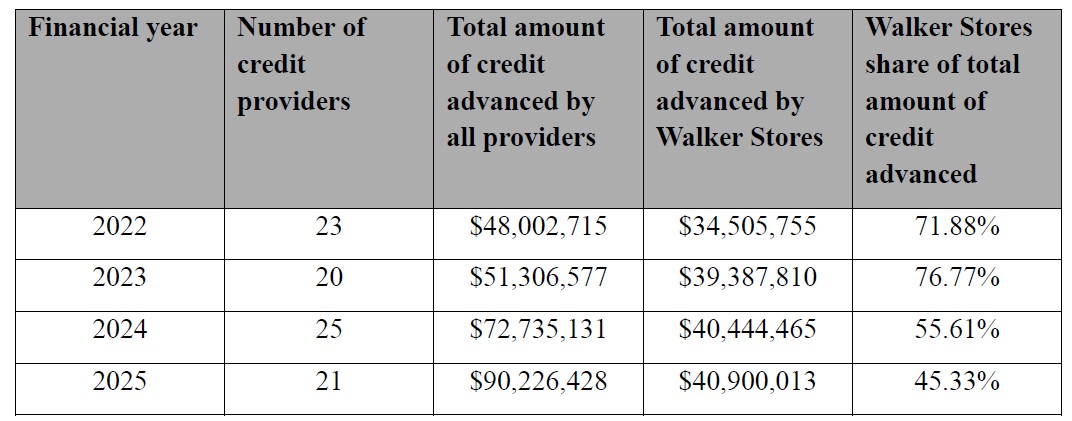
247 As a rapidly growing industry dealing with often vulnerable consumers, this evidence reinforces the need for strict compliance and general deterrence. Moreover, the provisions contravened by Walker Stores are of general application across the broader consumer credit industry. The need for general deterrence therefore extends to all credit providers subject to the Code. That need is underscored by the scale of the consumer credit market. Contraventions of the kind in issue have the potential to affect consumers on a very large scale, and strong general deterrence is required to ensure that compliance with the statutory regime is not treated as optional. Accordingly, it is a primary consideration that the penalty in this case be one which acts as an effective deterrent to other participants in the sector.
Maximum penalties
248 Section 167A of the Credit Act provides that the maximum penalty must not be more than the pecuniary penalty applicable to the contravention of the civil penalty provision, and s 167B prescribes the pecuniary penalty applicable to the contravention of a civil penalty provision.
249 Section 167B(2) provides the following:
The pecuniary penalty applicable to the contravention of a civil penalty provision by a body corporate is the greatest of:
(a) the penalty specified for the civil penalty provision, multiplied by 10; and
(b) if the court can determine the benefit derived and detriment avoided because of the contravention—that amount multiplied by 3; and
(c) either:
(i) 10% of the annual turnover of the body corporate for the 12‑month period ending at the end of the month in which the body corporate contravened, or began to contravene, the civil penalty provision; or
(ii) if the amount worked out under subparagraph (i) is greater than an amount equal to 2.5 million penalty units—2.5 million penalty units.
250 In this case the applicable maximum penalty for each civil penalty contravention is the specified number of penalty units multiplied by 10 (s 167B(2)(a)).
251 The civil penalty specified for a breach of s 24(1) is 5,000 penalty units. Therefore, s 167B(2)(a) specifies a maximum of 50,000 penalty units per civil penalty contravention.
252 For the present purpose of determining the applicable maximum penalty for a contravention of s 24(1) of the Code, taking the lowest penalty unit amount ($222), 50,000 penalty units is $11,100,000.
253 In respect of s 167B(2)(b), it is important to note that the maximum penalty measure is on a per contravention basis and accordingly, in calculating the benefit derived, that too must be approached on the basis of individual contraventions.
254 For the rate cap contraventions, there has been no relevant benefit derived to date. The list of contracts provided by the receivers indicates that consumers A, B and C had made 85, 83, and 8 payments respectively up to 2 March 2026, that is, $844.05, $1,245 and $435.52 respectively. Each is less than the amount which could have lawfully been charged under either construction as found by Ms Wright. Now should the consumers pay the contracts in full, they would overpay, and Walker Stores would obtain a benefit, greater than that permitted by the Code. But this outcome will not ultimately materialise given that the contracts have been assigned.
255 For the interest calculation contraventions, the total difference between the principal plus Walker Stores interest, on the one hand, and the principal plus s 28(1)(a) interest (the s 28 overcharge) was $19,763,561. This figure represents the total amounts of interest charged which were calculated using the flat rate calculation method which could not lawfully be charged under s 28, and so represents the benefit that Walker Stores derived from the s 28 contraventions in combination.
256 But one must determine the benefit on a per contravention basis. The amount overcharged on each of the 38,562 contracts is not specifically known, as it is not known the total number of payments accepted or required under 38,562 contracts. But given that the total benefit derived across all 38,562 contracts was $19,763,561, each consumer was overcharged on average $512, and so each individual contravention would be lower than that again. This figure is well less than the value of 50,000 penalty units.
257 Finally, as to s 167B(2)(c), Walker Stores’ annual turnover has not been able to be determined in order to determine whether 10% of that figure is greater than the penalty figure in s 167B(2)(a). The company reported its financial position on a consolidated basis with the rest of the Aspire 42 corporate group.
258 The audited financial report of Aspire 42 Holdings Pty Ltd and its subsidiaries for the year ended 30 June 2023 provides the following data: (a) the Group’s consolidated revenue for the year ended 30 June 2023 was $49,494,040, of which $21,710,651 is referred to as “sales subscription revenue” and therefore appears to relate to the credit contracts entered into by Walker Stores, and for the year ended 30 June 2022 was $48,396,181, of which $13,218,291 is referred to as “sales subscription revenue”; (b) the Group’s gross profit for the year ended 30 June 2023 was $28,866,523, and for the year ended 30 June 2022 was $27,179,607; and (c) the Group’s consolidated profit/loss after providing for income tax for the year ended 30 June 2023 was a loss of $3,519,478, and for the year ended 30 June 2022 was a profit of $182,704.
259 Again, for the purpose of determining the maximum penalty payable, taking the highest figure for the group’s revenue, being $49,494,040, 10% of that amount is $4,949,404, which is still well less than the value of 50,000 penalty units.
260 Accordingly, the applicable maximum is that provided by s 167B(2)(a), being 50,000 penalty units.
Key requirements provisions
261 The contraventions of s 32A are contraventions of “key requirements” (s 111(1)(j)), giving rise to orders under Part 6 of the Code, rather than civil penalty provisions. But ASIC does not seek penalties in respect of s 32A under Part 6, as it seeks penalties for those contraventions under s 24(1).
262 Section 113(5) of the Code provides that:
The court must, for the purposes of determining an application for an order under this Division or the amount of a penalty, treat a contravention of a key requirement that occurs merely because of another contravention of a key requirement as being a contravention of the same kind. If a provision referred to in section 111 contains several requirements, the court must treat contraventions of more than one of those requirements as a single contravention of the one key requirement for the purposes of determining the amount of a penalty.
263 In my liability decision in Re Make it Mine Finance Pty Ltd, I expressed the view that s 113(5) had a dual function. I said the following at [44] to [46] and [52]:
Section 113(5) has a dual function being:
(a) to treat a contravention of a key requirement that occurs “merely” because of another contravention of that or another key requirement as being a contravention “of the same kind”; and
(b) when dealing with a provision referred to in s 111 which contains several sub-elements, to treat the contraventions of more than one of those sub-elements as a single contravention of the one key requirement.
The first dimension of s 113(5) provides that where one contravention occurs merely because of another contravention, they must be treated as a contravention of the “same kind”. The operative words are “occurs merely because of another contravention”. The language of the provision does not stipulate “occurs for the same reason as another contravention”. For the provision to apply, one breach must lead to another without more. So, as ASIC has posited, an arithmetical error that occurs in respect of the annual interest rate (s 17(4)(a)) may be carried through in the method of calculation (s 17(5)) and again in failing to disclose the total amount of interest charged (s 17(6)). In those circumstances, all three breaches are to be treated as being “of the same kind”.
The fact that several breaches may have all occurred due to some common external and other factor or error which caused all breaches does not trigger this first dimension.
…
The second dimension of s 113(5) deals with a different form of aggregation. The condition “[i]f a provision referred to in section 111 contains several requirements” contains two concepts. First, there is reference to “a provision referred to in section 111”. This can only be a reference to each item of s 111(1) (s 111(2) can be put to one side for present purposes) and accordingly is a reference to s 17(3), (4) and so on. Second, there is a reference to such a provision “contain[ing] several requirements”. So, the text distinguishes between a particular provision (s 17(3), (4) and so on) and its several requirements or sub-elements. And when one considers s 17(3) or s 17(4), which each contain various sub-elements, it can be appreciated that the reference to requirements in s 113(5) aligns with the several sub-elements of such provisions. By way of example, if a credit contract omits several sub-elements of s 17(3) (a key requirement within the meaning of s 111(1)), then the effect of s 113(5) is to treat that as one contravention rather than multiple contraventions reflecting the omission of each such sub-element of s 17(3). Such an interpretation accords with the text and context. Moreover, if it is necessary to say so, it accords with the example given in [8.202] of the Explanatory Memorandum.
264 In summary, one function was to treat a contravention of a key requirement that occurs “merely” because of another contravention of that or another key requirement as being a contravention “of the same kind”. Another function when dealing with a provision referred to in s 111 which contains several sub-elements, was to treat the contraventions of more than one of those sub-elements as a single contravention of the one key requirement. But I do not need to dwell on this further as I have put the s 17 disclosure contraventions to one side. Let me return to s 32A.
265 As concerns the s 32A contraventions, the maximum penalty that may be imposed for contravention of a key requirement is calculated in accordance with s 116 of the Code, which provides:
(1) On application being made by a credit provider … or ASIC for an order, the maximum penalty that may be imposed by the court for a contravention of a key requirement relating to a contract affected by the application is an amount calculated so that the total penalty for all contraventions of the requirement in Australia (as disclosed by the credit provider …) does not exceed 5,000 penalty units for an individual.
(2) However, section 167B of the National Credit Act applies in the same way in relation to the contravention of a key requirement as it would apply in relation to a civil penalty provision under that Act.
266 The effects of these provisions are the following. If a credit provider engages in numerous contraventions of a key requirement, then the maximum penalty applies to all of the contraventions of that requirement collectively. Therefore, a single pecuniary penalty applies to all breaches of a given key requirement alleged by ASIC. And assuming that s 167B(2)(a) is the applicable maximum, the relevant maximum penalty for a company remains 50,000 penalty units.
267 Relevantly to the present context, s 175(1) of the Credit Act contains a prohibition on double jeopardy for the same conduct:
If a person is ordered to pay a pecuniary penalty under a civil penalty provision in relation to particular conduct, the person is not liable to be ordered to pay a pecuniary penalty under some other provision of a law of the Commonwealth in relation to that conduct.
268 This provision captures the contraventions of s 32A alleged by ASIC for the following reasons.
269 A “pecuniary penalty order” is defined in s 5(1) of the Credit Act to mean an order made under s 167. In s 167(1), a pecuniary penalty may be ordered against a person “contravening a civil penalty provision”. This language is reflected in the first part of s 175(1) above, in which the pecuniary penalty is payable “under a civil penalty provision”. However, the second usage of “ordered to pay a pecuniary penalty” in s 175(1) above must logically take some other meaning not bounded by the Credit Act’s definition of “pecuniary penalty order” as an order for breach of a “civil penalty provision”, as it must arise under “some other provision of a law of the Commonwealth”.
270 This second usage of “pecuniary penalty” in s 175(1) is not defined by s 5 and is not required to flow from breach of a civil penalty provision under the Credit Act. Instead, it must include orders for pecuniary penalties for breach of a key requirement under s 113(2), which are, in substance, pecuniary penalties under some other provision of a law of the Commonwealth and in relation to the same conduct as that alleged on ASIC’s claim for civil penalties.
271 So, the conduct supporting ASIC’s allegations of breach of s 24(1) (a civil penalty provision) by reason of entering contracts, with an ACR greater than 48%, and requiring and accepting payments under those contracts (the breaches of s 32A), cannot also support an order for a pecuniary penalty for breach of s 32A as a key requirement.
Quantification – number of breaches
272 The number of contraventions and the maximum theoretical penalties have been set out in a table by ASIC which I do not need to reproduce.
Rate Cap Contraventions
273 The statutory language of s 24(1) of the Code contains three prohibitions on a credit provider where a contract imposes a liability prohibited by s 23(1), or is otherwise incapable of being applied consistently with the Code: (a) entry into such a contract; (b) requiring such a payment; and (c) accepting such a payment. That there are three prohibitions is indicated by the section’s use of the disjunctive “or” between each verb. This is supported by the statutory purpose. A consumer should be protected from entering into a contract with prohibited charges, from having such charges demanded from them, as well as from having to actually pay them. Each is a different category of conduct by a credit provider.
274 Accordingly, Walker Stores breached s 24(1)(a) each time it entered a contract imposing, and s 24(1)(b) each time it required, and each time it accepted, payment of an amount which was prohibited by s 23(1) or which could not be charged consistently with the Code.
275 Section 32A prohibited a credit provider from entering into a contract if the ACR was greater than 48%. Such amounts are “an amount of a fee or charge exceeding that amount which may be charged consistently with this Code” for the purposes of s 23(1)(b), and so satisfy s 24(1)(a). Similarly, payments of an instalment amount, the total of which would exceed an ACR of 48%, cannot be charged consistently with the Code, thus contravening s 24(1)(b).
276 Walker Stores entered each of contracts A, B and C, contrary to s 24(1)(a). These are 3 breaches. Walker Stores continued to require and accept payments under each sample contract. As already indicated, consumers A, B and C made 85, 83, and 8 payments up to 2 March 2026. This indicates a total of 176 acceptances of payments prohibited by, and thus contraventions of, s 24(1)(b).
277 Walker Stores must also be taken to have demanded such payments at least on the occasion of each instalment date, by reason of the contractual obligation imposed on the customer to make payments on the dates and frequency required by the contract. For contract A, the list of contracts indicates no missed payments, which implies 85 demands for payment. Contract B was entered at around the same time and had the same instalment schedule as contract A, implying a further 85 demands, even if not all were met. Contract C was entered at a similar time, but was a fortnightly contract, implying half the number of demands, or 42.
278 This implies a total number of contraventions of s 24(1) by reason of the breaches of s 32A(1) of 3 (entering contracts A, B and C) + 176 (payments made under contracts A, B and C) + 85 + 85 + 42 (demands for payments), which totals 391 contraventions.
Interest Calculation Contraventions
279 Turning to s 28, that section sets the maximum amount of interest that could be charged, such that charging any more than that is to impose an amount of an interest charge which cannot be imposed by reason of s 23(1)(c), and the same analysis of ss 24(1)(a) and 24(1)(b) applies.
280 Walker Stores admitted entering 38,562 credit contracts, and admitted imposing interest calculated using the flat rate calculation method at all times during the relevant period. The flat rate calculation method imposed interest prohibited by s 28. As shown in the list of contracts, Walker Stores also required and accepted payments of such interest, at all times throughout the relevant period. The total number of repayments accepted by Walker Stores under these contracts is 2,242,906.
Summary – maximum penalties
281 The maximum penalties applicable, which I have considered, are not suggested to be realistic guides to the penalty that is appropriate to impose. ASIC has provided a table, but again I do not need to reproduce this.
Courses of conduct
282 For the purposes of considering penalties, I have grouped the s 24(1) contraventions, that is, the rate cap contraventions and the interest calculation contraventions, into various courses of conduct being: (a) a course of conduct concerning the contravention of s 24(1)(a) arising from Walker Stores’ entry into contracts A, B and C which imposed an amount that exceeded the ACR, being a charge prohibited by s 23(1)(a); (b) a course of conduct concerning the contravention of s 24(1)(a) arising from Walker Stores’ entry into 38,562 contracts which purported to impose an interest charge under the contracts prohibited by s 23(1) and 28 of the Code; (c) a course of conduct concerning the contravention of s 24(1)(b) arising from Walker Stores requiring payment under 38,562 contracts of an amount that cannot be imposed consistently with s 28 of the Code; and (d) a course of conduct concerning contraventions of s 24(1)(b) arising from Walker Stores accepting payment under 38,562 contracts of an amount that cannot be imposed consistently with s 28 of the Code.
Nature and extent and circumstances of the contravening conduct
283 In this case, the interest calculation contraventions occurred throughout Walker Stores’ entire loan book over a period of 3½ years, the flat rate calculation method having been instituted in September 2021 in anticipation of the launch of Walker Stores’ credit business. There were a total of 38,562 contracts disclosed by the receivers, and Walker Stores admitted applying the flat rate calculation method throughout the relevant period.
284 ASIC does not have clear data on the number of consumers affected. It requested data from the receivers of the “customer name or unique customer identifier reference number”. In response, the receivers produced the list of contracts giving “unique client identifiers” rather than names. There are 21,818 unique client identifiers. I am prepared to conclude that unique client identifiers identify different people, and as such that around that number of consumers were affected.
285 ASIC does not allege that Walker Stores contravened s 32A(1) in respect of all 38,562 contracts as it lacks the specific pricing inputs and contracts to make good those cases.
Nature and extent of any loss or damage suffered because of the contravention
286 The loss or damage suffered by consumers because of the conduct of Walker Stores for the purposes of s 167(3)(b) is a factor that weighs heavily in favour of the imposition of a significant penalty.
287 The rate cap contraventions resulted in each of consumers A, B and C being contractually required to pay significantly more to Walker Stores than permitted by s 32A(1). Those consumers remain contractually required to pay the amounts stated in each sample contract. Walker Stores did not cease collecting payments from consumers. Further, although the receivers indicated that they may cause it to undertake a limited adjustment program to offset receivables, to the extent consumers have balances owing under active contracts, the current status of that remediation program remains unclear.
288 For these reasons, the amounts each of consumers A, B and C remain contractually required to pay, that is, the total amount stated under each of contracts A, B and C, and the amounts of interest the remaining consumers remain liable to pay, are the relevant amounts for assessing loss to each consumer.
289 Ms Wright has calculated the total amounts that would have been payable under each sample contract, if the “amount of credit” were not the Walker Stores price plus GST, but was the amount alleged by ASIC under either the credit cost construction or the cash price construction. She has done so by taking ASIC’s revised figures for the amount of credit and working out the total payable on that amount that produces a 48% ACR: the maximum permitted under the cap. These maximum costs are as follows, just referring to the cash price construction.
290 Under contract A, consumer A remains required to pay a total of $1,549.08. On the cash price construction, the total cost up to the ACR cap of 48% would have been $908.48. It follows that consumer A stands to be overcharged $640.60 or 71% more than an ACR of 48% permitted.
291 Under contract B, consumer B remains required to pay a total of $2,340. On the cash price construction, the total cost up to the ACR cap of 48% would have been $1,518.50. It follows that consumer B stands to be overcharged $821.50 or 54% more than an ACR of 48% permitted.
292 Consumer C was required to pay a total of $4,246.32 under contract C. On the cash price construction, the total cost up to the ACR cap of 48% would have been $2,812.28. It follows that consumer C stands to be overcharged $1,434.04 or 51% more than an ACR of 48% permitted.
293 On the s 28 case, Walker Stores charged consumers almost double the interest it could lawfully charge. Ms Wright has calculated the s 28 overcharge on the face of the 38,562 contracts as $19,763,561. This amount was calculated by a simple comparison of the amount of interest payable at a reducible rate on the contracts disclosed in the list of contracts, and the amount actually reported as imposed. Ms Wright has further calculated that of $23,904,601 in interest payments that Walker Stores collected to 3 March 2026, only $16,537,136 was permissible interest under s 28. Therefore, Walker Stores had collected, to the date of the list of contracts, $7,367,465 more than s 28 permitted. However, $19,763,561 is the relevant figure for the purposes of identifying the loss or damage suffered by consumers because of the conduct of Walker Stores pursuant to s 167(3)(b). These debts remain payable on the face of each contract and are actively being collected. This is a very significant amount of money drawn from consumers which should not have been charged.
294 The loss and damage occasioned by the interest calculation contraventions was substantial. By applying a flat rate method of interest calculation, rather than calculating interest on the daily unpaid balance as required by s 28, Walker Stores materially overstated the amount of interest payable under each contract. The effect of that methodology was to charge consumers amounts significantly in excess of those lawfully permitted. Indeed, Ms Wright calculates the amount of Walker Stores’ flat interest charges across its loan book to be almost double the amount she calculates to have been chargeable under s 28. That overcharge was not confined to isolated instances but occurred across Walker Stores’ business.
295 Ms Wright has also calculated the total amounts that would have been payable under each sample contract, if the “amount of credit” were not the Walker Stores price plus GST, but was the amount alleged by ASIC under either the credit cost construction or the cash price construction, and if interest had been calculated in accordance with s 28 of the Code. She has done so by taking ASIC’s revised figures for the amount of credit and working out the total payable on that amount that produces a 48% ACR: the maximum permitted under the cap. These maximum costs are as follows, just utilising the cash price construction. On the cash price construction: (a) consumer A would have been required to pay $688.63, being 56% less than consumer A was required to pay under contract; (b) consumer B would have been required to pay $1,150.43, being 51% less than consumer B was required to pay under contract; and (c) consumer C would have been required to pay $2,138.84, being 50% less than consumer C was required to pay under contract.
296 Each contravention of s 28 involved 21,818 individual consumers. The receivers, at the request of ASIC, included in the list of contracts whether a consumer disclosed Centrelink as their primary source of income. 3,354 contracts listed in the list of contracts indicated this was the case, and those contracts related to 1,842 unique client numbers. That is, such contracts were about 8% of Walker Stores’ total contracts. Further, consumers A, B and C were harmed in that each paid significantly more for Walker Stores’ credit contracts than the ACR permitted. Finally, the list of contracts reveals significant consumer harm in charging more interest than s 28 allows across the entire loan book.
Previous findings of similar conduct
297 Walker Stores has not previously been found by a Court to have engaged in similar conduct.
The deliberateness or recklessness of the contraventions
298 ASIC does not allege that Walker Stores knowingly contravened any provision of the Code.
299 Now the contraventions of s 28 occurred despite Walker Stores replicating the language of s 28 in the terms and conditions of each sample contract. Section 28 is not novel. Nonetheless, Walker Stores imposed the radically different flat rate calculation method.
Internal management factors
300 There is no evidence before me of the seniority of management involved, or directorial awareness. And nor do I have any evidence of Walker Stores’ corporate culture and internal compliance systems, other than to say that these breaches, and in particular the imposition of the flat rate calculation method, and the misdescription of amounts in the schedules to contracts A, B and C, indicate a lax approach to compliance.
Cooperation with ASIC
301 Walker Stores has at least since the appointment of its receivers and administrators shown cooperation with ASIC. Walker Stores has admitted the factual allegations in the concise statement, and the receivers have supplied the list of contracts enabling one to understand the breadth and severity of the flat rate calculation method conduct. But that cooperation only came after the filing of the proceeding and appointment of the receivers and administrators.
Remedial or disciplinary steps taken, and the remediation of consumers
302 Walker Stores ceased offering new credit contracts after the appointment of the receivers and administrators.
303 The receivers have implemented a program of holding amounts paid by consumers which were likely overcharged on ASIC’s case on ss 32A and 28, and therefore not lawfully imposed, required or accepted pursuant to the Code, as a “loan adjustment program”.
304 On or about 24 February 2026, all but 5,000 of Walker Stores’ contracts were assigned to a related entity in the winding up of Walker Stores, but without substantive steps to remediate consumers. The sample contracts impose binding contractual debts which remain under active collection by Walker Stores’ assignee.
305 ASIC has sought confirmation as to the assignee’s treatment of the assigned credit contracts. The receivers have stated that Walker Stores ceased recovery under its 5,000 retained credit contracts on 19 April 2026 upon execution of the “loan adjustment program” and upon notice to the affected consumers. ASIC has sought to confirm its understanding that these 5,000 credit contracts have no remaining balance owing under them.
306 The majority of loan contracts were assigned to a related entity, and any steps toward remediation by way of the “loan adjustment program” occurred after the filing of this proceeding and in the context of the administration and liquidation of Walker Stores. Accordingly, Walker Stores’ limited steps with respect to remediation should not be given significant weight.
Conclusions on pecuniary penalty
307 A penalty of $33.5 million is appropriate taking into account all of the above matters, and in particular the following factors.
308 First, $19,763,561 was overcharged to consumers by the flat rate calculation method, in clear disregard of the terms of s 28 and which Walker Stores was on no view entitled to collect. The penalties imposed must necessarily exceed that amount in order to be an effective deterrent and not otherwise be seen as a mere cost of doing business.
309 Second, the above amount was imposed on a principal amount that was itself greatly inflated by the respondent markups, such that the true overcharge (being the imposition of interest on that amount) is likely much greater.
310 Third, the conduct in imposing the respondent markups and flat rate calculation method was ongoing throughout the relevant period, ending only with this proceeding and Walker Stores’ administration and receivership.
311 Fourth, the primary need for general deterrence, including because of the nature of the consumer credit industry identified.
312 Fifth, the widespread consumer harm, arising across 38,562 contracts, with evidence of the flat rate calculation method being applied in all, and the respondent markups being proven on contracts A, B and C but admitted by Walker Stores to be consistent with its business model.
313 The penalty amount is comprised of the following.
314 First, $32 million for the interest calculation contraventions of ss 24(1) and 28. This amount is appropriate in light of the significant amount of interest overcharged across Walker Stores’ entire loan book, causing direct financial harm to consumers and requiring specific and general deterrence.
315 Second, $1.5 million for the rate cap contraventions of ss 24(1) and 32A(1). This amount reflects the fact that there are fewer contraventions, that is, entering into contracts, requiring payments and accepting payments under contracts A, B and C, yet takes account of the extent to which Walker Stores exceeded the ACR and sends a strong message about the importance of these protective provisions, and that attempts by credit providers to model their business to avoid the rate cap should be deterred.
316 Finally on the question of penalty, let me say something on the questions of parity and totality.
317 As I have touched on earlier, given the clear limitations of assessing pecuniary penalty by parity with other cases, there is little to be gained by referring to the quantum of penalties imposed in other cases. But I should refer to one case concerning the considered analysis of Hespe J in Australian Securities and Investments Commission v Darranda Pty Ltd (Penalty) [2025] FCA 938. Her Honour ordered total penalties of $7.4 million for contraventions in respect of 516 contracts of the ACR cap, s 17 disclosure breaches and s 47(1)(a) general licensee obligations. Total consumer losses attributable to the rate cap contraventions were $1.24 million. Making the necessary adjustments, the penalties that I have imposed could not be said to be discordant.
318 As to the totality question, I am satisfied that the penalties in their totality meet and discharge the principal objective in the present context of general deterrence.
Injunctions
319 ASIC no longer presses its application for injunctions requiring Walker Stores to recalculate the amounts it requires to be paid from consumers under each sample contract. Further, pursuant to the assignment of most of its credit contracts to a related entity, and the loan adjustment program referred to above, Walker Stores now holds no active credit contracts. Accordingly there are no contracts upon which any injunctions could act.
Adverse publicity notices
320 ASIC has sought an order under s 182 of the Credit Act that, within 30 days of the date of the order, Walker Stores publish at its own expense an advertisement stating that it has contravened the Credit Act and the Code, and has been ordered to pay pecuniary penalties.
321 The purpose of an order under s 182 of the Credit Act is two-fold. First, such an order serves the purpose of assisting in achieving general deterrence. Second, and slightly modifying the language of McKerracher J in Australian Competition and Consumer Commission v Aveling Homes Pty Ltd [2017] FCA 1470 at [59], it serves a protective purpose by dispelling false impressions created by contravening conduct, by alerting the consumer to the contravening conduct, and by aiding the enforcement of other injunctive or remedial orders (if made).
322 Now the liquidation of Walker Stores and assignment of its loan book may leave little utility in such notices beyond that served by the declarations sought. But the notices will serve to assist consumers to cease paying overcharged amounts and to take steps to remedy them, including with the relevant assignee.
Conclusion
323 In summary, for the foregoing reasons I made the relevant orders on 18 May 2026.
I certify that the preceding three hundred and twenty-three (323) numbered paragraphs are a true copy of the Reasons for Judgment of the Honourable Justice Beach. |
Associate:
Dated: 29 May 2026