

Federal Court of Australia
On Clouds GmbH v Cyclonic, Inc [2026] FCA 647
Appeal from: | On Clouds GmbH v Cyclonic, Inc [2025] ATMO 91 |
File number(s): | NSD 938 of 2025 |
Judgment of: | LENEHAN J |
Date of judgment: | 27 May 2026 |
Catchwords: | TRADE MARKS – where the Delegate rejected an opposition brought by the appellant – appeal from the Delegate’s decision – where the combined visual similarity, significant aural similarity, and shared association with the idea of a cyclone give rise to a real, tangible risk that some consumers will wonder whether the marks originate from the same source – deceptive similarity established COSTS – where respondent was validly served with the notice of appeal – where respondent did not file a submitting notice – where respondent did not withdraw its trade mark application – where respondent did not ultimately participate in appeal proceeding – where the appellant contended that costs should follow the event – where the appellant relied on NCL Corporation Ltd v Norwegian Brand Ltd [2025] FCA 1613 – where a lump sum costs order is appropriate – where the appellant should be awarded costs |
Legislation: | Federal Court of Australia Act 1976 (Cth), s 37M Legislation Act 2003 (Cth), s 13 Trade Marks Act 1995 (Cth), ss 6, 10, 12, 14, 20, 27, 33, 44, 52, 52A, 55, 56, 57, 72, 189A, 191, 196, 197, 207, 214, 215 Federal Court Rules 2011 (Cth), rr 10.08, 12.01, 34.23 Trade Marks Regulations 1995 (Cth), regs 4.15A, 17A.2, 17A.39, 21.7A, 21.9, 21.10, 21.29 |
Cases cited: | ADCO Constructions v Goudappel (2014) 254 CLR 1 ALDI Stores Ltd Partnership v Frito-Lay Trading Co GmbH (2001) 54 IPR 344 Apple Inc v Registrar of Trade Marks (2014) 227 FCR 511 Bauer Consumer Media Ltd v Evergreen Television Pty Ltd (2019) 367 ALR 393 Black Star Pastry Pty Ltd v Richards (No 2) [2026] FCA 383 Campomar Sociedad Limitada v Nike International Ltd (2000) 202 CLR 45 Combe International Ltd v Dr August Wolff GmbH & Co. KG Arzneimittel (2021) 157 IPR 230 Commonwealth v Harrison (No 2) (2020) 381 ALR 328 Conde Nast Publications Pty Ltd v Taylor (1998) 41 IPR 505 Cooper Engineering Co Pty Ltd v Sigmund Pumps Ltd (1952) 86 CLR 536 Dunlop Aircraft Tyres Ltd v Goodyear Tire & Rubber Company (2018) 262 FCR 76 E & J Gallo Winery v Lion Nathan Australia Pty Ltd (2009) 175 FCR 386 Enfield City Corporation v Development Assessment Commission (2000) 199 CLR 135 Goodman Fielder Pte Ltd v Conga Foods Pty Ltd (2020) 158 IPR 9 Hashtag Burgers Pty Ltd v In-N-Out Burgers, Inc (2020) 385 ALR 514 In-N-Out Burgers, Inc v Hashtag Burgers Pty Ltd (2020) 150 IPR 73 Jafferjee v Scarlett (1937) 57 CLR 115 Johnson & Johnson v Kalnin (1993) 26 IPR 435 Monster Energy Co v Mixi Inc (2020) 156 IPR 378 NCL Corporation Ltd v Norwegian Brand Ltd [2025] FCA 1613 Nexans S.A. v Nex 1 Technologies Co. Ltd [2012] FCA 180 On Clouds GmbH v Cyclonic, Inc [2025] ATMO 91 PDP Capital Pty Ltd v Grasshopper Ventures Pty Ltd (2021) 285 FCR 598 Pfizer Products Inc v Karam (2006) 219 FCR 585 Polo Textile Industries Pty Ltd v Domestic Textile Corporation Pty Ltd (1993) 42 FCR 227 Ragopika Pty Limited v Isaac (2023) 174 IPR 351 Re London Lubricants (1920) Ltd’s Application (1925) 42 RPC 264 Registrar of Trade Marks v Woolworths Ltd (1999) 93 FCR 365 Rowntree plc v Rollbits Pty Ltd (1988) 10 IPR 539 Self Care IP Holdings Pty Ltd v Allergan Australia Pty Ltd (2023) 277 CLR 186 Soden v Croker (No 3) [2016] FCA 249 Telstra Corporation Ltd v Phone Directories Company Australia Pty Ltd (2015) 237 FCR 388 Urban Alley Brewery Pty Ltd v La Sire`ne Pty Ltd (2020) 384 ALR 230 Woolworths Ltd v BP plc (2006) 150 FCR 134 |
Division: | General Division |
Registry: | New South Wales |
National Practice Area: | Intellectual Property |
Sub-area: | Trade Marks |
Number of paragraphs: | 126 |
Date of last submission/s: | 30 April 2026 |
Date of hearing: | 24 April 2026 |
Counsel for the Appellant: | Mr B Cameron |
Solicitor for the Appellant: | Norton Rose Fulbright |
ORDERS
NSD 938 of 2025 | ||
| ||
BETWEEN: | ON CLOUDS GMBH Appellant | |
AND: | CYCLONIC, INC Respondent | |
order made by: | LENEHAN J |
DATE OF ORDER: | 27 May 2026 |
THE COURT ORDERS THAT:
1. The appeal be allowed.
2. The decision of the delegate of the Registrar of Trade Marks made on 25 May 2025 (On Clouds GmbH v Cyclonic, Inc [2025] ATMO 91) be set aside.
3. The respondent’s application for the trade mark “CYCLONIC” (trade mark number 2368466) in Classes 25 and 40 be refused.
4. The respondent pay the appellant’s costs of the appeal on a lump-sum basis in the sum of $125,000.
Note: Entry of orders is dealt with in Rule 39.32 of the Federal Court Rules 2011.
REASONS FOR JUDGMENT
LENEHAN J:
1. INTRODUCTION
1 This proceeding concerns an “appeal” under s 56 of the Trade Marks Act 1995 (Cth) (the Act) from a decision of a delegate of the Registrar of Trade Marks (the Delegate) made on 22 May 2025: On Clouds GmbH v Cyclonic, Inc [2025] ATMO 91 (the Delegate’s decision).
2 By that decision, the Delegate rejected an opposition brought by On Clouds GmbH, the appellant, to the registration of the trade mark “CYCLONIC” in Classes 25 and 40 by Cyclonic, Inc, the respondent. The opposition relied on the appellant’s trade mark “CYCLON”, and was put on the ground that the marks are substantially identical or deceptively similar within the meaning of s 44 of the Act, as applied by reg 4.15A of the Trade Marks Regulations 1995 (Cth) (the Regulations), the earlier mark being a trade mark protected under the Madrid Protocol – see further below.
3 For the reasons set out below, I am satisfied that the appellant has established a ground of opposition under reg 4.15A of the Regulations. Accordingly, the appeal ought to be allowed, the Delegate’s decision ought to be set aside, and the respondent’s application to register the trade mark “CYCLONIC” ought to be refused.
2. BACKGROUND
2.1 The parties and the trade marks
4 On Clouds GmbH, the appellant, is the owner of the trade mark “CYCLON” mark, which is registered in Class 25. The registration originated as a Convention application made in Switzerland, a “Convention” country for the purposes of the Act (s 6(1) of the Act, read with reg 21.29(1) of the Regulations). By those (and other provisions of the Regulations), CYCLON is a “protected international trade mark” within the meaning of s 189A(4) of the Act, which relevantly provides:
Protected international trade mark means a trade mark to which protection resulting from international registration of the mark is extended in Australia in accordance with the regulations.
(See also the definition of that term in reg 17A.2 of the Regulations.)
5 I will deal further below with the manner in which protection of the mark is relevantly “extended” for present purposes by the Regulations (see also reg 17A.39 of the Regulations).
6 Cyclonic, Inc, the respondent, sought registration of the trade mark “CYCLONIC” (trade mark number 2368466) in Classes 25 and 40 (the Application).
2.2 Legislative context
7 The Act provides for the registration of trade marks following the filing of applications for registration of such marks. An application must, relevantly, specify the goods and/or services in respect of which registration of the trade mark is sought (s 27(3)(b)).
8 Following examination, the Registrar must accept an application unless satisfied that it has not been made in accordance with the Act, or that there are grounds under the Act for rejecting it (s 33(1)). Where the Registrar is satisfied that there are grounds for rejection, the Registrar must reject the application (s 33(3)).
9 If the Registrar has accepted an application for the registration of a trade mark, a person may oppose the registration by filing a notice of opposition (s 52(1)). An accepted application may be opposed on any ground upon which an application for registration may be rejected under the Act, except the ground that the trade mark cannot be represented graphically (s 57 and see also s 52(4)). At the end of that process, the Registrar must, under s 55(1), decide:
(a) to refuse to register the trade mark; or
(b) to register the trade mark (with or without conditions or limitations) in respect of the goods and/or services then specified in the application;
having regard to the extent (if any) to which any ground on which the application was opposed has been established.
10 Upon registration, a trade mark is recorded on the Register of Trade Marks. The Registrar is required to enter in the Register all particulars of the registered trade mark (s 207(2)). Registration confers on the registered owner the exclusive rights to use the trade mark, and to authorise other persons to use the trade mark, in relation to goods and/or services in respect of which the trade mark is registered (s 20(1)).
11 Various grounds for rejecting an application appear in Part 4, Division 2 of the Act.
12 Section 44 of the Act, which appears in that division, provides that an application for registration must be rejected if the trade mark is substantially identical with, or deceptively similar to, an earlier registered trade mark in respect of similar goods or closely related services (s 44(1)), or similar services or closely related goods (s 44(2)):
44 Identical etc. trade marks
(1) Subject to subsections (3) and (4), an application for the registration of a trade mark (applicant’s trade mark) in respect of goods (applicant’s goods) must be rejected if:
(a) the applicant’s trade mark is substantially identical with, or deceptively similar to:
(i) a trade mark registered by another person in respect of similar goods or closely related services; or
(ii) a trade mark whose registration in respect of similar goods or closely related services is being sought by another person; and
(b) the priority date for the registration of the applicant’s trade mark in respect of the applicant’s goods is not earlier than the priority date for the registration of the other trade mark in respect of the similar goods or closely related services.
(2) Subject to subsections (3) and (4), an application for the registration of a trade mark (applicant’s trade mark) in respect of services (applicant’s services) must be rejected if:
(a) it is substantially identical with, or deceptively similar to:
(i) a trade mark registered by another person in respect of similar services or closely related goods; or
(ii) a trade mark whose registration in respect of similar services or closely related goods is being sought by another person; and
(b) the priority date for the registration of the applicant’s trade mark in respect of the applicant’s services is not earlier than the priority date for the registration of the other trade mark in respect of the similar services or closely related goods.
13 Section 10 of the Act provides:
10 Definition of deceptively similar
For the purposes of this Act, a trade mark is taken to be deceptively similar to another trade mark if it so nearly resembles that other trade mark that it is likely to deceive or cause confusion.
14 Section 6 defines “this Act” as including the Regulations. Accordingly, the “grounds under this Act for rejecting” an application for registration of a mark (see again s 33(1) and see also, as regards opposition proceedings, ss 52(4) and 57) may be contained in the Act itself, including s 44, or in the Regulations.
15 That possibility has been taken up by the Commonwealth executive under the power conferred by s 189A(1) (which appears in Part 17A of the Act). It authorises the making of regulations for matters “necessary to enable the performance of the obligations of Australia, or to obtain for Australia any advantage or benefit, under the Madrid Protocol”. That specifically includes “the protection given to protected international trade marks in Australia” (s 189A(2)(c)).
16 That power is very broad, as is emphasised by the so-called “Henry VIII” clause – although see, as to that label, ADCO Constructions v Goudappel (2014) 254 CLR 1 at [61] (Gageler J) – in s 189A(3):
Regulations made for the purposes of this section:
(a) may be inconsistent with this Act; and
(b) prevail over this Act (including any other regulations or other instruments made under this Act), to the extent of any inconsistency.
17 Reg 4.15A was made pursuant to that (broad) provision. It relevantly provides:
4.15A Grounds for rejection—trade mark identical etc to trade mark protected under Madrid Protocol
(1) For section 189A of the Act, and subject to subregulations (3) and (5), an application for the registration of a trade mark (applicant’s trade mark) in respect of goods (applicant’s goods) must be rejected if:
(a) the applicant’s trade mark is substantially identical with, or deceptively similar to:
(i) a protected international trade mark; or
(ii) a trade mark in respect of which the Registrar has received notification of an IRDA;
held by another person in respect of similar goods or closely related services; and
(b) the priority date for the registration of the applicant’s trade mark in respect of the applicant’s goods is not earlier than the priority date for the other trade mark in respect of the similar goods or closely related services.
(2) For section 189A of the Act, and subject to subregulations (3) and (5), an application for the registration of a trade mark (applicant’s trade mark) in respect of services (applicant’s services) must be rejected if:
(a) the applicant’s trade mark is substantially identical with, or deceptively similar to:
(i) a protected international trade mark; or
(ii) a trade mark in respect of which the Registrar has received notification of an IRDA;
held by another person in respect of similar services or closely related goods; and
(b) the priority date for the registration of the applicant’s trade mark in respect of the applicant’s services is not earlier than the priority date for the other trade mark in respect of the similar services or closely related goods.
18 As I have noted above, the appellant’s trade mark was a “protected international trade mark”.
19 It will be apparent that reg 4.15A is expressed in very similar terms to s 44 and, in particular, adopts the same operative criteria used in that provision – substantial identity or deceptive similarity, assessed by reference to the relevant goods/services and priority dates. It effectively applies those criteria to the international registration context. In that sense, the appellant contended, reg 4.15A is the Madrid Protocol analogue of s 44 within the statutory scheme and is to be construed similarly. The close textual similarities between the two provisions clearly support that conclusion. Indeed there is something of a textual link between the two provisions. Note 4 to ss 44(1) and (2) of the Act states that the Regulations “may provide that an application must also be rejected if the trade mark is substantially identical with, or deceptively similar to, a protected international trade mark or a trade mark for which there is a request to extend international registration to Australia: see Part 17A”. A correlative note referring to s 44 of the Act appears at the foot of reg 4.15A of the Regulations. That (and the obvious commonality between those provisions in terms of text, design and apparent object) is sufficient to rebut any suggestion that might be made that there is some contrary intention that would displace the operation of s 13(1)(b) of the Legislation Act 2003 (Cth) which provides that expressions used in such an instrument “have the same meaning as in the enabling legislation as in force from time to time”. I have proceeded on that basis.
20 A somewhat similar view was adopted by the Delegate who observed as follows:
As the Opponent relies on an International Registration as the basis of this ground of opposition, the technical ground of opposition is under reg 4.15A. However, as the terms are substantively identical for all relevant purposes, I have retained the reference to s 44 in this decision. References to s 44 as considered in this decision should be taken to read reg 4.15A and the Opponent’s Mark should be recognised as an International Registration.
21 I would say that reg 4.15A is not merely the “technical ground of opposition” – it is the basis for opposing the respondent’s mark. But nothing turns on that given the provisions are relevantly identical for present purposes.
2.3 Priority dates
22 Section 12 of the Act defines the term “priority date” as follows:
12 Definition of priority date
The priority date for the registration of a trade mark in respect of particular goods or services is:
(a) if the trade mark is registered—the date of registration of the trade mark in respect of those goods or services; or
(b) if the registration of the trade mark is being sought—the day that would be the date of registration of the trade mark in respect of those goods or services if the trade mark were registered.
23 That definition is relevant to the matters dealt with in reg 4.15A(1)(b) and (2)(b). As will be apparent from the extract above, they provide that one of the conditions which must be established for rejection of registration is that the priority date for the registration of the applicant’s trade mark “is not earlier than” the priority date for the registration of the other trade mark.
24 The priority date for “CYCLON” was 30 January 2020. The priority date for “CYCLONIC” is the date of filing of Cyclonic, Inc’s application, being 30 June 2023: see ss 12(b) and 72(1) of the Act (and the definition of “filing date” in s 6); see also Ragopika Pty Limited v Isaac (2023) 174 IPR 351 at [10] (Kennett J).
25 As such, because 30 June 2023 (the filing date for “CYCLONIC”) was not earlier than 30 January 2020 (the priority date for “CYCLON”), the requirements of reg 4.15A(1)(b) and (2)(b) are clearly satisfied.
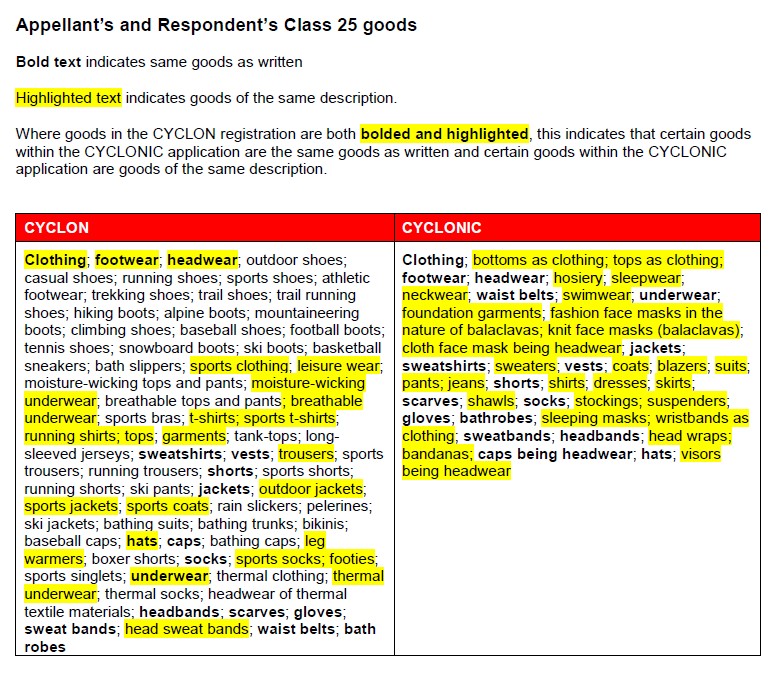
2.4 The opposition and the Delegate’s decision
26 The trade mark was examined and advertised as accepted for possible registration on 1 December 2023.
27 The appellant filed a notice of intention to oppose the Application on 31 January 2024, followed by a statement of grounds and particulars on 23 February 2024 and evidence on 10 May 2024: see Delegate’s decision at [3]-[4]. As in this appeal, the appellant’s opposition before the Delegate was advanced on the ground that “CYCLONIC” is substantially identical with, or deceptively similar to, “CYCLON”, such that the Application ought to be rejected.
28 Although the respondent filed a notice of intention to defend (s 52A of the Act) on 3 April 2024, it did not adduce evidence or file substantive submissions or otherwise ask to be heard in that process: see Delegate’s decision at [3]-[5]. The decision concerning the appellant’s opposition to the registration of the respondent’s mark (under s 55 of the Act) was therefore determined on the materials relied upon by the appellant and the Delegate’s own assessment.
29 The Delegate was satisfied that the priority date of the appellant’s mark was earlier than the filing date of the Application, and that the appellant’s mark was registered in a name other than the applicant for registration: see Delegate’s decision at [10]. However, the Delegate concluded that “CYCLONIC” was neither substantially identical with, nor deceptively similar to, “CYCLON”, and that no ground of opposition had therefore been established: see Delegate’s decision at [19] and [31]. As regards the substantial identity argument, the Delegate was “not satisfied that a total impression of resemblance emerges from a side by side comparison of the trade marks”: see at [19]. As regards the deceptive similarity argument, the Delegate considered that the two marks “are visually, aurally and connotatively dissimilar”: see at [31]. Accordingly, before the Delegate, the opposition failed.
30 The appellant now appeals from that decision.
31 Several preliminary matters should be noted.
(1) There is no issue that this Court has jurisdiction to hear this dispute (s 191 of the Act).
(2) The Registrar may appear and be heard at the hearing of an appeal to this Court against a decision of the Registrar (s 196 of the Act). As I will discuss further below, that has not happened.
(3) On hearing an “appeal” against a decision of the Registrar, this Court may affirm, reverse or vary the Registrar’s decision (s 197(d) of the Act). I will deal below with the nature of that “appeal”.
2.5 Notice of appeal
32 The appellant filed a notice of appeal with this Court on 12 June 2025, relying upon the following grounds.
(1) The CYCLONIC trade mark is substantially identical with, or deceptively similar to, the CYCLON trade mark which is registered, in respect of similar goods or closely related services: regs 4.15A(1) and (2) of the Regulations and/or s 44 of the Act.
(a) The Delegate ought to have rejected the Application pursuant to regs 4.15A(1) and (2) and s 189A of the Act, and/or sub-sections 44(1) and 44(2) of the Act.
(b) The CYCLONIC trade mark has not been used by the respondent so as to satisfy the requirements of reg 4.15A(3) and/or (5) of the Regulations, and/or section 44(3) and/or 44(4) of the Act.
(c) The Delegate erred (at [18]) in placing undue weight upon the suffix element “IC” in the CYCLONIC trade mark when assessing substantial identity.
(d) The Delegate erred (at [27]) in placing undue weight upon the suffix element “IC” in the CYCLONIC trade mark when assessing deceptive similarity.
(e) The Delegate erred (at [28]) in finding that “[t]he word CYCLON is not discernible as a discrete entity within the [CYCLONIC mark]”, including in light of the Delegate’s previous finding (at [18]) that “[i]n comparing the [CYCLONIC mark] and the [CYCLON mark] side by side there is a similarity in the presence of the element CYCLON in both marks”.
(f) The Delegate erred (at [28]) in finding, without evidence, that “most people who are aware of the [CYCLON mark] would view the [CYCLONIC mark] as being, or connoting, something different and as not indicating a connection between the parties or their goods and services in the course of trade”.
(g) The Delegate erred (at [29]) in finding, without evidence, that “[c]lothing, footwear and headgear consumers tend to take time to assess a brand before purchase and this would further serve to differentiate the trade marks”.
(h) Further, the Delegate erred at [31] in finding that there was not a real and tangible danger of confusion between the CYCLONIC and the CYCLON mark.
33 Ultimately, the appellant sought the following orders: that the Delegate’s decision be set aside; that the Application be refused; and that the respondent pay the appellant’s costs. Although the appellant originally also sought costs of the opposition, the appellant made clear at the hearing that it only sought costs of this appeal.
3. NATURE OF THE APPEAL
34 As Yates J made clear in Apple Inc v Registrar of Trade Marks (2014) 227 FCR 511 at [22]:
Although styled an “appeal”, this proceeding involves the exercise of the original jurisdiction of the Court: Registrar of Trade Marks v Woolworths Ltd (1999) 93 FCR 365 at [32]. The Court is to determine judicially whether the application should succeed on its merits, not whether the Registrar has lawfully discharged her duties: Jafferjee v Scarlett (1937) 57 CLR 115 at 126.
35 Accordingly, despite the notice of appeal including various references to what the appellant characterised as errors on the part of the Delegate (see eg ground 1(c), which asserts that the Delegate erred (at [18]) in placing undue weight upon the suffix element “IC” in the “CYCLONIC” mark when assessing substantial identity), this appeal is to be determined de novo: see eg Bauer Consumer Media Ltd v Evergreen Television Pty Ltd (2019) 367 ALR 393, 401 [37] (Greenwood J), 451 [228] (Burley J); Woolworths Ltd v BP plc (2006) 150 FCR 134, 141 [30] (Sundberg and Bennett JJ).
36 Mr Cameron, who very ably and fairly appeared for the appellant, correctly identified at the outset that the hearing before me was to be conducted in that way.
37 It should also be said that, while there is no presumption in favour of the correctness of the Delegate’s decision, appropriate weight should nevertheless be given to the Delegate’s opinion. As French J explained in Registrar of Trade Marks v Woolworths Ltd (1999) 93 FCR 365 at [33]:
Weight can be given to the Registrar's opinion without compromising the duty of the Court to construe the relevant legal criteria. When the proper principles are applied to the manner in which a judgment is to be made about an issue such as "deceptive similarity" there is room for a degree of deference to the evaluative judgment actually made by the Registrar. That does not mean the Court is bound to accept the Registrar's factual judgment. Rather it can be treated as a factor relevant to the Court's own evaluation.
38 The notion of “deference” is perhaps problematic in an Australian context; the logic of that approach might be better explained, in part, on the basis that some weight ought be given to the Registrar’s opinions, as “a skilled and experienced person”: see eg Jafferjee v Scarlett (1937) 57 CLR 115 at 126 (Dixon J) (see also, by way of analogy, Enfield City Corporation v Development Assessment Commission (2000) 199 CLR 135 at [47] (Gleeson CJ, Gummow, Kirby and Hayne JJ)).
39 The Registrar’s decision has a further particular practical utility here, where there was no contradictor (see further below). As the appellant acknowledged at the hearing, the Delegate’s decision may helpfully “serve the purpose of, in one sense, putting a contradictory position before [me]”.
40 Nevertheless, “the degree to which weight should be given to the Registrar’s opinion will … depend on the circumstances of each case and the particular question involved”: Apple Inc (2014) 227 FCR 511, 518 [23]-[24] (Yates J). Accordingly, this Court must approach the issues arising on the appeal “afresh” and without undue regard to the reasoning of the Registrar: Rowntree plc v Rollbits Pty Ltd (1988) 10 IPR 539, 545 (Needham J).
41 In the present case, the appellant contends that limited weight ought to be given to the Delegate’s decision. In support of this contention, the appellant submitted that there is evidence before this Court, including Mr Posker’s affidavit, that was not before the Delegate, and that differences in evidence have been cited as a relevant factor in the weight or lack of weight that might be afforded to a Delegate’s decision. In advancing that argument, the appellant referred to paragraph [8] of Monster Energy Co v Mixi Inc (2020) 156 IPR 378:
In this matter, it would appear from the reasons of the delegate that the evidence before him was quite different to the evidence before me, with the result that there is little reason to have regard to the delegate’s reasons. I obviously intend the delegate no disrespect in adopting that approach.
42 I will return to that issue below. It is not clear to me that that proposition is applicable here.
43 Finally, the onus lies on the appellant, as the opponent of the Application, to establish the ground or grounds of opposition relied upon on the balance of probabilities: Monster Energy, 382 [9] (Stewart J); Pfizer Products Inc v Karam (2006) 219 FCR 585, 587-594 [6]-[26] (Gyles J); Telstra Corporation Ltd v Phone Directories Company Australia Pty Ltd (2015) 237 FCR 388, 420 [132]-[133] (Besanko, Jagot, Edelman JJ).
4. SERVICE AND THE ABSENCE OF A CONTRADICTOR
44 The evidence indicated that the address for service for Cyclonic, Inc for the purposes of s 215(1) of the Act was a postal address for Corrs Chambers Westgarth (Corrs). This is relevant to the present proceeding in two material respects: first, whether the respondent was validly served with the notice of appeal; and second, the question of costs.
4.1 Was the respondent validly served with the notice of appeal?
45 The appellant contended that the notice of appeal had been validly served on the respondent. In support of that contention, the appellant relied on the following matters.
(1) Section 215(6)(a) of the Act provides that, where a person has an address for service, a document may be served on that person by a “prescribed means” to that address.
(2) Regulation 21.7A of the Regulations provides that service by post is a “prescribed means” for the purposes of s 215(6)(a) of the Act.
(3) Rule 10.08 of the Federal Court Rules 2011 (Cth) (the Rules) provides that, in a proceeding such as the present under the Act, a document to be served on a respondent who has an address for service under s 215 of Act may be served at that address for service in accordance with s 215 of the Act.
(4) The address for service recorded in the Application was Corrs, with a GPO Box address in Victoria. On 17 April 2026, the appellant confirmed that Corrs remained the address for service recorded with IP Australia in respect of the “CYCLONIC” trade mark.
(5) By letter dated 13 June 2025, Norton Rose Fulbright Australia (NRF) provided Corrs with the notice of appeal. That letter enclosed the notice of appeal and stated that it was provided “by way of service”.
(6) By correspondence dated 20 and 23 June 2025, Corrs informed NRF that it did not have instructions to accept service or to act for the respondent in relation to the appeal. However, Corrs stated its “understanding” that the respondent did not intend to contest or defend the appeal. The appellant submitted that this demonstrated that Corrs was aware of the appeal and was authorised to communicate the respondent’s position.
(7) By letter dated 26 June 2025, NRF informed Corrs as follows:
At the hearing, our client submitted that by virtue of the operation of r 10.08(b) of the Federal Court Rules 2011 (Cth) and s 215 of the Trade Marks Act 1995, service of the Notice of Appeal on your firm (being Cyclonic, Inc’s address for service under s 215 of the Trade Marks Act), means that the Notice of Appeal has been served on Cyclonic, Inc.
Her Honour requested that we inform you of this submission and that the submission will be accepted by the Court unless a submission is made in the contrary.
(8) No contrary submission was ever made.
46 Taken together, s 215(6)(a) of the Act, reg 21.7A of the Regulations, and r 10.08 of the Rules establish that service of the notice of appeal by post to the respondent’s address for service (as recorded by IP Australia) was a permitted method of service. Having regard to the evidence, including the letter dated 13 June 2025 and subsequent email correspondence, I am satisfied that the notice of appeal was served on the respondent in accordance with those provisions. I see no reason to depart from the tentative view expressed by Raper J and communicated to Corrs, particularly in the absence of any contrary submission made by the respondent (having been given ample opportunity to do so).
4.2 What was the respondent’s position with respect to this appeal?
47 The appellant characterised the respondent’s involvement in the appeal as creating what it described (or rather deprecated) as “a halfway house”. In support of this characterisation, the appellant emphasised the following matters.
48 First, as recorded in the orders made by Raper J on 26 September 2025, there was “no indication that the respondent intends to take an active role in this proceeding”. Consistently with that notation, the respondent did not file evidence or written submissions. Nor did the respondent appear at the hearing before me on 24 April 2026.
49 Second, the respondent did not withdraw its Application.
50 As regards whether the respondent could have withdrawn its Application, I note the following matters.
(1) The Delegate made its decision on 22 May 2025 and, relevantly, said this at [33]:
The Opponent has failed to establish the ground of opposition it nominated in the SGP Trade mark application 2368466 may proceed to registration not less than one month from the date of this decision. If the Registrar is served with a notice of appeal before that time, I direct that registration shall not occur until the appeal is either withdrawn or discontinued. Otherwise, the disposition of the Application should be in accordance with the Court’s order or direction.
(Emphasis added.)
(2) The Application was, at that time, still “being considered by the Registrar” within the meaning of s 214(1), in the sense that the Registrar had not yet determined (finally) to register the mark. The decision remained conditional, depending on whether a notice of appeal was served.
(3) By correspondence dated 13 June 2025 (that is, “less than one month from the date of [the Delegate’s] decision”), the appellant provided a copy of its notice of appeal to the Registrar of Trade Marks (IP Australia) (see also below at [59]).
(4) By correspondence dated 18 June 2025 (that is still, “less than one month from the date of [the Delegate’s] decision”), IP Australia indicated that the Registrar does not intend to appear and be heard in respect of this appeal.
(5) The Registrar was clearly served with a notice of appeal before the expiry of the “one month from the date of [the Delegate’s] decision”, with the consequence that registration would “not occur until the appeal is withdrawn or discontinued”.
51 All of this is to say that the respondent could have withdrawn its Application (see s 214 of the Act and reg 21.9 and 21.10 of the Regulations), but apparently chose not to do so. Further, as the appellant contended, had the respondent withdrawn its Application, this would have been a (cost effective and efficient) means of bringing the matter to finality if the respondent no longer wished to pursue the rights or interests it initially relied upon in seeking registration.
52 Third, as the appellant emphasised, nor did the respondent file a submitting appearance, as provided for by r 12.01 of the Rules:
12.01 Submitting notice
(1) A party who has been served with an originating application or a notice of appeal who does not want to contest the relief sought in the originating application or the notice of appeal may file a submitting notice, in accordance with Form 29.
Note: Submitting notice is defined in the Dictionary.
(2) A submitting notice must:
(a) state that the party submits to any order that the Court may make; and
(b) state whether the party wants to be heard on the question of costs; and
(c) include an address for service; and
(d) be filed:
(i) for a party served with an originating application—before the return date; or
(ii) for a party served with a notice of appeal—within 14 days after being served with the notice of appeal.
(3) A party who has filed a submitting notice may apply to the Court for leave to withdraw the notice.
(4) An application under subrule (3) must be accompanied by an affidavit stating:
(a) why the party wants to withdraw the submitting notice; and
(b) the party’s intentions in relation to the further conduct of the proceeding.
53 As the appellant contended, had the respondent filed a submitting notice, this would have, at the very least, made its position as regards this appeal clear and, in some respects, simplified the appeal for the appellant.
54 The appellant further submitted that, in those circumstances (whereby the respondent neither filed a submitting notice nor withdrew its Application), it was effectively required to keep the respondent apprised of all developments. Indeed, when correspondence was sent from my Chambers, the appellant was asked to confirm that the correspondence (and/or any orders) were passed onto the respondent’s solicitor. More specifically, the applicant pointed to these steps it had taken to ensure that the respondent was kept informed of the progress of the proceedings:
(1) By letter dated 31 October 2025, NRF provided Corrs with a copy of the affidavit of Daniel Lachlan Posker affirmed on 20 October 2025 and the submissions it filed on 24 October 2025, expressly drawing attention to the appellant’s submission that the respondent should be ordered to pay the appellant’s costs of the appeal.
(2) By correspondence dated 13, 18 and 19 February 2026, NRF forwarded to Corrs communications from my Chambers relating to the listing of the matter and the date and time fixed for the appeal hearing.
(3) By correspondence dated 14 April 2026, NRF again forwarded to Corrs a communication from my Chambers confirming the date and time of the appeal hearing.
55 Neither Corrs nor the respondent appear to have suggested that there was no need to continue those communications. Nor was the respondent inspired, upon receipt of such correspondence and orders (if it in fact received them), to file a submitting notice.
56 In addition, the appellant submitted that it was required to prepare for the appeal hearing on the footing that all issues remained live (and may indeed yet be contested by the respondent, including on an entirely different basis to the approach taken by the Registrar in the original decision). I accept that submission.
57 I will deal with those matters further in connection with the appellant’s submissions regarding costs. I agree that that is an entirely unsatisfactory state of affairs.
4.3 What was the Registrar’s position with respect to this appeal?
58 As r 34.23 of the Rules provides, the Registrar may be heard in any intellectual property proceeding. In this case, the Registrar did not wish to be heard.
59 Of the correspondence with the Registrar included in the appellant’s evidence, the following are of particular relevance.
(1) By correspondence dated 13 June 2025, the appellant provided a copy of its notice of appeal to the Registrar of Trade Marks (IP Australia).
(2) By correspondence dated 18 June 2025, IP Australia indicated that the Registrar does not intend to appear and be heard in respect of this appeal, stating:
By virtue of Rule 34.23 of the Federal Court Rules 2011 the Registrar is not a party to these proceedings but may elect to appear and be heard. At this stage, the Registrar does not intend to do so.
However, if there is an absence of a contradictor either thr[ough] lack of interest (or a change in ownership passing to another business concern) then the Registrar of Trade Marks requires to receive adequate notice prior to determinative finding in order to decide whether to appear and be heard in the court proceedings.
…
Additionally, the Registrar would appreciate being kept informed, on a regular basis, of the progress of the court proceeding and the outcomes of case management hearings.
(3) By correspondence dated 24 June 2025, the appellant updated the Registrar, stating that it had corresponded with Corrs at the address for service of Cyclonic, Inc, and understood from Corrs that:
1. Corrs … is not instructed to act for Cyclonic, Inc in relation to the appeal; and
2. Cyclonic, Inc has informed Corrs … that they will not defend, or take any step, in these proceedings, and that Corrs … is free to inform us of that fact.
As a result of item 2 above, there is currently no contradictor in the appeal …
(4) By correspondence dated 27 June 2025, IP Australia expressly acknowledged “the absence of an active contradictor” and confirmed that, notwithstanding this, the Registrar “does not presently intend to appear and be heard in these proceedings”.
(5) By correspondence dated 23 October 2025, IP Australia reiterated that, while the respondent did not appear to wish to play an active role in the court proceedings, the Registrar did not at that stage intend to intervene or take an active role.
(6) By correspondence dated 8 April 2026, IP Australia confirmed that the Registrar’s position in relation to this appeal “remains the same”.
60 Relying on that evidence, the appellant submits that the Court ought to be satisfied that, if there were anything beyond what appeared on the face of the Delegate’s decision that the Registrar wanted to raise, there was “ample opportunity” for the Registrar to do so.
61 I do not think that advances the appellant’s case very far – there may be a variety of explanations for that position taken by the Registrar, including resourcing issues. The fact is that I do not have a contradictor before me (be it the Registrar or Cyclonic, Inc). It remains for the appellant to satisfy its onus on the basis of the material that is before me. I need not speculate upon other material that may or may not have been put before me by others who have chosen not to appear.
62 With those relevant preliminary matters addressed, I turn to the substantive issues raised by the appeal: first, whether the “CYCLONIC” mark is deceptively similar to the “CYCLON” mark; and second, whether “CYCLONIC” is substantially identical with “CYCLON”.
5. DECEPTIVE SIMILARITY
5.1 Relevant legal principles
63 The principles governing deceptive similarity are well settled: see eg Self Care IP Holdings Pty Ltd v Allergan Australia Pty Ltd (2023) 277 CLR 186, 208-209 [29]-[32] (Kiefel CJ, Gageler, Gordon, Edelman and Gleeson JJ).
64 It is convenient to summarise those principles briefly.
65 While an assessment of substantial identity involves a side-by-side comparison of the marks, an assessment of deceptive similarity focuses on the overall impression conveyed by the marks to a notional consumer, allowing for imperfect recollection. The two inquiries are therefore “fundamentally different”. As the Full Court explained in Urban Alley Brewery Pty Ltd v La Sire`ne Pty Ltd (2020) 384 ALR 230 at [98]-[100]:
A side-by-side comparison of two marks is a studied comparison. It highlights the differences between the marks just as much as it shows their sameness, in order to reach a conclusion as to whether the two marks are, in fact, substantially identical …
The test of deceptive similarity is fundamentally different. It is not a studied comparison. Rather, it is a comparison between one mark and the impression of another mark carried away and hypothetically recalled, paying due regard to the fact that recollection is not always perfect.
The test is also directed to a different end. The inquiry is whether one mark … so nearly resembles another mark … that it is likely to deceive or cause confusion: see the definition of “deceptively similar” in s 10 of the Act. Likelihood, in this context, does not require a finding of likelihood on the balance of probabilities. Likelihood is to be understood in the sense of a “real tangible danger” of something occurring …
(Citations omitted. Emphasis added in bold.)
66 The inquiry for deceptive similarity is not one of “abstract similarity, but of deceptive similarity” (see Self Care 208 [29]). The marks are not to be compared side by side. Rather, the focus is on the impression of the registered mark retained by the notional buyer, allowing for imperfect recollection. That involves an objective (and artificial) question based on a construct (see Self Care 208 [28]). The notional buyer is assumed to have seen the registered mark used in relation to the full range of goods to which the registration extends. The task is to compare that imperfectly recalled impression with the impression created by the other mark as actually used.
67 A trade mark will be deceptively similar if it “so nearly resembles” another trade mark that it is “likely to deceive” or “cause confusion” (see Self Care 209 [30]). Deception involves the formation of an incorrect belief, whereas confusion may consist of uncertainty or doubt. Intention to deceive or confuse is not required, although it may be relevant if present. Evidence of actual deception or confusion is of considerable weight, but is not essential.
68 The assessment proceeds by reference to the “usual manner” in which ordinary consumers of the relevant goods or services behave (see Self Care 209 [31]) – the notional buyer is understood by reference to the nature and kind of customer who would be likely to buy the goods covered by the registration (see Self Care 209 [28]). Those matters are further explained in PDP Capital Pty Ltd v Grasshopper Ventures Pty Ltd (2021) 285 FCR 598 where the Full Court said this at [109]-[110] (Jagot, Nicholas and Burley JJ):
The relevant question is whether the impugned sign is deceptively similar to the registered trade mark having regard to the goods in respect of which that mark is registered. In that regard, it is necessary and appropriate for the Court to consider the course of business and the way in which the particular class of goods are sold. This gives the setting, and the habits and observations of the ordinary consumer considered in the mass affords the standard, to determine whether the impugned mark is, properly judged, deceptively similar: Australian Woollen Mills at 658.
It is relevant to consider such contextual matters in order to set the broad standard of analysis by reference to the likely behaviour of the ordinary consumer. Typically, the characteristics of that consumer may be discerned from:
(a) whether or not the goods are expensive or of personal or intimate interest, in which case closer attention may be given to detail of trade marks;
(b) whether or not the goods are cheaper or a fast moving consumer good where the consumer may be less involved and pay less attention to trade marks;
(c) how the goods are promoted and acquired which may indicate the relevance and importance of aural or visual aspects of the mark; and
(d) the outlets from which goods of the class are typically acquired, which may indicate how trade marks are likely to be displayed and perceived.
(See also Black Star Pastry Pty Ltd v Richards (No 2) [2026] FCA 383 at [70] and [86] (Downes J)).
69 Such consumers are not to be credited with “any high perception or habitual caution”, although “exceptional carelessness or stupidity may be disregarded” (see Self Care 209 [31]). It is not necessary to establish an actual probability of deception or confusion; however, a mere possibility is insufficient. There must be “a real, tangible danger” that some consumers will be led to wonder, or be left in doubt, whether the goods or services originate from the same source (see Self Care 209 [32]).
5.2 The appellant’s submissions
70 The appellant did not challenge the Delegate’s articulation of the applicable principles at [21]-[23] of the Delegate’s decision. Rather, the appellant contended that error lay in the Delegate’s application of those principles, including the weight given to particular aspects of the marks.
71 In substance, the appellant contended that “CYCLONIC” is deceptively similar to “CYCLON”. Emphasis was placed on the fact that the marks share the sequence of letters “CYCLON”, that “CYCLON” is wholly incorporated within “CYCLONIC”, and that some consumers may associate “CYCLON” with the idea of a cyclone.
72 I initially had some doubts about that submission like the Delegate who said this at [27] of the Delegate’s decision:
In my view, the ideas and impressions formed by the two trade marks are very different, notwithstanding that there is some visual and aural similarity in the marks and that one is wholly contained within the other. Both marks are single words and neither lend themselves to mispronunciation. The likely impression and connotation that consumers would form and recall of the element CYCLON is that of an invented two syllable word likely to be pronounced ‘SIGH - KLON’. CYCLON does not convey any meaning familiar to the Australian public. On the other hand, CYCLONIC is a three syllable word pronounced as ‘SIGH-CLON-IC’ which is familiar to the Australian public. Given that the Trade Mark is a known word and conveys a distinctive meaning or impression of its own, in my view this diminishes the effects of imperfect recollection and there is little possibility that the suffix IC is less likely to be recalled nor more likely to be mispronounced.
73 During his very helpful oral address, I put a similar point to Mr Cameron by reference to the notional hypothetical notional consumer:
…the imperfect recollection of my [notional consumer] is, “I have an imperfect recollection of a made up word. My imperfect recollection doesn’t go to the fine points of that word…But I know it’s a made up word.” That is – “so I don’t have a precise recollection of what it says, but I do have a general recollection – fuzzy – that it’s not something that I understand as an English word.”
74 In response, Mr Cameron emphasised the last aspect of his submission: that the real potential to at least cause confusion (in the sense of uncertainty or doubt) lay in the fact that the notional consumer would associate both words with the word “cyclone”. In support of that argument, Mr Cameron directed me to the Full Court’s reasoning in Combe International Ltd v Dr August Wolff GmbH & Co. KG Arzneimittel (2021) 157 IPR 230.
75 In Combe, the Full Court held that the marks “VAGISAN” and “VAGISIL” were deceptively similar. Their Honours emphasised: that the marks “look very similar, with only the final letters, AN or IL, to distinguish the two”; that the marks “sound very similar” with the only difference in sound lying “at the end of the word, which may be mispronounced or slurred or less readily recalled as the first parts of the word”; and that the marks shared a common association or “idea” (of vagina), which, in combination with the visual and aural similarities, supported a finding of deceptive similarity (see [69]-[70]).
5.3 Disposition
76 In my view, the appellant’s submissions on deceptive similarity should be accepted.
5.3.1 Surrounding circumstances
77 Although not the subject of particular submissions before me, there is evidence that sufficiently identifies the surrounding circumstances. That evidence forms the background against which the deceptive similarity analysis is to be undertaken and assists in understanding the characteristics of the notional consumer. That evidence was adduced for the purposes of the issue of whether the earlier mark was registered “in respect of similar goods or closely related services” (reg 4.15A(1)), or “in respect of similar services or closely related goods” (reg 4.15A(2)) (as to which see further below). However, it is also relevant to the anterior question of deceptive similarity.
78 At an appropriate level of generality – and limiting its use to that of having a “general bearing on the habits and practices of consumers” (see PDP (2021) 285 FCR 598 at [111]) – it is apparent from that evidence that:
(1) The relevant goods are not overly expensive, but nor are they necessarily cheap. They are sold both online and in physical stores. They may be assumed to be purchased relatively quickly at least in some circumstances, perhaps more so when sold online (as such purchases can take place at any time, from the comfort of one’s home, and without requiring a physical journey). The notional consumer is therefore likely to pay some attention to the relevant trademarks, but may not give them particularly close attention in all cases.
(2) The goods are promoted using trade marks, and online retail outlets use those marks in the description of the goods when selling them.
(3) It may be inferred that the same is true of physical stores (noting that many of those online retailers also operate physical stores in Australia).
(4) It is possible that the relevant goods might be sold side by side or in proximity to one another, both in online stores and in physical stores. This may allow some comparison of the marks under which they are sold, but, as I have noted, in at least some cases that may not be the subject of particularly close attention by the notional consumer.
5.3.2 Visual similarity
79 The marks share the sequence “CYCLON”, which constitutes the entirety of the earlier mark and appears at the beginning of the later mark. Visually, the two marks are very similar. “CYCLONIC” differs from “CYCLON” only by the addition of the letters “IC” at the end of the word. The earlier mark is therefore wholly reproduced at the commencement of the later mark, with the only point of visual distinction confined to its final two letters.
5.3.3 Aural similarity
80 The marks are also aurally similar. In speech, the first two syllables – “sigh klon” – are identical. The only difference in sound arises from the final syllable – “ic” – which occurs at the tail of the word.
81 When assessing aural similarity, it has long been recognised that the first part of a word may be “the most important for the purpose of distinction”, including because English speakers may pay less attention to, or slur, the ending of words: Re London Lubricants (1920) Ltd’s Application (1925) 42 RPC 264, 279 (Sargant LJ). Australian authorities likewise recognise that Australian-English speakers may have a tendency to shorten words or diminish emphasis on their endings: see Johnson & Johnson v Kalnin (1993) 26 IPR 435, 441 (Gummow J) albeit that his Honour’s conclusions were based upon the evidence in that case, and Conde Nast Publications Pty Ltd v Taylor (1998) 41 IPR 505, 511 (Burchett J) seemingly relying on Kalnin for a broader proposition, not tied to the evidence.
82 Although there is no inflexible rule that the first part of a word mark will always be determinative (see eg In-N-Out Burgers, Inc v Hashtag Burgers Pty Ltd (2020) 150 IPR 73, 94 [107] (Katzmann J)), courts have repeatedly given weight to similarities in the initial portion of word marks when assessing deceptive similarity: see eg Nexans S.A. v Nex 1 Technologies Co. Ltd [2012] FCA 180 at [33]-[35] (Murphy J); ALDI Stores Ltd Partnership v Frito-Lay Trading Co GmbH (2001) 54 IPR 344 at [160] (Lindgren J).
83 Against that background, in my view, the aural similarity between “CYCLON” and “CYCLONIC” is substantial. The notional consumer operating in the purchasing context I have identified, when imperfectly recalling “CYCLON”, is likely to remember the dominant initial syllables and may not reliably perceive or recall the additional final syllable when encountering “CYCLONIC”.
5.3.4 Similarity of idea
84 To the extent that consumers consider the meaning or associations conveyed by the marks, they may regard “CYCLON” as evocative of a cyclone. That association is likewise conveyed by the word “CYCLONIC”. The facts are, in that way, analogous to Combe.
85 Of course, that involves the “idea” behind the marks, which is an area of some potential difficulty. It is established that similarity of idea alone is not sufficient to establish deceptive similarity – see eg Cooper Engineering Co Pty Ltd v Sigmund Pumps Ltd (1952) 86 CLR 536, 538-539 (Dixon, Williams and Kitto JJ). The Full Court in Combe expressly recognised that point – after referring to Cooper Engineering, their Honours said this at [72]:
It is apparent from the foregoing that where there are visual or other features in common, commonality of idea might then tip the balance in favour of a finding that the likeness is deceptive: see also Sports Café Ltd v Registrar of Trade Marks (1998) 42 IPR 552 at 557 (Wilcox, Heerey and Lindgren JJ); Jafferjee at CLR 121–2, 122–3. Conversely, dissimilarity in idea may point in the other direction (although in Hashtag Burgers the Full Court noted at [81] that there may be room for debate as to how far one can go with the idea, absent visual or aural similarity). Where, as here, the marks under consideration had many features in common, the primary judge ought to have considered the common idea to be a factor in favour of a finding of deceptive similarity.
(See also the discussion in Hashtag Burgers Pty Ltd v In-N-Out Burgers, Inc (2020) 385 ALR 514 at [80]-[82] (Nicholas, Yates and Burley JJ) to which their Honours referred).
86 Likewise, here, the shared association with the idea of a cyclone supports, rather than supplants, the assessment based on appearance and sound. It confirms what is apparent from the aural and visual similarity; whilst simultaneously dispelling the reservations that I initially shared with the Delegate about whether the notional consumer operating in this retail context would draw some distinction between a word that is a made-up word as opposed to a word with an established English meaning. To the extent the notional consumer thinks about such things, they may well consider that both words are evocative of the common idea of a cyclone.
5.4 Conclusion
87 Applying the approach set out in Self Care, and focusing on the imperfect recollection of the notional consumer, it is my view that the combined visual similarity, significant aural similarity, and shared association with the idea of a cyclone give rise to a real, tangible risk that the notional consumer shopping for clothes online or at physical clothes stores will be caused to wonder whether the marks originate from the same source (or entertain a reasonable doubt as to that issue).
88 As I have said, that conclusion is consistent with the Full Court’s observations in Combe. As the Court explained at [66]-[70], similarity in the initial and dominant components of a word mark may assume particular importance where differences are confined to the tail of the word and may be less readily noticed or recalled. Accordingly, I find that the “CYCLONIC” mark so nearly resembles the “CYCLON” mark that it is likely to deceive or cause confusion within the meaning of s 10 of the Act, having regard to the contextual matters I have noted above identifying the general nature of the course of business and the way the relevant goods are sold.
6. SUBSTANTIAL IDENTITY
89 In light of my conclusion on deceptive similarity, it is unnecessary for me to determine substantial identity, and I do not do so.
7. SIMILAR GOODS / CLOSELY RELATED GOODS
90 Regulation 4.15A is engaged where an application for registration concerns a trade mark that is substantially identical with, or deceptively similar to, an earlier mark registered “in respect of similar goods or closely related services” (reg 4.15A(1)), or “in respect of similar services or closely related goods” (reg 4.15A(2)).
91 Relevantly, s 14 of the Act provides:
14 Definition of similar goods and similar services
(1) For the purposes of this Act, goods are similar to other goods:
(a) if they are the same as the other goods; or
(b) if they are of the same description as that of the other goods.
(2) For the purposes of this Act, services are similar to other services:
(a) if they are the same as the other services; or
(b) if they are of the same description as that of the other services.
92 It follows, from what I have said above, that where reg 4.15A uses those terms, they have that same meaning.
7.1 Similar goods
7.1.1 Relevant legal principles
93 The expression “goods of the same description” has been the subject of extensive judicial consideration under both the present and previous versions of the Act, and is now regarded as a term of art: Goodman Fielder Pte Ltd v Conga Foods Pty Ltd (2020) 158 IPR 9, 68 [278] (Burley J), citing Davison M and Horak I, Shanahan’s Australian Law of Trade Marks and Passing Off (6th ed, Thomson Reuters, 2016) at [35.505].
94 As the appellant (correctly) observed, the underlying purpose of that expression is the avoidance of confusion and deception in the marketplace. As explained in E & J Gallo Winery v Lion Nathan Australia Pty Ltd (2009) 175 FCR 386 at 407 [71] (citing Polo Textile Industries Pty Ltd v Domestic Textile Corporation Pty Ltd (1993) 42 FCR 227 at 240 (Burchett J)), the concern is to prevent confusion that may arise where the same or similar marks are used by unrelated traders on goods of the same description.
95 Importantly, the classification of goods contained under the schedules to the Act is not determinative of whether they are similar or of the same description: see Goodman Fielder at 69 [279]. The authorities instead indicate that the following factors are ordinarily relevant: (1) the nature of the goods, including their origin and characteristics; (2) the uses made of them, including their purpose; and (3) the trade channels through which the goods are bought and sold (see Goodman Fielder at 69 [280]).
96 However, as Burley J cautioned in Goodman Fielder at [282]-[283], attempting to resolve questions of similarity by close comparison with outcomes in other cases is often of limited utility, particularly in the absence of detailed knowledge of the evidence in each case. Greater assistance is derived from focusing on the policy underpinning the concept – namely, the balance struck by the Act between protecting traders’ goodwill and ensuring that consumers are able to recognise trade marks as badges of origin and avoid deception or confusion: see Campomar Sociedad Limitada v Nike International Ltd (2000) 202 CLR 45, 65-66 [42] (Gleeson CJ, Gaudron, McHugh, Gummow, Kirby, Hayne and Callinan JJ).
97 Consistently with that policy, courts have recognised that modern retail practices may expand the scope of what constitutes goods of the same description. As Burley J observed, in contemporary shopping environments (such as large retail stores where a wide range of products may be displayed in close proximity), goods that might otherwise appear quite different at first blush may nonetheless be goods of the same description because of the increased likelihood of consumer confusion arising from their physical proximity in the marketplace: see Goodman Fielder at 70 [286].
7.1.2 Disposition
98 The appellant submitted that the issue of similar goods received limited analysis in the Delegate’s decision, a position the appellant attributed to the absence of evidence before the Delegate. In turn, the appellant contended that the additional evidence adduced on the appeal constituted a reason I might more readily depart from the Delegate’s decision. As foreshadowed above, that is not a matter that I consider takes the analysis much further: the more obvious reason the Delegate did not consider those issues is that the Delegate was clearly not satisfied as to the deceptive similarity or substantial identity grounds; the Delegate simply had no occasion to consider this issue (described as the “third requirement”) or what evidence bore upon it.
99 The point really is that there is no substantive reasoning to give weight to (or not) on this particular issue.
100 The appellant relied on the affidavit of David Posker, affirmed on 20 October 2025 (the Posker Affidavit). As I have foreshadowed, that affidavit annexed a series of website printouts from clothing and footwear retailers, which were said to be relevant to assessing the similarity of the goods for which the “CYCLON” mark is registered and those for which the registration of “CYCLONIC” is sought.
101 I am satisfied that the goods for which the “CYCLON” trade mark is registered in Class 25 are “similar goods” to those for which registration of the “CYCLONIC” trade mark is sought in Class 25. That conclusion follows from application of the three principal factors identified in Goodman Fielder at 69 [280].
102 First, the nature of the goods is the same. Both the registration and the application include clothing, footwear and headwear. In this regard, the appellant’s table comparing the respective specifications (below) usefully illustrates the substantial overlap in the categories of goods.
103 Second, the uses made of the goods are the same. The relevant goods are garments and accessories intended to be worn. The appellant adduced evidence from a number of retailers demonstrating that such goods are commonly grouped and offered together. For example, website material from “THE ICONIC” showed a wide range of clothing and footwear products categorised and displayed collectively, including t-shirts, shorts, jackets, underwear and socks. The appellant also submitted that, were the “CYCLONIC” trade mark registered, goods bearing the marks “CYCLON” and “CYCLONIC” could appear side by side when displayed by reference to brand or alphabetical order.
104 Third, as I have already observed in dealing with the issue of deceptive similarity, the trade channels through which the goods are marketed and sold are the same. Although much of the evidence relied upon consisted of screenshots from online retail platforms, the appellant submitted – correctly – that many of those retailers also operate physical stores in Australia. The evidence indicates that the relevant goods are sold through common retail channels to the same classes of consumers.
105 In light of the substantial overlap between the appellant’s and respondent’s Class 25 goods, the common uses and purposes of those goods, and the shared retail channels through which they are offered for sale, I am satisfied that the goods for which registration of the “CYCLONIC” mark is sought are either the same as, or goods of the same description as, those for which the “CYCLON” mark is registered.
106 They are therefore “similar goods” for the purposes of s 14 of the Act and reg 4.15A of the Regulations.
7.2 Closely related goods
7.2.1 Relevant legal principles
107 The question is whether the goods for which the “CYCLON” mark is registered are closely related to the services for which registration of the “CYCLONIC” mark is sought.
108 The respondent seeks registration of “CYCLONIC” in Class 40 in respect of the following:
Recycling services; recycling reclamation of textiles, textile waste and clothing; providing information relating to recycling reclamation of textiles, textile waste and clothing; recycling of clothing; recycling of textiles; recycling of textile waste; treatment processing of textiles, textile waste and clothing; sorting of waste recyclable materials; custom manufacture of cotton yarn, thread and fabric; recycling of cotton fibres.
109 Although the present issue arises in an opposition context, some guidance may be drawn from authorities considering the meaning of “closely related” goods and services in the context of alleged infringement. For example, in Dunlop Aircraft Tyres Ltd v Goodyear Tire & Rubber Company (2018) 262 FCR 76, Nicholas J addressed the concept in the context of infringement under s 120(2) of the Act. At [304]-[305], his Honour explained that:
As to other infringement claims made under s 120(2) of the Act, it is necessary to consider whether the goods or services in relation to which the registered mark has been used are closely related to the goods or the services in respect of which the mark is registered. As French J (as his Honour then was) explained in Registrar of Trade Marks v Woolworths Ltd (1999) 93 FCR 365 at 378:
The term “closely related” recognises that goods and services are different things. There will be classes of goods which are similar to each other. There will also be classes of services which are similar to each other. But the word “similar” does not apply as between goods and services. So there must be some other form of relationship between the services covered by one mark and the goods covered by another to enable the goods or services in question to be described as “closely related” … [I]t is a term of wider import than “similar” and can apply to the relationships between competing services as well as between goods and services …
In the present case the relevant goods include aircraft tyres and the relevant services include re-treading of aircraft tyres. Aircraft re-treading services are typically provided by the same businesses that manufacture aircraft tyres. Further, the supply of new aircraft tyres and the re-treading of those tyres after use typically occurs as part of a maintenance operation in which the tyre supplier re-treads and replaces used aircraft tyres for a fleet of aircraft in accordance with a maintenance program. In the circumstances, I do not think there is any doubt that aircraft tyres and aircraft tyre re-treading services are closely related goods and services for the purposes of s 120(2) of the Act.
110 As illustrated by Dunlop, goods and services may be closely related where they are commonly supplied by the same or related business, form part of an integrated commercial offering, or are encountered by consumers as interconnected aspects of a single commercial activity. The inquiry is evaluative and turns on the commercial and practical relationship between the goods and services in question.
7.2.2 Disposition
111 I am satisfied that the goods for which the “CYCLON” mark is registered in Class 25 are closely related to the services for which registration of the “CYCLONIC” mark is sought in Class 40.
112 The evidence establishes that recycling and textile-processing services of the kind specified in the Application are commonly offered by businesses that also sell clothing and footwear. Those services are frequently promoted as an adjunct to the retail supply of apparel, rather than as a separate or stand-alone commercial activity.
113 The appellant adduced evidence that “THE ICONIC” offers consumers options for recycling or donating clothing as part of a broader fashion retail model described as enabling consumers to “refresh, revive and recirculate” their fashion. That material illustrates the close commercial connection between apparel retailing and clothing- and footwear-related recycling services.
114 The appellant also relied on evidence that “GLUE STORE” invites consumers to bring old shoes to its stores for donation. Although such initiatives are promoted online, the material indicates that the service is performed through physical retail outlets, reinforcing the connection between the sale of footwear and the associated recycling or donation services.
115 Further, the appellant adduced evidence that “H&M” has offered garment collection and recycling services since at least 2013, including prior to the priority date of the Application. That evidence supports the proposition that, by the relevant date, consumers would reasonably expect retailers of clothing to provide or facilitate recycling and textile-processing services as part of their overall commercial offering.
116 In those circumstances, consumers encountering the services for which “CYCLONIC” is sought to be registered would be likely to regard them as commercially connected with, or ancillary to, the retail sale of clothing and footwear. Applying the approach articulated in Dunlop, I am satisfied that the relevant goods and services are closely related for the purpose of reg 4.15A of the Regulations.
8. COSTS
8.1 Should the appellant be awarded its costs in respect of the appeal?
117 The appellant contended that costs should follow the event. In support of that contention, it relied on NCL Corporation Ltd v Norwegian Brand Ltd [2025] FCA 1613, in which Stellios J awarded costs to a successful appellant notwithstanding the respondent’s failure to appear. Relevantly, at [51], his Honour observed:
As a Full Court said in Crawford v State of Western Australia [2025] FCAFC 48 at [6] (Mortimer CJ, Stewart and O’Bryan JJ), “[w]hile not a rigid rule, usually the discretion to award costs is exercised in favour of a successful party”. Given that (a) NCL has succeeded on the s 59(a) ground of opposition; (b) being on notice of the appeal, Norwegian Brand has not filed any material in compliance with the timetable nor appeared at the hearing of this appeal; and (c) Norwegian Brand has not taken any other steps to bring the dispute to an end, I accept NCL’s submission that a costs order in relation to this appeal proceeding should be made in its favour.
118 The appellant emphasised that, as in NCL Corporation, the respondent was on notice of the appeal, was validly served, and nevertheless chose not to participate. The appellant further submitted that, notwithstanding indications conveyed through its solicitors that it did not intend to engage in the appeal, the respondent neither filed a submitting notice nor withdrew its Application. As a result, the appellant was required to prosecute the appeal on the footing that all issues remained in dispute, and to attend to procedural steps and communications that ultimately appeared to serve no good purpose. A brief summary of the respondent’s involvement in these proceedings (or lack thereof) is set out above at [47]-[57].
119 In those circumstances, and having regard to the appellant’s success on the appeal, I am satisfied that it is appropriate to exercise the discretion to award the appellant its costs of the appeal.
8.2 Should costs be assessed on a lump-sum basis?
120 The appellant also sought an order that costs be assessed on a lump-sum basis. In support of that submission, the appellant relied on Commonwealth v Harrison (No 2) (2020) 381 ALR 328, in which Perry J summarised the principles applicable to lump-sum costs orders at [110], drawing in turn on Soden v Croker (No 3) [2016] FCA 249.
121 It is convenient to briefly summarise those principles. First, the discretion to award costs as a lump sum must be exercised judicially and only after affording the parties an adequate opportunity to make submissions. Second, a lump-sum order may be appropriate where it would avoid the expense, delay and disproportionate burden associated with a taxation of costs. Third, any lump-sum figure must be logical, fair and reasonable, bearing in mind the need to avoid prejudice to the paying party while also avoiding injustice to the successful party by applying an arbitrary or excessive discount. Finally, in making a lump-sum order, the Court is entitled to a much broader brush than would be applied on taxation.
122 The appellant submitted that those considerations favour a lump-sum order in this case. It emphasised that the respondent’s non-participation makes a taxation process likely to involve unnecessary cost and delay, and that such a process would be inconsistent with the overarching purpose in s 37M of the Federal Court of Australia Act 1976 (Cth). The appellant also relied on the Court’s Costs Practice Note, which states at [4.1] that the Court’s preference, “wherever it is practicable and appropriate to do so, is for the making of a lump-sum costs order”.
123 In the circumstances of this case, and taking into account the respondent’s failure to appear or participate, I am satisfied that a lump-sum costs order is appropriate.
8.3 Quantum of lump-sum costs
124 The appellant relied on the affidavit of Jacqueline Ruth O’Brien, sworn on 17 April 2026 (the O’Brien Affidavit), in support of the quantification of a lump-sum costs order in the amount of $125,000.
125 Having regard to the nature of the appeal, the work required to prepare and prosecute it, the respondent’s non-participation, and the evidence contained in the O’Brien Affidavit, I am satisfied that a lump-sum order in the amount of $125,000 is logical, fair and reasonable, and should therefore be made.
9. CONCLUSION
126 For the reasons set out above, the appeal should be allowed, and the appellant should be awarded costs on a lump-sum basis in the sum of $125,000.
I certify that the preceding one hundred and twenty-six (126) numbered paragraphs are a true copy of the Reasons for Judgment of the Honourable Justice Lenehan. |
Associate:
Dated: 27 May 2026


