

FEDERAL COURT OF AUSTRALIA
United Petroleum Pty Ltd v Perth Airport Pty Ltd (No 2) [2026] FCA 620
File number(s): | VID 260 of 2022 |
Judgment of: | ANDERSON J |
Date of judgment: | 20 May 2026 |
Catchwords: | CONSUMER LAW – misleading and deceptive conduct – whether statements in information brochure and in-person meeting as to when Qantas would relocate terminals at Perth Airport were misleading – representations were with respect of future matter and not merely statements as to an expectation or state of mind – whether applicant relied on representations – whether representations caused applicant to enter into transaction – whether applicant would have sought to agree alternative transaction. LOSS AND DAMAGE – which party bears the legal and evidentiary onus – consideration of Potts v Miller analysis in an alternative transaction case – what is the relevant loss claimed – whether applicant needs to show value of income-producing asset. EVIDENCE – where misleading conduct plead on part of corporation – consideration of relevant decision-maker within corporation and attribution of knowledge for the purposes of reasonable grounds in s 4 of the Australian Consumer Law– where no board member from respondent gave evidence – consideration of Jones v Dunkel and Blatch v Alder. PLEADINGS AND PROCEDURE – whether loss of opportunity case advanced by applicant prior to closing submissions – whether any denial of procedural fairness for plaintiff to rely on loss of opportunity case. |
Legislation: | Competition and Consumer Act 2010 (Cth), sch 2 (Australian Consumer Law) ss 18, 236, 237. Trade Practices Act 1974 (Cth) |
Cases cited: | Ackers v Austcorp International Ltd [2009] FCA 432 Aldi Foods Pty Ltd v Moroccanoil Israel Ltd (2018) 261 FCR 301; [2018] FCAFC 93 Attard v James Legal Pty Ltd (2010) 80 ACSR 585; [2010] NSWCA 311 Australian Competition and Consumer Commission v Danoz Direct Pty Ltd (2003) 60 IPR 296; [2003] FCA 881 Australian Competition and Consumer Commission v ACM Group Ltd (No 2) [2018] FCA 1115 Australian Competition and Consumer Commission v Kimberly-Clark Australia Pty Ltd [2019] FCA 992 Australian Competition and Consumer Commission v TPG Internet Pty Ltd (2013) 250 CLR 640 Australian Competition and Consumer Commission v Woolworths Group Limited (2020) 281 FCR 108; [2020] FCAFC 162 Australian Competition and Consumer Commission v Woolworths Ltd [2019] FCA 1039 Australian Securities and Investments Commission v GetSwift Ltd [2021] FCA 1384 Australian Securities and Investments Commission v Retail Employees Superannuation Pty Ltd [2024] FCA 1081 Auswest Timbers Pty Ltd v. Secretary to the Department of Sustainability & Environment [2010] VSC 389 Bathurst Regional Council v Local Government Financial Services Pty Ltd (No 5) [2012] FCA 1200 Berry v CCL Secure Pty Ltd (2020) 271 CLR 151; [2020] HCA 27, Blatch v Archer (1774) 1 Cowp 63; (1774) 98 ER 969 Brambles Holdings Ltd v Carey (1976) 15 SASR 270 Butcher v Lachlan Elder Realty Pty Ltd (2004) 218 CLR 592; [2004] HCA 60 Campbell v Backoffice Investments Pty Ltd (2009) 238 CLR 304; [2009] HCA 25 Cash Bazaar Pty Ltd v RAA Consults Pty Ltd (No 2) (2020) 381 ALR 668; [2020] FCA 636 City of Botany Bay Council v Jazabas Pty Ltd [2001] NSWCA 94 Crowley v Worley Ltd (2022) 293 FCR 428; [2022] FCAFC 33 Demagogue Pty Ltd v Ramensky (1992) 39 FCR 31 Digi-Tech (Australia) Ltd v Brand [2004] NSWCA 58; (2004) 62 IPR 184 Fox v Percy (2003) 214 CLR 118; [2003] HCA 22 Fraser v NRMA Holdings Ltd (1995) 55 FCR 452 Gates v City Mutual Life Assurance Society Ltd (1986) 160 CLR 1; [1986] HCA 3 Girchow Enterprises Pty Ltd v Ultimate Franchising Group Pty Ltd (Final Hearing) [2023] FCA 420 GlaxoSmithKline Australia Pty Ltd v Reckitt Benckiser (Australia) Pty Ltd (No 2) (2018) 133 IPR 190; [2018] FCA 1 Gould v Vaggelas (1985) 157 CLR 215; [1985] HCA 75 Henville v Walker (2001) 206 CLR 459; [2001] HCA 52 HTW Valuers (Central Qld) Pty Ltd v Astonland Pty ltd (2004) 217 CLR 640; [2004] HCA 54 Husseini v Girchow Enterprises Pty Ltd [2024] FCAFC 143 Ingot Capital Investments Pty Ltd v Macquarie Equity Capital Market Ltd (2008) 73 NSWLR 653 International Assets Pty Ltd (as Trustee for Stavroula Family Trust) v Rubin [2025] VSC 454 Ireland v WG Riverview Pty Ltd (2019) 101 NSWLR 658; [2019] NSWCA 307 Jafari v 23 Developments Pty Ltd [2018] VSC 404 JLW (Vic) Pty Ltd v Tsiloglou [1994] 1 VR 237 Jones v Dunkel (1959) 101 CLR 298; [1959] HCA 8 Krakowski v Eurolynx Properties Ltd 183 CLR 563; [1995] HCA 68 Lam v Ausintel Investments Australia Pty Limited (1989) 97 FLR 458 Lantrak Holdings v Yammine [2023] FCAFC 156 Lloyd v Belconnen Lakeview [2019] FCA 2177; (2019) 142 ACSR 445 Lonergan v JQZ Eleven Pty Ltd (2022) 21 BPR 44,211; [2022] NSWSC 1461 MA & J Tripodi Pty Ltd v Swan Hill Chemicals Pty Ltd [2019] VSCA 46 Marks v GIO Australia Holdings Ltd (1998) 196 CLR 494; [1998] HCA 69 Martin v Norton Rose Fulbright Australia (2021) 289 FCR 369; [2021] FCAFC 216 McGrath v Australian Naturalcare Products Pty Ltd (2008) 165 FCR 230; [2008] FCAFC 2 Miller & Associates Insurance Broking Pty Ltd v BMW Australia Finance Limited (2010) 241 CLR 357; [2010] HCA 31 North East Equity Pty Ltd v Proud Nominees Pty Ltd (2010) 269 ALR 262; [2010] FCAFC 60 Potts v Miller (1940) 64 CLR 282 Protec Pacific Pty Ltd v Steuler Services GmbH & Co KG [2014] VSCA 338 QVB Pharmacy Pty Ltd v Le [2022] NSWSC 1612 Re Day (2017) 340 ALR 368; [2017] HCA 2 Re HIH Insurance Ltd (in liq) (2016) 335 ALR 320 Ricochet Pty Ltd v Equity Trustees Executor & Agency Co Ltd (1993) 41 FCR 229 Samsung Electronics Australia Pty Ltd v LG Electronics Australia Pty Ltd (2015) 113 IPR 11; [2015] FCA 227 Self Care IP Holdings Pty Ltd v Allergan Australia Pty Ltd (2023) 277 CLR 186; [2023] HCA 8 Sidhu v van Dyck (2014) 251 CLR 505; [2014] HCA 19 Taco Co of Australia Inc v Taco Bell Pty Ltd (1982) 42 ALR 177 TPT Patrol Pty Ltd v Myer Holdings Ltd (2019) 293 FCR 29; [2019] FCA 1747 Viterra Malt Pty Ltd & Others v Cargil Australia Ltd (2023) 74 VR 1; [2023] VSCA 157 Watson v Foxman (1995) 49 NSWLR 315 Wilson v Arwon Finance Pty Ltd [2020] WASC 137 Wormald v Maradaca Pty Ltd [2020] NSWCA 289 |
Division: | General Division |
Registry: | Victoria |
National Practice Area: | Commercial and Corporations |
Sub-area: | Commercial Contracts, Banking, Finance and Insurance |
Number of paragraphs: | 613 |
Date of last submission/s: | 2 October 2025 |
Date of hearing: | 8-11, 15, 17, 23-25 September 2025 |
Counsel for the Applicants: | Mr N de Young KC and Mr S Jenkins |
Solicitor for the Applicants: | Norton Rose Fulbright |
Counsel for the Respondent: | Ms J Taylor SC, Mr P Walker and Mr B Willesee |
Solicitor for the Respondent: | Allens |
ORDERS
VID 260 of 2022 | ||
| ||
BETWEEN: | UNITED PETROLEUM PTY LTD (ACN 085 779 255) First Applicant UNITED PETROLEUM AUSTRALIA PTY LTD (ACN 164 398 832) Second Applicant | |
AND: | PERTH AIRPORT PTY LTD (ACN 077 153 130) Respondent | |
order made by: | ANDERSON J |
DATE OF ORDER: | 20 May 2026 |
THE COURT ORDERS THAT:
1. Judgment is entered in favour of the Applicants.
2. The parties are to confer and submit to the chambers of the Honourable Justice Anderson proposed minutes of orders that reflect and give effect to the reasons for judgment published today and quantify United’s loss and damage, interest and costs by 20 July 2026.
3. In the event the parties are unable to reach agreement, the parties are to file, in mark up, draft orders identifying the points of difference each proposes together with written submissions limited to 4 pages in support of their respective positions.
4. The proceeding be stood over for case management at 9:30 am on 28 July 2026.
Note: Entry of orders is dealt with in Rule 39.32 of the Federal Court Rules 2011.
REASONS FOR JUDGMENT
ANDERSON J:
INTRODUCTION | [1] |
BACKGROUND | [8] |
UNITED’S PLEADED CASE | [38] |
PAPL’S DEFENCE | [41] |
AGREED LIST OF ISSUES FOR DETERMINATION AT TRIAL | [42] |
UNITED’S LAY EVIDENCE | [43] |
Avi Silver | [43] |
Eddie Hirsch | [77] |
Gary Brinkworth | [95] |
David Szymczak | [142] |
Adam Marsland | [185] |
Claude Mestrov | [186] |
PAPL’S LAY EVIDENCE | [188] |
David Skinner | [188] |
Steve Holden | [233] |
Ian Barker | [263] |
Natasha Boshard | [267] |
EXPERT EVIDENCE | [285] |
Valuation evidence | [286] |
Economic Evidence | [325] |
Quantity Surveyors | [333] |
GENERAL PRINCIPLES ON MISLEADING AND DECEPTIVE CONDUCT | [339] |
ISSUES 1 TO 3 - WHETHER PAPL MADE THE REPRESENTATIONS TO UNITED | [346] |
The Information Brochure | [347] |
The Oral Representations | [395] |
Post AFSL Representations | [419] |
Conclusion on Issues 1 to 3 | [436] |
ISSUE 4: REPRESENTATIONS WITH RESPECT TO FUTURE MATTERS | [439] |
ISSUES 5 AND 6: DID PAPL HAVE REASONABLE GROUNDS TO MAKE THE REPRESENTATIONS? | [448] |
Applicable principles | [448] |
PAPL’s Submissions | [454] |
Consideration | [460] |
ISSUE 7 – DID PAPL ENGAGE IN MISLEADING OR DECEPTIVE CONDUCT BY SILENCE? | [513] |
Relevant Principles | [514] |
ISSUES 8 TO 11 – DID UNITED RELY ON PAPL’S REPRESENTATIONS? | [526] |
General principles on reliance | [526] |
United’s pleaded case on reliance | [531] |
United’s key decision makers | [534] |
ISSUES 12 TO 14: DID UNITED SUFFER LOSS AND DAMAGE BECAUSE OF PAPL’S CONDUCT | [552] |
Principles on causation and loss | [552] |
United’s case on loss and damage | [557] |
Expert evidence on loss and damage | [569] |
Analysis of loss and damage | [580] |
Factual findings on causation and the counterfactual | [594] |
Excess rent | [611] |
Excess construction costs | [612] |
DISPOSITION | [613] |
ANNEXURE A – GLOSSARY OF TERMS |
INTRODUCTION
1 This proceeding is brought by United Petroleum Pty Ltd, together with one of its related entities, United Petroleum Australia Pty Ltd (collectively, United or the United Parties), against Perth Airport Pty Ltd (PAPL) for damages alleged to arise out of PAPL’s misleading or deceptive conduct in contravention of s 18 of the Australian Consumer Law (ACL), being Sch 2 of the Competition and Consumer Act 2010 (Cth).
2 The proceeding concerns PAPL and United entering into an Agreement for Sublease dated 17 April 2019 (AFSL), and a sublease dated 17 May 2021 (Sublease), to lease and develop, a service station site on Airport Drive at Perth Airport in Western Australia (Site). This type of lease is known as a Ground Lease – being a lease where the tenant is responsible for developing and maintaining any buildings and improvements to the land; whilst the lessor owns the land, the lessee owns any improvements and buildings on the land. United leased the Site for an initial term of 15 years from July 2020 at $900,000 per annum, with a 3% increase per annum until 2035. The United service station was designed and constructed by United at a cost of $7,721,182.67 (Perth Airport Service Station).
3 The United Parties allege that PAPL made representations to the effect that Qantas Airways Ltd (Qantas) will or is expected to relocate all its domestic and international terminals from Airport West to Airport Central by 2025 or the mid to late 2020s (Qantas Relocation) which will or is expected to result in certain traffic volumes at the site on Airport Central. The United Parties allege that the written request for tender documents provided to United by PAPL represented that traffic volumes will “almost double” on Airport Drive where the Site is located once the Qantas Relocation occurs.
4 The United Parties allege that PAPL’s representations were misleading and deceptive. In addition, the United Parties allege that PAPL engaged in misleading or deceptive conduct because PAPL withheld certain information from United that was critical to the representations. The United Parties allege that PAPL did not have the expectations represented. The United Parties contend that this was because the Qantas Relocation and the traffic volumes as represented were matters of mere assumption, planning or conjecture, and those matters would have been revealed had PAPL disclosed all relevant matters to United.
5 United alleges that it has suffered loss and damage because of PAPL’s misleading or deceptive conduct. The alleged misleading and deceptive conduct is said to have occurred primarily prior to the execution of the AFSL and Sublease. But for the impugned conduct, United asserts it would not have gone ahead with the AFSL and Sublease in their current form but would instead have negotiated with PAPL and agreed to a more favourable transaction. United alleges that under this alternative transaction, it would have constructed a smaller, cheaper service station and agreed to a lower rent of not more than $500,000 per annum.
6 PAPL denies that it engaged in any misleading or deceptive conduct in connection with the AFSL or the Sublease. PAPL contends that United entered into the transaction with PAPL without reliance on any alleged representation or failure by PAPL to disclose any relevant matters.
7 PAPL contends that United now holds a valuable long-term leasehold interest in an area the subject of continued commercial development and that United cannot prove any actionable loss by reason of the misleading or deceptive conduct that it alleges.
BACKGROUND
8 Perth Airport is located about 30 minutes from the Perth central business district and is spread over 2,000 ha. The terminals that make up Perth Airport have undergone significant change over the last decade or so.
9 Perth Airport was historically separated into the International Precinct and the Domestic Precinct. As of 2023 , the area of the airport contained (a) the ‘Airport Central’ precinct (Terminals 1 and 2); and (b) the ‘Airport West’ precinct (Terminals 3 and 4).
10 Qantas is the largest airline operating at the airport. Currently it operates its domestic and international services from the Airport West precinct (Terminals 3 and 4). Jetstar, which is a wholly-owned subsidiary of Qantas, operated its domestic services from Terminal 3 in the Airport West precinct and its international services from Terminal 1 in Airport Central until 2 September 2024 when Jetstar started operating its domestic services from Terminal 2 in Airport Central. Network Aviation, another wholly-owned subsidiary of Qantas, operates domestic services from Airport West. It also operates some charter flights from what is known as the ‘General Aviation’ area.
11 Since the 1980s, there have been plans to consolidate all commercial passenger services at the Perth Airport into one terminal. The 1985 Airport Master Plan included, under the heading “Terminal Area Concept”, a statement that the “Eastern Terminal Area – is the preferred location for airline terminals … The Master Plan therefore is based on the ultimate location of all airline passenger terminal facilities in the Eastern Terminal Area”. The Eastern Terminal Area is what is now known as Airport Central. This concept of relocating all passenger terminal facilities to Airport Central is referred to as either Consolidation or, in the context of this proceeding, the Qantas Relocation.
12 On or about 1 May 2008 PAPL released a paper entitled, “Vision for the Future”, identifying the plan to merge Perth Airport into a single hub around the existing International Terminal, also being Airport Central.
13 By November 2009, PAPL had released the 2009 Master Plan identifying the plan to consolidate all large regular passenger transport air services into the current International Precinct (ie, the Eastern Terminal Area) in stages, commencing 2012.
14 In 2014, PAPL released its 2014 Master Plan stating that “the final stage of consolidation of all commercial air services will occur early 2020s, when new facilities are constructed in Airport Central for Qantas Airways Group operations” and that “Consolidation … will dramatically alter where and how vehicles and people access Perth Airport.”
15 On 10 December 2016, PAPL and Qantas entered into a Heads of Agreement in which they agreed, amongst other things, to use “Best Endeavours … to achieve Consolidation, on commercial terms to be agreed, by no later than 31 December 2025” (Qantas Heads of Agreement).
16 On 22 February 2017, the PAPL board approved “Airport Central Master Plan 16”, which included steps to achieve Consolidation and relocation of Qantas to Airport Central by 31 December 2025, and “endorsed expenditure of $5.2 million to progress projects through the initial phase”.
17 In April 2017, United engaged Peddle Thorp Architects to design the service station to be built at the Site (that is, the Perth Airport Service Station). That design, with distinctive ‘wings’ was at times referred to as the Millennium Concept. The image below, from a Peddle Thorp planning document, demonstrates the distinctiveness of the design:
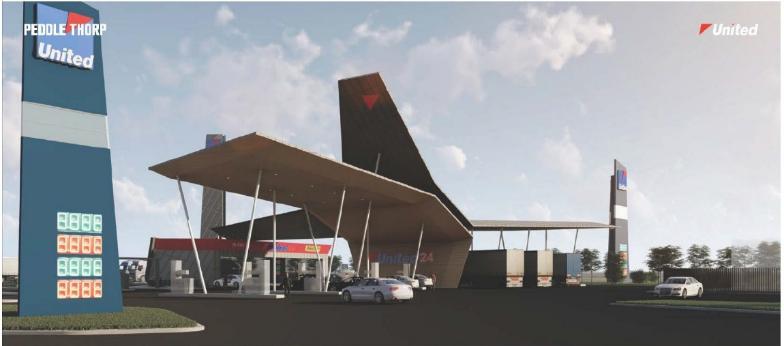
18 On 4 May 2017, PAPL and Qantas entered into the Terminal 3 Development Agreement, which included a mutual obligation on the parties to use “Best Endeavours” to achieve Consolidation by 31 December 2025 (Development Agreement).
19 On 30 May 2017, the PAPL board approved capital plans based on Consolidation occurring by 2025.
20 On 6 July 2017, Mr David Skinner, the Senior Property Manager in the Property Team at PAPL (whose job title was Senior Leasing & Development Manager up to May 2023), sent by email to United, the following documents:
(a) a document entitled “Request for Proposals – Airport Central Precinct Service Station” (the RFP); and
(b) a document entitled “Information Brochure – Airport Service Station Opportunity” (the Information Brochure).
21 The Information Brochure invited tender recipients to submit a proposal for either a:
(a) Building Lease (also known as a Top Lease), whereby PAPL would construct and lease a base building to the tenant and the tenant would be responsible for the fit out and operation of the service station; or
(b) Ground Lease, whereby PAPL would lease the land to the tenant, and the tenant would construct, fit out, and operate the service station.
22 The Information Brochure said PAPL “will require a minimum initial lease of 15 years”, and “has a preference of a Ground Lease”. The proposed site was to be located within the Airport Central Precinct, at the corner of Airport Drive and Paltridge Road, where the Site is now located – although the Site is larger than the proposed site in the Information Brochure (being 8,879 m2).
23 On 14 July 2017, Mr Skinner emailed a document called “Addenda 1” (Addenda 1) to Mr Sam Carmeli, the National Acquisitions Manager at United. The Addenda 1 contained questions that PAPL had been asked by various parties that were interested in submitting a tender and PAPL’s answers to those questions. Addenda 1 also annexed a copy of the Perth Airport’s design guidelines (Design Guidelines).
24 On 4 August 2017, Darren Searle, who was the Executive General Manager of United, sent an email to Mr Skinner submitting United’s tender for the Site.
25 On 1 October 2017, PAPL released a Capital Expenditure Plan reflecting Consolidation by December 2025.
26 On 22 November 2017, PAPL provided a lease proposal to United.
27 A meeting occurred on 27 February 2018, which assumed importance in this proceeding. The meeting occurred in-person at Perth Airport. Mr Gary Brinkworth, United’s Chief Executive Officer (CEO) at the time, attended on behalf of United. Mr Skinner attended on behalf of PAPL. A matter of controversy between the parties was whether Mr Steve Holden, PAPL’s Chief Commercial Officer (COO) at the time also attended on behalf of PAPL, and if so for how long, and whether Mr Geoff Manolitsa, United’s General Counsel at the time attended the meeting. Mr Skinner and Mr Holden are alleged to have made misleading representations at this meeting concerning the Qantas Relocation. The meeting predated the execution of the AFSL (April 2019) and the Sublease (May 2021). On 13 April 2018, PAPL and United executed a Heads of Agreement for a sublease for the Site.
28 On 17 April 2019, PAPL and United executed the AFSL.
29 On 30 October 2019, PAPL informed United that it had satisfied PAPL’s Approvals Condition under the AFSL.
30 On 13 January 2020, United informed PAPL that it had satisfied United’s Approvals Condition under the AFSL.
31 On 3 July 2020, PAPL issued Notices of Practical Completion for PAPL’s works under the AFSL.
32 On 23 July 2020, PAPL wrote to United, giving notice that the Sublease Commencement Date would be 24 July 2020.
33 On 17 May 2021, PAPL and United executed the Sublease.
34 These reasons define the Relevant Period as 6 July 2017, the date Mr Skinner sent the tender documents to United, to 17 April 2019, the date that PAPL and United executed the AFSL. Whilst United has alleged misleading and deceptive conduct in respect of conduct after this date, I have found that the misleading conduct lapsed upon the execution of the AFSL, and for that reason I define the Relevant Period as ending on 17 April 2019.
35 It is helpful at this stage to set out who the key players are from each party to the dispute:
(a) Mr Avi Silver: co-founder and director of United;
(b) Mr Eddie Hirsch: co-founder and director of United;
(c) Mr Gary Brinkworth: Group CEO of United from October 2016, until 31 January 2020;
(d) Mr David Szymczak: current CEO of United (and has held that position since July 2020). Prior to that he was the COO of United;
(e) Mr David Skinner: Senior Property Development Manager in PAPL’s Property team, a position he has held since 2012 (although under different titles); and
(f) Mr Steve Holden: COO/Chief Property Officer at PAPL until he left United in April 2022.
36 These reasons use the term the Perth Airport Project when referring to the consideration and work by United of its tender for the Site.
37 It is also helpful at this point to understand the layout of the Perth Airport area and the Site. The below image shows the Perth Airport area as at September 2017 (about 2 months after United received the tender documents), showing the Airport West and Airport Central precincts and the Site (at that point, still prospective).
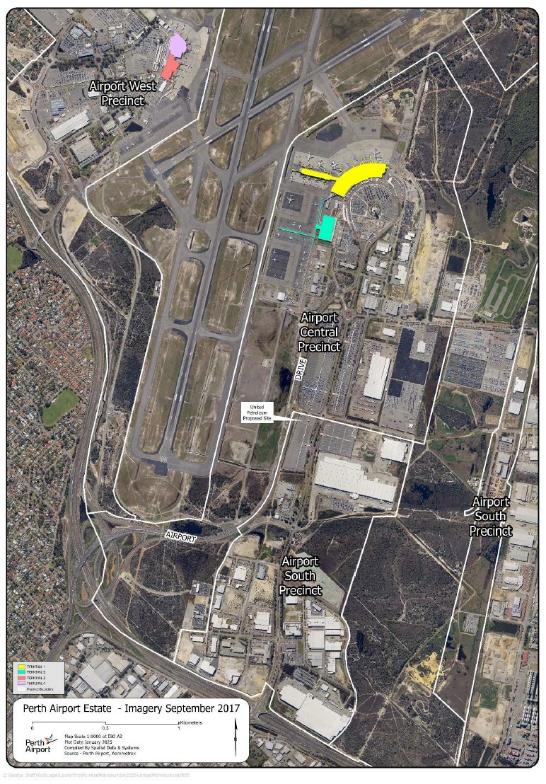
UNITED’S PLEADED CASE
38 In its Amended Statement of Claim filed on 8 December 2023 (ASOC), United alleges the following claims:
(a) Before United entered into the AFSL and before United entered into the Sublease, PAPL represented to United that:
(i) As part of PAPL’s consolidation of commercial air services in Airport Central, Qantas will relocate all its domestic and international flights from Terminals 3 and 4 in Airport West to Airport Central (being the Qantas Relocation) by:
(A) 2025; and
(B) further and alternatively, by the mid to late 2020s.
(ii) When the Qantas Relocation is complete, traffic volumes on Airport Drive, a road abutting the Site, will almost double from the estimated 40,000 vehicles per day in 2024 to 78,000 vehicles per day, and ultimately to an estimated 94,000 vehicles per day by 2031.
(collectively, the Qantas Representations).
(b) Further or alternatively, before United agreed to the AFSL and entered into the Sublease, and in order to induce the United Parties to do so, PAPL represented to the United Parties that:
(i) Qantas Group is expected to relocate all international and domestic flights from Terminal 3 and Terminal 4 located at Airport West, to Airport Central in the mid to late 2020s completing the consolidation of commercial air services in Airport Central; and
(ii) When Qantas relocates from Airport West to Airport Central in the mid to late 2020s it is expected that traffic volumes will almost double on Airport Drive from 40,000 to 78,000 per day;
(iii) PAPL in fact held the expectations, opinions or states of mind set out in (a) and (b); and
(iv) PAPL had reasonable grounds for the expectations, opinions or states of mind (the Further Representations).
(c) The Qantas Representations and Further Representations (collectively the Representations) were continuing representations;
(d) United entered into the AFSL in April 2019 and the Sublease in May 2021 in reliance on the Representations;
(e) The Representations were:
(i) representations with respect to future matters within the meaning of s 4 of the ACL;
(ii) misleading or deceptive, in that PAPL:
(A) did not expect Qantas to relocate to Airport Central in the mid to late 2020s and did not expect that traffic volumes would almost double on Airport Drive from 40,000 to 78,000 per day; and
(B) did not have reasonable grounds to hold such an expectation, opinion or state of mind;
(f) At no time prior to the execution of the AFSL and the Sublease did PAPL disclose the matters set out in Annexure A (Relevant Matters) to United, which may be summarised as:
(i) PAPL had not identified the person or persons within PAPL who held the belief that Qantas would relocate by 2025, or by the mid to late 2020s and the grounds upon which they held that belief;
(ii) Qantas’ refusal to provide a binding commitment to achieve Consolidation by 2025;
(iii) Qantas needed to reach, but had not reached, agreement with PAPL on the commercial terms for Consolidation by 2025;
(iv) after reaching agreement on the commercial terms, there were a number of steps required by Qantas and PAPL to achieve Consolidation, including significantly, agreement on design plans, the expected cost to Qantas, and the forecast demand of the new terminal;
(v) by March 2018, Qantas and PAPL had only agreed to use best endeavours and work in good faith to reach agreement on commercial terms for Consolidation;
(vi) numerous and ongoing disputes between Qantas and PAPL from at least April 2018, including in relation to the expenditure on the Terminal 1 upgrade (referred to as STEP), whether Qantas should be liable for capital expenditure on non-aeronautical upgrades required for Consolidation, and the use and cost of Terminal 3, which culminated in proceedings being commenced by PAPL against Qantas in the Supreme Court of Western Australia on 17 December 2018;
(vii) in or around 2018, Qantas raised concerns with PAPL about the references to Qantas relocating to Airport Central in 2025 in PAPL’s Exposure Draft of the Perth Airport 2020 Master Plan;
(viii) as at June 2018, PAPL had only prepared a roadmap for Consolidation, which required completion of a number of significant steps, and Qantas and PAPL failed to meet those milestones after June 2018;
(ix) PAPL and Qantas’ continuing disagreements about Consolidation layouts in 2018 through to December 2021;
(x) between December 2018 and 13 September 2021, Qantas maintained there was no enforceable obligation requiring it to relocate to Airport Central by 31 December 2025, that PAPL was neither proposing nor able to effect such a relocation by that date, and that Qantas had sufficient capacity to continue operating from Terminals 3 and 4 until at least 2030; and
(xi) disputes between PAPL and Qantas in 2020 and onwards in relation to Consolidation, including pricing, construction and leasing arrangements, and the useful life of Terminals 3 and 4.
(g) By making the Representations and by failing to disclose the Relevant Matters, PAPL contravened s 18(1) of the ACL; and
(h) United has suffered loss and damage, because of PAPL’s misleading or deceptive conduct.
39 The pleaded Qantas Representations are said to have been conveyed by the following conduct:
(a) the provision of the Information Brochure and the RFP as part of the tender process;
(b) statements made by PAPL representatives to United representatives in the course of negotiations for the Sublease, in particular at a meeting on 27 February 2018;
(c) written correspondence sent by PAPL to United dated 7 August 2020; and
(d) the publication of a press release by PAPL on its website dated 10 March 2020 (and published on or around 10 or 11 March 2020).
40 In contrast, the Further Representations are only pleaded as having been conveyed by the provision of the Information Brochure and the RFP as part of the tender process.
PAPL’S DEFENCE
41 By its Amended Defence, filed on 22 December 2023, PAPL denies that it engaged in any misleading or deceptive conduct in connection with the AFSL or the Sublease, and contends that United entered into the transaction with PAPL without reliance on any of the alleged Representations or failure by PAPL to disclose the Relevant Matters.
AGREED LIST OF ISSUES FOR DETERMINATION AT TRIAL
42 The parties agreed that the following list of issues arise out of the pleadings and identified the matters requiring determination (using the parties’ exact wording):
# | Issue | ||
Was there misleading conduct? | |||
1 | Was there a representation made by PAPL to United as pleaded at ASOC [11] or [11A]? If so, when was it made? | ||
(a) | Did the Information Brochure convey the Qantas Representations or the Further Representations to United? | ||
(b) | Did Mr Skinner or Mr Holden convey the Qantas Representations to United at a meeting on 27 February 2018? | ||
(c) | Did the 11 March 2020 press release convey the Qantas Representations to United? | ||
(d) | Did the 7 August 2020 letter from PAPL to Lavan convey the Qantas Representations or the Further Representations to United? | ||
2 | If one or more of the Qantas Representations were made to United, were they a representation to the effect that Qantas will relocate: | ||
(a) | by 2025; or | ||
(b) | by the mid to late 2020s? | ||
3 | If one or more of the Qantas Representations or Further Representations were made to United, were they representations of a continuing nature? If so – | ||
(a) | Did any representation continue beyond the date United submitted its tender (4 August 2017)? | ||
(b) | Did any representation continue beyond the date the AFSL was signed (17 April 2019)? | ||
(c) | Did any representation continue beyond the date the Sublease commenced (24 July 2020)? | ||
4 | If one or more of the Qantas Representations or Further Representations were made to United, were they representations with respect to a future matter for the purposes of s 4(1) of the ACL? | ||
5 | If one or more of the Qantas Representations or Further Representations were made to United, and if one or more of the Representations was with respect to a future matter: | ||
(a) | has evidence been adduced by PAPL to the contrary of the proposition that PAPL did not have reasonable grounds for making the Representations as required by s 4(2) of the ACL as alleged in the Defence [16A(b)(ii)]; | ||
(b) | if so, has United otherwise proven that the PAPL did not have reasonable grounds for making the Representations as alleged in ASOC [16A(c)]? | ||
(c) | [PAPL proposes the following additional sub-issue] Whose grounds, within PAPL, are relevant in determining whether PAPL had reasonable grounds for making the Representations? | ||
6 | If one or more of the Further Representations were made to United: and if one or more of the Representations were not with respect to a future matter, did PAPL hold the expectation reflected in the statements as alleged in ASOC [16A(a)] and [16A(b)]: see Defence [16A(b)(i)]. | ||
7 | Did PAPL engage in misleading or deceptive conduct by silence? | ||
(a) | Was there a reasonable expectation that PAPL would disclose any or all of the Relevant Matters to United? | ||
(b) | If so: | ||
(i) | which Relevant Matters that PAPL should have disclosed to United did it not disclose; and | ||
(ii) | was the failure to disclose such Relevant Matters misleading or deceptive? | ||
If there was misleading conduct, did United rely on it? | |||
8 | [United proposes this issue. PAPL considers it is covered by issue 9 below] If one or more of the Qantas Representations or Further Representations were made to United, did United rely on the representation in: | ||
(a) | entering into the AFSL; | ||
(b) | entering into the Sublease; and/or | ||
(c) | carrying out the Lessee’s Works in accordance with the AFSL? | ||
9 | But for the Qantas Representations and/or the Further Representations, would the United Parties: | ||
(a) | not have entered the AFSL; | ||
(b) | not have entered into the Sublease; | ||
(c) | not have agreed to carry out the Lessee’s Works in accordance with the AFSL in their current form but rather or would they have only agreed to build a substantially smaller and cheaper service station, or not have commenced the works at all from 23 July 2020; | ||
(d) | have sought to negotiate more favourable terms in respect of the Sublease, as to lower rent and United Parties’ standard lease terms (including a force majeure clause); and/or | ||
(e) | not have agreed to lease the Site in respect of the Sublease unless the rent was reduced to approximately $500,000 per annum? | ||
If so, how and at what point in time? | |||
10 | If PAPL had disclosed to United any of the Relevant Matters that should have been disclosed, would United have taken any of the steps in (a) to (d) above? If so, how and at what point in time? | ||
11 | If or to the extent that, by reason of the Qantas Representations and/or the Further Representations, or the alleged non-disclosure of the Relevant Matters, the United Parties would have wished to do any or all of (a) to (d) above following entry into the AFSL and/or Sublease, could the United Parties have done so in light of the terms of the AFSL and/or Sublease (pleaded in the Defence at [8]-[10])? | ||
Causation and loss/damage | |||
12 | But for the Representations and/or PAPL's failure to disclose any Relevant Matters that should have been disclosed: | ||
(a) | would United and PAPL have entered any transaction? | ||
(b) | alternatively, would United and PAPL have entered an alternative commercial transaction – and if so, on what terms? | ||
13 | If United and PAPL would not have entered the transaction at all, what loss, if any, has United proved that it has suffered by entering the transaction that it did? | ||
14 | Alternatively, if United and PAPL would have entered an alternative commercial transaction, what loss, if any, has United proved that it has suffered by not entering that transaction as compared to the one it did enter? | ||
UNITED’S LAY EVIDENCE
Avi Silver
43 Avi Silver (Mr Silver) gave evidence that he is a director of both applicants, collectively, the United Parties, having held that position since both companies were incorporated in 1999 in the case of United Petroleum, and in 2013, in the case of United Petroleum Australia. United Petroleum Australia is the holding company of United Petroleum. United tendered one witness statement of Mr Silver dated 12 July 2023.
44 Mr Silver’s evidence was that United is an Australian fuel retailer and importer. United has a network of approximately 450 service stations across Australia and employs approximately 330 employees throughout Australia.
45 United’s business was established in 1993 with the opening of a chain of service stations and convenience stores in South Australia by Mr Silver’s business partner, Mr Eddie Hirsch. Mr Silver and Mr Hirsch expanded its operations into Victoria and over the next two years built networks in New South Wales, the Australian Capital Territory, and Queensland. United now runs a vertically integrated business after acquiring fuel import terminals in the mid-2000s in Victoria, New South Wales, Queensland, Northern Territory and Tasmania. United both constructs petrol stations as well as purchasing existing petrol stations. United is a privately held corporation which is owned equally by Mr Silver and Mr Hirsch (through their respective wholly-owned corporate vehicles). The key business decisions are made by both Mr Silver and Mr Hirsch. United’s business is structured so that key management personnel report to Mr Silver and Mr Hirsch. These management roles are occupied by the CEO, COO, and various other senior managerial positions.
46 Mr Silver holds a commercial building licence and an associated entity of United also holds a builder’s licence. Between 2018 and 2020, United completed the construction of 29 service stations throughout Australia under design and construct contracts. The construction costs for these service stations varied between $1.8 million and $5.7 million depending upon the size and the facilities offered at the service station site.
47 The Perth Airport Service Station is a flagship service station of United. It was designed by architects, Peddle Thorp, to have a unique design, being aeroplane wings as a canopy and an aeroplane tail to display United’s name and logo (ie, the Millennium Concept). Mr Silver said that United wanted to build the Millennium Concept designed by Peddle Thorp as a selling point so as to try and win the tender from PAPL for the new service station.
48 From around mid-2017, the Perth Airport Project was managed by United’s then CEO, Mr Brinkworth. Mr Brinkworth would inform Mr Silver of the progress of the project on a regular basis or when Mr Silver’s approval was required for significant items relating to the tender. Mr Silver would discuss the progress with the tender on a regular basis with Mr Hirsch. The meetings were informal as Mr Silver and Mr Hirsch had adjoining offices with a conference room and they would talk on, or close to, a daily basis about United’s business, including the tender for the Perth Airport Service Station. Prior to Mr Brinkworth commencing at United, Mr Carmeli and Mr Searle had been working on the tender, with Mr Brinkworth assuming responsibility as the CEO.
49 Mr Silver’s evidence was that United has a standard feasibility process that it undertakes when assessing the viability of a prospective service station site. That process involves assessing the site location and using that assessment to project fuel volume, shop sales and other revenue that United believes a United service station could achieve on the prospective site, and estimates the expenses associate with the site. Based on those projected numbers, United then determine the projected net profit which that site would return. Mr Silver said that those numbers are populated in a pro forma excel spreadsheet. That population task is performed by staff at United, under the supervision of management, who then report to Mr Silver.
50 Mr Silver directs management to use conservative figures to populate the feasibility spreadsheet. Mr Silver used the feasibility spreadsheet for the Perth Airport Service Station to discuss the tender with United’s senior management. Mr Silver uses the feasibility spreadsheet to understand the return that a particular project will deliver. Mr Silver would decide whether the return was sufficient or not based on the projected numbers to justify United committing to the project. The ultimate decision as to whether United would proceed with the project or not was made by Mr Silver and Mr Hirsch who rely upon their respective 42 and 50 years’ experience in the petroleum retail business.
51 Mr Silver’s evidence was that central to United’s decision to submit a tender for the Perth Airport Service Station was the location of the Site, the forecast traffic numbers; the exclusivity that would be afforded to United, and the design (being the Millennium Concept).
52 Mr Silver read PAPL’s Information Brochure prior to United submitting a tender for the Site. Mr Brinkworth told Mr Silver that Qantas was relocating all its international and domestic terminals to Airport Central by 2025, and that, as a result of the relocation, the traffic that would pass the Site would nearly double in 2025, with a continued increase each year thereafter. Whilst Mr Silver could not recall the exact detail and dates of discussions he had with Mr Brinkworth about the Perth Airport tender, he had many discussions with Mr Brinkworth. Mr Silver had a clear recollection of Mr Brinkworth advising him of the Qantas Relocation and the increase in traffic numbers past the Site on multiple occasions during his discussions with Mr Brinkworth. Mr Silver’s written evidence was that those discussions occurred prior to United submitting a tender and prior to the execution of the AFSL and the Sublease because these matters were relevant to the design and construction costs of the Site and what rent United was prepared to pay PAPL for the Site.
53 Mr Silver agreed for United to sublease the Site and build the Perth Airport Service Station because he believed that the Perth Airport Service Station would be profitable, based on his experience and the sales that he and Mr Hirsch believed United could achieve. Mr Silver considered the Perth Airport Service Station to be a good business opportunity as it provided access to flight passengers, airport staff, ride share drivers and taxi drivers as well as delivery truck drivers delivering goods to shops at the airport. Mr Silver believed that a significant number of vehicles would pass the Site each day. United has service stations at Adelaide Airport and also at Launceston Airport, and the opportunity of being able to open a service station at Perth Airport was of interest to United.
54 Mr Silver’s evidence was that an important component of the attractiveness of the Site was the expected Qantas Relocation, which would place the Qantas and Jetstar terminals in direct proximity to the Site. Based on the statements in the Information Brochure, Mr Silver expected to nearly double the traffic at the Site after the Qantas Relocation, which would be good for United’s business.
55 Mr Silver’s evidence was that the Qantas Relocation was absolutely key to determining the rent and capital expenditure for the Site, given it would increase the number of customers who purchased fuel and other products from United. For this reason, the Qantas Relocation was a significant factor in Mr Silver’s decision to offer the rental amount of $1 million per annum (excl GST) in United’s tender proposal – which was ultimately negotiated down to $900,000 per annum (excl GST) but with a bank guarantee to secure the rent payable.
56 The Qantas Relocation was also a significant factor in Mr Silver’s decision to agree to build a flagship service station using the architects, Peddle Thorp, to create a unique, aeroplane inspired, airport service station – the Millennium Concept.
57 Mr Silver said that the initial construction cost for the Perth Airport Service Station was estimated to be $6.5 million, however the cost ultimately ended up being in excess of $8.6 million, which was mainly due to the impact of the Covid-19 pandemic, which extended the construction time and costs. Mr Silver was emphatic in his evidence that, were it not for the Qantas Relocation and the associated doubling of traffic past the Site, he would not have offered to design and build the Perth Airport Service Station. Instead, Mr Silver would have designed and built a smaller and simpler style of service station which would have cost approximately $4 million to $4.5 million. Mr Silver’s evidence was that he would not have offered or agreed to pay $900,000 (excl GST) per annum in rent, instead, he would have only agreed to pay an amount up to $500,000, presumably exclusive of GST, in rent.
Cross-examination
58 Mr Silver, under cross-examination, said that he initially offered PAPL $1 million dollars per year in rent but, after negotiations and a requirement by PAPL for United to provide a bank guarantee, United negotiated the rent down to $900,000 with a bank guarantee.
59 In relation to the feasibility spreadsheet for the Site, which Mr Silver agreed was prepared by Mr Carmeli in or about July 2017, two of the critical inputs were the vehicles per day and the projected monthly fuel sales. Mr Silver accepted that the feasibility spreadsheet anticipated traffic volumes of around 800 movements per day into the proposed service station. That figure came from 2.5% of the 31,550 vehicles passing the Site each day – known as the ‘turn-in’ rate.
60 Mr Silver said the vehicles per day figure of 31,550 came from the Information Brochure and was the actual number of vehicles which travelled past the Site as at March 2017 (being the total of the figures 16,100 and 15,450 included at page 7 of the Information Brochure). That is, that was the figure at the commencement of the lease and did not incorporate any increased traffic from the Qantas Relocation.
61 The spreadsheet also included a volume of fuel sales per month of 1,183,125 litres. It was put to Mr Silver that the fuel sales figure of 1,183,125 litres was worked out by multiplying the vehicles per day (31,550) by the average volume of a tank (50 l) by the days in a month (30) by the turn-in rate (2.5%). Mr Silver accepted that the 1.2 million litre figure corresponded with that calculation, and appeared to therefore accept that monthly fuel sales were being calculated by reference to the vehicles per day figure of 31,550. Mr Silver accepted that the feasibility spreadsheet was one of the things he took into account in considering how much to put in the tender proposal but emphasised that there were many versions of this spreadsheet – noting he had discussed with Mr Carmeli that this version had the wrong shop sales figure included. Mr Silver accepted that United’s tender proposal stated that “United anticipate traffic volumes of around 800 movements per day into the service centre”. Mr Silver accepted that that was the actual number at commencement and did not incorporate any increased traffic from the Qantas Relocation.
62 Mr Silver accepted that he signed a tender both for a ground lease and also for a building lease (Top Lease) but said that because of the number of deals which he undertook for United, he relied on his in-house legal counsel and real estate managers to review the documentation, such that he does not read the whole of the documents presented to him because he would not be able to undertake any other work if he did.
63 Mr Silver said that the design of the service station was not dependent on the expected 800 vehicles per day. The design was to create a landmark that would enhance United’s ability to win the tender. The design was not to attract customers.
64 Mr Silver was not aware that the tender documents required a business plan from United for the Site.
65 Mr Silver recalled discussing with Mr Brinkworth, the numbers in the feasibility spreadsheets but he could not remember the detail of the numbers in the different spreadsheets presented to him.
66 Mr Silver could not remember the specific date upon which construction of the Perth Airport Service Station commenced, but he believed that it was at the start of the Covid-19 pandemic lock down in very late 2019 or early 2020. Mr Silver accepted that the business model being put forward on 9 March 2018 was that United would achieve fuel sales of 14.4 million litres in the first operative year of the Site, which was based on 31,550 vehicles passing the Site per day, with incremental increases in the following four years that did not factor in the Qantas Relocation.
67 Mr Silver said that based on the actual figure of 31,550 vehicles per day, the Site was not sufficiently profitable. Mr Silver said that he believed the Qantas Relocation would happen in the mid-2020s. Mr Silver said that most service stations had no volume growth. The Site was attractive because of the volume growth with increased traffic due to the Qantas Relocation. The Qantas Relocation was central to the business case for the Site. The timing for the Qantas Relocation was to be in the second half of the 15-year term of the lease. Mr Silver believed that sometime in the second half of the 15-year term, Qantas would relocate. That was the basis for the rental of $900,000 which United offered in the proposal it put forward.
68 Mr Silver said that Mr Brinkworth had, on many occasions between 2017 and the day that contracts were exchanged, discussed, in many meetings in corridors and conference rooms, the Qantas Relocation and the increased traffic numbers that were expected to occur. However, as I have said above, under cross-examination Mr Silver accepted that Mr Brinkworth did not work on the Perth Airport Project until after the tender had been submitted. Counsel for PAPL informed Mr Silver, by reference to the relevant documents, that the tender was submitted on 4 August 2017 and that Mr Brinkworth only became the CEO around mid-2017. On that basis, Mr Silver conceded that, whilst he did not recall the specific dates, Mr Brinkworth only began informing Mr Silver of the progress of the Perth Airport Project on a regular basis or when his approval was required for significant items relating to the tender, after United submitted its tender proposal. However, later on in his cross-examination Mr Silver rejected the proposition that the conversations that he had with Mr Brinkworth about Qantas’ Relocation and the expected increased traffic, occurred only after the tender had been submitted to PAPL.
69 Mr Silver rejected that he did not know when Qantas would relocate. Mr Silver was adamant that he was told that Qantas would relocate in the mid-2020s. Mr Silver rejected the proposition that he had recreated a date by which Qantas would relocate for the purpose of giving his evidence.
70 Mr Silver was adamant that he took into account Qantas’ Relocation by the mid-2020s in determining the rent which United would offer and the capital expenditure which United would incur on the Site. Mr Silver said that he understood that the Qantas Relocation would take place around the mid-2020s, although there was not yet a specific date.
71 Mr Silver said that the reason he decided to build the Millennium Concept was to win the tender by creating a landmark service station. That was the reason he spent the additional money to create a unique facility which would be something which would be attractive to PAPL as lessor.
72 Mr Silver rejected the proposition that the rent he offered of $900,000 was not based on the Qantas Relocation by mid-2020s. Mr Silver said that Qantas was the biggest user of the airport and that it would be silly for him not to have considered the Qantas Relocation in his decision to offer the $900,000 rent.
73 Mr Silver rejected the proposition that he wanted to win the tender and was prepared to pay a premium. Mr Silver said “I wanted to win the site because in any tender I participate in, I want to win, but my main goal is to make money … It’s all about the return”. Mr Silver said he wanted to do the special design (the Millennium Concept) to win the tender, but the main motivator was to make a sufficient profit.
74 Mr Silver rejected the proposition that his offer of a rental of $900,000 had more to do with winning the tender, than with determining whether or not the Site would be profitable. Mr Silver said that he would never do that. Mr Silver said that he would “never go into a business that doesn’t make money because it’s got exposure”. Mr Silver said that is not what he does.
Findings
75 I find Mr Silver to be a truthful and reliable witness who was forthright in answering questions put to him under cross-examination. I am satisfied that he made appropriate concessions when he could not recall the detail of events and matters which occurred more than six years ago. I accept Mr Silver’s evidence that he would not have submitted a request for tender offering a rent of $900,000 for the Site, had he not believed that Qantas would relocate to the new central terminal in the mid-2020s. I also accept Mr Silver’s evidence that he believed the traffic volume past the Site would dramatically increase after the Qantas Relocation in the mid-2020s. I accept Mr Silver’s emphatic denial that he agreed to pay a premium rent in order to win the tender for the Site. I accept Mr Silver’s evidence that he would never go into a business proposition which was not profitable. I accept Mr Silver’s evidence when he stated that he believes everything in business is about the return on investment.
76 In relation to the involvement of Mr Brinkworth and the conversations alleged to have occurred between him and Mr Silver, I accept Mr Silver’s evidence that he had conversations with Mr Brinkworth prior to the submission of the tender. Properly understood, Mr Silver’s evidence was that United had been working on the Perth Airport Project from around at least late-2016, with primary responsibility resting with Mr Carmeli and Mr Searle; Mr Brinkworth became involved in the Perth Airport Project from mid-2017; the tender was submitted on 4 August 2017; and his involvement became more active after the tender submission. I accept that evidence. As I have outlined earlier, United received the RFP material from PAPL on 6 July 2017. Therefore, I accept Mr Silver’s evidence that he had conversations with Mr Brinkworth regarding the Perth Airport Project generally prior to the tender submission. As I discuss later, this is also largely consistent with Mr Brinkworth’s evidence. I also accept that given the effluxion of time, it was correctly acknowledged by Mr Silver that he did not precisely recall when particular people became involved in or undertook specific steps in the project, and this does not reflect negatively on the credibility or reliability of his evidence.
Eddie Hirsch
77 Eddie Hirsch (Mr Hirsch) gave evidence that he is a co-founder and a 50% co-owner of United Petroleum and United Petroleum Australia, along with Mr Silver. United tendered one witness statement of Mr Hirsch dated 17 July 2023.
78 Mr Hirsch gave evidence that he and Mr Silver were both involved in the day-to-day running of the United business, however, they have separate areas of responsibility. Mr Hirsch is responsible for the “upstream” – being the fuel importation and distribution – part of the United business. This involves sourcing the fuel, bringing it to different shipping terminals, and negotiating deals with major oil companies. Mr Silver is responsible for the retail part of United’s business – being the buying and leasing of property for service stations, constructing service stations, and operating the service stations.
79 Mr Hirsch and Mr Silver keep each other updated on significant issues and developments in their respective areas of responsibility. Sometimes they seek each other’s opinion on a particular issue. On smaller issues, they advise each other after the event, whilst on bigger issues they discuss the matter before a final commitment is made by United. Mr Hirsch said that he and Mr Silver do not interfere in each other’s areas of responsibility or second guess each other’s decisions. He relies on Mr Silver to do the property deals for acquisition and leasing of property for service stations. It is Mr Silver’s call to do the property deals, just like it is his call to do the deals for the acquisition of fuel. Mr Hirsch said that if a lease came to him which has Mr Silver’s signature already on it, he would sign it.
80 Mr Hirsch signed the AFSL and the Sublease for the Perth Airport station.
81 Mr Hirsch’s involvement in the decision to submit a request for tender for the Perth Airport site was limited. Mr Silver kept him updated about the project but otherwise Mr Hirsch relied upon Mr Silver to get the deal done and did not seek to second guess Mr Silver’s opinion. Mr Hirsch said that Mr Silver was the ultimate decision maker in respect of the lease of the Site. Mr Hirsch said that it was Mr Silver’s call and that he executed the AFSL and Sublease because Mr Silver had made the call that United should enter into those agreements. Mr Hirsch did not recall being provided with any of the tender documents from the landlord, PAPL. Mr Hirsch did not recall being provided with the feasibility spreadsheets for the project. Mr Hirsch did not get involved in property deals at that level of detail but, rather, relied upon Mr Silver and his property expertise.
82 Mr Hirsch was not involved in formulating United’s response to the RFP for the Site. Mr Silver briefed Mr Hirsch before the bid was submitted but did not seek his approval. Mr Hirsch said that the bid for the Site was a matter for Mr Silver.
83 On several occasions before the AFSL was executed, Mr Silver briefed Mr Hirsch on the project. Mr Hirsch could not recall the precise dates or occasions on which this occurred. At least one of these briefings took place in a conference room at United’s office where Mr Silver showed Mr Hirsch the map of Perth Airport on Google Earth. Mr Brinkworth was present on some of these occasions. Mr Szymczak, the then COO, may have been present at some of these discussions but Mr Hirsch was not certain about that.
84 During these briefings, Mr Silver told Mr Hirsch that Qantas was relocating its terminals to the area of the airport containing the proposed Perth Airport Service Station – being the Qantas Relocation. Mr Silver told Mr Hirsch that the Qantas Relocation would occur by mid-2025. Mr Silver also told Mr Hirsch that United would have exclusivity in the airport precinct and that United would have the only petrol station at the airport. Mr Hirsch said that, based on these briefings, he understood that as a result of the Qantas Relocation, every car carrying passengers to Perth Airport would come past the Perth Airport Service Station. Mr Hirsch did not recall Mr Silver mentioning specific figures in terms of the vehicles per day before and after the Qantas Relocation. Mr Hirsch said that he was not generally involved in these sorts of details.
85 Mr Hirsch regarded the Qantas Relocation as being an important factor driving the deal. Mr Hirsch had dealings with Qantas in Melbourne, where United supplies jet fuel to Qantas, and he knew that Qantas had a big share of the air passenger market.
86 Mr Hirsch regarded the rental United agreed to pay for the Perth Airport of $900,000 (excl GST) per annum to be a hefty rent. Mr Hirsch said, to his mind, this amount was justified by the impending Qantas Relocation. Mr Hirsch said that, but for the Qantas Relocation, he would expect the rent to have been dramatically lower but would have deferred to Mr Silver on the specific amount of rent that United should pay.
87 Mr Hirsch said that the Perth Airport Service Station constructed by United was massive. But for the expected Qantas Relocation, based on Mr Hirsch’s experience, he would expect that United would have wanted to build a much smaller service station, but would have deferred to Mr Silver on the specifics.
Cross-examination
88 Mr Hirsch said, under cross-examination, that, whilst he does not recall the exact dates or occasions on which his briefings with Mr Silver (and others) took place in relation to the Perth Airport Project, he and Mr Silver have adjoining rooms at their office with a conference room in the middle and “probably meet basically every day, three or four days a week”: [T211.42-44]. In particular, Mr Hirsch remembered the occasion when he and Mr Silver went into the conference room and Mr Silver showed him a map of the Perth Airport site on Google Earth and where the service station would be built and where Qantas was relocating. Mr Hirsch said that Mr Brinkworth may have been in the room (which I take to be the conference room) at some of the meetings between him and Mr Silver, including the Google Earth meeting, but that it was Mr Silver providing the briefing. Mr Hirsch did not squarely answer whether he was able to remember whether this meeting took place before or after the AFSL was executed. However, Mr Hirsch was adamant that he and Mr Silver “speak about major deals all the time” and that Mr Silver briefs and concurs with him before “the final signing”: at [T214.3-14].
89 Mr Hirsch accepted that he relied upon Mr Silver to get the deal done in relation to the Perth Airport Project. Mr Hirsch said that Mr Silver was very strong on the Perth Airport Project and that he did not second guess Mr Silver. However, Mr Hirsch was emphatic that whilst he left the details of the deal to Mr Silver, such as the underlying economics, he and Mr Silver had many discussions about the Perth Airport Project and that Mr Silver came with the final proposal and discussed it with Mr Hirsch. Mr Hirsch said Mr Silver “was very strong on it, that he wanted the deal” and Mr Hirsch agreed with Mr Silver that with the expected traffic flows, it would be a good deal: [T215.14-16]. Mr Hirsch said that he knew that there were some negotiations going on regarding rent as part of the final deal, but he did not concern himself with those matters, leaving them to Mr Silver.
90 Mr Hirsch was emphatic in rejecting the proposition that he could not actually remember the briefings on the Perth Airport Project. Mr Hirsch said he could remember being told specifically about the Qantas Relocation and that this was a major part of the deal. Mr Hirsch said that he was confident in knowing that around 2025, he was told by Mr Silver that Qantas would relocate (at [T217.36-37]) – I take this to mean that Mr Hirsch was confident that Mr Silver told him that Qantas would relocate by around 2025. Mr Hirsch said there was no doubt about that in his mind.
91 Mr Hirsch stated that the Qantas Relocation was very important to the deal because Qantas was not a minor airline, Qantas was a massive airline. Qantas was an important factor driving the deal because Qantas had a big share of the passenger market in Australia. Mr Hirsch said that if Qantas were relocating, like Mr Silver had told him, then the Perth Airport Service Station’s volume would dramatically increase.
92 Mr Hirsch accepted in cross-examination that he left the details of the economics of the Perth Airport service station to Mr Silver, but said (at [T219.11-17]) that:
There has been many a time where I haven’t agreed with Mr Silver, because all major deals are discussed between the two of us. It’s not one person doing it. For a major deal to happen, we have robust discussions where I have actually in other areas probably said no, but in this case, Mr Silver’s pointing to me how strong this – this deal was with the Qantas relocation, I agreed with him. But it’s not a sole director that signs off. It’s two directors.
Findings
93 I accept Mr Hirsch as an honest and reliable witness. Mr Hirsch made appropriate concessions during the course of cross-examination and was forthright in his evidence of what he could and could not recall. As to his discussions with Mr Silver regarding the Perth Airport Project, Mr Hirsch was emphatic in his evidence of the importance of the Qantas Relocation to United submitting a response to the RFP. I accept Mr Hirsch’s evidence that he believed the Qantas Relocation would result in dramatically increasing the traffic flows past the Site and that this was what made the transaction a good deal for United.
94 I also accept Mr Hirsch’s evidence that he believed that the Qantas Relocation would take place around 2025 and that the relocation was an important driving factor of the deal.
Gary Brinkworth
95 Gary Brinkworth (Mr Brinkworth) was employed as the Group CEO for United from October 2016 to 31 January 2020. He was hired by United for the specific purpose of guiding United through its proposed initial public offering (IPO) and listing on the Australian stock exchange. The IPO did not proceed, and Mr Brinkworth remained employed as United’s CEO until 31 January 2020. United tendered two witness statements of Mr Brinkworth dated 14 July 2023 and 25 June 2024.
96 During Mr Brinkworth’s tenure as CEO of United, he was involved in the contracting and/or establishment of over 100 service stations, including highway service centres.
97 Mr Brinkworth said that during his time at United, Mr Silver and Mr Hirsch were the directors and co-owners of United and oversaw and directed the operations of United’s business. Mr Brinkworth’s role at United was to work with Mr Silver and Mr Hirsch, take responsibility for the day-to-day operations, lead the key strategic opportunities, and make recommendations on projects requiring capital expenditure. Mr Silver and Mr Hirsch held the exclusive authority for all capital investments made by United.
98 Mr Brinkworth, in his role as CEO of United, had ready access to Mr Silver and Mr Hirsch and would often speak to them multiple times each day. United had a flat management structure so meetings were frequently spontaneous and originated from informal discussions with Mr Silver and Mr Hirsch.
99 At the time Mr Brinkworth joined United in October 2016, United was already working on the Perth Airport Project. Mr Brinkworth was not involved in the project at that stage. Mr Sam Carmeli, who was the National Acquisitions Manager, worked with Mr Silver on the project.
100 In around July 2017, Mr Darren Searle was engaged as Executive General Manager and took over from Mr Carmeli in working on the Perth Airport Project. It was from about this time that Mr Brinkworth gradually became more involved in the project.
101 On 6 July 2017, PAPL’s Senior Leasing and Development Manager, Mr David Skinner, sent an email to United’s acquisitions team, and also to Mr Carmeli, which attached the RFP and the Information Brochure.
102 On 14 July 2017, Mr Skinner emailed the Addenda 1 to Mr Carmeli. Mr Carmeli forwarded the Addenda 1 to Mr Brinkworth on 16 July 2017. Addenda 1 included the following question and answer:

103 In about late July or early August 2017, before United submitted its response to the RFP, Mr Searle provided Mr Brinkworth with a detailed briefing on the Perth Airport Project and the proposed response to the RFP. Mr Searle took Mr Brinkworth through the history of the RFP process and provided to Mr Brinkworth all relevant documents from PAPL, including the RFP and the Information Brochure, which Mr Brinkworth then reviewed. Mr Searle took Mr Brinkworth through the feasibility spreadsheet for the proposed service station and briefed Mr Brinkworth on United’s proposal and the next steps required to obtain Mr Silver’s sign off for the proposal.
104 Mr Brinkworth, prior to being briefed on the Perth Airport Project, was not involved in formulating United’s proposed tender submission. Mr Brinkworth’s active involvement commenced only after United’s tender submission had been sent to PAPL. Mr Brinkworth did say, however, that the design included in the proposal (being the Millennium Concept) was very different from United’s standard service stations, which typically have an area of 3,000 m2 (compared to the Site’s 8,879 m2).
105 Between 22 November 2017 and 13 April 2018, United and PAPL negotiated the Heads of Agreement. Mr Brinkworth was involved in these negotiations on behalf of United. Through these negotiations, Mr Brinkworth negotiated a reduction in rent from $1.19 million per annum to the final rent of $900,000 per annum (excl GST) with a bank guarantee.
106 In January 2018 Mr Brinkworth obtained a copy of the feasibility spreadsheet for the Perth Airport Project which Mr Carmeli had prepared, which was dated 21 July 2017. On 31 January 2018, Mr Brinkworth caused the spreadsheet to be updated to include the updated rent of $900,000 (excl GST) per annum and with an updated shop sales margin of 16% instead of 10%. Mr Brinkworth said the spreadsheet aimed to define the average performance across the first term of the lease to provide an indicative return on the capital and cost. Mr Brinkworth explained that the spreadsheet contained a sensitivity analysis, whereby the Site was compared to other sites, in this case United’s Westgate service stations in Melbourne. The table has data for: vehicles per day; the percentage of traffic which are heavy (ie commercial) vehicles; the fuel margin in cents per litre; the estimated turn-in rate; volume of fuel sales per month; the percentage of shop sales (in dollars) for every litre of fuel sold; and sales at the shop in dollars. For the latter three inputs an actual figure is used for the comparison sites, whilst an estimate is used for the Site. Mr Brinkworth said the spreadsheet revenue figures were heavily based on the assumption of the Qantas Relocation.
107 In particular, Mr Brinkworth said the estimated fuel sales of 1.2 million litres per month represented an assessment of the volume of fuel sales the Perth Airport Service Station could generate over time taking into account the Qantas Relocation and the associated increase in traffic. Mr Brinkworth said this is reflected in the turn-in rate in the sensitivity analysis of 2.5%, which would be more than three times higher than the actual turn-in rates for United’s Westgate sites. In other words, to achieve the estimated fuel sales of 1.2 million litres per month with only 31,550 vehicles per day of traffic, the Perth Airport Service Station would need to have a turn-in rate that is over three times higher than the actual turn-in rates for United’s Westgate service stations. However, if the traffic increased to 78,000 vehicles per day after the Qantas Relocation (as set out in the Information Brochure), a 1% turn-in rate would be sufficient to achieve 1.17 million litres per month in fuel sales. If traffic further increased to 94,000 vehicles per day (as predicted in the Information Brochure for 2031), a turn-in rate of 0.85% would be sufficient to achieve 1.2 million litres per month in fuel sales.
108 Thus, Mr Brinkworth said that absent the expectation of the Qantas Relocation, he would not have considered the January 2018 spreadsheet to be a realistic estimate of the expected profitability of the service station. Without the Qantas Relocation, in his view, the Site and the Perth Airport Service Station could not support a rent of $900,000 per annum (excl GST) and capital expenditure of $6.5 million.
109 In about February 2018, Mr Brinkworth had a telephone discussion with Mr Skinner during which it was agreed that a meeting should be held in Perth with Mr Holden, to discuss the terms being negotiated for the Sublease and for Mr Holden to provide greater detail on the development plans for the airport. Mr Brinkworth referred to Mr Holden as PAPL’s Chief Property Officer, but at the time he was PAPL’s COO. That meeting took place on 27 February 2018 at PAPL’s offices in Perth.
110 Mr Brinkworth said that apart from himself, Mr Manolitsa, United’s General Counsel, and Mr Holden and Mr Skinner, of PAPL were present at the meeting. Mr Brinkworth’s evidence was that the meeting started with a review of the overall strategic plan with PAPL’s representatives taking Mr Brinkworth and Mr Manolitsa through the expected growth projections and some of the development opportunities so that United could get a better appreciation of why PAPL expected the traffic and activity at the airport to grow, and why PAPL’s view that a third runway could potentially be required within ten years. Mr Brinkworth’s evidence was that he said that from United’s perspective, given the scale of the development at the Site and the nature of the agreement, a ten-year term was inadequate to generate a return on United’s investment and that United would need to make sure that it had as much time as possible post the Qantas Relocation to justify the expenditure on the project.
111 Mr Brinkworth said that he made it “really clear” to Mr Holden and Mr Skinner that United were hoping to get, at a minimum, “that requirement” extended to 15 years, in line with the first term, so as to maximise the time-frame with the increased Qantas Relocation traffic and activity: [T225.45-47]-[T226.1-4]. Mr Brinkworth clarified that by “that requirement” he was referring to resumption of the Site by PAPL, in the event of a third runway being required: [T226.7-13]. Mr Brinkworth also discussed how United could start to accelerate and leverage some of the benefits to the employees that would occur with the Qantas Relocation within that 2025 window.
112 Mr Brinkworth said he and Mr Manolitsa “stressed the importance” of the Qantas Relocation to the Perth Airport Project and that Mr Holden said the Qantas Relocation would occur “somewhere between 2025”: [T226.16-22]. Mr Brinkworth said he responded that it “was imperative that it happen as quickly as possible, so that [United] could realise the benefit of the relocation as part of that lease term” and that Mr Holden and Mr Skinner acknowledged “their expectation was or their view was that it would happen between 2025”: [T226.25-32].
113 On 13 April 2018 PAPL and United executed the final Heads of Agreement.
114 Mr Brinkworth understood the position to be that PAPL was expecting to complete the Qantas Relocation in the early 2020s and by 2025, and that given the number of references to early and mid-2020s, the reference to late 2020s in the Information Brochure did not accurately reflect PAPL’s plans but rather was there because PAPL wanted to leave itself some wriggle room.
115 In relation to the answer to Question 7 in Addenda 1 extracted above, Mr Brinkworth understood it to mean that no exact date had been set for the Qantas Relocation (consistently with the other materials, which did not suggest there was an exact date).
116 Mr Brinkworth was then involved in the negotiations related to the terms of the AFSL, between 13 April 2018 and 17 April 2019 (when the AFSL was executed).
117 Mr Brinkworth said he had numerous discussions with Mr Silver in the period between July 2017 and April 2019. These included one-on-one meetings, although Mr Brinkworth did not expand on when these meetings occurred, the frequency or what was discussed. Mr Brinkworth also referred to a specific conversation as part of a United executive meeting, also attended by Mr Szymczak and Mr Geroge Svinos (the then Group Chief Financial Officer – now deceased), which including looking at a Google Earth map of the Perth Airport area and reviewing the layout of the airport, the location of the Site and the proximity of the Qantas terminal and commercial businesses. Finally, Mr Brinkworth refers to a conversation regarding the Site during a trip to Perth in 2018, where he and Mr Silver inspected multiple service stations sites in Perth, including the Site. Mr Brinkworth said that in each conversation there was a discussion to the effect that the Qantas Relocation was expected to occur by the early to mid-2020s.
118 Further, sometime in the first half of 2019, Mr Brinkworth agreed with PAPL on the contents of a joint press release about the Perth Airport Service Station but does not remember the details of these discussions or when exactly they took place. The press release is dated 10 March 2020 and included the following:
With Terminals 3 & 4 scheduled to be relocated by 2025, the Airport Central Precinct will increasingly become the focus for aeronautical operations and the design of this development will help to create a great first impression for visitors to Western Australia.
119 Mr Brinkworth said the wording of the press release reflected his understanding that Qantas would relocate all of its international and domestic flights from Terminal 3 and Terminal 4 to Airport Central by 2025 at the latest and that no representatives of PAPL ever said anything to suggest that the Qantas Relocation would not occur or would be delayed.
120 Mr Brinkworth said he regarded the Qantas Relocation as critical to ensure the Site was sustainable. First, this was because traffic volumes are critical to the revenue that can be derived from a service station, and the Qantas Relocation was expected to bring about a large increase in traffic volume (and therefore a large increase in revenue). Mr Brinkworth assumed that the Qantas Relocation was a primary reason for the increase in the Information Brochure from the forecast of 40,000 vehicles per day in 2024 to 94,000 vehicles per day by 2031.
121 Mr Brinkworth was clear that he did not recall any mention from PAPL representatives that the Qantas Relocation was conditional, qualified or in any way uncertain; nor that PAPL and Qantas only had an agreement to use “best endeavours” to achieve Consolidation by 2025; nor that the Qantas Relocation was subject to PAPL reaching an agreement for Qantas to relocate on “commercial terms”.
122 Mr Brinkworth said that the topic of the construction works required to achieve Consolidation were never raised in his discussions with Mr Skinner and Mr Holden.
123 Mr Brinkworth said that based on (a) his 36 years of professional experience and over 25 years’ experience in senior leadership positions, and (b) key features in the Information Brochure being the Qantas Relocation occurring by 2025 and the increase in traffic numbers, he would have expected to be informed by PAPL of the following:
(a) that it did not have a firm agreement with Qantas that obligated Qantas to relocate its terminals to Airport Central by 2025;
(b) any other relevant matters that could have affected the Qantas Relocation date or that could have affected the represented increase in traffic numbers on Airport Drive; and
(c) any change in position represented by PAPL before United executed the AFSL in April 2019. This is particularly the case where United had negotiated its position based on the information provided to it by PAPL.
Cross-examination
124 Mr Brinkworth said that the exact date for when Qantas would relocate was yet to be finalised.
125 Mr Brinkworth understood that United, as a tenderer, was required to rely on its own enquiries in submitting a tender but that that related to data points or secondary inputs, it was not his expectation that it related to any core tenet of the proposal. Mr Brinkworth accepted that those provisions would relate to the traffic volume data provided in the Information Brochure, but did not believe they applied to the expectation that the Qantas Relocation would occur by the mid to late 2020s.
126 Mr Brinkworth understood that the tender documents contained a clause that no person had been authorised to make any representations or warranties in connection with the tender documents but, at a practical level, Mr Brinkworth said he needed to be able to work with the PAPL personnel to progress the negotiation.
127 Mr Brinkworth accepted that reading the Information Brochure, the RFP and Addenda 1, the position was that PAPL expected the Qantas Relocation to occur by mid to late 2020s. Mr Brinkworth confirmed that he did not rely on the design guidelines in forming his view and understanding of PAPL’s expectation regarding the Qantas Relocation.
128 Mr Brinkworth said that the feasibility spreadsheets were iterative documents and that particular inputs would be changed and discussed to better understand the proposal. Mr Brinkworth accepted that the feasibility spreadsheet used an input of 31,550 vehicles per day using Airport Drive, and that the figure of 31,550 came from the Information Brochure as being the approximate number of vehicles per day around March 2017. It was put to Mr Brinkworth, by reference to the formula contained in the feasibility spreadsheet, that the volume of fuel per month was calculated by multiplying 31,550 by 50 by 30 by 2.5% (the estimated turn-in rate), to arrive at a figure of 1.2 million litres. Mr Brinkworth said (at [T235.1-11]):
It’s actually the other way around. So what – the way this works is a sensitivity analysis. So it would – it’s saying that in order to achieve a circa 1.2 million of volume on 31,000, you would have to get a turn-in rate of two and a half per cent, which is nearly three times higher than what we are getting on similar iconic locations at West Gate, which is not practical. So it actually is saying – it’s – it’s just highlighting – and it would have been done for a certain reason in a certain conversation and somebody would have said, “Just run – run what’s the turn-in rate on the current volume.” Because two and a half is not a – is not a sensible number and anyone – and so it was – it highlights the dependency on the additional traffic to achieve those volumes. That’s what it’s intended to do.
129 Mr Brinkworth accepted that he had not prepared the spreadsheet, but rather it had been prepared by either Mr Carmeli or Mr Searle, and that therefore the above was his understanding of how the spreadsheet may have been prepared. However, Mr Brinkworth added that there would have been subsequent conversations with Mr Silver around the project itself, and that the criticality of the additional traffic would have been clear. When asked if that evidence was speculation as to how the spreadsheet was prepared, Mr Brinkworth said he did not firmly remember. Mr Brinkworth accepted that he had not raised his concern with a turn-in rate of 2.5% in an email to Mr Silver, but that the documents were iterative and variations and changes would be discussed and the spreadsheet would then have been updated in line with that conversation.
130 Mr Brinkworth said that the entire economics of the Perth Airport Project was predicated on the Qantas Relocation which would make the Site sustainable and profitable. The feasibility spreadsheets were based on information as to the traffic count post the Qantas Relocation. The input figure of 1.2 million litres of petrol per month represents United’s assessment of the volume of fuel sales the service station can generate over time, taking into account the Qantas Relocation and the associated increase in traffic volume. Mr Brinkworth accepted that the comparison sites used in the spreadsheet (the Westgate service stations) were different to the Site but maintained they were sufficiently close in terms of the type of facility, with a reasonable level of exclusivity and a similar level of traffic volume.
131 Mr Brinkworth said that Mr Skinner of PAPL was seeking a business plan from United to support its tender proposal. The business plan had a 15-year financial forecast. Counsel for PAPL sought to clarify with Mr Brinkworth, in relation to the 15-year financial forecast he prepared, what year one represented. Mr Brinkworth was steadfast that it represented the first year of the lease post-Qantas Relocation, on the basis that it was not clear when the Site would be completed, but United knew that the relocation would occur by 2025. There would be a period where the Site would not benefit from the Qantas Relocation, and this was aimed at supporting the sustainability of the Site post-Qantas Relocation. Counsel asked Mr Brinkworth whether he agreed that PAPL had asked for a forecast from the first year of operation of the Perth Airport Service Station. Mr Brinkworth maintained that despite what “the documentation” might have said and the table of forecasts being headed “the key assumptions for the first five years of the site”, that based on his understanding of conversations with Mr Skinner, United would supply a forecast to demonstrate longer term sustainability post-Qantas Relocation. In response to senior counsel’s queries regarding amortisation of capital over 15 years and the flow of income royalties to PAPL, and how such information would not be logical if the forecast started at some unknown future post-Qantas Relocation date, Mr Brinkworth said it was just a working document with starting assumptions; it was not significant and that United just “plug[ged] a number ... to illustrate that there would be a charge”: [T257.28-32]. Mr Brinkworth said a description of the table in an email dated 9 March 2018 as “... a summary of our key assumptions for the first five years of the site” was intended to refer to the first five years post-Qantas Relocation.
132 Mr Brinkworth said he understood the reference to the potential for a third runway to be built within the first ten-years of the lease as supporting the expectation of the Qantas Relocation and did not accept the contention that he understood that the runway needed to be built for Consolidation to occur.
133 Mr Brinkworth said that, at the meeting on 21 February 2018, Mr Holden and Mr Skinner said that the Qantas Relocation would occur as soon as possible in the early 2020s, and by 2025.
134 Mr Brinkworth rejected the proposition that the timing of the Qantas Relocation was uncertain.
135 Mr Brinkworth said that the Qantas Relocation was critical to the sustainability of the Perth Airport Project and that this had been stressed to PAPL throughout the negotiations. Mr Brinkworth said that he had no reason to believe that the Qantas Relocation would not happen by 2025, given the engagement that he had with the team at PAPL.
136 The joint press release, dated 10 March 2020, confirmed Mr Brinkworth’s understanding that Qantas would relocate all its domestic and international flights from Terminal 3 and Terminal 4 to Airport Central by 2025 at the latest. Mr Brinkworth rejected the suggestion that when he was negotiating the Heads of Agreement and the AFSL, he knew that the timing of the Qantas Relocation was uncertain. Mr Brinkworth said there was no guarantee the relocation would happen by 2020 but there was a confidence expressed by the representatives of PAPL that it would happen by 2025. Mr Brinkworth said that PAPL’s language of mid-late 2020s in the Information Brochure had been condensed through conversations and negotiations to be by 2025.
137 Mr Brinkworth said that had he known that the timing of the Qantas Relocation was not guaranteed by 2025, he would have acted differently in his negotiations with PAPL.
Findings
138 I find Mr Brinkworth to be an honest and truthful witness who did his best to recall events and conversations which took place more than six years ago. Mr Brinkworth demonstrated in cross-examination that he had a good recollection of the negotiations that led to the execution of the AFSL and the Sublease. I accept Mr Brinkworth’s evidence that, based on the discussions which he had with Mr Skinner and Mr Holden, he believed that the Qantas Relocation was certain, and he expected that it would take place in the early 2020s, and by 2025. I accept Mr Brinkworth’s evidence that had he not been certain that Qantas would relocate by 2025 at the latest, he would have acted differently in his negotiations with the representatives of PAPL.
139 I accept Mr Brinkworth’s evidence that the Qantas Relocation was critical to the financial viability of the Perth Airport site.
140 I accept Mr Brinkworth's evidence that the feasibility spreadsheets and the business case were all predicated upon Qantas relocating in the early 2020s, and by 2025 at the latest. I accept Mr Brinkworth’s evidence as to how the feasibility spreadsheets were prepared and their purpose. That is, I accept that they functioned as a way of testing the feasibility of the Site with various inputs, and that the turn-in rate was achieved by putting in those inputs and then assessing whether the output was a reasonable and achievable turn-in rate, rather than calculating the volume of fuel sold per month by reference to a turn-in rate of 2.5%.
141 I find that Mr Brinkworth would not have submitted a response to the RFP with a rental of $900,000 (exc. GST) had he not formed the belief, based on discussions with PAPL representatives, that Qantas would relocate in the early 2020s and by 2025 at the latest. Albeit this evidence is, of course, given retrospectively about how Mr Brinkworth believes he would have acted in a hypothetical, counter-factual scenario.
David Szymczak
142 David Szymczak (Mr Szymczak) is the current CEO of United. He has held that position since July 2020. Prior to July 2020, Mr Szymczak was the COO of United from 2012, and before that held other roles within United from 2009. United tendered three witness statements of Mr Szymczak, dated:
(a) 11 July 2023 (Szymczak First Statement);
(b) 28 June 2024 (Szymczak Second Statement); and
(c) 15 October 2024 (Szymczak Third Statement).
Szymczak First Statement
143 Mr Szymczak reports directly to Mr Silver and Mr Hirsch, the founders, owners and directors of United, who are the ultimate decision makers within the business and are involved in the day-to-day operation of United’s business.
144 The Perth Airport Service Station is located on land that United subleases from PAPL (being, the Site). United constructed the Perth Airport Service Station between 2020 and December 2022. The Perth Airport Service Station commenced trading in December 2022.
145 The Perth Airport Service Station has a convenience shop that sells a range of products commonly found in service station convenience stores, such as snack food, toiletries and phone accessories. The Perth Airport Service Station also has a car wash.
146 The Site operator operates the car wash, while United is responsible for its maintenance, and receives the revenue generated. The site operator is then paid a commission on the car wash revenue.
147 The Perth Airport Service Station has a provision for another retail sub-tenancy, but it is currently vacant.
148 The Perth Airport Service Station is operated by a commission agent under a commission agency agreement. Under the commission agency agreement, United appoints the agent to operate the site and to receive, store and sell United’s fuels and other products in accordance with United’s systems and the terms of the commission agency agreement.
149 United pays the commission agent a commission rate, and the commission agent pays United a licence fee. The commission agent receives the profit made by retailing shop products.
150 United appointed Vasavi Pty Ltd as commission agent to operate the Perth Airport Service Station on or around 29 March 2023.
151 United, rather than the commission agent, sets retail fuel prices at its service stations, including the Perth Airport Service Station.
152 Mr Szymczak was the COO of United at the time of the tender process for the Perth Airport Service Station in 2017. Mr Szymczak was not directly involved in the tender process and had little involvement with the Perth Airport Service Station until the beginning of the Covid-19 pandemic in around January 2020. Before then, the project was being managed by Mr Brinkworth (Mr Szymczak’s predecessor as CEO of United). Mr Manolitsa and Mr Searle also worked with Mr Brinkworth to prepare and submit the tender documents to PAPL.
153 Mr Silver, a director and cofounder of United, provided Mr Szymczak with an update about the tender process before United submitted its tender to PAPL. Mr Szymczak was also present during multiple meetings between Mr Silver and Mr Brinkworth where the Perth Airport tender was discussed. Mr Szymczak acknowledged he did not recall when these meetings occurred.
154 At some point in 2017, before United submitted its tender response, Mr Szymczak was in a meeting with Mr Silver to discuss a matter unrelated to the tender. The meeting was in United’s boardroom. During this meeting, Mr Silver said that “he wanted to keep me up to date on the Perth Airport tender”. Mr Silver said that he wanted to put in an offer of $1 million rent (excl GST) per annum. Mr Szymczak said that he thought the offer of $1 million rent was high and asked Mr Silver what volume of fuel he thought the Perth Airport Service Station would sell. Mr Silver replied that “there is a site in Brisbane that is similar that has a rent of $750,000 per annum.” Mr Silver said that he thought the Perth Airport Service Station would easily sell 1 million litres per month, maybe as high as 1.5 million litres per month at “full whack”, meaning the margin would be high and probably higher than the general fuel market across Perth. Mr Silver said to Mr Szymczak that the Perth Airport Service Station would be a “super site”. Mr Silver said that “Mr Brinkworth thinks it’s a good site as well”. Mr Silver also said to Mr Szymczak that he thinks that United can have a very profitable carwash business at the Site.
155 Mr Szymczak said that he recalled this discussion with Mr Silver because it was unusual for Mr Silver to update Mr Szymczak on a project that he was not directly working on or managing.
156 Mr Szymczak also referred to two other specific meetings. First, a meeting in Mr Silver’s office at which Mr Brinkworth was also present. Mr Szymczak said this meeting was before the tender was submitted. Mr Brinkworth had the plans for the construction of the Perth Airport Service Station with him, as well as the tender documents. Mr Szymczak said that Mr Silver brought up the Site on Google Earth. During the discussion, Mr Silver asked when Qantas and Jetstar will be moving. Mr Brinkworth said words to the effect that it is a bit grey, it will be in mid-2025 but that's not an exact date.
157 Second, a meeting in United's boardroom with Mr Silver and Mr Brinkworth about an unrelated matter, which Mr Szymczak believes occurred around the time the tender was submitted. Towards the end of the meeting, Mr Silver raised United’s tender for the Perth Airport Service Station with Mr Brinkworth. Mr Silver asked Mr Brinkworth when Qantas and Jetstar were relocating. Mr Brinkworth said words to the effect that it’s sometime around 2025 but not before 2025. Mr Silver responded to the effect that this was great because United’s service station would get Virgin, FIFO (fly-in, fly-out) and international as well. Mr Silver said words to the effect that he believed that because of this, the Perth Airport Service Station would be a “super site”.
158 Mr Szymczak asked Mr Silver what would happen if a competitor built a service station nearby. Mr Brinkworth responded with words to the effect that Perth Airport had given United exclusivity. Mr Szymczak also asked Mr Brinkworth what Qantas would be doing with the old terminal, and he said that it would be used for freight.
Szymczak Second Statement
159 This witness statement was in reply to the witness statements of Mr Holden and Mr Skinner, which I discuss later in these reasons.
160 Mr Szymczak said he did not have knowledge of the amount offered by BP, or by any other tenderers, in response to the RFP. However, Mr Szymczak accepted that it is difficult to compare the United offer with the BP offer.
161 Mr Szymczak said he believed that if PAPL had not made the Representations, or if PAPL had told United about the omitted matters, United would have negotiated an alternative construction and lease size. This would have included negotiating a smaller site to lease, of around 4,879 m2 to 5,218 m2, to accommodate a smaller service station. Mr Szymczak said that a service station similar to one designed and constructed by United at Cheltenham, Victoria in 2018, which was a much simpler design, would have been better suited to the site, without the increased traffic from the Qantas Relocation.
162 Mr Szymczak also said that the closing of the Western Australian border on or around 24 March 2020 had significant implications for United and its obligations under the AFSL. One such issue was that United had planned to use Mr Silver’s building license, but Mr Silver was unable to fly to Perth. It also meant United could not physically inspect the progress of the construction, and could not use its preferred contractors.
163 Mr Szymczak said he called Mr Skinner to discuss the impact of Covid-19 on the construction and to request PAPL agree to push back the commencement date of the Sublease. Mr Skinner said PAPL would not agree to do so and did not mention anything about the Qantas Relocation date or about PAPL’s ability to achieve Consolidation by 2025.
164 On 3 July 2020 PAPL served United with a Notice of Practical Completion which caused the commencement date of the Sublease to be 4 July 2020, and triggered the commencement date for United’s works under the lease. Then, on 28 July 2020 Mr Szymczak caused Lavan Legal to send a letter to PAPL setting out United’s concerns regarding the timing of the Qantas Relocation, in light of the litigation between PAPL and Qantas. The letter stated that a significant attraction of the Site to United was PAPL’s representation that there would be a significant increase in traffic in the precinct following the relocation of Qantas to Airport Central. The letter also made PAPL aware of United’s concerns that the Qantas Relocation could not be achieved within the timeframe PAPL has represented. Finally, the letter noted there had been no public announcement about the construction of the new terminal and raised the ongoing disputes between Qantas and PAPL which appeared to be impacting the Qantas Relocation. Mr Szymczak said he caused the letter to be sent at that time, as United had not yet signed the Sublease nor commenced construction at the Site, and he wanted to raise these concerns before United expended several million dollars and executed the Sublease (which has a 15-year term).
165 PAPL responded to this letter on 7 August 2020. PAPL denied that United had any basis to doubt the representation about the Qantas Relocation, or that the Qantas Relocation would occur within the timeframe represented and repeated its representation, by confirming that it was expected that Qantas would relocate all international and domestic flights to Airport Central in the mid to late 2020s. Mr Szymczak said this letter was also consistent with the public messaging of PAPL at the time, including a press release of 10 March 2020, that represented that Terminals 3 and 4 would be relocated by 2025.
166 On 12 August 2020, Mr Szymczak caused Lavan Legal to send a further letter to PAPL. In addition to rejecting several contentions contained in PAPL’s 7 August letter, this letter stated that United was of the view that it had been misled about the timing of the Qantas Relocation and that PAPL’s position now appeared to be that the Qantas Relocation would occur in the mid to late 2020s, not either 2024 or 2025, which were the dates represented to United and on which United had relied.
167 Mr Szymczak said he placed significant weight on PAPL’s 7 August 2020 letter and its public messaging in recommending the directors to sign the Sublease on 17 May 2021, and in causing United to commence the construction of the Perth Airport Service Station, which began on 29 June 2021.
168 Mr Szymczak refers to a number of steps he said he would have taken had it been known to him that the Qantas Relocation would not occur by 2025. Mr Szymczak said at no point did PAPL advise him that Consolidation may not occur until 2030, or later, nor that PAPL or Qantas held the view that it would take seven years to achieve Consolidation, from the date of PAPL and Qantas entering into a firm and binding agreement for Consolidation to occur.
169 Mr Szymczak said had PAPL not made the Qantas Representations, United would not have entered into the AFSL or the Sublease in their current form. Instead, United would have sought more favourable terms, or alternatively, would not have entered into the agreement at all. United relied on a standard base specifications design used at multiple service stations, including the Cheltenham site at 385 Warrigal Road. That site was designed in 2017-2018 and constructed in 2018 at a cost of $3.89 million. The design, prepared by the builder and its consultants, included a simple convenience store, separate petrol and diesel canopies (including a standalone diesel canopy to separate trucks from cars), and 15 pumps with 47 hoses.
170 Mr Szymczak said that the Cheltenham design was a viable alternative for the Perth Airport Service Station and could readily have been adapted to fit a smaller footprint using its base specifications. The design was materially simpler and would have been significantly cheaper than the existing Perth design (ie the Millennium Concept). United says that, absent the Qantas Representations, it could and would have modified the Cheltenham design in-house to suit the Site, rather than adopting the Peddle Thorp Architects’ Millennium Concept.
171 Based on the cost to build the Cheltenham site, Mr Szymczak believes that United could have built a smaller service station at the Site, using the Cheltenham plans, for a total construction cost of about $4 million.
Szymczak Third Statement
172 Mr Szymczak also gave evidence in relation to the way that United constructs its service stations. When United constructed a service station through a design and construction contract, whilst United incurred the costs of the fixed assets, a related group company of United, SHA Premier Constructions Pty Ltd, incurred all other costs associated with the construction. The Perth Airport Service Station was built by SHA on a ‘self-build’ basis. According to United’s internal accounting software, and an excel spreadsheet which Mr Szymczak directed to be created using that data, the total paid in respect of each company for the Perth Airport Service Station was:
(a) United: 1,895,085.63; and
(b) SHA: $6,259,986.50.
173 In addition, a United employee calculated that the salaries of the permanent employees of SHA who were engaged on the project was $249,719, and this figure is also included in the spreadsheet.
174 Mr Szymczak also gave evidence regarding the construction costs incurred by both SHA and United in constructing the Cheltenham Station, which was used by the expert quantity surveyor experts, and is relevant to United’s case on loss and damage. As the experts agreed on this figure, it is not necessary to detail Mr Szymczak’s evidence on this point.
Cross-Examination
175 Mr Szymczak accepted in cross-examination that he had little involvement with the Perth Airport Service Station until the beginning of the Covid-19 lock-down in about March or April 2020. Mr Szymczak said that he had no involvement in formulating United’s tender submission to PAPL. Mr Szymcak said that he had no involvement in the feasibility analysis undertaken by United, nor in the negotiation of the Heads of Agreement or the Sublease.
176 Mr Szymczak rejected the proposition put to him in cross-examination that he could not recall whether the meeting at which Mr Silver brought up the service station site on Google Earth was before or after United submitted its tender. Mr Szymczak was adamant it was prior to United submitting its tender in August 2017. Mr Szymczak disagreed that he could not recall when this meeting took place. Mr Szymczak rejected the proposition put to him that he could not recall the detail of what was said at these meetings. Mr Szymczak said that whilst he was not directly involved with United’s tender submission, he had a good recollection of these meetings.
177 Mr Szymczak accepted that he wrote a letter to Mr Skinner at PAPL on 16 May 2020, expressing United’s concern about the downturn in traffic and customers in the Airport Precinct, and the effect that it would have on the new Airport Central Services Centre. Mr Szymczak said in his letter that the Covid-19 pandemic had decimated air travel, and he was concerned at this time about the Perth Airport Service Station being able to operate profitably with the Covid-19 restrictions in place until air travel returned to normal. Mr Szymczak accepted that United wanted PAPL to delay the commencement of the Sublease and the construction of the Perth Airport Service Station until after the Covid-19 pandemic restrictions had been lifted. Mr Szymczak said Mr Skinner was very definite in rejecting that proposal. Counsel for PAPL suggested that this letter shows that Mr Szymczak had an expectation that the service station could be profitable when air traffic was operating normally in the airport precinct, but Mr Szymczak responded not necessarily, it would depend on the level of traffic.
178 Mr Szymczak said that he caused the Lavan letter to be sent to PAPL on 28 July 2020. Mr Szymczak accepted that he hoped, by the Lavan letter, to bring about a situation where PAPL would change its approach and agree to United’s request to delay the Sublease commencement date and the service station construction. The Lavan letter asserted that the decision by United to enter into the AFSL was underpinned by the Qantas Relocation. Mr Szymczak agreed with that proposition and emphatically denied that the assertion by Lavan was incorrect.
179 Mr Szymczak said PAPL’s letter in reply dated 7 August 2020, under the heading “Claim of misleading conduct”, set out PAPL’s position in relation to the Qantas Relocation and stated it will relocate in the mid-2020s. Mr Szymczak agreed that the letter stated that, “[i]t is currently expected that Qantas will relocate all international and domestic flights to Airport Central in the mid to late 2020s”. Mr Szymczak said the letter says, “that nothing has changed and they expect that they will move in in mid-2020”: [T297].
180 Mr Szymczak was then asked by counsel, “So, on that basis, do you agree that saying something is expected to happen is not the same thing as promising that it will happen?” Mr Szymczak answered, “I agree with that but the expectation there is all about the date, not whether it would [happen]”.
181 The transcript of the cross-examination then records at [T297]-[T298], the following:
PAPL COUNSEL: It’s described as a current expectation, isn’t it, in the letter?---
MR SZYMCZAK: Yes.
PAPL COUNSEL: And describing an expectation as a “current” one makes it quite clear that the expectation could change; Would you accept that?---That the date could change?
MR SZYMCZAK: Yes. Well, yes.
PAPL COUNSEL: So having regard to what I’ve been asking you about, the language of the letter wasn’t really unequivocal, was it?
MR SZYMCZAK: Well, I think it is. I think, you know, we raised it – we raised a concern. They came back and said, “Don’t be concerned. It’s happening”.
PAPL COUNSEL: Okay. So it’s your evidence - - -?---
MR SZYMCZAK: So from my perspective, when I read that letter, I say, “Well, that’s good. It’s happening.”
PAPL COUNSEL: Okay. So is it your evidence - - -?---
MR SZYMCZAK: That gave me a lot of comfort.
PAPL COUNSEL: Sorry, Mr Szymczak I thought you had finished.
HIS HONOUR: Repeat what you said, Mr Szymczak?---
MR SZYMCZAK: I said when I read this letter - - -
PAPL COUNSEL: Yes?--- - - -
MR SZYMCZAK: my reaction was that – that that was a good thing. Although we weren’t pushing out the dates, it was a good thing because, look, it is happening and mid- 2025 is what they expect to happen, so that’s good. So that gave me a lot of comfort.
…
PAPL COUNSEL: My suggestion to you, Mr Szymczak, is you didn’t actually place any significant weight on this letter; do you agree with that?---
MR SZYMCZAK: No, I disagree strongly.
182 Mr Szymczak rejected the proposition put by counsel that he did not really place significant weight on the PAPL letter dated 7 August 2020. Mr Szymczak rejected that as untrue and said that it gave him great comfort to proceed: [T300]-[T301].
183 Mr Szymczak rejected the proposition put by counsel in cross-examination that the Qantas Relocation occurring by 2025 was never a material factor of United’s assessment of the viability of the Perth Airport Service Station.
Findings
184 I accept Mr Szymczak as a truthful and honest witness. He answered questions put to him in cross-examination directly and in a forthright manner. He did his best to recall events and conversations that had occurred more than six years ago. He was cross-examined closely as to the content of his three witness statements and was not shaken in the evidence which he gave but, rather, affirmed the accuracy of the content of those witness statements. I accept Mr Szymczak’s answers in cross-examination and reject the challenge made to his recollection or the veracity of his evidence.
Adam Marsland
185 United tendered a witness statement of Adam Marsland (Mr Marsland), dated 27 June 2023. Mr Marsland is the director of Surveytech Traffic Surveys Pty Ltd. Mr Marsland’s evidence was that he had been retained by United’s solicitors to conduct a traffic survey on Airport Drive in Western Australia, specifically, near United’s service station site located within the Perth Airport. Mr Marsland’s witness statement was tendered and he was not required for cross-examination. Mr Marsland’s evidence was used to provide data points for United’s expert economist evidence.
Claude Mestrov
186 United tendered evidence from Claude Mestrov (Mr Mestrov) in three witness statements filed 12 July 2023, 1 July 2024, and 22 September 2025. Mr Mestrov is the General Manager of Finance at United. Mr Mestrov’s evidence tendered financial records in relation to the Perth Airport Service Station, which provided data points for United’s expert economic evidence. Mr Mestrov was not required for cross-examination.
187 Of particular relevance, Mr Mestrov gave evidence that SHA, the related entity of United, incurred costs in designing and constructing the Perth Airport Service Station, and issued invoices to United totalling $6,583,138.80 (excl GST). Further, Mr Mestrov said that United has satisfied this amount in full, via cash payments to SHA and intercompany loans.
PAPL’S LAY EVIDENCE
David Skinner
188 David Skinner (Mr Skinner) was the Senior Property Development Manager in PAPL’s Property team. He has held that role since 2012 (although before May 2023 his title was Senior Leasing & Development Manager). PAPL tendered two witness statements of Mr Skinner, dated 1 September 2023, and 16 August 2024. Mr Skinner gave brief oral evidence and was cross-examined.
189 Mr Skinner is part of the Leasing and Development stream within the PAPL Property team, which, broadly speaking, is responsible for the initial development of a site or building, running any tender process, conducting sublease negotiations and overseeing the construction through to practical completion. Each Property Development Manager has their own portfolio, focusing on different types of development within the airport estate, and the property team as a whole is around 15 people (although it is not clear if it was the same during the Relevant Period). Mr Skinner has reported to various managers/officers in his role; most importantly to this proceeding, he reported to Mr Holden between August 2014 to March 2022.
Consolidation and the Qantas Relocation
190 As a key stakeholder in the PAPL business, the Property Team has some involvement in Consolidation and is consulted on aspects of the plans that involve property related issues but it is not responsible for the detailed planning or implementation of Consolidation, which is predominantly the responsibility of PAPL's Planning Team. Mr Skinner said that whilst he does not, and did not, have direct involvement in Consolidation plans, the high-level plans and timeline for Consolidation are, and were, generally known within the PAPL business as Consolidation is a significant and key objective for PAPL. He has had no involvement in PAPL’s discussions with Qantas about it relocating to Airport Central, or with Qantas (or any other airline) regarding Consolidation generally, and has not seen any agreement between Qantas and PAPL concerning the Qantas Relocation.
191 Mr Skinner said his team began planning the development of various sites in Airport Central in around mid-2016. This plan envisaged what the team called the ‘Airport Central Retail Hub’ (Retail Hub), which involved developing a service station on one site, with food and beverage vendors on adjoining sites. The image below shows the sites that would make up the Retail Hub:
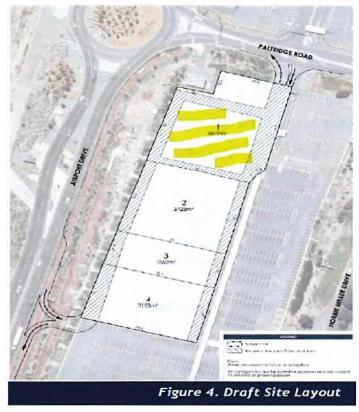
192 The whole area is approximately 13,500 m2, notionally split into four separate sites The site chosen for the service station was ‘Site 1’ (highlighted in yellow in the above image). The total size of Site 1 is 4,879m2. The plan was to lease the adjacent sites 2, 3 and 4 to food and beverage vendors. As things happened, there was a separate tender process for this, which ran in parallel to the tender process for the service station. Mr Holden had some involvement in this process. Amanda Jacobs, who at the time was a Leasing Development Manager in the Property Team and reported to Mr Holden, was primarily responsible for the development of the Retail Hub. Mr Holden was involved in the Retail Hub project in a supervisory capacity from around August 2016 and took on the day-to-day conduct of the project when Ms Jacobs went on maternity leave in July 2017.
Preparation of the Information Brochure and RFP
193 From late 2016, Mr Skinner supervised the preparation of the Information Brochure and the RFP, and reviewed the final versions before they were sent to tenderers, including United. He was the designated contact person within PAPL for any queries relating to the tender process. He was also the person within PAPL primarily involved in reviewing and assessing the various proposals from tenderers received between 1 August 2017 and 4 August 2017.
194 The RFP included the option of a ground or top lease. PAPL’s preference was for a ground lease, as PAPL would not be responsible for developing and maintaining the site (and buildings). Throughout the process of preparing the Information Brochure and the RFP, Mr Skinner’s team consulted with the Planning Team about when Qantas was expected to relocate to Airport Central, and what the traffic volumes on Airport Drive were expected to be when this occurred.
195 On page 7 of the Information Brochure, there is the following statement:
Qantas Group is expected to relocate all international and domestic flights from Terminal 3 and Terminal 4, located at Airport West, to Airport Central in the mid to late 2020’s completing the consolidation of commercial air services in Airport Central.
196 Mr Skinner said the above statement was put in the Information Brochure, by Ms Jacobs, who told him (in effect) that before she had put the statement into the Information Brochure, she had consulted with the Planning Team and confirmed that the information contained in the statement was accurate and could be relied on.
197 Mr Skinner said the statement was consistent with his general understanding at the time of when Qantas was expected to relocate to Airport Central as part of PAPL’s plans for Consolidation. By agreement of the parties, this statement was limited to evidence of Mr Skinner’s state of mind.
198 Mr Skinner recalled that around that time, there was a CEO drop-in session where it was communicated to the broader PAPL business that PAPL was planning towards Consolidation being completed by the end of 2025. He understood this to mean Qantas would have relocated to Airport Central by this time, as the Qantas Relocation was the last step in PAPL's plan for Consolidation.
199 Mr Skinner understood that the reason the statement in the Information Brochure said that Qantas is expected to relocate in “the mid to late 2020’s” rather than stating a specific year, such as 2025, was to provide a buffer because the commercial negotiations with Qantas about the precise date were ongoing.
200 Further, Mr Skinner also spoke to a Senior Airport Planner (Monica Anderson) around 16 May 2017. Mr Skinner’s recollection was that the gist of the conversation was that the Planning Team was comfortable with the information in the Information Brochure. Following this conversation, Ms Anderson confirmed by email that she was comfortable with the information that was proposed to be included in the Information Brochure.
201 The Information Brochure also included the following statement and table on page eight:
When Qantas relocates from Airport West to Airport Central in the mid to late 2020's it is expected that traffic volumes will almost double on Airport Drive from 40,000 to 78,000 per day.
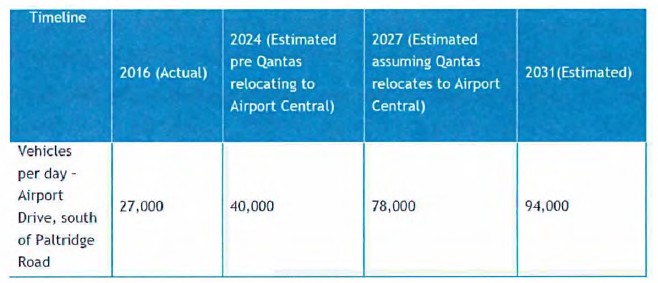
202 Mr Skinner recalled discussing the figures in the table with Ms Jacobs before the RFP and Information Brochure were issued to prospective tenderers, and that she said words to the effect that she had obtained the 2016 figure herself from PAPL’s Geographical Information System (a centralised PAPL online system, maintained by the design team (part of the Planning team)) and the forecast figures for 2024, 2027 and 2031 from the Planning Team.
203 Mr Skinner also recalled Ms Jacobs saying something to the effect that the Planning Team had told her the forecast traffic figures were based (at least partly) on the airport’s forecast passenger numbers - ie the number of people the Planning Team estimated at that time would be using the terminals in Airport Central in 2024 and later. Ms Jacobs also informed Mr Skinner that the forecast figures for 2024 and 2027 had been prepared by the Planning Team on the basis that the Qantas Relocation would occur between 2024 and 2027. Mr Skinner also sent a draft of the Information Brochure to Ms Jacobs and asked her to review the figures. He explicitly asked Ms Jacobs in that email “whether the jump from 40,000 in 2024 to 78,000 in 2027 reflects relocation Qantas somewhere in the middle?”. Ms Jacobs responded that they were accurate but clarified that the 2024 estimate was pre-Qantas Relocation and the 2027 figure was just after. Mr Skinner noted that a different figure for the 2031 estimate was included in the final version, but he could not recall why.
204 Mr Skinner believes, but could not specifically recall, that he would have sent the Information Brochure and the RFP to Mr Holden for sign off before they were sent to prospective tenderers.
Tender Process
205 Mr Skinner said that Caltex, BP and Shell are what, at the time, the Property Team considered the ‘top tier’ petrol retailers in Western Australia. Gull, 7 Eleven, Viva Energy and United are more ‘second tier’, being smaller operators in Western Australia with fewer service stations.
206 Following a request for information period which resulted in the issuance of Addenda 1 (and also a second addenda), between 1 August 2017 and 4 August 2017, PAPL received proposals from United, Viva Energy, BP, Caltex and 7-Eleven. United and BP offered both top and ground leases, Viva Energy and 7-Eleven offered only top leases and Caltex only offered a ground lease. Mr Skinner was involved in the process by which PAPL assessed the various proposals it received in response to the RFP.
207 In early October 2017, Mr Skinner instructed Colliers International to prepare a market review of the service station industry (as well as the food and beverage sector in respect of the adjacent sites for lease in the Retail Hub). Mr Skinner’s best recollection was that the report was acquired to support a feasibility and market analysis that would be presented to the PAPL Board in connection with the tender proposals. Colliers provided Mr Skinner with its report on 10 October 2017 (Colliers Report), which was after United had presented its proposal to PAPL.
208 In late 2017 and into 2018, Mr Skinner prepared recommendations and reports to the PAPL Finance and Investment Committee (FIC) supporting the United tender. Mr Skinner’s evidence was that the tender put forward by United was “clearly the strongest”, having regard to the superior rent that was being offered and the style of service station that was to be built. The rent offered by BP, Viva Energy, Caltex and 7-Eleven in their proposals ranged between $370,000 to $650,000 per annum for a top lease and $275,000 ($56 psm) to $350,000 per annum ($72 psm) for a ground lease. By comparison, United's proposal offered a commencement rent of $1.35 million per annum for a top lease or $1 million per annum ($125 psm) for a ground lease. The next best offer to United’s in monetary terms was from BP, which offered $650,000 per annum rent for a top lease and $350,000 per annum ($72 psm) for a ground lease. Mr Skinner said it is difficult to compare United’s proposal with the other tenderer’s proposals on a “like for like” basis. United’s proposal was for a site of 8,774 m2 (being Site 1 and a portion of Site 2 by reference to the above photo), whereas the proposals from each of the other tenderers were for Site 1 alone, which was approximately 4,879 m2. The site that United ultimately ended up subleasing from PAPL (the Site) is 8,879 m2.
209 From discussions with Mr Holden (who attended the FIC meetings), Mr Skinner recalled that the feedback from the FIC was to the effect that the FIC wanted the Property Team to progress negotiations with both United and BP for the sublease of the service station. Mr Skinner understood that the FIC had expressed some hesitation and concern about PAPL entering into a sublease with United and that its preference was to enter into a sublease with BP, if BP was willing to increase its rental offer to get it a bit closer to United’s.
210 Towards the end of 2018, Mr Skinner went back to his contact at BP and asked if BP would be prepared to increase its offer. BP agreed to increase their commencement rent for a ground lease from $350,000 per annum for Site 1 to $450,000 per annum for a revised site area of 6,875m2. This was still lower than what United was offering in its proposal. BP’s revised proposal was also for a much smaller scale service station with basic offerings (unlike the United Proposal, BP's proposal did not include the construction of a truck canopy, drive-through or carwash and it only had a coffee drive-through rather than a fast-food drive-through.)
211 PAPL had planned the site and surrounding road infrastructure to enable the proposed service station to include a truck canopy. The site was in close proximity to warehousing and distribution sites for Coles, Woolworths and other industrial users, which meant there were frequently trucks passing through the area, and a truck canopy would support that kind of traffic. Mr Skinner expected that the inclusion of a truck canopy would yield a higher rent.
212 Mr Skinner said that Mr Searle, and possibly another representative from United, gave a presentation of United’s pitch to himself and Paul Lampropoulos from PAPL around 26 September 2017. Mr Skinner said no other tenderers were asked to give a presentation because United’s tender “was the clear standout”.
Negotiations with United
213 Mr Skinner was the main contact point for United for the negotiation of the Heads of Agreement in early 2018, and the subsequent negotiation of the AFSL and Sublease. Over this period, Mr Skinner attended a number of in person and several telephone meetings with United. The meetings were usually with Mr Brinkworth, and Mr Manolitsa. The meetings were held on an ad hoc basis and (save for one exception) the in-person meetings were always held in Perth at PAPL’s offices at the airport. Mr Holden attended one or two meetings, but Mr Skinner could not recall precisely which meetings they were.
214 Mr Skinner recalled a meeting (he could not recall which one) where there was some limited high-level discussion in connection with the AFSL about the Qantas Relocation. Mr Skinner’s recollection is that this issue came up once, maybe twice, over the 12 months of negotiations. He could not recall why the issue came up, or who raised it, but recalled saying to Mr Brinkworth and Mr Manolitsa something to the effect that PAPL had an in-principle agreement with Qantas, by which Qantas would relocate by the end of 2025, but that a precise date was subject to the agreement of commercial terms. Mr Skinner said he did not recall saying anything further on the topic, and does not believe he would have done so as he did not have any further knowledge of details on the subject. Mr Skinner said that, save for referring to what the Property Team had put in the Information Brochure about traffic volumes, he would not have told United anything about traffic volumes, as this is not something that he was familiar with or would have been comfortable discussing.
215 Mr Skinner attended the meeting with Mr Brinkworth on 27 February 2018 at which United alleges the representations were made as to the Qantas Relocation. The purpose of the meeting was to introduce Mr Holden to Mr Brinkworth. Mr Skinner’s evidence was that there was a high-level conversation about United’s proposal. After that, Mr Holden left and Mr Brinkworth and Mr Skinner worked on the Heads of Agreement. Mr Skinner did not recall any discussion of the Qantas Relocation or traffic volumes at the meeting.
216 Mr Skinner also prepared the press release dated 10 March 2020. Mr Skinner suggested including a quote from Mr Holden in the press release to the effect of:
With Terminals 3 & 4 scheduled to be relocated by 2025, the Airport Central Precinct will increasingly become the focus for aeronautical operations and the design of this development will help to create a great first impression for visitors to Western Australia.
217 It was still Mr Skinner’s understanding at this time that PAPL was planning for Consolidation to be achieved, including Qantas relocating from Airport West to Airport Central, by the end of 2025.
218 After the AFSL was signed on 17 April 2019, Mr Skinner remained involved in obtaining the approvals PAPL needed in order to commence its works under the AFSL and, in due course, issuing the Notice of Practical Completion under the AFSL, the Notice of Sublease commencement, and sending the Sublease to United for execution.
Cross-examination
219 Mr Skinner accepted in cross-examination that he was not a member of the executive leadership team at PAPL and did not attend board meetings of PAPL. He did not attend PAPL’s FIC meetings during the Relevant Period.
220 During the period from 2017 to 2021, Mr Skinner accepted that he was not responsible for the high-level plans or timeline for Consolidation.
221 Mr Skinner accepted that he was not involved in seeking approval for capital expenditure related to Consolidation. Mr Skinner accepted that he was not involved in the preparation of any business case for Consolidation during the Relevant Period.
222 Mr Skinner said that his understanding of the Qantas Relocation came from ad hoc conversations with co-workers, what he had read in the news, and emails he had received from co-workers at PAPL. Mr Skinner understood that there was an agreement between Qantas and PAPL about the Qantas Relocation but he had not read that agreement.
223 Mr Skinner repeatedly stated that it was his understanding that there was an in-principle agreement between PAPL and Qantas, subject to an agreement of commercial terms which would dictate the time when Qantas would relocate. Mr Skinner accepted that it was his understanding at the time that Qantas would relocate by the end of 2025, subject to commercial discussions. Mr Skinner said that he had no involvement in those discussions. Mr Skinner said that between 2017 and 2021, he had no understanding of the detail of the discussions between PAPL and Qantas about the relocation.
224 Mr Skinner said that he read and commented on the Information Brochure prior to it being finalised. Mr Skinner said that he read the Information Brochure prior to it being sent out and that it was consistent with his understanding as to when Qantas would relocate. Mr Skinner accepted that it was his understanding that it was not a question of if Qantas would relocate, but, rather, when. Mr Skinner said that at the time of reading the Information Brochure, he recalled feeling generally comfortable about the statements made about the Qantas Relocation, otherwise he would not have sent it out.
225 Mr Skinner accepted that during 2017 to 2021, it was his understanding that PAPL expected Qantas to relocate around 2025, although he emphasised repeatedly this was subject to agreement of commercial terms. Mr Skinner agreed that he was not aware of the specifics of what was required for Qantas and PAPL to reach agreement on commercial terms, including that he was not aware of the need for agreement of funding provisions and that agreement was subject to the development of a business case, and that the PAPL board would need to approve the business case and make an investment decision. Mr Skinner confirmed timing assumptions of the Qantas Relocation and traffic volumes proposed to be included in the Information Brochure with the Planning Team, but conceded he did not otherwise independently verify the information, did not ask to see the terms of agreement between PAPL and Qantas, and did not know the details of discussions between PAPL and Qantas between 2017-2021.
226 Mr Skinner agreed that during the period 2017 to 2021, he spoke to Mr Brinkworth of United on several occasions. One such occasion occurred on 27 February 2018. At that point in time, PAPL and United were in the process of negotiating the Heads of Agreement and one of the items was a relocation term.
227 Mr Skinner accepted that Mr Holden attended at least part of the meeting on 27 February 2018. He could not recall what was said at the meeting and or whether the relocation term or requirement was discussed. Mr Skinner was aware at the meeting on 27 February 2018 that United was hoping to get the relocation requirement to 15 years. Mr Skinner could not recall the Qantas Relocation being discussed at the meeting. Mr Skinner said whilst he could not recall, he would not have said that the relocation term was needed in the Heads of Agreement because of the potential for a new runway, because that would be “ridiculous”: [T329.33-34].
228 Mr Skinner said that whilst he could not recall a specific discussion with Mr Brinkworth or Mr Manolitsa, of United, he would not have told them there was a firm agreement for Qantas to relocate by 2025 as PAPL had an in-principle agreement with Qantas for them to relocate “from the end of 2025, subject to agreement of commercial terms which will determine when the timing of that move occurs”: [T331.15-21].
229 Mr Skinner agreed that the Colliers Report included an assessment of the tender responses from United and the other tenderers. He agreed that the Colliers Report concluded that the BP and Caltex ground lease rents were at the upper end of market parameters, and that the United ground lease proposal was well above market parameters and highly favourable to PAPL. Mr Skinner agreed that only United proposed to lease a larger site (compared to the initial Site 1 as per the diagram at [190] above). Mr Skinner also conceded that the revised offer from BP (which was for a slightly larger site than Site 1) was not put in writing and so was not a firm commitment and, further, that the increased rental of $450,000 came at the expense of the turnover rent component, which would potentially make the offer less attractive.
230 Mr Skinner did not agree that if United had offered a rent of $500,000 for only Site 1, that PAPL would still have chosen United’s tender over BP. Mr Skinner accepted that $500,000 was still substantially higher than BP’s $350,000 offer but said he would have pursued the revised non-firm commitment of $450,000 more vigorously. Mr Skinner said that BP was probably a better covenant, a bigger company which carries weight. Mr Skinner also said that the turnover rent was not a decisive factor as it was not a substantial part of the United offer either. Mr Skinner also did not agree that PAPL would have necessarily agreed to rent the Site to United for only $500,000 – he said without “running the numbers” he could not say whether that would “have stacked up financially”: [T339.26-37].
231 Mr Skinner denied that he had no reasonable basis for comfort about the statements made in the Information Brochure to United about the Qantas Relocation.
Findings
232 Mr Skinner was an honest and truthful witness. He presented as a careful and considered witness who accepted that his recollection was, on occasions, limited. I accept, however, Mr Skinner’s evidence on the matters which he could recall in cross-examination.
Steve Holden
233 Steve Holden (Mr Holden) was the CCO/Chief Property Officer at PAPL during the Relevant Period. In each of those positions Mr Holden’s responsibilities included overseeing PAPL’s Property team (either directly or indirectly) and he was also a member of PAPL’s Executive Leadership Team. At the time he gave evidence, he was working for a new employer.
234 PAPL tendered two witness statements of Mr Holden, dated 8 September 2023, and 16 August 2024. Mr Holden gave some very brief further evidence in chief and was cross-examined.
235 Mr Holden’s evidence was that whilst he was not involved in the detailed planning for Consolidation which was undertaken by the Planning Team, it was critical for him to know, and he did know PAPL’s expected timeline for achieving Consolidation. Mr Holden also gave evidence that it was his understanding that a significant step in that timeline was the Qantas Relocation (this evidence was, by agreement of the parties, limited to evidence of Mr Holden’s state of mind). Mr Holden could not recall specifically when, but he came to understand that Qantas was expected to relocate to Airport Central in the mid-2020s. This understanding was based on knowledge that obtained in his day-to-day work, from the Executive Leadership Team and PAPL board meetings as well as ad hoc discussions with colleagues. He also understood that PAPL’s internal planning was targeted towards this move happening by the end of 2025. He understood that the precise date of the Qantas Relocation was still being negotiated.
236 Mr Holden referred to a presentation to the PAPL board regarding a different project which included a statement that “Master planning assumes that the Qantas Group will relocate from T3/T4 to a new terminal adjacent to T1 International in Airport Central in FY26”. He also referred to a board report dated 22 March 2018 regarding the execution of the Heads of Agreement between United and PAPL, which referred to “the relocation of Qantas, which is currently forecast to occur in 2025”. Mr Holden referred to various other internal documents which referred to PAPL’s expectation of the Qantas Relocation/Consolidation occurring by 2025.
237 Mr Holden was not directly involved in any of the commercial discussions with Qantas about Consolidation and when Qantas would relocate. But, as a member of the Executive Leadership Team, he attended a handful of meetings with Qantas at which Consolidation was sometimes discussed at a high level. He never saw any written agreement between Qantas and PAPL relating to Consolidation.
238 Mr Holden’s evidence was that Mr Skinner, for most of the Relevant Period, reported to him. Mr Holden had limited direct involvement in the preparation of the RFP and the Information Brochure, but he was aware that Mr Skinner and Ms Jacobs were working on the Information Brochure and the RFP from late 2016, and he read and commented on both documents before they were finalised. In particular, he instructed an amendment to be made, following discussion with Mr Skinner and Ms Jacobs, to the text of an equivalent document to the Information Brochure (that is, an earlier draft) so that the expected relocation of Qantas was referred to by reference to the “mid to late 2020s”, rather than by reference to a specific date. This was because while Mr Holden understood the end of 2025 was the target date, he was not prepared to put a specific date, that was still some eight years away, in an external facing document.
239 Mr Holden also gave evidence that he marked up a copy of the information brochure for the food and beverage (that is, not the Information Brochure), which also contained the airport traffic volumes table on page eight of the Information Brochure to amend “2027 (Estimated post Qantas relocation to Airport Central)” to “2027 (Estimated assuming Qantas relocated to Airport Central)”. Mr Holden could not find a marked-up copy of the Information Brochure (and could not recall marking it up), but understood that the substantive content across the two documents would be the same, and so any changes would be carried across. Mr Holden said this change was substantively reflected in the final wording of “Estimated assuming Qantas relocates to Airport Central”. Mr Holden said at the time, and up to at least the onset of the Covid-19 pandemic, he had no concerns with the information contained in the RFP or the Information Brochure relating to the Qantas Relocation.
240 Mr Holden’s evidence was that he was not directly involved in the tender process, but Mr Skinner kept him informed of key developments and he became familiar with the United tender.
241 Mr Holden gave evidence that he recalled reading and discussing the United tender with Mr Skinner. He said he then called Mr Searle from United, and asked him, in effect, why was United offering such a high rent. Mr Holden said that Mr Searle’s response was that it would be a flagship site and a good branding opportunity for United. Mr Holden recalled being a bit nervous at the time about United’s reputation. Mr Holden said he had heard from contacts in the industry that United had a habit of entering into deals and then trying to renegotiate terms and therefore was apprehensive and called Mr Searle for reassurance that United had thought about its proposal and could back up its high rental offer with a sound business case.
242 Mr Holden did not have any recollection of attending the 27 February 2018 meeting at which United alleges oral representations were made about the Qantas Relocation, though he accepted that, whilst unlikely, it was possible that he did attend.
243 The only meeting which Mr Holden clearly recalled was sometime in December 2019 close to Christmas. Mr Holden recalled Mr Brinkworth saying something to the effect that United thought it had been misled by PAPL regarding the recently announced Costco development at the airport, which was to include a fuel station. The gist of Mr Holden’s response was that the Costco fuel station was on the other side of the airport, in the Airport West precinct, and the exclusivity provision that United had negotiated with PAPL only applied to the Airport Central precinct.
244 Mr Holden has no recollection of any discussion at any meeting with United regarding the expected date of the Qantas Relocation and the forecast traffic volumes. He said that if anybody from United had asked about when Qantas was going to relocate, he believe that he would have referred to the information in the Information Brochure and/or said words to the effect that PAPL could not give a specific date but PAPL was expecting and planning towards Qantas moving in the mid to late 2020s, targeting the end of 2025, but it could be later than this.
245 Mr Holden was responsible for presenting the papers that Mr Skinner had prepared outlining the United and BP proposals to the FIC for approval. Mr Holden also approved the content of the 10 March 2020 press release which Mr Skinner had prepared.
246 Mr Holden said that with the onset of the Covid-19 pandemic none of the airlines, including Qantas, communicated an interest in engaging with PAPL about Consolidation or other long-term plans and investments relating to the airport. The message that airlines, like Qantas, were communicating to PAPL at this time was that they did not want to discuss long-term plans or financial investments when the future of the airport and the industry was so uncertain. Mr Holden recalls some discussion at an Executive Team Leadership meeting, sometime after the onset of the Covid-19 pandemic, about whether the end of 2025 was still an achievable date for Qantas to relocate to Airport Central. He recalled 2026/2027 being bandied as a possibility — ie perhaps the move would be delayed by a year or two, but no new target date was determined. By about mid-2021, he recalls that there were some discussions at Executive Leadership Team and board meetings that he attended about different Consolidation scenarios, including a scenario where Qantas would relocate by FY30 (ie, mid-2029 to mid-2030).
247 Mr Holden gave evidence that in a scenario where BP and United had offered to pay comparable rent and all things were equal, he believes he would have been in favour of PAPL selecting BP as the preferred tenderer because BP was a bigger operator and had, he believed, stronger financial backing and covenant strength than United, and was more established in Western Australia than United was at the time.
Cross-examination
248 Mr Holden accepted, in cross-examination, that in the period from 2017 to 2021 he was not involved in the detail of the planning of the Consolidation at the Perth Airport. Mr Holden was not involved in the commercial discussions between PAPL and Qantas about Consolidation. He was not involved in seeking approval for any capital expenditure which related to the Consolidation. He was also not involved in the preparation of any business case for Consolidation.
249 Mr Holden understood, in the period of 2017 to 2021, that there was an agreement between PAPL and Qantas about relocation, but has never seen any such agreement. He understood that there were discussions going on between PAPL and Qantas about the Qantas Relocation. He was not involved in those discussions.
250 Mr Holden’s understanding was that there would be a new domestic terminal that was built for Qantas to relocate to Airport Central. He understood the discussions were around the pricing, the new runway and all of the other key infrastructure that would help support Qantas to relocate. Mr Holden’s understanding of the discussions between PAPL and Qantas about a new runway was that it would assist Qantas to relocate and become more efficient.
251 Mr Holden accepted that his understanding in the period from 2017 to 2021 was that it was a question of when Qantas would relocate, rather than if Qantas would relocate. The target date for the Qantas Relocation was the end of 2025.
252 Mr Holden said that he had limited direct involvement in the preparation of the Information Brochure. Mr Holden said that he provided comments on the Information Brochure by marking up the brochure and handing it back to either Mr Skinner or Ms Jacobs.
253 Mr Holden’s recollection of his hand-written comments was, first, where it said that Qantas was expected to consolidate by the end of 2025. He circled that as he wanted the document to say from mid-2020s to late 2020s. The second matter was an adjustment in the estimated traffic numbers post-Qantas Relocation to include a reference to expecting, or if, Qantas relocated. Mr Holden’s answers regarding these amendments were consistent with what Mr Holden said in his witness statements.
254 Mr Holden accepted that he did not make any adjustments to the statement in the brochure: “When Qantas relocates from Airport West to Airport Central in the mid to late 2020s”. He said that was because it was his understanding that it was a matter of when, not if, Qantas were relocating.
255 Mr Holden said that he checked the Information Brochure to ensure that there were no red flags from a PAPL business perspective, meaning that he wanted to ensure that PAPL was consistent in their messaging around Consolidation being mid to late 2020s, rather than by reference to the 2025 date. Mr Holden said his information as to the timing of the Qantas Relocation came from PAPL’s Planning Team and he did not otherwise seek to verify that information.
256 Mr Holden agreed that all PAPL’s projects associated with Consolidation were subject to engagement, commercial discussions and approval with, and by, the airlines, as well as the development of and approval of a business case and investment decision by the PAPL board. In particular, Mr Holden accepted that the Qantas Relocation was subject to all those steps and obtaining agreement from Qantas on funding.
257 Senior counsel for United asked Mr Holden a series of questions about PAPL’s Airport Central Master Plan 2016. Mr Holden agreed it was a paper addressed to the PAPL board which sought approval from the board to progress key projects related to Consolidation, including the Qantas Relocation, to the ‘initiation phase’. The paper indicated that the initiation phase included concept refinement, airline engagement, testing, modelling and commercial discussions and included the phrase: “this work will allow the projects to progress up to a point where the board can make an investment decision ... and at the required milestone of decision points, then commit to a design investment and ultimately delivery.” Mr Holden agreed this reflected his understanding of the way PAPL projects generally proceeded during the period 2017-2021.
258 In particular, the paper referred to funding options for the Qantas Relocation, including the option of Qantas funding the construction of the new terminal. Mr Holden agreed this referred to the need to secure an agreement from Qantas to the amount it was willing to contribute. The paper also referred to ‘countervailing factors’ which Mr Holden agreed generally referred to the difficulties in various projects related to Consolidation occurring simultaneously, including the impact of debt servicing ratios. Mr Holden agreed this was a reference to the potential impact of the costs of work and whether PAPL would need to secure extra funding, and that the paper also referred to the need for significant equity contributions from shareholders to fund the Qantas Relocation. Mr Holden said he was not sure if a business case was ever put to the PAPL board for approval beyond the initial funding for the Qantas Relocation.
259 Mr Holden said that an alternative option was for PAPL to construct the new terminal without Qantas and that that option was presented to the PAPL board sometime between 2017-2021, although he agreed the option was subject to a business case and investment funding decisions being made by the board. Mr Holden did not recall the board considering the impact of debt servicing ratios on this option, but said he would not have been privy to discussions regarding shareholder equity contributions.
260 In relation to the inclusion of a relocation term in the Heads of Agreement between PAPL and United, Mr Holden said the direction to include that term came from the FIC as a form of safeguard if planning changed. He was not aware of the term being required because of any requirement for an additional runway.
261 Mr Holden did not agree that if United had put forward an offer of $500,000 for the smaller site (being the original Site 1) that PAPL would necessarily have accepted that in preference to BP’s offer of $350,000 for the same site. Mr Holden was adamant that it was not possible to answer that question based on the rental amount alone, and emphasised the importance of tenant quality and the apprehension which PAPL had regarding United. Mr Holden said that BP was more well-known to PAPL and were a stronger proponent.
Findings
262 Mr Holden was a forthright and honest witness. He had a good recollection of events that he could recall and made appropriate concessions on events that he could not recall. I accept his evidence on what he recalled.
Ian Barker
263 PAPL tendered in evidence a witness statement of Ian Barker (Mr Barker), dated 4 August 2023. Mr Barker was not required for cross-examination. Between May 2012 and June 2020, Mr Barker worked in PAPL’s Planning Team as an Infrastructure Planning Manager, with a focus on the planning and development of ground transport options within the Perth Airport estate. Mr Barker’s responsibilities included planning and developing the infrastructure, including the road network necessary to support the Qantas Relocation to Airport Central. Mr Barker has not been employed by PAPL since July 2020.
264 Mr Barker obtained the actual traffic data for 2016 and 2017 that was ultimately used in the Information Brochure from Austraffic, a company specialising in transport studies. Mr Barker also obtained the traffic forecast data that ultimately was used in the Information Brochure from Arup, a global engineering and consultancy firm (being forecasts for the years 2024, 2027 and 2031). Mr Barker reviewed the Arup modelling results and discussed them with Arup before accepting the final results and feeding the traffic forecasts into PAPL’s GIS.
265 Mr Barker was not involved in preparing or drafting the Information Brochure or RFP. He provided information to the Property Team for use in the Information Brochure as requested, including checking the forecast information (obtained from the GIS) which Mr Skinner and Ms Jacobs proposed to use in the Information Brochure. Mr Barker spoke to Ms Anderson, about the forecast figures and said, in effect, that he was comfortable with the traffic volume figures for 2016, 2024 and 2027 being provided to tenderers for the service station as the numbers seemed reasonable enough on their face and he was not aware of anything to suggest that Arup’s modelling of these figures was not reliable. However, Mr Barker made a change to the forecast figure for 2031 to make it more conservative, because, whilst he was not aware of any issues with Arup’s modelling given it was still 15 years away, he was not comfortable with putting it in an external facing document. He could not recall how he arrived at the revised figure of 94,000. Mr Barker also suggested removing a figure for 2044 entirely.
266 Mr Barker provided input on the answers included in Addenda 1 – which he confirmed with Ms Anderson. In particular, he sent a marked-up copy to Ms Jacobs which commented, in response to question 5.1 regarding an increase in traffic volumes to 40,000 vehicles per day by 2021, that the 40,000 figure was based on forecast passenger growth at the terminals as determined by Tourism Futures International. He also clarified that this growth was expected to occur in 2024, not in 2021. Mr Barker understood that Arup had derived the 40,000 vehicles per day figure for 2024 by starting with the actual figure for 2016 and then modelling growth in traffic volumes through reliance on forecast passenger statistics (calculated by Tourism Futures International based off actual figures provided by the Planning Team).
Natasha Boshard
267 PAPL tendered the witness statement of Natasha Boshard (Ms Boshard), dated 22 August 2024. Ms Boshard gave some further limited evidence in chief and was cross-examined.
268 Ms Boshard has been employed in PAPL’s Planning Team since October 2019.
269 Ms Boshard now works as PAPL’s Design Director for the upcoming new terminal for Qantas at Airport Central (New Terminal). Ms Boshard was the General Manager of PAPL’s Planning Team from 27 April 2023 to 15 April 2024 and was the head of planning from 7 October 2019. Between early 2020 and late 2022, Ms Boshard was a member of PAPL’s Senior Leadership Team.
270 Before that, she was seconded to that team from March to September 2016, February to April 2018, and August to September 2019. Ms Boshard has worked on Perth Airport projects in various capacities since around mid-2010.
271 Ms Boshard gave evidence about the Planning Team’s responsibilities within PAPL for planning airport infrastructure including Consolidation and preparing its master plans. Ms Boshard also addressed the make-up of the team comprising various experts skilled in architecture, landside planning, airfield planning and terminal planning. Ms Boshard’s evidence was that the Qantas Relocation was just one aspect of the Consolidation. The first two phases, which were completed in 2013 and 2015 respectively, were the construction of Terminal 2 and Terminal 1 Domestic, at Airport Central. Ms Boshard gave evidence about PAPL’s plans and timelines for Consolidation and how those plans and timelines changed over the period from 2012 onwards.
272 Ms Boshard said the final phase, phase three, is ongoing and involves the consolidation of all regular passenger transport (RPT) services operating at the airport into Airport Central, including Qantas, as well as the construction of a third runway and the development of supporting landside infrastructure and ground transport capacity in Airport Central. Ms Boshard said the Qantas Relocation is a major part of phase three of Consolidation.
273 Ms Boshard gave evidence that, based on her experience, PAPL does not proceed with planning and development work at the airport on the basis that it requires the airlines’ “approval”. However, at key milestones in relation to a project, PAPL will check in with the airlines to explain the progress of the project and how the current design meets the airport’s needs. PAPL also seeks feedback as to whether the design for a project is suitable for the airlines and, insofar as possible, aims to align the airport’s needs with the airlines’ preferences. Ms Boshard is not directly involved in the financial aspects of PAPL’s business but understands that PAPL also consults with the airlines in relation to the costs of any major capital works to be undertaken as part of a project, as the airlines usually contribute some of the funding.
274 Ms Boshard was not involved in, or directly privy to, any of PAPL's commercial negotiations or discussions with Qantas (or other airlines) about Consolidation or the Qantas Relocation. However, Ms Boshard said a key item discussed at Consolidation Planning Meetings in 2018 was the preparation of shared objectives and assumptions for the design for the New Terminal. Whilst the Planning Team was trying to work with Qantas to align on the key objectives, PAPL did not need Qantas’ approval to proceed with its planning for Consolidation.
275 Between late 2016 and at least May 2021, the Planning Team was working towards completing Consolidation and the Qantas Relocation by the mid to late 2020s. At lease prior to the Covid-19 pandemic, the target date was the end of 2025. With the onset of the Covid-19 pandemic the target date shifted gradually over the course of 2020 and 2021. By early 2021, the Planning Team was considering a date around June 2027 for the Qantas Relocation and by around June 2021, the Planning Team was starting to consider various scenarios, including a scenario where the Qantas Relocation would occur sometime in FY30 (ie between June 2029 and June 2030). Ms Boshard recalled that FY30 was considered to be a worst-case scenario and was a conservative estimate put forward by PAPL’s Finance Team.
276 Through her work as part of the Planning Team, and based on her experience and planning expertise, at no time between late 2016 and at least May 2021 did Ms Boshard believe that the mid to late 2020s was not an achievable date for the Qantas Relocation.
277 From the end of 2022, Ms Boshard became involved in renewed commercial discussions with Qantas in relation to Consolidation and the commercial terms on which Consolidation would be achieved. Ms Boshard was part of the PAPL negotiation team until PAPL signed an agreement with Qantas on these matters in May 2024. On 31 May 2024, Qantas and PAPL announced that they had reached agreement in relation to construction of the New Terminal by 2031, with Qantas to relocate once the terminal is complete.
Cross-examination
278 Ms Boshard said that she attended meetings of PAPL’s FIC from time to time but not regularly, and occasionally attended board meetings. Ms Boshard was not involved in PAPL’s request for proposals in relation to the service station opportunity in Airport Central. Ms Boshard was not involved in the preparation of PAPL’s Information Brochure, which was provided to tenderers, and was not involved in assessing the responses received by PAPL from tenderers.
279 Ms Boshard was not involved in any discussions between PAPL and United in relation to the service station opportunity.
280 Ms Boshard was involved in terms of inputs from a planning and design perspective and supported the preparation of board papers when funding was requested.
281 Ms Boshard attended meetings with Qantas representatives about the Consolidation and participated in relation to planning. Ms Boshard was not involved in the commercial discussions between PAPL and Qantas in relation to the Consolidation. Those discussions were kept separate from the planning discussions. Ms Boshard was participating in the planning work stream with Qantas. The commercial work stream was being handled by others.
282 Ms Boshard rejected the proposition that PAPL was trying to reach consensus with Qantas on the design of the new domestic terminal. Ms Boshard said it was good planning practice to try and get the requirements of airline partners and to incorporate them into the design. Ms Boshard said that by October 2018, the design of the new domestic terminal was moving forward with the introduction of a design objective of integration. A topic of conversation between PAPL and Qantas was about the design of a common departure lounge. Ms Boshard was cross-examined about the stages involved in the planning of the new departure lounge and Qantas’ involvement in the planning process.
283 Ms Boshard accepted that conversations with Qantas had slowed down by 2019 but meetings did then pick back up in the latter half of 2019, but that throughout 2019 the planning team was working on and progressing the design of the new terminal, including engaging consultants.
Findings
284 Ms Boshard was a forthright and honest witness. Ms Boshard had a clear recollection of her involvement in the planning of the new departure terminal as part of the Consolidation. Ms Boshard was a careful and considered witness whose evidence I accept.
EXPERT EVIDENCE
285 The expert evidence comprised three disciplines: valuation, economic and quantity surveying.
Valuation evidence
286 The valuation expert evidence was deployed as evidence about market rent for both the Site, and the smaller Site 1. The evidence is said to be relevant to both causation and quantification of loss and damage.
287 United tendered a valuation report of Mr Dennis Volk, dated 12 July 2023. PAPL tendered a valuation report of Mr Paul Bradstreet, dated 1 September 2023, and an erratum report, dated 15 September 2025. Both Mr Volk and Mr Bradstreet prepared a joint expert valuation report, which was tendered, dated 15 January 2025. Mr Volk and Mr Bradstreet participated in a joint conclave, and were cross examined.
Mr Volk’s Expert Opinion
288 Mr Volk was asked to opine on the following topics:
(1) What would the market rent value be for the Sublease as at 4 August 2017, being the date that United submitted its response to the RFP?
(2) What would the market rent value be for Site 1 of the Sublease as at 4 August 2017, being the date that United submitted its response to the RFP?
(3) Does the Qantas Relocation and corresponding projected increase in traffic volumes on Airport Drive, as referred to in the Information Brochure, impact the market rent value of the:
(a) Sublease; and;
(b) Site 1 in the sublease?
(4) If the answer to Questions 3(a) or 3(b) is “yes”, provide an opinion regarding the market rent value for:
(a) the Sublease, as at 4 August 2017, if the Information Brochure did not contain any details about an expected increase in traffic volumes; and
(b) Site 1 of the Sublease, as at 4 August 2017, if the Information Brochure did not contain any details about and expected increase in traffic volumes.
289 Mr Volk answered each of the above questions by considering the Colliers Report. Mr Volk did not assess the Site but rather the initial site that was in United’s initial offer, being 8,000 m2 (Proposal Site).
Questions one and two: valuations of the Proposal Site and Site 1
290 Mr Volk opined that for the Proposal Site, the market rental value as at the date United submitted its tender (being 4 August 2017) was between $600,000-$650,000 (excl GST) per annum.
291 Mr Volk’s opinion was that the value of a ground rental for Site 1 is in the range of $375,000-$412,500 per annum (excl GST). In contrast, Colliers valued Site 1 market rental as in the range of $275,000-$350,000 per annum.
292 In coming to these conclusions, Mr Volk considered the schedule of ground leases for industrial, aviation and car rental uses within the Perth Airport as detailed in the Colliers Report, and by reference to the Colliers Report the tenders for Site 1 and the rental proposed by McDonalds for Site 2.
293 Mr Volk summarises his ground rental assessment range for the Proposal Site and Site 1 as at 4 August 2017 as being reflective of:
(a) its location within the Airport Central Precinct;
(b) the Site being a future ‘iconic’ service station location;
(c) the proposed Qantas Relocation by the mid to late 2020s;
(d) prediction of growing traffic volumes to Airport Drive, based on Qantas Relocation; and
(e) a land area of 8,000 m2 and 4,879 2 for the Site and Site 1 respectively.
Question three: the impact of traffic volumes on the Site and Site 1
294 Mr Volk considered traffic volumes to be one of the four key components in assessing the location of a service station site along with (1) visibility; (2) trade area including competition (current and future); (3) accessibility.
Question four: market rental value of the Sublease site and Site 1 without increase in traffic volumes
295 Mr Volk assessed the ground rental of the Proposal Site to be in the range of $430,000-$475,000 per annum (excl GST) and Site 1 as in the range of $265,000-$300,000 per annum (excl GST).
296 In coming to these conclusions, Mr Volk had regard to the same information as in regard to questions one and two. Mr Volk also noted that the fuel property sector was experiencing strong market conditions in 2017, creating increased demand between oil companies for sites in the Perth Metropolitan area and throughout Western Australia which resulted in an increase in rental levels and an increase in acquisition prices for sites. With the prevailing market conditions, Mr Volk opined that a premium above market rental levels may be paid to secure a site.
297 Mr Volk agreed with the Colliers Report conclusion that United’s offer of $1,000,00 rent was in excess of market levels.
Cross-examination
298 Mr Volk was clear that he had not undertaken a valuation, as he was asked to provide an opinion based on the Colliers Report.
299 Mr Volk confirmed that for each of his assessments for the Proposal Site, he was using a site of 8,000 m2: [447.T15-19]. Mr Volk did not agree that if he had assessed the Site (8,879 m2) that his market rent ranges would have been about 10% higher, because “normal valuation methodology means a larger land area would potentially or generally attract a lower rate per square metre”, so it’s not necessarily the case that if the area increases by 10%, the market rent value will also increase by 10%: [T451.1-12].
300 Mr Volk said in providing an opinion on the market rent for the Proposal Site, if the Information Brochure did not include any forecast increases in traffic, he understood that to mean an assessment using the 2016 actual figures: [T450.7-13]. Mr Volk agreed that if he had used the estimated figures pre-Qantas Relocation, there may have been an increase in his market rental range: [T450.15-32].
301 Senior counsel for PAPL suggested that the estimated figures provided by PAPL for 2016 (27,000), March 2017 (31,550) and 2024 (40,000) were all estimates prior to the Qantas Relocation, and that therefore, Mr Volk should have used these estimates for his valuation, rather than the static number of 27,000 and that in using this static figure, Mr Volk ignored the increase in traffic not attributable to the Qantas Relocation: [T448.21]-[T449.17]. Specifically, senior counsel put to Mr Volk that he should have used the figure of 31,550. Mr Volk accepted that you could use those estimated figures: [T449.22-28].
302 When asked if to ignore only the increase in traffic volume attributable to the Qantas Relocation, it would be correct to take into account the 2024 estimate, Mr Volk responded that “you would have to have regard to historical numbers as well, and try and determine what would be the best line of fit for traffic, because it still is only estimated, so you would – you’d be looking at all numbers and coming up with an assessment, and apply that, potentially within a range of numbers to – to help your assessment”: [T449.36-44].
Mr Bradstreet’s Expert Opinion
303 Mr Bradstreet was asked to opine on the following matters:
(a) Comment on the Volk report and indicate if you agree or disagree with the methodology, reasoning and/or conclusions.
(b) To the extent not otherwise addressed as part of your answer to Question One above, what, in your opinion, is the market rent of:
(i) Site 1 as at the date of:
(A) the Proposal (4 August 2017);
(B) the AFSL (17 April 2019); and
(C) the Commencement Date (24 July 2020);
(ii) the Subleased Site (aka the Site) as at the date of:
(A) the Proposal (4 August 2017);
(B) the AFSL (17 April 2019); and
(C) the Commencement Date (24 July 2020).
(c) In addressing the market rent as at the Commencement Date, please indicate what difference (if any) it would make to your opinion if the Covid-19 pandemic had not occurred.
Question one: Volk’s Report
304 Mr Bradstreet said that the Volk report is not a valuation but rather an appraisal. Further, the area of the Sublease he assessed is 8,000m² which was the area submitted in the offer and not the actual Sublease area which is 8,879m². Mr Bradstreet did not take issue with the methodologies which Mr Volk used but noted the following issues:
(a) provides no independent or direct evidence but uses third party unverified evidence;
(b) no attempt by either Colliers or Mr Volk to research traffic counts on the evidence except confirming recent counts for Airport Drive;
(c) no mention of exclusivity clause which is in the tender offer by United and the final signed Sublease. This is considered to have a significant effect on value;
(d) no description of the property other than to say the Colliers Report is adequate. Considering the Colliers Report was written two years before works on the subject land commenced their existing description seems irrelevant;
(e) no overview or summary of the actual agreed Sublease. It appears that Mr Volk was not provided with the Sublease;
(f) rents provided are a range rather than a value. This therefore is not a valuation but rather an opinion of market rent, much like a real estate agent would provide;
(g) Colliers Report also confirms their opinions are not a valuation; and
(h) Colliers Report does not appear to offer an opinion of value rather simply comments on the offers received and if the United offer was within or above this level. In Mr Volk’s opinion it was above the market range which he felt was better expressed by the offers from Caltex and BP.
305 Mr Bradstreet specifically commented on three factors which he considered were not correctly or adequately addressed by Mr Volk.
306 First, Mr Bradstreet said that lot size had a far greater effect on the rental than traffic volume. However, Mr Bradstreet acknowledged that traffic count, logically, does have some effect on the decision to proceed with a service station project and would generally be a factor in initiating interest in a property.
307 Second, Mr Bradstreet considered the effect of the exclusivity clause. He first noted that the Site is the only example of a service station with exclusivity in the Perth metropolitan area. Therefore, to determine its effect, Mr Bradstreet considered the effect of competition on the Great Eastern Hwy, being a road near the Perth Airport with eight service stations and 50,000 vehicles per day. He determined that the average turn-in rate for that road was 2.72% and said when that “is applied to an average of 50,000 cars per day annual fuel sales of 20,362,620 litres per annum is indicated. Clearly if there are eight stations on the road this averages to only 2,545,328 litres per annum which is poor.” Mr Bradstreet then reasoned that exclusivity could increase the rental paid for the Site by up to 100%, but that given it was an untried location with an unknown turn-in rate, 60-80% may be more realistic.
308 Third, Mr Bradstreet considered the three main factors from the Sublease which would affect the rental amount were the lot size (with the Site being 4,000 m2 larger than Site 1), percentage rent provisions of 1 cent per litre of fuel throughput over a 15 million litres throughput threshold (higher than Caltex and BP offers and higher than normal), and the exclusivity clause. Mr Bradstreet adjusted the United offer to account for these three factors and arrived at a rental of $315,000 (which is less than BP’s $350,000).
Question two: valuation of the Site and Site 1
309 Mr Bradstreet used the following sites as comparators in his valuations:
(a) eight service station sites subject to ground leases, which reflected rates of $21.91/m² to $109.98/m², but all sites were smaller than the Site, ranging in size from 1,273 m² to 7,959 m2;
(b) 13 retail (car wash and fast food) sites subject to ground leases as comparator sites, which reflected a higher rental rate of $40.50/m² to over $1,000/m² but fell to an upper limit of $140.06/m² when the very small sites were excluded;
(c) 18 service stations with top leases which reflected rentals rates of $67.07/m² to $257.73/m². This clearly shows that there is a difference between improved and unimproved sites; and
(d) the Caltex, BP and United responses to PAPL’s RFP.
310 Mr Bradstreet valued Site 1 with exclusivity at $546,000 (being a 60% increase), which reflected a value of $342,000 per annum, adjustments for exclusivity and percentage rent differences but adjusted for capital value.
311 Mr Bradstreet valued the Site as $577,135 with no exclusivity and $923,000 with exclusivity.
312 To determine if these values had changed by April 2019, Mr Bradstreet considered inflation, the change in existing rentals and the change in CPI value. Mr Bradstreet determined that a rate of 3% was an appropriate increase, which resulted in the following values:
(a) Site 1 with exclusivity: $562,000 per annum ($115.19/m²);
(b) Site 1 without exclusivity: $352,000 per annum ($72.14/m²);
(c) Site with exclusivity: $950,000pa ($106.99/m²);
(d) Site without exclusivity: $594,000 per annum ($66.90/m²).
Cross-examination
313 Mr Bradstreet was clear that his report addresses two separate aspects: (1) the market rental value, which does not and cannot (according to valuation principles) include any assessment of the effect of an exclusivity clause, and (2) to assess the value of the Site with the terms of the Sublease (so including exclusivity): [T440.8-14].
314 Senior counsel for United asked Mr Bradstreet if he agreed with the Colliers Report opinion on the United ground lease rental proposal being well above market levels. Mr Bradstreet’s opinion was that the unique exclusivity clause in the United offer made the offer “not relative to the market” because it changes “fundamentally the conditions of what the market will be able to bring”, and that had the tender documents “offered the opportunity for exclusivity, the Caltex and BP offers would have been different” – more than likely, higher: [T411.27]-[T412.17].
315 It was put to Mr Bradstreet that under a market approach (previously called the direct comparison approach) and the International Valuation Standards he was obliged to outline his reasoning for arriving at his valuation for the Site (that is without exclusivity), but that all he had outlined was a comparison with the BP and Caltex offers, which were non-binding proposals for a site almost half the size of the Site (4,879 m2 as compared to 8,879 m2). Mr Bradstreet agreed that, in broad terms, he had extrapolated the rent per square metre from the BP and Caltex proposals to the larger Site: [T423.3]-T425.42]. Mr Bradstreet agreed that applying that methodology there was still a ‘gap’ between the BP and Caltex offers on the one hand and the United offer on the other. Mr Bradstreet said that comparing the offers was difficult because United’s offer included 4000 m2 of additional land. “The United offer was significantly different”, so he was seeking to bring the offers closer together so he could analyse out of those offers what premium United paid in their offer: [T427.1-13]. He did not accept that the United offer could not be compared to the BP and Caltex offers, but that there needed to be adjustments: [T427.19-45].
316 Mr Bradstreet reiterated that it was not possible to give a yes or no answer as to whether the United offer was broadly set around market levels as it depended on whether the exclusivity clause and other key terms of the Sublease were considered: [T427.35]-[T428.12]. In any case, he had provided values of the Site both with and without exclusivity: [T429.17-25]. However, Mr Bradstreet agreed that he had concluded that the Site market rent (that is, without exclusivity but with the above adjustments made) was around market levels, when compared to the Caltex and BP offers: [422.28-33].
317 Mr Bradstreet agreed that he assessed the United exclusivity clause (and the percentage rent difference) at a 60% premium on the rental value, which he arrived at through comparison with eight service stations in competition to each other near the Perth Airport.
318 Mr Bradstreet agreed that in considering the value of the exclusivity clause, he took the base rent (or the market rent) and analysed whether there should be an uplift or premium for the exclusivity clause: [T430.23]-[T431.45]. Mr Bradstreet then concluded what percentage difference there should be, to account for the exclusivity clause, between the base rent and the rent under United’s proposal – coming to a premium of 40% of the BP offer, and 50% of the Caltex offer.
319 Mr Bradstreet did not agree that the best method to assess the value of the exclusivity clause would have been an income method (that is, discounting the projected cashflows generated by the Site with and without the exclusivity clause), saying that “in an unproven location, I think it would be less than ideal to do a 10-year cashflow, for argument’s sake, to try and determine what the value might be with or without an exclusive use provision … in this case, I think it would be fraught with danger”: [T436.1-45].
320 Mr Bradstreet did not agree that in valuing the exclusivity clause, he should have considered and analysed the potential for and the effect of the commercial risk of competing service stations being developed within the exclusive area: [T445.20]-[t446.20].
Joint Report
321 The experts agreed that Mr Volk’s report was not a valuation – he was initially asked to peer review the Colliers Report (also not a valuation) and subsequently was asked to answer the four questions posed to him, and he did so by reference to the Colliers Report and his own knowledge.
322 Following discussion, the valuers agreed on a rental value for Site 1 as at 4 August 2017 of $350,000 per annum net plus GST, representing a ground lease exclusive of any exclusivity clause.
323 Both valuers agreed that traffic volumes is one of several factors affecting rental value with other factors including location, trading performance, market trends and physical and operational aspects. Key location components include accessibility, visibility, trade area, including competition traffic flow/volumes, land size and the nature of the built form.
324 The valuers agreed that traffic volumes would have an effect on rental value. However, they also agreed that an increase in traffic volume does not necessarily relate to an increase in rental value. This leads to the question of exclusivity which was only considered by Mr Bradstreet – Mr Volk accepted exclusivity could have an effect but could not opine on this subject as he had not considered it in his report.
Economic Evidence
325 United relied upon the expert economic opinion of Jennifer Fish. PAPL relied upon the expert economic opinion of Stephen Gray. Both experts prepared individual expert reports and participated in the preparation of two joint expert reports. By agreement between the parties, neither expert was cross-examined, and only the two joint expert reports, dated 15 January 2025 and 10 September 2025, were tendered.
326 The expert economic evidence addresses four matters.
327 First, it makes certain forecasts of the profitability of the United service station at Perth Airport at particular, isolated points of time such as FY24, FY27, and FY30, on particular assumptions, including traffic numbers and turn-in rates, volume of fuel sold, fuel margins and costs, and expenses of the operation. Secondly, the expert evidence calculates the actual net direct profit of the service station for FY24. Thirdly, it assesses the actual net profit or loss made by United from trading the service station for the period from commencement of operations to the last date for which information was available, being July 2025. Fourth, it comments on the consequences of economies of scale for the profitability of the Site.
328 As to the first matter, the forecast shows that the service station makes a direct profit in almost all scenarios and on almost all sets of assumptions. The only exception is the forecast in FY24 on the “low case” considered by the economists which is (in any event) overtaken by the second matter. Those forecasts are set out in the below table:
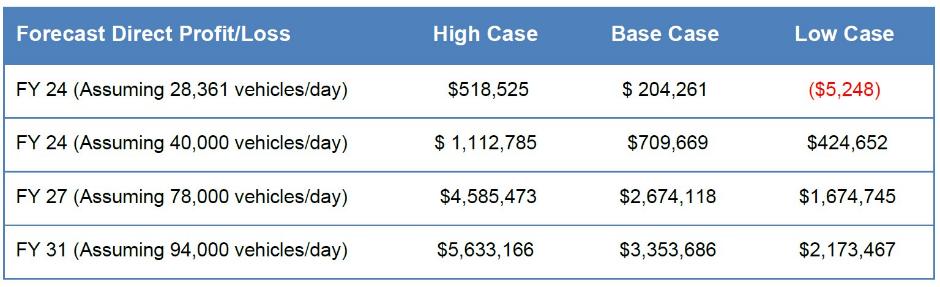
329 The experts noted that the ranges set out in the table take the traffic volumes provided in Ms Fish’s instructions as given, and the experts do not forecast those traffic volumes or comment on the circumstances in which those traffic volumes might be expected to occur. The experts note that the ranges for FY24 are considerably narrower than those for FY27 and FY31. This is because the margin on fuel sales at United Perth Airport for FY24 is now known with certainty and so there is no variation in the assumed margin between the High, Base and Low Cases for FY24.
330 As to the second matter, the economists calculate that the service station made an actual direct profit for FY24. On the economists’ analysis, this is the year the Site turned profitable – although the experts do not expressly recognise this, the economists separately found that the Site made a net direct loss from 1 January 2023 to 31 October 2024.
331 As to the third matter, the economists’ assessments of trading results on available financial information shows that the service station has so far made a direct profit over the 2.5 years trading from 1 January 2023 to 31 July 2025. However, the experts agreed that this does not represent the total cost to United from its investment in the Site. In particular:
(a) the Direct Profit/Loss figures do not include any allowance for appreciation or depreciation in the value of assets;
(b) the Direct Profit/Loss figures do not include any allowance for taxes on profits or tax deductions from losses;
(c) given the Site began operating on 19 December 2022, there may be some establishment costs that were accounted for prior to January 2023; and
(d) the Direct Profit/Loss figures do not take account of the opportunity cost of United’s investment in the Site (ie, they do not take account of the profits that United could have made from the next best alternative investment option available at the time of its investment).
332 As to the fourth matter, Ms Fish was asked to provide her opinion about any efficiencies, or economies of scale, that United could be expected to derive from increased traffic to the Perth Airport Service Station if the number of vehicles passing the Site increased to up to 94,000 vehicles per day. Ms Fish considered the nature of the revenues generated and the costs incurred by United in the operation of Perth Airport Service Station for the five months from January to May 2023, with a view to identifying whether each revenue and cost item was likely to be (a) one-off or recurring or (b) fixed or variable in nature. Ms Fish concluded that the Site was operating at a level of output such that it enjoyed economies of scale, because a significant proportion (over 70%) of the costs incurred by United in the operation of the Site are fixed at current volumes: namely rent payable to PAPL and commission payable to the commission agent (Vasavi Pty Ltd). Ms Fish also concluded that the profitability of the Site can be expected to rise substantially with an increase in the number of vehicles passing the Site because a large proportion of the costs that United can expect to incur are fixed whereas a large proportion of the income that United can expect to generate (from the sale of fuel, shop sales, the operation of the carwash and phone sales) is variable, such that they will increase with an increase in the number of vehicles/patrons served. Mr Gray generally agreed with Ms Fish’s analysis. Further, the experts agreed that increases in (a) the average volume of fuel purchased per passing vehicle, (b) profit margin on fuel sales, and (c) traffic volume will, all other things being equal, have the effect of increasing net profit.
Quantity Surveyors
333 United relied upon the expert evidence of Joel Glover. PAPL relied upon the expert evidence of Philip Roberts. Mr Glover and Mr Roberts prepared individual expert reports and participated in the preparation of a joint expert report. By agreement between the parties, neither expert was cross-examined, and the joint expert report of Mr Glover and Mr Roberts, dated 30 January 2025 was tendered in evidence
334 The Quantity Surveyors gave expert evidence dealing with three matters.
335 First, they assessed the actual cost of construction of the large service station constructed by United at the Sublease site at Airport Central in 2021-2022. Secondly, the Quantity Surveyors assessed the actual costs of construction of the United service station located at Cheltenham, Victoria, which was relevant to United’s counter-factual for loss and damage. Thirdly, the Quantity Surveyors assessed the cost of constructing a hypothetical service station in the Cheltenham design on a smaller site at Airport Central of 4,879 m2(that is Site 1) in 2021-2022 as part of United’s counterfactual evidence on loss and damage.
336 Turning to the first matter, the Quantity Surveyors were agreed on the actual cost of construction of the Perth Airport Service Station actually constructed on the Site, save for the integer for construction and maintenance wages. The parties have since agreed that integer at $124, 589.20. With that change, the parties are agreed on the answer to Question one. The effect is that the estimated actual cost to design and construct the Perth Airport Service Station, including construction and maintenance wages, is $7,721,182.76.
337 The Quantity Surveyors otherwise agreed on the actual cost of construction of the United service station at Cheltenham, Victoria and set out this figure in the joint report in answer to Question two, being $4,210,901.09. This was part of the evidence relied upon in estimating the costs of constructing a hypothetical service station in the Cheltenham design on a smaller site at Airport Central of 4,879 m2, in answer to Question three of the joint report.
338 In answer to Question three in the joint report, the Quantity Surveyors were agreed on some, but not all, aspects of the estimated costs of constructing a hypothetical service station in the Cheltenham design on a smaller site at Airport Central of 4,879 m2. The parties have since agreed to resolve the issue by taking the answer to Question three in the joint report as given by Mr Glover, save for agreeing to the amount of $135, 927.51 for construction and maintenance wages. This resolves the overall disagreement at the midpoint between the two experts. The effect is that the parties have agreed that the estimated actual cost of constructing a hypothetical service station in Perth in 2021-2022 on Site 1, based around the design of the Cheltenham service station, is $5,071,800.68.
GENERAL PRINCIPLES ON MISLEADING AND DECEPTIVE CONDUCT
339 A claim under s 18 of the ACL involves four steps: (a) identifying the conduct said to contravene s 18; (b) considering whether the identified conduct was “in trade or commerce”; (c) considering what meaning the impugned conduct conveyed; and (d) determining if that conduct in light of that meaning was misleading or deceptive or likely to mislead or deceive. Each of those steps involves questions of fact: Self Care IP Holdings Pty Ltd v Allergan Australia Pty Ltd (2023) 277 CLR 186; [2023] HCA 8 at [80]-[81] (Kiefel CJ, Gageler, Gordon, Edelman and Gleeson JJ).
340 There is no issue in this case as to whether the impugned conduct was “in trade or commerce”.
341 As to identification of the conduct and the meaning it imparted, including what (if any) Representations were conveyed, the Court must characterise objectively the impugned conduct viewed as a whole, and its notional effects, judged by reference to its context, on the state of mind of the relevant person. That context includes the immediate context (relevantly, all words in the document or other communication and the manner in which those words are conveyed, not just a word or phrase in isolation) and the broader context of the relevant surrounding facts and circumstances: Self Care [82], also Aldi Foods Pty Ltd v Moroccanoil Israel Ltd (2018) 261 FCR 301; [2018] FCAFC 93 at [74] (Perram J, Allsop CJ agreeing at [1] and Markovic J agreeing at [169]). The context includes the state of knowledge of the person to whom the conduct is directed: Campbell v Backoffice Investments Pty Ltd (2009) 238 CLR 304; [2009] HCA 25 at [26] (French CJ).
342 The context also includes the matters of fact each party knew about the other as a result of the nature of their dealings and the conversations between them, or which each may be taken to have known, and the role each party was playing: Butcher v Lachlan Elder Realty Pty Ltd (2004) 218 CLR 592; [2004] HCA 60 (Gleeson CJ, Hayne and Heydon JJ) at [37].
343 It is incorrect to characterize the problem as one of analysing the effect of “conduct” divorced from “disclaimers” about such “conduct” and divorced from other circumstances which might qualify its character. Everything relevant must be taken into account: Butcher at [39] (Gleeson CJ, Hayne and Heydon JJ); Campbell at [29] (French CJ).
344 In determining whether conduct is misleading or deceptive, it is necessary to consider the conduct from the perspective of a reasonable person in the position of the person complaining about it. The commercial experience of the parties and the clarity and prominence of any disclaimer are factors to be considered when determining whether the impugned conduct was misleading or deceptive: Ireland v WG Riverview Pty Ltd (2019) 101 NSWLR 658; [2019] NSWCA 307 at [65]-[67] (McFarlane JA, Bell ACJ agreeing at [1] and Barrett AJA agreeing at [91]), applying Butcher and Campbell.
345 I now turn to consider each of the relevant matters which must be taken into account in accordance with the principles stated in Butcher and Campbell.
ISSUES 1 TO 3 - WHETHER PAPL MADE THE REPRESENTATIONS TO UNITED
346 United alleges that the Representations were made in writing and orally.
The Information Brochure
347 United alleges that the written Representations arise from statements in the Information Brochure which was provided to United by PAPL on 6 July 2017 together with the RFP.
348 United relies upon the following statements in the Information Brochure.
349 Page two of the Information Brochure stated: “An exciting opportunity exists to establish a service station at the entrance to and exit from the Airport Central Precinct”.
350 Page three of the Information Brochure described Perth Airport as “the premier international and interstate gateway to Western Australia”. It continued that:
Perth’s metropolitan community is inextricably linked to its airport. The relative isolation of Perth as an Australian capital city and the vast distances between the major population centres make air travel and Perth Airport indispensable to the people of Western Australia.
351 Page four of the Information Brochure contained a map depicting the various Perth Airport precincts. Under the heading “Consolidation”, it stated:
In May 2008, Perth Airport released a Vision for the Future which proposed the consolidation of all commercial air services into new facilities at Airport Central. This will be developed around the site of the existing International Terminal (T1) and was articulated in the 2009 and 2014 Perth Airport Master Plans.
352 Page five of the Information Brochure contained the following written representation:
The Qantas Group is expected to relocate all international and domestic flights from Terminal 3 and Terminal 4, located in Airport West, to Airport Central in the mid to late 2020s, completing consolidation of commercial air services in Airport Central.
353 Page eight of the Information Brochure stated, under the heading “Airport Traffic Volumes”, inter alia:
When Qantas relocates from Airport West to Airport Central in the mid to late 2020s it is expected that traffic volumes will almost double on Airport Drive from 40,000 to 78,000 per day.
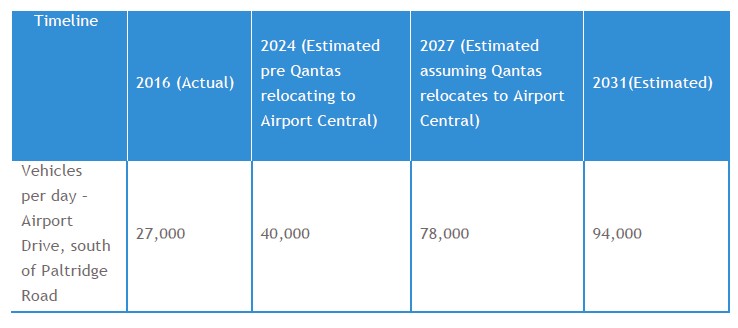
United’s Submissions
354 By the Information Brochure, United alleges that PAPL made Representations to United to the effect that
(a) the Qantas Relocation will occur by the mid to late 2020s; and
(b) when the Qantas Relocation is complete, traffic volumes on Airport Drive abutting the Site, will almost double from the estimated 40,000 vehicles per day in 2024 to 78,000 vehicles per day, and ultimately to an estimated 94,000 vehicles per day by 2031,
(the IB Qantas Representations).
355 An important distinction between the IB Qantas Representations and the pleaded Qantas Representations is that the IB Qantas Representations are limited to the Qantas Relocation occurring by the mid to late 2020s, and does not include the alternative formulation of by 2025.
356 United also alleges further or alternatively, that the Information Brochure conveyed the Further Representations, also set out earlier in this judgment which can be summarised as follows:
(a) Qantas Group is expected to relocate all international and domestic flights from Terminal 3 and Terminal 4 located at Airport West, to Airport Central in the mid to late 2020s completing consolidation of commercial air services in Airport Central; and
(b) When Qantas relocates from Airport West to Airport Central in the mid to late 2020s it is expected that traffic volumes will almost double on Airport Drive from 40,000 to 78,000 per day.
357 In relation to the Further Representations, as set out at [37(b)], these include implied representations as to PAPL’s state of mind or holding reasonable grounds. These implied representations are pressed by United only if, contrary to its position, the Court finds that the Representations were not with respect to a future matter for the purposes of s 4 of the ACL. I consider this later in these reasons, but it suffices to say at this point, that I have found that the Representations were with respect to a future matter, and hence, it is unnecessary for me to consider the implied representations that are part of the Further Representations.
358 United contends that the two sets of Representations substantially overlap. The IB Qantas Representations arise from statements in the brochure, whereas the Further Representations are an exact replica of statements in the document which were alleged by way of amendment after PAPL denied the Qantas Representations.
359 As to the IB Qantas Representations, United allege that PAPL represented that the Qantas Relocation “will” occur. This Representation, United submits, is supported by the statements in the documents that “when Qantas relocates” and consolidation “will be developed” (emphasis added). United submits that, contrary to PAPL’s defence, the representation that Qantas Relocation “will” occur is not gainsaid by the statement in the document that “Qantas group is expected to relocate” (emphasis added). United submits that this is so for the following three reasons.
360 First, by reference to the Cambridge and Merriam-Webster dictionaries, United submits that the natural and ordinary meaning of the word “expected” embraces something that is “going to happen” and that is considered “certain” such that it does not reject that it “will” happen.
361 Second, the statement that “Qantas Group is expected to relocate” is qualified in the same sentence by the definitive about it “completing the consolidation of commercial air services in Airport Central” (emphasis added).
362 Third, the statement must be read in the context of the other definitive statements in the Information Brochure to the effect that “when Qantas relocates” and consolidation “will be developed” (emphasis added).
363 United submits that this objective analysis of the language used in the Information Brochure is consistent with the evidence given by United’s lay witnesses of their understanding of the statements made in the Information Brochure.
364 As to the Further Representations, United submits they are the express statements in the documents. United also allege further and alternatively, that the express statements gave rise to implied representations to the effect that:
(a) PAPL in fact held the expectations, opinions or states of mind represented; and
(b) PAPL had reasonable grounds for the expectations, opinions or states of mind which were represented.
365 United presses these implied representations if the Court finds, as alleged by PAPL, and contrary to United’s principal submissions that the:
(a) statements made in the Information Brochure conveyed PAPL’s expectations, opinions or states of mind; and
(b) representations are not with respect to a future matter for the purposes of s 4 of the ACL.
366 United submits that to the extent necessary, the Court should find that the implied representations were conveyed.
PAPL’s submissions
367 PAPL submits that the conduct of its employees, in context, did not convey the alleged Representations to United. PAPL relies on the following context:
(a) United received the Information Brochure together with the RFP by email from Mr Skinner, of PAPL, on 6 July 2017. The email described the documents as “relating to service station opportunities located on Airport Drive in the Airport Central precinct”. It referred to the ability to submit different types of lease proposals under the RFP and asked for any tender proposal by 4 August 2017; and
(b) United is a sophisticated commercial organisation. The information was provided to its “National Acquisitions Manager”, Mr Carmeli. United could be expected to consider these documents, and the requirements of the tender process more generally, closely and carefully before submitting any tender.
368 PAPL submits that even ignoring other contexts, the language of the impugned statements does not convey a message that Qantas will, or is expected to, relocate by 2025. PAPL submits that such a happening is contrary to the express language of “mid to late 2020s” and contrary to the description of the traffic volumes in 2027 as an estimate, “assuming Qantas relocates to Airport Central”.
369 PAPL relies upon the reference on pages five and eight of the Information Brochure to an expectation in the “mid to late 2020s” and, on page eight, the relocation by 2027 is identified as an “assumption” which, PAPL submits, make it apparent that there was some uncertainty about the relocation or at least its timing.
370 PAPL submits that the statements in the Information Brochure must also be understood in light of the terms of the RFP. PAPL emphasises that the purpose of the Information Brochure was to provide information in connection with the tender process. It identifies the “Tender Documents” as including the email inviting tenderers to submit a tender, (the Conditions of Tender, the Tender Schedules and the Key Commercial Terms), the Information Brochure, and all addenda to such documents issued by PAPL. It provided that tenders are an irrevocable offer valid for acceptance for 12 months (internal page nine, cl 4).
371 The RFP outlines the tenderers obligations regarding information, providing:
(a) ‘Tenderers responsible’ (cl 5.1): that the tender documents do not purport to contain all relevant information and are provided solely on the basis that a tenderer will be responsible for making its own assessment of the matters referred to in the tender documents, that PAPL advises the tenderer and the tenderer agrees all relevant representations, statements and information (including those contained or referred to in the tender documents or made orally during the course of any discussion with PAPL, its employees or agents), and that no person has been authorised to make any representation or warranty in connection with the tender documents, and any such representation or warranty, if given or made, must not be relied on as having been authorised by PAPL;
(b) ‘to inform itself fully’ (cl 5.2): that PAPL does not warrant the correctness of any information supplied in the tendered documents and is not responsible for any loss and damage caused by the reliance on this information; the tenderer must make their own enquiries about any issues contained in the tender documents and must acquaint themselves with all aspects of the tender documents and form their own assessment of the Service Station; and
(c) ‘no warranty on accuracy of reports’ (cl 5.3): that PAPL has relied on the reports prepared for it by the various consultants and other parties and has not independently verified the information contained in those reports and PAPL (and its directors, employees and agents) do not make any representation or warranty (express or implied) as to the accuracy or completeness of the information provided to a tenderer.
372 PAPL also rely upon, in respect of cl 5.2 of the RFP, documents referenced in the Information Brochure in connection with the impugned statements on internal pages five and eight, including the 2008 “Vision for the Future” and 2009 and 2014 Master Plans. The 2008 document stated that the design for the new terminal facility in connection with Consolidation was not yet finalised and that there would be consultation with a wide range of stakeholders including airlines. PAPL relies upon similar statements in the 2009 Master Plan and 2014 Master Plan. It said it was “a priority for Perth Airport to seek to reach agreement with all airlines on the nature of new investments and the airport charges to support the investments” and that “[c]onsultation will continue as we design the new Perth Airport”. Similar ideas appear in the 2009 Master Plan134 and 2014 Master Plan, which also make apparent that the precise timing of Consolidation is influenced by a range of factors, including airline consultation and actual demand.
373 PAPL also rely upon Addenda 1, which was sent to United on 14 July 2017. In answer to the question, “Has there been confirmation when Qantas will relocate to the new terminal?”, the response, in Item 7, was “No”.
374 PAPL submits that the Court should find that, in context, by reference to the full language of the Information Brochure and having regard also to the terms of and disclaimers in the RFP and Addenda 1:
(a) the impugned statements in the Information Brochure as to the Qantas Relocation did not convey the Qantas Representations or the Further Representations;
(b) those statements did no more than convey that PAPL held an expectation that Qantas would relocate to Airport Central in the mid to late 2020s, but the date was unconfirmed and uncertain, and this representation should not be relied on for the purposes of submitting a tender response;
(c) the impugned statements in the Information Brochure as to traffic volumes did no more than convey that PAPL believed that the estimated increases were reliable and was not providing them any assurance as to their accuracy.
Consideration
375 I reject PAPL’s submissions in relation to the written representations contained in the Information Brochure and Addenda 1, and I find that those documents did convey both the Representations and the Further Representations (putting aside the implied representations) for the following reasons.
376 First, the Information Brochure was a sophisticated commercial document which was designed to promote a substantial business opportunity to establish a service station at a site which, because of Consolidation would have a substantial volume of traffic passing the site each day.
377 Second, the airport was promoted in the Information Brochure as “the premier international and interstate gateway to Western Australia”. The Information Brochure said that the “relative isolation of Perth as an Australian capital city and the vast distances between the major population centres make air travel and Perth Airport indispensable to the people of Western Australia”.
378 Third, Qantas is well known as the largest domestic airline and a significant international airline which operates in and out of Perth Airport. The Qantas Relocation would necessarily result in increased passenger, staff and retail custom to the new terminal in Airport Central.
379 Fourth, the Information Brochure gives prominence to two matters. The first is Consolidation. The second is the Airport Traffic volumes doubling on Airport Drive when Qantas relocates to Airport Central in the mid to late 2020s. The Information Brochure has the emboldened and capitalised headings, “Airport Central” and “Airport Traffic Volumes” which emphasise the significance of those two matters on the business opportunity that was being promoted by the Information Brochure.
380 Fifth, the Qantas Relocation to Airport Central in the mid to late 2020s is promoted as the reason why traffic volumes will almost double. The Qantas Relocation is the only basis provided for traffic volumes increasing on Airport Drive.
381 Sixth, there are no disclaimers in the Information Brochure. The disclaimers are contained in the RFP. They are not given prominence in the key document, being the Information Brochure. The RFP sets out the conditions of tender. It identifies the steps involved in the tender process and provides the contractual foundation upon which tenderers submit their tender. The RFP is not a promotional or marketing document. The RFP does not contain any statements about the business opportunity being offered by PAPL to establish a service station. The existence of the disclaimers in cl 5 of the RFP must be considered as part of PAPL’s conduct as a whole and whether, in the particular circumstances, it may qualify or erase PAPL’s conduct.
382 Seventh, the text of the statements relied upon by United in the Information Brochure regarding Qantas’ relocation are not qualified. The ordinary and natural meaning of the text in the brochure is that the Qantas Relocation will occur in the mid to late 2020s.
383 Eighth, the statements in the Information Brochure regarding the increase in vehicles per day as a result of the Qantas Relocation are not qualified. The message conveyed by the statements is that traffic numbers will increase substantially on Airport Drive after the Qantas Relocation. The number of cars is estimated to almost double from 40,000 in 2024 to 78,000 vehicles per day in 2027, and 94,000 vehicles per day by 2031.
384 Ninth, the Qantas Relocation is the key selling point which is conveyed by the statements in the Information Brochure. It is the Qantas Relocation that creates what the Information Brochure describes on page two, as “an exciting opportunity exists to establish a service station at the entrance and exit from the Airport Central precinct”.
385 Tenth, the text of the statements in the Information Brochure which United relies on as giving rise to the Qantas Representations are plainly couched in terms that the Qantas Relocation “will” occur. This is further reinforced by statements in the Information Brochure such as “when Qantas relocates” and statements regarding the consolidation that “will be developed” (emphasis added).
386 Eleventh, the reference on page five of the Information Brochure that “the Qantas group is expected to relocate …” is qualified in the same sentence by the definitive statement, “… completing the consolidation of commercial air services in Airport Central” (emphasis added). The “expectation” must also be read in the context of the other definitive statements in the Information Brochure to the effect that “when Qantas relocates” at page eight of the brochure (emphasis added).
387 Twelfth, the Information Brochure contains not less than five references to Qantas, the Qantas Relocation, and Consolidation. The prominence of the references in the Information Brochure to Qantas, Qantas Relocation, and Consolidation convey the representation that Qantas “will” relocate its international and domestic flights from Terminal 3 and 4 to Airport Central, not that Qantas “may” or that there exists uncertainty as to “when” Qantas will relocate. This is unsurprising as the business opportunity represented by the statements in the Information Brochure had, at its core, the relocation of Qantas.
388 Thirteenth, the commercial purpose of PAPL sending the Information Brochure and the RFP to Mr Carmeli, United’s National Acquisitions Manager, was to encourage United to submit a proposal for the airport site. That commercial purpose was advanced by PAPL expressing in positive terms the benefits of the Qantas Relocation and the increase in traffic numbers which would occur because of the Qantas Relocation. This purpose can be likened to the effect of a misleading representation in a piece of marketing which entices the customer in to a marketing web as in Australian Competition and Consumer Commission v TPG Internet Pty Ltd (2013) 250 CLR 640 at [50]-[52] (French CJ, Crennan, Bell and Keane JJ) – here the Information Brochure has the effect of enticing the prospective tenderer to engage in the tender process with the Information Brochure accentuating the attractive prospects (ie Consolidation and the Qantas Relocation) and with the RFP containing the less attractive terms and conditions.
389 Fourteenth, the impugned conduct of PAPL must be considered bearing in mind what matters of fact United and PAPL knew about each other as a result of the nature of their dealings between each other: Butcher [37]. In this case, United knew that PAPL operated the Perth Airport. As a consequence, it was reasonable for United to expect that it could rely upon Representations made by PAPL in respect to the Consolidation. United could reasonably expect that PAPL knew information regarding the Qantas Relocation. United could reasonably expect that PAPL would have information about the airport traffic volumes post Qantas Relocation. In these circumstances, notwithstanding the disclaimers in the RFP, the role of PAPL as operator of the Perth Airport was a factor relevant to the statements contained in the Information Brochure.
390 The context relied upon by PAPL as to the circumstances in which the statements were made does not, in my view, result in the statements not being conveyed as alleged, or convey a mere expectation, or some uncertainty or tentativeness about Qantas’ relocation.
391 I also reject PAPL’s submissions that the terms of the RFP in cl 5 mean that United could not rely upon the statements contained in the Information Brochure when responding to the RFP. The context of the disclaimers being contained in a document concerned with the legal framework of the tender process, namely the RFP, rather than the promotional and marketing document, being the Information Brochure, sought to reduce the prominence of the disclaimers such that they did not have the effect, as PAPL contend, of meaning that United could not rely upon the statements contained in the Information Brochure. It is well-established that contractual terms requiring a contracting party to make their own enquiries does not have the effect, necessarily, of absolving a party of liability for misleading and deceptive conduct – rather, such a term (and terms of like effect, such as the other clauses relied upon by PAPL and referred to in [247] of these reasons, that is, disclaimers) is to be considered as part of the inquiry as to whether, in all the circumstances, the impugned conduct was misleading: Butcher at [39], [49] (Gleeson CJ, Hayne and Heydon JJ), and see [160] (McHugh J, in dissent but not in respect of this point of principle). As McHugh J said in Butcher at [158], “[i]f misleading conduct has induced a contract, that fact cannot be negated by the mere circumstance that there is a statement to the contrary”. In particular, the natural question which arises is, what enquiries could United have made as to the veracity of the representations; put another way, what could United have done to satisfy itself that the Qantas Relocation would occur by the mid-late 2020s? As Robb J found in Lonergan v JQZ Eleven Pty Ltd (2022) 21 BPR 44,211; [2022] NSWSC 1461 at [244]-[245], I find that in the circumstances there was no reasonable inquiry or investigation which United could have conducted to disabuse itself of the belief which the Information Brochure caused it to adopt. As Cavanagh J said in QVB Pharmacy Pty Ltd v Le [2022] NSWSC 1612 at [96(12)], such a term should be understood as “a standard form clause by which the plaintiff[] acknowledge[s] that they have made their own enquiries and relied on their own enquiries”, but does not mean United was unable to rely on the accuracy of information provided to it by PAPL in the Information Brochure.
392 Similarly, in relation to the traffic volumes, in particular, the estimated increase post-Qantas Relocation, PAPL was uniquely placed to obtain data about expected traffic volumes on Airport Drive which would enable it to form an expectation, opinion or state of mind as to traffic volumes. This was an information asymmetry which was particularly within the knowledge of PAPL and not United. This was an advantage not available to United.
393 Considering as a whole the context and the circumstances, which includes how Addenda 1 was sent to United, in my view, the disclaimers do not have the effect that United was precluded from relying upon the impugned statements contained in the Information Brochure. In particular, the answer to Item 7 (set out at [101] of these reasons) to the effect that there was no confirmation as to when the Qantas Relocation would occur, does not adequately qualify the express statements in the Information Brochure. I accept that a reasonable person in United’s position, having received a representation that Qantas would relocate in the mid-late 2020s, would interpret that answer as referring to the lack of an agreed date within that timeframe, rather than as undermining the accuracy or reliability of the Representations (which reflects Mr Brinkworth’s evidence).
394 I reject PAPL’s submission that, in context, the language of the Information Brochure, having regard to the terms of and the disclaimers in the RFP and Addenda 1, mean that the impugned statements as to the Qantas Relocation did not convey the Qantas Representations or the Further Representations. I reject that those statements did no more than convey that PAPL held an expectation that Qantas would relocate to Airport Central in the mid to late 2020s. I reject that the Representations could not be relied upon by United for the purpose of submitting a tender response.
The Oral Representations
395 On 27 February 2018, there was a meeting at PAPL. It is agreed that Mr Brinkworth from United and Mr Skinner from PAPL were present. What is not agreed is whether Mr Manolitsa from United was also present, and more significantly whether Mr Holden was present.
396 Mr Brinkworth gave evidence that both Mr Manolitsa and Mr Holden were present. Mr Holden gave evidence that he does not recall the meeting, that he has a calendar invite for the meeting but that it was unlikely he attended. Mr Skinner gave evidence that Mr Holden attended briefly at the beginning of the meeting to meet Mr Brinkworth and then left. Mr Skinner also gave evidence that he did not believe Mr Manolitsa was present. Mr Manolitsa was not called to give evidence.
397 The meeting pre-dated the execution of the AFSL on 17 April 2019, and the Sublease in May 2021.
398 United alleges that at that meeting, PAPL represented to United that the Qantas Relocation will occur by 2025. The pleaded allegation in the ASOC at [11(a)] at Particulars (B) is that “by 2025” Qantas will relocate. This is an alternative to the representation arising out of the written representation in the Information Brochure, which was that the Qantas Relocation would occur by the mid to late 2020s.
399 Mr Brinkworth gave evidence that, at the meeting at Perth Airport on 27 February 2018, Mr Holden stated that the Qantas Relocation would occur by 2025 and that “there was no guarantee it would happen by 2020, but there was a confidence expressed by the representatives of PAPL that it would happen by 2025”: [T258.29-35], [T271.29-34].In his evidence in chief, Mr Brinkworth’s exact evidence was that Mr Holden said that the Qantas Relocation would occur “somewhere between 2025”: [T226.19]; [T226.31-32]. United submits that this evidence of Mr Brinkworth is to the same effect as saying that the Qantas Relocation would occur by 2025.
400 PAPL made submissions that Mr Brinkworth’s evidence should not be accepted by reason, primarily, of two matters related to his evidence generally, and five matters specifically related to his evidence of the 27 February 2018 meeting.
401 Dealing with attacks against Mr Brinkworth’s evidence generally, PAPL refer first to Mr Brinkworth’s evidence regarding the feasibility analysis which United undertook in relation to the service station, and second, Mr Brinkworth’s evidence in relation to the business plan/forecast he sent to Mr Skinner. PAPL submits that Mr Brinkworth’s evidence on these topics defied logic, and was inconsistent with the contemporaneous documents.
402 Specifically, regarding the 27 February 2018 meeting, first PAPL submits that the Court cannot be satisfied that Mr Brinkworth maintains a clear and cogent recollection of the conversation. PAPL submits that United has not proved to the requisite standard that Mr Brinkworth recalled the substance of the conversation. This is particularly the case in view of the fact that the conversation took place more than seven years ago and that there are no corroborating documents of what was discussed at the meeting: Watson v Foxman (1995) 49 NSWLR 315 at 319. As the Full Court said in Martin v Norton Rose Fulbright Australia (2021) 289 FCR 369; [2021] FCAFC 216 at [147] (Jagot, Katzmann and Banks-Smith JJ):
[C]ognitive processes (including recall) are “overlaid, often subconsciously, by perceptions or self interest”. McLelland CJ in Eq [in Watson v Foxman at 318-319] described this process as “a matter of ordinary human experience”. It is because of ordinary human experience that we know that evidence about what a person believes they would or might have done in the past requires caution irrespective of the honesty or credit of the person giving the evidence. Evidence of that kind is inherently fraught as it is necessarily a product of hindsight and belief separate in time from the events in question.
403 Second, PAPL points to Mr Skinner’s evidence that Mr Holden left after the introduction and some talk at high level about the proposal, and Mr Holden’s evidence that he wasn’t at that meeting.
404 Third, PAPL refers to Mr Brinkworth referring in cross-examination to “various” other conversations where the topic of Qantas relocating by (or between) 2025 came up. PAPL submits that none of these other conversations were mentioned in Mr Brinkworth’s evidence in chief (written or oral) and, further, that the fact he cannot recall the detail of those other conversations makes it all the more implausible that he can remember the detail of what was said on 27 February 2018 with any particularity or at all.
405 Fourth, PAPL also refer to Mr Brinkworth’s recollection of a discussion that he said occurred at the meeting regarding a possible future need for PAPL to resume the Site for an extra runway. When this part of the meeting was put to Mr Skinner in cross-examination, he strongly rejected Mr Brinkworth’s recollection on that topic and was clear that it would be ridiculous for PAPL to build a new runway on the Site.
406 Fifth, PAPL submits there is no contemporaneous note of the meeting, which makes it almost impossible to find that the statements were said as recounted, in the circumstances including the passage of time and the vague nature of them.
407 In contrast, United submits that PAPL’s witnesses, Mr Skinner and Mr Holden could not gainsay Mr Brinkworth’s evidence about the meeting. Mr Holden gave evidence that he has a calendar invitation for a meeting with Mr Brinkworth on 27 February 2018, but that he has no recollection of the meeting. Mr Skinner gave evidence that he “cannot recall precisely what was discussed at that meeting”. In cross-examination, Mr Skinner said that he did not recall whether he or Mr Holden told Mr Brinkworth that Perth Airport expected Qantas to relocate by around 2025. But Mr Skinner did give clear evidence that he did not believe he would have said that, as it would not have been consistent with his understanding that the agreement between PAPL and Qantas was subject to commercial terms and that that could affect the expected timing of 2025. United submits that this evidence of Mr Skinner was at most, an expression of Mr Skinner’s belief about what he may have said, without any recollection of what he said at the meeting. United also submits that Mr Brinkworth’s evidence is bolstered by the evidence of Mr Silver and Mr Szymczak, which was to the effect that Mr Brinkworth told them that PAPL had said the Qantas Relocation would occur by 2025. However, this evidence was no more than that they each recalled Mr Brinkworth telling them the Qantas Relocation would occur by 2025, but without reference to any specific details of meetings at particular times (Mr Szymczak does identify two specific meetings but does not date them or elaborate on what was said, whereas Mr Silver does not refer to any specific meeting).
408 In my assessment, Mr Brinkworth gave clear evidence about his recollection of the conversation at the meeting on 27 February 2018. His recollection was that Mr Holden said that the Qantas Relocation would occur “between 2025”: [T226.19].
409 Mr Brinkworth was closely cross-examined about the conversation that took place at the meeting on 27 February 2018. It was suggested by senior counsel for PAPL that Mr Holden wasn’t at the meeting. Mr Brinkworth said that he was: [T257.41]. It was suggested by senior counsel for PAPL that Qantas relocating, or traffic volumes were not discussed. Mr Brinkworth said, “Yes”, they did discuss Qantas relocating and traffic volumes: [T258.11].
410 Senior counsel for PAPL put that: “Neither Mr Holden nor Mr Skinner ever said to you [Mr Brinkworth] that the Qantas Relocation would occur as soon as possible in early 2020s and by 2025”. In answer, Mr Brinkworth said, “They did”:[T258.30-32].
411 Senior counsel for PAPL put: “They never said to you that the Qantas Relocation would occur by 2025?” In answer, Mr Brinkworth said, “2025? They did”: [T258.34-35].
412 Senior counsel for PAPL put: “They never said to you that the Qantas Relocation would occur between 2025?” In answer, Mr Brinkworth said, “Between 2025? They did”: [T258.36].
413 My assessment, as I have stated earlier in my reasons, is that Mr Brinkworth gave honest and truthful answers when cross examined.
414 Mr Brinkworth, in my assessment, had a good recollection of the events that led to the execution of the AFSL and the Sublease. Mr Brinkworth’s recollection of the conversation that took place on 27 February 2018 was more detailed and, I find, more reliable than Mr Skinner and Mr Holden’s evidence.
415 First, Mr Brinkworth travelled to Perth from Melbourne for the meeting with PAPL at PAPL’s offices. Second, a key reason for the meeting was for Mr Brinkworth to meet Mr Holden and to discuss the terms of the AFSL/Sublease. Third, the Perth Airport Service Station represented to United a significant undertaking and financial commitment – including both the undertaking of lease payments and the capital expenditure on building the Millennium Concept Perth Airport Service Station. Fourth, in contrast, for Mr Holden (and to a lesser extent Mr Skinner) this was just one aspect of Consolidation, the meeting occurred at their regular place of business. It is not surprising and is understandable that Mr Holden would not recall the meeting. Fifth, I am satisfied that the Qantas Relocation was critical to United’s consideration of and entry into the AFSL and Sublease. Therefore, Mr Brinkworth would have been specifically interested in hearing from Mr Holden and Mr Skinner as to the timing of the Qantas Relocation, including for the purpose of relaying that information to Mr Silver. Sixth, Mr Brinkworth no longer works at United and has not done so since January 2020. Mr Brinkworth, therefore, has no reason not to give credible evidence. Seventh, the representation that the Qantas Relocation would occur by 2025 is consistent with the understanding that Mr Holden and Mr Skinner, in fact, held at the time.
416 I accept Mr Brinkworth’s evidence that Mr Holden was present at the meeting on 27 February 2018. I accept that he and Mr Skinner made the statements Mr Brinkworth attributes to them which I have referred to above.
417 I do not accept the criticisms made by PAPL going to Mr Brinkworth’s credit as a witness. There is, in my view, no proper basis to make such a challenge to Mr Brinkworth’s credit. For the reasons I have given, Mr Brinkworth’s evidence as to the conversation which took place at the meeting on 27 February 2018 is to be preferred to the less cogent and less reliable evidence given by Mr Skinner and Mr Holden.
418 Considering the evidence of the 27 February 2018 meeting as a whole and accepting Mr Brinkworth’s version of that evidence as to what was said by Mr Holden, I find that PAPL represented to United that the Qantas Relocation would occur by 2025.
Post AFSL Representations
419 United alleges that PAPL made further representations after the AFSL was entered into in April 2019.
420 On or around 10 March 2020, PAPL published a press release on its website in relation to the AFSL with United. In that press release, PAPL stated that:
The development will form the first stage of a Highway Service Centre with future stages to include additional Food & Beverage outlets in readiness for the move of all flight services to the Central Precinct by 2025; and
Perth Airport Chief Property Officer Steve Holden said “With Terminals 3 & 4 scheduled to be relocated by 2025, the Airport Central Precinct will increasingly become the focus for aeronautical operations and the design of this development will help to create a great first impression for visitors to Western Australia.
(emphasis added)
421 On 7 August 2020, in response to inquiries from United’s solicitors, Lavan Legal, about the Qantas Relocation, PAPL stated:
We also understand from your letter that you have inferred that Qantas will not be relocating to Airport Central because of ongoing disputes between PAPL and Qantas. We are surprised that you could reach such a conclusion without detailed knowledge of the dispute between Qantas or PAPL … our position on this matter remains consistent with the public messaging to date, that is, it is currently expected that Qantas will relocate all international and domestic flights to Airport Central in the mid to late 2020s.
422 United submits that at the time of making the above statement, PAPL’s public messaging was that Consolidation was scheduled to occur by 2025. This was publicly communicated, in PAPL’s press release dated 10 March 2020.
423 United alleges that by the press release and the letter on 7 August 2020, PAPL represented to United that the Qantas Relocation will occur by 2025 (Post AFSL Qantas Representation).
United’s Submissions
424 Mr Szymczak, who was United’s CEO at the time of the 7 August 2020 letter, gave evidence that he read the language in PAPL’s letter, dated 7 August 2020, as unequivocal. Mr Szymczak’s evidence was that PAPL refuted United’s concerns about relocation and repeated its representation about the timing of the Qantas Relocation to Airport Central. Mr Szymczak said that he placed significant weight on that response from PAPL.
425 Mr Szymczak also gave evidence that the public position that PAPL had communicated at that time included a press release on 10 March 2020, that represented that Terminals 3 and 4 would be relocated by 2025. United submits that the letter from PAPL on 7 August 2020 did not seek to alter its position regarding the press release to the public on 1 March 2020.
PAPL’s Submissions
426 PAPL submits that a fair reading of the impugned statements in the 10 March 2020 press release on PAPL’s website conveyed that:
(a) PAPL had schedules or plans for Terminal 3 and 4 to relocate to Airport Central by 2025; or
(b) alternatively, PAPL expected or believed that Terminal 3 and 4 would be relocated to Airport Central by 2025.
427 PAPL submits the Court should find that both representations concern matters of present fact, namely, the state of PAPL’s schedules or plans, or PAPL’s belief, expectation or state of mind, and they were not representations with respect to future matters.
428 PAPL submits that the impugned statements in the 7 August 2020 letter do not convey the alleged representations. The 7 August 2020 PAPL letter was a response to United’s solicitors’ letter of 28 July 2020, which expressly invoked the Information Brochure as a purported continuing source of information for United as to the Qantas Relocation.
429 PAPL submits that if any representation arose out of the 7 August 2020 letter it was that PAPL held a belief or expectation that Qantas would relocate to Airport Central in the mid to late 2020s, but this matter was not assured and was merely the then “current” position within the business. PAPL submits that such a representation concerns PAPL’s belief or expectation. There was no promise, prediction or forecast about the future and it was not with respect to a future matter.
430 PAPL submits that the Court should find that the representation concerned a matter of present fact, namely, PAPL’s belief, expectation or state of mind and that it was not a representation as to a future matter under s 4 of the ACL.
431 PAPL submits that to the extent that representations arose, they had no relevant continuing effect. PAPL submits that any representation arising from the Information Brochure as to the Qantas Relocation, or as to traffic volumes, did not extend beyond the submission of tenders, or the selection of a preferred tender under the RFP. These steps formed the “tender process” under the RFP. The Information Brochure was issued to support those steps, and any such Representations were relevant to the preparation and submission of the tender. PAPL submits that once tenders were submitted, this amounted to an irrevocable offer that could not be withdrawn. PAPL submits the same analysis applies for any oral representation from the meeting on 27 October 2018, which occurred as part of the tender process.
Consideration
432 I do not accept United’s claim based on the Post AFSL Qantas Representations. The Qantas Representations and the Further Representations, which I have found were conveyed by the Information Brochure came to an end or lapsed when the AFSL was executed on 17 April 2019. I reject United’s submission that the Representations were continuing. This is because of the “Tender Process” under the RFP.
433 Clause 1.3 defines the “Tender Process”. Clause 2 of the RFP identifies the steps in the “Tender Process”. The Information Brochure was issued to support those steps, and any Representations were relevant to the preparation and submission of the tender by the tenderer. Clause 4.1 and 4.2 provided that once the tender was submitted it amounted to an irrevocable offer which could not be withdrawn until the expiration of the tender period which was twelve months from the closing date for tenders.
434 I find that the Representations conveyed by the Information Brochure terminated or lapsed when the AFSL was executed on 17 April 2019, by which time the commercial deal relating to United’s leasing of the service station site was consummated and any “inducement” brought about by the Representations was complete. It follows that there were no Representations extant as at the time of the 10 March 2020 PAPL press release, or the 7 August 2020 PAPL letter.
435 For the reasons given above, United’s Post AFSL Qantas Representation claim must fail.
Conclusion on Issues 1 to 3
436 On the basis of the above reasons, as to Issue 1, I find that:
(a) there was a representation made by PAPL to United as pleaded at ASOC [11];
(b) there was a representation made by PAPL to United as pleaded at ASOC [11A];
(c) the Information Brochure did convey the IB Qantas Representations and the Further Representations to United;
(d) Mr Holden, on behalf of PAPL, conveyed to United, at the meeting on 27 February 2018 that the Qantas Relocation would occur by 2025;
(e) the 10 March 2020 press release did not convey the Qantas Representations to United; and
(f) the 7 August 2020 letter from PAPL to United’s solicitors did not convey the Qantas Representations or the Further Representations to United.
437 As to Issue 2, I find that:
(a) Mr Holden and Mr Skinner, on behalf of PAPL, made the representation to United that Qantas will relocate by 2025;
(b) the Information Brochure conveyed the Qantas Representations and the Further Representations to the effect that Qantas will relocate by mid to late 2020s.
438 As to Issue 3, I find that the Qantas Representations and the Further Representations ceased or lapsed when the AFSL was executed on 17 April 2019.
ISSUE 4: REPRESENTATIONS WITH RESPECT TO FUTURE MATTERS
439 United alleges that the representations made by PAPL to United, collectively the Representations, were each made with respect to a future matter or future matters for the purposes of s 4 of the ACL.
440 Relevantly, s 4(1) of the ACL provides that:
If:
(a) a person makes a representation with respect to any future matter (including the doing of, or the refusing to do, any act); and
(b) the person does not have reasonable grounds for making the representation,
the representation is taken, for the purposes of this Schedule, to be misleading.
441 The term “future matter” is not defined in the ACL. Whether a statement relates to a future matter depends upon the words used and the context in which they were used: Digi-Tech (Australia) Ltd v Brand [2004] NSWCA 58; (2004) 62 IPR 184 at 204 [99]–[102] (per Sheller, Ipp and McColl JJA)).
442 In Australian Competition and Consumer Commission v Woolworths Group Limited (2020) 281 FCR 108; [2020] FCAFC 162, Foster, Wigney and Jackson JJ at [132] held that:
We do not think that, generally speaking, a representation about the nature, quality, character or capability of a product based upon its inherent characteristics is a representation with respect to a future matter. A representation will only be with respect to a future matter if it is in the nature of a promise, forecast, prediction or other like statement about something that will only transpire in the future—that is, a representation which is not capable of being proven to be true or false when made.
443 This interpretation of “…a representation with respect to a future matter” in s 4(1) of the ACL is the interpretation propounded by Nicholas J in Samsung Electronics Australia Pty Ltd v LG Electronics Australia Pty Ltd (2015) 113 IPR 11; [2015] FCA 227 at [83]-[86], and by Rares J in Ackers v Austcorp International Ltd [2009] FCA 432 at [359], and by Gleeson J in Australian Competition and Consumer Commission v Kimberly-Clark Australia Pty Ltd [2019] FCA 992 at [276]-[286].
444 I accept United’s submission that the Representations constituted predictions, promises, or forecasts about future events and outcomes of those future events. The future event was the Qantas Relocation by 2025 or, alternatively, by the mid to late 2020s, and the outcome of that future event was the projected increase in traffic volumes identified in the Information Brochure.
445 I reject PAPL’s submission that the statements as to the Qantas Relocation on internal pages five and eight of the Information Brochure were to be understood as a representation about PAPL’s present state of mind, rather than a promise, prediction or forecast about the future. The same position applies with respect to the statements as to traffic volumes in the Information Brochure at internal page eight.
446 Contrary to PAPL’s contentions, the statement in the Information Brochure that “Qantas group is expected to relocate” (emphasis added) does not mean that the Representations were not with respect to a future matter for the purposes of s 4 of the ACL. These arguments were rejected by the Court of Appeal of NSW in DigiTech at [94]-[108]. I do not accept PAPL’s submissions that the Court of Appeal’s statements in these paragraphs of DigiTech need to be treated with caution following the High Court’s decisions in Campbell Back Office and Butcher. The Court of Appeal’s statements that it is the words used and the general context which determine whether a representation is as to a future matter, and that a representation as to a future matter may include with it a reference or representations as to a person’s state of mind remain good law and have subsequently been cited with approval: see for example Australian Competition and Consumer Commission v Woolworths Ltd [2019] FCA 1039 at [125] (Mortimer J, as her Honour then) (not relevantly affected on appeal), Jafari v 23 Developments Pty Ltd [2018] VSC 404 at [522] (Elliot J), [171].
447 For the reasons given, I find, for the purposes of resolving Issue 4, that each of the Representations was with respect to a future matter under s 4(1) of the ACL.
ISSUES 5 AND 6: DID PAPL HAVE REASONABLE GROUNDS TO MAKE THE REPRESENTATIONS?
Applicable principles
448 Conduct will be misleading or deceptive if – viewed as a whole – it has a tendency to lead into error a person exposed to the conduct (that is, to form an erroneous assumption or conclusion about some matter): TPG at [39], Taco Co of Australia Inc v Taco Bell Pty Ltd (1982) 42 ALR 177 at 200 (Franki, Deane and Fitzgerald JJ).
449 The applicable principles regarding s 4 of the ACL were not in dispute between the parties.
450 Section 4(2) of the ACL relevantly states that:
For the purposes of applying subsection (1) in relation to a proceeding concerning a representation made with respect to a future matter by:
(a) a party to the proceeding; or
(b) any other person;
the party or other person is taken not to have had reasonable grounds for making the representation, unless evidence is adduced to the contrary.
451 The principles applicable to the application of s 4 of the ACL can be distilled from the relevant authorities as follows:
(a) The purpose of s 4 is facultative: it does not itself impose any separate or different liability. The prohibitions remain in the operative provisions in Ch 2 of the ACL – s 4 operates as an evidentiary mechanism only. Where it applies, it imposes an evidential burden upon the representor to adduce “evidence to the contrary”, but it does not reverse the legal or persuasive onus, which remains upon the party alleging the contravention: GlaxoSmithKline Australia Pty Ltd v Reckitt Benckiser (Australia) Pty Ltd (No 2) (2018) 133 IPR 190; [2018] FCA 1 at [137] (Foster J); North East Equity Pty Ltd v Proud Nominees Pty Ltd (2010) 269 ALR 262; [2010] FCAFC 60 at [29] (Sundberg , Siopis and Greenwood JJ); Woolworths [90]. Compliance with the evidentiary onus does not necessarily result in rejection of the alleged contravention: rather, it simply places the party making the allegation of contravention in the usual position of being required to prove the allegation on the balance of probabilities: Woolworths at [90].
(b) The deeming effect of s 4(2) is only avoided by adducing “evidence to the contrary”; the evidentiary burden created by s 4(2) is not discharged simply by putting forward some evidence relevant to the topic. “Section 4 of the ACL focusses attention on whether a person in fact had reasonable grounds for making the representation … not simply on whether there were reasonable grounds for making a representation”: Girchow Enterprises Pty Ltd v Ultimate Franchising Group Pty Ltd (Final Hearing) [2023] FCA 420 at [16], [18]-[19] (Thawley J) (findings undisturbed on appeal in Husseini v Girchow Enterprises Pty Ltd [2024] FCAFC 143), in turn citing Bathurst Regional Council v Local Government Financial Services Pty Ltd (No 5) [2012] FCA 1200 at [2827] (Jagot J), Woolworths at [117]-[131] and McGrath v Australian Naturalcare Products Pty Ltd (2008) 165 FCR 230; [2008] FCAFC 2 at [191]-[192] (Allsop J, as his Honour then was), and see Crowley v Worley Ltd (2022) 293 FCR 428; [2022] FCAFC 33 (Jagot and Murphy JJ, Perram J agreeing at [1]) (considering the analogous provisions in the Australian Securities and Investments Commission Act 2001 (Cth)).
(c) The representor must show: (i) some facts or circumstances; (ii) existing at the time of the representation; (iii) on which the representor in fact relied; (iv) which are objectively reasonable; and (v) which support the representation made: Bathurst Regional Council at [2827], adopting City of Botany Bay Council v Jazabas Pty Ltd [2001] NSWCA 94 at [85] (Mason P, Beazley and Fitzgerald JJA), and see also Woolworths at [130], Cash Bazaar Pty Ltd v RAA Consults Pty Ltd (No 2) (2020) 381 ALR 668; [2020] FCA 636 at [238] (Steward J) at [238], Australian Securities and Investments Commission v GetSwift Ltd [2021] FCA 1384 at [2158]-[2160] (Lee J).
(d) The Court evaluates whether the evidence adduced on the topic is sufficient to constitute “evidence to the contrary” having regard to the evident statutory object of requiring the party or person making the representation to adduce evidence of the actual grounds that the person had for making the representation: Girchow Enterprises at [19], in turn citing McGrath at [192].
(e) Whilst the reasonableness of a representation must exist when it was made, and should not be evaluated with the benefit of hindsight, subsequent events may cast light on the accuracy of a statement made about a future matter or in certain circumstances may offer the most reliable guidance. Nevertheless, the test is one of reasonableness and it is vital to guard against hindsight illusion: Cash Bazaar at [238], Auswest Timbers Pty Ltd v. Secretary to the Department of Sustainability & Environment [2010] VSC 389 at [48] (Croft J), International Assets Pty Ltd (as Trustee for Stavroula Family Trust) v Rubin [2025] VSC 454 at [460] (Garde J).
(f) There will not be reasonable grounds if, at the time of the representation, the representor “did not have facts sufficient to induce in the mind of a reasonable person a basis for making the representation which is to be assessed objectively and not by reference to the maker’s subjective state of mind”: Australian Competition and Consumer Commission v ACM Group Ltd (No 2) [2018] FCA 1115 at [173] (Griffiths J), quoted in Cash Bazaar at [237], and see also Rubin at [459].
(g) Evidence that the representor relied upon advice or information from a trusted and reliable source may constitute, and may be sufficient to establish, reasonable grounds, depending upon the particular circumstances: Woolworths at [131], in turn citing Australian Competition & Consumer Commission v Danoz Direct Pty Ltd (2003) 60 IPR 296; [2003] FCA 881 at [174] (Dowsett J), and see Australian Securities and Investments Commission v Retail Employees Superannuation Pty Ltd [2024] FCA 1081 at [876] (Beach J).
(h) Even a genuine or honest belief in the representation does not suffice; what must be shown is objectively reasonable grounds: Rubin at [460].
(i) The fact that a promise is not performed or a prediction is not fulfilled does not of itself establish that the representor lacks reasonable grounds at the time of making such promise or prediction: Cash Bazaar at [236] and the authorities there cited.
452 Additionally, as Mortimer J (as she then was ) found at [285]-[288] in Woolworths, where a representor is a corporation, the inquiry requires identification of the person or persons whose state of mind is to be attributed to the corporation, applying the following statement of principle from the High Court in Krakowski v Eurolynx Properties Ltd [1995] HCA 68; 183 CLR 563 at 582 -583 (in turn quoting Brambles Holdings Ltd v Carey (1976) 15 SASR 270 at 279 (Bright J):
Always, when beliefs or opinions or states of mind are attributed to a company it is necessary to specify some person or persons so closely and relevantly connected with the company that the state of mind of that person or those persons can be treated as being identified with the company so that their state of mind can be treated as being the state of mind of the company…
453 The Full Court in Crowley v Worley at [55] and [119] said evaluating whether a corporation had reasonable grounds includes the following steps. First, it is necessary for the corporation to identify the relevant decision makers who relied on the asserted evidence to the contrary; and to prove that the asserted evidence to the contrary was in fact relied on by those decision makers. Second, the Court determines what was the knowledge of the relevant employee, which must include (at the least) what they actually knew and are taken to have known in the circumstances. Determining the employee’s knowledge is a matter of inference in the ordinary course including, if applicable, the principles in Blatch v Archer (1774) 1 Cowp 63; (1774) 98 ER 969 and Jones v Dunkel (1959) 101 CLR 298; [1959] HCA 8. Third, the attribution of the knowledge of an employee or employees to the corporation “is to be resolved on orthodox principles of attribution of knowledge to a corporation.” It is only then that the Court evaluates whether or not the corporation had reasonable grounds. Lee J observed in Get Swift at [2163] that, “[w]hen the deeming provision is properly understood, it can be seen that in the usual case it will be a formidable task to prove what in fact was relied upon in making a future representation, when the person or persons responsible for making a representation (the decision makers) are not called”.
PAPL’s Submissions
454 PAPL submits that to the extent that the Court finds any representation was as to a future matter, the Court should find that:
(a) any evidentiary burden imposed on PAPL by s 4 of the ACL has been discharged; and
(b) United has not otherwise proven an absence of reasonable grounds.
455 It is important to remember that the persons with responsibility for negotiating with Qantas were not the persons involved in making the Representations to United. PAPL, in its amended defence at the particulars to [16A(b)(ii)] sets out the matters relied upon by it on the question of reasonable grounds to make the Representations.
456 In respect of the Qantas Relocation (not distinguished between by 2025 or by mid to late 2020s) they are:
(a) PAPL and Qantas had entered into an in-principle agreement to use Best Endeavours (as defined in that agreement) to achieve Consolidation (including the Qantas Relocation) by the end of 2025, in particular by way of two agreements: the Qantas Heads of Agreement and the Development Agreement;
(b) it was a key objective of PAPL to achieve Consolidation and, as part of Consolidation, for Qantas to relocate to Airport Central in the mid to late 2020s, with a target date of the end of 2025. The objective was communicated within PAPL by internal messaging and town hall style meetings, and promoted by senior PAPL personnel such as the CEO. Discussions between PAPL and Qantas, and PAPL’s internal planning, were carried out on the basis of this objective;
(c) PAPL held the expectations reflected in the statements in the Information Brochure. The expectation that Qantas would relocate to Airport Central in the mid to late 2020s was “held, indorsed, adopted or approved by the PAPL Board”. The expectation was also held by Mr Skinner, Mr Barker, and Mr Holden, at various times;
(d) PAPL’s internal planning indicated that there was sufficient time to finalise concept plans and designs for, obtain approvals for, and construct and commission, new terminal facilities for Qantas at Airport Central, and associated infrastructure so as to meet the objective of relocation by the mid to late 2020s. PAPL’s internal planning was conducted on this basis, and was supported by personnel with expertise in airport and infrastructure planning;
(e) despite the existence of “some differences of view between them, there was a reasonable prospect of them reaching a commercial agreement as to, and within sufficient time to enable, Qantas Relocation by the mid to late 2020s”. None of the matters on which the United Parties rely, to the extent true, meant that it was unreasonable to expect that such an agreement would be reached;
(f) relocation of Qantas’ operations to Airport Central by the mid to late 2020s was supported by other infrastructure projects indorsed by the WA State government and the Commonwealth government, namely the Forrestfield Airport Link Project and the Gateway WA Project;
(g) nothing indicated that the relocation of Qantas to Airport Central by the mid to late 2020s was “unreasonable, unachievable or would not be met”; even if an agreement with Qantas was not reached to achieve Consolidation, PAPL was itself able to require Qantas to relocate by the mid to late 2020s;
(h) The personnel who negotiated and dealt with United in relation to the AFSL and the Sublease did not have knowledge of the Relevant Matters that were not disclosed by PAPL to United in relation to PAPL’s dealings with Qantas.
457 In respect of the traffic volumes representations, they are:
(a) the traffic volume data contained in the statement was derived from traffic modelling Arup had undertaken for PAPL;
(b) Arup was an external consultant which had expertise in providing traffic modelling services; and
(c) nothing indicated that the data could not be relied on, or was otherwise unreasonable.
458 In relation to the Information Brochure, PAPL submits that Mr Skinner and Mr Holden were the relevant decisions-makers/makers of the Representations on behalf of PAPL. Mr Skinner approved the initial draft of the Information Brochure and issued the Information Brochure and the RFP to tenderers, on 6 July 2017. Mr Skinner reported to Mr Holden, who reviewed the Information Brochure before it was issued, and made amendments to it. I have also found that Mr Holden and Mr Skinner made the Representations at the 27 February 2018 meeting.
459 Therefore, PAPL submits that the relevant inquiry is whether Mr Skinner and Mr Holden held reasonable grounds for the making of the Representations. PAPL submits that further, PAPL itself held reasonable grounds as it had an expectation that Qantas would be relocating by the mid to late 2020s or by 2025.
Consideration
460 Whether PAPL had reasonable grounds needs to be considered during the Relevant Period from when the Representations were first made in July 2017 until the AFSL was entered into in April 2019.
The Qantas Agreements
461 PAPL, in its amended defence and in its written and oral opening submissions, placed emphasis on the Qantas Heads of Agreement (dated 10 December 2016) and the Development Agreement (dated 4 May 2017)(collectively, the Qantas Agreements).
462 PAPL’s amended defence at [16A(b)(ii)] pleaded that the Qantas Agreements provided that Qantas and PAPL would use “Best Endeavours” (as defined) to achieve “Consolidation” (as defined), including the relocation of Qantas’ operations to Airport Central by the end of 2025.
463 The Aeronautical Pricing Committee notes dated 15 May 2018 record that Qantas had refused to give a direct and binding commitment to relocate to Airport Central by no later than 31 December 2025. PAPL had sought that commitment and “this was a deal-breaker for Qantas”. PAPL and Qantas had compromised on an agreement to use “Best Endeavours” to achieve Consolidation by 31 December 2025 and Qantas agreed to make public statements to the effect that it agreed to work to achieve Consolidation by no later than 31 December 2025.
464 The Qantas Heads of Agreement acknowledge at cl 2(a) and the Development Agreement at cl 2(a)(ii) that Qantas and PAPL would use best endeavours to achieve Consolidation on commercial terms to be agreed, by no later than 31 December 2025. I accept United’s submission that, properly construed, the terms amounted to no more than an agreement to use best endeavours to reach a commercial agreement at a later point in time. The Qantas Agreements do not provide evidence to the contrary as that evidence is not capable of amounting to reasonable grounds for making the Representations. The Qantas Agreements do not provide the existence of sufficient facts to induce in the mind of a reasonable person a basis for making the Representations. The Qantas Agreements do not provide PAPL with reasonable grounds for making the Representations at the time the Representations were made. Cl 2(a) of the Heads of Agreement and cl 2(a)(ii) of the Development Agreement give rise to the question of what was the prospect of PAPL reaching agreement with Qantas on commercial terms for the Qantas Relocation at the time the Representations were made. That involves a consideration of the oral and documentary evidence tendered by PAPL in answer to the question whether there was “a reasonable prospect of PAPL and Qantas reaching a commercial agreement as to terms, within sufficient time, to enable Qantas Relocation by 2025 or the mid to late 2020s.
465 PAPL at trial relied upon four lay witnesses: Mr Holden, Mr Skinner, Ms Boshard, and Mr Barker.
466 Significantly, none of those witnesses were involved with the negotiations with Qantas regarding “the commercial terms” upon which Qantas would relocate to Airport Central. None of those witnesses had seen or read the Qantas Agreements.
467 Mr Skinner approved the initial draft of the Information Brochure. Mr Skinner assumed day to day responsibility for the development of the site in July 2017. Mr Skinner issued the Information Brochure and the RFP directly to tenderers on 6 July 2017, including to United. Mr Skinner was the point of contact for tenderers. Mr Skinner said in cross-examination that his understanding at the time of issuing the Information Brochure in July 2017 was that “the agreement with Qantas was that they will relocate by the end of 2025”: [T 319.10-30].
468 Mr Skinner gave evidence that from late 2016 he was aware from internal briefings, announcements, discussions with colleagues and press-releases that PAPL and Qantas had reached an in-principle agreement for Qantas to relocate by the end of 2025, subject to commercial terms. Mr Skinner’s evidence was that he was generally comfortable with the statements in the Information Brochure. Mr Skinner checked with Ms Jacobs (who told him she had checked them with the Planning Team) and he also made his own inquiries direct to the Planning Team. He also confirmed with his senior, Mr Holden, the statements about the Qantas Relocation and the traffic volume estimates. Mr Skinner did not ask to see the terms of the Qantas Agreements, and he did not ask about any discussions between PAPL and Qantas about the Qantas Relocation: [T333.5-45]. Mr Skinner denied he had no reasonable basis for the statements made in the Information Brochure about Qantas’ relocation: [T 334.7-12].
Mr Skinner’s understanding based on his evidence is contrary to the express terms of the Qantas Agreements which make clear that the Qantas Relocation was subject to “commercial terms to be agreed” by PAPL and Qantas. Mr Skinner conceded in cross-examination that he did not seek to confirm the accuracy of the Representations with the Commercial Team or anyone else at PAPL with first-hand knowledge of the negotiations and the Qantas Agreements. Mr Skinner conceded in cross-examination that he did not know that PAPL had asked Qantas to give a binding commitment to relocate by 2025 and that Qantas had refused: [T332.13-15].
469 Mr Holden was a member of the Executive Leadership Team at PAPL and said he had discussions with his senior colleagues, including the executives in charge of the Planning Team, as to PAPL’s internal planning towards Qantas relocating by 2025. He attended board meetings from which he derived the impression that the board’s long-term planning decisions were based around the expectation of Qantas relocating by 2025. He also gave evidence that, in the context of the Information Brochure, he checked with his Planning Team colleagues on the Executive Leadership Team about the status of the Consolidation plans to make sure that they aligned with the statements to be made about the Qantas Relocation.
470 However, Mr Holden conceded in cross-examination that he was not involved in the detail of the plans for Consolidation. Mr Holden was not involved in seeking approval for any capital expenditure related to the Consolidation. Mr Holden was not involved in the preparation of any business case for the Consolidation. Mr Holden said that his understanding about the Qantas Relocation came from what he was told by colleagues at PAPL. Mr Holden said that he understood that there were agreements between PAPL and Qantas about the Qantas Relocation. Mr Holden said that he was not involved in any discussions between PAPL and Qantas about the relocation. Mr Holden said that he had not seen the agreements between PAPL and Qantas. Mr Holden’s evidence was that the precise date of the Qantas Relocation was still being negotiated. Mr Holden accepted that it was his understanding in the period from 2017 to 2021 that it was a question of when Qantas would relocate rather than if Qantas would relocate: [T346.14-18], [T349.11-14].
471 Mr Holden said the target date for the Qantas Relocation was the end of 2025: [T346.15-16].
472 Mr Holden in cross-examination conceded that his understanding about the Qantas Relocation came from the Planning Team. Mr Holden did not seek to verify that the information he had been given by the Planning Team was, in fact, correct: [T349.44]-[T350.05].
473 The evidence of Mr Holden is contrary to the express terms in the Qantas Agreements which make it plain that Qantas and PAPL would use Best Endeavours to achieve Consolidation by 2025 on commercial terms to be agreed.
474 Mr Holden’s evidence does not, in my view, provide evidence to the contrary capable of amounting to reasonable grounds for PAPL making the Representations. The evidence of Mr Holden does not establish the existence of facts sufficient to induce in the mind of a reasonable person, reasonable grounds for PAPL making the Representations.
475 The witnesses called by PAPL who were involved in making the Representations, Mr Skinner and Mr Holden, were involved in the tender process to lease the site to Perth Airport. They were not part of the Commercial Team of PAPL who were involved in the negotiations with Qantas which led to the making of the Qantas Agreements.
476 I am not satisfied that the steps each of Mr Holden and Mr Skinner took to verify the information which formed the basis of the Representations were sufficient to amount to evidence to the contrary. I do not find that their knowledge can be described as objectively providing a reasonable basis to make the Representations – bearing in mind the purpose of the Representations was to induce a tenderer (in the case of the Information Brochure) and United specifically (in the case of the 27 February 2018 meeting) to agree to a significant undertaking in entering into a lease for the Site/Site 1.
477 I do not find that it was reasonable for Mr Skinner to rely only on the Planning Team to confirm whether the statements in the Information Brochure were acceptable to be put into an external document to be sent to tenderers for a significant development. Contrary to PAPL’s submission, I do not find that such reliance amounts to evidence that Mr Skinner relied upon advice or information from a trusted and reliable source. Similarly, I do not find that Mr Skinner obtained or verified his understanding, genuine though it may have been, that Qantas would relocate by 2025 before making the statements he did at the 27 February 2018 meeting.
478 I do not find that Mr Holden’s high-level and general evidence as to knowledge that Consolidation would occur by 2025 being based on his day-to-day work, from the Executive Leadership Team and PAPL board meetings as well as ad hoc discussions with colleagues as being evidence to the contrary. Mr Holden’s evidence on his knowledge of the expected date for the Qantas Relocation, bearing in mind he never saw any written agreement between Qantas and PAPL relating to Consolidation does not amount to evidence that Mr Skinner relied upon advice or information from a trusted and reliable source, and does not amount to evidence to the contrary.
479 PAPL also relies on the authority of Husseini at [112], [114] for the proposition that if a statement is qualified (PAPL submits here the qualification is that the Qantas Relocation is confined to an expectation), it is easier to adduce evidence to the contrary. However, for the reasons I have given earlier in these reasons, I am not satisfied that the Representations were so qualified.
480 PAPL led no evidence from any PAPL employee or board member who was, in fact, involved in the negotiations that led to the making of the Qantas Agreements. Documentary evidence tendered shows the persons within PAPL who were involved in the Qantas Relocation at the relevant times included its former chair, Mr Neville Power, its CEO, Mr Kevin Brown, its Chief Financial Officer, Mr Brian Pereira, and other senior managers of PAPL. PAPL did not call any of these witnesses and provided no explanation as to why the witnesses were not called other than to tender documentary evidence as to when they left the PAPL board or ceased being employees of PAPL. That of itself is not sufficient to explain the failure to call any of these witnesses. There is no evidence that these witnesses would not have cooperated with PAPL’s legal representatives by refusing to give evidence at trial. In these circumstances, informed by the principles in Blatch v Archer at 65 and Jones v Dunkel at 320-321 (Windeyer J), I infer with greater confidence that those witnesses would not have been of assistance to PAPL’s case: Kuhl v Zurich Financial Services Australia Ltd (2011) 243 CLR 361; [2011] HCA 11 at [63]-[64] (Heydon, Crennan and Bell JJ), Crowley v Worley Ltd at [78]-[85]; Crowley v Worley No 2 (2023) 171 ACSR 410; [2023] FCA 1613 at [106](Jackman J).
PAPL’s board “held, endorsed, adopted or approved” the alleged expectation
481 PAPL, in its amended defence at [16A(b)(i)] alleged that the board of PAPL “held, endorsed, adopted or approved” the expectation that Qantas would relocate to Airport Central in the mid to late 2020s. PAPL did not call any board members to give evidence about the alleged expectation “held, endorsed, adopted or approved” by the board. Instead, PAPL sought to rely upon the board’s approval of the Master Plans. However, those Master Plans were all subject to commercial agreement being reached with Qantas. To this end, PAPL has failed to adduce evidence that the board had any expectation about the prospect of agreeing commercial terms with Qantas for relocation during the Relevant Period.
PAPL’s planning documents
482 At trial, PAPL tendered considerable evidence referable to Perth Airport’s Master Plan 2020 (Master Plan 2020).
483 The Master Plan 2020 disclosed that:
(a) PAPL had completed initial stages of Consolidation and had a planned investment program of up to $2.5 billion to support consolidation, including construction of a new terminal for the Qantas Relocation by 2025;
(b) recent State and Commonwealth projects had been, or were being, completed to support Consolidation by 2025; and
(c) Qantas had committed to move to Airport Central by no later than 31 December 2025 and that PAPL was working with Qantas towards that outcome.
484 PAPL tendered and led evidence from Ms Boshard as to the steps being taken by the Planning Team to facilitate the Consolidation and PAPL’s engagement with Qantas as to the Qantas guiding design principles for a new domestic and international terminal at Airport Central.
485 Ms Boshard’s evidence establishes that the PAPL Planning Team were undertaking the preparatory work necessary to accommodate the Qantas Relocation to Airport Central. However, whether Qantas did in fact relocate was, as the Qantas Agreements make plain, subject to PAPL and Qantas agreeing commercial terms which, at the time of the Representations, had not been agreed.
486 Mr Holden agreed in cross-examination that PAPL had an internal plan referred to as “ACMP 2016”, and agreed this included a number of projects such as:
(a) Significant Terminal Expansion Project, referred to as “STEP”;
(b) Multi-Storey Car Park Project at Airport Central referred to as “MSCP”;
(c) New Runways Project at Airport Central; and
(d) Qantas Relocation.
487 Mr Holden accepted in cross-examination that each of the projects referred to in the ACMP 2016 was subject to:
(a) commercial discussions with airlines;
(b) airline approval;
(c) the development of a business case for the project;
(d) the PAPL board approving the business case; and
(e) the PAPL board making an investment decision.
488 Mr Holden accepted that the ACMP 2016 plan for the Consolidation was subject to a business case, undertaking airline engagement and commercial negotiations with Qantas: [T351.40]-[T352.136].
489 Mr Holden accepted, in cross-examination, that the Qantas Relocation was subject to suitable airline agreement and funding provisions, the funding being for the construction of the new terminal: [T354.31-45].
490 Mr Holden accepted in cross-examination that what had to occur was that PAPL had to get agreement from Qantas about how much they were going to pay for the construction of the new terminal. Mr Holden accepted that the Qantas Consolidation was subject to that proviso: [T354.31]-[T355.8].
491 Ms Boshard’s evidence makes clear that PAPL’s planning for the Qantas Relocation and obtaining input from Qantas about the design of the proposed new Qantas terminal at Airport Central was a necessary precursor to PAPL’s Commercial Team being able to formulate a business case and agreement on commercial terms being reached on Qantas’ relocation: [T382.9]-[T384.9].
Commercial discussions with Qantas
492 As noted above, none of the witnesses that PAPL called to give evidence at trial were involved in any discussions with Qantas regarding the Qantas Relocation.
493 Mr Holden gave evidence that he was not directly involved in any of the commercial discussions with Qantas about Consolidation and when it would relocate, and he had never seen any written agreement between Qantas and PAPL regarding Consolidation: [T344.27-28]-[T345.1-16].
494 Mr Skinner gave evidence in his first witness statement that the Property Team, of which he was a manager, was “not responsible for the detailed planning or implementation of the Consolidation” and that he did not have any direct involvement in the planning or implementation of Consolidation, rather, the plans were generally known within the PAPL business because Consolidation was a key objective for PAPL.
495 Ms Boshard gave evidence in her witness statement that she “was not involved in, or directly privy to, any of PAPL’s commercial negotiations or discussion with Qantas (or other airlines) about Consolidation or the Qantas Relocation”.
496 Ms Boshard gave evidence that she was directed by the Finance Team not to talk about any commercial aspects of Consolidation in meetings with Qantas, but to focus on the planning side of things: [T374.36-46], [T389.11-15].
497 Mr Barker, an engineer and member of the Planning Team with responsibility for ground transportation, gave evidence in his witness statement that he was aware that there were commercial discussions going on between PAPL and Qantas, and other airlines, about Consolidation, but he was not involved in any of those discussions.
498 I find that there is no evidence that, at any time in the Relevant Period, PAPL and Qantas had agreed commercial terms for the Qantas Relocation, or that PAPL and Qantas had even exchanged commercial terms about Qantas Relocation.
499 PAPL has not called any witnesses to say that they had any expectation about the prospect of reaching agreement with Qantas on commercial terms. Indeed, PAPL’s witnesses could not have given such evidence as none of them were involved in the commercial discussions with Qantas.
500 The documentary evidence tendered demonstrates that the prospect of reaching agreement with Qantas on commercial terms to relocate at all relevant times was an uncertain proposition. The relevant context to consider the documentary evidence within is as follows:
(a) Qantas had refused to give a binding commitment to the Qantas Relocation which had been sought by PAPL;
(b) Qantas and PAPL entered into the Qantas Agreements in the context of disputes having arisen between Qantas and PAPL. They were in dispute about PAPL’s pricing for services at the Qantas Airport West terminal. The dispute arose from discussions between Qantas and PAPL about a new agreement. Their existing agreement was to end on 30 June 2018. They were also in dispute about Qantas providing new international flights from Airport West. PAPL wanted them to fly from Airport Central; and
(c) the Qantas Agreements did not quell all disputes between PAPL and Qantas. The disputes led to proceedings being commenced by PAPL against Qantas in the Supreme Court of Western Australia in December 2018. One of the issues in that proceeding was on the useful life of the Airport West terminal. To that end, Qantas had made it clear to PAPL on numerous occasions that it wished to stay at Airport West beyond 2035.
501 To get agreement from Qantas on commercial terms to relocate, there had to be a commercially acceptable business case for both Qantas and PAPL.
502 As at 31 May 2018, PAPL was aware that Qantas was “concerned by the lack of progress on the pricing and Domestical Terminal Lease reversion, particularly given the 2025 consolidation date is now creating commercial complexities and differences in these discussions”. That concern was communicated by Mr Alan Joyce AC, Qantas’ CEO, to Mr Power, PAPL’s then Chairman.
503 On 2 August 2018, Mr Pereira, PAPL’s Chief Financial Officer at the time met with representatives of Qantas. In an email with the subject “QF Meeting Notes”, Mr Pereira provided an update of the meeting, whereby he recorded:
(a) “the meeting was frank, matter of fact with QF’s response predicable and consistent with previous behaviour”; and
(b) “raised the issue that QF had not yet committed to 2025 move…we debated a fair bit of the binding heads of agreement and also why QF uncomfortable committing now…same old arguments raised”.
504 As at 12 October 2018, PAPL’s views were that little or no progress had been made on any of the streams required to achieve Consolidation. That view was recorded in briefing notes prepared for PAPL’s Chairman, Mr Power, and PAPL’s CEO, Mr Kevin Brown, titled “Briefing Notes For Meeting with Alan Joyce (QF)” dated 12 October 2018.
505 On 1 March 2019, Mr Pereira, PAPL’s CFO, stated that during a meeting with Qantas, a Qantas representative said that had Qantas known about PAPL’s position regarding pricing it would “not have signed HoA to move by 2025 ... ie business case for QF to move not good”.
506 The documentary evidence referred to above demonstrates that the prospect of PAPL and Qantas reaching agreement on commercial terms to relocate was uncertain and very much in doubt.
Prospect that PAPL would force Qantas to move
507 PAPL’s amended defence at 16A(b), in particular, E, asserts that:
…even if an agreement with Qantas was not able to be reached in a timely fashion, PAPL was able itself to design, obtain approvals for, and construct and commission new terminal facilities at Airport Central and associated infrastructure, and PAPL was able itself to require Qantas to relocate to them, so as to meet the objective of relocating Qantas to those facilities by the mid to late 2020s.
508 PAPL adduced no evidence from any witness in support of the proposition that PAPL would require Qantas to relocate. Furthermore, the proposition is not supported by any other evidence before the Court.
509 Ms Boshard gave evidence that PAPL’s planning for Consolidation and the Qantas Relocation could continue and proceed in the absence of agreement with Qantas . PAPL also point to the minutes of the Aeronautical Pricing Committee dated 31 July 2019 which records that the directors expressed support for investment for the Qantas Relocation by 2025 without the support of Qantas if necessary. This evidence is not directed to the question of whether PAPL could or would force Qantas to relocate in the absence of agreement. Rather, this evidence demonstrates again the lack of agreement between Qantas and PAPL regarding the Qantas Relocation. That is not gainsaid by pointing to PAPL’s decision to move forward with aspects of the design and planning process prior to obtaining such agreement with Qantas.
510 In relation to the Representations regarding the traffic volumes, since they relied on the Representations as to the Qantas Relocation, there is nothing further to add in relation to those Representations.
511 For the reasons given above, PAPL has failed to adduce “evidence to the contrary” capable of amounting to reasonable grounds for PAPL making the Representations. PAPL has failed to adduce “evidence to the contrary” of the existence of facts sufficient to induce in the mind of a reasonable person a basis for PAPL making the Representations.
512 Furthermore, on the evidence before me, I find that PAPL did not have reasonable grounds for the Representations – that is, United has proved a lack of reasonable grounds. It follows that I find, pursuant to s 4(1) of the ACL, that the Representations are deemed to be misleading.
ISSUE 7 – DID PAPL ENGAGE IN MISLEADING OR DECEPTIVE CONDUCT BY SILENCE?
513 United alleges at ASOC [16B]-[18] that there was a reasonable expectation the alleged “Particulars of Falsity” at ASOC Annexure A would be disclosed to United and that PAPL, by not disclosing them prior to the execution of the AFSL on 17 April 2019, or the Sublease on 17 May 2021, thereby engaged in misleading conduct.
Relevant principles
514 In Miller & Associates Insurance Broking Pty Ltd v BMW Australia Finance Limited (2010) 241 CLR 357; [2010] HCA 31 (Heydon, Crennan and Bell JJ) at [91] stated (considering the analogous provision in the repealed Trade Practices Act 1974 (Cth)), that determination of whether silence amounts to misleading conduct requires “close analysis of all of the circumstances of the transaction”.
515 The question in a case of alleged misleading or deceptive conduct as a result of non-disclosure is whether, in all the relevant circumstances, there has been conduct which is misleading or deceptive. In Demagogue Pty Ltd v Ramensky (1992) 39 FCR 31 at 32 (Black CJ) held (also considering the TPA) that:
Silence is to be assessed as a circumstance like any other. To say this is certainly not to impose any general duty of disclosure; the question is simply whether, having regard to all the relevant circumstances, there has been conduct that is misleading or deceptive or that is likely to mislead or deceive. To speak of “mere silence” or of a duty of disclosure can divert attention from that primary question. Although “mere silence” is a convenient way of describing some fact situations, there is in truth no such thing as “mere silence” because the significance of silence always falls to be considered in the context in which it occurs. That context may or may not include facts giving rise to a reasonable expectation, in the circumstances of the case, that if particular matters exist they will be disclosed.
516 In Miller, French CJ and Kiefel J, at [20] stated that:
In commercial dealings between individuals or individual entities, characterisation of conduct will be undertaken by reference to its circumstances and context. Silence may be a circumstance to be considered. The knowledge of the person to whom the conduct is directed may be relevant. Also relevant, as in the present case, may be the existence of common assumptions and practices established between the parties or prevailing in the particular profession, trade or industry in which they carry on business. The judgment which looks to a reasonable expectation of disclosure as an aid to characterising non-disclosure as misleading or deceptive is objective. It is a practical approach to the application of the prohibition in s 52.
517 Further, in Miller, French CJ and Kiefel J also found at [19] that:
The language of reasonable expectation is not statutory. It indicates an approach which can be taken to the characterisation, for the purposes of s 52, of conduct consisting of, or including, non-disclosure of information. That approach may differ in its application according to whether the conduct is said to be misleading or deceptive to members of the public, or whether it arises between entities in commercial negotiations. An example in the former category is non-disclosure of material facts in a prospectus.
518 United has the onus of establishing how, and in what way, what was allegedly left unsaid, being ASOC Annexure A – “Particulars of Falsity”, had the potential to mislead or deceive: Wormald v Maradaca Pty Ltd [2020] NSWCA 289 at [107] (Bell P, Bathurst CJ agreeing at [1], Payne AJA agreeing at [161]), quoting Fraser v NRMA Holdings Ltd (1995) 55 FCR 452 at 467 (Black CJ, von Doussa and Cooper JJ).
519 Section 18 of the ACL does not impose a duty to volunteer information even if it may be of assistance to another party. Where parties are dealing at arm’s length in a commercial situation and where they have conflicting interests, often one party may be aware of information that may assist the other. But this does not impose any obligation to inform unless there was an obligation of full disclosure by reason of some feature of the parties’ relationship or because some previous communication gave rise to a duty to add to or correct earlier information: Lam v Ausintel Investments Australia Pty Limited (1989) 97 FLR 458 at 475(Gleeson CJ, Samuels AJA and Meagher JA agreeing at 480), Wormald at [86] and [112].
520 United submits that in this case, years passed between PAPL making the written representations to United in the Information Brochure, making the oral representations at the meeting on 27 February 2018, and the parties entering into the AFSL in April 2019. Given that passage of time, United submits that PAPL had extensive opportunities to disclose some or all of the true position about the Qantas Relocation to United particularised in Annexure A to the ASOC.
521 I find PAPL did not engage in misleading or deceptive conduct by silence for the following reasons.
522 A significant portion of the matters referred to by United in Annexure A to the ASOC occurred after United submitted its tender response in April 2019. I have found the Representations lapsed when the AFSL was executed as the commercial deal relating to United’s leasing of the service station site was consummated and any “inducement” brought about by the Representations was complete. Therefore, for the same reason, I find there was no misleading conduct by PAPL in not disclosing those matters.
523 In respect of the matters that pre-date April 2019, my reasons are as follows. First, PAPL and United were commercially sophisticated, dealing at arm’s length, and of equal bargaining power. The fact that PAPL had more knowledge of its dealings with Qantas about the Qantas Relocation does not mean that PAPL was guilty of misleading or deceptive conduct in failing to make that knowledge known to United. There was nothing in the dealings between PAPL and United that gave rise to a reasonable expectation that PAPL would disclose the detail of its dealings with Qantas in relation to the Qantas Relocation. In this context, there could be no reasonable expectation of disclosure of, nor anything misleading about not disclosing, the alleged “Particulars of Falsity” in Annexure A to the ASOC: Wormald at [117]. Furthermore, it would not be reasonable to expect that PAPL would update United of the particulars of its largely confidential negotiations with another commercial licensee and prospective tenant of land at Perth Airport.
524 Second, the “Particulars of Falsity” in Annexure A to the ASOC are of such detailed granularity that they were not matters known to the people at PAPL who were dealing with United in relation to the lease of the Perth Airport site.
525 Third, PAPL’s expectation as to Qantas’ relocation by the mid to late 2020s did not change throughout the Relevant Period. As a result, there was no knowledge of anything requiring correction. It follows that there was nothing to disclose or correct on PAPL’s part and, as a consequence, no misleading conduct by silence. Whilst I have found that PAPL misled United through its conduct of issuing the Information Brochure and the statements made at the meeting of 27 February 2018, there was no further information or development between the making of the Representations and the entry into the AFSL in April 2019, which warranted disclosure by PAPL to United. PAPL had previously confirmed to United via the Addenda 1 that there was no confirmed date for the Qantas Relocation. No evidence was put before me to suggest that that issue was revisited by United after the 27 February 2018 meeting and before the execution of the AFSL.
ISSUES 8 TO 11 – DID UNITED RELY ON PAPL’S REPRESENTATIONS?
General principles on reliance
526 In seeking remedies under ss 236 or 237 of the ACL, an applicant is required to show that it has suffered loss (or it is likely to suffer loss) “because” of conduct of a respondent that contravened s 18. This language imports a notion of causation: TPT Patrol Pty Ltd v Myer Holdings Ltd (2019) 293 FCR 29; [2019] FCA 1747 at [1539] (Beach J) (in relation to the analogous provisions in the Corporations Act 2011 (Cth).
527 Reliance or causation is not an element of a contravention of s 18 of the ACL and is not a substitute for the overall question of causation: Campbell v Backoffice Investments Pty Ltd (2009) 238 CLR 304 [143]; Re HIH Insurance Ltd (in liq) (2016) 335 ALR 320 at [42] (Brereton J). As Feutrill J said in Husseini at [119] (Sarah C Derrington agreeing at [1] and Stewart J agreeing at [2]):
The High Court has consistently emphasised that, while tools of analysis drawn from the common law, such as deceit (misrepresentation and reliance), within the statutory framework of the ACL may sometimes be helpful in identifying contravening conduct and deciding whether loss or damage was suffered because of that conduct, common law concepts must not be permitted to obscure the need to identify contravening conduct and a causal connection between that conduct and the loss or damage alleged: Campbell v Backoffice Investments Pty Ltd [2009] HCA 25; 238 CLR 304 at [102] (Gummow, Hayne, Heydon and Kiefel JJ).
528 But in a misleading or deceptive conduct case, it is generally necessary for an applicant to establish that someone (whether the applicant itself, or a third party) acted or abstained from acting in reliance on the contravening conduct in a manner that has caused the applicant to suffer loss or damage. Unless someone in the causal chain was so misled by the conduct, the conduct is immaterial to any loss suffered, and it thus could not be said that the loss arises “by” or “because of” the respondent’s contravention. Further, where an applicant claims to have suffered loss by acting to their detriment because of misleading conduct, it is essential for applicants to prove that they actually relied on that conduct: Ingot Capital Investments Pty Ltd v Macquarie Equity Capital Market Ltd (2008) 73 NSWLR 653 at [11]-[22] (Giles JA) and [615]-[618] (Ipp JA).
529 It is sufficient if misleading conduct materially contributes to an applicant’s decision to act (or abstain from acting) to their detriment: Henville v Walker (2001) 206 CLR 459; [2001] HCA 52 at [14], Ricochet Pty Ltd v Equity Trustees Executor & Agency Co Ltd (1993) 41 FCR 229 at 235 (Lockhart, Gummow and French JJ). Sometimes, reliance might properly be inferred from the nature of the representation itself. However, the question of reliance must always be assessed on the whole of the evidence: Sidhu v van Dyck (2014) 251 CLR 505; [2014] HCA 19 at [64] (French CJ, Kiefel , Bell , Gageler and Keane JJ). And the Court must feel an actual persuasion of its existence before the fact can be found: Re Day (2017) 340 ALR 368; [2017] HCA 2 at [18] (Gordon J).
530 PAPL emphasised that direct evidence by a witness as to the acts they took in reliance on or through inducement by a representation is inherently self-serving, and will therefore, be treated with caution, as will hypothetical evidence: Wilson v Arwon Finance Pty Ltd [2020] WASC 137 at [227] (Quinlan CJ and Vaughan JA). Such evidence is to be assessed in light of the surrounding objective facts and circumstances – unless objective evidence confirms its reliability such evidence often has little probative value: Arwon Finance at [227], Attard v James Legal Pty Ltd (2010) 80 ACSR 585; [2010] NSWCA 311 at [126] (Tobias JA, Beazley JA agreeing at [1], Giles JA agreeing at [4]). Factual conclusions are best reached, as far as possible, on the basis of contemporary materials, objectively established facts and the apparent logic of events: Fox v Percy (2003) 214 CLR 118; [2003] HCA 22 at [31] (Gleeson CJ, Gummow and Kirby JJ), cited in Arwon Finance at [229]. As I have said, the real question is the appropriate inference to be drawn from the whole of the evidence: Sidhu at [64] .
United’s pleaded case on reliance
531 Insofar as United bases its case on positive representations, United pleads reliance by alleging at ASOC [13] that but for the representations:
(a) it would not have agreed to the AFSL and Sublease in their current form;
(b) it would not have agreed to carry out the Lessee’s Works in accordance with the AFSL in their current form (but would have only agreed to build a substantially smaller and cheaper service station), or would not have commenced the works at all from 23 July 2020;
(c) it would have sought to negotiate more favourable terms in respect of the Sublease, including lower rent and a force majeure clause; and
(d) it would not have agreed to lease the Site unless the rent was at most $500,000 per annum.
532 I have rejected United’s case based on misrepresentation by silence, so it is unnecessary to consider reliance in relation to that claim.
533 Further, I have found that the Representations lapsed or ended on the execution of the AFSL in April 2019, prior to the execution of the Sublease in May 2021. Therefore, I do not consider it necessary to consider (b) above – that is, the contention that once the parties had executed the AFSL United would not have agreed to carry out the Lessee’s Works in accordance with the AFSL.
United’s key decision makers
534 United’s key decision makers are Mr Silver and Mr Hirsch. They are the co-founders and co-directors of United.
535 United has a flat management structure, so key management report directly to Mr Silver and Mr Hirsch who make all the significant decisions in relation to United’s business. Mr Silver and Mr Hirsch did not have any direct dealings with PAPL. All the communications regarding the submission of the tender response and negotiations regarding the terms of the AFSL occurred through employees of United. The terms of and submission of the tender was primarily the responsibility of Mr Carmeli and Mr Searle. The negotiations regarding the terms of the AFSL were conducted principally by Mr Brinkworth, United’s then CEO.
536 Mr Silver read the Information Brochure before submitting United’s tender. Mr Silver did not recall reading the accompanying RFP. Mr Silver said that he had more involvement than Mr Hirsch in submitting the tender. Mr Silver said that the tender was managed by United’s staff and presented to him and then he presented the proposal to Mr Hirsch for mutual agreement.
537 Mr Silver’s evidence was that the Qantas Relocation was a significant factor in United’s decision to agree to pay PAPL the rental amount of $900,000 per annum (excl GST) and to agree to build a flagship service station at the Site at a cost of in excess of $8.6 million. I accept Mr Silver’s evidence that he believed that Qantas would relocate at some time in the mid-2020s. Mr Silver’s evidence was that the Qantas Relocation was part of the growth for the service station site. Mr Silver said that most service stations have no volume growth. Mr Silver said that it was very attractive to build a service station site with volume growth from the increase in traffic from the Qantas Relocation. That was something that United looked forward to. Mr Silver said that the Qantas Relocation was very central to his reasoning in relation to the Site. Mr Silver believed that at some time in the second half of the 15-year lease term, Qantas would relocate and that was the basis of the number he put forward or agreed to put forward as to how much United should pay: [T200.31] –[T201.35].
538 I accept Mr Silver’s evidence that, but for the Qantas Relocation and the effect that would have on increased traffic volumes, United would not have offered to pay rental of $900,000 per annum (excl GST) and would not have agreed to build the Millennium Concept design for the Perth Airport Service Station.
539 PAPL submits that United engaged Peddle Thorp to design the Millennium Concept to be built at the Site in April 2017, which is, relevantly, before the Information Brochure was issued in July 2017, and before the 27 February 2018 meeting. PAPL therefore submits that the Court should infer the choice of design had nothing to do with PAPL’s alleged conduct. When senior counsel to PAPL put to Mr Silver that he did not decide to design and build the Millennium Concept because of the Information Brochure, Mr Silver said that “[t]he reason for the design was [his] wish to win the tender, so [he] wanted to create a landmark. That is the reason why [United spent] the additional money to have a unique facility, something that would be attractive to the lessor. That is the reason”: [T204.37-40].
540 Senior counsel for PAPL put to Mr Silver in cross-examination that he did not take into account the Qantas Relocation by mid-2020s when determining the rent and capex. Mr Silver answered, “You’re wrong, we did”: [T204.1-2].
541 Senior counsel for PAPL put to Mr Silver that he didn’t take into account the expected time frame of a move in the mid-2020s in determining the rent of $900,000. Mr Silver answered, “You’re wrong, I did”: [T204.9-10].
542 Senior counsel for PAPL suggested to Mr Silver that he didn’t take into account the expected time frame of relocation in the mid-2020s as a factor in deciding to build the Millennium Concept. Mr Silver answered, “I had no reason to question the volume [sic] of 2027, which to all my team’s understanding was the result of Qantas’ relocation. That’s how the traffic was supposed to go to 78,000 vehicles a day”: [T204.14-18].
543 Senior counsel for PAPL suggested to Mr Silver that he did not base his decision on a relocation by the mid-2020s in relation to rent. Mr Silver answered, “Qantas being the biggest user of the Airport it will be silly of me not to consider that”: [T205.5-9].
544 Senior counsel for PAPL put to Mr Silver that he wanted to win the Site and so he was prepared to pay a premium. Mr Silver answered, “I wanted to win the site because any tender I participate in, I want to win, but my main goal is to make money. It’s all about the return so I wanted to do this special design to win the tender, and then the main motivator is making a profit, sufficiently”: [T205.9-13].
545 Senior counsel for PAPL put to Mr Silver that the $900,000 had more to do with winning the tender than it did in determining whether or not the Site would be profitable. Mr Silver answered “I would never do that. I would never go into a business that doesn’t make money because it’s got an exposure. That’s not what I do”: [T205.36-40].
546 I have previously stated that I find Mr Silver to be a truthful and reliable witness. I accept that Mr Silver, during cross-examination, gave honest answers to the questions that were put to him by senior counsel for PAPL.
547 I do not accept PAPL’s criticisms of his evidence, in particular that Mr Silver was interested in the Qantas Relocation and associated increases in traffic but that he did not rely on the Representations – including on the basis that Mr Silver conceded that the Perth Airport Service Station could make a sufficient profit based on the then actual traffic figures: [T200.31-35]. In re-examination Mr Silver clarified that whilst the Perth Airport Service Station would be profitable with 31,550 vehicles per day, it would not be sufficient. Mr Silver said that when United develops a station on land that it does not own , there is no capital growth over the tenure of the operation, which affects the analysis of what level of return is attractive. Again, Mr Silver clarified that by “return” he does not mean profit – the Site may have been profitable, but he did not consider the return on investment to be sufficient: [T206.22]-[T207.9]. I accept that Mr Silver relied on the IB Qantas Representations in deciding to submit the tender, and that he further relied on the Representations conveyed at the 27 February 2018 meeting in deciding to commit United to the terms of the AFSL.
548 As I have said earlier in these reasons, I accept Mr Hirsch as a truthful and honest witness. I also accept Mr Hirsch’s evidence that he believed that the Qantas Relocation would result in dramatically increasing traffic flows past the Site and that this was what made the transaction a good deal for United. I accept Mr Hirsch’s evidence that he believed that the Qantas Relocation would take place around 2025 and that the relocation was an important driving factor for the deal.
549 I find that the co-founders of United, Mr Silver and Mr Hirsch, were the ultimate decision-makers at United who decided to submit a tender to PAPL on the basis of the Representations contained in the Information Brochure, and to enter into the AFSL based on the Representations made by Mr Holden and Mr Skinner to Mr Brinkworth at the 28 February 2018 meeting which Mr Brinkworth communicated to Mr Silver and Mr Hirsch. I find that United would not have submitted a tender with a rental of $900,000 (ex-GST) and agreed to build the flagship Millennium Concept station at the site at a cost of $8.6 million had United not been assured by PAPL that:
(a) Qantas would relocate in the mid-2020s and by 2025 at the latest; and
(b) the Qantas Relocation would result in traffic volumes on Airport Drive almost doubling from the estimated 40,000 vehicles per day in 2024 to 78,000 vehicles per day in 2027 and ultimately to an estimated 94,000 vehicles per day by 2031.
550 I pause to note here for completeness that it is not material that neither Mr Searle nor Mr Carmeli were called to give evidence. As I have said, neither were the decision-makers within United – being Mr Silver and Mr Hirsch. Neither held executive ‘C-suite’ positions, as in the case of Mr Brinkworth. I am satisfied that, given their areas of responsibility and that they reported to Mr Skinner, Mr Skinner’s evidence is sufficient.
551 I am satisfied that the Representations which I have found PAPL made to United materially contributed to United’s decision to submit a tender in the terms which it did and to execute the AFSL on the terms on which it did and that, but for those Representations, United would not have agreed to pay PAPL $900,000 per annum (excl GST) for rent and would not have built the Millennium Concept but would have built a different style and cheaper service station.
ISSUES 12 TO 14: DID UNITED SUFFER LOSS AND DAMAGE BECAUSE OF PAPL’S CONDUCT
Principles on causation and loss
552 To obtain a remedy under s 236 of the ACL, it is necessary for United to prove that it has suffered, or is likely to suffer, loss or damage because of the contravening conduct.
553 Relevantly, s 236 of the ACL provides that:
(1) If:
(a) a person (the claimant) suffers loss or damage because of the conduct of another person; and
(b) the conduct contravened a provision of Chapter 2 or 3;
the claimant may recover the amount of the loss or damage by action against that other person, or against any person involved in the contravention.
554 United, as an applicant, is responsible for identifying the loss or damage it claims to have suffered (or is likely to suffer) by reason of the contravention of which it complains. The applicant then bears the onus of establishing two matters: (a) that the identified loss or damage has actually been suffered (or is likely to be suffered) because of the contravention; and (b) the amount of loss or damage (or likely loss or damage): Berry v CCL Secure Pty Ltd (2020) 271 CLR 151 [64]-[65].
555 As to establishing the first matter (suffering of loss or damage by reason of the conduct), an applicant must show that, but for the impugned conduct, they could have acted in some other way, or refrained from acting in some way, which would have been of greater benefit or less detriment than the course in fact adopted: Marks v GIO Australia Holdings Ltd (1998) 196 CLR 494; [1998] HCA 69 at [48] (McHugh, Hayne and Callinan JJ). In other words, the applicant must show that they are (or are likely to be) “worse off” by reason of the alleged conduct: Gates v City Mutual Life Assurance Society Ltd [1986] HCA 3; (1986) 160 CLR 1 at 12-14 (Mason, Wilson and Dawson JJ); GIO Australia Holdings at [49]-[52]; Protec Pacific Pty Ltd v Steuler Services GmbH & Co KG [2014] VSCA 338 [540(3)], [540(5)], [605]-[608] (Tate, Santamaria and Kyrou JJA). If they do not show that they are (or are likely to be) worse off, they cannot establish loss or likely loss for the purposes of ss 236 or 237.
556 As to establishing the second matter (amount of loss or damage), an applicant seeking damages under s 236 must demonstrate the necessary facts to enable a proper and rational quantification with as much certainty as is reasonable in the circumstances. A failure to do so will prevent the party from recovering any damages (nominal damages not being available under s 236): JLW (Vic) Pty Ltd v Tsiloglou [1994] 1 VR 237, 243-249 (Brooking J, and see Tadgell and JD Phillips JJ at 251); MA & J Tripodi Pty Ltd v Swan Hill Chemicals Pty Ltd [2019] VSCA 46 [95]-[100], [113] (Kyrou, Kate and Emerton JJA).
United’s case on loss and damage
557 United’s case on loss and damage changed significantly throughout the trial. Initially, United ran an “alternative transaction” counterfactual that if not for the misleading conduct, United would have offered, and PAPL would have agreed to pay, approximately $550,000 in rent per annum to sublease the smaller Site 1 and construct a smaller service station at a cost of approximately $4.9 million. PAPL raised a point of pleading in relation to this formulation, submitting that United was bound by the alternative transaction case contained in [13] of the ASOC which is to the effect that United would not have agreed to lease the Site unless the rent was reduced to, at most, $500,000. United also advanced in written openings, and in its pleading, a “no transaction” case.
558 United’s case on loss and damage in its closing written and oral submissions was an “alternative transaction” case, where United alleged that, but for the impugned conduct, it would not have gone ahead with the AFSL and Sublease in their current form, but would instead have negotiated with PAPL and agreed to a more favourable transaction. United alleges that under this “alternative transaction”, it would have constructed a smaller, cheaper service station (ie, the Cheltenham design) and agreed to a lower rent of not more than $500,000 per annum: ASOC [13(a)-(c)] and [19B].
559 On the “alternative transaction” case, United particularises its loss as represented by: (a) the difference between the rent United would have negotiated and agreed under the “alternative transaction”, and the rent United is actually obligated to pay under the current Sublease; and (b) the difference between the capital expenditure United would have incurred to construct a smaller service station (in the Cheltenham design) under the alternative transaction, and the capital expenditure United actually did incur in constructing the Perth Airport Service Station (the Millennium Concept) under the Sublease. As is apparent, United’s claim for loss and damage on the “alternative transaction” case has two heads of damage. The first, a claim for excess rent; and the second, a claim for the excess cost to construct the “flagship” Peddle Thorp design service station. United expressly disavowed, in its written submissions in reply on loss and damage at [15] a claim for loss and damage on a “no transaction” basis.
560 A point which requires some stepping out, is whether United’s “alternative transaction” case was ultimately put on the basis that United would have offered a rent of $500,000 for (and built the Cheltenham service station on) the Site, or Site 1. The picture below shows the difference between those sites:
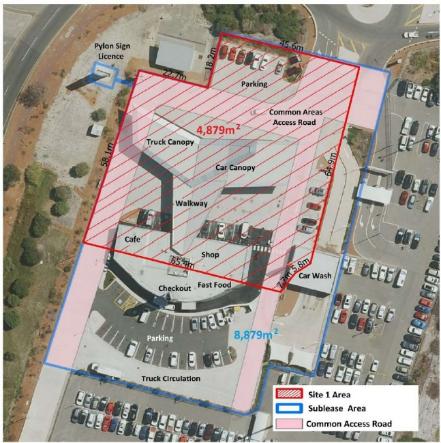
561 In oral closings I put to senior counsel for United: “[a]s I understand it, the evidence is that you would have leased a smaller plot of land, you would have built a Cheltenham-style service station, which cost far less, and you are claiming the difference between that and what you did expend”: [T543.32-35]. In response senior counsel said, “It’s almost correct. As the evidence has transpired what our different transaction case is lower rent … Which at the moment is lower rent for the site that we paid”: [T543.36-44]. Senior counsel then said, “and [United] would have built a smaller construction … could have been on the larger site too”: [T544.1-5].
562 However, later in oral closing submissions senior counsel for United said, “we put the case that your Honour should find on the balance of probabilities that that revised offer, lower rent, smaller construction site, would on the balance of probabilities have been accepted by Perth Airport”: [T549.8-11]. It is not clear if by “smaller construction site”, counsel was referring to Site 1, or was referring to the Cheltenham design (instead of the Millennium Concept).
563 In relation to the ‘alternative transaction’ case, PAPL submits that there is uncertainty as to whether United advances the case in relation to Site 1 or the Site. PAPL submits that in any event, “it’s very hard to see any world which the larger site would have been sought by United and agreed to by the Perth Airport if only a small service station were being proposed”: [T619.44-46].
564 PAPL submitted in closing that in relation to the loss of opportunity case, no such case is open on the pleadings and particulars. In its opening submissions PAPL referred to United’s reference to a “commercial valuable opportunity”, submitted that that proposition was not further developed, and made clear that was not the case PAPL was meeting. PAPL relies on Lantrak Holdings v Yammine [2023] FCAFC 156, Lee J said at [17] (Button J agreeing at [38]:
[I]t is necessary in a loss of opportunity case to specify the relevant opportunity, the material facts relied upon, and the amount of damages claimed. Usually, and ideally, this is done by a proper pleading of the type identified by Jackson J in Graham & Linda Huddy Nominees Pty Ltd v Byrne [2016] QSC 221 (at [50]–[51]), but at the very least, it is necessary to apprise the party meeting a loss of opportunity case of the case being run at the commencement of the case and the material facts relied upon in a way sufficient to provide procedural fairness.
565 At [288] in Lantrak Jackman J referred to Lee J’s finding in Lloyd v Belconnen Lakeview [2019] FCA 2177; (2019) 142 ACSR 445 as follows:
Mrs Lloyd had pleaded a loss of an identified commercial opportunity, but had not pleaded with specificity what she would have done and simply left it to the court to decide the actual degree of likelihood as anywhere between 100% and 1% if her case was not accepted that Belconnen would have totally capitulated in any such negotiation. Lee J said that although the generality of the pleading was not ideal, his Honour did not consider that there had been any relevant denial of procedural fairness in relation to the loss of opportunity to negotiate case generally, in that the pleading outlined in general terms the loss of opportunity to negotiate case and the forensic battleground marking out that aspect of the case was opened on, cross-examined upon, was defined by the end of the case and was the subject of competing submissions: [352]. The Full Court upheld the reasoning of Lee J at first instance, saying that their Honours were not satisfied that Lee J erred in concluding that the loss of opportunity to negotiate case was within the pleaded case, or at least the case as opened and run, for the reasons given by the primary judge, and noted in particular that the loss of opportunity case was the subject of evidence in Mrs Lloyd’s affidavit: Belconnen Lakeview Pty Ltd v Lloyd [2021] FCAFC 187; (2021) 156 ACSR 273 at [129] (Griffiths, Davies and Moshinsky JJ).
There were many potential lines of evidence, both in chief and in cross-examination, which would likely have been pursued if a case of a loss of a chance had been articulated. All that the appellants need to show is that the denial of procedural fairness deprived them of the possibility of a successful outcome, and in order to negate that possibility it would be necessary for this Court to find that a properly conducted trial could not possibly have produced a different result: Stead v State Government Insurance Commission (1986) 161 CLR 141 at 147 (Mason CJ, Wilson, Brennan, Deane and Dawson JJ). That is to be treated as a question of “realistic possibility”: Nathanson v Minister for Home Affairs [2022] HCA 26; (2022) 403 ALR 398 at [32] –[33] (Kiefel CJ, Keane and Gleeson JJ); [45] and [59] (Gageler J). The appellants have comfortably satisfied that test by being denied the opportunity to present evidence in chief on the question of the loss of valuable commercial opportunity, and to cross-examine Mr Yammine and others on that question. As Kiefel CJ, Keane and Gleeson JJ said in Nathanson at [33], “[t]here will generally be a realistic possibility that a decision-making process could have resulted in a different outcome if a party was denied an opportunity to present evidence or make submissions on an issue that required consideration”. Accordingly, it is clear that the Liemant Parties have been denied procedural fairness in a material way in relation to the calculation of damages by reference to the loss of a chance.
566 PAPL submitted in closing that it made clear in opening its case that it took exception to the loss of opportunity case which it says was the ‘faintest hint’ in United’s opening, and that then nothing more took place and the trial was conducted and the evidence was all taken on the basis of the case as pleaded. PAPL submits that it made decisions in the course of the trial, on the cross-examination, and to evidence-in-chief, on the basis of the pleaded and particularised case, and that it would be procedurally unfair to permit the un-pleaded loss of opportunity claim to be advanced in closing submissions: [T621.26-41]. Further, PAPL submits that it is not clear what United’s ‘implicit’ loss of opportunity case is – that is, whether it is a loss of opportunity to negotiate or a loss of opportunity to reach agreement.
567 In response to this, United relies on the inclusion of the words in [13(c)] of the ASOC “would have sought to negotiate more favourable terms” and in particulars (B) subjoined to [19] of the ASOC the words “if the United parties would have been able to negotiate more favourable terms, United’s loss … includes the difference between the burden of its obligations under the agreement for sublease, in their present form, and a lower burden of more favourable terms that the United parties would have negotiated” (emphasis added). United also submits that Mr Silver gave evidence-in-chief that were it not for the Representations he would “not have offered to design and build the Perth Airport Station” and “[i]nstead would have designed and built a different style of service station” and “would not offered or agree to pay $900,000 (excl GST) per annum”. United also submit that Mr Brinkworth gave evidence that he would have sought Mr Silver’s approval “to negotiate with PAPL”.
568 I accept PAPL’s submission on this point. I do not consider that a loss of opportunity case is open to United given the way that it pleaded and ran its case.
Expert evidence on loss and damage
569 There were three areas of expert evidence: Valuation, Economics and Quantity Surveying.
Valuation evidence
570 I found the expert’s joint report to be unhelpful and of no assistance to the Court, however nothing turns on this, as the alternative transaction case which United advances renders the Valuation evidence in the joint report is irrelevant, outside of the agreement on a value of the market rent (that is, exclusive of any exclusivity clause) for Site 1 as $350,000 per annum net plus GST as at 4 August 2017 (being when United submitted its tender).
571 I do not find Mr Volk’s expert report to be of assistance, as he conceded it was not a valuation.
572 There is some relevance to Mr Bradstreet’s valuations of the Site and Site 1, both with and without exclusivity, which has some bearing on the matter of whether United would have offered, and PAPL would have accepted, the lower rent for either the Site or Site 1. The difficulty with Mr Bradstreet’s evidence is that he was emphatic that because the United offer included an exclusivity clause, it was not referable to the market rental valuation. Mr Volk was not able to comment on this topic, but generally agreed exclusivity would have some effect.
Economic evidence
573 United, in its written and oral closing submissions does not appear to rely on the economic evidence as it disavows any reliance on or need to adduce evidence as to the profitability of the Perth Airport Service Station.
574 PAPL, in its written and oral closing submissions submitted that the economic evidence is consistent with the notion that United’s lease hold interest is valuable and needs to be brought to account in any determination of loss. PAPL submits that the evidence of the economists does not, however, permit the Court to determine the value of United’s lease hold interest.
575 I find the economic evidence tendered is of no assistance in calculating any loss and damage suffered by United on its alternative transaction case. The opinions expressed by the economists are simply not relevant to the alternative transaction case – including because the economists did not give evidence as to the effect on profit of the larger Site/service station. The economists gave evidence that traffic volumes effect the profitability of a service station, but they did not comment on the effect of the size of the station. Further, it is not to the point that the Perth Airport Service Station is profitable – the relevance of the profit can only be by way of including in the overall holistic analysis of United’s position, an assessment of profit in both the actual transaction and the alternative transaction case. Further, for reasons which will become clear, I have found that it is not appropriate in this case to account for the profitability of the Site.
Quantity Surveyors evidence
576 The parties are agreed that the actual costs to design and construct the Perth Airport Service Station, including construction and maintenance wages are $7,721,182.76.
577 The Quantity Surveyors agreed that the actual costs of construction of the United service station at Cheltenham, Victoria, are $ 4,210,901.09. The parties agreed that the estimated cost of constructing a hypothetical service station in Perth in 2021/2022, based on the design of the Cheltenham service station, is $5,071,800.68.
578 United’s claim is that it incurred actual capital expenditure in excess of $8.1 million to build the Perth Airport Service Station. United’s expert, Mr Glover, assessed that the total costs of constructing the Perth Airport Service Station (excluding construction and maintenance wages) were $7,596,323.26, with $6,045,918.78 being incurred by SHA, and $1,550,404.48 being incurred by United. Mr Roberts agreed with the overall total but gave no separate opinion on allocation.
579 United led supplementary evidence from Mr Szymczak to the effect that costs incurred by SHA ($6,259,986.5) ended up on United’s fixed asset register (see [171] of these reasons), and also evidence from Mr Mestrov to the effect that United had satisfied its debt to SHA of $6,583,138.80 (see [185]-[186] of these reasons). I accept PAPL’s submission that the effect of this evidence is to demonstrate that, pursuant to an accounting regime between SHA and United, United has incurred liability for the full amount found by the quantity surveyors (and agreed by the parties) to be applicable to the design and construction of the Perth Airport Service Station. Mr Mestrov’s evidence does not supplant the agreed amount, particularly in light of the lack of explanation in Mr Mestrov's third statement for the differences in the figures he has identified, and those assessed as applicable by the quantity surveyors. Neither party challenged the quantity surveyors’ opinions. Mr Szymczak did refer to SHA adding a margin to costs that it incurs and then passes on to United: [T279.40-42].
Analysis of loss and damage
580 PAPL submits that the fundamental problem with the manner in which United has sought to prove loss and damage is that United has not adduced evidence to establish the value of what it has acquired and currently holds as a result of the misleading conduct, namely, a lease hold interest in the Site with an operational service station for a further term of approximately ten years, plus multiple options to renew. PAPL submits it is necessary for United to bring those interests to account as part of establishing if it has suffered loss and damage. PAPL submits that the correct approach is the measure described by Dixon J in Potts v Miller (1940) 64 CLR 282 as the difference between the price paid and the true value at the time of acquisition. This involves proving that what has been received is worth less than what was paid for it. Where there is no satisfactory evidence of the value of the benefit received, a claim for the difference must fail. PAPL says this lacuna in the evidence is present in all formulations of United’s case on loss and damage (that is either formulation of the alternative transaction case and on the loss of opportunity).
581 PAPL submits that the need to bring value to account against monies expended before one can assess loss is a fundamental principle and United has failed to give the Court a holistic assessment of the benefits and burdens of United’s current position versus the benefits and burdens of the alternative position it says it should have been in. PAPL submits that one cannot just compare the two positions by looking at or comparing the rent in isolation or the construction costs in isolation. One has to look at United’s position in each scenario holistically, taking account of the rent and the construction costs in each, but also factoring in the value of what was obtained for that expenditure in each. PAPL submits that in the current situation, United has obtained an operational large asset that can be used to make money for an extended period of time, and which on the economic expert evidence is turning a profit. Therefore, United submits there is an assumption that because United is only claiming for the difference in rent and the difference in construction, that those differences do not yield any additional value, so by spending more on a bigger site and a bigger service station, versus spending less, there is no additional value.
582 United submits that the Potts v Miller approach may be applicable in a “no transaction” case but that is not the case made by United which is on the basis of the “alternative transaction”. Section 236(1) of the ACL does not prescribe any single approach to be adopted in the task of determining whether loss or damage was suffered “because of” the contravening conduct.
583 United refers to the following passages from Berry v CCL Secure Pty Ltd (2020) 271 CLR 151; [2020] HCA 27, where Gageler and Edelman JJ considered how the court should approach the assessment of loss under the relevant legislative provisions (being the equivalent sections of the TPA) at [65]:
Economic loss may take a variety of forms all of which involve the identification of some ‘prejudice or disadvantage’ that has occurred. Plaintiffs pursuing the statutory action are initially responsible for formulating how such loss or damage as they claim to have suffered is to be identified. The initial question must always be: ‘what loss or damage does the plaintiff allege’? The plaintiff then bears the legal onus of proving that the identified loss or damage has been suffered by the contravention of which they complain and of establishing the amount of that loss or damage. The plaintiff bears, in other words, the ultimate burden of establishing both the required connection with the contravention and quantum by inferences drawn from the whole of the evidence. That legal onus is constant.
[emphasis added]
584 However, Berry involved a loss of opportunity case, and specifically, the High Court was considering the legal and evidentiary onus in relation to establishing the value of the hypothetical opportunity. In the majority judgment, Bell, Keane and Nettle JJ said at [29]:
While a claimant bears the legal burden of establishing the amount of its loss or damage, the nature and circumstances of the wrongdoer’s conduct may support an inference or presumption that shifts the evidentiary burden. That accords with the principle encapsulated in Armory v Delamirie that, where a wrongdoer has destroyed or failed to produce evidence which the innocent party requires to show how much he or she has lost, it is just that the wrongdoer should suffer the resulting uncertainty … One relevant modern application of that principle is reflected in this Court’s decision in Amann Aviation, in which it was held that where, upon acceptance of the Commonwealth’s repudiation of a contract, Amann claimed damages for loss of the contract, Amann was entitled to recover “reliance damages” assessed on the basis of a rebuttable presumption that the net benefits to which Amann would have been entitled under the contract (if the contract had not been rescinded) would have been sufficient to cover the expenditure which Amann incurred pursuant to the contract. As Brennan J explained, because the Commonwealth had repudiated the contract and thereby deprived Amann of the ability to establish that the contract would have returned sufficient to recoup Amann’s contractual expenses, it was to be presumed that Amann would not have incurred its expenditure in reliance on the contract without a reasonable expectation that its performance of the contract would have returned it sufficient to recoup its expenses, and thus it was just that the Commonwealth should bear the ultimate onus of proving at least a prospect that Amann’s returns under the contract would not have been sufficient to recoup that expenditure. By contrast, as Brennan J observed, if a claimant seeks “expectation damages” for the loss of a chance that, had an agreement run to term, it may have been renewed or extended, the onus is on the claimant to establish those facts, although, even then, since the existence and degree of such an hypothetical possibility is, by reason of the wrongful termination of the contract, incapable of proof on the balance of probabilities, it is considered just that the wrongdoer should suffer the resulting uncertainty to the extent that proof to the level of a real (more than negligible) possibility is regarded as enough. The worth of the chance is then valued by a process of informed estimation.
585 In Berry, the practical burden shifted to the representor, because the relevant issue was to “show on the balance of probabilities” that the relevant agreement would have been terminated, by the representor, through an affirmative exercise of its contractual right to terminate: at [70] (Gageler and Edelman JJ). That does not bear any similarity to the question of loss in this case, being, relevantly, whether United needed to bring to account the value of the leasehold interest, and specifically the income-producing asset that is the Perth Airport Service Station.
586 United also refers to Viterra Malt Pty Ltd & Others v Cargil Australia Ltd (2023) 74 VR 1; [2023] VSCA 157 (Sifris, Walker and Whelan JJA), where the Court of Appeal said, relevantly, at [1078]:
In our opinion there is no single correct approach to the assessment of loss or damage under s 236 of the Australian Consumer Law. The determination of the appropriate approach to assessment of loss was not a binary choice between the Potts v Miller approach and the ‘left in hands’ approach. As [HTW Valuers (Central Qld) Pty Ltd v Astonland Pty Ltd (2004) 217 CLR 640; [2004] HCA 54]demonstrates, in a given case both approaches might be open. It is thus necessary, in our opinion, for the Viterra Parties to identify specific error by the judge in order to succeed. It would not be sufficient for an appellate court simply to take a different view. But, in any event, we do not take a different view about whether Potts v Miller was the appropriate approach to damages; we consider that the trial judge was correct to use that approach.
587 That is to be understood in light of what the Court said earlier at [873]:
The principles to be drawn from these High Court authorities as to the measure of damage where a party is misled or deceived into acquiring an asset are the following:
(1) The measure described by Dixon J in Potts v Miller as the difference between the price paid and the true value at the time of acquisition is ‘well established’ as ‘usually applicable’ (Gould v Vaggelas, per Gibbs CJ). It has been ‘consistently held’ to be the ‘proper measure’ (Kizbeau), and described as ‘commonly employed’ (HTW Valuers).
However, the legislation does not prescribe this approach: it is no more than a guide (HTW Valuers). It is a particular application of the general principle that a plaintiff is entitled to recover a sum representing the prejudice or disadvantage suffered as a consequence of altering its position (Gould v Vaggelas).
…
(5) One reason why the Potts v Miller approach is generally adopted is the desirability of separating out losses resulting from extraneous factors in the later history of the asset (HTW Valuers). This is particularly so where there has been a significant lapse of time.
(6) A ‘left in hands’ approach may be particularly appropriate where no issue of separating out subsequent losses resulting from extraneous events arises (HTW Valuers).
(7) There is not a binary choice between a Potts v Miller approach and a ‘left in hands’ approach (and there may be other options in certain cases) in which one option is wrong and the other correct. Both might be open in a given case (HTW Valuers). In every case, the initial question is: what loss does the claimant allege (Berry)?
588 However, this submission is somewhat misguided. In Gould v Vaggelas [1985] HCA 75; (1985) 157 CLR 215 at 220, Gibbs CJ said the Potts v Miller rule is “only a special application of the general principle that in an action for deceit a plaintiff is entitled to recover a sum representing the prejudice or disadvantage suffered as a consequence of altering his position under the inducement”: and see Viterra Malt at [834], discussing Gould v Vaggelas. Gibbs CJ then went onto consider the circumstance where the plaintiff might receive more than the difference in value, being, relevantly, where a party affirms a contract, on discovering the fraud, their loss is not confined to the Potts v Miller analysis if the fraudulent inducement has led to further losses – sometimes referred to as the ‘left in hands’ approach: see Viterra Malt at [835]-[842].
589 In Marks, McHugh, Hayne and Callinan JJ explained that there will be no relevant loss unless it is shown that the party could have acted in some other way which would have been of greater benefit or less detriment to it than the course it in fact adopted. In HTW Valuers (Central Qld) Pty Ltd v Astonland Pty Ltd (2004) 217 CLR 640; [2004] HCA 54, the Court (Gleeson CJ, McHugh, Gummow, Kirby and Heydon JJ) analysed the authorities and noted at [35] that the approach of “subtracting value from price” is “commonly employed” where there is an acquisition induced by deceit. The Court emphasised at [36] that a key qualification which prevents this approach from being inflexible is that the ‘test’ depends not on the difference between price and market value, but on the difference between price and real value. As Dixon J said in Potts v Miller, real value must be ascertained in the light of events which subsequently happen where those events show what was the true value of the thing acquired at the time it was acquired: see HTW Valuers at [38].
590 As can be seen, the approach in Potts v Miller is not a rule, but a guide which can be used in an appropriate case, particularly where the plaintiff advances a claim for loss and damage on a “no transaction” basis. In Mills v Walsh [2022] NSWCA 255, the New South Wales Court of Appeal said at [122]:
The appellant rightly submitted that the rule in Potts v Miller is not an invariable one. However, what is fundamental is that the purpose of compensation is to remediate the prejudice or disadvantage the plaintiff has suffered in consequence of altering its position under the inducement of the fraudulent misrepresentations made by the defendant, which necessarily involves bringing to account value received against moneys expended.
591 I do not find the parties submissions on Potts v Miller and HTW Valuers to be particularly helpful in determining the correct method of determining the loss suffered by United.
592 The first question, as made clear by the High Court in Berry, is: what loss is United claiming? United is claiming loss in having entered into a lease for $900,000 for the Site and building the Millennium Concept, rather than having entered into a transaction for rent of $500,000 for either the Site or Site 1 and building the smaller Cheltenham design. United’s case is thus confined to lost or wasted expenditure, and not to loss of profits. The question then is the difference between the position of United in each of those scenarios – that is, United must show that it is (or is likely to be) “worse off” by reason of the alleged conduct, meaning by having entered into the transaction instead of the alternative transaction.
593 I am not persuaded by PAPL’s submission that United needed to account for the difference in profit between the Site and the alternative transaction. I am of this view, in part because the profitability of the Site and the Perth Airport Service Station is, on the economic expert evidence, tied to traffic volume. Part of the Representations which I have found to be misleading, is that there would have been an increase in the traffic volume following the Qantas Relocation. United has seemingly made a forensic decision, no doubt due to the inherent difficulty in speculating the profit based on the forecast traffic volume post-Qantas Relocation, to frame its case as one of wasted expenditure. More importantly, as I have said above, the issue of loss depends on what the plaintiff is claiming. In the present case, I am satisfied that the approach to the assessment of loss and damage advanced by United is, in all the circumstances, appropriate, and reject PAPL’s submission that United has failed to prove its loss and damage by failing to bring to account the value of the lease hold interest in the site. This is particularly so where such evidence would be inherently speculative.
Factual findings on causation and the counterfactual
594 Mr Silver, the primary decision-maker for United, in respect to the Perth service station site, gave evidence that, but for the Qantas Relocation and the associated increase in traffic, he would have designed and built a different style and smaller service station at a cost of approximately $4 million to $4.5 million and would have agreed to pay up to $500,000 in rent. Mr Silver’s evidence on this point was not challenged in cross-examination. It was not put to Mr Silver that he would have paid a figure higher than $500,000 or that he would not have changed the service station design but for the Representations. I found Mr Silver’s evidence to be logical, reasonable and compelling. His evidence was consistent with the Site being not sufficiently profitable without the Qantas Relocation, given that United did not own the real property of the site and would not generate a capital return from the land on which it has constructed the Millennium Concept Perth Airport Service Station: [T207.40] to [T208.15-30]. I accept Mr Silver’s evidence.
595 Mr Silver’s evidence was consistent with Mr Hirsch’s evidence, that he would have expected United to pay less and that he would have deferred to Mr Silver in relation to price. Mr Silver’s evidence was also consistent with the evidence of Mr Brinkworth. Mr Brinkworth gave evidence that, were it not for the Qantas Relocation, Mr Brinkworth would have considered United’s rent offer for the Site would be substantially less – something in the vicinity of 40%-50% less than the $900,000 (excl GST) per annum United agreed to pay – and that United would have offered to build a smaller and cheaper service station reducing capital expenditure by about 40%. Mr Brinkworth was not challenged in cross-examination on this point. I accept Mr Brinkworth’s evidence.
596 A fundamental issue with each of Mr Silver and Mr Brinkworth’s evidence (and Mr Hirsch to a lesser extent) is that their evidence is not clear as to whether they are asserting United would have offered (and PAPL would have accepted) a rent of $500,000 for the Site or for Site 1.
597 In Wyzenbeek v Australasian Marine Imports Pty Ltd (In Liq) (2019) 272 FCR 373; [2019] FCA 167 the Full Court (Rares, Burley and Anastassiou JJ) said at [71]:
In Astonland at [35], Gleeson CJ, McHugh, Gummow, Kirby and Heydon JJ explained that while the approach of subtracting value (“sometimes described as the rule in Potts v Miller”) from price was commonly employed where deceit has induced the acquisition of land, chattels, businesses or shares, it is not an inflexible approach that is universal or rigid. They held that, “provided that there is some evidence of damage, in the field of assessing damages for fraud, ‘as in other fields, a tribunal of fact must do the best it can in assessing damages’” (Ted Brown Quarries Pty Ltd v General Quarries (Gilston) Pty Ltd (1977) 16 ALR 23 at 26 per Barwick CJ) (Astonland at [47]). Moreover, their Honours said (at [50]) that both the estimate of market value and the assessment of damages based on an estimate of true value “must be an inexact process”.
(emphasis added).
598 Therefore, doing the best I can, as a matter of logic that evidence must be understood as referring to an offer for Site 1. The larger Site was only necessary for United to build the larger Millennium Concept service station. It would be illogical for United to offer to lease the Site if it was not building the Millennium Concept service station. I make this inference with greater confidence given Mr Szymczak’s evidence that but for the Representations, United would have negotiated a smaller site to leave, of around 4,879 m2 (being Site 1), to accommodate the smaller Cheltenham style service station (see [160] of these reasons). Whilst Mr Szymczak was not centrally involved in the submission of the tender and the AFSL negotiation, his evidence gives me greater confidence in finding that United would have offered to lease the smaller Site 1. This is particularly so in the circumstances where the Information Brochure and the RFP invited tenders to lease Site 1. It was United that put in a tender for the larger Site. I find that if PAPL had not engaged in the misleading conduct, United would not have put forward the offer to lease the Site, and would have submitted a tender for Site 1.
599 Mr Skinner gave evidence that he would have been in favour of PAPL selecting BP in a scenario where BP and United “offered to pay comparable rent and all things were equal”. However, that scenario did not arise. BP’s formal offer was $350,000 for Site 1 (4,879 m2). The evidence is that BP never formally increased its offer above $350,000. Mr Skinner gave evidence that he had the discussion with someone at BP whose surname and job title he cannot recall: [T337.10-45]. Mr Skinner’s evidence was that he asked that unidentified person whether BP would increase its rent. BP apparently responded verbally, during the same telephone conversation, that it would increase its rent to $450,000, but BP would not provide percentage rent if it went to $450,000 and would increase the site size: [T337.30-35]. That offer was never formally submitted in writing. Mr Skinner conceded in cross-examination that the offer was not a firm commitment: [T 338.0-5].
600 Mr Skinner accepted in cross-examination that if United had offered $500,000 per annum to lease Site 1 that it would be substantially higher than the $350,000 per annum offered by BP, and it would have been above the market parameters assessed by Colliers: [T338.35-40].
601 Mr Skinner gave evidence that he was directed by the FIC to progress negotiations with both United and BP. Mr Skinner also gave evidence that in a scenario where United offered only $500,000 for Site 1, he would have pursued BP more vigorously: [T338.41]-[T339.24].
602 Mr Holden initially did not concede that if United offered $500,000 for Site 1 it would have been significantly higher than the BP offer. However, this evidence was on the basis that Mr Holden understood there to have been a firm offer of $450,000 from BP: [T362.9-42]. When asked to consider a scenario where BP had only offered $350,000 for Site 1 and United had offered $500,000 for Site 1, Mr Holden agreed that the United offer would have been “a high offer” and would have been higher than the market parameters considered by the Colliers Report: [T363.1-17].
603 The expert evidence of Mr Bradstreet was that he adjusted the value of the United offer to account for the fact the offer included an exclusivity clause, more favourable turnover rent provisions and was for the larger Site area (and not Site 1), compared to, in particular, the BP offer. On this adjusted valuation the base rent of the United offer was $315,000 compared to the BP offer of $350,000. PAPL submits that that opinion was not available to PAPL at the time, but PAPL submits it does provide some objective support, in the nature of a ‘sense-check’, for the proposition that the merits of the hypothetical United offer and the BP offer would have been relatively close, and that PAPL may well have favoured the BP offer in the scenario under consideration. Mr Bradstreet also valued Site 1 as at April 2019 at $562,000 per annum with exclusivity and $352,000 per annum without exclusivity. In my view this evidence is more helpful than Mr Bradstreet’s adjustments to the United offer to allow for a like-for-like comparison with the BP offer. The valuations show that United’s offer of $500,000 for Site 1 with an exclusivity clause was (a) above market value and (b) only marginally below the value Mr Bradstreet prescribed to the Site with an exclusivity clause.
604 On 23 November 2018, Mr Holden presented a paper to the PAPL board to seek approval to enter into the AFSL with United. That paper recorded that:
United is an independent, privately owned company specializing in the retail and wholesale fuel markets, convenience stores and ethanol manufacture. United owns and operates over 340 service stations across all Australian states and employs over 2,500 staff.
The Finance team has reviewed the consolidated financial statements and other information provided for United Petroleum Australia Pty Ltd and its controlled entities and advised that it could not identify any major areas of concern. This was supported by a Dun & Bradstreet credit report which indicates a ‘minimal failure’ and ‘late payment’ risk. United Petroleum Australia Pty Ltd is the holding company for the group and will act as guarantor for the ground lease which will be further supported by a $1.8 million bank guarantee.
605 In the alternative transaction counterfactual, PAPL would have had an offer from BP for Site 1 of $350,000 (granted with no exclusivity clause) and an offer from United for $500,000 for Site 1 (granted with an exclusivity clause).
606 Mr Holden gave evidence that PAPL had an internal process that must be followed to get approval from the board to enter into an agreement for the Sublease like the AFSL. PAPL did not adduce any evidence from the board, as the ultimate decision-maker, about whether it would have agreed to lease the Site to United for $500,000. No board member was called by PAPL to give that straightforward evidence. No satisfactory explanation has been provided by PAPL as to why it has not adduced evidence from board members on whether PAPL would have agreed to lease the Site to United for $500,000. As I have previously observed, the tendering of documentary evidence as to when members left the PAPL board or employees ceased being employed by PAPL is not of itself sufficient to explain the failure to call any of these witnesses. There is no evidence that these witnesses would not cooperate with PAPL’s legal advisors, or that they refused to give evidence at trial.
607 Neither Mr Skinner nor Mr Holden could point to any compelling reason why the board would not accept United’s offer of $500,000 to lease the Site. Their evidence, at its highest, was that they would need to consider the numbers.
608 In these circumstances, informed by the principles in Blatch v Archer and Jones v Dunkel, I infer that the uncalled evidence would not have assisted PAPL’s case and I infer with greater confidence that, on balance, the PAPL board would have agreed to lease Site 1 to United for $500,000.
609 I accept the evidence of Mr Silver, Mr Hirsch and Mr Brinkworth that, but for the Representations, United would not have agreed to pay PAPL $900,000 per annum (excl GST) for rent, but instead United would only have agreed to pay $500,000 for Site 1. I find that United would have built the Cheltenham design service station at an approximate cost of $4 million to $4.5 million.
610 I also find on the evidence that, on balance, the PAPL board would have accepted $500,000 for the smaller Site 1 Ground Lease and, accordingly, I have found, on the balance of probabilities, that United has established its “alternative transaction” case. United is entitled to recover loss and damage under the two heads of damage claimed for excess rent and excess capital cost to construct the “flagship” Peddle Thorp design service station.
Excess rent
611 United claims under the first head of damage, excess rent, being the difference between the rent payable under the AFSL and Sublease of $900,000 and the rent it would have paid and offered under the counter-factual, but for the impugned conduct of $500,000 for the 15-year initial term. The difference in gross rent is $400,000, with a 3% increase per annum, multiplied by 15 years. As United submitted, there will need to be further submissions on the exact quantification, taking into account the time value of money.
Excess construction costs
612 United claims, under the second head of damage, the difference between the actual costs incurred in building the “flagship” Peddle Thorp designed Millennium Concept service station under the terms of the AFSL and Sublease of $7,721,182.67 less the cost to construct the smaller hypothetical Cheltenham design service station in the sum of $5,071,800.68, being a loss of $2,649,381.99.
DISPOSITION
613 Judgment will be entered in favour of United on its claims in the proceeding. I direct that the parties confer and submit to my chambers proposed minutes of orders which reflect my reasons for judgment and quantify United’s loss and damage, interest and costs.
I certify that the preceding six-hundred and thirteen (613) numbered paragraph is a true copy of the Reasons for Judgment of the Honourable Justice Anderson. |
Associate:
Dated: 20 May 2026
ANNEXURE A – GLOSSARY OF TERMS
Term | Definition |
ACL | Australian Consumer Law, being Sch 2 of the Competition and Consumer Act 2010 (Cth). |
AFSL | Agreement for Sublease dated 17 April 2019 between PAPL and United in relation to the Site. |
Addenda 1 | A document emailed by PAPL to United on 14 July 2017 containing questions asked by tenderers and PAPL’s answers and annexing the Perth Airport design guidelines. |
Airport Central | The precinct at Perth Airport comprising Terminals 1 and 2, identified as the location for consolidated passenger terminal facilities. Depicted in the image underneath [37]. |
Airport West | The precinct at Perth Airport comprising Terminals 3 and 4, from which Qantas operated at the relevant time. Depicted in the image underneath [37]. |
Amanda Jacobs | Leasing Development Manager in the Property Team at PAPL for at least part of the Relevant Period. |
ASOC | United’s Amended Statement of Claim. |
Avi Silver | Co-founder and director of United. Called as a witness for United. |
Cheltenham Design | A simpler standard service station design constructed by United at Cheltenham, Victoria in 2018, relied on by United as the counterfactual design in its alternative transaction case. |
Claude Mestrov | General Manager of Finance at United. |
Colliers Report | Market review of the service station industry by Colliers International dated 10 October 2017 |
Consolidation | The relocation of all commercial passenger air services at Perth Airport to Airport Central. |
Darren Searle | Executive General Manager of United during the Relevant Period. |
David Skinner | Senior Property Manager in the Property Team at PAPL during the Relevant Period (job title was Senior Leasing & Development Manager up to May 2023). Mr Skinner was called as a witness for PAPL. |
David Szymczak | Current CEO of United (and has held that position since July 2020). Prior to that he was the COO of United. Called as a witness for United. |
Design Guidelines | Perth Airport’s design guidelines. |
Development Agreement | Agreement dated 4 May 2017 between PAPL and Qantas containing mutual obligations to use best endeavours to achieve Consolidation by 31 December 2025. |
Eddie Hirsch | Co-founder and director of United. Called as a witness for United. |
FIC | PAPL Finance and Investment Committee. |
Further Representations | The representations pleaded by United that: (i) Qantas Group is expected to relocate all international and domestic flights from Terminal 3 and Terminal 4 located at Airport West, to Airport Central in the mid to late 2020s completing the consolidation of commercial air services in Airport Central; and (ii) When Qantas relocates from Airport West to Airport Central in the mid to late 2020s it is expected that traffic volumes will almost double on Airport Drive from 40,000 to 78,000 per day; (iii) PAPL in fact held the expectations, opinions or states of mind set out in (a) and (b); and (iv) PAPL had reasonable grounds for the expectations, opinions or states of mind |
Gary Brinkworth | United’s Chief Executive Officer from October 2016 to 31 January 2020. Mr Brinkworth was called as a witness for United. |
Geoff Manolitsa | United’s General Counsel during the Relevant Period. |
GIS | Geographical Information System (a centralised PAPL online system, maintained by the design team (part of the Planning team) |
Ground Lease | A lease where the tenant is responsible for developing and maintaining any buildings and improvements to the land; whilst the lessor owns the land, the lessee owns any improvements and buildings on the land. |
IB Qantas Representations | The representations said to arise from the Information Brochure that: (a) the Qantas Relocation will occur by the mid to late 2020s; and (b) when the Qantas Relocation is complete, traffic volumes on Airport Drive abutting the Site, will almost double from the estimated 40,000 vehicles per day in 2024 to 78,000 vehicles per day, and ultimately to an estimated 94,000 vehicles per day by 2031. |
Information Brochure | The document titled “Information Brochure – Airport Service Station Opportunity” provided by PAPL to United (and other prospective tenderers) on 6 July 2017 as part of the tender process. |
Monica Anderson | Senior Airport Planner at PAPL within the Planning Team. |
Millennium Concept | The distinctive flagship design for the Perth Airport Service Station prepared by Peddle Thorp Architects, featuring aeroplane-inspired elements. |
Natasha Boshard | PAPL’s Design Director for the upcoming new terminal for Qantas at Airport Central. Previously the General Manager of PAPL’s Planning Team from 27 April 2023 to 15 April 2024 and head of planning from 7 October 2019. Between early 2020 and late 2022, Ms Boshard was a member of PAPL’s Senior Leadership Team. Ms Boshard was called as a witness for PAPL. |
PAPL | Perth Airport Pty Ltd, the respondent and lessor of the Site. |
Perth Airport Project | Consideration and work by United of its tender for the Site, and work on the Perth Airport Service Station. |
Perth Airport Service Station | The service station constructed and operated by United at the Site at Airport Central. |
Post AFSL Qantas Representation | The allegation by United that by the press release and the letter on 7 August 2020, PAPL represented to United that the Qantas Relocation will occur by 2025. |
Proposal Site | Initial site that was in United’s initial offer, being 8,000 m2, and was valued by United’s expert valuer, Mr Volk. |
Qantas | Qantas Airways Ltd. |
Qantas Agreements | The Qantas Heads of Agreement and the Development Agreement relied upon by PAPL in relation to Consolidation. |
Qantas Heads of Agreement | Heads of Agreement dated 10 December 2016 between PAPL and Qantas to use best endeavours to achieve Consolidation by 31 December 2025. |
Qantas Relocation | The relocation of Qantas’ domestic and international terminal operations from Airport West to Airport Central. |
Qantas Representations | The representations pleaded by United that: (i) As part of PAPL’s consolidation of commercial air services in Airport Central, Qantas will relocate all its domestic and international flights from Terminals 3 and 4 in Airport West to Airport Central (being the Qantas Relocation) by: (A) 2025; and (B) further and alternatively, by the mid to late 2020s. (ii) When the Qantas Relocation is complete, traffic volumes on Airport Drive, a road abutting the Site, will almost double from the estimated 40,000 vehicles per day in 2024 to 78,000 vehicles per day, and ultimately to an estimated 94,000 vehicles per day by 2031. |
RFP | Document entitled “Request for Proposals – Airport Central Precinct Service Station”, issued by PAPL to prospective tenderers on 6 July 2017. |
Relevant Matters | The matters set out in Annexure A to the ASOC. United alleges PAPL’s failure to disclose these matters to United constituted misleading conduct. |
Relevant Period | The period from 6 July 2017, when the tender documents were sent to United, to 17 April 2019, when the AFSL was executed. |
Representations | The Qantas Representations and the Further Representations. |
Retail Hub | The proposed Airport Central retail hub comprising a service station site and adjacent food and beverage sites. See the image depicted at [190]. |
Sam Carmeli | The National Acquisitions Manager at United during the Relevant Period. |
SHA | SHA Premier Constructions Pty Ltd, a related group company of United. |
Site | The land at Airport Central, approximately 8,879 m2, leased by United from PAPL pursuant to the AFSL and Sublease. |
Site 1 | The smaller service station site put forward by PAPL in the Information Brochure and RFP, approximately 4,879 m2. |
Steve Holden | PAPL’s Chief Commercial Officer during the Relevant Period. Called as a witness for PAPL. |
Sublease | The sublease dated 17 May 2021 between PAPL and United in respect of the Site. |
Top Lease | A lease where the lessor is responsible for constructing and lease and base building to the tenant and the tenant is responsible for the fit out and operation of the service station. |
United/United Parties | United Petroleum Pty Ltd and United Petroleum Australia Pty Ltd, collectively the applicants. |
United Petroleum Australia | United Petroleum Australia Pty Ltd, the holding company of United Petroleum Pty Ltd. |
United Petroleum | United Petroleum Pty Ltd. |


