

FEDERAL COURT OF AUSTRALIA
Challenor v QSuper Board [2026] FCA 617
File number(s): | VID 691 of 2021 |
Judgment of: | BUTTON J |
Date of judgment: | 21 May 2026 |
Catchwords: | REPRESENTATIVE PROCEEDINGS – application for approval of settlement of representative proceeding – s 33V of the Federal Court of Australia Act 1976 (Cth) – principles relevant to settlement approval – whether proposed settlement fair and reasonable – whether proposed settlement distribution scheme just – whether deductions from settlement sum should be allowed in favour of solicitors and litigation funder – where contradictor and costs referee appointed – relevance of after-the-event insurance to funder’s commission – whether late registrants permitted to participate – whether suppression and non-publication orders should be made – settlement approved with aggregate discount applied to funder’s deductions |
Legislation: | Federal Court of Australia Act 1976 (Cth) ss 33V, 33ZF, 37AE, 37AF, 37AG Family Law Act 1975 (Cth) Corporations Act 2001 (Cth) ss 1017B, 1041H Superannuation Industry (Supervision) Act 1993 (Cth) s 52 Superannuation (Unclaimed Money and Lost Members) Act 1999 (Cth) |
Cases cited: | BMW Australia Ltd v Brewster [2019] HCA 45; (2019) 269 CLR 574 Caason Investments Pty Ltd v Cao (No 2) [2018] FCA 527 Camilleri v Trust Co (Nominees) Ltd [2015] FCA 1468 Cargill Australia Ltd v Viterra Malt Pty Ltd (No 23) [2019] VSC 417; (2019) 58 VR 611 Cook v Pasminco (No 2) [2000] FCA 1819; (2000) 107 FCR 44 Country Care Group Pty Ltd v Director of Public Prosecutions (Cth) (No 2) [2020] FCAFC 44; (2020) 275 FCR 377 Court v Spotless Group Holdings Ltd [2020] FCA 1730 CSR Ltd v Eddy [2008] NSWCA 83; (2008) 70 NSWLR 725 Darwalla Milling Co Pty Ltd v F Hoffman–La Roche Ltd (No 2) [2006] FCA 1388; (2006) 236 ALR 322 Earglow Pty Ltd v Newcrest Mining Ltd [2016] FCA 1433 Elliott-Carde v McDonald’s Australia Ltd [2023] FCAFC 162; (2023) 301 FCR 1 Endeavour River Pty Ltd v MG Responsible Entity Ltd [2019] FCA 1719 Esso Australia Resources Ltd v Commissioner of Taxation (Cth) [1999] HCA 67; (1999) 201 CLR 49 Evans v Davantage Group Pty Ltd (No 3) [2021] FCA 70 Ewok Pty Ltd v Wellard Ltd [2024] FCA 296 Fowkes v Boston Scientific Corporation [2023] FCA 230 Galactic Seven Eleven Litigation Holdings LLC v Davaria [2024] FCAFC 54; (2024) 302 FCR 493 Ghee v BT Funds Management Ltd [2023] FCA 1553 Horsky v Mesoblast Limited [2024] FCA 1509 Iddles v Fonterra Aust Pty Ltd [2023] VSC 566 Ingram v Ardent Leisure Ltd [2024] FCA 836 Janssen v OnePath Custodians Pty Ltd (No 2) [2026] FCA 291 Jenkins v Northern Territory of Australia (No 4) [2021] FCA 839 J&J Richards Super Pty Ltd v Nielsen (No 2) [2025] FCA 431 Kain v R&B Investments Pty Ltd [2025] HCA 28; (2025) 99 ALJR 1138 Kemp v Westpac Banking Corp (No 4) [2023] FCA 830 Kirby v Centro Properties Limited (No 2) [2012] FCA 70; (2012) 87 ACSR 229 Krieger v Colonial First State Investments Ltd [2024] FCA 1402 Kuterba v Sirtex Medical Limited (No 3) [2019] FCA 1374 Lee v Deputy Commissioner of Taxation [2023] FCAFC 22 Liverpool City Council v McGraw-Hill Financial Inc [2018] FCA 1289 McDonald v Commonwealth [2025] FCA 380; (2025) 309 FCR 584 Money Max Int Pty Ltd v QBE Insurance Group Ltd [2016] FCAFC 148; (2016) 245 FCR 191 Perera v GetSwift Ltd [2018] FCA 732; (2018) 263 FCR 1 Prygodicz v Commonwealth (No 2) [2021] FCA 634; (2021) 173 ALD 277 Riverine Grazier Pty Ltd v Google LLC [2025] FCA 895 Shimshon v MLC Nominees Pty Ltd [2020] VSC 640 Shimshon v MLC Nominees Pty Ltd [2021] VSCA 363; (2021) 66 VR 277 Webb v GetSwift Ltd (No 7) [2023] FCA 90; (2023) 165 ACSR 650 Williams v FAI (No 4) [2000] FCA 1925; (2000) 180 ALR 459 |
Division: | General Division |
Registry: | Victoria |
National Practice Area: | Commercial and Corporations |
Sub-area: | Commercial Contracts, Banking, Finance and Insurance |
Number of paragraphs: | 128 |
Date of last submission/s: | 27 April 2026 |
Date of hearing: | 16 April 2026 |
Counsel for the Applicant: | WAD Edwards KC with T Chalke |
Solicitor for the Applicant: | Shine Lawyers |
Counsel for the Respondent: | J Rudd |
Solicitor for the Respondent: | Mallesons |
Counsel for the Intervener: | A Folie SC with J Gracie |
Contradictor: | K Loxley SC with T Rawlinson |
ORDERS
VID 691 of 2021 | ||
| ||
BETWEEN: | JESSICA AMY CHALLENOR Applicant | |
AND: | QSUPER BOARD (ABN 32 125 059 006) Respondent | |
order made by: | BUTTON J |
DATE OF ORDER: | 21 May 2026 |
THE COURT ORDERS THAT:
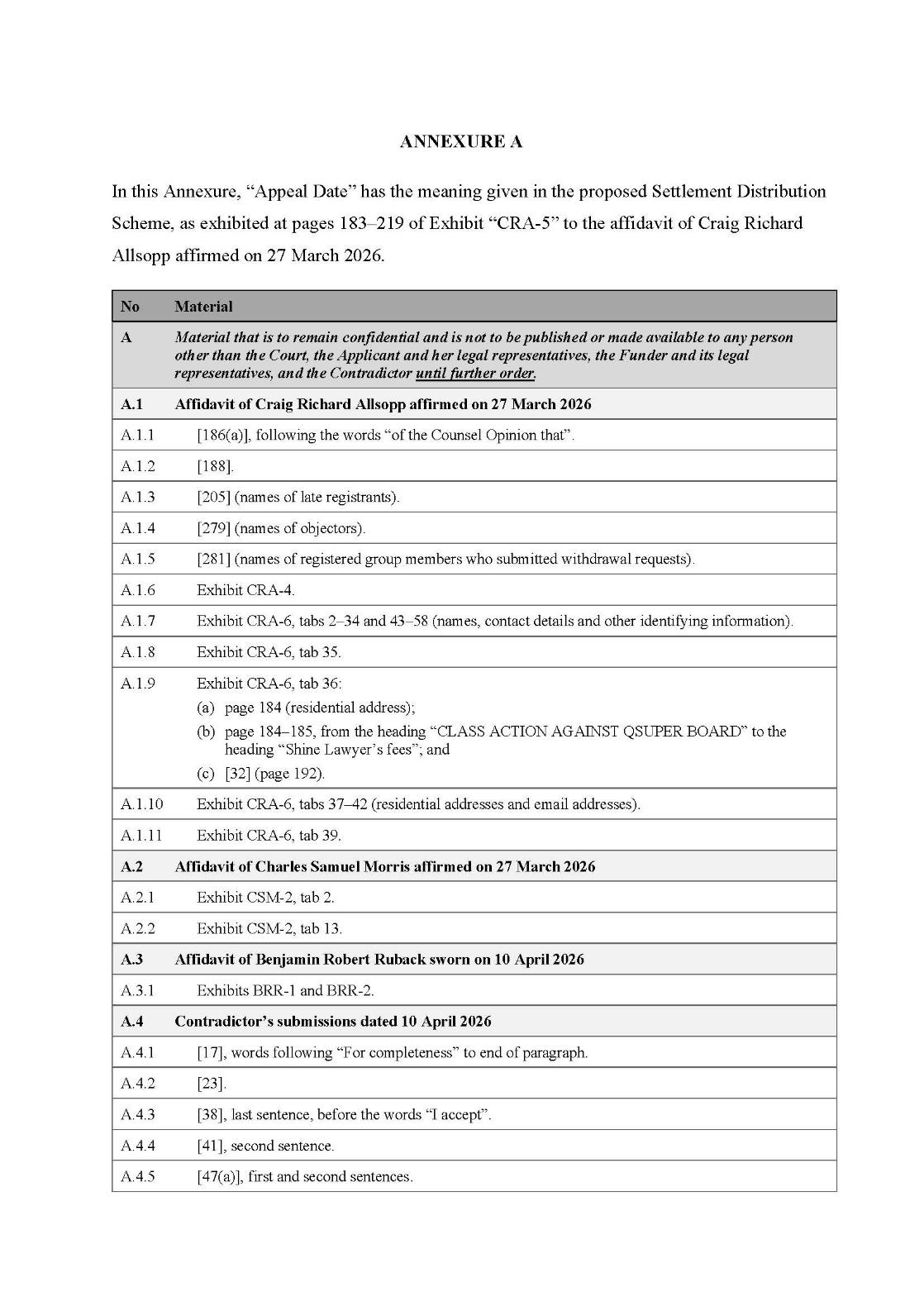
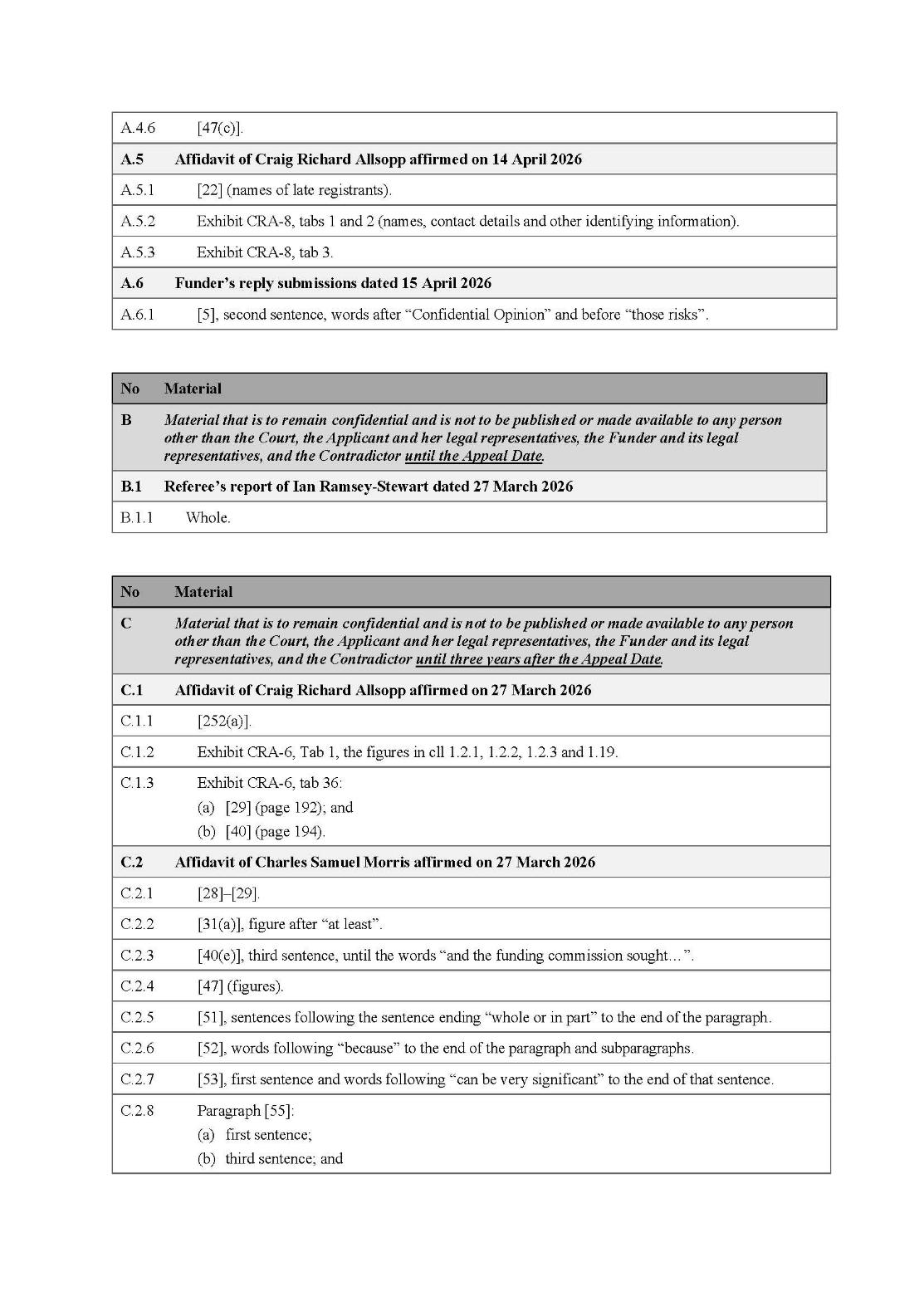
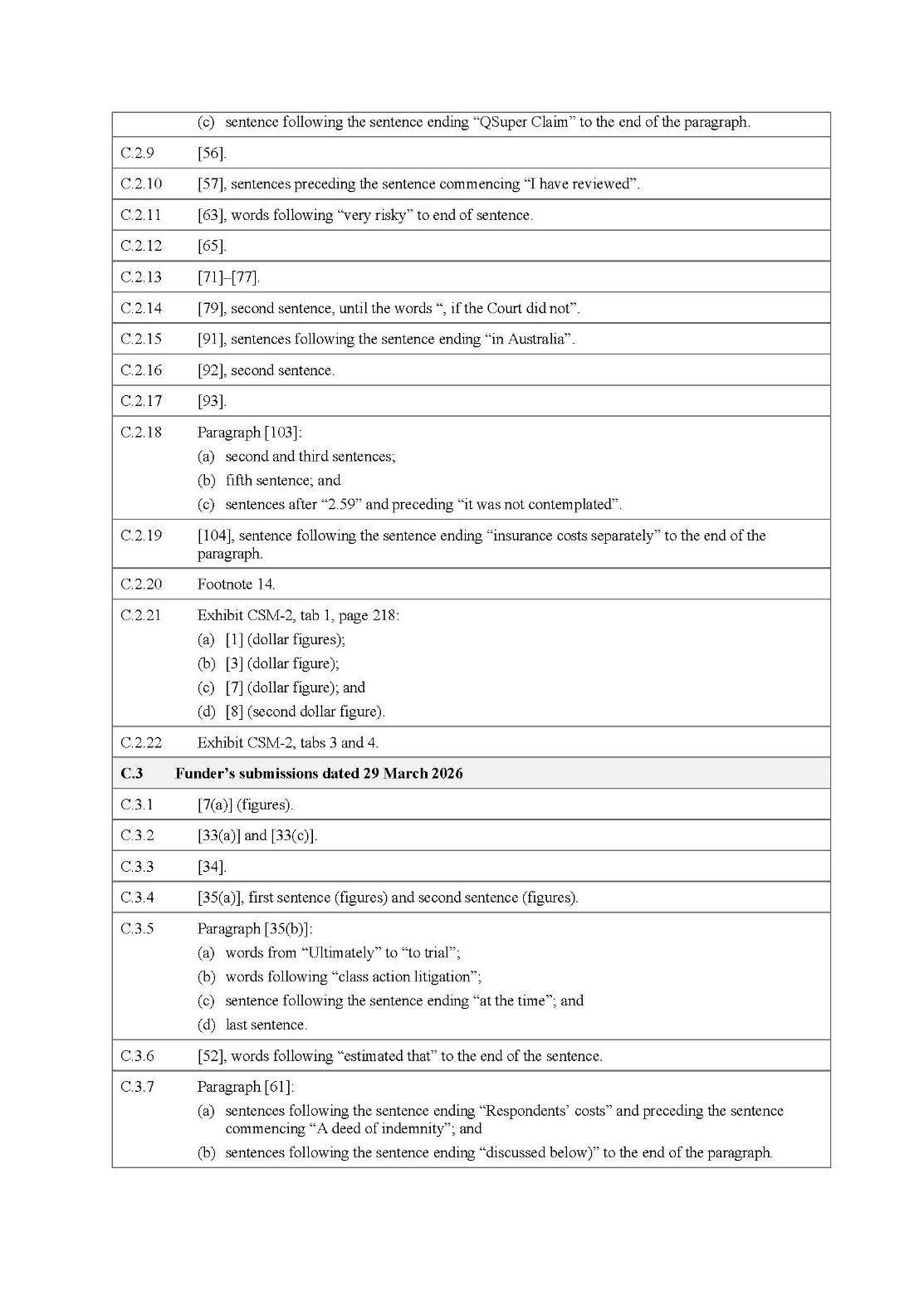
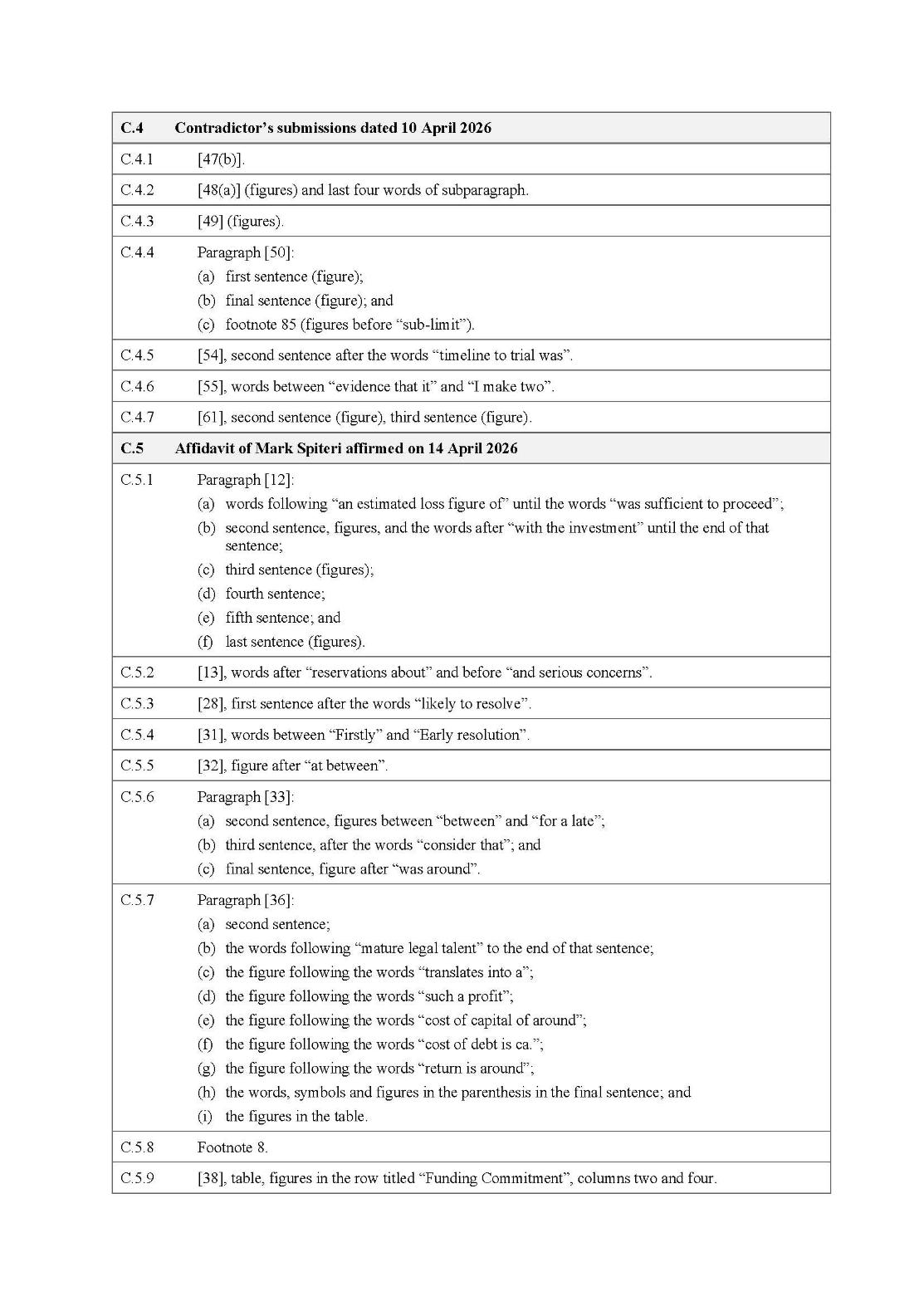
1. Until further order, pursuant to ss 37AF and 37AG(1)(a) of the Federal Court of Australia Act 1976 (Cth) and/or the Court’s implied or inherent jurisdiction, on the ground that the order is necessary to prevent prejudice to the proper administration of justice, the material identified by way of Annexure A to these orders is not to be disclosed to the people, and for the periods, identified therein.
2. The parties are to submit a proposed form of order giving effect to the Court’s reasons.
Note: Entry of orders is dealt with in Rule 39.32 of the Federal Court Rules 2011.
REASONS FOR JUDGMENT
BUTTON J:
INTRODUCTION
1 This proceeding was commenced by Jessica Amy Challenor (the Applicant) on 23 November 2021 against the QSuper Board (the Respondent), being the trustee of the QSuper superannuation fund (the QSuper Fund). The proceeding is a representative proceeding brought under Pt IVA of the Federal Court of Australia Act 1976 (Cth) (the Act).
2 The proceeding concerns changes made in July 2016 to the terms on which the Respondent provided insurance to its members. Those changes were the result of a transition from QSuper’s death, total permanent disability (TPD) and income protection (IP) insurance products being self-insured by QSuper, to being insured under a group insurance policy entered into with QInsure Pty Ltd (QInsure), an indirect subsidiary of the QSuper Board.
3 Before those changes, insurance premiums were determined without regard to the member’s occupation. After the changes took effect, members were given the option of being “occupationally rated” and having their insurance premiums set by reference to their occupational rating. For members with lower risk occupations who were eligible to be rated “Professional” or “White Collar”, being occupationally rated would materially reduce their insurance premiums. Members who were eligible for the “Standard” rate would also pay somewhat lower premiums than the default rate, provided they were 39 years of age, or younger. Members were required to make an election in order to be occupationally rated. Those who did not so elect were charged the “default” rates. The group members in the proceeding are the fund members who would have been eligible for these lower rates, had they made the election, together with certain related persons (recipients of eligible fund members’ death benefit payments, and former spouses who received all or part of an eligible fund member’s interest in the QSuper Fund under the Family Law Act 1975 (Cth)).
4 The Applicant advances three claims in relation to the insurance changes:
(1) The Notice Case: the Applicant alleges that the Respondent contravened s 1017B(1) of the Corporations Act 2001 (Cth) (Corporations Act) by failing to provide the information necessary for members to “understand the nature and effect” of the insurance changes, because the disclosures provided to members did not make sufficiently clear: (a) who could expect to pay lower insurance premiums if they elected to be occupationally rated; and (b) that it was necessary to make a written election to be occupationally rated.
(2) The Misleading Conduct Case: the Applicant alleges that certain communications sent by the Respondent to members of the QSuper Fund contained statements that were misleading or deceptive or likely to mislead or deceive, contrary to s 1041H of the Corporations Act, because they conveyed — incorrectly — that members did not have to take any steps in order to obtain the benefits of being occupationally rated under the insurance changes, when in fact members had to make an election in writing to be occupationally rated.
(3) The Systems Case: the Applicant alleges that the Respondent breached its statutory duties to take reasonable care and act in the best interests of members under ss 52(2)(b) and (c) of the Superannuation Industry (Supervision) Act 1993 (Cth) (SIS Act), as well as its general law duties to exercise due care, skill and diligence in acting as trustee of the QSuper Fund, because it failed to institute a system whereby members of the fund would be occupationally rated automatically.
5 In February 2022, the QSuper Fund was merged with another fund by successor fund transfer, at which point the Respondent ceased to be the trustee of the QSuper Fund. The merged fund was renamed “Australian Retirement Trust” (ART) and its trustee became Australian Retirement Trust Pty Limited (ARTPL).
6 In November 2024, the matter was set down for trial in December 2025. An initial mediation, held in November 2024, did not settle the matter. A second mediation, held on 22 May 2025, resulted in the parties agreeing to settle the proceeding for $67 million. The Settlement Deed was not executed until late September 2025.
FEATURES OF THE SETTLEMENT AND PROPOSED SETTLEMENT DISTRIBUTION SCHEME
7 The settlement sum is $67 million. Interest accruing on the sum contributes to the pool of funds available for distribution.
8 The materials before the Court on the settlement approval application, and made available to group members, included the proposed Settlement Distribution Scheme (SDS).
9 Under the terms of the SDS, the Settlement Administrator will be the Applicant’s lawyers, Shine Lawyers Pty Ltd (Shine). Shine has, to date, been operating the registration portal that will be used to calculate the sums due to each participating group member. Once the figures have been calculated, the Settlement Distributor will make the actual payments. ARTPL will be the Settlement Distributor.
10 In order to account for the relative strength of the claims of different cohorts of group members, the SDS operates by allocating “units” to each group member. Members allocated to the Professional/White Collar pool will be allocated 14 units, and members allocated to the Standard pool will be allocated 1 unit. This disparity reflects the extent to which discounts on insurance rates were available depending on the occupational pool to which the person could be allocated. For the purposes of administering the settlement, the allocation of group members to a particular pool will be done by the Settlement Administrator. There is a process for review of the allocation decision, but ultimately the decision will be made by the Settlement Administrator.
11 Some group members did not receive the Notice, the May Email or the May Letter in May 2016, which formed the basis of the Notice Case and the Misleading Conduct Case. This cohort is referred to as System Group Members, reflecting the fact that they only have available to them the Systems Case, as described above. Members in this cohort, who are allocated to the Professional/White Collar pool, will be allocated 4 units, and those in the Standard pool will be allocated 0.3 units.
12 The SDS does not make any provision for adjustment to the number of units to be allocated to (and hence the amount to be paid to) group members based on the level of insurance they took out, or the period of time when they had insurance. In other words, the distribution is “flat”.
13 It is proposed to apply a de minimis threshold of $20 on the basis that it is uneconomic to distribute amounts below that level. There was evidence before the Court that, as at 27 March 2026, there were 64 registered group members who would be excluded by this threshold.
14 Following the making of approved deductions from the settlement sum, the net sum available for distribution will be calculated and, from that, the value of each unit will be calculated and the entitlement of each member will be determined.
15 For those entitled to payment who are members of ART — the successor fund to the QSuper Fund — the payment will be made into the member’s ART account. Payments to other group members will be made according to the person’s rollover or other instructions held by ARTPL. Payments in respect of deceased estates will be made to the ATO under the Superannuation (Unclaimed Money and Lost Members) Act 1999 (Cth). ARTPL will attempt to contact persons entitled to a payment who do not fit within any of these groups, or where a payment cannot be effected, but any amounts incapable of being paid over by these methods will also be paid to the ATO as unclaimed monies.
16 If all deductions for which approval is sought are approved, the net sum available for distribution is expected to be approximately $36,636,573.66. This equates to 54.68% of the settlement sum. Based on presently available calculations, it is expected that a member in the White Collar/Professional pool will receive $610.33 (14 units), and members in the Standard pool will receive $43.60 (1 unit). It is expected that System Group Members in the White Collar/Professional pool will each receive $174.40 (4 units), while those in the Standard pool will receive nothing as their entitlement ($13.08) is below the $20 de minimis threshold.
17 The deductions against the settlement sum, for which approval has been sought, are as follows:
(a) $18,425,000 (being 27.5% of the settlement sum) as commission payable to the funder (Woodsford Litigation Funding 10 LLP (Funder));
(b) $117,512 for the Funder’s costs of establishing and administering the managed investment scheme (MIS) for the purpose of funding the proceeding;
(c) $2,705,000 for the Funder’s after-the-event (ATE) insurance costs, and the fees for the deeds of indemnity that it provided to the Respondent by way of security for costs;
(d) $8,240,540.62 for the Applicant’s legal costs and disbursements, which includes a 25% uplift on solicitors’ fees that were not funded by the Funder and were carried by Shine;
(e) $40,000 as a compensation payment to the Applicant and the Sample Group Member ($20,000 each) for their role in representing group members in the proceeding; and
(f) up to $835,373.72 for the Settlement Administrator’s reasonable expenses of administering the settlement in accordance with the SDS.
18 The Funder initially also sought approval of a deduction ($47,300) on account of its legal fees in intervening in the settlement approval application. By seeking approval of that deduction, the Funder sought to impose on group members the burden of the legal fees of its intervening in the settlement approval hearing in pursuit of its own interest in pursuing many millions of dollars in commission and other deductions. This brazen and unjustified “nickel and diming” of group members was dropped by the Funder during the running of the hearing.
THE COURT’S APPROACH TO SETTLEMENT APPROVAL APPLICATIONS
19 Section 33V of the Act governs the settlement of representative proceedings. It states:
33V Settlement and discontinuance—representative proceeding
(1) A representative proceeding may not be settled or discontinued without the approval of the Court.
(2) If the Court gives such an approval, it may make such orders as are just with respect to the distribution of any money paid under a settlement or paid into Court.
20 In my recent reasons in Janssen v OnePath Custodians Pty Ltd (No 2) [2026] FCA 291 (Janssen), at [56]–[60], I summarised the principles applicable to an application under s 33V with reference to a number of earlier decisions. For present purposes, it suffices to reiterate the following principles:
(1) First, the Court’s central task under s 33V(1) is to determine whether the proposed settlement is fair and reasonable and in the interests of group members as a whole, including as between group members inter se: Webb v GetSwift Ltd (No 7) [2023] FCA 90; (2023) 165 ACSR 650 at [15] (Murphy J); Camilleri v Trust Co (Nominees) Ltd [2015] FCA 1468 (Camilleri) at [5(a)] (Moshinsky J).
(2) Secondly, where approval is given, s 33V(2) requires the Court to determine what orders are just with respect to the distribution of settlement proceeds. That assessment is necessarily fact-specific and directed to ensuring that the distribution achieves an equitable outcome among those who have benefited from the proceeding: Kemp v Westpac Banking Corp (No 4) [2023] FCA 830 (Kemp) at [20] (O’Bryan J).
(3) Thirdly, in undertaking its task under s 33V, the Court recognises that there is not usually a single or clearly preferable way in which a settlement should be structured; reasonableness is a range and the Court does not second-guess the commercial or forensic judgments of those best placed to make them, provided that the settlement, viewed as a whole, falls within the range of reasonable outcomes having regard to the circumstances of the proceeding and the risks reasonably perceived at the time: Horsky v Mesoblast Limited [2024] FCA 1509 at [13]–[14] (Beach J); Darwalla Milling Co Pty Ltd v F Hoffman–La Roche Ltd (No 2) [2006] FCA 1388; (2006) 236 ALR 322 at [50] (Jessup J).
21 Those principles reflect the three central propositions identified by Lee J in Fowkes v Boston Scientific Corporation [2023] FCA 230 (Fowkes) at [41] (emphasis in original):
(1) first, the central question is whether the proposed settlement is fair and reasonable in the interests of group members considered as a whole;
(2) secondly, there will rarely be one single or obvious way in which a settlement should be framed, either between the claimants and the respondents (inter partes aspects) or in relation to sharing the compensation among claimants (the inter se aspects); and
(3) thirdly, reasonableness is a range. The question is whether the proposed settlement falls within that range; it is not the task of the Court to second-guess or go behind the tactical or other decisions made by the applicant’s legal representatives, but rather to satisfy itself that the decisions are within the reasonable range of decisions, having regard to the circumstances known or knowable; and a reasonable assessment of risks.
22 Additionally, in Williams v FAI (No 4) [2000] FCA 1925; (2000) 180 ALR 459, Goldberg J identified nine factors commonly relevant to the assessment of a settlement approval, including the complexity and likely duration of the litigation, the risks of establishing liability and loss, the stage of the proceeding, and the reaction of group members: at [19]. These factors are also substantially reflected in the Class Actions Practice Note at [15.5] and have been applied in a number of cases: eg, Prygodicz v Commonwealth (No 2) [2021] FCA 634; (2021) 173 ALD 277 at [8] (Murphy J) and J&J Richards Super Pty Ltd ATF The J&J Richards Superannuation Fund v Nielsen (No 2) [2025] FCA 431 (J&J Richards) at [20] (Halley J). As Lee J observed in Fowkes, however, the factors do not constitute a mandatory or exhaustive checklist, but rather serve as a guide to the Court’s evaluative task: at [34].
23 As I observed in Janssen at [60], quoting Kemp at [17] (O’Bryan J), the Court will ordinarily have regard to the terms of any advice received from counsel (and any independent expert) in relation to issues arising in the proceeding, noting that such counsel opinions are ordinarily provided on a confidential basis and made the subject of a confidentiality order: Class Actions Practice Note at [15.1(a)(i)].
CONSIDERATION OF ISSUES ARISING IN RELATION TO THE QSUPER SETTLEMENT
Notices to group members
24 An Opt Out Notice was issued to group members in February 2023. In addition to explaining the nature of the proceeding and composition of the group, the notice informed the group that:
(a) the Applicant had signed a litigation funding agreement with the Funder;
(b) under the terms of that agreement, the Funder was paying the Applicant’s legal costs and Shine was deferring some of their costs (how much was not stipulated);
(c) if the action was successful, the Funder would be repaid “any reasonable costs advanced” (including any interim adverse costs, security or upfront insurance premiums relating to ATE insurance or adverse costs insurance), the Funder’s funding commission, unpaid insurance premiums due under any ATE insurance policy, as well as Shine’s deferred fees together with an uplift of 25% on those deferred fees; and
(d) a common fund order would be applied for, and the Applicant would apply for an amount to be paid to the Funder equal to 27.5% of the “Gross Proceeds” referred to in the litigation funding agreement.
25 A Notice of Proposed Settlement (NoPS) was issued to group members pursuant to orders made on 19 November 2025 (November 2025 Orders). Those orders made provision for a registration process and fixed 27 February 2026 as the registration deadline.
26 The NoPS stated that the settlement sum was $67 million and that the estimated total deductions for which approval would be sought was approximately $30,990,000. That total was said, in the summary section of the notice, to comprise:
• $7,230,000 in legal costs and disbursements incurred prior to the issue of the notice;
• $2,705,000 in adverse costs insurance and costs of insurer deeds for security for costs;
• $220,000 additional cash outlay that has been paid, or is estimated will be paid, by Woodsford in connection with the class action, representing costs associated with the managed investment scheme and other fees and costs incurred by the funder in relation to the class action;
• $320,000 for an uplift to Shine Lawyers of 25% of the legal fees not paid by the funder;
• $950,000 as an estimate of the future cost of progressing the proceeding to the settlement approval hearing;
• $1,100,000 for the costs of administering the settlement (some incurred prior to settlement approval);
• $18,425,000 in litigation funding commission (27.5% of the settlement sum);
• $20,000 each for reimbursement payments to the Applicant and Sample Group Member.
27 The NoPS referred to the draft SDS that was available to download from Shine’s website, and explained that the dollar amount a member could expect to receive could not yet be accurately estimated. The NoPS said as follows in relation to the litigation funding commission and ATE insurance:
Litigation Funding Commission
38. Throughout the course of the class action, Woodsford provided litigation funding to the Applicant on the terms set out in the LFA. Under this arrangement, Woodsford paid some of the legal costs incurred in prosecuting the class action, including the cost of solicitors, barristers and experts.
39. In return for the funding that Woodsford has provided for the Applicant's costs (as distinct from the adverse costs risk, which is discussed further below), Woodsford charges a litigation funding commission. As notified in the opt-out notice to Group Members distributed in 2023, the Applicant intends to apply to the Court for a Common Fund Order under which Woodsford would be paid a litigation funding commission of 27.5% of the settlement sum.
Adverse Costs Insurance
40. Adverse costs are costs of the successful party in the litigation that the Court may order the unsuccessful party in the litigation to pay.
41. To protect against the risk of adverse costs, Woodsford:
(a) indemnified the Applicant against liability for any adverse costs order made against the Applicant; and
(b) obtained adverse costs insurance to:
(i) provide the Applicant and Group Members with additional protection against the risk of adverse costs (the ATE insurance policy expressly covers adverse costs payable by the Applicant); and
(ii) assist the Applicant to provide security for the Respondent's costs (for example by purchasing deeds of indemnity from the adverse costs insurer).
(c) In return for this protection against the risk of having to pay adverse costs, and as notified in the opt out notice, the Applicant agreed to apply for the cost of any such insurance, including any deferred and contingent insurance premiums, to be payable from the settlement sum, subject to Court approval.
28 The NoPS further provided information regarding the registration process and deadline, and how group members could lodge objections.
29 In February 2026, the Respondent identified that various group members had not received the Opt Out Notice or the NoPS as they had not been included in the relevant data extract. This group was referred to as “Additional Group Members”. Pursuant to orders made on 2 March 2026 (March 2026 Orders), they received a combined opt out and settlement notice (referred to as the Supplementary Notice). The Supplementary Notice provided the same substantive information about the settlement and proposed deductions as had been provided in the NoPS. The registration deadline for Additional Group Members was fixed at 10 April 2026.
Objections
30 The November 2025 Orders set 27 February 2026 as the deadline for group members to submit any objections to Shine. Pursuant to the March 2026 Orders, the Additional Group Members had until 10 April 2026 to submit any objections.
31 As at the settlement approval hearing, 32 objections were received by Shine. 19 of those were ultimately withdrawn, having been incorrectly submitted, as they were attempts to register to participate in the proposed settlement, rather than to object to it. Of the remaining objections:
(1) Five were either blank, incomplete or provided no stated or coherent basis for the objection.
(2) Five objections were substantive. These substantive objections fall broadly into the following categories (noting that some objections raise more than one point):
(a) the overall deductions for legal costs and funding commission are too high, resulting in a disproportionate benefit to the Applicant’s lawyers and the Funder;
(b) the settlement payments do not reflect the compounding growth that was lost by excessive premiums being deducted from group members’ capital;
(c) the SDS fails to adequately account for the length of time a member was on the wrong premium rate; and
(d) the payments to the Applicant and the Sample Group Member were too low.
(3) One further objection related to an individual’s personal circumstances. Broadly, this person objected to his eligibility to participate being assessed by reference to QSuper’s records, in circumstances where his insurance cover had been retrospectively cancelled and his premiums refunded following the settlement of a TPD claim. The Applicant submitted that this person was not a group member as contemplated by paragraph 3 of the Further Amended Statement of Claim dated 19 December 2024, a position with which the Contradictor agreed. I accept that submission.
32 In relation to the five substantive objections, the Applicant and the Funder do not consider these to be an impediment to the proposed settlement approval. The Applicant and the Funder each submit that the relatively small number of substantive objections weigh in favour of the Court approving the settlement. While evidence of a small number of objections may weigh in favour of settlement approval, it does not relieve the Court of its obligation to properly scrutinise the proposed settlement to ensure that it is in the best interests of group members: Money Max Int Pty Ltd v QBE Insurance Group Ltd [2016] FCAFC 148; (2016) 245 FCR 191 (Money Max) at [50] (Murphy, Gleeson and Beach JJ). This is especially the case where the NoPS did not disclose the specific quantum of the payment amounts to individual group members. Some caution is therefore warranted in drawing conclusions from the relatively small number of objections received.
33 The Applicant, the Funder and the Contradictor otherwise address the substantive objections in their submissions on the merits of the proposed settlement, and I will adopt the same approach.
The fairness of the settlement
34 The settlement was reached close to trial, when the evidence was in, putting the Applicant’s legal team in a good position to assess the prospects of the case both as to liability and quantum. The principal risks identified in the Applicant’s submissions concerned a lack of authority on s 1017B of the Corporations Act, and questions of law and fact concerning the Systems Case, as well as matters of proof concerning damages claims in respect of the Misleading Conduct Case. The risks faced by the Applicant’s case were addressed in more detail in the confidential opinion of counsel. I am satisfied that the gross settlement sum is fair and reasonable.
35 The next matter to consider is the fairness of the settlement between group members inter se.
36 As detailed above, the SDS heavily discounts the claims of group members in the Standard occupational rating group, as compared with those in the White Collar and Professional occupational rating groups. That heavy discount is, in my view, warranted and fair in light of the difference between the insurance premiums to which those group members would have been entitled and the much lower insurance premiums that would have been payable by those in the White Collar and Professional occupational rating groups, and hence the damages claims of those two groups.
37 I am also satisfied that the lack of any differential treatment of those in the White Collar rating group and those in the Professional rating group does not give rise to any unfairness in the proposed distribution of the net settlement sum. There was only a minor (no more than 5%) difference between the insurance premiums to which the two cohorts would have been entitled (and hence their theoretical damages claims), which would likely be overshadowed by the additional time and cost that would be incurred by the Settlement Administrator in attempting to differentiate between them.
38 The SDS does not involve any further calibration with respect to a member’s age, the number of units of insurance held, or the period over which the group member held the insurance whose premiums were said to be too high. The latter point was the subject of two objections from group members, who cited the compounding effect that higher insurance premiums would have on their superannuation account balances over an extended period. It is well accepted that the optimum calibration of schemes for the distribution of settlement sums has to be balanced against the costs that would be occasioned by finer-grained settlement schemes: Camilleri at [43(d)] (Moshinsky J); Caason Investments Pty Ltd v Cao (No 2) [2018] FCA 527 at [96] (Murphy J); Earglow Pty Ltd v Newcrest Mining Ltd [2016] FCA 1433 at [87] (Murphy J). I accept the Applicant’s submission that, given that there are more than 66,000 registered group members, the benefits of a more exact distribution to reflect these differences would be outweighed by the inefficiency and cost of achieving that outcome.
39 As noted above at paragraph 11, the System Group Members did not receive the May Email, the May Letter or the Notice. The only claim available to this cohort of group members is the Systems Case. The number of units to be allocated to these group members will depend on whether they are in the White Collar/Professional occupational group, or the Standard occupational group. The number of units to be allocated constitutes a discount against the number of units each group member in this cohort would have been allocated had they also had available to them the Notice Case and/or the Misleading Conduct case. This is a reasonable and fair approach, notwithstanding that it involves “broad brush” discounts.
40 As noted above, the SDS proposes a de minimis threshold of $20. This threshold is justified given that the time and cost of administering such amounts is not warranted, relative to their quantum. As a result of the de minimis threshold, the System Group Members who are allocated to the Standard occupational group are unlikely to receive any payment under the proposed settlement.
The funding arrangements
41 It is necessary, for the purposes of assessing the proposed deductions from the settlement sum, to set out some further detail of the funding arrangements.
42 Shine only approached one third-party litigation funder. That was the Funder. The Litigation Finance Agreement (LFA) (referred to in notices to group members as the Litigation Funding Agreement) was dated 13 April 2022.
43 The salient features of the LFA are as follows:
(1) One of the conditions precedent was the Funder effecting ATE insurance for its potential adverse costs liability, with the limit of indemnity, insurer and terms being acceptable to the Funder.
(2) The LFA specified three categories of costs that, together, were “Action Costs”, as defined: lawyers’ fees (ie, Shine’s fees), third-party costs (counsel’s fees and other costs, but not ATE insurance-related costs) and upfront (but not deferred or conditional) insurance premiums for ATE insurance. A sub-limit was specified for each of these three categories. The sub-limit for lawyers’ fees and third-party costs (principally counsel and expert fees) were almost identical. The sum of the sub-limits for these three categories was the overall “Costs Limit”. While the LFA remained on foot, the Funder was obliged to continue to meet third-party costs even if they exceeded the specified sub-limit, and had the discretion to fund further lawyers’ fees.
(3) The “Funder’s Success Fee” was defined as the amount equal to 27.5% of the Gross Proceeds.
(4) The LFA provided for two phases. During Phase 1 — being the period commencing June 2021 until (the earlier of) six months after the commencement of the proceeding, or the filing of the Respondent’s defence — the Funder could terminate the agreement with immediate effect without cause. During Phase 2 (ie, from the end of Phase 1 onwards), the Funder was (absent termination for a material and irremediable breach) entitled to terminate without cause by giving 15 business days’ notice. Notwithstanding termination of the LFA during Phase 2, the Funder would retain a contractual entitlement to its Funder’s Success Fee on any Gross Proceeds, save that its entitlement would be limited, pro rata, to the proportion of the total fees, third-party costs and other expenses of the action as the Funder in fact paid.
(5) During Phase 1, the Funder was not obliged to pay any of Shine’s fees — it was only required to pay third-party costs and to indemnify the Applicant — but if the Funder did not exercise its right to terminate during Phase 1, it would, on the commencement of Phase 2, be liable to pay lawyers’ fees incurred during Phase 1 (at the 75% rate noted at paragraph 44 below), up to a very modest limit of $300,000 (including GST).
(6) The Funder was to provide security for costs, if so ordered, with the costs being “Additional Action Costs”.
(7) The Applicant was obliged to seek orders approving deductions from settlement proceeds, including in respect of the cost of operating the MIS.
(8) The Funder had the exclusive option, but not the obligation, to fund any appeal.
(9) Although the LFA was not express on this point, its terms and limits — and the context of the very large group size — lead to the conclusion that it only obliged the Funder to fund the pursuit of the Applicant’s personal claim and common issues, and did not oblige the Funder to fund whatever subsequent stages might be required after a common trial, to assess the claims of each individual group member.
44 The Funder was only obliged to fund 75% of Shine’s fees (subject to other limits). Shine carried the unfunded 25% of its fees on a no-win no-fee basis, with the costs agreement between the Applicant and Shine specifying a 25% uplift to those fees in the event of a successful outcome.
Deductions for legal costs
45 Approval was sought for a sum total of $8,240,540.62 in deductions in respect of legal costs and disbursements, comprising:
(a) reimbursement to the Funder of $6,257,305 in respect of Shine’s fees and disbursements paid by the Funder (and an amount which had been invoiced, but not yet paid, at the time of the settlement approval hearing); and
(b) payment to Shine of its deferred fees and anticipated legal costs to the date of the settlement approval application, in the amount of $1,983,235.62, including 25% uplift.
46 Various information was provided in the NoPS regarding proposed deductions, but the legal costs were not specified. Those costs could be deduced by anyone willing to undertake the relatively simple mathematical exercise of deducting the specified non-legal costs from the total proposed deductions advised. The Applicant accepted that the notice “could have been more clearly stated”. It not only could have been, it should have been. Nevertheless, in circumstances where the total proposed deductions was stated, along with information regarding deductions to be sought in relation to non-legal costs, I do not consider that the detail in the NoPS was so deficient as to weigh in the Court’s assessment of the proposed deductions, save that the lack of detail is relevant in considering the significance to be accorded to the low number of objections.
47 Mr Ian Ramsey-Stewart prepared a costs referee’s report assessing the reasonableness of the legal costs incurred, and the sum proposed to be incurred by Shine in respect of settlement administration costs. Mr Ramsey-Stewart concluded that the reasonable solicitor and own-client costs and disbursements of the Applicant up to the settlement approval hearing was between $7,971,654.29 and $8,010,471.72 (including GST and uplift). Mr Ramsey-Stewart reviewed Shine’s billing records closely and disallowed amounts in various categories including a “bulk time reduction” for units claimed in excess of 3.5 hours, a reduction of amounts charged for travel, a deduction for amounts incurred in relation to commercial arrangements between the lawyers and the Funder, a small percentage reduction for amounts with only general billing descriptions, and a reduction for telephone attendances.
48 Mr Ramsey-Stewart also applied reductions coming to approximately $200,000, comprising a disallowance in respect of work for which Shine had not yet rendered an invoice, and a disallowance in respect of costs thrown away by reason of the need to issue the Supplementary Notice after it was discovered that there were group members who had not received the Opt Out Notice or the NoPS. The latter amount was disallowed on the basis that the Applicant has the benefit of an order that the Respondent pay costs in respect of that matter.
49 The Applicant submitted, and the Contradictor agreed, that the latter two deductions should not be imposed, the first on the basis that the costs were still incurred even though Shine had yet to render an invoice (which it said it intended to do upon approval of the settlement), and the second on the basis that the sum referred to by Mr Ramsey-Stewart was the amount of the solicitor-client costs incurred in respect of the issue of the Supplementary Notice, whereas the amount to be paid by the Respondent was yet to be quantified and the Applicant’s proposed orders seek that the amount to be paid by the Respondent be paid into the settlement fund. I accept that, for the reasons advanced by the Applicant and the Contradictor, it is appropriate that these amounts not be deducted in calculating the approved deductions on account of legal costs.
50 Four objections raised concerns about the overall deductions for legal costs and the Funder’s commissions being excessive, resulting in a disproportionate benefit to the Applicant’s lawyers and the Funder.
51 While substantial, the legal costs are appropriate having regard to the nature of the proceeding and the potential recoverable losses, which were the subject of confidential evidence. The application of a 25% uplift on fees carried by Shine on a no-win no-fee basis is fair and reasonable, and provided for in the costs agreement between the Applicant and Shine.
52 Deductions from the settlement sum for legal fees and disbursements will be approved in the amount of $8,240,540.62, comprising:
(a) $6,257,305 to the Funder for paid legal costs and disbursements; and
(b) $1,983,235.62 to Shine (including 25% uplift).
Administration costs
53 A deduction of up to $835,373.72 will be approved for administration costs, which incorporates a 10% buffer over Shine’s estimate, as recommended by the costs referee. Mr Ramsey-Stewart has reviewed the estimate — which, based on an assumed 90,500 group members, came to about $9.23 each (including GST) — and considered it to be reasonable. In the course of the settlement approval hearing, it was confirmed that the total settlement administration costs will be fairly accurately known by the time the final amount to be distributed to each group member is calculated. By this means, to the extent that the actual settlement administration costs fall below the approved cap, the balance will form part of the settlement sum to be distributed to group members.
54 A deduction up to a maximum of $835,373.72 will be approved for administration costs.
Funding commission, ATE insurance costs and MIS costs
55 The more contentious proposed deductions are those sought by the Funder in respect of ATE insurance costs, and the costs of registering and operating the MIS in respect of this proceeding.
Authorities on funding commissions and ATE insurance
56 Where, as part of a proposed settlement distribution, orders are sought providing for a litigation funder to receive a funding commission (including on a settlement common fund order (CFO) basis), the relevant enquiry is whether the orders sought are “just” within the meaning of s 33V(2) of the Act: Kain v R&B Investments Pty Ltd [2025] HCA 28; (2025) 99 ALJR 1138 (Kain) at [10], [19] (Gageler CJ); see also at [70]–[74] (Gordon, Steward, Gleeson and Beech-Jones JJ).
57 The Court’s supervision of litigation funding charges recognises that funding commissions are often the largest single deduction from group members’ recoveries and are negotiated in circumstances of information asymmetry: Money Max at [72] (Murphy, Gleeson and Beach JJ). That supervision is directed to ensuring an appropriate and proportionate reward for the risk assumed, not to driving funding rates to the lowest possible level: Ghee v BT Funds Management Ltd [2023] FCA 1553 at [128] (Murphy J), citing Kuterba v Sirtex Medical Limited (No 3) [2019] FCA 1374 at [12] (Beach J) and Endeavour River Pty Ltd v MG Responsible Entity Limited [2019] FCA 1719 at [29] (Murphy J).
58 In determining whether it is “just” to make such an order (and if so, at what rate), the Court undertakes a commonsense evaluative assessment informed by the factors identified by the Full Court in Money Max at [80] (Murphy, Gleeson and Beach JJ). Those considerations include:
(a) the terms of any funding agreement;
(b) the litigation risks involved in providing funding in the proceeding;
(c) the risk and quantum of any adverse costs exposure assumed by the funder;
(d) the legal costs expended, and any security for costs provided, by the funder;
(e) the amount of any settlement or judgment (to facilitate an assessment of whether the aggregate commission is proportionate to the risks assumed);
(f) the extent to which group members were informed of the value and form of the commission sought, and the mechanism by which it would be payable;
(g) any substantial objections raised by group members to the proposed funding charges;
(h) the extent to which astute or sophisticated group members agreed to the funding terms;
(i) a comparison with the funding commission rates in other representative proceedings and what is generally available in the market; and
(j) the likely recovery to group members “in hand” under any pre‑existing funding arrangements.
59 As the Full Court made clear in Money Max, the considerations relevant to the approval of a funding commission are not fixed or exhaustive, but depend upon the circumstances of the particular case and are matters for the Court hearing the approval application: Money Max at [80] (Murphy, Gleeson and Beach JJ). Central among them, however, will ordinarily be the financial risk undertaken by the funder, assessed prospectively: Money Max at [82(d)]; Galactic Seven Eleven Litigation Holdings LLC v Davaria [2024] FCAFC 54; (2024) 302 FCR 493 (Galactic) at [157] (Colvin J). That prospective assessment necessarily requires vigilance against hindsight bias, as Edelman J (in dissent) emphasised in BMW Australia Ltd v Brewster [2019] HCA 45; (2019) 269 CLR 574 (Brewster) when observing that “risk at the time of agreement should be assessed by reference to the circumstances prevailing at the time of agreement — not at the conclusion of the proceedings”: at [221]. The Court’s assessment of that risk may be informed by contemporaneous material, including confidential opinions of counsel, or by objective aspects of the risk assumed, as identified by the funder, but not, ordinarily, by the funder’s own subjective assessment of that risk: Galactic at [158] (Colvin J).
60 Relatedly, the discretion conferred by s 33V(2) is not to be construed narrowly. As was observed by Beach J in Elliott-Carde v McDonald’s Australia Ltd [2023] FCAFC 162; (2023) 301 FCR 1 (Elliott-Carde) at [103], the requirement that an order be “just” must be understood in light of the statutory purpose of Pt IVA of the Act, including facilitating access to justice by making the prosecution of relatively low-value claims economically viable.
61 Where an ATE insurance policy has been obtained and the funder seeks recovery of ATE insurance-related costs from the settlement sum, the authorities make clear that the Court should examine the aggregate funding burden to be borne by group members, rather than only considering particular components in isolation (the aggregate principle). As I observed in Janssen at [152]ff, drawing on Perera v GetSwift Ltd [2018] FCA 732; (2018) 263 FCR 1 at [195] (Lee J), among a number of other cases, the appropriate enquiry is whether the combined amount to be paid by group members — including any funding commission and any ATE insurance-related deductions — is reasonable and proportionate in all the circumstances. That aggregate approach provides the appropriate framework within which concerns about “double-dipping” may arise, where a funder seeks both to justify its remuneration by reference to matters that include adverse costs exposure and to pass on, as a separate deduction, the costs of defraying that very risk through ATE insurance (see the discussion of “double-dipping” in Janssen at [154]ff).
The deductions for which approval is sought
62 The deduction sought as a funding commission is 27.5% of the gross settlement sum, so $18,425,000. In addition to that sum, and reimbursement of legal costs and disbursements in the amount of $6,257,305, the Funder seeks approval for:
(a) a deduction from the settlement sum in the amount of $2,620,800 for the initial and deferred contingent premiums for the ATE insurance;
(b) a deduction of $84,000 for the costs of obtaining deeds of indemnity associated with the provision of security for costs through the ATE insurance provider; and
(c) a deduction of $117,512 on account of costs associated with establishing and running the MIS for this litigation, while that MIS was on foot between 18 February 2022 and 31 December 2022 (noting that the Funder dropped its application for group members to bear the costs of its pursuit of orders in its favour at the settlement approval hearing, which were estimated to be in the amount of $47,300).
63 In total, the deductions for which the Funder seeks approval come to $27,504,617 (including the paid legal costs and disbursements of $6,257,305) (equivalent to just over 41% of the gross settlement sum) or $21,247,312 (equivalent to 31.7% of the gross settlement sum) if those paid legal costs and disbursements are excluded from the calculations.
The positions of the Funder and the Contradictor
64 The Funder’s counsel acknowledged that there is a body of case law that has developed around “double dipping” — which, as noted at paragraph 61 above, is the expression being used to describe the situation where a funder seeks a funding commission for taking on the risk of adverse costs but also seeks a deduction for the risk of defraying those costs by taking out ATE insurance — see the discussion in Janssen at [154]ff, and the cases referred to therein. The Funder’s counsel stressed, however, that that body of case law includes cases in which courts have approached the deductions sought by a funder on a holistic basis, looking to the aggregate of the funding commission and other deductions for which approval is sought. The Funder’s submissions referred to the need for the Court to make a “common sense evaluative assessment” in determining whether, and in what terms, to exercise the discretion under s 33V(2) of the Act to make a settlement CFO, and the appropriate rate in the circumstances of the case, citing Galactic at [76]–[77] (Murphy J, with whom Lee and Colvin JJ relevantly agreed).
65 In circumstances where the Funder seeks a funding commission in addition to other, substantial, deductions from the settlement sum, the Contradictor also submitted that it is appropriate for the Court to assess the reasonableness of the Funder’s remuneration at a holistic level. The Contradictor’s overarching contention was that it would not be just to approve payments to the Funder exceeding $21 million, which is around 31.5% of the settlement sum, in addition to the reimbursement of in excess of $6.2 million for legal costs and disbursements, which the Contradictor accepted are reasonable and should be the subject of an approved deduction.
66 As noted at paragraph 50 above, there were four objections to the proposed settlement on the basis that the overall deductions for legal costs and the Funder’s commission are excessive, and confer a disproportionate benefit on the Applicant’s lawyers and the Funder vis-à-vis group members.
67 In supporting the commission rate being set by a CFO at 27.5%, the Funder submitted that that rate was “just” in all the circumstances due to:
(1) The legal costs and disbursements the Funder committed itself to fund by the LFA, including the Funder’s commitment to fund third-party disbursements over the cap in the LFA.
(2) The Funder being exposed to a risk of adverse costs over its insured limits, which were $4 million from 7 August 2022 to 6 May 2025, and $9 million from 7 May 2025. Although the Funder’s submissions also accepted that due to internal thinking about the potential adverse costs exposure, “it is likely that Woodsford’s adverse costs exposure would have been covered by the ATE limit”, this was said to involve hindsight and it is important to take into account that the Funder could have been exposed to adverse costs over and above the limit of any ATE insurance policy.
(3) Duration risk, in that Mr Morris said the Funder approached the matter on the basis of an assumed timeline to trial.
(4) That 27.5% commission rate being the rate set by the express bargain reached with the Applicant.
(5) The fact that group members were given notice of the Applicant’s intention to seek a CFO at 27.5%.
68 In other respects, the principal submissions made by the Funder in support of the proposed deductions were as follows:
(1) Case law recognises that litigation funding plays an important role in furthering the legislative intent of the class action regime, by allowing cases which would otherwise not be litigated to be pursued, including cases, such as the present, where the claims of each individual are low-value claims: Elliott-Carde at [103] (Beach J). Funders need to be appropriately incentivised in order for them to support the pursuit of class actions.
(2) Evidence of the contemporaneous assessment of risk by a funder is of substantial weight in determining if a CFO and the rate are “just”, relying on Ingram v Ardent Leisure Ltd [2024] FCA 836 at [79]–[81] (Derrington J). The Funder has put on detailed evidence from its Chief Investment Officer, Mr Morris, and its Chief Financial Officer, Mr Spiteri, about how the risk in this case was priced and the Funder’s internal financial metrics regarding the returns it required in order to fund cases (including having regard to its overheads and the need to “price in” recoveries to cover the losses from unprofitable cases).
(3) The Funder priced its funding commission at 27.5% as the reward it required in order to risk its capital on the payment of out-of-pocket costs (legal fees, disbursements and the upfront component of the ATE insurance policy). The Funder’s submissions and evidence stressed that the 27.5% commission sought was not priced by the Funder as covering the adverse cost risk it assumed; rather, it accommodated that risk by making the taking out of ATE insurance a condition precedent in the LFA, and by structuring its arrangements with the Applicant so that the cost of ATE insurance would be borne by group members through additional deductions from the settlement sum.
(4) This class action was particularly risky and the Funder had regard to several specific risks in determining whether to fund the action, and the commission it required. Those risks were said to include risks concerning the substantive causes of action, particularly regarding whether the Court would find a breach of the SIS Act, and risks concerning the Notice Case given the lack of judicial authority on s 1017B of the Corporations Act There were also concerns about quantification, the impact of the decision in Shimshon v MLC Nominees Pty Ltd [2020] VSC 640 in December 2020 (notwithstanding that it was subsequently overturned on appeal: Shimshon v MLC Nominees Pty Ltd [2021] VSCA 363; (2021) 66 VR 277), and participation rates given the low value of the claims and uncertainty about whether settlement stage CFOs would be available following the High Court’s decision in Brewster.
(5) A review of “market rates” can act as a useful indicator as to whether a particular commission rate is “just”, although care is required when comparing headline rates, and such comparisons do not displace the evaluative assessment required. Here, Mr Morris’s evidence set out commission rates in a number of other funded class actions, and referred to the analysis of Delany J in Iddles v Fonterra Aust Pty Ltd [2023] VSC 566 that commission rates in funded class actions in 2020 were between 20% and 29%, putting the 27.5% rate sought within the range: at [126(e)].
69 The Contradictor made submissions contending that, in addition to reimbursement of paid legal costs and disbursements, orders should be made for the Funder to receive an amount equivalent to a commission of 22.5% of the gross settlement sum plus $84,000 for the costs of obtaining deeds of indemnity associated with the provision of security for costs, and that there should be no additional deductions approved in respect of the cost of ATE insurance or the costs of the MIS. The Contradictor’s submissions pointed to the limited risks actually taken on by the Funder in view of the litigation funding caps, the fact that Shine was carrying part of the legal fees, and the taking out of ATE insurance. The Contradictor also submitted that the case was not unusually complex or risky.
70 The Applicant, being contractually obliged to support the deductions sought by the Funder, made no substantive submissions. In my view, it is regrettable that representative applicants are routinely effectively gagged in this way. It makes the appointment of a contradictor all but inevitable in many cases.
Consideration of funding commission, ATE insurance, MIS costs and the cost of deeds of indemnity
71 I have no hesitation in accepting that it is appropriate to make orders approving a deduction in the form of a CFO. I also have no hesitation in accepting that it is just that the Funder receive a substantial sum for the risks it incurred in funding the action, and for having advanced its capital to support the pursuit of the proceeding over a number of years.
72 However, I do not consider that it is just and reasonable from the point of view of group members for orders to be made approving all the deductions sought by the Funder. That is so for the reasons that follow.
73 First, and most importantly, the risks the Funder assumed were not nearly as far-reaching as its submissions and affidavits sought to portray.
74 The Funder entered into a LFA that significantly defrayed its risks in a number of respects. The cap on solicitors’ fees that the Funder committed to fund was very modest, and was slightly lower than the cap on third-party costs (counsel’s fees and experts) despite the latter cost usually being (as the Contradictor submitted) much lower than the fees generated by solicitors acting on class actions. The combined cap on solicitor and third-party fees was also relatively modest. Not only that, but if the Funder had decided to terminate the LFA during Phase 1, it would not have been obliged to fund any of the solicitors’ fees at all.
75 The Funder could also exit the funding arrangement without cause at any time, and without any prior notice during Phase 1. Additionally, if the Funder terminated the arrangement during Phase 2, it would still be entitled to receive a funding commission. The risk the Funder assumed in respect of solicitors’ fees was also significantly defrayed by Shine carrying 25% of the fees, as well as any fees that the Funder was not obliged to fund under the LFA.
76 The limits on the risk actually taken on by the Funder also mean that comparisons with commission rates in other matters — whether expressed in percentage of sum terms, or in terms of multiples on costs — are of limited utility. While the Funder relied on the evidence of Mr Morris regarding the commission rate sought being within the range observed in other Australian cases, and also relied, in its submissions, on comments made by other judges of this Court regarding multiples of three times costs commonly being required (referring to Evans v Davantage Group Pty Ltd (No 3) [2021] FCA 70 at [78] (Beach J) and Court v Spotless Group Holdings Ltd [2020] FCA 1730 at [114] (Murphy J)), I consider such comparisons to be of limited relevance.
77 There was some lack of consistency in the Funder’s evidence and submissions regarding the extent to which the Funder carried a material risk of being required to bear adverse costs and the extent to which the risk of being exposed to adverse costs over and above the level insured by the ATE insurance policy was put forward as justifying the commission sought.
78 In his affidavit, Mr Spiteri stated that there was, in his view, a “very real risk that the [ATE] insurance will not respond at all”, on the basis that he had direct experience of ATE insurers (plural) seeking to avoid cover, and a very real risk that the amount of insurance would ultimately prove to be insufficient. Mr Spiteri went on to say that, in his view, the Funder’s large presence in the market made it more likely that insurers would respond to a claim by the Funder and that this was a benefit to the Applicant. Mr Spiteri did not seek to reconcile this last statement with his other statements about the risk of ATE insurance proving worthless due to insurers avoiding cover. Nor did Mr Spiteri provide any examples of insurers avoiding cover. Mr Spiteri also stated that the funding commission did not respond to the adverse cost risk. Rather, he said, that risk was addressed through the ATE insurance, with the funding commission being set as the return only for the own-side cost funding commitment. Mr Spiteri said that if he had known that the Court “would not allow Woodsford to pass on the cost of the insurance in this way, [Mr Spiteri] would have insisted on a separately identifiable return in the LFA for providing the indemnity against adverse costs”.
79 Mr Morris’s evidence was somewhat different from Mr Spiteri’s. According to Mr Morris, the funding commission was justified by a number of matters, including the “significant financial risk” that the Funder assumed in entering the LFA. In detailing that risk, Mr Morris said that the cash outlay on funding costs was “only one element” of the Funder’s financial exposure. He went on to detail the other financial exposures of the Funder, including “residual adverse cost risk”. That was the risk of the Funder having to make good on its indemnification of the Applicant in respect of adverse costs, but the insured limit of the ATE policy being insufficient, or the claim otherwise being denied by the insurer. Mr Morris offered his opinion that “the risk of a potentially significant additional exposure to adverse costs … further justifies the Success Fee sought”. These aspects of Mr Morris’s evidence in his first affidavit were not resiled from in his second affidavit. That affidavit stated that the success fee was set in the LFA at 27.5% on the basis that the Funder would not bear the cost of deferred and contingent ATE insurance premiums, and the commission rate was set by the Funder in the LFA having regard to all amounts that formed or would form part of the “Cash Outlay” (including the upfront ATE insurance premium and the costs of insurer deeds of indemnity in respect of security for costs).
80 The Funder’s written submissions — summarised at paragraph 67 above — suggested, albeit faintly, that there was a residual adverse cost risk and that this risk contributed to the 27.5% commission sought being justified. Oral submissions were to similar effect: maintaining that there was some residual adverse cost risk, but not placing much emphasis on it. In the course of discussion, counsel for the Funder accepted that, given the Respondent’s security for costs was at $3.3 million and the Funder had access to certain information about the Respondent’s cost estimates as part of the process by which security for costs was negotiated, the prospect of the Funder being underinsured was remote. Oral submissions further maintained that the commission sought was seen by the Funder as the reward it required for funding out-of-pocket costs (including the upfront ATE insurance premium), and was not seen as a reward for taking on adverse cost exposure. I also note that, although there was evidence that it can be harder to obtain additional ATE insurance the closer one gets to trial, the Funder’s evidence was also that it was a big repeat player in that market. There also remained very substantial headroom in the cap set under the LFA for upfront ATE insurance premiums. These matters further reinforce that there was little risk of the Funder being exposed to any material residual adverse cost risk.
81 Secondly, I do not accept that this piece of litigation was particularly risky. As with most class actions, some parts of the claim were attended with greater uncertainty than others. In this matter, the uncertainties to which the Funder has referred are to be balanced against other respects in which this action was not exposed to uncertainties arising from an information asymmetry between the parties. In particular, the Misleading Conduct Case was one that would rise or fall on the face of documents that the Applicant had in her possession from the outset. It did not engage any untested or novel areas of case law, or stand to be materially affected by evidence that may be adduced by the Respondent. While the Contradictor accepted that “viewed prospectively, the Applicant’s claims involved risk and complexity”, he noted that this is the case for most class actions, as Mortimer CJ recently observed in McDonald v Commonwealth [2025] FCA 380; (2025) 309 FCR 584 at [301]: “It is unclear to me whether a litigation funder has ever submitted that litigation it funded was neither large, nor complex, nor very risky. Those features appear inherent in the kinds of proceedings where litigation funding exists.” Further, and as the Contradictor submitted, many — if not most — class actions carry causation and quantification risks in relation to establishing the damages claims of individual group members.
82 Thirdly, while regard may be had to the Funder’s own thinking in relation to how it priced the risk and the broader need to ensure that funders are rewarded at a level that contributes to securing the purposes of the statutory class action regime, the Court’s task is not to protect the funder’s bottom line. In submissions, the Funder accepted that the Court’s role is to make a commonsense evaluative assessment of what is just in all the circumstances of the case, and that a funder’s commercial objectives do not determine what is fair and reasonable when it comes to the Court considering whether to approve deductions from a settlement sum (despite the submissions, at some points, coming close to suggesting that any diminution of the Funder’s anticipated reward would jeopardise its future participation in funding class actions in this jurisdiction). The Funder’s submissions emphasised that, had the Funder been told it would only receive the reward for which the Contradictor contended — 22.5% “all in” — it likely would not have funded this action. The Funder also relied on Mr Spiteri’s evidence that, in the period during which the LFA was formulated, the Funder typically sought success fees that would secure a return on cash outlay of between 2.5 and 3.5 times the outlay.
83 As the Contradictor pointed out, however, the Funder’s evidence had some limitations.
84 As to the suggestion that the Funder would have priced the risk differently had more of the ATE insurance premium needed to be paid upfront, the Contradictor accurately observed that the relevant limit in the LFA was well in excess of the amount of upfront premium actually paid by the Funder. This observation also exposes, when coupled with the contention that the 27.5% funding commission was priced by reference to the capital to be risked (including upfront ATE insurance premiums), that the Funder’s own calculations built in to its own commission-setting process risking funds on upfront insurance premiums well in excess of the funds actually risked. This also suggests that the contention that there is a neat dividing line between the reward for capital risked, and the reimbursement of deferred and continent ATE premiums, is doubtful.
85 Although Mr Morris and Mr Spiteri were not cross-examined, it remains the case that, as the Contradictor submitted, the evidence put on by the Funder insists that a funding commission of 27.5% of gross proceeds was set by it as the required reward having regard to the risks to which the Funder exposed itself, but the Funder’s witnesses do not in fact explain how that sum was calculated, or how the process of arriving at a risk-based commission rate was actually undertaken. Nor was there evidence that the Funder in fact modelled on a particular multiple of costs being recovered in deciding whether to fund the action, and on what terms. The Contradictor submitted that, in light of that, the 27.5% funding commission is not really a risk-based price. I would not go quite so far. The salient points that the Contradictor’s observations on the evidence raise are that:
(a) there is no apparent science or mathematical method behind the 27.5% commission the Funder sought through the LFA, notwithstanding the Funder’s witnesses’ post-hoc mathematical analyses of annualised rates of return and profit multiples on invested capital; and
(b) the Funder’s submissions that its own assessment of the risk-reward calculus is an important factor in the Court’s assessment of what is just, and that the Funder had assessed that calculus at 27.5% on a “with mitigants” basis, can only be taken so far given the lack of detail in the evidence regarding how the risk-based commission of 27.5% was arrived at.
86 In relation to Mr Spiteri’s evidence that, had he been told that the effective terms were for a 22.5% commission but ATE insurance premiums would not be separately recoverable, he would have advised the Funder not to fund the claim, the Contradictor submitted that, in addition to suffering the usual problems attendant upon hindsight evidence, that evidence cannot be reconciled with other evidence given by Mr Spiteri. In particular, Mr Spiteri gave evidence that, in determining whether to fund the proceeding, the Funder estimated that likely recoveries in the event of a settlement would be in the order of a specific figure. The Contradictor illustrated that, based on that assumption, and Mr Spiteri’s own assumptions about the required spend, a commission rate of 27.5% would not in fact secure for the Funder the multiple of costs that it identified as the “floor” for funding a class action. This exercise was undertaken on a forward-looking basis (ie, not taking into account the actual amount spent).
87 The Contradictor also illustrated that, taking that same assumed settlement sum (based on which, Mr Spiteri says, the Funder had in fact assessed funding this proceeding), applying the Funder’s desired 27.5% commission to that assumed settlement sum and adding that amount to the approx. $2.7 million in ATE insurance costs and the deeds of indemnity, one arrives at a figure that is less than the amount that the Contradictor proposes be allowed as a deduction in favour of the Funder in this matter (which is $15.159 million). In reply, the Funder did not dispute the Contradictor’s analysis, but noted that the calculations took, as their starting point, an assumed recovery that was a “mid-case” or “possible outcome” and so should not be used to set a ceiling on the Funder’s recovery.
88 By these calculations and other aspects of submissions, I consider that the Contradictor has exposed that there are in fact significant flaws and inconsistencies in the Funder’s evidence. Those flaws and inconsistencies concern the Funder’s evidence regarding its assessment of the risk-reward calculus, and its insistence that the return for which the Contradictor contends would be manifestly inadequate to meet the Funder’s own funding criteria. This is not to treat the Contradictor’s analysis, based on the prospectively assumed settlement figure, as imposing a ceiling on the Funder’s recovery. Rather, the Contradictor’s analysis shows that the Funder’s evidence does not substantiate its contention that anything short of a commission of 27.5% of gross recoveries, in addition to full recovery of the ATE insurance costs and the costs of the deeds of indemnity, would leave it materially short of the outcome said to be required by its own prospective risk-reward analysis. In addition, and in any event, while the Court recognises the importance of litigation funding, and so brings to account matters of commercial reality and the need to properly reflect the nature and extent of the costs and risks assumed by funders, evidence of the subjective risk assessments of a funder will not usually assist: Galactic at [158] (Colvin J). In my view, while evidence of a funder’s internal modelling and usual requirements will not be irrelevant, it must always be borne steadily in mind that the Court’s task is to determine whether the proposed deductions are “just”.
89 Fourthly, while it is correct to say that the terms of the LFA were agreed to by the Applicant, in circumstances where an application for a CFO was always contemplated, the fact of the Applicant having signed the LFA does not go far in suggesting that its terms should be given effect through a CFO on the basis that they are presumptively fair and reasonable (cf, Ewok Pty Ltd v Wellard Ltd [2024] FCA 296, where the group comprised a closed class of institutional investors, each of whom had entered into a funding agreement with the funder).
90 Fifthly, in relation to the costs of the MIS establishment and administration, I accept that it was necessary to establish a managed investment scheme, and that it was terminated promptly when it was no longer necessary. While the Contradictor advanced some criticisms of the Funder’s evidence regarding the costs — principally pointing to the Funder’s appointment of a related entity to manage the MIS, the limited evidence as to what that role entailed so as to justify management fees (billed at $10,000 per month, plus GST) totalling $114,400 over a period of just over 10 months, and characterising the costs as business overheads to comply with a regulatory regime — it is not necessary to say more about the MIS costs in view of the aggregate approach I have adopted (see paragraph 95 below).
91 Sixthly, in relation to the deeds of indemnity, the Funder sought an approved deduction of $84,000 for the cost of the deeds of indemnity issued by its ATE insurer, provided by way of security for costs. I accept that this was a cost-efficient way of providing security for costs and was only available due to an ATE insurance policy being in place.
92 The Contradictor initially accepted that the cost of the deeds of indemnity should be approved as a deduction. That acceptance was based on an analogy with security paid by putting funds into Court being returned when a matter settles. However, upon further examination of the analogy, the Contradictor submitted that provision of security by that means was an incident of the mitigation of the adverse cost risk and may be better seen as rising or falling with the ATE insurance, as a package.
93 As with the MIS costs, in view of the aggregate approach I have adopted (as to which see paragraph 95 below), I do not consider it necessary to resolve questions of whether the costs of the deeds of indemnity are aptly to be characterised as part and parcel of the adverse cost risk. The fact is that the Funder incurred those costs, and the incurring of those costs has been taken into account in the overall assessment of the deductions to be approved in the Funder’s favour.
Conclusions on approved deductions in favour of the Funder
94 As noted, both the Funder and the Contradictor submitted that it is appropriate, in this matter, to approach the deductions to be approved in favour of the Funder on an aggregate basis. I accept that submission. The Funder also accepted that, in addition to considering what a funder risked from a prospective viewpoint, regard must also be had to what in fact occurred, in particular what was actually risked and what the settlement sum is.
95 I accept the Funder’s evidence that it approached funding this action on the basis that it would be obtaining ATE insurance (which was a condition precedent to the LFA), would be seeking a separate deduction of the deferred and contingent ATE insurance premiums, and so saw its funding commission as not rewarding it for the adverse cost risk it assumed by indemnifying the Applicant (save to the extent of the upfront ATE insurance premium and the theoretically possible residual adverse cost risk). In this respect, the Funder did not approach structuring the funding arrangements, or the settlement approval application, with any overt intention to “double-dip”. However, it is also clear that, even on the Funder’s view, the funding commission is related to the adverse cost risk at least to the extent of the upfront ATE insurance premium and any residual adverse cost risk. These matters point to the need to consider the aggregate sums to be paid to, or on behalf of, the Funder and assess whether the aggregate sum constitutes a reasonable return on risk that is fair and reasonable from the perspective of group members.
96 There would be little utility, in the context of an aggregate assessment that incorporates the major line items not already accounted for by the reimbursement of legal costs and disbursements — namely, the funding commission and ATE insurance premiums — in addressing MIS costs and the cost of the deeds of indemnity separately. Rather, in my view, they can be wrapped up in an aggregate figure to be awarded in respect of funding commission, ATE insurance premiums, MIS costs and the cost of the deeds of indemnity.
97 Having regard to all of the above matters, I consider that the sum of $16,750,000 is the sum that constitutes a reasonable reward for the risk that the Funder took on in funding the action (as well as reflecting the significant limitations on the own-side cost risks it assumed), the out-of-pocket costs as well as the deferred and contingent premium liability that the Funder incurred in taking out ATE insurance so as to cover the adverse cost risk for which it indemnified the Applicant, and the other costs it incurred in acting as funder (MIS costs and the cost of procuring the deeds of indemnity).
98 Having regard to the evidence to which the Contradictor drew attention, I do not accept the submission by the Funder that a deduction at this level fails appropriately to incentivise funders in general, or fails to have proper regard to the Funder’s own risk-reward analysis and commercial practices.
99 Considered alongside the reimbursement to the Funder of legal costs and disbursements of $6,257,305, the total deductions to be allowed in favour of the Funder are $23,007,305, which is 34.34% of the settlement sum. In my view, any more than this would be disproportionate to the overall risks that the Funder assumed and could not be characterised as fair and reasonable from the perspective of group members.
Reimbursement payments
100 The Applicant seeks approval for the payment, as deductions from the settlement sum, of $20,000 to each of the Applicant and the Sample Group Member. Such payments are appropriate in accordance with the principles outlined in other cases: see, eg, Janssen at [203] (Button J) and the cases cited therein.
OTHER MATTERS
Late registrations
101 As at the settlement approval hearing, 1,343 persons had been identified by the Applicant as late registrants, having registered after the Court-ordered registration deadline. As part of the Applicant’s proposed class closure order, the Applicant seeks, pursuant to ss 33ZF and 33V(2) of the Act, that those late registrants (being all persons who registered up to the date of the settlement approval hearing) nonetheless be entitled to participate in the settlement.
102 In the two confidential opinions provided by counsel for the Applicant, expressed in counsel’s independent professional capacity, various matters were identified as supporting the fairness of permitting those late registrants to participate. Those matters included, relevantly, that the inclusion of late registrants up to the date of the settlement approval hearing would not result in any material dilution of the entitlements of other group members under the settlement. The same position was advanced in oral submissions, again in counsel’s independent capacity, and was agreed to by the Contradictor.
103 In Janssen, I said as follows in dealing with a similar issue, at [216]:
In many circumstances, a court will require an application to be made where late registration is sought, and will examine the circumstances explaining the failure to register by the deadline: see, eg, Bopping v Monash IVF Pty Ltd (No 2) [2025] VSC 8 at [11]ff (Watson J), referring to Andrianakis v Uber Technologies Inc [2024] VSC 733 at [61]–[63] (Matthews J); Money Max Int Pty Limited (Trustee) v QBE Insurance Group Limited [2018] FCA 1030; (2018) 129 ACSR 1 at [21]ff (Murphy J). However, where the number of individuals is very low relative to the group size, and the average sum to be received by Registered Group Members is modest, adopting a process by which the circumstances of each of these individuals were to be examined would impose a disproportionate cost. Given these matters, and the fact that it is highly unlikely that the inclusion of these individuals will dilute the return to Group Members who registered by the deadline, I consider it appropriate to make the order sought.
104 The circumstances here are materially similar. No submissions were made concerning the individual circumstances of the 1,343 late registrants, and in circumstances where that number is modest when viewed in the context of the overall size of the group, requiring an individualised examination of the reasons for late registration would be disproportionate. Further, the inclusion of the late registrants up to the date of the settlement approval hearing will not, on the evidence, result in any material dilution of the entitlements of other group members. In those circumstances, and consistently with the approach I adopted in Janssen, I consider it appropriate to make orders permitting the participation of late registrants who registered prior to the date of the settlement approval hearing.
105 After my chambers advised the parties of forthcoming judgment delivery in this application, the parties advised on 19 May 2026 that 77 potential group members had been identified who had not received the Opt Out Notice or the NoPS. Those individuals are “Additional Group Members” (as referred to in paragraph 29 above) and should have been sent the Supplementary Notice. The parties submitted, and I accept, that identification of this cohort need not delay delivery of these reasons and the making of orders giving effect to the approval of the settlement. The number of persons concerned is very small in the context of a very large class. It is anticipated that further orders will be required so that any individuals in this cohort who wish to register can do so. The number of potential additional group members is sufficiently small that allowing their late registration will have no material impact on the amount to be received by group members.
Suppression and non-publication order applications
106 The Applicant and the Funder seek suppression and non-publication orders pursuant to s 37AF of the Act in respect of documents and information identified in schedules to their proposed orders, on the ground that such orders are “necessary to prevent prejudice to the proper administration of justice” within s 37AG(1)(a).
Relevant principles
107 I recently outlined in some detail the relevant principles governing the exercise of the Court’s power to make suppression and non-publication orders, and the pitfalls that attend over‑broad claims of confidentiality, in Janssen at [66]–[79]. I do not repeat that discussion at length, but summarise below relevant considerations.
108 First, if the Court is satisfied that the restraint of publication is necessary to prevent prejudice to the proper administration of justice, an order under s 37AH must be made; if that threshold is not met, no such order may be made: Janssen at [67], citing Country Care Group Pty Ltd v Director of Public Prosecutions (Cth) (No 2) [2020] FCAFC 44; (2020) 275 FCR 377 at [9] (Allsop CJ, Wigney and Abraham JJ). The question is whether suppression or non‑publication is necessary — as distinct from being merely convenient, desirable, or commercially advantageous — to prevent prejudice to the proper administration of justice.
109 In addressing that question, the Court must take into account that a primary objective of the administration of justice is to safeguard the public interest in open justice: s 37AE of the Act. The public disclosure of the Court’s reasons for decision, and of the evidential basis upon which the Court’s power has been exercised, is itself an incident of open justice: Janssen at [68], citing Cargill Australia Ltd v Viterra Malt Pty Ltd (No 23) [2019] VSC 417; (2019) 58 VR 611 at [63] (Elliott J); Lee v Deputy Commissioner of Taxation [2023] FCAFC 22 at [84] (Thawley, Stewart and Abraham JJ); Riverine Grazier Pty Ltd v Google LLC [2025] FCA 895 at [18]–[19] (O’Bryan J).
110 Secondly, experience in this Court repeatedly demonstrates a tendency for parties to advance overly wide claims for the suppression of large volumes of material said to be commercially confidential. Establishing that material is commercially confidential does not establish that there will be prejudice to the proper administration of justice if it is not the subject of a suppression or non-publication order. Overly broad suppression or non-publication orders risk obscuring the processes by which the Court explains the exercise of judicial power: Janssen at [69]–[70].
111 Thirdly, where the proceeding is a representative proceeding under Pt IVA, the public interest in transparency becomes especially important. Class actions are not private disputes. Group members are bound by the outcome, and are materially affected by the approval of settlements and deductions made from the resulting settlement sums. The proper administration of justice demands that those group members be able to understand — by reference to the published reasons of the Court — how those deductions have come about and why the Court considered them to be fair and reasonable: Janssen at [70]–[71], citing Liverpool City Council v McGraw-Hill Financial Inc [2018] FCA 1289 at [107], [120] (Lee J) and Jenkins v Northern Territory of Australia (No 4) [2021] FCA 839 at [45]–[49] (Mortimer J).
Post-hearing amendments to the parties’ confidentiality claims
112 The proposed confidentiality schedules that were relied upon at the settlement approval hearing were extensive, identifying a very large volume of documents and information said to warrant suppression or non-publication, each with their own proposed durations. Those schedules, which ran to more than 80 pages — albeit prepared on a line-by-line basis — were provided only on the morning of the settlement approval hearing.
113 During the course of the hearing of the settlement approval application, I expressed concern at the number of confidentiality claims asserted in the schedule, as well as the overly-broad scope of some of the claims, several of which concerned information that had been relied on in open court. This led to a suggestion by counsel for the Applicant that the parties take some time after the hearing to revisit their proposed confidentiality schedules and submit a revised version.
114 The Applicant and the Funder each submitted revised proposed schedules setting out their respective confidentiality claims. The Funder also filed written submissions in support of its revised schedules.
115 It appears from the revised schedules that the Applicant and the Funder have settled upon the following six categories of documents and information that are said to warrant suppression on the basis that it is “necessary to prevent prejudice to the proper administration of justice”:
(1) The confidential opinion and supplementary confidential opinion of the Applicant’s counsel, as well as other material that reveals the opinion of those advising the Applicant of:
(a) the merits of, or risks in, the proceeding; and/or
(b) the potential quantum of the claims advanced in the proceeding,
that, if known to the Respondent, would afford it a strategic advantage in the proceeding, and cause the Applicant prejudice (Merits information).
(2) Personal information of group members provided as part of the registration process.
(3) Material subject to a claim of legal professional privilege.
(4) A report setting out an assessment of the total losses suffered by group members, prepared for the Applicant and provided to the Respondent on a without prejudice basis (the WOP Report), as well as other materials that reveal its content.
(5) Material revealing the funds available to the Applicant to prosecute the proceeding, including in relation to ATE insurance (Funding Information).
(6) The Funder’s commercially sensitive information, including in relation to its internal investment metrics, risk appetite and decision-making process, among other things.
116 In many instances, where the Applicant and the Funder both sought orders over specific information or documents (or overlapping information or documents), the period over which they sought orders differed. In general, I consider that the potential for much of the information in question to prejudice the proper administration of justice will endure for the three year period identified in respect of many categories. I have determined to start the three year period from the date when any appeal would have to have been brought, or any appeal has been determined. This avoids the orders needing to be revisited if an appeal is commenced; if an appeal were to be commenced, a not-insignificant part of the three year period may be taken up with that appeal.
Confidential counsel opinions and other Merits Information
117 I accept that it is necessary to prevent prejudice to the proper administration of justice to make an order under s 37AF in respect of the confidential opinion and supplementary confidential opinion of the Applicant’s counsel and other Merits Information. The Court relies on counsel being able to provide a candid and fulsome account of their assessment of the merits of the case and why the proposed settlement is fair and reasonable: see Janssen at [78]. The same may also be true, although perhaps to a lesser extent, for certain aspects of the Applicant’s and Funder’s evidence insofar as they reveal the content of counsel’s advice or otherwise express candid views on prospects or the potential quantum of group members’ claims: Krieger v Colonial First State Investments Ltd [2024] FCA 1402 (Krieger) at [179] (Murphy J).
118 In its written submissions, the Funder explained that its material includes evidence of its assessments of the risks that it assumed in funding the claim, including litigation risks, its assessment of the quantum of the claim, the size of any potential adverse cost exposure, and likely group member participation rates. However, as the Funder acknowledged, its own assessments of risks and prospects have a “short shelf life” as compared to the Applicant’s, and — provided the settlement is approved and the appeal period expires — would pose little risk if disclosed to the Respondent. I accept that submission.
Group members’ personal information
119 The substance of objections and other relevant matters can be referred to, and addressed in the Court’s reasons, without revealing the names and other identifying details of these individuals: Janssen at [79]. However, the personal information of group members, as well as late registrants and objectors to the proposed settlement, may be misused if made public. Accordingly, I accept that it is necessary to prevent prejudice to the proper administration of justice, to make orders as sought.
Privilege claims
120 In the original confidentiality schedules relied upon at the settlement approval hearing, the Applicant asserted legal professional privilege over a number of documents and information, the majority of which appeared to be related to the conditional legal costs agreement that the Applicant entered into in November 2021 with Shine, together with the accompanying covering letter, both of which were said to be privileged in their entirety.
121 The tenor of the submission made orally was that it was ipso facto true that the documents were privileged because they were communications between a lawyer and the client describing the terms upon which Shine was prepared to represent the Applicant and, therefore, the terms upon which the proceeding would be conducted. I indicated to counsel that I did not accept that submission, as commercial terms between a lawyer and client are not necessarily privileged: see Cook v Pasminco (No 2) [2000] FCA 1819; (2000) 107 FCR 44 at [47] (Lingren J) and CSR Ltd v Eddy [2008] NSWCA 83; (2008) 70 NSWLR 725 at [62], where Basten JA (with whom Hodgson and McColl JJA agreed) stated as follows:
The purpose of client legal privilege is to protect confidential communications between client and lawyer for the purpose of obtaining legal advice and the provision of that advice and communications in relation to the conduct of litigation. The existence of a retainer between client and lawyer is not the subject of the protection, but a precondition to its operation. Accordingly, and generally speaking, the retainer will not be privileged: see Cook v Pasminco Pty Ltd (No 2) (2000) 107 FCR 44 at 53 [47] (Lindgren J). If provisions of the costs agreement had served a different purpose, being one within the sphere of protection provided by the privilege, it would have been appropriate to consider a claim of privilege in relation to such provisions separately (at [48]–[49]). That question did not arise in this case.
122 It is apparent from the authorities that, as a general rule, executed retainers and legal costs agreements are not invariably subject to legal professional privilege. They may be, where the document identifies the nature of legal advice sought or given, or otherwise contains material that would be subject to litigation or advice privilege at common law: see Kirby v Centro Properties Limited (No 2) [2012] FCA 70; (2012) 87 ACSR 229 at [17] (Bromberg J).
123 Having queried the privilege claims in respect of the costs agreement during the hearing, I gave the Applicant an opportunity to put on a short written submission supporting the claims of legal professional privilege. No submissions were provided, although the claims were apparently narrowed in the revised schedules submitted post-hearing. I am satisfied that the remaining portions identified in the schedules are properly the subject of an order under s 37AF.
124 I am also satisfied that an order should be made in respect of the WOP Report, and other “without prejudice” communications.
Funding Information and the Funder’s commercially sensitive information
125 As for the remaining categories, concerning the Funding Information and the Funder’s commercially sensitive information, much was sought to be made by the Applicant (in oral submissions) and the Funder (in the written submissions it filed subsequent to the settlement approval hearing) of the forensic advantage that might be conferred on the Respondent were the information regarding the funding arrangements to be made available in the event that the proposed settlement was not approved.
126 I accept that some of this information has the potential to confer an unfair advantage if the proposed settlement were not approved or if there was an appeal from the settlement approval decision, and that such considerations are relevant to the Court’s assessment of the potential for prejudice to the proper administration of justice: Krieger at [178]–[179] (Murphy J). I also accept that matters such as the caps on the amount of Shine’s legal costs that the Funder was prepared to fund (being so-called “war chest” information) has the potential to prejudice the Applicant in that way.
127 In the written submissions it filed after the settlement approval hearing, the Funder contended that it was necessary to suppress Funding Information and certain other commercially-sensitive information for a period of three years, on the basis that disclosure could potentially alter the dynamics in future or other representative proceedings in which the Funder is or will be involved. I accept that submission. As Halley J observed in J&J Richards at [74], disclosure of some commercially sensitive information would prejudice the proper administration of justice on the basis that its disclosure may confer significant tactical advantages and upset the dynamics (including in respect of settlement discussions) in other representative proceedings.
Orders
128 Orders will be made under s 37AF in respect of the information and documents the subject of the Applicant and Funder’s revised schedules, save where I have determined that no orders should be made, eg: the ATE insurance policies (in respect of which commercial agreements I was not satisfied that the proper administration of justice would be prejudiced if no s 37AF order is made); various statements in affidavits and submissions that refer to, but do not actually disclose, information of concern; and some limited information that was referred to in open court, or which I have otherwise found it necessary to refer to in these reasons.
I certify that the preceding one hundred and twenty-eight (128) numbered paragraphs are a true copy of the Reasons for Judgment of the Honourable Justice Button. |
Associate:
Dated: 21 May 2026


