FEDERAL COURT OF AUSTRALIA
Australian Competition and Consumer Commission v Coles Supermarkets Australia Pty Ltd [2026] FCA 598
File number(s): | VID 973 of 2024 VID 1247 of 2024 |
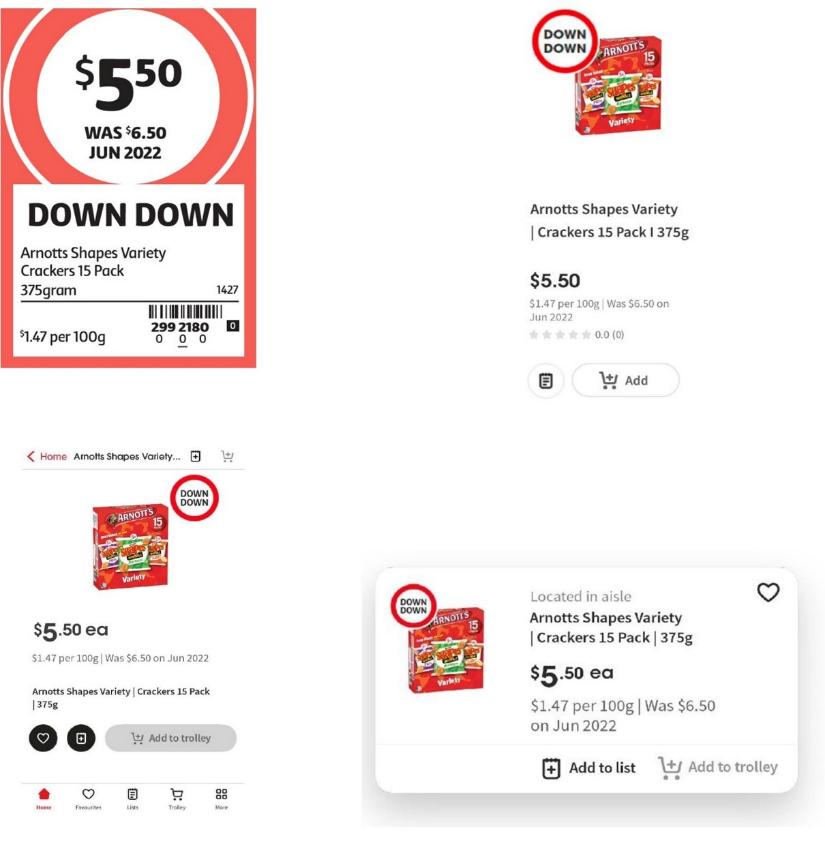
Judgment of: | O’BRYAN J |
Date of judgment: | 14 May 2026 |
Catchwords: | CONSUMER LAW – prohibitions against misleading or deceptive conduct and false or misleading representations – supermarket pricing ticket stating ‘was/now’ prices – whether ticket was false, misleading or deceptive – whether the ticket represented to consumers that the product’s current price was a genuine reduction to, or discount from, the product’s previous price – whether the ticket represented to consumers that the product had been offered for sale at the previous price for a reasonable period – where the product had been offered for sale at the previous price for only four weeks in circumstances where prices for manufactured and packaged grocery products were relatively stable over time – ticket found to be misleading because the discount represented on the ticket was not genuine in circumstances where the product had not been sold at the previous price stated on the ticket for a reasonable period |
Legislation: | Competition and Consumer Act 2010 (Cth) s 155, Sch 2 (Australian Consumer Law) ss 18(1), 29(1)(i) Evidence Act 1995 (Cth) s 140 Federal Court of Australia Act 1976 (Cth) Trade Practices Act 1974 (Cth) Competition and Consumer (Industry Codes—Food and Grocery) Regulation 2015 (Cth) Competition and Consumer (Industry Codes—Food and Grocery) Regulations 2024 (Cth) |
Cases cited: | AA v The Trustees of the Roman Catholic Church for the Diocese of Maitland-Newcastle [2026] HCA 2; 427 ALR 67 Ascot Four Pty Ltd v Australian Competition and Consumer Commission (2009) 176 FCR 106 Australian Competition and Consumer Commission v Allans Music Group Pty Ltd [2002] FCA 1552 Australian Competition and Consumer Commission v Ascot Four Pty Ltd [2008] FCA 1295; 250 ALR 467 Australian Competition and Consumer Commission v Carrerabenz Diamond Industries Pty Ltd [2008] FCA 1103; (2008) ARPR 42-248 Australian Competition and Consumer Commission v Coles Supermarkets Australia Pty Ltd [2014] FCA 634; 317 ALR 73 Australian Competition and Consumer Commission v Jewellery Group Pty Ltd [2012] FCA 848; 293 ALR 335 Australian Competition and Consumer Commission v Kogan Australia [2020] FCA 1004; 145 ACSR 609 Australian Competition and Consumer Commission v Prouds Jewellers Pty Ltd [2008] FCA 75; 75 IPR 306 Australian Competition and Consumer Commission v Prouds Jewellers Pty Ltd [2008] FCAFC 199 Australian Competition and Consumer Commission v Prouds Jewellers Pty Ltd (No 2) [2008] FCA 476 Australian Competition and Consumer Commission v TPG Internet Pty Ltd (2013) 250 CLR 640 Australian Competition and Consumer Commission v TPG Internet Pty Ltd (2020) 278 FCR 450 Australian Securities and Investments Commission v Vanguard Investments Australia Ltd [2024] FCA 308 Bed Bath ‘N’ Table Pty Ltd v Global Retail Brands Australia Pty Ltd [2025] HCA 50; 100 ALJR 57 Briginshaw v Briginshaw (1938) 60 CLR 336 Butcher v Lachlan Elder Realty Pty Limited (2004) 218 CLR 592 Campomar Sociedad, Limitada v Nike International Limited (2000) 202 CLR 45 Demery v Coles Supermarkets Australia Pty Ltd [2025] FCA 1016 Ducret v Chaudhary’s Oriental Carpet Palace Pty Ltd (1987) 16 FCR 562 G v H (1994) 181 CLR 387 Global Sportsman Pty Ltd v Mirror Newspapers Pty Ltd (1984) 2 FCR 82 Google Inc v Australian Competition and Consumer Commission (2013) 249 CLR 435 Hornsby Building Information Centre Pty Ltd v Sydney Building Information Centre Ltd (1978) 140 CLR 216 Jewellery Group Pty Ltd v Australian Competition and Consumer Commission [2013] FCAFC 144 Neat Holdings Pty Ltd v Karajan Holdings Pty Ltd [1992] HCA 66; 110 ALR 449 Noone (Director of Consumer Affairs Victoria) v Operation Smile (Australia) Inc (2012) 38 VR 569 Parkdale Custom Built Furniture Pty Ltd v Puxu Pty Ltd (1982) 149 CLR 191 Roberts-Smith v Fairfax Media Publications Pty Limited & Others (Appeal) (2025) 310 FCR 170 Self Care IP Holdings Pty Ltd v Allergan Australia Pty Ltd (2023) 277 CLR 186 Taco Co of Australia Inc v Taco Bell Pty Ltd (1982) 42 ALR 177 Trade Practices Commission v Cue Design Pty Ltd (1996) 85 A Crim R 500; (1996) ATPR 41-475 |
Division: | General Division |
Registry: | Victoria |
National Practice Area: | Commercial and Corporations |
Sub-area: | Regulator and Consumer Protection |
Number of paragraphs: | 523 |
Date of last submissions: | 5 March 2026 |
Date of hearing: | 16-20 and 25-26 February 2026 |
Counsel for the Applicant (VID973/2024): | G Rich SC with E Bathurst, S McLeod and S Rajanayagam |
Solicitor for the Applicant (VID973/2024): | Johnson Winter Slattery |
Counsel for the Applicant (VID1247/2024): | P Cashman with D Townsend |
Solicitor for the Applicant (VID1247/2024): | Gerard Malouf and Partners |
Counsel for the Respondent (VID 973/2024 and VID1247/2024): | J Sheahan KC with N De Young KC, A Barraclough and S Hogan |
Solicitor for the Respondent (VID 973/2024 and VID1247/2024): | Allens |
ORDERS
VID 973 of 2024 | ||
| ||
BETWEEN: | AUSTRALIAN COMPETITION AND CONSUMER COMMISSION Applicant | |
AND: | COLES SUPERMARKETS AUSTRALIA PTY LTD (ACN 004 189 708) Respondent | |
order made by: | O’BRYAN J |
DATE OF ORDER: | 14 May 2026 |
THE COURT ORDERS THAT:
1. By 29 May 2026, the parties provide to the chambers of O’Bryan J agreed or, if not agreed, competing proposed orders giving effect to these reasons and for the further disposition of the proceeding.
2. If the parties are unable to agree on the proposed orders referred to in order 1, by 5 June 2026 the parties are to file and serve written submission limited to 5 pages in support of the orders proposed by that party.
3. Pursuant to ss 37AF(1)(b) and 37AG(1)(a) of the Federal Court of Australia Act 1976 (Cth), access to and disclosure (by publication or otherwise) of section C.6 of the reasons for judgment delivered today be restricted to the parties until further order of the Court.
4. By 29 May 2026, the respondent file and serve any application under ss 37AF(1)(b) and 37AG(1)(a) of the Federal Court of Australia Act 1976 (Cth) for ongoing suppression of any confidential financial information contained in section C.6 of the reasons for judgment, supported by an affidavit and submissions limited to 5 pages.
5. The proceeding be listed for further case management at 10.15 am on 10 June 2026.
Note: Entry of orders is dealt with in Rule 39.32 of the Federal Court Rules 2011.
ORDERS
VID 1247 of 2024 | ||
| ||
BETWEEN: | BENJAMIN GLENN DEMERY Applicant | |
AND: | COLES SUPERMARKETS AUSTRALIA PTY LTD (ACN 004 189 708) Respondent | |
order made by: | O’BRYAN J |
DATE OF ORDER: | 14 may 2026 |
THE COURT ORDERS THAT:
1. By 29 May 2026, the parties provide to the chambers of O’Bryan J agreed or, if not agreed, competing proposed orders giving effect to these reasons and for the further disposition of the proceeding.
2. If the parties are unable to agree on the proposed orders referred to in order 1, by 5 June 2026 the parties are to file and serve written submission limited to 5 pages in support of the orders proposed by that party.
3. Pursuant to ss 37AF(1)(b) and 37AG(1)(a) of the Federal Court of Australia Act 1976 (Cth), access to and disclosure (by publication or otherwise) of section C.6 of the reasons for judgment delivered today be restricted to the parties until further order of the Court.
4. By 29 May 2026, the respondent file and serve any application under ss 37AF(1)(b) and 37AG(1)(a) of the Federal Court of Australia Act 1976 (Cth) for ongoing suppression of any confidential financial information contained in section C.6 of the reasons for judgment, supported by an affidavit and submissions limited to 5 pages.
5. The proceeding be listed for further case management at 10.15 am on 10 June 2026.
Note: Entry of orders is dealt with in Rule 39.32 of the Federal Court Rules 2011.
REASONS FOR JUDGMENT
O’BRYAN J:
[1] | |
[1] | |
[21] | |
[30] | |
[36] | |
[46] | |
[47] | |
[49] | |
[64] | |
[67] | |
[74] | |
[79] | |
[113] | |
[133] | |
[189] | |
[364] | |
[364] | |
[367] | |
[373] | |
[404] | |
[406] | |
E.2 What did the Down Down tickets convey to ordinary consumers? | [408] |
E.3 Were the Down Down tickets for the sample products misleading or deceptive? | [435] |
[518] | |
[] |
A. INTRODUCTION
A.1 ACCC proceeding
1 On 23 September 2024, the Australian Competition and Consumer Commission (ACCC) commenced a proceeding (VID 973 of 2024) against Coles Supermarkets Australia Pty Ltd (Coles) alleging that, between February 2022 and May 2023 (the relevant period), Coles temporarily increased the retail prices of 245 products (affected products) before placing those products on ‘Down Down’ promotions at prices which, although lower than the temporarily increased prices, were higher than, or the same as, the price at which each product had ordinarily been offered for sale prior to the temporary increase.
2 The Down Down promotional program was introduced by Coles in 2010 and continued until (at least) the end of the relevant period. At all relevant times, Down Down was a well-known promotional program. When introduced in 2010, the promotion was heavily marketed with a memorable jingle “Down down, prices are down” sung by the British rock group Status Quo to the tune of their 1975 popular song “Down Down”. The marketing of the promotional program was also associated with a large red hand pointing downwards. Although features of the marketing changed over the years, the Down Down promotional program continued to be a well-recognised promotional program associated with Coles in the relevant period. In broad terms, the Down Down promotional program was a program by which Coles offered to customers a range of commonly purchased products at reduced prices. As illustrated below, a central feature of the promotion was the use of ‘was/now’ pricing, by which the Down Down promotional price was compared to an earlier higher price.
3 Coles communicated the price and, if applicable, the promotional status of products offered in-store and online through pricing labels or product tiles respectively (referred to collectively as tickets). Where a product was not on promotion, the product was promoted using a ‘standard shelf edge ticket’ (often referred to in the evidence as a white ticket). Products on a Down Down promotion were identified by Coles in-store and online using a specific form of pricing label (for products offered in-store) and product tile (for products offered online) to distinguish them from products that were not on promotion and from products on other forms of promotion. The Down Down label for a product offered in-store was displayed on the shelf immediately below the relevant product (or otherwise physically near the relevant product); and the Down Down tile for a product offered online was displayed near the picture of the relevant product. The Down Down tickets displayed by Coles in its stores and online respectively included the following features:
(a) a red and white colour scheme, coupled with the words “Down Down” in large bold font;
(b) the name of the relevant product (for example, “Arnotts Shapes Variety Crackers 15 Pack 375gram”);
(c) the price at which the product was available for sale during the Down Down promotion (the Down Down price), displayed in prominent font; and
(d) in most cases, a ‘Was’ price for the product, displayed in smaller font, together with the date of the ‘Was’ price (for example, “Was $6.50 June 2022”).
4 Examples of the Down Down tickets as they appeared in-store and online during the relevant period are as follows:
5 In its Concise Statement, the ACCC alleged that, in respect of each of the affected products, the information displayed on the Down Down ticket for the product represented to consumers that the product’s Down Down price was “a genuine reduction to, or discount from, the product’s previous regular price” (the genuine discount representation). In its opening written submissions at trial, the ACCC stated that the phrase ‘previous regular price’ means “the price at which that product was ordinarily offered for sale for a reasonable period prior to the promotion”.
6 The ACCC further alleged in its Concise Statement that the genuine discount representations were false or misleading because:
(a) Coles had increased the price of each affected product for only a relatively short period of time (which the ACCC referred to as the ‘price spike period’) prior to placing the product on the Down Down promotion and, in most cases, advertising that higher price as the relevant ‘Was’ price on the product’s Down Down ticket; and
(b) the price at which Coles offered each affected product for sale during the Down Down promotion was:
(i) in 249 instances, higher than; and
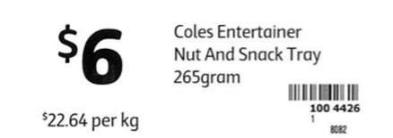
(ii) in 6 instances, the same as,
the affected product’s previous regular price (which the ACCC alleged was the price at which Coles had previously offered the product for sale prior to the ‘price spike period’, excluding any short-term specials or promotions).
7 For some affected products, there was more than one occasion during the relevant period on which the product was placed on a Down Down promotion following an alleged price spike period. For this reason, the total number of separate instances referred to in the preceding paragraph is 255, which is greater than the total number of affected products (being 245).
8 The ACCC’s allegations concern three prices at which each of the affected products was sold, which the parties generally referred to as Price 1, Price 2 and Price 3. Price 1 was the price prior to the price increase; Price 2 was the price during the alleged price spike period; and Price 3 was the Down Down price following the alleged price spike period. That terminology is used occasionally in these reasons.
9 The ACCC alleged that Coles’ conduct in offering the affected products on the Down Down tickets was misleading or deceptive, or likely to mislead or deceive, in contravention of s 18(1) of the Australian Consumer Law (the ACL), and that each Down Down ticket conveyed a representation which was false or misleading with respect to the price of the affected products in contravention of s 29(1)(i) of the ACL. As discussed later in these reasons, there is no material difference in the meaning of the phrases ‘misleading or deceptive’ and ‘false or misleading’ as used in ss 18(1) and 29(1) respectively. In these reasons, the word ‘misleading’ is used as a shorthand when referring to the ACCC’s allegations that the Down Down tickets were misleading or deceptive or likely to mislead or deceive contrary to s 18(1) and false or misleading contrary to s 29(1).
10 Significantly, the ACCC’s case disregarded any changes in the list (wholesale) prices paid by Coles for the affected products. The ACCC contended that the Down Down ticket for each affected product conveyed the genuine discount representation and that the representation was misleading because the ‘Was’ price had been in effect for only a relatively short period of time (the ‘price spike period’ or Price 2) and therefore was not the product’s previous regular price. Rather, the product’s previous regular price was the price prior to the ‘Was’ price (Price 1), which in almost all cases was lower than the Down Down price (Price 3). On the case advanced by the ACCC, changes in the list prices for the affected products are irrelevant because the Down Down tickets do not refer to the list prices and consumers are unaware of the list prices.
11 In its Concise Response, Coles said that, during the relevant period, Coles and its suppliers were experiencing significant cost increases including, but not limited to, a surge in global commodity prices, and in the cost of packaging, freight, utilities and international shipping. In response to requests from its suppliers for cost price alterations (abbreviated as CPA), which are also referred to as cost price increases (abbreviated as CPI), or changes to the promotional funding arrangements, Coles (with the supplier) reassessed the promotional and non-promotional pricing of the supplier’s products, including in relation to the affected products. Where an affected product had been on a Down Down program, the affected product was taken off the Down Down program and sold at a non-promotional (white ticket) price which was typically at or below the supplier’s new recommended retail price (often abbreviated to RRP). Later, these affected products returned to the Down Down program at a new promotional price. Coles says that the non-promotional (white ticket) price was a genuine, undiscounted shelf price, and that the subsequent Down Down program price was therefore a genuine discount from that shelf price.
12 Coles denied that the Down Down tickets conveyed the genuine discount representation in the form alleged by the ACCC and said further that the concept of a ‘previous regular price’, being a component of the ACCC’s alleged representation, is unclear. Coles said that the Down Down tickets conveyed that the Down Down price was a genuine reduction from its previous non-promotional (white ticket) price. Another way of expressing the same contention is that the Down Down ticket represented to consumers that the Down Down price was a reduction to, or discount from, the price at which the product had last been genuinely offered for sale and sold by Coles.
13 Coles said that, so understood, the Down Down tickets for the affected products were not misleading. In every case, the price of the affected product had been increased following a request by a supplier either to increase its wholesale price to Coles (with a consequential increase to its recommended retail price), or to reduce its promotional funding offered to Coles, and following Coles’ agreement to the request in whole or in part. The product was then offered by Coles at a non-promotional (white ticket) price at or below the supplier’s recommended retail price for a period before placing the product on a Down Down promotion. Coles says that the ‘Was’ price on the Down Down ticket was the immediately preceding non-promotional (white ticket) price for the product which was a genuine undiscounted price.
14 On Coles’ case, the relevant enquiry is whether the ‘Was’ price stated on each Down Down ticket was a genuine price at which the product had been last offered for sale by Coles prior to being placed on the impugned Down Down promotion. On that case, the genuineness of the price must be assessed by a range of factors including the commercial circumstances in which the price was determined, the period over which the product was offered at that price and the volume of sales at that price.
15 The Court made orders that a trial on all issues of liability would be conducted with respect to a sample of affected products as agreed between the parties or determined by the Court. The parties agreed 12 sample products which are as follows:
(1) Karicare Follow On Formula (900 gram) (Karicare Formula);
(2) Coca-Cola Soft Drink (2 litre) (Coca-Cola 2 litre);
(3) Pedigree Adult Wet Dog Food With 5 Kinds Of Meat Loaf (1.2 kg can) (Pedigree Dog Food);
(4) Arnott’s Shapes Multipack Variety 15 Pack (375 gram) (Arnott’s Shapes Multipack);
(5) Bragg Seasoning Nutritional Yeast Premium Quality (127 gram) (Bragg Yeast);
(6) Danone Yopro Yoghurt Vanilla (700 gram) (Yopro Yoghurt);
(7) Colgate Total Original Toothpaste (200 gram) (Colgate Toothpaste);
(8) Coles Finest Quince Paste (100 gram) (Coles Quince Paste);
(9) Rexona Anti Persp Deodorant (250 ml) (Rexona Deodorant);
(10) Lurpak Slightly Salted Spreadable Tub (250 gram) (Lurpak Butter);
(11) Nature’s Gift Adult All Breeds Wet Dog Food Loaf Chicken Rice & Vegetables (1.2 kg) (Nature’s Gift Dog Food); and
(12) Viva Paper Towel White Select A Size (3 Pack) (Viva Paper Towels).
16 Two of the sample products, the Nature’s Gift Dog Food product and the Viva Paper Towels product, each involved two separate Down Down tickets. Thus, these reasons concern 14 Down Down tickets in total.
17 Each of the sample products is a manufactured and packaged grocery product. The proceeding does not concern fresh food grocery products.
18 The evidence adduced by the parties with respect to each of the sample products and Down Down tickets was detailed and voluminous. It included not only the retail prices for the sample products during the relevant period, but also the negotiations between the relevant supplier and Coles with respect to increases in the list (wholesale) prices for the sample products, the promotional plan proposed by the supplier (including proposed retail prices), Coles’ retail sales margins based upon the proposed retail prices and Coles’ retail sales volumes.
19 A great deal of the evidence adduced by the parties is irrelevant to the ACCC’s primary case. As already noted, the ACCC’s primary case disregards changes in the list prices paid by Coles for the affected products because it alleges the Down Down tickets do not refer to the list prices and consumers are unaware of the list prices. Most of the evidence is, however, relevant to Coles’ case in defence. Coles contends that the Down Down ticket represented to consumers that the Down Down price was a reduction to, or discount from, the price at which the product had last been genuinely offered for sale and sold by Coles. If Coles is correct, it becomes necessary to consider whether the ‘Was’ price stated on the Down Down ticket was a genuine price at which the product had been last offered for sale by Coles, which requires consideration of the factors referred to above, including the commercial circumstances in which the price was determined, the period over which the product was offered at that price and the volume of sales at that price.
20 The nature and scope of the arguments advanced by the parties has necessitated the making of factual findings about many aspects of Coles’ supermarket business including its management structure, retail pricing policies and practices, purchase arrangements with suppliers, the Down Down promotional program and the commercial negotiations between Coles and relevant suppliers with respect to the sample products.
A.2 Class action proceeding
21 On 14 November 2024, Benjamin Demery commenced a representative proceeding (VID 1247 of 2024) against Coles advancing materially the same allegations as made in the ACCC proceeding. Mr Demery claims damages on his own behalf and on behalf of other persons (group members) who purchased one or more affected products during the relevant period from Coles.
22 On 23 May 2025, orders were made in the representative proceeding in the same terms as the ACCC proceeding: that an initial trial on all issues of liability would be conducted with respect to a sample of affected products as agreed between the parties or determined by the Court. The parties were informed that the Court proposed to conduct a joint trial on liability issues in both proceedings. The parties raised no objection to that course. Timetabling orders were made in each proceeding to prepare the proceedings for trial.
23 On 20 June 2025, Coles filed an application seeking security for costs from Mr Demery in the representative proceeding. Ultimately, Coles and Mr Demery reached a compromise on the disposition of the security for costs application, and the parties requested the Court to make orders reflecting the compromise. After considering the compromise and proposed orders, the Court gave effect to the compromise by making orders on 26 August 2025. The Court’s reasons for making the orders are published in Demery v Coles Supermarkets Australia Pty Ltd [2025] FCA 1016. As explained in those reasons, the parties’ intention was to enable the issues of liability to be determined in the most efficient manner possible and without incurring unnecessary or duplicative costs. The elements of the agreement were:
(a) all issues of liability in the representative proceeding would be determined in accordance with the judgment on liability in the ACCC proceeding;
(b) the applicant and group members in the representative proceeding, except those who opt out, would be bound by findings made in the determination of issues of liability in the ACCC proceeding;
(c) the representative proceeding would be stayed until the Court delivers judgment on liability in the ACCC proceeding, although the applicant would have liberty to apply to lift the stay if liability is resolved in the ACCC proceeding other than by trial and judgment;
(d) all extant trial preparation orders in the representative proceeding would be vacated;
(e) the applicant would have liberty to apply for an order for access to the evidence and submissions filed in the ACCC proceeding; and
(f) the security for costs application would be adjourned indefinitely.
24 The orders made on 26 August 2025 included orders that:
(a) the initial trial on liability issues in the representative proceeding be heard together with the initial trial on liability issues in the ACCC proceeding (joint liability trial);
(b) the applicant in the representative proceeding was to take no step in the representative proceeding or in the ACCC proceeding (and including at the joint liability trial) except:
(i) upon application for leave of the Court, for which reasonable prior notice is provided to Coles; and
(ii) with the specific leave of the Court; and
(iii) without prejudice to Coles’ right to submit that leave should not be granted until the determination of any application by Coles for security for costs (should Coles exercise its liberty to re-enliven its application); and
(c) at the joint liability trial, the evidence in the ACCC proceeding be evidence in the representative proceeding.
25 As part of the compromise, Mr Demery, on his own behalf and on behalf of group members (except persons who opt out of the representative proceeding), gave an undertaking to the Court and to Coles that he and the group members (except persons who opt out) will be bound by all findings of fact, findings of law and mixed findings of fact and law made in the determination of liability issues in the initial trial in the ACCC proceeding, and will consent to corresponding findings being made in the representative proceeding, without prejudice to the right of Mr Demery to appeal, or seek leave to appeal, any such finding.
26 On 9 September 2025, orders were made pursuant to s 33J(1) of Federal Court of Australia Act 1976 (Cth) (FCA Act) fixing 21 November 2025 as the date by which group members may opt out of the representative proceeding. A number of opt out notices have been received by the Court.
27 On 23 February 2026, shortly prior to the hearing of closing submissions at the joint liability trial, Mr Demery filed an interlocutory application seeking leave to make a closing submission. The application was supported by an affidavit of Gregory Mackey (Mr Demery’s solicitor) sworn the same day. A copy of the proposed closing submission was exhibited to the affidavit, together with some correspondence between Mr Demery and Coles. The closing submission principally concerned the application of the Briginshaw principle in the class action proceeding. Leave was granted for Mr Demery to make the closing submission and Mr Demery filed and served the written submission, to which Coles replied in writing on 25 February 2026. The parties’ submissions with respect to the application of the Briginshaw principle are addressed below.
28 Mr Demery’s written submission also referred to correspondence with Coles, exhibited to the supporting affidavit, in which Mr Demery sought to qualify the undertaking that had been given to the Court and that was recorded in the orders made on 26 August 2025 (that Mr Demery and group members agreed to be bound by all findings of fact, findings of law and mixed findings of fact and law made in the determination of liability issues in the initial trial in the ACCC proceeding). The submission stated that Mr Demery sought leave of the Court to qualify the undertaking. No such leave was sought in Mr Demery’s interlocutory application. Nor did Mr Demery advance any submissions in writing or orally as to why such leave should be granted at that late stage (the hearing of closing submissions in the joint liability trial). Nor was any explanation proffered as to the nature and terms of the qualification sought by Mr Demery. Coles opposed any such leave, submitting that:
(a) the nature of the qualification was wholly unclear and would be impractical in effect;
(b) when the undertaking was given, Mr Demery was aware that the ACCC proceeding was a civil penalty proceeding to which the Briginshaw principle applied; and
(c) the undertaking was given in the context of an application for security for costs and as part of a compromise which established the framework for the joint hearing of the two proceedings consistently with the overarching purpose set out in s 37M of the FCA Act.
29 I accept Coles’ submissions. To the extent that Mr Demery pressed an application to qualify the undertaking given to the Court as recorded in the orders made on 26 August 2025, the application is refused. The qualification sought by Mr Demery was undefined, likely to be impractical in effect, and would be unjust to Coles in circumstances where Coles’ security for costs application had been compromised on the basis of the undertaking.
A.3 Submissions concerning the Briginshaw principle
30 Section 140 of the Evidence Act 1995 (Cth) (Evidence Act) prescribes the standard of proof in civil proceedings in the following terms:
(1) In a civil proceeding, the court must find the case of a party proved if it is satisfied that the case has been proved on the balance of probabilities.
(2) Without limiting the matters that the court may take into account in deciding whether it is so satisfied, it is to take into account:
(a) the nature of the cause of action or defence; and
(b) the nature of the subject-matter of the proceeding; and
(c) the gravity of the matters alleged.
31 Section 140 reflects the civil standard of proof at common law, which was explained by Dixon J in Briginshaw v Briginshaw (1938) 60 CLR 336 (Briginshaw) at 361-362:
The truth is that, when the law requires the proof of any fact, the tribunal must feel an actual persuasion of its occurrence or existence before it can be found. It cannot be found as a result of a mere mechanical comparison of probabilities independently of any belief in its reality. … Except upon criminal issues to be proved by the prosecution, it is enough that the affirmative of an allegation is made out to the reasonable satisfaction of the tribunal. But reasonable satisfaction is not a state of mind that is attained or established independently of the nature and consequence of the fact or facts to be proved. The seriousness of an allegation made, the inherent unlikelihood of an occurrence of a given description, or the gravity of the consequences flowing from a particular finding are considerations which must affect the answer to the question whether the issue has been proved to the reasonable satisfaction of the tribunal. In such matters “reasonable satisfaction” should not be produced by inexact proofs, indefinite testimony, or indirect inferences.
32 In reliance upon those principles, Coles submitted that, in deciding whether the alleged contraventions of the ACL had been proved on the balance of probabilities, the Court must have regard to: (a) the nature of the cause of action; (b) the nature of the subject matter of the proceeding; and (c) the gravity of the matters alleged. Coles submitted that:
Since the alleged contravention of s 29 of the ACL may expose Coles to a civil penalty, a high level of satisfaction should be reached before finding the contraventions proved.
33 While accepting that the Court is required to take into account the matters referred to in s 140(2) of the Evidence Act and, more broadly, apply the Briginshaw principle, Mr Demery submitted that the consequences of a finding of contravention of the ACL differed between the ACCC proceeding and the class action. The ACCC proceeding seeks to penalise Coles by the imposition of a civil penalty, whereas the class action seeks only to compensate Mr Demery and group members. In other words, the class action only seeks to put the parties back in the position that they would have been in if the contravening conduct had not occurred. Mr Demery submitted that the Court cannot take into account the fact that a civil penalty may be imposed in the ACCC proceeding in determining whether the proven conduct is misleading for the purposes of the class action in which compensation – and not a form of sanction or punishment – is sought.
34 Mr Demery’s submission cannot be accepted. The effect of the Briginshaw principle is that “the strength of the evidence necessary to establish a fact or facts on the balance of probabilities may vary according to the nature of what it is sought to prove”: Neat Holdings Pty Ltd v Karajan Holdings Pty Ltd [1992] HCA 66; 110 ALR 449 at 450 (Mason CJ, Brennan, Deane and Gaudron JJ); G v H (1994) 181 CLR 387 at 399 (Deane, Dawson and Gaudron JJ). A significant aspect of the principle is that it affects the process of fact finding in cases where no criminal or other penal consequences will be imposed. That is because it is sufficient to attract the operation of the principle that the conduct complained of in a proceeding might be characterised as illegal, capable of attracting a penalty or otherwise of grave consequence, even if no such correlative consequences would flow from those findings in that proceeding. Indeed, that was the context in which Briginshaw was decided. The case concerned a petition for divorce on the ground of adultery. While the proceeding raised a civil matter, it was the recognition that the allegation entailed “grave moral delinquency” (at 362 per Dixon J), “a serious matter” (at 350 per Rich J) or a “serious allegation” (at 347 per Latham CJ and 353 per Starke J) that justified the stricter requirement that “reasonable satisfaction” should not be produced by inexact proofs, indefinite testimony, or indirect inferences. The Briginshaw principle is routinely and appropriately applied in civil proceedings that involve grave allegations of wrongdoing, but which do not attract penal consequences: see for example Roberts-Smith v Fairfax Media Publications Pty Limited & Others (Appeal) (2025) 310 FCR 170 at [23] (where it was necessary to prove the truth of alleged war crimes, but the proceeding was for the recovery of damages for defamation) and AA v The Trustees of the Roman Catholic Church for the Diocese of Maitland-Newcastle [2026] HCA 2; 427 ALR 67 at [219] (where it was sought to prove child sexual abuse, but the proceeding was for the recovery of damages for negligence).
35 In any event, this is not a case in which the evidentiary burden of proof is significant. There was little, if any, dispute as to the primary facts. No challenge was made to the credit of any witness. The issue in dispute principally concerns what the Down Down tickets conveyed to ordinary and reasonable consumers, and whether what was conveyed was misleading. These questions are to be determined objectively by reference to largely undisputed facts.
A.4 Summary of conclusions
36 The issues raised in this proceeding are finely balanced. By way of summary, I have reached the following conclusions on the issues for determination.
37 I have concluded that the Down Down tickets for the sample products conveyed a representation to ordinary consumers that Coles had reduced the price of the product from the ‘Was’ price and, implicitly, that the reduction in price involved a real or genuine discount. The vast majority of ordinary consumers, when shopping, would not have formed any conscious belief about the period for which the product had been offered for sale by Coles at the ‘Was’ price, beyond an intuitive sense that the discount being promoted was genuine and not artificial. Nevertheless, incorporated within the notion of a genuine discount from an identified previous price is the notion that the identified previous price was a price at which the product had been ordinarily offered for sale by Coles for a reasonable period.
38 In assessing whether each of the Down Down tickets for the sample products was misleading, it is necessary to evaluate all of the factors that bear upon the question whether the ‘Was’ price shown on the ticket was a price at which the product had been ordinarily offered for sale for a reasonable period, such that the discount shown on the ticket can be regarded as a genuine discount. Those factors include the commercial circumstances in which the price of the product had been increased, the level at which the ‘Was’ price was set, the period for which the product was sold at the ‘Was’ price, and the volume of products sold at that price.
39 Having evaluated the circumstances in which Coles increased the retail prices of the sample products before placing those products on the impugned Down Down tickets, I have concluded that the price increases all resulted from supplier cost price increases, and that Coles increased the prices in a commercially justifiable manner. Coles did not select an artificially high ‘Was’ price for the sample products in order to increase the perceived discount on the Down Down ticket. The sample products were offered for sale at the ‘Was’ price in the ordinary course of Coles’ business and the sample products were sold in commercial volumes at the ‘Was’ price.
40 The remaining factor that must be considered is the period for which the sample products were offered at the ‘Was’ price. The question that must be answered is whether the discount stated on the Down Down tickets was not a genuine discount because the sample products were only offered for sale at the ‘Was’ price for a short period, typically four weeks and sometimes less? In this industry context, involving manufactured and packaged grocery products sold in a large supermarket, what is the minimum period that the product must have been offered for sale at the ‘Was’ price in order to conclude that the product had been offered for sale at that price for a reasonable period and the discount stated on the Down Down ticket was genuine? The answer to that question is necessarily an evaluative judgment on which reasonable minds may differ.
41 In answering that question, I have taken into account a number of matters. Coles’ supermarkets are open for extended trading hours every day of the week and each store is visited by thousands of consumers every day. Nevertheless, the evidence indicates that, aside from products sold on Special or other short-term promotions, the prices that Coles charged for manufactured and packaged products (with which this proceeding is concerned) were relatively stable from month to month, with relatively infrequent changes. The Down Down and Every Day Price promotional mechanics required prices to remain stable for twelve weeks and six months respectively. The evidence indicates that Down Down prices were typically stable for much lengthier periods. The evidence with respect to white ticket prices also suggests that those prices were relatively stable. I have also taken into account Coles’ own assessment, as reflected in its internal policies as at January 2022, that a product could not be sold on a Down Down promotion, showing a discount from a previous price, unless the product had been offered for sale at the previous price for a minimum period of twelve weeks. Although Coles subsequently relaxed that internal policy in March 2022, it did so in response to perceived competitive pressure from Woolworths.
42 Taking those matters into account, I have concluded that the Down Down tickets for the sample products would not have been misleading if the products had been sold at the ‘Was’ price for a minimum period of twelve weeks immediately preceding the Down Down promotion. This reflects a conclusion that, if an ordinary consumer were told that the product had been ordinarily sold by Coles at the ‘Was’ price for a period of twelve weeks immediately prior to the Down Down promotion, the consumer would believe that the Down Down price was a genuine discount to the ‘Was’ price. Conversely, if the ordinary consumer were told that the product had been ordinarily sold by Coles at the ‘Was’ price for a period that was materially shorter than twelve weeks, the consumer would not believe that the Down Down price was a genuine discount to the ‘Was’ price.
43 On that basis, I have concluded that 13 of the 14 Down Down tickets that were the subject of consideration in the joint liability trial were misleading because the relevant products were not sold at the ‘Was’ price stated on the ticket for a reasonable period and, as a consequence, the discount represented on the ticket was not genuine. It follows that, in offering the sample products on those Down Down tickets, Coles:
(a) engaged in conduct in trade or commerce that was misleading, in contravention of s 18(1) of the ACL; and
(b) made a misleading representation with respect to the price of the sample products in connection with the promotion of the supply of the sample products in trade or commerce, in contravention of s 29(1)(i) of the ACL.
44 I have concluded that the Down Down ticket for the Nature’s Gift Dog Food product, which offered the product at a price of $4.50, was not misleading because it did not include a ‘Was’ price on the Down Down ticket.
45 The reasons for those conclusions follow.
B. OVERVIEW OF THE EVIDENCE
46 As noted earlier, although the trial was confined to the sample products, the parties adduced an extensive volume of evidence at trial.
B.1 ACCC’s evidence
47 In its case, the ACCC tendered:
(a) four statements of facts that had been agreed between the parties for the purposes of s 191 of the Evidence Act, the first of which was dated 13 June 2025 (First SOAF), the second was dated 21 August 2025 but was replaced by an amended version dated 16 February 2026 (Amended Second SOAF), the third was dated 17 November 2025 (Third SOAF) and the fourth was dated 12 February 2026 but was replaced by an amended version dated 15 February 2026 (Amended Fourth SOAF);
(b) admissions made by Coles in response to requests for information made by the ACCC pursuant to s 155 of the Competition and Consumer Act 2010 (Cth) (CCA) and admissions made by Coles voluntarily in responses to requests for information made by the ACCC; and
(c) documents produced by Coles in response to requests made by the ACCC pursuant to s 155 of the CCA.
48 The ACCC also tendered an expert report of Dawna Wright of FTI Consulting dated 3 September 2025 (Wright Report). Ms Wright is a qualified Chartered Accountant and a Senior Managing Director and Head of Forensic and Litigation Consulting, Australia, at FTI Consulting. In this role, Ms Wright provides forensic accounting, valuation and financial investigation services. The Wright Report includes graphs and tables of the prices at which Coles offered the sample products for sale between January 2021 and May 2023, including the classification of the relevant price as either non-promotional (that is, a white ticket) or promotional (and, in that case, identifying the specific promotion that applied to the price being one of ‘Down Down’, ‘Special’, ‘Every Day Value’ or ‘Locked’). In certain limited periods of time, no pricing data was available. The data was agreed between the parties and Ms Wright was not required for cross-examination.
B.2 Coles’ evidence
49 In its case, Coles adduced affidavit evidence from employees or former employees within relevant business divisions of Coles. During the relevant period, Coles’ business was organised by reference to business units, business categories and product categories. Coles had six business units: Grocery; Produce; Bakery; Dairy, Frozen & Convenience; Meat Deli & Seafood; and Health & Home. Each business unit was divided into a number of business categories. For example, the Health & Home business unit comprised four business categories: Health, Beauty and Baby; Homecare; General Needs; and Telco, Tobacco and Entertainment. Each business category in turn comprised multiple product categories. For example, the Health, Beauty and Baby business category comprised various product categories such as Soaps and Body Wash. Product categories often comprised sub-categories (eg Handwash). The employees or former employees who gave evidence on behalf of Coles were as follows.
50 Debra Galle made two affidavits, the first dated 21 November 2025 and the second dated 13 February 2026, and was cross-examined. Ms Galle is the General Manager, Own Brand at Coles. Ms Galle has been employed at Coles since 2019 and has held several positions since then. She has also previously worked at Mars Petcare Australia, SPC Ardmona and Coca-Cola Amatil. During the relevant period, Ms Galle held three roles. From July 2019 to March 2022, Ms Galle was the Business Category Manager of Breakfast and Health Foods. From April 2022 to October 2022, Ms Galle was the General Manager of Business Unit Strategy & Commercial Excellence. In this role, Ms Galle was responsible for supporting the delivery of Coles’ overall commercial strategy and had oversight of several teams, including relevantly, the Pricing and Value team and the Supplier Relations team. From October 2022 to December 2024 Ms Galle was the General Manager of the Health and Home business unit. Ms Galle gave evidence about the structure of Coles’ business, the use of category budgets to measure performance in each product category, the considerations that affect retail pricing and product ranging, tickets and pricing mechanics, promotions and the promotional guardrails. In her second affidavit, Ms Galle made several corrections to her initial affidavit and gave further evidence on the promotional guardrails. Ms Galle was a knowledgeable witness who gave clear answers to questions. I accept her evidence in full.
51 Rebecca Thompson made an affidavit dated 24 November 2025 and was cross-examined. Ms Thompson was employed at Coles from January 2022 until January 2026. Most recently, she was the Head of Transformation and Delivery (Health and Home Unit) and during the relevant period held the role of Senior Category Manager of the Biscuits and Cookies category. Ms Thompson gave evidence about the Biscuits and Cookies category, the considerations that affect retail pricing and promotions and the process of negotiating cost price increase requests with suppliers. Ms Thompson also gave evidence about the Arnott’s Shapes Multipack product, including the CPA request made by Arnott’s and Coles’ response to that request and its pricing decisions. Overall, I consider that Ms Thompson was a knowledgeable witness who sought to assist the Court with her answers. At times, Ms Thompson became unnecessarily defensive in providing answers, and felt the need to provide additional information or explanation when answering questions. This created a degree of tension during her cross-examination. Despite that, I considered that Ms Thompson was an honest and reliable witness and I have no reason to doubt her evidence.
52 Eleftheria (Via) Lavdas made an affidavit dated 18 November 2025 and was cross-examined. Ms Lavdas is currently the Head of Commercial Trade Activation at Coles. Ms Lavdas first started work at Coles in 2002 and has held many positions within Coles over the years. Ms Lavdas has also worked for periods at Franklins Supermarkets and Woolworths. In the relevant period, she was the Manager of the Impulse business category. Ms Lavdas gave evidence concerning the Impulse business category, Coles’ pricing decisions and promotional plans, Coles’ trading terms with suppliers including the management and assessment of CPA requests received from suppliers. Ms Lavdas also gave evidence about the Arnott’s Shapes Multipack product, including the CPA request made by Arnott’s and Coles’ response to that request, including its pricing decisions. Ms Lavdas was an impressive witness who gave clear answers to questions. I accept her evidence in full.
53 Katherine Bailey made an affidavit dated 21 November 2025 and was cross-examined. Ms Bailey is currently the General Manager of Brand and Marketing at Coles. Ms Bailey has been employed by Coles since 2011 and has held numerous positions which variously concern Coles’ marketing, branding and media. Ms Bailey gave evidence about the Down Down program, including its key marketing features and how these have changed over time. Ms Bailey also gave evidence about the various channels used to communicate pricing mechanics, including by tickets, in-store signage, and by advertising methods such as catalogues, television, radio and online advertisements, and emails to customers. Ms Bailey was an impressive witness who gave clear answers to questions. I accept her evidence in full.
54 Paul Carroll made an affidavit dated 18 November 2025 and was cross-examined. Mr Carroll is currently the Commercial Lead of e-Commerce at Swaggle, an online pet specialty retailer owned by Coles. Mr Carroll has been employed by Coles since October 2019 and during the relevant period held the role of Senior Category Manager of Pet, a role which he officially finished on 29 January 2023. Mr Carroll begun his new role at Swaggle on 30 January 2023, but was asked to perform both roles until 20 February 2023. Mr Carroll gave evidence about the Pet category, considerations that affect price setting and promotional planning and the assessment of CPA requests from suppliers. Mr Carroll also gave evidence about the Nature’s Gift Dog Food product, including two CPA requests during the relevant period from the supplier, Real Pet Food. Mr Carroll also gave evidence about the Pedigree Dog Food product and the CPA request made by Mars in relation to that product. I consider that Mr Carroll was an honest witness who endeavoured to assist the Court with his answers. However, cross-examination revealed some inconsistencies between his affidavit evidence and the underlying documentary record with respect to the Nature’s Gift Dog Food and Pedigree Dog Food products. In the course of cross-examination, Mr Carroll gave additional evidence with respect to certain inconsistencies. Whilst Mr Carroll insisted that his evidence was based on his actual recollection of events, I am not persuaded that that was always correct. I consider that aspects of Mr Carroll’s evidence involved unconscious reconstruction (in other words, Mr Carroll was not conscious of the fact that he had reconstructed his memory from the documentary record). In making that finding, I make no criticism of Mr Carroll. It is unsurprising that Mr Carroll’s recollection of events that occurred some four years ago in respect of a pricing decision with respect to two products is limited, if non-existent. In respect of those products, I place primary reliance upon the documentary record.
55 Matthew Hankin made an affidavit dated 21 November 2025 and was cross-examined. Mr Hankin is currently the Head of Coles 360 Commercial Integration. He has been employed by Coles and its related entities since 1987 and has held numerous roles, including as a Business Category Manager for various categories since 2009. During the relevant period, Mr Hankin was the Business Category Manager for Health, Baby and Beauty. Mr Hankin gave evidence about the Health, Baby and Beauty business category and CPA requests in relation to two products, Colgate Toothpaste and Rexona Deodorant. Mr Hankin was a knowledgeable witness who gave clear answers to questions. I accept his evidence in full.
56 Edward McCutchan made an affidavit dated 20 November 2025 was cross-examined. Mr McCutchan is currently the Category Manager of Deli Entertainment at Coles. He has been employed at Coles since 2018 and has held various roles. During the relevant period, Mr McCutchan was the Assistant Category Manager of Deli Cheese and Antipasto from January 2022 to March 2023, and the Category Manager of Deli Specialty and Dry Goods from March 2023 to July 2024. Mr McCutchan gave evidence about the Deli Cheese and Antipasto category and the factors that affect promotional pricing. Mr McCutchan also gave evidence about the Coles Quince Paste product and the CPA request received from the supplier in relation to that product. Mr McCutchan was a knowledgeable witness who gave clear answers to questions. I accept his evidence in full.
57 Jack Jorgensen made an affidavit dated 20 November 2025. Mr Jorgensen was not required for cross-examination. Mr Jorgensen is currently the Senior Category Manager for Biscuits and Cookies at Coles. He has been employed by Coles since 2015 and has held various roles, including as Category Manager and Senior Category Manager for various product categories. During the relevant period, Mr Jorgensen was the Category Manager for Coffee, Tea and Milk Additives from March 2020 to March 2022 and the Senior Category Manager for Health Foods from March 2022 to April 2025. Mr Jorgensen gave evidence about the Health Foods category and the process of making pricing and promotional decisions following a CPA request from a supplier. Mr Jorgensen also gave evidence about the Bragg Yeast product and the CPA request made during the relevant period in relation to that product.
58 James Cubbon made an affidavit dated 20 November 2025. Mr Cubbon was not required for cross-examination. Mr Cubbon is currently the Commercial Development Manager of BU Strategy and Commercial at Coles. Mr Cubbon has been employed by Coles since 2011 and has held numerous roles, including as a category manager for various product categories. During the relevant period, Mr Cubbon was the Senior Category Manager of Soft Drinks, Cold Drinks, Energy and Sports from February 2021 to September 2022 and the Category Manager of Pasta, Rice and Noodles from September 2022 to October 2025. Mr Cubbon gave evidence about the Soft Drinks, Cold Drinks, Energy and Sports categories, how retail pricing and promotional decisions were made, and also gave evidence in relation to the CPA request made in relation to the Coca-Cola 2 litre product, and the price increase that followed.
59 Massimo Palmisciano made an affidavit dated 24 November 2025. Mr Palmisciano was not required for cross-examination. Mr Palmisciano is currently the Senior Category Manager for the Chilled Desserts and Chilled Spreads categories at Coles. He has been employed at Coles since April 2020 and has held various roles as a category manager. During the relevant period, Mr Palmisciano was the Category Manager of Cheese and Entertainment from October 2020 to July 2022, immediately after which he entered into his current role. Mr Palmisciano gave evidence about the Chilled Desserts and Chilled Spreads categories and the factors that influence decisions concerning promotions and CPA requests. Mr Palmisciano also gave evidence about the Yopro Yoghurt product and the CPA request received in relation to that product during the relevant period.
60 Tony Bullock made an affidavit dated 1 December 2025. Mr Bullock was not required for cross-examination. Mr Bullock is the General Manager Finance of Commercial, Customer and Digital at Coles. Mr Bullock gave evidence that explained the pricing data extracted from Coles’ Enterprise Data Platform in relation to the sample products.
61 Saurav Sachdev made an affidavit dated 16 February 2026. Mr Sachdev was not required for cross-examination. Mr Sachdev is the Head of Technology in the Data and AI Platform team at Coles. He gave evidence about Coles’ databases, including the Enterprise Data Platform and the Business Information Warehouse. Mr Sachdev also provided sales figures data for the Coca-Cola 2 litre product during the relevant period.
62 Coles also tendered an expert report of Dr Geoff Edwards dated 4 December 2025 (Edwards Report). Dr Edwards was not required for cross-examination. Dr Edwards is an economist specialising in industrial organisation and competition economics. He is a Vice President of Charles River Associates, a global consulting firm providing expertise in economics, finance and strategy, with offices in Australia and throughout Europe and North America. In his report, Dr Edwards confirmed that he agreed with the pricing data for the sample products presented by Ms Wright in her report. Dr Edwards supplemented that pricing data with data concerning the prices charged by suppliers to Coles (referred to as the ‘cost price’) for the sample products and the promotional funding agreed to be provided by suppliers (referred to as ‘supplier funding’). Dr Edwards presented the data in two forms. Appendix B to the Edwards Report was an excel spreadsheet which compiled the daily retail price, cost price and supplier funding for each of the sample products. Appendix C presented that data in the form of three graphs for each sample product showing, relative to date (on the x-axis):
(a) the retail price charged by Coles, including the classification of the price, in the same form as presented by Ms Wright;
(b) the retail price charged by Coles, the cost price charged by the supplier and the supplier funding; and
(c) the retail price charged by Coles and the net cost price charged by the supplier (being the cost price less the supplier funding).
63 Coles also tendered a range of other documents.
C. FACTUAL FINDINGS
64 This section of the reasons contains my factual findings based on the evidence adduced at trial. Despite the large volume of evidence that was adduced at trial, there was little dispute between the parties with respect to the primary facts.
65 As stated earlier, the parties agreed four statements of facts for the purposes of s 191 of the Evidence Act. Section 191(2) stipulates that, unless the Court grants leave, evidence is not required to prove the existence of an agreed fact and evidence may not be adduced to contradict or qualify an agreed fact. Some of the witness and documentary evidence traverses the same topics as addressed by the statements of agreed facts. However, none of the parties submitted that the witness and documentary evidence adduced at trial contradicted or qualified the agreed facts, and I have proceeded on the basis that the evidence supplements and elaborates upon the agreed facts. The factual findings set out below are based upon both the agreed facts and the additional witness and documentary evidence.
66 Unless indicated to the contrary, all of the factual findings set out below apply to the relevant period.
C.1 Coles Supermarkets
67 Coles is a subsidiary of Coles Group Limited (Coles Group). During the relevant period, ‘Supermarkets’ was a business segment for the purposes of Coles Group’s financial reporting.
68 Coles is the operator of the second largest supermarket chain in Australia, which (as at June 2023) had more than 840 supermarkets nationwide, including around 21 small-format ‘Coles Local’ stores. The ‘Coles Local’ stores have a smaller range of standard grocery items compared to a usual Coles supermarket. There are Coles supermarkets located in every Australian state and territory.
69 Coles also operates an online retail platform called ‘Coles Online’. This offers consumers the ability to shop for groceries online, with the choice of home delivery or pick up from ‘Click&Collect’ locations. Coles Online may be accessed by consumers via the Coles website (www.coles.com.au) or the Coles App (which may be used on mobile phones, tablets and similar devices).
70 A typical Coles supermarket ranged approximately 18,000 to 24,000 products in any given week. The products offered for sale by Coles comprised both:
(a) proprietary or ‘branded’ products, being products with brands that were owned by Coles’ suppliers, such as Coke and Pepsi; and
(b) Coles ‘Own Brand’ products, being products with brands that were owned by Coles such as ‘Coles Finest’ and ‘Coles Nature’s Kitchen’.
71 Coles’ customers come from all walks of life: from highly paid professionals to persons who are unemployed; from teenagers to elderly pensioners; from all levels of education. They are as varied as is the population of Australia. Most consumers want to spend as little time shopping for groceries as possible. They are often in a hurry and are shopping for many different products during the same visit. Most consumers do not shop at Coles for the purpose of browsing, but because there are specific products that they need or want.
72 Coles operates on the basis that consumers typically shop for groceries once a week. However, there are many consumers who shop at Coles less than once a week, and there are lots of products (including the sample products and other affected products) that most consumers buy less than once a month or even less frequently.
73 Coles competes with a range of retailers. Woolworths, Aldi and independent supermarkets (including IGA) offer the same or similar products as Coles across a number of categories, although Aldi does not offer many branded products. In some categories, Coles has additional competitors, such as Chemist Warehouse and Priceline in relation to health and beauty products, Amazon in relation to non-food products (such as toilet paper and nappies) and Bunnings in relation to cleaning products.
C.2 Coles’ business structure
74 The ‘Merchandise’ division within Coles was primarily responsible for sourcing the products that Coles supplied to customers. The Merchandise division was organised by reference to ‘product categories’, ‘business categories’ and ‘business units’. Product categories sat within business categories and business categories sat within business units.
75 Coles had six business units during the relevant period: Grocery; Produce; Bakery; Dairy, Frozen & Convenience; Meat Deli & Seafood; and Health & Home. Each business unit was led by a general manager, and was divided into a number of business categories. Each business category was led by a business category manager, and comprised multiple product categories. Each product category was typically led by a category manager.
76 Category managers had primary responsibility for determining the products that Coles offered for sale in their categories, the retail prices Coles charged for those products, planning and implementing promotional programs for those products, and negotiating and agreeing with suppliers on matters such as the suppliers’ ‘list’ prices (the prices they charged to Coles before any discounts, rebates, offsets or other adjustments) and promotional plans (including suppliers’ contribution to funding promotions).
77 Each category manager reported to a business category manager, who was responsible for a portfolio of product categories comprising a business category. Business category managers provided guidance on, and became involved in, decisions made by category managers from time to time.
78 Business category managers, in turn, reported to the general manager who had responsibility for their business category. For example, the category manager for Soft Drinks reported to the business category manager for Beverages, who in turn reported to the general manager of Grocery.
C.3 Coles’ retail pricing policies and practices
State-based pricing policy
79 Coles had state-based pricing during the relevant period. This means that, subject to limited exceptions, it charged the same price for each product that it offered for sale across all stores in a particular geographic region. These geographic regions reflected state and territory boundaries, save that Broken Hill (located in New South Wales) was included in the South Australia region, and Western Australia was split into two different geographic regions.
80 Again, subject only to limited exceptions, products offered for sale via Coles Online were priced consistently with products sold in Coles’ physical stores.
81 Notwithstanding Coles’ policy of state-based pricing, the majority of products were priced on a national basis, so the retail prices of products supplied by Coles were typically the same across Coles’ physical stores nationally and Coles Online, with some exceptions. An example of these exceptions is that some beverage products were subject to particular legislative requirements, namely the container deposit schemes which varied by states and territories. The exceptions are not material to the issues of liability in this proceeding. The prices at which Coles offered the affected products for sale throughout the relevant period, both in Coles’ physical stores and via Coles Online, were agreed between the parties and set out at Annexure 1 to the First SOAF.
Business and pricing strategies
82 A number of witnesses gave evidence about Coles’ business and pricing strategies. The following aspects of Coles’ strategies have relevance to the issues in the proceeding.
83 An important aspect of Coles’ business strategy is its customer ‘value proposition’. Ms Lavdas explained that Coles’ value proposition is to offer a “great” range of quality products at attractive prices and for those products to be available in-store or online when customers want them. Ms Lavdas emphasised that it was not enough to offer a great range of products if those products were not sold for attractive prices or if there was no stock available for Coles’ customers to buy. Ms Lavdas said that she aimed to deliver on Coles’ value proposition by (amongst other things) developing Coles’ product range so as to offer a range of products that suited different customer needs and desires throughout the year and to include products of different quality levels at a range of prices so that there was a choice available for every customer.
84 Coles adopted a ‘good, better, best’ ranking system within most categories. The products within the ‘best’ tier were usually premium offerings with higher prices, while the ‘better’ tier comprised mid-range products and the ‘good’ tier reflected more entry-level offerings with lower prices. Category managers were instructed to apply this product classification system when making ranging and pricing decisions, to ensure customers generally had choice across all tiers and at a range of price points. The tiering system also assisted category managers with deciding which pricing mechanic (described below) would be most appropriate for a given product.
85 A number of witnesses agreed that Coles’ business strategy was not only to provide value to its customers but was also to deliver a ‘value message’ to customers; that is, to communicate to customers that the price of the product was good value. The value message was communicated through Coles’ marketing and advertising, but also through Coles’ pricing mechanics. Relevantly to this proceeding, the Down Down pricing mechanic, discussed in more detail below, conveyed a value message through the use of a ‘was/now’ pricing ticket.
86 Coles sought to provide value to its customers, and to convey a value message to its customers, through the use of promotional (discounted) pricing strategies. Coles and its suppliers benefitted from promotions because they typically drove additional sales volumes. However, as stated by Ms Lavdas during cross-examination, whether a promotion resulted in increased sales volumes depended upon whether the promotional price was “relevant and appropriate”. For suppliers, placing products on promotion was also an effective way for their brand and their products to be drawn to the attention of customers due to the use of prominent tickets and (in some instances) displays in high visibility locations in-store. Products sold on promotion were also often included in Coles’ catalogues and other advertising material (including television and radio), which helped to advertise the discounted price of the product, the product and the supplier’s brand. As discussed further below, promotions were usually jointly funded by Coles and its suppliers. The expression ‘funding’ describes bearing the cost of a promotional discount – ie the difference between the product’s undiscounted price and its promotional price. Suppliers typically provided funding by paying to Coles an amount for each unit of the product that Coles sold (which was referred to as a ‘scan deal’). Coles typically funded the promotion by accepting a lower gross margin on the product (compared to the gross margin Coles received when the product was sold at its undiscounted price).
87 During cross-examination, the ACCC suggested to a number of Coles’ witnesses that the reason that Coles chose to sell certain products at a promotional (discounted) price was because Coles expected that the promotional price (supported by promotional funding) would be optimal for Coles’ business. By ‘optimal’, the ACCC meant profit-maximising: that is, the expected increase in sales volumes offsets the decrease in gross margin earned at the promotional price. A number of Coles’ witnesses agreed with that proposition, as illustrated by the following exchange with Mr McCutchan:
In setting promotional prices for a sustained period, you are making a judgment call that that promotional price is likely to generate a better return for Coles than a higher retail price; correct? --- Yes. I mean, otherwise, we wouldn’t – we probably wouldn’t do it. There wouldn’t be a reason to do it.
88 However, a number of witnesses noted that Coles’ objective was profit-maximisation of its whole business, which required it to consider the pricing of each product relative to other products within the same range or category (as the sales of one product may affect the sales of another), and the broader commercial effects of the pricing of individual products. The following exchange with Mr McCutchan is illustrative:
What you are trying to do in making retail pricing decisions about individual products within your category is to find a price which is likely to generate the best return for Coles; correct? --- Yes. The best return can be a number of things. Could be increasing the amount of customers. It could be ensuring we’ve got a breadth of range. It’s not necessarily just focused on we’re making more profit.
Pricing practices or ‘mechanics’
89 During the relevant period, Coles had in place a range of pricing practices, which it referred to internally as pricing ‘mechanics’.
90 Coles communicated the price and, if applicable, the promotional status of products offered to consumers in-store and online through pricing tickets. Where a product was not on promotion, the product was promoted using a standard shelf edge ticket (white ticket). In-store tickets took the form of physical paper labels and were typically displayed on the shelf immediately below the relevant product, or otherwise physically near the relevant product. Online tickets took the form of individual product tiles which displayed a photograph of, and information about, a particular product on the Coles website or in the Coles App. Both in-store and online tickets included certain details about a product, including the product name, the price of the product and, if applicable, any promotional offer for that product. The price of a product was in some instances also communicated to consumers through advertising channels such as catalogues, TV and outdoor media.
91 Most of the products that Coles ranged at any point in time were offered for sale at a ‘white ticket’ price. The name ‘white ticket’ was used because products sold at white ticket prices were accompanied by tickets that were white with black text. White tickets sat entirely within the edge of supermarket shelves. They contained no colours or promotional markings. White ticket prices were undiscounted (ie non-promotional) prices and were usually set at or around the suppliers’ recommended retail prices. They were first set when a supplier’s product was first included in Coles’ range and usually only changed when the supplier changed the list price for the product, or one of Coles’ competitors changed the price it charged for the product. Within Coles, ‘list price’ refers to the wholesale price charged by a supplier to Coles for each SKU (stock keeping unit, being the unique article code used to identify a specific product) supplied, exclusive of any discounts, rebates, offsets, allowances, adjustments and supplier funding that might be agreed between Coles and the supplier. An illustration of an in-store white ticket, taken from Ms Bailey’s evidence, is as follows:
92 Coles also used the following types of promotional pricing mechanics when offering products for sale:
(a) ‘Specials’, being short-term promotions which typically lasted for a week, where the customer was offered a short-term discount such as $2 or 20% off (Coles also internally referred to these promotions as ‘HiLo’ promotions);
(b) ‘Multi-buy’, being a promotion where the customer was offered a saving when they bought two or more of the same item;
(c) ‘Mix ‘N Save’, being a promotion where the customer was offered a saving when they bought multiple products within the same range;
(d) ‘Down Down’, being a long-term promotional program on which the affected products were promoted and which is described below;
(e) ‘Dropped & Locked’, being a promotion that involved discounting a product from its white ticket price and ‘locking in’ the reduced price until a date that was specified on the ticket (during the relevant period, products on Dropped & Locked were required to remain on the program for at least twelve weeks); and
(f) ‘Every Day Price’ (also referred to as ‘Every Day Low Price’ and ‘Every Day Value’), which involved selling products at a consistent price for a period of at least six months.
93 Other than Every Day Price, each of these pricing mechanics involved offering products for sale at a stated discount or saving compared to the price at which Coles offered the product for sale immediately before the start of the promotion. For mechanics other than Specials, that was the product’s white ticket price. For Specials, it was either the product’s white ticket price or a Down Down price.
94 Throughout the relevant period, Coles had internal policies governing the conduct of the different types of promotions used by Coles. These policies were referred to internally at Coles as ‘promotional guardrails’. The guardrails were amended from time to time. Ms Galle explained that the promotional guardrails were business rules that category managers were instructed to follow when setting retail prices. The promotional guardrails formed part of Coles’ legal and compliance framework and were the responsibility of the Legal and Compliance teams. The promotional guardrails included a statement that the rules were required to be followed to “ensure” that the promotion “is not considered misleading and deceptive advertising”.
95 There were three significant differences between the Down Down and the Every Day Price mechanics, as reflected in the promotional guardrails that applied to each type of promotion. First, the Down Down mechanic involved a price comparison between the Down Down price and an earlier ‘Was’ price, whereas the Every Day Price mechanic did not have a price comparison. Second, the promotional guardrails required the Every Day Price promotion to be conducted for a minimum period of six months (that is, once a product was promoted on an Every Day Price, that price was required to be maintained for a period of six months), whereas the Down Down promotion was only required to be conducted for a minimum period of twelve weeks. Third, while a product was on the Every Day Price mechanic, it could not be sold on Special at a lower price, whereas the Down Down mechanic permitted a product to be sold on Special for one week out of every four weeks. This was referred to within Coles as ‘pulsing’ the price.
96 The different pricing mechanics were typically applied to different types of products. Ms Galle explained that:
(a) premium products (eg in the ‘best’ tier) were often better suited to the Specials mechanic that offered shorter-term steeper discounts, to incentivise customers to trial or ‘trade up’ to that product;
(b) products that consumers tended to purchase impulsively (known as ‘impulse’ products), such as chocolates and snacks, also tended to be better suited to the Specials mechanic, because it drew customers’ attention to products when shopping in-store or online that they may not have planned in advance to purchase;
(c) the Mix ‘N Save mechanic was best suited to products that customers often purchased in different variations or flavours (for example, yoghurt or pet food), because customers were more likely to buy multiples of those products; and
(d) the Down Down mechanic was best suited to frequently purchased staple products as well as those in larger pack sizes because it gave customers discounted prices for a longer period.
97 During oral testimony, Ms Galle explained that the Every Day Price mechanic was intended by Coles to be a flat price (that is, it does not have a ‘was/now’ saving message) and was generally applied to products at the entry level or basket essentials (items which customers would buy week in, week out). In comparison, the Down Down mechanic tended to be applied to mid-tier products. Further, the Every Day Price was required to be maintained for a minimum period of six months, thus guaranteeing that price for a lengthy period. However, this meant that the Every Day Price mechanic was relatively inflexible and not well-suited to the high inflationary environment during the relevant period when Coles was receiving many CPA requests. In contrast, the Down Down price was required to be maintained for only twelve weeks and also permitted further discounts, which afforded greater pricing flexibility.
98 Specials were the most common pricing mechanic that Coles used. When a product was sold using the Special mechanic, it was usually sold on Special at regular intervals, often one out of every four weeks or sometimes every alternate week. As noted above, Coles’ witnesses referred to this as ‘pulsing’ the price of the product. It was also known as a ‘HiLo’ pricing strategy. HiLo pricing occurred frequently. Seven out of the twelve sample products were sold repeatedly on Special.
99 When products were sold on promotion, Coles used different tickets to draw attention to and identify the nature of the promotion. The tickets were larger than white tickets (they overhung the shelf-edge) and generally incorporated yellow and/or red colours.
100 An illustration of an in-store Specials ticket, taken from Ms Bailey’s evidence, is as follows:
101 An illustration of an in-store Down Down ticket, taken from Ms Bailey’s evidence, is as follows:
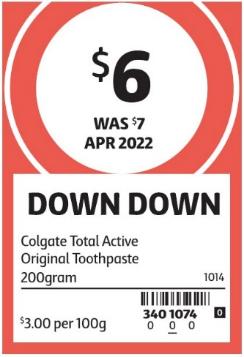
102 An illustration of an in-store Dropped & Locked ticket, taken from Ms Bailey’s evidence, is as follows:
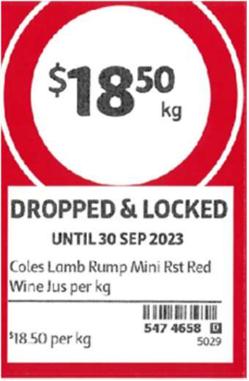
103 An illustration of an in-store Multi-buy ticket, taken from Ms Bailey’s evidence, is as follows:
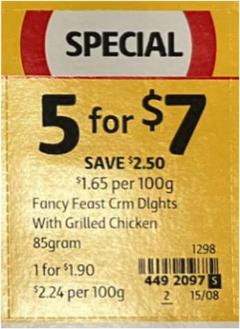
104 An illustration of an in-store Mix ‘N Save ticket, taken from Ms Bailey’s evidence, is as follows:
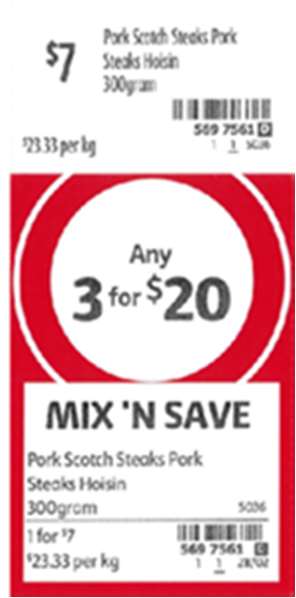
105 An illustration of an in-store Every Day Price ticket, taken from Ms Bailey’s evidence, is as follows:
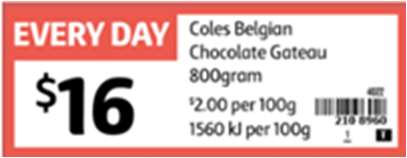
106 Each week, before trade started on Wednesdays, Coles took down in-store tickets for products that had been on promotion the previous week and put up new tickets for products to be offered on a new or different promotion for the coming week. This involved changing tickets for around 5,500 products per store each week during the relevant period. As noted earlier, the typical Coles store ranged approximately 18,000 to 24,000 products in any given week.
Marketing and advertising
107 In addition to displaying prices on shelf tickets, Coles used several other methods for communicating prices to customers in-store during the relevant period, including:
(a) in-store signage;
(b) audio advertisements which were played between music tracks on ‘Coles Radio’ (played in all Coles stores and also available to customers through the Coles App); and
(c) Coles digital screens located at entries in some supermarkets.
108 Coles advertises its prices (including its promotions) through many advertising channels, including television, newspaper, catalogues and online.
109 Coles runs television advertisements nationally on the three commercial television networks, being Seven, Nine and Ten. The advertisements are shown during prime time and during off-peak times. The advertisements are run in seasonal bursts aligned to spring, summer, autumn and winter. The advertisements are run more frequently during the beginning of a campaign (around three advertisements per network per day) and then decrease in frequency over the course of around six weeks (around two advertisements per network per week by the end of the campaign). Ms Bailey estimated that Coles’ advertisements are displayed on commercial channels for around 24 weeks per year.
110 Coles advertises in various newspapers, including in the News Corporation papers published in each State other than Western Australia (such as the Herald Sun in Victoria and the Daily Telegraph in New South Wales) and in the West Australian newspaper in Western Australia. From around September 2020, Coles published a four-page insert in News Corporation papers weekly. This initiative continued for two or three years.
111 Prior to 2020, Coles published a weekly catalogue, which was distributed to customers who lived within catchments of Coles’ stores. The catalogue typically comprised approximately 48 pages in the digital version and 14 pages in the printed version. The catalogues were distributed directly to mailboxes within the catchment area. Ms Bailey estimated that between five and six million catalogues were distributed each week during the period prior to 2020. In September 2020, distribution of the catalogue decreased due to the Covid-19 pandemic. During the relevant period, the catalogue was available for customers in-store and published online each week. Coles’ weekly catalogue is also made available in digital form to Coles’ customers through Coles’ website and digital channels.
112 Coles also communicates its price promotions to its customers through emails sent to customers who are on a Coles distribution list. Ms Bailey indicated that, in September 2020, the distribution list included 500,000 people, and it currently includes 3.2 million people. In addition, promotions are also communicated to Flybuys customers via email. Flybuys is a customer loyalty program that is a joint venture between Coles and Wesfarmers.
C.4 Coles’ purchase arrangements with suppliers
Industry Code of Conduct
113 During the relevant period, Coles had agreed to be bound by the Food and Grocery Code of Conduct, being Sch 1 of the Competition and Consumer (Industry Codes—Food and Grocery) Regulation 2015 (Cth) (the Code of Conduct). The Code of Conduct, which was voluntary during the relevant period, has since been updated and is now mandatory: Competition and Consumer (Industry Codes—Food and Grocery) Regulations 2024 (Cth).
114 The purpose of the Code of Conduct included to help to regulate standards of business conduct in the grocery supply chain and to promote and support good faith in commercial dealings between retailers, wholesalers and suppliers (cl 2). The Code of Conduct required retailers (which included Coles) to deal with suppliers in good faith (cl 6B). The Code of Conduct also stipulated that all grocery supply agreements must be in writing (cl 7).
115 Division 3 of the Code of Conduct regulated the circumstances in which a grocery retailer may require payments from a supplier under the supply agreement. For example, the Code of Conduct stipulated that the retailer must not require payments for shrinkage and wastage (cll 13 and 14). However, the Code of Conduct permitted retailers and suppliers to agree the terms on which a supplier would fund part or all of the costs of a promotion, provided the funding was reasonable in the circumstances (cl 18). Further obligations with respect to funded promotions were imposed by cl 20 (within Div 4). For example, if a supplier agreed to make a payment in support of the promotion of a product, the retailer may only hold the promotion after giving the supplier reasonable written notice.
116 Clause 27A of the Code of Conduct imposed certain obligations on the retailer when a supplier notified the retailer that the supplier intended to increase the price of groceries supplied to the retailer. Clause 27A(2) stipulated that, within 30 days of being informed by the supplier of the price increase, the retailer must notify the supplier in writing whether the retailer or wholesaler accepts the price increase, accepts an increase in the price of the groceries but does not accept the amount of the price increase, or does not accept the price increase. Clause 27A(3) stipulated that, if the retailer did not accept the price increase in whole or in part, the supplier may request the retailer to enter into negotiations about the price increase. Clause 27A(4) stipulated that the retailer must engage in those negotiations in good faith and without delay.
Pricing and promotional plans
117 Coles had contractual trading terms with each of its suppliers that specified (among other things) a list price for the supplier’s products, which was the price the supplier charged to Coles before any discounts, rebates, offsets or other adjustments.
118 As stated earlier, category managers had primary responsibility for determining the retail prices Coles charged for products, planning and implementing promotional programs for those products, and negotiating and agreeing with suppliers on matters such as the suppliers’ list prices and promotional plans, including suppliers’ contribution to funding promotions.
119 Although Coles determined the retail price at which a product was sold in a Coles supermarket, Coles frequently adopted the supplier’s recommended retail price as Coles’ shelf (white ticket) price. Ms Galle said that, in her experience (including in roles at Mars, SPC Ardmona and Coca-Cola Amatil), suppliers conducted careful and detailed product research and analysis, which included assessing the pricing of other products within the supplier’s portfolio, the pricing of competitor products and the potential impact of setting the recommended retail price at a given level on sales volumes. This informed the supplier’s assessment of whether their recommended retail price would enable their products to be competitive across the market. Since joining Coles, Ms Galle has also found suppliers’ recommended retail prices to generally be appropriate and competitive prices. In Ms Galle’s experience, suppliers set a single recommended retail price for each product for all retailers, including Coles, Woolworths and IGA.
120 A further factor taken into account by Coles in setting its prices was the pricing for the same or similar products ranged by Coles’ competitors, particularly Woolworths. The Coles’ Pricing and Value team was responsible for monitoring and reporting to the business (including category managers) on Coles’ competitiveness in the market. This was done through the creation and tracking of pricing indices that benchmarked a large selection of products in Coles’ portfolio to Woolworths and Aldi on a weekly basis in respect of both undiscounted (white ticket) and promotional prices. Coles also tracked its price competitiveness against independent supermarkets (such as IGA), and other retailers such as Amazon and Chemist Warehouse, on an ad hoc basis (typically based on catalogue information or web-scraping of pricing data).
121 Promotions were usually proposed by suppliers in ‘promotional plans’ (also referred to as ‘trade plans’). Promotional plans usually identified: the products that suppliers proposed that Coles sell on promotion; the promotional mechanic they proposed that Coles use; the funding they proposed to provide; proposed promotional prices; forecast sales volumes; and the gross margin Coles would earn if the plan were to be implemented. They typically also identified suppliers’ recommended retail price for the products and covered a period up to 52 weeks.
122 Suppliers usually proposed promotional plans at least six months before the start of the promotional period, to allow time for the plan to be negotiated and agreed and then implemented. Implementation involved several steps. Coles worked with its suppliers to ensure that they had sufficient stock to meet any forecast increase in sales and that sufficient time had been factored in for transporting stock to Coles’ distribution centres and from these centres to individual stores. Coles often agreed with its suppliers to allocate additional space in stores to promoted products. From time to time, promotional plans could change, including due to supplier production shortages which resulted in insufficient volumes of the product being available.
123 Coles’ category managers had primary responsibility for negotiating and agreeing promotional plans with suppliers. In considering the appropriate promotional mechanic for a product, Coles had regard to matters such as the amount of any funding the supplier was willing to provide; Coles’ gross margin; whether the product was sold on promotion by Coles’ competitors (and, if so, the mechanic(s) they used); and the nature of the product.
Coles’ Cost Price Adjustment Policy
124 Consistently with the Food and Grocery Code of Conduct, Coles’ trading terms permitted its suppliers to request an increase to their list prices when their costs increased.
125 During the relevant period, Coles assessed price increase requests in accordance with its ‘Costs Price Adjustment’ policy (CPA Policy). The application of the CPA Policy was subject to any contrary terms agreed with a supplier. The CPA Policy required suppliers to complete and submit a cost increase request to the relevant Coles category manager. The cost increase request was usually referred to within Coles (interchangeably) as a CPA (cost price adjustment) request or a CPI (cost price increase) request. The CPA Policy required the request to be submitted in the form of a template. The request specified the SKU details (a unique code for each product), the date of the last price change, the increase requested and the proposed effective date. The CPA Policy stated that:
(a) Coles would assess the request having regard to direct, variable input costs which are subject to external market forces, such as raw materials costs, packaging costs, freight costs and utilities costs;
(b) labour cost increases would be considered to the extent that they have been implemented by the supplier to meet the requirements of the Coles Ethical Sourcing Policy and any applicable laws; and
(c) cost increases based on changes to marketing costs, fixed costs, and any other overhead costs would not be considered.
126 Consistently with the Food and Grocery Code of Conduct, the CPA Policy stated that cost price increase requests may be accepted, partially accepted or rejected by Coles, and that if the request was only partially accepted or was rejected, the supplier may require Coles to enter into further negotiations. The CPA Policy stated that Coles was committed to ensuring that suppliers are able to recoup cost increases that can be validated. However, Coles reserved the right to work with the supplier to seek agreement to minimise any negative pricing effects for Coles’ customers and/or adverse effect on the performance of the supplier’s products that might result from a validated price increase.
127 Ms Lavdas explained that, in discharging her responsibilities as a business category manager, she believed that it was important for Coles to accept appropriate cost increases so that its suppliers’ businesses were sustainable in the long term. However, increasing list prices also impacted Coles’ ability to keep retail prices low and to deliver on its overall value proposition for customers. In addition, increasing retail prices risked sales volume decline as customers switched to purchasing other products or simply bought less. Because of those considerations, Ms Lavdas considered it important, when considering a CPA, to understand the impact of the CPA for the product’s trade plan (being the pricing strategy for the product, including the use of promotional prices when retailing the product).
128 Coles had a Vendor Management Office (VMO) that assisted with the assessment of CPA requests. The VMO assessed whether the supplier’s input costs had increased by the amount the supplier claimed using publicly available information (such as commodity price movements) and any information the supplier provided. This was referred to within Coles as ‘validating’ a CPA request.
129 When suppliers submitted CPA requests which would result in an increase in list prices, they usually also proposed amended promotional plans for their products. That was because list prices were a key input into promotional plans. They informed matters such as the suppliers’ recommended retail prices and proposed promotional prices, as well as Coles’ sales margins for undiscounted and discounted retail prices. This meant that when list prices changed, any promotional plans that were in place for the products concerned also changed. When the promotional plan for the supplier’s products was agreed between Coles and the supplier, the agreement was recorded in a document called a Promotional Advice Form (PAF) which was submitted by the supplier to Coles. As explained by Mr Cubbon, the PAF contained all of the details needed to run the promotion for the supplier’s products, including the product name and SKU, the type of promotion, promotional start and end dates, supplier funding and, in most cases, the supplier’s recommended retail price.
130 Many of the witnesses called on behalf of Coles gave evidence about their experience in negotiating new promotional plans with suppliers as part of the assessment of a CPA request. Their consistent evidence was that, as part of negotiating a CPA, they also negotiated new promotional plans for the affected products to deliver value back to customers (notwithstanding the price increase). The witnesses were challenged about that evidence in the course of cross-examination. It was suggested to the witnesses that the promotional plans were in the best financial interests of Coles, and that the witness’s primary objective in negotiating the promotional plans was Coles’ financial interests. While each of the witnesses acknowledged that they sought to negotiate supplier funding for the promotion so as to protect Coles’ financial interests, they also maintained that a key objective of the promotional plans was to provide value to Coles’ customers. The evidence was given sincerely and I accept it. The evidence establishes that, during the relevant period, Coles’ core business objectives included delivering value to its customers as well as conveying a ‘value message’ (such that customers would recognise the price value).
The effects of inflation during the relevant period
131 During the relevant period, there was a material increase in inflation. The most relevant measure of inflation in this context is the producer price index, rather than the consumer price index (although the latter is, of course, related to the former). As at March 2021 (approximately one year before the relevant period), the annual producer price index was 0.2% (being the percentage change from the corresponding quarter of the prior year). By December 2021, the annual producer price index had increased to 3.7%, by March 2022 it had increased to 4.9%, by June 2022 it had increased to 5.6%, by September 2022 it had increased to 6.4% and by December 2022 it was 5.8%. The index remained elevated into 2023.
132 Many of the witnesses gave evidence that, as a result of the inflationary pressures being faced by suppliers during the relevant period, there was a material increase in the volume of CPA requests that Coles received. Some suppliers were requesting increases to their list prices multiple times in the one year. Ms Galle explained that, as a consequence of the increased prices being charged by suppliers, Coles increased the retail price of a large number of products at this time.
C.5 The Down Down promotional program
Key features of the program
133 The Down Down program was introduced in 2010 and was in continuous use until at least the end of the relevant period.
134 The Down Down program was a pricing mechanic under which Coles offered selected products for sale at discounted prices for a longer period of time than short-term promotions such as weekly Specials. During the relevant period, products were on Down Down for a minimum of twelve weeks but typically longer.
135 Coles identified the products which were being promoted on a Down Down promotion in-store and online using different tickets, which distinguished them from products that were not on promotion or were on other forms of promotion, including Specials. The precise design of Down Down tickets varied throughout the relevant period. However, throughout the relevant period, all Down Down tickets shared at least the following features:
(a) a red and white colour scheme;
(b) details of the relevant product, including its name;
(c) the words “Down Down”;
(d) the Down Down price;
(e) in most cases, a ‘Was’ price of the relevant product, being the price at which the product was sold immediately before it was sold on the Down Down promotion; and
(f) the date at which the product was offered for sale at the ‘Was’ price, stated in a month and year format (for example, “Was $10 July 2024”).
Down Down marketing
136 Ms Bailey’s evidence addressed the history of the Down Down marketing campaign. Ms Bailey explained that features of the Coles’ marketing of the Down Down program have included the following elements:
(a) a red colour scheme was consistently used throughout the life of the program;
(b) the ‘Big Red Hand’ icon (an image of a red hand with the index finger pointing down) was also used continuously since the program’s inception;
(c) several jingles incorporating the words ‘Down Down’ in popular songs, including:
(i) the song ‘Down Down’ by Status Quo, which featured in video and radio advertisements from 2010 until at least 2017 (initially performed by Status Quo and then by Casey Donovan in 2017);
(ii) the song ‘Downtown’ by Petula Clark (2011);
(iii) the song ‘Whatever You Want’ by Status Quo (2013); and
(iv) the song ‘That’s Amore’ by Dean Martin (2016); and
(d) several slogans have been used throughout the life of the program:
(i) ‘Down Down, prices are down’ (2010 until at least 2017);
(ii) ‘prices are down and staying down’ or ‘Down Down and staying down’ (2010 to 2014);
(iii) ‘not on Special, they're on Down Down’ (2011); and
(iv) ‘100s of prices down’ (2021).
137 Ms Bailey gave evidence that the expression ‘regular price’ was used in the marketing materials for the Down Down program in 2010, but that Coles had not used that expression in its marketing for the Down Down program since that time.
138 Ms Bailey agreed in cross-examination that the purpose of the Big Red Hand was to symbolise the ‘Down Down’ program and to communicate to customers that products on the Down Down promotion have their prices down.
139 Ms Bailey also described how the general messaging of the Down Down marketing changed over time. From 2010 to 2018, the marketing for the Down Down program generally focused on the Down Down mechanic itself and the products that were being offered on a Down Down promotion. Since 2019, Coles had marketed the Down Down program not as the focus of advertising campaigns but as a supporting ‘proof point’ within broader campaigns that focus on value. Ms Bailey provided two examples of this:
(a) Coles launched a campaign called “Helping lower the cost of breakfast, lunch and dinner” in September 2019, using the tagline “Good things, great value”. As part of this, Coles’ advertising pointed to certain products on promotion (for example, yoghurts on Down Down, muesli on Special) as ‘proof’ of how Coles was lowering the cost of breakfast for customers.
(b) In 2023, Coles launched a campaign called “Great value, hands down” where Coles pointed to products on Down Down as examples of the value offered by Coles.
140 Ms Bailey also explained that the words in the jingle played in Coles’ Down Down advertisements changed several times since 2018. In 2018, the tagline to the jingle was “Good things are happening to prices at Coles”. From 2020 to 2022, the tagline was “Value the Australian way”. In 2023 there was no tagline.
141 As set out earlier in these reasons, Coles engages in widespread advertising of its products and prices, including Down Down promotional prices. Ms Bailey agreed in cross-examination that millions of people would have seen Coles’ Down Down advertisements and likely multiple times. In my view, a large number of consumers would understand that the Down Down program was a promotional or discount program offered by Coles. Many people are likely to recall the slogan ‘Down Down prices are down’, even though Coles ceased using that slogan in 2017.
Down Down promotional guardrails
142 As noted earlier, Coles had internal business rules throughout the relevant period, referred to as ‘promotional guardrails’, governing the conduct of the different types of promotions used by Coles. The guardrails were amended over time, including during the relevant period. The amendments that were made to the Down Down guardrails at the beginning of the relevant period are significant, because the amendments permitted Coles to engage in the conduct that is the subject of the ACCC’s allegations in this proceeding.
September 2019 guardrails
143 The version of the Down Down guardrails issued in September 2019 applied until at least January 2022.
144 Under the heading ‘Background’, the guardrails stated:
The Down Down program offers customers great value through promising a great value price for at least 12 weeks. The products must be removed from the program after 18 months as the price point is now well established and has limited relevance to the previous price point. Therefore, products on Down Down must remain on this program for a minimum of 12 weeks and a maximum of 18 months.
145 Under the heading ‘Down Down rules’, the guardrails commenced with the statement:
When a product is launched on Down Down it must meet the following rules to ensure it is not considered misleading and deceptive advertising.
146 Then followed a series of sub-headings explaining the Down Down rules.
(a) Under the sub-heading ‘Establishment’, the guardrails contained rules relating to the ‘establishment’ of the price of a product before it could be placed on a Down Down promotion. As explained by Ms Galle, the promotional guardrails required that, before a product could be first placed on Down Down, the white ticket price of the product had to be ‘established’. The white ticket price would then become the ‘Was’ price for the Down Down promotion. To be ‘established’, two rules had to be satisfied:
(i) First, the product must have been sold at that price for four weeks immediately prior to the launch of the product on Down Down, or for four out of the last six weeks, without any ‘simple’ promotions (ie without being sold on a Special), including not being sold on Special in either of the two weeks immediately prior to the launch of the Down Down promotion.
(ii) Second, the product must not have been offered at a lower “regular ‘N’ price” (being a regular non-promotional price – in other words, a white ticket price) in the last twelve weeks prior to the Down Down promotion.
(b) Under the sub-heading ‘Duration’, the guardrails stated that the product must remain on the Down Down program for a minimum of twelve weeks and a maximum of 18 months.
(c) After the first four weeks of a Down Down promotion, the guardrails permitted the product being placed on Special, provided that the Special promotion was no more than one week duration and provided the product was only placed on Special in one out of every four weeks. The ‘Was’ price during a Special promotion was the Down Down price. At the end of the Special, the product would revert to the Down Down program.
147 Under the heading ‘Pricing at the end of Down Down’, the guardrails stated that product must be placed on a white ticket at the Down Down price for a two-week period (referred to as the ‘honour period’). The product may then be returned to the original non-promotional price or placed onto an Every Day Price promotion. The guardrails stated that the product must not be put back on a Down Down promotion for nine months.
148 Under the heading ‘Pricing increases during the Down Down period’, the guardrails stated the rules to be followed if “there is a need to increase prices whilst an item is within the Down Down program due to market or competitive activities”. The rules required:
(a) that the product be sold on a white ticket at the Down Down price for at least two weeks;
(b) then, the price be increased and sold on a white ticket for at least two weeks; and
(c) after at least two weeks at the higher price on a white ticket, the product may be placed on an Every Day Price ticket.
149 Thus, under the September 2019 guardrails, if a product was taken off a Down Down promotion by reason of a cost price increase, it could not be returned to the Down Down program for nine months.
150 Separate guardrails applied to Every Day Price promotions. As noted earlier, there were three differences with Down Down promotions: first, the Every Day Price was required to be maintained for at least six months; second, no comparative (‘Was’) price could be used on an Every Day Price ticket; and third, no ‘simple’ promotions (ie Specials) were permitted.
Revisions to the guardrails
151 The Down Down promotional guardrails were revised in late 2021 and early 2022, with revised versions commencing in January 2022 and March 2022 respectively. Ms Galle gave evidence about the business pressures that led to the revisions. They were twofold.
152 First, as noted earlier, there were significant inflationary pressures in the economy which resulted in a large increase in the number of CPA requests being received by Coles. Under the existing Down Down guardrails, if a product was removed from the Down Down program (to increase its price), Coles was not permitted to put the product onto a new Down Down program for a period of nine months.
153 Second, Coles’ major competitor, Woolworths, had a similar promotional program called ‘Prices Dropped’. Ms Galle understood that, at this time, Woolworths was removing products from that program and selling them at a non-promotional price for only four weeks before reintroducing them to the Prices Dropped program. Ms Galle wanted Coles to be able to do the same with the Down Down program. Ms Galle considered that imposing a nine-month delay before a product could be placed back onto the Down Down program was an extraordinarily long period of time in circumstances where most customers were engaging with heavily traded categories at least once a week.
154 I accept Ms Galle’s evidence as to the business pressures that led to the revisions to the Down Down guardrails. It is consistent with contemporaneous internal correspondence within Coles which recorded concerns held by Coles’ managers that Woolworths was removing products from its ‘Prices Dropped’ promotional program because of cost increases and placing the products onto new ‘Prices Dropped’ programs in a four-week period and thereby gaining a competitive advantage over Coles.
January 2022 guardrails
155 The January 2022 Down Down guardrails made two material changes to the September 2019 guardrails.
156 First, when a product was removed from the Down Down program, the period in which the product had to remain outside the Down Down program was shortened from nine months to six months.
157 Second, if the need arose to increase the price of the product during a Down Down promotion by reason of a cost price increase, it remained necessary to remove the product from its previous Down Down promotion and to honour the previous Down Down price on a white ticket for at least two weeks before increasing the white ticket price for a further two weeks. However, there were then two pricing options which were stated as follows:
a. Put product onto Every Day. Product can now be featured in catalogue; or
b. Where there has been a genuine verified supplier cost increase, hold for total of 12 weeks on a standard shelf edge ticket before putting back onto Down Down at a price point that reflects the supplier cost price increase (standard establishment rules apply). HiLo promotions allowed whilst not on Down Down.
158 Thus, where there had been a cost price increase, the January 2022 guardrails permitted Coles to remove the product from a Down Down promotion, sell the product at a higher price on a white ticket and then return the product to a new Down Down promotion provided two conditions were satisfied:
(a) first, the white ticket price must reflect the supplier cost price increase; and
(b) second, the product must be sold at the white ticket price for twelve weeks, before putting the product onto the new Down Down promotion.
159 It can be seen that, as at January 2022, the Down Down guardrails effectively imposed a price establishment period of twelve weeks.
March 2022 guardrails
160 Further changes were made to the Down Down guardrails in March 2022 in two relevant respects.
161 First, the initial price establishment rules were relaxed to remove the 12-week requirement. It remained necessary for the product to be sold at the establishment price for four weeks immediately prior to the launch of the product on Down Down, or for four out of the last six weeks, without any ‘simple’ promotions (ie without being sold on a Special), including not being sold on Special in either of the two weeks immediately prior to the launch of the Down Down promotion. However, the second rule, which required that the product had not been offered at a “lower regular ‘N’ price” in the last twelve weeks prior to the Down Down promotion, was removed.
162 Second, in respect of cost price increases during the Down Down period, the rules were also relaxed to remove the 12-week requirement. The new rules were as follows:
• Notify Merchandise Compliance Team and the Value team of proposed activity so can determine if there are any unintended consequences.
• Obtain signoff from the Value Forum and the BU GM.
• Increase the price and hold for 4 weeks on a standard shelf edge ticket with no simple promotions (standard establishment rules apply).
• Put back onto Down Down at a price point that reflects the supplier cost price increase or competitive activity.
163 Thus, by the above revisions, Coles effectively reduced the price establishment period from twelve weeks to four weeks.
Evidentiary significance of the guardrails
164 The ACCC placed considerable emphasis on the Down Down guardrails. The ACCC drew attention to the fact that the stated purpose of the guardrails was to prevent Down Down promotions being misleading and deceptive. The ACCC submitted that it should be inferred that Coles developed the guardrails with knowledge of its customers and of what it intended to convey to them via Down Down tickets. In that context, the ACCC referred to the observations of the High Court in Bed Bath ‘N’ Table Pty Ltd v Global Retail Brands Australia Pty Ltd [2025] HCA 50; 100 ALJR 57 (Bed Bath ‘N’ Table) at [52]-[57]. After observing that the question whether conduct is misleading or deceptive is one of objective assessment of fact, the High Court discussed the evidentiary significance of a trader’s intention, stating (at [53]):
… if the person intending to achieve an end or object by the doing of an act is a trader in the relevant area of business, that trader’s belief that the doing of an act will achieve a certain end or object and that trader’s doing of the act on the basis of that belief may be taken as “a reliable and expert opinion on the question whether what [the trader] has done is in fact likely to” achieve the intended end or object. The inference that the trader held this state of mind, referred to as an “expert opinion”, is relevant and forms part of the evidence before the judge to be weighed with all other relevant evidence on the ultimate objective question of fact, whether the intended end or object occurred.
165 The ACCC also referred to the earlier observations of the High Court majority (French CJ, Crennan, Bell and Keane JJ) in Australian Competition and Consumer Commission v TPG Internet Pty Ltd (2013) 250 CLR 640 (TPG HCA) at [55] (citations omitted):
It has long been recognised that, where a representation is made in terms apt to create a particular mental impression in the representee, and is intended to do so, it may properly be inferred that it has had that effect. Such an inference may be drawn more readily where the business of the representor is to make such representations and where the representor’s business benefits from creating such an impression.
166 The ACCC submitted that it is significant that the guardrails required that a higher price had to be ‘established’ over a period of weeks prior to a Down Down promotion commencing or resuming, because that rule demonstrated Coles’ understanding that its customers may be misled if the Down Down price was compared with a price that had not been established for a sufficient time.
167 Those submissions can be accepted. The guardrails evidenced Coles’ awareness that a Down Down promotion conveys that the Down Down price is a genuine discount from the previous price at which the product was sold, and that a genuine discount requires that the previous price be a genuine price at which the product was offered. By the guardrails, Coles implemented business rules which, amongst other things, required the previous price to be ‘established’ for a minimum period before the product was offered at a discounted price on a Down Down promotion.
168 However, the value of the guardrails as evidence of Coles’ beliefs with respect to the meaning conveyed by the Down Down tickets must be assessed with two matters in mind.
169 First, Coles submitted, and I infer, that the guardrails were likely prepared in a manner that reflected the ACCC’s published guidance on price comparison advertising. The content of the guardrails therefore reflected Coles’ desire to conduct its business in compliance with the ACCC’s published guidance. An example of the ACCC’s guidance is contained in the ACCC’s publication entitled ‘Advertising and selling guide – a guide for business’ dated July 2021, which was tendered in evidence. In respect of ‘was/now’ and ‘strike through’ pricing, the publication advised:
The use of ‘was/now’ or ‘strike through’ price statements (such as ‘was $150/now $100’ or ‘$150 now $100’) is likely to represent that consumers will save an amount (being the difference between the higher and lower price advertised) by purchasing the product during the sale period.
In determining whether the represented saving will be achieved, a critical issue is whether relevant consumers would have paid the ‘was’ or ‘strike through’ price to purchase that item for a reasonable period before the sale commenced.
What’s considered to be a reasonable period in the circumstances will vary from case to case and will depend of [sic] the type of product or market involved and usual frequency of price changes for that product or in that market.
170 Second, the evidentiary value of the guardrails is complicated by the fact that the guardrails were revised by Coles at the commencement of the relevant period. The January 2019 guardrails prevented Coles from removing a product from a Down Down promotion, increasing the product’s price, and then placing it back on a new Down Down promotion until at least nine months had elapsed. That restriction applied even if the reason for the price increase was an increase in the cost of the goods. The January 2022 guardrails permitted, in the case of a cost price increase, the product to be removed from the Down Down promotion, sold on a white ticket at a price that reflected the cost price increase for a minimum period of twelve weeks, and then be returned to a new Down Down promotion. The March 2022 guardrails reduced the price establishment period to four weeks.
171 The evidentiary principle referred to in Bed Bath ‘N’ Table, on which the ACCC relied, might suggest that weight should be given to Coles’ revised opinion as reflected in the March 2022 guardrails. Recognising this evidentiary difficulty, the ACCC submitted that the precise rule relating to the establishment period that was included in the guardrails was not of evidentiary significance; rather the significance of the guardrails lay in Coles’ implicit understanding that its customers may be misled if the Down Down price was compared with a price that had not been established for a sufficient time. The ACCC further submitted that the Court should give little weight to the later iterations of the guardrails because they were drafted under competitive pressure from Woolworths. As such, they reflected a ‘race to the bottom’ – where standards of business behaviour decline by reason of competitive pressures.
Conclusions with respect to the Down Down promotional guardrails
172 The conclusions I reach with respect to the Down Down promotional guardrails are as follows.
173 The promotional guardrails provide contemporaneous evidence of Coles’ efforts to ensure that the Down Down price represented a genuine discount from the previous price. In that regard, the guardrails demonstrate that Coles was aware of the potential for the Down Down promotional strategy to mislead consumers. It is a matter of common experience that ‘was/now’ or ‘strike through’ pricing can be used in a misleading manner, as illustrated by previous cases that have come before this Court which are discussed below. Although a product may have been offered at the ‘was’ price, the discount implied by the ‘was/now’ or ‘strike through’ pricing will be artificial or illusory (and thereby misleading) if the ‘was’ price was an artificially high price, or offered for a relatively short period of time, in either case with the result that no or very few sales occur at that price. Coles sought to guard against the risk of the Down Down mechanic being used in a misleading manner by addressing both issues.
174 Before a product could be placed on a Down Down promotion for the first time, the guardrails required that the white ticket price of the product had to be ‘established’. The white ticket price would then become the ‘Was’ price for the Down Down promotion. When a product was launched on Down Down, the ‘Was’ price had to have been established by the product being sold at that price for four weeks immediately prior to the launch of the product on Down Down, or for four out of the last six weeks, without any ‘simple’ promotions (ie without being sold on a Special), including not being sold on Special in either of the two weeks immediately prior to the launch of the Down Down promotion. Until March 2022, the guardrails also required that the product must not have been sold at a lower non-promotional price in the twelve weeks preceding the Down Down promotion.
175 The Down Down guardrails also tightly controlled the circumstances in which a product could be taken off a previous Down Down promotion, the price increased and then placed back on a new Down Down promotion at a discounted price. The September 2019 guardrails contained a stipulation that, in those circumstances, the product could not be put back on a Down Down promotion for nine months. There was no evidence that explained the purpose of that stipulation. The ACCC did not suggest that such a requirement was necessary to avoid a Down Down promotion being misleading. I infer that the requirement was motivated by some other unidentified commercial purpose. It is possible that Coles believed that removing a product from the Down Down program and then reinstating it on the program within a period of nine months undermined the efficacy of the program as a promotional strategy. Whether that is the case, it has nothing to do with the question whether the Down Down tickets were misleading. The January and March 2022 guardrails made it clear that that restriction did not apply when a product was removed from a Down Down promotion by reason of a cost price increase.
176 The January 2022 guardrails imposed a number of controls over the circumstances in which a product could be removed from a Down Down promotion by reason of a cost price increase, and subsequently returned to a Down Down promotion. The relevant controls involved the following steps:
(a) The starting point was that the price increase could only occur if “there is a need to increase prices whilst an item is within the Down Down program due to market or competitive activities”. Thus, Coles’ guardrails prevented Coles from removing a product from a Down Down promotion in order to ‘spike’ the price without justification and place the product on a new Down Down promotion.
(b) If there was a need to increase prices due to market or competitive activities, the guardrails required that Coles’ Merchandise Compliance Team and Value team be notified of the proposed activity, and the increased price required sign off from the Value Forum and the Business Unit General Manager. Thus, Coles’ guardrails required the cost increases and resulting price increases to be signed off internally.
(c) If the sign offs were obtained, the product could be moved onto an Every Day Price ticket, or the product could be returned to a Down Down ticket but only if:
(i) there had been a genuine verified supplier cost increase; and
(ii) the product had been sold for twelve weeks at a white ticket price that reflected the supplier cost price increase (with HiLo promotions permitted).
177 The March 2022 guardrails reflected similar restrictions, save that the price establishment period was shortened to four weeks.
178 Whilst one of the controls imposed by the guardrails was the period during which the product must be sold at the ‘Was’ price before the product could be placed on a new Down Down promotion, that was only one of the controls. It is apparent that the object of the guardrails was to ensure that the Down Down price always reflected a genuine discount to the ‘Was’ price. The guardrails recognised that the genuineness of the discount depended upon the commercial circumstances in which the price of the product had been increased, the level at which the white ticket price was set and the period for which the product was sold at the white ticket price.
179 The point of controversy in this proceeding concerns Coles’ decision to reduce the price establishment period from twelve weeks to four weeks. Ms Galle’s evidence supports a finding that Coles made that decision as a consequence of competitive pressure from Woolworths. Coles believed that Woolworths had reduced the price establishment period on its competing ‘Prices Dropped’ program to four weeks. As a result of competitive pressure, Coles implemented that change to the Down Down program.
180 Taking the evidence as a whole, I consider that Coles’ September 2019 and January 2022 guardrails afford contemporaneous evidence of Coles’ belief that, provided a white ticket price was set in accordance with the guardrails and was offered in the market on an ordinary basis for a minimum period of twelve weeks, a discount from that price on a Down Down promotion would represent a genuine discount and the Down Down promotion in those circumstances would not be misleading. Of course, Coles’ opinion on that question is not binding on the Court. It is for the Court to assess objectively whether trading conduct is misleading. Nevertheless, Coles’ views as a trader in the relevant market carries some weight.
181 Conversely, I place less weight on the March 2022 guardrails as affording evidence of Coles’ beliefs with respect to an appropriate minimum price establishment period. The March 2022 guardrails relaxed the price establishment rules that governed the Down Down program as a response to competitive pressure from Woolworths. In my view, the competitive pressure likely brought about a ‘race to the bottom’ in terms of compliance with the Australian Consumer Law.
Admissions with respect to the Down Down program
182 As noted earlier, the ACCC tendered in evidence, as admissions against interest, certain statements made by Coles in response to requests for information made by the ACCC (some of which sought voluntary responses, and some of which were made pursuant to s 155 of the CCA and thereby compelled responses). In the main, the statements comprised descriptions of, or explanations about, the Down Down program, the promotional guardrails that applied to the Down Down program and the marketing of the Down Down program. The descriptions and explanations are largely uncontroversial and are consistent with the evidence given by Coles’ witnesses, which are the subject of the factual findings made in these reasons.
183 There is one aspect of the admissions that should, however, be separately addressed. The ACCC submitted that certain of the statements made by Coles in its responses to the ACCC contained an admission of the ACCC’s principal allegation: that the tickets represented that the Down Down price was “a genuine reduction to, or discount from, the product’s previous regular price”. As noted earlier, the ACCC’s case was that the phrase “previous regular price” means “the price at which that product was ordinarily offered for sale for a reasonable period prior to the promotion”. The ACCC submitted that certain of Coles’ responses admitted that Down Down prices can be characterised as the previous ‘regular’ price of the product.
184 In support of that submission, the ACCC relied on the following statements made by Coles (in Coles’ responses to the ACCC’s requests for information) which used the word ‘regular’ in relation to Coles’ prices. In each of the Coles’ statements reproduced below, the word ‘regular’ has been highlighted for ease of reference (other emphasis is in the original document).
(a) On 20 June 2022, the ACCC made a voluntary information request to Coles. Amongst other things, the ACCC requested that Coles provide details of any policies or procedures regarding the use of price reduction representations in Coles supermarket outlets and Coles Online, current and in effect as at 20 June 2022. By letter dated 1 August 2022, Coles’ Head of Legal – Regulation, Rebecca Irish, stated:
Coles has in place clear internal business rules (the Rules) regarding the use of price reduction representations in Coles supermarkets and Coles Online. The Rules outline the requirements in place to ensure that any representation offering a saving or a discount off a regular price is genuine and is based off a regular price that has been offered for a reasonable period, in reasonable numbers immediately before the price reduction representation is made.
(b) On 4 May 2023, the ACCC issued a s 155 notice to Coles. Amongst other things, the notice required Coles to identify: (a) when Coles Group first implemented the Down Down program; (b) whether Coles Group has operated the Down Down program continuously since the date referred to in subparagraph (a); (c) if not, the periods during which Coles Group has operated the Down Down program since it was first implemented until the date of the notice; and (d) when Coles Group first applied a Special to a product on the Down Down Program. In its response to those questions, Coles included the following introductory statement (which was not a response to any of the questions asked):
The Down Down Program reflects a long term promotional campaign involving a significant investment by both typically Coles and a relevant supplier to reduce the retail price of a product for a sustained period. When a product is placed on Down Down, the product’s regular shelf price drops to a new lower regular shelf price. Unlike a Special, where the price will revert to a higher price after a short period (typically one week), products on Down Down remain at their new regular shelf price for a sustained period of at least 12 weeks and typically longer. Down Down Tickets and other promotional material contain details of the original regular shelf price and the date that the product dropped to the new regular shelf price as a reference to the commencement of this long term joint investment in value for the customer by Coles and the supplier.
(c) The ACCC’s s 155 notice dated 4 May 2023 also asked Coles to provide an explanation of the term ‘HiLo pricing’. In its response, Coles stated:
‘HiLo’ pricing refers to regular short-term promotions where the customer is offered a short term discounted (or Lo) price before the price is raised again to the normal (or Hi) previous price. Once the Hi price has been established for a reasonable period, the product may be offered at a short term discounted price again. HiLo is distinct from a Down Down price which reflects a sustained reduced regular shelf price. It is also distinct from the limited additional discounts offered on Down Down Products which, under Coles’ internal business rules, were only able to be offered a maximum of one week out of four weeks.
(d) In a voluntary submission to the ACCC dated 7 July 2023, Coles’ solicitors, Allens Linklaters, made the following statements:
The Down Down Program reflects a long term promotional campaign to reduce the regular shelf price of commonly purchased products for a sustained period.
Down Down Tickets and other promotional material describe the original regular shelf price (the ‘Benchmark Price’), the date the product was last offered at that higher price (the ‘Benchmark Date’) and the new Down Down shelf price.
With a Down Down Ticket, the customer is invited to draw a comparison between the current Down Down shelf price and the previous regular shelf price as at the Benchmark Date. The presence of the Benchmark Date is significant as it alerts the customer to the date that the product was last offered at that higher regular shelf price.
With a Down Down Ticket, the customer is invited to draw a comparison between the current regular Down Down shelf price and the previous regular shelf price (Benchmark Price). The presence of the Benchmark Date is significant as it alerts the customer to the date that the product was last offered at that higher regular shelf price and therefore the period of time during which Coles (and the supplier) have invested to reduce the shelf price.
(e) In its further response to the ACCC’s s 155 notice dated 4 May 2023, and specifically a request that Coles provide an overview of the Down Down program, Coles’ response (dated 7 July 2023) included the following statements:
The Down Down Program is a long-term promotional campaign which involves reducing a product’s regular shelf price (the Benchmark Price) to a new lower regular shelf price for a sustained period. It is distinct from short term promotions such as catalogue ‘Specials’ where the customer is offered a short term discounted price (typically for one week) before the price is raised again to the normal shelf price. The sustained nature of the reduced Down Down shelf price has long been communicated to Australian consumers through Coles’ Down Down advertising (eg ‘Down Down, Prices are Down’, ‘Regular prices are down’) together with the Down Down tickets in-store and online which expressly identify for the customer the original regular shelf price (Benchmark Price) and the date that the product was last offered at that higher price (Benchmark Date).
The Down Down Program was first launched in June 2010 during an economic period where there were high rates of food price inflation, and a concern about price competitiveness in supermarkets. The Program was intended to offer customers sustained discounts on a range of commonly purchased products in order to provide customers with predictable and reliable value on the items they purchased most, and therefore to reduce the overall cost of their shopping basket. Throughout its history, the Down Down campaign has been promoted to customers as a sustained reduction in the regular shelf price and distinct from a short term Special.
(f) In its further response to the ACCC’s s 155 notice dated 4 May 2023, and specifically a request that Coles explain the process by which it approved an increase in the price of products on the Down Down program, Coles’ response (dated 7 July 2023) included the following statements:
… where a supplier’s CPI request was validated by Coles and Coles determined that it was not feasible to absorb the CPI and leave the product at its current Down Down shelf price, Coles could remove the product from Down Down in order to process the CPI and transition the product to a higher regular shelf price. The product could thereafter remain at the new higher regular shelf price indefinitely. Alternatively, if Coles (and/or its supplier) elected to invest in the product in order to reduce the regular shelf price, the product could then commence on a new Down Down promotion once the higher regular shelf price had been established for a reasonable period. Coles’ internal business rules historically required these decisions to be first notified to the Merchandise Compliance Team and Value Team for approval. However, in light of the internal business rules in place to prevent misleading pricing representations, and because of the number of CPI requests being made by suppliers during the Relevant Period due to the high inflationary environment, this formal requirement was relaxed in practice although some members of the merchandise team continued to send these notifications during the Relevant Period.
(g) The ACCC’s s 155 notice dated 15 December 2023 asked Coles to explain how it promotes or otherwise informs its suppliers about the Down Down program and its objectives and benefits, and provide a summary of those objectives and benefits. Coles’ response included the following statements:
As discussed in Coles’ response to the May 2023 notice, the Down Down Program is a promotional campaign which involves reducing a product’s regular shelf price (the Benchmark Price) to a new lower regular shelf price for a longer period than the usual weekly specials offered by Coles.
…
There were a number of potential benefits for suppliers in participating in the Down Down Program, including:
• increased sales: the Down Down Program generally resulted in a substantial and sustained increase in sales volumes for suppliers;
• brand visibility: in respect of proprietary products, the Down Down Program typically resulted in increased visibility of the supplier’s product and brand, including through increased shelf space, catalogue spots and in-store displays (such as ‘aisle ends’);
• removing demand spikes: while still an important feature of grocery retailing in Australia, short term ‘Specials’ can produce manufacturing and supply chain spikes, which generate cost for both the supplier and Coles. They can also contribute to shortages of product (ie, issues with ‘availability’ for customers), particularly where demand for the Special exceeds forecasting. In contrast, reducing the regular shelf price for a longer period helps achieve smoother, consistent supply chain patterns, reducing these costs and supply chain risks for both Coles and the supplier; and
• efficiency and simplicity: reducing the regular shelf price for a longer period also meant that repeated promotional negotiations with Coles were not necessary, which also reduced the administrative burden on suppliers.
(h) The ACCC’s s 155 notice dated 15 December 2023 also asked Coles to describe all changes to the Down Down program ‘policies’ and the rationale for the changes. Coles’ response (dated 16 February 2024) referred to the changes that were made to the Down Down guardrails in January and March 2022 and included the following statements:
Coles’ pricing guardrails reflect internal business rules that are carefully designed to ensure that all of Coles’ pricing claims are accurate and can be substantiated, but also that Coles can engage in vigorous price competition. The guardrails have been developed over time, taking into account any available ACCC guidance and caselaw, and tailored to the grocery context in which customers make frequent and repeated purchases and where short term specials and longer term discount programs such as Down Down or everyday low value are now market practice.
In respect of Down Down, a requirement of the guardrails has been that the relevant product was offered at the regular higher shelf price for a reasonable period (the ‘establishment period’) before being placed onto the Down Down Program. Having regard to the frequency with which most customers conduct grocery shopping, the guardrails have generally required an establishment period of around 4 weeks before a product can be introduced to Down Down. Historically, once a product was removed from the Down Down Program, the guardrails only permitted the product to be reintroduced to Down Down after a 9 month period. This parameter largely reflected the commercial practice at Coles, where value planning incorporating Down Down offers occurred on an annual basis. In addition, this aspect of the guardrails was developed during a period of low inflation when there were far fewer CPI requests and those that were requested would typically be raised during annual category reviews rather than throughout the year.
Coles reviewed the guardrails from time to time, typically where the business alerted the Coles Compliance and Legal teams to a change in trading conditions or market practice. These reviews were important as the guardrails necessarily struck a balance between facilitating and restricting competitive pricing activity and a change in trading or competitive conditions could require a review of these settings to ensure they remained fit for purpose. At all times, Coles considers that its guardrails supported truthful and accurate pricing claims, and also the ability to offer discounts to customers at the earliest appropriate opportunity.
Table 1 below sets out a summary of the relevant changes to the Down Down Program Policies. These changes were primarily introduced due to the large number of CPI requests that Coles was receiving from suppliers from around December 2021. These supplier CPI requests reflected not only inflationary pressures in Australia but global cost pressures in areas such as shipping, fuel and commodity prices. For example, in the first six months of 2021, Coles received 1,101 requests from suppliers for cost increases, equivalent to around 42 per week. This almost doubled to around 79 per week in FY22 and 73 in FY23. While Coles had operated the Down Down Program for over 10 years, the number and size of supplier CPI requests during this time was unprecedented. Although Coles wished to support its suppliers in navigating a difficult inflationary manufacturing environment, it was not commercially viable for Coles to absorb simultaneous CPIs across hundreds of products in its Down Down Program, nor was it appropriate from a customer perspective to remove those products from the Down Down Program and no longer offer a longer term value pricing point given consumers were also experiencing inflationary and budget pressures. Accordingly, following a request from the commercial team and a review by the Compliance and Legal teams, the guardrails were amended in January 2022 to permit a CPI to be processed provided that the product was taken off Down Down and remained at the higher price for 12 weeks (‘re-establishment period’) before being put back on Down Down. In March 2022, this re-establishment period was reduced to 4 weeks after it became apparent that given the number of CPI increase requests being received and the high sales velocity of the relevant products, the duration of this period meant that Coles was effectively preventing discounting activity for consumers on products that were important and regular purchases for them. This period was also significantly longer than the standard practice of other major supermarkets. This was significant as it meant that, in the context of industry wide supplier CPIs that were leading to retail price increases more generally, Coles was offering the relevant products at the higher regular shelf price for two months longer than competing stores, creating not only a competitive disadvantage for Coles but more importantly higher prices for Coles' customers who were also experiencing economic pressures. Following a further request from the commercial team and a review by the Compliance and Legal teams, the guardrails were amended in March 2022 to reflect a 4 week re-establishment period, aligning the establishment period for introducing products onto Down Down and also reintroducing products onto Down Down following a CPI.
(i) In its further response to the ACCC’s s 155 notice dated 15 December 2023, and specifically a request that Coles describe how it explains or promotes the Down Down program to consumers in its advertising, Coles’ response (dated 8 March 2024) repeated the following statements (which had been made in earlier responses):
As discussed in Coles’ response to the first Notice, the Down Down Program is a promotional campaign which involves reducing a product’s regular shelf price (the Benchmark Price) to a new lower regular shelf price for a longer-term period, compared to short-term promotions such as catalogue ‘Specials’ where the customer is offered a short-term discounted price (typically for one week).
The longer-term nature of the reduced Down Down shelf price as compared to a weekly special has been communicated in different ways over the history of the Down Down program. For example, during the initial launch of the program in 2010 up until approximately May 2017, the phrase “Down Down and staying down” was used in promotional materials to contrast a sustained reduction in the regular shelf price of a product on Down Down with a short-term special. Similarly, the phrase “not on special, they’re Down Down” was used early in the Down Down campaign from around March 2011 until July 2011. These campaigns subsequently evolved as consumers became more aware of every day low pricing offers available at Australian supermarkets, such that Down Down became a mechanic for products in which Coles and a supplier had invested to provide a longer-term value offering. The longer-term nature of the Down Down shelf price as compared to a special was also communicated through the Down Down ticket which expressly identified for the customer the original regular shelf price (Benchmark Price) and the date that the product was last offered at that higher price (Benchmark Date).
185 Two conclusions can be drawn with respect to the above statements made by Coles in its responses to the ACCC.
186 First, in the responses, Coles frequently used the adjective ‘regular’ when referring to its prices. Most often, Coles used the adjective when referring to a product’s shelf price before the product is placed on the Down Down program. Under Coles’ promotional guardrails, a product’s shelf price before it is placed on the Down Down program is always a white ticket (non-promotional) price. However, Coles also used the adjective ‘regular’ when referring to Down Down prices. Coles acknowledged that, when a product is placed on Down Down, the product’s regular shelf price drops to a “new lower regular shelf price”. Read in context, it is apparent that Coles sought to explain that a key requirement and characteristic of the Down Down program was to reduce prices on a sustained basis.
187 Second, Coles’ use of the adjective ‘regular’ when referring to its prices is not a response to the ACCC’s allegations in this proceeding and cannot be understood as an admission of any aspect of the ACCC’s principal allegations. Coles’ statements merely acknowledge an obvious fact: that Down Down prices are required (by Coles internal business rules) to be maintained for a period of at least twelve weeks and are frequently maintained for longer periods. In that sense, during the period of a Down Down promotion, the Down Down price can be described as the regular price of the product. However, acceptance of that fact does not resolve the issues in dispute in this proceeding as to what was conveyed to consumers by the Down Down ticket, and whether what was conveyed was misleading.
188 By and large, I consider that Coles’ use of the phrase ‘regular price’ in its responses to the ACCC, as reproduced above, has little bearing on the resolution of the issues in dispute in the proceeding.
C.6 Sample products
189 As stated earlier, the trial on issues of liability has been conducted with respect to a sample of affected products. The evidence adduced by the parties with respect to each of the sample products was detailed and voluminous. It included not only the retail prices during the relevant period, but also the commercial negotiations between Coles and the relevant suppliers, the list (wholesale) prices, the net cost of supply to Coles (which takes into account all of the terms of trade between the supplier and Coles including promotional funding), and Coles’ retail sales volumes. Much of the evidence was directed to the question whether the ‘Was’ price displayed on each of the Down Down tickets for the sample products was the price at which the product had last been genuinely offered for sale and sold by Coles prior to the Down Down promotion.
190 This section of the reasons sets out my findings on the salient aspects of that evidence for each of the sample products. In respect of each of the sample products, findings have been made with respect to the retail price, cost price, supplier funding, net cost of goods, gross margin and sales volume in each of the periods in which Price 1, Price 2 and Price 3 applied. As noted earlier, Price 1 was the Down Down price prior to the price increase; Price 2 was the price during the alleged price spike period (when the product was sold on a white ticket); and Price 3 was the Down Down price following the alleged price spike period. These financial metrics have some relevance to an issue raised in argument: whether Price 2 was financially sub-optimal for Coles and would never have been maintained by Coles beyond the four-week period required by the Down Down guardrails.
191 The findings concerning retail prices, the net cost of goods, gross margins and sales volumes are based on the following evidentiary sources:
(a) the retail prices and the volume of sales of each of the sample products have been derived from the Amended Second SOAF;
(b) the cost prices, supplier funding and net cost of goods (being the cost prices less the supplier funding) for each of the sample products have been derived from the data collated in Appendix B to the Edwards Report (in each case, rounded to two decimal places); and
(c) the dollar gross margin earned by Coles on the sale of the sample products has been derived from the sources referred to in paragraphs (a) and (b).
192 The following matters should be noted about the cost of goods data contained in Appendix B to the Edwards Report and the calculation of gross margin in the findings below.
193 First, the cost prices for each of the sample products recorded in Appendix B to the Edwards Report are not the same as the supplier’s list (wholesale) prices for the products. In his report, Dr Edwards explained that, for data on cost prices and supplier funding, he was instructed to use an extract from Coles’ Enterprise Data Platform. The data was provided for each of the sample products in respect of stores that were geographically located in Victoria during the relevant period. The ‘cost price’ collated in Appendix B to the Edwards Report is the per unit amounts paid by Coles to the relevant supplier in respect of a sample product on any given date, taking into account off-invoice deals and trading terms. The parties conducted the case on the basis that that data accurately recorded the per unit cost of goods to Coles during the relevant period. Dr Edwards calculated the net cost of goods as the cost price less supplier funding per unit. The Edwards Report does not expressly state whether the cost of goods data is inclusive or exclusive of GST (where GST is applicable).
194 Second, in the findings below, the dollar gross margin earned by Coles on the sale of the sample products has been calculated as the retail price less the net cost of goods (in each case, rounded to two decimal places) and the percentage gross margin has been calculated as the dollar gross margin as a percentage of the retail price. This is the same methodology as was adopted by the ACCC in Annexure B of its opening submissions. The ACCC also used the cost of goods data in Appendix B to the Edwards Report for its calculations.
195 The ACCC did not explain the manner in which it had treated GST when calculating the gross margin earned on the sample products for the purposes of Annexure B of its opening submissions. Ordinarily, where a product is subject to GST, the GST is excluded from both the retail price of the product and the cost of goods when calculating gross margin. The parties did not identify which of the sample products was subject to GST, but it is likely that the following products were subject to GST: Coca-Cola 2 litre, Pedigree Dog Food, Arnott’s Shapes Multipack, Colgate Toothpaste, Rexona Deodorant, Nature’s Gift Dog Food and Viva Paper Towels. In calculating the gross margins earned on those products, the ACCC used the retail prices inclusive of GST. As noted above, it is unclear whether the costs of goods data in Appendix B to the Edwards Report is inclusive or exclusive of GST (where applicable). If that data was exclusive of GST, the proper calculation of gross margin would have required the use of the retail price exclusive of GST. During the trial, Coles did not comment upon or address the gross margin calculations set out in Annexure B of the ACCC’s opening submissions. Coles’ silence on the gross margin calculations suggests that it agreed with the ACCC’s calculations, although I cannot be completely certain about that.
196 The findings below have adopted the ACCC’s methodology for calculating the applicable gross margins for the sample products in each of the periods in which Price 1, Price 2 and Price 3 applied – that is, no adjustment has been made for GST in respect of the sample products that are likely subject to GST. However, conscious of the possibility that the methodology may be incorrect, I have not placed any weight on the absolute value of the calculations of gross margin. Rather, I have used the calculations in a broad-brush manner to assess the relative return to Coles from selling the sample products at Price 2 in comparison to Price 3, as part of an overall evaluation of whether Price 2 was a genuine or artificial price offered in the market.
Karicare Formula
197 The Karicare Formula product was a milk substitute for babies aged six to twelve months within the Infant Formula product category, which in turn sat within the Health, Beauty and Baby business category. The supplier of the Karicare Formula product was Nutricia Australia Pty Ltd, a subsidiary of Danone Murray Goulburn Pty Ltd (Danone). A graph of the pricing history of the Karicare Formula product, as annexed to the Wright Report, is reproduced at Annexure A to these reasons.
198 From at least 1 January 2021, the Karicare Formula product was sold at a retail price of $18.00 on a Down Down promotion (Price 1). The cost price for the product was $[RED.], but the supplier also provided funding of $[RED.], resulting in a net cost of goods of $[RED.], a dollar gross margin for Coles of $[RED.] per unit and a percentage gross margin of [RED.]%.
199 On 12 December 2022, Danone submitted a CPA request to increase the list price of 23 products, including the Karicare Formula product. On 3 January 2023, Danone provided Coles with a trade plan, which proposed that the retail price for the Karicare Formula product be set at $24.00 for 4 weeks and then discounted to $21.00 for a period of 48 weeks. Danone proposed a different promotional plan for two other products and proposed no promotions for other products.
200 Between January and March 2023, Coles and Danone engaged in negotiations with respect to the CPA request. Lauren Merlino (Senior Category Manager of Infant Formula) was responsible for the negotiations with Danone. Ms Merlino has since left the employment of Coles.
201 On 3 March 2023, Coles accepted Danone’s CPA request in respect of the Karicare Formula product. Danone provided to Coles a PAF (Promotional Advice Form) which proposed:
(a) for the period 6 to 26 March 2023, a retail price of the Karicare Formula product of $24.00, accompanied by the comment “Price Establishment Period at new RRP $24.00”; and
(b) for the period 27 March 2023 to 31 December 2023, a retail price of $21.00, accompanied by a comment “New Karicare DOWN DOWN funding to hit $21.00 payable once ticket is on shelf”.
202 In support of the Down Down price, Danone agreed to provide funding of $[RED.] per unit.
203 On 6 March 2023, Coles moved the Karicare Formula product from $18.00 on the Down Down program to a white ticket price of $24.00 (Price 2). The cost price was $[RED.] resulting in a reduced dollar gross margin for Coles of $[RED.] per unit and a reduced percentage gross margin of [RED.]%. Karicare Formula was then sold at that white ticket price from 6 to 28 March 2023, being a period of 23 days. During this period, a total of 8,573 units were sold, equating to an average of 373 units per day.
204 On 29 March 2023, Coles moved the Karicare Formula product to the Down Down program at a promotional price of $21.00 (Price 3). The cost price for the product remained at $[RED.], but the supplier also provided funding of $[RED.], resulting in a net cost of goods of $[RED.], a dollar gross margin for Coles of $[RED.] per unit and a percentage gross margin of [RED.]%. Karicare Formula was then sold at that Down Down price until at least 4 May 2023 (being 37 days). The Down Down ticket contained the statement “was $24 Mar 2023”. In the period to 4 May 2023, Coles sold 15,529 units, equating to an average of 420 units per day.
205 The evidence showed that, during the Price 3 period, Woolworths was also selling the Karicare Formula product at a price of $21.00.
206 An example of the Down Down tickets that were used by Coles for the Karicare Formula product in-store is as follows:
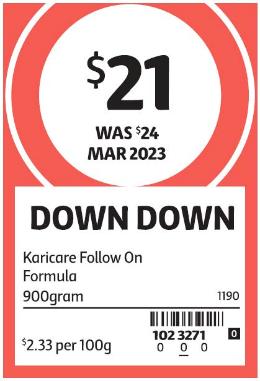
207 Examples of the Down Down tickets that were used by Coles for the Karicare Formula product Online and in the Coles App are as follows:
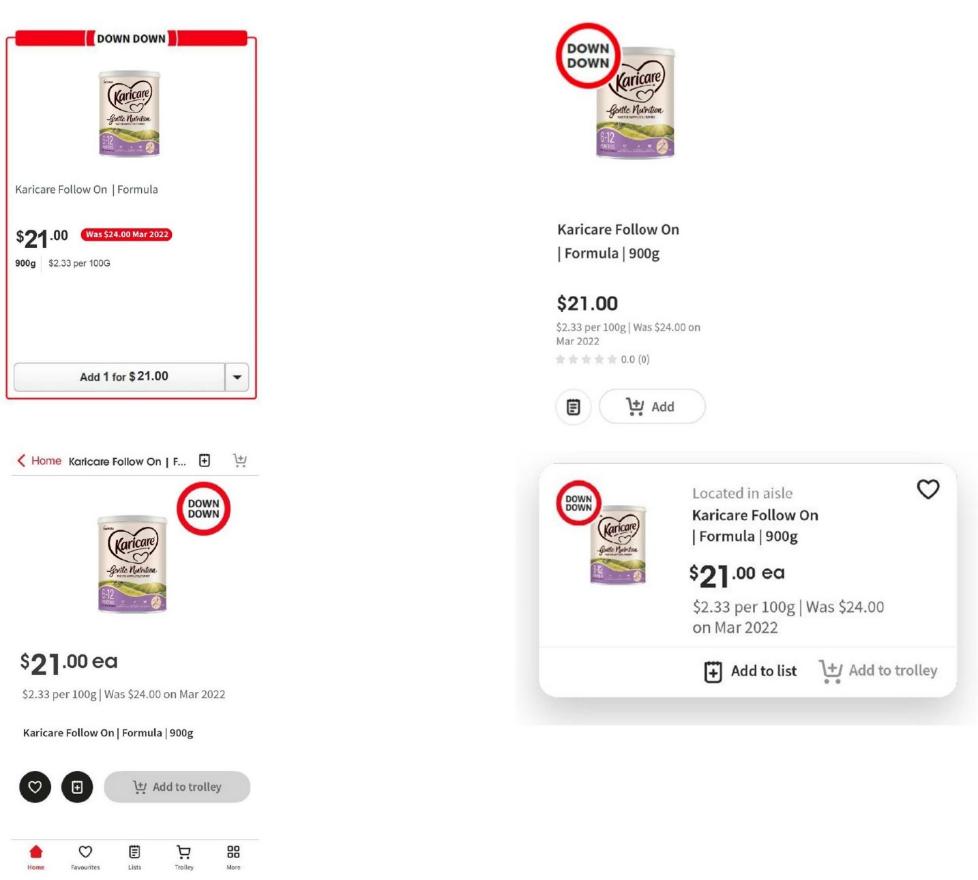
Coca-Cola 2 litre
208 The Coca-Cola 2 litre product was a 2 litre bottle of Coca-Cola within Coles’ Soft Drinks product category, which sat within its Beverages business category. The supplier of the Coca-Cola 2 litre product was Coca-Cola Europacific Partners (CCEP), previously known as Coca-Cola Amatil. A graph of the pricing history of the Coca-Cola 2 litre product, as annexed to the Wright Report, is reproduced at Annexure B to these reasons.
209 CCEP was one of Coles’ largest suppliers in the Soft Drinks category and was responsible for approximately 60% of proprietary Soft Drinks sales and approximately 55% of Soft Drinks sales overall. CCEP supplied a number of products that were popular and widely recognised by consumers, most notably Coca-Cola. If Coles did not offer CCEP products at a competitive price, or a significant supplier such as CCEP stopped supplying their products to Coles, there would be negative impacts on Coles. Foot traffic to Coles can be attracted or lost based on the price and availability of a product like Coca-Cola.
210 From at least 1 January 2021, the Coca-Cola 2 litre product was sold at $2.75 on a Down Down promotion (Price 1). The cost price for the product was $[RED.], but the supplier also provided funding of $[RED.], resulting in a net cost of goods of $[RED.], a dollar gross margin for Coles of $[RED.] and a percentage gross margin of [RED.]%.
211 On 29 October 2021, CCEP informed Coles that there would be an increase in the price of 11 products, including the Coca-Cola 2 litre product effective from 31 January 2022. On 7 December 2021, CCEP submitted its CPA request by providing its revised price list to Coles. CCEP did not provide any reasons for its CPA request. Mr Cubbon gave evidence about this CPA request. He said while he would expect suppliers to provide Coles with some detail about how they reached the quantum of their CPA request, CCEP usually did not share that information with Coles.
212 On 8 December 2021, CCEP sent an email to Coles with recommended promotional mechanics for the products impacted by the CPA request. In respect of the Coca-Cola 2 litre product, CCEP proposed that Coles increase the retail price to a “shelf recommended retail price” (that is, a white ticket price) of $4.40 on 2 February 2022, before returning the product to a Down Down price of $3.50 in late April 2022. CCEP also proposed that certain other products be promoted on Down Down, while other products would be promoted using Multi-buy or other promotions.
213 Mr Cubbon, the Senior Category Manager of the Soft Drinks category, was involved in the negotiations with CCEP regarding its CPA request and trade plan. Mr Cubbon sought additional information from CCEP to understand the impact of CCEP’s CPA request and revised trade plan on supplier funding, sales and margin. Coles ultimately accepted CCEP’s CPA request in full on 12 January 2022.
214 On 2 February 2022, Coles increased the price of the Coca-Cola 2 litre product to a white ticket price of $4.40 (Price 2). The cost price for the product was $[RED.], resulting in a dollar gross margin for Coles of $[RED.] and a percentage gross margin of [RED.]%.
215 Between 3 February 2022 and 15 March 2022, other than when it was on Special, the Coca-Cola 2 litre product was offered for sale on a yellow Multi Save ticket. During these times, customers could choose to purchase a single unit at the non-promotional price of $4.40 or purchase two units for $7.00. Both the non-promotional price and the “two for $7” promotional price were displayed on the Multi Save ticket. The promotional price was supported by supplier funding.
216 In the weeks commencing 9 February 2023 and 23 February 2023, the Coca-Cola 2 litre product was sold on Special at a price of $3.50, supported by supplier funding of $[RED.].
217 The daily average volume of sales during the above periods is shown in the following table:
Start date | End date | Price | Mechanic | Days | Average daily volume |
02/02/2022 | 02/02/2022 | $4.40 | White ticket | 1 | 9,561 |
03/02/2022 | 08/02/2022 | 1 for $4.40 | Single Buy Sale | 6 | 4,867 |
2 for $7.00 | Multi Save Sale | 8,620 | |||
09/02/2022 | 15/02/2022 | $3.50 | Special | 7 | 18,704 |
16/02/2022 | 22/02/2022 | 1 for $4.40 | Single Buy Sale | 7 | 4,182 |
2 for $7.00 | Multi Save Sale | 8,356 | |||
23/02/2022 | 01/03/2022 | $3.50 | Special | 7 | 17,609 |
02/03/2022 | 15/03/2022 | 1 for $4.40 | Single Buy Sale | 14 | 4,174 |
2 for $7.00 | Multi Save Sale | 8,324 |
218 From 16 March 2022 to 4 May 2023, the Coca-Cola 2 litre product was offered at a Down Down price of $3.50 (Price 3). The cost price for the product remained at $[RED.], but the supplier also provided funding of $[RED.], resulting in a net cost of goods of $[RED.], a dollar gross margin for Coles of $[RED.] and a percentage gross margin of [RED.]%. Coles ‘pulsed’ the product on Special at a lower price ($2.75) on several occasions, the first of which commenced on 15 June 2022. Prior to the commencement of that Special (ie during the 91-day period between 16 March 2022 and 14 June 2022), Coles sold 1,083,681 units, equating to an average of 11,909 units per day.
219 An example of the Down Down tickets that were used by Coles for the Coca-Cola 2 litre product in-store is as follows:
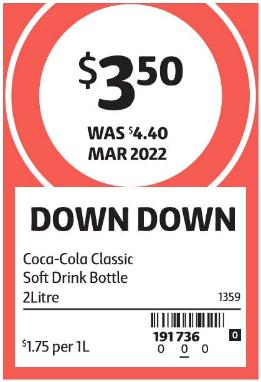
220 Examples of the Down Down tickets that were used by Coles for the Coca-Cola 2 litre product Online and in the Coles App are as follows:
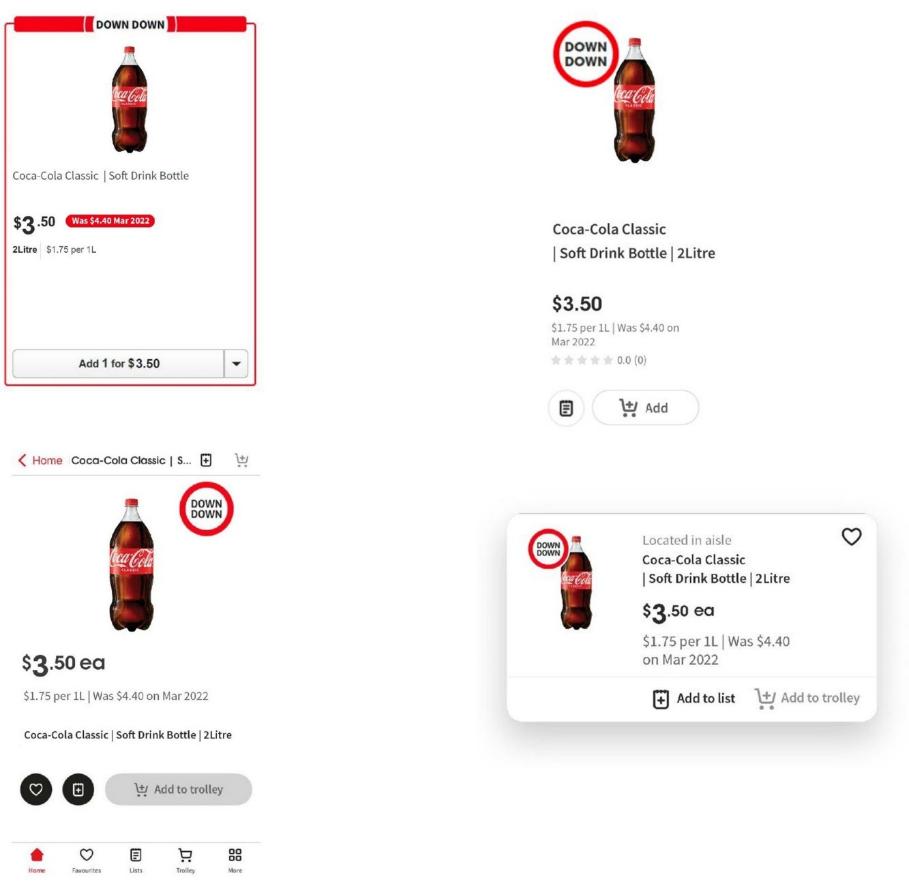
Pedigree Dog Food
221 The Pedigree Dog Food product was a large format wet dog food product within Coles’ Pet Food product category, which sat within its Homecare business category. The supplier of the Pedigree Dog Food product was Mars Petcare (Mars). A graph of the pricing history of the Pedigree Dog Food product, as annexed to the Wright Report, is reproduced at Annexure C to these reasons.
222 For most of 2021, the Pedigree Dog Food product was sold at a Down Down price of $3.50, and from time to time was sold on Special at a price of $3.00. In November 2021, Mars submitted a CPA request. Mr Carroll had responsibility for negotiating that request. He explained that Mars had proposed a recommended retail price of $4.30 and a promotional plan that involved selling the product on a Down Down promotion at $4.00. However, Mr Carroll did not agree to the promotional plan because Mars had sought to increase the list and retail prices but decrease its funding support. As a result, Mr Carroll decided to sell the product under a white ticket at a price of $4.50, until Mars submitted a proposed promotional plan that Mr Carroll considered to be appropriate. As a result, on 22 February 2022 the Pedigree Dog Food product was removed from its previous Down Down promotion and sold on a non-promotional white ticket. For two weeks, it continued to be sold at $3.50 (in accordance with Coles’ promotional guardrails), but from 9 March 2022, it was sold at a white ticket price of $4.50 (Price 1). The cost price for the product was $[RED.], but the supplier also provided funding of $[RED.], resulting in a net cost of goods of $[RED.], a dollar gross margin for Coles of $[RED.] and a percentage gross margin of [RED.]%.
223 On 17 June 2022, Mars submitted a new CPA request covering 206 products in the Treats, Wet Pet Food (Dog and Cat), Dry Pet Food (Dog and Cat) and Cat Litter sub-categories, including the Pedigree Dog Food product. Mars proposed a 20.1% increase in the list price of the Pedigree Dog Food product.
224 On 8 July 2022, Mars proposed a new trade plan for the products that were the subject of the CPA. For the Pedigree Dog Food product, Mars proposed a white ticket price of $5.50 (which reflected Mars’ recommended retail price) for 4 weeks and a Down Down promotional price of $4.50 for 48 weeks. Mars proposed the same promotional plan for a small number of other products but proposed different promotional plans for most of the other products the subject of the CPA request. Coles did not accept Mars’ initial trade plan and associated promotional funding arrangement. Negotiations continued, during the course of which Mars proposed two further trade plans. On 8 September 2022, Coles accepted Mars’ CPA request and also agreed the final promotional plan.
225 On 12 September 2022, Coles increased the price for the Pedigree Dog Food product from $4.50 to a white ticket price of $5.50 (Price 2). The cost price for the product was $[RED.] but the supplier also provided funding of $[RED.], resulting in a net cost of goods of $[RED.], a dollar gross margin for Coles of $[RED.] and a percentage gross margin of [RED.]%. The Pedigree Dog Food product was sold at $5.50 from 12 September 2022 to 9 October 2022, being a period of 28 days. During the Price 2 period, a total of 31,758 units were sold, equating to an average of 1,134 units per day.
226 From 10 October 2022 to 4 May 2023 (being 207 days), the Pedigree Dog Food product was offered on the Down Down program at a promotional price of $4.50 (Price 3). The cost price for the product remained at $[RED.], but the supplier’s funding increased to $[RED.], resulting in a net cost of goods of $[RED.], a dollar gross margin for Coles of $[RED.] and a percentage gross margin of [RED.]%. During that period, Coles ‘pulsed’ the product on Special at a lower price of $4.00 for a two-week period commencing 14 December 2022 and for a one-week period commencing 4 January 2023. In the period prior to the first Special (ie during the 65-day period between 10 October 2022 and 13 December 2022), Coles sold 103,100 units of the product, equating to an average of 1,586 units per day.
227 The evidence showed that, on or around 15 September 2022, Woolworths lowered the price of the Pedigree Dog Food product from $5.20 to $4.50 on a ‘Low Prices’ ticket.
228 An example of the Down Down tickets that were used by Coles for the Pedigree Dog Food product in-store is as follows:
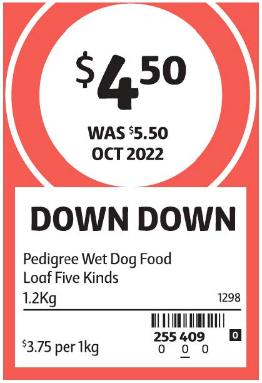
229 Examples of the Down Down tickets that were used by Coles for the Pedigree Dog Food product Online and in the Coles App are as follows:
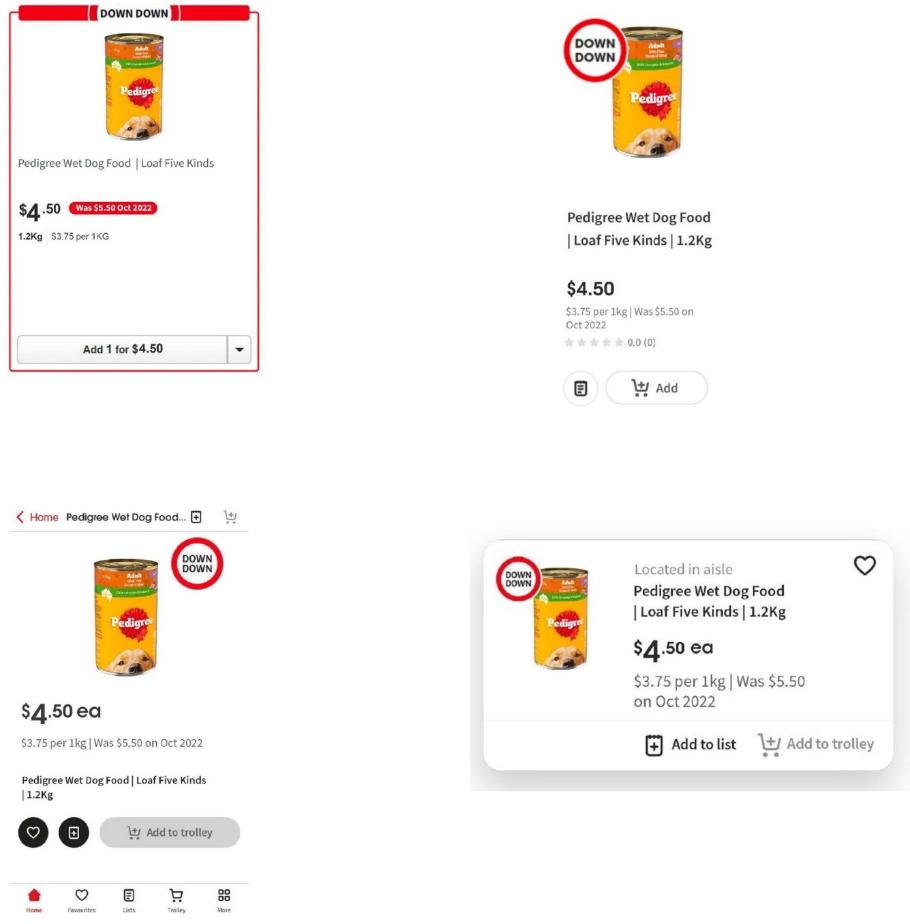
Arnott’s Shapes Multipack
230 The Arnott’s Shapes Multipack product sat within the Biscuits and Cookies product category, which sat within the Grocery business category. The supplier of the Arnott’s Shapes Multipack product was Arnott’s Biscuits Limited (Arnott’s). A graph of the pricing history of the Arnott’s Shapes Multipack product, as annexed to the Wright Report, is reproduced at Annexure D to these reasons.
231 From at least 1 January 2021, the Arnott’s Shapes Multipack product was sold at $5.00 on a Down Down promotion (Price 1). The cost price for the product was $[RED.], but the supplier also provided funding of $[RED.], resulting in a net cost of goods of $[RED.], a dollar gross margin for Coles of $[RED.] and a percentage gross margin of [RED.]%.
232 On 17 February 2022, Arnott’s submitted a CPA request to Coles for 77 products in the Biscuits and Cookies product category, including the Arnott’s Shapes Multipack product, to take effect from 12 May 2022. Arnott’s requested a 10% increase in the list price of the Arnott’s Shapes Multipack product and proposed a recommended retail price of $6.50. Arnott’s also proposed a new trade plan for the products that were the subject of the CPA request. On 9 March 2022, Arnott’s proposed that the Arnott’s Shapes Multipack product be sold on a Down Down promotion at a price of $5.50. Coles and Arnott’s subsequently engaged in negotiations with respect to the CPA request and trade plan.
233 Ms Thompson of Coles had responsibility for negotiating Arnott’s CPA request. She said that the negotiations had a focus on promotional funding and a promotional strategy to drive volume. In cross-examination, Ms Thompson agreed that, during the negotiations, neither Arnott’s nor Coles analysed the likely sales volume or gross margin that would be achieved by Coles in respect of the sale of the Arnott’s Shapes Multipack product during the proposed period in which it would be sold at a white ticket price of $6.50 (the price establishment period). By way of explanation, Ms Thompson added that Coles assesses the financial impacts of the cost price increase and promotional plan based on all of the products subject to the cost price increase and a 52-week period. I understand from that evidence that Ms Thompson considered that the financial impact of selling a single Arnott’s product, the Arnott’s Shapes Multipack product, at a white ticket price of $6.50 for four weeks would not have a material impact on the overall forecast results that were modelled in the plan.
234 On 6 May 2022, Coles approved Arnott’s revised CPA request and trade plan. Arnott’s proposed that the Shapes Multipack product would be sold on a Down Down price of $5.50 with supplier funding of $[RED.]. A number of other product categories were also proposed to be sold on Down Down, whilst other promotional programs were proposed for other products.
235 On 18 May 2022, Coles increased the price for the Arnott’s Shapes Multipack product from $5.00 to a white ticket price of $6.50 (Price 2). The cost price for the product was $[RED.], resulting in a dollar gross margin for Coles of $[RED.] and a percentage gross margin of [RED.]%. The product was sold at $6.50 for 7 days (from 18 to 24 May 2022). It was then sold for 7 days on a Special promotion (as part of the biannual Masterbrand event on all Arnott’s white ticket products) at $4.55 (from 25 to 31 May 2022), before being sold at a white ticket price of $6.50 for a further 14 days (from 1 to 14 June 2022). A total of 56,107 units were sold at Price 2 (ie excluding the week it was sold on Special), equating to an average of 2,672 units per day.
236 Ms Thompson set the new white ticket price for the Arnott’s Shapes Multipack at $6.50 because she considered that suppliers (particularly major suppliers like Arnott’s, who had been in the industry for a long time) knew their categories and products well and usually provided appropriate recommended retail prices. Ms Thompson also had regard to factors such as Coles’ pricing architecture (ie the ‘good, better and best’ hierarchy) to ensure that the price aligned with that architecture. Arnott's Shapes Multipack was considered a mid-tier product (ie the ‘better’ tier), and Ms Thompson assessed the recommended retail price by reference to prices of comparable products in the lower and higher tiers. When Coles began selling the Arnott’s Shapes Multipack product at a white ticket price of $6.50 on 18 May 2022, Woolworths was also offering the product at $6.50. In cross-examination, Ms Thompson agreed that she wanted to move the Arnott’s Shapes Multipack product to the Down Down price of $5.50 as soon as possible, within the requirements of Coles’ guardrails.
237 In cross-examination, it was suggested to Ms Lavdas that Coles only sold the Arnott’s Shapes Multipack product on a white ticket at a price of $6.50 to enable it to be sold subsequently on a Down Down ticket (in compliance with Coles’ guardrails). Ms Lavdas broadly agreed with that proposition, but emphasised the commercial context in which the product was moved to the white ticket price:
… we had just accepted a price increase. So the $6 that we previously had, as our base price, now had a new cost and therefore we flowed that through. And we reflected that in our new sell price, being the 6.50. So the move to 6.50 was a direct result of accepting an increased cost. Had we not accepted an increased cost, that would not likely have taken place.
…
… Arnott’s were not supporting a move to a flat 5.50. They were supporting and recommending that their product was worth 6.50. It is a national product, sold nationally, not just in Coles. They were recommending their price at 6.50 and offering us – offering Coles a promotional discount for us to retail at 5.50.
238 As noted above, the Arnott’s Shapes Multipack product was sold on Special at $4.55 as part of a biannual event which involved offering a 30% discount on all Arnott's products which were sold on a white ticket. When this promotion was initially arranged, the Arnott's Shapes Multipack and certain other Arnott’s products were excluded from the promotion because they were then being sold on a Down Down ticket. However, once those products returned to a white ticket following the CPA request, Ms Thompson considered that it would be confusing for customers if those products (now being sold on white tickets) were not included in the promotion. Ms Thompson therefore arranged to include those products, including the Arnott’s Shapes Multipack product, in the promotion.
239 From 15 June 2022, the Arnott’s Shapes Multipack product was offered on the Down Down program at a promotional price of $5.50 (Price 3). The cost price for the product remained at $[RED.], but the supplier’s funding increased to $[RED.], resulting in a net cost of goods of $[RED.], a dollar gross margin for Coles of $[RED.] and a percentage gross margin of [RED.]%. Although not specifically addressed in the evidence, the pricing data presented in the Wright Report and the data collated in Appendix B to the Edwards Report indicates that between 5 October 2022 and 31 January 2023, the Arnott’s Shapes Multipack product was sold on a Locked promotion at the same price of $5.50 (and with the same cost price and supplier funding). On 1 February 2023, the product was returned to the Down Down promotion, again at the same price (where it remained until at least 4 May 2023. During the period between 15 June 2022 and 4 October 2022 (112 days), Coles sold 364,341 units of the product, equating to an average of 3,253 units per day.
240 An example of the Down Down ticket that was used by Coles for the Arnott’s Shapes Multipack product in-store is as follows:
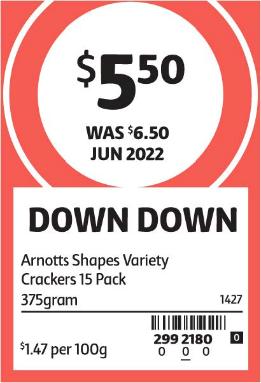
241 Examples of the Down Down tickets that were used by Coles for the Arnott’s Shapes Multipack product Online and in the Coles App are as follows:
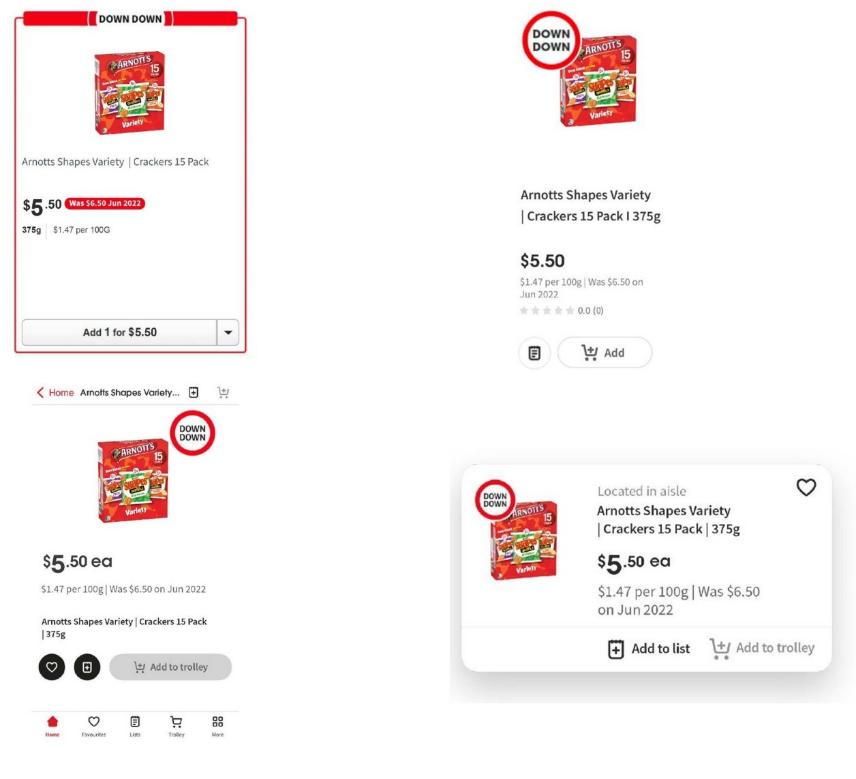
Bragg Yeast
242 The Bragg Yeast product was a vegan cheese substitute within the Health Foods product category, which sat within the Breakfast and Health business category. The supplier of the Bragg Yeast product was Unique Health Products (Unique). A graph of the pricing history of the Bragg Yeast product, as annexed to the Wright Report, is reproduced at Annexure E to these reasons.
243 From at least 1 January 2021 until around July 2021, the product was sold on a white ticket at a price of $12.00. During this period, it was intermittently sold on Special for $9.60. From around July 2021 until around September 2022, the product was sold on a white ticket at $13.20 (Price 1) and was intermittently sold on Special for $11.90. In this period, the cost price for the product was $[RED.], resulting in a dollar gross margin for Coles at the white ticket price of $[RED.] and a percentage gross margin of [RED.]%.
244 On 1 March 2022, Unique submitted a CPA request that related to the Bragg Yeast product only. Unique proposed to increase the list price by 24.4%, with the recommended retail price to rise from $13.20 to $16.95 (an increase of approximately 28.4%). Unique said that it “would like to roll out an everyday low price / price dropped of $16 from July 2022”. On 28 March 2022, Coles rejected the CPA request because the claimed cost increases could not be validated by Coles.
245 Mr Jorgensen had responsibility for the Bragg Yeast product and participated in further negotiations with Unique about its CPA request. On 26 July 2022, Mr Jorgensen requested that Unique provide an updated trading strategy for his review. Unique provided a revised trading strategy on 28 July 2022. Unique stated to Coles that “over the past few months, the price of Bragg Nutritional Yeast has reset to $18.95 (following the rollout of our price rise to our retailer customers across Australia)” and proposed to Coles two alternative pricing options for the Bragg Yeast product:
(a) Under the first option, Coles would accept a CPA of 17% and sell the product at its new recommended retail price of $18.95 for four weeks, and then at an Every Day Low Price of $16.50 for 48 weeks. Under this proposal, the list price would be $[RED.] and there would be no supplier funding. In his evidence, Mr Jorgenson explained that suppliers would sometimes refer to ‘Every Day Low Price’ as a reference to either the Every Day Price or Down Down mechanic.
(b) Under the second option, Coles would accept the full CPA proposal of 24% and, during the following 52 weeks, would sell the product at its new recommended retail price of $18.95 for 40 weeks and on Special at $15.00 for twelve weeks (in other words, a HiLo pricing strategy). Under this proposal, the list price would be $[RED.] and there would be supplier funding of $[RED.] for the promotional pricing (when the product was sold on Special).
246 Mr Jorgensen believed that the Bragg Yeast product was better suited to the first option, being sold at a consistently low price (whether on Every Day Low Price or Down Down). Mr Jorgensen considered that a ‘HiLo’ strategy was better suited to products that consumers bought on impulse, rather than products like the Bragg Yeast product, which he considered to be more of a staple product for the customers who generally purchased it.
247 Mr Jorgensen said that, ultimately, the retail pricing strategy that was followed was to sell the product at a white ticket price of $19.00 for four weeks, then on Down Down at $16.50. Mr Jorgensen did not recall his decision to set a white ticket price of $19.00. However, when setting white ticket prices, he usually had regard to the supplier’s recommended retail price (which, in this case, was $18.95), and Mr Jorgensen sought to set prices at rounded numbers. Mr Jorgensen also said that he would usually negotiate supplier funding to put a product on Down Down but, in this case, he agreed to promote the product on Down Down with no promotional funding. He did not remember why he took that approach for the Bragg Yeast product, but he believed it was because Coles was accepting a lower cost price increase (17%) than what the supplier had requested (24%).
248 On 29 September 2022, Coles moved the Bragg Yeast product to a $19.00 white ticket (Price 2). The cost price for the product was $[RED.], resulting in a dollar gross margin for Coles of $[RED.] and a percentage gross margin of [RED.]%. It was sold at $19.00 from 29 September 2022 to 25 October 2022, being a period of 27 days. During this period, a total of 5,114 units were sold, equating to an average of 189 units per day.
249 From 26 October 2022, the Bragg Yeast product was sold on the Down Down program at a price of $16.50 (Price 3). The cost price for the product remained at $[RED.], resulting in a dollar gross margin for Coles of $[RED.] and a percentage gross margin of [RED.]%. During the period of 26 October 2022 to 4 May 2023, being 191 days, Coles sold 22,657 units, equating to an average of 119 units per day.
250 An example of the Down Down tickets that were used by Coles for the Bragg Yeast product in-store is as follows:
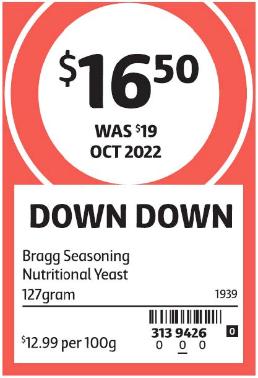
251 Examples of the Down Down tickets that were used by Coles for the Bragg Yeast product Online and in the Coles App are as follows:
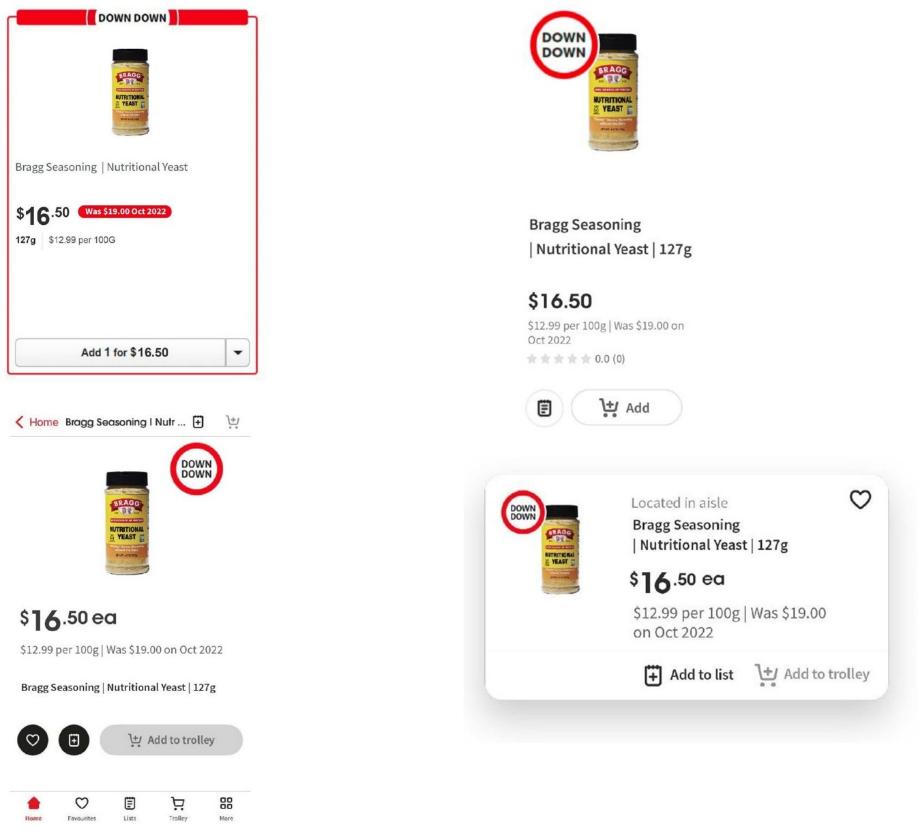
Yopro Yoghurt
252 The Yopro Yoghurt product was a high-protein yoghurt within the Chilled Desserts product category, which sat within the Dairy business category. The supplier was Danone. A graph of the pricing history of the Yopro Yoghurt product, as annexed to the Wright Report, is reproduced at Annexure F to these reasons.
253 From at least 1 January 2021, the Yopro Yoghurt product was sold at $6.00 on a Down Down promotion (Price 1). The cost price for the product was $[RED.], but the supplier also provided funding of $[RED.], resulting in a net cost of goods of $[RED.], a dollar gross margin for Coles of $[RED.] and a percentage gross margin of [RED.]%.
254 On 8 July 2022, Danone submitted a CPA request relating to 39 products in the Chilled Desserts category, including the Yopro Yoghurt product. The CPA request proposed increasing the list price for the Yopro Yoghurt product from $[RED.] to $[RED.] and increasing the recommended retail price from $7.00 to $7.80. In the first half of August 2022, Danone sent through a trade plan in which it proposed that the Yopro Yoghurt product be sold at a white ticket price of $7.80 for four weeks and then on a Down Down promotion for 48 weeks at $6.70.
255 Coles and Danone engaged in negotiations with respect to Danone's CPA request and proposed trade plan. While Mr Palmisciano was generally responsible for the Yopro Yoghurt, he was on leave from mid-July until around 15 August 2022. Nevertheless, Mr Palmisciano explained that Coles did not approve Danone’s CPA request because Coles was unable to validate all of Danone’s claimed cost increases and Danone was proposing to decrease its promotional funding. A number of alternative plans were submitted by Danone to Coles during August and early September 2022.
256 Ultimately, on 9 September 2022, Mr Palmisciano accepted Danone’s CPA request and trade plan. Under the trade plan, the Yopro Yoghurt product was to be removed from the Down Down program and sold at a white ticket price of $7.80, and then at a promotional price of $6.70. The white ticket price of $7.80 was Danone’s recommended retail price for the product. Danone proposed different promotional plans for other products that were the subject of the CPA request.
257 Mr Palmisciano deposed that his focus throughout the negotiation was on the ability for Coles to continue to provide value to customers, and on limiting the impact of the cost increase to the category's sales and volume targets. Mr Palmisciano considered it to be important to secure at least as much or more promotional funding from Danone as it provided under its existing trade plan. The ACCC submitted that neither Danone nor Coles analysed the likely sales volume or gross margin that would be earned by Coles during the proposed period in which the Yopro Yoghurt product would be sold at a white ticket price of $7.80 (the price establishment period) before being placed on the proposed Down Down promotion. I do not accept that submission. Mr Palmisciano was not cross-examined and therefore the proposition was never put to him. Further, the trade plan proposed by Danone in the first half of August 2022 contained a forecast of the sales volume and gross margin that would be earned by Coles from sales of the Yopro Yoghurt product during the proposed four-week price establishment period.
258 After Mr Palmisciano accepted Danone’s CPA request and revised trade plan, Danone sent to Mr Palmisciano a PAF with the planned promotional activity and funding for the products the subject of the CPA request. Although the PAF stated that the promotional price for the Yopro Yoghurt product would be an EDV (Every Day Value) price, Mr Palmisciano said that the promotional price was intended to be a Down Down price. Mr Palmisciano explained that, in trade plans or PAFs, suppliers sometimes inadvertently referred to Every Day when they intended to refer to Down Down, as both Every Day and Down Down were longer-term pricing mechanics implemented by Coles. Mr Palmisciano’s evidence was unchallenged.
259 On 12 September 2022, Coles moved the Yopro Yoghurt product to a white ticket price of $7.80 (Price 2). The cost price for the product was $[RED.], resulting in a dollar gross margin for Coles of $[RED.] and a percentage gross margin of [RED.]%. During the period 12 September 2022 to 9 October 2022, being 28 days, Coles sold 59,985 units, equating to an average of 2,142 units per day.
260 On 10 October 2022, the retail price was reduced to $6.70 on a Down Down promotion (Price 3). The cost price for the product remained at $[RED.], but the supplier’s funding increased to $[RED.], resulting in a net cost of goods of $[RED.], a dollar gross margin for Coles of $[RED.] and a percentage gross margin of [RED.]%. During the period 10 October 2022 to 18 April 2023, being 191 days, Coles sold 532,764 units, equating to an average of 2,789 units per day.
261 An example of the Down Down tickets that were used by Coles for the Yopro Yoghurt product in-store is as follows:
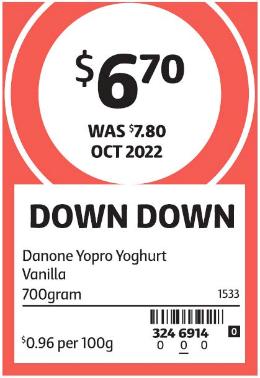
262 Examples of the Down Down tickets that were used by Coles for the Yopro Yoghurt product Online and in the Coles App are as follows:
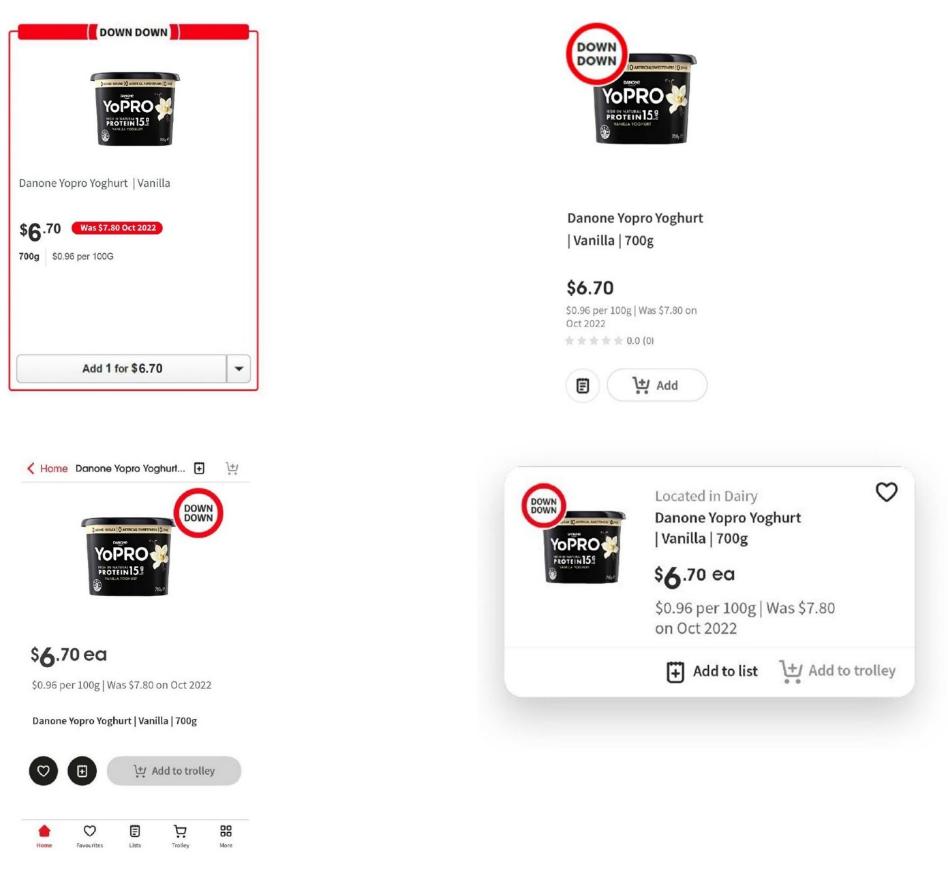
Colgate Toothpaste
263 The Colgate Toothpaste product was a toothpaste within the Dental Health product category, which sat within the Health, Beauty and Baby business category. The supplier was Colgate-Palmolive Pty Ltd (Colgate). A graph of the pricing history of the Colgate Toothpaste product, as annexed to the Wright Report, is reproduced at Annexure G to these reasons.
264 From at least January 2021, the Colgate Toothpaste product was sold at $5.50 on a Down Down promotion (Price 1). The cost price for the product was $[RED.], but the supplier also provided funding of $[RED.], resulting in a net cost of goods of $[RED.], a dollar gross margin for Coles of $[RED.] and a percentage gross margin of [RED.]%. The product was intermittently sold on Special at $4.95.
265 On 3 December 2021, Colgate submitted a CPA request relating to 57 products across the Soaps and Body Wash and the Dental Health categories, including the Colgate Toothpaste product. Colgate sought an increase in the list price of the product from $[RED.] to $[RED.] per case of 48 units (being an 11.4% increase). Colgate also proposed a revised promotional plan, under which the Colgate Toothpaste product would be sold on a Down Down promotion at $6.00. For other products, Colgate proposed different promotional plans.
266 Coles and Colgate engaged in negotiations with respect to Colgate’s CPA request and proposed trade plan. The negotiation of the CPA request was primarily handled by Jack Hessiman (who is no longer employed by Coles), with guidance provided by Mr Hankin (who gave evidence).
267 Coles was unable to validate the full amount of the cost increase being sought by Colgate. Ultimately, Mr Hankin was prepared to agree to Colgate’s CPA request notwithstanding the validation gap. Mr Hankin explained that Colgate was an important supplier and represented nearly 45% of the Dental Health category. In addition, Mr Hankin acknowledged that Coles did not have full visibility over Colgate’s costs and Coles’ assessment of Colgate’s costs might not have been accurate. Further, Mr Hankin did not want to risk being in a situation where Colgate and Coles could not agree on the CPA request and, as a result, Colgate ceased supplying the products to Coles. Nevertheless, Mr Hankin considered that it was important to negotiate improvements to the promotional plan.
268 On 25 February 2022, Coles sent Colgate its final offer with respect to the supplier funding required for Coles to accept the CPA request. On 28 February 2022, Mr Hankin received an email from Mr Jessiman providing an update on market movements for Colgate products, including that Woolworths had moved the Colgate Toothpaste product to $6.00. By 1 March 2022, Coles and Colgate were yet to reach agreement on the CPA request and proposed trade plan. Colgate informed Coles that Colgate’s new list prices “went live yesterday” and, as such, Colgate would cease supplying products the subject of the CPA request until an agreement with Coles was reached. During the period that Coles was negotiating the CPA with Colgate, the price of the Colgate Toothpaste increased at Woolworths. On 2 March 2022, the Colgate Toothpaste product was offered for sale at Woolworths at a $7.00 white ticket price.
269 It was unclear when the final agreement between Colgate and Coles with respect to the Colgate Toothpaste product was reached. However, it was no later than 9 March 2022. On that date, Coles moved the Colgate Toothpaste product to a white ticket price of $7.00 (Price 2). The cost price for the product was $[RED.], resulting in a dollar gross margin for Coles of $[RED.] and a percentage gross margin of [RED.]%. During the period of 9 March 2022 to 5 April 2022, being 28 days, Coles sold 14,124 units, equating to an average of 504 units per day. In cross-examination, Mr Hankin agreed that the only reason that the product was sold for four weeks on a white ticket at $7.00 was so that Coles could implement a Down Down promotion in compliance with its internal guardrails.
270 From 6 April 2022, the Colgate Toothpaste product was offered on the Down Down program at a promotional price of $6.00 (Price 3). The cost price for the product remained at $[RED.], but the supplier’s funding increased to $[RED.], resulting in a net cost of goods of $[RED.], a dollar gross margin for Coles of $[RED.] and a percentage gross margin of [RED.]%. The product was intermittently sold on Special at $5.50, with the first Special commencing on 25 May 2022. During the period of 6 April 2022 to 24 May 2022, being 49 days, Coles sold 41,204 units, equating to an average of 841 units per day.
271 An example of the Down Down tickets that were used by Coles for the Colgate Toothpaste product in-store is as follows:
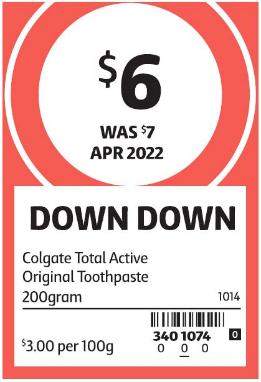
272 Examples of the Down Down tickets that were used by Coles for the Colgate Toothpaste product Online and in the Coles App are as follows:
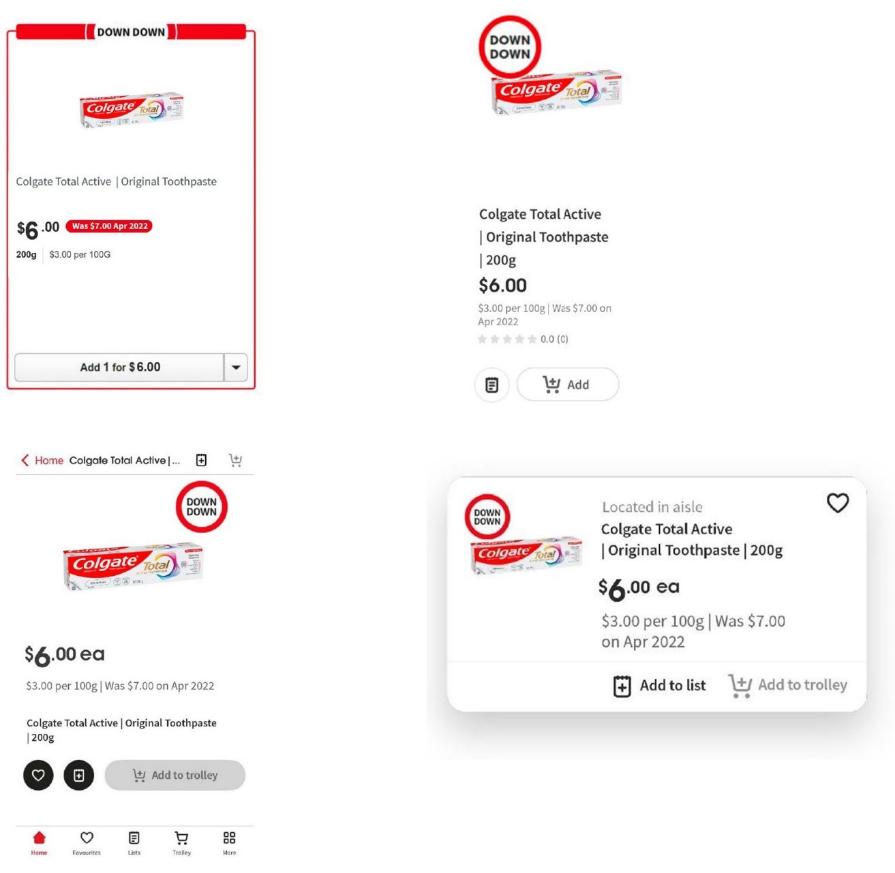
Coles Quince Paste
273 Coles Quince Paste sat within the Deli Cheese and Antipasto product category, which was part of the Meat, Deli and Seafood business unit. Island Berries Tasmania (Island Berries) supplied the product, which was sold as a Coles Own Brand product. A graph of the pricing history of the Coles Quince Paste product, as annexed to the Wright Report, is reproduced at Annexure H to these reasons.
274 As noted earlier, suppliers of Coles Own Brand products would not typically submit trade plans to Coles proposing promotions for their products or provide promotional funding. Whether and how Own Brand products would be promoted was usually a decision for Coles alone, subject to the supplier being able to support the availability of stock.
275 From at least 6 January 2021 to around 28 September 2021, the Coles Quince Paste product was sold on an Every Day Value ticket at $4.50. During that period, the cost price was $[RED.], resulting in a dollar gross margin for Coles of $[RED.] and a percentage gross margin of [RED.]%.
276 From 29 September 2021 to 3 July 2022, the product was sold on a Down Down ticket at $3.00 (Price 1). The cost price for the product remained $[RED.], resulting in a dollar gross margin for Coles of $[RED.] and a percentage gross margin of [RED.]%.
277 Mr McCutchan deposed that the Coles Quince Paste product was the most affordable quince paste product Coles ranged at the time and sat within the ‘good’ tier of Coles’ overall product hierarchy. Alternative products to the Coles Quince Paste included Julianne’s Kitchen Apple and Thyme Paste priced at $7.00 and Maggie Beer Plum and Shiraz Paste priced at $6.30 (both within the ‘best’ or premium tier of the overall product hierarchy), and OB Finest Quince Paste priced at $5.00 (within the ‘better’ tier of the overall product hierarchy).
278 On 31 May 2022, Island Berries made a CPA request to increase the list price of the from $[RED.] to $[RED.]. Mr McCutchan was responsible for the negotiations with Island Berries. Mr McCutchan deposed that the CPA request was a straightforward negotiation because it was for a small cost price increase that did not have a major impact on Coles’ bottom line. On 24 June 2022, Mr McCutchan accepted the CPA request in full.
279 Mr McCutchan further deposed that, because the Coles Quince Paste was an Own Brand product, there was no trade plan in place with the supplier and the supplier did not fund any price reductions associated with the product. Instead, Coles effectively funded any promotion through a reduction in its margin. As an Own Brand product, the responsibility for setting both the white ticket price and the promotional price sat with Mr McCutchan. Island Berries did not provide input or recommendations.
280 On 27 June 2022, Mr McCutchan sent an email to his direct report (Venetta Rippon, Business Category Coordinator – Deli) instructing her to move the Coles Quince Paste product to a white ticket price of $4.50 for 2 weeks and then move it back onto the Down Down program at a price of $3.15. Mr McCutchan acknowledged that the reference to “2 weeks” in the email was an error because Coles’ guardrails at that time required that a product taken off any Down Down promotion be sold at a white ticket price for at least 28 days before being placed on a new Down Down promotion. On 29 June 2022, Ms Rippon replied to Mr McCutchan, pointing out the four-week requirement of the promotional guardrails. Shortly thereafter, Mr McCutchan confirmed that the pricing should follow the requirements specified by the guardrails.
281 Coles then sold the Coles Quince Paste product on a white ticket at $4.50 (Price 2) from 4 to 31 July 2022, being 28 days. The cost price for the product was $[RED.], resulting in a dollar gross margin for Coles of $[RED.] and a percentage gross margin of [RED.]%. During this period, Coles sold 3,204 units, equating to an average of 114 units per day.
282 Mr McCutchan explained his decision to price the product at $4.50 as follows:
I decided to price the Quince Paste at $4.50 on a white ticket label, which was the last white ticket price that the product was sold at before it went onto EDV, and then first went onto Down Down at $3.00. This involved some reduction in Coles’ margin for that period, but I considered at the time that an increase to $4.80 was going to be too high for this product for the customer.
283 On 1 August 2022, the Coles Quince Paste product was put on a Down Down promotion at $3.15 (Price 3). The cost price for the product remained at $[RED.], resulting in a dollar gross margin for Coles of $[RED.] and a percentage gross margin of [RED.]%. From 1 August 2022 to 4 May 2023, being 277 days, Coles sold 71,441 units, equating to an average of 258 units per day.
284 During cross-examination, Mr McCutchan agreed that, in his assessment, the price of $3.15 would achieve the best results for Coles, the customer and the supplier, and that the only reason that Coles sold the product at $4.50 for four weeks was to comply with the Down Down guardrails. Mr McCutchan also agreed that, following the CPA request, Coles could have chosen to move the product immediately to an Every Day Value ticket at a price of $3.15. However, Mr McCutchan considered that a Down Down promotion was more effective in generating sales because the Down Down ticket conveys that customers are getting a discount and the Down Down ticket is physically larger than an Every Day Value ticket, which draws a customer’s eye to the ticket.
285 An example of the Down Down tickets that were used by Coles for the Coles Quince Paste product in-store is as follows:
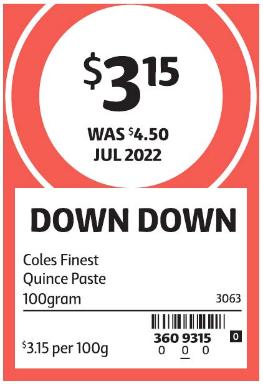
286 Examples of the Down Down tickets that were used by Coles for the Coles Quince Paste product Online and in the Coles App are as follows:
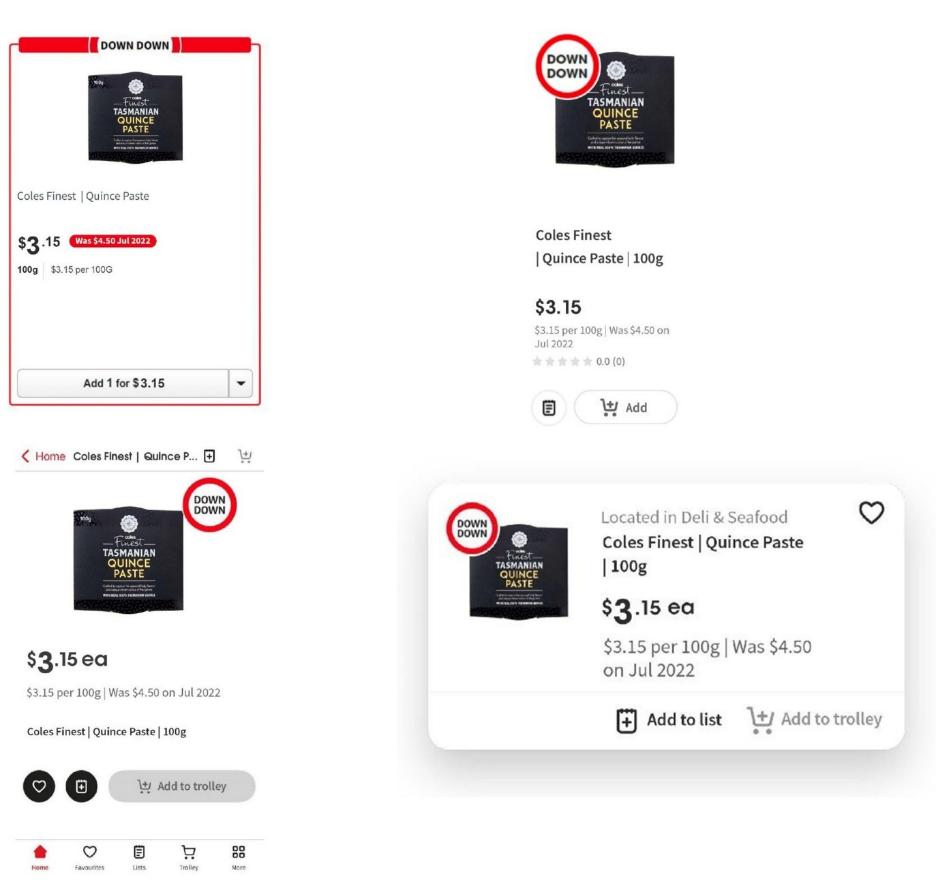
Rexona Deodorant
287 The Rexona Deodorant product was a deodorant within the Women’s Deodorants and Grooming product category, which sat within the Health, Beauty and Baby business category. The product was supplied by Unilever Australia Limited (Unilever), which was a major supplier to Coles. A graph of the pricing history of the Rexona Deodorant product, as annexed to the Wright Report, is reproduced at Annexure I to these reasons.
288 From at least 1 January 2021 until at least 11 January 2022, the Rexona Deodorant product was sold on a Down Down ticket at $5.00 (Price 1). The cost price for the product was $[RED.], but the supplier also provided funding of $[RED.], resulting in a net cost of goods of $[RED.], a dollar gross margin for Coles of $[RED.] and a percentage gross margin of [RED.]%. Appendix B to the Edwards Report records that, between 12 January and 1 February 2022, the product was sold on white ticket at the same price and with the same supplier terms and then reverted to a Down Down ticket at the same price and with the same supplier terms. The evidence does not address the white ticket pricing. As it is not possible, under Coles promotional guardrails, for a product to be sold at a Down Down price which is the same as an immediately previous white ticket price, it appears likely that there is an error in the classification of the pricing data collated in the Edwards Report for the period between 12 January and 1 February 2022.
289 On 4 January 2022, Unilever submitted a CPA request to Coles. On 13 January 2022, an updated CPA request was submitted covering 138 products, including the Rexona Deodorant product. Mr Hankin was responsible for the negotiations with Unilever at the time. Unilever requested a 20% increase in the list price of the Rexona Deodorant product and proposed an increase in the recommended retail price to $6.00. Coles was only able to validate a proportion of the cost increases claimed by Unilever.
290 On 3 March 2022, Coles met with Unilever to discuss the CPA request. The next day, Unilever sent Mr Hankin an email setting out Unilever’s proposed pricing strategy for various products the subject of the CPA request. Unilever proposed moving the Rexona Deodorant product from the Down Down price of $5.00 to an Every Day Value price of $6.00. Unilever’s CPA request indicates that Unilever proposed the same promotional mechanic for other products that were subject to the CPA request. Mr Hankin observed that, under the Every Day Value mechanic, the price was required to remain at a consistent price for a period of at least six months.
291 Mr Hankin was willing to agree to Unilever’s CPA request, despite it being only partially validated by Coles, for similar reasons to those referred to in respect of the Colgate Toothpaste product: Unilever (like Colgate) was a major supplier to Coles; the VMO’s analysis was an estimate only and Coles did not have full visibility into Unilever’s costs; and Mr Hankin did not want to risk being in a situation where the list price increase was not agreed and Unilever did not supply products to Coles.
292 On 1 April 2022, Unilever sent to Coles a PAF which proposed that the Rexona Deodorant product would be sold at $6.00 starting on 18 April 2022 and that Unilever would provide funding of $[RED.] per unit. Mr Hankin understood this PAF to be proposing that the product would be sold on an Every Day Value promotion at $6.00.
293 On 7 April 2022, Mr Hankin approved Unilever’s CPA request in respect of the Rexona products.
294 On 8 April 2022, Mr Hankin received an email from the Pricing and Value team which indicated that Woolworths had increased the price of the Rexona Deodorant product from $5.00 to $6.50. After observing this movement in market price, Mr Hankin decided to adopt a Down Down pricing strategy for the Rexona Deodorant product (by which Coles would increase the price to $6.50 on a white ticket for four weeks and then reduce the price to $6.00 on a Down Down ticket). Mr Hankin explained that the Down Down pricing mechanic was more effective than the Every Day Value mechanic in promoting a ‘saving’ or ‘value’ message to consumers (because it included the ‘Was’ price). Mr Hankin also explained that the Down Down mechanic gave Coles more flexibility to further promote the product (on Specials), whereas the Every Day Value mechanic required the product to be consistent for six months. Mr Hankin was asked whether the Down Down ticket was more effective for Coles in driving volumes of sales than the Every Day ticket, to which he replied:
More effective to actually clearly articulate the save, and also that would then drive volume and value for the customer.
295 Coles moved the Rexona Deodorant product to a white ticket price of $6.50 (Price 2) from 18 April 2022 to 17 May 2022, being 30 days. The cost price for the product was $[RED.], but the supplier also provided funding of $[RED.], resulting in a net cost of goods of $[RED.], a dollar gross margin for Coles of $[RED.] and a percentage gross margin of [RED.]%. During this period, Coles sold 9,727 units, equating to an average of 324 units per day.
296 On 18 May 2022, Coles moved the Rexona Deodorant product to a Down Down promotion at $6.00 (Price 3). The cost price for the product remained at $[RED.], but the supplier’s funding increased to $[RED.], resulting in a net cost of goods of $[RED.], a dollar gross margin for Coles of $[RED.] and a percentage gross margin of [RED.]%. From 18 May 2022 to 4 May 2023, being 352 days, Coles sold 145,949 units at the Down Down price, equating to an average of 415 units per day.
297 An example of the Down Down tickets that were used by Coles for the Rexona Deodorant product in-store is as follows:
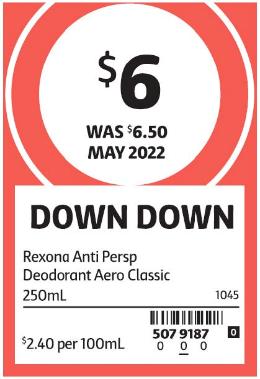
298 Examples of the Down Down tickets that were used by Coles for the Rexona Deodorant product Online and in the Coles App are as follows:
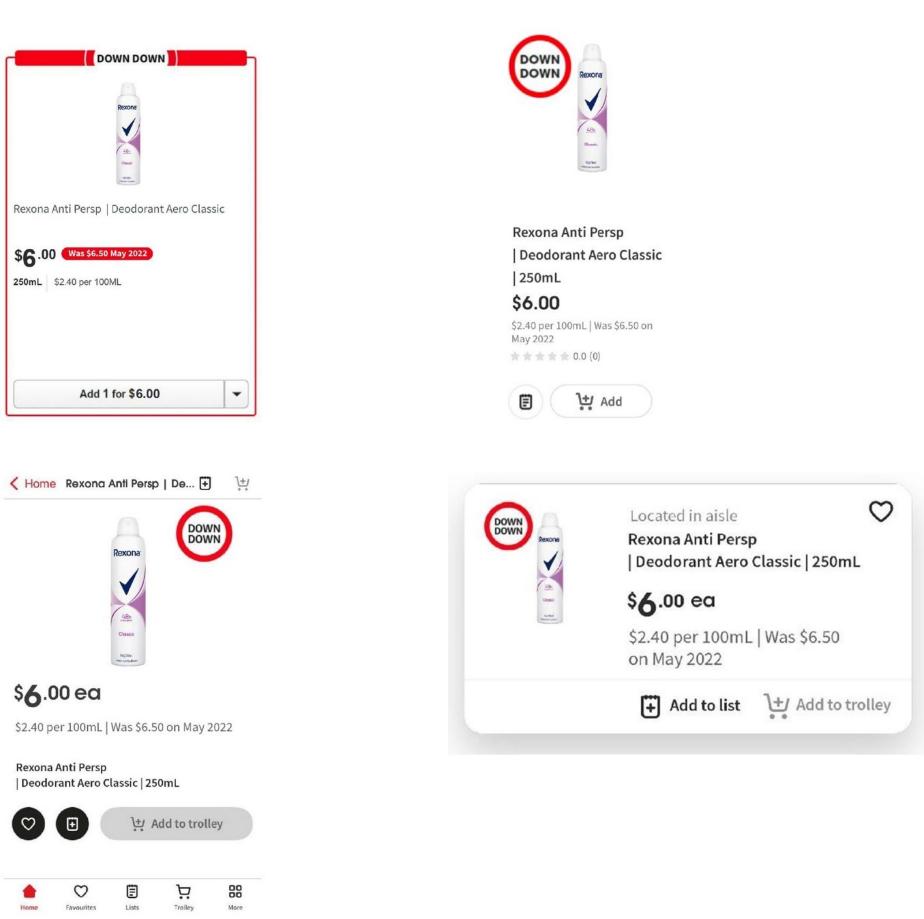
Lurpak Butter
299 The Lurpak Butter product was a butter product within the Chilled Spreads product category, which sat within the Dairy business category. The supplier was Arla Foods Mayer Australia (Arla). A graph of the pricing history of the Lurpak Butter product, as annexed to the Wright Report, is reproduced at Annexure J to these reasons.
300 From at least 1 January 2021, the Lurpak Butter product was sold on a Down Down ticket at $5.00 (Price 1). The cost price for the product was $[RED.], but the supplier also provided funding of $[RED.], resulting in a net cost of goods of $[RED.], a dollar gross margin for Coles of $[RED.] and a percentage gross margin of [RED.]%. Between January 2021 until February 2022, the product was ‘pulsed’ approximately one week per month on a Special ticket at a price of $4.00. From mid-February 2022 until mid-June 2022, the product was ‘pulsed’ on a Special ticket at a price of $4.50.
301 On 24 February 2022, Arla submitted a CPA request to Coles. In respect of its butter range of products, Arla proposed that, in lieu of increasing the list price on those products, that the products be removed from the Down Down promotion under which Arla provided funding of $[RED.] per unit, and the products be moved to their recommended retail price of $6.00. Arla described this as a “temporary increase” in price, and that when milk prices and freight reduced to “a level for a sustained period”, Arla would engage with Coles again about moving back to a Down Down promotion.
302 Arla and Coles subsequently engaged in negotiations with respect to the pricing and promotional strategy for the Lurpak Butter product (and the other Lurpak products that were the subject of the CPA request). By mid-April 2022, Arla continued to propose that the Lurpak Butter product be removed from the Down Down promotion and sold at the recommended retail price of $6.00, and that it be sold on Special twelve times per annum at a price of $5.00. However, by 21 April 2022, Coles and Arla had agreed that the Lurpak Butter product would be placed on a Down Down promotion rather than on Special twelve times per year. On 3 May 2022, Arla provided to Coles a trade plan for the Lurpak Butter product and two PAFs. The PAFs provided for the existing Down Down funding deal to be cancelled and a new Down Down funding deal from 13 July 2022, under which the product would be sold at a Down Down price of $5.50 with Arla contributing funding of $[RED.]. Consistently with Coles promotional guardrails, it was proposed that the product would be sold on a white ticket price of $6.00 for four weeks, before going onto the new Down Down price of $5.50.
303 Coles sold the Lurpak Butter product on a white ticket at $6.00 (Price 2) from 15 June 2022 to 12 July 2022, being 28 days. The cost price for the product was $[RED.], resulting in a dollar gross margin for Coles of $[RED.] and a percentage gross margin of [RED.]%. During this period, Coles sold 85,572 units, equating to an average of 3,056 units per day.
304 On 30 June 2022, the price of the Lurpak Butter product at Woolworths moved from $5.00 to $6.00.
305 On 13 July 2022, the Lurpak Butter product was moved to a Down Down promotion at a price of $5.50 (Price 3). The cost price for the product remained at $[RED.], but the supplier’s funding increased to $[RED.], resulting in a net cost of goods of $[RED.], a dollar gross margin for Coles of $[RED.] and a percentage gross margin of [RED.]%. From 13 July 2022 to 9 August 2022, being 28 days, Coles sold 109,090 units, equating to an average of 3,896 units per day. From 10 August 2022, the product was regularly ‘pulsed’, initially being sold on Special at a price of $4.90, and from 7 December 2022 at a price of $5.00.
306 An example of the Down Down tickets that were used by Coles for the Lurpak Butter product in-store is as follows:
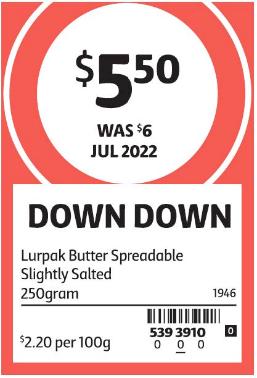
307 Examples of the Down Down tickets that were used by Coles for the Lurpak Butter product Online and in the Coles App are as follows:
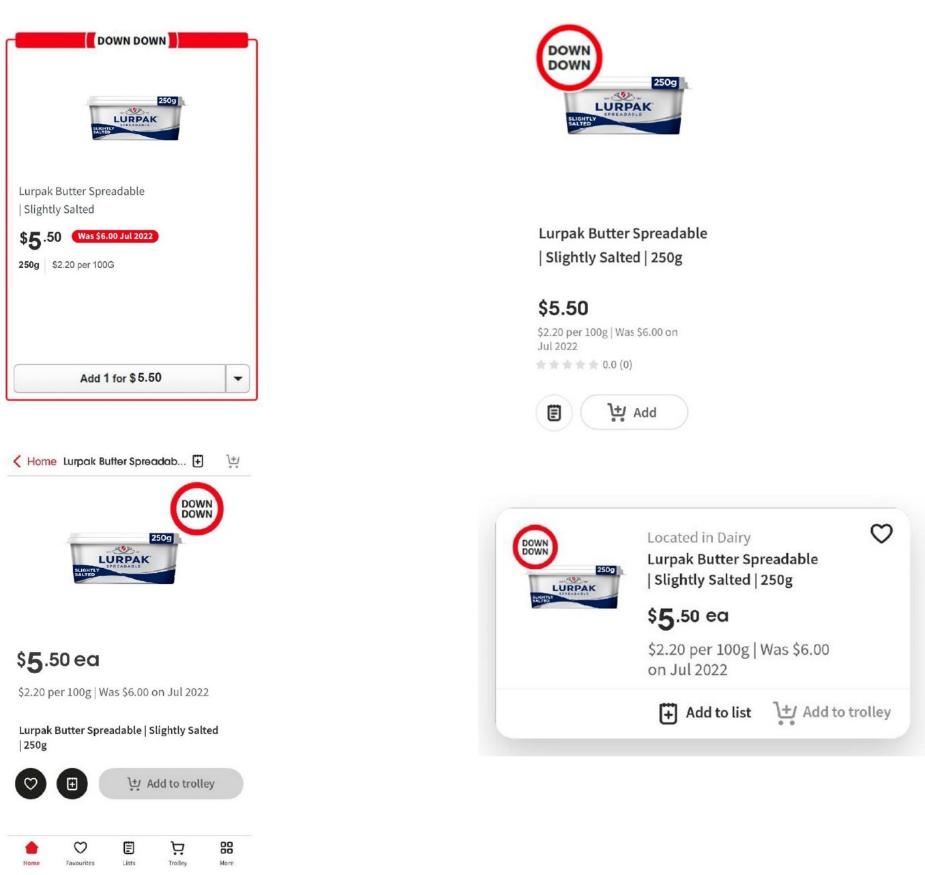
Nature’s Gift Dog Food
308 The Nature’s Gift Dog Food product was a large format wet dog food product within the Pet Food product category, which sat within the Homecare business category. The supplier of the Nature’s Gift Dog Food product was Real Pet Food. Real Pet Food submitted two CPA requests in relation to the Nature’s Gift Dog Food product during the relevant period. A graph of the pricing history of the Nature’s Gift Dog Food product, as annexed to the Wright Report, is reproduced at Annexure K to these reasons.
Real Pet Food’s First CPA request
309 From at least 1 January 2021, the Nature’s Gift Dog Food product was sold on a Down Down promotion at $3.50 (Price 1). The cost price for the product was $[RED.], but the supplier also provided funding of $[RED.], resulting in a net cost of goods of $[RED.], a dollar gross margin for Coles of $[RED.] and a percentage gross margin of [RED.]%. The product was sold intermittently on a Special ticket at a price of $3.00.
310 On 15 November 2021, Real Pet Food informed Coles of an impending CPA request for 70 products, including the Nature’s Gift Dog Food product (First CPA request). The First CPA request was one of several taken over by Mr Carroll when he commenced the role of Senior Category Manager of Pet in December 2021. Mr Carroll was responsible for the negotiations with Real Pet Food.
311 The First CPA request proposed to increase the list price of the Nature’s Gift Dog Food product from $[RED.] to $[RED.] (an increase of 14.62%) and to increase the recommended retail price from $4.80 to $5.50. When considering all 70 products the subject of the CPA, Real Pet Food sought a 14.7% increase in list prices overall.
312 Coles’ VMO assessed the request but only partly validated the claimed increase in costs. Coles and Real Pet Food subsequently engaged in negotiations with respect to the First CPA request. During this negotiation, Mr Carroll was concerned that if Coles did not reach an agreement with Real Pet Food by 7 February 2022 (being Real Pet Food’s proposed date for the commencement of its new list prices), Real Pet Food may have refused to continue supplying Coles at the current price, or may have attempted to charge Coles the higher price, which would have forced Coles to reject Real Pet Food’s deliveries. Mr Carroll was concerned this would result in a ‘stop supply’ situation. In the interest of ensuring that there was sufficient stock on shelves, especially given there was limited stock in the market, Mr Carroll ultimately accepted Real Pet Food’s CPA request, even though some of the claimed costs had not been validated by the VMO. Mr Carroll approved the First CPA request for all products on 10 February 2022. However, Mr Carroll continued negotiating with Real Pet Food in relation to promotional strategies for the products in the First CPA request. Between 9 February 2022 and 13 April 2022, Real Pet Food provided Mr Carroll with several proposals for different promotional strategies and Mr Carroll provided feedback on whether he thought these would be effective.
313 In an internal Coles email dated 14 February 2022, Mr Carroll noted that, on 33 Real Pet Food product lines, Woolworths had increased their prices above Real Pet Food’s recommended retail price, and that Coles had followed Woolworths. However, Woolworths had maintained the “old DD price” on 14 product lines, which included the Nature’s Gift Dog Food product. Attached to the email was a spreadsheet which recorded Coles’ decision to remove the Nature’s Gift Dog Food product from the Down Down promotion and to move it to a white ticket price of $5.50.
314 On 21 February 2022, Real Pet Food sent an email to Mr Carroll proposing a promotional strategy for a number of products. In respect of the Nature’s Gift Dog Food product, Real Pet Food proposed that it be sold on a Down Down promotion at $4.00, with Real Pet Food providing funding of $[RED.]. Mr Carroll replied to the email stating that, under Coles “customer promise rules” (which was a reference to the promotional guardrails), Coles could not put the Nature’s Gift Dog Food product on a Down Down promotion for a period of six months after the CPA price increase. That statement appears to have been based on a misunderstanding of the effect of the January 2022 Down Down guardrails, which permitted a product to be returned to a Down Down promotion after twelve weeks if there had been a cost price increase.
315 On 7 March 2022, Real Pet Food sent an email to Coles (copied to Mr Carroll) proposing revised promotional strategies for a number of products. In respect of the Nature’s Gift Dog Food product, Real Pet Food proposed that it be sold on an Every Day Value promotion at $4.00, with Real Pet Food providing funding of $[RED.], commencing 9 March 2022. It can be inferred that Real Pet Food changed the proposed promotional strategy from Down Down to Every Day Value because Mr Carroll had advised that the product could not be put on Down Down for a period of six months. However, the March 2022 Down Down guardrails changed that period to four weeks.
316 Notwithstanding the ongoing negotiations with respect to a promotional strategy for the Nature’s Gift Dog Food product, from 9 March 2022 the product was moved to a white ticket price of $5.50 (Price 2). The cost price for the product was $[RED.], resulting in a dollar gross margin for Coles of $[RED.] and a percentage gross margin of [RED.]%. The product was sold on the white ticket until 17 April 2022 (a period of 40 days). During this period, Coles sold 16,729 units, equating to an average of 418 units per day.
317 On 9 March 2022, Mr Carroll noticed that Woolworths was continuing to sell the Nature’s Gift Dog Food product at $4.50.
318 On 10 March 2022, Real Pet Food sent an email to Mr Carroll comparing the forecast financial results of alternative promotional strategies for the Nature’s Gift Dog Food product, including keeping the product on white ticket, moving the product to an Every Day Value ticket and using a HiLo pricing strategy. On the same day, Real Pet Food sent through a promotional plan for its products. In respect of the Nature’s Gift Dog Food product, the plan was the same as proposed on 7 March 2022 (that is, the product would be sold on an Every Day Value promotion at $4.00, with Real Pet Food providing funding of $[RED.]). On 11 March 2022, Mr Carroll sent an email rejecting the proposal.
319 On 5 April 2022, Mr Carroll was informed by the Pricing and Value team that Woolworths had placed the Nature’s Gift Dog Food product on a promotional price of $4.00.
320 On 8 April 2022, Real Pet Food proposed a promotional plan for the Nature’s Gift Dog Food product that would place it on an Every Day Value ticket at $4.00 with supplier funding of $[RED.]. On 12 April 2022, Mr Carroll replied, seeking an increase in the supplier funding. On 13 April 2022, Real Pet Food revised the promotional plan for the Nature’s Gift Dog Food product that would place it on a Down Down ticket at $4.00 with supplier funding of $[RED.]. That proposal was agreed by Coles and took effect on 18 April 2022.
321 In his affidavit, Mr Carroll deposed that he considered that Down Down was the preferable promotional strategy for the Nature’s Gift Dog Food product because it would mean that the product would consistently be at a low price point for customers and one that was competitive with Woolworths. Mr Carroll said that if Coles had adopted a HiLo strategy, then there would likely have been some weeks where Coles would be selling product at its white ticket price, $5.50, which would have been uncompetitive with Woolworths’ retail price. During cross-examination, Mr Carroll was asked why he put the product on a Down Down promotion rather than putting it on an Every Day Value promotion, which was being sought by Real Pet Food. Mr Carroll accepted that Coles could remain competitive with Woolworths on an Every Day Value ticket at $4.00. When questioned as to why he ended up choosing a Down Down promotional mechanic as opposed to an Every Day Value mechanic, Mr Carroll’s response was that the Down Down ticket permitted him to “pulse” off that price (which was not possible on an Every Day Value mechanic).
322 As noted earlier in these reasons, I am not persuaded that Mr Carroll had an actual recollection of the negotiations concerning the Nature’s Gift Dog Food product, or his thought processes in deciding on the preferable promotional strategy. Nevertheless, I consider that Mr Carroll’s evidence concerning the reasons for his decision are likely to be correct in a general sense. The contemporaneous documents establish the following facts. Until 9 March 2022, the Nature’s Gift Dog Food product had been sold on a Down Down promotion. It can be inferred that Coles considered that the Down Down mechanic was an appropriate promotional strategy having regard to the nature of the product. When making the CPA request, Real Pet Food also intended that the product would be placed back on a Down Down promotion. At the time that Coles approved the CPA request for the product in February 2022, Mr Carroll believed that Coles promotional guardrails prevented the product being placed back on a Down Down promotion for a period of six months, and he communicated that to Real Pet Food. In response, Real Pet Food proposed an Every Day Value promotion. I infer that, by 13 April 2022, Mr Carroll had become aware of the March 2022 revision to the Down Down guardrails and had informed Real Pet Food that the Nature’s Gift Dog Food product could be placed back on a Down Down promotion, as it had been sold on a white ticket for more than 28 days. This led to Real Pet Food again proposing a Down Down promotional strategy for the product. Mr Carroll’s evidence that a Down Down promotion enabled Coles to “pulse” the price (which was not permitted on an Every Day Value ticket) is consistent with the pricing history of the Nature’s Gift Dog Food product prior to the First CPA request (with the product being sold intermittently on a Special ticket).
323 On 18 April 2022, Coles moved the Nature’s Gift Dog Food product to a Down Down promotion at the price of $4.00 (Price 3). The cost price for the product remained at $[RED.], but the supplier’s funding increased to $[RED.], resulting in a net cost of goods of $[RED.], a dollar gross margin for Coles of $[RED.] and a percentage gross margin of [RED.]%. From 18 April 2022 to 20 September 2022, being 156 days, Coles sold 143,137 units, equating to an average of 918 units per day.
324 An example of the Down Down tickets that were used by Coles for the Nature’s Gift Dog Food product in-store is as follows:
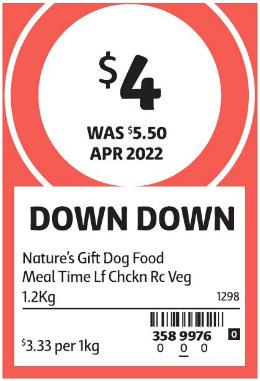
325 Examples of the Down Down tickets that were used by Coles for the Nature’s Gift Dog Food product Online and in the Coles App are as follows:
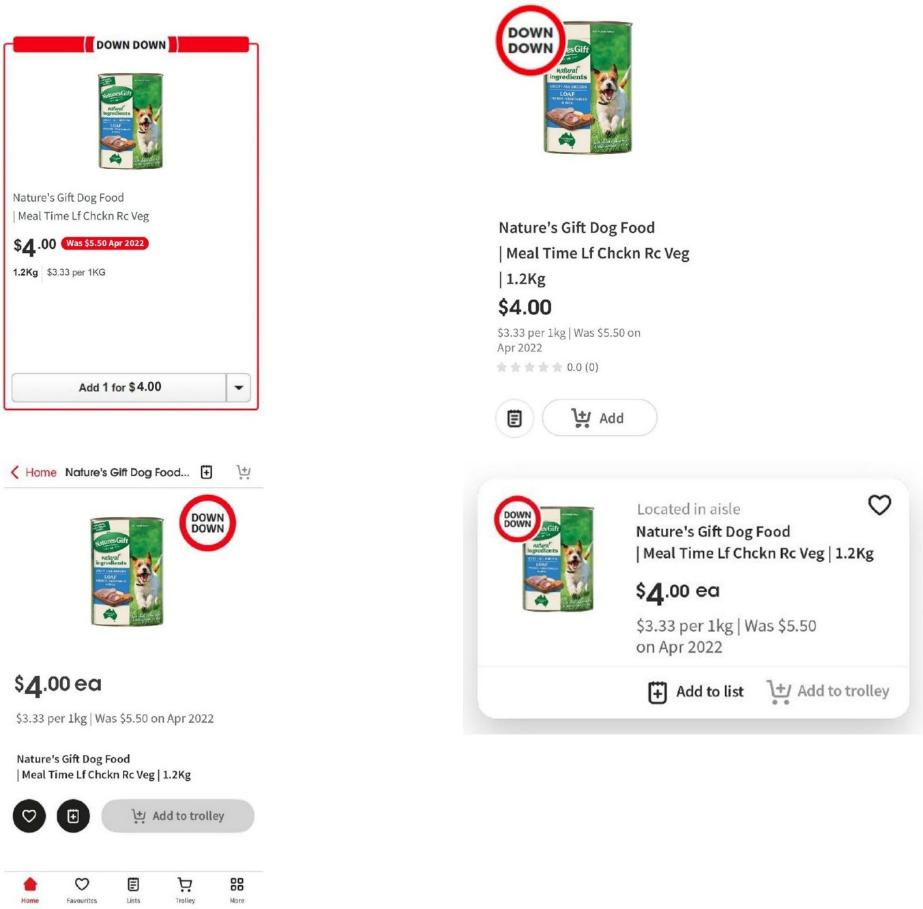
Real Pet Food’s Second CPA request
326 On 14 November 2022, Real Pet Food made a further CPA request to increase the list price of various products by 8.99%, including the Nature’s Gift Dog Food product (the Second CPA request). At the time of the Second CPA request, the product was still on a Down Down ticket at a price of $4.00 (Price 1). Real Pet Food proposed an increase in the list price from $[RED.] to $[RED.] and an increase in the recommended retail price from $5.50 to $6.00.
327 The CPA request was assessed by Coles’ VMO team, which partially validated the cost increase. On 11 December 2022, Mr Carroll informed Real Pet Food that Coles would partially accept the Second CPA request. On 12 December 2022, Real Pet Food sent Mr Carroll a promotional plan for the products affected by the Second CPA request. In respect of the Nature’s Gift Dog Food product, the plan proposed that the recommended retail price would increase to $6.00 and the product would be sold on a Down Down ticket at a price of $4.50 (with a list price of $[RED.] and supplier funding of $[RED.]). Mr Carroll did not consider that the proposal included sufficient supplier funding to support the promotional price. From 12 December 2022 to 2 February 2023, Mr Carroll negotiated with Real Pet Food over a series of draft promotional plans that included the same promotional strategies but different levels of promotional funding from Real Pet Food. In cross-examination, Mr Carroll agreed that, during the negotiations, neither Real Pet Food nor Coles analysed the likely sales volume or gross margin that would be earned by Coles during the proposed period in which the Nature’s Gift Dog Food product would be sold at a white ticket price of $6.00 (the price establishment period) before being placed on the proposed Down Down promotion.
328 As at 8 January 2023, Real Pet Food’s proposed trade plan for the Nature’s Gift Dog Food product remained to increase the list price to $[RED.], increase the recommended retail price to $6.00, promote the product on a Down Down ticket at a price of $4.50 but increase supplier funding to $[RED.].
329 On 18 January 2023, Real Pet Food sent an email to Coles (copied to Mr Carroll) which contained PAFs for a number of products in spreadsheet form. In respect of the Nature’s Gift Dog Food product, the PAF proposed that:
(a) from 6 February to 7 March 2023, supplier funding would be $[RED.] (with an attached comment “BSCW deal to maintain margin before moving to back to Down Down – Margin enhancement deal”); and
(b) from 8 March 2023 to 10 September 2023, supplier funding would be $[RED.] (with an attached comment “Margin Enhancement Deal”) plus $[RED.] (with an attached comment “Down Down Deal”).
330 Thus, the PAF for the Nature’s Gift Dog Food product contemplated a ‘price establishment’ period in which the product would be sold on a white ticket at the recommended retail price for a period of 30 days before returning to a new Down Down promotion.
331 Between 18 January 2023 and 7 February 2023, the Nature’s Gift Dog Food product was sold on a white ticket but remained at the previous Down Down price of $4.00. The cost price remained $[RED.] with supplier funding of $[RED.]. As noted earlier, the Down Down promotional guardrails required a product that was removed from a Down Down promotion to be sold for 14 days on a white ticket but at the previous Down Down price. In this case, the Nature’s Gift Dog Food product was sold on a white ticket at the previous Down Down price for a period of 21 days.
332 On 2 February 2023, Mr Carroll sent Real Pet Food an email rejecting the Second CPA request and asking Real Pet Food to confirm that they wished “to move into a none [sic] supply”. A conversation then occurred between Mr Carroll and Real Pet Food which resulted in Coles accepting a revised CPA request.
333 On 3 February 2022, Real Pet Food sent Mr Carroll a spreadsheet with proposed dates for implementing the agreed cost increase and trade plan. In respect of the Nature’s Gift Dog Food product, the plan proposed that the product would move to a white ticket price of $6.00 on 8 February 2023 and then move to the new promotional price of $4.50 on 8 March 2023.
334 On 8 February 2023, Coles increased the white ticket price of the Nature’s Gift Dog Food product to $6.00 (Price 2).
335 On 9 February 2023, Mr Carroll was informed by Coles’ Pricing and Value team that Woolworths was selling the Nature’s Gift Dog Food product for $4.50. On 10 February 2023, Mr Carroll emailed Chris Reid (Head of the Pricing and Value team at Coles at the time) to seek permission to “move earlier on some planned down down”, including the Nature’s Gift Dog Food product. The request was expressed to be “as a result of the WW [Woolworths] moving faster following a CPI that has recently taken place”. Mr Reid replied, telling Mr Carroll that he could decrease the white ticket price (to compete with Woolworths), but that he could not move the product to a Down Down promotion. Mr Reid also expressed caution about moving to a Down Down promotion within a four-week period (even though that was permitted by Coles’ guardrails). His email stated as follows, referencing a different product by way of illustration (emphasis in original):
You can drop your SEL shelf price back down now. But you can’t run a Down Down unless you price establish – but further, waiting 4 weeks to then say “Down Down was $31.50 now $22.50” while compliance wise is allowed, is not in the spirit of what DD is, when only 4 weeks earlier it was $21.50 (which was obvious to the customer who complained)
WW are not using a price drop ticket, if we want to drop immediately too, we should do the same – new shelf price at $22.50. But no red ticket calling out a save. So I think you need to have a conversation with supplier around the quantum of CPI implemented only to deal it back via scan deals (I assume) on DD.
336 Mr Carroll forwarded his email exchange with Mr Reid to Real Pet Food, stating that he (Mr Carroll) wanted to move the Nature’s Gift Dog Food product to the lower price on a white ticket (to compete with Woolworths). Mr Carroll requested a response from Real Pet Food. On 13 February 2023, Real Pet Food emailed Coles (copied to Mr Carroll) with revised PAFs. In respect of the Nature’s Gift Dog Food product, the revised PAF proposed that the product move to a Down Down promotion at a price of $4.50 on 15 February 2023, being only seven days after the price of the product was increased to $6.00. On 14 February 2023, Coles implemented the revised plan. Mr Carroll gave evidence that this was an oversight on his part, and that he had not intended to move the product to a Down Down promotion only seven days after the price of the product had been increased to $6.00. Mr Carroll explained that, at this time, he had already started in his new role at Swaggle and that he believes that he did not check the content of the revised PAF. I accept that evidence. There is no reason to believe that Mr Carroll would have intentionally breached Coles’ promotional guardrails.
337 Coles sold the Nature’s Gift Dog Food product on a white ticket at $6.00 (Price 2) from 8 to 14 February 2023, being seven days. The cost price for the product was $[RED.], with supplier funding of $[RED.], resulting in a net cost of goods of $[RED.], a dollar gross margin for Coles of $[RED.] and a percentage gross margin of [RED.]%. During this period, Coles sold 3,038 units, equating to an average of 434 units per day.
338 On 15 February 2023, Coles moved the Nature’s Gift Dog Food product to a Down Down promotion at a price of $4.50 (Price 3). As illustrated below, the Down Down ticket did not include a ‘Was’ price. I infer that the person responsible for preparing the ticket realised that the immediately preceding price had only applied for seven days and decided that that price should not be included on the ticket. The cost price for the product remained $[RED.], but supplier funding was increased to $[RED.], resulting in a net cost of goods of $[RED.], a dollar gross margin for Coles of $[RED.] and a percentage gross margin of [RED.]%. From 15 February 2023 to 4 May 2023, being 79 days, Coles sold 61,031 units, equating to an average of 773 units per day.
339 An example of the Down Down tickets that were used by Coles for the Nature’s Gift Dog Food product in-store is as follows:
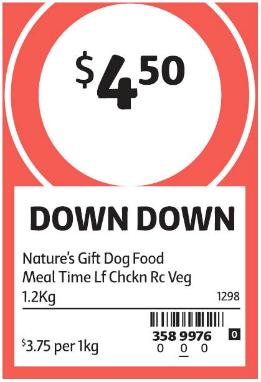
340 Examples of the Down Down tickets that were used by Coles for the Nature’s Gift Dog Food product Online and in the Coles App are as follows:
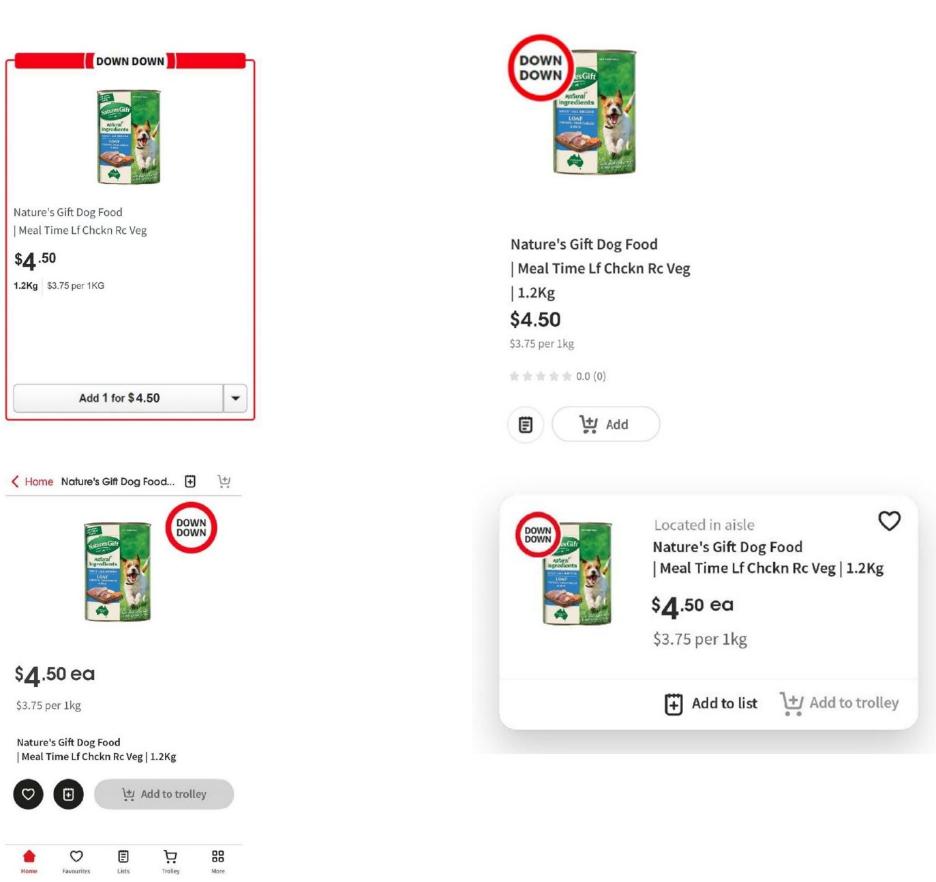
Viva Paper Towels
341 The Viva Paper Towels product is a three pack of paper towels. The product sat within the Paper Towels product category, which sat within the Homecare business category. The supplier of the Viva Paper Towels product was Kimberly-Clark Australia Pty Ltd (KCA). KCA submitted two CPA requests in respect of the Viva Paper Towels product during the relevant period. A graph of the pricing history of the Viva Paper Towels product, as annexed to the Wright Report, is reproduced at Annexure L to these reasons.
KCA’s First CPA request
342 From at least 1 January 2021, the Viva Paper Towels product was sold at $4.00 on a Down Down ticket (Price 1). The cost price for the product was $[RED.], but the supplier also provided funding of $[RED.], resulting in a net cost of goods of $[RED.], a dollar gross margin for Coles of $[RED.] and a percentage gross margin of [RED.]%. The product was intermittently sold on Special at a price of $3.00.
343 On 31 January 2022, KCA notified Coles of a CPA request for 8 products in the Paper Towel category and 18 products in the Facial Tissue category (First CPA request), including the Viva Paper Towels product. KCA informed Coles that the CPA would come into effect for all orders placed on or after 2 May 2022.
344 On 14 February 2022, the Category Manager for Paper Products & Kitchen Needs, Rebecca Graham, provided KCA with Coles’ initial analysis of its CPA request. Ms Graham noted that this analysis was based on preliminary cost modelling performed by Coles, because KCA had not provided any information regarding the cost breakdown of their CPA request. Coles validated only part of the costs increases claimed by KCA.
345 On 9 March 2022, KCA proposed promotional plans for the products that were the subject of the First CPA request. The promotional plans differed across the product range. In respect of the Viva Paper Towels product, the proposed promotional strategy contemplated a recommended retail price of $5.50, an Every Day Low Price of $4.50 and a ‘pulse’ price of $3.50 (being the price the product would be sold on Special). As noted earlier, under Coles’ promotional guardrails, a product that was sold on the Every Day Low Price mechanic was not permitted to be sold on Special at a lower price. Thus, that aspect of KCA’s promotional plan was prevented by Coles’ internal policies. On 10 March 2022, KCA sent a revised version of the promotional plans. In respect of the Viva Paper Towels product, the revised proposed promotional strategy contemplated using the Down Down mechanic, with a recommended retail price of $5.50, a Down Down price of $4.50 and a ‘pulse’ price of $3.50 (being the price at which the product would be sold on Special).
346 Around this time, Jack Jessiman, the Assistant Category Manager of Personal Care, became responsible for KCA’s CPA request and continued negotiations with KCA.
347 On 28 April 2022, KCA sent a revised CPA request that was accepted by Coles. In respect of the Viva Paper Towels product, the promotional strategy remained the Down Down mechanic. It was proposed that the product would be placed on a white ticket at the recommended retail price of $5.50 before being moved to a Down Down price of $4.50. The revised CPA request and promotional strategy was approved by Mr Jessiman.
348 In an email sent to KCA on 28 April 2022, Mr Jessiman incorrectly stated that it would take a minimum of two weeks before the revised Down Down and Every Day Prices could be implemented. Later that day, Mr Jessiman was corrected by another Coles employee, Jenny Kearney, who brought to his attention the most recent March 2022 Down Down guardrails, and the requirement for the product to have been sold on a white ticket price for four weeks prior to being moved to a Down Down promotion. Mr Jessiman accepted that correction and asked Ms Kearney to increase (Mr Jessiman used the word ‘inflate’) the white ticket price in line with the recommended retail price provided by KCA.
349 On 4 May 2022, Coles moved the Viva Paper Towels product to a white ticket at a price of $5.50 (Price 2). The cost price for the product was $[RED.], with supplier funding of $[RED.], resulting in a net cost of goods of $[RED.], a dollar gross margin for Coles of $[RED.] and a percentage gross margin of [RED.]%. The product was sold on the white ticket until 29 May 2022, being 26 days. During this period, Coles sold 67,616 units, equating to an average of 2,601 units per day. The evidence indicated that Woolworths was selling the product at the same price at this time.
350 On 30 May 2022, the Viva Paper Towels product was moved to a Down Down ticket at the price of $4.50 (Price 3). The cost price for the product remained $[RED.], and supplier funding remained at $[RED.], resulting in the same net cost of goods of $[RED.], but a reduced dollar gross margin for Coles of $[RED.] and a reduced percentage gross margin of [RED.]%. From 30 May 2022 to 22 January 2023, being 238 days, Coles sold 893,724 units, equating to an average of 3,755 units per day. On 30 May 2022, Woolworths was also offering the Viva Paper Towels product for sale at $4.50.
351 An example of the Down Down tickets that were used by Coles for the Viva Paper Towels product in-store is as follows:
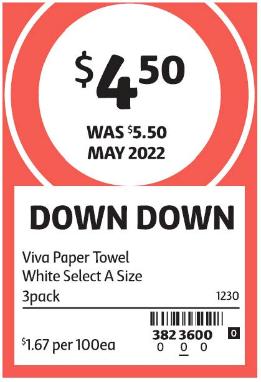
352 Examples of the Down Down tickets that were used by Coles for the Viva Paper Towels product Online and in the Coles App are as follows:
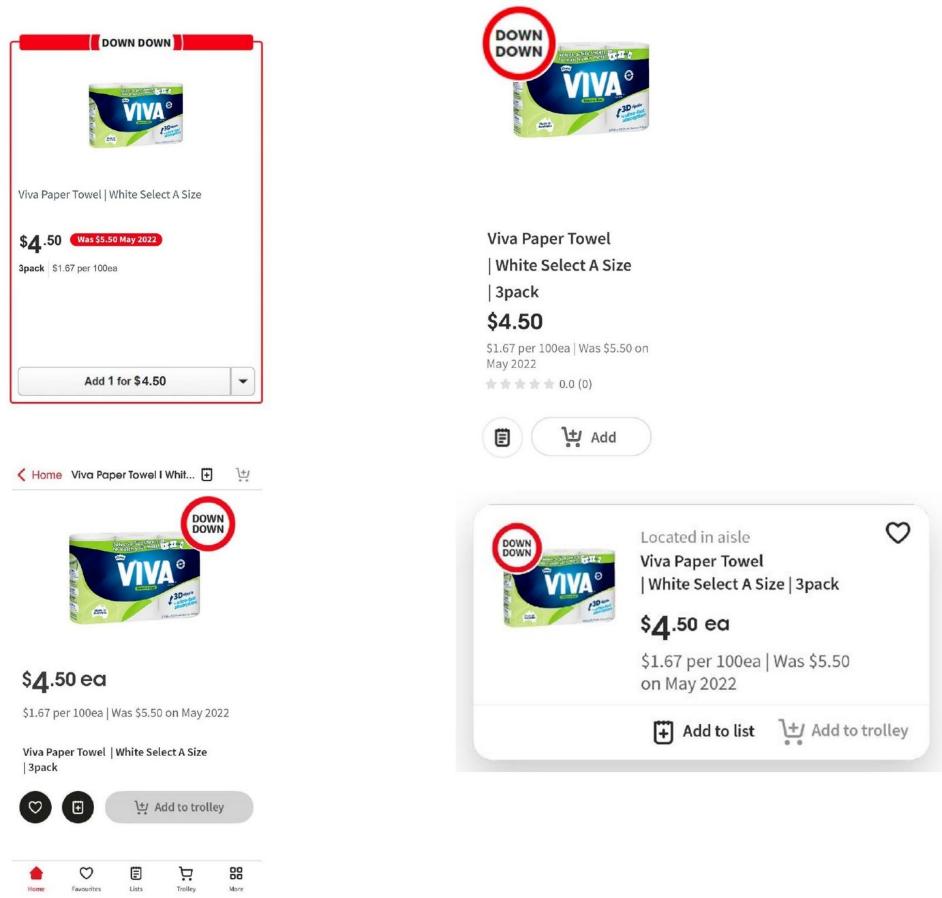
KCA’s Second CPA request
353 On 7 November 2022, KCA submitted a further CPA request (Second CPA request). The Second CPA request related to numerous products across KCA’s range, including the Viva Paper Towels product. KCA advised that the CPA would take effect for all orders placed on or after 6 February 2023. At the time of the Second CPA request, the Viva Paper Towels product was on the Down Down program and sold at a promotional price of $4.50 (Price 1).
354 Coles conducted an internal analysis of the Second CPA request, validating only a proportion of KCA’s claimed cost increases. On 21 November 2022, the Category Manager for the Paper & Kitchen Needs category, Emma Bates, informed KCA that, following Coles’ analysis, they were willing to partially accept the CPA request. On 28 November 2022, KCA provided an updated CPA request, including additional information regarding commodity costs. On 14 December 2022, Ms Bates informed KCA that Coles would accept a 7% increase.
355 On 20 December 2022, KCA proposed a new promotional plan for the products that were the subject of the Second CPA request. In respect of the Viva Paper Towels product, KCA proposed a recommended retail price of $6.50, a promotional price of $5.50 (for 46 weeks), and a ‘pulse’ price of $4.40 (for 6 weeks).
356 Coles and KCA continued to engage in negotiations with respect to KCA’s Second CPA request and proposed promotional plan.
357 On 19 January 2023, Ms Bates emailed KCA a table setting out actions required in respect of certain products. In relation to the Viva Paper Towels product, Ms Bates noted that the current Down Down promotion would end on 23 January 2023, following which the product would be sold on a white ticket for the same price for two weeks, during which KCA’s supplier funding would continue. Ms Bates then noted that once KCA and Coles had agreed the CPA, a further Down Down promotion could recommence after four weeks.
358 On 23 January 2023, Coles moved the Viva Paper Towels product from a Down Down ticket to a white ticket at the same price of $4.50.
359 Following further negotiations, Coles accepted a revised form of KCA’s Second CPA request on 3 February 2023.
360 On 7 February 2023, Coles moved the Viva Paper Towels product to a white ticket price of $6.50 (Price 2). The cost price for the product was $[RED.], but the supplier also provided funding of $[RED.], resulting in a net cost of goods of $[RED.], a dollar gross margin for Coles of $[RED.] and a percentage gross margin of [RED.]%. The product was sold on the white ticket until 5 March 2023, being 27 days. During this period, Coles sold 35,116 units, equating to an average of 1,301 units per day.
361 On 6 March 2023, Coles moved the Viva Paper Towels product was put to a Down Down ticket at a price of $5.50 (Price 3). The cost price for the product remained at $[RED.], the supplier’s funding remained at $[RED.], and resulting net cost of goods remained at $[RED.], but the dollar gross margin for Coles reduced to $[RED.] and the percentage gross margin reduced to [RED.]%. From 6 March 2023 to 4 May 2023, being 60 days, Coles sold 115,699 units, equating to an average of 1,928 units per day.
362 An example of the Down Down tickets that were used by Coles for the Viva Paper Towels product in-store is as follows:
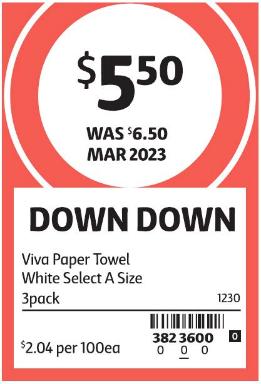
363 Examples of the Down Down tickets that were used by Coles for the Viva Paper Towels product Online and in the Coles App are as follows:
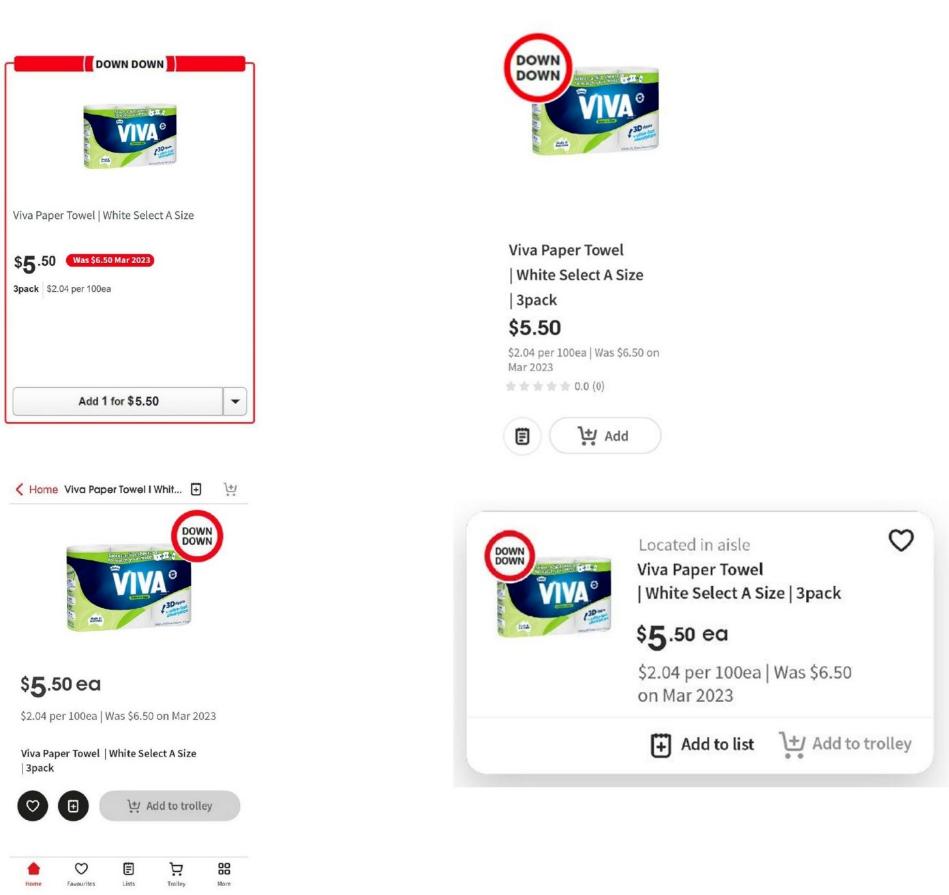
D. APPLICABLE LEGAL PRINCIPLES
D.1 Legislative prohibitions
364 Section 18(1) of the ACL relevantly provides as follows:
A person must not, in trade or commerce, engage in conduct that is misleading or deceptive or is likely to mislead or deceive.
365 Section 29(1)(i) of the ACL relevantly provides as follows:
A person must not, in trade or commerce, in connection with the supply or possible supply of goods or services or in connection with the promotion by any means of the supply or use of goods or services:
…
make a false or misleading representation with respect to the price of goods or services; or
…
366 The prohibitions in ss 18 and 29 are similar in nature. In most instances, there is no meaningful difference between the words “misleading or deceptive” in s 18 and “false or misleading” in s 29: Australian Competition and Consumer Commission v Coles Supermarkets Australia Pty Ltd [2014] FCA 634; 317 ALR 73 (Coles Supermarkets) at [40], [44] (Allsop CJ); Australian Competition and Consumer Commission v TPG Internet Pty Ltd (2020) 278 FCR 450 (TPG 2020) at [21] (Wigney, O’Bryan and Jackson JJ); Self Care IP Holdings Pty Ltd v Allergan Australia Pty Ltd (2023) 277 CLR 186 (Self Care) at [84] (Kiefel CJ, Gageler, Gordon, Edelman and Gleeson JJ).
D.2 General principles
367 The applicable principles concerning the statutory prohibition of misleading or deceptive conduct (and closely related prohibitions) in the ACL are well known and there was no dispute between the parties concerning those principles.
368 The applicable principles were summarised by the High Court (Kiefel CJ, Gageler, Gordon, Edelman and Gleeson JJ) in the context of ss 18 and 29 of the ACL in Self Care as follows (citations omitted):
80 The principles are well established. Determining whether a person has breached s 18 of the ACL involves four steps: first, identifying with precision the “conduct” said to contravene s 18; second, considering whether the identified conduct was conduct “in trade or commerce”; third, considering what meaning that conduct conveyed; and fourth, determining whether that conduct in light of that meaning was “misleading or deceptive or … likely to mislead or deceive”.
81 The first step requires asking: “what is the alleged conduct?” and “does the evidence establish that the person engaged in the conduct?”. The third step considers what meaning that conduct conveyed to its intended audience. As in this case, where the pleaded conduct is said to amount to a representation, it is necessary to determine whether the alleged representation is established by the evidence. The fourth step is to ask whether the conduct in light of that meaning meets the statutory description of “misleading or deceptive or … likely to mislead or deceive”; that is, whether it has the tendency to lead into error. Each of those steps involves “quintessential question[s] of fact”.
82 The third and fourth steps require the court to characterise, as an objective matter, the conduct viewed as a whole and its notional effects, judged by reference to its context, on the state of mind of the relevant person or class of persons. That context includes the immediate context – relevantly, all the words in the document or other communication and the manner in which those words are conveyed, not just a word or phrase in isolation – and the broader context of the relevant surrounding facts and circumstances. It has been said that “[m]uch more often than not, the simpler the description of the conduct that is said to be misleading or deceptive or likely to be so, the easier it will be to focus upon whether that conduct has the requisite character”. That said, the description of the conduct alleged and identified at the first step should be sufficiently comprehensive to expose the complaint, because it is that conduct that will ultimately, as a whole, be determined to be or not to be misleading or deceptive.
83 Where the conduct was directed to the public or part of the public, the third and fourth steps must be undertaken by reference to the effect or likely effect of the conduct on the ordinary and reasonable members of the relevant class of persons. The relevant class of persons may be defined according to the nature of the conduct, by geographical distribution, age or some other common attribute, habit or interest. It is necessary to isolate an ordinary and reasonable “representative member” (or members) of that class, to objectively attribute characteristics and knowledge to that hypothetical person (or persons), and to consider the effect or likely effect of the conduct on their state of mind. This hypothetical construct “avoids using the very ignorant or the very knowledgeable to assess effect or likely effect; it also avoids using those credited with habitual caution or exceptional carelessness; it also avoids considering the assumptions of persons which are extreme or fanciful”. The construct allows for a range of reasonable reactions to the conduct by the ordinary and reasonable member (or members) of the class.
84 Although s 18 takes a different form to s 29, the prohibitions are similar in nature. In these appeals, there is no relevant meaningful difference between the words “misleading or deceptive” in s 18 and “false or misleading” in s 29. Under s 29 it is necessary to identify a representation made in connection with the supply or possible supply of goods or services, or in connection with the promotion of the supply or use of goods or services, that is false or misleading and meets one of the descriptions in subs (1)(a) to (n).
369 In these reasons, the expression ‘ordinary consumer’ is used to refer to the ordinary and reasonable members of the class of persons (grocery shoppers) to whom the Down Down tickets were directed.
370 In TPG 2020, the Full Court (Wigney, O’Bryan and Jackson JJ) observed (at [22]):
… The central question is whether the impugned conduct, viewed as a whole, has a sufficient tendency to lead a person exposed to the conduct into error (that is, to form an erroneous assumption or conclusion about some fact or matter): Taco Co of Australia Inc v Taco Bell Pty Ltd (1982) 42 ALR 177 (Taco Bell) at 200 per Deane and Fitzgerald JJ; Parkdale Custom Built Furniture Pty Ltd v Puxu Pty Ltd (1982) 149 CLR 191 (Puxu) at 198 per Gibbs CJ; Campomar Sociedad, Limitada v Nike International Limited (2000) 202 CLR 45 (Campomar) at [98]; Australian Competition and Consumer Commission v TPG Internet Pty Ltd (2013) 250 CLR 640 (TPG Internet) at [39] per French CJ, Crennan, Bell and Keane JJ; Campbell at [25] per French CJ. A number of subsidiary principles, directed to the central question, have been developed:
(a) First, conduct is likely to mislead or deceive if there is a real or not remote chance or possibility of it doing so: see Global Sportsman Pty Ltd v Mirror Newspapers Pty Ltd (1984) 2 FCR 82 at 87; Noone (Director of Consumer Affairs Victoria) v Operation Smile (Australia) Inc (2012) 38 VR 569 at [60] per Nettle JA (Warren CJ and Cavanough AJA agreeing at [33]).
(b) Second, it is not necessary to prove an intention to mislead or deceive: Hornsby Building Information Centre Pty Ltd v Sydney Building Information Centre Ltd (1978) 140 CLR 216 at 228 per Stephen J (with whom Barwick CJ and Jacobs J agreed) and at 234 per Murphy J; Puxu at 197 per Gibbs CJ; Google Inc v Australian Competition and Consumer Commission (2013) 249 CLR 435 (Google) at [6] per French CJ and Crennan and Kiefel JJ.
(c) Third, it is unnecessary to prove that the conduct in question actually deceived or misled anyone: Taco Bell at 202 per Deane and Fitzgerald JJ; Puxu at 198 per Gibbs CJ; Google at [6] per French CJ and Crennan and Kiefel JJ. Evidence that a person has in fact formed an erroneous conclusion is admissible and may be persuasive but is not essential. Such evidence does not itself establish that conduct is misleading or deceptive within the meaning of the statute. The question whether conduct is misleading or deceptive is objective and the Court must determine the question for itself: see Taco Bell at 202 per Deane and Fitzgerald JJ; Puxu at 198 per Gibbs CJ.
(d) Fourth, it is not sufficient if the conduct merely causes confusion: Taco Bell at 202 per Deane and Fitzgerald JJ; Puxu at 198 per Gibbs CJ and 209-210 per Mason J; Campomar at [106]; Google at [8] per French CJ, Crennan and Kiefel JJ.
(e) Fifth, where the impugned conduct is directed to the public generally or a section of the public, the question whether the conduct is likely to mislead or deceive has to be approached at a level of abstraction where the Court must consider the likely characteristics of the persons who comprise the relevant class to whom the conduct is directed and consider the likely effect of the conduct on ordinary or reasonable members of the class, disregarding reactions that might be regarded as extreme or fanciful: Campomar at [101]-[105]; Google at [7] per French CJ and Crennan and Kiefel JJ.
371 The meaning derived from the conduct must be judged by reference to the conduct as a whole and in its proper context: Coles Supermarkets at [41] (Allsop CJ). That context includes, “the types of goods and services being supplied, the manner in which they are supplied and the habits and characteristics of purchasers of those goods and services”: Australian Securities and Investments Commission v Vanguard Investments Australia Ltd [2024] FCA 308 at [110] (O’Bryan J); Coles Supermarkets at [41] (Allsop CJ). In a context such as the present, involving the purchase of groceries in a supermarket, the reasonable member of the public “may be intelligent or not, may be well educated or not, will not likely spend any time undertaking an intellectualised process of analysis, will often be shopping for many other items, and will likely be affected by an intuitive sense of attraction rather than by any process of analytical or logical choice”: Coles Supermarkets at [43] (Allsop CJ).
372 Although the meaning conveyed by the conduct must be ascertained objectively, the intention of the representor may be relevant. Specifically, “where a representation is made in terms apt to create a particular mental impression in the representee, and is intended to do so, it may properly be inferred that it has had that effect”: TPG HCA at [55] (French CJ, Crennan, Bell and Keane JJ). Further, “[s]uch an inference may be drawn more readily where the business of the representor is to make such representations and where the representor’s business benefits from creating such an impression”: TPG HCA at [55]; see also Bed Bath ‘N’ Table at [52]-[57] (Gageler CJ, Gordon, Edelman, Jagot and Beech-Jones JJ).
D.3 Dual pricing cases
373 The Court has considered whether a price comparison representation (such as a representation conveying a ‘was’ and ‘now’ price of a product) is misleading and deceptive in several cases. These cases are often referred to as ‘dual pricing’ cases. While each case turns upon its own facts, the approach taken by the Court in these cases provides some guidance for the present case.
The early cases
374 The earliest case was Ducret v Chaudhary’s Oriental Carpet Palace Pty Ltd (1987) 16 FCR 562 (Chaudhary). The defendants were Chaudhary’s Oriental Carpet Palace Pty Ltd, a Persian rug seller, and its managing director, Shahid Chaudhary. The case concerned a series of advertorials and advertisements published in The Age newspaper in Melbourne on 30 April 1983, promoting a forthcoming sale at the company’s retail outlet in High Street, Armadale, a suburb of Melbourne. The first advertorial traced the background of the business developed by Mr Chaudhary as a trader in Persian rugs. The advertorial concluded with Mr Chaudhary’s theory of business success: “If you sell for a small profit margin, at the end of the rainbow you find success”. The advertorial stated that Mr Chaudhary:
… learnt that technique by understanding the advertising styles and marketing policies of large chain stores and supermarkets which work on small margins to make big profits.
375 The advertorials were followed by eight advertisements featuring different types of carpets to be offered at the forthcoming sale. One of the advertisements contained a picture of a rug with the following text:
Usually $4675
Sale Price $1759
Now Only $497
376 The company was charged with an offence against s 79(1) of the Trade Practices Act 1974 (Cth) (TPA) on the ground that it had made a misleading statement with respect to the price of the advertised carpet in contravention of s 59(e). Mr Chaudhary was charged with being knowingly concerned in the offence. The prosecution alleged that the advertisement indicated that the usual retail price, or the fair retail price, or the fair retail value, of the rug in Melbourne was $4,675.00. Justice Ryan concluded that the defendants had no case to answer. His Honour stated (at 567, emphasis added):
… In my view, on the evidence as it stands, the Court could not find that any of the advertisements contained a statement which indicated either the usual retail price or a fair retail price or the fair retail value of a rug to which that advertisement referred.
I consider that the only interpretation which can reasonably be placed on the two figures which have been crossed out in each advertisement is that they represent respectively the price at which carpets of that size and description had been offered for sale in the usual way of business by the company, (or by the department store from which they had come), and the lower price at which such carpets had been offered in the course of some previous “sale” at reduced prices, again by the company or the department store.
377 As can be seen from the above passage, Ryan J concluded that the meaning or message conveyed by the ‘strike through’ price was that the rug had been offered at that price in the usual course of business.
378 In Trade Practices Commission v Cue Design Pty Ltd (1996) 85 A Crim R 500; (1996) ATPR 41-475, the defendant pleaded guilty to offences under s 79(1) of the TPA by making misleading statements with respect to the price of goods in contravention of s 59(e). The defendant was a clothing retailer that had displayed clothing items with a price tag on which a higher price was crossed out and a lower price was written onto the tag. The clothing items had never previously been offered at the higher price. Although the only issue before the Court was the imposition of penalty, O’Loughlin J observed in connection with the assessment of the deliberateness of the conduct (at 505, emphasis added):
What I need to determine, for the purpose of assessing penalty, is Cue’s motive in involving itself in the dual-priced swing tags in the manner in which it did. If Ms Rolle truthfully stated that it did not occur to her that members of the buying public would infer from the two prices that the garments had been on sale at the higher prices for any substantial period of time then she is either very naive or recklessly indifferent to the perceptions of the buying public. …
In my opinion, the natural and probable consequence of a dual-priced swing tag is that members of the buying public would assume that the garment had previously been offered for sale at the higher of the two prices and was now available at the lower price. I am unable to accept the submission on behalf of the defendants that they were unaware of that consequence.
379 Again, O’Loughlin J concluded that the meaning or message conveyed by the ‘strike through’ price was that the garments had previously been offered at that price, implicitly in the usual course of business and for a substantial period of time.
380 Other cases in which companies have been penalised for advertising products using ‘was/now’ pricing, where the product was never offered for sale at the ‘was’ price, include Australian Competition and Consumer Commission v Allans Music Group Pty Ltd [2002] FCA 1552 and Australian Competition and Consumer Commission v Carrerabenz Diamond Industries Pty Ltd [2008] FCA 1103; (2008) ARPR 42-248.
The jewellery cases
381 Considerable attention was given at trial to the decision of Moore J in Australian Competition and Consumer Commission v Prouds Jewellers Pty Ltd [2008] FCA 75; 75 IPR 306 (Prouds) and, on appeal, by the Full Court (Black CJ, Ryan and Gordon JJ) in Australian Competition and Consumer Commission v Prouds Jewellers Pty Ltd [2008] FCAFC 199 (Prouds Appeal). Prouds was a large Australian retailer of jewellery (with over 140 outlets) that advertised items for sale in catalogues that were distributed to the public. It regularly advertised its jewellery for sale by publishing and distributing catalogues to the public promoting the sale of a range of jewellery items and offering each item for sale at a price described as a ‘now’ price near a picture of the item and another price described as the ‘was’ price. The ‘was’ price was higher, and often much higher, than the ‘now’ price. The proceeding concerned 17 items of jewellery promoted for sale in two catalogues entitled “Summer of Love” (first published on 29 January 2006) and “Love You Mum” (first published on 23 April 2006). It was an agreed fact that the audience for both catalogues was “the public generally” (Prouds at [5]).
382 The ACCC alleged that the catalogues, and specifically the use of the was/now price promotional method, conveyed the following five representations, all of which were misleading:
(a) that the difference between the ‘was’ price and the ‘now’ price was the amount a consumer would save if the item was purchased during the sale period compared with what consumers paid to purchase the item immediately preceding publication of the catalogue (level of savings representations): Prouds at [8];
(b) that the ‘was’ price was the usual price at which the item was offered for sale or sold for a reasonable period immediately preceding publication of the catalogue (usual price representations): Prouds at [50];
(c) that a substantial volume of the sales of the item that occurred in a reasonable period immediately preceding publication of the catalogue were at the ‘was’ price (substantial volume of sales price representations): Prouds at [52];
(d) that the ‘was’ price was the price at which Prouds sold the item immediately preceding publication of the catalogue (previous selling price representations): Prouds at [54]; and
(e) that the ‘was’ price was the price at which Prouds offered the item for sale for a reasonable period ending immediately preceding publication of the catalogue (advertised price representations): Prouds at [56].
383 In determining whether any of the foregoing representations were conveyed, Moore J addressed two questions. The first question was whether the catalogues conveyed to an ordinary consumer that the item of jewellery had been sold at the ‘was’ price, or that the item of jewellery had been offered for sale at the ‘was’ price. His Honour concluded that the catalogues conveyed the latter (at [38] and [47]). In that regard, his Honour observed (at [38], emphasis added):
… The hypothetical consumer’s reaction to the juxtaposition of the “was” price with the “now” price, in my opinion, would more likely be impressionistic rather than analytical. Nonetheless, part of that impression would have involved, at least implicitly, an understanding that the “was” price represented the price at which an item had been offered for sale before the promotional sale period.
384 Largely for that reason, his Honour concluded that the catalogues did not convey the level of savings representations (at [48]), the substantial volume of sales price representations (at [53]) or the previous selling price representations (at [55]).
385 The second question was whether the catalogues conveyed to an ordinary consumer that the item of jewellery had been offered for sale at the ‘was’ price immediately prior to the catalogue sale, or that the item of jewellery had been offered for sale at the ‘was’ price at some earlier time. Justice Moore concluded that the ordinary consumer would have been led to believe that, if they had sought to buy one of the items in the period immediately before the catalogue sale commenced, they would have purchased it at the ‘was’ price (at [47]). It followed that the catalogues conveyed the usual price representation (at [51]) and the advertised price representation (at [57]). In respect of the usual price representation, his Honour observed (at [51], emphasis added):
It is apparent the “was” price did not appear in the Summer of Love catalogue in isolation. It appeared in juxtaposition with a “now” price. Plainly the “now” price identified the discounted price at which the item could be purchased during the sale period. The message conveyed by the “was” price in this context, was that the item, immediately before the sale, was being offered for sale and could be purchased for the “was” price. Senior counsel for Prouds challenged the proposition that the “was” price should be treated as referable to the period immediately before the catalogue was published (and the sale commenced). However, the juxtaposition of the two prices was intended to create a contrast. The contrast was between circumstances existing before the sale and those existing during the period of the sale. The period before the sale included the period immediately before the sale. It was misleading to identify in the Summer of Love catalogue a “was” price which did not represent the price at which an item had been offered for sale and would have been purchased by the hypothetical consumer immediately before the sale commenced. This representation is established in relation to both the Summer of Love catalogue and the Love You Mum catalogue.
386 Justice Moore’s reasoning in respect of the advertised price representations was to the same effect (at [66]). His Honour found that the usual price representation and the advertised price representation were misleading because the items of jewellery had not been offered for sale at the ‘was’ price immediately before the catalogue sale (the relevant sale data being presented in a table at [12]).
387 Having upheld part of the ACCC’s case, Justice Moore turned to the question whether to grant an injunction and the form of any such injunction. His Honour concluded that it was appropriate to allow the parties to make further submissions on that question (at [69]). However, his Honour made the following observation (at [70], emphasis added):
To assist the parties in considering the form of the relief, I make the following observations. The contravening conduct of Prouds flows from the fact that goods offered for sale in the context of dual pricing, were not offered for sale at the “was” price in the period immediately before the sale. In my opinion there would be no contravention of the Act (and assuming continued use of the dual pricing promotion manifest in the two catalogues considered in this case) if the goods had been offered for sale at the “was” price for a period of 2 months preceding the sale period. While there can be no precision about the length of the anterior period, it must represent a period of substance in which the price the goods were offered for sale at the “was” price and, negotiated discounts aside, would have been purchased at that price. If the period was unduly short, then the publication of the “was” price in the context of dual pricing would remain misleading or deceptive. …
388 His Honour’s observation highlights the distinction between the questions: (i) what was the meaning or message conveyed by the impugned conduct; and (ii) was the meaning or message misleading. In respect of the first question, his Honour did not find that the ‘was’ price conveyed to ordinary consumers that the items of jewellery had been offered at the ‘was’ price for a specific period of time. Rather, his Honour found that the ordinary consumer’s reaction to the was/now pricing would have been impressionistic rather than analytical. Nevertheless, in respect of the second question, his Honour expressed the view that the was/now pricing conduct would not have been misleading if the items had been offered at the ‘was’ price for a period of two months. Implicit in that statement was a conclusion that the was/now pricing conduct conveyed to ordinary consumers that the ‘was’ price was a genuine price in the sense (at least) that it had been genuinely available in the market for a reasonable period.
389 The foregoing matters were also addressed by Moore J in his subsequent reasons for judgment on relief: Australian Competition and Consumer Commission v Prouds Jewellers Pty Ltd (No 2) [2008] FCA 476. The ACCC sought an injunction preventing Prouds from using was/now pricing unless Prouds had continuously offered the item of jewellery for supply at a price equal to or more than the ‘was’ price in the period of two months immediately preceding the ‘now’ price. After concluding that an injunction was not warranted in the circumstances of the case, his Honour also expressed the view that the form of injunction sought by the ACCC was inappropriate, stating (at [10]):
This conclusion is fortified by the terms of the injunction ACCC is seeking, which I consider are inappropriate. ACCC's draft injunction prohibits the use of dual pricing (but only for a period of three years) that uses a “was” and a “now” price unless a precondition is met, namely, that any dual priced item had been offered for sale or supply at the “was” price for a period of two months immediately preceding the commencement of the sale. However, an order in these terms assumes that this precondition is the only way of avoiding misleading and deceptive conduct when using dual pricing. It is true that the failure of Prouds to satisfy this precondition, in the facts of this case, led to one of the conclusions that it had engaged in misleading and deceptive conduct. However, depending on the terms of the promotional material including, in relation to statements involving dual pricing, qualifications and explanations about what is said and meant and depending on the factual matrix in which it occurred, lawful dual pricing may be possible and not in contravention of the Act. It would be undesirable to speculate about circumstances in which dual pricing might not involve misleading and deceptive conduct. It is sufficient to note that, in my opinion, the precondition contemplated in the draft order is not likely to exhaust the ways in which dual pricing can be undertaken without engaging in misleading and deceptive conduct.
390 Both the ACCC and Prouds appealed Moore J’s decision. The Full Court dismissed both appeals. In its appeal, the ACCC challenged Moore J’s conclusion with respect to the level of savings representations and the previous selling price representations. The Full Court upheld the findings of Moore J that the ‘was’ price was likely to have been understood by the ordinary consumer as referring only to the price at which the item in question had been offered for sale: Prouds Appeal at [36] and [42]. In its appeal, Prouds challenged Moore J’s conclusion with respect to the usual selling price representations and the advertised price representations. Again, the Full Court upheld the findings of Moore J that the message conveyed was that the item, immediately before the sale, was being offered for sale and could be purchased for the ‘was’ price (Prouds Appeal at [55]-[56] and [63]-[64]).
391 It is a little difficult to reconcile the decision in Prouds with the decision in Australian Competition and Consumer Commission v Ascot Four Pty Ltd [2008] FCA 1295; 250 ALR 467 (Ascot Four) (Mansfield J), which was upheld on appeal in Ascot Four Pty Ltd v Australian Competition and Consumer Commission (2009) 176 FCR 106 (Ascot Four Appeal) (Black CJ, Ryan and Jagot JJ). However, the two cases are a stark illustration that much will turn on the precise allegations made and underlying facts.
392 In Ascot Four, the defendant was the proprietor of a jewellery retailer business trading under the name ‘Zamel’s’ and operated a chain of 69 jewellery stores across Australia. In November 2005, the defendant caused to be published a pre-Christmas sale catalogue advertising various jewellery items for sale during the period 24 November to 24 December 2005. Certain of the items were advertised with a sale price together with a comparison price in the form of a strike though price (in smaller print), which was a higher amount. The ACCC alleged that the Christmas catalogue contained eleven counts of false or misleading representations about the price of certain items of jewellery, in contravention of s 75AZC(1)(g) of the TPA. Justice Mansfield at first instance found that, in 10 of the 11 counts, the items had been offered for sale at the strike through price immediately prior to the sale period, but in none of the counts had the item been sold at the strike through price. In contrast to Prouds, Mansfield J upheld the ACCC’s allegation that the catalogue conveyed a representation that the purchase of each item of jewellery during the sale period would result in a saving to the purchaser of the difference between the sale price and the strike through price (at [3] and [100]). His Honour found that the representation was false or misleading because, having regard to the previous sales of the items (which were all at prices that were lower than the strike through prices), the purchase of the items during the sale period would not result in a saving to the purchaser of the difference between the sale price and the strike through price (at [114]).
393 The Full Court upheld the findings of Mansfield J, whilst noting the different result in Prouds. The Full Court explained the different outcome as follows (Ascot Four Appeal at [30]):
The different result from that in Prouds Jewellers is explained by the different allegations and evidence before the Court in the present case. As noted, the ACCC failed on the relevant aspect of the claim in Prouds Jewellers because it pleaded that the representation was the saving between the sale price and the amount actually paid by consumers before the sale period. The present case is different. The ACCC’s allegation in the present case depended on the strike through price representing the price that would have been paid before the sale period. This allegation does not depend on purchasers being imputed with knowledge of actual sales prices. …
394 The decision in Ascot Four was followed in Australian Competition and Consumer Commission v Jewellery Group Pty Ltd [2012] FCA 848; 293 ALR 335 (Jewellery Group) (Lander J), which was upheld on appeal in Jewellery Group Pty Ltd v Australian Competition and Consumer Commission [2013] FCAFC 144 (Greenwood, Besanko and Katzmann JJ). Jewellery Group also concerned the jewellery retailer Zamel’s and similar factual circumstances. The proceeding related to 44 items of jewellery that were advertised for sale in six catalogues and a flyer that were published and distributed between November 2008 and May 2010. The items were advertised by means of an image of the item, the item number, and a statement of two prices, one higher and one lower. In some of the catalogues, the higher price was struck through with a line, and a lower price in larger and heavier typeface was described as the ‘sale price’. In the other catalogues and the flyer, the higher price was struck through with a line preceded by the word ‘was’, and a lower price in larger and heavier typeface was preceded by the word ‘now’. The ACCC alleged that by publishing and distributing the catalogues and flyer, Jewellery Group had engaged in conduct that was misleading or deceptive, or likely to mislead or deceive, in contravention of ss 52 and 53(e) of the TPA. Consistently with Ascot Four, the ACCC alleged that the catalogues and flyer represented that, if the item were purchased during the sale period, consumers would save an amount being the difference between the ‘strike through’ price and sale price or the ‘was’ price and ‘now’ price (as applicable).
395 At first instance, Lander J expressed agreement with the reasoning and conclusions of Mansfield J in Ascot Four (at [36]) and concluded that the catalogues and flyer conveyed the representation alleged by the ACCC (at [38]). His Honour concluded that the sale price or ‘now’ price would be understood by an ordinary consumer as the price that the consumer would pay if they went into a Zamel’s store and asked to purchase the item during the sale period (at [44]). His Honour reasoned that an ordinary consumer, who was unaware of the discounting practices associated with jewellery retailing, would understand the ‘strike through’ price or ‘was’ price as the price at which the items could be purchased prior to the sale (at [44]). His Honour concluded that the representation was false or misleading because, whilst the items had been offered for sale at the ‘strike though’ or ‘was’ price immediately prior to the sale, in respect of a number of items, there were no sales at or near the ‘strike-through’ or ‘was’ price in the four-month period leading up to the sale period and, in relation to the balance of the items, there was only a relatively immaterial percentage (less than 10%) sold at or near the ‘strike-through’ or ‘was’ price (see [86], [87], [145], [152]). On appeal, the Full Court upheld the findings of Lander J.
Kogan Australia
396 At trial, the ACCC also placed reliance on the decision of Davies J in Australian Competition and Consumer Commission v Kogan Australia [2020] FCA 1004; 145 ACSR 609 (Kogan). Kogan Australia is an online retailer. It offers goods for sale to Australian consumers through its website and other online channels. From 27 to 30 June 2018, Kogan conducted a sales promotion in respect of 78,111 products on its website, offering a 10% reduction on prices for consumers who purchased those products and entered the promotional code “TAXTIME” at checkout. The entry of the code at checkout had the effect of reducing the price in the consumer’s online cart in respect of items to which the promotion applied. The promotion was marketed with the statement: “Use code TAXTIME to reduce prices by 10% at checkout”.
397 The ACCC alleged that the promotional statement represented to consumers that, if consumers purchased products during the promotion and used the code “TAXTIME” at checkout, they would receive a 10% discount off the price at which the products were available for sale for a reasonable period before the promotion. The ACCC’s case concerned 621 products in respect of which:
(a) the price had been increased on 26 June 2018, in many cases by at least 10%;
(b) the price remained generally stable during the promotion period (ie 27 to 30 June 2018); and
(c) the price decreased on 2 July 2018, in many cases by at least 10%.
398 The ACCC alleged that the representation conveyed by the promotional statement was false and misleading in relation to those products because a consumer who purchased the product using the code “TAXTIME” did not receive a 10% discount off the price at which that product was available for sale for a reasonable period before the promotion due to the price increase the day before the promotion commenced.
399 The evidence established that the prices of the products sold on the Kogan website change frequently, sometimes on a daily basis (at [29]). The variability was caused by various factors such as product type, supply availability, wholesale costs, inventory levels, age of inventory, consumer demand, foreign exchange rates and competitor pricing. In that factual context, a central issue in dispute was whether the promotional statement would be understood by consumers to convey the representation alleged by the ACCC: that by using the “TAXTIME” code, consumers would receive a 10% discount off the price at which the product was available for sale for a reasonable period before the promotion. Significantly, the primary judge noted (at [20]) that the ACCC did not specify what constituted a “a reasonable period” for the purposes of its alleged representation. The ACCC argued that the period would vary depending on the product and its pricing history. Nevertheless, the ACCC contended that, in respect of the 621 products that were the subject of its case, the period during which the prices of those products remained generally stable in the two-week period before and after the promotion was a reasonable period.
400 Although Kogan also promoted the ‘tax time’ promotion with electronic messages that referred, amongst other things, to a was/now pricing comparison (see at [32]), the alleged misleading conduct was the promotional statement (“Use code TAXTIME to reduce prices by 10% at checkout”) and the meaning it conveyed to ordinary consumers. Kogan’s central argument was that the promotional method of a checkout coupon, which reduced prices upon checkout, differed from the promotional method of dual or comparative pricing. Kogan argued that the use of a checkout coupon conveyed nothing about the product’s pricing history and certainly did not convey that consumers would receive a 10% discount off the price at which the product was available for sale for a reasonable period before the promotion.
401 Justice Davies upheld the ACCC’s case, explaining (at [84]):
… The ACCC’s case was that the terminology of “a reasonable period” was not to delineate a fixed period for which prices must remain stable before or after a promotion, but to capture the expectations of reasonable consumers that a reduction in prices or discount be a genuine reduction or discount, from the price at which products were or would be available for sale before and after the promotion. …
402 It can be seen from the above statement that her Honour understood the ACCC’s case to be that the promotional statement used by Kogan conveyed to ordinary consumers that the 10% reduction in price was a genuine reduction, and her Honour upheld the ACCC’s case on that basis.
A concluding observation about the dual pricing cases
403 The dual pricing cases involve the application of well-established principles concerning the statutory prohibition of misleading conduct to the commercial practice of was/now price representations. While each case turns upon its own facts, a common thread in the cases is the need to consider closely the relevant industry context when assessing the message conveyed by a price comparison. The context includes the types of goods and services being supplied, the manner in which they are supplied and the habits and characteristics of purchasers of those goods and services: Butcher v Lachlan Elder Realty Pty Limited (2004) 218 CLR 592 at [109] (McHugh J); Coles Supermarkets at [41]. In assessing the message conveyed by a dual pricing representation in respect of a product, important considerations include the price of the product (for example, whether it is relatively expensive or inexpensive), the manner in which it is sold, the frequency with which the product’s price ordinarily changes in the market (for example, whether the price is volatile or stable), and whether ordinary consumers can be expected to be aware of those matters having regard to the industry concerned and typical purchasing practices. Those considerations have importance in the present case.
E. CONSIDERATION
404 This proceeding concerns the marketing and sale by Coles of the affected products on the Down Down promotional program in circumstances where:
(a) for a lengthy period of time (often twelve months or more), the products were marketed and sold at a particular price (often, but not always, on a Down Down promotion);
(b) following an increase in the cost price paid by Coles for the products (requested by the supplier and agreed by Coles), Coles increased the retail price of the products and sold them on a white ticket price which usually equated to the supplier’s recommended retail price for a period of around four weeks, but sometimes less; and
(c) Coles then placed those products on a Down Down promotion at a price which was lower than the immediately preceding white ticket price but higher than, or the same as, the previous retail price.
405 The proceeding does not concern the question whether Coles’ conduct was reasonable in the eyes of ordinary consumers, on which views may differ. Nor does the proceeding concern the question whether the gross profit margin earned by Coles from the sale of the products was unreasonably high, again on which views may differ. The proceeding only concerns the question whether Coles’ conduct was misleading – that is, whether the conduct had a sufficient tendency to cause ordinary consumers to form an erroneous assumption or conclusion about some fact or matter. As stated by the High Court in Self Care, in answering that question it is necessary: first, to identify with precision the conduct said to be misleading or deceptive; second, to determine whether the identified conduct was conduct in trade or commerce; third, to identify the meaning conveyed by the impugned conduct; and fourth, to determine whether that conduct, in light of the meaning conveyed, was misleading or deceptive or likely to mislead or deceive.
E.1 Alleged contravening conduct
406 The identification of the alleged contravening conduct is uncontroversial. It comprised the promotion, communicated to consumers by Down Down tickets, of each affected product on the Down Down program. It is not in dispute that the alleged contravening conduct was in trade or commerce. The features of the Down Down tickets relied upon by the ACCC are the prominent words ‘Down Down’ and the statement, in all but one ticket for the sample products, of a ‘Was’ price juxtaposed against the Down Down price. As noted earlier, the Down Down ticket for the Nature’s Gift Dog Food product, which offered the product at a price of $4.50, did not contain a ‘Was’ price.
407 The ACCC submitted that the meaning conveyed by the Down Down tickets was reinforced by advertising and marketing messages concerning the Down Down program that had been promoted by Coles over time. It is important to note that the ACCC did not allege that those advertising and marketing messages formed part of the contravening conduct. Rather, the ACCC submitted that those advertising and marketing messages formed part of the surrounding circumstances in which consumers read the Down Down tickets. The ACCC argued that consumers read the Down Down tickets with an awareness of the Down Down promotional program and read and interpreted the Down Down tickets in light of that awareness. The evidence concerning the advertising and marketing messages concerning the Down Down program that had been promoted by Coles over time is assessed in the next section, which considers the meaning conveyed by the Down Down tickets to ordinary consumers.
E.2 What did the Down Down tickets convey to ordinary consumers?
408 In considering the meaning conveyed to ordinary consumers by the Down Down tickets, it is necessary to begin with an understanding of the class of persons to whom the tickets were directed, followed by a consideration of the information contained within the tickets and, finally, the meaning conveyed by that information.
The persons to whom the Down Down tickets were addressed
409 The characteristics of the persons to whom the Down Down tickets were addressed are uncontroversial. The parties agree that the tickets were directed at members of the general public who shop for groceries within Coles supermarkets or via Coles Online. As Ms Galle acknowledged during her evidence, such persons come from all walks of life: from highly paid professionals to the unemployed; from teenagers to elderly pensioners; and they are as varied as is the population of Australia. Many are not well educated or commercially astute. Most consumers want to spend as little time shopping for groceries as possible. They are often in a hurry and are shopping for many different products on the same visit. Most consumers do not shop at Coles for the purpose of browsing, but because there are specific products that they need or want; and once they have those products, they typically leave the store.
410 The ACCC placed reliance upon the finding made by Allsop CJ in Coles Supermarkets (at [43]) that persons shopping at Coles (or any supermarket) will not “spend any time undertaking an intellectualised process of analysis”, but rather “will likely be affected by an intuitive sense of attraction rather than by any process of analytical or logical choice”. I accept that that finding is applicable in the present case.
411 Coles operated its business on the assumption that consumers typically shopped at a major grocery retailer at least once each week. In my view, that assumption accords with common experience. Of course, some people might shop at Coles more regularly than that, and some less regularly. But the implication is that most people who shop at Coles do so on a reasonably regular basis, given that Coles is one of two major supermarkets in Australia. Coles stores typically range between 18,000 and 24,000 different products at any given time. As Ms Galle acknowledged in her evidence, consumers may purchase certain products (such as meat, fruit and vegetables) each time they shop at Coles, but will purchase other products (for example, deodorant) once every two or three months. Consumers will generally only look at the price ticket for products they wish to purchase when they wish to purchase them (albeit that Coles categorised certain products, such as snacks, confectionary and chocolates, as ‘impulse’ products for the reason that consumers often purchased them impulsively upon seeing them in the store or online, rather than planning to buy them in advance).
412 Coles submitted that the ordinary consumer shopping at Coles would have knowledge or an awareness of the following matters:
(a) first, that the prices that Coles charged for products frequently changed, including as a result of the product going on and off promotion (eg Specials) or Coles changing the white ticket prices;
(b) second, that Coles had numerous promotional mechanisms, some of which were of short duration and others longer, and that Down Down was a long-term discount promotion;
(c) third, that over periods as short as a week, Coles would likely sell thousands of each item in its store; and
(d) fourth, that during the relevant period inflation was rising and that this would likely lead to price increases at the request of suppliers.
413 This proceeding is concerned with manufactured and packaged grocery products, not fresh food. Coles did not adduce any direct evidence with respect to the frequency with which it changed the prices that it charged for manufactured and packaged grocery products. The indirect evidence adduced in the proceeding does not support a finding that the prices that Coles charged for products frequently changed, far less that ordinary consumers shopping at Coles would be aware that prices frequently changed. Indeed, the indirect evidence supports the opposite finding: that the prices that Coles charged for manufactured and packaged products were relatively stable from month to month, with relatively infrequent changes.
414 As most people who shop at Coles do so on a reasonably regular basis, they will likely be familiar with white ticket shelf prices and the promotional labels used within a Coles supermarket (including Down Down, Special, Every Day Price, Multi-buy and Mix ‘N Save). I infer that ordinary consumers would be aware that products are sold on Special for a relatively short period of time, and that for some products the Special prices are offered on a regular basis.
415 In contrast to Specials, Coles’ managers gave evidence that white ticket prices were first set when a supplier’s product was first included in Coles’ range and usually only changed when the supplier changed the list price for the product, or one of Coles’ competitors changed the price it charged for the product. While the evidence established that Coles changed tickets for around 5,500 products per store each week during the relevant period, the evidence was that the price changes related to products on promotion, not alterations to white ticket prices.
416 Coles’ internal policies (the promotional guardrails) required an Every Day Price promotion for a product to be maintained for a minimum period of six months, and required a Down Down promotion for a product to be maintained for a minimum period of twelve weeks. The evidence did not disclose the average or usual period of a Down Down promotion. Nevertheless, the First SOAF records that Coles maintained the initial Down Down prices (Price 1) for the 245 affected products for periods that typically ranged between six and twelve months, and sometimes longer. Given the diversity of those products, an inference can be drawn that many ordinary consumers would likely have been aware during the relevant period that Coles maintained its Down Down prices for a reasonably lengthy period, in the order of six to twelve months. An inference is also available that ordinary consumers would likely be aware during the relevant period that Coles maintained its Every Day Price promotions for a reasonably lengthy period.
417 It is also relevant to note in this context that Coles’ negotiations with suppliers with respect to cost price increases typically took many months. Ms Lavdas gave evidence that suppliers usually proposed promotional plans at least six months before the start of the promotional period, to allow time for the plan to be negotiated and agreed and then implemented. Promotional pricing plans agreed between Coles and suppliers typically covered a 52-week period. Even where suppliers requested a cost price increase on more than one occasion during the year, the pricing plans were nevertheless premised on price stability.
418 On the basis of the evidence adduced in this proceeding, I infer that, aside from products sold on Special or other short-term promotions (such as Multi-buy), Coles’ retail prices were relatively stable over a period of a few months. Whilst ordinary consumers would be aware that supermarket prices may change at any time, and that certain products were regularly sold on Special, I consider that the experience of ordinary consumers is that Coles’ white ticket, Every Day Price and Down Down prices generally remained stable over periods of a few months.
419 I accept that ordinary consumers would likely have a general awareness that, over periods as short as a week, Coles would likely sell large numbers of each product in its stores. Consumers would have that awareness from the fact that Coles is one of two major supermarkets in Australia, as well as their experience of shopping at Coles alongside large numbers of other consumers.
420 I also accept that, during the relevant period, some consumers would have been aware that inflation was rising and that this would likely lead to price increases at the supermarket. However, I consider that there would have been many consumers who were not conscious of the prevailing inflation rate or who would not give specific thought to the impact of the rate of inflation on supermarket prices.
The information contained within the Down Down tickets
421 Copies of the Down Down tickets for the sample products have been reproduced in these reasons. The information contained within the tickets is limited. As stated earlier in these reasons, the Down Down tickets included the following features:
(a) a red and white colour scheme, coupled with the words ‘Down Down’ in large, bold, font;
(b) the name of the relevant product;
(c) the price at which the product was offered for sale during the Down Down promotion, displayed in prominent font; and
(d) in most cases, a ‘Was’ price for the product, displayed in smaller font, together with the date of the ‘Was’ price (for example, “Was $6.50 June 2022”).
422 The red and white colour scheme, coupled with the words ‘Down Down’, alerted the consumer that the product was being offered on a Down Down promotion. I have earlier found that, by reason of the extensive marketing conducted by Coles of the Down Down promotion, a large number of consumers would understand that the Down Down program was a promotional or discount program offered by Coles. During the relevant period, many people were likely to have recalled the slogan ‘Down Down prices are down’, even though Coles ceased using that slogan in 2017. I consider that, during the relevant period, the words ‘Down Down’ that appeared on a Down Down ticket conveyed to ordinary consumers that the price at which the product was offered for sale constituted a reduced price.
423 In most cases, the Down Down tickets included a statement concerning the previous price of the product, being both the amount of the price and the year and month in which the product was offered at that price in the form “Was $6.50 June 2022”. The ‘Was’ price statement was displayed in smaller font than the current price for the product. It is uncontroversial that the ‘Was’ price statement conveyed to ordinary consumers (at least) that the ‘Was’ price was the previous price at which the product had been offered for sale by Coles in the month and year stated.
The meaning conveyed by the Down Down tickets
424 At least superficially, a central issue in dispute in this proceeding concerns the meaning conveyed to ordinary consumers by the Down Down tickets for the affected products during the relevant period. When analysed, however, the dispute on this issue is more apparent than real.
425 In its Concise Statement, the ACCC alleged that the Down Down tickets conveyed to ordinary consumers that the Down Down price was a genuine reduction to, or discount from, that product’s previous regular price. It can be seen that the notion of a ‘genuine discount’ is at the heart of the ACCC’s allegation. The phrase ‘regular price’, as used by the ACCC, may have a range of meanings. It may connote a price that is usual or ordinary, and it may also connote a price that has been maintained for a period of time (in the sense that consumers could regularly buy the product). In its opening submissions at trial, the ACCC adopted both of those connotations. It explained that it used the expression ‘previous regular price’ to connote the price at which the product was ordinarily offered for sale for a reasonable period prior to the promotion.
426 In its Concise Response, Coles denied that the Down Down tickets conveyed the genuine discount representation in the form alleged by the ACCC. Coles contended that the ACCC’s allegation involves a process of analytical thought that would not be engaged in by the ordinary consumer when shopping. In its Concise Response, Coles admitted that the Down Down tickets conveyed that the price of the product had been reduced from its previous white ticket non-promotional price. Coles alleged that, if the Down Down tickets conveyed that the discount was genuine, that message was true. In support of that allegation, Coles referred to a range of matters that demonstrated that the discount claimed by the Down Down tickets was genuine and not illusory, including the commercial circumstances in which the price of the product had been increased, the level at which the white ticket price was set, the period for which the product was sold at the white ticket price, and the volume of products sold at that price.
427 During the trial, Coles conceded that the Down Down tickets may also have caused the ordinary consumer to form the belief that the ‘Was’ price was a real or genuine price – that is, not contrived or ephemeral – such that the difference between the ‘Was’ price and the Down Down price represented a real or genuine saving for the consumer. That concession was appropriately made. As observed by Allsop CJ in Coles Supermarkets (at [43]), ordinary consumers shopping for groceries would not undertake an intellectualised process of analysis of the ticket, but rather would absorb the immediate and dominant messages of the ticket: first, that the ‘Was’ price was the previous price at which the product had been offered for sale by Coles in the month and year stated; second, that the Down Down price was a reduction or discount from the ‘Was’ price. From those two express messages, ordinary consumers would be likely to believe that the reduction in price was a real or genuine discount. Such a belief necessarily includes a belief that the ‘Was’ price was a real or genuine price offered in the market, being the price at which the product was, at that time, ordinarily and commercially offered for sale. Coles’ concession was also consistent with its own internal documents, particularly its promotional guardrails. As discussed earlier in these reasons, it is apparent that the object of the guardrails was to ensure that the Down Down price always reflected a genuine discount to the ‘Was’ price. The guardrails recognised that the genuineness of the discount depended (at least) upon the commercial circumstances in which the price of the product had been increased, the level at which the ‘Was’ price was set and the period for which the product was sold at the ‘Was’ price.
428 Superficially, the dispute between the parties was whether ordinary consumers would be likely to interpret the Down Down tickets in the manner alleged by the ACCC. In other words, would an ordinary consumer, when shopping in a Coles supermarket or online, be likely to read the Down Down tickets and consciously form the belief that the ‘Was’ price was the price at which the product was ordinarily offered for sale for a reasonable period prior to the promotion? Alternatively, would an ordinary consumer, when shopping in a Coles supermarket or online, be likely to interpret the Down Down tickets in a more impressionistic manner, forming the belief that the price discount claimed by the ticket was a genuine discount, but without consciously turning their mind to the factors that might bear upon the question whether the discount is genuine (in particular, the length of time that the product had been offered at the ‘Was’ price)?
429 Although at trial the ACCC did not formally adopt Coles’ alternative formulation of the meaning conveyed by the Down Down ticket, the central contention at the heart of the ACCC’s case was materially the same as Coles’ alternative formulation: that the Down Down tickets for the affected products were misleading because the price discount claimed by the ticket was not a real or genuine discount. The ACCC’s submission in closing address at trial largely reflected Coles’ formulation of the meaning conveyed by the Down Down ticket:
Coles’ customers really do come from all walks of life, from highly-paid professionals to the unemployed. Some are teenagers, some are elderly pensioners, and everybody in between. They are … as varied as is the population of this country. Many of them are well-educated and commercially astute, but many are not. Most of them … want to spend as little time shopping for groceries as possible. It is a chore. There must be very few people who shop for groceries for fun. They are often in a hurry. They’re shopping for many different products on the same visit, and they’re shopping for staples that they need. They’re not typically browsing to see what’s there. They have a shopping list, and they’re looking for the items on their list … They see a big red and white ticket. They read that the price is Down Down. They read that the price was much higher. They think they’re being offered a good deal. The price has gone down, they’re told. They think it’s a genuine discount. Many will have no idea that the price was actually lower four weeks ago. Coles is telling them the price is down and they believe, or at least many of them do, what Coles is telling them. Most will not spend time undertaking an intellectualised analysis of the ticket. They will be affected by what Allsop CJ referred to in an earlier case involving Coles as:
An intuitive sense of attraction, rather than any process of analytical or logical choice.
430 The ACCC’s allegation is not that the Down Down ticket would cause ordinary consumers to form a precise belief about the period for which the product was offered and sold at the ‘Was’ price. The allegation is only that ordinary consumers would form a belief that the product was offered and sold on an ordinary basis at the ‘Was’ price for a reasonable period. As observed by Davies J in Kogan, the use of the phrase ‘reasonable period’ in this context does not delineate a fixed period of time but captures the expectations of ordinary consumers that a discount be genuine. The ACCC’s case is simply that the discount, promoted by the Down Down ticket, was not real or genuine because the ‘Was’ price, with which the Down Down price was being compared, was only ever intended to be a temporary price and had not been in place for a reasonable period of time.
431 Ordinary consumers shopping for groceries at Coles during the relevant period were unlikely to have engaged in any process of analysis of the Down Down tickets. Their understanding of the message conveyed by the Down Down tickets would likely have been intuitive and impressionistic: that Coles had reduced the price of the product and, implicitly, that the reduction in price involved a real or genuine discount. I consider that the vast majority of ordinary consumers, when shopping, would not have formed any conscious belief about the period for which the ‘Was’ price had been offered and sold in the market by Coles. They would not have formed any conscious belief beyond an intuitive sense that the discount being promoted was genuine and not artificial. Nevertheless, I consider that incorporated within the notion of a genuine discount from an identified previous price is the notion that the identified previous price was an ordinary price that had been offered and sold by Coles for a reasonable period. The latter notion is unlikely to have been front of mind for ordinary consumers doing their grocery shopping, but it is a basic premise for a discount to be considered real or genuine. In that sense, I consider that the Down Down tickets which included a ‘Was’ price conveyed the genuine discount representation alleged by the ACCC.
432 The foregoing conclusions concerning the meaning or message conveyed by the Down Down tickets apply to 13 of the 14 Down Down tickets in issue in the proceeding, each of which contained a ‘Was’ price. One of the Down Down tickets did not include a ‘Was’ price. That was the Nature’s Gift Dog Food product which was moved to a Down Down ticket on 15 February 2023 at a price of $4.50. A separate question arises as to what was conveyed to ordinary consumers by a Down Down ticket that did not include a ‘Was’ price. Given the extensive marketing of the Down Down promotional strategy, I consider that a Down Down ticket without a ‘Was’ price conveyed to ordinary consumers that the product was being offered at a price that Coles was promoting as a ‘low’ price. However, in the absence of a comparative ‘Was’ price, the Down Down ticket could not convey that the price had been discounted or reduced from a previous price that was offered in the market. It could only convey a more ephemeral message, that the price was ‘down’ – that is, it was a promotional or ‘low’ price.
433 One final matter should be addressed. On occasions, the ACCC submitted, with rhetorical flourish, that the Down Down tickets would have led consumers to believe that prices were down when, in fact, prices had increased from the level they were at about a month earlier. For example, in opening submissions, the ACCC submitted:
In our submission, Coles misled its customers into thinking that it had reduced its regular prices when in fact, in the space of about a month, Coles had implemented an increase in those prices. Coles’ customers were paying more for the sample products than they had been paying about a month earlier and for many months beforehand. Coles’ prices were not down; they were up.
434 In advancing that submission, the ACCC was referring to the price at which the product had been offered before the cost price increase. While the submission has rhetorical attraction, it is not the allegation made by the ACCC in its Concise Statement and the submission is untethered to the words used on the Down Down ticket. The ACCC did not allege that the Down Down tickets conveyed a generalised representation that ‘prices are down’, and any such generalised representation would beg the question: down from what? Nor did the Down Down tickets convey a representation that prices were down from any price that they had previously been in the past. An ordinary consumer could not reasonably form the belief that the Down Down tickets conveyed such representations. The Down Down tickets represented expressly that the price of the product was down from the ‘Was’ price stated on the ticket and represented implicitly that the reduction from the ‘Was’ price was a genuine discount. The question that must be resolved is whether that representation was misleading.
E.3 Were the Down Down tickets for the sample products misleading or deceptive?
Relevant considerations
435 In its Concise Statement, the ACCC alleged that the Down Down tickets for the affected products were misleading because Coles had only offered and sold the products on a white ticket at the ‘Was’ price for a relatively short period of time, in circumstances where:
(a) prior to that period, Coles had offered and sold the products for a relatively long period of time at a price that was lower than the Down Down price; and
(b) in most cases, Coles intended that the white ticket price would be temporary and Coles only offered and sold the product on a white ticket so that a discount from that price could be shown on the Down Down ticket.
436 At the commencement of the trial, the ACCC’s case was focussed solely on the relative duration of the immediately preceding white ticket price (Price 2) and the price that preceded the white ticket price (Price 1). The ACCC submitted that the Down Down tickets were misleading because Coles did not disclose on the tickets that the product had been sold at the ‘Was’ price for a relatively short period and, prior to that period, the product had been sold at a lower price for a much longer period. The ACCC submitted that the information conveyed by the Down Down ticket was therefore a half-truth: ordinary consumers “who knew the real facts” would not think that the price had gone down, and nor would they think that the price was a genuine reduction or discount.
437 The ACCC’s ‘half-truth’ mode of analysis, as presented at the commencement of the trial, involved a logical flaw. The ACCC’s argument was that:
(a) an ordinary consumer who read a Down Down ticket would form the belief that the Down Down price was a genuine discount from the ‘Was’ price and, implicitly, that the ‘Was’ price was a price at which the product had been ordinarily offered for sale for a reasonable period; and
(b) the consumer would form a different belief if the consumer were told about the relative duration of the immediately preceding white ticket price (Price 2) and the price that preceded the white ticket price (Price 1).
438 However, the relative duration of the two preceding prices is only part, and not the whole, of the “real facts”. The ACCC’s argument begged the question: how might the ordinary consumer’s beliefs be affected if the consumer were told all of the commercial circumstances, including particularly the cost price increases requested by suppliers and agreed by Coles which resulted in the product ceasing to be supplied at its original price and being sold at a new white ticket price. At the commencement of the trial, the ACCC rejected the suggestion that the “real facts” included those commercial circumstances. The ACCC argued that those commercial circumstances were irrelevant because consumers were not told about them and could not have known about them. That argument involves a non-sequitur. The truth of a representation does not depend upon what a person knows about the subject of the representation. The truth is a wholly objective matter. The ACCC’s allegation is that consumers were misled by what they were told on the Down Down ticket; that is, consumers were likely to have formed an erroneous belief that the Down Down price was a genuine discount from the ‘Was’ price. That allegation must be tested by considering all of the facts that bear upon the truth or falsity of that belief, not some of the facts considered in isolation.
439 In closing submissions, the ACCC conceded that factors other than the relative duration of the two preceding prices may be relevant to an assessment of whether the ‘Was’ price was a regular price for the product – that is, a price at which the product was ordinarily offered for sale for a reasonable period. In particular, the ACCC conceded that the assessment of whether the immediately preceding white ticket price was a price at which the product had been ordinarily offered for sale for a reasonable period may be affected by matters such as the circumstances in which that price came to be offered in the market and the volume of sales made at that price (or other measures of the financial performance of the product at that price).
440 In assessing whether each of the Down Down tickets for the sample products was misleading, it is necessary to evaluate all of the circumstances that bear upon the question whether the ‘Was’ price shown on the ticket was a price at which the sample product was ordinarily offered for sale for a reasonable period, such that the discount shown on the ticket can be regarded as a genuine discount. It is now necessary to weigh those facts and circumstances, commencing with the factual circumstances that are common to all of the sample products, and concluding with the circumstances that are specific to each sample product.
Factual circumstances common to all sample products
441 The factual circumstances in which the immediately preceding white ticket price was determined for most of the sample products were materially the same. The circumstances relating to the Coles Quince Paste product differed because the product was a Coles Own Brand product. As a result, the supplier was not involved in the decisions concerning the retail sale of the product – in particular, the supplier did not recommend a retail price and did not provide promotional funding to Coles. The following discussion therefore principally concerns the sample products other than the Coles Quince Paste product.
442 First, prior to the relevant period, inflation was relatively low and the number of CPA requests being made to Coles by suppliers was also low.
443 Second, immediately prior to and during the relevant period, there was a material increase in inflation. As a result of inflationary pressures being faced by suppliers, there was a material increase in the volume of CPA requests that Coles received during the relevant period. Some suppliers were requesting increases to their list prices multiple times in the one year. As a consequence of the increased prices being charged by suppliers, Coles increased the retail price of a large number of products at this time.
444 Third, it is of some relevance that, during the relevant period, Coles was bound by the Food and Grocery Code of Conduct. The purpose of the Code included to help regulate standards of business conduct in the grocery supply chain and to promote and support good faith in commercial dealings between retailers, wholesalers and suppliers. Ordinarily, a retailer does not gain any commercial benefit when its suppliers increase their cost price and retailers will seek to resist cost price increases. The Code of Conduct required food and grocery retailers to deal with suppliers in good faith. The evidence with respect to each sample product supports a finding that Coles sought to negotiate CPA requests from suppliers in good faith. Coles sought to verify the cost increases claimed by suppliers. Where the cost increases could not be justified, Coles sought to negotiate a reduction in the price increases sought by suppliers. However, some suppliers also had substantial negotiating power. The resulting cost price increases were the result of commercial negotiations in the usual course of business.
445 Fourth, the acceptance by Coles of a CPA request changed the commercial terms of trade between the supplier and Coles. Typically, this included a change to the supplier’s list prices and also a change to other terms of trade, including promotional funding. As a consequence, Coles ceased to offer the product for sale at its previous retail price. If the product had been offered on a Down Down promotion, it was withdrawn from that promotion.
446 Fifth, in connection with the acceptance by Coles of a CPA request, the supplier and Coles negotiated a new trade or promotional plan for the retail sale of the products concerned. Typically, a cost price increase affected a large number of products supplied by the supplier to Coles, and a new trade or promotional plan was required for each product. The promotional plans typically varied for each of the supplier’s products or groups of products. The promotional plans included:
(a) selling the product on a white ticket at a price which often equated to the supplier’s recommended retail price;
(b) selling the product on an Every Day Price ticket at a retail price that was typically lower than the supplier’s recommended retail price;
(c) selling the product on a HiLo strategy, whereby the product would be sold for most weeks of the year on a white ticket at a price which often equated to the supplier’s recommended retail price, and sold on a Special ticket at a heavily discounted price for a lesser number of weeks; and
(d) selling the product on a white ticket at a price which often equated to the supplier’s recommended retail price for a period to ‘establish’ a new undiscounted shelf price before placing the product on a Down Down ticket at a reduced price.
447 In cases such as the present, which focus upon a subset of products that were sold using a specific promotional strategy, there is a tendency to ignore the wider commercial context. It is important to emphasise that, for most of the sample products: the sample product was a single product within a range of products supplied by the relevant supplier to Coles; different promotional plans were negotiated and agreed for each product within the range; and the majority of products within the range were not promoted using the Down Down mechanic. There can be no suggestion that Coles, or indeed the suppliers of the sample products, sought to promote the supplier’s range of products on the Down Down mechanic in a widespread and cynical manner. The evidence indicates the contrary – that the Down Down mechanic was used as one of a number of promotional strategies, with the object of promoting the reduction in price brought about by the supplier offering promotional funding (and Coles accepting a reduction in gross margin).
448 Sixth, for each of the sample products, the supplier and Coles agreed that the product would be sold at a white ticket price only for the duration of the price establishment period that was required by Coles’ guardrails, following which the product would be sold on a Down Down ticket at a lower price (generally supported by promotional funding). Coles offered the product for sale at the white ticket price for a temporary period to enable it to promote the product on a Down Down ticket consistently with the guardrails.
449 The ACCC placed great weight on the fact that the white ticket price was only ever intended to be temporary, and that the sample products were sold at the white ticket price only to enable Coles to promote the product on a Down Down ticket consistently with the guardrails. When analysed, however, that fact does not bear the weight that the ACCC seeks to attribute to it. It is uncontroversial that it would be misleading for Coles to promote a product on the Down Down program if the ‘Was’ price was not ‘established’: that is, a genuine price at which the product had been ordinarily offered in the market for a reasonable period. Coles developed guardrails to ensure that it met its obligations in that regard. The fact that Coles planned its promotional strategies for the sample products in accordance with its guardrails does not demonstrate that the white ticket price was artificial and the Down Down discount illusory. The fact that a price is intended to be temporary does not indicate that the price is artificial. Coles’ HiLo promotional strategy contemplates that products would be sold at a white ticket price for a certain number of weeks in the year and sold on Special for the other weeks. Neither the white ticket price nor the Special price is artificial merely because it is temporary. Promotional strategies are not misleading merely because they involve temporary prices. The relevant question remains whether the period for which the sample products were offered for sale at the white ticket price rendered the Down Down tickets misleading.
450 Seventh, during the ‘price establishment period’, the sample products were sold on a white ticket at a price that equated to the supplier’s recommended retail price. The evidence established that, although Coles determined the retail price at which a product was sold in its supermarkets, Coles frequently adopted the supplier’s recommended retail price as the white ticket price. Ms Galle’s evidence, which I accept, was that:
(a) in setting their recommended retail prices, suppliers conducted careful and detailed product research and analysis, which included assessing the pricing of other products within the supplier’s portfolio, the pricing of competitor products and the potential impact of setting the recommended retail price at a given level on sales volumes;
(b) since joining Coles, Ms Galle has found suppliers’ recommended retail prices to generally be appropriate and competitive prices; and
(c) suppliers set a single recommended retail price for each product for all retailers, including Coles, Woolworths and IGA.
451 Having regard to that evidence, there can be no suggestion that Coles selected an artificially high white ticket price for the sample products, in order to increase the perceived discount on the Down Down ticket.
452 Eighth, although the white ticket price for each of the sample products was intended to be a temporary price, the sample products were nevertheless offered for sale at the white ticket price in the ordinary course of Coles’ business and the sample products were sold in commercial volumes at the white ticket price. Coles’ supermarket business operates within an industry sector often referred to as fast moving consumer goods. Coles’ supermarkets are open for extended hours every day of the week and each store is visited by thousands of consumers every day.
453 In its closing submissions, the ACCC submitted:
Evidently, Coles did not regard Price 2 as the optimal price of the Sample Products, or the price which its customers would and should pay for them. Otherwise, the Sample Products would have remained at Price 2 for longer and the Particularised Promotions would not have occurred. Coles usually offered the Sample Products for sale at Price 3 as soon as permitted by the amended Guardrails (if not earlier) precisely because Price 3 was closer to the optimal price than Price 2. In setting promotional prices (Price 3) for a sustained period, Coles was making a judgment that those promotional prices were likely to generate a better return for it than a higher retail price (Price 2).
454 That submission is stated too broadly and requires a number of qualifications. First and foremost, the optimal retail price of a product for Coles depends upon the wholesale terms of supply. It can broadly be accepted that, with the provision of promotional funding by the supplier, Coles believed that the Down Down price (Price 3) would be closer to the optimal price than the white ticket price (Price 2). However, it can equally be concluded that, without the provision of promotional funding, Coles believed that Price 2 was closer to the optimal price. Second, Coles’ business required it to consider the optimisation of prices across a range of products, not the optimisation of the price of each and every product. During cross-examination, Mr McCutchan explained why Coles did not set prices to maximise the profit earned from sales of a single product:
… as a category manager, you have to factor in the whole category, rather than just an individual product. If we’re driving all the customers into one particular product, you might be driving them out of other products, and it might not make sense for the total category’s profit and loss.
455 Ultimately, the ACCC’s submission does not detract from the conclusion, that is supported by the evidence, that the sample products were offered for sale at the white ticket price in the ordinary course of Coles’ business and the sample products were sold in large commercial volumes at the white ticket price.
456 After taking into account all of the above considerations, the question at the heart of this proceeding remains: whether the discount stated on the Down Down tickets was not a genuine discount because the sample products were only offered for sale at the ‘Was’ price for a relatively short period, typically four weeks and sometimes less? In this industry context, involving manufactured and packaged grocery products sold in a large supermarket, what is the minimum period that the product must have been offered for sale at the ‘Was’ price in order to conclude that the product had been offered for sale at that price for a reasonable period and the discount stated on the Down Down ticket was genuine? The answer to that question is necessarily an evaluative judgment on which reasonable minds may differ.
457 In answering that question, I have taken into account a number of matters. Coles’ supermarkets are open for extended hours every day of the week and each store is visited by thousands of consumers every day. Nevertheless, the evidence indicates that, aside from products sold on Special or other short-term promotions (such as Multi-buy), the prices that Coles charged for manufactured and packaged products (with which this proceeding is concerned) were relatively stable from month to month, with relatively infrequent changes. The Down Down and Every Day Price promotional mechanics required prices to remain stable for twelve weeks and six months respectively. The evidence indicates that Down Down prices were typically stable for much lengthier periods. The evidence with respect to white ticket prices also suggests that those prices were relatively stable. I have also taken into account Coles’ own assessment, as reflected in its promotional guardrails in January 2022, that a Down Down promotion should be preceded by a minimum price establishment period of twelve weeks. Although Coles subsequently relaxed that guardrail in March 2022, it did so in response to perceived competitive pressure from Woolworths.
458 In my view, the Down Down tickets for the sample products would not have been misleading if the products had been sold at the ‘Was’ price for a minimum period of twelve weeks immediately preceding the Down Down promotion. This reflects a conclusion that, if an ordinary consumer were told that the product had been ordinarily sold by Coles at the ‘Was’ price for a period of twelve weeks immediately prior to the Down Down promotion, the consumer would believe that the Down Down price was a genuine discount to the ‘Was’ price. Conversely, if the ordinary consumer were told that the product had been ordinarily sold by Coles at the ‘Was’ price for a period that was materially shorter than twelve weeks, the consumer would not believe that the Down Down price was a genuine discount to the ‘Was’ price.
459 Taking the above findings into account, it is necessary to reach a conclusion whether each of the impugned Down Down tickets for the sample products was misleading.
Conclusion with respect to each of the impugned Down Down tickets for the sample products
Karicare Formula
460 The impugned Down Down ticket for the Karicare Formula product showed a current price of $21.00 and a ‘Was’ price of $24.00 with the date March 2023. Ordinary consumers were likely to believe that the price reduction from $24.00 to $21.00 was genuine – that Coles had ordinarily offered the product for sale at $24.00 for a reasonable period.
461 In my view, the white ticket price of $24.00 had a reasonable commercial basis. Following a cost price increase, Coles moved the Karicare Formula product from a Down Down price of $18.00 to a white ticket price of $24.00. The white ticket price was the supplier’s recommended retail price and the gross margin earned by Coles at the white ticket price was less than the gross margin earned at the previous Down Down price (by reason of the cost price increase and the reduction in supplier funding). Coles supplied the product at that price in commercial volumes. Although the average daily sales volume at the white ticket price was less than the average daily sales volume at the subsequent Down Down price, the difference in volume was broadly (inversely) proportionate to the difference in retail price.
462 Nevertheless, I consider that the discount promoted by the Down Down ticket was not genuine, and was thereby misleading, because the product had only been sold at the white ticket price of $24.00 from 6 March 2023 until 28 March 2023, being a period of 23 days. I have earlier stated my view that, if a product were to be sold on a white ticket for a minimum period of twelve weeks in circumstances where the white ticket price has a reasonable commercial basis and is reflective of the supply cost and Coles’ ordinary gross margin for white ticket sales, it is unlikely to be misleading to subsequently offer the product on a Down Down promotion that refers to that white ticket price as the ‘Was’ price. The Karicare Formula product was sold at the white ticket price for a materially shorter period.
463 Weighing all relevant considerations, I conclude that the discount promoted by the Karicare Formula product was not genuine, and was thereby misleading, because the product had not been sold at the white ticket price of $24.00 for a reasonable period.
Coca-Cola 2 litre
464 The impugned Down Down ticket for the Coca-Cola 2 litre product showed a current price of $3.50 and a ‘Was’ price of $4.40 with the date March 2022. Ordinary consumers were likely to believe that the price reduction from $4.40 to $3.50 was genuine – that Coles had ordinarily offered the product for sale at $4.40 for a reasonable period.
465 In my view, the white ticket price of $4.40 had a reasonable commercial basis, as that price reflected the supplier’s recommended retail price. However, I consider that the discount promoted by the Down Down ticket was not genuine, and was thereby misleading, because Coles only offered the Coca-Cola 2 litre product on a white ticket at a price of $4.40 for a single day. Following a cost price increase, Coles moved the Coca-Cola 2 litre product from a Down Down price of $2.75 to a white ticket price of $4.40, but did so for one day only (on 2 February 2022). In the four weeks beginning 3 and 16 February 2022 and 2 and 8 March 2022, Coles placed the Coca-Cola 2 litre product on a yellow Multi-buy ticket which offered the product as a single unit at the price of $4.40 or as two units for $7.00 (giving an effective price for each unit of $3.50). In the two weeks beginning 9 and 23 February 2022, the Coca-Cola 2 litre product was sold on Special at a price of $3.50. During the six-week period prior to the commencement of the Down Down promotion, the sales volume for a single bottle at the price of $4.40 was about one half the sales volume for two bottles at the price of $7.00, and about one quarter of the sales volume on the Special ticket at $3.50.
466 Weighing all of the relevant circumstances, in my view it was misleading to have represented on the impugned Down Down ticket that the price of the Coca-Cola 2 litre product was $4.40 in March 2022 when the product was effectively available to be purchased for $3.50 (either as a Multi-buy or as a Special) in the six-week period immediately prior to the impugned Down Down ticket.
Pedigree Dog Food
467 The impugned Down Down ticket for the Pedigree Dog Food product showed a current price of $4.50 and a ‘Was’ price of $5.50 with the date October 2022. Ordinary consumers were likely to believe that the price reduction from $5.50 to $4.50 was genuine – that Coles had ordinarily offered the product for sale at $5.50 for a reasonable period.
468 In my view, the white ticket price of $5.50 had a reasonable commercial basis. Following a cost price increase, Coles moved the Pedigree Dog Food product from a white ticket price of $4.50 to a white ticket price of $5.50. The white ticket price was the supplier’s recommended retail price. Further, the percentage gross margin earned by Coles at the price of $5.50 was virtually unchanged from the percentage gross margin earned at the previous price of $4.50 (as the retail price increase was offset by the increased cost price), and was virtually the same as the percentage gross margin earned by Coles at the subsequent Down Down price of $4.50 (as the retail price decrease was offset by the increased supplier funding). Coles supplied the product at that price in commercial volumes. Although the average daily sales volume at the white ticket price of $5.50 was less than the average daily sales volume at the subsequent Down Down price of $4.50, the difference in volume was broadly (inversely) proportionate to the difference in retail price. It can be accepted that Coles earned higher average daily gross revenues from the sale of the Pedigree Dog Food product at the subsequent Down Down price when compared with the immediately preceding white ticket price (average daily gross revenues being calculated as the product of the average sales volumes and the gross margin). However, the difference is not so material as to undermine the conclusion that the white ticket was a commercial price in the market.
469 Nevertheless, I consider that the discount promoted by the Down Down ticket was not genuine, and was thereby misleading, because the product had only been sold at the white ticket price of $5.50 from 12 September 2022 to 9 October 2022, being a period of 28 days. I have earlier stated my view that, if a product were to be sold on a white ticket for a minimum period of twelve weeks in circumstances where the white ticket price has a reasonable commercial basis and is reflective of the supply cost and Coles’ ordinary gross margin for white ticket sales, it is unlikely to be misleading to subsequently offer the product on a Down Down promotion that refers to that white ticket price as the ‘Was’ price. The Pedigree Dog Food product was sold at the white ticket price for a materially shorter period.
470 Weighing all relevant considerations, I conclude that the discount promoted by the Pedigree Dog Food product was not genuine, and was thereby misleading, because the product had not been sold at the white ticket price of $5.50 for a reasonable period.
Arnott’s Shapes Multipack
471 The impugned Down Down ticket for the Arnott’s Shapes Multipack product showed a current price of $5.50 and a ‘Was’ price of $6.50 with the date June 2022. Ordinary consumers were likely to believe that the price reduction from $6.50 to $5.50 was genuine – that Coles had ordinarily offered the product for sale at $6.50 for a reasonable period.
472 In my view, the white ticket price of $6.50 had a reasonable commercial basis. Following a cost price increase, Coles moved the Arnott’s Shapes Multipack product from a Down Down price of $5.00 to a white ticket price of $6.50. The white ticket price was the supplier’s recommended retail price. Further, the percentage gross margin earned by Coles at the price of $6.50 was virtually unchanged from the percentage gross margin earned at the previous Down Down price of $5.00 (as the retail price increase was offset by the increased cost price), and was virtually the same as the percentage gross margin earned by Coles at the subsequent Down Down price of $5.50 (as the retail price decrease was offset by the increased supplier funding). Coles supplied the product at that price in commercial volumes. Although the average daily sales volume at the white ticket price of $6.50 was less than the average daily sales volume at the subsequent Down Down price of $5.50, the difference in volume was (inversely) proportionate to the difference in retail price. Although Coles earned higher average daily gross revenues from the sale of the Arnott’s Shapes Multipack product at the subsequent Down Down price when compared with the immediately preceding white ticket price (average daily gross revenues being calculated as the product of the average sales volumes and the gross margin), the difference is not so material as to undermine the conclusion that the white ticket was a commercial price in the market.
473 Nevertheless, I consider that the discount promoted by the Down Down ticket was not genuine, and was thereby misleading, because the product had not been sold at the white ticket price of $6.50 for a reasonable period. Coles sold the product at that price for 7 days (from 18 to 24 May 2022). It was then sold for 7 days on a Special promotion at $4.55 (from 25 to 31 May 2022), before being sold on a white ticket price of $6.50 for a further 14 days (from 1 to 14 June 2022). I have earlier stated my view that, if a product were to be sold on a white ticket for a minimum period of twelve weeks in circumstances where the white ticket price has a reasonable commercial basis and is reflective of the supply cost and Coles’ ordinary gross margin for white ticket sales, it is unlikely to be misleading to subsequently offer the product on a Down Down promotion that refers to that white ticket price as the ‘Was’ price. The Arnott’s Shapes Multipack product was sold at the white ticket price for a materially shorter period.
474 Weighing all relevant considerations, I conclude that the discount promoted by the Arnott’s Shapes Multipack product was not genuine, and was thereby misleading, because the product had not been sold at the white ticket price of $6.50 for a reasonable period.
Bragg Yeast
475 The impugned Down Down ticket for the Bragg Yeast product showed a current price of $16.50 and a ‘Was’ price of $19.00 with the date October 2022. Ordinary consumers were likely to believe that the price reduction from $19.00 to $16.50 was genuine – that Coles had ordinarily offered the product for sale at $19.00 for a reasonable period.
476 In my view, the white ticket price of $19.00 had a reasonable commercial basis. Following a cost price increase, Coles moved the Bragg Yeast product from a white ticket price of $13.20 to a white ticket price of $19.00. Whilst the retail price increase was large, a number of factors support a conclusion that it was not artificial. First, the white ticket price was only slightly higher than the supplier’s recommended retail price ($18.95), and reflected Coles’ preference to set prices at rounded figures. Second, at the time of making the cost price increase request, the supplier proposed alternative promotional plans, one of which was to sell the product at its recommended retail price for 40 weeks in the coming year and on Special for twelve weeks. That proposal indicates that the supplier believed that the recommended retail price would be accepted by consumers in the market. Third, Coles supplied the product at the increased price in commercial volumes. Somewhat anomalously, the average daily sales volume at the white ticket price of $19.00 was more than than the average daily sales volume at the subsequent Down Down price of $16.50. It follows that Coles earned lower average daily gross revenues from the sale of the Bragg Yeast product at the Down Down price when compared with the immediately preceding white ticket price (average daily gross revenues being calculated as the product of the average sales volumes and the gross margin).
477 Nevertheless, I consider that the discount promoted by the Down Down ticket was not genuine, and was thereby misleading, because the product had not been sold at the white ticket price of $19.00 for a reasonable period. The Bragg Yeast product was sold at $19.00 from 29 September 2022 to 25 October 2022, being a period of 27 days. I have earlier stated my view that, if a product were to be sold on a white ticket for a minimum period of twelve weeks in circumstances where the white ticket price has a reasonable commercial basis and is reflective of the supply cost and Coles’ ordinary gross margin for white ticket sales, it is unlikely to be misleading to subsequently offer the product on a Down Down promotion that refers to that white ticket price as the ‘Was’ price. The Bragg Yeast product was sold at the white ticket price for a materially shorter period.
478 Weighing all relevant considerations, I conclude that the discount promoted by the Bragg Yeast product was not genuine, and was thereby misleading, because the product had not been sold at the white ticket price of $19.00 for a reasonable period.
Yopro Yoghurt
479 The impugned Down Down ticket for the Yopro Yoghurt product showed a current price of $6.70 and a ‘Was’ price of $7.80 with the date October 2022. Ordinary consumers were likely to believe that the price reduction from $7.80 to $6.70 was genuine – that Coles had ordinarily offered the product for sale at $7.80 for a reasonable period.
480 In my view, the white ticket price of $7.80 had a reasonable commercial basis. Following a cost price increase, Coles moved the Yopro Yoghurt product from a Down Down price of $6.00 to a white ticket price of $7.80. The white ticket price was the supplier’s recommended retail price. Further, the percentage gross margin earned by Coles at the price of $7.80 was virtually unchanged from the percentage gross margin earned at the previous Down Down price of $6.00 (as the retail price increase was offset by the increased cost price), and was virtually the same as the percentage gross margin earned by Coles at the subsequent Down Down price of $6.70 (as the retail price decrease was offset by the increased supplier funding). Coles supplied the product at that price in commercial volumes. Although the average daily sales volume at the white ticket price of $7.80 was less than the average daily sales volume at the subsequent Down Down price of $6.70, the difference in volume was broadly (inversely) proportionate to the difference in retail price. Although Coles earned higher average daily gross revenues from the sale of the Yopro Yoghurt product at the subsequent Down Down price when compared with the immediately preceding white ticket price (average daily gross revenues being calculated as the product of the average sales volumes and the gross margin), the difference is not so material as to undermine the conclusion that the white ticket was a commercial price in the market.
481 Nevertheless, I consider that the discount promoted by the Down Down ticket was not genuine, and was thereby misleading, because the product had not been sold at the white ticket price of $7.80 for a reasonable period. The product was sold at that price from 12 September 2022 to 9 October 2022, being a period of 28 days. I have earlier stated my view that, if a product were to be sold on a white ticket for a minimum period of twelve weeks in circumstances where the white ticket price has a reasonable commercial basis and is reflective of the supply cost and Coles’ ordinary gross margin for white ticket sales, it is unlikely to be misleading to subsequently offer the product on a Down Down promotion that refers to that white ticket price as the ‘Was’ price. The Yopro Yoghurt product was sold at the white ticket price for a materially shorter period.
482 Weighing all relevant considerations, I conclude that the discount promoted by the Yopro Yoghurt product was not genuine, and was thereby misleading, because the product had not been sold at the white ticket price of $7.80 for a reasonable period.
Colgate Toothpaste
483 The impugned Down Down ticket for the Colgate Toothpaste product showed a current price of $6.00 and a ‘Was’ price of $7.00 with the date April 2022. Ordinary consumers were likely to believe that the price reduction from $7.00 to $6.00 was genuine – that Coles had ordinarily offered the product for sale at $7.00 for a reasonable period.
484 In my view, the white ticket price of $7.00 had a reasonable commercial basis. Following a cost price increase, Coles moved the Colgate Toothpaste product from a Down Down price of $5.50 to a white ticket price of $7.00. At the time that Coles moved the retail price to $7.00, Coles was aware that Woolworths was selling the product at that price, supporting a conclusion that the price was market based. The percentage gross margin earned by Coles at the retail price of $7.00 was virtually unchanged from the percentage gross margin earned by Coles at the previous Down Down price of $5.50 (as the retail price increase was offset by the increased cost price), and was virtually the same as the percentage gross margin earned by Coles at the subsequent Down Down price of $6.00 (as the retail price decrease was offset by the increased supplier funding). Coles supplied the product at that price in commercial volumes. Although the average daily sales volume at the white ticket price of $7.00 was less than the average daily sales volume at the subsequent Down Down price of $6.00, the difference is not so material as to undermine the conclusion that the white ticket was an ordinary and commercial price in the market.
485 Nevertheless, I consider that the discount promoted by the Down Down ticket was not genuine, and was thereby misleading, because the product had not been sold at the white ticket price of $7.00 for a reasonable period. The product was sold at that price from 9 March 2022 to 5 April 2022, being a period of 28 days. I have earlier stated my view that, if a product were to be sold on a white ticket for a minimum period of twelve weeks in circumstances where the white ticket price has a reasonable commercial basis and is reflective of the supply cost and Coles’ ordinary gross margin for white ticket sales, it is unlikely to be misleading to subsequently offer the product on a Down Down promotion that refers to that white ticket price as the ‘Was’ price. The Colgate Toothpaste product was sold at the white ticket price for a materially shorter period.
486 Weighing all relevant considerations, I conclude that the discount promoted by the Colgate Toothpaste product was not genuine, and was thereby misleading, because the product had not been sold at the white ticket price of $7.00 for a reasonable period.
Coles Quince Paste
487 The impugned Down Down ticket for the Coles Quince Paste product showed a current price of $3.15 and a ‘Was’ price of $4.50 with the date July 2022. Ordinary consumers were likely to believe that the price reduction from $4.50 to $3.15 was genuine – that Coles had ordinarily offered the product for sale at $4.50 for a reasonable period.
488 The Coles Quince Paste product differs from the other sample products in that it is a Coles Own Brand product. As such, there was no trade plan in place with the supplier, and the supplier did not fund any price reductions associated with the product. Instead, Coles effectively funded any promotion through a reduction in its margin. The supplier did not provide input or recommendations with respect to undiscounted or promotional retail prices.
489 The Coles Quince Paste product was sold on an Every Day Value ticket at $4.50 from at least 1 January 2021 to around 28 September 2021. From 29 September 2021 to 3 July 2022, the product was sold on a Down Down ticket at $3.00 (Price 1). Following a small cost price increase, Coles sold the product on a white ticket at $4.50 (Price 2) from 4 to 31 July 2022, being 28 days, and then returned the product to a Down Down ticket at $3.15.
490 It is questionable whether the white ticket price of $4.50 had a reasonable commercial basis. Two related factors are suggestive of a conclusion that the price of $4.50 was not an ordinary commercial price. First, the gross margin at that price was comparatively high; and second, the volume of sales at that price was comparatively low. Those factors suggest that the pricing was not consistent with Coles’ categorisation of the product as being in the ‘good’ category. However, there is a significant factor that supports the opposite conclusion. The product had been offered at the price of $4.50 for a period of some nine months between January and September 2021 with an even higher gross margin (by reason of the lower cost price). Mr McCutchan’s evidence is that he considered whether to increase the white ticket price above $4.50 by reason of the cost price increase, but he decided that a price above $4.50 would be too high for the product. Ultimately, it is not necessary to reach a final conclusion on that issue.
491 I consider that the discount promoted by the Down Down ticket was not genuine, and was thereby misleading, because the product had not been sold at the white ticket price of $4.50 for a reasonable period. As stated above, the product was sold at that price for a period of 28 days. I have earlier stated my view that, if a product were to be sold on a white ticket for a minimum period of twelve weeks in circumstances where the white ticket price has a reasonable commercial basis and is reflective of the supply cost and Coles’ ordinary gross margin for white ticket sales, it is unlikely to be misleading to subsequently offer the product on a Down Down promotion that refers to that white ticket price as the ‘Was’ price. The Coles Quince Paste product was sold at the white ticket price for a materially shorter period.
492 Weighing all relevant considerations, I conclude that the discount promoted by the Coles Quince Paste product was not genuine, and was thereby misleading, because the product had not been sold at the white ticket price of $4.50 for a reasonable period.
Rexona Deodorant
493 The impugned Down Down ticket for the Rexona Deodorant product showed a current price of $6.00 and a ‘Was’ price of $6.50 with the date May 2022. Ordinary consumers were likely to believe that the price reduction from $6.50 to $6.00 was genuine – that Coles had ordinarily offered the product for sale at $6.50 for a reasonable period.
494 In my view, the white ticket price of $6.50 had a reasonable commercial basis. Following a cost price increase, Coles moved the Rexona Deodorant product from a Down Down price of $5.00 to a white ticket price of $6.50. The supplier originally proposed moving the product onto an Every Day Value ticket at $6.00. However, Coles observed that Woolworths had moved the product to a price of $6.50, and Coles then decided to adopt a Down Down pricing strategy (by which Coles would increase the price to $6.50 on a white ticket and then reduce the price to $6.00 on a Down Down ticket). Coles supplied the product at the white ticket price in commercial volumes. Although the average daily sales volume at the white ticket price was less than the average daily sales volume at the subsequent Down Down price, the difference in volume was broadly (inversely) proportionate to the difference in retail price.
495 Nevertheless, I consider that the discount promoted by the Down Down ticket was not genuine, and was thereby misleading, because the product had only been sold at the white ticket price of $6.50 from 18 April 2022 to 17 May 2022, being a period of 30 days. I have earlier stated my view that, if a product were to be sold on a white ticket for a minimum period of twelve weeks in circumstances where the white ticket price has a reasonable commercial basis and is reflective of the supply cost and Coles’ ordinary gross margin for white ticket sales, it is unlikely to be misleading to subsequently offer the product on a Down Down promotion that refers to that white ticket price as the ‘Was’ price. The Rexona Deodorant product was sold at the white ticket price for a materially shorter period.
496 Weighing all relevant considerations, I conclude that the discount promoted by the Rexona Deodorant product was not genuine, and was thereby misleading, because the product had not been sold at the white ticket price of $6.50 for a reasonable period.
Lurpak Butter
497 The impugned Down Down ticket for the Lurpak Butter product showed a current price of $5.50 and a ‘Was’ price of $6.00 with the date July 2022. Ordinary consumers were likely to believe that the price reduction from $6.00 to $5.50 was genuine – that Coles had ordinarily offered the product for sale at $6.00 for a reasonable period.
498 In my view, the white ticket price of $6.00 had a reasonable commercial basis. Following a cost price increase, Coles moved the Lurpak Butter product from a Down Down price of $5.00 to a white ticket price of $6.00. The white ticket price was the supplier’s recommended retail price. Initially, the supplier proposed that the product be sold on a HiLo strategy, with the white ticket price being $6.00 and the product sold on Special twelve times per annum at a price of $5.00. However, during negotiations, the supplier and Coles agreed to implement a Down Down pricing strategy. The percentage gross margin earned by Coles at the white ticket price of $6.00 was slightly lower than the percentage gross margin earned at the previous Down Down price of $5.00 (as the retail price increase was offset by the increased cost price), and slightly lower than the percentage gross margin earned by Coles at the subsequent Down Down price of $5.50 (as the retail price decrease was offset by the increased supplier funding). Coles supplied the product at the white ticket price in commercial volumes. Although the average daily sales volume at the white ticket price of $6.00 was less than the average daily sales volume at the subsequent Down Down price of $5.50, the difference in volume was broadly (inversely) proportionate to the difference in retail price. It can be accepted that Coles earned higher average daily gross revenues from the sale of the Lurpak Butter product at the subsequent Down Down price when compared with the immediately preceding white ticket price (average daily gross revenues being calculated as the product of the average sales volumes and the gross margin). However, the difference is not so material as to undermine the conclusion that the white ticket was a commercial price in the market.
499 Nevertheless, I consider that the discount promoted by the Down Down ticket was not genuine, and was thereby misleading, because the product had only been sold at the white ticket price of $6.00 from 15 June 2022 to 12 July 2022, being a period of 28 days. I have earlier stated my view that, if a product were to be sold on a white ticket for a minimum period of twelve weeks in circumstances where the white ticket price has a reasonable commercial basis and is reflective of the supply cost and Coles’ ordinary gross margin for white ticket sales, it is unlikely to be misleading to subsequently offer the product on a Down Down promotion that refers to that white ticket price as the ‘Was’ price. The Lurpak Butter product was sold at the white ticket price for a materially shorter period.
500 Weighing all relevant considerations, I conclude that the discount promoted by the Lurpak Butter product was not genuine, and was thereby misleading, because the product had not been sold at the white ticket price of $6.00 for a reasonable period.
Nature’s Gift Dog Food (First CPA request)
501 The impugned Down Down ticket for the Nature’s Gift Dog Food product (following the First CPA request) showed a current price of $4.00 and a ‘Was’ price of $5.50 with the date April 2022. Ordinary consumers were likely to believe that the price reduction from $5.50 to $4.00 was genuine – that Coles had ordinarily offered the product for sale at $5.50 for a reasonable period.
502 In my view, the white ticket price of $5.50 had a reasonable commercial basis. Following a cost price increase, Coles moved the Nature’s Gift Dog Food product from a Down Down price of $3.50 to a white ticket price of $5.50. Significantly, the white ticket price was the supplier’s recommended retail price and Coles moved the product to that white ticket price before Coles and the supplier had agreed the promotional strategy for the product. Further, the percentage gross margin earned by Coles at the white ticket price of $5.50 was largely unchanged from the percentage gross margin earned at the previous Down Down price of $3.50 (as the retail price increase was offset by the increased cost price), and largely the same as the percentage gross margin earned by Coles at the subsequent Down Down price of $4.00 (as the retail price decrease was offset by the increased supplier funding). Although the volume of sales at the white ticket price was materially less than the volume of sales at the subsequent Down Down price, the lower sales volume may have been caused by Woolworths offering the product at a lower promotional price at that time.
503 Although I consider that the white ticket price of $5.50 had a reasonable commercial basis, I nevertheless, I consider that the discount promoted by the Down Down ticket was not genuine, and was thereby misleading, because the product had only been sold at that price from 9 March 2022 to 17 April 2022, being a period of 40 days. I have earlier stated my view that, if a product were to be sold on a white ticket for a minimum period of twelve weeks in circumstances where the white ticket price has a reasonable commercial basis and is reflective of the supply cost and Coles’ ordinary gross margin for white ticket sales, it is unlikely to be misleading to subsequently offer the product on a Down Down promotion that refers to that white ticket price as the ‘Was’ price. The Nature’s Gift Dog Food product was sold at the white ticket price for a materially shorter period.
504 Weighing all relevant considerations, I conclude that the discount promoted by the Nature’s Gift Dog Food product was not genuine, and was thereby misleading, because the product had not been sold at the white ticket price of $5.50 for a reasonable period.
Nature’s Gift Dog Food (Second CPA request)
505 The impugned Down Down ticket for the Nature’s Gift Dog Food product (following the Second CPA request) differed from all other Down Down tickets for the sample products because it did not contain a ‘Was’ price. It contained the words ‘Down Down’ and stated the current price as $4.50.
506 I have earlier concluded that, in the absence of a comparative ‘Was’ price, the Down Down ticket could not convey that the current price had been discounted or reduced from a specific previous price that was offered in the market. It could only convey a more ephemeral message, that the price was ‘down’ – that is, it was offered by Coles as a promotional or ‘low’ price.
507 A representation that a price is a promotional or ‘low’ price is capable of being false or misleading. In particular, if the price offered in the market were to be increased and then promoted as being a promotional or low price, the promotion has the potential to be misleading.
508 The relevant circumstances in respect of the Nature’s Gift Dog Food product (following the Second CPA request) were as follows. Following its acceptance of a cost price increase, Coles increased the price of the Nature’s Gift Dog Food product from $4.00 to $6.00 on 8 February 2023. On 9 February 2023, Coles learned that Woolworths was selling the product for $4.50. Mr Carroll was aware that, under the March 2022 guardrails, Coles could not move the product to a Down Down ticket at a price of $4.50 to compete with Woolworths, and display a ‘Was’ price of $6.00, unless the product had been sold at $6.00 for 28 days. Mr Carroll therefore proposed that the product be sold on a white ticket at $4.50. However, on 15 February 2023, Coles moved the product to a Down Down ticket at a price of $4.50, but the ticket did not contain a ‘Was’ price. I accept Mr Carroll’s evidence that that was not a deliberate decision on his part. Nevertheless, I infer that the person responsible for preparing the ticket realised that the immediately preceding price had only applied for seven days and decided that that price should not be included on the ticket.
509 Having regard to the above circumstances, I am not persuaded that the Down Down ticket for the Nature’s Gift Dog Food product (following the Second CPA request) was misleading. The retail price had been increased in an ordinary commercial manner as a result of the acceptance of a cost price increase. The decrease in price to $4.50 was brought about by an increase in supplier funding. In those circumstances, I consider that the representation conveyed by the Down Down ticket, that the price of $4.50 was a promotional price, is substantively correct and not misleading.
Viva Paper Towels (First CPA request)
510 The impugned Down Down ticket for the Viva Paper Towels product (following the First CPA request) showed a current price of $4.50 and a ‘Was’ price of $5.50 with the date May 2022. Ordinary consumers were likely to believe that the price reduction from $5.50 to $4.50 was genuine – that Coles had ordinarily offered the product for sale at $5.50 for a reasonable period.
511 In my view, the white ticket price of $5.50 had a reasonable commercial basis. Following a cost price increase, Coles moved the Viva Paper Towels product from a Down Down price of $4.00 to a white ticket price of $5.50. The white ticket price was the supplier’s recommended retail price. Coles supplied the product at that price in commercial volumes. Although the average daily sales volume at the white ticket price was less than the average daily sales volume at the subsequent Down Down price, the difference in volume was broadly (inversely) proportionate to the difference in retail price. Coles also earned higher average daily gross revenues from the sale of the Viva Paper Towels product at the white ticket price when compared with the subsequent Down Down price (average daily gross revenues being calculated as the product of the average sales volumes and the gross margin).
512 Nevertheless, I consider that the discount promoted by the Down Down ticket was not genuine, and was thereby misleading, because the product had only been sold at the white ticket price of $5.50 between 4 and 29 May 2022, being a period of 26 days. I have earlier stated my view that, if a product were to be sold on a white ticket for a minimum period of twelve weeks in circumstances where the white ticket price has a reasonable commercial basis and is reflective of the supply cost and Coles’ ordinary gross margin for white ticket sales, it is unlikely to be misleading to subsequently offer the product on a Down Down promotion that refers to that white ticket price as the ‘Was’ price. The Viva Paper Towels product was sold at the white ticket price for a materially shorter period.
513 Weighing all relevant considerations, I conclude that the discount promoted by the Viva Paper Towels product was not genuine, and was thereby misleading, because the product had not been sold at the white ticket price of $5.50 for a reasonable period.
Viva Paper Towels (Second CPA request)
514 The impugned Down Down ticket for the Viva Paper Towels product (following the Second CPA request) showed a current price of $5.50 and a ‘Was’ price of $6.50 with the date March 2023. Ordinary consumers were likely to believe that the price reduction from $6.50 to $5.50 was genuine – that Coles had ordinarily offered the product for sale at $6.50 for a reasonable period.
515 In my view, the white ticket price of $6.50 had a reasonable commercial basis. Following a cost price increase, Coles moved the Viva Paper Towels product from a Down Down price of $4.50 to a white ticket price of $6.50. The white ticket price was the supplier’s recommended retail price. Coles supplied the product at that price in commercial volumes. Although the average daily sales volume at the white ticket price was materially less than the average daily sales volume at the subsequent Down Down price, Coles earned higher average daily gross revenues from the sale of the Viva Paper Towels product at the white ticket price when compared with the subsequent Down Down price (average daily gross revenues being calculated as the product of the average sales volumes and the gross margin).
516 Nevertheless, I consider that the discount promoted by the Down Down ticket was not genuine, and was thereby misleading, because the product had only been sold at the white ticket price of $5.50 between 7 February 2023 and 5 March 2023, being a period of 27 days. I have earlier stated my view that, if a product were to be sold on a white ticket for a minimum period of twelve weeks in circumstances where the white ticket price has a reasonable commercial basis and is reflective of the supply cost and Coles’ ordinary gross margin for white ticket sales, it is unlikely to be misleading to subsequently offer the product on a Down Down promotion that refers to that white ticket price as the ‘Was’ price. The Viva Paper Towels product was sold at the white ticket price for a materially shorter period.
517 Weighing all relevant considerations, I conclude that the discount promoted by the Viva Paper Towels product was not genuine, and was thereby misleading, because the product had not been sold at the white ticket price of $6.50 for a reasonable period.
F. CONCLUSION
518 In conclusion, I have found that 13 of the 14 Down Down tickets that were the subject of consideration in this joint liability trial were misleading. It follows that, in offering the sample products on those Down Down tickets, Coles:
(a) engaged in conduct in trade or commerce that was misleading in contravention of s 18(1) of the ACL; and
(b) in connection with the promotion of the supply of the sample products in trade or commerce, made a misleading representation with respect to the price of the sample products in contravention of s 29(1)(i) of the ACL.
519 The exception is the Down Down ticket for the Nature’s Gift Dog Food product which offered the product at a price of $4.50, but did not include a ‘Was’ price. In both the ACCC proceeding and the class action proceeding, the application for relief in respect of that Down Down ticket will be dismissed.
520 I will make orders for the parties in both the ACCC proceeding and the class action proceeding to propose orders for the further disposition of both proceedings.
521 As is apparent from these reasons for judgment, the conclusion I have reached is relatively narrow. The Down Down tickets were misleading because the sample products had not been offered for sale by Coles at the ‘Was’ price for a reasonable period. If Coles had offered the products for sale at the ‘Was’ price for twelve weeks, the Down Down tickets would not have been misleading. That observation raises the question whether consumers were harmed by the conduct. If Coles had offered the sample products at the ‘Was’ price for twelve weeks prior to placing them on the Down Down promotion, arguably consumers would have been worse off (as the products would have been offered at a higher price for a longer period). However, such a promotional strategy may have placed Coles at a competitive disadvantage and been commercially unacceptable. In the prevailing market conditions, Coles may have adopted an alternative promotional strategy, such as offering the products on an Every Day Price ticket at or around the Down Down price, or offering the products at the recommended retail price (or some other intermediate price) accompanied by regular Special discounts. The question whether consumers were harmed by the misleading conduct will need to be addressed in the class action and, depending upon the relief ultimately sought by the ACCC, may need to be addressed in the ACCC proceeding.
522 I consider it to be premature to make orders in respect of the costs of the joint liability trial. Such orders in each proceeding should await the final determination of liability in respect of all of the affected products and the grant of substantive relief in respect of all of the affected products in each proceeding.
523 Section C.6 of these reasons contains detailed factual findings with respect to each of the sample products, and includes commercial information that is the subject of confidentiality orders that have been made in the proceeding. In those circumstances, orders will be made restricting access to and disclosure of section C.6 to the parties until further order of the Court. Coles will be given an opportunity to seek ongoing suppression of confidential and commercially sensitive information in that section of the reasons.
I certify that the preceding five hundred and twenty three (523) numbered paragraphs are a true copy of the Reasons for Judgment of the Honourable Justice O'Bryan. |
Associate:
Dated: 14 May 2026
ANNEXURES
The following graphs have been extracted from the Wright Report. They summarise the pricing and promotional data for each sample product during the relevant period and contain the following information:
(a) Date is plotted on the X-axis and price is plotted on the Y-axis.
(b) The following background colours depict the applicable pricing mechanic:
(i) light blue represents a non-promotional (white ticket) price;
(ii) light pink represents a Down Down promotion;
(iii) green represents a Locked promotion;
(iv) yellow represents a Special promotion status; and
(v) light red represents an Everyday Value promotion.
(c) A grey background, with no price line, depicts periods in which price data has not been retained.
Annexure A: Karicare Formula
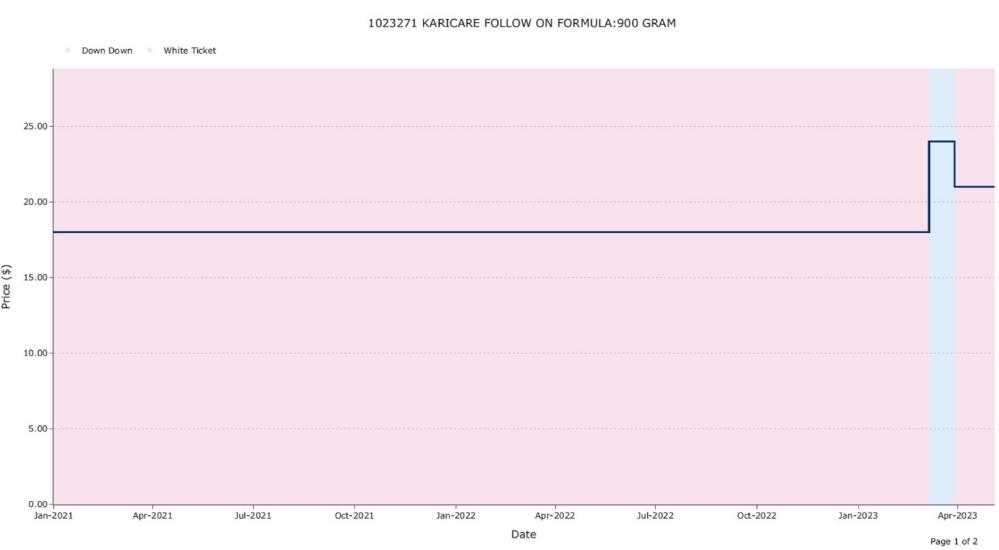
Annexure B: Coca-Cola 2 litre
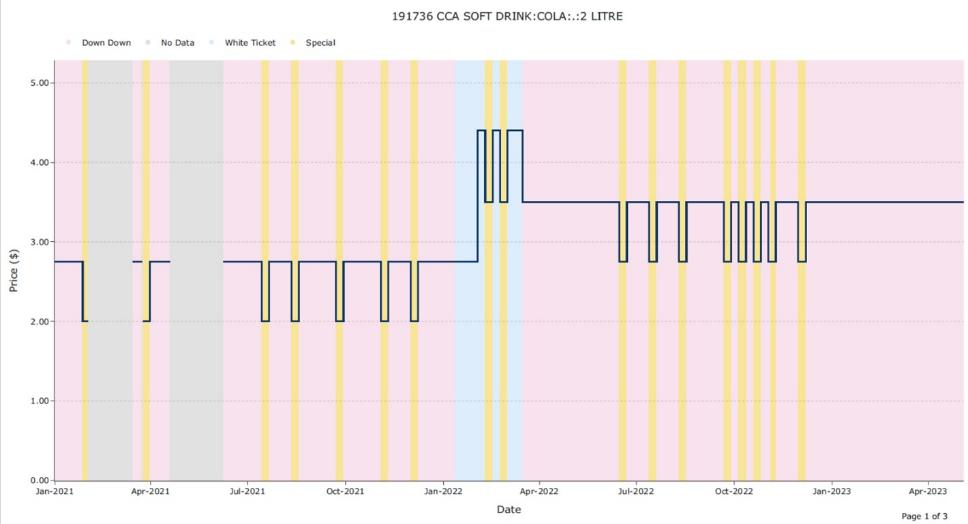
Annexure C: Pedigree Dog Food
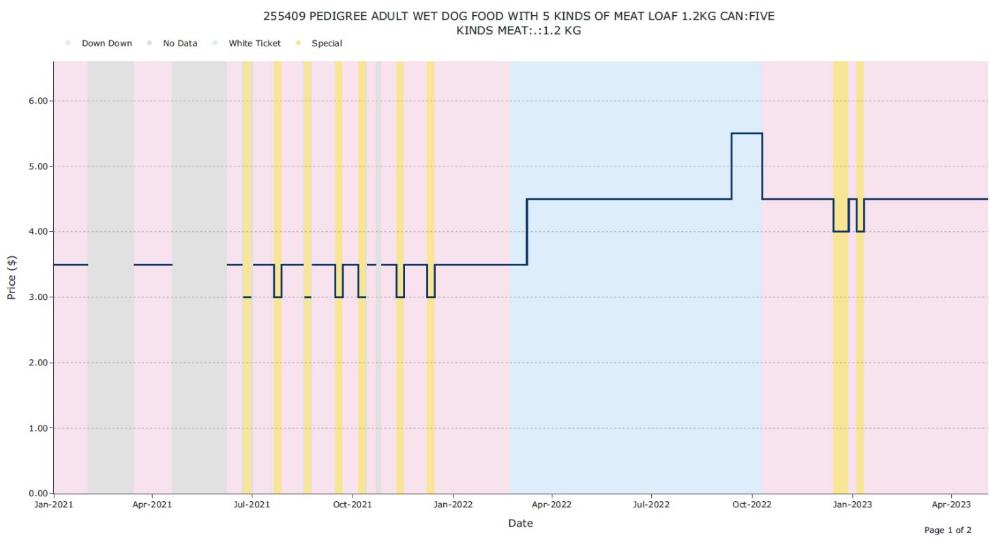
Annexure D: Arnott’s Shapes Multipack
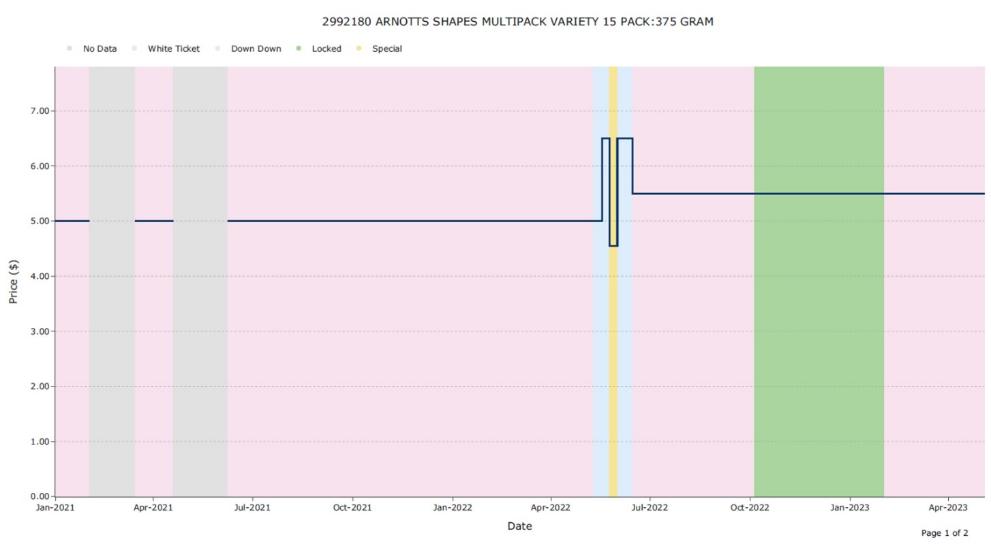
Annexure E: Bragg Yeast
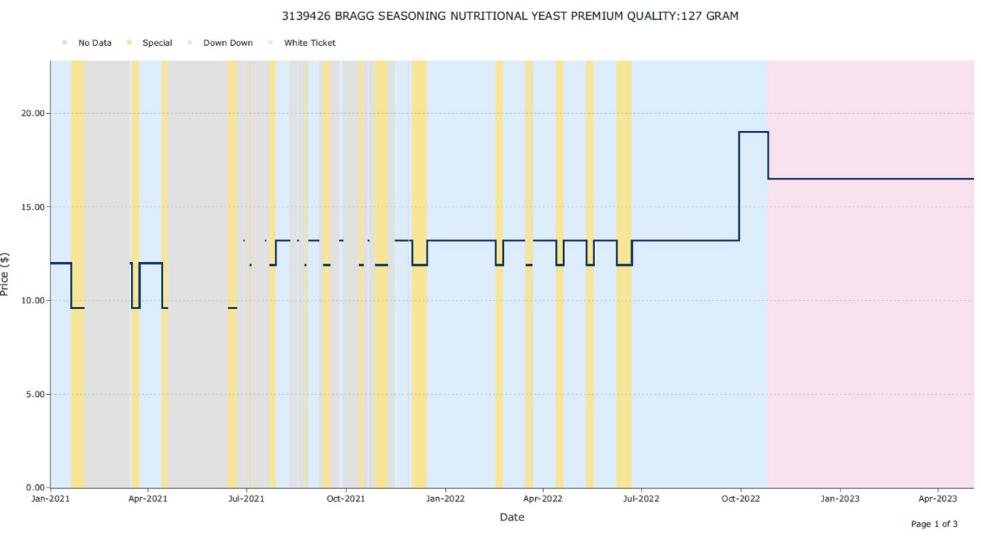
Annexure F: Yopro Yoghurt
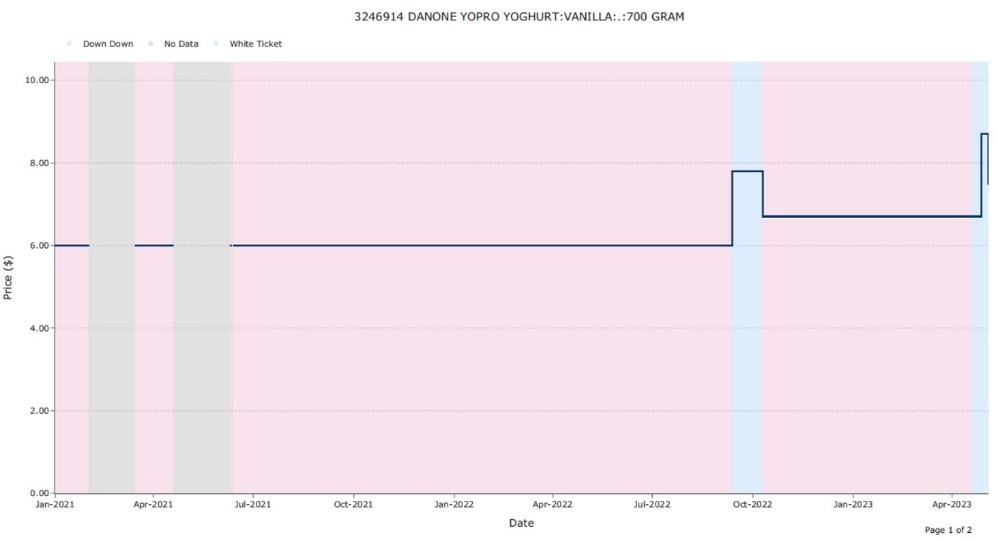
Annexure G: Colgate Toothpaste
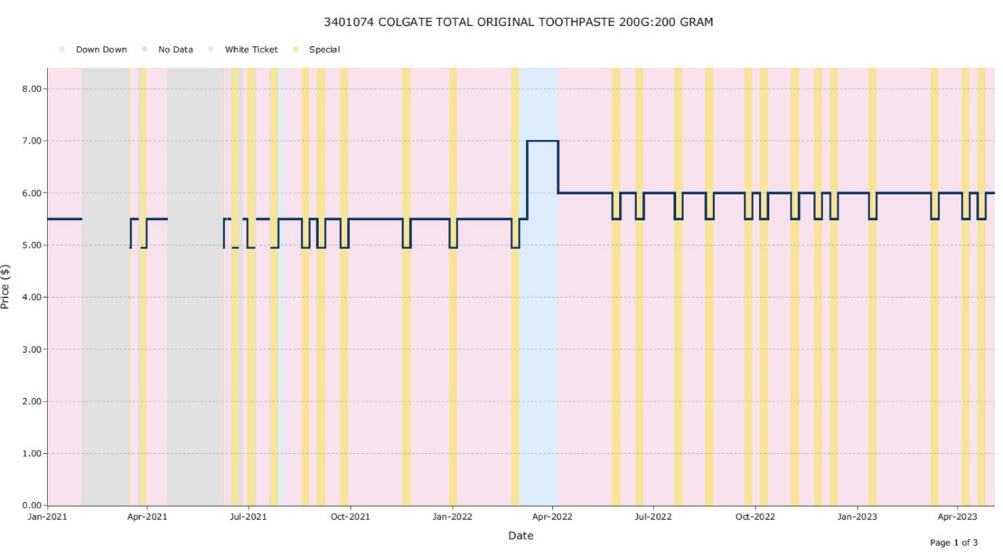
Annexure H: Coles Quince Paste
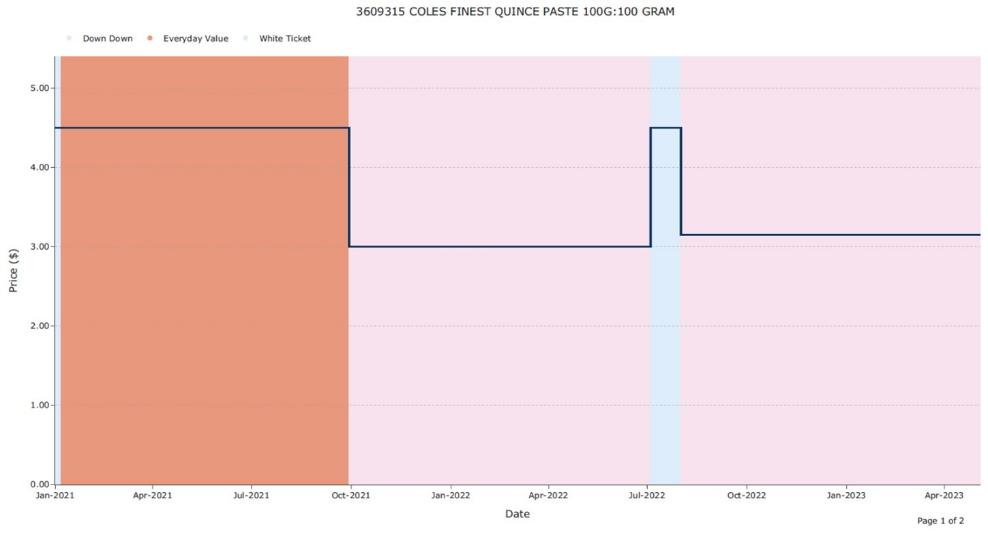
Annexure I: Rexona Deodorant
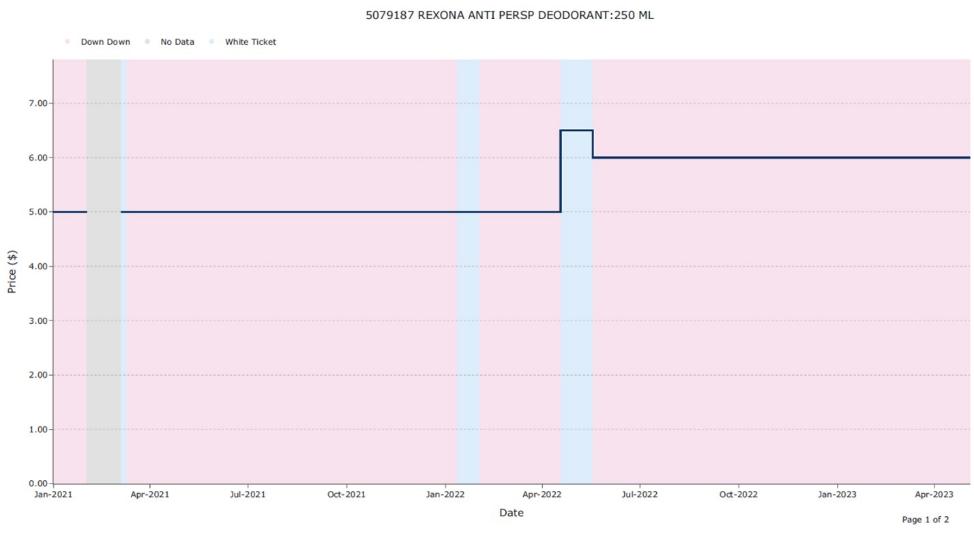
Annexure J: Lurpak Butter
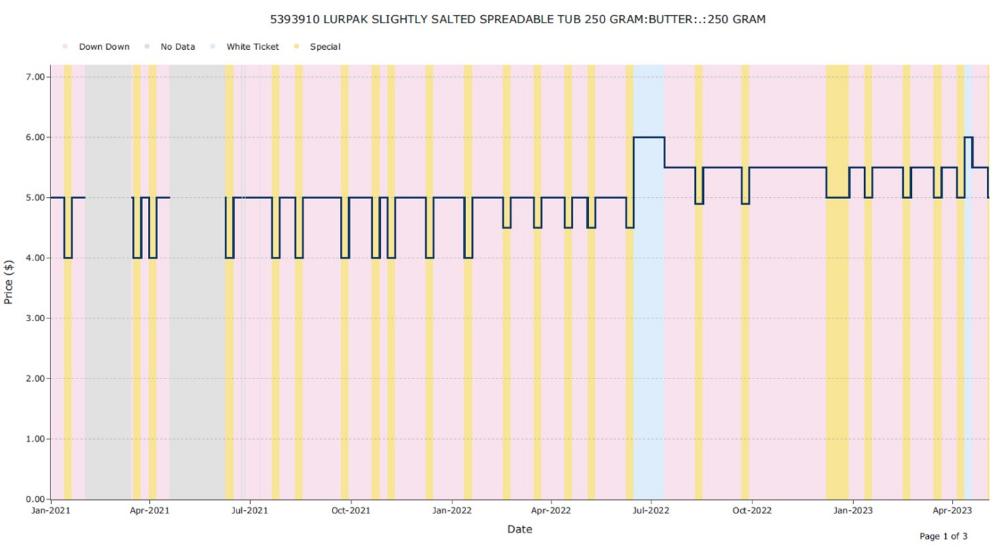
Annexure K: Nature’s Gift Dog Food
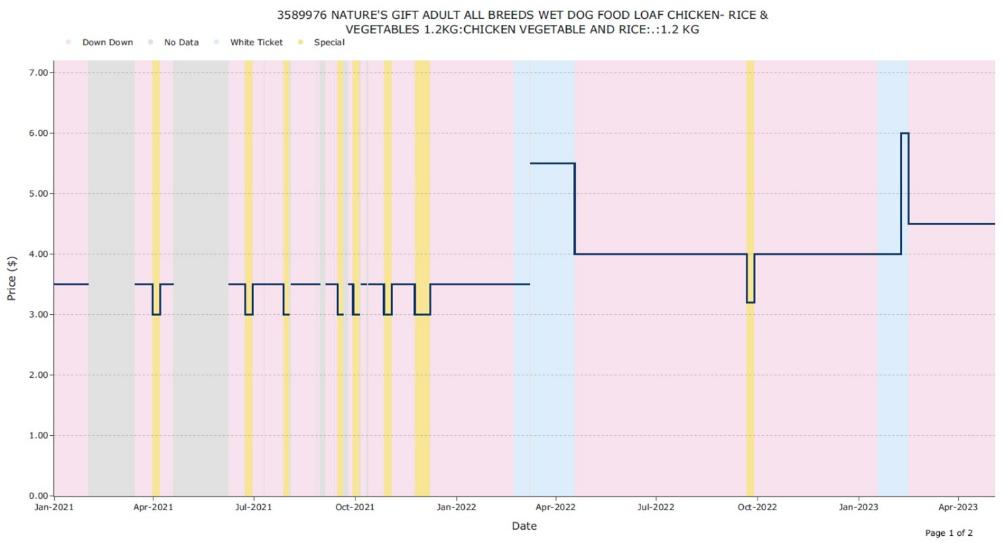
Annexure L: Viva Paper Towels