

FEDERAL COURT OF AUSTRALIA
Yindjibarndi Ngurra Aboriginal Corporation RNTBC v State of Western Australia (No 2) [2026] FCA 585
File number(s): | WAD 37 of 2022 |
Judgment of: | BURLEY J |
Date of judgment: | 12 May 2026 |
Catchwords: | NATIVE TITLE – compensation for the grant of 36 leases and licences (FMG tenements) granted under the Mining Act WA 1978 (WA) – future acts within s 24MD of the Native Title Act 1993 (Cth) – land the subject of the leases and licences partially on land determined as exclusive and non-exclusive native title to the Yindjibarndi people in Warrie (formerly TJ) on behalf of the Yindjibarndi People v State of Western Australia (No 2) [2017] FCA 1299; 366 ALR 467 NATIVE TITLE – whether applicant is entitled to compensation under s 51 of the Native Title Act – “similar compensable interest test” under s 24MD(3)(b)(i) is satisfied for the FMG tenements – s 24MD(3)(b)(ii) satisfied because s 123(2) of the Mining Act does not provide compensation – applicant not found to be an “owner” or “occupier” of land within s 123(2) of the Mining Act – compensation to be determined in accordance with terms of Division 5 of Part 2 of the Native Title Act NATIVE TITLE – whether alleged water management licences granted under s 91 of the Mining Act fall within subdivision H or subdivision M of Division 3 of the Native Title Act – analysis of the purpose of the alleged water management licences – alleged water management licences not found to satisfy statutory requirement under s 24HA(2) of the Native Title Act – subdivision M or Division 3 of the Native Title Act found to apply to all alleged water management licences NATIVE TITLE – the effect of ss 47A and 47B on an application for claims for compensation – whether a declaration applicable to compensation claim – date from which a declaration under s 47B(2) takes effect – ss 47A and 47B apply – relevance of findings in Warrie (formerly TJ) on behalf of the Yindjibarndi People v State of Western Australia [2017] FCA 803; 365 ALR 624 NATIVE TITLE – application of s 51 of the Native Title Act – bifurcated assessment of loss applied by operation of the principles in Northern Territory v Griffiths [2019] HCA 7; 269 CLR 1 (Griffiths HC) – construction of s 51(3) and effect of s 123 of the Mining Act NATIVE TITLE ACT – whether claim for economic loss can be calculated by reference to what miners in the Pilbara commonly and routinely agree to pay native title parties for their assent to mining on their country pursuant to negotiations conducted under subdivision P of the Native Title Act – what amounts to “just terms” compensation within s 51(1) of the Native Title Act – whether mining agreements reached in negotiations entered pursuant to subdivision P of the Native Title Act can be relied upon in evaluation of compensation – application of s 51A of the Native Title Act to economic loss compensation – mining agreements not able to be relied upon – s 51(1) of the Native Title Act to be calculated by reference to the freehold value of the land NATIVE TITLE ACT – whether s 123(1) of the Mining Act is invalid by reason of s 109 of the Commonwealth Constitution because of inconsistency with terms of s 51(1) of the Native Title Act – s 123(1) not invalid NATIVE TITLE ACT – if s 24MD(3)(b)(ii) of the Native Title Act does not apply and s 123 of the Mining Act applies whether Court should determine compensation under the Native Title Act by operation of s 45 when considered in conjunction with the operation of the terms of the Racial Discrimination Act 1975 (Cth) – whether s 10(1) of the Racial Discrimination Act operates to confer right of compensation on native title group to disparity that would otherwise exist under the Mining Act – whether Racial Discrimination Act applies to the Native Title Act – if s 123(1) of the Mining Act were to be source of compensation provision may have discriminatory effect on the native title group as traditional “owners” or “occupiers” of land that is not private land when compared with owners or occupiers of private land NATIVE TITLE ACT – whether s 125A of the Mining Act because of s 109 Constitution inconsistency with s 51 of the Native Title Act – s 125A relevantly valid – second to sixth respondents liable to pay compensation NATIVE TITLE ACT – whether additional head of economic loss compensation being the loss of the opportunity of securing commercial benefits through the right to negotiate under subdivision P of Division 3 of Part 2 of the Native Title Act is compensable – right to negotiate not found to be a native title right or interest nor does it arise from the consequence of a future act – not found to be separate compensable head of economic loss NATIVE TITLE ACT – whether loss of or damage to country, cultural and Dreaming sites and tracks, as well as the costs of psychological and other services can be compensated as economic loss – quantum of economic loss not proved – components found to be aspects of cultural loss compensation NATIVE TITLE ACT – whether simple or compound interest should apply to economic loss compensation – applicant would have invested monies into business activities and cash reserves held on trust – applicant entitled to compound interest NATIVE TITLE ACT – application of s 49 of the Native Title Act to FMG tenements that overlap – future acts that overlap not found to be “substantially the same” – overlapping land of FMG tenements barred from double compensation by operation of s 51(1) of the Native Title Act NATIVE TITLE ACT – calculation of economic loss – lot-by-lot approach taken – date of valuation the date of the grant of the future act – exclusive native title rights and interests to equate to freehold value – non-exclusive native title rights and interests to equate to 50% of the freehold value – allowances by percentage deductions to reflect nature of impairment and the non-extinguishment principle – compound interest to apply to calculation NATIVE TITLE ACT – compensation for cultural loss – application of principles in Griffiths HC – effect of compensable acts on native title group’s connection to country – evidence of law, custom and cultural landscape – site disturbance – damage to songlines – archaeological evidence – hydrogeology evidence – compensation determined by harm to Yindjibarndi country as a whole – assessment of spiritual hurt – loss of spiritual connection to country – loss of rights and duties in relation to the land NATIVE TITLE ACT – whether social division is compensable as cultural loss – social division may have impaired native title rights and interests – process of negotiation not found to form part of the future acts in respect of which compensation may be claimed under s 51 of the Native Title Act – causal connection between conduct of FMG and social division not made out – social disharmony cannot form part of compensable cultural loss |
Legislation: | Commonwealth Constitution ss 51(xxxi), 109 Aboriginal Heritage Act 1972 (WA) ss 4, 5, 17, 18(3), 57(1)(b) Acts Interpretation Act 1901 (Cth) ss 13(2)(b), 15AA Coal Acquisition Act 1981 (NSW) s 6(3) Corporations (Aboriginal and Torres Strait Islander) Act 2006 (Cth) Environment Protection (Clearing of Native Vegetation) Regulations 2004 (WA) Environment Protection Act 1986 (WA) Judiciary Act 1903 (Cth) s 78(b) Land Act 1933 (WA) Land Act 1989 (WA) s 15 Land (Titles and Traditional Usage) Act 1993 (WA) s 7 Mining Act 1978 (WA) ss 8, 9, 20, 29, 31, 33, 35, 37, 38, 40, 41(2), 45, 46, 48, 56A(2), 58(4), 61, 62(1), 63, 65, 66, 78, 82(1)(ca), 84AA, 85, 91, 91B, 92, 94A, 94B, 110, 111, 123, 125A Mining Amendment Act 1985 (WA) Native Title Act 1993 (Cth) ss 3, 4, 7, 22G, 24AA, 24EMA(1)(a)(iii), 24FA(2), 24GB(8), 24GD(5), 24H, 24HA, 24IC, 24ID, 24JAA, 24KA, 24MA, 24MB, 24MC(3)(b)(ii), 24MD, 25, 26, 26D(1)(a), 29(2)(b), 30A, 31(1)(b), 33, 35, 36, 38, 39(1), 43A(1)(a)(ii), 44(2)(b), 44(D)(1)(c), 45, 47, 47A, 47B, 49, 50, 51, 52, 52A, 53, 56(3), 62, 86, 223, 225, 226, 227, 233, 238, 240, 253 Native Title (New South Wales) Amendment Act 1998 (NSW) Northern Territory Aboriginal Sacred Sites Act 1989 (NT) s 34(1) Patents Act 1990 (Cth) ss 57, 65 Pitjantjatjara Land Rights Act 1981 (SA) s 19 Racial Discrimination Act 1975 (Cth) ss 8, 10 Rights in Water and Irrigation Act 1914 (WA) Trade Marks Act 1995 (Cth) s 72(1) Mining Regulations 1981 (WA) regs 41, 42B, 86AD(2)(a) Native Title (Prescribed Bodies Corporate) Regulations 1999 (Cth) reg 8B Native Title Amendment Bill 1997 (Cth) Native Title Bill 1993 (Cth) International Convention on the Elimination of All Forms of Racial Discrimination, opened for signature 21 December 1965, 660 UNTS 195 (entered into force 4 January 1969) arts 1(1), 1(4), 2, 5 |
Cases cited: | Adelaide Clinic Holdings Pty Ltd v Minister for Water Resources (1988) 65 LGRA 410 Alcan (NT) Alumina Pty Ltd v Commissioner of Territory Revenue [2009] HCA 41; 239 CLR 27 Alphapharm Pty Ltd v H Lundbeck A/S [2014] HCA 42; 254 CLR 247 Banjima People v Western Australia (No 2) [2015] FCAFC 171; 328 ALR 637 BHP Billiton Nickel West Pty Ltd v KN (Deceased) and Others [2018] FCAFC 8; 258 FCR 521 Boland v Yates [1999] HCA 64; 167 ALR 575 Browne v Dunn (1893) 6 R 67 Brownley v Western Australia (No 1) [1999] FCA 1139; 95 FCR 152 Cheedy on behalf of the Yindjibarndi People v State of Western Australia [2010] FCA 690 Cheedy on behalf of the Yindjibarndi people v State of Western Australia [2011] FCAFC 100 CIC Insurance Ltd v Bankstown Football Club Ltd [1997] HCA 2; 187 CLR 384 Commonwealth of Australia v Yunupingu [2025] HCA 6; 421 ALR 604 Cox v Western Australia [2008] NNTTA 90; 912 FLR 72 Daniel v State of Western Australia [2003] FCA 666 Daniel v State of Western Australia [2005] FCA 536 Davey on behalf of the Gudanji, Yanyuwa and Yanyuwa-Marra Peoples v Northern Territory of Australia (No 5) (McArthur River Project Compensation Claim) [2026] FCA 153 Drill on behalf of the Purnululu Native Title Claim Group v State of Western Australia [2020] FCA 1510 Durham Holdings Pty Ltd v State of New South Wales [1999] NSWCA 324; 47 NSWLR 340 Federal Commissioner of Taxation v Consolidated Media Holdings Ltd [2012] HCA 55; 250 CLR 503 Fejo v Northern Territory [1998] HCA 58; 195 CLR 96 FMG Pilbara Pty Ltd / Ned Cheedy and Others on behalf of the Yindjibarndi People / Western Australia [2009] NNTTA 38 FMG Pilbara Pty Ltd / Ned Cheedy and Others on behalf of the Yindjibarndi People / Western Australia [2009] NNTTA 91; 259 FLR 293 FMG Pilbara Pty Ltd / Wintawari Guruma Aboriginal Corporation / Ned Cheedy and others on behalf of the Yindjibarndi people / Western Australia [2009] NNTTA 99 FMG Pilbara Pty Ltd / Wintawari Guruma Aboriginal Corporation; Ned Cheedy and others on behalf of the Yindjibarndi People / Western Australia [2009] NNTTA 63 FMG Pilbara Pty Ltd v Yindjibarndi #1 [2014] NNTTA 79 FMG Pilbara Pty Ltd v Yindjibarndi Ngurra Aboriginal Corporation RNTBC and Another [2018] NNTTA 64 Fortescue Metals Group v Warrie on behalf of the Yindjibarndi People [2019] FCAFC 177; 273 FCR 350 Gerhardy v Brown [1985] HCA 11; 159 CLR 70 Gomeroi People v Santos NSW Pty Ltd [2024] FCAFC 26; 303 FCR 153 Griffiths v Northern Territory [2007] FCAFC 178; 165 FCR 391 Griffiths v Northern Territory of Australia (No 2) [2015] FCA 443 Griffiths v Northern Territory of Australia (No 3) [2016] FCA 900; 337 ALR 362 Griffiths v Northern Territory of Australia [2014] FCA 256 Gumana v Northern Territory [2005] FCA 50; 141 FCR 457 Heli-Aust Pty Ltd v Cahill [2011] FCAFC 62; 194 FCR 502 Hungerfords v Walker [1989] HCA 8; 171 CLR 125 Mabo v Queensland (No 1) [1988] HCA 69; 166 CLR 186 Mabo v Queensland (No 2) [1992] HCA 23; 175 CLR 1 Margaret River Resources Pty Ltd v His Honour Warden Calder SM [2008] WASCA 238 Members of the Yorta Yorta Aboriginal community v State of Victoria [2002] HCA 58; 214 CLR 422 Minister for Home Affairs v DLZ18 [2020] HCA 43; 270 CLR 372 Moses v State of Western Australia [2007] FCAFC 78; 160 FCR 148 Nelungaloo Pty Ltd v Commonwealth [1947] HCA 58; 75 CLR 495 Northern Territory of Australia v Griffiths [2017] FCAFC 106; 256 FCR 478 Northern Territory v Griffiths [2019] HCA 7; 269 CLR 1 Nullagine Investments Pty Ltd v Western Australia Club Inc [1993] HCA 45; 177 CLR 635 Pastoral Finance Association Ltd v The Minister [1914] AC 1083 Perilya Broken Hill Ltd v Valuer-General (No 6) [2015] NSWLEC 43; 10 ARLR 222 Perilya Broken Hill Ltd v Valuer-General [2015] NSWCA 400; 10 ARLR 235 Phyball on behalf of the Gumbaynggirr People v Attorney-General of New South Wales [2014] FCA 851 PMT Partners Pty Ltd (in liq) v Australian National Parks and Wildlife Service [1995] HCA 36; 184 CLR 301 Precision Data Holdings Ltd v Wills [1991] HCA 58; 173 CLR 167 Project Blue Sky Inc v Australian Broadcasting Authority [1998] HCA 28; 194 CLR 355 Royal Sydney Golf Club v Federal Commissioner of Taxation [1955] HCA 13; 91 CLR 610 Sandy v Yindjibarndi Aboriginal Corporation RNTBC (No 4) [2018] WASC 124; 126 ASCR 370 SAS Trustee Corporation v Miles [2018] HCA 55; 265 CLR 137 Spencer v The Commonwealth [1907] HCA 82; 5 CLR 418 Starkey v South Australia [2018] FCAFC 36; 261 FCR 183 State of Queensland v Central Queensland Land Council Aboriginal Corporation [2002] FCAFC 371; 125 FCR 89 State of Western Australia v Commonwealth [1995] HCA 47; 183 CLR 373 SZTAL v Minister for Immigration and Border Protection [2017] HCA 34; 262 CLR 362 Taylor v The Owners-Strata Plan No 11564 [2014] HCA 9; (2014) 253 CLR 531 The Lardil Peoples v Queensland [2004] FCA 298 The Minister v Matford Nominees (1973) 2 NSWLR 58 Thomas v Mowbray [2007] HCA 33; 233 CLR 307 Tisala Pty Ltd v Hawthorn Resources Ltd [2022] WASC 109 TJ v Western Australia [2015] FCA 818; 242 FCR 283 Tomlinson v Ramsey Food Processing Pty Ltd [2015] HCA 28; 256 CLR 507 Travelex Ltd v Commissioner of Taxation [2010] HCA 33; 241 CLR 510 Turner v Minister for Public Instruction [1956] HCA 7; 95 CLR 245 Valuer-General v Perilya Broken Hill Ltd [2013] NSWCA 265; 8 ARLR 256 Vyricherla Narayana Gajaptiraju (Raja) v Revenue Divisional Officer, Vizagapatam [1939] AC 302 Wallersteiner v Moir (No 2) [1975] 2 WLR 389 Walton v Gardiner [1993] HCA 77; 177 CLR 378 Ward v State of Western Australia [2022] FCA 689 Warrie (formerly TJ) (on behalf of the Yindjibarndi People) v State of Western Australia (No 2) [2017] FCA 1299; 366 ALR 467 Warrie (formerly TJ) (on behalf of the Yindjibarndi People) v State of Western Australia [2017] FCA 803; 365 ALR 624 Wenn v Attorney-General (Vict) [1948] HCA 13; 77 CLR 84 Western Australia v Brown [2014] HCA 8; 253 CLR 507 Western Australia v The Commonwealth [1995] HCA 47; 183 CLR 373 Western Australia v Ward [2002] HCA 28; 213 CLR 1 Western Australia, Thomas on behalf of the Waljen People, Anaconda Nickel Ltd [1998] NNTTA 8 Wik Peoples v Queensland [1996] HCA 40; 187 CLR 1 Yunupingu on behalf of the Gumatj clan or Estate Group v Commonwealth of Australia [2023] FCAFC 72; 298 FCR 160 |
Hunt M, Kavenagh T and Hunt J, Hunt on Mining Law of Western Australia (The Federation Press, 5th ed, 2015) Jagot, “Compensation for Economic Loss” (2022) 96 Australian Law Journal 832 | |
Division: | General Division |
Registry: | Western Australia |
National Practice Area: | Native Title |
Number of paragraphs: | 1225 |
Date of last submission/s: | 17 April 2026 |
Date of hearing: | 7 March 2023 7–11, 14–18, 21 August 2023 8–9, 11–12, 15–19 April 2024 15 October 2024 17–21 February 2025 24–26 February 2025 |
| |
Counsel for the Applicant: | Mr V Hughston SC with Ms T Jowett SC and Mr J Edwards SC |
Solicitor for the Applicant: | Blackshield Lawyers |
Counsel for the First Respondent: | Mr G Ranson SC with Ms A Warren, Mr S Cobbett, Ms R Eaton and Ms L Italiano |
Solicitor for the First Respondent | State Solicitor’s Office |
Counsel for the Second to Sixth Respondent: | Mr B Dharmananda SC with Mr T Russell SC, Ms M Georgiou, Mr S Tomasich and Ms E Dyer |
Solicitor for the Second to Sixth Respondent: | A&O Shearman |
Counsel for the Seventh Respondent: | Mr S Wright SC with Ms T Herrmann |
Solicitor for the Seventh Respondent: | Yamatji Marlpa Aboriginal Corporation |
ORDERS
WAD 37 of 2022 | ||
| ||
BETWEEN: | YINDJIBARNDI NGURRA ABORIGINAL CORPORATION RNTBC Applicant | |
AND: | STATE OF WESTERN AUSTRALIA First Respondent FMG PILBARA PTY LTD Second Respondent PILBARA ENERGY (GENERATION) PTY LTD (and others named in the Schedule) Third Respondent | |
order made by: | BURLEY J |
DATE OF ORDER: | 12 mAY 2026 |
THE COURT ORDERS THAT:
1. The parties confer and supply to the chambers of Justice Burley by 4pm on 9 June 2026 draft short minutes of order giving effect to these reasons and a proposed timetable for further steps to be taken in these proceedings.
2. Subject to further order, disclosure of the reasons other than to the parties, their legal representatives and members and staff of the Court is suppressed on an interim basis pursuant to s 37AI of the Federal Court of Australia Act 1976 (Cth).
3. The parties confer and supply to the chambers of Justice Burley by 4pm on 26 May 2026:
(a) a list identifying any paragraphs or parts therefor of these reasons for judgment which are said to contain confidential information and that ought not be published in an unredacted form, including the reasons why such a confidentiality claim is made; and
(b) a copy of these reasons for judgment with the paragraphs or parts therefore which are said to contain confidential information highlighted (or otherwise marked for identification).
4. Insofar as the parties are unable to agree to the terms of the draft short minutes of order referred to in order 1 or the list of confidential referred to in order 3, the areas of disagreement should be set out in mark up.
5. The proceedings be listed for case management at 2 pm (AEST) on 22 June 2026.
Note: Entry of orders is dealt with in Rule 39.32 of the Federal Court Rules 2011.
REASONS FOR JUDGMENT
BURLEY J:
1. INTRODUCTION
1.1 Synopsis of the claim
1.1.1 Overview
1 This is a claim for compensation brought by Yindjibarndi Ngurra Aboriginal Corporation, RNTBC (YNAC) under the terms of the Native Title Act 1993 (Cth).
2 On 9 July 2003, the Yindjibarndi people filed a native title claim in respect of land located in the Pilbara, Western Australia. That claim succeeded, and on 13 November 2017 the Court made a Determination conferring on the Yindjibarndi people the exclusive right to possession, occupation, use and enjoyment of parts of the land and non-exclusive native title rights and interests in respect of the balance of the Determination Area, which I describe in more detail later in these reasons.
3 Whilst the application for determination was on foot, the State of Western Australia (the first respondent in the current proceedings) granted a variety of mining tenements, wholly or partially located within the Determination Area, to various companies that I refer to collectively below as FMG (the second to sixth respondents in the current proceedings). Those tenements led to the development of the Solomon Hub Project, a collection of large-scale iron ore mines, that commenced operations in 2012.
4 YNAC now seeks compensation from either the State or FMG for any loss, diminution, impairment or other effect of the grant of the mining tenements on the native title rights and interests of the Yindjibarndi people. The claim is substantial. YNAC contends that it is entitled to compensation for economic loss calculated by reference to a percentage of the profits made by the operation of the Solomon Hub Project. It contends that mining companies in the Pilbara typically agree to pay something like a 0.5% royalty to traditional owners for use of their land and that FMG refused to do so. It calculates its economic loss on the basis of a percentage of royalties until the end of the operational life of the project, which is expected to be in 2045. So calculated, the claim for economic loss advanced exceeds $800 million.
5 YNAC separately seeks compensation for cultural loss that it has suffered from the grant of the mining tenements. For this it seeks $1 billion.
6 The State and FMG dispute the claim. They contend that the amount sought for economic loss cannot exceed the value of the freehold estate in the land. When valued as land largely suited for pastoral use, and taking into account various discount factors, the State submits that the total value of the economic loss should be assessed as $128,114.28. FMG takes a similar approach and argues that additional discount factors mean that the claim cannot exceed $95,197.
7 The State and FMG contend that YNAC’s claim for cultural loss is manifestly excessive. The State submits that it should be in the range of between $5 million to $10 million. FMG arrives at a figure of no more than $8 million.
8 The present claim is the first to deal with the question of compensation for “future acts” as that term is defined in the Native Title Act. As a result, it has thrown up a number of novel legal and factual issues. However, there is no dispute between the parties that central to the determination of the case is the reasoning of the High Court in Northern Territory v Griffiths [2019] HCA 7; 269 CLR 1 (Griffiths HC). That decision makes plain that in considering a claim for compensation it is necessary to recognise a division between economic loss and cultural loss: at [3] (Kiefel CJ, Bell, Keane, Nettle and Gordon JJ, who I refer to below as the plurality, Gageler J agreeing at [240], Edelman J agreeing at [253]).
9 Economic loss is to be calculated on the basis of the objective economic value of the native title rights and interests and, in that case, the High Court applied the test set out in Spencer v The Commonwealth [1907] HCA 82; 5 CLR 418 at p 432 adapted as necessary to accommodate the unique character of native title rights and interests and the statutory context: Griffiths HC at [66] (plurality).
10 Cultural loss is to be understood as compensation for loss or diminution of traditional attachment to the land or connection to country and for loss of rights to gain spiritual sustenance from the land. This is to be determined by reference to an amount which society would rightly regard as an appropriate award for the loss: Griffiths HC at [3] (plurality).
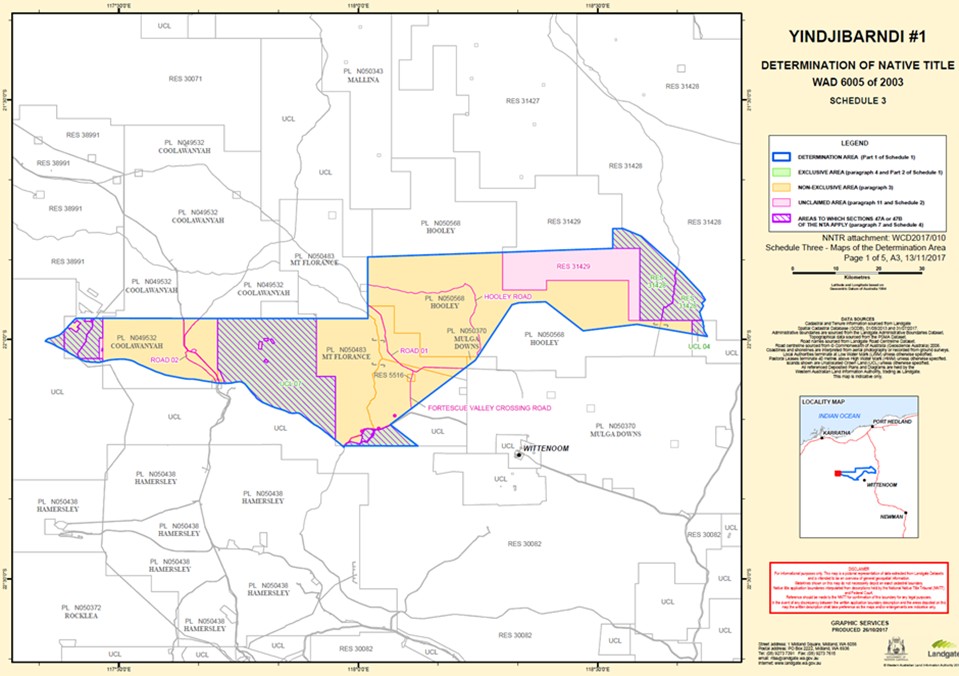
11 I consider both in some detail in this judgment, however, it will immediately be understood that whereas the quantum for economic loss is determined by objective metrics, there is an evaluative quality to the determination of cultural loss that involves engagement with and understanding of the spiritual and cultural connection of the Yindjibarndi people with their land and any harm caused to it as a result of the future acts concerned.
12 The scale of the operation of the Solomon Hub Project is relevant to both economic and cultural loss. Over 135 km2 of land has been fenced off and secured from entry, including by the Yindjibarndi people, because it is too dangerous to enter. Within that area are four large open pit mines called Kings, Trinity, Firetail North and Firetail South. There is significant transport infrastructure for vehicles, a railway, a large tailings dam, waste dumps and a stockpile area. Water courses have been stopped and power infrastructure installed. According to one witness, during a single shift the operation of a single excavator with a 75-tonne bucket has the capacity to load over 30,000 tonnes of iron ore. The evidence is that the ore is crushed and goes on a conveyor belt to the Ore Finery Plant. Groundwater from the land is taken by FMG for mining operations. Some water is added to the mill to wash the ore, which washes away clay and other things. The ore then goes in a conveyor that is about 2 km long to the Dry Plant where it is milled again. It then goes on another conveyor of about 2 km to the train load-out where it is stockpiled before being loaded onto trains. Mining operations continue 24 hours a day, 7 days a week, generating tremendous revenue for both FMG and the State (by way of royalties collected in accordance with the State’s mining legislation).
13 Middleton Cheedy, a Yindjibarndi witness, describes the physical and emotional impact of the mine upon him, and its pervasiveness in everyday life, as follows:
When I wait at a railway crossing I see the trains carrying ore to the ports. They are up to 2.4 km long and carry up to 30,000 tonnes at a time. To me that is 30,000 tonnes of ngurra blasted up and taken off and moved to another country, like China, to be transformed into steel. It is a very distressing experience for me because it happens all the time when I travel about the Pilbara…
I have been taught that my ngurra is precious and should not be defiled by a Mine. The Mine has taken everything, ngurra is gone, the spirits are gone, the water is gone, the caves are gone, the munda is gone, the wundu is gone, and our ancestor’s remains have been put through the crushers on the Mine site. I have been traumatised throughout my life by racism, deaths in my family, alcohol coming into our community, watching the old people try to save the Harding River, but the Mine is like a death for me. It has killed all the things that are important to Yindjibarndi People.
14 Judith Coppin, another Yindjibarndi witness, similarly describes the emotional impact of the mine on her:
Once I was driving with my husband Bruce James…on the Rio Tinto road near Hamersley Station, near Wirlu-Murra jinbi (spring). This is near where the T-junction meets the turn off to the Auski roadhouse (Nanuturra Wittenoom Road). I could see the lights from the Solomon Hub Project mine (the Mine). I just went so quiet. It looked like a big city. Bruce who was driving stopped at the gate there. I asked him, “what are them lights?”. Bruce said that was my country getting blown up. I said, “Can’t be”. Then we heard a big blast. I started crying and he cried with me. I didn’t talk to Bruce again on that trip until we got to our camp at the windmill north of Tom Price. All the way from that gate at Wirlu-Murra jinbi to where we were stopping at the windmill near Tom Price I was speechless. This was for about 1.5-2 hours. When we got out of the car, I was still quiet. I had seen my ngurra just blown up. I was devastated. My wirrard (soul and spirit) was destroyed.
1.1.2 Synopsis of the main legal issues and their outcome
15 In these reasons it has been necessary to decide a large number of issues in reaching my conclusion. By way of imperfect summary, I identify the main points and my conclusion in relation to each below.
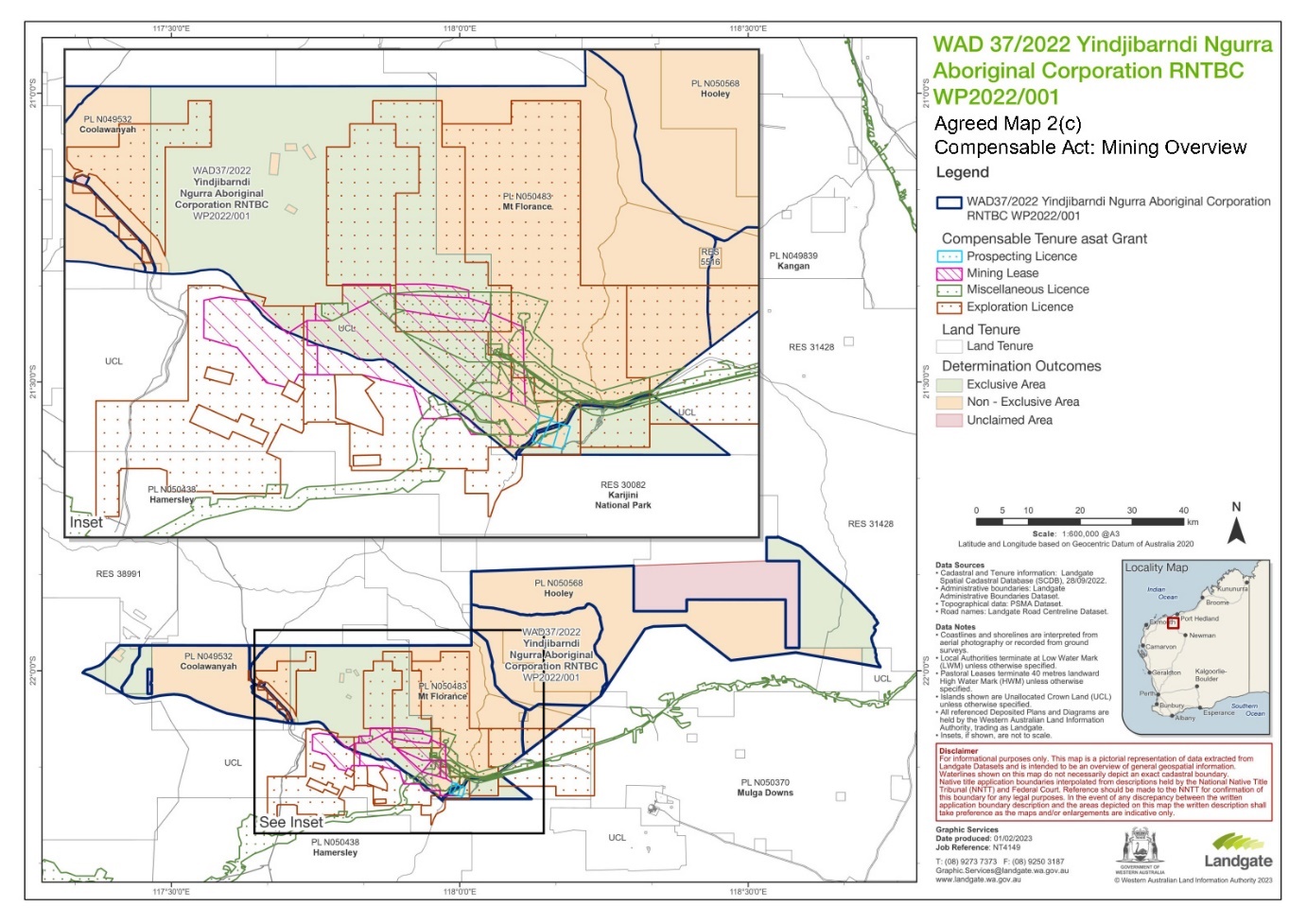
16 A significant threshold issue arises as to whether the proceedings ought to have been brought under the terms of the Native Title Act or under the terms of the Mining Act 1978 (WA). The State and FMG contend for the latter, based on their view as to the application of s 24MD(3)(b)(ii) of the Native Title Act and s 123 of the Mining Act. I disagree with that view and conclude in section 6 below that it is the terms of the Native Title Act that should apply.
17 FMG contends that some of the mining tenements should be characterised as “water licences” which has consequences as to whether it or the State is liable to pay any compensation for their grant. YNAC and the State disagree and contend that all of the mining tenements in issue are future acts within s 24MD of the Native Title Act. In section 7 below I conclude that the position advanced by YNAC and the State is correct.
18 There is a significant dispute about whether the exclusive rights declared in the Determination are relevant to the claim for compensation. FMG contends that they are not. YNAC and the State contends that they are. There is a further dispute about the time from which (if ever) those exclusive rights apply. These matters concern the construction of ss 47A and 47B of the Native Title Act. In section 8 below I conclude that the exclusive rights are relevant to the compensation claim and that they apply from the date that the claimant application was filed, in July 2003.
19 After addressing these important pieces of legal shrapnel, I turn to the substantive claim for economic loss, the central issue of which concerns whether, as a matter of law, the claim for loss that YNAC has advanced on the basis of a percentage royalty of the value of profits made in the Solomon Hub Project is appropriate. I refer to this as the YNAC exchange value case.
20 I conclude in section 12 that having regard to the reasoning in Griffiths HC and the structure and terms of the Native Title Act this approach to economic loss is not available and that the methodology proposed by the State and FMG is correct. I separately conclude in section 19, that the exchange value case has not been proved on its facts by the expert evidence advanced by YNAC.
21 The reasoning in section 12 finds that s 51(3) is the operative provision for the assessment of economic loss. This requires consideration of the principles and criteria for determining compensation under the terms of the Mining Act, specifically s 123(2).
22 As a part of my reasoning in relation to the exchange value case I conclude that valuing economic loss by reference to the freehold value of the land does not offend the requirement in s 51(1) of the Native Title Act that compensation be awarded “on just terms” and that this reflects the conclusions of the High Court in Griffiths HC. This conclusion has been relevant to addressing a number of further subsidiary arguments that were raised between the parties.
23 One subsidiary argument made by YNAC is that to the extent that s 51(3) does not provide for compensation on just terms, because the operation of s 123 of the Mining Act prohibits recovery on the basis of royalties, then s 53(1) of the Native Title Act must apply to provide “top up” compensation that is on just terms. I reject that argument in section 13 of these reasons.
24 Another subsidiary argument is that s 123(1) of the Mining Act is invalid because it brings that Act into conflict with the terms of the Native Title Act by rendering compensation on the basis of the exchange value case unavailable. As a consequence, YNAC contends that s 109 of the Constitution will operate to invalidate s 123(2). I reject that argument in section 14 of these reasons.
25 YNAC advances alternative subsidiary arguments on the basis of the terms of the Racial Discrimination Act 1975 (Cth). One is that, had I concluded that compensation could not be determined under the terms of the Native Title Act but rather is only available under the Mining Act then the operation of s 123 of the Mining Act is discriminatory within the terms of the Racial Discrimination Act and accordingly s 45 of the Native Title Act operates to provide for compensation via the terms of the Native Title Act. Another is that if (as I have found) s 51(3) of the Native Title Act applies, then insofar as its application is discriminatory pursuant to the terms of s 123 of the Mining Act, compensation should be awarded pursuant to s 45 of the Native Title Act. The State contends that the terms of the Racial Discrimination Act are not applicable to the Native Title Act and the State and FMG dispute that the application of s 51(3) of the Native Title Act is discriminatory. In section 15 below I find that the Racial Discrimination Act is applicable. I find that it may well be that a compensation claim advanced by the Yindjibarndi people pursuant to the terms of s 123(2) of the Mining Act is discriminatory, but having regard to my conclusion on the primary claim (namely, that s 24MD(3) of the Native Title Act applies), it is not necessary for me to take this further. I reject the alternative argument advanced by YNAC.
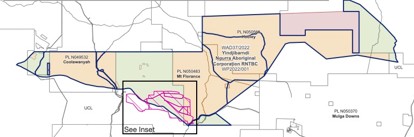
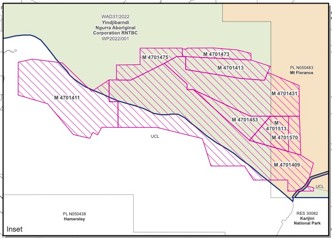
26 By the terms of s 125A of the Mining Act, the State has legislated to provide that it is the holder of a mining tenement that is liable to pay any compensation awarded under the Native Title Act with the consequence that the respondent FMG companies are liable to pay. FMG challenges the constitutional validity of that provision on the basis of s 109 of the Constitution. In section 16 I conclude that there is no s 109 inconsistency and that accordingly FMG is liable to pay any compensation.
27 YNAC raises several other arguments in support of its claim for compensation for economic loss. I address these in section 17 below. One is a claim for compound interest on any damages awarded. In section 17.5 below I conclude that, on the facts of the present case, it is available.
28 In relation to the claim for cultural loss, the assessment involves a complex balance of different factors to determine the essentially spiritual relationship which the Yindjibarndi people have with their country, and then translate the spiritual hurt caused by the compensable acts into compensation: Griffiths HC at [216] (plurality).
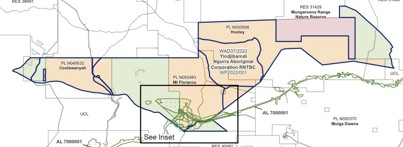
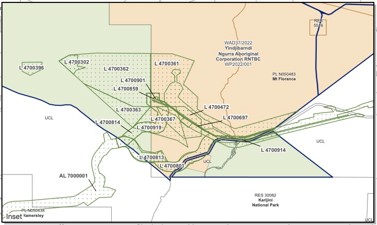
29 A portion of the proceedings were heard on country, where evidence was received from a number of Yindjibarndi witnesses as well as experts in anthropology and archaeology. The Court also was able to view the operations of the Solomon Hub Project.
30 Moving evidence was received from lay witnesses as to the effect of the mining operations on their land and their attachment to it. I describe that in sections 23 and 24 below. According to Yindjibarndi belief, the Yindjibarndi people are the custodians of their ngurra, having been bestowed that responsibility by the Marrga, when the land was soft. With that responsibility comes an attachment to and dominion over land and responsibly to care for it. The connection is deep and visceral such that expressions like that of Middleton Cheedy and Judith Coppin (above) to the effect that their spirit, or wirrard, is destroyed when they see the harm done to their country as a result of the mining are plentiful and uncontradicted. To the Yindjibarndi people the ngurra is sentient and their connection to it permeates all aspects of their lives.
31 In considering the question of cultural loss, it is necessary to take into account the compensable acts, being the grant of the mining tenements and the effect that they have on the land by reference to the ground disturbance of the Solomon Hub Project. In section 24, I review aspects of the effect of that ground disturbance, including consideration of particular heritage sites that the Court visited where Yindjibarndi lay witnesses gave evidence and other areas the subject of evidence. Rock shelters, burial sites, resource areas, caves where ancestors’ spirits dwell and other sites of importance to the Yindjibarndi people are addressed. The evidence supports the conclusion that significant damage has been done to Yindjibarndi songlines and other areas of cultural heritage. FMG documents indicate that 240 sites that it designates as “heritage places” have had artefacts removed from them and stored remotely. The Yindjibarndi people have no access to those artefacts. The data indicates that 124 of those sites have been completely destroyed by the operation of the mine and many more substantially affected, being variously dug up, located under roads or other infrastructure or drowned by the tailings dam. All was duly approved under Government processes. However, none was done with the approval of YNAC.
32 An area of contention between the parties is the extent to which the operation of the Solomon Hub Project in withdrawing artesian water from the ground, called “dewatering”, has affected the creeks and surface water outside the area of that project in other parts of the compensation claim area. In section 25, I conclude that there is a causal link between the mining operations and the availability of groundwater and address the consequences of that in the context of the claim for cultural loss.
33 A further issue of contention between the parties is the relevance of an internal dispute within the Yindjibarndi community. This is a framed as a conflict between those supporting YNAC and a splinter group referred to as the Wirlu-Murra group concerning whether an agreement should be reached with FMG about the grant of the mining tenements. YNAC contends that FMG is responsible for this social division and that it is an effect that is compensable. The State and FMG contend that it is not. In section 26 below I conclude that there is no legal basis upon which the social division as alleged in these proceedings can be found to fall within cultural loss as a result of the grant of the mining tenements.
34 Ultimately, it was necessary to evaluate the evidence going to the land the subject of all of the mining tenements cumulatively consisting of 563 km2 of the Determination Area, of which 135.48 km2 forms the Solomon Hub Project, a term I define in more detail below. In sections 28 and 29 of the judgment I explain how, in balancing the various considerations required by authority, I arrive at an amount of compensation for cultural loss.
35 I refer to, but do not find determinative, a comparison between the two available cases where compensation has been awarded. In Griffiths HC, the subject land area was 1.27 km2 and non-exclusive rights applied. The High Court awarded $1.3 million in compensation for the extinguishment of those rights. The present case involves exclusive rights. If Griffiths HC is applied literally to the present, much larger, compensation claim area, the outcome would be about $576 million, but I reject that comparison as excessive.
1.1.3 Synopsis of the award and orders that I will make
36 In the result, I have concluded that the claim for economic loss should be valued on the basis of the freehold value of the land within the Compensation Claim Area, with various allowances addressing the level of diminution in the native title rights and interests caused by the mining tenements and the duration of those tenements (having regard to the non-extinguishment principle). Whilst the amount so assessed will be relatively low, calculating the correct amount involves some complexity having regard to the fact that compensation is in respect of each future act, of which there are 36, many of which overlap with each other. I anticipate that the total amount will be in the vicinity of $100,000, although the orders that I will make require the parties to confer and supply short minutes of order giving effect to my reasons and including the amount calculated on the basis of my reasoning.
37 I have concluded that the claim for cultural loss should be assessed in the amount of $150 million.
38 These reasons contain references to financial details that are the subject of suppression orders and to cultural matters that, if published, may give rise to cultural concerns on the part of the Yindjibarndi people. Accordingly, I will order that they be provided in the first instance to the legal representatives and other persons party to relevant confidentiality regimes so that they can prepare a suitably redacted version. I will direct the parties to supply an agreed redacted version to my chambers within 14 days so that it can be published more generally.
39 I would like to record that the parties all provided extremely thorough and helpful written and oral submissions as well as several documents – including an agreed statement of issues – which have been of considerable assistance in addressing the many issues that have arisen in this case. I wish to express my sincere appreciation to counsel, solicitors and parties for their assistance in this regard.
1.2 The proceedings and the parties
40 As I have noted, YNAC seeks compensation for loss arising from the grant by the first respondent, the State, of rights permitting the exploration for and mining of minerals by the second to sixth respondents (collectively, FMG) on Yindjibarndi land.
41 The claim is advanced on the basis of the Determination made by the Court in Warrie (formerly TJ) on behalf of the Yindjibarndi People v State of Western Australia (No 2) [2017] FCA 1299; 366 ALR 467 (Warrie (No 2)) (Rares J), which recognised that native title is held by the Yindjibarndi people and delineates the scope of the native title rights and interests that they hold. A copy of the Determination is Annexure A to these reasons.
42 YNAC has since 11 October 2017 been registered as a native title body corporate pursuant to s 253 of the Native Title Act. It holds those rights and interests on trust for the Yindjibarndi people under s 56(3) of the Native Title Act. YNAC has made the present application for a determination of compensation in accordance with the requirements of regulation 8B of the Native Title (Prescribed Bodies Corporate) Regulations 1999 (Cth). The Yindjibarndi #1 applicant is the applicant in the proceedings that led to the Determination.
43 FMG for the purposes of these proceedings comprises the second to sixth respondents which are FMG Pilbara Pty Ltd, Pilbara Energy (Generation) Pty Ltd, Pilbara Energy Company Pty Ltd (PEC), The Pilbara Infrastructure Pty Ltd and Pilbara Gas Pipeline Pty Ltd.
44 The seventh respondent is Yamatji Marlpa Aboriginal Corporation (YMAC), which is the native title representative body for the Pilbara region having statutory functions and powers under Division 3 of Part 11 of the Native Title Act, including to facilitate and assist compensation claims for its constituents.
45 The proceedings were commenced by the filing of a form 4 compensation application on 16 February 2022. YNAC subsequently filed points of claim, to which each of the State and FMG filed responses and to which YNAC replied. YMAC also filed a position on the points of claim and response which in general terms reflects the fact that its interests are aligned with those of YNAC.
46 In the course of the pleadings, YNAC and FMG each filed notices of constitutional matters under s 78B of the Judiciary Act 1903 (Cth) concerning the operation of the Native Title Act and the Mining Act. None of the Attorneys-General of the Commonwealth or of the States has signalled that they wished to intervene or be joined as parties.
47 The proceedings were heard over two years, commencing on 7 March 2023 when preservation evidence was received. Hearings were conducted in four tranches. First, from 7 August 2023 until 21 August 2023 during which the Court heard evidence from Yindjibarndi witnesses called by YNAC at Roebourne, Western Australia, where many of the Yindjibarndi people live, and also on country at Bangkangarra where, further lay evidence was given and the Court viewed the Solomon Hub Project. Secondly, in Perth from 8 April 2024 until 19 April 2024 when expert evidence was received from an anthropologist, psychologist, geologist and hydrogeologists, as well as valuation experts. Thirdly, on 15 October 2024 expert evidence was received from archaeologists. Fourthly, from 17 February 2025 until 26 February 2025 closing submissions were made. Further written submissions were received:
(a) following the decision of the High Court in Commonwealth of Australia v Yunupingu [2025] HCA 6; 421 ALR 604; and
(b) following the decision of Banks-Smith J in Davey on behalf of the Gudanji, Yanyuwa and Yanyuwa-Marra Peoples v Northern Territory of Australia (No 5) (McArthur River Project Compensation Claim) [2026] FCA 153 (McArthur River).
1.3 Methodology
48 Section 51(1) of the Native Title Act, as interpreted in Griffiths HC, conveniently provides a roadmap for determining the complex issues in the present case:
(1) identify the native title rights and interests;
(2) identify the “act” in respect of which compensation is claimed;
(3) identify the claimed loss, diminution, impairment or other effect of the act on the native title rights and interests in respect of which the claim for economic loss is claimed;
(4) assess the economic loss flowing from the act;
(5) identify the claimed loss, diminution, impairment or other effect of the act on the native title rights and interests in respect of which the claim for cultural loss is claimed;
(6) assess the cultural loss flowing from the act; and
(7) provide a total sum reflecting the components of economic and cultural loss, including interest.
49 In the reasons that follow, I endeavour to adopt that broad methodology.
1.4 Spellings, words and descriptions used
50 In determining how to resolve spelling, words and descriptions in these proceedings, I have adopted the approach of Mortimer J (as the Chief Justice then was) in Drill on behalf of the Purnululu Native Title Claim Group v State of Western Australia [2020] FCA 1510 at [15]–[23].
51 In these reasons, I refer to all witnesses by their full name. Some witnesses have names that I have shortened for ease of reference and where others have preferred names, I have referred to them by their preferred name – for example, Fabian (“Charlie”) Cheedy, I will often refer to as “Charlie Cheedy”.
52 The evidence contained a large variety of spellings for names of people, places, concepts, groups and words in language. Where quoting from a witness or source, I have used the spelling provided. Much of the evidence going towards Yindjibarndi law and custom is summarised in the statement of agreed facts (filed 12 February 2024) and I have relied upon spellings here if they are agreed between the parties. Otherwise, I have attempted to resolve spelling inconsistencies by relying upon the spelling used by YNAC’s anthropological expert, Dr Kingsley Palmer. In his first report filed 14 December 2022, he notes that there has considerable variation over time in the orthography used when writing the Yindjibarndi language. He notes that there are some words as spelt in his reports that will not reflect the Yindjibarndi pronunciation. An example is the word wirrard, which is likely to sound like wirr-rut despite its spelling. He notes that Yindjibarndi words generally have a stress on the first syllable. Dr Palmer italicised words (with the exception of proper nouns) in Yindjibarndi language and did not use capital letters for these words unless they commenced a sentence. For proper nouns, Dr Palmer did not italicise these and used capital letters. I have adopted this approach when using words in Yindjibarndi language.
Unfortunately, there have been two lay witnesses who have passed away after making statements adduced in these proceedings. When referring to them and other deceased Yindjibarndi people, I have referred to them as “the late Mr or Mrs [Surname]”, per the request of the applicant.
1.5 The Determination
53 The native title rights and interests of the Yindjibarndi people are identified in the Determination, which substantially provides as follows:
Existence of native title (s 225 Native Title Act)
1. Native title exists in the Determination Area in the manner set out in paragraphs 3 and 4 of this Determination.
Native title holders (s 225(a) Native Title Act)
2. The native title in the Determination Area is held by the Yindjibarndi People. The Yindjibarndi People are the people referred to in Schedule 6.
The nature and extent of native title rights and interests and exclusiveness of native title (s 225(b) and (e) Native Title Act)
3. Subject to paragraphs 4, 5, 6 and 9, the nature and extent of the native title rights and interests in relation to the Determination Area are that they confer the following rights on the Yindjibarndi People, including the right to conduct activities necessary to give effect to them:
(a) A right to access (including to enter, to travel over and remain);
(b) A right to engage in ritual and ceremony (including to carry out and participate in initiation practices);
(c) A right to camp and to build shelters (including boughsheds, mias and humpies) and to live temporarily thereon as part of camping or for the purpose of building a shelter;
(d) A right to fish from the waters;
(e) A right to collect and forage for bush medicine;
(f) A right to hunt and forage for and take fauna;
(g) A right to forage for and take flora;
(h) A right to take and use resources;
(i) A right to take water for drinking and domestic use;
(j) A right to cook on the land including light a fire for this purpose;
(k) A right to protect and care for sites and objects of significance in the Determination Area (including a right to impart traditional knowledge concerning the area, while on the area, and otherwise, to succeeding generations and others).
4. Subject to paragraph 5, in the Exclusive Area, the native title rights and interests confer the right to possession, occupation, use and enjoyment of that area to the exclusion of all others.
Qualifications on the native title rights and interests
5. The native title rights and interests set out in paragraphs 3 and 4:
(a) are subject to and exercisable in accordance with:
(i) the laws of the State and the Commonwealth, including the common law; and
(ii) the traditional laws and customs of the Yindjibarndi People;
(b) do not confer exclusive rights in relation to water in any watercourse, wetland or underground water source as is defined in the Rights in Water and Irrigation Act 1914 (WA) as at the date of this Determination; and
(c) do not confer any rights in relation to:
(i) minerals as defined in the Mining Act 1904 (WA) (repealed) and in the Mining Act 1978 (WA);
(ii) petroleum as defined in the Petroleum Act 1936 (WA) (repealed) and in the Petroleum and Geothermal Energy Resources Act 1967 (WA);
(iii) geothermal energy resources and geothermal energy as defined in the Petroleum and Geothermal Energy Resources Act 1967 (WA); or
(iv) water captured by the holders of the Other Interests pursuant to those Other Interests.
6. Subject to paragraph 4 the native title rights and interests set out in paragraph 3:
(a) do not confer:
(i) possession, occupation, use and enjoyment on the Yindjibarndi People to the exclusion of all others; or
(ii) a right to control the access to, or use of, the land and waters of the Determination Area or its resources.
Areas to which ss 47A or 47B of the Native Title Act apply
7. Sections 47A and 47B of the Native Title Act apply to disregard any prior extinguishment in relation to the land and waters described in Schedule 4.
The nature and extent of any other interests (s 225(c) Native Title Act)
8. The nature and extent of the Other Interests are described in Schedule 5.
Relationship between native title rights and other interests (s 225(d) Native Title Act)
9. Except as otherwise provided for by law, the relationship between the native title rights and interests described in paragraphs 3 and 4 and the Other Interests apart from exploration licence 47/1349 is that:
(a) to the extent that any of the Other Interests are inconsistent with the continued existence, enjoyment or exercise of the native title rights and interests, the native title rights and interests continue to exist in their entirety, but the native title rights and interests have no effect in relation to the Other Interests to the extent of the inconsistency during the currency of the Other Interests; and otherwise,
(b) the existence and exercise of the native title rights and interests do not prevent the doing of any activity required or permitted to be done by or under the Other Interests, and the Other Interests, and the doing of any activity required or permitted to be done by or under the Other Interests, prevail over the native title rights and interests and any exercise of the native title rights and interests but do not extinguish them.
10. Except as otherwise provided for by law, the relationship between the native title rights and interests described in paragraphs 3 and 4 and exploration licence 47/1349 is that:
(a) to the extent that the rights under the licence are inconsistent with the continued existence, enjoyment or exercise of the native title rights and interests, the rights under the licence continue to exist in their entirety, but have no effect in relation to the native title rights and interests to the extent of the inconsistency during the currency of the licence; and otherwise,
(b) the existence and exercise of the rights under the licence do not prevent the doing of any activity required or permitted to be done by or under and in accordance with the native title rights and interests, and the doing of such activities prevails over the exercise of any rights under the licence to the extent of inconsistency with those rights.
Definitions and Interpretation
11. In this determination, unless the contrary intention appears:
Commonwealth means Commonwealth of Australia;
Determination Area means the land and waters within the external boundary described in Part 1 of Schedule 1 and depicted on the maps at Schedule 3, but not including the Unclaimed Area;
Exclusive Area means that part of the Determination Area described in Part 2 of Schedule 1 and depicted on the maps in Schedule 3;
land has the same meaning as in the Native Title Act and, for the avoidance of doubt, includes any natural collection of water found on the land which does not fall within the definition of “waters”;
Other Interests means the legal or equitable estates or interests and other rights in relation to the Determination Area described in Schedule 5 and referred to in paragraph 8, as at the date of this determination;
Native Title Act means the Native Title Act 1993 (Cth);
resources means flora, fauna, and other natural resources such as charcoal, stone, soil, wood, resin, and ochre (except, for the avoidance of doubt, ochres for use in the manufacture of porcelain, fine pottery or pigments which are minerals pursuant to the Mining Act 1904 (WA) (repealed));
State means State of Western Australia;
Unclaimed Area means the land and waters described in Schedule 2 and shaded pink on the maps in Schedule 3;
underground water includes water that percolates from the ground;
waters has the same meaning as in the Native Title Act.
12. In the event of any inconsistency between the written description of an area in Schedule 1 or 2 and the area as depicted on the maps at Schedule 3, the written description prevails.
54 It will be seen that the Yindjibarndi people have both exclusive and non-exclusive rights as determined above. The Yindjibarndi non-exclusive rights are listed in [3] of the Determination. The Yindjibarndi exclusive rights are described in [4] of the Determination. It will be necessary to refer in further detail to the Determination later in these reasons. The schedules to the Determination are included in Annexure A to these reasons.
1.6 The Determination Area
55 The Determination Area spans 2,469 km2. It is depicted below:
Map 1 – The Determination Area
56 The exclusive area is shaded in green (where the Yindjibarndi exclusive rights have been determined) and is described more fully in schedule 4 of the Determination (see Annexure A). Areas marked with diagonal hatching are those to which ss 47A and 47B of the Native Title Act have been declared to apply. These areas coincide with the exclusive area, as shown in schedule 1 to the Determination. The non-exclusive area is shaded in orange (where the Yindjibarndi non-exclusive rights have been determined).
57 The Determination Area is situated in the Pilbara. To its north is a large area which the Ngarluma and Yindjibarndi people were found to hold non-exclusive native title rights in proceedings concluded in 2007: Daniel v State of Western Australia [2005] FCA 536 (Nicholson J) as amended in Moses v State of Western Australia [2007] FCAFC 78; 160 FCR 148 (Moore, North and Mansfield JJ). Areas of land to the south of the Determination Area have been the subject of determinations in favour of other groups: see Warrie (formerly TJ) on behalf of the Yindjibarndi People v State of Western Australia [2017] FCA 803; 365 ALR 624 (Warrie (No 1)) at [10] (Rares J).
58 The Yindjibarndi Aboriginal Corporation RNTBC (YAC) is the prescribed body corporate for the Determination the subject of Daniel and Moses. As noted, YNAC is the prescribed body corporate for the Determination Area the subject of these proceedings. Prior to the Determination the subject of these proceedings (being Warrie (No 2)), YAC acted in its capacity as the agent for the Yindjibarndi people for their claim to the land the subject of these proceedings.
2. THE COMPENSATION CLAIM
59 In this section I set out details of the area the subject of the compensation claim and the activities undertaken by FMG pursuant to the FMG tenements, being the future acts in respect of which YNAC claims compensation, comprising 16 miscellaneous licences, 9 mining licences, 3 prospecting licences and 8 exploration licences granted to FMG by the State. I describe the FMG tenements in further detail below.
60 YNAC specified nine separate heads of compensation as set out in the Applicant’s List of Heads of Compensation filed 1 December 2023.
61 It claims as economic loss:
(1) loss of the economic value of the Yindjibarndi people’s native title rights and interests including the special value of the land to the Yindjibarndi people, being the sum which a reasonable miner or Government party, acting fairly and justly, would have been prepared to pay the Yindjibarndi people to obtain their assent to the grants of the FMG tenements, or what the Yindjibarndi people could fairly and justly have demanded for their assent to the infringement of their native title rights and interests. I refer to this later in these reasons as YNAC’s exchange value case;
(2) the related loss of the opportunity of securing commercial benefits through the right to negotiate under subdivision P of Part 2 Division 3 of the Native Title Act;
(3) loss of or damage to country and to ancient occupation, cultural and Dreaming sites and Dreaming tracks;
(4) the estimated cost of psychological and other services required to treat the social disruption/division and related psychological trauma within the Yindjibarndi community; and
(5) interest on past economic loss.
62 In its heads of compensation as pleaded at its Points of Claim, YNAC identified a further head of economic loss being for “legal and associated costs of these proceedings and the Yindjibarndi people’s legal and associated costs of: (a) opposing applications made by FMG to the National Native Title Tribunal (NNTT) under s 35 of the Native Title Act; (b) opposing the destruction of Yindjibarndi sites; (c) defending proceedings commenced by Wirlu-Murra Yindjibarndi Aboriginal Corporation in the Western Australian Supreme Court” and various other legal proceedings. This claim was abandoned in YNAC’s closing written submissions.
63 The heads of compensation claimed for non-economic or cultural loss are:
(1) non-economic or cultural loss, being compensation for that aspect of the value of the land to the Yindjibarndi people which is inherent in the things which has been lost, diminished, impaired or otherwise affected by the compensable acts. What in the end is required is a monetary figure that the Australian community would consider as appropriate, fair and just in the circumstances.
(2) what is “appropriate, fair or just” will have regard to the nature and extent of the damage to and destruction of Yindjibarndi country as well as to the commercial returns received by the State and FMG from the iron ore extracted from the Compensation Claim Area (defined below) and what other miners could have been expected to pay.
(3) the component for non-economic or cultural loss will include compensation for:
(a) the denial of the Yindjibarndi people’s dominion over their country and the denial of their rights to access, use, protect and manage their traditional country;
(b) damage to and destruction of country and of ancient occupation, cultural and Dreaming sites and Dreaming tracks;
(c) social disruption/division and the consequential damage to and impairment of important cultural practices and norms including social relationships (Galharra), reciprocity and mutual care (nyinyaard) and ritual practice (Birdarra law), which underpin Yindjibarndi society and are believed to have a common origin in the dreaming or Ngurra Nyujunggamu and the loss of connection to land; and
(d) feelings of deep cultural loss that relate to identity, autonomy and personal status.
3. THE CLAIMED COMPENSABLE ACTS
3.1 The Compensation Claim Area described
64 Although the claim is made in respect of the whole of the Determination Area, the pleaded compensable acts are limited to the FMG tenements. As such, it is convenient in these reasons to refer to the area of the land covered by the FMG tenements as the Compensation Claim Area. For the sake of clarity, the Compensation Claim Area is only the portions of the FMG tenements that are within the Determination Area. This is situated in a parcel within the Determination Area as depicted below.
Map 2 – The FMG Tenements – Large-Scale Map
65 In the map above, the exclusive area is shaded green and the non-exclusive area is shaded orange. What can be seen from the various hatchings is that the majority of the FMG tenements are within the exclusive area, with some extending beyond the boundaries of the Determination Area entirely.
3.2 Details of the FMG tenements
3.2.1 Introduction
66 The evidence of two FMG employees, Stuart Badock and Christopher Oppenheim, provides details about some of the licences and the activities carried out by FMG pursuant to those licences. Mr Badock is a qualified geologist who has been involved with FMG’s mining operations at the Solomon Hub Project since January 2010, by which time FMG’s exploration operations at the Solomon Hub Project were advanced and involved work delineating and defining the extent of the iron ore resources there. I refer to his evidence further in relation to the exploration licences below. Mr Oppenheim is a General Manager – Resource Definition at FMG, is a qualified geologist, and has held various positions at FMG since 2011. His background is outlined in more detail at section 25 below.
3.2.2 Mining leases
67 The mining leases are identified in the schedule below. Pursuant to the terms of the Mining Act, a mining lease, once granted, remains in force for a period of 21 years: s 78(1)(a). The holder has an option to renew, as of right, for a further 21 years: s 78(1)(b). The Minister has a discretion to renew for further periods of not more than 21 years: s 78(2). Current modelling suggests that those tenements are expected to have an operational life until 2045. Accordingly, the mining leases in respect of which compensation is sought are anticipated to have a further term of 25 to 35 years, depending on the date of initial grant.
68 A mining lease authorises the holder to use, occupy and enjoy the land of the lease for mining purposes (s 85(2)(a)) and to mine for and dispose of, any minerals located in or on the land and do all things that are necessary to effectually carry out mining operations: s 85(1)(a), (b) and (d). It also confers rights to take and divert certain waters and sink wells and bores, subject to the provisions of the Rights in Water and Irrigation Act 1914 (WA) (Water Act). The holder of the mining lease owns all minerals lawfully mined on its lease: s 85(2)(b). One exception applies. The Minister may grant a mining lease that authorises mining only for specified minerals: s 110. For all of the mining leases the subject of the present claim, the ministerial authorisation is limited to an authority to mine for iron with the exception of M47/1570-I, for which no authorisation has been given. No other mining tenement, save for a miscellaneous licence, which can apply concurrently with another mining tenement under s 91(8), can be granted over a mining lease: s 85(3).
69 These rights do not equate to a right to exclude everyone from the land the subject of the lease for any or no reason at all, but is rather an exclusive right to go into and under the land, during the currency of the lease, and to get and take away the iron ore found there: Western Australia v Brown [2014] HCA 8; 253 CLR 507 at [44]–[45]. In this regard, it is to be noted that the conditions attaching to each of the mining leases the subject of the present claim include a provision to the following effect:
… any right of the native title party… to access or use the land the subject of the mining lease is not to be restricted except in relation to those parts of the land which are used for exploration or mining operations or for safety or security reasons relating to those activities
70 As I note further below, access to the some of the area covered by the FMG tenements has been restricted on this basis and the Yindjibarndi people are generally not able to access it. This is an area of some 135 km2.
71 By s 82(1)(ca) of the Mining Act, the holder of a mining lease is not permitted to use ground disturbing equipment on the lease unless a programme of work has been approved or the use of such equipment is dealt with in an approved mining proposal. Additional conditions in the mining leases provide that various plans of operations for the construction work such as the use of mechanised equipment must be approved. Additionally, the leases are subject to conditions for environmental management during and rehabilitation following the closure of the mine.
72 The basic information pertinent to the mining leases may be summarised as follows and is extracted from the statement of agreed facts. The calculations in the table below are approximate in nature, as were the calculations done in the statement of agreed facts (this document containing an agreed margin of error of ± 3%). The points of claim specify 9 mining leases:
Reference number/name | Term granted | Area (hectares) | Extent within claim area | Within exclusive area | Within non-exclusive area |
M47/1409-I | 21 years commencing 26 November 2010 (expiring on 25 November 2031) | Approximately 6,865 | 74% 5080 hectares | 80.24% 4076.19 hectares | 19.71% 1001.27 hectares |
M47/1411-I | As above | Approximately 3,512 | 5% 177 hectares | 100% 177 hectares | 0% 0 hectares |
M47/1413-I | As above | Approximately 1,045 | 100% 1,045 hectares | 100% 1,045 hectares | 0% 0 hectares |
M47/1431-I | 21 years commencing 8 July 2011 (expiring on 7 July 2032) | Approximately 2,961 | 100% 2,961 hectares | 73.06% 2,163.31 hectares | 26.94% 797.69 hectares |
M47/1453-I | 21 years commencing 17 January 2013 (expiring on 16 January 2034) | Approximately 727 | 100% 727 hectares | 100% 727 hectares | 0% 0 hectares |
M47/1473-I | 21 years commencing 29 August 2014 (expiring on 28 August 2035) | Approximately 472 | 100% 472 hectares | 100% 472 hectares | 0% 0 hectares |
M47/1475-I | As above | Approximately 525 | 100% 525 hectares | 100% 525 hectares | 0% 0 hectares |
M47/1513-I | 21 years commencing 3 December 2018 (surrendered on 31 March 2020 in favour of the grant of M47/1570) | Approximately 700 | 100% 700 hectares | 36.24% 253.68 hectares | 63.76% 446.32 hectares |
M47/1570-I | 21 years commencing 31 March 2020 (expiring on 30 March 2041) | Approximately 1,033 | 100% 1,003 hectares | 24.58% 253.91 hectares | 75.42% 779.09 hectares |
73 It may be noted that no active mining occurred on mining lease M47/1513-I prior to its surrender. In addition, no active mining is occurring or has occurred on M47/1473-I and no active mining is occurring or has occurred on the portion of M47/1411-I that is within the Determination Area. Further, not all portions of the land subject to the mining leases included in the applicant’s claim have been or are impacted by mining operations or associated infrastructure.
74 The maps below depict the location of each of the mining leases (depicted in pink hatching) within the Determination Area.
Map 3 – The Mining Leases – Large-Scale Map
Map 4 – The Mining Leases – Inset Map
3.2.3 Miscellaneous licences (including alleged water management licences)
75 Like the mining licences, the miscellaneous licences, once granted, remain in force for 21 years with an option to renew for a further term of 21 years and a discretion on the part of the Minister to renew for further periods: Mining Act s 91B. A miscellaneous licence may be granted over land that is already the subject of an existing tenement: ss 91(1) and 91(7). Once granted, it must be continuously used for the purpose for which it is granted: s 91(3)(b). Similarly to mining leases, miscellaneous licences do not permit the holder to use ground disturbing equipment unless a programme of works has been approved and similar conditions apply for the making good of or prevention of damage to the land.
76 The works undertaken and purposes of the miscellaneous licences within the Compensation Claim Area consist primarily of access or haulage roads, conveyor belts to transport ore, systems to store ore, power line infrastructure, power stations, optic fibre cabling, water bores and water pipelines. Miscellaneous licence L1SA contains the rail network and associated infrastructure connecting the Solomon Hub Project with Port Hedland.
77 The points of claim specify 16 miscellaneous licences:
Reference number/name | Term granted | Area (hectares) | Extent within claim area | Within exclusive area | Within non-exclusive area |
L47/302 | 21 years commencing 5 June 2009 (surrendered on 7 January 2013) | Approximately 247 | 100% 247 hectares | 100% 247 hectares | 0% 0 hectares |
L47/361 | 21 years commencing 11 October 2011 (expiring 10 October 2032) | Approximately 4,447 | 96.8% 4,292 hectares | 7.47% 320.61 hectares | 92.2% 3,957.22 hectares |
L47/362 | 21 years commencing 3 May 2011 (expiring 2 May 2032) | Approximately 3,494 | 100% 3,494 hectares | 100% 3,494 hectares | 0% 0 hectares |
L47/363 | As above | Approximately 721 | 100% 721 hectares | 100% 721 hectares | 0% 0 hectares |
L47/367 | 21 years commencing 2 March 2012 (expiring 1 March 2033) | Approximately 1,229 | 100% 1,229 hectares | 20.85% 256.25 hectares | 79.15% 972.75 hectares |
L47/396 | 21 years commencing 23 May 2012 (surrendered on 7 January 2013) | Approximately 216 | 100% 216 hectares | 100% 216 hectares | 0% 0 hectares |
L47/472 | 21 years commencing 18 July 2014 (expiring 17 July 2035) | Approximately 965 | 100% 965 hectares | 0% 0 hectares | 100% 965 hectares |
L47/697 | 21 years commencing 2 December 2013 (expiring 1 December 2034) | Approximately 96 | 98.9% 95 hectares | 0% 0 hectares | 100% 95 hectares |
L47/801 | 21 years commencing 24 May 2019 (expiring 23 May 2040) | Approximately 652 | 87.54% 570 hectares | 1.84% 10.49 hectares | 96.61% 550.68 hectares |
L47/813 | 21 years commencing 6 April 2018 (expiring 5 April 2039) | Approximately 578 | 74.23% 428 hectares | 66.12% 282.99 hectares | 33.88% 145.00 hectares |
L47/814 | As above | Approximately 932 | 94.07% 875 hectares | 45.61% 399.09 hectares | 54.39% 475.91 hectares |
L47/859 | 21 years commencing 6 February 2019 (expiring 5 February 2040) | Approximately 6 | 100% 6 hectares | 0% 0 hectares | 100% 6 hectares |
L47/901 | 21 years commencing 26 June 2019 (expiring 25 June 2040) | Approximately 11 | 100% 11 hectares | 0% 0 hectares | 100% 11 hectares |
L47/914 | 21 years commencing 15 November 2019 (expiring 14 November 2040) | Approximately 295 | 71.01% 209 hectares | 5.08% 10.62 hectares | 94.29% 197.07 hectares |
L47/919 | 21 years commencing 10 January 2020 (expiring 9 January 2041) | Approximately 931 | 94.07% 875 hectares | 45.61% 399.09 hectares | 54.39% 475.91 hectares |
L1SA (AL70/1) | 50 years commencing 29 November 2006 (expiring 28 November 2056) | Approximately 43,750 | 5.28% 2310 hectares | 14.79% 341.65 hectares | 81.93% 1892.58 hectares |
78 The basic information pertinent to the alleged water management licences, which are 13 of the miscellaneous licences discussed further below in section 7, may be summarised as follows:
Reference number/name | Purposes |
L47/302 | Road, power line, pipeline, taking water, and a conveyor system. |
L47/361 | Pipeline, power line, road, taking water, communication facility, bore field, aerial rope way, aerodrome, conveyor system, power generation, transmission facility and storage or transportation facility for minerals or mineral concentrate. |
L47/362 | Pipeline, power line, road, taking water, communication facility, bore field, aerial rope way, aerodrome, conveyor system, power generation, transmission facility, and storage or transportation facility for minerals or mineral concentrate. |
L47/363 | Pipeline, power line, road, taking water, communication facility, water management facility, bore field, aerial rope way, conveyor system, and storage or transportation facility for minerals or mineral concentrate. |
L47/367 | Road, power line, pipeline, taking water, communication facility, water management facility, aerial rope way, conveyor system, and storage or transportation facility for minerals or mineral concentrate. |
L47/396 | Road, pipeline, power line, taking water, communications facility, water management facility, bore field and bore. |
L47/472 | Road, a bore field, a power line, a pipeline, taking water, a communications facility, a water management facility and a minesite accommodation facility. |
L47/697 | A bore, a bore field, a communications facility, a pipeline, a pump station, a road, a tunnel, a workshop and storage facility and taking water. |
L47/801 | A bore, a bore field, a communications facility, a pipeline, a power line, a pump station, a road, a workshop and storage facility, taking water and a water management facility. |
L47/813 | A bore, a bore field, a communications facility, a pipeline, a power line, a pump station, a water management facility, a workshop and storage facility and taking water. |
L47/814 | A bore, a bore field, a communications facility, a pipeline, a power line, a pump station, a road, a water management facility, a workshop and storage facility and taking water. |
L47/914 | A bore, a bore field, a communications facility, a pipeline, a power line, a road, search for groundwater and taking water. |
L47/919 | A bore, a bore field, a communications facility, a pipeline, a power line, a pump station, a road, a search for groundwater, a water management facility, a workshop and storage facility and taking water. |
79 In addition, the miscellaneous licences also include two power plant licences (for the specific purpose of a power generation and transmission facility) being L47/859 and L47/901 and a railway licence being L1SA which connects the Solomon Hub Project to Port Hedland.
80 The maps below depict the location of each of the miscellaneous licences (depicted in green hatching) within the Determination Area. I note that these largely sit further to the right of the Determination Area than the mining leases and these licences are the subject of more non-exclusive land.
Map 5 – The Miscellaneous Licences – Large-Scale Map
Map 6 – The Miscellaneous Licences – Inset Map
3.2.4 Exploration licences
81 An exploration licence will remain in force for an initial period of five years, but may be extended by the Minister for a further period of five years, and then a further two year period but if it is renewed, then before the sixth anniversary the holder must surrender 40% of the areas held: ss 61(1), 61(2), 65 of the Mining Act. The exploration licences permit entry on the land to explore for iron (authorised by the Minister pursuant to s 111 of the Mining Act) and may do so with vehicles, machinery and equipment necessary for doing so: s 66(a). Bores may be sunk, pits and trenches, holes and tunnels may be dug pursuant to s 66(b) of the Mining Act. Prior to conducting exploration, FMG is required to obtain approval for a programme of works, as noted by the State with reference to Mr Badock’s evidence. By s 63 of the Mining Act all holes, pits, trenches and other disturbances to the surface of the land that were caused from exploring and are likely to endanger the safety of any person or animal must be filled in or made safe.
82 Mr Badock gives evidence that FMG engages in two broad categories of exploration within the Compensation Claim Area: greenfield exploration and resource definition. Greenfield exploration involves low-intensity drilling in remote areas to identify potential iron ore resources. Most of this occurred in relation to the Solomon Hub Project prior to 2010 and since then the bulk of FMG’s exploration concerned resource definition drilling. Resource definition drilling involves drilling at much shorter intervals to determine the precise extent of a resource, understand its variability, improve knowledge about the resource and support the life of established mining operations.
83 Mr Badock explains that upon the grant of a tenement, a geologist will seek to understand the geological prospectivity and then generate a potential exploration target. This involves the conduct of a desktop analysis using past geological mapping from the Geological Survey of Western Australia, third party data and geophysical dataset. The geologist will geologically map the surface bedrock in-field by travelling to the site. If it is found acceptable to explore, the exploration team will apply for heritage approval of the target. The exploration team will then liaise with the heritage team, which will organise for the programme to be cleared by an approved anthropologist and archaeologist in consultation with traditional custodians. FMG will then obtain an approved programme of works from the Government of Western Australia Department of Mines, Industry Regulation and Safety (DMIRS) before exploration commences. The application for a programme of works outlines the holes proposed to be drilled, the duration of the activities, the result of the environmental desktop assessment and the strategies proposed to ensure compliance with legislative obligations, protection of local flora and fauna and proposed rehabilitation activities.
84 Mr Badock gives evidence that the Solomon Hub Project was identified in 2006 and the scope of the resource has been well defined and FMG has identified the areas which are economical to mine and has determined that no promising or positive results exist in the Compensation Claim Area outside the footprint of the Solomon Hub Project.
85 YNAC’s points of claim specify the following exploration licences:
Reference number/name | Term granted | Area (hectares) | Extent within claim area | Within exclusive area | Within non-exclusive area |
E47/1319-I | 5 years commencing 16 March 2012. Extended on: 8 June 2017 for 2 years ending on 15 March 2019; 15 May 2019 for 2 years ending on 15 March 2021; 14 May 2021 for 1 year ending on 15 March 2022; 3 May 2022 for 1 year ending on 15 March 2023; and 18 May 2023 for 1 year ending on 15 March 2024. | Approx. 6300 | 100% 6300 hectares | 100% 6300 hectares | 0% 0 hectares |
E47/1333-I | 5 years commencing 28 July 2007. Extended on: 21 August 2012 for 2 years ending on 27 July 2014; 17 July 2014 for 2 years ending on 27 July 2016; 3 October 2016 for 1 year ending on 27 July 2017; 12 October 2017 for 1 year ending on 27 July 2018; 28 September 2018 for 1 year ending on 27 July 2019; 2 August 2019 for 1 year ending on 27 July 2020; 27 July 2020 for 1 year ending on 27 July 2021; 27 August 2021 for 1 year, ending 27 July 2022; 24 August 2022 for 1 year ending on 27 July 2023; and 11 October 2023 for 1 year ending on 27 July 2024. | Approx. 15,000 | 9.83% 1,474.5 hectares | 100% 1,474.5 hectares | 0% 0 hectares |
E47/1334-I | 5 years commencing 2 June 2007. Extended on: 28 May 2012 for 2 years ending on 1 June 2014; 3 June 2014 for 2 years ending on 1 June 2016; 9 September 2016 for 1 year ending on 1 June 2017; 25 August 2017 for 1 year, ending on 1 June 2018; 30 July 2018 for 1 year ending on 1 June 2019; 30 July 2019 for 1 year, ending on 1 June 2020; 2 June 2020 for 1 year, ending on 1 June 2021; 1 June 2021 for 1 year, ending on 1 June 2022; 31 May 2022 for 1 year ending on 1 June 2023; and 5 September 2023 for 1 year ending on 1 June 2024. | Approx. 8,100 | 37.42% 3,031.02 hectares | 48.78% 1,478.53 hectares | 50.92% 1,543.40 hectares |
E47/1398-I | 5 years commencing 8 July 2011. Extended on: 14 September 2016 for 2 years ending on 7 July 2018; 14 September 2018 for 2 years ending on 7 July 2020; 31 August 2020 for 1 year ending on 7 July 2021; 10 September 2021 for 1 year ending on 7 July 2022; 7 September 2022 for 1 year ending on 7 July 2023; 14 September 2023 for 1 year, ending on 7 July 2024. | Approx. 20,700 | 99.5% 20,596.5 hectares | 8.92% 1,837.21 hectares | 91.01% 18,744.88 hectares |
E47/1399-I | 5 years commencing on 8 July 2011. Extended on: 14 September 2016 for 2 years ending on 7 July 2018; 14 September 2018 for 2 years ending on 7 July 2020; 31 August 2020 for 1 year ending on 7 July 2021; 9 September 2021 for 1 year ending on 7 July 2022; 7 September 2022 for 1 year, ending on 7 July 2023; and on 14 September 2023 for 1 year ending on 7 July 2024. | Approx. 19,200 | 31.49% 6,046.08 hectares | 5.94% 359.14 hectares | 94.06% 5,686.94 hectares |
E47/1447-I | 5 years commencing on 2 June 2007. Extended on: 28 May 2012 for 2 years ending on 1 June 2014; 29 May 2014 for 2 years, ending on 1 June 2016; 9 September 2016 for 1 year ending on 1 June 2017; 25 August 2017 for 1 year ending on 1 June 2018; 30 July 2018 for 1 year ending on 1 June 2019; 23 July 2019 for 1 year, ending on 1 June 2020; 1 July 2020 for 1 year, ending on 1 June 2021; 1 July 2021 for 1 year, ending on 1 June 2022; 3 August 2022 for 1 year, ending on 1 June 2023; and 5 September for 1 year, ending on 1 June 2024. | Approx. 8,400 | 100% 8,400 hectares | 68.46% 5,750.64 hectares | 31.54% 2,649.36 hectares |
E47/3205-I | 5 years commencing on 21 September 2016. Extended on 19 November 2021 for 5 years ending on 20 September 2026. | Approx. 1,500 | 100% 1,500 hectares | 6.27% 94.05 hectares | 93.67% 1,405.05 hectares |
E47/3464-I | 5 years commencing on 24 February 2017. Extended on: 27 April 2022 for 5 years ending on 23 February 2027. | Approx. 3,000 | 42.33% 1,269.90 hectares | 55.53% 705.18 hectares | 43.63% 554.06 hectares |
86 The maps below depict the location of the exploration licences (depicted in brown hatching) within the Determination Area:
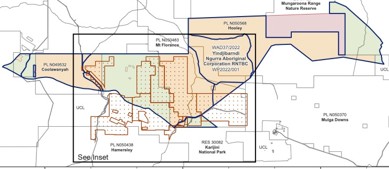
Map 7 – Exploration Licences – Large-Scale Map
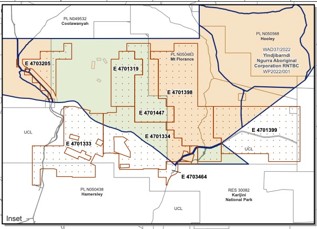
Map 8 – Exploration Licences – Inset Map
3.2.5 Prospecting licences
87 A prospecting licence remains in force for a period of four years and may be renewed for one further period of four years: s 45 Mining Act. If a prospecting licence has retention status, it may be extended by a further period(s) of four years: s 45(1a)(b). It may not exceed 200 hectares: s 40.
88 The rights conferred by a prospecting licence are similar to those for an exploration licence and include authorisation for the holder to enter the land with vehicles and equipment and sinking bores and digging pits, trenches, holes and tunnels: s 48 Mining Act. However, none of the prospecting licences that form part of the compensation claim permit the holder to prospect for iron ore without Ministerial authority.
89 YNAC’s points of claim specify the following 3 prospecting licences:
Reference number/name | Term granted | Area (hectares) | Extent within claim area | Within exclusive area | Within non-exclusive area |
P47/1945 | 4 years commencing on 11 August 2021 expiring on 10 August 2025. | Approximately 4.5 | 37.13% 1.7 hectares | 0% 0 hectares | 100% 1.7 hectares |
P47/1946 | 4 years commencing on 11 August 2021. | Approximately 166 | 98.51% 163.53 hectares | 0% 0 hectares | 100% 163.53 hectares |
P47/1947 | As above | Approximately 149 | 97.38% 145 hectares | 0% 0 hectares | 100% 145 hectares |
90 The maps below depict the location of the exploration licences (depicted in blue hatching) within the Determination Area.
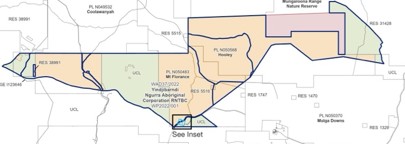
Map 9 – Prospecting Licences – Large-Scale Map
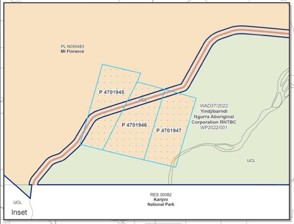
Map 10 – Prospecting Licences – Inset Map
3.2.6 The date when the FMG tenements were granted
91 Below is a table setting out the date of grant of the various FMG tenements.
FMG Tenement | Grant Date | FMG Tenement | Grant Date |
Mining leases | Miscellaneous licences (including water management licences) | ||
M47/1409-I | 26 November 2010 | L1SA | 29 November 2006 |
M47/1411-I | 26 November 2010 | L47/302 | 5 June 2009 |
M47/1413-I | 26 November 2010 | L47/361 | 11 October 2011 |
M47/1431-I | 8 July 2011 | L47/362 | 3 May 2011 |
M47/1453-I | 17 January 2013 | L47/363 | 3 May 2011 |
M47/1473-I | 29 August 2014 | L47/367 | 2 March 2012 |
M47/1475-I | 29 August 2014 | L47/396 | 23 May 2012 |
M47/1513-I | 3 December 2018 (surrendered in favour of grant of M47/1570-I) | L47/472 | 18 July 2014 |
M47/1570-I | 31 March 2020 | L47/697 | 2 December 2013 |
Exploration licences | L47/801 | 24 May 2019 | |
E47/1319-I | 16 March 2012 | L47/813 | 6 April 2018 |
E47/1333-I | 28 July 2007 | L47/814 | 6 April 2018 |
E47/1334-I | 2 June 2007 | L47/859 | 6 February 2019 |
E47/1398-I | 8 July 2011 | L47/901 | 26 June 2019 |
E47/1399-I | 8 July 2011 | L47/914 | 15 November 2019 |
E47/1447-I | 2 June 2007 | L47/919 | 10 January 2020 |
E47/3205-I | 21 September 2016 | Prospecting licences | |
E47/3464-I | 24 February 2017 | P47/1945 | 11 August 2021 |
P47/1946 | 11 August 2021 | ||
P47/1947 | 11 August 2021 | ||
3.3 The Infrastructure on the Solomon Hub Project
92 The infrastructure located across the mining leases is described in a document titled FMG Respondents’ mining tenements and infrastructure (provided in compliance with the Court’s order 3 of 11 October 2022), filed by FMG on 13 February 2023 (FMG Infrastructure Document). A reference below to an FMG tenement commencing with the letter “M”, for example, as “M47/1409-I” is a reference to a mining lease. A reference to an FMG tenement commencing with the letter “E”, for example, as “E47/1319-I” is a reference to an exploration licence. A reference to an FMG tenement commencing with the letter “L”, for example, as “L47/361” is a reference to a miscellaneous licence.
93 The FMG Infrastructure Document provides the following relevant information. Infrastructure which is located across more than one FMG tenement comprises:
(1) four major mine pits, being the:
(a) Kings Mine Pit (located across mining leases M47/1409-I and M47/1453-I);
(b) Trinity Mine Pit (located across mining leases M47/1409-I and M47/1475-I);
(c) Firetail North Mine Pit (located across mining leases M47/1413-I and M47/1473-I); and
(d) Firetail South Mine Pit (located across mining leases M47/1413-I, M47/1431-I, and M47/1453-I).
(2) transport or service infrastructure, including conveyor belts used to transport ore (the Primary Overland Conveyer, located across mining leases M47/1413-I and M47/1431-I, and the Queens Conveyor, located across mining leases M47/1409-I and M47/1411-I), a haul road named Middleton’s Pass located across mining leases M47/1431-I and M47/1453-I, and an access road named Craigie Gorge Road located across mining leases M47/1413-I and M47/1431-I;
(3) two deposits of mining waste material, being the Kings Waste Dump (located across mining leases M47/1409-I and M47/1453-I) and the Trinity Waste Dump (located across mining leases M47/1409-I and M47/1475-I);
(4) a Tailings Storage Facility (located across mining leases M47/1409-I, M47/1431-I and M47/1453-I) or tailings dam, used to store “tailings” or product material generated from processing iron ore; and
(5) a stockpile area designated for storing run-of-mine ore before it is processed (located across mining leases M47/1409-I and M47/1431-I).
94 In addition to this major infrastructure, there is also infrastructure located on each of the mining leases which is not located across more than one lease, such as building or camp sites, dams and diversion channels or drains, crushing hubs and transport or service infrastructure.
95 With the exception of a borefield and water pipeline(s) located in E47/1399-I and a borefield located in E47/1398-I, there is no infrastructure located in the exploration licences.
96 With the exception of a laydown or hardstand area and transport or service infrastructure located in L47/362, an access road located in L47/367, and powerline infrastructure located in L47/914, there is no infrastructure located in the alleged water management licences.
97 A scalable map of the Solomon Mine Hub showing the various FMG tenements is extracted below:
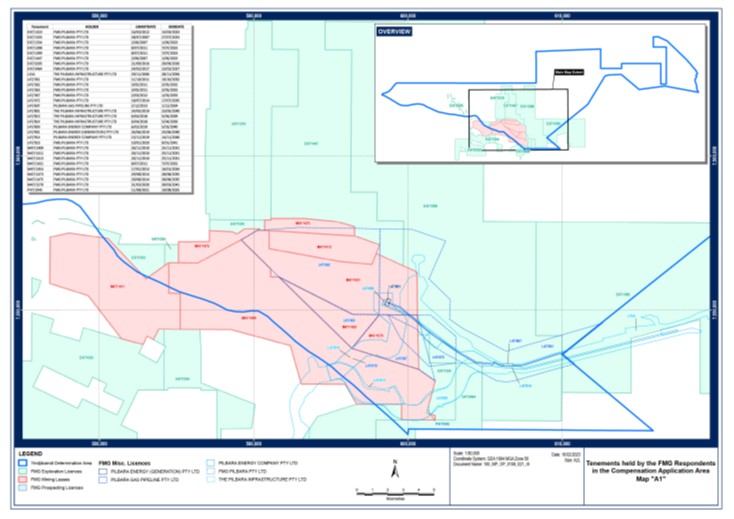
Map 11 – FMG Infrastructure Document Map 1 – FMG Tenements
98 A scalable map depicting the Solomon Hub Project infrastructure that has been constructed on each of the relevant FMG tenements is below:
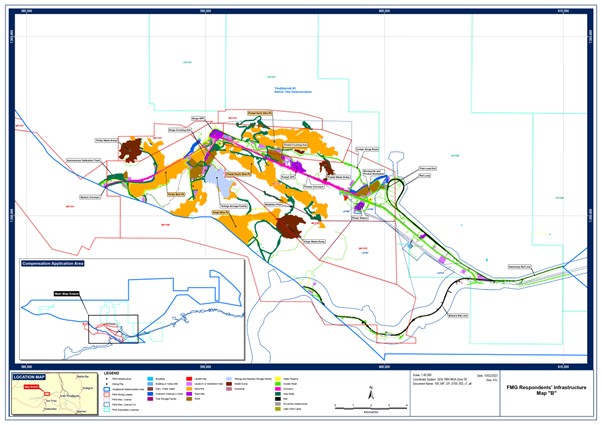 Map 12 FMG Infrastructure Document Map 2 – Solomon Hub Project Infrastructure
3.4 Overlapping tenements
99 The Determination Area is 2,469 km2. The area of the FMG tenements within the Determination Area is 563 km2. Within the area of the FMG tenements is an area that the parties refer to in their submissions as the Solomon Hub Project. Although this area was not well described by YNAC, in its closing submissions FMG acknowledges that the area of the nine mining leases and three of the miscellaneous licences (being the railway licence (L1SA) and two power licences (L47/859 and L47/901) make up an area to which access is prevented (SHP secure area). In closing submissions, FMG submitted that this occupies approximately 150.47 km2. However, it is apparent that FMG’s calculation of this area was in fact a sum of each of the tenement areas, and did not account for overlap between the tenements making up the SHP secure area. When overlap is accounted for, the net area of the SHP secure area is 135.48 km2 (taken from a summary of the areas contained in the expert report of Mr Jaski, which I accept for the purpose of identifying the net area of the mining leases, railway and power plant licences). I infer that this generally represents the area of the Solomon Hub Project and refer interchangeably to the SHP secure area and the Solomon Hub Project in these reasons. I note that FMG also accepted that access might be prevented to other partes of the land when intermittent exploration activities were being conduct.
100 There is significant overlap between the various future acts relied upon by YNAC. All of the alleged water management licences overlap with at least one of the FMG tenements that make up the SHP secure area. Furthermore, of the eight exploration licences, E47/1333-I, E47/1334-I, E47/1398-I, E47/1399-I and E47/3464 overlap to some extent with the SHP secure area. Exploration licences E47/1319-I, E47/1447-I and E47/3205-I do not overlap with it at all. The prospecting licences all overlap with the railway licence (L1SA). Outside of the Solomon Hub Project there are also areas of overlap.
101 The expert evidence to which I refer later in these reasons identifies each of the FMG tenements and addresses the physical impact the activities of FMG have had on the land within each.
102 The degree of overlap between the tenements is apparent from the maps which are set out in section 3.2 above, and the following inset of a map showing the overlap between the tenements. The blue hatching shows prospecting licences, the pink hatching shows mining leases, the green hatching shows miscellaneous licences and the brown hatching shows exploration licences. As with other maps above, the exclusive area is shaded in green and the non-exclusive area is shaded in orange.
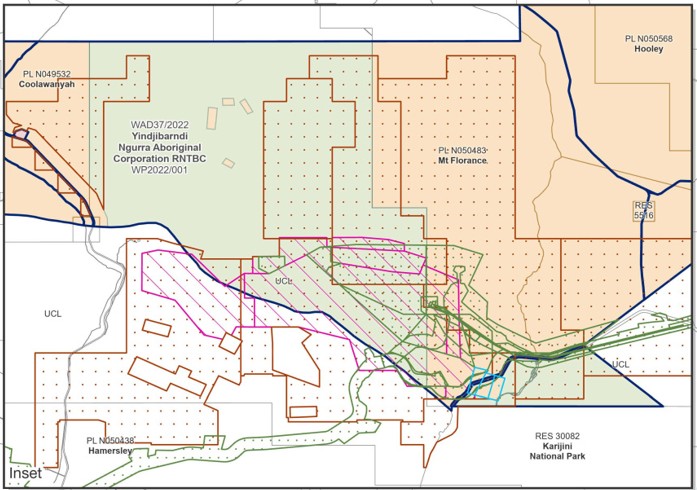
Map 13 – The FMG Tenements – Inset Map
3.5 Commencement, duration and anticipated reach of the Solomon Hub Project
103 Mining commenced on the Solomon Hub Project in October 2012. There is no fixed date for the closure of the mine, but on current modelling, it is expected to have an operational life until 2045.
104 To the extent that the Solomon Hub Project may expand in the future, the expansion within the Compensation Claim Area is generally localised to areas already affected by the existing mining operations and infrastructure. Additional evidence about the future use by FMG of the land within the FMG tenements is addressed later in these reasons. The map below, which is taken from the evidence of Mr Meaton depicts in yellow the existing footprint of the mine and in red the areas to be mined from 2020 to 2040, showing the boundary of the Compensation Claim Area in purple:
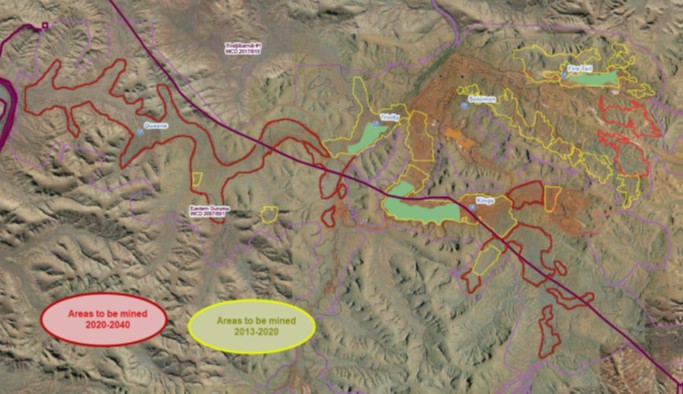
Map 14: Meaton Report – Solomon Hub Project – FMG Closure Plan Pit Layouts
105 It will be observed that areas of the mining activity that are to the south of the purple line are not within the Compensation Claim Area.
3.6 Closure and rehabilitation of the land
106 There is no dispute that the Solomon Hub Project has many years yet to run with its estimated closure due in 2045. Included in the evidence is a document entitled Solomon Mine Closure Plan, dated 20 September 2022 (Mine Closure Plan). It is scant on detail, however, it refers to the conduct of progressive rehabilitation activities during the operational phase of the Solomon Hub Project and then outlines the process from closure to relinquishment. No steps have actually been identified and there is only general discussion regarding relinquishment. Closure is said to commence when mining and ore processing ceases, and this is declared by notifying regulators and key stakeholders. According to the document, discussions with environmental regulators will then commence with annual and triennial environmental reporting obligations maintained until the authorities give notice that the activities can be reduced or cease. Decommissioning appears to involve the removal of buildings and other structures, which is estimated to take “around” two years to complete. Thereafter “rehabilitation activities” will commence. No detail is provided. The Mine Closure Plan says:
Rehabilitation activities are expected to take between 20 – 25 years to complete due to the significant backfill operation to achieve closure landforms and the scale of the Solomon Hub.
107 The section entitled “Post-closure monitoring” is set out below:
Following the cessation of decommissioning and earthwork activities, operational monitoring programs can be wound up and ceased, in accordance with licenses, permits etc. Where triggers for the cessation of monitoring are not included within the operational monitoring plans, discussions will be held with the relevant regulatory authorities to define how to conclude monitoring. At this stage, no cessation triggers have been identified within the existing management plans.
Post-closure monitoring and maintenance continue until it can be demonstrated to environment regulators that the completion criteria have been met. Following the cessation of closure activities, it is currently estimated that it will take 20 years to demonstrate that most of the completion criteria have been achieved. It may take significantly longer for the pit completion criteria to be demonstrated.
Access roads to the site will need to be maintained throughout the post monitoring period, so as to provide safe access for pit monitoring activities. Remotely sensed vegetation monitoring has been utilised in the completion criteria monitoring suite so that access to other areas of the site can be removed.
108 Further uncertainty arises from consideration of the Mine Closure Plan when it comes to the section entitled “Relinquishment of land management liability and tenure”, which says:
When all the completion criteria have been met, closure will be considered to have been successfully implemented and relinquishment processes, which includes transfer of liability and management to the next land-user, will commence. The process for tenure relinquishment of closed mines is still being defined by the Government of Western Australia.
Note that ‘closure’ is anticipated to take a minimum 20 years from the point at which the site is declared closed to the start of the relinquishment process.
109 Accordingly, closure of the mine may be in 2045. Unspecified rehabilitation activities which include some form of backfill to achieve “closure landforms” will take a further 20–25 years (2065–2070) and then further, unspecified “completion activities” are estimated to take a further 20 years (2085–2090) although they may take much longer (2100 or longer). During this time, access roads will be maintained.
110 In terms of relinquishment of the Solomon Hub Project, the Mine Closure Plan also provides for “Post-mining land use” and under the heading “Cultural use” it provides:
Traditional Owners regularly access culturally significant areas in the local area, to maintain traditional law and connection to country. This connection to land is the basis for the formal recognition of Traditional Owner native title rights and interests, including the Land Access Agreements Fortescue with the Eastern Guruma and Martu Idja Banyjima Peoples. These agreements include references to closure outcomes (see Table 12) and hence establish the postmining land use for Solomon. The connection to land, including access to sites of significance within the mine disturbance envelope, will be maintained as a post-mining land use.
This land-use outcome will be achieved by removing infrastructure and rehabilitating the land to a safe, geotechnically stable, non-contaminating and ecologically viable landscape that is congruous with the adjacent land uses and can be managed similarly to adjacent areas.
Fortescue has committed to maintain flow to Kangeenarina Creek to maintain riparian habitat features during operations and at closure as discussed in the Trinity Backfill Surface Domain Closure Strategy (Section 5.16.2).
Where groundwater connection has been lost to maintain permanent groundwater fed pools in Weelumurra and Kangeenarina Creek, supplementation has commenced to main these systems. Supplementation will remain until such time that below water table pits (Queens, Kings and Trinity) are backfilled and groundwater flows to permanent pools are self sustaining.
Where access to significant places where access has been lost due to mine development, access will be reinstated in agreement with Traditional Owners.
111 In concurrent evidence (to which I refer in further detail below), Mr Meaton and Mr Jaski considered the effect of ongoing impairment following closure of the Solomon Hub Project. Mr Jaski, who has considerable experience with mining, agreed with Mr Meaton (who accepted that he is not an expert on mine closures) that in an arid environment like the Pilbara, rehabilitation of the land has not been very successful. He said mine operators are only required to rehabilitate pits up to the level that does not impact on the water table, so they backfill to a level where the water table is restored. That can still leave pits of great depths. As Mr Meaton went on (with the agreement of Mr Jaski):
So they’re not filling - backfilling the pits and there are large waste dumps of processed material and the rehabilitation efforts to restore those are generally not as successful as would like, so the landform itself is significantly altered.
There is a well-known example in the Pilbara. The original mine at Goldsworthy, the company finished mining there and that pit has been – that pit is hundreds of metres deep, and it is now full of acid water. The geology in that pit had – suffers from what we call acid rock drainage. The pit is acidic. It’s a lovely blue colour, but you will lose your sun tan if you hop into it. So there has been discussion for years over whether that tenement can now be handed back to the government. I understand the government’s very reluctant to take that tenement back again because there is an ongoing liability with the condition of the pit. So that is an example to people in the area that the rehabilitation is not as successful as we would like.
112 Mr Jaski agreed with this summary of the risks involving rehabilitation.
113 The evidence indicates that in November 2010, FMG applied for environmental approval to develop the Solomon Hub Project, with production commencing from the Firetail mine pits (being Firetail North Mine Pit and Firetail South Mine Pit) in fiscal year 2013 and production commencing in the Kings Valley mine pits (including Kings Mine Pit and Trinity Mine Pit, as well as Zion and Valley of the Queens) in the fiscal year 2016.
114 This lengthy time span suggests that differences in the commencement date of an act may not, in the broader scheme, be significant in relation to compensation, as accepted by YNAC in its closing submissions. However, this will be a matter for consideration in assessing compensation in each individual case. I return to this later in these reasons when considering the valuation dispute between the parties.
3.7 Royalties paid to the State by FMG
115 The State provided an affidavit of John Sharman, Royalty Assessment Manager with the DMIRS affirmed 29 September 2023, which was read by YNAC. Mr Sharman manages the team responsible for ensuring royalty returns and production reports from miners are lodged on a timely basis and that payments are made in line with those returns. He was asked to prepare a spreadsheet which sets out the royalties received by the State from FMG in respect of the nine mining leases granted to FMG in the Determination Area and notes that they form part, but not the entirety of the Solomon Hub Project. He observes that no mining activity has occurred on M47/1473-I or M47/1570-I and that M47/1513-I is a “dead” tenement, having been surrendered on 31 March 2020 in favour of M47/1570-I. His spreadsheet does not refer to these leases because no iron ore has been extracted or obtained from these tenements.
116 Mr Sharman notes that there are a number of live mining leases associated with the Solomon Hub Project that do not fall within the Determination Area, of which iron ore is being extracted only from M47/1474-I and no information is provided in relation to that lease.
117 Mr Sharman provides an overview of the operation of the royalties framework and gives evidence that:
(a) the relevant mineral extracted from the mining leases is iron ore;
(b) after extraction, the iron ore is crushed and screened, with the lower quality ore then taken for further processing at a beneficiation plant;
(c) the crushed and screened ore is then blended with the beneficiated ore so that a desirable grade and quality of iron ore is achieved; and
(d) all iron ore produced or obtained from the mining leases is then transported by rail to the port at Port Hedland for export.
118 As a result of these matters, and the application of the Mining Act and Mining Regulations 1981 (WA), Mr Sharman gives evidence that:
(a) the first sale point for royalty value occurs on the shipment date of the ore, being the day on which the ship transporting the ore first leaves Port Hedland;
(b) the terms of the first sale are evidenced by a bill of lading and the invoices relating to the sale and export of the ore; and
(c) the royalty value of the iron ore obtained from the mining leases is calculated in accordance with r 86AD(2)(a) of the Mining Regulations and calculated on the gross invoice value of the iron ore, less shipping costs for the ore.
4. GROUND DISTURBANCE OF THE SOLOMON HUB PROJECT
119 On 14 August 2023, the Court conducted a view and on-site hearing that involved visiting 12 locations within the Solomon Hub Project. The following summary is drawn from a description in the second report of Dr Palmer, which was received without objection. It refers to locations on agreed maps which were received as Exhibit G.
120 The Court and parties travelled in escorted convoy from Kangi Camp, an accommodation village, to location 3, which afforded a view of the Trinity Mine Pit. Senior Yindjibarndi men and women performed a short ritual to introduce the visitors to the country. Stanley Warrie addressed me and detailed his emotional response to the transformation of the landscape, to which I refer further later in these reasons. The convoy then travelled to locations 4 and 5, situated proximate to the Ganyjingarringunha wundu (Kangeenarina Creek) and location 6. Location 7 afforded a view of the Firetail mining areas and associated infrastructure. The convoy then went to location 8, being a cave, and location 9. At a number of these locations, Yindjibarndi witnesses gave evidence concerning the significance of these sites. After a break for lunch the convoy travelled to location 10, being a gorge and cave which is also a burial site. It then went northwest to view the tailings storage facility (location 12) and viewed the tailings dam, under which a further site has been buried.
121 The affidavit of Sophie Kilpatrick affirmed 27 March 2024 annexes a number of photographs taken during the view, some of which are reproduced below:
(a) A view of the convoy and ore processing facility on the drive to the Trinity Mine Pit:
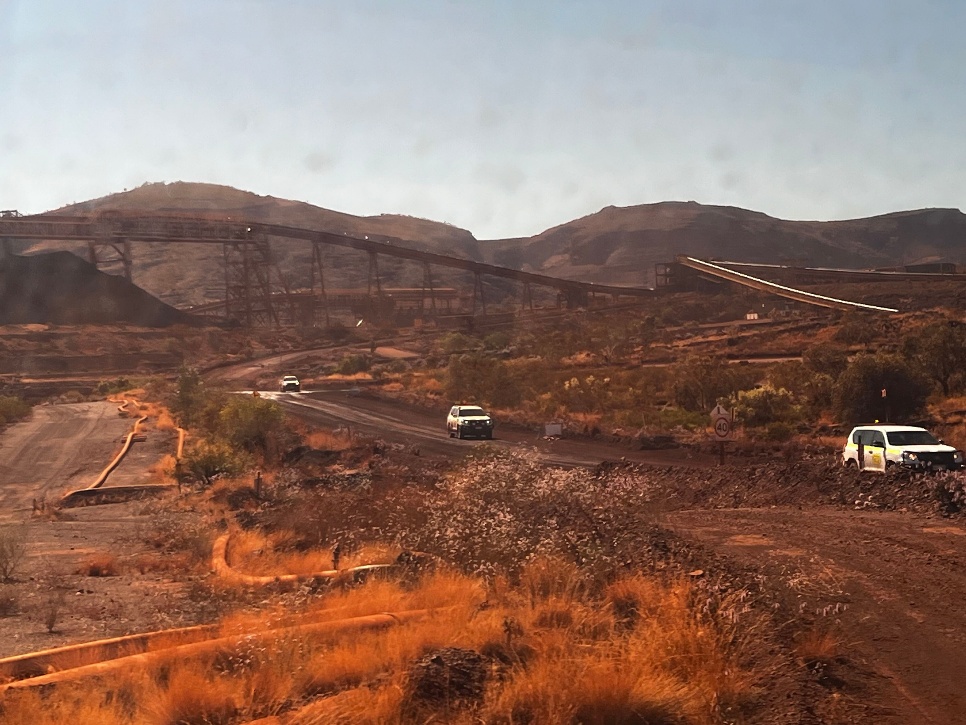
(b) A view of Kings ore processing facility:
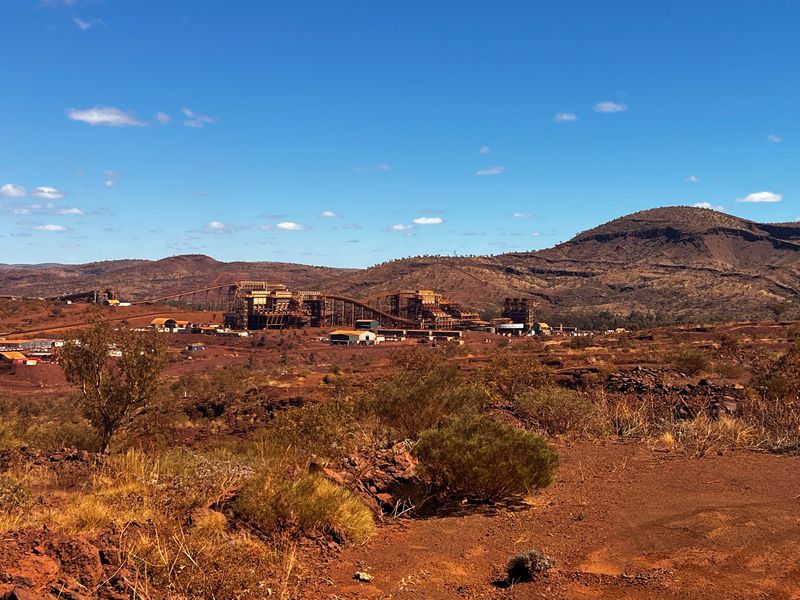
(c) A view of Firetail Pit at location 7:
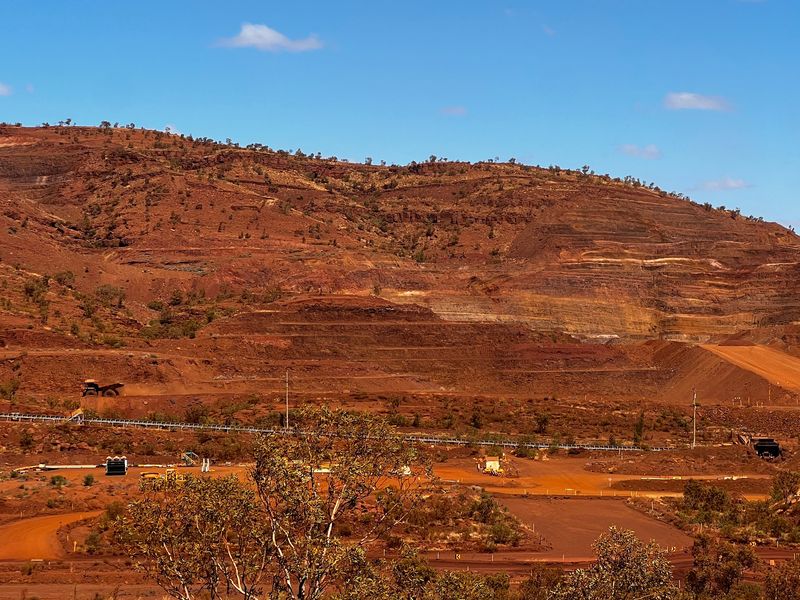
(d) The rail loading station:
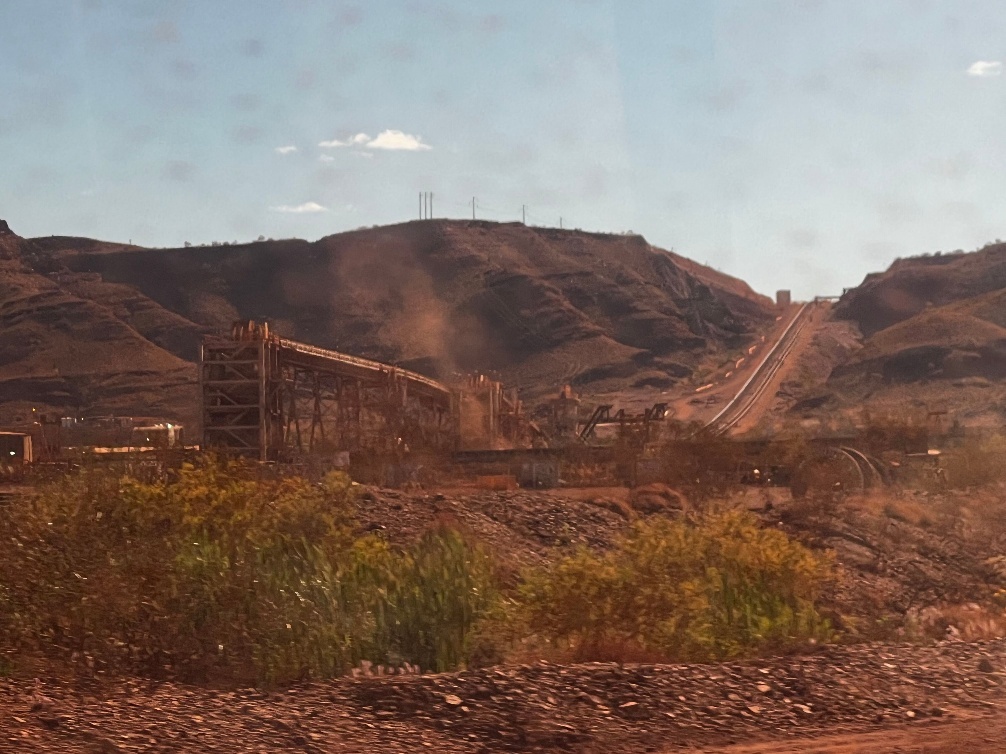
(e) View from the tailings dam of Firetail South Mine Pit :
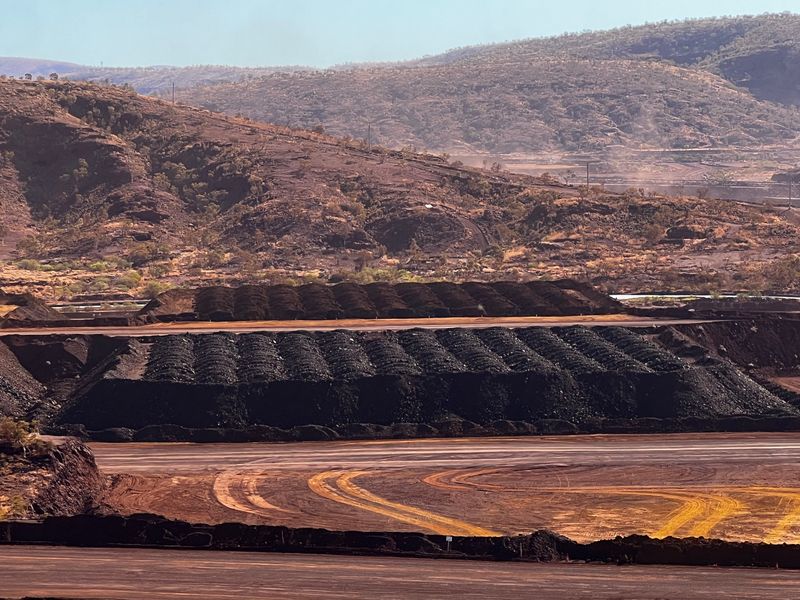
122 The operations of the Solomon Hub Project are massive. The scale of the machinery depicted is hard to describe. The hills, valleys and flats of the earth have been drastically altered to accommodate rail lines, storage facilities, dams, roads and pits. The mine pits can only be described as immense. They are deep and wide. Dr Palmer was asked to assume that the mines that make up the Solomon Hub Project within the Compensation Claim Area (being the Kings Mine Pit, Trinity Mine Pit, Firetail North Mine Pit, Firetail South Mine Pit) as well as Zion and Valley of the Queens (that are outside of the Determination Area) together have a production capacity of 75 million tonnes of iron ore per annum. I was not directed to evidence as to how much of the ground must be blasted, dug, loaded and processed to provide such an annual yield, which is then transported by rail to Port Hedland. The number for production capacity of 75 million tonnes each year does little to inform the reader of the scale of the operation. It is difficult to perceive that much remains of the original landscape within the footprint of the operation of the project. Within it, signs provide warnings as to when blasting will take place. Dust rises high above the operations. Trucks damping down the roads travel along it constantly, as do vehicles large and small with flashing hazard lights. The operations continue day and night. The size and the scale of the equipment operated is such that it is plainly an area where there are significant occupation, health and safety considerations. No doubt for that reason, access to the site is closely controlled by FMG and the boundary of the area of the mine entirely fenced off. The Yindjibarndi people are not permitted to enter without permission.
123 Fabian (“Charlie”) Cheedy is a Yindjibarndi man who gave oral and written evidence in the form of a witness statement signed 25 May 2023. He had worked at the Solomon Hub Project for 16 months as the operator of an excavator that has a bucket with a 75-tonne capacity. It takes three buckets to load an autonomous Caterpillar 793 truck, which will carry a payload of 250 tonnes. During a single shift he usually loaded 30,000 tonnes of ore, sometimes more. He says that he feels guilting working on the mine and that it is “breaking my wirrard” (or spirit, as further defined in section 23).
124 Charlie Cheedy gives the following description of his impression of the mine and its general effect on the country:
When I would look at the country where the Mine is, it was beautiful. You can see what the Mine are once looked like when you look at the area surrounding the Mine. The Mine site was full of waterways and permanent pools. They have all been destroyed now. Ganyjingarringunha wundu was a large creek that ran through the mine. It is dry now. There is no water in it. FMG has built a causeway up high off the ground along the creek bed.
There is a grout wall that has been built to stop the underground water coming in from Wirlu-Murra jinbi and Wirlu-Murra wundu (creek) into the Queens pit. Holes are dug vertically into the ground and grout or cement is poured into them to make the wall. The water is not flowing from Wirlu-Murra wundu or Ganyjingarringunha wundu like it once did. I have noticed that the water levels in these wundus are so low that they are dry or they are lower than I have ever seen them.
There are five pits at the Mine site. A pit is a big hole in the ground. There are different crews who run each pit. The pits are called Freddies, Firetail, Kings, Trinity and Queens. I have worked in all 5 pits. There are crushers at Kings, Queens and Firetail. Queens is the biggest pit at the Mine. If I needed to describe the size of Queens to a child I would say that it is as big as Roebourne. There are 7 diggers there at the moment. From the top of Queens to the bottom of Queens I estimate is about 300 metres.
125 As noted above, the Kings Mine Pit, Trinity Mine Pit, Firetail North Mine Pit and Firetail South Mine Pit are located within the Compensation Claim Area.
5. RELEVANT STATUTORY PROVISIONS
5.1 Terms of the Native Title Act
126 This part of the reasons will address the relevant provisions of the Native Title Act and provide an overview of the legislative framework. Unless otherwise indicated, any references to legislative provisions in this section will be to the Native Title Act.
5.1.1 The preamble and objects
127 The preamble to the Native Title Act sets out the considerations taken into account by Parliament in enacting it and must be taken into account when considering its meaning: s 13(2)(b) Acts Interpretation Act 1901 (Cth); Griffiths HC plurality at [26].
128 The preamble recognises that the people whose descendants are now known as Aboriginal peoples and Torres Straight Islanders were the inhabitants of Australia before European settlement, that they have been progressively dispossessed of their lands, “largely without compensation” or “lasting and equitable agreement … concerning the use of their lands”. As a consequence, they have become, as a group, the most disadvantaged in Australian society. The preamble notes that the High Court has: (a) rejected the doctrine that Australia was terra nullius at the time of European settlement; and (b) held that the common law of Australia recognises a form of native title that reflects the entitlement of the indigenous inhabitants of Australia, in accordance with their laws and customs, to their traditional lands; and (c) held that native title is extinguished “by valid government acts that are inconsistent with the continued existence of native title rights and interests, such as the grant of freehold or leasehold estates”.
129 The preamble records that the people of Australia intend to rectify the consequences of past injustices by the special measures in the Native Title Act and to ensure that Aboriginal peoples and Torres Strait Islanders receive the full recognition and status within the Australian nation to which history, their prior rights and interests, and their rich and diverse culture, fully entitle them to aspire.
130 In this context the preamble makes the following observations that are particularly pertinent to claims for compensation:
Justice requires that, if acts that extinguish native title are to be validated or to be allowed, compensation on just terms, and with a special right to negotiate its form, must be provided to the holders of the native title. However, where appropriate, the native title should not be extinguished but revive after a validated act ceases to have effect.
It is particularly important to ensure that native title holders are now able to enjoy fully their rights and interests. Their rights and interests under the common law of Australia need to be significantly supplemented. In future, acts that affect native title should only be able to be validly done if, typically, they can also be done to freehold land and if, whenever appropriate, every reasonable effort has been made to secure the agreement of the native title holders through a special right to negotiate. It is also important that the broader Australian community be provided with certainty that such acts may be validly done.
131 Section 3 relevantly identifies the main objects of the Native Title Act. The relevant objects to these proceedings are: (a) to provide recognition and protection of native title; (b) to establish ways in which future dealings affecting native title may proceed and to set standards for those dealings; and (c) to establish a mechanism for determining claims to native title.
132 The expressions “native title” and “native title rights and interests” as used in the Native Title Act involves a number of elements as described in s 223(1):
The expression native title or native title rights and interests means the communal, group or individual rights and interests of Aboriginal peoples or Torres Strait Islanders in relation to land or waters, where:
(a) the rights and interests are possessed under the traditional laws acknowledged, and the traditional customs observed, by the Aboriginal peoples or Torres Strait Islanders; and
(b) the Aboriginal peoples or Torres Strait Islanders, by those laws and customs, have a connection with the land or waters; and
(c) the rights and interests are recognised by the common law of Australia.
5.1.2 Future Acts
133 Future acts are broadly described in s 4(3)(b) to be acts done after the Native Title Act’s commencement (on 1 January 1994) that either validly affect native title or are invalid because of native title. They are distinguished from “past acts” which are mainly acts done before the commencement of the Native Title Act (s 4(3)(a)) and “intermediate period acts” that (broadly) are acts done before the judgment of the High Court in Wik Peoples v Queensland [1996] HCA 40; 187 CLR 1, that would be invalid because they fail to pass any of the future act tests in Division 3 of Part 2 (s 4(5)).
134 A “future act” is defined in s 233(1) in complicated terms as follows:
(1) Subject to this section, an act is a future act in relation to land or waters if
(a) either:
(i) it consists of the making, amendment or repeal of legislation and takes place on or after 1 July 1993; or
(ii) it is any other act that takes place on or after 1 January 1994; and
(b) it is not a past act; and
(c) apart from this Act, either:
(i) it validly affects native title in relation to the land or waters to any extent; or
(ii) the following apply:
(A) it is to any extent invalid; and
(B) it would be valid to that extent if any native title in relation to the land or waters did not exist; and
(C) if it were valid to that extent, it would affect the native title.
135 An “act” affecting native title is defined in s 226(2) of the Native Title Act and relevantly includes:
(b) the grant, issue, variation, extension, renewal, revocation or suspension of a licence, permit, authority or instrument;
136 Section 227 describes how an act affects native title:
An act affects native title if it extinguishes the native title rights and interests or if it is otherwise wholly or partly inconsistent with their continued existence, enjoyment or exercise.
5.1.3 Division 3 of Part 2 of the Native Title Act
137 Two substantial disputes emerge in the application of the provisions in Part 2 Division 3. The first concerns whether the alleged water management licences ought to be regarded as falling within subdivision H of Part 2, Division 3 (“Management of water and airspace”) or whether they fall within subdivision M (“Acts passing the freehold test”). I refer to this below as the water management issue. The second concerns whether any compensation claim applicable to those tenements that fall within subdivision M ought to be dealt with under the terms of the Mining Act with any claim being brought not in this court but before the Western Australian Mining Warden’s Court (the s 24MD issue). Various other substantial issues also arise by reference to s 24MD.
138 Division 3 of Part 2 of the Native Title Act addresses the validity of future acts and rights relating to future acts, including the right of native title holders to claim compensation in relation to future acts.
139 Section 24AA provides an overview of Division 3, including a list of each different type of future act and the provisions within Division 3 that concern the validation of those acts. The list in s 24AA(4) is as follows:
(a) section 24FA (future acts where procedures indicate absence of native title);
(b) section 24GB (acts permitting primary production on non-exclusive agricultural or pastoral leases);
(c) section 24GD (acts permitting off-farm activities directly connected to primary production activities);
(d) section 24GE (granting rights to third parties etc. on non-exclusive agricultural or pastoral leases);
(e) section 24HA (management of water and airspace);
(f) section 24IA (acts involving renewals and extensions etc. of acts);
(fa) section 24JAA (public housing etc.);
(g) section 24JA (acts involving reservations, leases etc.);
(h) section 24KA (acts involving facilities for services to the public);
(i) section 24LA (low impact future acts);
(j) section 24MD (acts that pass the freehold test—but see subsection (5));
(k) section 24NA (acts affecting offshore places).
140 It is notable that s 24AA(5) provides that in the case of certain acts covered by s 24IC (permissible lease etc. renewals) or s 24MD (acts that pass the freehold test), for the acts to be valid it is also necessary to satisfy the requirements of subdivision P, which provides a “right to negotiate”.
141 It is relevant to note two further aspects about Division 3 of Part 2 which are introduced in s 24AA. The first is that the Division provides that in general, valid future acts are subject to the “non-extinguishment principle”; the second is that the Division also deals with procedural rights and compensation for the acts (s 24AA(6)).
142 The “non-extinguishment principle” is defined in s 238. Section 238 provides, in relation to the non-extinguishment principle, that if the “act” affects any native title in relation to the land or waters concerned, the native title is nevertheless not extinguished, either wholly or partly (s 238(2)). In such a case, if the act is wholly inconsistent with the continued existence, enjoyment or exercise of the native title rights and interests, the native title continues to exist in its entirety but the rights and interests have no effect in relation to the act (s 238(3)). If the act is partially inconsistent with the continued existence of those native title rights and interests, the native title continues to exist in its entirety, but those rights have no effect in relation to the act to the extent of the inconsistency (s 238(4)). However, if the act or its effects are later wholly or partially removed, then the native title rights and interests will again have full effect or partial effect to that extent (ss 238(6) and (7)).
143 Section 238(5) also provides that even though the native title rights and interests have no, or limited effect in relation to the act, the persons who are entitled in accordance with the traditional laws and customs to possess those rights continue to be the native title holders, subject to Division 6 of Part 2 (which broadly provides for prescribed bodies to hold native title on trust).
144 Section 238(8) assists to understand the duration of the non-extinguishment principle:
An example of the operation of this section is its application to a category C past act consisting of the grant of a mining lease that confers exclusive possession over an area of land or waters in relation to which native title exists. In such a case the native title rights and interests will continue to exist but will have no effect in relation to the lease while it is in force. However, after the lease concerned expires (or after any extension, renewal or re‑grant of it to which subsection 228(3), (4) or (9) applies expires), the rights and interests again have full effect.
145 Important issues arise in the present proceedings from the application of Division 3 of Part 2. They mostly concentrate on subdivision H and subdivision M of Division 3 of Part 2, which are addressed in section 7 below. The non-extinguishment principle applies to the compensable acts the subject of the present claim.
5.1.4 Subdivision M – Acts passing the freehold test
146 Subdivision M is entitled “Acts passing the freehold test”. Section 24MA concerns legislative acts that affect native title and is not presently relevant. Section 24MB(1) sets out the “freehold test”:
Freehold test
(1) This Subdivision applies to a future act if:
(a) it is an act other than the making, amendment or repeal of legislation; and
(b) either:
(i) the act could be done in relation to the land concerned if the native title holders concerned instead held ordinary title to it; or
(ii) the act could be done in relation to the waters concerned if the native title holders concerned held ordinary title to the land adjoining, or surrounding, the waters; and
(c) a law of the Commonwealth, a State or a Territory makes provision in relation to the preservation or protection of areas, or sites, that may be:
(i) in the area to which the act relates; and
(ii) of particular significance to Aboriginal peoples or Torres Strait Islanders in accordance with their traditions.
Example: An example of a future act covered by this subsection is the grant of a mining lease over land in relation to which there is native title when a mining lease would also be able to be granted over the land if the native title holders instead held ordinary title to it.
147 There is no dispute that each of the FMG tenements (that is, the claimed compensable acts) satisfy the “freehold test”. That is because the parties accept that:
(a) none concern the making, amendment or repeal of legislation;
(b) each could be done in relation to the land in the Compensation Claim Area if the Yindjibarndi people instead held ordinary title to it;
(c) each relates to an “onshore place” within s 240(a) of the Native Title Act; and
(d) the Aboriginal Heritage Act 1972 (WA) is a law of the State that makes provision of the kind referred to in s 24MB(1)(c).
148 Section 24MD governs the treatment of acts that pass the freehold test. Set out below are ss 24MD(3) and (4):
Non-extinguishment and compensation
(3) In the case of any future act to which this Subdivision applies that is not covered by subsection (2) or (2A):
(a) the non‑extinguishment principle applies to the act; and
(b) if the following conditions are satisfied:
(i) the similar compensable interest test is satisfied in relation to the act; and
(ii) the law mentioned in section 240 (which defines similar compensable interest test) does not provide for compensation to the native title holders for the act;
the native title holders are entitled to compensation for the act in accordance with Division 5.
Who pays compensation
(4) The native title holders may recover the compensation from:
(a) if the act is attributable to the Commonwealth:
(i) if a law of the Commonwealth provides that a person other than the Crown in right of the Commonwealth is liable to pay the compensation—that person; or
(ii) if not—the Crown in right of the Commonwealth; or
(b) if the act is attributable to a State or Territory:
(i) if a law of the State or Territory provides that a person other than the Crown in any capacity is liable to pay the compensation—that person; or
(ii) if not—the Crown in right of the State or Territory.
149 The “similar compensable interest test” identified in s 24MD(3)(b)(ii) is defined in s 240 as follows:
The similar compensable interest test is satisfied in relation to a past act, an intermediate period act or a future act if:
(a) the native title concerned relates to an onshore place; and
(b) the compensation would, apart from this Act, be payable under any law for the act on the assumption that the native title holders instead held ordinary title to any land or waters concerned and to the land adjoining, or surrounding, any waters concerned.
150 Subdivision P of Division 3 of Part 2 concerns the right to negotiate, which is addressed later in these reasons.
5.1.5 Division 5 of Part 2 – Determination of compensation
151 Division 5 is entitled “Determination of compensation for acts affecting native title etc”. Within that Division, s 48 provides that compensation payable in relation to an act under Division 3, which concerns future acts, is only payable in accordance with Division 5. Sections within Division 5 provide the criteria for determining compensation (s 51); the limit on compensation (s 51A); and an entitlement of a claimant to “just terms compensation” (s 53).
152 The provision under which the present claim to compensation is advanced is s 51, which provides:
51 Criteria for determining compensation
Just compensation
(1) Subject to subsection (3), the entitlement to compensation under Division 2, 2A, 2B, 3 or 4 is an entitlement on just terms to compensate the native title holders for any loss, diminution, impairment or other effect of the act on their native title rights and interests.
Acquisition under compulsory acquisition law
(2) If the act is the compulsory acquisition of all or any of the native title rights and interests of the native title holders, the court, person or body making the determination of compensation on just terms may, subject to subsections (5) to (8), in doing so have regard to any principles or criteria for determining compensation set out in the law under which the compulsory acquisition takes place.
Compensation where similar compensable interest test satisfied
(3) If:
(a) the act is not the compulsory acquisition of all or any of the native title rights and interests; and
(b) the similar compensable interest test is satisfied in relation to the act;
the court, person or body making the determination of compensation must, subject to subsections (5) to (8), in doing so apply any principles or criteria for determining compensation (whether or not on just terms) set out in the law mentioned in section 240 (which defines similar compensable interest test).
Compensation not covered by subsection (2) or (3)
(4) If:
(a) neither subsection (2) nor (3) applies; and
(b) there is a compulsory acquisition law for the Commonwealth (if the act giving rise to the entitlement is attributable to the Commonwealth) or for the State or Territory to which the act is attributable;
the court, person or body making the determination of compensation on just terms may, subject to subsections (5) to (8), in doing so have regard to any principles or criteria set out in that law for determining compensation.
Monetary compensation
(5) Subject to subsection (6), the compensation may only consist of the payment of money.
Requests for non-monetary compensation
(6) If the person claiming to be entitled to the compensation requests that the whole or part of the compensation should consist of the transfer of property or the provision of goods or services, the court, person or body:
(a) must consider the request; and
(b) may, instead of determining the whole or any part of the compensation, recommend that the person liable to give the compensation should, within a specified period, transfer property or provide goods or services in accordance with the recommendation.
Where recommendation not complied with
(7) If the person does not transfer the property or provide the goods or services in accordance with the recommendation, the person claiming to be entitled to the compensation may request the court, person or body to determine instead that the whole or the part of the compensation concerned is to consist of the payment of money.
Where recommendation complied with
(8) If the person does transfer the property or provide the goods or services in accordance with the recommendation, the transfer of the property or provision of the goods or services constitutes full compensation for the act, and the entitlement to it is taken to have been determined in accordance with this Division.
153 Section 51A provides a “freehold cap” on compensation:
51A Limit on compensation
Compensation limited by reference to freehold estate
(1) The total compensation payable under this Division for an act that extinguishes all native title in relation to particular land or waters must not exceed the amount that would be payable if the act were instead a compulsory acquisition of a freehold estate in the land or waters.
This section is subject to section 53
(2) This section has effect subject to section 53 (which deals with the requirement to provide “just terms” compensation).
…
154 YNAC relies on s 53 as an alternative basis for its claim to compensation. It provides:
53 Just terms compensation
Entitlement to just terms compensation
(1) Where, apart from this section:
(a) the doing of any future act; or
(b) the application of any of the provisions of this Act in any particular case;
would result in a paragraph 51(xxxi) acquisition of property of a person other than on paragraph 51(xxxi) just terms, the person is entitled to such compensation, or compensation in addition to any otherwise provided by this Act, from:
(c) if the compensation is in respect of a future act attributable to a State or a Territory—the State or Territory; or
(d) in any other case—the Commonwealth;
as is necessary to ensure that the acquisition is made on paragraph 51(xxxi) just terms.
Federal Court’s jurisdiction
(2) The Federal Court has jurisdiction with respect to matters arising under subsection (1) and that jurisdiction is exclusive of the jurisdiction of all other courts except the High Court.
5.2 Terms of the Mining Act
155 Several issues in dispute concern the terms of the Mining Act.
156 Section 8 of the Mining Act sets out the following definitions of “mining tenement”, and “occupier”, “owner” and “private land”:
mining tenement means a prospecting licence, exploration licence, retention licence, mining lease, general purpose lease or a miscellaneous licence granted or acquired under this Act or by virtue of the repealed Act; and includes the specified piece of land in respect of which the mining tenement is so granted or acquired;
occupier in relation to any land includes any person in actual occupation of the land under any lawful title granted by or derived from the owner of the land.
owner in relation to any land means —
(a) the registered proprietor thereof or in relation to land not being land under the Transfer of Land Act 1893 the owner in fee simple or the person entitled to the equity of redemption thereof; or
(b) the lessee or licensee from the Crown in respect thereof; or
(c) the person who for the time being, has the lawful control and management thereof whether on trust or otherwise; or
(d) the person who is entitled to receive the rent thereof.
private land means any land, other than Commonwealth land, that has been or may hereafter be alienated from the Crown for any estate of freehold, or is or may hereafter be the subject of any conditional purchase agreement, or of any lease or concession with or without a right of acquiring the fee simple thereof (not being a pastoral lease or a lease or concession otherwise granted by or on behalf of the Crown for grazing purposes only or for timber purposes, a diversification lease or a lease of Crown land for the use and benefit of the Aboriginal inhabitants) but —
(a) in relation to mining for minerals other than gold, silver and precious metals, for the purposes of Division 3 of Part III, does not include land alienated before 1 January 1899, except as provided in that Division; and
(b) other than in so far as the primary tenement may be treated as private land in relation to mining for gold pursuant to a special prospecting licence or mining lease under section 56A, 70 or 85B, does not include land that is the subject of a mining tenement; and
(c) no land that has been reserved for or dedicated to any public purpose shall be taken to be private land by reason only that any lease or concession is granted in relation thereto for any purpose.
157 Section 123(1), (2A) and (3)–(6) provide:
(1) On and after the coming into operation of the Mining Amendment Act 1985, in so far as the mineral is by virtue of section 9 the property of the Crown or the mining is authorised under this Act no compensation shall be payable in any case, and no claim lies for compensation, whether under this Act or otherwise —
(a) in consideration of permitting entry on to any land for mining purposes; or
(b) in respect of the value of any mineral which is or may be in, on or under the surface of any land; or
(c) by reference to any rent, royalty or other amount assessed in respect of the mining of the mineral; or
(d) in relation to any loss or damage for which compensation can not be assessed according to common law principles in monetary terms.
…
(2A) A reference in subsection (2) to mining shall be construed as including a reference to marking out in connection with an application for a mining tenement.
(3) The amount of compensation payable to the owner of private land or to an occupier of Crown land or private land may be determined by agreement, but in default of agreement —
(a) if the owner or occupier, respectively, and the person liable for payment of the compensation so consent, may be determined by the warden’s court, without requiring any formal proceedings to be taken, pursuant to a claim made in the prescribed manner; and
(b) in any other case, shall be determined by the warden’s court in formal proceedings, upon the application of the owner, the occupier or the person liable for the payment of the compensation.
(4) Subject to subsection (1) and subsection (7) and taking into account the matters referred to in section 124 and section 125, the amount payable under subsection (2) to which an owner or occupier may be found to be entitled may include compensation for —
(a) being deprived of the possession or use, or any particular use, of the natural surface of the land or any part of the land; and
(b) damage to the land or any part of the land; and
(c) severance of the land or any part of the land from other land of, or used by, that person; and
(d) any loss or restriction of a right of way or other easement or right; and
(e) the loss of, or damage to, improvements; and
(f) social disruption; and
(g) in the case of private land that is land under cultivation, any substantial loss of earnings, delay, loss of time, reasonable legal or other costs of negotiation, disruption to agricultural activities, disturbance of the balance of the agricultural holding, the failure on the part of a person concerned in the mining to observe the same laws or requirements in relation to that land as regards the spread of weeds, pests, disease, fire or erosion, or as to soil conservation practices, as are observed by the owner or occupier of that land; and
(h) any reasonable expense properly arising from the need to reduce or control the damage resulting or arising from the mining,
and where the use for mining purposes of aircraft over or in the vicinity of any land (whether or not private land) occasions damage that damage shall be deemed to have been occasioned by an entry on the land thereby affected.
(5) If any private land or improvement thereon adjoining or in the vicinity of land where mining takes place is injured or depreciated in value by the mining or by reason of the occupation of any portion of the surface or enjoyment by the holder of a mining tenement or of any right of way, the owner and occupier of the private land or improvements thereon are entitled severally to compensation for all loss or damage thereby sustained and the amount of compensation shall be determined in the manner provided in this section.
(6) Where mining operations are carried out on or under any land the subject of a mining tenement and damage is thereby caused to the surface or part of the surface of any private land comprised within the boundaries of the land the subject of the mining tenement belonging to the same or another owner, or to any improvement on any such private land, not being damage already determined under this Part, the owner and occupier of the private land or improvement are entitled severally to compensation for all loss or damage thereby sustained, and the amount of the compensation shall be determined in the manner provided by this section.
158 Section 125A provides:
(1) If compensation is payable to native title holders for or in respect of the grant of a mining tenement, the person liable to pay the compensation is —
(a) if an amount is to be paid and held in trust, the applicant for the grant of, or the holder of, the mining tenement at the time the amount is required to be paid; or
(b) otherwise, the applicant for the grant of, or the holder of, the mining tenement at the time a determination of compensation is made.
(2) If, at the relevant time, there is no holder of the mining tenement because the mining tenement has been surrendered or forfeited or has expired, a reference in subsection (1) to the holder of the mining tenement is a reference to the holder of the mining tenement immediately before its surrender, forfeiture or expiry.
(3) In subsection (1) —
grant includes extension or renewal;
native title holders has the same meaning as in the Native Title Act 1993 of the Commonwealth.
6. DOES SECTION 24MD(3) OF THE NATIVE TITLE ACT APPLY?
6.1 Introduction
159 FMG and the State dispute that YNAC is entitled to compensation under s 51 of the Native Title Act because the prerequisites of s 24MD(3)(b)(ii) are not met. That subsection requires:
Non-extinguishment and compensation
(3) In the case of any future act to which this Subdivision applies that is not covered by subsection (2) or (2A):
…
(b) if the following conditions are satisfied:
(i) the similar compensable interest test is satisfied in relation to the act; and
(ii) the law mentioned in section 240 (which defines similar compensable interest test) does not provide for compensation to the native title holders for the act;
the native title holders are entitled to compensation for the act in accordance with Division 5.
160 There is no dispute that the requirement under s 24MD(3)(b)(i) of the “similar compensable interest test” is satisfied for the FMG tenements. The only dispute concerning the application of this provision concerns s 24MD(3)(b)(ii) and whether the law mentioned in s 240 of the Native Title Act, which is the Mining Act, provides for compensation to the native title holders for the acts. If it does not, then the provisions of the Native Title Act will govern the grant of compensation. If it does, then the terms of the Mining Act will govern the grant of compensation.
161 Section 123(3) of the Mining Act broadly provides that any contested claim for compensation is to be determined by the warden’s court constituted under the Mining Act with the consequence that if the requirements of s 24MD(3)(b)(ii) of the Native Title Act are not met, then the warden’s court is the appropriate forum for the present claim.
162 As noted earlier in these reasons, YNAC holds the land of the Determination Area on trust for the Yindjibarndi people.
163 The relevant provision of the Mining Act which is said by the State and FMG to provide for compensation to the Yinjibarndi people is section 123(2). Section 123(2) provides:
Subject to this section and to sections 124 and 125, the owner and occupier of any land where mining takes place are entitled according to their respective interests to compensation for all loss and damage suffered or likely to be suffered by them resulting or arising from the mining, whether or not lawfully carried out in accordance with this Act, and a person mining thereon is liable to pay compensation in accordance with this Act for any such loss or damage, or likely loss or damage, resulting from any act or omission on his part or on the part of his agents, sub-contractors or employees or otherwise occasioned with his authority.
(Emphasis added)
164 Whether s 123(2) of the Mining Act provides for compensation turns on whether YNAC is an
“owner” or “occupier” of the land within the Compensation Claim Area. For the reasons set out below, I find that YNAC is not entitled to compensation under s 123 of the Mining Act, and therefore the conditions set out in s 24MD(3)(b)(ii) are satisfied.
6.2 The submissions
165 The State submits that, since the date of the Determination, YNAC may be regarded as the “owner” as that term is defined in s 8 of the Mining Act for all of the land in respect of which it holds exclusive native title rights and interests. The State accepts that YNAC cannot be an “owner” in respect of the non-exclusive area, citing Western Australia v Ward [2002] HCA 28; 213 CLR 1 at [317] (Ward HC), but submits that YNAC must be considered to fall within the meaning of “occupiers” of the land in respect of which it holds non-exclusive rights, regardless of when they were granted. In the alternative, the State submits that if it is not accepted that YNAC falls within the definition of “owner” in relation to the exclusive area, then it is also an “occupier” in respect of that land, as well as the land in respect of which it holds non-exclusive rights. The State relies on observations of the Court in Ward HC and also Margaret River Resources Pty Ltd v His Honour Warden Calder SM [2008] WASCA 238 at [27] in support of its submission.
166 FMG does not join in the State’s submission that YNAC may be considered to be an “owner” in respect of the land where it holds exclusive rights, but otherwise contends that YNAC may be regarded to fall within the meaning of “occupier”. It is FMG’s position that it is inconvenient that certain issues are resolved in the warden’s court while others are resolved in the Federal Court, and that as the Yindjibarndi people are occupiers, the matter should all be dealt with in the warden’s court.
167 YNAC submits that it is possible that as native title holders under the Determination holding exclusive rights to possession, occupation, use and enjoyment of the land to the exclusion of all others, they may arguably appear to fall within the definition of “owner”, but contends that on any view they could not be identified as “occupiers”, citing Ward HC at [559] (McHugh J). However, regardless of the application of the definitions, YNAC submits that the Mining Act does not provide for compensation for them in respect of the grant of the FMG tenements because the Mining Act does not confer an entitlement to compensation for native title holders for several reasons to which I refer in more detail below.
6.3 Consideration
168 This issue, and a number of other issues considered in these reasons, concerns questions of statutory construction. I summarise the relevant approach to construction as follows.
169 The task of statutory construction must begin, and end, with a consideration of the statutory text: Federal Commissioner of Taxation v Consolidated Media Holdings Ltd [2012] HCA 55; 250 CLR 503 at [39], quoting Alcan (NT) Alumina Pty Ltd v Commissioner of Territory Revenue [2009] HCA 41; 239 CLR 27 at [47]. That does not mean, of course, that (per SAS Trustee Corporation v Miles [2018] HCA 55; 265 CLR 137 at [64]):
… the text of a statute must be interpreted only according to the range of semantic meanings of the individual words. It means only that the interpretation of a statute, like any other legal instrument, is an interpretation of its words. Those words are interpreted in their context and in light of their purpose although legal rules can sometimes exclude or restrict the use of some context.
170 Fundamentally, legislation must be construed as a whole to ensure that the construction is consistent with the “language and purpose of all the provisions of the statute”: Project Blue Sky Inc v Australian Broadcasting Authority [1998] HCA 28; 194 CLR 355 at [69].
171 The context of a provision includes its purpose. Regard to purpose is required both by the Acts Interpretation Act 1901 (Cth) (s 15AA) and by common law (see, e.g., SZTAL v Minister for Immigration and Border Protection [2017] HCA 34; 262 CLR 362 at [14]). As was observed in CIC Insurance Ltd v Bankstown Football Club Ltd [1997] HCA 2; 187 CLR 384 at 408:
[T]he modern approach to statutory interpretation (a) insists that the context be considered in the first instance, not merely at some later stage when ambiguity might be thought to arise, and (b) uses “context” in its widest sense to include such things as the existing state of the law and the mischief which … one may discern the statute was intended to remedy.
172 Thus, as was observed in Alphapharm Pty Ltd v H Lundbeck A/S [2014] HCA 42; 254 CLR 247 at [42], the task of statutory construction may require “some appreciation of the pre-existing law and the legislative history of relevant provisions” and furthermore that “[u]ndoubtedly, questions of policy can inform the Court’s task of statutory construction” (citing Thomas v Mowbray [2007] HCA 33; 233 CLR 307 at [80]–[93]).
173 In my view, a number of features of the Mining Act serve to demonstrate that that Act does not provide for compensation for native title holders as required by s 24MD(3)(b)(ii), and also that YNAC is neither an “owner” or “occupier” of land within s 123(2) of the Mining Act.
174 First, the entitlement to compensation under s 123(2) is for loss and damage “suffered or likely to be suffered by them resulting or arising from the mining”. By contrast, the requirement under s 24MD(3)(b)(ii) of the Native Title Act is that there be compensation “for the act”, being the future acts, and their impact on the native title rights and interests of the traditional owners as required by s 51(1) of the Native Title Act.
175 The term “mining” is defined to include fossicking, prospecting and exploring for minerals, and mining operations: s 8 Mining Act. In contrast, s 24MD(3)(b)(ii) of the Native Title Act does not direct attention to mining per se, but to the “acts”, being the future acts as defined under the legislative framework (explained above in section 5.1.2). Under s 51(1) of the Native Title Act, the compensation includes “any loss, diminution, impairment or other effect” which the grant of the FMG tenement may have on the native title rights and interests. It is apparent that the focus of compensation under the Mining Act is quite different to the focus under the Native Title Act, and that the acts in respect of which compensation are sought are different. The Mining Act provides recompense for loss and damage “from the mining” and not the impairment or other effects on the native title rights and interests of the native title holders. In my view s 123(2) of the Mining Act does not provide for compensation “to the native title holders for the act”.
176 FMG and the State contend that the admission by YNAC that the “similar compensable interest test” within s 24MD(3)(b)(i) is satisfied precludes it from advancing this point. However, I am not persuaded that this is so. The acceptance under that test that compensation would, apart from the Native Title Act, be payable under s 123 of the Mining Act on the assumption that YNAC held ordinary title, does not serve to establish that as the holder of native title the Mining Act does provide compensation to YNAC for the future acts. That requires consideration of the application of s 123(2) absent the assumption of ordinary title.
177 The State submits that YNAC erroneously focusses on whether s 123 of the Mining Act provides compensation to the native title holders as if their native title rights and interests were instead “private land”, which the State says is the wrong question. It submits that the correct question is whether s 123 of the Mining Act provides compensation to native title holders, with the categorisation of land as “Crown land”, “reserve land” or “private land” under the Mining Act being irrelevant to that question. However, in my view that oversimplifies the question under s 24MD(3)(b)(ii), which not only requires that the Mining Act provide for compensation to the native title holders, but also that it provide compensation to them for the act, being the future act the subject of the claim.
178 Secondly, the definition of the term “owner” as set out in s 8 does not fully characterise who is entitled to compensation under s 123 of the Mining Act. The term “owner” is defined to mean any of the four categories within the definition set out in s 8 of the Mining Act which is set out in section 5 above. The categories in (a), (b) and (d) are plainly not relevant to the holders of native title rights and interests: Ward HC at [317]. Category (c) however is more open, as it is:
[T]he person who for the time being, has the lawful control and management thereof whether on trust or otherwise.
179 In Ward HC the majority of the High Court said at [317]:
… Native title holders may, in an appropriate case, fall within par (c). However, all of the land in respect of which the relevant mining leases were granted had been the subject of various pastoral leases. As previously mentioned, the grants of those pastoral leases extinguished the native title right to control access to the land. Therefore, the relevant native title holders could not be described as having the "lawful control and management" of the land under par (c) above; they were not "owners" for the purposes of the WA Mining Act. It follows that the holders of native title in respect of the land subject to the various mining leases were not entitled to compensation under the WA Mining Act as "owners" of the relevant land. This result is no different from that which would obtain in respect of any holder of rights and interests that did not amount to the "lawful control and management" of the land. The RDA is therefore not engaged on this basis.
180 The entitlement of an “owner” to compensation is qualified in s 123(3), which makes plain that it is only the owner of private land who is able to claim compensation from the warden’s court in the absence of agreement between the parties.
181 There is a clear distinction drawn in the Mining Act between “private land” and “Crown land”. Division 3 of Part 3 of the Mining Act addresses private land, which is defined in s 8 and may broadly be understood to mean land that has or may be alienated from the Crown as any estate of freehold and does not include a pastoral lease, a lease for grazing purposes or a lease of Crown land for the use and benefit of Aboriginal inhabitants. The FMG tenements are located on Crown land which is defined (broadly) to be all land with the exception of: land which has been granted in fee simple; land that has been reserved or dedicated for a public purpose (subject to some exceptions); land that is the subject of any lease granted by the Crown; or land that is a townsite: s 8 Mining Act.
182 The Mining Act makes no provision in s 123(3) or otherwise for an “owner” who is not the owner of “private land” to claim or otherwise receive compensation (other than as an “occupier”). There is – as one might expect – no provision for payment of compensation to an “owner” of Crown land who is not the Crown.
183 Accordingly, were YNAC to be considered to fall within the definition of “owner”, there would be no mechanism by which it could achieve an order for the payment of compensation under the Mining Act. In my view this supports the conclusion that s 123 of the Mining Act does not provide for compensation to YNAC as an “owner of land” within s 24MD(3)(b)(ii) of the Native Title Act.
184 Thirdly, YNAC does not meet the description of an “occupier” within s 123(2) of the Mining Act.
185 The term “occupiers” in s 8 (“includes any person in actual occupation of the land under any lawful title granted by or derived from the owner of the land”) was considered in Ward HC where at [318] the majority said:
The question remains as to whether the native title holders may be described as "occupiers". It should also be observed that native title holders cannot satisfy the definition of "occupier" in respect of land as they do not occupy the land under any lawful title granted by or derived from the owner of the land. The Crown is not apt to be described as the "owner" of land the subject of native title and native title is not "granted by or derived from" the Crown. However, "occupier" is defined in s 8 so as to "include" the definition set out above. When the use of the term "includes" is contrasted with use of the term "means" in the definition of "owner", it may be that the Act does not limit what otherwise might be meant by the term "occupier". However, it is not necessary to reach any conclusion on this matter, nor is it necessary to determine whether the relevant native title holders were "occupiers" under the WA Mining Act.
(Emphasis added)
186 At [559] of Ward HC, McHugh J expressed the view that the native title holders cannot satisfy the definition of “occupier” as they do not occupy the land under any lawful title granted or derived from the owner. By contrast, in his dissenting reasons, Callinan J expressed the view that native title holders may come within “occupier” as it does not exclude occupation in accordance with its ordinary meaning of being in possession by having a physical presence on the land (at [854] of Ward HC).
187 It is apparent that the majority in Ward HC left open the breadth of the inclusive definition. However, for the reasons that follow, I am not persuaded that the breadth left open applies to bring YNAC within the meaning of “occupiers”.
188 In Western Australia v the Commonwealth [1995] HCA 47; 183 CLR 373 (“The Native Title Act Case”) the majority made the following observation at pp 442–443:
The Mining Act 1978
For the purposes of the Mining Act, land is divided into “Crown land”, reserved land and “private land”; Mining Act s 8 and see s 24. Crown land is open for mining; Mining Act s 18. As such, the holder of a Miner’s Right may enter Crown land without notice, prospect for minerals, peg out land and apply for a mining tenement; Mining Act ss18, 20. Some areas of Crown land are exempt without the consent of the occupier or warden, including parts of pastoral leases within 400 m of wells, bores or other water works made by the pastoral lessee; Mining Act s 20(5)(e). As any land that might be subject to s 7 rights falls within the definition of Crown land and as the Aboriginal holders of s 7 rights do not appear to answer the statutory description of “occupier” (Mining Act s 8), the Aboriginal holders may be disturbed without notice by prospectors armed with a Miner’s Right.
(Emphasis added and footnotes added with semicolons)
189 This point was reinforced at p 446 where the majority said that s 7 rights:
… do not appear to bring the holders thereof within the definition of “occupier” whose occupation must be under a “lawful title granted by or derived from the owner of the land”.
190 In these passages the reference to “s 7 rights” is taken from the Land (Titles and Traditional Usage) Act 1993 (WA) and refers to the security of possession and enjoyment of rights under legislation that does not include the Native Title Act. However, it is apparent from s 7, which is set out at pages 434–435 of The Native Title Act Case, that s 7 purported to extinguish the native title rights and interests that existed prior to the Land Act 1993. As a result, the passage set out above may be regarded as an indication that the majority did not consider that the holders of native title rights and interests fall within the definition of “occupier” because they do not derive their rights from the owner of the land.
191 In Margaret River Resources, the Western Australian Court of Appeal noted in passing that the terms “occupier” and “owner” are wide enough to include a person who does not necessarily have a legal or equitable interest in the land itself (at [27]). In my review, this does not answer the present question. In Tisala Pty Ltd v Hawthorn Resources Ltd [2022] WASC 109, Hill J conducted a review of the Mining Act and considered that the meaning of “occupier” in the context of s 20(5)(c), could only include a party in actual occupation of the land in question under a lawful title granted by or derived from the State, as owner of the Crown land in question (at [84]). Her Honour considered that the terms of s 20(5)(c) warranted the conclusion that, despite the use of the word “includes” in the definition, read in the context of the particular section under consideration the definition was exhaustive. That construction also does not directly address the question applicable in the context of s 123 of the Mining Act.
192 The State and FMG submit that the ordinary meaning of “occupier” (being in possession by having a physical presence on land) should be applied and that the findings in Warrie (No 1) as upheld in Warrie FC support the contention that YNAC is an occupier of the land.
193 However, in my view the emphasis in the definition of “occupier” (inclusively) on it being any person in actual occupation of the land “under any lawful title granted by or derived from the owner of the land” tends to suggest that Parliament did not have native title holders in mind when the term was drafted. That is apparent from a brief survey of the terms of the Mining Act.
194 For instance, s 20(5) of the Mining Act provides that without consent by the “occupier”, a mining tenement or Miner’s Right does not entitle the holder thereof to (broadly) mine or explore or otherwise interfere with any Crown land that is situated within 100 m of land:
(a) for the time being under crop;
(b) used (inter alia) as a yard, stockyard, garden, plantation, airstrip or airfield;
(c) in actual occupation and on which a house or other substantial building is erected;
(d) the site of any cemetery or burial ground; or
(e) which is under a pastoral or diversification lease within the meaning of the Land Administration Act 1997 that is situated within 400 m of the outer edge of any water works, race, dam, well or bore.
195 The exception to this prohibition is where the mining warden directs (unless the direction relates to the land at (c) above) or the mining is not less than 30 m below the lowest part of the natural surface of the land.
196 Various rights of passing and repassing over Crown land are permitted in ss 20(5)(f) and (g).
197 It is plain from the identification of the land within (a) to (e) that Western conceptions of “occupier” and usages are there contemplated. No room is left for the recognition of traditional native title rights and interests that might be exercised if the native title party was characterised as the “occupier”.
198 Similarly, in s 29(2), in respect of “private land” a mining tenement will not be granted in respect of that land – defined in (a) to (f) in similar terms to that in s 20(5)(a) to (e) – unless the “owner and the occupier of the private land” have consented in writing to the grant of the mining tenement (or unless the mining tenement is granted only in respect of that part of the private land which is not less than 30 m below the lowest part of the natural surface). I note parenthetically that unlike in the case of Crown land under s 20, in the case of private land (which plainly does not encompass the land of the Determination Area) the owners of such land may engage in negotiations and refuse to permit entry into their land. The learned authors of Hunt on Mining Law of Western Australia, M Hunt, T Kavenagh and J Hunt (5th ed, Federation Press, 2015) consider that it is possible for an owner of private land to negotiate substantial payments, making allowance for mineral values, from a miner in respect of an application for a mining tenement notwithstanding that the private landowner does not own the minerals: at 3.4.6. By this provision, whilst under s 123(1) compensation may not be sought in respect of the value of any mineral on or under the surface of the land or on the basis of a royalty, the operation of s 29(2) can, and does, lead to such payments being agreed between the owner or occupier of private land and aspirant miners.
199 By s 31 of the Mining Act, the holder of a permit is to give notice of a permit which has been granted on the first occasion that the person enters the land, but if not present shall display a copy of the permit in a prominent position “on the occupier’s dwelling or in a prominent position at the main entrance to the land” (s 31(1)(a)) and in any event within 48 hours cause a copy of the permit “to be sent by prepaid registered post to the occupier at his last known place of abode or business” (s 31(1)(b)). By s 33 an application for a mining tenement that relates to private land by a permit holder must give notice to the chief executive officer of the local government, “the owner and occupier” of the land and each mortgagee of the land (s 33(1)). Other related provisions of the Mining Act also refer to the occupier (ss 35(1), 40D(g), 41(2), 56A(2), 58(4)).
200 So far as one can tell, nowhere do the provisions referring to an “occupier” suggest that such a person is someone who occupies land as that concept is understood in the Native Title Act by reference to the native title rights and interests acquired by traditional usage and custom.
201 This point is amplified when one considers the type of occupation that was recognised by the Court in Warrie (No 1) at [262]–[267] and [289]–[302], where Rares J described the relationship of the Yindjibarndi people with the land in the Determination Area. The description includes people visiting the land to sing jowi songs, the engagement in practices to maintain their physical and spiritual connection with the country as well as camping, fishing, and other activities to maintain sacred sites. A distinction between these findings and the application of common law concepts of occupation, and the unique relationship between traditional owners and the land, is made in the following passage of the Full Court’s decision in Warrie FC:
462 It is clear that “occupy” is a term of long ancestry within the common law and that it describes a particular relationship to land and that “occupy” in s 47B(1)(c) means “actual occupation” or “occupation in fact”. However, contrary to FMG’s position, this does not mean that it is appropriate to derive from Wagga Wagga Motor Registry Claim and Berrima Gaol a specific standard or threshold that “requires a particular nature and degree of presence on the land” or is limited to what FMG described as “indigenous presence on the land…in a concrete real world sense, not simply in the sense of spiritual beliefs in respect of that land”. Similarly, we do not see these authorities as requiring a particular type of physical presence or intensity of use before there can be a conclusion of occupation in fact. While intensity of use may be one way of establishing that one or more persons treat the land as their own, it is not the only way to establish occupation.
463 In our view, to derive and impose a requirement by transplanting statements and conclusions made in the context of s 36(1)(b) of the ALR Act into the different context of s 47B(1)(c) of the Native Title Act would be to commit the very error repeatedly warned against. Whereas the enquiry under the ALR Act is concerned with determining whether the State is in occupation of the land, the enquiry under the Native Title Act is concerned with determining whether one or members of the claim group occupy the relevant area over which native title would otherwise be extinguished.
464 The proper approach, and the one outlined in Alyawarr, Moses and Banjima, to which we now turn, is one that is sensitive to the traditions of Aboriginal people and their unique relationship with their country. In that context, it is important that taxonomical categories of relationship, right or interest developed in an Anglo-Australian context (eg possession, use and occupation) are applied in a manner sensitive to the full complexity of the relationship between Indigenous peoples and their land. This does not mean they are devoid of content, only that the application of these concepts will necessarily be different in the context of the Native Title Act.
(Emphasis added)
202 This passage demonstrates that it would be an error to align the findings of Rares J in Warrie (No 1) that the Yindjibarndi people “occupy” the land within the meaning of ss 47A(1)(c) and 47B(1)(c) with a conclusion that, for that reason alone, YNAC is an “occupier” of the land within the differently expressed language of the Mining Act.
203 It is not necessary for me to determine the limits of the inclusive definition of “occupier” in s 8 of the Mining Act. For present purposes, it suffices to conclude that the native title rights and interests described in Warrie (No 1) do not serve to demonstrate that YNAC is an occupier within the meaning ascribed in the Mining Act as the incidents of occupation as found under ss 47A and 47B of the Native Title Act do not equate to the defined “occupier” contemplated in the Mining Act.
Accordingly, I conclude that s 123(2) of the Mining Act does not provide for the payment of compensation to the Yindjibarndi people and that the requirements of s 24MD(3)(b)(ii) of the Native Title Act are met. Compensation is to be determined and paid in accordance with the terms of Division 5 of Part 2 of the Native Title Act.
7. THE WATER MANAGEMENT ISSUE (issue 10(c))
7.1 Introduction
204 The parties agree that most of the FMG tenements are valid future acts that fall within subdivision M. However, an issue between the parties concerns how the 13 alleged water management licences should be characterised for the purpose of the application of Division 3 of Part 5 of the Native Title Act.
205 Broadly speaking, FMG contends that the alleged water management licences fall within subdivision H of Division 3. YNAC (adopting submissions advanced by YMAC) and the State contend that they fall within subdivision M of Division 3. The material relevance of this distinction is that under subdivision H, it is the State that is liable to pay any compensation. Under subdivision M, it is (subject to questions of constitutional validity) FMG that must pay as a result of the operation of s 125A of the Mining Act.
206 For the reasons set out below, I reject the argument advanced by FMG that subdivision H applies and find that subdivision M applies to all of the FMG tenements.
7.2 The statutory provisions
207 The issue turns on the construction of s 24HA(1) and (2) of the Native Title Act, which relevantly provides:
Legislative acts
(1) This section applies to a future act consisting of the making, amendment or repeal of legislation in relation to the management or regulation of:
(a) surface and subterranean water; or
(b) living aquatic resources; or
(c) airspace.
In this subsection, water means water in all its forms and management or regulation of water includes granting access to water, or taking water.
Leases, licences etc.
(2) This section also applies to a future act consisting of the grant of a lease, licence, permit or authority under legislation that:
(a) is valid (including because of this Act); and
(b) relates to the management or regulation of:
(i) surface and subterranean water…
…
In this paragraph, water means water in all its forms and management or regulation of water includes granting access to water, or taking water.
208 The alleged water management licences were granted under s 91 of the Mining Act, which relevantly provides:
Grant of miscellaneous licence
(1) Subject to this Act, and in the case of a miscellaneous licence for water to the Rights in Water and Irrigation Act 1914, or any Act amending or replacing the relevant provisions of that Act, the mining registrar or the warden, in accordance with section 42 (as read with section 92), may, on the application of any person, grant in respect of any land a licence, to be known as a miscellaneous licence, for any one or more of the purposes prescribed.
…
(6) A miscellaneous licence shall not be granted unless the purpose for which it is granted is directly connected with mining.
209 Regulation 42B of the Mining Regulations pursuant to which the alleged water management licences were granted provides:
For the purposes of s 91(1), a miscellaneous licence may be granted for the use of land for one or more of the following purposes –
210 Thereafter is a list of 26 different purposes, including: (a) a road; (b) a tramway; (c) an aerial rope way; (d) a pipeline; (f) a conveyor system; (i) taking water; (ia) a search for groundwater; (j) hydraulic reclamation and transport of tailings; (k) an aerodrome; (o) a drainage channel; (q) a minesite accommodation facility; (r) a bore; and (t) a water management facility.
7.3 The alleged water management licences
211 The purposes associated with the alleged water management licences are identified in section 3.2.3 above. They are somewhat varied, but each includes multiple different purposes. Each was granted by the State pursuant to Division 5 of Part IV of the Mining Act and the purposes prescribed in reg 42B of the Mining Regulations.
212 The arguments of the parties may be addressed by reference to two exemplar alleged water management licences, the purposes of which are:
L47/361: pipeline, power line, road, taking water, communication facility, bore field, aerial rope way, aerodrome, conveyor system, power generation, transmission facility and storage or transportation facility for minerals or mineral concentrate.
L47/801: a bore, a bore field, a communications facility, a pipeline, a power line, a pump station, a road, a water management facility, a workshop and storage facility, and taking water.
7.4 The submissions
213 FMG submits that the alleged water management licences must be understood to have been validated under subdivision H and not subdivision M. It submits that the word “relates” as it appears in s 24HA(2) should be construed broadly and that each of the alleged water management licences was granted under legislation that “relates to” surface and subterranean water. It submits that the fact that the legislation, and each of the alleged water management licences, also include other purposes does not disqualify s 24HA(2) from applying. It relies on BHP Billiton Nickel West Pty Ltd v KN (Deceased) and Others [2018] FCAFC 8; 258 FCR 521 (North, Dowsett and Jagot JJ) at [63] which states that s 24HA(2) “is concerned only with whether the future act was granted under legislation (meaning the specific provisions which authorised the relevant grant) that relates to the identified matters”. I note that BHP Billiton was appealed to the High Court on other issues which did not include s 24HA: Tjungarrayi v Western Australia [2019] HCA 12; 269 CLR 150.
214 YNAC and YMAC contend that each of the alleged water management licences are miscellaneous licences granted for multiple specified purposes. YMAC submits that the words “relates to” depend on the nature and purpose of the provision in question and the context in which it appears, citing PMT Partners Pty Ltd (In liq) v Australian National Parks and Wildlife Service [1995] HCA 36; 184 CLR 301 at 313. It submits that the statutory language and context support reading the words “relates to” narrowly such that none of the alleged water management licences can be regarded as falling within s 24HA of the Native Title Act. It also submits that subdivision M specifically provides for future acts like the alleged water management licences. The State submits that the position of FMG is incorrect, and submits that s 24HA(2) does not address the situation where provisions authorising the grant of the licences include other purposes that are not listed within s 24HA(2)(b).
7.5 Consideration
215 As noted above, the alleged water licences were granted under s 91 of the Mining Act. The prescribed purposes referred to in s 91(1) are set out in reg 42B of the Mining Regulations.
216 In BHP Billiton the Full Court was concerned, amongst other things, with licences granted under s 91(1) of the Mining Act and the Mining Regulations. The primary judge had considered that because s 91(6) required the purposes to be “directly connected with mining”, the prescription of water related purposes in the Mining Regulations also had to be directly connected with mining and so did not satisfy s 24HA(2) ([53]). The Full Court rejected that approach as being concerned too generally with the operation of the Mining Act as a whole ([54]). It said at [57] that:
[t]he issue is whether the legislation under which the future act was granted, wherever the legislation be found and whatever form it may take, relates to the management or regulation of the identified matters.
(Emphasis added)
217 The Full Court found at [59] that if the provision under which the future act is granted is legislation and relates to the management or regulation of water (as described in s 24HA(2)), then s 24HA(2) is engaged ([59]). In that case, the miscellaneous licences were granted pursuant to reg 42B(ia) (“a search for groundwater”) and so they were granted under legislation that relates to the management or regulation of subterranean water ([62]).
218 The Full Court found in relation to the licence in question (at [62]):
Against this background, it is readily apparent that miscellaneous licences L53/161 and L53/177 were granted under legislation that relates to the management or regulation of subterranean water. This is because s 91(1) of the Mining Act, taken with reg 42B(ia) of the Regulations, constitute legislation that relates to the management or regulation of subterranean water and the licenses were granted under those provisions. It does not matter that the licences also had to satisfy the requirement in s 91(6) of the Mining Act that “the purpose for which [they were] granted is directly connected with mining”. This means only that the purpose of “search for groundwater” for which a licence may be granted by operation of s 91(1) and reg 42B(ia) must be directly connected with mining. The requirement for that connection does not remove the provisions from the scope of s 24HA(2). Together, s 91(1) and reg 42B(ia) are legislation that relates to the management or regulation of subterranean water because they authorise the grant of a relevant act under which the licence holder may search for groundwater. There is no reason not to give the words “relates to the management or regulation of…” their natural and ordinary meaning. Legislation which provides for the grant of a licence to search for groundwater directly connected with mining is legislation which relates to the management or regulation of subterranean water.
219 BHP Billiton informs the correct approach to s 24HA(2), but does not determine the outcome. As I have noted, in BHP Billiton the licences in suit were granted for the single purpose of being to “search for groundwater”: at [50]. In this case, it may be seen that the exemplar licences concern a great deal more.
220 Licence L47/361 gives as miscellaneous purposes the following, which may be matched with the prescribed purposes identified in reg 42B of the Mining Regulations as follows:
(1) pipeline – reg 42B(d);
(2) power line – reg 42B(e);
(3) road – reg 42B(a);
(4) taking water – reg 42B(i);
(5) communication facility – reg 42B(n);
(6) bore field – reg 42B(s);
(7) aerial rope way – reg 42B(c);
(8) aerodrome – reg 42B(k);
(9) conveyor system – reg 42B(f);
(10) power generation and transmission facility – reg 42B(u); and
(11) storage or transportation facility for minerals or mineral concentrate – reg 42B(v).
221 Adopting the approach in BHP Billiton, it is necessary to identify whether the grant of L47/361 is a future act consisting of the grant of a licence under legislation that relates to the management or regulation of surface and subterranean water. This involves consideration of the grant by reference to the particular subsections of reg 42B to which it applies. The question as posed is whether Licence L47/361 may be considered to have been granted under legislation that “relates to the management or regulation” of water, that being the specific legislative provisions which authorise the grant of the future act: BHP Billiton at [57].
222 In contrast to the facts of that case, the position is less clear where, as here, only two of the eleven legislative provisions authorising the grant of the future act relate to water management. In such a case the question arises as to whether the legislation pursuant to which the future act is granted “relates to” the specified purpose. In this regard, I accept that the closeness of the relationship required by s 24HA(2)(b) conveyed by the words “relates to” must be ascertained by reference to the nature and purpose of the provision and the context in which it appears: PMT Partners at [26] (Brennan CJ, Gaudron and McHugh JJ). In some circumstances, it may be considered that the words “relating to” are of wide import: Minister for Home Affairs v DLZ18 [2020] HCA 43; 270 CLR 372 at [43]. However, in each case the question is to be determined by context.
223 In my view the alleged water management licences do not satisfy the statutory requirement under s 24HA(2) of the Native Title Act.
224 First, s 24HA(2) only applies to future acts “consisting of” a licence under legislation that relates to the requisite purpose. The words “consisting of” suggest that the future act must be “made up of” a licence granted under legislation that relates to the management of water. Had Parliament meant otherwise, it could have chosen “including” or “comprising” rather than “consisting of” to describe the legislation granting the future act. I take this to be an indication that the whole of the future act under consideration must be granted under legislation that relates to the management of surface and subterranean water.
225 Secondly, as YMAC points out, within Division 3 Part 2 of the Native Title Act, the words “relates to” are used when a particular and singular subject matter is identified: see ss 24EBA(1)(a)(iii), 24JAA(1)(b) and 44D(1)(c). In contrast, where the relationship between the two things need not be exclusive, the term “relates to” is often used in conjunction with the words “to any extent”: see ss 24JAA(1)(a), 24KA(1)(a), 43A(1)(a)(ii) and 44A(2)(b). I accept that this construction involves reading “relates solely to” into s 24HA(2), but this appears to sit more conformably with the purpose of the section.
226 Thirdly, the scheme of the Native Title Act would be disrupted in a manner if FMG’s construction of s 24HA(2) is adopted, which in my view demonstrates that the nature and purpose of the provision is supported by a narrower construction of the words “relates to”.
227 I have noted above the hierarchy set within Part 2 of Division 3 between different types of future acts. Subdivision M is lower on the hierarchy than subdivision H. However, s 24MD(6B) provides:
If the act is:
…
(b) the creation or variation of a right to mine for the sole purpose of the construction of an infrastructure facility (see section 253) associated with mining;
the following consequences also apply: …
228 The definition of “infrastructure facility” in s 253 includes “(g) a dam, pipeline, channel or other water management, distribution or reticulation facility”.
229 Sections 24MD(6B)(b) and 253 accordingly contemplate that a mining tenement granted for the purpose of the construction of an infrastructure facility may comprise a dam, pipeline or water management facility. If the construction propounded by FMG was to be accepted, then any mining licence that included such facilities would be caught by s 24HA(2) because they would include a purpose that led to a licence being granted under legislation that relates to the management of water. They could not thereafter arise for consideration under s 24MD. The consequence would be that s 24MD(6B) includes redundancy insofar as it concerns a licence of that type. Such a circumstance cannot have been the intention of Parliament unless such tenements were not considered to fall under s 24HA(2).
230 Fourthly, an act that falls within subdivision H contains a different regime for the validation of a future act to later subdivisions. Notably, not included within subdivision H is any obligation on the parties to negotiate with a view to reaching an agreement about the act. The right to negotiate is to be found, relevantly, from a future act that falls within subdivision M (see subdivision P and s 26(1)(a), (b) and (c)(i)). A consequence of construing s 24HA(2) in the manner propounded by FMG is that licences granted under legislation for multiple purposes, that include as one purpose the management or regulation of surface and subterranean water, would avoid the operation of the obligation to negotiate. This cannot have been the Parliamentary intention.
231 Furthermore, if s 24HA(2) were to apply in such circumstances, then procedural and other consequences set out in s 24MD(6A) and (6B) would be avoided, which include notification to a native title claimant, registered body corporate, any representative Aboriginal or Torres Strait Islander body and the registrar, provision for objection and consultation and the independent hearing of any objection and resolution: s 24MD(6B)(c)–(g).
232 Finally, a narrower construction of s 24HA(2) that addresses only a grant under legislation insofar as it relates only to the management or regulation of surface and subterranean water is in conformity with the Explanatory Memorandum to the Native Title Amendment Bill 1997 (Cth). It explains that the amendments in Schedule 1 allow “a much more comprehensive regime for the validity of acts occurring in the future which affect native title” including “the regulation and management of water and airspace”. In bringing into effect Division H the Explanatory Memorandum says that the intention is to put beyond doubt the ability of governments to regulate and manage surface and subsurface water. In Chapter 10, it provides that subdivision H:
…does not deal with the management and regulation of the bed or subsoil under onshore and offshore waters…These matters are generally dealt with in proposed Subdivisions M and N… It is for this reason that the term ‘water’ is used rather than the term ‘waters’ (which is defined in section 253 to include the bed or subsoil.
233 This reference suggests that it was not intended by Parliament to pick up purposes for the grant of licences that are collateral or adjacent to the grant of licences under legislation that relates to surface and subterranean water. Non-exhaustive examples given in [10.6] refer to legislation regulating the dumping of materials into waterways, the use of water bores and the protection of drinking water.
8. THE APPLICATON OF SECTIONS 47A AND 47B OF THE NATIVE TITLE ACT
8.1 Introduction
234 The parties are at issue as to whether and when the exclusive native title rights and interests set out in the Determination apply to the compensation claim.
235 Paragraph [7] of the Determination in Warrie (No 2) provides:
Sections 47A and 47B of the Native Title Act apply to disregard any prior extinguishment in relation to the land and waters described in Schedule 4.
236 There is no dispute that without this declaration, the native title rights and interests of the Yindjibarndi people would be non-exclusive only, because a number of prior acts served to extinguish exclusive native title, including three oil prospecting licences granted prior to 31 October 1975, two of which were granted in respect of the whole of the Determination Area. Prior pastoral leases also were granted.
237 YNAC contends that the effect of the declaration is that its claim to compensation may be advanced on the basis of its exclusive rights and interests and that the declaration has binding effect on the present parties for all purposes. It submits that it is an abuse of process for FMG or the State to contend otherwise, as the decision of the Court in Warrie (No 2) is binding on them. YMAC joins in the submission advanced by YNAC and also contends that ss 47A and 47B apply to claims for compensation, regardless of the effect of Warrie (No 2), that that such effect is from 2003, when the claimant application was lodged.
238 The State accepts that ss 47A and 47B have effect but contends that their application is from the date of the Determination, which is 13 November 2017 and not before, with the consequence that some of the compensable future acts occurred when only non-exclusive rights were available and others when exclusive rights applied.
239 FMG submits that ss 47A and 47B have no application to a claim for compensation, and submits that they are applicable only in respect of a claimant application and that the Court may not take into account prior extinguished rights in determining compensation. It denies that the decision in Warrie (No 2) provides the basis for any issue estoppel or the application of the principles of res judicata.
240 During the course of argument the parties referred to the decisions in Griffiths v Northern Territory of Australia [2014] FCA 256 (Mansfield J) (Griffiths 2014)¸ Griffiths v Northern Territory of Australia (No 2) [2015] FCA 443 (Mansfield J) (Griffiths (No 2)) and Griffiths v Northern Territory of Australia (No 3) [2016] FCA 900; 337 ALR 362 (Mansfield J) (Griffiths (No 3)).
8.2 The statutory provision – s 47B
241 Although the parties refer to both ss 47A and 47B, for the purpose of considering the arguments advanced it is convenient to set out only s 47B, which provides:
Vacant Crown land covered by claimant applications
When section applies
(1) This section applies if:
(a) a claimant application is made in relation to an area; and
(b) when the application is made, the area is not:
(i) covered by a freehold estate or a lease; or
(ii) covered by a reservation, proclamation, dedication, condition, permission of authority, made or conferred by the Crown in any capacity, or by the making, amendment or repeal of legislation of the Commonwealth, a State or a Territory, under which the whole or a part of the land or waters in the area is to be used for public purposes or for a particular purpose; or
(iii) subject to a resumption process (see paragraph (5)(b)); and
(c) when the application is made, one or more members of the native title claim group occupy the area.
Prior extinguishment to be disregarded
(2) For all purposes under this Act in relation to the application, any extinguishment, of the native title rights and interests in relation to the area that are claimed in the application, by the creation of any prior interest in relation to the area must be disregarded.
Note: The applicant will still need to show the existence of any connection with the land or waters concerned that may be required by the common law concept of native title.
Effect of determination
(3) If the determination on the application is that the native title claim group hold the native title rights and interests claimed:
(a) the determination does not affect:
(i) the validity of the creation of any prior interest in relation to the area; or
(ii) any interest of the Crown in any capacity, or of any statutory authority, in any public works on the land or waters concerned; and
(b) the non-extinguishment principle applies to the creation of any prior interest in relation to the area.
Renewals and extensions of leases
(4) For the purposes of paragraph (1)(b), if, after a lease covering an area expires or is terminated, the lease is bona fide renewed, or its term is bona fide extended, the area is taken to be covered by the lease during the period between the expiry or termination and the renewal or extension.
Defined expressions
(5) For the purposes of this section:
(a) the creation of a prior interest in relation to an area does not include the creation of an interest that confirms ownership of natural resources by, or confers ownership of natural resources on, the Crown in any capacity; and
(b) an area is subject to a resumption process at a particular time (the test time) if:
(i) all interests last existing in relation to the area before the test time were acquired, resumed or revoked by, or surrendered to, the Crown in any capacity; and
(ii) when that happened, the Crown had a bona fide intention of using the area for public purposes or for a particular purpose: and
(iii) the Crown still had a bona fide intention of that kind in relation to the area at the test time.
8.3 Relevant findings in Warrie (No 1) and the declaration in Warrie (No 2)
242 One of the issues of fact between the parties in Warrie (No 1) was whether or not the preconditions to ss 47A(1) and 47B(1) had been satisfied. One aspect of the dispute was whether the evidence supported a finding that the Yindjibarndi people occupied areas the subject of the claim in accordance with ss 47B(1)(c) and 47A(1)(c). Justice Rares found that they did: Warrie (No 1) at [289]–[302]. That finding is now unimpeachable and is not challenged in these proceedings – indeed, the parties agree that the Court should adopt that finding pursuant to s 86 of the Native Title Act.
243 In Warrie (No 2), Rares J considered an argument advanced by FMG that after giving the declaration in [7] of the Determination (above), there be the following notation:
Note: Sections 47A and 47B apply in relation to that part of the determination area referred to in paragraphs 4 and 7 so that for all purposes under the Native Title Act in relation to the claimant application, including the making of this determination, prior extinguishment is to be disregarded, but otherwise native title would be wholly extinguished in those areas to which section 47A applies and the following areas to which section 47B applies: UCL 13, UCL 22 and UCL 24. In the other areas to which section 47B applies, the native title rights and interests are those referred to at paragraph 3.
(Emphasis added)
244 FMG argued before Rares J that the effect of ss 47A and 47B was “to revive native title rights that have been extinguished which happens on the making of the determination” and that the sections “operate to create different native title rights”, citing Gumana v Northern Territory [2005] FCA 50; 141 FCR 457 at [268]: Warrie (No 2) at [3]. FMG submitted that there could be occasions where a third party needed to know what the native title rights and interests were before and after a determination: Warrie (No 2) at [3]. His Honour rejected this argument (at [5]) because, in his view, a declaration of native title rights and interests made pursuant to ss 47A(2) and 47B(2) applies “for all purposes under this Act”, citing the decision of the Full Court in Banjima People v Western Australia (No 2) [2015] FCAFC 171; 328 ALR 637 at [35]. His Honour observed that when the Court applies either of ss 47A(2) or 47B(2) in making a final determination it is exercising judicial power by making a binding declaration of right by way of the adjudication of a dispute about rights and obligations arising from the operation of law upon past events or conduct, citing Precision Data Holdings Ltd v Wills [1991] HCA 58; 173 CLR 167 at 188. It is not creating any new rights when making a final determination of native title under s 225 of the Native Title Act, including when it specifies, in such a determination, the legal consequences for which ss 47A(2) or 47B(2) provide (at [8]).
245 His Honour concluded:
9 While a determination made under s 225 of the Act may be seen as a new development, it is not itself creative of any new rights or interests. Rather the determination recognises what has not been extinguished in accordance with the Act and so confirms the existing rights and interests in the land and waters, just as Mabo v Queensland (No 2) (1992) 175 CLR 1 recognised that at common law native title rights and interests in land and waters had survived the Crown’s acquisition of sovereignty and radical title (see 175 CLR at 69 par 3 per Brennan J).
10 A final determination is declaratory of the rights and interests that the Court has ascertained by applying the Act, and any other applicable law (whether statutory or judicially decided), to the facts as found by the Court.
11 For these reasons, the note should not be included in the final determination that I will now make.
(Emphasis added)
8.4 The submissions
246 YNAC contends that the effect of [7] of the Determination is to bind the parties to the conclusion that for the purposes of the compensation application any prior extinguishment of native title rights and interests in the exclusive area must be set to one side for all purposes. That is because, it submits, the Determination in Warrie (No 2) represents a judgment in rem binding on the world, citing Starkey v South Australia [2018] FCAFC 36; 261 FCR 183 at [198] (Reeves J, White J agreeing at [401]). As noted above, it submits that Warrie (No 2) binds the parties and that the principles of res judicata and issue estoppel apply, and it is an abuse of process to contend otherwise, citing Walton v Gardiner [1993] HCA 77; 177 CLR 378 at 393.
247 YMAC adopts the contentions of YNAC and further submits that in any event, the consequence of meeting the pre-conditions of ss 47A and 47B is that “any extinguishment” must be disregarded, not only for a claimant application but also for a compensation application. It submits that to the extent that the decision of Mansfield J in Griffiths 2014 found otherwise, it was incorrect and ought not to be followed. It submits that the correct date from which any exclusive rights ought to be attributed to the Yindjibarndi people as a result of ss 47A and 47B is the date of the filing of the claimant application, being 9 July 2003.
248 The State accepts that ss 47A and 47B apply to the present application but contends that the reasoning in Griffiths 2014 supports the proposition that compensable acts done in the exclusive area before the date of the Determination are compensable only for their effect on the non-exclusive native title, but that after the date of the Determination they are to be calculated by reference to the declaration of the exclusive native title rights and interests because, based on Northern Territory of Australia v Griffiths [2017] FCAFC 106; 256 FCR 478 (Griffiths FC), it is only on and from the date of the Determination that the exclusive native title rights and interests in the s 47B declaration arise. The State otherwise submits that the dicta of Rares J in Warrie (No 2) at [6] that “by force of ss 11(1), 47A and 47B(2) no extinguishment of native title rights and interests ever occurred…” was wrong at law, citing Griffiths FC at [229], [231] and [233]. It also contends that no res judicata or issue estoppel arises because the reasoning in Warrie (No 2) was directed to a claimant application and does not bind the parties as to the current, subsequent, compensation application. Accordingly, to the extent that the reasoning of Rares J could be said to apply to the current application, it was obiter dicta.
249 FMG contends that in Griffiths 2014, Mansfield J correctly found that s 47B did not apply not the claimant’s compensation application, following a textual analysis of s 47B and the observation of his Honour that a claim group might recover twice for the one loss if in a determination, extinguishment was ignored, and then ignored again in an application for compensation for the effects of acts on native title rights and interests unaffected by any prior extinguishing acts through the operation of s 47B: Griffiths 2014 at [67]–[72], [73]. FMG submits that it cannot be liable to compensate for acts for which it was not responsible and YNAC’s claim for compensation cannot be determined on the supposition that the Yindjibarndi people have exclusive rights over the exclusive area because of the grant of the FMG tenements, noting that in Griffiths FC the Full Court decided that there was no right to interest once the claim group had a determination of native title under s 47B. It also disputes that the principles of res judicata, issue estoppel or abuse of process apply.
8.5 Consideration
8.5.1 Sections 47A and 47B apply to claims for compensation
250 Section 47B falls within Division 4 of Part 2 of the Native Title Act, which is headed “Other provisions relating to native title”. Sections 47, 47A and 47B have similar application. They provide for circumstances in which the extinguishment, by certain acts, of the native title rights and interests in relation to an area the subject of an application must be disregarded.
251 Section 47 applies to the case where, “an application under section 61 is made in relation to an area”, and a pastoral lease is held over the area the subject of the application by any of the persons who made the application claiming to hold native title, other persons with whom they claim to hold native title (or a trustee, on behalf of those persons or a company whose only shareholders are any of those persons).
252 Section 47A applies if a “claimant application” is made (s 47A(1)(a)) and if the area covered by the application is reserved or held on trust or vested for the benefit of Aboriginal people or Torres Strait Islanders (s 47A(1)(b)) and one or more members of the claim group occupy the area at the time of the application (s 47A(1)(c)).
253 Section 47B also applies if a “claimant application” is made (s 47B(1)(a)) and if the claim covers vacant Crown land (s 47B(1)(b)) and one or more members of the claim group occupy the area at the time of the application (s 47B(1)(c)).
254 The distinction between a “claimant application” in ss 47A and 47B on the one hand and the broader expression “application under s 61” on the other, was observed to be material by Mansfield J in Griffiths 2014 at [69].
255 As I have noted, the Determination was made at the same time that the decision in Warrie (No 2) was delivered, following findings of fact by Rares J in Warrie (No 1) that ss 47A and 47B applied to the claimant application advanced by the Yindjibarndi people.
256 The question that first arises is one of statutory construction as applied to the facts of this case, namely whether a declaration under s 47B(2) has effect in relation to the present claim for compensation. In my view it does.
257 For ease of reference, I repeat s 47B(2) below:
For all purposes under this Act in relation to the application, any extinguishment, of the native title rights and interest in relation to the area that are claimed in the application, by the creation of any prior interest in relation to the area must be disregarded.
258 Whilst s 47B(1) provides that s 47B applies if a “claimant application” is made, I would not read a declaration made under s 47B(2) as being confined in its effect to the outcome of a claimant application such that it does not have application in the context of a compensation application. The statutory language “[f]or all purposes under this Act in relation to the application” is broad. The words “in relation to” ought not to be understood to mean “for the purposes of a claimant application only”. I have earlier referred to PMT Partners and DLZ18.
259 In my view, a more natural reading of the phrase “in relation to”, understood with the words in s 47B(2) that follow and the statutory context in which s 47B appears, is that for all purposes under the Native Title Act associated with the claimant application any prior interest in relation to the area is to be disregarded. That would include the naturally following application for compensation lodged by the native title holders after they have received the declaration of right flowing from their claimant application.
260 The policy and purposes of the Native Title Act indicate that a broader rather than narrower understanding of the compensation provisions should be adopted. As the preamble notes:
The needs of the broader Australian community require certainty and the enforceability of acts potentially made invalid because of the existence of native title. It is important to provide for the validation of those acts.
Justice requires that, if acts that extinguish native title are to be validated or to be allowed, compensation on just terms, and with a special right to negotiate its form, must be provided to the holders of the native title. However, where appropriate, the native title should not be extinguished but revive after a validated act ceases to have effect.
261 The literal consequence of meeting the pre-conditions in ss 47A(1) or 47B(1) is that “any extinguishment” must be disregarded. Moreover, the revival of native title pursuant to s 47B is plainly material to compensation. It would be an odd result to find that under s 47B(2) native title is revived for the purposes of a claimant application, a declaration of right is then made, and yet the native title holders are subsequently precluded from claiming compensation in respect of the revived rights.
262 This approach is consistent with the terms of Division 5 of Part 2 of the Native Title Act. An entitlement to compensation under s 51(1) of the Native Title Act is not merely compensation for the withdrawal of recognition by the creation of prior inconsistent interests (that is, extinguishment) but rather for “any loss, diminution, impairment or other effect” on the native title rights and interests. That is consistent with the non-extinguishment principle to which reference is made in ss 47A(3)(b) and 47B(3)(b). As YMAC submits, restoration of the previously extinguished native title through ss 47A and 47B does not of itself necessarily fully compensate for the effects of an extinguishing grant, including the dispossession suffered by the native title holders between the time of the grant and the time of the restoration of the native title, or the effects of activities undertaken during that time. That will be fact dependent.
263 Importantly for the present case, restoration alone of native title through ss 47A and 47B is not compensation for a future act done post-restoration, particularly when there is no relationship between the earlier extinguishing act and the later future act. I would not infer that recognition from a declaration under ss 47A or 47B that exclusive rights exist is a proxy for an award of compensation for loss incurred as a result of future acts that take place after such a declaration. As I observe later in these reasons, the prior pastoral leases and exploration licences in the Determination Area had little appreciable impact on the native title rights and interests of the Yindjibarndi people. Rares J found in Warrie (No 1) that they did not affect the ability of the Yindjibarndi people to occupy the land in accordance with the prerequisites to ss 47A and 47B (at [289]–[302]; see also [63]). On the facts of the present case, the dangers of double counting to which Mansfield J referred in Griffiths 2014 are far less relevant.
264 In addition, native title rights and interests are not created at the point of the making of a Determination, they are recognised, and at the point of recognition are found to always have existed: Members of the Yorta Yorta Aboriginal community v Victoria [2002] HCA 58; 214 CLR 422 at [75]–[76]. A construction of ss 47A and 47B that is consistent with this principle provides coherency.
265 Moreover, I do not understand anything in the secondary materials to gainsay such a conclusion. The Explanatory Memorandum for the Native Title Amendment Bill 1997 (Cth) which introduced s 47B into the Native Title Act states:
5.56 Section 47B is a statutory mechanism designed to allow native title claimants who are in occupation of vacant Crown land to overcome the effect of past extinguishment and have their claim determined by the court. The current section 47 allows a claim for pastoral lease land, notwithstanding past extinguishment, where the claimants hold the pastoral lease. The provision will allow a claim for vacant Crown land where the claimants are in occupation of the land, notwithstanding possible extinguishment by any historical act.
(Footnotes omitted, emphasis added)
266 The Explanatory Memorandum notes that the section contains two requirements, the first being (broadly) that the claim is made over vacant Crown land which is not covered by a freehold estate or lease. The second is that one or more members of the claim group occupy the land. It goes on:
5.60 If these requirements are met, the extinguishment by the creation of any prior interest is ignored for the purposes of determining the claim. Therefore, if the land had previously been subject to a freehold or a leasehold grant, then the extinguishing effect of that grant is ignored. Similarly, if the land had previously been subject to a pastoral lease, then the partial extinguishment effected by that grant is also ignored. This is the case even if these grants are validated under the Native Title Act, or are subject to the confirmation regime in the Act.
5.61 Of course the claimants will still need to establish the positive elements of their claim, that is that the land is their traditional land and that they have maintained their traditional connection to it.
(Footnotes omitted, emphasis added)
267 No part of the secondary materials suggests that, having successfully established their claim, the native title holders should be precluded from relying on the rights granted to advance a claim for compensation.
268 Accordingly, in my view the proper application of ss 47A and 47B is that, subject to the question of double counting, which is a matter to be determined on the basis of the facts of each case, those sections would apply such that any prior interest in relation to the area must be “disregarded”, including for the purposes of a compensation claim. The breadth of that word was considered by the Full Court in Banjima People (Mansfield, Kenny, Rares, Jagot and Mortimer JJ) at [35]:
The ordinary and natural meaning of “disregard” is “to treat as of no importance; to pay no attention to” (Oxford English Dictionary online, sense b.) and “to pay no attention to; leave out of consideration” (Macquarie Dictionary online, sense 1). The legislative command in s 47B(2) is to pay no attention to any extinguishment of native title rights and interests in relation to that area that are claimed in the application where that area satisfies one of the three criteria in s 47B(1)(b) and each criterion in s 47B(1)(a) and (c). Thus, the issue that we had to, and did decide, was whether each exploration licence met the exclusionary criterion in s 47B(1)(b)(ii), there being nothing else in issue that could defeat the application of the section. Accordingly, once we held that the exploration licences did not fall within the exclusion in s 47B(1)(b)(ii), s 47B(2) mandated that no prior interest, such as those referred to in the footnote to the State’s submissions, had any extinguishing effect on the native title rights and interests that the Banjima people claimed in their application.
(Emphasis added)
269 In Griffiths 2014, the Court considered several past acts, being the grant of three grazing licences issued on 15 July 1980, 1 July 1981 and 1 March 1988 over the areas of certain lots within the determination area (at [38]). Prior to the grant of those licences, exclusive native title had been extinguished over those lots by the grant in 1901 of a pastoral licence: Griffiths 2014 at [44]–[46] and the table annexed to that judgment at items 37–39. The native title determination was made on 26 August 2006: Griffiths 2014 at [4]. Ultimately, following an appeal (Griffiths v Northern Territory [2007] FCAFC 178; 165 FCR 391), the native title holders were recognised as holding exclusive native title rights and interests in the lots: Griffiths 2014 at [5]. The conclusion reached by Mansfield J was that a claim for compensation in respect of the past acts would amount to double counting, though his Honour acknowledged that “there is scope to adjust the level of compensation”: Griffiths 2014 at [73]. However, that case was concerned with past acts. This is a point of factual distinction from the present case, which is sufficient to provide a basis for distinguishing the present proceedings from the outcome in that judgment.
270 However, regardless of the point of distinction, with some hesitation, for the reasons given above I consider the decision in Griffiths 2014 to be plainly wrong insofar as it stands for the proposition that a declaration made under ss 47A or 47B can never have application to a claim for compensation, and would not follow it, to the extent that it might otherwise be considered to be binding in the present case. I do not understand that aspect of the decision in Griffiths 2014 to have been the subject of appeal (see Griffiths FC at [232]). Accordingly, I do not consider that the findings in Griffiths FC relating to interest represent binding authority on the subject.
271 Accordingly, the operation of ss 47A and 47B in the present case is to enable the Yindjibarndi people to claim compensation on the basis that they hold exclusive native title rights within the exclusive area noted in the Determination.
8.5.2 No abuse of process to raise contrary arguments
272 YNAC contends that the submissions of FMG amount to a challenge to the determinative finding in [6] of Warrie (No 2) that there has never been an extinguishment of native title rights and interests in respect of those areas and waters the subject of the claim. It submits that the finding was correct and never appealed and that there is now res judicata or issue estoppel on that issue and it is an abuse of process to raise the issue in this proceeding. I disagree.
273 The context in which the dispute arose before Rares J was the application of ss 47A and 47B to the claimant application and a particular notation. It did not arise in the context of a claim for compensation. Had it done so, no doubt the decision in Griffiths 2014 would have been raised. Nor, in my view, may it be regarded an abuse of process to argue that the terms of [7] do not apply to a claim for compensation. That argument is not precluded by the language of [7] which provides that ss 47A and 47B apply to disregard any prior extinguishment. In my view it remained open to FMG to canvas arguments as to the effect of the application of ss 47A and 47B in the context of the present compensation application. Accordingly, the principles relevant to issue estoppel and abuse of process, which are conveniently summarised in Tomlinson v Ramsey Food Processing Pty Ltd [2015] HCA 28; 256 CLR 507 at [18]–[26], are not presently applicable.
8.5.3 The relevant date is the filing date of the compensation application
274 I turn now to the question of when the effect of the recognition of rights under the Determination – including the exclusive rights – applies for the purpose of determining the compensation claim.
275 The provisions of the Native Title Act do not prescribe from when ss 47A and 47B apply. The three competing dates put forward by the parties are:
(1) first, from the date of the Determination, which was made on 13 November 2017;
(2) secondly, the date of the filing of the claimant application by the Yindjibarndi people, which was 9 July 2003;
(3) thirdly, the date from which the native title rights and interests of the Yindjibarndi people began, which was since before colonisation.
276 In my view the preferable position is that the date of the filing of the claimant application applies. On the basis of the facts of this case it is unnecessary for me to decide if, in other circumstances, the date in (3) may apply.
277 First, the filing date of the claimant application is the operative date from which the native title rights and interests of the Yindjibarndi people were assessed in Warrie (No 1): see e.g. [4(3)], [152], [161], [179], [198]. This reflects the underlying purpose of the filing and subsequent registration of the claim (on 8 August 2003), which is to ensure that third parties are on notice of the claimed right from the time of filing. This may be seen in the processes detailed under s 66 of the Native Title Act, which requires the Native Title Registrar to give a copy of the application to third parties upon receipt of an application as soon as is reasonably practicable. Such notice is especially important where future acts post-date the date of lodgement of the claimant application. In addition, the Note to s 62(1) of the Native Title Act provides that “[t]he applicant will be the registered native title claimant in relation to the area claimed if and for so long as the claim is entered on the Register of Native Title Claims”.
278 Secondly, assessing the rights as operating from the date the application was lodged is consistent with the policy objectives of the Native Title Act set out in the preamble, and the fact, as noted earlier in these reasons, that any native title rights and interests that exist are rights and interests that the processes under the Act will cause to be recognised as existing in a determination under s 225 of the Native Title Act: Yorta Yorta at [75]–[76] (Gleeson CJ, Gummow and Hayne JJ) (McHugh J agreeing at [127]–[128], [134]). That recognition is subject to any prior extinguishing acts.
279 Thirdly, such an approach is also consistent with other forms of registered rights, such as those arising under the Patents Act 1990 (Cth) (ss 65 and 67) and the Trade Marks Act 1995 (Cth) (s 72(1)), the purpose underlying such registration being to ensure that third parties are on notice of claimed rights from the time of filing, such rights being operative from that date upon their grant (following often lengthy and contested processes addressing their validity).
280 Fourthly, to conclude that the native title rights and interests set out in the Determination exist only from the date of those orders (being 13 November 2017) would provide an unwelcome incentive on the part of opponents to a claimant application to delay the conduct of proceedings in order to diminish the outcome of any compensation application. See, for instance, Phyball on behalf of the Gumbaynggirr People v Attorney-General of New South Wales [2014] FCA 851 at [9] (Jagot J).
281 Finally, I do not consider that the findings of the Full Court in Griffiths FC as to the date upon which interest was payable (being from the making of the Determination) in respect of a crown lease represents binding authority as to date. In that case, the Full found (at [233]) that from the date of the Determination, the exclusive native title rights and interests of the claim group in the relevant area were recognised and that from that date the claim group “ceased to suffer any loss from the compensable act”. Contrary to the current proceedings and as noted above, no argument was presented before the Full Court to the effect that the primary judge (Mansfield J) erred in finding that s 47B did not apply to compensation claims: at [231]. Nor is the finding on the facts that loss had ceased applicable to the facts of the present case.
282 Accordingly, I find that the effect of ss 47A and 47B in the present case is to enable the Yindjibarndi people to claim compensation on the basis that they hold exclusive native title rights within the exclusive area noted in the Determination, and that this effect has operation from the date of the filing of the claimant application, which was 9 July 2003.
9. APPLICATION OF S 51 OF THE NATIVE TITLE ACT
283 In section 3 above I have identified the claimed compensable acts which are, generally, the FMG tenements. I have found in sections 6 and 7 that all of the compensable acts fall within s 24MD(3) of the Native Title Act with the consequence that YNAC is entitled to compensation for those acts in accordance with Division 5 of Part 2 of the Native Title Act.
284 I have in section 8 found that ss 47A and 47B apply from the date of the claimant application with the consequence that YNAC is able to advance its claim for compensation on the basis that its exclusive native title rights and interests as well as its non-exclusive native title rights and interests pre-date the commencement of each of the FMG tenements.
285 In light of these findings, the statutory framework for the compensation claim is governed by s 51 of the Native Title Act.
286 Section 51(1) of the Native Title Act relevantly provides that the entitlement to compensation under Division 3 is, subject to subsection (3), an entitlement on just terms to compensate the native title holders for any loss, diminution, impairment or other effect of the act on their native title rights and interests.
287 In Griffiths HC the plurality observed that s 51(1) is the “core provision” (at [41]) and that three specific aspects of s 51(1) warrant attention. First, that the person or persons who hold native title are entitled to compensation under s 51(1) for any loss, diminution, impairment or other effect of the act on their native title rights and interests (at [42]). Secondly, the Native Title Act does not expressly provide the date upon which the entitlement to compensation arises, or the date on which the value of the native title rights and interests being extinguished (in that case) is to be determined. But as the entitlement to compensation is for the act itself, and the validation provisions deem the (there, extinguishing) act to be valid from the time of the act, the date for the assessment of the compensation is the date of the act (at [43]). Thirdly the plurality recognised the bifurcation in terms of the assessment of compensation between economic loss and non-economic, or cultural loss:
44 Next, s 51(1), in its terms, recognises the existence of the two aspects of native title rights and interests identified in s 223(1) to which reference has already been made – the physical or material aspect (the right to do something in relation to land) and the cultural or spiritual aspect (the connection with the land) – as well as the fact that the manner in which each aspect may be affected by a compensable act may be different.
45 Both aspects are addressed in terms by s 51(1) providing for an entitlement on just terms to compensation to the native title holders for "any loss, diminution, impairment or other effect of the act on their native title rights and interests" (emphasis added).
(Emphasis in original)
288 Section 51(3) of the Native Title Act provides:
If:
(a) the act is not the compulsory acquisition of all or any of the native title rights and interests; and
(b) the similar compensable interest test is satisfied in relation to the act;
the court, person or body making the determination of compensation must, subject to subsections (5) to (8), in doing so apply any principles or criteria for determining compensation (whether or not on just terms) set out in the law mentioned in section 240 (which defines similar compensable interest test).
289 The compensable acts the subject of the present claim do not amount to the compulsory acquisition of native title and the similar compensable interest test is satisfied. Accordingly, each of the requirements of (a) and (b) of s 51(3) are met. Subsections 51(5) to (8) are presently not relevant. I have earlier noted that the law mentioned in s 240 of the Native Title Act is the Mining Act. There is no dispute that by operation of s 51(3) of the Native Title Act, s 123 of the Mining Act is the provision identified in s 51(3).
290 Section 123(1) of the Mining Act provides, in effect, that no compensation shall be payable for permitting entry on to any land for mining purposes or in respect of the value of any mineral which is or may be on or under the surface of the land or by reference to any rent or royalty assessed in respect of the mining of the mineral.
291 I have set out in section 5.2 the terms of s 123 of the Mining Act. For convenience I repeat s 123(2):
(2) Subject to this section and to sections 124 and 125, the owner and occupier of any land where mining takes place are entitled according to their respective interests to compensation for all loss and damage suffered or likely to be suffered by them resulting or arising from the mining, whether or not lawfully carried out in accordance with this Act, and a person mining thereon is liable to pay compensation in accordance with this Act for any such loss or damage, or likely loss or damage, resulting from any act or omission on his part or on the part of his agents, sub-contractors or employees or otherwise occasioned with his authority.
292 The parties accept that a bifurcated assessment of loss, as prescribed in Griffiths HC, is required in the present case. They also accept that, notwithstanding the application of s 51(3) and the constraints applicable by virtue of the operation of s 123 of the Mining Act, the principles set out in Griffiths HC insofar as the concern the assessment of economic loss and non-economic loss apply.
10. INTRODUCTION TO THE ECONOMIC LOSS CLAIM
10.1 The principal claim advanced – the exchange value case
293 I have in section 2 above identified the various heads of claim advanced by YNAC. Each is separately considered below. However, a number of threshold issues arise before the factual matters in dispute can be identified.
294 The bulk of the submissions going to economic loss, both directed to factual and legal issues, focussed the loss of the economic value assessed as the sum which a miner or Government party would have paid the Yindjibarndi people to obtain their assent to the grant of the FMG tenements as identified in (1) of the heads of claim.
295 In this respect, the claim advanced by YNAC is that the economic value of the native title rights and interests lost or suppressed by the grant and operation of the FMG tenements equates to the negotiation or exchange value of those interests. This is, it submits, calculated by reference to what miners in the Pilbara commonly and routinely agree to pay native title parties for their assent to mining on their country pursuant to negotiations conducted under subdivision P of Division 3 of Part 2 of the Native Title Act. YNAC submits, with reference to authorities that describe “special value” (see, eg Vyricherla Narayana Gajaptiraju (Raja) v Revenue Divisional Officer, Vizagapatam [1939] AC 302 at 312), that the land has a “special value” which the Yindjibarndi people could have expected to be able to exploit by entering into a mining agreement with a miner or government party. YNAC relies on evidence as to commonly negotiated percentage amounts of royalties received by the holders of native title rights in the Pilbara to support its submission that economic loss under head (1) should be determined by reference to a percentage of the value of the minerals extracted from the Solomon Hub Project. I refer to this as YNAC’s “exchange value” case.
296 It puts forward two alternatives:
(a) if FMG is liable to pay, compensation is determined by reference to the “comparable agreements” entered into by mining companies and native title claimants under s 31(1)(b) of the Native Title Act, being the subdivision P Agreements (which I have defined later in these reasons). YNAC submits that, having regard to those agreements, compensation is to be assessed as a percentage of the revenue earned by FMG from the sale of minerals obtained from the FMG tenements which it assesses at [REDACTED]. I refer to this as the Revenue Share Amount;
(b) if the State is liable, compensation is determined either by reference to the Revenue Share Amount or alternatively, by the formula set out in s 38 of the Mining Act, being 90% of the rents and royalties paid and payable by FMG to the State in respect of the FMG tenements. I refer to this below as the s 38 Mining Act Amount which is assessed at [REDACTED] in YNAC’s closing submissions, although this figure will be further discussed below in section 12.5.
297 By contrast, the State and FMG contend that the principles or criteria for determining compensation set out in s 123 of the Mining Act and also the principles set out in Griffiths HC establishing what amounts to “just terms” compensation within s 51(1) of the Native Title Act make clear that compensation for economic loss must be calculated by reference to the freehold value of the land, and that a percentage based compensation based on the value of the iron ore extracted from the Compensation Claim Area has no role to play. FMG contends that the maximum value of the freehold land the subject of the FMG tenements is $800,873 plus simple interest. The evidence of three experts, Mr Hall, Mr Jaski and Mr Preston, was relied upon by FMG and the State to support the position that they adopted.
10.2 Summary of the approach taken to the exchange value case
298 The division between the parties in relation to compensation for economic loss is fundamental, and gives rise to a number of points of principle and fact which I address in these reasons. By way of summary, I address the following matters.
299 First, YNAC contends that s 51(1) takes precedence over s 51(3) such that the “just terms” compensation requirement in s 51(1) applies to and overrides the compensation requirement under s 51(3) and, most particularly, the limitations in s 123(1) of the Mining Act. The State and FMG dispute that this is so.
300 Secondly, YNAC contends that, as a matter of construction, s 123 of the Mining Act is confined to loss or damage arising “from the mining” and is not an entitlement to compensation for “any loss, diminution, impairment or other effect” of the grant of the tenements on native title rights and interests. YNAC also submits that ss 123(5) and (6) of the Mining Act confer on an owner and occupiers of “private land” rights of compensation not conferred on native title holders, because the land in which native title rights and interests exist is not “private land”.
301 I address both of these arguments in sections 9 to 11 below.
302 Thirdly, central to a number of arguments advanced by YNAC is the contention that by not providing for compensation in a form of a percentage of the value of minerals extracted by reference to its exchange value approach, “just compensation” is not provided and Griffiths HC is not followed. The State and FMG contend that, regardless of whether compensation is assessed solely by reference to s 51(1) or by reference to s 51(3) of the Native Title Act (and thereby s 123(2) of the Mining Act), the Yindjibarndi people will receive compensation on just terms as contemplated in Griffiths HC and that accordingly the argument based on the Racial Discrimination Act does not arise.
303 In section 12 below, entitled “The just terms compensation issue”, I consider whether YNAC’s exchange value approach for economic loss falls within s 51(1) of the Native Title Act as that provision has been interpreted in Griffiths HC on a conceptual level. Later in these reasons I turn to the facts of the case as advanced by the expert witnesses and consider whether the case as advanced by YNAC is proved methodologically and factually. I conclude that on both levels, the case advanced by YNAC cannot succeed.
304 Fourthly, YNAC contends that it has an entitlement under s 53(1) of the Native Title Act to compensation equal to the amount claimed in its exchange value case. I address this argument in section 13 below.
305 Fifthly, YNAC contends that s 123(1) of the Mining Act is invalid pursuant to s 109 of the Constitution because it conflicts with the terms of the Native Title Act. I address this argument in section 14 below.
306 Sixthly, YNAC contends that if the application of s 51(3) of the Native Title Act and s 123 of the Mining Act would result in compensation that is other than on just terms, then s 45 of the Native Title Act and the terms of the Racial Discrimination Act will apply to ensure that the determination is made on just terms by reference to s 51(1) of the Native Title Act. I refer to this below as “The Racial Discrimination Act issues” which I address in section 15 below.
307 Seventhly, FMG contends that s 125A of the Mining Act is invalid pursuant to s 109 of the Constitution because it conflicts with the terms of the Native Title Act. This would have the consequence that the State, not FMG, is liable to pay any compensation. I address this issue in section 16 below.
308 Eighthly, I consider in section 17 the heads of economic loss identified in (2) to (4) of the Applicant’s List of Heads of Compensation, as well as the consideration of whether simple or compound interest should apply, before turning more generally to the factual case on economic loss more generally.
309 Ninthly, I consider in section 20 the issues relating to overlapping tenancies and the operation of s 49 of the Native Title Act.
310 After addressing these matters I turn to consider the expert evidence relied upon by YNAC of Mr Meaton and Mr Miles and the evidence given by FMG’s experts, Mr Hall, Mr Lonergan, Mr Preston and Mr Jaski, before addressing the final question of quantum for economic loss.
11. CONSTRUING S 51(1) OF THE NATIVE TITLE ACT AND S 123 OF THE MINING ACT
11.1 YNAC’s submissions
311 YNAC submits that the reasoning in Griffiths HC establishes that s 51(1) of the Native Title Act is the “core provision” in respect of compensation for acts impacting native title rights and interests and that it recognises in s 51(1) the existence of two aspects of these rights: the physical or material aspect, being the right to do something in relation to land; and the cultural or spiritual aspect, being the connection with the land, noting that the manner in which each aspect may be affected by a compensable act may be different; Griffiths HC at [41], [44] (plurality). Both aspects are addressed by the broad terms of s 51(1).
312 YNAC advances several points of construction referable to the operation of s 51(3) of the Native Title Act. First, that despite the words in s 51(1) stating that it is “[s]ubject to subsection 3”, it is s 51(1) that supplies the statutory entitlement to compensation, whereas s 51(3) merely directs what principles or criteria must be applied in determining that compensation. As a result, s 51(1) remains applicable to the claim such that any claim for compensation under s 51(3) must satisfy the requirement that it is on “just terms” and addresses both of the aspects of rights identified in Griffiths HC, being compensation for economic loss and compensation for spiritual or cultural harm. Secondly, the terms of the Mining Act do not supply any “principles or criteria for determining compensation” as required by s 51(3). The Mining Act sets out principles and criteria for determining compensation for the “act of mining” and not the relevant “act” under s 24MD(3) being the act of the grant of the FMG tenements. Thirdly, s 51(3) does not provide that only the principles set out in the Mining Act are to be applied and ultimately the principles or criteria that should apply are those set out in Griffiths HC, namely that compensation be paid on “just terms”.
11.2 Consideration of the construction issue
313 As noted above, the entitlement to compensation on just terms in s 51(1) is qualified by the terms of s 51(3) that compensation calculated by reference to the criteria set out in the law mentioned in s 240 (the similar compensable interest test), which is s 123 of the Mining Act. Given the wording of s 51(3), this is to be applied “whether or not on just terms”.
314 I have found in section 6 of these reasons that the reference in s 123(2) of the Mining Act to the “owners and occupiers” is not a reference that includes the holders of native title rights and interests. However, the terms of s 51(3) require that any principles or criteria for determining compensation in respect of an act on native title rights and interests must be those set out in s 123 of the Mining Act. Given that a prerequisite for the operation of s 24MD(3) is that the Mining Act does not provide for compensation to the native title holders, the operation of s 51(3) of the Native Title Act necessarily requires that s 123 of the Mining Act be read as if it does nonetheless provide principles or criteria for determining compensation.
315 Accordingly, to apply the similar compensable interest test, one must proceed on the assumption that the Yindjibarndi people are entitled to compensation in accordance with s 123(2) of the Mining Act and apply the principles or criteria set out in s 123 of the Mining Act on that basis. In this context, in my view the word “compensation” in s 123(2) should be given the same meaning that it is given in s 51(1) of the Native Title Act, that being a well-established word with a conventional meaning: Griffiths HC at [262]–[263] (Edelman J) which the High Court applied to the particular circumstances of the Native Title Act; Griffiths HC (plurality) at [87], [136].
316 In that sense, although s 123(2) provides that the “owner and occupier of any land where mining takes place are entitled according to their respective interests to compensation for all loss and damage suffered or likely to be suffered by them resulting or arising from the mining”, the words owner and occupier should be understood, as a result of the fiction imposed by s 51(3), to be the native title holders and the italicised words resulting from or arising from the mining are to be read as if they apply to the future act to which s 24MD(3) refers, being the grant of the FMG tenements, and the activities on the land thereafter.
317 So understood, in my view YNAC’s argument that s 123(2) does not provide principles or criteria for determining compensation for the future acts the subject of the compensation claim cannot succeed. To the contrary, when understood in light of the reasons in Griffiths HC, s 123 of the Mining Act provides for compensation for both of the separate incidents of native title rights and interests, as defined in s 223(1) of the Native Title Act.
318 On its face, s 123 of the Mining Act may be understood to provide the following “principles or criteria for determining compensation” as follows:
(1) Pursuant to s 123(2) the holders of native title rights and interests are entitled to compensation for all loss and damage suffered or likely to be suffered by them resulting or arising from the mining;
(2) This entitlement is subject to the terms of s 123(1), which provides that no compensation shall be payable in any case, and no claim lies for compensation “whether under this Act or otherwise” —
(a) in consideration of permitting entry on to any land for mining purposes; or
(b) in respect of the value of any mineral which is or may be in, on or under the surface of any land; or
(c) by reference to any rent, royalty or other amount assessed in respect of the mining of the mineral; or
(d) in relation to any loss or damage for which compensation can not be assessed according to common law principles in monetary terms.
(3) Section 123(4) relevantly provides that the amount payable under s 123(2) to which an owner or occupier may be found to be entitled “may include” compensation for eight specified matters which most relevantly include: being deprived of the possession or use, or any particular use, of the natural surface of the land or any part of the land (s 123(4)(a)); damage to the land or any part of the land (s 123(4)(b)); severance of the land or any part of the land from other land of, or used by, that person (s 123(4)(c)); any loss or restriction of a right of way or other easement or right (s 123(4)(d)); and social disruption (s 123(4)(f)). These are all matters referable to cultural loss. Furthermore, each of the criteria in s 123(4) are non-limiting and inclusive. As I note in relation to my consideration of cultural loss, the principles applicable to the assessment of cultural loss as set out in Griffiths HC are able to be applied conformably with the requirements of s 123(2) of the Mining Act.
319 YNAC submits that the only “principles or criteria for determining compensation” within s 123 are those set out in s 123(4) and on this basis contends that s 123(1) – which would prohibit the advancement of its exchange value case – may be set to one side. However, this submission ignores the plain language of the section, which in both ss 123(2) and 123(4) say that the provisions are “subject to subsection (1)”. I am unable to agree that the limitations expressed in s 123(1) are not “principles or criteria for determining compensation” in the form of negative stipulations, just as the considerations in s 123(4) are positive stipulations. Both are principles or criteria to be applied.
320 Although in Griffiths HC the plurality at [41] identified that s 51(1) of the Native Title Act is the “core provision” for determining compensation, that observation does not provide a legitimate mandate to ignore the plain language of s 51(3), or to set to one side the clear language of s 123 of the Mining Act. Two immediate reasons for this are apparent. First, s 51(3) is express in its terms, and cannot be so easily set to one side. The second is that whatever else may be said in Griffiths HC, the Court was there, and specifically in the passage at [41], considering the meaning of s 51(1) generally in the context of s 51(4), not in the context of s 51(3).
321 Accordingly, I reject the construction argument put by YNAC.
322 YNAC further contends that, as a matter of construction, s 123 of the Mining Act is confined to loss or damage arising “from the mining” and is not an entitlement to compensation for “any loss, diminution, impairment or other effect” of the grant of the tenements on native title rights and interests. However, the requirement of s 51(3) of the Native Title Act is that in making a determination of compensation the court must, apply any principles or criteria for determining compensation within (here) s 123 of the Mining Act. Section 123 plainly provides criteria for determining compensation. I accept that where s 123(2) states that compensation is for “loss and damage suffered or likely to be suffered by them resulting or arising from the mining” this is conceptually different to compensation envisaged under s 51(1) for the “loss, diminution, impairment or other effect” of the future act on the native title rights and interests, being the grant of the FMG tenements. But the premise underlying the (agreed) application of s 51(3) in this case is that the similar compensable interest test in s 240 of the Native Title Act has been satisfied. There accordingly can be no dispute that compensation would, apart from the Native Title Act be payable under s 123 of the Mining Act on the assumption that the native title holders instead held ordinary title to the land concerned. Any argument that s 123 of the Mining Act does not provide compensation is accordingly precluded.
323 Furthermore, in my view there is no practical difference in the present case between provision of compensation for the mining and compensation for the future act. The entire premise of the exchange value case for compensation for economic loss advanced by YNAC is that it is the effect of the grant of the FMG tenements, and more particularly the physical effects of the Solomon Hub Project on the land in the Compensation Claim Area that has led to the claim.
324 I now turn to consider the submission advanced by YNAC to the effect that the application of s 51(3) by reference, in particular to s 123(1) of the Mining Act cannot lead to the grant of compensation on “just terms”.
12. THE JUST TERMS COMPENSATION ISSUE
12.1 Introduction
325 Although YNAC seeks compensation for economic loss based on the different heads of claim identified in section 2 of these reasons, by far the most significant is that arising from its exchange value case. As I have noted, YNAC contends that in the present case “just terms” compensation within s 51(1) should be calculated by reference to the exchange value of the native title rights and interests of the Yindjibarndi people. It submits that this value may be determined having regard to what miners in the Pilbara commonly and routinely agree to pay native title parties for their asset to persons mining on their country. In this regard, YNAC relies on the evidence of Mr Meaton going to such mining agreements reached in negotiations entered pursuant to subdivision P (that is, the subdivision P Agreements) and the evidence of Mr Meaton and Mr Miles in evaluating compensation on the basis of a percentage value of the free on board (FOB) revenue of the iron ore mined by FMG. On this basis, YNAC contends that the determination of compensation that FMG is liable to pay will differ from the compensation that the State would be liable to pay, depending on the Court’s findings in relation to the issue of who is liable to pay compensation.
326 The State and FMG fundamentally disagree with this method of valuation of native title rights and interests. They submit that on the facts of the present case the assessment of economic loss must be on the basis of the freehold value of the land the subject of the compensation claim with appropriate percentage reductions to account for those areas that are not subject to exclusive rights and also having regard to the percentage degree of impingement on those rights and interests, with recognition that the non-extinguishment principle applies. They submit that Mr Preston’s valuation of the freehold value of the land provides the proper basis for just terms compensation and that this is supported by the evidence of Mr Hall and Mr Jaski. Both submit that given that the native title rights and interests were not extinguished and applying the principles in s 51A of the Native Title Act, compensation for economic loss must be below the value of the land over which the compensable acts were done. The State contends that economic loss for the compensable acts should be $128,114.28 with FMG saying that this amount is at most $95,197.
327 In this section, I consider whether just terms compensation in s 51(1) permits YNAC’s exchange value theory of compensation. Later, I consider the expert evidence going to economic loss and whether, if the exchange value case were to be valid, the evidence is sufficient to permit reliance on evidence of agreements reached between traditional owners and miners pursuant to subdivision P, the evidence supports the conclusion asserted by YNAC.
328 I conclude in this section that the exchange value approach adopted by YNAC is not an approach to compensation for economic loss that is supported by the correct application of s 51(1) or Griffiths HC. In later sections I conclude that the evidentiary basis for such an assessment is not made out. I then consider the appropriate amount of compensation required on the basis of the freehold value of the land, as proposed in the submissions of the State and FMG.
12.2 The submissions on the exchange value case
329 YNAC submits that the reasoning of the plurality in Griffiths HC at [84] provides scope for the Spencer test to be adapted to the present case. The plurality at [84] described this test as:
the sum which a willing but not anxious purchaser would have been prepared to pay to a willing but not anxious vendor to obtain the latter’s assent to the infringement, or, to put it another way, what the Claim Group could fairly and justly have demanded for their assent to the infringement…
(Footnotes omitted)
330 It submits that Griffiths HC proceeded on the basis of an agreed starting point where the freehold value of the relevant parcels of land was the baseline of economic value of the native title rights and interests (plurality at [3], Gageler J at [242], Edelman J at [294]). That is not so here. The negotiation or exchange value of the Yindjibarndi people’s native title rights and interests is the appropriate starting point for valuation. It submits that the economic loss may be assessed in accordance with the framework set by the Native Title Act in circumstances where subdivision P of the Native Title Act provides for a miner and the traditional owners to negotiate the assent of the traditional owners to mining on their land. It submits that the negotiation or exchange value is to be assessed at 1% of the FOB actual and forecast mining revenues of FMG within the Compensation Claim Area.
331 YNAC submits that the economic value is the amount that a reasonable miner would pay to obtain a native party’s assent to the suppression of their native title for the life of a mine. This, it submits, can be determined by reference to the many subdivision P Agreements between iron ore miners and native parties in the Pilbara, which establish that there are common or industry standards for the payment of financial benefits to native parties in exchange for their consent and support for a mining project.
332 In relation to the application of s 51A, YNAC submits that the hypothetical freehold estate in the land the subject of the FMG tenements for the purposes of determining the uppermost limit of the “freehold cap” imposed by s 51A of the Native Title Act must be determined on the assumption that the freehold estate includes minerals and that the highest and best economic use of the land upon which to base the valuation must take into account those minerals. It submits that the land may have a value to an owner above the market value of the land itself, being a “special value” calculated by reference to what a willing but not anxious buyer pays for the land rather than fail to attain, citing Pastoral Finance Association Ltd v The Minister [1914] AC 1083, 1088 (Lord Moulton). It further cites the reasoning of Dixon CJ in Turner v Minister for Public Instruction [1956] HCA 7; 95 CLR 245 at 267.
333 In that regard, YNAC submits that a hypothetical freehold estate would exclude a reservation of minerals to the State, citing Perilya Broken Hill Ltd v Valuer-General [2015] NSWCA 400; 10 ARLR 235 (Perilya 2015) at [82], [85], [89] (Leeming JA, Bathurst CJ agreeing at [1], Macfarlan JA agreeing at [2], [3]) with the consequence that the land would include minerals, citing Perilya Broken Hill Ltd v Valuer-General (No 6) [2015] NSWLEC 43; 10 ARLR 222 at [22] (Biscoe J) (upheld on appeal in Perilya 2015). Nullagine Investments Pty Ltd v Western Australia Club Inc [1993] HCA 45; 177 CLR 635 at 665 (Deane, Dawson and Gaudron JJ). It submits that properly understood, the evidence of Mr Preston and Mr Hall establishes that if the hypothetical freehold estate in the land includes minerals, then, from a valuation perspective, it is appropriate to account for the minerals in the valuation.
334 YNAC submits that the “highest and best use” of the land is as a mine, citing Adelaide Clinic Holdings Pty Ltd v Minister for Water Resources (1988) 65 LGRA 410 at 415.
335 It also cites The Minister v Matford Nominees (1973) 2 NSWLR 58 at 59–60 wherein it was said by Else-Mitchell J that “the value of land at any point of time will reflects its potentiality for the best and highest or most profitable use to which it can be put”.
336 YNAC submits therefore that if the hypothetical freehold estate includes minerals and the highest and best economic use of the land upon which to base the valuation is a mine, then the appropriate valuation method for the land would be to use a discounted cash flow method using revenues produced from any mine on the land, also drawing on parts of the evidence of Mr Meaton. YNAC relies on Valuer-General v Perilya Broken Hill Ltd [2013] NSWCA 265; 8 ARLR 256 (Perilya 2013) to support this proposition.
337 FMG responds that a royalty calculated by reference to a percentage of mining revenue cannot be the measure of compensation under ss 51(1) or 51(3) of the Native Title Act or s 123 of the Mining Act. It submits that Griffiths HC is binding authority that compensation for economic loss is determined by reference to the objective economic value of their rights and interests, which excludes minerals as they do not have rights or interests to these. It submits that the Spencer approach contemplates a hypothetical agreement between buyer and seller where the hypothetical bargain is about the exchange value and any special value of the Yindjibarndi people’s native title rights and interests. This can never be a demand for a price for the State’s mineral rights. In Griffiths HC, the plurality said that a fee simple estate has the greatest economic value of any estate in land and that, consistently with the aim of the Native Title Act, the economic value of full exclusive native title in land must be equated to the economic value of a freehold title in that land, citing the plurality in Griffiths HC at [67], [68]. In that context, it submits that ss 51 and 51A are to be read together as providing that compensation payable for economic loss is to be measured by reference to and capped at the compulsory acquisition value of a freehold estate in the subject land; Griffiths HC at [54] (plurality); [240], [242], [248] (Gageler J); [271] (Edelman J).
338 FMG submits that in the subdivision P agreements, negotiation parties can negotiate any commercial agreement they wish. The outcome of that freedom to bargain does not reflect an entitlement to compensation, a point that it submits was made by Lee J in Brownley v Western Australia (No 1) [1999] FCA 1139; 95 FCR 152 at [53] (in this matter discussing the then s 23 of the Native Title Act). Further, it cites Gomeroi People v Santos NSW Pty Ltd [2024] FCAFC 26; 303 FCR 153 (Gomeroi FC) at [112] (Mortimer CJ, Rangiah J agreeing at [244] and O’Bryan J agreeing at [317]):
While the distinction may not be quite as binary as the submissions suggest, it can be accepted that the ability of native title holders, or registered claimants, to pursue payments as part of their statutory right to negotiate serves a different and wider purpose from the ability to seek compensation for the doing of certain acts under Div 2 of Pt 5 of the NTA, although the two purposes are not mutually exclusive and there may be some overlap.
339 FMG disputes the proposition put by YNAC that “special benefit” as understood in Griffiths HC should reflect the benefit conferred on the acquirer of the right, citing Boland v Yates [1999] HCA 64; 167 ALR 575, Callinan J at [292]:
The special value of land is its value to the owner over and above its market value. It arises in circumstances in which there is a conjunction of some special factor relating to the land and a capacity on the part of the owner exclusively or perhaps almost exclusively to exploit it.
See also Boland at [78]–[83] (Gleeson CJ); [354] (Callinan J).
340 FMG further submits that the Yindjibarndi people cannot seek compensation based on the value of the minerals in the land because even a freehold owner does not own them as they are, under the relevant legislation, reserved to the State of Western Australia; Land Act 1898 (WA) s 15. In this regard, FMG disputes the proposition put by YNAC that “land” here includes the minerals in the ground, citing Royal Sydney Golf Club v Federal Commissioner of Taxation [1955] HCA 13; 91 CLR 610 at 621, 624 (Dixon CJ, McTiernan, Webb, Fullagar and Kitto JJ).
341 FMG also takes issue with YNAC’s reliance on the judgments in Perilya 2013, and Perilya 2015 as these cases rely on NSW legislation where minerals can be privately owned, unlike Western Australia; see Perilya 2013 at [23], [74]–[75] (Leeming JA); Perilya 2015 at [88] (Leeming JA) in support of that proposition. This, FMG submits, provides a complete answer to the s 51A issue.
342 The State advances similar arguments to those advanced by FMG. It submits that Griffiths HC leaves no scope for deviation from a valuation of economic loss by reference to the freehold value of the land and that YNAC, despite adopting a Spencer-like language in its attempts to quantify economic loss by a negotiation or exchange value, in effect repudiates the approach of Griffiths HC by failing to ascertain the value to the owner of the native title rights and interests and instead fixes upon the benefit to the State and FMG from carrying out the compensable acts. It submits that the approach instead in Griffiths HC is to “put the Claim Group, so far as money can do, in the position in which they would have been if the native title had not been extinguished” (plurality at [136]). This, it submits, is starkly demonstrated by YNAC’s submission that compensation payable will vary depending on whether FMG or the State is liable to pay (ie whether compensation is determined by the Revenue Share Amount or the s 38 Mining Act Amount). It emphasises this by pointing out that if the State had compulsorily acquired all native title rights and interests in the Compensation Claim Area, the economic loss, it submits, would have involved a straightforward application of Griffiths HC and the maximum compensation been capped pursuant to s 51A at $800,873 being Mr Preston’s valuation of the freehold value, yet on the basis of the present claim, the amount sought is many times that value.
12.3 Consideration
343 In the present case, compensation arises from the application of s 24MD(3) where the similar compensable interest is satisfied but s 123 of the Mining Act, being the applicable law, does not provide for compensation for the holders of the native title rights and interests. The consequence is that Division 5 of Part 2 of the Native Title Act applies.
344 Section 51(1) provides the core provision for compensation: Griffiths HC at [41]. It is tethered to no concept beyond the entitlement to compensation on just terms to compensate the native title holders for any loss, diminution, impairment or other effect of the act on their native title rights and interests.
345 Section 51(2) provides that if the act is the compulsory acquisition of native title rights and interests the court, in determining compensation on just terms, may have regard to any principles or criteria for determining set out in the law under which the compulsory acquisition takes place. By contrast, s 51(3) provides that if the relevant act is not the compulsory acquisition of native title rights and interests and the similar compensable interest test is satisfied in relation to that act, then the court must in determining compensation, apply any principles or criteria for determining compensation, whether or not on just terms, set out in the law to which that test applies (here, being s 123 of the Mining Act).
346 If ss 51(2) and (3) do not apply and there is a compulsory acquisition law for the Commonwealth to which the act is attributable, then by s 51(4), the court may apply any principles or criteria set out in that law for determining compensation.
347 Section 51A provides that total compensation under Division 5 of Part 2 for an act that extinguishes all native title in relation to particular land or waters must not exceed the amount that would be payable if the act were instead a compulsory acquisition of a freehold estate in the land or waters. This “freehold cap” applies only to the economic aspect of compensation; Griffiths HC (plurality [50], [54]; Edelman J at [331], [332]).
348 In this regard, the Explanatory Memorandum to the Native Title Amendment Bill 1997 (Cth) provides at [24.8] in relation to s 51A:
The maximum compensation native title holders can get in these circumstances will be capped at the same level that a person with freehold title would have got if their land was compulsorily acquired … This provision equates native title with freehold title for the purposes of the compensation provisions, but it does not mean that native title will be regarded in all circumstances as equivalent to freehold. In addition, it does not mean that compensation would be payable at the capped level (e.g. compensation for extinguishment of co-existing native title rights would probably be significantly less than the capped level). The compensation needs to be assessed on a case-by-case basis having regard to the nature of the native title rights and interests affected.
349 The connection between s 51 and the cap in s 51A was referred to in Griffiths HC at [54] by the plurality:
…Given that the Native Title Act is a Commonwealth Act which, under Div 5, equates native title rights and interests to freehold for the purposes of dealing with native title, and is intended to provide compensation for the extinguishment of those rights and interests on just terms to all native title holders affected by a compensable act, ss 51 and 51A are to be read as providing that the compensation payable to the native title holders is to be measured by reference to, and capped at, the freehold value of the land together with compensation for cultural loss. Principles or criteria set out in a compulsory acquisition law for the Commonwealth, or for the State or Territory to which the compensable act is attributable, may be of assistance but they are not determinative of the issues arising under s 51(1).
(Emphasis added)
350 Section 53 provides a “backstop” to s 51, providing that where the doing of any future act or the application of any provisions of the Native Title Act would result in a paragraph 51(xxxi) acquisition of property on other than just terms, the person is entitled to such compensation or compensation in addition to any otherwise provided by the Native Title Act from the State as is necessary to ensure that the acquisition is made on just terms. I address this provision later in these reasons.
351 As YNAC submits, in Griffiths HC all parties accepted that the economic value of the native title rights and interests should be determined by conventional economic principles and, in particular, the application of the Spencer test, “adapted as necessary to accommodate the unique character of native title rights and interests and the statutory context”; at [66] (plurality). They also agreed before the High Court that the valuation of the economic loss should (with the exception of one of the 39 lots of land) be valued on the basis of its freehold value; Griffiths HC at [65]. That leaves open the possibility that in circumstances where no such concession is made, the reasoning of the High Court may not apply. That is the course that YNAC urges.
352 The Spencer test is applied at common law as a measure of determining the exchange value of land and was set out by Griffith CJ in Spencer at 432:
… the test of value of land is to be determined, not by inquiring what price a man desiring to sell could actually have obtained for it on a given day, i.e., whether there was in fact on that day a willing buyer, but by inquiring “What would a man desiring to buy the land have had to pay for it on that day to a vendor willing to sell it for a fair price but not desirous to sell?”
353 At common law, freehold ownership, being an estate in fee simple, is the most ample estate which can exist in land, and as such it confers the greatest rights in relation to land and the greatest degree of power that can be exercised over the land. For that reason, the plurality in Griffiths HC considered at [67] that:
… it ordinarily has the greatest economic value of any estate in land. Lesser estates in land confer lesser rights in relation to land and, therefore, a lesser degree of power exercisable over the land; and, for that reason, they ordinarily have a lesser economic value than a fee simple interest in land.
354 Contrary to the submission advanced by YNAC, I do not consider that the word “ordinarily” was meant to indicate that in out-of-the-ordinary cases, a different valuation that exceeded the value of an estate in fee simple was available. Rather, it was contrasting that estate with lesser estates in land which confer lesser rights and observing that ordinarily those lesser rights have a lesser value.
355 As [67] of Griffiths HC makes clear, by noting that the freehold is the most ample estate which can exist in land, the Court did so to illustrate that as such it “ordinarily has the greatest economic value of any estate in land”; see also Gageler J at [242], [248].
356 The plurality set out the essential methodology underlying the valuation of economic loss and cultural loss:
84 … Just as compensation for the infringement of common law land title rights and interests is ordinarily comprised of both a component for the objective or economic effects of the infringement (being, in effect, the sum which a willing but not anxious purchaser would be prepared to pay to a willing but not anxious vendor to achieve the latter's assent to the infringement) and a subjective or non-economic component (perhaps the most common instance of which is an allowance for special value), the equality of treatment mandated by s 10(1) of the Racial Discrimination Act, as reflected in s 51 of the Native Title Act, necessitates that the assessment of just compensation for the infringement of native title rights and interests in land include both a component for the objective or economic effects of the infringement (being, in effect, the sum which a willing but not anxious purchaser would have been prepared to pay to a willing but not anxious vendor to obtain the latter's assent to the infringement, or, to put it another way, what the Claim Group could fairly and justly have demanded for their assent to the infringement) and a component for non-economic or cultural loss (being a fair and just assessment, in monetary terms, of the sense of loss of connection to country suffered by the Claim Group by reason of the infringement).
(Footnotes omitted, emphasis added)
357 In applying that test, the plurality acknowledged that it was not providing a direct assessment of the economic value of the native title rights and interests concerned but rather a proxy measure based on what a willing but not anxious purchaser would consider the exchange value for the “infringement” (at [84]), “lawful extinction” (at [85]), or “extinguishment” (at [85], [96], [104] and [136]) of the native title rights and interests. It equated a right to exclusive possession with the value of the most ample estate known to the common law because that was the best that could be done. This provided “economic equivalence” between the value of what is lost and the compensation which is paid, estimated in a “broad-brush” way; Griffiths HC at [87] by the plurality.
358 This reflects the general precept of the Native Title Act of equality of treatment between native title rights and other rights and interests where equivalent; Griffiths HC at [265] (Edelman J). The Native Title Act adopts the legal rights and interests of persons holding other forms of title as the benchmarks for the treatment of the holders of native title; the Native Title Act Case at p 483 (Mason CJ, Brennan, Deane, Toohey, Gaudron and McHugh JJ). Thus, in the Native Title Act Case the plurality identified the similar compensable interest test as an example where, for a future act, compensation would be payable under the law for the act on the assumption that the native title holders instead held ordinary title to the land; the Native Title Act Case at p 483, fn 371.
359 The plurality in Griffiths HC recognised that there is a degree of artificiality about an adapted Spencer test where, as here, the claim group would plainly not have been at all interested in selling their native title rights and interests and where no one could lawfully have bought them.
360 Nonetheless, in Griffiths HC it was considered that the native title rights and interests had a “recognisable economic worth which lay in the sum that might fairly and justly have been demanded for their lawful extinction in favour of the Crown” (plurality at [85]). That statement indicates that one must be cautious about applying the notion of “compensation” too literally in the context of s 51(1) of the Native Title Act and drawing a clear line, as may be done in other cases, between “compensation” and “restitution”.
361 Whilst, as FMG submits, the purpose of compensation is to place in the hands of the owner the full money equivalent of the thing lost, not the gain or benefit recovered by the State or FMG; Nelungaloo Pty Ltd v Commonwealth [1947] HCA 58; 75 CLR 495 at 571 (Dixon J), it cannot be said that the outcome of the Spencer test reflects any more than the value to the purchaser of the notional fee simple estate. In this regard, the plurality was cognisant of the fact that the application of the Spencer test does not directly compensate for the value of native title rights and interests, because those rights and interests cannot be lawfully sold, and the traditional owners would not have an interest in selling them in any event. Accordingly, the circumstances of the application of the Spencer test may be considered at a point removed from a compulsory purchase of freehold land in the case where, as here, native title rights and interests are not wholly extinguished.
362 As the plurality said:
85 … it is no more artificial to seek to assess their economic value by means of the Spencer test of what a willing but not anxious purchaser would have been prepared to pay to a willing but not anxious vendor in order to buy them (or, more accurately, to obtain the latter's assent to their extinguishment) than it is to apply the Spencer test to the assessment of just compensation for the compulsory extinguishment of, say, a general law easement or profit à prendre.
(Footnotes omitted)
363 The valuation by reference to the amount that a willing purchaser would have been prepared to pay for consensual extinguishment of the rights focusses attention on the value of the rights “obtained” by the purchaser by reference to the construct of land valuation despite the fact that native title rights and interests are quite different in concept and are incapable of being devolved. This feature of the reasoning of the plurality serves to demonstrate that conceptually the application of the Spencer test is loosely tethered to the notion of compensation, because it is not the lost value to the notional vendor – here the Yindjibarndi people – that is being assessed, but rather the value gained by the purchaser.
364 That point is perhaps amplified by the recognition by the plurality that such a valuation will vary according to the location of the land and its desirability to purchasers. So, in a high density area of Australia, a willing purchaser would be likely to pay more to achieve the extinguishment of native title rights and interests than in a remote area; Griffiths HC per the plurality at [96]. The idea that the value of purchasers of a higher density land for the acquisition of native title rights and interests will increase the compensation payable demonstrates the point that it is the value to the willing purchaser and not the unwilling vendor that is being valued, a point noted by Edelman J, writing separately, at [277]–[284], see McArthur River at [552].
365 Furthermore, the conception of “highest and best use” of land valuation is by reference to the use that may be made of the land according to Western concepts – it is the use to which a notional purchaser of the land may put the land. As the plurality recognised in Griffiths HC at [101], what is being evaluated for the purposes of the quantification of economic loss portion of the compensation is the economic value of the unencumbered, freely alienable freehold title, and despite native title rights and interests being inalienable, this inalienability is not relevant to the assessment of the land’s economic value.
366 Central to the case advanced by YNAC is the proposition that, in the circumstances of the present case, the application of the Spencer test involves none of the artificiality identified in Griffiths HC at [85] because, it submits, the evidence reveals that native title parties in the Pilbara are prepared to enter into negotiations and to agree to the grant of mining tenements over the land for the effective extinguishment of their rights and interests. Miners can, and do, negotiate and reach agreement with native title holders. It relies on the evidence of Mr Meaton in this regard. Accordingly, YNAC submits that there is no need to confine the assessment of economic loss to the freehold value of the land, because the exchange value of the native title rights and interests held by the Yindjibarndi people is the negotiation value that a miner would be prepared to pay to them for their approval to the grant of the mining lease.
367 For present purposes I assume that the factual proposition summarised above has been established. Even so, and despite the care with which this proposition was put, I am unable to accept it as correct for the following reasons.
368 First, in Griffiths HC the plurality repeatedly emphasised that the objective economic value of native title rights and interests equates to the objective economic value of the freehold estate in land: see, for example, [3(1)], [51], [74]. Although that was no doubt in part because the claim in that case was brought in the context of s 51(4) of the Native Title Act, aspects of the decision are not expressed to be confined to the application of that sub-section and may be considered to be of more general application. For instance, when considering the freehold cap in s 51A, the plurality observed:
51 When introducing s 51A as part of the 1998 amendments to the Native Title Act following this Court's decision in Wik Peoples v Queensland, Senator Minchin said that the "underlying premise of the Native Title Act is to equate native title with freehold for the purposes of dealing with native title" and the cap "should reflect the compensation payable if native title amounted to freehold". Under the general law, the compensation for the compulsory acquisition of land comprises the freehold value of the land as well as compensation for severance, injurious affection, disturbance, special value, solatium or other non-economic loss.
(Footnotes omitted, emphasis added)
369 This language provides a signal that one may not go beyond freehold value in assessing compensation for economic loss, see also Griffiths HC at [52]. As I have noted, the plurality emphasised (at [67]), that at common law, freehold ownership is the most ample estate which can exist in land, conferring the greatest rights in relation to land, and for that reason it has the greatest economic value. That point was further emphasised at [90], in a different context:
…As was earlier explained, s 51A of the Native Title Act read in context and with regard to the purpose of Div 5 of Pt 2 of the Native Title Act equates the economic value of full exclusive native title to the economic value of a freehold interest. If, therefore, the Claim Group had had a full exclusive native title in the subject land, the economic value of their native title as required to be determined by the Native Title Act would have been the freehold value of that land as determined by Mr Copland.
370 These clear statements are difficult for a court of first instance to reconcile with the case advanced by YNAC. In this regard, it may be noted that the exchange value based on a small percentage royalty as calculated by reference to the subdivision P Agreements is not submitted by YNAC to arise from any intrinsic native title right to negotiate under subdivision P itself.
371 Secondly, the native title rights and interests of the Yindjibarndi people do not include a right to the minerals. The Determination provides in [5(c)(i)] that the native title rights and interests do not include any rights in relation to minerals as defined in the Mining Act or in its predecessor, the Mining Act 1904 (WA).
372 Since 1899 all minerals in the land the subject of the Determination Area, including iron ore, have belonged to the State. There would be an oddity about determining compensation (payable either by the State or FMG) by reference to minerals owned by the State.
373 This may be briefly explained by reference to the applicable legislation. Section 3 of the Western Australia Constitution Act 1890 (Imp) gave management and control of the “waste lands” of Western Australia and the proceeds of the sale and disposal of those lands, including all royalties, mines and minerals to the legislature of the colony of Western Australia. Pursuant to ss 3, 4 and 15 of the Land Act 1898 (WA), which came into effect on 1 January 1899, those lands (relevantly being Crown lands) could be conveyed by Crown grant but with a reservation for minerals, which continued to belong to the Crown. Under s 117 of the Mining Act 1904 (WA), relevantly all minerals, including iron ore, on any land that had not been alienated in fee simple before 1 January 1899, became the property of the Crown. Pursuant to s 3(1) of the Mining Act, the Mining Act 1904 was repealed, but under s 9(1)(b) all minerals on any land that had not been alienated in fee simple before 1 January 1899 continue to be the property of the Crown: see Ward HC at [165]–[168], [384]–[385] (Gleeson CJ, Gaudron, Gummow and Hayne JJ). Accordingly, since the Land Act 1898, minerals cannot form part of the grant of a fee simple estate. By extension, they cannot form part of the fee simple in respect of the land the subject of the Compensation Claim Area or the Determination Area more broadly.
374 In this regard, in Ward HC the plurality of the High Court (Gleeson CJ, Gaudron, Gummow and Hayne JJ) at [382] considered the intersection between traditional Aboriginal law, custom or use relating to petroleum. After observing that there was no such use concerning any of the substances dealt with under the Mining Act 1904 and the Mining Act (after assuming that ochre is not a mineral), it concluded that even if such a right had been established, those rights would have been extinguished by s 117 of the Mining Act 1904 and s 9 of the Petroleum Act 1936 (WA).
375 The plurality in Ward HC went on at [384]:
As has already been pointed out, by s 3 of the Western Australia Constitution Act:
"The entire management and control of the waste lands of the Crown in the colony of Western Australia, and of the proceeds of the sale, letting, and disposal thereof, including all royalties, mines, and minerals, shall be vested in the legislature of that colony."
(Emphasis added)
All minerals and petroleum, on or under Crown lands, were thus subject to legislative disposition. Reserving them to the Crown and vesting "property" in them in the Crown had several consequences. First, it was no longer necessary (if it ever had been necessary) to consider questions of prerogative rights to some but not all minerals. Thenceforth, upon the subsequent alienation of land by the Crown, all minerals on or under the land would remain vested in the Crown. Secondly, the Crown could, and did, deal with minerals separately from the land and could thereafter, and did, grant separate rights to search for and recover them. But unlike the fauna legislation considered in Yanner v Eaton, the vesting of property in minerals was no mere fiction expressing the importance of the power to preserve and exploit these resources. Vesting of property and minerals was the conversion of the radical title to land which was taken at sovereignty to full dominion over the substances in question no matter whether the substances were on or under alienated or unalienated land.
(Footnotes omitted)
376 Accordingly, any native title rights and interests to minerals in Western Australia which may have existed following the enactment of the Western Australia Constitution Act 1890 (Imp) and the Land Act 1898 were wholly extinguished by the introduction of s 117 of the Mining Act 1904, including the right to minerals that the Yindjibarndi people may have held in the Determination Area.
377 Thirdly, the reliance on the subdivision P Agreements fixes attention solely on the benefit to the miner (or the State) from the grant of the future acts. It fixes no attention on the value of the native title rights and interests that are the subject of the Determination. Griffiths HC at [85] plainly found that the value of the freehold value of the land is a proxy for the value of the relevant native title rights and interests. In my view the exchange value approach of YNAC strays too far to be supportable within the reasoning in Griffiths HC.
378 Fourthly, the approach of YNAC leads to inconsistent outcomes, depending on the identity of the party paying. In the present case, the claim for compensation against FMG is valued by YNAC on the basis of a 1% royalty at [REDACTED] and the claim against the State, based on the s 38 Mining Act assessment at [REDACTED]. This provides an extreme example of how detached the assessment proposed is from the value of the native title rights and interests concerned.
379 Another example of the disconnect between the native title rights and interests of the Yindjibarndi people and the exchange value approach of YNAC is that the value of the impact on native title rights and interests will change, depending on whether the mining project succeeds or fails, the international pricing of the mineral extracted and the other factors that affect the mining operations.
380 Fifthly, the approach propounded by YNAC would lead to an incongruous outcome that the compensation for economic loss for the suspension of native title rights and interests in the present case would far exceed – by a multiplier of over 100,000 – the compensation for economic loss arising had there been a compulsory acquisition and extinguishment of the native title rights and interests of the Yindjibarndi people. If the economic loss of the Yindjibarndi people were to be assessed on the basis of a compulsory acquisition of their native title rights and interests pursuant to s 51(4) of the Native Title Act, as was the case in Griffiths HC, then the maximum recoverable for loss of exclusive rights and interests would be the freehold value of the land, as assessed by Mr Preston. Whilst not determinative, it is a persuasive measure against the exchange value proposed.
381 Sixthly, the approach adopted by YNAC provides a complex and difficult metric for assessing compensation for economic loss to the holders of native title rights and interests. Whilst that does not, of itself, preclude it from being correct, it is contrary to the reasoning as set out by the plurality in Griffiths HC at [92]:
There is, too, a further, pragmatic reason to eschew the sort of approach favoured by Mr Lonergan. An opinion of the kind that the Northern Territory commissioned Mr Lonergan to produce is a complex and expensive exercise, and, as experience shows in litigation, where one party introduces an expert report of that complexity and expense it more often than not leads to another party commissioning another expert to produce a similarly complex and expensive report to rebut the thrust of the first, leaving it to a trial judge, often after extensive cross-examination of both experts at further considerable cost, to decide between the two. That degree of complexity and cost can be avoided if economic value is determined by the comparatively simple and relatively thrifty means of assessing the freehold value of the subject land and applying the appropriate percentage discount according to the nature of the native title rights and interests in suit. Given the presumably limited resources of most native title claimants, such simplicity and economy is surely to be encouraged.
382 One aspect of the complexity is the adoption of a measure that begins with the assumption that there is a standard rate of royalty for a particular region of Australia and a particular industry. That involves the assumptions – and difficulties of proof – to which I refer in further detail in section 19 below. Moreover, the exchange value approach does not accommodate circumstances where – even in the Pilbara – mining tenements are granted which generate no mining income, or where the mining tenements concerned do not involve any prior agreements under subdivision P. For example, miscellaneous licences which attract the procedural rights contained in s 24MD(6B) of the Native Title Act but not subdivision P. Although in the present case, YNAC relies on project-wide compensation assessment and does not seek to value the claim by reference to each individual future act involved in the Solomon Hub Project (a matter to which I return below), as a matter of broader principle it may be seen that the complexities involved are considerable.
383 Finally, it will be recalled that s 51(3) requires that in making the determination of compensation the Court must apply any principles or criteria for determining compensation set out in, here, the Mining Act. That mandatory requirement applies, “whether or not on just terms”. By s 123(1), a claim for compensation under s 123(2) is not able to be based, inter alia, upon the value of any mineral that is or may be under the surface of the land or by reference to any rent, royalty or other amount assessed in respect of the mining of the mineral. Plainly enough, that language also precludes the application of the exchange value case as advanced by YNAC. However, as I have noted, in my view, the principles relevant to the application of s 51(1) of the Native Title Act in the present case in any event preclude the exchange value case advanced by YNAC.
384 Accordingly, I reject the exchange value approach as a matter of the application of the principles set out in Griffiths HC to s 51(1). For the reasons set out in section 19, I also find that the evidence advanced does not support the exchange value case sufficiently to warrant a conclusion, on the hypothesis that my reasoning above is incorrect, that the claim is made out.
12.4 YNAC’s argument based on s 51A of the Native Title Act
385 Section 51A(1) of the Native Title Act provides:
(1) The total compensation payable under this Division for an act that extinguishes all native title in relation to particular land or waters must not exceed the amount that would be payable if the act were instead a compulsory acquisition of a freehold estate in the land or waters.
386 YNAC first submits that s 51A does not apply to the present proceedings because the compensable acts here have not extinguished any, let alone all, of the native title rights and interests of the Yindjibarndi people.
387 It further submits that if s 51A does apply to its present claim, s 2B of the Acts Interpretation Act 1901 (Cth) defines the term “land” in any Commonwealth Act as including “corporeal hereditaments” which would include minerals, citing Nullagine Investments at 656 (Deane, Dawson and Gaudron JJ)in support of the proposition that the ownership of freehold estate is the equivalent of “full ownership” of the land. It submits that a hypothetical freehold estate would exclude a reservation of minerals to the State, citing Perilya 2015 with the consequence that the land would include minerals, citing Perilya Broken Hill Ltd v Valuer-General (No 6) [2015] NSWLEC 43; 10 ARLR 222 at [22] (Biscoe J) (upheld on appeal in Perilya 2015) and that that properly understood, the evidence of Mr Preston and Mr Hall establishes that if the hypothetical freehold estate in the land includes minerals then, from a valuation perspective, it is appropriate to account for the minerals in the valuation.
388 These arguments are only put as a reason why, should the value of economic loss be in accordance with YNAC’s exchange value theory in either the Revenue Share Amount approach or the s 38 Mining Act Amount approach, the freehold cap in s 51A is not exceeded. YNAC made clear in [69] of its closing submissions in reply that it does not claim compensation for economic loss determined by reference to a freehold estate in the land covered by the FMG tenements.
389 As I have rejected the exchange value case, it is not necessary for me to address these arguments. However, in my view the first argument is plainly incorrect. The language of s 51A(1) indicates that the maximum compensation payable if all native title were extinguished is the amount payable if there were a compulsory acquisition of a fee simple estate in the land. Where the native title rights and interests are not extinguished, a lesser amount would be payable. This accords with the reasoning in Griffiths HC at [67] (plurality). Accordingly, s 51A(1) has clear application to the present case.
390 Furthermore, a similar argument based on Perilya 2015 was considered by Banks-Smith J in McArthur River at [665]–[691] and, with respect, cogently rejected. I adopt the reasoning of her Honour in likewise rejecting the argument now advanced by YNAC.
12.5 Conclusion regarding the exchange value approach
391 For the reasons given above, in my view, the terms of s 51(1) do not enable economic loss in accordance with head (1) to be valued by reference to the exchange value by either the proposed Revenue Share Amount approach or the s 38 Mining Act Amount approach. Put another way, in applying Griffiths HC, the calculation of economic loss by reference to the baseline of the freehold value of the land, the Yindjibarndi people will, by definition, receive compensation on just terms as contemplated in s 51(1).
13. SECTION 53(1) OF THE NATIVE TITLE ACT
392 Section 53(1) of the Native Title Act provides:
53 Just terms compensation
Entitlement to just terms compensation
(1) Where, apart from this section:
(a) the doing of any future act; or
(b) the application of any of the provisions of this Act in any particular case;
would result in a paragraph 51(xxxi) acquisition of property of a person other than on paragraph 51(xxxi) just terms, the person is entitled to such compensation, or compensation in addition to any otherwise provided by this Act, from:
(c) if the compensation is in respect of a future act attributable to a State or a Territory—the State or Territory; or
(d) in any other case—the Commonwealth;
as is necessary to ensure that the acquisition is made on paragraph 51(xxxi) just terms.
393 Two arguments are advanced by YNAC on the basis of s 53(1) of the Native Title Act.
394 In the first, YNAC contends in its points of claim that in the alternative to its entitlement to compensation under s 24MD(3) of the Native Title Act and in the alternative to its claim on the basis of s 45 of the Native Title Act, it has an entitlement under s 53(1) of the Native Title Act to compensation. It relies on three contentions. First, that the FMG mining leases are future acts that have resulted in a s 51(xxxi) acquisition of the property of the Yindjibarndi people. Secondly, that the Yindjibarndi people are entitled to such compensation or further compensation as is necessary to ensure that the acquisition of property – being their native title rights and interests under the Determination – is made on s 51(xxxi) just terms. Thirdly, that just terms compensation requires an award of compensation that accords with its pleaded case for economic loss and cultural loss, most particularly by reference to what I have defined above as its exchange value case.
395 The State and FMG deny each of these contentions.
396 For present purposes it is necessary to address this argument on the basis only of the second and third contentions, assuming, as I do, that the grant of the FMG mining leases are acts that have resulted in an acquisition of property in accordance with s 51(xxxi) of the Constitution.
397 The premise underlying YNAC’s argument is that s 51(3) of the Native Title Act, when applied in conjunction with s 123 of the Mining Act, cannot result in an award of compensation under s 51(1) of the Native Title Act that is on just terms. That argument has been discussed and resolved adversely to the position advanced by YNAC in section 12 above. In short, I have determined that s 51(1) when understood in light of Griffiths HC precludes the success of the exchange value argument (and its analogues) because an award of compensation for economic loss based on the freehold value of the land as determined by the application of the Spencer test is on just terms. The contention advanced by YNAC by reference to s 53(1) is based on the same exchange value case and must be rejected on the same basis, namely that the award of compensation under s 51(1) is not on other than just terms.
398 The second argument advanced by YNAC is that if s 51A of the Native Title Act provides a cap on the amount of compensation to which the Yindjibarndi people would be entitled on the basis of its exchange value case, then s 53(1) will operate to top up the compensation available on the basis that otherwise, there would be an acquisition of property on other than just terms. This too must be rejected on the basis that my findings as to economic loss are such that the s 51A freehold cap is not reached and accordingly there is no occasion to consider the second argument. Had it been necessary to go further, this argument would also have failed because just terms compensation for economic loss does not require that the exchange value case succeed.
14. THE VALIDITY OF S 123(1) OF THE MINING ACT
399 YNAC advances an alternative case based on s 51 of the Native Title Act, s 109 of the Constitution and s 123 of the Mining Act.
400 It will be recalled that s 123(1) of the Mining Act places a restraint on the operation of s 123(2) because by its terms it provides that no compensation shall be payable in any case, and no claim lies for compensation, whether under the Mining Act or otherwise:
(a) in consideration of permitting entry on to any land for mining purposes; or
(b) in respect of the value of any mineral which is or may be in, on or under the surface of any land; or
(c) by reference to any rent, royalty or other amount assessed in respect of the mining of the mineral; or
(d) in relation to any loss or damage for which compensation can not be assessed according to common law principles in monetary terms.
401 YNAC submits that s 123(1) is invalid by reason of s 109 of the Constitution because it is inconsistent with the terms of the Native Title Act and in particular s 51.
402 There is a logical difficulty with the argument advanced by YNAC, because s 51(3) by its terms provides for the application of the principles or criteria for determining compensation by reference, here, to the Mining Act and does so whether or not those principles or criteria are on just terms. The internal reference to the Mining Act is unlikely to correlate with a s 109 inconsistency of the type asserted.
403 Furthermore, I have above concluded that the exchange value case, which is premised upon the subdivision P agreements providing an exchange value for the native title rights and interests, cannot succeed because of my conclusions as to the correct construction and application of s 51(1) of the Native Title Act.
404 That conclusion also precludes a finding of s 109 inconsistency as it has been articulated by YNAC because the inconsistency asserted is not to be found.
405 Accordingly, I reject this argument.
15. THE RACIAL DISCRIMINATION ACT ISSUES
15.1 Introduction
406 YNAC advances two alternative arguments under the terms of the Racial Discrimination Act by reference to s 45 of the Native Title Act.
407 The first proceeds on the assumption that the preconditions of s 24MD(3)(b)(ii) do not apply and that the terms of s 123 of the Mining Act apply because a lesser entitlement is conferred on native title holders without regard to the unique character of native title. In that case, it contends that this Court should nonetheless determine that the Yindjibarndi people are entitled to compensation under the terms of the Native Title Act by operation of s 45, when considered in conjunction with the operation of the terms of the Racial Discrimination Act. In the points of claim, YNAC pleads that s 10(1) of the Racial Discrimination Act will operate to confer a right of compensation on the Yindjibarndi people to eliminate the disparity which would otherwise exist under the Mining Act between the enjoyment of their native title rights and interests and the enjoyment of ordinary title under that act. It further submits that under s 45 of the Native Title Act that right of compensation under the Racial Discrimination Act is to be determined in accordance with s 50 of the Native Title Act as if the entitlement arose under the Native Title Act. YNAC contends that the Mining Act does not provide parity of treatment to the Yindjibarndi people as the exclusive holders of native title rights and interests over land because it does not provide them with parity of treatment with the holders of ordinary land and does not provide compensation that has regard to the unique character of their native title rights and interests.
408 The second argument proceeds on the assumption that s 51(3) of the Native Title Act applies to the assessment of compensation and that accordingly the principles or criteria for compensation under s 123 of the Mining Act are applied. YNAC submits that compensation so awarded cannot amount to just terms compensation within s 51(1) of the Native Title Act because the operation of ss 123(1)(a), (b) and (c) of the Mining Act would preclude the success of its exchange value case. It also submits that s 123 precludes an award of compensation for cultural loss.
409 The State accepts that where the operation and effect of a law results in the unequal enjoyment of rights by persons of different races, s 10 will operate to enhance the enjoyment of those rights to the extent necessary to eliminate the inequality, citing Mabo v Queensland (No 1) [1988] HCA 69; 166 CLR 186 at 217 (Brennan, Toohey and Gaudron JJ). The State relies on the plurality in Ward HC at [108] (fn 628) to argue that this may be achieved in one of two ways: by either topping up the rights to the level needed to eliminate any inequality in the enjoyment of those rights or, if the impugned law imposes a discriminatory burden or prohibition on persons of a particular race that cannot be so recompensed, therefore invalidating the law due to inconsistency under s 109 of the Constitution: Gerhardy v Brown [1985] HCA 11; 159 CLR 70 at pp 97–9 (Mason J).
410 However, the State raises a threshold issue regarding the operation of the Racial Discrimination Act in the context of the terms of the Native Title Act. In this regard, the State first submits that YNAC’s argument cannot succeed because the Racial Discrimination Act does not have any residual operation in relation to matters with which the Native Title Act deals. It submits that the Racial Discrimination Act does not intervene or operate to produce a different compensation entitlement than that provided by the Native Title Act. That is because the protection offered by the Racial Discrimination Act is limited to ensuring that native title holders are able to enjoy their rights and interests equally with the enjoyment of the holders of ordinary title. By governing the recognition, protection, extinguishment and impairment of native title, the Native Title Act removed the vulnerability of native title – previously extant at common law – to defeasance by providing a comprehensive code, conformity with which is essential to extinguish or impair native title, citing the Native Title Act Case at pp 453, 463 (Mason CJ, Brennan, Deane, Toohey, Gaudron and McHugh JJ).
411 The State first submits that the code in the Native Title Act in respect of future acts, including provisions as to the entitlement to compensation, applies on its terms and cannot be altered by s 10 of the Racial Discrimination Act, even if those provisions are inconsistent with the Racial Discrimination Act. It secondly submits that in any event, the Native Title Act is a “special measure” for the purpose of s 8(1) of the Racial Discrimination Act, as the Preamble makes plain. Accordingly, s 10 of the Racial Discrimination Act does not apply to the Native Title Act, citing Durham Holdings Pty Ltd v State of New South Wales [1999] NSWCA 324; 47 NSWLR 340 at [74]–[85] (Spigelman CJ, Handley JA agreeing at [109], Giles JA agreeing at [110]); the Native Title Act Case at pp 483–4 (Mason CJ, Brennan, Deane, Toohey, Gaudron and McHugh JJ).
412 FMG does not join with the State in its first two arguments. FMG and the State dispute that the Mining Act does not have regard to the unique character of native title rights and interests with the consequence that s 10 of the Racial Discrimination Act and s 45 of the Native Title Act apply. They submit that the Mining Act does not discriminate on racial grounds and that accordingly, s 10 has no application. Otherwise, FMG submits that if there is any disparity that results in s 10(1) of the Racial Discrimination Act applying, the consequence under s 45(2) of the Native Title Act is that the State, not FMG, is liable for any compensation arising. For the reasons set out in more detail below, I find that the threshold argument should be determined in favour of YNAC and that its arguments identified are, as a matter of theory, available under the Native Title Act. In relation to the first point raised by YNAC, I find that if, contrary to the conclusion that I have reached that s 24MD(3) does not provide a source of compensation in the Native Title Act, then the effect of s 123(2) is arguably discriminatory in that owners of ordinary land have preferable or better treatment to the holders of native title rights and interests. I reject the second argument advanced by YNAC.
15.2 Relevant provisions of the Native Title Act
413 Section 7 of the Native Title Act provides:
Racial Discrimination Act
(1) This Act is intended to be read and construed subject to the provisions of the Racial Discrimination Act 1975.
(2) Subsection (1) means only that:
(a) the provisions of the Racial Discrimination Act 1975 apply to the performance of functions and the exercise of powers conferred by or authorised by this Act; and
(b) to construe this Act, and thereby to determine its operation, ambiguous terms should be construed consistently with the Racial Discrimination Act 1975 if that construction would remove the ambiguity.
(3) Subsections (1) and (2) do not affect the validation of past acts or intermediate period acts in accordance with this Act.
414 Section 45(1) of the Native Title Act provides:
RDA compensation to be determined under this Act
(1) If the Racial Discrimination Act 1975 has the effect that compensation is payable to native title holders in respect of an act that validly affects native title to any extent, the compensation, in so far as it relates to the effect on native title, is to be determined in accordance with section 50 as if the entitlement arose under this Act.
15.3 Relevant provisions of the Racial Discrimination Act
415 Section 8 of the Racial Discrimination Act provides a “special measures” exception to the operation of the Racial Discrimination Act:
Exceptions
(1) This Part does not apply to, or in relation to the application of, special measures to which paragraph 4 of Article 1 of the Convention applies except measures in relation to which subsection 10(1) applies by virtue of subsection 10(3).
416 Section 10 of the Racial Discrimination Act, which is in the same Part as s 8, provides:
Rights to equality before the law
(1) If, by reason of, or of a provision of, a law of the Commonwealth or of a State or Territory, persons of a particular race, colour or national or ethnic origin do not enjoy a right that is enjoyed by persons of another race, colour or national or ethnic origin, or enjoy a right to a more limited extent than persons of another race, colour or national or ethnic origin, then, notwithstanding anything in that law, persons of the first-mentioned race, colour or national or ethnic origin shall, by force of this section, enjoy that right to the same extent as persons of that other race, colour or national or ethnic origin.
(2) A reference in subsection (1) to a right includes a reference to a right of a kind referred to in Article 5 of the Convention.
(3) Where a law contains a provision that:
(a) authorizes property owned by an Aboriginal or a Torres Strait Islander to be managed by another person without the consent of the Aboriginal or Torres Strait Islander; or
(b) prevents or restricts an Aboriginal or a Torres Strait Islander from terminating the management by another person of property owned by the Aboriginal or Torres Strait Islander;
not being a provision that applies to persons generally without regard to their race, colour or national or ethnic origin, that provision shall be deemed to be a provision in relation to which subsection (1) applies and a reference in that subsection to a right includes a reference to a right of a person to manage property owned by the person.
417 Article 1(4) of the International Convention on the Elimination of All Forms of Racial Discrimination, opened for signature 21 December 1965, 660 UNTS 195 (entered into force 4 January 1969):
4. Special measures taken for the sole purpose of securing adequate advancement of certain racial or ethnic groups or individuals requiring such protection as may be necessary in order to ensure such groups or individuals equal enjoyment or exercise of human rights and fundamental freedoms shall not be deemed racial discrimination, provided, however, that such measures do not, as a consequence, lead to the maintenance of separate rights for different racial groups and that they shall not be continued after the objectives for which they were taken have been achieved.
418 Article 5 of the Convention relevantly provides:
In compliance with the fundamental obligations laid down in article 2 of this Convention, States Parties undertake to prohibit and to eliminate racial discrimination in all its forms and to guarantee the right of everyone, without distinction as to race, colour, or national or ethnic origin, to equality before the law, notably in the enjoyment of the following rights:
…
(d) Other civil rights, in particular:
(v) The right to own property alone as well as in association with others;
419 The State does not dispute that the Convention rights in Article 5(d)(v) extend to native title rights and interests within the Native Title Act.
15.4 Relevant provisions of the Mining Act
420 The title of the Mining Act is “an Act to consolidate and amend the law relating to mining and for incidental and other purposes”. It addresses in detail a number of matters relevant to the present case.
421 Part I (“Preliminary”) includes definitions of various terms used: s 8. Section 9(1)(a) relevantly provides that subject to the Mining Act, all precious metal existing in its natural condition is property of the Crown and s 9(1)(b) provides that all other minerals in their natural condition on or below the surface of any land that was not alienated in fee simple from the Crown before 1 January 1899 are the property of the Crown.
422 The term “mining tenement” is defined in s 8 to mean a prospecting, exploration or retention licence, a mining, general purpose or miscellaneous lease granted or acquired under the Mining Act and includes the land in respect of which the mining tenement is granted or acquired.
423 Part 2 deals with “Administration, mineral fields and courts” and Part 3 is entitled “Land open for mining”. Part 3 is divided into three divisions.
424 Division 2 refers to “Public reserves, etc. and Commonwealth land”.
425 Section 29(1) (from Division 3 of Part 3) provides:
Subject to this Act, but notwithstanding any other Act or law, a mining tenement may be granted in respect of an area that consists of private land only or partly of private land and partly of any other land and the authority conferred thereby on the holder thereof may be exercised by that holder in respect of any such land.
15.5 Consideration of the threshold issue
426 In Ward HC the plurality observed of s 10(1) of the Racial Discrimination Act:
105 …That to which the sub‑section in terms is directed is the enjoyment of rights by some but not by others or to a more limited extent by others; there is an unequal enjoyment of rights that are or should be conferred irrespective of race, colour or national or ethnic origin. "Enjoyment" of rights directs attention to much more than what might be thought to be the purpose of the law in question. Given the terms of the Convention which the RDA implements (the International Convention on the Elimination of all Forms of Racial Discrimination) that is not surprising. The Convention's definition of racial discrimination refers to any distinction, exclusion, restriction or preference based (among other things) on race which has the purpose or effect of nullifying or impairing (again among other things) the enjoyment of certain rights. Further, the basic obligations undertaken by States party to the Convention include taking effective measures to nullify laws which have the effect of creating or perpetuating racial discrimination. It is therefore wrong to confine the relevant operation of the RDA to laws whose purpose can be identified as discriminatory.
(Footnotes omitted)
427 Where the operation and effect of a law results in the unequal enjoyment of rights by persons of different races, s 10 of the Racial Discrimination Act operates to enhance the enjoyment of those rights to the extent necessary to eliminate the inequality. This may happen in one of two ways, as the plurality discussed in Ward HC at pp 99–100, referring to the decision of Gerhardy at p 98 (Mason J). The first is where racial discrimination arises under or by virtue of a State law because it omits to make enjoyment of a right universal, by failing to confer it on persons of a particular race. If so, then s 10 operates to confer that right on persons of that particular race: Ward HC at [106] (plurality); Gerhardy at p 98 (Mason J). The second is where the law in question imposes a discriminatory burden or prohibition which is directed to persons of a particular race, forbidding them from enjoying a human right or fundamental freedom enjoyed by persons of another race. In that circumstance, s 10 confers a right on persons prohibited by that law to enjoy the human right or fundamental freedom enjoyed by others. This necessarily results in an inconsistency between s 10 and the prohibition contained in the State law such that the State law is invalid by operation of s 109 of the Constitution; the plurality of Ward HC at [107], [108]; Gerhardy at pp 98–9 (Mason J).
428 The arguments advanced by YNAC concerns the first. If its contentions are made out, s 10 of the Racial Discrimination Act may operate to confer equality of treatment on the Yindjibarndi people by conferring a right to compensation upon them but without invalidating the provision of the Native Title Act; Ward HC at [106], [108] (plurality).
429 This consequence was described by the plurality in Ward HC on some of the facts in that case, where the effect on native title of vesting reserves under the Land Act 1933 (WA) was considered. It was found that at the time of vesting, the only interests in the land which could be affected by the vesting and the holder of which would not be entitled to compensation would be native title rights and interests (at [252]). The vesting of the reserve in that case was valid, but the Racial Discrimination Act would supply to native title holders a right of compensation for that which is lost upon vesting (at [253]). A further example in Ward HC is more directly relatable to the present case. The plurality at [313] observed that the Mining Act provided in s 123(2) for compensation to be payable to the “owner” and “occupier” of land the subject of mining operations. Even though that Act does not, on its face, differentiate between the holder of native title rights and interests and the holders of other forms of title, if the effect of that Act is that the holders of native title rights and interests do not enjoy the same rights as others and if they cannot be properly described as “occupiers”, then s 10 is engaged; Ward HC at [311], [320] (plurality). I have found in section 6.3 above, that the Yindjibarndi people satisfy neither description. The consequences of this are explored later in this section.
430 In its first threshold argument, the State submits that the Racial Discrimination Act can have no operation in respect of the Native Title Act, including the provisions concerning compensation, because, in summary, the more specific provisions of the code contained in the Native Title Act relating to future acts supersede the provisions of the Racial Discrimination Act. For the following reasons I disagree.
431 First, the contention is contrary to the terms of the Native Title Act. Section 7 makes plain that the Native Title Act is to be construed subject to the provisions of the Racial Discrimination Act (s 7(1)), meaning that the provisions of the Racial Discrimination Act apply to the performance of functions and exercise of powers conferred by the Native Title Act (s 7(2)(a)). Section 7 also provides that any ambiguity in the Native Title Act should be construed consistently with the Racial Discrimination Act if that would remove any ambiguity (s 7(2)(b)). This adds little to the debate. However, s 7(3) provides that subsections 7(1) and 7(2) do not affect the validation of past acts or intermediate period acts in accordance with this Act. Whatever this sub-section means in relation to those acts, it is apparent that by electing in s 7(3) not to state that ss 7(1) and (2) do not affect the validation of future acts, the legislature allowed for the potential operation of ss 7(1) and (2) in relation to future acts.
432 As the plurality in Ward HC observed at [99]:
One effect of this section is that, contrary to what otherwise might follow from the fact that the NTA is a later Act of the federal Parliament, the NTA is not to be taken as repealing the RDA to any extent. The significance of s 7(3) is to make it clear that, notwithstanding the continued paramountcy of the RDA stated in the earlier sub‑sections, the effect of the validation achieved by the NTA is to displace the invalidity which otherwise flowed from the operation of the RDA. It is unnecessary to consider whether s 7 may have other operations.
(Emphasis added)
433 Section 45(1) of the Native Title Act provides:
If the Racial Discrimination Act 1975 has the effect that compensation is payable to native title holders in respect of an act that validly affects native title to any extent, the compensation, in so far as it relates to the effect on native title, is to be determined in accordance with section 50 as if the entitlement arose under this Act.
(Emphasis added)
434 Accordingly, this provision allows for the application of the Racial Discrimination Act in circumstances where the Racial Discrimination Act has the effect that compensation is payable to native title holders in respect of an act that validly affects native title. The language “as if the entitlement arose under this Act” indicates that the entitlement under s 50 of the Native Title Act cannot arise under that Act. Rather, as the State submits, s 45 applies only where an entitlement to compensation arises outside the Native Title Act. As the plurality in Ward HC observed, this section takes what otherwise would be a right to compensation under State or Territory law, being a right brought into existence by the operation of the Racial Discrimination Act and transmutes it into a right to compensation under Division 5 of Part 2 of the Native Title Act. In practical terms, but for s 45 of the Native Title Act, compensation would arise under s 10 of the Racial Discrimination Act; Ward HC at [321]. Whilst YNAC submits that the emphasised words in s 45 do not exclude the possibility of s 45 applying where the Racial Discrimination Act operates within the Native Title Act to provide a right of compensation, I consider this too long a bow to draw based on the language of the provision.
435 Regardless of the position under s 45 of the Native Title Act, the provisions above do indicate on their face that the Racial Discrimination Act is to have a continuing operation after the passing of the Native Title Act. One would be slow to conclude that, in light of the specific references in the Native Title Act, that the Racial Discrimination Act has no operation (as the State contends) absent a specific mandate to consider otherwise.
436 Secondly, in my respectful view, the cases cited by the State do not provide that mandate. In the decision of the plurality in the Native Title Act Case their Honours were considering the constitutional character of the Native Title Act in the context of reliance by the State of Western Australia upon the provisions of the Racial Discrimination Act to challenge the validity of the Native Title Act (at p 483). The form of the Native Title Act was that which applied before Wik and the significant amendments to that Act that followed that decision.
437 The plurality in the Native Title Act Case observed that the provisions of the Native Title Act replace the protection afforded previously by the interaction of the common law and s 10 of the Racial Discrimination Act. After addressing in summary form the scheme of the features of the Native Title Act that are relevant to consideration of its constitutional character (at pp 453–9), the plurality observed that the effect of the Act is to remove common law defeasibility of native title, and secure the Aboriginal people and Torres Strait Islanders the enjoyment of their native title subject to the prescribed exceptions which provide for native title to be extinguished or impaired. The plurality noted at p 462 that the relationship of the Native Title Act with the Racial Discrimination Act has two aspects: first, the Native Title Act validates or permits the validation of past acts that were not of full force and effect because of the operation of the Racial Discrimination Act. Secondly, the Native Title Act affords protection to the holders of native title who had previously been protected by the Racial Discrimination Act. They noted that the regime established by the Native Title Act was now more specific and more complex than the regime under the Racial Discrimination Act (at p 462). However, before the passing of the Racial Discrimination Act the common law operated to provide protection to the holders of native title rights and interests. The Racial Discrimination Act did not alter the common law relating to native title (at p 463). Section 10 of the Racial Discrimination Act simply added statutory protection to the common law rights so that the holders of native title were able to enjoy their title equally with the enjoyment of other title by the holders thereof. The plurality said at page 463:
… Thus the Racial Discrimination Act protects native title holders against discriminatory extinction or impairment of native title. The Native Title Act on the other hand, protects native title holders against any extinction or impairment of native title subject to the specific and detailed exceptions which that Act prescribes or permits. The constitutional character of the Native Title Act is not to be determined by reference to the regime established by the Racial Discrimination Act, much less by reference to an estimate of whether it was necessary to replace it. …
(Emphasis in original)
438 The focus of the plurality was directed to the submission that the Native Title Act as a code was of itself discriminatory, not whether incidents of the operation of the Native Title Act might be discriminatory under the Racial Discrimination Act. In this context, the plurality said at p 483 that it is difficult to identify the legal purpose of s 7(1) of the Native Title Act, although it is clear that the Native Title Act does not either retrospectively or prospectively repeal the Racial Discrimination Act.
439 In rejecting the argument advanced by Western Australia that s 7(1) of the Native Title Act may be used as a vehicle for the destruction of the substantive provisions of the Native Title Act in relation to future acts, the plurality said that the argument faced considerable obstacles. First, that it was “not easy to detect any inconsistency” between the Native Title Act and the Racial Discrimination Act, the Native Title Act providing “the mechanism for regulating the competing rights and obligations of those who are concerned to exercise, resist, extinguish or impair the rights and interests of the holders of native title” (at p 483). In so doing, the plurality found that the Native Title Act adopts the legal rights and interests of persons holding other forms of title as the benchmarks for the treatment of holders of native title (at p 483). This conclusion does not assist the State in the present case. In saying that it was not easy to see any inconsistency between the Acts, the plurality was not finding that it may not be possible to do so in a given situation.
440 Thirdly, the plurality found that if there were any discrepancy in the operation of the two Acts, the Native Title Act “can be regarded either as a special measure under s 8 of the Racial Discrimination Act or as a law which, though it makes racial distinctions, is not racially discriminatory so as to offend the Racial Discrimination Act” (at pp 483–4). I return to consider the “special measure” argument advanced by the State. However, it is apparent that the plurality did not, as the State now submits, find that the entirety of the Native Title Act is a “special measure” under the Racial Discrimination Act, such that none of its provisions may be subject to consideration of the operation of the Racial Discrimination Act.
441 Fourthly, the plurality considered that even if the Native Title Act contains provisions inconsistent with the Racial Discrimination Act, both Acts emanate from the same legislature and must be construed so as to avoid absurdity and to give to each of the provisions a scope for operation. The plurality went on at p 484:
… The general provisions of the Racial Discrimination Act must yield to the specific provisions of the Native Title Act in order to allow those provisions a scope for operation. But it is only to that extent that, having regard to s 7(1), the Native Title Act could be construed as affecting the operation of the Racial Discrimination Act.
Section 7(1) provides no basis for interpreting the Native Title Act as subject to the Racial Discrimination Act. The Native Title Act prescribes specific rules governing the adjustment of rights and obligations over land subject to native title and s7(1) cannot be construed as intending to nullify those provisions. …
442 The qualified acceptance that the Native Title Act prevails over the Racial Discrimination Act addresses the argument then before the Court to the effect that the Racial Discrimination Act operated to invalidate the Native Title Act. In my view this language does not amount to a finding that the Racial Discrimination Act has no operation in the context of the Native Title Act. To the contrary, the passage invites consideration of the particular inconsistency that is alleged to arise between the Native Title Act and the Racial Discrimination Act and to apply its terms.
443 This conclusion is supported by the reasoning in Griffiths HC. One aspect of the case advanced by the native title claim group in that case was to contend that s 10(1) of the Racial Discrimination Act required that its non-exclusive native title rights and interests be valued in no different way from exclusive native title rights and interests and therefore at no less than freehold value; the plurality in Griffiths HC at [73]. No part of the Court’s rejection of that argument relied on the proposition that the Racial Discrimination Act had no application to the Native Title Act. To the contrary the plurality proceeded on the assumption that the Racial Discrimination Act had application to the compensation provisions of the Native Title Act saying in [84]:
…the equality of treatment mandated by s 10(1) of the Racial Discrimination Act, as reflected in s 51 of the Native Title Act, necessitates that the assessment of just compensation for the infringement of native title rights and interests in land include both a component for the objective or economic effects of the infringement … and a component for non-economic or cultural loss…
444 The State next challenges the continued application of the Racial Discrimination Act on the basis that s 10(1) of the Racial Discrimination Act must be read in conjunction with s 8(1) of the Racial Discrimination Act which excludes “special measures” to which paragraph (4) of the Convention applies. It submits that the whole of the Native Title Act is such a “special measure”.
445 For the reasons that follow, I do not agree that s 8(1) has the ambulatory effect for which the State contends.
446 The Preamble states in terms that the Native Title Act, together with the initiatives announced at the time of its introduction, is intended, for the purposes of Article 1.4 of the Convention and the Racial Discrimination Act to contain special measures for the advancement of the protection of Aboriginal people and Torres Strait Islanders.
447 In Gerhardy, the High Court considered whether s 19 of the Pitjantjatjara Land Rights Act 1981 (SA) was rendered invalid (or otherwise affected) by the Racial Discrimination Act. In concluding that it was not, the Court concluded that the Act in question was a special measure to which Article 1(4) of the Convention applies thereby ensuring that the Act was valid ( Gibbs CJ at pp 88–9, Mason J at p 106, Murphy J at p 108, Wilson J at p 113, Brennan J at pp 140–1, 143).
448 Chief Justice Gibbs said at p 88:
… The proviso that such measures should not lead to the maintenance of separate rights for different racial groups cannot be intended to prevent special rights being conferred for the purpose mentioned in the article; it must be intended to prevent such rights from being maintained, i.e., kept in force. In my opinion, the words of both limbs of the proviso should be read together. The proviso as a whole appears to be designed to prevent such special rights as are granted from being indefinitely maintained or continued after the special measures have achieved their objective.
449 Justice Brennan provided a detailed review of whether or not a provision amounted to a “special measure” at pages 132–142. That term is not a defined term in the Racial Discrimination Act but his Honour at pages 132–3 drew its meaning from Article 2 of the Convention which required the State Parties to, when the circumstances warrant, take in:
…the social, economic, cultural and other fields, special and concrete measures to ensure the adequate development and protection of certain racial groups or individuals belonging to them, for the purpose of guaranteeing them the full and equal enjoyment of human rights and fundamental freedoms. These measures shall in no case entail as a consequence the maintenance of unequal or separate rights for different racial groups after the objectives for which they were taken have been achieved.
(Emphasis added)
450 His Honour observed that a “special and concrete measure” will be such a step taken by a State Party in performance of an obligation under Article 2(2) of the Convention and noted at p 133:
… The class to be benefited by a special measure must be a racial or ethnic group or individuals belonging to the group. The sole purpose of a special measure is to secure such “adequate advancement” or “adequate development and protection” of the benefitted class as is necessary to ensure “equal enjoyment or exercise of human rights and fundamental freedoms”. The occasion for taking a special measure is that the circumstances warrant the taking of the measure to guarantee that the members of the benefited class shall have “the full and equal enjoyment of human rights and fundamental freedoms”… From these conceptions, the indicia of a special measure emerge. A special measure confers a benefit on some or all members of a class, the membership of which is based on race, colour, descent, or national or ethnic origin, for the sole purpose of securing adequate advancement of the beneficiaries in order that they may enjoy and exercise equally with others human rights and fundamental freedoms, in circumstances where the protection given to the beneficiaries by the special measure is necessary in order that they may enjoy and exercise equally with others human rights and fundamental freedoms.
(Footnotes omitted)
451 Justice Brennan then identified four indicia of a “special measure”. The first is that the beneficiaries are natural persons, not a corporation (at p 133). The second is that, although Article 1(4) refers to “racial or ethnic groups”, it should be understood as referring to the several categories of race, colour, descent or national or ethnic origin mentioned in Article 1(1) in order for Article 1(4) to be read symmetrically with Article 1(1) (at p 134). The manifest purpose of Article 1(4) is to exempt from the definition of “racial discrimination” those distinctions which are made for the sole purpose stated in that paragraph (at p 134). The third, is that the purpose of a legislative measure can be collected from its terms and from the operation which it has in the circumstances in which it applies, but international law does not require that these be regarded as the only sources from which the purpose of a measure can be collected (at p 135). Brennan J went on to say at p 135:
… Any fact which shows what the persons who took or who promoted the taking of a measure intended it to achieve casts light upon the purpose for which it was taken provided the measure is not patently incapable of achieving what was so intended. The intention of those persons is a matter of fact. The finding of facts in order to determine the scope or validity of a law raises a particular problem that does not arise on the finding of the facts in issue between litigating parties. It will be necessary presently to examine that problem but, for the moment, it suffices to say that the purpose of a measure may not be, or may not be merely, a question of construction.
452 It is apparent that a general statement of purpose, such as that set out in the Preamble to the Native Title Act will not be determinative. The particular operation of the “measure”, in the context of the Act as a whole, will be relevant.
453 The fourth indicium is described by Brennan J at p 137 as being whether there is a need to take the measure and does the measure “secure no more than adequate advancement?”. This, his Honour said is to be contrasted with the third. While the third is concerned with the purpose of taking the measure, the fourth is concerned with the need for the measure to be taken (at p 137). A measure taken for the purpose mentioned in Article 1(4) by the legislature is not a special measure “if there is no occasion for taking a special measure”. His Honour explained at p 137:
The third and fourth indicia of a special measure involve questions of fact and opinion. Is the object which the measure is intended to secure “adequate advancement” of the kind mentioned in Art. 1(4) and is the protection given the beneficiaries “necessary in order to ensure [them] equal enjoyment or exercise of human rights and fundamental freedoms”? To determine whether the measure in question is intended to remove and is necessary to remove inequality in fact (as distinct from formal inequality), the circumstances affecting the political, economic, social, cultural and other aspects of the lives of the disadvantaged group must be known and an opinion must be formed as to whether the measure is necessary and likely to be effective to improve those circumstances.
454 The State cites the decision of the New South Wales Court of Appeal in Durham in support of its position. That case considered the provisions of the Coal Acquisition Act 1981 (NSW). A challenge was brought on the basis that s 6(3) of the Coal Acquisition Act was inconsistent with s 10 of the Racial Discrimination Act by reason of the combined operation of that Act and the Native Title Act, based on the proposition that, as just terms were made available to Aborigines under the Native Title Act, to deprive coal owners of just terms would be inconsistent with the operation of s 10(1) of the Racial Discrimination Act (Spigelman CJ at [54]–[55]). The argument failed because the plaintiff, as a corporation, was not a “person of a particular race, colour or national or ethnic origin” and accordingly s 10 did not apply (Spigelman CJ at [63], [64]).
455 A further submission was advanced in Durham to the effect that s 10(1) of the Racial Discrimination Act applied in the context of s 51(1) of the Native Title Act, seeking to distinguish Gerhardy, contending that, if contrary to its submissions, the New South Wales legislature had the power to expropriate without just compensation, the Native Title Act conferred on holders of native title protection against expropriation that was not equal to that enjoyed by members of other races, but greater (Spigelman CJ at [81]). In rejecting that argument, Spigelman CJ said that the submission concentrated too narrowly on one specific matter, being compensation for the acquisition of property and to say that any different treatment with respect to that matter, considered separately, cannot answer the description of a “special measure” in circumstances where there is not equality with respect to the enjoyment or exercise by others of that particular matter when considered separately. However, he said at [84]:
The reference to “equal enjoyment or exercise of human rights and fundamental freedoms” extends to the full gamut of issues that can arise under that composite phrase. A unique measure, involving affirmative action or positive discrimination with respect to one particular aspect of conduct, may be justified for the purposes of ensuring “equal enjoyment or exercise” of other kinds of human rights and fundamental freedoms. So, relevantly, special provision in relation to matters of property for a group which has been traditionally deprived in various respects, including economic respects, can be justified as a “special measure” to permit the enjoyment of rights and freedoms unrelated to economic considerations alone, let alone limited to considerations with respect to the acquisition of the property itself.
456 As a consequence, his Honour considered that the Native Title Act is a “special measure” and so s 8 operated to deprive s 10 of the Racial Discrimination Act of any relevant effect “for the purposes of” that case (Spigelman CJ at [85]). These last words serve to confine the reasons to the particular circumstances before the Court of Appeal, however, the findings as to the Native Title Act amounting generally to a “special measure” are persuasive.
457 It is apparent from the reasoning of Brennan J in Gerhardy that the question of whether or not the object of scrutiny amounts to a “special measure” within s 8 of the Racial Discrimination Act is not to be determined simply by accepting a statutory statement to that effect, such as appears in the Preamble to the Native Title Act. Whilst that goes to the indicium as to purpose, other matters must be taken into account.
15.6 YNAC’s first Racial Discrimination Act argument
458 My conclusion that s 123(2) of the Mining Act in section 6 above does not provide for the payment of compensation to the Yindjibarndi people means that it is not necessary for me to address this argument, however, in case I am wrong in my conclusion, I do so below.
459 If s 123(2) were to be the source of compensation, YNAC submits that the section is discriminatory in two ways. First, because the terms of the Mining Act provide a lesser entitlement to compensation for the Yindjibarndi people as traditional owners to that conferred on other people who hold other interests for the same land. In this regard, it submits that the Mining Act draws a distinction between the owners of private land and traditional owners.
460 In this regard, YNAC contends that several provisions of the Mining Act provide that the owner and occupier of “private land” has rights and benefits that are not available to the holders of native title such that the operation of s 51(3) has discriminatory effect. This may be examined by reference to the following provisions of the Mining Act, to which I have made some reference in section 6 above.
461 Section 29(1) relevantly provides that a mining tenement may be granted in respect of “private land” but contains the proviso in s 29(2) that except with the consent in writing of the owner and occupier of the land concerned, a mining tenement shall not be granted in respect of land used for the purposes described which include if the land is within 100 m of, land which is: (a) under cultivation; (b) the site of a cemetery or burial ground; (c) the site of a dam, bore, well or spring; (d) the subject of a substantial improvement erected; or (f) a separate parcel of land of 2,000 m2 or less: unless the mining tenement is granted in respect of land at least 30 m below the lowest part of the natural surface of that private land.
462 This right of veto has been said to provide the basis upon which land owners and occupiers could negotiate substantial payments from a prospective miner based on the value of the minerals on the land, notwithstanding that s 123(1) of the Mining Act prohibits compensation being paid on that basis, a point noted by the authors of Hunt on Mining Law at [3.4.6]. The learned authors observe that there have been several attempts to remove or modify this right of veto, but to no avail.
463 Other provisions in Division 3 of Part 3 concern: the grant of permits in respect of private land (s 30); the giving of notice to the owner or occupier of private land over which a permit has been granted “on the first occasion that the holder” enters upon the land after the issue of the permit (s 31(1)) or; the sending of a notice to the address of an owner (s 31(3)) and the rights conferred by a permit (s 32(1)). Section 33 provides that a permit holder may apply for a mining tenement that relates to private land by notice to local government, the owner and occupier of the private land and to any mortgagee, unless the application concerns land at least 30 m below the surface of the land. The owner and occupier of the private land are entitled to be heard in relation to any application for the mining tenement (s 33(2)).
464 It is in this context that one comes to s 123 of the Mining Act which, as I have noted, by s 123(1) circumscribes the compensation available under s 123(2) preventing any claim for compensation “in consideration of permitting entry on to any land for mining purposes”. That prohibition does not apply at the earlier stage when an application for a mining tenement has been made in respect of private land.
465 Accordingly, taken as a whole, the effect of the terms of the Mining Act to which I have referred provide substantial benefits to the owner or occupier of private land by reference to this right of veto. The remuneration package available for the grant of a mining tenement where surface mining is involved may be considerable and could amount to something like the quantum of the exchange value case advanced by YNAC in the present case. Had I found that s 24MD(3)(b)(ii) of the Native Title Act was not satisfied, it may be that the operation of s 123(1) of the Mining Act, taken in the context of the provisions of the Mining Act as a whole, has a discriminatory effect on the Yindjibarndi people as the traditional “owners” or “occupiers” of land that is not private land when compared with owners and occupiers of private land. However, it is unnecessary to consider the consequences that might flow from this conclusion at this point.
15.7 YNAC’s second Racial Discrimination Act argument
466 The second argument advanced by YNAC is, in effect, that if the operation of ss 123(1) and (2) of the Mining Act precludes it from succeeding in its exchange value case, then it will be deprived of receiving just terms compensation to which it would otherwise be entitled under s 51(1) of the Native Title Act. That submission is predicated on the contention, which I have rejected, that just terms compensation under s 51(1) permits YNAC to succeed in its exchange value case. Accordingly, it is unnecessary to consider this argument further.
16. WHO PAYS COMPENSATION? THE VALIDITY OF S 125A OF THE MINING ACT
16.1 Introduction
467 The State contends that if there is a liability to pay compensation in accordance with ss 24MD(3)(b) and 51 of the Native Title Act, by operation of s 24MD(4)(b)(i) of the Native Title Act then by operation of s 125A of the Mining Act the relevant FMG respondent (which I refer to below as “FMG”) is liable. At [237(b)(ii)] of its amended points in response, the State sets out of the different FMG respondents it contends are liable for which tenements, which I do not propose to repeat here. FMG contends that s 125A is invalid and that the State is accordingly liable to pay. It submits that because s 125A(1) purports to provide that any and all liability to pay compensation is payable by the applicant for the grant of or the holder of a mining tenement, the section is directly inconsistent with a number of provisions of the Native Title Act and thereby invalidated by force of s 109 of the Constitution.
468 For the reasons set out below, I consider that FMG is liable to pay under s 125A of the Mining Act and that that provision, insofar as it concerns liability to pay compensation in respect of future acts under s 24MD(4)(b) of the Native Title Act, is valid.
16.2 Consideration
469 Section 24MD(3) of the Native Title Act relevantly provides that in the case of any future act to which subdivision M of Division 3 of Part 2 of the Native Title Act applies (and that is not covered by sub-ss (2) or (2A)), if conditions (a) and (b) are met, then the native title holders “are entitled to compensation for the act in accordance with Division 5”.
470 Section 24MD(4) of the Native Title Act relevantly provides:
Who pays compensation
(4) The native title holders may recover the compensation from:
…
(b) if the act is attributable to a State or Territory:
(i) if a law of the State or Territory provides that a person other than the Crown in any capacity is liable to pay the compensation —that person;
(ii) if not —the Crown in right of the State or Territory.
471 Section 125A(1) of the Mining Act is a law of the State that meets the requirement of s 24MD(4)(b)(i). It provides:
(1) If compensation is payable to native title holders for or in respect of the grant of a mining tenement, the person liable to pay the compensation is –
(a) if an amount is to be paid and held in trust, the applicant for the grant of, or the holder of, the mining tenement at the time the amount is required to be paid; or
(b) otherwise, the applicant for the grant of, or the holder of, the mining tenement at the time a determination of compensation is made.
472 Section 109 of the Constitution provides:
When a law of a State is inconsistent with a law of the Commonwealth, the latter shall prevail, and the former shall, to the extent of the inconsistency, be invalid.
473 In order for it to succeed in its argument, FMG must contend that s 125A of the Mining Act is wholly inconsistent with terms of the Native Title Act. Otherwise, to the extent there is inconsistency, the section will be rendered inoperative only to the extent of the inconsistency and only for as long as the inconsistency continues: Heli-Aust Pty Ltd v Cahill [2011] FCAFC 62; 194 FCR 502 at [55]. As the plurality explained in the Native Title Act Case at p 465 [107]:
…[t]he effect of s 109 on a State law that is inconsistent with a law of the Commonwealth is not to impose an absolute invalidity. On the contrary, the State law remains valid though it is rendered inoperative to the extent of the inconsistency, but only for so long as the inconsistency remains. The extent of the inconsistency depends on the text and operation of the respective laws.
(Citations omitted)
474 It will be recalled that s 24HA(2) of the Native Title Act relevantly provides for a future act that concerns the grant of a water management licence. Subsection 24HA(5) provides that “[t]he native title holders concerned are entitled to compensation for the act in accordance with Division 5” and s 24HA(6)(b) provides that the compensation is payable by, if the act is attributable to a State or Territory, the State or Territory. The essence of the submission of FMG is that the breadth of s 125A(1) of the Mining Act is such that the holder of the mining tenement will be liable to pay compensation, regardless of the terms of s 24HA(6). It refers also to ss 45 and 53(1) of the Native Title Act as other examples where provision is made for the State to be liable and which do not provide for the State to pass on liability to another person. It also refers to ss 52(5) and 52A(4) of the Native Title Act, which require that if the NNTT imposes a condition on a s 38 determination that security by bank guarantee be given or money be held on trust, and there is then a determination of compensation and there is a shortfall in the amount required to pay that compensation, the State is required to pay the shortfall. It submits that this is also inconsistent with s 125A.
475 FMG submits that while it is open to the Court to adopt a construction by reference to statutory purpose, such a construction must not depart too far from the statutory text, citing Taylor v The Owners – Strata Plan No 11564 [2014] HCA 9; (2014) 253 CLR 531 at [35]–[40] (French CJ, Crennan and Bell JJ). In oral submissions, senior counsel for FMG referred to the Native Title (New South Wales) Amendment Act 1998 (NSW), which inserts s 281B into the NSW mining legislation to pass on liability for compensation specifically for s 24MD of the Native Title Act. FMG submits that the State in the present case is arguing that similar wording should be read into s 125A, and to do so would disregard the Western Australian Parliament’s broader intention.
476 Section 125A was introduced into the Western Australian Parliament in late 1998 in response to the 1998 amendments to the Native Title Act which introduced the future acts regime, including Division 3 of Part 2 of that Act. It was by those amendments that s 24MD(4)(b) of the Native Title Act was introduced which gave power to a State or Territory to make provision for another person to pay compensation. No other provision within Division 3 confers that power. So it is that, taking as an example, s 24HA operates to different effect.
477 Section 125A of the Mining Act was introduced by amendment under s 16 of the Acts Amendment (Land Administration, Mining and Petroleum) Act 1998 (WA). At the time that it was introduced, Kevin Prince, Minister for Police said (Western Australia, Parliamentary Debates, Legislative Assembly, 15 October 1998, 2188):
The Bill also contains amendments to the Mining Act, the Petroleum Act and the Petroleum (Submerged Lands) Registration Fees Act. These amendments shift the compensation liability of future acts onto the holder of the mining or petroleum title. The Native Title Act provides that when compensation is payable to native title holders, it shall be paid by the State unless the liability has been passed on to another party. This amendment will provide a statutory basis for passing that liability onto title holders.
(Emphasis added)
478 It is tolerably clear that the Parliamentary intention of s 125A was directed to circumstances where the Native Title Act allowed a State or Territory to pass on its liability to another party.
479 It is clear from these materials that there was no intention that s 125A would be in conflict with the terms of the Native Title Act. That intention is also reflected in s 7 of the Interpretation Act 1984 (WA) which provides that:
Every written law shall be construed subject to the limits of the legislative power of the State and so as not to exceed that power to the intent that where any enactment thereof, but for this section, would be construed as being in excess of that power, it shall nevertheless be valid to the extent to which it is not in excess of that power.
480 The provisions of the Interpretation Act apply to every written law unless express provision is made to the contrary or the intent and object of the Act or something in the subject or context of the Act is inconsistent with such application: s 3(1) of the Interpretation Act.
481 In light of these matters, I consider that it is open to construe s 125A in a manner that is consonant with the policy and purposes for which it was granted and so as to recognise that it does not exceed the limits of State power. That course would involve reading s 125A as passing on the State’s liability solely in the circumstance where the Native Title Act provides for that to occur, but not more broadly. I do not consider this to be “too far reaching” a construction, as was submitted by FMG, but rather one that is consistent with the statutory purpose behind s 125A.
482 Alternatively, it is open to construe s 125A as inconsistent with terms of the Native Title Act only to the extent that it is inconsistent with those terms. Plainly enough, s 125A is not inconsistent with s 24MD(4)(b) of the Native Title Act. To the extent that s 125A is potentially inconsistent with s 24HA(6) and the other provisions of the Native Title Act cited by FMG, I consider that s 125A can have operation apart from those provisions: Wenn v Attorney-General (Vict) [1948] HCA 13; 77 CLR 84 at p 122 (Dixon J). I do not accept the submission advanced by FMG that s 125A is wholly inconsistent with the terms of the Native Title Act such that it must be considered to be invalid as a whole. In my view the State Parliament did not intend that the mining tenement holder pay compensation whenever compensation for or in respect of the grant of a mining tenement is payable under the Native Title Act. It intended only that such liability fall upon the tenement holder in circumstances where the Native Title Act provided for the State to pass legislation to that effect, which is confined to the circumstances under s 24MD(4)(b). That is the course that I prefer.
483 Accordingly, in my view s 125A of the Mining Act is valid to require that FMG pay any compensation to which YNAC is entitled in accordance with s 24MD(3) of the Native Title Act.
17. THE REMAINING HEADS OF ECONOMIC LOSS
17.1 Introduction
484 The further heads of compensation for economic loss (in addition to the exchange value case outlined head of (1)) are:
(a) the related loss of the opportunity of securing commercial benefits through the right to negotiate under subdivision P of Division 3 of Part 2 of the Native Title Act (head 2);
(b) loss of or damage to country and to ancient occupation, cultural and Dreaming sites and Dreaming tracks (head 3);
(c) the estimated cost of psychological and other services required to treat the social disruption/division and related psychological trauma within the Yindjibarndi community (head 4); and
(d) interest on past economic loss (head 6; as noted earlier in this judgment, head 5 (costs of associated legal proceedings) was abandoned by YNAC).
485 I address each in turn below.
17.2 Loss of opportunity to secure benefits (head (2))
486 Above I have addressed YNAC’s first claimed head of compensation for economic loss, being the exchange value argument. However, YNAC also asserts a further head of compensation for economic loss, described in its pleadings (and as head 2 of economic loss in its heads of compensation) as:
The related loss of opportunity of securing commercial benefits through the right to negotiate under Subdivision P of Part 2, Division 3 of the Native Title Act 1993 (Cth).
487 YNAC cites [35] of its points of claim in relation to this head of compensation, which pleads that the economic value of the Yindjibarndi people’s right to negotiate under subdivision P of Division 3 of Part 2 of the Native Title Act has been diminished or impaired because the FMG tenements were granted without the Yinjibarndi people’s consent or receipt of any compensation.
17.2.1 The submissions
488 YNAC’s argument appears to be that the loss of the financial benefits (beyond direct royalties) which the Yindjibarndi community would have expected to receive from the mine is a compensable form of economic loss, both in connection with its right to negotiate under subdivision P and the loss of opportunity to negotiate with other miners generally. In its submissions, YNAC identifies its loss of the opportunity to secure commercial benefits from the right to negotiate as a separate form of economic loss to the exchange value argument. In oral submissions, counsel for YNAC described this loss as a distinct “add-on” to its economic loss arguments. YNAC contends that the right to negotiate under subdivision P is a valuable right which attaches to the Yindjibarndi people’s native title rights and interests. Notably though, YNAC accepts that the right to negotiate is not itself a native title right or interest. In support of its argument, YNAC refers to Fejo v Northern Territory [1998] HCA 58; 195 CLR 96 at [25] and [33] (plurality), in which the High Court found that the right to negotiate is a “valuable right” that accrues to the native title holders (despite not forming part of the native title rights and interests). YNAC submits that this argument extends to the economic value of the Yindjibarndi people’s negotiation position in a non-statutory sense, in that the opportunity value of this position was lost once the grants were made to FMG.
489 YNAC’s argument appears to be that the loss of the financial benefits (beyond direct royalties) which the Yindjibarndi community would have expected to receive from the mine is a compensable form of economic loss, both in connection with their right to negotiate under subdivision P and the loss of opportunity to negotiate with other miners generally.
490 In supplementary submissions filed following the delivery of judgment in McArthur River, YNAC submits that this head of compensation was advanced on a similar basis to the economic loss claimed in McArthur River. However, it submits that in McArthur River, the applicant advanced its claim for economic loss on the basis that it was the loss of a chance to negotiate a hypothetical bargain with the miner in those proceedings and the Northern Territory under the Mining Act 1980 (NT). In contrast, YNAC’s economic loss claim is located as the loss of a chance to negotiate within the Native Title Act rather than characterising it as the loss of a chance to negotiate with FMG and the State. It submits that due to this differing characterisation, the Court’s reasoning in McArthur concerning the difficulties in assessing compensation by reference to a hypothetical outcome of a statutory negotiation process is not relevant to the Yindjibarndi people’s claim.
491 The State and FMG’s submissions largely address the second head of compensation together with the first head of compensation. In summary, they submit that as a first point, the loss of an opportunity to negotiate under subdivision P is not a native title right or interest and does not form part of the compensable loss in respect of the future acts. This remains the case regardless of whether the purported loss relates to the opportunity to negotiate with FMG, or with some other hypothetical miner). They also submit that even if that was the case, YNAC did have the opportunity to negotiate an agreement with respect to those acts and that all necessary procedures contained in subdivision P were complied with, such that the acts are valid future acts (being the basis on which this case has proceeded). The NNTT did not find in relation to any of the tenements that FMG had failed to negotiate in good faith. Accordingly, the respondents submit that the fact that no agreement was reached and the future acts were subsequently granted without the Yindjibarndi people’s consent does not equate to a “loss of opportunity” to negotiate and secure commercial benefits.
492 The State also notes that under the relevant provisions of the Mining Act, YNAC had no ability or right to negotiate with any person other than FMG with respect to the compensable acts, and so any submission that there was a loss of opportunity to negotiate more broadly is baseless. It observes that the priority regime under ss 18, 23, 27 and 105A of the Mining Act in respect of tenements applied for over the same area means that there can only ever be one miner with whom a native title party could negotiate an agreement with at any particular time. Similarly, FMG submits that at the time the FMG tenements were granted, the good faith negotiation period had expired and no other miner would negotiate with YNAC when the grant of the FMG tenements was imminent, and hence no opportunity has been identified that was lost as a result of the gran.
17.2.2 Consideration
493 The conceptual difficulty with the characterisation advanced by YNAC is the same which I have addressed in some detail in section 12 under the “just terms compensation” heading. However branded, in my respectful view a calculation of economic loss by reference to a value based on subdivision P agreements is not sustainable given that in Griffiths HC compensation for economic loss is tethered to the freehold value of land. That this is only a question of branding, rather than substance, is demonstrated by the fact that YNAC relies on the same evidence in support of its claim under the loss of opportunity head as it does under its exchange value heading.
494 Furthermore, I accept the submission of the State and FMG that rights under subdivision P form neither part of the native title rights and interests of the Yindjibarndi people nor arise as a consequence of a future act, a matter that I consider in more detail under when considering the claim advanced in relation to social disruption (see section 26.7 below).
495 Accordingly, this head of compensation must have the same fate as the exchange value case.
17.3 Loss or damage to country (head (3))
17.3.1 The submissions
496 YNAC advances as (3) of its heads of compensation for economic loss that it is entitled to “damages for economic loss arising from loss of or damage to country and to ancient occupation, cultural and Dreaming sites and Dreaming tracks”. It cites in support of its claim an article by the Hon J Jagot, Compensation for Economic Loss (2022) 96 ALJ 832 (ALJ article) at p 843. It contends that there is an objective component of loss that may be calculated separately to the exchange value of the land that is not merely subjective loss of the type considered under the rubric of cultural loss. As expressed in closing submissions, the claim is confined to two forms of loss arising from first, site destruction and secondly, destruction of Dreaming tracks.
497 In relation to the first, YNAC relies on the agreement reached in a joint report dated 12 October 2024 between archaeology experts Professor Peter Veth and Dr Caroline Bird on the one hand (who were retained by YNAC) and Mr Douglas Williams on the other hand (who was retained by FMG):
3 Within the Solomon Hub Project, 249 sites have been subject to s 18 consents under the Aboriginal Heritage Act 1972 (WA) and recorded to site identification level in accordance with the requirements of the s 18 process. The majority of these have been destroyed.
4 Many sites and archaeological places (greater than 285) have been salvaged in whole or in part as mitigation. This represents a substantial effort to mitigate the loss of cultural material.
(Emphasis added)
498 The term “salvage” is a reference to “Aboriginal sites or heritage places that have been subject to archaeological or cultural salvage… The salvage process will involve removal and preservation of artefacts or other significant cultural material from the location”.
499 YNAC submits that, as a result of the damage to Aboriginal sites (a term broadly defined in ss 4, 5 of the Aboriginal Heritage Act 1972 (WA)), the social and cultural value of these sites has been diminished. It also refers to the unapproved destruction of a site, based on the statement of agreed facts at [25] in which it is agreed between the parties:
Following the disturbance of a Yindjibarndi place (a jinbi [permanent spring]) by FMG during ground clearance work associated with the SHM, on 16 August 2007 a meeting was held involving representatives of FMG and the Yindjibarndi Council. A three point-document was signed by those present relating to the incident and regarding future involvement of Yindjibarndi people in heritage survey work with FMG.
500 In relation to the second part of this head of compensation, YNAC contends that it should receive compensation for economic loss on the basis of the damage to six Dreaming tracks, including the destruction of the portions of the Bundut as well as jowis, relying on the evidence of the anthropologist, Dr Kingsley Palmer.
501 In terms of valuation, YNAC submits that compensation for the destruction of the sites ought to be assessed by reference to amounts payable for the unlawful destruction of sites that would be required under to the Aboriginal Heritage Act and the Northern Territory Aboriginal Sacred Sites Act 1989 (NT) s 34(1). Under s 17 of the Aboriginal Heritage Act, a site excavated, destroyed, damaged or concealed without consent, or an artefact altered, damaged, removed, destroyed or concealed in a manner not sanctioned by relevant custom without consent may be prosecuted. Under s 57(1)(b), proven offences by a body corporate incur a penalty of $50,000 for a first offence, $100,000 for a subsequent offence and, in any case, a daily penalty of $1,000. Under the Northern Territory Aboriginal Sacred Sites Act a person who without authority carries out work on a sacred site may incur a maximum of penalty of $350,000.
502 Based on these metrics, YNAC claims under compensation head (3) for economic loss as follows, being YNAC’s estimate of the penalty that FMG is liable to pay for the destruction of sites in the land the subject of the Solomon Hub Project within the Compensation Claim Area, which should be paid for the purpose of discouraging body corporates from destroying sites:
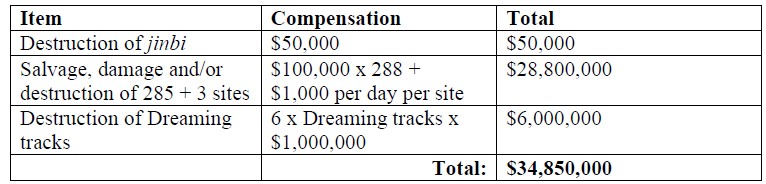
503 FMG submits that it is not clear why there should be extra compensation for the economic loss caused under this head of compensation when there is a claim for cultural loss which will be payable when applying Griffiths (No 3) at [234], [323] and that the assessment by YNAC of loss by reference to statutory penalties, in circumstances where the acts of FMG were lawful and authorised under Ministerial consent given under s 18(3) of the Aboriginal Heritage Act, is misconceived. If damage to and destruction of sites and Dreaming tracks is compensable as economic loss at all, FMG submits that no proper attempt has been made to value the “actual and objective loss experienced by all” as contemplated in the ALJ Article.
504 The State submits that the claim under compensation head (3) is not a form of economic loss but reflects the kinds of losses which (it accepts) may be considered in assessing cultural loss. By taking into account this head in assessing economic loss, YNAC offends the principle against double compensation, citing Griffiths HC at [105] (plurality). Otherwise, the State joins in challenging the methodology of YNAC in calculating compensation by reference to penalties awarded for contravention of the Aboriginal Heritage Act, rather than by reference to principles applicable to the award of compensation and says that there is no evidence before the Court that indicates that FMG have not complied with the requirements of that Act. It further disputes the factual basis for the claim in respect of damage and destruction to some of the six Dreaming tracks.
17.3.2 Consideration
505 The passage upon which YNAC relies in the ALJ Article is at p 843:
But it does not follow accepting that compensation is payable for this kind of loss, that “cultural loss” is wholly and only one-sided (from the perspective of the holders of the rights and interests) and non-economic.
As discussed, there is another potential aspect of “the sense of loss of connection to country suffered by the Claim Group”. It involves recognising that the sense of loss is not a mere “sense” (as in a perception or feeling) at all. That is, the loss is not merely subjective, experienced only by the holders of the native title. It involves an actual and objective loss experienced by all.
The proposition that a person need not share a culture for the person to accept that the continued existence, vitality and richness of the culture has economic value does not seem inherently radical. …
506 I accept that occasions may arise where an objective value of loss of culture may arise and that it is possible for it to sound in compensation within the context of economic rather than cultural loss. However, in my view that has not been established in the present case. The evidence upon which YNAC relies is examined in detail in my consideration of compensation for cultural loss. There, I accept that the damage and destruction of cultural and heritage sites is a powerful aspect of the subjective loss that the Yindjibarndi people have suffered as a result of the compensable acts. However, the evidence upon which YNAC relies does not serve to provide any point of distinction between a valuation as economic loss and loss for the same damage under the rubric of cultural loss. I note that the highpoint of the evidence is the agreed position of the archaeological experts that:
…the body of sites [within the Solomon Hub Project], collectively, is regionally significant and is able to contribute to nationally important issues in the field of First Nations Archaeology and specifically the occupation of the arid zone of Australia.
507 Other evidence relied upon by YNAC from the anthropologist, Dr Palmer, concerns the damage done to the same sites and the interruption of Dreaming tracks which overlap entirely with the claim for cultural loss and which is most appropriately addressed under that heading.
508 I accept that harm to a body of archaeological sites that are considered to be regionally significant as archaeological sites is capable of forming a part of economic loss insofar as it has a separately measurable economic value. However, then the question posed would be how to value any economic loss arising from the destruction of such sites. As a part of Australia’s archaeological record, they may be regarded as of some value, possibly significant value, but the assessment of economic loss does not have the impressionistic aspects that cultural loss permits. The solution offered by YNAC is a valuation calculated on a per site and per Dreaming track amount drawn from the amount of penalty that would be levied on FMG for breaches of the Aboriginal Heritage Act. No breach is alleged or has been proven. Such amounts are inherently punitive rather than compensatory. Absent further evidence to suggest a calculation, I am not able to put a figure on the economic loss that might arise from the destruction of a regionally significant body of archaeological sites within the Compensation Claim Area.
17.4 Psychological trauma (head (4))
17.4.1 The submissions
509 YNAC contends that the Yindjibarndi people are entitled to compensation for economic loss for the cost of psychological and other care arising from the trauma caused to them by the grant of the FMG tenements. This claim is based on the evidence of Dr Jeffrey Nelson who gives his opinion that the current division in the Yindjibarndi community includes costs for a psychological intervention strategy that includes administrative staff, psychologists, housing, travel and a healing centre. Based on his evidence, YNAC claims:
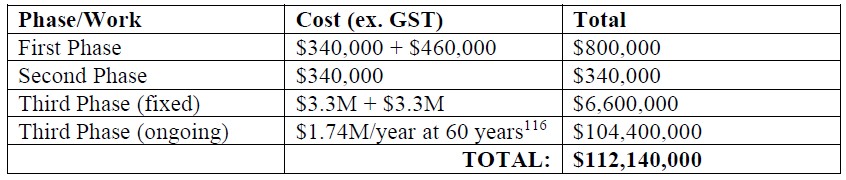
510 FMG submits that the psychological injury described by Dr Nelson is not a compensable economic loss.
511 The State submits that the loss claimed is not a compensable form of economic loss because it does not represent a loss referable to the rights of the Yindjibarndi people in relation to the land and waters as contemplated under s 223(1)(a)–(c) of the Native Title Act. It submits that for a number of reasons, in any event, Dr Nelson’s evidence should be afforded little weight and that he has no expertise in establishing such a health and wellbeing centre and therapeutic program and as such cannot accurately provide the estimates upon which YNAC relies. FMG makes similar submissions. It too challenges the veracity of the evidence of Dr Nelson in calculating the cost of the intervention strategy and his qualifications to provide such an estimate. FMG also notes that the claim includes $1.74 million per year for 60 years as “ongoing costs” and submits that such a figure that is unjustified.
17.4.2 Consideration
512 YNAC claims as a further head of economic loss the sum of $112,140,000 for care arising from the trauma caused to them by the grant of the FMG tenements. To the extent that this is compensable, in my view it too must be consigned to assessment under the heading of cultural loss. I address this, including the evidence of Dr Nelson, in further detail below.
17.5 Interest on the claim for economic loss (head (6))
17.5.1 Introduction
513 YNAC pleads that it is entitled to compound interest on compensation calculated from the date of the first compensable act up until the date when the determination of compensation is made: points of claim [46(d)]. The State and FMG contend that simple interest on compensation payable for economic loss is appropriate on the basis of s 51 of the Federal Court of Australia Act 1976 (Cth) and that it should be calculated at the rate set out in the Federal Court’s Interest on Judgments Practice Note (GPN-INT) (Interest Practice Note).
514 The essence of the submission advanced by YNAC is that the reasoning of the Court in Griffiths No 3 and also Griffiths HC permits, in suitable circumstances, an award of compound interest for economic loss, consistent with the observation of the High Court in Hungerfords v Walker [1989] HCA 8; 171 CLR 125 at [41] (Mason CJ and Wilson J). It relies on the evidence of Michael Woodley at [244]–[265] of his witness statement signed 5 June 2023 and annexures to this document being MW-67 and MW-68 to provide an evidentiary basis for the conclusion that compound interest should be awarded. It relies on the evidence of Mr Meaton to provide the calculation of interest based on its exchange value case. As I have rejected the exchange value case, it is unnecessary for me to consider the evidence of Mr Meaton.
17.5.2 The evidence
515 The evidence of Michael Woodley is directed to the commercial arrangements of organisations within the Yindjibarndi community. Michael Woodley manages and oversees the day-to-day operations of YNAC and also YAC. He is also the Chief Executive Officer of Yindjibarndi Nation Limited (YNL). YAC is the prescribed body corporate for the Yindjibarndi part of the Ngarluma Yindjibarndi determination and, as I have noted earlier, YNAC is the prescribed body corporate for the Determination in the present case. Michael Woodley is also chairperson of the Ngarluma Yindjibarndi Foundation Ltd, an organisation set up through an agreement between the Yindjibarndi people, Ngarluma people and Woodside Energy, in 1998.
516 Michael Woodley gives evidence that in August 2013, YAC, the Yindjibarndi #1 applicant and Rio Tinto entered into an agreement to permit Rio Tinto to put the Robe and Hamersley railway lines to go through Yindjibarndi country. During the course of negotiations, from 2011, the YAC board started working on a strategy for dealing with the benefits that were to come from Rio Tinto so that they could be used to generate wealth, jobs and training for the community. It developed a model called the “three Cs” that focusses on “community, culture and commercial” which ties in the Rio Tinto Agreement with the activities of YAC. A participation agreement (Rio Tinto Participation Agreement) between YAC, the Yindjibarndi #1 applicant and Rio Tinto was entered into in August 2013. Michael Woodley annexes a diagram of the structure setting out the “three Cs Principle” which depicts the scope of the organisational arrangements. In June 2014, YAC published an organisational prospectus that set out the three Cs model and the corporate structure that had by then been established and describes the activities contemplated.
517 Michael Woodley explains that money paid by Rio Tinto to YAC under the Rio Tinto Participation Agreement was paid into the Yindjibarndi People Community Trust and the Yindjibarndi Commercial Trust in fixed proportions. He explains that since 2013, the Yindjibarndi people have engaged in a number of commercial ventures which may be summarised as follows:
(1) Yurra Pty Ltd was established as a joint venture with Liam Wilson from Port Hedland. It began as a landscaping and ground maintenance business and has diversified and grown since then. It has been in operation for over 10 years and now employs 170 staff (one third of whom are Indigenous) and in the financial year ending 30 June 2022 earned revenue of $57 million. The business includes commercial cleaning, rail maintenance, civil construction and building construction and maintenance;
(2) In 2016, a joint venture between Yurra and Geraldton Building Services and Cabinets (GBSC) was established to re-develop the Victoria hotel site at Roebourne using an Indigenous training model including courses, traineeships, apprenticeships and employment. Of the approximately 30,000 hours worked on the site, more than 10,000 of those were performed by Indigenous people. The joint venture has since worked on other significant projects in the region, including the Walgu Park in Karratha. Yurra has acquired a majority interest in GBSC;
(3) In 2013, the Yindjibarndi people acquired the Victoria Hotel in Roebourne for $2.5 million through Yindjibarndi Wealth Pty Ltd (a commercial arm of their corporate structure). In 2016, the Yurra joint venture began refurbishing part of the hotel and building a modern addition. The project cost was $8.9 million funded in part by Federal and State Government grants. The amount of $4.5 million was funded from the Rio Tinto Participation Agreement. The new building called “The Ganalili Centre” resulting from this project was opened in September 2019. At the time of his statement, construction was underway on the Ganalili Accommodation and Training Facility;
(4) In 2021, the Yindjibarndi people and Rio Tinto began to modernise their arrangements and entered into a new agreement in 2022. Under it, Rio Tinto is to pay the Yindjibarndi people $20 million per year for 10 years. In a newsletter published to the Yindjibarndi people in April 2023, YAC and YNAC described how the funds are to be distributed, to both Yindjibarndi Community and Commercial Ltd (YCCL) and Yindjibarndi Nation Limited (Management & Delivery) (YNL). The money received by YCCL (after $1 million is repaid to Rio Tinto for a loan monies owed) funds both: a community trust that goes to future funds and community distribution; and a Yindjibarndi Capital and Wealth Trust. Monies received by YNL were to be distributed to support a range of programs, projects and new initiatives that cover the three Cs Principle.
(5) Included in the newsletter is a summary of the community interactions and the commercial activities conducted by YAC and YNAC. The reference on the right hand side to “Yurra” concern the commercial activities of Yurra Pty Ltd. The reference to “car hire” is to a franchise operation for car rental operated in Karratha and Port Hedland with new operations planned. The reference to “water” and “Yiyangu” are described by Mr Woodley as early-stage projects in water and renewable energy.
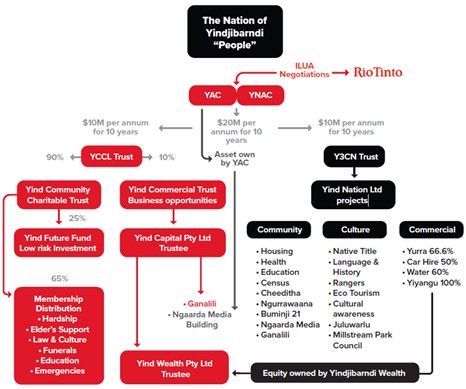
17.5.3 Consideration
518 In Griffiths (No 3), Mansfield J concluded that the Court could award compound interest on the market value of the notional sale value of the native title rights and interests if the claim group demonstrated that it would have applied the funds received as compensation “as working capital in a business or trade and that business or trade would have been successful to a significant degree” (emphasis added): at [253]. Such interest would be awarded if the Court decided that it was appropriate to secure fair compensation or compensation on just terms, on the basis that interest is awarded as part of the compensation: at [252], [254]. His Honour was not persuaded that the evidence supported a finding that the native title holders would either have invested the money on a compound basis (at either “superannuation” or “risk-free” rates) or in any enterprise which would have longer term been productive of economic earnings at sufficient levels to deviate from an award of simple interest: at [275]. Although there was evidence of commercial activity, his Honour was not persuaded that the claim group, if they had received the market value of the land when their native title rights were affected by the compensable acts, would have used those monies by investing them without any expenditure, accumulating the interest year by year, to the present time or alternatively, used the monies so received to undertake a commercial activity which would have been profitable to the same or a greater degree: at [277].
519 In Griffiths FC, the Full Court observed that the primary judge’s findings in this regard were not challenged, noting that his decision may not have been the conclusion that they reached: at [209].
520 In Griffiths HC the plurality considered, without deciding, that it may be that an award of compound interest would be warranted to compensate for the lost opportunity of investment or to defray the costs of doing business, by analogy with damages awarded at common law to compensate for expenses incurred or opportunity costs arising from moneys paid away or withheld as a result of breach of contract or negligence. However, it noted that there was “sparse” evidence that the claim group would have invested the compensation at a profit and no sufficient that the claim group incurred costs that could have been avoided with the aid of an earlier payment of the compensation: at [133], see also Edelman J at [341].
521 On the basis of the reasoning of the Courts in Griffiths, it is apparent that the point of principle is not settled.
522 In Wallersteiner v Moir (No 2) [1975] 2 WLR 389 at pp 393–394 (as cited by Mansfield J in Griffiths (No 3)), Lord Denning said the following regarding the grant of compound interest:
On general principles I think it should be presumed that the company (had it not been deprived of the money) would have made the most beneficial use open to it: cf Armory v. Delamirie (1723) 1 Stra. 505. It may be that the company would have used it in its own trading operations; or that it would have used it to help its subsidiaries.
523 Scarman LJ further notes at p 410:
The question whether the interest to be awarded should be simple or compound depends upon evidence as to what the accounting party has, or is to be presumed to have done with the money. As Lord Hatherley L.C. said in Burdick v. Garrick, 5 Ch.App.233, 241:
“the court does not proceed against an accounting party by way of punishing him for making use of the plaintiff’s money by directing rests, or payment of compound interest, but proceeds upon this principle, either that he has made, or has put himself into such a position as that he is presumed to have made, 5 per cent., or compound interest, as the case may be.”
524 The evidence of Michael Woodley, I accept, does not provide a complete accounting record of investments made and their yield. However, it does demonstrate that YNAC is part of a group of companies that is and has been actively engaged in corporate activity with an investment strategy that puts its funds into mixed assets including business activities and cash reserves held on trust. One of its business is Yurra. The Yindjibarndi people via Yindjibardni Wealth own 66.7% of Yurra via its commercial trust. Yurra in turn owns 75% of GBSC Yurra. Yurra generated an income of $57 million in the financial year ending 30 June 2022. There are plans to integrate Yurra and GBSC businesses into a multidisciplinary contracting and services group with a target revenue of over $200 million per year. The flowchart indicates that monies earned from businesses such as Yurra are subsequently invested into the Yindjibarni Wealth Pty Ltd. I am satisfied that YNAC would have used the funds to the most beneficial effect open to them and would not simply have applied them to an interest bearing account. Accordingly, I am satisfied that YNAC is entitled to compound interest on the economic loss compensation amount, calculated from the date of each of the future acts.
18. THE EXPERT VALUATION EVIDENCE
18.1 Introduction
525 In the dispute regarding the assessment of economic loss YNAC called two expert witnesses and FMG relied on the evidence of three. All were cross-examined. I found these witnesses to be attentive and careful, each doing their best to assist the court. Below, I summarise the effect of their written evidence.
18.2 The YNAC expert reports
18.2.1 Murray Meaton
526 Murray Meaton AM is a minerals economist. He holds a Bachelor of Science in Agriculture and a Bachelor of Economics. In the 1970s and 1980s, he held various research and policy positions in government, including as a policy economist for the Department of Agriculture of Western Australia from 1978 to 1982 and 1984 to 1986. From 1987 until 1996, he was Director of the Department of Minerals and Energy. Since 1997, he has participated in over 200 negotiations between traditional owners and mining companies concerning land access, minerals, oil and gas, acting for both sides of the ledger.
527 Mr Meaton gave two reports, dated 22 March 2023 and 15 October 2024 and three joint expert reports, one with Mr Hall and two with Mr Jaski. Mr Meaton’s first report contains his substantive expert opinion evidence. In his second report, Mr Meaton responds to a request asked to prepare a compound interest calculation based on the agreed sales revenues for historic and forecast production from the FMG tenements within the Compensation Claim Area.
528 Mr Meaton joined with Mr Jaski in the preparation two joint reports dated 22 March 2024 and 1 October 2024 and a joint report with Mr Hall dated 22 March 2024 (Hall/Meaton JER).The 1 October 2024 joint report, was prepared based on the assumption (contrary to Mr Jaski’s view) that a royalty payment based on the value of the iron ore produced in the Solomon Hub Project is appropriate. Mr Jaski’s preferred approach is explained below. Mr Meaton gave concurrent evidence separately with each of Mr Hall and Mr Jaski, during which he was cross-examined.
529 In his first individual report, Mr Meaton said that his consulting business, Economics Consulting Services, was engaged to provide advice on the royalty rates that other mining producers pay as a matter of course to Indigenous groups in the Pilbara and elsewhere to obtain their consent to mining activities on land where those Indigenous groups possess or assert that they possess native title rights and interests. More specifically, he was asked to provide his opinion, based on desktop research, as to how much revenue FMG had derived from the Solomon Hub mine, the proportion of that mine which is on the Determination Area and how much further revenue it could expect to derive from that mine for its life.
530 Mr Meaton relied on figures from various reports prepared by FMG and consulting firm Wood Mackenzie to project the future production of the Solomon Hub Project. By overlaying maps of ground disturbance caused by the Solomon Hub Project on a map of the Determination Area, Mr Meaton estimated that 55% of the surface area of the ground disturbance caused by the Solomon Hub Project fell within the Determination Area. Based on the figures then available to him, Mr Meaton provided an estimate of the total production to date of the Solomon Hub Project and a forecast of future production.
531 He also considered iron ore prices and revenue, informed by reports prepared by FMG. Future prices and exchange rates were forecast using data from the Australian Government Office of the Chief Economist.
532 Mr Meaton was next asked, in the event that FMG had reached an agreement with the Yindjibarndi people for payment of royalties in accordance with any common or standard practice for such agreements in the Pilbara, what would the approximate value of the royalty component of that agreement be to the Yindjibarndi people in monetary terms?
533 In answer, Mr Meaton considered his involvement in negotiations between indigenous owners and mining companies and the royalty rates of which he was aware that had been negotiated in agreements between the holders of native title rights and interests (and claimants for such rights and interests) on the one hand, and mining companies on the other, seeking permission for future acts under the Native Title Act. He said that such agreements mostly include a mix of benefits for the indigenous claimants consisting of: (a) royalties based on the value of minerals sold; (b) fixed cash payments; (c) employment and training opportunities; and (d) business development assistance and in his opinion a negotiated mining agreement in respect of the Compensation Claim Area would include a mix of all of these benefits.
534 In his report, he says that he has been involved in native title negotiations since 2004 and he has accumulated financial details of over 100 future mining agreements, 44 of which are iron ore projects. He gives evidence that he selected from his records 38 such agreements, negotiated between 2006 and 2021, located in the Pilbara, where the mines concerned were for the extraction of iron ore and manganese. I refer to these below as subdivision P Agreements. These subdivision P Agreements applied to land under a registered claim or with determined non-exclusive native title rights, but none applied to land with determined exclusive native title rights. Based on his understanding of these agreements, he gave the opinion that royalty rates agreed between Indigenous owners and miners have ranged from 0.05% to 1.0% of the sales revenue. He said that the average rate is 0.55% of the FOB sales revenue, with the most common rate in the Pilbara “by far” being 0.5%.
535 In Appendix C to his report, Mr Meaton explains that he has calculated an average royalty rate agreed in the Pilbara region based on the subdivision P Agreements, which he says were executed between 2006 and 2020. He says that close to 60% of projects fell in the range of 0.50% to 0.60% based on the FOB sale value of the iron ore, and notes that the rate of 0.50% has been publicly quoted as that used by Rio Tinto. He also notes that projects with long mine lives and scale can provide a wider range of benefits including more employment and business opportunities than smaller projects.
536 Mr Meaton was asked to assume that the value of exclusive native title rights and interests equates to 100% of the value of an unencumbered freehold estate and non-exclusive native title rights and interests equate to 50% of those interests, based on Griffiths HC; plurality at [107], Gageler J at [241], [294]. Noting that the subdivision P Agreements only included land under a registered claim or with determined non-exclusive native rights, he then expressed the following conclusion:
Given the relationship assumed between exclusive and non-exclusive rights, Economics Consulting Services considers that the 0.5% royalty rate most commonly used in the iron ore sector should be increased to 1% for Traditional Owners who have firstly, had their rights recognised in a determination and secondly, those determined rights include a right of exclusive possession.
(Emphasis added)
537 Relying on the reasoning in Griffiths HC, which will be further explored in section 18.3 he calculates simple interest on the basis that the Yindjibarndi people have been deprived of royalty payments since production commenced. Interest was calculated using methodology and rates published in the now revoked Federal Court’s Practice Note CM 16 Pre-Judgment Interest (PN CM16), being the Practice Note that applied when production from the Solomon Hub mine commenced. Simple interest was calculated for each six-month period starting from the next half year in which the compensation was payable.
538 Mr Meaton then proceeded to place a dollar value on those royalties, based on the figures that he had been provided. Those figures were subsequently updated. YNAC, the State and FMG agreed that up to 30 June 2023, the State has received [REDACTED] in royalties from that portion of the Solomon Hub Project that falls within the Compensation Claim Area. Production data was produced on discovery by FMG in April 2024. Mr Meaton and Mr Jaski prepared their 1 October 2024 report based on the updated information. Although the underlying data relied upon in the production of the 1 October 2024 report was not tendered, no objection was taken to their report and Mr Meaton and Mr Jaski were not cross-examined about it. That report sets out the figures proposed by Mr Meaton, based on calculations of royalties at 0.55% of the FOB sales value of historical and future iron ore extracted from the Compensation Claim Area (being Mr Miles’ valuation as the appropriate royalty rate) and 1.0% (being Mr Meaton’s valuation as the appropriate royalty rate).
539 Following this, in his second report Mr Meaton was asked to prepare a compound interest calculation in the event that the applicant establishes that compound interest ought to apply to compensation awarded. Interest calculations were provided based upon royalty rates of 0.55% and 1.0% of the FOB sales value.
540 The final tables displaying interest calculations implementing simple and compound interest from Mr Meaton’s second report are as follows:
[REDACTED]
18.2.2 Mr Miles
541 Brian Miles has been working in real estate as a valuer since the 1970’s, including seven years as a licensed real estate agent and salesman, and has specialised since that time in valuing broad acre rural property in Western Australia, residential commercial and industrial properties and pastoral, plant and machinery and businesses.
542 Mr Miles provided two expert reports, one dated 31 January 2024 entitled “Valuation Report, Yindjibarndi country, Hamersley Road, Mount Sheila, WA 6751” (Miles report) and the other dated 18 March 2024, entitled “Applicant’s expert valuer’s short response to the FMG Respondents’ expert valuation reports”. He cooperated with Mr Hall in the preparation of a joint expert report dated 22 March 2024 (Miles/Hall JER) and with Mr Jaski in the preparation of a joint expert report dated 22 March 2024 (Miles/Jaski JER) and gave concurrent oral evidence with both of those witnesses during which he was cross-examined.
543 Mr Miles was instructed that YNAC holds in trust for the Yindjibarndi people the native title rights and interests in the Determination Area and that it holds those rights exclusively in the exclusive area. He was referred to the FMG tenements and informed that the native title rights and interests have been diminished by the grant of those tenements and by the activities carried out under them. He was asked to assume a number of matters going to: the life of the Solomon Hub Project; production levels of iron ore from the Solomon Hub Project; that the grant of the FMG tenements has caused and will continue to cause significant physical interference with the Yindjibarndi people’s rights of occupation, use and enjoyment of the land; and, that there is a common or standard practice for miners to enter into compensation agreements (that mostly include a mix of benefits) with native title parties to secure their consent to mining activities on land and waters where the native title party either possesses, or asserts that they possess, native title rights and interests. Mr Miles was further asked to assume that those agreements include royalties payable based on the FOB price at Port Hedland with a range from 0.05% to 1.5% of the FOB sales revenue. Mr Miles was provided with an explanation of key principles emerging from Griffiths HC, the compensation provisions in the Native Title Act and s 123 of the Mining Act as well as subdivision P of the Native Title Ac.
544 Mr Miles was asked to write a report giving his opinion as a valuer as to the “highest and best use of the land” the subject of the FMG tenements and what would be a reasonable method for assessing the economic loss component of the compensation payable to the Yindjibarndi people by either FMG or the State. He was asked in particular whether a fair and reasonable method of valuing economic loss would be by reference to the royalties which miners in the Pilbara commonly agree to pay native title parties in return for their consent to mining on their traditional lands and waters.
545 In answer, Mr Miles considers that the highest and best use of the Determination Area is as the traditional country of the Yindjibarndi people with this not being comparable to the use of pastoral land by pastoralists. He says that the best available measure of value of the native title rights and interests is what other native title holders have agreed to accept for the impact of mining on the exercise and enjoyment of equivalent native title rights and interests, in a context where compensation to landholders for the impact of mining in Western Australia is almost always resolved by agreement. He calculates this by reference to an annual royalty likely to be agreed between FMG or the State and the Yindjibarndi people which he calculates to be based on a “lost royalty cash flow” or “compensation royalty” going into the future based on a rate of 0.55%. In his second report, Mr Miles explains that he assessed the highest and best value of the land based on the indications of the value of the Yindjibarndi people’s rights to use the land for traditional purposes, which he inferred from the amounts which other indigenous groups in the same region had received to allow their own rights to be supressed and their country damaged.
546 Mr Miles provided his valuation as an “overall practical approach” based on the mining activity in the Solomon Hub Project being in full operation from 2012. Mr Miles notes in his report that whilst Mr Jaski and Mr Preston consider that the valuation date is the date of the grant of each of the FMG tenements, he made a general estimate of the past, current and future mining in the Determination Area to which exclusive native title applies. He accepted that this is less precise, but in his opinion is a fair and reasonable basis of how compensation should be considered.
547 Mr Miles adopts an approach wherein the expected cashflow based on the 0.55% royalty from 2024 to 2045 was discounted back to present value using a suitable discount factor and margin within the range of 17% to 22%, ultimately adopting a 20% discount factor over the 17 years to 2045. This method produced a figure of $480,000,000 comprising $350,000,000 for lost royalties from 2013 to 2022 and $130,000,000 for future discounted royalties from 2023 to 2040. Whilst Mr Miles notes that mining is estimated to be completed in 2037, he calculates royalties until 2040, noting that he was asked to assume that the production of iron ore from the Solomon Hub Project may extend beyond 2040, an inference based upon information within FMG’s Mine Closure Plan. Further to this, Mr Miles incorporated a re-investment rate of 2.5% for the royalties over the 9 years from 2013 to 2022.
548 Mr Miles gives evidence that in his experience, where mining companies have purchased entire freehold properties for mining purposes, including surrounding lands, a premium value is paid. In his opinion, this premium value could reflect one and a half times the normal agricultural value of the freehold land, if not more. If the freehold land was owned as part of “old system title” that predates 1 January 1899 in Western Australia, then under the Mining Act payment of all rents and royalties received by the Crown less one-tenth to the owner of the freehold parcel would apply: Mining Act ss 37(1), 38(2). He expresses the view that given that the Yindjibarndi people’s native title rights and interests have been determined to have been in existence since well before January 1899, it might be argued that the Yindjibarndi people should be paid on the same basis. He expresses the view that if terms of compensation for loss and damage to the subject land for mining activities does not include payments of a royalty commonly paid by miners in the Pilbara, he would not consider that just terms compensation had been provided, deeming any valuation based on the freehold value of pastoral lease property as not appropriate as in his view this is not equivalent to either freehold or native title rights and interests.
18.3 The FMG expert reports
18.3.1 Mr Hall and Mr Lonergan
549 Martin Hall is a director at Lonergan Edwards & Associates, a valuation firm. He and another director of the same firm, Wayne Lonergan, were engaged by the solicitors for FMG to provide an expert valuation report in relation to the compensation claim and together provided a report dated 5 March 2024 (Hall/Lonergan report). Mr Hall holds a Bachelor of Science degree in mathematics and is a qualified actuary. From 1982 until 2002, he acquired experience in insurance, superannuation and asset-liability management. Since 2002, he has been a director at Lonergan Edwards & Associates. Wayne Lonergan holds a Doctor of Science in Economics from the University of Sydney, where he is an Adjunct Professor in the Faculty of Economics and Business, School of Business, and is a founding director of Lonergan Edwards & Associates, which commenced its operations in 2000. Prior to this, he was a corporate finance partner at Coopers & Lybrand (now PricewaterhouseCoopers). Cumulatively, he has over 46 years of experience in corporate finance and valuations.
550 At my direction, only one author of the Hall/Lonergan report was invited to give concurrent evidence at the hearing and FMG nominated Mr Hall. He was involved in the preparation of two joint reports with Mr Meaton, as well in the Miles/Hall JER and gave oral evidence with Mr Meaton and Mr Hall during which he was cross-examined.
551 In the Hall/Lonergan report, the authors record that they were asked five questions. The first and second concerned how the entitlement in s 51 of the Native Title Act to compensate on just terms the native title holders for any loss, diminution, impairment or effect of the grant of the FMG mining tenements on the native title rights and interests of the Yindjibarndi people should be calculated and to provide their calculation of such compensation. The third and fourth concerned the method of calculating non-economic or cultural loss and how such loss should be determined. The authors conclude that this calculation is outside their expertise. The fifth invited response to the reports of Mr Meaton and Mr Miles.
552 The Hall/Lonergan report proposes a framework for the assessment of compensation which, in summary, involves the incorporation of the following steps: (a) assessing the expected extent and timing of interruption to native title economic usage; (b) quantifying the actual loss of cash flow by period; (c) calculating the present value of those economic losses; (d) applying the Mining Act principle of compensating for the value lost (pursuant to s 123(4)(a)); (e) applying a cap of the freehold land value (pursuant to s 51A of the Native Title Act); and (f) adding interest at Court rates from the date of loss to the payment date.
553 As part of their report they consider Griffiths HC. They express the view that prior negotiated agreements between mining companies and native title rights holders over compensation for infringement of native title rights and interests are not reliable indicators of market value for a number of reasons being:
(a) each negotiation relates to different losses and circumstances;
(b) there is likely to be an element of “anxiety” on the part of the miner over delays in commencing mining operations can have large adverse economic consequences. That anxiety diminishes when an agreement (I interpolate, under subdivision P) is not reached and the delays are fully incurred;
(c) mining agreements are likely to include an element of “public relations” for the mining company;
(d) many of the negotiations occurred prior to mining, so there would have been an element of shared risk if the project did not proceed;
(e) the native title rights and interests do not include any rights in relation to minerals, as noted in the Determination, and so compensation for their value cannot be related to the loss incurred as a result of infringement of their rights; and
(f) there is little or no information publicly available to assess the nature or value of the rights for other claim groups or and the hypothetical impact that the relevant mining tenements in question would have on those rights as compared to the rights in this case.
554 They ultimately conclude that the present value of exclusive use of the native title rights and interests will equal the loss as if it were freehold land, converging towards full freehold land market value loss in perpetuity. For non-exclusive native title rights and interests, the authors give the opinion that the value will be significantly less than 50% of the freehold land market value, because the non-exclusive rights afforded by the Determination are such that the native title group would have limited access or control over the valuable economic uses of the land and as such this would generate little or no economic benefit.
555 In response to the question as to whether they could calculate compensation, they noted that they were not able to reliably estimate compensation arising from the infringement to native title rights in this case as they did not have reliable information about the net market rent for the relevant land, nor information regarding the economic benefits arising each year from the non-exclusive native title rights.
18.3.2 Mr Preston
556 Gregory Preston is a valuer and the chair and managing director of Preston Rowe Paterson, a valuation firm that he established in 1988. He has been working in real estate since 1979.
557 Mr Preston prepared a valuation report dated 5 March 2024 and subsequently swore an affidavit dated 27 March 2024 which rectified some calculations that he had made. He was cross-examined. He was a careful witness who was prepared to make concessions. He accepted that whilst his report gives an opinion on the value of pastoral property, he had no experience in valuing such properties in his resume, had never valued a pastoral property in Western Australia and in his long career may have valued six such properties in 42 years. Even so, no evidence was filed in answer to Mr Preston’s valuation and no submission was advanced to suggest that he was not qualified to give the valuation evidence in his report. I accept his evidence.
558 Mr Preston was asked to provide a valuation per hectare of the land the subject of the FMG tenements insofar as they are located within the Determination Area. For that purpose, he was provided with a spreadsheet from FMG titled “20230821 FMG Tenement Data and EL Overlap Change Analysis.xlsx”, which he relied upon to determine the area in hectares of each of the FMG tenements. He was also provided with maps identifying the location of each of those tenements. In addition, Mr Preston was provided with explanations of the compensation provisions in the Native Title Act and s 123 of the Mining Act, as well as s 241 of the Land Administration Act 1997 (WA).
559 Mr Preston conducted an analysis of the degree to which the FMG tenements overlap with the Determination Area and concluded that the total area within the Determination Area is about 89,155.9 hectares. He valued each tenement as if it was compulsorily acquired at the date of its grant as if it was freehold. In preparing his report Mr Preston assumed that the land the subject of the FMG tenements does not include any right to or interest in any mineral in, on or under the surface of the land, nor did it include any right to any rent, royalty or other amount in respect of the mining of any such mineral from the land the subject of those tenements. He considers that the fundamental question for him to answer is:
…what would have been payable for the land the subject of each of the FMG tenements if that land had instead been compulsorily acquired by the State at the time of each of the FMG tenements were granted, assuming a freehold estate in the land was instead compulsorily acquired?
560 His approach and conclusions may be summarised as follows:
(1) the highest and best use of the land as freehold is for rural purposes, consistent with its zoning;
(2) sales of pastoral leaseholds in the area provide appropriate comparable values. In addition to reviewing the boundaries of the Determination Area by helicopter, he considered the sale of 13 pastoral leaseholds within the Pilbara region between 2007 and 2022 for the purpose of focussing on central and eastern Pilbara rather than coastal pastoral leases which, as a result of their location, are closer to the main highway network and tourist facilities (this proximity meaning that coastal pastoral leases have a higher sales rate per hectare);
(3) sales were analysed on an improved basis with adjustments undertaken for time. He firstly adjusted the sales to a common date of 31 October 2023 (being the date that the valuation was prepared) and then adjusted this back to the commencement date of each tenement;
(4) for central and eastern Pilbara sales the unadjusted sales rates (ie assessed as at the commencement date of each tenement) per hectare range from $8.50 to $26.62 per hectare. When adjusted to a common date of 31 October 2023, the sales rates per hectare range from $2 to $367;
(5) the present value of the pastoral lease rental payable to the Western Australian Government should be added to the sale value;
(6) further adjustments were made accounting for the terrain, vegetation and rainfall of the FMG tenements, making assessments of the vegetation of the relevant tenements with the use of satellite imagery and inspections of the land by helicopter. Land with poorer vegetation was deemed to be of lesser pastoral value, whereas better vegetated land was attributed a higher value, in line with inland Pilbara sales;
(7) adopting a valuation per hectare of between $5.14 and $21.35, he concluded that cumulative market value of the FMG tenements insofar as they overlap with the Determination Area may be valued and in his report gives the total of $780,402. In a schedule to his report he gives the total as $800,873. On the basis of the information in the report, it is difficult to reconcile these figures.
561 In cross-examination, Mr Preston was asked about his understanding of what is “freehold land” and indicated that he understood that this is the land excluding minerals, these usually being reserved to the Crown. It was on that basis that he had provided his valuation. He accepted that if the valuation needs to take into account any minerals on it, this would have been a different exercise. He would have to take into account the present cashflow, any special value, severance and solatium.
562 Mr Preston was asked about his consideration of “highest and best value” and accepted that it reflects the potential for financial reward. He was taken to page 86 of his report and the zoning table for the Ashburton Shire where the zoning of the land the subject of his valuation was listed. In the report, most of the land the subject of the Compensation Claim Area is zoned as rural. Within that rural zoning, it is noted that one such permitted use for rural land is “extractive”, which Mr Preston in oral evidence accepted is a reference to mining. Mr Preston gave evidence that this was a discretionary use that would depend on approvals but accepted that given that for the Compensation Claim Area it was known that such approval had been granted.
563 Further, when questioned about the adjustments he made regarding the vegetation of the FMG tenements, Mr Preston did accept that given the sporadic rainfall in the Pilbara, the amount of vegetation in the tenements could change from month to month.
18.3.3 Mr Jaski
564 Campbell Jaski is a partner in the Corporate Value Advisory practice of PricewaterhouseCoopers Australia Partnership. He holds a Bachelor of Science (Geology), a Master of Business Administration and is an accredited business valuation specialist with the Chartered Accountants Australia and New Zealand. He began his career as a geologist working for what is now Rio Tinto Ltd from 1992 until 2004, before taking various managerial roles in the mining industry. Since about 2008, he has specialised in the valuation of businesses, shares and intangible assets, such as mineral rights, water rights and mining royalties. Mr Jaski estimates that he has prepared more than 400 expert reports and given evidence concerning mining, valuation and quantum matters in a range of legal proceedings.
565 Mr Jaski prepared an expert report dated 5 March 2024, cooperated with Mr Meaton in the provision of two joint reports dated 22 March 2024 and 1 October 2024 report and with Mr Miles in the preparation of a joint report dated 22 March 2024. Mr Jaski gave oral evidence during which he was cross-examined.
566 In his expert report, Mr Jaski responds to questions asked by the solicitors representing FMG. He was asked how to determine and calculate compensation on just terms pursuant to s 51(1) of the Native Title Act, as well as the determination of compensation required by s 51(3). In this regard, he was asked to consider the legislative framework concerning the determination of native title compensation set out in the Native Title Act and the Mining Act. His attention was also drawn to the reasoning in Griffiths HC and the decision in State of Western Australia v Brown [2014] HCA 8; 253 CLR 507. He was also asked to calculate a range of compensation for economic loss based on these matters. He was also invited to comment of the expert reports of Mr Meaton and Mr Miles and was asked to calculate the amount of compensation that would be payable if all of the land underlying the FMG tenements was valued at $21.35 per hectare, that being the upper value of the land valued by Mr Preston.
567 In answer, Mr Jaski recognised the bifurcated compensation approach employed in Griffiths HC separating compensation for economic loss and cultural loss and acknowledged that he is not qualified to provide an opinion in relation to cultural loss. In relation to economic loss, he refers to s 51(3) of the Native Title Act and s 123 of the Mining Act and then, in summary, addresses the following matters.
568 First, relying on Griffiths HC at [56] (plurality) he considers that the appropriate valuation date is the date of the grant of each of the separate FMG tenements, being dates ranging from 2 June 2007 for the earliest exploration licences until 11 August 2021 for the most recent of the prospecting licences.
569 Secondly, he relied upon the expert report of Mr Preston in the determination of the freehold value of the land the subject of the FMG tenements as at their grant date.
570 Thirdly, he considered the rights and interests of the Yindjibarndi people by reference to the Determination in Warrie (No 2), recognising the distinction between exclusive and non-exclusive rights. He was asked to consider his valuation on the basis of two scenarios. In the first, he was asked to consider that the exclusive rights have been extinguished and in the second, they have not.
571 In relation to the second scenario, Mr Jaski considers that exclusive rights confer a right of exclusive possession and equate to the rights of “owners”. Mr Jaski says that it is his opinion the Yindjibarndi non-exclusive rights should be considered to be perpetual and valuable but essentially usufructuary, ceremonial and non-exclusive, conveying a right or liberty to occupy the land, but being devoid of the right of admission, exclusion and commercial exploitation, equating these rights to that of “occupiers”. He refers to Griffiths HC at [106] (plurality), and notes that the relevant non-exclusive rights in that proceeding were found to be worth “no more than 50 per cent” of the freehold value of the land.
572 On that basis, relying on the reasoning in Griffiths HC at [3], [106] (plurality) Mr Jaski considers that the objective economic value of the exclusive native title rights and interests in the Compensation Claim Area equate to the objective economic value of an unencumbered freehold estate in that land whereas the non-exclusive rights equate to a maximum of 50% of the that unencumbered freehold value. In his report he refers to this as a “rights and interests factor”.
573 Fourthly, he applies an “impairment factor”, which is a measure that adjusts the economic value of the native title rights and interests based upon the impact that the granting of each of the FMG tenements has had on these native title rights and interests. He groups the FMG tenements into six categories being: (1) mining leases; (2) power plant licences; (3) railway licence; (4) alleged water management licences (the miscellaneous licences that are not the power plant licences or railway licence, being the subject of discussion in section 7); (5) exploration licences; and (6) prospecting licences.
574 Mr Jaski assesses the impairment factor by taking consideration of: the mining activities that have already taken place on each of the FMG tenements (including the associated infrastructure) and may take place in the future; his own experience in managing exploration programs and operating mine sites and how this may impact the land and the rights and interests of native title holders; the FMG Infrastructure Document that provides details of the infrastructure located across the Solomon Hub Project; and the affidavits of Stuart Badock and Christopher Oppenheim who provide details of FMG’s activities and infrastructure within the Solomon Hub Project.
575 Based on this information, Mr Jaski considers, as a percentage range, the impairment factor appliable for each category of FMG tenement proposing a lowest and highest impairment factor for each category of tenement as set out in the following table:
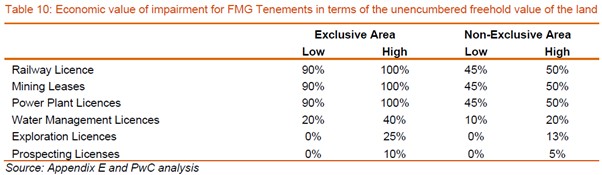
The percentages in the non-exclusive area columns reflect Mr Jaski’s assumption that the Yindjibarndi non-exclusive rights are to be valued at 50% of the freehold value of the land.
576 Fifthly, Mr Jaski considered the freehold value of the land as determined by Mr Preston, broken down by reference to the hectares applicable to each FMG tenement. Mr Jaski’s approach was to count any overlapping area once and for that overlapping area to apply the higher of the two tenements’ impairment factor, which as he says results in the higher of the two potential compensation amounts for that overlapping land.
577 Mr Jaski was provided with an Excel workbook by FMG entitled “FMG Tenement Workbook” demonstrating areas of overlap between the FMG tenements in the Determination Area. Mr Jaski was instructed that this workbook should be preferred over the applicant’s area figures contained within their compensation application and the State’s area figures contained in Annexure A of their amended points of response, filed 14 July 2023. He notes that the figures vary between these documents because the applicant’s and the State’s figures do not take into account where a tenement is partially held by a non-FMG entity, so that area by FMG’s calculations should be excluded. In addition to this Mr Jaski relied upon geographical figures and maps covering each FMG tenement, as detailed in Mr Preston’s valuation report and visually inspected the area overlaps. Mr Jaski accepts that this is not a perfect method and estimated that approximately 5% of his overlapping calculations may be the subject of conjecture, which I assume to mean that he allowed for a 5% margin of error. As part of this section, he notes that excluding overlapping land, the net Compensation Claim Area excluding overlapping land is 56,313 hectares, of which 23,979 hectares is land to which the Yindjibarndi people have exclusive rights, and 32,334 hectares is land to which the Yindjibarndi people have non-exclusive rights.
578 Sixthly, Mr Jaski takes into account the temporary nature of the impairment of the native title rights and interests implementing a “deprival factor”, noting that the FMG tenements are granted for a fixed period of time, with the potential for extensions, rather than being instances of permanent impairment or extinguishment of those rights and interest. He notes that this is a relevant further consideration in this case given that in Griffiths HC, the non-exclusive native title rights were extinguished. He says that this is a complicated task to perform and in order to determine this applies a concept in corporate finance and valuation theory known as the “time value of money”. This theory is the recognition that a dollar today is worth more than a dollar in the future because of inflation and the opportunity cost to invest that dollar and earn a return. If this dollar was to be invested it has the potential to earn a return on that investment over time. He uses this “time value of money” theory with the expected or required rate of return to determine the appropriate deprival factor.
579 Mr Jaski notes that this is an imperfect exercise, given the land within the Determination Area has limited commercial or economic potential based upon its composition and remote location and said he was unable to find direct evidence of the required returns of either the land the subject of the FMG tenements or comparable land. In his report, he summarised the approximate range of the required rates of return for a variety of property assets in Australia based on his own experience. This is set out in the table below. In light of the general property ranges in this table, Mr Jaski undertook his loss assessment using a 5% required rate of return and a 10% required rate of return.
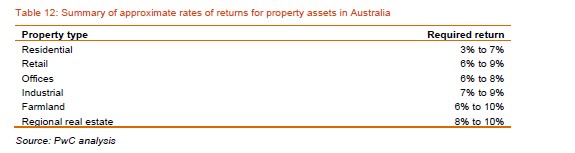
580 In addition, Mr Jaski considered the requirements of the conditions set out in the FMG tenements for FMG to rehabilitate the land. He considers that even if rehabilitation does not return the land to its pristine condition prior to the grant of the FMG Tenements, any legacy effects from mining after they have been surrendered or lapse will not materially affect its economic value. However, he considers it necessary to consider the impact on the economic value of the native title rights and interests that arise from the temporary impairment of those rights. He formulated a range of deprival factors for each of the FMG tenements which he applied to the respective unencumbered freehold value of the land.
581 Seventhly, Mr Jaski calculated simple interest to reflect the time value between when the entitlement to compensation arose (being the grant date of each FMG tenement) and 30 June 2023, which he gave as a proxy date for the date of judgment in these proceedings. He relies upon Griffiths HC (plurality at [3], [133], Edelman J at [255]), as authority that simple interest should be awarded.
582 In the result, Mr Jaski gives a range for economic loss plus simple interest for the Compensation Claim Area as being between $83,259 and $248,659 (dependent on the impairment and deprival factors) and, on the assumption that there are no exclusive native title rights and interests in respect of the Compensation Claim Area, in the range from $53,264 to $161,203.
583 Mr Jaski also responded to each of Mr Meaton’s report and Mr Miles’ report.
18.4 Summary of the differences between the experts
584 In their joint expert reports and oral evidence, the experts articulated their points of difference. Their differences often concerned different interpretations of Griffiths HC and the terms of the compensation provisions of the Native Title Act as well as the effect of subdivision P concerning the right to negotiate. For obvious reasons, none of these experts was able to resolve the legal question as to the appropriate mechanism for determining compensation for economic loss.
18.4.1 Hall and Meaton
585 Mr Hall and Mr Meaton fundamentally differed as to methodology, based on their respective views as to the legal landscape.
586 Mr Hall considers that the reasoning in Griffith HC mandates that the economic value unimpaired of the exclusive native title rights and interests of the Yindjibarndi people is the same as the freehold land value, with economic loss compensation to reflect that, with economic loss compensation somewhat less where non-exclusive rights apply. He says that the right to negotiate under subdivision P expired after the FMG tenements had been granted, with FMG satisfying all the requirements for those grants including the required negotiation periods. Mr Hall accepts the evidence of Mr Preston that the highest and best use is as pastoral land and accepts his valuation of that land but disagrees with Mr Meaton that the highest and best use of the land involves mining activities or minerals because, as per the Determination, the Yindjibarndi do not have rights to the minerals in the land.
587 On the other hand, Mr Meaton considers that Pilbara iron ore agreements provide a relevant benchmark of value of the land in the Compensation Claim Area. He used the sample of subdivision P Agreements negotiated between 2004 and 2022 and chose royalty agreements that were similar in size to the Solomon Hub Project. He considers that industry agreements reflect the highest and best value of the land the subject of the native title rights and interests of the Yindjibarndi people, saying that the highest and best use of the land is based upon what the land can be used for in the generation of economic value.
588 Mr Hall and Mr Meaton engaged with each other on a number of points of difference, on the assumption that mining royalties were relevant to assessing economic loss. In summary, Mr Hall gave evidence that the mining agreements could not be of assistance because: (a) they relate to different circumstances; (b) they include aspects other than for loss to claim groups, such as avoiding delay in the commencement of a mining project (“anxious miners”) and developing good relations between traditional owners and the mining company; (c) they concern rights to minerals, yet the holders of the native title rights and interests do not hold rights and interests to minerals under the ground; and (d) compensation based on mineral value is barred under the Native Title Act which by s 51(3) applies the terms of the Mining Act principles or criteria for determining compensation.
18.4.2 Hall and Miles
589 The differences between Mr Hall and Mr Miles arising from the Miles/Hall JER were broadly similar to those between Mr Hall and Mr Meaton. Central to Mr Miles’ criticism was that by pinning his valuation to the higher and best use of the land assessed by Mr Preston as “pastoral”, Mr Hall assessed the value of the land as contrary to the existing use which is mining and which produces economic value output for the long term mining programmes of the FMG tenements. This was explored in cross-examination. As part of this Mr Hall noted that given that the Yindjibarndi people do not have rights to the minerals in the land, they cannot themselves mine the land, meaning that they cannot be found to have a right to mine being impaired. It was Mr Miles’ view that given that the Yindjibarndi people’s rights have been impaired by virtue of the mining, that compensation should take into account all possibilities of the value of the suppression of those rights.
18.4.3 Jaski and Meaton
590 The fundamental differences between the opinions of Mr Jaski and Mr Meaton are expressed in their joint expert report of 22 March 2024 and may be summarised as follows:
(1) Mr Jaski considers that the value of the land in the Compensation Claim Area and the value of the minerals lying in it are separate assets. He says that the owner of the land is not entitled to extract or share in the profit from mineral extraction and also that ownership of the land is not required for the mining lease holder to extract minerals. Mr Meaton considers that the freehold value of the land must take into account the mineral potential and given their exclusive possession rights the Yindjibarndi people are entitled to a share of any future revenue.
(2) Mr Jaski considers (using his methodology for calculating compensation) that the impairment factor for the land the subject of the mining leases is 90% to 100%. He says that whilst there may be ongoing impairment as a result of the legacy of the mining, the economic impact of this legacy will be small, given the low economic value of the land itself. He notes that as part of his methodology for calculating compensation, the “deprival factor” takes into account the length of time that native title rights and interests have been impaired for, which would include the impacts of the legacy of the mining. Mr Meaton considers that the “impairment factor” is 100% because of the long-term impacts that the mining will have on the land. He says that after the life of the mine, the land will be permanently degraded with many open pits and waste dumps, this permanent degradation being far more than a temporary impairment of rights. He says that a damages factor must be added to compensation to reflect the fact that the land would be degraded when it is returned to the Yindjibarndi people.
(3) Mr Jaski valued the land in the Compensation Claim Area having regard to the freehold value of the land. He did not consider it necessary to value individual native title rights and interests because his starting assumption is that exclusive rights are to be valued at 100% of the freehold value and non-exclusive rights have a maximum value of 50% of the freehold value. He then determined how the FMG tenements have impacted or will impact those freehold values over the life of the Solomon Hub Project. Mr Meaton valued the economic loss component by reference to a royalty from the revenue from the minerals extracted from the land, having regard to prior agreements in the Pilbara region reached between traditional owners of land and mining companies.
(4) Mr Jaski disagrees with Mr Meaton as he says that native title royalty agreements under subdivision P are not comparable for valuation purposes, noting that those agreements are likely to incorporate value to economic loss, non-economic loss, risk of project delay and specific positive and negative contractual obligations which are not related to the compensable act. He said that it would be very difficult to determine what portion of a native title royalty agreement would relate to the economic loss component and what portion relates to any or every other component. Mr Meaton said that the benchmark to determine “just terms” compensation pursuant to s 51(1) of the Native Title Act is by using mining industry agreements.
18.4.4 Jaski and Miles
591 In addition to the points of difference between the various experts highlighted above, the following differences were highlighted in the Miles/Jaski JER:
(1) Mr Jaski assesses economic compensation with the date of the granting of the FMG tenements as the appropriate valuation date. He says that this is consistent with the approach taken in Griffiths HC at [56] (plurality). Mr Miles says that the valuation date “starts in 2012/2013”. This is when access was granted for mining infrastructure to be installed.
(2) Mr Jaski calculated simple interest on the compensation amount from the date of the compensable acts, relying on the reasoning in Griffiths HC at [3] (plurality). Mr Miles’ approach was to adopt a re-investment rate of 2.5%, in other words, adopting a compound interest approach.
(3) Mr Jaski notes that there were data discrepancies in Mr Miles’ calculations, which he was unable to subsequently reconcile. Mr Miles says that he relied upon mining information on the Solomon Hub Project from DMIRS and that his calculations may need correction.
18.4.5 The Jaski/Meaton Royalty calculations
592 I have summarised the differences between Mr Jaski and Mr Meaton concerning the calculation of economic loss. In order to reduce the area of disagreement between them on purely mathematical questions, they were asked to discuss, and endeavour to agree to a set of calculations of economic loss based on the assumption that Mr Meaton’s royalty-based assessment method was correct. They did so and produced the 1 October 2024 report, details of which are summarised below.
593 Mr Jaski and Mr Meaton largely agree on the calculations noted below, subject to the points noted below:
(a) Historical sales of ore were calculated as historical dry metric tonnes (DMT) volume shipped from the Compensation Claim Area based on figures provided by FMG and future sales were forecast from figures provided by FMG;
(b) Historical DMT was allocated to each relevant FMG tenement using figures provided by FMG and future DMT was based on the same proportionate allocation as for the historical DMT;
(c) Historical pricing figures used were those provided by FMG and forecast future pricing relies on figures provided from the Office of the Chief Economist’s iron ore FOB sales forecast dated March 2024, discounted to reflect the discounted price that FMG historically received for its iron ore products compared to the standard product reference used by the Office of the Chief Economist;
(d) Mr Meaton considers that the appropriate royalty rate should be 1% of the FOB sales value of iron ore extracted from the Determination Area. Mr Miles considers that the royalty rate should be 0.55%. Mr Jaski does not accept that a royalty rate is appropriate. However, the experts used both figures in their calculations;
(e) A discount rate of 12.24% was applied to future royalty-based payments, reflecting FMG’s weighted average cost of capital at 30 June 2023 (being 9.5% plus a premium of 2.74%) to reflect the additional risk associated with future production from Solomon Hub Project compared to the total production risk across all operations. The experts disagree about the assessment date for compensation. Mr Meaton discounted the future royalty-based payments back to “the present date” which relevant to this report was 1 January 2024, whereas Mr Jaski discounted the future royalty-based payments back to the grant date of the relevant tenement.
(f) The experts similarly disagree about whether a discount should be applied in respect of past production, disagreeing about whether compensation for historical payments should be assessed as at the date of the grant of the tenements or the date of judgment. Mr Meaton did not discount historical royalty-based payments, but Mr Jaski discounted them back to the tenement grant date. The experts do however agree that if the appropriate assessment date is the date of grant of the tenements then a discount rate of 6.76% should be applied, representing the risk free 10-year government bond as at 30 June 2023 (being 4.02% plus a premium of 2.74%) to account for the lower risk of historical payments.
(g) The experts agree that simple interest based on pre-judgment interest at Federal Court rates should be applied to historical royalty-based payments up to 31 December 2023. However, they disagree as the value to which interest is applied. Mr Meaton applied pre-judgment interest to the undiscounted value of the historical royalty-based payment from each year of production until 31 December 2023. Mr Jaski applied pre-judgment interest to the discounted value of the historical royalty-based payment for that period.
594 The calculations of Mr Jaski and Mr Miles are set out in a table at the conclusion of the report as follows:
[REDACTED]
595 As can be seen above, calculations were made at 0.55% and 1.0% FOB sales value of the iron ore extracted. The differences in the figures between Mr Meaton and Mr Jaski account for their differing approaches to discount rates and interest. Mr Meaton’s calculations are such that a royalty at 0.55% FOB sales value would result in [REDACTED] and [REDACTED] at 1.0% FOB sales value. Mr Jaski’s calculated royalties of [REDACTED] for 0.55% FOB sales value and [REDACTED] for 1.0% FOB sales value.
19. THE EVIDENCE DOES NOT ESTABLISH THE EXCHANGE VALUE AMOUNT
19.1 Introduction
596 In this section I consider whether, if I am incorrect in reasoning in section 12 that YNAC’s exchange value is unsound in principle, the evidence adduced by YNAC would establish its entitlement to compensation in the amount claimed.
19.2 The submissions
597 YNAC submits that the common or industry standard for iron ore miners in the Pilbara is to pay native title parties 0.5% and above of FOB revenue as part of a package of benefits. This is established, it submits, by Mr Meaton’s evidence and the several extracts of agreements in evidence. YNAC puts three alternatives of FOB value forward based on 0.5%, 0.55% and 1% FOB revenue and arrives at dollar amounts for those based on the 1 October 2024 report.
598 YNAC submits that 0.5% is the starting point for the application of its adapted Spencer test, which then needs to be adjusted to 1% to have regard for the exclusive native title rights and interests of the Yindjibarndi people over a substantial portion of the Solomon Hub Project, as well as the fact that the Yindjibarndi people have no agreement with FMG to provide other financial benefits over and above royalties, to protect their cultural heritage or to cover their right to be consulted about activities on the land.
599 YNAC criticises aspects of Mr Preston’s evidence, submitting that he failed to take into account important matters in his valuation methodology, particularly noting that “extractive industries” are permitted for the relevant land, which under the Shire of Ashburton’s Town Planning Scheme is zoned as rural.
600 The State joins FMG in submitting that subdivision P of the Native Title Act granting the right to negotiate and the subdivision P Agreements are not synonymous with compensation referred to in Division 5 of Part 2 of the Native Title Act. Instead, they submit that subdivision P simply provides a platform for parties to those agreements to engage in broad ranging negotiations in good faith. Whilst s 33(1) of the Native Title Act recognises the possibility that a profit sharing or royalty payments may be included in negotiations, the fact that such voluntary negotiations may be reached does not indicate that compensation under Division 5 of Part 2 of the Native Title Act is properly calculated on that basis. In this regard, the State relies on Brownley where Lee J at [50] whilst acknowledging that s 33(1) agreements may have a compensatory aspect, said that they may represent more than that.
601 The State submits that the purpose of s 33(1) is not to determine the manner in which compensation should be assessed under Division 5 of Part 2 of the Native Title Act. A matter on which a native title party is entitled to negotiate under s 33(1) is not to be confused with the entitlement to compensation under Part 2; see Brownley at [53] (Lee J). It submits that “at best” it is a tool to incentivise negotiated outcomes in that it allows the parties to agree certain types of payments that cannot be ordered by the Tribunal in arbitration or form the basis of a determination of compensation by the Federal Court under Division 5 of Part 2 of the Native Title Act.
602 The State emphasises that the subdivision P right to negotiate does not form part of the native title rights and interests conferred by the Determination. It is a procedural right that is provided under the Native Title Act, as noted by Kiefel J in State of Queensland v Central Queensland Land Council Aboriginal Corporation [2002] FCAFC 371; 125 FCR 89 at [153] (Beaumont J agreeing at [89], Lee J agreeing at [109]).
603 Each of the State and FMG submit that even if permitted by Griffiths HC, in the present case the freehold value of the land is a more appropriate comparator for the assessment of compensation under Division 5 of Part 2, than a hypothetical subdivision P Agreement. The State said that if a hypothetical subdivision P Agreement were to be an appropriate comparator there must be sufficient similarity between the subdivision P Agreements and the benefits obtained from these agreements such that they provide a consistent or standard comparator that can be used to assess compensation.
19.3 Methodological problems with the “exchange value” case
604 The approach of YNAC is predicated on the assumption that there is a “standard” royalty payable by miners in the Pilbara region of Western Australia. Much is concealed in the seductive simplicity of that submission. YNAC relies primarily on the evidence of Mr Meaton to support its contentions in this regard. Accordingly, I first review that evidence before addressing other matters of concern arising from YNAC’s submissions.
19.3.1 Challenges to Mr Meaton’s methodology
605 As I have noted in section 18.2.1 above, Mr Meaton’s first report draws on his experience since 2004, being involved in native title negotiations leading to “future act” agreements. He gives evidence that he has accumulated financial details of over 100 future act mining agreements of which 44 are iron ore projects and that he selected 38 of those agreements as most relevant to his report, being reports concerning agreements reached in the Pilbara for iron ore and manganese mines negotiated between 2006 and 2021 – being the subdivision P Agreements. Mr Meaton then makes a series of generalisations which are said to be based on his knowledge of those agreements:
(1) that all such agreements included cash payments, also described as defined benefit or milestone payments, ranging in total over the life of the mine from $30,000 to $10 million, with an average of $1.4 million;
(2) that all included some form of royalty on production. Where they were set out in a form other than value-based royalty (such as cents per tonne), a royalty equivalent was estimated based on the FOB sale price of iron ore at the time of the negotiations.
(3) that the royalty rates ranged from 0.05% to 1% of the FOB sale revenue with an average of 0.55%; and
(4) that the most common royalty by far in the Pilbara is 0.5% of FOB sale revenue.
606 The State and FMG challenged the basis upon which Mr Meaton reached these conclusions. His business, Economics Consulting Services, was issued a subpoena for production of all documents from which he derived the financial details of the 44 iron ore projects mentioned in [29] of his report. Sixty documents were produced. Included in that production was a spreadsheet that Mr Meaton prepared, apparently to assist in the understanding of his report and in understanding the documents produced. In his oral evidence, he explained that the spreadsheet is an extract taken from a larger spreadsheet that he has maintained for over 20 years. He described the spreadsheet as a “living document” intended to reflect the negotiations at the time saying:
The way I select a sample: the company will say to me or the traditional owners will say to me, “here’s a proposal for a new project. The company has applied for a mining lease. In applying for the mining licence, the company has indicated to the department that they have a resource of so many million tonnes, which is sufficient to justify the commercial development of a mine… can you tell us which projects would fairly relate to this project?” Now, if I’m going to include it, the first thing I need is the data on those other agreements. Secondly, I look for comparability. So in this case, for comparability, I said, “Well, they should all be Pilbara agreements. Do I have enough Pilbara agreements? Yes. They should all be iron ore. Have I got enough iron ore agreements? Yes.” And so my sample will be Pilbara iron ore agreements.
607 FMG put into evidence the spreadsheet and a sample of the documents produced by Economics Consulting Services (Exhibit K) and used these documents as the basis for the cross-examination of Mr Meaton.
608 The spreadsheet consists of four pages. On page one, each of 44 different projects is listed, identifying by date (ranging from 2004 to 2021) the client (mostly traditional owners), the mining company involved, the traditional owner parties and the “project”. Page two includes a column listing “project revenue” [REDACTED] [REDACTED] [REDACTED] [REDACTED] [REDACTED] [REDACTED] [REDACTED] [REDACTED], the “FOB rate”, which Mr Meaton explained in his oral evidence is an “agreed FOB rate” [REDACTED] [REDACTED] [REDACTED] [REDACTED] [REDACTED] and “total defined benefits”, which Mr Meaton also referred to as “milestone payments” [REDACTED] [REDACTED] [REDACTED] [REDACTED] [REDACTED] [REDACTED].
609 From page three onwards, Mr Meaton examined in more detail 38 of these 44 projects, which form the basis of the subdivision P Agreements. Page four of the spreadsheet ranks the transactions in order of size based on project revenue and includes several tables. [REDACTED] [REDACTED] [REDACTED] [REDACTED] [REDACTED] [REDACTED] [REDACTED] [REDACTED] [REDACTED] [REDACTED] [REDACTED] [REDACTED] [REDACTED] [REDACTED] [REDACTED] [REDACTED] [REDACTED] [REDACTED] [REDACTED] [REDACTED] [REDACTED] [REDACTED] [REDACTED] [REDACTED] [REDACTED] [REDACTED] [REDACTED] [REDACTED] [REDACTED] [REDACTED] [REDACTED] [REDACTED] [REDACTED] [REDACTED] [REDACTED] [REDACTED] [REDACTED] [REDACTED] [REDACTED] [REDACTED] [REDACTED] [REDACTED] [REDACTED] [REDACTED] [REDACTED] [REDACTED] [REDACTED] [REDACTED] [REDACTED] [REDACTED] [REDACTED] [REDACTED] [REDACTED] [REDACTED] [REDACTED] [REDACTED] [REDACTED] [REDACTED] [REDACTED] [REDACTED] [REDACTED] [REDACTED] [REDACTED] [REDACTED] [REDACTED] [REDACTED] [REDACTED] [REDACTED] [REDACTED] [REDACTED] [REDACTED] [REDACTED] [REDACTED] [REDACTED] [REDACTED] [REDACTED] [REDACTED] [REDACTED] [REDACTED] [REDACTED] [REDACTED] [REDACTED].
[REDACTED]
610 [REDACTED] [REDACTED] [REDACTED] [REDACTED] [REDACTED] [REDACTED] [REDACTED] [REDACTED] [REDACTED] [REDACTED] [REDACTED] [REDACTED] [REDACTED] [REDACTED] [REDACTED] [REDACTED] [REDACTED] [REDACTED] [REDACTED] [REDACTED] [REDACTED] [REDACTED] [REDACTED] [REDACTED] [REDACTED] [REDACTED] [REDACTED] [REDACTED] [REDACTED] [REDACTED] [REDACTED].
611 Of the items listed in the spreadsheet, only three are, on their face, concluded and signed agreements. Mr Meaton explained that whilst his role was to assist in negotiations, acting variously as representative of the traditional owners or the mining company, he was rarely provided with the final terms. However, he said that he was often involved in the project at a later stage and informed of the outcome of negotiations. As a result, he was unable to produce copies of the final signed agreements, but he updated his spreadsheet to what he believed to have been the outcome at the time that the contract was negotiated.
612 I have no doubt that the information contained in the spreadsheet as produced and the information in the larger spreadsheet from which Mr Meaton extracted information for the purpose of answering the subpoena is a useful resource for Mr Meaton in the performance of his role as an advisor. However, the spreadsheet and the documents produced fall well short of supplying sufficient transparency to enable the figures relied upon by Mr Meaton to be tested and supported in the face of forensic examination in legal proceedings. In saying this, I mean no criticism of Mr Meaton’s professionalism in the performance of his role as an advisor in the negotiation of agreements.
613 However, I have considerable reservations about accepting on face value the generalisations to which I have referred above. In this regard, I make the following further observations, drawn from valid criticisms advanced by the State and FMG.
614 First, as I have noted, only three final agreements were produced by Mr Meaton to support the data in the spreadsheet. The balance of the documents were draft agreements, advices provided by Economics Consulting Services to clients, letters or other preparatory documents. It is apparent from Mr Meaton’s evidence that much information was provided to him by word of mouth from third parties. I do not accept that this is a reliable indicator of the final agreements actually reached. The agreements and draft agreements in evidence indicate that they are often very lengthy and include complicated provisions going to payments to be made. Without production of the final form of agreements reached, the accuracy of figures represented as their outcome could not be tested and the evidence adduced amounted to no more than hearsay.
615 Secondly, the spreadsheet appears to reflect only the expected status of the negotiations at a point in time, not necessarily the concluded or final agreement between the parties. In this regard, Mr Meaton gave evidence that he had a “reasonable level of confidence” that the numbers in the spreadsheet reflect “what we expected at the time” and further, in relation to some of the figures, that the spreadsheet reflects the stage of the negotiation in which he was involved (although he did not produce notes of the meetings that he attended).
616 Thirdly, the documentation produced by Mr Meaton in response to the subpoena was selective (as noted in the passage from the transcript set out above) and, he freely and properly accepted, incomplete. Although required to produce all documents from which he derived the financial details of the 44 iron ore projects mentioned in his report, he gave evidence that:
…given that at that stage, I had three companies threatening me because I may reveal confidential information, I took the approach that I should reveal the least number of documents which demonstrated the point that we were trying to make. So you’re quite correct. I did not provide all documents. [REDACTED] [REDACTED] [REDACTED] [REDACTED] [REDACTED] [REDACTED] [REDACTED] [REDACTED] [REDACTED] [REDACTED] [REDACTED] [REDACTED] [REDACTED] So I selected the document which I thought best illustrated the point.
617 It is reprehensible that companies threaten a witness who presents evidence to assist the court if that is the correct characterisation of what happened. Frequently, third party confidential information is produced to the court and protections are placed to ensure that the information remains confidential. I was not asked to review the conduct that gave rise to Mr Meaton’s evidence in this regard, or to consider whether it might amount to a form of contempt of court and so make no further comment on the subject. Whilst Mr Meaton’s response to the subpoena as set out above might be understandable at a human level, if such threats had been made, nonetheless the selective production of documentation tends to undermines the ability of the parties and the court to assess the accuracy of the assertions made based on the incomplete documents.
618 Fourthly, there were unexplained calculations or assumptions made by Mr Meaton in the preparation of the spreadsheet. For instance, during the course of cross-examination, Mr Meaton accepted, when taken to specific documents, that the royalty percentages recorded in the spreadsheet did not reflect the figures in the documents produced in respect of that particular transaction or that no documents had been produced to support the rate in the spreadsheet. [REDACTED] [REDACTED] [REDACTED] [REDACTED] [REDACTED] [REDACTED] [REDACTED] [REDACTED] [REDACTED] [REDACTED] [REDACTED] [REDACTED] [REDACTED] [REDACTED] [REDACTED] [REDACTED] [REDACTED] [REDACTED] [REDACTED] [REDACTED] [REDACTED] [REDACTED] [REDACTED] [REDACTED] [REDACTED] [REDACTED] [REDACTED] [REDACTED] [REDACTED] [REDACTED] [REDACTED] [REDACTED] [REDACTED] [REDACTED] [REDACTED] [REDACTED] [REDACTED] [REDACTED] [REDACTED] [REDACTED] [REDACTED] [REDACTED] [REDACTED] [REDACTED] Mr Meaton also acknowledged there was one instance where an agreement was reached over 10 years ago where he could not recall the information he relied upon to calculate the FOB rate.
619 [REDACTED] [REDACTED] [REDACTED] [REDACTED] [REDACTED] [REDACTED] [REDACTED] [REDACTED] [REDACTED] [REDACTED] [REDACTED] [REDACTED] [REDACTED] [REDACTED] [REDACTED] [REDACTED] [REDACTED] [REDACTED] [REDACTED] [REDACTED] [REDACTED] [REDACTED] [REDACTED] [REDACTED] [REDACTED] [REDACTED] [REDACTED] [REDACTED] [REDACTED] [REDACTED] [REDACTED] [REDACTED] [REDACTED] [REDACTED] [REDACTED] [REDACTED] [REDACTED] [REDACTED] [REDACTED] [REDACTED] [REDACTED] [REDACTED] [REDACTED] [REDACTED] [REDACTED] [REDACTED] [REDACTED] [REDACTED] [REDACTED] [REDACTED] [REDACTED] [REDACTED] [REDACTED] [REDACTED] [REDACTED] [REDACTED] [REDACTED] [REDACTED] [REDACTED] [REDACTED] [REDACTED] [REDACTED] [REDACTED] [REDACTED] [REDACTED] [REDACTED] [REDACTED] [REDACTED] [REDACTED] [REDACTED] [REDACTED] [REDACTED] [REDACTED] [REDACTED] [REDACTED] [REDACTED] [REDACTED] [REDACTED] [REDACTED] [REDACTED] [REDACTED] [REDACTED] [REDACTED] [REDACTED] [REDACTED] [REDACTED] [REDACTED] [REDACTED] [REDACTED] [REDACTED] [REDACTED] [REDACTED] [REDACTED] [REDACTED] [REDACTED] [REDACTED] [REDACTED] [REDACTED] [REDACTED] [REDACTED] [REDACTED] [REDACTED] [REDACTED] [REDACTED] [REDACTED] [REDACTED] [REDACTED] [REDACTED] [REDACTED] [REDACTED] [REDACTED] [REDACTED] [REDACTED] [REDACTED] [REDACTED] [REDACTED] [REDACTED] [REDACTED] [REDACTED] [REDACTED] [REDACTED] [REDACTED] [REDACTED] [REDACTED] [REDACTED] [REDACTED] [REDACTED] [REDACTED] [REDACTED] [REDACTED] [REDACTED] [REDACTED] [REDACTED] [REDACTED] [REDACTED] [REDACTED] [REDACTED] [REDACTED] [REDACTED] [REDACTED] [REDACTED] [REDACTED] [REDACTED] [REDACTED] [REDACTED] [REDACTED] [REDACTED] [REDACTED] [REDACTED] [REDACTED] [REDACTED] [REDACTED] [REDACTED] [REDACTED] [REDACTED] [REDACTED] [REDACTED] [REDACTED] [REDACTED] [REDACTED] [REDACTED] [REDACTED] [REDACTED] [REDACTED] [REDACTED] [REDACTED] [REDACTED].
620 Mr Meaton further explained:
[REDACTED] [REDACTED] [REDACTED] [REDACTED] [REDACTED] [REDACTED] [REDACTED] [REDACTED] [REDACTED] [REDACTED] [REDACTED] [REDACTED] [REDACTED] [REDACTED] [REDACTED] [REDACTED] [REDACTED] [REDACTED] [REDACTED] [REDACTED] [REDACTED] [REDACTED] [REDACTED] [REDACTED] [REDACTED] [REDACTED] [REDACTED] [REDACTED] [REDACTED] [REDACTED] [REDACTED] [REDACTED] [REDACTED] [REDACTED] [REDACTED] [REDACTED] [REDACTED] [REDACTED] [REDACTED] [REDACTED] [REDACTED] [REDACTED] [REDACTED] [REDACTED] [REDACTED] [REDACTED] [REDACTED] [REDACTED] [REDACTED] [REDACTED] [REDACTED] [REDACTED] [REDACTED] [REDACTED] [REDACTED] [REDACTED] [REDACTED] [REDACTED] [REDACTED] [REDACTED] [REDACTED] [REDACTED] [REDACTED] [REDACTED] [REDACTED] [REDACTED] [REDACTED] [REDACTED] [REDACTED] [REDACTED] [REDACTED] [REDACTED] [REDACTED] [REDACTED] [REDACTED] [REDACTED] [REDACTED] [REDACTED] [REDACTED] [REDACTED] [REDACTED] [REDACTED] [REDACTED] [REDACTED] [REDACTED] [REDACTED] [REDACTED] [REDACTED] [REDACTED] [REDACTED] [REDACTED] [REDACTED] [REDACTED] [REDACTED] [REDACTED] [REDACTED] [REDACTED] [REDACTED] [REDACTED] [REDACTED] [REDACTED] [REDACTED] [REDACTED] [REDACTED] [REDACTED] [REDACTED] [REDACTED] [REDACTED] [REDACTED] [REDACTED] [REDACTED] [REDACTED] [REDACTED] [REDACTED] [REDACTED] [REDACTED] [REDACTED] [REDACTED] [REDACTED] [REDACTED] [REDACTED] [REDACTED] [REDACTED] [REDACTED] [REDACTED] [REDACTED] [REDACTED] [REDACTED] [REDACTED] [REDACTED] [REDACTED] [REDACTED] [REDACTED] [REDACTED] [REDACTED] [REDACTED] [REDACTED] [REDACTED] [REDACTED] [REDACTED] [REDACTED] [REDACTED] [REDACTED] [REDACTED] [REDACTED] [REDACTED] [REDACTED] [REDACTED] [REDACTED] [REDACTED] [REDACTED] [REDACTED] [REDACTED] [REDACTED] [REDACTED] [REDACTED] [REDACTED] [REDACTED].
In order to compare the agreements, I need to convert them all into the – a common basis, and by far the most common basis is in terms of the value, the - the value-based royalty. So I convert these specific rates into the value-based royalty based on the value at the time of the iron ore. [REDACTED] [REDACTED] [REDACTED] [REDACTED] [REDACTED] [REDACTED] [REDACTED] [REDACTED] [REDACTED] [REDACTED]
621 Regrettably, none of this information, or the calculations to which Mr Meaton referred, is included in his expert report. In the absence of information that Mr Meaton relied upon, with reference to his calculation methods, this meant that his information could not be scrutinised or tested.
622 These matters give me cause for concern that Mr Meaton’s statement that the “average” royalty paid in the Pilbara in the subdivision P Agreements reached between traditional owners and mining companies is a royalty based on 0.55% of the FOB sales value of iron ore extracted. I do not consider that YNAC has proved its case in this respect. Not only is it not established on the basis of the evidence and the expert reports of Mr Meaton, it suffers the further methodological problem – that I refer to further below – that the universe of iron ore agreements in the Pilbara has not been surveyed to produce such an average. Indeed, Mr Meaton’s evidence is that he was selective in choosing the sample of 38 agreements the subject of the production in answer to the subpoena.
623 This provides a further difficulty for the case advanced by YNAC which is that the asserted 0.5% “standard” royalty is little more than an anecdotal figure “known” by those in the industry. YNAC relies on the oral evidence of Mr Jaski that in his experience, 0.5% is the “starting point” for native title mining negotiations such that negotiations are “centred around’ this royalty rate. However, the case presented by YNAC is not to be proved by anecdotal evidence. The arguments that it presents, when considered as a matter of substance, seek findings of fact as to rates deployed and conditions applied. For the reasons given, I am unable to make the findings of fact that are advanced by YNAC based on the evidence of Mr Meaton.
624 Finally, it is appropriate that I revisit the opinion evidence of Mr Meaton as to the appropriate percentage exchange value for the native title rights and interests.
625 The evidence of Mr Meaton is to the effect that the Yindjibarndi people should be entitled to receive compensation calculated on the basis of a 1% royalty for the suppression of their native title rights and interests. His opinion is that the starting rate of 0.5% should be doubled due to the fact that the Yindjibarndi people hold exclusive native title over a large part of the Determination Area and that this right carries with it the right to exclude others. I have not accepted on the basis of the evidence before me that it may be found that a “standard” rate of 0.5% applies to agreements in the Pilbara. Nor do I accept that, if 0.5% was a standard rate, it would be appropriate simply to double it to 1.0% in the case of the Yindjibarndi people. That is said to apply across the entirety of the Compensation Claim Area, for all operations of the Solomon Hub Project, without any allowance being made for the difference between exclusive rights and non-exclusive rights, yet, the determination of the percentage is based on no assessment of the value of the native title rights and interests, and strays far from the approach in Griffiths HC.
19.3.2 Challenges to Mr Miles’ methodology
626 The evidence of Mr Miles does not rise higher than that of Mr Meaton. Unlike Mr Meaton he did not adduce evidence of prior negotiations or agreements. In his expert report he referred to a ‘benchmark royalty rate” for native title groups which is “believed to be” 0.5% of production from relevant mines with some paid up to 0.8%, citing a Business News article. In his oral evidence, he accepted that he was briefed with that article. Although he said that he relied on other agreements to support that figure, none were put into evidence. He did in his report under the heading “Royalty Evidence” list seven agreements as relevant to his opinion but he accepted that none of them identified a benchmark of 0.5%, accepting that the term “benchmark” was “a bit over the top” but that it has been stated as “the general ballpark where many of the royalty rates has been established”. However, he later accepted that his report does not disclose a process of reasoning about why this came to be a “benchmark” and volunteered that it was an emotive term and could be backed up with more information to support it. He further accepted that he had not seen any of the royalty agreements to which he referred in his report and that they did not provide support for his benchmark figure.
627 Mr Miles offers his view that an appropriate royalty for the Yindjibarndi people to be paid would be 0.55% but did not support it by reference to the value of the native title rights and interests of the Yindjibarndi people. For substantially the same reasons given in relation to the evidence of Mr Meaton’s evaluation of 1.0% royalty, I am unpersuaded that 0.55% of the FOB sales value of the iron ore is an appropriate measure for compensation for economic loss.
19.3.3 Further methodological problems with the approach of YNAC
628 It is plain from the oral evidence given by Mr Meaton, and the content of Exhibit K, there is much more to the subdivision P Agreements than the agreement to furnish a percentage royalty based on iron ore sales in return for the extinguishment or suppression of the native title rights and interests of the traditional owners.
629 First, the subdivision P Agreements were reached as a result of negotiations between traditional owners and mining companies prospectively for the grant of approval by the State for future acts within Division 3 of Part 2 of the Native Title Act. The evidence of the experts indicates that included within the factors leading to the negotiated outcome are, on the part of the mining company:
(a) the desire of the mining company to avoid delay in the development of the project, recognising that negotiations can be protracted well beyond the 6-month period allowed for negotiations to be concluded in subdivision P;
(b) the desire of the mining company to have the traditional owners participate in heritage surveys, as well as assistance from the traditional owners in terms of environmental approvals and also other forms of cooperation in the conduct of the mining activities proposed. [REDACTED] [REDACTED] [REDACTED] [REDACTED]
[REDACTED] [REDACTED] [REDACTED] [REDACTED] [REDACTED] [REDACTED] [REDACTED] [REDACTED] [REDACTED] [REDACTED] [REDACTED] [REDACTED] [REDACTED] [REDACTED] [REDACTED] [REDACTED] [REDACTED] [REDACTED] [REDACTED] [REDACTED] [REDACTED] [REDACTED] [REDACTED] [REDACTED] [REDACTED] [REDACTED] [REDACTED] [REDACTED] [REDACTED] [REDACTED] [REDACTED] [REDACTED] [REDACTED]
[REDACTED] [REDACTED] [REDACTED] [REDACTED] [REDACTED] [REDACTED] [REDACTED] [REDACTED] [REDACTED] [REDACTED] [REDACTED] [REDACTED] [REDACTED] [REDACTED] [REDACTED] [REDACTED] [REDACTED] [REDACTED] [REDACTED] [REDACTED] [REDACTED] [REDACTED] [REDACTED] [REDACTED] [REDACTED] [REDACTED] [REDACTED] [REDACTED] [REDACTED] [REDACTED] [REDACTED] [REDACTED] [REDACTED] [REDACTED] [REDACTED] [REDACTED] [REDACTED] [REDACTED] [REDACTED] [REDACTED] [REDACTED] [REDACTED]
[REDACTED] [REDACTED]
(c) the desire by both parties to address matters that go beyond the simple approval from the traditional owners for the mining activities. In 2009, Mr Meaton gave advice to the effect that one aspect of the consideration provided by mining companies to traditional owners is the desire to be “good neighbours”. Although in his oral evidence, he said that this is not the view that he now holds, in the Hall/Meaton JER he says that “Good Neighbour agreements … ensure a harmonious and sustainable working relationship between the parties over what can be a multi-generation project”. I accept that in the negotiation of at least the earlier subdivision P Agreements (upon which the “standard rate” is said to be based), a desire to show goodwill toward the traditional owners is at least one component going to the consideration provided in the agreements;
(d) the interest of the traditional owners to receive benefits in the form of up-front or other payments and employment that extend beyond the royalty payments. Whilst Mr Meaton and YNAC dismissed these as accounting for a small part of the consideration given by mining companies, relative to the large sums agreed by way of a royalty, these payments form part of the agreed amounts.
630 Secondly, the evidence indicates that agreements reached, as exemplified by the subdivision P Agreements often feature the clauses that encourage the mining company to reach an agreement with the native title party that go well beyond the permission required for the future acts alone by:
(a) consenting to the doing of all activities under the interests, approvals, authorisations and future acts the subject of the agreement. This can also include an acknowledgment by the native title party that all of the existing interests, approvals, authorisations and future acts are valid.
(b) encompassing any and all consents that may be required under any State or Commonwealth law applicable or required for the mining company’s operations;
(c) preventing the native title group from making inconsistent claims against or challenge the miner’s operations, as well as preventing the making of adverse public comments against the mining company;
(d) the native title party agreeing to forego some or all of its procedural rights under the Native Title Act, such as the right to negotiate; and
(e) where the native title party agreeing to be prevented or restricted from amending their native title claim or determination in a way that would affect consents given under the subdivision P Agreement, or alternatively the native title party must seek consent from the mining company prior to seeking these amendments.
631 Thirdly, neither the evidence of Mr Meaton nor the submissions of YNAC satisfactorily address the fact that the payment of a royalty in the subdivision P Agreements does not distinguish between economic loss or cultural loss. Neither the assessment based on Mr Meaton’s opinion that the economic loss based on a 1% royalty payment nor the assessment based on Mr Miles’ opinion that a 0.55% royalty payment is appropriate to address economic loss does not answer that problem.
632 Fourthly, YNAC relies on the subdivision P Agreements selected by Mr Meaton as being “common” or an “industry standard”. I understand YNAC to contend by this that there is a commonality between the terms and conditions reached such that the agreements may be regarded as in respect of comparable transactions for the purposes of deriving an average royalty payment of 0.55% that would be applicable in calculating compensation for the Yindjibarndi people in respect of the Compensation Claim Area. However, YNAC did little to support the contention of comparability in its submissions or in the evidence adduced. Whilst it may be accepted that the subdivision P Agreements identified and referred to by Mr Meaton in the Exhibit K documents reflect negotiations between traditional owners and miners in the Pilbara in respect of iron ore mines, I would not, absent evidence, assume that each of the different factors above remain as constants, regardless of the parties, mining rights, or other local factors involved. To the contrary, I would assume that the particular interests, and the amounts that the mining companies are prepared to pay, would vary according to their particular interests and imperatives and the particular interests of the traditional owners with whom they are negotiating.
633 Fifthly, YNAC made no attempt to establish that the native title rights and interests of the traditional owners in the agreements was similar or the same as the native title rights and interests of the traditional owners in other agreements.
634 Sixthly, there is a methodological difficulty in referring to “standard” terms when there is no evidence to support the contention that the universe of relevant agreements is not in evidence. As I have noted above, Mr Meaton provided a selection of the agreements of which he was aware to support the figures he relied upon. Yet for YNAC to establish a baseline or benchmark royalty rate, much more is required. Without an understanding of other agreements reached, it is unsafe to make the kind of generalisation that YNAC exchange value approach requires as its starting point.
635 In support of its submission as to an “industry standard” rate of 0.5% for the subdivision P Agreements, YNAC relies, in addition to the evidence of Mr Meaton and Mr Jaski, on only extracts from four specific sets of documents being:
(a) [REDACTED] [REDACTED] [REDACTED] [REDACTED] [REDACTED] [REDACTED] [REDACTED] [REDACTED] [REDACTED] [REDACTED] [REDACTED] [REDACTED] [REDACTED] [REDACTED] [REDACTED] [REDACTED]
(b) [REDACTED] [REDACTED] [REDACTED] [REDACTED] [REDACTED] [REDACTED] [REDACTED] [REDACTED] [REDACTED] [REDACTED] [REDACTED] [REDACTED] [REDACTED] [REDACTED] [REDACTED] [REDACTED]
(c) [REDACTED] [REDACTED] [REDACTED] [REDACTED] [REDACTED] [REDACTED] [REDACTED] [REDACTED] [REDACTED] [REDACTED] [REDACTED] [REDACTED] [REDACTED] [REDACTED] [REDACTED] [REDACTED] [REDACTED] [REDACTED] [REDACTED] [REDACTED] [REDACTED] [REDACTED] [REDACTED] [REDACTED] [REDACTED] [REDACTED] [REDACTED] [REDACTED] [REDACTED] [REDACTED] [REDACTED] [REDACTED] [REDACTED] [REDACTED] [REDACTED] [REDACTED] [REDACTED] [REDACTED] [REDACTED] [REDACTED] [REDACTED]
(d) [REDACTED] [REDACTED] [REDACTED] [REDACTED] [REDACTED] [REDACTED] [REDACTED] [REDACTED] [REDACTED] [REDACTED] [REDACTED] [REDACTED] [REDACTED] [REDACTED] [REDACTED] [REDACTED] [REDACTED] [REDACTED] [REDACTED] [REDACTED] [REDACTED] [REDACTED]
636 I was not taken to any of these agreements in the course of the hearing. Most are incomplete and redacted in parts. YNAC did not seek to lead any evidence in chief in respect of them and Mr Meaton gave no evidence about them.
637 Accordingly, the generalisation advanced by YNAC that royalty payments based on a starting point of 0.5% form part of an “industry standard” has not been established.
19.4 Consideration of the s 38 Mining Act approach
638 Section 37 of the Mining Act provides:
Application to bring certain private land under this Division
(1) Any person may in manner prescribed apply to the Minister to have any private land alienated before 1 January 1899 brought within the operation of this Division for the purpose of mining for minerals other than gold, silver and precious metals.
(2) In respect of an application under subsection (1), the Minister may authorise and instruct a geologist or any other professional officer in the Department to enter, inspect and report upon the private land to which the application, relates and thereupon the geologist or the professional officer with assistants may enter and prospect the private land and do all things necessary to ascertain whether there is a reasonable likelihood of that land containing any minerals in payable quantities.
(3) If the geologist or the professional officer reports to the Minister that in the geologist’s or professional officer’s opinion there is a reasonable likelihood of the private land containing any mineral in payable quantities, the Minister may, with the approval of the Governor, by notice published in the Government Gazette, declare that at the expiration of a period specified in the notice, being a period of not less than 6 months from the date of the notice is so published, the private land shall come within the operation of this Division.
(4) A copy of the notice published in the Government Gazette shall be served upon the owner of the private land to which the notice relates, as soon as practicable after it is so published.
639 Section 38 of the Mining Act provides:
Right of owner to apply for mining tenement
(1) The owner of the private land to which section 37 refers may, at any time within the period referred to in section 37(3), apply for a mining tenement in respect of the private land or any part thereof.
(2) Where within the period referred to in subsection (1) the owner of the private land fails to apply for a mining tenement with respect to the land as provided in that subsection, or if he so applies but a tenement is not granted, —
(a) the land shall come within the operation of this Division and all rent and royalties received by the Crown for any minerals won from the land shall be paid to the owner of the land less one-tenth of the amount thereof; and
(b) the Minister may grant to the person who made the application under section 37(1) for such period as he thinks fit, the prior right to the exclusion of all other persons to mark out the private land or any part thereof and/or apply for a mining tenement in respect thereof.
640 YNAC contends, in the alternative to the Revenue Share Amount where FMG is liable to pay, that if the State is liable to pay compensation, then the amount payable for the grant of the mining tenements may be assessed by reference to a percentage of the royalties to which it may be entitled to under s 38 of the Mining Act in respect of the value of minerals obtained from the FMG tenements. As it puts its case, this is the amount that a government party in the position of the State, acting fairly and justly, would have been prepared to pay to obtain their assent to the grants of the FMG tenements. YNAC relies on evidence produced by the State of the amount of 90% of the royalties and rents to it by FMG in respect of the nine mining leases in the Compensation Claim Area, being the affidavit of Mr Sharman.
641 This alternative case must fail, by parity of reasoning, for the conceptual reasons set out in section 12 above. For the reasons given there, in my view assessing compensation on the basis of the revenue received by the State drifts too far from the methodology propounded in Griffiths HC and the central concepts underlying s 51(1). It also overlooks the incongruity of valuing compensation for the suppression of native title rights and interests by reference to the value of minerals in the land where manifestly the Yindjibarndi people have no right to those minerals either under the Determination or under the Mining Act and the value of such rights is dependent upon the conditions for the operation of the mining rights. It takes the conceptual basis for valuation outside the predictable measure calibrated by the High Court in Griffiths HC and places it in a realm unrelated to the native title rights and interests of the traditional owners. It also introduces a complexity of analysis that was eschewed by the High Court.
642 Furthermore, the payment of royalties under s 38 of the Mining Act is predicated on the basis that the owner of the land also has ownership of the minerals. It is on that basis that a payment of 90% of the royalties by the State of is contemplated. This is a right that the Yindjibarndi people do not have. In my view it is not an appropriate measure of “exchange value”.
643 Accordingly, in my view YNAC cannot succeed on the basis of its alternative analysis.
644 If I am wrong, I make the further note about the calculation of the payment of royalties under s 38 of the Mining Act. Despite asserting that the amount owed by the state under s 38 of the Mining Act would be [REDACTED], the applicants in its closing submissions in reply admitted some arithmetic errors in its original calculation, also admitting that there must be consideration for the percentage of the mining leases that fall within the Compensation Claim Area.
645 As such, they proposed two further calculation methods being a “tenement overlap” calculation method, where there is a reduction applied based upon how much of each tenement falls outside of the Determination Area (ie a percentage of M47/1409-I falls outside of the Determination Area therefore royalties received relating to this tenement must be reduced by that percent). The second is a “mine overlap” calculation methodology where there is a reduction applied to reflect the percentage of the mining pits on M47/1409-I that overlap with the Determination Area.
646 In closing oral submissions, the State provided an aide-mémoire highlighting further errors in the calculations done by the applicant in its reply submissions. They note the following as to the calculation of these rents and royalties:
(a) the figures in the applicant’s reply submissions were still not correct, but admitted this is a difficult exercise to perform;
(b) expert evidence should have been led as to which method of calculation is appropriate; and
(c) the evidence of Mr Meaton and Mr Jaski does not seem to be based upon a tenement-by-tenement approach and their report seems to be based on production data and not royalty or rent data. They say that given this, there is no expertise in the process of this calculation and that it is unclear what the figures are based upon.
647 Given that I have rejected this exchange value analysis, I do not find it necessary to resolve the calculation errors highlighted. I agree with the State that calculating the rents and royalties in the manner required would be complicated. However, if this method of compensation is preferred and I am wrong in rejecting this exchange value analysis, I would require further evidence from the parties to accurately calculate the amount of economic compensation the State would be required to pay pursuant to s 38 of the Mining Act.
20. ECONOMIC LOSS VALUED UNDER SECTION 51(3) OF THE NATIVE TITLE ACT
20.1 Introduction
648 I have above rejected the Revenue Share Amount and the s 38 Mining Act Amount approach advanced by YNAC and concluded that compensation on just terms within s 51(1) of the Native Title Act as interpreted in Griffiths HC does not permit those arguments to succeed or, if it did, that YNAC has not proved the case upon which it relies. I accept the submission advanced by the State and FMG that in these circumstances the claim for compensation for economic loss under s 51 of the Native Title Act must be determined by reference to the freehold value of the land in the Compensation Claim Area, in accordance with the approach set out in Griffiths HC.
649 A number of steps must be considered in reaching a final figure.
650 First, the nature and extent of the native title rights and interests held in relation to the land affected by the relevant compensable act must be considered as at the date of the act. I address this in section 20.2 below.
651 Secondly, it is necessary to determine the economic value of an unencumbered freehold estate in that land as a proxy for the economic value of exclusive native title in relation to the land. Within this topic questions arise as to: (a) whether this should be assessed globally for a particular area, or on a “lot-by-lot” basis; (b) the effect of s 49 of the Native Title Act in this context; and (c) how to account for economic loss where multiple future acts affect the same land (which I refer to below as “the approach to overlapping tenements”). I address these matters in section 20.3 below.
652 Thirdly, consideration must be given to quantifying appropriate deductions from the freehold value of land. Several arise. One concerns the application of the non-extinguishment principle. Another concerns an assessment of the degree of impact on the native title rights and interests of each future act. A further one is whether or not it is appropriate to approach these matters on the basis of a broad evaluative assessment or whether accounting precision is required. I address these matters in section 20.4 below.
653 Fourthly, it is necessary to arrive at a figure for the discounts to apply, which I do in section 20.5 below.
654 Finally, it is necessary to calculate the value of the economic loss. In section 20.6, I conclude that the information available does not permit me to provide that calculation and I foreshadow the orders that I will make to give the parties an opportunity to calculate the loss.
20.2 The nature and extent of the native title rights and interests
655 The Determination sets out the exclusive and non-exclusive rights of the Yindjibarndi people.
656 There was, as I have noted, a dispute between the parties as to when the exclusive rights arose for the purposes of consideration of the present claim. In section 8.5.3 above I have concluded that the appropriate date is the date of filing of the claimant application. Accordingly, all of the Yindjibarndi exclusive rights within the exclusive area were available to the Yindjibarndi people from before the date of the grant of the first of the FMG tenements being 29 November 2006 (the date of the grant of L1SA), and the compensation claim should be assessed accordingly. Within those rights are rights to possession, occupation, use and enjoyment of that area to the exclusion of all others, save for the exceptions identified in [5] of the Determination.
657 There is no dispute that within the SHP secure area or Solomon Hub Project, that these exclusive rights have been wholly suppressed, as access is prevented due to either exploration or mining activities, or for safety or security reasons.
658 The Determination confers on the Yindjibarndi people the rights identified in [3] in the land designated as the non-exclusive area. Within the area of the Solomon Hub Project these rights have been wholly suppressed.
659 In Griffiths HC, a distinction was drawn between exclusive rights, which were found to have the objective economic value that equates to 100% of the value of an unencumbered freehold estate in the land and non-exclusive rights which, in Griffiths HC were found to have the objective economic value that equate to 50% of the value of the freehold estate: at [3], [106] (plurality).
660 In McArthur River, there was an issue between the parties about the proper discount to be applied to reflect the nature of the claimants’ non-exclusive native title rights and interests. Most materially, Banks-Smith J found that the native title holders held the right to share or exchange resources and were not prevented from exercising this right for a commercial or business purpose: McArthur River at [573]. In those circumstances, her Honour concluded that the economic value of the non-exclusive native title should be evaluated as 55% of the freehold value rather than the 50% evaluation in Griffiths HC: McArthur River at [807].
661 YNAC made no similar submission to that in McArthur River in the present case. The State contended that the native title rights and interests of the Yindjibarndi people were no more expansive than those held by the traditional owners in Griffiths HC and that there is no occasion to deviate from the 50% assessment in that case.
662 Although there may be room to argue that “a right to take and use resources” as identified in [3(h)] of the Determination includes a right to use them for commercial purposes, I note that the Determination includes express terms that none of the rights and interests conferred include minerals as defined in the Mining Act (Determination [5(c)]) or any right to control access to or the use of the land “or its resources” (Determination [6(d)]). These qualifications tend to indicate that the rights in [3(h)] of the Determination are confined to use by the Yindjibarndi people of those resources.
663 Accordingly, it is appropriate (subject to any other deductions to which I refer below) to assess the economic value of the loss in respect of the non-exclusive rights as at 50% of the freehold value of the land.
20.3 The economic value of an unencumbered freehold estate
20.3.1 Introduction
664 Four issues arise concerning the valuation of the unencumbered estate:
(a) whether a “global” or “lot-by-lot” approach should be taken to the valuation;
(b) the amount to be valued for the freehold estate; and
(c) whether s 49 of the Native Title Act has application in considering the valuation; and
(d) how to approach overlapping mining tenements.
I address each in the sections below.
20.3.2 Global or lot-by-lot approach
665 In contending for the exchange value approach to valuation, YNAC argued that it was appropriate to take a global approach to the valuation of the loss incurred by reference to the operations of the Solomon Hub Project and to calculate a single figure. The State and FMG contend that Griffiths HC requires that a lot-by-lot approach be taken. I agree with the State and FMG.
666 In Griffiths HC the plurality made plain that the entitlement to compensation is for the particular “act” itself, being the future act which affects the relevant native title rights and interests of the claimant and which is deemed to be valid. As a result, the plurality considered that the date for the assessment of the compensation is the date of the act: Griffiths HC at [43]. In the present case, there is no single act but rather 36 different mining tenements. Each was granted on a different date and each may affect the native title rights and interests of the Yindjibarndi people in a different way. Whilst steps must be taken to avoid double counting (to which I refer below), despite the complexity of the analysis, I consider that it is necessary to take as the starting point the valuation of the freehold value of the land at the date of each separate tenement.
20.3.3 Valuation of the freehold value of the FMG tenements
667 The next step is to determine the economic value of an unencumbered freehold estate in that land as a proxy for the economic value of exclusive native title in relation to the land.
668 Mr Preston’s valuation is described earlier in these reasons. The outcome is as follows:
FMG Tenement | Grant Date/Valuation Date | Market Value ($/ha) |
M47/1409-I | 26 November 2010 | $5.14 |
M47/1411-I | 26 November 2010 | $5.14 |
M47/1413-I | 26 November 2010 | $5.14 |
M47/1431-I | 8 July 2011 | $5.53 |
M47/1453-I | 17 January 2013 | $6.38 |
M47/1473-I | 29 August 2014 | $6.85 |
M47/1475-I | 29 August 2014 | $6.85 |
M47/1513-I | 3 December 2018 | $9.12 |
M47/1570-I | 31 March 2020 | $10.52 |
E47/1334-I | 2 June 2007 | $7.84 |
E47/1447-I | 2 June 2007 | $5.53 |
E47/1333-I | 28 July 2007 | $7.84 |
E47/1398-I | 8 July 2011 | $10.44 |
E47/1399-I | 8 July 2011 | $10.44 |
E47/1319-I | 16 March 2012 | $11.21 |
E47/3205-I | 21 September 2016 | $14.93 |
E47/3464-I | 24 February 2017 | $16.04 |
P47/1945 | 11 August 2021 | $21.35 |
P47/1946 | 11 August 2021 | $21.35 |
P47/1947 | 11 August 2021 | $21.35 |
L47/302 | 5 June 2009 | $4.79 |
L47/362 | 3 May 2011 | $5.53 |
L47/363 | 3 May 2011 | $5.53 |
L1SA | 10 August 2011 | $18.50 |
L47/361 | 11 October 2011 | $5.53 |
L47/367 | 2 March 2012 | $5.94 |
L47/396 | 23 May 2012 | $5.94 |
L47/697 | 2 December 2013 | $12.04 |
L47/472 | 18 July 2014 | $6.85 |
L47/813 | 6 April 2018 | $9.12 |
L47/814 | 6 April 2018 | $9.12 |
L47/859 | 6 February 2019 | $18.50 |
L47/801 | 24 May 2019 | $9.80 |
L47/901 | 26 June 2019 | $18.50 |
L47/914 | 15 November 2019 | $18.50 |
L47/919 | 10 January 2020 | $10.52 |
669 There is no other evidence of the freehold value of the land before the court, and I accept it.
20.3.4 The irrelevance of s 49 to the present case
20.3.4.1 Introduction
670 Section 49 of the Native Title Act provides:
No multiple compensation for essentially same act
Despite anything in Division 2, 2A, 2B, 3 or 4:
(a) compensation is only payable under this Act once for acts that are essentially the same; and
(b) the court, person or body determining compensation in accordance with this Division must take into account any compensation awarded under a law of a State or Territory, or under another Commonwealth law, for essentially the same act.
671 FMG’s submits that s 49 provides that compensation is only payable once for loss suffered by the Yindjibarndi people arising from the future acts. It submits that where a future act involves the grant of overlapping tenements, there cannot be compensation for the same consequence that flows from the grant of the separate future acts. It bases its submission on the language of s 49(a) of the Native Title Act which, it submits, is intended to ensure that there is no double compensation for acts that are essentially the same, but occur on the same land.
672 The State and YMAC take issue with the submission of FMG. They contend that s 49(a) is not directed to the question of “double compensation” where multiple tenements cover wholly or part of the same area, but rather to a more limited question of whether compensation is paid for essentially the same compensable acts and the question of overlapping tenancies for different future acts is not the subject of s 49.
673 For the reasons set out below, I accept the submission of the State and YMAC.
674 I should note that there was some preliminary sparring between YMAC, the State and FMG about whether s 49(a) would operate to preclude other native title groups from seeking an award of compensation in respect of any acts, insofar as they extend into other determination areas and affect other groups’ native title. Such an issue does not arise in the present case and I do not address that position in these reasons, except to the extent that I reject FMG’s construction of s 49 as noted above.
20.3.4.2 Construction of s 49(a) Native Title Act
675 The provision in s 49(a) that compensation is only payable once for “acts” that are “essentially the same” draws attention to the future acts which entitle a party to seek compensation. The words “essentially the same” mean that the acts must be the same in essence. Central to the argument advanced by FMG is the notion that because two future acts are in respect of the same land (and therefore overlapping) and have similar impacts, they must be considered to be essentially the same acts. That argument tends to distract from the requirement of the section, which is to examine the similarities and differences between the acts, and not their effects.
676 Examination of Division 3 of Part 2 of the Native Title Act demonstrates that there are a number of distinctly different types of future acts which may exist in relation to the same land. Several examples illustrate the point.
677 First, the grant of a mining lease attracts subdivisions M and P of Division 3 of Part 2 of the Native Title Act. By contrast, a grant of a miscellaneous licence over the same area may attract s 24MD(6B), within subdivision M, while a grant of a different miscellaneous licence may attract subdivision H. The scheme of the Native Title Act is such that each act is to be treated separately.
678 Secondly, the consequences of differently characterised future acts can be profound. Some attract the obligations under subdivision P regarding the obligation to negotiation, whereas others do not. Significantly, the grant of different types of future acts will attract the liability of different persons to pay compensation. So, for example, a future act under subdivision H will have the consequence that a State or Commonwealth party is liable to pay under s 24HA(5) whereas a future act under subdivision M will have the consequence that, under State legislation, a third party may be liable to pay: s 24MD(4)(b)(i).
679 A survey of other sections demonstrates this variability: see for example, ss 24FA(2), 24GB(8), 24GD(5) 24JAA(9) and 24KA(6). Furthermore, the Native Title Act contemplates that renewals may be separate future acts. It recognises that compensation may be separately payable for renewals: see ss 24IC, 24ID(1)(d). It also confers different rights in respect of such renewals, including those arising under the obligations to negotiate: see ss 26(1A), 26(1)(c)(i), 26D(1)(a).
680 Thirdly, as YMAC submits, the application of the non-extinguishment principle serves to demonstrate the importance of recognising differences between types of future act. As noted earlier, the effect of the non-extinguishment principle under s 238(3) of the Native Title Act is that the native title continues to exist, but the rights and interests have no effect in relation “to the act”. This does not mean that the native title rights and interests have no effect in relation to other acts. As set out in the Explanatory Memorandum to the Native Title Bill 1993 (Cth), clause 223 (which became s 238 in the Native Title Act):
The effect of the reference in clause 223 to native title having “no effect in relation to the act” is that the native title holders are not prevented from exercising the rights given to the by this Bill (such as the right to negotiate set out in Subdivision B of Division 3 of Part 2 of the Bill) in the event, for example that while an existing mining lease is in force, an application is made by a person unrelated to the holder of that existing mining lease for the grant of a new mining lease over the same native title affected land as that covered by the existing mining lease.
681 In contrast to the approach taken by FMG, in my view a better example of the operation of s 49(a) is to be seen in Ward v State of Western Australia [2022] FCA 689 (Colvin J). In notation 2 to the orders made in proceedings WAD222/2020 and the definition of “Compensable Act” in [5] of the determination in that judgment, the Court noted that the vesting of a reserve, which was the compensable act in question, was immediately preceded by acts comprising the reservation of the land and its classification as a class “A” reserve under the Land Act 1933 (WA). To the extent the reservation and classification are compensable, the claimants in that case acknowledged (as noted by the Court in the orders and determination) that the three acts were “essentially the same” act for the purposes of s 49. The same acknowledgement was noted in notation 5 of the orders made in proceedings WAD174/2021 in the same judgment.
682 However, the inapplicability of s 49(a) in the present case does not mean that double compensation is available.
683 The legal basis for restricting double compensation does not arise from s 49(a) of the Native Title Act but rather from the operation of s 51(1) of the Native Title Act and basic common law principles to which I refer further below. To the extent that authority is required, it may be seen from the application by the High Court in Griffiths HC at [105] (plurality).
684 By contrast, under s 49(a) of the Native Title Act the focus is not on the effects on the native title rights and interests but rather whether two future acts are “essentially the same” which calls for a comparison between the acts.
685 Finally, I note that the present claim for compensation is only in relation to the future acts (including renewals) pleaded by YNAC and set out above. Other future acts, such as the grant of further mining leases or licences in undisturbed areas covered by exploration licences should the project expand, may have to be considered separately, but are in any event not the subject of these proceedings.
20.3.5 The approach to overlapping tenements
686 Section 51(1) of the Native Title Act provides for compensation for any loss, diminution, impairment or other effect “of the act” on their native title rights and interests. The “act” will be a future act as defined in s 233(1) being, in summary, an act validly affecting native title in relation to the land or waters. An “act” has the meaning ascribed to it under s 226 and includes, relevantly, the grant or renewal of a licence, permit, authority or instrument: s 226(2)(a), 226(2)(d). This includes the FMG tenements of the present case. An act relevantly “affects” native title rights and interests if it is wholly or partly inconsistent with their continued existence, enjoyment or exercise: s 227.
687 Accordingly, the loss the subject of a claim for compensation under s 51(1) will be the diminution in the continued enjoyment or exercise of the native title rights and interests recognised by the Determination. As noted in Griffiths HC, compensation focusses on the physical, spiritual and cultural effects of the native title rights and interests of the traditional owners. The focus on effects enables one to avoid double compensation where there are overlapping future acts.
688 Taking the present case as an example, within the Solomon Hub Project, the Yindjibarndi people are physically prevented from exercising their native title rights and interests. That is a consequence of the grant of the mining leases, which authorise FMG to secure the area for safety or security reasons (that is, within the SHP secure area) and authorise the physical changes on the land wrought by mining and its required associated infrastructure.
689 Having so affected the native title rights and interests, the fact that there are overlapping exploration licences or miscellaneous licences must be taken into consideration when determining compensation on the basis of each particular compensable act.
690 In the present case, as I detail below, the evidence demonstrates that there is something of a hierarchy of impact on the native title rights and interests of the Yindjibarndi people. The most impactful consequence arises from the grant of the mining leases which have led to significant earthworks and disruption. Significantly, it is within the envelope of those tenements that the area is secured from access to the Yindjibarndi people for any purpose with the consequence that the native title rights and interests are wholly suppressed. Similar impact arises from some of the miscellaneous licences, many of which are over the same land as the mining leases. Lesser impact arises from the exploration licences and the prospecting licences.
691 The approach that I adopt to avoid double counting in assessing the quantum of economic loss is to value the loss in relation to any parcel of land by reference to my estimate of the tenement of most impact. This was the approach taken by Mr Jaski in his evidence.
692 I accept complications arise when adopting this approach, where liability for compensation falls upon different entities having overlapping tenements. For example, in the present case if the State were to have been liable to pay compensation in respect of an alleged water management licence under s 24H of the Native Title Act and FMG is liable to pay compensation in respect of a mining lease. For the reasons given, that does not arise here. But if it did, it would be necessary to apportion liability between the State and FMG by in relation to that area of overlap.
693 In the present case, the FMG tenements have been granted to five different FMG entities. There is no suggestion that it is necessary for the resolution of this case that an apportionment is required between these, which I assume is a matter for internal accounting of FMG. Accordingly, I proceed on the basis that liability of these parties can be approached collectively.
20.4 Discounts for degree of impairment
20.4.1 Introduction
694 I have above concluded that the freehold value in respect of areas where the native title rights and interests are non-exclusive should be discounted by 50%. For the exclusive area, the starting point is 100% of the freehold value. However, it is necessary to consider the following additional matters:
(a) the duration of the compensable acts, which I do in section 20.4.2 below;
(b) the effects of each the mining tenements. In this regard I have also considered the ground disturbance, which is identified in section 4 above. I have earlier in these reasons also identified in respect of each of the types of FMG tenements the different type of rights conferred upon the holders by the act of their grant (see section 3.2). In sections 20.4.3 to 20.4.6 below I supplement these matters by reference to the uncontradicted evidence of Mr Jaski who provides descriptions of the physical impact of the tenements; and
(c) the correct approach to the evaluation of any discounts, which I do in section 20.5 below.
20.4.2 The duration of the future acts
695 In section 3.6 above, I have reviewed the Mine Closure Plan which provides broad (and somewhat vague) details of the steps that must be taken before the land the subject of the FMG mining leases may be returned to the Yindjibarndi people. On conservative estimates, even though the mining operations are predicted to conclude in 2045, the land will not be in a condition to be returned until sometime between the year 2090 and the year 2100. When it is returned, it is not an exaggeration to conclude, and I find, that the land will never be returned to the condition it was in before the grant of the FMG tenements.
696 These observations apply to most of the land within the Solomon Hub Project and I find that it applies to all of the active mining leases and any other of the FMG tenements that fall within the area of the Solomon Hub Project.
697 For the area outside the Solomon Hub Project, the duration of the future acts will be until the end of the particular tenement granted.
20.4.3 Mining Leases
698 Mr Jaski notes that mining leases involve extensive infrastructure, consisting of mining pits, crushing hubs, tailings storage, conveyors, stockpiles, waste dumps, a power plant and power lines, buildings, freshwater storage dams, laydown or hardstand areas, a plant area, part of a train rail loop for transporting processed ore to Port Hedland, water pipelines, access roads, powerline infrastructure and optic fibre cable. He notes that given the concerns about occupational health and safety issues in an open cut mining operation, it would be expected that certain parts of the mining operation would be restricted to non-mining personnel. Mr Jaski further notes that whilst it is possible that the mining leases may not be renewed at the end of their respective terms, he considered that to be unlikely given the long mine life and significant investment in infrastructure around the Solomon Hub. He notes that it is common for extensions to mining leases to be granted as additional mineral resources are discovered and also noted that mining operations may be placed into “care and maintenance” during periods where the mineral is the subject of a “low commodity price” which can further extend the term of the mining lease. He estimates that it is likely that the Yindjibarndi people would have restricted access to the areas covered by the mining leases for at least 21 years, but more likely up to 40 years or more.
699 Mr Jaski estimates that the exclusive rights and non-exclusive rights of the Yindjibarndi people would be impaired in the areas covered by the mining leases by a factor of somewhere between 90-100%, over a period of 20 to 40 years. In this regard, I note that Mr Jaski does not take into account the Mine Closure Plan in reaching this assessment.
700 It is relevant to note that no mining occurred on M47/1513-I prior to its surrender and no iron ore was extracted from it. Nor was any infrastructure construed or disturbance caused. The same applies to M47/1473-I, although there is some infrastructure on the land as a result of overlapping miscellaneous licence L47/362. The same applies to M47/1411-I insofar as the land to which that licence applies falls within the Determination Area.
701 As such, the State submits that the native title rights and interests are not wholly deprived from access in these leases (with the exception of those parts of the land that are used for mining operations), with this deprivation likely to last until 2045 after which they can be revived, with all infrastructure to be removed and rehabilitation to occur after the mine’s closure and as such an appropriate percentage reduction for the mining leases should be 20%, or using Mr Jaski’s language being impaired by a factor of 80%.
702 The State further submits that given M47/1570-I does not have the authorisation to mine for iron (pursuant to s 111 of the Mining Act) and submits that they do not believe that FMG intends to expand the mine in the future into this area. As such, no mining has occurred in this tenement, and no infrastructure has been constructed here, with the State submitting that an appropriate percentage reduction for this tenement be 30%, or using Mr Jaski’s language being impaired by a factor of 70%.
20.4.4 Exploration licences
703 Mr Jaski calculates the effects of exploration licences differently to that of the mining leases. He notes that they are granted for an initial term of five years, with a possible extension of five years and further periods of two years thereafter, with 40% of the area to be surrendered after six years. Of note also, Mr Jaski calculates the impairment of E47/1398-I and E47/1399-I as water management licences, given the borefield and water pipeline infrastructures with the area the subject of these licences.
704 Given that these licences do not appear to contain major infrastructure beyond some access roads, Mr Jaski believes that this would not prevent the Yindjibarndi people from accessing the land covered by the exploration licences, nor would FMG prohibit the activities carried out in the exercise of the rights and interests of the Yindjibarndi people. This he said with the caveat that the rights and interests may be impacted when intermittent exploration activities are undertaken for weeks or months of the year. As he notes, exploration activities which may include surveying, mapping, monitoring, collecting samples of minerals or water (by hand or by machine such as a drilling rig) may impair the quiet enjoyment of camping and constructing shelters for temporary habitation with access to areas where exploration activities are taking place, potentially restricted to the Yindjibarndi people on those days. Mr Jaski notes that these disturbances would be relatively short and intermittent and that rehabilitation could be undertaken much more quickly following the completion of the exploration activities.
705 Mr Jaski ultimately concludes that exclusive and non-exclusive rights of the Yindjibarndi people would be impaired by the exploration licences by an impairment factor of somewhere between 0–25% over a period of 15 to 25 years.
706 The State submits that these licences have had minimal effect upon the exercise of the native title rights and interests, with the rights and interests largely being capable of coexisting. It notes that exploration activities have been limited to three small drilling operations that occurred seven to 10 years ago, with future exploration being limited. Even if there are impacts, the State submits that these would be minimal in impact and localised in area and time. As such the State submits that an appropriate percentage reduction for the exploration licences is 85%, or using Mr Jaski’s language having an impairment factor of 15%.
20.4.5 Prospecting licences
707 In Mr Jaski’s experience, prospecting licences are granted for an initial term of four years, with a possible extension of another four years. As with exploration licences, their impact upon the native title rights and interests are low, with there being minimal infrastructure created as part of these licences with the exception of some access roads. He notes that there is a lower disturbance allowance for these licences than for exploration licences. The land the subject of the prospecting licences may be impacted by intermittent exploration activities, which in turn can restrict access to the Yindjibarndi people. As such, Mr Jaski concludes that these licences would impair the exclusive and non-exclusive rights of the Yindjibarndi people by 0–10% over a period of 5 to 10 years.
708 The State submit that the licences do not appear to have had any real disruptive effect upon the native title rights and interests and as such an appropriate percentage reduction should be 90%, or using Mr Jaski’s language having an impairment factor of 10%.
20.4.6 The miscellaneous licences
709 FMG divides the miscellaneous licences into different categories. The State refers to them collectively. The State’s approach is to allocate a total impairment of 70% for the miscellaneous licences. The two power plant licences and the railway licence fall within the Solomon Hub Project. As I have noted, I treat the maximum impairment for this area by reference to the mining leases. I deal with the alleged water management licences, to the extent that they do not overlap with the Solomon Hub Project separately.
20.4.6.1 Alleged water management licences
710 The alleged water management licences (using the language referred to when describing these licences above in section 7) in Mr Jaski’s experience are typically granted for a period of 21 years and contain a range of infrastructure, including water bores, surface piping, pump stations and access roads. He considers that the licences result in low to medium impact activities which are interim in nature, however he notes that much of the infrastructure once installed remains on the site for the duration of the licence. His opinion is that water management licences have a greater impact than that of the exploration licences, however, they conversely also have a much lower impact on the native title rights and interests than the mining leases, as they generally do not eclipse the rights and interests of the native title group and do not normally prohibit the activities required to carry out the exercise of the native title rights and interests.
711 Mr Jaski took into account the second affidavit of Mr Oppenheim wherein it was noted that FMG had constructed other infrastructure within the geographical area of each water management licence that does not relate to the management of water. Mr Jaski incorporated this infrastructure into his loss calculation. He concluded that the exclusive and non-exclusive rights of the Yindjibarndi people have been impaired by these licences by a factor of somewhere between 20–40% over a period of “20 to 40 plus” years.
20.4.6.2 Power plant licences
712 Mr Jaski gives evidence that the power plant licences are located within the perimeter of the mining leases. As with the mining leases, he said that due to safety, security and physical obstruction, the Yindjibarndi people are likely to be prevented from accessing the area covering these licences, while the licences are on foot (which he considers would likely remain on foot for the life of the mine). He considers that the Yindjibarndi people would be restricted from access to these areas for at least 20 years, but more likely up to 40 years or more. He considers both the exclusive and non-exclusive rights to have been impaired by an impairment factor of somewhere between 90–100% over a period of at least 20 to 40 years.
20.4.6.3 Railway licence
713 Mr Jaski finds that the impact of the railway licence would be similar to that of a mining lease, whereby access to this would be restricted for the reasons of safety, security and physical obstruction. As he notes, the railway licence contains more than just a rail line, also containing water pipelines, access roads, powerline infrastructure and optic fibre cable. As with the mining leases, Mr Jaski believes that an extension to this licence would be sought given the critical nature of the rail infrastructure and its regional significance connecting remote parts of Australia. Whilst he considered the impairment factor to be analogous to that of the mining leases, it is Mr Jaski’s opinion that the railway licence could operate for up to 100 years (being a 50 year initial term plus a 50 year extension). He therefore concludes that the exclusive and non-exclusive rights of the Yindjibarndi people would be impaired in the areas covered by the railway licence by an impairment factor of somewhere between 90–100% over a period of at least 50 to 100 years.
20.5 Assessment of discounts
714 FMG relies on the evidence of Mr Jaski to provide estimates of the discounts applicable as a result of the fact that the native title rights and interests are not extinguished consequent upon the grant of the mining tenements, I have referred to those matters above.
715 In particular, as explained earlier in my reasons at section 18.3.3, Mr Jaski applies a further discount factor to the FMG tenements being what he described as a “deprival factor”. He says that this is to reflect the temporary nature of the impairment of the native title rights and interests, calculated by determining the land the subject of the FMG tenements’ rate of return and determining how much this had been “deprived”. To reiterate, he found this to be an imperfect exercise given that the land within the Determination Area has limited commercial or economic potential (due to its composition and remote location) and he was unable to find direct evidence of the required returns of either the land the subject of the FMG tenements or comparable land. Whilst I do accept that I must account for the non-extinguishment principle, being that at some point in time the land will be returned to the Yindjibarndi people, I do not accept this additional percentage reduction as proposed by Mr Jaski is appropriate.
716 The State takes a different approach, submitting that, having regard to Griffiths HC an evaluative judgment must be taken: at [87], [91] (plurality). This does not treat the assessment with the degree of accounting particularity proposed by FMG.
717 I accept that the approach propounded by the State is most appropriate. The determination of a percentage reduction is not amenable to a mathematical or formulaic approach. It requires a judgment based on the factors to which I have referred above. It is necessarily broad brush. In my view the calculations by Mr Jaski (which take into account numerous factors and apply them as a complicated mathematical formula) tend to overcomplicate the analysis.
718 Below, I explain my approach to the calculation by reference first to the area within the Solomon Hub Project and then to the other areas. As I have explained earlier, to avoid double compensation, I have assessed compensation with overlapping tenements on the basis of the most impactful type of tenement pertaining to that land.
719 Within the Solomon Hub Project the land is entirely covered by the mining leases but also include the power plant licences and the railway licence. They will remain operational until the year 2045, but the land will not be returned to the Yindjibarndi people until well after that, and quite possibly not until as late as 2100. Despite the application of the non-extinguishment principle, I consider that it is unrealistic to provide any discount for the fact that native title rights and interests will theoretically revert to the Yindjibarndi people after the expiry of the mining tenements in 2045. As a practical matter, the land will never be returned to them in the condition it was before the mining operations commenced and in any event it will not be returned until the distant future. However, there will be a notional return of the land and the leases do expire. Accordingly, for the land within the Solomon Hub Project the compensation assessed will be 98% of the freehold value for the exclusive area and 49% of the freehold value in the non-exclusive area.
720 The State has drawn attention to four mining leases which it submits should be addressed differently in calculating economic loss:
(a) M47/1513-I, which has been surrendered in favour of M47/1570-I;
(b) M47/1570-I, where no mining has occurred and no infrastructure constructed on it;
(c) M47/1411-I, which has no infrastructure on the portion within the Determination Area; and
(d) M47/1473-I, where no mining has occurred and infrastructure is only attributable to L47/362.
721 However, all are in the Compensation Claim Area and all form part of the SHP secure area. The Mine Closure Plan is directed to the whole of the Solomon Hub Project. It does not distinguish between mining leases and makes no suggestion that the land will be returned to the Yindjibarndi people any earlier than the land where mining activity has been undertaken. Although the land where no infrastructure is likely to be returned – perhaps in 2100 – in better condition, given the amounts concerned I see no reason to provide any further discount in respect of these tenements.
722 I now turn to the compensable acts located outside the Solomon Hub Project. As I have noted, where there is an overlap between FMG tenements, the quantum of economic loss will be assessed on the basis of the land value for the tenement with the highest impact on native title rights and interests.
723 In relation to the alleged water management licences, I accept that they have significantly less impact on the native title rights and interests than the FMG mining leases. I take into account their likely duration, the nature of the licences described in section 3.2 and also the evidence of Mr Jaski, in concluding that compensation assessed will be 45% of the freehold value for the exclusive area and 27.5% of the freehold value in the non-exclusive area. In reaching this figure, I accept that the land the subject of these licences will be returned to the Yindjibarndi people in largely untouched condition.
724 In relation to the exploration licences, I accept that these have a lesser impact than the alleged water management licences. I take into account their likely duration, the nature of the licences described in section 3.2 and also the evidence of Mr Jaski. I consider that the appropriate amount is 20% of the freehold value in the exclusive area and 10% of the freehold value in the non-exclusive area. In reaching this figure, I also accept that the land the subject of these licences will be returned to the Yindjibarndi people in largely untouched condition.
725 In relation to the prospecting licences, I accept that these have the least impact on the native title rights and interests of the Yindjibarndi people. I take into account their likely duration, the nature of the licences described in section 3.2 and also the evidence of Mr Jaski in concluding that the appropriate amount is 10% of the freehold value in the exclusive area and 5% of the freehold value in the non-exclusive area. As with the alleged water management licences and the exploration licences, in reaching this figure, I also accept that the land the subject of these licences will be returned to the Yindjibarndi people in largely untouched condition.
20.6 Calculation of economic loss
726 I have endeavoured to explain the mechanism by which the value of the economic loss may be calculated. Although the parties did their best to assist in the calculations, none have adopted the formula for determining the amount that I have described above and the figures made available are insufficient for a calculation to be made on alternative bases. For instance, the State’s calculations took as the starting point that non-exclusive rights applied to all of the claim area until the date of the Determination, whereas I have found that [7] of the Determination (so far as it relates to the effects of ss 47A and 47B) comes into effect from the date that the claimant application was lodged. Further, the State did not adopt the same approach to overlapping claims to that which I have adopted above. This has the consequence that annexure A to the State’s submissions cannot form the basis of the calculations.
727 Whilst Mr Jaski has provided some analysis as to the size of each of the FMG tenements excluding overlaps and has attempted to demonstrate of these overlapping land parcels what portions of these exclusive and non-exclusive native title rights and interests apply to, in Appendix F to his report he has not calculated the market value of the land for each tenement prior to applying his determined discount factors. In his tables, he seems to account for the overlaps and removes these totals from each of his calculations. There is limited explanation as to how one may use his figures to determine my own calculations for economic loss in light of my findings above and I am not confident reliance on his tables alone will accurately calculate the appropriate figures.
728 I mean no criticism by these observations. Nonetheless, the consequence is that the ultimate amount of economic loss will require further calculation, applying the approach that I have described above.
729 In addition, calculations going to compound interest from the date of the grant of each future act must be made.
20.7 Conclusion
730 I will direct the parties to confer and provide draft short minutes reflecting these reasons. In summary economic loss is to be calculated in the following way:
(1) determining the size of the FMG tenement excluding overlap. Where land overlaps value should be attributed to the land based upon the category of FMG tenement that has impaired the land the most. From most impaired to least impaired these are: the leases and licences the subject of the Solomon Hub; the alleged water management licences; the exploration licences and then the prospecting licences. For example, where an exploration licence and prospecting licence overlap, the overlapping parcel should be compensated as an exploration licence;
(2) multiplying this area by the FMG tenement’s freehold value at the grant date as determined by Mr Preston;
(3) discounting these totals as I have set out above in section 20; and
(4) applying compound interest to this calculation from the date of the relevant future act in accordance with the Interest Practice Note.
731 The parties should seek to reach an agreement as to an amount. It is likely that there will be very small differences (accepting that all calculations performed for the total area of land the subject of the FMG tenements have been subject to small degrees of error) in amounts between different approaches and a sensible approach would be to agree an amount that broadly meets the requirements that I have specified. If the parties are unable to reach agreement, the matter will return to me for case management and it may be necessary to refer any dispute to a referee.
21. INTRODUCTION TO THE CLAIM FOR CULTURAL LOSS
21.1 Overview
732 In its heads of compensation claimed for cultural loss (see section 2.1 above), YNAC advances a general claim for the loss of that aspect of the value of the land to the Yindjibarndi people which is inherent in the things lost or impaired or otherwise affected by the compensable acts. It identifies in (7) of its heads of compensation, inclusively, four aspects of its claim being: first, the denial of dominion over country and rights to access, use, protect and manage country; secondly, damage to Dreaming sites and tracks; thirdly, social disruption/division and loss of connection to land; and fourthly, feelings of deep cultural loss that relate to identity, autonomy and personal status.
733 In (8) of its heads of compensation, YNAC advances the contention (reflected also in its points of claim) that the amount of compensation for cultural loss should have regard to the commercial returns received by the State and FMG from the iron ore extracted from the Compensation Claim Area. That contention was not advanced in its closing submissions.
734 In section 21.2 below, I briefly set out the legal principles applicable to the consideration of a claim for cultural loss and note that three inquiries are required around which this part of the judgment is structured.
735 First, an examination of the compensable acts in the context of their effect on Yindjibarndi country. In this regard, YNAC relies on evidence going to the disturbance within the Solomon Hub Project of various sites designated by FMG as “heritage sites” and relies on archaeological and anthropological evidence to address the significance of those sites. I address this evidence in section 24 below. YNAC also relies on lay evidence and the evidence of expert hydrogeological evidence going to the disturbance of the groundwater within and extending beyond the Solomon Hub Project area. There was some controversy about this, which I address in section 25 below.
736 YNAC additionally contends that the compensable acts have had an effect on the social cohesion of the Yindjibarndi community and that this is compensable as a species of harm. This claim arises from a division between members of the community as to how to deal with FMG in relation to the grant of the mining tenements that underpin the Solomon Hub Project. I refer to this dispute as the issue relating to social division and address it in section 26 below. Adjacent to this claim, YNAC also relies on expert evidence of a psychologist which it submits provides a separate basis for the award of compensation in respect of group or collective trauma within the community arising not only from the social division but also from the effect of the development of the Solomon Hub Project. I address this in section 27.
737 Secondly, an examination of the spiritual connection of the Yindjibarndi people to the land is required and most particularly that connection to the Compensation Area. I have found it convenient to consider this question before consideration of the compensable acts and do so in section 23 below. Many aspects of the connection are the subject of agreed facts although YNAC also lies on extensive evidence given by lay witnesses and also expert anthropological evidence.
738 Thirdly, the effect of the compensable acts must be considered in the context of the connection that the Yindjibarndi people have to their country. I consider this in section 28 below.
739 YNAC concludes in its submissions that the Yindjibarndi people should receive compensation in the amount of $1 billion for cultural loss, being roughly $1 million for each of the 1,000 individuals in the Yindjibarndi community.
740 The State does not dispute that the Yindjibarndi people have a deep spiritual connection with the land, but criticises aspects of the case advanced by YNAC. In particular, it disputes that damages arising from social division or psychological, societal or collective trauma is compensable as cultural loss. It submits that loss of groundwater within compensation head for loss of culture sites and heritage does not legitimately form the basis for being a separate consideration. Finally, it contends that the archaeological evidence does not support the contention that it falls within the heading of cultural loss. In assessing quantum, the State submits that sum of $1 billion sought is manifestly excessive and that Griffiths HC provides a benchmark amount of compensation where there was found to be “a severe and lasting impact”. It accepts that the geographic scale and severity of physical damage to the landscape is greater than in Griffiths and submits that compensation for cultural loss should be in the range of $5 million to $10 million.
741 FMG also describes YNAC’s claim for $1 billion as manifestly excessive. It accepts that there is an entitlement to compensation for cultural loss but disputes the scope of the type of cultural losses identified by YNAC. FMG submits that the appropriate quantum of the claim for cultural loss is $8 million.
21.2 The legal approach to a claim for cultural loss
742 Sections 51(1) and 51(3) of the Native Title Act as well as s 123 of the Mining Act are set out in section 3 of these reasons. The present case concerns s 51(3) by reference to s 123. However, the language in s 123(4) of the Mining Act is inclusive and accordingly, for the purposes of the present case aspects of cultural loss the subject of the claim can be treated no differently in the application of s 51(3) to the treatment of the assessment of compensation for cultural loss s 51(1) as analysed in Griffiths HC. This was generally the approach adopted by the parties. The result is that, with the exception of an aspect of my consideration of the social division case, the analysis of the claim for cultural loss is not materially affected by the application of s 123 of the Mining Act and one may look to the principles set out in Griffiths HC for guidance as to the correct approach.
743 In Griffiths HC, the plurality noted that the second aspect of a claim for compensation arising under s 51(1) of the Native Title Act, after a claim for economic loss, is a claim for loss or diminution of traditional attachment to the land, or connection to country, and for loss of rights to gain spiritual sustenance from the land. It is referred to generally as compensation for “cultural loss”. The amount of compensation payable will be the amount which society would rightly regard as an appropriate award for the loss: Griffiths HC at [3] (plurality).
744 The definition in s 223 of the Native Title Act of “native title” or “native title rights and interests” is also set out in section 5. In Warrie No 1, the Court found that the Yindjibarndi people had the necessary connection with the land by the operation of s 223, as reflected in the Determination at [1]. That finding is not revisited in the present case, although issues do arise as to the extent of the native title rights and interests that are applicable to the Compensation Claim Area, most particularly the within the bounds of the Solomon Hub Project.
745 Aspects of the case in Griffiths HC were not in dispute, and are also not in dispute here (Griffiths HC at [214] (plurality)):
(1) that an award for cultural loss is appropriate;
(2) that the award is to be made on an in globo basis to the claim group with the apportionment or distribution of the award being an intramural matter;
(3) that it is not appropriate for the award to reflect the number of native title holders at the time of the Determination given that cultural loss will be suffered by the native title holders as a whole; and
(4) that the assessment of the effects of the acts for cultural loss can not be divorced from the content of the traditional laws and customs acknowledged and observed by the claim group.
746 The assessment of cultural loss is complex, not least because assessing the entitlement under s 51(1) to compensation requires the compensable acts to be identified, determine the essentially spiritual relationship which the Yindjibarndi people had with their country and then translate the spiritual hurt caused by the compensable acts into compensation; Griffiths HC at [216] (plurality).
747 Three inter-related inquiries are involved (Griffiths HC at [218], [224] (plurality)):
(1) identification of the compensable acts;
(2) identification of the native title holders’ connection with the land or waters by their laws and customs; and
(3) consideration of the particular and inter-related effects of the compensable acts on that connection.
As I note above, this section of my reasons is structured around these inquiries.
748 In referring to the analysis conducted by the primary judge in Griffiths, the plurality in Griffiths HC observed:
219 In considering, and analysing, each of those separate but inter-related steps, the trial judge made extensive findings. Each act affected native title rights and interests with respect to a particular piece of land. But each act was also to be understood by reference to the whole of the area over which the relevant rights and interests had been claimed. As was explained earlier, each act put a hole in what could be likened to a single large painting – a single and coherent pattern of belief in relation to a far wider area of land. It was as if a series of holes was punched in separate parts of the one painting. The damage done was not to be measured by reference to the hole, or any one hole, but by reference to the entire work. Given those findings, it would be wrong to consider each compensable act in these appeals in isolation.
749 In the reasons that follow, I endeavour to follow this approach.
22. THE EVIDENCE
22.1 On-country hearing and view of the Solomon Hub Project
750 I have earlier in these reasons (section 1) referred to the general conduct of the proceedings. In the context of the claim for cultural loss, I note that as part of the on-country portion of the hearing, the Court was taken to a number of sites known and recognised by the Yindjibarndi people and further evidence was received, which served to explain artifacts and sites visited. I had the opportunity during this visit to inspect sites situated within the Solomon Hub Project and view the physical effects of its operations, assisted by the presentation of submissions of counsel and evidence by a number of Yindjibarndi witnesses.
751 Further evidence was subsequently taken at Bangkangarra which is located approximately 2km from the Solomon Hub Project. The Court and the parties visited Bangkangarra via a locked gate on the western perimeter of the Solomon Hub Project in convoy with vehicles taking the parties and witnesses. During this hearing, the Yindjibarndi people welcomed the Court to the country in a smoking ceremony and a number of aspects of the cultural life of the Yindjibarndi people were explained. I was also introduced to restricted men’s business. Further evidence was taken from Aboriginal lay witnesses called by YNAC.
22.2 The lay evidence
752 YNAC read the written evidence of the 24 lay-witnesses, predominantly being Yindjibarndi people. This consisted of two affidavits from the late Mrs Read sworn 23 February 2023 and the affidavit late Mrs Daniel affirmed 24 February 2023. In addition, there were a further 22 witness statements from: Jean Norman, signed 22 April 2023; Christine Angela Halls, signed 25 April 2023; Joan Christine Maddison, signed 26 April 2023; Michael Nikakis, signed 26 April 2023; Ricky Smith, signed 26 April 2023; Lorraine Coppin, signed 27 April 2023; Stanley Warrie, signed 27 April 2023; Wimiya Bruce Woodley, signed 27 April 2023; Estelle Guinness, signed 1 May 2023; Kaye Warrie, signed 1 May 2023; Lyn Cheedy, signed 1 May 2023; Judith Coppin, signed 3 May 2023; Middleton Cheedy, signed 3 May 2023; Kevin Bruce Guiness, signed 4 May 2023; Angus Mack, signed 16 May 2023; Isiah Walker, signed 16 May 2023; Margaret Ranger, signed 17 May 2023; Janet Teagle Kapetas, signed 18 May 2023; Fabian (“Charlie”) Cheedy, signed 25 May 2023; Michael Woodley, signed 5 June 2023; Sonya Wilson, dated 9 August 2023; and Isaac Gilbey Ted Billy Guiness, signed 10 August 2023.
753 Mortimer J, as the Chief Justice then was, heard oral preservation evidence from the late Mrs Read and Mrs Daniel on 7 March 2023.
754 In addition, witnesses Lyn Cheedy, Sonya Wilson, Isaac Guiness, Ricky Smith, Estelle Guinness, Kaye Warrie, Lorraine Coppin, Michael Woodley, Stanley Warrie, Kevin Guiness, Angus Mack and Charlie Cheedy gave oral evidence and were cross-examined as part of the on country hearing in August 2023.
755 I found all of these witnesses did their best to give honest and frank evidence, often in circumstances where they were recalling difficult and painful personal experiences.
22.3 The s 86 Native Title Act material
756 Section 86(1) of the Native Title Act gives the Federal Court a discretion to receive into evidence transcripts in other proceedings (as identified in subsections (a) and (b)), and also to adopt any recommendation, finding, decision or judgment of any court, person or body of a kind mentioned in subsections (1)(a)(i)–(v) (as identified in subsection (c)). In these proceedings, the parties have prepared a lengthy index of documents which they describe as “Agreed s 86 NTA material”, which they jointly contend may properly be received into evidence pursuant to s 86 (or parts of which may be properly received). These documents include judgments of the Federal Court, the NNTT, and the Supreme Court of Western Australia, which are relevant to the present proceedings. Where I refer below to s 86 materials, I am referring to the documents and the parts thereof identified in that index.
22.4 The anthropology evidence
757 Kingsley Palmer is a consultant anthropologist who holds a PhD from the Department of Anthropology at the University of Western Australia. Since the 1970s, he has conducted consultancies and field work in relation to Aboriginal sites, development and land rights. From 1994 until 2001, he was the Deputy Principal of the Australian Institute of Aboriginal and Torres Strait Islander Studies, Canberra. Dr Palmer had held various other anthropological and research positions since the 1970s.
758 Dr Palmer notes that during his early career as an anthropologist he carried out extensive field work in the Pilbara region of Western Australia as a Research Officer working for the Western Australian Museum, during which time he was concerned with the provisions of the Aboriginal Heritage Act and engaged in substantial periods of research undertaking surveys for sites of cultural significance, including some aspects of archaeological research. I accept that Dr Palmer is well qualified to evidence about these matters.
759 Dr Palmer provided two reports which were tendered in evidence and he was cross-examined.
760 In his first report, dated 14 December 2022, Dr Palmer records that he was asked to address the nature and extent of any loss, diminution, impairment or other effect of the grant of the FMG tenements on the Yindjibarndi people’s native title rights and interests in the Determination Area including “physical interference with the rights of occupation and use, social disruption and what the High Court in [Griffiths HC] has described as ‘cultural loss’”. In responding, Dr Palmer separately addressed four matters: (i) physical interference with rights of occupation and use; (ii) social disruption; (iii) cultural loss; and (iv) the Yindjibarndi peoples’ spiritual relationship with their traditional country and in particular, the Determination Area.
761 Dr Palmer conducted desk-based research and two periods of field research, during which he conducted a number of interviews with Yindjibarndi people. He undertook participant observation during visits to the Juluwarlu Centre in Roebourne, where he conducted much of his research and also participated in two separate day trips to the vicinity of Millstream and a three-day field trip to the area of the Solomon Hub Project, which enabled him to witness responses and reactions to the development of the FMG mining projects. Dr Palmer maintained notes from his field trips and also made voice recordings. He extensively references these in his reports.
762 In Chapter 2 of his first report, Dr Palmer considers the rules, normative values, ways of doing things, and beliefs and customs of the Yindjibarndi people, which he refers to generally as Yindjibarndi “culture”. In Chapter 3, he addresses social disruption and cultural loss on the basis of the assumption that “social disruption” is a matter that will be relevant to assessing compensation for cultural loss. In Chapter 4, Dr Palmer considers the loss of rights and duties of an owner of country in the context of exploring the response of the Yindjibarndi native title holders to actions taken on their country without their permission. In Chapter 5, he considers the loss of spiritual connection with country in the context of the cultural loss and hurt experienced by the Yindjibarndi people, as a result of the operations of the Solomon Hub Project. Chapter 6 is headed: “Loss of culture and places and the forfeiture of Yindjibarndi heritage”. In it, Dr Palmer considers the transformation of the landscape caused by the Solomon Hub Project and provides his expert view on the impact that this has had on the Yindjibarndi people.
763 In his second report, dated 16 February 2024, Dr Palmer records that he was asked to supplement his first report by adding his observations of the on-country hearing of the proceedings conducted in August 2023. He states that he was also provided with, and read, the transcript of those proceedings, which consists of the oral evidence of the lay witnesses and also the written evidence of those to whom I have referred in section 22.2 above.
764 Dr Palmer addresses two substantial topics in his second report. In Part 1, he considers the evidence adduced during the on-country visit to the Solomon Hub Project and the evidence given of the Yindjibarndi witnesses during that visit concerning their reaction to the Solomon Hub Project. He identifies particular places, areas and sites of significance in the Solomon Hub Project (Chapter 2) and records the claimants’ responses to the view of the mine by reference to particular locations to which the Court went (Chapters 3–6). In Part 2, Dr Palmer further develops his opinion evidence in relation to cultural loss arising from social disruption within the Yindjibarndi community.
765 Dr Palmer was cross-examined on his evidence. Neither the State nor FMG adduced any separate anthropological evidence in answer to the evidence of Dr Palmer.
766 I found Dr Palmer to be a frank and helpful witness, with obvious expertise in his field and generally accept his evidence.
22.5 Archaeological and heritage evidence
767 YNAC relied on an expert report in chief and an expert report in reply, each jointly written by Professor Peter Veth and Dr Caroline Bird.
768 Peter Veth is a Professor of Archaeology at the University of Western Australia. During a career spanning over 30 years, he has published over two hundred peer-reviewed papers and chapter publications, been an author of 12 books and monographs on archaeological subjects related to indigenous peoples and been an author of over 130 commissioned heritage reports.
769 Caroline Bird is a senior archaeologist at Archae-aus and research adjunct at the Western Australian Museum. She obtained a PhD at the Centre for Prehistory at the University of Western Australia in 1985 and has over 40 years’ experience in archaeology and heritage, one of her specialities being Aboriginal heritage. She is an author of six books and 18 journal articles as well as having contributed to numerous books and reports.
770 In response, FMG relied upon an expert report from Doug Williams, who has been an archaeologist and heritage manager since 1992. He holds a Bachelor of Arts, majoring in Prehistory and Australian history, obtained from the Australian National University and has been a Principal at Access Archaeology since 2013. He lists 15 articles and books to which he has contributed in the period from 2016 until 2024.
771 The archaeologists cooperated in the preparation of a joint expert report focussed on particular topics that the parties considered suggested areas of disagreement between them which were relevant to the dispute. The result was a joint expert report in which the archaeologists agreed on all subjects. Accordingly, the parties did not consider it necessary to adduce any oral evidence from the experts and they were not cross-examined.
772 Philip Davies is an Anthropologist and General Manager, Culture, Heritage and Religion at YAC. He swore an affidavit on 4 March 2014 in proceedings between FMG Pilbara Pty Ltd, YAC and the State. His affidavit was heavily redacted (by agreement of the parties in response to objections taken) and refers to site visits in December 2012, May 2013 and January 2014 made to an unallocated area of Crown land being Ganyjingarringunha ngurra, specifically Ganyjingarringunha wundu (known in English as Kangeenarina Creek) where FMG proposed to develop the Firetail Pit. On these trips he was accompanied by various Yindjibarndi lawmen, namely Michael Woodley, the late Mr Jacob, Hayden Woodley, John Woodley, Angus Mack and Curtis Lockyer. He was not cross-examined.
773 Sean Costello, a geospatial analyst employed by FMG Personnel Services, a company related to FMG, affirmed an affidavit on 30 August 2024 annexing a “Disturbance Spreadsheet” listing the sites or heritage places recorded in FMG’s heritage database which have a recorded site status of “Salvaged” and recording the extent to which those places have been impacted by ground disturbance activities that have been reported in connection with the Solomon Hub Project and which are within the Determination Area. He was not cross-examined.
23. SPIRITUAL CONNECTION WITH COUNTRY
774 In this section I draw on the evidence given by the lay Yindjibarndi witnesses identified in section 22, the statement of agreed facts between the parties, the s 86 material and the evidence of Dr Palmer to make findings as to the spiritual connection of the Yindjibarndi people to their country.
775 The Yindjibarndi people have continuously (since before sovereignty) acknowledged traditional laws and observed traditional customs relating to the presence, role and power of the Marrga (creation spirits, described further below) and the spirits of Yindjibarndi ancestors or old people, in and over Yindjibarndi country. Yindjibarndi people believe that they have a responsibility to protect the country, speak for the country and protect the spirits in the country.
776 Dr Palmer gives the opinion that the separation of the sacred from the secular in Western thought is not a feature of the thinking of the Yindjibarndi people, for whom unity of secular and spiritual is fundamental to an appreciation of how the world is viewed. He considers that the theory or doctrine of the Yindjibarndi universe as an ordered whole may be explained by reference to the cosmology of the Yindjibarndi people, which commenced during the period in the far past when the physical world was soft, like clay, waiting to be shaped and formed, and was known as the creating time or Ngurra Nyujunggamu, “when the world was soft”. It is the Yindjibarndi belief that Minkala (the sky god, also known as the great creative spirit) with the spirit beings that he created, Marrga, shaped the country, and created the Yindjibarndi stories and sacred Bundut songs. These sacred songs were the means of teaching moral obligations and relationship structures. This includes rules that apply to the relationships between men, women and children, the basis of the law that governs country, environment, flora, fauna, culture, and tradition. These rules, which form the basis of Birdarra law, connect people to the spirit world and are maintained through honour, celebration and ceremony.
777 After creating other spirits and the birds and the world, towards the end of Creation, the Marrga created the ngaarda (ngaarda and ngaardangarli referring to the Yindjibarndi people – the suffix –ngarli means “many”). The ngaarda were given a great responsibility for what would come after Ngurra Nyujunggamu (the creating time). The law and rules that govern the ngaardangarli come from the period of Ngurra Nyujunngamu.
778 The Yindjibarndi people believe that they were created by Minkala, who left them the ngurra (Yindjibarndi country) for the Yindjibarndi people to use and to occupy. The ngurra was initially left to other animals, but they succumbed to greed, jealousy, covetousness and behaviours that contravened Minkala’s rules, therefore the land was left under the guardianship of the ngaarda. It was bestowed upon them as a sacred trust in conjunction with the Birdarra laws that related to the land. This bestowal is understood by the Yindjibarndi people to constitute an inheritance handed from generation to generation. Under the Birdarra laws, the ngurra was the Yindjibarndi peoples’ first responsibility, the other responsibilities being to community, people, and then languages and culture. Yindjibarndi people believe that the Birdarra law gave the Yindjibarndi people the Galharra, which sets down the rules for how Yindjibarndi people relate to each other and how they must behave with one another. It is deemed the most important part of Birdarra law.
779 Dr Palmer gives his opinion that the Birdarra law of Minkala, prescribed by the Marrga, has jural-like qualities and is a determining rubric for all social, economic and religious action, as well as reflecting the significance of the body of normative prescriptions and their singularity as a combined and indivisible whole. He refers to primary sources from Yindjibarndi elders, Michael Woodley, Middleton Cheedy and Stanley Warrie as forming the basis for the view that the law which the Marrga prescribed, the landscape, its natural ecology and all living things are believed to have been the product of a series of the Bundut ritualised songs and associated actions.
780 In the belief system of the Yindjibarndi people, the Bundut came first and was sung by the Marrga, the songs creating the landscape and animals. It is a song cycle which in Dr Palmer’s opinion encapsulates the spiritual potency of world-creating powers. It resonates with the totality of Yindjibarndi ngurra and the people, plants and animals are a part of it. The Bundut preserves the common language from when the Pilbara Aboriginal peoples were first created, following which Minkala divided the people up into different languages that gave them their identity and created the languages from the first language (being the Bundut). The performance of Bundut as a contemporary ritual by the Yindjibarndi people renews and replenishes the life force of the natural world and reinforces the normative values of the laws it sets out.
781 Yindjibarndi people believe that Barrimirndi is a Marrga, in the form of a great warlu (serpent), who made all the wundu (watercourses) in Yindjibarndi country during the Ngurra Nyujunggamu. Yindjibarndi people believe that Barrimirndi travels underground and that he punishes those who break the law for water places.
782 In view of the research he conducted, Dr Palmer considers that the bestowal of the land upon the Yindjibarndi people by Minkala conferred on the Yindjibarndi dominion over that land, whereby they have the right to control who goes on their land. This accords with the lay evidence and also the findings in Warrie (No 1), which form part of the agreed s 86 materials, where Rares J accepted (Warrie (No 1) at [110]) that the Yindjibarndi people have a right to control access equivalent to the right of exclusive possession in respect of part of the claimed area.
783 This concept of dominion leads to the first rule relating to land, being that one does not go on anyone’s country “before you go and see that mob and ask them permission”. This rule creates a distinction between ngurrara (those with rights to the country – the suffix -ra when attached to ngurra means “you belong to Yindjibarndi country”) and manjangu (“strangers”, but can also mean “unwelcome”). Ngurrara have free and exclusive rights to their ngurra, whereas manjangu must ask permission to enter or conduct activity on land that is not their ngurra. This is a law given by Minkala and the consequences for a trespasser breaking this law traditionally was death (though the right to kill or harm a trespasser is no longer exercised). The spiritual obligation of the Yindjibarndi people, embedded in their traditional laws and customs, is to protect their country, including from the presence and activities on it of manjangu.
784 Under Yindjibarndi traditional laws and customs, a manjangu who enters Yindjibarndi country without permission could “hurt” the country by violating the Birdarra law, even if unintentionally; for example, by entering a sacred or restricted place or taking something, such as a resource or animal, from the country. Under this normative system that has been observed since before sovereignty, there is a very real fear that there would be supernatural consequences for breaking the normative system. It was agreed between the parties that the Yindjibarndi people’s belief in their role as spiritual gatekeepers, is an exercise of a right to control access to land and waters understood in a common law proprietary sense.
785 Once on country, it is the ngurrara’s duty to look after the manjangu, first by performing a ritual of introduction to ensure their safety and then accompanying them or give them clear direction as to where they can go and what they may do. The Yindjibarndi person will call out to the spirits to let them know they are there and, where appropriate, with a manjangu, and that they mean no harm. In this sense, manjangu can access country that is not theirs, according to Yindjibarndi practices. This is to protect the integrity of the country and also ensure the physical and spiritual safety of the manjangu. Dr Palmer observes that a manjangu has no knowledge of the “fatal spirituality potentialities of the countryside”. When approaching a rock shelter that remained intact within the mine area during the Court’s visit on 14 August 2023 (YIN10-111), a group of Yindjibarndi people who were present spoke to the spirits in Yindjibarndi language. They explained in their evidence were seeking to clear away bad spirits, trying to comfort the spirits who were there and to reassure them that Yindjibarndi people were present. The sounds of mining machinery could be heard while this was occurring and a constant audible rumble of vehicles passing above the location.
786 As described in Warrie (No 1), under the traditional laws and customs the Yindjibarndi did not permit a manjangu to enter on or to exploit any of the land and waters without a Yindjibarndi elder having first given permission to, and then introducing the stranger to the spirits in the particular place and taking steps to protect the stranger from any harm provided that the traditional laws and customs permitted him or her to be there at all. Depending on the nature of the manjangu’s request, the elder or elders to whom the request for permission is made may consult a wider group of Yindjibarndi elders before deciding on the request. This tradition is important as it ensures that the Yindjibarndi people can protect their land and waters from persons who should not enter them (or particular places on them) and it provides the manjangu with protection from the Marrga when they are on Yindjibarndi country.
787 When Yindjibarndi people enter or approach a part of their ngurra, they do wuthurru. This is a welcome to ngurra ritual. This involves placing water in one’s mouth, blowing it out, and speaking to the ngurra in language, explaining that the person visiting is a Yindjibarndi person who belongs to the country.
788 The statement of agreed facts notes that Michael Woodley sings songs when entering part of his country that connect him to the particular place. This is a way of thanking the country for taking care of him and his family by providing for them; it is saying to the country “gunum”, which means “you fulfil me”. Mr Woodley believes that the spirits will also sing back to him because the spirits are happy to see and hear Yindjibarndi people on their ngurra.
789 Specific parts of Yindjibarndi land are associated with different families. Yindjibarndi country is divided into 13 areas, also called ngurras, divided by wundu (watercourses) that give each ngurra its name (Warrie (No 1) [57]). All Yindjibarndi people share the country, however particular people and families have particular responsibilities. Middleton Cheedy described these 13 ngurras as “rooms”. Different families sleep in different rooms that are their ngurras where their old people came from. The boundaries around the outside of the rooms are called yirra. He said:
We identify the boundaries by landmarks, names and our wirrard – our soul or spirit. If you step out of Yindjibarndi country, straight away you feel it in your wirrard – you feel uncomfortable. If you want to go into some else’s ‘room’, of course, I will let them know out of respect and see if it is all right. But if someone wants to come into my house, they have to ‘knock first’ and talk to me about my area and then the Yindjibarndi Elders will discuss things. We will try to accommodate them because of nyinyaard (system of reciprocity), so if they want to travel along a particular path though our ‘room’, we will help them find the right path. But we have the right to say ‘no’ to Ngaarda (Aboriginal people) and whitefellas if they are doing things that we consider will harm the country and not protect it like the old people spirits would want us to.
790 Each ngurra is divided into four parts, one for each of the Galharra groups, the banaga and burungu on one side of the wundu and the garimarra and balyirri on the other side. All things Yindjibarndi, animate and inanimate, have a Galharra. Galharra is a system of rules that tells Yindjibarndi people who they can marry, whom they must avoid, for whom they must care or by whom they must be cared for, how to carry and fulfil their responsibilities, and their role in Birdarra ceremony.
791 Thalus are sacred ritual ceremonial increase sites that are ordained through the Bundut and are replete with the essence of a particular plant, animal, or other natural phenomenon. Yindjibanrdi people believe that thalus help the country grow and multiply food and other resources. There are many of these sites across Yindjibarndi land. Thalus are looked after by ensuring the site’s physical integrity and they are “worked”, in that the requisite ritual for the increase and renewal of the relevant species is performed at that site, in turn ensuring that sufficient numbers of each creature will be produced to keep all living things in balance, so that every generation following will inherit the country with the same abundance of living things, as was given to them by the Marrga. As Rares J found in Warrie (No 1) at [59]–[60], there are “thalu[s] for everything in Yindjibarndi country”, including for fertility (to increase the number of children), collection of ochre (yarna), collection of [REDACTED] [REDACTED] [REDACTED], healing (mowan) and propagation of honey (marliya).
792 Dr Palmer says at [69] of his first report:
The ubiquitous nature of the thalu site in Yindjibarndi cosmology reflects, in my opinion, a belief that the natural order of things is wired to an infinite spiritual genesis that links the present physical world to the spiritual universe of the Ngurra Nyujunggamu. The celebration of thalu in the Burndud songs situates a contemporary spirituality of place within the metaphysical domain of the creative period whence all life, values, rules and cultural precedents emanated through supernatural ordinance.
793 In addition to thalus, the Yindjibarndi people believe that all through Yindjibarndi ngurra there are yinda (pools and springs) that are loaded with power, charged with spirit in the Creation time. The Yindjibarndi people believe that yinda also have Galharra, so when a mob approach a yinda, the man who is the same Galharra as the yinda must go first and speak to the manggarn (spirits), then his family can follow. The Yindjibarndi people believe that if this is not done the right way, a child might drown or there may be sickness or an accident.
794 While the Bundut is the central medium whereby the spirituality of Yindjibarndi country is both evoked and renewed, there are other forms of song recognised as a means whereby humans are linked to the metaphysical realms and to places within ngurra in particular. For instance, jowi are non-secular songs, believed to have their origins and present substance within a spiritual sphere, which usually relate to particular place or places. Many jowi have been passed down successive generations and are likely to be over one hundred years old. [REDACTED] [REDACTED] [REDACTED] [REDACTED] [REDACTED] [REDACTED] [REDACTED] [REDACTED] [REDACTED] As with the jowi and Bundut, these song lines are connected to the first law ground on Yandanyirra (the Fortescue River) at a place called Bilin Bilin, which is located in a part of Yindjibarndi country outside and to the northwest of the Compensation Area. Yindjibarndi people believe that the song lines are linked to Minkala, the Marrga, thalu sites, other spirits and to Yindjibarndi ngurra.
795 Under Yindjibarndi Law, senior law men speak for the Bundut and the country. When Yindjibarndi people go on country, those men go first, before telling others it is safe to go further. There are seven songs in the Bundut that relate to the Ganjingarringunha wundu (“Kangeenarina Creek”) area. Mr Woodley sang a song called Warlu jowi about Barrimirndi creating watercourses on Yindjibarndi country, including Ganjingarringunha, when the Court was at the Solomon Hub Mine site on 14 August 2023.
796 One of the pillars of Galharra is the concept of nyinyaard which is based on an ethic of reciprocal generosity and sharing. Nyinyaard has two aspects:
(1) first, under nyinyaard, Yindjibarndi people must look after their extended family. If people do not have something, under the nyinyaard, Yindjibarndi people must share it with them.
(2) second, under nyinyaard, the Yindjibarndi people believe that the ngurra is obliged to produce and share its resources with the Yindjibarndi people, provided that the Yindjibarndi continue practising the Law by caring for the ngurra and people.
797 To illustrate the first part of nyinyaard, in a community like Ngurrawaana, if someone goes hunting and gets a kangaroo then, according to nyinyaard, that person divides the kangaroo up among the families there. If that person butchered the kangaroo in plain sight and put it all in his freezer, then he would be seen by others as thathamarda (greedy). The word has a stronger meaning in Yindjibarndi language, meaning a greedy, selfish, bad person with no heart. The person could be punished publicly for doing this, and it is agreed to be a strong rule.
798 The Yindjibarndi people believe that if a Yindjibarndi person does not comply with, or will not acknowledge nyinyaard, they become cursed by the country and it is a death warrant. This notion of sharing and generosity is something that must be extended to all Yindjibarndi, with Dr Palmer giving the opinion that the ethos of nyinyaard is central to Yindjibarndi affairs.
799 Although not part of the agreed s 86 materials, I accept as reflected in the evidence before me the summary provided by Rares J in Warrie (No 1) at [51] as follows:
Galharra contains rules as to whom a Yindjibarndi can marry and whom he or she must avoid, for whom they must care or by whom they must be cared for, their roles and responsibilities at ceremonies and to, or by whom, deference is due. When a child is born, he or she will have a galharra group that cannot be the same as that of either parent. In turn, the child will have to marry a spouse with another galharra that is ascertained by following the system of rules. A fundamental aspect of galharra is the system of rules, called nyinyadt, for sharing resources in Yindjibarndi country. Michael Woodley said that nyinyadt “is the social fabric of Yindjibarndi … it is a social contract under which every Yindjibarndi person is entitled to share in the bounty of Yindjibarndi country and prosper”. If a Yindjibarndi does not comply with, or will not acknowledge, nyinyadt, “they become cursed by the country … and it is a death warrant. A slow and painful death follows to demonstrate what happens to greedy and selfish individuals who challenge or go against nyinyadt”.
(Original emphasis)
800 Dr Palmer expresses the following opinion as to the general relationship of the Yindjibarndi people with their country as being:
… indeed spiritual for it is a relationship which is believed to be a response to the ontology of Yindjibarndi life and experience. Country (ngurra) is believed to have been imbued with spirituality during the creative period of Ngurra Nyujunggamu. It was consequently to be understood as comprising not merely earth, clay, rocks and creeks. It was a landscape redolent with spirituality, complete and integrated which was bestowed upon the Yindjibarndi, who were themselves a creation of the same originating spirituality, along with their laws, customs; language and kinship. As constituent parts of the greater whole (‘one indissoluble whole’) Yindjibarndi relationships with country are innately spiritual because they are a part of the same originating spirituality. Humankind and ngurra are conceived of as being of the same elemental and spiritual form.
801 This view is also supported by the findings of Rares J in Warrie (No 1) at [42], agreeing with the findings of Nicholson J in Daniel v State of Western Australia [2003] FCA 666 at [421]–[422], that the Yindjibarndi have, despite living outside the claimed area, “remarkably maintained a strong sense of connection to their lands”, Rares J going on to say at [42]:
I am in no doubt, from the whole of the evidence before me, that this deep sense of connection continues to be true of the Yindjibarndi’s relationship to their country …
802 On the basis of the materials before me, despite not forming part of the agreed s 86 materials, I respectfully accept this statement as correct. I note in this regard that it was an agreed fact between the parties that “[e]ven though most Yindjibarndi now live outside the application area, they have maintained a strong and deep sense of connection to the application area”.
803 Yindjibarndi people believe that the wirrard is a person’s soul and it is who they are as a person. Yindjibarndi people believe that they carry the wirrard of their ancestors and learn their ways to keep Yindjibarndi culture strong. Angus Mack says that a wirrard can leave a person’s body and when it does, the person will die shortly afterwards. Yindjibarndi people believe that their wirrard and their country go together since they both come from their parents. Yindjibarndi people go onto country for healing and the Yindjibarndi people believe that going back to ngurra revives their wirrard.
804 The notion of “one indissoluble whole” to which Dr Palmer refers in his first report is that there is no evident divide between the domain of the secular and the sacred in Yindjibarndi lived experience. There is no divide to be made in spiritual terms between one part of Yindjibarndi country and another, just as Yindjibarndi people, their laws and customs are to be derived from one common origin being the events of the Dreaming or Ngurra Nyujunggamu. Dr Palmer said that the Yindjibarndi religious system can be understood in ecological terms by which he says that there is a set of relationships of organic parts that are inter-dependent: ritual practice, Yindjibarndi language, social relationships, reciprocity and mutual care. Dr Palmer says that these organic parts:
…are all founded upon country. All owe their existence (according to this belief) and so share common origins, to the all-empowering spirituality of the Mingala, ordained through the Burndud songs.
805 Dr Palmer observes that the correspondence of the Yindjibarndi person with country extends to an additional attribute – that of sentience. The country is believed to be cognisant of the physical world and apprehensive of possible harm. He records that the appreciation of how Indigenous Australians respond to damaged country as a result of development activities (“ripping their country”) has been reported in a number of ethnographic studies saying:
… Payne understood country to be alive but imperilled by death if it is not properly nurtured by its Indigenous owners (ibid., 172; Payne 1989, 56). Deborah Rose wrote,
Aboriginal people in many parts of Australia have taught me to consider country to be a conscious entity. Place is one kind of embodiment of being and the encounters of living things are recorded there.
Rose 2000, 215, cited Sansom 2002, 172.
806 Dr Palmer concludes that not only is there a sanctity of country which is regarded as one indissoluble whole, but also that because the Yindjibarndi cultural attributes are conceived of as a whole of life experience having divine and supernatural origins, they are also held to have high value. The Yindjibarndi hold all ngurra as a sacred and inviolable trust. This cultural value extends to the ways of doing things, the rules, laws and normative values which are the component parts of the bestowal of the land by the Minkala. Dr Palmer concludes that their belief that they were supernaturally ordained to be custodians of the land results in heightened emotions or “epic emotions” as referred to by Sansom, citing equivalent observations by Mansfield J in Griffiths (No 3) at [357] and concluded:
It is my opinion, based on these appreciations of Aboriginal religion that ‘epic emotions’ are as keenly felt as any human sentiment. Intrinsically they go to the very core of Yindjibarndi emotions. They are the product of the unique spiritual foundation of Yindjibarndi land and culture. They develop as negative feelings where spiritual values and a divine order of land, Law and language are contravened, devalued or disregarded, they are then intensely felt and acutely experienced. Their coming into being as a response to the results of the development of mining on Yindjibarndi land are matters which I consider in the ensuing chapters of this report.
807 Dr Palmer considers in his first report the loss or rights and duties of an owner of country consequent upon the establishment of the Solomon Hub Project. He observes that speaking about matters of Yindjibarndi law that relate to country – known as “speaking for country” – is the responsibility of the men.
808 According to Yindjibarndi law and as noted above, the ngurrara (those with rights to the country) have the right to enter, use and exploit his or her countryside. The power given by the Minkala is to control who enters the land and, by definition, that includes the right to exclude others who are not Yindjibarndi and who are accordingly manjangu. Dr Palmer’s research leads him to the view that the Yindjibarndi people regard their country as theirs to control and to exercise rights of entry over and supervision of.
809 In this context, Dr Palmer’s research leads him to the view that the conferral of native title over the Determination Area represented a vindication under Australian law of something that the Yindjibarndi people have always regarded as a sacred truth, namely that they have exercised dominion over that land. He adds:
… However, they also perceive that the granting of the mining lease, the subsequent mining and related activities at the Solomon Hub area, is a contravention of Yindjibarndi Laws in that manjangu are present without permission. Moreover the manjangu are conducting themselves not only in an unauthorised but also in a destructive manner.
810 These beliefs led a number of the men with whom Dr Palmer conducted field research to the view that by conducting the mining in the Determination Area, FMG is “stealing the country from under our feet”. He cites the story told by Middleton Cheedy, who saw a direct parallel with the building of the Harding River dam (opened in 1985) on Yindjibarndi land (but not within the Compensation Claim Area), over the objection of the Yindjibarndi people. This was believed to have been fatal for an elder in whose country the dam was situated. The evidence of Angus Mack, Middleton Cheedy, Stanley Warrie and Michael Woodley was that the elder (Angus Mack’s father) was thought by the Yindjibarndi people to have died of grief as a consequence of being unable to protect his country.
811 Dr Palmer expresses the opinion that, based on his field research, the development of the Solomon Hub Project has resulted in the belief on the part of the Yindjibarndi people that they have lost their property along with all of the rights and obligations that go along with it. Their country is now denied to them. There has been no agreement to share part of the land with its owners, in accordance with nyinyaard, and the denial of the God-given right to have dominion over their country also results in a deep hurt. It cuts across the central Yindjibarndi religious belief that Minkala allocated country along with a multitude of cultural attributes that serve to identify and define the Yindjibarndi as an autonomous people. Dr Palmer says:
… The alienation of the area of the Solomon Hub fractures this identity and breaks the integrity of the Yindjibarndi ngurra and so too, of the Yindjibarndi person. The use of the words ‘stolen’ and ‘stealing’ reflect the feeling that real property has been appropriated by another, which property has value and worth, now lost. A practical consequence of this alienation and loss of dominion is the inability to access and use the country of the Solomon Hub, with the consequential diminishment of culturally related activities…
812 In the statement of agreed facts, it is stated that the Yindjibarndi people believe that spirits, being nyugangarli (little spirits that look after the country with the suffix –ngarli again meaning many) have started visiting Yindjibarndi people and other mine workers, including at the accommodation camps, and that the spirits are telling people to stop destroying the ngurra. The accommodation camps at the Solomon Hub Mine are located on Eastern Guruma country and south of the Determination Area.
813 YNAC in its submissions summarises and accurately emphasises three aspects of the general connection to country evinced by the lay and anthropological evidence which I have summarised above. First, the essentially spiritual nature of the connection between the Yindjibarndi people and their country. Secondly, the inter-dependent nature of the various parts of the Yindjibarndi religious system and the lack of any divide, in spiritual terms, between one part of Yindjibarndi country and another. Thirdly, the divine and supernatural origins of Yindjibarndi cultural attributes which are held of high value as a “sacred and inviolable trust” which evoke the epic emotions referred to above.
24. IDENTIFICATION OF THE COMPENSABLE ACTS AND THEIR EFFECT ON YINDJIBARNDI COUNTRY
24.1 The compensable acts
814 I have in section 3 of these reasons (“the claimed compensable acts”) identified the compensable acts the subject of the compensation claim. Whilst some, being portions of the alleged water management licences, exploration licences and prospecting licences, apply to land extending beyond the area of the Solomon Hub Project, the primary focus of the claim advanced by YNAC is upon the area within the mine footprint.
815 In section 4 above I describe the current area of site disturbance with the Solomon Hub Project by reference to photographs taken and evidence given during the view taken of the mining area. In this section of my reasons I identify particular objects of damage to country to which YNAC has drawn attention in its submissions.
24.2 Site disturbance and the archaeological evidence
816 Exhibit G1 is an agreed bundle of maps of the site of the Solomon Hub Project. Although some aspects concerning the heritage process under the Aboriginal Heritage Act were controversial, it is not in dispute that the maps in Exhibit G1 designate 249 places listed as “FMG Salvaged Heritage Places”.
817 In their joint expert report filed 12 October 2024, the archaeologists agree in relation to the archaeological sites within the FMG tenements that:
The age of human occupation within the area of the mine and at Bangkangarra is between 40-45 thousand years, based on current evidence.
and that:
The body of sites, collectively, is regionally significant and is able to contribute to nationally important issues in the field of First Nations archaeology and specifically the occupation of the arid zone of Australia.
818 Aboriginal sites (a term defined by s 4 of the Aboriginal Heritage Act) are defined under s 5 of the Aboriginal Heritage Act as:
(a) any place of importance and significance where persons of Aboriginal descent have, or appear to have, left any object, natural or artificial, used for, or made or adapted for use for, any purpose connected with traditional cultural life of the Aboriginal people, past or present;
(b) any sacred, ritual or ceremonial site, which is of importance and special significance to persons of Aboriginal descent;
(c) any place which, in the opinion of the Committee, is or was associated with the Aboriginal people and which is of historical, anthropological, archaeological or ethnological interest and should be preserved because of its importance and significance to the cultural heritage of the State;
(d) any place where objects to which this Act applies are traditionally stored, or to which, under the provisions of this Act, such objects have been taken or removed.
819 Section 17 provides:
A person who —
(a) excavates, destroys, damages, conceals or in any way alters any Aboriginal site; or
(b) in any way alters, damages, removes, destroys, conceals, or who deals with in a manner not sanctioned by relevant custom, or assumes the possession, custody, or control of, any object on or under an Aboriginal site,
commits an offence unless he is acting with the authorisation of the Registrar under section 16 or under a consent given under section 18(3)(a).
820 In their joint expert report, the archaeologists agreed as follows:
Within the Solomon Hub Project, 249 sites have been subject to s 18 consents under the Aboriginal Heritage Act 1972 (WA) and recorded to site identification level in accordance with the requirements of the s 18 process. The majority of these have been destroyed.
Many sites and archaeological places (greater than 285) have been salvaged in whole or in part in mitigation. This represents a substantial effort to mitigate the loss of cultural material.
A number of these sites remain extant in Heritage Restriction Zones. It is not possible to comment on the current status of these sites or the processes in place for managing impacts from a range of mining activities (such as blasting, vibration, dust) without direct inspection.
821 The term “salvaged” is drawn from FMG’s heritage database and means, according to the statement of agreed facts, that the sites are Aboriginal sites or heritage places that have been subject to archaeological or cultural “salvage”. FMG submits correctly that classification as “salvaged” does not necessarily mean that the site has been impacted by disturbance. The salvage process will involve removal and preservation of artefacts or other significant cultural material from the location. In some cases, the physical location will otherwise remain intact and in other cases it may be partially or fully impacted by ground disturbance work. FMG’s procedures in respect of the salvage of sites are defined in guidelines, but they are somewhat opaque as to precisely what “salvage” involves.
822 FMG’s procedures indicate that once FMG receives Ministerial consent (pursuant to s 18 of the Aboriginal Heritage Act) to use the land where the site is located, the heritage department of FMG, in conjunction with the “native title group” arranges to fulfill any mitigation conditions imposed as a condition of the consent and then decides, with an “approvals steering committee” whether to proceed with salvage or impact of heritage sites, subject to Ministerial consent. If salvage is decided upon, the heritage department in conjunction with the native title group organises a work program, although no information is given in the guideline as to the range of activities involved.
823 FMG submits that there are two types of salvage methodologies undertaken. Archaeological salvage is undertaken for all heritage sites, being Aboriginal sites that meet the threshold of s 5 of the Aboriginal Heritage Act determined by the engagement of a heritage professional, and cultural salvages are undertaken for heritage places (ie those places that do not meet the s 5 threshold) unless otherwise specified. Archaeological salvage is managed by consultant archaeologists in consultation with native title group members, with cultural salvages being able to be undertaken by traditional custodians without heritage consultants present.
824 Once salvage has been completed, FMG notifies the native title group that the salvage is complete and of the proposed date of ground disturbing impact. From the guidelines in evidence, it is apparent that a part of the salvage process is that artefacts or cultural material are removed and placed in storage by FMG.
825 To my observation when viewing the Solomon Hub Project and also having regard to the aerial photographs of the site, in many cases it is immediately apparent that many sites that have been salvaged have also been completely destroyed. Obvious instances arise where a site is now located on a mining road, under a tailings dam or where an open-cut mining pit has been dug. I make specific observations in relation to these matters in more detail below.
826 As I have noted, the guidelines identify a collaboration between the “native title group” and FMG. It is a matter of controversy between the parties about whether FMG consulted with the appropriate native title group in conducting the salvage operations. This concerns whether YAC was involved or the group of Yindjibarndi people referred to as the Wirlu-Murra as represented by Wirlu-Murra Yindjibarndi Aboriginal Corporation (WMYAC). YNAC contends that the Wirlu-Murra had no authority to provide such collaboration. I address this in relation to the case advanced by YNAC in relation to social division.
827 A distinction may be drawn between sites recognised under the Aboriginal Heritage Act and other sites. FMG issued 25 requests for ministerial consent under s 18 of the Aboriginal Heritage Act between 17 March 2011 and 10 December 2019, under which FMG sought consent to impact a total of 212 potential sites. FMG in its submissions note that following the application to impact 212 sites, YNAC identified a further 23 sites, FMG modified its application so that 232 sites were evaluated by the Aboriginal Cultural Material Committee (ACMC).
828 Of those, the ACMC evaluated 129 potential sites of importance and significance and the Minister gave consent to FMG for the work requested in respect of each. Each application and ministerial consent given is in evidence.
829 There is, however, a distinction to be drawn between archaeological significance and cultural significance. It may be accepted, on the basis of the evidence of the archaeologists, that within the Compensation Claim Area are archaeological sites of national interest dating back 40-45 thousand years. That evidence demonstrates, as the Yindjibarndi have long known, that theirs is an ancient country and an ancient culture. However, it is the cultural significance of their connection to country that is of significance when assessing compensation, and it is that to which I must have regard.
24.3 Instances of disturbance of cultural sites
24.3.1 Introduction
830 I have noted above that 249 identified sites have been “salvaged” within the part of the Solomon Hub Project that falls within the Determination Area. During the course of the on-country portion of the hearing conducted by the Court, several specific sites were visited. There is no evidence addressing how those sites were selected. Nonetheless, it is instructive to have regard to the evidence relating to this sample in order develop an appreciation of the cultural and spiritual impact of the Solomon Hub Project to the Yindjibarndi people. I have found the oral and written evidence of Dr Palmer of great assistance in this regard as well as the written and oral lay evidence given by the Yindjibarndi witnesses. Dr Palmer was present at the view and observed the reactions of the Yindjibarndi witnesses to these sites and to their viewing of the mine operations in general.
831 I also note that Mr Costello in his affidavit, affirmed 30 August 2024, annexed a spreadsheet entitled “FMG Salvaged Heritage Places” which lists sites salvaged within the Determination Area and assesses them based upon disturbance data attained from aerial images captured on 1 December 2023. This data states that of the 249 salvaged sites, 124 of these have been 100% affected, 7 have been 95–99.99% affected, 14 have been 70–94.99% affected, 6 have been 50–69.99% affected, 17 have been 10–49.99% affected, 7 have been 0.01–9.99% affected and 74 have been 0% affected.
832 I have reviewed the agreed maps that make up Exhibit G. These maps transpose the outlines of the salvaged sites onto enlarged aerial images of the Solomon Hub Project. From what I can ascertain from these maps, I would agree with the spreadsheet data in assuming that over half of the 249 salvaged sites have been completely destroyed, with many others demonstrating at least some level of disturbance due to work on the mine.
24.3.2 Rock shelter (location 8, YIN10-111)
833 This rock shelter is identified in enlargement map 3 of Exhibit G and is a cave nestled in a slope leading up to a haulage road along which trundle enormous trucks. As I observed during the view, from the mouth of the cave, one can hear a constant rumble of vehicles from above, which oscillates in volume, presumably depending on whether or not a truck is overhead.
834 The rock shelter at location 8 was described by Michael Woodley as being located in the Gamburdayinha (“Hamersley Ranges”), with the haulage road running over Ganjingarringunha yaayu (the eastern branch of Ganjingarringunha Creek or Kangeenarina Creek) and is close to the Firetail North mine.
835 Although the rock shelter has not been destroyed, it is apparent that, compared with its position prior to mining activities, its location, structure and surroundings have been severely compromised. Formerly, it would have been a cave amongst many in largely untouched terrain.
836 The lay and anthropological evidence provide the following relevant information:
(a) this rock shelter and others like it in the region, known as yamararra were used as living areas or shelters. They provide a record of past ways of living and are considered to be a part of contemporary Yindjibarndi cultural heritage;
(b) the caves are the abode of the nyugangarli (little spirits that look after the country), that protect and manage the ngurra, as well as the spirits of Yindjibarndi ancestors, some are buried in caves. When the caves are destroyed, these spirits lose their home, become restless and go searching for their home. Many of the lay witnesses believe that the nyugangarli consequently torment workers at the Solomon Hub Project, as the disquietened spirits have become antagonistic and even dangerous;
(c) ancestors are believed to provide song lines or jowi through the dream of natural sleep. Dr Palmer said that due to the disturbances of the mine, the Yindjibarndi people cannot communicate with the spirits as they used to. As such, a “significant and vital link between the living and spirit world” for the Yindjibarndi people is now broken;
(d) Michael Woodley considered it to be disrespectful for the cave to be treated as “preserved” given its location within the mine where its surroundings are so severely impacted by the mine;
(e) Michael Woodley gave evidence that it was not appropriate for artefacts from the cave to be taken away and put in storage by FMG in a location of which he was not aware. Angus Mack likens the removal of artefacts from caves as being akin to “removing someone from a cemetery”, which he says “is disturbing and sad for me and other Yindjibarndi People”.
837 The late Mrs Daniel described the removal of ancestors from locations in the following way:
I get a tear in my heart just thinking about the mine destroying the country. Our ancestor spirits are being transferred into train carriages. They were in the earth looking after our country. Now they are crying going to another country. They are crying to us. They are sacred. FMG shouldn’t be touching our ngurra. The spirits are crying to be home on their Yindjibarndi ngurra. They should be left alone.
838 Dr Palmer considers that caves are culturally significant to the Yindjibarndi as they represent “an attestation to the ordaining power of the Dreaming through the [Bundut] song ritual performance”. This cave was also considered by Michael Woodley and Angus Mack to have special spiritual powers that gave a “man the ability to heal others”.
839 Given the fact that Yindjibarndi people moved around with the seasons, caves were often used as a storehouse for the next time a site was returned to. Caves often contained artefacts (including baarru (grinding stones), gooriarda (hunting spears), mowandu (punishment spears), juna (sticks), boorgaar (spinifex wax), mabarn objects (objects which have magic/power to the Yindjibarndi)), rock art and as mentioned, were often burial sites for Yindjibarndi ancestors.
840 Dr Palmer gives the opinion that whilst the cave itself has been deemed a “preservation site” this does not reflect the physical of spiritual reality for the Yindjibarndi and concluded that the site is now a hostile location, artefacts from the site have been moved to an unknown location, access to the cave is forbidden, which in turn prevents necessary rituals on the site, it has been managed in a way that has caused division with the Yindjibarndi community and the Bundut can be sung but the environment and context of the cave, along with its lack of access means it cannot be used “as an exemplar of this aspect of creation Law”. The reference to the management of the site is to an aspect of the dispute between FMG, WMYAC and YNAC (and before it, YAC) that I address further in relation to social division.
841 Dr Palmer gives his opinion that the cultural loss arising from the treatment of a site can be examined by whether it can be considered to serve the cultural purposes for which they have been used according to Yindjibarndi customary values and beliefs. For location 8, the cave has uses for: shelter; preservation of cultural heritage by retaining artefacts in position; a place for spirits to reside; the storage of sacred objects; and as a place to manage according to Yindjibarndi law and custom. Each of these has, in his opinion, been degraded or lost.
24.3.3 Burial site (location 10, YIN10-004)
842 This thunggari (burial site), is located in enlargement map 4 within the area of the Firetail North mine. It is located on a hill that sits in the midst of mining activity, but which itself forms part of an FMG heritage restriction zone, which has not been the subject of significant earthwork.
843 The recent history of this site is explained by Michael Woodley in his written evidence. In 2011 he was notified that human remains had been identified during a heritage survey in a yamararra in the mine area. He, Thomas Jacob, Stanley Warrie and Angus Mack travelled with a crew from the ABC television show “4 Corners” to the site to publicise the dispute between YAC and the Wirlu-Murra. A letter was provided to Michael Woodley while travelling to the cave from members of the Wirlu-Murra who objected to the filming of the site, saying that it would be disrespectful to film a thunggari. Michael Woodley elected not to proceed to the filming but visited the site and performed a ceremony to cleanse the human remains. The ceremony is conducted, he says, out of respect for the dead and to protect the living from any illness.
Michael Woodley said that he felt he had been locked out of visiting the site and that being invited by a “third party” (being FMG) to be an insult as this was a location on his country. Michael Woodley also found the fact that FMG would not go through the Prescribed Body Corporate, YAC, when managing this site to be unacceptable.
844 Dr Palmer gives his opinion that for location 10 (as for location 8) the cultural loss arising from its treatment can be examined by whether they can be considered to serve the cultural purposes for which it have been used according to Yindjibarndi customary values and beliefs. For location 10, the burial site remains a place for spirits to reside, but access to it is restricted and so cannot be the subject of ritual maintenance, the relevant Bundut song can be sung, but the environment and context of the cave, accompanied by limited access, means that it cannot be used as “an exemplar of creation Law”. More generally, the place cannot be managed according to the tenets of Yindjibarndi law.
845 I accept the opinion of Dr Palmer that the yamararra at location 8 and the thunggari at location 10 are significant for a number of cultural reasons and are embedded in the fabric of what the Yindjibarndi believe to be a divinely ordained and prescribed order.
24.3.4 Habitation and Resource Area and Ganyjingarringunha wundu (Kangeenarina Creek) (location 5 – YIN-002 S)
846 The Court visited locations 4 and 5 which are on enlargement map 2 and situated next to the Ganyjingarringunha wundu.
847 Location 5 was adjacent to Ganyjingarringunha wundu (Kangeenarina Creek) at a point where the Trinity and Kings mines and Kings Ore Processing Facility are now located. Michael Woodley gave evidence that this river was important for the Yindjibarndi as a place to stay and for their livelihood, providing water, food and resources (including a commodity that Michael Woodley would not for cultural reasons speak about in open court). It is an archaeological artefact scatter which has been salvaged and is situated in an area of on the banks of the creek which the Yindjibarndi people have previously inhabited.
848 I was shown stone artefacts that remained on the site and which Mr Woodley explained, according to Yindjibarndi law, should never be removed.
849 Mr Woodley highlighted that in the process of salvaging the site, stone artefacts used in the past to produce items of material culture of ongoing use and significance were removed and stored in an undisclosed location, contrary to Yindjibarndi law. In addition, the creek has in the past been a path for all of the manjangu coming from other country, such as the Banjima people from the south. They would travel in the river, and request and be granted safe passage by the Yindjibarndi people. That is no longer possible.
850 Michael Woodley gave evidence that he noticed trees in the area dying, which he attributed to the Trinity pit, which is to the south. The witness statements of Stanley Warrie, Lyn Cheedy, Middleton Cheedy, Kevin Guiness, Angus Mack, Charlie Cheedy and Isaac Guinness similarly refer to a reduction in the water available for the vegetation and a concern that as a result of the mining operations there has been harm done to the aquifer. I address this matter more fully in relation to the hydrogeology evidence later in these reasons.
851 Dr Palmer’s opinion is that this area had ritual, social and economic (as the wundu was a food, resource and water source) significance. Michael Woodley also noted that this area had a jowi associated with this area, sung by his (deceased) great grandfather.
24.3.5 Ganyjingarringunha jinbi (spring)
852 Stanley Warrie is a Yindjibarndi man and a common law native title holder. He is also a director of YAC and YNAC. He gave evidence about a jinbi (spring) that was formerly close to the Ganyjingarringunha wundu (located near location 5) that was an important place for Yindjibarndi people and that they had been using it “for thousands of years”.
853 In his written evidence, Stanley Warrie explains that while he was participating in a survey in 2007 with other Yindjibarndi men, before the mining had commenced, he saw bulldozer tracks going across the Ganyjingarringunha jinbi and asked representatives from FMG what was happening. They informed him that they were putting something on the other side of the creek. He says in his evidence:
The jinbi was very important to us because it was the jinbi of my father’s father, [the late Mr King], and where Yindjibarndi People have always got their water. So I told the whitefella from FMG and the archaeologists to be careful and not to cut through the jinbi with the bulldozers…they agreed they would go around the site.
Not long after I asked the FMG workers to go around the jinbi, FMG destroyed the site with a bulldozer.
854 Subsequently, Andrew Forrest, Chief Executive Officer of Fortescue Metals Group Ltd, wrote a letter addressed to the “Yindjibarndi people” dated 22 August 2007 in which he apologised for the harm done and acknowledged the significance of the jinbi which was impacted by FMG’s clearing activities.
855 Stanley Warrie explained that he is ngurrara (that is, he belongs to the country) for the Garlawinji (a part of Yindjibarndi ngurra which the Solomon Hub Project is partly on) and speaks for that country through his father’s father. He knows the songs and stories from the Bundut for that country. In his evidence, he speaks of Yindjibarndi law, as summarised in section 23 above. One aspect of his evidence concerns the breaking up of Yindjibarndi song lines and other aspects of the Yindjibarndi religion that has been affected by the mine.
856 Kevin Guiness gave evidence that before the Solomon Hub Project the area was beautiful and rich in wildlife and resources. Stanley Warrie said:
all this destroyed, the ngurra, and all this – all the – stuffing up all the ngurra, all this all dry, no bird no life, you know it really – wirrard, makes your wirrard feel no good, you know.
857 Stanley Warrie explained that under Yindjibarndi law, the water in the jinbi had spiritual significance. As will be further mentioned in section 24.4 as it relates to songlines, part of the Barrimirndi songline involves Barrimirndi creating pools, with each pool being named sequentially in this story. Dr Palmer inferred that it would be the Yindjibarndi belief that the creative powers of the Barrimirndi would have been responsible for this jinbi, as well as the jinbi more broadly that form a part of the Ganyjingarringunha creek. As Michael Woodley said in his witness statement:
Ganjingarringunha wundu (watercourse) is particularly significant for Yindjibarndi People. Barrimirndi is always present there. Barrimirndi is the Marga who, [in] the form of a great warlu (serpent), created all the wundu in Yindjibarndi ngurra during the Ngurra Nyujunggamu.
858 Dr Palmer notes that Stanley Warie understood the spirituality of the jinbi correlated with his own inner spirit and that the damage to the jinbi has a corresponding effect on his wirrard, recalling Stanley Warrie’s evidence:
I think you look at if from a Yindjibarndi’s point of view. When jinbi in a spiritual thing because if you see that thing – if you see that thing drying up then your wirrard will go dry and sort of a (birr) on it we say drying up the land normally we would say, looking at the land. Now (birr) on it that it’s, it’s trying to tell them, you know, this is what’s gonna happen if you’re gonna keep interfering with it.
859 Middleton Cheedy in his witness statement said of the loss of wundus and jinbi:
Yindjibarndi sites are all connected and are inseparable from the whole of Yindjibarndi country. It is similar to the human body, all parts of the body are linked and interdependent. It is impossible to travel from one place to another on Yindjibarndi country, or to survive, without each feature playing its part. Every element and site fulfils a vital role. It is my inheritance. I was taught by my Mum and Dad that our land is alive. If one part of the body is cut, or hurt or disturbed in some way, then the whole body feels pain. So, if one site is altered, then that affects the overall history, sustainability, biodiversity and knowledge within all Yindjibarndi country. That is particularly so for the water in the wundus (creeks) and the jinbis (springs). Without the water the Yindjibarndi and the country have nothing. It is all dead.
860 Stanley Warrie believes that FMG may have destroyed the Ganyjingarringunha jinbi because he told them it was an important site. Whilst I accept this is a genuine view held by Stanley Warrie, I am unable to accept that the deliberate act of FMG was motivated because he informed its workers that it was a sacred site. I do, however, accept Stanley Warrie’s belief that this jinbi is now “gone forever”.
861 Michael Woodley further added that he feels he has a responsibility to look after places associated with Barrimirndi and if he fails by “not fulfilling our obligations and protecting the things, we get harmed. So that’s how it makes me feel”.
862 Dr Palmer sums up the following cultural loss regarding this area at PR2 [135]–[136]:
In my opinion and based on the data I have considered, Ganyjingarringunha and its component springs and pools are of significant, cultural, spiritual and emotional significance to the Yindjibarndi people. The cultural significance is founded in part on the beliefs that relate to the ordaining actions of the great creative beings in the Ngurra Nyujjungamu. Place attest to belief and its existence therefore validates the credo. Absence of place or its transformation by mining and excavations compromises or negates this process, depending on the extent of the damage incurred. The place is also judged to be spiritually potent and vital such that any damage to the creek and its associated water sources is understood to be an injury to the spiritual essence of the country. Failure in the exercise of the duty to protect such a place, a responsibility of those with customary rights to the land, is understood potentially to incur the wrath of the spirit injured and the opprobrium of others.
I have also demonstrated that there is a correlative that is believed to exist between a Yindjibarndi person and his or her country. This is understood to be reflected in a person’s spirit or wirrard. By this way of thinking and believing, damage to country incurs harm to the person who has rights in it and who holds responsibility for it.
(Cross-references omitted)
24.3.6 Ganyjingarringunha yaayu (Kangeenarina Eastern Branch) – Location 7
863 This site formed part of the eastern branch of the Ganyjingarringunha creek. Mr Woodley gave evidence that all natural features of the valley, including the creek are now gone. This accords with my view of the Firetail mine area and the infrastructure located on it.
864 Dr Palmer draws on his research to observe that the Ganyjingarringunha area (being the area of the Solomon Hub Project) was used by the Yindjibarndi as a complex of “roads” that followed the creeks in all directions, which the Yindjibarndi previously used to travel from Wirlu-Murra wundu (Weelumurra Creek) (to the west) to more open mulga flats and a camping area on Ganyjingarringunha wundu. What previously provided the Yindjibarndi with “safe passage”, as well as seed grinding places, is now lost.
865 Dr Palmer records Charlie Cheedy’s observations about the area:
(a) the camping area in the mulga has been destroyed;
(b) the tributary to the Wirlumurra that ran west is “dug up”, meaning the wundu (creek) is gone;
(c) the track from the Ganyjingarringunha wundu to the railway loop is now Firetail mine;
(d) the Queens mine resulted in wundu in that direction (the direction heading towards the Rio Tinto line) being all dug up;
(e) Tharndibirndinha, another wundu and its associated catchment that drain in the southeastern portion of the Solomon Hub Project before turning to the Fortescue north of Yijigarrinha (Rio Tinto Gorge) was scheduled to be mined soon; and
(f) painting sites, burial places and seed grinding places which were currently (as at the time of Dr Palmer’s first report) outside of the mining areas were vulnerable to dust, blasting and future expansion.
866 In addition, there has been a loss of ochre sites in this area, which is significant for the performance of Birdarra Law. From the information that he gathered, Dr Palmer notes that without ochre the rituals cannot be performed. There are other resources gathered within the Solomon area that form part of the male restricted sections of the ritual. Dr Palmer notes that these resources can be obtained in other areas of Yindjibarndi country, however, Dr Palmer’s opinion is that the ability to perform the rituals has been diminished because the link between the Yindjibarndi country and these rituals has been broken. By not being able to access the resources, the integrity of the Bundut is affected.
24.3.7 Thalu and tailings dam (location 12)
867 Location 12 is a point on the tailings dam wall. It is included in enlargement map 5 which depicts a number of salvaged heritage places. The map is dominated by the tailings dam which, together with large excavation works and stockpiles make up the work conducted by FMG that is visible.
868 I have discussed the cultural significance of thalus in section 23 above. This site has now been “drowned” in the tailings dam.
24.4 Damage to songlines
869 The spiritual beliefs of the Yindjibarndi include the Bundut songs and associated rituals that I have described in section 23 above. The songs began in the formative period of time “when the world was soft” (Ngurra Nyujunggamu). The evidence demonstrates that a number of stories of the Yindjibarndi people are considered to have been handed down over time from the Marga and provide how moral order came to be defined prior to humankind. Some of the stories, explained in the lay and anthropological evidence, may be summarised as follows:
(a) Bunggaliyarra – this is the story of two of the Malyarri (Pleiades/Seven Sisters) that fell from the sky into the sea near Murujuga (Burrup Peninsula). The Bundut, that was being sung by a Marrga (originally causing them to fall from the sky) drove them from the sea. The Marrga pursued them and as they were being chased named many places before being turned into anthills and ascending to the sky. The relevant anthills were flooded by the Harding River dam;
(b) Barrimirndi – this is the story of a huge sea serpent (“Barrimirndi”) that became angry after smelling food that two initiates had eaten which was forbidden to them. The serpent travelled inland, making the Fortescue River and other pools and natural features, sometimes travelling underground. The pools are named sequentially in the narrative. The serpent eventually swallowed the boys and when people tried to retrieve the boys, the serpent drowned them all in a flood creating what is now a large pool in the river: Nhangangunha or Deep Reach Pool, Millstream;
(c) “Eaglehawk and crow” – this tells the story of how Crow (initially white feathered) tricked and entombed his friend Eaglehawk so that he could take his wife. After Eaglehawk escaped, he dragged Crow through coals of fire, turning him black and in so doing infected his eyes. Crow is now condemned to live on a refuse and became a despised bird as he is seen as greedy;
(d) Wirringil and Jirruny – Wirringil (Quail) angry at Jirruny (Pelican) for not sharing fish that he had caught whilst Wirringil was minding his children, trapped and incinerated Jirruny’s children in a cave. Wirringil darted away quickly and Jirruny was unable to catch her. To this day, no one can catch a quail as it moves so quickly. The cave where this happened – Malarni (near Millstream) is believed to ensure a good supply of babies;
(e) Nyingara (stone man) – Nyingara was a giant man made of stone who was hateful, greedy, mean and brutal. The Aboriginal people gave him cooked meat for fear of being killed. They lured him with the tail of a fat kangaroo and he fell to his death into a fire pit. The different coloured rocks in Yindjibarndi country are scattered parts of Nyingara’s body (his bones, blood, fat and liver);
(f) Barganyji (olive python) – at this time, Barganyji was a savage snake with huge sharp teeth. Burlinyirrmarra, a Marrga, was chased by Barganyji, before Burlinyjirrmarra sang a special song, making Barganyji dizzy, blurring his vision and making his jaws snap in a frenzy. Burlinyjirrmarra escaped up a Snappy Gum tree and when Barganyji went to bite the Marrga he missed and instead smashed his teeth into the tree forever, seeping his poison into the tree. Now, the python is harmless to humans and lives in the gorges and rock holes along Gamburdayinha (Hamersley Range) and around the Fortescue River.
870 Dr Palmer’s research indicates that the narratives of the Burlinyirrmarra and the Barrimirndi travel through Yindjibarndi country and their tracks represent a significant aspect of Yindjibarndi belief linking creating beings to tracts of Yindjibarndi country. These tracks and the beliefs and narratives associated with them are often represented as paths or footprints (jina). The evidence does not suggest that all of such stories travel through the land of the Solomon Hub Project. However, some do, as I note below.
871 The Bundut commemorates life-giving events that are believed by the Yindjibarndi to have occurred at particular places. It is sung according to an order that is defined by place and the spirituality of the song is believed to have traversed the country. As such, the Bundut resonates with the totality of the ngurra and the people, plants and animals that are a part of it. Verses of the Bundut are sung by the men who keep in time with sticks which they beat on an up-turned hollow log or dish (yandi), while the women dance. When they sing and dance in this way, the vibrations of the singing and beating reverberate through the ground and spread across all of Yindjibarndi land and serve to revivify the country. Michael Woodley explained that part of the purpose of the Bundut, and their duty to country as ngurrara, is to do this.
872 The Bundut and the performance of the Birdarra rituals are also the means whereby young males are made into men through ritual process. Dr Palmer gives his opinion that the Bundut also prepares youths for manhood, marriage and procreation. It is about the continuity of country, humankind and social relationships through the agency of the spirituality that it is believed to embody and evoke.
873 Dr Palmer says:
In the accounts of the Burndud I have discussed above, frequent reference is made to the song line as a footprint or jina. The Yindjibarndi word jina has been defined as meaning [sic] ‘foot’ as well as ‘footprint’ and ‘track’. In my opinion it is this latter sense (as a track and trail) which is meant in these accounts of the significance of the Burndud. As with animal and human tracks evident in the natural Pilbara environment in dusty and sandy soils, jina are the proof of past passage and an earnest of what is to come. In these senses I judge the use of the word jina to be more than a trope. By my reading of the ethnography and based on my training and experience as an anthropologist, it is through the singing of the Burndud, following a particular lineal track, that the spirituality of the creative times of Ngurra Nyujunggamu are evoked and country and people are revivified.
(Footnotes omitted)
874 In his second report, Dr Palmer explains that a song line is a performative medium consisting of a series of verses which are sung, sometimes within a ritual setting. The subjects of each song follow sequentially across the geographic landscape. They provide a means to narrate, with contextual explanation, the events of the creative period, Ngurra Nyujunggamu.
875 Michael Woodley gave evidence when near location 5 (see 19.4.2.3 above) that the Ganyjingarringunha wundu held significance for the Yindjibarndi people because it was created by the Barrimirndi during Ngurra Nyujunggamu. The creative being Barrimirndi “travelled through this area and came down this river”. His evidence is that it travelled down the creek and across what is now the Trinity mine and other infrastructure and so passed the location of Bangkangarra. He said:
…From Gatharrmunha you travel right down here and then come down to [Ganyjingarringunha]. Then he kept going that way then, following the Hamersley Range.
876 In his first report, Dr Palmer refers to field research that he conducted in consultation with elders Michael Woodley, Middleton Cheedy, Stanley Warrie and Kevin Guiness about the way in which the Bundut travels through the area of the Solomon Hub Project. He notes that while described also as a jina (which as above, can mean paths or footprints) the Bundut is not necessarily a single track or confined. Rather, it may be a complexity of lines which they can choose to follow.
877 Dr Palmer sat with the senior Yindjibarndi men and asked them to describe the approximate track of the Bundut song line as it traversed the country around Bangkangarra. In his evidence, he convincingly explains how, with their assistance, he was able to trace several song lines as depicted on the image below:
(a) the path in green represents that of Barrimirndi. The travels of the Barrimirndi are celebrated in a jowi. As discussed above, jowi are provided by the ancestors of Yindjibardni people through sleep. This jowi came to the late Old Blind Billy. As explored above, it is Yindjibardni belief that the Barrimirndi created the Fortescue River and other bodies of water. As Michael Woodley said in oral evidence, the Barrimirndi’s travel involves the travelling down the Ganyjingurringunha wundu and is also responsible for the creation of the Fortescue River. Dr Palmer says in his second report that the Barrimirndi’s path went down the Ganyjingurringunha wundu, across the now Trinity mine and then passed the location of Bangkangarra.
(b) the path in pink represents the travels of Barnga (sand goanna). Of note, this songline forms a part of the Bundut, but does not represent the Bundut in its entirety. In oral evidence, Michael Woodley described five songs that follow this path which Dr Palmer summarises as: song of the place (near Wanduwarranha (Roy Parsons Gorge)); song of the clouds coming in; song of the boomerang; song of the barnga; and song of the spear thrower.
(c) the path in purple represents gurri (young girls). Dr Palmer notes that the songs of the gurri have not been impacted by the Solomon Hub Project, whereas the Barrimirndi and Barnga songlines have.
878 This is reproduced as fig 6.5 to his first report and is reproduced below as Exhibit 9:
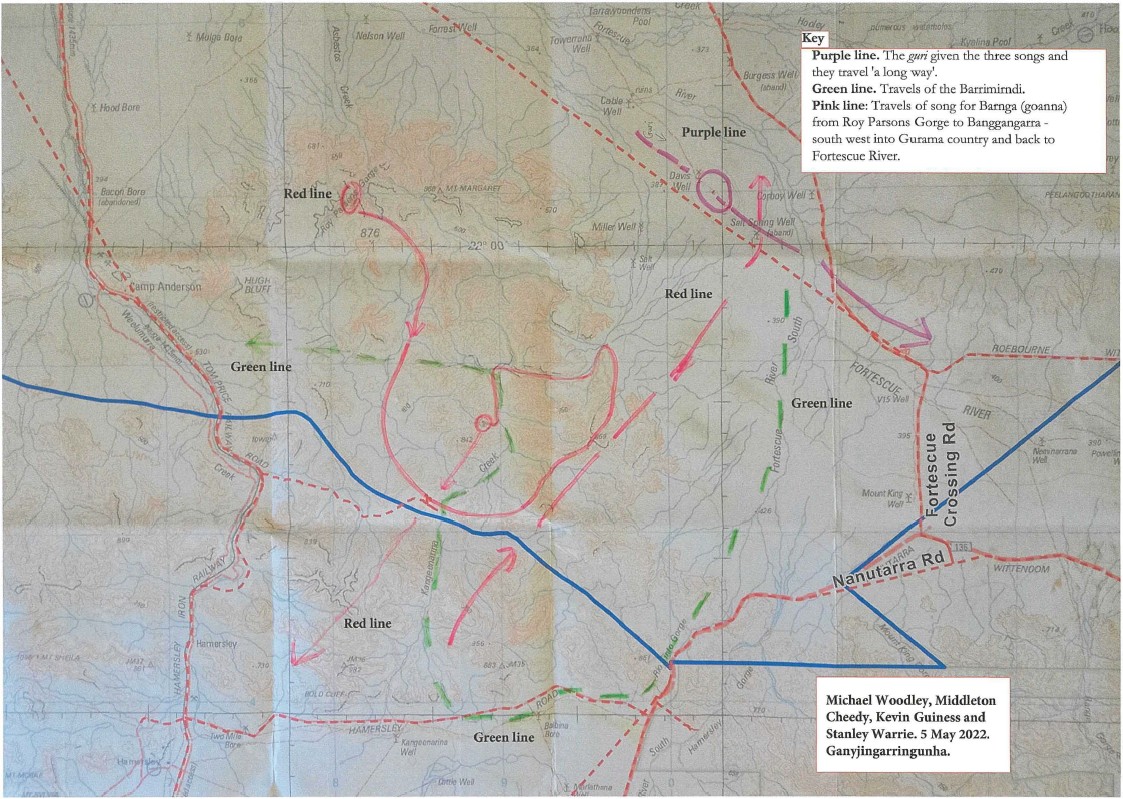
879 It is apparent from the site visit and the evidence from the witnesses that the mine has affected the song lines as geographic indicators such as hills are now gone. This also affects the ability for Yindjibarndi to teach the Birdarra law to future generations as by removing the physical properties of the actual country, important reference points and subject matter of the songs have been taken out. Michael Woodley said at that the Bundut is like a jigsaw, further saying:
[i]f you don’t have all the songs you can’t put the pieces together. And, if the country is buggered up, you can still sing it but it’s not the same feeling [message] that we give out to the land and to the young people [who we are teaching].
880 As Dr Palmer notes, all the pieces of the jigsaw are required to bring satisfaction and completion.
881 Mr Woodley gives the following evidence regarding how mining has affected the ability to sing about the Hamersley Range and Ganyjingarringunha creek at PR2 [130]:
MW: Well, when we singing now … the elders would be leading the Burndud … When he finish the song, young people in the Burndud will say to the elder, (Aboriginal language spoken). The main “What’s that? What’s the song you just sung?” And the elder have to explain it. So when we sing about this place now in the song line and the young … men sing out (Aboriginal language spoken), we’ll say “Well, (Aboriginal language spoken). And we can see it yuk, in our what you call it – in our …
Hughston SC: Pointing to your head, yes …
MW: … in our head. And when we see this place we associate it with what’s happening here with the mining activities. Then the next thing come out, the next phrase come out of our mouths is (Aboriginal language spoken). Mean ‘Sorry for that land being mined and it been taken away’.
882 Mr Woodley noted the effects of the mine on the Bundut, most importantly that the central portions of the Ganyjingarringunha creek has been destroyed in the vicinity of the Trinity Pity. This is because the Bundut cannot exist without the Ganyjingarringunha wundu and whilst portions of the creek remain, it has been, as Dr Palmer says, “devalued and diminished by the degree to which its component geographic parts are destroyed or damaged”.
883 At [145] of his second report, Dr Palmer reaches the following conclusions regarding the impact of the mine on the Bundut:
It is consequently my opinion that the integrity of the Burndud, as it articulates the relationship between person, country and its resources and the perpetuation of that relationship and associated beliefs through time is of supreme importance to the Yindjibarndi with whom I have worked. Its loss or partial loss threatens the fundamentals of the Yindjibarndi social, cultural and religious systems. It also threatens the mechanisms whereby they are able to legitimise and perpetuate their rights to country. Such a loss occasions deep emotions, regret, disquiet and guilt.
884 The Barrimirndi jowi has also been impacted by the Solomon Hub mine and part of the track in the central parts of the Ganyjingarringunha wundu are now “obliterated or destroyed” (mentioned above in section 4). In the statement of agreed facts, it is said that the Yindjibarndi people believe that Barrimirndi travels underground and punishes those who “break the law for water places”. There is therefore a spiritual obligation on the Yindjibarndi to protect the wundu (watercourses) and in turn the jowi associated with them.
885 Stanley Warrie says similarly of jowi, that jowi are:
meaningless if the country is gone. The jawi tells you of the significance of the ngurra. Without the ngurra … you make the significance weak.
886 In addition to the song lines marked, there is another song that forms part of the Bundut that has been impacted by the footprint of the Solomon Hub Project, not mapped in Exhibit 9 due to its gender restricted nature. This is the travels of the Marrga Burlinyjirrmarra, which was mentioned in the story of Barganyji above. The narrative relating to Burlinyjirrmarra forms part of a gender restricted portion of the Bundut, in that women are not allowed to hear the song specific to this story. In the interests of cultural sensitivity, I do not recount aspects of the story in full, but note as with my findings in relation to the Bundut above in section 23 that the Bundut is an integral part of the Yindjibardi people’s connection to country.
887 Part of this song line involves the traversing of large areas of Gamburdayinha (Hamersley Ranges) in Yindjibarndi country. I note my earlier findings in relation to location 8, that portions of Gamburdayinha have been impacted by the Solomon Hub Project. Dr Palmer says that given that this episode is considered to have occurred within Gamburdayinha, the mine has destroyed aspects of the country where these events are believed to have taken place, which has in turn impacted this gender restricted song. I accept the impact the Solomon Hub Project has had on portions of this gender restricted portion of the Bundut.
888 The evidence of the lay witnesses also suggests that there is a jowi, similarly given to the late Old Blind Billy that relates to Gamburdayinha. As Angus Mack says in his witness statement, these songs are different to those ceremonial songs sung for Birdarra law (such as the Bundut). In his written and oral evidence he says that the jowi is in the land the subject of the Solomon Hub Project.
24.5 Other evidence of sites of significance
889 Within the s 86 materials are other sites that warrant mention because of findings by the NNTT relevant to the present claim. I note that it is not clear to me that there is not an overlap between the particular sites mentioned above and those the subject of consideration by the NNTT. The relevance of the findings to which I refer below is to further explain the quality and significance of sites with the Solomon Hub Project rather than to quantify them.
890 In one finding of the NNTT is a sacred site where two Marrga fought over a woman, which was found by Member O’Dea of the NNTT to be a site of particular significance to the Yindjibarndi people within the area of mining lease M47/1411-I; FMG Pilbara Pty Ltd / Wintawari Guruma Aboriginal Corporation / Ned Cheedy and Others on behalf of the Yindjibarndi People / Western Australia [2009] NNTTA 99 (NNTTAA 99) at [47]. It is unclear on the evidence whether this site has subsequently been destroyed, although Dr Palmer reiterates the site’s importance in his first report at [356].
891 Another is FMG Pilbara Pty Ltd / Ned Cheedy and others on behalf of the Yindjibarndi people / Western Australia [2009] NNTTA 91; 259 FLR 293 (NNTTA 91) which concerned mining lease M47/1413-I where the NNTT, per Member O’Dea, relevantly found:
(1) that the Yindjibarndi people visited the area of the lease on an annual basis, largely for the purpose of collecting [REDACTED] [REDACTED] [REDACTED] and ochre to conduct wuthurru ceremonies (at [59]), however, [REDACTED] can be found throughout Yindjibarndi country and were not limited to that area (at [69]);
(2) that the grant of that lease would have an effect on the way of life, culture and traditions of the Yindjibarndi people, largely because of the limitation on the Yindjibarndi people’s capacity to impose aspects of what is required of them under their traditional law and culture upon those who also seek to use the land (at [62]);
(3) that there were numerous caves along the river which runs through M47/1413-I (being Ganyjingarringunha wundu) which are sites of particular significance to the Yindjibarndi people (at [72]) noting the evidence of Michael Woodley that some of the caves contained the physical remains of Yindjibarndi ancestors, others contain their [REDACTED] [REDACTED] [REDACTED] [REDACTED] [REDACTED] [REDACTED] [REDACTED] and others contain relics, demonstrating their use, as shelters “of our old people over thousands of years” (at [71]);
(4) that the Ganyjingarringunha yaayu (the eastern part of the Ganjingarringunha wundu), which the evidence of Angus Mack and Michael Woodley identified on site as being destroyed by the operation of the Solomon Hub Project ran through lease M47/1409-I; and
(5) there were ochre quarries that were mined each year for use in the Maliya thalu ceremony and in other Birdarra ceremonies which is a ceremony that must be conducted within the area of M47/1409-I (at [74], [73]). Member O’Dea found that the Maliya thalu ceremony had to be conducted in the area the subject of M47/1409-I;
892 Another concerns Bangkangarra, referred to in some FMG documents as “Satellite Springs”, which is a permanent pool on Ganjingarringunha wundu, within exploration licence E47/1319-I. Isaac Guiness said in his witness statement that the site is named after the Barnga (sand goanna) who made the waterhole there, with this being sung of in the Bundut. This is accepted to be a sacred site for the performance of rituals and ceremonies and a significant place within the Bundut. Whilst this has not been directly impacted by the mines, the senior Yindjibarndi men say that the area is not the same as it was before mining commenced as the area around it is destroyed. Access to Bangkangarra is now restricted and requires access to be granted by FMG, which has caused difficulty, frustrations and hurt for the Yindjibarndi. Furthermore, as the lay evidence makes plain, blasting from the mine can clearly be heard from Bangkangarra and the effects of dust from the 24-hour operations is visible. As I have noted earlier, Bangkangarra is located some 2 km from the boundary of the Solomon Hub Project, however it is within exploration licence E47/1319-I.
893 In FMG Pilbara Pty Ltd v Yindjibarndi #1 [2014] NNTTA 79 (NNTTA 79), Member Shurven of the NNTT considered an application by FMG for a future act determination pursuant to s 39 of the Native Title Act in respect of mining leases M47/1473-I and M47/1475-I (at [2]). At the time of lodging the application, the lease area of M47/1475-I included Bangkangarra, but FMG applied to alter its size in order to avoid that site because of the accepted ethnographic significance of it to the Yindjibarndi people (at [26]). Although a distance from the boundary of the Solomon Hub Project, the evidence of lay witnesses was that there was dust, occasionally noise and, at night, light from the operations of the mine which was noticeable to people at the site. As noted earlier in these reasons, the court conducted hearings at this site over several days. I accept that the serenity of this sacred place has been disturbed by the location of the Solomon Hub Project. YNAC submitted that there is no guarantee that FMG will not seek to develop the mine later. Indeed, as mentioned above, an exploration licence covers the location of Bangkangarra. However, the present claim for compensation does not demonstrate harm to this site and, other than finding that by reason of dust, noise and light pollution attributable to the Solomon Hub Project, I do not take into account the possibility of other effects.
894 The NNTT found that there was little or no evidence before it that the Yindjibarndi people live or erect shelters, regularly camp, teach the children, or use or enjoy resources from the land in relation to the lease areas (M47/1473-I and M47/1475-I) but did accept that ceremonies are conducted on the land and that, when this occurs, ochre is taken from it to assist in those cultural activities. It also found that the Yindjibarndi people worked to conserve and protect significant places and objects located within the leases. It accepted that the Yindjibarndi people would be curtailed in their freedom to carry out rites and ceremonies on the area of the proposed leases.
895 The NNTT made the following findings that are of note in the present context:
(1) that there were many rock shelters and ochre sources in the area of the mining leases as well as outside that area ([121]);
(2) that there was a [REDACTED] [REDACTED] indicating use by ancestors that would be a site of particular importance ([122]);
(3) that there was a dispute as to whether a site containing a cave, ochre source, artefact scatter and [REDACTED] was a site of particular significance. A heritage survey conducted with the assistance of members of the WMYAC (as to which, see further in section 26.5 below) who gave evidence conflicting with the evidence of YAC, the relevant point being just how significant the site is to the Yindjibarndi people ([124]). The NNTT concluded that there are many such sites within the proposed lease areas, particularly in relation to [REDACTED] and it could not be concluded that it is a site of particular heritage value ([124]);
(4) that a Gurdiwirndanha wundu area and site within the lease area is of particular significance to the Yindjibarndi people ([125]);
(5) that the Ganyjingarringunha wundu (Kangeenarina Creek) (which I note passes through the Solomon Hub Project) is near or across the westerly border of the M47/1475-I lease and that ([136]):
(6) the native title party have [sic] provided much detail on the cultural and heritage significance of the Creek. I note that the WMYAC also raised the mythological and cultural significance of the Creek, and its close proximity to Satellite Springs;
(7) implicit in this reasoning is that the NNTT found the Ganyjingarringunha wundu to be of particular cultural and spiritual significance to the Yindjibarndi people;
(8) that a Manggurla thalu (baby increase site) in the escarpment overlooking the banks of the Ganyjingarringunha wundu is a site for religious ritual which may be conducted only by Yindjibarndi lawmen who are ngurrara for Garlawinyji. The ritual ensures that the child’s spirit will come from Garlawinyji ngurra. In accepting the evidence that this is a “men’s business site that is particularly significant under [Yindjibarndi] law because it is a fertility site” the NNTT also accepted this to be a site of particular significance ([134]); and
(9) that the area surrounding a further wundu (watercourse) located in a gorge located either within or very near to the boundary of M47/1473-I. The gorge contained many caves which contained either the physical remains of deceased ancestors or their [REDACTED] [REDACTED] [REDACTED] [REDACTED] [REDACTED] [REDACTED] [REDACTED] [REDACTED] [REDACTED] [REDACTED] [REDACTED] [REDACTED] [REDACTED] [REDACTED]. The NNTT found this to be an area of particular significance to the Yindjibarndi people ([135]).
896 The State submits that it is a mitigating factor, in considering cultural loss, that senior members of WMYAC were consulted in relation to cultural heritage and Yindjibarndi site matters in connection with the development of the Solomon Hub Project.
897 Further to this, there is evidence from the lay witnesses that many thalus have now been destroyed due to the construction of the mine. Stanley Warrie at [91] of his witness statement said:
We had a lot of thalus (increase sites) in the Mine area. They are part of our religion too. But most of those thalus have been destroyed. There is one left, a mungurla thalu (or baby thalu). But the rest have all gone.
898 Angus Mack, in his witness statement at [96], described the effects of the destructions of thalus in the following way:
We cannot teach young people about the thalus if they are destroyed. You cannot replace it and talk about its significance because it is no longer part of the country and no longer part of you. It is missing. So, when you’re singing about the site, you can see the place in your mind, but it actually no longer there. It is a heartbreaking experience.
25. THE HYDROGEOLOGY ISSUE
25.1 Introduction
899 YNAC contends that its native title rights and interests have been impacted by the direct effects of the Solomon Hub Project both within the footprint of its mining operations and its indirect effects on groundwater, groundwater-dependent ecosystems (GDEs) and the surface catchments of Ganyjingarringunha wundu (Kangeenarina Creek) and Wirlu-Murra wundu (Weelumurra Creek). More specifically, it contends that changes to the groundwater by the Solomon Hub Project have adversely affected its rights under [3] of the Determination to: (a) fish from the waters; (b) collect and forage for bush medicine; (c) hunt and forage for and take fauna; (d) forage for and take flora; (e) take and use resources; (f) take water for drinking and domestic use; and (g) protect and care for sites and objects of significance in the determination area (including a right to impart traditional knowledge concerning the area to succeeding generations and others, while on the area).
900 I note that the expert evidence relating to hydrogeology largely refers to Ganyjingarringunha wundu and Wirlu-Murra wundu by their English names, being Kangeenarina Creek and Weelumurra Creek respectively. Given this section refers extensively to that expert evidence, for ease of reading I have chosen to use the English names for these waterways rather than their Yindjibarndi names in this section of the judgment.
901 YNAC submits that Kangeenarina Creek and Weelumurra Creek are groundwater fed and that the source of the groundwater is beneath the Trinity deposit, flowing west through the Queens deposit discharging into Weelumurra and northeast through the Trinity deposit discharging into Kangeenarina. It submits that groundwater abstraction and mining-related changes to the surface catchment areas of these creeks on or near the Solomon Hub Project have had an impact on the right of the Yindjibarndi people to take water in the Solomon Hub Project and surrounds, among other native title rights and interests, because dewatering and groundwater abstraction at the Solomon Hub Project has depleted water levels within and beyond the boundaries of the mine, also impacting the health of GDEs outside the mine. YNAC cites the evidence of the Yindjibarndi witnesses of the dryness now present throughout their country as a result of the water being used by the mine.
902 YNAC relies on the evidence of a number of Yindjibarndi lay witnesses to support the contention that the vegetation not only within the Solomon Hub Project but also outside it (and within the Determination Area) has been adversely affected by the mine. It supports this with expert evidence of an hydrogeologist.
903 FMG submits that no cultural loss claim can properly be based on dewatering at the mine area for three broad reasons. First, the Determination provides no exclusive rights in relation to water in any watercourse, wetland or underground water source, as defined in the Rights in Water and Irrigation Act 1914 (WA). I accept that this is correct. Secondly, there is insufficient or no evidentiary foundation for a conclusion that any perceived decline in water levels away from the mine area was due to the dewatering activities of the mine. Thirdly, any decline in groundwater levels occurred independently of FMG’s activities and is consistent with a decline in rainfall in the mine area. It relies on lay evidence of FMG employees (being hydrogeologists employed by FMG) and the expert evidence of an hydrogeologist.
904 The State broadly supports the submissions advanced by FMG. It submits that it is not necessary for the Court to make any findings in relation to the hydrogeology evidence, as any environmental changes and their effects on the native title rights and interests as a component of economic and/or cultural loss is already taken into account and to address it separately as part of cultural loss would amount to double counting.
25.2 The lay witnesses
905 YNAC relies on the lay evidence of a number of Yindjibarndi witnesses to the effect that to them, water is sacred and the lifeblood of their ngurra. Many gave evidence of their observations that since the Solomon Hub Project was established, it has taken away water from their country and the landscape has dried, particularly the Kangeenarina Creek and the Weelumurra Creek. Evidence to this effect was given in the statements of Fabien (Charlie) Cheedy, Lorraine Coppin, Estelle Guinness, Kevin Guinness, Isaac Guinness, Angus Mack, Stanley Warrie and Wimiya Woodley.
906 FMG relied primarily on the evidence of the following lay witnesses.
907 Christopher Oppenheim is a General Manager – Resource Definition at FMG. He has been in this role since 2023 and has held various other positions at FMG since 2011, including initially as a Senior Hydrogeologist at the Solomon Hub Project. Mr Oppenheim is a qualified geologist and holds a Bachelor of Science (majoring in geology and geography) and a Post Graduate Certificate in Ground Water Science.
908 Mr Oppenheim has sworn two affidavits in this proceeding, both dated 4 August 2023. In his first affidavit he provides a summary of the hydrology at the Solomon Hub Project, including work that had been done since before 2011 to identify the surface water catchments and groundwater aquifers that may be affected by the Project. He identifies that the mine sits across three surface water catchments known as Zalamea, Kangeenarina and Weelumurra (Wirlu-Murra). He sets out FMG’s environmental obligations that underpin its management of the hydrology and hydrogeology of the Solomon Hub Project, and describes the steps FMG takes to protect the Kangeenarina Creek and its associated pools within the Kangeenarina catchment and the Weelumurra Creek within its catchment. He also sets out his views on the interaction between FMG’s operations at the Solomon Hub Project and the site referred to in this judgment as Bangkangarra but which FMG refers to as Satellite Spring.
909 In his second affidavit, Mr Oppenheim summarises the water management miscellaneous licences and groundwater licences held by FMG in relation to the Solomon Hub Project and water-related infrastructure that FMG has constructed across the Solomon Hub. Mr Oppenheim was cross examined.
910 Jordin Barclay is a Senior Manager – Water Planning at FMG. He has been in this role since January 2023 and has held various other roles with FMG since December 2011 including as Hydrogeology Superintendent, Specialist Hydrogeologist and Principal Hydrogeologist in relation to the Solomon Hub and other FMG mines. Mr Barclay is a qualified geologist and holds a Bachelor of Science (majoring in geology and earth science) and a Master of Science (majoring in hydrogeology). Mr Barclay was also cross examined.
911 Mr Barclay swore an affidavit on 22 February 2024, which annexes and summarises hydrogeological data (rainfall, groundwater levels and groundwater abstraction) for the purpose of the preparation of FMG’s expert hydrogeologist’s report. This data was compiled from data collected by FMG during its mining operations, including for reporting obligation purposes, and publicly available sources including the Bureau of Meteorology (BOM) website.
25.3 The expert witnesses
912 YNAC relies on the expert evidence of Huade Guan, who is an Associate Professor at the College of Science & Engineering in Flinders University, a Chief Investigator of the National Centre for Groundwater Research and Training, Associate Editor of Journal of Hydrology and Associate Editor of Frontiers in Climate (Climate, Ecology and People). He is a qualified hydrologist, and holds a Bachelor of Science in geochemistry, Master of Science in geology (groundwater) and a PhD in hydrology.
913 Associate Professor Guan prepared an expert report dated 19 December 2023 and a short response to the expert report of Dr Richard Evans dated 15 March 2024.
914 Associate Professor Guan was asked to provide an assessment of the impacts of the Solomon Hub Project on vegetation and water in the Compensation Claim Area and did so by conducting remote sensing analysis, using the Normalised Difference Vegetation Index (NDVI), of potential groundwater dependent terrestrial vegetation, explained further below. Included in YNAC’s instructions to Associate Professor Guan was a large body of literature concerning the operation of the Solomon Hub Project, mostly produced by FMG in the course of operating the mine from 2011 as well as affidavits of FMG witnesses, including Mr Oppenheim.
915 Associate Professor Guan concludes that:
(a) FMG’s mining activities at the Solomon Hub have very likely caused vegetation degradation in the reach of Kangeenarina Creek and Weelumurra Creek;
(b) groundwater abstraction in the Solomon Hub Project has very likely disturbed regional, intermediate and local flow paths in the Hamersley Range; and
(c) groundwater levels have decreased at the locations where groundwater dependent terrestrial vegetation has been degraded, very likely as a result of dewatering at Solomon Hub.
916 FMG called Richard Evans to give evidence in response to Associate Professor Guan. He is a Senior Principal Hydrogeologist at Jacobs Group (Australia) Pty Ltd with forty years’ experience in water resource planning and development, focusing on groundwater resource management, GDEs and surface water groundwater interaction. He is a member of the Institution of Engineers Australia, Australian Water Association and Australian Geomechanics Society, and is a former President of the International Association of Hydrogeologists, Australia. Dr Evans holds a Bachelor of Science (Honours) and a PhD on the effects of coal mining in the southern Sydney Basin on vertical leakage and other effects.
917 Dr Evans prepared an expert report dated 4 March 2024 and affirmed an affidavit on 4 April 2024 that corrects aspects of his report and provides some supplementary information. He was instructed as to the various water management licences granted to FMG for the purposes of taking water, searching for groundwater and other water-related purposes, and was provided with various reports prepared by FMG, including reports going to details of the water abstracted from the mine pursuant to those licences and other internal reports prepared by FMG going to rainfall data and analysis and groundwater levels. FMG’s instructions noted that it did not have records available in relation to surface water flow, as the permit and related regulatory conditions imposed on FMG did not require it to collect or report on such data. Dr Evans was also provided with Mr Oppenheim’s affidavit.
918 In his report, Dr Evans notes his instructions, which are to consider and comment on the conclusions reached by Associate Professor Guan in relation to various aspects of the impact of the Solomon Hub mine. He concludes that:
(a) rainfall data analysis indicates there was a relatively wet phase in the region from about 1995 to 2013, followed by a drier phase since then, being particularly drier than previous years in 2022 and 2023;
(b) groundwater levels across the region have been generally falling in recent years. While significant declines in the Solomon Hub disturbance area are expected, the more variable regional declines are strongly related to reduced rainfall since about 2014 and not due to dewatering at the mine;
(c) having regard to the NDVI analysis conducted by FMG and Associate Professor Guan, there has been no clear decline in vegetation health outside of the Solomon Hub, with the possible exception of 2022 and 2023. Any decrease in vegetation health outside of the mine disturbance area is climate-related and not due to dewatering at the mine;
(d) the proposed regional hydrogeological conceptual model indicates there are generally high permeability paleochannels surrounded by low permeability bedrock. The low permeability bedrock will not transmit the impact of dewatering (being groundwater decline) any significant distance. The impact of dewatering could be transmitted along the paleochannels, which is why the supplementation schemes have been introduced; and
(e) the supplementation schemes at Weelumurra and Kangeenarina Creeks are working as designed and effectively stopping migration of the mine drawdown impacts beyond the mine disturbance area.
919 Associate Professor Guan and Dr Evans collaborated to produce a joint expert report (the Hydrogeology JER) prior to giving concurrent oral evidence.
25.4 Effects on surface water and groundwater within the mine footprint
920 To mine iron ore from the Queens, Kings and Trinity mining pits, FMG must keep them dry by continually drawing from the groundwater in a process called “dewatering”, which is defined by Mr Oppenheim as “to lower the groundwater level within a certain area”. The groundwater is extracted from paleochannels, which are ancient stream channels which have subsequently filled with sediments. These paleochannels are or contain aquifers, meaning they allow ready flow of water into and through them. To mine the Channel Iron Deposits (CIDs), these paleochannels must be dewatered. In addition, water is needed for the operation of the mines for dust suppression, ore processing (ie washing iron ore), construction and camp supply, and the dewatering supplies that water to the mine for those purposes.
921 Dewatering and groundwater abstraction at the Solomon Hub Project are authorised pursuant to six groundwater licences granted to FMG under s 5C of the Rights in Water and Irrigation Act. The area of each groundwater licence is defined by reference to the mining tenements held by FMG. There is no suggestion in the submissions advanced by YNAC that the water extraction processes used by FMG are otherwise than in accordance with permissions granted to FMG. The submissions advanced are that nonetheless, cultural harm has been visited upon the Yindjibarndi people by reason of the dewatering processes.
922 Mr Barclay gives evidence, based on FMG records, that FMG abstracted 148.9 gigalitres (GL) of groundwater across all of its Solomon Hub groundwater licences between August 2011 and December 2022, of which 28.9 GL was abstracted outside areas that are or will be dewatered and mined. He also gave oral evidence that the Solomon Hub Project has since 2022 continued to abstract groundwater, and now abstracts roughly about 18 to 20 GL of groundwater per year. A single GL equates to one billion litres of water, or very roughly around 500 Olympic-size swimming pools.
923 The water so abstracted comes from the aquifer beneath the Solomon Hub Project. The evidence of Mr Oppenheim includes a diagram extracted from a Hydrogeological Assessment of the Solomon Mining Area dated 4 August 2021 (H3 Assessment), which depicts three layers of aquifer units. The first is a sequence of alluvial or colluvial and detrital deposits which are said to be between 10 and 60 metres thick. Beneath that is a second layer, which is the upper CID, described as a hard, brown goethite dominant CID which is overprinted in places by a hard cap zone of hydrated goethite up to 15 metres in thickness. The third layer is the lower CID, described as a “vuggy, clay-rich ochreous goethite dominant CID”. Beneath the lower CID is the bedrock:
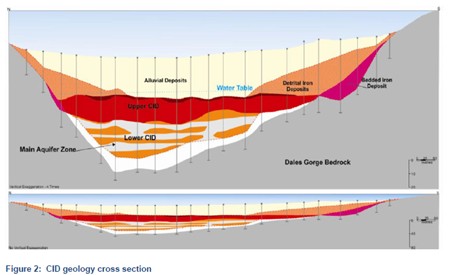
924 Mr Oppenheim explains in his evidence that the H3 Assessment was prepared to assess and outline the impact of FMG’s dewatering and injection activities on nearby environmental receptors, present management strategies to manage those impacts, and present the output of its modelling of the current mine plan taking into account those strategies. He says that FMG has, since the development of the Solomon Hub Project, used numerical modelling to assess the potential groundwater impacts of its dewatering and injection activities which has been refined and calibrated over time as the project has expanded and FMG has obtained more data from its dewatering and drilling operations. He gives evidence that in his experience, FMG refines and recalibrates this data every quarter and uses this modelling to assess the shape and permeability of the three aquifer levels underlying the project. The modelling includes the calculation of the size of the three aquifer levels and the amount of water that it anticipates will be held in those levels and, based on these figures, modelling the anticipated rate of flow of groundwater to FMG’s bores. It then compares the modelled rate of flow against the actual results it records from its bores in a process called “transient flow calibration” in order to assess the accuracy of the modelling. If the actual flow of groundwater were to be greater than the modelled flow, then it would indicate that FMG’s data was incomplete.
925 In cross examination, Mr Oppenheim explained that in order to understand how groundwater flowed where the Solomon Hub Project was to operate, bore holes were dug and tests were conducted. Work started in that respect in about 2008. Sampling from these bore holes discovered the Mt McRae Shale and the Silvia Formation, and beneath that the Wittenoom Formation, which underlies the Solomon Hub Project. By undertaking a system of drilling and sampling chips of rock drawn up with the drilling, FMG was able to gain a good understanding of the geological formations beneath the surface and thereby build a “conceptual geological model” of where the units of different material lie. Mr Oppenheim estimated that there were between 20,000 and 30,000 of these sampling “resource drilling” holes which have been logged, the results of which inform the geological model. In his experience, the modelling now available is such that when drilling in an area, FMG will generally see layers within 5 or so metres of where they are expected to start based on the model.
926 In this context Mr Oppenheim explained his understanding from the modelling that the Mt McRae Shale sits immediately under the mining area of the Solomon Hub Project and hydraulically disconnects it from that area, because it is an aquitard (being a geological formation that generally only allows a very limited flow of water). Above the Mt McRae Shale is the banded iron formation (including the Brockman Formation) which is also an aquitard, and then within the banded iron formation there is a paleochannel, which is the main aquifer in the area.
927 There is no dispute between the experts that within the mine disturbance envelope of the Solomon Hub Project there has been a significant decrease in groundwater levels, as would be expected, due to the dewatering. Regional groundwater level monitoring documents prepared by FMG, which were annexed to Mr Barclay’s affidavit, show within the mine area drops of the level of groundwater at various bore holes ranging from 11.4 metres a year to 2.2 metres a year and less.
928 Associate Professor Guan reports, based on his analysis of LiDAR data, that from 2011 to 2022, millions of square metres of earth within the Solomon Hub Project have been altered by mining. The changes to the topography (which are described in more detail in section 24.3 above), and the dewatering activities described above, support the conclusion which I reach below that the surface water and groundwater within the Solomon Hub Project have been very severely affected by the mining activities within the footprint of the project. Dr Evans noted in the joint expert report that “[w]ithin the SHM there is a significant decrease in groundwater levels, as expected, due to the dewatering”.
929 Having regard to the mine rehabilitation plan (see section 3.6 above), I conclude that the alterations to the surface water and groundwater within the Solomon Hub Project are likely to be permanent. That is, that they will never be restored to their pre-mining condition. The Mine Closure Plan does state, as extracted earlier in these reasons, that:
[w]here groundwater connection has been lost to maintain permanent groundwater fed pools in Weelumurra [Wirlu-Murra] and Kangeenarina Creek, supplementation has commenced to main[tain] these systems. Supplementation will remain until such time that below water table pits (Queens, Kings and Trinity) are backfilled and groundwater flows to permanent pools are self-sustaining.
The Mine Closure Plan also acknowledges that “groundwater recovery may take decades to achieve”. However, as is also noted above in section 3.6, in an arid environment such as the Pilbara rehabilitation of the land is often unsuccessful and the landscape may remain significantly altered, including surface and groundwater alterations.
930 In its closing submissions, FMG accepts that this harm will sound in damages for cultural loss.
25.5 Effects on the groundwater levels outside the mine footprint
25.5.1 Introduction
931 The effect of the dewatering process on the land that is outside the footprint of the Solomon Hub Project is factually controversial.
932 YNAC contends that the catchment areas for the Kangeenarina Creek and the Weelumurra Creek have been adversely affected by the operations of the Solomon Hub Project. More particularly, YNAC submits that there are two main drainage systems which are intercepted by the mining pits within the Solomon Hub Project, being Kangeenarina Creek and Weelumurra Creek. Both are ephemeral and only flow after heavy rainfall infiltrates into the subsurface paleochannels. Kangeenarina Creek flows from south to north through the Valley of the Kings and Trinity Valley. Weelumurra Creek flows towards the northwest and drains water from the Valley of the Queens in the western part of the Solomon Hub Project. YNAC contends that the changes to the groundwater caused by mining operations within the Solomon Hub Project have adversely affected the flow of water to these creeks outside the mining disturbance area. FMG disputes that this is so, relying on the evidence of Dr Evans.
25.5.2 The area of dispute
933 In his oral evidence, Mr Oppenheim marked the areas of the mine on Exhibit 11 (being a map of the Solomon Hub showing the alluvial (layer 1) hydraulic conductivities) with “Q” for Queens mining area, “T” for Trinity mining area and “F” for Firetail mining area with lines depicting the footprint of those mines over the areas of hydraulic conductivity. Hydraulic conductivity refers to how quickly water can move through a material. It may be noted, speaking very broadly, that to the west (left) is the catchment of the Weelumurra Creek, indicated by the darker blue section on the left, and to the east (right) is the catchment for the Kangeenarina Creek, indicated by the darker blue section on the right. I note that the Queens mining pit is outside the Determination Area, as outlined above in section 3.3. However, it is not in dispute (as noted below) that the area of the Solomon Hub Project, which is largely within the Determination Area, is a recharge zone for and is hydraulically connected to each of the Kangeenarina and Weelumurra Creeks.
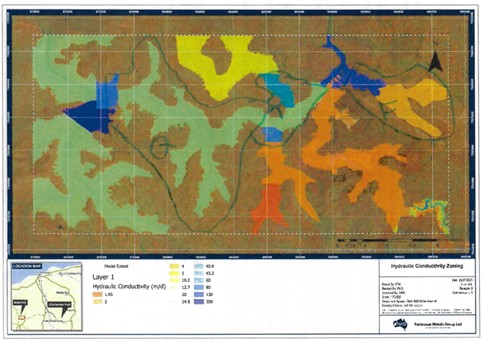
934 The following background facts, which I find to be established, are not in dispute and serve to frame the issue:
(1) the area of the Solomon Hub Project is a “recharge zone” for each of the Kangeenarina Creek and the Weelumurra Creek. As Dr Evans explained, groundwater recharge occurs when rainfall or streamflow transmits into the aquifers, “flow” being the rate of flow through the aquifers (or “permeability”). The term “discharge” refers to the exit of groundwater from the aquifers, which may be in the form of baseflow to streams or transpiration to the surface where it may be a water source for vegetation.
(2) the Solomon Hub Project recharge zone is hydraulically connected to each of the Kangeenarina Creek and the Weelumurra Creek via paleochannels which transmit water easily. FMG accepts that this is so, as the map to which Mr Oppenheim refers (above) indicates.
(3) the experts agree that groundwater levels have decreased outside the footprint of the Solomon Hub Project in recent years. Dr Evans estimated that the rate of decline is typically from 0 to 0.3 metres per year.
(4) there was a change in vegetation conditions in areas outside the mine in recent years, notably 2022 and 2023. As Dr Evans said in his oral evidence of the NDVI analysis of vegetation health:
There – there are definite areas where the vegetation has declined in very recent times…
935 Against this background, the primary dispute between the experts was the cause of the groundwater decline in the catchment areas outside the mine’s footprint, to which I have referred.
25.5.3 Water Supplementation schemes
936 FMG has operated water supplementation and monitoring schemes at both Kangeenarina Creek and Weelumurra Creek. These schemes have been implemented to comply with Ministerial Statement 1062, which was imposed on FMG under the Environmental Protection Act 1986 (WA) and requires FMG to maintain the health of GDEs and potential GDEs associated with Weelumurra Creek and riparian (meaning on the banks of a river) vegetation associated with the Kangeenarina Creek pools, amongst other requirements. Mr Oppenheim gives evidence about both schemes.
937 The Kangeenarina Creek supplementation scheme was developed by FMG in consultation with members of WMYAC and is recorded in the latest revision (being revision 5) of the Kangeenarina Pools Supplementation Plan (KPSP), dated 21 February 2020. A copy of the KPSP was annexed to Mr Oppenheim’s first affidavit. As noted above, Kangeenarina Creek flows to the north of the Trinity and Firetail mines. The KPSP notes that it was developed as a condition on the approval of the Solomon Hub Project and focusses on maintaining water levels in “permanent” pools in Kangeenarina Creek which are outside the mine disturbance envelope. In a first stage, in May 2014, FMG implemented a surface water supplementation programme which involved pumping water from its dewatering operations directly into four spigots located at various locations along downstream Kangeenarina Creek, with the aim of maintaining groundwater levels at the permanent pools.
938 In June 2016 that arrangement was replaced with a sub-surface groundwater reinjection programme that involves pumping water through a perforated underground pipe (about 1.5 m underground) so that water is added back into the surrounding water table. A single system was initially used and in April 2020 a further system was added downstream.
939 FMG also installed three groundwater monitoring bores and one surface water level monitoring bore along Kangeenarina Creek, which are reviewed monthly and compared against three trigger levels. A tier 1 trigger occurs when the water table falls below a baseline range imputed to be the groundwater level if the Solomon Hub Project did not exist. A tier 2 trigger occurs when the water table falls 0.5 metres below the tier 1 trigger level. A tier 3 trigger occurs when the water table falls a further 0.5 metres below the tier 2 level. Mr Oppenheim gives evidence that FMG would then be required to report the failure to the Environmental Protection Authority.
940 In relation to the Weelumurra Creek catchment, Mr Oppenheim’s first affidavit also annexes the Weelumurra Creek Supplementation Plan (revision 5) (WCSP) dated 24 June 2021. The WCSP reports that the shallow water table settings of the Weelumurra Creek and pools support groundwater dependent vegetation, and acknowledges that abstraction from the Queens deposit will potentially lower the water table and impact the pools on Weelumurra Creek. Like the KPSP, the purpose of the WCSP is to mitigate the impacts of groundwater abstraction and pit dewatering in order to meet a condition on the approval of the mine to maintain water levels in permanent and semi-permanent pools associated with Weelumurra Creek “at a level that approximates natural seasonal variability as determined using baseline data and analogue sites selected”. The WCSP describes a sub-surface supplementation programme similar to that described above from the KPSP, although water is injected into the groundwater system via a series of nine re-injection bores placed in a series of north-south lines across the CID paleochannel valley floor, together with a hydraulic barrier rather than diffuser lines. Figure 7 of the WCSP indicates that the re-injection bores were to be located about 200m from the western boundary of M47/1410-I and directly between the Queens mining operations and the Weelumurra Creek. The WCSP also proposes groundwater monitoring at four sites and pool monitoring at three sites, and operates similar three-tier trigger mechanisms.
941 In his oral evidence, Mr Oppenheim expressed the view that the supplementation of the Weelumurra Creek “to a degree” mimics the natural system of the water by maintaining the water levels downstream within their historical levels.
942 The KPSP and WCSP documentation both refer to a “Vegetation Health Monitoring and Management Plan” (Vegetation Plan) prepared by FMG around 2019, which was not otherwise mentioned in or annexed to Mr Oppenheim’s affidavit. The KPSP states that “Potential impacts and monitoring of groundwater dependent vegetation is discussed in the Vegetation Health Monitoring and Management Plan (100-PL-EN-1020)”, and the WCSP similarly states that “Management of impacts to groundwater dependent vegetation… is detailed in the Vegetation Health Monitoring and Management Plan (100-PL-EN-1020)”. In the WCSP under the heading “Breach of Vegetation Health Monitoring and Management Plan”, it states:
In the event that management targets under the Vegetation Health Monitoring and Management Plan (100-PL-EN-1020) are not met for monitoring of the upper reaches of Weelumurra Creek, it is proposed to investigate and interpret the cause of the target not being met. If the cause of the target breach is determined to be due to FMG abstraction induced drawdown, FMG will instigate supplementation within the approved MDE [mine disturbance envelope] to manage groundwater levels proximal to the potentially groundwater dependent vegetation community.
943 An extract from a redacted revised copy of the Vegetation Plan, dated July 2020, was in evidence before the Court in the bundle of documents at Exhibit 15. Figures 13 and 14 of the document show a map of groundwater dependent and potential groundwater dependent vegetation in the Solomon Hub Project and surrounding areas, including around Weelumurra Creek.
944 Also in evidence was a redacted document titled “Solomon [REDACTED] Vegetation Health Monitoring Program 2022”, prepared by Ecoscape (a third party contractor) (the Ecoscape Report). Dr Evans was taken to this report in cross-examination. The report interprets data collected at the end of 2022, including an NDVI assessment of groundwater dependent vegetation and potential groundwater dependent vegetation in the Kangeenarina Creek and Weelumurra Creek areas. It compared the 2022 data for this vegetation to the baseline data from 2001 to 2010, and established that “the remote sensing analysis [ie NDVI] did not identify any exceedances of management triggers”. However, it did note that two sites contained trees displaying “results that may be indicative of water stress”, and had mean results that were substantially lower than the baseline. Dr Evans discussed the Ecoscape Report in his evidence, which I refer to further below.
25.6 The evidence of Associate Professor Guan
945 Associate Professor Guan observes in his expert report that the area around the Solomon Hub Project is generally dry – there is a rainfall deficit in the areas of the Solomon Hub Project and its surroundings which exceeds 2300 mm per year. He also observes that flora and fauna are highly dependent on water availability, as may be seen from the fact that trees often distribute along the drainage lines where water accumulates from the landscape during rainfall events. He gives the opinion that in areas where the groundwater is shallow, ecosystems may develop based on groundwater, which are known as “groundwater dependent ecosystems” (defined above as GDEs). If the Solomon Hub Project has changed the level of water supply in the environment, it is most likely to impact groundwater storage and consequently GDEs. That is because the recharge of the groundwater is dependent on the underground flow of water which traverses various subterranean paleochannels.
946 Associate Professor Guan notes that GDEs often have a coverage large enough to be observable from satellites. He investigated whether the terrestrial GDEs surrounding the Solomon Hub Project have experienced degradation and, if so, whether that degradation is linked to the Project. To do so, he used two types of satellite remote sensing NDVI products (in order to have continuous data), explaining that NDVI enables researchers to differentiate vegetation from other properties on the land surface and detect changes of vegetation cover at individual locations over time. In NDVI analysis, each “pixel” represents a square area of land, for example a 10m x 10m area. The NDVI of a pixel reflects its vegetation cover condition; for example, if vegetation in an area is destroyed by bushfire, the NDVI of the corresponding pixels would decrease abruptly.
947 Associate Professor Guan identified quadrats (square areas of land) in the Solomon Hub Project area which contained species of vegetation which are either groundwater-dependent or of potential groundwater dependence, being eucalyptus victrix, melaleuca argentea and eucalyptus camaldulensis (GDE species). By analysing the NDVI pixels corresponding to these quadrats, he could examine whether the GDE species had experienced degradation over time. He reviewed the NDVI trends for these quadrats between January 2015 and November 2023. This period was chosen on the basis of his view that no extreme wet conditions had occurred since 2011, but there were relative wet conditions in 2013. Accordingly, starting the period in 2015 provides “reasonable climatic context” to examine trends in terrestrial GDE vegetation. Associate Professor Guan found that, for this period:
of six quadrats which contained both M. argentea and E. camaldulensis, two showed statistically significant negative NDVI trends;
of seven quadrats with E. camaldulensis, two showed significant negative NDVI trends; and
while not all quadrats containing E. victrix could be examined due to time limitations, of the nine quadrats selected three showed significant NDVI trends (two negative trends, and one positive trend).
948 Associate Professor Guan’s opinion is that the trends suggested that the GDEs have degraded between 2015 and 2023 at some locations surrounding the Solomon Hub Project areas.
949 Separately, Associate Professor Guan then considers overall NDVI trends in and surrounding the Solomon Hub Project area between December 2018 and November 2023. This analysis showed vegetation degradation in the alluvial fan of Kangeenarina Creek, in some sections of the Kangeenarina valley, and in the valleys and hilly areas between valleys at Weelumurra Creek.
950 He then considers the cause of the observed decline in GDE, concluding that it could not be climate related (ie, changes in rainfall) and was most likely the mining activities at the Solomon Hub Project. He notes that, in relation to his analysis of the individual quadrats outlined above, the fact that not all quadrats investigated showed decreasing NDVI trends suggests that the decreasing NDVI trends observed in some quadrats were not caused by climate. In relation to his analysis of the overall area, he notes that a large portion of the region shows improving vegetation cover, particularly in areas that are not potential terrestrial GDEs, suggesting that the improving trends in those areas may be linked to increased rainfall.
951 In excluding climate, Associate Professor Guan had regard to rainfall trends in the area of the Solomon Hub Project. He considered BOM figures for annual precipitation surrounding the mining area based on four weather stations: Coolawanyah (34.5 km away), Mt Florance (35.9 km away), Hamersley (28.7 km away) and Wittenoom (48.5 km away), and in Figure 8 of his report plotted the annual rainfall from 1950 to 2023 for these stations. He also plotted annual rainfall of Yalleen WA and Newman Aero BOM stations from around 2014 to 2023. He observes that vegetation cover responds rapidly to interannual rainfall variability (if not groundwater or inflow dependent), and so vegetation response correlated to rainfall may be used to investigate short term vegetation responses to rainfall. As noted above, Associate Professor Guan considers that precipitation in fact increased in 2019 to 2022, explaining why there was NDVI improvement observed during this period for areas where no GDEs were considered to be present. However, where there is a decline in groundwater-dependent vegetation and no corresponding decline in rainfall, it may be inferred that there is a reduction in available groundwater.
952 On the basis of his analysis, Associate Professor Guan concludes that the GDEs in the Determination Area surrounding the Solomon Hub Project appear to have degraded during the period from 2015 to 2023, primarily in the alluvial fan of Kangeenarina Creek and in valleys of Weelumurra Creek northwest of the mine, and that decreasing rainfall in the area was not the cause of this degradation.
953 By reviewing the available data, he concludes that in the Kangeenarina Creek area, vegetation degradation had occurred mostly in the alluvial fan and in some sections of the Kangeenarina valley, noting, however, that there is a section, about 1km long, immediately downstream of the Solomon Hub Project area showing improved vegetation conditions on the Kangeenarina Creek. He considers that the local improved conditions are a result of the supplementation programme and the erection of a grout wall for Kangeenarina Creek. He observes that the degradation mostly occurs in the alluvial fan where the Creek enters Low Fortescue Valley, about 10km downstream from the Solomon Hub Project, and says:
39 … Based on my hydrogeological knowledge from my PhD degree and my research in mountain-block hydrology and mountain-front recharge (eg., Wilson & Guan 2004), the GDE degradation in the alluvial fan of Kangeenarina Creek is very likely linked to the disturbance of the groundwater recharge zone in the SHP area via regional groundwater flow paths (Figure 20). Groundwater flows from the recharge zone in the mountain range to the valley at the mountain front. This flow is driven by the hydraulic gradient between the two ends. Continuous groundwater abstraction (Figure 21) in the SHP area, the recharge end, has reduced this gradient, which must have reduced groundwater replenishment at the mountain front via the regional flow paths. This possible mechanism explains the NDVI gradual decreasing trends in the alluvial fans.
40 Similarly, groundwater in the recharge zone flows via local and intermediate paths which can support GDEs in the mountain ranges. The SHP groundwater abstraction (Figure 21) should have also reduced groundwater replenishment via these flow paths. This possibility explains remote-sensing data inferred NDVI gradual decreasing trends…
954 Associate Professor Guan describes the regional groundwater flow paths by reference to Figure 20, which is extracted below:
955 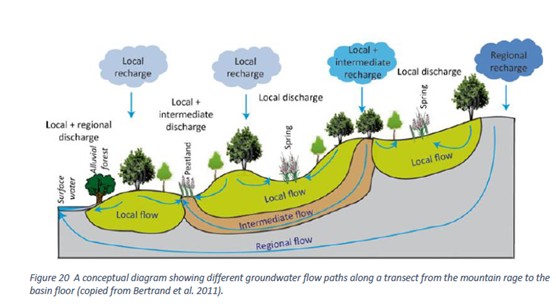
956 Associate Professor Guan concluded in relation to the Weelumurra Creek area that vegetation degradation occurred more seriously in the valleys and hilly areas between the valleys within the Hamersley Range downstream from Queens, which are not far from the Solomon Hub Project. He says of this:
… The change at Weelumurra Creek occurred in 2021-2022 according to the inset graphs of polygons #2 and #3, and the NDVI has not recovered since then. This timing coincides with an increase of groundwater abstraction in the Valley of the Queens (Figure 21). This coincidence supports that the GDE degradation in Weelumurra Creek is linked to groundwater abstraction in the Valley of the Queens. The widespread distribution of degraded NDVI… suggests that the supplementation for Weelumurra Creek has not functioned as it was expected to.
25.6.1 The answering evidence of Dr Evans
957 The substantive disagreement between the experts was whether the accepted decrease in groundwater was as a result of FMG’s dewatering for the purposes of the Solomon Hub Project. As I have noted, there is no dispute that groundwater levels outside the mining area have subsided. There was some debate between the experts as to whether the “deep bed rock formations” (such as the Wittenoom Formation) could act as aquifers. Ultimately, however, there was no real dispute that the relevant flow of groundwater was through the paleochannels, not these deep bed rock formations.
958 Dr Evans considers that there are two reasons why the groundwater decline should not be attributed to dewatering.
959 The first concerns the historical trend of rainfall levels. His view is that there has been a readjustment of the groundwater to historical levels after a very wet period across the Pilbara region from 1995 to 2006 when the groundwater levels rose. This wet period was followed by a stable or average period, followed by above-average rainfall between 2011 and 2013. Dr Evans’ view is that the exceptionally wet period from 1995 to 2006 produced artificially high groundwater levels across the region and the return to average conditions from 2014 accounts for the decline in groundwater since then. The response of groundwater levels to rainfall trends is cumulative over time and so the effect of rainfall on groundwater levels must allow for a time lag. Accordingly, the measured decline in groundwater levels is because of the readjustment over time. Dr Evans performed an analysis using a Cumulative Deviation from the Mean (CDFM) method, which shows how much the average rainfall for a given year deviates from the overall mean rainfall across the period of time being assessed. Dr Evans noted that there is a decline in groundwater levels in the borehole named “Warp 16” (one of the two boreholes used for monitoring compliance under the WCSP) over the period from 2014 to 2018, when there was relatively minor extraction of groundwater from the Queens mining area. Dr Evans accepts that the extraction could have contributed to the decline, but notes that this coincides with a drier rainfall period and so there may be several reasons for the decline.
960 The second is that the period between 2014 and 2023 was a drier-than-average period in the area around the Solomon Hub Project which would have (separately from the first reason) resulted in decreasing groundwater levels over time.
961 In support of this proposition, Dr Evans relied on data gathered by FMG from 11 rain gauges between 2010 and 2024 in the vicinity of the mine and also, where that data was absent, data from the Wittenoom weather station maintained by the BOM. In his report, he refers to this dataset as the Solomon Area Data or Solomon Model. When asked to consider the BOM data used by Associate Professor Guan (being from the Coolawanyah, Mount Florance, Hamersley, Wittenoom, Newman Aero and Yalleen BOM weather stations), Dr Evans accepts that the data tended to show a drying trend between 2014 and 2019 but in his view the data was insufficiently conclusive for him to draw conclusions from it alone. He conducted a CDFM analysis and compared the results from each station against the mean annual rainfall of that station over the period from 2011 to 2023, as well as the CDFM results for the Solomon Area Data (seen in Figure 6-3). From existing CDFM analysis completed by FMG showing rainfall data from several rainfall stations between 1995 and 2020 (Figure 6-1), Dr Evans gives the opinion that the rainfall data demonstrated a wetter phase from 1995 to 2006 (period 1), an average rainfall period from 2007 to 2013 (period 2) and a drying phase from 2014 to 2020 (period 3). Combining these observations with his own CDFM analysis (Figure 6-3), which extends to 2023, he observes that the drying phase has continued to date.
962 Dr Evans also considers the NDVI analysis undertaken by Associate Professor Guan. He disagrees that there was any significant change in vegetation between 2001 to 2022, noting that the Ecoscape Report undertook NDVI analysis at the Kangeenarina Creek and Weelumurra Creek sites for groundwater dependent and potential groundwater-dependent vegetation in 2022, and did not identify any significant trends nor any unexpected or anomalous behaviour compared to baseline results. He observes that the NDVI results obtained by Ecoscape were similar to the results presented in Associate Professor Guan’s report but were interpreted differently, and agreed that Associate Professor Guan’s results suggest a decrease in NDVI in 2022 and 2023. However, he considers that the changes in NDVI identified by Associate Professor Guan are normal variations in NDVI over time, due to rainfall variations and the longer term readjustment described above. This he considers to be consistent with the conclusions reached by FMG’s third-party contractors, who proposed in 2019 that “self-thinning” of vegetation was likely following the drier period since 2014 as the systems adjust to average rainfall conditions.
25.6.2 The relevant differences between the experts
963 In their oral evidence and the JER the experts debated their differences. The first point of relevant difference between them is the effect of the historical wet periods recorded, and whether the accepted decline in groundwater levels could be attributed to dewatering or instead was a gradual decrease following the wet period around 1996. Although Associate Professor Guan disagreed with Dr Evans that there was a continual wet period from 1996 to 2006 (instead considering that there was a wet period from 1995 to 2000 and another wet year in 2006), he did accept that there was likely to be a slow decline in the groundwater table following from those wet periods. However, he noted that two of the monitoring boreholes did not show this trend within a few years after 2006. In cross-examination, he was taken to data on a number of other boreholes which showed a decline in groundwater level from 2008 onwards. These boreholes were some distance from the dewatering activity, including one borehole (CPM010S) which was some 30 km from the mining activity.
964 Dr Evans refers to the data from these monitoring boreholes as an example of his point that there was a general trend of groundwater decline, which was not connected to the dewatering and had been occurring before mining started. He accepts that it is possible for a decline recorded at that distance to be attributable to dewatering but considered it improbable because, for the effects of dewatering to be recorded in the time between the dewatering and the borehole measurement, the paleochannels would have to be “exceptionally permeable” and it would take a much longer period of time than was being considered. He did not consider that it was credible that there could be an effect at the distances involved within the timeframes discussed. On the other hand, the view of Associate Professor Guan was that the paleochannel hydraulic conductivity could be sufficiently high to enable the effect of dewatering to travel through the paleochannels within a year, although he accepted that he did not have data on the conductivity to verify this.
965 The second point of difference between the experts was whether the period between 2014 to 2023 was drier than average, and if so whether this would (separately from the longer-term groundwater adjustment issue) have caused decreasing groundwater levels. Associate Professor Guan disputes that Dr Evans relied on the correct rainfall data to reach his conclusions as to declining precipitation from 2014 to 2023. Based on the BOM data to which he referred, he considers that there were wet years in 2013 and 2014 and that after 2015 there is one dry year in 2019 and then rainfall increases from 2019 to become average thereafter. Associate Professor Guan explains that he was concerned to understand what the rainfall pattern was, as opposed to the amount of rainfall. As noted above, he refers to the publicly available BOM data for Coolawanyah (34.5 km from the Solomon Hub Project), Mount Florance (35.9km), Hamersley (28.7km) and Wittenoom (48.5 km) and in Figure 8 of his report provided a graph of annual rainfall from these stations from 1950 to 2023 (noting that the Wittenoom weather station was closed in 2019 and the Hamersley station closed in 2015). Associate Professor Guan additionally considers the trend of precipitation in the period from 2015 to 2023 from the Yalleen weather station (180 km from Solomon Airport) and Newman Aero weather station (250 km). In his oral evidence, he explained that he was looking for rainfall trends in the region, and that the weather systems that bring rainfall to the area are in the nature of tropical cyclones which are on the scale of thousands of kilometres.
966 In contrast, in his report Dr Evans states that the Yalleen and Newman Aero stations are a very long distance from the Solomon Hub and the rainfall data is not very relevant, compared to much closer data used by Dr Evans which supported the interpretation of a generally drying period from 2013. In response to this, Associate Professor Guan gave oral evidence that he selected the BOM information because, unlike the Solomon Area Data, it provided continuous data.
967 There is no real dispute that the BOM information that was reviewed by Associate Professor Guan supports the view that he expressed. When asked in his oral evidence his view as to the analysis undertaken by Associate Professor Guan, Dr Evans agreed with his analysis, accepting that if he also had only had access to the BOM data he “probably would have said there’s not a clear trend… [s]ince 2014”. Dr Evans acknowledged that some of the BOM data shows just an average phase, rather than a decline following 2013, and that without reference to the Solomon Area Data “we’re probably talking about an average response”. He accepted on multiple occasions in oral evidence that if the Solomon Area Data was not included in his graphs, there was no indication of a “drying period” and “one might conclude that things were relatively average”.
968 However, Dr Evans considered that a better indication of rainfall trends at the Solomon Hub Project is to consider the Solomon Area Data taken at the 11 rainfall gauges by FMG, referred to above. Although that data was incomplete – because none of the gauges has a complete set of rainfall data – he considered that it provided the best understanding of the rainfall over 12 years of records history in the vicinity of the mine. He explained that he considered it to be the best because it was essentially 11 separate gauging systems within the Solomon Hub Project area, and it was the only relevant data within this area. Dr Evans plotted the CDFM for this data over time and compared it against the BOM station CDFM analysis, observing that it showed “a very clear drier period from 2013 to the end of 2023”. He prepared CDFM plots for both a short-term mean (Figure 6-3) and a long-term mean (Figure D1), which he considered both showed a declining trend in rainfall after 2013. However, he acknowledged that this trend was less clear in the long-term mean CDFM analysis.
969 Associate Professor Guan in his reply report convincingly demonstrated that CDFM is less appropriate to examine rainfall trends because CDFM curves vary depending on which mean annual rainfall is chosen. He observed that the trend shown may change depending on whether a short-term or long-term mean is used in the CDFM analysis. This was to some extent accepted by Dr Evans, who observed that the short-term mean CDFM analysis in Figure 6-3 shows a more clear declining trend, but the long-term mean CDFM analysis in Figure D-1 is not as clear in showing this trend. Associate Professor Guan also observed that vegetation cover responds quickly to rainfall variability, meaning the long-term CDFM analysis is not suitable for analysing NDVI trends.
970 Overall, I consider that Associate Professor Guan’s analysis of rainfall trends is persuasive. First, I accept that rainfall patterns in the region are most likely to be dominated by large-scale events such as cyclones which will affect precipitation generally. This has the consequence that a regional perspective (using the BOM weather station data, as opposed to the Solomon Area Data) is likely to be an accurate indication of rainfall trends over time, including over the Solomon Hub Project. Certainly, Dr Evans did not persuasively explain how it is that the footprint of the Solomon Hub Project would have any different trend to that in the broader region, and hence why the Solomon Area Data was more accurate. Secondly, I consider that in referring to weather station information at the six locations identified, Associate Professor Guan selected a basket of representative locations surrounding the Solomon Hub Project and that they are likely to be an accurate measurement of the rainfall trend. Thirdly, Dr Evans accepted that without reference to the Solomon Area Data gathered by FMG, there was no clear trend of a decline after 2013. Given I am not persuaded that the Solomon Area Data has a significant accuracy advantage over the BOM weather station data, I do not consider there is sufficient evidence of a declining trend in rainfall from 2013 onwards as this is not clearly shown by any data other than potentially the Solomon Area Data. Fourthly, as I have noted, I accept the view expressed by Associate Professor Guan that the CDFM approach is less suitable than a simpler analysis of rainfall as it has the capacity to show distorted outcomes depending on whether a short-term or long-term mean is used. While Dr Evans’ position was that there was a declining trend post-2013 regardless of whether a short or long-term mean was used in his CDFM analysis, he conceded that such a trend was less clear in the long-term mean CDFM analysis (and, as noted above, not clear at all if the Solomon Area Data is excluded).
25.7 Analysis
971 I am satisfied that the dewatering operations of the Solomon Hub Project have contributed to a general decline in the groundwater not only within the footprint of the mining operations, but also in parts of the catchment areas of the Kangeenarina Creek and Weelumurra Creek downstream of the Solomon Hub Project and outside of the mine’s footprint. I find this for the following reasons.
972 First, the footprint of the Solomon Hub Project is a groundwater recharge zone for the Kangeenarina Creek and Weelumurra Creek catchment areas and the groundwater reaches those catchment areas through the paleochannels, that function as aquifers hydraulically connecting to those catchment areas. As Dr Evans accepted in his report “[i]t is well recognised that dewatering at SHM could impact on flows in Kangeenarina and Weelumurra Creeks and pools”. While there was dispute between the experts over how far the effects of that dewatering could transmit, it was acknowledged that it was possible it could impact these catchment areas.
973 Secondly, massive amounts of water have been removed in the operation of the Solomon Hub Project. Between 2011 and 2022, FMG extracted about 150 GL of groundwater across all of its Solomon Hub groundwater licences. According to Mr Barclay, only about 20% of that extracted water has been supplemented into the Kangeenarina and Weelamurra Creeks. The balance of that extracted groundwater has, according to FMG documents, been used for a range of mining purposes including ore processing, dust suppression, and camp supply. More specifically, FMG documents record that between 2012 and 2018 (inclusive), around 2.78 GL was abstracted from the Queens mining area, without supplementation into Weelumurra Creek (which only commenced in early 2019). Associate Professor Guan’s report notes that vegetation declined since 2015 (for some areas close to the mine, such as quadrat #222) and rapidly degraded in 2021 and 2022 and has not recovered since then, despite supplementation. He notes that this corresponds to a marked increase in abstraction at the Queens mine in 2019 and again in 2020. For each of the Kings and Trinity mining areas, around 3.75 GL of water was abstracted between 2007 and 2020. Supplementation of Kangeenarina Creek only commenced in 2014. Professor Guan found that vegetation degradation had occurred gradually in the Kangeenarina Creek area since 2015, consistent with a reduction of groundwater in the recharge zone. These figures demonstrate that the supplementation programmes do not serve to replenish the groundwater to the extent that it has been taken by dewatering activities.
974 Thirdly, the underlying rationale for the two water supplementation plans (that is, KPSP and WCSP) is that FMG’s dewatering activities would cause there to be downstream effects on the water table and that it must accordingly undertake additional work to supplement those water tables (as summarised above).
975 Fourthly, the NDVI analysis of Associate Professor Guan shows that there have been declines in GDEs in the period from 2015 to 2023, and particularly in 2022 and 2023, the latter period being agreed by Dr Evans. The correlation between the time of the decline and the rainfall data supports the conclusion that it has not been caused by a decline in rainfall. If rainfall was the reason, one would expect a close correlation between less rain and vegetation decline because generally vegetation responds very quickly to changes in rainfall. I have above accepted the position of Associate Professor Guan in adopting the BOM figures. He observed that increased precipitation in 2019 and 2020 explained why there was NDVI improvement during this period for areas with non-groundwater dependent vegetation. Vegetation decline coincided with stable rainfall amounts, suggesting that the cause was a decline in groundwater levels. As noted, Dr Evans accepted that if only the BOM data was considered, then the rainfall trend observed by Associate Professor Guan (being no decline) was present. I consider this to be the correct position. While monitoring of vegetation was also undertaken by FMG pursuant to the Vegetation Plan and as detailed in the Ecoscape Report, it was accepted by Dr Evans that Associate Professor Guan’s broader NDVI assessment was an improvement on the Ecoscape Report’s analysis of individual sites. It was also the case that the Ecoscape Report’s data was limited to the end of 2022, whereas Associate Professor Guan’s NDVI analysis extended beyond this, which is significant given Dr Evans accepted that there was possibly some decrease in vegetation health since 2022.
976 FMG submits that to reach the conclusion that its dewatering has had an impact on these catchment areas, an established mechanism must be identified, being either through aquifers beneath the alluvial geology (ie the Wittenoom Formation), or through paleochannels. In my view the paleochannels to which I have referred operate as aquifers and thereby provide that mechanism. Indeed, there was no real dispute between the experts that this was possible, subject to a limited disagreement as to whether it was realistic for dewatering impacts to be transferred across longer distances across the paleochannels within the time frames considered, given the permeability required. Furthermore, FMG has acknowledged that the footprint of the mine is a recharge zone, and the underlying rationale for the two water supplementation plans (that is, KPSP and WCSP) is that its dewatering activities would cause there to be downstream effects on the water table and that it must accordingly undertake additional work to supplement those water tables (as summarised above).
977 In closing submissions, counsel for FMG submitted that condition 11 of Ministerial Statement 1062 required FMG to implement these supplementation programmes, and that monitoring results showed that the programmes had been successful in maintaining pre-mining levels at both Weelumurra and Kangeenarina Creek with isolated trigger breaches. FMG submitted that the compliance data submitted to the Environmental Protection Authority “debunks the theoretical attempts by the applicant to prove a causal link between dewatering and the impacts on water beyond the Solomon Hub mine”. However, it is apparent from the WCSP and the KPSP that these schemes are primarily directed to the permanent and semi-permanent pool levels; as is noted in the WCSP, “There are no semi-permanent or permanent pools in the upper reaches of Weelumurra Creek and no management is required to comply with condition 10-1(5) of MS 1062”. Similarly, the KPSP states that it “includes ‘permanent’ pools in Kangeenarina Creek which are outside the mine disturbance envelope (MDE) only”. Accordingly, purported compliance with these supplementation schemes is not sufficient to dislodge evidence of decreased water levels impacting GDEs outside of their monitoring scope.
25.8 Evaluation of cultural loss
978 FMG accepts that a component of damages for cultural loss will arise from the dewatering operations within the Solomon Hub Project. The State does not. The physical alteration to the water table within the mine’s footprint has been dramatic. There is no suggestion that it will not last for the life of the mine and beyond its closure. Indeed, the Mine Closure Plan notes that, with regards to the backfilled surfaces of the Queens, Kings and Trinity pits, “groundwater recovery may take decades to achieve”. Having regard to the scant detail of the Mine Closure Plan, I conclude that it is highly unlikely that the creeks and waterholes within the mine’s footprint will ever be restored to their natural form (as noted above at [928]).
979 Outside of the footprint, it is likely that upon the cessation of dewatering, the volume of groundwater in the aquifer will be restored. However, the evidence indicates that there is a grout wall, intended to serve as an hydraulic barrier, on the Kangeenarina Creek side of the mine and that there is under construction a grout barrier on the Weelumurra Creek side. It is unclear whether those physical obstacles will be removed upon the decommissioning of the mine based on the Mine Closure Plan. Nevertheless, for present purposes I shall assume that the groundwater flow will be resumed at some stage during the rehabilitation of the mine.
980 A number of the Yindjibarndi witnesses gave evidence as to the significance of water to their lives. Just as they regard themselves by law and spiritually as the custodians of the land, so too do they regard themselves as the custodians of the waters, including the springs and flora and fauna that depend on the water.
981 Lyn Cheedy gives evidence that “The Fortescue River and the water from it is sacred to the Yindjibarndi people”. In relation to Kangeenarina Creek, she states that the Yindjibarndi people were very worried about the water drying up following the barrier wall being built. She states that “Water brings life to our country and without it our plants and animals will die”. Kevin Guiness gives evidence that he was taught by Yindjibarndi elders that the Ganjingarringunha wundu (Kangeenarina Creek) is very important. He states that the mine has stopped the creek from flowing, and is sucking up all the water out of the creek. He gives evidence that now the creek is not working properly, the ngurra, plants and animals are suffering and this is one of the reasons there are no animals to hunt. He states, “I do not know how the Yindjibarndi can ever get the Ganjingaringunha wundu back even when the mine finishes”. He emphasises his concern about the impact of the mine on the water, and states that “Because the land is all dried up now, we don’t see the animals” and that he feels “very devastated by this”. Stanley Warrie gives evidence that the springs keep Yindjibarndi country alive, and he tries to keep the bowar (water) safe. He states that “When FMG first came to talk with YAC, and before the mine was built, we were worried about the bowar”.
982 Although it is true, as FMG submits, that the Determination does not confer exclusive rights in relation to water in any watercourse, wetland or underground water source, as defined in the Rights in Water and Irrigation Act, in my view the point goes nowhere. The compensation sought is in respect of cultural loss or spiritual loss arising from the effects on the watercourses which are, as I have found, direct effects of the Solomon Hub Project. I have in section 24 referred to the evidence of the spiritual significance of the watercourses. Pools and springs are loaded with spiritual power. The watercourses are made by the Barrimirndi and this Marrga punishes those who break the law for water places. In my view compensation is payable for the spiritual group harm experienced by the Yindjibarndi people arising from the damage to the flow of the groundwater into the Weelumurra creek and the Kangeenarina Creek and the harm caused to country arising from the reduction in water for the vegetation. Contrary to the submission advanced by the State, in my view, it is a factor to take into account when assessing cultural loss.
983 As I have noted above, the impacts of dewatering within the footprint of the mine have been dramatic and likely irreversible, and factor into my assessment of cultural loss. However, while I have found that the dewatering has also effected the groundwater levels and groundwater-dependent ecosystems outside the mine’s footprint, I consider that this effect is somewhat lessert.
26. THE IRRELEVANCE OF SOCIAL DIVISION AS A HEAD OF COMPENSATION
26.1 Introduction
984 YNAC advances as part of its claim for cultural compensation a claim for loss from social disruption between members of the Yindjibarndi community arising from the Solomon Hub Project. The facts that underlie the issue are complicated and span the period from 2007 to date. The State and FMG dispute that the claim as framed is compensable. They also contend that the evidence relied upon by YNAC is inadmissible as it is legally irrelevant. However, in order to explain the legal dispute it is first necessary to explain the factual matters upon which YNAC relies. I do so below by first identifying in some detail the case advanced by YNAC and the response of the State and FMG. I then set out a chronology based on facts agreed between the parties before addressing the facts as put forward by YNAC witnesses, including the expert evidence. Finally, I review the legal basis for the claim advanced.
26.2 YNAC’s case
985 YNAC contends that a head of damage compensable as cultural or non-economic loss, or a component of that loss, arises from division within the Yindjibarndi community caused by collaboration between FMG and what YNAC describes as a “splinter” group of Yindjibarndi people who in 2010 formed the Wirlu-Murra Yindjibarndi Aboriginal Corporation, or WMYAC. YNAC submits that disagreement and disharmony within the Yindjibarndi community arose from the development and operation of the Solomon Hub Project, namely the actions of FMG in pursuing the compensable acts and its on-going association and support for WMYAC (who are also referred to in the evidence more generally as Wirlu-Murra).
986 The social division case is summarised in YNAC’s points of claim at [46(c)(ii)] which asserts that just terms compensation should include a component for:
… social disruption and the resulting damage to and impairment of important cultural practises and norms including social relationships (Galharra), reciprocity and mutual care (Nyinyaard) and ritual practise (Birdarra Law), all of which underpin Yindjibarndi society and are believed to have a common origin in the events of the Dreaming or Ngurra Nyujunggamu and the loss of connection to land.
987 As developed in its written submissions, the applicant contends that:
57 … FMG Respondents provided significant financial and other support to a minority breakaway group, Wirlu-Murra Yindjibarndi Aboriginal Corporation who were prepared to support the development of the Solomon Hub Project on FMG Respondents’ terms. That deep social division has given rise to significant social disruption which Dr Palmer says is an example of cultural loss.
58 The evidence of the Yindjibarndi lay witnesses and that of Dr Palmer will establish that the Yindjibarndi people have suffered significant “social disruption”, as a result of the Solomon Hub mine and the actions of the FMG respondents. A small close-knit traditional community has been shattered by these events.
988 Details of the conduct of FMG that is said to give rise to this claim are set out in somewhat diffuse particulars of social disruption and division at [36] of YNAC’s points of claim, which also cross references [14].
989 In [14] of YNAC’s points of claim, YNAC alleges that FMG entered into financial relationships in respect of its mining activities with some Yindjibarndi people without the consent of YAC or, after the Determination, YNAC, and that those agreements and relationships “have caused serious division within what was once a unified and very close community of native title holders”. In [36], it is relevantly alleged that the consequences of the social disruption and division caused by FMG “include hurt and suffering, combined with anger and feelings of lack of control and helplessness”.
990 The essence of the claim as pleaded is that by associating with, supporting and entering into agreements with WMYAC, FMG has been the cause of social disruption within the Yindjibarndi community.
991 Extensive particulars are provided in YNAC’s points of claim by reference to a chronology of events. They commence with the period from 2007 to 2010 when FMG was engaged in negotiation and litigation with the applicant to the Yindjibarndi #1 application and subsequently YAC as their agent, concerning the grant of mining tenure that underpins the Solomon Hub Project. YNAC contends that in 2010 division emerged in the Yindjibarndi community about how to engage with FMG in relation to cultural heritage and the negotiation of a land access agreement. In August 2010, some members of the Yindjibarndi community announced that they wanted to separate from YAC, which had in 2008 been appointed as the agent of the applicant in the Yindjibarndi #1 application under s 84B of the Native Title Act. FMG is alleged to have supported this group to establish WMYAC and to build its operational capacity, even though WMYAC had no role or status under the Native Title Act to represent the Yindjibarndi people or to consent on their behalf to acts that affect their native title rights and interests. Then, without YAC’s knowledge or consent, WMYAC negotiated a land access agreement with FMG entitled “FMG-Yindjibarndi Land Access Agreement” (WMYAC Land Access Agreement) which purported to grant FMG full access for mining purposes to the Yindjibarndi #1 application area as well as the Daniel determination area. The monies payable under this agreement were to be paid to Wirlu-Murra people only, despite the parties to the proposed WMYAC Land Access Agreement being stated as FMG, the applicant in the Yindjibarndi #1 application and YAC.
992 The particulars allege that subsequently, WMYAC and FMG stood behind and supported FMG’s attempts to have the Yindjibarndi community enter into the WMYAC Land Access Agreement at meetings of the Yindjibarndi people held in December 2010 and March 2011, although these meetings did not result in YAC or the applicant in the Yindjibarndi #1 application entering into the WMYAC Land Access Agreement.
993 In June 2011, allegedly with the backing and support of FMG and WMYAC, three members of the Yindjibarndi #1 Applicant, the late Ms Pat, the late Ms Allan and the late Ms Sandy, commenced proceedings against YAC in the Supreme Court of Western Australia (WASC proceeding), which YNAC describes as an attempt by FMG and WMYAC “to apply pressure on YAC and the remaining members of the Yindjibarndi #1 Applicant with a view to having them execute the [WMYAC Land Access Agreement]”. The particulars contend that thereafter, a series of steps were taken by WMYAC (with the support of FMG) to arrange for more than 300 people to apply to YAC for membership “with a view to taking control of YAC affairs in general meetings”. The pleading alleges that:
Disputes arising out of these membership applications comprised a significant part of the [WASC proceeding]. The issue also manifested in members of the Todd family being joined as a respondent party to the Yindjibarndi #1 claim in 2013 on the basis that they claimed to be Yindjibarndi people. Wirlu-Murra paid the Todd respondents’ legal costs[.]
994 The particulars further contend that the WASC proceeding was one of four proceedings against YAC in the Supreme Court of Western Australia brought by YAC members associated with WMYAC. FMG “stood behind and supported the plaintiffs” in those claims and also stood behind and supported two attempts to replace the Yindjibarndi #1 Applicant. The first attempt was in September 2011 and the second was in July 2015. FMG is also alleged to have stood behind and supported Wintawari Guruma Aboriginal Corporation and a number of Guruma people in attempts to be joined as respondent parties to the Yindjibarndi #1 application and to make a native title claim over part of the Yindjibarndi #1 application area in late 2015. The particulars contend that these proceedings caused YAC to expend considerable financial and other resources responding to them. Further, the particulars contend that since July 2010, WMYAC (and before its incorporation those of the Yindjibarndi people who disagreed with YAC) provided support for FMG’s mining operations including by assisting it with: (i) Aboriginal cultural heritage and the conduct of cultural heritage surveys to support FMG applications under the Aboriginal Heritage Act to destroy Yindjibarndi sites which were opposed by YAC; (ii) NNTT applications made by FMG concerning the grant of mining tenure for the Solomon Hub Project that were opposed by YAC; and (iii) business contracting in connection with the Solomon Hub Project, and possibly FMG’s other mining operations, since about 2013.
995 In its closing submissions, YNAC contends that the legal basis for the social division component of compensation arises from s 51(1) of the Native Title Act and ss 123(2) and (4)(f) of the Mining Act. It notes in relation to the former that in Griffiths HC at [218] and [224], the majority of the High Court observed that the detrimental consequence need not “directly arise” from the compensable act and that it may be an “interrelated effect” of the compensable acts on the applicant’s connection with land, following the findings of Mansfield J in Griffiths (No 3) at [321]. YNAC submits that the impacts of the division and social disruption are interrelated effects of the grants of the FMG mining tenements and the mining at the Solomon Hub Project on the Yindjibarndi people’s connection to their ngurra. Characterised in this way, YNAC submits that the impacts also fall within s 123(2) of the Mining Act. YNAC accepts that there is some novelty in this aspect of its claim but contends that nothing in the Griffiths HC decision precludes such a claim, noting that the present matter is factually different from that case, and cites the ALJ article authored by the Hon J Jagot at 833–834 as providing support for its contention. It submits that the fact that the native title rights and interests of the Yindjibarndi people are held communally is relevant as it strengthens the argument that detrimental impacts on social relationships and the flow-on impacts to people’s connection to country amount to impairment of the Yindjibarndi people’s enjoyment of their native title rights and interests.
996 YNAC also submits that the courts have recognised that Indigenous community laws, including kinship systems such as the galharra, can be inherently connected to land, citing The Lardil Peoples v Queensland [2004] FCA 298 at [147]. In particular, YNAC focusses on the inextricable connection between community relationships and country under Birdarra law, noting that principles such as nyinyaard (as I have described above) have both environmental and social aspects to the responsibilities they impose on the Yindjibarndi people. Importantly, YNAC submits that under the traditional laws and customs of the Yindjibarndi people, practices such as galharra and nyinyaard must involve the whole community given the complex relationships and roles that exist across it, and cannot be practiced when the community is fractured. YNAC submits that the social division has therefore effectively prevented the Yindjibarndi people from performing their obligations under Birdarra law, hence impacting on their native title rights.
26.3 The respondents’ answer
997 The respondents advance several arguments against the proposition that they should be liable to pay damages for cultural loss arising from the social disharmony and disruption aspect of this head of compensation.
998 First, they contend that the words “social disruption” in s 123(4)(f) of the Mining Act have a particular meaning that does not contemplate the conflict within the Yindjibarndi people arising from a dispute as to the terms upon which the compensable acts should be done. They contend that “social disruption” is to be understood in the context the disruption consequent upon physical mining activities and might include compensation for the costs of relocating a farming family because of mining activity on the land and moving to a different area with which the family may not be familiar. They submit that the term “social disruption” is not sufficiently broad to encompass the present claim for social disharmony. The State submits that in any event, ss 123(2) and (4)(f) of the Mining Act do not give rise to a separate head of damage or compensation falling outside of the Griffiths HC bifurcated assessment of economic and cultural loss. FMG similarly submits that in any event, the core compensatory principle under s 51(1) of the Native Title Act remains applicable.
999 Secondly, the respondents submit that the social division aspect of compensation claimed by YNAC does not fall within the scope of s 51(1) of the Native Title Act as the alleged social disharmony was not caused by the future acts and is not an effect on the Yindjibarndi people’s native title, as possessed under their traditional laws, connecting them with the land and as recognised by the common law, citing s 223 of the Native Title Act. The compensation enquiry concerns compensation for the effects on physical and material rights and interests and the cultural or spiritual aspects of those rights and interests. The respondents submit that division and disharmony amongst members of the native title holding group clearly has no impact on their ability to do something in relation to the land, or on the Yindjibarndi people’s cultural or spiritual connection with the land and waters by their traditional laws and customs. Rather, they submit that the disharmony is an effect on people and their relationships with each other.
1000 The respondents have taken objection to the evidence sought to be adduced by YNAC in support of its case for social disruption on the basis that, by reason of these arguments, evidence of the social disharmony relied upon is irrelevant. They also contend that insofar as the claim for compensation consists of a complaint about the social division being the direct result of the alleged conduct of FMG in the pursuit of grants to develop its mining operations, it is not within the scope of the pleaded case and that YNAC was refused leave to amend its points of claim to introduce such a claim.
1001 Thirdly, the respondents submit that, if the Court finds that division within a group of native title holders may be a form of cultural loss, then the case advanced by YNAC fails on the facts because the evidence does not establish a causal connection between the doing of the compensable acts and the loss, diminution, impairment or other effect on its native title rights and interests. Specifically, the respondents submit that the doing of the compensable acts did not cause the social disharmony and division, and thus no liability for any subsequent disruption to cultural practices arises. This includes a challenge to the evidence of Dr Palmer and the evidence of Dr Nelson.
1002 Fourthly, the State contends that if the Court finds a causal nexus exists between the compensable acts, the division within the Yindjibarndi community and the consequences that flowed from it, the State can not be liable to compensate for either the division or its flow-on effects. It submits that there was no suggestion that the social disharmony or disruption was caused or contributed to by its actions. In short, the State cannot be held responsible for the conduct of grantee parties in future act negotiations.
26.4 The witnesses relied upon
1003 YNAC relies on the evidence of many of its lay witnesses (to which I have referred in section 26.6.1 below) and also parts of the expert evidence of Dr Palmer, to which I refer in more detail below.
1004 YNAC also relies on the evidence of Dr Jeffrey Nelson who holds a master’s degree and PhD in Clinical Psychology from the University of Western Australia. He has significant experience and expertise working in Indigenous communities and with Aboriginal people affected by trauma and other psychological concerns, and is himself an Aboriginal man from the Cairns region. Dr Nelson has held various roles with a focus on Indigenous psychology, including having worked as a Senior Lecturer and Associate Professor in the Indigenous Studies Unit at Southern Cross University, an Associate Professor at James Cook University and as a research and clinical psychologist with Indigenous people, including in the Queensland criminal justice system.
1005 Dr Nelson, in his capacity as an expert psychologist, was asked to prepare a first report based on desktop research and field work conducted with Yindjibarndi people which addresses whether and if so to what extent the grant (and circumstances) of the FMG tenements, subsequent mining activities and other actions taken by FMG in the compensation area to advance its commercial and mining interests, “has caused or exacerbated existing psychological trauma or other psychological harm within the Yindjibarndi community and/or has caused or exacerbated social disruption within the community”. In light of the views expressed in relation to these matters, Dr Nelson was also asked to consider what psychological and related services would be required to treat the psychological trauma and harm identified, and the cost of any such treatment.
1006 Dr Nelson was subsequently asked to prepare a supplementary report (second report) which sets out “any qualification to, development of or change of the opinions” set out in his initial expert report, taking into account his observations of the evidence given on-country in August 2023, the transcript of that evidence and the contents of any witness statements tendered.
1007 The respondents adduce no evidence in answer to the evidence relied upon by YNAC. As I have noted, FMG broadly objects to the whole of the evidence adduced in relation to social disruption, including the evidence of Dr Palmer and Dr Nelson, on the basis that it is not relevant because social disharmony is not compensable.
26.5 Background chronology of events
1008 The following background events provide some context for the social disruption case advanced by YNAC and are uncontroversial. Unless otherwise noted, they are taken from the statement of facts agreed between the parties.
1009 On 8 August 2003, the Yindjibarndi #1 application which was the subject of the Determination in Warrie (No 2) was entered on the Register of Native Title Claims.
1010 Since May 2007, FMG has made numerous applications to the NNTT under s 35 of the Native Title Act for determinations under s 38 in relation to the grants of the mining tenements described in section 3.2 above. All of the applications made by FMG relevant to the mining tenements in issue in the present claim except one were opposed by the Yindjibarndi #1 applicant and YAC (in its capacity as the agent for the applicant in the Yindjibarndi #1 claim), on behalf of the Yindjibarndi people.
1011 From around 2007, YAC was involved in negotiations with FMG for a land access agreement which would govern the terms on which mining operations would be conducted and the compensation which would be paid to the Yindjibarndi people for the impact of those operations on their native title rights and interests.
1012 Between 6 and 17 July 2007, a heritage survey was conducted with Eureka Archaeological Research and Consulting, attended by Yindjibarndi people.
1013 On 18 August 2007, following the disturbance of a jinbi, a permanent spring, by FMG while performing ground clearance work, a meeting was held between FMG and the Yindjibarndi Council and a document was signed by those present regarding the incident and the future involvement of the Yindjibarndi people in heritage survey work. This is the disturbance identified by Mr Warrie in section 24.3.5 above.
1014 On 15 November 2007 YAC sent a letter to FMG in which it advised:
(a) it had a desire to enter into negotiations for a land access agreement with FMG;
(b) its intention to cease heritage work with FMG until negotiations were finalised and a land access agreement signed;
(c) that it had established a negotiating team in relation to a land access agreement;
(d) that it would only negotiate any agreement resulting from the process with Andrew Forrest; and
(e) that negotiations were to be conducted according to “Yindjibarndi Marrga Negotiation Protocols” attached to the letter.
1015 In November 2007, the directors of YAC and representatives of FMG unsuccessfully endeavoured to negotiate a heritage agreement concerning heritage surveys to be conducted on Yindjibarndi land.
1016 After this time, the applicant in the Yindjibarndi #1 claim and YAC continued to oppose the grant of mining tenements to FMG, while continuing to engage in negotiations for a land access agreement.
1017 Since approximately 2008, some members of YAC held concerns about how YAC was managed, about the management of YAC’s finances and the finances of its subsidiaries, and about the role of Michael Woodley as its Chief Executive Officer. These concerns contributed to the decision made by some YAC members to establish or join WMYAC and continue (to this day) to contribute to the dispute between YAC and WMYAC.
1018 On 10 January 2008 a representative of FMG wrote to the Yindjibarndi people care of Michael Woodley, expressing disappointment that the Yindjibarndi people would not carry out heritage surveys and reserving its legal rights. On 7 February 2008, a representative of FMG sent a letter to YAC representatives stating that it would take legal action against YAC for breach of contract for YAC’s failure to conduct heritage surveys.
1019 On 8 February 2008, following a meeting with FMG representatives, Stanley Warrie sent a letter to FMG saying that activities such as heritage surveys would only be authorised by directors of YAC and that a land access agreement was required.
1020 On 12 February 2008, a Yindjibarndi community group meeting was held at Roebourne at the request of FMG and attended by Blair McGlew and Alexa Morecombe of FMG, and over 70 members of the Yindjibarndi community. The meeting unanimously resolved to “hold the line” that no heritage surveys would be conducted until the Yindjibarndi people, via their representatives, had reached a signed land access agreement with FMG.
1021 On 23 February 2008, the Yindjibarndi #1 applicant filed a notice that it had appointed YAC to be its agent in relation to the claim.
1022 On 10 March 2008, some Yindjibarndi people met with Mr Forrest and Mr McGlew, both of FMG. Mr Forrest reiterated FMG’s desire for a “whole of Yindjibarndi LAA”. They discussed terms of a potential land access agreement. According to the statement of agreed facts:
Michael Woodley told Andrew Forrest that the Yindjibarndi people wanted a 5% uncapped royalty. Andrew Forrest offered a $325,000 signing fee, $1.2 million capped for employment and training and an additional $3.4 million per annum.
I understand this to mean that YAC sought a 5% royalty on the production of the mine within the Determination Area, which was refused and a counter-offer was made of a package (which included money attached to training and employment) valued at a total of $4.6 per annum, with a $325,000 signing fee.
1023 Further negotiations followed in June 2008 and in October 2008. On 20 October 2008, YAC wrote to FMG (through their solicitors) offering to enter an agreement for an uncapped royalty of 2.5%, which was rejected by FMG on 12 November 2008.
1024 In a letter to FMG dated 16 April 2009, YAC agreed to resume heritage surveys for FMG, having ceased them at various points the previous year. Despite doing so, FMG did not resume negotiations for a land access agreement. YAC took this to be an indication of bad faith on the part of FMG that despite the surveys being undertaken, which enabled FMG to obtain heritage clearances, the negotiations did not continue.
1025 Between 14 and 20 February 2010, a heritage survey was conducted on behalf of FMG by Veritas Archaeology in relation to the Firetail mine area. Members of the Yindjibarndi people were invited to participate in the survey but declined to do so.
1026 Between March 2010 and July 2010 a number of meetings were held concerning FMG and the Yindjibarndi people. Mr Woodley gives evidence about these meetings, which I accept, and which is not the subject of the general relevance objection. His evidence is that:
(a) in early 2010, FMG expressed the wish to have a community meeting to satisfy itself that the community rejected FMG’s previous offers. The YAC board objected to this course on the basis that the Yindjibarndi community had rejected FMG’s offers and it was not FMG’s place to “satisfy itself”. Mr Woodley considered that FMG’s behaviour was not respecting the native title process;
(b) FMG went ahead and organised a meeting in March 2010 and a further meeting in July 2010. After learning of the July 2010 meeting, Mr Woodley attended and asked FMG representatives, Michael Gallagher and Ms Morecombe, why they had arranged the meeting without first discussing it with the YAC board. They responded that they wished to meet with the Yindjibarndi people and pass on information about what FMG was doing on Yindjibarndi country;
(c) shortly after, Mr Woodley organised a meeting with the Yindjibarndi community to give notice that he, I infer as an elder and also as a director of YAC, objected to any heritage surveys not approved by YAC’s board or the Yindjibarndi #1 applicant. Mr Gallagher attended this meeting.
1027 By August 2010, negotiations between YAC and FMG had broken down.
1028 On 10 August 2010, at a meeting with FMG and many Yindjibarndi people chaired by the then President of the NNTT (Graeme Neate), Jill Tucker and the late Mr Woodley indicated that they would like to separate from YAC and “go on [their] own”. Both later became members of WMYAC. At that meeting, several men questioned the YAC board’s decision to reject FMG’s offer. Others who expressed a preference in “early 2010” to accept FMG’s offer included Allery Sandy, John Sandy and the late Ms Sandy all of whom also went on to join WMYAC.
1029 It is this meeting that is identified in YNAC’s pleaded case as being the start of the split within the Yindjibarndi community in respect of which compensation is claimed
1030 The statement of agreed facts records that from then, a number of Yindjibarndi people who were in favour of continued negotiations with FMG, and who were dissatisfied with YAC’s unwillingness to continue to pursue negotiations, decided to establish their own corporation, which became WMYAC. The agreed facts also record that the dispute between YAC and WMYAC was not confined to the terms of any agreement with FMG, but also concerned the management of YAC, including its financial management.
1031 From at least November 2010, persons who subsequently became members of WMYAC engaged in separate negotiations with FMG in relation to a land access agreement.
1032 On 23 November 2010, WMYAC was incorporated and registered with the Office of the Registrar of Indigenous Corporations.
1033 From late 2010, FMG engaged WMYAC to conduct heritage surveys, and not YAC.
1034 On 21 December 2010, a meeting of the Yindjibarndi community was held at the request of WMYAC. Michael Woodley spoke loudly and continuously at this meeting, preventing others from speaking. The meeting was abandoned.
1035 From late 2010 onwards, there were genuine and very strongly held opposing views within the Yindjibarndi community, and within YAC’s membership, about whether the Yindjibarndi people (through YAC) should enter into a land access agreement with FMG, and in particular a land access agreement on the terms set out in the document entitled “FMG - Yindjibarndi People Land Access Agreement”.
1036 On 16 March 2011 a meeting was held at the Fifty Cent Hall in Roebourne. It was attended by members of the Yindjibarndi community as well as Mr Forrest and other FMG representatives. There was arguing between people from WMYAC and people from YAC. It is an agreed fact that some Yindjibarndi people associated with YAC were prevented from using the microphone by Ron Bower, who was a solicitor representing WMYAC. It is also an agreed fact that at the meeting, senior elder the late Mr Cheedy was shouted over when he tried to speak. I add that this is regarded by a number of the lay witnesses who gave evidence on behalf of YNAC as being an indication of the seriousness of the breakdown of relations within the Yindjibarndi community, as the late Mr Cheedy was a senior elder and the Tharngungarli or “mouthpiece” for country, law and order, and hence was to be treated with greater respect and listened to.
1037 In July 2011, the directors of YAC rejected 52 applications for membership to YAC on the basis that the applicant was a member or supporter of WMYAC. This was held by Pritchard J in Sandy v Yindjibarndi Aboriginal Corporation RNTBC (No 4) [2018] WASC 124; 126 ACSR 370 (Sandy (No 4)) to be an exercise of the directors’ powers for an improper purpose.
1038 Further to this, at a YAC annual general meeting to be held on 30 November 2011, a number of proposals were made to amend the “YAC Rule Book” which included relevantly that first, there be a criterion for membership to YAC of loyalty to YAC and dissociation from any organisation seen to oppose YAC’s objectives in relation to the native title rights and interests of the Yindjibarndi people (the “loyalty criterion”); and secondly there be a basis for the cancellation of YAC membership if any members contravened any membership eligibility criterion, including the new proposed criteria (the “disqualification ground”). Part of the rationale behind this was to allow a basis to cancel memberships of individuals who were concurrent members of YAC and WMYAC. Pritchard J in Sandy (No 4) found this to be oppressive.
1039 Mining commenced at the Solomon Hub Project in October 2012.
1040 On 23 June 2015, some WMYAC members called a meeting at Fifty Cent Hall in Roeburne to replace the Yindjibarndi #1 applicant and to pass resolutions regarding the Yindjibarndi #1 claim. The objective was to be able to bypass YAC so that it could not stand in the way of an agreement being entered into between FMG and members of the Yindjibarndi #1 claim group, meaning that YAC would no longer have any role to play in the Yindjibarndi #1 application.
1041 On 9 June 2016, the directors of YAC adopted new policies for dealing with membership applications, providing a basis for the directors of YAC to refuse an application for membership by any person who was a member or supporter of WMYAC, or any person who was thought to take a different view from that of the directors of YAC in relation to an agreement with FMG. A further meeting was held by the directors of YAC on 29 June 2016, wherein they attempted to apply similar but different policies with the same intended outcomes. The objective for the directors was to prevent WMYAC from taking control of YAC and entering into an agreement with FMG.
1042 As a result of this policy, YAC accepted 25 applications for membership and rejected 146 applications. Only two applications that had been submitted through WMYAC or their solicitors were accepted, and the other 112 submitted through WMYAC or their solicitors were rejected. Pritchard J in Sandy (No 4) also found this conduct to be oppressive.
1043 The WASC proceeding, which resulted in the judgment in Sandy (No 4), was a dispute between YAC and those of its members who were also members of WMYAC. It concerned in part:
(a) the management of YAC, the management of its financial affairs and the role and conduct of Michael Woodley as its CEO; and
(b) whether the Yindjibarndi people (through YAC) should enter into a land access agreement with FMG for the payment of compensation for its mining activities on the land the subject of the Yindjibarndi #1 application.
1044 On 13 November 2017, the Determination was made.
26.6 The evidence relied upon by YNAC
1045 In this section I summarise the evidence relied upon by YNAC in support of its claim for compensation in respect of the cultural loss from the social division within the Yindjibarndi community. Insofar as this evidence concerns only the social division aspect of the claim, it is the subject of a relevance objection by FMG on the basis that the social disharmony is not compensable. For the reasons set out in section 26.7 below, I find that the evidence objected to on this basis must be rejected.
26.6.1 The lay evidence
1046 YNAC relies on extensive evidence given by lay witnesses in relation to the social division head. A number of witnesses were cross examined. It is convenient to address the evidence thematically based on the lay evidence relied upon as a whole.
1047 In broad summary, the lay witnesses address the social harmony within the Yindjibarndi community prior to the involvement of FMG, the role of FMG in causing division (with some witnesses believing that this was intentional by FMG), the effects of litigation commenced by various members of the Wirlu-Murra faction of the Yindjibarndi community, and the damage to the community that is said to have been caused by FMG. It also addresses a rise in violence said to have arisen as a result of the division, particularly amongst the younger generation of Yindjibarndi people. The evidence also addresses the kinship system of the galharra connecting the Yindjibarndi people with their ngurra and religion, and the nyinyaard as it deals with the responsibilities of the Yindjibarndi people to look after each other and the land. In particular, the evidence addresses two parts of nyinyaard: the responsibility of sharing of resources in Yindjibarndi ngurra, and obligations of generosity, kindness and reciprocity, so that life can be lived without greed and misery. The evidence addresses the Birdarra law ceremonies held annually at Woodbrook, which was formerly a time for coming together and celebrating the life of a child who is going to become a man. It is described by YNAC’s witnesses as a joyous time for the Yindjibarndi community – an important and emotional event for the mothers and fathers. It involves dancing and the singing of Birdarra songs and imparting Yindjibarndi knowledge for future generations.
1048 The lay evidence addresses the subjective views of the witnesses that the once unified Yindjibarndi community has lost its social harmony since the arrival of FMG. Whilst there were occasional small feuds, these would always be addressed, and the community would come back together. Problems were openly discussed and most of the time the community was united on big decisions. Disagreements were resolved by meetings, and people would make up afterwards. The lay witnesses consider that FMG is to blame for the split. The lay evidence covers Michael Woodley’s first interactions with FMG in 2007, negotiations with FMG until they broke down in 2010, the set-up of WMYAC and the alleged role of FMG in supporting WMYAC financially. The evidence is critical of the conduct of meetings organised by or with FMG and disputes about an agreement between the Yindjibarndi people and FMG. In particular, the witnesses give evidence that for the 16 March 2011 meeting, people were bussed in from Carnarvon to Roebourne at the expense of FMG, in their view to bolster the vote in favour of the FMG proposal, and received various benefits including a travelling or sitting fee and food vouchers. They also give evidence about the WASC proceeding, and other litigation.
1049 The lay evidence also addresses the theme of the damage caused to the community, including the impact that the division between factions has had on family relations and the social fabric of Roebourne. It refers to violence and trauma between families that is believed to have been generated by the division. Lorraine Coppin gives evidence that traditional methods of conflict resolution are no longer being followed. The lay witness evidence also refers to effects of the social division on younger Yindjibarndi people, including children, with a breakdown of galharra and an increase in physical violence. Evidence is given of children being forced to pick a side of the conflict, sometimes between parents that belong to differing sides of the dispute. Many are said to have stopped attending Birdarra law ceremonies or are less interested in cultural practices. For older people, the evidence given refers to conflict with FMG as having taken energy and the fight from the community leaving them unable to protect country and losing a sense of identity as they lose sacred sites, plants or animals. The prevalence of violence and its attribution to the social division is a recurring theme of the lay evidence, with one witness describing that Roebourne is “like a war zone sometimes”. Other witnesses gave evidence that fighting often involves a large number of people in brawls, young and old alike. The evidence of fighting is disturbing and refers to people being hospitalised from wounds received. Instances of children striking elders are referred to.
1050 The lay evidence also addresses the effects of the social division on the galharra, being the roles and obligations the Yindjibarndi people owe to each other. Evidence is given that people have ceased to behave how they should around others and that the galharra relationship structures are not observed. Family members are said to be not treating each other with respect, and evidence is given of people being unable to attend funerals and refusing to do Birdarra law business together in accordance with galharra obligations. Examples of personal grief and shame are given as a result of the social breakdown, particularly in relation to its impact on galharra. The evidence also addresses the impact of the social division on the nyinyaard, in that the ways of sharing and looking after one another are no longer being observed. Monies received are not being divided equally within the community as is practiced under nyinyaard, and knowledge about country is not being shared with the younger generations. One witness referred to being prevented from using money she received in connection with WMYAC to cover funeral costs for a close relative, because the relative was not a member of WMYAC. The adverse effects of the social division on Birdarra law are also the subject of the lay evidence, noting that ceremonies are now split between YAC and WMYAC, which is said to be in breach of Yindjibarndi law. Young people on different sides do not speak to each other even when they are required by virtue of their particular roles in Birdarra law to do so. As noted above, many have stopped attending Law ceremonies.
1051 A further theme of the lay evidence is that there is a belief that the social division may be healed, with various attempts at resolution having been undertaken and optimism being expressed that they will at some point be successful. However, this belief is not uniformly held, and some Yindjibarndi people have lost hope in the community ever being reunited.
26.6.2 The evidence of Dr Palmer
1052 I have earlier in these reasons set out the qualifications and experience of Dr Palmer. Below, I summarise his written evidence insofar as it concerns the social division head. Objection is taken to paragraphs [12], [25], [106], [118] and [120]–[191] of Dr Palmer’s first report, and paragraphs [18], [67] (in part), [68]–[73], [80] (in part), [85] (in part) and [186]–[261] of his second report, on the basis of relevance.
1053 Dr Palmer was asked in his first report to adopt the assumption that social division with the Yindjibarndi community is a consequence of the ongoing agreements and relationships between FMG and some common law native title holders without the consent of the registered claimant, which was formerly YAC and then YNAC. He was also asked to assume that “social disruption” is a matter that is relevant to the court in considering compensation.
1054 On the basis of these assumptions, Dr Palmer was asked to address the nature and extent of any loss, diminution, impairment or other effect of the grant of the FMG mining tenements on the Yindjibarndi people’s native title rights and interests in the Determination Area. He gives evidence that as a result of his instructions, he recommended that a letter be sent by YNAC to WMYAC advising of his proposed work and inviting its members to speak to him as part of his research, a copy of which he attached to his report. He gave evidence that no response was received to the letter and no members of WMYAC came forward, and so his field research was confined to information from persons from the one side of the dispute. He acknowledges that because his sources for data were members of YAC, it is usually members of WMYAC which are blamed for the social disruption, but states that this blame has no place in his analyses.
1055 Chapter 3 of Dr Palmer’s first report is entitled “Social disruption and cultural loss” and addresses the division of the Yindjibarndi community. Dr Palmer considers that social disruption is an example of cultural loss, because the fabric of Yindjibarndi social relationships is woven from Yindjibarndi culture, and consequently the loss of social relationships is a loss of Yindjibarndi culture. The chapter refers to the social and demographic settings of the disruption. Dr Palmer refers to the history of the town and how it became the place of residence for many Indigenous people who moved, or were moved, from their own countries to live on the Roebourne Reserve, which is situated nearby. Mining industry developments saw increases in Roebourne’s population in the 1960s and 1970s, which further marginalised the Indigenous population, but with the development of Karratha and other towns in the 1970s, Roebourne saw a decline as a regional centre and a reduction in the white population. Dr Palmer describes Roebourne now as a small town with a majority Indigenous population, with data from the Australian Bureau of Statistics for 2016 indicating that the total population was then 981 and the Indigenous adult population some 485 people. About 76% of Roebourne’s population is Indigenous. There have been marriages between families and groups within this community, and Dr Palmer describes Roebourne’s Indigenous population as a small close-knit community of consociates and kin who have a long history of shared experiences together.
1056 Dr Palmer refers to an oral history that he has taken from a number of YNAC community members about the causes of the social division, which led him to consider that the evidence supported the following sequence of events:
(1) FMG wished to mine in the Determination Area, and would not agree to YAC’s terms for mining-related payment;
(2) the native title holders would not give their permission, a right they held to be a sacred one, for the mining activity to proceed;
(3) one section of the Yindjibarndi native title holders did not agree with this withholding of permission. They formed a separate group;
(4) the breakaway group sided with and was supported by FMG;
(5) this caused a split in the Yindjibarndi community which was hurtful on a number of levels.
1057 Dr Palmer then describes the fundamental aspects of Yindjibarndi social relationships and the structuring of associations, duties and expectations which he considered to have been disturbed by the social division. He refers to his field work, which provided examples of the division of the Yindjibarndi community and its impact on the observance of customary kinship behaviour. One example given in this regard is from the late Ms Read, a senior woman within the Yindjibarndi community, who informed Dr Palmer that she was related to members of the Wirlu-Murra group “through the Galharra”, naming four people whom she classified as siblings who are also members of a prominent Wirlu-Murra family. Due to this relationship, she noted that they are required to exchange respectful greetings and are subject to other obligations to each other, including to set aside disagreements and fighting when there was a funeral, as “sorry business” is about coming together and grieving for a lost member of the Yindjibarndi group. However, she said that those respectful relationships have been lost. Kaye Warrie, her aunt Joyce King, John Woodley, Angus Mack and several other Yindjibarndi people made similar points, and noted the sadness this lack of social recognition brought them.
1058 Dr Palmer observed that denial of the rules of kinship behaviour was also illustrated by Kevin Guiness, who told him that he is gadja, or person in the position of an older brother, to a man who belonged to the Wirlu-Murra group. However, when Kevin went to visit the man following the death of the man’s son to pay his respects and participate in ritual mourning, the man refused to see him and drove off before they could speak. Mr Guiness regarded the deceased person as his own son due to his relationship with the father, and found this distressing.
1059 Another example was given by Lorraine Coppin of an incident where a very senior and elderly Yindjibarndi man (now deceased) was not afforded proper respect by members of the Wirlu-Murra group during a meeting where issues of FMG’s engagement with the community were discussed. These examples are supported by the lay evidence to which I have referred to more generally above.
1060 Dr Palmer gave a number of examples of incidents demonstrating how consanguineal (blood relative) relationships are affected by the divisions within the community, in addition to galharra relationships. Some of these examples included one side of a family disapproving of another’s attendance at WMYAC meetings, and grandchildren not seeing or being close to a grandmother affiliated with WMYAC.
1061 Dr Palmer also observes that in all relationships with kin, under Yindjibarndi law, the rules of nyinyaard should always apply, requiring that one must show generosity when people are in need or when one has food or meat when another does not. He refers to a conversation with Angus Mack, who said that members of WMYAC were not honouring this practice with respect to the benefits of the mine, which flowed only to those associated with WMYAC as a result of their separate arrangements with FMG. Dr Palmer additionally expressed the view that hurt and damage done to customary Yindjibarndi kin relationships relates to contravention of the rules that structure the wurruru relationship – believed to have supernatural underpinnings – which is directly related to the galharra system. The wurruru relationship is between a woman and a newborn baby that endures throughout their lives. The child has a life-long duty to both respect and care for the wurruru as the mediator between the spirit world emanating from the country and their subsequent physical existence. According to Kaye Warrie and Joyce King, a woman who was wurruru to a man took him to court in the WASC proceedings. This contravened Yindjibarndi laws for proper behaviour and was considered very hurtful, despite some members of the family subsequently claiming that the wurruru relationship between the two did not exist. The denial of the wurruru relationship was seen as a further example of the denial of customary kin arrangements as a result of the split.
1062 In the opinion of Dr Palmer, Yindjibarndi ritual practice has also been adversely affected by the social division, referring to information provided to him by Michael Woodley about the adverse effects on the practice of Yindjibarndi ritual and the Bidarra law. The information recited by Dr Palmer broadly aligns with the evidence of the lay witnesses summarised above. Dr Palmer also referred to examples of physical violence that has resulted from the social division, including his conversations with those who had been involved in physical assaults, two of whom have now served prison sentences as a consequence. One explained that he had to serve part of his sentence in Perth because a member of the Wirlu-Murra group was also serving a sentence and the authorities did not want them to be together in prison. In addition to physical violence, Dr Palmer reports online abuse between the groups perpetrated through social media.
1063 Dr Palmer also observed the impact of the split, and the resulting physical violence and social disruptions, on the Yindjibarndi people’s wirrard or spirit. In particular, Dr Palmer notes that an additional aspect of the pain and suffering caused by the split was a sense of failure to protect the elderly and vulnerable members of the community from social distress. Feelings of anger, helplessness and frustration were described, and the consequences of the split were characterised by some community members as damage to one’s spirit or heart.
1064 Dr Palmer considers, on the basis of his research, that the perpetuation of divisions within the Yindjibarndi community were a consequence of FMG’s engagement with one group (WMYAC) which was not the body that represented the Yindjibarndi native title holders (YAC and later YNAC). Some of the consequences for the Yindjibarndi community as a whole, both in Roebourne and elsewhere, have been social disruption, disharmony and conflict. He infers that the social dislocation and hurt articulated by the YNAC members he spoke to is likely to apply to all members of the Yindjibarndi community, regardless of their particular allegiance.
1065 Drawing the threads of his report together, Dr Palmer said:
185 My account of the Yindjibarndi system whereby social relationships are defined and executed lends an additional and significant factor to the consequences of any fracture in those relationships. Both consanguineal and putative kin (that is those defined through blood, and those defined through the Galharra system or other forms of cultural ordination) owe allegiance to prescribed rules for interaction: obligation, duties, expectations and ways of doing things. These are not the dictates of mere good manners or an accomplished demonstration of social etiquette. These are the Law, the principles that underpin Yindjibarndi living as established by supernatural ordinance. Contravention breaks this law.
186 … contravention of the god-given Law is not only measured in terms of a deviation from a given path. It poses a threat to autonomy and the integrity of Yindjibarndi identity. Breaking what anthropologist Fred Myers called “]’a moral order’ (Myers 1986, 124) of social relationships will threaten the social value of relatedness (ibid.) which mediates an individual’s inclinations and the well-being of the community as a whole. The hurt… goes to the core of what it means to be Yindjibarndi in upholding the moral order that represents the essentiality of an Yindjibarndi person. In my opinion the feeling of hurt that developed from the cultural loss is the sort identified by Sansom as ‘an epic emotion’…
…
189 … For an Yindjibarndi person, based on my understandings of what I have been told, human feeling rest[s] within a person’s wirrard… for a Yindjibarndi person wirrard is far more than ‘emotion’ or even ‘spirit’. Rather it has its essence bound up in and organically linked to country…
190 Wirrard, as the centre of a person’s emotional response to the lived world of daily experience can, in certain circumstances, be broken. My analyses of the concept associated with this fracture leads me to the conclusion that such destruction is understood to be one of violence and brutalising… The emotion felt is one that goes to the heart of a person’s emotional self and is significantly traumatic… The wirrard becomes waji, that is it ‘becomes’ or ‘turns bad’ or ‘sour’. Spirit is torn apart by the social disruption and this is heartrending. It is more than sadness.
1066 Dr Palmer was cross examined on his reports and the views expressed in them.
26.6.3 The evidence of Dr Nelson
1067 In his first report, Dr Nelson indicates that he conducted interviews with 21 Yindjibarndi people over a period of three weeks in Roebourne, Karratha and Ngurrawaana, spoke with directors of YNAC, reviewed relevant literature and a body of materials provided to him, including archives and video recordings. In particular, Dr Nelson notes that his reading of Warrie (No 1) provided much of the background and context as to Yindjibarndi practices, beliefs and history, which informed the views in his report. He also notes that while invitations to participate in his interviews were extended to both members of YNAC and WMYAC, people affiliated with WMYAC did not participate with the exception of two men.
1068 Dr Nelson gives context to his first report by reference to his conversations with Michael Woodley, Stanley Warrie and Pansey Cheedy, as well as the history of Roebourne published in a book by Noel Olive entitled “Enough is enough: A history of the Pilbara mob” (Fremantle Arts Centre Press, 2007). Dr Nelson states that the Yindjibarndi community is made of about 1000 to 1200 people, and observes that “traditional lore” continues to be practiced each year with young Yindjibarndi males “enthusiastically engaging in initiation ceremonies”. He gives a synopsis of the history of Roebourne and cites Olive as supporting the conclusion that alcohol had a significant impact on the Yindjibarndi community when they gained access to licensed premises following the 1967 referendum. He notes, citing a conversation with two Yindjibarndi men, that the drinking epidemic that followed was considered one of two periods of “greatest threat” to the community’s survival as “true” Yindjibarndi people, the second being the FMG-related community division.
1069 Against this backdrop, Dr Nelson defined “psychological injury”, citing Safe Work Australia, as:
… a range of cognitive, emotional, and behavioural symptoms that interfere with a worker’s life and can significantly affect how they feel, think, behave and interact with others. Psychological injury may include such disorders as depression, anxiety, or post-traumatic stress disorder. Psychological injury or illness can often lead individuals to feel a lack of control over their circumstances as well as a sense of helplessness, which creates further harm to individuals’ psychological wellbeing.
1070 Dr Nelson gives the opinion that when psychological injury occurs at a community level, it can be evident in systemic disruption to the life of the community.
1071 Dr Nelson next addresses mental disorders, concluding that it was clear to him that “diagnosable clusters of symptoms were apparent in more than 65% of people I spoke with”, being some 13 of the 21 people whom he interviewed. Dr Nelson accepted in cross examination that he had the opportunity to meet 21 people and speak with them for between 60 and 150 minutes each. He did not take detailed notes and accepted a description of his notes as “fairly sparse”, and did not purport to have diagnosed any people whom he interviewed, noting his use of the word “diagnosable” rather than “diagnosed” in his report. In my view it is difficult to draw much from Dr Nelson’s evidence concerning diagnosable clusters of symptoms based on such a small sample size and relatively brief meetings with each person. It is certainly difficult to conclude that 65% of the Yindjibarndi community have mental disorders, and I do not do so, noting that this does not appear to be the intention of Dr Nelson’s evidence given his characterisation of the symptoms as “diagnosable” rather than “diagnosed”.
1072 Dr Nelson next gave evidence that beyond psychiatric diagnosis, psychological injury can occur in the presence of trauma which commonly results from events experienced by an individual as emotionally harmful or life threatening. Trauma can, he says, have lasting adverse effects on the individual’s functioning and mental, physical, social, emotional or spiritual well-being even at sub-clinical levels. He referred to a likelihood of “trauma contagion” in geographically and socially isolated communities where individuals are continually exposed to the trauma symptoms of others. In this context, Dr Nelson gave the opinion that all of his interviewees reported stories of “significant individual trauma”, some predating or unrelated to “the FMG involvement” but others “clearly connected by interviewees to the FMG experience and the subsequent community disruption and damage to country”. Four examples of traumas reported by interviewees were given in this section of the report. One concerned a general trauma related to the grant of the FMG tenements per se and awareness of the impact of the grants on country and Yindjibarndi commitments to care for country, and how this decision has split the community. The second example was of interviewees feeling traumatised by the “non-consensual circumstances” of the grants to FMG and the confrontational meetings held in this regard. The third example was of escalating distress when mining activities began and the effects of mining could be seen. The fourth example was of distress about other actions taken by FMG to advance its commercial and mining interests, such as media stories that interviewees perceived to undermine public perceptions of the Yindjibarndi community.
1073 Dr Nelson then refers to collective or community trauma, defined as “an aggregate of trauma experienced by community members or an event that impacts a few people but has structural and social traumatic consequences”. He concludes that there is evidence of both event-related and systems-related collective trauma in the Yindjibarndi people, and that this collective trauma arose from both community-level inequities that existed “pre-FMG” (such as systemic racism and poor housing conditions) as well as interactions with FMG. In relation to the latter, Dr Nelson gave as an example of a collective traumatic memory the behaviour that occurred at a meeting conducted in 2011 which FMG representatives attended. He said that while the social division between YNAC and WMYAC may be considered the product of a disagreement about mining and compensation, it is also a source of collective trauma as the fact of community division conflicts strongly with the principles of galharra and the nyinyaard and is recognised as a significant threat to the continued strength of the Yindjibarndi people.
1074 Dr Nelson then addresses the psychological wellbeing of the Yindjibarndi community as a whole. He states that “[i]f pushed to provide a very quick overview of the community’s collective mental health”, then his opinion is that it is characterised by a high prevalence of trauma-affected individuals, a comparative inability to trust and be comfortable with others, and levels of hypervigilance not usually encountered. Having regard to the limited sample size of the population examined and the short time for examination of each, Dr Nelson’s professional inclination to heavily qualify his opinion in this way is justified and appropriate. I do not consider that it can be relied upon as a basis for a finding of fact as to the mental health of the Yindjibarndi community.
1075 Dr Nelson next refers to re-traumatisation and continuous traumatic stress, observing that collective and individual trauma will continue as a result of ongoing mining activities and related community distress. Notably, he stated that continuous traumatic stress occurs in contexts in which danger and threat are largely faceless and unpredictable, yet pervasive and substantive. In this regard, he refers as an example to the evidence of Middleton Cheedy of the psychological difficulty he experiences when required to wait at a railway crossing, observing trains of 2.4 km in length carrying up to 30,000 tonnes of ore to the ports. Dr Nelson noted the distressing nature of this experience and the fact that it occurs often in the Pilbara, and observed that this damage to country being witnessed by the Yindjibarndi is irreversible. He also refers to descriptions given by young Yindjibarndi men who could not continue working in the mine because of physical sickness caused, as they interpret it, as punishment by their ancestors for not meeting their cultural obligations. Dr Nelson also discusses intergenerational trauma resulting from the community’s interactions with FMG and the subsequent division, and observes that younger Yindjibarndi people have never experienced their community “as one”.
1076 Dr Nelson’s first report concludes by saying that his opinions are “diagnostic in nature” but accepts that they are based on a relatively small sample from the community. He qualifies this by observing that people (such as his interviewees) who volunteer are likely to have greater self-assessed well being than those who do not, and as a result he is “more confident” to extrapolate that the prevalence of trauma in the community is disproportionately high. As I have noted, the fact that Dr Nelson was only able to assess 21 individuals within the Yindjibarndi community gives rise to significant limitations on the accuracy of the “quick overview” of the mental health of the community provided by Dr Nelson. Those limitations serve to limit the weight that can be placed on the opinions expressed in relation to conclusions.
1077 Finally, Dr Nelson gives his professional view that the Yindjibarndi community is divided and would benefit from assistance to reduce the impact of trauma on its members and to assist in the restoration of cohesiveness.
1078 In his second report, Dr Nelson largely repeats and confirms the opinions given in his first report, as well as expanding on some aspects such as the connection between trauma experienced by the Yindjibarndi community and the perceived failure to protect and care for their country. His second report begins with a summary of cultural customs and laws which are addressed in greater detail by Dr Palmer in his anthropological reports. In this context, Dr Nelson refers to the belief expressed to him by Michael Woodley that Andrew Forrest has, since the earliest stages of negotiations, sought to divide the Yindjibarndi community and in so doing triggered trauma responses in some and caused major distress in others. The report addresses Dr Nelson’s understanding of the causes of the social disharmony between those associated with YNAC and WMYAC. He concludes this section of the report with the opinion that the YNAC aligned interviewees consider that the Wirlu-Murra aligned members “traded their responsibilities to their culture and country for an inadequate level of financial remuneration, and that they were complicit in the loss of significant cultural sites”, and observed that this view will make it difficult for opposing sides to come back as one. Dr Nelson was present during the view of the Solomon Hub mine.
1079 In his second report Dr Nelson referred to the emotions shown by Yindjibarndi elders when they for the first time saw the effect of mining during on-country hearings held in these proceedings. He describes it as distressing and observed that it was best described as consistent with intense grief and loss, and the trauma that comes with the loss of a family member. He said:
47 … In my opinion, the extreme and unsolicited outpourings of emotion at the Mine was not ‘for show’ but rather, revealed impacts far deeper than can be captured in words or in witness statements.
48 The enormity of the changes to the landscape and the loss of culturally important sites was brought into consciousness with a thud for the elders when visiting the Mine on the formal inspection. While the older men had been advised of the destruction, in my opinion, it took seeing the loss and damage to fully comprehend it and experience the grief that comes with such a realisation.
1080 Whilst I have above expressed reservations about accepting preliminary mental health diagnoses given by Dr Nelson in his expert reports, I do accept his summary of the reactions of the elders to the mine, which accords with my own observations.
1081 In his second report, Dr Nelson set out the costs for the psychological and related services required to treat the division and psychological trauma existing in the Yindjibarndi community, as identified in his first report. He does so by reference to what he describes as four phases of engagement with community and provided a dollar figure for each, being as follows: (i) commissioning an organisation with experience in community-led healing initiatives, which he estimates will cost $340,000, and consultation and engagement with the Yindjibarndi community, which he anticipates will cost $460,000; (ii) establishing a long-term team of health professionals and support workers at a cost of $340,000; and (iii) establishing a Yindjibarndi Health and Wellbeing Centre which he estimates will cost $3.3 million and projected ongoing costs of providing the services of $1.735 million per year. In an annexure to his report, Dr Nelson provides a breakdown of some of these figures. While he did appear to conduct some research and consultation about costings, no evidence going to Dr Nelson’s formal education or experience indicates that he is qualified to give opinion evidence in this regard.
1082 The cross examination of Dr Nelson included a challenge to his independence as an expert, which found expression in the submissions advanced by FMG and the State. This challenge was based on the content of a telephone conversation between Dr Nelson and Michael Woodley, which was recorded and subsequently produced for inspection.
1083 This recording was played in court and subsequently tendered as audio files and transcripts. Although the instructions given to Dr Nelson concerned his opinion as to the psychological state of the Yindjibarndi community, the telephone conversation traversed well beyond that. Dr Nelson appears to have been seeking confirmation from Mr Woodley as to the strategy of YNAC and their motivations. During the recording, he refers to “different levels of… acceptable behaviour versus behaviour that’s not acceptable. It’s like kicking a dog when it’s down…”, presumably referring to the behaviour of FMG. I understand Dr Nelson to say, according to the transcript of the recording, that he intended to write his supplementary report and send it to Mr Woodley for him to edit, saying to Mr Woodley “edit as big as you want to edit, I don’t mind… just so you keep me on track, because I think, I really want this to be important, I want this to be so strong in the fact that the damage that’s been done… so for those who understand culture they realise there is injury… this will obviously be highly publici[s]ed so it’s also an opportunity to say ‘this is what you bastards are doing to us you know, each time you do this’”.
1084 It is central to the giving of independent expert evidence that the expert offering an opinion do so on the basis of their professional opinion. The Federal Court’s Expert Evidence Practice Note (GPN-EXPT) emphasises that the purpose of the use of expert evidence in proceedings is for the Court to receive the benefit of the objective and impartial assessment of an issue from a witness with specialised knowledge: GPN-EXPT [2.2]. An expert should never become an advocate for the cause of the party that has retained the expert: GPN-EXPT [4.1].
1085 Dr Nelson adopted those guidelines in his expert reports. However, the transcript of his conversation with Mr Woodley, who was not only a witness but also the person who manages the day-to-day operations of both YAC and YNAC, suggests that Dr Nelson did not have a proper understanding of his role as an expert. Rather, the content of the telephone conversation indicates that Dr Nelson wished to obtain a strategic understanding of the position advanced by YNAC and to ensure that his supplementary report conformed in its content with that position.
1086 Although Dr Nelson denied that he had in fact sent any materials to Mr Woodley for correction or editing, in my view the vice in the conversation lies in a clear and express lack of objectivity on the part of Dr Nelson. I reject the submission advanced by YNAC to the effect that the criticism advanced in closing submissions by FMG and the State was not supported by providing Dr Nelson with an opportunity to answer it. In my view, on review of the transcript of the cross-examination of Dr Nelson, the requirements of the rule in Browne v Dunn (1893) 6 R 67 have been satisfied.
1087 The consequence is that I have considerable concerns for the objectivity of Dr Nelson in the preparation of his reports, a subject to which I return later in these reasons.
26.7 Consideration of the social disruption case
1088 There can be no dispute that there is a deep and unfortunate division within the Yindjibarndi community that has riven families and caused harm to the social fabric within Roebourne and in other places where the Yindjibarndi people reside. Subject to my ruling on relevance, the evidence of the lay witnesses relied upon by YNAC is compelling and I accept it insofar as it concerns the effects of the social division within the community. However, in the present claim for compensation it is necessary to consider the case through the lens of compensable harm referable to the acts contemplated in s 51(1) of the Native Title Act. This brings attention to the need to understand the cause of the social division and the case as advanced by YNAC.
1089 The statement of agreed facts reveals that there were two causes for the split between YAC (and YNAC) and WMYAC and the consequent division within the Yindjibarndi community.
1090 The first was a disagreement between the respective sides as to the correct approach to the negotiations with FMG concerning the terms upon which the Solomon Hub Project would be able to proceed. From around August 2010, and potentially earlier, a number of Yindjibarndi people were dissatisfied with the position taken by YAC in respect of these negotiations and wished to follow a different path. Indeed, from early in 2010, a number of Yindjibarndi people voiced their preference for a different approach, including Allery Sandy, John Sandy, Jill Tucker, the late Ms Sandy and the late Mr Woodley. Those Yindjibarndi people then established WMYAC.
1091 The second cause was a concern held by some members of YAC since 2008 about the management of the finances of YAC and the finances of its subsidiaries and also about the role of Michael Woodley as its CEO.
1092 Against this background, the case as put by YNAC in its closing submissions in reply is as follows:
To be clear, the Applicant’s submission is that the “act” is the grant of the various mining tenements that as a whole allowed for the construction and establishment of the SHP in the context of all the evidence. Relevantly, to obtain the grants, FMG was required to comply with subdivision P of the NTA and negotiate with the registered native title claimants. Once FMG commenced negotiations, FMG groomed a number of Yindjibarndi people by telling them they would not be compensated if they did not accept FMG’s offer, provided individuals with largess such as cash, meals and driving assistance; provided the assistance of FMG employee Michael Gallagher to work at WYAC; partnered with WYAC for lucrative contracts on the SHP; arranged and financed claim group meetings in order to undermine and replace the Yindjibarndi #1 Applicant. Further, FMG funded litigation instigated by WYAC members.
(Footnotes omitted)
1093 The allegation of “grooming” is said to be substantiated by indications that FMG financed, or contributed to the finance of, various activities of WMYAC. Most notably this relates to four sets of legal proceedings conducted in the Western Australian Supreme Court; , YNAC also submitted that it could be inferred that FMG was financially supporting members of the Todd family, and by extension WMYAC, in the Warrie (No 1) litigation and in attempts to replace the Yindjibarndi #1 applicant. To some extent those matters are a distraction which has yielded an enormous amount of evidence and extensive legal submissions.
1094 The root of YNAC’s claim, as expressed above and propounded in the pleadings, is that FMG attempted to subvert negotiations between FMG and YAC (and subsequently YNAC) by suborning the will of some of the Yindjibarndi community for the purpose of obtaining a better negotiated outcome. YNAC submits that the social division that resulted from this has affected the Yindjibarndi people’s native title rights and interests as it has affected their ability to practice their normative systems of law, including galharra, nyinyaard and ritual practice under Birdarra law, and that this is compensable as a form of cultural loss.
1095 I accept that the social division of the Yindjibarndi community may have impaired their native title rights and interests, particularly in respect of their ability to engage in ritual and ceremony as identified in the Determination. However, the claim for compensation in respect of the social division must be rejected for two reasons. First, because the process of negotiation – however conducted – cannot be considered to form a part of the future acts in respect of which compensation may be claimed under s 51 of the Native Title Act, as I explain below. Secondly, I am not satisfied that there is a sufficient causal connection between the conduct of FMG and the social division of the Yindjibarndi community. Accordingly, social disharmony and its impact on native title rights and interests cannot form part of the compensable cultural loss.
1096 Section 51(1) of the Native Title Act provides an entitlement to compensation for a future act on just terms to compensate the native title holders for any loss, diminution, impairment or other effect of the act on their native title rights and interests. I have earlier in these reasons set out the definition in s 223(1) of “native title” and “native title rights and interests”, but it warrants repetition here:
(1) The expression native title or native title rights and interests means the communal, group or individual rights and interests of Aboriginal peoples or Torres Strait Islanders in relation to land or waters, where:
(a) the rights and interests are possessed under the traditional laws acknowledged, and the traditional customs observed, by the Aboriginal peoples or Torres Strait Islanders; and
(b) the Aboriginal peoples or Torres Strait Islanders, by those laws and customs, have a connection with the land or waters; and
(c) the rights and interests are recognised by the common law of Australia.
1097 The future acts the subject of the present claim are the grant to FMG by the State of the mining tenements. Section 51(3) relevantly requires that the court apply any principles or criteria for determining compensation (whether or not on just terms) under the similar compensable interest test, in this case being those set out in s 123 of the Mining Act.
1098 The principles or criteria in s 123(2) are to be understood to entitle native title holders to compensation for all loss and damage suffered or likely to be suffered by them “resulting or arising from” the mining. Section 123(4) provides additional information, namely that the amount payable under s 123(2) may include compensation for “social disruption”: s 123(4)(f).
1099 Although the respondents contend that “social disruption” has a confined meaning and does not encompass the present interpretation of “social disharmony” given to it by YNAC, little of the present debate turns on that point of construction and it may be set to one side for three reasons. First, s 123(4) is expressed in inclusive terms and so does not preclude other heads of compensation. Secondly, the words in s 123(2) “loss and damage suffered or likely to be suffered… resulting or arising from…” are of broad compass. Thirdly, the parties do not dispute that the principles for assessing cultural loss are to be understood more generally by reference to the “core provision” of s 51(1) of the Native Title Act, notwithstanding the application of s 123(2), and so the broader question of entitlement to compensation for cultural loss, including the issue of “social disruption”, must be understood by reference to the fundamental principles considered in Griffiths HC rather than in the context of the Mining Act.
1100 It is accordingly more instructive to consider the question by reference to the second argument raised by the respondents, which is that the social division head of compensation does not fall within the scope of s 51(1) of the Native Title Act. There are two parts to this argument: whether the social division of the Yindjibarndi community has affected their native title rights and interests, and whether the social division was the effect of, the future acts and FMG’s conduct in pursuing them.
1101 In relation to the first question, being whether the social division has affected the Yindjibarndi people’s native title rights and interests, YNAC refers to [158] of Griffiths HC, which states that:
… there was no dispute that the assessment of the effects of the acts causing cultural loss could not be divorced from the content of the traditional laws and customs acknowledged and observed by the Claim Group. That is unsurprising. The definition of native title rights and interests in s 223(1) comprises a number of interlocking elements, all of which must be given effect, and it is under the laws and customs of the Ngaliwurru and Nungali Peoples that the native title rights and interests in relation to the land are held by the Claim Group.
(Footnotes omitted)
1102 YNAC submits that the social division has significantly impeded the Yindjibarndi people’s ability to observe and practice their laws and customs which connect them to their country. They submit that the Yindjibarndi people’s native title rights and interests are deeply collective and communal in nature, as reflected in the community-centred principles of galharra and nyinyaard and the Birdarra law, and consequently social division has a severe impact on their ability to exercise these native title rights and interests. Importantly, the principles of galharra and nyinyaard are closely related to the Yindjibarndi people’s connection to land – ngurra (country) is divided by galharra and galharra governs people’s responsibilities to country (see above at [791]). Similarly, nyinyaard involves a relationship between people caring for ngurra and the ngurra being obliged to produce and share its resources with the people (see above at [797]). YNAC contends that the social division has prevented the Yindjibarndi people from practicing these aspects of Birdarra law, which consequently impacts their ability to care for country according to those laws and hence fractures their spiritual connection to country.
1103 The native title rights and interests as identified in the Determination at [3] include rights to access land, engage in ritual and ceremony, camp and build shelters and other rights and interests.
1104 I accept that it is clear on the evidence that the social division has impacted the Yindjibarndi people’s ability to practice Birdarra law and follow the principles of galharra and nyinyaard in the way they relate to each other. In this sense, the social division has had an effect on the Yindjibarndi people’s native title rights and interests, most notably their right to engage in ritual and ceremony.
1105 However, the second question is whether the social division is the effect of a future act. As I have noted above, YNAC’s claim, as expressed in its pleadings and submissions, is that FMG’s conduct in attempting to subvert negotiations between FMG and YAC caused the split within the community. It submits that:
This division and social disruption are properly understood as arising from the development and operation of SHP. Factually, the two are so closely entwined as to make them hard to separate in a meaningful way.
1106 YNAC acknowledges the difficulty in characterising “the development and operation of the SHP” as a future act, and relies on Griffiths HC at [218] and [224] to support the proposition that indirect harm arising from the future acts may be compensable. The passages relied upon in Griffiths HC are:
218 The court's task of assessment under s 51(1) is necessarily undertaken in the particular context of the Native Title Act, the particular compensable acts and the evidence as a whole. As the trial judge found, s 51(1) does not in its terms require that the detrimental consequence directly arise from the compensable act. The task required by s 51(1), as the sub-section itself recognises, requires a number of separate but inter-related steps: identification of the compensable acts; identification of the native title holders' connection with the land or waters by their laws and customs; and then consideration of the particular and inter-related effects of the compensable acts on that connection.
…
224 That reasoning of the trial judge did not reveal legal error. It was the task required by s 51(1) of the Native Title Act: identification of the compensable acts; identification of the native title holders' connection with the land or waters by their laws and customs; and then consideration of the particular and inter-related effects of the compensable acts on that connection. As s 51(1) itself recognises, the steps are separate but inter-related.
(Emphasis added)
1107 The need for precision as to the relationship between the act and the entitlement to compensation is emphasised in Griffiths HC at [42], [43] (plurality). The passage at [218] cited above does not derogate from that requirement. As noted in [218], the consequence may arise indirectly, but it must be (directly or indirectly) from the act. Properly characterised, the “act” relied upon by YNAC which gave effect to the social division is the negotiation between the FMG and YAC.
1108 Negotiations anterior to the grant of a future act, however unsettling or confrontational, do not form part of the future act. This is apparent from a review of the terms of the Native Title Act as I set out below.
1109 Section 24AA provides an overview of Part 2 Division 3 (in which subdivision P sits). In subsection (5), it explains the relationship between the grant of a future act and the right to negotiate in subdivision P. A future act will be valid if the parties enter into an indigenous land use agreement consenting to it being done or if, relevantly, for acts covered by s 24MD they satisfy the requirements of subdivision P.
1110 Within subdivision P, a scheme is provided for addressing a failure of negotiations. Section 25(2) provides, by way of overview, that before certain future acts may be done, the parties must negotiate with a view to reaching an agreement about the act. If they do not, an arbitral body – relevantly the NNTT – or a Minister, will make a determination about the act instead. If the procedures in subdivision P are not complied with, the act will be invalid to the extent that it affects native title: s 25(4). Conversely, if the procedures in subdivision P are complied with, the act will be valid. There is no dispute in this case that the future acts are valid.
1111 The “negotiating parties” for this purpose will be any native title party, the government and any grantee party: s 30A.
1112 YAC, as the registered native title claimant for the land the subject of the future acts, was the native title party: ss 29(2)(b), 253. The other parties were respectively the State and the relevant FMG grantee.
1113 Section 31(1)(b) importantly provides that the negotiation parties must negotiate in good faith with a view to obtaining the agreement of the native title party to the doing of the future act, with or without conditions. The government party need not participate in negotiations if the other negotiation parties consent, but it must be a party to any agreement reached: ss 31(1A), 31(1B).
1114 Section 33 provides that, without limiting the scope of any negotiations, they may include the possibility of including a condition that has the effect that native title parties are to be entitled to payments worked out by reference to profits made, income derived or things produced by any grantee party as a result of, in effect, the grant. (I have noted above in section 12 the contrast between this provision and s 123(1) of the Mining Act and the constraints on recovery of compensation for economic loss.)
1115 The premise of the provisions recited above is that the Native Title Act gives a registered native title claimant group a “right to negotiate”, but no right to veto the doing of a future act. That is why the legislative scheme focusses on the process of negotiation: see Gomeroi FC at [12] (Mortimer CJ, O’Bryan J agreeing at [317]). Where no agreement has been reached, and at least six months have passed since the notification day for the future act, s 35 provides that any negotiation party may apply to the arbitral body for a determination under the Native Title Act. Section 36(2) constrains the NNTT, as the arbitral body, from making a determination if a negotiation party satisfies it that another party (other than a native title party) did not “negotiate in good faith” as s 31 requires. Section 38 provides that the NNTT may make a determination to three different ends: that the act must not be done; that the act may be done; or the act may be done subject to conditions.
1116 A number of mandatory considerations are prescribed which the NNTT must take into account: s 39(1). In contrast to the provision in s 33 (concerning negotiated outcomes), the Tribunal must not determine a condition that has the effect that native title parties are to be entitled to payments worked out by reference to profits made, income derived or things produced as a result of the grant: s 38(2).
1117 The scheme so described makes clear that the process of negotiation is separate and anterior to the grant of the future act. This reflects a legislative intention that impacts or effects arising from negotiations leading to grants are not to be understood as effects on native title rights and interests, and therefore cannot be compensated under s 51(1). In other words, impacts to native title rights arising from the negotiation process are not impacts of the future acts being negotiated on, for the purposes of the Native Title Act. Rather, the legislation provides a mechanism whereby disagreement and failed negotiation can be the subject of intervention by the NNTT and resolution by the making of a determination as to whether the acts may proceed. Thereafter, it is envisaged by Parliament that a line must be drawn between conduct that occurs before and after the future act. The grantee may go ahead and perform the future act upon a determination being made either by the NNTT or the Minister despite the disagreement of the holder of the native title rights and interests, at which point the holder can then demand compensation.
1118 This may lead to an unfortunate asymmetry between the negotiating parties. On the one hand, the holder of the native title rights and interests can negotiate for an agreement that includes terms that provide for the holder to receive a percentage royalty from the future acts, or other form of share in the profit or income derived: s 33(1). On the other hand, if negotiations break down, a miner can proceed to the NNTT which may enforce terms and conditions upon a grant that provide for payment but may not do so on the basis of a percentage royalty or similar form of profit share: s 38(2). In this sense, the legislative scheme can create a difficult bargaining position for a native title party seeking a percentage royalty in negotiations, as there is little incentive for a miner who wishes to avoid such a condition to meaningfully engage (beyond, of course, their good faith negotiation obligations under s 31). Nevertheless, it is the apparent intention of Parliament that there be a bright line drawn between the process of negotiation on the one hand, and the future act (in this case, the grant of the tenements) in respect of which a compensation claim may be advanced on the other.
1119 In the present case the compensation claim has proceeded on the basis that all of the future acts the subject of the claim are valid. No dispute arises concerning the proper application of subdivision P in respect of any of the mining tenements. In my view, no residual rights in respect of the process of negotiation may properly be considered to leak into the conduct that is compensable under s 51 of the Native Title Act. At no point is the negotiation an aspect of the future act the subject of the compensation claim.
1120 Furthermore, in the present case the process of negotiation under subdivision P played out in relation to the FMG tenements to a very full extent, as I set out below.
1121 The details of the grant of the mining tenements in the present case are set out in section 3.2 of these reasons. Those details indicate that mining leases M47/1409-I, M47/1411-I and M47/1413-I were granted on 26 November 2010. Lease M47/1431-I was granted on 8 July 2011, M47/1453-I was granted on 17 January 2013, M47/1473-I and M47/1475-I were granted on 29 August 2014 and M47/1570-I was granted on 31 March 2020. None of these leases were granted by agreement and so all went to the NNTT for determination. The only exception is M47/1513-I, which is one of the future acts in respect of which compensation is sought. The agreed facts indicate that it was not opposed by the Yindjibarndi #1 Applicant and YAC; however, a review of the NNTT determination in relation to M47/1513-I (FMG Pilbara Pty Ltd v Yindjibarndi Ngurra Aboriginal Corporation RNTBC and Another [2018] NNTTA 64) indicates that YAC sought a determination that the act may be done subject to conditions (at [25]).
1122 In respect of M47/1409-I and M47/1411-I, YAC contended that negotiations were not conducted in good faith. The NNTT rejected that contention and determined that the acts may be done subject to conditions in two decisions: FMG Pilbara Pty Ltd / Wintawari Guruma Aboriginal Corporation; Ned Cheedy and others on behalf of the Yindjibarndi People / Western Australia [2009] NNTTA 63 and NNTTA 99. Similar contentions were rejected by the NNTT in respect of M47/1413-I, in [2009] NNTTA 38 and NNTTA 91. After the determinations were issued by the NTTT, these decisions were the subject of appeals to the Federal Court, which were dismissed: Cheedy on behalf of the Yindjibarndi People v State of Western Australia [2010] FCA 690, and further appeals to the Full Court of the Federal Court: Cheedy on behalf of the Yindjibarndi people v State of Western Australia [2011] FCAFC 100. Applications for special leave were refused. For the other mining leases, determinations by the NNTT were not the subject of appeal.
1123 Against this background it may be seen that YNAC faces an uphill battle to characterise social division arising as a result of the process of negotiation as an effect of a future act. The scheme of the Native Title Act clearly distinguishes between future acts and the anterior right to negotiate under subdivision P which arises under the Native Title Act separately and before the grant of the future act in respect of which compensation may be obtained.
1124 Accordingly, to the extent the social division was caused by FMG’s conduct in pursuing the grants, it cannot be characterised as being the effect of the [future] act as per s 51(1), because the negotiating process does not form part of the future acts.
1125 I am not persuaded that the claim for social disruption as advanced by YNAC falls within the scope of compensation contemplated under ss 51(1) and 51(3). Nor do I consider that the evidence relied upon by YNAC can be regarded as being able rationally to affect (directly or indirectly) the assessment of the probability of the existence of a fact in issue in the proceeding, within s 55 of the Evidence Act 1995 (Cth), being the entitlement to compensation for cultural loss arising from the social division. For that reason, I rule the parts of the affidavits and the transcript of evidence addressing cultural loss from social disharmony to be inadmissible and reject it. I will direct the parties to provide a schedule of evidence addressing this point to be included in draft final orders.
1126 Even if it is the case that cultural loss arising from social disharmony is compensable, I would add that I am not satisfied that there is a sufficient causal connection between the conduct of FMG and the social division to warrant acceptance of YNAC’s claim in this regard.
1127 The members of YAC who were opposed to the process of negotiation conducted by YAC believed in 2010 that it was preferable to pursue negotiations separately with FMG. There was also a group within YAC who, from about 2008, had been dissatisfied with the management of YAC and the conduct of its affairs. Those twin heads of dissatisfaction appear to have spawned several sets of proceedings in the Supreme Court of Western Australia. Parts of the judgments in each have been received into the s 86 materials tendered by consent.
1128 In Sandy (No 4) (Pritchard J), the plaintiffs were Yindjibarndi elders and members of YAC. They alleged that since December 2010, YAC had acted in contravention of the requirements of the Corporations (Aboriginal and Torres Strait Islander) Act 2006 (Cth) (CATSI Act) and in contravention of its constitution and sought the appointment of a receiver to its affairs. The Court held that YAC had engaged in oppressive conduct in several instances but refused the appointment of a receiver (at [8]). The oppression so found lay broadly in the introduction of a loyalty requirement to membership of YAC seeking to preclude dual membership with WMYAC (at [312]), purported cancellation of the membership of 26 WMYAC members (at [262]–[269]) and the prevention of two members (the late Ms Sandy and the late Ms Allan) from attending YAC’s AGM on 15 December 2010 ([242]–[254]). I have described these proceedings further in my summary of the background above in section 26.5.
1129 Justice Pritchard also made findings in relation to the motivation of Michael Woodley and Angus Mack, the directors of YAC, behind YAC’s seeking to control and limit membership of YAC. Those included findings that Mr Woodley honestly and reasonably believed that WMYAC stood behind the plaintiffs and the other YAC members who had taken steps in an attempt to oblige YAC to enter into a land access agreement with FMG and sought to have YAC removed as the agent for the applicant in the Yindjibarndi #1 claim, with the objective of entering into an agreement with FMG (at [209]). In reaching this finding, Pritchard J accepted that it was not unreasonable for YAC, acting through its directors and chief executive officer, to have formed the belief that WMYAC was supported by FMG so that it could take control of YAC and enter into an agreement with FMG or alternatively replace YAC as trustee of the native title rights (at [198]). His Honour also observed that it would have been “obvious to all concerned” that WMYAC was receiving financial support from a third party, most likely FMG (at [205]). His Honour referred to the evidence that WMYAC publicly supported entry into an agreement with FMG and contended that it was best placed to negotiate a native title agreement with FMG (at [208]).
1130 Justice Pritchard also at [206] referred to the decision of Rares J in TJ v Western Australia [2015] FCA 818; 242 FCR 283, where at [4] and [10] his Honour had found that FMG had orchestrated the convening of a meeting and the voting procedure to a considerable degree, and had paid for a number of expenses associated with a meeting conducted on 23 June 2015 at which resolutions were made to replace the Yindjibarndi #1 applicant and to enter into a consent determination that recognised only non-exclusive rights in the relevant land. In TJ, Rares J set aside the resolution of the meeting, finding, amongst other things, that the notice of the meeting was misleading (at [87]).
1131 These cases serve to confirm, as the judges in each found, that from 2010 there were deep divisions within the Yindjibarndi community. [REDACTED] [REDACTED] [REDACTED] [REDACTED] [REDACTED] [REDACTED] [REDACTED] [REDACTED] [REDACTED] [REDACTED] [REDACTED] [REDACTED] [REDACTED] [REDACTED] [REDACTED] [REDACTED] [REDACTED] [REDACTED] [REDACTED] [REDACTED] [REDACTED] [REDACTED] [REDACTED] [REDACTED] [REDACTED] [REDACTED] [REDACTED] [REDACTED] [REDACTED] [REDACTED] [REDACTED] [REDACTED] [REDACTED] [REDACTED] [REDACTED] [REDACTED] [REDACTED] [REDACTED] [REDACTED] However, they do not serve to demonstrate that the social division was caused by FMG, much less by the grant of the FMG tenements.
1132 Further, the twin root causes of the disagreement leading to the social division do not lie with the conduct of FMG. While FMG may have facilitated or exploited this to some extent, it did not cause it. The division within the Yindjibarndi community ultimately stemmed from there being differing views within the community as to how negotiations with FMG should have been approached. The evidence of the lay witnesses I have summarised, as well as the agreed facts, indicates that these were genuine and strongly held differences of belief which would have caused a divide in the community regardless of the subsequent behaviour of FMG. To find otherwise would be to conclude that the members of the Yindjibarndi community who took objection to the manner in which YAC conducted its affairs and who took a different view to the manner in which the negotiations with FMG were conducted were not capable of and failed to exercise their own will in relation to these matters. No evidence supports that proposition.
1133 For these reasons, I will not consider as relevant to the assessment of cultural loss matters relied upon by YNAC based on social division.
27. THE IRRELEVANCE OF PSYCHOLOGICAL TRAUMA AS A HEAD OF COMPENSATION
27.1 The separate case advanced
1134 Although not articulated as a separate head of non-economic cultural loss in its pleaded case or in the heads of compensation (noting that psychological treatment as an economic loss is addressed above in section 17.4, in its submissions, YNAC also relies on the evidence of Dr Nelson in support of a claim for psychological harm caused by the social disruption from the construction and establishment of mining infrastructure and mining activities. This claim appears to be advanced in addition to and separately from the claim for cultural loss arising from the social division case I have considered above. In summary, the claim is that feelings of loss relate to the cessation of the ability to control access to the area of the Solomon Hub Project, the denial of access to it, the inability to speak for country and inability to teach younger generations about country, and other psychological consequences of being unable to physically access country. YNAC relies on the evidence of Dr Nelson to support the submission that social disruption caused by the establishment of the Solomon Hub Project has not only led to the disruption of the cultural practices represented by the norms set down by the Marga concerning social relationships (galharra), reciprocity and mutual care (nyinyaard) and ritual practices (Birdarra law) (as discussed above), but it has also done diagnosable psychological harm to the Yindjibarndi community, which it submits should form a separate head of cultural loss compensable by an award of damages.
1135 As I have noted earlier, in reliance on the evidence of Dr Nelson, YNAC submits that psychological harm arises in the present case in relation to cultural loss from four factors: first, the grant of the FMG tenements, secondly, the non-consensual circumstances in which those grants were made, thirdly the subsequent mining activities and fourthly, other actions taken by FMG to advance its commercial and mining interests. The fourth relates to the social division head.
1136 The respondents challenge this claim for different and additional reasons to their objection to the claim arising from the social division. They submit that the claim for psychological trauma cannot represent a component of either economic or cultural loss, but rather is in the nature of a claim for solatium of the type rejected by the High Court in Griffiths HC: see [53] (plurality), [313]–[314] (Edelman J).
27.2 Consideration of the psychological trauma case
1137 In my view there is little to be added to the analysis of cultural loss by reference to the evidence of psychological trauma of the type identified by Dr Nelson. As stated by the plurality in Griffiths HC at [154], compensation for the non-economic effect of compensable acts is compensation for that aspect of the value of land to native title holders:
… which is inherent in the thing that has been lost, diminished, impaired or otherwise affected by the compensable act. It is not just about hurt feelings, although the strength of feeling may have evidentiary value in determining the extent of it. It is compensation for a particular effect of a compensable act…
1138 Compensation for the non-economic effect of compensable acts is for that aspect of the value of land to native title holders which is inherent in the thing that has been lost, diminished, impaired or otherwise affected by the compensable acts. As the plurality in Griffiths HC said, rejecting the equating of this loss with solatium as “distracting” (at [54]), “[i]t is compensation for a particular effect of a compensable act – what is better described as ‘cultural loss’”: at [154].
I have noted in my review of Dr Nelson’s evidence that for a number of reasons I am unable to rely on his opinions going to diagnosed group trauma and collective psychological harm. His observations of the reaction of various Yindjibarndi witnesses to the destruction of country by the mining are relevant and I accept them. However, in my view the collective loss and hurt experienced by the Yindjibarndi people as a result of the mining is most appropriately addressed under the more general consideration of cultural loss. I do not accept in the present case that a separate category of loss arising from psychological harm has been established.
28. THE EFFECT ON CONNECTION TO COUNTRY
28.1 Introduction
1139 The task of the trial judge is to determine the essentially spiritual relationship which the claimants have with their country and to translate the spiritual hurt from the compensable acts into compensation: Griffiths HC at [155] (plurality). In section 23 above, I have made findings in relation to the spiritual relationship that the Yindjibarndi people have with their country. In sections 24 to 27, I have separately considered the main topics advanced by YNAC as reflecting areas of disturbance to the Yindjibarndi people from the compensable acts. In this section I address the spiritual hurt arising from the compensable acts in the light of my findings in sections 24 to 27.
1140 The case as advanced by YNAC is addressed below by reference to spiritual hurt arising from first, the physical impact of the Solomon Hub Project on the landscape, including the alteration of the waterways and secondly, the loss of spiritual connection with country, including personal spiritual diminishment and the loss of rights and duties of an owner of country.
28.2 The submissions
1141 YNAC submits that the evidence of physical disturbance caused by the Solomon Hub Project demonstrates the transformation of the landscape and the very significant cultural loss to the Yindjibarndi people as a result of the impact of the mining. It submits that one cannot analyse the loss by reviewing individual sites because it is harm to Yindjibarndi country at large that is relevant. It submits that there has been harm to places of high cultural value associated with the Bundut, other songlines and Ngurra Nyujunggamu and relies on individual responses of Yindjibarndi people to exemplify the loss arising.
1142 YNAC submits that a part of the cultural loss suffered by the Yindjibarndi people includes their loss of capacity to exercise their rights and duties in relation to their land, including their rights, as explained by Dr Palmer: of dominion over the land; to be asked for permission in respect of actions on the land; to teach others and the duty to do so; and the right to look after country. I refer to this collectively below as the loss of rights and duties of an owner of country.
1143 The State does not dispute that the compensable acts have compromised and diminished the Yindjibarndi people’s sense of connection, by their traditional laws and customs, to the area of the Solomon Hub Project or that the disturbance will continue for a long period into the future and that the effects of the Solomon Hub Project on the local landscape are considerable. It also accepts Dr Palmer’s articulation of the cosmological world that underpins their relationship with country including the experience of “epic emotions” in response to the sense of loss of or damage to things of cultural value. The State identifies and accepts that some culturally significant places within the Solomon Hub Project have been affected in various ways, including a sacred site where two Marrga fought over a woman, which was found in NNTTA 99 to be a site of particular significance and which is within the area of mining lease M47/1411-I and several sites within mining leases M47/1473-I and M47/1475-I as found by the NNTT in NNTTA 79. I have discussed the findings of the NNTT above in section 24.5. It submits, as a mitigating factor, that senior members of the Yindjibarndi people, not aligned with YAC or YNAC, were consulted in relation to cultural heritage.
1144 The State also accepts that the Bundut conceptualised by Dr Palmer as a creative journey recording the progress of ordaining songs across the countryside and that it provides the continuing basis for a significant aspect of the relationship between the Yindjibarndi people and their country. However, it submits that the significance of the interference caused by the Solomon Hub Project on the Bundut and jowis must be understood as diminishing but not destroying the tracks, noting the evidence of Michael Woodley that the operation and passing of the song cycle continues, but that places that have been mined now carry a different, negative connotation.
1145 The State disputes that the rights to loss of rights and duties as an owner of country can be included within the claim for cultural loss, contending that it is an aspect of economic loss.
1146 FMG also accepts that a number of sites have been impacted by the ground disturbance work but submits that there are significant ceremonial places, including Millstream and Bilin Bilin, which are not within the Determination Area. In addition, Woodbrook, where the Yindjibarndi people go through Birdarra law is not within the Compensation Claim Area. It submits that the evidence does not demonstrate the cultural significance of the sites identified and emphasises that the impact on sites said to be of archaeological significance was not the subject of evidence and does not provide a separate basis to claim cultural loss. It submits that there is evidence that the Yindjibarndi people have different sacred song lines connected to the first law ground at Bilin Bilin, one of which is the Bundut. It accepts that there is evidence of one of the song lines that makes up the Bundut being affected by the mine because one could no longer travel through it, but relies on evidence that there are over 100 songs in the Bundut and that not all were affected by mining and any loss asserted by the impact on the one songline is at best a partial loss. It also says that the Bundut and the jowi about Barrimirndi continue to be performed and this continued performance and knowledge of the songs is relevant to assessing the extent of the impact on the Yindjibarndi’s native title rights and interests.
28.3 Consideration
28.3.1 Spiritual hurt by reason of the physical impact of the Solomon Hub Project
1147 Although the compensable acts are specific to the land concerned, the evaluation of cultural loss will not involve a lot-by-lot approach, treating each separate mining tenement, lease or licence separately in respect of each portion of land within the area. Under the traditional laws and customs of the Yindjibarndi people, ancestral spirits, the people, the country and everything that exists on it are to be viewed as one indissoluble whole in a manner similar to that adopted by the primary judge in Griffiths and as endorsed, on the basis of the evidence, by the plurality in Griffiths HC at [197], [198] (plurality).
1148 The evidence in the present case is sufficient to warrant the same approach. The relationship with the land that individuals within the Yindjibarndi people and the Yindjibarndi people as a collective have, is not confined to individual parcels or particular sacred or ceremonial sites. The Yindjibarndi people treat their country as a whole. In this regard, in his first report, Dr Palmer gives the opinion, which I accept, that a sites-based approach to loss is inappropriate at a spiritual level. He says that a principal emotion that relates the Yindjibarndi to their ngurra is the fact that all of it potentially contains the spirits of the nyugangarli, which are not site-bound. Charlie Cheedy gave evidence that country and cultural significance should be treated as a whole rather than an aggregation of special “sites”. Michael Woodley has a similar view, noting that whilst the loss of an individual site is significant as to the permanent destruction of the “documentation” of Yindjibarndi culture and heritage, the emphasis on “sites” ignores the totality of Yindjibarndi land as cultural property and the infringement of his rights as a ngurrara. Dr Palmer says that it is true that some places are singled out as having particular attributes that are significant (ochre and other mineral resources, burial) but the principal impact of the mine on Yindjibarndi people and their consequential feelings of loss develops from an appreciation of the totality of country and the degree to which it has been diminished, fractured or destroyed.
1149 When justifying his approach towards this, Dr Palmer concludes that:
The bald inventory of ‘sites’, with designated identifying numbers and the allocation of categories that subjectively assess the degree of impact occasioned by the mining activities cannot provide a sound basis for an evaluation of the spiritual, social, and cultural significance and importance to the Yindjibarndi people of ngurra. The court was told that one of the significant features I have discussed above, Ganyjingarringunha Creek, did not have a ‘site’ number. Creeks are not ‘sites’ as the term is commonly used, and its significance defies such a narrow bounding. The passage of the Burndud on route to Banggangarra, traversing what is now parts of the mine, likewise has no site number, nor would such a device be helpful.
It is my view that the ngurra as a totality, informed by the multiple layers of meaning and significance, some of which I have explored above, is greater than the sum of its parts. In this ngurra is perhaps somewhat akin to a great musical symphony. It is the performance of the multiple musical notes together by the variety of instruments, each with a distinctive sound, and rendered according to rules and prescriptions that give life, emotion, meaning and consequential value to the lived experience. In this sense a symphony is greater than the sum of its parts.
(Footnotes omitted, emphasis added).
1150 Dr Palmer further notes that this approach (when he was the anthropological expert for the applicant in Griffiths (No 3)) was accepted by Mansfield J in Griffiths (No 3) at [370]:
The direct evidence of Alan Griffiths, and the anthropological opinion evidence, does not depend on any proposition that some parts of Aboriginal landscape are more important than others. As Dr Palmer observed, the 2002 paper of Professor Sansom is in relation to the damage of loss, and “the hurt feelings of a hunting ground, of a generalised area, a resource lost.” The broad expanse of the kulungra area is a similar example in this case. As Professor Sansom accepted, this kind of contention advanced by the Territory and the Commonwealth that there can be a significant area of landscape that is unimportant to Aboriginal people, or that there could be an area that is devoid of spirituality, defies logic in the Aboriginal tradition.
(Footnotes omitted)
1151 I accept this opinion, which is supported by the evidence of the lay witnesses. Whilst individual sites may be identified as having particular significance, the principal impact of the Solomon Hub Project on the Yindjibarndi people and their feelings of loss arises from an appreciation of the totality of country and the degree to which it has been diminished. However, it is convenient to refer to the particulars before panning back to draw conclusions in general. The evidence summarised in section 24 permits the following observations about particular sites.
1152 Over 240 sites within the footprint of the Solomon Hub Project have been “salvaged”, with nearly half of these being 100% impacted, or in other words completely destroyed and many more severely compromised. The Yindjibarndi people regard the area as being one of their habitation since Ngurra Nyujunggamu. The agreed archaeological evidence is that habitation for the area likely dates back to between 40,000 and 45,000 years ago. It is of course impossible to say that the land has been Yindjibarndi country for that length of time, but it may be comfortably concluded that the area is one of ancient habitation which the Yindjibarndi people consider has always been occupied by them, since Ngurra Nyujunggamu. No longer are these areas of open land which the Yindjibarndi people are free to visit. They are now located in, as Dr Palmer says, a hostile environment.
1153 The sites or areas affected by the mine are addressed in more detail in section 24 above. I note that the sites mentioned in section 24 only represented a few of the sites salvaged by FMG. In their first report, Professor Veth and Dr Bird highlighted that of the salvaged sites:
(a) rock shelters (comprise 48% of the sites);
(b) artefact scatters (comprise 32% of the sites);
(c) engravings (comprise 4% of the sites); and
(d) all other sites (comprise the remaining 16% of types falling into a further 14 categories).
1154 As nearly the most impacted form of archaeological site, rock shelters (yamararras) contain a record of the ways of living of Yindjibarndi ancestors and which are considered to be the abode of the spirits of those ancestors, as well as the spirits nyugangarli. To the Yindjibarndi people, when the caves are destroyed, the spirits lose their home and become restless.
1155 Yindjibarndi people are not able to interact as freely with the spirits that inhabit the Solomon Hub development. As a result, the Yindjibarndi say they can no longer receive song lines or jowi through the “dream of natural sleep”. This is considered a vital link between the living and spiritual world, that is now broken. This affects an individual’s ability to gain access to a jowi, the ability for others to perform these jowi and diminishes the community’s connection to country. These songs and narratives embodied in the jowi are likened to children by the Yindjibarndi, making this a significant loss for the community.
1156 The cave at location 8 was considered by Michael Woodley and Angus Mack to have special spiritual powers that give a man the power to heal others. Like other caves within the area, it is also a place where the remains of ancestors and sacred objects were stored. That cave, like others, is a place where, in the ordinary life of the Yindjibarndi people, is managed according to Yindjibarndi law, but it can no longer be so managed. Numerous caves are identified in NNTTA 91 to be sites of particular significance. Similarly, in NNTTA 79 the gorge within the lease areas of M47/1473-I and M47/1475-I was found to contain many caves which contain either the physical remains of deceased ancestors or their sacred gear, which they used in Yindjibarndi law ceremonies and which remained “highly dangerous”. The area was found to be of particular importance to the Yindjibarndi people. Other burial sites, such as that in location 10, provide examples of locations within the footprint of the mine disturbance area where the spirits cannot remain undisturbed and the Yindjibarndi people cannot manage the site in accordance with law.
1157 The area in and around Ganyjingarringunha wundu (Kangeenarina creek) is of significance for a number of reasons. The Ganyjingarringunha area was broadly a complex of roads that followed the creeks from all directions. Ganyjingarringunha wundu was used for water, food and livelihood by the ngurrara of that area. It was also traditionally the path of manjangu, for example Banjima people if they were wanting to get to “Law camp”. The eastern branch of the creek (Ganyjingarringunha yaayu) at location 7 has been destroyed by the mine. It was a location where ochre was collected that, as found in NNTTA 91, was used for a particular Maliya thalu ceremony and in other Birdarra ceremonies that must be conducted within the area of M47/1409-I. Although it is the case that ochre can be collected from many places within the Determination Area that are outside the area of the Solomon Hub Project, the Maliya thalu ceremony and in other Birdarra required for that location are now unavailable to the Yindjibarndi people. Similarly, in NNTTA 79, it was found that the Ganyjingarringunha wundu insofar as it abuts M47/1475-I is a location of particular cultural and mythological significance to the Yindjibarndi people.
1158 The Ganyjingarringunha jinbi (spring or water hole), near location 5, is also a site that was regarded by the Yindjibarndi people to be very important, the water of the jinbi having spiritual significance. This spiritual significance is in part as it relates to the Barrimirndi jowi, wherein as the Barrimirndi travelled inland during the time of Ngurra Nyujunggamu it made the Fortescue River and other pools and natural features. The Ganyjingarringunha wundu and associated pools such as the jinbi are all directly connected to the Barrimirndi. Michael Woodley sung this Warlu jowi as part of his evidence which celebrates the journey of the Barrimirndi. The path of the Barrimirndi is described in section 20.5 above. It has been destroyed in part by the earthworks within the Solomon Hub Project.
1159 As with the jowi of Barrimirndi, portions of the Bundut that refer to both the Barnga and the Marrga Burlinyjirrmarra, as well as a jowi that relates to Gamburdayinha have been impacted as discussed above in section 24.
1160 Angus Mack described the effect on songlines in his witness statement:
The Mine has already impacted the song cycle with the destruction of the caves near Bangkangarra. It’s like a limb of your body coming off because it makes Yindjibarndi People sick. When you sing the song cycle, the spring and the caves are a part of it. It becomes a missing part of life. When I sing these songs now, I do not feel connected to country in the same way. The country is weakened, and you are weakened as a person because the song is not connecting to country as it is no longer there. I feel like this even when I’m not on country because you feel for country in your spirit. It also stops me teaching the young people because I can no longer show them the places in the Bundut.
1161 Michael Woodley further added in his witness statement:
When I think about losing our songlines, out connection to the ngurra, I get sad and very emotional. The thought of losing it all is a very daunting prospect which grabs my heart and twists it so I cannot breathe. Ngaarda can lose their connection to ngurra if it is destroyed.
1162 In his second report, Dr Palmer reached the following conclusions regarding the impact of the mine on the Bundut:
It is consequently my opinion that the integrity of the Burndud, as it articulates the relationship between person, country and its resources and the perpetuation of that relationship and associated beliefs through time is of supreme importance to the Yindjibarndi with whom I have worked. Its loss or partial loss threatens the fundamentals of the Yindjibarndi social, cultural and religious systems. It also threatens the mechanisms whereby they are able to legitimise and perpetuate their rights to country. Such a loss occasions deep emotions, regret, disquiet and guilt.
1163 As further mentioned in section 24, many thalus have been destroyed due to the construction of the mine. Whilst these have not been enumerated in evidence of the lay witness evidence, I accept that this demonstrates further connection to the land the subject of the Solomon Hub Project.
1164 It is apparent from the foregoing that the Solomon Hub Project has had a very significant physical impact on places of high cultural significance to the Yindjibarndi people:
(1) by severing the connection of the people to important aspects of the Bundut and jowis that run through the Solomon Hub Project. Although, as the State submits, the evidence indicates that the song cycle can continue to be sung, the ritual significance of the land is deeply impaired as the part of the song that addresses the land where the Solomon Hub Project exists is now negative;
(2) by destroying substantial portions of the Ganyjingarringunha wundu, including the Ganyjingarringunha jinbi and the Ganyjingarringunha yaayu which had spiritual and cultural significance to the Yindjibarndi people;
(3) by destroying numerous rock caves and shelters where, according to Yindjibarndi belief, nyugangarli and Yindjibarndi ancestors dwell, where ceremonial artefacts and human remains lie;
(4) in addition, this has affected the Yindjibarndi people’s ability to receive jowi through the dream of natural sleep, due to inability to communicate with and the displacement of these spirits. Jowi are likened to children by the Yindjibarndi people making this a considerable loss for the community;
(5) this spiritual displacement has also led to the belief that the spirits have become antagonistic towards workers in the mine, requiring Yindjibarndi intervention. The Yindjibarndi believe that the nyuga are responsible for workers at the mines experiencing ‘mental problems’ and even the death of one worker. Dr Palmer considers that there were enough stories about confrontations between workers and the spirits (where the spirits were tormenting the workers), requiring Yindjibarndi intervention, that these “constitute a substantial body of oral tradition that reflects contemporary belief”;
(6) there have been further destruction of sites such as artefact scatters that from the findings in NNTT 79 have been found to be important to the Yindjibarndi people;
(7) by removing artefacts contained in the Solomon Hub Project and “salvaging” them by storing them away from the land and without the approval of YAC or YNAC and without the knowledge either as to where they are located;
(8) by disturbing the amenity of Bangkangarra, an important place of ceremony for the Yindjibarndi people, where dust, the sound of explosions and the pollution of light from the constant work of the mine interrupts the serenity of the location; and
(9) by the destruction of many thalus (including the one that was previously within the tailings dam) that are sacred ritual ceremonial increase sites for the Yindjibarndi people, previously required to be “worked” by the Yindjibarndi people through ritual and ceremony.
1165 The spiritual and physical effects of the operation of the mine is exemplified by the evidence of a number of the Yindjibarndi witnesses.
1166 This was immediately apparent to me when observing each of Jane Cheedy, Pansy Cheedy, Michael Woodley, Angus Mack, Kevin Guiness and Stanley Warrie at the view of the Solomon Hub Project. They were visibly distressed. Stanley Warrie, a dignified, elderly Yindjibarndi man, wept at the sight of the mine and its scope and said):
My dreaming, my stories, my dreamtime stories. My land, Yindjibarndi land, where my religion – this area is the cornerstone of my religion – stolen from me.
I accept this as an authentic and spontaneous reaction.
1167 Similar depths of feeling are expressed by other witnesses and I accept that they reflect a deep sense of diminishment and loss. In explaining the ceremony conducted when the Court arrived at the mine, Mr Woodley and Mr Mack said:
MICHAEL WOODLEY: I think that’s important as well, you know, what we were saying to the country, all of us, if that we come here with broken heart and broken spirits, tears in our eyes, and we’re very sad that we just – this destruction that’s happened here but don’t blame us. You know, telling the ngurra and the spirit (Aboriginal Language Spoken) don’t harm us so don’t blame us, and we’ll do everything in our power to move forward or trying to if we can put some type of, you know, type of feeling back into the ngurra, you know.
MR HUGHSTON: Mr Woodley, all of you when you were doing that, you were in a line. You all crouched down to the ground, got a handful of dirt, threw it up and I thought you said Wuthurru.
MICHAEL WOODLEY: Well, that’s like a Wuthurru, Wuthurru ceremony without the water. And when we threw it we, “Ngurra, this our ngurra, our country.” (Aboriginal Language Spoken) we come here now to visit you. (Aboriginal Language Spoken) our spirit’s broken, our heart’s broken (Aboriginal Language Spoken) come with tears in our eyes. (Aboriginal Language Spoken) don’t harm us. (Aboriginal Language Spoken) we didn’t – we didn’t do this to you.
ANGUS MACK: We talking to the hills too here, spirit still here, old people ancestors and ancestors – old ancestors still around, like their spirits in the caves they’re watching us what we doing on country. That’s why we have to do this. Those are the – those are the things by judging us if we do something wrong.
1168 Judith Coppin gave evidence on the broader effect of the Solomon Hub Project on her, even when not at the mine site:
Once I was driving with my husband Bruce James…on the Rio Tinto road near Hamersley Station, near Wirlu-Murra jinbi (spring). This is near where the T-junction meets the turn off to the Auski roadhouse (Nanuturra Wittenoom Road). I could see the lights from the Solomon Hub Project mine (the Mine). I just went so quiet. It looked like a big city. Bruce who was driving stopped at the gate there. I asked him, “what are them lights?”. Bruce said that was my country getting blown up. I said, “Can’t be”. Then we heard a big blast. I started crying and he cried with me. I didn’t talk to Bruce again on that trip until we got to our camp at the windmill north of Tom Price. All the way from that gate at Wirlu-Murra jinbi to where we were stopping at the windmill near Tom Price I was speechless. This was for about 1.5-2 hours. When we got out of the car, I was still quiet. I had seen my ngurra just blown up. I was devastated. My wirrard (soul and spirit) was destroyed.
1169 As I have found above in section 25, the dewatering operations undertaken as part of the Solomon Hub Project have had a dramatic physical impact on the land inside the mine’s footprint. I have considered that the alterations to the surface water within the mine’s footprint in this regard are likely to be permanent, given the uncertainty and difficulty of restoring this aspect of the landscape to their pre-mining condition.
1170 I have found that it is more likely that the flow of groundwater outside the mine’s footprint will be restored as part of the rehabilitation process. However, the Yindjibarndi people have still suffered spiritual harm arising from the changes to the flow of groundwater in the areas surrounding the mine and the subsequent effects on vegetation and groundwater-dependent ecosystems. A number of the Yindjibarndi witnesses gave evidence to this effect, particularly around the significance of Ganjingarringunha wundu (Kangeenarina Creek). For example, Kevin Guinness gives evidence of his fear surrounding the changes to Ganjingarringunha wundu (at [28]):
I was taught by my Mum and Dad and other Yindjibarndi elders that the Ganjingaringunha wundu is a very important creek for us… The waterways in that area are the lifelines for the ngurra, plants and animals. Now the wundu is not working properly, the ngurra is suffering… I do not know how the Yindjibarndi can ever get the Ganjingaringunha wundu back even when the mine finishes.
1171 Similarly, Lyn Cheedy gave evidence that (at [19]):
My Yindjibarndi people have had so many concerns over the years with the use of our water like when they dammed up the Harding River. This makes us very worried when another waterhole is going to dry up. Water brings life to our country and without it our plants and animals will die.
28.3.2 Loss of spiritual connection with country
1172 The evidence of Dr Palmer summarised in section 24 above draws attention to the spiritual connection that the Yindjibarndi people feel with their country who consider the land to be sentient with a consequent feeling of personal pain and sense of loss when it is harmed.
1173 Dr Palmer gives the following opinion, which I accept, that loss is not only to be understood as resulting in personal pain but also:
…as a fundamental dislocation of the nexus between person and country through the agency of the wirrard which is a spiritual quality common to all life and the country itself. In this sense, country is marred …
Physical destruction of country fractures the relationship between person, country and other living things and so diminishes the self. It is a loss that directly affects all Yindjibarndi people who have spiritual links to Yindjibarndi land. It is understood to diminish the Yindjibarndi self and consequently occasions acute pain and distress. As Pansy Cheedy put it, it is a case of ‘you missing part of you’. Consistent with such a response, it is a loss likened to the death of a child and the sorrow and pain that such an event occasions. Such emotions, like other consequences of the development of the Solomon Hub mines, are epic emotions…
1174 Furthermore, the evidence supports the conclusion that the effect of the mine within the Solomon Hub Project has not only altered the physical landscape but also the spiritual landscape and the spiritual connection of the Yindjibarndi people with it. In this sense the loss described above of equating the loss with the loss of a child is because it is as if the spiritual life that resonated from the land has died. As Stanley Warrie said, when he goes to the country near the mine:
…its very hard to look at. We sing out to the ngurra - we always greet the country. But now we have no connection with the spirits there in that country because the spirits are gone. Everything there is now lost with that mine. The story telling is gone, the ngurra is broken and the people are broken.
1175 This is not difficult to understand. As I have described, the excavation and infrastructure on the mine have left enormous pits, removed hills, built roads, railways, conveyor belts and dams. The land bears no resemblance to the surrounding countryside. Even to a non-Yindjibarndi person it is understandable that the spirits previously present might have fled.
1176 Indeed, the evidence of several of the lay witnesses is that the spirits of the land have become disconnected from their rightful places and now wail at night due to being homeless. For example, Jean Norman, a Yindjibarndi woman, saw the iron ore piled upon on the land and believed that her ancestors were in it. She believes that the spirits are upset because their home has been destroyed but they are still there. Angus Mack gives evidence of his belief that the nyuga nulli (spirits who protect and manage the country) and the spirits of the old people who live on country are walking the country still, but they are lost because the land has been destroyed which contained their homes. As noted he, and other lay witnesses, gave evidence of their belief that these spirits torment workers on the mine and can cause them harm.
1177 The evidence to which I have referred supports the conclusion that the feelings of the Yindjibarndi people in respect of their loss of connection to the country within the Solomon Hub Project is not temporary, but permanent. The senior men gave evidence that the loss is equivalent to an emptiness and vacating, using the term yarluyarlu (or nothing, none, nil) to explain how they feel about the mine.
1178 Dr Palmer explained this in his oral evidence:
DR PALMER: [T]he relationship that Yindjibarndi People have, a spiritual relationship that they have with their country rests on a fundamental, well, assumption that would be made. The landscape is of divine origins and is sustained in its original form through the performance of particularly the bundle. So an alteration of the sort that is made with respect to a mine, where the landscape is metamorphosed is the only word that – well, it’s one word that perhaps could be used. The landscape has been completely changed. And that even if one were to imagine somehow it could be put back together again, which means you have to fill in some pretty large holes, the Yindjibarndi lore is understood to have been broken, because one of the fundamental beliefs, apart from the ones I’m talking about, about the [inviolability] of country in terms of the religious beliefs is that you don’t take anything physically from the country. You don’t take artefacts. You don’t – you don’t pick up things and remove them, because the belief is that they have been put there by – by the God. And that the response that individual has with the countryside, articulated by reference to the persons … evokes the principle of [nyinyaard], which is reciprocal relationship that a person has with country and country has with you. All of those fundamental things have been lost and destroyed. So even if you could restore, say, the right to visit, the physical access, the – the relationship that people deem that they have with this God-given countryside is, I think irremediably broken by the sense that the countryside has been so destroyed. And that in itself means that no form of remediation could remedy what Yindjibarndi People have described to me as being the country which has now become like a hollow log. [Yarluyarlu], I think is the Yindjibarndi term, meaning that it’s like a hollow log, there’s nothing left in it of vitality/reality.
MR HUGHSTON: In those circumstances, after the mining finishes, in your opinion, would you expect Yindjibarndi People to even want to go back to that area?
DR PALMER: Well, my – my opinion of that would be that they would probably not, because the landscape would be a matter of deep sorrow for them to see what had happened to the countryside.
28.3.3 Loss of rights and duties of an owner of country
1179 YNAC submits that a distinct area of cultural loss arises from the cultural loss suffered by the Yindjibarndi people arising from the loss of their capacity to exercise their rights and duties in relation to their land. This is divided into four aspects: (1) loss of dominion; (2) loss of the right to be asked; (3) loss of the right to teach others and the duty to do so; and (4) the loss of the right to look after country. Each of these is controversial. As I have noted, the State contends that any harm articulated by YNAC in respect of this area of loss is recompensed by damages for economic loss and is not compensable as cultural loss at the risk of double counting.
1180 FMG submits that for “loss of access to country within [the] mine site”, which broadly reflects the loss of dominion, the Yindjibarndi are still able to engage in ceremonial activities on country These ceremonies still occur, sustaining and perpetuating Yindjibarndi culture. There has been earlier displacement of the Yindjibarndi people to Roebourne, which Dr Palmer admitted, loss of access to the land is not permanent. The Solomon Hub Project only impacts some of the Compensation Application Area with access not being limited for all of the FMG tenements and that the evidence does not demonstrate that prior to the grant of the FMG tenements the Yindjibarndi regularly visited the area of the mine. It submits regarding the loss from destruction of country and the ability to teach younger generations about country and the loss of the right to look after country, that the Yindjibarndi still perform cultural activities on country not within the area impacted by the Solomon Hub Project, the land had previously been impacted by various exploration licences, miscellaneous licences, pastoral leases and historical oil prospecting, the determination of compensation should take into account any prior loss of connection caused by the move to Roebourne and that this loss is not permanent with the land to be rehabilitated following the closure of the mine.
1181 Non-economic loss is calculated by reference to the effect of the compensable act on spiritual or cultural connection with the land, assessed by reference to the traditional laws and customs that give rise to that connection: Griffiths HC at [84], [214], [218] (plurality). It is not assessed by reference to a breach of traditional law and custom, unless it is also demonstrated that the breach gives rise to a sense of loss of spiritual connection with the land. In this regard, the claim advanced by YNAC in relation to this aspect of loss must be considered with some care.
1182 Dr Palmer gave evidence that by the traditional law of the Yindjibarndi people it is they who have the power or right of governing their own country according to customary principles. In that context, a ngurrara (country owner) has the right to enter, use and exploit his or her countryside. Accompanying this is a right to grant or withhold permission should a manjangu (stranger) wish to enter the country and a duty to look after visitors (authorised or unauthorised) in prescribed ways. By traditional law, the taking of dominion over Yindjibarndi land by another constitutes theft or the “stealing” of country and the development of the mining project without permission contravenes the traditional concept of nyinyaard (sharing). On this basis, Dr Palmer observed that the elders consider that by taking the land without sharing the royalites, FMG has contravened Yindjibarndi law.
1183 However, to accept this evidence in support of a submission that these matters may underpin a claim to cultural loss would in my view confuse concepts. Compensation for economic loss concerns the component for objective or economic effects as determined by the Spencer test, whereas non-economic loss assesses compensation for loss of connection to country by reason of the infringement: Griffiths HC at [84] (plurality). The “infringement” in the present case is not the breach of traditional laws, but the future act. Nor is a failure to reach agreement under subdivision P of the Native Title Act. The fact that FMG, by the grant of the FMG tenements, has entered upon and used the land without the permission of YNAC or YAC is not separately compensable under the head of cultural loss, even though for a stranger to enter the land without wuthurru (calling out to spirits in the country) is a breach of Yindjibarndi law. To find otherwise would offend the principle against double compensation: Griffiths HC at [105] (plurality).
1184 However, the separate spiritual harm suffered by the Yindjibarndi people as a result of being unable to protect the country, admit manjangu into it and care for country is a different matter. This is especially so where the native title rights and interests are held exclusively and include (as here) a right to control access. Other aspects of loss of rights and duties of ownership may also be included within the umbrella of compensable heads under cultural loss.
One arises from the fact that access to the land per se is precluded by the development of the Solomon Hub Project. The Yindjibarndi people cannot make excursions within their own country without the permission of FMG. Nor is that permission likely to be granted in areas of ground disturbance. As I have noted, this is an area of 135.48 km2. The evidence demonstrates that such excursions enable the Yindjibarndi people to reconnect with the spirits in their country and enable them to tend to the land. The ngurrara can no longer access the land and this brings feelings of deep hurt, having rights to country cutting across the essential belief of the Yindjibarndi people that Minkala allocated country along with a multitude of cultural attributes that serve to identify and define the Yindjibarndi as an autonomous people. The Solomon Hub Project fractures that identity and breaks the integrity of their ngurra.
1185 Another is that by preventing the Yindjibarndi people from entering the land, they are precluded from exercising their duty to teach future generations of Yindjibarndi about that country. Stanley Warrie gives evidence that because they cannot go to the area where the mine is located, they cannot take the young ones to explain and teach them about the Dreamtime stories and song lines handed down, or show sites like the hills and caves. Michael Woodley recalls spending time on ngurra in the following way:
I travelled with [my] abigee all over Yindjibarndi ngurra together. Going out on country with him were some of the best times I had. He would teach me how to hunt Kangaroo, where to look for them and how to skin and cook them, how to fish by using bait in the mud that lie on the banks of the river that we call Yirriyirra (Earwig), how to hunt and cook emu and bush turkey which has a special way of being cooked. I also liked the time when we would go an look for Jiwurra (Hairback Herring) in shallow water and get them by hitting them with fencing wire we would find near old fence lines. I was taught the names and places where Yindjibarndi People were born and buried, places that [were] important to us because they had connections to our Bundut and ceremonies and dreamtime stories on how everything was one.
1186 I note that there is a level of overlap with what has been outlined above regarding the spiritual hurt by reason of the physical impact of the Solomon Hub Project. However, the damage to the loss of the rights of the Yindjibarndi people goes beyond mere hurt. Whilst there are other parts of Yindjibarndi country away from the Solomon Hub Project – including the area of the Moses land – Dr Palmer explains that it is the whole of the country, along with social and ritual actions that form a single organic and spiritual whole, the loss of a portion of Yindjibarndi land “diminishes the whole and so too the integrity of both cultural knowledge and the relationship with country”. This results in the consequence that the laws and customs of the Yindjibarndi people can no longer be handed down intact and unbroken.
1187 The relevance of the physical country to the teaching of others has been addressed above in the context of the songlines and the materials referred to in section 24 above. These provide an important mechanism by which the Yindjibarndi people communicate the lessons from the Minkala and other stories from Ngurra Nyujunggamu. The evidence of many of the Yindjibarndi lay witnesses identifies the importance to the Yindjibarndi people not only of describing country to teach people about it and the lessons that may be drawn from it, but also the importance to them of being able to see and be on country to learn these lessons. As Lyn Cheedy said in her witness statement at [35]:
When we go on Yindjibarndi country I call out in language, “I belong to this ngurra, I am Yindjibarndi.” We do this to respect the spirits in the land, the country and we perform the ceremony for the benefit of others. We can’t perform the oodorongarta at Ganjigurrangurra anymore. We are disjointed from our country. Our teaching about that country has been cut off. We can’t see it and we can’t teach the young people about it. This is one of our greatest losses. We have lost our access to the spirits in the land, and we can’t teach the younger generations about this important site. We want to talk about our ngurra but we are not allowed. We are shut out. It is painful for me to think about it and talk about it.
1188 Whilst FMG submit that there are still cultural activities that are able to be performed not on country, I accept that the ability to teach on the land the subject of the Solomon Hub Project has been impacted.
1189 Finally, I accept that a part of the loss suffered by the Yindjibarndi people under cultural loss is the sense of powerlessness, anger and frustration experienced collectively at being unable to look after country. This is a potent component of loss. In this regard, I return to the evidence given by Angus Mack who said:
Yindjibarndi are the ones who have to look after and manage the country in the right way. Our old people told us to do this. It goes right back. This is what happened to my dad, [the late Mr Mack]. His rainmaking site got destroyed and the spirits from that country took his life. It did not matter that he tried to save it.
1190 Angus Mack expanded upon this in his oral evidence, saying that people are going to pass away and die of grief and pain because, as I understand it, they have not been able to protect their country. Dr Palmer uses this example as one to demonstrate that the loss of the ability to discharge the duty and exercise the right to look after country is deeply hurtful at a personal and spiritual level and burdens those concerned with feelings of having failed to fulfil a sacred trust which is reflective, he says, of “epic emotions”.
1191 I accept that within the area of the Solomon Hub Project the loss of the right to teach others and the duty to do so, the loss of the right to look after country and the loss of the ability to access the land have been impacted.
29. QUANTIFICATION OF CULTURAL LOSS
1192 I have in sections 21 to 28 above reviewed the detailed arguments pressed by the parties in relation to the process of assessment for cultural loss. Without diminishing the relevance of the matters to which those sections refer, I endeavour below to summarise how I arrive at a figure for compensation that reflects the principles applicable to the quantification of cultural loss.
1193 As I have noted, compensation for cultural loss is to be assessed as a fair and just amount for the sense of loss of connection to country suffered by the claim group by reason of the infringement: Griffiths HC at [84] (plurality). It is compensation for the diminution or impairment of the cultural or spiritual value of the land – the loss of attachment to country and rights to live on, and to gain spiritual and material sustenance from, the land, suffered by the native title holders as a result of the compensable act: Griffiths HC at [312] (Edelman J). As the plurality said in Griffiths HC at [237]:
… what, in the end, is required is a monetary figure arrived at as the result of a social judgment, made by the trial judge and monitored by appellate courts, of what, in the Australian community, at this time, is an appropriate award for what has been done; what is appropriate, fair or just.
(Footnotes omitted)
1194 YNAC submits that an appropriate award is $1 billion. The State and FMG submit that this amount is manifestly excessive and propose figures in the range of $5 million to $10 million. All parties call in aid the reasoning and outcome of the case on the facts in Griffiths HC and, in their supplementary submissions, McArthur River.
1195 The assessment of cultural loss is necessarily qualitative. It involves, as the reasoning in Griffiths HC demonstrates, a review of multiple aspects of the customs, the culture, the community and also the interrelationship of these things with the country of the Yindjibarndi people. As such, the assessment is not significantly dependent on objective metrics. However, it is difficult to conclude that there is no quantitative element in its assessment that has some regard not only to the depth of the group’s emotional and spiritual attachment to the land but also to the scale of any harm done to it. I accept that this is one factor to take into account.
1196 In this regard, in my view it would be unwise to ignore what courts have decided in relation to similar cases in forming a view as to an appropriate amount, although I respectfully agree with the view of Banks-Smith J that while the exercise of applying a rate per hectare provides a form of check on parameters, it must be approached with considerable caution: McArthur River at [1390], [1391]. At best, prior cases provide a point of comparison that may provide some normative standard when quantifying cultural loss, but they cannot go further.
1197 In this context, I note that in the Griffiths decisions, the subject area of the compensable acts was 1.27 km2: Griffiths HC at [6]. Mansfield J awarded $1.3 million in compensation for cultural loss, a finding which was disturbed by neither the Full Court nor the High Court (Griffiths HC at [3] (plurality); Griffiths FC at [412]; McArthur River at [513]). In that case, the claimants’ native title rights impacted by the compensable acts were non-exclusive. The land of the claim was in the township of Timber Creek where the claim group was partly impaired from enjoying their traditional lands: Griffiths (No 3) at [303].
1198 In McArthur River, although the claim was not brought under the Native Title Act, the claim for compensation for cultural loss was considered by reference to the principles in Griffiths HC: McArthur River at [934]. The compensation claim concerned only non-exclusive native title rights and interests and those interests were not wholly extinguished: McArthur River at [1283]–[1293]; [1398]. The area the subject of the compensation claim was 130.7 km2. The Court found that the compensable acts that caused the most significant cultural loss were the grants of six mineral leases that facilitated the development of a mine and port, which constituted approximately 124.4 km2 in area: McArthur River at [1399], [703], [704]. Banks-Smith J observed that the $1.3 million awarded for cultural loss in Griffiths, when translated into the larger 130.7 km2 in McArthur River would lead to an award of $133.79 million, noting the submission of the claim group that not all areas the subject of the mineral leases are subject to major disturbance, but may be affected in the future: McArthur River at [1387]. Ultimately, her Honour assessed the cultural loss as $60 million, before deducting $6 million in recognition of the entry into an Indigenous Land Use Agreement between the claimant group and the mine owner: McArthur River at [12], [1567].
1199 I have described in some detail the compensable acts in previous sections of these reasons. They extend for 563 km2 of the Determination Area, being the Compensation Claim Area. The Solomon Hub Project occupies 135.48 km2 of the Compensation Claim Area. According to the area summaries set out by Mr Jaski on page 56 of his valuation report, which I accept for this purpose, about 70% of the land the subject of the Solomon Hub Project falls within the area where the Yindjibarndi people hold exclusive rights. This area can be visualised by review of Maps 4 and 13 (in section 3 above) having regard to the pink striped area. I have described in section 3.6 the evidence insofar as it concerns the closure of the mines and the timeline to rehabilitation and returning the land to the Yindjibarndi people.
1200 Although much of the evidence in the case focussed on the area within the Solomon Hub Project, it is relevant to note that an area of about 427 km2 located outside of the Solomon Hub Project is also the subject of the claim, of which according to Mr Jaski’s summary about 144 km2 or 34% is the subject of exclusive native title rights and interests. This is land which is not affected by mining activity and is predominantly where exploration licences and prospecting licences apply.
1201 Applying the same rate per hectare calculation as in McArthur River to translate the area in Griffiths to the whole of the Compensation Claim Area (being 563 km2) would yield an amount of approximately $576 million. If applied only to the area of the Solomon Hub Project (being 135.48 km2), it would yield an amount of approximately $139 million. I have noted that neither Griffiths nor McArthur River involved exclusive rights, which pertain to about 70% of the Solomon Hub Project and 34% of the Compensation Claim Area outside it.
1202 The Yindjibarndi people inhabited an area of the Pilbara since before British sovereignty or European settlement, and constitute a society that has continued to exist, united in its acknowledgement and observance of a body of traditional laws and customs under which they possess the native title rights and interests recognised in the Determination.
1203 In considering the appropriate amount of compensation I note that the Compensation Claim Area is not the only area where the Yindjibarndi people may exercise their traditional customs and gain spiritual nourishment. That includes the area the subject of the determination in Moses and other parts of the Determination Area. However, this observation is tempered by the fact that for the Yindjibarndi people, harm to one part of their country is not easily cauterised. It is like a limb of a body coming off, leaving the whole weakened and damaged. In this regard the metaphor adopted by the plurality in Griffiths HC at [205] of a painting with holes punched into it is apt. Here, a vast hole in the canvas is the Solomon Hub Project.
1204 I also recognise as a relevant factor that the Yindjibarndi people lived on Yindjibarndi country until around the middle of the 20th century, and that through the 1950s to the 1970s, there was a general migration of the Yindjibarndi people away from Yindjibarndi land and into the town of Roebourne and its surrounds. This was for a number of reasons, including due to closure of ration camps, a Government desire for Aboriginal people to be educated at State Schools and decline in the economy on pastoral stations, one of the places where the Yindjibarndi people had lived for generations: Daniel v State of Western Australia [2003] FCA 666 at [179]–[180]. The movement served to disconnect the people to some extent from the land in physical terms but not, as the evidence to which I have referred earlier indicates, and as was found in Warrie (No 1), in spiritual or cultural terms. At present there are approximately 1,000 Yindjibarndi people who live mainly, but not exclusively in Roebourne.
1205 I also note that the native title rights and interests recognised in the Determination have not been extinguished and that when the future acts cease, the rights will be revived to the extent that they are presently suppressed in accordance with the non-extinguishment principle. I have in section 4 above described the ground disturbance caused by the operations within the Solomon Hub Project. The evidence of Charlie Cheedy set out there describes it in some detail. As I observed in that section, it is difficult to perceive that much remains of the original landscape within the footprint of the mine. Signs provide warnings as to when blasting will take place. Dust rises high above the operations. Trucks damping down the roads travel along it constantly as do vehicles large and small with flashing hazard lights. The operations continue day and night. The size and the scale of the equipment operated is such that it is plainly an area where there are significant occupation, health and safety considerations. The Yindjibarndi people are not permitted to enter without permission.
1206 Within the Solomon Hub Project area, I consider the rights to have been wholly suppressed. The duration of that suppression is hard to estimate. Prevention of physical access will continue at least until the closure of the mine. It is likely to continue much longer than that, having regard to the Mine Closure Plan, and may continue until the year 2100. However, even with physical access restored the effects on other rights and interests will be felt permanently. The evidence of the Yindjibarndi people that the spirits residing on the country have fled and are lost and homeless is haunting. For that land, as Stanley Warrie said, the story telling is gone, the ngurra is broken and the people are broken. In this context, I make very slight allowance for the non-extinguishment as factoring in to the assessment of cultural loss.
1207 As I have noted in section 20 (where economic loss is valued), the evidence demonstrates that the area outside the Solomon Hub Project has been affected to some extent by activities of FMG under those licences, although the degree of impact is much lesser. I do note, however, that Mr Jaski gives evidence that the alleged water management licences often contain infrastructure such as water bores, surface piping and pump stations with all of the alleged water management licences, exploration licences and prospecting licences often containing access roads. Whilst this level of infrastructure pales in comparison to that of an open-cut mine, it is important to recognise that it still may impact on cultural and spiritual connection, as was found in Griffiths (No 3) at [381]. The non-extinguishment principle will apply and the land is likely to be returned to the Yindjibarndi people much earlier than the land within the area of the Solomon Hub Project. I make significant allowance for this in my assessment.
1208 The land within the Determination Area was largely untouched prior to the commencement of mining operations by FMG in 2012. It had been the subject of pastoral leases and various exploration licences which did not materially affect the activities of the Yindjibarndi people. Before the mining it was described as “pristine”. As an example, the late Mrs Daniel recalled going there in 1999 to look at the land together with her husband the late Mr Jerrold, father the late Mr Moses and the late Mr King. They sang a jowi song for country. The flowers were in bloom. They caught a turkey and two different kangaroos.
1209 Now, the evidence given by the Yindjibarndi people is that there is no wildlife left to find. Judith Coppin gave evidence that:
[i]n the Wirlu-Murra and Garliwinji area – the kangaroos have all gone. All the animals are gone… It’s very sad and breaks my wirrard.
When Justice Rares came to hear our evidence in the Yindjibarndi #1 claim, we wanted to give him our game to try… Our people had a lot of guns and they all walked up the creek – but there was nothing.
1210 The evidence supports the conclusion, which I reach, that the loss of connection to country for the Yindjibarndi people is all the greater because the land was relatively untouched. This provides a further objective point of distinction from Griffiths. As the plurality in Griffiths HC observed at [98]:
It may be that any sense of loss of connection to country resulting from the infringement or extinguishment of native title rights and interests in higher‑value, developed areas is likely to prove less than the sense of loss of connection to country with respect to lower-value, remote areas because, depending on the facts of the case, the sense of connection to country in higher‑value, developed areas may have declined as the result of encroaching developments before the act of extinguishment or other compensable diminishment. But if so, the amount to be awarded for non-economic loss of native title with respect to higher-value, developed land will be less.
1211 I have in section 23 referred to the spiritual connection that the Yindjibarndi people have with their country. This connection is deep, multifaceted and profound. They regard the land as sentient. It is imbued with spirituality, being the place where the spirits of the Dreaming, or Ngurra Nyujunggamu, and their ancestors reside.
1212 In this context, it is material to observe that the physical features of the land intersect with its spiritual significance to the Yindjibarndi people. I have in section 28.3.1 above summarised the evidence of spiritual hurt to the Yindjibarndi people caused by the physical impacts of the mine. In this regard, I have there summarised nine impacts of significance to the spiritual life of the Yindjibarndi people arising from the work done within the Solomon Hub Project. Collectively considering these, it is plain that the Yindjibarndi people regard the work done on the mine as a desecration of their spiritual land. I accept that this is their view.
1213 The nine aspects of the harm suffered as a result of the work in the Solomon Hub Project include: the severing of the connection to aspects of the Bundut and jowis that run through the land; the destruction of substantial parts of the Ganyjingarringunha wundu; the destruction of numerous rock caves and shelters where nyugangarli and the spirits of Yindjibarndi ancestors dwell; the destruction of many thalus; and the “salvage” of numerous sites by FMG which has severed the connection of artefacts and ceremonial objects from the land.
1214 It is of note that well in excess of 100 sites, many of which are significant to the Yindjibarndi people, have been destroyed. Many more have been severely compromised. The evidence supports the conclusion that the Yindjibarndi people regard these places as sacred as the homes of the spirits of their ancestors or of other spiritual and religious significance.
1215 I have separately in section 25 discussed the effect both within and outside the Solomon Hub Project of the mining activities on groundwater and groundwater-dependent ecosystems. I take this into account insofar as the Yindjibarndi people hold as part of their sacred duties a role as custodians of the waters, including the springs and flora and fauna that depend on the water. As I have noted in that section, while I find that the dewatering in the Solomon Hub Project has had an effect on groundwater and groundwater-dependent ecosystems outside the mine footprint, I consider this effect to be lesser and have not factored it significantly into my assessment of cultural loss.
1216 A consequence of the damage done by the Solomon Hub Project is the loss of spiritual connection to country to which I have referred in section 28.3.2 above. That loss has, as Dr Palmer says, brought about a fundamental dislocation of the nexus between person and country through the agency of the wirrard. The land is now a hostile environment. To the Yindjibarndi people the loss of the land is like the death of a child.
1217 In addition, although in possession of exclusive native title rights and interests for much of the area of the Solomon Hub Project, the Yindjibarndi people are precluded from accessing the land, teaching younger generations about country and to manage and revive their country through access to sacred ritual ceremonial increase sites being thalus. They experience shame, loss, frustration and extreme hurt as a result of being unable to protect their country, as I discuss in section 28.3.3. They have lost the right and duty to be asked when strangers come onto the land, and the right and duty to ensure their safety. They have also lost the ability to perform their role as custodians of the land.
1218 A general effect of the operations of the mine includes noise from blasting, vehicles and machinery, dust and bright lighting at night that interrupts the night sky. These effects permeate for considerable distances, as the evidence of Judith Coppin to which I have referred indicates. Dust, lights and noise have an appreciable impact on Bangkangarra, a sacred site several kilometres from the perimeter of the mine. Those effects carry a distance from the whole of the perimeter and affect a substantial part of the area outside the Solomon Hub Project.
1219 I conclude that the appropriate amount of compensation for cultural loss in respect of the compensable acts is $150 million.
30. DISPOSITION
1220 For the reasons set out above, FMG is liable to pay compensation to YNAC pursuant to s 51 of the Native Title Act and s 125A of the Mining Act.
1221 In relation to the quantum of the claim for economic loss, I have concluded that the correct approach is broadly, but not precisely, the same as that proposed by the State and FMG. The consequence of the differences is that the figures are not readily available on the evidence to enable me to stipulate a final amount for economic loss, which must be calculated in the manner that I have set out in section 20 above.
1222 In relation to the claim for non-economic loss, I have found that YNAC is entitled to compensation for the compensable acts in the sum of $150 million.
1223 I note that the evidence has been the subject of a number of interim suppression orders. This has two consequences. First, that these reasons are likely to contain information that a party wishes to suppress. Secondly, a party may seek orders for final suppression orders.
1224 There is considerable public interest in this judgment. Accordingly, I will direct that the parties provide within 14 days redacted form of these reasons which they contend may be released for general publication.
1225 I will also direct the parties to confer and provide within 28 days a joint minute that reflects the outcome described in this judgment, including a schedule of the evidence addressing cultural loss from social disharmony which I have rejected in section 26.
I certify that the preceding one thousand, two hundred and twenty-five (1225) numbered paragraphs are a true copy of the Reasons for Judgment of the Honourable Justice Burley. |
Associate:
Dated: 12 May 2026
ANNEXURE A
Determination in Warrie (formerly TJ) on behalf of the Yindjibarndi People v State of Western Australia (No 2) [2017] FCA 1299; 366 ALR 467
THE COURT ORDERS, DECLARES AND DETERMINES THAT:
Existence of native title (s 225 Native Title Act)
1. Native title exists in the Determination Area in the manner set out in paragraphs 3 and 4 of this Determination.
Native title holders (s 225(a) Native Title Act)
2. The native title in the Determination Area is held by the Yindjibarndi People. The Yindjibarndi People are the people referred to in Schedule 6.
The nature and extent of native title rights and interests and exclusiveness of native title (s 225(b) and (e) Native Title Act)
3. Subject to paragraphs 4, 5, 6 and 9, the nature and extent of the native title rights and interests in relation to the Determination Area are that they confer the following rights on the Yindjibarndi People, including the right to conduct activities necessary to give effect to them:
(a) A right to access (including to enter, to travel over and remain);
(b) A right to engage in ritual and ceremony (including to carry out and participate in initiation practices);
(c) A right to camp and to build shelters (including boughsheds, mias and humpies) and to live temporarily thereon as part of camping or for the purpose of building a shelter;
(d) A right to fish from the waters;
(e) A right to collect and forage for bush medicine;
(f) A right to hunt and forage for and take fauna;
(g) A right to forage for and take flora;
(h) A right to take and use resources;
(i) A right to take water for drinking and domestic use;
(j) A right to cook on the land including light a fire for this purpose;
(k) A right to protect and care for sites and objects of significance in the Determination Area (including a right to impart traditional knowledge concerning the area, while on the area, and otherwise, to succeeding generations and others).
4. Subject to paragraph 5, in the Exclusive Area, the native title rights and interests confer the right to possession, occupation, use and enjoyment of that area to the exclusion of all others.
Qualifications on the native title rights and interests
5. The native title rights and interests set out in paragraphs 3 and 4:
(a) are subject to and exercisable in accordance with:
(i) the laws of the State and the Commonwealth, including the common law; and
(ii) the traditional laws and customs of the Yindjibarndi People;
(b) do not confer exclusive rights in relation to water in any watercourse, wetland or underground water source as is defined in the Rights in Water and Irrigation Act 1914 (WA) as at the date of this Determination; and
(c) do not confer any rights in relation to:
(i) minerals as defined in the Mining Act 1904 (WA) (repealed) and in the Mining Act 1978 (WA);
(ii) petroleum as defined in the Petroleum Act 1936 (WA) (repealed) and in the Petroleum and Geothermal Energy Resources Act 1967 (WA);
(iii) geothermal energy resources and geothermal energy as defined in the Petroleum and Geothermal Energy Resources Act 1967 (WA); or
(iv) water captured by the holders of the Other Interests pursuant to those Other Interests.
6. Subject to paragraph 4 the native title rights and interests set out in paragraph 3:
(a) do not confer:
(i) possession, occupation, use and enjoyment on the Yindjibarndi People to the exclusion of all others; or
(ii) a right to control the access to, or use of, the land and waters of the Determination Area or its resources.
Areas to which ss 47A or 47B of the Native Title Act apply
7. Sections 47A and 47B of the Native Title Act apply to disregard any prior extinguishment in relation to the land and waters described in Schedule 4.
The nature and extent of any other interests (s 225(c) Native Title Act)
8. The nature and extent of the Other Interests are described in Schedule 5.
Relationship between native title rights and other interests (s 225(d) Native Title Act)
9. Except as otherwise provided for by law, the relationship between the native title rights and interests described in paragraphs 3 and 4 and the Other Interests apart from exploration licence 47/1349 is that:
(a) to the extent that any of the Other Interests are inconsistent with the continued existence, enjoyment or exercise of the native title rights and interests, the native title rights and interests continue to exist in their entirety, but the native title rights and interests have no effect in relation to the Other Interests to the extent of the inconsistency during the currency of the Other Interests; and otherwise,
(b) the existence and exercise of the native title rights and interests do not prevent the doing of any activity required or permitted to be done by or under the Other Interests, and the Other Interests, and the doing of any activity required or permitted to be done by or under the Other Interests, prevail over the native title rights and interests and any exercise of the native title rights and interests but do not extinguish them.
10. Except as otherwise provided for by law, the relationship between the native title rights and interests described in paragraphs 3 and 4 and exploration licence 47/1349 is that:
(a) to the extent that the rights under the licence are inconsistent with the continued existence, enjoyment or exercise of the native title rights and interests, the rights under the licence continue to exist in their entirety, but have no effect in relation to the native title rights and interests to the extent of the inconsistency during the currency of the licence; and otherwise,
(b) the existence and exercise of the rights under the licence do not prevent the doing of any activity required or permitted to be done by or under and in accordance with the native title rights and interests, and the doing of such activities prevails over the exercise of any rights under the licence to the extent of inconsistency with those rights.
Definitions and Interpretation
11. In this determination, unless the contrary intention appears:
Commonwealth means Commonwealth of Australia;
Determination Area means the land and waters within the external boundary described in Part 1 of Schedule 1 and depicted on the maps at Schedule 3, but not including the Unclaimed Area;
Exclusive Area means that part of the Determination Area described in Part 2 of Schedule 1 and depicted on the maps in Schedule 3;
land has the same meaning as in the Native Title Act and, for the avoidance of doubt, includes any natural collection of water found on the land which does not fall within the definition of “waters”;
Other Interests means the legal or equitable estates or interests and other rights in relation to the Determination Area described in Schedule 5 and referred to in paragraph 8, as at the date of this determination;
Native Title Act means the Native Title Act 1993 (Cth);
resources means flora, fauna, and other natural resources such as charcoal, stone, soil, wood, resin, and ochre (except, for the avoidance of doubt, ochres for use in the manufacture of porcelain, fine pottery or pigments which are minerals pursuant to the Mining Act 1904 (WA) (repealed));
State means State of Western Australia;
Unclaimed Area means the land and waters described in Schedule 2 and shaded pink on the maps in Schedule 3;
underground water includes water that percolates from the ground;
waters has the same meaning as in the Native Title Act.
12. In the event of any inconsistency between the written description of an area in Schedule 1 or 2 and the area as depicted on the maps at Schedule 3, the written description prevails.
|
part 1: DETERMINATION AREA
All those lands and waters commencing at the intersection of Native Title Determination WAD6208/1998 Eastern Guruma (WCD2007/001) with a eastern boundary of Native Title Determination WAD6090/1998 Kuruma Marthudunera (Part A) (WCD2016/006) at Latitude 22.003438 South and extending generally northeasterly along boundaries of that native title determination to the intersection with a western boundary of Native Title Determination WAD6017/1996 Ngarluma/Yindjibarndi (WCD2005/001) at Latitude 21.955526 South; then southerly, generally easterly and northerly along boundaries of that native title determination to the intersection with a western boundary of Native Title Application WAD6169/1998 Kariyarra People (WC1999/003); then generally southeasterly along the boundaries of that native title application through the following coordinate positions:
LATITUDE (SOUTH) | LONGITUDE (EAST) |
21.874703 | 118.591512 |
21.860344 | 118.676151 |
Then continuing southwesterly along the boundary of that native title application to the intersection of the eastern bank of the Cockeraga River with a line joining coordinate positions Latitude 21.860344 South, Longitude 118.676151 East and Latitude 22.008794 South, Longitude 118.814893 East; then generally southerly along that river bank to the intersection with a northern boundary of Native Title Determination WAD6096/1998 Banjima People (WCD2014/001); then generally westerly, generally northwesterly, generally southwesterly and southeasterly along boundaries of that native title determination to the intersection with a northern boundary of Reserve 30082 (Karijini National Park) at Longitude 118.124481 East; then westerly and southerly along boundaries of that reserve to the intersection with a eastern boundary of Native Title Determination WAD6208/1998 Eastern Guruma (WCD2007/001); then northwesterly along the boundary of that native title determination to the intersection with a southern boundary of Pastoral Lease N050483 (Mt Florance) at Longitude 117.966611 East; then generally northwesterly through the following coordinate positions:
LATITUDE (SOUTH) | LONGITUDE (EAST) |
22.220779 | 117.965134 |
22.216053 | 117.959709 |
22.211266 | 117.953720 |
Then northwesterly to the intersection of a western boundary of Pastoral Lease N050483 (Mt Florance) with Latitude 22.210019 South being a point on the present boundary of Native Title Determination WAD6208/1998 Eastern Guruma (WC2007/001) and then generally northwesterly along the boundaries of that native title determination back to the commencement point.
Note: Geographic Coordinates provided in Decimal Degrees.
Cadastral boundaries sourced from Landgate’s Spatial Cadastral Database dated 31 July 2017.
Cockeraga River data based on 250K vector data © Commonwealth of Australia (Geoscience Australia) 2008.
For the avoidance of doubt the application excludes any land and waters already claimed by:
Native Title Determination WAD6017/1996 Ngarluma/Yindjibarndi (WCD2005/001) as Determined in the Federal Court on the 2nd May 2005.
Native Title Determination WAD6096/1998 Banjima People (WCD2014/001) as Determined in the Federal Court on the 11th March 2014.
Native Title Determination WAD6208/1998 Eastern Guruma (WCD2007/001) as Determined in the Federal Court on the 1st March 2007.
Native Title Determination WAD6090/1998 Kuruma Marthudunera (Part A) (WCD2016/006) as Determined in the Federal Court on the 1st November 2016.
Native Title Determination Application WAD6169/1998 Kariyarra People (WC1999/003) as Registered in the Federal Court on the 22nd April 1999.
Datum: Geocentric Datum of Australia 1994 (GDA94)
Prepared By: Graphic Services (Landgate) 18th October 2017
Use of Coordinates:
Where coordinates are used within the description to represent cadastral or topographical boundaries or the intersection with such, they are intended as a guide only. As an outcome to the custodians of cadastral and topographic data continuously recalculating the geographic position of their data based on improved survey and data maintenance procedures, it is not possible to accurately define such a position other than by detailed ground survey.
part 2: Exclusive Area
The Exclusive Area, shaded in green on the maps in Schedule 3, comprises:
Areas where section 47A applies |
Reserve 31428 |
Areas where section 47B applies |
UCL 01, except to the extent covered by mineral lease AML70/00004 as at the date the application was filed |
UCL 02, except to the extent covered by mineral lease AML70/00004 as at the date the application was filed |
UCL04 |
UCL06 |
UCL 07, except to the extent covered by: (a) mineral lease AML70/00004; and (b) miscellaneous licence 47/47 as at the date the application was filed. |
UCL08 |
UCL09 |
UCL10 |
UCL11 |
UCL13, except to the extent covered by mineral lease AML70/00004 as at the date the application was filed |
UCL14 |
UCL17 |
UCL18 |
UCL19 |
UCL22 |
UCL23 |
UCL24 |
WATER1, except to the extent covered by mineral lease AML70/00004 as at the date the application was filed |
|
The following areas, shaded in pink on the maps at Schedule 3, being land and waters where native title has been completely extinguished, were excluded from the application for native title in WAD 6005 of 2003 and are excluded from the Determination Area:
1. Reserves
Reserve No. | Current / Last Purpose |
31429 | Conservation of flora and fauna |
38991 | Water supply |
2. leases
Lease No. | Summary / General Description of the Current / Last Purpose |
GE H954583 | Permanent campsite for use in connection with the Tom Price to Dampier railway (Camp Anderson) |
SL 3116/7842 (GE I123646) | Construction and operation of a 220 KV power transmission line and ancillary purposes (the Dampier/Paraburdoo Power Transmission Line) |
SL 3116/4984 (GE I195323) | Railway and ancillary purposes (the Dampier/Tom Price Railway) |
3. Roads and associated features
(a) Dedicated roads, roads set aside, taken or resumed, or roads which are to be considered public works (as that expression is defined in the Native Title Act and the Titles (Validation) and Native Title (Effect of Past Acts) Act 1995 (WA)), including the following:
MapInfo ID | Description | Shown /referred to in |
ROAD 01 | Roebourne-Wittenoom Road, including a 200m-wide corridor | Cancelled public plan 503 154 (97/300) dated 30 June 1941 1: 250,000 plan for Pyramid (SF50-7, Edition 1) Map 2553 1: 100 000 plan for Wittenoom (Edition 1) |
ROAD 02 | Road 1644 | Government Gazette 31 July 1903, 1 April 1904, 4 December 1914 Cancelled public plan 505 558 dated 28 March 1894 Cancelled public plan 506 648 dated 15 August 1903 |
HISTORICAL ROAD 01 | Nanutarra-Wittenoom Road, including a 200m-wide corridor | Cancelled public plan 502 692 dated August 1963 1: 250 000 plan for Mt Bruce (F50) dated January 1969 1: 250 000 plan for Mount Bruce (SF50-11, Edition 1) Map 2553 1: 100 000 plan for Wittenoom (Edition 1) |
- | Fortescue Valley Crossing Road | Map 2553 Wittenoom 1:100 000, dated 20 March 1996 Plan LAWA 1221 dated 29 November 1996 Government Gazette 15 July 1997, 18 May 1999 |
- | Hooley Road (north-south road from Hooley Station homestead to Roebourne-Wittenoom Road) | Map 2553 Wittenoom 1:100 000, dated 20 March 1996 1: 250,000 plan for Pyramid (SF50-7, Edition 1) Map 2553 1: 100 000 plan for Wittenoom (Edition 1) |
- | Hooley Road (east-west road from Hooley Station homestead to Roebourne-Wittenoom Road) | Cancelled public plan 503 155 (97/3000) dated 9 November 1951 1: 250,000 plan for Pyramid (SF50-7, Edition 1) |
(b) The following public works (as that expression is defined in the Native Title Act and the Titles (Validation) and Native Title (Effect of Past Acts) Act 1995 (WA)) associated with the roads identified in sub-paragraph 3(a) above:
Public work | Location /description |
Material pit 1 | Main Roads Western Australia material pit at 337.58 straight line kilometres along Nanutarra-Wittenoom Road at Longitude 118.007943°, Latitude 22.191282°, approximately 250m from the left-hand side of the road |
Material pit 2 | Main Roads Western Australia material pit at 337.67 straight line kilometres along Nanutarra-Wittenoom Road at Longitude 118.007943°, Latitude 22.191282°, approximately 180m from the left-hand side of the road |
Material pit 3 | Main Roads Western Australia material pit at 338.12 straight line kilometres along Nanutarra-Wittenoom Road at Longitude 118.013747°, Latitude 22.189070°, approximately 150m from the right-hand side of the road |
Material pit 4 | Main Roads Western Australia material pit at 338.21 straight line kilometres along Nanutarra-Wittenoom Road at Longitude 118.013747°, Latitude 22.189070°, approximately 150m from the right-hand side of the road |
Material pit 5 | Main Roads Western Australia material pit at 341.29 straight line kilometres along Nanutarra-Wittenoom Road at Longitude 118.042615°, Latitude 22.185471°, approximately 210m from the left-hand side of the road |
Water bore | Main Roads Western Australia Pilbara bore No. 211 at 345.9 straight line kilometres along the Nanutarra-Wittenoom Road at Longitude 118.076340°, Latitude 22.158818°, approximately 1.2km from the left-hand side of the road. |
4. resumptions for vesting of estates in fee simple
MapInfo ID | Description / purpose |
Resumption 2 | Additions to Hamersley-Tom Price Railway Lease |
|
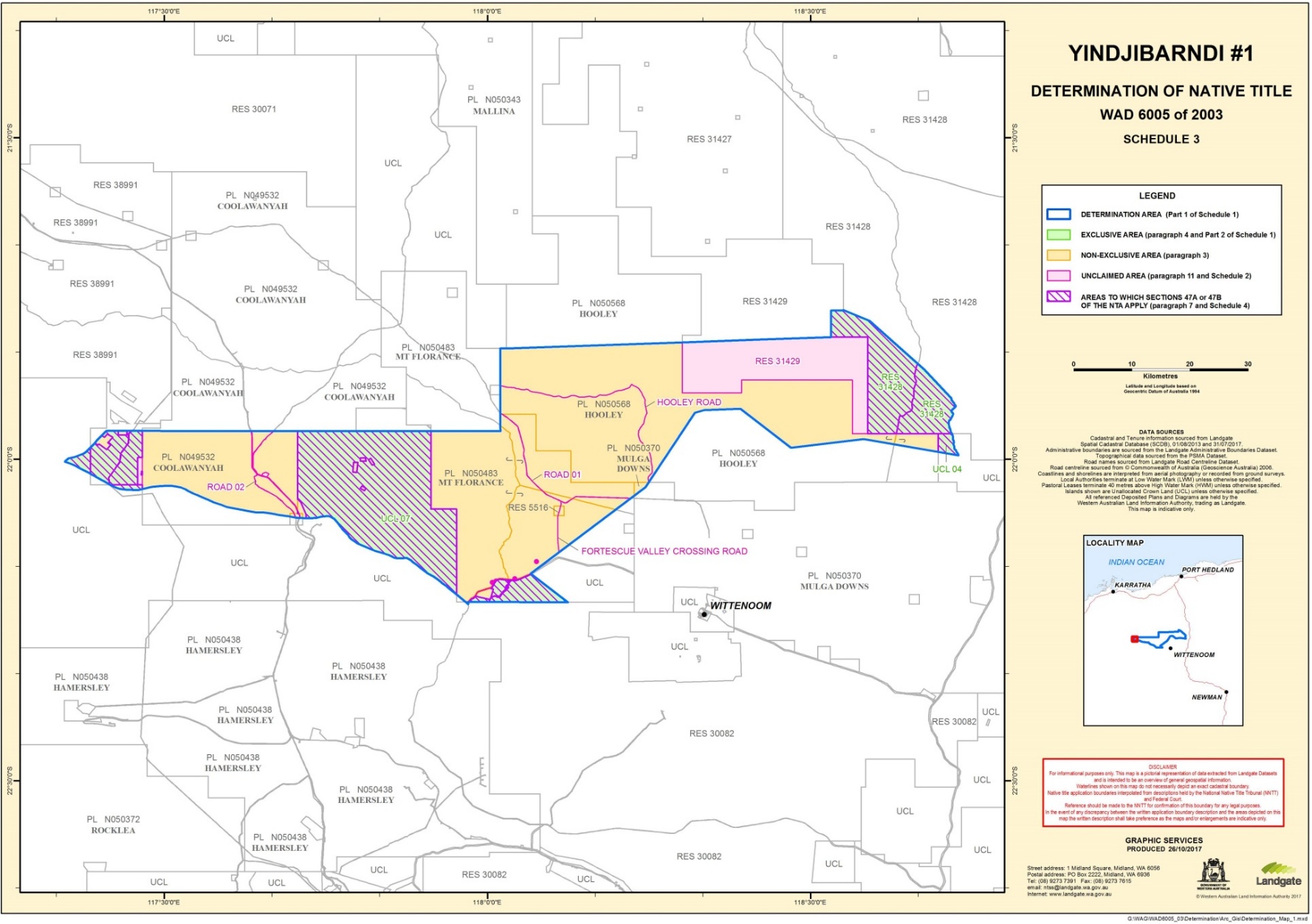
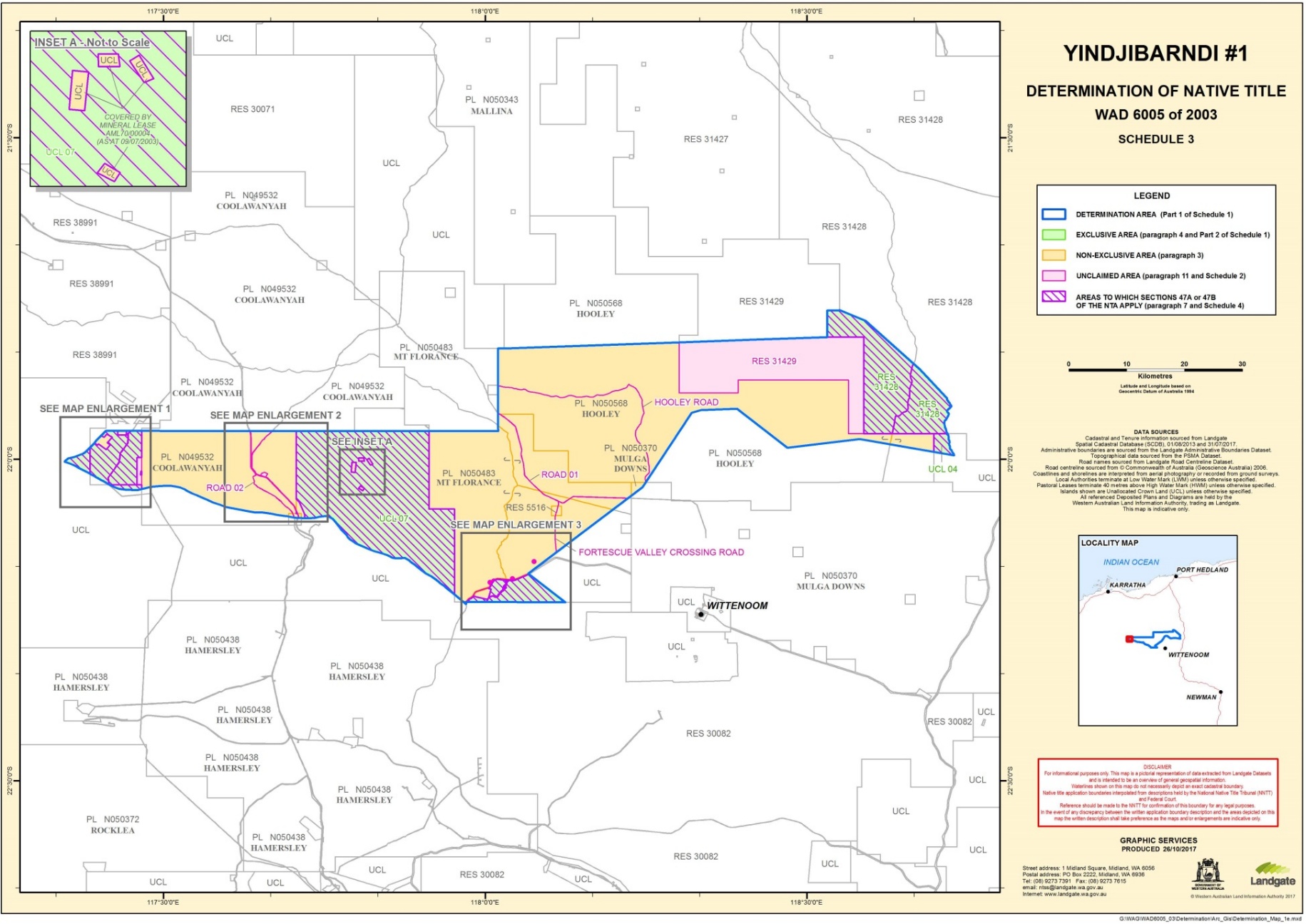
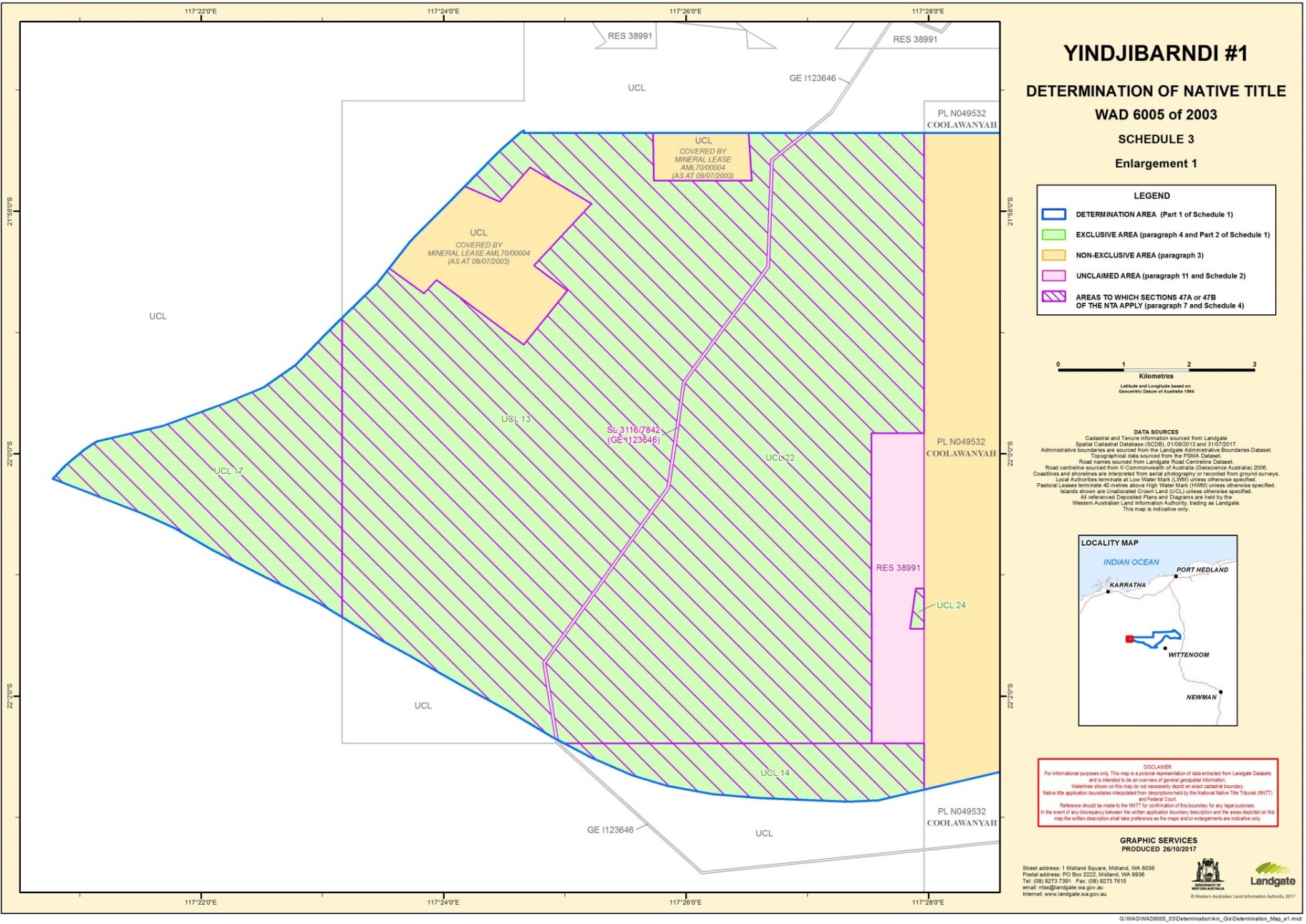
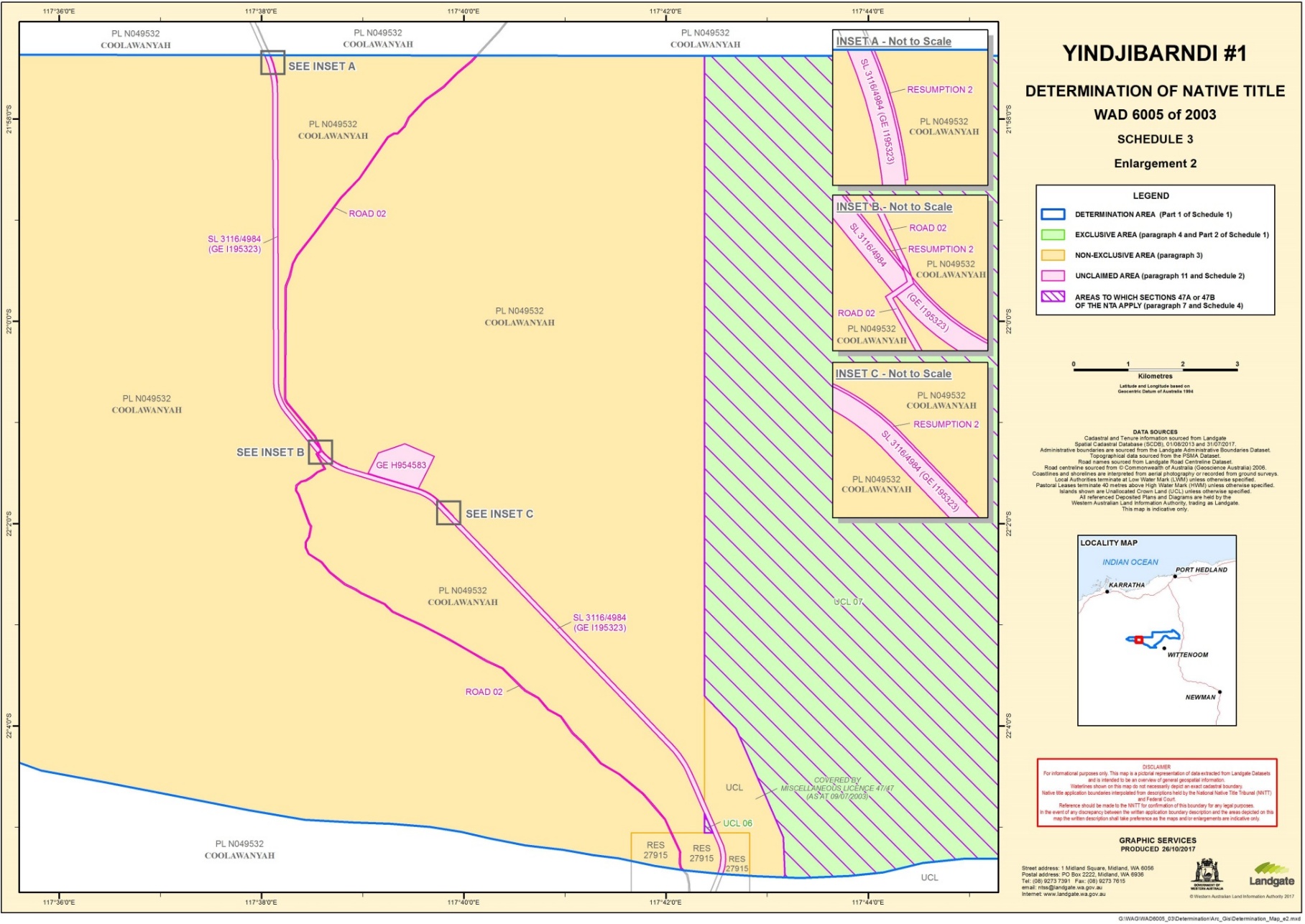
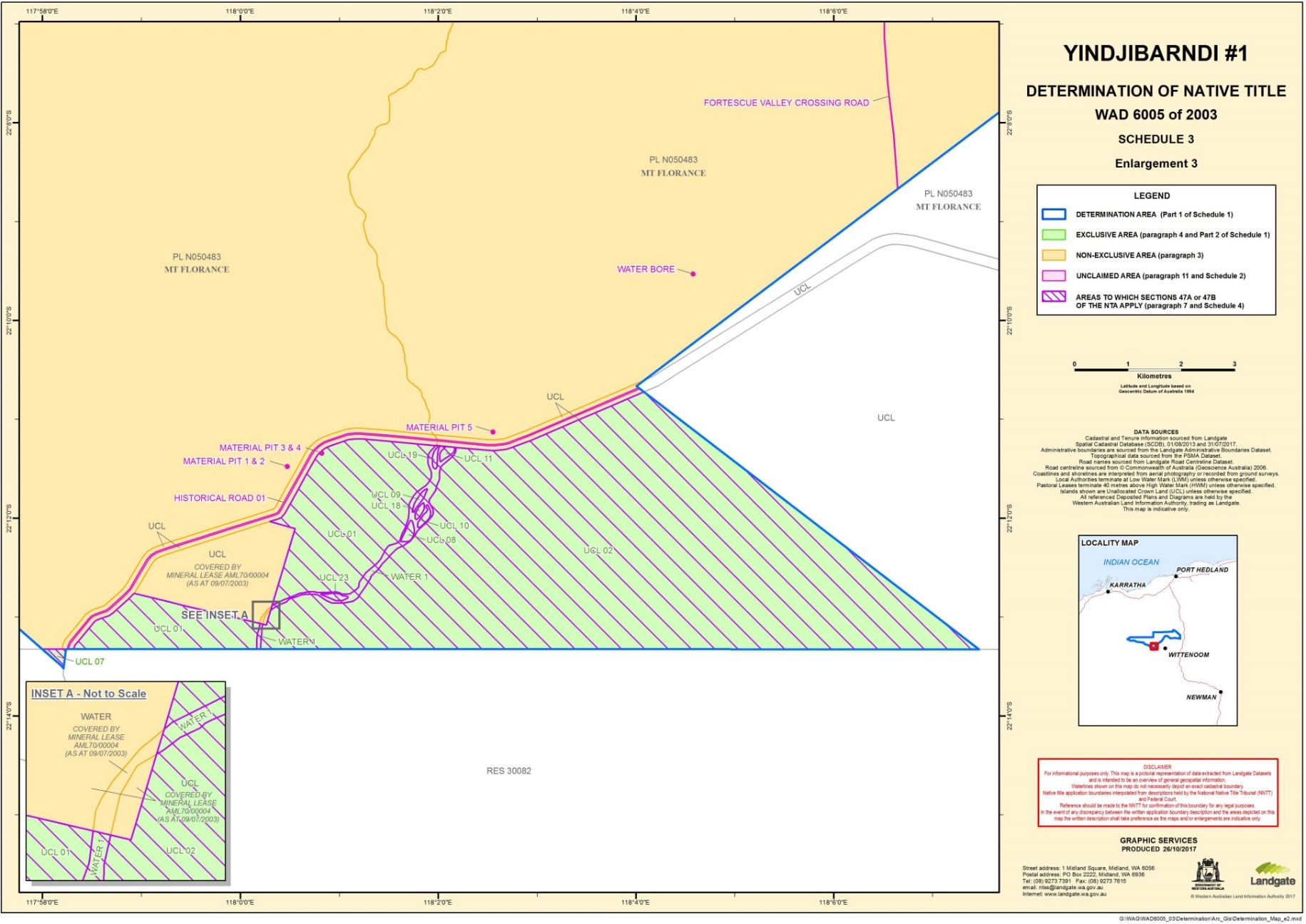
|
Sections 47A or 47B of the Native Title Act apply to the following land and waters within the Determination Area, which are generally shown as hatched in purple on the maps at Schedule 3:
1. Section 47A
Section 47A of the Native Title Act applies with the effect that any extinguishment by the creation of prior interests, including those referred to below, in relation to those parts of the Determination Area the subject of the following interests has been disregarded:
Areas where section 47A applies |
Reserve 31428 |
2. Section 47b
Section 47B of the Native Title Act applies with the effect that any extinguishment by the creation of prior interests in relation to those parts of the Determination Area referred to below has been disregarded:
Areas where section 47B applies |
UCL 01, except to the extent covered by mineral lease AML70/00004 as at the date the application was filed |
UCL 02, except to the extent covered by mineral lease AML70/00004 as at the date the application was filed |
UCL04 |
UCL06 |
UCL 07, except to the extent covered by: (a) mineral lease AML70/00004; and (b) miscellaneous licence 47/47 as at the date the application was filed. |
UCL08 |
UCL09 |
UCL10 |
UCL11 |
UCL13, except to the extent covered by mineral lease AML70/00004 as at the date the application was filed |
UCL14 |
UCL17 |
UCL18 |
UCL19 |
UCL22 |
UCL23 |
UCL24 |
WATER1, except to the extent covered by mineral lease AML70/00004 as at the date the application was filed |
|
The nature and extent of the Other Interests in relation to the Determination Area as at the date of this Determination are:
1. RESERVES
(a) the following reserves:
Reserve No. | Current Purpose |
5516 | Water |
27915 | Resting Place Travellers and Stock |
31428 | Use and benefit of Aborigines |
(b) the rights and interests of persons who have the care, control and management of the reserves identified in paragraph 1(a) above;
(c) the rights and interests of persons entitled to access and use the reserves identified in paragraph 1(a) above for the respective purposes for which they are reserved, subject to any statutory limitations upon those rights; and
(d) the rights and interests of persons holding leases over areas of the reserves identified in paragraph 1(a) above, including lease 353382 over reserve 31428.
2. PASTORAL LEASES
(a) The following pastoral leases and the rights and interests of the holders from time to time of those leases:
Lease No. | Station Name |
PL N049532 | Coolawanyah Station |
PL N050483 | Mt Florance Station |
PL N050568 | Hooley Station |
PL N050370 | Mulga Downs Station |
(b) Any rights and obligations of the pastoralists pursuant to the pastoral leases referred to in paragraph 2(a) above to adopt and exercise best practice management of the pasture and vegetation resources, livestock and soils within the boundaries of the pastoral leases in order to manage stock and for the management, conservation and regeneration of pasture for permitted uses.
3. water interests
(a) The following licences and permits granted pursuant to the Rights in Water and Irrigation Act 1914 (WA) and the rights and interests of the holders from time to time of those licences and permits:
(i) Licences to take groundwater:
Licence ID |
GWL160076(6) |
GWL162582(6) |
GWL164735(4) |
GWL171729(2) |
GWL174095(7) |
GWL175224(2) |
GWL179579(1) |
GWL179792(1) |
GWL180991(1) |
(ii) Licences to construct or alter wells:
Licence ID |
CAW181825(1) |
CAW181841(1) |
CAW182162(1) |
CAW200255(1) |
(iii) Permits to obstruct or interfere:
Licence ID |
PMB180179(2) |
(b) The following proclamations made under the Rights in Water and Irrigation Act 1914 (WA) and the rights and interests comprised in, conferred under or in accordance with those proclamations:
(i) Pilbara Surface Water Area Proclamation 1965 (proclaimed on 13 August 1965); and
(ii) Pilbara Ground Water Area Proclamation 1965 (proclaimed on 12 February 1965 and varied by proclamation on 21 December 1990 and 2 May 1997)
4. Mining Tenements
(a) The following mining tenements under the Mining Act 1904 (WA) (repealed) and the Mining Act 1978 (WA) and the rights and interests of the holders from time to time of those mining tenements:
(i) Mining leases
Tenement ID |
M47/542 |
M47/543 |
M47/1409 |
M47/1411 |
M47/1413 |
M47/1431 |
M47/1453 |
M47/1473 |
M47/1475 |
(ii) Miscellaneous licences
Tenement ID |
L47/0047 |
L47/0048 |
L47/0361 |
L47/0362 |
L47/0363 |
L47/0367 |
L47/0472 |
L47/0697 |
(iii) Exploration Licences
Tenement ID | Tenement ID | |
E47/0054 | E47/1397 | |
E47/0473 | E47/1398 | |
E47/0474 | E47/1399 | |
E47/0475 | E47/1447 | |
E47/0585 | E47/1489 | |
E47/1311 | E47/1557 | |
E47/1314 | E47/2769 | |
E47/1315 | E47/3132 | |
E47/1319 | E47/3205 | |
E47/1333 | E47/3397 | |
E47/1334 | E47/3464 | |
E47/1349 | E47/3483 | |
E47/1384 | E47/3491 |
(iv) Prospecting licences
Tenement ID |
P47/1601 |
P47/1701 |
(b) The agreement as amended and ratified by the Iron Ore (Hamersley Range) Agreement Act 1963 (WA) and rights and interests comprised in, conferred under or in accordance with, or pursuant to that agreement, including the following mining tenements:
Tenement ID | Tenement Type |
AML7000004 (ML 4SA) | Mineral lease |
(c) The agreement as amended and ratified by the Railway and Port (The Pilbara Infrastructure Pty Ltd) Agreement Act 2004 (WA) and rights and interests comprised in, conferred under or in accordance with, or pursuant to that agreement, including the following mining tenements:
Tenement ID | Tenement Type |
AL7000001 (L 1SA) | Miscellaneous licence |
5. Petroleum Interests
(a) The following petroleum title under the Petroleum Pipelines Act 1969 (WA) and the rights and interests of the holders from time to time of that petroleum title:
Title ID | Title Type |
PL 105 | Pipeline Licence |
6. Other
The following rights and interests:
(a) Valid or validated rights and interests, including licences and permits, granted by the Crown in right of the State or of the Commonwealth pursuant to statute or otherwise in the exercise of its executive power and any regulations made pursuant to such legislation.
(b) Valid or validated rights or interests held by reason of the force and operation of the laws of the State or of the Commonwealth, including but not limited to, the force and operation of the Rights in Water and Irrigation Act 1914 (WA) and the Land Administration Act 1997 (WA).
(c) The right to access the Determination Area by:
(i) an employee, agent or instrumentality of the State;
(ii) an employee, agent or instrumentality of the Commonwealth;
(iii) an employee, agent or instrumentality of any local government or other statutory authority;
as required and permitted by law in the performance of his or her statutory or common law duty.
(d) So far as confirmed pursuant to s 212(2) of the Native Title Act and s 14 of the Titles (Validation) and Native Title (Effect of Past Acts) Act 1995 (WA), any then-existing public access to, and enjoyment of, the following places in the Determination Area:
(i) waterways;
(ii) beds and banks or foreshores of waterways;
(iii) stock routes; and
(iv) areas that were public places at the end of 31 December 1993.
(e) Any other valid or validated:
(i) legal or equitable estate or interest in the land or waters; or
(ii) any other right (including a right under an option and a right of redemption), charge, power or privilege over, or in connection with:
(A) the land or waters; or
(B) an estate or interest in the land or waters; or
(iii) restriction on the use of the land or waters, whether or not annexed to other land or waters.
SCHEDULE 6: native title holders (paragraph 2) |
Yindjibarndi People are Aboriginal persons who recognised themselves as, and are recognised by other Yindjibarndi People as, members of the Yindjibarndi language group.
SCHEDULE OF PARTIES
WAD 37 of 2022 | |
Respondents | |
Fourth Respondent: | PILBARA ENERGY COMPANY PTY LTD |
Fifth Respondent: | THE PILBARA INFRASTRUCTURE PTY LTD |
Sixth Respondent: | PILBARA GAS PIPELINE PTY LTD |
Seventh Respondent: | YAMATJI MARLPA ABORIGINAL CORPORATION |


