

Federal Court of Australia
Deputy Commissioner of Taxation v Golden Dawn Limited (No 2) [2026] FCA 578
File number: | WAD 263 of 2022 |
Judgment of: | FEUTRILL J |
Date of judgment: | 11 May 2026 |
Catchwords: | PRACTICE AND PROCEDURE – application for appointment of a receiver in aid of execution of a judgment debt – listed and unlisted securities – convenience of appropriation or realisation of assets under statutory methods of execution – suitability of statutory property (seizure and sale) order – location of securities uncertain – location of documents of title or evidencing title uncertain or unknown – potential execution in more than one State or Territory – ability of Sheriff to give effect to property (seizure and sale) order |
Legislation: | Corporations Act 2001 (Cth) ss 168, 169, 170. 171, 172, 173, 420, 1070A, 1070D, 1071H, Federal Court Act 1976 (Cth) ss 23, 37M, 53 Civil Judgments Enforcement Act 2004 (WA) Pt 4, ss 7, 32, 33, 35, 49, 59, 66, 68, 69, 74, 75, 78, 79, 85, 86, 87 Federal Court Rules 2011 (Cth) rr 4.04, 4.05, 41.10 |
Cases cited: | Banning v Lean (No 3) [2019] WASCA 30; 54 WAR 259 Caird Seven Pty Ltd v Attia (No 3) [2016] NSWSC 1452; 92 NSWLR 457 Cardile v LED Builders Pty Ltd [1999] HCA 18; 198 CLR 380 Coeclerici Asia (Pte) Ltd v Gujarat NRE Coke Ltd [2013] FCA 882 CSR Ltd v Cigna Insurance Australia Ltd [1997] HCA 33; 189 CLR 345 Deputy Commissioner of Taxation v Huang (No 4) [2022] FCA 618 Deputy Commissioner of Taxation v Shi [2021] HCA 22; 273 CLR 235 Hall v Foster [2012] NSWSC 974 In re a Company [1915] 1 Ch 520 In re Shephard; Atkins v Shephard (1889) 43 Ch D 131 Jaken Properties Australia Pty Ltd v Naaman [2023] NSWCA 214; 112 NSWLR 318 Masri v Consolidated Contractors International (UK) Ltd (No 2) [2009] QB 450 Scott (Trustee), in the matter of Stolyar (Bankrupt) v Stolyar (No 5) [2024] FCA 37 The University of Western Australia v Gray (No 6) [2006] FCA 1825 |
Division: | General Division |
Registry: | Western Australia |
National Practice Area: | Taxation |
Number of paragraphs: | 32 |
Date of hearing: | 11 December 2025 and 15 April 2026 |
Counsel for the Applicant: | Mr JS Slack-Smith |
Solicitor for the Applicant: | K&L Gates |
Counsel for the Respondent: | The Respondent did not appear |
ORDERS
WAD 263 of 2022 | ||
| ||
BETWEEN: | DEPUTY COMMISSIONER OF TAXATION Applicant | |
AND: | GOLDEN DAWN LIMITED Respondent | |
order made by: | FEUTRILL J |
DATE OF ORDER: | 11 MAY 2026 |
THE COURT ORDERS THAT:
1. Service of the documents described in paragraph 1 of the orders of 15 April 2026 be taken to be good and sufficient service of those documents on the respondent (judgment debtor) and, otherwise, service of those documents on the judgment debtor by any other method be dispensed with.
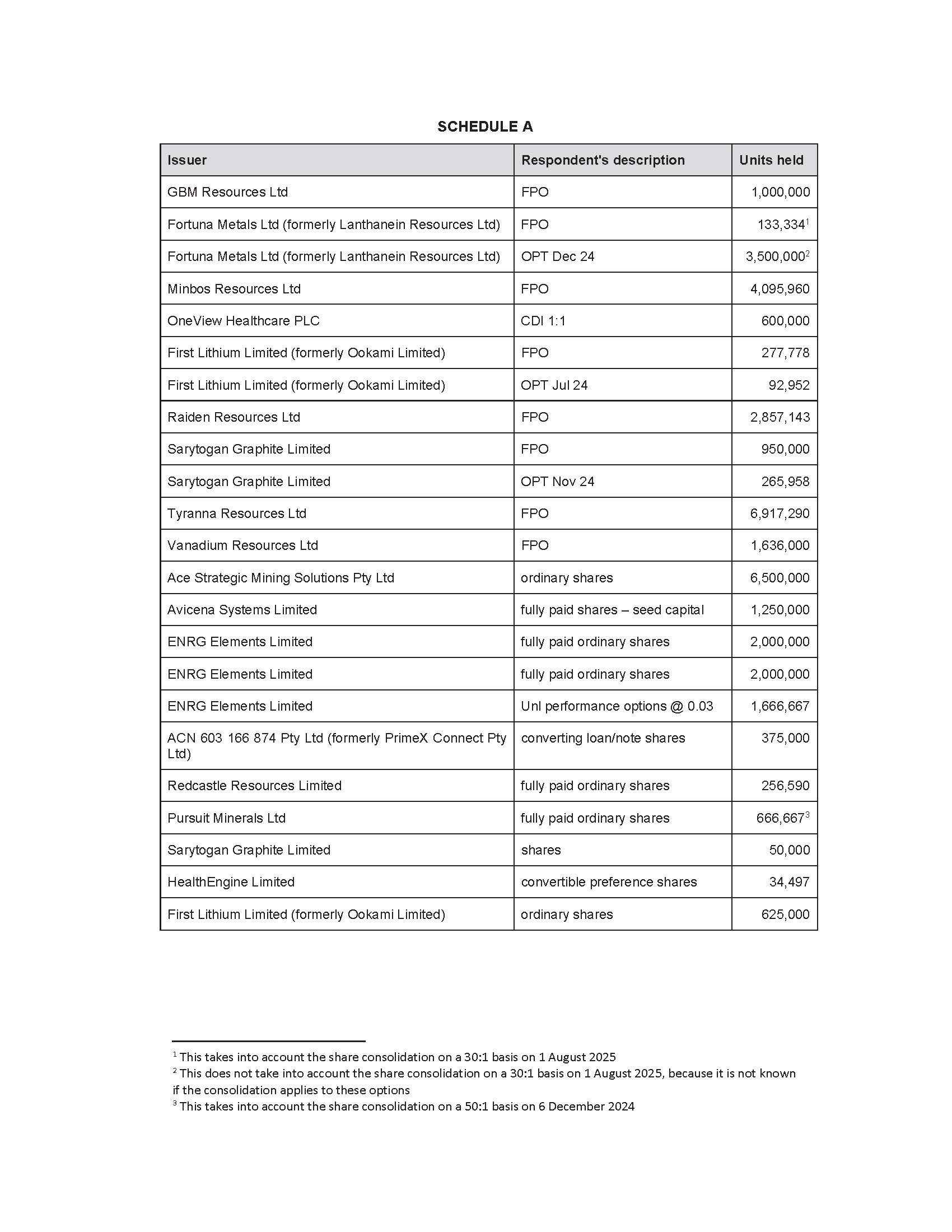
2. Andrew Yeo of Pitcher Partners, Level 13/664 Collins Street, Docklands in the State of Victoria be appointed as receiver, without security, of all Australian assets of the judgment debtor as described in the freezing orders of the Court made on 21 December 2022 as varied by orders made on 18 January 2023, 7 March 2023, 19 May 2023 and 3 January 2024 (freezing orders), including the assets described in the Schedule A to these orders (to the extent those assets remain assets of the judgment debtor as at the date of these orders), for the purpose of identifying, preserving, securing and realising those assets in aid of execution of the judgment entered in favour of the applicant (judgment creditor) on 17 July 2023.
3. The receiver have:
(a) power to do all things necessary or convenient to be done for or in connection with, or as incidental to, the attainment of the purpose for which he is appointed; and
(b) without limiting the generality of the power conferred in the preceding sub-paragraph:
(i) the power to get in, take possession, custody or control of, sell, dispose of, deal with and (or) otherwise realise, the judgment debtor’s Australian assets; and
(ii) the powers described in s 420(2) of the Corporations Act 2001 (Cth) with all necessary modifications, except the powers described in ss 420(2)(s), 420(2)(t) and 420(2)(u) of that Act.
4. The freezing orders be varied to the extent necessary to permit and give effect to the performance of the receiver’s functions in connection with the purpose of his appointment and the exercise of the powers conferred upon him under these orders.
5. The receiver be entitled to reasonable remuneration for necessary work properly performed together with all reasonable expenses properly incurred in the performance of his functions in connection with the purpose of his appointment and the exercise of the powers conferred on him under these orders as may be approved by the Court on application of the receiver.
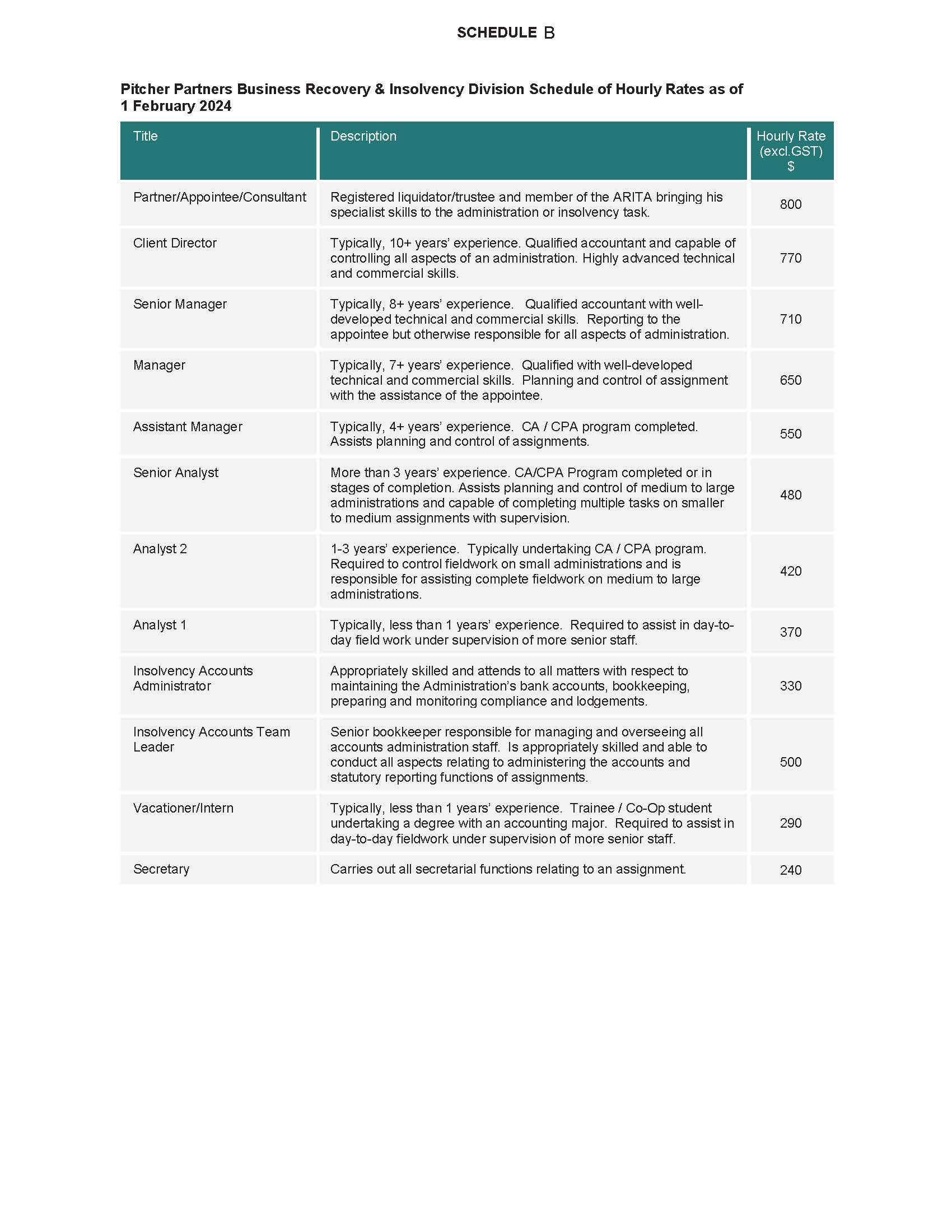
6. The receiver’s remuneration be calculated on the basis of time reasonably spent by him and any partner or professional employee (i.e., qualified or qualifying chartered accountant or certified practicing accountant) of the firm to which the receiver is attached at reasonable rates for a person of the same status and qualification who carried out the work and using the applicable rates set out in Schedule B to these orders as a guide to such reasonable rates.
7. The receiver file accounts of receipts and payments verified by affidavit, as at each six month anniversary after the date of these orders, within one month after each such date, and at the conclusion of the receivership. These accounts, and the final accounts by the receiver, may be filed by the receiver electronically.
8. The receiver must serve the above accounts on:
(a) the judgment debtor, by emailing them to each of the email addresses for service of the documents described in paragraph 1 of the orders made on 15 April 2026;
(b) the judgment creditor, by emailing them to andrew.chambers@klgates.com;
or to another email address or other email addresses provided by or on behalf of those parties to the receiver.
9. At the conclusion of the receivership, after payment of his remuneration and expenses as may be approved by the Court, the receiver must, upon the Court certifying the amounts of the proposed payments, distribute any funds he holds as follows:
(a) first, to the judgment creditor in payment of the judgment debt (including any interest and costs); and
(b) next, any surplus, to the judgment debtor.
10. The judgment debtor pay the judgment creditor’s costs of the enforcement application to be taxed in any event.
11. The costs referred to in paragraph 10 of these orders form part of the judgment debt for the purposes of paragraphs 2 and 9(a) of these orders.
12. The judgment debtor, judgment creditor and receiver have liberty to apply for further or other order.
Note: Entry of orders is dealt with in Rule 39.32 of the Federal Court Rules 2011.
Schedule A
Schedule B
REASONS FOR JUDGMENT
FEUTRILL J:
1 The Deputy Commissioner of Taxation, as judgment creditor, applies for the appointment of a receiver to all the Australian assets of Golden Dawn Limited, as judgment debtor, and certain ancillary orders in aid of execution of a consent judgment entered against Golden Dawn in the sum of $2,268,249.92. The principal issue for determination is whether the Australian assets of Golden Dawn, which consist of certain listed and unlisted securities, cannot be conveniently appropriated or realised for the purposes of satisfying the judgment debt. If not, a second issue arises as to whether, in the circumstances, it is appropriate to appoint a receiver to those assets in aid of execution.
Applicable legal principles
2 Pursuant to s 53 of the Federal Court of Australia Act 1976 (Cth) a person in whose favour a judgment of the Court is given is entitled to the same remedies for enforcement of the judgment in Western Australia, by execution or otherwise, as are allowed in like cases by the laws of that State to persons in whose favour a judgment of the Supreme Court of Western Australia is given. Rule 41.10(1) of the Federal Court Rules 2011 (Cth) makes provision for a judgment creditor to apply to this Court for an order to issue any writ, or take any other step that can be taken in the WA Supreme Court as if the judgment was a judgment of that Court. Pursuant to r 41.10(2) the Sheriff, when executing the orders of the Court, is authorised to act in the same manner as a similar officer of the WA Supreme Court is entitled to act.
3 Part 4 of the Civil Judgments Enforcement Act 2004 (WA) contains the remedies for enforcement of a monetary judgment of the WA Supreme Court. There are various types of enforcement orders described as ‘time for payment order’ (made under s 32), ‘instalment order’ (made under s 33), ‘earnings appropriation order’ (made under s 35), ‘debt appropriation order’ (made under s 49), ‘property (seizure and sale) order’ (made under s 59) and other order (made under s 86): s 18(1). Otherwise, the writs, warrants and orders that, immediately before the commencement of the Enforcement Act, could have been issued or made at common law or in equity or under a written law to enforce or execute a judgment of a court or in aid of a writ, warrant or order to enforce or execute a judgment of a court have been abolished in Western Australia: s 7(1) of the Enforcement Act.
4 Within the framework of Pt 4 of the Enforcement Act, ss 85, 86 and 87 provide:
85. Term used: available asset
In this Division —
available asset, in relation to a judgment debtor, means —
(a) the judgment debtor’s legal or equitable estate or interest in any real or personal property; or
(b) the judgment debtor’s interest in the property or profits of a partnership of which the debtor is a partner or in any other money that may be coming to the judgment debtor in respect of the partnership,
irrespective of whether the interest is held jointly or in common with another or others.
86. Appointing a receiver, injunctions etc.
(1) If an available asset of a judgment debtor cannot be conveniently appropriated or realised under this Part for the purposes of recovering a judgment debt, whether due to acts or omissions of the judgment debtor or otherwise, the judgment creditor may apply to the court for any or all of the following —
(a) an order that determines the nature and extent of the asset;
(b) an order that appoints a receiver of the asset;
(c) an order that the judgment debtor or any person in possession or control of the asset —
(i) deliver the asset to a person named in the order;
(ii) do, not do, or cease from doing, any act that relates to the asset and that is specified in the order;
(d) an order that prohibits the judgment debtor or any other person from disposing of or otherwise dealing with the asset;
(e) an order that facilitates the appropriation or realisation of the asset.
(2) The court may make any such order, subject to section 87.
(3) The court may make any such order even if no other proceedings have been taken to enforce the monetary judgment concerned.
87. Receiver, appointment of etc.
(1) In determining whether to appoint a receiver under section 86 the court must consider at least the following —
(a) whether appointing a receiver would be an effective means of realising the property;
(b) the probable cost of the receivership in relation to the probable benefits to be derived by appointing a receiver;
(c) whether appointing a receiver would cause undue hardship or prejudice to the judgment debtor or any other person;
(d) the likelihood of the judgment debt being recovered by means of any other enforcement order without realising the available asset in question.
(2) A court must not appoint a person as a receiver unless —
(a) the person satisfies the qualifications, if any, prescribed by the regulations; and
(b) the person has agreed in writing to act as receiver in respect of the available asset in question.
(3) Unless otherwise ordered by the court, a receiver appointed by the court may take into the receiver’s custody and control the available asset in respect of which the receiver is appointed.
(4) When or after appointing a receiver the court may make any ancillary or consequential order needed to enable the receiver to realise from the available asset sufficient money to satisfy the judgment debt.
(5) Without limiting subsection (4), the court may make —
(a) any order needed to give the receiver power to take custody or control of, manage, sell, dispose of, divert income from, or take proceedings in relation to, the available asset;
(b) any order needed as to the payment of the receiver’s fees and expenses.
5 Notwithstanding the abolition of common law and equitable writs, warrants and orders, a court exercising equitable jurisdiction has power to appoint a receiver. Therefore, the power to appoint a receiver under s 86 of the Enforcement Act may be regarded as augmenting, by statute, a court’s general equitable jurisdiction to do so: Banning v Lean (No 3) [2019] WASCA 30; 54 WAR 259 at [137]-[138] (Buss P, Murphy and Beech JJA). This Court has undoubted power to appoint a receiver under s 23 of the Federal Court Act and has power to appoint a receiver as an equitable remedy. The class of circumstances in which such power may be exercised are not closed: The University of Western Australia v Gray (No 6) [2006] FCA 1825 at [71] (French J). Accordingly, even without s 53 of the Federal Court Act and the remedies available under Pt 4 of the Enforcement Act, this Court has power to appoint a receiver in aid of enforcement of a monetary judgment of the Court.
6 Historically, in the exercise of equitable jurisdiction, courts made orders for the appointment of a receiver as a means of enforcement of process although it was commonly, but inaccurately, referred to as ‘equitable execution’. Equitable intervention by way of appointment of a receiver in aid of execution of a common law judgment was available in circumstances in which there was a ‘hindrance’ precluding common law execution: In re a Company [1915] 1 Ch 520 at 527 (Phillimore LJ); In re Shephard; Atkins v Shephard (1889) 43 Ch D 131 at 136 (Cotton LJ), 138 (Fry LJ); Banning v Lean (No 3) at [137]. Equitable enforcement was available in circumstances in which a common law writ of execution had been issued but the judgment creditor was prevented from execution due to the nature of the property: Shephard at 138. It has also been accepted that a receiver may be appointed in circumstances in which no common law writ had been issued, but the common law methods of execution would be inadequate or extremely inconvenient: Caird Seven Pty Ltd v Attia (No 3) [2016] NSWSC 1452; 92 NSWLR 457 at [16] (Emmett AJA), cited with apparent approval in Jaken Properties Australia Pty Ltd v Naaman [2023] NSWCA 214; 112 NSWLR 318 at [120] (Leeming JA, Kirk JA agreeing). See, also, Hall v Foster [2012] NSWSC 974 at [16]-[19] (Ball J); Masri v Consolidated Contractors International (UK) Ltd (No 2) [2009] QB 450 at [52]-[57] (Lawrence Collins LJ).
7 Likewise, Foster J observed that this Court may appoint a receiver ‘if it can be shown that other methods of execution would be inadequate or extremely difficult’ and the guiding principle should be whether the appointment is just and convenient (or appropriate in the proper administration of justice) in all the circumstances of the case: Coeclerici Asia (Pte) Ltd v Gujarat NRE Coke Ltd [2013] FCA 882 at [108]-[110]. In Scott (Trustee), in the matter of Stolyar (Bankrupt) v Stolyar (No 5) [2024] FCA 37 Markovic J appointed a receiver in aid of execution of a judgment in circumstances in which real property that could have been the subject of the equivalent of a property (seizure and sale) order had features that rendered a sale undertaken by a receiver more likely to realise greater value from the sale. It was a prestige waterfront apartment that required an appropriate marketing campaign to maximise its value. It was uninhabitable and required work and expenditure to put the property into a state in which it could be sold in a way that maximised its value: at [37]-[38]. Sale costs would be lower if undertaken by a receiver rather than the Sheriff: at [39]. Due to the terms of the judgment, it was likely that the judgment creditor would become entitled to sell the relevant property pursuant to a charge created by the judgment: at [40]. Therefore, sale was a question of timing and delay was likely to have a negative impact on value: at [41]. In reasoning that it was appropriate to appoint a receiver, amongst other things, her Honour had regard to s 37M of the Federal Court Act and the requirement that the civil practice and procedure provisions be interpreted and applied and the powers conferred by the Federal Court Act exercised in the way that best promotes the overarching purpose of those provisions to facilitate the just resolution of disputes according to law and as quickly, inexpensively and efficiently as possible.
8 It is also important to keep in mind that the power to make a freezing order is also derived from s 23 of the Federal Court Act. When a freezing order is made in pending proceedings before judgment the purpose of such an order is to prevent frustration of the Court’s process; namely, its process in execution of a potential judgment. However, as here, a freezing order may continue to operate after final judgment for the same reason: Deputy Commissioner of Taxation v Shi [2021] HCA 22; 273 CLR 235 at [21]-[22] (Gordon J); Deputy Commissioner of Taxation v Huang (No 4) [2022] FCA 618 at [17]-[21] (Jagot J). ‘The counterpart of a court’s power to prevent its processes being abused is its power to protect the integrity of those processes once set in motion’: CSR Ltd v Cigna Insurance Australia Ltd [1997] HCA 33; 189 CLR 345 at 391 (Dawson, Toohey, Gaudron, McHugh, Gummow and Kirby JJ). ‘The integrity of those processes extends to preserving the efficacy of the execution which would lie against the actual or prospective judgment debtor.’ Through the prevention of the abuse or frustration of its process in relation to matters coming within the Court’s jurisdiction the risk of the stultification of the administration of justice is diminished: Cardile v LED Builders Pty Ltd [1999] HCA 18; 198 CLR 380 at [25]-[26] (Gaudron, McHugh, Gummow and Callinan JJ). Consistently with these principles, the Court should not permit its own process to operate as an instrument by which execution of a judgment of the Court is frustrated or in a manner that leads to delay, increased expense and inefficiency.
Should a receiver be appointed in the interests of the proper administration of justice?
9 The judgment debtor is a company incorporated in Hong Kong. Before judgment was entered, on the application of the judgment creditor, the Court made a freezing order with respect to the Australian assets of the judgment debtor up to the unencumbered value of $2,147,163.47. As is usual, certain exceptions were made for payment of legal expenses. In the original order that sum was $100,000.00 and by subsequent amendments to the order that sum was increased to $295,000.00 and extended to accounting expenses. The original order also identified certain shares and options as part of the Australian assets and required the judgment debtor to provide information about all its Australian assets to the judgment creditor and serve an affidavit deposing to the facts upon which that information was founded. In accordance with that order, the judgment debtor served an affidavit of Mr Dominic Ka Kuen Sum sworn 18 January 2023 on the judgment creditor. Mr Sum is a director of the judgment debtor. The information in Mr Sum’s affidavit was supplemented with information provided by the judgment debtor’s legal representative (Cove Legal) to the judgment creditor’s legal representative (K+L Gates) in correspondence during 2023.
10 The Australian assets of the judgment debtor comprise financial products (securities) listed on the Australian Securities Exchange (ASX) and securities that are not listed on the ASX or any other securities exchange. Broadly, these assets fall into the following categories: CHESS-sponsored shares and options and CHESS depository interests listed on the ASX; issuer-sponsored shares in ASX-listed companies; issuer-sponsored financial products other than shares in relation to ASX-listed companies; shares in unlisted companies; and other financial products in relation to unlisted companies. However, as a consequence of the judgment debtor’s ability to dispose of or deal with its Australian assets to pay reasonable legal and accounting expenses, the current identity and composition of the judgment debtor’s Australian assets is not known. As matters stand, the judgment debtor has not provided the judgment creditor with information regarding the present composition of its assets and location of documents recording or evidencing title to the securities.
11 The Australian assets are personal property of an intangible nature. Typically, title to the intangible personal property is recorded in a physical document that is capable of seizure such as a share certificate and (or) register of shareholders. However, as will be explained, certificates are no longer issued for securities listed on the ASX. In keeping with contemporary document management practices, certificates or documents of title may also not be issued or may be kept in electronic rather than paper (physical) form. Further, certificates and documents of title may be held outside Australia (in Hong Kong) and may be beyond the reach of the jurisdiction of the Court.
12 Nonetheless, a company must set up and maintain registers of its members, option holders and debenture holders: s 168(1) of the Corporations Act 2001 (Cth). In general, those registers must be kept at the company’s registered office or principal place of business in Australia: s 172(1). Those registers must contain information about the holders’ names, addresses and number of the securities held: ss 169, 170, 171. A company must allow anyone to inspect those registers: s 173(1). A share or other interest of a member in a company is personal property that is taken to be situated in the State or Territory in which the register of members is kept: s 1070A(4)(a).
13 In general, a company must deliver to the holder of the security all the appropriate certificates or other title documents in connection with the issue of the security within two months after issue of the security or within one month after registration of a transfer of the security: s 1071H(1), s 1071H(3). However, that requirement does not apply if the operating rules of a prescribed Australian clearing and settlement facility (e.g., the ASX) provide otherwise: s 1071H(2). If documents of title are lost or destroyed the owner may apply for the issue of duplicates: s 1070D. Therefore, in the case of the Australian assets comprised of unlisted securities issued by companies with registered offices in Australia, the judgment debtor should have certificates or other documents of title or should be able to obtain such documents from the company that issued them. In the case of securities listed on the ASX, under the applicable operating rules certificates or other documents of title are not issued, but are recorded electronically.
14 For securities traded on the ASX settlement is effected through a computer system known as CHESS (Clearing House Electronic Subregister System). CHESS effects the settlement of trades and registers the transfer of title to securities from seller to buyer on the CHESS subregister. The owner (holder) of securities can choose to have the title registered on the CHESS subregister or a subregister maintained by the company that issued the security (Issuer Sponsored subregister). Registration on both kinds of subregister is electronic and no paper certificates for securities are issued. The register for the purposes of the Corporations Act comprises registrations on the CHESS subregister and Issuer Sponsored subregister.
15 To register securities on the CHESS subregister the holder must arrange an authorised participant (usually a stockbroker) to sponsor the holder on CHESS. CHESS holders are allocated a Holder Identification Number (HIN) that is a unique number identifying the holder of the security on the CHESS subregister. A different HIN is issued for each sponsor.
16 Although it is not necessary to have securities registered on the CHESS subregister to trade them on the ASX, to do so it is necessary to use a stockbroker. In the case of a buyer, if the holder does not have a sponsorship agreement or has not provided a HIN to the stockbroker who purchased the security, by default, the holder will be registered on the Issuer Sponsored subregister. In that case, the holder will be allocated a unique Securityholder Reference Number (SRN) identifying the holder of the security on the Issuer Sponsored subregister. In the case of a seller, if the holder does not have a HIN, the seller must advise the stockbroker of the holder’s SRN and the securities must be converted from the Issuer Sponsored subregister to the CHESS subregister in order to settle the trade. There is a mechanism by which a market participant (i.e., stockbroker) can make enquiries of issuers to obtain the SRN of a particular holder. If a holder has a sponsorship agreement and HIN with a stockbroker all securities held under other HINs or under SRNs can be transferred or converted to one HIN. Securities held on the CHESS subregister or an Issuer Sponsored subregister may also be traded (bought or sold) in an ‘off-market’ transaction.
17 It is evident that the judgment debtor has a sponsorship agreement with the stockbroking firm Euroz Hartleys. In the case of 12 securities, these are listed on the ASX and held on the CHESS subregister. In the case of six other securities, these are listed on the ASX, but are held on an Issuer Sponsored subregister. There are 12 companies that are the issuers of the securities listed on the ASX. In the case of four securities, these are not listed on the ASX and are held in four other companies.
18 In correspondence between K+L Gates and Cove Legal the judgment creditor and judgment debtor made competing contentions about the location of at least some of the securities. With the exception of the securities held on the CHESS subregister, the judgment debtor claimed that Issuer Sponsored statements and share certificates or other documents of title for securities were located at an address in Hong Kong. The judgment debtor also contended that securities were located in Hong Kong where documents of title were located. The judgment creditor contended that the securities were located in Australia based on other factors.
19 While, for the purposes of s 1070A(4)(a) of the Corporations Act, any location of a register of members may be presumed to be within Australia, the precise location of the register and the State or Territory in which the register is located is uncertain. For instance, the location of the CHESS subregister and each Issuer Sponsored subregister is not known. In the case of unlisted securities, the address where the register of members was kept is not known. Moreover, the evidence of the relevant addresses of the companies indicates that the address of one or more of the registered office, principal place of business, ‘head office’ or registry of at least six of the issuer companies is outside Western Australia and at least one head office is in the Republic of Ireland.
20 It follows that the precise location of the securities is uncertain. It also appears likely that any share certificates or other documents evidencing title to the securities will be located outside Australia (in Hong Kong). The location of the securities and title documents is of significance to the efficacy of any property (seizure and sale) order that may be made as a remedy for enforcement of the judgment in Western Australia.
21 A property (seizure and sale) order under Pt 4 of the Enforcement Act is a modern expression of the common law writ of fieri facias. An order of that nature authorises the Sheriff of the WA Supreme Court to seize and sell the judgment debtor’s property to wholly or partially satisfy the judgment debt: s 59(1). In the case of personal property, an order authorises the Sheriff to seize any property in which the judgment debtor has a ‘saleable interest’ and sell that interest. A ‘saleable interest’ in personal property means any legal or equitable interest in the property that can be disposed of according to law: ss 74(1), 74(2)(a), 74(2)(b)(i). Until it is sold, seized property is to be kept in such custody as the Sheriff decides: s 78(1).
22 The provisions of Pt 4 of the Enforcement Act relating to personal property indicate that a property (seizure and sale) order is largely directed to tangible personal property which can be ‘seized’ and taken into the custody of the Sheriff. However, certain kinds of intangible property can also be ‘seized’ where there is a physical representation of the property. For example, the Sheriff is authorised to seize cheques, bills of exchange, promissory notes, bonds, specialties, or other security for money, by virtue of which money is or may be payable to the judgment debtor and receive any money payable under those instruments: s 74(2)(b)(iii), s 79. The Sheriff also has power to enter any place where the Sheriff believes on reasonable grounds that there is or may be a record evidencing the title to personal property and may seize that record or make or print out, and keep, a copy of any such record: s 75(1). Collectively, these provisions authorise the Sheriff to take control of intangible personal property and sell and transfer title to that property. Accordingly, there does not appear to be any legal impediment to the Sheriff ‘seizing’ by taking control of the instruments of title to securities whether or not the securities are listed on the ASX and selling and transferring those securities to a buyer. Nonetheless, there are a number of features of the property (seizure and sale) order framework that render such an order an ill-suited and inconvenient mechanism for taking control of the judgment debtor’s securities and selling them in the circumstances of this case.
23 First, if a property (seizure and sale) order were made it would authorise the Sheriff, when executing the order to act in the same manner as a similar officer of the WA Supreme Court (the WA Sheriff): r 41.10(2) of the Rules. In practice, where this Court makes such an order in Western Australia, the function of the Sheriff under the Rules is performed by the WA Sheriff. Having regard to the legal and practical effect of r 41.10(2), to the extent that the securities or documents of title are located outside Western Australia, but within another State or Territory of Australia, it is doubtful that the powers of the Sheriff (as performed by the WA Sheriff) extend to seizing and selling property located in another State or Territory. Rule 41.10(3) alludes to that limitation and provides that a party who wants to enforce an order in more than one State or Territory may, in that case, adopt the procedures and forms of process of Western Australia for each other State or Territory. However, as a matter of practice, it will be necessary for a property (seizure and sale) order to be made authorising the seizure and sale of property located in each State or Territory other than Western Australia and for the Sheriff to execute the orders of the Court in each other State or Territory. It follows that, there will be administrative and jurisdictional complexity attempting to give effect to a property (seizure and sale) order in this case because, due to the uncertainty of the location of the securities, multiple orders may need to be made and enforced in Western Australia and other States. That may lead to duplication, delay, increased expense and reduced efficiency. Further, the Sheriff would not have power to seize certificates or other documents of title or evidencing title located outside Australia.
24 Second, the processes for sale of personal property in Pt 4 of the Enforcement Act are not appropriate for trading securities on the ASX or any other securities exchange. Before selling a judgment debtor’s saleable interest in property the Sheriff must take reasonable steps to determine a fair value for the interest: s 66(1). The Sheriff must advertise any intended sale in a reasonable manner: s 68(1). Subject to any order of a court, the sale must be by public auction and must not be less than a fair value for the interest: s 69(1)(b), s 69(1)(c). While the Sheriff or judgment creditor may apply to the Court, on notice to the judgment debtor, for an order varying the manner in which the sale is conducted, the variations are limited to sale by public tender or private agreement and to sale for an amount less than a fair value of the interest: s 69(2), s 69(3). None of those steps is necessary for a sale on a securities exchange like the ASX where there are many buyers and sellers transacting in a transparent and informed market.
25 Third, in an email from an employee of the Sheriff’s Office of the Western Australian Department of Justice to K+L Gates, that employee represented that the WA Supreme Court Sheriff does not have a mechanism to conduct transfers or manage brokerage requirements. Further the WA Sheriff would not typically undertake these steps and would likely require specific court directions. Notwithstanding these observations, it is not obvious that taking steps to enter into a sponsorship arrangement with a broker to facilitate the sale of listed ASX shares would be particularly onerous or beyond the capability or capacity of the WA Sheriff. Nonetheless, it is evident that, if a property (seizure and sale) order were made, it would be necessary, at least, to make an order that facilitates the realisation of the securities listed on the ASX under s 86(1)(e) to permit trading the securities on the ASX and to dispense with inappropriate requirements relating to the methods of sale.
26 The judgment creditor also submits that for certain of the Issuer Sponsored securities the SRN is not known. He submits that a receiver would be better placed than the Sheriff to investigate and obtain information about those SRNs. Again, at least where an issuer has a registered office, principal place of business or registry in Western Australia, it is not obvious that the Sheriff would have any greater difficulty obtaining that information than a receiver given the power of the Sheriff to enter a place where it is believed that there is a record evidencing title to property and to obtain documents of that character. However, for the reasons already given, the location of that information is uncertain and exercising that power in a State other than Western Australia would involve duplication, delay, increased expense and reduced efficiency.
27 Fourth, insofar as the securities in the four unlisted companies are concerned, the employee of the WA Supreme Court Sheriff’s Office represented to K+L Gates that ‘practical challenges associated with shares and other financial products – particularly in proprietary companies – mean the Sheriff is not ordinarily in a position to facilitate such sales’. The practical challenges identified were: determining the value of the shares and underlying company assets; locating and seizing share certificates; and preventing any diminution of company assets prior to sale. While any receiver would face the same practical challenges, these challenges are likely to be more acute for the WA Sheriff. Given that any receiver appointed will be a registered liquidator, that person is likely to have significant experience and expertise dealing with valuation of securities (including the underlying assets), taking appropriate steps to prevent diminution of company assets and marketing and selling such securities. With appropriate powers conferred by or directions from the Court, a receiver should also be able to take control of all securities and effect a sale and transfer of them to a buyer without necessarily requiring the title documents or encountering jurisdictional difficulties effecting a sale and transfer of the securities where the legal location of the securities is uncertain.
28 For the foregoing reasons, due to the nature of the securities and the mechanisms for effecting a sale of them under Pt 4 of the Enforcement Act, the judgment debtor’s securities cannot be conveniently realised under that Part. Further, for essentially the same reasons, appointing a receiver would be an effective means of realising the securities. The appointment of a receiver will also mitigate the risk of duplication, delay, increased expense and reduced efficiency associated with dealing with securities with multiple potential legal locations.
29 The judgment creditor was not able to provide evidence of the likely value of all the Australian assets of the judgment debtor. However, as of the close of trade on 17 October 2025, the value of the ordinary shares listed on the ASX was $691,211.08. In the affidavit of Mr Sum he deposed that the market value of many (but not all) of the securities totalled $2,321,945.12 as of January 2023. The proposed receiver has given an estimate of approximately $60,000.00 to $120,000.00 (excluding GST) for remuneration and expenses of a receivership. While neither the valuations of the securities nor the estimate of the cost of a receivership is very reliable, the evidence – such as it is – provides an indication that the appointment of a receiver is unlikely to be an exercise in futility or cause undue hardship or prejudice to the judgment debtor.
30 The judgment debtor is resident outside Australia and has not communicated or engaged with the judgment creditor in relation to the judgment debt. There has been no indication that the judgment debtor can or intends to satisfy the judgment debt. Although no notice of ceasing to act has been filed in accordance with r 4.04 or r 4.05 of the Rules, in an email from Cove Legal to K+L Gates dated 1 May 2024, Cove Legal said that the judgment debtor no longer instructed that firm with respect to the proceeding. After that communication, on 8 May 2024, K+L Gates sent a letter by email to the email address of Mr Sum by which the judgment debtor was requested, amongst other things, to indicate what steps would be taken to satisfy the judgment debt. There has been no response to that email or letter.
31 The enforcement application, supporting affidavits and submissions, transcript of the oral hearings and order of the Court relating to service of those documents have all been served on the judgment debtor. While that service was not personal, it was by express international post to the last known business address of the judgment debtor in Hong Kong, the last known residential addresses of the judgment debtor’s controllers and by emails to the last known email addresses of two of its officers. While an email to one officer was not received, there is no indication that email to Mr Sum was not delivered. There has also been service on Cove Legal which remains the judgment debtor’s legal representative in the proceeding. Notwithstanding that service, the judgment debtor has not given notice that it wants to be heard and has not participated in the application for an order appointing a receiver. In these circumstances, there is very little likelihood of the judgment debt being recovered in whole or in part by payment or by any other means of enforcement without realisation of the assets through the appointment of a receiver.
32 Taking into account all the foregoing matters, it is just and convenient and in the interests of the proper administration of justice that an order be made to appoint a receiver in aid of execution. As the receiver who has consented to the appointment and who will be appointed is a registered liquidator and the receiver’s remuneration and expenses will be paid out of the assets the subject of the appointment, it is not necessary for the receiver to provide security. The judgment debtor should pay the judgment creditor’s costs of the application to be taxed in any event.
I certify that the preceding thirty-two (32) numbered paragraphs are a true copy of the Reasons for Judgment of the Honourable Justice Feutrill. |
Associate:
Dated: 11 May 2026


