

Federal Court of Australia
Sumeo v Minister for Immigration, Citizenship and Multicultural Affairs [2026] FCA 563
Review of: | XFTR v Minister for Immigration, Citizenship and Multicultural Affairs [2025] ARTA 1094 |
File number(s): | NSD 1603 of 2025 |
Judgment of: | SHARIFF J |
Date of judgment: | 7 May 2026 |
Catchwords: | MIGRATION – where delegate of respondent cancelled applicant’s visa under s 501(2) of the Migration Act 1958 (Cth) – where Administrative Review Tribunal (Tribunal) affirmed delegate’s decision – whether Tribunal failed to take into account known views of affected children under paragraph 8.4(4)(f) of Direction no 110 — Visa refusal and cancellation under section 501 and revocation of a mandatory cancellation of a visa under section 501CA (Direction 110) – whether Tribunal failed to make a determination regarding whether cancellation of the applicant’s visa is in the best interests of each affected child as required under paragraphs 8.4(1) and 8.4(3) of Direction 110 – whether Tribunal failed to consider the nature and seriousness of the applicant’s conduct, the impact of the applicant’s conduct on his family, and the nature of the harm to individuals or the community as required by paragraphs 8.1(2)(a), 8.1.1(1)(d) and 8.1.2(2)(a) of Direction 110 – whether the Tribunal failed to consider the strength, nature and duration of the applicant’s ties to Australia as required by paragraph 8.3 of Direction 110 – Error established. |
Legislation: | Migration Act 1958 (Cth) s 501(2) Direction no 110 — Visa refusal and cancellation under section 501 and revocation of a mandatory cancellation of a visa under section 501CA paras 8.1, 8.1(2)(a), 8.1.1, 8.1.1(1), 8.1.1(1)(d), 8.1.2, 8.1.2(2)(a), 8.3, 8.3(1), 8.3(2), 8.4, 8.4(1), 8.4(3), 8.4(4)(f), 9.2 |
Cases cited: | Applicant WAEE v Minister for Immigration & Multicultural & Indigenous Affairs [2003] FCAFC 184; 236 FCR 593 Brown v Minister for Immigration and Citizenship [2026] FCA 323 Ismail v Minister for Immigration, Citizenship and Multicultural Affairs [2024] HCA 2; 280 CLR 265 Jabari v Minister for Immigration, Citizenship, Migrant Services and Multicultural Affairs [2023] FCAFC 98; 298 FCR 431 LPDT v Minister for Immigration, Citizenship, Migrant Services and Multicultural Affairs [2024] HCA 12; 280 CLR 321 Mailau v Minister for Immigration, Citizenship, Migrant Services and Multicultural Affairs [2022] FCA 610 Minister for Home Affairs v NBCM [2019] FCAFC 199 Minister for Immigration and Ethnic Affairs v Wu Shan Liang [1996] HCA 6; 185 CLR 259 Minister for Immigration and Multicultural Affairs v Yusuf [2001] HCA 30; 206 CLR 323 Minister for Immigration, Citizenship and Multicultural Affairs v RGKY [2022] FCAFC 177 Plaintiff M1/2021 v Minister for Home Affairs [2022] HCA 17; 275 CLR 582 Siale v Minister for Immigration and Citizenship [2025] FCA 608 Singh v Minister for Home Affairs [2019] FCAFC 3; 267 FCR 200 Stamenkovic v Minister for Immigration and Citizenship [2025] FCAFC 157 SZTMD v Minister for Immigration & Border Protection [2015] FCA 150 Titoa v Minister for Immigration, Citizenship and Multicultural Affairs [2024] FCAFC 163 XFTR v Minister for Immigration, Citizenship and Multicultural Affairs [2025] ARTA 1094 |
Division: | General Division |
Registry: | New South Wales |
National Practice Area: | Administrative and Constitutional Law and Human Rights |
Number of paragraphs: | 86 |
Date of hearing: | 28 April 2026 |
Counsel for the Applicant: | Dr A Sapienza (pro bono) |
Solicitor for the Applicant: | Kinslor Prince Lawyers |
Counsel for the First Respondent: | Ms F McNeil |
Solicitor for the First Respondent: | HWL Ebsworth Lawyers |
ORDERS
NSD 1603 of 2025 | ||
| ||
BETWEEN: | FALANIKO SUMEO Applicant | |
AND: | MINISTER FOR IMMIGRATION, CITIZENSHIP AND MULTICULTURAL AFFAIRS First Respondent ADMINISTRATIVE REVIEW TRIBUNAL Second Respondent | |
order made by: | SHARIFF J |
DATE OF ORDER: | 7 MAY 2026 |
THE COURT ORDERS THAT:
1. A writ of certiorari be issued quashing the decision of the second respondent made on 22 July 2025.
2. A writ of mandamus be issued remitting the applicant’s application for review to a different member of the second respondent for determination according to law.
3. The first respondent is to pay the applicant’s costs as agreed or taxed.
Note: Entry of orders is dealt with in Rule 39.32 of the Federal Court Rules 2011.
REASONS FOR JUDGMENT
SHARIFF J:
1. INTRODUCTION
1 The applicant is a citizen of New Zealand who arrived in Australia in 1993 at the age of 15. The applicant was granted a Class TY Subclass 444 Special Category (Temporary) visa on 1 September 1994 (the Visa). The applicant has a long history of criminal offending involving instances of violent harm, including family violence inflicted towards his past and current partners. The applicant’s Visa was ultimately cancelled (after an earlier warning to that effect) following further convictions for offences of domestic violence, including breaches of apprehended violence orders (AVOs).
2 On 12 May 2025, the applicant was informed that a delegate of the first respondent (the Minister) had decided to exercise their discretion under s 501(2) of the Migration Act 1958 (Cth) (the Act) to cancel the Visa on the basis that the applicant had not satisfied the delegate that he passed the character test (Cancellation Decision).
3 By his present application before the Court, the applicant seeks judicial review of a decision made by the Administrative Review Tribunal (the Tribunal) on 22 July 2025: see XFTR v Minister for Immigration, Citizenship and Multicultural Affairs [2025] ARTA 1094 (Tribunal Decision or TD). By that decision, the Tribunal affirmed the Cancellation Decision. The applicant contends that the Tribunal Decision was affected by error and should be quashed.
4 By an Amended Originating Application, the applicant contends that the Tribunal erred by:
(a) failing to take into account a mandatory relevant consideration, namely, the known views of children affected by the decision (Ground 1);
(b) constructively failing to comply with a statutory condition governing the making of its decision, namely, the requirement to make a determination about whether cancellation was in the best interests of each child affected by the Tribunal Decision (Ground 2);
(c) failing to take into account a mandatory relevant consideration, namely, the nature of the harm caused by the applicant’s recent family violence conduct and the nature of the harm should it be repeated (Ground 3);
(d) constructively failing to comply with a statutory condition governing the making of its decision, namely, the requirement to consider the strength, nature and duration of ties to Australia (Ground 4); and
(e) constructively failing to make a decision in accordance with Direction no 110 — Visa refusal and cancellation under section 501 and revocation of a mandatory cancellation of a visa under section 501CA (Direction 110) (Ground 5).
5 For the reasons that follow, Ground 1 should be upheld and, for that reason, Ground 5 should also be upheld to that extent. Each of the other Grounds should be dismissed.
2. BACKGROUND
6 The applicant’s adult offending commenced in 1997. His offences have involved the infliction of grievous bodily harm and instances of family violence.
7 During 2008 and 2009, the Minister considered whether the applicant’s Visa should be cancelled following earlier convictions. However, a decision was made not to cancel his Visa at that time and on 22 April 2009, the applicant was given a warning about possible consequences for his Visa if he engaged in further offending.
8 The applicant was released on parole in September 2009 but was thereafter convicted of further offences.
9 On 17 December 2014, the applicant was convicted of assault occasioning actual bodily harm against his then partner and was sentenced to 18 months’ imprisonment which was suspended upon entering into a bond.
10 On 27 October 2017, the applicant was convicted of an offence to destroy or damage property at the home he shared with his then partner and was sentenced to a 12-month good behaviour bond and placed under supervision.
11 The applicant’s relationship with his current wife (Ms RS) resumed (from an earlier relationship) in 2018. On 5 April 2020, an incident occurred at their home which resulted in the imposition of an AVO on that date, and a conviction on 11 October 2021 for common assault.
12 On 12 January 2021, the applicant was convicted of contravening an AVO and sentenced to a 6-month community corrections order.
13 On 11 October 2021, the applicant was also convicted of stalk/intimidate with intent to cause fear of harm (domestic) and contravention of an AVO in respect of an incident involving Ms RS on 2 March 2021.
14 On 1 July 2025, the applicant was convicted of destroy/damage property, being the television of Ms RS. He was sentenced to a 12-month conditional release order and a further AVO was made.
15 By notices dated 12 November 2020 and 15 May 2024, the applicant was informed that consideration was (again) being given to the cancellation of his Visa. Following representations made by the applicant and Ms RS, the Cancellation Decision was made on 12 May 2025.
16 By notice dated 1 July 2025, the applicant was informed that he was to be removed from Australia and would be taken into immigration detention when released from the custody of Corrective Services NSW.
3. GROUND 1: FAILURE TO TAKE INTO ACCOUNT KNOWN VIEWS OF AFFECTED CHILDREN
17 It is uncontroversial that the Tribunal was required to comply with Direction 110. That direction provides that in making a decision under s 501(2) of the Act, the “best interests of minor children in Australia” who are to be affected by the decision are a primary consideration. Relevantly, paragraph 8.4 of Direction 110 provides as follows:
8.4. Best interests of minor children in Australia affected by the decision
(1) Decision-makers must make a determination about whether cancellation or refusal under section 501, or non-revocation under section 501CA is, or is not, in the best interests of a child affected by the decision.
(2) This consideration applies only if the child is, or would be, under 18 years old at the time when the decision to refuse or cancel the visa, or to not revoke the mandatory cancellation of the visa, is expected to be made.
(3) If there are two or more relevant children, the best interests of each child should be given individual consideration to the extent that their interests may differ.
(4) In considering the best interests of the child, the following factors must be considered where relevant:
a) the nature and duration of the relationship between the child and the noncitizen. Less weight should generally be given where the relationship is nonparental, and/or there is no existing relationship and/or there have been long periods of absence, or limited meaningful contact (including whether an existing Court order restricts contact);
b) the extent to which the non-citizen is likely to play a positive parental role in the future, taking into account the length of time until the child turns 18, and including any Court orders relating to parental access and care arrangements;
c) the impact of the non-citizen's prior conduct, and any likely future conduct, and whether that conduct has, or will have a negative impact on the child;
d) the likely effect that any separation from the non-citizen would have on the child, taking into account the child's or non-citizen's ability to maintain contact in other ways;
e) whether there are other persons who already fulfil a parental role in relation to the child;
f) any known views of the child (with those views being given due weight in accordance with the age and maturity of the child);
g) evidence that the child has been, or is at risk of being, subject to, or exposed to, family violence perpetrated by the non-citizen, or has otherwise been abused or neglected by the non-citizen in any way, whether physically, sexually or mentally;
h) evidence that the child has suffered or experienced any physical or emotional trauma arising from the non-citizen's conduct
18 It was common ground that, between them, the applicant and Ms RS have eight children, of whom six reside primarily with the applicant and Ms RS. The parentage and residence of each child was set out in a document that was tendered into evidence before the Tribunal. That information was helpfully summarised by the Minister as follows:
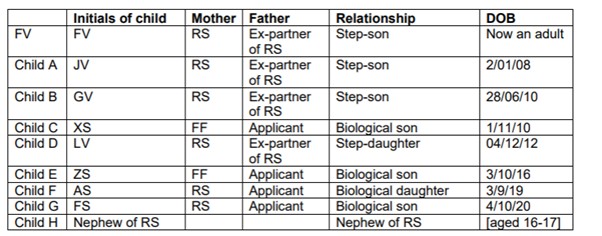
19 In the proceedings before the Tribunal, Child A provided what the Tribunal referred to as “a letter in support to the Applicant”: TD at [225]. It explained Child A’s views of what the applicant does for him and his family, and his fears for his mother (Ms RS) if the applicant was to be removed from Australia. The letter formed part of the “Hearing Book” that was before the Tribunal.
20 Separately, each of Child B, Child C and Child D provided handwritten letters. These documents did not form part of the Hearing Book but were part of a six-page bundle of documents bearing an index and entitled “Applicant’s Additional Evidence (Character References)”. This six-page bundle was tendered separately as Exhibit 10 in the proceedings before the Tribunal.
21 The handwritten letters from Child B, Child C and Child D were supportive of the applicant and expressed a desire for him to remain in Australia. Child B’s letter explained that he felt sad that the applicant was leaving and expressed his views as to the positive impact the applicant had on his family. Child C also addressed the positive impact that the applicant had on the family. He expressed concern about the emotional and financial impact of the applicant being deported, especially on the younger children. Child C stated that “our family would be devasted” and that the applicant’s “mistakes can be made up for”. Child D also explained the positive impact of the applicant on her family, including Ms RS and her siblings, and, in particular, in respect of her sporting and educational endeavours. Child D expressly addressed the positive impact the applicant had on her younger siblings and the bond between them. She further expressed concern as to the “big toll” that the applicant’s absence would have on her younger sister, Child F, and, more generally, stated that his absence would be “a problem in our house”.
22 The applicant submitted that the Tribunal did not refer to or consider the known views of Child B, Child C and Child D. The applicant submitted that, other than a brief and general mention of the fact that there were “character references” in evidence at TD [109] and footnote 90, the Tribunal did not refer to the handwritten letters elsewhere, including in the part of its reasons considering the best interests of affected children. It was submitted that it should be inferred that this material was ignored, and that the Tribunal had not only failed to consider critical evidence but that it had also failed to consider a mandatory relevant consideration as to the known views of affected children as required by paragraph 8.4(4)(f) of Direction 110.
23 It is convenient to set out the relevant parts of the Tribunal’s reasons.
24 At TD [109], the Tribunal stated:
The Applicant has provided various character references.
25 This paragraph contained a footnote, footnote 90, which contained the following text:
E.g. See HB 97-103, 213-225, 356-371; Exhibit 10: Various Character References and Statements.
(Emphasis added.)
26 The Tribunal then considered the best interests of the relevantly affected children at TD [218]-[243]. It identified the relevant children, and the living arrangements relating to them, as follows at TD [220]-[224]:
220. The relevant minor children in Australia are:
(a) Child A is the Applicant’s stepson, the child of Ms RS and her former partner. He is aged 17. He will turn 18 in January 2026.
(b) Child B is the Applicant’s stepson, the child of Ms RS and her former partner. He is aged 15.
(c) Child C is the Applicant’s son, the child of his former partner Ms FF. He is aged 14.
(d) Child D is the Applicant’s stepdaughter, the child of Ms RS and her former partner. She is aged 12.
(e) Child E is the Applicant’s son, the child of his former partner Ms FF. He is aged 8.
(f) Child F is the Applicant’s daughter, the child of Ms RS. She is aged 5.
(g) Child G is the Applicant’s son, the child of Ms RS. He is aged 4.
(h) Child H is Ms RS’s nephew. He is aged 16.
221. Ms RS is raising 6 children on her own, being Child A, B, C, D, F and G.
222. Child A, B and D are Ms RS’ children with her former partner. She says that she has full custody of them and that they receive little support from their biological father. She says that at least for the last 7 years, since she resumed her relationship with the Applicant in 2018, he has been a constant father figure in their lives.
223. The Applicant says in his personal circumstances form dated 12 June 2024 that he is a “father to all his children, including minor children and stepchildren”. If his visa is not restored, “the children will not have access to their father and may not be able to access the support they received from (the Applicant). The children will be compelled to grow up without their father and this may impact them, especially the minor children negatively. The children may not be able to have access to the lifestyle they have now as the applicant’s income and financial contribution will not be there and this may result in significant hardship for the children”. The Applicant also says that he cares for the children daily and has a strong bond with them. If his visa is not restored, he will not be able to look after their well-being.
224. These submissions are clearly focused on the children in Ms RS’ care.
(Footnotes omitted.)
27 The Tribunal then proceeded to consider the position in relation to each child. It reasoned as follows:
225. Child A will turn 18 early next year. He has provided a letter of support to the Applicant. He spends time during the week with his biological father.
226. Child B lives with Ms Rs and the Applicant. The Applicant has been present in his life since he was about 10 years old. The Applicant has spent some time away from Child B when he moved away from home for work. If the Applicant were to return to the community, he would live with Child B. Child B will turn 18 in about 3 years.
227. Child C primarily lives with Ms Rs and the Applicant. He is the Applicant’s biological son with Ms FF. The Applicant has been present in his life since he was born, but the evidence is unclear about when he came to live with Ms RS and the Applicant. Child C has been exposed to acts of family violence perpetrated by the Applicant against his mother and Ms RS., as set out above. The Applicant spent some time away from Child C when he moved away from home for work. If the Applicant were to return to the community, he would live with Child C. Child C will turn 18 in about 4 years.
228. Child D lives with Ms Rs and the Applicant. The Applicant has been present in his life since he was about 5 years old. The Applicant has spent some time away from Child D when he moved away from home for work. If the Applicant were to return to the community, he would live with Child D.
229. Child E lives with his mother Ms FF. He is the Applicant’s biological son with Ms FF. The Applicant has been present in his life since he was born, but he is not involved in day-to-day parenting. The Applicant separated from Ms FF when Child E was an infant. Child E has been exposed to acts of family violence perpetrated by the Applicant against his mother as set out above. Child E has stayed with the Applicant and Ms RS on weekends. If the Applicant were to return to the community, he would not live with Child E.
230. Child F is the Applicant’s daughter with Ms RS. But for the Applicant’s time away from the home for work, she has lived with the Applicant and her mother. Child F has been exposed to family violence as set out above. If the Applicant were to return to the community, he would live with Child F.
231. Child G is the Applicant’s son with Ms RS. But for the Applicant’s time away from the home for work, he has lived with the Applicant and his mother. Child G has been exposed to family violence as set out above. If the Applicant were to return to the community, he would live with Child G.
232. In the case of Child H, the Applicant gave no evidence about him. He was only mentioned in passing in a report from Mr Watson-Munro. Ms RS told Mr Watson-Munro that the Applicant had encouraged Child H to complete his apprenticeship. The Applicant has never performed a parental role and there is no direct evidence regarding the nature or extent of this relationship.
(Emphasis added. Footnotes omitted.)
28 It will be apparent that the Tribunal did refer to Child A’s “letter of support” (which was contained in the Hearing Book), but it did not refer to or mention the contents of the statements of Child B, Child C and Child D, as contained in Exhibit 10. Although TD [220]-[232] quoted above contained footnotes citing various evidentiary materials, none of these paragraphs referred to Exhibit 10 or specifically to the handwritten statements of each of Child B, Child C or Child D.
29 The Tribunal then weighed whether cancellation of the applicant’s Visa was in the best interests of the children. It concluded that this relevant primary consideration weighed “only moderately against cancellation of the Visa”: TD [243]. The Tribunal reasoned that, although there would be an impact on the affected children from the applicant’s deportation (including because custody arrangements would make it difficult for the family to relocate to New Zealand), there were countervailing considerations leading to this primary consideration weighing only moderately against cancellation. The Tribunal came to this conclusion based on the applicant’s far from ideal behaviour and because it considered that he was unlikely to be a positive role model to the affected children as there was a serious risk that he may inflict serious emotional harm on the children. The Tribunal reasoned as follows:
233. If Ms RS were to wish to relocate to New Zealand with the Applicant, she would have to engage with her former partner to obtain consent, or obtain a Court Order, to remove Child A, B and D from Australia. In the case of Child A at least, no such consent or Order would be required as from early next year.
234. In the case of Child C and E, the Applicant would have to engage with his former partner, Ms FF, to obtain consent, or obtain a Court Order, to remove Child C and E from Australia. Child E lives with his mother in any event, so this would be most unlikely.
235. In the case of the 2 youngest children, Child F and G, no issue of permission from a third party arises.
236. If the Applicant was returned to New Zealand without the children, his contact with them would at least initially, be limited to electronic means and possibly the children visiting him there. There would undoubtedly be some practical and legal difficulties in Ms RS relocating to New Zealand with the children.
237. The Applicant could however continue to provide financial support, if he obtained work in New Zealand.
238. The Applicant’s role as a father figure generally has been far from ideal, although he has shared parental functions and provided financial support. He has exposed children to family violence. He has been the subject of AVOs. He is yet again subject to an AVO after his most recent episode of family violence on 30 June 2025.
239. I accept that the Applicant has a genuine desire to be a contributing parent, as discussed above, for his children. This, however, must be balanced against his record as a parent over many years.
240. If the Applicant has indeed seen the error of his ways and is able to control his anger and violent outbursts, he may be a positive role model in his children’s lives. I do not however, have much confidence that this would be the case. His most recent episode of family violence on 30 June 2025, suggests that he will continue to offend. The opinion of Mr Watson-Munro, referred to above, is guarded.
241. If the Applicant returns to his past behaviour, there is a serious risk that he may inflict at least emotional harm on his children and/or others exposed to him. He would be a negative role model.
242. In my view, as discussed above, there is a real risk of further poor behaviour by the Applicant. This, along with his history of exposing children to family violence, seriously detracts from what might otherwise be a significant factor weighing in his favour.
Conclusion: Primary Consideration 4
243. Having regard to all of the above, Primary Consideration 4 weighs only moderately against cancellation of the Visa.
30 Again, the Tribunal did not expressly refer to the known views of the affected children by reference to the statements of Child B, Child C and Child D as contained in Exhibit 10, in TD at [233]-[243] extracted above. The Minister also accepted that one wouldn’t know the known views of the affected children based on a reading of TD [225]-[232]: T25.43-T26.3
31 The Minister, however, contended that the Tribunal considered the relevant materials as it had mentioned them at TD [109] (see [24]-[25] above) and that it was unnecessary for the Tribunal to refer to “every piece of evidence and every contention made by an applicant in its written reasons”: citing Applicant WAEE v Minister for Immigration & Multicultural & Indigenous Affairs [2003] FCAFC 184; 236 FCR 593 at [46]-[47] (French, Sackville and Hely JJ). The Minister’s submissions emphasised that the Tribunal was clearly aware that it would be in the best interests of the respective children if the applicant was not deported but balanced this against their exposure to the applicant’s offending and the applicant’s risk of re-offending. The Minister submitted that the “preferable inference” is that the Tribunal considered the views expressed by Child B, Child C and Child D in the letters within Exhibit 10, but considered it unnecessary to elaborate on its assessment of those letters because the Tribunal was satisfied that “Primary Consideration 4”, being whether cancellation of the Visa is in the best interests of minor children in Australia, “might otherwise have been a significant factor weighing in [the applicant’s] favour”, were it not for the “seriously” detracting factors of the “real risk of poor behaviour by the applicant” and “his history of exposing children to family violence”: citing TD [242].
32 I do not accept the Minister’s submissions.
33 Paragraph 8.4(4)(f) expressly required the Tribunal to consider, where relevant, any known views of a child (with those views being given due weight in accordance with the age and maturity of the child). The statements of Child B, Child C and Child D expressed their respective views as to their relationship with the applicant, his positive influence on their siblings, and their desire for him not to be deported.
34 Aside from Child A, the Tribunal did not refer to or address the known views of any of the children, especially those of Child B, Child C and Child D. The question that this raises is whether it is to be inferred that this material was ignored or not considered, and, if so, whether that amounts to an error.
35 It is to be readily accepted (and well established) that it is not necessary for a decision-maker to refer to every piece of evidence and every contention made by an applicant in its written reasons: WAEE at [46]. It may also be accepted that it may be unnecessary for a decision-maker to make a finding on a particular matter because it is subsumed in findings of greater generality or because there is a factual premise upon which a contention rests which has been rejected: WAEE at [47].
36 The failure to mention “a particular piece of evidence should be analysed by reference to the whole of the material before the Tribunal and its prominence assessed by reference to all of the issues and the way in which the matter was conducted in the Tribunal”: Singh v Minister for Home Affairs [2019] FCAFC 3; 267 FCR 200 at [37(2)(b)] (Reeves, O’Callaghan and Thawley JJ). The requisite degree of consideration is affected by the centrality to the issues of the matter with which it is said the decision-maker did not engage, and the prominence the matter assumed: Jabari v Minister for Immigration, Citizenship, Migrant Services and Multicultural Affairs [2023] FCAFC 98; 298 FCR 431 at [55(4)] (Katzmann, Jackson and McEvoy JJ), citing Singh at [37(1)].
37 In relation to the slightly different context of whether a decision-maker is required to consider every representation made by an applicant, a plurality of the High Court (Kiefel CJ, Keane, Gordon and Steward JJ) stated in Plaintiff M1/2021 v Minister for Home Affairs [2022] HCA 17; 275 CLR 582 at [24]-[27]:
Consistently with well-established authority in different statutory contexts, there can be no doubt that a decision-maker must read, identify, understand and evaluate the representations. Adopting and adapting what Kiefel J (as her Honour then was) said in Tickner v Chapman, the decision-maker must have regard to what is said in the representations, bring their mind to bear upon the facts stated in them and the arguments or opinions put forward, and appreciate who is making them. From that point, the decision-maker might sift them, attributing whatever weight or persuasive quality is thought appropriate. The weight to be afforded to the representations is a matter for the decision-maker. And the decision-maker is not obliged “to make actual findings of fact as an adjudication of all material claims” made by a former visa holder.
It is also well-established that the requisite level of engagement by the decision-maker with the representations must occur within the bounds of rationality and reasonableness. What is necessary to comply with the statutory requirement for a valid exercise of power will necessarily depend on the nature, form and content of the representations. The requisite level of engagement — the degree of effort needed by the decision-maker — will vary, among other things, according to the length, clarity and degree of relevance of the representations. The decision-maker is not required to consider claims that are not clearly articulated or which do not clearly arise on the materials before them.
Labels like “active intellectual process” and “proper, genuine and realistic consideration” must be understood in their proper context. These formulas have the danger of creating “a kind of general warrant, invoking language of indefinite and subjective application, in which the procedural and substantive merits of any [decision-maker’s] decision can be scrutinised”. That is not the correct approach. As Mason J stated in Minister for Aboriginal Affairs v Peko-Wallsend Ltd, “[t]he limited role of a court reviewing the exercise of an administrative discretion must constantly be borne in mind”. The court does not substitute its decision for that of an administrative decision-maker.
None of the preceding analysis detracts from, or is inconsistent with, established principle that, for example, if review of a decision-maker’s reasons discloses that the decision-maker ignored, overlooked or misunderstood relevant facts or materials or a substantial and clearly articulated argument; misunderstood the applicable law; or misunderstood the case being made by the former visa holder, that may give rise to jurisdictional error.
38 The Court is entitled to infer that a matter not mentioned in the Tribunal’s reasons was not considered by it to be material: Minister for Immigration and Multicultural Affairs v Yusuf [2001] HCA 30; 206 CLR 323 at 346 [69] (McHugh, Gummow and Hayne JJ). Whether or not a matter has been considered can be a matter of inference drawn from the reasons as a whole: Jabari at [55(5)]. There may be material that is so obviously relevant that it is unthinkable that the Tribunal would not have referred to it if it had actually considered it: SZTMD v Minister for Immigration & Border Protection [2015] FCA 150 at [19] (Perram J). On the other hand, the inference that a failure to set out reasoning in relation to a matter signifies a failure to consider it should not be drawn too readily where the reasons are otherwise comprehensive and the issue has at least been identified at some point: WAEE at [47].
39 In the present case, the known views of Child B, Child C and Child D were, in my view, centrally relevant to, and had prominence in, the matter before the Tribunal, especially in relation to the primary consideration as to the best interests of affected children. As mentioned above, paragraph 8.4(4)(f) expressly states that the known views of affected children are a matter that the relevant decision-maker “must” take into consideration. It is clear on the materials that were before the Tribunal that the applicant had an extensive criminal history, but also had a large, blended family that included both biological and step children. The statements from Child B, Child C and Child D were not merely statements of support, but addressed the positive impact the applicant had on their respective lives, their siblings, their mother, and the family more generally. That positive impact related to matters of financial, emotional and social support. They expressly stated their concerns for their own part and on behalf of their siblings as to the impact of the applicant’s deportation. One child described the impact as being “devastat[ing]”.
40 That these matters were centrally relevant to, and had prominence in, the matter before the Tribunal can be gleaned from the way the Tribunal reasoned in relation to the impact of the applicant’s deportation on the best interests of the affected children, and, more generally, in relation to whether the applicant would be a positive role model for them or present a risk to their well-being. As set out above, at TD [225]-[231], the Tribunal addressed the circumstances of each child. These paragraphs read in a formulaic way. Aside from Child A, who the Tribunal observed had provided a letter of support to the applicant, the Tribunal’s assessment of each of the other step and biological children identified: (a) their parentage and living arrangements; (b) their age or their age relative to turning 18; (c) where relevant, when they came to live with the applicant and/or the applicant’s presence in their respective lives relative to him being away from home for work; and (d) in three respects, whether they had been exposed to family violence against their mother, Ms RS. At TD [238], the Tribunal found that the applicant’s “role as a father figure” had been “far from ideal”, and although he had shared parental functions and provided financial support, at TD [240]-[242], the Tribunal essentially concluded that the applicant was unlikely to be a positive role model and presented a risk to the children.
41 None of these paragraphs addressed the views expressed by Child B, Child C or Child D as to the positive impact the applicant had on them, their siblings or the family more broadly. It would have been open to the Tribunal to give the statements of Child B, Child C and Child D no or limited weight, or reason that they were outweighed by the Tribunal’s other concerns, but I am satisfied that the Tribunal did not consider the relevant statements or the known views of these children at all. I am satisfied that this is the correct inference to draw because it is unthinkable that the Tribunal would not have referred to these statements if it had actually considered them.
42 I do not accept the Minister’s submissions that it should be inferred that Tribunal did in fact consider the known views of Child B, Child C and Child D because: (a) the relevant primary consideration was one which ultimately weighed in the applicant’s favour; and (b) they were subsumed by the more general findings made by the Tribunal at TD [218]-[243]. There is nothing within the Tribunal’s reasons that is stated at a level of generality that would subsume the specific and mandatory consideration regarding the known views expressed by the three relevant children who had expressed them. It may be accepted that the Tribunal generally considered that the factor was one which weighed in favour of the applicant, but which was attenuated by his poor and violent behaviour. However, the generality of that process of reasoning does not disclose an acknowledgement, or acceptance, that specific children had expressed views about the impact of deportation on them, their siblings or their family. As to the Minister’s submission that the factor more generally weighed in favour of the applicant, it is impossible to speculate or surmise, but at least one matter that exposes the fallacy of that contention is that had the known views of the affected children as expressed in their respective statements been considered, the factor may have weighed even more strongly in the applicant’s favour.
43 It follows that I am satisfied that the Tribunal erred by failing to take into consideration the known views of affected children. Ground 1 is established. The Minister properly conceded that if Ground 1 was established, the relevant error was material, such that it is unnecessary to assess its materiality: cf LPDT v Minister for Immigration, Citizenship, Migrant Services and Multicultural Affairs [2024] HCA 12; 280 CLR 321 (Gageler CJ, Gordon, Edelman, Steward, Gleeson and Jagot JJ).
4. GROUND 2: CONSTRUCTIVE FAILURE TO DETERMINE WHETHER CANCELLATION WAS IN THE BEST INTERESTS OF EACH AFFECTED CHILD
44 It was common ground between the parties that paragraph 8.4(1) of Direction 110 required the Tribunal to make a determination about whether cancellation is or is not in the best interests of each child affected by the Tribunal Decision. It was further common ground that paragraph 8.4(3) required the Tribunal, where there are two or more relevantly affected children (as there are in the applicant’s case), to give the best interests of each child individual consideration to the extent that their interests may differ. It was also common ground that paragraph 8.4(4) required the Tribunal, in considering the best interests of the child, to consider, relevantly, “(b) the extent to which the non-citizen is likely to play a positive parental role in the future, taking into account the length of time until the child turns 18” and “(d) the likely effect that any separation from the non-citizen would have on the child, taking into account the child’s or non-citizen’s ability to maintain contact in other ways”.
45 The applicant contended that paragraph 8.4 of Direction 110 required the Tribunal to make a determination in respect of these matters in relation to each child and that the Tribunal constructively failed to do so as it did not determine whether cancellation of the Visa was in the best interests of each child affected by the Tribunal Decision.
46 I do not accept the applicant’s contentions.
47 It is well established that the determination required to be made under Direction 110 in relation to the best interests of relevantly affected children may be “implicit”: Stamenkovic v Minister for Immigration and Citizenship [2025] FCAFC 157 at [20]-[21] (Stewart, McEvoy and Longbottom JJ), citing Minister for Immigration, Citizenship and Multicultural Affairs v RGKY [2022] FCAFC 177 at [181], [200] (Farrell and Halley JJ); Minister for Home Affairs v NBCM [2019] FCAFC 199 at [25] (Logan, Jagot and Thawley JJ); Mailau v Minister for Immigration, Citizenship, Migrant Services and Multicultural Affairs [2022] FCA 610 at [50]-[52] (Burley J); and Titoa v Minister for Immigration, Citizenship and Multicultural Affairs [2024] FCAFC 163 at [24]-[25] (Burley, McEvoy and Needham JJ).
48 As already mentioned above, at TD [220], the Tribunal identified the relevantly affected children and at TD [225]-[232], the Tribunal addressed its consideration of the position in relation to each child. Although the Tribunal failed to address the known views of Child B, Child C and Child D (which I have addressed above), the Tribunal did consider the interests of each affected child. The Tribunal then proceeded to make more general findings in relation to the practical and legal difficulties that would be associated with: (a) the family relocating to New Zealand; and (b) the applicant maintaining contact with the children and providing them with support from New Zealand: TD [233]-[237]. The Tribunal then addressed itself to an assessment as to whether the applicant would have a positive impact on the children and the risk that he would pose to them: TD [238]-[242]. Having regard to all of these factors, the Tribunal concluded that this primary consideration “only moderately” weighed against cancellation of the Visa.
49 Although the Tribunal did not make an express determination in relation to the interests of each child, I am satisfied that (subject to the error I have found in Ground 1) it is implicit within the Tribunal’s reasons that it had addressed that consideration by reference to each child’s interests and came to the view that it would in fact be in the interests of each child for the applicant to remain in Australia, but that it was a factor that only moderately weighed against cancellation. The fact that the primary consideration weighed in favour of the applicant implicitly carried within it a finding that the interests of each child would be best served if the Cancellation Decision was revoked. That does not detract from my conclusion that the Tribunal nevertheless erred by failing to take into consideration the known views of Child B, Child C and Child D.
50 It follows that I am not satisfied that Ground 2 is established.
5. GROUND 3: FAILING TO TAKE INTO ACCOUNT THE NATURE OF HARM CAUSED BY FAMILY VIOLENCE
51 The applicant contended that the Tribunal failed to comply with paragraphs 8.1(2)(a), 8.1.1(1)(d), and 8.1.2(2)(a) of Direction 110 by failing to consider the nature and seriousness of the applicant’s conduct to date, to consider the impact of the applicant’s conduct on his family and to have regard to the nature of the harm to individuals or the community should the applicant engage in further criminal or other serious conduct.
52 The relevant paragraphs of Direction 110 provide as follows:
8.1. Protection of the Australian community
(1) When considering protection of the Australian community, decision-makers should keep in mind that the safety of the Australian community is the highest priority of the Australian Government. To that end, the Government is committed to protecting the Australian community from harm as a result of criminal activity or other serious conduct by non-citizens. In this respect, decision-makers should have particular regard to the principle that entering or remaining in Australia is a privilege that Australia confers on non-citizens in the expectation that they are, and have been, law abiding, will respect important institutions, and will not cause or threaten harm to individuals or the Australian community.
(2) Decision-makers should also give consideration to:
a) the nature and seriousness of the non-citizen's conduct to date; and
b) the risk to the Australian community, should the non-citizen commit further offences or engage in other serious conduct.
8.1.1. The nature and seriousness of the conduct
(1) In considering the nature and seriousness of the non-citizen's criminal offending or other conduct to date, decision-makers must have regard to the following:
…
d) the impact of the offending on any victims of offending or other conduct and their family, where information in this regard is available and the non-citizen whose visa is being considered for refusal or cancellation, or who has sought revocation of the mandatory cancellation of their visa, has been afforded procedural fairness;
…
8.1.2. The risk to the Australian community should the noncitizen commit further offences or engage in other serious conduct
…
(2) In assessing the risk that may be posed by the non-citizen to the Australian community, decision-makers must have regard to, cumulatively:
a) the nature of the harm to individuals or the Australian community should the non-citizen engage in further criminal or other serious conduct; and
…
(Emphasis added.)
53 The applicant submitted that the Tribunal’s consideration of paragraph 8.1.1(1)(d) at TD [139]-[140] was limited to the observations in relation to the impact of his conduct on Ms RS and his continued re-offending. It was pointed out that Ms RS had given evidence that she had forgiven the applicant and held no ongoing fears for her safety or that of her children. The applicant submitted that the Tribunal’s reasons contained “no consideration of the nature and seriousness of harm suffered by [Ms RS] or the children”. It was contended that the subsequent paragraphs at TD [142]-[144] referred to each event not representing an escalation in comparison with that which preceded it and noted that the cumulative effect of the applicant’s conduct had been very serious. The applicant further submitted that the Tribunal’s operative reasoning as to paragraph 8.1.2(2)(a) of Direction 110 at TD [166]–[168] was limited to statements that the applicant’s past conduct had been very serious and that any further repetition of family violence would, at the very least, be very serious conduct of which the community would be expected to have little tolerance.
54 The applicant submitted that the Tribunal failed to consider the nature of the harm caused by the applicant’s more recent and much less serious conduct, that this failure “infected” its consideration of the likely harm if the applicant engaged in further serious conduct, and that the Tribunal assumed that the harm caused by the applicant’s family violence was and would be serious “simply because it constituted family violence”. The applicant submitted that this was demonstrated by the fact that:
(a) at TD [209], the Tribunal stated that the applicant had caused “physical” damage to Ms RS and the children when there was no evidence of such damage before the Tribunal; and
(b) at TD [230]-[231], the Tribunal found that Child F and Child G had been exposed to family violence when there was no assessment of the family violence to which they were said to have been exposed.
55 I do not accept the applicant’s submissions.
56 The Tribunal carefully considered the seriousness of the applicant’s offending and its impact on his family at TD [129]-[184]. These paragraphs demonstrate the Tribunal’s methodical assessment of each of the required factors under paragraph 8.1 and 8.1.1 of Direction 110.
57 The Tribunal commenced its analysis by identifying the applicant’s offending history, which was set out in Annexure B of its reasons and excluded his juvenile offending: TD [125]-[126]. The Tribunal had earlier in its reasons set out the details of this offending (including the various statements made by judicial officers when sentencing the applicant): TD [29]-[113]. It will be necessary to return to aspects of that offending below.
58 The Tribunal then made findings as to the nature and seriousness of the applicant’s conduct to date (as required by paragraph 8.1.1(1) of Direction 110) by stating at TD [131]-[133]:
131. As set out above the Applicant has been involved in very serious acts of violence.
132. The Applicant has committed acts of family violence against 2 successive domestic partners, over the course of many years, as set out above.
133. Some of this conduct has occurred in the presence of children.
59 At TD [138], the Tribunal considered, in accordance with paragraph 8.1.1(1) of Direction 110, the impact of the applicant’s offending on any victims and their family. The Tribunal found that the applicant’s current primary victim was his (now) wife, Ms RS, and acknowledged that she said she had forgiven him and held no ongoing fears for her safety or that of her children. However, the Tribunal observed that the applicant had continued to reoffend against Ms RS, most recently on 30 June 2025: TD [140]. As I return to below, the nature of that offending had been set out in detail at TD [29]-[113].
60 At TD [141]-[142], the Tribunal considered the frequency of the applicant’s offending and whether there was any trend of increasing seriousness. The Tribunal concluded that the applicant’s family violence had been repeated over many years and although each event “may not represent an escalation in comparison with that preceding it”, the “fact” that the conduct had “continued over many years, in spite of notices from the Respondent, explicit warnings from judicial officers and in breach of AVOs, in itself constitutes increasing seriousness”: TD [142].
61 At TD [144], the Tribunal concluded that the cumulative effect of the applicant’s conduct had been “very serious” and that some of it had “occurred in the presence of children”.
62 At TD [147]-[159], the Tribunal took into account, as required by paragraph 8.1.1(1) of Direction 110, that the applicant had re-offended since being formally warned about the consequences of further offending on his migration status. This had included not only the warning following the earlier proposed cancellation process in 2009, but also the fact that he had been served with a notice of intention to consider the cancellation of his Visa on 12 November 2021, but continued to offend despite making representations that he would not do so: TD [151]-[153]. The Tribunal further observed that the applicant was served with another notice of an intention to consider the cancellation of his Visa on 15 May 2024, but yet again offended despite making representations that he would not do so: TD [154]-[156].
63 Consistent with paragraph 8.1 and 8.1.2 of Direction 110, the Tribunal carefully considered the risk to the Australian community should the applicant commit further offences or engage in other serious conduct at TD [163]-[185]. In making an assessment as to the relevant risk, the Tribunal took into account a number of factors. First, the Tribunal reasoned that the applicant had demonstrated a consistent incapacity to regulate his emotions despite being imprisoned, placed on bonds, being the subject of a community corrections order and being subject to AVOs: TD [176]. Second, the Tribunal concluded that in light of these matters, the applicant’s claim to have now seen the error of his ways because he had been placed in immigration detention carried “little weight”: TD [177]. Third, the Tribunal considered that there was “no doubt” that the applicant living with Ms RS and so many children was inevitably stressful but that the evidence suggested that the applicant was unable or unwilling to conduct himself appropriately in stressful circumstances, including by reference to the fact that he had again re-offended as recently as 30 June 2025: TD [178]-[179]. Fourth, the Tribunal noted that the applicant had conceded that he had an “anger issue” and was satisfied that the applicant presented a “moderate risk of reoffending”: TD [180]-[181]. Fifth, relatedly, the Tribunal relied on the evidence of a psychologist that, in the absence of appropriate and ongoing therapy in the community for the applicant and Ms RS, the risk of reoffending was at least “moderate”: TD [182]. The Tribunal observed that there was no evidence that the applicant had arranged such therapy and it was unknown whether Ms RS would participate in it: TD [183].
64 Each of the above aspects of the Tribunal’s reasons are to be viewed in light of the fact that, in considering “Primary Consideration 2”, the Tribunal made a number of findings as to the applicant’s offending as it related to “family violence”: TD [186]-[197]. The Tribunal stated at TD [188]-[196]:
188. The Applicant has committed acts of family violence against two domestic partners.
189. His offending has occurred over a prolonged period.
190. He has offended in the presence of children.
191. He has ignored bonds, a Community Corrections Order and AVOs.
192. He has ignored explicit warnings from judicial officers.
193. His participation in various remedial programmes over many years, dating back to the early 2000s, appears to have made little, if any, difference.
194. Notices from the Respondent of an intention to consider cancellation of his visa have been ignored.
195. He has, despite all his assurances to the contrary, reoffended as recently as 30 June 2025 and a new AVO has been issued.
196. Ms RS sought to assume blame for this incident being reported to police. She suggested that she had overreacted. The fact remains, however, that the Applicant did destroy property when enraged, over what seems on the face of it, to have been a trivial issue. Ms RS was sufficiently distressed by this at the time to call emergency services.
65 The Tribunal’s consideration of “Primary Consideration 1”, being the protection of the Australian community, and “Primary Consideration 2”, which relates to family violence, have to be viewed in light of the Tribunal’s detailed assessment of the applicant’s offending as set out in TD [29]-[113]. That offending had included the following:
(a) an assault against his former partner, Ms FF, on 4 November 2014, causing physical injury, as a result of which the applicant was convicted of “Assault occasioning actual bodily harm (DV)-T2”: TD [57]-[60];
(b) an assault against Ms RS while she was holding Child F against her chest on 5 April 2020 which took place while the applicant was on bail and in violation of an AVO, and in respect of which the applicant was charged and convicted of “Common assault (DV)-T2” and two other offences, one of which was “Stalk/intimidate intend fear physical etc harm (domestic) -T2”: TD [73]-[74]; and
(c) an incident on 30 June 2025, where the applicant lost his temper because Ms RS had not prepared a meal for him and he was expected to eat leftovers, and in respect of which the applicant was charged and convicted of “intentionally or recklessly destroy[ing]/damage[ing] property domestic violence” (including that the applicant had smashed a television at the family home): TD [99]-[102]. Those present at the time of the incident included “the five young persons”, being Child F and Child G, as well as three children “as a result of previous relationships” who were not specifically named in the police Fact Sheet: see TD [100].
66 The Tribunal's reasons should be read fairly and as a whole, and without an eye keenly attuned to the perception of error: Minister for Immigration and Ethnic Affairs v Wu Shan Liang [1996] HCA 6; 185 CLR 259 at 272 (Brennan CJ, Toohey, McHugh and Gummow JJ). Further, as stated in Ismail v Minister for Immigration, Citizenship and Multicultural Affairs [2024] HCA 2; 280 CLR 265 at [42] (Gageler CJ, Gordon, Edelman, Gleeson and Jagot JJ):
The same facts may be relevant to multiple different considerations. In the case of a matter made a mandatory consideration by a direction under s 499(1) of the Act, the matter to be considered may be described in a multiplicity of ways, such as by reference to a particular context, a particular purpose, or a particular assessment. Weighing the relevance or significance of the same facts by reference to those different considerations does not involve “repetitious weighing” or “double counting” in any illegitimate sense. It is doing no more than the direction, in terms, requires, and the direction is not inconsistent with the Act.
67 In view of the Tribunal’s reasons and these principles, I do not accept that the Tribunal failed to consider the nature and seriousness of harm suffered by Ms RS or the children. It plainly did so and, amongst other things, reasoned that the applicant had an unresolved “anger issue” that was continuing to expose Ms RS and the applicant’s family to instances of family violence despite repeated representations made by him that he would not reoffend. The Tribunal took into account that each subsequent event did not involve an escalation in comparison to the event that preceded it but essentially gave this little weight because of the applicant’s continuing offending.
68 I also do not accept the applicant’s contention that the Tribunal reasoned that the applicant’s conduct was serious “simply because it constituted family violence”. This contention does not fairly reflect the Tribunal’s reasons as to the applicant’s tendency to continue to engage in acts of family violence despite earlier warnings and representations made by him to mend his ways in light of unresolved anger issues.
69 Nor do I consider that the Tribunal erred in finding at TD [209] that the applicant had caused “physical” damage to Ms RS and the children. When read fairly, the Tribunal’s examination of the applicant’s offending disclosed that the applicant had been convicted of offences of common assault. These include the incidents referred to above where Ms RS was holding Child F, and when the applicant smashed a TV in the presence of Ms RF and while children were present in the family home. In my view, the Tribunal’s reference to “physical” damage, when read fairly and in context, refers to these instances and the nature of the offences (such as common assault) in respect of which the applicant was convicted.
70 For these reasons, I am not satisfied that Ground 3 has been established.
6. GROUND 4: CONSTRUCTIVE FAILURE TO CONSIDER PRIMARY CONSIDERATION AS TO THE STRENGTH, NATURE AND DURATION OF TIES TO AUSTRALIA
71 Ground 4 relates to paragraph 8.3 of Direction 110. That paragraph provides as follows:
8.3. The strength, nature and duration of ties to Australia
(1) Decision-makers must consider any impact of the decision on the non-citizen's immediate family members in Australia, where those family members are Australian citizens, Australian permanent residents, or people who have a right to remain in Australia indefinitely.
(2) Where consideration is being given to whether to cancel a non-citizen's visa or whether to revoke the mandatory cancellation of their visa, the decision-maker must also consider the strength, nature and duration of any other ties that the non-citizen has to the Australian community. In doing so, decision-makers must have regard to:
a) how long the non-citizen has resided in Australia, including whether the non-citizen arrived as a young child, noting that:
i. less weight should be given where the non-citizen began offending soon after arriving in Australia; and
ii. more weight should be given to time the non-citizen has spent contributing positively to the Australian community
b) the strength, duration and nature of any family or social links with Australian citizens, Australian permanent residents and/or people who have an indefinite right to remain in Australia.
72 By Ground 4, the applicant submitted that the Tribunal was required but failed to consider an important aspect of the strength, nature and duration of his ties to Australia from his perspective. That important aspect was said to be based on the unchallenged evidence before the Tribunal that the applicant has, despite his engagement with literacy support while incarcerated, limited literacy skills and requires the assistance of Ms RS with administrative tasks such as filling in forms. That evidence was said to include evidence given by the applicant at the hearing before the Tribunal regarding his need to have documents read to him and that Ms RS did “most of the filling out forms and stuff for me and…reading is a bit of a struggle”. It was also said to include evidence given by Ms RS that that the applicant’s “reading and his writing is not as – it’s not good. So I help him with a lot of that”. Other evidence relied upon by the applicant included a police record from in or about April 2020 that stated that “[t]he Defendant has problems with literacy and struggles with completing forms, the Protected Person [Ms RS] has been assisting him completing forms for Centrelink and banks”.
73 The applicant accepted that when considering the impediments to him if he was removed (as required by paragraph 9.2 of Direction 110), the Tribunal had some regard to the applicant’s “claimed poor literacy skills” (at TD [258]) in concluding that the extent of his impediments weighed against cancellation, although the Tribunal noted that the applicant could “obtain support with literacy” in New Zealand (at TD [265]). However, the applicant submitted that the Tribunal failed to consider the nature of the “life administration” role of Ms RS in the applicant’s life from the perspective of the applicant for the purpose of paragraph 8.3(2) of Direction 110: Siale v Minister for Immigration and Citizenship [2025] FCA 608 at [52] and [61] (SC Derrington J). The applicant submitted that when the Tribunal dealt with paragraph 8.3 of Direction 110 at TD [198]-[217], there was no consideration of any of the applicant’s ties to Australia from his perspective.
74 In Siale, SC Derrington J stated at [52]:
Paragraph 8.3 directs a decision-maker’s consideration of a non-citizen’s ties to Australia in two ways. First, it directs attention to the impact of a non-citizen’s removal on immediate family members who are Australian or who have an indefinite right to remain in Australia. Secondly, it directs attention to the impact on the non-citizen of the loss of any other ties to the Australian community. This two-pronged interpretation is evident from the text and structure of paragraph 8.3. Paragraph 8.3(1) refers specifically to “any impact of the decision on the non-citizen’s immediate family members.” By contrast, paragraph 8.3(2) directs a decision-maker to consider the strength of the ties that the non-citizen has to the Australian community, having particular regard to the length of time the non-citizen has resided in Australia, including whether he or she arrived as a young child, and considering when the non-citizen’s offending began.
(Original emphasis.)
75 In a similar vein, Moore J in Brown v Minister for Immigration and Citizenship [2026] FCA 323 stated at [54]:
Paragraph 8.3(2) requires additional consideration (“must also consider”) in the cases to which it applies (i.e. when considering whether to cancel or revoke the mandatory cancellation of a relevant visa). That consideration is additional to any consideration under paragraph 8.3(1). It is also potentially much broader. It requires consideration of the strength, nature and duration of “any other ties” to the Australian community. Merely by way of example:
(a) the non-citizen might have ties with family members who are not “immediate family”, or potentially with immediate family who are not Australian citizens, permanent residents or persons who have a right to remain in Australia indefinitely;
(b) the non-citizen might have ties with friends in the Australian community; or
(c) the non-citizen might have ties with the broader community: e.g. the non-citizen might be coaching a sporting team, or a member of an association, or doing volunteer work, or working in a business as part of a team.
76 The reasons of SC Derrington J and Moore J reflect the text of paragraph 8.3(2) when juxtaposed with, and considered in the context of, paragraph 8.3(1) of Direction 110. Their reasons are persuasive and I accept that the focus of paragraph 8.3(2) is on an applicant’s ties to the community from the perspective of the applicant.
77 However, I do not accept the applicant’s contention that the Tribunal failed to have regard to the applicant’s ties to the Australian community from his perspective.
78 The Tribunal addressed paragraph 8.3 of Direction 110 at TD [198]-[217]. At TD [202], the Tribunal found that the applicant had numerous close family members in Australia, including Ms RS, his children, step children, siblings, step siblings, cousins, nieces and nephews. The applicant’s parents passed away, but he had a surviving paternal aunt who lived in Australia: TD [203]. The Tribunal then addressed the position in relation to the applicant’s children, Ms RS and her children (including her evidence as to her ties to the applicant and her reliance upon him for financial, emotional and other support) at TD [204]-[210]. The Tribunal then returned to the position in relation to the applicant at TD [210] ff. When assessing this matter, the Tribunal observed that there was a range of evidence indicating that the applicant lived away from the family for prolonged periods. That evidence included that: (a) the applicant had moved away from Ms RS and the family home for prolonged periods for work; (b) at one point, he was living in Lakemba; (c) he may have lived away from the family for as much as a year in about 2022; and (d) police reports corroborated a history of separation, even though the applicant continued to support the family financially: TD [210].
79 Nevertheless, the Tribunal concluded that the applicant “undoubtedly has many strong connections to the Australian community”: TD [214]. The question that the Tribunal considered was relevant to its assessment was how to balance these factors against other factors. The Tribunal concluded that this “Primary Consideration still weighs in the Applicant’s favour, but it is considerably diminished by the gravity of his overwhelmingly negative impact on the Australian community over more than 2 decades”: TD [216].
80 This part of the Tribunal’s reasons disclose that the Tribunal considered the applicant’s ties to the Australian community from his perspective. It is correct that in this part of its reasons, the Tribunal did not specifically consider the applicant’s reliance upon Ms RS for support in relation to his difficulties with literacy. However, that matter needs to be weighed against the fact that the Tribunal did accept without equivocation that the applicant undoubtedly had strong connections to the Australian community through his wife, Ms RS, his children and step children, and his extended family. I am satisfied that it was implicit within this acceptance that the applicant was reliant upon Ms RS and his family as important relationships, despite having spent prolonged time away from them.
81 The Tribunal did not ignore the applicant’s claims in relation to his difficulties with literacy. It specifically considered those matters as part of the impediments the applicant would confront if removed to New Zealand. In relation to these matters, the Tribunal reasoned as follows at TD [258]-[262] and [264]-[267]:
258. The Applicant has claimed that he has an intellectual disability. There is no expert evidence to support this claim or explain how this may manifest itself in practical terms. It is clear that he has some literacy issues. I note however the observations of Judge Hock that he suffers from “mild intellectual retardation”.
259. I note that the Applicant told a prison psychologist on 1 December 2006 that “his impulsive maladaptive behavioural outbursts were a representation of his limited skills in expressing anger/frustration and strong emotions.” He was referred to “OS&P for participation in managing emotions”.
260. The Applicant is somewhat familiar with New Zealand. He lived there from the age of 4 until he was 15. His claimed poor literacy skills may add to his difficulties in reestablishing himself in New Zealand. He does have work skills however, for example as a scaffolder, that could be applied to obtain employment in New Zealand.
261. The Applicant says that he has “no family members or support networks in New Zealand”.
262. This is not quite accurate. In his evidence before the Tribunal, he said that he had cousins and an aunt in New Zealand. These are family on his father’s side. He said that his brother keeps in touch with them. I accept that the Applicant has had minimal ongoing contact with his relatives since he moved to Australia. That does not mean that they would not assist him, if need be.
…
264. Overall, the linguistic and cultural differences between Australia and New Zealand are relatively minor. As a citizen of New Zealand, the Applicant would have access to the same social, medical and/or economic support as is available to any other citizen. These services are generally comparable to those available in Australia.
265. These services would be available to assist him with readjustment and to manage his history of alcohol abuse and anger management. Likewise, he could obtain support with literacy and psychological services. He could also get assistance for his sleep apnoea, eczema and asthma. He would be able to access employment, medical and housing services.
266. There is no doubt, however, that the Applicant would find the transition back to life in New Zealand, after so many years away, stressful and difficult. The Applicant would suffer emotionally from the separation from his wife and children.
267. This Other Consideration (b) weighs against cancellation of the Visa.
82 As is apparent from the above, the Tribunal was aware of the applicant’s claimed literacy issues and the difficulties he would confront from relocating back to New Zealand, but was not satisfied that he would not obtain relevant support in New Zealand.
83 The applicant’s contention appeared to reduce to the proposition that the Tribunal should have considered these matters as part of its consideration of paragraph 8.3 of Direction 110, as opposed to considering them as part of the impediments to the applicant’s removal. I do not accept that contention. When read fairly and as a whole, I am satisfied that the Tribunal considered the applicant’s ties to the Australian community from his perspective at a level of generality that necessarily included his reliance upon his immediate and extended family for support.
84 I am not satisfied that Ground 4 is established.
7. GROUND 5: CONSTRUCTIVE FAILURE TO COMPLY WITH DIRECTION 110
85 By Ground 4, the applicant contended that the Tribunal erred by constructively failing to make a decision in accordance with Direction 110. However, the applicant accepted that Ground 5 was entirely reliant upon one of the other Grounds succeeding. As I have concluded that Ground 1 is established, it follows that Ground 5 should also be upheld to that extent in that by engaging in the error set out above in my analysis of Ground 1, the Tribunal failed to comply with Direction 110.
8. DISPOSITION
86 For the foregoing reasons, Grounds 1 and 5 are made out. The Tribunal Decision is to be quashed. The matter should be remitted to the Tribunal for determination according to law by a different member of the Tribunal.
I certify that the preceding eighty-six (86) numbered paragraphs are a true copy of the Reasons for Judgment of the Honourable Justice Shariff. |
Associate:
Dated: 7 May 2026


