

Federal Court of Australia
Dong v Minister for Immigration and Citizenship [2026] FCA 554
Review of: | Dong and Minister for Immigration and Citizenship (Migration) [2025] ARTA 974 |
File number: | VID 1030 of 2025 |
Judgment of: | NESKOVCIN J |
Date of judgment: | 19 May 2026 |
Catchwords: | MIGRATION – decision of Administrative Review Tribunal affirming decision of delegate of the First Respondent not to revoke mandatory cancellation of visa under s 501(3A) of the Migration Act 1958 (Cth) – whether decision of Tribunal affected by jurisdictional error – whether Tribunal misconstrued materials before it – whether Applicant denied procedural fairness – application dismissed |
Legislation: | Migration Act 1958 (Cth) ss 499, 500, 501, 501CA Ministerial Direction no. 110 - Visa refusal and cancellation under section 501 and revocation of a mandatory cancellation of a visa under section 501CA |
Cases cited: | Commissioner for ACT Revenue v Alphaone Pty Ltd (1994) 49 FCR 576 Doan v Minister for Home Affairs [2019] FCA 1172 Minister for Immigration and Citizenship v SZMDS (2010) 240 CLR 611; [2010] HCA 16 Plaintiff M1/2021 v Minister for Home Affairs (2022) 275 CLR 582; [2022] HCA 17 RNSQ v Minister for Immigration, Citizenship and Multicultural Affairs [2023] FCA 1111 SZBEL v Minister for Immigration and Multicultural and Indigenous Affairs (2006) 228 CLR 152; [2006] HCA 63 |
Division: | General Division |
Registry: | Victoria |
National Practice Area: | Administrative and Constitutional Law and Human Rights |
Number of paragraphs: | 46 |
Date of hearing: | 23 April 2026 |
Counsel for the Applicant: | Mr N C Poynder |
Solicitor for the Applicant: | FCG Legal Pty Ltd |
Counsel for the First Respondent: | Mr K M Sypott |
Solicitor for the First Respondent: | Australian Government Solicitor |
ORDERS
VID 1030 of 2025 | ||
| ||
BETWEEN: | PHUONG DUONG DONG Applicant | |
AND: | MINISTER FOR IMMIGRATION AND CITIZENSHIP First Respondent ADMINISTRATIVE REVIEW TRIBUNAL Second Respondent | |
order made by: | NESKOVCIN J |
DATE OF ORDER: | 19 May 2026 |
THE COURT ORDERS THAT:
1. The Applicant’s originating application for review of a migration decision, filed on 11 August 2025, is dismissed.
2. The Applicant is to pay the First Respondent’s costs as agreed or, failing agreement, to be taxed.
Note: Entry of orders is dealt with in Rule 39.32 of the Federal Court Rules 2011.
REASONS FOR JUDGMENT
NESKOVCIN J:
1 The Applicant was born in Vietnam in 1971, but migrated to Iceland in 1988 and is a citizen of that country. He arrived in Australia on a visitor visa in February 2011. In 2012, he commenced a relationship with an Australian citizen, who is now his wife. In 2018, the Applicant was granted a Class BS (subclass 801) Partner Visa.
2 On 20 December 2023, the Applicant pleaded guilty in the County Court of Victoria to a rolled-up charge of possessing precursor chemicals on 3 July 2019 and a rolled-up charge of cultivating a commercial quantity of cannabis between 8 October 2019 and 25 April 2020. On 5 April 2024, he was sentenced to five years and three months of imprisonment, with a non-parole period of three years and three months.
3 On 7 August 2024, the Applicant's Visa was mandatorily cancelled under s 501(3A) of the Migration Act 1958 (Cth). The Applicant made representations seeking revocation of that decision and, on 15 April 2025, a delegate of the First Respondent (the Minister) decided not to revoke the visa cancellation decision.
4 The Applicant sought merits review of the delegate's non-revocation decision in the Administrative Review Tribunal. On 7 July 2025, the Tribunal affirmed the delegate's decision not to revoke the mandatory cancellation of the Applicant's Visa and published written reasons (T).
5 By the present application, the Applicant contends that the Tribunal's decision was affected by jurisdictional error. The Applicant advanced two grounds of review, as follows:
1. In deciding to affirm a decision of the first respondent to refuse to revoke the cancellation of the applicant's visa, the second respondent (Tribunal) misconstrued the evidence in relation to the applicant's reoffending.
Particulars
(a) The applicant was assessed as a "low risk" of reoffending, according to three Level of Service/Risk Need Responsibility (LS/RNR) assessments administered by Corrections Victoria.
(b) However, when interpreting the results of the LS/RNR assessments the Tribunal at [70] isolated one of a range of risk factors, being the "companion" risk factor, for which the applicant scored "high". The Tribunal at [70] and [77] expressed its particular concern about the applicant's score on the "companion" risk factor, and at [78] it "therefore" found that the applicant was at a "low to moderate risk" of reoffending. This involved a misconstruction and misunderstanding of the applicant's risk of reoffending which amounted to jurisdictional error.
2. The Tribunal's finding on the applicant's risk of reoffending was made in circumstances where the applicant was denied procedural fairness.
Particulars
(a) The applicant relied on the LS/RNR assessments that he was at a "low risk" of reoffending: see, e.g., transcript 26/06/2025 at 7:34-36[.]
(b) However, the Tribunal at [70] and [77] isolated and took into account the applicant's "high" score on the "companion" risk factor, to find at [78] that the applicant was at a "low to moderate risk" of reoffending.
(c) The Tribunal failed to put the applicant on notice that it was proposing to interpret the LS/RNR assessments in an unusual manner, thereby depriving the applicant of an opportunity to make a submission on this issue: cf SZBEL v Minister for Immigration (2006) 228 CLR 152.
6 For the reasons that follow, the application is dismissed.
STATUTORY PROVISIONS
7 Section 501 of the Migration Act relevantly provides:
501 Refusal or cancellation of visa on character grounds
…
(3A) The Minister must cancel a visa that has been granted to a person if:
(a) the Minister is satisfied that the person does not pass the character test because of the operation of:
(i) paragraph (6)(a) (substantial criminal record), on the basis of paragraph (7)(a), (b) or (c); …
… and
(b) the person is serving a sentence of imprisonment, on a full-time basis in a custodial institution, for an offence against a law of the Commonwealth, a State or a Territory.
…
(5) The rules of natural justice, and the code of procedure set out in Subdivision AB of Division 3 of Part 2, do not apply to a decision under subsection (3) or (3A).
Character test
(6) For the purposes of this section, a person does not pass the character test if:
(a) the person has a substantial criminal record (as defined by subsection (7));
…
Substantial criminal record
(7) For the purposes of the character test, a person has a substantial criminal record if:
…
(c) the person has been sentenced to a term of imprisonment of 12 months or more;
…
8 Section 501CA of the Migration Act applies if the Minister makes a decision under s 501(3A) to cancel a visa that has been granted to a person. Section 501CA(4) provides that the Minister may revoke the original decision if:
(a) the person makes representations in accordance with the invitation; and
(b) the Minister is satisfied:
(i) that the person passes the character test (as defined by section 501); or
(ii) that there is another reason why the original decision should be revoked.
9 Finally, s 500(1)(ba) of the Migration Act provides that an application may be made to the Tribunal for review of a decision of a delegate of the Minister under s 501CA(4) not to revoke a decision to cancel a visa.
materials before the Tribunal
10 Having regard to the grounds of review, it is necessary to say something about the material that was before the Tribunal.
11 Relevantly, the Minister prepared a tender bundle, which both parties relied upon at the hearing before the Tribunal. The tender bundle included the Applicant’s parole documentation including documents titled: (a) Parole application form; (b) Parole suitability assessment; (c) Parole suitability assessment - Addendum, (d) Level of Service/Risk, Need, Responsivity summary, assessment reports and (e) Parole suitability assessment – Addendum.
12 One of the parole documents was a suitability assessment dated 9 September 2024 which included a risk assessment of the Applicant dated 20 August 2024, using the Level of Service/Risk, Need, Responsivity (LS/RNR) tool, which assessed the Applicant at a “Low” risk of reoffending. Under the “Low” risk finding was the following graph entitled “LS/RNR Outcome – Histogram”, which scored the Applicant on eight separate risk factors.
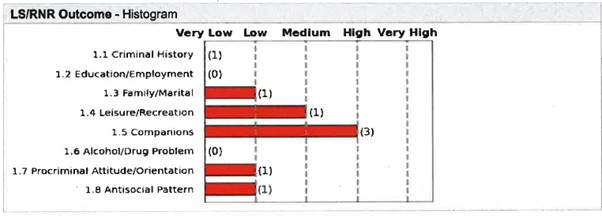
13 There was a further parole assessment on 16 December 2024 in which the Applicant was again assessed at a low risk of reoffending and received the same scores for the eight risk factors above.
14 The Applicant also prepared a written submission in letter form dated 28 May 2025 which he relied upon before the Tribunal. The letter enclosed “several key pages from [the Applicant’s] prison records” including the “risk assessment reports”, and stated:
These documents speak for themselves and provide an honest picture of my efforts to change and reintegrate. I respectfully ask the Tribunal to consider these excerpts as part of my submission. I believe they demonstrate my commitment to rehabilitation and my low risk of reoffending.
15 On the same day, the Applicant submitted an appendix summarising his rehabilitation, including a note that he had been “[a]ssessed as an inmate with a low risk of reoffending and good potential for successful reintegration into society”. In a further appendix submitted by the Applicant, under the heading “Final Summary Statement”, the Applicant repeated that he had “been assessed as low risk”. The next day, on 29 May 2025, the Applicant provided a further submission referring to his “very low risk of reoffending”.
16 The Court was told that the only reference to the parole assessment report at the hearing before the Tribunal was by the Applicant, in opening submissions, when the Applicant said:
In prison, I actively participated in rehabilitation programs, and I was assessed low risk of reoffending, and the parole board approved me to be in the community with conditions.
direction No. 110
17 The Applicant sought to impugn paragraphs 77 and 78 of the Tribunal’s decision, which concerned one aspect of the Tribunal’s consideration of one of the “primary considerations” in paragraph 8 of “Direction no. 110 - Visa refusal and cancellation under section 501 and revocation of a mandatory cancellation of a visa under section 501CA" (Direction no. 110). Before turning to the Tribunal’s decision, it is convenient to mention the relevant parts of Direction no. 110.
18 Direction no. 110 is a direction made under s 499 of the Migration Act. The Tribunal was obliged to follow it in exercising its discretion not to revoke the decision cancelling the Applicant's Visa.
19 Paragraph 5.2 of Direction no. 110 contains the principles which provide the framework within which decision-makers should approach their task of deciding whether to refuse or cancel a non-citizen’s visa under s 501 of the Migration Act, or whether to revoke a mandatory cancellation under s 501CA.
20 Paragraph 6 of Direction no. 110 provides that, informed by the principles in paragraph 5.2, a decision-maker must take into account the considerations identified in paragraph 8 (primary considerations) and paragraph 9 (other considerations), where relevant to the decision.
21 Paragraph 7 provides guidance in taking the relevant considerations into account. It relevantly provides:
(1) In applying the considerations (both primary and other), information and evidence from independent and authoritative sources should be given appropriate weight.
(2) The primary consideration at 8.1 below (protection of the Australian community) is generally to be given greater weight than other primary considerations. Otherwise, primary considerations should generally be given greater weight than the other considerations.
(3) One or more primary considerations may outweigh other primary considerations.
22 Paragraph 8 sets out five primary considerations, which relevantly includes “protection of the Australian community from criminal or other serious conduct”. In relation to that primary consideration, paragraph 8.1(1) provides that, when considering protection of the Australian community, decision-makers should keep in mind that the safety of the Australian community is the highest priority of the Australian Government. Paragraph 8.1(2) further provides:
(2) Decision-makers should also give consideration to:
(a) the nature and seriousness of the non-citizen's conduct to date; and
(b) the risk to the Australian community, should the non-citizen commit further offences or engage in other serious conduct.
23 In relation to the risk to the Australian community should the non-citizen commit further offences or engage in other serious conduct, paragraph 8.1.2 provides:
(1) In considering the need to protect the Australian community (including individuals, groups or institutions) from harm, decision-makers should have regard to the Government's view that the Australian community's tolerance for any risk of future harm becomes lower as the seriousness of the potential harm increases. Some conduct and the harm that would be caused, if it were to be repeated, is so serious that any risk that it may be repeated may be unacceptable.
(2) In assessing the risk that may be posed by the non-citizen to the Australian community, decision-makers must have regard to, cumulatively:
(a) the nature of the harm to individuals or the Australian community should the non-citizen engage in further criminal or other serious conduct; and
(b) the likelihood of the non-citizen engaging in further criminal or other serious conduct, taking into account:
(i) information and evidence on the risk of the non-citizen reoffending; and
(ii) evidence of rehabilitation achieved by the time of the decision, giving weight to time spent in the community since their most recent offence (noting that decisions should not be delayed in order for rehabilitative courses to be undertaken).
(c) where consideration is being given to whether to refuse to grant a visa to the non-citizen — whether the risk of harm may be affected by the duration and purpose of the non-citizen's intended stay, the type of visa being applied for, and whether there are strong or compassionate reasons for granting a short stay visa.
THE TRIBUNAL'S DECISION
24 The Tribunal found that the Applicant did not pass the character test and, in finding that there was not another reason to revoke the mandatory cancellation decision, placed determinative weight on the protection and expectations of the Australian community, finding that those considerations under Direction no. 110 outweighed the other relevant countervailing considerations falling in favour of revocation.
25 As the Applicant submitted, the Tribunal commenced the assessment of “the risk to the Australian community should [the Applicant] commit further offences or engage in other serious conduct” (paragraph 8.1.2 of Direction no. 110) at T [59] – [80]. After noting the materials relied on by the Applicant and the Minister’s submissions, the Tribunal referred to the first parole assessment report dated 9 September 2024 at T [69] – [70]. The Tribunal noted, at T [70], that the report assessed the Applicant as a “low-risk general offender” and that he was assessed as “low risk” according to the LS/RNR assessment tool, scoring “very low” to “low” across a range of risk factors. However, he scored “high” on the companions risk factor “as the Applicant was assessed as appearing ‘easily influenced by negative companions’”. The Tribunal further noted that the LS/RNR assessment was administered in the two further addendum parole reports dated 29 October 2024 and 16 December 2024 and that, on each occasion, the Applicant was assessed overall as “low” risk, but again scored “high” on the companions risk factor for each subsequent assessment. As the Applicant submitted, the LS/RNR assessment in the parole report dated 29 October 2024 appears to be a copy of the first assessment rather than a separate assessment, however this was not material to the Tribunal’s findings.
26 The Tribunal stated, at T [71] – [72]:
71. In this respect, the author of the first Parole Report noted that the Applicant and his wife were residing together at the time of his offending. It is then noted that the Applicant’s wife (Ms Nguyen) has a significant criminal record of her own, having been convicted for dealing in the proceeds of crime (over the sum of $1m) in 2009. Ms Nguyen was sentenced to four years and nine months imprisonment with a non-parole period of two years and six months. This offending was put to Ms Nguyen during her cross-examination. The Respondent tendered a news article titled ‘$70m laundering scam puts six in jail’ which described the offending and Ms Nguyen’s role. During cross-examination, Ms Nguyen described her role in that offending as one of an ‘administrative role’ and that it was others in the company who took a lead role. It appeared to the Tribunal that she was downplaying her involvement – that she was somebody who just looked after the finances of the company – rather than someone who dealt with the proceeds of crime in excess of $1million. Ms Nguyen confirmed that she met the Applicant and formed a relationship with him after her release from prison in 2012.
72. The Parole Report noted that the Applicant committed his offending in the context of negative companions. The Tribunal notes the Applicant’s assurances that he has since cut ties with his co-offenders and wants to now focus on his family, children and his work. The Tribunal does not suggest that Ms Nguyen herself is a ‘negative companion’ but simply notes her prior conviction. The Applicant’s relationship with her does not add to his risk. The Tribunal does however have some reservations about the Applicant’s ability to not be negatively influenced by criminal associates in the future given he was so easily influenced by them for his previous offending. This was also a concern of the author of the Parole Report and as such a non-association condition was recommended which prohibited the Applicant from having contact with his co-offenders.
27 The Tribunal then noted several matters that were favourable to the Applicant, such as “prosocial contacts”, his employment history and future prospects, and his vocational training prior to his arrest and during his time in prison.
28 The Applicant sought to impugn the Tribunal’s findings at T [77] – [78], which were as follows:
77. The Tribunal has regard to the Parole Reports and assessments against the LS/RNR tool which assessed the Applicant has a low risk of reoffending. The Tribunal does note however that the Applicant scored high on the companions risk factor which is of concern. The Applicant told the Tribunal he has cut ties with his co-offenders which the Tribunal accepts. However, the Tribunal remains concerned that the Applicant may be susceptible to negative influences, as previously indicated in the Parole Report. The Applicant engaged in criminal offending over a protracted period of time, and which involved many co-offenders who were known to the Applicant. More importantly, the Applicant had the protective factors of his wife and children at the time, and this did not deter him from offending. He told the Tribunal he was badly affected by the COVID-19 pandemic, and that he felt financial pressure to provide for his family. As the Respondent noted however in closing submissions, this was inconsistent with the material in the police brief which reflected the Applicant owned multiple properties across Melbourne, owned luxury goods, and was spending tens of thousands of dollars at Crown Casino. If the Applicant felt financial pressure again, the Tribunal is not confident he would resist the urge to engage in illegal behaviour once again.
78. The Tribunal therefore determines that the Applicant is at a low to moderate risk of reoffending. The Tribunal has already determined that the nature of the harm that would be caused if the conduct were repeated would be detrimental and cause harm to the Australian community.
29 The Tribunal concluded at T [79] – [80] that although the Applicant is at a “low to moderate” risk of reoffending, that risk is unacceptable given the serious nature of the offending and the harm that would be caused if the conduct were repeated.
30 The Applicant submitted that the Tribunal’s finding that the Applicant was at a “low to moderate risk of reoffending” was significant, because it interacted with the finding that the harm that would be caused was unacceptable, resulting in a finding that this primary consideration “weigh[ed] very heavily against revoking the mandatory cancellation decision”: T [80]. The Applicant submitted that the significance of the Tribunal’s finding with respect to the primary consideration of the protection of the Australian community to the overall result was further confirmed in the Tribunal’s conclusions at T [143] – [145].
DISPOSITION
Ground 1
31 The Applicant submitted that the Tribunal fell into error because it “cherry-picked” one of eight risk/need factors listed in the LS-RNR assessments – “companions” (which had been graded as “high”) – and, without explanation, determined that the Applicant was a “low to moderate” risk of reoffending. The Applicant submitted, first, that the Tribunal misconstrued the LS-RNR assessments and, second and relatedly, that the determination by the Tribunal was irrational or illogical.
32 The principles are well established and were not in dispute. The Tribunal may fall into jurisdictional error if it misunderstands or fails to consider relevant facts or materials: Plaintiff M1/2021 v Minister for Home Affairs (2022) 275 CLR 582; [2022] HCA 17 at [27] (Kiefel CJ, Keane, Gordon and Steward JJ), [105] (Gleeson J). Further, the Tribunal may fall into error if the decision to which the Tribunal came is one which no rational or logical decision maker could arrive on the same evidence: Minister for Immigration and Citizenship v SZMDS (2010) 240 CLR 611; [2010] HCA 16 at [130] – [131] (Crennan and Bell JJ).
33 The Applicant submitted that the Tribunal fell into error because it artificially inflated the risk assessment from low to “low to moderate” and provided no explanation for doing so. The Applicant further submitted that the Tribunal failed to provide any explanation, at T [77], for why it came to a different conclusion to that contained in the parole assessment report, before it “determine[d] that the Applicant is at a low to moderate risk of reoffending”, at T [78].
34 The Applicant has taken an unduly narrow reading of the Tribunal’s reasons and Ground 1 is framed in a way that, itself, misunderstands the Tribunal’s reasons.
35 Properly construed, the Tribunal’s determination at T [78] was based on four adverse matters set out in T [77] which led to the Tribunal’s own assessment of the Applicant’s risk of reoffending. The Tribunal began, at T [77], by noting that the parole assessment reports had made an assessment, using the LS/RNR tool, that the Applicant had a low risk of reoffending. The Tribunal further noted, however, that the Applicant had scored “high” on the companions risk factor, which it said was “of concern”.
36 The Tribunal then went on to state that, first, the Tribunal remained concerned that “the Applicant may be susceptible to negative influences, as previously indicated in the Parole Report”. Second, the Applicant had engaged in criminal offending over a protracted period of time and which involved many co-offenders who were known to the Applicant. Thirdly, the Applicant had the protective factors of his wife and children at the time, but this had not deterred him from offending. Fourthly, having regard to the Applicant’s stated financial reasons for the offending, the Tribunal was not confident that, if the Applicant felt under financial pressure, the Applicant would resist the urge to engage in illegal behaviour once again.
37 Thus, the Tribunal came to its own assessment, at T [78], that the Applicant was at a “low to moderate” risk of reoffending. Furthermore, the Tribunal explained the reasons for reaching that assessment, at T [77].
38 The Tribunal was not required to give particular weight or deference to the parole assessment reports, a matter which the Applicant conceded at the hearing. The Tribunal was, of course, required to give appropriate consideration to the LS-RNR risk assessments to the extent that they were the subject of argument from the Applicant. As the Tribunal’s reasons demonstrate, the Tribunal had regard to the LS-RNR assessments, but ultimately formed its own view of the Applicant’s risk of reoffending. However, save for the requirements of Direction no. 110, the manner in which the Tribunal assessed the risk of reoffending, and how it treated the parole assessment reports as part of that overall assessment, was a matter for it: RNSQ v Minister for Immigration, Citizenship and Multicultural Affairs [2023] FCA 1111 at [71] (Feutrill J).
39 Nothing in the Tribunal’s analysis discloses that it misunderstood the risk assessments in the parole assessment reports. Furthermore, the conclusion reached by the Tribunal was open to it for the reasons that it gave.
40 Finally, the Applicant relied on Doan v Minister for Home Affairs [2019] FCA 1172 (Griffiths J). The Minister submitted, and I accept, that Doan does not assist the Applicant. In that case, the Administrative Appeals Tribunal (AAT) had before it competing risk assessments from two psychologists. Griffiths J found, at [72], that the AAT fell into error because, despite stated concerns about the reliability of both assessments, it found that the risk of reoffending fell within the range identified by the two experts. That is, the AAT effectively had an “each way bet” without explaining why it adopted, as part of its conclusions, the stated opinions of both experts notwithstanding its stated concerns with those opinions. Those facts are vastly different from the present case, for the reasons mentioned.
41 Ground 1 therefore fails.
Ground 2
42 The Applicant submitted that the Tribunal's finding on the Applicant's risk of reoffending was made in circumstances where the Applicant was denied procedural fairness. The Applicant submitted that he was entitled to assume that the Tribunal would, at the very least, accept that the results of the LS-RNR assessments were, on their face, that the Applicant is at a low risk of reoffending. Further, there was no indication from the Minister or the Tribunal that the low score would be thrown into doubt, by emphasising the only “high” factor, relating to companionship, or that this would form part of a foundation for a finding that the Applicant was at a higher, being “low to moderate”, risk of reoffending.
43 The Applicant submitted that procedural fairness required the Tribunal to inform the Applicant that the result of the LS-RNR assessments would be modified by extracting the issue of companionship, which returned a high score, relying on SZBEL v Minister for Immigration and Multicultural and Indigenous Affairs (2006) 228 CLR 152; [2006] HCA 63 at [29], referring to the following passage in Commissioner for ACT Revenue v Alphaone Pty Ltd (1994) 49 FCR 576 at 591 – 592:
Where the exercise of a statutory power attracts the requirement for procedural fairness, a person likely to be affected by the decision is entitled to put information and submissions to the decision-maker in support of an outcome that supports his or her interests. That entitlement extends to the right to rebut or qualify by further information, and comment by way of submission, upon adverse material from other sources which is put before the decision-maker. It also extends to require the decision-maker to identify to the person affected any issue critical to the decision which is not apparent from its nature or the terms of the statute under which it is made. The decision-maker is required to advise of any adverse conclusion which has been arrived at which would not obviously be open on the known material. Subject to these qualifications however, a decision-maker is not obliged to expose his or her mental processes or provisional views to comment before making the decision in question. (emphasis added)
44 As the Minister submitted, the substratum of this ground is misconceived. The Tribunal did not modify the LS-RNR assessments or misunderstand the assessments. The Tribunal took the assessments into account, but ultimately reached its own assessment regarding the Applicant’s risk of reoffending, as explained above.
45 Ground 2 therefore fails.
conclusion
46 For the foregoing reasons, the application should be dismissed, with costs.
I certify that the preceding forty-six (46) numbered paragraphs are a true copy of the Reasons for Judgment of the Honourable Justice Neskovcin. |
Associate:
Dated: 19 May 2026


