

FEDERAL COURT OF AUSTRALIA
Staunton v MHK [2026] FCA 546
File number(s): | VID 289 of 2026 |
Judgment of: | HILL J |
Date of judgment: | 4 May 2026 |
Catchwords: | CRIMINAL LAW – application for an interim control order under s 104.4 of the Criminal Code in the Schedule to the Criminal Code Act 1995 (Cth) – where respondent convicted of terrorism offence – where respondent’s release into the community is imminent – whether proposed conditions of interim control order are reasonably necessary, and appropriate and adapted, for the purposes in s 104.4(1)(d) of the Criminal Code – whether condition requiring wearing of electronic monitoring device is proportionate – whether curfew condition proportionate – whether exception should be made to a proposed condition to permit the Respondent to use Facebook – interim control order made PRACTICE AND PROCEDURE – Application for pseudonym and non-publication orders – whether orders supported by s 534 of the Children, Youth and Families Act 2005 (Vic) because Respondent was a child at the time of offending – interim orders extended |
Legislation: | Children, Youth and Families Act 2005 (Vic) s 534 Criminal Code Act 1995 (Cth), Schedule ss 104.1, 104.2, 104.3, 104.4, 104.5, 104.5A, 104.5B, 104.12, 104.12A, 104.14 Open Courts Act 2013 (Vic) ss 17, 18 |
Cases cited: | Booth v Abdirahman-Khalif [2021] FCA 1651 Booth v Brookman (No 3) [2022] FCA 42 Booth v Dakkak [2020] FCA 1882 Booth v Khazaal [2020] FCA 1241 Booth v Namoa [2019] FCA 2213 Booth v Thorne [2020] FCA 445 Fogarty v Jakovac [2022] FCA 1454 Gale v Homewood [2024] FCA 264 Howe v Harvey [2008] VSCA 181; (2008) 20 VR 638 McCartney v Abdirahman-Khalif (No 2) [2020] FCA 1002 McCartney v Abdirahman-Khalif [2019] FCA 2218 McCartney v EB [2019] FCA 183; (2019) 263 FCR 170 Minister for Immigration and Ethnic Affairs v Guo [1997] HCA 22; (1997) 191 CLR 559 Nicolson v Naizmand [2022] FCA 1108 Porch v State of Victoria [2023] VSC 61 Re WD (No 2) [2023] VSC 790 Staunton v Zahab [2026] FCA 308 Taylor v Brookman [2024] FCA 200 Thomas v Mowbray [2007] HCA 33; (2007) 233 CLR 307 |
Division: | General Division |
Registry: | Victoria |
National Practice Area: | Federal Crime and Related Proceedings |
Number of paragraphs: | 123 |
Date of last submissions: | 28 April 2026 |
Date of hearing: | 30 April 2026 |
Counsel for the Applicant: | Mr T Glover SC and Ms C O’Neil |
Solicitor for the Applicant: | Australian Government Solicitor |
Counsel for the Respondent: | Ms G Morgan |
Solicitor for the Respondent: | Doogue and George Defence Lawyers |
ORDERS
VID 289 of 2026 | ||
| ||
BETWEEN: | JEREMY EWEN STAUNTON Applicant | |
AND: | MHK Respondent | |
order made by: | HILL J |
DATE OF ORDER: | 4 MAY 2026 |
THE COURT ORDERS THAT:
ENDORSEMENT PURSUANT TO RULE 41.06
PENAL NOTICE – Rule 41.06 of the Federal Court Rules 2011 (Cth) TO: [MHK] IF YOU (BEING THE PERSON BOUND BY THIS ORDER): (A) REFUSE OR NEGLECT TO DO ANY ACT WITHIN THE TIME SPECIFIED IN THIS ORDER FOR THE DOING OF THE ACT; OR (B) DISOBEY THE ORDER BY DOING AN ACT WHICH THE ORDER REQUIRES YOU NOT TO DO, YOU WILL BE LIABLE TO IMPRISONMENT, SEQUESTRATION OF PROPERTY OR OTHER PUNISHMENT. ANY OTHER PERSON WHO KNOWS OF THIS ORDER AND DOES ANYTHING WHICH HELPS OR PERMITS YOU TO BREACH THE TERMS OF THIS ORDER MAY BE SIMILARLY PUNISHED. |
Interim control order
1. An interim control order be made pursuant to s 104.4 of the Criminal Code (Cth), being the Schedule to the Criminal Code Act 1995 (Cth), in the terms set out in the Schedule to these orders.
Note: Entry of orders is dealt with in Rule 39.32 of the Federal Court Rules 2011.
SCHEDULE
1. This interim control order relates to the Respondent, [MHK].
2. The Court is satisfied on the balance of probabilities that the Respondent has been convicted in Australia of an offence relating to terrorism or a terrorist organisation (s 104.4(1)(c)(iv) of the Criminal Code (Cth)).
3. Further, the Court is satisfied on the balance of probabilities that each of the conditions, and the combined effect of all the conditions to be imposed on the Respondent by the order is reasonably necessary, and reasonably appropriate and adapted, for the purpose of:
3.1. protecting the public from a terrorist act (s 104.4(1)(d)(iii) of the Criminal Code (Cth));
3.2. preventing the provision of support for or the facilitation of a terrorist act (s 104.4(1)(d)(iv) of the Criminal Code (Cth)); or
3.3. preventing the provision of support for or the facilitation of the engagement of hostile activity in a foreign country (s 104.4(1)(d)(v) of the Criminal Code (Cth)).
4. The conditions to be imposed on the Respondent by this Interim Control Order are those set out in Annexure A to this Schedule.
5. A summary of the grounds on which the order is made is set out in Annexure B to this Schedule.
6. This Interim Control Order does not begin to be in force until:
6.1. it is served personally on the Respondent; and
6.2. if the order is served personally on the Respondent whilst detained in custody in a prison, it begins to be in force when the Respondent ceases to be detained in custody in a prison.
7. If this Interim Control Order is confirmed, the confirmed control order is to be in force for 12 months after the day on which this Interim Control Order is made.
8. The Respondent may attend the Federal Court of Australia which is located at the Owen Dixon Commonwealth Law Courts Building, 305 William Street, Melbourne VIC 3000 on 13 July 2026 at 10:15am for the Court to:
8.1. confirm (with or without variation) this Interim Control Order;
8.2. declare this Interim Control Order to be void; or
8.3. revoke this Interim Control Order.
9. The Respondent’s lawyer may attend the AFP Melbourne office at 383 La Trobe Street, Melbourne VIC 3000 between 9:00 am and 4:00 pm, Monday to Friday in order to obtain a copy of this Interim Control Order.
ANNEXURE A
CONDITIONS OF INTERIM CONTROL ORDER
RESIDENCE, CURFEW AND REPORTING
1. Where You Live and Curfew
1.1. You must reside at the specified premises and nowhere else.
1.2. The specified premises is:
a. [REDACTED] [REDACTED] [REDACTED] [REDACTED]; or
b. any other premises nominated by you and approved in writing by the AFP Superintendent.
Note: You will be given contact details of the AFP Superintendent at the time this Order is given to you. References in this Order to ‘AFP Superintendent’ also include any other police officer acting under the direction of or on behalf of the AFP Superintendent.
1.3. You can’t leave the specified premises between 12am and 6am unless it is an emergency. An ‘emergency’ is a situation that threatens your safety or the safety of close family members (see definition of ‘close family member’).
1.4. If a police officer visits the specified premises between 12am and 6am to check you are there, you must speak to that police officer in person and identify yourself by any means directed by the police officer (including by letting the police officer see your face).
2. Checking In
2.1. Within 24 hours of this order being given to you, you must call the AFP Superintendent.
2.2. You must also call or meet with the AFP Superintendent when they direct you to do so.
ELECTRONIC MONITORING
3. Electronic Monitoring
3.1. You must wear a monitoring device at all times. The monitoring device you must wear is:
a. the monitoring device the AFP Superintendent directs you to wear within 24 hours after this order comes into force; or
b. if the AFP Superintendent directs you to wear a different monitoring device at a later time, that monitoring device.
3.2. The AFP Superintendent may direct you to attend the specified premises at a specified time, including within the first 24 hours after this order comes into force for the purpose of you being fitted with a monitoring device.
3.3. At the time specified by the AFP Superintendent under Condition 3.2, you must attend the specified premises, let police officers into the specified premises and permit those police officers to fit you with a monitoring device.
3.4. You must let police officers into the specified premises at any reasonable time for any purpose relating to the electronic monitoring of you, including to allow them to give you a monitoring device to wear or to give you instructions about using and maintaining the monitoring device.
3.5. You must allow a police officer to:
a. install, repair or fit the monitoring device or any related monitoring equipment (for example, a charging cable) at any reasonable time and place they direct;
b. remove a monitoring device or any related equipment at any reasonable time and place they direct;
c. take any reasonable steps to ensure that the monitoring device and any related monitoring equipment are or remain in good working order; and
d. do anything else for the purpose of electronically monitoring you.
3.6. This order authorises police officers to do all the things listed above in Conditions 3.2, 3.3, 3.4 and 3.5 and to contact you to ensure the monitoring device and equipment is working properly.
3.7. You must charge the monitoring device every day so that it is always charged. If a police officer directs you to place the monitoring device on charge, you must charge it as soon as possible.
3.8. You must do anything else a police officer directs you to do to make sure the monitoring device or related equipment is working properly.
3.9. If you become aware that the monitoring device or related equipment is not working properly, you must tell the AFP Superintendent as soon as reasonably practicable.
3.10. You must not:
a. remove the monitoring device;
b. tamper with or damage the monitoring device or any related equipment;
c. attempt to do any of those things; or
d. allow someone else to do any of those things.
TRAVEL AND MOVEMENT RESTRICTIONS
4. Travel
4.1. You must not leave or make arrangements to leave Australia.
4.2. You must not apply for any Australian or foreign travel document (including a passport), visa, or travel authorisation.
4.3. You must not possess an Australian or foreign travel document (including a passport), visa, or travel authorisation which is in another person’s name.
4.4. You must not leave or make arrangements to leave the State of Victoria.
5. Places You Can’t Go
5.1. You must not go to any prison or correctional facility unless you are detained there.
5.2. You must not go to a synagogue, church or mosque, subject to Condition 5.3.
5.3. You can attend a specified mosque. A specified mosque is:
a. A mosque nominated by you and approved in writing by the AFP Superintendent.
5.4. You must not go to the following places:
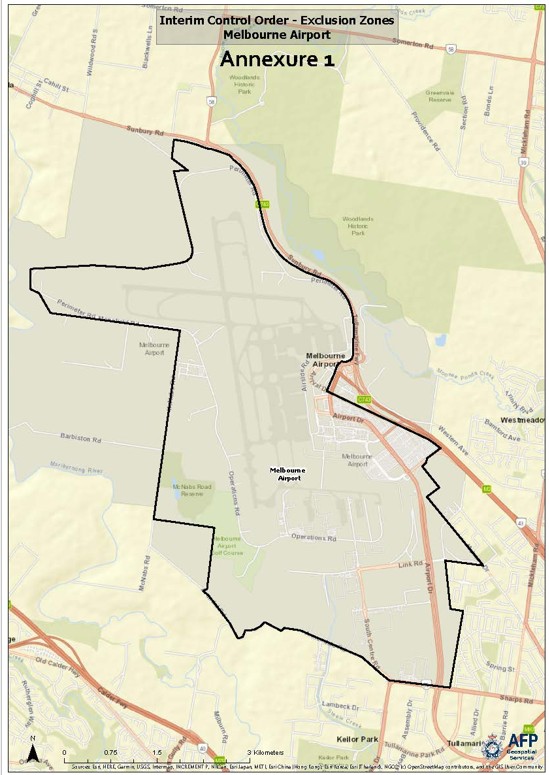
a. within the exclusion zone set out in Annexure 1 at Melbourne International Airport (Tullamarine);
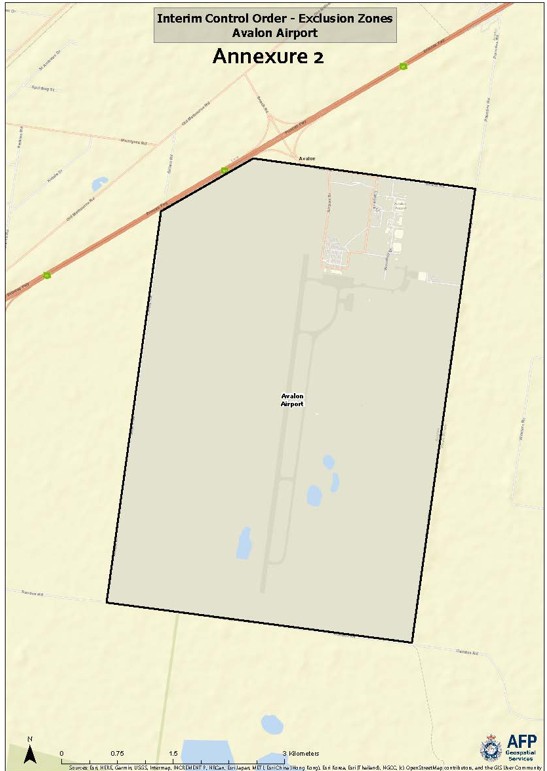
b. within the exclusion zone set out in Annexure 2 at Avalon Airport;
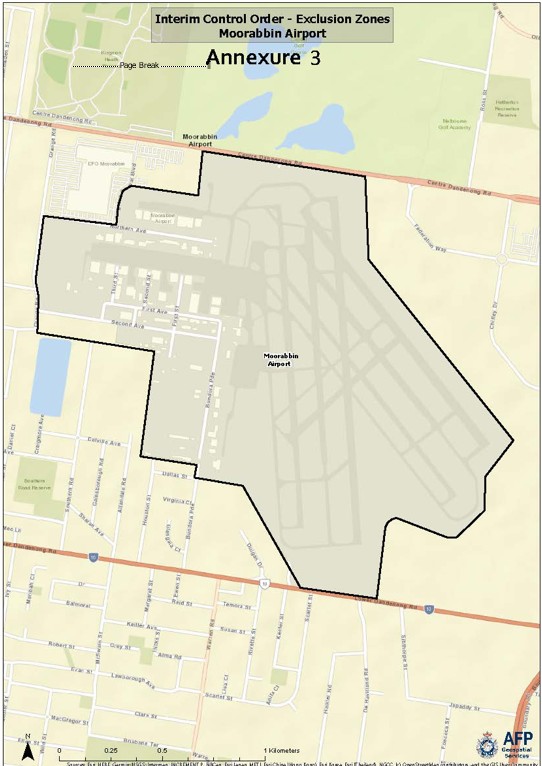
c. within the exclusion zone set out in Annexure 3 at Moorabbin Airport;
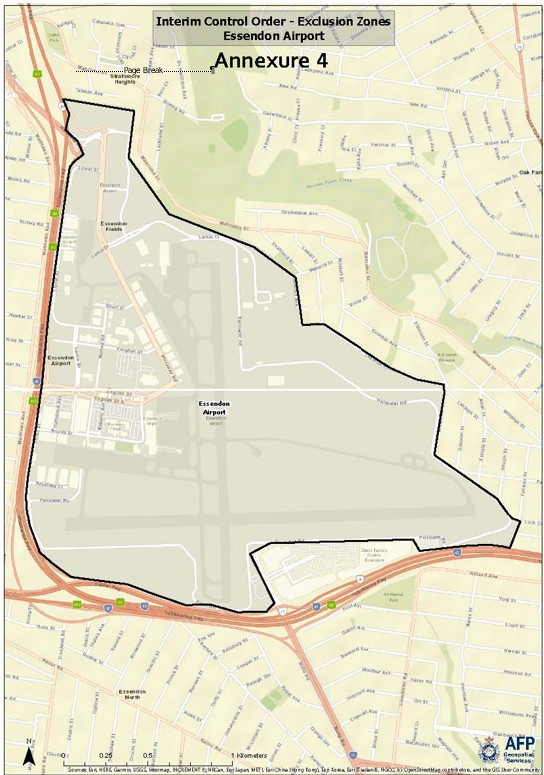
d. within the exclusion zone set out in Annexure 4 at Essendon Fields Airport;
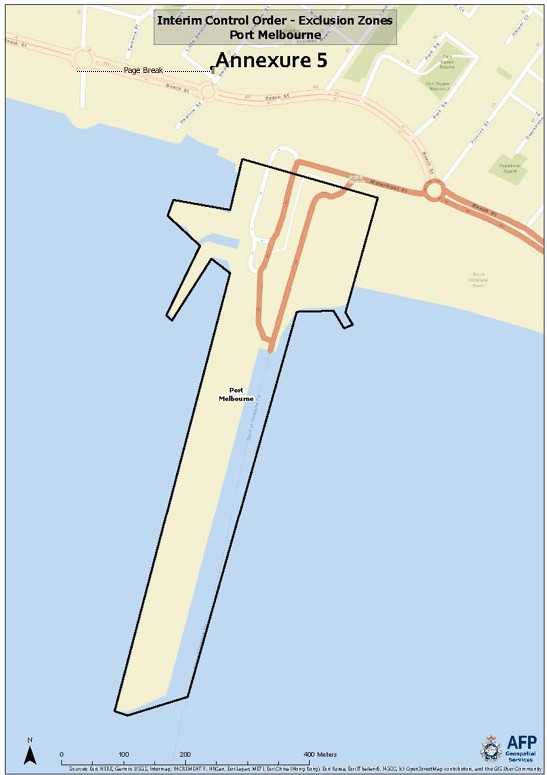
e. within the exclusion zone set out in Annexure 5 at Port Melbourne;
f. within 1 km of any other Australian airport which has an international point of departure; or
g. within 1 km of any other Australian port that has an international point of departure.
5.5. If the AFP Superintendent directs you not go to a place, you must not go there.
DISENGAGEMENT AND REHABILITATION
6. Disengagement and Rehabilitation
6.1. You must attend and participate in an assessment by the Community Integration Support Program (CISP) delivered in partnership by the Counter Violent Extremism Unit within Victoria Police and the Board of Imams Victoria (BOIV) to determine whether you are suitable for participation in a community based violent extremism disengagement and rehabilitation program.
Note: The Australian Federal Police will pay the cost of the assessment and for your participation in the community based violent extremism disengagement and rehabilitation program.
6.2. You must comply with any reasonable direction from the AFP Superintendent relating to, and for the purpose of, completion of that assessment.
6.3. You must consider, in good faith, participating in any treatment, rehabilitation or intervention programs or activities, or undertaking psychological or psychiatric assessment or counselling, as recommended by the CISP.
7. Sharing information
7.1. You must notify the AFP Superintendent within 3 days after you first meet with CISP or the provider of any services recommended by them.
7.2. You must allow the CISP or the provider of any services described in Condition 6.3 to share any information with the AFP Superintendent including about when and for how long you met with them and any safety concerns they may have.
RESTRICTIONS ON ASSOCIATIONS
8. Who You Can’t Communicate With
8.1. You must not communicate with anyone who is imprisoned in a correctional facility, unless you are imprisoned in that facility.
8.2. You must not communicate with anyone you know or suspect is located overseas, unless you advise the AFP Superintendent in writing of the full name, date of birth (if known), relationship to you and contact details of the person:
a. in advance; or
b. within 24 hours of the communication.
8.3. You must not communicate or associate by any means, with anyone you know or suspect to be a member of Islamic State or any other terrorist organisation.
8.4. You must not communicate or associate by any means with any person known to you to be convicted of, or currently charged with:
a. a ‘terrorism offence’ within the meaning of section 3(1) of the Crimes Act 1914 (Cth);
b. an offence against Subdivision C of Division 80 of the Criminal Code Act 1995 (Cth); or
c. an offence against Subdivision CA of Division 80 of the Criminal Code Act 1995 (Cth); or
d. an offence against Part 5.3B of the Criminal Code Act 1995 (Cth).
8.5. If the AFP Superintendent determines that you must not communicate or associate with a person, you must not communicate or associate with them.
Note: As explained in Condition 23, you must not ask or cause someone else to communicate on your behalf with a person described in Condition 8.
EMPLOYMENT, EDUCATION AND GROUP ACTIVITIES
9. Employment and Education
9.1. You must tell the AFP Superintendent before starting any job, volunteer work, vocational training, or education.
9.2. You must give any information the AFP Superintendent directs you to give about your job, volunteer work, training or education.
10. Groups
10.1. You must not join or otherwise become involved with any groups, clubs or organisations (including online) which:
a. circulate or discuss violent extremist material or material created by a terrorist organisation ((other than as part of a treatment, rehabilitation or intervention program recommended by the CISP under Condition 6.3);
b. claim to be part of a terrorist organisation;
c. advocate for, or support a terrorist organisation; or
d. advocate for, or support the doing of terrorist acts, either in Australia or overseas.
10.2. If you wish to attend any protest you must notify the AFP Superintendent at least 24 hours before you attend the protest and provide the following information:
a. The location and time of the protest;
b. The name of the individual or group organising the protest; and
c. Any other information the AFP Superintendent directs you to provide about the protest.
RESTRICTIONS ON WEAPONS, DOCUMENTS, MEDIA AND OTHER PROHIBITED ITEMS
11. Weapons and Other Prohibited Items
11.1. You must not buy, make, possess or use any of the following:
a. a ‘firearm’, a ‘firearm part’ or ‘ammunition’ within the meaning of s 3(1) of the Firearms Act 1996 (Vic);
b. a ‘prohibited weapon’ within the meaning of s 3(1) of the Control of Weapons Act 1990 (Vic);
c. an article or device, not being a firearm, capable of propelling by any means:
i. any irritant matter in liquid, powder, gas, chemical form or any dense smoke, unless possession or usage is consistent with reasonable domestic, personal or work related purposes; or
ii. any substance capable of causing bodily harm, unless possession or usage is consistent with reasonable domestic, personal or work-related purposes;
d. a detonator; or
e. a fuse capable of use with an explosive or a detonator.
11.2. You must not be in the company of any person who you know has, on their person or in a vehicle in which you are travelling with them, any of the items referred to in Condition 11.1.
11.3. You must not, to your knowledge, be present at places where firearms are stored, sold or used, including firearm dealers, shooting ranges or private premises where firearms are stored.
11.4. You must not possess any books, documents, or other material containing instructions on the creation or use of firearms, incendiary devices, or explosives.
11.5. You must not possess any matches, cigarette lighters, or other means of starting a fire, except when at home.
11.6. You must not possess any quantity of petroleum exceeding 4 litres except petrol contained in the petrol tank of a vehicle.
11.7. You must not possess any quantity of any chemical which is not consistent with ordinary domestic purposes.
12. Possessing Documents and Other Media
12.1. You must not possess or access documents and other media that relates to any of the following:
a. propaganda and promotional material for a 'terrorist organisation' within the meaning of s 102.1(1) of the Schedule to the Criminal Code Act 1995 (Cth);
b. activities of, or associated with, any ‘terrorist organisation’ within the meaning of s 102.1(1) of the Schedule to the Criminal Code Act 1995 (Cth); or
c. instructing, advocating, encouraging or praising the use or making of, or in those contexts, depict or describe:
i. a ‘prohibited weapon’ within the meaning of s 3(1) of the Control of Weapons Act 1990 (Vic);
ii. arson;
iii. explosives;
iv. firearms, or cartridge ammunition, as defined in s 3(1) of the Firearms Act 1996 (Vic);
v. terrorism;
vi. genocide or the persecution of an ethnic or religious group;
vii. counter-surveillance; or
viii. violence, including but not limited to shooting, immolation, stabbing, bombing, beheading, torture and execution.
12.2. Condition 12.1 does not apply to a document or other media if the document or other media is:
a. published by the Australian Broadcasting Corporation (ABC), Australian Community Media (ACM), News Corp Australia, Nine Entertainment Co, Schwartz Media, Seven West Media, the Special Broadcasting Service (SBS), the British Broadcasting Corporation (BBC), CNN, the Guardian and any other publisher or broadcaster approved in writing by the AFP Superintendent;
b. broadcast on Australian free to air or pay television;
c. broadcast on one of the following streaming services available in Australia: Netflix; STAN; Amazon Prime; Binge; ABC iView; 10play, 9Now, 7plus, SBS on Demand, Kayo Sports, Apple TV+, Paramount Plus, Disney+, HBO Max and any other streaming service approved in writing by the AFP Superintendent;
d. broadcast in Australia by a licensed AM or FM radio station;
e. shown in a commercial movie cinema; or
f. contained in material that is received by you or your legal representatives, or created by your legal representatives, for the purpose of any legal proceeding you are involved in (referred to as ‘Court Material’).
13. Creating or Sharing Documents and Other Media
13.1. You must not create, publish or share documents and other media that:
a. relates to, or were produced by or on behalf of any terrorist organisation;
b. depicts, describes or relates to:
i. a ‘prohibited weapon’ within the meaning of s 3(1) of the Control of Weapons Act 1990 (Vic);
ii. arson;
iii. explosives;
iv. firearms, or cartridge ammunition, as defined in s 3(1) of the Firearms Act 1996 (Vic);
v. manuals or instructions on carrying out terrorist attacks, counter-surveillance or making explosives, weapons or firearms;
vi. terrorism;
vii. genocide or the persecution of an ethnic or religious group; and
viii. violence, including but not limited to shooting, immolation, stabbing, bombing, beheading, torture and execution.
13.2. Condition 13.1 does not prohibit you from distributing, or directing a person to distribute, Court Material (as defined in Condition 12.2) for the purpose of the conduct of any legal proceeding you are involved in.
PHONE, COMPUTER AND INTERNET USE
14. Phone Rules
14.1. The AFP Superintendent will give you a phone and SIM card. This is referred to as the ‘AFP phone’ and ‘AFP SIM card’. You may only use the AFP phone and AFP SIM card. You must not use any other mobile or landline phone or SIM card.
Note: As explained in Condition 14.5, you may use another phone only in specific circumstances.
14.2. The AFP Superintendent will provide you with the following information:
a. the password for the AFP phone; and
b. the phone number for the AFP phone.
14.3. You must:
a. keep your AFP phone switched on, charged and with you at all times;
b. be available to answer calls from the AFP Superintendent;
c. if you are unable to answer a call from the AFP Superintendent, return the call as soon as reasonably practicable;
d. do anything else the AFP Superintendent directs you to do with your AFP phone in relation to Conditions 14.3(a) - (c);
e. provide passwords and PIN codes for your AFP phone and any files, folders, programs and applications on your AFP phone, when directed to do so by a police officer for the purposes of searching or seizing your AFP phone or data within or accessible from it;
f. permit one or more police officers to inspect, repair, service, or replace your AFP phone or AFP SIM card, when directed to do so by a police officer; and
g. if you become aware that your AFP phone, AFP SIM card or charging equipment is not working properly, notify the AFP Superintendent as soon as possible and, in any case, within 12 hours of becoming aware.
14.4. You must not:
a. enable any face ID, fingerprint, or other biometric security features on the AFP phone;
b. change the password for the AFP phone unless:
i. the AFP Superintendent has given you approval to do so; and
ii. you have provided the new password to the AFP Superintendent.
c. let anyone else use your AFP phone or AFP SIM card unless it is an emergency. You must tell the AFP Superintendent if this happens;
d. connect your AFP phone to any Wi-Fi network, including public Wi-Fi or your home Wi-Fi;
e. connect your AFP phone to any other device, or allow another device to connect to your AFP phone, over a wired connection, Wi-Fi, hotspot, Bluetooth or similar means;
f. tamper with, damage or destroy any component of your AFP phone or any equipment necessary for the operation of your AFP phone (e.g. charging cables);
g. change, remove, modify or disconnect the SIM card, telecommunication service provider or phone number connected to your AFP phone;
h. utilise any call-forwarding to your AFP phone, or from your AFP phone to another device;
i. obtain a different SIM card or eSIM; or
j. ask or allow any other person to make calls or send messages on a different device on your behalf.
14.5. There are exceptions to the above Conditions 14.1, 14.3 and 14.4. You may:
a. connect your AFP phone to your AFP computer (see Condition 15 below);
b. connect your AFP phone to the AFP internet service (see Condition 15 below);
c. use the Bluetooth function on your AFP phone to connect to personal Bluetooth enabled devices (such as headphones or an in-car Bluetooth connection);
d. use another phone for the sole purpose of telling the AFP Superintendent that the AFP phone or AFP SIM card is not working; and
e. use another phone in an emergency to call ‘000’ or the State Emergency Services (SES).
14.6. If you obtain a job and the employer requires you to use a different phone, you may request approval from the AFP Superintendent to use that phone. If your request is approved, you may use the phone for the purpose of your job only.
15. Computer and internet rules
15.1. The AFP Superintendent will give you a computer or tablet device (the ‘AFP computer’). Apart from your AFP computer and AFP phone, and subject to Conditions 15.6 and 15.7, you must not use any other computer, tablet or internet capable device.
Note: ‘Internet capable device’ includes any phone, computer, laptop, tablet, gaming device, television, or any other electronic device capable of connecting to the internet (either directly or by connecting to a wireless network). A device can be an internet capable device even if it is not currently connected to the internet.
15.2. You will get an internet service for use with your AFP computer (the ‘AFP internet service’). You must not use any other internet service or wireless network with your AFP computer.
15.3. You must:
a. provide passwords and PIN codes for your AFP computer and any files, folders, programs and applications on your AFP computer, when directed to do so by a police officer for the purposes of searching or seizing your AFP computer or data within or accessible from it;
b. permit one or more police officers to inspect, repair, service, or replace your AFP computer, when directed to do so by a police officer;
c. if you become aware that your AFP computer or associated equipment is not working properly, notify the AFP Superintendent as soon as possible and, in any case, within 12 hours of becoming aware.
15.4. You must not:
a. let anyone else use your AFP computer unless it is an emergency. You must tell the AFP Superintendent if this happens as soon as reasonably practicable;
b. connect your AFP computer to any Wi-Fi network, including public Wi-Fi and your home Wi-Fi (other than the AFP internet service);
c. subject to Condition 15.5, connect your AFP computer to any other device, or allow another device to connect to your AFP computer over a wired connection, Wi-Fi, hotspot, Bluetooth or similar means; or
d. tamper with, damage or destroy any component of your AFP computer or any equipment necessary for the operation your AFP computer (e.g. charging cables).
15.5. Conditions 15.1, 15.2 and 15.4 do not prevent you from:
a. connecting your AFP phone to your AFP computer;
b. connecting your AFP computer to a wired display, keyboard, mouse, headphones, speaker, microphone, printer, dock or other ordinary accessory or peripheral device; or
c. using the Bluetooth function on your AFP computer to connect to personal Bluetooth enabled devices (such as headphones or a wireless keyboard or mouse).
15.6. Condition 15 does not prohibit access to or the use of:
a. an ATM;
b. an EFTPOS terminal;
c. a computer or tablet device, or smart TV owned by a business or government agency, which is made for your use to facilitate contact tracing, telehealth services, the order or sale of food or consumer products or the provision of a service; or
d. a Smart TV, which is used by you only for the purposes of watching the services set out in Condition 12.2 (and not accessing an internet browser or any chat or social media capabilities).
15.7. If you obtain a job and your employer requires you to use of a different computer or internet capable device and internet service, you may request approval from the AFP Superintendent to use that computer, device or internet service. If your request is approved, you may use the computer, device or internet service specified in the approval, for the purpose of your job only.
15.8. If you undertake education which requires the use of a different computer or internet capable device and internet service, you may request approval from the AFP Superintendent to use that computer, device or internet service. If your request is approved, you may use the computer, device or internet service specified in the approval for the purpose of your education only.
16. Email Use
16.1. You must not use any email account other than one nominated by you and approved in writing by the AFP Superintendent. This is referred to as the ‘AFP email account’.
16.2. You must not:
a. sign up for any online account or engage in any transaction using any email account other than the AFP email account;
b. use any function which uses temporary or forwarding emails (such as an iPhone’s ‘Hide My Email’ function).
16.3. If you obtain a job or undertake education which requires a different email address, you may seek approval from the AFP Superintendent to use that email account. If the AFP Superintendent gives you approval to use a different email account, you may use it only for the purpose for which it was approved (ie, for your work or education).
17. Programs, applications and data
17.1. Conditions 17.1, 17.2, 17.3, 17.4, 17.5, 17.6 and 17.7 apply to your AFP phone, AFP computer and AFP internet service and to any other internet capable devices that you are approved to use under this order.
17.2. You must only use the applications and programs that are already on your AFP phone or AFP computer at the time they are provided to you, or which are approved in writing by the AFP Superintendent.
17.3. You must not:
a. install any programs or applications onto your AFP phone or AFP computer without prior approval from the AFP Superintendent;
b. use any social media or messaging services not approved by the AFP Superintendent.
Note: A social media or messaging service includes any internet-based service that can be used to communicate with, or broadcast or disseminate information to, other users, such as WhatsApp, X, Instagram, Signal, Telegram or Facebook. For the avoidance of doubt, ‘using’ a social media or messaging service includes using that service via a web browser.
17.4. There is an exception to Conditions 17.1 and 17.3(a):
a. You may install software updates that are automatically available on your AFP phone or AFP computer and any other internet capable devices that you are approved to use under this order or by the AFP Superintendent.
17.5. If you want to use an application or program that is not already on your AFP phone or AFP computer, you can ask the AFP Superintendent to approve the application or program.
17.6. If you want to use a social media or messaging service, you can ask the AFP Superintendent to approve the social media or messaging service.
17.7. You must not:
a. hide any of your online activity (including by using private browsing, incognito/hidden mode, or using a virtual private network, also known as a VPN);
b. use any data storage or cloud storage other than the cloud storage account provided to you with your AFP phone or AFP computer; or
c. deliberately delete or alter any of the following on or from your AFP phone or AFP computer: applications; programs; emails; text messages; electronic messages; call history; data; internet or application search history; application chat or communication history.
18. Access to Accounts and Devices
18.1. You must give the AFP Superintendent access to your AFP phone, AFP computer, and any password protected applications or files held on your AFP phone, AFP computer, and any email or other online accounts, when directed to do so for the purpose of the AFP Superintendent searching or seizing the device or accessing data held within or accessible from it.
18.2. You must give the AFP Superintendent access to any device in your possession when directed to do so for the purposes of the AFP Superintendent searching or seizing the device or accessing data held within or accessible from it.
FINANCES
19. Finances
19.1. Within 72 hours after this order comes into force, you must provide the AFP Superintendent with the details of any bank accounts, cryptocurrency accounts and any other financial accounts you own or control.
19.2. If you open a new bank account, cryptocurrency account or other financial account, you must notify the AFP Superintendent in writing and provide the account details.
REASONABLE DIRECTION
20. Reasonable direction
20.1. You must comply with any reasonable direction given to you by the AFP Superintendent in connection with Conditions 1 to 19 of this order.
EXEMPTIONS AND APPROVALS
21. Getting Exemptions
21.1. You can request a temporary exemption from any of the conditions in this order by writing to the AFP Superintendent.
a. You must provide the reason why you are requesting an exemption and any other information that AFP Superintendent directs you to provide in relation to the request. If you do not provide the information you are directed to provide, your request will not be considered.
b. The AFP Superintendent may grant or deny a request for an exemption.
21.2. The AFP Superintendent may also grant an exemption to any condition in this order without you requesting an exemption. The AFP Superintendent will provide you with reasonable notice of in writing of any exemption granted under this Condition and any associated conditions.
21.3. If an exemption is granted under either Condition 21.1(b) or 21.2, the AFP Superintendent can make it subject to reasonable directions that will be given to you writing. If you do not comply with those directions, the exemption is to be treated as having no effect.
21.4. The AFP Superintendent may cancel any exemption that has been granted by providing reasonable notice to you in writing. After you are notified that an exemption to a condition has been cancelled, you must comply with the condition as it is written in this order.
22. Getting Approvals
22.1. This order applies to any conditions which allow you to seek approval from the AFP Superintendent to do something (for example, to install and use a new program or application on the AFP phone or AFP computer).
22.2. You can request an approval by submitting a written request to the AFP Superintendent. You must provide any information the AFP Superintendent directs you to provide in relation to the request. If you do not provide the information you are directed to provide, your request may not be considered.
22.3. The AFP Superintendent can approve or deny these requests. If a request is approved, the AFP Superintendent can make it subject to reasonable directions that will be given to you in writing. If you do not comply with those directions, the approval is to be treated as having no effect.
22.4. The AFP Superintendent can also grant an approval and make it subject to reasonable directions without you requesting an approval. The AFP Superintendent will provide you with reasonable notice in writing of any approval granted under this Condition.
22.5. The AFP Superintendent may cancel any approval that has been granted by providing reasonable notice to you in writing. After you are notified that an approval has been cancelled, that approval no longer has any effect.
23. Causing a Third Party to Do Something on Your Behalf
23.1. Where this order prohibits you from doing something, you must not ask or cause someone else to do that thing on your behalf. For example, where you are prohibited from communicating with a person by Condition 8, you must not ask someone else to communicate with that person on your behalf.
Definitions
In this order:
AFP Superintendent means a member of the Australian Federal Police performing the duties of a Superintendent within the Counter Terrorism and Special Investigations Command and includes any AFP member or special member authorised to perform duties or functions or otherwise act on behalf of a Superintendent within the Counter Terrorism and Special Investigations Command in connection with this control order.
close family member of a person (the first person) has the same meaning as in s 102.1(1) of the Criminal Code Act 1995 (Cth) and means:
a. the first person’s spouse or de facto partner; or
b. a parent, step - parent or grandparent of the first person; or
c. any other person who would be a parent, step - parent or grandparent of the first person if the first person were a child (within the meaning of Part VII of the Family Law Act 1975 (Cth)) of the other person or a third person; or
d. a child, step - child or grandchild of the first person; or
e. any other person who would be a step - child or grandchild of the first person if the other person were a child (within the meaning of Part VII of the Family Law Act 1975 (Cth)) of a third person; or
f. a brother, sister, step - brother or step - sister of the first person; or
g. any other person who would be a brother, sister, step - brother or step - sister of the first person if the other person were a child (within the meaning of Part VII of the Family Law Act 1975 (Cth)) of a third person; or
h. a guardian or carer of the first person.
documents and other media means any hardcopy or electronic record of information and includes, but is not limited to, video and audio recordings, pictures, computer games, online articles and social media ‘posts.’ Sharing documents and other media includes, but is not limited to, sharing an electronic link to that material.
education means a course of study at an educational institution or body such as a school or University.
police officer means:
a. a ‘member’ or ‘special member’ of the Australian Federal Police, as defined by the Australian Federal Police Act 1979 (Cth); or
b. a ‘police officer’ as defined in the Victoria Police Act 2013 (Vic).
password includes but is not limited to any passcode, swipe pattern or any information or function necessary to facilitate access to a device or account.
phone means a phone of any kind, including but not limited to a mobile phone, Voice Over Internet Protocol (VoIP) phone, landline phone, satellite phone or public payphone.
prohibited symbol has the same meaning as in s 80.2E(1) of the Criminal Code.
reasonable direction means a direction that the AFP Superintendent giving the direction is satisfied is reasonable in all the circumstances to give effect to:
a. the condition; or
b. the object of Division 104 of the Criminal Code Act 1995 (Cth).
terrorist organisation has the same meaning as in s 102.1 of the Criminal Code Act 1995 (Cth).
violent extremist material has the same meaning as in s 474.45A of the Criminal Code Act 1995 (Cth).
ANNEXURE B
SUMMARY OF GROUNDS ON WHICH THE ORDER SHOULD BE MADE
Criminal Code (Cth), section 104.2(3)(c)
1. The following is a summary of the grounds on which an interim control order (ICO) should be made, for the purposes of s 104.2(3)(c) of the Schedule to the Criminal Code Act 1995 (Cth) (Criminal Code).
Overview
2. The proposed ICO should be made because:
2.1. MHK has been convicted in Australia of an offence relating to terrorism or a terrorist act: s 104.4(1)(c)(iv) of the Criminal Code.
2.2. Pursuant to s 104.4(1)(d) of the Criminal Code, and having regard to the matters set out in the ‘Statement of facts relating to why the order should be made’ (SOF-For) and the ‘Statement of facts relating to why the order should not be made’ (SOF-Against), each of the conditions to be imposed on MHK by the proposed ICO is reasonably necessary, and reasonably appropriate and adapted, for the purpose of:
2.2.1. protecting the public from a terrorist act;
2.2.2. preventing the provision of support for or the facilitation of a terrorist act; or
2.2.3. preventing the provision of support for or the facilitation of the engagement in a hostile activity in a foreign country.
Offence relating to terrorism or a terrorist act
3. On 29 January 2016, MHK pleaded guilty in the Country Court of Victoria to a single count of doing acts in preparation for, or planning, a terrorist act between 25 April 2015 and 8 May 2015 contrary to s 101.6(1) of the Criminal Code (the terrorism offending). On 5 September 2016, MHK was arraigned before the Supreme Court of Victoria and again pleaded guilty to, and was subsequently convicted of, that offence.2
4. The offence is an ‘offence relating to … a terrorist act (within the meaning of section 100.1)’ for the purposes of s 104.4(1)(c)(iv) of the Criminal Code because an offence against s 101.6 of the Criminal Code is properly characterised as one ‘relating to’ a terrorist act.
5. Additionally, or in the alternative, the offence is an ‘offence relating to terrorism’ for the purposes of s 104.4(1)(c)(iv) of the Criminal Code because an offence against s 101.6 of the Criminal Code, which is within Part 5.3 of the Criminal Code (‘Terrorism’), is properly characterised as one ‘relating to’ terrorism.
6. On 7 December 2016, MHK was sentenced to imprisonment for a period of seven years with a non-parole period of five years and three months. That sentence was increased on appeal to a period of imprisonment of 11 years with a non-parole period of eight years and three months.3
7. MHK’s head sentence expires on 8 May 2026, and his non-parole period expired on 8 August 2023. MHK has not been granted parole and remains in custody.4
The proposed conditions are reasonably necessary, appropriate and adapted to the risk posed by MHK
8. Having regard to all of the matters outlined in the SOF-For and SOF-Against, the proposed ICO conditions are reasonably necessary, and reasonably appropriate and adapted, for the purpose of protecting the public from a terrorist attack, preventing MHK from providing support for or facilitating a terrorist act either in Australia or overseas, or providing support for or facilitating the engagement in a hostile activity in a foreign country.
9. The risk posed by MHK is demonstrated by and/or arises out of the following matters. These matters and the consequent risk will be expanded upon in an affidavit of the applicant if an application for an ICO is made.
MHK’s radicalisation occurred rapidly via online platforms by accessing extremist material and seeking advice from a prominent Islamic State recruiter
10. MHK’s radicalisation occurred at a rapid speed, progressing from first becoming aware of Islamic State in August 2014 to building one or more improvised explosive devices (IEDs) for use in a terrorist attack in early May 2015.
11. MHK first became aware of Islamic State in around August 2014. In the summer of 2014 and 2015, he described spending a lot of time on the internet watching videos about Islamic State and reading more about them.5 At this time, MHK was exposed to extremist propaganda related to events in Syria. As a consequence of consuming that material, MHK formed a favourable view of Islamic State, particularly in the context of what he perceived as sacrifices made to defend victims of the Syrian conflict.6 By April 2015, he was spending all of his time at home on the internet and engaging with Islamic extremists via social media.7
12. Over the period in which he was engaged in the terrorism offending, in addition to his personal Facebook account, MHK maintained a second Facebook account under a pseudonym.8 He used that account to engage anonymously with other Islamic State supporters and to interact with pages and groups affiliated with Islamic State.9 MHK authored posts that referenced hate and violence towards the enemies of Allah and posts that advocated for violence against Shia Muslims.10
13. MHK’s online engagement with supporters of Islamic State included regular communication via Facebook and Surespot in early 2015 with Junaid Hussain, a UK national who travelled to Syria in 2013 and became a prominent propagandist and recruiter for Islamic State.11 In late 2013, Mr Hussain was a party to a planned terrorist attack that was to occur in London using multiple pipe bombs.12
14. MHK gave evidence in his sentencing hearing that Mr Hussain instructed him in the process of manufacturing IEDs, including by providing instruction manuals and articles detailing the process of constructing IEDs from household items.13 The pair discussed possible locations for MHK’s proposed attack, with Mr Hussain advising him to detonate bombs in the Melbourne CBD, on a train, or at a police station. Mr Hussain also instructed MHK in computer encryption, as a means to avoid detection.14
MHK acquired materials and took steps to manufacture one or more IEDs
15. MHK’s acts in preparation for a planned terrorist attack were not limited to engagement with online material but extended to tangible preparatory steps including searching for and obtaining materials necessary for the construction of IEDs from various retailers in Melbourne, and taking steps to construct one or more IEDs.15
16. While executing a search warrant at MHK’s residence on 8 May 2015, investigators seized material connected with the construction of one or more IEDs. That material included two pressure cookers, multiple lengths of steel pipe, three-elbow shaped lengths of steel pipe with end caps fitted, multiple containers of screws, thirty containers of matches, a glass jar containing a red/pink coloured powder (confirmed to be a mix of the ground heads of matches and sugar), one battery pack, two 9 volt batteries and one open packet of ‘kinetic’ Teflon tape.16
17. The three elbow-shaped lengths of steel pipe with end caps fitted were examined by members of the Victoria Police Bomb Response Unit and subsequently disrupted in a controlled environment. Forensic testing on the remnants of the steel pipes found an ion of explosive substance (chlorate ions) on the inside surface of the pipe fragments.17
18. Investigators also located the following encrypted files on MHK’s computer:
18.1. A manual titled ‘Pressure Cooker Backpack Bomb with Switch Detonator’.
18.2. An article titled ‘Make a bomb in the kitchen of your Mom’.18
19. AFP Technical and Forensic Intelligence Officers examined the documents and materials seized from MHK’s residence and concluded that:
19.1. MHK was partway through an IED construction phase.
19.2. By following the instructions contained in the documents listed in [18] above, MHK could produce one or more viable IEDs.
19.3. Several of the items seized were consistent with items that generally comprise the main components of an IED and those individual components, when put together, would produce a viable IED.19
20. A Supervisory Special Agent with the Explosives Unit of the Federal Bureau of Investigation (FBI) reviewed copies of evidence seized by investigators and reported that the IED components used by MHK were consistent with those used in the Boston Marathon Bombings.20
MHK intended to complete the IEDs and detonate them in a manner and place to cause maximum injury and death
21. MHK admitted at the sentencing hearing that he:
21.1. Understood that ‘people would have died’ if the bombs he was making were completed and let off.
21.2. Had collected screws to be used as shrapnel in the bombs and the purpose of the shrapnel was to cause maximum injury and death.
21.3. Intended to complete the bombs and would have done so if he was not arrested by the police.21
22. In his sentencing remarks, Justice Lasry found that the only reason the IEDs were not completed and activated in a public place was because the police intervened and arrested MHK.22
23. The conditions to be imposed on MHK, particularly those related to electronic monitoring and restrictions on associations, attending certain places, the possession of particular items (including weapons and items that could be used in the construction of an IED) and certain documents, are critical to manage the risk that MHK will take further tangible steps to facilitate terrorist offending if he should re-engage with his previous violent extremist ideology, including by using the knowledge and capability he acquired to construct IEDs independently, rapidly and without detection.
MHK took deliberate and sophisticated steps to conceal his conduct
24. MHK reported that, throughout his radicalisation and preparation period, he felt confident in his use of technology to evade detection.23
25. MHK took deliberate steps to conceal his conduct, including:
25.1. Deliberately breaking up purchases of materials to manufacture IEDs and giving false explanations to vendors to avoid suspicion.
25.2. Lying to his parents who believed that the money used to purchase those materials was for other purposes, including books for his TAFE studies.
25.3. Deleting online communications.
25.4. Denying in his record of interview that there was anything inside his residence that may have been used to manufacture explosives.24
26. MHK also used sophisticated technical methods to conceal his engagement with Islamic State material, including communicating via the encrypted messaging application Surespot, maintaining an anonymous social media account, and downloading TrueCrypt, a computer program designed to encrypt files, onto his personal computer.25
MHK has demonstrated only limited insight into and remorse for his offending
27. At the time of MHK’s sentencing hearing, there was evidence that MHK had demonstrated only limited insight into his terrorism offending.26 For example, in an expert report tendered on sentence, it was assessed that MHK had not shown ‘a full demonstration of contrition or strong emotion associated with remorse about or repugnance of his offending, or horror about how he came to be making a bomb to kill innocent people’.27
28. In his sentencing remarks, Justice Lasry found that the extent to which MHK had taken responsibility for his conduct by pleading guilty was tempered by his view that his arrest was a ‘sign from God’, a position which ‘shielded [him] from the full potential consequences’ of his planned actions.28 Similarly, in the joint appeal judgment, the Court of Appeal held MHK’s reformation and rehabilitation was ‘far from complete’, and that he had ‘not demonstrated, in any sufficient degree, a sense of contrition for the appalling acts of violence that he was intending to carry out’. The Court of Appeal also emphasised that the transformative steps that MHK had, commendably, commenced to undertake had occurred in an environment where he was ‘to a significant extent, sheltered from the kind of influences that impelled him to engage in the conduct that constituted his offending’.29
29. There is some evidence that during his time in custody, MHK has demonstrated remorse and insight into his offending, primarily through an understanding of the factors that led to his offending.30 However, as set out below, MHK nonetheless continues to exhibit patterns of behaviour that he displayed at the time of his offending.
MHK’s offending and radicalisation occurred in a context of poor mental health and social isolation, and he continues to demonstrate similar tendencies in custody
30. At the time of the terrorism offending, MHK met the diagnostic criteria for social anxiety, and appeared to have been depressed, however his judgement was not assessed to be impaired by mental illness.31 MHK’s radicalisation occurred in a context of deliberate social isolation from family and friends, whom he felt did not understand him. He reported experiencing feelings of depression, loneliness, a deterioration in his relationships with his parents, disconnection from his educational, recreational and social activities, and general feelings of uncertainty and disaffectedness about his future. These feelings caused him to turn to the internet and seek out a community of likeminded individuals, which led to his immersive and self-directed engagement with extremist ideology and ultimately his offending. As he progressed his planned attack, he further withdrew from family and friends whom he felt were suspicious of his conduct. His isolation was compounded by his inability to ask for assistance from his friends or family.32
31. MHK’s social network remains limited to his immediate family and a small number of academic mentors. He has a limited social circle in custody, and there is evidence that he has experienced difficulties with interpersonal relationships with other prisoners, whom he has indicated he does not relate to and views as immature or superficial.33 There is some evidence that MHK has reversed his sleep schedule in recent years, leading to him socialising and engaging in recreational activities with other prisoners.34 However, that evidence should be weighed against evidence of MHK’s superior attitude towards many of his fellow prisoners, and should be treated with some caution given his longstanding patterns of social isolation and irregular sleep habits.35
Notwithstanding evidence of ideological disengagement in custody, MHK remains absorbed in religious study and his behaviour in the community is untested
32. At the time that MHK was sentenced for the terrorism offending, there was evidence that he had undergone a change in attitude, particularly in respect of religion and in social matters. There was also evidence of a willingness by MHK to engage in religious mentoring and to further his education.36 In his sentencing remarks, Justice Lasry accepted the evidence that MHK had renounced his beliefs in Islamic State and cautiously regarded MHK’s prospects of rehabilitation as good.37
33. There is evidence of MHK’s further ideological disengagement in custody, including evidence of a capacity to engage with people of different backgrounds, genders, perspectives and religions and an ideological shift away from religiously motivated violent extremist ideology.38 MHK has also engaged with the Community Integration Support Program (CISP) on a voluntary basis throughout his time in custody, exiting the religious mentoring component of that program in 2024 when it was determined that he no longer required ideological intervention.39 While in custody, MHK was also assessed as falling within the ‘low-risk’ category according to various assessment tools, which resulted in him being ineligible for offence-specific treatment.40
34. Nonetheless, MHK continues to immerse himself in self-directed learning related to religion,41 a pattern which he exhibited at the time of the terrorism offending.42 He has also demonstrated an ongoing interest in current affairs and politics in Syria, and has requested that his sister read to him from a news website covering Syrian politics and civil society. Relevantly, at the time of MHK’s offending, he reported a similar interest in events in Syria, and engaged with content related to atrocities committed against victims in the Syrian conflict.43 Moreover, it is relevant that MHK’s shift away from violent extremist ideology has occurred in a custodial context.44 In the absence of the proposed ICO conditions, there is a real risk that MHK will commit a further offence, particularly if he returns to an environment where the risk factors that contributed to his radicalisation in the first instance are present, most significantly unmonitored online engagement with Islamic State-produced content and association with communities and individuals who adhere to violent extremist ideology. The proposed ICO conditions are designed both to assist MHK to engage positively with the community on his return, and to allow the AFP to monitor his activities, especially his online activities, during that period of re-engagement. Those controls are particularly critical in the context of MHK’s ongoing interest in religious studies and current affairs and politics in Syria, and the largely self-directed nature of his engagement with religious material.
MHK has demonstrated some appropriate behaviour in custody, but his behaviour remains untested as an adult outside the custodial context
35. During his time in custody, MHK has been involved in a number of violent, disciplinary or other incidents, typically involving minor altercations with other prisoners and resisting instructions from prison staff.45 There were also some early incidents related to MHK’s poor attitude towards his employment while in custody, which resulted in him either applying to change industries or being dismissed (prior to an apparent improvement in his work ethic in 2018).46 Notwithstanding these incidents, MHK has generally been compliant with prison staff, has not been involved in any drug-related incidents, and has been described as ‘polite and co-operative’, ‘respectful’ to both staff and prisoners alike, a ‘prisoner who causes no difficulties for custodial staff’, and as having ‘never posed any management concerns’. He has also voluntarily engaged with the AFP on a number of occasions in preparation for his release from custody.47
36. As a result of his positive conduct in custody, MHK was granted a transfer to Marngoneet Correctional Centre (Karreenga), where he has since been held in cottage-style accommodation with several other occupants who all share cooking, cleaning and budgeting responsibilities.48 He was also granted a Community Work Permit to participate in external grounds work under staff supervision in 2025.49
37. While these factors demonstrate MHK’s efforts to prepare for his release, they must be considered in context. MHK has been in custody since he was 17 years old and has not yet been required to manage himself as an adult in society. The proposed ICO conditions will assist MHK to access any treatment, rehabilitation and intervention programs recommended by CISP in the community, at no financial cost to him. The proposed ICO conditions will also provide an important protective framework that allow for MHK’s re-integration in the community to be monitored.
MHK has no realistic post-release plans, notwithstanding his positive pro-social networks in the community
38. There is evidence that MHK has a generally supportive relationship with his immediate family, particularly his sister, notwithstanding his occasional criticisms of his parents and brother.50 Although MHK’s strong family connections are a protective factor in the community, this must be balanced against the fact that his home life was also supportive and stable at the time of his terrorism offending.
39. MHK has no history of sustained employment prior to his arrest, and there is no evidence of any concrete and realistic options for his employment upon his release.51 While MHK has been studying a Bachelor of Arts majoring in religious studies while in custody, he will not have completed this degree prior to his release and has not completed any other education or skills training that will assist him in finding employment.52 He has expressed vague plans to work in a field that allows him to contribute to the community, to pursue higher studies or to travel, but there is limited evidence of his capacity or willingness to act on those plans. When presented with a realistic employment opportunity (e.g. [REDACTED] [REDACTED] [REDACTED] [REDACTED] [REDACTED] [REDACTED] [REDACTED]), MHK has expressed a lack of interest.53
The current security environment
40. The risk posed by MHK is heightened in the current security environment. In 2015, when MHK engaged in his offending conduct, Islamic State presented a significant global security threat. While the security landscape has become more diverse since that time, and there was a period where Islamic State was less active, Islamic State is now reviving its capabilities overseas.
41. The online landscape has also changed significantly since MHK last engaged with it. As the Director-General of Security stated in his 2025 Annual Threat Assessment, ‘the grievance narratives, conspiracies and online echo chambers that proved so potent during COVID have festered and evolved into a diverse threat environment susceptible to sudden shifts in response to events’. The conduct which led to MHK’s terrorism offending demonstrates that he is particularly vulnerable to being influenced by online echo chambers, particularly in the context of his ongoing self-isolation and his continued absorption in self-directed learning about religious studies.
Appropriateness of proposed conditions
42. The nature of the risk posed by MHK is complex and multifaceted. There is a real risk that upon MHK’s release, without appropriate conditions in place, he will:
42.1. start to reengage with extremist views and propaganda online;
42.2. start to reengage with other patterns of behaviour which led to his offending conduct; and/or
42.3. engage in conduct supportive of, or facilitative of, a terrorist attack in either Australia or overseas.
43. The proposed ICO conditions will ensure MHK:
43.1. is provided with the opportunity to engage positively with the community (particularly through employment and education);
43.2. is provided with the opportunity to engage in therapeutic and rehabilitative programs, including engagement with psychological and psychiatric services;
43.3. is capable of being monitored by police during his reengagement with the community including by allowing police to detect unusual patterns of behaviour and intervene/investigate as necessary; and
43.4. is prohibited from engaging in behaviours and being exposed to influences which may lead him to commit, provide support for or facilitate a terrorist act;
and thereby reduce the risks outlined above.
44. The conditions that would be imposed by the proposed ICO are reasonably necessary, and reasonably appropriate and adapted for the purpose of protecting the public from a terrorist attack, preventing MHK from providing support for or facilitating a terrorist act in either Australia or overseas, or providing support for or facilitating the engagement in a hostile activity in a foreign country.
45. The proposed ICO should be made notwithstanding the matters set out in the SOF-Against for the following reasons:
45.1. MHK’s offending was influenced by his interactions with Islamic State supporters and extremist material he engaged with online. In the context of his ongoing social isolation and mental health concerns, he remains vulnerable to such influences and requires support to prevent re-engagement with his previous extremist ideology.
45.2. Although MHK has pro-social supports in the community, his ability to reintegrate into a community, where many of the same factors that contributed to his terrorism offending will be present, has not been tested.
45.3. While there is some evidence that MHK has demonstrated insight into the factors that led to his terrorism offending, he continues to exhibit patterns of behaviour that he displayed at the time of his offending.
45.4. Given the evidence of MHK’s ongoing interest in religious doctrine and his ongoing tendencies towards self-isolation, there remains a real risk that he could re-engage with online communities supportive of Islamic State and again contribute his intellect and effort to that cause either in Australia or overseas. MHK’s demonstrated ability and willingness to conceal his conduct is a further factor that contributes to his risk.
45.5. On the expiration of his sentence, MHK will be released to the community. He will not be subject to parole or bail conditions. The imposition of an ICO will ensure that law enforcement authorities can effectively monitor MHK’s transition to the community and ensure there is no unacceptable risk of the matters outlined above at [42].
REASONS FOR JUDGMENT
HILL J:
A. INTRODUCTION
1 The Applicant, a senior member of the Australian Federal Police (AFP), is applying for an interim control order (ICO) to be made against the Respondent (MHK), under s 104.4 of the Criminal Code in the Schedule to the Criminal Code Act 1995 (Cth). MHK is due to be released from prison on 8 May 2026, after serving 11 years’ imprisonment for a terrorism offence. The ICO would impose conditions on MHK following his release for 12 months, such as requiring him to wear an electronic monitoring device and enabling the AFP to monitor his communications and internet usage. This application was heard on 30 April 2026.
2 The main question to be determined is whether I am satisfied on the balance of probabilities that the proposed conditions in the draft ICO sought against MHK (considered individually and cumulatively) are reasonably necessary, and reasonably appropriate and adapted, for one of the purposes in s 104.4(1)(d) of the Criminal Code. The Applicant relies particularly on the purpose of protecting the public from a terrorist act, and also preventing the provision of support for or facilitation of a terrorist act.
3 For the following reasons, the ICO proposed by the Applicant, as revised by the Applicant after the hearing, should be made. A confirmation hearing will be held in the week of 13 July 2026. The question of whether to make confidentiality orders has been deferred, on the expectation that the parties will provide a joint position by Wednesday 6 May 2026.
4 Materials: The Applicant relies on two affidavits sworn by him on 26 March 2026.
The first Staunton affidavit explains why it is said the proposed conditions should be imposed on MHK, and are reasonably necessary, and reasonably appropriate and adapted, for one of the purposes in s 104.4(1)(d). Thie annexed documents include the conditions of a draft ICO (document 1); a statement of facts relating to why the ICO should be made (the “SOF-For”) (document 3); a statement of facts relating to why the ICO should not be made (the “SOF-Against”) (document 4); and a summary of the grounds on which the ICO should be made (the “Summary of Grounds”) (document 6).
The second Staunton affidavit provides information about the electronic monitoring scheme to which MHK would be subject, under proposed condition 3.
5 The lawyers for MHK have filed an affidavit affirmed by him on 27 April 2026 (MHK affidavit), an affidavit of his sister and of his brother, both sworn on 27 April 2026. As the disclosure of MHK’s name is in issue (see section D.3 below), I will refer to these latter two affidavits as the “Sister’s affidavit” and the “Brother’s affidavit”.
B. REQUIREMENTS FOR MAKING AN ICO
6 Control orders are made under Div 104 (within Pt 5.3) of the Criminal Code.
7 Objects (s 104.1): By s 104.1, the objects of Div 104 are to allow conditions to be imposed on a person by a control order for one or more of the following purposes:
(a) protecting the public from a terrorist act;
(b) preventing the provision of support for or the facilitation of a terrorist act;
(c) preventing the provision of support for or the facilitation of the engagement in a hostile activity in a foreign country.
8 ICOs (Div 104, Subdiv B): ICOs are made under Subdiv B of Div 104 of the Criminal Code.
9 AFP Minister consent (s 104.2): By s 104.2(1), a senior AFP member must not request an ICO in relation to a person without the AFP Minister’s written consent.
A senior AFP member may only seek the AFP Minister’s written consent if the member suspects on reasonable grounds one of the matters set out in s 104.2(2); here, that the person has been convicted in Australia of an offence relating to terrorism, or a terrorist act (within the meaning of s 100.1) (s 104.2(2)(b)(iii)).
The senior AFP member must give the AFP Minister the materials set out in s 104.2(3), which include a draft of the ICO, a statement of facts both for and against making the ICO, and a summary of the grounds on which the ICO should be made.
10 Requesting an ICO (s 104.3): If the AFP Minister consents, the senior AFP member may request an “issuing court” to make an ICO by giving the court the materials set out in s 104.3(a) to (f). The information in a request must be sworn or affirmed by the member (s 104.3(a)).
11 Requirements for making an ICO (s 104.4): By s 104.4(1), the issuing court may make an ICO in relation to a person only if:
the senior AFP member has requested the ICO in accordance with s 104.3 (s 104.4(1)(a));
the court has received and considered such further information (if any) as the court requires (s 104.4(1)(b));
the court is satisfied on the balance of probabilities of one of the matters in s 104.4(1)(c); relevantly in this case, that the person has been convicted in Australia of an offence relating to terrorism, or a terrorist act (within the meaning of s 100.1) (s 104.4(1)(c)(iv)); and
the court is satisfied on the balance of probabilities that each of the conditions, and the combined effect of the conditions, to be imposed on the person by the ICO “is reasonably necessary, and reasonably appropriate and adapted”, for one of the purposes listed in s 104.4(1)(d)(iii) to (v); namely:
(iii) protecting the public from a terrorist act; or
(iv) preventing the provision of support for or the facilitation of a terrorist act; or
(v) preventing the provision of support for or the facilitation of the engagement in a hostile activity in a foreign country.
12 By s 104.4(2), in determining whether each condition and the combined effect of all the conditions to be imposed by the ICO is reasonably necessary, and reasonably appropriate and adapted for the purposes of s 104.4(1)(d), the Court must take into account:
as a paramount consideration in all cases, the objects of Div 104 in s 104.1 (set out in [7] above) (s 104.4(2)(c));
as a primary consideration in the case where the person is 14 to 17 years of age, the best interests of the person (s 104.4(2)(d)), which is expanded on in s 104.4(2A); and
as an additional consideration in all cases, the impact of each of those conditions, and the combined effect of all of those conditions, on the person’s circumstances (including the person’s financial and personal circumstances) (s 104.4(2)(e)).
13 Terms of an ICO (s 104.5): An ICO must state and specify the matters set out in s 104.5. One of those matters is to specify a day on which the person may attend the court for a hearing on whether to confirm the ICO (a confirmation hearing) (see s 104.5(1)(e)). The confirmation hearing date must be “as soon as practicable, but at least 7 days, after the [ICO] is made” (s 104.5(1A)). The ICO must also specify the period during which the confirmed control order is to be in effect, which must not end more than 12 months after the day on which the ICO is made (s 104.5(1)(f)).
14 Conditions of an ICO (s 104.5A): Section 104.5A deals with the types of conditions that may be imposed by an ICO.
Section 104.5A(1)(a) to (r) sets out a non-exhaustive list of matters to which the conditions may relate; for example, that the person not be present at specified areas or places or specified classes of areas or places, or any area or place determined by a specified authority (s 104.5A(1)(a)).
Section 104.5A(2) sets out a non-exhaustive list of conditions relating to monitoring and enforcement that may be imposed; for example, that the person be subject to electronic monitoring (for example, by wearing a monitoring device at all times), and comply with directions given by a specified authority in relation to electronic monitoring (s 104.5A(2)(d)).
15 Section 104.5A regulates how powers exercised under a condition may be exercised (s 104.5A(3)), and how a specified authority may give a direction under a condition (s 104.5A(4)). Section 104.5A does not affect the person’s right to contact, communicate or associate with the person’s lawyer unless the person’s lawyer is an individual covered by the condition in s 104.5A(1)(h) (restricting who the person may communicate or associate with) (see s 104.5A(8)).
16 Exemption conditions (s 104.5B): Section 104.5B provides for an ICO to include “exemption conditions”; that is, a condition from which the person may apply for a temporary exemption.
17 Requirements relating to monitoring devices (s 104.5D): Section 104.5D sets out additional requirements that apply if the issuing court imposes an electronic monitoring condition under s 104.5A(2)(d).
The monitoring condition must include the matters set out s 104.5D(1); for example, it must require the person to wear the monitoring device at all times (s 104.5D(1)(a)).
The ICO must include the authorisations set out in s 104.5D(2); for example, an authorisation for one or more specified authorities to enter the person’s residence as specified in the order at any reasonable time for any purpose relating to the electronic monitoring of the person (s 104.5D(2)(a)).
18 Section 104.5D(3)-(5) expand on the circumstances in which a person’s electronic monitoring device may be removed.
19 Confirming an ICO (Div 104, Subdiv D): Subdivision D of Div 104 of the Criminal Code deals with confirming an ICO.
20 Service, explanation and notification of an ICO (s 104.12): An AFP member must take the steps set out in s 104.12 for serving, explaining and notifying an ICO “[a]s soon as practicable after an [ICO] is made in relation to a person, and at least 48 hours before the [confirmation hearing specified in] s 104.5(1)(e)” (s 104.12(1)).
21 Election to confirm; confirming an ICO (ss 104.12A, 104.14): The senior AFP member who applied for the ICO must elect whether to confirm the ICO on the specified day, in accordance with s 104.12A. The requirements for confirming an ICO are set out in s 104.14.
22 Making an ICO – general principles: As noted, the key issue in this case is whether s 104.4(1)(d) is met; that is, whether the proposed conditions in the draft ICO, both individually and in combination, are “reasonably necessary, and reasonably appropriate and adapted”, for one of the statutory purposes; in particular, protecting the public from a terrorist act.
23 Proportionality required: Section 104.4(1)(d) imposes a requirement of proportionality: the proposed conditions are weighed against what is “reasonably necessary” and “reasonably appropriate and adapted” to achieve the statutory purpose (such as protecting the public from a terrorist act), and weighed with the impact of the conditions on the person’s circumstances: Thomas v Mowbray [2007] HCA 33; (2007) 233 CLR 307 at [9] (Gleeson CJ), [99] (Gummow and Crennan JJ). There must be a sufficient connection between the desired end and the means proposed for attaining it: Thomas v Mowbray at [103]. The “desired end” or purpose of an ICO is protective, not penal: see Criminal Code, s 104.1; McCartney v EB [2019] FCA 183; (2019) 263 FCR 170 at [18] (Wigney J); Taylor v Brookman [2024] FCA 200 at [6] (Besanko J).
24 Level of risk: Section 104.4 does not contain an express threshold of risk (cf the requirements for making a continuing detention order or extended supervision order: see ss 105A.7(1)(b) and 105A.7A(1)(b)). However, the Applicant correctly accepts that the notion of risk is inherent in the requirements of s 104.4(1)(c) and (d), citing EB at [19]; see also McCartney v Abdirahman-Khalif (No 2) [2020] FCA 1002 at [209] (Charlesworth J). An ICO could not have the purpose of protecting the public from a terrorist act (or other relevant statutory purpose) if there were no risk of the person committing a terrorist act (or no risk of another relevant adverse consequence occurring). The question is whether there is a “real and reasonable risk” or “ongoing risk” of the person committing a terrorist act (or providing support for or facilitation of a terrorist act, or of the engagement in a hostile activity in a foreign country): see Booth v Namoa [2019] FCA 2213 at [28] (Rares J); Brookman at [29] (Besanko J). An important issue in this case is the nature of the findings about risk required.
(a) The Applicant contends that it is not necessary that the Court positively form the view, nor that there be evidence to suggest, that the respondent poses “any kind of positive threat to the community”, citing Booth v Brookman (No 3) [2022] FCA 42 at [9] (Snaden J).
(b) MHK accepts that it is not necessary for the Court to find that a person will relapse, but contends that a risk to community safety must be identified and proven on the evidence (on the balance of probabilities, applying the principle in Briginshaw). MHK refers here to Booth v Thorne [2020] FCA 445 at [12] (Anastassiou J).
25 There may be little difference in practice between the formulations in Booth v Brookman (No 3) and Booth v Thorne. I accept MHK’s submission that it is not enough to point to a merely theoretical possibility; at the same time, the test of real and reasonable risk, or ongoing risk, does not require the Court to be in a position to identify with specificity what the person will do if a control order (or interim control order) is not made: see McCartney v Abdirahman-Khalif [2019] FCA 2218 at [78] (Charlesworth J). The level of risk must be sufficient to justify making the order. The Court takes into account not only the chance of the risk eventuating, but also the nature and extent of the consequences if it does: Booth v Abdirahman-Khalif [2021] FCA 1651 at [40] (Besanko J). In that case, Besanko J found that there was a “not insubstantial risk” that, absent the controls, the respondent would support or facilitate the commission of a terrorist act: Booth v Abdirahman-Khalif at [79].
26 In assessing the level of risk, the Court has reasoned that what has occurred in the past is likely to be the most reliable guide as to what will happen in the future: EB at [19]; see also Fogarty v Jakovac [2022] FCA 1454 at [21]-[22] (Bromwich J); Taylor v Brookman at [22], both referring to Minister for Immigration and Ethnic Affairs v Guo [1997] HCA 22; (1997) 191 CLR 559 at 574-575. For that reason, it is necessary to consider the circumstances of MHK’s offending in some detail: see section C below. The level of risk and the level of apprehended danger to the public will vary according to international or local circumstances: Thomas v Mowbray at [9] (Gleeson CJ). The Court may rely on matters of common knowledge: Taylor v Brookman at [7], citing Thomas v Mowbray at [92] (Gummow and Crennan JJ).
27 MHK accepts these principles, but correctly observes that Guo recognises that it is necessary to consider “the likelihood that the introduction of new or other events may distort the cycle of regularity”: Guo at 574.
28 Nature of proceedings: Both s 104.4(1)(c) and (d) operate on the balance of probabilities; that is, the civil standard of proof. Proceedings in relation to a request for an ICO are interlocutory for all purposes, including s 75 of the Evidence Act 1995 (Cth) (exception to hearsay rule): see Criminal Code, s 104.28A(1).
29 ICO application can be made without notice: MHK has complained that he has not had sufficient time to prepare fully for the hearing. However, the Criminal Code permits an application for an ICO to be made without notice to the person affected: see Booth v Dakkak [2020] FCA 1882 at [12] (Yates J); Staunton v Zahab [2026] FCA 308 at [9] (Burley J). There is no objection to the person being given notice (as occurred here), and indeed it is preferable. But there is no right to be heard on the application. The scheme of Div 104 is that the person will have a full opportunity to be heard at the confirmation hearing.
C. MHK’S OFFENDING
30 Conviction for offence against s 101.6(1) (2016): MHK pleaded guilty in 2016 to a charge of doing an act in preparation for, or planning, a terrorist act, contrary to s 101.6(1) of the Criminal Code. He had planned and prepared to build a bomb and detonate it in a populated area to cause death and injury. MHK was part way through constructing several pipe bombs when he was arrested. The sentencing judge found that the only reason that the bombs were not completed and activated by MHK was because the police intervened and arrested him. The sentencing judge stated that this course of conduct was a result of MHK consuming propaganda distributed by Islamic State and falling within the influence of one other young man in particular.
31 This offending occurred between April and May 2015, when MHK was 17 years old. At that time, MHK was living at home. He and his family came to Australia from Syria [REDACTED].
32 MHK sentenced to 11 years imprisonment (2017): MHK was initially sentenced in the Supreme Court of Victoria to 7 years’ imprisonment with a non-parole period of 5 years and 3 months. On appeal, the Victorian Court of Appeal increased the sentence to 11 years, with a non-parole period of 8 years and 3 months.
33 Circumstances of the offending: The Court of Appeal stated that MHK’s offending was “particularly serious”, and drew attention to the following matters:
MHK planned and prepared the proposed terrorist actions over a period of time. He was diligent and methodical in doing so.
At all times, he was a willing recipient of the propaganda and instructions given to him by his interlocutor.
He formulated his plans, and carried out his preparations, in a secretive manner, which he concealed from close members of his family, and by using a variety of deceptions.
34 Those matters are explained in more detail in the SOF-For, which includes the following.
(a) In the course of executing a search warrant at MHK’s residence, AFP investigators found in MHK’s bedroom (among other things) seven elbow-shaped lengths of steel pipe, multiple boxes of screws, multiple boxes of matches with their heads scratched off, batteries and Christmas tree lighting. Investigators also found (among other things) two pressure cookers and a box containing scraped matches in a locked desk in the garage of MHK’s residence. The Victoria Police Bomb Response Unit determined that the three elbow-shaped lengths of pipe with end-caps fitted were too dangerous for further examination.
(b) The AFP found encrypted files on MHK’s computer, which included a manual titled “Pressure Cooker Backpack Bomb with Switch Detonator” and an article titled “Make a bomb in the kitchen of your Mom”. This latter document states that the ingredients for this bomb are readily available, buying ingredients does not raise suspicions, and that a bomb could be made in one or two days that could kill at least 10 people.
(c) MHK gave evidence at his sentencing hearing that Junaid Hussain, a British jihadist he had met on Facebook, had sent him links to those documents and was instructing him in bomb-making. MHK stated that Mr Hussain was someone who he respected and admired who he knew “had a high position in Islamic State”.
(d) MHK operated social media accounts on Facebook and Surespot. He operated at least two Facebook accounts, including an account under a pseudonym that was used to engage anonymously “with a community of IS supporters”. A feature of Surespot is that if the sender of a message deletes it, the message is also deleted on the receiver’s device, the next time it is connected to the Internet. MHK gave evidence at the sentencing hearing that his communication with Mr Hussain moved from Facebook to Surespot a “couple of weeks or two weeks” before his arrest. MHK and Hussain routinely deleted their Surespot messages after each conversation, on the understanding that “once you delete them they’re wiped out and they can’t be retrieved”.
(e) MHK gave evidence at his sentencing hearing that, when purchasing materials to manufacture the improvised explosive devices (IEDs), he deliberately broke up the purchases to minimise suspicion. He also gave false explanations for purchasing items to avoid suspicion.
D. ANALYSIS
D.1 Procedural and non-contentious requirements for making an ICO
35 This section addresses the procedural and non-contentious requirements for making an ICO.
36 Consent of AFP Minister (s 104.2(1)): I am satisfied that the Applicant obtained the consent of the AFP Minister, which was given by Minister Burke on 24 March 2026.
37 Request in accordance with s 104.3 (s 104.4(1)(a)): I am satisfied that the Applicant has requested an ICO in accordance with s 104.3. In particular, the application:
is supported by an affidavit (s 104.3(a));
contains an explanation of why each of the proposed conditions should be imposed on MHK and also a statement of the facts relating to why those conditions should not be made (the SOF-For and SOF-Against) (s 104.3(d));
explains that no previous requests have been made (see s 104.3(e)); and
contains a copy of the AFP Minister’s consent (s 104.3(f)).
38 No further information required by the Court (s 104.4(1)(b)): I have not required any further information (cf s 104.4(1)(b)).
39 Conviction of an offence relating to terrorism or a terrorist act (s 104.4(1)(c)): As noted, MHK was convicted in 2016 in the Supreme Court of doing an act in preparation for, or planning, a terrorist act, contrary to s 101.6(1) of the Criminal Code. I am satisfied that MHK has been convicted in Australia of an offence relating to terrorism or a terrorist act (s 104.4(1)(c)(iv)).
40 Form of ICO (s 104.5, 104.5D): As noted, s 104.5 of the Criminal Code sets out formal requirements relating to the form of an ICO, as well as requirements relating to the conditions that may be imposed. The Applicant has provided the Court with a proposed ICO that satisfied the following formal requirements contained in s 104.5(1):
it states that the Court is satisfied of the matters in s 104.4(1)(c) and (d) (s 104.5(1)(a));
it specifies the person’s name (s 104.5(1)(b)) (noting that the version of the ICO reproduced in this judgment uses the pseudonym);
it specifies the conditions and any exemption conditions (s 104.5(1)(c));
it states when the order begins in force (s 104.5(1)(d));
it specifies a confirmation hearing date (s 104.5(1)(e)), determined in accordance with s 104.5(1A)-(1C) (being 13 July 2026);
it specifies that the ICO is in force for a period of 12 months (s 104.5(1)(f));
it states how MHK’s lawyer may obtain copy of the ICO (s 104.5(1)(g)); and
it sets out summary of grounds on which order made (s 104.5(1)(h)).
41 I am also satisfied that the proposed ICO (which contains an electronic monitoring condition) contains the conditions and authorisations required by s 104.5A.
D.2 Are the proposed conditions “reasonably necessary” and “reasonably appropriate and adapted” (s 104.4(1)(d))?
42 The main substantive issue is whether I am satisfied on the balance of probabilities that the proposed conditions in the draft ICO are “reasonably necessary” and “reasonably appropriate adapted” for one of the statutory purposes in s 104.4(1)(d); principally, protecting the public from a terrorist act. The resolution of that issue requires determining two matters:
(a) whether there is a real or ongoing risk of MHK committing a terrorist act (or providing support for or facilitation of a terrorist act, or of the engagement in a hostile activity in a foreign country) on his release, if an ICO is not made; and
(b) whether the proposed conditions (individually and in combination) are a proportionate means of addressing that risk, having regard also to their impact on MHK.
D.2(a) Is there a real or ongoing risk?
43 On the first issue of risk, the starting point is to determine the degree or extent of the risk that MHK would or may, if not subject to an ICO, engage in a terrorist act, or provide support for or facilitate a terrorist act. That will, to a large extent, depend on the nature and circumstances of the offence committed by MHK, as well as his conduct and demeanour and the extent of any demonstrated contrition and rehabilitation since his conviction: see Booth v Khazaal [2020] FCA 1241 at [23] (Wigney J).
44 Applicant’s arguments on risk: The Applicant submits that MHK’s past offending conduct is likely to be the most reliable guide in assessing his future conduct and vulnerabilities, as discussed in Guo: see [26] above. As just noted, Khazaal at [23] also draws particular attention to the “nature and circumstances of the offence committed by the person”.
45 The Applicant relies on the following features of MHK’s offending as being particularly relevant when assessing the level of future risk on his release from detention:
(a) MHK’s radicalisation occurred rapidly, from becoming aware of Islamic State in August 2014, to accessing extremist material online, to communicating with Islamic State supporters via platforms including Facebook, to authoring posts advocating violence, and interacting with a prominent propagandist and recruiter in early 2015;
(b) MHK was influenced and coached by a prominent Islamic State recruiter (Mr Hussain), who guided him in obtaining materials for and commencing construction of viable IEDs (including providing instruction manuals);
(c) MHK intended to complete the IEDs and detonate them in a manner and place to cause maximum injury and death, with the sentencing judge finding that the only reason the IEDs were not completed and activated being because the police intervened; and
(d) MHK took deliberate steps to conceal his conduct, including giving false explanations to vendors when purchasing materials for the IEDs, lying to his family and deleting online communications.
46 The Applicant also relies on the following matters relating to MHK’s time in custody and his prospects on return to the community:
(a) MHK’s offending occurred in the context of poor mental health and social isolation: it was identified that he met the diagnostic criteria for Social Anxiety Disorder at the time of his offending. He continues to demonstrate tendencies to social isolation in custody, including by maintaining a schedule of sleeping during the day and staying awake at night for a portion of his custodial sentence to facilitate his preoccupation with religious study and limiting his key supports to his immediate family members and academic mentors;
(b) MHK’s behaviour remains untested as an adult outside the custodial context (having been in custody from age 17 to 28). He has been described by a Senior Clinician from Corrections Victoria as “somewhat institutionalised”, having “missed some of his fundamental years in the community”. The same clinician remarked that “upon return to the community, his risk may escalate if he becomes socially isolated, specifically alongside a sense of loneliness, and dependent on the internet as a form of connection”;
(c) MHK will return to the family home where he engaged in the terrorism offending, and there is no evidence that he has realistic post-release plans. He is enrolled in, but has not completed, a Bachelor of Arts degree majoring in religious studies. At times he has discussed further academic study, the prospect of administrative work and travelling, all in a vague manner. In 2025, MHK told AFP members that “what I envisage for myself is very, very different from the ordinary person” in the context of discussing his reluctance to engage with case managers in preparation for his release.
47 The Applicant, a Detective Superintendent of 19 years with two years’ experience in managing high-risk terrorist offenders and prior experience as an investigator into terrorism offences between 2012 and 2017, expresses the opinion that there remains a real risk that MHK may commit a terrorist act, or engage in conduct supportive or facilitative of a terrorist act. I accept that his experience means he is qualified to give this opinion.
48 The Applicant also relies on the current security environment.
(a) The Applicant believes (on the basis of the incidents and information he gives in his affidavit) that the capacity of terrorist organisations, including Islamic State, to radicalise individuals into perpetrators and facilitators of attacks in Australia and abroad remains a very real threat.
(b) The Applicant states that four attacks in Australia since January 2024 (including the shootings at Bondi in December 2025) are consistent with directions given by Islamic State to its supporters to kill non-Muslims in Western countries. He states that a recurring theme of the online Islamic State propaganda is that the West is at war with Islam and terror attacks in the West by sympathisers acting domestically are permissible. The Applicant refers to two statements in 2023 by Islamic leaders in Australia advocating for violent action in response to the Israel-Palestine conflict in Gaza.
(c) The Applicant also refers to the Annual Threat Assessments of the Director-General of Security from 2020 until 2025. The 2025 Threat Assessment states (among other things) that “[r]eligiously motivated violent extremism still represents a significant threat but the dynamics are very different to a decade ago.” It was no longer the case that Islamic State or al-Qaida were inspiring and directing attacks in Australia from offshore, but rather “extremists are self-radicalising, ‘choosing their own adventure’ – and often their own unique, blended belief system.” And whereas previously people would usually be radicalised over an extended time period, now “the process can take days and weeks rather than months and years.” Finally, it was no longer the case that individuals would be influenced by family members or associates who held extremist views. Now, “the most likely perpetrator of a terrorist attack is a lone-actor, from a family previously unconnected to extremism.”
49 I accept that the current security environment is relevant in a general sense to the risks mentioned in s 104.4(1)(d) of the Criminal Code.
50 MHK arguments on risk: MHK’s primary argument is that an ICO should not be made at all, because (it is said) there is no more than a theoretical possibility that MHK may “backslide” into extremist thinking. MHK contends that he has abandoned his extremist ideology, and that the other factors relied on by the Applicant (such as social isolation) do not support making an ICO.
51 MHK’s affidavit: The key parts of MHK’s affidavit can be summarised as follows.
52 First, the affidavit sets out MHK’s “reflections on [his] offending, and the change in [him] since coming to prison”.
(a) MHK accepts that, at the time of his sentencing, his rehabilitation was necessarily incomplete. His offending took place in the context of his daily absorption of Islamic State propaganda.
(b) MHK states that he has since had much instruction in Islamic religion from the Community Integration Support Program (CISP), in addition to his self-directed learning. He states that he has found the philosophy of perennialism.
(c) MHK states that at the time of his offending, the persons who would have been his victims were people who had never met, belonging to communities he had never engaged with. He states that his social circles have expanded in detention. He is now at home with both his Australian identity and his Syrian one, and considers himself more Australian than Syrian. He states that he now appreciates Western classical music, European literature and also Classical literature.
(d) MHK states that is now older and more mature, and “intellectually hardened against the deceptions of extremism”. He states that “nothing under the sun can ever induce me to countenance anything resembling extremism or any type of inflexible dogmatism, in [his] future”.
53 Second, MHK’s affidavit discusses his mental health.
(a) He willingly engaged in psychological counselling while in detention. In 2015 and 2016, he spoke with Guy Coffey, who was preparing a report for the Supreme Court.
(b) Between 2017 and 2020, he regularly engaged with psychologists at the Hopkins Correctional Centre. From about 2018 to 2020, he had regular sessions with a psychologist named Kyla.
(c) From approximately 2019 until now, MHK has been seeing a female psychologist referred to as “Person 13”. He last saw her six weeks ago. He understands that Person 13 is willing to continue to see him in the community.
(d) MHK states that the benefit of psychological treatment to him has primarily been having someone to talk to, particularly who understands the environment he is in and the sort of problems that arise. He recognises that psychological treatment will assist him to navigate challenges that he will face. However, MHK does not view himself as currently suffering from any psychological disorder.
54 Third, MHK’s affidavit addresses his nocturnal lifestyle. He says that only two to three years of his time in prison were marked by nocturnal sleeping habits. He says that the last time he slept during the day was early 2024. Since early 2024, he has struck a balance between “daily routine and a vigorous study and spiritual programme”.
55 Fourth, MHK’s affidavit addresses his social isolation.
(a) He states he started to “come out of [his] shell” in his detention at Parkville. He states that his social progressed continued at a slower rate in adult prison. He states that he was going through an intensive period of deep introspection and study before 2024.
(b) He says that his social anxiety is much better than it was at the time of his offending. He states that he is popular in some circles in prison, and that he has good relations with the staff there, including female staff.
(c) MHK states that he communicates with his academic mentor, Dr Oldmeadow, and values his friendship highly. He states that Dr Oldmeadow is in his 80s, and MHK does not want to overburden him. MHK wishes to reinvigorate the connection on his release from detention. MHK states that he has had multiple contacts with Dr Oldmeadow (and Dr Laude) since the dates referred to in the SOF-For.
(d) MHK states that he has friendships with several prisoners, and that he has played sports in prison.
56 Fifth, MHK addresses his education. He states that he has spent much time in study, both formal and self-directed, of the different religions and cultures of the world, and has immersed himself in literature. He plans to complete his Bachelor of Arts, and has 7 out of 24 units to complete.
57 Sixth, MHK addresses his engagement with programs during his time in custody.
(a) He has received support from CISP since 2017. He rejects any suggestion that he engaged in only a limited way. He states that, over time, his changed philosophy of religion made it difficult for him to find common ground with his CISP mentors. He states that he now has “a great aversion to religious nationalism and the religious mentality generally”.
(b) MHK states that he has not engaged with Muslim Connect (a program delivered by the Islamic Council of Victoria that provides mentoring support), and did not engage with VACRO Relink (a voluntary program that provides support for life after prison) before 2025. He states that, since then, he has engaged with VACRO Relink, and other prison-based pre-release programs. They are assisting MHK in planning to obtain his driver’s licence, personal identification and Centrelink support (although MHK does not think he will need Centrelink support).
(c) MHK states that he was involved in the External Work Program from late 2025 until late March 2026. He states that he was working from 8:30am-2:30pm each day outside the prison walls at the Karreenga and Western Plains Correctional Centre. His work was primarily mowing and grounds maintenance, and in the course of that role he has driven tractors and heavy mowing vehicles.
58 Seventh, MHK responds to some parts of the SOF-For. This includes MHK’s attitudes and interests in events in Syria. MHK states that he likes to keep up with news all over the world, not just Syria, and that geopolitics and economics are sources of conversation with MHK’s father.
59 Eighth, MHK discusses his plans on release.
(a) MHK plans to start working at [REDACTED] [REDACTED] as soon as possible. He states that he is eager to have productive employment.
(b) MHK plans to complete his Bachelor of Arts degree. He is looking into whether he would be able to study in person at a local campus. However, that is unlikely to be arranged in this calendar year.
(c) MHK plans to continue playing sports, particularly soccer and basketball. He also plans to go to the gym regularly. He also plans to take up piano lessons.
(d) MHK intends to spend a good deal of time at his parents’ home, and at his sister’s home. He expects to reinvigorate relationships with his extended family and family friends, who he says due to circumstances could not keep up with him.
(e) MHK expects to continue the friendships he formed in prison with academic mentors and others. He intends to continue to see Person 13 for psychological support, or some other appropriately qualified psychologist. He also intends to see a GP about what he suspects is a gastroenterological condition that has caused him to experience lethargy and discomfort in prison.
60 Sister’s affidavit: The affidavit of MHK’s sister can be summarised as follows:
(a) She has continued to visit MHK throughout his sentence (apart from the period affected by COVID-19), and she visits him approximately fortnightly, and speaks to him almost daily. She has taken her daughter to visit MHK as often as possible.
(b) She considers that MHK has changed a lot since he was arrested in 2015. She states that MHK has demonstrated insight into the beliefs and mindset that led to his offending, and has worked since to change his thinking and behaviour. She states he is more sociable and understanding and open-minded than before. For example, when his family visits MHK on a special occasion, MHK will now order a cake.
(c) On his release, she will provide MHK with emotional support. She will also help him with practical aspects of daily life, such as attending appointments, learning to drive and adjusting to new responsibilities.
61 Brother’s affidavit: The affidavit of MHK’s brother can be summarised as follows:
(a) MHK’s brother [REDACTED] [REDACTED] [REDACTED] [REDACTED] [REDACTED] [REDACTED] [REDACTED] [REDACTED].
(b) MHK’s brother states that he is a very social and extroverted person, and he plans to introduce MHK to the brother’s social circle.
62 Analysis of risk factors: I accept that the circumstances of MHK’s offending (summarised in [43] above) strongly support the need for some sort of supervisory controls being placed on MHK once he is released. Given those circumstances, the Court would require a high degree of assurance that there was no longer a real or ongoing risk of MHK reverting to the behaviours and attitudes that led to his original offending: Booth v Abdirahman-Khalif at [40]. The various risk factors referred to by the Applicant are considered in turn.
63 Mental health: The first risk factors are MHK’s mental health and social isolation. A psychological report of Dr Coffey prepared in August 2016 reached the following conclusions about those matters at the time of his offending.
MHK’s judgment was not impaired by mental illness at the time of the offending. He appeared to have been depressed and socially anxious at the time of the offending: among other things, he was living reclusively; his relationship with his parents had deteriorated; he had abandoned his educational, recreational and social activities; and he felt uncertain about his future. MHK’s depression and social anxiety did not have a significant immediate causal effect on the commission of the offence, but his periodic lowered mood and quite severe and disabling social anxiety did have “a distal and contextual relationship with the offending.”
Dr Coffey stated that the only substantial risk of MHK reoffending was associated with violence inspired by religious belief. Dr Coffey stated that it was probable that there had been a shift in MHK’s thinking away from faith based violence and that he now actively eschewed the religious views that would support such action. However, in the absence of continued counselling and mentoring Dr Coffey could not entirely discount the possibility that MHK could revert to his previous position, and this would be more likely if he again fell under the influence of Islamic teachers promoting extreme views.
64 In January 2023, a report of a Senior Clinician in Corrections Victoria included the following conclusions:
MHK was highly vulnerable to extremist influences at the time of his offending, because of his social isolation, poor mental health, and lack of ability to engage with supports. The Clinician stated that MHK’s tendency to absorb himself in new learning could make him vulnerable to the influence of others, and that MHK was particularly vulnerable to viewing Western individuals as the enemy at the time due to his reported absence of meaningful contact with people outside his culture.
The Clinician stated that, although MHK had made progress in his ability to socialise and in his exposure to other cultures in his time in youth detention, it was considered that he had somewhat overestimated his progress, and that his sleep routine had allowed him to minimise social contact. (MHK states that he has resumed a normal sleeping schedule since then: see [54] above.)
The risk of MHK reoffending would increase if he became socially isolated, specifically alongside a sense of loneliness, and dependent on the Internet as a source of connection. The scenario of concern would be the resumption of contact with known extremists after release from custody, in the context of loneliness and declining mental health. However, it was noted that this scenario would not necessarily result in re-engagement with extremist ideology, and that MHK seemed to have a lower need for contact with others.
65 On the other hand, MHK emphasises that he has abandoned his extremist ideology. I accept the genuineness of his statements in his affidavit as a statement of his current thinking (which are supported by statements that MHK has made from time to time over the course of his detention, referred to in the SOF-Against). However, this does not mean that the risk of backsliding is only a “theoretical possibility”, as MHK contends. That risk is connected to the fact that MHK’s behaviour is untested, considered next.
66 MHK’s behaviour is untested: The next risk factor is that MHK’s behaviour is, of necessity, untested in the community. MHK contends that it does not follow that his good behaviour and rehabilitative achievements in prison cannot be maintained in the community. That may be accepted, but there is quite some uncertainty as to whether those improvements can be maintained in a very different environment. Even accepting that prison is a stressful environment (as submitted by MHK), prison is a highly structured environment where MHK has been monitored closely. The issue is whether MHK can maintain his improvements in a less structured setting on his release into the community. The Court is not bound to accept uncritically MHK’s own estimation of his emotional resilience.
67 The SOF-Against raises several matters that are in MHK’s favour.
(a) There is evidence that, during his time in custody, MHK has demonstrated more open-minded approaches to religion, culture and gender. For example, the AFP assessed in May 2025 that a review of some of MHK’s letters and writings show him discussing issues in a manner at odds with the literalist perspective of Islamic State. There is also evidence that MHK has moved away from religiously motivated violent extremist ideology, including in a May 2025 assessment from the AFP. And there is evidence that MHK has demonstrated some insight and remorse into his offending. For example, in 2024, the Commonwealth Parole Office (CPO) stated that MHK had made rehabilitative progress while in custody, and had demonstrated appropriate insight into his offending. The sister’s affidavit also provides support on this matter: see [60](b) above.
(b) Although there have been some incidents in custody (most recently in 2019), MHK has mostly maintained appropriate behaviour while in custody. That suggests that he is capable of complying with parole conditions while in the community. His security rating has been lowered over his time in adult custody from a maximum security rating to a minimum security rating.
(c) MHK has engaged positively with the CISP, a voluntary program which delivers a holistic approach to rehabilitation and integration. At October 2025, MHK continued to engage with the CISP monthly, and he was being supported by a psychologist linked to the CISP.
(d) MHK has continued his education in custody. He has completed subjects in 2015 and 2016 for his Victorian Certificate of Education, and in 2018 he completed a tertiary preparation program. Since 2021, MHK has been enrolled in a Bachelor of Arts degree part time via distance education through the [REDACTED] [REDACTED]. The AFP has assessed that MHK has pursued these intellectual and religious interests sincerely.
(e) MHK has engaged with academic mentors, including a Dr Oldmeadow, a retired Australian religious studies academic who specialises in perennial philosophy. At February 2025, Dr Oldmeadow had visited MHK in custody on 12 occasions.
68 However, the SOF-For contextualises these positive matters with the following. First, the SOF-For states that MHK had declined to engage with other rehabilitative programs; in particular, ReLink and Muslim Connect. Further, MHK declined to engage actively with the parole process after he was refused parole in August 2023.
69 These matters are updated in MHK’s affidavit: he states that he has recently engaged with ReLink, since late 2025: see [57](b) above. Even so, this is a recent change.
70 Second, the SOF-For states MHK’s social network remains limited to his family and a small number of academic mentors. That statement appears to be substantially accurate.
(a) MHK in his affidavit states that he is willing to make new friends; however, the people he says he will spend time with are his immediate family and his academic mentors (and also health professionals). He states that he wishes to renew his relationship with extended family and family friends, but it appears that he does not currently have a close relationship with any of them.
(b) In February 2025, MHK appeared to terminate his correspondence with Dr Oldmeadow (who had asked why he had heard so little from MHK), stating that MHK was feeling that his correspondence was burdensome, due to the time that it was taking for Dr Oldmeadow to respond, and the failure to address points in MHK’s correspondence. MHK in his affidavit states that he has since renewed contact with Dr Oldmeadow. However, he also observes that Dr Oldmeadow is in his 80s, and MHK does not wish to burden him: see [55](c) above.
71 MHK submits that a person should not be penalised merely for being introverted, and that he might have been criticised for falling in with the wrong crowd if he had formed friends with people in prison. These points may be accepted, as far as they go. However, the point remains that social isolation was a factor behind MHK’s offending. Although there has been some improvement, MHK’s relatively small social circle means that a change to his relationship with one person is likely to have an outsize effect on MHK’s mental state.
72 Third, the SOF-For states that MHK had demonstrated an ongoing interest in current affairs and politics in Syria, including Syria’s engagement with Israel. MHK’s offending arose out of his engaging with extremist materials about the atrocities occurring in Syria at the time.
73 MHK in his affidavit has explained that he is interested in a wide range of matters, and that his interest in politics and world affairs allows him to talk more freely with his father: see [58] above. I accept that MHK’s interests and worldview have broadened considerably since the time of his offending.
74 MHK’s post-release plans: The final risk factor is MHK’s post-release plans. The SOF-For states that MHK will live with his parents. MHK was arrested age 17 in 2015, and will be released in 2026 aged 28. He will not have completed his Bachelor of Arts by then. He has never had any sustained employment, and he does not have any education or skills training that will help him find employment. He has expressed a lack of interest in working [REDACTED] [REDACTED] [REDACTED] [REDACTED] [REDACTED] [REDACTED]. MHK has had limited contact with case managers to prepare for his release, and has stated he sees them as little as possible. He has not engaged with either ReLink or Muslim Connect. In February 2025 he expressed interest in travelling.
75 MHK’s affidavit provides more detail on his plans. In particular, I accept that MHK will work as an [REDACTED] [REDACTED], and thus has gainful employment to return to. He plans to complete his arts degree, and to expand his social circle.
76 MHK contends that these supports remove any realistic risk of his backsliding, and that his family in particular will be able to identify any warning signs. I accept that his family support will reduce the level of risk, but I do not accept that the family will necessarily detect any warning signs. MHK has proven himself capable of deceiving his family.
77 Conclusions on risk: I accept that MHK has demonstrated positive behaviours, particularly moving away from extremist thinking and cultivating academic mentors. He has a loving and supportive family, and he will have gainful employment [REDACTED] [REDACTED] [REDACTED]. These are all positive matters.
78 However, there is a real and ongoing risk of MHK committing a terrorist act (or providing support for or facilitation of a terrorist act, or of the engagement in a hostile activity in a foreign country) if he is released without some form of supervisory controls. The support from his family can only go so far. He appears to be closest to his sister, and I accept that she will do everything in her power to support him. But she is a busy woman with her own career and a young family. The CPO in its 2024 report found that MHK has a limited support network and his offending was caused by extended periods of isolation. The CPO considered that MHK had limited strategies to disengage from anti-social activities or minimise his likelihood of being influenced by them. The CPO considered that these factors were “a real and likely risk pathway” to MHK reoffending or re-engaging in extremist ideology. The 2023 report by the Senior Clinician in Corrections Victoria reached similar views: see [64] above.
79 On the materials before the Court, the risk pathway identified by the CPO still remains a real and ongoing risk. The fact that MHK cut off contact with one of his academic mentors as recently as February 2025 (albeit that he has since resumed contact) illustrates that he is not quite as emotionally resilient as he believes he is. He is re-entering the community after a very long time in custody, so the changes he has made in custody remain untested. He is confident in his ability not to relapse into extremist thinking. However, there is no independent evidence of his strategies to disengage from anti-social influences. Given the severity of his offending (admittedly now some time ago), the level of risk that exists is sufficient to justify controls being placed on him for the first 12 months of his re-entry into the community. If the Applicant applies for the ICO to be confirmed, MHK will have the opportunity to give evidence about his time in the community then.
D.2(b) Are the proposed conditions a proportionate means of addressing that risk?
80 The second issue is whether the proposed conditions in the ICO, individually and in combination, are reasonably necessary and appropriate and adapted (that is, proportionate) to addressing that risk, having regard also to the impact of these conditions on MHK’s circumstances. In making this assessment, the protective objects in s 104.1 (such as protecting the public from a terrorist act) are a paramount consideration, and the effect of the conditions (both individually and in combination) on MHK’s circumstances are an additional consideration (Criminal Code s 104.4(2)(c) and (e)).
81 Summary of proposed conditions: In outline, the proposed conditions deal with the following matters:
Residence, curfew and reporting (Conditions 1 and 2);
Electronic monitoring (Condition 3);
Travel and movement restrictions (Conditions 4 and 5, annexures 1 to 5);
Disengagement and rehabilitation (Conditions 6 and 7);
Restrictions on associations (Condition 8);
Employment and education (Condition 9) and group activities (Condition 10);
Restrictions on weapons and other prohibited items (Condition 11), on possessing documents and other media (Condition 12), and on creating or sharing documents and other media (Condition 13);
Rules on phone, computer and Internet use; including email use, programs applications and data, and access to accounts and devices (conditions 14-18);
Finances (Condition 19).
82 There is a requirement for MHK to comply with any reasonable direction given by the AFP Superintendent in relation to conditions 1 to 19 (Condition 20). There is provision for obtaining exemptions and approvals (Conditions 21 and 22). There is a prohibition on MHK causing a third party to do on his behalf a thing that is prohibited by the ICO (Condition 23).
83 The Applicant states that the proposed conditions seek to ensure that MHK:
(a) is appropriately monitored during his re-engagement with the community;
(b) is not exposed to influences which may lead him to commit, provide support for or facilitate a terrorist act (such as potential associates and online material); and
(c) does not have access to items which might be used to commit, provide support for or facilitate a terrorist act.
84 These are relevant means of securing the protective purposes in s 104.4(1)(d) of the Criminal Code.
85 As noted, MHK’s primary submission is that the Court should not make any ICO at all. In the alternative, MHK submits that there is no need for the electronic monitoring condition, or the curfew condition.
86 Electronic monitoring (Condition 3): Condition 3 would require MHK to wear a monitoring device at all times for the duration of the ICO.
87 The Applicant states that this condition will assist police to monitor MHK’s whereabouts in real time, which will enable police to detect if MHK were to engage in activities that were a security concern (such as attending locations where he might purchase components for an IED (cf Condition 11)), approaching locations that he is not permitted to approach, such as State borders or international departure points (Conditions 4 or 5) or associating with prohibited persons or groups (Conditions 8 and 10). In addition, this condition will enable the AFP to detect seemingly innocuous departures from his patterns of life that might be indicative of support, facilitation or preparation for a terrorist act. The Applicant observes that MHK previously took steps to avoid detection.
88 The Applicant states that alternatives to electronic monitoring may not be effective; for example, using MHK’s mobile phone to track his location can be thwarted for a short but critical time by leaving the phone at home or giving it to someone else.
89 The Applicant has provided information about the proposed monitoring device. The device is relatively slim-fitting, and can be covered by long pants. The device requires regular charging, but this can be done using an on-body charger (for two periods of 1.5 hours per day). The Applicant states that electronic monitoring is in some ways less intrusive on MHK’s daily life than some alternatives, such as reporting to a police station.
90 MHK submits that this condition is not necessary, because MHK will be required to keep his phone with him at all times. However, I accept the Applicant’s explanation for why an ability to monitor a person’s phone is not a sufficient substitute: see [88] above; see also Zahab at [78]. Next, MHK submits that an electronic monitoring requirement would be counterproductive, because it is likely to cause MHK embarrassment and impede him in forming new social connections. I accept that there may be some embarrassment, but that potential effect is justifiable when weighed against the protective purposes of this condition. Finally, MHK observes that an electronic monitoring condition has not been sought in relation to some other persons who had been convicted of terrorism offences. That fact by itself says very little about whether an electronic monitoring condition is appropriate in this case.
91 I am satisfied that there is a sufficient need for the electronic monitoring condition in this case, and that it is reasonably necessary and appropriate and adapted.
92 Curfew (Condition 1.3): Condition 1.3 would provide that MHK cannot leave the premises where he is required to live (his parents’ house) between 12am and 6am unless it is an emergency (defined to mean a situation that threatens MHK’s safety or the safety of close family members).
93 The Applicant states that requiring MHK to be at the specified premise for the overnight period will limit MHK’s ability to circumvent the conditions requiring that he use the AFP computer and AFP internet service (Condition 15) and the AFP phone (Condition 14). This will allow police to more effectively monitor his computer, phone and internet use. That is particularly the case when MHK at the time of his offending, and for a period of his detention, demonstrated a pattern of behaviour of sleeping during the day and staying awake at night to study.
94 The Applicant states that requiring MHK to be present at the premises overnight will also:
limit MHK’s opportunity to access items prohibited by Condition 11 or come into contact with persons or groups prohibited by Conditions 8, 10 or 11; and
provide a deterrent effect for MHK, in that he would be aware the AFP will be monitoring his behaviour (including adherence to a curfew and any activities engaged in overnight) and will be dissuaded from engaging in contact or behaviour at the premises that may contravene any other condition.
I accept that these are relevant reasons for imposing a curfew.
95 MHK contends that electronic monitoring is not required to supervise MHK’s internet activity, because that is already dealt with under Conditions 14 and 15. However, I accept the Applicant’s submission that these are complementary conditions that avoid circumvention: see Gale v Homewood [2024] FCA 264 at [11] (Perram J). MHK contends that the curfew has the potential to disrupt MHK’s ability to build meaningful relationships in the community, including romantic relationships. I accept that a curfew could affect MHK’s ability to build relationships to an extent, but I consider the start time of 12am strikes an appropriate balance between the protective purpose of the ICO and managing the impact on MHK: see Nicolson v Naizmand [2022] FCA 1108 at [33] (Bromwich J); Gale v Homewood at [12]. I also accept the Applicant’s submission that it is relevant that MHK can apply for an exemption from the curfew condition if his circumstances change.
96 Access to Facebook (Condition 17): MHK seeks an order that he be permitted to use Facebook, as an exception to Condition 17 (discussed below). As set out above, part of the behaviour that led to MHK’s offending arose out of his use of Facebook: he met Mr Hussain on Facebook and exchanged messages with him on Facebook messenger (before they started using Surespot), and MHK created a separate account under a pseudonym that was used to engage anonymously with a community of Islamic State supporters: see [34](d) above. Given this history, I am not prepared to order that MHK be permitted to use Facebook. Instead, as the Applicant submitted, MHK can apply under Condition 21 for an exemption from Condition 17 to use Facebook. This will attract s 104.5B of the Criminal Code, particularly s 104.5B(4)-(5).
97 Other conditions: Although MHK does not challenge other proposed conditions, it is still necessary for me to be satisfied that the conditions are individually and in combination reasonably necessary, and appropriate and adapted. The key conditions are as follows.
98 Documents and other media (Conditions 12 and 13): Condition 12 prohibits MHK from possessing or accessing documents or other media that relates to:
propaganda and promotional material for a terrorist organisation, or the activities carried out by or associated with any terrorist organisation; or
instructing, advocating, encouraging or praising the use or making of, or in that context, depicts or describes, violent activities, weapons, counter-surveillance, terrorism, genocide or the persecution of an ethnic or religious group.
99 Condition 13 prohibits MHK from creating, publishing or sharing such material.
100 Condition 12 is subject to exceptions (see Condition 12.2); briefly, to documents or other media that is broadcast by mainstream media outlets or commercial streaming services, or is contained in materials received by MHK in a legal proceeding that he is involved in.
The purpose of the former exception is to ensure that MHK does not inadvertently breach this condition simply by, for example, watching the news or a movie which refers to firearms, arson, a mass shooting or a terrorist attack.
However, there is no like exception to the prohibition on creating or distributing this material in Condition 13. This is to ensure that MHK does not use such material to promote, support or encourage acts of terrorism, or to support or facilitate hostile activities in foreign countries. (Condition 13 does contain an exception for distributing court material for the purpose of the conduct of any legal proceeding that MHK is involved in: Condition 13.2.)
101 I accept the Applicant’s evidence that it is necessary to have these conditions because experience demonstrates that individuals who view, create or share violent extremist material online can pose a real risk of engaging in “real world” offending, including more serious terrorism offending. Further, in this case, Islamic State propaganda and promotional material directly affected MHK’s offending, in that extremist propaganda “deeply upset” and “consumed” MHK, and he obtained two instruction manuals from Mr Hussain.
102 Restrictions on use of phone, computer and internet (Conditions 14-18): Conditions 14 to 18 will restrict MHK’s use of communication and internet services, as well as computer and phone devices. In outline:
MHK may only use a phone (and SIM card), computer or other internet capable device that is provided by the AFP (Conditions 14.1, 15.1). MHK must have the AFP phone with him at all times (Condition 14.3).
Except in cases of emergency, MHK must not (among other things) connect his phone, computer or device to Wi-Fi; use someone else’s phone, computer or device; or let anyone else use his phone, computer or device (Conditions 14.4, 15.4).
There are exceptions; for example, MHK may request that the AFP approve him using a different phone, computer or device for the purposes of a job if the employer requires that he use that phone, computer or device (Conditions 14.6, 15.7).
MHK must only use an email account nominated by the AFP, and must not install any programs or applications (including messaging services) on the AFP phone, AFP computer or AFP device without prior approval from the AFP Superintendent (Condition 17.2-17.3).
In addition, MHK must give the AFP Superintendent access to his AFP phone, AFP computer and any password protected applications or files on those devices, when directed to do so for the purpose of the AFP Superintendent searching or seizing the device or accessing data from it (Condition 18).
103 The Applicant states that these conditions are intended to limit opportunities for the Respondent to covertly access, publish or share materials prohibited in Conditions 12 and 13 using telecommunications technology, including the internet. This is particularly important given MHK’s pattern of sleeping during the day and staying awake at night to study. The prohibition on altering or deleting data is intended to prevent MHK from concealing activities, including where those activities may constitute a breach of the ICO.
104 The Applicant observes that MHK used his electronic devices to engage Islamic State supporters and access Islamic State propaganda publications and videos. At the time of his arrest, MHK’s computer was password protected, and he had used an encryption program. MHK had used his Facebook account to engage with a community of Islamic State supporters, and he used an encrypted messaging system (Surespot) to communicate with Mr Hussain.
105 The Applicant states that limiting MHK’s internet use to devices and services of which the AFP is aware will ensure the AFP has a complete and reliable understanding of MHK’s online activities. This will enhance the AFP's ability to accurately assess and manage risks associated with those activities, and limit the steps that may be taken by MHK to circumvent the AFP monitoring his activities. If MHK had unrestricted access to such services, investigators may be unable to monitor, disrupt or prevent persons with a violent extremist ideology communicating with MHK, or disrupt or prevent the perpetration of a terrorist attack.
106 The Applicant states that it is essential that only MHK be allowed to use the devices (cf Conditions 14.4(c), 15.4(a)). If the Respondent was able to permit another person to use the AFP phone or AFP computer, police may not know if what they are monitoring reflects the activities of the Respondent, or those of someone else. This could provide a misguided or distorted picture of the Respondent's activities and undermine the AFP's ability to accurately assess and manage risks associated with those activities.
107 Condition 17 limits MHK’s use of applications, programs and social media or messaging services to those that are pre-installed on the phone and computer supplied by the AFP or which the AFP Superintendent gives him approval to use. It also prohibits MHK from taking any steps to hide his online activities on any devices he is permitted to use (such as using a VPN or deliberately altering or deleting data from devices). MHK made extensive and sustained use of various online messaging and social media platforms, primarily Facebook, to discuss or engage with religious extremist ideology or material.
108 The purpose of restricting MHK’s use of online platforms unless further approved by the AFP Superintendent, as identified in Condition 15, is to reduce the risk that he will be exposed to, or seek out, such material, as occurred with his offending behaviour. It is necessary for police to be able to monitor the Respondent's online activities to ensure he does not access, publish or distribute such material (and if he does, to take appropriate steps). Together with Condition 8, this will allow the AFP to monitor MHK’s communications. In particular, it will assist the AFP to reduce the risk of him communicating with persons listed in Condition 8 and groups of the kind specified in Condition 10, or engaging in communications advocating, or in the preparation of support of a terrorist act, or being further exposed to radicalising influences and committing such an act himself.
109 Condition 18 requires MHK to provide the AFP Superintendent with access to devices, applications and files. The Applicant states that this Condition is necessary to ensure the AFP has timely access to MHK’s accounts and devices, and to limit opportunities for MHK or online associates to conceal or destroy evidence that could otherwise be examined by the AFP on his devices or online accounts. As noted, MHK previously took steps to conceal his conduct, including deleting online communications and encrypting documents on his computer.
110 MHK does not challenge Conditions 14-18, apart from the Facebook issue identified above. I am satisfied that conditions of this sort are essential to managing the risk of MHK relapsing into the sort of behaviour that caused his offending. I accept the Applicant’s evidence as to why these proposed conditions are reasonably necessary, and appropriate and adapted, to managing that risk, having regard to their effect on MHK.
111 Prohibited communications (Condition 8): Condition 8 requires that the Respondent not communicate or associate with certain classes of persons who, by reason of their offending, or alleged offending, are of security concern, and/or who may have a radicalising influence on him, and/or may be involved in carrying out, supporting or facilitating a terrorist act.
Condition 8.1 prohibits the Respondent from communicating with anyone who is in a correctional facility unless he is imprisoned in that facility. The Applicant considers that, if MHK were to communicate or associate with persons in custody who pose security concerns once he is in the community, they may have a radicalising influence on him. The Applicant also states that one of the objectives of the conditions is to support MHK’s reintegration into the community. Based on his experience in managing the post-release of terrorism offenders, the Applicant is of the view that this objective is undermined if MHK were permitted to communicate with offenders who are in custody.
Condition 8.2, as initially proposed, prohibited the Respondent from communicating or associating with anyone who he knows or suspects is located overseas, unless they were a close family member or written approval had been given by the AFP Superintendent. There was a specific exception for communications with a “close family member” (Condition 8.3). Following the hearing, these conditions have been narrowed: see below.
Condition 8.4 (now numbered 8.3) prohibits the Respondent from communicating or associating with anyone who he knows or suspects to be a member of Islamic State, or any other terrorist organisation. MHK’s offending involved him communicating online with, and being influenced by, individuals holding extremist views. The Applicant considers that there is a real risk that, if the Respondent is permitted to communicate with persons who hold extreme ideological views after his release from custody, it will materially increase the risk that he will engage in or facilitate a terrorist act. The Applicant states that this risk is further increased in light of MHK’s vulnerability to influence, arising out of his tendency towards social isolation, history of depression, feelings of loneliness and inclination to seek out connections online.
Condition 8.5 (now numbered 8.4) prohibits MHK from communicating or associating with persons whom he knows have been charged with or convicted of terrorism-related offences. The Applicant considers that, in order to promote MHK’s re-integration into the community and disengagement efforts, it is desirable to keep MHK away from influences that may derail his progress or heighten his risk. Allowing MHK to maintain a network of offenders or persons of security concern would greatly undermine this objective.
Condition 8.6 (now numbered 8.5) requires the Respondent not to communicate with a person (other than a close family member) if the AFP Superintendent determines that he must not communicate with them. This condition provides the AFP the ability to prohibit MHK’s communications with individuals that the AFP Superintendent considers are a security risk. The way this condition is drafted affords the AFP the flexibility to manage security risks as they unfold. The Applicant states that MHK’s list of associates will not remain static as he re-enters the community.
112 As noted, Condition 8.2 has been narrowed since the hearing, and now prohibits MHK from communicating with anyone who he knows or suspects is located overseas, unless MHK advises the AFP Superintendent of the person’s full name, date of birth (if known), relationship to MHK and contact details either in advance, or within 24 hours of the communication. Previous Condition 8.3 has been deleted. I am satisfied that Condition 8.2, as amended, is reasonably necessary, and appropriate and adapted.
(a) MHK’s offending involved him communicating with Mr Hussain, a prominent propagandist and recruiter for Islamic State based in Syria. The Applicant considers that there is a real risk that, if MHK is permitted to communicate with persons overseas, then he will be further exposed to religiously motivated extremist views, which in turn would increase the risk of MHK providing support for terrorist activity overseas, and/or becoming further indoctrinated and inspired to commit or support terrorist acts domestically.
(b) Although these are legitimate concerns, I was concerned that Condition 8.2 as originally drafted was too broad in its operation, and would require prior permission before MHK could communicate with close family friends in Syria. As amended, however, Condition 8.2 also allows for MHK to inform the AFP of a communication after it has been made. Rather than attempting to make a specific exception for close family members, the amended condition requires MHK to inform the AFP of the person’s details and MHK’s connection to the person with whom he will communicate or has communicated. If the AFP is concerned to prevent further communications, it has the power in Condition 8.6 (now numbered 8.5) to prohibit communications with a specified person or persons.
It is otherwise convenient to consider Condition 8 together with Condition 10, discussed next.
113 Groups (Condition 10): Condition 10 requires that the Respondent not join or otherwise become involved with certain groups, clubs or organisations (including those online) that: circulate or discuss violent extremist material or material created by a terrorist organisation; claim to be part of, advocate for, or support a terrorist organisation; or advocate for or support the doing of terrorist acts either in Australia or overseas.
114 The Applicant considers this condition is reasonably necessary because of MHK’s offending history (where he engaged with online communities with extremist ideology), and the enduring risk that MHK will reengage with online propaganda and extremist groups on his release from custody. Condition 10 is designed to shield MHK from radicalising and ideologically motivated extremist influences, and also address the risk that he could radicalise other individuals.
115 MHK does not challenge Conditions 8 or 10, apart from the breadth of Condition 8.2 (considered above). I accept the Applicant’s evidence that it is necessary to impose restrictions on the persons with whom MHK may communicate and associate, to address the risk of him relapsing into the type of thinking that led to his offending. I am satisfied that Conditions 8 and 10 are reasonably necessary, and appropriate and adapted, to addressing the risk of MHK either committing a further terrorism offence, or supporting or facilitating such an offence, having regard to the impact of these conditions on him.
116 Remaining conditions: The Applicant has also provided an explanation for the other conditions in the first Staunton affidavit. I note that a knowledge requirement has been added to Condition 11.3 (which now prohibits MHK being present at places where, to his knowledge, firearms are stored, sold or used). I accept the Applicant’s evidence as to why those conditions are reasonably necessary, and appropriate and adapted, for the relevant statutory purposes, having regard to the impact of those conditions on MHK.
117 Conclusions on conditions: For these reasons, I am satisfied that the proposed conditions in the ICO, both individually and in combination, are reasonably necessary, and appropriate and adapted, for the purpose of protecting the public from a terrorist act, and preventing the provision of support for or facilitation of a terrorist act, having regard to the impact of these conditions on MHK.
D.3 Confidentiality orders
118 Separately, the Applicant has filed an interlocutory application seeking confidentiality orders.
119 Confidentiality application: The Applicant seeks orders that MHK be identified by a pseudonym (the one used in the Supreme Court of Victoria); that the publication of any information tending to reveal the identity of MHK be prohibited; and that all documents filed in this proceeding be treated as confidential to the parties. The Court has made interim orders to this effect that operated until the hearing of the application on 30 April 2026.
120 The stated basis in the Staunton affidavit for making this confidentiality application is s 534(1) of the Children, Youth and Families Act 2005 (Vic) (CYF Act), which restricts the publication of a report of a proceeding in any other court arising out of a proceeding in the Children’s Court that contains any particulars likely to lead to the identification of a child or other party to the proceeding.
MHK was 17 years old at the time of the offending and subject to the jurisdiction of the Children’s Court of Victoria. The matter was removed from that Court to the County Court of Victoria in June 2015, and then to the Supreme Court in May 2016.
In September 2016, the Supreme Court made an order under s 17(b) of the Open Courts Act 2013 (Vic) prohibiting the publication of details arising out of those proceedings that tend to identify MHK, his family or anyone connected with MHK or his family. The basis of those orders was that it was necessary to protect the safety of MHK (Open Courts Act s 18(1)). Those orders expired in September 2021.
121 The Applicant submits that s 534 of the CYF Act applies to MHK (because he was a child at the time of the initial proceedings in the Children’s Court), and that it would undermine the purpose of that section if this Court were to disclose his identity in these proceedings.
122 CYF Act s 534 does not support proposed orders: For the following reasons, s 534 of the CYF Act does not support making the confidentiality orders sought.
Section 534 is concerned with the publication of reports of certain types of court proceedings, rather than publication of any sort: Re WD (No 2) [2023] VSC 790 at [73] (Elliott J); Howe v Harvey [2008] VSCA 181; (2008) 20 VR 638 at [92] (the Court); Porch v State of Victoria [2023] VSC 61 at [9], [12] (John Dixon J). The purpose of s 534 is to protect the privacy and prevent the stigmatisation of children who come before the court by prohibiting the publication of a report containing particulars likely to lead to the identification of a child: WD (No 2) at [124].
That purpose would seem to be long spent, given that the Respondent is now 28 years old. Further, the fact that the Supreme Court suppression orders were made under the Open Courts Act indicates that s 534 of the CYF Act may not have applied even at the time, because s 8(1A) of the Open Courts Act prevents a court from making a suppression order over the disclosure of information that it already restricted by another provision (such as s 534).
123 Parties are to confer about confidentiality: At the hearing on 30 April 2026, the Applicant accepted that s 534 of the CYF Act did not provide a proper basis for the confidentiality orders sought, but asked for a short period to confer with MHK and to provide the Court with what was hoped would be a joint position on confidentiality. I gave the parties that leave, and extended the existing interim confidentiality orders until 5pm on Friday 8 May 2026.
I certify that the preceding one hundred and twenty-three (123) numbered paragraphs are a true copy of the Reasons for Judgment of the Honourable Justice Hill. |
Associate:
Dated: 4 May 2026
SOF-For at [13] (‘Investigation, charge and conviction for terrorism offending’).
SOF-For at [15] - [16] (‘Investigation, charge and conviction for terrorism offending’).
SOF-For at [17] - [18] (‘Investigation, charge and conviction for terrorism offending’).
SOF-For at [36.1] - [36.2], [38.3] (‘MHK’s engagement with Islamic State ideology’).
SOF-For at [36.3], [37] (‘MHK’s engagement with Islamic State ideology’).
SOF-For at [37] (‘MHK’s engagement with Islamic State ideology’).
SOF-For at [45.2] (‘Online platforms used by MHK at the time of the terrorism offending’), [85.2] (‘Steps to conceal conduct constituting the terrorism offending’).
SOF-For at [46] - [47] (‘Online platforms used by MHK at the time of the terrorism offending’).
SOF-For at [81.2] - [81.13] (‘Other online activity connected to extremist ideology during the offending period’).
SOF-For at [51], [53] - [63] (‘MHK’s engagement with Junaid Hussain’).
SOF-For at [52] (‘MHK’s engagement with Junaid Hussain’).
SOF-For at [59], [62], [64] (‘MHK’s engagement with Junaid Hussain’).
SOF-For at [63] - [64] (‘MHK’s engagement with Junaid Hussain’).
SOF-For at [14] (‘Investigation, charge and conviction for terrorism offending’) and [65] - [72] (‘Materials sourced by MHK relating to IEDs’).
SOF-For at [67] - [70] (‘Evidence found during a search of the MHK Residence’).
SOF-For at [71] (‘Evidence found during a search of the MHK Residence’).
SOF-For at [77] (‘Encrypted files stored on MHK’s computer’).
SOF-For at [88] (‘Evidence of MHK’s preparedness to commit a terrorist act’).
SOF-For at [89] (‘Evidence of MHK’s preparedness to commit a terrorist act’).
SOF-For at [91] (‘Evidence of MHK’s preparedness to commit a terrorist act’).
SOF-For at [92.4] (‘Evidence of MHK’s preparedness to commit a terrorist act’).
SOF-For at [85.2] (‘Steps to conceal conduct constituting the terrorism offending’).
SOF-For at [83] (‘Steps to conceal conduct constituting the terrorism offending’), [86] (‘Initial denial of terrorism offending’).
SOF-For at [75] - [77] (‘Encrypted files stored on MHK’s computer’), [42] - [43] (‘Online platforms used by MHK at the time of the terrorism offending’).
SOF-For at [105] (‘Limited insight into offending and remorse’).
SOF-For at [105.1] (‘Limited insight into offending and remorse’).
SOF-For at [106] (‘Limited insight into offending and remorse’).
SOF-For at [108] (‘Limited insight into offending and remorse’).
SOF-Against at [9] - [14] (‘Expressions of remorse and evidence of disengagement at the sentencing hearing’), [15] - [16] (‘Evidence of insight into offending and reduced susceptibility to influence’).
SOF-For at [96] - [97] (‘Mental health and other factors contributing to the offending’).
SOF-For at [100], [101], [102.2], [103] - [104] (‘Mental health and other factors contributing to the offending’), [84.2] and [85] (‘Steps to conceal conduct constituting the terrorism offending’).
SOF-For at [118] (‘Associates and evidence of ongoing social isolation’).
SOF-Against at [51] (‘Other pro-social activities’).
SOF-For at [118.11] and [119] (‘Associates and evidence of ongoing social isolation’).
SOF-Against at [9] (‘Ideological disengagement’).
SOF-Against at [12] (‘Ideological disengagement’).
SOF-Against at [13] - [14] (‘Evidence of ideological disengagement while in custody’), [17] (‘Psychological and risk assessments’), [47] (‘Engagement with academic mentors’).
SOF-Against at [14.5] (‘Evidence of ideological disengagement while in custody’), [25] (‘Evidence regarding MHK’s mental health and access to support services’), [36] – [37] (‘Engagement with the Community Integration Support Program (CISP)’; SOF-For at [112] – [113] (‘Engagement with the Community Integration Support Program (CISP)’.
SOF-Against at [18] - [23] (‘Low risk assessments while in custody and resulting ineligibility for offence-specific intervention’).
SOF-For at [119.3] (‘Associates and evidence of ongoing social isolation’); SOF-Against at [13] – [14] (‘Evidence of ideological disengagement while in custody’), [40] – [42] (‘Education’), [46] – [48] (‘Engagement with academic mentors’).
SOF-For at [36] - [38] (‘MHK’s engagement with Islamic State ideology’).
SOF-For at [121] (‘Continued interest in subject matter that motivated the terrorism offending’).
See above at [33].
SOF-For at [110] (‘Violence and other incidents in custody’).
SOF-For at [111] (‘Violence and other incidents in custody’); SOF-Against at [53] (‘Employment in Custody’).
SOF-Against at [32] - [34] (‘Appropriate behaviour while in custody’).
SOF-Against at [29] - [30] (‘Classifications and placements in custody’).
SOF-Against at [55] - [57] (‘Employment in Custody’).
SOF-Against at [43] - [45] (‘Support from family members’); SOF-For at [120] (‘Associates and evidence of ongoing social isolation’).
SOF-For at [124] (‘Absence of realistic post-release plans’).
SOF-For at [124.1] (‘Absence of realistic post-release plans’).
SOF-For at [124.2] and [124.3] (‘Absence of realistic post-release plans’).


