

FEDERAL COURT OF AUSTRALIA
Australian Securities and Investments Commission v Telstra Super Pty Ltd [2026] FCA 527
File number(s): | VID 926 of 2023 |
Judgment of: | NESKOVCIN J |
Date of judgment: | 30 April 2026 |
Catchwords: | STATUTES – declaration-making power in s 926A(2)(c) of the Corporations Act 2001 (Cth) – whether ASIC Corporations, Credit and Superannuation (Internal Dispute Resolution) Instrument 2020/98 (IDR Instrument) a valid exercise of the decision-making power in s 926A(2)(c) – IDR Instrument found to validly alter s 912A(1)(g) of the Corporations Act, to require financial services licensees to comply with its internal dispute resolution procedure CORPORATIONS – where defendant alleged to have contravened ss 912A(1)(g) and 912A(5A) of the Corporations Act by failing to comply with its internal dispute resolution procedure – where defendant also alleged to have contravened s 912A(1)(a) –– where defendant failed to respond to complaints within the maximum timeframe – defendant found to have failed to comply with its internal dispute resolution procedure – where defendant failed to comply with the content requirements in responding to identified complaints – failure to comply with the content requirements was not a separate contravention of the internal dispute resolution procedure – where defendant alleged to have contravened its resourcing obligation under its internal dispute resolution procedure – plaintiff failed to establish that the defendant breached its resourcing obligation – defendant found to have contravened ss 912A(1)(g) and 912A(5A) of the Corporations Act, but not s 912A(1)(a) |
Legislation: | Corporations Act 2001 (Cth) ss 912A, 926B, 951B(1)(c), 1101B, 1053, 1053B, 1317E, 1317G, 1317QA(2), 1703 Corporations Act 1989 (Cth) (repealed) s 730 Evidence Act 1995 (Cth) ss 140, 191 Legislation Act 2003 (Cth) s 42 Superannuation Industry Superannuation Act 1993 (Cth) Treasury Laws Amendment (Support for Small Business and Charities and Other Measures) Act 2024 (Cth) ASIC Corporations, Credit and Superannuation (Internal Dispute Resolution) Instrument 2020/98 ASIC Corporations, Credit and Superannuation (Amendment) Instrument 2021/753 |
Cases cited: | Abrath v North Eastern Railway Company (1883) 11 QBD 440 Alcan (NT) Alumina Pty Ltd v Commissioner of Territory Revenue (NT) (2009) 239 CLR 27; [2009] HCA 41 Australian Securities and Investments Commission v Camelot Derivatives Pty Ltd (in liq) (2012) 88 ACSR 206; [2012] FCA 414 Australian Securities and Investments Commission v Commonwealth Securities Ltd [2022] FCA 1253 Australian Securities & Investments Commission v AMP Financial Planning Pty Ltd (No 2) (2020) 377 ALR 55; [2020] FCA 69 Australian Securities and Investments Commission v AGM Markets Pty Ltd (in liq) (No 3) (2020) 275 FCR 57; [2020] FCA 208 Australian Securities and Investments Commission v AustralianSuper Pty Ltd (2025) 172 ACSR 615; [2025] FCA 102 Australian Securities and Investments Commission v Commonwealth Bank of Australia [2022] FCA 1422 Australian Securities and Investments Commission v Darranda Pty Ltd [2024] FCA 1015 Australian Securities and Investments Commission v DB Management Pty Ltd (2000) 199 CLR 321; [2000] HCA 7 Australian Securities and Investments Commission v Lanterne Fund Services Pty Limited [2024] FCA 353 Australian Securities and Investments Commission v MobiSuper Pty Ltd [2021] FCA 855 Australian Securities and Investments Commission v National Australia Bank Ltd (2022) 164 ACSR 358; [2022] FCA 1324 Australian Securities and Investments Commission v Ultiqa Lifestyle Promotions Ltd (in liq) (2022) 159 ACSR 195; [2022] FCA 561 Australian Securities and Investments Commission v Westpac Securities Administration Ltd (2019) 272 FCR 170; [2019] FCAFC 187 Australian Securities and Investments Commission v Cassimatis (No 8) (2016) 336 ALR 209; [2016] FCA 1023 Avel Pty Ltd v Multicoin Amusements Pty Ltd (1990) 171 CLR 88 Cassimatis v Australian Securities and Investments Commission (2020) 275 FCR 533; [2020] FCAFC 52 Chugg v Pacific Dunlop Ltd (1990) 170 CLR 249 Collector of Customs v Agfa-Gevaert Ltd [1996] HCA 36; (1996) 186 CLR 389 Combined State Unions v State Services Co-ordinating Committee [1982] 1 NZLR 742 Communications, Electrical, Electronic, Energy, Information, Postal, Plumbing and Allied Services Union of Australia v Australian Competition and Consumer Commission (2007) 162 FCR 466; [2007] FCAFC 132 Cvetanovski v R (2015) 250 A Crim R 191; [2015] VSCA 65 Darling Island Stevedoring and Ligherage Co Ltd v Jacobsen (1945) 70 CLR 635 Esmonds Motors Pty Ltd v Commonwealth (1970) 120 CLR 463 Federal Commissioner of Taxation v Consolidated Media Holdings Ltd (2012) 250 CLR 503; [2012] HCA 55 Footscray Corporation v Maize Products Pty Ltd (1943) 67 CLR 301 Gore v Australian Securities and Investments Commission (2017) 118 ACSR 58 Harrington v Lowe (1996) 190 CLR 311 King Gee Clothing Co Pty Ltd v The Commonwealth [1945] HCA 23; (1945) 71 CLR 184 McEldowney v Forde [1969] 2 All ER 1039 Metlife v Australian Financial Complaints Authority Ltd [2022] FCAFC 173 New South Wales v Law (1992) 45 IR 62 NZYQ v Minister for Immigration, Citizenship and Multicultural Affairs (2023) 280 CLR 137; [2023] HCA 37 Palamanova Pty Ltd v Commonwealth [2025] HCA 35 Parker v Minister for Sustainability, Environment, Water, Population and Communities [2011] FCA 1325 Parker v Minister for Sustainability, Environment, Water, Population and Communities (2012) 205 FCR 415; [2012] FCAFC 94 Public Service Association and Professional Officers’ Association Amalgamated Union of NSW v New South Wales [2014] NSWCA 116 R v Secretary of State for Social Security, Ex parte Britnell [1991] 1 WLR 198 R v Secretary of State for the Environment, Transport and the Regions; Ex parte Spath Holme Ltd [2001] 2 AC 349 South Australia v Tanner (1989) 166 CLR 161 Tajjour v New South Wales (2014) 254 CLR 508; [2014] HCA 35 Vanstone v Clarke (2005) 147 FCR 299 Victorian Stevedoring and General Contracting Co Pty Ltd; Meakes v Dignan (1931) 46 CLR 73 Vines v Djordjevitch (1955) 91 CLR 512 White v Johnston (2015) 87 NSWLR 779 Pearce D and Argument S, Delegated Legislation in Australia (6th ed, LexisNexis Australia, 2023) |
Division: | General Division |
Registry: | Victoria |
National Practice Area: | Commercial and Corporations |
Sub-area: | Regulator and Consumer Protection |
Number of paragraphs: | 451 |
Date of hearing: | 15–17 April 2025, 22 April 2025, 4–6 June 2025 |
Counsel for the Plaintiff: | Mr C M A Archibald KC, Mr M Nguyen and Ms K Butler |
Solicitor for the Plaintiff: | Australian Securities and Investments Commission: |
Counsel for the Defendant: | Mr N P De Young KC and Mr M Peckham |
Solicitor for the Defendant: | Mills Oakley |
ORDERS
VID 926 of 2023 | ||
| ||
BETWEEN: | AUSTRALIAN SECURITIES AND INVESTMENTS COMMISSION Plaintiff | |
AND: | TELSTRA SUPER PTY LTD (ACN 007 422 522) Defendant | |
ORDER MADE BY: | NESKOVCIN J |
DATE OF ORDER: | 30 APRIL 2026 |
THE COURT ORDERS THAT:
1. The parties are directed to seek to agree upon orders to give effect to the reasons in Australian Securities and Investments Commission v Telstra Super Pty Ltd [2026] FCA 527 regarding the agreed and established contraventions, and to agree on a statement of facts relating to the individual complaints that are the subject of the agreed and established contraventions, by 4:00pm on 29 May 2026.
2. Liberty to apply.
Note: Entry of orders is dealt with in Rule 39.32 of the Federal Court Rules 2011.
REASONS FOR JUDGMENT
NESKOVCIN J:
1 The defendant, Telstra Super Pty Ltd, is the trustee of the Telstra Superannuation Scheme, a regulated superannuation fund within the meaning of the Superannuation Industry Superannuation Act 1993 (Cth). Telstra Super holds an Australian financial services licence and is a financial services licensee within the meaning of the Corporations Act 2001 (Cth).
2 A financial services licensee is required to have an internal dispute resolution (IDR) procedure that complies with standards and requirements approved by the Australian Securities and Investments Commission (ASIC). Since 5 October 2021, standards and requirements have been made and approved by ASIC by force of the ASIC Corporations, Credit and Superannuation (Internal Dispute Resolution) Instrument 2020/98 (the IDR Instrument). At all relevant times, Telstra Super had an IDR procedure set out in policies which substantially replicated the terms of the ASIC-approved standards and requirements.
3 The plaintiff, ASIC, alleged that across 323 complaints that Telstra Super received between 22 October 2021 and 13 January 2023 (Relevant Complaints), Telstra Super committed a total of 204 breaches of its IDR procedure across 125 complaints. In particular, ASIC alleged that between 7 December 2021 and 23 May 2023 (Relevant Period), Telstra Super did not comply with its IDR procedure when handling complaints by its members and each non-compliance was a contravention of s 912A(1)(g) of the Corporations Act. Further, Telstra Super’s conduct over the same period also contravened s 912A(1)(a) of the Corporations Act. ASIC alleged that Telstra Super’s shortcomings stemmed, in large part, from Telstra Super’s overarching failure to commit adequate resources to its complaints handling function, including sufficient and adequately trained staff to meet the required standard.
4 Telstra Super admitted to 38 failures to comply with its IDR procedure, but otherwise denied the allegations brought by ASIC.
5 The proceeding was set down for trial on liability, during which both parties adduced evidence from witnesses and tendered extensive documentary evidence, including Telstra Super’s complaint files for the 125 complaints. The issues for determination were agreed by the parties in the form of a List of Issues.
6 For the reasons that follow, I have found in favour of ASIC on Issues 1 and 2. In relation to Issues 6, 8 and 12, I am not satisfied that the five business day exception (defined below) applied to 18 of the Relevant Complaints. In relation to Issue 7, I have found that complaints 30 and 147 raised one complaint and complaint 48 raised two complaints. In relation to Issue 9, it was not open to Telstra Super to rely on the no reasonable opportunity exception (defined below) in respect of 52 complaints. In relation to Issues 10 and 11, Telstra Super did not comply with the content requirements for the applicable IDR responses because it omitted information about the member’s right to take the complaint to the Australian Financial Complaints Authority (AFCA) and AFCA’s contact details; however, this was not a separate contravention, as alleged by ASIC. In relation to Issue 13, in respect of 83 complaints, Telstra Super did not comply with the requirement to give the complainant an IDR delay notification that informed the complainants about the reasons for the delay in responding to their complaints. Finally, I am not satisfied that ASIC established the contraventions the subject of Issues 14 and 15.
BACKGROUND
Obligation of financial services licensees to have an IDR procedure
7 Part 7.6 of the Corporations Act governs the regulation and licensing of financial services licensees. Section 912A sets out the “general obligations” of a financial services licensee, and relevantly provides:
(1) A financial services licensee must:
(a) do all things necessary to ensure that the financial services covered by the licence are provided efficiently, honestly and fairly; and
…
(g) if those financial services are provided to persons as retail clients:
(i) have a dispute resolution system complying with subsection (2); and
(ii) give ASIC the information specified in any instrument under subsection (2A);
…
(2) To comply with this subsection, a dispute resolution system must consist of:
(a) an internal dispute resolution procedure that:
(i) complies with standards, and requirements, made or approved by ASIC in accordance with regulations made for the purposes of this subparagraph; and
(ii) covers complaints against the licensee made by retail clients in connection with the provision of all financial services covered by the licence; and
(b) membership of the AFCA scheme.
…
(5A) A person contravenes this subsection if the person contravenes paragraph 1(a), (aa), (ca), (cc), (d), (e), (f), (g), (h) or (j).
Note: This subsection is a civil penalty provision (see section 1317E).
8 Thus, by virtue of s 912A(1)(g)(i) and (2) of the Act, a financial services licensee must have a “dispute resolution system” including an “internal dispute resolution procedure” that complies with standards and requirements made or approved by ASIC. That procedure must cover complaints against the licensee made by retail clients in connection with the provision of all financial services covered by the licence. The dispute resolution system must also include membership of the AFCA scheme within the meaning of the Corporations Act.
9 The civil consequences of a contravention of s 912A(5A) of the Corporations Act are set out in Pt 9.4B and include pecuniary penalty orders under s 1317G.
Exemptions and modifications under s 926A of the Corporations Act
10 Division 12 of Pt 7.6 of the Corporations Act contains powers to grant exemptions or make modifications to the operation of that Part, either by instruments made by ASIC (s 926A) or by the regulations (s 926B).
11 Section 926A, which confers powers on ASIC to make exemptions or declarations in relation to persons or financial products, relevantly provides as follows:
926A Exemptions and modifications by ASIC
(1) The provisions to which this section applies are all provisions of this Part other than Divisions 4 and 8.
(2) ASIC may:
(a) exempt a person or class of persons from all or specified provisions to which this section applies; or
(b) exempt a financial product or class of financial products from all or specified provisions to which this section applies; or
(c) declare that provisions to which this section applies apply in relation to a person or financial product, or a class of persons or financial products, as if specified provisions were omitted, modified or varied as specified in the declaration.
(3) An exemption may apply unconditionally or subject to specified conditions. A person to whom a condition specified in an exemption applies must comply with the condition. The Court may order the person to comply with the condition in a specified way. Only ASIC may apply to the Court for the order.
(4) An exemption or declaration is a legislative instrument if the exemption or declaration is expressed to apply in relation to a class of persons or a class of financial products (whether or not it is also expressed to apply in relation to one or more persons or products identified otherwise than by reference to membership of a class).
…
(5) If conduct (including an omission) of a person would not have constituted an offence if a particular declaration under paragraph (2)(c) had not been made, that conduct does not constitute an offence unless, before the conduct occurred (in addition to complying with the requirements of the Legislation Act 2003 (if the declaration is of a kind referred to in subsection (4)), or with the gazettal requirement of subsection (4A), as the case may be):
(a) the text of the declaration was made available by ASIC on the internet; or
(b) ASIC gave written notice setting out the text of the declaration to the person.
In a prosecution for an offence to which this subsection applies, the prosecution must prove that paragraph (a) or (b) was complied with before the conduct occurred.
The IDR Instrument
12 The IDR Instrument applies to complaints received on or after 5 October 2021.
13 The IDR Instrument requires “financial firms”, including financial services licensees, to have a dispute resolution system that consists of:
(a) an internal dispute resolution (or IDR) procedure that meets the standards or requirements made or approved by ASIC; and
(b) membership of AFCA.
14 The IDR Instrument made and approved by ASIC, which came into effect from 5 October 2021, contains two operative Parts:
(a) Part 2 (“Standards and requirements”) sets out the standards and requirements that apply to the internal dispute resolution procedure of a financial firm; and
(b) Part 3 (“Declarations”) contains declarations that modify, vary or omit and substitute certain provisions of the Corporations Act.
Standards and requirements
15 By Pt 2 of the IDR Instrument, ASIC made and approved standards and requirements for IDR procedures for the purpose of s 912A(2)(a) of the Act by incorporating specified paragraphs of ASIC’s Regulatory Guide 271: Internal dispute resolution (RG 271) into the IDR Instrument. The standards and requirements of RG 271 specified in the IDR Instrument, along with other existing legal requirements that are enforceable, are highlighted in RG 271 as “enforceable paragraphs”: RG 271.8; see, eg., “Enforceable paragraphs: RG 271.27 – RG 271.29 (including note)”. The parts of RG 271 that are not highlighted or set out in the IDR Instrument are guidance to help financial firms comply with their legal obligations.
16 As the IDR Instrument sets out the mandatory requirements for IDR procedures by incorporating enforceable paragraphs of RG 271, these reasons refer to the relevant requirements under RG 271.
17 The mandatory requirements for IDR processes relevantly include:
(a) the definition of “complaint” (RG 271.27 and RG 271.32);
(b) minimum content requirements for an “IDR response” (RG 271.53 – RG 271.54);
(c) maximum IDR timeframes for providing an IDR response (see the enforceable paragraphs within RG 271.56 – RG 271.106);
(d) requirements for how financial firms’ IDR processes and procedures will interact with AFCA (RG 271.111 – RG 271.112);
(e) requirements for identifying and escalating systemic issues (see the enforceable paragraphs within Section D); and
(f) ASIC’s IDR standards (see the enforceable paragraphs within Section E).
18 RG 271.27 defines “complaint” to mean:
[An expression] of dissatisfaction made to or about an organisation, related to its products, services, staff or the handling of a complaint, where a response or resolution is explicitly or implicitly expected or legally required.
19 RG 271.32 expands the definition of a “complaint” to include posts on a social media channel or account owned or controlled by the financial firm that is the subject of the post, where the author is both identifiable and contactable.
Declarations
20 Section 7(1) (in Pt 3) of the IDR Instrument contains declarations pursuant to s 926A(2)(c) of the Corporations Act. Relevantly, s 7(1) provides:
Part 7.6 (other than Division 4 and 8) of the Corporations Act applies in relation to financial services licensees as if paragraph 912A(1)(g) were modified or varied by, after subparagraph (i), inserting:
“(ia) in relation to an internal dispute resolution procedure for the purposes of paragraph (2)(a)—comply with the internal dispute resolution procedure; and”.
21 Thus, s 7(1) of the IDR Instrument provides that Pt 7.6 of the Corporations Act applies as if s 912A(1)(g) included a new sub-paragraph (ia). That sub-paragraph requires a financial services licensee to “comply with the internal dispute resolution procedure”.
Telstra Super’s IDR procedure
22 At all relevant times on and after 5 October 2021, Telstra Super’s IDR procedure was set out in internal policy documents entitled “Complaints Policy – Internal” and “Complaints Business Rules”. Those documents were amended from time to time and were revised with effect from October 2021 due to the implementation of RG 271. Although there have been different versions of those documents, the differences were not material to the allegations in the proceeding.
23 There was no dispute that the Complaints Policy and Business Rules, read together, complied with the ASIC-approved standards and requirements for Telstra Super’s IDR procedure.
24 At all relevant times on and after 5 October 2021, the Complaints Policy and the Business Rules included the following requirements, each of which was based on a standard or requirement mentioned in RG 271:
(a) Telstra Super’s Complaints Officer must maintain a Complaints Register and staff must ensure that all contact, conversations and actions with a complainant are documented and retained in the Complaints Register;
(b) an IDR response must include the final outcome of the complaint, details concerning the complainant’s right to take the complaint to AFCA and the contact details for AFCA;
(c) an IDR response must be provided to the complainant promptly but no later than the prescribed maximum timeframe. For superannuation complaints, the prescribed maximum timeframe is 45 days after receipt of the complaint; and
(d) the IDR process must be resourced so that it operates fairly, effectively and efficiently.
Mandatory Requirements for IDR responses
25 At all relevant times on and after 5 October 2021, Telstra Super was required to comply with the mandatory requirement in RG 271 to provide an “IDR response”, as defined in RG 271.53, within the maximum IDR timeframe.
26 RG 271.53, which sets out the mandatory requirements for an IDR response, provides:
An ‘IDR response’ is a written communication from a financial firm to the complainant, informing them of:
(a) the final outcome of their complaint at IDR (either confirmation of actions taken by the firm to fully resolve the complaint or reasons for rejection or partial rejection of the complaint);
(b) their right to take the complaint to AFCA if they are not satisfied with the IDR response; and
(c) the contact details for AFCA.
Note 1: In order to give an IDR response, unlicensed COI lenders who have not joined AFCA must inform the complainant of the final outcome of their complaint at IDR within 30 calendar days.
Note 2: If the complaint relates to a superannuation death benefit distribution, the death benefit decision-maker must also give the complainant information about the 28 calendar day time limit (under s1056 of the Corporations Act) for lodging a complaint with AFCA (see RG 271.84(a)). This time limit must be included in a death benefit decision-maker’s notice.
Note 3: If a complaint has been referred to IDR by AFCA, the financial firm may draft the IDR response to reflect the fact that the customer has already initiated contact with AFCA.
27 RG 271.56 – RG 271.106 set out maximum IDR timeframes for providing an IDR response.
28 RG 271.56 provides:
A financial firm must provide an IDR response to a complainant no later than 30 calendar days after receiving the complaint. However, in some cases a different timeframe applies: see RG 271.58. There are also exceptions: see RG 271.64–RG 271.66.
29 RG 271.58 and table 2 provide that, in Telstra Super’s case, as a superannuation trustee, it must provide an IDR response within 45 calendar days. This is subject to two relevant exceptions.
30 The first exception (the no reasonable opportunity exception) arises under RG 271.64 – RG 271.66, which provide:
RG 271.64 A financial firm is not required to provide a complainant with an IDR response within the relevant maximum IDR timeframe if certain circumstances exist: see RG 271.65–RG 271.66.
RG 271.65 First, there must be no reasonable opportunity for the financial firm to provide the IDR response within the relevant maximum IDR timeframe because:
(a) resolution of the individual complaint is particularly complex (see RG 271.67 for examples of ‘complexity’); and/or
(b) circumstances beyond the financial firm’s control are causing complaint management delays (see RG 271.68 for examples of such circumstances).
RG 271.66 Second, before the relevant maximum IDR timeframe expires, the financial firm must give the complainant an ‘IDR delay notification’ that informs the complainant about:
(a) the reasons for the delay;
(b) their right to complain to AFCA if they are dissatisfied; and
(c) the contact details for AFCA.
31 Thus, in order to be excused from providing an IDR response within the maximum 45-day timeframe, the specified circumstances in RG 271.65 – RG 271.66 must exist and, before the end of the 45 day period, the firm “must” give the complainant an “IDR delay notification” that informs the complainant about the reasons for the delay, their right to complain to AFCA if they are dissatisfied and the contact details for AFCA.
32 The second exception (the five business day exception) arises under RG 271.71, which provides:
A financial firm does not need to provide an IDR response to a complainant if the firm closes the complaint by the end of the fifth business day after receipt because the firm has:
(a) resolved the complaint to the complainant’s satisfaction (see RG 271.73); or
(b) given the complainant an explanation and/or apology when the firm can take no further action to reasonably address the complaint (see RG 271.74).
ALLEGATIONS AGAINST TELSTRA SUPER
33 ASIC’s claims against Telstra Super in the Relevant Period fell into two categories. The first related to Telstra Super’s alleged failures to comply with certain mandatory requirements of RG 271, and the Business Rules, which ASIC alleged constitute contraventions of s 912A(1)(g)(ia) of the Corporations Act. The second related to Telstra Super’s alleged contravention of the obligation under s 912A(1)(a) of the Corporations Act to do all things necessary to ensure that the financial services covered by the licence are provided efficiently, honestly and fairly.
34 As the relevant Business Rules replicate the requirements of RG 271, these reasons largely refer to the requirements of RG 271.
Alleged failures to comply with mandatory requirements of RG 271
35 First, ASIC alleged that on 99 occasions during the Relevant Period Telstra Super failed to provide an IDR response within the maximum IDR timeframe. In particular, ASIC alleged that:
(a) in respect of 16 complaints, Telstra Super did not send the complainant an IDR response within 45 days in circumstances where an IDR delay notification was not sent to the complainant;
(b) in respect of 31 complaints, Telstra Super did not send the complainant an IDR response within 45 days, and did not send the complainant an IDR delay notification until after the maximum timeframe had expired;
(c) in respect of 52 complaints, Telstra Super sent the complainant an IDR delay notification when the delay criteria in RG 271.65 was not satisfied and, as a result, Telstra Super was not relieved of the requirement to provide an IDR response within the maximum IDR timeframe.
36 Telstra Super admitted that it failed to provide an IDR response within the maximum IDR timeframe in respect of 35 complaints, but otherwise denied the remaining alleged breaches on the following grounds:
(a) 24 complaints were resolved within five business days and, as a result, the five business day exception applied and Telstra Super was relieved of the requirement to provide an IDR response;
(b) in respect of 3 complaints, an IDR delay notification was sent within 45 days of the complaint;
(c) in respect of 52 complaints, the delay criteria in RG 271.65 was satisfied and the no reasonable opportunity exception applied, such that Telstra Super was not required to send the complainant an IDR response.
37 ASIC also relied on s 1317QA(2) of the Corporations Act, which provides for a separate contravention in respect of each day during which the contravention occurs. ASIC alleged that Telstra Super committed a separate contravention on each day that the IDR responses were outstanding, with the result that the total number of alleged contraventions by Telstra Super was over 4,000 contraventions.
38 Secondly, ASIC alleged that, during the Relevant Period, Telstra Super did not comply with the content requirements for IDR responses and IDR delay notifications in the following instances:
(a) for 21 complaints, the IDR response omitted to inform the complainant about their right to take the complaint to AFCA or to include AFCA’s contact details;
(b) for 1 complaint, the IDR delay notification omitted to inform the complainant about their right to take the complaint to AFCA or to include AFCA’s contact details;
(c) for 83 complaints, the IDR delay notification did not inform the complainant about the reasons for the delay, stating only that “the investigation into the cause of your complaint is ongoing” or words materially to the same effect.
39 Telstra Super admitted one contravention in this category but otherwise denied the remaining alleged breaches on the grounds that:
(a) in respect of the 21 complaints referred to in paragraph 38(a), Telstra Super submitted that it was not required to include AFCA’s details in the IDR response because:
(i) 17 of the complaints were already being “managed” by AFCA and AFCA was copied into the email response;
(ii) 6 of the complaints fell outside AFCA’s jurisdiction, because they were not a “superannuation complaint” within the meaning of s 1053 of the Corporations Act; and
(iii) in respect of 2 complaints, Telstra Super relied on the five business day exception;
(b) in respect of the 1 complaint referred to in paragraph 38(b), Telstra Super submitted that it was not required to include AFCA’s details in the IDR delay notification because the complaint was outside AFCA’s jurisdiction, because it was not a “superannuation complaint” within the meaning of s 1053 of the Corporations Act; and
(c) in respect of the 83 complaints referred to in paragraph 38(c), Telstra Super submitted that the reasons for the delay were sufficient, and it also relied on the five business day exception in respect of 16 complaints.
40 Thirdly, ASIC alleged that, during the Relevant Period, Telstra Super failed to adequately resource its IDR process and for that reason, and by reason of the matters referred to in paragraphs 35 and 38, and the additional matters referred to in paragraph 41 below, Telstra Super’s IDR process did not operate fairly, effectively and efficiently, contrary to RG 271.142.
Alleged failure to ensure financial services were provided efficiently, honestly and fairly
41 ASIC also alleged that, during the Relevant Period, Telstra Super failed to do all things necessary to ensure that the financial services covered by its licence were provided efficiently, honestly and fairly in breach of s 912A(1)(a) of the Corporations Act. In support of the alleged breach, ASIC relied on the following matters:
(a) the matters referred to in paragraphs 35, 38 and 40 above, including:
(i) the frequency, nature and extent of the instances of non-compliance referred to in those paragraphs;
(ii) that, for about 30 per cent of the Relevant Complaints, Telstra Super did not comply with the maximum timeframe for issuing IDR responses, the delay criteria under RG 271.65 was not satisfied and/or no IDR delay notification was sent (either before the expiry of the maximum timeframe or at all); and
(iii) that, for about 30 percent of the Relevant Complaints, Telstra Super did not comply with one or more requirements for the content of an IDR response or IDR delay notification;
(b) Telstra Super sent IDR delay notifications when it knew or ought reasonably to have known that the delay criteria was not satisfied under RG 271.65, or without regard to whether the delay criteria was satisfied;
(c) Telstra Super sent IDR delay notifications for complaints on which no work was recorded as having been done, and insofar as Telstra Super represented in those IDR delay notifications that an investigation into the cause of the complaint was ongoing, those representations were false or misleading; and/or
(d) Telstra Super knew or believed, or ought to have known or believed, that it had not provided adequate staff resources to enable Telstra Super to comply with the maximum timeframe for issuing IDR responses, to ensure that the internal dispute resolution process operated fairly, effectively and efficiently, or otherwise to comply with its IDR procedure.
42 Telstra Super denied that it breached the obligation under s 912A(1)(a) and submitted that, during the Relevant Period, it was closely monitoring the issue of increased complaints numbers and the associated demand for resources. Furthermore, it was conscious of the need to evaluate its processes and resource requirements and it did not hesitate to recruit additional resources when the need was identified.
THE PARTIES’ EVIDENCE AND LIST OF AGREED ISSUES
43 The parties relied on a Statement of Agreed Facts, setting out facts agreed by the parties for the purpose of s 191 of the Evidence Act 1995 (Cth).
44 The Statement of Agreed Facts annexed a Complaints Schedule setting out agreed facts in relation to the Relevant Complaints, including the complainant ID, the date of the complaint, the time taken to provide an IDR response and the date any IDR delay notification was provided. The Complaints Schedule also identified the complaints which Telstra Super admitted contravened the requirements of RG 271.
45 ASIC relied on an affidavit from Ms Crystal Worsfold, a solicitor in ASIC’s Investigation and Enforcement Action team. Ms Worsfold’s affidavit exhibited a large number of documents produced by Telstra Super in response to notices issued by ASIC during its investigation, including the complaints records for the 125 complaints.
46 Ms Worsfold was not required for cross-examination.
47 ASIC also relied on affidavits from two former members of Telstra Super’s Complaints Team during the Relevant Period, Ms Sarah-Jane Harris and Mr Sean Clarke.
48 Ms Harris and Mr Clarke were required for cross-examination.
49 Telstra Super relied on affidavits of:
(a) Ms Bryony Hayes, Telstra Super’s Chief Risk Officer;
(b) Ms Jane Morgan, a Senior Risk & Compliance Partner at Telstra Super, who was a Complaints Officer and then the Complaints Manager at Telstra Super during the Relevant Period; and
(c) Ms Kinga Dezsi, the Complaints Manager at Telstra Super, who was a Complaints Officer during the Relevant Period.
50 As already mentioned, Ms Hayes was the Chief Risk Officer of Telstra Super, a position which she had held since February 2020. At the time of the trial, Ms Hayes was also a director of the Association of Superannuation Funds of Australia. Ms Hayes has over 22 years’ experience in the financial services industry, particularly in the areas of risk and compliance. She holds a Bachelor of Laws, amongst other degrees, and is a qualified lawyer who has held a practising certificate for most of her career.
51 Ms Morgan joined Telstra Super as a Legal Counsel in February 2016, having been admitted to practice in August 2015. In her role as Legal Counsel, Ms Morgan relevantly supported the (only) Complaints Officer in 2019 – 2020, before taking on the role of Complaints Officer herself in February 2020. Ms Morgan was promoted to the role of Complaints Manager in May 2022.
52 Ms Dezsi joined Telstra Super as a Complaints Officer on 6 September 2021. Like Ms Hayes and Ms Morgan, she was also a qualified lawyer. Ms Dezsi was admitted to practice in August 2015 and has held a practising certificate since that time. Prior to joining Telstra Super, Ms Dezsi had worked in private practice and for the Registered Organisations Commission.
53 Each of the witnesses called by Telstra Super was required for cross-examination.
54 Before the trial commenced, Telstra Super had prepared a Complaints Annexure, which identified the factual and legal findings that Telstra Super urged the Court to make in respect of the alleged contraventions. ASIC indicated that it proposed to address the Complaints Annexure in closing submissions. However, I directed ASIC to provide its written response to the matters raised in the Complaints Annexure before the end of the trial, which it did. As a result, the Court was assisted by the Complaints Annexure, which sets out the parties’ respective position in relation to the relevant issues for each complaint.
55 Telstra Super also prepared and relied on Complaints Summaries, which set out the key complaints records and the factual matters which Telstra Super submitted were relevant for each of the complaints. The Complaints Summaries, which were not admitted into evidence, were an aide memoire which assisted in understanding the underlying complaints records.
56 Finally, the parties prepared a List of Agreed Issues, which identified 15 contested issues on liability. Issues 3, 4 and 5 fell away. Some of the remaining issues are interconnected, with the resolution of some issues bearing on the outcome of others.
57 These reasons address the issues that arose for determination by reference to the substance of the issues identified by the parties in the List of Agreed Issues.
58 Before addressing those Issues, it is convenient to deal with the standard and burden of proof.
BURDEN AND STANDARD OF PROOF
59 ASIC accepted that it had the burden of establishing the breaches of RG 271 and the Business Rules, and the Corporations Act. It asserted, however, that the onus of establishing any exceptions fell on Telstra Super, relying on Darling Island Stevedoring and Ligherage Co Ltd v Jacobsen (1945) 70 CLR 635 at 644 (Dixon J) and Chugg v Pacific Dunlop Ltd (1990) 170 CLR 249 at 258–259 (Dawson, Toohey and Gaudron JJ, with Brennan CJ and Deane J agreeing).
60 Telstra Super denied that it had the burden of establishing any exceptions. Telstra Super submitted that ASIC framed its case as a failure to comply with Telstra Super’s IDR procedure. Therefore, to discharge the onus of establishing a contravention, ASIC had to establish non-compliance with the IDR procedure as a whole. In this case, so the submission went, that included establishing that none of the exceptions within the IDR procedure applied. In particular, Telstra Super submitted that in order to establish non-compliance with Telstra Super’s IDR procedure, ASIC had to establish a breach of the requirement in RG 271.56 (ie the requirement to provide an IDR response within 45 days) and that none of the alternative modes of compliance with that requirement were undertaken or applied (ie by Telstra Super sending an IDR delay notification within 45 days, under RG 271.66, or closing the complaint within 5 business days, under RG 271.71). Telstra Super submitted that, as the assertion of a negative is an essential part of ASIC’s case (ie the non-application of the relevant exceptions), the proof of that negative assertion rested on the plaintiff, citing White v Johnston (2015) 87 NSWLR 779 at [108] (in turn citing Abrath v North Eastern Railway Company (1883) 11 QBD 440 at 457) and Gore v Australian Securities and Investments Commission (2017) 118 ACSR 58 at [28].
61 It is well established that the plaintiff bears the onus of establishing the ingredients of a provision which defines the scope of the application of a prohibition, as distinct from a provision which defines an exception: Vines v Djordjevitch (1955) 91 CLR 512 at 519–520 (Dixon CJ, McTiernan, Webb, Fullagar and Kitto JJ); Chugg at 257–259 (Dawson, Toohey and Gaudron JJ); Avel Pty Ltd v Multicoin Amusements Pty Ltd (1990) 171 CLR 88 at 94–95 (Mason CJ, Deane and Gaudron JJ). The question is one of statutory construction and of substance over form: Chugg at 257.
62 In Avel, at 119, Justice McHugh summarised the principles in the following terms:
When a statute imposes an obligation which is the subject of a qualification, exception or proviso, the burden of proof concerning that qualification, exception or proviso depends on whether it is part of the total statement of the obligation. If it is, the onus rests on the party alleging a breach of the obligation. If, however, the qualification, exception or proviso provides an excuse or justification for not complying with the obligation, the onus of proof lies on the party alleging that he falls within the qualification, excuse or proviso: Vines v Djordjevitch (1955) 91 CLR 512 at 519–520. Whatever form the statute takes, the question has to be determined as one of substance.
63 As already mentioned, RG 271.56 provides (emphasis added):
A financial firm must provide an IDR response to a complainant no later than 30 calendar days after receiving the complaint. However, in some cases a different timeframe applies: see RG 271.58. There are also exceptions: see RG 271.64–RG 271.66.
64 After establishing a different timeframe for compliance (ie the 45-day timeframe, which is relevant in the present case), RG 271.56 states that “[t]here are also exceptions”. As a matter of construction, the “also” that precedes “exceptions” implies that the “exceptions” differ, conceptually and in effect, from the “different timeframes” that might apply.
65 In my assessment, the different timeframes supplied in table 2 and RG 271.58 are different “modes of compliance” (to use Telstra Super’s expression) and the carve-outs supplied by RG 271.64 – RG 271.66 (the no reasonable opportunity exception) and RG 271.72 (the five business day exception) are “exceptions” in respect of which Telstra Super bears the onus of proof. These exceptions, which were raised by Telstra Super as excusing compliance with the maximum timeframe requirements, were, to use the language in Darling Island, a new or different matter from the subject matter of the maximum timeframe requirements, and, as such, were matters for Telstra Super to prove.
66 Subsections 912A(1)(a) and (g) of the Corporations Act are civil penalty provisions (see s 912A(5A)) that must be proved on the balance of probabilities in accordance with s 140 of the Evidence Act.
67 That standard of proof is informed by s 140(2) of the Evidence Act, which requires the Court to take account of the nature of the cause of action, the nature of the subject-matter of the proceeding and the gravity of the matters alleged.
68 As stated by the Full Court in Communications, Electrical, Electronic, Energy, Information, Postal, Plumbing and Allied Services Union of Australia v Australian Competition and Consumer Commission (2007) 162 FCR 466; [2007] FCAFC 132 at [30] – [31]:
The mandatory considerations which s 140(2) specifies reflect a legislative intention that a court must be mindful of the forensic context in forming an opinion as to its satisfaction about matters in evidence. Ordinarily, the more serious the consequences of what is contested in the litigation, the more a court will have regard to the strength and weakness of evidence before it in coming to a conclusion.
Even though he spoke of the common law position, Dixon J’s classic discussion in Briginshaw v Briginshaw (1938) 60 CLR 336 at 361-363 of how the civil standard of proof operates appositely expresses the considerations which s 140(2) of the Evidence Act now requires a court to take into account. Dixon J emphasised that when the law requires proof of any fact, the tribunal must feel an actual persuasion of its occurrence or existence before it can be found. He pointed out that a mere mechanical comparison of probabilities independent of any belief in its reality, cannot justify the finding of a fact. But he recognised that …:
No doubt an opinion that a state of facts exists may be held according to indefinite gradations of certainty; and this has led to attempts to define exactly the certainty required by the law for various purposes. Fortunately, however, at common law no third standard of persuasion was definitively developed. Except upon criminal issues to be proved by the prosecution, it is enough that the affirmative of an allegation is made out to the reasonable satisfaction of the tribunal. But reasonable satisfaction is not a state of mind that is attained or established independently of the nature and consequence of the fact or facts to be proved. The seriousness of an allegation made, the inherent unlikelihood of an occurrence of a given description, or the gravity of the consequences flowing from a particular finding are considerations which must affect the answer to the question whether the issue has been proved to the reasonable satisfaction of the tribunal. In such matters “reasonable satisfaction” should not be produced by inexact proofs, indefinite testimony, or indirect inferences …
69 In determining whether ASIC has proved its case, I have taken into account the considerations in s 140(2) of the Evidence Act, being the nature of the cause of action, the nature of the subject-matter of the proceeding and the gravity of the matters alleged by ASIC. It is relevant to the latter consideration that ASIC has sought pecuniary penalties in respect of the alleged contraventions of sub-ss 912A(1)(a) and (g) of the Corporations Act.
ISSUES 1 AND 2 – SECTION 7(1) OF THE IDR INSTRUMENT
70 Issues 1 and 2 concern the validity of the IDR instrument and can be dealt with together. In substance, Issue 1 is whether a contravention by a financial services licensee of sub-para (ia) in s 7(1) of the IDR Instrument constitutes a contravention of ss 912A(1)(g) and 912A(5A) of the Corporations Act, with the effect that the financial services licensee thereby contravenes a civil penalty provision, for the purposes of relief under s 1101B or Pt 9.48 (including ss 1317E and 1317G) of the Corporations Act. Issue 2 is whether s 7(1) of the IDR Instrument is authorised by s 926A(2)(c) of the Corporations Act, in the sense that it is a valid exercise of the declaration-making power in s 926A(2)(c).
71 It was not in dispute that Parliament has the power to delegate legislative power to the executive and statutory authorities, such as ASIC: Victorian Stevedoring and General Contracting Co Pty Ltd; Meakes v Dignan (1931) 46 CLR 73 at 117–119 (Evatt J), see also at 101 (Dixon J).
72 The power to amend legislation by delegated legislative instrument is generally known as a ‘Henry VIII clause’, which takes its name from that particular king’s extensive use of such provisions during his reign. As the learned authors of Delegated Legislation in Australia (6th ed, LexisNexis Australia, 2023), D Pearce and S Argument (Pearce and Argument) observe, at [1.25], while the use of such clauses have been criticised, they are not uncommon in Australia.
73 Telstra Super contended that the alteration of s 912A(1)(g) of the Corporations Act in this instance was not authorised by, and was beyond the declaration-making power in, s 926A(2)(c) of the Corporations Act. It contended that s 7(1) of the IDR Instrument invalidly purported to “insert” a new sub-para (ia) in s 912A(1)(g) of the Corporations Act, and that the insertion of a new provision of the Corporations Act was impermissible by way of delegated legislation, and beyond the authority of the declaration-making power conferred by s 926A(2)(c).
The IDR Instrument and the declaration-making power
74 It is convenient to repeat the impugned section of the IDR Instrument, which provides:
Part 3—Declaration
7 Obligation to comply with internal dispute resolution procedure
Financial services licensees
(1) Part 7.6 (other than Division 4 and 8) of the Corporations Act applies in relation to financial services licensees as if paragraph 912A(1)(g) were modified or varied by, after subparagraph (i), inserting:
“(ia) in relation to an internal dispute resolution procedure for the purposes of paragraph (2)(a)—comply with the internal dispute resolution procedure; and”.
75 Relevantly, s 7(1) of the IDR Instrument was made in the exercise of the declaration-making power under s 926A(2)(c) of the Corporations Act: see s 3(b) of the IDR Instrument.
76 Section 926A(2)(c) authorises ASIC to declare that the provisions of Pt 7.6 (other than Divs 4 and 8) apply in relation to a person or class of persons as if specified provisions were “omitted, modified or varied”. Subsections 926A(1) and (2) of the Corporations Act, which bear repeating, provide as follows:
926A Exemptions and modifications by ASIC
(1) The provisions to which this section applies are all provisions of this Part other than Divisions 4 and 8.
(2) ASIC may:
(a) exempt a person or class of persons from all or specified provisions to which this section applies; or
(b) exempt a financial product or class of financial products from all or specified provisions to which this section applies; or
(c) declare that provisions to which this section applies apply in relation to a person or financial product, or a class of persons or financial products, as if specified provisions were omitted, modified or varied as specified in the declaration.
77 The IDR Instrument (together with other legislative instruments made by ASIC) was considered by the Senate Standing Committee for the Scrutiny of Delegated Legislation in 2020 and 2021. That consideration concluded in February 2021, when the Committee resolved to withdraw a notice of motion to disallow the IDR Instrument, having received an undertaking by the Treasurer to engage with the Committee in relation to its “scrutiny concerns”.
78 By operation of the sunsetting provisions in Pt 4 of the Legislation Act 2003 (Cth) (Legislation Act), the IDR Instrument is to be automatically repealed on 1 October 2030.
Relevant principles
79 Parliament’s power to delegate legislative power to another body or person is not without limits. First, the authorisation to make delegated legislation must be expressly spelled out: New South Wales v Law (1992) 45 IR 62 at 75 (Kirby P), adopting Woodhouse P’s observations in Combined State Unions v State Services Co-ordinating Committee [1982] 1 NZLR 742 at 745; see also Public Service Association and Professional Officers’ Association Amalgamated Union of NSW v New South Wales [2014] NSWCA 116 at [104] (Basten JA) and Cvetanovski v R (2015) 250 A Crim R 191; [2015] VSCA 65 at [53] (Priest JA, Weinberg and Beach JJA agreeing). Secondly, the power to make delegated legislation which may be inconsistent with, or amend, the statute by which the power is conferred is regarded as “exceptional”, and as such the boundaries of the power will be construed “narrowly and strictly”, rather than expansively: Amalgamated Union of NSW at [103], referring to R v Secretary of State for Social Security, Ex parte Britnell [1991] 1 WLR 198 at 204 (Lord Keith of Kinkel, with the other members of the House agreeing); R v Secretary of State for the Environment, Transport and the Regions; Ex parte Spath Holme Ltd [2001] 2 AC 349 at 382 (Lord Bingham of Cornhill).
80 The general test of invalidity of delegated legislation, as described by Lord Diplock in McEldowney v Forde [1969] 2 All ER 1039 at 1068, involves a threefold enquiry:
… first to determine the meaning of the words used in the Act of Parliament itself to describe the subordinate legislation which that authority is authorised to make, secondly to determine the meaning of the subordinate instrument itself and finally to decide whether the subordinate instrument complies with that description.
81 The test in McEldowney has been applied in South Australia v Tanner (1989) 166 CLR 161 at 173 (Brennan J); Vanstone v Clarke (2005) 147 FCR 299 at [103] (Weinberg J) and Parker v Minister for Sustainability, Environment, Water, Population and Communities [2011] FCA 1325 at [68] (Bromberg J) (upheld on appeal, Parker v Minister for Sustainability, Environment, Water, Population and Communities (2012) 205 FCR 415; [2012] FCAFC 94). See also Esmonds Motors Pty Ltd v Commonwealth (1970) 120 CLR 463 at 466 (Barwick CJ)
82 The principles governing the construction of delegated legislation are those applicable to Acts of Parliament generally: Collector of Customs v Agfa-Gevaert Ltd [1996] HCA 36; (1996) 186 CLR 389 at 398; King Gee Clothing Co Pty Ltd v The Commonwealth [1945] HCA 23; (1945) 71 CLR 184 at 195 (Dixon J). The relevant principles have been stated on many occasions by the High Court. Recently, in Palamanova Pty Ltd v Commonwealth [2025] HCA 35 at [4], the plurality emphasised that the construction of a statutory provision begins and ends with the statutory text understood in context and in light of the statutory purpose – being what the provision is designed to achieve in fact – insofar as that purpose is discernible from the statutory text and context: see also Federal Commissioner of Taxation v Consolidated Media Holdings Ltd (2012) 250 CLR 503; [2012] HCA 55 at [39]; Alcan (NT) Alumina Pty Ltd v Commissioner of Territory Revenue (NT) (2009) 239 CLR 27; [2009] HCA 41 at [47]; NZYQ v Minister for Immigration, Citizenship and Multicultural Affairs (2023) 280 CLR 137; [2023] HCA 37 at [40].
83 Delegated legislation may be invalid for any one of a number of reasons. Relevantly, it may be invalid because it purports to deal with a subject not within the scope of the power provided in the empowering Act. Alternatively, it may deal with such a subject, but in a manner that exceeds the prescribed limits within which the legislation must fall: Pearce and Argument at [12.9]. As a general proposition, delegated legislation that falls foul of an empowering Act on these grounds is described as ultra vires: Vanstone v Clarke at [104] (Weinberg J).
84 Furthermore, delegated legislation may be invalid because it is inconsistent with, or repugnant to, the empowering Act or some other Act. Finally, it may be invalid because its effect is so unreasonable that it cannot be regarded as falling within the contemplation of the legislature in enacting the empowering Act, or is not reasonably proportionate to the empowering provisions of that Act: Pearce and Argument at [12.9]. As Weinberg J observed in Vanstone v Clarke, at [106], a number of the grounds of review overlap.
85 The use of declaration-making powers to impose new obligations exists in other provisions of the Corporations Act: see, eg, ss 283GA(1)(b), 601QA(1)(b), 601YAA(1)(b), 655A(1)(b), 669(1)(b), 673(1)(b), 741(1)(b), 798D(1)(b), 951B(1)(c), 992B(1)(c), 1020F(1)(c), 1075A(1)(b), 1243(2)(b), 1437(1)(b) and 1442(2)(b) of the Corporations Act and s 730 of the Corporations Act 1989 (Cth) (Corporations Law). Unlike s 926A(2)(c), ASIC’s previous powers under s 730 of the Corporations Law (to declare that takeover provisions of the Corporations Law apply to a specified class or class of persons as if the specified provision or provisions were omitted, modified or varied) have been the subject of judicial consideration: see Australian Securities and Investments Commission v DB Management Pty Ltd (2000) 199 CLR 321; [2000] HCA 7 and the authorities cited at [36] – [39]. In DB Management, at [47], the High Court held that s 730 of the Corporations Law conferred a wide discretionary power which should be given its literal meaning.
86 While previous authorities are of assistance in distilling principles of general application, cases concerning ultra vires of delegated legislation turn on their particular facts: Footscray Corporation v Maize Products Pty Ltd (1943) 67 CLR 301 at 308 (Rich J).
Consideration
87 The empowering provision in this case is s 926A(2)(c) of the Corporations Act, which is set out in paragraph 76 above. It is contained in Chapter 7 of the Corporations Act, which deals with “Financial Services and Markets”.
88 Section 926A(2)(c) confers delegated legislative power on ASIC to make declarations limited to particular provisions of the Corporations Act, namely the provisions of Pt 7.6 (Licensing of Providers of Financial Services), other than Division 4 (Australian financial services licences) and Division 8 (Banning or disqualification orders). That authority is limited to declaring that “provisions to which this section applies” apply, in relation to a person or financial product or a class of persons or financial products, as if the “specified provisions” were “omitted, modified or varied as specified in the declaration”.
89 Section 7(1) of the IDR Instrument adds a new sub-para (ia) to s 912A(1)(g) of the Corporations Act, to require financial services licensees “to comply with the internal dispute resolution procedure” for the purpose of s 912A(2).
90 The effect of s 7(1) of the IDR Instrument is that s 912A(1)(g) is “modified” or “varied” so that financial services licensees are required, by s 912A(1)(g)(i), to have a dispute resolution system complying with s 912A(2), and, by s 912A(1)(g)(ia), to comply with the internal dispute resolution procedure. That is, s 912A(1)(g) of the Corporations Act is taken to provide that a financial services licensee must comply with the internal dispute resolution procedure. The internal dispute resolution procedure with which the financial services licensee must comply is an internal dispute resolution procedure that complies with the standards and requirements approved by ASIC, namely the mandatory requirements in RG 271.
91 Subsection 912A(5A) of the Corporations Act applies to a contravention of s 912A(1)(g). The effect of s 7(1) of the IDR is to make a contravention by a financial services licensee of sub-para (ia) in s 7(1) of the IDR Instrument a contravention of ss 912A(1)(g) and 912A(5A) of the Corporations Act, with the effect that the financial services licensee thereby contravenes a civil penalty provision, for the purposes of relief under s 1101B or Part 9.48 (including ss 1317E and 1317G) of the Corporations Act.
92 Telstra Super submitted that s 7(1) of the IDR Instrument is an invalid exercise of the declaration-making power under s 926A(2)(c) because it purports to “insert” a new provision in s 912A and a new obligation on financial services licensees. I reject that submission. Section 926A(2)(c) confers on ASIC a wide delegated legislative power, expressed in clear terms, to make a declaration which alters the operation of Pt 7.6, other than Divs 4 and 8, so that it applies as if specified provisions were “omitted, modified or varied”. Section 9 of the Corporations Act defines “modifications” to include “additions, omissions and substitutions” (emphasis added). Section 926A(5) recognises that the powers in s 926A(2) may be used to impose new obligations even if they would result in criminal liability. Furthermore, where an express power is given to modify the operation of an Act by delegated legislative instrument, such modifications can include substantive changes to the principal legislation: Pearce and Argument at [19.8].
93 Where s 912A(1)(g) requires a financial services licensee to have an internal dispute resolution procedure that complies with the standards and requirements approved by ASIC, there is nothing incompatible or inconsistent with, or disproportionate or unreasonable about, the imposition of an obligation to comply with the internal dispute resolution procedure. The nature and content of s 7(1) of the IDR Instrument are within the scope of what was contemplated by the wide delegated legislative power under s 926A to modify provisions of Pt 7.6 concerning the regulation of financial services licensees, and neither inconsistent with nor repugnant to it.
94 Furthermore, to the extent that s 7(1) of the IDR Instrument is expressed to apply to “financial services licensees”, which is a “class of persons” for the purpose of s 926A(2)(c), it is a legislative instrument (see s 926A(4)), and will be subject to parliamentary scrutiny, sunsetting and disallowance by resolution of either House of Parliament under s 42 of the Legislation Act. In addition, as already mentioned, the IDR Instrument was subject to the operation of the parliamentary scrutiny provisions in Pt 2 of the Legislation Act.
95 Telstra Super submitted that s 7(1) of the IDR Instrument is unreasonable and invalid insofar as it would have the effect that a financial firm could adopt an internal dispute resolution procedure that was more onerous than the standards and requirements approved by ASIC, and be found to have contravened a civil penalty provision if it did not comply with those self-imposed, more onerous requirements. As ASIC submitted, this is doubtful, because the obligation under s 912A(1)(g)(ia) is an obligation for the financial firm to comply with the standards and requirements of an internal dispute resolution procedure approved by ASIC. Furthermore, the provisions of its own IDR procedures that Telstra Super pointed to, which it said went beyond the standards and requirements approved by ASIC, were provisions that imposed obligations on its staff, not Telstra Super as such, and so it is doubtful that ASIC could bring a proceeding alleging a contravention by Telstra Super of a provision that did not impose obligations on it. Although it is unnecessary to decide the issue, ASIC also submitted that s 7(1) of the IDR Instrument could be severed or partially disapplied insofar as it requires a licensee to comply with self-imposed standards or requirements that exceed those approved by ASIC, to save it from invalidity, relying on Harrington v Lowe (1996) 190 CLR 311 at 345 and Tajjour v New South Wales (2014) 254 CLR 508; [2014] HCA 35 at [168] – [174] (Gageler J).
96 Finally, Telstra Super submitted that s 7(1) of the IDR Instrument was invalid because it contravened s 14(2) of the Legislation Act. Section 14(2) provides that, unless the contrary intention appears, a legislative instrument or notifiable instrument may not make provision in relation to a matter by applying, adopting or incorporating any matter contained in an instrument or other writing as in force or existing “from time to time”. Telstra Super submitted that the effect of s 7(1) of the IDR Instrument is to incorporate, by reference, the content of the actual IDR procedures of financial services licensees, and thereby sub-delegate legislative power to the licensees to define the scope of their obligation to comply with their own IDR procedures. ASIC submitted, and I accept, that s 14(2) is not engaged, or alternatively that there is “a contrary intention”, for the purposes of s 14(2). That is because the reference in s 912A(1)(g) is to a genre of document, being an internal dispute resolution procedure which meets the standards and requirements approved by ASIC, of which there are many across all of the various financial services licensees, and there is no attempt to incorporate a specific document as it stands “from time to time”.
Conclusion on Issues 1 and 2
97 For the reasons set out above, s 7(1) of the IDR Instrument is authorised by s 926A(2)(c) of the Corporations Act, in the sense that it is a valid exercise of the declaration-making power in s 926A(2)(c). Furthermore, a contravention by a financial services licensee of sub-para (ia) in s 7(1) of the IDR Instrument constitutes a contravention of ss 912A(1)(g) and 912A(5A) of the Corporations Act, with the effect that the financial services licensee thereby contravenes a civil penalty provision, for the purposes of relief under s 1101B or Pt 9.48 (including ss 1317E and 1317G) of the Corporations Act.
ISSUES 6, 8 AND 12 – THE FIVE BUSINESS DAY EXCEPTION ISSUE
98 Issues 6, 8 and 12 raise the question whether, in relation to 18 complaints, each complaint was closed within five business days of receipt of the complaint, within the meaning of RG 271.71 and cl 6.2 of the Business Rules. If, as Telstra Super submitted, the five business day exception applied, it was excused from providing IDR responses in respect of the 18 complaints because it closed the complaints within five business days of receipt. If, on the other hand, the RG 271.71 exception did not apply, Telstra Super contravened RG 271.56, because Telstra Super failed to provide an IDR response within the maximum IDR timeframe.
99 RG 271.71, which is set out in paragraph 32 above, was adapted and adopted by Telstra Super in cl 6.2 of the Business Rules, which provides as follows:
TelstraSuper does not need to provide an IDR response to a Complainant if the Complaint is closed by the end of the fifth business day after receipt because TelstraSuper has:
• resolved the Complaint to the Complainant’s satisfaction3; or
• given the Complainant an explanation and/or apology when TelstraSuper can take no further action to reasonably address the complaint (see RG 271.74).
[Footnote 3: When determining whether a Complaint has been resolved to a Complainant’s satisfaction, the Complaints Officers are to consider whether (a) the Complainant has confirmed (verbally or in writing) that they are satisfied with the action(s) taken by TelstraSuper in response to the Complaint and do not wish to take the matter further; or (b) other circumstances exist that make it reasonable for TelstraSuper to form the view that the Complaint has been resolved to the Complainant’s satisfaction.]
100 The footnote in cl 6.2 of the Business Rules adopted RG 271.73 without relevant modification.
101 There was no dispute that cl 6.2 of the Business Rules and RG 271.71 should be read consistently with one another, despite the slight difference between cl 6.2 of the Business Rules (which uses the passive voice, “if the Complaint is closed”), and RG 271.71 (which uses the active voice, “if the firm closes the complaint”).
102 ASIC submitted that, on the proper construction of cl 6.2 of the Business Rules, Telstra Super “closed” a complaint when it ended the process of addressing the complaint. Furthermore, the five business day exception is enlivened when Telstra Super “closed” a complaint (in that sense) by the end of the fifth business day after receipt “because” either of the two sub-paragraphs in cl 6.2 was satisfied. ASIC submitted that no such step was taken in respect of any of the complaints in issue.
103 ASIC made the following submissions in relation to its construction of cl 6.2 of the Business Rules:
(a) The ordinary meaning of “close” is “[t]o conclude, bring to a close or end; to finish, complete” or “[t]o put an end to an open state of matters”: The Oxford English Dictionary Online (December 2024), definition of “close”, senses II and II.8.
(b) The provision (in both its forms) draws a clear demarcation between the action of closing a complaint and the basis on which the complaint is closed.
(c) RG 271 refers at numerous points both to “resolving” a complaint and to “closing” a complaint: RG 271.162; RG 271.165; RG 271.182(b) and (f); RG 271.184(b) and (f). The separate use of the two concepts, including within the same paragraph or sentence, militates against treating them as synonymous.
104 Telstra Super submitted that the exception is enlivened if the Court determines, as an objective fact, that Telstra Super resolved the complaint to the complainant's satisfaction, or gave the complainant an explanation and/or apology when Telstra Super could take no further action to reasonably address the complaint. Telstra Super accepted that the 18 complaints were not recorded in its systems as “closed” within five business days of receipt. For the purpose of this proceeding, however, Telstra Super retrospectively claimed that the 18 complaints were “closed” because the complaint was “resolved” and the complainant was “satisfied” or there was nothing else that Telstra Super could have done to address the complaint. Telstra Super submitted that “closed” means that the outcome of the complaint is “resolved” with the complainant, even if there may be more work to do on the file, such as implementing an agreed outcome, undertaking a root cause analysis or sending an IDR response in due course. In Telstra Super’s submission, when a complaint is closed is linked to when it is “resolved”. It does not, it submitted, mean that the file literally is “closed”. This was said to follow from RG 271.162, which provides that “[f]irms should ensure that any agreed resolution outcomes are implemented in a timely manner when a complaint is closed”. That is, a complaint being “closed” may precede the implementation of an agreed resolution.
Consideration
105 In preparation for the regulatory changes introduced by RG 271, Telstra Super introduced and, in May 2021, began using “Protecht”, a customised software platform, as its complaints register and to manage and report on complaints received by Telstra Super. Protecht was described in many of Telstra Super’s documents as the “source of truth” to store and manage workflow required activities and report on complaints, a description with which Ms Hayes agreed.
106 Front line, or “member-facing”, employees who received a complaint (usually by telephone or email) were required to record the interaction in Telstra Super’s customer relationship management system and log the complaint in Protecht. When creating a new complaint in Protecht, the staff member would select the “complaint type” as either “Five Day Resolution” or “Internal Dispute Resolution”. (A third category, “External Dispute Resolution”, applied only to complaints made to AFCA.)
107 When a complaint was classified as “Five Day Resolution” but was not in fact resolved within five business days, it was reclassified as “Internal Dispute Resolution”. Complaints classified as “Internal Dispute Resolution” were assigned to a Complaints Officer to be dealt with in accordance with the IDR processes set out in the Business Rules.
108 Each complaint in Protecht had a “status”, which included “open”, “in progress” and “closed”. Ms Morgan could not recall the difference between a complaint that was “open” and one that was “in progress”. Ms Morgan said that the “closed” status denoted that a complaint had been sufficiently dealt with and responded to, and she said that only a Complaints Officer had authority to close a complaint.
109 In this context, Telstra Super’s submissions are rejected for the following reasons.
110 The objective of RG 271 is to achieve the fair, timely and effective resolution of disputes. The apparent purpose of the five business day exception is to reward expedition with an exemption from the obligation to provide an IDR response that meets the requirements of RG 271.53 (subject to the exceptions in RG 271.75). For that exemption to apply, and be warranted in the sense that it promotes the objective of RG 271, the complaint must actually be “closed” within five business days after the complaint is received “because” the firm has either resolved the complaint to the complainant’s satisfaction or given the complainant an explanation and/or apology when the firm can take no further action to reasonably address the complaint.
111 Practically speaking, this means that the complaint must at least be recorded as having been closed because the IDR process has come to an end, or regarded by the financial firm as having been “closed”. However, Telstra Super accepted that the 18 complaints were never recorded in Protecht as “closed”, or as a “Five Day Resolution” complaint. As Ms Morgan explained, only a Complaints Officer had authority to close a complaint, and they could make that decision after the five day period, but this had not occurred. Furthermore, Telstra Super undertook the full IDR process in relation to many of the relevant complaints. Based on those matters, it may be inferred that Telstra Super did not contemporaneously regard the complaints as having been closed within five business days of receipt.
112 This construction of the five business day exception is consistent with the overall framework of RG 271, which, as ASIC submitted, distinguishes between resolving and closing complaints. Furthermore, Section E of RG 271 contains ASIC’s IDR standards, which financial firms are required to adopt for effective complaint management, including regular reporting of complaints data to senior management and the board (or equivalent). Such reports should include data on complaints received, complaints closed and complaint outcomes, including resolved and unresolved complaints: see, eg, RG 271.183 – RG271.184. This reinforces the distinction between complaints which are actually recorded or regarded as closed, and other complaints which are not.
113 This construction allows a complaint to be “closed” when the financial firm regards, but has not recorded, it as such. That is, it allows for the possibility of error or oversight, where a financial firm fails to record a complaint as closed until after five business days but the complaint is regarded as closed because the requirements of RG 271.71 are satisfied and the IDR process has come to an end. It would also allow for more work to be done after the complaint is actually closed. (Pausing there, I observe that RG 271.162 indicates that a complaint may be closed even if further work is required.) It would allow for circumstances where it is not possible to implement a resolution within five business days, including because a payment will take more than five business days to process or it will take more than five business days to deliver documents. This is not in tension with RG 271.164, which provides that “[w]hen closing a complaint, firms should record the complaint outcome”. A financial firm can close the complaint and record the complaint outcome before its implementation.
114 Conversely, this construction also allows for the possibility that a complaint is incorrectly recorded as closed (inadvertently or otherwise) but the IDR process has not come to an end, in which case the five day business exception would not apply.
115 As an aside, RG 271.60 provides that “[t]here are also different requirements for complaints closed within five business days of receipt: see RG 271.71 – RG 271.75”. RG 271.75(a) relevantly provides an exception to the exemption from the obligation to provide an IDR response, “even where the complaint is closed by the end of the fifth business day”, if the complainant requests a written response. There appears to be a lacuna in RG 271.71 – RG 271.75, which does not expressly state that the financial firm must inform the complainant that the complaint is recorded or regarded as closed. However, in order for the complainant to know that there is occasion to request a written response in relation to the outcome of the complaint, the firm must be obliged to inform the complainant that the complaint is recorded or regarded as closed. Nevertheless, RG 271.75 reinforces the point that on the proper construction of RG 271 as a whole, a complaint is “closed” when it is regarded by the financial firm as having been closed, or recorded as having been closed, because the IDR process has come to an end.
116 Applying that construction to the 18 complaints, I am not satisfied that any were closed, in the sense that they were either recorded as having been closed because the IDR process had come to an end, or regarded by Telstra Super as having been “closed”. This is because, as I have stated, in no instances did Telstra Super record them as being closed on what it described as the “source of truth”, Protecht. Nor did it regard them as having been closed, which is evident from, among other things, its failure to communicate the purported outcome to complainants, and that in some cases Telstra Super undertook the full IDR process, which equated to more than simply implementing an agreed outcome.
Telstra Super’s objective test
117 In the event that I am wrong and, as Telstra Super submitted, the test is an objective one, I am not satisfied that nine of the relevant complaints were closed within five business days after receipt “because” Telstra Super either resolved the complaint to the complainant’s satisfaction or gave the complainant an explanation or apology when Telstra Super could take no further action to reasonably address the complaint, for the following reasons:
(a) I am not satisfied that complaints 32, 86, 90, 105, 151, 158, 200 were resolved “to the complainant’s satisfaction” within five business days of receipt because there was no record that the complainant confirmed that the complaint was resolved to their satisfaction. Furthermore, it may be inferred from the fact that Telstra Super undertook the full IDR process in respect of complaints 32, 90, 105, 151, 158, 200 that Telstra Super considered that the complaints were not resolved within five business days, or that it was satisfied that “no further action” could be taken to reasonably address the complaint. In cross-examination, the former proposition was put to Ms Dezsi in relation to complaint 32, which she accepted. Furthermore, as already mentioned, the Complaints Officer never updated Protecht to record that the complaints should have been characterised as “Five Day Resolution” complaints.
(b) I am not satisfied that complaint 117 was resolved to the complainant’s satisfaction within five business days or that Telstra Super had given an explanation and/or apology when no further action could be taken to address the complaint. The complaint related to the establishment of a RetireAccess account for a reversionary beneficiary and Telstra Super’s records show that the account was not established within five business days, and required further steps to be taken to establish the account after that time. Furthermore, the complainant subsequently complained about the delay in establishing the account as requested.
(c) I am not satisfied that complaint 263 was resolved to the complainant’s satisfaction within five business days of receipt. While the complainant made polite remarks in response to information provided to him during a telephone call from the Benefits and Pensions Manager, the complainant raised other issues in relation to Telstra Super’s systems, which Telstra Super’s representative said would be looked into. In addition, it may be inferred from the fact that Telstra Super undertook the full IDR process with respect to complaint 263 that Telstra Super considered that the complaint was not resolved within five business days.
118 On the other hand, I am satisfied that the following complaints were either resolved to the complainant’s satisfaction, or Telstra Super gave the complainant an explanation or apology when Telstra Super could take no further action to reasonably address the complaint, within five business days (although an IDR response was sent later and Telstra Super evidently did not regard the IDR process as at an end):
(a) In respect of complaints 110 and 124, which related to the expiry of the member’s death cover on turning 75 years of age, I am satisfied that an explanation was given and no further action could be taken because the cover expired on its terms.
(b) In respect of complaint 113, which related to the renewal of the member’s binding death benefit nomination every three years, I am satisfied that an explanation was given and no further action could be taken because Telstra Super did not offer non-lapsing nominations.
(c) In respect of complaint 211, which concerned a complaint that Telstra Super could not disclose account information to a third party, I am satisfied that an explanation was given and no further action could be taken because Telstra Super explained that a ‘third party authority’ lapsed after two years and a new third-party authority form was provided.
(d) In respect of complaints 213 and 214, which concerned payment issues, I am satisfied that the complaint was resolved to the complainants’ satisfaction because the substance of the issue was addressed in the complainants’ favour within five business days, although the payments took longer to process. As already mentioned, a financial firm can close the complaint and record the complaint outcome before its implementation: RG 271.162 and RG 271.164 – RG 271.165.
119 In regards to complaints 30, 48 and 147, these are also relevant to Issue 7 and are dealt with in the next section below. For the reasons set out below, consistently with how they were treated by Telstra Super, complaints 30 and 147 raised one complaint, which was not closed within five business days. Complaint 48 raised two complaints and Telstra Super resolved the first complaint within five business days.
Conclusion on Issues 6, 8 and 12
120 For the reasons set out above, I am not satisfied that the five business day exception applied to 18 of the Relevant Complaints and, as no IDR response was provided, Telstra Super contravened RG 271.56 in relation to those complaints.
ISSUE 7 – WHETHER COMPLAINTS 30, 48 AND 147 WERE RESPONDED TO IN TIME
121 Issue 7 was whether an IDR response was provided within the maximum IDR timeframe in respect of complaints 30, 48 and 147.
122 Telstra Super submitted that complaints 30, 48 and 147 each raised two consecutive complaints. Further, that in each instance, the purported “first” complaint was resolved within five business days of receipt and, therefore, did not require an IDR response. Telstra Super submitted that a further complaint was made, in relation to a different issue, and an IDR response, or IDR delay notification, was provided within 45 days of receipt of the second complaint, but more than 45 days after the first complaint.
123 ASIC submitted that each complainant made a single complaint and Telstra Super did not provide an IDR response within the maximum IDR timeframe.
124 This section is concerned with whether there were two complaints, as Telstra Super submitted, and whether, if the text is an objective one, Telstra Super resolved the first complaint to the complainant’s satisfaction or gave the complainant an explanation and/or apology when Telstra Super could take no further action to reasonably address the complaint.
125 Naturally, whether an IDR response or IDR delay notification was provided within the required timeframe turns on when the complaint arose and when the IDR response or IDR delay notification was provided. The time when the IDR response or IDR delay notification was provided in respect of complaints 30, 48 and 147 was not disputed. The resolution of the issue in relation to complaints 30, 48 and 147 therefore turns on when the complaint arose, which, in these cases, depends on whether only one, or two, complaints were raised. The answer to that question is supplied principally by the meaning of “complaint” in RG 271.
126 As already mentioned, RG 271.27 defines “complaint” to mean:
[An expression] of dissatisfaction made to or about an organization, related to its products, services, staff or the handling of a complaint, where a response or resolution is explicitly or implicitly expected or legally required.
127 RG 271.28 also provides that:
A financial firm must deal with expressions of dissatisfaction that satisfy this definition under its IDR process, which in turn must meet the requirements set out in this guide.
128 Placed in that context, central to this issue is whether the relevant communications from the complainant involved an expression of dissatisfaction with a relevant subject matter and, to the extent it did, whether a subsequent communication raised an expression of dissatisfaction with respect to a sufficiently different subject matter, so as to constitute a new or additional complaint.
Complaint 30
129 On 13 November 2021, Telstra Super received a complaint from the member, which was made by email. The deadline for an IDR response to this complaint was 28 December 2021. The substance of the complaint was that the member had contacted Telstra Super for “simple information requests”, had not received any response and was consequently unable to progress certain decisions due to the lack of information.
130 On 16 November 2021, the member also complained to AFCA and specifically referenced the complaint made to Telstra Super on 13 November 2021. In that communication to AFCA, the complainant described their complaint in the same terms as their 13 November 2021 communication, noting they had “requested information to make some financial decisions” but had received no response from Telstra Super. The member proceeded to copy the exact wording of their 13 November 2021 complaint.
131 On 19 November 2021, Telstra Super responded to the complaint.
132 On 22 November 2021, AFCA emailed the Telstra Super Complaints Team to notify them of the complaint it had received from the member. AFCA’s email referenced the complaint made on 13 November 2021 and contained an extract of the member’s email of 13 November 2021 sent to Telstra Super.
133 On 30 December 2021, Telstra Super provided an IDR response to the member, which was two days late if there was only one complaint first made on 13 November 2021, and within the maximum IDR timeframe if there was a second complaint made on 16 November 2021.
134 In my assessment, complaint 30 was a single complaint and the complaint to AFCA, on 16 November 2021, did not re-start the clock. The substance of the two purported complaints, and indeed the language used, is identical: they were expressions of dissatisfaction made about the same, specific subject matter. So much is supported by Telstra Super’s subjective and contemporaneous understanding of the matter. The IDR response referred to the member’s earlier email and subsequent complaint to AFCA in the singular as “a complaint”, describing them both in the same terms, as raising “a complaint regarding the timeliness and quality of responses that [the complainant] had received from TelstraSuper”.
135 Telstra Super responded to the member’s complaint regarding the timeliness and quality of service provided by letters dated 19 November 2021 and 30 December 2021. Telstra Super submitted that its letter of 19 November 2021 resolved the member’s complaint to the member’s satisfaction, as confirmed by the complainant the following day. However, Telstra Super sent an IDR response on 30 December 2021 which noted that the letter of 19 November 2021 addressed the matters raised in the complaint and again apologised. It is evident from the IDR response that Telstra Super regarded the member’s earlier email and subsequent complaint to AFCA as a single complaint, which it neither recorded nor regarded as closed after it sent the letter on 19 November 2021.
136 Therefore, complaint 30 was a single complaint that was not closed within five business days of receipt.
Complaint 48
137 The first complaint was received on 22 November 2021 in the form of a letter from the member’s solicitors concerning the member’s eligibility to claim a “TPD” (Total and Permanent Disablement) benefit. The letter effectively disputed whether the member was precluded from claiming a TPD benefit if the member was absent from active work but remained an employee. The letter asserted that if the solicitors were not provided with details regarding the claim requirements (if any), they would submit a TPD claim for assessment and lodge a further complaint with Telstra Super and AFCA.
138 On 25 November 2021, Telstra Super responded to the letter of 22 November 2021 to provide further information in relation to the meaning of “Total and Permanent Disablement” under the Policy. Telstra Super also provided TPD claim forms and advised that it would accept an application for a TPD benefit if the member had ceased their employment. Telstra Super submitted that this response closed the member’s complaint within five business days.
139 On 21 March 2022, the member’s solicitors sent an email to Telstra Super evidently attaching a submission and completed TPD claim forms.
140 On 4 April 2022, a Telstra Super Claims Assessor responded to the email of 21 March 2022, which it treated as a request to process a claim for a TPD benefit. Ultimately, the Claims Assessor advised that the member’s claim was rejected on the basis that the member did not meet the definition of “Total and Permanent Disablement” under the Policy.
141 In my assessment, the letter of 22 November 2021 and email of 21 March 2022 raised separate and distinct matters and were two separate complaints. Where the letter of 22 November 2021 expressed dissatisfaction with respect to a perceived lack of information regarding the TPD claim requirements, the 21 March 2022 email was an actual TPD claim and submission. The two communications were therefore of a different substance and constituted separate complaints. Objectively speaking, the first complaint was effectively resolved by the response given on 25 November 2021, as is evident from the member’s ability to actually submit a TPD claim relying on information provided to them in Telstra Super’s response on 25 November 2021. The response of 4 April 2022 responded to the complainant’s solicitors’ email of 21 March 2022.
Complaint 147
142 On 13 April 2022, the member telephoned Telstra Super and made a complaint that his investment returns had been decreasing over a period and the member was booked for a “limited advice” appointment to discuss.
143 On 14 April 2022, the member had a “limited advice” appointment with a financial adviser from Telstra Super Financial Planning (TSFP). Telstra Super submitted that this closed the purported first complaint.
144 On 19 April 2022, Telstra Super sent the member a letter to acknowledge the complaint made on 13 April 2022 regarding his investment returns and stated that Telstra Super would write to advise the member of the outcome of its investigation. On 27 April 2022, the member responded to the email to say that he had not yet heard about the complaint he had made on 13 April 2022. He then sought to “add to the enquiry” and raised that he had attempted an investment switch and found that there had been a debit, which he suggested could explain “the shortfall” in his account. The member sought an explanation as to why “this irregularity/debit was in the cash account of [his] super account”.
145 ASIC submitted that there was only one complaint, both dealing with the same topic, namely, discrepancies in the complainant’s account. This submission warrants closer attention. Returning to the definition of “complaint”, set out in paragraph 126 above, the substance of the expression of dissatisfaction in the 13 April 2022 communication differed from the substance of the expression of dissatisfaction in the 27 April 2022 communication. While ASIC is correct to say that both complaints concerned discrepancies in the complainant’s account, it does not necessarily follow that there was one complaint because both communications dealt with the same topic. So much is demonstrated by the member’s second communication on 17 April 2022 which raised a discrepancy that they “found to their dismay” only that morning. Between the date of the first communication, 13 April 2022, and the date of the second communication, 17 April 2022, not even the member was aware of the alleged discrepancy that the member sought to raise for the first time on 17 April 2022. As a result, the 17 April 2022 communication expressed dissatisfaction about a separate matter, which the member had only become aware of that morning, and constituted a new complaint. It should be noted that the discrepancy, as the member described it in the 17 April 2022 communication, did not exist, however, that does not change the analysis or the conclusion in this instance.
146 Telstra Super’s position that the member raised two complaints was adopted retrospectively and is not consistent with aspects of Telstra Super’s contemporaneous handling of the complaint. As ASIC pointed out, Telstra Super described the complaint as having “two aspects” and embraced the member’s phrasing as having added to his complaint. Consistently with how the matter was dealt with by Telstra Super, I find that complaint 147 was one complaint.
Conclusion
147 Consistently with how they were treated by Telstra Super, complaints 30 and 147 raised one complaint, which were not closed within five business days. Complaint 48 raised two complaints and the first complaint was resolved within five business days.
ISSUE 9 – THE DELAY CRITERIA ISSUE
148 Issue 9 raises the question whether, in relation to the requirement to provide an IDR response within the maximum IDR timeframe in respect of 52 complaints, the no reasonable opportunity exception applied because:
(a) in respect of three complaints (being complaints 228, 250 and 279), resolution of each individual complaint was particularly complex; or
(b) in respect of 52 complaints (being complaints 24, 27, 32, 33, 41, 43, 45, 61, 64, 68, 71, 77, 86, 89, 96, 103, 104, 105, 117, 118, 138, 141, 151, 158, 163, 164, 170, 171, 173, 178, 184, 188, 190, 196, 199, 201, 204, 208, 210, 211, 213, 217, 221, 228, 237, 239, 243, 246, 249, 250, 279 and 314), there were circumstances beyond Telstra Super’s control causing the complaint management delays, within the meaning of cl 6.4 of the Business Rules and RG 271.65.
149 The significance of this issue is that it affected whether or not Telstra Super was entitled to longer than the maximum IDR timeframe to provide an IDR response. Telstra Super accepted that, where it issued an IDR delay notification, it would not be effective to extend the timeframe for an IDR response unless the delay criteria under RG 271.64 – RG 271.66 had been met.
The requirements under RG 271.64 – RG 271.66
150 As already mentioned, RG 271.56 provides that a financial firm must provide an IDR response within 30 days, “[h]owever, in some cases a different timeframe applies: see RG 271.58”. In this case, the maximum IDR timeframe under RG 271.56, as modified by RG 271.58, was 45 days.
151 RG 271.64 provides that a financial firm is not required to provide a complainant with an IDR response within the relevant maximum IDR timeframe if “certain circumstances exist: see RG 271.65 – RG 271.66”. Clause 6.4 of the Business Rules is in similar terms and Issue 9 will be addressed by reference to RG 271.64 – RG 271.66.
152 It is convenient to repeat RG 271.64 – RG 271.66, which provide as follows:
RG271.64 A financial firm is not required to provide a complainant with an IDR response within the relevant maximum IDR timeframe if certain circumstances exist: see RG 271.65–RG 271.66.
RG271.65 First, there must be no reasonable opportunity for the financial firm to provide the IDR response within the relevant maximum IDR timeframe because:
(a) resolution of the individual complaint is particularly complex (see RG 271.67 for examples of ‘complexity’); and/or
(b) circumstances beyond the financial firm’s control are causing complaint management delays (see RG 271.68 for examples of such circumstances).
RG271.66 Second, before the relevant maximum IDR timeframe expires, the financial firm must give the complainant an ‘IDR delay notification’ that informs the complainant about:
(a) the reasons for the delay;
(b) their right to complain to AFCA if they are dissatisfied; and
(c) the contact details for AFCA.
153 The issuing of an IDR delay notification (RG 271.66) is the second of two necessary conditions which enliven the exception to the requirement to provide an IDR response within the maximum timeframe (see paragraphs 215 –219 below). The first condition is that there is “no reasonable opportunity” to provide the IDR response within the relevant maximum timeframe “because” one or both of two subsidiary conditions are satisfied: (a) resolution of the individual complaint is particularly complex; or (b) circumstances beyond Telstra Super’s control are causing complaint management delays: RG 271.65.
154 Telstra Super contended that it was relieved of the need to provide an IDR response for 52 complaints, relying on the circumstances in RG 271.65. It submitted there was no reasonable opportunity to provide the IDR response within maximum IDR timeframe because, in respect of three complaints, resolution of the complaints was complex (RG 271.65(a)). In respect of all 52 complaints, it submitted that circumstances beyond its control were causing complaint management delays (RG 271.65(b)).
155 Turning first to RG 271.65(a), RG 271.67 provides the following examples of “complexity”:
Examples of ‘complexity’ include when:
(a) an individual complaint is about a transaction or event that occurred more than six years ago and requires reconstruction of account information; and
(b) a complaint about a superannuation death benefit distribution involves multiple submissions from potential beneficiaries with competing information about the status of relationships or levels of financial dependence.
156 Details of the particular complexity of the three relevant complaints were relied on retrospectively, and Telstra Super frankly conceded that they were not a reason for sending the IDR delay notification at the time.
157 Turning to RG 271.65(b), RG 271.68 provides the following examples of circumstances that may be beyond a financial firm’s control:
Examples of circumstances that may be beyond a financial firm’s control include when:
(a) the complainant is waiting on a medical appointment that the firm reasonably requires the complainant to attend;
(b) the complainant is unable to respond to the financial firm due to illness or absence;
(c) information must be obtained from third parties to a complaint (excluding an authorised representative who is a party to the complaint); and
(d) a death benefit decision-maker is waiting on information requested from potential beneficiaries to a death benefit to substantiate their claim.
158 Telstra Super submitted that there were numerous circumstances outside of its control which delayed its responses to complaints, which included:
(a) ongoing issues caused by the COVID-19 pandemic, including lockdowns in the lead up to and early in the Relevant Period, the sustained rise in infection rates in late 2021 to August 2022, including in Telstra Super’s workforce, and workforce fatigue;
(b) from October 2021, the sudden significant increase in the number of complaints received, beyond what was already anticipated;
(c) difficulties experienced with the performance of two Complaints Officers between December 2021 and October 2022;
(d) the unavoidable absence of a member of the Complaints Team, who required immediate and unplanned leave, for a period that was initially indeterminate;
(e) other simultaneous regulatory developments in the lead up and during the Relevant Period;
(f) the need for significant input from the Complaints Team and engagement with a review undertaken by its internal auditors, KPMG, in July 2022;
(g) the significant time taken up by the Complaints Team assisting with responding to ASIC’s investigative notices between March 2022 and February 2023; and
(h) in late 2022, additional complaints arising from the additional protective measures that Telstra Super put in place in response to the major data breaches experienced by Optus and Medibank.
159 RG 271.64 – RG 271.66 are interrelated. In order to enliven the no reasonable opportunity exception, Telstra Super was required to give the complainants an IDR delay notification before the maximum IDR timeframe that relied upon one of the circumstances in RG 271.65 as the reason for the delay in providing an IDR response within the maximum IDR timeframe. It did not do that.
160 Despite Telstra Super’s retrospective reliance on the circumstances in RG 271.65 at the trial, Telstra Super conceded that it routinely sent a standard form IDR delay notification when it was not in a position to send an IDR response within the maximum 45-day period. Telstra Super said that its practice was to send a standard IDR delay notification letter whenever it could not respond to a complaint within 45 days, regardless of whether the criteria for extending the required timeframe were established. That is, if they were not in a position to send an IDR response, the Complaints Team would send a standard IDR delay notification letter to inform the complainant that their complaint was being investigated and that they could take the matter further with AFCA, if they wished to do so.
161 As a result, in respect of all 52 complaints, it was not open to Telstra Super to rely on the no reasonable opportunity exception under RG 271.64 – RG 271.66 because, as it conceded, it did not give the complainants an IDR delay notification before the end of the maximum IDR timeframe that relied upon one of the circumstances in RG 271.65 in order to enliven the exception and extend the maximum IDR timeframe to provide an IDR response. That finding is sufficient to deal with all 52 complaints because, even if a particular complaint was sufficiently complex and even if Telstra Super experienced complaint management delays that were beyond its control, they were not the reasons for the delay.
162 Nevertheless, in the event that I am wrong about that, Telstra Super bore the onus of establishing that the delay criteria was satisfied.
163 In relation to RG 271.65(a) and the three complaints which Telstra Super said were particularly complex, my findings are as follows:
(a) In respect of complaint 228, I am satisfied that Telstra Super did not have a reasonable opportunity to provide the IDR response within the maximum IDR timeframe because the resolution of the individual complaint was particularly complex. The complainant had unsuccessfully attempted an investment switch, which failed due to a Telstra Super systems issue. The root cause of the systems performance issue was a web service error which resulted in the platform not expecting money to be sent and therefore rejecting it. Telstra Super investigated whether the member suffered loss and ultimately made a remediation payment to the member.
(b) In respect of complaint 250, I am not satisfied that Telstra Super did not have a reasonable opportunity to provide the IDR response within the maximum IDR timeframe because the resolution of the individual complaint was particularly complex. The customer made a complaint on 21 September 2022. On 28 September 2022, the Complaints Officer sought assistance from Telstra Super’s Marketing and Communications Team to resolve the complaint. The Marketing and Communications Team responded immediately. Notwithstanding the very prompt resolution of the purportedly complex complaint, Telstra Super sent the IDR response only on 7 November 2022, however, there are no records to show that Telstra Super took any other investigative steps between 21 September 2022, when the complaint was made, and 7 November 2022, when the IDR response was sent.
(c) In respect of complaint 279, I am not satisfied that Telstra Super did not have a reasonable opportunity to provide the IDR response within the maximum IDR timeframe because the resolution of the individual complaint was particularly complex. The customer made a complaint on 7 November 2022 regarding insurance premiums during the process of amalgamating two profiles. In response to the IDR delay notification sent on 19 December 2022, the member sent a reply email on 22 December 2022 that expressed her dissatisfaction, having not heard from Telstra Super since making her complaint. Following that further email from the member, a Complaints Officer followed up immediately, sending an email seeking internal assistance. A string of further internal emails show that the issue was substantially resolved within a day, and Telstra Super sent the member a summary of their benefit on 23 December 2022.
164 In relation to RG 271.65(b), ASIC submitted that it was necessary for Telstra Super to show circumstances or complexity which deprived Telstra Super of any “reasonable opportunity” to provide an IDR response within the maximum timeframe. That is, the onus is not discharged by, and the delay criteria is not engaged, merely by pointing generally to circumstances that created delays. Telstra Super submitted that RG 271.65 is cast in general terms, so as to encompass the circumstances causing complaint management delays that might be specific to the individual complaint, or more general in nature.
165 While I accept Telstra Super’s submission, I am not satisfied that Telstra Super has established that it had “no reasonable opportunity” to provide the IDR response to the 52 relevant complaints within the maximum 45-day timeframe because circumstances beyond its control were causing complaint management delays for the following reasons.
166 The list of circumstances raised by Telstra Super, referred to in paragraph 158 above, are notably different from the examples provided in RG 271.68. However, the circumstances that may fall within RG 271.65(b) are not confined to the examples in RG 271.68. Indeed, RG 271.63, which appears under the heading “Complaint management delays”, states that there are many variables that can affect complaint response times, and in that context, specifically mentions “the complexity of the issues raised” by a complaint. The distinction lies in, on the one hand, fluctuations in external conditions that might affect a financial firm’s ability to respond to complaints generally, the cause over which Telstra Super has no control, and, on the other hand, circumstances specific to a particular complaint, the cause, and importantly the effect, over which Telstra Super has no control. While Telstra Super would not be expected to progress a complaint while waiting on a complainant’s medical appointment, it is expected to have a degree of in-built slack to accommodate members of its team responding to a regulatory investigation, the effects of which it should be able to accommodate. This would indicate that complex issues that affect complaint response times are a circumstance that may create or constitute complaint management delays.
167 Beyond asserting that the general circumstances referred to in paragraph 158 delayed its responses to complaints, however, Telstra Super did not seek to explain how the circumstances caused complaint management delays with respect to particular complaints or in particular periods, so as to distinguish or explain the complaint management delays caused by one circumstance as opposed to other circumstances. Furthermore, I am not satisfied that Telstra Super established a causal connection between any general circumstance and complaint management delays during the Relevant Period which demonstrated that Telstra Super had “no reasonable opportunity” to provide an IDR response within the maximum timeframe to a particular complainant or in a particular period. As it was necessary for Telstra Super to establish this causal connection, this finding is sufficient to conclude that the no reasonable opportunity exception was not enlivened.
168 Furthermore, as ASIC submitted, some of the complaints were relatively straightforward, including:
(a) Complaint 32, which concerned ceasing requests to rollover from one super account to another due to features of the complainant’s super account which were particular to that member. The complaint was raised on 15 November 2021 and Telstra Super emailed the member the next day to apologise and provide further information. Despite the complaint having been substantially resolved within one day, an IDR delay notification was not sent until 24 December 2021 and the IDR response was provided on 6 January 2022.
(b) Complaint 33, which concerned discrepancies in the member’s account balance due to a system error. The complaint was raised on 15 November 2021, and internal emails indicate Telstra Super took action immediately and then, between 16 November and 24 December 2021, took no further steps to progress resolution of the complaint.
(c) Complaint 250, which concerned the complainant’s receipt of automatically generated “no-reply e-mails”. Although it took seven days for this complaint to find its way to the Complaints Team, once that occurred, the provision of the impugned marketing material had already and independently been addressed.
169 In addition, there is a tension between Telstra Super’s submission that it did not have a reasonable opportunity to respond to the 52 complaints within the 45-day period and its submission (in respect of complaints 32, 43, 71, 86, 105, 117, 151, 158, 188, 211, 213 and 249) that those 12 complaints were “resolved” and therefore “closed” within five business days.
170 In relation to the general circumstances raised by Telstra Super in paragraph 158(a), namely the COVID-19 pandemic, as ASIC pointed out, the state of emergency arising out of the COVID-19 pandemic was declared on 16 March 2020 and the final “lockdown” in Victoria ended on 21 October 2021, shortly after the IDR Instrument took effect and before the Relevant Period. However, some restrictions remained until December 2021 and it was not in dispute that there was a spike in infections in Victoria in late 2021 and early 2022.
171 Telstra Super did not assert, or seek to establish, that the COVID-19 pandemic had an adverse impact on the members of the Complaints Team, in terms of absences from work. Telstra Super’s case was that the COVID-19 pandemic led to increased complaints. As mentioned below, complaints reporting in the lead up to and after the implementation of RG 271 consistently indicated that COVID-19 was impacting Telstra Super’s workforce (through absences from work and workplace fatigue) and causing service-related issues, which was identified as the root cause of a number of complaints.
172 Telstra Super did not seek to distinguish between the increase in complaints caused by the COVID-19 pandemic and the higher than anticipated complaints received after October 2021. Telstra Super did not seek to explain how the COVID-19 pandemic caused complaint management delays with respect to particular complaints or in particular timeframes, so as to distinguish those circumstances from the other general circumstances.
173 Rather, as ASIC submitted, the impacts of the COVID-19 pandemic were merely circumstances in the wider external environment that may have brought broader pressure on the whole of the operation of Telstra Super, and led to broader pressure on the operations of the business, but no connection was demonstrated or articulated between the pandemic and any particular complaints or timeframes so as to establish that Telstra Super had “no reasonable opportunity” to provide an IDR response within the maximum timeframe.
174 In relation to paragraph 158(b), Telstra Super was anticipating more complaints after RG 271 commenced, and the volume of complaints apparently were higher than anticipated, but Telstra Super did not explain how this caused complaint management delays with respect to particular complaints or particular timeframes. It simply asserted that the circumstances caused complaint management delays during the Relevant Period.
175 In relation to the general circumstances raised by Telstra Super in paragraph 158(c) and (e) – (g), I am not satisfied that the cause or effect of those circumstances were beyond Telstra Super’s control for the following reasons:
(a) the unattractive submission that “difficulties” experienced with two of its own employees constituted “circumstances beyond [its] control” overlooked the fact that resourcing with adequately skilled staff, and performance managing staff who were believed to be under-performing, are matters entirely within Telstra Super’s control;
(b) dealing with and responding to regulatory issues and investigative notices from ASIC are matters that Telstra Super would be expected to manage as part of its role as a regulated superannuation entity; and
(c) the KPMG review was a review that Telstra Super commissioned, and engaging with the review was not outside of its control.
176 In relation to paragraph 158(d) and Ms Morgan’s unavoidable and unplanned requirement for leave, this is a matter that also arises in relation to Issues 14 and 15 and is dealt with in more detail below. As will be explained, I accept that this was a serious set-back in Telstra Super’s complaints handling function. It was a matter that first arose in mid-2022 and required Ms Morgan to take immediate unplanned leave for approximately six weeks and she later required additional days of leave.
177 Telstra Super did not seek to explain how Ms Morgan’s unavoidable and unplanned requirement for leave caused complaint management delays with respect to particular complaints. Nor did it seek to explain how Ms Morgan’s absence caused complaint management delays around the time of Ms Morgan’s absence. Furthermore, in the period after Ms Morgan commenced leave, Ms Lisa Cousins was added to the Complaints Team as an additional resource. Telstra Super merely submitted that Ms Cousins was “not a complete replacement” for Ms Morgan.
178 Telstra Super’s case in relation to the major data breach concerning Optus and Medibank, in late 2022 (paragraph 158(h)), was that it led to an increase in complaints. First and foremost, RG 271.143 makes clear that financial firms must be resourced to deal with intermittent spikes in complaints, which would include the increase in complaints caused by the Optus and Medibank data breaches. Second, Telstra Super did not explain what effect the Optus and Medibank data breaches, in late 2022, had on handling complaints for the balance of the Relevant Period, when Telstra Super had more resources. Moreover, its position was that from October 2022, it closed all or nearly all complaints within the maximum IDR timeframe (see Issues 14 and 15).
179 In conclusion, Telstra Super did not establish a causal connection between the asserted circumstances outside its control and the delay in providing responses with respect to particular complaints, or generally with respect to their impact on complaints handling in particular timeframes. It may be accepted that some of the circumstances on which Telstra Super relied could constitute a complaint management delay for the purpose of RG 271.65(b). However, Telstra Super’s case was put at such a high level of generality that I am not satisfied, given the way it framed its case, that the list of general circumstances on which it relied established a basis for it to rely upon the no reasonable opportunity exception in RG 271.65(b).
ADDITIONAL ISSUE
180 Telstra Super submitted that if the financial firm does not satisfy the requirements under RG 271.65 and RG 271.66, and it fails to provide an IDR response within the required timeframe, then it may have failed to comply with RG 271.56 (the requirement to issue an IDR response), however, it will not have committed an additional breach of RG 271.65 or RG 271.66. Equally, there is no additional breach (aside from the underlying breach of RG 271.56) if the financial firm notifies a complainant of a delay in attempted or purported compliance with RG 271.65 or RG 271.66, which fails to meet the requirements of those provisions. In other words, Telstra Super submitted that there is no additional breach for a belated non-compliant IDR delay notification, it is simply an “ineffective” IDR delay notification.
181 ASIC submitted that the requirements relating to an IDR delay notification (RG 271.66) have two discrete dimensions, being when the delay notification is to be sent, and the content of that delay notification. As those requirements are framed separately, each in mandatory terms providing what Telstra Super “must” give to the complainant, each aspect attracts its own consequences for breach. As a result, so the submission went, a deficiency as to the content of a delay notification, or a deficiency as to the timing thereof, each constitute an independent non-compliance with a mandatory requirement, and separate breaches of RG 271.
182 In my assessment, ASIC’s submission is to be rejected having regard to the proper construction of RG 271.64 – RG 271.66. RG 271.56 requires the financial firm to provide an IDR response within the maximum IDR timeframe, unless an exception or extension applies. RG 271.64 relieves a financial firm of the obligation to provide an IDR response within the maximum IDR timeframe if the circumstances in RG 271.65 and RG 271.66 exist. For the exception to apply, RG 271.66 provides that the financial firm “must” send an IDR delay notification that complies with the requirements in RG 271.66 before the maximum IDR timeframe expires.
183 Telstra Super’s failure to provide an IDR delay notification before the maximum IDR timeframe expired meant that an exception to the requirement to provide an IDR response within the relevant maximum IDR timeframe was not enlivened. This meant Telstra Super breached RG 271.56, as modified by RG 271.58.
184 Telstra Supers’ failure to establish the existence of the circumstances of both RG 271.65 and RG 271.66, meant that it did not avail itself of an exception. However, it did not commit an additional breach over and above the breach of RG 271.56. Nor did it commit an additional breach where it notified a complainant of a delay in attempted or purported compliance with RG 271.65 or RG 271.66, but the IDR delay notification did not meet the requirements of those provisions. If an attempt to comply or purported compliance with the requirements of RG 271.65 and RG 271.66 were separate breaches, it would create the anomalous result that a financial firm that attempted to comply with RG 271.65 or RG 271.66 would be in a worse position than a financial firm that did nothing, having breached the requirement to send an IDR response within the maximum IDR timeframe.
185 Although RG 271.64 – RG 271.66 are enforceable paragraphs, and are in mandatory terms, the difficulty with ASIC’s submission is that RG 271.65 – RG 271.66 are dealing with exceptions. This is evident from RG 271.56 and Notes 3 and 4 under RG 271.66, which refer to RG 271.64 – RG 271.66 as “exceptions”, and the language used in RG 271.64.
186 For the avoidance of doubt, what is set out above is not intended to negate the requirement for an IDR response and an IDR delay notification to inform the complainant of their right to complain to AFCA and AFCA’s contact details. This issue arises under Issue 10. As discussed in that section, an IDR delay notification “must” inform the complainant of their right to take the complaint to AFCA if they are dissatisfied and provide AFCA’s contact details. Explaining the means by which any further resolution of the complaint may be undertaken externally promotes and is consonant with the broader legislative and regulatory regime. This is the subject of a mandatory obligation under RG 271.112, which provides that IDR responses and IDR delay notifications “must” inform complainants that they have a right to pursue their complaint with AFCA and provide details about how to access AFCA. However, ASIC’s case against Telstra Super was confined to the requirements under RG 271.66 and ASIC did not allege that Telstra Super had contravened RG 271.112.
ISSUE 10 – THE PRE-EXISTING AFCA REFERRAL ISSUE
187 Although Issue 10 was expressed as relating both to IDR responses and IDR delay notifications, as the parties’ positions crystalised, it in fact related only to IDR responses for the relevant complaints. However, because the parties expressed Issue 10 as relating to IDR delay notifications, I am still required to address this Issue with respect to IDR delay notifications, even though, as it happened, that issue did not arise in this case.
188 Issue 10 was whether Telstra Super complied with the content requirements of an IDR response and IDR delay notification, that they contain certain information regarding AFCA, in relation to 17 complaints (being complaints 19, 25, 33, 108, 111, 132, 154, 155, 157, 185, 209, 240, 263, 271, 273, 325 and 335) and whether:
(a) for the purposes of cl 6.4 of the Business Rules and RG 271.66(b) and (c), on their proper construction, Telstra Super was required to give the complainant an IDR response and IDR delay notification that informed the complainant about: (1) their right to complain to AFCA if they were dissatisfied; and (2) the contact details for AFCA, in circumstances where each complaint was already being managed by AFCA; and
(b) given the answer to paragraph (a), Telstra Super satisfied the requirements in cl 6.4 of the Business Rules and RG 271.66(b) and (c)?
189 ASIC alleged that there were 22 complaints for which Telstra Super omitted information about a complainant’s right to take their complaint to AFCA and the contact details for AFCA from an IDR response, contrary to RG 271.66(b) and (c), which it says are mandatory in their terms. In respect of 17 of the complaints, Telstra Super relied on an “implied exception”, being that the complaint was already being “managed” by AFCA, in the sense that the complainant had initially made a complaint to AFCA and AFCA had subsequently referred the complaint to Telstra Super for internal dispute resolution.
190 Telstra Super relied on Note 3 to RG 271.53 and Note 4 to RG 271.66, which state that:
If a complaint has been referred to IDR by AFCA, the financial firm may draft the [IDR response / IDR delay notification] to reflect the fact that the customer has already initiated contact with AFCA.
191 Telstra Super submitted that the Notes should be understood as expressly recognising an implied exception in the substantive text. Telstra Super further submitted that there was no need to inform a complainant of AFCA’s contact details, and their right to complain to AFCA, if they were already aware of AFCA’s details and their right to complain, because the complaint was made originally to AFCA itself.
Consideration
192 It is mandatory for financial services licensees to have a dispute resolution system that consists of membership of the AFCA scheme: see ss 912A(1)(g)(i) and 912A(2)(c) of the Corporations Act. The standards approved by ASIC under RG 271 also set out ASIC’s expectations as to how firms’ IDR processes will interact with AFCA: see RG 271.22(d).
193 RG 271.53, which is set out in paragraph 26 above, deals with “What an IDR response must contain”, and includes the complainant’s right to take their complaint to AFCA if they are not satisfied with the IDR response and the contact details for AFCA.
194 RG 271.64 – RG 271.66 relieve a financial firm of the requirement to provide a complainant with an IDR response within the relevant maximum IDR timeframe if the circumstances specified in RG 271.65 – RG 271.66 apply. Relevantly, assuming the first condition found in RG 271.65 is satisfied, RG 271.66 provides that the financial firm “must” give the complainant an IDR delay notification that informs the complainant about the reasons for the delay, their right to complain to AFCA if they are dissatisfied and the contact details for AFCA. It is consonant with the broader legislative and regulatory regime governing the handling of complaints for a licensee’s decision under its IDR procedure to record the means by which any further resolution of the complaint may be undertaken externally.
195 The requirements of RG 271.53 and RG 271.66 are, in their terms, mandatory and make clear that an IDR response and IDR delay notification “must” inform the complainant of their right to take the complaint to AFCA if they are dissatisfied and provide the contact details for AFCA. Contrary to Telstra Super’s submissions, they do not recognise an implied exception or relieve a financial firm from the requirement to inform the complainant of their right to complain to AFCA and to provide the contact details for AFCA. This is reinforced by the mandatory obligation in RG 271.112, which provides that IDR responses and IDR delay notifications “must” inform complainants that they have a right to pursue their complaint with AFCA and provide details about how to access AFCA.
196 Finally, the relevant IDR responses sent by Telstra Super acknowledged that the complainant had made a complaint to AFCA or words to that effect. Telstra Super submitted that the IDR responses complied with RG 271.53 because they were drafted to “reflect” the fact that the customer already initiated contact with AFCA. I do not accept that submission. Insofar as Note 3 to RG 271.53 (and Note 4 to RG 271.66) indicate that the financial firm may draft the IDR response to “reflect” the fact that the customer had already initiated contact with AFCA, omitting to inform the complainant of AFCA’s details and their right to complaint to AFCA does not “reflect” this. There is a clear policy behind RG 271 of establishing links between the external and internal dispute resolution procedures. Furthermore, as ASIC submitted, the IDR responses themselves might form the basis of a complaint to AFCA.
Conclusion on Issue 10
197 For the reasons set out above, by omitting to inform the complainants about their right to take the complaint to AFCA and provide AFCA’s contact details, Telstra Super did not comply with the content requirements for an IDR response and IDR delay notification. As already mentioned, however, this meant that Telstra Super failed to enliven an exception and this was not, of itself, a separate breach of RG 271.66. While the IDR responses and IDR delay notifications did not comply with RG 271.112, this was not the subject of any allegation against Telstra Super.
ISSUES 11 – WHETHER COMPLAINTS ARE “SUPERANNUATION COMPLAINTS”
198 Issue 11 relates to five complaints, being complaints 33, 57, 58, 67 and 157, and whether Telstra Super was not required to comply with certain requirements for an IDR response or an IDR delay notification (namely, to inform the complainant about their right to complain to AFCA if they are dissatisfied and the contact details for AFCA) because each complaint was not a “superannuation complaint” within the meaning of s 1053 of the Corporations Act.
199 Telstra Super submitted that, during the Relevant Period, AFCA only had jurisdiction over “superannuation complaints” as defined in s 1053 of the Corporations Act. Accordingly, it did not contravene the IDR requirements, and did not need to inform the relevant complainants about AFCA’s details and the right to complain to AFCA, because the relevant complaints were not a “superannuation complaint” and AFCA had no jurisdiction to consider the complaints at the time.
200 It was assumed for the purposes of the proceeding that the five relevant complaints were not “superannuation complaints” as defined in s 1053 of the Corporations Act and that AFCA had no jurisdiction in relation to them at the relevant time.
201 ASIC submitted that whether the five complaints were “superannuation complaints” within the meaning of s 1053 of the Corporations Act had no bearing on whether Telstra Super was required to comply with the IDR requirements. ASIC further submitted that the application of Telstra Super’s IDR requirements is not confined to “superannuation complaints” and does not turn on whether a complaint is a “superannuation complaint” as defined in s 1053. ASIC also submitted that it was for AFCA, not Telstra, to consider and identify whether it had jurisdiction in the first instance and that the handling of the complaint by Telstra Super is itself amenable to the jurisdiction of AFCA.
Consideration
202 In Metlife v Australian Financial Complaints Authority Ltd [2022] FCAFC 173, decided on 27 October 2022, the Full Court determined that AFCA did not have authority to determine a “complaint relating to superannuation” unless the complaint fell within one of the categories identified in ss 1053(1)(a)–(j) and met the definition of “superannuation complaint”.
203 The Corporations Act was amended to reverse the effect of Metlife. Relevantly, amendments to the Corporations Act, enacted by the Treasury Laws Amendment (Support for Small Business and Charities and Other Measures) Act 2024 (Cth) (Amending Act), which commenced on 29 June 2024, were made to reflect that superannuation-related complaints may also be made under the AFCA scheme.
204 This was achieved by amending the definition of “superannuation complaint” in s 1053(1) of the Corporations Act.
205 Furthermore, ss 1053B and 1703 were inserted into the Corporations Act, to provide that the amendments to the Corporations Act had the retrospective effect that superannuation-related complaints were complaints made under the AFCA scheme, whether or not the complaint was made before, on or after the commencement of the Amending Act, as follows:
1053B This Division does not restrict ability to make other complaints
To avoid doubt, this Division [ie, Div 3 of Pt 7.10A] does not limit the ability of a person to make a complaint under the AFCA scheme (including a complaint relating to superannuation) that is not a superannuation complaint.
Note: Schedule 8 to the Treasury Laws Amendment (Support for Small Business and Charities and Other Measures) Act 2024, which added this section, was enacted as a response to the decision of the Federal Court of Australia in MetLife Insurance Limited v Australian Financial Complaints Authority Limited [2022] FCAFC 173.
…
1703 Application provision
(1) The amendments made by Part 1 of Schedule 8 to the Treasury Laws Amendment (Support for Small Business and Charities and Other Measures) Act 2024 apply in relation to a complaint made under the AFCA scheme, whether the complaint was made before, on or after the commencement of this section.
(2) To avoid doubt, a reference in subsection (1) of this section to a complaint made under the AFCA scheme includes a reference to a complaint that:
(a) was purportedly made under the AFCA scheme before that commencement; and
(b) was a complaint relating to superannuation but was not a superannuation complaint.
(2) Despite subsection (1), the amendments do not affect the validity (or invalidity) of a determination, made or purportedly made by AFCA before that commencement, of a complaint made under the AFCA scheme.
206 The amendments to the Corporations Act had the retrospective effect that complaints purportedly made under the AFCA scheme that were not within jurisdiction at the time should be treated as though they are within jurisdiction. The sections of the Corporations Act that were amended or introduced by the Amending Act were not a declaration of the law as it was prior to the amendments, namely, that AFCA should be regarded as having had jurisdiction at the time of the complaints, which was already determined in Metlife (to the contrary). Rather, the amendments signified a change in the law as a response to Metlife, with a limited retrospective application of bringing pending (ie not yet determined) complaints that would have been outside of AFCA’s jurisdiction, within its jurisdiction.
207 Therefore, the five complaints were not “superannuation complaints” as defined in s 1053 of the Corporations Act, and AFCA had no jurisdiction in relation to them during the Relevant Period. However, the complaints could now be dealt with as complaints under the AFCA scheme as a result of the amendments to the Corporations Act introduced by the Amending Act.
208 Nevertheless, on a plain reading of RG 271.54 and RG 271.66, Telstra Super was required to inform the complainants of their right to take a complaint to AFCA, regardless of whether AFCA had jurisdiction to hear the Relevant Complaints. Furthermore, Telstra Super’s IDR procedure was not confined to “superannuation complaints” within the meaning of s 1053 of the Corporations Act. Under the Business Rules, “complaint” was defined in the same terms as RG 271.27 (as set out in paragraph 18 above) and “Complainant” was defined broadly as follows:
Complainant means a TSPL superannuation product holder, a beneficiary with an interest in a death benefit, parties (and intending parties) to an agreement under the Family Law Act 1975 or order affecting superannuation, any person eligible to make a complaint to AFCA under s 1053 of the Corporations Act 2001, or a client of TSFP1
1 For the avoidance of doubt, an individual attempting to become a TSPL member may also make a complaint.
209 There is nothing in RG 271 to suggest that Telstra Super was entitled to ignore the requirements of RG 271.54 and RG 271.66 if AFCA did not have jurisdiction in relation to a complaint, or to determine for itself the extent of AFCA’s jurisdiction.
ISSUE 13 – THE REASONS FOR THE DELAY ISSUE
210 Issue 13 raises the question whether, in respect of 83 complaints where Telstra Super was required by RG 271.66 to “inform[] the complainant about … the reasons for the delay”, the IDR delay notifications discharged that obligation and were effective to extend the timeframe for Telstra Super to provide an IDR response beyond the maximum IDR timeframe of 45 days.
211 It was not in dispute that Telstra Super issued an IDR delay notification stating that Telstra Super had been unable to resolve the complaint because “the investigation into the cause of your complaint is ongoing”, or words to the same effect.
212 In particular, the Court was asked to decide:
(a) for the purposes of cl 6.4 of the Business Rules and RG 271.66(a), on their proper construction, what standard and level of detail must be provided in order to satisfy the requirement to inform the complainant about the reasons for the delay; and
(b) given the answer to paragraph (a), did Telstra Super satisfy the requirement in cl 6.4 of the Business Rules and RG 271.66(a)?
Consideration
213 As already mentioned, RG 271.66(a) relevantly provides that, before the relevant maximum IDR timeframe expires, the financial firm must “give the complainant an ‘IDR delay notification’ that informs the complainant about … the reasons for the delay”. Clause 6.4 of the Business Rules is in similar terms and Issue 13 is addressed by reference to RG 271.66.
214 RG 271 does not prescribe the level of information the IDR delay notification is required to include about the reasons for the delay. Therefore, this matter is to be determined as a matter of construction of RG 271.
215 As mentioned in paragraph 153 above, the issuing of an IDR delay notification is one of two necessary conditions which enliven the no reasonable opportunity exception. The first condition is that there is “no reasonable opportunity” to provide the IDR response within the relevant maximum timeframe “because” one or both of two subsidiary conditions are satisfied: (a) resolution of the individual complaint is particularly complex; or (b) circumstances beyond Telstra Super’s control are causing complaint management delays: RG 271.65.
216 The requirements in RG 271.65 give context to the second condition, in RG 271.66, which requires the financial firm to “give” the complainant an IDR delay notification that “informs the complainant about … the reasons for the delay”. Construed in context, the requirement in RG 271.66 to identify “the reasons for the delay” is a requirement to identify a reason that satisfies the first condition and discloses sufficient information to enable a complainant to understand the basis on which the first condition was satisfied.
217 It was not sufficient, to meet that requirement, for the IDR delay notifications issued by Telstra Super to merely state that “the investigation into the cause of your complaint is ongoing”, or words to that effect. This statement is an incident of the circumstance that the investigation into the complaint was incomplete and was not a “reason” for the delay in providing an IDR response.
218 Telstra Super conceded that it routinely sent IDR delay notifications when it was not in a position to send an IDR response within the maximum 45-day period. Telstra Super said that its practice was to send an IDR delay notification letter whenever a complaint could not be responded to within 45 days. Ms Morgan said that in practice, Telstra Super did not first consider whether the conditions were met and they issued a standard form IDR delay notification to inform the complainant that their complaint was still being investigated and that they could take the matter further with AFCA, if they chose to do so.
219 As a result, in issuing the relevant IDR delay notifications, Telstra Super did not comply with the requirement in RG 271.66 to give the complainants an IDR delay notification that informs the complainants about the reasons for the delay. Thus, the IDR delay notifications sent by Telstra Super were not effective to extend the timeframe for Telstra Super to provide an IDR response beyond the maximum IDR timeframe of 45 days and, in respect of the relevant complaints, Telstra Super was not relieved of the requirement to provide an IDR response within the maximum IDR timeframe.
220 It is not necessary for present purposes to be proscriptive in relation to the detail that the IDR delay notifications should have provided, regarding “the reasons for the delay” in providing an IDR response. Guidance as to the level of detail required can be gathered from the purpose of the IDR delay notification, which is to inform the complainant about the progress of the resolution of the complaint and provide the reasons why the delay has occurred.
221 Separately, there were, in the end, 25 complaints for which Telstra Super admitted that it failed to send an IDR delay notification before the maximum IDR timeframe expired (and did not have a justification for sending an IDR response after 45 days), where ASIC alleged that the IDR delay notification belatedly sent was also in breach, by reason that it did not contain adequate reasons for the delay. Telstra Super submitted that this was not a separate contravention because the belated IDR delay notification was “ineffective” in any event.
222 For the reasons further explained in paragraph 183 above, Telstra Super’s failure to provide an IDR delay notification before the maximum IDR timeframe expired meant that an exception to the requirement to provide an IDR response within the relevant maximum IDR timeframe was not enlivened. This meant Telstra Super breached RG 271.56, as modified by RG 271.58. There was no additional breach (aside from the underlying breach of RG 271.56) for failing to meet the requirements of RG 271.65 or RG 271.66.
Conclusion on Issue 13
223 For the reasons set out above, Telstra Super did not comply with the requirement in RG 271.66 in respect of 83 complaints because it did not give the complainants an IDR delay notification that informed the complainants about “the reasons for the delay”.
ISSUE 14 – THE RESOURCING REQUIREMENT
224 Issue 14 is whether, during the Relevant Period, Telstra Super failed to resource its IDR process so that it operated fairly, effectively and efficiently, so as to satisfy cl 2.4 of the Complaints Policy and RG 271.142.
The resourcing obligation
225 RG 271.142 provides:
The IDR process must be resourced so that it operates fairly, effectively and efficiently. The financial firm must regularly review whether the IDR process is adequately resourced.
226 Clause 2.4 of the Complaints Policy replicates the standard set out in RG 271.142.
227 Telstra Super submits that RG 271.143 is also contextually relevant. It provides:
Staffing numbers must be sufficient to deal with complaints in a fair and effective manner within maximum IDR timeframes. This includes resourcing the IDR function to deal with intermittent spikes in complaint volumes.
228 It was not alleged that Telstra Super had breached RG 271.143.
229 Although ASIC has not given specific guidance or clarity in relation to resourcing standards, a slideshow created by ASIC in December 2022 included the following question and answer:
Q. Can ASIC give more clarity around resourcing standards?
A. A trustee needs to assess and reach its own decision on the resources that are needed to handle complaints fairly and efficiently all aspects of their IDR processes (e.g. from frontline and through to any escalated and/or outsourced complaints teams).
Resources are measured not just by extra staff, but in ensuring that systems, processes and delegations all operate effectively. Staff should be sufficiently trained and skilled for the IDR related roles they perform, and processes and systems fit for purpose to consistently meet all the requirements of RG271.
Resources should be able to flex in times where complaint volumes significantly vary (refer to RG 271.143).
230 The parties submitted that the obligation in RG 271.142 should be read consistently with s 912A(1)(a), given the clear similarities to the obligation to ensure that financial services covered by a licence are provided “efficiently, honestly and fairly”. ASIC also submitted that the resourcing requirement under RG 271.142 raises similar considerations that arise under s 912A(1)(a), suitably adapted to reflect that RG 271 deals with the internal dispute resolution of complaints. Whilst I accept those submissions, the starting point is the text of RG 271.
231 As a matter of construction, the obligation under RG 271.142 is forward looking, as is s 912A(1)(a). It provides that the IDR process “must be” resourced so that it operates “fairly, effectively and efficiently”. That the resourcing obligation is forward-looking is confirmed by the existence of a subsequent obligation to regularly review whether the IDR process is adequately resourced.
232 Similarly to s 912A(1)(a), RG 271.142 is a forward-looking obligation which is concerned with the taking of steps to achieve compliance with the requirements of RG 271.142 before any specific instance of non-compliance has arisen: see, by way of analogy with s 912A(1)(a), Australian Securities and Investments Commission v Commonwealth Bank of Australia [2022] FCA 1422 (ASIC v CBA) at [146] (Downes J); Australian Securities & Investments Commission v AMP Financial Planning Pty Ltd (No 2) (2020) 377 ALR 55; [2020] FCA 69 at [105] (Lee J); Australian Securities and Investments Commission v Darranda Pty Ltd [2024] FCA 1015 at [243] (Hespe J).
233 The phrase “fairly, effectively and efficiently” is not defined in RG 271 (or the Complaints Policy). Having regard to the regulatory context, “fairly” connotes a requirement that the IDR process has due regard to the interests of both parties, the complainants and the firm, and, adopting its ordinary meaning, that the IDR process is free from bias or injustice: see, by way of analogy with s 912A(1)(a), Australian Securities and Investments Commission v AGM Markets Pty Ltd (in liq) (No 3) (2020) 275 FCR 57; [2020] FCA 208 (AGM Markets) at [520] – [522] (Beach J). Similarly to s 912A(1)(a), “efficiently” and “effectively” connote a standard of performance of the IDR process, meaning that the IDR process is adequate in performance, produces the desired effect, and is capable, competent and adequate: AGM Markets at [508] (Beach J) and Australian Securities and Investments Commission v Camelot Derivatives Pty Ltd (in liq) (2012) 88 ACSR 206; [2012] FCA 414 at [69] (Foster J).
234 By way of analogy with s 912A(1)(a), “inefficiency” and “ineffectiveness” may be established by demonstrating that the performance of the IDR process falls short of the reasonable standard of performance that the public is entitled to expect: AGM Markets at [508] (Beach J). Furthermore, the burden is on ASIC to establish that the defendant failed to meet reasonable standards: ASIC v CBA at [166] (Downes J).
Background
Telstra Super’s Complaints team
235 Telstra Super’s Complaints Team were responsible for investigating the complaints made by Telstra Super’s member and making determinations in relation to them. As the Chief Risk Officer, Ms Hayes was primarily responsible for Telstra Super’s compliance arrangements and risk management framework, and she was responsible for the resourcing of the Complaints Team.
236 For the majority of the period prior to December 2020, Telstra Super had one Complaints Officer: Mr Vern Wilson or, later, Ms Morgan.
237 Mr Wilson had been a Complaints Officer at Telstra Super since about 2014. During that period, Ms Morgan, as part of her functions as Legal Counsel at Telstra Super, supported Mr Wilson in carrying out his role as Complaints Officer.
238 Mr Wilson took long service leave between December 2019 and December 2020 and Ms Morgan assumed the position of Complaints Officer from about February 2020. Before Mr Wilson commenced leave, Ms Morgan shadowed Mr Wilson in his role as Complaints Officer.
239 From about July 2020 to October 2021, Ms Morgan was heavily engaged with the IDR Project (which is mentioned in paragraphs 249 – 258 below). In about September 2020, in the course of the IDR Project, Ms Morgan identified that a second permanent Complaints Officer would be needed after RG 271 commenced.
240 In December 2020, Mr Wilson returned from long service leave and was planning to retire. However, he changed his plans due to the COVID-19 pandemic and remained at Telstra Super until August 2021. After returning from long service leave, Mr Wilson continued working alongside Ms Morgan as a second Complaints Officer, however, this was a temporary role.
241 On 29 June 2021, Ms Hayes received approval to recruit a second permanent Complaints Officer, replacing Mr Wilson on a permanent basis as Mr Wilson was planning to retire again. This becomes relevant to the reference to Telstra Super “doubling” its resources before RG 271 came into effect, a matter to which I will return.
242 By September 2021, Mr Wilson had retired (in August) and was replaced by a second permanent Complaints Officer, Ms Dezsi, also a qualified lawyer. Ms Dezsi was trained by Ms Morgan, who was the most experienced Complaints Officer throughout the Relevant Period.
243 In December 2021, Telstra Super recruited an additional Complaints Officer, Ms Sarah-Jane Harris, who was employed under a temporary contract which specified an anticipated period of employment until June 2022 (see paragraph 411 below). Prior to this role, Ms Harris had worked in various customer complaints roles for approximately ten years, including as a senior complaints and resolution leader at Link Group (now known as MUFG Pension & Market Services) from 2019 to 2021.
244 Therefore, shortly after the start of the Relevant Period, Telstra Super had three Complaints Officers (Ms Morgan, Ms Deszi and Ms Harris).
245 Telstra Super also recruited additional Complaints Officers during the Relevant Period, although some were replacements for other outgoing Complaints Officers. Telstra Super recruited additional Complaints Officers who commenced in February 2022 (Mr Sean Clarke, an internal secondee who replaced Ms Harris), July 2022 (Ms Kareen Dhaliwal), October 2022 (Mr Kurt Hinson, who replaced Mr Clarke), March 2023 (Mr Anthony Radaza) and April 2023 (Mr James Tirpcou, backfilling for Ms Morgan’s 6-month leave of absence).
246 Telstra Super also made flexible use of its internal resources: Ms Lisa Cousins, an Associate Risk & Compliance Partner at Telstra Super, who assisted as a “surge Complaints Officer” for periods in March–July 2022, July–September 2022, and January–February 2023.
247 Therefore, before and after the commencement of RG 271, the Complaints Team resourcing increased in September 2021 (2 permanent Complaints Officers), in December 2021 (3 Complaints Officers), July 2022 (3–5 Complaints Officers) and March 2023 (4–5 Complaints Officers), including on a temporary basis for several periods (March–July 2022, July–September 2022, and January–February 2023) by allocating Ms Cousins as a “surge Complaints Officer”.
248 Telstra Super prepared the following table showing, by month, the size of the Complaints Team, compared to the complaints received in the relevant month by Telstra Super and TSFP, a related entity which holds its own financial services licence, and the complaints the subject of this proceeding which were responded to outside the maximum 45-day period. (The internal documents referred to in these reasons do not necessarily reconcile with table and the number of complaints which were the subject of the allegations in this proceeding, for the following reasons. First, at the time the proceeding was commenced, the allegations against Telstra Super included complaints which Telstra Super contended were received by TSFP, not Telstra Super, and for that reason the table includes some complaints which have since fallen away. Secondly, some internal reports do not distinguish between complaints received by Telstra Super and TSFP because TSFP’s complaints were administered by Telstra Super’s Complaints Team. Thirdly, it appears that the number of complaints may have been reviewed and internal reports updated from time to time, for reasons that were neither apparent nor relevant).
Month | Complaints received | Number received where response time > 45 days | Number of resources in the Complaints team |
Before the Relevant Period | |||
May 2020 | 7 | Outside of scope | 1 – Morgan |
June 2020 | 8 | Outside of scope | 1 – Morgan |
July 2020 | 8 | Outside of scope | 1 – Morgan |
August 2020 | 10 | Outside of scope | 1 – Morgan |
September 2020 | 8 | Outside of scope | 1 – Morgan |
October 2020 | 8 | Outside of scope | 1 – Morgan |
November 2020 | 7 | Outside of scope | 1 – Morgan |
December 2020 | 14 | Outside of scope | 1 – Morgan |
January 2021 | 3 | Outside of scope | 2 – Morgan /Wilson |
February 2021 | 3 | Outside of scope | 2 – Morgan /Wilson |
March 2021 | 5 | Outside of scope | 2 – Morgan /Wilson |
April 2021 | 4 | Outside of scope | 2 – Morgan /Wilson |
May 2021 | 16 | Outside of scope | 2 – Morgan /Wilson |
June 2021 | 11 | Outside of scope | 2 – Morgan /Wilson |
July 2021 | 19 | Outside of scope | 2 – Morgan /Wilson |
August 2021 | 12 | Outside of scope | 1 – Morgan |
September 2021 | 10 | Outside of scope | 1-2 – Morgan /Dezsi |
Commencement of the complaint receipt period | |||
October 2021 | 32 | 3 | 2 – Morgan /Dezsi |
November 2021 | 43 | 12 | 2 – Morgan /Dezsi |
December 2021 | 28 | 10 | 2-3 - Morgan /Dezsi/Harris |
January 2022 | 15 | 10 | 2-3 - Morgan /Dezsi/Harris |
February 2022 | 22 | 9 | 2-3 – Morgan /Dezsi/Clarke |
March 2022 | 23 | 8 | 3-4- Morgan /Dezsi/Clarke/Cousins |
April 2022 | 7 | 2 | 4 – Morgan /Dezsi/Clarke/Cousins |
May 2022 | 22 | 9 | 3-4 - Morgan /Dezsi/Clarke/Cousins |
June 2022 | 17 | 6 | 3-4 - Morgan /Dezsi/Clarke/Cousins |
July 2022 | 27 | 16 | 3-5 –Morgan/Dezsi /Clarke/Dhaliwal/Cousins |
August 2022 | 23 | 6 | 4 – Morgan /Clarke/Dhaliwal/Cousins |
September 2022 | 14 | 5 | 4-5 – Morgan/Dezsi /Clarke/Dhaliwal/Cousins |
October 2022 | 22 | 0 (1) | 4-5 –Morgan/Dezsi /Clarke/Dhaliwal/Hinson |
November 2022 | 19 | 1 | 4-5 – Morgan/Dezsi /Clarke/Dhaliwal/Hinson |
December 2022 | 31 | 2 | 4 – Morgan/Dezsi/Dhaliwal/ Hinson |
January 2023 | 11 | 1 | 4-5 – Morgan/Dezsi/Dhaliwal/ Hinson/Cousins |
February 2023 | Outside of scope | Outside of scope | 4-5 – Morgan/Dezsi/Dhaliwal/ Hinson /Cousins |
March 2023 | Outside of scope | Outside of scope | 4-5 – Morgan/Dezsi/Dhaliwal/ Hinson /Radaza |
April 2023 | Outside of scope | Outside of scope | 4-5 – Dezsi/Dhaliwal/ Hinson/Radaza/Tirpcou |
May 2023 | Outside of scope | Outside of scope | 5 – Dezsi/Dhaliwal/ Hinson/Radaza/ Tirpcou |
Telstra Super’s IDR Project
249 The introduction of RG 271 was preceded by the introduction of RG 165. ASIC prepared a consultation paper in relation to RG 165 in which it proposed and sought feedback on a number of the changes it would later introduce in RG 271. Telstra Super engaged with ASIC including by participating in a roundtable about RG 271, and established a project to prepare for and implement the requirements of RG 271(IDR Project).
250 On 30 July 2020, ASIC published the new RG 271 (version 1) and registered the IDR Instrument, announcing that it had “given industry until 5 October 2021, to comply with the new IDR standards and requirements”.
251 By 20 November 2020, Telstra Super had prepared an internal planning document, “Order of Magnitude: ASIC RG 271 Licensing: Internal and External Dispute Resolution”. The Order of Magnitude was the product of a workshop involving 16 key stakeholders at Telstra Super, including Ms Hayes (as Project Sponsor, in her capacity as Chief Risk Officer) and Ms Morgan (as Project Subject Matter Expert) and several members of the senior executive team. The Order of Magnitude document identified the significant changes that would be introduced by the “extensive list of enforceable provisions” in RG 271 and recommended that Telstra Super “Do Something Substantial” to achieve compliance with the entire list of enforceable provisions.
252 As part of the IDR Project and in preparation for RG 271, Telstra Super introduced two new processes. First, in the first half of 2021, Telstra Super introduced Protecht, a new software platform for managing and reporting on risk and compliance data, including complaints.
253 Secondly, Telstra Super introduced a new business process for dealing with complaints. This was a complaints process that adopted the requirements of RG 271 in Telstra Super’s Complaints Policy and Business Rules.
254 On 21 April 2021, Ms Hayes convened the first meeting of Telstra Super’s IDR Project Steering Committee, which was also attended by the Executive General Manager (EGM) of Financial Planning, the EGM of Operations and the EGM of Marketing.
255 The Steering Committee was responsible for delivering the IDR Project and met several times before RG 271 commenced on 5 October 2021.
256 Telstra Super’s IDR Project Working Group met on 4 May 2021. It had met prior to this date, but began meeting approximately fortnightly after that. The function of the Working Group was to coordinate and carry out the work required for the IDR Project, and to report upwards to the IDR Project Steering Committee.
257 On 15 July 2021, Ms Hayes signed off on a “Business Requirements Document” for the IDR Project, which provided a breakdown of the business requirements needed to realise the objectives of RG 271. On 26 July 2021, Ms Morgan signed off on the same document. Among other things, that document provided for regular reporting of complaints to the Board (every 2 months); to the Risk Committee and Audit Committee (quarterly); Business Unit Risk Reports (monthly) and Complaints Handling Management Meetings (usually monthly).
258 On 30 September 2021, the Steering Committee met for the last time prior to the IDR Instrument and RG 271 becoming effective on 5 October 2021.
Reporting in relation to RG 271
259 In December 2020, the IDR Project and the incoming requirements of RG 271 were discussed by Telstra Super’s Risk Committee and Board. The Board was first briefed on RG 271 in September 2020 and then more fully in December 2020. At the latter meeting, the Board decided that the Risk Committee would have primary responsibility for complaints, with secondary roles for the Audit Committee and the Member Experience Committee.
260 Ms Hayes, as Chief Risk Officer, attended Risk and Audit Committee meetings, as did Telstra Super’s Chief Executive Officer, the General Counsel and Company Secretary and certain other members of the Executive team.
261 The Board and the Risk and Audit Committees received some reports in relation to RG 271 and the IDR Project in the lead up to the introduction of RG 271. By way of example of the reporting on the commencement of RG 271, and anticipated changes as a result of the introduction of RG 271, the Audit Committee Agenda and Papers No. 7 dated 4 August 2021 reported that:
• Of the complaints closed during the period that were dealt with under internal dispute resolution, 100% were closed within the 90-day legislative timeframe.
• From 5 October 2021, this timeframe is changing to 45 days for superannuation complaints. Of the complaints closed in this period, 92% were closed within 45 days.
• The average number of days taken to close a complaint during the period was 22 days.
262 Telstra Super anticipated an increase in complaints after the commencement of RG 271, principally because the definition of “complaints” was to be expanded to include an expression of dissatisfaction, certain social media engagements, objections to proposed death benefit decisions and remediation related grievances. In addition, the maximum IDR timeframe for providing an IDR response was to be reduced, from 90 days to 45 days. Telstra Super identified that the anticipated increase in complaints and shortened timeframe for providing an IDR response would require additional resources.
263 The FY 2021 Complaints Summary Report, provided to the Audit Committee for its meeting on 29 September 2021, reported an approximate 13% increase in complaint numbers over the financial year ending 30 June 2021 compared to the financial year ended 30 June 2020, attributable to the COVID-19 pandemic increasing workload (particularly for the Benefits and Member Contact Centre teams) and causing pandemic fatigue, increased public scrutiny on superannuation funds following the Royal Commission into Misconduct in the Banking, Superannuation and Financial Services Industry, and the Australian Government scheme for the early release of superannuation payments due to COVID-19. In relation to the incoming IDR requirements, the report also stated:
Increase in resourcing
264 On 22 April 2021, ASIC issued a letter to superannuation trustees (including Telstra Super), reminding them that a significant amount of work may be required to ensure that their IDR procedure would operate to the new standard and requirements required by 5 October 2021. Among other things, that letter stated:
We expect Trustee Board level accountability and governance across your IDR regime/s. The changes require high-level engagement and commitment and if this has not occurred within your trustee, this should be addressed with urgency.
265 The letter was accompanied by a short voluntary survey which sought to ascertain superannuation trustees’ readiness for the incoming IDR requirements.
266 On 27 April 2021, Telstra Super responded to the survey. Telstra Super’s response, which was prepared by Ms Morgan and approved by Mr Chris Davies, Telstra Super’s Chief Executive Officer and Ms Hayes, noted that:
(a) Telstra Super’s Board had been briefed on the IDR requirements “through multiple updates to the Board and Committees”;
(b) Telstra Super had been closing about 37% of its complaints within 45 days, “but… this has increased to 100% since increasing resourcing in the Complaints team”;
(c) that Telstra Super’s “mature complaints program means the Trustee is well placed to implement RG 271 by October”; and
(d) Telstra Super’s main anticipated challenges or obstacles were the “interpretation of grey areas of the [Regulatory Guide]”.
267 The reference to “increasing resourcing in the Complaints Team” was a reference to the fact that Mr Wilson had returned to the role of Complaints Officer alongside Ms Morgan since January 2021.
268 In her affidavit, Ms Hayes referred to “doubling” the dedicated human resources in the Complaints Team in the lead up to October 2021 to ensure sufficient resources were available after the implementation of RG 271. ASIC was critical of this because there had been two Complaints Officers (Mr Wilson and Ms Morgan) in the Complaints Team in the period after Mr Wilson returned from long service leave (in December 2020) until his retirement (in August 2021). However, as Ms Hayes explained, this was a temporary situation and a second permanent Complaints Officer was not approved until June 2021, following which Ms Dezsi was recruited and commenced on 6 September 2021.
Complaints and resource monitoring after RG 271 commenced
269 On 22 March 2021, Ms Hayes and Mr Davies had met with Ms Morgan and Mr Wilson to discuss resourcing requirements. In that meeting, Mr Davies expressed his willingness to support the Complaints Team and Ms Morgan and Mr Wilson told Mr Davies that they expected that two Complaints Officers would be sufficient to deal with the likely workload and timeframes.
270 Ms Hayes said that, in the leadup to October 2021, she was confident that the IDR Project Working Group and Steering Committee had successfully prepared Telstra Super for compliance with the new IDR requirements, and that the allocated resources would be sufficient, subject to monitoring complaint numbers.
271 Ms Hayes was aware, at the time of the meeting on 22 March 2021, that Ms Morgan and Mr Wilson had considerable experience between them in handling complaints. Ms Hayes said she had regard to Ms Morgan’s and Mr Wilson’s views, among other things, in satisfying herself that two Complaints Officers would be sufficient. Ms Hayes said that she recognised the risk that additional resources might be required, particularly if there was an increase in complaints. She said, however, that given they had increased capacity from one to two permanent Complaints Officers, she felt comfortable and decided they should monitor resourcing after implementation of RG 271 and obtain further resources if required. Ms Hayes considered the issue of resourcing, including the use of flexible resources to meet any short-term demand, and was satisfied that the level of resourcing was sufficient, subject to monitoring complaint numbers after October 2021 and allocating additional resources, if required.
272 Pausing there, ASIC objected to numerous parts of Ms Hayes’ affidavit, which were admitted subject to those objections. Having regard to Ms Hayes’ experience and having had an opportunity to assess Ms Hayes, I have largely accepted her evidence on the matters which were the subject of ASIC’s objections, where that evidence is mentioned in these reasons.
Complaints Monitoring and Reporting
273 In March 2021, Ms Hayes and Mr Davies agreed to reinstate a program of, approximately monthly, Complaints Management meetings, which would include Mr Davies, Ms Hayes, the Complaints Officers (or, later, the Complaints Manager and other Complaints Officers as needed) and other relevant members of the Executive team. The first such meeting took place on 24 May 2021 and regular Complaints Management meetings were held throughout the Relevant Period.
274 RG 271 was the subject of regular reporting to the Risk and Audit Committees of the Board, and the Board itself, in the lead up to the implementation of RG 271. It was also the subject of discussion within the Complaints Team and the Complaints Handling meetings, which resumed in about May 2021 and were held monthly thereafter.
275 Accordingly, during the Relevant Period, reporting on compliance and the number of complaints received occurred by the following means:
(a) in daily meetings of the Complaints Team, which occurred on most days;
(b) to the individual business units within Telstra Super, in Business Unit Risk Review meetings, which occurred approximately monthly;
(c) to members of the Executive Team, in Executive Risk and Compliance Committee (ERCC) meetings and Complaints Management meetings, which were scheduled approximately monthly, but did not take place in all months;
(d) to the Audit and Risk & Compliance Board sub-committee meetings, which occurred approximately four times per year; and
(e) in Board papers or agenda items, as needed, at regular meetings of the Telstra Super Board.
276 Complaints Handling reports for the Complaints Management meetings contained details in relation to the number of complaints received in the previous month and the number of complaints that were closed and remained open, as well as the number of complaints by subject and product, by business unit and by root cause.
277 By way of example, the Complaints Handling paper – November 2021, prepared for the Complaints Management Meeting on 6 December 2021, contained the following information in relation to complaints:
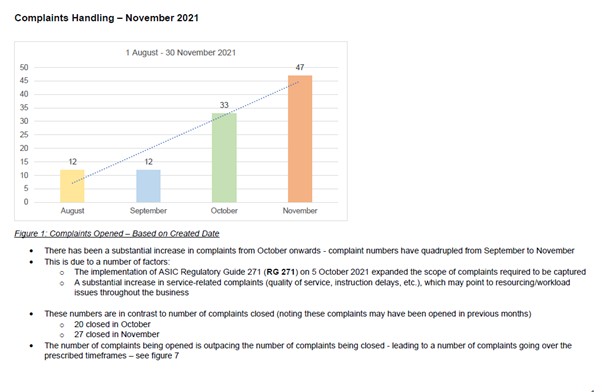
278 In relation to complaint resolution and complaints closed outside the legislative timeframes, the report stated as follows:
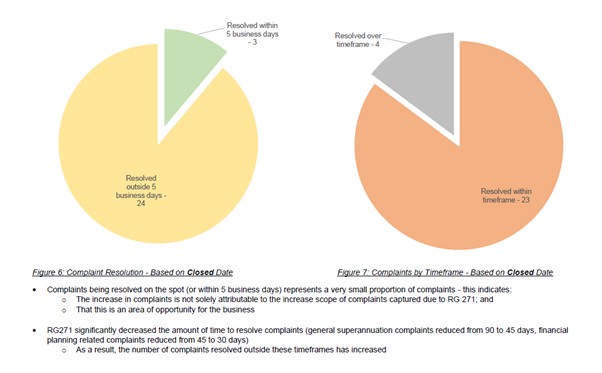

279 Data provided for the ERCC meetings included ERCC Monthly Reports which provided information in relation to the complaints opened and closed on the last day of the previous month, and a complaints ‘dashboard’, displaying data in ‘dashboard’ form regarding the number of complaints in the preceding 12 months, the number of open complaints and the number of closed complaints on the last day of the preceding month.
280 By way of example, the ERCC Monthly Report for the November 2021 period, recording data in relation to complaints made as at 30 November 2021, prepared for the ERCC meeting on 22 December 2021, reported as follows:
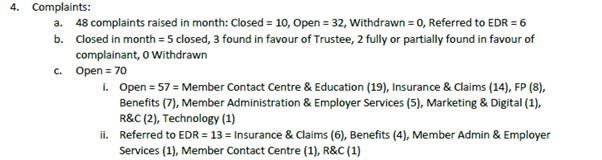
281 The dashboard contained the following information in relation to complaints in the preceding 12 months to the end of November 2021:
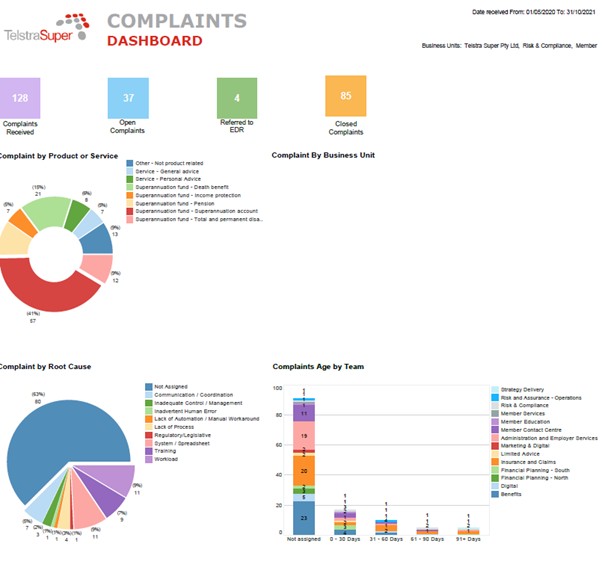
282 Complaints reporting to the Audit and Risk Committees generally contained the following information:
(a) the number of complaints received in a particular period;
(b) from the complaints received in the period, the number of complaints that remained open and the number of complaints that were closed, including closed complaint outcomes (eg upheld, not upheld, withdrawn);
(c) of the complaints closed during the period, the percentage closed within the maximum IDR timeframe and the average number of days taken to close a complaint;
(d) details in relation to complaints by subject and product or by business units;
(e) a root cause analysis in relation to all complaints, identifying the potential underlying cause of the complaint and recommended controls to prevent reoccurrence; and
(f) the increasing trend in the number of complaints year on year.
283 By way of example, the report for the meeting of the Risk Committee on 8 December 2021, for the reporting period 1 September 2021 to 31 October 2021, contained the following information in relation to the number of complaints received:
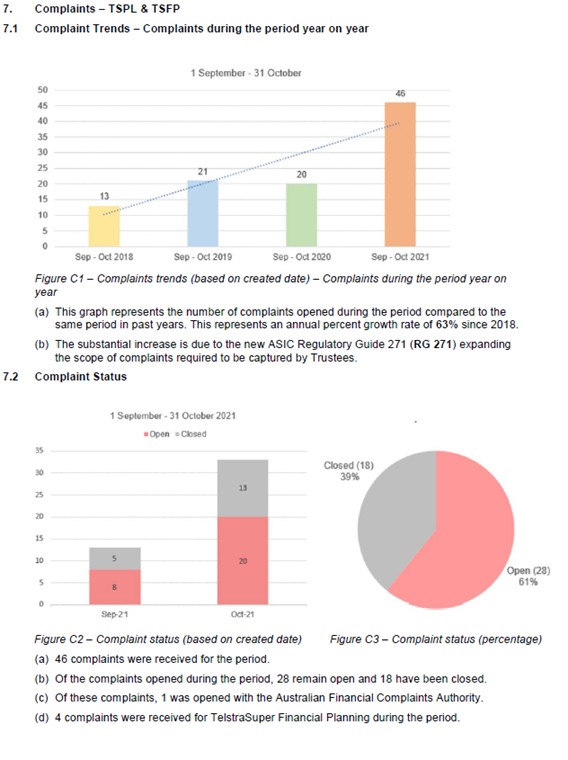
284 The report also contained the following information in relation to the number of complaints that exceeded the legislative timeframe:

285 ASIC was critical of Telstra Super’s internal reporting, submitting that generally there was little to no internal reporting on the number complaints that were overdue at any given point in time. However, the Complaints Handling reports for the reporting periods December 2021 to June 2022 reported that the number of complaints resolved outside the maximum IDR timeframe was increasing and, from July 2022, the Complaints Handling reports referred to overdue complaints by number and percentage. In addition, although prepared quarterly, the Audit Committee reports for the reporting periods from 1 January 2022 summarised the number (and percentage) of open complaints that were overdue: see, eg, Audit & Compliance Report for the Audit Meetings on 17 February 2022, 6 April 2022 and 26 September 2022.
286 By way of example, for the meeting of the Audit Committee on 17 February 2022, the Audit & Compliance Report, for the reporting period 1 September 2021 to 31 December 2021, stated that:

287 See also the Audit & Compliance Report for the Audit Meeting on 6 April 2022, referred to in paragraph 310 below, and the Risk & Compliance Report for the Risk Committee meetings on 8 December 2021 and 8 June 2022, referred to in paragraphs 284 and 322 respectively.
288 Moreover, internal reporting throughout the Relevant Period, generally reported that the number of complaints received, and the number of overdue complaints, was increasing.
289 Complaints reporting to the Board generally occurred through the Risk Committee and Audit Committee reports to the Board. Those reports generally contained less detail than the reports provided to the Risk and Audit Committees. However, the Board received regular reports on the increase in the number of complaints after the introduction of RG 271, in addition to the number of complaints received in the reporting period, complaints that remained open and the complaints that had been closed in the reporting period: see, eg, Risk Committee and Audit Committee Updates for the Board meeting on 18 February 2022.
September 2021
290 On 29 September 2021, ASIC registered ASIC Corporations, Credit and Superannuation (Amendment) Instrument 2021/753, amending the original IDR Instrument and incorporating an updated version 2 of RG 271, and an accompanying Explanatory Statement.
October 2021
291 On 1 October 2021, Telstra Super’s new Complaints Policy and Business Rules were approved by Telstra Super’s Board, taking effect on 5 October 2021.
292 RG 271 came into effect and applied to complaints received from 5 October 2021.
293 During October 2021, 32 complaints were recorded as having been received – more than 3 times the average number recorded in the previous periods.
November 2021
294 On 10 November 2021, Ms Hayes met with the Complaints Team and then subsequently with Mr Davies. Ms Hayes and Mr Davies discussed whether it would be necessary to obtain additional resources to deal with increased complaint numbers. They decided to assess whether this was an ongoing issue, and – if so – to recruit an additional Complaints Officer, initially on a temporary basis until 30 June 2022. That outcome was reported to the ERCC on 17 November 2021.
295 There were 48 complaints recorded as having been received in November 2021.
December 2021
296 In early December 2021, Ms Hayes decided it was necessary to recruit an additional Complaints Officer, on a contract basis up to 30 June 2022, due to the number of complaints received since RG 271 was introduced.
297 At the time, Ms Hayes and Ms Morgan reported that the increased complaints numbers were due to a number of factors, including the expanded scope of complaints that were required to be captured by RG 271 and unrelated increases in service-related complaints.
298 On 9 December 2021, Telstra Super engaged a recruiter to hire an additional Complaints Officer and, after conducting interviews and reference checks, Ms Sarah-Jane Harris commenced work on 20 December 2021.
299 There were 28 complaints received in December 2021.
January 2022
300 Towards the end of January 2022, Ms Morgan and Ms Dezsi met with Ms Hayes and they formed the view that Ms Harris’ contract should end early. Ms Harris finished with the Complaints Team on 28 January 2022.
301 There were 15 complaints received in January 2022.
February 2022
302 Mr Sean Clarke, who was the Team Leader within the Member Contact Centre, was proposed as a suitable internal replacement for Ms Harris and, in early February 2022, Ms Hayes made arrangements for Mr Clarke to commence an internal secondment to the Complaints Team on 21 February 2022.
303 There were 22 complaints received in February 2022. This was an elevated number, compared to the pre-RG 271 number of complaints, but a reduction from the initial spike in October – December 2021.
March 2022
304 As higher complaint numbers had continued throughout February 2022, Ms Hayes made enquiries about internally allocating a person from the general Risk & Compliance team to assist. From 17 March 2022, Ms Lisa Cousins, an Associate Risk & Compliance Partner at Telstra Super, was also allocated to the Complaints Team as a temporary internal resource. Ms Cousins assisted as a “surge” Complaints Officer for periods in March – July 2022, July – September 2022, and January – February 2023.
305 On 2 March 2022, the report to the Complaints Management Meeting noted the increased complaint numbers in February, and observed that the numbers in March – April would “give us a proper indication of complaints numbers going forward”. It predicted “numbers in the high 20s or low 30s”. It again noted the issue of complaints not being resolved within the prescribed timeframe, and stated that the “backlog is being worked through”.
306 At this stage, Ms Hayes considered that complaint numbers in the high 20s or low 30s should be manageable with three Complaints Officers (Ms Morgan, Ms Dezsi and Mr Clarke) and Ms Cousins assisting as the “surge” Complaints Officer. However, according to Ms Hayes, progress was hampered for reasons that included the receipt of an investigative notice from ASIC.
307 On 8 March 2022, Telstra Super engaged KPMG to conduct a review of its IDR process, to assess the design and operating effectiveness of its framework for compliance. Ms Morgan was heavily involved in this project, and it took up a significant amount of her time over the next few months. Ms Hayes rejected the proposition that Telstra Super should have obtained external advice on the implementation of RG 271 before October 2021, explaining that the review was to assess design and operating effectiveness and required data to test the operating effectiveness.
308 There were 23 complaints received in March 2022.
April 2022
309 On 6 April 2022, Ms Hayes and Ms Morgan reported on complaints to the Audit Committee, noting that, while complaint numbers had increased compared to the same period in the previous year, complaint numbers had been stable and two additional resources (Mr Clarke and Ms Cousins) had been allocated to the Complaints Team. The Report to the Audit Committee further noted that the figures were retrospective and did not reflect the actions taken to date, such as the new staff appointed to the Contact Centre or the work undertaken to clear the backlog.
310 As already mentioned, the Report also noted the number of complaints in the reporting period and the number of open complaints that were overdue, stating that:
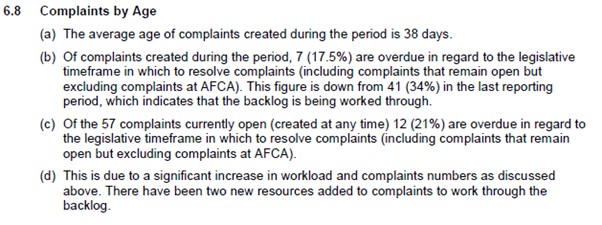
311 There were only 7 complaints received in April 2022.
May 2022
312 In May 2022, Ms Morgan was promoted to Complaints Manager.
313 On 2 May 2022, Ms Hayes and Mr Davies met to consider whether any additional resources were required. At that time, only 7 complaints had been received in the previous month. Although there were 41 complaints open at the start of May 2022, there were four staff available to work through them, in addition to any new complaints received. As such, Ms Hayes and Mr Davies decided to continue observing complaint numbers.
314 On 13 May 2022, Telstra Super received a further notice from ASIC, requiring the production of complaints documents. Telstra Super said that this diverted resources from responding to complaints.
315 By mid-May 2022, it became apparent that the complaint numbers in May 2022 would be higher than in April 2022.
316 On 19 May 2022, Ms Hayes requested approval to recruit for an additional Complaints Officer, which was authorised on 26 May 2022.
317 The Complaints Handling report for March – April 2022, for the Complaints Management Meeting on 4 May 2022, noted that the number of complaints currently open remained approximately the same since January (50s – 60s) and that, while the number of complaints resolved outside the prescribed timeframe had increased since October 2021, it had decreased since February 2022 (44% in March – April, compared to 52% in February 2024).
318 On 14 May 2022, Ms Morgan required immediate and unplanned leave, for a period that was then indeterminate.
319 To deal with Ms Morgan’s absence, Ms Cousins’ period in the Complaints Team was extended until 1 July 2022. However, Telstra Super said that Ms Cousins was not a complete replacement for Ms Morgan. Ms Cousins was a temporary, internal resource who had recently been trained and joined the Complaints Team. On the other hand, Ms Morgan was the most experienced member of the Complaints Team, who had recently been promoted to Complaints Manager.
320 There were 22 complaints received in May 2022.
June 2022
321 In June 2022, Telstra Super was recruiting for a fourth Complaints Officer and, on 22 June – 2022, Ms Dhaliwal was recruited, with a commencement date of 11 July 2022. Ms Dhaliwal was also a qualified lawyer and had previously worked at ASIC and the Superannuation Complaints Tribunal.
322 After the introduction of RG 271, which broadened the definition of complaints and reduced the timeframe for responding, Telstra Super re-evaluated its Key Risk Indicators, which were more easily triggered. The Risk & Compliance Report for the Risk Committee meeting on 8 June 2022 contained a comprehensive report in relation to the relevant risks and causes of the increased complaints, stating that:
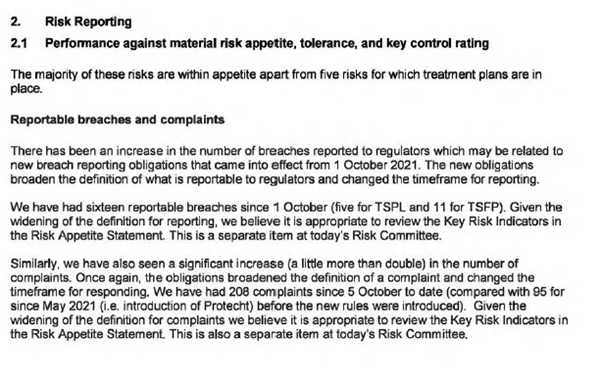
323 The Complaint Trends were depicted in a graph and reported in the following terms:
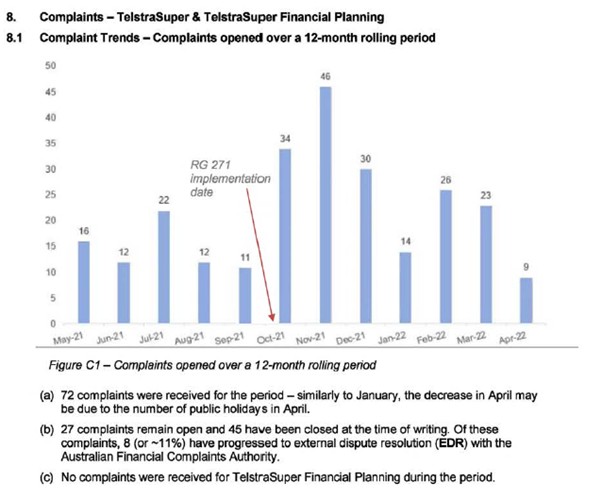
324 In relation to the causes of the complaints, the Risk & Compliance Report noted that:
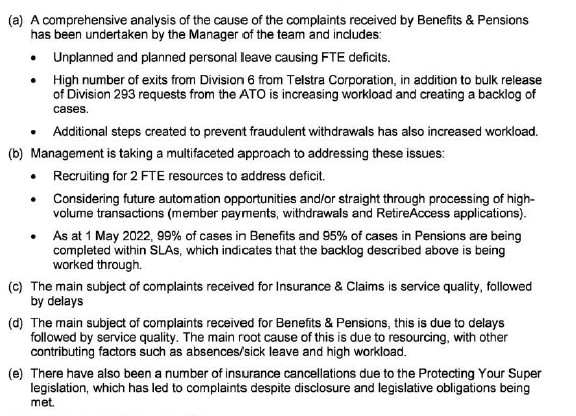
325 Finally, in relation to overdue complaints in the reporting period and resourcing, the Risk & Compliance Report stated:
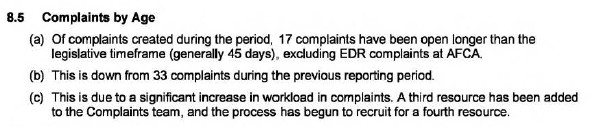
326 By the end of June 2022, Ms Morgan had returned from leave, and another Complaints Officer (Ms Dhaliwal) was due to begin work in July.
327 There were 17 complaints received in June 2022.
July 2022
328 Ms Morgan returned from leave in late June 2022 and Ms Dhaliwal commenced on 11 July 2022. Telstra Super also made flexible use of its internal resources, Ms Cousins, from 22 July 2022, to assist with unanswered complaints from previous months and because Ms Dezsi was due to be on leave for most of August 2022.
329 There were two developments in July 2022 which Ms Hayes said occupied resources from the Complaints Team, particularly in August. First, on 25 July 2022, KPMG’s report titled “Telstra Super Internal Dispute Resolution – Design and Operational Effectiveness Review” (KPMG Report) was released and the Complaints Team needed to consider this report, and work on the implementation of its recommendations. Secondly, on 28 July 2022, ASIC issued further notices to Telstra Super, which required significant work from the Complaints Team in preparing a response.
330 The KPMG Report assessed the design and operating effectiveness of the framework established by Telstra Super to comply with RG 271. The KPMG Report found that there was a high volume of complaints that were not handled within the prescribed timeframes set out in RG 271. The KPMG Report made several recommendations, including upskilling frontline staff on complaints management to minimise the transfer of complaints to the Complaints Team. The KPMG Report noted that resolving complaints at first contact was not practiced in every instance, which was placing additional pressure on the Complaints Team. The KPMG Report also recommended that Telstra Super hire an additional “triage” Complaints Officer.
331 Telstra Super implemented the following changes based on the recommendations in the KPMG Report:
(a) it introduced a “triage” Complaints Officer role, but not until September – October 2022;
(b) it provided additional training to frontline staff on responding to complaints; and
(c) it enhanced reporting to include time taken to acknowledge complaints and information on the volume of complaints resolved at first point of contact.
332 The Complaints Handling report for May – June 2022, prepared for the Complaints Management meeting in early July 2022, reported that the number of open complaints had remained stable since January 2022 (50 – 60 complaints), but the number of overdue complaints had risen from March – April:

333 There were 27 complaints received in July 2022.
334 Ms Hayes noted that 16 out of the 27 complaints received in July were closed outside of the 45-day timeframe. However, according to Ms Hayes, this marked a turning point because responses outside the 45-day timeframe were reduced in August and September and reached zero in October 2022.
August 2022
335 Ms Dezsi was on leave for the entirety of August 2022 (that leave had been approved back in September 2021). Telstra Super made flexible use of its internal resources, Ms Cousins, to assist as a “surge Complaints Officer” in August 2022 while Ms Dezsi was on leave.
336 Ms Hayes said that, if not for the timing of the KPMG Report, the issue of further notices by ASIC and the timing of Ms Dezsi’s leave, Telstra Super would likely have achieved consistent responses within the 45-day default timeframe by this time – as it was, that was achieved substantially in October 2022. However, Ms Hayes said that August 2022 was a difficult month due to those other matters.
337 On 30 August 2022, Telstra Super lodged a “Reportable Situation” with ASIC. That document reported that, between October 2021 and 22 July 2022, responses to 76 complaints for Telstra Super exceeded the maximum IDR timeframes in RG 271. In relation to the root causes, the report stated that:
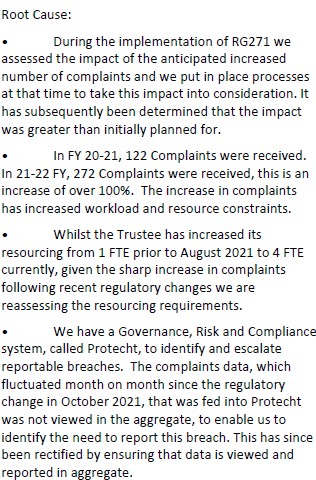
338 There were 23 complaints received in August 2022. As already mentioned, from August 2022 onwards, the number of complaints resolved outside the maximum IDR timeframe decreased.
September 2022
339 On 1 September 2022, Ms Dezsi returned from leave, which brought the Complaints Team to five resources – four permanent team members, plus Ms Cousins on a temporary basis (until 13 September 2022).
340 The Complaints Handling report, for the Complaints Management meeting held on 1 September 2022, contained the following table depicting the number of complaints since January 2022 which had exceeded the maximum IDR timeframe:
341 As noted in the table, between January – July 2022, 45% of complaints had exceeded the IDR timeframe, a matter which was also reported to the Audit and Risk Committees on 26 September 2022.
342 On 5 September 2022, Telstra Super determined to hire an additional “triage” Complaints Officer, following the recommendation made by KPMG. Mr Hinson was hired as a “triage” Complaints Officer on 30 September 2022, commencing on 26 October 2022.
343 There were 14 complaints recorded in September 2022. Of that number, 5 were responded to outside the maximum 45-day timeframe.
October 2022
344 On 26 October 2022, Mr Hinson commenced in the position of “triage” Complaints Officer. Mr Clarke also resigned on that day, with an exit date of 15 November 2022.
345 The “triage” Complaints Officer role was a specialist role intended to improve the efficiency of the larger team. Ms Morgan said that Mr Hinson’s role as triage Complaints Officer was a significant improvement in terms of the Complaints Team’s efficiency.
346 There were 22 complaints recorded in October 2022 which were all responded to within the maximum 45-day timeframe. (There was one complaint, complaint 257, which was not responded to within the maximum IDR timeframe, however, it was not the subject of any allegation in the proceeding).
November 2022
347 On 15 November 2022, Mr Clarke ceased his employment with Telstra Super.
348 The Complaints Handling report – September & October 2022, for the Complaints Management Meeting on 2 November 2022, recorded that the overall number of open complaints had decreased, with 38 current open complaints, the lowest since RG 271 was introduced.
349 Ms Hayes’ evidence was that, in practical terms, the series of issues that had impacted the capacity of the Complaints Team to respond to most complaints within the prescribed timeframe had stabilised by this point.
350 There were 19 complaints received in November 2022. Of that number, only one was responded to outside the maximum IDR timeframe
December 2022
351 There were 31 complaints received in December 2022. Of that number, only two were responded to outside the maximum IDR timeframe.
January 2023
352 On 12 January 2023, Ms Cousins commenced a further period of assisting the Complaints Team (until 20 February 2023), due to an increase in complaint numbers in December 2022.
353 For the purpose of ASIC’s allegations in the proceeding, the complaint receipt period ended on 13 January 2023, although it took Telstra Super until May 2023 to resolve the complaints received to this point.
354 On 23 January 2023, Ms Morgan applied for a career break, for reasons related to her previous unavoidable and unplanned leave. Following further discussions, this career break was brought forward from 23 April 2023, to commence on 17 March 2023.
355 On 31 January 2023, Telstra Super received further investigative notices from ASIC. Telstra Super said that responding to these notices required a significant amount of work, including for Ms Morgan and the Complaints Team.
356 There were 11 complaints recorded in January 2023. Of that number, one was responded to outside the maximum IDR timeframe.
February 2023
357 After observing higher numbers of complaints in December 2022 – January 2023, Ms Hayes determined that it was necessary to hire an additional Complaints Officer, initially for a temporary position. As a result, Telstra Super recruited an additional Complaints Officer, Mr Radaza, with a commencement date of 1 March 2023. In addition, Ms Cousins continued to assist the Complaints Team for part of February until 20 February 2023.
March 2023
358 On 1 March 2023, Mr Radaza commenced in the Complaints Team, initially as a temporary contractor and, from 3 April 2023, under a fixed-term contract.
359 From 17 March 2023, Ms Morgan commenced a 6-month leave of absence, and Ms Dezsi was promoted to acting Complaints Manager in her absence.
360 The Complaints Handling report for the Complaints Management meeting on 6 March 2023 noted that the number of complaints that exceeded the maximum timeframe had been steadily decreasing from August 2022, which was depicted in the following chart:
April 2023
361 On 3 April 2023, Mr Tirpcou commenced as a Complaints Officer, backfilling for Ms Dezsi’s previous role as Complaint Officer. This restored the Complaints Team to five full-time resources.
362 On 21 April 2023, Telstra Super updated its Reportable Situation lodged with ASIC, stating that:
The purpose of this update is to provide ASIC with additional relevant information and context, since the original reportable situation was lodged. For the period from 5 October 2021 to 22 July 2022, the Trustee has increased (by 11), the number of IDR complaints which exceeded the maximum timeframes. This takes the overall number from 76 to 87. This includes complaints that were not included in the earlier report, because they fell overdue after 30 August 2022, the date when the reportable situation was lodged with ASIC.
Since 23 July 2022, the number of overdue complaints relating to the root cause has trended down to zero by January 2023. These were: 5 for the remainder of July 2022 [i.e. 23 to 31 July 2022], 10 in August 2022, 5 in September 2022, 1 in October 2022, 1 in November 2022, 3 in December 2022, nil in January 2023, nil in February 2023 and nil in March 2023 to date.
363 The update to the Reportable Situation report further noted that the increase in complaints in December 2022 was due to Telstra Super’s response to the heightened cyber security risk that was occurring at the time following the Optus and Medibank’s data breaches.
May 2023
364 The last of the outstanding Relevant Complaints (Complaint 330) was responded to on 23 May 2023.
The parties’ submissions
365 ASIC alleged that, during the Relevant Period, Telstra Super’s IDR process was not resourced so that it operated fairly, effectively and efficiently. ASIC relied on the following matters:
(a) Telstra Super’s non-compliance with the IDR requirements, which ASIC submitted was widespread and repeated. ASIC relied on the admitted contraventions, and the contraventions which ASIC said should be found, which it submitted showed that Telstra Super’s IDR process did not operate fairly, effectively or efficiently. ASIC submitted that the contraventions arose from resourcing issues and that, in many respects, the problems were systemic, rather than due to inadvertent error or circumstances particular to the handling of specific complaints. In that regard, it was submitted, the Complaints Team routinely sent template IDR delay notifications, and did not consider whether the delay criteria was satisfied, which had inadequate reasons for the delay or removed AFCA’s details.
(b) The contraventions could not be dismissed as merely trivial or technical breaches of the requirements of RG 271. ASIC submitted that, in respect of the requirement to issue an IDR response within 45 days, a significant proportion of IDR responses were sent over 100 days after the relevant complaints were made. In some cases, it was submitted, no work was recorded as having been undertaken by the time that an IDR delay notification was sent.
(c) Telstra Super failed to adequately resource its complaints handling function during this period of widespread non-compliance. In particular, ASIC submitted that Telstra Super did not scale up its resources proportionately or adequately with the increase in complaints. ASIC relied on the fact that Telstra Super acknowledged, internally and in breach reports to ASIC, that under-resourcing was a key contributing factor to its failure to comply with the IDR requirements. ASIC also relied on the fact that, under cross-examination, Ms Hayes accepted that, to deal with the complaint volumes that existed in December 2021, the Complaints Team needed at least four members. ASIC submitted that Telstra Super addressed the inadequate resourcing only gradually and incrementally, starting with two staff members in December, engaging a third in December 2021, undertaking an internal transfer in March 2022 and engaging a fourth staff member in August 2022. Furthermore, despite recognising the merits of a “triage” role in June 2021, that function was only incorporated in October 2022. ASIC also alleged that, in addition to failing to ensure that it had sufficient numbers of Complaints Officers, Telstra Super initially engaged personnel (Ms Harris and Mr Clarke) without ensuring that they were adequately trained so that they could be effective in discharging their duties.
366 Telstra Super denied that it contravened the resourcing requirement in RG 271.142. Telstra Super said that it had anticipated that there might be additional complaints after the commencement of RG 271. However, the increased volume of complaints was greater than Telstra Super had anticipated. Telstra Super submitted that it responded to this issue by:
(a) closely monitoring and reporting complaint numbers to the Executive Team and the Board;
(b) recruiting additional resources and making flexible use of its internal resources; and
(c) identifying and reporting on the underlying causes of complaints, to reduce the numbers of complaints by addressing those causes.
367 Telstra Super said that, aside from the increase in the numbers of complaints received, it had certain other challenges in the Relevant Period, which placed heightened short-term demands on its available resources as it was seeking to increase them.
368 First, and most critically, Ms Morgan required immediate and unplanned leave for an indeterminate period of time. Ms Morgan returned to work on 27 June 2022, but had a further 39 leave days between July 2022 and January 2023.
369 Secondly, Telstra Super’s first two new additional Complaint Officers recruited in the Relevant Period were not, according to Ms Hayes, achieving optimal effectiveness in their role. This, Telstra Super submitted, was unfortunate timing, because it had recruited the additional resources to keep up with the higher than expected volume of complaints received from October 2021. Despite raising the performance of the two Complaints Officers as an additional reason for the delays or challenges in addressing the volume of complaints, Telstra Super disavowed any criticisms of the employees, either personally or professionally.
370 Thirdly, the COVID-19 pandemic was a source of ongoing difficulty. During the Relevant Period, these challenges included working from home, “pandemic fatigue”, unplanned leave and illness, and, from late 2021 through to August 2022, managing high infection rates, staff vaccinations and returns to the office. These issues in turn caused additional complaints. On 21 October 2021, the final lockdown in metropolitan Melbourne came to an end. However, other lesser restrictions remained in force between 22 October 2021 and 15 December 2021. Immediately following the loosening of restrictions, Victoria saw its highest spike of COVID-19 infections, peaking in December 2021–January 2022 and remaining at lower but elevated levels until August 2022. Furthermore, the Victorian Government’s recommendation to work from home was in force until 1 September 2022, which was the primary period within which Telstra Super had difficulty in responding to complaints within the prescribed timeframe.
371 Fourthly, as a means of monitoring and improving its compliance, Telstra Super had engaged KPMG to conduct a review of its implementation of RG 271. This required a significant level of input/engagement from the Complaints Team, particularly in the period of July to September 2022.
372 Fifthly, from March 2022 onwards, Telstra Super was required to divert significant resources from its Complaints Team to responding to ASIC’s surveillance and investigation notices dated 4 March 2022, 13 May 2022, 28 July 2022 and 31 January 2023.
373 Sixthly, there were other simultaneous regulatory developments that, in combination, put strain on Telstra Super’s capacity to deal with those matters.
374 Seventhly, during the Relevant Period, Telstra Super implemented protective measures in response to the major data breaches experienced by Optus and Medibank, in late 2022. These protective measures were a source of additional complaints.
Consideration
375 An IDR process is a process that includes procedures, policies, resources, delegations and governance, which must all be in place to manage complaints: see RG 271.16 and 271.124.
376 The requirements to meet the resourcing obligation under RG 271.142 will depend on the circumstances of the financial firm, including the size of the business, the number of people in the organisation, the products and services offered, the nature of the customer base, the diversity and structure of the firm’s operations and the likely number and complexity of complaints. While the resourcing obligation extends beyond the mere allocation of staff, RG 271.143 specifically provides that “[s]taffing numbers must be sufficient to deal with complaints in a fair and effective manner within maximum IDR timeframes. This includes resourcing the IDR function to deal with intermittent spikes in complaint volumes.” Furthermore, although not expressed as a mandatory obligation, the firm is expected to ensure that staff have the skills, attributes and training to effectively perform their roles: RG 271.148.
377 The phrase “fairly, effectively and efficiently” is not susceptible of exhaustive definition in the abstract. That said, for present purposes, an IDR process is fair, effective and efficient when it produces the intended result, namely, the just and timely resolution of complaints, avoiding unnecessary delays or complexity.
378 Telstra Super’s IDR process was part of a system of processes and polices for managing, investigating and responding to complaints. The system comprised the Protecht system for recording, storing and managing complaints data; procedures and policies in the form of the Complaints Policy and Business Rules; delegations to the Complaints Team, and accountability and governance, by the Chief Risk Officer and ultimately the Risk and Audit Committees and the Board of Telstra Super.
379 There were no complaints raised in the proceeding regarding the resourcing of the Telstra Super’s IDR process other than what ASIC described as the failure to scale up the Complaints Team proportionately or adequately with the increase in complaints, and in respect of staff training.
380 ASIC’s case was that four Complaints Officers was the optimum number, relying on Ms Hayes’ acknowledgement that the Complaints Team needed at least four members to deal with the volume of complaints that existed from December 2021. ASIC also produced a chart which it submitted showed that the number of overdue responses decreased after October 2022, when four staff were engaged and one of the staff members (Mr Hinson) had been assigned to a “triage” function.
381 ASIC’s chart (reproduced below) displayed, for each month in the Relevant Period, the number of complaints received (until 31 January 2023), the number of overdue responses at the end of each month and the number of staff engaged in the Complaints Team during that month:
382 While Telstra Super had expected the volume of complaints to increase after the implementation of RG 271, it said that the number of complaints in October – December were higher than anticipated.
383 Between January 2021 and September 2021, pre-RG 271, Telstra Super had recorded an average of 9.22 complaints per month. The relevant response timeframe at that stage was 90 days. During the Relevant Period, Telstra Super recorded an average of 22.25 complaints per month, with a particular spike in the initial period of October to December 2021 (32, 43 and 28 complaints respectively).
384 As shown in the chart above, by the end of February 2022, the number of new complaints was less than the initial spike in October – December 2021, but was still elevated compared to the pre-RG 271 number of complaints. Further, complaint numbers throughout 2022 were higher than pre-RG 271 and, although they remained lower than October – December 2021, the numbers moved around and did not settle into a reliable pattern.
385 ASIC did not call any evidence from an industry expert regarding the optimal level of resourcing for a financial firm in Telstra Super’s position. ASIC did not adduce any evidence regarding standard industry practice, or industry standards, as to the resourcing that would have been adequate in Telstra Super’s circumstances. Nor did ASIC seek to identify what Telstra Super should have done, but failed to do, to establish the alleged contraventions, beyond asserting that Telstra Super did not scale up resources proportionately or adequately with the increase in complaints.
386 Telstra Super relied on the evidence of Ms Hayes, who as the Chief Risk Officer was responsible for Telstra Super’s compliance and risk management framework and for the resourcing of the Complaints Team. As already mentioned, Ms Hayes has over 20 years’ experience in the financial services industry, with expertise in the areas of risk and compliance. Ms Hayes explained Telstra Super’s approach to resourcing the Complaints Team in the following terms:
… As a starting point, the Complaints team is adequately resourced when there is a reasonable relationship between the number of complaints to be dealt with and the resources available in the Complaints team. …
… Similarly, there was a balancing exercise between ensuring that Telstra Super had sufficient resources to meet the IDR requirements, including to meet any spikes in complaint numbers, or dips in its available resources (due to leave, etc), but did not hire so many resources as to burden its members with unnecessary expense.
387 Prior to the implementation of RG 271, Telstra Super turned its mind to the level of resourcing that would be required within the Complaints Team after RG 271 came into effect. Ms Hayes said that, in the leadup to October 2021, she was confident that the IDR Project Working Group and Steering Committee had successfully prepared Telstra Super for compliance with the new IDR requirements, and that the allocated resources would be sufficient, but that they should monitor the issue of resourcing after implementation of RG 271 and obtain further resources if they appeared to be needed.
388 Based on her experience and the views of the two Complaints Officers (Ms Morgan and Mr Wilson), Ms Hayes considered that two Complaints Officers would be sufficient resources for the Complaints Team, subject to monitoring the number of complaints received and obtaining further resources if they were needed. There was a reasonable basis for Ms Hayes to be satisfied that two Complaints Officers would be sufficient, despite anticipating an increase in the number of complaints after RG 271 and a shorter timeframe in which to respond to the complaints. First, Ms Morgan and Mr Wilson had considerable experience between them and, having worked on the IDR Project, they were aware of the regime that would be in place after RG 271. They both told Ms Hayes that they were satisfied that two Complaints Officers would be sufficient. Secondly, shortly before RG 271 was implemented, the two Complaints Officer had consistently managed to close all complaints within the (then) maximum 90-day timeframe and the vast majority within 45 days (see, eg, Telstra Super’s response to ASIC’s survey on 27 April 2021, in paragraph 266 above, stating that 100% of complaints were responded to within 45 days since increasing resources, and the report to the Audit Committee dated 4 August 2021, in paragraph 261 above, reporting that 92% of complaints in the March – June period were closed within 45 days). That was despite, in Ms Morgan’s case, also spending a significant amount of time working on the IDR project between June 2020 and October 2021.
389 After RG 271 commenced, Ms Hayes routinely turned her mind to the resourcing issue, and the need to ensure that Telstra Super had sufficient resources to meet the IDR requirements. When it became apparent to Ms Hayes that two Complaints Officers would not be sufficient to handle the volume of complaints received after RG 271 came into effect, she moved to increase the number of Complaints Officers to three.
390 Within two weeks of the start of the Relevant Period, in December 2021, the Complaints Team already had three permanent Complaints Officers. The decision to increase the resources within the Complaints Team was made before the Relevant Period. Furthermore, three months later, in March 2022, Ms Hayes implemented the use of flexible internal resources, being Ms Cousins, who was an Associate Risk & Compliance Partner at Telstra Super. Although Ms Cousins was meant to be a temporary resource, she remained in the team until July 2022. As a result, from March 2022, the Complaints Team effectively comprised four members – three permanent Complaints Officers and Ms Cousins, assisting as a “surge” Complaints Officer.
391 In April 2022, only 7 complaints were received, which was significantly less than the previous months. In those circumstances, Ms Hayes and Mr Davies decided additional resources were not required and they would continue to monitor complaint numbers.
392 As at March – April 2022, the number of open complaints had remained stable across the months of January–March (in the 50s and 60s), however, the backlog of cases was “being worked through” and the number of complaints resolved outside the maximum timeframe had decreased (44%) compared to February (52%).
393 By mid-May 2022, however, it became apparent that complaint numbers in May 2022 would be higher than April 2022. Ms Hayes then requested approval to recruit an additional Complaints Officer, which was authorised on 26 May 2022. In June 2022, Telstra Super was recruiting for a fourth Complaints Officer and, on 22 June 2022, Ms Dhaliwal was recruited. Ms Dhaliwal was to commence on 11 July 2022. Once Ms Dhaliwal joined the team, the Complaints Team included Mr Clarke and three qualified lawyers – Ms Dhaliwal, Ms Dezsi and Ms Morgan, who by then was also the Complaints Manager.
394 This brought the number of permanent Complaints Officers to four, plus the use of internal resources. Ms Hayes said that, at that time, she expected that Telstra Super would have been able to reach a level of consistent compliance with the 45-day timeframe with a fourth Complaints Officer, without further setbacks.
395 However, in mid-May 2022, Ms Morgan required immediate unavoidable and unplanned leave, for a then indeterminate period. Ms Morgan went on leave, for an indeterminate period which ended up lasting six weeks (from 16 May 2022 to 27 June 2022), but Ms Morgan then had a further 39 leave days between July 2022 and January 2023.
396 Ms Morgan’s unavoidable and unplanned requirement for leave was also a serious setback for Telstra Super, which would have hindered Telstra Super’s ability to deal with the existing unanswered complaints. Ms Morgan was a critical staff member during the Relevant Period. She had considerable experience in complaints handling, and as the Complaints Manager and subject matter expert for the IDR Project, was the most experienced and qualified member of the Complaints Team in handling complaints. According to Ms Hayes, the Complaints Team had not reached consistent responses within the 45-day timeframe by the end of June 2022, although she considered it likely they would have done so if not for Ms Morgan’s absence.
397 By June 2022, the number of complaints outside the timeframe had risen from 44% in March and April to 47% in May and June. This figure rose again in July and early August (approximately 60% by early August).
398 In July 2022, as already mentioned, Telstra Super decided to implement changes as a result of the recommendations in the KPMG Report to improve the IDR process. This included introducing a “triage” Complaints Officer role, although that role was not created until September – October 2022. ASIC was critical of the fact that it took the KPMG Report for Telstra Super to decide to introduce a “triage” role within the Complaints Team in circumstances where Ms Morgan had suggested creating a “triage” role for complaints to sit within the Member Control Centre in June 2021. As Ms Hayes explained, however, at the time it was suggested by Ms Morgan, Ms Hayes was already proposing to recruit an additional Complaints Officer within the Complaints Team
399 Ms Hayes said there were additional difficulties in meeting the 45-day timeframe, having regard to the diversion of resources in reviewing the KPMG Report, responding to ASIC notices, dealing with other regulatory changes and due to the increased in complaints following the Optus and Medibank data breaches. As RG 271.143 makes clear, however, resourcing the IDR function includes dealing with intermittent spikes in complaint volumes. Resourcing should also be able to accommodate ordinary periods of leave, planned absences and fulfilling the firm’s obligations as a regulated superannuation entity.
400 Nevertheless, I am satisfied that Telstra Super encountered two significant and unforeseen challenges which were serious setbacks in its ability to manage and respond to complaints, namely, Ms Morgan’s unavoidable and unplanned requirement for leave (which I have dealt with) and the impact of the COVID-19 pandemic.
401 Telstra Super did not assert, or seek to establish, that the COVID-19 pandemic had an adverse impact on the members of the Complaints Team, in terms of absences from work. Rather, it said that the COVID-19 pandemic affected its workforce generally and lead to higher than anticipated complaints.
402 Prior to and during the Relevant Period, reporting on compliance and complaints to the Risk and Audit Committees noted that a significant number of the complaints received by Telstra Super were service-related. For example, reports to those Committees, and to the Board, often reported that the COVID-19 pandemic was causing unplanned absences from work and workplace fatigue, increased workload (due to accessing superannuation) and service-related issues (due to absences and workplace fatigue), which was leading to increased complaints.
403 The COVID-19 pandemic was not an unexpected circumstance by the time RG 271 came into effect. However, it was having a prolonged and indeterminate effect on service levels, which was translating into complaints, and the end point would have been difficult to predict. As ASIC’s own chart showed, the number of complaints moved around and did not ever fall into a predictable pattern.
404 On 30 August 2022, Telstra Super lodged the Reportable Situation report with ASIC.
405 On 5 September 2022, Telstra Super determined to hire an additional “triage” Complaints Officer, giving effect to a recommendation made by KPMG. Mr Hinson was hired as a “triage” Complaints Officer on 30 September 2022 and commenced in the role on 26 October 2022. Ms Morgan said that Mr Hinson’s role as a triage Complaints Officer was a significant improvement in the Complaint Team’s efficiency.
406 The number of complaints that exceeded the maximum IDR timeframe decreased from 11 in August 2022 and 17 in September 2022, to zero in October 2022 and one in November 2022. On 2 November 2022, there were 38 open complaints, the lowest number since RG 271 was introduced. On 15 November 2022, Mr Clarke ceased his employment with Telstra Super. From 12 January 2023 until 20 February 2023, Ms Cousins assisted the Complaints Team as a “surge” Complaints Officer. On 1 March 2023, Mr Radaza commenced in the Complaints team and from 17 March 2023, Ms Morgan commenced a 6-month leave of absence. On 3 April 2023, Mr Tirpcou commenced as a Complaints Officer, backfilling for Ms Morgan’s 6-month leave of absence.
407 ASIC submitted that hiring staff involved lead times and Telstra Super should have acted sooner than it did. The existence and impact of lead times was apparent in the present case, where there was often a lag between the recruitment date and the new Complaint Officer’s commencement date. New recruits also required training and it would be expected to take time before they reached optimum effectiveness, to use Ms Hayes’ expression. However, this point cuts both ways. In other words, each time Telstra Super recruited additional resources, it would be expected to take some time for that action to translate into results. The monitoring undertaken by Telstra Super involved retrospective analysis and it would naturally take time for Telstra Super’s actions, in recruiting more staff to clear the backlog, to be reflected in the data. This was what was occurring in Telstra Super’s case: Ms Hayes’ evidence was that the number of overdue complaints came down every time they put in more resourcing, and they expected the numbers to track to zero. Ms Hayes said:
We recognised at the time that due to spikes in the numbers, that we were – that we needed more resourcing. So we monitored it very closely and reported on it a lot. And then we acted on that and put in resourcing. And then every time we put in resourcing, the numbers would come down. So we expected those numbers to track to zero. And then there was a number of factors that were, you know, beyond our control, such as [Ms Morgan’s absence], for example, that meant that that situation didn’t transpire as we had expected it to.
408 The standards required by RG 271 are not standards of perfection: see, by way of analogy with s 912A(1)(a), ASIC v NAB at [364]. As Ms Hayes said, resourcing is a balancing exercise between ensuring there are sufficient resources to meet the IDR requirements, including spikes in complaints, without burdening members of the superannuation fund with unnecessary expense.
409 ASIC submitted that Telstra Super’s widespread and repeated non-compliance with the IDR requirements demonstrated that the IDR process did not operate fairly, effectively or efficiently. ASIC submitted that the contraventions arose from resourcing issues and the problems were systemic, such as the Complaints Team routinely sending IDR delay notifications without considering whether the delay criteria was met, and because the template IDR delay notifications contained inadequate reasons for delay and omitted AFCA’s details. The contraventions that have been established were not as widespread as ASIC alleged. The standard template letters were misconceived, however, they were not a contravention as ASIC alleged. While I accept that the admitted and established contraventions indicate that the IDR process was not operating fairly, effectively and efficiently, at least so far as the relevant complaints were concerned, I am not satisfied from the way that ASIC framed its case, that ASIC has established that Telstra Super failed to resource the IDR process so that it operated fairly, effectively or efficiently as required under RG 271.142.
410 This leaves the issue of the alleged inadequate training provided to Ms Harris and Mr Clarke.
411 There was a dispute between the parties about Ms Harris’ tenure and training, with the witnesses having a different recollection of the relevant events. Ms Harris’ employment agreement, which she signed, stated that her position of “Complaints Officer” was a temporary role “and the period of engagement was 20 December 2021 to 30 June 2022”.
412 ASIC did not lead any evidence as to the training that should have been provided to Ms Harris. It said, however, that the training was “haphazard”, it consisted of a video conference on her first day and the provision of a series of intranet links, and a willingness on the part of Ms Morgan to answer questions on a Microsoft Teams chat. Ms Harris was not, however, given the benefit of “shadowing” a more senior Complaints Officer.
413 Ms Harris said that she received minimal training for her role as Complaints Officer and she did not receive a copy of the Complaints Policy or Business Rules, which Ms Morgan disputed. Telstra Super produced a Microsoft Teams chat log where Ms Morgan sent Ms Harris a link to the complaints page on Telstra Super’s internal intranet which contained documents including the Complaints Policy and the Business Rules. Given her role and responsibilities, it is unlikely that Ms Harris would not have received the Complaints Policy and Business Rules, which she would have needed to perform her role.
414 I accept that Ms Harris’ training may have been limited. However, I am not satisfied that ASIC has established that the training provided to Ms Harris was not adequate in all the circumstances. Although Ms Harris was not provided with any training on how Telstra Super had implemented Protecht to handle complaints, or its practices for communicating with complainants, Ms Harris was familiar with Protecht as a document management tool and had worked in previous complaints-related roles, including in relatively senior positions (see paragraph 243 above). As a result, it is unlikely that the limited amount of training that was provided would have impeded Ms Harris in the performance of her role as a Complaints Officer. Furthermore, despite her apparent criticism of the training provided, Ms Harris denied that she was not effective in her role.
415 Mr Clarke had been the Team Leader of the Telstra Super Member Contact Centre since October 2019, a member of the RG 271 Working Group and had worked in the superannuation industry for approximately 30 years. When he started as a Complaints Officer, Mr Clarke, like Ms Harris, did not have the benefit of shadowing an existing Complaints Officer and had never used Protecht to handle complaints. Mr Clarke agreed, however, that he was trained by Ms Morgan and Ms Dezsi. Furthermore, Mr Clarke was an internal recruit with strong networks and knowledge about Telstra Super and, as such, it can be inferred that he would have required less training to come up to speed. Furthermore, there was no evidence that, when Mr Clarke was in the role, he raised any concerns regarding the training he received, or the support that was provided, or that either of those matters impacted his ability to perform in his role.
Conclusion on Issue 14
416 For the foregoing reasons, I am not satisfied that ASIC has established that, during the Relevant Period, Telstra Super failed to adequately resource its IDR process so that it operated fairly, effectively and efficiently as required under RG 271.142. Furthermore, I consider that Telstra Super’s approach to resourcing its IDR process in the Relevant Period was reasonable and proportionate in all the circumstances.
ISSUE 15 – WHETHER TELSTRA SUPER FAILED TO DO ALL THINGS NECESSARY TO PROVIDE FINANCIAL SERVICES EFFICIENTLY, HONESTLY AND FAIRLY
417 Issue 15 is whether, during the Relevant Period, Telstra Super contravened the obligation under s 912A(1)(a) of the Corporations Act to “do all things necessary to ensure that the financial services covered by the licence are provided efficiently, honestly and fairly”.
418 Issue 15 was expressed as follows:
Between 10 December 2021 and 23 May 2023, did [Telstra Super] fail to do all things necessary to ensure that financial services covered by its licence were provided efficiently, honestly and fairly within the meaning of s 912A(1)(a) of the Act, including (to the extent relevant) having regard to:
(a) any breaches of the Complaint Requirements (where admitted or established);
(b) the frequency, nature, extent and circumstances of any such breaches, including their impact and any mitigating circumstances; and
(c) any external events or constraints?
419 ASIC’s case, as stated in its concise statement, is set out in paragraph 41 above.
Relevant principles
420 Section 912A(1)(a) of the Corporations Act provides that a financial services licensee “must do all things necessary to ensure that the financial services covered by the licence are provided efficiently, honestly and fairly”.
421 The principles applicable to s 912A(1)(a) were conveniently set out by Downes J in ASIC v CBA at [143] – [152]. The relevant principles can be summarised as follows:
(a) Section 912A(1)(a) is part of the statute’s legislative policy to require social and commercial norms or standards of behaviour to be adhered to by a licensee: Australian Securities and Investments Commission v Westpac Securities Administration Ltd (2019) 272 FCR 170; [2019] FCAFC 187 at [173] (Allsop CJ).
(b) A contravention of s 912A(1)(a) does not depend upon any contravention or breach of a separately existing legal duty or obligation; rather, the statutory standard is itself the source of the obligation: Australian Securities and Investments Commission v AGM Markets Pty Ltd (in liq) (No 3) (2020) 275 FCR 57; [2020] FCA 208 (ASIC v AGM) at [512] (Beach J). That being said, breaches of other statutory obligations, and the manner of that breach, may tend to reveal a lack of efficiency, honesty or fairness, relevant to the s 912A(1)(a) inquiry: Australian Securities and Investments Commission v Ultiqa Lifestyle Promotions Ltd (in liq) (2022) 159 ACSR 195; [2022] FCA 561 at [114] (Downes J) (ASIC v Ultiqa); ASIC v NAB at [375] and [376] (Derrington J); Australian Securities and Investments Commission v Cassimatis (No 8) (2016) 336 ALR 209; [2016] FCA 1023 at [671] (Edelman J), that paragraph being relevant to a finding of breach of s 912A(1)(c) (appeal dismissed: Cassimatis v Australian Securities and Investments Commission (2020) 275 FCR 533; [2020] FCAFC 52).
(c) The requirement to do all things necessary to “ensure”, and the use of the word “ensure”, is forward looking: ASIC v CBA at [146] (Downes J); Australian Securities & Investments Commission v AMP Financial Planning Pty Ltd (No 2) (2020) 377 ALR 55; [2020] FCA 69 at [105] (Lee J); Australian Securities and Investments Commission v Darranda Pty Ltd [2024] FCA 1015 at [243] (Hespe J). It cannot be established by merely referring to past failures; rather, it must be established by reference to what the licensee should have done, but failed to do: ASIC v CBA at [156] and [158] (Downes J); Australian Securities and Investments Commission v AustralianSuper Pty Ltd (2025) 172 ACSR 615; [2025] FCA 102 at [144] (Hespe J)
(d) Although some have expressed views to the contrary (see, eg, Australian Securities and Investments Commission v Westpac Securities Administration Ltd (2019) 272 FCR 170; [2019] FCAFC 187 at [426] (O’Bryan J)), the predominantly prevailing view is that the words “efficiently, honestly and fairly” are to be construed in a compendious way, such that a financial services licensee must do all things necessary to ensure that the financial services covered by its licence are provided efficiently (having regard to honesty and fairness), honestly (having regard to efficiency and fairness) and fairly (having regard to efficiency and honesty): Camelot Derivatives at [69] – [70] (Foster J), cited in ASIC v AGM at [505] (Beach J); Australian Securities and Investments Commission v Commonwealth Securities Ltd [2022] FCA 1253 at [31] (Abraham J); Cassimatis) at [674] (Edelman J). In ASIC v AGM, Beach J stated at [522] and [528] that, “it is not justifiable to take one word from a composite phrase, artificially elevate its significance and read it in a manner asymmetrically in favour of” those with whom a licensee deals.
(e) The words “efficiently, honestly and fairly” connote a requirement of competence in providing financial services and in complying with relevant statutory obligations. They also connote an element not just of even handedness in dealing with clients but a less readily defined concept of sound ethical values and judgment in matters relevant to a client’s affairs: Camelot Derivatives at [69] – [70] (Foster J).
(f) The relevant focus is the licensee’s provision of its financial services more generally, rather than with regard to any one person: ASIC v AGM at [525] – [526].
(g) The word “efficient” refers to a person who performs their duties efficiently, meaning the person is adequate in performance, produces the desired effect, and is capable, competent and adequate. Inefficiency may be established by demonstrating that the performance of a licensee’s functions falls short of the reasonable standard of performance by a licensee that the public is entitled to expect: Camelot Derivatives at [69] – [70]; ASIC v AGM at [508]; ASIC v CBA at [148(2)];
(h) It is not necessary to establish dishonesty in the criminal sense. The word “honestly” may comprehend conduct which is not criminal but which is morally wrong in a commercial sense. The word “honestly” when used in conjunction with the word “fairly” tends to give the flavour of a person who not only is not dishonest, but also a person who is ethically sound: ASIC v AGM at [509] – [510].
(i) The expression “efficiently, honestly and fairly” includes an assessment of reasonable expectations of performance and reasonable standards of performance: Cassimatis at [674]; ASIC v CBA at [150] and [159].
(j) The obligation under s 912A(1)(a) is in “stringent terms”: it is an obligation to “do all things necessary to ensure” that the financial services are provided efficiently, honestly and fairly: Australian Securities and Investments Commission v MobiSuper Pty Ltd [2021] FCA 855 at [47] (Jackson J).
(k) However, the obligation under s 912A(1)(a) accommodates the possibility of error – it does not demand absolute perfection, but rather a reasonable standard of performance: ASIC v CBA at [152] (Downes J); Australian Securities and Investments Commission v National Australia Bank Ltd (2022) 164 ACSR 358; [2022] FCA 1324 (ASIC v NAB) at [364] (Derrington J). It requires systems to ensure that wrongful conduct does not occur systemically (ASIC v NAB at [364]) and suitable remedial action to be undertaken with appropriate urgency once a financial services licensee becomes aware of some wrong being done to its customers: ASIC v NAB at [376]. Even where it is not proved that services were not provided honestly, a departure from reasonable standards of performance may be sufficiently serious to involve a failure to ensure such services were provided efficiently, honestly and fairly: Cassimatis at [673] (Edelman J).
(l) The phrase “necessary to ensure” is used to divide compliant conduct from non-compliant conduct, with a view to sanctioning the latter: ASIC v NAB at [354] (Derrington J). Whilst the section contains a generalised, flexible norm of behaviour which is flexible enough to cover a wide variety of circumstances, it should be applied in a way which is respectful of its purpose and the significant consequences which might ensue for a licensee: ASIC v NAB at [354].
422 Finally, I refer to paragraphs 66 – 69 above concerning the standard of proof. Section 912A(1)(a) is a civil penalty provision that must be proved on the balance of probabilities in accordance with s 140 of the Evidence Act. Accordingly, I have taken into account, among other things, the gravity of the consequences that may flow from a particular finding.
The parties’ submissions
423 ASIC relied upon the following four matters to establish its case against Telstra Super.
424 First, the frequency, nature and extent of the instances of non-compliance with the requirements of RG 271. ASIC submitted that Telstra Super failed to avoid the extensive breaches of its IDR procedure by providing timely responses to complainants with the required information and to resource the IDR process, so as to enable timely and compliant responses to complaints. Similarly to Issue 14, ASIC relied on the seriousness and significance of the breaches, including the degree of delay, the sending of template IDR delay notifications which masked or misled complainants as to the reasons why Telstra Super was not dealing with their complaints in a timely manner and Telstra Super’s lack of regard to the delay criteria, with Telstra Super’s staff routinely sending generic delay notifications where they had not responded to a complaint within 45 days.
425 Secondly, ASIC submitted that Telstra Super sent IDR delay notifications when it knew or ought reasonably to have known that the delay criteria was not satisfied, or without regard to whether the delay criteria was satisfied. ASIC relied on Telstra Super’s undisputed practice of routinely sending IDR delay notifications, irrespective of whether the delay criteria was satisfied.
426 Thirdly, ASIC submitted that Telstra Super sent IDR delay notifications for complaints on which no work was recorded as having been done; and insofar as Telstra Super represented in those IDR delay notifications that an investigation into the cause of the complaint was ongoing, those representations were false or misleading. ASIC submitted that those cases included “at least” 14 complaints (being complaints 27, 68, 86, 138, 163, 164, 170, 173, 184, 210, 211, 217, 237 and 246).
427 Fourthly, ASIC submitted that Telstra Super knew or believed, or ought to have known or believed, that it had not provided adequate staff resources to enable Telstra Super to comply with the maximum timeframe for issuing IDR responses, to ensure that the IDR process operated fairly, effectively and efficiently, or otherwise to comply with its IDR procedure. ASIC relied on the insufficiency of Telstra Super’s preparations and actions for the implementation of RG 271, including: resourcing the Complaints Team with only two staff members (despite that being the same level of resourcing that existed since the start of 2021 and expecting that the introduction of RG 271 would lead to an increase in the number of complaints); abandoning the idea of a “triage” function (despite Ms Morgan seeing merit in the role and Ms Hayes being in a position to implement it); taking an avowedly cautious and incremental approach to allocating and then increasing resources after RG 271 came into effect; and its failure to provide adequate training when inducting new staff.
Consideration
428 The authorities relied on by ASIC involved materially different circumstances (eg ASIC v AGM) or proceeded on agreed bases as to the facts, the legal characterisation of the agreed facts and the statutory contraventions alleged by ASIC (see, eg, ASIC v AMP, Australian Securities and Investments Commission v Lanterne Fund Services Pty Limited [2024] FCA 353). Moreover, at the time of the contraventions in some of the cases relied on by ASIC, s 912A(1)(a) was not a civil penalty provision.
429 Turning to this case, as already mentioned, ASIC relied on the nature and extent of the admitted and established contraventions of Telstra Super’s IDR procedures, and alleged failure to adequately resource the IDR process, to establish the alleged contravention of s 912A(1)(a).
430 ASIC did not lead any evidence as to the standard of performance that was required to comply with the obligations under s 912A(1)(a) in the present case. ASIC accepted that it was necessary to identify what a licensee “should have done, but failed to do”: ASIC v CBA at [156] and [158] (Downes J). ASIC sought to do so by reference to Telstra Super’s own evidence and what it submitted were concessions made under cross-examination. ASIC submitted that Telstra Super’s application of inadequate resources to its IDR process during the Relevant Period was the cause of the delays and deficiencies in its IDR process. ASIC further submitted that the existence of other breaches is informative as to whether or not the licensee has done all things necessary to ensure that the system operates or the financial services are provided efficiently, honestly and fairly.
431 The obligation under s 912A(1)(a) is forward-looking. Section 912A(1)(a) is concerned with the taking of steps to achieve compliance with the statutory norm before any specific instance of non-compliance has arisen. While Telstra Super’s IDR process failed a number of complainants and without downplaying any of the contraventions, I am not satisfied, given the way in which ASIC framed its case, that it has established a contravention of Telstra Super’s forward-looking obligation to do all things necessary to ensure that the financial services covered by its licence were provided efficiently, honestly and fairly.
432 On the one hand, the existence of other contraventions can be an indicator that the IDR process has not been operating efficiently, honestly and fairly: ASIC v Ultiqa at [114]; ASIC v NAB at [375] and [376] (Derrington J). The admitted or established contraventions involved 99 instances of failures to provide IDR responses within the maximum IDR timeframe, or where the delay criteria was not satisfied. These contraventions concerned roughly one third of the Relevant Complaints received in the 15-month period shortly after the commencement of RG 271.
433 Timeliness is central to effective complaint management and is a key performance measure of a firm’s IDR process: RG 271.49. Important measures of timeliness include the length taken to acknowledge a complaint and to provide the complainant with an IDR response: RG 271.50. In the Relevant Period, Telstra Super failed to issue IDR responses within the maximum timeframe for approximately one third of the Relevant Complaints and, in roughly 30% of those cases, the IDR response was sent more than 100 days after the complaint was received (or 55 days after the maximum IDR timeframe), during which Telstra Super committed a separate contravention on each day that the IDR responses were outstanding.
434 On the other hand, the contraventions that have been admitted or established were less extensive than the contraventions alleged by ASIC.
435 Telstra Super’s practice of sending IDR delay notifications without considering whether circumstances existed that met the delay criteria and its approach to providing reasons for the delay were misconceived (see Issues 9 and 13, for which ASIC alleged 135 possible contraventions). However, they were not breaches of Telstra Super’s statutory obligations under s 912A(1)(g), as alleged, for the reasons set out in paragraphs 180 – 186 above.
436 Telstra Super’s practice of sending, in some instances, IDR responses or IDR delay notifications that omitted AFCA details and information about the complainant’s right to complain to AFCA if they were dissatisfied, was similarly misconceived (see Issues 10 and 11). By failing to include the information required by RG 271.66, the relevant complainants were not made aware that they could take their complaint, or the handling of their complaint, to AFCA, and Telstra Super did not comply with RG 271.112. However, this was not a separate contravention of RG 271.66(b) and (c), as alleged by ASIC.
437 Overall, this analysis reveals that the extent of the breaches is not as marked as ASIC sought to establish, once it is appreciated that there can be only one breach for failing to provide an IDR response (subject to what I have observed about the AFCA details issue).
438 ASIC submitted that Telstra Super sent IDR delay notifications which misled complainants (in the case of 14 complaints where no work had been undertaken) or which masked the reasons for the delay, because the reasons were uninformative and apt to mislead the complaints as to the reasons why Telstra Super was delayed in dealing with their complaints in a timely manner. However, as Ms Morgan explained, in order for a Complaints Officer to record a complaint on Protecht, they were required to categorise and often included a summary of the complaint in the letter acknowledging the complaint. I do not accept that literally “no work” had been undertaken in relation to the complaints.
439 Furthermore, there are other aspects of the IDR process about which no complaints were made, such as the length of time required to acknowledge complaints or the adequacy of the IDR response in terms of informing the complainant about the outcome of the complaint and providing reasons for the decision: RG 271.54.
440 Finally, and most critically, the central aspect of ASIC’s case was Telstra Super’s alleged failure to comply with the resourcing obligation under RG 271.142, which it failed to establish. ASIC submitted that the things that it was “necessary” for Telstra Super to do, for the purpose of ensuring that it met the requisite standard of performance, was to avoid the extensive breaches of its IDR procedure by providing timely responses to complainants with the required information and to resource the IDR process, so as to enable timely and compliant responses to complaints.
441 ASIC further submitted that Telstra Super should have adopted a practice whereby Complaints Officers would:
(a) identify, well before 45 days, complaints that were unresolved;
(b) evaluate whether there was a sufficient reason, based on the delay criteria, that the complaint could not be resolved within 45 days; and
(c) if not, prioritise the resolution of that complaint so that it was resolved within 45 days.
442 ASIC submitted that the sole reason that such a practice could not be adopted was that Telstra Super’s Complaints Officers had too many complaints to deal with, such that it was not possible, given the lack of available resources, to prioritise complaints to ensure that Telstra Super responded within the maximum IDR timeframe.
443 As already mentioned, Telstra Super was anticipating a higher number of complaints after the introduction of RG 271. Prior to the implementation of RG 271, Telstra Super decided that it would resource the Complaints Team with two Complaints Officers, but it would monitor complaints and increase resources as needed. Ms Hayes, as Chief Risk Officer, continually monitored the number of complaints to assess whether it was necessary to increase the resources within the Complaints Team.
444 Two months after RG 271 came into effect, Telstra Super had received more complaints than it had anticipated. It responded by increasing resources within the Complaints Team to three permanent Complaints Officers. That decision was made before the Relevant Period. As a result, by 20 December 2021, three weeks after the start of the contravention period, Telstra Super had increased resourcing to three permanent Complaints Officers. The number of complaints spiked after RG 271 came into effect, and then fell slightly, but remained higher than pre-RG 271 and did not ever fall into a predictable pattern. By mid-March 2022, it was apparent that the number of complaints may be higher than January – February and Ms Hayes decided to apply an additional resource to the Complaints Team, which was meant to be temporary but remained in place until July 2022. In July/August 2022, the temporary resourcing became permanent. ASIC contended that four permanent Complaints Officers was the optimal number. However, there had effectively been four staff members in the Complaints Team from March 2022 – July 2022 and, by October 2022, the vast majority of complaints were responded to within the maximum timeframe, with between zero and two complaints responded to outside the 45-day period for the remainder of the Relevant Period.
445 The number of complaints and resourcing of the Complaints Team was continually monitored by Ms Hayes and decisions were made about increasing the level of resourcing at various times throughout the Relevant Period. The adequacy of the level of resourcing must be considered in context, which relevantly included two material circumstances. Before considering those circumstances, I note that with respect to this more difficult than usual environment, as Beach J has observed, the word “fairly” in s 912A(1)(a) should be viewed not only from the perspective of the person interacting with the licensee, but also having regard to the interests and circumstances of Telstra Super: ASIC v AGM at [522].
446 First, in mid-June 2022, Telstra Super suffered a significant set-back when Ms Morgan, a senior member of the Complaints Team, required immediate unavoidable and unplanned leave for a then indeterminate period.
447 Secondly, the COVID-19 pandemic was having an ongoing and indeterminate impact on Telstra Super. Prior to and during the Relevant Period, the COVID-19 pandemic caused unplanned staff absences and workplace fatigue across Telstra Super, which had an impact on service levels and led to an increase in complaints. Although the last lockdown in Melbourne occurred shortly before the Relevant Period, there was a significant rise in infections in Victoria in late 2021/early 2022. Further, broader impacts on financial markets and the economic circumstances of super fund members likely contributed to increased interaction between members and financial firms during this time. It was impossible for Telstra Super to have known when the impact of the COVID-19 pandemic, on service levels and the demand for services, might start to wane.
448 In relation to the further matters raised by ASIC, which are summarised in paragraph 427, I refer to my findings above about those matters in the context of Issue 14 (see paragraphs 375 – 415).
449 Whilst s 912A(1)(a) contains a generalised norm of behaviour which is flexible enough to cover a wide variety of circumstances, it should be applied in a way which is respectful of its purpose and the significant consequences which might ensue for a licensee: ASIC v NAB at [354] (Derrington J). Without diminishing the importance of timely and compliant responses to complaints, I am not satisfied that the admitted or established contraventions against Telstra Super were sufficiently serious departures from reasonable standards of performance of complaints handling management or functions to amount to a failure to ensure that the financial services covered by the licence were provided efficiently, honestly and fairly, or that that the things which ASIC said Telstra Super should have done – but failed to do – arose from a failure to adequately resource the Complaints Team, so as to amount to a contravention of s 912A(1)(a).
CONCLUSION
450 Although Telstra Super admitted to 38 breaches of its IDR procedure, it sought to make various submissions in relation to the individual complaints in its closing submissions, relying on its entries in the Complaints Annexures. The matters which Telstra Super sought to raise, concerning the timing or lateness of the IDR response or when Telstra Super provided a “substantive response” to the complaint, would require a considerable amount of time to be spent looking at the individual complaint files in circumstances where the breaches were admitted. Furthermore, they are matters to which the Court can return at the penalty hearing and should be capable of being agreed by the parties.
451 The parties will be directed to consider these reasons and seek to agree upon orders to give effect to these reasons, regarding the number of agreed and established contraventions, and to agree on a statement of facts relating to the individual complaints that are the subject of admitted or established contraventions by Telstra Super.
I certify that the preceding four hundred and fifty-one (451) numbered paragraphs are a true copy of the Reasons for Judgment of the Honourable Justice Neskovcin. |
Associate:
Dated: 30 April 2026


