

FEDERAL COURT OF AUSTRALIA
Australian Securities and Investments Commission v Nuix Limited, in the matter of Nuix Limited [2026] FCA 490
File number(s): | NSD 827 of 2022 |
Judgment of: | GOODMAN J |
Date of judgment: | 23 April 2026 |
Catchwords: | MISLEADING OR DECEPTIVE CONDUCT – whether the first defendant (Nuix Limited) engaged in misleading or deceptive conduct in contravention of s 1041H(1) of the Corporations Act 2001 (Cth) or s 12DA(1) of the Australian Securities and Investments Commission Act 2001 (Cth) (ASIC Act) in making announcements to the Australian Securities Exchange (ASX) or by failing to disclose particular information to the ASX in connection with its financial performance – whether, for the information not disclosed, there was a reasonable expectation of disclosure of that information – held: no contravention established CORPORATIONS – continuous disclosure – whether Nuix contravened s 674(2) of the Corporations Act by not disclosing particular information to the ASX – whether the information was information to which Listing Rule 3.1 of the ASX Listing Rules applied – whether the exception in Listing Rule 3.1A applied – held: no contravention established DIRECTORS’ DUTIES – alleged contraventions of s 180 of the Corporations Act by each of the directors of Nuix – case dependent upon establishment of contravention of the Corporations Act or ASIC Act by Nuix – no contravention by Nuix established – held: case dismissed |
Legislation: | Australian Securities and Investments Commission Act 2001 (Cth), ss 12BB, 12DA Competition and Consumer Act 2010 (Cth), Sch 2, s 18 Corporations Act 2001 (Cth), ss 9, 180, 674, 676, 677, 769C, 1041H, 1362A Corporations (Coronavirus Economic Response) Determination (No. 2) 2020 (Cth) Corporations (Coronavirus Economic Response) Determination (No. 4) 2020 (Cth) Trade Practices Act 1974 (Cth), s 51A |
Cases cited: | Addenbrooke Pty Ltd (ACN 055 973 576) v Duncan (No 2) [2017] FCAFC 76; (2017) 348 ALR 1 Australian Competition & Consumer Commission v Dateline Imports Pty Ltd [2015] FCAFC 114 Australian Competition and Consumer Commission v Jones (No 5) [2011] FCA 49 Australian Competition and Consumer Commission v Mazda Australia Pty Limited [2023] FCAFC 45 Australian Securities and Investments Commission v Diversa Trustees Limited [2023] FCA 1267 Australian Securities and Investments Commission v Rich [2009] NSWSC 1229; (2009) 75 ACSR 1 Bonham (as trustee for the Aucham Super Fund) v Iluka Resources Ltd [2022] FCA 71; (2022) 404 ALR 15 Crowley v Worley Ltd [2022] FCAFC 33; (2022) 293 FCR 438 Cruikshank v Australian Securities and Investments Commission [2022] FCAFC 128; (2022) 292 FCR 627 Elanor Funds Management Ltd (ACN 125 903 031) v Alceon Group Pty Ltd (ACN 122 365 986) [2024] FCAFC 121; (2024) 424 ALR 601 George v Rockett [1990] HCA 26; (1990) 170 CLR 104 Masters v Lombe (in his capacity as liquidator of Babcock & Brown Ltd (in liq) (ACN 108 614 955) [2021] FCAFC 161; (2021) 392 ALR 326 Parkdale Custom Built Furniture Proprietary Limited v Puxu Proprietary Limited [1982] HCA 44; (1982) 149 CLR 191 Self Care IP Holdings Pty Ltd v Allergan Australia Pty Ltd [2023] HCA 8; (2023) 277 CLR 186 Sykes v Reserve Bank of Australia [1998] FCA 1405; (1998) 88 FCR 511 TPT Patrol Pty Ltd v Myer Holdings Ltd [2019] FCA 1747; (2019) 293 FCR 29 |
Division: | General Division |
Registry: | New South Wales |
National Practice Area: | Commercial and Corporations |
Sub-area: | Regulator and Consumer Protection |
Number of paragraphs: | 956 |
Date of hearing: | 20-24, 27-30 November and 5, 8 and 11-15 December 2023 |
Counsel for the Plaintiff: | Mr J Giles SC with Mr J Hewitt SC and Ms B Ng |
Solicitor for the Plaintiff: | Minter Ellison |
Counsel for the First Defendant: | Mr M J Darke SC with Mr J Entwisle |
Solicitor for the First Defendant: | Gilbert and Tobin |
Counsel for the Second Defendant: | Mr D F C Thomas SC with Ms M Ellicott |
Solicitor for the Second Defendant: | Corrs Chambers Westgarth |
Counsel for the Third and Fourth Defendants: | Mr N C Hutley SC with Ms A Zheng |
Solicitor for the Third and Fourth Defendants: | Jones Day |
Counsel for the Fifth Defendant: | Mr P M Knowles SC with Ms E Steer |
Solicitor for the Fifth Defendant: | MBC Lawyers Pty Ltd |
Counsel for the Sixth Defendant: | Mr D Roche SC with Ms K Dyon |
Solicitor for the Sixth Defendant: | Horton Rhodes Legal Pty Ltd |
ORDERS
NSD 827 of 2022 | ||
IN THE MATTER OF NUIX LIMITED | ||
BETWEEN: | AUSTRALIAN SECURITIES AND INVESTMENTS COMMISSION Plaintiff | |
AND: | NUIX LIMITED ACN 117 140 235 First Defendant RODNEY GRAHAM VAWDREY Second Defendant JEFFREY LAURENCE BLEICH (and others named in the Schedule) Third Defendant | |
order made by: | GOODMAN J |
DATE OF ORDER: | 23 april 2026 |
THE COURT ORDERS THAT:
1. The originating process filed on 28 September 2022 be dismissed.
2. Subject to order 3, the plaintiff pay the defendants’ costs of the proceeding, as agreed or taxed.
3. Any party seeking a different costs order is to notify the Associate to Goodman J within 21 days of the date of these orders.
Note: Entry of orders is dealt with in Rule 39.32 of the Federal Court Rules 2011.
REASONS FOR JUDGMENT
GOODMAN J
A. INTRODUCTION
1 The first defendant, Nuix, is an Australian based company in the business of providing investigative analytics and intelligence software to customers worldwide.
2 On 18 November 2020, Nuix issued a prospectus for an initial public offering (IPO) of its shares. The prospectus contained, relevantly, two forecasts (Prospectus Forecasts), being forecasts that Nuix’s:
(1) revenue for the year ended 30 June 2021 (FY21) would be $193.5 million (Prospectus Revenue Forecast); and
(2) annualised contract value (ACV) as at 30 June 2021 would be $199.6 million (Prospectus ACV Forecast). ACV is a financial metric used by Nuix which is explained in some detail below.
3 In the six months or so which followed, Nuix released three sets of announcements to the Australian Securities Exchange Limited (ASX). In the first two – the 26 February ASX Announcements and the 8 March ASX Announcement, Nuix re-affirmed both the Prospectus Revenue Forecast and the Prospectus ACV Forecast. In the third – the 21 April ASX Announcement – Nuix downgraded its revenue forecast for FY21 from $193.5 million to a range of $180 to $185 million. The 21 April ASX Announcement also conveyed a revised forecast of ACV as at 30 June 2021 in the range of $168 to $177 million.
4 The plaintiff (ASIC) alleges that during the period from 18 January to 21 April 2021 (relevant period) Nuix:
(1) engaged in misleading or deceptive conduct in contravention of s 1041H(1) of the Corporations Act 2001 (Cth) and s 12DA(1) of the Australian Securities and Investments Commission Act 2001 (Cth) (ASIC Act) by making the 26 February and 8 March ASX Announcements and by failing to disclose particular information to the ASX; and
(2) contravened s 674(2) of the Corporations Act by failing to disclose particular information to the ASX.
5 ASIC also alleges that each of the directors of Nuix during the relevant period – Mr Rodney Vawdrey (Nuix’s Chief Executive Officer (CEO) and its only executive director), Mr Jeffrey Bleich, Sir Iain Lobban, Mr Daniel Phillips and Ms Susan Thomas – contravened s 180 of the Corporations Act by failing to exercise the degree of care and diligence that a reasonable person acting as a director of a company in Nuix’s circumstances would have exercised.
6 ASIC seeks a range of relief including:
(1) declarations that Nuix contravened:
(a) ss 674(2) and 1041H(1) of the Corporations Act;
(b) s 12DA(1) of the ASIC Act;
(2) declarations that the directors of Nuix each contravened s 180 of the Corporations Act;
(3) an order for the imposition of pecuniary penalties upon Nuix for each contravention of s 674(2) of the Corporations Act;
(4) orders for the imposition of pecuniary penalties upon each of the directors of Nuix for each contravention of s 180 of the Corporations Act; and
(5) orders for the disqualification of each director from managing corporations.
7 The defendants were pellucid and unwavering in their stance that they were defending the proceeding on the basis of the case as pleaded and did not agree to any departure from that case.
8 The observations of Button J in Australian Securities and Investments Commission v Diversa Trustees Limited [2023] FCA 1267 at [13] to [16] are apposite:
13 Pursuit of a civil penalty case is not without consequence. The authorities recognise that pursuit of such proceedings has consequences in a number of areas: the framing and specificity of the allegations advanced; the nature of the proof required to make out the case; and the approach to be adopted in construing legislation.
14 A civil penalty proceeding of this kind is a serious kind of case, bearing a penal nature: Naismith v McGovern (1953) 90 CLR 336 at 341. To adopt observations made by the Full Court (Logan, Bromberg and Katzmann JJ) in Construction, Forestry, Mining and Energy Union v BHP Coal Pty Ltd (2015) 230 FCR 298 (BHP Coal) at [63], albeit in the context of the Fair Work Act 2009 (Cth), “[i]n this class of case, it is especially important that those accused of a contravention know with some precision the case to be made against them. Procedural fairness demands no less”. In a civil penalty proceeding, it is incumbent on the regulator to be clear and consistent regarding the allegations made; a “clear and tolerably stable body of allegations of contraventions of law” is required: Federal Commissioner of Taxation v Ludekens (2013) 214 FCR 149 (Ludekens) at [20]. It is not appropriate for the regulator to plant “a forest of forensic contingencies”, or to alter the basis of the allegation of the alleged contraventions on a rolling basis in the leadup to, and during, the trial: see Ludekens at [20] (Allsop CJ, Gilmour and Gordon JJ).
15 Civil penalty proceedings generally involve allegations of some gravity. ... The gravity of the allegations involved is reflected in the application of the civil burden of proof: Briginshaw v Briginshaw (1938) 60 CLR 336 (Briginshaw) at 362 (Dixon J); Australian Securities and Investments Commission v Westpac Banking Corporation [2019] FCA 2147 at [225] (Wigney J). As stated by the Full Court (Logan, Bromberg and Katzmann JJ) in BHP Coal at [63] (quoting Dixon J in Briginshaw), “where … the resolution of an issue exposes a respondent to a penalty, satisfaction on the balance of probabilities is not achieved by ‘inexact proofs, indefinite testimony, or indirect inferences’”. The conclusions I set out below do not depend on the application of any elevated standard of proof but, naturally, application of an elevated standard would only reinforce those conclusions.
16 ASIC’s pursuit of a civil penalty case also brings with it the need to construe the legislation in question having regard to its penal character, and to exercise caution before accepting any “loose, albeit ‘practical’, construction”: Stevens v Kabushiki Kaisha Sony Computer Entertainment (2005) 224 CLR 193 at [45] (Gleeson CJ, Gummow, Hayne and Heydon JJ); see also Australian Competition and Consumer Commission v Quantum Housing Group Pty Ltd (2021) 285 FCR 133 at [88] (Allsop CJ, Besanko and McKerracher JJ); Paccioco v Australia and New Zealand Banking Group Ltd (2015) 236 FCR 199 at [300] (Allsop CJ, with whom Besanko J and Middleton J agreed). Precision of the kind referred to by Moshinsky J in Australian Securities and Investments Commission v RI Advice Group Pty Ltd (No 2) (2021) 156 ACSR 371; [2021] FCA 877 (RI Advice) at [410]–[411] is also of particular importance in civil penalty proceedings.
(bold and italic emphasis in original)
9 The analysis undertaken in these reasons for judgment addresses the case as pleaded.
10 It has taken some time to finalise these reasons for judgment. I commenced writing them during the course of the hearing. The writing continued thereafter, with the assistance of the written submissions filed by the parties (in excess of 1,000 pages) and by reference to the evidence (in excess of 11,000 pages). The writing was interrupted from time to time by the demands of other cases that had to be addressed. Nevertheless, I apologise to the parties for the time taken to complete these reasons.
B. THE LEGAL AND REGULATORY FRAMEWORK
11 I turn now to consider the legal and regulatory framework within which ASIC’s allegations fall to be assessed.
B.1 Introduction
12 As noted above, ASIC alleges that Nuix:
(1) engaged in misleading or deceptive conduct in contravention of:
(a) s 1041H(1) of the Corporations Act;
(b) s 12DA(1) of the ASIC Act; and
(2) failed to disclose information to the ASX, in contravention of s 674(2) of the Corporations Act.
B.2 Statutory provisions concerning misleading or deceptive conduct
13 ASIC relies upon the following statutory provisions for its misleading or deceptive conduct case:
(1) s 1041H(1) of the Corporations Act which provided that:
A person must not, in this jurisdiction, engage in conduct, in relation to a financial product or a financial service, that is misleading or deceptive or is likely to mislead or deceive.
(2) s 12DA(1) of the ASIC Act which provided that:
A person must not, in trade or commerce, engage in conduct in relation to financial services that is misleading or deceptive or is likely to mislead or deceive.
14 It is common ground between ASIC and Nuix in respect of the conduct the subject of ASIC’s allegations that:
(1) Nuix was required to comply with s 1041H(1) of the Corporations Act and s 12DA(1) of the ASIC Act; and
(2) the impugned conduct to the extent that it occurred, occurred “in relation to a financial product or a financial service” (for s 1041H(1)) and “in trade or commerce” and “in relation to financial services” (for s 12DA(1)).
15 Where ASIC alleges that Nuix’s conduct involved representations as to future matters (Part F below), it also relies upon:
(1) s 769C of the Corporations Act, which provided:
769C Representations about future matters taken to be misleading if made without reasonable grounds
(1) For the purposes of this Chapter, or of a proceeding under this Chapter, if:
(a) a person makes a representation with respect to any future matter (including the doing of, or refusing to do, any act); and
(b) the person does not have reasonable grounds for making the representation;
the representation is taken to be misleading.
(2) Subsection (1) does not limit the circumstances in which a representation may be misleading.
(3) In this section:
proceeding under this Chapter has the same meaning as it has in section 769B. ; and
(bold and italic emphasis in original)
(2) s 12BB of the ASIC Act, which provided:
12BB Misleading representations with respect to future matters
(1) If:
(a) a person makes a representation with respect to any future matter (including the doing of, or the refusing to do, any act); and
(b) the person does not have reasonable grounds for making the representation;
the representation is taken, for the purposes of Subdivision D (sections 12DA to 12DN), to be misleading.
(2) For the purposes of applying subsection (1) in relation to a proceeding concerning a representation made with respect to a future matter by:
(a) a party to the proceeding; or
(b) any other person;
the party or other person is taken not to have had reasonable grounds for making the representation, unless evidence is adduced to the contrary.
(3) To avoid doubt, subsection (2) does not:
(a) have the effect that, merely because such evidence to the contrary is adduced, the person who made the representation is taken to have had reasonable grounds for making the representation; or
(b) have the effect of placing on any person an onus of proving that the person who made the representation had reasonable grounds for making the representation.
(4) Subsection (1) does not by implication limit the meaning of a reference in this Division to:
(a) a misleading representation; or
(b) a representation that is misleading in a material particular; or
(c) conduct that is misleading or is likely or liable to mislead;
and, in particular, does not imply that a representation that a person makes with respect to any future matter is not misleading merely because the person has reasonable grounds for making the representation.
(bold and italic emphasis in original)
B.3 Statutory provisions concerning continuous disclosure
16 As noted above, ASIC alleges that Nuix contravened s 674(2) of the Corporations Act.
17 During the relevant period, that section imposed disclosure obligations upon each “listed disclosing entity”, such as Nuix.
18 However, the operation of s 674 of the Corporations Act was affected by the legislative response to the COVID-19 pandemic and, in particular, the Corporations (Coronavirus Economic Response) Determination (No. 2) 2020 (Cth), which was made pursuant to s 1362A of the Corporations Act on 25 May 2020 and extended by the Corporations (Coronavirus Economic Response) Determination (No. 4) 2020 (Cth) on 22 September 2020 (together, the Determinations). The latter Determination ceased to operate with effect from 23 March 2021.
19 As a result of the Determinations, s 674 of the Corporations Act is to be read as follows:
(1) during the period from 18 January 2021 (being the commencement of the relevant period) until 22 March 2021:
674 Continuous disclosure—listed disclosing entity bound by a disclosure requirement in market listing rules
Obligation to disclose in accordance with listing rules
(1) Subsection (2) applies to a listed disclosing entity if provisions of the listing rules of a listing market in relation to that entity require the entity to notify the market operator of information about specified events or matters as they arise for the purpose of the operator making that information available to participants in the market.
(2) If:
(a) this subsection applies to a listed disclosing entity; and
(b) the entity has information that those provisions require the entity to notify to the market operator; and
(c) that information is not generally available; and
(d) the entity knows or is reckless or negligent with respect to whether that information would, if it were generally available, have a material effect on the price or value of ED securities of the entity;
the entity must notify the market operator of that information in accordance with those provisions.
...
(bold and italic emphasis in original)
(2) from 23 March 2021:
674 Continuous disclosure—listed disclosing entity bound by a disclosure requirement in market listing rules
Obligation to disclose in accordance with listing rules
(1) Subsection (2) applies to a listed disclosing entity if provisions of the listing rules of a listing market in relation to that entity require the entity to notify the market operator of information about specified events or matters as they arise for the purpose of the operator making that information available to participants in the market.
(2) If:
(a) this subsection applies to a listed disclosing entity; and
(b) the entity has information that those provisions require the entity to notify to the market operator; and
(c) that information:
(i) is not generally available; and
(ii) is information that a reasonable person would expect, if it were generally available, to have a material effect on the price or value of ED securities of the entity;
the entity must notify the market operator of that information in accordance with those provisions.
...
(bold and italic emphasis in original)
20 It is common ground as between ASIC and Nuix that during the relevant period Nuix was required to comply with s 674(2) of the Corporations Act and that the shares in Nuix were “ED securities” of Nuix.
21 As is apparent, the effect of the Determinations was to introduce into s 674 of the Corporations Act a fault element (recklessness or negligence) which was operative from (relevantly) 18 January 2021 until 22 March 2021. Only negligence is presently relevant.
22 Throughout the relevant period, section 676 of the Corporations Act provided as follows:
676 Sections 674 and 675 – when information is generally available
(1) This section has effect for the purposes of sections 674 and 675.
(2) Information is generally available if:
(a) it consists of readily observable matter; or
(b) without limiting the generality of paragraph (a), both of the following subparagraphs apply:
(i) it has been made known in a manner that would, or would be likely to, bring it to the attention of persons who commonly invest in securities of a kind whose price or value might be affected by the information; and
(ii) since it was so made known, a reasonable period for it to be disseminated among such persons has elapsed.
(3) Information is also generally available if it consists of deductions, conclusions or inferences made or drawn from either or both of the following:
(a) information referred to in paragraph (2)(a);
(b) information made known as mentioned in subparagraph (2)(b)(i).
(bold emphasis in original)
23 Section 677 of the Corporations Act was also affected by the Determinations. The effect of the Determinations upon s 677 is that it is to be read as follows:
(1) from 18 January 2021 until 22 March 2021:
677 Sections 674 and 675—material effect on price or value
For the purposes of sections 674 and 675, an entity knows or is reckless or negligent with respect to whether information would have a material effect on the price or value of ED securities of the entity if the entity knows or is reckless or negligent with respect to whether the information would, or would be likely to, influence persons who commonly invest in securities in deciding whether to acquire or dispose of the ED securities.
(bold emphasis in original)
(2) from 23 March 2021:
677 Sections 674 and 675—material effect on price or value
For the purposes of sections 674 and 675, a reasonable person would be taken to expect information to have a material effect on the price or value of ED securities of a disclosing entity if the information would, or would be likely to, influence persons who commonly invest in securities in deciding whether to acquire or dispose of the ED securities.
(bold emphasis in original)
B.4 The Listing Rules
24 Throughout the relevant period, s 674(1) of the Corporations Act provided that s 674(2) of that Act applied to a listed disclosing entity such as Nuix if “provisions of the listing rules of a listing market in relation to that entity [required] the entity to notify the market operator of information about specified events or matters as they [arose] for the purpose of the operator making that information available to participants in the market”.
25 The Listing Rules published by the ASX imposed such a requirement upon Nuix. Of central relevance are Listing Rules 3.1 and 3.1A:
Immediate notice of material information
General rule
3.1 Once an entity is or becomes aware of any information concerning it that a reasonable person would expect to have a material effect on the price or value of the entity’s securities, the entity must immediately tell ASX that information.
Exception to rule 3.1
3.1A Listing rule 3.1 does not apply to particular information while each of the following requirements is satisfied in relation to the information:
3.1A.1 One or more of the following 5 situations applies:
• It would be a breach of a law to disclose the information;
• The information concerns an incomplete proposal or negotiation;
• The information comprises matters of supposition or is insufficiently definite to warrant disclosure;
• The information is generated for the internal management purposes of the entity; or
• The information is a trade secret; and
3.1A.2 The information is confidential and ASX has not formed the view that the information has ceased to be confidential; and
3.1A.3 A reasonable person would not expect the information to be disclosed.
(bold emphasis in original)
26 Other relevant parts of the Listing Rules are as follows.
27 Listing Rule 19 addressed the interpretation of the Listing Rules and provided, relevantly:
Principles on which the listing rules are based
19.1 The listing rules are based on the principles set out in the Introduction.
Entity must comply with spirit, intention and purpose etc of rules
19.2 An entity must comply with the listing rules as interpreted:
• in accordance with their spirit, intention and purpose;
• by looking beyond form to substance; and
• in a way that best promotes the principles on which the listing rules are based.
…
General principles of interpretation
19.3 In these rules unless the context otherwise requires:
(a) Expressions that are not specifically defined in the listing rules, but are given a particular meaning in the Corporations Act, have the same meaning in the listing rules.
…
Definitions
19.12 The following expressions have the meanings set out below.
…
aware an entity becomes aware of information if, and as soon as, an officer of the entity ... has, or ought reasonably to have, come into possession of the information in the course of the performance of their duties as an officer of that entity.
…
information for the purposes of Listing Rules 3.1 3.1B (sic), information includes:
(a) matters of supposition and other matters that are insufficiently definite to warrant disclosure to the market; and
(b) matters relating to the intentions, or likely intentions, of a person.
…
(bold emphasis in original)
28 The Introduction to the Listing Rules (which is referred to in Listing Rule 19.1) included:
The principles on which the Listing Rules are based
The Listing Rules serve the interests of listed entities and investors, both of whom have a vital interest in maintaining the reputation and integrity of the ASX market and ensuring that it is internationally competitive and facilitates efficient capital raising.
The principles which underpin the obligations imposed on listed entities by the Listing Rules include:
…
• Timely disclosure should be made of information which may have a material effect on the price or value of an entity’s +securities.
…
B.5 Guidance Note 8
29 An important part of the regulatory framework is Guidance Note 8, which was republished by the ASX on 9 December 2020.
30 The purpose of Guidance Note 8 is described therein as being to assist listed entities to understand and comply with the continuous disclosure obligations under, inter alia, Listing Rules 3.1 and 3.1A (at [1]).
31 Paragraph [4] of Guidance Note 8 deals with the obligation to disclose “market sensitive information” immediately. The expression “market sensitive information” is used in Guidance Note 8 to describe information concerning an entity that “a reasonable person would expect to have a material effect on price or value of the entity’s securities”([4.1]).
32 At paragraph [4.2], it is noted that the test to determine whether information is market sensitive and thus needs to be disclosed under Listing Rule 3.1 is set out in s 677 of the Corporations Act. Under that section a reasonable person is taken to expect information to have a material effect on the price or value of an entity’s securities if that information “would, or would be likely to, influence persons who commonly invest in securities in deciding whether to acquire or dispose of” the entity’s securities. It is noted that this test is an objective one and this may give rise to inevitable practical difficulties because entities are effectively required to predict how investors will react to particular information when it is disclosed. It is also noted that entities may find “the 5/10% parameters mentioned [at paragraph 8.7] below that ASX uses for determining whether or not to refer a potential breach of Listing Rule 3.1 to ASIC helpful in understanding the order of magnitude of the likely change in price or value of their securities that ASX considers will trigger a disclosure obligation under Listing Rule 3.1”.
33 At paragraph [4.3], it is noted that in making an assessment as to whether or not information is market sensitive and thus needs to be disclosed, the information in question needs to be looked at in context.
34 Paragraph [4.4] addresses the question: “[w]hen does an entity become aware of information?”.
35 Paragraph [4.5] deals with the meaning of the word “immediately” in Listing Rule 3.1. It provides:
Under Listing Rule 3.1, market sensitive information must be disclosed to ASX immediately upon the entity becoming aware of the information, unless it falls within the carve-outs from disclosure in Listing Rule 3.1A.
Judicial authority in analogous situations confirms that the word “immediately” should not be read as meaning “instantaneously”, but rather as meaning “promptly and without delay”:
“The words forthwith and immediately have the same meaning. They are stronger than the expression within a reasonable time, and imply prompt, vigorous action, without any delay, and whether there has been such action is a question of fact, having regard to the circumstances of the particular case.”
Doing something “promptly and without delay’’ means doing it as quickly as it can be done in the circumstances (acting promptly) and not deferring, postponing or putting it off to a later time (acting without delay).
A period of time will necessarily pass between when an entity first becomes obliged to give information to ASX under Listing Rule 3.1 and when it is able to give that information to ASX in the form of a market announcement. This passing of time, of itself, does not mean that there has been a “delay” in the provision of the information to ASX. Some announcements may be able to be prepared and given to ASX relatively quickly, while others may take longer to complete. The question is (sic) each case is whether the entity is going about this process as quickly as it can in the circumstances and not deferring, postponing or putting it off to a later time.
ASX recognises that how quickly an entity can give an announcement of particular information to ASX will be dictated by the circumstances confronting it at the time. Relevant factors may include:
• where and when the information originated;
• the forewarning (if any) the entity had of the information;
• the amount and complexity of the information concerned;
• the need in some cases to verify the accuracy or bona fides of the information;
• the need for an announcement to be carefully drawn so that it is accurate, complete and not misleading;
…
• the need in some cases for an announcement to be approved by the entity’s board or disclosure committee.
ASX will take these factors into account in assessing whether an entity has complied with its obligation to disclose information under Listing Rule 3.1 promptly and without delay.
…
ASX will expect an entity to act particularly quickly if ASX asks it to make an announcement under Listing Rule 3.1B because of a sudden and significant movement in the market price or traded volumes of its securities or otherwise to correct or prevent a false market in its securities. In such cases, if the entity is not in a position to issue its announcement to the market straight away, ASX will generally expect it to request a trading halt.
ASX will also expect an entity to act particularly quickly if the information to be announced is especially damaging and likely to cause a significant fall in the market price of the entity’s securities (eg, information that the board of the entity has resolved to appoint an administrator or that a lender has declared an event of default and appointed a receiver). Again, in such a case, if the entity is not in a position to issue its announcement to the market straight away, ASX will generally expect the entity to request a trading halt.
Given the requirement in Listing Rule 3.1 for immediate disclosure and the significant legal and financial consequences that can follow from a breach of that rule, it is important that entities have in place appropriate compliance systems to ensure that information which is potentially market sensitive is promptly assessed to determine whether it requires disclosure under that rule and, if it does, that it is promptly given to ASX.
...
(italic and underline emphasis in original; bold emphasis added; footnotes omitted)
36 Paragraph [4.8] addresses the question: “[d]oes the board need to approve an announcement under Listing Rule 3.1?”. It includes:
The courts have acknowledged that it is appropriate for some particularly significant continuous disclosure announcements to be considered and approved by the board of directors of an entity before they are released. They have also made it clear, however, that this is not legally necessary in all cases.
Given the requirement for announcements under Listing Rule 3.1 to be issued immediately, an entity should have suitable arrangements in place to enable this to occur. Such arrangements may include giving appropriate delegations to senior management to release some announcements of their own accord and, if the matter falls outside those delegations, having a disclosure committee that can meet by phone or on short notice to consider the announcement.
Where an entity considers an announcement to be so significant that it ought to be approved by its full board before release, it needs to think carefully about how it will manage its disclosure obligations. This will require a close consideration of the nature of the information to be disclosed, the applicability of the exceptions in Listing Rule 3.1A and whether the circumstances warrant requesting a trading halt.
Where it is the decision of the board itself that is the information to be disclosed under Listing Rule 3.1 (such as a decision by the board to declare a dividend, to implement a scheme of arrangement or to appoint an administrator), the obligation to disclose generally will not arise until the board has made that decision. It usually will not be necessary to request a trading halt ahead of that decision (although that could change if there are signs that information about the impending board decision has leaked and this has had or could have a material impact on the market price or traded volumes of the entity’s securities).
Where the information to be disclosed falls within the exceptions to immediate disclosure in Listing Rule 3.1A but the board determines that it is now appropriate and timely to announce the matter to the market, it will be that decision of the board that is the trigger for the announcement rather than any legal obligation under Listing Rule 3.1. Again, it usually will not be necessary to request a trading halt ahead of that decision (although that could change if there are signs that information about the matter has leaked ahead of the announcement and this has had or could have a material impact on the market price or traded volumes of the entity’s securities).
Where, however, the information to be disclosed relates to something that has already happened and:
• it does not and never did fall within the exceptions to immediate disclosure in Listing Rule 3.1A, or
• it originally fell within those exceptions but has since ceased to do so,
the obligation to disclose will usually already have arisen before the board comes to consider the matter – in the former case at the point when the entity first became “aware” of the information and in the latter case at the point when Listing Rule 3.1A ceased to apply. To comply with the timing requirements of Listing Rule 3.1, an announcement with that information must be given to ASX promptly and without delay. In turn, this means that the requisite board meeting to consider the announcement must be convened and the board must settle and approve the announcement promptly and without delay. Consideration of the announcement cannot be delayed to a previously scheduled regular board meeting or to a meeting to be convened at a future date.
In addition, if the market will be trading at any time after the entity first became obliged to give market sensitive information to ASX under Listing Rule 3.1 and before the board can approve the giving of an announcement with that information to ASX for release to the market, the entity should consider carefully whether it ought to request a trading halt to prevent the market trading on an uninformed basis over that period, applying the guidance above in ‘4.6 The use of trading halts and voluntary suspensions to manage disclosure issues’.
Again, ASX would strongly encourage an entity which is unsure about whether it should be requesting a trading halt to cover the time required for the board to approve an announcement, to contact its listings adviser at ASX to discuss the situation.
(bold emphasis added; footnotes omitted)
37 Paragraph [4.10] addresses the question: “[h]ow does Listing Rule 3.1 interact with other disclosure obligations?”:
…
The continuous disclosure obligations in Listing Rule 3.1 also operate in parallel with:
• the periodic disclosure obligations in Chapters 4 and 5 of the Listing Rules;
• the half-yearly and annual financial reporting requirements in the Corporations Act; and
• the disclosure obligations in relation to a prospectuses, PDSs, cleansing notices, bidders’ statements, targets’ statements and scheme documents under the Corporations Act,
(together, “periodic disclosure documents”).
Once these periodic disclosure documents have been released to the market, the information in them is regarded by ASX as “generally available” and therefore not something that requires a separate disclosure under Listing Rule 3.1.
Generally speaking, an entity is not expected to release the information in a periodic disclosure document ahead of the scheduled release date for that document. Sometimes, however, in the course of preparing a periodic disclosure document, market sensitive information may become apparent that ought to be disclosed immediately under Listing Rule 3.1. Two areas where this issue commonly arises are market sensitive “earnings surprises” and market sensitive material post-balance date events.
If, in the course of preparing a periodic disclosure document, it becomes apparent to an entity that its reported earnings will differ so significantly from market expectations that a reasonable person would expect information about its reported earnings to have a material effect on the price or value of its securities, the entity must disclose that information to ASX immediately under Listing Rule 3.1. It cannot wait until the periodic disclosure document is released. The same is true for information about a material post-balance date event that a reasonable person would expect to have a material effect on the price or value of its securities.
Entities should also be aware of Listing Rule 4.3D, which requires an entity to tell ASX immediately of any circumstances which are likely to affect the results or other information contained in its preliminary final report and to explain their effect on the entity’s current or future financial performance or financial position. This rule reflects the primacy of continuous disclosure obligations over periodic disclosure obligations. If particular information is market sensitive, it must be disclosed immediately and cannot be withheld until the scheduled release date for a periodic disclosure document.
(bold emphasis added; footnotes omitted)
38 Paragraph [5] deals with Listing Rule 3.1A and the exceptions to immediate disclosure. At [5.1], the following general comments are made:
Listing Rule 3.1A sets out exceptions to the requirement to make immediate disclosure of market sensitive information under Listing Rule 3.1. These exceptions seek to balance the legitimate commercial interests of entities and their security holders with the legitimate expectations of investors and regulators concerning the timely release of market sensitive information. They also seek to ensure that information is not disclosed prematurely when, rather than inform the market, it could misinform or mislead the market.
Unless the requirements in all three of Listing Rules 3.1A.1, 3.1A.2 and 3.1A.3 are satisfied in respect of particular market sensitive information, Listing Rule 3.1A does not apply and the entity must disclose the information immediately under Listing Rule 3.1.
If the requirements in all three of Listing Rules 3.1A.1, 3.1A.2 and 3.1A.3 are initially satisfied in respect of particular market sensitive information but any one of them ceases to be satisfied thereafter, Listing Rule 3.1A ceases to apply at that point and the entity must then disclose the information immediately under Listing Rule 3.1.
(bold emphasis added; footnotes omitted)
39 Paragraphs [5.2] to [5.7] address the categories of information identified in the first limb of Listing Rule 3.1A, namely 3.1A.1, which deals with, inter alia, “[i]nformation generated for the internal management purposes of the entity”.
40 Paragraph [5.6] provides:
This category of information is excluded from disclosure because of the prejudice it could cause to an entity and its security holders, as well as the administrative burden it would create, if it was required to disclose information generated for internal management purposes.
To fall within this category, the information must have been “generated for the internal management purposes of the entity”. The expression “entity’’ here is to be read in a commercial rather than a legal sense. It includes not only information generated for the internal management purposes of the entity itself, but also for the internal management purposes of any child entity or other entity in which the entity may have an economic interest.
Information does not have to be generated internally to fall within this category. Information generated externally (eg, by an adviser or consultant) may fall within this category provided it is going to be used for the internal management purposes of the entity (eg, to help inform a management decision).
Management documents such as budgets, forecasts, management accounts, business plans, strategic plans, contingency plans, decision papers, minutes of management meetings and the like clearly fall within this category, as do board papers and board minutes. Professional advice (eg, from lawyers, accountants and financial advisers) will also usually fall within this category.
However, for the avoidance of doubt, the mere fact that information may happen to be mentioned in a document generated for internal management purposes does not mean that the information itself falls within this category. Management documents often include information about potentially market sensitive events or circumstances, where those events or circumstances (as distinct from the document that refers to them) could not fairly be described as being information generated for internal management purposes. Information about such events or circumstances is not protected from disclosure by this category.
(bold emphasis added)
41 Paragraph [5.8] deals with the second limb of Listing Rule 3.1A, namely 3.1A.2, which deals with the requirement that the information be confidential.
42 Paragraph [5.9] addresses the third limb of Listing Rule 3.1A, namely 3.1A.3 which deals with the information that a reasonable person would not expect to be disclosed. Paragraph [5.9] provides:
The third requirement for Listing Rule 3.1A to apply is that a reasonable person would not expect the information to be disclosed.
The reasonable person test is an objective one. It is to be judged from the perspective of an independent and judicious bystander and not from the perspective of someone whose interests are aligned with the entity or with the investment community.
As a general rule, information that falls within the prescribed categories in Listing Rule 3.1A.1 and that meets the confidentiality requirements in Listing Rule 3.1A.2 will also satisfy the reasonable person test in Listing Rule 3.1A.3. The very reason why the categories in Listing Rule 3.1A.1 are prescribed is because they reflect a value judgment on the part of ASX that a reasonable person would not expect that type of information to be disclosed, at least while it remains confidential.
Consequently, the reasonable person test in Listing Rule 3.1A.3 has a very narrow field of operation. It will only be tripped if there is something in the surrounding circumstances sufficient to displace the general rule described above. Two prime examples would be:
• where an entity has “cherry-picked” its disclosures, disclosing “good” information of a particular type that is likely to have a positive effect on the price or value of its securities but then declining to disclose “bad” information of the same type that is likely to a negative effect on the price or value of its securities, on the pretence that it is not market sensitive or protected from disclosure by Listing Rule 3.1A – Example H5 in Annexure A is an illustration; or
• where the information needs to be disclosed in order to prevent an announcement of other information under Listing Rule 3.1 from being misleading or deceptive.
The reasonable person test also performs two subsidiary purposes: it reinforces the fact that Listing Rule 3.1A does not operate to protect information from disclosure if it has ceased to be confidential or if it is required to correct or prevent a false market. In the former case, this is because a reasonable person would expect that once information has become known to, and is being traded on by, some in the market (as evidenced, for example, by a sudden and significant movement in the market price or traded volumes of an entity’s securities), that information should be disclosed immediately to the whole market. In the latter case, this is because a reasonable person would expect an entity, acting responsibly, to immediately disclose any information necessary to correct or prevent a false market in its securities.
ASX is aware that some entities and their advisers have taken the view that the reasonable person test may have a broader operation than ASX has suggested above and require the disclosure of information that is of a particular type or quality. ASX does not agree. The issue of whether information is of a type or quality that is protected from immediate disclosure under Listing Rule 3.1A is answered by whether it falls within or outside the prescribed categories in Listing Rule 3.1A.1. If it falls within those categories, it will only require immediate disclosure if it does not meet the confidentiality requirements in Listing Rule 3.1A.2 or if there is something in the surrounding circumstances sufficient to displace the general rule described above.
…
(bold emphasis added; footnotes omitted)
43 Paragraph [7] deals with “[p]articular disclosure issues”.
44 The first of these is [7.1] titled “[e]arnings guidance”, which provides:
Generally speaking, an entity is not required by Listing Rule 3.1 to release its internal budgets or earnings projections to the market. They are generated for internal management purposes and, provided they remain confidential, clearly fall within the carve-outs to immediate disclosure in Listing Rule 3.1A. Accordingly, subject to the exceptions mentioned below, it is perfectly acceptable for an entity to have a policy of not providing earnings guidance to the market.
Notwithstanding this, some entities have a practice of providing periodic earnings guidance to the market in order to assist investors in assessing the value of their securities. Some entities also give “one-off’ earnings guidance in disclosure documents, such as prospectuses, PDSs, bidders’ statements, targets’ statements and scheme documents.
Without wishing in any way to discourage this practice, ASX would remind entities of the regulatory issues that need to be considered when issuing earnings guidance.
As a forward-looking statement, earnings guidance must be based on reasonable grounds or else it will be deemed to be misleading, with all the significant legal consequences that entails. For this reason, appropriate due diligence needs to be applied to the preparation of earnings guidance. The underlying figures and assumptions should be carefully vetted and signed off at a suitably senior level before the guidance is released.
Since it is the directors who are ultimately responsible for confirming that an entity’s financial statements have been prepared in accordance with applicable accounting standards and give a true and fair view of its financial performance, it will also generally be appropriate for the guidance to be approved by the board before it is released.
(bold emphasis added; footnotes omitted)
45 The third particular disclosure issue is dealt with in [7.3], titled “[m]arket sensitive earnings surprises”. This is a lengthy section of Guidance Note 8 and it is necessary to set out the relevant parts in some detail:
Generally speaking, an entity’s earnings for a particular reporting period are not required to be reported to the market until the due date for the release of that information under Chapter 4 of the Listing Rules.
However, for many entities, the market’s expectations of its earnings over the near term may be a material driver of the price or value of its securities. Those expectations may have been informed by:
• earnings guidance the entity has given to the market;
• in the case of entities covered by sell-side analysts, the earnings forecasts of those analysts; or
• the entity’s pcp earnings.
Those expectations may also have been informed or modified by:
• “outlook statements” made by the entity in its last annual report or at its last results announcement or annual general meeting;
• other disclosures the entity has made to the market over the reporting period; and
• market-wide or sector-wide events that can reasonably be expected to affect the entity.
If an entity becomes aware that its earnings for the current reporting period will differ materially (downwards or upwards) from market expectations, it needs to consider carefully whether it has a legal obligation to notify the market of that fact. This obligation may arise under Listing Rule 3.1 and section 674, if the difference is of such magnitude that a reasonable person would expect it to have a material effect on the price or value of the entity’s securities – referred to in this Guidance Note as a “market sensitive earnings surprise”. Alternatively, in the case of an entity which becomes aware that its earnings for a reporting period will differ materially from earnings guidance it has published to the market, it may arise under section 1041H, because failing to inform the market that its published guidance is no longer accurate could constitute misleading conduct on its part.
This raises a number of important questions:
1. How does an entity determine what the market is expecting its earnings for the current reporting period to be?
There are three base indicators to which the market may have regard in forming its expectations for an entity’s earnings for the current reporting period. They are (in decreasing order of relevance and reliability):
• if the entity has published earnings guidance for the current reporting period, that guidance;
• if the entity is covered by sell-side analysts, the earnings forecasts of those analysts for the current reporting period; and
• the entity’s pcp earnings.
Of these three indicators, the first will usually be the most authoritative, since it comes from the source that can reasonably be expected to have the most accurate and up-to-date information about an entity’s likely earnings for the current reporting period – the entity itself.
...
In the case of all three measures above, as mentioned previously, market expectations can be informed or modified by the disclosures the entity makes to the market over the reporting period and by market-wide or sector-wide events affecting an entity. ...
3. How large does an earnings surprise have to be to trigger a disclosure obligation?
An earnings surprise will need to be disclosed to the market under Listing Rule 3.1 if it is market sensitive – that is, it is of such a magnitude that a reasonable person would expect information about the earnings surprise to have a material effect on the price or value of the entity’s securities. In this regard, it is important to note that the determining factor for whether a disclosure obligation arises is the materiality of the effect that information about the earnings surprise will have on the price or value of the entity’s securities, not the materiality of the size of the earnings surprise. The fact that an entity may disclose that it expects its earnings to be X% lower (or higher) than market expectations will not necessarily translate into an X% fall (or rise) in the price or value of its securities – the fall (or rise) in price or value could be more or less than X%. This makes providing broadly applicable percentage guidelines on when a difference in actual or projected earnings compared to market expectations might be considered market sensitive (and therefore required to be disclosed under Listing Rule 3.1) challenging.
Assessing whether or not information about a potential earnings surprise is market-sensitive will require a consideration of factors such as:
• the extent of the earnings surprise (in both percentage and absolute terms);
• whether the market has an expectation that the entity’s earnings will be stable or volatile;
• whether near term earnings is a material driver of the value of the entity’s securities;
• whether the earnings surprise is attributable to a non-cash item (such as depreciation, amortisation or an impairment charge) that may not impact on underlying cash earnings;
• whether the earnings surprise is a permanent one or is simply due to a timing issue (eg, a material revenue or expense item that was expected to be booked in one reporting period is booked in a different reporting period);
• whether the earnings surprise is attributable to one-off or recurring factors;
• whether the earnings surprise is attributable to a change in accounting standards or policies;
• whether the earnings surprise will affect the entity’s expected dividend for the current reporting period or future periods;
• whether the relative outlook for the entity in coming financial periods is positive or negative; and
• the extent to which the earnings surprise may have been signalled to the market in previous announcements by the entity, or is attributable to known market-wide or sector-wide events, that the market has already factored into the price or value of the entity’s securities.
It will also depend upon whether the earnings surprise relates to:
• earnings guidance published by the entity;
• the earnings forecasts of analysts covering the entity’s securities; or
• the entity’s pcp earnings.
In this regard, as mentioned previously, the relevance and reliability of these measures as an indicator of the market’s expectations for an entity’s earnings decreases from the first to the second and from the second to the third. Hence, all other things being equal, it is likely to take a comparatively smaller variation between the entity’s actual or projected earnings and the first measure above for that to be considered market sensitive. It is likely to take a somewhat larger variation between the entity’s actual or projected earnings and the second measure above, and a larger variation again between the entity’s actual or projected earnings and the third measure above, for that to be considered market sensitive. This underpins the percentage guidelines ASX suggests in response to question 4 below.
4. What guidance can ASX give on when an earnings surprise should be disclosed…
(a) ... where an entity has published earnings guidance on foot?
Where an entity has published earnings guidance on foot for the current reporting period, ASX would recommend that the entity carefully consider updating its published guidance if and when it expects there to be a material difference between its actual or projected earnings for the period and the guidance it has given to the market. For these purposes, ASX would suggest that entities apply the guidance on materiality that formerly appeared in the Australian Accounting Standards, that is:
• treat an expected variation in earnings compared to its published guidance equal to or greater than 10% as material and presume that its guidance needs updating; and
• treat an expected variation in earnings compared to its published guidance equal to or less than 5% as not being material and presume that its guidance therefore does not need updating,
unless, in either case, there is evidence or convincing argument to the contrary.
Where the expected variation in earnings compared to its published earnings guidance is between 5% and 10%, the entity needs to form a judgment as to whether or not it is material. Entities in the ASX 300 or that normally have very stable or predictable earnings should consider applying a materiality threshold of 5% rather than 10%. Entities outside the ASX 300 that have relatively variable earnings may consider it more appropriate to apply a materiality threshold of 10%.
This recommendation has regard to the fact that entities that have published earnings guidance on foot have made a positive representation to the market that will serve to set the market’s expectations for their earnings. If they subsequently expect their earnings to differ from their published guidance, not only will they need to consider their potential disclosure obligations under Listing Rule 3.1 and section 674 (ie, whether information about the difference is market sensitive in all of the circumstances), they will also need to consider their potential liability under section 1041H for having misled the market as to their likely earnings. By contrast, entities that do not have published earnings guidance on foot will generally only need to consider their potential disclosure obligations under Listing Rule 3.1 and section 674.
Where an entity has published its earnings guidance as a range rather than a single figure, ASX will generally interpret that as a composite representation that its earnings will not be less than the lower point of the range, nor more than the higher point of the range. Accordingly, the 5%/10% guidance above should be applied by reference to the lower point of the range (in the case of a negative earnings surprise) or the higher point of the range (in the case of a positive earnings surprise).
ASX hastens to add that the guidance above on earnings surprises is not intended in any way to discourage listed entities or their boards from issuing earnings guidance. It is simply intended to ensure that the market is kept properly informed if an entity’s actual or projected earnings is expected to differ materially from its guidance.
(b) … where an entity does not have published earnings guidance on foot and it is covered by sell-side analysts?
...
(c) … where an entity does not have published earnings guidance on foot and it is not covered by sell-side analysts?
…
(d) In all three cases above?
The guidelines in (a), (b) and (c) above are purely ASX’s suggestions to assist entities in determining if and when they should consider notifying the market of a potential earnings surprise. The mere fact that an entity may expect its actual or projected earnings to differ from market expectations by more (or less) than those particular percentages will not necessarily mean that information about the difference is (or is not) market sensitive or, where the entity has published earnings guidance on foot, that its guidance is (or is not) misleading.
…
ASX would also note that negative earnings surprises tend to be more problematical than positive earnings surprises. Experience shows that negative earnings surprises, when disclosed, will often have an immediate negative impact on the price or value of an entity’s securities. Positive earnings surprises, on the other hand, when disclosed, will not necessarily have a positive impact on the price or value of an entity’s securities, particularly if the market regards them as attributable to “one-off” factors or they are accompanied by a less positive outlook statement. Further, class action litigation for continuous disclosure breaches relating to earnings surprises has to date only arisen in relation to negative earnings surprises, not positive earnings surprises.
ASX would therefore recommend that the board and management of listed entities take particular care when it comes to making a decision on whether or not to disclose a negative earnings surprise and, if there is any doubt in their mind on whether it is disclosable, that they err on the side of caution and disclose it to the market.
5. When does an entity become aware of a market sensitive earnings surprise?
In ASX’s opinion, for an entity to have to disclose under Listing Rule 3.1 market sensitive information about an expected difference in its earnings for the current reporting period compared to market expectations, there needs to be a reasonable degree of certainty that there will be such a difference.
The fact that an entity’s earnings may be comparatively ahead of or behind market expectations part way through a reporting period does not mean that this situation will prevail at the end of the reporting period. Its earnings may change due to changes in the many variables that can affect an entity’s earnings over a reporting period. They may also change because the entity adjusts its business plans in response.
The market’s expectations also may change over the course of a reporting period as it factors in relevant marketwide or sector-wide events and absorbs the various disclosures the entity has made over that period.
Consequently, disclosure issues about potential earnings surprises are generally more likely to arise towards the end of the reporting period than at the beginning, when there will be comparatively greater certainty as to whether or not the entity’s earnings for the period are going to differ from market expectations.
Whether and when an entity is aware of a market sensitive earnings surprise ultimately requires an exercise of judgment by the entity and its directors and other officers. In some cases, they may have sufficient information before the end of the reporting period to have the requisite degree of certainty that the entity is facing a market sensitive earnings surprise. In other cases, they may not have the requisite degree of certainty until after the end of the reporting period, when the entity is in the course of finalising its financial statements for the period and having them audited.
6. What should be included in an announcement about a market-sensitive earnings surprise?
Subject to the rider below, in most circumstances, ASX would expect an announcement that an entity anticipating its earnings for the current reporting period will differ materially from market expectations to include:
• if the earnings surprise relates to the entity’s published guidance and:
• the announcement is made before the end of the reporting period:
• a statement to the effect that the entity is updating its earnings guidance for the current reporting period;
• the amount or range of earnings it was previously guiding for the current reporting period and the date it gave that guidance; and
• the amount or range of earnings it is now guiding for the current reporting period;
• the announcement is made after the end of, and prior to the publication of its financial statements for, the reporting period:
• a statement to the effect that the entity is expecting its earnings for the current reporting period to differ materially from its published guidance;
• the amount or range of earnings it was previously guiding for the current reporting period and the date it gave that guidance; and
• the amount or range of earnings it is now expecting to report for the current reporting period;
…
Whether or not such an announcement is described in this way, it will effectively constitute earnings guidance. It should therefore be subject to the same due diligence in its preparation, and to the same vetting and sign-off processes at a senior level, as any earnings guidance.
Again, since it is the directors who are ultimately responsible for confirming that an entity’s financial statements have been prepared in accordance with applicable accounting standards and give a true and fair view of its financial performance, it will also generally be appropriate for an announcement that an entity is expecting its earnings for the current reporting period to differ materially from market expectations to be approved by the board before it is released.
The one rider to the above is that earnings guidance is a forward-looking statement and must therefore be based on reasonable grounds or else it will be deemed to be misleading, with all the significant legal consequences that entails. There may be extraordinary circumstances where market, sector or entity-specific events mean that an entity is not able to forecast its earnings with any degree of confidence. In those cases, the entity legally will not be able to include in an announcement about a market sensitive earnings surprise any updated earnings projections or guidance. In such a case, it will suffice if the entity explains why it is not able to include any updated earnings projections or guidance in the announcement.
7. When should an announcement be made about a market-sensitive earnings surprise?
Where Listing Rule 3.1 applies, information about a market sensitive earnings surprise has to be released “immediately”. As indicated above, this does not mean “instantaneously” but rather “promptly and without delay”.
In assessing whether an entity has acted immediately under Listing Rule 3.1, ASX will make due allowance for the fact that any announcement that an entity’s earnings will be less than the market is expecting will be of such import that it will likely need to be approved by the entity’s board before it is released to the market. Where the announcement is to be accompanied by new or updated earnings guidance, ASX will also make due allowance for the fact that the preparation of such guidance will take time and will need to be properly vetted and signed off by the entity’s CEO and CFO, and most likely again approved by the board, before it is released to the market.
Nonetheless, an entity in this situation should be working diligently to ensure that the announcement and any new or updated guidance is approved and released to the market as quickly as reasonably practicable in the circumstances.
Concluding remarks on earnings surprises
ASX acknowledges that the issues addressed in questions 1, 2 and 3 above can be difficult ones for an entity and its officers. Forecasting its earnings for the current reporting period with an appropriate degree of confidence, assessing what the market is expecting its earnings to be and then predicting how the market will react if its earnings differ materially from those expectations involves many variables and requires considerable judgment. ASX is mindful of this when it considers whether it should refer a potential breach of Listing Rule 3.1 to ASIC involving a market sensitive earnings surprise. The matters ASX refers to ASIC usually involve an obviously significant difference in earnings compared to the relevant base used to measure market expectations mentioned in question 1 above and where the announcement of the entity’s results in fact triggers a material change in the market price of its securities.
…
(bold and italic emphasis in original; underline emphasis added; footnotes omitted)
46 Paragraph [8] deals with ASX’s enforcement practices. Paragraph [8.7] is titled “[r]eferrals to ASIC” and provides:
If ASX suspects that an entity has committed a significant contravention of the Listing Rules, or that an entity or any other person (such as a director, secretary or other officer of the entity) has committed a significant contravention of the Corporations Act, it is required under that Act to give a notice to ASIC with details of the contravention. The purpose of such a notice is so that ASIC can then consider what action, if any, it may wish to take in relation to the suspected contravention.
Given the critical importance of timely disclosure of market sensitive information to the integrity and efficiency of the market, ASX will regard any contravention of Listing Rule 3.1 or of section 674 as a “significant’’ contravention for these purposes and refer the matter to ASIC.
In deciding whether or not to refer a potential contravention of Listing Rule 3.1 and/or section 674 to ASIC, ASX will need to form a view on whether the information in question was market sensitive. As mentioned previously, the test for determining this is set out in section 677 of the Corporations Act. Under that section, a reasonable person is taken to expect information to have a material effect on the price or value of an entity’s securities if the information “would, or would be likely to, influence persons who commonly invest in securities in deciding whether to acquire or dispose of” those securities. Applying this test literally would require ASX to put itself into the shoes of persons who commonly invest in securities at the time the information was required to be disclosed under Listing Rules 3.1 and 3.1 A and hypothetically form a view on whether the information would have influenced their decision to acquire or dispose of the entity’s securities at that time.
Instead of undertaking that hypothetical task, ASX will generally look to the actual effect that the information had on the market price of the entity’s securities when it was finally announced to the market and assess for itself whether or not the information in fact had a material effect on the market price. For these purposes, ASX will generally apply the materiality guidelines that formerly appeared in the Australian Accounting Standards as a reasonable measure of materiality. Thus, if the information appears to ASX to have moved the market price of the entity’s securities (relative to prices in the market generally or in the entity’s sector) by roughly:
• 10% or more, ASX will generally regard that as confirmation that the information was market sensitive and therefore refer a potential breach of Listing Rule 3.1 and section 674 to ASIC;
• 5% or less, ASX will generally regard that as confirmation that the information was not market sensitive and therefore not refer the matter to ASIC.
Where the price movement is between 5% and 10%, ASX will have regard to a number of factors to determine whether the information should be regarded as market sensitive. This includes the nature and significance of the information, the market capitalisation of the entity, the beta of its securities, the bid-offer spread at which its securities normally trade, and whether there was a noticeable spike in the volume of its securities traded in the lead up to and shortly after the announcement. For smaller entities outside of the ASX 300, ASX would generally expect the application of these factors to result in it applying a materiality threshold that is 10% or close to it. For larger entities within the ASX 300, ASX would generally expect the application of these factors to result in it applying a materiality threshold that is closer to 5% than to 10%.
It should be noted that the fact that ASX takes this approach in assessing whether or not to refer a potential breach of Listing Rule 3.1 and section 674 to ASIC does not displace the test for materiality of information in section 677, nor does it preclude ASIC or a litigant taking a different view to ASX as to the materiality of information. If ASIC institutes criminal or civil penalty proceedings against, or a litigant institutes civil proceedings to recover damages from, an entity for breaching section 674, it will have to prove its case using the test for materiality of information in section 677, regardless of any view that ASX may have taken on the issue of materiality.
...
(bold emphasis added; footnotes omitted)
B.6 Regulatory Guide 230
47 Another relevant item of regulatory guidance is Regulatory Guide 230 – Disclosing non-IFRS financial information (RG230) which was issued by ASIC in December 2011 and was operative during the relevant period.
48 RG230 relevantly provided:
Disclosing non-IFRS financial information
RG230.1 Financial information that is presented other than in accordance with all relevant accounting standards as defined in s9 of the Corporations Act 2001 (Corporations Act) (described in this guide as ‘non-IFRS financial information’) is being used increasingly in financial reports and other documents, such as transaction documents and market announcements.
Note 1: International Financial Reporting Standards (IFRS) are issued by the International Accounting Standards Board (IASB). When ‘IFRS’ is used to describe an item of information (e.g. ‘IFRS profit’), that item should be taken to be prepared in accordance with IFRS.
Note 2: ‘Financial report’ means the documents referred to in s295 and 303 of the Corporations Act, being financial statements, notes to the financial statements and the directors’ declaration about the statements and notes.
RG230.2 In this guide, we give guidance on when non-IFRS financial information may or may not be used and what additional disclosure should be made so that the information is not misleading. The purpose of our guidance is to:
(a) promote more meaningful communication of financial information to investors and other users of financial reports;
(b) assist directors in ensuring that the financial information disclosed is not misleading; and
(c) provide greater certainty in the market about ASIC’s views on disclosure of non-IFRS financial information.
…
What is non-IFRS financial information?
RG230.5 We define ‘non-IFRS financial information’ as:
financial information that is presented other than in accordance with all relevant accounting standards.
…
RG230.7 We consider there are three main types of documents in which non-IFRS financial information is commonly disclosed:
(a) financial reports;
(b) documents other than financial reports and transaction documents (e.g. documents accompanying financial reports, market announcements, presentations to investors and briefings to analysts); and
(c) transaction documents, such as prospectuses, scheme documents and takeover documents.
…
Documents other than financial reports and transaction documents
RG230.10 It may be necessary or appropriate to include non-IFRS financial information in documents accompanying the financial report ( e.g. the directors’ report), market announcements, presentations to investors and briefings to analysts: see Section D.
RG230.11 Such information can provide meaningful insights into the financial condition or performance of a business. ASIC is not seeking to prohibit the use of nonIFRS financial information in documents related to the financial result, but considers guidance will reduce the risk that such information is misleading.
…
Definition of non-IFRS financial information and related terms
RG230.14 ‘Non-IFRS financial information’ is financial information that is presented other than in accordance with all relevant accounting standards.
…
Scope of non-IFRS financial information
RG230.20 This regulatory guide provides guidance on when users may or may not include non-IFRS financial information in financial reports and other corporate documents. …
…
D Documents other than financial reports and transaction documents
Users of financial reports may ask for financial information in addition to the financial report to better understand aspects of the performance of an entity.
There are cases where non-IFRS financial information in documents accompanying the financial report, market announcements, presentations to investors and briefings to analysts, is necessary or useful to investors and other users of the information.
This information must not be misleading. In this regard, important considerations include that:
• IFRS financial information should be given equal or greater prominence compared to non-IFRS financial information, in particular IFRS profit; and
• non-IFRS financial information should:
- be explained and reconciled to the IFRS financial information;
- be calculated consistently from period to period; and
- be unbiased and not used to remove ‘bad news’.
…
Use of non-IFRS financial information
RG230.52 There may be demands from users of financial reports for information to better understand aspects of the performance of an entity, including information on the drivers of the business and external influences, and more information on the items comprising the reported result. It is possible for this information to be included in documents accompanying the financial report (e.g. the directors’ report), market announcements, presentations to investors, briefings to analysts, advertisements and financial reviews sent to shareholders.
RG230.53 There is a risk that non-IFRS financial information will be misleading unless it is appropriately presented and explained. There are a number of sections of the Corporations Act that deal with misleading information including:
(a) s1041E (false or misleading statements);
(b) sl041H (misleading or deceptive conduct);
(c) s670A (misstatements in, or omissions from takeover and compulsory acquisition and buy-out documents);
(d) s728 (misleading or deceptive statements in prospectuses); and
(e) s1020E (misleading or deceptive statements in PDSs and other documents relating to financial products).
…
Guidelines for presenting information
RG230.56 Table 2 sets out our guidelines to help reduce the risk of non-IFRS financial information being misleading.
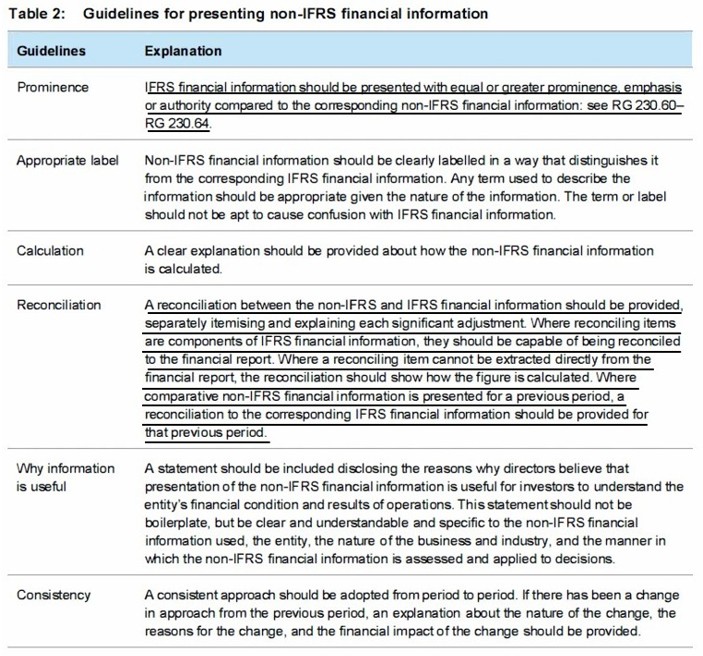
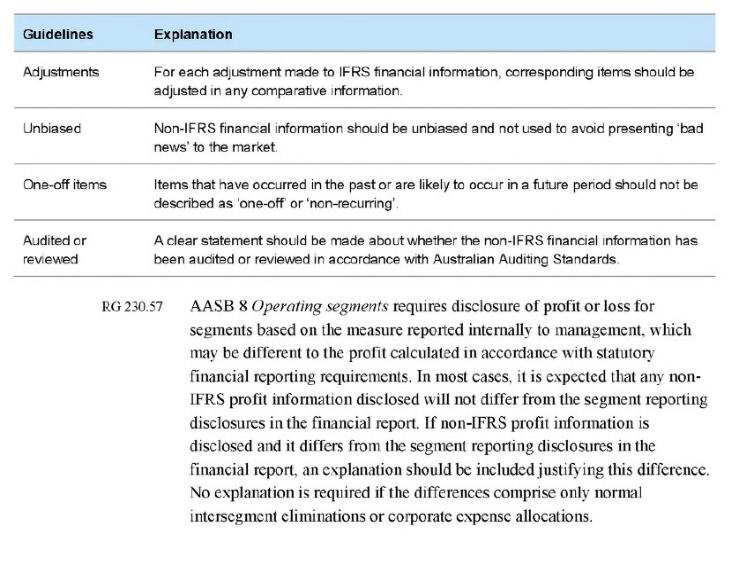
…
Equal or greater prominence, emphasis or authority
…
RG230.62 While the IFRS figure and a reconciliation should appear in every document containing a non-IFRS figure, giving equal or greater prominence to the IFRS figure does not mean that the IFRS figure or a reconciliation must appear every time a non-IFRS figure is mentioned in a document.
(bold and italic emphasis in original; underline emphasis added)
C. FINDINGS OF FACT
49 I turn now to address the salient facts.
50 ASIC adduced evidence from:
(1) Ms Jenny Truong, a solicitor in the employ of ASIC. She was not cross-examined;
(2) Mr Anthony Vardy, another solicitor in the employ of ASIC. He was also not cross-examined;
(3) Ms Christine Oliver, a forensic accountant, who provided an expert report;
(4) Mr Paul Brunker, an investment analyst, who provided an expert report; and
(5) Mr Gregory Houston, an economist, who provided an expert report.
51 Nuix adduced evidence from:
(1) Mr Daniel Silveri, Nuix’s Head of Financial Planning and Analysis, who provided affidavit evidence and was cross-examined;
(2) Mr Jonathan Rees, Nuix’s Vice President and CEO of Europe, the Middle East and Africa (EMEA) who provided affidavit evidence and was cross-examined;
(3) Mr Terrence Potter, a chartered accountant who provided an expert report;
(4) Dr Stephen Prowse, a Senior Manager in the Forensic and Litigation Services Practice of FTI Consulting, who provided an expert report; and
(5) Mr Stuart Turner, a senior research analyst, who provided an expert report.
52 Mr Vawdrey, Mr Phillips and Ms Thomas did not give evidence.
53 Mr Bleich and Sir Iain each gave evidence and was cross-examined.
54 Joint expert reports were prepared by:
(1) Ms Oliver and Mr Potter;
(2) Mr Brunker, Mr Houston, Mr Potter, Dr Prowse and Mr Turner;
(3) Dr Prowse and Mr Houston; and
(4) Mr Brunker and Mr Turner.
55 The various experts gave evidence and were cross-examined in conclaves, as follows:
(1) Ms Oliver and Mr Potter;
(2) Mr Brunker and Mr Turner; and
(3) Dr Prowse and Mr Houston.
56 The Court Book was well in excess of 10,000 pages.
57 Before setting out my findings of fact, I make the following preliminary observations:
(1) as to credit:
(a) Mr Silveri and Mr Rees were both impressive witnesses. Each was forthright in his evidence and created the impression that he was honestly recounting relevant events to the best of his ability. ASIC did not suggest otherwise, or make any submission to the effect that I should not accept their evidence. I accept that evidence unreservedly.
(b) there is also no reason to doubt that Mr Bleich and Sir Iain each gave an honest recount of their recollection. Again, ASIC did not submit otherwise and I accept their evidence;
(c) Nuix made submissions as to the credit of several of the expert witnesses called by ASIC. However, it has not been necessary to make any credit findings with respect to those witnesses in order to determine the relevant issues;
(2) to a considerable extent, the salient events recounted below occurred during the COVID-19 pandemic. This has several consequences which should be borne in mind: (a) Mr Bleich was resident in the United States of America, Sir Iain Lobban was resident in the United Kingdom and Ms Thomas was resident in Western Australia; (b) travel and other restrictions meant that many meetings occurred by video-conference, rather than in person (and references below to meetings should be read with this in mind); and (c) time differences affected the ability of Mr Bleich and Sir Iain to attend some meetings; and
(3) the references to particular dates and times in these reasons for judgment are references to Sydney time, except where otherwise indicated.
58 Set out below are my findings of fact.
C.1 Nuix’s products
59 Nuix provides a software offering which it describes as the “Nuix platform”.
60 The Nuix platform comprises:
(1) the “Nuix engine” that processes, normalises, indexes, enriches and analyses data at speed and scale; and
(2) software applications that connect with the “Nuix engine” and provide visualisation, analytics and relationship-mapping tools for its customers.
61 The Nuix platform was illustrated in the prospectus as follows:
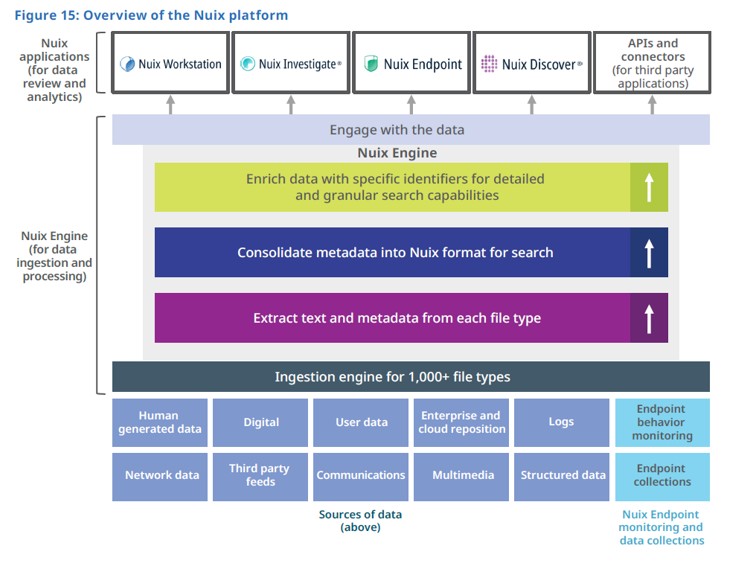
C.2 Nuix’s revenue model
62 At the time the prospectus was issued on 18 November 2020 and throughout the remainder of FY21:
(1) Nuix earned revenue from the sale to customers of software licences to access one or more of Nuix’s applications;
(2) Nuix’s standard contractual terms provided for upfront payment for annual contracts or either upfront or annual payment for multi-year contracts;
(3) Nuix generated “Software Revenue” from:
(a) “Subscription Licences” (which are software licences structured as annual licence agreements or multi-year contracts). The Subscription Licences included:
(i) Module Licences, which were software licences sold to customers by reference to the number of “cores” of the software acquired by the customer. A “core” is a reference to each single licence provided to the customer which comes with one instance of the “Nuix engine” which is typically used on one processing core of the customer’s local or server-based computing hardware. Historically, Module Licences have been the most significant contributor to Nuix’s software revenue (including in FY21). Module Licenses were typically sold to customers on an annual basis, or as a multi-year deal;
(ii) Consumption Licences, which were calculated on the basis of the amount of data processed by Nuix on the customer’s behalf in each licence period. Differing rates applied to customers acquiring processing on a Consumption Licence basis depending on the volume of the data processed. Many consumption licencing agreements had minimum annual revenue commitments;
(iii) Support and Maintenance Licences (S&M Licences) which were sold together with Module Licences or Perpetual Licences, where the customer was charged an annual fee for software updates as and when they became available; and
(b) “Perpetual Licences” (which are software licences structured so as to entitle the customer to use the Nuix platform with no fixed term or expiry).
63 As with Module Licences, Perpetual Software Licences were priced on a “per core” basis. A Perpetual Software Licence was typically sold for a one-time licence fee.
64 Software licences sold by Nuix that were hosted through a cloud environment (rather than the data and software being retained on the customer’s own servers or premises) are referred to as ‘Software-as-a-Service’ (SaaS).
65 Nuix also earned revenue from:
(1) the provision of additional Support and Maintenance (S&M) to customers who had already acquired software under either a Module Licence or Perpetual Software Licence (on a “per core” basis); and
(2) the sale of other professional services offered by Nuix such as training, hardware sales or assistance with integrating Nuix products with third party software (Other Revenue).
66 Nuix’s revenue was not evenly distributed across the financial year. As the prospectus recorded:
(1) Nuix customers often contracted close to the conclusion of their respective financial years, resulting in higher revenue in the final months of the financial half years (i.e., in December and June);
(2) this seasonality had resulted in more revenue being earned in the first half of the financial year (i.e. the six months to 31 December) than the second half (i.e. the six months to 30 June). However, as the prospectus disclosed, Nuix had observed a change in that trend (with first half revenue decreasing from 55 per cent in FY19 to 51 per cent in FY20), driven by a strong second half with significant accounts renewing during that period; and
(3) as a result, in FY21 Nuix expected the first quarter would be the smallest quarter by revenue and the fourth quarter would be the largest.
67 A financial information report prepared by PricewaterhouseCoopers (PwC) in connection with the IPO included the following chart:
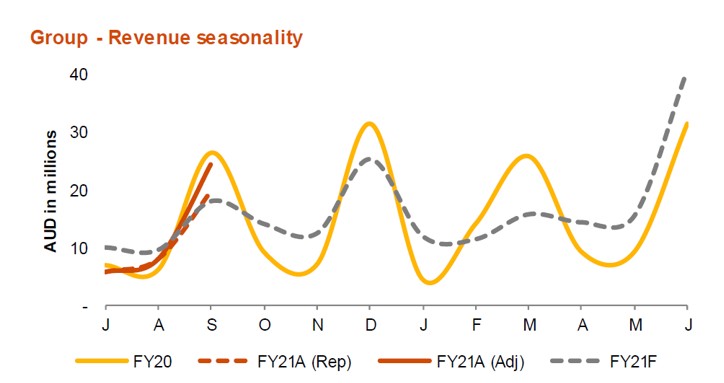
C.3 Nuix’s sales process
68 As noted above, during the relevant period, Nuix’s operations were based in many countries.
69 Nuix’s sales operations were led by Region Heads:
(1) Mr Ethan Treese (Vice President and CEO of Americas);
(2) Mr Dan Dorchinsky (Senior Vice President, US government (USG)) from February 2021 (this had previously fallen within Mr Treese’s purview);
(3) Mr Jonathan Rees; and
(4) Mr Paul Muller (Vice President and CEO of Asia Pacific and Japan (APAC)) until February 2021, when Mr Rees took on responsibility for APAC.
70 As noted above, Mr Rees gave evidence and I accept that evidence.
71 The Region Heads reported directly to Mr Vawdrey (qua CEO).
72 The sales teams which reported to the Region Heads were structured according to the following industry areas (or Domains):
(1) advisory and service providers (ASP), which included the “Big 4” accounting firms (Deloitte, Ernst & Young, KPMG and PwC) and other professional services firms;
(2) governments, which included law enforcement agencies and regulators from all over the world;
(3) corporates, which included large multinational enterprise customers such as AIG, Amazon, Barclays, and Jaguar Land Rover;
(4) law firms; and
(5) new markets, which represented a collection of customers across the above industries but in Nuix’s less mature markets, such as: (a) Germany, Austria and Switzerland; (b) the Middle East, Southern Europe and Africa; and (c) India, South East Asia and Japan.
73 Those Domains produced approximately 35 per cent, 20 per cent, 19.5 per cent, 10.5 per cent and 15 per cent respectively of Nuix’s total revenue in FY20.
74 As at:
(1) 30 June 2020, Nuix had over 400 staff, spread across the world, with 238 staff in North America, 50 staff in EMEA and 133 staff in APAC; and
(2) the time of the IPO, Nuix had more than 1,000 customers across 78 countries. Further, 55.5 per cent of its FY20 total revenue was generated by customers in North America, 28.2 per cent by customers in EMEA and 16.3 per cent by customers in APAC.
75 Within each sales region, there was a Domain Leader for each of the Domains who ultimately reported to their relevant Region Head. The Domain Leader was responsible for, and worked closely with, the sales representatives in their respective regional Domain, providing oversight and support to their teams in the management of customer relationships and sales opportunities. Some Domain Leaders also personally managed specific customer accounts, with direct support from their relevant Region Head on high-value and significant sales opportunities (for example, contracts that were multi-regional or over $250,000).
76 Sales representatives – who were also referred to within Nuix as “account managers” – were assigned to different customers and different sales opportunities within their regional Domain. Each sales representative was responsible for generating and driving sales opportunities for that customer as well as day-to-day account management. Individual sales representatives were responsible for approximately 95 per cent of Nuix’s sales opportunities (with oversight from their Domain Leader). The Domain Leader or the Region Head were responsible for the remaining five per cent.
77 A number of sales support and operational staff also worked across the sales teams in each region. In particular, each region was typically supported by a dedicated Sales Operations Manager, who worked closely across the sales team at each level – with sales representatives, Domain Leaders and directly with the Region Head – to provide assistance with a variety of analytical and administrative tasks as required. The Sales Operations Managers had a broad and versatile role in supporting both the sales teams and the Region Heads directly. Their work included providing key input and support to Nuix’s budget preparation process, data analysis and reporting (including preparing and analysing reports from Salesforce, described below), business analytics and sales training.
C.4 The directors of Nuix
78 The directors of Nuix during the relevant period are the second to sixth defendants.
C.4.1 Mr Bleich
79 Mr Bleich was a non-executive director and the Chairman of the board of directors of Nuix during the relevant period. He had been a non-executive director of Nuix since 2017 and was appointed as Chairman in November 2020. At all relevant times he lived in California in the United States of America.
80 Mr Bleich:
(1) holds a Bachelor of Political Science from Amherst College, a Master in Public Policy from Harvard University and Juris Doctor from the University of California Berkeley. He has also received an honorary Doctorate of Laws from San Francisco State University and honorary Doctorates from Griffith University and Flinders University;
(2) has over 30 years’ experience in the legal, government, and technology sectors, and most recently served as a Court-Appointed Special Master and Mediator in the United States District Court, before being named the Chief Legal Officer of Cruise LLC, a San Francisco based autonomous vehicle company. After clerking for the Chief Justice of the United States Supreme Court, Mr Bleich practised law as a Partner at Munger, Tolles & Olson LLP from 1992 to 2009 and 2014 to 2016, and as both CEO of Dentons Diplomatic Solutions and a Partner in the Public Policy and Regulatory practice of Dentons international law firm from 2016 to 2019. Mr Bleich’s practice focused on cyber security, technology, complex international disputes, as well as high profile pro bono matters before the US Supreme Court; and
(3) served four years as the US Ambassador to Australia from 2009 to 2013 and as special counsel to President Obama in 2009. He has served as Board Chair of the San Francisco based Pacific Gas & Electric Company, Chair of the Fulbright Foreign Scholarship Board, Chair of the California State University Board of Trustees, President of the State Bar of California, and as a director of a number of charitable and public policy organisations including the Australian-American Leadership Dialogue, RAND Australia, Stanford University’s Centre for Advanced Study in the Behavioural Sciences, Amherst College, the American Security Project, and Futures Without Violence.
81 As noted above, Mr Bleich gave evidence and I accept that evidence.
C.4.2 Mr Vawdrey
82 Mr Vawdrey was, as noted above, the only executive director of Nuix during the relevant period. At all material times, he lived in Sydney.
83 Mr Vawdrey:
(1) joined Nuix as Chief Operating Officer (COO) in July 2015. He was appointed CEO of Nuix in May 2017, and an executive director in September 2017;
(2) oversaw Nuix’s business activities globally including sales, customer support, training and technical services, engineering and development, product, marketing, finance, IT partners, corporate development and strategy and human resources - with all Senior Leadership Team members reporting directly to Mr Vawdrey; and
(3) was previously Corporate Executive Vice President and President of Fujitsu Limited between 2011 and 2014, and from 2003 to 2011 was CEO of Fujitsu ANZ.
C.4.3 Sir Iain Lobban
84 Sir Iain was a non-executive director of Nuix during the relevant period. At all material times, Sir Iain lived in England.
85 Sir Iain:
(1) had been an adviser to the Nuix board of directors since October 2018 and was appointed as a non-executive director of Nuix in November 2020. As adviser, his role was focussed upon the provision of advice to the then directors of Nuix on the application of products Nuix had developed for the investigative market;
(2) had over 30 years’ experience in the security and intelligence sector, including having served as the Director of the British Intelligence Agency GCHQ from 2008 to 2014. Sir Iain was one of the five experts appointed by Australia’s Prime Minister to create Australia’s first National Cyber Security Strategy in 2015. He was subsequently one of the senior three-person team appointed by the Prime Minister to conduct the 2017 Independent Review of the Australian Intelligence Community;
(3) is also a Director of Prevalent AI, a company specialising in security data science software and solutions, and of C5 Holdings, an investment company specialising in cyber security, data analytics and cloud. His advisory work for boards spans cyber security risk management and financial crime compliance; and
(4) holds a Bachelor of Arts in French and German from the University of Leeds. He is a Visiting Professor of King’s College London and an Honorary Fellow of the Judge Business School at the University of Cambridge. Sir Iain was appointed a Companion of the Bath 2006 and Knight Commander of St Michael and St George in 2013.
86 As noted above, Sir Iain gave evidence and I accept that evidence.
C.4.4 Daniel Phillips
87 Mr Phillips was a non-executive director of Nuix during the relevant period. At all material times, he lived in Sydney.
88 Mr Phillips had been a director of Nuix since 2011, and acted as its Chairman between 2018 and November 2020.
89 Mr Phillips:
(1) was an employee of the Macquarie Group, having joined Macquarie Group in January 1989 and founded Macquarie Group’s technology venture capital investment business in 1996;
(2) had more than 20 years’ experience providing venture capital to high growth companies in Australia, Asia, Europe and the United States;
(3) had served on boards of the ASX listed entities oOh!media Group Ltd and IBA Health and New York Stock Exchange listed Ambow Education;
(4) was a director of a number of companies, including NextPayments Pty Ltd, Red Eye Apps Pty Ltd, RecordPoint Software Holdings Pty Ltd, FoodByUs Pty Ltd, XM Cyber Ltd and Australian Philanthropic Services. Mr Phillips also served as a member of the Australian Federal Government’s ICT Advisory Board; and
(5) was a member of the Association of Chartered Accountants.
C.4.5 Sue Thomas
90 Ms Thomas was a non-executive director of Nuix during the relevant period. At all material times, she lived in Perth, Western Australia.
91 Ms Thomas:
(1) had been a non-executive director of Nuix since November 2020;
(2) had over 30 years’ experience in the financial services and information technology sectors, having founded and acted as managing director of FlexiPlan Australia Limited, which was subsequently sold to MLC/NAB;
(3) at all relevant times was a director of ASX listed companies Temple and Webster Group Limited and Fitzroy River Holdings. She was previously a director of ASX listed Alexium International Group Limited;
(4) was a director of BT Funds Board, Property Exchange Australia Limited and Grant Thornton Australia Limited; and
(5) holds a Bachelor of Laws and Bachelor of Commerce from the University of New South Wales and has received a diploma from the Australian Institute of Company Directors.
92 Ms Thomas was also the Chair of Nuix’s audit and risk management committee (ARC).
C.5 Nuix employees
93 In addition to Mr Vawdrey who, as noted above, was Nuix’s CEO, Nuix employed, relevantly, the following persons.
C.5.1 Stephen Doyle
94 Mr Doyle commenced working at Nuix in August 2010 and was appointed as Nuix’s Chief Financial Officer (CFO) in February 2011. Mr Doyle also acted as Company Secretary from June 2011 until November 2020. At all relevant times, Mr Doyle was the CFO and responsible for the finance function at Nuix.
95 Mr Doyle:
(1) holds a Bachelor of Commerce from the University of Queensland and is a member of both the Chartered Accountants of Australia and New Zealand and the Australian Institute of Company Directors; and
(2) held senior finance positions in technology-related companies including Vodafone, NCR Teradata, and SurfControl.
C.5.2 Sarah Nichols
96 Ms Nichols joined Nuix in 2016 as Strategic Program Manager and was appointed Head of Corporate Development and Strategy in November 2019. At all material times, Ms Nichols was responsible for evolving the Nuix business growth strategy and model, distilling complex high-volume data and ideas into board/executive level decision making tools and setting up, monitoring and supporting critical business optimisation initiatives for success.
97 Ms Nichols:
(1) holds a Master of Arts from the University of Oxford; and
(2) was previously a Senior Manager at Detica (now BAE Systems) and a Senior Business Analyst at SHL Direct (now Gartner).
C.5.3 Ethan Treese
98 Mr Treese joined Nuix in September 2016 and during the relevant period was responsible for sales and revenue in the North America region.
99 Mr Treese was previously Senior Vice President and Global Head of Sales – Customer Solutions at Dun & Bradstreet and was appointed a director of Bright Focus Foundation in April 2016.
C.5.4 Jonathan Rees
100 Mr Rees joined Nuix in November 2016 and was responsible for sales and revenue in the EMEA region.
101 Mr Rees was previously employed as Senior Vice President, Enterprise Solutions at Western Union and previously held leadership roles at M-Cube Media Ltd and Vivante, France. He holds a Bachelor and Masters of Science from the University of Wales.
102 As noted above, Mr Rees gave evidence and I accept that evidence.
C.5.5 Paul Muller
103 Mr Muller joined Nuix in August 2017 and was responsible for Nuix’s sales and revenue in the Asia Pacific and Japan region until about February 2021.
104 Prior to joining Nuix, Mr Muller was employed as Executive General Manager at VMware and preceding this, held leadership roles at SAP and Oracle.
105 Mr Muller holds a Bachelor of Science from Macquarie University and a Post Graduate Certificate in Business Administration from the Australian Institute of Management. Mr Muller is also a member of the Australian Institute of Company Directors.
C.5.6 Dan Dorchinsky
106 Mr Dorchinsky joined Nuix in June 2017 and was responsible for Nuix’s sales and negotiations with the United States Government. From February 2021, he was a Region Head for US Government.
107 Mr Dorchinsky:
(1) holds a Bachelor of Political Science from the United States Military Academy at West Point and a Masters of Business Administration from the University of Chicago Booth School of Business; and
(2) prior to joining Nuix, served as Group Vice President for SAP National Security Services and prior to this, was an account executive at BMC Software. Mr Dorchinsky also served as a Captain in the US Army.
C.5.7 Mr Scott McGilvery
108 Mr McGilvery was Nuix’s Head of Technical Accounting and Compliance.
C.5.8 Daniel Silveri
109 Mr Silveri, who was the Head of Financial Planning & Analysis at Nuix, holds a Bachelor of Commerce degree from the University of Wollongong and is a Certified Practising Accountant.
110 He joined Nuix in December 2018. Since then, he has performed or supervised the performance of a range of functions within the finance team at Nuix including:
(1) preparing its annual budgets for review and approval by the CFO, CEO and, ultimately, the directors of Nuix;
(2) reporting on the financial aspects of the business’s performance to Nuix’s senior management and the directors of Nuix;
(3) tracking Nuix’s financial performance over time against its internal budgets, targets, forecasts and benchmarks;
(4) analysing the financial performance of the business to identify trends and patterns;
(5) liaising with the individual business units within Nuix in relation to their financial performance and obtaining information from them in relation to the actual and anticipated business conditions in their particular regions or customer segments of potential relevance to the financial performance of Nuix;
(6) providing regular reports to Nuix’s CFO and CEO in relation to its financial performance, including providing financial reports that are used by them to report to the directors of Nuix; and
(7) any other financial reporting and analysis as required by the CFO and CEO.
111 As noted above, Mr Silveri gave evidence and I accept that evidence.
C.5.9 Jacob Hooper
112 Mr Hooper was an Associate in Nuix’s Corporate Strategy and Development team.
C.5.9 Dennis Pipic
113 Mr Pipic was a member of Nuix’s Corporate Strategy team who reported to Mr Hooper.
C.6 Advisers to Nuix
114 During the relevant period, Nuix received advice from the following organisations:
(1) PwC, accountants and auditors;
(2) Clayton Utz, solicitors; and
(3) Citadel-MAGNUS, advisers as to investor relations.
C.7 Financial metrics used by Nuix
115 Set out below is an unchallenged explanation provided by Mr Silveri, and which I accept, of the ways in which Nuix measured its financial performance.
C.7.1 Statutory revenue
116 Nuix presented its historical financial information and forecast financial information in its prospectus on a statutory basis. Statutory revenue is a standardised accounting and financial metric for measuring a company’s financial performance. Statutory revenue is recognised by the International Financial Reporting Standards (IFRS) and is a “Generally Accepted Accounting Principle” (GAAP). Statutory revenue is calculated according to recognised, uniform and proscriptive accounting standards and is one of the key measures audited by Nuix’s independent accountant auditors, PwC. Statutory revenue is prepared and reported on by companies in Australia in the same way and can be used to compare a company’s performance over time, companies against each other and as a reference point to consider matters such as profitability, all on a like for like basis.
117 All of the metrics in Nuix’s audited financial statements were based on statutory revenue.
118 Statutory revenue was also the primary revenue metric used by Nuix for considering its performance and comparing its performance to other companies. In FY21, all of the Nuix’s teams’ bonuses were tied to statutory revenue.
C.7.2 Non-standardised performance metrics
119 Nuix also used certain other measures to manage and report on its business performance that are not recognised under Australian Accounting Standards or IFRS. In particular, Nuix also sought to record and track its financial performance by reference to non-IFRS measures which Nuix referred to as:
(1) ACV;
(2) Churn; and
(3) Net Dollar Retention (NDR).
C.7.3 ACV
120 ACV is a non-IFRS, non-GAAP, internal metric that was developed and used by Nuix as an aid to assessing the total monthly average contract value of its software contracts on an annualised basis at a particular point in time. The ACV reported in Nuix’s financial reports was the ACV as at the final day of the reporting period.
121 Nuix’s total ACV measure was the aggregate of the ACV for each individual contract in place at a given time.
122 The ACV for a multi-year contract was calculated by dividing the total contract value at a given point in time by the number of months of the contract term, and then multiplying that figure by 12. In this way, the revenue generated from the contract was treated as if it were apportioned on a straight-line monthly basis over the contract period, and identified on an annualised basis for the following 12 months. For example, a $3.6 million subscription licence entered into in March 2021 with a term of three years would have an ACV of $1.2 million (($3,600,000 divided by 36) x 12) at any point during the contract term. In contrast, Nuix’s statutory revenue reporting policies required the entire contract value ($3.6 million) to be recognised as statutory revenue upfront, where the customer did not have the right to terminate the contract prior to the end of the fixed term.
123 The ACV calculation represents another way of looking at the revenue that seeks to reduce the impact of the way revenue recognition principles for statutory revenue require the reporting of multi-year deals.
124 In particular, because ACV is an average at a particular point in time, this metric seeks to remove fluctuations in statutory revenue from multi-year deals which may otherwise result from the application of its revenue recognition policies.
125 In Mr Silveri’s view, as an average (which is then annualised), ACV cannot be considered, and was not intended to be considered, as a measure of actual revenue earned by Nuix. Nuix’s actual profitability (for instance, for tax purposes and the calculation of earnings and net profit) was all calculated by reference to statutory revenue.
126 Nuix’s ACV metric was not audited by Nuix’s external auditors, relied on an analysis of the terms, duration and type of individual customer contracts entered into by the company, and is a mechanism which sought to equally distribute the total revenue for those contracts across each month for which each contract would operate regardless of annual accounting periods. In that way, ACV was agnostic as to the annual period in which the revenue was to be recognised from a statutory perspective.
127 ACV was calculated on a point in time basis as an annualised average rather than seeking to capture revenue accumulating or accruing over the course of a given accounting period. For that reason, ACV could be materially influenced by the nature and blend of contract types in place at the point in time at which it was calculated. Further, as an average (which is then annualised), ACV was not predictive of what the year’s actual statutory revenue will be. The statutory revenue could be materially higher or lower than the ACV number depending on the contract type, amount and date at which contracts are entered into.
128 There was no forward-looking or forecast component to Nuix’s ACV calculation. That is, when Nuix ran its ACV calculation at a particular point in time, that ACV number did not include revenue that may have been achieved as a result of Nuix converting sales opportunities in the remainder of the financial year. As a result, where ACV had been forecast to be at a particular level at some point in the future, it was necessary to seek to estimate the type, size and commencement date of all of the contracts Nuix would have in force at that future point in time.
129 As noted earlier, ACV was a rolling calculation of the annualised monthly value of executed contracts and did not reset at 1 July. Thus, unlike statutory revenue (which could only be recognised in one financial year) the ACV value would carry across reporting periods so long as the contract remained on foot. Further, while statutory revenue had a direct relationship to the cash Nuix expected to receive in time from each customer relationship, as ACV was a rolling point in time calculation it did not have a direct relationship to the total cash that Nuix expected to ultimately receive under the relevant contracts.
130 There had historically been a general alignment between total revenue, ACV (calculated retrospectively for the purposes of the prospectus) and cash receipts from customers as at the end of the year, which reflected the subscription-like elements of Nuix’s operating model. However, in Mr Silveri’s experience in calculating and analysing each of these metrics, there could be significant differences between total revenue, ACV and cash receipts at points in time throughout the year.
131 Although ACV was a useful internal metric to show the current rolling 12 month average value of Nuix’s executed contracts, it was more complex to forecast than statutory revenue because it is necessary not only to estimate the number, type and value of contracts that would be entered into during a financial year but also the month at which contracts would be entered into and the contracts which would be concluding in the intervening period (i.e. which could no longer be counted in the monthly average which formed part of the ACV calculation).
132 As to the utility of an ACV figure at one point in time as a guide to an ACV figure at a later point in time, Mr Silveri’s evidence was that the ACV number generated at a given point in time does not have any predictive component of the nature and type of contracts that may be completed in the remainder of the period, which means that a calculation of ACV at any given point in time in the year is not a prediction of the level that ACV will be at the end of the relevant accounting period. Calculating ACV at points during the year is not a good prediction on its own of what it will be at the end of the financial year given the blend of contracts used in the calculations at the relevant future date will change. As such, any calculation of ACV during the year may not assist in informing how Nuix is progressing from an ACV forecast perspective. As Mr Silveri explained in more detail in his second affidavit:
(1) there is no forward-looking or forecast component to a point-in-time calculation of ACV. That is, a point-in-time ACV calculation conducted for all contracts existing as at 31 December 2020 does not forecast what the ACV calculation will be at 30 June 2021. A separate process is required to forecast Nuix’s likely ACV performance against any forecast end of year ACV metric;
(2) any point-in-time or “spot” ACV calculation does not:
(a) seek to identify or take into account the known mix of contracts that would be relevant to a calculation of ACV at some future point in time. That is, a spot ACV calculation for existing contracts as at 31 December 2020 only relates to the contracts in place at that time, it does not identify which of those existing contracts will still be relevant to a calculation of ACV at a future point-in-time such as the end of the third quarter or fourth quarter of FY21. In that sense, a point-in-time ACV calculation is different from a point in time calculation of statutory revenue which is a cumulative measure and which, as such, does at least identify the known revenue that will form part of the total at those future period ends. Point-in-time ACV does not take into account which of those contracts may not be included or may have different values at any future point-in-time; or
(b) include any consideration or information about the likely new or changed contracts which are likely to form part of any calculation of ACV at any future point in time (i.e. the new contracts that will be closed in the period between that date and the date of any forecast. For those reasons, a different calculation from spot ACV must be conducted for the purposes of tracking ACV performance against any forecast;
(3) accordingly, spot ACV was not the means by which Nuix tracked the likelihood of achieving the full year ACV forecast and Nuix went through a different process to consider that question in which it, in short:
(a) sought to identify the existing contracts that it anticipated would form part of the ACV calculation at the future point-in-time and excluded the contracts that would come to an end in the intervening period; and
(b) performed a reforecasting exercise in respect of the remaining period to estimate from known and anticipated opportunities, the additional contracts that would be likely to form part of the ACV calculation as at the year-end;
(4) although it is the case that the closer to the forecast date that spot ACV is calculated, the fewer components of the calculation are likely to change (and the range of potential deviation will diminish), the nature of the calculation means that without added information of the kind referred to in (3) above, spot ACV cannot predict future ACV; and
(5) point in time ACV calculated at one point in the year is also of little utility when compared to point-in-time ACV measured at different points in the year given the level of ACV varies depending on the relevant month and season and tends to incrementally increase toward the end of a financial year. For that reason, spot ACV calculated at the end of January cannot readily be compared to a calculation of spot ACV conducted at the end of June (or a forecast of what that calculation is likely to be).
133 In cross-examination, Mr Silveri confirmed this view:
Now, if I could ask that you go to paragraph 69 of your first affidavit … ---Yes.
You see in the second-last sentence you say:
Calculating ACV at points of time during the year is not a good prediction on its own of what it will be at the end of financial year.
?---Yes.
You’re not intending to suggest that a point in time calculation in February 2021 gives no indication of what ACV may be as at 30 June, are you?---No, an ACV calculation as at February would only give an indication of ACV as at February and not a future period.
But it would allow you to form an opinion as to what ACV would likely be at 30 June 2021, albeit you would require further information?---It still wouldn’t give us insight into what it’s going to be as at June because you don’t know the profile of contracts dropping off and new contracts being added in or consumption contracts coming with overages.
Can I just test at least the first part of that. You would know the profile of contracts expected to drop off because they had an expiry date between February and 30 June?---Yes, but you – you – but the point in time of February only gives you that point there, and then looking at each subsequent month the locked in ACV falls off, and you need to understand what those replacing contracts are, ie, the renewals that were renewed. They typically don’t renew at the same price as typically in price uplift, upsell, etcetera.
What you need to estimate is what the incremental ACV will be; is that right?---It’s a combination of what contracts are dropping off, what contracts are replacing it and incremental ACV would be, yes, the – anything above the renewal value is classified as incremental ACV, including new business - - -
Yes?--- - - - and overages.
And in terms of contracts dropping off you know the contracts that have an expiry date between February and 30 June; that’s correct?---Yes, we know the contracts that are expiring, but that’s not evident in the point in time ACV figure. You have to look at future periods to derive that number and look at the activity that needs to be undertaken to close or to bridge the gap of those contracts expiring. So you need to run pipeline on top of that to see are the contracts expiring being renewed or are they projects or to the upsell, contracts coming in, what are the new and incremental ACV coming in also.
(italic emphasis in original)
C.8 Nuix’s data systems
134 Mr Silveri provided the following unchallenged evidence, which I also accept, concerning Nuix’s data systems.
C.8.1 Salesforce
135 Salesforce was the key database used by Nuix to track potential deals (or opportunities) with customers from the point of inception to when those deals were “closed/won” or “closed/lost”. Salesforce was also a critical system for the finance team for both revenue forecasting and tracking progress against revenue targets, as it was intended to record information in respect of every client opportunity of which Nuix was aware and the status of that opportunity. Where possible the Salesforce system recorded the sales teams’ best estimates of the likelihood of a new sale, contract type, the product or service type, the likely amount of revenue and the likely timing. Salesforce was used by Mr Silveri’s team to understand which potential deals were likely to be “closed/won” in a particular financial reporting period.
136 The accuracy of the information that could be obtained from the Salesforce system was dependent upon members of the sales teams ensuring that all customers and new opportunities were recorded in the system; that information as to the progress of the opportunity was accurately recorded, including likely contract type and value; and that the database was kept up to date. It is not always the case that each salesperson updated the Salesforce database as diligently as Mr Silveri would have preferred as potential opportunities progressed through the system. There was often a delay between a customer conversation occurring with a salesperson, indicating progress of a potential opportunity, and the administrative task of updating Salesforce to reflect that progress. Different salespeople also took different views on whether or not a particular deal was more or less likely to be won.
137 Mr Silveri became aware of these delays and discrepancies in his regular discussions with the Region Heads when he discussed the Salesforce data with them.
138 When a salesperson entered a new opportunity in Salesforce, they classified that opportunity by the following forecast categories:
(a) “Commit” – which meant the deal has an almost certain probability of closing (95 per cent or more);
(b) “Best case” – which meant the deal has a greater than 50 per cent chance of closing; and
(c) “Pipeline” – which meant all other open opportunities, which have a less than 50 per cent chance of closing.
139 It has been Mr Silveri’s general practice since he joined Nuix to run regular reports from the Salesforce database at the end of financial reporting periods (such as month-end, quarter-end, and the half-year) and review the open opportunities there recorded. As a result of the varying practices of different salespeople in keeping Salesforce up to date and the number and complexity of Nuix’s customer relationships, he did not expect the first report that he generated after the close of the accounting period as likely to be wholly accurate, given the time necessary for customer interactions and deals to be completed and then updated on the system in the period shortly before the end of the month. A key part of his role was to communicate with the sales teams, particularly the Region Heads, and to ask them to ensure that the data in Salesforce was up to date and that all opportunities had been properly categorised at the end of a financial reporting period. In other words, Salesforce had limitations as a “real time” tool and required review and interrogation by the sales teams at the end of key reporting periods. Ensuring Salesforce information was up to date at the end of key accounting periods was usually an iterative process that took a number of weeks, following regular feedback from Mr Silveri and the finance team, for the sales teams to complete. As part of this process, Mr Silveri conducted weekly phone calls with the Region Heads following the end of financial reporting periods to ensure that the Salesforce data was being updated and properly verified.
140 The key fields in Salesforce that Mr Silveri needed the sales teams to update and verify in order to track Nuix’s progress against forecast were: product type, contract type, start date, term, and opportunity value.
C.8.2 Netsuite
141 NetSuite was Nuix’s accounting and billing software, which was used to track actual financial performance and to invoice Nuix’s customers. After a deal was closed or won in Salesforce, it was reviewed by Nuix’s finance and legal teams. As NetSuite was integrated with Salesforce, after that review, the deal appeared in the NetSuite accounting system so that Nuix could send an invoice to the customer.
C.9 Events prior to the issue of the prospectus
142 During the period from 1 October 2018 to 18 November 2020, the directors of Nuix were:
(1) Mr Phillips, who was the Chairman;
(2) Mr Vawdrey;
(3) Mr David Standen;
(4) Mr Mark De Ambrosis;
(5) Mr Bleich;
(6) Mr Roy Grady; and
(7) from August 2019, Dr Anthony (Tony) Castagna.
143 For the period from 1 July 2018 to 30 June 2019 (FY19) Nuix recorded:
(1) total Revenue of $139.6 million, of which 93.7 per cent was Software Revenue and 87.4 per cent was Revenue from Subscription Licences;
(2) year on year growth in Revenue of 22.9 per cent; and
(3) NDR of 125.4 per cent.
144 As at the end of FY19, the ACV of Nuix was $145.5 million and the year on year growth in ACV was 37 per cent.
145 In or around February 2020, Mr Silveri commenced the process of preparing a budget of the likely revenue Nuix would generate in the year ended 30 June 2021 (FY21) (i.e. the next financial year). At that time, he was unaware that Nuix may conduct an IPO later that calendar year.
146 The FY21 budgeting process resulted in:
(a) a Board Budget, which predicted revenue of $210.6 million. That budget was approved by Mr Vawdrey and Mr Doyle before being approved by the directors of Nuix and was the basis upon which the performance of the Chief Executive Officer (Mr Vawdrey) and the Chief Financial Officer (Mr Doyle) would be assessed during FY21; and
(b) a Field Budget, which predicted revenue of $218.5 million. That budget was approved by the directors of Nuix at the same time as the Board Budget. The Field Budget was the aggregate of the sales teams’ revenue targets for the financial year, divided between Nuix’s sales regions. If the Region Heads met their component of the Field Budget, and all other things remained equal, then they would receive the full amount of the variable reward component of their remuneration.
147 Both the Board Budget and the Field Budget were prepared on an “orders basis”, which assumed that the full face value of each contract would be booked as revenue when the contract was signed, without the application of the specific revenue recognition rules relating to the deferral of the S&M component of licence fees.
148 The key steps that Mr Silveri took in preparing the draft budgets were as follows:
(1) in respect of “renewal income” he ran a report from the Salesforce database to identify all of the existing customer contracts which would fall for renewal in FY21. From that data set, any known “one-off” projects or ad hoc contractual arrangements that Nuix did not expect to renew were removed. That left the contracts which would expire in FY21 but that Nuix expected to renew or re-sign at (at least) the same amount of revenue. The rate of renewals assumed for the draft FY21 budget was in line with the renewals from the preceding year; and
(2) in respect of “upsell and new business income”, Mr Silveri sought information from each of the key Nuix regions as to both the amount of revenue they expected to achieve in “upsell” by selling additional products and services to existing clients, and the amount of revenue from new clients those regions expected in FY21 based upon their known client opportunities, historical rates of “upsell” and new business and their assessment of their relevant markets. Once the sales teams had identified their likely “upsell” and “new business” submissions, as a further check, Mr Silveri tested the figures provided by the sales teams against the data that the finance team maintained on historical rates of upsell and new business, and formed the view that the sales teams’ estimates were in line with what he would expect having regard to Nuix’s past performance for upsell and new business revenue attained in FY20.
149 The process of considering and building the budget or forecast by reference to likely renewal, upsell and new revenue was referred to as the “RUN model”, being an acronym of Renewals, Upsell opportunities and New business.
150 On 19 February 2020, Mr Silveri sent an email to the Nuix sales teams outlining the FY21 budget timetable and commencing the budget process.
151 Mr Rees, qua Region Head for EMEA, received that email. His evidence included that:
(1) the budget timetable circulated by Mr Silveri contained a number of key deliverables for the sales teams to complete. For example, the deliverables due on 6 March 2020 and 13 March 2020 required “Budget contributors” (being members of the sales team, including Sales Operations Managers) to provide budget inputs with assistance from the finance team as required and to return the completed templates to the finance team. On 3 April 2020, the finance team was due to consolidate “version 2” of the FY21 budget for initial review and presentation at the 24 April 2020 Executive Committee meeting;
(2) in order to provide the requested inputs for EMEA, the sales representatives and Domain Leaders in the EMEA team each undertook a “bottom up” review of their respective sales pipelines in Salesforce to ensure all current RUN opportunities were assigned in Salesforce to the correct “Forecast Category” (Commit, Best case, or Pipeline). The data in Salesforce was a critical input in the preparation of the Board and Field Budgets prepared by Nuix for FY21; and
(3) the sales team also considered the potential for additional sales opportunities to arise and to be successfully closed which were not yet in Salesforce for FY21 (additional unbuilt pipeline). Mr Rees’s views on additional unbuilt pipeline for FY21 were based upon the historical sales performance of the region and feedback from the Domain Leaders and individual sales representatives. His estimate for EMEA’s forecast performance in FY21 was based on work undertaken on both the data in Salesforce at that time and assumptions made and views held regarding additional unbuilt pipeline which could be converted to signed deals. This estimate was provided to the finance team as EMEA’s draft FY21 budget. Mr Rees understood that the other Region Heads prepared and submitted draft budgets for each of their regions on the same basis.
152 Between March and May 2020, Mr Silveri had discussions with the Region Heads, who were each responsible for components of the global budget, to ensure that the draft budget was consistent with their views in respect of their individual regional components, particularly the anticipated revenue from new customers.
153 On 24 April 2020, Mr Rees attended an Executive Committee meeting, along with the other Region Heads, and provided feedback and guidance to Mr Silveri on the proposed FY21 budget. His general recollection is that he discussed that the FY21 budget for EMEA would need to be supported by corresponding resources to ensure that EMEA would hit its sales targets.
154 Following that meeting, Mr Rees, together with his Sales Operations Manager and Domain Leaders, reviewed further iterations of the draft FY21 budget for EMEA which were circulated during May 2020.
155 As part of the budget preparation process, Mr Vawdrey and Mr Doyle tested the assumptions that had been included in the draft budget by the sales and finance teams, including assumptions in the draft budget which were based on the Region Heads’ views on market sentiment in the year ahead for both current and new customers. As part of this process, the Region Heads were asked to confirm in their discussions with Nuix’s finance team that their components of the Board Budget and Field Budget accurately reflected their views on the upcoming sales pipeline and would in fact be achievable.
156 To determine whether EMEA’s FY21 Field Budget was achievable, Mr Rees first considered what the quota (or target) for each of the members of his sales team should be in order to meet EMEA’s Field Budget. His usual practice was to set the team’s collective sales targets at 10 to 15 per cent above the Field Budget in order to build in a contingency and to provide a buffer to offset any unforeseen risks in meeting the Field Budget.
157 To determine individual sales quotas in FY21, each of the Domain Leaders worked with the sales representatives in their team on an account-by-account basis to refine the Salesforce data and look for specific “Upsell” and “New Business” opportunities that could be achieved in the upcoming year. Mr Rees then reviewed the Salesforce data and forecast with his Sales Operations Manager, to ensure that it was consistent with his understanding of EMEA’s objectives for the next year, and cross-checked the forecasts against historical win-rates. In late May 2020, once he was confident that his sales team’s quotas were reasonable and achievable, Mr Rees was able to confirm EMEA’s component in both the Board and Field Budgets for FY21.
158 The other Region Heads approved their components of the Board and Field Budgets for FY21 on the basis that those sales targets were achievable, in accordance with the same process just outlined as undertaken by Mr Rees.
159 By 22 May 2020, Mr Silveri had received feedback from the Region Heads on their expected financial performance in FY21 and confirmation from each of the Region Heads of the total revenue number for their sales targets for FY21. On that day he provided the draft estimate for the FY21 budget to Mr Vawdrey and Mr Doyle by email for final review. The revenue target in that budget represented his best estimate of the likely revenue (having regard to the basis of preparation outlined above) for FY21 based on all the information available to him at the time.
160 On 2 June 2020, the board of Nuix met. Mr Doyle spoke to a presentation concerning the proposed Board Budget and Field Budget for FY21. That part of the meeting was attended by the Region Heads. The board resolved to adopt the budgets as tabled.
161 Mr Bleich’s understanding was that the Board Budget had been prepared by Nuix’s finance team in consultation with the sales team and used to assess the CEO and CFO’s performance during FY21; and that the Field Budget was prepared by Nuix’s sales teams in consultation with the finance team and represented the budget against which the sales teams’ performance was to be assessed.
162 For the year ended 30 June 2020 (FY20), Nuix recorded:
(1) total revenue of $175.9 million of which 96.1 per cent was Software Revenue, and 88.7 per cent was Revenue from Subscription Licences;
(2) year on year growth in Revenue of 25.9 per cent; and
(3) NDR of 106.9 per cent.
163 As at the end of FY20, the ACV of Nuix was $168.4 million and the year on year growth in ACV was 15.7 per cent.
164 Around the end of FY20, Nuix commenced the due diligence process in the lead up to its IPO and the publication of the prospectus. This included forming a due diligence committee (DDC). Mr Bleich and Sir Iain were members of that committee.
165 Nuix engaged:
(1) PwC as its investigative accountant for the IPO process, to conduct an independent review of Nuix’s historical and forward-looking financial information. As part of their engagement, PwC had access to Nuix’s management and finance team, and to Nuix’s financial statements for FY18, FY19 and FY20; and
(2) Morgan Stanley and Macquarie Group as joint lead managers and underwriters.
166 It was Sir Iain’s practice to attend most of the DDC meetings virtually. During the DDC meetings (and subsequently board meetings) that Sir Iain attended, presentations were given by:
(1) Nuix management;
(2) Morgan Stanley; and
(3) PwC. In particular, Sir Iain recalls there being extensive discussion at one or more of these meetings between the meeting attendees about the work being undertaken by PwC to review the forecast financial information for FY21 to be included in the prospectus.
167 It was common for there to be robust and energetic debate between the various members of the DDC, including Nuix management and external advisers, at the meetings which Sir Iain attended. These discussions left Sir Iain with the impression that the process of verifying information to be included in the prospectus was very thorough.
168 From his participation in the DDC and directors’ meetings held during this period and his review of papers sent to him ahead of those meetings, Sir Iain recalled that:
(1) he formed the view that the process undertaken by Nuix management to derive the forecast financial information for FY21 to be included in the prospectus was rigorous. He was impressed by the experience and professionalism of the Nuix management team;
(2) the presentations given by Mr Vawdrey and Mr Doyle, were “data rich”, in that they included extensive and detailed financial information and metrics. From these presentations, it was Sir Iain’s understanding that the process of deriving and testing the forecasted financial information for FY21 to be included in the prospectus involved repeated iterations whereby the Nuix finance team obtained and analysed data from Nuix’s Salesforce database, interrogated that data and challenged and tested the information derived from it with the Region Heads and sales teams, and sought further information from the sales teams regarding key assumptions for upcoming business opportunities and trends. He also understood that data extracted from Salesforce was tested by the Nuix finance team through oral and email interactions with members of the sales teams, and all future assumptions about business opportunities built into the forecasting model were also compared against historical results, to test that information against what had historically been achieved;
(3) the degree of detail discussed, the debate between Mr Doyle and the Region Heads, and the questions that Mr Vawdrey asked of Mr Doyle and the Region Heads to test the information presented at these meetings, all provided the foundation of Sir Iain’s belief that Nuix management brought to bear significant scrutiny and analysis to the process of revenue forecasting and to the construction and stewardship of pipeline (that is, identifying actual and potential opportunities and allocating responsibility for how those opportunities were to be pursued), and in the diligence with which existing key clients were handled in terms of keeping or growing their business; and
(4) he was impressed by the experience and diligence of the external advisers appointed to the DDC, including in particular PwC and Morgan Stanley, who often took part in discussions regarding financial information. He took comfort from the work being undertaken by PwC in particular with regards to the forecast financial information for FY21 to be included in the prospectus.
169 The first DDC meeting was held on 21 August 2020. Mr Bleich attended that meeting and many other such meetings. At that meeting, the DDC approved a proposal from PwC to include historical financial information for FY18, FY19 and FY20 and forecast financial information for FY21 in the prospectus.
170 In September 2020, PwC, qua Nuix’s auditor, began the audit of Nuix’s FY20 financial statements. PwC increased the scope of the audit from previous years to include reviewing Nuix’s financial statements for the purpose of it becoming a listed company on the ASX.
171 In or around September and late October 2020 the Region Heads participated in two “Forecast Due Diligence” sessions with the finance team and PwC. The purpose of those sessions was to give PwC an understanding of how Nuix had prepared its FY21 Board Budget and Field Budget and to allow PwC to test and challenge the Region Heads on their views as to whether the proposed forecasts would be achieved.
172 On 13 November 2020, Nuix appointed PwC as Investigating Accountant for the IPO. In that role PwC was to validate the preparation of the forecast revenue for FY21 before it was included in the prospectus.
173 Mr Silveri worked closely with personnel from PwC to ensure that they had all of the same materials, data and assumptions that he had used to prepare the FY21 Board Budget and Field Budget. This included Nuix giving PwC access to a data room which contained its open sales opportunities for FY21 extracted from Salesforce (also known as the Salesforce “pipeline”), details of year-to-date (YTD) actual revenue, historical sales and financial data, and the working files and spreadsheets that Mr Silveri had used to prepare the Board Budget and Field Budget.
174 Mr Silveri also met regularly with personnel from PwC and engaged in email correspondence with them, responding to questions that were asked of him and providing documents that had been requested.
175 Mr Silveri attended at least two meetings between PwC and the Region Heads in which the FY21 Board Budget and Field Budget were discussed on a region-by-region basis. In those meetings he observed PwC testing the open sales opportunities in the Salesforce pipeline with the Region Heads and seeking their views on whether each region would meet its component of the full year Field Budget. PwC were particularly focussed on material deals in the pipeline and tested the Region Heads on the achievability of those opportunities.
176 PwC verified Nuix’s approach to preparing the FY21 Board Budget and Field Budget, and then revised that number by making the following adjustments:
(1) deferring approximately $5.1 million of S&M revenue into future financial years, following the findings of the FY20 audit; and
(2) applying an additional risk contingency (reduction) of $12 million to the Board Budget.
177 As a result, Nuix’s forecast total revenue for FY21 was $193.5 million, following PwC’s work as Investigating Accountant.
178 The breakdown of the forecasted revenue by region was: (a) 63.2 per cent for North America; (b) 23.4 per cent for EMEA; and (c) 13.5 per cent for APAC.
179 As a listed company, Nuix reports its financial performance in Australian Dollars (AUD). However, at the material times approximately 60 per cent of Nuix’s revenue was derived in US Dollars (USD) due to its USled customer base and USD-denominated contracts in other sales regions. As a result, Nuix’s revenue was exposed to foreign exchange (FX) movements in the USD:AUD currency pairing.
180 The FX rate used by Nuix in calculating the revenue forecast for FY21 of $193.5 million was 1.00 AUD = 1.45 USD, or 1.00 USD = 0.69 AUD (Budgeted Rate). As a result, Nuix’s statutory revenue:
(1) would reduce or experience a “headwind” if the AUD appreciated against the USD; and
(2) would increase or experience a “tailwind” if the AUD depreciated against the USD.
181 At the time that Mr Silveri prepared the FY21 Board Budget and Field Budget, he considered that the Budgeted Rate was conservative as it included a “buffer” to the prevailing FX rate which was 1.00 USD to 0.65 AUD.
182 It was not possible to select a forward-looking AUD/USD FX rate for Nuix’s forecasts which would be correct for the entirety of FY21, as movements in FX are inherently volatile and unpredictable, particularly over longer periods. Nuix does not enter into hedge transactions that remove the risk of FX movements on its business, as such transactions are expensive and the fact that at least 50 per cent of Nuix’s costs are also incurred in US currency acts as a natural hedge against currency movements from a profitability perspective.
183 For the purpose of the prospectus, Nuix also calculated an estimate of what the ACV calculation as at 30 June 2021 would be, which was $199.6 million.
C.10 Events of 18 November 2020 including the issue of the prospectus
184 On 18 November 2020:
(1) a DDC meeting was held, at which Mr Doyle provided a business and trading update, including that Nuix was tracking well as far as profit and loss were concerned, and that Nuix was tracking above the forecasted total revenue and ACV for FY21; and
(2) a meeting of the directors of Nuix was held, the purpose of which was to consider certain matters in connection with Nuix’s proposed admission to the official list of the ASX and the IPO. At this meeting Nuix’s board of directors was restructured. Four of the existing directors resigned: Mr Standen, Mr de Ambrosis, Mr Grady and Dr Castagna. Two new directors of the Board were appointed: Sir Iain and Ms Thomas. Sir Iain, Ms Thomas and Mr Phillips were appointed as members of the ARC. Mr Bleich (who had been a director of Nuix since 11 January 2017) was appointed to the position of Chairman of the board of directors of Nuix.
185 Following the meeting on 18 November 2020, the directors of Nuix comprised:
(1) Mr Bleich, who was the Chairman;
(2) Mr Phillips;
(3) Mr Vawdrey;
(4) Sir Iain; and
(5) Ms Thomas.
186 At the meeting, the directors (being the board of Nuix as reconstituted) resolved that Nuix adopt various corporate governance policies, including a Continuous Disclosure Policy with effect from its admission to the official list of the ASX. The Continuous Disclosure Policy included:
3. KEY CONCEPTS
3.1 Disclosure principle
The Company will immediately notify ASX of any information concerning it that a reasonable person would expect to have a material effect on the price or value of the Company’s securities, unless exempted by the ASX Listing Rules.
3.2 Material price sensitive information
Any information concerning the Company which would, or would be likely to, influence investors in deciding whether to acquire or sell the Company securities (material price sensitive information) must be disclosed to ASX in accordance with this Policy.
At least two of the Chief Financial Officer (CFO), Chief Executive Officer (CEO), Company Secretary and Chair (or the Board itself) will be responsible for determining what information is to be disclosed. Where there is doubt as to whether certain information should be disclosed, the matter will be discussed with the Board, and if necessary, external advice will be sought.
The Company Secretary, in consultation with the CEO and Chair, may develop guidelines for each individual location or business unit in determining what is material price sensitive information for that business unit, for example, in the form of quantitative ranges.
The following provides a guide as to the type of information that is likely to require disclosure. This is not an exhaustive list. The determination of whether certain information is material price sensitive information which is subject to continuous disclosure necessarily involves the use of judgment. There will inevitably be situations where the issue is less than clear. If you come across information which potentially falls within the category of material price sensitive information, you should treat it as if it is material price sensitive information and refer the matter to the Company Secretary to resolve.
Matters which generally require disclosure include:
(a) a material change in the Company’s financial forecasts or expectations;
…
Non-exhaustive examples of the type of information that, depending on the circumstances, could require disclosure by the Company are also set out in the notes to ASX Listing Rule 3.1.
3.3 Roles and responsibilities - at a glance
This Policy will be administered by several key personnel within the Company. However, employees at every level have a role to play to ensure that the Company achieves the objectives of this Policy.
The responsibilities under this Policy are divided as follows:
(a) Board of directors - the Board will be responsible for signing off on any subsequent amendments to this policy based on recommendations from the Company Secretary. The Board may be involved in the review of significant ASX announcements.
The Company Secretary will ensure that the Board receives copies of all material market announcements promptly after they have been made to ensure that the Board has timely visibility of the nature and quality of the information being disclosed to the market and the frequency of such disclosures;
…
(bold emphasis in original)
187 The minutes of the meeting also include:
After due consideration by each of the Directors present at the meeting, each Director confirmed that they:
...
(c) had applied an independent and questioning mind to the process of inquiry and contents of the Prospectus, together with any special expertise or knowledge which they have;
(d) had read and critically considered the materials and reports resulting from the due diligence system put before them;
(e) had used their skills, knowledge and experience in questioning and assessing the completeness, accuracy and reliability of all material statements in the Prospectus, including forward-looking statements such as statements of future expectations and beliefs as to future events and evaluating aspects of the business described in the Prospectus;
...
(g) had read, carefully considered and understood the Prospectus;
188 The directors unanimously resolved at the meeting to approve the draft prospectus for lodgement with ASIC. The prospectus was issued later that day.
189 The first three pages of the prospectus were titled “Important Notices”. Those pages included:
FORWARD-LOOKING STATEMENTS
This Prospectus includes Forecast Financial Information based on an assessment of present market, economic and operating conditions, and on a number of general and specific assumptions set out in Section 4.12, regarding future events and actions that, as at the Prospectus Date, Nuix expects to take place. The basis of preparation and presentation of the Forecast Financial Information is consistent with the basis of preparation and presentation for the Pro Forma Historical Financial Information.
This Prospectus also contains forward-looking statements which are subject to various risks and uncertainties. Forward-looking statements can be identified by the use of ‘forward-looking’ terminology, including, without limitation, the terms ‘believes’, ‘estimates’, ‘anticipates’, ‘expects’, ‘predicts’, ‘intends’, ‘plans’, ‘proposes’, ‘goals’, ‘targets’, ‘aims’, ‘outlook’, ‘guidance’, ‘forecasts’, ‘may’, ‘will’, ‘would’, ‘could’ or ‘should’ or, in each case, their negative or other variations or comparable terminology. The Forecast Financial Information is an example of forward-looking statements. These forward-looking statements are not guarantees of future performance and involve known and unknown risks, uncertainties, assumptions and other important factors, and speak only as of the Prospectus Date.
Any forward-looking statements are subject to various risks that could cause Nuix’s actual results to differ materially from the results expressed or anticipated in these statements. Forward-looking statements should be read in conjunction with, and are qualified by reference to, risks as set out in Section 5, general assumptions, specific assumptions and the sensitivity analysis as set out in Section 4, and other information in this Prospectus. Such forward-looking statements are not guarantees of future performance and involve known and unknown risks, uncertainties, assumptions and other important factors, many of which are beyond Nuix’s control. None of Nuix, SaleCo, any of their directors or the Joint Lead Managers or the other Lead Manager Parties (defined below), or any other person guarantees that the results, performance or achievements expressed or implied by the forward-looking statements contained in this Prospectus will actually occur and investors are cautioned not to place undue reliance on these forward-looking statements. Nuix does not have any obligation (or intention) to update or revise forward-looking statements contained in this Prospectus, or publish any prospective financial information in the future, regardless of whether new information, future events or any other factors affect the information contained in this Prospectus, except where required by law.
(bold emphasis in original)
190 There followed “Key Offer Information”, which included the offer price of $5.31 per share and a Chairman’s Letter signed by Mr Bleich, which included:
Nuix is led by an experienced management team with a track record of achieving strong revenue growth, supported by low customer churn. Nuix generates revenue through a number of different software licensing models, predominantly through the sale of subscription licences. In FY20, the Company achieved:
• A$175.9 million Total Revenue, an increase of 25.9% on the previous financial year (FY19: A$139.6 million);
• subscription revenue equivalent to 88.7 % of Total Revenue, an increase from 87.4% in FY19 and 80.8% in FY18; and
• a gross profit margin of 88.2% (FY19: 88.8%) and an EBITDA margin of 31.5% (FY19: 20.8%), on a pro forma basis.
Please refer to Section 4 for further details regarding Nuix’s financial information.
…
Nuix is seeking to raise proceeds of approximately A$953.0 million through the issue of 179.5 million shares at an offer price of A$5.31 per share and existing shareholders are seeking proceeds of approximately A$677.4 million through the sale of approximately 127.6 million shares, also at the offer price. …
191 Part 1 of the prospectus, titled “Investment Overview”, followed. Within “1.6 Key Financials and Dividend Policy”, the following appeared:
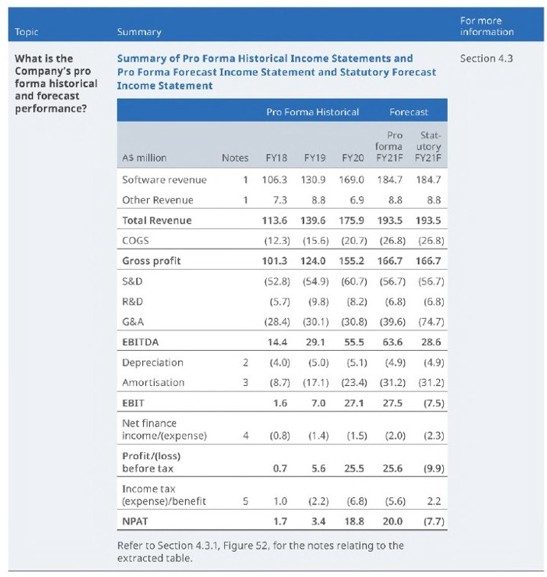
192 Part 2 of the prospectus provided an “Industry Overview”.
193 Part 3 of the prospectus, titled “Company Overview”, included:
(1) the overview of the Nuix platform set out at [61] above;
(2) the following description of Nuix’s customers and ACV:
3.4.2 CUSTOMER DIVERSIFICATION
Nuix’s customers are diversified by region and industry as illustrated in Figures 27 to 30. Nuix assesses customer diversification by reference to Total Revenue. Customer tenure and concentration are assessed on an Annualised Contract Value (ACV) basis which is, in summary, the annualised (or 12 month equivalent) value of all revenue from the sale of Software Licences at the end of a given financial period as well as the last 12 months of Other Revenue.22 Nuix’s largest customer in FY20 represented approximately 4% of FY20 ACV and the top 20 customers represented approximately 41% of FY20 ACV, as seen in Figure 29.
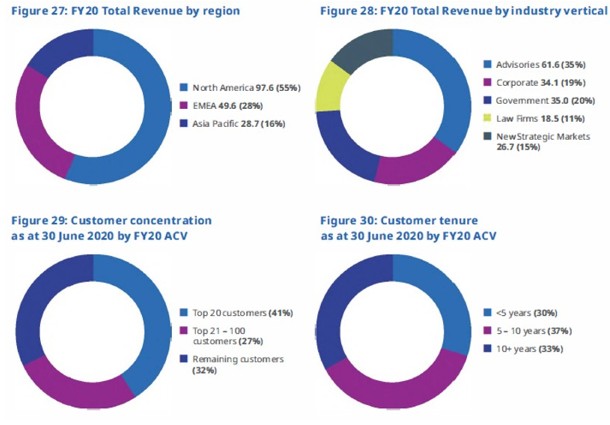
Notes: ACV is a non-IFRS measure and does not represent Total Revenue in accordance with AAS or Nuix’s accounting policies or cash receipts from customers. Refer to Section 4.11.3 for additional information on ACV.
______________________________________________________________
…
22. The metric is used by Nuix to assess Nuix’s total contract value on an annualised basis and to mitigate the fluctuations in Nuix’s Total Revenue which results from the upfront revenue recognition of multi-year deals from Subscription Licences required under Australian Accounting Standards and Nuix’s accounting policies. Refer to Section 4.2.6.1 for further information on how Nuix calculates ACV.
(bold emphasis in original; underline emphasis added)
… ; and
(3) at 3.5, a description of Nuix’s “Business and Revenue Model”.
194 Part 4 of the prospectus, titled “Financial Information”, included:
(1) at 4.2.6:
4.2.6 EXPLANATION OF CERTAIN NON-IFRS AND OTHER FINANCIAL MEASURES
In addition to Nuix’s financial information presented in accordance with AAS and IFRS, Nuix uses certain measures to manage and report on its business that are not recognised under AAS or IFRS. These measures are collectively referred to in this Section 4 and under Regulatory Guide 230 Disclosing Non-IFRS Financial Information published by ASIC as non-IFRS financial measures. The principal non-IFRS financial measures that are referred to in this Prospectus are outlined in this Section 4.2.6.
Although Nuix believes that these measures provide useful information about the financial performance of the business because they provide consistency and comparability with past financial performance, they are presented for supplemental informational purposes only, have limitations as analytical tools, and should not be considered in isolation or as a substitute to the financial information measures that have been presented in accordance with AAS and IFRS. As these financial measures are not based on AAS or IFRS, they do not have standard definitions, and the way Nuix calculates and presents these measures may differ from similarly titled measures used by other companies, including subscription software providers, and may therefore not be comparable to similarly titled metrics used by other companies.
Additional limitations and considerations associated with particular metrics are described further below. Investors should therefore not place undue reliance on these non-IFRS financial measures.
4.2.6.1 Key performance indicators
Nuix monitors a number of KPIs which are based on the annualised value of its customer contracts (calculated across the contract periods).
Nuix’s product and licence strategy has evolved over time to address the changing needs of its diverse customer base. This has included:
• the transition from Perpetual Licences to Subscription Licence models for the majority of customers (refer to Section 4.11.1.2);
• the introduction of a Nuix-hosted cloud software delivery model as an alternative to on-premise installation (refer to Section 3.5.6); and
• the introduction of Consumption Licences which better align Nuix’s revenues generated from certain licences with its customers’ growing need to process increasing volumes of data at scale and speed (refer to Section 4.10.1).
The rate of adoption of new licences, pricing or software delivery models has varied across Nuix’s diverse customer base. As such, Nuix maintains a flexible approach to the sale of its software to meet customer demand, which has resulted in a mix of licence, pricing and delivery models outlined in Section 4.10.
The application of Nuix’s revenue recognition policies (described in Section 4.2.4.1) varies across these criteria. Nuix monitors three KPIs (ACV, NDR and Churn), that:
• align the contract values of Nuix’s various licences, pricing and delivery models;
• assist Nuix in assessing its growth and the annualised impact of its sales, including its success in renewing existing customer contracts, executing on its “land and expand” strategy through Upsell Renewals, and acquiring new customers; and
• assist Nuix in assessing trends and performance of customers who acquire Subscription Licences, which accounted for 89% of FY20 Total Revenue.
Annualised Contract Value (ACV)
ACV is used by Nuix to assess the total contract value of its software contracts on an annualised basis (removing fluctuations from multi-year deals in Nuix’s Total Revenue which results from its revenue recognition policies).
The calculation of ACV at the end of the relevant financial period adjusts Total Revenue to account for:
• revenue generated from Subscription Licences with a term of 12 months or more which exists at the end of the relevant financial period (i.e. at a point in time) is treated as though the contract value is apportioned on a straight-lined monthly basis over the relevant contract period, and recognised on an annualised basis in the given financial year;
• revenue generated from short-term Software Licences over the last 12 months; and
• the last 12 months contribution of Other Revenue.
As illustrated in Figure 51, there has historically been a general alignment between Total Revenue, ACV and cash receipts from customers over time, which reflects the subscription-like elements of Nuix’s operating model (described in Section 4.10).
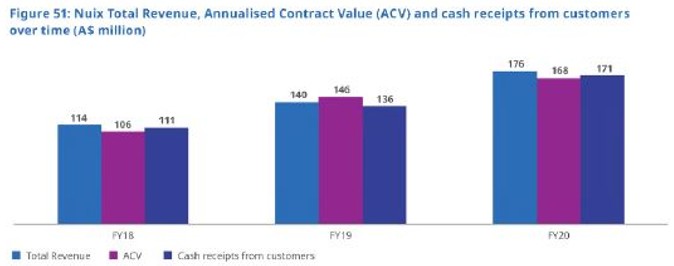
Notes: Cash receipts from customers as sourced from the Historical Statutory Cash Flow Statements and presented net of GST, VAT and sales tax collected.
ACV also facilitates the calculation of other KPIs, including NDR and Churn (described below). Nuix also uses ACV (in addition to Total Revenue) to assess customer diversification (refer to Section 3.4.2).
ACV is an adjusted, non-IFRS measure and does not represent Total Revenue in accordance with AAS or Nuix’s accounting policies or cash receipts from customers.
…
Net Dollar Retention (NDR)
Expressed as a percentage, NDR represents the ACV from the sale of certain Subscription Licences from a constant set of customers across comparable periods (i.e. it excludes the impact of new customers acquired in the subsequent (i.e. more recent period), taking into account the impact of Upsell Renewal, Downsell Renewal and Churn (as described below) between these two periods.
NDR is calculated by Nuix as:
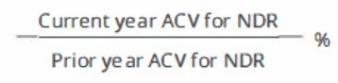
where
• Current year ACV for NDR: the ACV of Subscription Licences (excluding short-term Software Licences, or licences with a term of less than 12 months, but including Consumption Licences) on the final day of the current reporting period contributed by the NDR constant customer set. Current year ACV for NDR captures the impact of changes in contract terms from the NDR constant customer set, including Upsell Renewal, Downsell Renewal and Churn, in respect of the NDR constant customer set; and
• Prior year ACV for NDR: the ACV of Subscription Licences (excluding short-term Software Licences, or licences with a term of less than 12 months, but including Consumption Licences) on the final day of the prior reporting period.
The customer set used to calculate the prior year ACV for NDR determines the customers included in the NDR constant customer set.
This measurement is used by Nuix to assess its success in retaining and growing the contract value generated by a constant customer set over time (less Churn) (refer to Section 3.4.4 for further information on Nuix’s customer retention strategies). An NDR of 100% or higher indicates that the net ACV from Renewals and Upsell Renewals in a given financial period exceeds any ACV diminution from Downsell Renewals or Churn for certain Subscription Licences (as defined above). Over FY18 to FY20, Nuix has consistently maintained an NDR above 100% in each respective financial year (refer to Section 3.4.4.1).
Some of the limitations of NDR include that the measure:
• reflects past performance at a static point in time, and is not indicative of future performance;
• is sensitive to the point in time at which the calculation is performed in relation to the Churn component; and
• excludes the impact of growth in ACV from new customers.
ACV, NDR and Churn are used by Nuix as a means of assessing its success in retaining customers over time, and assist in assessing the likelihood of future customer contracting opportunities and software revenue generation. Refer to Section 3.4.4 for a further discussion of Nuix’s strategy in respect of customer retention and the utility of the measures discussed above in monitoring retention and customer economics.
...
(bold and italic emphasis in original);
(2) at 4.3, a table which forecast statutory revenue of $193.5 million for FY21;
(3) at 4.3.3, the following description of “Key Operating and Financial Metrics”:
4.3.3 KEY OPERATING AND FINANCIAL METRICS
Nuix uses certain operating and financial metrics to manage and report on the business which are not recognised by IFRS or AAS. Refer to Section 4.2.6 for a description of these operating and financial metrics.
Figure 54 sets out Nuix’s key historical operating and financial metrics for FY18, FY19 and FY20, and the key forecast operating and financial metrics for FY21F on a pro forma basis. This information is derived from the Pro Forma Financial Information presented elsewhere in this Prospectus. The pro forma metrics presented in Figure 54 are presented on the same basis as the corresponding Statutory metrics, with the exception of G&A (% of Total Revenue) and EBITDA margin, the presentation of which on a statutory basis are outlined in Figure 55.
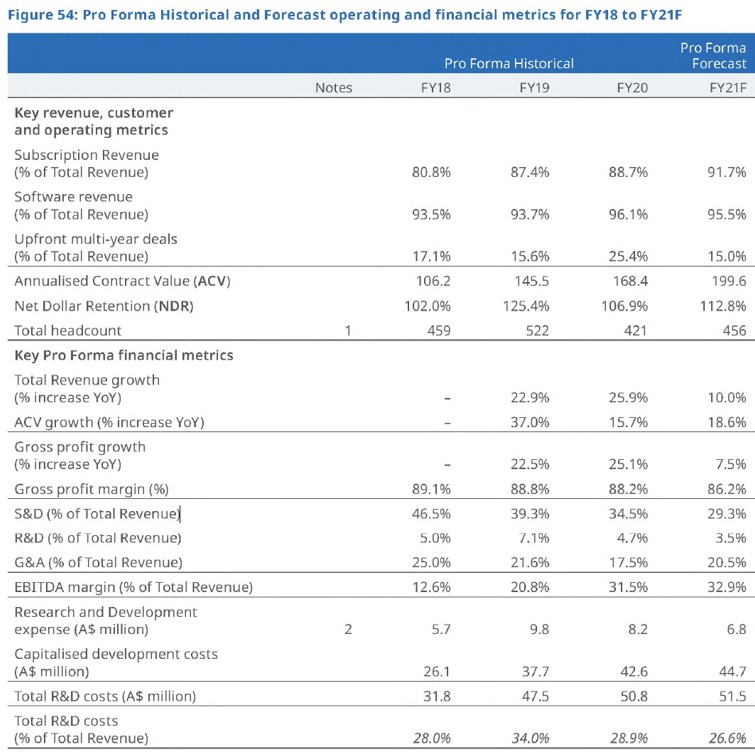
(bold emphasis in original; notes omitted) ;
(4) at 4.11.1, under the heading “Key Drivers and Trends”:
This Section 4.11 provides an overview of the key drivers and trends affecting Nuix’s historical performance. It is intended to provide a summary only and does not detail all factors that have affected the historical operating and financial performance of Nuix, nor everything that may affect its operations and financial performance in the future.
…
4.11.1.5 Seasonality
Nuix’s financial performance reflects an element of seasonality arising from purchases from new customers and existing customers which impacts revenue generation.
Contract completions are typically weighted towards the end of Nuix’s financial half years. Nuix’s revenue seasonality arises from:
• purchases and Renewals aligned to regional customer financial year ends (for example, revenue generation is weighted towards December in the United States and EMEA, March in Canada and the UK, and June in Asia Pacific);
• industry-specific expenditure (for example, revenue generated from the United States Federal Government typically increases in September); and
• other factors, including the timing of revenue recognition for upfront multi-year deals and the timing of annual revenue recognition from other significant non-multi-year deals, which typically align to purchasing at quarter ends.
Total Revenue at the end of the first half of FY18, FY19 and FY20 accounted for 54%, 55% and 51% of full year Total Revenue, respectively. Total Revenue is generally weighted towards each quarter end, as was the case in FY18, FY19 and FY20.
The decrease in the contribution of first half Total Revenue relative to the full year Total Revenue in FY20 compared to the two prior fiscal years was primarily driven by a strong second half, with significant accounts renewing during that period. Nuix expects these seasonal trends, particularly the relatively high weighting of revenues being recognised towards the ends of financial half years, will continue to be a feature of its operating model in the future.
In contrast, the majority of Nuix’s expenses do not vary directly with Total Revenue and have a higher degree of consistency. Nuix’s expenses are predominantly personnel related, and as such Nuix does not experience significant seasonal fluctuations in the timing of expenses from period to period.
(bold emphasis in original);
(5) at 4.11.3, a detailed discussion of Nuix’s historical revenue and ACV figures;
(6) at 4.12.2.2 under the heading “Total Revenue assumptions”:
Seasonality
Forecast Total Revenue is assumed to be generated in line with the historical seasonality of contracting bookings experienced by Nuix. Nuix customers often transact close to the conclusion of their respective financial year ends.
This has historically resulted in Nuix’s Total Revenue generation by financial quarter to be unequally distributed, with a higher proportion of Total Revenue being delivered in the final months of its financial half year ends (i.e. in December 2020 and June 2021 for the first half of FY21F and the second half of FY21F, respectively).
Nuix therefore assumes that:
• the first quarter of FY21F will be its smallest quarter by Total Revenue for FY21F; and
• the fourth quarter of FY21F will be its largest quarter by Total Revenue for FY21F.
(bold and italic emphasis in original); and
(7) at 4.12.3 under the heading “ Management Discussion and Analysis of the Forecast Financial Information”:
Figure 78 and Figure 79 illustrate the historical Total Revenue and ACV over FY18 to FY20 for Nuix. The majority of the historical revenue of Nuix is comprised of software revenue, which accounted for 93.5%, 93.7% and 96.1% of Total Revenue in FY18, FY19 and FY20, respectively.
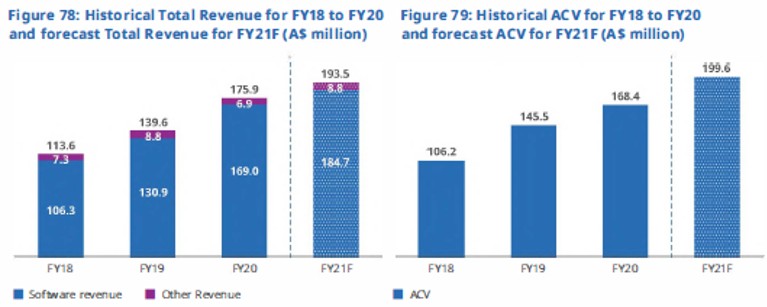
4.12.3.1 ACV
ACV is forecast to increase from A$168.4 million in FY20 to A$199.6 million in FY21F, an increase of 18.6%. The growth in ACV is impacted by, amongst other factors, the performance and composition of Total Revenue in FY21F. Key drivers of the growth in ACV in FY21F are expected to include:
• A$18.0 million growth in net existing customer ACV, which is expected to result from Renewals and Upsell Renewals through greater penetration across the existing customer base. This increase is expected to be partially offset by Churn and Downsell Renewals within the period;
• A$20.7 million growth in new customer ACV, expected to result from the conversion of Nuix’s current sales pipeline opportunities; and
• A$5.7 million decrease in Other ACV items, predominantly driven by lower expected sales of Perpetual Licences compared to FY20.
As illustrated in Figure 80, Nuix expects the historical alignment between Total Revenue, ACV and cash receipts from customers over time (described in Section 4.2.6.1) to continue in FY21F.
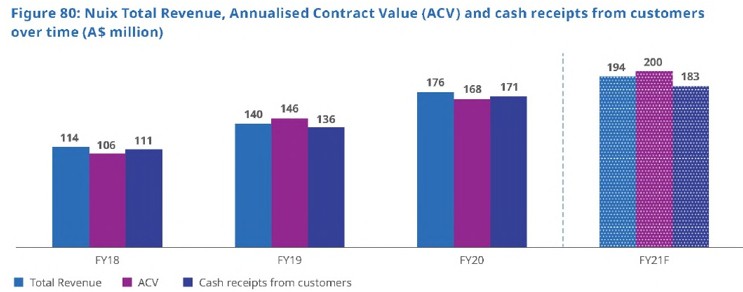
Notes: Cash receipts from customers as sourced from the Historical Statutory Cash Flow Statements and presented net of GST, VAT and sales tax collected.
ACV is an adjusted, non-IFRS measure and does not represent Total Revenue in accordance with AAS or Nuix’s accounting policies or cash receipts from customers.
(bold emphasis in original; underline emphasis added)
195 The statements in the prospectus that Nuix’s total statutory revenue for FY21F was forecast to be $193.5 million have been described by ASIC for the purpose of this proceeding as the Prospectus Revenue Forecast.
196 The statements in the prospectus that Nuix’s ACV was forecast to be $199.6 million as at 30 June 2021 have been described by ASIC for the purpose of this proceeding as the Prospectus ACV Forecast.
197 Based on the discussions at various DDC and board meetings, Mr Bleich’s understanding was that the Prospectus Revenue Forecast was conservative compared to the Board Budget for FY21. His general recollection is that, essentially, a reduction had been applied to the Board Budget for accounting reasons and then a further reduction had been applied for unknown risks at the time the forecast was made. The total reduction applied was about $16 to 17 million. His recollection is that this “buffer” that was built into the Prospectus Revenue Forecast gave Nuix comfort that it would be able to meet the Prospectus Revenue Forecast notwithstanding any headwinds. Mr Bleich did not recall how the Prospectus ACV Forecast was derived, but his understanding was that it was also the subject of consideration by PwC in the due diligence process.
198 Mr Bleich’s recollection is that the ACV metric was included in the prospectus at the suggestion of PwC, who advised the DDC that it was a financial metric that some investors may be interested in due to the “lumpiness” of Nuix’s revenue as a result of the revenue recognition principles that applied to multi-year deals. His understanding was that, when considered together, statutory revenue, ACV and EBITDA, provided a “rounded indication” of a company’s underlying health and financial performance.
199 Based on his attendance at DDC meetings and observing the discussions, Mr Bleich understood that, as part of the extensive due diligence process undertaken in the lead up to Nuix’s IPO, the Prospectus Forecasts, and the underlying information (including assumptions about the pipeline of upcoming opportunities), were carefully reviewed and verified by management and PwC. As such, he had confidence in the reliability of the Prospectus Forecasts.
200 The prospectus did not disclose a forecast of any financial metrics for 1HFY21 (i.e. to 31 December 2020).
C.11 18 November 2020 to 17 January 2021
201 On 4 December 2020, Nuix was admitted to the official list of the ASX. On that day, its share price closed at $8.01, or 50.85 per cent above, the IPO offer price of $5.31.
202 On 7 December 2020, the DDC met. All of the directors of Nuix were present. During that meeting, Mr Vawdrey provided a trading update. The minutes of that meeting include (as written):
R Vawdrey explained that, as occurs most fortnights, the ExCo team held a call on Friday morning to provide an update on how the regions are tracking. R Vawdrey noted that all regional sales heads re-affirmed the formal forecast numbers and confirmed that they reasonably expect to achieve the HY budget in line with the field budget of $100 million (which is higher than the Prospectus forecast).
R Vawdrey noted that there a number of key opportunities that need to be closed out in the quarter (namely FTI, KPMG, Deloitte and Rothschild), however the Company feel they are in a position right now of being slightly ahead of the Prospectus forecast.
203 On 24 December 2020 at 1:22am, Mr Simon Borcherdt, a Financial analyst employed by Nuix, sent an email to Mr Vawdrey which set out the latest revenue forecast for the first half of FY21. His email stated:
Please see attached latest Revenue Forecast as at 23rd December in addition to YTD Orders to Revenue detail in xls for your reference.
Note, the revenue forecast is based on actuals to date plus open “Commit” opportunities in Salesforce, and is presented in AUD.
Forecast revenue for the half is currently sitting at A$94.9m against budget of A$100.5m (94% attainment). On a bookings basis we are tracking at A$104.08m (104% attainment).
Please note final S&M deferral will be processed at month end, and based on current deals in commit, we anticipate this figure to be approx. -A$4.6m, thus resulting in an estimated closing revenue figure of A$90.3m.
(bold, italic and underline emphasis in original)
204 At 3:53am that day, Mr Vawdrey forwarded that email to the directors of Nuix, under cover of an email which included:
Fingers and toes crossed we will finish H1 in a very solid position.
205 At 10:52am that day, Ms Thomas replied to Mr Vawdrey’s email, copying the directors of Nuix and others:
Thanks, and well done.
Can someone please provide the assumptions for the forecasts that are in the prospectus. Are the prospectus forecasts the budgets in the attached docs? I note that software rev is forecast at $184.7m for the year, but not sure how this was expected during the respective halves.
206 Following the close of the half-year period on 31 December 2020 (1HFY21), Mr Silveri:
(1) started a preliminary analysis of the half-year results;
(2) started to forecast statutory revenue for the following six month period as part of tracking revenue against the Prospectus Revenue Forecast; and
(3) commenced a process to track whether Nuix was on track to meet the Prospectus ACV Forecast.
207 It is necessary to interrupt the chronology of salient events in order to provide an overview of the steps involved in the above-mentioned tasks.
208 Mr Silveri’s process for tracking Nuix’s performance against revenue forecast was similar to the process that he carried out to prepare the full-year budget (as outlined at C.9 above). That is, at a high level, he considered the deals which had been won since the budget had been prepared and he then conducted what was essentially a full budget process for the remainder of the financial period, by:
(1) considering what opportunities were likely to be won by reference to the data in Salesforce; and
(2) applying assumptions (based upon historical conversion ratios from the corresponding period in the previous year and region) regarding the likely conversion ratios of the open opportunities identified in Salesforce and the likely revenue to be obtained in respect of additional, as yet, unbuilt pipeline; and
(3) seeking detailed feedback, input and verification from the Region Heads and sales teams on what Salesforce was generating.
209 From time to time during 2021, Mr Silveri conducted a high level analysis of Nuix’s progress against its revenue forecast by conducting the steps at [208(1)] and [208(2)] above which relied wholly on the accuracy of the data in Salesforce at that time. However, where the analysis of the progress against forecast was required to be as accurate as possible (for instance, when reporting final results to the directors of Nuix or to the market) Mr Silveri believed it was essential to liaise with the sales teams in the way identified in [208(3)] above, and to ensure the Salesforce data was up to date following the end of the half or quarter as relevant.
210 As to forecasting statutory revenue for 2HFY21, Mr Silveri worked closely with the Region Heads and the sales teams to ensure that he had the most accurate and up to date Salesforce data, as well as the Region Heads’ views on likely business performance in each of the regions. That included receiving confirmation from the Region Heads as to the achievability of the FY21 Field Budget, Board Budget and the Prospectus Revenue Forecast based upon the Region Head’s views of market sentiment, customer trends and material deals in the pipeline. These discussions and the input Mr Silveri received from the sales teams were similar to the budgeting process described above.
211 By January and February 2021, the Region Heads were able to provide better information on the deals that they expected to win in the second half as they had a better “line of sight” to the end of FY21. While this information remained imperfect, it was their best estimate at the time of their forecasts for the following six months. This information was more reliable than the information which had existed before the commencement of FY21 when the budgets were being prepared and the Region Heads were asked for their views over a longer, 12 month period, before that 12 month period had commenced.
212 Once Mr Silveri had gathered the information that he required, he tracked Nuix’s performance against its forecasts by reference to three components:
(1) the YTD actual revenue (including any adjustments and deferrals as a result of Nuix’s revenue recognition policy);
(2) open sales opportunities in Salesforce to which he applied conversion rates depending on how the deal was categorised and how likely it was to successfully close; and
(3) additional unbuilt pipeline for the remainder of FY21.
213 In respect of YTD actual revenue, throughout FY21 Mr Silveri tracked Nuix’s financial performance by using the statutory revenue entries on Nuix’s general ledger. Once a deal was closed or won in Salesforce, it was allocated to Nuix’s deal desk and reviewed by the finance and legal teams. Following that review, the deal appeared in the NetSuite accounting system so that Nuix could invoice the customer. A member of the finance team then applied revenue recognition principles and any FX adjustments to the relevant amount before recording the statutory revenue in the general ledger for that reporting period (and any future reporting periods in the case of deferred revenue). In the period January 2021 to the end of April 2021, the finance team usually provided Mr Silveri with the data on Nuix’s YTD actual statutory revenue.
214 In respect of open sales opportunities, Mr Silveri included the full value of all opportunities categorised as “Commit” in Salesforce when he prepared reports on Nuix’s progress against the Prospectus Revenue Forecast. Given the higher level of uncertainty regarding opportunities in the “Best case” and “Pipeline” categories, Mr Silveri applied a conversion rate which assumed a certain percentage of these potential deals would be won, as it was unlikely that the full value of the “Best case” and “Pipeline” deals would successfully close in the relevant period. The conversion rate was calculated by reference to historical “win rates” for these types of deals, and would change based on the mix of deals in the pipeline (based on RUN as each RUN category had a different win rate). The conversion rate for “Best case” and “Pipeline” deals was in Mr Silveri’s experience usually around 50 per cent, based on the historical win rates for these types of deals.
215 In respect of calculating the likelihood of Nuix winning additional unbuilt pipeline, Mr Silveri started with the average pipeline build of opportunities with both a created and close date in the remaining financial reporting period of FY20 (i.e. the prior corresponding period) and then applied a historical win rate to the average additional unbuilt pipeline to work out how much of that average unbuilt pipeline was likely to convert into a “closed/won” deal. This last component of monitoring progress against the forecast was based on historical performance, as not all potential sales opportunities for the full financial year had arisen and been recorded in Salesforce.
216 Mr Silveri’s practice was to adjust the calculation in respect of open sales opportunities and additional unbuilt pipeline by reference to any individual feedback from Region Heads on particular contracts (for instance, if it was known that a significant contract would not complete or should be excluded for other reasons). Mr Silveri also tested the assumptions regarding additional unbuilt pipeline with the Region Heads as part of the forecasting process, to ensure that his analysis was aligned with their views on what was achievable in each of the Nuix’s sales regions.
217 The process for tracking Nuix’s performance against ACV forecasts, generally, was similar to the process Nuix carried out to prepare the forecast initially. In essence, the process involved:
(1) identifying the date by reference to which the report was to be conducted;
(2) allowing sufficient time after that date to ensure that all of the information potentially relevant to the estimate had been updated in Salesforce;
(3) once there was sufficient confidence that Salesforce was up to date:
(a) identifying the contracts within Salesforce that would be current and part of the ACV calculation at the future date;
(b) identifying the opportunities or known “pipeline” from within Salesforce that are likely to be in force and part of the ACV calculation at the future date. This was firstly done by conducting a probability assessment of the known opportunities (based on the forecast category assigned to each opportunity) and assessing the proportion of those opportunities that would be completed within the period necessary to be part of the future ACV calculation;
(c) considering the number, nature and value of as yet unknown opportunities that were likely to complete within the relevant period and making a probability assessment of what the likely contribution of those contracts would be to the ACV calculation at the date of the future calculation; and
(d) liaising with the Region Heads and sales teams to obtain any feedback on the prediction having regard to any further information they may have been aware of which was not considered in Salesforce and matters such as their view of market sentiment.
218 Mr Silveri was involved in that process, and he considered it to be critical to that process that both the finance and the corporate strategy team (who at that time were responsible for calculating ACV) used the same data in Salesforce, which was Nuix’s “single source of truth” for forecasting future financial performance, and that the forecasting process followed the same methodology to interpret that data.
219 The process of tracking progress against Nuix’s Prospectus ACV Forecast also mirrored the process outlined above regarding forecasting of statutory revenue. The ACV calculation was likewise reliant on the assessment of the pipeline of open opportunities in Salesforce, the processes in place in the sales teams to update and verify that data at the end of each financial period and views and confirmations from the Region Heads.
220 However, preparing a forecast for the ACV metric required additional information in relation to open opportunities in Salesforce, as the ACV calculation required more detail in order to predict ACV outcomes than the details required to forecast statutory revenue.
221 Returning to the chronology, on 3 January 2021, Mr Bleich’s father passed away. As a result, he was grieving and did not regularly check his emails from 3 January 2021 until about mid-January 2021. In or around late January 2021, he caught up on correspondence that he had not read in the interim.
222 On 5 January 2021 at 6:44pm, Mr Silveri sent an email to Mr Vawdrey, with the subject line “1H FY2021 Revenue Results” in the following terms:
Please see attached (and below) bridge chart stepping through 1H FY2021 order performance and translation to revenue.
In summary, at a Group level orders were A$100.7m (net of fx headwind) with actual revenue (after accounting for deferrals, SaaS deals, S&M carveout) at A$85.3m.
YID FY2021 Revenue Bridge (A$m)
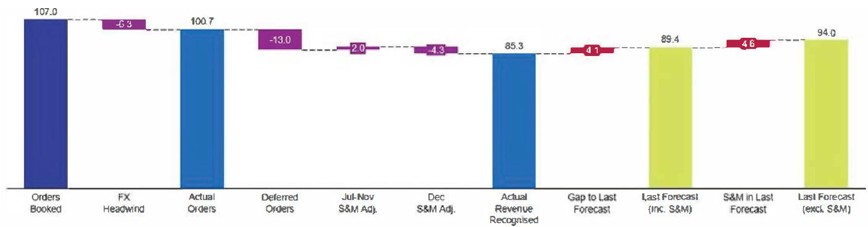
These actuals are against the following 1H FY2021 targets:
• Field Budget: A$100.5m (A$218.5m full year)
• Board Budget: A$96.4m (A$210.6m full year)
• IPO Forecast: A$85.2m (A$193.5m full year)
The attached ppt contains commentary on deferred orders, S&M, and also the bridge to the last forecast provided.
Attached for your reference in xls is also a listing of the forecasted deals in commit that did not close (slipped).
We are posting the S&M journals into the system by region tonight and should have the detailed revenue splits by region to you in the morning.
(bold and italic emphasis in original)
223 This email included Mr Silveri’s preliminary analysis of the available financial results for 1HFY21. In particular, the initial results suggested that:
(1) at a group level, Nuix’s orders booked for the first half of FY21 were A$107 million, before making a reduction of $6.3 million to adjust for FX headwinds caused by the appreciation of the Australian dollar, leaving a total of $100.7 million; and
(2) after further adjustments and deferrals as required under the revenue recognition rules, Nuix’s actual revenue, on a preliminary basis, for 1HFY21 was around $85.3 million.
224 Nuix had broadly achieved in 1HFY21 the level of revenue that Mr Silveri had been expecting. Nuix’s internal estimate for statutory revenue at the end of the first half-year was $85.2 million (Internal 1H Revenue Target). This was achieved despite adverse foreign currency movements and some larger deals that Nuix had thought would conclude in the first half slipping to the second half of the year.
225 Nuix’s internal targets had not been disclosed to the market or publicly. In essence, $85.2 million represented around 44 per cent of the Prospectus Revenue Forecast of $193.5 million. Mr Silveri considered this to be consistent with the analysis undertaken based on Salesforce data, which was that the bulk of the revenue for FY21 would be achieved in the second half of FY21 (2HFY21).
226 The Internal 1H Revenue Target was based upon the following Monthly Revenue Forecast:
Month | Revenue |
July 2020 | $9.8m |
August 2020 | $11.2m |
September 2020 | $13.6m |
October 2020 | $15.9m |
November 2020 | $14.2m |
December 2020 | $20.5m |
Total | $85.2m |
227 The statutory revenue that Nuix expected to achieve each month was based upon the renewal profile of deals in FY21, as well as its expectations of when upsell and new business would close. As noted earlier, this type of business was weighted to the end of a quarter and to the end of a half-year. In FY21, the Monthly Revenue Forecast identified that Nuix was forecasting that each of December 2020 and June 2021, (i.e. the end of each half) would be the largest months in terms of statutory revenue.
228 Mr Silveri’s 5 January 2021 email and attachments also provided information to Mr Vawdrey concerning revenue that Nuix expected to recognise in 2HFY21, based on the preliminary first-half results, including:
(1) forecasted deals in the “Commit” category of Salesforce that did not close in the first half, but that Mr Silveri expected to close in 2HFY21 (also known as “slipped deals”). In the PowerPoint slide attached to that email Mr Silveri noted that $3.4 million of revenue had “slipped” to the second half; and
(2) revenue that formed part of the $107 million of orders booked in the first half that would be deferred and recognised in the second half of FY21. In the PowerPoint slide attached to that email Mr Silveri noted that of the $13 million in deferred orders, $6.9 million of this amount was expected to be “released in” 2HFY21.
229 As a result, although Nuix’s actual revenue result for 1HFY21 was expected to be $85.3 million (once the preliminary figures had been finalised), Mr Silveri expected that as at 31 December 2020 Nuix was likely to have an additional $10.3 million towards achieving the Prospectus Revenue Forecast as a result of deals which had not closed in the first half but which were nevertheless expected to close before the end of FY21.
230 Mr Silveri also noted in his 5 January 2021 email that the statutory revenue result was $85.3 million against the Field Budget of $100.5 million. As noted earlier, the Field Budget was prepared on an orders basis and had not been adjusted at that time for any revenue recognition rules.
231 On 5 January 2021 at 7:09pm, Mr Vawdrey forwarded Mr Silveri’s 5 January 2021 email to each of the other directors of Nuix and others under cover of an email in the following terms:
I would like to thank Daniel and finance team for getting the results for Hl together. to explain how we performed. You will all no doubt see some differences from my last communications.
Daniel summarises below and in the attachments what has happened.
The 2 key disappointments are deals that didn’t close at $3.8m, the unforeseen impact of FX with the strengthening Aussie Dollar at $6plus million and the plus and minus of more SAAS than planned albeit a strong SAAS result.
For reference, there was no specific forecast in the prospectus, for Hl, but internally we had settled on AUD$87m and we finished at $85.3 from a strong post FX order total of $100.7m, so there is a order to revenue difference of $15m of which we believe $7m will be turned to revenue in H2.
Unfortunately there is some investor expectation of $97m revenue for Hl through simple math at 50% of full year forecast of $193m, so a $12m possible disappointment to be explained partly by the strong order result and impact of FX.
For H2 we will now need $107m with $7m approx. in backlog from Hl and of course a strong backlog of renewals.
This will not be an easy task given the current FX climate, Covid and the challenges ahead, with a few large deals like EY, offset by the carry over of revenue and the $4m of missed deals closing we hope in January plus the hopeful positive increase in the Macquarie Bank commitment in January.
We will set up a call to walk through this in more detail in the next few days
Daniel if my summary has missed something please advise.
232 Sir Iain felt some disappointment that the results for 1HFY21 referred to in Mr Vawdrey’s email were not, at first sight, as strong as had been indicated by Mr Vawdrey’s 24 December 2020 email ([204] above). Nevertheless, he felt reassured by Mr Vawdrey noting in his 5 January 2021 email that achieving the revenue required in 2HFY21 to hit the Prospectus Forecasts would “not be an easy task.” This was because it indicated to Sir Iain that Mr Vawdrey was being realistic in his outlook, and that he knew there was an issue to be addressed. Sir Iain held a favourable opinion of Mr Vawdrey (and Mr Doyle) in part because in his interactions with, and observations of them, they often raised issues or disappointments confronting Nuix, rather than presenting information to the directors in a way that he would consider optimistically biased.
233 At around this time Mr Vawdrey mentioned to Sir Iain that Nuix had not disclosed a 1HFY21 target for statutory revenue or ACV to the market. From Mr Vawdrey’s email, Sir Iain understood that Mr Vawdrey considered there might have been some investors who had expected Nuix to hit $97 million in revenue for 1HFY21.
234 On 6 January 2021 at 3:41pm, Ms Thomas responded to Mr Vawdrey’s 5 January 2021 email (copying the same recipients), in the following terms:
I understand that there are 2 different issues in relation to revenue for the period ending 31 December.
The first is whether we still expect to meet prospectus forecasts (revenue and profit). I think that as part of the DD process, we agreed that we would have to announce if we do not believe Nuix has a realistic chance of achieving the prospectus forecasts (with a tolerance of 5%) or if we believe we will materially exceed (also 5%)
The second issue is the half year reporting. Given that that there was no prospectus forecasts for the half, then we just need to consider the messaging around the reporting of half year results .... For example that second half is normally much stronger, impacts of FX etc and we believe (subject to confirmation) that we will achieve prospectus forecasts.
For my part, it would be good to get a review of expectations (budget) for the second half of the year, so that we can form an appropriate opinion as to whether we will met [sic] prospectus forecasts. Given that this is a significant issue, I would request if it is possible for finance to include expected results for balance of year in monthly accounts.
235 Mr Bleich read this email in the course of catching up on his emails in late January 2021 and agreed with Ms Thomas’s view that the directors of Nuix should try to understand how Nuix was tracking against the Prospectus Forecasts. He also wanted to understand what had changed since the more optimistic update in late December 2020 from Mr Vawdrey, and he wanted to understand from Mr Vawdrey and others within Nuix’s finance team whether Nuix’s 1HFY21 results, as recorded in Mr Vawdrey’s email of 5 January 2021, changed management’s expectation as to the achievability of the Prospectus Forecasts.
236 At 6:11pm that day, Mr Doyle forwarded Ms Thomas’s email to Mr Silveri, and asked him to “[g]et the EOFY forecast ready this week”.
237 As to Ms Thomas’s query as to whether, on the basis of the results, Nuix still expected to meet Prospectus Forecasts, Mr Silveri’s view at the time was that the Internal 1H Revenue Target had been met and, as such, the forecast appeared on track but it was closer than he would have liked. Mr Silveri considered that it would be necessary to conduct a full forecast for 2HFY21 which would take some time and require detailed work and feedback from the Regions.
238 On 7 January 2021 at 1:08pm, Mr Silveri sent an email to the Region Heads – who as noted above were Mr Treese (USA), Mr Dorchinsky (USG), Mr Rees (EMEA) and Mr Muller (APAC). That email, which was copied to Mr Vawdrey, Mr Doyle and others, stated:
Please see attached revenue and order results by region for 1H FY2021.
The results are presented in 4 views:
1. Actual reported revenue (inc. of S&M) vs. field budget
2. Actual revenue excl. of S&M to provide a like-for-like comparison against last Regional CEO forecast guidance received
3. Actual revenue excl. of S&M to provide a like-for-like comparison against last forecast derived from Salesforce on 31 Dec
4. Actual orders booked against last Regional CEO forecast guidance received
In summary, it was a strong result for the half from an orders perspective with A$100.7m of orders booked net of fx headwind of -A$6.3m. Of the $100.7m in orders, $15.4m was deferred as a result of orders with start dates in future periods, professional services yet to be completed, SaaS deals which are recognised monthly over the contract period, and S&M carveout which is also to be recognised rateably over the contract period, landing us a [sic] at a net reported revenue result of A$85.3m against budget of A$100.5m. Of the total amount deferred, we expect $6.9m to be recognised over the balance of the financial year.
Against your recent management and salesforce forecast guidance, there were misses largely due to material slipped deals from UHG, Dell, and a duplicate opportunity being forecasted for Deloitte Federal (in addition to a long tail of smaller value opportunities that did not close).
It is also worth noting that this revenue result includes the accounting adjustment of recognising $6m of EY in July 2020 rather than June 2021, so this adds to our already stiff challenge of 2H revenue attainment. I trust you are all working in earnest to validate and build your pipelines for the 2H and I look forward to discussing your full year positions in our scheduled forecast calls next week.
(underline emphasis in original)
239 Mr Silveri’s reference to “our already stiff challenge of 2H revenue attainment” in the last paragraph was to the sales teams being able to achieve their full year Field Budget of $218.5 million, with the revenue recognition rules applied rather than on an orders basis.
240 Mr Silveri included in his email a reference to validating and building pipelines so as to emphasise the importance of the sales teams’ work in updating the data in Salesforce so that the reforecasting exercise could be as accurate as possible.
241 Mr Rees did not have any concern at that time that EMEA would not meet its FY21 Field Budget, and none of the other Region Heads raised any issues of this kind (to the knowledge of Mr Rees).
242 At 1:55pm that day, Mr Silveri sent an email to Mr Vawdrey providing Nuix’s internal halfyear targets for the Field Budget, Board Budget and the Prospectus Forecasts. These were the same figures that Mr Silveri had provided to Mr Vawdrey on 5 January 2021.
243 On 10 January 2021, Morgan Stanley Research issued a report (Morgan Stanley report) which included a price target for Nuix of $11.00 per share.
244 The Morgan Stanley report included:
Key positives. The global software market for forensic/investigative + cyber security is worth an estimated US$29bn (2021E, IDC and Mordor Intelligence). The outlook is for positive structural growth, driven by rising litigation trends, spiking data usage, increasing corporate needs for surveillance, governance and protection. NXL’s key competitive advantage is its proprietary data processing engine that can search +1,000 different file types, with high speed and industry-leading accuracy. The Nuix engine powers NXL’s analytical products, too.
Major risks. 1) Competition: NXL faces significantly larger peers, with far larger software R&D budgets. We expect new technologies and competing products will emerge, attracted by the large + growing global cyber security TAM, and some may directly target NXL’s niche. Some peers have been faster to move to a Saas/pay-for-consumption business model. 2) Valuation multiple compression risk: We note multiples for many software peers are at, or near, all-time highs.
Overweight NXL shares: Thoughts on valuation. Our 12-month forward EV estimate is A$3.7bn, equating to A$11/share, +26% upside. Derived from a 10-year DCF, with a WACC of 7.7%, TGR of 2%. We highlight ~80% of our DCF value is in the terminal year and beyond. For every +/- 100bp in WACC, our EV moves +/- 15%. At the current price, EV/sales is 12.3x FY22E, a ~20% disc. to the global peer average of 15.5x and a ~25% disc. to AU software peers’ 16.3x. Our PT = 15.6x.
Key modeling assumptions. Our base case FY21-24E revenue CAGR is +21%, and it is +19% out to FY30E. Broadly in-line with NXL’s history, but with access to capital + more opportunities now as a public company (IPO: 4 Dec 2020), we think there is potential to grow faster, as reflected in our bull case. NXL is already EBITDA positive, with A$64m in FY21E at 33% margin. We focus on “cash EBITDA”, adding back capitalised R&D; this number is A$19m at 10% margin in FY21E, rising to 38% long term, per our forecast. We initiate coverage of NXL to expand our coverage of AU Technology stocks.
…
On a reported basis, we forecast NXL revenue growth will decelerate in FY21E to only +10%, which is in line with guidance.
It is important to recognize the company’s Annual Contract Value (ACV) growth rate guidance for FY21E of +19% (vs. report revenue growth of only +10%) is a better indicator of underlying revenue growth, in our view.
In either case, whilst NXL is expected to achieve reasonable growth in FY21E, it is important to highlight that many global peers in the security vertical are growing their top-line revenues at significantly higher rates, e.g., +30% to +60% per annum.
Part of the explanation: We note that Saas peers with a more advanced shift of revenues to the cloud are generally experiencing higher near-term revenue growth rates vs. NXL.
Growth rates are obviously an important factor when considering the relative valuation of NXL and the appropriate EV/sales multiple to apply vs. its peers. See page 60 of this report for the valuation discussion on that topic.
(bold emphasis in original)
245 The Morgan Stanley report included a discounted cash flow valuation which supported its value of $11.00 per share.
246 On 11 January 2021, Mr Clegg sent a copy of the Morgan Stanley report to Mr Vawdrey and others.
247 On 12 January 2021 at 2:54pm, Mr Silveri sent an email to the Region Heads (copying Mr Vawdrey, Mr Doyle and others) attaching a preliminary analysis of Nuix’s full year forecast projections for each region (along with a group summary against IPO forecast) which was based on data in Salesforce current at that time. That email included:
Ahead of tomorrow’s forecast calls, please see attached analysis detailing full year forecast projections for your respective regions (along with group summary against IPO forecast) based on current data in the system.
The forecasts have built up as follows:
• Actual revenue YTD + backlog releases for the balance of the year
• + Opportunities in commit
• + Remaining opportunities in Best Case and Pipeline applying historical conversion rates
• Upside to this is the pipeline build for the remainder of the half again applying historical win rates
This is landing us at approx. A$200m for the year against the full year budget of $218.5m (and IPO forecast of $193.5m). This places us within tolerance of IPO forecast guidance, however, leaves us a wafer thin margin for error/slippage.
I look forward to validating these forecasts and discussing your sentiment on your full year positions tomorrow.
n.b. according to ASX Continuous Disclosure requirements, if we anticipate a variation greater than +/-5% against published forecast guidance, we are required to disclose to the market
(underline and italic emphasis in original)
248 Mr Silveri’s analysis was preliminary in nature as it required verification and review from the Region Heads, and would be the subject of further validation in the forecast calls that he was to conduct with each of the Region Heads the following day. However, on the basis of his preliminary analysis, Mr Silveri was of the view that Nuix continued to be on track to meet the Prospectus Revenue Forecast but that given it was close, it would be important for the Region Heads to ensure that their teams were properly updating the data in Salesforce so that it was as accurate as possible, and then ultimately confirm their views as to attainability. This was a message that Mr Silveri had regularly reinforced to the Region Heads, from when he first joined Nuix.
249 Mr Silveri raised Nuix’s continuous disclosure obligations in this email to emphasise the importance of ensuring the data was as up to date and accurate as possible, as Nuix had recently been listed on the ASX. Mr Silveri’s experience working with sales teams was that such reminders and messages were required to ensure that the finance team had the best possible data at key junctures, such as after the close of a significant financial reporting period. In his experience, some salespeople tended to delay creating or updating an opportunity in Salesforce until it was much closer to being successfully won (a practice also known as “sandbagging”) and Mr Silveri was trying to avoid any delays in updating the system from distorting the quality of analysis of 2HFY21.
250 On 13 January 2021, Mr Silveri conducted forecast calls with each of the Region Heads, other than Mr Muller, who was on leave. The purpose (and general content) of those discussions was to discuss the preliminary analysis that Mr Silveri had prepared and provided by email the previous day, and for each of the Region Heads to provide their view on whether or not they would be able to achieve their allocated component of the Field Budget.
251 At the end of each call, Mr Silveri asked the Region Heads to continue considering their pipelines and the data in Salesforce so as to provide the most realistic view of what could be achieved in 2HFY21. Mr Silveri had a view that the Region Heads were potentially being overly cautious in relation to some opportunities for the purposes of managing expectations and still needed additional time to consider some of the pipeline, and that the position would need to be tested again once they had time to undertake further work with their teams on firming up their views.
252 Mr Rees did not have a specific recollection of such a discussion with Mr Silveri on 13 January 2021. However, he had a general recollection of the way in which those discussions unfolded at the time, namely that Mr Silveri would outline what the current Salesforce data was showing, and seek the views of each Region Head in turn on each of their key opportunities, customer relationships and the market generally. Mr Silveri would also ask whether any of the Region Heads thought an adjustment was required to the budget for their respective regions, and request that the Region Heads ensure that the Salesforce data was updated over the coming weeks. Having reviewed the slides attached to Mr Silveri’s 12 January 2021 email, Mr Rees considered that those slides were consistent with his recollection from the 13 January meeting that he was comfortable EMEA was on track to meet its component of the Field Budget, notwithstanding an identified “gap to budget” of $10.9 million.
253 Mr Rees also provided evidence that:
(1) EMEA traditionally has a lot of upsell deals “born in quarter” – that is, opportunities that are created and closed in the same quarter. Mr Rees’s sales team focusses on asking customers around the time of contract renewal whether they also want to buy training or more data processing capability (i.e. “upsell”). These kinds of deals are often not captured in Salesforce as a potential opportunity until much closer to the order close date. From Mr Rees’s perspective, even where there was a gap between forecast and actuals, so long as he knew what his average win-rate was in previous years, he had a high degree of confidence that he would meet his budget; and
(2) he was aware that the full year projections the finance team were calculating around this time and sharing with the sales teams did not take into consideration the potential for the unknown “pipeline build”, being the 2HFY21 “upside” Mr Silveri referred to in his 12 January 2021 email.
254 On 14 January 2021 at 10:10am, Mr Silveri sent an email to Mr Vawdrey summarising the initial revenue forecast calls that he had conducted with the Region Heads on 13 January 2021. He wrote:
We conducted the revenue forecast calls with the regions yesterday (excluding APAC as [Mr Muller] was on leave) and I summarise their initial guidance against their field budget of A$218.5m below.
• USA – A$82.0m forecast vs. $102.lm budget (-$20.lm deficit) this is largely driven by not being able to recognise the EY renewal in June, and [Mr Treese] indicating that at this point in time, there is no additional pipeline/deals to close this gap
• USG – A$20.0m forecast vs. $26.5m budget (-$6.5m deficit) [Mr Dorchinsky] advised confident of H2, however, will be difficult to claw back H1 gap. In addition there is adverse revenue deferral impacts on maintenance deals due to new accounting requirements
• EMEA – A$47.5m forecast vs. $54.6m budget (-$7.1m deficit) 2H is strong in Govt and DACH deals being largely maintenance contracts, again adversely affecting rev rec due to amortising over contract period rather than upfront
• APAC – A$33.0m forecast vs. $35.3m budget (-$2.3m deficit) this forecast number is based on my workings as [Mr Muller] was not able to express an opinion on his forecast due to being on leave
This rolls up to a full year revenue forecast of A$182.5m vs. IPO forecast of $193.5m (-$11.0m deficit or -6% variance). From an orders perspective, however, this should remain in line with Board expectations of A$210m.
I believe this is a conservative forecast by the field, and suggest we go another round with them to firm up what is really possible for the full year and what gap/strategic deals they can work on (such as HSBC for example) and additional pipeline they can build to bridge the gap. Suz is arranging a time to convene to discuss next steps.
At the moment, we fit in point 3 below per ASX Listing Rules on continuous disclosure.
ASX Continuous Disclosure Listing Rules state that in a situation where an entity has published specific earnings guidance and it expects its earnings to differ materially from that guidance, it apply the following:
1. an expected variation in earnings compared to its published earnings guidance equal to or greater than 10% should be presumed to be material and therefore ought to be disclosed; but
2. an expected variation in earnings compared to its published earnings guidance equal to or less than 5% should be presumed not to be material and therefore need not be disclosed,
3. where the expected variation in earnings compared to its published earnings guidance is between 5% and 10%, the entity needs to form a judgement as to whether or not it is material.
(underline and italic emphasis in original; bold emphasis added)
255 Mr Silveri based the full year revenue forecast figure of $182.5 million on the Region Heads’ views at the time as expressed to him in their discussions on 13 January 2021. That figure was preliminary and did not yet take into account the Region Heads’ final or considered views on additional opportunities that were not yet in Salesforce. Mr Silveri’s view was that further work was required by the sales teams to verify and validate the Salesforce data, as well as additional unbuilt pipeline which had not yet been entered into the system but could reasonably be expected to be achieved, before he could prepare any final analysis on performance against the Prospectus Revenue Forecast. He considered it likely that when that further work was undertaken, the $182.5 million figure would improve. Mr Silveri also asked Mr Vawdrey’s executive assistant, Ms Suzanne Knott (whom he referred to as “Suz” in the above email), to arrange a further meeting between himself, Mr Vawdrey and the Region Heads to discuss the forecasts once the data in Salesforce had been updated.
256 Mr Silveri included the final paragraph of his email because his revised analysis (before the inclusion of as yet unidentified opportunities) identified a potential variance in revenue of negative six per cent as against the Prospectus Revenue Forecast. He considered the inclusion of this final paragraph would remind Mr Vawdrey and Mr Doyle of Nuix’s disclosure obligations and the need to do additional work given that Nuix was arguably in the third category that he had identified (at least until the as yet unknown pipeline was factored in).
C.11.1 The 1HFY21 ACV Result
257 On 15 January 2021 at 6:31pm, Mr Hooper sent an email to Mr Vawdrey (copying Mr Silveri, Mr Doyle and other Nuix staff) with the subject line “DRAFT – 1HFY21A performance – ACV, NDR, churn”:
Ahead of the half year trading update find attached the ACV, NDR, and churn numbers updated for 1HFY21A.
[Mr Doyle] and [Dr Castagna] have been run through these numbers on a high level basis today.
[Mr Doyle] mentioned that he is having a session with you on Monday to go through the trading update. Happy to walk through this report then as well or any questions you have on it.
258 The attached document was marked “DRAFT – FOR DISCUSSON [sic]” with a title page stating “Nuix Limited (ASX:NXL) - CY20/FY21H1 Trading Update – January 2021”. It included:
(1) a slide titled “Executive Summary”:
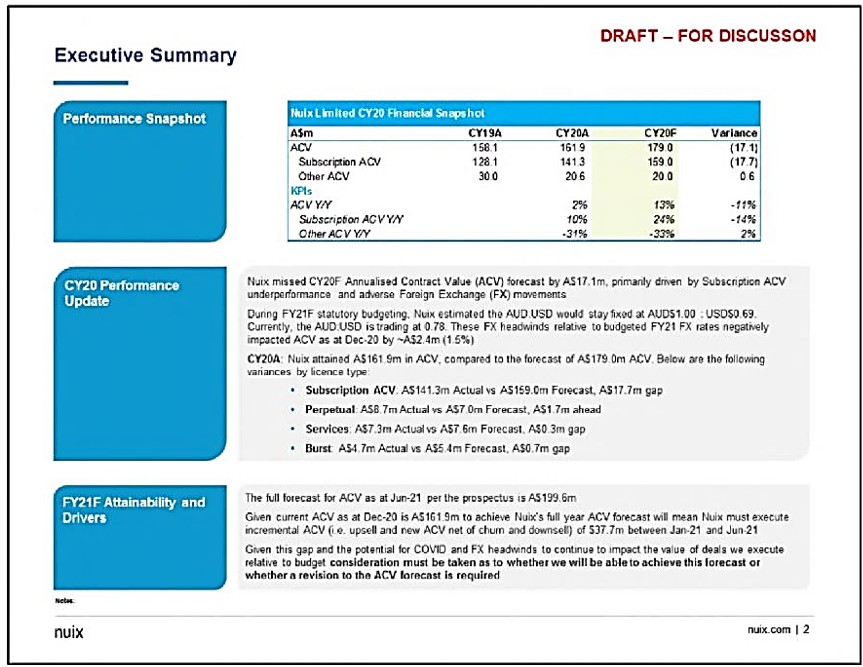
(2) a slide titled “ACV performance overtime” which included:
ACV has decreased $A7.0m between Jun-20 and Dec-20 driven by forecast reductions in LTM perpetual revenue and LTM services revenue. The ACV Gap to Forecast was A$17.1m as at Dec-20 driven by underachievement of incremental net dollar retention and new ACV of $17.7m. To achieve the ACV forecast as at Jun-21 in the prospectus will require execution of $37.7m additional ACV (net of lost and downsell)
(3) a slide titled “Subscription ACV performance overtime”:
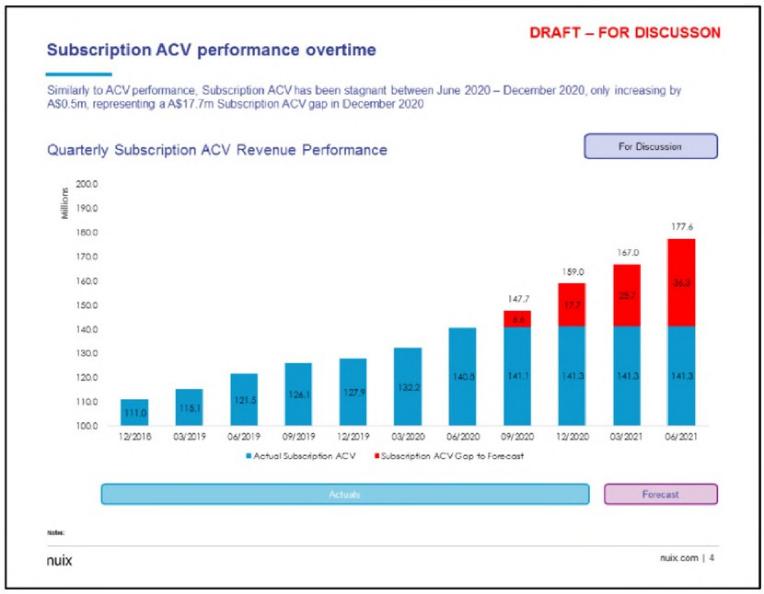 ; and
; and
(4) the following slide:
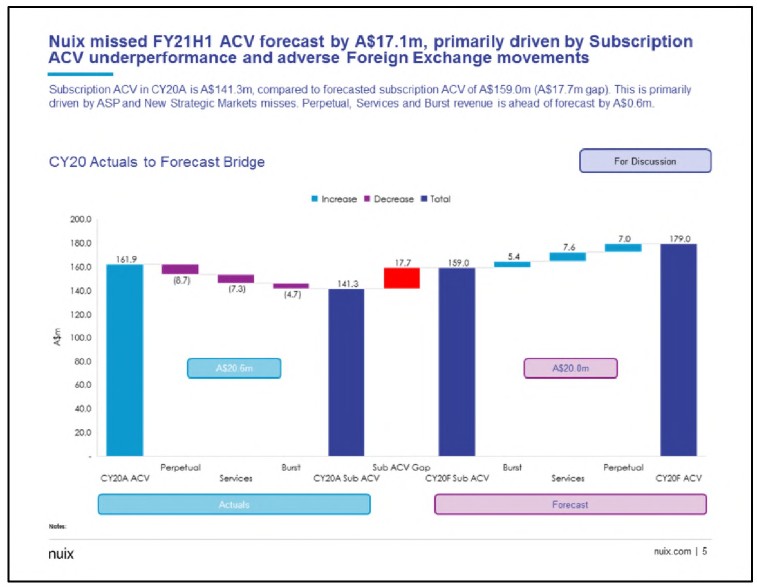
259 Mr Silveri’s unchallenged evidence was that Mr Hooper’s preliminary analysis considered Nuix’s ACV result as at 31 December 2020, and did not identify or analyse either the known opportunities that Nuix expected to close in 2HFY21 or the as yet unknown but estimable contracts Nuix would likely identify and close during the remainder of the year. That is, Mr Hooper’s draft analysis did not represent a view on forecast or forwardlooking ACV and opportunities currently in the Salesforce database for 2HFY21 and/or additional unbuilt pipeline that Nuix would expect to convert in the remainder of the financial year. Mr Silveri’s evidence was that such a forward-looking analysis could only be conducted once the finance team had completed its work in analysing up to date Salesforce data, and engaging with the Region Heads and sales teams, and it would be necessary for ACV to be reforecast once that work had been conducted to form a view as to whether the forecast concerning ACV as at 15 January 2021 would need to be updated.
260 I pause to note that ASIC contends that by dint of the attachment to Mr Hooper’s 15 January 2021 email, Mr Vawdrey was provided with papers which stated that at the end of 1HFY21 (i.e. 31 December 2020):
(1) Nuix’s ACV was $161.9 million;
(2) Nuix’s ACV was $17.1 million, or approximately 9.6 per cent, less than the ACV Nuix expected in order to achieve the Prospectus ACV Forecast; and
(3) the primary reason Nuix missed its forecast for ACV at the end of 1HFY21 was that Subscription ACV at the end of 1HFY21 was $17.7 million less than the forecast figure for Subscription ACV.
261 ASIC has described the information in [260(1) to (3)], for the purpose of its case, as the 1HFY21 ACV Result. As will be seen, ASIC alleges that Nuix failed – between 18 January and 25 February 2021 – to disclose the 1HFY21 ACV Result to the ASX and thereby engaged in misleading or deceptive conduct in contravention of s 1041H(1) of the Corporations Act and s 12DA(1) of the ASIC Act; and contravened s 674(2) of the Corporations Act.
C.12 16 January to 26 February 2021
262 On 16 January 2021, Mr Doyle responded (copying Mr Vawdrey and Mr Silveri):
I think we need to agree up front on numbers being distributed widely before we send next time. This commentary portrays USA as being ahead on orders and almost on track for revenue.
My understanding is that we are circa $6m AUD behind for USG and another $6m behind for USA ex USG when adjusting for EY. Please confirm/ reject my thinking.
In addition you may have hit on USD , but we didn’t on AUD bc of FX. We are judged collectively by BOD and shareholders on our AUD results.
Daniel I am not sure if you participated in the commentary but I would like to be consulted + Rod before this information is released next time.
Happy for suggestions please
Thank you
SD
EXECUTIVE SUMMARY
FQ2 order results came in at $14.2M USD vs a budget of $13.4M USD with revenue attainment at $16.5M M USD vs. same budget. For H1, this puts us at $29.5 USD in orders vs a budget $26.4M and revenue at $25.6MUSD vs same budget.
“BOD” is an acronym for board of directors.
263 The second round of forecast calls referred to in Mr Silveri’s 14 January 2021 email occurred in the week commencing 18 January 2021. The purpose of the calls was to build on the initial “first pass” review that he had conducted with the Region Heads, and to obtain feedback on the initial draft analysis he had provided to them, the key assumptions being made for new pipeline build and closure and the key initiatives being deployed to ensure that Nuix remained on track to achieve its forecasts. The Region Heads were continuing to consider the additional pipeline build that would be possible in 2HFY21 and their work was not yet complete.
264 Mr Rees attended a further forecast call with Mr Silveri during the week commencing 18 January 2021, during which Mr Rees discussed a further iteration of the draft statutory revenue forecast for EMEA. At this stage Mr Rees had a better view of how EMEA would meet its budget for FY21, and spoke to Mr Silveri about the key assumptions in the forecast and confirmed that he still thought EMEA was on track to meet its portion of the Field Budget.
265 On 19 January 2021, after a meeting between Mr Hooper, Mr Silveri, and other members of the finance and corporate strategy teams of Nuix, Mr Hooper sent an email to Mr Silveri and others re-attaching his draft trading update from 15 January 2021 with a list of action items. The email included:
Thanks again for your time today.
Have included below some action items off the back of the discussion today:
1. Draft Non GAAP metrics report (attached) to be updated to break pages 8 and 9 into categories per page 6 (i.e. lost, downsell, upsell, new) - Denis
2. Commentary on each of the key lost, upsell, downsell and new customers to be added - Jacob
3. Decide treatment of perpetual and services orders/revenue - Daniel/Scott/Jacob
4. Simon to provide statutory forecast for 1-Jan-21 to 30-Jun-21 so as Denis can convert to ACV projection - Simon
5. Denis to convert statutory forecast for 1-Jan-21 to 30-Jun-21 to ACV projection to understand coverage of FY21F ACV projection as at 30-Jun-21 - Denis
6. Laura to provide process framework paper to Jacob + Denis - Laura
7. Session to be held to go through treatment of any abnormalities i.e. KPMG, Bereskin & Parr LLP, United Health Group, Minter Ellison, Invesco, etc. - all (Jacob to provide list of customers to go through)
Would be great if items 1-5 could be attended to tomorrow so as we can have the session to iron things out at the end of this week.
(bold emphasis in original)
266 The action items listed in Mr Hooper’s email needed to be completed by Nuix’s finance and corporate strategy teams in order to:
(1) finalise the calculation of the December 2020 ACV metric and to understand why that figure was behind where Nuix expected to be at the end of 1HFY21; and
(2) forecast where Nuix expected to be at the end of FY21.
267 Mr Silveri considered that items 2 and 3 of Mr Hooper’s list were required to understand the December 2020 ACV result, and items 4 and 5 were required to conduct the further work required to forecast ACV for the remainder of FY21.
268 On 20 January 2021, at 8:00am, the directors of Nuix met.
269 At around the time of this meeting, Mr Bleich spoke with Mr Vawdrey to discuss whether Nuix was on track to achieve the Prospectus Forecasts, in light of Ms Thomas’s email of 6 January 2021. Mr Vawdrey expressed confidence, based on the information collected from the Region Heads, that Nuix would be able to achieve those forecasts. Mr Bleich had a general recollection that Mr Vawdrey said that they (i.e. people in Nuix’s finance and sales teams) had reviewed the pipeline and concluded that there was a clear path to achieving the forecasts, despite the political uncertainty in the United States arising out of the difficulties in the transition of power in that country having caused the US dollar to depreciate in December 2020, some government contracts to be delayed and exchange rate imbalances.
270 On 21 January 2021, Mr Doyle, Mr Vawdrey and Mr Silveri exchanged email messages:
(1) Mr Doyle:
One of the matters on the ARC list is reporting to BOD on status of forecast.
It came up again on call today.
I think the easier way is for Daniel to package our forecast that we undertake with regions each fortnight and prepare an executive summary wrap around for Rod to send to BOD. This should become part of our BAU.
Rod , any suggestions on how you want us to manage this ? ;
(bold emphasis added)
(2) Mr Vawdrey:
Agree and the board is waiting on end of half final summary and full year forecast, risk mitigations and approach to underpin 193
(bold emphasis added); and
(3) Mr Silveri:
Hi Rod,
Based on the discussions yesterday, the high level and unverified numbers provided roll up to A$188m (-3% to IPO Forecast) per below:
• USA A$82m
• USG A$23m
• EMEA A$50m
• APAC A$33m
It is also worth noting, that without the fx headwind in the first half of ~$6m, this would have the number at $194m.
I have requested the field to update their pipelines and will be running another top-down forecast view which should be in a position to be shared with you on Monday.
In terms of Board Pack, I am just finalising the draft and will have something to you for review later today.
(bold emphasis added)
271 After he had sent that email to Mr Vawdrey and Mr Doyle on 21 January 2021, Mr Silveri prepared that same day a further analysis of Nuix’s performance against its forecast for the purposes of preparing a draft report to the directors of Nuix. That analysis was recorded in spreadsheets which form part of the spreadsheets labelled by Ms Oliver and Mr Potter as the February Statutory Models. Mr Silveri prepared this draft report because it was one of his responsibilities at that time to prepare the financial information in the monthly board packs that were provided to the directors, reporting on Nuix’s YTD financial performance and how Nuix was tracking against its Prospectus Forecasts.
272 In doing so, Mr Silveri identified that Nuix’s “full year forecast” was A$136.8 million, comprised of:
(1) YTD closed/won deals, extracted from NetSuite;
(2) deferred revenue on deals closed in previous reporting periods, which would be released as revenue in FY21; and
(3) open opportunities in Salesforce categorised as “Commit”.
273 This represented a “gap to forecast” of A$56.7 million, being the remaining statutory revenue Nuix needed to achieve in the second half to attain its Prospectus Revenue Forecast. Mr Silveri considered whether the “gap to forecast” would be covered by:
(1) the remaining open pipeline in Salesforce (being opportunities in the “best case” and “pipeline” categories); and
(2) additional unbuilt pipeline, being potential deals that were not yet in Salesforce but could reasonably be assumed to open and close over the next six months based on the historical performance of Nuix.
274 The remaining open pipeline in Salesforce as at 21 January 2021 was valued at $101.5 million, which was 1.8 times the amount required to cover the “gap to forecast” of $56.7 million. Mr Silveri then applied a historical conversion rate of 48 per cent to the remaining open pipeline, which figure was derived from Nuix’s performance over the previous 18 months successfully converting open opportunities to won deals. As a result, Mr Silveri considered that Nuix could reasonably expect to generate an additional $48.7 million (101.5 x 0.48) in revenue from opportunities currently in the pipeline that would successfully close.
275 As to unbuilt pipeline, Mr Silveri took into account that the average pipeline build of opportunities which were both created and closed in the second half of FY20 totalled $28 million, and he applied a similar win rate of 48 per cent to derive an estimate of $13.4 million in revenue from additional unbuilt pipeline (28.0 x 0.48).
276 On that basis, Mr Silveri concluded that Nuix was on track to meet the Prospectus Revenue Forecast. At this time, his analysis produced an estimate that Nuix would finish FY21 with total statutory revenue of $198.9 million, being the sum of:
(1) YTD actual revenue, deferred revenue and deals classified in Salesforce as “Commit” ($136.8 million);
(2) a figure based upon a percentage of the remaining open pipeline ($48.7 million); and
(3) a figure based upon a percentage of additional unbuilt pipeline ($13.4 million).
277 On 21 January 2021 at 4:58pm, Mr Silveri sent to Mr Vawdrey and Mr Doyle an email attaching a draft board report in PowerPoint form for the period ended 31 December 2020. The email included:
Please see attached DRAFT Board Report for your review.
As noted in the pack, all figures are preliminary and subject to audit sign-off and the forecast is in process of undergoing detailed validation.
Please let me know if you have any questions.
278 Mr Silveri included the second sentence because he was still in the process of verifying the pipeline data in Salesforce with the Region Heads, a process that usually took a number of weeks after the close of a financial period. In his experience, it was not possible to have a concluded view on Nuix’s financial performance until the sales teams had completed updating the Salesforce data. The data on YTD statutory revenue actuals that he used to prepare the draft board report was also not finalised at that time and needed to be reviewed by PwC, as Nuix’s auditor.
279 The executive summary at page 2 of the draft board report compared Nuix’s half-year performance against the Prospectus Revenue Forecast. The summary stated that Nuix exceeded its IPO forecast by $0.2m against the Internal 1H Revenue Target, despite:
(1) a $6.3 million FX headwind from a depreciating US dollar; and
(2) $3.9 million in slipped deals and diminished professional services income due to limitations on delivery.
280 The executive summary also compared Nuix’s half-year performance against the Board Budget, showing a statutory revenue shortfall of $11.1 million against the first half of the Board Budget of $96.4 million. This was because Mr Silveri prepared the Board Budget on an orders basis and it was not revised by reference to the revenue recognition rules that were applied to the Prospectus Revenue Forecast. On an orders basis, without applying any revenue recognition rules, Nuix’s orders in the first half totalled $100.7 million, which exceeded the Board Budget for 1HFY21.
281 Page 5 of the draft board report , titled “Nuix Group Revenue Detail and Metrics”, contained an analysis of ACV for the 2020 calendar year, which had been prepared by Mr Hooper. The figures on this slide – which included actual ACV of $161.9 million for the 2020 calendar year against the forecast ACV of $179 million for that calendar year – were taken from Mr Hooper’s initial analysis in his 15 January 2021 email, and had not yet been verified.
282 At this time, further work had been commenced (but not completed) by the finance and corporate strategy teams to determine whether Nuix would be able successfully to close deals in the following six months that would meet the Prospectus ACV Forecast for FY21. This work was based on an analysis of the data in Salesforce and further input from the Region Heads and the sales teams.
283 Page 8 of the draft board report titled “1H FY2021 Revenue Bridge” contained a revenue bridge diagram for 1HFY21. The revenue bridge showed the conversion of orders booked (being the total face value of all contracts Nuix signed in 1HFY21) to statutory revenue. The total of orders booked for 1HFY21 was $107 million. That number was then adjusted for:
(1) the impact of FX, which resulted in a reduction of $6.3 million;
(2) deferred orders, which represented revenue that had been booked but could only be recognised in a future reporting period and not 1HFY21. This resulted in a reduction of $13 million; and
(3) the S&M component of contracts booked in 1HFY21, which could only be recognised as revenue in a future reporting period. This resulted in a reduction of $2.3 million.
284 Following the process above, Nuix’s actual statutory revenue recognised in 1HFY21 was $85.3 million (107 less [6.3 + 13 + 2.3]), which was $0.1 million more than the Internal 1H Revenue Target.
285 Mr Silveri included a note under the revenue bridge diagram, which stated that “[o]f the $13.0m in deferred, $6.9m of this amount is expected to be released in 2H FY2021.”
286 Page 9 of the draft board report, titled “GROUP - FY2021 Forecast & Pipeline Analysis”, contained Mr Silveri’s further analysis of Nuix’s pipeline and forecast for FY21 statutory revenue as at 21 January 2021. Mr Silveri used the words “DRAFT forecast is in the process of being validated with the field” which appeared in red text across the face of this page to emphasise to Mr Vawdrey and Mr Doyle that the numbers were preliminary and not finalised.
287 On 25 January 2021 at 12:34pm, Mr Vawdrey sent an email in response to Mr Silveri’s 21 January 2021 12:55pm email ([270(3)] above). Mr Vawdrey stated that “[w]e need to review in detail and see how we can get back to 193/194 as a minimum”. Mr Silveri understood Mr Vawdrey to be referring to the initial forecast numbers he had sent Mr Vawdrey on 21 January 2021. Mr Silveri’s position was that his further analysis (as reflected in the draft board report) already showed that Nuix would finish FY21 with a total statutory revenue of A$198.9 million.
288 Mr Silveri responded by email sent at 5:44pm that day to Mr Vawdrey and Mr Doyle, attaching a “refreshed top-down view of the forecast based on current data in the system”. Mr Silveri stated: “[t]his second cut of the data intimates a revenue number ⁓A$193m”. The attachment was an amended form of the Forecast and Pipeline analysis PowerPoint slide deck which he had used to prepare the 21 January draft report for the directors of Nuix. That attachment contained Mr Silveri’s revised analysis of Nuix’s forecast based on the latest available data in Salesforce and showed that Nuix expected to finish FY21 with statutory revenue of approximately $193 million. This figure reflected Mr Silveri’s best estimate of Nuix’s likely revenue for FY21 at the time, based on all of the then available information.
289 As at the end of January 2021, Mr Silveri was not satisfied that the data in Salesforce was complete or up to date and he held the view that further work was required with the Region Heads to validate and verify future opportunities.
290 On 1 February 2021, Ms Thomas sent an email to Mr Doyle and Mr Scott McGilvery (Head of Technical Accounting and Compliance of Nuix) with the subject line “Draft agenda for the 2 audit committee meetings”. The email attached a document titled “Agenda for ARC meeting” which contained two agendas under separate subheadings “Agenda for ARC meeting – Feb 2021” and “Agenda 25 Feb”. For the first of these meetings, proposed agenda item numbered 7 was “Review of prospectus forecasts – assumptions, pipeline of work, overs and unders compared to prospectus assumptions and current view”.
291 On 5 February 2021 at 8:42pm, Ms Nichols sent an email to each of the directors of Nuix (copying others) with the subject line “Nuix Strategy Workshop – briefing pack” for a workshop to be held on 9 February 2021 in the following terms:
Ahead of the Nuix Strategy workshop next Tues 9th Feb, 08.30 (Syd), please find attached a 3-part briefing pack to help frame and inform the session:
• Strategy Workshop Executive Summary – overview of the Prospectus growth strategies and the relevance of potential M&A
• Nuix M&A Strategy – current state M&A strategy and opportunities
• Corporate Goals and Measures – framework linking vision, mission, growth strategies and operational goals
The aim of the session is to share the approach we’re taking, discuss feedback and confirm that you are comfortable with the direction.
Please let me know if you have any questions, or have any issues accessing the materials ahead of the workshop.
(bold and italic emphasis in original)
292 One of the attachments to that email was titled “Corporate Goals and Measures_v3”. It included the following page:
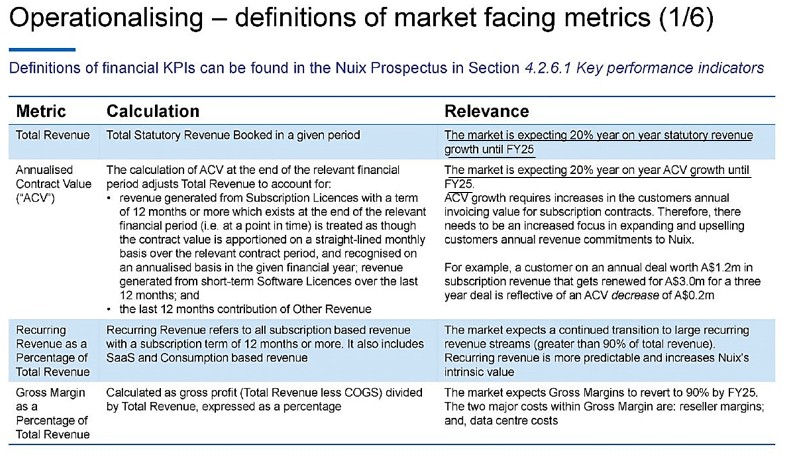
(bold and shaded emphasis in original; underline emphasis added)
293 Within that document was a page headed: “How do Shareholders view Nuix”, which relevantly included:
How do Shareholders view Nuix?
Shareholders and Market Analysts closely track Nuix across six key goals
Goal | Description | Measure |
Predictable Revenue Growth | Increasing total revenue with a high proportion of recurring revenue (greater than 90% of total revenue) and continued growth of statutory revenue and annualised contract value (“ACV”) of 20% per year. Maintain net dollar retention above 110% and customer revenue churn below 5% | • Total Revenue • Total Annualised Contract Value • Recurring Revenue as a Percentage of Total Revenue • Net Dollar Retention • Customer Revenue Churn |
… | … | … |
(bold and shaded emphasis in original; underline emphasis added)
294 Mr Bleich received that email from Ms Nichols. He may have attended the meeting on 9 February 2021, but does not specifically recall the workshop or briefing pack or having his attention drawn to any part of this briefing pack.
295 Sir Iain attended this workshop by videoconference, though he does not recall any of the detail of the workshop other than some focus on mergers and acquisitions. Sir Iain does recall that “we understood there was an expectation from shareholders of growth”.
296 On 5 February 2021 at 8:47am, Mr Egan sent to Ms Thomas and Mr McGilvery a draft notice of meeting and agenda for the ARC meeting scheduled for 11 February 2021.
297 Mr McGilvery responded, providing some comments including:
3. Items where verbal update may be provided:
Based on discussions I have had:
• Items 7 for draft investor presentation should be made available in mid-next; and
• Item 9 review of prospectus forecasts - separate discussions have been had between Sue and Rod on this - I am not privy to the outcome in terms of timing for paper submission, given forecast update calls are scheduled for much of next week. Suggest seek confirmation from Dan Silveri on this as well.
298 At 10:59am, Ms Thomas responded providing some comments on Mr McGilvery’s email. In response to the above passage she wrote:
if we cant go into detail, it would be good to get a report of high level assumptions for the prospectus forecasts and any over and unders, and where we sit on pipeline. This could be a work in progress report.
299 At 11:01am, Mr McGilvery forwarded the email chain to Mr Silveri (copying Mr Doyle).
300 At 4:53pm, Mr Egan sent an email to the members of the ARC and others attaching a notice of meeting of the ARC scheduled for 8:00am, 11 February 2021. His email indicated that he expected that the papers for that meeting would be distributed the following day (Saturday, 6 February 2021). The agenda included, as item 9, “Review of prospectus forecasts”. It also listed the scheduled meetings of the ARC including 8:00am, 11 February 2021 and 8:00am, 25 February 2021.
301 On 6 February 2021, Mr Egan sent an email to Ms Thomas, Mr Phillips, Sir Iain, Mr Doyle, Mr Vawdrey, Mr McGilvery and others, attaching a notice of meeting and an agenda for an ARC meeting on 11 February 2021, with agenda item 9 “Review of prospectus forecasts” and a notation that the papers relevant to this item would be “tabled on the day”.
302 On 8 February 2021, Mr Silveri sent an email to Mr McGilvery (copying Mr Doyle) attaching the latest draft figures as to how Nuix was tracking against the Prospectus Revenue Forecast. That email included:
See attached our latest WIP forecast.
As discussed, we will be having forecast calls this Wednesday and will be finalising this report thereafter on Thurs/Fri which will form the basis of guidance we provide in upcoming investor briefing.
303 As Mr Silveri stated in his email, the forecast was a work in progress and he was due to conduct further forecast calls with the Region Heads later that week. Mr Silveri anticipated being in a position after those calls to finalise his consideration of Nuix’s performance against the Prospectus Revenue Forecast and to consider whether there was any need to alter that forecast.
304 The draft forecast analysis that Mr Silveri provided to Mr McGilvery was the same analysis that he had shared with Mr Vawdrey on 25 January 2021 ([288] above). It had not changed since then and was prepared on the same basis as the forecast analysis in the draft board report of 21 January 2021. Based on the data that was available as at 8 February 2021, Mr Silveri expected Nuix to finish FY21 with statutory revenue of approximately $193 million.
305 On 10 February 2021 at 9:22am, Ms Knott circulated an electronic invitation for a meeting to be held on 12 February 2021 at 4:30pm. The invitation was sent to the Nuix directors, Mr Doyle, Mr Silveri, Dr Castagna and Mr Egan.
306 At 7:09pm that day, Mr Silveri sent an email to Mr Vawdrey (copying Mr Doyle and Mr McGilvery) with the subject line “Forecast Rollup – 3rd Round”, in the following terms:
Following our forecast calls today, I summarise the 3rd round field (bottom up), and group (top down) revenue forecasts as follows:
Field Forecast (bottom up)
• USA A$81m (excluding EY impact of $12m, this forecast is -$9m unfavourable to budget, predominantly driven by shortfall in new business deals/pipeline, and fx headwind)
• USG A$21m (this forecast is $5m unfavourable to budget, largely driven by 1H uncertainty with presidential election, COVID shutdowns, and fx headwind)
• APAC A$34m (this forecast is $1m unfavourable to budget, however maintains positive momentum and pipeline to achieve full year figure, particularly in Government and Law Firms)
• EMEA A$52m (this forecast is $2m unfavourable to budget, largely driven by a large proportion of H2 deals being Government which contain deferred maintenance)
• TOTAL A$188m
Group Forecast (top down)
• Per the attached, from a top down basis the current forecast is coming out at A$193.7m which is in line with the IPO forecast (+$0.2m) on a constant currency basis. After we adjust for 2H fx impact (using todays rate of 0.77c), this reduces the forecast by a further $7.0m, resulting in a fx adjusted revenue forecast of A$186.7m (-$6.8m or 3.5% unfavourable to IPO forecast).
This is essentially a 7+5 forecast (7 months actual, 5 months forecast), and at this point in time along with feedback from the regions today re positivity in upside deals, balance of year pipeline build, and opportunities for further multi-year commitments, this provides a degree of confidence in maintaining full year guidance (<+/-5% variance) albeit with little margin for error.
(bold and underline emphasis in original)
307 This email, which attached a PowerPoint presentation titled “Group Forecast Deck as at 10 Feb 2021” summarised the feedback that Mr Silveri had received from the Region Heads on Nuix’s expected performance against its FY21 forecasts and budgets following the third round of forecast calls that he had conducted that day.
308 Under the “Field Forecast” heading Mr Silveri summarised the views from each of the Region Heads of current deals in the Salesforce pipeline for each of the regions, which had been communicated to him during those calls. The views shared by the Region Heads were based on their views on the open opportunities in Salesforce, also known as a “bottom up” view of the forecast. On that basis, the Region Heads were expecting to finish FY21 with statutory revenue of $188 million. However, the “Field Forecast” was based on what was currently in the Salesforce pipeline and did not include additional unbuilt pipeline.
309 Mr Silveri’s analysis, under the “Group Forecast” heading, was a verification of the “bottom up” approach in relation to the additional unbuilt pipeline component of the Field Forecast. Mr Silveri validated the Region Heads’ views by reference to assumptions about then unknown opportunities that would open and close in the remainder of the financial year, by performing a probability assessment on a “top down” basis of additional unbuilt pipeline that was likely to convert into revenue by the end of FY21. On that basis, Mr Silveri estimated that Nuix would finish FY21 with statutory revenue of $193.7 million on the basis of the Budgeted Rate. The spreadsheet containing the data and calculations which produced the figure of $193.7 million forms part of the February Statutory Models.
310 Mr Silveri also calculated the FY21 statutory revenue forecast by using the spot FX rate, which was AUD 0.77c. This calculation assumed that the spot FX rate would remain at 0.77c for the period from February 2021 until June 2021. The purpose of this analysis was to enable Mr Vawdrey to understand what might happen for the remainder of 2HFY21 if the Australian dollar were to remain at the prevailing rate. Such an outcome would reduce the forecast by $7 million, resulting in an FY21 statutory revenue forecast of $186.7 million (which was 3.5 per cent less than the Prospectus Revenue Forecast). Mr Silveri was not of the view that the FX rate would remain the same for the remainder of FY21, given his view that FX rates are notoriously volatile and unpredictable and could not be predicted with any certainty. Nuix had already built in a buffer for some movement in FX rates against it on a statutory revenue basis and Mr Silveri expected that the FX rate would continue to move up and down relative to the Budgeted Rate throughout the remainder of FY21.
311 Despite the FX headwinds which had affected Nuix’s YTD actual revenue, Mr Silveri remained confident that Nuix would meet the Prospectus Revenue Forecast given his analysis of the Salesforce data and the feedback from the Region Heads, who were positive about:
(1) the additional upsell that could be achieved in 2HFY21;
(2) the expected growth of the pipeline in 2HFY21; and
(3) additional multi-year deals that were expected but not yet included in Salesforce.
312 On 11 February 2021 at 8:00am, the ARC met. All of the directors were present or in attendance.
313 The minutes of the ARC meeting include:
Review prospectus forecasts: | A meeting has been scheduled for tomorrow 12 February to review the full year 2021 forecast and comparison to Prospectus forecast. |
(bold emphasis in original)
314 Sir Iain’s recollection is that:
(1) there was some discussion about Nuix’s results for 1HFY21 and of the plan to meet on 12 February 2021 to review the Prospectus Forecasts. To the best of Sir Iain’s recollection, the meeting of 12 February 2021 had been convened because management were not in a position to report on the attainability of those forecasts at the ARC meeting because the relevant paper was not ready; and
(2) in the context of a discussion among the attendees about the plan to meet on 12 February 2021 to review the Prospectus Forecasts, Mr Phillips indicated that the 12 February 2021 meeting was going to be quite a technical financial meeting, that he (Mr Phillips) and Ms Thomas would attend and work through the material with management, and that Sir Iain’s attendance would not be required. Sir Iain responded that he would not attend, as it was not conveyed to him that there were any urgent issues to be addressed at the meeting and he had not planned to attend it given he attended the Strategy Workshop and ARC meetings on 9 and 11 February which both finished late in UK time. From the absence of any communication from Mr Phillips or Ms Thomas to Sir Iain following the 12 February 2021 meeting, Sir Iain assumed that there were no issues of concern raised at that meeting.
315 Mr Bleich attended the ARC meeting on 11 February 2021. His recollection of this meeting is that:
(1) there was some discussion about Nuix’s results for 1HFY21. Either Mr Vawdrey or Mr Doyle presented to the ARC and said that Nuix’s results were not as robust as hoped, and that Nuix was tracking to achieve the Prospectus Forecasts but not the Board Budget for FY21. Mr Bleich was concerned when he heard this;
(2) the non-executive directors then asked Mr Vawdrey and Mr Doyle questions about the 1HFY21 results including what the forecast for FY21 was, based on current data, and whether or not they were still comfortable based on current data that Nuix would be in a position to meet the Prospectus Forecasts;
(3) Mr Bleich asked questions of Mr Vawdrey and Mr Doyle as he wanted to obtain some assurance from them that the pipeline was looking healthy for 2HFY21 and that they were confident it would be sufficient to enable Nuix to deliver on the Prospectus Forecasts;
(4) Mr Vawdrey or Mr Doyle said they did not have updated forecasts for FY21 from the finance team at that time, and that they would try to get that data by the next day (12 February 2021);
(5) he did not recall anyone suggesting that there was a reason to believe that Nuix would not achieve the Prospectus Forecasts at that time; and
(6) the 12 February 2021 meeting was being convened to allow management time to give a proper presentation to the Nuix board on the analysis they had undertaken as to whether those forecasts would be attained. Mr Bleich was keen to understand that analysis, but did not consider that the meeting was being convened to address a “problem” or “issue” that had arisen.
316 At 12:10pm, Ms Thomas sent an email to Mr Doyle, Mr McGilvery and Mr Egan:
Thanks for today. I think everyone did a great job, and I am very confident that we are travelling well for the accounts sign off in 2 weeks.
I have attempted to update the agenda items and what the next meeting agenda might look like.
317 The attached document titled “Agenda for ARC meeting” included:
…
6. Review of prospectus forecasts – assumptions, pipeline of work, overs and unders compared to prospectus assumptions and current view | Friday meeting |
C.12.1 11 February Board Pack and the February Revenue Forecast
318 Also on 11 February 2021:
(1) at 6:53pm, Ms Nichols sent an email to Mr Vawdrey and Mr Doyle with the subject line “First pass results narrative (summary) + supporting Investor Presentation structure”;
(2) at 7:37pm, Mr Doyle responded:
Thanks Sarah
It is a good start but I think we can be more upbeat. Our field forecast is showing we will hit the 193.5m and the 200$ ACV. And we are also only at 7+5 to go. Can we leverage some of the investor preso slides, stay macro, and talk to Orders, huge mkt opportunity and even with seasonality/FX/COVID-19 headwinds we still made the Half?
… ;
(3) at 10:20pm, Mr Silveri sent an email to Mr Vawdrey in the following terms:
Please see attached 1H Board Pack which can be sent to the Board and form the basis of discussion material for tomorrow’s meeting.
It contains underlying unaudited (yet to be signed-off) results and forecast in addition to a few placeholder slides which we will continue to build on in coming months.
Stephen is across all the slides in this pack. ; and
(4) at 10:22pm, Mr Vawdrey forwarded Mr Silveri’s email to the other directors of Nuix.
319 The draft board pack attached to Mr Silveri’s email (11 February Board Pack) contained a title page headed “Nuix Board Pack – Period Ended December 2020” including a note “DRAFT – FOR DISCUSSION – All figures are preliminary and subject to audit sign-off”. On page 2 it included an Executive Summary, which provided in part:
1H FY2021 Performance vs. IPO Forecast
Revenue
• Exceeded IPO forecast by $0.2m against $85.2m half year target.
• This is despite significant exchange rate headwind ($6.3m), $3.9m of slipped deals and diminished professional services income due to restrictions on delivery.
• Reduction from prior corresponding period of $1.5m driven by $2.3m reduction in professional services income and a large number of MYDs in FY20 (Facebook, ASIC, Deutsche, Chevron). Majority of significant MYDs in FY21 were SaaS related.
• ACV increased by 3% to $161.9m, whilst churn remained around industry standard at 4.6%.
EBITDA
• Exceeded forecast by $15.3 m.
• Driven by cost savings across the board, particularly in COGS, driven by lower reseller margin and 3rd party costs, and operating expenses, as employment costs, marketing and travel were decreased due to COVID and favourable headcount against budget.
1H FY2021 Performance vs. Board Budget
Revenue
• Orders exceeded budget at $107.0m converted at budget rates.
• Adjusting for US dollar headwind, total orders were favourable to budget at $100.7m. Total headwind experienced was $6.3m on orders, predominantly from a depreciating US dollar. $6.2m of revenue was deferred as a result of SaaS orders booked YTD.
• Shortfall of $11.1m against board revenue budget of $96.4m
• Driven by unbudgeted support and maintenance deferrals of $2.3m, increase in SaaS delivery (proportion of revenue increased 45% to 8.4%) and FX headwind.
• Significant budget revenue misses experienced in US Government and APAC New Markets contributed heavily to the overall Group position. This was driven by the US election and, and [sic] COVID distress in Asia. Globally, only ASP and DACH domains achieved board budget (notwithstanding there was a favourable A$6.1m accounting adjustment in ASP relating to EY).
EBITDA
• Unfavourable to budget by $42.7m due to unbudgeted IPO transaction costs, such as JLM and legal fees, totalling $45.4m
• Notwithstanding these costs, EBITDA exceeded budget by $2.7m due to cost savings across the board.
Strategic initiatives
• There is $5.0m of budgeted strategic initiatives investments that have not yet been made
• Continuing to invest in France, Germany and Spain, which have been identified as key growth regions. The DACH region has produced strong growth this financial year whilst the France and Spain countries are actively developing their workforce.
• Successfully completed the Salesforce integration project during this half, standardising the sales, quoting, forecasting, and deal desk process.
(bold emphasis in original)
320 The 11 February Board Pack also included the following slides.
321 First, a slide titled “FY2021 IPO Statutory Revenue Forecast – $193.7F vs A$193.5 IPOF” which was marked “DRAFT – For Discussion Only” and which provided a waterfall chart with the following commentary:
The waterfall chart above illustrates the bridge from FY2021 orders to revenue including fx headwinds, deferred S&M revenue, and other revenue deferrals (future start dates, professional services, training).
Forecast: From an order perspective, we are expecting to close at A$228.9m. After accounting for revenue deferrals (including higher than expected SaaS orders/migration) and fx headwinds, we are forecasting revenue of A$186.7m against the IPO forecast of A$193.5m (-A$6.8m or -3.5%).
FX: A large portion of revenue for the 1H FY2021 was recognised in December with an average AUD:USD exchange rate of ~0 75c vs. a budgeted rate of 0.69c creating a significant headwind to our reported revenue which is denominated in AUD. For context, at the time of budget setting for FY2021 which was in the midst of the pandemic, the AUD:USD currency pair was <0.65c. For the purposes of this forecast on a fx adjusted basis, for 2H FY2021 we have assumed an AUD:USD fx rate of 0.77c, and this results in a further headwind of $7.0m, totalling ~$13m for the full year or ~7% of revenue.
1H Deferred Orders: $13.0m of the $100.7m in orders closed YTD were deferred to subsequent periods as a result of:
• $6.8m for orders with start dates in future periods, professional services and/or training yet to be delivered; and
• $6.2m of SaaS deals which are required to be recognised monthly over the contract period
Support & Maintenance (S&M): this adjustment provides for S&M to be accounted for separately to the license over the contract term (based on standalone selling price of 16.7% of the license fee), which is spread rateably on a monthly basis over the contract term. This adjustment accounts for both headwind (deferral of current period orders) and tailwind (release of prior period’s orders).
(bold emphasis in original; underlining added)
322 That slide contained a new analysis (not included in the 21 January 2021 draft board pack) which provided, inter alia, a more detailed explanation of how FX had affected Nuix’s statutory revenue to that date and what the full year forecast would be if the AUD:USD foreign exchange rate remained the same for the remainder of FY21. Mr Silveri assumed that if the US dollar remained at AUD $0.77 for the rest of the year (rather than the Budgeted Rate), Nuix would continue to face an FX headwind which would result in a potential statutory revenue figure of AUD $186.7 million, being $6.8 million or 3.5 per cent less than the Prospectus Revenue Forecast. Mr Silveri included this analysis to “stress test” his process for tracking progress against forecasts, and he considered it to be conservative for what may happen if the Australian dollar remained strong.
323 Secondly, a slide titled “GROUP – FY2021 Forecast & Pipeline Analysis” which was also marked “DRAFT – For Discussion Only” and which provided:
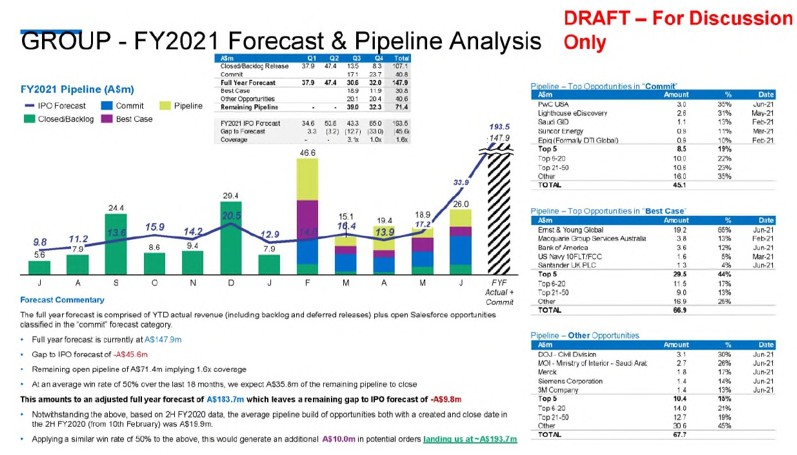
324 Mr Silveri updated this slide (compared to the January 2021 draft board pack) as follows:
(1) the “full year forecast” (that is, before incorporating any revenue from “open pipeline” or “unbuilt pipeline”) was $147.9 million (which was $11.1 million higher than in the earlier version of the draft board pack he had prepared in January 2021); and
(2) as a result, Nuix’s “gap to forecast” had reduced to $45.6 million.
325 Mr Silveri calculated that Nuix would finish FY21 with total statutory revenue of $193.7 million, being the sum of:
(1) YTD actuals, deferred revenue and deals classified in Salesforce as “Commit” ($147.9 million);
(2) a figure based on the percentage of the remaining open pipeline ($35.8 million); and
(3) a figure based on the percentage of additional unbuilt pipeline ($10 million).
326 To calculate the figures in [325(2) and (3)] above, Mr Silveri continued to use win rates and assumed pipeline build based on the exact date in the prior corresponding period. That is, the win rates and assumed pipeline build figures that Mr Silveri used on or around 21 January 2021 to prepare the draft board pack were different to the ones that he used in the 11 February Board Pack. That was because as Nuix progressed through any given financial year, the assumed pipeline build number reduced and the win rates changed based on the composition of the pipeline by RUN. As the categories of deals changed throughout the year, this affected the applicable win rate at any point in time.
327 The FY21 statutory revenue forecast of $193.7 million that Mr Silveri included in the 11 February Board Pack was his best estimate of Nuix’s progress against the Prospectus Revenue Forecast based on the information available to him at that time. That analysis was ongoing.
328 Thirdly, a slide titled “ACV – Prospectus Target of A$200m by 30 June 2021” which provided:
ACV – Prospectus Target of A$200m by 30 June 2021
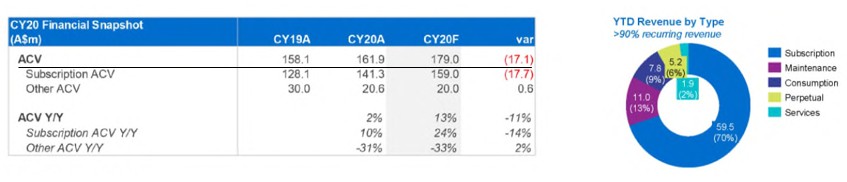
CY20 Performance Update
Nuix missed CY20F Annualised Contract Value (ACV) forecast by A$17.1m, primarily driven by Subscription ACV underperformance and adverse Foreign Exchange (FX) movements.
During FY21F statutory budgeting, Nuix estimated the AUD:USD would stay fixed at AUD$1.00 : USD$0.69. Currently, the AUD:USD is trading at 0.77. These FX headwinds relative to budgeted FY21 FX rates negatively impacted ACV as at Dec-20 by ⁓A$2.4m (1.5%).
CY20A: Nuix attained A$161.9m in ACV, compared to the forecast of A$179.0m ACV. Below are the following variances by licence type:
• Subscription ACV: A$141.3m Actual vs A$159.0m Forecast, A$17.7m gap
• Perpetual: A$8.7m Actual vs A$7.0m Forecast, A$1.7m ahead
• Services: A$7.3m Actual vs A$7.6m Forecast, A$0.3m gap
• Burst: A$4.7m Actual vs A$5.4m Forecast, A$0.7m gap
FY21F Attainability and Drivers
The full forecast for ACV as at Jun-21 per the prospectus is A$199.6m.
Given current ACV as at Dec-20 is A$161.9m to achieve Nuix’s full year ACV forecast will mean Nuix must execute incremental ACV (i.e. upsell and new ACV net of churn and downsell) of $37.7m between Jan-21 and Jun-21.
Given this gap and the potential for COVID and FX headwinds to continue to impact the value of deals we execute relative to budget consideration must be taken as to whether we will be able to achieve this forecast or whether a revision to the ACV forecast is required.
(bold and shaded emphasis in original; underline emphasis added)
329 I pause to note that ASIC alleges that the 11 February Board Pack informed the directors of Nuix of, inter alia, the following:
(1) Nuix was forecasting Revenue of $186.7 million for FY21 (which ASIC describes as the February Revenue Forecast), which was $6.8 million (or approximately 3.5 per cent) less than the Prospectus Revenue Forecast of $193.5 million;
(2) the 1HFY21 ACV Result (as defined at [261] above);
(3) that given the gap of $37.7 million between Nuix’s ACV figure at the end of 1HFY21 which was $161.9 million, and the Prospectus ACV Forecast of $199.6 million, consideration needed to be given as to whether Nuix would achieve the Prospectus ACV Forecast, or whether a revision to the Prospectus ACV Forecast was required; and
(4) Nuix’s NDR was 101 per cent (based on revenue movements from the end of CY19 to the end of CY20).
330 Mr Bleich received Mr Vawdrey’s email, forwarding Mr Silveri’s email with the 11 February Board Pack, around 3:30am on 11 February 2026 in his time zone. As he had early morning meetings he did not have time to open and read the attachment to this email before the meeting set for 4:30pm on 12 February 2021 AEDT.
331 On 12 February 2021 at 4:07pm, Mr Doyle sent an email to the directors of Nuix attaching a document titled “Monthly Board Reporting Pack – Dec 2020 SD Commentary” and stating:
You won’t have time to read entire pack, so we will focus on walking through first 6 slides.
Chat in 30 minutes
332 That attachment included (shading as per the documents as tendered):
(1)
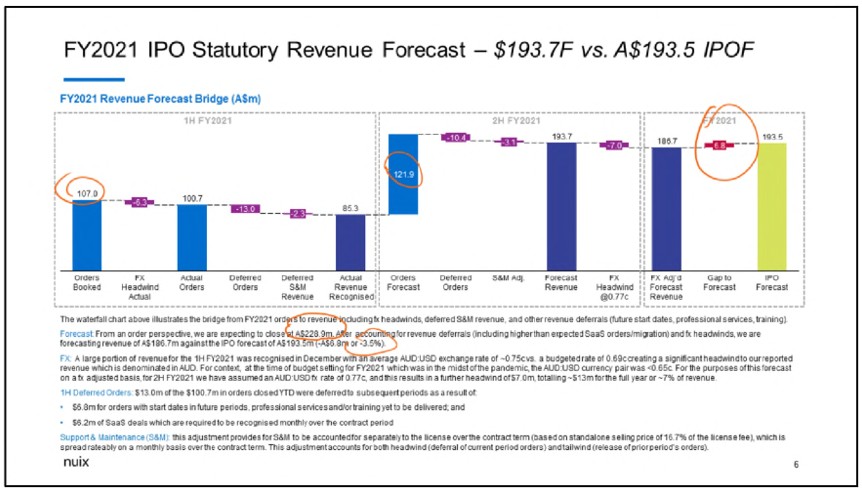
(2)
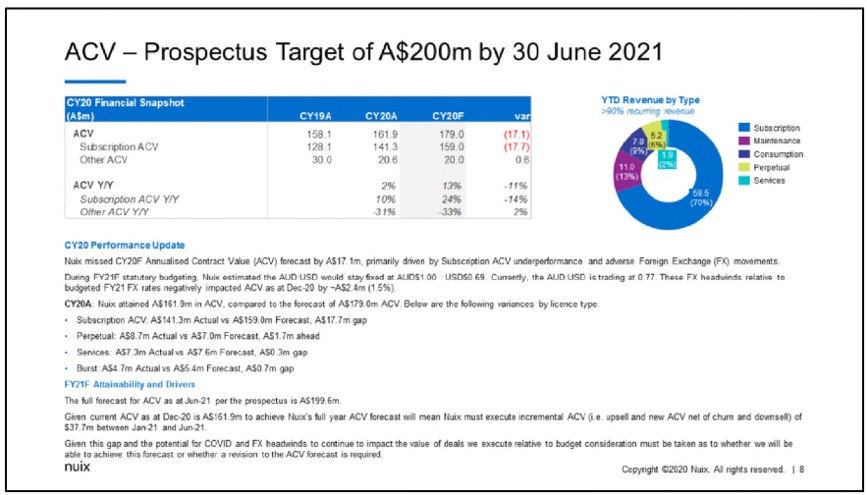
333 Sir Iain received both Mr Vawdrey’s and Mr Doyle’s emails, but had no specific recollection of reviewing the attachments to those emails at the time. Although his usual practice was to review board packs and material provided to him in respect of a board meeting prior to that meeting if he was able to do so, his best recollection is that he did not do so on the basis that the 12 February 2021 meeting was not a formal board meeting and he did not plan to attend. He did not understand that there was any urgent issue being addressed in these papers that required his particular attention at the time.
334 In this regard, Sir Iain’s general practice when reviewing the kind of material presented in board and ARC packs – which was primarily in the form of tables and visual representations of financial information – was to peruse it at a high level. He read it to get a general sense, or the “gist”, of what was being presented. As he lacked a background in finance, he usually did not form any conclusions about what that information was conveying to him when reviewing that information on his own. He might have noted some points of interest, or matters on which he wanted to ask questions. If he was expected to make a decision based on that information, he would have needed someone from management (most likely, either Mr Vawdrey or Mr Doyle) to take him through the information and explain what it meant and how he should read it. Before forming any conclusions or judgements, he also paid careful attention to the input from other Nuix directors who had a financial background, or from external advisers such as PwC if they were in attendance. In 2021, the Nuix directors to whom Sir Iain paid particular attention were Ms Thomas and Mr Phillips. More generally, Sir Iain found that the discussion that occurs during board meetings to be essential to putting the information provided in board packs in context and informing his consideration of that information.
335 Mr Bleich’s evidence was that he reviewed at the time the board pack attached to Mr Doyle’s 12 February 2021 email, but not the one attached to the earlier email from Mr Vawdrey.
336 On 12 February 2021 at 4:30pm, the directors of Nuix, save for Sir Iain, met.
337 On 12 February 2021 at 4:35pm (i.e. during the course of the meeting held on that day), Mr Hooper sent an email to Mr Vawdrey, Mr Doyle, Mr Silveri and others with the subject line “Draft – Nuix Non GAAP Metrics Half-Yearly Update”:
Find attached draft for discussion purposes only updated Nuix Non-GAAP Metrics updated for 1HFY21.
The deck has been updated to reflect:
• Comments per discussion this morning
• Pipeline for 7A + 5F (prior version did not include pipeline coverage workings). Note, Daniel’s pack has pipeline coverage and NDR presented for 6A + 6F. There is not a significant difference between workings between pipeline coverage between the two.
Sorry for not getting it to you sooner.
(bold and underline emphasis in original)
338 The attached paper – titled “Nuix Non-GAAP Metrics Half-Yearly Update” and marked “DRAFT – FOR DISCUSSON [sic]” included a series of slides, including relevantly the following.
339 First, an Executive Summary:
|
|
| Dec-19 to Dec-20 ACV YoY Update Nuix attained Annualised Contract Value (ACV) of A$161.8m as at Dec-20. This represents YoY growth of A$3.9m (2%) compared to Dec-19. YoY ACV growth was driven by YoY growth in subscription ACV of A$13.3m or 10% driven by key new and incremental ACV associated to Latham and Watkins, Siemens, Australian Army, Rothschild, ATO, Consilio, Westpac, Uber, Eli Lilly etc.. Partially offset by FX headwinds of [to be calculated] and a decrease in other ACV (professional services and perpetual) of A$9.4m (-31%). Dec-20 ACV relative to Dec-20 internal milestone (not disclosed in prospectus) Dec-20 ACV of A$161.8m represents a shortfall of A$17.2m (-11%) compared to our internal milestone of $A179.0m as at Dec-20. Note, the internal milestone has not been disclosed externally in the prospectus or to investors. Rather $A179.0m was the ACV we expected to be at by Dec-20 to achieve our full year ACV FY21F prospectus ACV of $A199.6m. The shortfall between actual Dec-20 ACV and the expected milestone ACV is driven by: • Subscription ACV: A$141.3m Actual vs A$159.0m Forecast, A$17.7m gap. This is driven by a shortfall in internal milestone ACV associated with our ASP domains and new strategic markets (Asia, Japan, India) • Other ACV (Perpetual, Services and Burst): A$20.6m Actual vs A$20.0m internal milestone as at Dec-20, driven by perpetual outperforming by A$1.7m, partially offset by a shortfall in burst (A$0.7m) and services (A$0.3m) |
| The full forecast for ACV as at Jun-21 per the prospectus is A$199.6m Given current ACV as at Dec-20 is A$161.9m to achieve Nuix’s full year ACV forecast will mean Nuix must execute incremental ACV (i.e. upsell and new ACV net of churn and downsell) of $37.7m between Jan-21 and Jun-21 Based on the conversion of the salesforce pipeline (extracted on Wednesday 5thth [sic] February 2021) to an ACV forecast we have a weighted pipeline coverage of 1.3x or unweighted pipeline coverage of 1.0x The key factors which derive this pipeline coverage on a weighted basis are: • Commit weighting: 100% factored in • Best Case and Pipeline weighting: 48% Conversion per Finance • FX rates: AUD to USD rates current spot rates @ 0. 78 vs budget rates of 0.69 • Assumed pipeline build-up execution: execution of $28.0m of ACV not yet in the pipeline |
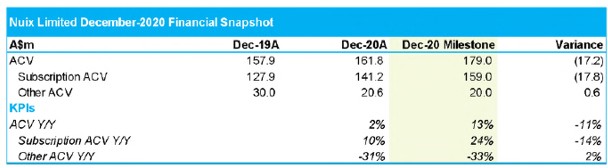
(bold emphasis in original)
340 Secondly, a slide titled “ACV Performance overtime”:
The ACV Gap to Forecast was A$17.1m as at Dec-20 driven by underachievement of net dollar retention and new ACV of $17.7m. To achieve the ACV forecast as at Jun-21 in the prospectus will require execution of $37.7m additional ACV (net of lost and downsell). Refer to the next two pages for pipeline coverage of this current gap.
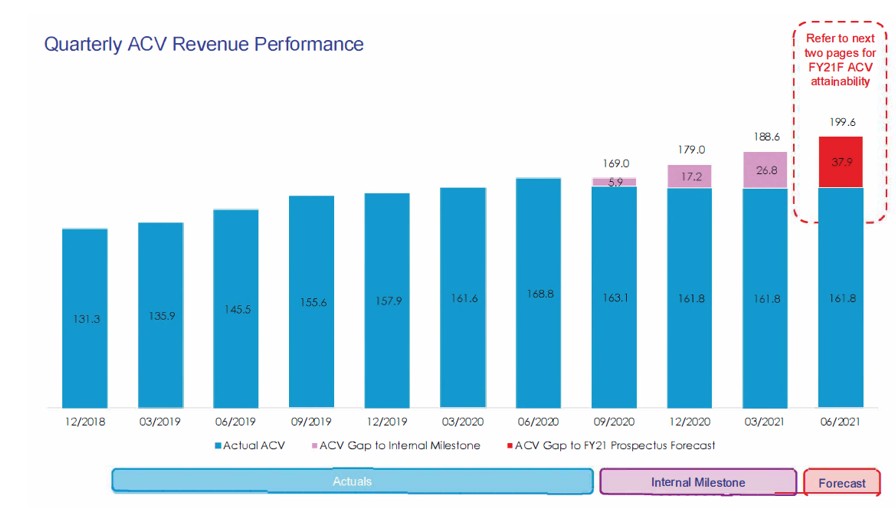
341 Thirdly, a slide titled “Unweighted ACV Forecast Coverage for FY21F (7A + 5F)”:
The below presents FY21F ACV unweighted coverage build up based 7 months of actuals and 5 months of forecast. The forecast pipeline is based on salesforce pipeline extracted as at Wednesday, 5th February 2021.
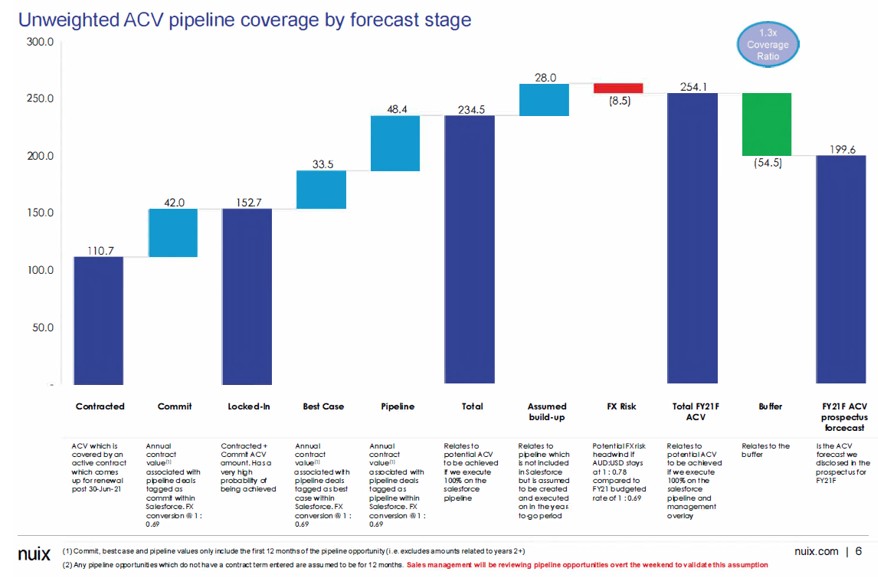
342 Fourthly, a slide titled “Weighted ACV Forecast Coverage for FY21”:
The below presents FY21F ACV weighted coverage build up based 7 months of actuals and 5 months of forecast. The forecast pipeline is based on salesforce pipeline extracted as at Wednesday, 5th February 2021 with conversion factors applied to each of the pipeline categories per Finance.
Weighted ACV pipeline coverage by forecast stage
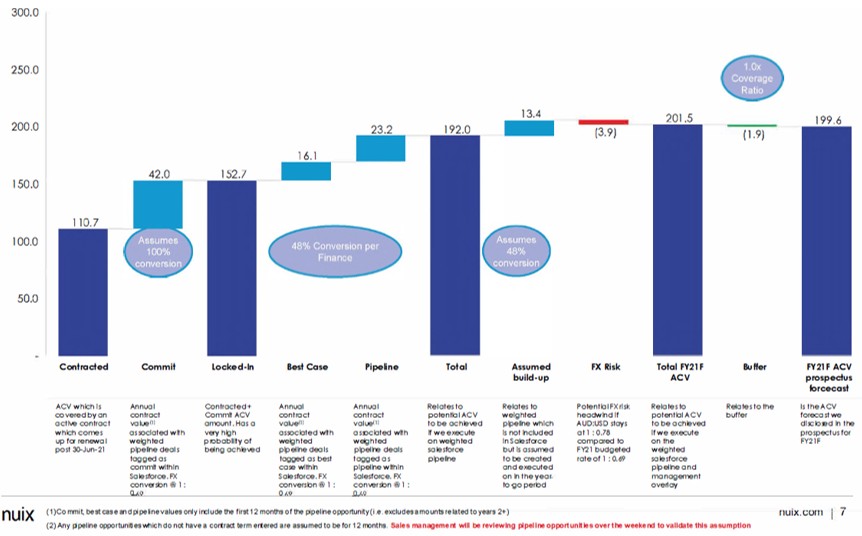
(bold emphasis in original)
343 Fifthly, a slide titled “Dec-19 to Dec-20 ACV YoY Update”:
Attained ACV of A$161.8m as at Dec-20. This represents YoY growth of A$3.9m (2%) compared to Dec-19. This is driven by a decrease in other ACV (professional services and perpetual) of A$9.4m (-31%).
Net dollar retention as at Dec-20 is 102%. This is driven by upsell being offset by downsell associated with FX headwinds and decreased demand by certain customers. This milestone NDR is lagging the FY21F prospectus NDR of 112.8%. Churn of 4.1% is in-line with the historical average.
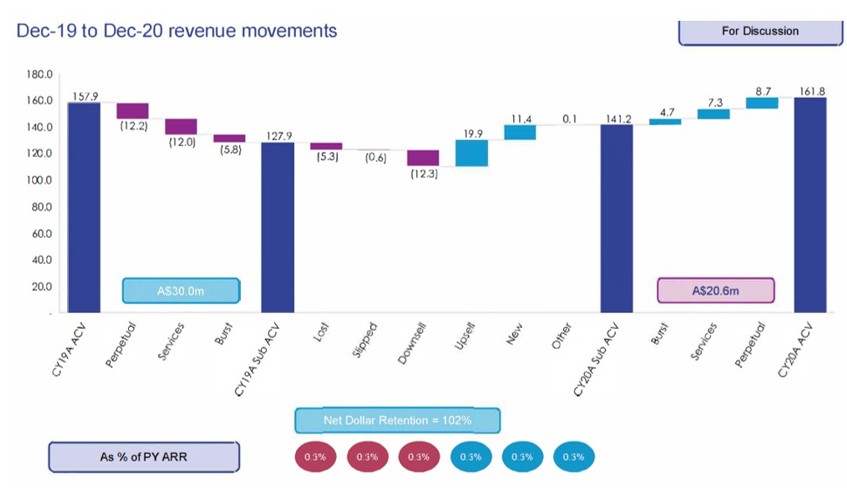
344 Sixthly, a slide titled “Nuix missed FY21H ACV forecast by A$17.1m, primarily driven by Subscription ACV underperformance and adverse Foreign Exchange movements”:
Subscription ACV in CY20A is A$141.3m, compared to forecasted subscription ACV of A$159.0m (A$17.7m gap). This is primarily driven by ASP and New Strategic Markets misses. Perpetual, Services and Burst revenue is ahead of forecast by A$0.6m.
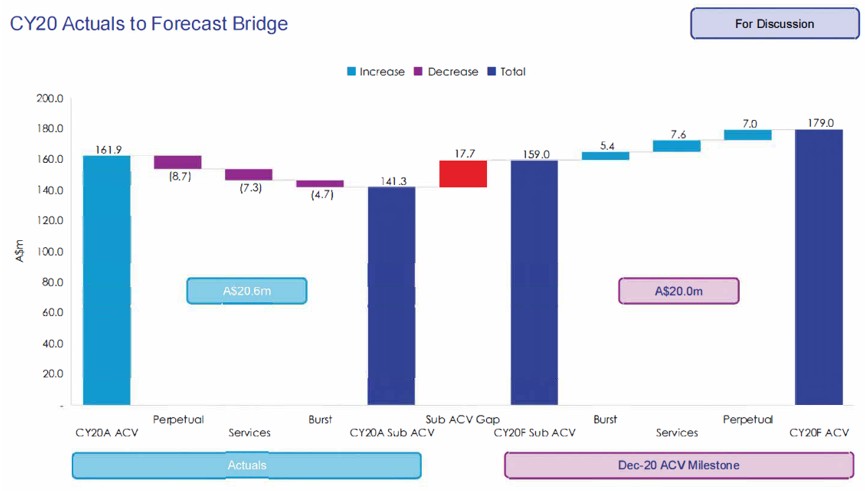
345 I pause to note that ASIC contends that by dint of Mr Hooper’s 12 February 2021 email and its attachments, Mr Vawdrey was again provided with papers which stated the 1HFY21 ACV Result (the first occasion being on 15 January 2021 – see [257] above).
346 Mr Silveri provided evidence that:
(1) he reviewed the attachment to Mr Hooper’s email and noted that:
(a) on the Executive Summary (page 3), next to the “FY21F ACV Prospectus Attainability” box, Mr Hooper included additional analysis that was not provided in Mr Hooper’s ACV analysis of 15 January 2021. In this revised analysis, Mr Hooper noted that “Based on the conversion of the salesforce pipeline (extracted on Wednesday 5th February 2021) to an ACV forecast we have a weighted pipeline coverage of 1.3x or unweighted pipeline coverage of 1.0x’’. Mr Silveri understood that to mean that the incremental ACV of $37.7 million that Nuix required between January and the end of June 2021 in order to meet the Prospectus ACV Forecast was covered by the data in Salesforce as at 5 February 2021;
(b) on the “Weighted” and “Unweighted” ACV Forecast Coverage pages (pages 6 and 7), Mr Hooper provided further detail on how the data in the Salesforce pipeline provided coverage for the Prospectus ACV Forecast on both a weighted and unweighted basis. The weighted basis included conversion factors applied to each of the open opportunities in Salesforce. These were the same factors that the Nuix finance team applied to the Salesforce data when monitoring Nuix’s performance against the Prospectus Revenue Forecast, namely that:
(i) deals classified as “Commit” were counted in full as part of the forecast;
(ii) deals classified as “Best Case” and “Pipeline” were weighted at 48 per cent;
(iii) assumed pipeline build-up of $28 million of ACV not yet in the pipeline for the remainder of the financial year;
(c) the unweighted basis for pipeline coverage does not include these conversion factors; and
(2) he had met with Mr Hooper, Mr Pipic, Mr Borcherdt and Mr Doyle earlier on 12 February 2021 to discuss the ACV analysis that would be sent in Mr Hooper’s email that afternoon. The purpose of the meeting was to ensure that Mr Hooper and Mr Pipic were taking the same approach to interpreting the data in Salesforce as the Nuix finance team. That is, both statutory revenue and ACV needed to be based on Salesforce as a single source of truth, and the Salesforce data should be interpreted in the same way across Nuix. He understood that Mr Hooper and Mr Pipic required this information so that they could calculate whether there was sufficient coverage (or pipeline) in order to attain the Prospectus ACV Forecast. As with statutory revenue, Mr Silveri understood that the ACV figures were a work in progress as at 12 February 2021 and needed to be validated by Mr Hooper after further verification of the Salesforce data by the sales teams.
347 Within the minutes of the meeting of the ARC meeting held on 11 February 2021 is what appears to be an addendum, and which describes the 12 February 2021 meeting as follows:
As noted in the meeting of the Audit and Risk Management Committee held on 11 February 2021, a meeting was scheduled on 12 February to review the full year 2021 forecast and comparison to the Prospectus forecast.
This meeting was attended by management and certain Directors. The meeting reviewed current forecast revenue compared to budget and Prospectus revenue.
Based on the current forecast, the meeting concluded that they remain confident of achieving Prospectus revenue forecast.
(bold emphasis added)
348 Mr Egan’s handwritten notes of that meeting record (as written):
Q: Earnings rather than sales
Nuix
MEETING FOLLOW UP 12 FEBRUARY START: 4:30
Present: Jeff; Sue; Dan; Rod FINISH:
Stephen; Tony
Aim: • not to be too bulish; but going well
• review forecast
•COVID: away from off has slowed decisions
Presentation:
• Strategic initiatives
• Board revenue: $210m. IPO $193.5m
• 44% in first half; maybe 47%
• does this mean that it will be difficult to get 56% in second half.
• SaaS growing (47%) future orders locked in
(RPO: remaining performance obligation)
ACB:
• Expense savings in Sales + Distribution
• operational efficiency
• Disruption: US$; administration change slow (not lost)
• $13m deferred = SaaS $6.2; $6.9 release 2H (multi year of $85.3m - $20m is multi year deal
• ARR: annual recurring revenue
• ACV: annual contract value
________________________________
• WE ARE CONFIDENT OF ACHIEVING PROSPECTUS REVENUE
(bold emphasis added)
349 Those handwritten notes accord with Mr Bleich’s recollection of what occurred at that meeting, including that the meeting went for about 90 minutes, which was longer than a regular ad hoc board meeting.
350 Mr Bleich’s recollection of that meeting was that:
(1) Mr Vawdrey and Mr Doyle gave a presentation to the attendees and went through some of the slides that Mr Doyle had distributed before the meeting;
(2) Ms Thomas and Mr Phillips asked a number of questions concerning the information presented by Mr Vawdrey and Mr Doyle;
(3) both Mr Vawdrey and Mr Doyle said that the information presented about the 1HFY21 results and the Prospectus Forecasts was preliminary and based on un-audited numbers, that certain assumptions made by the sales teams about future orders were yet to be tested by the finance team, and that it assumed a certain FX impact into the future;
(4) the FY21 forecast contained in the slides circulated by Mr Doyle and discussed at the meeting was not presented at this meeting by Mr Vawdrey and Mr Doyle as “this is our new forecast”. Rather, Mr Vawdrey and Mr Doyle both repeatedly said that this data had been pulled together quickly for this meeting, and that further work was being done by the finance team to confirm and verify what the actual best estimate for the FY21 forecast was;
(5) Mr Bleich was a little disappointed in the statutory revenue results for 1HFY21 presented in the Board pack, not because he held the view that it meant Nuix would not be able to achieve the Prospectus Forecasts, but because he had expected Nuix to perform better as at 31 December 2020, based on the FY21 Board Budget and indications about Nuix’s performance toward the end of 2020;
(6) Mr Bleich was not overly focussed on the actual results for 1HFY21 in and of themselves. Rather, his focus and the focus of the questions he asked Mr Vawdrey and Mr Doyle, was to what extent these actual half-year results informed them about how Nuix was tracking for the full year. As Nuix had not announced any forecasts for 1HFY21, Mr Bleich’s primary concern about the half-year results was what these results told management – and through management, Mr Bleich – about what Nuix needed to accomplish in 2HFY21, so that he could assess whether or not management’s plan for how it intended to meet the full year forecast was feasible;
(7) there was discussion during the meeting about whether or not the Prospectus Revenue Forecast would be achieved. Someone at the meeting asked the question: “does this mean that it will be difficult to get 56 per cent in second half?”. Mr Bleich did not recall who asked that question, however it was the principal question in his mind at that time;
(8) either Mr Vawdrey or Mr Doyle, but most likely Mr Vawdrey, identified that there were several issues which management were monitoring such as higher than expected transition to SaaS consumption licenses by Nuix’s customers which had a short-term impact on revenue; the negative impact of FX headwinds; and possible changes to the upcoming pipeline;
(9) Ms Thomas and Mr Phillips questioned Mr Vawdrey and Mr Doyle about the impact of FX rate movements on the figures presented. In response, Mr Vawdrey indicated that there were still sufficient and layered opportunities for Nuix to convert into sales that made him confident the Prospectus Revenue Forecast would be met;
(10) there was some discussion among attendees to the effect that the slippage of US Government contracts and the depreciation of the US dollar in late 2020 had been caused by President Trump’s unprecedented refusal to provide an orderly transition to the Biden Administration, and there was discussion that these trends were likely to change now that the new Biden Administration had taken office;
(11) there was a discussion about Nuix’s maturing pipeline. The gist of what was said by Mr Vawdrey and Mr Doyle was that there was more “depth” available to call upon and to meet the Prospectus Revenue Forecast despite the FX rate at the time; that sales had remained strong; and that some deferred revenue had not yet been received but would arrive in 2HFY21. Mr Bleich recalled in particular that either or both of Mr Vawdrey and Mr Doyle said that the Region Heads had been consulted, the pipeline of opportunities for the full year of FY21 had been reviewed, and an evaluation had been conducted of whether Nuix’s significant customers were still on track. Either Mr Vawdrey or Mr Doyle said that some regions might overperform and other regions might underperform, but, overall, Nuix remained on track to achieve the Prospectus Forecasts. Neither Mr Vawdrey nor Mr Doyle expressed disagreement with the views expressed by the other, and Mr Silveri also expressed no disagreement; and
(12) at the end of the meeting Mr Vawdrey said: “We are confident of achieving the prospectus revenue”. Mr Bleich’s understanding of that statement was that, although Nuix would likely not achieve the Board Budget, it would still achieve $193.5 million (or more) in statutory revenue in FY21 irrespective of continuing FX rate fluctuations. He does not recall Mr Vawdrey making any qualifications to that statement, such as it being subject to the foreign exchange impact, or that Nuix would only be “close” to the Prospectus Revenue Forecast.
351 There was also a discussion at the 12 February 2021 meeting about the achievability of the Prospectus ACV Forecast. Mr Bleich’s recollection is that:
(1) the attendees at the meeting asked Mr Vawdrey and Mr Doyle whether or not that forecast could be achieved, what factors they believed would influence the outcome and whether there were any reasons to believe that it would not be achieved;
(2) one or both of them indicated that:
(a) although there were factors affecting revenue generally (and, therefore, ACV), both the finance team and the sales teams believed at that point in time that Nuix would have an FY21 ACV that met or was very close to the Prospectus ACV Forecast;
(b) management had not yet completed a full analysis of the achievability of the Prospectus ACV Forecast because some things were in flux; and
(c) Nuix was starting to see an increasing trend of customers transitioning from subscription licenses to SaaS consumption licenses. Mr Bleich understood that this uptake in SaaS consumption licenses made it more difficult for Nuix to forecast ACV because – unlike subscription licenses – the revenue that can be generated from consumption licenses is not static and will vary from year to year depending on usage. ACV was also dependent on factors that may be unique to each individual contract.
352 Mr Bleich was not concerned that the ACV number might only be “close” to the Prospectus ACV Forecast in circumstances where Nuix also reported statutory revenue and EBITDA and in his view, these three metrics together presented a more complete overview of how Nuix was tracking. As there were three variables being tracked, in Mr Bleich’s view, the significance of any particular metric fell to be assessed against what the other metrics were doing. If Nuix exceeded its Prospectus Revenue Forecast, for example, but fell slightly short on ACV, he would not have regarded that as likely to be material. The converse was also true. However, because Mr Bleich had been informed that management had done an analysis of the statutory revenue and that Nuix was on track to achieve the Prospectus Revenue Forecast based on the sales pipeline, and because the calculation of ACV is another lens on the calculation of statutory revenue, he had no concerns about Nuix only being “close” to the Prospectus ACV Forecast at this time.
353 Mr Bleich did not specifically recall focusing on the reference to “Subscription ACV underperformance” in Mr Doyle’s revised board pack during the meeting. His evidence was that, if he read it at the time, he would not have had any reason to believe that would have caused him any concern about the attainability of the Prospectus ACV Forecast, because he understood that the “underperformance” in revenue generated from subscription licenses was due to a trend towards customers transitioning from subscription licenses to SaaS consumption licenses and he understood that consumption licenses had the potential to generate more revenue for Nuix in the near future, although this revenue would make it more difficult to predict ACV performance. The basis of this understanding was the information presented to him as a director and an observer at ARC meetings, by Nuix management and in materials he reviewed in that role such as board papers and the prospectus.
354 In the period from 12 February 2021 to 24 February 2021, in addition to his work supporting Mr Hooper and Mr Pipic as required on the ACV calculation, Mr Silveri worked closely with Mr McGilvery and PwC as the Nuix’s auditors to verify Nuix’s 1HFY21 results and to finalise his analysis of Nuix’s performance against the Prospectus Revenue Forecast.
355 Following the 12 February 2021 meeting and up to 25 February 2021, Mr Bleich had further discussions with Mr Vawdrey in relation to the 1HFY21 results and Prospectus Forecasts. Mr Bleich asked Mr Vawdrey during one or more of these conversations whether there was any new information that had emerged that would change his expectations in relation to the Prospectus Forecasts. Mr Vawdrey indicated that he continued to be confident Nuix would meet the Prospectus Forecasts.
356 On 15 February 2021 at 11:34am, Mr Pipic sent an email to Mr Silveri and Mr Borcherdt (copying Mr Doyle and Mr Hooper), with the subject line “FY21 Pipeline Coverage Analysis”, in the following terms:
On the back of the discussion on Friday regarding pipeline coverage and ACV forecast attainability, we discussed the best approach to gain more certainty with the ACV pipeline build-up.
We ran Stephen through the below chart and agreed the best approach would be for salesops/salespersons to validate the key opportunities in Commit/Best Case/Pipeline stages.
We have created the following spreadsheet for your perusal. This highlights the key opportunities to be checked, opportunities without contract terms, and opportunities without product codes (see the draft copy below to be sent to salesops/salespersons as a manual to validate the pipeline).
It would be great if we could catch-up at 1pm to discuss if this is the correct approach.
357 Mr Silveri confirmed to Mr Pipic that the approach outlined in his email was correct and that he had correctly applied the finance team’s assumptions to the Salesforce data in the “Weighted ACV pipeline coverage by forecast stage” chart included in Mr Pipic’s email which was replicated in the slides sent by Mr Hooper on 12 February 2021.
358 At 6:15pm that day Mr Hooper sent an email to Mr Carroll, Mr Vivek Diora (Senior Sales Operations Manager, US) and Ms Tram Le (copied to Mr Rees, Mr Doyle, Mr Silveri and others) of Nuix in the following terms:
As part of our public market reporting we need to understand not only our pipeline coverage of Statutory Revenue but also Annualised Contract Value (ACV). This is as ACV is also reported to the public market with Nuix having a target ACV of A$199.6m for FY21F. The definition of ACV is below but essentially ACV is a metric which shows the annual point in time run-rate of all of Nuix’s revenue streams (i.e. excludes the benefit/impact of YoY fluctuations caused by MYDs and SaaS recognition).
• Assistance required to validate pipeline report for the purpose of Public Company Reporting of ACV:
The calculation of ACV is reliant on the opportunity deal size, contract start date, contract term and product codes of salesforce pipeline opportunities being correct. To provide further comfort on the accuracy of our ACV pipeline we have created the attached spreadsheet for your review which is based on a pipeline extract from salesforce. The excel summarises the key opportunities by region to be checked based on deal size, opportunities without contract terms which require contract terms to be inputted, and opportunities without product codes which require product codes to be inputted.
As per tab “manual”, below are the steps required to validate the pipeline report for the purpose of Public Company Reporting of ACV:
1. Large Deals to be Checked (tab “Large Deals to be checked”)
a. Check if the opportunity amount and opportunity currency is correct for all the large deals
b. Check if the opportunity contract terms are accurate; i.e. close date, contract start date, contract end date, contract duration
c. Update any cells which are incorrect (please highlight in red any cells which you update)
2. Deals without Contract Terms (tab “Deal without Contract Terms”)
a. Check if the opportunity amount and opportunity currency is correct for all the deals without contract terms
b. Check with the salesperson if the close date is accurate
c. Check with the salesperson the contract term for the respective opportunity and add into column K in tab
3. Deals without Product Codes (tab “Deals without Product Codes”)
a. Check if the opportunity amount and opportunity currency is correct for all the deals without Product Codes
b. Check with the salesperson if the close date is accurate
c. Check with the salesperson what percentage of the opportunity is related to Subscription, Services, Perpetual Revenue and add into columns K, L and M in tab
• Definition of ACV:
The calculation of ACV at the end of the relevant financial period adjusts Total Revenue to account for:
• revenue generated from Subscription Licences with a term of 12 months or more which exists at the end of the relevant financial period (i.e. at a point in time) is treated as though the contract value is apportioned on a straight-lined monthly basis over the relevant contract period, and recognised on an annualised basis in the given financial year; revenue generated from short-term Software Licences over the last 12 months; and
• the last 12 months contribution of Other Revenue
Timing: it would be greatly appreciated if you could update the attached excel and send back ASAP (latest COB Wednesday).
Happy to jump on a call if you have any questions.
(bold emphasis in original)
359 Mr Rees understood that although the sales teams had worked with the finance team in January to update and verify the required data in Salesforce in order to forecast statutory revenue for the remainder of the financial year, the Corporate Strategy team needed additional information about opportunities in the Salesforce pipeline for the purpose of forecasting ACV as at 30 June 2021, on the basis of the then currently available information.
360 As both Mr Rees and his Sales Operation Manager were on annual leave at this time, Mr Rees asked his Executive Assistant, Ms Angela Coble, to send an email on his behalf and from his email address to his Domain Leaders in EMEA and APAC (Mr Rees having in February 2021 taken on responsibility for APAC in addition to EMEA, following a restructuring of Nuix’s reporting lines). Mr Rees instructed Ms Coble to extract from Mr Hooper’s email the various checks Mr Hooper had asked to be manually conducted by each salesperson. On 17 February 2021, Ms Coble sent an email to the Domain Leaders:
I have sent the below out via your team channels but want to ensure you have an email version too (on this occasion).
With John and Jonathan on annual leave, can you please review and update the attached FY21 Pipeline report in accordance with the following questions. If you have any queries please let Jacob Hooper know immediately and cc Jonathan, John and Tram Le. Anything that should not be on the report, take it out and update SFDC immediately.
Please give this priority and let me know if you need a chat with Jonathan.
As per tab “manual”, below are the steps required to validate the pipeline report for the purpose of Public Company Reporting of ACV:
1. Large Deals to be Checked (tab “Large Deals to be checked”)
a. Check if the opportunity amount and opportunity currency is correct for all the large deals
b. Check if the opportunity contract terms are accurate; i.e. close date, contract start date, contract end date, contract duration
c. Update any cells which are incorrect (please highlight in red any cells which you update)
2. Deals without Contract Terms (tab “Deal without Contract Terms”)
a. Check if the opportunity amount and opportunity currency is correct for all the deals without contract terms
b. Check with the salesperson if the close date is accurate
c. Check with the salesperson the contract term for the respective opportunity and add into column K in tab
3. Deals without Product Codes (tab “Deals without Product Codes”)
a. Check if the opportunity amount and opportunity currency is correct for all the deals without Product Codes
b. Check with the salesperson if the close date is accurate
c. Check with the salesperson what percentage of the opportunity is related to Subscription, Services, Perpetual Revenue and add into columns K, L and M in tab
• Definition of ACV:
The calculation of ACV at the end of the relevant financial period adjusts Total Revenue to account for:
o revenue generated from Subscription Licences with a term of 12 months or more which exists at the end of the relevant financial period (i.e. at a point in time) is treated as though the contract value is apportioned on a straightlined monthly basis over the relevant contract period, and recognised on an annualised basis in the given financial year; revenue generated from short-term Software Licences over the last 12 months; and
o the last 12 months contribution of Other Revenue
(bold emphasis and blue font in original)
361 To the best of Mr Rees’s recollection, his sales team updated their components of the “1HFY21 Pipeline Coverage” report, updated Salesforce and provided all requested input to Mr Hooper.
362 On 17 February 2021 at 2:35am, Mr Hooper sent an email to numerous persons within Nuix which attached a revised version of the spreadsheet sent to the sales operations managers on 15 February 2021. Mr Hooper’s email included:
Firstly, thanks to all of you who have provided responses + Angela for your help with correspondence.
…
Note, the intention of this review is to ensure that opportunity deal sizes and contract item lengths (especially for those deals which do not have a contract term and the opportunity size is based on a contract length > 12 months) are as accurate as possible. We understand that some opportunities are in earlier stages then [sic] others but updating these fields to reflect current expectations will mean the pipeline is as accurate as possible.
363 In Mr Silveri’s experience, although it was possible for the sales teams to estimate opportunity deal size and potential contract length when an opportunity is first opened in Salesforce, estimating the product code at the same early stage is less reliable because that information was often not known until the negotiations with a customer were closer to being concluded. For that reason, the inherent uncertainty regarding product codes at the early stages of an open opportunity had the potential to introduce greater uncertainty when forecasting ACV.
364 On 18 February 2021 at 12:43pm, Mr Egan sent an email to Ms Thomas attaching a draft notice of meeting and agenda for the ARC meeting scheduled for 25 February 2021. Mr Egan’s email included:
Due to time of having ARC and Board meetings on 25 February, the items in red may best be deferred for an additional meeting in March.
365 The draft notice included, in red text:
10. Review of prospectus forecasts – assumptions, pipeline of work, overs and unders compared to prospectus assumptions and current view (maybe sorted on Friday)
Process going forward to satisfy on prospectus forecast
(bold emphasis in original)
366 At 12:57pm, Ms Thomas replied, relevantly:
...
Item 10. We can note that this was considered in the financial update meeting held last Friday and that we agreed that we formed the opinion that we are on track to achieve prospectus forecasts and that updates will be included with management accounts, and a detailed review will be undertaken after the quarter. (I cant remember what was agreed, but think Daniel Silveri said he could do the review quite readily more often if required).
...
367 The reference to “last Friday” was a reference to Friday, 12 February 2021.
368 At 1:39pm, Mr Egan responded and provided an updated notice and agenda, which included (as written):
9. Review of prospectus forecasts: note meeting on 12 February confident is achieving prospectus forecast.
(bold emphasis in original)
369 The updated agenda also included that this item was for “noting”.
370 At 9:18pm, Mr Silveri sent an email to Mr Vawdrey, Mr Doyle and Ms Nichols with the subject line “1H FY21 Investor Presentation – Q&A Speaking Notes” and stating:
Please see attached Q&A speaking notes for your reference based on the topics raised in today’s meeting (in addition to updated revenue bridge).
We will continue to build on these as more Q&A come to light.
Please do not hesitate to ask for any clarifying comments or further questions you would like answered.
371 The speaking notes included:
1H FY21 Investor Presentation -Speaking Notes
• Why was 1H FY21 statutory revenue lower than 1H FY20?
• Foreign exchange was a key driver in the variance between 1H FY21 and 1H FY20 revenue. On a constant currency basis (i.e. translating both periods at budget fx rates), FY21 outperformed FY20 by approximately $500k.
• The total impact of slipped deals was $3.5m, comprised of Dell, UnitedHealth Group, Moody’s and General Mills (Corporate customers) that were expected to close by 31 December. These deals have since closed in January.
• Migration to SaaS has increased by approximately 50% year on year as a percentage of total revenue (Consumption revenue increasing from 5% to 9% of total revenue). This has been driven by new SaaS customers in Siemens, Latham and Watkins, DOJ NSW and SA Crown Solicitors Office (effectively across the board; Corporate, Law Firms, and Government). Revenue recognised from SaaS is $6.7m in 1H FY21 compared to $4.6m in the prior corresponding half.
• The impact of COVID on training was not apparent until 2H FY20, and is still enduring in 1H FY21. This is apparent from the $2.3m reduction in other revenue.
• US Government domain was heavily impacted by the US election turmoil and COVID (government office shutdowns), resulting in roughly half the PCP revenue result.
• How do you feel about the 44% 1H revenue weighting vs. Prospectus guidance?
• On a statutory basis, 1H revenue was weighted 44% against full year guidance of $193.5m. After adjusting for foreign exchange headwind (+2%) and slipped deals (+2%), 1H revenue weighting would have been 48% which is in line with guidance provided in the Prospectus i.e. we anticipate 1H revenue weighting to continue the trend of shifting toward the 2H.
• The FX impact on 1H deals was $3.5m. This figure is indicative of the negative foreign exchange impact of deals closed at the prevailing spot rate vs. the budgeted and/or Prospectus forecasted foreign exchange rate.
• The total impact of slipped deals was -$3.5m, comprised of Dell, UnitedHealth Group, Moody’s and General Mills (Corporate customers) that were expected to close by 31 December. These deals have since closed in January.
• The business has increased SaaS usage by approximately 50%. This has been driven by Siemens, Latham and Watkins, DOJ NSW and SA Crown Solicitors Office (effectively across the board; Corporate, Law Firms, and Government). The Latham and Watkins deal alone accounted for $2.6m in deferred revenue.
• We have also seen a steep decline in professional service revenue, driven by COVID restrictions preventing delivery. This trend is not expected to continue once restrictions are eased/lifted.
• What % of revenue was booked in Q2 and December for the half?
• December accounted for 34% (average AUD:USD rate of 0.75) of total 1H FY21 revenue, whilst Q2 (average AUD:USD rate of 0.73) represented 56% of 1H FY21 revenue.
• How did fx move over the half?
The below chart represents actuals sourced from the RBA website.
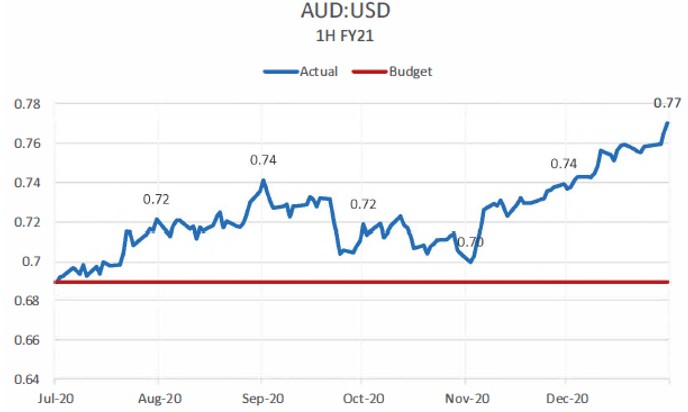
• Key slipped deals for the half and revenue impact?
• UHG and Dell were the two major deals that slipped in December. Additionally deals for General Mills and Moody’s slipped, each equalling about AU$100k. In total, this amounted to $3.5m in slipped deals.
• Revenue that has since been recognised (as a proxy of what would have been recognised) is $2.4m. There is a remaining $1.1m that is deferred, which will be released upon delivery of subsequent licences (Dell has a termination for convenience clause for Y2 & Y3).
• What was new revenue performance for the half?
• New business revenue was $13.1m which was largely in line with our 1H expectations ($13.4m based on IPO Forecast – not disclosed in Prospectus). This result was ahead of PCP, which was $11.2m.
• Top new logos include Latham and Watkins, Rothschild, Eli Lilly, Australian Army, Siemens Gas and DOJ NSW. Four of these logos (L&W, Rothschild, Siemens and DOJ) have included significant SaaS components in their purchase, promoting this revenue stream, and suppressing the revenue result.
• Please talk to the revenue composition for the half?
• RUN as a % of total statutory revenue for the half was split as follows:
i. Renewal – 56%
ii. Upsell – 29%
iii. New – 15% (↑ from 13% in PCP, against 11% IPO Forecast for the half, 16% IPO Forecast for the full year) – this includes services as new.
• In terms of license type, revenue split was as follows:
i. Subscription – 70% (↑ from 64% in PCP)
ii. Maintenance – 13% (↓ from 14% in PCP)
iii. Consumption – 9% (↑ from 5% in PCP – higher than anticipated migration to SaaS – this figure is lower than the 12% provided in the Prospectus as the 1H excludes revenue from Epiq and Lighthouse)
iv. Recurring Revenue – 92% (= the sum of the above; ↑ from 84% in PCP)
v. Perpetual – 6% (↓ from 12% in PCP – weakness in USG; election, COVID)
vi. Services – 2% (↓ from 5% in PCP – COVID restrictions affecting delivery of services)
• Geography - compared to pcp, APAC revenue was up 8%, EMEA revenue was down 5% and Americas revenue was down 2%. The driver of the uplift in growth for APAC is primarily due to Government and Law Firms performance with increased new business revenue from the Australian Army, Dept of Justice NSW and Squire Patton Boggs deals and increased upsell revenue from the Australian Taxation Office. EMEA revenue was down due to stronger 1H FY20 (Deutsche Bank MYD, Jersey Financial Commission) and lower than expected ramp up in Law Firms and MESEA. USA revenue was down largely due to the aforementioned weakness in USG and fx headwinds.
• 1H FY21 % revenue by geography vs. FY20A as disclosed in prospectus:
i. APAC 1H FY21 – 16% (in line with disclosure in prospectus)
ii. EMEA 1H FY21 – 31% (↑ from 28% disclosed in prospectus)
iii. USA 1H FY21 – 53% (↓ from 55% disclosed in prospectus)
• Domains – compared to pcp, Law Firms revenue increased by 20%, ASP revenue increased by 19%, Corporate revenue was flat, New Markets were down 5% (weakness in Asia due to COVID) and Government was down 32% (weakness due to COVID and presidential election turmoil). Whilst new markets were down against pcp, DACH has performed strongly and is up 14% on pcp. Government reduction in revenue is primarily attributed to high perpetual deals in FY20 and a further reduction in spending due to uncertainty arising from the US election and COVID.
• 1H FY21 % revenue by domain vs. FY20A as disclosed in prospectus:
i. Advisories 1H FY21 – 38% (↑ from 35% disclosed in prospectus)
ii. Corporate 1H FY21 – 16% (↓ from 19% disclosed in prospectus)
iii. Government – 19% (in line with disclosure in prospectus)
iv. Law Firms – 13% (↑ from 11% disclosed in prospectus)
v. New Strategic Markets 1H FY21 – 14% (in line with disclosure in prospectus)
• How was MYD performance vs. Prospectus guidance?
• Total MYDs for the period equalled $19.8m in revenue recognised for the period (or 23% of revenue). There was an additional $7.9m (or 29% of total MYD orders) that was unable to be recognised as a result of an increase in SaaS orders (as mentioned in point 6).
• The IPO Forecast took a conservative view on MYDs because of a sharp increase in FY20 (25% of total revenue) and the uncertainty of COVID on consumer’s [sic] ability to make longer term commitments. The increase in SaaS sales which reduces the risk on a long-term commitment, and higher than expected New Business MYD’s has increased the number back above IPO forecast. This is reflected in new business AOV metric (average new order increased by c. 200% on the prior year).
• Why is ACV lower than expectations?
• Subscription ACV grew 10% year on year, primarily due to new business. Challenges faced included fx headwinds, other ACV reduction and slipped deals.
• Difficulty selling into Asia and USG (COVID + US Election) has been a key driver in the reduction of total ACV.
• There was no expectation disclosed in the prospectus. Internally the milestone was $179.0m. The variance to that is -$17.2m, which is disclosed below:
i. ACV heavily impacted from Dec-19 to Dec-20 from a reduction in “other ACV” (perpetuals, services & burst) of $9.4m.
ii. Slipped deals represented approximately $1.2m of foregone ACV, as the UHG and Dell deals were both 3 year MYD’s.
• What was consumption revenue performance vs. expectations?
• Consumption – 9% (↑ from 5% in PCP – higher than anticipated migration to SaaS; this figure is lower than the 12% provided in the Prospectus as the 1H excludes revenue from Epiq and Lighthouse – these deals are recognised in 2H)
• SaaS increase outlined above ($6.7m in 1H FY21 compared to $4.6m in 1H FY20)
• R&D capitalization and R&D as a % of revenue – how is 1H performance tracking to full year guidance disclosed in Prospectus?
• Total R&D spend as a percentage of revenue is lower than expected (25% against 30% half year forecast and 27% FY21F guidance). This has been driven down by lower-than-expected headcount (15 heads below budget), whilst the total cost has been reduced due to fx rates.
• Capitalisation rate is 79%, which is largely in line with the 80% rate that has become standard. This is as a result of cost composition (i.e. fewer headcount, lower capitalisation rate on fixed cost) rather than a diminishment in R&D focus. Capitalisation rate of engineer time (based on Jira ticket information) is in line with prior period.
• S&D and G&A as a % of revenue – how is 1H performance tracking to full year guidance disclosed in Prospectus?
• Statutory S&D and G&A as a % of revenue is favourable against 1H Forecast (not disclosed in Prospectus). This is as a result of the revenue split between 1H and 2H and not an indication of cost run-rate.
• S&D is currently tracking below full year forecast because of cost savings from T&A, Marketing and Employment Costs, driven by fx savings and COVID impact on T&A and marketing spend. Spend was $25.5m (29.9%) against $27.9m (32.8%) 1H expectation and $56.7m FY21 guidance (29.3%)
• S&D headcount tracking 97% to budget. Room to move in Sales (3) and Marketing (3). This does not consider potential deployment of strategic initiatives on sales headcount.
• G&A costs had a large increase on a statutory basis due to IPO costs. This makes annualised performance analysis difficult due to the non-recurring nature. On 1H expectation basis, G&A % of revenue was 70.9% against expectation of 76.7% on a statutory basis prior to IPO cost capitalisation.
• On a pro-forma basis, G&A is tracking below FY21 percentage of revenue guidance (17.7% actual against FY guidance of 20.5% and 1H expectation of 22.7%). This is despite the revenue split, so expected to continue. Cost savings largely attributed to un-deployed strategic initiative funds and FX, with some additional one-off costs (not pro-forma) due to trade sale and ASX listing.
• Deployment of strategic initiatives (headcount) has been tempered to move in line with revenue growth.
• Balance Sheet and Cashflow
• 1H FY21 deferred revenue – of the $15.3m in 1H deferred revenue, $9.0m of this is expected to be recognised over the balance of FY21 – $6.7m of $13m performance obligation deferrals to be recognised in the remainder of FY21. $2.3m net S&M deferral can be classified as current, as S&M tailwind >$10m for the remainder of the FY21 (not including headwind on new orders).
• $123.2m cash and cash equivalents as at Dec-20. There is additional undrawn CBA facility of approximately $25m as at the end of the reporting period.
• Strong liquidity position. Whilst working capital is negative, this overstates the cost to deliver the remaining performance obligations on the balance sheet. Adjusting for trade debtors, other current assets and creditors/other current liabilities, the net working capital position is marginally positive.
• One off increase is current liabilities associated with IPO costs (both unpaid and accrued).
• Balance sheet remains well positioned to execute on M&A opportunities as they present.
• What is pipeline coverage now vs. pipeline coverage at Prospectus date?
• PwC VDD pipeline as at 5 October 2020 was $265.2m, including $110.9m in closed/commit deals.
• Current total pipeline equals $267.5m, including $152.2m in closed/commit deals.
• Summary of movements are:
i. Closed has increased by $49.0m to $107.1m
ii. Commit has decreased by $25.2m to $45.1m
iii. Best Case has decreased by $27.0m $47.7m
iv. Other pipeline has increased by $5.5m to $67.7m
• In summary, what this says is that the pipeline has matured as we progress through the year with more of the pipeline closing and moving through Best Case and Commit, as we continue to build on additional pipeline opportunities.
(bold and underline emphasis in original)
372 On 19 February 2021 at 7:12am, Mr Vawdrey sent an email to the Nuix directors and Dr Castagna which forwarded Mr Silveri’s 18 February 2021, 9:18pm email, under cover of a note:
Although this is still in review I though [sic] it would help you all get a feel for how we will respond to questions that may arise in our reporting ...
373 Sir Iain read through the draft speaking notes briefly at the time he received them, in anticipation of a fuller discussion at the board meeting scheduled on 25 February 2021.
374 Mr Bleich read the draft speaking notes at the time. The information contained in them broadly accorded with information that Mr Vawdrey and Mr Doyle had provided to him about Nuix’s 1HFY21 results during February 2021, including at the 12 February 2021 meeting.
375 Mr Bleich also provided some comments on the draft speaking notes.
376 On 21 February 2021 at 2:11pm, Ms Thomas responded to Mr Vawdrey’s 19 February 2021, 7:12am email:
My overwhelming comment is that we not only have to talk about revenue for the first half but that we are still a growth company.
As an example in the first question can we separate some core numbers and show an ‘underlying growth’ story:
1. Fx impact on sales
2. Deals closed post period end
3. Deferred revenue from SAAS vs prior periods
4. Training impact and expectations going forward
5. US Govt impacts and expectations going forward.
Also in the pipeline question
I am interested that the pipeline number hasn’t changed. And that best case has decreased. I agree with your conclusion that pipeline has matured, but am interested in the corollary of why there is not more funnelling into the pipeline.
It will be good to see the draft presentation.
377 Also on 21 February between 5:11pm and 5:50pm, Mr Egan circulated papers for the ARC meeting scheduled for 25 February 2021. Agenda item 9 was in the form provided by Mr Egan to Ms Thomas on 18 February 2021 ([368] above).
378 At 5:15pm, Mr Egan distributed board papers to the directors of Nuix ahead of the meeting of those directors scheduled for 10:00am on 25 February 2021. Within those board papers was:
(1) a draft investor presentation titled “H1FY21 Financial Results” and marked “19 FEB – DRAFT FOR BOARD REVIEW (DRAFT outlines narrative – all numbers subject to cross check w/c 22 Feb; additional detail being prepared for Q&A)”. This included a page titled “Outlook” which included:
Subject to Board confirmation on guidance and RV further refinement of key focus areas
…
[Re-affirm guidance as per the Dec 2020 Prospectus based on budgeted US$ FX rate of $0.69]
• FY21 total revenue of [$193.5] million
• FY21 pro forma EBITDA of [$63.6] million
(bold and italic emphasis in original); and
(2) a draft “Appendix 4D and Consolidated Interim Financial Report” for the half-year ended 31 December 2020.
379 The board papers also included a paper which purported to set out Nuix’s obligations with respect to continuous disclosure. That paper described in some detail the operation of ASX Listing Rule 3.1.
380 On 22 February 2021 at 5:08pm, Mr Bleich sent an email to Mr Doyle:
(1) attaching an Australian Financial Review newspaper article which included:
Investors will also get a chance to parse financial data from new ASX entrants ... Nuix. ... Nuix is on track for EBITDA of $63.6 million.
(2) and asked Mr Doyle: “How does our EBITDA track to this projection? I’ve been focussed on revenue and haven’t been following this metric”.
381 Mr Doyle responded: “It is a FY21 metric and yes we are on track”.
382 At 5:50pm that day, Ms Thomas sent an email to Mr Egan (copied to the directors of Nuix and others), in the following terms (as written):
the announcement regarding the first half results needs to be made on Friday (as per the previous announcement lodged on the market).
The presentation in the ARC pack is not complete and nor is the review of operations which must be included in the accounts.
In addition, it is important that any announcement (including the presentation on the accounts) has to have a verification process attached. One of the issues we need to include is that revenue from Europe and Middle East is also less than same half last year. (See note on p 17 of the accounts).
Would it be possible to circulate an updated draft of the presentation and the ‘review of operations’ this evening with an outline of the verification process.
I have sent a separate note to Stephen, as I do not believe I am the appropriate person to sign the management representation letter. I believe it should be Stephen and Rod.
383 Sir Iain read the papers circulated by Mr Egan in advance of the ARC and board meetings on 25 February 2021 in accordance with his usual practice. He paid less attention to the draft 1HFY21 Financial Results presentation included in each pack, as it appeared to be a draft that was subject to revision. He cannot recall whether, by the time he came to review these packs, he had received the email from Ms Thomas ([382] above).
384 Mr Bleich did not recall reviewing the papers for the board meeting or the papers for the ARC meeting that he received on 20 February 2021. He also typically did not review papers for ARC meetings in advance of those meetings as he was an observer, and not a member, of the ARC.
385 Mr Bleich also provided evidence that:
(1) as a general practice, he prioritised reading the material that required his attention as Chairman and director, though he read the entirety of the material if he was able to do so ahead of the meeting;
(2) in the board papers provided by Mr Egan he prioritised reading the draft minutes of the last meeting of directors which had to be adopted on 25 February 2021, and the draft financial statements for 1HFY21;
(3) he waited until the ARC and board meeting to be taken through the draft investor presentation in the board papers, as his view was that Mr Vawdrey and Mr Doyle would help focus the board’s attention on salient aspects of the draft investor presentation; and
(4) he does not recall seeing the slide titled “Outlook” in the draft investor presentation sent to him as part of the board papers provided by Mr Egan on 21 February 2021, or this version of the text in the slide concerning the re-affirmation of the Prospectus Forecasts with the qualifying text that it is at the Budgeted Rate of $0.69.
386 On 23 February 2021 at 9:27am, Mr Doyle provided “draft prepared cfo remarks” to Mr Silveri, Mr Hooper and Mr McGilvery (with Mr Vawdrey and Ms Nichols copied). The attachment, titled “1HFY21 Investor Presentation – Q&A Speaking Notes and Additions” included the following script (as written):
PREPARED REMARKS ASX PRESENTATION
Thanks Rod, lets jump off the springboard.
1. On a statutory revenue basis first half revenue was $85.3m vs FY forecast of $193.5. This reflects 44% of target attainment.
2. We are satisfied with this first half split of the race.
3. There are 5 key instrumental variables that are important to consider when assessing this performance and speak to the health of the business. I draw your attention to slide XX Revenue Bridge.
1) The First Instrumental Variable is our Bookings Strength.
i. Our bookings in the first half were strong. You can see deferred revenue of $15.3m comprised of obligatory S&M accounting revenue deferral of $XXm net additions for Half; and bookings for SW and Services not yet completely delivered in period of $XXm and $XXm respectively. [HOW MUCH OF THIS IS MYD?]
2) The Second Instrumental Variance is customers migrating from OnPremise SW Licencing to Consumption SW Licencing. Included in our $15.3m Deferred Revenue is $XX of SaaS bookings. Part of our strategy is to provide customers with choice in the manner in which they will consume Nuix SW – on the desktop, in their network in their cloud or a Nuix cloud or a combination thereof. Predicting how customers will migrate is difficult and the first Half witnessed this occur at a rate faster than anticipated. As you know from a Statutory Revenue POV transitioning customer to Consumption Licencing is a short term revenue headwind – as we only book the monthly licence revenue as opposed to OnPremise Revenue where we book most of the annual bookings value. Therefore this is why we disclose deferred revenue net additions for the Half to provide a true reflect of the business pulse. Our number 1 priority is fixated and centred around customer success, listening to the customer voice and providing them with SW licencing choice to suit their cloud journey.
3) The Third Instrumental Variable is FX, in particular the AUD to USD currency pair. Our first Half FX Headwind was $3.5m. Our business is naturally hedged in operations with circa 59% of our bookings in USD. The FX rate moved from Prospectus Assumptions of 0.69 AUD to USD currency pair to 0.77 by End of Half. There is a well documented propensity in enterprise SW businesses for bookings to close in the last week of the last month of each Quarter. Unfortunately for us in this Quarter, the last week of trading in December 2020 witnessed us book orders at a prevailing USD FX rate at 77 cents.
4) The Fourth Instrumental Variable is Late Bookings. Invariably the last week surge in orders means you will see some Bookings slip. The total impact of Late bookings was $3.5m primarily across 4 customers – all renewals. All of these bookings closed in January. We are not making excuses, just providing transparency around the reality of large enterprise SW selling and the timing difference impact on results.
5) The Fifth Instrumental Variable is New Business Bookings. For the Half we booked $13.8m of New Business which is xx% higher than PCP, and represents xx% ($13.8m/$29m) attainment of FY forecasted New Business of $29m. This is particularly impressive in what we consider to be a seasonally low Half for New.
4. Operator, please move to slide XX where we are discussing Annualised Contract Value (ACV).
1) Statutory Revenue recognition is impacted by 2 key phenomena that exist within the Nuix business model.
2) The first is On Premise to Consumption Licencing Migration as referenced above;
3) The second is MYD bookings whereby customers are prepared to commit to unbreakable contracts and often pay for 12 months of SW licencing annually in advance.
4) Both have revenue recognition consequences but they don’t effect the underlying business and cash operating model. In actual fact, 77% of customers pay annual in advance irrespective of SW licencing type.
5) It is nonetheless helpful to show ACV to reconcile for these phenomena.
6) ACV is slightly ahead of PCP CY20 vs CY19, however not quite where we would have liked to be for the Half.
7) Lets unpack this:
i. FX and Late Bookings has a similar impact on ACV as it does on statutory revenue and you can see a $XXm and $XXm respective Headwind on closing ACV.
ii. Churn in trending in the right direction decreasing from 4.7% to 4.1%. It was traditionally hovered between 3.8% to 5.6% so is in range and speaks to our blue chip customer base and customers staying with us.
iii. New Business bookings to ACV was strong and on track with expectations for the Half
iv. There are 2 components of ACV we are less than happy about.
1. Perpetual Licence Sales. USG September and December is traditionally strong, however the randomness brought about by USA elections has seen delays in Order Bookings. We have not lost Orders per se, and we are staying close the to economic buyers in government over the next 2 quarters.
2. Upsell. We have seen a reduction in expected upsell which is reflected in NDR of 102% is 2% down YOY. On a positive side we see this as an opportunity to do what we are really good at – selling more value added SW to existing customers as they face their data challenges
8) So when adjusting for ACV for FX, Late and USG Randomness we are on track to where we would like to be.
5. Operator, please move to slide XX. I would like to provide some concluding remarks for consideration:
1) Despite increased and sustained pressure brought about by macro economic conditions we posted strong bookings in the first Half of $107m (adjusted).
2) We have paced ourselves well for the first Half and we well positioned to attain $193.5m revenue and $199m ACV prospectus forecast
3) We have witnessed some customers hesitating to commit to Orders – especially in USG and Asia, however these have not been Lost and our Pipeline continue to build
4) FX worked against us, however it does not dimmish the strength of the underlying revenue generating process, nor affect our naturally hedged operation with locally deonominate working capital balances to fuel business growth.
5) Demand continues to grow. New business bookings were $13.8m. 49 new logos added and AOV continues to strengthen.
6) Cloud/SaaS momentum continue with high double digit YOY growth and whilst customer penetration is low we see it as presenting a large growth opportunity. In addition when customers move to SaaS they tend to expand faster and stay longer
7) Investments continue as we look into penetrating high growth markets including in Europe
8) When we think about attaining prospectus forecast we note:
i. Our revenue growth model is quite predictable with high Renewals, strong Upsell rate. New business revenue is at is strongel level since XX
ii. Churn is low; customers stay for a long time and churn hovers between 3.8% and 5.6%; and our customer voice/ customer choice strategy to consume Nuix in their preferred manner is working with Consumption growth on track
iii. Our balance of year forecast shows:
1. R xx
2. U xx
3. N xx
4. Deferred Revenue xx
5. Backlog xx
6. Go Get xx
iv. Our Operating Model is extremely strong showing on track GM% with no near term triggers and a Half year proforma EBITDA of $31m representing xx% attainment of FY forecast of $67m proforma EBITDA
9) All indications are that we are on to attain $193.5m revenue and $199m ACV prospectus forecast
…
(bold emphasis in original; underline emphasis added)
387 Also on 23 February at 11:06am, Mr Pipic sent an email to Mr Silveri and Mr Borcherdt (copying Mr Doyle and Mr Hooper) titled “ACV Pipeline Coverage” in the following form:
We’ve updated the pipeline coverage analysis on the back of the salesops teams validating the opportunities in the pipeline to ensure it’s as robust as possible.
Below is the coverage on an ACV basis using the budgeted rate:
A$m | 3Q21 | 4Q21A$m | 3Q21 | 4Q21 |
Contracted | 136.8 | 110.7 Contracted | 136.8 | 110.7 |
Commit | 22.7 | 44.6 Commit | 22.7 | 44.6 |
Best Case | 8.7 | 25.5 Best Case | 4.2 | 12.2 |
Pipeline | 9.6 | 44.3 Pipeline | 4.6 | 21.3 |
Pipeline | 177.9 | 225.1 Pipeline | 168.4 | 188.8 |
Closed Won not in Contracted | 3.2 | 2.7 Closed Won not in Contracted | 3.2 | 2.7 |
Pipeline Build and Close Assumption | 28.0 | 28.0 Pipeline Build and Close Assumption | 13.4 | 13.4 |
Total | 209.1 | 255.8 Total | 185.0 | 204.9 |
Budget | 188.6 | 199.6 Budget | 188.6 | 199.6 |
Coverage | 1.1x | 1.3x Coverage | 1.0x | 1.0x |
Few comments on the above to ensure we have the same basis of preparation:
1. We’ve extracted the pipeline report as at 22nd February to reflect the latest updates from the salesops teams
2. We’ve extracted the Close Won opportunities in February (not included in Contracted Revenue) to reflect the latest deals closed for the purpose of FY21 attainability analysis
3. Pipeline Build and Close Assumption – we have used Finance’s assumption re A$28m pipeline build and close into FY21
4. Weighted pipeline – we have used Finance’s assumption re 48% conversion rate for Best Case, Pipeline, and Build and Close categories. Commit and Contracted is assumed at 100% conversion
5. FX rates – we have used the budgeted rates (see table below). Note we should run the same FX sensitivities to see how it can impact the pipeline coverage ratio (i.e. USD rate at 1.3 vs 1.45 budgeted, likewise for all the other currencies)
Budgeted Rates
Currency FY21 Budget Rates
AUD 1
USD 1.45
GBP 1.8
EUR 1.6
CAD 1.09
I’ve attached the pipeline coverage analysis.
Please let me know if you have any questions and it would be good to run through the comments.
(bold emphasis in original)
388 Attached to this email was a pipeline coverage analysis, in the form of a spreadsheet, that had been prepared by Mr Pipic and Mr Hooper following the work conducted by the sales teams to validate the data in Salesforce. That spreadsheet is one of the spreadsheets labelled by Ms Oliver and Mr Potter as the February ACV Models.
389 On the same day, Mr Pipic sent an email to Mr Silveri and Mr Hooper providing an invitation to a meeting at 4:15pm that day. His email asked them to “go through the comments in the attached email prior to sending the updated ACV pipeline coverage to [Mr Vawdrey]”, the comments being points 1. to 5. of the above email which he had attached.
390 Later that day, Mr Silveri met with Mr Pipic and Mr Hooper to discuss the updated pipeline coverage analysis prepared by Mr Hooper and Mr Pipic. Mr Silveri’s recollection is that Mr Pipic and Mr Hooper wanted to check with Mr Silveri that they had correctly prepared the pipeline coverage report for Nuix’s FY21 ACV forecast, before sending the results to senior management.
391 On 23 February 2021 at 4:45pm, Ms Vanessa Beresford of Citadel-MAGNUS sent an email to Mr Vawdrey, Mr Doyle, Ms Nichols, Mr Silveri and others attaching “the latest investor presentation”. The attachment was titled “Nuix 1HFY21 results presentation v13_DRAFT”, and it was an updated version of the presentation circulated by Mr Egan on 21 February. Among other changes, the “Outlook” slide in that presentation had been updated to state:
Re-affirm FY21 guidance as per the IPO Prospectus based on forecast US$ FX rate of $0.69
• Total revenue of $193.5 million
• Annualised contract value (ACV) of $200 million
• Pro forma EBITDA of $63.6 million
(bold emphasis in original)
392 At 5:40pm that day, Mr Pipic sent an email to Mr Hooper with the subject line “ACV Pipeline Coverage Availability” in the following terms:
The below pipeline coverage analysis reflects the latest pipeline report (22nd February) which includes the fields input and validation of all the opportunities.
Below is the Pipeline Coverage on an ACV basis using the budgeted rate:
A$m | 3Q21 | 4Q21A$m | 3Q21 | 4Q21 |
Contracted | 136.8 | 110.7 Contracted | 136.8 | 110.7 |
Commit | 22.7 | 44.6 Commit | 22.7 | 44.6 |
Best Case | 8.7 | 25.5 Best Case | 4.2 | 12.2 |
Pipeline | 9.6 | 44.3 Pipeline | 4.6 | 21.3 |
Pipeline | 177.9 | 225.1 Pipeline | 168.4 | 188.8 |
Closed Won not in Contracted | 3.2 | 2.7 Closed Won not in Contracted | 3.2 | 2.7 |
Pipeline Build and Close Assumption | 25.0 | 25.0 Pipeline Build and Close Assumption | 12.0 | 12.0 |
Total | 206.1 | 252.8 Total | 183.6 | 203.5 |
Budget | 188.6 | 199.6 Budget | 188.6 | 199.6 |
Gap/Buffer | 17.5 | 53.2 Gap/Buffer | (5.0) | 3.9 |
Coverage | 1.1x | 1.3x Coverage | 1.0x | 1.0x |
The below is the Pipeline Coverage on an ACV basis using the prevailing 2H21FY rate (i.e. USDAUD = 1.3, compared to 1.45; AUDUSD = 0.77, compared to 0.69):
A$m | 3Q21 | 4Q21A$m | 3Q21 | 4Q21 |
Contracted | 136.8 | 110.7 Contracted | 136.8 | 110.7 |
Commit | 21.0 | 41.3 Commit | 21.0 | 41.3 |
Best Case | 8.2 | 23.8 Best Case | 3.9 | 11.4 |
Pipeline | 9.1 | 41.0 Pipeline | 4.4 | 19.7 |
Pipeline | 175.1 | 216.9 Pipeline | 166.1 | 183.2 |
Closed Won not in Contracted | 3.0 | 2.5 Closed Won not in Contracted | 3.0 | 2.5 |
Pipeline Build and Close Assumption | 25.0 | 25.0 Pipeline Build and Close Assumption | 12.0 | 12.0 |
Total | 203.1 | 244.4 Total | 181.1 | 197.7 |
Budget | 188.6 | 199.6 Budget | 188.6 | 199.6 |
Gap/Buffer | 14.5 | 44.8 Gap/Buffer | (7.5) | (1.9) |
Coverage | 1.1x | 1.2x Coverage | 1.0x | 1.0x |
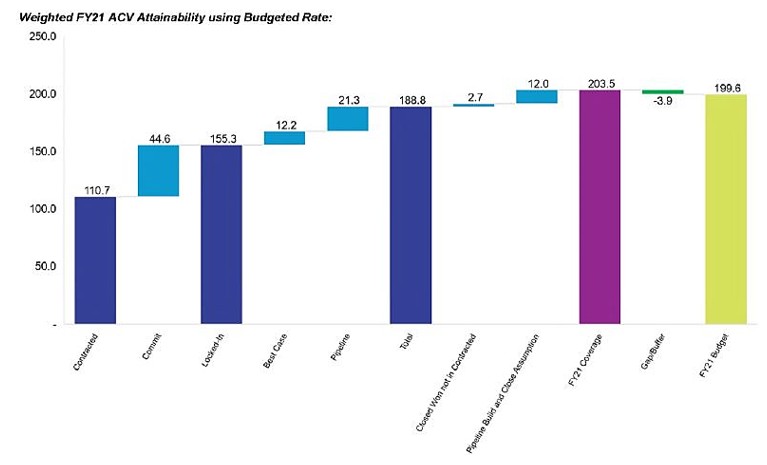
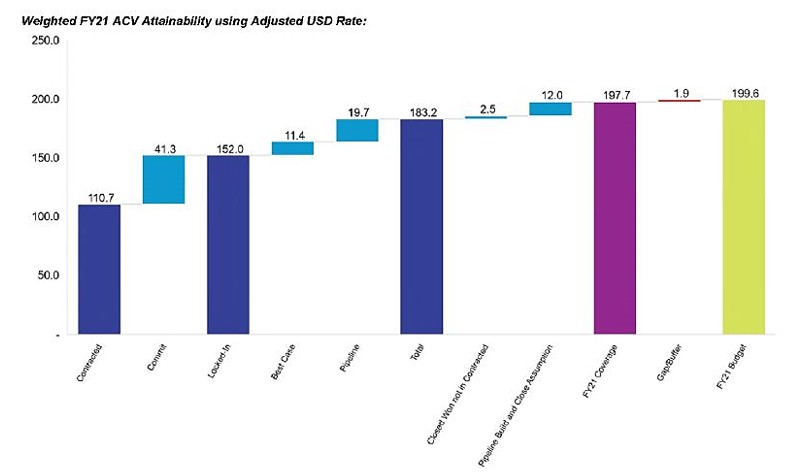
(bold, italic and underline emphasis in original)
393 This email attached, in the form of a spreadsheet, the revised pipeline coverage for forecast ACV following feedback from the sales teams. That spreadsheet forms part of the February ACV Models.
394 At 6:23pm, Mr Hooper responded to Ms Beresford’s 4:46pm email, with some suggested edits. One of the edits was to the “Outlook” slide, with Mr Hooper’s edits underlined:
Maintain FY21 guidance as per the IPO Prospectus based on forecast US$ FX rate of $0.69
• Total revenue of $193.5 million
• Annualised contract value (ACV) of $199.6 million
• Pro forma EBITDA of $63.6 million
(bold and underline emphasis in original)
395 At 6:32pm, Mr Hooper forwarded Mr Pipic’s 5:40pm email to Mr Vawdrey and Mr Doyle (copied to, inter alia, Mr Silveri) under cover of an email in the following terms:
As per below, Denis has updated the pipeline coverage for ACV post feedback from the regional sales team last week.
The pipeline coverage analysis was prepared as at 22-Feb-21 and suggests that using the same conversion weightings and YTG pipeline build as per Finance that:
• On a weighted basis using the budgeted rate USD FX rate that ACV pipeline is $203.5m vs $199.6m FY21F for ACV
• On a weighted basis using the prevailing 2H21FY USD FX rate (i.e. USDAUD = 1.3, compared to 1.45; AUDUSD = 0.77, compared to 0.69) that ACV pipeline is $197.7m vs $199.6m FY21F for ACV (i.e. 99% coverage)
Happy to discuss anytime tomorrow any comments you have or changes to presentation.
396 In that email:
(1) Mr Hooper concluded that the Salesforce data as at 22 February 2021 supported Nuix achieving the Prospectus ACV Forecast, using the same conversion weightings and pipeline build assumptions as the finance team uses for statutory revenue; and
(2) Mr Hooper presented his analysis both on the Budgeted Rate and on the prevailing FX rate, on the assumption that the prevailing rate would be the same until the end of June 2021. On both bases, it appeared that Nuix had sufficient pipeline coverage in Salesforce to achieve the Prospectus ACV Forecast (noting that the prevailing FX rate provided 99 per cent coverage).
397 On 24 February 2021 at 12:01am, Ms Nichols sent a further draft of the investor presentation to Mr Hooper, Ms Beresford, Mr Vawdrey, Mr Doyle, Mr Silveri, Mr McGilvery and Mr Pipic. The attached draft presentation included an “Outlook” slide in the following form:
Subject to Board confirmation on guidance
FX qualifying text on guidance removed as we have factored in FX impact when looking at pipeline i.e. our ability to achieve the FY21F is not predicated on the FX rate returning to 0.69
Re-affirm FY21 guidance as per the IPO Prospectus
• Total revenue of $193.5 million
• Annualized contract value (ACV) of $200 million
• Pro forma EBITDA of $63.6 million
(bold emphasis in original)
398 At 9:21pm that day, Ms Nichols sent an email to Mr Egan (copied to Mr Vawdrey and Mr Doyle):
Please find attached the updated Investor Presentation and draft Market Release for ARC and Board review.
Notes on the Investor Presentation
• No material changes to key messages and metrics – slides have been simplified to focus on the key drivers of each key performance metric
• The intended ‘tone’ is that the business has been resilient in a challenging first half and that we have confidence in our path to meeting full year forecasts
• The DRAFT – Confidential and Not For Distribution watermark will be removed before release
The team has completed a first pass verification of the data points and will provide a full verification report on the final documents, once updated with feedback from the Board sessions.
(bold and italic emphasis in original)
399 At 9:36pm, Mr Egan forwarded Ms Nichols’s email to the directors of Nuix, and others including Mr Doyle and Mr McGilvery, under cover of an email:
Attached is a draft market release as well as an updated investor presentation for review at the Audit and Risk Management Committee under item 7 of the agenda.
Please note the commentary from Sarah on the documents in the email below.
400 The draft “1HFY21 Financial Results” investor presentation included the following.
401 First, a slide in the following form:
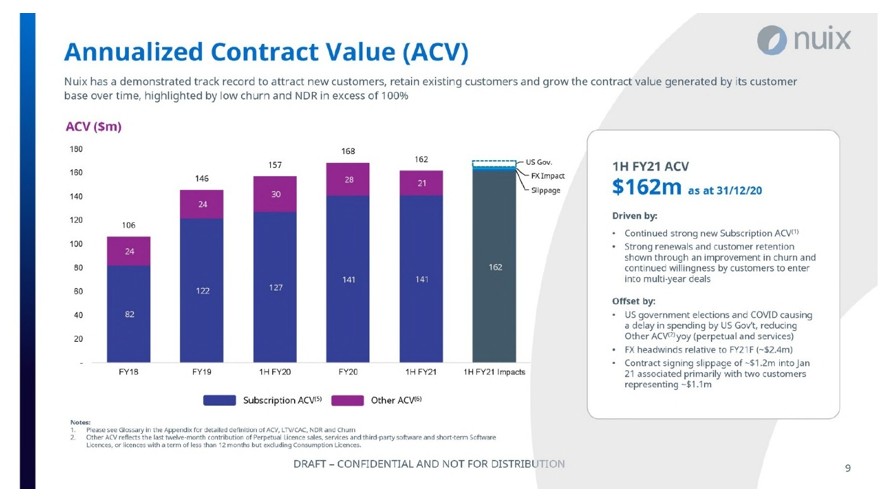
402 Secondly, a slide in the following form:
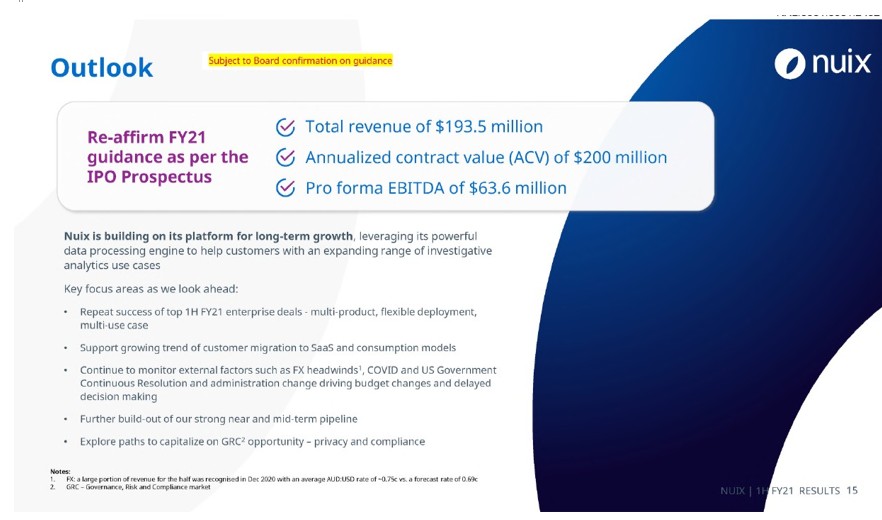
403 Sir Iain, in accordance with his usual practice, read these materials.
404 To the best of Mr Bleich’s recollection, he read Mr Egan’s email and its attachments ahead of the ARC and board meetings on 25 February 2021 because these were revised documents being sent to him shortly before those meetings and he thought that they might be particularly salient to those meetings.
405 On 25 February 2021, a meeting of the ARC and, later, a meeting of the directors of Nuix were held.
406 At 8:00am the ARC met. Those present included all of the directors of Nuix. The minutes of that meeting include:
Minutes of previous meeting and action items: | The minutes of the meeting held on 11 February 2021 were tabled. The minutes were approved, and the Chair undertook to sign the minutes. The meeting noted that a subsequent meeting had been held on 12 February which was held to review to review [sic] the full year 2021 forecast and comparison to the Prospectus forecast. The meeting was attended by management and certain Directors. The meeting reviewed current forecast revenue compared to budget and Prospectus revenue. Based on the current forecast presented, the meeting concluded that they remain confident of achieving Prospectus revenue forecast. |
... | |
ASX announcement and Investor presentation | The revised Hl 2021 financial results presentation dated 24 February 2021 was tabled, reviewed and discussed. The meeting noted that the prospectus revenue forecast of $195.5 million is reaffirmed. It was resolved that, subject to the matters raised, to recommend to the Board of the Company that the Board approve and authorise the finalisation and issue of the market announcement and financial results presentation. |
(emphasis in original; the reference to $195.5 million appears to be an error in the minutes and it is common ground that the correct figure should have been $193.5 million)
407 There is in evidence a handwritten note of the meeting, apparently taken by Mr Phillips. That note records:
NUIX ARC MEETING 25/2/21
P14 – why does 6,474 tax reduce the loss after tax?
P30 – disagreements with mgt – why “except as outlined ...”?
Announcement
Balance sheet
“The expected in cash ... is $29m”?
ESOP volatility don’t adjust
washes out this year
deductibility of IPO costs
R&D tax issue deductibility in 2019 & 2020
option cancellation payment maybe deductible over 5 years $175m but assume not for now
tax losses availability
DD paper
issue IP Macquarie sells down
recharge of HQ costs to foreign subsidiaries transfer pricing
Finance team resources do we have enough for y/e audit
PWC re audit
Process re revenue recognition
Allocation to service & maintenance
Reseller allocation/gross-up
Half year – traded timetable for higher quality
need to address for year end
Production of Annual Report START EARLY
Big gap between Stephen/Scott & rest of team
_______________
Rod issue re headcount/reasoning
Accountability!!

BRUCE – Eddie matter / by legal + ARC
Customer focus – eg KPMG
Harentec – Brian Hartzen
408 Sir Iain’s recollection of the ARC meeting is that:
(1) the minutes of the previous ARC meeting held on 11 February 2021 were tabled and adopted;
(2) the meeting then progressed through the items as set out in the agenda;
(3) a presentation was given by Mr James Nickless (from the PwC tax team), and Mr David Drummond (tax counsel at Nuix) on tax issues, and then Mr Scott Walsh and Ms Choy (from the PwC Audit team) gave a report to the ARC, and presented to parts of the slide deck included in the papers for the ARC meeting distributed by Mr Egan on 21 February 2021;
(4) he (and, to his observation, the other members of the ARC) went through and considered carefully the draft management representation letter included in the papers;
(5) the Consolidated Interim Financial Report for 1HFY21 was tabled and Mr Doyle and other members of the finance team presented to the ARC on its contents;
(6) the meeting then moved to consideration of the draft 1HFY21 Financial Results investor presentation. To the best of Sir Iain’s recollection, the version of this presentation that he had been sent by Mr Egan on 24 February 2021 at 9:36pm was the version that was tabled and then presented to the ARC by Mr Vawdrey and Mr Doyle. If it was a different version, he did not notice any material differences; and
(7) Mr Vawdrey and Mr Doyle took the ARC through a page-turn of a number of slides in the draft investor presentation. Each slide was presented by either Mr Vawdrey or Mr Doyle, or both. Ms Thomas and Mr Phillips asked questions throughout this presentation about the information being presented. Sir Iain does not recall anyone drawing to his attention, either at the ARC meeting or the subsequent board meeting discussed below, that there were any significant or material differences between this version of the presentation and the earlier version included in the packs circulated on 21 February 2021.
409 Sir Iain also refreshed his memory of this ARC meeting by reference to:
(1) a transcript of the Investor and Analyst Briefing regarding Nuix’s 1HFY21 Results presented by Mr Vawdrey and Mr Doyle on 26 February 2021; and
(2) the draft 1HFY21 Financial Results presentation slides.
410 Having done so, he gave evidence that:
(1) he had a distinct recollection that Mr Doyle gave the same explanation to the ARC about how Nuix would achieve its revenue and ACV goals for 2HFY21 as he is transcribed as giving in the Investor and Analyst Briefing on 26 February 2021, as follows:
Just changing gears now. We’re still staying on slide 8, but I’d like to speak a bit more to the forecast, and as you heard to Rod, we’re holding the number at $193.5 million. Slide 8, there’s a couple of considerations here. We’ve got $108 million go get, given that we’ve posted $85 and change in the first half.
When we think about attaining our forecast, the way that we think about our business internally, around our revenue growth model, it’s really predictable. It’s across well-established historical run rates, across renewals, upsell and new. Our renewals are high, always been north of 90 points. Our churn is low, our upsell is strong, and customers, they stay with us for a long time. That propensity for customers to choose SaaS and lean deeper into that is going to mean that we see those rates improve over time.
New business actuals are also trending well. We attained north of $13 million doing business in the first half. It’s 17 points higher than prior corresponding period, and, when you think about our $29 million new business, that red target for the full year, that’s 45% attainment, and it’s, again, a very nice position to be in.
Still on slide 8, our new business target for the next half is $16 million. That’s the balance between the $13 million and change attained in $29 million target that we’ve set ourselves. So, it’s only slightly above our first half run rate, and we feel that we’re very well positioned for a traditionally strong June quarter that will follow.
My final point here is, when you think about our renewals that I spoke to earlier, we have a blue chip customer base second to none, and that installed renewals base in the second half is circa $70 million. That’s a very nice position to be in, when you consider that we’ve got to go get $108 million.
So, in summary, suffice to say, we’re confident with our wider sight to the $193 million forecast.
Let’s move to slide 9, please. I’d like to talk to annualised contract value, or ACV. As you know, ACV is a non-GAAP metric. It’s useful to provide investors with another lens on our business performance, especially with two key phenomena in our business around SaaS, and that increasing migration of customers as they take up that choice to move across there, and also, multiyear deals that we have.
As you can see, ACV is slightly ahead of prior corresponding period on a calendar year basis, increased 3% on $5 million. However, ACV is not quite where we would it to have been for the half, and given that it’s slightly decreased in the last six months, from $168 million to $162 million, it’s really important to have a closer look at this, so let’s unpack it.
From the prior commentary, you’ll understand that with stat rev, FX and delayed orders have impacted us and they work heavily against us, especially given that last December we closed our orders there. So, about $3.5 million headwind on some of those two factors that’s impacted our closing ACV.
The other headwind that’s really apparent to the reader is that other ACV has dropped significantly from $28 million to $21 million-ish. It’s brought on primarily by lower perpetual licensing sales in our United States government business, our USG division. Whilst traditionally, USG is super strong in September and December quarters, we’ve seen a lot of randomness brought on by the USA elections, where we’ve seen orders delayed. The orders have not been lost, per se. We are extremely close to economic government buyers over there, and very well positioned for when spend approval is released.
On further positive notes, we see that churn is trending in the right direction. The reader of the prospectus will note that it’s moved - hovered between 3.8% and 5.6% range over the years, and we like to see it dropping from 4.7% to 4.2%, so it’s at the lower end of what our traditional parameters have been for churn.
It’s also really encouraging, when you look at new business on an ACV basis, it was strong and it was largely in line with expectations for the half.
So, in summary, whilst we’re less than happy then, USG performance, which has slightly softened our closing ACV, we see a very clear line of sight to $200 million of ACV, with six months more of running sell rate. ;
(2) the transcript of the Investor and Analyst Briefing accurately records the substance of what Mr Doyle said at the ARC meeting when speaking to slide 8 of the draft 1HFY21 Financial Results presentation pack;
(3) to the best of his recollection, the transcript also records, in relation to ACV, what was discussed at the ARC meeting during either Mr Vawdrey’s or Mr Doyle’s presentation of slide 9 of the draft pack. Sir Iain recalls in particular their focus on strong new subscription ACV and multi-year deals, with discussion also of the US Government challenges which had affected ACV in 1HFY21; and
(4) Mr Doyle also presented to the ARC meeting in relation to EBITDA.
411 Sir Iain’s evidence was also that as noted above, during the page turn of the draft 1HFY21 Financial Results presentation pack, Mr Vawdrey and Mr Doyle also addressed the “Outlook” slide. Mr Vawdrey or Mr Doyle outlined the reasons why Nuix remained on track to meet each of the statutory revenue, ACV and EBITDA forecasts in the prospectus. In doing so, they referred to what they had said in relation to previous slides about those metrics. Sir Iain also recalled Mr Vawdrey or Mr Doyle giving an assurance that the finance team had done the work, in terms of the necessary analysis and calculations, to support management’s conclusion that each of the revenue, ACV and EBITDA forecasts in the prospectus would be achieved. Based on his understanding of this process, Sir Iain understood that the finance team had worked iteratively with the sales teams to arrive at their conclusions.
412 Sir Iain also recalled that during the course of this presentation, there was discussion between his colleagues who had attended the 12 February 2021 meeting about the 1HFY21 results assessed against the Prospectus Forecasts. He recalled that there was some explanation of the forecast numbers, and the reasons why the forecasts would still be met in June 2021, despite various issues affecting Nuix at the time which had been reflected in the 1HFY21 results, including in relation to COVID-19, foreign exchange headwinds and delayed US government contract revenue. His impression was that there had been a detailed consideration of the underlying figures and calculations at the 12 February 2021 meeting, which Ms Thomas and Mr Phillips had attended. He also recalled that management’s conclusion that the Prospectus Forecasts would be achieved was endorsed by Ms Thomas and Mr Phillips, which gave him considerable confidence in joining in the resolution to recommend that the directors of Nuix approve the market announcement and 1HFY21 Financial Results presentation which contained the re-affirmation of the Prospectus Forecasts.
413 Sir Iain did not recall having been aware at this time in February 2021 that Nuix’s finance team had prepared any forecast that contradicted the Prospectus Revenue Forecast. He also did not recall anyone at the ARC meeting on 25 February 2021 (or the board meeting later that day) drawing to his attention that they were aware of any forecast that indicated Nuix would achieve statutory revenue of less than $193.5 million in FY21.
414 Sir Iain also recalled that at the conclusion of the discussion of the Consolidated Interim Financial Report for 1HFY21 and draft 1HFY21 Financial Results presentation, the Chair of the ARC, Ms Thomas, formally announced that on the basis of the preceding discussion, these materials had been endorsed by the ARC.
415 Mr Bleich gave the following evidence concerning his attendance at the ARC meeting on 25 February 2021:
(1) at that meeting, Mr Vawdrey and Mr Doyle took the ARC through the draft investor presentation attached to Mr Egan’s 24 February 2021 9:36pm email; Mr Vawdrey and Mr Doyle took the attendees through the presentation carefully, walking through all (or at least the majority) of the slides. Throughout the presentation, the members of the ARC (Ms Thomas, Mr Phillips and Sir Iain) raised a number of questions in relation to various statements made in the presentation which were answered by Mr Vawdrey and Mr Doyle. Mr Bleich listened carefully as he was aware that this presentation would be tabled at the board meeting on the same date for approval by the board and he wanted to understand whether the ARC had any concerns about this document;
(2) for a videoconference, this was a long meeting (around 2 hours);
(3) there was a discussion among the attendees about the 1HFY21 statutory revenue, ACV and EBITDA numbers in slide 6 of the investor presentation. Mr Bleich was not particularly concerned by any of those numbers as his understanding was that the ACV and EBITDA numbers were tracking well compared to the previous financial year and the statutory revenue number was not far from where Nuix had been in the prior year;
(4) Mr Bleich asked questions of Mr Vawdrey and Mr Doyle to understand how the numbers were derived, including the extent of the impact of foreign exchange headwinds, slipped deals and the transition to SaaS consumption licenses. Mr Doyle indicated that:
(a) Nuix had closed a lot of deals in 1HFY21 and was performing well overall, however, due to the impact of the factors set out in slide 6, this was not clearly reflected in the 1HFY21 numbers; and
(b) the strong momentum experienced in Nuix’s business in 1HFY21 would continue and accelerate in 2HFY21 and that the slipped deals in 1HFY21 would be realised in the third quarter of FY21. Mr Bleich was satisfied with this explanation and how this information was summarised in this slide.
416 Mr Bleich also refreshed his memory by reviewing the transcript of the Investor and Analyst Briefing given by Mr Vawdrey and Mr Doyle on 26 February 2021.
417 Having done so, Mr Bleich recalled that Mr Doyle’s presentation during the ARC meeting concerning slides 8 to 10 of the draft investor presentation was in substance what he had said in the following passages of the transcript:
As you can see on, we’re on slide 8 here, if you’re following, on a statutory basis, first half revenue was $85.3 million versus a full year forecast of $193.5 million. As you can see, that represents 44% attainment of full year target, and, as Rod mentioned, we’re very satisfied with these results.
Now, if you look at this slide 8 here, I want to speak to a revenue bridge that shows a couple of the headwinds that Rod’s spoken to, and I’ll address them in turn. There’s also a couple of others that aren’t on here, and third and a fourth one that I’d like to speak to that speaks to the underlying strength that we have in our business.
The first one, FX. As you can see, our growth needs to be viewed in the context of FX headwinds. First half, we copped a $2.4 million headwind, and that headwind is coming from the AUD to the USD currency pair, where we’ve budgeted for a 69% rate, whereas it’s moved to the upper end of $0.77 in December. It’s really important to note that more than - or pretty close to a third of our entire half came from the single month of December, and that was when the FX rate was at its highest, so, it’s had an exacerbating impact on our revenue for this particular half.
The second headwind relates to late orders, that Rod’s spoken to. It was roughly $2. 4 million for the half, and those late orders were represented by 14 customers. It would be a shame not for the audience to understand that all of those deals were closed in January, and they were in our pipeline and our forecast to close in December. So, given the size of those orders and the significance, we thought it’s really important to highlight those.
Therefore, management, when we think about our business, we think about attaining circa 47% attainment, when you look at our full year revenue target, and like I said, and Rod has said, very satisfied with these results.
There’s a third and a fourth important insights that I’d like to speak to that are not reflected in the statutory revenue. The third one, that Rod touched on, is the momentum of customers choosing to use Nuix SaaS, so a couple of [dopamine] hits here.
Our strategy of providing customers with an ultimate choice around how they consume Nuix, whether or not it’s on the desktop, in the network or in the cloud, or a combination thereof, it makes it really difficult to predict the exact uptake of SaaS. Our first half with these customers taking up the SaaS offer at a rate that’s significantly faster than we’ve previously experienced. This is a good trend to observe.
However, it meant that more than $6 million of orders of SaaS for the half were posted to deferred revenue, and that’s caused unexpected short term revenue headwind. As Rod said, we’re looking over the horizon, and that revenue will eventually come back, and the more customers that move to SaaS is a very good sign for our business.
There’s a fourth insight I’d like to walk through here, which isn’t reflected there, and Rod’s spoken to it. It’s the quality of our orders in the first half. They were significantly above $100 million, and when you compare that, relative to our $193.5 million revenue target, it’s a very good indicator of our first half cadence, and we’re well above 50%, which is a very pleasing result for orders.
Just changing gears now. We’re still staying on slide 8, but I’d like to speak a bit more to the forecast, and as you heard to [sic] Rod, we’re holding the number at $193.5 million. Slide 8, there’s a couple of considerations here. We’ve got $108 million go get, given that we’ve posted $85 and change in the first half.
When we think about attaining our forecast, the way that we think about our business internally, around our revenue growth model, it’s really predictable. It’s across well-established historical run rates, across renewals, upsell and new. Our renewals are high, always been north of 90 points. Our churn is low, our upsell is strong, and customers, they stay with us for a long time. That propensity for customers to choose SaaS and lean deeper into that is going to mean that we see those rates improve over time.
New business actuals are also trending well. We attained north of $13 million doing business in the first half It’s 17 points higher than prior corresponding period, and, when you think about our $29 million new business, that red target for the full year, that’s 45% attainment, and it’s, again, a very nice position to be in.
Still on slide 8, our new business target for the next half is $16 million. That’s the balance between the $13 million and change attained in $29 million target that we’ve set ourselves. So, it’s only slightly above our first half run rate, and we feel that we’re very well positioned for a traditionally strong June quarter that will follow.
My final point here is, when you think about our renewals that I spoke to earlier, we have a blue chip customer base second to none, and that installed renewals base in the second half is circa $70 million. That’s a very nice position to be in, when you consider that we’ve got to go get $108 million.
So, in summary, suffice to say, we’re confident with our wider sight to the $193 million forecast.
Let’s move to slide 9, please. I’d like to talk to annualised contract value, or ACV. As you know, ACV is a non-GAAP metric. It’s useful to provide investors with another lens on our business performance, especially with two key phenomena in our business around SaaS, and that increasing migration of customers as they take up that choice to move across there, and also, multiyear deals that we have.
As you can see, ACV is slightly ahead of prior corresponding period on a calendar year basis, increased 3% on $5 million. However, ACV is not quite where we would it to have been for the half, and given that it’s slightly decreased in the last six months, from $168 million to $162 million, it’s really important to have a closer look at this, so let’s unpack it.
From the prior commentary, you’ll understand that with stat rev, FX and delayed orders have impacted us and they work heavily against us, especially given that last December we closed our orders there. So, about $3. 5 million headwind on some of those two factors that’s impacted our closing ACV.
The other headwind that’s really apparent to the reader is that other ACV has dropped significantly from $28 million to $21 million-ish. It’s brought on primarily by lower perpetual licensing sales in our United States government business, our USG division. Whilst traditionally, USG is super strong in September and December quarters, we’ve seen a lot of randomness brought on by the USA elections, where we’ve seen orders delayed. The orders have not been lost, per se. We are extremely close to economic government buyers over there, and very well positioned for when spend approval is released.
On further positive notes, we see that churn is trending in the right direction. The reader of the prospectus will note that it’s moved - hovered between 3. 8% and 5.6% range over the years, and we like to see it dropping from 4. 7% to 4.2%, so it’s at the lower end of what our traditional parameters have been for churn.
It’s also really encouraging, when you look at new business on an ACV basis, it was strong and it was largely in line with expectations for the half
So, in summary, whilst we’re less than happy then, USG performance, which has slightly softened our closing ACV, we see a very clear line of sight to $200 million of ACV, with six months more of running sell rate.
Let’s move to slide 10 now, please, operator. Here we’re going to go through P&L balance sheet and cash flow on the remaining few slides. Rather than going on line-nominated detailed accounts, I thought it’s best to just highlight a few key points.
As you can see, on P&L, slide 10, revenue’s down on all of the points that we’ve mentioned, well canvassed across the headwinds that we’ve experienced give you a better insight into the actual performance and cadence of our business.
Our business, even though we’ve got slightly dropped revenue, in a seasonally adjusted half, super strong growth margins continue to be posted. We don’t see any need to have margin triggers, and we’re very proud of those margins that we continue to retain in that area, given our continued investment into our SaaS [instances], providing our customers with choice to consume Nuix in whatever fashion that they wish.
Furthermore, you look at our strong operating model, we know we have very strong structural and execution advantages put in place here, and we will continue to see healthy posted EBITDA on the back, although of a seasonally adjusted small half, and we’re correspondingly holding our EBITDA forecast for full year.
…
418 Mr Bleich also recalled that:
(1) during the ARC meeting, Mr Vawdrey and Mr Doyle spoke to slide 15 of the investor presentation (titled “Outlook”) and discussed the re-affirmation of the Prospectus Forecasts and that they had confidence about Nuix meeting each of the Prospectus Forecasts. They did not raise the possibility of any material deviation from the Prospectus Forecasts. Mr Bleich also understood, based on what was said by both Mr Vawdrey and Mr Doyle at the ARC meeting, that, between the meeting on 12 February 2021 and the ARC meeting on 25 February 2021, management had conducted further analysis which reinforced their comfort in relation to the attainability of the Prospectus Forecasts;
(2) Ms Thomas asked a number of questions in relation to the attainability of the Prospectus Forecasts which he thought were insightful at the time;
(3) he was engaged in this part of the discussion because, as a director, he would also have to approve the investor presentation and approve the decision for Nuix to re-affirm the Prospectus Forecasts. There was discussion concerning each of the three metrics that it was proposed that Nuix re-affirm, being the statutory revenue, ACV and EBITDA. The focus of the discussion was on statutory revenue, but Mr Vawdrey and Mr Doyle did discuss the other metrics as well. He recalls that discussion about the “Outlook” slide was not lengthy, and that Mr Doyle had already addressed the reasons why Nuix would achieve the Prospectus Forecasts when addressing the earlier slides in the presentation;
(4) Mr Bleich asked Mr Vawdrey whether the existing pipeline of opportunities would be sufficient to support the attainment of the Prospectus Revenue Forecast. Mr Vawdrey indicated that management had confidence in the pipeline and in meeting that forecast; and
(5) Mr Bleich asked whether the other directors who were present at this ARC meeting, (Ms Thomas, Mr Phillips and Sir Iain) were satisfied with the presentation, and with what Mr Vawdrey and Mr Doyle were saying. They told Mr Bleich that they were comfortable.
419 Based on the discussion at this meeting, Mr Bleich was comfortable with the form of the investor presentation discussed at this meeting and the ASX market release proposed for approval by the ARC and the directors.
420 At 10:05am on 25 February 2021, the directors of Nuix met. It is common ground as between ASIC and Nuix that:
(1) each of the directors was present by video conference;
(2) they discussed the need for any earnings guidance or other matters that could warrant announcement to the ASX under Nuix’s continuous disclosure obligations and determined that there were no matters requiring disclosure;
(3) they individually and collectively approved the release of the results for 1HFY21;
(4) they individually and collectively authorised the 26 February ASX Announcements (which included an ASX Market Release, a 1HFY21 Financial Results presentation and an Interim Financial Report); and
(5) they considered and approved a board paper addressing Nuix’s continuous disclosure obligations.
421 The minutes of that meeting include:
Half-year ended 31 December 2020: | That the Board reviewed: o ASX Appendix 4D including Information to be Released to the Market; o Half-year Report including the Directors’ Report, Financial Statements and Directors Statement; and o Related investor presentation and ASX announcement. The Chair of the Audit and Risk Management Committee advised the meeting that an Audit and Risk Management Committee meeting had been held earlier in the day, and that the Audit and Risk Management Committee had resolved to recommend to the Board of the Company that, subject to the matters noted and completion of the Management Representation letter to the Auditors and the CEO and CFO declaration under ASX Listing Rules, the Board approve and authorise the finalisation, signing and issue of: o ASX Appendix 4D including Information to be Released to the Market; o the report for the half-year ended 31 December 2020 including Directors’ Report; the financial reports; and Directors’ Declaration; and o the related investor presentation and ASX announcement in respect of the half-year. |
... | |
ASX Continuous Disclosure: | The meeting discussed the need for any earnings guidance or other matters that could warrant announcement to the market under the Company’s continuous disclosure obligations. The Board did not believe there were any matters requiring disclosure. |
Continuous disclosure paper: | The meeting noted the continuous disclosure paper tabled. |
(bold and italic emphasis in original)
422 The minutes, which Mr Bleich signed as Chair, are consistent with Mr Bleich’s and Sir Iain’s recollection of the meeting.
423 Sir Iain’s evidence concerning this meeting is that:
(1) as part of the discussion at this meeting, there were deliberations regarding the re-affirmation of the Prospectus Forecasts, following which he voted in favour of reaffirming those forecasts;
(2) he was comfortable with the re-affirmation of the Prospectus Forecasts based upon:
(a) the discussion at the ARC meeting in which Mr Vawdrey and Mr Doyle were both confident that Nuix was still on track to meet those forecasts;
(b) the endorsement of Ms Thomas and Mr Phillips, who had a more sophisticated understanding of financial matters than he did;
(c) his understanding of Nuix management’s rigorous process for forecasting financial results, including those which had been published in the prospectus; and
(3) continuous disclosure obligations were raised for consideration, both as a standing agenda item, but also specifically in the course of considering the proposed ASX announcement. Sir Iain did not consider there was anything that Nuix was required to disclose in releasing the proposed ASX Announcement, beyond what was already contained in that announcement.
424 At the time that he approved the proposed ASX Announcement, based on discussion at either one or both of the 25 February 2021 meetings, Sir Iain understood that there was a verification process for ASX announcements in place at Nuix and that Ms Nichols was involved in managing that process. He considered Ms Nichols to be competent and meticulous in her attention to detail (that he had previously seen displayed, and been impressed by, in separate discussions around company strategy for a specific Nuix product line). He also recalled that the verification process had been implemented at the instigation of Ms Thomas, and that she had oversight of the verification process. During a meeting with the other members of the board around this time, he was shown an example of the verification tracking document used as part of this process. He thought that the document contained an impressive level of detail. The verification process gave him comfort that the drafts of the 26 February 2021 ASX Announcement had been checked by Nuix staff for reliability and accuracy.
425 Mr Bleich’s evidence concerning this meeting was that:
(1) the Nuix directors reviewed and, upon the recommendation of the ARC, approved the following documents for release to the market:
(a) an ASX Appendix 4D including Information to be Released to the Market;
(b) a half-year Report including the Directors’ Report, Financial Statements and Directors Statement;
(c) the related investor presentation and ASX announcement;
(2) as all of the directors had been present at the ARC meeting earlier that day and were involved in the discussion around the documents for release to the market, they did not spend a significant amount of time reviewing these documents again. Instead, as the Chairman of the Board, Mr Bleich focussed on ensuring that the directors were satisfied with what they had heard at the ARC meeting. He does not recall any information being raised by anyone at this board meeting that had not already been raised at the ARC meeting;
(3) he understood that there was a verification process in place to verify the information that Nuix was releasing in connection with the announcement of the 1HFY21 results, which process was conducted by management. Mr Bleich was not personally involved in the verification process but as the Chairman of the Board of Nuix asked management – either Mr Vawdrey or by delegation Mr Doyle or others – to make sure that they were comfortable with the information that appeared in the announcement. He does not recall being told that management was not comfortable with anything that appeared in the announcement;
(4) based on the information that he had been provided with up to this point, including at the ARC and board meeting on this day and the 12 February 2021 meeting, Mr Bleich was comfortable that there was sufficient strength within the pipeline and sufficient confidence among the Region Heads and Nuix’s finance and Corporate Development and Strategy teams (who were gathering the relevant data and conducting the analysis) that Nuix would achieve the Prospectus Forecasts, regardless of whatever happened in the next few months in terms of foreign exchange rate movements. On that basis, Mr Bleich was comfortable with re-affirming the Prospectus Forecasts in the ASX announcement; and
(5) towards the end of the meeting Mr Bleich raised, as was his practice, the question of continuous disclosure. The record in the meeting minutes on this topic accords with Mr Bleich’s recollection of his view at the time. He did not think the half-year results required a revised earnings guidance. On the contrary, he had just joined in the resolution to approve the proposed ASX announcement, and other reports and presentations tabled at the board meeting, which re-affirmed the Prospectus Forecasts. He did not think anything further needed to be disclosed by Nuix other than what was being published to the market in the financial statements and announcements that had been approved by the board.
426 Later on 25 February 2021, Mr Egan circulated the final versions of the documents to be released to the market the next morning.
427 On 25 February 2021 at 10:50pm, Mr McGilvery sent an email to Ms Thomas, copying Mr Vawdrey, Mr Silveri and others, titled “Verification – Investor Deck”:
For your reference, over the last few days the team have compiled the attached verification document over the Investor Presentation, and completed a circle up of the final version.
I am about to send Mike Egan the final versions of all documents, including the financial statements where we have obtained the relevant signatures for release.
428 That email attached a table used to verify the 1HFY21 Financial Results investor presentation. As identified in the verification table attached to Mr McGilvery’s email, Mr Silveri was responsible for verifying certain figures, statements and charts contained in the presentation.
429 The work that Mr Silveri carried out to confirm that Nuix was on track to meet the Prospectus Revenue Forecast was his best estimate of Nuix’s progress against that forecast based on the information available to him at the time that he verified the forecast information in Nuix’s 1HFY21 Financial Results presentation.
430 On 25 February 2021 at 11:33pm, Mr Egan circulated to the directors, Mr Doyle and Mr McGilvery the final versions of the documents to be released to the market the next morning.
431 At no time between 18 January 2021 and 25 February 2021 did Nuix release the 1HFY21 ACV Result to the ASX.
C.13 26 February 2021 ASX Announcements
432 On 26 February 2021, Nuix provided the 26 February ASX Announcements to the ASX, namely:
(1) a market release;
(2) a 1HFY21 Financial Results presentation; and
(3) an Appendix 4D and Consolidated Interim Financial Report. The ASX confirmed the release of those documents to the market at 7:59am that day.
433 The market release was in the following terms:
Nuix announces 1H FY21 results
Sydney, Australia – Global software company Nuix Limited (ASX:NXL) announces its half year results for the six months ended 31 December 2020 on both a pro forma and a statutory basis. The pro forma results exclude one-off costs primarily related to the Initial Public Offering (IPO).
Operational Highlights
• Successful ASX listing on 4 December 2020
• Momentum building with new business up over 17% compared to 1H FY20, 49 new customers, and the number and dollar value of SaaS deals growing
• Continued investment in R&D – 26% of 1H FY21 revenues, delivering product enhancements and progressing Cloud use cases for the Nuix Engine
• Attracting key new hires with a focus on salespeople and engineers
Financial Highlights
• Revenue (statutory and pro forma) at $85.3m, down 4% yoy and 44% of FY21 forecast
• ACV (12 months ended 31 December 2020) at $162m, up 3% yoy
• Pro forma EBITDA at $31.6m, up 3% due to strong profit margins; EBITDA margin up at 37%
• Pro forma NPAT at $9.5m and 48% of FY21 forecast
• Statutory net loss after tax of $16.6m, or $0.06 on an EPS basis
Comments from Nuix CEO Rod Vawdrey:
“We are pleased to report a good first half result that demonstrates the diversity of our business and the stickiness of our customer base. Our people have responded incredibly well to the new normal of working from home and providing virtual support to each other and our customers.
We have continued to invest in product development, increasing our ability to understand, investigate and protect data for customers and ourselves, including releasing a Microsoft Teams connector. We have also invested in our security practices including using the Nuix Endpoint Adaptive Security product internally as well as with key clients.
After a softer Ql, the December quarter was encouraging with a strong performance in all sales regions despite the US government being impacted by delayed access to decision makers because of COVID and the US election. The stronger weighting towards the second half is in line with expectations given COVID and seasonality. The result was also impacted by sustained currency headwinds into December, our largest order month in the first half.
Over the past six months, we have added 49 customers to our order book including industry leading brands in the US, UK and Europe. Strong customer engagement, a maturing and growing pipeline, and low customer churn (4.2%) are expected to boost ACV for the second half of FY21 with a return to more certain operating conditions anticipated in Q4 FY21. This gives us confidence that we can meet FY21 forecasts set out in our IPO Prospectus.”
Financial Analysis
1H FY21 revenue was buoyed by high recurring revenue and strong new business sales of $13.1 million offset by a weaker US dollar ($2.4 million impact), disruption in US Government procurement processes and deal slippage of $2.4m (which were subsequently closed in January 2021).
Profit margins increased in the period because software licenses generated 98% of 1H FY21 revenue and costs were kept under control. However, management expects to accelerate hiring initiatives in the second half to support initiatives such as product transition to the Cloud and add enterprise sales resources as the Company enters new geographies and strengthens its reach into the corporate sector in the USA and EMEA.
Balance Sheet
On 4 December 2020, the Nuix IPO raised $953 million to provide existing securityholders with an opportunity to realise a portion of their investment in Nuix, to enable new shareholders to invest in Nuix, to fund the cancellation of options exercisable before completion of the offer and to pay down debt. As at 31 December 2020, Nuix’s balance sheet had net assets of $263 million including net cash of $103 million.
Outlook
Nuix’s growth opportunities are fuelled by the exponential growth in data and regulatory compliance. The Company will continue to build on its core technology based around the powerful Nuix Engine which processes unstructured data at speed and scale. Nuix has a strong foothold in the US$4 billion eDiscovery and Digital forensics software markets and will continue to build out its strategic initiatives, particularly in the US$23 billion government, risk and compliance (GRC) market. Together these markets make up the investigative analytics and intelligence software market.
Based on the first half FY21 results, strong new business momentum, a growing pipeline and low customer churn, management reaffirms forecast as per the IPO Prospectus.
FY21 total revenue of $193.5 million; ACV of $200 million and pro forma EBITDA of $63.6 million
Nuix’s earnings webcast
An investor conference call and webcast will be hosted today by Rod Vawdrey, Chief Executive Officer, and Stephen Doyle, Chief Financial Officer, at 10.30am (AEDT).
...
This announcement has been authorised by the board of Nuix.
...
(bold emphasis in original; underline emphasis added; footnotes omitted)
434 The 1HFY21 Financial Results presentation included:
(1) a slide addressing ACV in the following form:
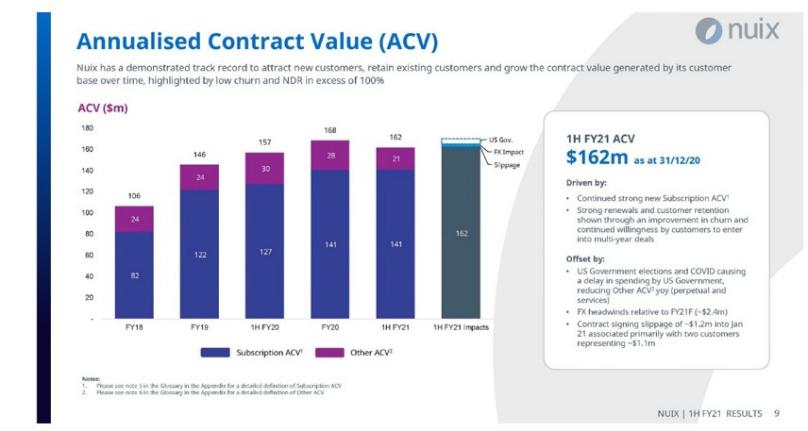
(2) a slide titled “Outlook” which included:
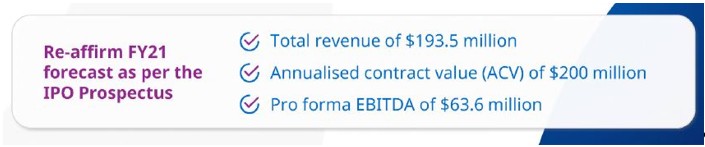
435 The Consolidated Interim Financial Report, which was signed by Mr Bleich in accordance with a resolution of the directors of Nuix, included a directors’ report which included:
Software revenue metrics
Software companies like Nuix operate on many of the same performance metrics as traditional companies, such as revenue and cash flow. However, understanding the performance of software companies and being able to benchmark them is assisted by an understanding of specific non-GAAP metrics. The primary software revenue metric we use is Annualised Contract Value.
Annualised Contract Value (‘ACV’)
ACV of $162m is slightly ahead of the prior comparable period ($157m), however consistent with the statutory revenue result, has been impacted by the unfavourable exchange rate applied to December 2020 revenues and order slippage around balance date.
…
3. Outlook
Nuix affirms its previously released full year guidance as per the Prospectus of:
• FY21 total revenue of $193,500,000;
• FY21 Annualised Contract Value of $200,000,000; and
• FY21 pro forma EBITDA of $63,600,000
…
Non-GAAP measures have been included, as we believe they provide useful information for readers to assist in understanding Nuix’s financial performance. Non-GAAP financial measures should not be viewed in isolation or considered as substitutes for measures reported in accordance with Australian equivalents to International Financial Reporting Standards.
…
(italic emphasis in original)
436 It is common ground as between ASIC and Nuix that by the 26 February ASX Announcements Nuix reported to the ASX that:
(1) during 1HFY21, Nuix earned Revenue of $85.326 million (the 1HFY21 Revenue Result); and
(2) Nuix’s ACV at the end of 1HFY21 was $162 million.
437 It is also common ground as between ASIC and Nuix that at around 10:30am on that day, Mr Vawdrey and Mr Doyle participated in a conference call presentation to investors and analysts concerning Nuix’s results for 1HFY21.
438 That presentation included a written presentation which included:
1H FY21 Financial Highlights
1H FY21 revenue in line with seasonal expectations despite considerable FX headwinds, COVID and the US election; profit margins improved due to strong operating model
|
|
|
• Continued new business momentum • Increased migration to SaaS • FX headwind of $2.4m (budgeted US FX rate of $0.69 versus Dec 20 rate of $0.75) • US Government revenue negatively impacted by Continuing Resolution and consequently decreased Perpetual licences • Contract signing slippage of ~$2.4m subsequently closed in January 2021 | • Continued new logo wins • Strong new Subscription ACV • Strong renewals and customer retention, churn decreasing to 4.2% and Net Dollar Retention >100% • FX headwind of $2.4m relative to FY21F • Other ACV (Perpetual and Services) revenue decreased from US Government and Asia associated with US Elections and COVID • Contract signing slippage of ~$1.2m into Jan 21 | • Pro forma gross margin strong at 89.2% • Pro forma EBITDA margin improving to 37.0% • Benefits from investing ahead in data centre capacity, disciplined headcount expansion and decreased marketing and travel expenses due to COVID |
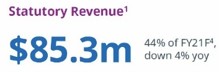
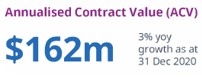

(bold emphasis in original)
C.14 26 February to 8 March 2021 and the 1 March Revenue Forecast
439 During 26 February 2021, Nuix’s share price fell from $8.97 (the previous day’s closing price) to $6.06, a fall of about 32 per cent.
440 During the afternoon of 26 February 2021, Morgan Stanley issued an update concerning Nuix which included a price target of $11.00 per share. The update also included:
NXL 1HFY21 results miss expectations. But, all full-year guidance is reiterated. Keep Overweight
...
At first look ... 1H results are a miss vs expectations ... and thus the risk profile surrounding full-year earnings delivery has increased. But, importantly, the company states the new business pipeline in 2H is strong and visibility provides confidence to reiterate all full-year FY21 numbers - Rev, EBITDA & FCF. We think the negative reaction is too severe. We remain confident in the opportunity from: i) expansion into new verticals; ii) shift to SaaS; & iii) accretive M&A. Stay OW.
1. Key 1H21 numbers
• Statutory rev -4% to A$85m
ACV +3% to A$162m
Gross profit -4% to A$76m, GP margin 89.2% vs FY21 guide 86.2% EBITDA +3% to A$32m at 37% margin
NPAT -20% to A$9m
2. Unexpected 1H impacts
• Rev -A$2.4m ... delay in contracts from Dec to Jan. Now done. Shift from 1H to 2H
Rev -A$2.4m ... due to FX of 0.75 vs 0.69
Delay in new sign-ups/renewals from US gov customers
3. Outlook: reiterate all FY21 guidance
• Expect Rev A$194m, ACV A$200m, EBITDA A$64m
Have “strong revenue visibility of >A$100m rev” for 2H
(bold emphasis in original)
441 It is common ground that:
(1) during the period from 26 February 2021 to 8 March 2021:
(a) the directors of Nuix exchanged emails addressing the market reaction to Nuix’s 1HFY21 results;
(b) the directors of Nuix received reports from Nuix’s investor relations adviser, Citadel-MAGNUS, on the market reaction to Nuix’s 1HFY21 results;
(c) Nuix received questions from a journalist from the Australian Financial Review which, among other things, noted a concern that Nuix would not achieve its Prospectus ACV Forecast;
(d) the directors of Nuix, management and Citadel-MAGNUS discussed a further ASX announcement to address “investor confidence”; and
(2) Mr Doyle, on behalf of Nuix, had discussions with ECP Investments (a shareholder in Nuix) between 3 and 10 March 2021.
442 These events are discussed below.
443 On 28 February 2021, at 6:26am, Morgan Stanley issued a further update concerning Nuix, which included a revised price target of $10.75 per share (down from $11.00). The update also included:
Reason for change
What happened? We update our financial model post NXL’s 1HFY21 results (Feb 26, 2021). 1H rev of A$85m means a considerably stronger 2H of A$109m is required to meet our estimates (and guidance), which we believe is achievable.
What are our forecast changes? Our FY21 estimates are unchanged. But we make small revisions to our FY22E Rev which moves -1% lower to A$235m (was A$237m) due to FX (A$ at 0.77 vs prior 0.75) and FY23E -1.7% to A$282m (was A$287m). Our EBITDA for FY21 is unch [sic] at A$82m, but FY22E -2% to A$114m (was A$116m) and FY23E -2% to A$156m (was A$160m). Our EPS changes are 0% to - 2% over FY21-23E.
How does this affect valuation? We reduce our PT to A$10.75 (was A$11.00) to reflect small earnings/cashflow changes. Reiterate our OW rating ... and see the pull-back in shares as an opportunity. We remain fundamentally positive: our thesis is of strong secular rising demand for investigative analytics and intelligence software + new products to drive NXL rev market share gains.
(bold emphasis in original)
444 This update contained no reference to ACV.
445 At 5:53pm that day, Ms Beresford sent an email to Mr Vawdrey and Mr Doyle in the following terms:
...
Please see below for the roadshow schedule on Monday. ...
Matt and I also wanted to highlight feedback that we have received after talking to Andrew McLeod which came through in many of the meetings we attended so I’m sure won’t surprise you.
Preliminary Feedback
1. No 1H/2H guidance was given at the time of the IPO so most investors assumed it would mirror historical 1H/2H splits or at least be 50%. No one seemed to pick up the one liner on page 155 that the 2H would be stronger than the 1H so if that’s a trend that will continue we need to highlight that for the future.
2. Investors need to understand better how you get to $193.5m revenue and $200m ACV for the year. Stephen has broken it down but we need to make sure it is very clearly communicated and factors in RUN as well as churn, FX headwinds, etc.
3. Will 2022 be a normal year? You’re expecting 10% growth in 2021 so does that mean in 2022 you will return to higher growth, i.e. 20%? If not the market will be valuing you on a lower growth multiple, i.e. 7-l0x vs 12-15x.
...
(underline emphasis in original)
446 On 28 February (and into 1 March) 2021, the non-executive directors of Nuix exchanged a series of emails.
447 The first such email was from Sir Iain in the following terms:
I guess we all felt pretty sick when we woke up to/went to bed to the market response to our half year results. A couple of thoughts.
• the U.K. feels a long way away and it’s easy to feel a bit useless when the shrapnel is flying about in Sydney. I guess you may have felt the same Jeff, but with a Californian twist. I reached out to Rod and Stephen on a personal basis and glad to say both sound resilient and matter of fact. Dan and Sue will be able to gauge that better from your own timezonea [sic]. And I also hope that others involved in the preparation of the statement are not downhearted.
• reflecting, I guess the market reaction was not unpredictable. I did wonder if we held back from discussing the possibility/likelihood of getting quite a slap in the face, motivated perhaps by protecting Rod’s/Stephen’s confidence just before their first half year announcement as a public company.
• I wonder Jeff if we might build in an INED-only period before the Board - that’s something I’ve seen done elsewhere. I wouldn’t want Rod to feel excluded but that’s not been the effect with other CEOs in my experience. I also like the additional discipline of a stocktake on how we think the Board went, again involving INEDs.
• we are a new Board and I’d rather have had this kick in the guts three months in, than in 6 months. I think it bears some reflection as to how we react.
• given the discussion we had about options for the other senior execs, this would ironically be an advantageous time for them to have their options priced. Can the timing work?
• and finally I wonder if this can be used as a prompt to those senior managers to understand that the buck doesn’t simply stop with Rod and SD when the numbers are off.
Fwiw
Best to all and quite frankly I have a lot of confidence that this is a frustrating setback, not a defining arrest.
(bold emphasis added)
448 Sir Iain provided evidence that:
(1) following the release of the 26 February ASX Announcement, Nuix received some challenging coverage in the financial media;
(2) he was concerned that there were misconceptions in the market about what Nuix’s financial performance meant for it, that needed to be addressed and corrected;
(3) his statement that his expression “reflecting, I guess the market reaction was not unpredictable” was made in hindsight, and did not reflect any view that he held prior to 28 February 2021 that the market reaction was predictable; and
(4) in the above he chose the words “not unpredictable” deliberately. He did not mean to convey by those words that the reaction was predictable. He was attempting to rationalise the reaction of the market to Nuix’s 1HFY21 results, the severity of which he had not anticipated. He intended to convey that the Nuix directors needed to reflect on whether they should have foreseen that the share price could have dropped so dramatically. He had in mind a view that Mr Vawdrey had previously communicated to him that some shareholders might have expected Nuix to achieve a 1HFY21 revenue result of $97 million (for example, Mr Vawdrey’s email dated 5 January 2021). He considered at the time he sent his email on 1 March 2021, that if a significant proportion of shareholders had held that view, it might explain what occurred. The exercise he was trying to engage in, as reflected in his email, was a post-hoc constructive analysis of what had occurred. In his experience and throughout his career, he has considered it important to undertake this sort of constructive analysis of any decision or action which produced an unexpected result.
449 Mr Bleich responded:
Thank you for passing along these thoughts and for reaching out to Rod and Stephen about the market reaction on Friday.
My sense was that the market had been a little over-excited about Nuix based on last year’s performance and was expecting another year of 25% YoY growth when it pushed up the stock price. The fact that we fell short of our expected 1H numbers from the prospectus was bound to produce a swift correction, no matter how explainable or recoverable those results might be in the context of the full year. Of course, I hadn’t expected our shares to drop as sharply as they did, but this feels like a predictable and temporary setback that will be remedied by the announcement of a few new accounts and stronger revenues at year-end. The biggest potential harm of this in the medium term is that it may dramatically reduce our chances of being included in the ASX 200 if the stock price does not recover significantly between now and March 16 when those choices are made.
I do agree that we should have an INED-only session both before and after the Board meetings. We had that scheduled for this last meeting but did not need to use it given the amount of discussion we’d all had before and after, and recognizing we had another, longer meeting coming up in just two weeks. I’ll be sure to include this in our board agenda for all future meetings as well.
Regarding options for other senior execs, you are right that having options vest at this lower price would benefit them, since we are currently just above the original listing price of $5.31. Unfortunately, I think it would be difficult if not impossible to finalize a stock option plan, and get it all tied up, and have the shares formally vest before the market will likely have moved on. But I defer to Dan and Sue’s experience on these matters.
Finally, I think the wake-up call was loud and clear. You may recall that the day we listed, our message was that now the work gets even harder and that there was no time to rest or relax. A few missed accounts took a large toll on our market cap, and I don’t think that point will be missed by anyone in the senior leadership team. Now we just need to find the right combination of carrots and sticks to improve our performance for 2H.
450 Mr Bleich explained that:
(1) he did not recall exactly what he meant by the expression “fell short of our expected 1H numbers from the prospectus” because Nuix had not released forecast numbers for the 1HFY21 in its prospectus. He believed that he may have been referring to the fact that there was a belief held by others within Nuix that the market may have, in the absence of a half-year forecast, had an expectation that Nuix’s half-year results would be 50 per cent of its full-year forecast (e.g. Mr Vawdrey’s 5 January 2021 email);
(2) in his reference to Nuix’s share price drop following the release of Nuix’s 1HFY21 results being a “predictable and temporary setback that will be remedied by the announcement of a few new accounts and stronger revenues at yearend” in using “predictable”, he did not mean that he had predicted such a share-price drop would happen upon the half-year results being released. On the contrary, he held no such view before the release of the results. He could not give a clear explanation for why he used the word “predictable”, but believed that he may have written that based on having the hindsight that the share price did drop, and it may have been an attempt on his part to rationalise what occurred. In retrospect, he believes a better word choice for what he meant to convey is “explainable”;
(3) as to his reference to the “new accounts and stronger revenues at year-end”, at that stage, he was confident based on the information provided to him by management over the course of February 2021, especially at the 12 February 2021 and 25 February 2021 meetings, that Nuix had a strong pipeline of opportunities in the second half of the year and could achieve the Prospectus Forecasts by the end of FY21; and
(4) as to the expression “another year of 25% YoY growth”, he did not recall where that figure came from and could not now recall why he included this in his email except to suggest there could be unrealistic expectations about the “tech market” generally. He does not recall having any conversations with anyone at Nuix or elsewhere about an expectation of 25 per cent year on year growth for Nuix.
451 At that time, Mr Bleich was concerned about the impact of the negative media attention on Nuix’s reputation amongst its large, institutional investors.
452 This email chain then continued:
(1) Ms Thomas:
Agree on the INED session.
I believe the priority is to be able to talk about our strategy. What adjacencies are we going after, and how do we get there.
I think the market has marked us hard – because as a growth story, Nuix didn’t grow first half revenue.
However, it is important that we are clear on what forecasts were in the prospectus.
Nuix did not present first half forecasts.
We, the board and management, have done a lot of work (the meeting on Friday 12th April) where we reviewed pipeline, and marketing feedback in detail, to form the opinion that we are on track and have a reasonable basis to conclude that we will meet prospectus forecasts for the year.
Of course we will continue to monitor this and have planned to do so after the quarter’s results are available.
(underline emphasis in original)
(the reference to “Friday 12th April” appears to be an error. Ms Thomas may have intended to refer to “Friday 12th February”) ;
(2) Mr Phillips:
Agree with all the below comments from everyone
To put this in perspective, we IPOd at a good valuation - $1.8b - but the combination of investor excitement and supply/demand imbalance pushed the share price beyond where we would have expected ... this was always going to set us up for a correction/ reality check
The market has now had the reality check and we are back at an appropriate valuation until we deliver on next stage of growth
Just need to focus on the basics - ie good execution and the rest will take care of itself ;
(3) Ms Thomas:
I think that the comments are correct.
Overwhelmingly I think we have quite a big journey in front of us to get to a position where we believe we have governance that befits an ASX200 Company claiming so many big brands as clients.
I am wondering if it makes sense to have a reasonable (1 hour plus NED session) one day this week. (I really don’t have any issue with Rod being invited either).
The agenda that I would like to cover is as follows:
…
Please let me know if there is some sense in this and if there are other agenda items we should include. ;
(4) Mr Bleich:
I think these are all good issues, but I don’t think one hour is realistic, and I don’t know that we can expect the team to be properly prepared to address all of them efficiently with supporting data and materials in the next few days. I think we should break these up into three different sessions: (1) Succession and CFO, (2) Scheduling and Culture, (3) Process, but not necessarily in that order. I’d be good with inviting Rod to spend an hour with us on #1 before the next Board meeting and relying on Suzanne and Mike to schedule it for us. We also need to check with Mike regarding any rules about giving notice or maintaining meetings about company business by a quorum of the Board. The NYSE had some very specific rules, although the ASX may be more relaxed. ; and
(5) Ms Thomas:
I was only referring to an NED discussion to agree what we all believe the priorities are and next steps with mgmt.
453 As set out in that email chain, Sir Iain, Mr Bleich, Ms Thomas and Mr Phillips agreed that it would be helpful to hold a meeting of the independent non-executive directors before every board meeting. Sir Iain’s view at the time was that it would be a good discipline for the independent directors, to have a short meeting before each board meeting in which they could discuss any key issues that had struck them in preparation for that meeting; and a short discussion after the meeting to reflect on what occurred in the board meeting.
454 On 1 March 2021 at 8:03am, Ms Nichols sent an email to Mr Silveri and Mr Hooper (copied to Mr Pipic) in the following terms:
Following the results sessions last week, we’re getting pushed very hard on “the pathway for 2H revenue/ACV growth and for prospectus forecasts to be achieved” (summary of feedback from investors contacting Macquarie).
They are looking for more specific and compelling evidence of how the pipeline will play out to achieve our revenue and ACV targets e.g.:
• Revenue – of the total ($108m?) that we still need, what’s our coverage by RUN, by region, by domain, what’s the USG revised target and the pipeline to close it out
• ACV– what’s the next level breakdown of what type of deals it will take to make the number and how much coverage do we have, including by region
Rod is looking for this detail by lunchtime today, so has asked that your [sic] park everything else and prioritise this (pulling in whoever is needed including the region heads).
I’ll be in the investor sessions this a.m., so please could I ask you both to co-ordinate a response on this?
...
455 At 9:14am that day, Mr Hooper responded:
Thanks Sarah.
Denis will work on this from an ACV perspective and Daniel + Simon on a statutory revenue basis.
Key cuts of the data will be:
• 1HFY21 performance compared to FY21F full year number
• 2HFY21 performance pipeline coverage by RUN
• 2HFY21 performance pipeline coverage by Group
• 2HFY21 performance pipeline coverage by Domain
456 At 9:17am Mr Hooper added: “Also by region might be helpful” and at 9:37am Mr Silveri responded: “Yes we will be focussing our analysis on Group by Region, thanks”.
457 As Mr Hooper’s 9:14am email noted, Mr Silveri undertook work on the statutory revenue forecast.
458 Mr Silveri’s analysis confirmed that, applying the same assumptions as previously applied to the Salesforce pipeline, Nuix’s statutory revenue for FY21 was forecast to be $193.7 million at the Budgeted Rate or $186.7 million at the prevailing FX rate of AUD:USD $0.77.
459 At 1:49pm that day, Mr Pipic sent an email to Mr Silveri regarding Nuix’s pipeline coverage to meet the Prospectus ACV Forecast. Mr Pipic provided analysis which showed that on a weighted basis, applying historical win rates, Nuix had forecast coverage for ACV of $197.7 million, using the then current FX rate of AUD:USD $0.77 rather than the Budgeted Rate.
460 At 2:39pm that day (1 March 2021), Mr Silveri sent an email to Mr Vawdrey and Mr Doyle (copying Ms Nichols, Mr Pipic, Mr Hooper and Mr McGilvery) in the following terms:
Please see attached FY21 pipeline analysis for both statutory revenue and ACV attainment. Key talking points are as follows:
Statutory Revenue (A$193.5 FY21 IPO Forecast)
• 2H remaining balance to close is $108.2m ($69.6m renewal, $22.3m upsell, $16.3m new business)
• Of this $108.2m, $36.8m has already been closed with an additional $29.2m in Commit, leaving a remaining go-get of $42.1 m (or 39% of the 2H target)
• In terms of pipeline coverage to close this remaining go-get balance of $42.1 m, we have $71.4m in remaining pipeline or 1.7x coverage, broken out as follows:
• Renewal – 0.5x – the IPO forecast had the EY MYD categorised as a renewal in its entirety. Given changes in accounting treatment, this deal (years 2 and 3 total $12m) will not be recognized in FY21, hence driving this low coverage figure. Excluding this change in accounting treatment, renewal pipeline coverage is >2x implying we have pipeline assuming conversion of other renewals to MYD’s.
• Upsell – 1 .1 x – strong upsell coverage of 2.9x in EMEA with APAC upsell target fully validated at this point in time on an actual + commit basis (with $3.2m surplus available), providing headroom for low upsell coverage rates in USA/USG.
• New – 4.3x – new business pipeline coverage is strong across the board particularly in EMEA where their full year target is fully validated (actual+ commit is greater than target) with an additional ~$13m in surplus pipeline to accommodate shortfall of revenue in other regions. APAC pipeline is 9.7x, again providing surplus to accommodate shortfall in other regions. USA is 2.5x and USG 1.7x.
In summary, at this point in time, the health of our new business pipeline is giving us confidence in making up the shortfall in revenue from any underperforming region/s i.e. USG.
The above should also be caveated with; the pipeline is not static, and builds week on week, month on month, and will continue to do so for the balance of the year. Our run-rates for FY21 YTD pipeline build have been as follows:
• Week on week – A$1.6m
• Month on month – A$7m
On a weighted basis, i.e. converting this to forecasted statutory revenue, this lands us at A$193.7m at budgeted fx rates. Assuming a constant fx rate of 0.77c for the balance of the 2H, this would have a negative impact of $7m, bringing the full year forecast to $186.7m (-3.6%).
ACV ($199.6m FY21 IPO Forecast)
• Nuix has 1.2x Coverage of the FY21 ACV Forecast (on an unweighted basis).
• A$110.7m Contracted ACV for June 2021 (7A + 5F). This relates to customers with active contracts which come up for renewal post June 2021.
• The build to achieve the FY21F is broken into three categories:
• A$41.3m Committed ACV: relates to opportunities identified by salespersons as deals in their final stages of negotiations and are near 100% certain to convert
• A$23.8m Best Case ACV: relates to opportunities identified by salespersons as near final stages of commercial validation with customers, with a historical conversion factor of 48% (weighted Best Case ACV = A$11.4m)
• A$41.1m Pipeline ACV: similarly to Best Case, relates to opportunities proving commercial validation and budgeting approval with customers, with a historical conversion factor of 48% (unweighted Pipeline ACV = A$19.7m)
• This provides a total current pipeline build of A$217m (weighted $183.2m). Additionally, we had A$2.5m Closed Won deals in February which is not captured in the 7A+5F above, resulting in a total pipeline build of A$219.5m
• Note: pipelines aren’t static and evolve overtime. Specifically in Nuix’s case, we have strong upsells aligned to customer renewals, which are predominately timed at the end of each quarter. Therefore, we have an assumption for Pipeline Build and Close which is aligned to historical run-rates
• A$25m ACV Pipeline Build and Close: relates to opportunities not in the current pipeline, but are assumed to be built and closed in 2H21FY. This is consistent with historical run-rates of deals being created and closed from February to June in prior years.
• This amounts to a total forecast coverage of A$244.5m, or l.2x FY21 IPO Forecast Coverage (weighted $197.7m)
Note: There is a breakdown of the weighted pipeline by RUN, Region, and Domain to provide further back-pocket colour as to the drivers of Forecast Attainability. Salient points from each view below:
• RUN: Strong New Business Pipeline, A$24.lm ACV coverage into 2H21FY
• Region: Inline with historical revenue proportions, with majority of ACV FY21F residing in USA (A$38.0m, vs EMEA = A$17.5m, vs APAC = 16.9m)
• Domain: Stronger pipeline growth in Corporates related to A$18.9m in incremental ACV achievement by FY21F
(bold emphasis in original; underline emphasis added)
461 I pause to note that ASIC contends that this email evidences that Mr Silveri prepared a forecast of Nuix’s Revenue for FY21 which concluded that Nuix’s revenue forecast for FY21 was $186.7 million. ASIC describes this as the 1 March Revenue Forecast.
462 As he did for the draft board pack that he prepared in February 2021, Mr Silveri included his analysis of statutory revenue against the prevailing FX rate to “stress test” his process for tracking progress against forecast, and it was what he considered to be a conservative, downside estimate for what may happen if the Australian dollar remained strong. It was not his view that the FX rate would remain the same for the remainder of the financial year; and Mr Silveri’s view was that Nuix had already built in a buffer for some movement in FX rates against it on statutory revenue.
463 On 2 March 2021, Mr Jared Pohl of ECP Investments sent an email to Mr Vawdrey in the following terms:
Thanks for your time on Monday briefly. As requested in the meeting, and prior to our meeting tomorrow, I was hoping we could discuss over email our main point of confusion with understanding how the ACV of 1H21 was achieved, as our math implies a net upsell of -$10mn ACV in 1H21. My intention is to be more productive with our time about the business more generally.
I’m sure I’m misunderstanding something, and feel it’s important to fully grasp how you construct the math.
To talk through the below ACV bridge table (attached for convenience and pasted below):
• Nuix started 1H21 with an ACV of $168mn.
• Churn was 4.2% (presumably an annualised number for the period) and therefore $3.5mn of ACV was lost.
• This gives a retained ACV, pre any upsell, of $164mn.
• Then, we work backward from the period end:
• Closing ACV for 1H21 adjusted for FX was $164.4mn ($162m + 2.4m).
• New business in ACV terms was quoted as $10mn at the Morgan Stanley lunch.
• This implies there was $154mn ACV before any new clients were added.
• Thus, starting clients, less churn, plus upsell, must’ve come to $154mn by period end.
• If we compare the $164mn (ACV post churn) and the $154mn (ACV post all net dollar retention), this implies upsell was -$10mn.
• You stated that NDR was> 100% in your presentation but the implied NDR was 92% in our working below.
2H20 | 1H21 | REF. | Comment | |
168 | A | |||
Opening ACV: | ||||
Churn - % annualised | 4.2% | |||
Less: Churn - $ in period | -3.5 | B | ||
Retained ACV | 164 | C | ||
Add: New Upsell (implied) | -10 | D | = E – C | |
Net Dollar Retention (NDR) – existing clients | 154 | E | = G – F | |
(NDR) % | 92% | |||
Add: New Business ACV | 10 | F | ||
Closing ACV: | 168 | 164.4 | G | FX adjusted |
Again thanks for your time - we look forward to our meeting tomorrow.
(bold and shaded emphasis in original)
464 On 3 March 2021 at 12:31pm, Mr Patrick Hodgens of Firetrail Investments (a Nuix shareholder) sent an email to Mr Vawdrey (copied to Mr Doyle) in the following terms:
Good to catch up yesterday. As discussed, below is really what we are looking for to get comfort about the results vs the mgmt. comments vs the prospectus.
As shareholders of Nuix, we have been quite confused with the recent result. In particular, we are struggling to square positive comments against a financial picture that implies little if any growth in the core business (once stripping out FX and Government).
One thing that would help us bridge the gap would be understanding the Annualised Contact [sic] Value (ACV) movements. We are seeking clarification from Nuix management around;
(i) How Nuix ACV reduced from $168m to $162m during 1H21
(ii) How Nuix intends to achieve ACV of $200m by the end of FY21
Please find below our workings which are based on public information and recent meetings with Nuix management. We note the significant implied 2H21 upsell required to achieve guidance for ACV of $200m.

(bold and italic emphasis in original)
465 At 12:32pm that day, Mr Silveri sent an email to Mr Vawdrey titled “SPIFF to Incentivise FY21F Attainment”, in the following terms:
In the face of the challenge ahead of us re full year prospectus forecast attainment, I thought it would be timely to deploy a SPIFF to incentivize the sales team to help propel us to the number faster and with more certainty/confidence.
Given the healthy shape of our bottom line, the market’s primary focus on top line statutory revenue and ACV, and the availability of strategic funds for deployment in our budget, I believe it is imperative we act now to mitigate any potential forthcoming forecast (and fx) risk.
The below suggestions obviously need to be vetted by regional EVP’s, however I was thinking of something along the lines of the following for consideration (and the rationale):
• Upsell – given upsell pipeline is relatively thin, propose any upsell deals closed with >40% uplift (forecast rate was 40% on renewals) for the balance of the year be paid at 1.5x the individual’s respective upsell rate. Also to minimize back end risk in the year, we could make this 2x say up until May to incentivise bringing as much forward as we can (this will help both statutory revenue and ACV)
• New – new is going to be responsible for making up the brunt of the gap to forecast. To get this moving in the right direction and with increased velocity, I would suggest offering 2x on all new deals >$100k up until May. We could make a call for June on whether this is tempered to 1.5x or 1x depending on where we are at; or increased.
In addition, to foster healthy competition amongst the team, whilst having everyone aligned and working toward the same outcome i.e. higher upsell on all deals, and larger (in addition to quantity of) new business deals, we could also consider the below:
• One-off awards for the following achievers at year end (probably in the form of one-off discretionary payments, or can be in the form of physical awards/recognition also)
• Highest value new business deal created and closed between SPIFF offering and 30 June 2021
• Highest value upsell deal between SPIFF offering and 30 June 2021 – both $ size and upsell %
• Highest cumulative value of total upsell and new business closed between SPIFF offering and 30 June 2021
• Highest value ACV deal closed (upsell amount or new) closed between SPIFF offering and 30 June 2021
• Highest value MYD created and closed between SPIFF offering and 30 June 2021
With commission cost ~$8m for the year, and the Q4 target being ~34% of full year revenue, this would imply a $2.7m base cost for commission in Q4. With the above accelerators (and renewals being ~60% of revenue), high level math would have this cost ~$1m to 1.5m in additional commissions.
These are purely my initial thoughts to get the ball rolling, and I would be happy to model further any scenario’s [sic] you or the EVP’s would like to entertain.
(bold and underline emphasis in original)
466 At 5:39pm, Mr Pipic sent to Mr Vawdrey, Mr Doyle, Ms Nichols and others an email with the subject line “Response for ECP and Firetrail – ACV Methodology and Drivers of FY21 ACV Attainability” which included a draft response to ECP and Firetrail in the following terms:
Hi [Investor],
Thanks for your time earlier today and your continued interest in Nuix.
We are writing to respond to your questions regarding the Annualised Contract Value (hereafter, “ACV”) Methodology and the Drivers of FY21 ACV Attainability. Please note, the information provided is Commercial and in Confidence.
Firstly, as we have disclosed in the half yearly presentations to the public, Nuix reaffirms the FY21 ACV forecast of A$199.6m given Nuix’s pipeline coverage analysis.
Nuix’s existing pipeline coverage indicates we can attain our FY21 ACV Forecast. This pipeline coverage analysis uses the prevailing AUD:USD FX rate of 0.77 (average FX rate between 1 January 2021 – 26 February 2021), compared to the budget rate of 0.69.
As outlined in the Prospectus in Section 4.12.3.1, the key drivers of FY21 ACV attainability include: New Customer ACV; Net Existing Customer ACV; and, Movements in Other ACV items.
1.1 New Customer ACV: we note an error disclosed in the Prospectus, the New Customer ACV forecast is A$19.0m, compared to the A$20.7m in the Prospectus.
2.2 Net Existing Customer ACV: A$18.0m (implying a 112.8% Net Dollar Retention (hereafter, “NDR”), inclusive of Churn)
3.3 Movements in Other ACV items: A$(5.7)m, predominantly driven by lower expected sales of Perpetual Licences compared to FY20
The below table provides further clarity to the ACV Methodology and the Drivers of FY21 ACV Attainability (note: the 2H21 period is a management estimate based on the composition on the expected FY21F ACV composition per the prospectus).
Breakdown of ACV Methodology and the Drivers of FY21 ACV Attainability:
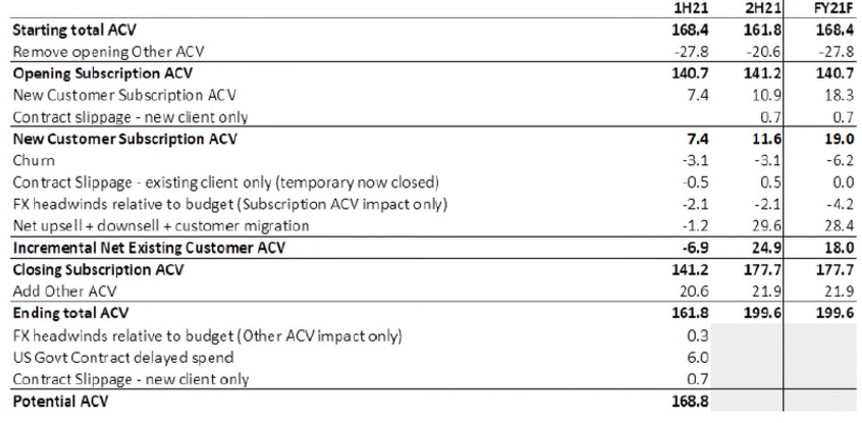
Note: there are two additional drivers supportive of Nuix’s full year FY21 ACV attainability: sales pipelines are not static; Nuix salespersons’ quotas are aligned to achieving full year sales targets.
1.1 Sales pipeline are not static: Nuix’s pipeline continues to build as salespersons identify new upsell opportunities aligned to customer renewals, primarily being occurring at the end of each quarter. This type of sales pipeline build behaviour is similar to other Enterprise Software companies.
2.2 Nuix’s salespersons’ quotas are aligned to achieving full year sales targets: this leads to salespersons focusing on year end performance in June 2021, compared to performance as at December 2020. Therefore, we only measure net dollar retention on a full year basis.
The following provides further detail into Nuix’s Net Dollar Retention (“NDR”) and Customer Subscription ACV Churn Methodology:
1. As per the definition in the Glossary of the Investor Presentation, NDR and Customer Subscription ACV Churn observes the movements in Existing Customer Subscription ACV (i.e. excludes Other ACV and existing client contract slippage)
2. As per the definition within the Glossary of the Investor Presentation, Nuix does not calculate NDR on half year periods, rather NDR is based on YoY comparable periods with Dec-19 to Dec-20 NOR >100%
Please reach out to [Contact Person] if you have any additional questions.
Regards,
(bold and italic emphasis in original)
467 On 5 March 2021, Mr Egan sent an email to various people, including the directors of Nuix, with the subject line “Nuix: urgent investor confidence meeting” which contained an invitation to a Zoom conference to be held at 8:00am (Saturday) 6 March 2021.
468 On 6 March 2021 at 7:35am, Mr Clegg sent an email in response to Mr Egan’s invitation, in the following terms:
Dear Board,
Ahead of the call here are some brief observations based on investor feedback that may assist for time. Important to say from the outset that upon listing Nuix was swept up in market euphoria for tech and growth. It has now been punished for being a poster child. The extremity of the sentiment shifts among global investors is remarkable. This is a profoundly important market backdrop to recognise. While we expected the market would be disappointed that revenue was down year over year and the ACV was down compared to the previous half, there are a number of other factors that have come into play that have pushed the NXL share price down so severely.
1. Firstly, the market has a lack of conviction in the FY21 prospectus numbers. Although the company sounds confident about meeting FY21 numbers and has broken revenue down into the renewals/upsell/new segments - it appears a big ask to meet both the revenue and ACV forecasts - the key metrics the market is focusing on. The view is that Nuix has used up all its cushion and there is no room left for further declines in the US$, lower than forecast upsell, more slipped deals as June is such a big month, etc. While Nuix sounded confident back in November and December that it would easily meet FY21 forecast and a lot seems to have changed in only a few months.
2. There continues to be significant gaps in the understanding as to exactly what Nuix does or its growth model. In the Prospectus, it seems like a simple business and a lot of people assumed it was a subscription software company with a linear growth in revenues. However, it is a complex business (albeit with great themes) with unique and individual deals, lumpy revenue with a large percentage of revenue booked in the last month of each half. To a number of investors, none of this seemed to be highlighted in the Prospectus. Not many investors in the Australian market understand the back-end software business as many Aussie tech companies are in the front-end software space.
3. There is significant noise in the numbers which provides opportunity for scepticism. Nuix is transitioning from perpetual deals to consumption/SaaS deals which other software companies have done such as SAP. This involves getting the market to understand revenue recognition for multi-year deals (83.2% upfront and 16.7% S&M deferred over 3 years) compared to subscription deals (month by month with 12 months payment up front) which also impacts ACV (only 12 months of MYDs are reflected in the ACV, not 83%). Then you’ve got the Ownership Matters report out there which claims you are overstating FY20 revenue by introducing the 16.7% S&M deferral rule starting from FY18. They also try to break out the Ringtail acquisition to highlight a lower organic growth profile.
Finally, given the nature of the OM report, the rumoured sell-side note circulating that questions the accounting treatment and financial restatements, and coupled with the imminent set of inbound questions from an investigative journalist at the Australian Financial Review, it is not unreasonable to assume there are parties that are actively critiquing or fanning the doubts about Nuix.
(bold and italic emphasis in original)
469 At 8:00am that day, a meeting of the directors of Nuix occurred by telephone.
470 Mr Egan’s notes of this meeting recorded (as written):
Nuix: Board Call 6 March 2021 12 people
START: 8:00
FINISH:
POINTS:
• Ask Adviser Ivan Tatkovich
…
• Major movements Note: Nominees Trading plus 2 days
• HSBC
• Citicorp
• National Nominees
• CS Fourth Nominees
• JP Morgan Nominees (4th to 5th)
• Last Beneficial holders analysis 15 January
• Holders under above registered holders
o diverse groups of institutions
• Beneficial holders analysis (Sect 672): 2 weeks for full analysis: (Section 672: 2 business days.
• Guidance:
____________________

Rod: Background
• Market reaction Pendal Group
• Revenue: • 24% increase to achieve full year
• low growth company
• Brett: • technology and growth
• actors in market to destabalised
• ownership matters [sic]: raised concerned
• An hour or two
• right of response
• Prospectus forecast: still valid?
• head winds: forex; US Government
• when the release ACV
• trading halt
• Unbilled receivables
• misconception on revenue
• Matt: out performance to prospectus forecast complexity around the business
Action: Scott Walsh
Stuart Bryne
Skeleton response in ASX
DND MEETING

(underline emphasis in original)
471 Sir Iain does not have a specific recollection of attending this meeting, but his general practice was to attend all meetings that he could and which were scheduled at a reasonable time for him (which this meeting was).
472 Mr Bleich’s evidence of that meeting was that:
(1) Mr Egan’s notes accord with his recollection of the events of that meeting.
(2) Mr Vawdrey indicated to the attendees that he had received some feedback from investors, including that some investors had concerns about whether the Prospectus Forecasts were still valid; and
(3) Mr Bleich’s view, which he thought was also expressed by other directors, was that investors may not have understood that management had just conducted a thorough analysis of the attainability of the Prospectus Forecasts for the purpose of the 26 February ASX Announcement over the course of January and February 2021 and that, based on what he and the other directors had been informed by management (including at the 12 February 2021 meeting and the 25 February 2021 ARC and board meetings), this analysis suggested that despite countervailing factors, the forecast was still valid. He also had no reason to question that conclusion, because he had not been informed of anything since 26 February 2021 which suggested that management’s analysis of the pipeline and Nuix’s business was incorrect.
473 At 10:21am that day, Mr Clegg wrote to the directors of Nuix and others in the following terms:
Dear Board,
The first action item was framing a skeleton outline for any response. Noting again that in the absence of having received the questions, which will have a material bearing on any possible ASX release, below is a simple basis on how we should consider one. There should be no requirement for any new data or information not currently in the public domain or drawn from recent investor engagement.
Firstly, we need to be clear as to what we are we [sic] trying to achieve? We are seeking to remove panic and capitulation stoked by reports such as those from Pendal and Ownership Matters. And by doing so, allow the space for marginal investors to return and stop what appears to be a buyer’s strike. (Short NXL positions remain negligible at only 0.15% of issued listed shares.)
Secondly, how will we achieve this? At a high level the following is recommended, subject to further consideration.
1. Reaffirm prospectus forecasts for FY21
2. Reiterate the basis for confidence in this 2H growth runway
3. Address misconceptions around the transition to a consumption basis and the broader revenue profile of existing contracts
4. Provide an explanation or rebuttal to misrepresentations around the rationale for accounting restatements
5. Deliver a broader overarching statement of conviction in the business fundamentals
Depending on the nature of the journalist questions and articles, the inflection of some of these points may change to rejections of specific claims. This may include confirmation from auditors. We will circulate the questions upon their receipt and build out their response and the above statement.
(bold emphasis in original)
474 At 11:17am that day, Mr Matthew Gregorowski of Citadel-MAGNUS wrote to the directors of Nuix and others in the following terms:
Please see below the questions as just received from Adele Ferguson.
Not unexpected in their nature and all addressable, with some misperceptions that need to be addressed such as having firm 1H prospectus forecasts.
While there is no specific reference to any reports, the questions are indicative of her at least having seen the OM report. She is also likely to have spoken to some investors.
We will work on crafting outline responses and circulate for comment and further input.
I will confirm receipt and let Adele know we will be responding. I will also seek more clarity around specific deadlines.
...
1. Since the half year results Nuix’s share price has fallen 45 per cent and is now trading below the IPO offer. Why does the company think the share price has fallen so hard?
2. Does the company believe Stat Revenue or ACV is a better measure of the company’s revenue performance? Does that company believe Stat Revenue is a meaningful metric for investors given Nuix’s revenue recognition policy which can mean 80 percent or more of total contract revenue is recognised up front in the first year?
3. When the ACV is used to smooth revenue, growth in the first half was 4 per cent, which has caused some investors to worry that this is not a growth stock as was presented during the IPO marketing. The belief was it was a growth stock growing at about 20 per cent a year. Does the company believe Nuix will be able to continue to grow its revenue at 20% per annum over the next few years to warrant its IPO marketing as a growth stock?”
4. When was the company aware that it was not going to meet its 1H prospectus forecasts? Why did it wait until the end of February to inform the market while allowing the stock price to run up to $11.86? Is the company confident it hasn’t breached its continuous disclosure obligations? Has the company received any communication from ASX in relation to the fall in its share price?
5. There is concern that Nuix won’t achieve its ACV prospectus forecast of $200M at the end of the financial year given ACV at 31 December 2020 was only $162M. Does Nuix have a reasonable basis for standing by its prospectus ACV forecast?
6. On the 1H earnings call the company cites the US election and delay in Government work as a reason for missing its prospectus revenue forecast. Was Nuix aware of these issues prior to lodging the prospectus. Was there appropriate disclosure in the Prospectus in regards to the underperformance of its government business?
7. Section 5.1.21 of the Prospectus seems to provide a wide-ranging exculpation and protection for Nuix from all financial errors and mismanagement. Does Nuix have any explanation for including such a statement?
8. The financial accounts lodged with ASIC for FY18 and FY19 appear to be heavily restated but it seems the restated accounts were not subject to a full audit by PwC. Why didn’t PwC conduct a full audit of the restated accounts?
9. In the webcast a question was asked about how much revenue comes from Nuix’s core business e-discovery. The answer was complex and that it isn’t possible to track. It was then suggested it could be 50 per cent, but with the qualification that it doesn’t have end to end visibility. Given Nuix is now a listed company does the board and senior management feel it needs to do more work with transparency and communicating so there is a better understanding of the company going forward?
(bold emphasis added)
475 At 3:00pm a meeting was held between the directors, Dr Castagna and representatives of Clayton Utz and Citadel-MAGNUS. Given the time of the meeting, it is unlikely that Sir Iain attended.
476 Mr Bleich attended the meeting.
477 Mr Bleich recalled that Mr Clegg led the discussion at this meeting. To the best of his recollection, both Ms Thomas and Mr Phillips asked questions that elicited answers that helped Mr Bleich understand the accuracy of the information contained in the draft responses.
478 During the course of 6 March 2021, draft responses to Ms Ferguson’s questions were prepared by Nuix, CitadelMAGNUS and Clayton Utz.
479 Sir Iain was under the impression that Citadel-MAGNUS worked very closely with Nuix management to prepare the draft responses. Although he did not observe it firsthand, he understood from conversations that he had with Mr Vawdrey and Ms Thomas that Mr Gregorowski and Mr Clegg had regular contact with them, and other Nuix employees such as Ms Nichols, over this period.
480 As Mr Vawdrey and Mr Doyle were both copied on the drafts circulated by CitadelMAGNUS. Sir Iain’s expectation was that they would review these drafts and correct any factual inaccuracies or overstatements.
481 Mr Bleich understood based on the above-mentioned meeting and emails that he received around this time, that employees within Nuix, including Mr Vawdrey and Mr Doyle, were providing information to Mr Gregorowski to assist him with drafting the responses.
482 At 6:22pm, Mr Clegg circulated a further draft. Mr Bleich was happy with that draft version as it aligned with his understanding of Nuix’s business at the time. He did not recall either Mr Vawdrey or Mr Doyle, or anyone else from Nuix management copied on these emails indicating that they disagreed with the content of the proposed release or informing him that it was inaccurate. Mr Bleich would not have approved it for release if someone from senior management (particularly, Mr Vawdrey or Mr Doyle) indicated that they disagreed with the content or that it was in any way inaccurate.
483 At 7:16pm, Mr Vawdrey responded to a chain of emails and stated, “I am happy with doc.” Mr Bleich understood that to mean that he considered that the content of the further draft was accurate, and it was consistent with his views.
484 At 8:07pm Mr Gregorowski circulated a further draft.
485 At 8:25pm, Sir Iain provided comments regarding the version of the draft responses circulated by Mr Gregorowski at 8:07pm AEDT.
486 On 7 March 2021, at 3:30am, Mr Bleich sent an email indicating his approval to the responses. By the time Mr Bleich responded, he could see from the preceding email chain that other directors had also responded confirming their approval.
487 On 7 March 2021 between 10:39am and 12:03pm, Sir Iain received emails from Ms Thomas, Mr Egan and Mr Clegg.
488 Sir Iain considered that an announcement to the market was an appropriate response to what he considered to be the misconceptions in the market concerning Nuix’s financial performance. His best recollection is that the Nuix directors had discussed whether Nuix should issue a release, prior to receiving Ms Ferguson’s questions. After receiving Ms Ferguson’s questions, Sir Iain considered an announcement to the market would be prudent to prevent any further misinterpretation of Nuix’s financial performance should Ms Ferguson’s forthcoming article provide a selective and potentially misleading perspective.
489 During the course of 7 March 2021, an ASX announcement was prepared to be released to the market.
490 At 10:39am Ms Thomas sent an email to the other Nuix directors (and others) in which she wrote:
I am keen to ensure that we make sure we have considered how and if we need to make disclosure to the ASX.
491 At 4:54pm Mr Gregorowski sent an email to the directors of Nuix and others attaching a proposed ASX announcement. This was circulated ahead of a call which was scheduled with the directors of Nuix and others to discuss both the content of the draft ASX announcement and whether or not it should be released.
492 Mr Bleich considered there to be two reasons in favour of issuing a release:
(1) he believed that the reaction of the market following 26 February 2021 indicated that the market misunderstood what the 1HFY21 results meant for Nuix’s business and the level of analysis that Nuix’s management team had done before affirming the Prospectus Forecast. That was a communication problem, and so it could be addressed by providing information and context; and
(2) he did not want to create any asymmetry of information by giving explanations to some people (such as Ms Ferguson) and not to others. A market release ensured that Nuix was able to communicate with everyone and to do it directly, rather than through a journalist or other intermediary.
493 At about 5:00pm, there was a call between the directors of Nuix.
494 Mr Bleich attended this call late, during the last few minutes of the discussion. When he joined the call, he was informed that Sir Iain had already left the meeting. Ms Thomas was preparing to leave as well. Mr Bleich recalled that the remaining people on the call, possibly Mr Clegg and Mr Phillips, provided him with a brief overview of what had been discussed at the meeting. He was told that the draft announcement was well-progressed and close to final.
495 At 7:08pm Mr Gregorowski sent an email to the directors of Nuix and others attaching a revised draft ASX release “following our call” and “for further discussion tomorrow morning”.
496 At 9:07pm, Mr Doyle forwarded Mr Gregorowski’s 7:08pm email to Mr Silveri attaching the revised draft ASX release, and asking Mr Silveri to “please review”.
497 Mr Silveri considered the draft announcement to be an accurate summary of the results of the forecasting analysis that he and others had conducted in January and February and the check they had conducted on 1 March 2021. The process that they went through on 1 March 2021 was less intensive than the process they went through in February, given the recency of the February process and the fact that there was very little data available that could have materially changed that analysis (other than the initial February results which would not have provided much assistance given it was not a quarter end). In Mr Silveri’s view, there could not have been any further analysis done at that stage which could have materially changed the conclusions that had been reached as to the forecast statutory revenue and ACV guidance for the purposes of the 1HFY21 results and which had been announced to the ASX on 26 February 2021.
498 At 9:29pm Mr Silveri responded: “Yes, ok to me”.
499 On 8 March 2021 at 12:00am, the Australian Financial Review newspaper published an article prepared by Ms Ferguson in the following terms:
Why are shareholders unhappy with Nuix?
The global software giant was the biggest IPO of 2020 and its shares were going gangbusters until its half-year results. What went wrong?
When staff at global software giant Nuix were sent a drinks invitation on February 26 to “celebrate the first end of financial reporting since the IPO”, they expected back slaps and toasts for a bonanza ASX listing weeks earlier.
But as the day wore on and staff shuffled to the 4pm drinks, the mood was one of shock and confusion, after a 32 per cent bloodbath in the Nuix share price in reaction to its half-yearly results.
Two weeks on, its shares have continued to plummet, wiping more than $1 billion off its market capitalisation. On Friday, it fell below its $5.31 issue price, which is a long way from the heady days of its ASX debut on December 4 when Nuix shares soared 50 per cent, then shot to a high of $11.16 on January 16.
The savagery and speed of the fall raises questions about what is really going on at Nuix to cause such a violent reaction. To put it into perspective, its statutory revenue for the December half fell 3.9 per cent to $85.3 million and its pro forma net profit was $9.5 million.
In the scheme of things the slight fall in revenue doesn’t seem bad enough to justify the fall, particularly given CEO Rod Vawdrey reaffirmed its full-year guidance and blamed the half-year revenue hiccup on currency movements, a resurgence of COVID-19 in key geographies and delays in contract signing given a longer-thanexpected transition among government clients following the US election.
But the share price rout goes to the heart of credibility, trust and transparency, and whether the cynics are right to suspect that Nuix was fattened up for market day.
It is a timely reminder to all companies that if investor trust is perceived to be breached, the ramifications can be brutal.
Investors piled into the Nuix IPO on the basis it was a growth stock. It was a Macquarie Group-controlled company and Macquarie cashed in $575 million worth of shares into the float and continues to hold 30 per cent.
Investors panicked
It didn’t matter to investors because Nuix had a star-studded customer base of law firms, advisory firms, the Australian Taxation Office, Australian Securities and Investments Commission and the US Department of Homeland Security, to name a few. It has a proprietary data-processing engine that users swear by and a glowing growth outlook.
According to research house IDC and Mordor Intelligence, the global software market for forensic, investigative and cyber security is worth an estimated $US29 billion ($37 billion), of which Nuix has less than 1 per cent market share.
So what went wrong?
When Nuix lobbed its December-half results on the last day of reporting season, investors panicked.
Stewart Oldfield, a director of industry intelligence firm Field Research, says the feedback he is getting from existing and prospective investors is that Nuix could do a better job in terms of enunciating the key drivers of its business and prospects.
“Some of that might be attributed to sensitivities around Nuix’s customer base, but some of it might also be attributed to a lack of experience in running a listed company,” he says.
Others are less polite. One likened the marketing campaign ahead of the float to putting lipstick on a pig. “There was so much lipstick caked on, no one could recognise it was a pig,” said one.
Under scrutiny
Some attacked Macquarie, which made a killing selling down its shareholding and another $14 million in transaction fees as a joint underwriter in the sale of its own shares.
The other underwriter was Morgan Stanley. In a note on February 26, its research team reaffirmed an “overweight” rating and price target of $11, but said “at first look first-half results are a miss versus expectations and thus the risk profile surrounding full-year earnings delivery has increased”. In response to the share price fall, it said “we think the negative reaction is too severe”.
Whatever the case, Nuix disappointed investors with its first result as a listed company.
Its revenue recognition policy is now under scrutiny and a number of shareholders are evaluating its status as a growth stock and where it goes from here.
There are two ways to measure revenue: statutory revenue, required under its accounting standards, and annual contract value, a commonly used metric in the software industry to average annualised revenue per customer contract. The prospectus describes ACV as “removing fluctuations from multi-year deals in Nuix’s total revenue which results from its revenue recognition policies”.
Under its statutory revenue measure, multi-year contracts can be recognised and booked upfront – as much as 80 per cent can be booked upfront – and the rest deferred over the life of the contract for support and maintenance.
In a statement, Nuix said upfront multi-year deals made up 25 per cent of its 2020 revenues and 23 per cent of revenues in the first half of FY21. “With a continued rise in software as a service deals which are recognised on a month-to-month basis, the percentage of MYDs is expected to decrease,” it said.
‘Focus is on running the business’
Some investors believe ACV is a better measure of the company’s revenue performance. In its prospectus, Nuix forecasts ACV growth of 18.6 per cent for the full year, a figure that attracted growth investors. In the December half ACV was 4 per cent, which many investors believe will make it difficult to reach its full-year forecasts, something the company rejects.
In hindsight, Nuix might have avoided the share-price rout if it had updated investors earlier instead of waiting for results day.
A Freedom of Information request reveals concerns about the prospectus were raised with ASIC days after it was lodged. The letter to ASIC, obtained by The Australian Financial Review under FOI, asked the commission to require additional disclosure and questioned the ability of Nuix to achieve its full-year revenue forecast.
It said the prospectus provided a “wide-ranging exculpation and protection for Nuix from all financial errors and mismanagement”.
It quoted the clause: “There is a risk that financial errors or mismanagement by Nuix, including but not limited to: errors in financial reporting practices or the accounting treatment of certain transactions; the incorrect interpretation of accounting standards or incorrect tax calculations; the under or over statement of key financial metrics; or an inability to implement appropriately third party checks to identify such errors, may result in damage to Nuix’s reputation, future legal action or claims, restatement of previously reported financial statements (such as the restatement of the FY2018 and FY2019 financial statements) and the potential for an adverse impact on the financial and operating performance of Nuix.”
The letter to ASIC claimed few offer documents contain such far-reaching exclusionary statements. It reminded ASIC about the restatement of the 2018 and 2019 accounts, noting that the restated accounts weren’t subject to a full audit by PwC.
ASIC didn’t have a problem.
In a statement, Nuix said the company was committed to achieving its 2021 forecasts and that it wasn’t appropriate to speculate on its share price performance. “Our focus is on running the business.”
It said the risks outlined in the prospectus were “customarily provided” to assist investors make investment decisions “and not with the design or expectation they will occur”.
It said PwC audited its 2020 financial report that includes the 2018 and 2019 comparative information. “As is general practice the company did not reissue the FY18 and FY19 reports, instead incorporating the impact of these restatements in its FY20 report. The FY18 and FY19 reports were audited by PwC.”
For now, Nuix is adamant everything is tickety-boo and it is “absolutely transparent in all our market communications” and “committed to continuing to provide appropriate and necessary disclosures”.
But investors are clearly jumpy and trust is fragile. It will need to vigilantly live up to its catchcry of “finding truth in a digital world” to win back some disappointed investors or face a further shellacking.
(bold and italic emphasis in original)
500 At 4:21am, Sir Iain sent an email to the other directors of Nuix and others in the following terms:
I thought this was very good - grounded, confident, even.
I’ve stewed on it for a few hours and the only thing I find myself returning to is where Rod is quoted as ‘we need to educate our investors .. ‘ and I worried that sounded a bit patronising.
If you’ve explored and dealt with this point feel free to ignore me.
Otherwise we could say ‘continue to explain to our investors’ or better perhaps ‘continue to illuminate for our investors’
The point of the ‘continue’ is to avoid a jibe that we should have done this already. I think we did do so, in the prospectus, but as Dr Castagna points out this is a process not an event.
Fwiw
501 At 4:49am, Mr Bleich responded:
Agree that we came out in a good place last night (I got the memo late, lain, and so joined after you’d left and as Sue was preparing to leave as well).
The Adele Ferguson article was less negative than I’d expected. In fact, I found it fairly balanced. The most damning accusation was the suggestion that the Nuix growth prospects in the near-term had been over-hyped, but it also allowed for the possibility that Nuix’s operations simply had not been adequately described such that investors could have anticipated less-than-spectacular growth out of the gate.
I think she makes three points that are valid.
(1) The reaction can’t be explained by the numbers, and so it goes to investor expectations about our transparency, credibility, and trustworthiness.
(2) We have work to do in better communicating our business cycles and arrangements to investors (without breaching our duties of confidentiality to customers and to the market as a listed company). These are things that some immediate outreach and repair work can accomplish. Investors should be able to see that any past shortcomings in explaining our business were simply a rookie error that came with having been private for so long and not being used to having to manage so many sets of investor expectations by groups that were not already intimately familiar with our business and its model.
(3) Her ominous warning that while we can rebuild trust, forgiveness is a one-time thing and this clearly raises the stakes for meeting F1 expectations.
Looking forward to catching up in a few hours.
502 At this time, Mr Bleich considered that investors and their trust was important and that investors in Nuix would be focussed on whether or not Nuix was able to meet its Prospectus Forecasts.
503 His reading of the market’s response to the release of the 1HFY21 results at the time was not that investors would punish Nuix if it did not meet the forecasts published in the prospectus, but that Nuix could maintain the trust of its investors if it did meet those forecasts.
504 He wanted to release an ASX announcement at that time because he was surprised by the market’s reaction to the 26 February ASX Announcement and he wanted to make clear to the market that Nuix was confident in achieving the Prospectus Forecasts. He believed, based on the meetings that he attended and the emails that he received at around this time, that the other directors of Nuix shared that view.
505 In Mr Bleich’s view, it was reasonable and appropriate for Nuix to issue an announcement to this effect at this time, as his understanding was that Nuix management had just conducted a thorough analysis of the attainability of the Prospectus Forecasts for the purpose of the 26 February ASX Announcement and he had not been informed that Nuix management had any information that suggested this analysis was no longer accurate, and he had no reason to believe that it was inaccurate. He was also not aware of any information that indicated to him that the Prospectus Forecasts could not be attained.
506 Either Mr Vawdrey or Mr Doyle – in response to a question from Mr Bleich as to whether they were comfortable with re-affirming the Prospectus Forecasts at this time, which he asked because he felt that it was necessary to know before making any ASX announcement whether anything had changed materially since the previous ASX announcement on 26 February 2021 – confirmed that he was still comfortable with re-affirming the Prospectus Forecasts.
507 At 8:10am, Mr Gregowski sent an email to all of the directors of Nuix and others attaching the final version of the draft announcement.
508 At 8:13am, Sir Iain sent an email providing his approval of that draft announcement. He did so because he understood that there had been a proper basis on 26 February 2021 for Nuix to re-affirm the Prospectus Forecasts, and that nothing had relevantly changed between 26 February and 7 March 2021. He was not aware of anything that had occurred in the intervening period that indicated to him that the forecasts were no longer attainable. He knew (probably from information provided to him by Mr Vawdrey and Mr Doyle during a meeting involving the directors of Nuix) that Nuix’s finance team had been doing a lot of analysis and additional verification work in response to investor queries after the 26 February ASX Announcement. His expectation at the time was that if that analysis or verification work had indicated to management that the Prospectus Forecasts could not be maintained then, Mr Vawdrey or Mr Doyle would have informed him and the other directors, and Mr Vawdrey would not have approved the content of the proposed ASX announcement.
C.15 8 March 2021 ASX Announcement
509 Later that morning, Nuix released the 8 March ASX Announcement to the ASX. The ASX confirmed its release to the market at 8:45am. It was in the following terms:
Nuix responds to market commentary
Sydney, Australia – Global software company Nuix Limited (‘Nuix’ or the Company; ASX:NXL) is pleased to provide the following confirmations in light of market commentary, including an article in today’s The Australian Financial Review.
Nuix re-affirmed its FY21 IPO prospectus forecasts when it released its 1H FY21 results on 26 February 2021. This guidance is based on its internal procedure including an in-depth analysis by the management team and its sales channel of current orders and sales pipeline. The Company’s order book for the six months ended 31 December 2020 was $107 million and its sales pipeline is strong.
Both 1H FY21 revenue and 1H FY21 Annualised Contract Value (ACV) reported by Nuix on 26 February 2021 were in line with management’s expectations when considering the impact of currency headwinds and the timing of certain deals which subsequently completed in January. As noted in its prospectus, Nuix’s contract completions are typically weighted towards the end of Nuix’s financial half years. In 1H21 for example, more than 30% of that half’s revenue was signed in December 2020.
In the case of ACV, this also included a delay in spending with the US government associated with the US election, in particular the unexpected delay in transitioning the Administration which impacted access to government agencies and officials required for signing contracts. Given the strength of Nuix’s government relationships, Nuix is well positioned to capture US government spend as it is released.
The FY21 revenue forecast, prepared on a consistent basis with applicable accounting standards, is based on estimated renewals, upsell renewals and new business. Renewals and upsell renewals, in the form of additional cores, licences and application add-ons, are forecast at $164.1 million representing 85% of total revenue. New customer revenue, which has the longest sales cycle and provides opportunity for future renewals and upsell, is forecast at $29.4 million representing 15% of FY21F revenue. In 1H FY21, renewals and upsell of $72.2m was 85% of total revenue and new business at $13.1 million was 15% of total revenue, both in line with the full year forecast mix.
...
This announcement has been authorised by the Board of Nuix.
...
(bold emphasis in original)
C.16 9 March to 12 April 2021
510 On 9 March 2021, Mr Bleich met by videoconference with a representative or representatives of Firetrail, to discuss the 1HFY21 results.
511 The Firetrail representative or representatives expressed dissatisfaction that Nuix had indicated to the market that it was only going to meet the Prospectus Forecasts, rather than exceed those forecasts. They also queried whether Nuix’s focus on statutory revenue meant that Nuix did not consider ACV an important measure. Mr Bleich responded by indicating that Nuix tended to focus on statutory revenue because it was a statutory measure which Nuix was legally obligated to report and Nuix had more historical data on statutory revenue (compared to ACV). He also said that whilst it was harder to keep up-to-date data on ACV (compared to statutory revenue), it was a measure that Nuix was tracking and would continue to keep tracking.
512 Later that day at 1:34pm, Mr Bleich sent an email to the other directors of Nuix concerning that meeting:
I just finished a call with the Firetrail Investment team, in which they raised a number of concerns about their large investment in Nuix following the lH results.
Generally, I think the call went well. I reiterated the things that had negatively surprised us, affirmed our commitment to achieve the full-year forecast, and explained more about our communication having assumed too much familiarity with both the lumpiness of our revenues and how they generally come at the backend of the year. However, there were three issues where they expressed disappointment at our ability to answer questions about past performance and the reasons for our confidence about the full-year results and future growth prospects. Apparently, answers they’ve received to date from the company on the following questions left them unsatisfied and they asked that we provide greater detail than we have to date (or that I let the team know that they were looking for more).
(1). Downsell: They claim to have trouble confirming the accuracy of supposed statements in the June to December timeframe last year about upsell increasing at that time. They claim that as they review our financial performance, they see what appears to be a “downsell” in that period. I told them that I hadn’t heard anything like this and was not aware of any significant customer reducing its spend, let alone a trend to reduce rather than increase spending on Nuix. I promised though that I would look into it, and I’d appreciate Stephen helping us provide a more fulsome response.
(2). Expansion Beyond Advisories and Ease of Adoption: They expressed skepticism that the engines were being adopted for use in industries outside of advisories, and wanted to know the basis for our expectation that we’d be able to apply them to new verticals. They also suggested that they’d spoken with Nuix customers who had difficulty understanding the product and how to use it. I said that I thought we had growth opportunities among all heavily regulated industries as well as government regulators, and that the investigations piece was an important driver of that along with the engines. I also explained that while other companies in this space deploy large teams to train companies or perform the work onsite, this is a very expensive model. Nuix software can be adopted with a relatively light footprint and this means that more companies can use it, but that it may take longer for them to fully appreciate all of the features and expand their use accordingly.
(3). Comments on ACV, Market-speak, and short-term growth: Finally, they wanted to make sure that we considered ACV an important measure (they felt we were backing away from that metric in prior conversations), that the language of the market means that quiet confidence is read as overperforming (and they feel we misjudged how our statements were heard), and that they are looking for strong growth now and in the next few years and are very anxious about our ability to make up the gap to our forecast in the next 3 1/2 months. They were glad to see the stock rebounding today but they are still in the hole and will be watching our moves very closely from now to June 30.
(underline emphasis in original)
513 At 5:50pm, Mr Silveri sent an email to Mr Doyle attaching a draft board pack for the period ended February 2021.
514 The board pack included an Executive Summary, which compared Nuix’s YTD actual performance against the Prospectus Revenue Forecast and noted that revenue was $103.4 million, representing a shortfall against the “IPO forecast” of $8.7 million. The reference to “IPO forecast” was to the monthly internal revenue targets set for January and February 2021 as contained in the Monthly Revenue Forecast. The details of the Monthly Revenue Forecast had not been disclosed by Nuix to anyone outside of Nuix and were internal targets. Mr Silveri’s view was that in any event, although Nuix had not achieved its internal targets for January and February 2021, his analysis showed that it was on track to achieve the Prospectus Revenue Forecast.
515 The draft board pack also contained a revenue bridge diagram converting the YTD orders to statutory revenue. The diagram recorded:
(1) statutory revenue of $103.4 million, after total orders had been adjusted for deferral and S&M;
(2) “budget” of $121.7 million; and
(3) “gap to budget” of $18.3 million, which was the gap to the Board Budget.
516 Mr Silveri’s view was that although the actual revenue recognised to date was $103.4 million (and was $8.7 million less than expected for the year up to the end of February), Nuix would receive the benefit of $8.4 million of deferred revenue that would be released in March to June 2021.
517 The draft board pack also contained a “Group - FY2021 Forecast Statutory Revenue” analysis. Mr Silveri prepared this reforecast of Nuix’s revenue for the period March to June 2021, with the benefit of Nuix’s performance to date. Mr Silveri calculated that Nuix would finish FY21 with total statutory revenue of $195.9 million, being the sum of:
(1) YTD actuals, deferred revenue and deals classified as “commit” ($156.5 million);
(2) a percentage of the remaining open pipeline ($31.7 million); and
(3) a percentage of additional unbuilt pipeline ($7.7 million).
518 That forecast was Mr Silveri’s best estimate of Nuix’s progress against the Prospectus Revenue Forecast based on the information available to him at the time.
519 At 5:53pm that day, Mr Clegg sent an email to Mr Bleich and Mr Phillips in the following terms:
I wanted to provide some further feedback and also a couple of recommendations. My team are engaging with management on these points and many more, so really this is a brief note to you as Board directors (I am not sure if it is worth circulating with Sue and Iain but will leave to your discretion). There is nothing sensitive in this but I would appreciate if this was a Board correspondence only.
Further Market Feedback
As Jeff noted on one of our weekend calls, to put things into perspective, a number of Nuix’s peer group companies in the US (i.e., Palantir and Splunk) and Australia (i.e., Xero and Wisetech) have sold off by between 20 and 40%. So even if Nuix has reported higher revenues, it’s important to recognise the stock would likely still be down by a significant quantum.
Specific factors worth highlighting:
• In addition to some of the shade being cast at the company on restatements, one of the emergent issues is an apparent disconnect in respect of expectations around 1H revenue. Management has clearly articulated their expectations of around $90m, which it was more or less if you took stat revenue of $85.3m and added back FX headwinds ($2.4m) and slipped deals ($2.4m). It is not entirely clear why, but a number of investors who participated during the IPO roadshow, interpreted comments at that time to suggest 1H revenues could be in the order of >$100m. Or another way of putting it, were left with an impression the numbers were conservative. Given this confusion, investors are still unclear about the bridge from 1H to FY and are further questioning the growth profile of the company – and hence its valuation multiples.
• Another dynamic that has magnified the falls is a structural one in relation to the register. It is not a main driver but worth an acknowledgement. As the Nuix IPO was so popular (off the charts), the JLMs spread the book across a lot of investors. More so than we would typically see. Yes, there are seven investors with an over 2% holding each but the long tail had a relatively small allocation so when the 1H results disappointed, the smaller investors thought the company was too hard to understand and sold their holdings completely. Collectively, this was a significant anchor on us down to the depths.
• There were an enormous amount of investor meetings done post results but investors came away with a lack of clarity on ACV (a new metric for Nuix) and a lack of clarity on revenue growth. This is unlikely to go away until they see the Company deliver on its results which again was a point Jeff made in his email following the AFR article. More challenging is concern from a few investors that it is taking the company a lot time to get back to them with answers on financial questions that related to unbilled receivables, deferred revenue, multi-year deals, SaaS deals, etc. This is not entirely fair as it is a reflection to some of the panic and anxiety that exists among investors, but worth you being aware in the even [sic] you pick this up from your own market relationships.
Recommendations
1. We typically compile an Investor Feedback Report (also sometimes called a Perception Audit when it is done out of reporting cycle). Our team will do this as a matter of course for Nuix in coming weeks. We would recommend this is also tabled to the Board. The structure is an executive summary that captures key themes and then select individual feedback on an anonymised basis.
2. August is a long time to wait to update the market on Nuix’s performance and reassure the market of its growth profile. What we recommend, so as not to take up too much of management’s time and Nuix’s internal resources, is to have an investor call – ideally at the beginning of April – to address financial questions that have not been dealt with sufficiently and to present a more in-depth analysis of revenue and ACV, the key metrics the market is focussed on. This call would be open to all investors. We would lodge an investor presentation with ASX that morning and Rod and Stephen would speak to that presentation on a call/webcast that morning followed by Q&A. This webcast would be recorded and the replay would be made available on the investor section of the website to new and existing shareholders.
(bold emphasis in original)
520 Mr Bleich forwarded Mr Clegg’s email to Sir Iain, Mr Phillips and Ms Thomas noting that Mr Clegg’s “insights align with what I heard during my discussion with Firetrail investors”. Sir Iain responded “Excellent input” .
521 On 10 March 2021 at 2:39pm, Mr Doyle sent an email with the subject line “Board Pack February 2021” to the directors of Nuix attaching a PowerPoint presentation titled “Nuix Board Pack – Period Ended February 2021 – DRAFT – FOR DISCUSSION ONLY”. In that email, Mr Doyle wrote:
Please find attached February BOD pack for your consideration.
[Mr Vawdrey] is on holidays, so I have not had the opportunity to review with him, however rather than delay, I thought good to keep operational cadence.
Forecasted revenue for $193.5 and ACV $199m are on track. All other expense lines are where we want them to be - if not better.
Happy to field any questions.
(bold emphasis added)
522 The draft board pack circulated by Mr Doyle to the directors of Nuix had no substantive changes from the version that Mr Silveri sent to Mr Doyle the previous day.
523 The draft board pack included a slide titled “Executive Summary – Year to Date” which provided in part:
YTD FY2021 Performance vs. IPO Forecast
Revenue
• Revenue was $103.4m, representing a shortfall against IPO forecast of -$8.7m
• Key drivers are exchange rate headwind ($3.3m), US election uncertainty and diminished “other” income ($3.3m) due to restrictions on delivery.
• Reduction from prior corresponding period of $1.7m driven by $2.1m reduction in professional services income, a reduction in perpetual licences of $5.2m related to the US election, and reduction in consumption revenue of $4.1m related to multi-year Epiq deal in FY20.
• ACV decreased by 3% to $158.3m, whilst churn remained around industry standard at 4.5%.
EBITDA
• Favourable to forecast by $9.9m
• COGS 29% favourable to budget, primarily driven by reseller margin reduction.
• S&D costs 12% favourable to budget, driven by lower than expected ramp up in headcount, and foreign exchange rates tailwind.
• R&D costs (pre-capitalisation) are 16% favourable to budget, driven by significant under-budget headcount.
• G&A costs favourable to budget due to unspent strategic initiatives
(bold emphasis in original)
524 The board pack also included a slide titled “Annualised Contract Value (ACV)”:
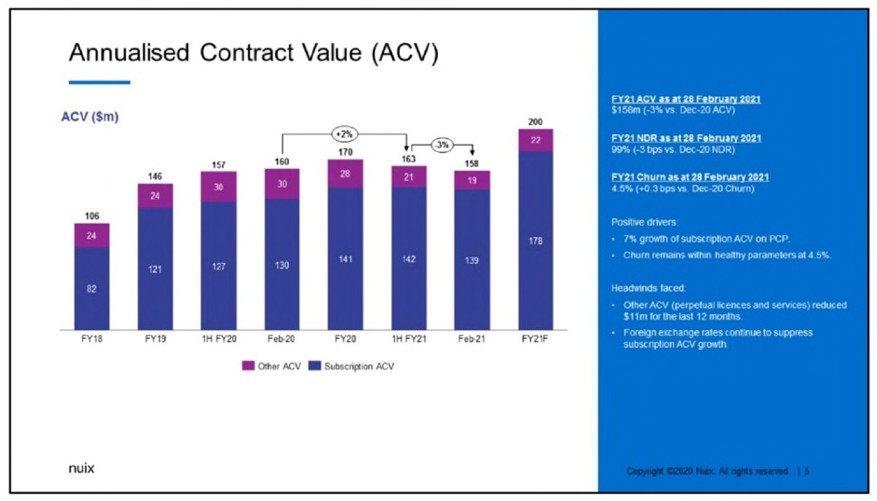
525 A third slide, titled “GROUP – FY2021 Forecast Statutory Revenue” included:
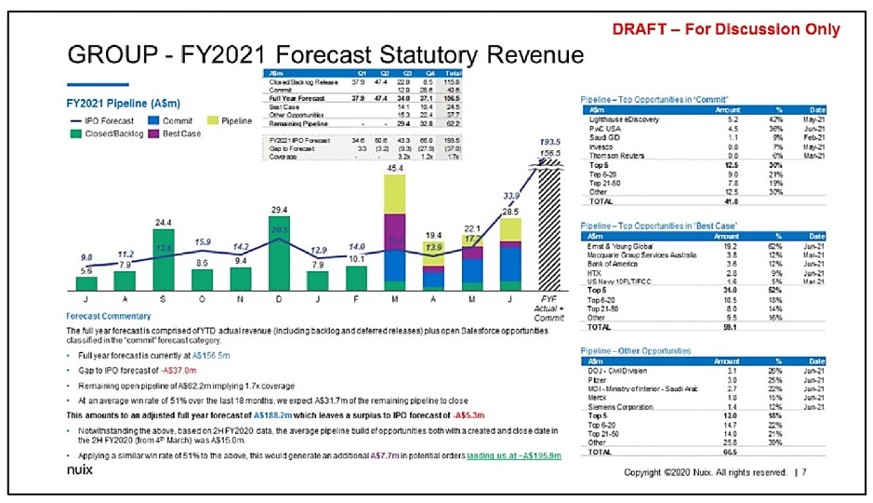
526 Mr Bleich read Mr Doyle’s email and felt assured that Nuix remained on track to meet the Prospectus Forecasts. He reviewed the attached draft presentation briefly to better understand Mr Doyle’s covering email but did not review the presentation in great detail at that stage because it was marked as a draft for discussion only. He expected further updates to be made at or before the board meeting. His impression at that time was that Nuix was booking a healthy amount of business which would make up for the slipped deals in the United States Government sector and any FX headwinds, and that this meant Nuix was tracking to meet the Prospectus Forecasts but not the Board Budget for FY21.
527 Sir Iain, in accordance with his usual practice likely reviewed the pack, bearing in mind the statement in Mr Doyle’s covering email and anticipating the discussion of this material at the board meeting scheduled for 18 March 2021.
528 On 15 March 2021, Mr Egan sent an email to the directors of Nuix attaching papers for a board meeting scheduled for 18 March 2021. Mr Bleich and Sir Iain read this.
529 On 16 March 2021, Mr Bleich met with Ms Olivia Salmon from Lennox Capital (another investor in Nuix), to discuss the 1HFY21 results. Ms Salmon told him that Lennox Capital had assumed that Nuix would out-perform and exceed the Prospectus Forecasts. Following that meeting, he sent an email to the other Nuix directors, Mr Doyle and Mr Egan, summarising his discussions with Ms Salmon in the following terms:
I spoke today with Olivia Salmon from Lennox Capital for approximately 20 minutes. She had wanted to open a line of communication to the Board, discuss the market’s reaction to our half-year results, and offer some friendly advice regarding investor relations with Lennox going forward. It was a cordial conversation, which was probably helped by the share price’s partial recovery, and by the ASX 200 listing. Her main points were:
(1) The Australian investor market reacts very poorly to surprises, and it was predictable that our valuation would fall after the 1H results were announced. She noted that the market had expected that our confidence in the full-year projections published in the prospectus so close to 1H was interpreted as a sign that that we were already outperforming those projections. I addressed this question the same way that I did with Firetrail, describing that the flow of revenues was typical of prior years and not inconsistent with our full-year forecast. I explained the lumpiness of our revenues, etc., but also noted that we’d clearly misread market expectations/reaction and learned our lesson. She appreciated that we heard the market loud and clear and that we would be working to educate the market better about our business cycles and how revenues come in late to reduce surprises in the future.
(2) She encouraged us to do roadshows demonstrating the power of the Nuix engine to investors as both a confidence builder and potential source of new connections and sales. I said I thought this was a good idea.
(3) She encouraged us to consider changing our revenue recognition model to avoid front-loading revenues on multi-year contracts to smooth out revenues. I said that our financial reporting is guided by financial accounting and audit standards but that we’d consider her suggestion and other ways of making it easier for the markets to understand both calendar revenues and future guaranteed revenues.
(4) Finally, she asked a series of questions about Tony Castagna’s current affiliation with Nuix, and what that entailed. I explained that he was not an employee but served instead as an advisor to the Board and brought a wealth of institutional knowledge, historical insight, networking capacity, and sound judgment as an advisor.
530 On 16 March 2021, Ms Beresford sent an email to Mr Bleich summarising her discussion with another Nuix investor, Regal, in relation to the 1HFY21 results.
531 On 17 March 2021, Mr Silveri sent an email to Mr Vawdrey (copying Mr Doyle) which attached Mr Silveri’s analysis of the FY21 “stretch forecast”. This forecast analysis was based on the “go-get stretch target” which the sales teams had submitted earlier in the month. This involved each region identifying specific deals that they would target to convert from “Best Case” or “Pipeline” to “Commit” in the remainder of FY21 (over and above their component of the Field Budget, which had been revised at this stage to align with statutory revenue recognition rules). The Region Heads had each selected and approved the new “go-get stretch targets” for their regions, and if the targets were met, then the sales teams would receive additional variable financial incentives.
532 The FY21 forecast analysis spreadsheet attached to Mr Silveri’s email included the following figures:
(1) actual revenue to February 2021 – $103.409 million;
(2) deferred revenue, which had previously been held back due to revenue recognition rules but was able to be released (i.e. revenue that could be recognised in the remainder of FY21) – $12.437 million; and
(3) go-get stretch deals identified by the sales teams – $86.776 million,
a total of $202.621 million.
533 On 18 March 2021, the directors of Nuix met. It is common ground between ASIC and Nuix that the directors discussed the need for any earnings guidance or other matters that could warrant announcement to the ASX under Nuix’s continuous disclosure obligations and determined that there were no matters requiring disclosure. The minutes of the meeting include:
CEO/CFO report: | The report for the period ended February 2021 was tabled and discussed. Year to date revenue to 28 February was $103.4 million, representing a shortfall against internal forecast of $8.7 million, the predominant driver being the depreciating US dollar. At budgeted exchange rates, orders booked were $122.6 million, favourable to budget by $4.6 million. Annualised Contract Value was $158.3 million, whilst churn remained around industry standard at 4.5%. Statutory EBITDA was favourable to forecast by $9.9 million at a loss of $25.0 million. It was reported that orders are strong. Year to date orders closed amounted to $118.0 million of which $15.8 million was deferred to subsequent periods. Of the $15.8 million in deferred revenue, $8.4 million is expected to be released in 2H FY2021. Mr Vawdrey presented a key table of revenue, orders pipeline and stretch revenue forecast by territory (based on current revenue, deferred revenue, total pipeline and stretch target assigned) indicating achievability of forecast revenue for full year 2021. An analysis of revenue by type and the positive trend in SaaS usage, was reported. Expense analysis was presented and the opportunity to expand Sales and Distribution expenditure to increase revenue and market share was discussed. Investment in key growth regions of France, Germany and Spain has been continued. The DACH region has produced strong growth whilst the France and Spain countries are actively developing their workforce. Current headcount was noted. … |
... | |
ASX Continuous Disclosure: | The meeting discussed the need for any earnings guidance or other matters that could warrant announcement to the market under the Company’s continuous disclosure obligations. The Board did not believe there were any matters requiring disclosure. |
(bold and italic emphasis in original)
534 Sir Iain gave evidence that:
(1) Mr Vawdrey provided a CEO Report to the directors of Nuix and presented to the slide deck included in the board pack he received on 15 March 2021. This presentation took the form of a page turn through various slides;
(2) in the course of that presentation, Mr Vawdrey discussed the fact that some internal numbers indicated a shortfall against the Prospectus Revenue Forecast, and he gave a detailed presentation, the substance of which was that, based on various data points, he believed the Prospectus Revenue Forecast was still achievable;
(3) Mr Vawdrey discussed some slides in particularly significant detail. For example, Mr Vawdrey discussed the Revenue Bridge at page 10 at length, and took the directors of Nuix through each of the “Top Opportunities” in the “Commit”, “Best Case” and “Other” pipeline categories identified on the right hand side of page 13. The information included on pages 16 and 18 was also discussed, in terms of Nuix’s strong balance sheet and strong cash position;
(4) following Mr Vawdrey’s presentation, there was also discussion of whether the shortfall needed to be disclosed under Nuix’s continuous disclosure obligations;
(5) at that time, Sir Iain did not consider there was anything that needed to be disclosed to the market. He also did not consider that Nuix needed to revise its revenue forecast for FY21 at that time, because:
(a) despite the reported shortfall, he felt assured by Mr Vawdrey’s CEO Report, presentation and his reasons as to why he was still confident that the Prospectus Revenue Forecast could be achieved by the end of FY21; and
(b) nothing was said by either Ms Thomas or Mr Phillips in response to Mr Vawdrey’s presentation that caused him to think that he was wrong to be satisfied by Mr Vawdrey’s explanation of why the Prospectus Revenue Forecast could be achieved.
535 Mr Bleich gave evidence that:
(1) Mr McGilvery was present during the first part of this meeting;
(2) the draft Monthly Board Reporting presentation for the period ending February 2021 was tabled and there was a discussion among the attendees of the internal revenue and ACV numbers contained in that presentation;
(3) he was concerned to understand whether or not the shortfall in the February 2021 revenue results affected management’s expectations for the achievability of the Prospectus Revenue Forecast;
(4) either he, or other directors, asked questions of Mr Vawdrey and Mr McGilvery on that topic;
(5) Mr Vawdrey provided a detailed breakdown of his analysis of Nuix’s order book and its upcoming pipeline and indicated that:
(a) based on that data, he remained of the view that Nuix would achieve the Prospectus Revenue Forecast;
(b) the anticipated revenues for Q3 in FY21 were in line with the previous year’s performance, and that Q4 in FY21 might require going deeper into Nuix’s stretch pipeline but that Mr Treese (who, it will be recalled, was the Regional Head for North America) felt that there was still a lot of “low hanging fruit” that had been backed up by the issues with the United States Government transition; and
(6) he was satisfied with Mr Vawdrey’s explanation, and trusted his assessment of the situation. Nothing that Mr Vawdrey said indicated to him that there was a serious flaw in the assumptions he was making about future sales, or that he had misunderstood or misinterpreted what the data was telling Nuix about the trends in Nuix’s business at the time.
536 On 19 March 2021 at 10:36am, Ms Beresford of sent an email to Mr Vawdrey, Mr Doyle and Ms Nicholas (copying others) to which she attached “a feedback report based on conversations regarding your 1H results with nine Nuix stakeholders (i.e. analysts and investors)” (the 1HFY21 Feedback Report). That feedback included:
NUIX 1H FY21 FEEDBACK REPORT
The post results roadshow included 30 meetings which consisted of 21 one-on-one meetings with investors (primarily top shareholders), two meetings with analysts and seven group meetings including two lunches hosted by the JLMs (Macquarie and Morgan Stanley), three sales desk briefings (Macquarie, Credit Suisse, and UBS), a group meeting with Singapore investors and a group meeting with US investors.
Below is a summary of the feedback we gathered based on conversations with nine stakeholders: two analysts (Morgan Stanley and Shaw & Partners), Head of Emerging Markets Sales at UBS and six top 20 shareholders (ECP, Firetrail, Lennox, Platypus, Regal, VGI Partners with a total shareholding of 15%). Recommendations and individual feedback can be found on the next four pages.
POSITIVES
• Management delivered a strong performance on the 1H results conference call. Both Rod and Stephen sounded confident and spent the right amount of time on each slide. They answered the questions asked by three investors and one analyst comprehensively and confidently.
• The top 20 shareholders we spoke to remain top 20 shareholders of Nuix. Regal increased its holding from 2.9% to 5.3%, Platypus were marginal buyers and the other four were marginal sellers.
NEGATIVES
• There was a disconnect regarding expectations around 1H revenue. Management had expected $90m but some investors expected revenues as high as $100m.
• Investors are questioning whether the company will be able to meet its FY21 revenue and ACV forecasts and are also questioning the future growth profile of the company and hence its valuation multiples.
• Post meetings with management, investors came away with a lack of clarity on the decline in ACV (a new metric for Nuix) and a lack of clarity around revenue growth.
• Some investors are questioning the aggressive nature of MYD revenue recognition (i.e., recognising over 80% in Y1 of a three-year deal).
…
TOP 20 SHAREHOLDER
We have a holding in Nuix which we could double or sell down. At the moment, we need more clarity on the numbers and things like the ACV bridge. We are not able to calculate the NDR properly and are unsure about whether there is any down sell in the calculation. We are waiting on journal entries from the company on how they account for multi-year deals [NOTE: This investor did subsequently receive these journal entries]. We do not understand how the $13m new business revenue translates to $10m/11m ACV but on a directional basis only $7m.
We would like to support the stock but do not have enough certainty around our forecasts to do so. An investor day in early April could help that.
TOP 20 SHAREHOLDER
We did not appreciate the seasonality in 1H. Historically 1H made up over 50% of revenue. Management could have been clearer about that during the roadshow.
ACV went backwards. How are they going to get from $162m to $200m with more FX headwinds? It will be challenging.
I am still unclear about the level of upsell – what it was in lH and what it will be in the 2H. Was there any down sell?
How did the company get from ACV of $168m to $162m? New business less FX headwinds, less $6m loss of US government business, factor in churn, plus upsell less down sell? We need a bridge.
We have met/spoken to the company several times and asked for answers but are having difficulty getting answers to everything we ask for. We would like more clarity on the RUN numbers.
(bold and italic emphasis in original)
537 On 22 March 2021 at 10:08am, Mr Vawdrey sent an email to the directors of Nuix, attaching the 1HFY21 Feedback Report.
538 Mr Bleich could not recall if he reviewed this material on 22 March 2021 or sometime after. His general recollection was that he agreed with the recommendation contained in the report to “[d]owngrade if you need to as soon as possible”. However, his understanding at the time was that Nuix remained on track to achieve the Prospectus Forecasts and he did not have any reason to believe that a downgrade to those forecasts was required.
539 At around this time, Sir Iain was of the view that Nuix and its directors needed to continue to be very sure of the basis for its announcements, including the meticulous analysis underpinning them, and to be ready to “unpack” broader context for the market, to enable complete understanding of information Nuix had released.
540 At 1:34pm, Mr Silveri sent an email to Mr Diora and John Carroll (Sales Operations Manager, EMEA) titled “Deals Reporting to End of Year” in which Mr Silveri stated that:
Given the sales incentives we just rolled out and with clear visibility to what needs to be closed deal by deal, I thought it would be good to prepare weekly reporting to ensure all are acutely aware of what we need to close to hit our number.
541 On 24 March 2021 at 7:31am, Mr Vawdrey sent an email entitled “Americas forecast call” to Mr Treese and Mr Diora, copied to Mr Doyle, Mr Silveri and Mr Dorchinsky in which Mr Vawdrey stated:
The call was very bad
We need to reschedule this morning my time
My expectation is region heads know their order and revenue numbers on a week to week basis as a minimum and can report on YTD, Half to Date, month to date, balance of month quarter and year and go get actions to achieve the full year go get target
We have provided huge incentives for all to achieve a go get which for Americas is almost $10m below budget and in return I expect full and complete disclosure and understanding of numbers.
I expect my questions to be answered by the region head supported by finance.
I expect full transparency across HO and regions.
We must understand at a granular, deal by deal and by by [sic] on premise, SAAS and consumption for every deal and we must know the renewals, upsell and new deals and where they are in the pipeline.
I need to be able to ask questions of my leaders and get numbers that don’t contradict with others
Lets reschedule reion [sic] forecast for Ethan this morning and make sure all sales leaders, domain leaders and finance team members understand board and CEO expectations.
542 At 9:41am, Mr Silveri sent an email to Mr Rees and Mr Carroll which included:
Also, following on from my email attached [the email of 22 March 2021], going forward we must report on a weekly basis how these deals identified in the stretch target are tracking towards closure.
(underline emphasis in original)
543 At 12:13pm, Mr Silveri sent an email to Mr Treese, Mr Vawdrey, Mr Doyle and others being the minutes and record of action items of a call at 7:00am that day. One of those action items was:
Update daily and send on a weekly basis (or more frequently if materiality warrants) listing of all deals detailing progress toward attainment of stretch target - this should show open pipeline, identification of stretch target deals required to hit the number, and green/red shading for deals closed won and closed lost respectively so we accurately know where we stand.
544 On 26 March 2021 at 2:44pm, Ms Thomas sent an email to Mr Egan (copied to Mr Bleich) in which Ms Thomas set out the recommendations from the 1HFY21 Feedback Report and asked Mr Egan to include those recommendations for discussion and action at the next board meeting.
545 On 29 March 2021, Mr Silveri sent an email to the Region Heads (copying Mr Vawdrey, Mr Doyle and others) which tracked progress against the FY21 stretch forecast of $204 million:
Please see attached forecast progression toward the $204m stretch forecast submitted by the field. The analysis provided is aimed to detail the following (by region):
• Track all the identified stretch deals (A$88.3m) to close between March and June as follows:
o What has been closed won
o What has been closed lost
o What has been pushed to FY22
o How opportunity values have changed (+/-) between the time of setting vs. now
o Analyse the composition and progression of the target i.e. how much ($ and %) has been won, lost/pushed, is in commit, best case, pipeline etc.
• How many opportunities have been closed won from unselected stretch target pipeline
• How many opportunities have been closed won from newly created pipeline since the time of setting the A$204m stretch target
• How much additional pipeline has been created since the time of setting the A$204m stretch target (and it’s composition based on commit, best case, pipeline)
• Where the validated stretch forecast is currently standing based on this latest data
Based on today’s cut of the data, the latest forecast is sitting at A$201.0m (-$3.1 m or -2%) against the initial number set of $204.2m largely driven by
• -A$1.3m in deals closed lost
• -A$2.0m in deals pushed to FY22
• Reductions in commit opportunity values vs. what was initially set
• Partially offset by increases in best case and pipeline deals, and closed won deals from newly created pipeline
It is imperative that whatever is lost or pushed gets replaced with new pipeline to enable us to maintain line of sight to this forecast.
Please see below revenue bridges visually representing the above.
…
546 On 31 March 2021 at 12:34am , Mr Pipic sent an email to Mr Silveri and Mr Hooper (copying Mr Borcherdt) showing the “FY21 ACV Pipeline Coverage as at 29 March 2021”.
547 Mr Pipic’s analysis was based on data in Salesforce as at 29 March 2021, and showed that total potential ACV would be $202.1 million, and after allowing for a -$2.5 million buffer, target ACV would be $199.6 million.
548 On 31 March 2021 at 9:59am, Mr Silveri sent an email to Mr Doyle and others in the following terms:
After talking to Simon and Laura, to do a revenue flash today would essentially be cramming month end process into the day (manually).
Based on the snippet in the previous email, I would say we are looking at between A$120-$125m revenue given we still have ~A$5m in open commit deals to close.
I think what is imperative is the Q3 order countdown Simon sent, which gives clear direction on what needs to be done now in the last day of the month.
We will be in a good position to provide a robust update for the Board Meeting next Thursday.
549 Following the end of the third quarter of FY21 on 31 March 2021, it took approximately three business days for the preliminary results for that quarter to be ready. This period included the Easter public holidays on Friday 2 April and Monday 5 April 2021.
550 On Tuesday, 6 April 2021 (at 9:53am), Mr Vawdrey sent an email to Mr Doyle (copied to Mr Silveri and Mr McGilvery) titled “08 April 2021 Board – CEO report_DRAFT” asking for “any preliminary or final financials inserted by close of business Wednesday please”.
551 Between 7 and 20 April 2021 (10 business days), Nuix’s finance team conducted a significant amount of work to calculate and verify:
(1) Nuix’s YTD statutory revenue, up to and including the third quarter results;
(2) Nuix’s ACV as at the end of the third quarter , up to and including contracts signed during that quarter;
(3) to the extent the information above identified that Nuix needed to re-consider its forecasts and targets in the prospectus:
(a) whether Nuix’s Prospectus Revenue Forecast needed to be revised, and if so, what any revised statutory forecast should be;
(b) whether Nuix’s Prospectus ACV Forecast needed to be revised, and if so, what any revised target for ACV as at 30 June 2021 should be; and
(c) whether other standard GAAP and IFRS accounting metrics (such as EBITDA) needed revision, and if so, what any revised forecast for those metrics should be.
552 It was necessary for the work described above to be conducted in conjunction with the sales teams, as the analysis conducted by the finance team referred to in the previous paragraph relied solely upon the Salesforce data and it was necessary to again confirm (similar to the process undertaken in January and February 2021) that the Salesforce data was up to date and to obtain feedback and confirmations from the sales teams.
553 On 7 April 2021 at 2:59pm, Mr Egan notified the directors of Nuix that the notice of meeting, agenda and board papers for the directors meeting scheduled for 9 April 2021 had been uploaded to, and were available on, Teams. Mr Egan also noted that an updated version of the papers would be provided on the night of 8 April 2021.
554 The draft papers included a draft “CEO Report to the Board” from Mr Vawdrey. The Executive Summary for that report included:
RESULTS AND TRADING UPDATE
CFO to present preliminary Q3 and YTD results at board meeting.
Board needs to discuss and decide on trading update based on Q3 or not. Board should discuss full year forecast and decide on guidance.
• Highlights of the 1H Results (orders, EBITDA) and the effort invested with investors to manage expectations around Nuix’s revenue generation and business model
• Proposal to further manage market expectations with May 13th Investor Day
• Focusing the business on revenue, educating on ‘quality revenue for growth’ that drives ACV
• Pipeline strength and any ongoing exposures with limited coverage
• YoY Q3 comparative commentary as leading indicator for Q4
• New logo position and recent wins
• Notable risks from delayed contracts or major renewals
• Expected impact of SPIFs on FY21 revenue
• Other Q3 initiatives that drive Q4 revenue – what will impact the number
(bold emphasis in original)
555 At 6:59pm that day, Mr Silveri sent an email to Mr Vawdrey (copying Mr Doyle and Mr McGilvery), in response to Mr Vawdrey’s 6 April 2021 (9:53am) email and attaching a document titled “Finance Board Update – April 2021” which considered the preliminary revenue results for the third quarter and a trading update for the April board meeting in the following terms:
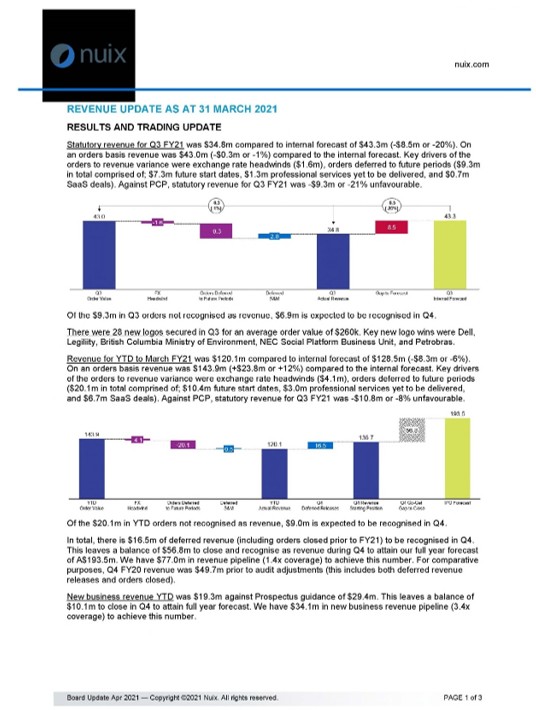
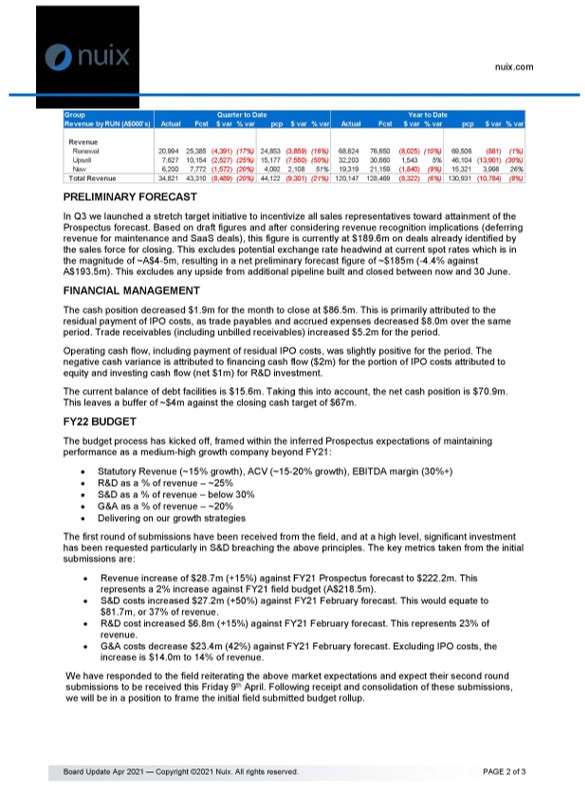
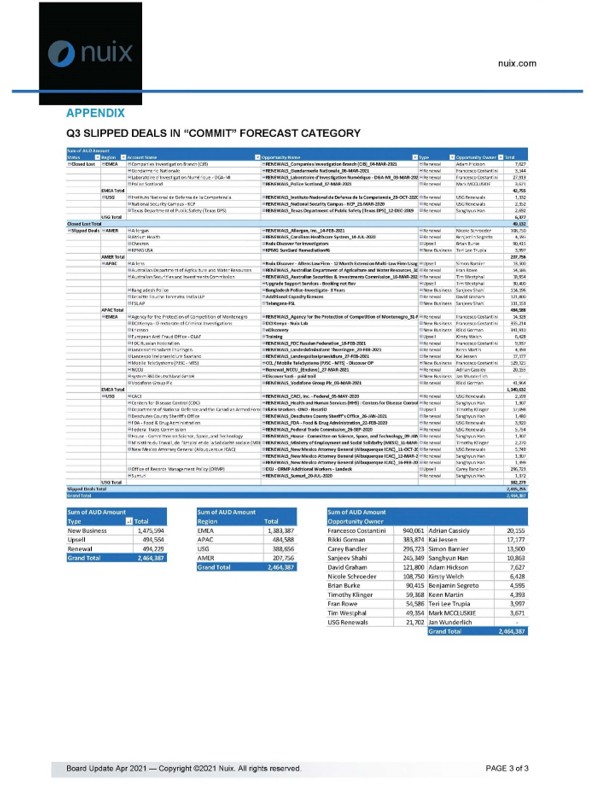
556 The revenue results for the third quarter and the expressed views on performance against forecast were only preliminary at that stage because further work needed to be done, by both the finance and sales teams so as to:
(1) verify the deals which had closed as at 31 March 2021 and how the revenue arising from those deals should be treated under the revenue recognition rules; and
(2) update and verify the remaining deals that were expected to close in the remainder of FY21, for the purposes of tracking performance against forecast both from Salesforce once it was up to date and in consultation with the sales teams.
557 The update provided by Mr Silveri included, under the heading “Preliminary Forecast”, that for FY21 the statutory revenue forecast figure:
...is currently at $189.6m on deals already identified by the sales force for closing. This excludes potential exchange rate headwind at current spot rates which is in the magnitude of ~A$4-5m, resulting in a net preliminary forecast figure of ~$185m (- 4.4% against A$193.5m). This excludes any upside from additional pipeline built and closed between now and 30 June.
558 Mr Silveri’s analysis was based on draft figures and a conservative downside case assuming ongoing adverse FX impacts, as it assumed the prevailing FX rate would remain at the same level for the remainder of the financial year and that no additional deals would be opened and closed in Salesforce in the following three months. Mr Silveri needed to conduct further work, in conjunction with the Region Heads and the sales teams to form a concluded view on Nuix’s performance against the Prospectus Revenue Forecast.
559 On 8 April 2021 at 8:46pm, Mr Silveri sent an email to Mr Vawdrey with the subject line “Board Paper” stating “[s]ee attached for your review”. The attached document, titled “UPDATE - FY21 Forecast Guidance – 090421”, included:
DRAFT – TO BE FINALISED
FY21 FORECAST GUIDANCE UPDATE
REVENUE
The Prospectus outlined a statutory revenue forecast of A$193.5m for FY21 which implied 10% YoY growth from FY20 (A$175.9m).
Following a challenging first half in FY21 plagued by COVID-19 (particularly in North America, EMEA, and Asia), US Government spending delays, and persistent fx headwinds, this has left us with a formidable second half target to achieve the Prospectus guidance of A$193.5m.
To address this challenge, in Q3 we launched a stretch target initiative to incentivize all sales representatives toward attainment of the Prospectus forecast by targeting specific deals for closure by 30th June. The below bridge details the progression and current status of these deals.
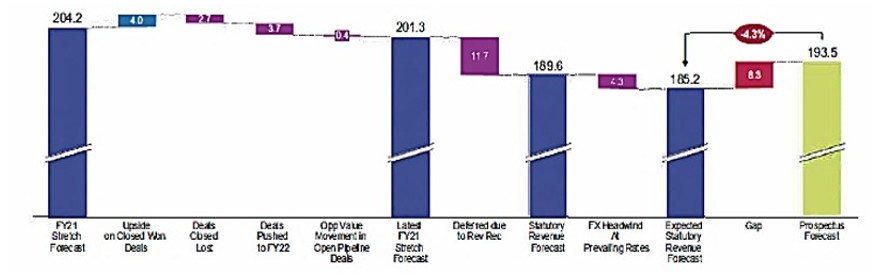
Based on this latest data presented above and after giving consideration to revenue recognition implications (deferring revenue for maintenance and SaaS deals), the statutory revenue position is currently at $189.6m on deals already identified by the sales force for closing. This excludes potential exchange rate headwind at current spot rates which is in the magnitude of ~A$4-5m, resulting in a net expected forecast of $185.2m (-4.3% against A$193.5m). This excludes any upside from additional pipeline built and closed between now and 30 June (run-rating at ~A$1m per month).
It is also prudent to observe the typical run-rate of slipped deals at the end of each quarter (A$2.4m in December, and A$2.5m in March), and also give consideration to the top deals requiring closure by RUN to understand their materiality and potential risk to the aforementioned forecast. The below table summarizes the top 5 deals requiring closure in Q4 by RUN.
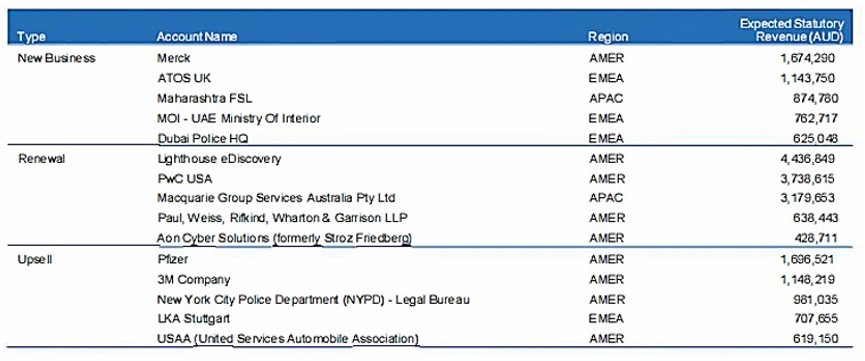
Any misses or slippage in the above would pose material risk to the forecast, and it is also worth noting the Macquarie deal in APAC has unconfirmed revenue recognition treatment (i.e. pending confirmation from auditor on whether or not we can recognize in FY21 based on the final construct of the deal).
As such, and after giving consideration to all the above factors, we are proposing updated statutory revenue guidance in the range of A$180-185m.
For additional context, per the below, we have A$48.6m of deals (fx adjusted) to close to get to our expected forecast, and more than half of this is from renewals ($27.8m) bringing us to a floor of ~A$165m. The remaining ~$15-25m will come from upsell and new business to get us to the updated revenue guidance of A$180-185m.
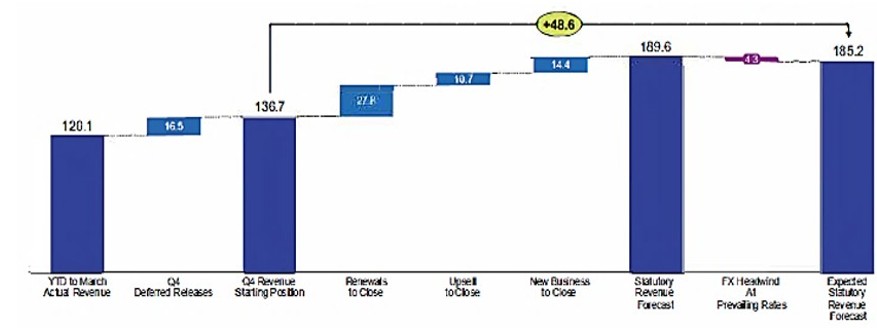
On an ACV basis, based on the current product mix of the pipeline, we maintain line of sight to achieve Prospectus guidance within 5%. This is due to a large proportion of Q4 deals being maintenance (in addition to SaaS) which are detrimental to statutory revenue recognition, however, beneficial to ACV.
FINANCIAL METRICS
In line with guidance provided in the Prospectus on COGS, R&D, S&D, G&A, and EBITDA as a percentage of revenue, please refer to the below which tables progression toward these targets.
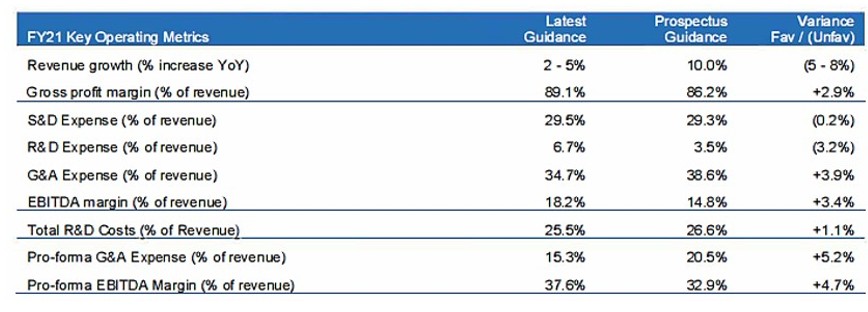
In summary, we remain largely on track to achieve initial guidance on all metrics, excepting revenue.
FINANCIAL MANAGEMENT
The cash position as at March 2021 was $86.5m. The current balance of debt facilities is $15.6m. Taking this into account, the net cash position is $70.9m leaving a buffer of ~$4m against the closing cash target of $67m as disclosed in the Prospectus. At this point in time, we do not envisage any immediate triggers to breach this guidance.
(bold emphasis in original; underline emphasis added)
560 This document was also in draft given the further work required to update and verify the data in Salesforce for the purposes of YTD results and performance against forecast.
561 The statement:
As such, and after giving consideration to all the above factors, we are proposing updated statutory revenue guidance in the range of A$180-185m
reflected Nuix finance team’s best estimate as at 8 April 2021 of the statutory revenue that Nuix would achieve in FY21, based on the preliminary third quarter results and Mr Silveri’s initial forecast analysis, and subject to further work being conducted.
562 In respect of ACV, page 2 of the update stated:
On an ACV basis, based on the current product mix of the pipeline, we maintain line of sight to achieve Prospectus guidance within 5%. This is due to a large proportion of Q4 deals being maintenance (in addition to SaaS) which are detrimental to statutory revenue recognition, however, beneficial to ACV.
563 The reference to “maintenance” is to the S&M component of multi-year deals which could not be recognised upfront under the revenue recognition rules and had to be deferred to future accounting periods. However, for the purposes of deriving an ACV, the S&M component was not treated differently to the rest of the contract value. Thus, multi-year deals that Nuix expected to close in the fourth quarter would be averaged and annualised at their full face value including the S&M component (which increased the ACV estimate for FY21).
564 On Friday, 9 April 2021 at 3:00pm, the directors of Nuix met. Mr Silveri was in attendance. The minutes of that meeting include:
The CEO Report to the Board dated 9th April 2021was tabled.
The CEO reported that revenue to 31 March 2021 was $136.7 million after taking into account deferred revenue of $16.5 million which is expected to be released to the Profit and Loss account prior to 30 June.
Based on actual revenue to 31 March and initial forecast for the balance of the year, current best estimate of statutory revenue forecast for full year 2021 stands at ~$185 million compared to prospectus revenue forecast of $193.5 million. It was noted that this revenue forecast is based on initial reforecasting and that the reforecast will need to be reviewed and examined in more detail. The meeting was advised that current earnings estimate for full year 2021 is an improvement of the Prospectus earnings forecast.
The meeting discussed the need for a market update based on the current full year revenue forecast. It was agreed that:
• The current revenue and earnings forecasts be reviewed in detail;
• A proposed ASX announcement be prepared and circulated by Wednesday (14 April) night; and
• Any announcement required by [sic] finalised by Friday (16 April) morning.
Any revenue and earnings guidance to be announced should be a range.
565 During this meeting, Mr Vawdrey updated the Nuix directors on the current best estimate of statutory revenue for FY21 while also noting that it was an initial view of that forecast and that additional work was required to form a final view. The directors discussed that the current FY21 forecasts needed to be reviewed in detail before any decision could be made as to whether or not an announcement to the ASX was required.
566 Sir Iain gave evidence that:
(1) the directors were informed by Mr Vawdrey that, as a result of some analysis done by management, subject to confirmation, there was now likely to be a lower forecast of FY21 revenue and there was a need to consider issuing some revised earnings guidance;
(2) he could not recall the exact source of the revised statutory revenue forecast figure, but a figure of about $185 million was discussed at the meeting;
(3) Mr Vawdrey and Mr Doyle emphasised that the figures being discussed were not final, but in draft, and that further work needed to be done by the finance team to verify them;
(4) this was, to his knowledge, the first time that the directors of Nuix were informed that Nuix’s management were concerned about Nuix’s ability to meet the Prospectus Forecasts. The gist of the discussion by the directors at the meeting was that, once the figures had been verified, if they in fact required a change to those forecasts, then Nuix should make an announcement revising the FY21 earnings guidance as soon as those figures were available; and
(5) it was also his view at the time, based on his understanding of Nuix’s obligations that once the numbers were confirmed, the directors of Nuix would make a decision to disclose those numbers as soon as possible. In forming that view, he also took into account the media scrutiny that Nuix had been under since the release of its 1HFY21 results. He was also sensitive to the fact that the directors of Nuix had re-affirmed the Prospectus Forecasts on 8 March 2021 and he wanted to ensure that, if Nuix needed to provide the market with any revised guidance, it was as clear and accurate as possible, including as to the revised figures and the reasons for any deviation from the Prospectus Forecasts, particularly in light of their relatively recent affirmation. Otherwise, he was concerned the market would be confused by the revised guidance, and potentially may react in a severe and negative fashion.
567 Mr Bleich gave evidence that:
(1) the minutes (which he reviewed and signed off) reflect his recollection of what occurred at that meeting;
(2) Mr Vawdrey informed the directors of Nuix that, based upon preliminary work that had been conducted by Nuix management, the current best estimate of statutory revenue forecast for FY21 was approximately $185 million;
(3) this was the first time that he had been informed by Mr Vawdrey, or anyone else, that the forecast had shifted and that Prospectus Revenue Forecast would not be met;
(4) he was surprised and frustrated by this information because, up until this point in time, he (and, to his knowledge, the other directors of Nuix) had been told by Mr Vawdrey and Mr Doyle on numerous occasions that Nuix was on track to achieve the Prospectus Forecasts;
(5) however, Mr Vawdrey also said words to the effect that there was further work that management had to do to verify the statutory revenue forecast figure and to then derive the ACV forecast figure and the EBITDA forecast figure. Mr Vawdrey indicated that because the calculation of ACV was contract-specific and based on recurring revenue over a period of time, more time was required to analyse each contract to derive the ACV forecast figure;
(6) he asked Mr Vawdrey to work with the Nuix finance and sales teams to confirm the forecast figures as quickly as possible so that the directors of Nuix could consider whether disclosure was required pursuant to Nuix’s continuous disclosure obligations and, if disclosure was required, to ensure that clear guidance could be provided to the market as soon as possible;
(7) his understanding at that time was that the ASX Listing Rules required prompt disclosure of material deviations from Nuix’s published earnings guidance. His understanding of materiality – based on the steps he took after accepting the offer to serve as Chairman of the board of directors of Nuix in order to familiarise himself with Nuix’s continuous disclosure obligations and the conversations he had with the Australian-based members of Nuix’s board of directors, including Ms Thomas and Mr Phillips, as well as Mr Egan and Mr Brian Krupczak (who was previously General Counsel and for part of the period prior to 18 November 2020, Company Secretary for Nuix) in relation to Nuix’s continuous disclosure obligations – was that usually a divergence of less than 5 per cent from forecast was not material, although materiality was always to be assessed in context;
(8) his view at the time was that although $185 million was within the 5 per cent range, any shortfall from the Prospectus Forecasts should be disclosed as soon as possible, because he considered it imperative in fostering trust with Nuix’s investors to reduce earnings surprises, and keep the market as informed as possible so as to manage its expectations of Nuix. To that end, his desire to disclose this updated information to the market was not based on his understanding that such disclosure was required by the ASX Listing Rules, but instead by his desire to foster good investor relations and to manage investor expectations;
(9) however, it was also important to him that any market disclosure was as accurate as possible, contained all material information which required disclosure and provided a clear unequivocal explanation for any departure from the Prospectus Forecasts in order to avoid any misconceptions by the market of Nuix’s performance. His view at the time was that although the Nuix finance team was reporting a preliminary revised figure for statutory revenue, Nuix should not disclose this until that number was: (a) verified; and (b) was complemented by verified numbers for the other two metrics reported by Nuix, namely ACV and EBITDA. His assumption at this time was that those metrics would be able to be verified within a reasonably quick time; and
(10) in circumstances where, in his view, any disclosure was being made on a proactive basis so as to engender investor trust, rather than under the compulsion of the ASX Listing Rules, he considered that it was prudent for Nuix to quickly and efficiently undertake further work to present an accurate and complete update to the market, rather than rushing to the market with preliminary information that was both incomplete and potentially subject to change.
568 Following the directors meeting on 9 April 2021, two parallel tracks of work were undertaken:
(1) management, in particular the finance team, directed by the Chair of the ARC, undertook a verification process to review the forecast figures and confirm what the definitive numbers were; and
(2) the preparation of a draft ASX announcement (subject to the figures being verified), with the assistance of external advisers.
569 The tentative timetable set at the 9 April 2021 meeting, which is recorded in the meeting minutes ([564] above), was that management would do the work necessary to have a draft ASX release ready for review by the directors of Nuix by 14 April 2021, and that a release would be made after approval by the directors at a meeting on 16 April 2021.
570 Sir Iain’s expectation was that, in that period, Nuix’s management team would progress both of the parallel tracks of work, so that the draft ASX release contained a full and accurate explanation of why the revised downgrade was being issued, and what that downgrade was. He expected, based upon his knowledge of the forecasting process, that management in this period was working on verifying the preliminary figures which had been presented to the Nuix directors on 9 April 2021 and taking steps, including the iterative process between the finance and sales teams to test the data provided through Salesforce ([139] above). He relied upon management to undertake this process as expeditiously and as rigorously as possible. He received updates about how this process was tracking from 14 April 2021 onwards.
571 Mr Bleich understood that Nuix’s management, assisted by the finance and sales teams, were working to update and verify the forecast for statutory revenue, ACV and EBITDA as quickly as possible.
572 He was aware that following the 9 April 2021 meeting Ms Thomas and Mr Phillips were communicating with Nuix’s management regularly to understand how this workstream was progressing. He received updates from Mr Vawdrey, Ms Thomas and Mr Phillips in respect of this work. During this period, Mr Bleich also actively enquired of Mr Vawdrey as to how this workstream was progressing. He frequently called Mr Vawdrey and asked him why the process to get confirmed numbers was taking so long, and whether he was satisfied yet that he had enough information for Nuix to make a complete and accurate disclosure. Mr Vawdrey usually responded that he would follow up with Mr Doyle or others regarding updates and addressing any delay in the process of obtaining information.
573 Mr Bleich was also aware that while the numbers were being investigated by Nuix’s management, work was being done, in parallel, on the preparation of a draft ASX announcement to ensure that when the review of the numbers was finished, Nuix could communicate the relevant information to the market promptly and provide it with a clear and factual explanation of why the numbers had moved and why any of the Prospectus Forecasts would not be attained. He considered that meeting the requirements of timeliness and accuracy for the financial information and explanation to be extremely important for the communication that Nuix was making to the market.
574 The work undertaken within those parallel streams is discussed in more detail below.
575 Between Friday, 9 April 2021 and Tuesday, 13 April 2021, Mr Silveri conducted a significant amount of work in relation to Nuix’s third quarter results and performance against forecast. That work included contacting the Region Heads and requesting that the sales teams update and validate the data in Salesforce so that the finance team could prepare an accurate analysis of Nuix’s performance against its Prospectus Revenue Forecast.
576 At 5:11pm that day (9 April 2021), Mr Silveri sent an email to the Region Heads (and others) in the following terms:
We will be conducting another forecast review on Monday for both statutory revenue and ACV.
As such, by Monday. Morning Sydney time, can you please ensure you update your Q4 pipeline in Salesforce as accurately as possible (particularly for the stretch identified deals) as we will be relying on this data to formulate our forecasts.
The following fields are imperative to driving forecast outcomes for the following reasons, so please ensure they reflect reality as much as possible (now, and obviously continuously going forward):
• Close date – this ensures we capture the deal as a booking in the correct period
• Product start date – the product start date is the determinant of when a deal is recognized as revenue and ACV. For example, if a renewal with start date in FY22 is closed in Q4 FY21, we cannot recognize any revenue in Q4 FY21 as the start date is in FY22. Similarly, a deal with a close date of 30 June, though product start date of 1 July cannot be recognized as revenue in FY21. To confirm, close date is not the determining factor for revenue recognition or ACV, rather it is product start date. Ensure this is updated accordingly in the system for each deal.
• Product – this is important as each product has different revenue recognition and ACV implications:
• On-premise licenses are recognized upfront for statutory revenue | the annualized value is taken to ACV
• Perpetual licenses are recognized upfront for statutory revenue | the full amount is taken to ACV
• SaaS is recognized ratably on a monthly basis over the contract term for statutory revenue | the annualized monthly value is taken to ACV
• Maintenance is recognized ratably on a monthly basis over the contract term for statutory revenue | the annualized monthly value is taken to ACV
• Professional Services are recognized once the services have been delivered for statutory revenue | the full amount is taken to ACV upon booking
• Contract term – this particularly affects ACV as it determines the annualized value that is attributed to the ACV number
• Opportunity value – goes without saying, this should be adjusted for how the deal is currently being worked i.e. if targeting a MYD, or SaaS etc. adjust as such
We do not want to be making assumptions on deals in the pipeline with these fields missing as they have a material bearing on the forecast, and are best to be formulated by yourselves who are closest to the customer with 11 weeks to go.
Please let me know if you have any questions.
(bold and underline emphasis in original)
577 The reference to “Monday Morning” was to Monday 12 April 2021.
578 Mr Rees forwarded Mr Silveri’s email to his Domain Leaders in EMEA and APAC under cover of an email in the following terms:
We have an urgent action that is Priority 1 and must be completed urgently.
Daniel has laid out clearly the actions for you to complete on your Q4 Commit, Best Case and any Pipeline deals that were Green ticked for your Go Get Stretch, at a minimum.
Remember: This is about forecasting REVENUE, not orders therefore the detail is mandatory.
Payment terms on MYD is also critical as paid upfront allows us to recognise the deal but Paid Annually we can may recognise the deal if the license is cut for the full MYD term and issued via CLS.
If this is not clear please call John or myself.
Ongoing we will be having frequent Rev Rec forecasting sessions with the finance team.
(bold emphasis in original)
579 Mr Rees also had a discussion with Mr Silveri and informed him that although he (Mr Rees) and his team would work to update and verify Salesforce as soon as possible, there would likely be a delay in the EMEA data turnaround due to the Easter school holiday period across Europe. Mr Rees thought that it would be difficult for the salespeople in his team to conduct further discussions with and receive prompt feedback from customers, as many were still on leave.
580 Nevertheless, upon receipt of Mr Silveri’s email, Mr Rees worked with his Domain Leaders and Sales Operations Manager to promptly undertake a review of the Salesforce data and in particular:
(1) they first went through on a deal-by-deal basis every sales opportunity categorised as “Commit” in Salesforce, with a view to either confirming their confidence that the deal would be closed within FY21 or re-classifying the opportunity as “Best Case” (and allocating additional support to increase the probability of the opportunity closing in FY21); and
(2) they then undertook a complete review of all “Best Case” and “Pipeline” sales opportunities that had been identified as part of his team’s “Go Get” targets. The purpose of that exercise was to consider how each opportunity was progressing, and whether any opportunities needed to be reallocated to more experienced salespeople to increase prospects of that deal closing in the FY21 period.
581 In working through the probability of each deal closing in FY21 and assessing the likelihood of any final “Upsell” opportunities for the fourth quarter, additional time was required for salespeople to conduct further discussions with customers. Mr Rees spoke with, or tried to speak with, all customers with potentially high value deals that were expected to close, being deals valued at over $250,000. There was some delay in being able to reach each of the relevant customers given the Easter break.
582 At the same time as such work was being done, Mr Rees also had a series of discussions with Mr Vawdrey and the finance and corporate strategy teams who sought additional feedback from the Region Heads on validating the opportunities in the pipeline and movements in the Salesforce data.
583 Mr Silveri explained that the process of verifying the data in Salesforce is a time consuming process for the sales teams as each sales representative must consider each of their open deals in the system and update the opportunity with additional details as required. As this verification process was now occurring much closer to the end of the financial year (rather than with six months to go as was the case after the end of the first half), it was possible for the sales representatives to have conversations with each of their customers about the timing of each deal closing and to know with more certainty what would be successfully closed before the end of June 2021. This process of contacting each customer, receiving their views and then updating the data in Salesforce took some time. As Nuix operated across many different regions with different time zones, this added additional time and delay to the process before the finance team in Australia could run their reports and form an assessment on the most up to date information.
584 On Monday, 12 April 2021, Mr Vawdrey sent an email to Mr Silveri with the subject line “Q3 results and forecast” in the following terms:
Could you provide the following information for discussion with the board asap.
1. List of all deferred contracts and reason for deferral broken out by region with name of salesperson
2. Comparison by region for RUN for Q3 against last forecast and PCP
3. List of all new logos this last quarter with detail on SAAS, consumption, Subscription, multi-year etc and whether they were booked or deferred
4. Forecast go get by region based on Q# results and analysis on where we believe we will land
5. List by region of all deals over %ok that need to close by June 30th that are revenue for this financial year with sales person name and products sold and type of licence
Please provide both statutory and ACV numbers and any other detail that will help fully inform our board.
Investors will want to understand in detail why we are potentially going to miss 193.5 guidance.
They will want to know bookings as well as revenue and bridges on revenue and SAAS and deferrals
The board wants to decide by Close of business on Wednesday if we need to provide a trading update at 5.00pm Friday
We need all hands on this work please.
(I infer from the location of the # symbol on a standard keyboard and from the reference to “Q3” earlier in this email that the reference to “Q#” was intended to be a reference to “Q3”.)
C.17 13 to 21 April 2021
C.17.1 Tuesday, 13 April 2021 and the April Forecast
585 On Tuesday, 13 April 2021 at 12:53am, Mr Silveri sent an email to Mr Vawdrey, in response to Mr Vawdrey’s 12 April 2021 11:56am email. Mr Silveri wrote: “Please see attached draft paper addressing the below points”. The attachment was headed “Draft – for discussion only”. The attached paper included:
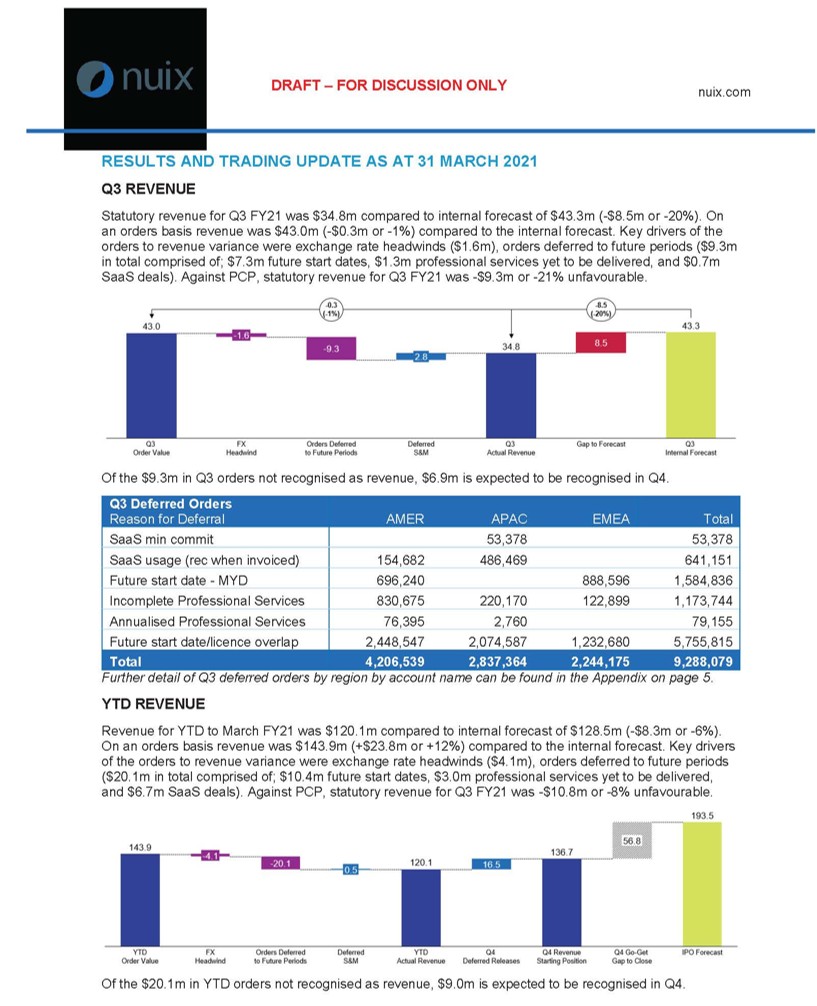
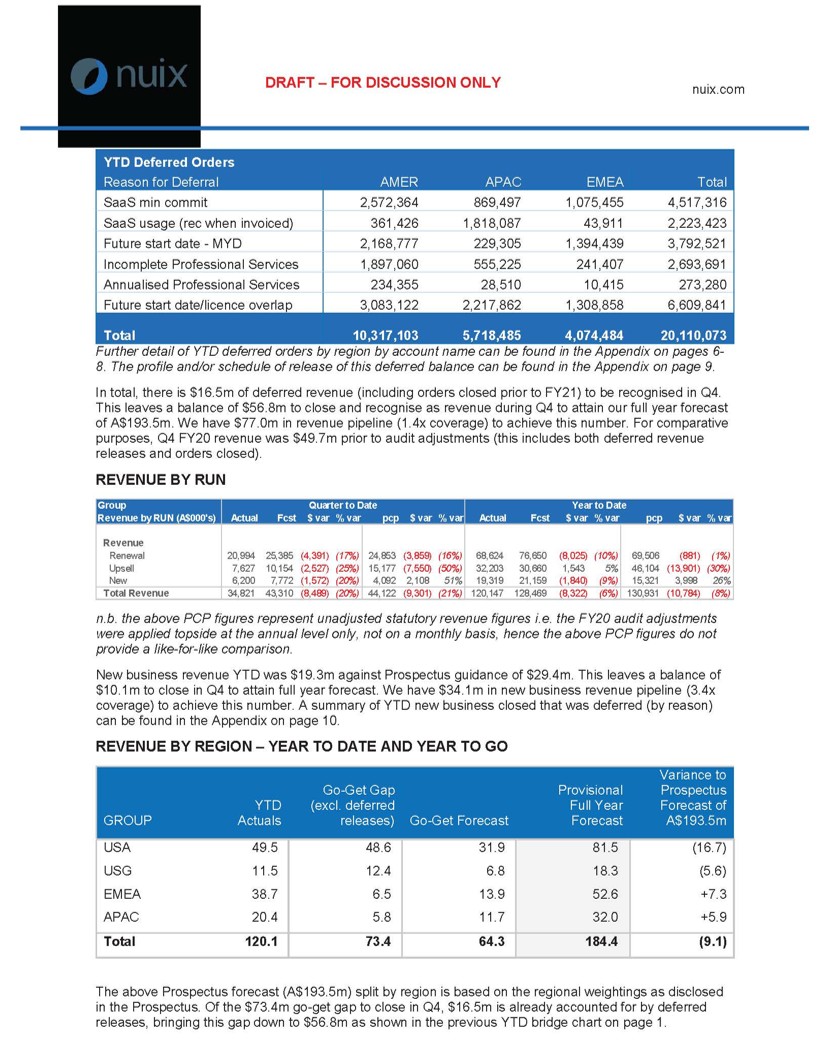
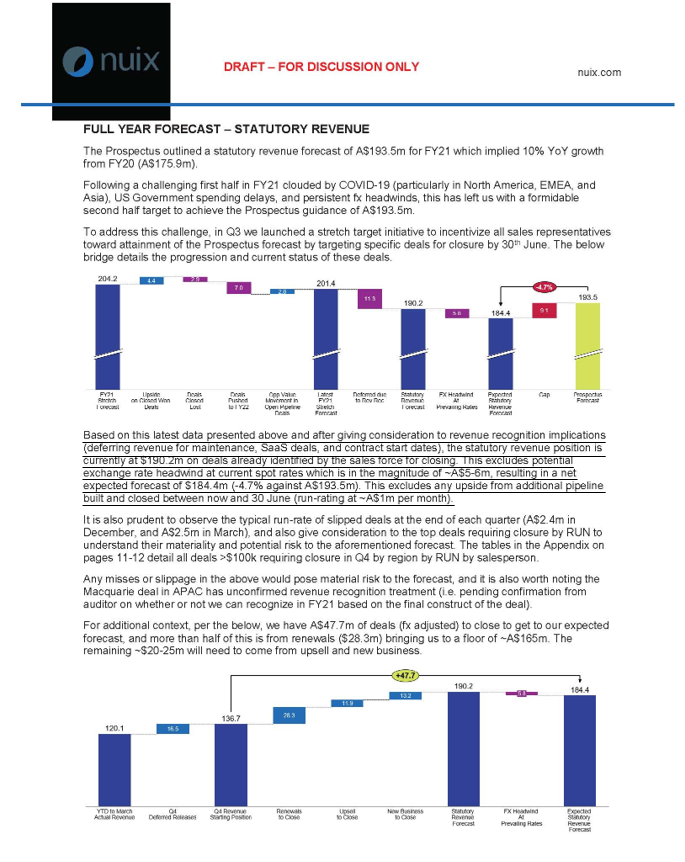
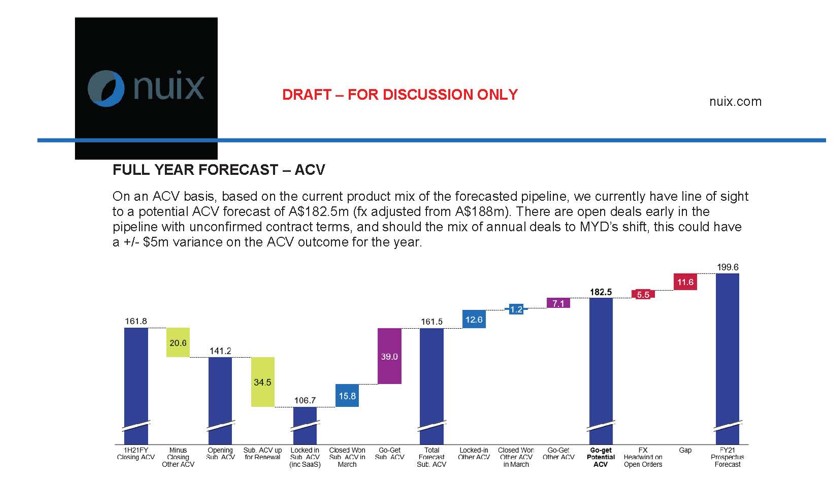
…
(bold emphasis in original; underline emphasis added)
586 The information contained in the attached paper was based on the latest data in Salesforce, but the validation exercise that had been commenced by the sales team at Mr Silveri’s request on 9 April 2021 was ongoing. In other words, Mr Silveri’s analysis was subject to verification of the Salesforce pipeline which had not been completed at that stage.
587 I pause to note that ASIC contends that by the time of this email, Mr Silveri had completed the review of the forecast of Nuix’s Revenue for FY21. I also note that ASIC describes the revenue forecast for FY21 of $184.4 million referred to in the papers that Mr Silveri provided to Mr Vawdrey, as the April Forecast. ASIC alleges that from this point in time Nuix had information which it was required to disclose to the ASX.
588 At 4:45pm that day, Mr Silveri sent Mr Vawdrey an email (copying Mr McGilvery and Mr Doyle) attaching draft talking points. The information in the draft talking points was subject to verification of the Salesforce pipeline which had not been completed at that stage.
C.17.2 Wednesday, 14 April 2021
589 From Wednesday, 14 April 2021 to Monday, 19 April 2021, Mr Silveri was on leave, but continued to be copied on emails from members of both the finance and sales teams, providing updates on the progress of how the analysis of the data in the Salesforce pipeline was progressing. He checked his emails each day that he was on leave and could see that work on tracking Nuix’s performance against the Prospectus Revenue Forecast and Prospectus ACV Forecast was not complete until 20 April 2021. He joined calls during the period of his leave to discuss variances to the forecast range and questions about the drivers to the proposed revised statutory forecast. By 20 April 2021, the finance team had all of the information required to finalise its views on a revised FY21 statutory revenue forecast, and Mr Hooper was able to confirm the revised ACV target for FY21.
590 On 14 April 2021 at 8:17am, Mr Vawdrey sent an email to the other directors of Nuix and others including Mr Clegg and Mr Gregorowski of Citadel-MAGNUS with the subject line “company confidential and draft material for discussion subject to final reviews and updates...NOT for FURTHER DISTRIBUTION”, in the following terms (as written):
Attached please find a draft narrative that would form the basis of a disclosure to the market to be issued end of business Friday should we decide to do so.
It obviously contains customer names and numbers we probably will not be sharing, but these are provided to give you more background
Given we told the market after H1 that our guidance was to hold at 193.5 and we have re-iterated that number numerous times over the last 3 months to investors, we can expect negative feedback on this release.
When explaining the H1 results, we also told the market we could absorb the exchange rate headwinds in the second half and the other revenue challenges around US government and support and maintenance so we can’t use those as excuses for this variance.
The theme here is to honestly state that after talking to customers about their process, decisions and deals are slipping and the move to SAAS for some larger customers is going to shift between 8 and 10m of statutory revenue into future periods. For example EY
Pease review the document and urgently provide your thoughts and or changes.
We hope to have a almost final draft for our call on Friday morning.
We expect next week journalists and investors will want to dig into this extensively, and we need to be prepared.
Investors have clearly indicated that they expect the CFO to be very detailed in explaining what is happening in and around the numbers and for the CEO to talk to the broader strategy and business changes going forward and for the Chairman to play a role as well
We will likely be re-rated as a single digit growth business as well. 185/176 prior year is 5-6% growth
Internal and external messaging must be sharp as we will also have staff morale challenges as all bonusses and performance options are tied to 193.5m result.
I believe the future is still very bright for Nuix and this is part of the transition to being public, the shift to consumption and updated rev rec processes
Previous announcement to ASX attached also
591 Mr Doyle responded: “copy that Rod”.
592 The email attached a draft “Market narrative” and a copy of the 8 March ASX Announcement. The draft narrative included:
2. Nuix’s Market Response
Following a detailed in-depth review of the sales pipeline by regional leaders to understand the probably of closing deals and the product, license type and revenue recognition implications, it is the CEO and CFO’s recommendation to provide the Market with a revised guidance:
(i) Of a revised expected (statutory) revenue range for the year-end of, $180 to $186 million, and
(ii) A narrative to explain the revised revenue expectation.
(underline emphasis in original)
593 Sir Iain was not surprised that there was no revised figure available for ACV or EBITDA because he understood that ACV could not be calculated by Nuix employees before statutory revenue had been calculated. He also understood that the calculation of EBITDA required additional variables, such as Nuix’s costs.
594 At 11:14am, Mr Phillips responded to Mr Vawdrey’s email:
Thx Rod - here are my suggestions:
Need to synthesise the narrative into a concise market release, that is factual (ie tell it as it is) and objective, and not too “defensive”
Key message is we are revising forecast from $193m to $180-186m - would be good to put in the revised stat revenue growth rate range as well
Should also show revised range for the ACV from $200m down to whatever the new range is, plus the growth rates across the revised range
Also presumably we are reaffirming the EBITDA forecast?
The things that have changed or become clear since our last ASX release, and basically post our 31 March review
1. USA and USG have remained weaker than expected therefore we do not have confidence that we can make up shortfall from these sectors, notwithstanding APAC and EMEA are both performing ahead of prospectus
2. Service provider and advisory client base are facing increasing challenges, which has impacted our expected upsell compared to past experience, but creates opportunity to move from subscription to consumption model (and therefore transition from the lumpy multi-year deals which served us well in the past)
3. As previously advised, FX headwind
4. Most recently, a significant customer has moved from MYD to consumption, which has short term revenue impact this year - this trend is accelerating across other customers
Notwithstanding the above, we can highlight the success around new customers, as well as the longer term benefits from shift to consumption which will provide better predictability of revenue in the future, and will reflect in ACV (??)
595 Mr Bleich read and agreed with the suggestions expressed by Mr Phillips in his email to include a range for the revised statutory revenue forecast and information on ACV and EBITDA. He believed that each of those three metrics provided a different lens which would assist the market to gain a more complete understanding of Nuix’s performance. However, he also understood that ACV was not an “essential” metric, and he understood that different companies calculate ACV (or similar metrics) differently and as such it is only one lens and not a lens that should have been focussed on in isolation. That understanding was based on, amongst other things, section 4.2.6 of the prospectus ([194] above).
596 At 11:55pm, Sir Iain responded:
Rod I wondered if we could centre this around (and be very positive about) the shift towards Consumption vice Subscription arrangements:
- works better for certain customers, particularly those who are facing increased challenges etc etc;
- smooths out artificial lumpiness of revenue recognition based around deal timing, thus responding to messages from our Investors and market commentators;
- and enables more even forecasting by the Company.
We have wholeheartedly embraced this. Its effect is to ... (the consequences you have set out). We recognise that some engender short term revenue impact for this year. But we consider they put us on a firmer footing for the future. Anticipating this shift now provides us with a strong foundation for the growth we are planning.
(italic emphasis in original)
597 Sir Iain’s intention was to provide comments as quickly as possible, with the aim to have a revised draft ready for release after the board meeting scheduled for 16 April 2021.
C.17.3 Thursday, 15 April 2021
598 On 15 April 2021 at 6:41am, Ms Thomas responded:
My main concern is that the review of the prospectus forecast has been continuous and not as a result of the market’s scepticism.
My reason is that this was our obligation anyway.
My view is we have continuously reviewed the prospectus forecasts, and following from the first quarter’s results we have not seen the uptick that we expected in the government (or other) areas.
This together with the number of large clients which have changed to a SAAS model (which means the income will be received over several years) means that we believe it is prudent to revise our forecasts.
599 At 6:45am, Mr Vawdrey responded:
Thanks for all your comments.
Brett/Matt
We need a revised message/announcement asap to review tomorrow morning with the board.
...
600 The references to “Brett” and “Matt” are to Mr Clegg and Mr Gregorowski respectively.
601 At 7:01am, Mr Vawdrey forwarded the above chain of emails to Dr Castagna under cover of an email in the following terms:
I have to say the feedback from Dan, Sue and Iain and no feedback from Jeff doesn’t help craft the right messaging as requested. And after we get next draft, from Citadel I am sure we will go through the 10 reviews like the last one but not focus on the key message elements. Apologies for my frustration but you have been the only one to help. Even getting Stephen to give constructive input is difficult. Can we chat today please as I need some help to get the board and CFO deeply engaged in quality messaging or we will be smashed
602 “Dan”, “Sue” and “Iain” are Mr Phillips, Ms Thomas and Sir Iain respectively.
603 At 7:36am, Mr Clegg responded to Mr Vawdrey’s 6:45am email:
We will have a draft ASX release for you soon. We have sought to capture all the below Board comments but there will naturally be some iterations to ensure that all points raised are appropriately accounted. Striking the right balance and tone. Please note that I will be at a funeral service for the better part of the morning. Matt has the pen from our side with Vanessa supporting.
604 “Matt” and “Vanessa” are references to Mr Gregorowski and Ms Beresford respectively.
605 At 7:39am, Mr Vawdrey responded:
Thanks Brett and Matt for taking the lead here to craft something positive and less defensive
606 At 8:01am, Mr Clegg responded:
Please find attached a draft ASX release for your feedback. We have sought to include all the points below but there will and should be a process of further iteration. It is as much about tone and balance as the updated numbers given investors will need the framing of the cause and (positive) implications.
…
(underline emphasis in original)
607 At 9:30am, Mr Bleich met with Mr Vawdrey and Mr Alan Young of Highbury Partnership, (which firm provided Nuix with advice concerning investor communications). They discussed the draft ASX announcement.
608 At 10:38am, Mr Phillips responded to Mr Clegg’s 8:01am email:
See attached with some minor tidying up
Would be good to get the revised ACV range asap as this is also a key part of the announcement
Based on the attached, we are attributing all of the downward revision to the switch to (or adoption of) SaaS/consumption by EY and some other key customers – would be good if we can quantify this
Alternatively, is SaaS/consumption the MAIN BUT NOT ONLY factor, and if so, we should also point out the other facts (eg unexpected weakness in US/USG)
609 At 3:25pm, Mr Vawdrey sent an email to Mr Doyle (copied to the other directors of Nuix and others) with the subject line “ASX Release DRAFT” in the following terms:
Could you please review the attached and add the necessary commentary around ACV range, EBITDA and Cash Flow etc and any changes you think we need to the explanation of the shift in full year forecast and confirm to us your approval.
Could you also send around your commentary backup when you have it ready.
We need to be ready to finalise the release at the board call tomorrow morning
610 At 4:40pm, Mr Doyle responded (to Mr Vawdrey and Dr Castagna only), in the following terms (as written):
Guys, lets me know if this is directionally way off...
I haven’t had time to write a short letter so I wrote a long letter...
Crisper version to follow this evening after some word smithing...
PREPARED REMARKS ASX PRESENTATION
Thanks Rod and good morning to everyone, thanks for joining us. Let’s jump off the springboard with some prepared financial remarks.
Thematic 1 – Commentary on YTD Results
1. I would like to provide a dopamine hit on some of our leading key leading indicators that speak to the health of the business
2. Total orders YTD for first 9 months were $143.9m and when compared to our $193.5m revenue target this represents 74% attainment of full year revenue target and a good indicator of deal flow and customer traction. Especially when considering June Quarter is seasonally our largest QUARTER TO COME.
3. Our business operates on a RUN model.
4. Renewal rates are high. YTD our renewal rates are XX%.
5. Our Renewals expected for the June Quarter is circa $28.3m. That is a very alluring position to be in and speaks to our strong installed base of blue chip customers CREATED OVER TWO DECADES.
6. New business revenue is also trending well. We attained $19.3m new business YTD 9 month, which is 26% higher than PCP and represents 67% of the $29m target set for the FY. Again, a nice position to be in and demonstrates that customers that have a compelling events are purchasing now and not delaying purchasing decisions.
7. Furthermore, we have $34.1 m new business revenue pipeline (3.4x coverage) to achieve this number and speaks to our confidence attaining new business revenue targets for the FY2021.
8. Furthermore as at March 2021 YTD, we have won 80 new logos versus 72 at the same time last year (+11% improvement)
9. What I would also like to draw to attention is the increase in order value of +80% ($20.9m new logo order value FY21 YTD versus $11.6m PCP).
10. In terms of average order value, across all orders we have witnessed a circa ~60% increase from ~$160k YTD FY20 to ~$260k in YTD FY21.
11. As you know our we provide customers with choice – customer voice customer choice to consume Nuix on the Desktop, Network or in the Cloud.
12. Of the FY21 new logos won YTD >25% of this value relates to SaaS deals (which have been deferred)
13. In addition XX$/ XX% of Renewals are opting for Consumption / SaaS
14. We are seeing this acceleration far faster than expected as customers choose to accelerate their cloud journey AND / OR penetrate new markets that Nuix can support them in AND / OR seek to align investment into Nuix with their customers consumption AND / OR are adopting Discover for review
15. It has impacted our ability to achieve BOTH statutory revenue and ACV for the following reasons:
1. Statutory revenue is normally unaffected however there is sometimes a trade off in converting a fixed price subscription into consumption (pricing and packaging impact)
2. ACV benefits if customers have exceeded their contractual minimum data processing threshold. To date customers have not “used up” all of their data caps.
16. Whilst we have not seen the uptick we expected YET, we know that as customers progress on their own consumption / cloud journey we will see XX% improvement in renewals, XX% increase in Upsell and X times increased tenure.
Thematic 2- Why we are confident about the future
18. As I highlighted in the foregoing prepared remarks Nuix customers are renewing, Nuix is winning New Business (in fact record rates), however as customers embark on their consumption and cloud journey at their own pace we are confident we will see the uptick in Upsell come back to well established historical rates.
19. We are confident this is a temporary aberration
20. Turning now to the CHARTXX referred to in the market announcement
21. In line with guidance provided in the Prospectus on COGS, R&D, S&D, G&A, and EBITDA as a percentage of revenue, please refer to the below which tables progression toward these targets.
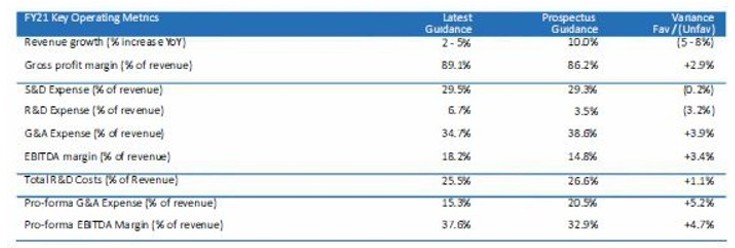
22.
23. In summary, we remain largely on track to achieve initial guidance on all metrics, excepting revenue. We see a path to 20% growth – whilst we have a path to 20% growth, we are incorporating the lower end to the growth range to account for market uncertainty at XX to XX for STAT AND XX TO XX FOR ACV
(bold, italic and shading emphasis in original)
611 At 6:18pm, Mr Vawdrey responded (as written):
Thanks for the points below.
I think we need to recalibrate around a simpler commentary that basically addresses the following
Why are you revising your revenue forecast down 9.1 m to 184.4 or the range of 180 to 186?
Why does ACV go from 199 down to 179 or a range of 177 to 181?
What has change in the last 2 weeks to cause this down grade?
Using your RUN model what is the change in RU and N?
Why dint you see this potential drop earlier?
Is it true customers are moving to consumption faster and why?
We need simple and clear answers
Lets chat in the morning
Where we are now is not in a solid enough place to confirm a release on Monday at this point
Lets talk to the board in the morning
612 At 7:41pm, Mr Pipic sent an email to Mr Doyle (copied to Ms Nichols and Mr Hooper) titled “ACV Forecast Coverage” in the following terms:
The below ACV Forecast Range provides the key drivers of ACV attainability by Domain:
A$m | Current Expected ACV | FY21B | Variance |
ASP | 54.4 | 65.3 | (10.9) |
Government | 40.6 | 42.5 | (1.9) |
Corporate | 38.1 | 36.6 | 1.5 |
Law Firms | 18.2 | 25.2 | (7.0) |
New Strategic Markets | 27.3 | 30.0 | (2.8) |
Current Expected ACV | 178.6 | 199.6 | (21.0) |
FX Impact | 7.5 | ||
FX Adjusted Total | 186.1 | 199.6 | (13.5) |
We are currently working through the FX Impact to be incorporated into the above by domain analysis (i.e. provide on constant currency basis to see underlying variances of ACV attainability by domain).
Re the New ACV commentary, we have currently attained A$11.0m Sub. ACV by March 2021, and have A$8.6m Sub. ACV in the Go-get pipeline, suggesting we can attain the New Subscription ACV forecast.
(bold emphasis in original)
613 I pause to note that ASIC alleges that by dint of this email, Nuix’s forecast of ACV as at the end of FY21 was $178.6 million, which figure was approximately 10 per cent below the Prospectus ACV Forecast.
614 At 9:27pm that day, Mr Vawdrey sent an email to the other directors of Nuix (and others) with the subject line “Potential ASX release discussion ...Confidential and subject to change”, in the following terms:
Please find the latest versions of the release, the Q&A, CFO remarks and P&L impacts as at 9.30 pm
There are discrepancies between various data points and still some inconsistencies in messaging and we need further collective agreement on major themes.
If we decide to release Monday morning followed by a conference call there is quite a bit of work to do to get everything in place and agreed.
We still need to focus more on what has changed since last investor calls where we confirmed our forecast at 193m. We have to demonstrate new information, customers have influenced our thinking and story is factual and supported by detail.
On our call tomorrow we need
1. Decision on a release or not.
2. When do we release ... Monday or midweek or later
3. What is the main message to the market.
4. Finalise on release and Q&A asap with all key stakeholder input.
5. Schedule, prepare and rehearse conference call
Tod [sic] date we have had several reviews, input from Alan Young and Tony and tried to incorporate other feedback from the board and Citadel plus the finance and Corp dev team.
Sarah you should try to join call as well.
If you have input prior to the call please send t [sic] me as soon as possible
615 It was apparent to Mr Bleich by 15 April 2021 that the original timeline contemplated at the directors meeting on 9 April 2021 for release to the ASX on 16 April 2021 had slipped.
616 His understanding was that further work was being done to understand where the numbers were landing, and why. He understood that, for pipeline projections, data needed to be extracted from Salesforce. However, his understanding – based upon the conversations he had with management and people within the finance team who had presented during directors meetings and the DDC meetings – was that the extraction of raw data was just the beginning of the process. Once the data had been extracted, it had to be interpreted by the people in Nuix’s sales teams and then tested by the finance team to “sense-check” what the sales teams were saying, including comparing it against historical data available to the finance team.
617 Mr Bleich was particularly interested in understanding why the forecast for statutory revenue and ACV had changed as, up until this point, management had reported at meetings of Nuix’s directors that they had confidence in the Prospectus Forecasts. He understood, based on the discussions at the DDC and meetings of Nuix’s directors that he attended prior to the IPO, that the Prospectus Forecasts were based on reliable data and assumptions and had been scrutinised by Nuix’s finance team and by PwC. Up until this point, as described above, Mr Vawdrey or Mr Doyle had informed him on various occasions that they were confident that Nuix was on track to achieve the Prospectus Forecasts.
618 As a result, Mr Bleich wished to understand why Nuix was no longer being projected to achieve the Prospectus Forecasts, including what assumptions had changed. He believed that the investors would also want these matters explained to them so that they could assess the reliability of any revisions to those forecasts. He felt that in order to properly inform the market and to establish a relationship of trust with Nuix’s investors, it was important for Nuix to provide an explanation for the revised forecast numbers that could give investors confidence in Nuix’s revised forecast. This was particularly so in circumstances where Nuix had recently re-affirmed the Prospectus Forecasts on 26 February and 8 March 2021. He was concerned that a sudden unexplained announced downgrade to the forecast would confuse the market, leave it unable to assess the reliability of the forecast, and needlessly compound any erosion of investor confidence in Nuix.
619 At 9:42pm, Mr Borcherdt sent an email to Mr Doyle and others, attaching a spreadsheet titled “Forecast at $185m”.
620 At 10:13pm, Mr McGilvery replied:
I think the high end of the rev range is currently being discussed as $186m and the low end of the range being $180m.
This will have an impact on the figures presented below (suspect that the high end of the range in the table is being based on the $185m you note below, however drafts of other documents are now referencing an upper end of the range as being $186m).
Separately, proforma EBITDA forecasts on the basis of the same range are coming in at between $64.6m and $70.6m, (basically $41.7m YTD on a pro forma basis with forecast Q4 EBITDA at between $22.9m and $28.9m – see attached).
C.17.4 Friday, 16 April 2021
621 On 16 April 2021 at 2:54am, Sir Iain responded to Mr Vawdrey’s 15 April 2021 (9:27pm) email ([614] above):
I found the inputs and tone from Citadel and from Highury [sic] helpful
Recognise there are still gaps being filled and consistency being ensured. Getting it right clearly vital and that should trump any sense of urgency.
I would say less is more in the statement. Better not to make it a Christmas Tree.
I think there is an emerging tone of self confidence which I like - leaving an impression along the lines of ‘this is not actually bad news, it’s actually something that our Customers want/need and therefore something we are keen to embrace. The business will be stronger as a result.’
But will re-read in case further thoughts emerge.
See you in 3 hours ...
622 Sir Iain explained that in the expression “Recognise there are still gaps being filled and consistency being ensured. Getting it right clearly vital and that should trump any sense of urgency”, the reference to “it” was a reference to the exercise of capturing the most accurate figures and verifying those figures so they could be presented to the market in a way that was not misleading. The references to “gaps” and “consistency” referred to the work that Sir Iain understood that Nuix employees were undertaking at the time to verify Nuix’s updated financial forecasts for FY21.
623 Sir Iain considered there to be two operative imperatives at this time. The first was urgency, which arose because if Nuix needed to downgrade its guidance, it should do so as promptly as possible. The second imperative was accuracy. On balance, based on his understanding of Nuix’s continuous disclosure obligations, and taking into account his responsibility as a director for ensuring Nuix did not make misleading or inaccurate statements to the market, he was expressing the view that it was important to get the numbers right first, despite the need for urgency. His statement was intended to convey that the information contained in the draft ASX release needed to be based upon “rock-solid” figures, so as to avoid releasing any inaccurate information reflective of wishful thinking or “spin”. He also thought, based on his understanding of these metrics, that it was important to provide the market with guidance on statutory revenue, ACV and EBITDA concurrently, as had been done in the past. His view at the time was that it was important to tell the whole story to the market at once and leave no room for misinterpretation.
624 Sir Iain was also conscious at the time that management and the Nuix employees involved in the verification process were likely to be experiencing tremendous stress. Further, by this time it was apparent that there was no finalised release with verified numbers, so there was already slippage to the timetable set at the 9 April 2021 meeting of Nuix’s directors. In those circumstances, Sir Iain also sought to convey to Mr Vawdrey and Mr Doyle that he understood the stress under which they and the broader team were working, and the hard work being undertaken outside normal working hours. Based on his experience of leadership, Sir Iain considered that expressing solidarity with management at this time was more likely to be morale-boosting and productive than taking a more critical and demanding approach.
625 At about 6:00am that day (16 April 2021), there was a call between the directors of Nuix. A note taken by Mr Egan of that call is in the following terms:
Nuix
Board Call 16 April 2021 6:00 AM
RE: ASX announcement
INFORMATION: not complete
management to continue to refine
• Information on revenue (also EBITDA)
• Reasons for income variances
- USA & NSG down
626 Sir Iain provided the following evidence of that meeting:
(1) Mr Egan’s notes accord with Sir Iain’s recollection of the meeting;
(2) Mr Vawdrey informed the directors Nuix that the work being undertaken by management on the statutory revenue, EBITDA and ACV figures was not yet complete and that the revised forecast figures were not ready, and that work would continue over the weekend to arrive at final, verified figures;
(3) he understood that the work required to continue over the weekend involved further discussions with the sales teams to confirm data inputs for the figures, and a continuation of the iterative process between the finance team and the field to validate these numbers;
(4) it was his view that Nuix should issue a release to the market as soon as it was able to do so, such that if a release were to be ready on Monday 19 April 2021, then it should be released that day. At the time, his focus was on ensuring that the proposed ASX announcement was ready for release once the numbers were confirmed, and that the announcement was drafted as clearly and accurately as possible. It was his objective that the announcement would contain a clear and precise narrative, to provide the market with all material information which required disclosure and an unequivocal explanation for the departure from the Prospectus Forecasts;
(5) during the meeting at least one of the nonexecutive directors said to either Mr Vawdrey or Mr Doyle that the directors should, and would be ready to, approve an announcement as soon as the figures were finalised. Sir Iain indicated his assent, as did all the other non-executive directors; and
(6) Ms Thomas indicated that her strong preference was to issue a release on the morning of Monday, 19 April 2021.
627 Mr Bleich provided the following evidence of the meeting:
(1) Mr Egan’s handwritten notes accord with his recollection of what occurred;
(2) Mr Vawdrey informed the directors that the work being undertaken by management was not yet complete and that the revised forecast figures for statutory revenue, ACV and EBITDA were not available;
(3) Ms Thomas indicated that the materials the directors had received so far raised more questions than answers and that both the extent of, and reasons for, any shortfall compared to the Prospectus Forecasts in relation to statutory revenue, ACV and EDITDA were still unclear at this point. Ms Thomas’s statements reflected his own general sentiment at the time. He understood that statutory revenue, ACV and EBITDA were somewhat interrelated and as such he thought that it was important to receive confirmed numbers for each of the three metrics as soon as possible;
(4) although he was keen to receive confirmed numbers as soon as possible, he was also conscious that management had to ensure that the process was not so rushed that the numbers produced were inaccurate or unreliable;
(5) from what was said by Mr Vawdrey, Mr Bleich understood the difficulty was that there was some uncertainty about the likelihood of certain deals in the pipeline closing in FY21 and how this would impact the revised forecast numbers. He also understood, from the update provided by Mr Vawdrey at this meeting, that the ACV calculations in particular were taking longer than initially expected as these calculations required a manual review of each contract. Mr Bleich did not believe that Nuix management were not prioritising finalising the numbers, or that the work was not being done as expeditiously as possible; and
(6) his impression at that time, from the update provided by Mr Vawdrey, was that there might be significant – although not necessarily material – changes in the FY21 forecast for statutory revenue, ACV and/or EBITDA, and that some changes might offset others. He also believed that a change in the FY21 forecast for one of the three metrics may assist the market in better understanding any changes in the other two metrics. As such, he believed that it was important to disclose to the market the final forecast figures for each of the three metrics as soon as possible in order to give the market a complete and accurate picture of Nuix’s financial performance.
628 At 7:11am that day (16 April 2021), Mr Doyle sent an email to Mr Vawdrey, Mr Silveri and others:
Can we take our time today and on Monday to thoroughly position our re-forecast position and regroup.
On the basis of the information presented to me, my understanding of Stat Rev and ACV down grade can be explained quite simply as follows:
1. Renewals is on track - stat renewal rate is in high 90%’s and churn acv is 3/4% (which speaks to subscription base)
2. New is on track - $29m stat new is on track ($19.3m new business revenue YTD) and 20.4m acv new is on track (attained A$11.0m Sub ACV by March 2021 and have A$8.6m Sub ACV in the Goget pipeline, suggesting we can attain the New Subscription ACV forecast)
3. Therefore, delta is in Upsell.
4. Where was the Upsell forecasted ... ?
5. At a Geographic POV EMEA and APAC are on track, therefore USA remains
6. USA and USG both have not performed as we know ...
7. USG speaks to other ACV (b/c of Perpetuals) - $6m miss.
8. However, USA speaks to Upsell.
9. Of the $20m ACV downgrade , $18m relates to ASP ($11m) and LF’s ($7m)
10. Given NDR for the first half was 100% - i.e. flat - and given the R and N are on track, that means 2nd half is due to Upsell/Downsell.
11. Therefore the $18m assumed 2nd half Upsell to ASP and LF’s.
12. That is explained by taking ASP off fixed contracts and selling consumption / Discover. I assume it also spoke to selling Discover to LF’s. From memory NDR for 2021 was 111% for ASP and circa 130% for LF’s - please advise
13. MYD’s 1 to 3 and 3 to 1 is a double-edged sword . If you state, we are at 23% MYD vs 15%prospectus forecast the question is why didn’t you do more Stat Rev as you converted pipeline to orders? MYD impact on ACV is obvious b/c only 1/3 is taken to ACV.
14. Therefore the narrative could be ...
• We are seeing the acceleration to Consumption and SaaS far faster than expected. Customers see Nuix as the logical choice as they embark:
o 1) On their cloud journey,
o 2) Penetrate new markets in which Nuix can support them,
o 3) Seek to align their investment into Nuix with their customers consumption patterns, and or
o 4) Adopt our Discover Product for reviewing and analysing customer data.
• It has impacted our ability to achieve BOTH statutory revenue and ACV for 3 reasons:
o 1) New Business revenue has comprised a significate proportion of Saas Orders and these are treated as deferred revenue and not yet hit the PNL.
o 2) As customers have migrated to Consumption / SaaS customers they have not exceeded their contractual minimum data processing threshold. Namely customers have not “used up” all their data caps – they are still under their contractual minimums.
o 3) Our sales team is connected daily and weekly and extremely close to our economic buyer and what has recently become apparent is that consumption processing expected throughout Q4 will not give expected the Upsell / Uptick required.
I am happy to hear alternative POV’s.
keep fit gang.
(bold and underline emphasis and red font in original)
629 At 8:14am, Mr Vawdrey responded:
Board room meeting 8.30 to discuss please
630 At 10:56pm, Mr Hooper sent an email to Mr Vawdrey and Mr Doyle (copied to Mr Silveri and others) with the subject line “FY21B ACV vs Current Expected ACV commentary” in the following terms:
We have been working through the ACV analysis on the back of the meeting this morning and have some draft findings.
The below provides some highlights into the key domain and customer movements between the FY21 Budget and the expected FY21F ACV. We are currently still working on the movement between the 1H21FY Forecast to June 21 and the Current Forecast to June 21. We are aiming to send an update to you on this on Sunday afternoon/night.
Table 1 below shows the impact of FX within the Current Expected FY21F ACV by Domain whereas Table 2 shows the impact of FX on its own separate line.
Table 1
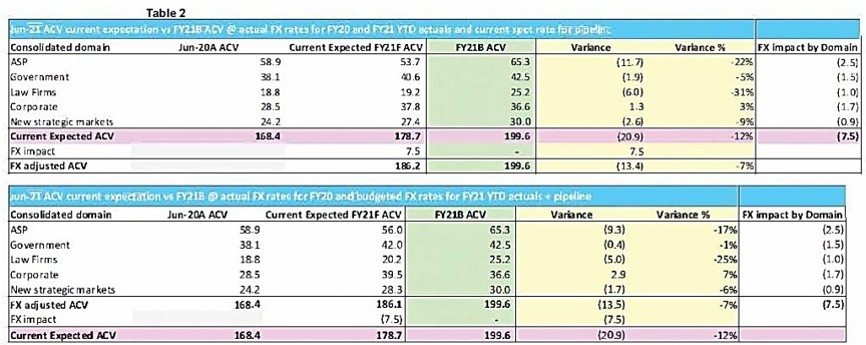
As per Table 2 above the key drivers of the movement from $199.6m FY21B ACV to the $178.7m Current Expected ACV are:
• FX negative impact of $7.5m due to the spot rate of USD to AUD being 0. 77 vs the FY21B of 0.69
ASP excl. negative FX impact Current Expected ACV is expected to trail the FY21B by ~$9m (~$12m incl the impact of FX). Driven by:
• Discover: Expectation that we were going to execute on incremental upsell and new Discover Annual Revenue of ~$5m. Although we have won a few ASP Discover opportunities (i.e. Grant Thornton) and have a few additional in the pipeline (i.e. potentially EY) this revenue has not come to fruition as expected. Instead, ASPs are looking at a slower take-up of Discover which will hopefully have benefits to our revenue profile over the next couple of years
• New: Expectation that we were going to execute on ~$5m of new Nuix Annual Revenue. Although we have won a few new ASP logos we are likely to miss new ASP Annual Revenue by a couple of million dollars
• Upsell: the combination of tough market conditions and FX have caused our ASP customers to either keep their annual contract value the same, reduce it (i.e. Deloitte likely decrease due to downsize of Deloitte India footprint as a result of COVID, non-renewal of Discover at Deloitte Global) or not yet exceed their current consumption capacity. The below although not representing upside for ACV are reflective of the improvement in strategic relationship with our key ASPs:
• PwC USA: currently forecasting multi-year renewal with PwC USA. Annual deal value is on par with prior renewal on a USD basis
• Lighthouse: currently forecasting multi-year renewal with Lighthouse. Annual deal value is on par with prior renewal on a USD basis
• KPMG: successfully transitioned them from an unlimited license to a fixed number of cores
• The expected FY21F ACV is predicated on ASPs executing on $500k stretch target which is not yet in salesforce
• Law firms excl. negative FX impact Current Expected ACV is expected to trail the FY21B by ~$5m (~$6m incl the impact of FX). Driven by:
• FY21B NDR expectation >130% but due to case backlog and FX impacts our existing DUM customers have seen little growth on a total basis (i.e. Dorsey DUM is actually lower than what is was as at Jun-2). This is partially offset by;
• Great new logo wins with Latham and Watkins, Squire Patton Boggs, Legility. However, Latham and Watkins and Legility were MYDs
• This is offset by potential outperformance in Corporate ACV which is expected to be ~$3m higher than the FY21B ACV (~$1 m incl the impact of FX). Driven by:
• New: New logo wins with Dell, Uber, Eli Lilly & Company, Rothschild, Centrica, Dignity Health, Santander, Tetra Laval etc.
• Go-get: the majority of the potential upside in corporate sits in the go-get pipeline (currently ~$12m ACV relating to Pfizer, Macquarie, United Services Automobile Association, 3M Company, Prudential, Abbvie etc.). A number of these deals are also MYDs so it will be important for us to land these deals if we are to hit our revised statutory revenue and ACV numbers.
I’ve attached a few extract tables which have gone into forming the above commentary.
Happy to step through the above on Monday morning along with the additional Forecast Movement analysis provided on Sunday to assist with creating the narrative
(bold emphasis in original)
C.17.5 Saturday, 17 April 2021
631 On Saturday, 17 April 2021 at 10:20am, Mr Borcherdt sent an email to Mr Doyle and others:
As per the discussion this morning, please find attached the key movements in the forecast done 4th March 2021 (in the midst of investor calls post-HY release) and current position. This details the key information that has changed in this time.
On an assumption basis, the key changes are:
• Foreign exchange: on previous forecasts, we have based forecast position at budget FX rates. The actuals have FX baked in. The current forecast is at spot rates. The impact of this is approximately A$5.2m against the prior budget down to ~A$192m.
• Pipeline build: on previous forecasts, we have assumed week on week pipeline build based on FY2020 rates, filtering for items that closed prior to 30/6/20. The impact of this is A$7.7m down to ~A%188m (pre-FX).
• Conversion rates: on previous forecasts, we have assumed 100% conversion of “commit” deals and a weighted conversion on remaining pipeline based on L18M win rate. In the current forecast, we have assumed 100% of goget deals (based on current date/value information) and 0% conversion of other open pipeline. This creates some natural variance at the account level which flows up to the domain/regional level.
The prior forecast was ~A$196m and the current forecast is ~A$184m, signifying a gap of A$12m to bridge. To do this, we have excluded expected deferred revenue releases and S&M as these are the same at both forecasts (starting after Feb-21 close). This isolates deals required to close by the pipeline.
Subsequent to the February EOM forecast, the key drivers of variance were APAC strategic markets, EMEA ASPs (Deloitte vs. KPMG Y2 included in forecast), EMEA strategic markets and US corporate & government.
From a RUN perspective, the key driver is in new business. Note that this is based on last forecast and not indicative of the full year positive, but rather the movement in the forecast that was previously filling the upsell position. Increase in renewal associated with Lighthouse and PWC MYDs.
In summary, please see below and attached the detail of this movement. Note this is prior to adjusting for FX or pipeline build.
(bold emphasis in original)
632 At 11:00am, Mr Doyle forwarded Mr Borcherdt’s email to Mr Vawdrey and others under cover of an email in which Mr Doyle stated:
Something to explore this weekend as we crystallise our thoughts.
I will get into the updated narrative Saturday and Sunday.
Any insights welcome.
633 At 11:20am, Ms Ferguson sent an email to Mr Gregorowski (and others at Citadel-Magnus) in the following terms:
I wanted to get an update from Nuix. The company closed off its March quarter results a few weeks ago and given the share price is trading below the IPO, indicating concern about the company meeting its full year prospectus forecasts, when will you be updating the market? Does Nuix still feel it can meet those forecasts? If I could get a response by 10am tomorrow that would be appreciated.
634 At 6:09pm, Mr Clegg forwarded that email to the directors of Nuix (and others).
635 At 6:50pm, Ms Thomas responded: “My strong preference is to put in the time tomorrow to get our release out before market open Monday”.
636 Sir Iain read that email at the time and shared Ms Thomas’s view that the work needed to be done so that Nuix could issue the release on Monday, 19 April 2021, if at all possible.
637 At 6:55pm that day, Sir Iain sent an email to Mr Clegg, copied to others including the directors of Nuix, in the following terms:
Thanks to Brett
I have a few thoughts:
- Coincidence. Inclined to agree with Brett. But it is shortly after the end of the third quarter and one would expect the journalist to have us on her revisit list. Whatever, I think it works better for us if we take the exercise at face value and set out to be utterly straightforward, rather than anticipate conspiracy.
- Disclosure. Obviously we are planning a statement. I’m unclear as to whether we can signal that before releasing it. Nor whether the journalist can say so.
- Our narrative. Given the hard work this last week, we are in a relatively well prepared position in terms of figures, wrap-around positive statements, etc. But as I understood out [sic] Board call on Thursday/Friday, we have not yet concluded whether we lead with a strong and positive line around a move to Consumption, or whether this is about North America being off target more than anticipated. I think the latter now seemed a significant factor. We could still make the (positive) point around consumption being what more customers now want and therefore what we are giving and anticipating. But it would not be the lead point. And we also have positive things to say about APAC and EMEA.
- Is it an option to say to the Journalist that we heard loud and clear the message from the market that they want to be kept up to date with our progress and planning and that it is reasonable to anticipate more rather than less from Nuix in terms of updates? So watch this space? And in parallel say to ASX we have something on the stocks and get it out by start of working week? We’d have to brace for a probing speculative article from the Journalist in the interim but would not stray offside with ASX and our Investors - is that tenable?
638 As to “relatively well-prepared position”, Sir Iain did not mean that he believed Nuix had the final figures to hand. He meant to convey his understanding at the time, which was that a lot of work had been done to prepare revised figures, but that this work was not complete. The directors of Nuix had not yet received the revised forecast figures for any of the three metrics yet, and he (along with the directors of Nuix) was still waiting on Mr Doyle to report back.
639 Sir Iain intended to convey respect and appreciation for the hard work done by the finance team to prepare the figures for release over the weekend, without in any way suggesting this work had been completed. His intention was to make absolutely clear that the statement to the market should be ready to go as soon as possible after the figures had been finalised.
C.17.6 Sunday, 18 April 2021
640 On 18 April 2021, Mr Vawdrey sent an email to the directors of Nuix and others, suggesting a meeting at 8:30am.
641 At 7:41am, Mr Vawdrey responded to Mr Clegg’s email of 6:09pm the previous day, in the following terms:
I think it is important we don’t jump at shadows.
Clearly the journalist is focussing on her view, most probably fuelled by her relationship with the Sheehy’s, that there are ongoing culture issues and trying to link this to an assumptive position, that Q3 results are not as planned and we are likely to do a release and lower expectations this coming week ..
My view, is we should not change our course and be ready for a release, if we do one, for Wednesday morning. To try to and get something out by tomorrow, without the additional insight into the proposed article, could end up with us not having our best positioned properly articulated, and without the clarity of seeing exactly what she says in the press.
We do know the journalist has, in recent days, reached out to several current and past employees for comments on the past and current culture, but I think it is highly unlikely these people, mainly solution consultants, would have the information or would discuss information on Q3 results or any discussions re a ASX release.
I believe Iain’s comments in his earlier email response, about a message that does talk to the shift to consumption, the softness in USG and Americas results, particularly upsell, offset by some good news around adoption of SAAS, new logo wins and strong performances in EMEA and APAC, are the right messages, against a forecast reduction.
So in summary, let’s have a call or two today and discuss the planned article and our response, with my recommendation being to stay the course for a Wednesday release, which may be more informative having seen the article tomorrow
642 The meeting was later scheduled for 9:30am at the suggestion of Mr Phillips.
643 Sir Iain did not understand Mr Vawdrey to be referring to any decision of the directors of Nuix to release on Wednesday 21 April 2021 and not Monday, 19 April 2021. Sir Iain was not of the view that the release should not occur until Wednesday, 21 April.
644 Mr Bleich does not recall why Mr Vawdrey made a recommendation to issue the ASX announcement on Wednesday, 21 April 2021. It did not reflect Mr Bleich’s view at the time, namely that Nuix should issue a release as soon as the numbers were confirmed by the finance team and Nuix management.
645 At 9:19am that day, Mr Clegg sent an email to, inter alia, the directors of Nuix:
A few thoughts/observations ahead of our call.
• It would be unusual for Adele to return to Nuix as a subject in the absence of either new insight (awareness of an impending downgrade?) or a fresh angle (culture?).
• She has only asked us a specific question on prospectus forecast rather than any issues related to culture – noting Rod’s earlier reference to recent enquiries of past and present employees. If there were particularly contentious points then for defamation risk it would be expected that she would put these to Nuix (though you cannot defame a corporate entity under Australian law).
• Our response to Adele will need to be concise. There are significant reputational and other risks of being seen to mislead a journalist when a company knowingly is in possession of information that is proximate (only days) from release.
• An example as follows: Nuix reports its financial results every six months – its first half results at the end of February and its full year results at the end of August. As an ASX listed company, Nuix is obligated to disclose any material events, including material changes to forecasts, in line with the ASX Continuous Disclosure requirements.
• Nuix will need legal guidance on [redacted] Assuming the stock trades tomorrow, subject to the impact on the share price, be mindful of the possibility that the ASX may query Nuix as a result of a prominent article.
(italic emphasis in original)
646 As noted above, the meeting of the Nuix directors and others commenced at 9:30am.
647 Sir Iain recalled that the topics discussed included some media scrutiny of Nuix from Ms Ferguson; and the progress of the preparation of the draft ASH release.
648 Mr Bleich cannot specifically recall what was discussed at that meeting. His recollection of that weekend is that at least two board meetings occurred, of which this meeting was one. The topics of conversation concerned the potential upcoming article by Ms Ferguson and the draft ASX announcement that was under preparation. He wanted Nuix to make an announcement to the ASX before it responded to Ms Ferguson’s queries as he did not want to create any asymmetry of information by giving explanations to some people (such as Ms Ferguson) and not to others.
649 At 2:50pm, Mr Doyle sent a further email to Mr Vawdrey (and others):
This statutory revenue file contains significant amount of detail on forecast movements at an accountby-account level (thank you Simon). 800+ accounts creating the $(12)m forecast decrease:
44 deals $1 00k+ creating $+ 19m of forecast increase
734 deals between ($100k) and $100k creating $(7)m forecast decrease
70 deals $1 00k+ creating $(24)m of forecast decrease.
Our forecast methodology has been consistently applied between periods.
What has happened over the past 2 weeks is as follows:
1. Backdrop Facts – Despite 3 headwinds of (i) USG $6m under performance (ii) FX headwinds and (iii) USA Upsell Misses in ASP and Discover, the Sales Regions had additional orders forecasted to attain $193.5m Stat Rev and $199m ACV targets.
2. These additional orders forecasted came from EMEA and APAC New Business.
3. However, in the last 2 weeks EMEA and APAC decreased their confidence in attaining committed additional orders forecasted. This is the sole reason for $12m statutory forecast decrease.
4. We need to anchor in our minds is that the additional orders forecasted (which just happened to be new business in EMEA and APAC) was compensating for the already known USA Upsell YET TO COME TO FRUITITION via ASP and Discover UPSELL
5. But after recent SDR’s and continuous engagement with economic buyers, it is looking increasing unlikely that we will see the Uptick from ASP and Discover this financial year – See ACV Commentary Below.
6. So in reality in the last 2 weeks 2 phenomenon have transpired.
a.(1) EMEA and APAC have decreased confidence in attaining New Business Overachievement. This particularly impacts Stat Rev.
b.(2) USA is not YET seeing the Consumption Uptick come from ASP and LF’s (Discover).
• Good News Facts. Churn is at 3%. Renewal are in high 90’s. New business revenue for BOITH [sic] Stat Rev and ACV is forecasted to achieve target.
ACV Commentary.
As per Table 2 above the key drivers of the movement from $199.6m FY21 B ACV to the $178.7m Current Expected ACV are:
ASP ($9)m due to:
• Discover: Expectation that we were going to execute on incremental upsell and new Discover Annual Revenue of ~$5m. Although we have won a few ASP Discover opportunities (i.e. Grant Thornton) and have a few additional in the pipeline (i.e. potentially EY) this revenue has not come to fruition as expected. Instead, ASPs are looking at a slower take-up of Discover which will hopefully have benefits to our revenue profile over the next couple of years
• New: Expectation that we were going to execute on ~$5m of new Nuix Annual Revenue. Although we have won a few new ASP logos we are likely to miss new ASP Annual Revenue by a couple of million dollars
• Upsell: the combination of tough market conditions and FX have caused our ASP customers to either keep their annual contract value the same, reduce it (i.e. Deloitte likely decrease due to downsize of Deloitte India footprint as a result of COVID, non-renewal of Discover at Deloitte Global) or not yet exceed their current consumption capacity.
• Whilst we have overall improved strategic relationships with our key ASPs it is slower than we forecasted to occur in FY2021. e.g.
• PwC USA: currently forecasting multi-year renewal with PwC USA. Annual deal value is on par with prior renewal on a USD basis
• Lighthouse: currently forecasting multi-year renewal with Lighthouse. Annual deal value is on par with prior renewal on a USD basis
• KPMG: successfully transitioned them from an unlimited license to a fixed number of cores. The expected FY21 F ACV is predicated on ASPs executing on $500k stretch target which is not yet in salesforce
Law firms ($5)m.
• FY21 B NDR expectation >130% but due to case backlog and FX impacts our existing DUM customers have seen little growth on a total basis (i.e. Dorsey DUM is actually lower than what is was as at Jun-2).
• This is partially offset by new logo wins with Latham and Watkins, Squire Patton Boggs, Legility. However, Latham and Watkins and Legility were MYDs
Footnote:
• As you know with New Business Orders, most is booked to Statutory Revenue.
• Furthermore, we also know that ACV is impacted by the last month of run rate Consumption Usage/SaaS Consumption. That is why such a large upsell uptick was anticipated in the last Quarter as ASP’s migrated off all you can eat licencing (and or onto consumption licencing) leading to the uptick in Upsell Licences for Cores/ Increase SaaS/ Increase in Consumption.
• ACV last month of run rate * 12 months accelerates ACV.
• That is why Stat to ACV quantum of relative variance is up to a theoretical 12X factor difference (but because of pricing and packaging arrangements with minimum Stat Order Amounts the difference is more around 2X/3X difference)
(bold and underline emphasis and green and red font in original)
650 Mr Vawdrey highlighted paragraphs 2, 3 and 6 and the parenthesised part of paragraph 4 of Mr Doyle’s email and sent it to Mr Rees by email with a request that Mr Rees comment on the highlighted parts. Mr Rees responded:
I’ve gone through the below but my position has not changed since our conversation on Thursday.
2. Additional orders forecasted
We have created the following since the stretch was put in place; not sure where $12m came from as we already had enough pipeline to cover the Stretch more than 2x.
EMEA 37 Opportunities totalling AUD1.3m (15 New Logo and 22 Upsell) APAC 38 Opportunities totalling AUD2.48m (15 New Logo and 23 Upsell)
Additionally we have increased our rolling twelve month forecast by AUD11m in total since the middle of February which is great progression to my rolling AUDl00m target (we are now at 84m)
3. Decreased our confidence ...
Our commit for EMEA in Salesforce has actually GROWN in the last two weeks as Best Case deals move to Commit (LKA Stuttgart upside being a big positive) this has seen an increase of AUD 0.9m in the SFDC Commit alone
APAC confidence has INCREASED in attaining stretch and currently the pipeline gives 2.4x coverage and is growing; which furthers my confidence
Additionally we have closed revenue on the deals we have won ABOVE the forecasted revenue by AUD1.4m and will continue to see this (as we add products, increase capacity and get MYD) during the sales process so individuals can get to their stretch goals and earn the reward
Overall, Net progression against original Stretch deals is down AUD3.8m but we have created additional opportunities of +AUD3.8m which is why my overall position has not changed.
6. My position – which is provided by the finance team through their rev rec file; which is why I don’t understand the disconnect:
• EMEA needed AUD22.7m to get to stretch; we currently have 20.4m of the original 22.7m in play with additional AUD1.3m new opportunities created; so a AUD1m gap but pipeline of AUD4.8m of Non Go Get to cover
• APAC needed AUD15.4m to get to stretch; we currently have 17.lm against this original value plus additional AUD2.48m in new opportunities created; with a Non Go Get Pipe of AUD6.6m
As I stated when we talked last Thursday I believe EMEA will finish at AUD56m and APAC has a chance to beat the AUD33m stretch target: additionally this does not include Deloitte Yr 2, as Scott has not confirmed if we can recognise the revenue as of yet.
(underline emphasis in original)
651 At 5:56pm, Mr McGilvery sent an email to Mr Vawdrey, Mr Silveri and others:
In helping firm up judgements related to statutory forecasts, I set out detail below on some of the accounting matters currently under consideration.
Apologies for the lengthy note, I would have written a shorter accounting paper if time was available ....
652 That email provided a lengthy analysis of various accounting issues.
653 At 9:11pm, Mr Borcherdt sent an email to Mr McGilvery and Mr Doyle (copied to Mr Vawdrey and others) in the following terms:
In preparation for tomorrow’s meeting, please find below listing of top 10 positive movements and top 20 negative movements from the last forecast, with reasons for the movement.
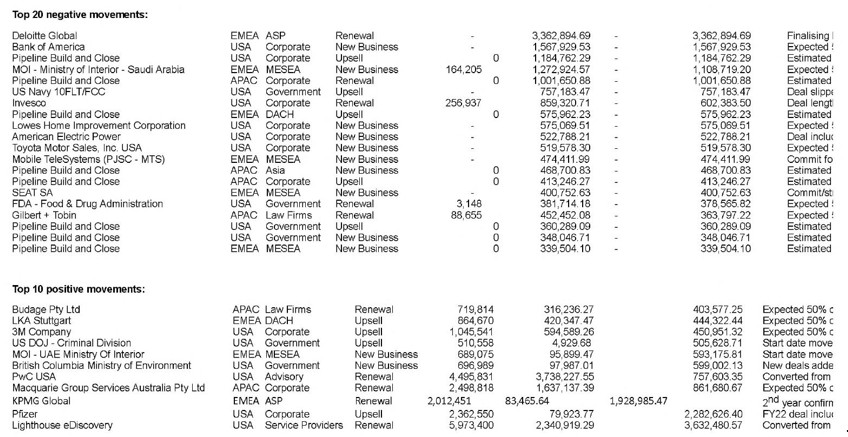
I will continue to work on these listings for discussion tomorrow.
654 At 9:29pm, Mr Doyle sent an email to the directors of Nuix and others attaching “Prepared Remarks and Speaking Notes v4 9pm Sunday 18 April 2021.docx” and stating: “This is as far as we could get the file prepared this weekend”.
655 The attachment titled “PREPARED REMARKS ASX PRESENTATION – DRAFT”, included (as written):
23. In summary, we remain largely on track to achieve initial guidance on all metrics, excepting revenue.
24. We see a path to 20% growth. Whilst we have a path to 20% growth, we are incorporating the lower end to the growth range to account for market uncertainty at $180m to $186m for Statutory revenue and $170m to 180m for ACV.
…
Complimentary ACV Analysis
I also provide ACV Commentary from the team that speaks to the key drivers of the movement from $199.6m FY21B ACV to the $178. 7m.
As you can see ASP and LF’s are the major contributors of the downgrade.
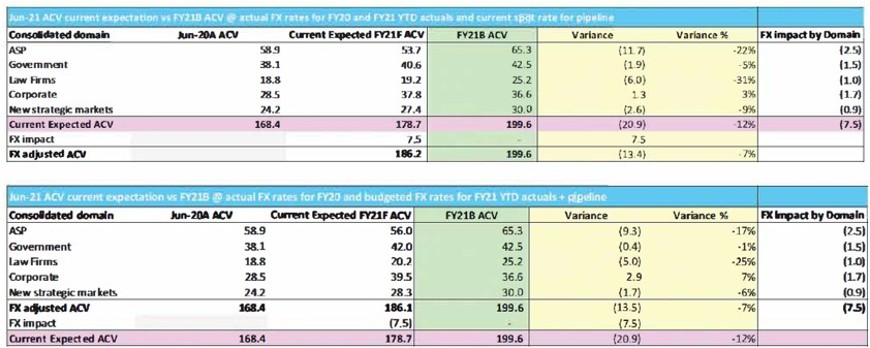
FX Removed Reasons as Follows:
ASP ($9.3)m due to:
(i) Discover: Expectation that we were going to execute on incremental upsell and new Discover Annual Revenue of ~$5m. Although we have won a few ASP Discover opportunities (i.e. Grant Thornton) and have a few additional in the pipeline (i.e. potentially EY) this revenue has not come to fruition as expected. Instead, ASPs are looking at a slower take-up of Discover which will hopefully have benefits to our revenue profile over the next couple of years
(ii) New: Expectation that we were going to execute on ~$5m of new Nuix Annual Revenue. Although we have won a few new ASP logos we are likely to miss new ASP Annual Revenue by a couple of million dollars
(iii) Upsell: the combination of tough market conditions and FX have caused our ASP customers to either keep their annual contract value the same, reduce it (i.e. Deloitte likely decrease due to downsize of Deloitte India footprint as a result of COVID, nonrenewal of Discover at Deloitte Global) or not yet exceed their current consumption capacity.
(iv) Whilst we have overall improved strategic relationships with our key ASPs it is slower than we forecasted to occur in FY2021. e.g. PwC USA: currently forecasting multi-year renewal with PwC USA. Annual deal value is on par with prior renewal on a USD basis Lighthouse: currently forecasting multi-year renewal with Lighthouse. Annual deal value is on par with prior renewal on a USD basis KPMG: successfully transitioned them from an unlimited license to a fixed number of cores. The expected FY21F ACV is predicated on ASPs executing on $500k stretch target which is not yet in salesforce
Law firms ($5)m due to:
(i) FY21B NDR expectation >130% but due to case backlog and FX impacts our existing DUM customers have seen little growth on a total basis (i.e. Dorsey DUM is actually lower than what is was as at Jun-2).
(ii) This is partially offset by new logo wins with Latham and Watkins, Squire Patton Boggs, Legility. However, Latham and Watkins and Legility were MYDs
Forecast Variance
But as mentioned it is important to anchor in our minds that the additional orders forecasted (which just happened to be new business in EMEA and APAC) was compensating for the already known USA Upsell YET-TO-COME TAILWIND OF ASP and DISCOVER UPSELL
So in essence we communicated to the market 3 simple messages:
(i) That we would attain Renewals. Renewal are in high 90’s.
(ii) That we would attain New Business Prospectus $29m Stat and $20m ACV.
(iii) That the H2 would come from Upsell
This was the same narrative per our prospectus.
This was the narrative Rod and I delivered in March Quarter investor conversations.
There was $37.7m from ACV Upsell (and some New) in H2 validated by Rod’s Strategy Team.
Meta Point 1
What has transpired after recent SDR’s and feedback from our customers, is that it is looking increasing unlikely that we will see the Consumption Uptick from ASP and Discover this financial year.
Meta Point 2
Our hedge from EMEA and APAC over attainment of New Business has disappeared.
(bold and underline emphasis and red font in original)
656 At 9:31pm, Mr Borcherdt sent a further email:
For clarity, the variance listing (with descriptions) are:
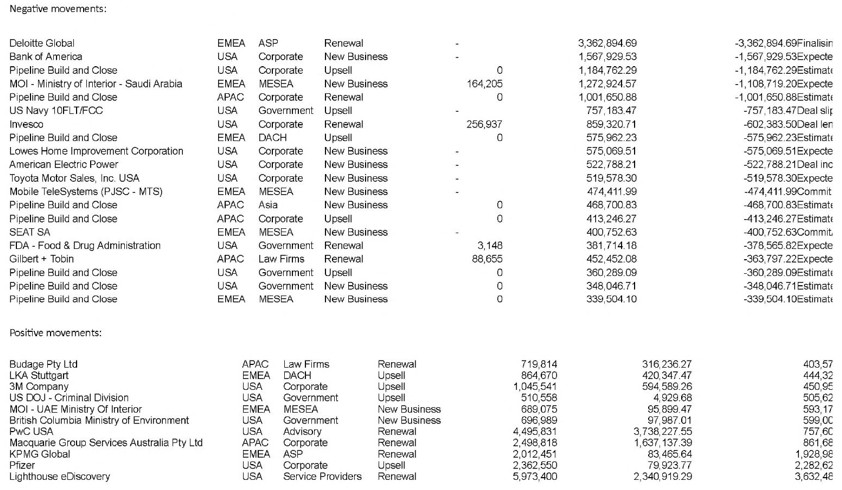
657 At 11:09pm, Mr Clegg sent an email to Ms Thomas (copied to Mr Bleich):
Further to my email, and copying Jeff for his reference, this version of the release has little utility given the major changes in what we now understand are the underlying drivers of the downgrade. In addition, the updated commentary from Stephen this evening points to a potentially significant downgrade in ACV (4% growth versus prospectus 20%) which may have a larger impact on market sentiment than the top-line revenue. Noting the numbers are still to be finalised. The ASX release will need to be completely reworked to capture this and all the elements of weakness which seem to be threefold:
i. acceleration in trend toward consumption and SaaS licenses
ii. unfulfilled expectations of upsell among existing clients
iii. ongoing softness in the US market including government
658 Mr Bleich was shocked at this email as this was the first time that he had heard there may be a significant downgrade to the Prospectus ACV Forecast.
659 Mr Bleich then called Mr Vawdrey and Mr Clegg to get an update on this issue. Following those calls, his impression was that there needed to be more work done to finalise the forecast numbers for ACV. He remained of the view that any disclosure in respect of the Prospectus Forecasts should include the final forecast figures for each of the three metrics (statutory revenue, ACV and EBITDA) and should be released as soon as these figures were finalised in order to give the market a complete and accurate picture of Nuix’s financial performance. He believed that disclosing partial and incomplete information about one financial metric (for example, an announcement of a downgrade of the Prospectus Revenue Forecast, shortly followed by a further announcement of a downgrade of the Prospectus ACV Forecast) could confuse the market, and unnecessarily damage Nuix’s credibility based on questions regarding the sequence of announcements.
C.17.7 Monday, 19 April 2021
660 On Monday, 19 April 2021 at 7:39am, Mr Vawdrey sent Mr Borcherdt’s 9:31pm email of the previous day ([656] above) to Mr Rees and Mr Treese (copying others):
Please provide today your feedback on these salesforce movements up and downs with explicit position on each as to their impact this financial year to orders and statutory revenue.
661 During that day, Mr Vawdrey told Mr Bleich that the revised forecast figures were still not finalised and not reliable and that the numbers would not be ready for a final review before the market opened on that day.
662 At 10:36am, Mr Vawdrey sent an email to the directors of Nuix (and others) with the subject line “DRAFT 210419 Nuix ASX release v5.5docx Strictly confidential”. The email included:
While we are still going through the detailed analysis of our forecast and the underlying reasons, I am providing a updated version for your review in the context of Stephen’s narrative provided earlier and attached.
If you have any suggestions please let me know
I expect we will need a few go arounds before finalising and gaining approval from the board
663 Sir Iain did not regard these numbers as final, based on Mr Vawdrey’s email which said, “we are still going through the detailed analysis of our forecast and underlying reasons ... .”
664 At 4:30pm, Mr Doyle sent to Mr Silveri and Mr Gilvery a further draft of the proposed market release and asked them to review it. The draft release included:
…Nuix Limited ... provides an update to its FY21 forecasts compared to its IPO Prospectus and following Nuix’s 1H commentary on March 8, 2021, as noted below.
• Pro Forma Revenue of $180m-$186m (vs $193.5m).
• Annualised Contract Value (ACV) of $174m-$182m (vs $199m).
• Pro forma EBITDA of $69.2m (vs $xxx).
…
(shading in original)
665 At 4:45pm, Mr Vawdrey sent an email to Mr Young and Mr Doyle (copied to the other directors of Nuix and others):
Latest draft while analysis continues on backup data
Any further suggestions or approval please advise
666 As the email noted that “analysis continues on backup data”, Sir Iain understood that work was still ongoing to confirm the final figures.
667 At 6:08pm, Ms Thomas sent an email in response to Mr Vawdrey:
My comments are as follows:
1. Can we be clear how if revenue is less and ACV is less we have 80 new clients with a total order value of new clients increasing by 80%.
2. Can we be clear about the impact of 25% it total order value from Saas. Do we need to be clear that 25% of what would be orders is Saas and only x% of this order value is shown in ACV and pro forma revenue.
3. This is also what the third paragraph is saying. But it is not clear what the relevant impacts are.
Can we be clearer... for example:
Pro forma revenue is down for the following reason:
Reduced upsell ($)
Switch to consumption and Saas - meaning ACV next year will (impact this year)
Benefits of Saas
If I was telling this story I would:
Detail pro forma revenue
ACV
EBITDA
Give the reasons for the decline in proforma revenue and ACV
Give the positives of those reasons:
Give the positives of the EBITDA number
Summarise with the positives of what is happening.
Not sure if this helps late in the day.
668 At 6:17pm, Mr Vawdrey responded to Ms Thomas:
These questions are best answered by Stephen as I am sorry I don’t have any data to be clearer than I have included at this point and I don’t know what you mean by pro-forma revenue and have yet to receive final analysis on ACV and EBITDA that finance is happy with.
I thought we had indicated the positive of declining forecast of revenue /ACV is simply the shift to more consumption. Other than that I see no positives in reduced revenue or ACV
Apologies for not having a better set of answers.
669 At 6:19pm, Mr Silveri sent an email to Mr Vawdrey, Mr Rees and Mr Treese (copied to others):
For clarity, the below deals are movements between the top down forecast we built at the beginning of March against the latest stretch target forecast.
Forecast methodologies are as follows:
Top down (output per the attached)
• Uses actuals+ SFDC opportunities in “Commit”+ historical conversion rates applied to open opportunities in “Best Case” and “Pipeline”+ additional pipeline build and closure
Stretch Target Forecast
• Is built based on the identified deals to attain stretch forecast as submitted by the field and is adjusted for:
• Latest opportunity values
• Latest close dates
• Deals slipped, closed lost etc.
Excludes pipeline build and close – assumption is slippage in identified stretch deals will be compensated by additional pipeline build and closure
For reference, where you see line items in the below list described as “Pipeline Build and Close” this is referring to pipeline that will be created and closed between forecast date and 30 June. Again, to confirm, the stretch target forecast omits additional pipeline build and closure as the assumption is it will be offset by deal slippage.
(bold and italic emphasis in original)
670 The “below deals” were those referred to in Mr Borcherdt’s 18 April 2021 email ([656] above).
671 At 6:26pm, Mr Silveri sent an email to Mr Doyle, Mr Borcherdt, Mr Pipic, Mr Hooper, Mr McGilvery and Mr Ken Lee of Nuix attaching a PowerPoint presentation titled “Draft – Forecast Validation” . The presentation included:
(1)
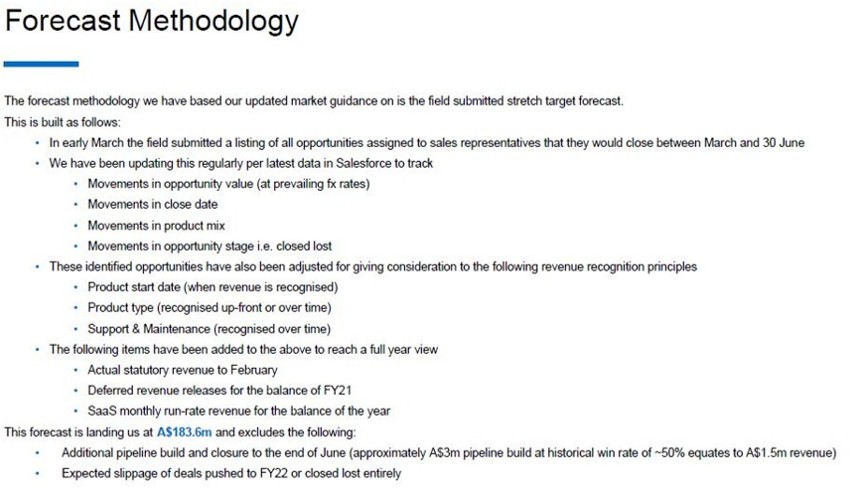
(bold emphasis and blue font in original)
(2)
Other Continuing Risks

Foreign Exchange
Whilst we have called out (to the market) that fx headwinds are largely baked into our numbers and that we would make up any deficit driven by this, it is prudent to call out the ongoing risk with respect to the persistence of the AUD:USD currency pair at ~0.77c and that should it increase from here, it will cause additional headwind to the attainment of our full year number. As advised in the Prospectus, a +/- 5% movement in the AUD:USD currency pair has a A$4.8m impact on revenue (albeit a largely offsetting effect on cost, and subsequently EBITDA). Should the AUD:USD pair increase to ~0.80c, which is ~5% from the current spot rate and may be a possibility between now and June, it is prudent we call this out ahead of time. In addition, given Q4 will likely be the largest quarter of the financial year, this will further amplify the potential impact.
Deal Slippage and Top Deals for Closure
It is also prudent to observe the typical run-rate of slipped deals at the end of each quarter (A$2.4m in December, and A$2.5m in March), and also give consideration to the top deals requiring closure by RUN to understand their materiality and potential risk to the aforementioned forecast. The below table summarizes the top 10 deals requiring closure in Q4 by RUN.
…
(bold emphasis and blue font in original); and
(3)
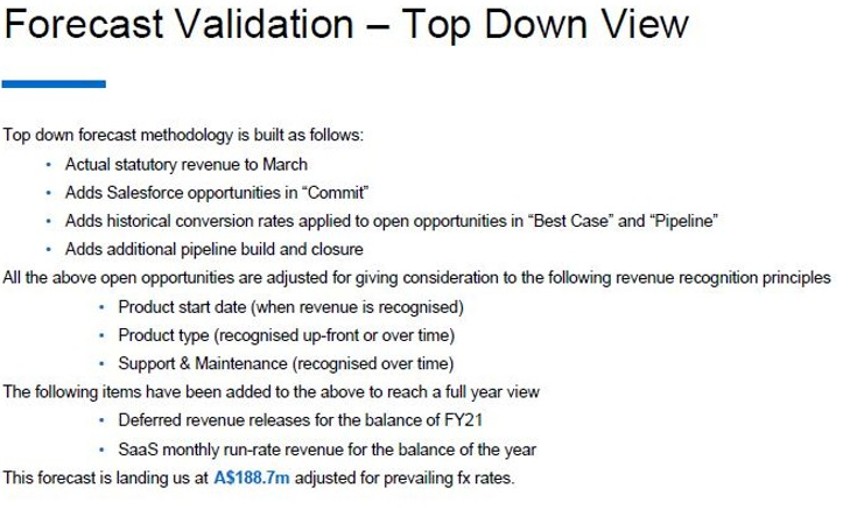
(bold emphasis and blue font in original)
672 Mr Silveri explained that the draft “Forecast Validation”:
(1) outlined the forecast methodology for revising the Prospectus Revenue Forecast and identified the revised FY21 statutory revenue forecast as $183.6 million (excluding additional unbuilt pipeline and expected deal slippage);
(2) outlined continuing risks to the revised FY21 statutory revenue forecast figure above; and
(3) provided an alternative “top down” view for validating the revised FY21 statutory revenue forecast, which amounted to $188.7 million adjusted for prevailing FX rates.
673 At 6:35pm, Mr Vawdrey sent an email to Ms Thomas, Mr Doyle, Mr Egan (copied to, inter alia, the other directors of Nuix) with the subject line “Draft Nuix Market release.ADC.Final.RV.docx” in the following terms:
Please find attached feedback from Dan, Sue and Sarah for consideration against draft release prepared by Tony and me and reviewed by Alan Young
We need sign off by CFO and by CU and input from Matt/Brett so we can seek approval from the board later this evening or early tomorrow please.
Mike Egan could you please provide any disclosure implications not already addressed
674 At 8:19pm, Mr Doyle sent an email to Mr Vawdrey and Dr Castagna (as written):
The team is recommending the following revised forecast parameters:
1. Statutory revenue range $180m-$185m down from $193.5m
2. ACV range of $170m-$177m down from $199m
3. EBITDA (Proforma) range of $68.6m to $69.6m improved from $63.6m
4. Detailed workings attached for your consideration.
Are you okay to release this to the BOD for tonight’s confersation?
(bold emphasis added)
675 At 8:23pm, Mr Vawdrey responded:
Yes with the caveat the basis of these recommendations has not been presented/explained to me
Once I understand and can support the underlying basis we can include in a release.
Please thank the team for their efforts
676 At 8:31pm, Mr Doyle sent an email to the directors of Nuix and others titled “Strategy Call”:
The team is recommending the following revised forecast parameters:
1. Statutory revenue range $180m-$185m down from $193.5m
2. ACV range of $170m-$177m down from $199m
3. EBITDA (Proforma) range of $68.6m to $69.6m improved from $63.6m
4. Detailed workings attached for your consideration.
We can discuss this tonight however we need to go through the workings with Rod tomorrow.
(bold emphasis added)
677 At 9:53pm, Mr Clegg sent a further email to all of the directors of Nuix, and others, in the following terms:
Please find attached the latest version of the ASX release in both clean format with comments (including as a PDF) and as a marked-up version in tracked changes.
This includes the latest forecasts provided by management. There are some outstanding points and observations in the form of tracked comments.
For the purposes of the upcoming call, recommend we all refer to the Word format in clean version.
I think the format and tone of this version is much improved. Though note that there are several points that which will likely be heavily scrutinised in Q&A. Among these are the magnitude of the difference between relative declines of revenue and ACV. The reasons for which are not immediately apparent.
678 The attached draft market release (in its marked up form) included:
…Nuix Limited ... provides an update to its FY21 forecasts compared to its IPO Prospectus FY21 forecasts and following Nuix’s 1H commentary on March 8, 2021, as noted below, and provides some commentary on its YTD trading.
• Pro Forma Revenue of $180m-$186m$185m (vs $193.5m forecast in the IPO Prospectus).
• Annualised Contract Value (ACV) of $174m170m-$182m 177m (vs $199.6m).
• Pro forma EBITDA of $69.2m68-$70m (vs $xxx63.6m).
…
(footnotes omitted; shading in original)
679 At 10:21pm, Mr Doyle, apparently in response to an email from Mr Phillips noting that there was no attachment to Mr Doyle’s 8:31pm email, sent the “Draft – Forecast Validation combined pptx” to the addressees of that email. That presentation included:
(1) a slide titled “Strategy Forecast methodology” in the following terms:
The forecast methodology we have based our updated market guidance on is the field submitted stretch target forecast
This is built as follows:
• In early March the field submitted a listing of all opportunities assigned to sales representatives that they would close between March and 30 June
• The Salesforce report was extracted on the 12th of April, 2021.
• We have been updating this regularly per latest data in Salesforce to track:
• Movements in opportunity value (at prevailing fx rates)
• Movements in close date
• Movements in product mix
• Movements in opportunity stage i.e. closed lost
• These identified opportunities have also been adjusted for giving consideration to the following revenue recognition principles
• Product start date (when revenue is recognised)
• Product type (recognised up-front or over time)
• Support & Maintenance (recognised over time)
• The following items have been added to the above to reach a full year view
• Actual statutory revenue and ACV to February
• Deferred revenue releases for the balance of FY21
• SaaS monthly run-rate revenue for the balance of the year
This forecast is landing us at A$183.6m Statutory Revenue and A$177.3 ACV and excludes the following:
• Additional pipeline build and closure to the end of June (approximately A$3m pipeline build at historical win rate of 50% equates to A$1.5m revenue)
• Expected slippage of deals pushed to FY22 or closed lost entirely
(bold emphasis in original) ;
(2) a slide titled “ACV Forecast Valuation – Top Down View” in the following terms:
Top down forecast methodology is built as follows:
• Actual statutory revenue to March
• Adds Salesforce opportunities in “Commit”
• Adds historical conversion rates applied to open opportunities in “Best Case” and Pipeline”
• Adds additional pipeline build and closure
All the above open opportunities are adjusted for giving consideration to the following revenue recognition principles
• Product start date (when revenue is recognised)
• Product type (recognised up-front or over time)
• Support & Maintenance (recognised over time)
The following items have been added to the above to reach a full year view
• Deferred revenue releases for the balance of FY21
• SaaS monthly run-rate revenue for the balance of the year
This forecast is landing us at A$188.7m adjusted for prevailing fx rates
(bold emphasis in original)
C.17.8 Tuesday, 20 April 2021
680 On or by 20 April 2021, Mr Rees was comfortable that the re-forecasting exercise conducted for EMEA and APAC for the last three months of FY21 was correct and he communicated that to Mr Vawdrey and the finance team.
681 At 1:21am on that day, Mr Clegg sent to the directors of Nuix and others, version 6 of Nuix’s proposed market release. Version 6 included:
Nuix Limited ... provides an update to its IPO Prospectus FY21 forecasts, as noted below, and provides commentary on recent trading conditions.
• Pro Forma Revenue of $180m-$185m (vs $193.5m forecast in the IPO Prospectus)
• Annualised Contract Value (ACV) of $170m-$177m (vs $199.6m)
• Pro forma EBITDA of $68m-$70m (vs $63.6m)
• Acceleration in customer transition to consumption and SaaS license models
• Current business and operating climate in select regions reduced upsell opportunities
• Strong underlying business performance with new customers won, total and average order value, up substantially compared to the same period in FV20
…
(bold emphasis added; footnotes omitted)
682 At 3:23am, Sir Iain responded:
Thank you Brett
I have focused on the draft release.
I think it reads well, not defensively, not overly upbeat, but level and in my view clear. The order which which [sic] it takes the reader through the reasons is digestible.
I have not tinkered with it to the extent of offering a V7 - you have version control. I did wonder about adding a slightly altered line from a previous draft to one para, as italicised below. (This would need to be sanity checked by a member of the Executive).
And then slightly altering the syntax of the next paragraph.
The accelerated switch to consumption licenses, including SaaS, is primarily driven by changing customer business models, caused in part by a shift from office settings to remote working environments and the need to have flexible global licensing to manage projects in line with data privacy and sovereignty requirements. It also reflects the attraction to customers of Nuix’s on-premise solution that also offers the choice of hybrid deployments as they evaluate their transition toward consumption or SaaS deployment.
This move toward consumption and SaaS software deployments has had a near term impact on statutory revenue generation. It does not however diminish Nuix’s growth prospects, as evidenced by ongoing increases in new customer acquisition and retention.
Hope that is helpful and thanks to all for the hard work.
(italic emphasis in original)
683 At 8:55am, Ms Thomas expressed her agreement with Sir Iain’s comments.
684 At 10:24am, Mr Clegg responded:
Thank you Sue.
A smaller group of us (with Nuix, Clayton Utz, CM, Highbury represented) met earlier to run through the release. Attached is the latest version 7 with some further considerations highlighted.
• Reference to following completion of an internal quarterly management review is to ensure further clarity on the why and when of the trading update disclosure
• In bullet points there are additional clarifiers subject to verification to ensure the full picture is appropriately presented (including the positives)
• Included suggested paragraph from Iain with some minor reworking to help maintain the narrative flow
If you could please provide feedback on these when able but otherwise hopefully we are close to conclusion.
The teams are now focused variously on verification and completion of the Q&A. In turn, an important process today will be to triangulate the following: i. ASX Release, ii. CEO Speaker Notes, and iii. Q&A to ensure consistency and that any market sensitive information is appropriately captured in the public materials.
We have decided not to upload the CEO Speaking Notes onto the ASX Platform but will have a transcript of the Investor Call prepared which will be available at our discretion to place on the Nuix investor website alongside the audio recording.
685 At 11:57am, Mr Doyle responded:
Please change FROM:
While Nuix considers this to be a strong positive indicator of customer loyalty and retention, it also has a near term impact on FY21 ACV growth, given different revenue recognition rules.
Please change TO:
While Nuix considers this to be a strong positive indicator of customer loyalty and retention, it also has a near term impact on FY21 ACV growth.
REASON
technically rev rec only applies to statutory revenue and not ACV which is non-gaap.
686 At 12:25pm, Mr Doyle sent an email to the directors of Nuix and others:
We are still working EBITDA calcs and I flag now this could change the 3-5$m positive revision
687 At 12:48pm , Mr Bleich responded to Mr Clegg’s 19 April 2021, 9:53pm email. He wrote:
I think this looks very good, and it nicely addresses the issues surfaced during this morning’s call. Thank you for this work. My only modification is that there’s an extra comma in the 6th bullet point. I agree with the proposal to have a written version of Rod’s general statements as a supplement to the release. And I agree about timing. We should have this to ASX at 7:30 a.m. if possible and an investor call at 9 a.m. if possible.
688 At 2:54pm, Mr Doyle sent a further email to the directors of Nuix and others:
on EBITDA we are recommending $1m to $3m improvement on $180m to $185m range therefore 63.6m to $64.6m and $66.6m
updated ACV ranges to follow shortly
689 At 3:14pm that day, Mr Doyle sent a further email to, inter alia, the directors of Nuix (as written):
the below comments relate to ACV ...
• * for ACV we are recommending a range of $168m to $177m
• * important to note that opening acv was $168m and closing could be as low as $168m
• * that means flat year on year growth
• * in answering the question why is it flat part of this answer is that New is forecasted to be $16m vs prospectus $20m
• * $16m new ACV is vs PCP of $11m new ACV
• * our YTD new ACV is $11m
• * so it is a good news story , however we cannot say we are going to attain prospectus new acv of $20m
690 At 4:00pm, Ms Beresford sent to Mr Vawdrey and others another draft of the proposed ASX release under cover of an email in the following terms:
Please see attached for latest version (v8.l and clean copy) which includes Stephen’s EBITDA and ACV updates and the conference call details.
Mike is planning to talk to the ASX after the market closes to assess whether 9.30am is feasible, i.e. they can approve the release in time for the call. Otherwise we move it to a 10am start.
691 Version 8.1, in its marked-up form, included:
Nuix Limited ... provides an update to its IPO Prospectus FY21 forecasts, as noted below, and provides commentary on recent trading conditions following completion of an internal quarterly management review.
• Pro Forma Revenue’ of $180m-$185m (vs $193.5m forecast in the IPO Prospectus)
• Annualised Contract Value (ACV) of $170m168m-$177m (vs $199.6m)
• Pro forma EBITDA of [$6664.6m-$6866.6m] (vs $63.6m)
• Acceleration in customer transition to consumption and software as a service (SaaS) licenses impacts the revenue profile but delivers significant longer-term business model benefits
• Current operating climate has led to a reduction in near-term upsell opportunities, while renewals and new business remain in line with expectations
• Strong underlying business performance with substantial increases in new customers won, and total and average order values, compared to the same period in FY20
(underline emphasis and strike-through in original)
692 At 5:13pm, Mr Clegg sent an email to the directors of Nuix:
Thank you also Iain.
Directors, I wish we could limit the toll on your respective inboxes, but I wanted to flag that there will be a further update to the ASX release given that the ACV numbers have moved again and following review of the CFO speaking notes.
Specifically, the statement that “renewals and new business remain in line with expectations” only applies to stat revenue rather than ACV. In the bullet point the below would prudently be excised:
• Current operating climate has led to a reduction in near-term upsell opportunities, while renewals and new business remain in line with expectations
This is disappointing as this amplification was a key plank in the comfort hoping to be provided to investors.
More generally, in my opinion the 4-7% decline in Pro Forma Revenue may have been taken in the market’s stride given the response to H1 and latent market scepticism, but the potential further confidence hit around the fundamentals of the business could be acute around the magnitude in ACV decline.
Explaining the magnitude of the ACV decline relative to Pro Forma revenue is a key challenge for management. There is no easy way to explain this and hence there is significant focus ongoing in the Speaker Notes and Q&A.
(bold emphasis and strike-through in original)
693 At 10:02pm, Mr Clegg sent an email to the directors of Nuix (copied to others) with the subject line “Final Nuix ASX Market Release” in the following terms:
Dear Board
Please find attached the ASX Market Release for your final review and ahead of Board sign off tomorrow morning prior to lodgement.
• Stephen has confirmed the following statement in bullet point five is correct: while revenue from renewals and new business remain in line with expectations. To be more specific we could say Pro Forma or statutory revenue but given the preceding points reference Pro Forma, and to keep it simple, I have maintained simply as revenue.
• Also attached is the updated speaking notes for Rod which is in very clear language that complements the ASX release. Please note that after earlier discussion we have decided against uploading these to the ASX platform.
• The Pro Forma 4-7% revenue miss against prospectus may not come as a great surprise to many market participants following the Hl results, however the disproportionate decline in ACV (11-16%) comes with some sticker shock and will require further explanation from Stephen in the investor presentation and Q&A.
• Consistent with this point, and noting it is late in the process, if there was one small possible addition to consider it would be to provide a few more words on the causes of impacts upon ACV growth at the end of the following sentence: While Nuix considers this to be a strong positive indicator of customer loyalty and retention, it also has a near-term impact on FY21 ACV growth.
Finally, I wish to personally add my sincere best wishes to Rod and Stephen tomorrow, along with all those in supporting roles. The accelerated shift within customer preferences, coupled with broader ongoing challenges for customers as the world variously crawls and walks out of pandemic conditions, is certainly a tough backdrop for Nuix during its early listed life.
There is a clear and present danger that these trends and near-term impacts are interpreted or conflated with a diminution in the enduring value and competitive position of the Nuix technology. We all know this not to be the case and it has been apparent over recent days that we are aligned in delivering the message of a bright future beyond the noise and pain of these temporary challenges.
(italic emphasis in original)
694 The attached proposed market release included:
…Nuix Limited ... provides an update to its IPO Prospectus FY21 forecasts, as noted below, and provides commentary on recent trading conditions following completion of an internal quarterly management review.
• Pro Forma Revenue of $180m-$185m (vs $193.5m forecast in the IPO Prospectus)
• Annualised Contract Value (ACV) of $168m-$177m (vs $199.6m)
• Pro Forma EBITDA of $64.6m-$66.6m (vs $63.6m)
• Acceleration in customer transition to consumption and software as a service (SaaS) licenses impacts the revenue profile but delivers significant longer-term business model benefits
• Current operating climate has reduced near-term upsell opportunities, while revenue from renewals and new business remain in line with expectations
• Strong underlying business performance with substantial increases in new customers won, and total and average order values, compared to the same period in FY20
…
(footnotes omitted)
C.17.9 Wednesday, 21 April 2021
695 The directors’ responses to Mr Clegg’s email – sent during the night of 20/21 April 2021 were as follows:
(1) Sir Iain:
Many thanks
Kudos to the wider team indeed
I’m happy with all that. I’d be interested to know what words might be added to explain the ACV impact - a clause rather than sentences I would suggest. But I wonder, if they would be explanatory, whether they might sit better in a footnote so as not to disturb the flow. ;
(2) Ms Thomas:
Thanks and well done to everyone. This reads well.
I confirm my consent to the announcement. ;
(3) Mr Bleich:
I consent as well. This required some difficult financial and forensic analysis at all hours of the day and night following the close of the third quarter. Excellent effort under challenging circumstances, and it shows. ;
(4) Mr Phillips:
Approved by me too
Thx again everybody for the massive effort and commitment ;
(5) Mr Vawdrey:
Approved by me also ; and
(6) Sir Iain:
Nothing to add in that case
696 Sir Iain provided evidence that:
(1) at no time between 9 April and 21 April 2021 did he consider that Nuix should issue a release for the statutory revenue metric before ACV and EBITDA, request a trading halt from the ASX, or issue a release withdrawing the previous guidance (before the numbers were ready). Nor, to his recollection, did anyone else with more experience in running publicly listed companies than his (such as Ms Thomas, Mr Phillips or Mr Egan) raise those possibilities for discussion. His expectation was that if there were actions the board should have been taking in that period other than what it was doing (i.e. working with management to prepare a release once the directors had verified figures for all three metrics), one of Ms Thomas, Mr Phillips or Mr Egan would have raised this with him; and
(2) at all times, he believed that the course the directors adopted was appropriate for the circumstances. The board had been advised of a potential downgrade in the statutory revenue forecast for FY21, but was also informed that further work was needed to confirm the extent of that downgrade, and also the ACV and EBITDA forecast guidance. The anticipated downgrade was initially within five per cent variance, and then later (when the statutory number became a range), even the lowest figure was still less than 10 per cent variance. In those circumstances, Sir Iain thought, disclosure was appropriate because he wanted Nuix to be transparent and to cultivate a relationship of trust and reliability with its investors, and not because he thought the results meant that Nuix had no choice legally but to disclose. This meant that while a release as soon as the board had the correct numbers was the right thing to do, it was also necessary to get the numbers right and make sure they were accompanied by a clear and cogent explanation. Rushed, inaccurate numbers and a muddled message would have been counterproductive to what he saw as the objective of such a release.
697 Mr Bleich provided evidence that he approved the final ASX announcement and that:
(1) his intention had always been that an announcement be made to the market to update Nuix’s investors once firm and accurate numbers were available, accompanied by the best explanation that Nuix could provide for those numbers. He believed that this was necessary in order to accurately inform the market and maintain trust with Nuix’s investors, particularly in circumstances where the directors had approved a release that had repeated the re-affirmation of the Prospectus Forecasts in the 8 March ASX Announcement. He felt that it was important that the market be provided with accurate and sufficient reasoning for any downgrade to the Prospectus Forecasts, including what had changed since the 8 March ASX Announcement;
(2) based on the emails that he received between 16 and 21 April 2021, his understanding was that the revised forecast numbers were still subject to change, which also affected his understanding of what was happening within Nuix’s business that was causing those forecasts to change (i.e., the changes in Nuix’s business that then caused the changes to the assumptions on which the forecast was built);
(3) at no point prior to 3:14pm on 20 April 2021 did he believe that Nuix had final numbers on each of the metrics it reports (statutory revenue, ACV and EBITDA), nor did he hold the view that despite having final numbers, Nuix should not disclose them to the market while the wording of the ASX announcement was being worked on;
(4) on the contrary, to the best of his recollection, any changes to the wording of the ASX announcement in the period from 16 to 21 April 2021 were driven by changes to the underlying data and the need to update the explanation in light of those changes;
(5) his understanding was that Nuix’s finance team had a finalised range for statutory revenue by around 8:31pm on 19 April 2021. However, he was also aware at and around this time that the ACV forecast figures were continuing to change and that a potentially significant downgrade of the ACV forecast might be required. Given that statutory revenue, ACV and EBITDA together provided a more informative view of Nuix’s financial performance, he considered that it could be misleading to report on one without the others, and that at least the potential downgrade in ACV needed to be confirmed and reported with the statutory revenue forecast;
(6) he did not consider that Nuix should request a trading halt from the ASX at any time in the period from 9 April 2021 to 21 April 2021 as his understanding was that calling for a trading halt was a last resort in an emergency situation, such as where there is no time to call a quorum of the directors, and where the harms of continuing to trade would necessarily outweigh the advantages of providing more information and context to the market. He also understood that calling for a trading halt was within the purview of the responsibility of Mr Vawdrey (qua CEO) and/or Mr Doyle (qua CFO). At that time, he did not consider it necessary for Nuix to request a trading halt as he was aware that management was working on the revised forecast figures as expeditiously as possible, and that this information was not far off from being finalised. He did not recall anyone (including Mr Vawdrey and Mr Doyle) raising with him the possibility of a trading halt during that period; and
(7) similarly, at no time between 9 April 2021 and 21 April 2021 did he ever consider that Nuix should issue a release withdrawing the previous FY21 guidance without issuing new guidance. This was because, like calling for a trading halt, he considered that withdrawing guidance should be reserved as a last resort in emergency situations as it sends a very drastic and potentially misleading signal to the market which would suggest that there was a fundamental problem with the Prospectus Forecasts, as opposed to a change in circumstances since the Prospectus Forecasts were prepared, as had happened here. He believed that in the circumstances the most appropriate course was to act with all deliberate speed to provide the finalised revised forecast figures in an announcement to the ASX. He does not recall anyone (including Mr Vawdrey and Mr Doyle) raising with him the possibility of a withdrawing guidance for FY21 during this period.
C.18 21 April 2021 ASX Announcement
698 On the morning of 21 April 2021, Nuix provided the 21 April ASX Announcement to the ASX. The ASX confirmed its release at 8:22am. The 21 April ASX Announcement was in the following form:
Nuix revises FY21 forecasts
Sydney, Australia - Global software company Nuix Limited (‘Nuix’ or ‘the Company’; ASX: NXL) provides an update to its IPO Prospectus FY21 forecasts, as noted below, and provides commentary on recent trading conditions following completion of an internal quarterly management review.
• Pro Forma Revenue of $180m-$185m (vs $193.5m forecast in the IPO Prospectus)
• Annualised Contract Value (ACV) of $168m-$177m (vs $199.6m)
• Pro Forma EBITDA of $64.6m-$66.6m (vs $63.6m)
• Acceleration in customer transition to consumption and software as a service (SaaS) licenses impacts the revenue profile but delivers significant longer-term business model benefits
• Current operating climate has reduced near-term upsell opportunities, while revenue from renewals and new business remain in line with expectations
• Strong underlying business performance with substantial increases in new customers won, and total and average order values, compared to the same period in FY20
During April, a significant and larger than expected number of Nuix’s customers, including one of its largest, elected to transition from module-based subscription licenses to consumption and SaaS license models, resulting in a shift in both revenue and ACV profiles.
Some of Nuix’s law firm, advisory and service provider customers have also recently informed Nuix of a reduced add-on (upsell) requirement for existing licenses. This is due to both their unutilised license capacity in the current climate, as well as the recovery in legal case backlog being slower than anticipated.
The accelerated switch to consumption licenses, including SaaS, is primarily driven by changing customer business models, caused in part by a shift from office settings to remote working environments and the need to have flexible global licensing to manage projects in line with data privacy and sovereignty requirements. It also reflects the attractiveness for many customers of a decision by Nuix to provide greater choice in deployment, including on-premise and in the cloud hybrid solutions, which assists customers as they evaluate their transition toward consumption licenses.
The transition to consumption licenses, including SaaS deployments, has had a near-term negative impact on statutory revenue generation. It does not, however, diminish Nuix’s growth prospects which remain strong, as evidenced by ongoing increases in new customer acquisition and retention.
For the nine months ended 31 March 2021, the Company acquired more customers than in the same period for the previous year. The total order value and average order value from these new customers were significantly higher than the prior year period. An accelerating trend in customer preference is evidenced by more than 25 per cent of the total order value being derived from consumption licenses, including SaaS.
Over the last few months, customers have also continued to make longer-term commitments to Nuix, with a higher-than-expected level of multi-year contracts. While Nuix considers this to be a strong positive indicator of customer loyalty and retention, it also has a near-term impact on FY21 ACV growth.
Notable multi-year SaaS and hybrid contracts include the following 2 to 5-year commitments:
• Large American Law 200 customer
• Large Australian Advisory/LSV
• Large European (French) financial services firm
• Australian State Government
• European (German) utilities company
The increase in projected EBITDA over forecast is in part reflective of lower headcount, reduced travel costs, and FX benefit from USD costs. There are further EBITDA benefits that accrue to Nuix from its prior investment in SaaS infrastructure and cost optimisation, which support the growing customer demand for consumption licensing and help maintain high gross margins through significant operating leverage.
Rod Vawdrey, CEO of Nuix commented, “Over the last 18 months, Nuix has enabled its customers to move from module-based subscription licenses to more flexible consumption-based licensing models. The increasing rate of adoption of consumption licenses has had a positive impact on new business and existing retention notwithstanding a transitory downward impact on FY21 revenue. Giving our customers the choice in how they consume Nuix is a key competitive advantage.”
“The fundamental revenue drivers for Nuix are strong and underpinned by a growing order book and pipeline. It reflects the underlying strength of the Nuix software offering, a sticky, loyal customer base, strong growth in new business and an increase in order size. We look forward to shareholder participation in Nuix’s Investor Day in May.”
...
This announcement has been authorised by the Board of Nuix.
(bold emphasis in original; footnotes omitted)
699 It is common ground as between ASIC and Nuix that by the 21 April ASX Announcement, Nuix stated that:
(1) the Revenue of Nuix for FY21 was forecast to be in the range of $180 million to $185 million; and
(2) the ACV of Nuix at the end of FY21 was forecast to be in the range of $168 million to $177 million.
700 Nuix’s share price closed on 21 April 2021 at $4.29, down from the previous day’s closing price of $5.07, a fall of approximately 15.38 per cent.
D. 18 JANUARY TO 25 FEBRUARY 2021 - MISLEADING OR DECEPTIVE CONDUCT CASE AGAINST NUIX (SOC C2)
701 I turn now to ASIC’s case that Nuix engaged in misleading or deceptive conduct between 18 January and 25 February 2021 by not disclosing the 1HFY21 ACV Result to the ASX.
D.1 Introduction and legal framework
702 As noted above, ASIC relies upon s 1041H(1) of the Corporations Act and s 12DA(1) of the ASIC Act. Each of those provisions – which are reproduced at [13] above – provides that a person must not engage in conduct that is misleading or deceptive or is likely to mislead or deceive.
703 The relevant principles to be applied when considering whether a person has contravened a provision prohibiting conduct which is misleading or deceptive or likely to mislead or deceive were summarised by the High Court of Australia (Kiefel CJ, Gageler, Gordon, Edelman and Gleeson JJ) in Self Care IP Holdings Pty Ltd v Allergan Australia Pty Ltd [2023] HCA 8; (2023) 277 CLR 186 at 225 to 226 ([80] to [82]), by reference to a similar provision, namely s 18 of the Australian Consumer Law (being Schedule 2 to the Competition and Consumer Act 2010 (Cth)). Their Honours explained:
80 The principles are well established. Determining whether a person has breached s 18 of the ACL involves four steps: first, identifying with precision the “conduct” said to contravene s 18; second, considering whether the identified conduct was conduct “in trade or commerce”; third, considering what meaning that conduct conveyed; and fourth, determining whether that conduct in light of that meaning was “misleading or deceptive or … likely to mislead or deceive”.
81 The first step requires asking: “what is the alleged conduct?” and “does the evidence establish that the person engaged in the conduct?”. The third step considers what meaning that conduct conveyed to its intended audience. As in this case, where the pleaded conduct is said to amount to a representation, it is necessary to determine whether the alleged representation is established by the evidence. The fourth step is to ask whether the conduct in light of that meaning meets the statutory description of “misleading or deceptive or … likely to mislead or deceive”; that is, whether it has the tendency to lead into error. Each of those steps involves “quintessential question[s] of fact”.
82 The third and fourth steps require the court to characterise, as an objective matter, the conduct viewed as a whole and its notional effects, judged by reference to its context, on the state of mind of the relevant person or class of persons. That context includes the immediate context – relevantly, all the words in the document or other communication and the manner in which those words are conveyed, not just a word or phrase in isolation – and the broader context of the relevant surrounding facts and circumstances. It has been said that “[m]uch more often than not, the simpler the description of the conduct that is said to be misleading or deceptive or likely to be so, the easier it will be to focus upon whether that conduct has the requisite character”. That said, the description of the conduct alleged and identified at the first step should be sufficiently comprehensive to expose the complaint, because it is that conduct that will ultimately, as a whole, be determined to be or not to be misleading or deceptive.
(italic emphasis in original; footnotes omitted)
704 See also Elanor Funds Management Ltd (ACN 125 903 031) v Alceon Group Pty Ltd (ACN 122 365 986) [2024] FCAFC 121; (2024) 424 ALR 601 at 628 to 629 ([92] to [95]) (Bromwich and Thawley JJ; O’Sullivan J agreeing).
705 As to the approach to be taken where misleading or deceptive conduct is alleged to have arisen by dint of non-disclosure, Gilmour and White JJ explained in Addenbrooke Pty Ltd (ACN 055 973 576) v Duncan (No 2) [2017] FCAFC 76; (2017) 348 ALR 1 at 118 to 120 ([480] to [483]) that:
Misleading or deceptive conduct by non-disclosure
[480] Conduct is misleading or deceptive, or likely to mislead or deceive, if it has a tendency to lead into error: Australian Competition and Consumer Commission v TPG Internet Pty Ltd (2013) 250 CLR 640; 304 ALR 186; 96 ACSR 475; [2013] HCA 54 (TPG Internet) at [39]. The question of whether conduct is leading or deceptive is one of fact to be resolved by a consideration of the whole of the impugned conduct in the circumstances in which it occurred: Campbell at [102] (citing McHugh J in Butcher at [109], to which reference will be made later); and Miller & Associates Insurance Broking Pty Ltd v BMW Australia Finance Ltd (2010) 241 CLR 357; 270 ALR 204; [2010] HCA 31 (Miller) at [14] (French CJ and Kiefel J).
[481] The High Court considered the principles concerning claims of misleading or deceptive conduct by non-disclosure in Miller. After referring to the statement of Gummow J in Demagogue Pty Ltd v Ramensky (1992) 39 FCR 31 at 41; 110 ALR 608 at 619 that, “unless the circumstances are such as to give rise to the reasonable expectation that if some relevant fact exits it would be disclosed, it is difficult to see how mere silence could support the inference that the fact does not exist”, French CJ and Kiefel J continued:
…
[482] On our understanding, the principles concerning misleading or deceptive conduct by non-disclosure or silence which emerge from the authorities and which are pertinent in the present appeal may be summarised as follows:
(a) conduct involving silence or non-disclosure may, in some circumstances, constitute misleading or deceptive conduct;
(b) in considering whether conduct is misleading or deceptive, silence or non-disclosure is to be assessed as a circumstance like any other;
(c) mere silence without more is unlikely to constitute misleading or deceptive conduct. However, remaining silent will constitute misleading or deceptive conduct if the circumstances are such as to give rise to a reasonable expectation that, if some relevant fact does exist, it will be disclosed;
(d) the existence or otherwise of such a reasonable expectation is to be determined objectively;
(e) it is not possible to categorise all of the circumstances in which a reasonable expectation of disclosure may arise. Such circumstances may exist when either the law or equity imposes a duty of disclosure, when a statement conveying a half-truth only is made (see Winterton Constructions Pty Ltd v Hambros Australia Ltd (1992) 39 FCR 97; 111 ALR 649 at [75]), when the representor has undertaken a duty to advise, when a representation with continuing effect, although correct at the time it was made, has subsequently become incorrect, and when the representor has made an implied representation;
(f) in considering whether a party engaged in commercial dealing may have a reasonable expectation that a fact, if it exists, will be disclosed, it is to be remembered that it will often be the case that one party to a commercial dealing has more knowledge about a relevant matter than the other and yet will not, in accordance with ordinary commercial expectations, be guilty of misleading or deceptive conduct in failing to make that knowledge known to the other.
[483] Ultimately, as indicated at the commencement of this reference to the principles, the determination of whether a failure to disclose a matter is misleading or deceptive requires an examination of all the circumstances. If in the circumstances, assessed objectively, a representee would have been entitled to expect or infer (have a reasonable expectation) that an undisclosed matter would be disclosed, that may well constitute misleading or deceptive conduct: Clifford v Vegas Enterprises Pty Ltd [2011] FCAFC 135 at [198].
(bold and italic emphasis in original; underline emphasis added)
706 The broader context, or relevant circumstances, also include the legal order in which Nuix, the market generally, and the ASX operate. As Brennan J explained in Parkdale Custom Built Furniture Proprietary Limited v Puxu Proprietary Limited [1982] HCA 44; (1982) 149 CLR 191 at 225, statutory provisions which prohibit persons engaging in conduct which is misleading or deceptive operate “in a milieu of the external legal order” such that the character of the conduct which falls for consideration under the relevant statutory provision must be determined by reference to the legal order as it exists when the conduct is engaged in.
707 As will be seen, part of the broader context, or the external legal order, by which the question whether Nuix engaged in misleading or deceptive conduct in contravention of s 1041H(1) of the Corporations Act or s 12DA(1) of the ASIC Act is to be assessed may include the operation of s 674 of the Corporations Act, the Listing Rules, Guidance Note 8 and RG230.
D.2 The scope of the dispute
708 The 1HFY21 ACV Result is defined by ASIC as comprising information that as at 31 December 2020:
(1) Nuix’s ACV was $161.9 million;
(2) Nuix’s ACV was $17.1 million, or approximately 9.6 per cent, less than the ACV Nuix expected in order to achieve the Prospectus ACV Forecast; and
(3) the primary reason Nuix missed its forecast for ACV at the end of 1HFY21 was that Subscription ACV at the end of 1HFY21 was $17.7 million less than the forecast figure for Subscription ACV.
709 ASIC alleges that the non-disclosure of the 1HFY21 ACV Result was conduct engaged in by Nuix that was misleading or deceptive because there existed a reasonable expectation of disclosure of the 1HFY21 ACV Result in circumstances where during the period 18 January to 25 February 2021:
(1) the Prospectus ACV Forecast caused, or contributed to, market expectations of:
(i) year on year growth in ACV of approximately 20 per cent during FY21;
(ii) an ACV at the end of 1HFY21 significantly higher than $162 million;
(2) Nuix was aware of such market expectations; and
(3) Nuix was aware of the 1HFY21 ACV Result, which reflected year on year growth in ACV of 3 per cent (compared to the ACV of $157 million at the end of 1HFY20), and a decline in ACV since the end of FY20.
D.3 The impugned conduct
710 It is common ground that Nuix did not disclose the 1HFY21 ACV Result to the ASX during the period 18 January to 25 February 2021, and thus that Nuix engaged in the impugned conduct.
D.4 Was the impugned conduct misleading or deceptive?
D.4.1 Introduction and context
711 In order to determine whether the non-disclosure of the 1HFY21 ACV Result was misleading or deceptive, it is necessary to consider:
(1) whether there was a reasonable expectation of disclosure of the 1HFY21 ACV Result in the circumstances because, as ASIC alleges:
(a) there was a market expectation that Nuix would achieve a market expectation of the kind alleged by ASIC;
(b) Nuix was aware of such expectations;
(c) Nuix was aware of the 1HFY21 ACV Result; and
(2) if so, whether the non-disclosure constituted misleading or deceptive conduct.
712 I am satisfied that Nuix was aware of the 1HFY21 ACV Result.
713 It is convenient to determine the remaining issues in the following order:
(1) was there a market expectation of the kind alleged by ASIC, of which Nuix was aware?;
(2) if so, was there a reasonable expectation that the 1HFY21 ACV Result, if it existed, would be disclosed?; and
(3) if so, was the non-disclosure of the 1HFY21 ACV Result in those circumstances misleading or deceptive conduct?
D.4.2 Was there a market expectation of the kind alleged by ASIC of which Nuix was aware?
714 As noted above, ASIC alleges that there was a market expectation that Nuix would achieve:
(1) year on year growth in ACV of approximately 20 per cent during FY21; and
(2) an ACV at the end of 1HFY21 significantly higher than $162 million,
and that Nuix was aware of such market expectations.
715 It is convenient to consider these alleged market expectations separately.
D.4.2.1 Market expectation of year on year growth in ACV of approximately 20 per cent during FY21?
716 It is common ground that Nuix’s ACV as at 30 June 2020 was $168.4 million and that the Prospectus ACV Forecast was for an ACV figure of $199.6 million as at 30 June 2021. The figure of $199.6 million is approximately 18.5 per cent higher than $168.4 million. Nuix accepts, and I find, that by making the Prospectus ACV Forecast Nuix had guided the market that its ACV figure would grow by approximately 18.5 per cent between 30 June 2020 and 30 June 2021, and that it was reasonable for the market to expect this. It follows that there was a market expectation of year on year growth in ACV of approximately 20 per cent during FY21.
D.4.2.2 Market expectation of an ACV at the end of 1HFY21 significantly higher than $162 million?
717 Nuix disputes ASIC’s contention that the market expected the ACV at the end of 1HFY21 (i.e. as at 31 December 2020) to be significantly higher than $162 million. I do not accept that there was such a market expectation, for the following reasons.
718 First, the prospectus contained no forecast as to Nuix’s ACV as at 31 December 2020 (as distinct from a forecast as to its ACV as at 30 June 2021).
719 Secondly, ASIC has not adduced evidence from any market participant as to the existence of such an expectation. For example, there is no evidence from any holder or potential holder of Nuix shares that they held such an expectation.
720 Thirdly, ASIC has adduced no contemporaneous documentary evidence that such an expectation was held by any market participant.
721 Fourthly, although ASIC’s case as particularised referred to the following:
(1) the Prospectus Forecasts and the discussion in the prospectus concerning growth in Nuix’s Revenue and ACV;
(2) the trading price of Nuix’s shares since the IPO;
(3) the 5 January 2021 email from Mr Vawdrey to the other directors of Nuix ([231] above);
(4) the 10 January 2021 Morgan Stanley report ([243] to [244] above);
(5) Mr Hooper’s 15 January 2021 email ([257] to [258] above);
(6) Ms Nichols’s 5 February 2021 email ([291] to [293] above);
(7) the 9 February 2021 strategy workshop;
(8) the 11 February Board Pack ([319] to [328] above); and
(9) Mr Hooper’s 12 February 2021 email to Mr Vawdrey ([337] above),
none of these establishes a market expectation that Nuix’s ACV as at 31 December 2020 would be significantly higher than $161.9 million. Some of the documents refer to a market expectation of year on year growth in ACV in the order of 20 per cent and others refer to an expectation of growth more generally but none refers to or suggests the contended market expectation of a 31 December 2020 ACV figure significantly higher than $161.9 million.
722 As to [721(1)], the prospectus forecasts, say nothing about the ACV position as at 31 December 2020.
723 The statements in the prospectus upon which ASIC relies are:
(1) statements that ACV was one of the key performance indicators and one of the key operating and financial metrics, with an expected growth for FY21 in the order of 18.6 per cent ([194(3)] above);
(2) the following ([194(1)] above):
The application of Nuix’s revenue recognition policies (described in Section 4.2.4.1) varies across these criteria. Nuix monitors three KPIs (ACV, NDR and Churn), that:
• align the contract values of Nuix’s various licences, pricing and delivery models;
• assist Nuix in assessing its growth and the annualised impact of its sales, including its success in renewing existing customer contracts, executing on its “land and expand” strategy through Upsell Renewals, and acquiring new customers; and
• assist Nuix in assessing trends and performance of customers who acquire Subscription Licences, which accounted for 89% of FY20 Total Revenue.
(underline emphasis added)
724 These statements plainly do not establish a market expectation of a 31 December 2020 ACV figure significantly higher than $161.9 million.
725 As to [721(2)], ASIC submitted that it was likely – in circumstances where by 22 January 2021, Nuix’s shares were trading above $11 per share when the IPO offer price was $5.31 – that some investors who purchased shares at around $11 per share did so on an expectation of year on year growth in ACV of at least 20 per cent. It is not necessary to decide this point in light of Nuix’s acceptance of the proposition that there was a market expectation of year on year growth in ACV in the order of 20 per cent. ASIC’s submission does not address any link to a market expectation of a 31 December 2020 ACV figure significantly higher than $161.9 million.
726 As to [721(3)], the 5 January 2021 email from Mr Vawdrey refers to “… some investor expectation of $97m revenue for H1 through simple math at 50% of full year forecast of $193m…”. This statement, which relates to statutory revenue, provides no basis for a market expectation concerning ACV (and much less ACV as at 31 December 2020) particularly when the market must be assumed, acting reasonably and informed by the prospectus, to understand how ACV is calculated.
727 As to [721(4)], ASIC relies upon:
(1) the inclusion in the 10 January 2021 Morgan Stanley report of a base case 12 month price target of $11.00 per share, which ASIC contends contained a modelling assumption of revenue growth of 21 per cent per annum to FY24 and 19 per cent thereafter; and
(2) the following text in that report:
It is important to recognize that the company’s Annual Contract Value (ACV) growth guidance for FY21E of +19% (vs. report revenue growth of only +10%) is a better indicator of underlying revenue growth, in our view.
728 These matters do not establish an expectation on behalf of Morgan Stanley of a 31 December 2020 ACV figure significantly higher than $161.9 million, much less that the market held such an expectation. Notably, following the release of the 1HFY21 results on 26 February 2021, Morgan Stanley did not publish any adjustment to its expectations concerning ACV for FY21. Instead it stated:
At first look ... 1H results are a miss vs expectations ... and thus the risk profile surrounding full-year earnings delivery has increased. But, importantly, the company states the new business pipeline in 2H is strong and visibility provides confidence to reiterate all full-year FY21 numbers - Rev, EBITDA & FCF. We think the negative reaction is too severe. We remain confident in the opportunity from: i) expansion into new verticals; ii) shift to SaaS; & iii) accretive M&A. Stay OW.
1. Key 1H21 numbers
• Statutory rev -4% to A$85m
ACV +3% to A$162m
Gross profit -4% to A$76m, GP margin 89.2% vs FY21 guide 86.2% EBITDA +3% to A$32m at 37% margin
NPAT -20% to A$9m
2. Unexpected 1H impacts
• Rev -A$2.4m ... delay in contracts from Dec to Jan. Now done. Shift from 1H to 2H
Rev -A$2.4m ... due to FX of 0.75 vs 0.69
Delay in new sign-ups/renewals from US gov customers
3. Outlook: reiterate all FY21 guidance
• Expect Rev A$194m, ACV A$200m, EBITDA A$64m
Have “strong revenue visibility of >A$100m rev” for 2H
(bold emphasis in original; underline emphasis added)
729 The underlined portions of the above extract suggest that Morgan Stanley was aware of the 1HFY21 ACV Result, yet maintained its view that an ACV figure of $200 million should be expected at the end of FY21. This is unlikely to have occurred if it had expected a 31 December 2020 ACV figure significantly higher than $161.9 million.
730 As to [721(5)], ASIC referred to the following passage in the “CY20/FY21H1 Trading Update” document attached to the 15 January 2021 email ([258] above):
The full forecast for ACV as at Jun-21 per the prospectus is A$199.6m.
Given current ACV as at Dec-20 is A$161.9m to achieve Nuix’s full year ACV forecast will mean Nuix must execute incremental ACV (i.e. upsell and new ACV net of churn and downsell) of $37.7m between Jan-21 and Jun-21.
Given this gap and the potential for COVID and FX headwinds to continue to impact the value of deals we execute relative to budget consideration must be taken as to whether we will be able to achieve this forecast or whether a revision to the ACV forecast is required.
731 Again, this relates to the ACV figure at the end of FY21 and does not establish any market expectation of a 31 December 2020 ACV figure significantly higher than $161.9 million.
732 As to [721(6)], ASIC refers to the statements in the “Corporate Goals and Measures” paper attached to the 5 February 2021 email concerning shareholder expectations of continued growth of statutory revenue and ACV of 20 per cent per year ([292] to [293] above). As noted above, this proposition is not in issue, but it does not provide a basis for a conclusion that there was a market expectation of a 31 December 2020 ACV figure significantly higher than $161.9 million.
733 As to [721(7)], ASIC relies upon Sir Iain’s attendance at the 9 February 2021 strategy workshop and his recollection that “we understood there was an expectation from shareholders of growth” ([295] above). This plainly does not establish a market expectation of a 31 December 2020 ACV figure significantly higher than $161.9 million.
734 As to [721(8) and (9)], neither the 11 February board pack nor Mr Hooper’s 12 February 2021 email evidence a market expectation of 31 December 2020 ACV figure significantly higher than $161.9 million.
735 ASIC, in its submissions, also referred to the following events:
(1) Ms Thomas’s 21 February 2021 email concerning speaking notes for the investor presentation scheduled to follow the release of Nuix’s 1HFY21 results, in which she stated: “we not only have to talk about revenue for the first half but that we are still a growth company” ([376] above).
(2) the Appendix 4D and Consolidated Interim Financial Report dated 26 February 2021, which included “[t]he primary software revenue metric we use is Annualised Contract Value” and “[n]on-GAAP measures have been included, as we believe they provide useful information for readers to assist in understanding Nuix’s financial performance” ([435] above);
(3) the email exchanges between the directors of Nuix on 28 February and 1 March 2021 during which:
(a) Sir Iain wrote: “reflecting, I guess the market reaction was not unpredictable” ([447] above);
(b) Mr Bleich wrote: “[m]y sense was that the market had been a little over-excited about Nuix based on last year’s performance and was expecting another year of 25% YoY growth when it pushed up the stock price. The fact that we fell short of our expected 1H numbers from the prospectus was bound to produce a swift correction” ([449] above);
(c) Ms Thomas wrote: “I think the market has marked us hard – because as a growth story, Nuix didn’t grow first half revenue” ([452(1)] above); and
(d) Mr Phillips wrote: “[t]o put this in perspective, we IPOd at a good valuation - $1.8b - but the combination of investor excitement and supply/demand imbalance pushed the share price beyond where we would have expected ... this was always going to set us up for a correction/ reality check” ([452(2)] above);
(4) the inquiries from ECP and Firetrail on 2 and 3 March 2021 which related to ACV ([463] and [464] above);
(5) Ms Ferguson’s questions, provided on 6 March 2021 ([474] above), which included:
When the ACV is used to smooth revenue, growth in the first half was 4 per cent, which has caused some investors to worry that this is not a growth stock as was presented during the IPO marketing. The belief was it was a growth stock growing at about 20 per cent a year. Does the company believe Nuix will be able to continue to grow its revenue at 20% per annum over the next few years to warrant its IPO marketing as a growth stock?” ; and
(6) Mr Clegg’s statement on 9 March 2021 ([519] above) that:
What we recommend, so as not to take up too much of management’s time and Nuix’s internal resources, is to have an investor call – ideally at the beginning of April – to address financial questions that have not been dealt with sufficiently and to present a more in-depth analysis of revenue and ACV, the key metrics the market is focussed on.
(underline emphasis added)
736 These events demonstrate that ACV was a consideration for investors in Nuix and that year on year growth in ACV in the order of 20 per cent was expected. However, none of these events establish a market expectation of a 31 December 2020 ACV figure significantly higher than $161.9 million.
737 Sixthly, contrary to ASIC’s submission, the fall in Nuix’s share price following the 26 February Announcements ([439] above) cannot sensibly be attributed to any dashing of the contended market expectation of a 1HFY21 ACV Result significantly higher than $162 million in circumstances where, as is apparent from the 26 February Announcements, Nuix released information concerning its revenue, as well as its EBITDA, NPAT and other metrics. Further, it is necessary to consider the effect upon the daily share price of information that is not company specific: TPT Patrol Pty Ltd v Myer Holdings Ltd [2019] FCA 1747; (2019) 293 FCR 29 at 152 [671] (Beach J). ASIC has not established that the 1HFY21 ACV Result was the sole, dominant, or even a substantial cause of the fall.
738 In sum, the evidence falls well short of establishing the existence of a market expectation of an ACV as at 31 December 2020 significantly higher than $162 million. It follows that Nuix could not have been aware of such an expectation and that this part of ASIC’s case, to the extent it is founded upon such an expectation, must fail.
D.4.3 Was there a reasonable expectation of disclosure of the 1HFY21 Result?
739 As noted above, I am satisfied that there was a market expectation of year on year growth in ACV of approximately 20 per cent during FY21 and that Nuix was aware of it. However, it does not follow, ipso facto, from the existence of such a market expectation that there was also a reasonable expectation that the 1HFY21 ACV Result would be disclosed. The two expectations are conceptually quite different. The existence of a market expectation of year on year growth in ACV of approximately 20 percent is necessary, but not sufficient, to establish a reasonable expectation of disclosure of the 1HFY21 ACV Result.
740 I note at this point that some of the expert evidence was directed at the significance of ACV to investors (or potential investors) in Nuix. I accept that ACV was a consideration, among others (e.g. revenue figures), that would be expected to be taken into account by investors. However, the question to be answered – whether there was a reasonable expectation of disclosure of the 1HFY21 ACV Result – must be determined taking into account the nature of that information in the context of the information provided by Nuix to the market.
741 ASIC submitted there was an inconsistency between the 1HFY21 ACV Result and market expectations of year on year growth of ACV, approximately 20 per cent, because applying half of the annual growth of 18.6 per cent (that is, 9.3 per cent) to the figure at the end of FY20 ($168.4 million) produces an ACV figure at the end of FY20 of $184.1 million, or around $22 million above the figure of $161.9 million.
742 I do not accept this submission.
743 No valid extrapolation can be made from a forecast 30 June 2021 ACV figure to an expected 31 December 2020 figure – and the market could not reasonably have held an expectation of a result based upon such an extrapolation – in view of:
(1) the nature of the ACV metric as a point in time calculation, as set out at C.7.3 above; and
(2) the explanations concerning ACV and the limitations upon its use as a metric set out in the prospectus. For example the following statement in cl 4.2.6 of the prospectus ([194] above):
Although Nuix believes that these measures provide useful information about the financial performance of the business because they provide consistency and comparability with past financial performance, they are presented for supplemental informational purposes only, have limitations as analytical tools, and should not be considered in isolation or as a substitute to the financial information measures that have been presented in accordance with AAS and IFRS. As these financial measures are not based on AAS or IFRS, they do not have standard definitions, and the way Nuix calculates and presents these measures may differ from similarly titled measures used by other companies, including subscription software providers, and may therefore not be comparable to similarly titled metrics used by other companies.
Additional limitations and considerations associated with particular metrics are described further below. Investors should therefore not place undue reliance on these non-IFRS financial measures.
744 Further, the broader matrix of relevant factual circumstances serves to emphasise that a reasonable person would not have expected disclosure of the 1HFY21 ACV Result.
745 In particular, there are also several important matters of context which derive from Nuix’s status as an entity listed on the ASX and from the nature of the disclosure that ASIC contends that Nuix ought to have made, being disclosure to, and through, the ASX.
746 First, the relevant class of persons would have been aware that Nuix was subject to the operation of the Listing Rules concerning disclosure of market sensitive information.
747 Secondly, the expectations held by the relevant class of persons should be taken to have included an expectation that Nuix would disclose information to the ASX only when required to do so by the Listing Rules. As Beach J stated in TPT Patrol at 287 [1488]:
The second matter raised by Myer is that the reasonable expectation test must also have regard to the context in which Myer’s obligation to disclose matters to the market arises, and in particular its obligations under s 674. A reasonable expectation of disclosure in the context of a listed company subject to the continuous disclosure obligations in s 674 of the Act and the listing rules may only arise in circumstances where disclosure is required under the continuous disclosure regime. Myer says that a reasonable person would not expect Myer to disclose information that does not need to be disclosed under s 674. I tend to agree. …
748 Thirdly, the expectations held by the relevant class of persons should be taken to have included an expectation that Nuix would comply with guidance provided by the ASX and ASIC concerning disclosure of particular information.
749 As is explained in [5.9] of Guidance Note 8 ([42] above) and as ASIC accepted in its closing submissions:
(1) as a general rule, information that falls within the prescribed categories in Listing Rule 3.1A.1 and that meets the confidentiality requirements in Listing Rule 3.1A.2 will also satisfy the reasonable person test in Listing Rule 3.1A.3;
(2) the very reason why the categories in Listing Rule 3.1A.1 are prescribed is because they reflect a value judgment on the part of ASX that a reasonable person would not expect that type of information to be disclosed, at least while it remains confidential; and
(3) consequently, the reasonable person test in Listing Rule 3.1A.3 has a very narrow field of operation. It will only be tripped if there is something in the surrounding circumstances sufficient to displace the general rule in (1) above.
750 The 1HFY21 ACV Result was information to which Listing Rule 3.1A applied, with the consequence that Listing Rule 3.1 did not (see Part E below). In these circumstances there would have been no reasonable expectation of disclosure.
751 The 1HFY21 ACV Result was also “non-IFRS financial information”. Nuix submitted that its disclosure, without the corresponding IFRS information and a reconciliation between the two, was actively discouraged by ASIC. In this regard, ASIC in RG230:
(1) identified that financial information that is presented other than in accordance with all relevant accounting standards as defined in s 9 of the Corporations Act (i.e. “non-IFRS financial information”) is being used increasingly in market announcements (RG230.1; 230.5);
(2) stated that within RG230, ASIC gives guidance as to when non-IFRS financial information may or may not be used and what additional disclosure should be made so that the information is not misleading with the purpose of such guidance being to:
(a) promote more meaningful communication of financial information to investors and other users of financial reports;
(b) assist directors in ensuring that the financial information disclosed is not misleading;
(c) provide greater certainty in the market about ASIC’s views on disclosure of non-IFRS financial information (RG230.2);
(3) acknowledged that there are cases where non-IFRS financial information in market announcements, presentations to investors and briefings to analysts, is necessary or useful to investors and other users of the information, but indicated that this information must not be misleading. In this regard, ASIC stated that:
(a) IFRS financial information (being information presented in accordance with all relevant accounting standards) should be given equal or greater prominence compared to non-IFRS financial information, in particular IFRS profit; and
(b) non-IFRS financial information should be explained and reconciled to the IFRS financial information; be calculated consistently from period to period; and be unbiased and not used to remove “bad news” (RG230.52 and 230.53):
(4) provided guidance for the presentation of non-IFRS financial information, including:
(a) IFRS financial information should be presented with equal or greater prominence, emphasis or authority compared to the corresponding non-IFRS financial information; and
(b) a reconciliation between the non-IFRS and IFRS financial information should be provided, separately itemising and explaining each significant adjustment (RG230.56 and RG230.62).
752 Nuix submitted that it followed that there could have been no reasonable market expectation of disclosure of the 1HFY21 ACV Result. I do not accept this submission. This guidance goes only to the form of disclosure and not to the obligation to disclose.
753 For the reasons set out above, ASIC’s case to the extent it is founded upon a market expectation of year on year growth in ACV in the order of 20 per cent must fail.
754 For completeness, I note that if, contrary to the earlier analysis, the market did expect that Nuix’s ACV figure as at 31 December 2020 would be significantly higher than $162 million and that Nuix was aware of such an expectation, then for the reasons set out in this section (D.4.3), there was still no reasonable expectation of disclosure of the 1HFY21 ACV Result.
D.4.4 Was the non-disclosure of the 1HFY21 ACV Result misleading or deceptive?
755 In any event, ASIC has not established that Nuix’s ACV result as at 31 December 2020 was inconsistent with year on year growth of 20 per cent for the reasons set out above and in the following paragraph. ASIC has also not established that Nuix’s ACV result as at 31 December 2020 was not “significantly higher” than $162 million.
756 The ACV figure as at 31 December 2020 was $170.5 million when adjusted for FX headwinds ($2.4 million), contract slippage ($1.2 million) and delays with United States government contracts ($5 million). That is, 161.9 + 2.4 + 1.2 + 5 totals 170.5. These amounts were represented in the bar chart on the page headed “Annualised Contract Value (ACV)” in the 1HFY21 Financial Results presentation ([434(1)] above). The first two – $2.4 million and $1.2 million – were expressly stated. The third, being the amount attributable to the delay in United States government contracts, was estimated in a contemporaneous spreadsheet to be $5 million. Nuix’s internal target was $179 million; and $170.5 million exceeds 95 per cent of the internal target of $179 million.
757 Further, ASIC has not identified what “significantly” means in this context and no conclusion can be drawn that $170.5 million was not “significantly” more than $162 million.
D.5 Conclusion
758 In summary:
(1) Nuix was aware of the 1HFY21 ACV Result;
(2) there was a market expectation of year on year growth in ACV in the order of 20 per cent and Nuix was aware of such an expectation;
(3) there was no market expectation that the ACV as at 31 December 2020 would be significantly higher than $161.9 million;
(4) there was no reasonable expectation that the 1HFY21 ACV Result would disclosed in circumstances where:
(a) the prospectus did not contain a forecast as to ACV as at 31 December 2020 and warned of the limited use that could be made of ACV figures;
(b) the 1HFY21 ACV Result was not inconsistent with an expectation of year on year growth in ACV of approximately 20 per cent during FY21;
(c) the 1HFY21 ACV Result was information which fell within Listing Rule 3.1A, such that Listing Rule 3.1 did not require its disclosure;
(5) in any event, ASIC has not established that Nuix’s ACV result as at 31 December 2020:
(a) was inconsistent with year on year growth in ACV of approximately 20 per cent during FY21; and
(b) was not “significantly higher” than $162 million.
759 For the reasons set out above, I am not persuaded that Nuix’s conduct, in not disclosing the 1HFY21 ACV Result between 18 January and 25 February 2021, was conduct that was misleading or deceptive, or likely to mislead or deceive, within the meaning of s 1041H(1) of the Corporations Act or s 12DA(1) of the ASIC Act.
E. 18 JANUARY TO 25 FEBRUARY 2021 – CONTINUOUS DISCLOSURE CASE AGAINST NUIX (SOC D2)
760 I turn now to ASIC’s case that during the period from 18 January to 25 February 2021, Nuix contravened s 674(2) of the Corporations Act by not disclosing the 1HFY21 ACV Result to the ASX.
761 The conduct relied upon is the same conduct which formed the basis of the misleading or deceptive conduct case discussed at Part D above, but it falls to be assessed within the framework of an alleged contravention of s 674(2) of the Corporations Act.
E.1 Statutory and regulatory framework
762 As noted above, the operation of s 674 of the Corporations Act was affected by the Determinations such that throughout the period from 18 January 2021 until 25 February 2021, s 674 of the Corporations Act is to be read as follows:
674 Continuous disclosure—listed disclosing entity bound by a disclosure requirement in market listing rules
Obligation to disclose in accordance with listing rules
(1) Subsection (2) applies to a listed disclosing entity if provisions of the listing rules of a listing market in relation to that entity require the entity to notify the market operator of information about specified events or matters as they arise for the purpose of the operator making that information available to participants in the market.
(2) If:
(a) this subsection applies to a listed disclosing entity; and
(b) the entity has information that those provisions require the entity to notify to the market operator; and
(c) that information is not generally available; and
(d) the entity knows or is reckless or negligent with respect to whether that information would, if it were generally available, have a material effect on the price or value of ED securities of the entity;
the entity must notify the market operator of that information in accordance with those provisions.
...
(bold and italic emphasis in original)
763 As also noted above, for the purposes of s 674(1) of the Corporations Act, the Listing Rules imposed notification requirements upon Nuix.
764 Rules 3.1 and 3.1A are extracted at [25] above, but reproduced here for ease of reference:
Immediate notice of material information
General rule
3.1 Once an entity is or becomes aware of any information concerning it that a reasonable person would expect to have a material effect on the price or value of the entity’s securities, the entity must immediately tell ASX that information.
Exception to rule 3.1
3.1A Listing rule 3.1 does not apply to particular information while each of the following requirements is satisfied in relation to the information:
3.1A.1 One or more of the following 5 situations applies:
• It would be a breach of a law to disclose the information;
• The information concerns an incomplete proposal or negotiation;
• The information comprises matters of supposition or is insufficiently definite to warrant disclosure;
• The information is generated for the internal management purposes of the entity; or
• The information is a trade secret; and
3.1A.2 The information is confidential and ASX has not formed the view that the information has ceased to be confidential; and
3.1A.3 A reasonable person would not expect the information to be disclosed.
(bold emphasis in original)
765 Also relevant is the operation of:
(1) s 676 of the Corporations Act which is set out at [22] above; and
(2) s 677 of the Corporations Act which, as affected by the Determinations, provided:
677 Sections 674 and 675—material effect on price or value
For the purposes of sections 674 and 675, an entity knows or is reckless or negligent with respect to whether information would have a material effect on the price or value of ED securities of the entity if the entity knows or is reckless or negligent with respect to whether the information would, or would be likely to, influence persons who commonly invest in securities in deciding whether to acquire or dispose of the ED securities.
(bold emphasis in original)
766 Guidance Note 8 is also relevant. As ASIC submitted:
(1) the ASX publishes Guidance Note 8, to assist listed entities to understand and comply with their disclosure obligations under the Listing Rules 3.1, 3.1A and 3.1B: see Cruikshank v Australian Securities and Investments Commission [2022] FCAFC 128; (2022) 292 FCR 627 at 647 [86] (Allsop CJ, Jackson and Anderson JJ);
(2) the contents of Guidance Note 8 do not have statutory force, but the ASX states that the note reflects the ASX’s position as to how the law is intended to operate: Cruikshank at 647 [86];
(3) Courts have had regard to Guidance Note 8 in construing Listing Rules 3.1 and 3.1A: see, e.g., TPT Patrol at 248 to 253 ([1262] to [1284]) and 254 [1289] and Cruikshank at 647 to 648 ([86] to [87]) and 651 [95]; and
(4) Guidance Note 8 informs market expectations, which in turn informs the inquiry as to, inter alia, the materiality of particular information.
E.2 The scope of the dispute
767 ASIC contends that Nuix contravened s 674(2) of the Corporations Act (in its modified form) by not disclosing to the ASX during the period from 18 January 2021 until 25 February 2021 the 1HFY21 ACV Result in circumstances where (ASIC alleges):
(1) Nuix was aware of the 1HFY21 ACV Result;
(2) the 1HFY21 ACV Result was not generally available;
(3) the 1HFY21 ACV Result was information that a reasonable person would expect, if it were generally available, to have a material effect on the price or value of Nuix’s shares; and
(4) Nuix was negligent with respect to whether the 1HFY21 ACV Result would, if it were generally available, have a material effect on the price or value of Nuix’s shares.
768 As noted above, it is common ground as between ASIC and Nuix that throughout the relevant period Nuix was required to comply with s 674(2) of the Corporations Act and that its shares were “ED securities”.
769 It is also common ground that Nuix was aware of the 1HFY21 ACV Result, that the 1HFY21 ACV Result was not generally available, and that Nuix did not disclose the 1HFY21 ACV Result during the period from 18 January 2021 until 25 February 2021.
770 Nuix otherwise contests ASIC’s case. It also calls in aid Listing Rule 3.1A.
771 Thus, the central issues for determination are:
(1) whether Listing Rule 3.1A applies; and
(2) if Listing Rule 3.1A does not apply, then whether s 674(2) was otherwise satisfied and in particular whether Nuix was negligent with respect to whether the 1HFY21 ACV Result would, if it were generally available, have a material effect on the price or value of Nuix’s shares.
E.3 Does Listing Rule 3.1A apply?
772 As is plain from its text, Listing Rule 3.1A applies where each of sub-rules 3.1A.1, 3.1A.2 and 3.1A.3 is satisfied.
773 Listing Rule 3.1A.1 is satisfied when, inter alia, the subject information “is insufficiently definite to warrant disclosure”, or “is generated for the internal management purposes of the entity”. Each of these conditions is met.
774 The 1HFY21 ACV Result was a piece of information contained in an attachment to Mr Hooper’s 15 January 2021 email to Mr Vawdrey ([257] to [258] above). That email bore the subject line “DRAFT – 1HFY21A performance – ACV, NDR, churn” and the attached document was marked “DRAFT – FOR DISCUSSION”. It is plain on the face of the email and its attachment that the information that ASIC has labelled “IHFY21 ACV Result” was generated for further discussion and for Nuix’s internal management purposes: cf Masters v Lombe (in his capacity as liquidator of Babcock & Brown Ltd (in liq) (ACN 108 614 955) [2021] FCAFC 161; (2021) 392 ALR 326 at 350 to 352 ([154] to [169]) (Middleton, Beach and Colvin JJ). ASIC did not put this in issue.
775 Listing Rule 3.1A.2 is satisfied when the information is confidential and ASX has not formed the view that the information has ceased to be confidential. As senior counsel for Nuix stated in opening, the 1HFY21 ACV Result was quite plainly confidential, a proposition with which ASIC did not cavil during the hearing: cf Lombe at 353 [178]. There is also no suggestion that the ASX formed the view that the 1HFY21 ACV Result ceased to be confidential.
776 Listing Rule 3.1A.3 – which is the limb of Listing Rule 3.1A which ASIC contended was not met – is satisfied when a reasonable person would not expect the information to be disclosed. Obviously, this question arises only if the Listing Rules 3.1A.1 and 3.1A.2 are satisfied. However, satisfaction of these rules is not merely a necessary prerequisite – the fact of satisfaction of Listing Rules 3.1A.1 and 3.1A.2 also informs the question of whether a reasonable person would expect disclosure.
777 As noted at [749] above, Guidance Note 8 indicates that information that satisfies Listing Rule 3.1A.1 and Listing Rule 3.1A.2 will generally satisfy the reasonable person test in Listing Rule 3.1A.3, with the consequence that the reasonable person test in Listing Rule 3.1A.3 has a very narrow field of operation and will only be tripped if there is something in the surrounding circumstances sufficient to displace the general rule ([42] above).
778 ASIC’s submissions as to why a reasonable person would have expected disclosure of the 1HFY21 ACV Result rely upon [7.3] of Guidance Note 8 and in particular the following passages:
7.3 Market sensitive earnings surprises
Generally speaking, an entity’s earnings for a particular reporting period are not required to be reported to the market until the due date for the release of that information under Chapter 4 of the Listing Rules.
However, for many entities, the market’s expectations of its earnings over the near term may be a material driver of the price or value of its securities. Those expectations may have been informed by:
• earnings guidance the entity has given to the market;
• in the case of entities covered by sell-side analysts, the earnings forecasts of those analysts; or
• the entity’s pcp earnings.
Those expectations may also have been informed or modified by:
• “outlook statements” made by the entity in its last annual report or at its last results announcement or annual general meeting;
• other disclosures the entity has made to the market over the reporting period; and
• market-wide or sector-wide events that can reasonably be expected to affect the entity.
If an entity becomes aware that its earnings for the current reporting period will differ materially (downwards or upwards) from market expectations, it needs to consider carefully whether it has a legal obligation to notify the market of that fact. This obligation may arise under Listing Rule 3.1 and section 674209, if the difference is of such magnitude that a reasonable person would expect it to have a material effect on the price or value of the entity’s securities – referred to in this Guidance Note as a “market sensitive earnings surprise”. Alternatively, in the case of an entity which becomes aware that its earnings for a reporting period will differ materially from earnings guidance it has published to the market, it may arise under section 1041H, because failing to inform the market that its published guidance is no longer accurate could constitute misleading conduct on its part.
…
(bold emphasis in original; underline emphasis added; footnotes omitted, save for footnote 209)
779 ASIC also relies upon the underlined part of footnote 209 to Guidance Note 8:
ASX does not regard market sensitive information that an entity’s earnings will differ from market expectations as falling within any of the categories of information protected from immediate disclosure under Listing Rule 3.1A.1. The information that is required to be disclosed in such a case is not the entity’s internal budgets or earnings, which as mentioned above are generated for internal management purposes and, provided they remain confidential, clearly fall within the carve-outs to immediate disclosure in Listing Rule 3.1A. Rather it is the fact that the entity’s earnings will differ so significantly from market expectations that a reasonable person would expect information about that difference to have a material effect on the price or value of its securities.
(underline emphasis added)
780 ASIC submits that:
(1) the term “current reporting period” in this context references the financial half year or year in respect of which the entity will next publish financial reports. Guidance Note 8 notes that an entity will not generally publish its financial report until some weeks after the end of the relevant half year or year, and that during those weeks references to the “current reporting period” should be taken to mean the reporting period that has just passed; and
(2) the reference to “earnings guidance” should be read broadly as covering any type of guidance that an entity may give in relation to its expected earnings for the current reporting period, regardless of the particular measure used. (It is not necessary to decide this point because, assuming its validity, this part of ASIC’s case fails for the reasons set out below.)
781 ASIC then submits that during period from 18 January until 25 February 2021, Nuix was under an obligation to disclose the 1HFY21 ACV Result, because:
(1) that result was materially less than the market expectations for ACV for 1HFY21 created by, inter alia, the prospectus of both the projected ACV amount at the end of FY21 and the fact of significant growth in ACV over FY21;
(2) despite the figure of $179 million for ACV for 1HFY21 being an internal milestone which was not disclosed in the prospectus or otherwise to investors, the substantial growth in ACV which had been forecast at the end of FY21 carried with it, or created a market expectation, that ACV at 31 December 2020 would be of an amount in effect tracking towards the projected growth (similarly to the internal forecast); and
(3) it is plain that the ACV for 1HFY21 of $162 million, which represented a decline in ACV for the half year and a year on year increase of only 3 per cent, was materially below market expectations.
782 This submission is cast in broad and sweeping language, particularly as to the market expectations. To the extent that it should be read as addressing the market expectations pleaded as part of the misleading or deceptive conduct case, for the reasons set out in Part D above the established market expectation of year on year growth in ACV in the order of 20 per cent does not establish either a market expectation as to an ACV figure as at 31 December 2020, or a reasonable expectation of disclosure of the 1HFY21 ACV Result.
783 To the extent that it amounts to a submission that there were market expectations of “an amount in effect tracking towards the projected growth (similar to the internal forecast)”, such expectations are not established on the evidence particularly in view of the vagueness of the expression “in effect trading toward the projected growth”.
784 In any event, the evidence suggests that the 1HFY21 ACV Result was not material. As noted at [756] above, the ACV figure as at 31 December 2020 was $170.5 million when adjusted for FX headwinds, contract slippage and delays with United States government contracts; and $170.5 million exceeds 95 per cent of the internal target of $179 million. This is not material, when regard is had to the guidance provided in Guidance Note 8 at [7.3] that, absent convincing evidence or argument to the contrary, an entity should regard an expected variation in earnings compared to published guidance equal to or less than five per cent as immaterial; and that entity can presume that its guidance does not need updating.
785 Further, in cross-examination, Mr Brunker (reluctantly) accepted that if: (1) FX headwinds, contract slippage and delays with the US government were taken into account; and (2) taking those matters in account produced an ACV of $170.5 million, which exceeded 95 per cent of the internal target of $179 million, then a conclusion that the 1HFY21 ACV Result was not material to investors was available:
MR DARKE: ... Next, just assume, please, that – two things about the circumstances in which Nuix disclosed the first-half ’21 ACV information. … First, that it told investors that the main factors affecting its first-half ’21 ACV were adverse FX rate changes, a number of contracts which had been made – since been made slipping into the second half the year, and, third, delays in contracting with the government US government due to the US federal election.
MR BRUNKER: Yes.
MR DARKE: And, second, assume that Nuix told investors that taking those factors into account, its first-half ACV was a little over 95 per cent of what you refer to as the internal ACV milestone. So within five per cent of the 179 that you referred to. Just make those assumptions for me.
…
MR DARKE: Making those assumptions, you agree, don’t you, that the first-half ACV information probably would not have been material to investors?
MR BRUNKER: I don’t agree with that.
MR DARKE: Let’s just take it in steps. Taking into account FX rates and contract delays, the difference between actual first half – the actual first-half ACV results and the internal milestone would have been below your five per cent ACV materiality threshold on the assumptions I’ve given you; correct?
MR BRUNKER: Yes, although that threshold refers to a downgrade of the forecast for ACV. It’s a slightly different concept. But it is slightly less than that number.
MR DARKE: Well, it would be within five per cent of what you regard as the internal forecast; correct?
MR BRUNKER: It is the internal forecast, I believe. But, yes, correct. Yes.
MR DARKE: So it would be within five per cent of that internal milestone as you describe it; correct? All right. And you wouldn’t regard a first-half ACV result due mainly to FX rates and contract delays as material, would you?
MR BRUNKER: If it’s – I think that’s a fair conclusion if those numbers are – you know, going to the market, as you are implying they would be in the scenario. That’s a fair assumption.
MR DARKE: Yes. That’s right. So if you make my assumptions – and I know you don’t agree with my assumptions, and that’s fine. I’m not wishing to be critical of you in the least. But if you do makes my assumptions, you agree, don’t you, that that first-half ACV information probably would not have been material to investors. It would have been within your five per cent materiality threshold and would have been mainly due to FX rate and contract delays which – FX rate changes and contract delays which you don’t regard as material?
MR BRUNKER: If you made those assumptions, I think that’s a conclusion you could come to.
(underline emphasis added)
786 For the above reasons, I am not persuaded that a reasonable person would have expected disclosure of the 1HFY21 ACV Result. Thus, Listing Rule 3.1A.3 applied.
787 It follows that Listing Rule 3.1A applied, with the consequence that Listing Rule 3.1 did not. Thus, this aspect of ASIC’s case must fail. It is unnecessary to address the remaining elements of s 674(2) of the Corporations Act.
E.4 Conclusion
788 Nuix did not contravene s 674 of the Corporations Act by failing to disclose the 1HFY21 ACV Result in the period from 18 January until 25 February 2021.
F. 26 FEBRUARY TO 20 APRIL 2021 - MISLEADING OR DECEPTIVE CONDUCT CASE AGAINST NUIX (SOC C3 AND C4)
F.1 Introduction
789 I turn now to address ASIC’s case that Nuix engaged in misleading or deceptive conduct between 26 February and 20 April 2021.
790 The relevant principles are set out at Part D.1 above. ASIC again contends that Nuix contravened s 1041H(1) of the Corporations Act and s 12DA(1) of the ASIC Act. It also calls in aid s 769C of the Corporations Act and s 12BB of the ASIC Act which sections are set out at [15] above and deal with representations as to future matters.
791 This part of ASIC’s case concerns alleged conduct and omissions from the time of the making of the 26 February ASX Announcements up to (but not including) the 21 April ASX Announcement. As presented in closing submissions, it has the following components:
(1) representations allegedly made on 26 February 2021 (26 February Representations) in: (a) the 26 February ASX Announcements ([432] to [435] above); and (b) the conference call with investors and analysts held that day ([437] to [438] above);
(2) representations allegedly made in the 8 March ASX Announcement ([509] above) (8 March Representations); and
(3) an alleged failure to correct statements made in the 26 February ASX Announcements and the 8 March ASX Announcement.
792 These components are addressed at F.2, F.3 and F.4 respectively below.
F.2 26 February Representations
F.2.1 Introduction
793 The first component of this part of ASIC’s case concerns representations which ASIC alleges were made: (1) by the 26 February ASX Announcements; and (2) in comments of Mr Vawdrey and Mr Doyle in the conference call with investors and analysts held on the morning of 26 February 2021.
794 ASIC alleges that Nuix represented that as at 26 February 2021, Nuix was forecasting:
(1) revenue for FY21 of $193.5 million and had reasonable grounds for that forecast; and
(2) ACV as at the end of FY21 of $199.6 million and had reasonable grounds for that forecast.
F.2.2 The impugned conduct
795 Nuix accepts that it represented that as at 26 February 2021: (1) it maintained its forecast of revenue for FY21 of $193.5 million and had reasonable grounds for doing so; and (2) it maintained its forecast ACV as at the end of FY21 of $199.6 million and had reasonable grounds for doing so.
F.2.3 Was the impugned conduct misleading or deceptive?
796 The meaning conveyed by the impugned conduct is plain, namely that Nuix:
(1) re-affirmed the Prospectus Revenue Forecast and the Prospectus ACV Forecast; and
(2) had reasonable grounds for the maintenance of each forecast.
797 ASIC alleges that the 26 February Representations were misleading or deceptive because:
(1) as to the Prospectus Revenue Forecast:
(a) Nuix was not in fact forecasting revenue for FY21 of $193.5 million as at 26 February 2021. The basis of this allegation is ASIC’s contention that by the February Revenue Forecast ([329] above), Nuix was forecasting revenue of $186.7 million, a figure that was $6.8 million, or 3.5 per cent, below the Prospectus Revenue Forecast;
(b) Nuix did not have reasonable grounds for the re-affirmation of the Prospectus Revenue Forecast; and
(2) Nuix did not have reasonable grounds for representing as at 26 February 2021 that its ACV as at the end of FY21 was forecast to be $199.6 million.
798 I address each of those allegations, in turn, below.
F.2.3.1 Did Nuix misrepresent its forecast of revenue for FY21?
799 ASIC alleges that Nuix was not forecasting revenue for FY21 of $193.5 million as at 26 February 2021 because its forecast as at that date was a forecast of revenue of $186.7 million, as recorded in the 11 February Board Pack ([321] above).
800 ASIC’s case depends upon the proposition that the figure of $186.7 million was inconsistent with the re-affirmation of the Prospectus Revenue Forecast. I cannot accept this proposition, for the following reasons.
801 First, the Prospectus Revenue Forecast was, as the word “forecast” suggests, an expression of an opinion or judgment as to a revenue figure at a particular date in the future. A later prepared estimate cannot be said to be inconsistent with such a forecast merely by dint of it being a different number. Otherwise, one might have the absurd situation in which a later calculation of say $193 million could be seen as inconsistent with the Prospectus Revenue Forecast of $193.5 million. More is needed to provide the requisite inconsistency to establish misleading or deceptive conduct. The difference must at least be material and in the present case a difference of 3.5 per cent cannot be regarded as material, particularly when regard is had to the guidance provided by the ASX with respect to materiality thresholds in the context of expected variations in earnings compared to published guidance. Entities are expected to treat such variations of less than or equal to five per cent as immaterial.
802 Secondly, and relatedly, the 11 February Board Pack figure of $186.7 million was based upon the spot FX rate while the Prospectus Revenue Forecast figure of $193.5 million was based upon the Budgeted Rate. As is plain from the 11 February Board Pack a like for like comparison using the Budgeted Rate was $193.7 million as against $193.5 million.
F.2.3.2 Did Nuix not have reasonable grounds for the re-affirmation of the Prospectus Revenue Forecast on 26 February 2021?
803 I turn to the question whether Nuix had reasonable grounds for the representation that it reaffirmed the Prospectus Revenue Forecast. That representation was plainly a representation as to a future matter. The effect of s 769C of the Corporations Act and s 12BB(1) of the ASIC Act is that the representation is deemed to be misleading or deceptive unless Nuix had reasonable grounds for making it.
804 There will not be reasonable grounds for making a representation if, at the time of making, it, the representor did not have facts sufficient to induce, in the mind of a reasonable person, a basis for making the representation: Australian Competition & Consumer Commission v Dateline Imports Pty Ltd [2015] FCAFC 114 at [100] (Gilmour, McKerracher and Gleeson JJ)(citing Australian Competition and Consumer Commission v Jones (No 5) [2011] FCA 49 at [32]–[33] (Logan J); and George v Rockett [1990] HCA 26; (1990) 170 CLR 104 at 112 (Mason CJ, Brennan, Deane, Dawson, Toohey, Gaudron and McHugh JJ)). See also Australian Competition and Consumer Commission v Mazda Australia Pty Limited [2023] FCAFC 45 at [108] (Mortimer J (as her Honour then was) and Halley J).
805 The following principles are also relevant.
806 First, forecasting necessarily involves opinion or judgment: TPT Patrol at 234 [1167]. In Australian Securities and Investments Commission v Rich [2009] NSWSC 1229; (2009) 75 ACSR 1 at 623 [7241], Austin J explained:
… forecasting is a difficult and uncertain process, with much room for mistakes and errors of judgment, and for differences of opinion.
807 There is no one way in which to prepare a forecast and minds may legitimately differ as to the appropriateness of the process used and as to the assumptions made and data used.
808 Secondly, the question of whether there were reasonable grounds for the making of a forecast is to be resolved by looking at whether the relevant person or persons made a genuine assessment as to the appropriateness of the forecast. The genuineness of the assessment is a question of substance. In this regard, the reasonableness or otherwise of the process adopted to support the forecast may be relevant.
809 As Jagot J stated in Bonham (as trustee for the Aucham Super Fund) v Iluka Resources Ltd [2022] FCA 71; (2022) 404 ALR 15 at 171 to 172 ([670] to [671]):
[670] As a matter of substance, a statement made as a result of a reasonable process, may be one made without reasonable grounds. Equally, as a matter of substance, a statement made as a result of an unreasonable process, may be one made with reasonable grounds. However, I accept that the character of the process by which a statement has been formulated as reasonable or not will be relevant to the drawing of inferences about the character of the statement as reasonable or not, but it is not determinative of that issue. In short, if the evidence establishes that a reasonable process has been implemented by well-qualified, informed and experienced people who must be inferred to have been doing their best at the time to provide accurate information, then there needs to be something in the evidence before it would be concluded that those people had all reached conclusions lacking reasonable grounds.
[671] TPT Patrol is not authority to the contrary. Beach J said at [1322], that “[t]he question whether there were reasonable grounds for the making of a profit forecast is to be resolved by looking at whether the relevant director had made a genuine assessment as to the appropriateness of the forecast. If such a genuine assessment had been made, there would be reasonable grounds to support the making of the forecast”. The genuineness of the assessment ultimately involves a question of substance. So much is apparent from the surrounding observations Beach J made as follows:
1320 In determining whether a person held reasonable grounds for a representation of opinion, the relevant inquiry is into whether the facts possessed by him were capable of supporting the opinion that he held.
1321 A person will have had reasonable grounds for making a representation with respect to a future matter if there are facts which are sufficient to induce that state of mind in a reasonable person.
(italic emphasis in original; underline emphasis added)
810 It is common ground that Nuix bears the evidentiary onus of adducing some evidence of reasonable grounds for the making of the representations but the ultimate legal onus rests upon ASIC: see, e.g., Crowley v Worley Ltd [2022] FCAFC 33; (2022) 293 FCR 438 at 473 [110] (Jagot and Murphy JJ). See also s 12BB(3)(b) of the ASIC Act (at [15(2)] above).
811 In Sykes v Reserve Bank of Australia [1998] FCA 1405; (1998) 88 FCR 511 at 513, Heerey J explained, by reference to s 51A of the Trade Practices Act 1974 (Cth) which is analogous to s 769C of the Corporations Act and s 12BB of the ASIC Act:
…If there was a representation as to a future matter, s 51A requires the representor to show:
• some facts or circumstances
• existing at the time of the representation
• on which the representor in fact relied
• which are objectively reasonable and
• which support the representation made.
…
812 The grounds relied upon by Nuix as providing a reasonable basis for the re-affirmation of the Prospectus Revenue Forecast are:
(1) the “top-down” process carried out by Mr Silveri, using the February Statutory Models which culminated in his estimate of statutory revenue for FY21 of $193.7 million calculated at the Budgeted Rate, or $186.7 million at the prevailing FX rate;
(2) the “bottom-up” forecast provided by the Region Heads, which culminated in an estimate of statutory revenue for FY21 of $188 million without taking into account a figure for unbuilt pipeline. As noted at [229] above, Mr Silveri estimated that figure to be in the order of $10 million;
(3) confirmation from the Region Heads that each considered their component of the budget to be achievable ([311] above);
(4) a miscellany of other information ([820] below); and
(5) expert evidence of Mr Potter.
813 Before considering those grounds, it is necessary to address an overarching submission by ASIC that: (1) the Court must consider only (a) the material upon which the directors relied in making the decision to make the representation and (b) any evidence that the identified grounds were in fact relied upon by the directors; (2) the directors of Nuix had only a series of power point style presentations with limited information and some unexplained assumptions; and (3) as such, there was no proper basis upon which the directors could form the opinion that the Prospectus Revenue Forecast should be reaffirmed, and thus an absence of reasonable grounds.
814 I cannot accept that submission. It seeks, impermissibly, to treat the directors of Nuix rather than Nuix itself, as the representor; and to sever the process by which the decision was made to re-affirm the Prospectus Revenue Forecast at the point the directors received the 11 February Board pack and thus exclude the February Statutory Models (and the work behind those models). Further, Mr Silveri was an essential part of the decision-making process which led to the re-affirmation decision and his knowledge is properly attributable to Nuix: see Crowley at 472 [106], 475 to 476 ([117] to [120]).
815 I turn now to consider the grounds relied upon by Nuix. It is convenient to consider the first three grounds together.
816 Mr Silveri formed the view in early January 2021 that the Prospectus Revenue appeared to be on track but it was closer than he would have liked and he considered it necessary to conduct a full forecast, which he considered would take some time and require detailed work and feedback from the Regions ([237] above).
817 Mr Silveri undertook that task using the February Statutory Models, in conjunction with other Nuix personnel, as is set out at [238] to [311] above. The salient events are set out in summary form below:
(1) on 12 January 2021, ahead of forecast calls scheduled for the following day, Mr Silveri provided the Region Heads with a draft analysis detailing a revenue forecast for FY21 for the purpose of discussing the forecast with them during the draft forecast calls. At that stage, the forecast was for a statutory revenue result for FY21 in the order of $200 million ([247] above);
(2) on 13 January 2021, Mr Silveri conducted a first round of forecast calls with each of the Region Heads save for Mr Muller, who was on leave. The draft forecast was discussed. Mr Silveri asked the Region Heads to continue considering their pipelines and the data in Salesforce ([250] to [251] above);
(3) on 14 January 2021, Mr Silveri sent an email to Mr Vawdrey summarising the first round of forecast calls from the previous day. He expressed the view that “[t]his rolls up to a full year revenue forecast of A$182.5m vs. IPO forecasting $193.5m (-$11.0m deficit or - 6 per cent variance)”. He also indicated his belief that this was a conservative forecast and suggested that there be another round of forecast calls. At that time, Mr Silveri considered the full year revenue forecast figure of $182.5 million to be preliminary and not based upon the Region Heads’ final considered views on additional opportunities that were not yet in Salesforce, and that further work was required ([254] to [255] above);
(4) in the week commencing 18 January 2021, Mr Silveri conducted a second round of forecast calls with the Region Heads ([263] to [264] above). During those calls, Mr Silveri requested the Region Heads to update their pipelines ([270(3)] above);
(5) on 21 January 2021, Mr Silveri sent an email to Mr Vawdrey which indicated that, based upon “the discussions yesterday” (which I infer was the second round of forecast calls), “the high level and unverified numbers provided rollup to A$188m (-3% to IPO Forecast)… It is also worth noting, that without the fx headwind in the first half of ~$6m, this would have the number at $194m” ([270(3)] above);
(6) Mr Silveri then undertook further analysis which produced an estimate of total statutory revenue of $198.9 million ([271] to [276] above);
(7) on 25 January 2021, Mr Silveri sent a further email to Mr Vawdrey, in which he provided a refreshed “top down” view of the forecast based upon current data and indicated that the “second cut of the data intimates a revenue number ~A $193m” ([288] above);
(8) on 8 February 2021, Mr Silveri sent an email to Mr McGilvery and Mr Doyle attaching the latest draft figures as to how Nuix was tracking as against the Prospectus Revenue Forecast. This referred to an expected figure of $193 million ([302] to [304] above); and
(9) on 10 February 2021, Mr Silveri conducted a third round of forecast calls and summarised the result of those calls in an email to Mr Vawdrey (copied to Mr Doyle and Mr McGilvery) in which he indicated that the “bottom-up” forecast was $188 million; and the “top-down forecast” was $193.7 million on a constant currency basis and $186.7 million if the FX rate for the day of 0.77 cents were used ([306] to [309] above). Mr Silveri’s confidence that Nuix would meet the Prospectus Revenue Forecast was in part due to the positivity of the feedback he had received from the Region Heads ([311] above).
818 Mr Silveri’s work culminated in the information provided to the directors of Nuix as part of the 11 February Board Pack. That information included a reference to an anticipated statutory revenue figure of $193 million, or $186.7 million taking into account revenue deferrals and FX headwinds ([321] above).
819 The directors met on 12 February 2021, and following a discussion, resolved that they remained confident of achieving the Prospectus Revenue Forecast ([336], [347] to [350] above).
820 As noted at [812] above, Nuix also relies upon a miscellany of other matters, which are recorded in the “1HFY21 Q&A Speaking Notes” or the transcript of the Investor and Analyst Briefing:
(1) orders were above $100 million which, Nuix submits, indicated that the underlying business remained strong;
(2) Nuix had achieved its internal first half revenue forecast despite the impact of FX headwinds, contract slippage and US government delays. Nuix submitted that these were all temporary factors that did not indicate any problem with Nuix’s underlying performance;
(3) the Salesforce pipeline was “maturing” as Nuix moved through the year. Nuix submitted that this meant that more of the pipeline was moving into Best Case, Commit and ultimately closing as Nuix progressed through the year, giving management confidence that opportunities identified in Salesforce would be converted into revenue;
(4) revenue from Consumption Licences was up compared to the prior corresponding period, reflecting an increasing shift to SaaS usage from major customers. This was potentially significant, Nuix submitted, because, as Mr Silveri explained in cross-examination, the “top down” and “bottom up” forecasts did not make allowance for additional revenue that Nuix would obtain from overages or payments under SaaS licences that were not recorded in Salesforce. Mr Silveri described these in his cross-examination as an “upside on top” of the analytical forecasting exercise;
(5) strong multi-year deal (MYD) performance against the prospectus guidance (constituting 23 per cent of revenue in 1HFY21);
(6) new business revenue was largely in line with 1HFY21 expectations and ahead of the prior corresponding period (growing from 11 per cent in 1HFY20 of revenue to 15 per cent in 1HFY21). This, Nuix submitted, represented 45 per cent attainment of the full year new business target of $29 million, which positioned the company well for 2HFY21 having regard to its traditionally strong June quarter;
(7) an improvement in Churn from 4.7 per cent to 4.2 per cent, after hovering between 3.8 per cent and 5.6 per cent in prior years;
(8) an increase in the number of sales staff, which was expected to accelerate in the second half; and
(9) USD:AUD FX rates were highly volatile and being affected by the political disruption in the United States.
821 Finally, Mr Potter opined that the process and methodology adopted by Nuix to track the achievability of the Prospectus Revenue Forecast was reasonable.
822 I pause to note that ASIC submitted that reliance could not be placed upon Mr Potter’s evidence to the extent that it relied upon assumptions drawn from evidence that was served but ultimately not read, including an affidavit from Mr Hooper. Nuix responded by providing a schedule of alternative assumptions based upon evidence that had been adduced. ASIC then provide an updated schedule indicating the extent to which it agreed or disagreed with the alternative assumptions. Having considered these schedules I am of the view that the evidence of Mr Potter concerning the process and methodology used in the February Statutory Models (and the February ACV Models) may be relied upon. As is apparent from the joint expert report provided by Mr Potter and Ms Oliver and their oral evidence, the focus of their evidence was upon the appropriateness of the assumptions and inputs used for those models. That is, the battleground concerned a process recorded in contemporaneous documents, namely, the February Statutory Models and the February ACV Models.
823 The matters set out at [812] to [822] above are more than sufficient to discharge the evidential onus upon Nuix. Thus, it is necessary for ASIC to discharge the onus upon it of proving that Nuix did not have reasonable grounds for the Prospectus Revenue Forecast.
824 ASIC contends that Nuix lacked reasonable grounds for the re-affirmation of the Prospectus Revenue Forecast as at 26 February 2021, for the following reasons.
825 First, ASIC contends that Nuix was in fact forecasting statutory revenue of $186.7 million for FY21 and that this figure, which was 3.5 per cent below the Prospectus Revenue Forecast, falsified the expression of opinion implicit in the re-affirmation of the Prospectus Revenue Forecast. This has been addressed at F.2.3.1 above and for the reasons there set out I am not satisfied that Nuix was in fact forecasting a statutory revenue result of $186.7 million for FY21.
826 Secondly, ASIC contends that Nuix failed to take reasonable steps to ensure that the re-affirmation of the Prospectus Revenue Forecast was properly verified. ASIC contends that the verification document for the “Outlook” slide in the results presentation was verified by reference to the prospectus itself. This may be so, but I regard this as a matter of little moment and an appeal to form at the expense of substance, when regard is had to the evidence and grounds described above.
827 Thirdly, ASIC contends that the directors of Nuix failed to consider how Nuix could make up for a loss of $12 million of revenue from Ernst & Young (EY), which ASIC contends formed part of the Prospectus Forecast and which had not been replaced as at 26 February 2021.
828 This contention was not pleaded, nor was it the subject of any expert evidence served by ASIC. It was raised by ASIC in its written opening submissions. Nuix objected in its opening submissions to ASIC relying upon this contention, and maintained that objection throughout the hearing.
829 In my view ASIC should not be allowed to pursue this contention. ASIC seeks the imposition of civil penalties. Nuix (and the other defendants) were entitled to know well in advance of the trial and with some precision the case that ASIC sought to make: see Diversa at [13] and [14] and the authorities there cited; and ASIC should not be allowed to seek to construct a case previously unidentified by pleading or affidavit evidence (including expert evidence) based upon a selection of documentary references scattered among the many thousands of pages of documents tendered. It is not to the point, in a civil penalty case, that there was a broad joinder of issue on the question of whether or not Nuix had reasonable grounds. Similarly, the procedural unfairness is not overcome by the identification of the issue in opening written submissions, at a time after the defendants had served their evidence and when their focus was upon preparation of their defence of the case that had been identified to that point.
830 In these circumstances, it is not necessary to address the competing submissions as to whether there was a gap in the forecast and whether Nuix failed to consider how to fill that gap, beyond indicating that Mr Silveri’s evidence in cross-examination was that he did consult with the Region Heads and was provided with information that indicated that there was sufficient revenue anticipated to make the Prospectus Revenue Forecast attainable. That is, the process undertaken by Mr Silveri and reflected in the February Statutory Models reached the predicted statutory revenue figure regardless of EY.
831 Fourthly, ASIC contends that various assumptions or inputs used by Nuix in the February Statutory Models rendered the re-affirmation of the Prospectus Revenue Forecast unreasonable. In this regard, there was a contest on the evidence between Ms Oliver and Mr Potter concerning the analysis undertaken by Mr Silveri in the February Statutory Models.
832 The matters of common ground between Ms Oliver and Mr Potter included that:
(1) the basis of maintaining the statutory revenue guidance of $193.6 million as at 26 February 2021 was the February Statutory Models.
(2) the steps in preparing the February Statutory Models were likely reasonable, if those steps were based on appropriate inputs. Those inputs were broadly described as the:
(a) statutory revenue from existing contracts;
(b) statutory revenue from the conversion of Salesforce opportunities, which was cross checked with feedback from the sales team, and adding any opportunities that had been reported as “closed won” but had not yet been included in existing contracts;
(c) statutory revenue from unbuilt pipeline, or as yet unknown opportunities Nuix was expecting to identify and close during the year;
(3) there is no overarching standard or guideline that includes mandatory requirements when preparing a forecast and monitoring interim performance and the likelihood of achievement of forecasts; and
(4) although both Ms Oliver and Mr Potter were able to perform an objective review of the available data, a limitation of their analysis was that neither expert possessed the detailed inside knowledge that would provide contextual insight to the various data points and outcomes.
833 The areas of disagreement related relevantly to assumptions or inputs used in the February Statutory Models.
834 Ms Oliver prepared an illustrative calculation using the most extreme combination of the assumptions or inputs for which she contended. She did so in order that the Court might understand the potential order of magnitude of the issues she was raising. As Ms Oliver stated in cross-examination and in the joint expert report prepared by herself and Mr Potter the illustrative calculation was simply illustrative and was not to be taken as her opinion on what a reasonable forecast would have been. This illustrative calculation produced a statutory revenue estimate of $180.3 million.
835 Taking all of this into account, I am not persuaded that the process captured in the February Statutory Models provided a ground for making the re-affirmation representation that was not reasonable. In particular:
(1) the assumptions and inputs used in the February Statutory Models involved the making of judgment calls, on which minds may reasonably differ ([806] to [807] above);
(2) the difference between the figure produced by the February Statutory Models and the figure produced by Ms Oliver’s illustrative calculation (bearing in mind that she did not put that forward as a statement of what the forecast figure ought to have been) is not so stark as to render Nuix’s process unreasonable;
(3) the process undertaken was performed as part of the everyday work of Mr Silveri and the other Nuix employees and upon a subject with which they were well familiar. No suggestion was made that any of them were otherwise than qualified, informed, experienced and competent; and
(4) Ms Oliver, in contrast, as she appropriately acknowledged, lacked the requisite detailed inside knowledge.
836 It is thus unnecessary to resolve the debate between the experts as to their views as to the desirability of particular assumptions or inputs used in the February Statutory Models.
837 My satisfaction that Nuix’s process adopted to forecast statutory revenue for FY21 was reasonable and was implemented by employees who were qualified, informed, experienced and competent weighs heavily against any conclusion that the re-affirmation of the Prospectus Revenue Forecast lacked reasonable grounds: see Bonham at 171 to 172 [670] ([809] above).
838 Finally, ASIC contends that the re-affirmation of the Prospectus Revenue Forecast was unreasonable because the material available to Nuix was not reasonably capable of supporting the re-affirmation of the Prospectus Revenue Forecast. In this regard, ASIC refers to:
(1) the $186.7 million figure in and of itself. For the reasons already discussed, this figure does not contradict or falsify the Prospectus Revenue Forecast much less support the conclusion that the re-affirmation of that forecast was made without reasonable grounds;
(2) the 1HFY21 Revenue Result, which ASIC contends: (a) represented a year-on-year decline of four per cent; and was disappointing to senior management of Nuix (relying upon the 5 January 2021 email from Mr Vawdrey to the directors of Nuix set out at [231] above). I do not regard either of these events as being of sufficient weight to render the re-affirmation representation unreasonable. The variation of four per cent was not material; and Mr Vawdrey’s reaction pre-dated the other information that became available and the work that was undertaken subsequent to 5 January 2021 concerning the likely FY21 statutory revenue result. At its highest, the 1HFY21 Revenue Result provided a reason to undertake an analysis as to whether the Prospectus Revenue Forecast was maintainable – it does not, in isolation from the subsequent information and work undertaken, provide a basis to suggest that the re-affirmation of the Prospectus Revenue Forecast was made without reasonable grounds;
(3) its contention that Nuix was aware that $12 million attributable to EY which had been included in the Prospectus Revenue Forecast would no longer be realised in FY21 and would not be replaced. This has been addressed at [828] to [830] above; and
(4) the effect of the transition of customers to SaaS licences upon revenue which ASIC submits was apparent by 26 February 2021, and this had the effect of revenue assumed in the Prospectus Revenue Forecast not being realised as expected, particularly in relation to “upsell” from Nuix’s law firm, advisory and service provider (ASP) customers. ASIC relies, in this regard, upon the slides reproduced at [258(1) and (4)]. However, that analysis was presented on 15 January 2021. Considerable further work was undertaken between that day and 26 February 2021 to reach the view that the Prospectus Revenue Forecast was maintainable.
839 For all of the reasons set out above, I am not satisfied that Nuix did not have reasonable grounds for the re-affirmation of the Prospectus Revenue Forecast on 26 February 2021.
F.2.3.3 Did Nuix not have reasonable grounds for the re-affirmation of the Prospectus ACV Forecast on 26 February 2021?
840 I turn now to the question whether Nuix had reasonable grounds for the representation that it reaffirmed the Prospectus ACV Forecast. That representation was also plainly a representation as to a future matter and the principles discussed at [804] to [811] above apply equally to the consideration of this question.
841 The grounds relied upon by Nuix as providing a reasonable basis for the re-affirmation of the Prospectus ACV Forecast are as follows.
842 First, the processes carried out with respect to the re-affirmation of the Prospectus Revenue Forecast, given that the revenue figures are relevant to the calculation of ACV.
843 Secondly, the process carried out principally by Mr Hooper and Mr Pipic, to calculate an estimate of ACV for FY21. The calculations were made pursuant to February ACV Models.
844 As set out above:
(1) on 15 January 2021, Mr Hooper sent an email to Mr Vawdrey (copying Mr Silveri, Mr Doyle and others) attaching, inter alia, “the ACV… numbers updated for 1HFY21A” ([257] to [258] above). In the attached document, Mr Hooper stated:
Given current ACV as at Dec-20 is A$161.9m to achieve Nuix’s full year ACV forecast will mean Nuix must execute incremental ACV (i.e. upsell and new ACV net of churn and Downsell) of $37.7m between Jan-21 and Jun-21
Given this gap and the potential for COVID and FX headwinds to continue to impact the value of deals we execute relative to budget consideration must be taken as to whether we will be able to achieve this forecast or whether a revision to the ACV forecast is required
(bold emphasis in original)
(2) Mr Hooper (and others) undertook the task of estimating the ACV figure as at 30 June 2021, and on 12 February 2021 Mr Hooper sent an email to Mr Vawdrey, Mr Doyle, Mr Silveri and others attaching draft updated non-GAAP metrics for 1HFY21 ([337] to [344] above) which relevantly included an estimate of ACV as at 30 June 2021 of $201.5 million ([342] above);
(3) on 15 February 2021:
(a) at 11:34am, Mr Pipic sent an email to Mr Silveri and Mr Borcherdt (copying Mr Doyle and Mr Hooper), with the subject line “FY21 Pipeline Coverage Analysis”, in the following terms:
On the back of the discussion on Friday regarding pipeline coverage and ACV forecast attainability, we discussed the best approach to gain more certainty with the ACV pipeline build-up.
We ran Stephen through the below chart and agreed the best approach would be for salesops/salespersons to validate the key opportunities in Commit/Best Case/Pipeline stages.
We have created the following spreadsheet for your perusal. This highlights the key opportunities to be checked, opportunities without contract terms, and opportunities without product codes (see the draft copy below to be sent to salesops/salespersons as a manual to validate the pipeline).
It would be great if we could catch-up at 1pm to discuss if this is the correct approach.
([356] above) ;
(b) Mr Silveri confirmed to Mr Pipic that the approach outlined in his email was correct and that he had correctly applied the finance teams’ assumptions to the Salesforce data in the “Weighted ACV pipeline coverage by forecast stage” chart included in Mr Pipic’s email which was replicated in the slides sent by Mr Hooper on 12 February 2021 ([357] above);
(c) at 6:15pm that day Mr Hooper sent an email to Mr Carroll, Mr Vivek Diora and Ms Tram Le (copied to Mr Rees, Mr Doyle, Mr Silveri and others). In that email, Mr Hooper notified Mr Diora and Ms Le of the exercise of he was undertaking and sought their assistance in the provision of information relevant to the confirmation of the validity of the pipeline ([358] above;
(4) on 23 February 2021:
(a) at 11:06am, Mr Pipic sent an email to Mr Silveri and Mr Borcherdt (copying Mr Doyle and Mr Hooper), which recorded an estimate of ACV as at 30 June 2021of $204.9 million ([387] above). Mr Silveri met with Mr Pipic and Mr Hooper later that day to discuss that analysis ([390] above);
(b) at 5:40pm, Mr Pipic sent an email to Mr Hooper with the subject line “ACV Pipeline Coverage Attainability”, attaching an updated calculation which recorded an estimate of ACV of $203.5 million using the Budgeted Rate and $197.7 million at the prevailing 2H21FY rate. Nuix acknowledged in closing submissions that there was an error in this calculation and that the true figures should have been $201.5 million using the Budgeted Rate and $195.7 million at the prevailing 2H21FY rate. The email also provided a comparison between the forecast as calculated by the February ACV Models and the Prospectus ACV Forecast ([392] above); and
(c) at 6:32pm, Mr Hooper forwarded that calculation to Mr Vawdrey and Mr Doyle (and copied Mr Silveri) together with a note that indicated that Mr Pipic had updated the calculation following feedback from the regional sales team ([395] above).
845 As is apparent, Mr Silveri also had some involvement in that process and Mr Hooper and Mr Pipic from time to time sought his guidance with respect to the work they were doing.
846 Thirdly, the opinion of Mr Potter that the process and methodology used by Nuix to track the achievability of the Prospectus ACV Forecast was reasonable. The discussion set out at [822] above is equally applicable to this opinion.
847 Fourthly, the matters stated in the 1HFY21 Q&A Speaking Notes and the transcript of the Investor and Analyst Briefing ([820] above).
848 Finally, the positivity expressed by the Region Heads as to future revenue.
849 The matters set out at [841] to [848] are more than sufficient to discharge the evidential onus upon Nuix, and is necessary for ASIC to discharge the onus upon it of proving that Nuix did not have reasonable grounds for the Prospectus ACV Forecast.
850 ASIC submitted that Nuix failed to discharge its evidentiary onus because it did not adduce evidence from Mr Hooper or Mr Pipic as to the calculation of the forecasting of ACV in 2HFY21. I do not accept that submission. The evidence described above is as noted more than sufficient to discharge Nuix’s evidential onus. The contemporaneous documentary evidence (including the February ACV Models) provide ample evidence of how the calculations were made.
851 I also refuse to infer that Mr Hooper’s evidence would not have assisted Nuix. There is ample contemporaneous documentary evidence. Further, ASIC has not identified the particular inference it contends the Court may more comfortably draw by reason of the absence of Mr Hooper.
852 ASIC also submitted that Nuix lacked reasonable grounds for the re-affirmation of the Prospectus ACV Forecast as at 26 February 2021, for the following reasons.
853 First, ASIC submits that the re-affirmation of the Prospectus ACV Forecast was not supported by a current forecast of Nuix’s ACV for FY21 and that there is no evidence of a “genuine assessment” of the basis for re-affirmation of the Prospectus ACV Forecast. This submission is baseless. The contemporaneous evidence set out above makes clear that there was a current forecast and that there is no basis for an inference that the work that was undertaken did not involve a genuine assessment of the likely ACV at the end of FY21. Rather, the evidence suggests that there was a genuine assessment made.
854 Secondly, ASIC submits that the 1HFY21 ACV Result was inconsistent with the Prospectus ACV Forecast. For the reasons addressed earlier, there was no such inconsistency. ASIC also submits that various aspects of the 1HFY21 results suggested that a re-affirmation of the Prospectus ACV Forecast lacked a reasonable basis. I do not accept this submission in circumstances where the assessment that was undertaken using the February ACV Models used information available as at February 2021 to determine whether the Prospectus ACV Forecast would be achieved.
855 Thirdly, ASIC submits that there is no evidence that the directors of Nuix made a genuine assessment as to whether Nuix’s ACV for FY21 was likely to be materially less than the Prospectus ACV Forecast. This submission reflects the overarching submission addressed at [813] above, which I have rejected. Further, as already discussed there is ample evidence of a genuine assessment being undertaken by Nuix management. Were it necessary to consider the position solely with respect to the directors I, would infer that the directors did give consideration to the ACV figure in circumstances where the salient information was provided to Mr Vawdrey and Mr Doyle on 23 February 2021; the directors met on 25 February 2021 both in the ARC meeting and separately ([406] and [420] above) with both Mr Vawdrey and Mr Doyle present. See also the evidence of Mr Bleich at [415] to [419] above.
856 Further, Mr Bleich gave evidence in cross-examination concerning the 25 February 2021 directors meeting that:
Do you recall discussion of the 31 December ACV result of 162 million at that meeting?---Yes.
Did you have any concerns at 25 February as to whether the 31 December result impacted on the company’s ability to meet its 30 June ACV projection?---Do you mean when I read this or at the meeting?
Well, first of all, when you read this?---Yes. My recollection from the meeting, as I said, I don’t have a specific recollection when I read this but I believe I had questions but not specific concerns.
Do you remember what those questions were?---No, but it was a lengthy meeting. It was a couple of hours, I think, and so we talked about a lot of subjects. My general recollection on this was that we wanted to better understand our confidence relating to year end ACV and what it meant to be at 162 to achieve 200 over the next four months, and some of the issues that had hampered the first half results, their understanding of how those might apply. How deals were going, questions relating to subscription versus consumption contracts. We had a – I recall questions about those things.
857 Fourthly, ASIC submits that Nuix failed to take steps to ensure that the re-affirmation of the Prospectus ACV Forecast was properly verified in circumstances where it contends that a proper verification process required a forecast recorded in writing with the assumptions stated so that they could be scrutinised and there was no such document. No basis is cited for this proposition and I reject it. In any event, as with the cognate issue raised with respect to the Prospectus Revenue Forecast, I regard this as a matter of little moment and an appeal to form at the expense of substance, and in particular at the expense of consideration of the work in fact undertaken as reflected in the February ACV Models and the contemporaneous correspondence.
858 Finally, ASIC submits that various assumptions or inputs used by Nuix in its modelling of the likely ACV figure for FY21 rendered the re-affirmation of the Prospectus ACV Forecast unreasonable. Again there was a contest on the evidence between Ms Oliver and Mr Potter concerning the analysis that had been undertaken.
859 The matters of common ground between Ms Oliver and Mr Potter included that:
(1) a basis of maintaining the ACV guidance of $199.6 million as at 26 February 2021 was the February ACV Models;
(2) the steps in preparing the February ACV Models were likely reasonable, if those steps were based on appropriate inputs, those inputs broadly described as the:
(a) ACV from existing contracts after removing any that would expire between the preparation of the forecast and 30 June 2021;
(b) ACV from the conversion of Salesforce opportunities, which was cross-checked with feedback from the sales team;
(c) ACV from Unbuilt Pipeline, or as yet unknown opportunities Nuix was expecting to identify and close during the year, which was cross-checked with feedback from the sales team;
(d) the addition of ACV related to contracts closed in the period between the end of the available data (31 January 2021 for (a) above) and the start of data related to Salesforce opportunities (22 February 2021 for (b) above);
(e) the addition of the effect of change in FX rates on (b) above;
(3) there is no overarching standard or guideline that includes mandatory requirements when preparing a forecast and monitoring interim performance and the likelihood of achievement of forecasts; and
(4) although both Ms Oliver and Mr Potter were able to perform an objective review of the available data, a limitation of their analysis was that neither expert possessed the detailed inside knowledge that would provide contextual insight to the various data points and outcomes.
860 The areas of disagreement related relevantly to assumptions or inputs used in the February ACV Models.
861 Again, Ms Oliver prepared an illustrative calculation. This illustrative calculation produced an ACV estimate of $189.1 million, a figure which was 5.3 per cent below the Prospectus ACV Forecast.
862 Taking all of this into account, I am not persuaded that the February ACV Models provided a ground for making the re-affirmation representation that was not reasonable. In particular:
(1) the process adopted in the February ACV Models involved the making of judgment calls, on which minds may reasonably differ;
(2) the difference between the outcome of the February ACV Models and the outcome of Ms Oliver’s illustrative calculation is not so stark as to render the approach taken in the February ACV Models unreasonable;
(3) the work undertaken by Mr Hooper, Mr Pipic and Mr Silveri was done as part of their everyday work. No suggestion was made that any of them were otherwise than qualified, informed, experienced and competent; and
(4) Ms Oliver, in contrast, as she appropriately acknowledged, lacked the requisite detailed inside knowledge.
863 It is thus unnecessary to resolve the debate between Ms Oliver and Mr Potter as to their views as to the desirability of particular assumptions or inputs used in the February ACV Models.
864 Again, my satisfaction that Nuix’s process adopted to forecast ACV for FY21 was reasonable and was implemented by employees who were qualified, informed, experienced and competent weighs heavily against any conclusion that the re-affirmation of the Prospectus ACV Forecast lacked reasonable grounds.
865 For all of the reasons set out above, I am not satisfied that Nuix did not have reasonable grounds for the re-affirmation of the Prospectus ACV Forecast on 26 February 2021.
F.2.4 Conclusion as to the 26 February Representations
866 I am not persuaded that Nuix, by making the 26 February Representations, engaged in misleading or deceptive conduct.
F.3 The 8 March Representations
F.3.1 Introduction
867 I turn now to ASIC’s case that Nuix engaged in misleading or deceptive conduct when it issued the 8 March ASX Announcement. The salient parts of that Announcement are reproduced below:
Nuix responds to market commentary
Sydney, Australia – Global software company Nuix Limited (‘Nuix’ or the Company; ASX:NXL) is pleased to provide the following confirmations in light of market commentary, including an article in today’s The Australian Financial Review.
Nuix re-affirmed its FY21 IPO prospectus forecasts when it released its 1H FY21 results on 26 February 2021. This guidance is based on its internal procedure including an in-depth analysis by the management team and its sales channel of current orders and sales pipeline. The Company’s order book for the six months ended 31 December 2020 was $107 million and its sales pipeline is strong.
Both 1H FY21 revenue and 1H FY21 Annualised Contract Value (ACV) reported by Nuix on 26 February 2021 were in line with management’s expectations when considering the impact of currency headwinds and the timing of certain deals which subsequently completed in January. As noted in its prospectus, Nuix’s contract completions are typically weighted towards the end of Nuix’s financial half years. In 1H21 for example, more than 30% of that half’s revenue was signed in December 2020.
In the case of ACV, this also included a delay in spending with the US government associated with the US election, in particular the unexpected delay in transitioning the Administration which impacted access to government agencies and officials required for signing contracts. Given the strength of Nuix’s government relationships, Nuix is well positioned to capture US government spend as it is released.
The FY21 revenue forecast, prepared on a consistent basis with applicable accounting standards, is based on estimated renewals, upsell renewals and new business. Renewals and upsell renewals, in the form of additional cores, licences and application add-ons, are forecast at $164.1 million representing 85% of total revenue. New customer revenue, which has the longest sales cycle and provides opportunity for future renewals and upsell, is forecast at $29.4 million representing 15% of FY21F revenue. In 1H FY21, renewals and upsell of $72.2m was 85 per cent of total revenue and new business at $13.1 million was 15% of total revenue, both in line with the full year forecast mix.
...
(bold emphasis in original; underline added)
F.3.2 The impugned conduct
868 ASIC alleges that in making the 8 March ASX Announcement, Nuix made the following representations:
(1) a repetition of each of the 26 February Representations, but as at 8 March 2021; and
(2) a representation that Nuix’s ACV as at 31 December 2021 was in line with management’s expectations; and that any underperformance in the results for 1HFY21 was driven by the impact of currency headwinds and the timing of certain deals which completed in January 2021.
869 I accept that each of these representations was made. However, the second representation was only part of the explanation provided with respect to ACV. That explanation also included the delay in US government spending due to the difficulties in achieving an orderly transition of power.
F.3.3 Was the impugned conduct misleading or deceptive?
F.3.3.1 The re-affirmation of the Prospectus Revenue Forecast and the Prospectus ACV Forecast as at 8 March 2021
870 The 26 February Representations have been addressed at F.2 above. As explained, Nuix did not, by making these representations as at that date, engage in misleading or deceptive conduct.
871 Little of consequence changed during the period from 26 February to 8 March 2021 referable to a re-affirmation of the Prospectus Forecasts.
872 On 1 March 2021, following further work undertaken by Mr Silveri, Mr Hooper and Mr Pipic, Mr Silveri sent an email to Mr Vawdrey and Mr Doyle which provided an estimate of:
(1) statutory revenue for FY21 of $193.7 million at the Budgeted Rate and $186.7 million assuming a constant FX rate of 0.77 cents for the remainder of 2HFY21; and
(2) an estimate of ACV as at 30 June 2021 of $197.7 million ([460] above).
873 On 3 March 2021, Mr Pipic provided to Mr Vawdrey and others a draft response to ECP and Firetrail, which provided a “Breakdown of ACV methodology and the Drivers of FY21 ACV Attainability” ([466] above), which included a forecast ACV figure as at 30 June 2021 of $199.6 million.
874 Following discussions between the directors of Nuix and others the 8 March ASX Announcement was released.
875 As noted earlier ([497] above), Mr Silveri:
(1) considered a draft of the 8 March ASX Announcement to be an accurate summary of the results of the forecasting analysis that he and others had conducted in January and February and the check they had conducted on 1 March 2021;
(2) stated that the process that they went through on 1 March 2021 was less intensive than the process they went through in February, given the recency of the February process and the fact that there was very little data available that could have materially changed that analysis (other than the initial February results which would not have provided much assistance given it was not a quarter end); and
(3) indicated that there could not have been any further analysis done at that stage which could have materially changed the conclusions that had been reached as to the forecast statutory revenue and ACV guidance for the purposes of the 1HFY21 results and which had been announced to the ASX on 26 February 2021.
876 ASIC’s submissions concerning this aspect of the 8 March Announcement are those advanced by it for the 26 February Representations. For the reasons set out above with respect to those representations, those submissions are not accepted.
F.3.3.2 The representation that Nuix’s ACV as at 31 December 2021 was “in line with management’s expectations” and that any underperformance in the results for 1HFY21 was driven by the impact of currency headwinds and the timing of certain deals which completed in January 2021
877 I turn now to ASIC’s case that Nuix engaged in misleading or deceptive conduct by representing that Nuix’s revenues were “in line with expectations”, with any underperformance in the results for 1HFY21 driven by the impact of currency headwinds and the timing of certain deals which completed in January 2021.
F.3.3.2.1 The impugned conduct
878 The 8 March Announcement contained:
Both 1H FY21 revenue and 1H FY21 Annualised Contract Value (ACV) reported by Nuix on 26 February 2021 were in line with management’s expectations when considering the impact of currency headwinds and the timing of certain deals which subsequently completed in January. As noted in its prospectus, Nuix’s contract completions are typically weighted towards the end of Nuix’s financial half years. In 1H21 for example, more than 30 per cent of that half’s revenue was signed in December 2020.
In the case of ACV, this also included a delay in spending with the US government associated with the US election, in particular the unexpected delay in transitioning the Administration which impacted access to government agencies and officials required for signing contracts. Given the strength of Nuix’s government relationships, Nuix is well positioned to capture US government spend as it is released.
(underline emphasis added)
879 As noted above, the alleged representation was made. However, the explanation provided also included the delay in US government spending due to the difficulties in achieving an orderly transition of power.
F.3.3.2.2 Was the impugned conduct misleading or deceptive?
880 ASIC alleges that this representation was misleading or deceptive because Nuix’s ACV at the end of 1HFY21 was approximately $17.1 million or 9.6 per cent behind the number Nuix expected in order to achieve the Prospectus ACV Forecast.
881 As discussed at D.4.4 above, the ACV figure as at 31 December 2020 was $170.5 million when adjusted for FX headwinds ($2.4 million), contract slippage ($1.2 million) and delays with United States government contracts ($5 million). This represents a difference of 4.7 per cent when compared to $179 million.
882 ASIC submits that it is misleading to say that a result which is approximately 5 per cent of the internal figure is in line with management’s expectations. I cannot accept this submission, which is founded upon the proposition that the expectations of management were a precise figure, rather than a reasonable range either side of that figure. ASIC has not established such a proposition and it is contrary to commercial reality.
F.4 Failure to correct statements made in the 26 February and 8 March Announcements prior to 21 April 2021
883 The third and final component of this part of ASIC’s case concerns its contentions that Nuix engaged in misleading or deceptive conduct by not correcting the statements made in the 26 February and 8 March ASX Announcements which it contends were misleading or deceptive, prior to 21 April 2021.
884 As I have found that Nuix did not engage in conduct that was misleading or deceptive or likely to mislead or deceive by reason of the statements in the 26 February and 8 March ASX Announcements, it follows that Nuix did not engage in conduct that was misleading or deceptive by failing to correct such statements.
G. 26 FEBRUARY TO 21 APRIL 2021 – CONTINUOUS DISCLOSURE CASE AGAINST NUIX (SOC D3 AND D4)
G.1 Introduction
885 I turn now to address ASIC’s case concerning the period between 26 February and 20 April 2021 in so far as it contains allegations of contraventions of s 674(2) of the Corporations Act.
886 There are two aspects to this part of ASIC’s case.
887 The first concerns a failure to make particular disclosures during the period from 26 February 2021 until 21 April 2021 (G.2 below).
888 The second concerns a failure to make particular disclosures following receipt of the April Forecast, being the term used by ASIC to describe the figure of $184.4 million referred to in the papers attached to Mr Silveri’s 13 April 2021 12:53am email to Mr Vawdrey ([585] above). This is dealt with at G.3 below.
G.2 Failure to disclose to the ASX particular information from 26 February 2021 until 21 April 2021 (SOC D3)
889 I deal first with ASIC’s continuous disclosure case during the period from 26 February 2021 until 21 April 2021.
G.2.1 Legal framework
890 The legal framework was not uniform throughout this period.
891 The position which obtained up to 22 March 2021 is as described at E.1 above. The position which obtained from 23 March 2021 to 21 April 2021 is as there set out, subject to the reversion of ss 674 and 677 to their pre-Determinations form, namely:
674 Continuous disclosure--listed disclosing entity bound by a disclosure requirement in market listing rules
Obligation to disclose in accordance with listing rules
(1) Subsection (2) applies to a listed disclosing entity if provisions of the listing rules of a listing market in relation to that entity require the entity to notify the market operator of information about specified events or matters as they arise for the purpose of the operator making that information available to participants in the market.
(2) If:
(a) this subsection applies to a listed disclosing entity; and
(b) the entity has information that those provisions require the entity to notify to the market operator; and
(c) that information:
(i) is not generally available; and
(ii) is information that a reasonable person would expect, if it were generally available, to have a material effect on the price or value of ED securities of the entity;
the entity must notify the market operator of that information in accordance with those provisions.
...
(bold emphasis in original); and
677 Sections 674 and 675—material effect on price or value
For the purposes of sections 674 and 675, a reasonable person would be taken to expect information to have a material effect on the price or value of ED securities of a disclosing entity if the information would, or would be likely to, influence persons who commonly invest in securities in deciding whether to acquire or dispose of the ED securities.
(bold emphasis in original)
G.2.2 The scope of the dispute
892 ASIC alleges that from 26 February 2021 (or 8 March 2021 or a later date):
(1) Nuix was aware of the following information (Information):
(a) the February Revenue Forecast;
(b) Nuix’s ACV was $17.1 million, or approximately 9.6 per cent, less than the ACV Nuix expected in order to achieve the Prospectus ACV Forecast; and the primary reason Nuix missed its forecast for ACV at the end of 1HFY21 was that Subscription ACV at the end of 1HFY21 was $17.7 million less than the forecast figure for Subscription ACV (i.e. part of the 1HFY21 ACV Result as defined);
(c) the 1 March Revenue Forecast (from 1 March 2021);
(d) Nuix’s revenue for FY21 was likely to be materially below the Prospectus Revenue Forecast (the Revenue Information);
(e) Nuix’s ACV for FY21 was likely to be materially below the Prospectus ACV Forecast (the ACV Information);
(2) the Information was not generally available;
(3) the Information – separately, together, or in any combination – was information that a reasonable person would expect, if it were generally available, to have a material effect on the price or value of Nuix’s shares;
(4) prior to 23 March 2021, Nuix was negligent with respect to whether the Information was information that a reasonable person would expect, if it were generally available, to have a material effect on the price or value of Nuix’s shares;
(5) Listing Rule 3.1 required immediate disclosure to the ASX of the Information; and
(6) a reasonable person would expect the Information to be disclosed for reasons including that:
(a) the Information needed to be disclosed to prevent the 26 February and 8 March ASX Announcements from being misleading or deceptive;
(b) disclosure was required to correct or prevent a false market; and
(7) Nuix did not disclose a downgrade of the Prospectus Forecasts until 21 April 2021.
893 Nuix accepts that the Information (as defined), to the extent to which it existed, was not generally available and that Nuix did not disclose the Information during the period from 26 February to 20 April 2021. Nuix otherwise puts in issue ASIC’s allegations. It also calls in aid Listing Rule 3.1A.
894 It is convenient to consider these allegations by reference to the five categories of information.
G.2.3 February Revenue Forecast and 1 March Revenue Forecast
895 Listing Rule 3.1A.1 is satisfied when, inter alia, the subject information “is insufficiently definite to warrant disclosure”, or “is generated for the internal management purposes of the entity”.
896 The February Revenue Forecast was one piece of information contained in the 11 February Board Pack, and represented a figure produced if a current FX rate was applied to the forecast revenue figure as at that date. It was clearly generated for further discussion and for Nuix’s internal management purposes: cf Lombe at 350 to 352 ([154] to [169]). ASIC did not put this in issue.
897 As earlier noted, Listing Rule 3.1A.2 is satisfied when the information is confidential and ASX has not formed the view that the information has ceased to be confidential. The February Revenue Forecast was plainly confidential, a proposition with which ASIC did not cavil during the hearing. There is also no suggestion that the ASX formed the view that it ceased to be confidential.
898 As noted at [749] above, Listing Rule 3.1A.3 – which is the limb of Listing Rule 3.1A which ASIC contended was not met – is satisfied when a reasonable person would not expect the information to be disclosed; and Listing Rules 3.1A.1 and 3.1A.2 also inform the question of whether a reasonable person would expect disclosure. Again, information that satisfies Listing Rule 3.1A.1 and Listing Rule 3.1A.2 will generally satisfy the reasonable person test in Listing Rule 3.1A.3, with the consequence that the reasonable person test in Listing Rule 3.1A.3 has a very narrow field of operation and will only be tripped if there is something in the surrounding circumstances sufficient to displace the general rule.
899 ASIC relies upon the following matters as providing a reason why a reasonable person would expect disclosure.
900 First, its contention that Nuix engaged in misleading or deceptive conduct with respect to the 26 February ASX Announcements and the 8 March ASX Announcement, from which ASIC submits Nuix was obliged to correct the misleading statements made in those Announcements (citing TPT Patrol at 257 [1308]). This contention founders on the failure to establish misleading and deceptive conduct.
901 Secondly, and relatedly, Nuix engaged in misleading or deceptive conduct with respect to the 26 February ASX Announcements and the 8 March ASX Announcement, from which ASIC submits required it to correct a “false market” (citing TPT Patrol at 257 [1309]). This fails for the same reason.
902 Thirdly, because Nuix was aware of the Revenue Information and the ACV Information and thus that both revenue and ACV were likely to be materially below the Prospectus Forecasts (citing Bonham at 178 [703]). For the reasons discussed at G.2.5 below, Nuix was not so aware.
903 Fourthly, because Nuix was aware that revenue would differ materially from the guidance it had given to the market (citing TPT Patrol at 258 [1313]). This submission also relies upon the allegation that Nuix was aware of the Revenue Information and the ACV Information and fails for the same reason.
904 For the reasons set out at F.2.3.1 and in this section, I am satisfied that a reasonable person would not have expected disclosure of the February Revenue Forecast. It follows that Listing Rule 3.1A.3 (and thus Listing Rule 3.1A) applied.
905 There is no material distinction between the February Revenue Forecast and the 1 March Revenue Forecast and the same consequences follow for the latter.
G.2.4 The 1HFY21 ACV Result
906 The operation of Listing Rule 3.1A upon the 1HFY21 ACV Result, as a whole, was discussed at E.3 above. For the reasons there set out, Listing 3.1A was satisfied with respect to the 1HFY21 ACV Result, with the consequence that Listing 3.1 did not apply and the further consequence that the information was not information to which s 674(2) of the Corporations Act applied. I do not consider that events subsequent to 26 February 2021 produce any different outcome.
G.2.5 The Revenue Information and the ACV Information
907 In its closing submissions, ASIC addressed these items of information together. I will do likewise.
908 The Revenue Information is defined by ASIC as information that Nuix’s revenue for FY21 was likely to be materially below the Prospectus Revenue Forecast. The ACV Information is defined by ASIC as information that Nuix’s ACV for FY21 was likely to be materially below the Prospectus ACV Forecast.
909 ASIC submits that each of these items of alleged information was information in the form of a conclusion that, acting reasonably, Nuix ought to have formed. In this regard, ASIC relies upon Listing Rule 19.2 which defines “aware” in the following terms: “an entity becomes aware of information if, and as soon as, an officer of the entity ... has, or ought reasonably to have, come into possession of the information in the course of the performance of their duties as an officer of that entity”, and the observation of Jagot and Murphy JJ in Crowley at 485 [160], by reference to that Rule that the material information that the Listing Rules requires a corporation to notify includes information that an officer of the corporation has, or ought reasonably to have. See also Bonham at 178 [703].
910 In the present context of the existence of the Prospectus Forecasts, the observations of Jagot and Murphy JJ in Crowley at 491 [177] are pertinent:
In a case like the present, where the allegations is that the company issued an overstated profit guidance, the proper question is not whether WOR ought to have held an opinion that its NPAT for FY14 was likely to fall materially short of the amount forecast or the market consensus as to the NPAT, but whether the company had or ought reasonably to have had information to that effect. The proper questions for the Court are:
(1) whether it was the fact that there were not reasonable grounds for the forecast (that fact being the relevant material information); and
(2) whether that information — the fact that there were not reasonable grounds — was information of which the officer(s) ought reasonably to have been aware.
(italic emphasis in original)
911 ASIC acknowledged in its closing submissions that the question whether Nuix ought to have formed the conclusion for which ASIC contends turns on whether or not Nuix lacked reasonable grounds for the maintenance of the Prospectus Forecasts.
912 In support of the submission that Nuix ought to have been aware of the Revenue Information and the ACV Information (i.e. that it lacked reasonable grounds for the maintenance of the Prospectus Forecasts throughout this period), ASIC referred to pieces of information in several documents. In particular:
(1) as to the Revenue Information:
(a) the matters discussed at [838] above;
(b) the reference to a revenue figure of $186.7 million in Mr Silveri’s 1 March 2021 email to Mr Vawdrey (which as noted previously was the product of the application of a current FX rate, rather than the Budgeted Rate);
(c) the statement in the board pack of 10 March 2021 that revenue was $103.4 million, representing a shortfall of $8.7 million, against the Monthly Revenue Forecast ([514] above). As noted previously, this was not a shortfall against the Prospectus Revenue Forecast;
(d) the discussion of this result at the 18 March 2021 meeting of directors;
(2) as to the ACV Information:
(a) the statement in the 10 March 2021 board pack that the ACV estimate as at 28 February 2021 was $158.3 million, a decrease of a further 3 per cent since 31 December 2020 ([523] and [524] above); and
(b) the discussion of this result at the 18 March 2021 meeting of directors.
913 I have considered those pieces of information in the context of the evidence as a whole, but am far from persuaded that they establish that Nuix was aware of the alleged Revenue Information and ACV Information because it ought to have known that there were no longer reasonable grounds to maintain the Prospectus Forecasts.
914 In particular ASIC’s submissions do not grapple with the history of events set out in C.13 to C.17 above, including:
(1) the analysis that was reflected in Mr Silveri’s 1 March 2021 email which produced a statutory revenue forecast figure of $193.7 million at the Budgeted Rate and an ACV forecast figure of $197.7 million ([460] above);
(2) the draft board pack prepared on 9 March 2021 which contained Mr Silveri’s analysis that showed that Nuix would finish FY21 with total statutory revenue in the order of $195.9 million ([517] above);
(3) Mr Silveri’s 17 March 2021 analysis based upon information provided by the Regions concerning a “stretch forecast”, which recorded a forecast statutory revenue figure of $202.621 million ([531] and [532] above);
(4) Mr Silveri’s 29 March 2021 email to the Region Heads, which indicated that “stretch forecast” was sitting at $201.0 million ([545] above);
(5) Mr Pipic’s analysis reflected in his 31 March 2021 email that the FY21 ACV figure would be in the order of $199.6 million ([546] and 547] above);
(6) the extensive work undertaken by Nuix’s finance team between 7 and 20 April 2021 – discussed in more detail at G.3 below – which culminated in a recommendation on 19 April 2021 of a statutory revenue range of $180 to $185 million. During that period:
(a) there was detailed work undertaken on the statutory revenue forecast and that forecast figure changed several times; and
(b) work was also undertaken on the forecast ACV figure, which work was dependent upon the work undertaken on the statutory revenue forecast.
915 The work that was undertaken and which produced, inter alia, the results described in the previous paragraph followed the processes earlier described for the calculation of the statutory revenue figure and an ACV figure as at 30 June 2021 in the lead up to the 26 February ASX Announcements. I have previously found those processes to have been reasonable. The particular items of evidence relied upon by ASIC do not dissuade me from the view that Nuix, having followed reasonable processes, did not lack reasonable grounds to maintain the Prospectus Forecasts, up until at least 19 April 2021: cf. Bonham at 171 to 172 [670].
916 As neither the Revenue Information nor the ACV Information (as defined) was information of which Nuix was aware, Listing Rule 3.1 did not apply to it and ASIC’s case that Nuix contravened s 674(2) by not disclosing such information must fail.
G.3 Failure to disclose the April Information to the ASX between 13 and 21 April 2021 (SOC D4)
917 I turn now to ASIC’s case that Nuix breached s 674(2) of the Corporations Act by failing to disclose information – described by ASIC as the April Information – to the ASX between 13 and 21 April 2021.
G.3.1 Introduction and scope of the dispute
918 The April Information is defined by ASIC as information that the revenue of Nuix for FY21 was forecast to be approximately $185 million (alternatively in a range of $180 to $185 million).
919 ASIC submits, in summary, that:
(1) the April Information was information:
(a) that existed, was known to Nuix by 13 April 2021, and was not generally available;
(b) to which Listing Rule 3.1 applied;
(c) that a reasonable person would expect, if it were available to have a material effect on the price or value of Nuix’s shares;
(2) Nuix was thus obliged, but failed, to disclose the April Information immediately (i.e. from 13 April 2021); and
(3) Nuix failed to do so and thereby contravened s 674(2) of the Corporations Act.
920 Nuix’s position is that:
(1) the April Information (as defined by ASIC) did not exist as such at 13 April 2021;
(2) the information which did exist was not information:
(a) to which Listing Rule 3.1 applied, including by dint of the operation of Listing Rule 3.1A; or
(b) that a reasonable person would expect, if it were available, to have a material effect on the price or value of Nuix’s shares; and
(3) thus, s 674(2) of the Corporations Act had no application to the April Information.
G.3.2 Listing Rule 3.1A
921 It is convenient to consider first the operation of Listing Rule 3.1A.
G.3.2.1 Listing Rule 3.1A.1
922 As earlier discussed, Listing Rule 3.1A.1 is satisfied when, inter alia, the subject information “is insufficiently definite to warrant disclosure”, or “is generated for the internal management purposes of the entity”.
923 The April Information is particularised by reference to:
(1) Mr Silveri’s 8 April 2021 8:46pm email ([559] above), which ASIC alleges:
(a) forecast Nuix’s revenue for FY21 as $185.2 million;
(b) proposed updated statutory revenue guidance to the ASX in the range of $180 to $185 million for FY21;
(2) the 9 April 2021 meeting of the directors of Nuix ([564] to [567] above) at which ASIC alleges:
(a) Mr Vawdrey told the other directors that Nuix’s “current best estimate” forecast of revenue for FY21 was approximately $185 million;
(b) the directors agreed that the revenue forecast for FY21 be reviewed, that a proposed ASX announcement be circulated by Wednesday, 14 April 2021 and that any announcement be finalised by the morning of Friday, 16 April 2021; and
(3) Mr Silveri’s 13 April 2021 12:53am email to Mr Vawdrey ([585] above) by which, ASIC alleges, Mr Silveri completed the review of Nuix’s revenue for FY21 and provided a forecast of statutory revenue of $184.4 million.
924 ASIC submitted that the April Information existed, and was known to Nuix by 13 April 2021 by reason of:
(1) Mr Silveri’s 7 April 2021 6:59pm email to Mr Vawdrey ([555] above), which ASIC contends provided a revised preliminary forecast of revenue for FY21 based on results for the March 2021 quarter and which showed that the preliminary forecast was approximately $185 million, or 4.4 per cent below the Prospectus Revenue Forecast;
(2) Mr Silveri’s 8 April 2021 8:46pm email to Mr Vawdrey ([559] above) which, as noted above, ASIC contends included a revised revenue forecast for FY21 of $185.2 million and proposed updated statutory revenue guidance in the range of A$180-$185m;
(3) the meeting of the directors of Nuix held on 9 April 2021 ([564] to [569] above), during which Mr Vawdrey stated that:
(a) the “current best estimate of statutory revenue forecast for full year 2021 stands at ~$185 million compared to prospectus revenue forecast of $193.5 million”;
(b) “the revenue forecast is based on initial reforecasting and that the reforecast will need to be reviewed and examined in more detail”;
(4) Mr Silveri’s 9 April 2021 5:11pm email to the Region Heads ([576] above), which ASIC contends contained advice that Nuix would be conducting a forecast review of both revenue and ACV on the morning of Monday, 12 April 2021;
(5) Mr Vawdrey’s 12 April 2021 email ([584] above), which ASIC contends records Mr Vawdrey seeking “information for discussion with the board asap”; and
(6) Mr Silveri’s 13 April 2021 12:53am email ([585] above), which ASIC contends contains Mr Silveri’s response to Mr Vawdrey’s email including a draft paper which reported a “net expected forecast of $184.4 million (- 4.7% against A$193.5m) for revenue”.
925 As a result, ASIC submits, by 13 April 2021, and before the start of trading on that day, Mr Silveri had provided “a confirmed forecast of Revenue for FY21 of $184.4 million to Vawdrey”.
926 The proposition that by 13 April 2021 there was a confirmed or completed forecast of statutory revenue of $184.4 million is contrary to the findings set out in Part C, for at least the following reasons.
927 First, Mr Silveri’s paper attached to his 13 April 2021 12:53am email ([585] above) is plainly a draft prepared for the purposes of discussion only and did not represent a concluded view as to Nuix’s likely statutory revenue for FY21.
928 Secondly, although the information contained in that paper was based upon the latest data in Salesforce, the validation exercise that had been commenced by the sales team at Mr Silveri’s request on 9 April 2021 was ongoing ([583], [584] and [586] above).
929 Mr Silveri confirmed in cross-examination that he had not reached a confirmed position, and that further work was contemplated and necessary:
Now, there was a board meeting on 9 April. Do you remember attending that for part of the meeting?---I do vaguely, yes.
And you remember that while you were there Mr Vawdrey spoke to a board paper containing revenue – at least the revenue results through to the end of March?---Yes.
And he spoke about the company’s projection - - -?---Yes.
- - - for revenue. And he spoke to the board about publishing updated guidance to the market?---It was discussed, yes.
And the board sought further information?---Correct.
And at that meeting an instruction was given to you to obtain further information about how the company was tracking against its revenue projection and any possible reforecast
?---Yes.
And that included going to the region heads?---Yes.
And obtaining their input?---Yes.
Did it include anything other than seeking further information from the region heads?---Yes, it was channelled to the region heads, but ultimately required in a stream of work that all the sales-force, ie, all the sales people around – well, over 50 of them needed to go in and update their pipeline in that short period, and also to domain leads, who were effectively the sales managers of sales people, who are then are reporting to the region heads. Additionally, there were also the accounting judgments that still needed closure, and there was still the consumption part. The overages which were expected, as we shifted customers to those consumption contracts, those amounts still needed to be confirmed, and the only way they can be confirmed with is by actually ringing up those customers on what their usage is, and how many projects they’re working on and what they expect their consumption to be. That’s not tracked in Salesforce, so that stream of work needed to be conducted as well.
Did you undertake that stream of work?---No, I did not.
What you did, if you go behind tab 263, seek urgent – I withdraw that. Informed the region heads that the company would be conducting another forecast review on Monday, 12 April?---Yes.
And you sought – you directed that they update data in Salesforce?---Yes, that was to the regional heads and also their sales operations managers who obviously worked closely with the sales reps.
And did you speak with the region heads over the weekend of 10 and 11 April?---Not that I recall. It was just the email.
It was your position – I withdraw that. It was your view, wasn’t it, that in conducting the review you’ve referred to in the email in front of you, you didn’t expect the projection to change from your earlier draft paper, but you were really checking for errors?---I was checking for completeness so you can see in all those bullet points where I reference all the factors that affect statutory revenue and ACV recognition, the close date, product start date, the products, so it’s – it’s asking for the completeness of the data, not looking for errors, so we’re asking for missing information to be entered, not checking for errors in our forecast.
But you didn’t expect the range of 180 to 185 to change, did you?---It – it definitely could have.
…
MR GILES: You didn’t actually expect it to change?---I did, because I thought if they updated their opportunities, that if they reflected in Salesforce what they were actually going to put in front of the customer, that would have changed, for example, an annual deal renewing at 1 million and converts to a multi-year deal, that’s $2 million upside, so by updating all of their opportunities to what they’re actually doing and what they’re going to prospect and do, they needed to enter it in the system.
(bold emphasis added)
930 As is apparent, Mr Silveri identified several strands of work that needed to be undertaken before the review was complete, namely:
(1) Nuix’s sales force employees, who exceeded 50 in number, needed to update their pipeline estimates;
(2) work had to be undertaken to establish the likely revenue from Consumption Licences, and this required contact to be made by telephone with each of the customers to determine “what their usage is, and how many projects they’re working on what they expect their consumption to be”; and
(3) accounting judgments needed to be applied.
931 As is also apparent, Mr Silveri was not merely checking for errors, but was seeking a complete set of data. He also anticipated changes to the revenue forecast figure.
932 Thirdly, the proposition that the task had been completed as at 12:53am on 13 April 2021 cannot be reconciled with the contemporaneous evidence of further work being undertaken during the period between 13 and 21 April 2021 to establish a reliable revenue forecast.
933 That work continued until the evening of 19 April 2021 when a recommendation was made to Mr Vawdrey of a statutory revenue range of $180 million to $185 million (see [589], [612], [616], [619] to [623], [625], [626(2) and (3)], [627] to [632], [649] to [657], [660] to [674] above). As is plain from the findings in the parenthesised paragraphs, a considerable amount of ongoing work was undertaken, including work done out of normal business hours and on the weekend of 17 and 18 April 2021; Mr Vawdrey was involved; the directors of Nuix were kept informed of the fact that the work had not been completed (see in particular [625], [626(2) and (3)], [627], [665] to [668]); and the work done included the application of accounting expertise by Mr McGilvery ([651] above).
934 Mr Vawdrey promptly passed that recommendation onto the other directors of Nuix ([676] above).
935 Thus, the April Information – despite being defined by ASIC as the product of a review process that had been completed in the early hours of 13 April 2021 – did not have this character. Rather it was information created in the early stage of a review of the revenue forecast. ASIC, properly, did not contend that incomplete information ought to have been disclosed. Instead, its case squarely rested on the proposition that the April Information represented the culmination, on 13 April 2021, of the review foreshadowed at the 9 April 2021 meeting of the directors of Nuix.
936 ASIC also submits that by 13 April 2021, Nuix was aware that the FY21 revenue forecast figure was likely to be approximately $185 million, or in a range of $180 to $185 million; or it was aware that such a figure or range of figures was “sufficiently certain”, drawing upon aspects of the decision of Justice Beach in TPT Patrol, including his Honour’s reference at 122 to 123 [502] to a figure being “sufficiently certain” and at 123 [507] to his Honour’s statement that “… [it] seems to me that the likely position was clear. On that basis the likely position ought to have been disclosed…” .
937 Of course, TPT Patrol turned on its own facts and the question whether the April Information represented a likely or sufficiently certain position must be determined on the facts of this case.
938 In support of this submission, ASIC placed reliance upon the following matters:
(1) the following parts of the minutes of the 9 April 2021 meeting of directors ([564] above):
Based on actual revenue to 31 March and initial forecast for the balance of the year, current best estimate of statutory revenue forecast for full year 2021 stands at ~$185 million compared to prospectus revenue forecast of $193.5 million. It was noted that this revenue forecast is based on initial reforecasting and that the reforecast will need to be reviewed and examined in more detail
It was agreed that:
• The current revenue and earnings forecasts be reviewed in detail;
• A proposed ASX announcement be prepared and circulated by Wednesday (14 April) night; and
• Any announcement required by [sic] finalised by Friday (16 April) morning. ;
(2) the request in Mr Vawdrey’s 12 April 2021 email to Mr Silveri ([584] above) that he “[p]lease provide both statutory and ACV numbers and any other detail that will help fully inform our board” ;
(3) Mr Silveri’s response on 13 April 2021 providing the April Information ([585] above); and
(4) Mr Silveri’s answer in cross examination:
When you sent it to Mr Vawdrey at just before 1 am on the 13th that was your best estimate of revenue likely to be generated in the year to 30 June?---That was my best point estimate at that moment based on the information available in Salesforce.
939 These matters do not provide a basis for a conclusion that the April Information was a likely or sufficiently certain result. As is clear from the findings set out Part C and those summarised above, further work was required after 13 April 2021 to provide the directors of Nuix with the information necessary to make a decision whether disclosure was required and the figures mentioned at the 9 April 2021 meeting of directors and in the April Information were not considered, at the time, to be likely or sufficiently certain. In reaching this conclusion, I have borne in mind the need to avoid the application of hindsight analysis (which might take into account that the recommendation ultimately made on 19 April 2021 was for a range of $180 million to $185 million). Analysis of the question whether information ought to have been disclosed is to be undertaken ex ante.
940 For all of the above reasons, I am satisfied that Listing Rule 3.1A.1 was satisfied with respect to the April Information.
G.3.2.2 Listing Rule 3.1A.2
941 Listing Rule 3.1A.2 is satisfied when the information is confidential and ASX has not formed the view that the information has ceased to be confidential. The April Information was plainly confidential and ASIC did not contend otherwise. There was no suggestion that the ASX had formed the view that the information has ceased to be confidential.
G.3.2.3 Listing Rule 3.1A.3
942 Listing Rule 3.1A.3 is satisfied when a reasonable person would not expect the information to be disclosed. As noted several times above, this question arises only if the Listing Rules 3.1A.1 and 3.1A.2 are satisfied; and the fact of satisfaction of Listing Rules 3.1A.1 and 3.1A.2 also informs the question of whether a reasonable person would expect disclosure.
943 ASIC put the application of this rule in issue on the basis that where information needs to be disclosed in order to prevent a previous announcement from being misleading or deceptive, the reasonable person test will be satisfied; citing Guidance Note 8 and TPT Patrol at 256 to 257 ([1301] to [1310]). However, ASIC has not established that the April Information had to be disclosed in order to prevent the Prospectus Revenue Forecast from being misleading or deceptive.
944 A reasonable person would not have expected disclosure of a figure of $184.4 million (or a range of $180 million to $185 million) to have been disclosed in circumstances where: (1) each of these figures was preliminary and further analysis was required; and (2) they represented a variation of 4.7 per cent (or 4.4 per cent to 6.9 per cent) from the Prospectus Revenue Forecast figure of $193.5 million.
945 A reasonable person would have been cognisant of the guidance provided in Guidance Note 8, including:
(1) the need in a particular case to verify the accuracy of the information (Guidance Note 8, [4.5] – [35] above);
(2) the need to determine whether the earnings forecast represented a material deviation from the Prospectus Revenue Forecast. The figure of $184.4 million in Mr Silveri’s 13 April 2021 12:53am email is a figure that is 4.7 per cent less than the Prospectus Revenue Forecast of $193.5 million. As noted earlier, the ASX’s guidance was that, absent evidence or a convincing argument to the contrary, Nuix should treat a variation of less than or equal to five per cent as immaterial and should presume that it’s earning guidance does not need to be updated (Guidance Note 8, [7.3], question 4 – [45] above); and
(3) the ASX’s opinion that “for an entity to have to disclose under Listing Rule 3.1 market sensitive information about an expected difference in its earnings for the current reporting period compared to market expectations, there needs to be a reasonable degree of certainty that there will be such a difference” (Guidance Note 8, [7.3], question 5 – [45] above).
946 Mr Brunker opined that the April Information was material. However, this was based on his view that the materiality threshold was 3 per cent, a figure which I regard as an idiosyncratic and peculiar view expressed by Mr Brunker which: was not shared by Dr Prowse or Mr Turner; does not accord with Guidance Note 8; and for which Mr Brunker was not able satisfactorily to explain the basis.
947 Taking all of the above into account, I am persuaded that a reasonable person would not have expected the April Information to have been disclosed.
948 It follows that the exception in Listing Rule 3A.1 applied to the April Information at least until 19 April 2021, when the recommendation was made.
949 The finding that Listing Rule 3.1A applied is fatal to this aspect of ASIC’s case to that point.
950 For completeness, I note that I am also unable to accept ASIC’s submission that Nuix delayed in disclosing such information as it had as at 13 April 2021 because it was focused upon crafting the message to be conveyed to the market. That submission fails at the outset for the reasons set out above. Further, although it is clear that work was undertaken concerning a draft ASX Announcement, such work was plainly ancillary to the determination of a reliable forecast and preparatory, in case a decision was made to disclose information to the ASX. So much is clear from the preparation of draft ASX announcements which left spaces for the insertion of the revised forecast numbers and from the fact that no decision was made to disclose information until the review had been completed. This is not a case in which a figure was reached, but was then followed by an inordinate delay so as to mould and perfect the message to be conveyed to the market.
G.3.3 Conclusion as to the April Information
951 It follows that Nuix did not contravene s 674(2) of the Corporations Act by failing to inform the ASX of the April Information during the period 13 to 20 April 2021.
G.4 Conclusion
952 For the reasons set out above, Nuix did not contravene s 674(2) of the Corporations Act during the period 26 February 2021 to 20 April 2021.
H. THE DIRECTORS’ DUTIES CASE (SOC E)
953 ASIC alleges that each of the directors contravened s 180 of the Corporations Act by failing to exercise the degree of care and diligence that a reasonable person acting as a director of a company in Nuix’s circumstances would have exercised.
954 It is common ground that in ASIC’s case against each of the directors it is necessary (but not sufficient) for ASIC to prove that Nuix contravened one of the provisions that ASIC alleges has been contravened.
955 As ASIC has failed to establish any of the alleged contraventions by Nuix, its claim against each of the directors must be dismissed.
I. CONCLUSION
956 Each of ASIC’s claims must be dismissed. There is no apparent reason why costs should not follow the event. I will make orders accordingly.
I certify that the preceding nine hundred and fifty-six (956) numbered paragraphs are a true copy of the Reasons for Judgment of the Honourable Justice Goodman. |
Associate:
Dated: 23 April 2026


