

FEDERAL COURT OF AUSTRALIA
Care A2 Plus Pty Ltd v The a2 Milk Company Limited (No 2) [2026] FCA 475
File numbers: | NSD 926 of 2022 NSD 934 of 2022 |
Judgment of: | ROFE J |
Date of judgment: | 23 April 2026 |
Catchwords: | TRADE MARKS – infringement – milk – a2/A2 – A1 beta-casein – A2 beta-casein – a2 Milk – word mark – device marks – Care A2+ – use as a trade mark or badge of origin – substantial identicality – where marks are not substantially identical – deceptive similarity – where marks are deceptively similar – whether impugned mark is composite mark or separate marks – distinctiveness – inherent distinctiveness – factual distinctiveness – whether mark is or has become descriptive – where alleged descriptiveness concerns scientific facts of milk protein amino acids – whether classes of goods ought to be narrowed – invalidity – whether marks are incapable of distinguishing – whether use of the marks are likely to mislead, deceive or cause confusion – whether there was a lack of intention to use the marks – whether marks contain a sign that has become descriptive – marks concerning articles formerly manufactured under patents – additional damages – where infringing conduct was flagrant – additional damages awarded TRADE PRACTICES – misleading or deceptive conduct – alleged breaches of ss 18 and 29 of the ACL – relevance of descriptiveness of a2/A2 and a2 Milk – relevance of “a not insignificant number” of consumers – evidence of actual confusion PRACTICE AND PROCEDURE – Evidence Act 1995 (Cth) – admissibility of business records – unduly extensive evidence of use of a mark in descriptive manner – antithetical to the overarching purpose under s 37M of the Federal Court of Australia Act 1976 (Cth) |
Legislation: | Competition and Consumer Act 2010 (Cth) Evidence Act 1995 (Cth) Federal Court of Australia Act 1976 (Cth) Intellectual Property Laws (Raising the Bar) Act 2012 (Cth) Patents Act 1990 (Cth) Trade Marks Act 1995 (Cth) Trade Practices Act 1974 (Cth) |
Cases cited: | “Frigiking” Trade Mark [1973] RPC 739 Anheuser-Busch Inc v Budejovický Budvar (2002) 56 IPR 182 Apple Inc v Registrar of Trade Marks (2014) 109 IPR 187 Australian Co-operative Foods Ltd v Norco Co-operative Ltd (1999) 45 IPR 228 Australian Securities and Investments Commission v Healey (2011) 196 FCR 291 Australian Woollen Mills Ltd v FS Walton & Co Ltd (1937) 58 CLR 641 Bed Bath ‘N’ Table Pty Ltd v Global Retail Brands Australia Pty Ltd (2025) 426 ALR 518 Berlei Hestia Industries Ltd v Bali Co Inc (1973) 129 CLR 353 Bohemia Crystal Pty Ltd v Host Corporation Pty Ltd (2018) 129 IPR 482 Cantarella Bros Pty Ltd v Lavazza Australia Pty Ltd (No 3) (2023) 181 IPR 313 Cantarella Bros Pty Ltd v Modena Trading Pty Ltd (2014) 254 CLR 337 Champagne Heidsieck et Cie Monopole Societe Anonyme v Buxton [1930] 1 Ch 330 Clark Equipment Co v Registrar of Trade Marks (Michigan case) (1964) 111 CLR 511 Connect.Com.Au Pty Ltd v GoConnect Australia Pty Ltd (2000) 50 IPR 535 E & J Gallo Winery v Lion Nathan Australia Pty Ltd (2010) 241 CLR 144 Food Channel Network Pty Ltd v Television Food Network GP (2010) 86 IPR 437 Goodman Fielder Pte Ltd v Conga Foods Pty Ltd (2020) 158 IPR 9 Halal Certification Authority Pty Ltd v Scadilone Pty Ltd (2014) 107 IPR 23 Hansen Beverage Co v Bickfords (Australia) Pty Ltd (2008) 79 IPR 174 Health World Ltd v Shin-Sun Australia Pty Ltd (2008) 75 IPR 478 Hemmes Trading Pty Ltd v Establishment 203 Pty Ltd (2024) 179 IPR 315 Homart Pharmaceuticals Pty Ltd v Careline Australia Pty Ltd (2017) 126 IPR 498 Hornsby Building Information Centre Pty Ltd v Sydney Building Information Centre Ltd (1978) 140 CLR 216 Hugo Boss Trade Mark Management GmbH & Co KG v Sasalili Oxford FIA (2014) 110 IPR 74 Knight v Beyond Properties Pty Ltd (2007) 74 IPR 232 Kosciuszko Thredbo Pty Ltd v ThredboNet Marketing Pty Ltd (2014) 106 IPR 434 Mayne Industries Pty Ltd v Advanced Engineering Group Pty Ltd (2008) 166 FCR 312 MID Sydney Pty Ltd v Australian Tourism Co Ltd (1998) 42 IPR 561 National Exchange Pty Ltd v Australian Securities and Investments Commission (2004) 61 IPR 420 Optical 88 Ltd v Optical 88 Pty Ltd (No 2) (2010) 275 ALR 526 PepsiCo Australia Pty Ltd v Kettle Chip Co Pty Ltd (1996) 33 IPR 161 Peter Bodum A/S v DKSH Australia Pty Ltd (2011) 92 IPR 222 Pham Global Pty Ltd v Insight Clinical Imaging Pty Ltd (2017) 141 IPR 1 RB (Hygiene Home) Australia Pty Ltd v Henkel Australia Pty Ltd (2024) 179 IPR 178 SAP Australia Pty Ltd v Sapient Australia Pty Ltd (1999) 48 IPR 593 Scotch Whisky Association v De Witt (2007) 74 IPR 382 Self Care IP Holdings Pty Ltd v Allergan Australia Pty Ltd (2023) 277 CLR 186 Shell Co of Australia Ltd v Esso Standard Oil (Australia) Ltd (1963) 109 CLR 407 Southern Cross Refrigerating Co v Toowoomba Foundry Pty Ltd (1954) 91 CLR 592 State Government Insurance Corp v Government Insurance Office of New South Wales (1991) 28 FCR 511 State Street Global Advisors Trust Co v Maurice Blackburn Pty Ltd (2021) 164 IPR 420 Suyen Corp v Americana International Ltd (2010) 87 IPR 262 Swancom Pty Ltd v The Jazz Corner Hotel Pty Ltd (2022) 168 IPR 42 Sydneywide Distributors Pty Ltd v Red Bull Australia Pty Ltd (2002) 55 IPR 354 Telstra Corp Ltd v Phone Directories Co Pty Ltd (2014) 107 IPR 333 The a2 Milk Company Ltd v LD&D Australia Pty Ltd (2021) 164 IPR 293 Time Warner Entertainment Co LP v Stepsam Investments Pty Ltd (2003) 59 IPR 343 TPG Internet Pty Ltd (2020) 278 FCR 450 Trivago NV v Australian Competition and Consumer Commission (2020) 384 ALR 496 Wingate Marketing Pty Ltd v Levi Strauss & Co (1994) 28 IPR 193 Woolworths Ltd v BP plc (No 2) (2006) 70 IPR 25 Yarra Valley Dairy Pty Ltd v Lemnos Foods Pty Ltd (2010) 90 IPR 117 |
Division: | General Division |
Registry: | New South Wales |
National Practice Area: | Intellectual Property |
Sub-area: | Trade Marks |
Number of paragraphs: | 430 |
Date of last submissions: | 29 October 2024 |
Date of hearing: | 22, 23, 30 and 31 October 2024 |
Counsel for the Applicant | C Dimitriadis SC, S L Stewart |
Solicitors for the Applicant | Clayton Utz |
Counsel for the Respondents | E J C Heerey KC |
Solicitors for the Respondents | Colin Biggers & Paisley, Ashurst Australia (until 15 October 2024) |
ORDERS
NSD 926 of 2022 | ||
BETWEEN: | CARE A2 PLUS PTY LTD ACN 631 178 115 Applicant | |
AND: | THE A2 MILK COMPANY LIMITED ARBN 158 331 965 Respondent | |
order made by: | ROFE J |
DATE OF ORDER: | 23 April 2026 |
THE COURT ORDERS THAT:
1. If the parties agree on the appropriate orders to be made by the Court reflecting these reasons for judgment, including as to relief and costs, the parties are to file a minute of proposed orders by 4.00pm on 7 May 2026.
2. If the parties are unable to agree on the orders which should be made, each of the parties is to file and serve by 4.00pm on 7 May 2026:
(a) a minute of the orders that the party proposes; and
(b) any outline of submissions in support of the proposed orders, not exceeding five pages in length.
3. The matter be listed for a case management hearing on 9.30am on 22 May 2026, to be conducted remotely.
Note: Entry of orders is dealt with in Rule 39.32 of the Federal Court Rules 2011.
ORDERS
NSD 934 of 2022 | ||
BETWEEN: | THE A2 MILK COMPANY LIMITED ARBN 158 331 965 Applicant | |
AND: | CARE A2 PLUS PTY LTD ACN 631 178 115 First Respondent CARE IP PTY LTD ACN 636 794 815 Second Respondent CARE A2 AUSTRALIA PTY LTD ACN 621 347 000 (and another named in the Schedule) Third Respondent | |
order made by: | ROFE J |
DATE OF ORDER: | 23 april 2026 |
THE COURT ORDERS THAT:
1. If the parties agree on the appropriate orders to be made by the Court reflecting these reasons for judgment, including as to relief and costs, the parties are to file a minute of proposed orders by 4.00pm on 7 May 2026.
2. If the parties are unable to agree on the orders which should be made, each of the parties is to file and serve by 4.00pm on 7 May 2026:
(a) a minute of the orders that the party proposes; and
(b) any outline of submissions in support of the proposed orders, not exceeding five pages in length.
3. The matter be listed for a case management hearing on 9.30am on 22 May 2026, to be conducted remotely.
Note: Entry of orders is dealt with in Rule 39.32 of the Federal Court Rules 2011.
REASONS FOR JUDGMENT
ROFE J
1. Introduction
1 The a2 Milk Company Limited (a2MC) is the registered owner of five Australian trade marks including the word mark “a2 Milk” and four device marks; two featuring “a2” and two featuring “a2 Milk”, all of which are registered in classes 5 and 29 for goods including milk, and milk powder for infants.
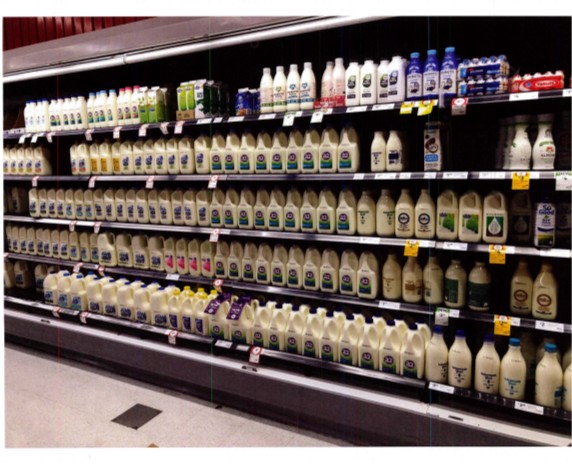
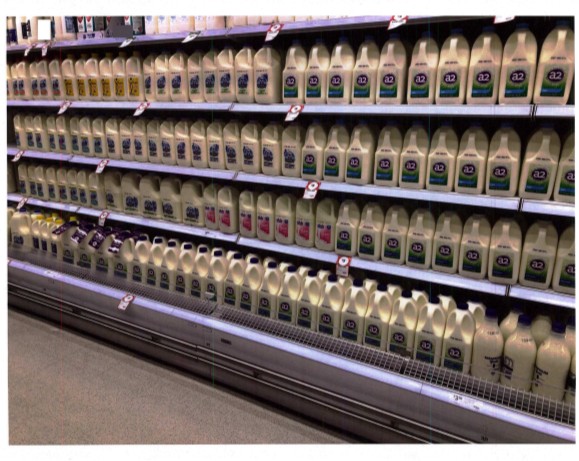
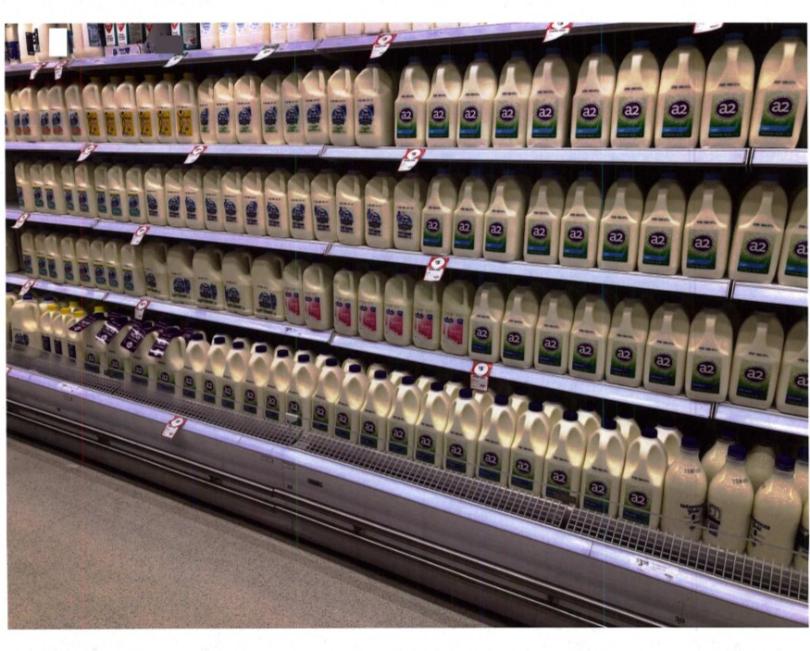
2 Care A2 Plus Pty Ltd is a dairy company which manufactures and distributes infant and toddler formulas in Australia. In conjunction with Care A2’s operations, its related entities, Care IP Pty Ltd, Care A2 Australia Pty Ltd and The Care Club Store Pty Ltd, are also engaged in the manufacture, promotion and sale of infant formula products. I will refer to these entities collectively as the Care A2 Parties. Where no distinction is required, I refer to Care A2 and the Care A2 Parties interchangeably. Care IP is the applicant for the ten trade marks appearing in Schedule 1 of the Amended Statement of Claim (the Care A2+ Trade Marks).
3 By way of its amended originating application dated 10 February 2023 (Infringement OA), a2MC commenced proceedings against the Care A2 Parties alleging infringement of its five trade marks and contraventions of the Australian Consumer Law (ACL), which is contained in Sch 2 of the Competition and Consumer Act 2010 (Cth). That action is Federal Court proceeding no. NSD 934 of 2022 (Infringement Proceedings).
4 In separate proceedings, by way of an amended originating application filed on 17 January 2024 (Invalidity OA) Care A2 challenges the validity of a2MC’s trade mark registrations and seeks orders under ss 88 and 59 of the Trade Marks Act 1995 (Cth) (TMA) to cancel, rectify or limit the five marks registered in the name of a2MC. That action is Federal Court proceeding no. NSD 926 of 2022 (Invalidity Proceedings).
2. The conduct of the case
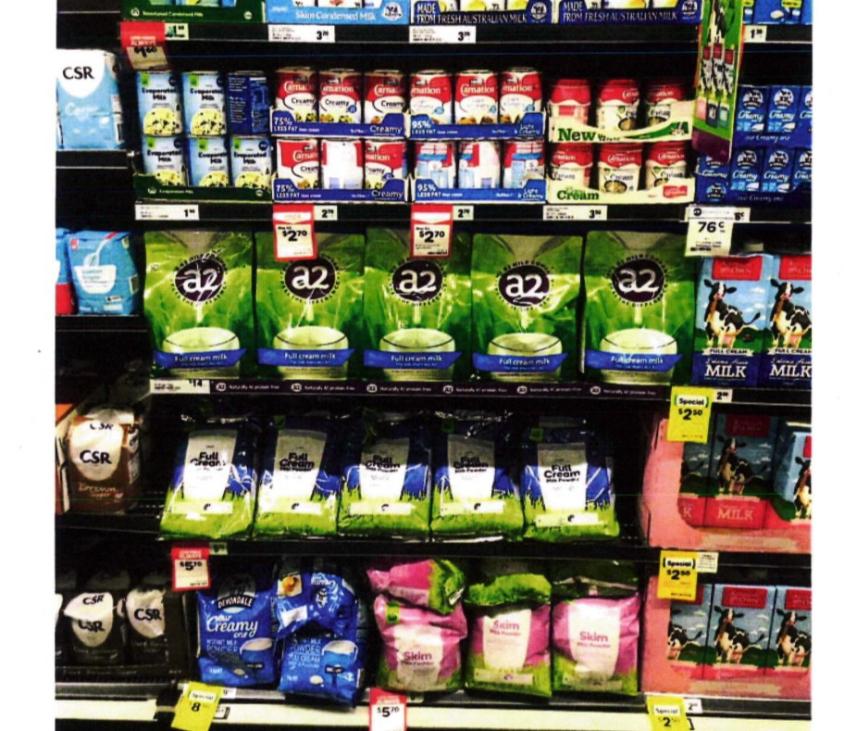
5 The Invalidity Proceedings were originally commenced by Care A2 in respect of some 50 trade marks registered to a2MC, with twelve representative “Separate Determination Trade Marks” later being identified. After the parties filed their evidence in chief, the Invalidity Proceedings were dismissed in respect of all marks and claims, save for those relating to the five marks relied upon in the Infringement Proceedings. As a result, Care A2’s case was confined to a defensive case, its challenge being limited to the marks on which it is being sued.
6 The confining of the invalidity case occurred after Care A2 failed to comply with orders that it pay security for costs in the Invalidity Proceedings in the amount of AUD$100,000 within 28 days, resulting in the narrowing of Care A2’s case from 50 disputed marks to five.
7 On 15 October 2024, Ashurst Australia, Care A2’s former legal representatives, advised the Court that they had terminated their retainer with Care A2 on the evening prior, and having served a Notice of Intention to Cease to Act, would cease to act for them within seven days. That date, being 21 October 2024, fell on the commencement of what was anticipated to be the first of a 10-day trial.
8 The trial commenced a day late to alleviate Ashurst from any obligation to attend. At the trial, Mr Heerey KC appeared on behalf of Care A2, instructed by Colin Biggers & Paisley. As a result of the late-stage change in representation and the re-instructing of Mr Heerey KC, Care A2 filed no written opening submissions.
3. Evidence
9 On 5 December 2022, Burley J made orders for the Invalidity Proceedings and the Infringement Proceedings to be heard together, with evidence in one being evidence in the other, subject to any proper objection.
3.1 a2MC’s evidence
10 a2MC read affidavits from the following witnesses:
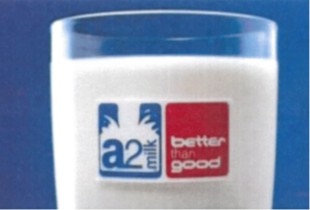
(a) Mr Barry James Akers, the principal and co-founder of Senescall Akers Limited, a New Zealand business providing financial and corporate public relations services, who affirmed one affidavit dated 27 June 2023. Mr Akers gave evidence on inter alia news articles published on the National Business Review (NBR), wherein the article wrongly labelled Care A2 infant formula products as a2MC’s products. a2MC read Mr Akers’ affidavit in its entirety.
(b) Ms Edith Wilma Bailey, the Chief Marketing Officer of a2MC, who swore two affidavits on 7 March 2024 and 29 August 2024. Ms Bailey gives evidence including on key facts about the a2MC registered trade marks, the use of those marks including via advertising and marketing activities, sales statistics and the conduct of Care A2.
(c) Ms Connie Sarah Beswick, who affirmed one affidavit on 3 April 2023. Ms Beswick is a solicitor at Clayton Utz, the legal representative of a2MC. Ms Beswick gives evidence on certain news releases associated with the Kooyong Classic tennis tournament, along with Care A2’s merchandise (i.e., Kooyong Classic A2 Shirt) distributed therein.
(d) Dr Andrew John Clarke, who swore two affidavits on 23 February 2024 and 20 August 2024. Dr Clarke is the Chief Scientific Advisor of a2MC. Dr Clarke gave evidence on milk protein composition and scientific naming conventions for protein variants using the letters of the alphabet. Dr Clarke gives further evidence on a declaration he had made on 28 April 2017 for the purposes of a2MC’s prosecution of its trade mark application, including that a2 Milk is not a scientific or descriptive term for A1 β-casein free milk.
(e) Mr Lewis David Jones, who made one affidavit on 6 March 2024. Mr Jones is an Associate Partner at EY Sweeney, a business unit of the Ernst & Young partnership that provides market and social research services. Mr Jones gives evidence on the a2 Milk Brand Health Survey, an annual research program conducted by EY Sweeney which is used by a2MC to inform its decision on brand strategy, communications and other tactical decisions for the brand (i.e., pricing, messaging on packaging). These Brand Health Reports assessed inter alia the strength of a2MC’s brand, which informs Ms Bailey’s view that a2MC has a strong and valuable reputation in the a2MC registered trade marks, and the association between “a2/A2” and a2MC by the general consumer.
(f) Mr Justin Oliver Kardi, who made one affidavit sworn on 16 June 2023. Mr Kardi is a solicitor at Clayton Utz, the legal representative of a2MC, who took videos of displays of milk in various Coles, Aldi and Woolworths supermarkets. Mr Kardi also gave evidence on his investigation of the online stores of Harris Farm Markets Pty Ltd and Chemist Warehouse.
(g) Mr Joshua Lam, who made one affidavit affirmed on 21 February 2024. Mr Lam is a Territory Manager at a2MC. Mr Lam purchased several tins of Care A2 products at Woolworths in Cherrybrook, NSW.
(h) Mr Withanage Lakshitha Piyumal Perera, who made one affidavit affirmed on 2 October 2024. Mr Perera is the Group Financial Reporting Manager at a2MC. Mr Perera gives evidence in support of a2MC’s expenditure on advertising and marketing in Australia.
(i) Ms Antonia Francesca Maria Wayne-Boyle, who affirmed two affidavits on 29 September 2023 and 23 February 2024. Ms Wayne-Boyle is a solicitor at Clayton Utz. She gave evidence as to her purchases of Care A2+ Infant formula, and her visits to the “www.kooyongclassic.com.au” and “www.woolworths.com.au” websites.
(j) Mr Timothy Bernard Webb, who swore three affidavits on 14 March 2024, 14 May 2024 and 30 August 2024. Mr Webb is a partner at Clayton Utz, and the solicitor on the record for a2MC and has carriage in the care and conduct of the Infringement and Invalidity Proceedings. Mr Webb gives evidence on a range of matters, including on the prosecution and appeals history of certain a2MC trade mark applications, on the correspondence between a2MC regarding infringement allegations of a2MC’s registered and unregistered rights, and on the issue of security for costs.
11 Additionally, a2MC read affidavits from the following independent expert witnesses:
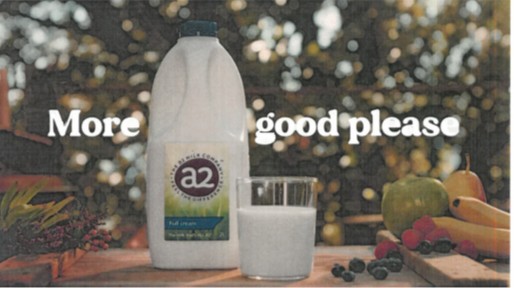
(a) Mr Garreth John Chandler, who affirmed one affidavit on 29 April 2024. Mr Chandler is the Founding Partner of Evolved Insights Pty Ltd, trading as The Evolved Group. Mr Chandler provides an opinion on whether the methodology applied by EY Sweeney in the conduct of a series of market surveys was consistent with good, professional practice applied by the market research industry.
(b) Professor Pascale Genevieve Quester, who affirmed one affidavit on 8 March 2024. Prof Quester is currently the Vice-Chancellor of Swinburne University of Technology and an Emeritus Professor of Marketing at the University of Adelaide. Prof Quester is also the director of Hexagon Marketing Services Pty Ltd, which since 1997 has carried on the business of providing consumer behaviour, marketing, advertising and promotional consulting services to government and industry clients, and of developing pedagogical material (including textbooks) in relation to consumer behaviour and marketing. Prof Quester gives expert evidence on inter alia the purpose and creation of brands, including the a2 brand, and the case of a2MC and what “a2” may mean in relation to a milk bottle or package.
(c) Professor Ghil’ad Zuckermann, who affirmed three affidavits on 23 February 2024 and one on 29 April 2024. Prof Zuckermann is a Professor of Linguistics at the College of Humanities, Arts and Social Sciences at Flinders University in South Australia. Prof Zuckermann holds a Doctor of Philosophy (DPhil) in modern languages and linguistics from the University of Oxford and a Doctor of Philosophy (PhD) (titular) in linguistics from the University of Cambridge.
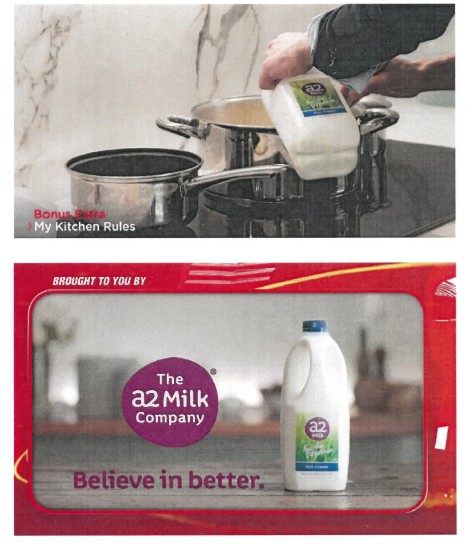
Prof Zuckermann was the President of the Australasian Association for Lexicography between 2013 and 2015 and has 35 years of experience in several fields of linguistic research, including lexicography, lexicology, lexical borrowing, contact linguistics and revivalistics (language revival).
Lexicography is a linguistic field of enquiry concerned with dictionaries, corpora and reference works. The field of lexicography includes several branches, including etymological lexicography (detecting word origins); onomastic lexicography (analysing names); slang lexicography (exploring the usage of colloquial words used by specific groups of people) and corpus lexicography (using digital lexical databases via the application of mass-scale computational techniques for analysis of words).
Prof Zuckermann provides linguistic and lexicographic evidence regarding inter alia “a2/A2” and “a2 Platinum” in relation to milk and milk products, including the history and frequency of the use of “a2/A2” in relation to milk and milk products in Australian English as at 20 July 2015, and the conclusions that can be drawn from that information. He also provides responsive evidence to Ms Cade’s evidence regarding the dictionary definition of “A2 milk”.
12 I note that in oral closing Care A2 sought to diminish the utility of the evidence of Prof Quester and Prof Zuckermann. In Prof Quester’s case, Care A2 sought to do so by suggesting that the information provided to her was limited and thus her opinions based on that material were of little assistance to the Court. However, none of the criticisms were put to Prof Quester as Care A2 chose not to cross-examine her, so she was denied an opportunity to respond. For that reason, I place limited weight on Care A2’s criticisms of Prof Quester.
13 None of a2MC’s witnesses were called for cross-examination. Care A2 did not file any expert evidence. The evidence of a2MC’s expert witnesses was unchallenged.
3.2 The Care A2 Parties’ evidence
14 The sole evidence relied upon by Care A2 was the affidavit of Ms Anita May Cade, a partner at Ashurst, who made one affidavit on 23 February 2024 annexing a collection of around 300 pages of documents obtained by searching the internet or from other publicly available sources (the Cade Affidavit). The searches were primarily Google searches undertaken by six employees of Ashurst.
15 There was no evidence that the employees were legally qualified or admitted as solicitors. Further, there was no evidence as to what search strategies were adopted: the full results of those searches are not in evidence (even a printout of the first few pages of search results could have been included); the results may or may not relate to Australia; omitted results are not identified or explained away. Still further, the evidence in various places makes it clear that the instances referred to are just examples, and not a complete reflection of the results obtained.
16 Care A2 did not file any other lay evidence or expert evidence in support of its case.
17 Some of the articles and other publications in annexures AMC-11 and AMC-12 were admitted subject to a limitation that they are evidence of the fact of the use of the words in those articles and publications and not evidence of the truth of any facts asserted by those words.
18 Ms Cade was not called for cross-examination.
4. Background
4.1 Brief background to bovine milk proteins
19 The following discussion of the genetic variants of bovine milk proteins is taken predominantly from the uncontested evidence of Dr Clarke.
20 Cows’ milk is a suspension of carbohydrate, fat, protein and minerals in water. The total protein in milk is around 3.3% of the milk by weight.
21 Most of the proteins in cows’ milk are caseins. There are a number of families of casein protein which, in terms of nomenclature, are divided into, but are not limited to, two families of alpha-caseins (α-casein), beta-caseins (ß-casein) and kappa-caseins (-casein). These various types of casein themselves comprise a number of genetic variants or polymorphisms.
22 ß-casein is a protein which is made up of a sequence of 209 amino acids. The bovine ß-casein is encoded by the gene CSN2. ß-casein makes up slightly less than 1% of milk by weight, and around 28.4% of the total protein in milk. The process of producing milk powder does not change the content and ratio of ß-casein proteins in the milk.
23 There are at least 12 variants of bovine ß-casein protein: A1, A2, A3, B, C, D, E, F, G, H1, H2 and I. In each variant, the sequence of the amino acids in the protein varies slightly, depending on variations in the DNA sequence in the CSN2 gene. The naming convention relates to the sequence of discovery of the variants and is also used for the different types of proteins as well as different caseins.
24 Of particular relevance is the amino acid at position 67 of the ß-casein protein. ß-casein variants A1, B, C, F and G all have the amino acid histidine at the 67th position of the 209 amino acid sequence. The other variants (A2, A3, D, E, H2 and I) all have the amino acid proline at the 67th position.
25 The significance of the different amino acid at the 67th position is that it affects how the protein is cleaved by digestive enzymes during digestion. When there is a histidine at the 67th position, the amino acid chain is cleaved at that point resulting in a seven amino acid fragment called beta casomorphin-7 (BMC-7). In the variants with a proline at the 67th position, cleavage at that point is hindered so that BMC-7 is not a preferred digestion product.
26 Each cow has two copies of the CSN2 gene. A cow might have two copies of the same ß-casein gene variant (homozygous, e.g. A1/A1) or it might have different copies of the ß-casein gene variants (heterozygous, e.g. A1/H2). The variants of the CSN2 gene are co-dominant, which means that both alleles are expressed equally. In relation to ß-casein this means that in a heterozygous cow, the milk will contain a mixture of the two ß-casein variants that the cow possesses. For example, if a cow is A1/H2, its milk will contain a mixture of A1 ß-casein protein and H2 ß-casein protein (as well as the other non-casein milk proteins).
27 Due to allelic co-dominance, a cow which is homozygous or heterozygous for any of the A2, A3, D, E, H2 and I variants will produce milk in which the ß-casein protein does not have a histidine at the 67th position and should not produce the BMC-7 fragment on digestion. A cow which is heterozygous for any of the A2, A3, D, E, H2 and I variants with one of the A1, B, C, F and G variants will produce milk which contains a mixture of ß-casein protein with proline at the 67th position and ß-casein protein with histidine at the 67th position, resulting in some BMC-7 being produced on digestion.
28 Thus, milk which is free from ß-casein protein variants with histidine at the 67th position (i.e. only contains 67-proline protein variants) will be produced by cows which are homozygous for any of the A2, A3, D, E, H2 and I variants or heterozygous for two 67-proline ß-casein variants (for example A2/I or A2/A3). The most common of these ß-casein variants is A2, followed by A1 and B variants.
29 Historically, all domesticated cows produced milk containing only the A2 ß-casein protein. Many generations ago, the A1 β-casein protein appeared in Europe via a natural mutation, which then spread throughout global herds. All ordinary cow’s milk sold in Australia (“regular” milk) will contain a mixture of ß-casein protein variants: predominantly A1, A2, A3, B, C and I.
30 It is alleged that there are health benefits from consuming milk that does not produce BMC-7 when digested (i.e. contains only 67-proline ß-casein variants). The purported health benefits are alleged to assist with “digestive wellbeing, certain allergies and immune function”. Other purported benefits attributed to the use of a2MC branded milk include improved taste and superior frothing ability.
31 It is the absence of the BMC-7 digestion product when the milk is digested that confers the purported health benefit. It is not asserted that the presence of the proline at the 67th position confers any additional health benefits. I make no comment as to the existence or not of any health benefits associated with the absence of the BMC-7 digestion product, other than to note that the purported health benefit provides a motivation to produce milk which contains only ß-casein protein variants with proline at the 67th position rather than histidine.
4.2 The marks in issue
32 The following five a2MC trade marks are the marks in suit:
(a) Australian Trade Mark No. 1708342 for the words “a2 Milk” in classes 5 and 29 and having the priority date 20 July 2015 (a2MC Milk Mark);
(b) 1676054 for the following device in classes 5 and 29 and having the priority date 20 February 2015 (054 Mark);
(c) 1668754 for the following device in classes 5 and 29 and having the priority date 13 January 2015 (754 Mark);
(d) 1454858 for the following device in classes 5 and 29 and having the priority date 20 October 2011 (858 Mark); and
(e) 1422098 for the following device in classes 5 and 29 and having the priority date 23 March 2011 (098 Mark).
33 I will refer to the above marks collectively as the a2MC Marks, and the a2MC’s registered device marks, being the a2MC Marks excluding the a2MC Milk Mark, collectively as the a2MC Device Marks or simply the “device marks”.
34 The a2MC Milk Mark was considered by Bromwich J in The a2 Milk Company Ltd v LD&D Australia Pty Ltd (2021) 164 IPR 293, wherein his Honour determined that the marks “a2/A2” and “TRUE A2” were sufficiently inherently adapted to distinguish the designated goods. Justice Bromwich proceeded to make orders setting aside the decisions of two separate delegates of the Registrar of Trade Marks which upheld the respondent’s opposition to the trade mark applications (a2MC Marks Applications) for the words “a2 Milk” and “TRUE A2”. His Honour also made orders that the a2MC Marks Applications proceed to registration.
4.3 a2MC
35 As I indicated above, a2MC is a premium dairy company incorporated under the laws of New Zealand. Numerous subsidiaries are under the financial control of a2MC and together comprise the a2MC Group.
36 a2MC’s range of products includes liquid milk, both fresh and long life; milk powder; nutritional products including infant formula, follow-on formula, and toddler formula; fortified milk powders and pregnancy formulas, and has historically included yoghurt, cream and ice cream (together, the a2MC Products).
37 a2MC is the registered proprietor of a portfolio of trade marks incorporating the element “a2/A2”. Its family of marks (the a2MC Marks, of which the marks in suit are a subgroup) has been used extensively in Australia on the a2MC Products, including infant formula products. The common element “a2/A2”, shared by the a2MC Marks, has been used in Australia and New Zealand by a2MC in its trade marks since at least 2003, in both registered and unregistered forms.
38 Ms Bailey’s understanding was that the purpose of the a2MC Marks was to allude to the “benefits” of the a2MC Products, that is benefits associated with dairy products made from the milk of cows that naturally produce milk which is free from the A1 ß-casein protein, while still showing an identifiable brand.
4.3.1 History of a2MC
39 a2MC was founded in New Zealand as “A2 Corporation Limited” in 2000 by Dr Corran McLachlan and Howard Paterson. While studying at the University of Cambridge, Dr McLachlan learned that proteins in milk affect people differently and that cows produce different types of ß-casein proteins. Dr McLachlan discovered that cows could be genetically tested to identify those which produce milk that does not contain the A1 ß-casein protein. From there, a2MC was created with the intention of bringing dairy products made from the milk of cows that only produce the A2 ß-casein protein and not the A1 ß-casein protein, to consumers. In other words, milk that was free of 67-histidine ß-casein proteins and only contained 67-proline ß-casein proteins.
40 The initial focus of a2MC was on dairy farm breeding programmes to develop herds that would naturally produce milk free of the A1 ß-casein protein. a2MC operated as an intellectual property licensor, where it licensed its intellectual property in relation to A1 ß-casein protein-free dairy products to third parties. The third parties used the intellectual property, which included trade marks, patents and know-how, to produce dairy products from cows which only produce milk containing the A2 protein (or 67-proline ß-casein proteins), but not the A1 ß-casein protein, under a2MC’s “a2” and “a2 Milk” marks.
41 Following the death of both founders in mid-2003, a period of structural change began for a2MC. In December 2003, a2MC entered into a licence agreement with the Australian company, A2 Dairy Marketers Pty Ltd (A2DM), under which A2DM would sell a2 Milk branded products in Australia as a licensee. A2DM went into administration in October 2004 and was liquidated in November 2004.
42 Following this time, a2MC’s focus turned to growing its Australasian markets through a new company called A2 Dairy Products Australia Pty Limited, which from 2007 to 2010 operated as a joint venture with Freedom Nutritional Products Pty Ltd. a2MC obtained full ownership of the joint venture company in 2010. From 2010, a2MC became a milk producer in Australia as the a2MC Group began to produce its own dairy products.
43 Jalna Dairy Foods was licensed to manufacture “a2” and “a2 Milk” branded yoghurt from 2010 to 2017.
44 On 8 April 2014, a2MC changed its name from “A2 Corporation Limited” to “The a2 Milk Company Limited”. Ms Bailey deposed that the rationale behind the new name was to reflect the changing focus of the business from a licensor to a global dairy nutrition company that produces its own branded products, highlighting its core brand and goodwill in the names “a2” and “a2 Milk”.
5. Summary of a2MC’s evidence
45 As I set out in the description of a2MC’s witnesses above, the central thrust of a2MC’s evidence was adduced to establish that the characteristic feature of the a2MC Products—in respect of which the a2MC Marks are registered—is that they are produced using milk that is naturally free of the A1 ß-casein proteins commonly found in other “ordinary” cows’ milk.
46 The evidence adduced also seeks to demonstrate that the signs “a2/A2” have been used extensively by a2MC and ought not to be found as being “directly” descriptive of milk and milk products characterised by the absence of A1 ß-casein proteins, or alternatively of only constituting A2 ß-casein proteins.
5.1 a2MC’s use of the a2MC Marks
47 a2MC filed extensive evidence of its continuous use of the a2MC Marks in Australia since the time of their first adoption in around 2003 until the present day. a2MC’s Chief Marketing Officer, Ms Bailey gave this evidence based on her personal knowledge gained whilst at a2MC, and from her examination of the business records of a2MC.
48 In summary:
(a) use of the “a2/A2” and “a2 Milk” marks in Australia and New Zealand commenced in 2004. At that time A2DM sold various fresh milk products in Australia. Those marks have been in continuous use since that time.
(b) use of the a2MC Marks on product packaging has always been accompanied by ™ or ® as appropriate, across all channels in Australia.
(c) all a2MC Marks have always included a lowercase “a” next to the number “2” as in “a2” as a common thread.
(d) “a2” has been used in all a2MC consumer marketing activities in Australia since 2004.
(e) use of the words “a2 Platinum” for infant formula, and first sales of infant formula, commenced in 2013.
(f) consolidated sales under the a2MC Marks for Australia and New Zealand were in the many hundreds of millions of dollars in 2019 and 2020.
(g) in March 2024, products bearing the a2MC Marks were available for purchase by consumers throughout Australia at more than 2,500 supermarkets and 450 pharmacies.
(h) as at October/November 2020, a2MC Group’s brand “a2 Milk” was the only milk brand distributed through all six key grocery retailers in the Australian market, being Woolworths, Coles, Aldi, Costco, Metcash (IGA) and SPAR.
(i) in the 12 months prior to 29 June 2014, a2MC had two products in the top 20 grocery SKU’s (stock keeping units), beaten only by Coca-Cola, Quilton and Cadbury.
49 Ms Bailey gave evidence of how a2MC products are typically displayed in supermarkets in Australia, including implementation plans from different supermarkets. Displays of a2MC branded products have the a2MC Mark clearly visible on the packaging of the products which are intentionally displayed together so that they form a “brand block”. In the photo below it is the “a2” which first captures the consumer’s eye when standing in front of the refrigerated milk shelves, rather than any of the other words on the milk container.
50 As depicted in the photographs above, on walking towards the refrigerated milk display, the consumer is faced with a block of “a2”.
51 Ms Bailey’s evidence was that a2MC branded products are usually sold at a significant price premium compared to regular dairy products. For example, as at the date of Ms Bailey’s evidence, a2MC’s Full Cream 2L milk products bearing the a2MC Milk Mark are priced at AUD$6.90, whereas brands such as Dairy Farmers, Pura and Pauls are priced at around AUD$2.50 less.
52 Ms Bailey’s evidence was that a2MC had used the a2MC Marks in Australia in relation to the following dairy products: fresh milk (full cream, light and no fat), long-life ultra-high temperature (UHT) milk, milk powder for infants, powdered milk, ice cream, thickened cream, toddler milk drinks, children’s milk drinks, powdered pregnancy nutrition formula and yoghurt.
53 Examples of various displays of a2MC (non-infant formula) powdered milk are as follows:
54 Ms Bailey’s evidence was that as a result of the extensive use of “a2/A2”, she considered that a2MC has a strong and valuable reputation in the family of a2MC Marks and that when “a2/A2” is used in respect of milk and milk products, including infant formula, they are exclusively associated with a2MC as the trade source of those products.
55 a2MC also has a large number of domain name registrations containing one or more of the a2MC Marks, including the following Australian websites: thea2milkcompany.au; a2milk.com.au; a2nutrition.com.au; a2milkcompany.com.au; a2platinum.com; a2platinum.com.au; and a2store.com.au. These websites are used for a variety of purposes, including for a2MC’s milk and milk powder, infant formula products, and for online stores for customers to purchase a2MC’s infant formula, nutrition products, milk powder and UHT milk. In addition to the domain name, a range of a2MC Products bearing one of the a2MC Marks are also displayed in some of these websites’ content.
56 a2MC noted that it does not object to third parties using “A2” descriptively to describe the A2 ß-casein protein present in milk.
5.2 Evolution of A2 brand and reputation in a2 brand
57 As at 2003, milk which was naturally A1 protein-free (or free from all 67-histidine variants) was, from a consumer perspective, an entirely new proposition. Consumers at that time were familiar with categories of milk such as “full cream”, “low fat” or “skim”. Consumers had no familiarity with or understanding of a meaning for “A2”, or any understanding or knowledge of the 67-histidine or 67-proline variants of ß-casein protein, or any (real or imagined) health benefits associated with the absence of 67-histidine ß-casein protein variants and associated BCM-7 digestion product.
58 From 2003 onwards, as a result of a2MC’s marketing, promotional or educational efforts and consumer experience and recommendation, consumers came to accept a2 branded milk as a “better” alternative to ordinary milk with real or imagined benefits that were worth spending more money on. The “a2” brand enabled consumers to confidently select milk to purchase that would have the same perceived benefits, whether they be related to health, taste and consistency or frothing ability.
59 Since 2003, a2MC has expended a considerable amount of money in the order of many millions of dollars on advertising and marketing its products bearing the a2MC Marks in Australia. a2MC’s advertising includes social media, billboards, free to air and pay television and radio commercials aimed to reach its target audience, as well as commercials on broadcast video on demand and YouTube, and sponsorship of top rating television programs such as Masterchef Australia, My Kitchen Rules, The Block and Lego Masters. The radio and television commercials are broadcast during prime viewer and listener times.
60 Ms Bailey gave extensive evidence of the various advertising campaigns and the money spent by a2MC on advertising over the years since 2004, and the increased sales that she considered were associated with the advertising campaign. I discuss some examples from the advertising campaign below.
61 The “Better than Good” campaign ran on television and radio in conjunction with the launch of a2Milk branded milk in Australia in 2004. The a2MC Milk Mark appeared many times in the television commercial, both on packaging and as the only item on screen, along with the phrase “it’s not just good, it’s better than good”. The following is a screenshot of the final image in the advertisements:
62 The Better than Good campaign was followed up by a series of advertisements called the “Knowing is Believing” campaign, which likewise featured the a2MC Milk Mark. A screenshot of the final screen of the advertisements is shown below:
63 For the majority of the advertising campaigns, the marketing focussed on promoting the a2MC Products in being superior, without any assertions as to the purported scientific benefits of the absence of A1 ß-casein protein or the presence of A2 ß-casein protein only:
(a) between May and September 2010, a2MC paid for various advertising spots on Melbourne and Sydney radio stations, including commercials, sweeps, in show promotions and giveaways. In these commercials, the a2MC Milk Mark and the a2 Mark were used in advertisements, such as in statements like: “a2 Milk and a2 Jalna yoghurt. Feel the Difference”;
(b) a2MC Milk Mark was featured in sweeps on Fox, in the wording “a2 Milk with the original milk protein. Feel the difference today”;
(c) in September 2011, a2MC launched its “Thank You a2” campaign for fresh milk, which featured the a2 Mark and a2MC Milk Mark prominently along with the closing voiceover statement “Thank you a2 Milk”. This campaign was reprised from July 2013 to June 2014;
(d) between July 2015 to May 2018, a2MC launched television commercials for its “Believe in Better” campaign, which featured numerous uses of the a2MC Milk Mark for various a2MC Products such as fresh milk, ice cream and a2 Platinum infant formula products. In the milk versions of the advertisement, the a2MC Milk Mark is used in the voiceover: “A lot of people who drink a2 Milk say they just feel better”.
64 However, there were limited instances where an advertising campaign made direct references to the A2 ß-casein protein. In a radio commercial used as part of the Dem Bones campaign in 2007, the voiceover of the advertisement mentioned A2 ß-casein protein as follows:
a2 for me, a2 for you, a2’s the milk that’s right for you. a2 Milk is naturally rich in A2 beta casein protein and it’s full of goodness of pure milk to support your family’s wellbeing. Tastes great too! a2 Milk is so good it could even make your bank account healthier. Look out for packs with the competition neck tag to find out how you could win $15,000
(Emphasis added.)
65 While the statement notes that “a2 Milk is naturally rich in A2 beta-casein protein”, it does not explain the purported benefits of that protein. Moreover, the fact that a2 Milk contains A2 β-casein protein cannot properly be characterised as a description of milk or milk products defined by the absence of A1 β-casein proteins, or by the exclusive presence of A2 β-casein proteins. Indeed, in the context of that statement, it is open to the consumer to interpret the benefits of A2 β-casein proteins as being one of purity and taste.
66 In 2007 and 2008, a2MC ran a television advertising campaign titled “No Ordinary Cow, No Ordinary Milk”, wherein the following voiceover was included along with the use of a stylised version of the a2MC Milk Mark on the screen:
Only a2 cows produce a2 Milk, which is naturally rich in A2 Protein. It’s not genetically modified and may help families worried about allergies and immune function. a2: no ordinary cow, No ordinary milk.
(Emphasis added.)
67 Although the statement claims that “only a2 cows produce a2 Milk” and that the milk is “naturally rich in A2 protein,” it does not describe the scientific characteristics of A2 β-casein or explain how they relate to the alleged absence of A1 β-casein proteins. The references to the milk being “not genetically modified” and potentially assisting with “allergies and immune function” are promotional claims, not definitions of a sub-category of milk based on β-casein composition. Those purported benefits could equally be read as flowing from the absence of genetic modification rather than from the presence of A2 protein. The statement therefore operates as brand messaging and not direct description of “a2 Milk”.
68 Between April 2007 and March 2008, there was a 97% increase in the sales of a2 Milk branded milk.
69 In the 12 months to:
(a) 24 March 2019, a2MC’s market share for fresh milk was 10.5% and for infant formula was 36.8%;
(b) 30 June 2020 (including the beginning of the pandemic), a2MC’s market share for fresh milk was 8.7% and for infant formula was 20.4%.
70 A breakdown of a2MC’s marketing expenditure on advertising campaigns was tendered in evidence in the confidential exhibit of Ms Bailey entitled “a2 Platinum® Brand Health: Quantitative Draft Report” prepared on the 3 September 2021 by EY Sweeney. Each of the campaigns were sponsored by either a2 Infant Nutrition or The a2 Milk Company (Aust) Pty Ltd, or both. For each of the campaigns, budgets were distributed across the following media types: digital, magazines, other, outdoor, radio and television. The budget of each campaign would range from AUD$400,000 to AUD$4,000,000, with the bulk of the budget allocated to television, digital and outdoor advertising.
71 In 2018, an a2MC advertising campaign stated that “a2 MILK™ is naturally A1 protein free”. The campaign included 45, 30 and 15 second versions of television commercial aired across Adelaide, Brisbane, Melbourne and Sydney. Corresponding radio commercials were aired on radio stations in Sydney, Melbourne, Brisbane and Perth.
72 On 29 August 2021, a2MC launched the “More Good Please” television advertising campaign, which featured the a2 mark prominently on screen as below:
73 a2MC’s fresh milk was also the milk used by the 2013 Masterchef series, which formed part of the product integration strategy, including when one contestant had to make a dish with milk as the main ingredient. a2MC reinforced its brand by purchasing advertising spots during ad breaks of the show as part of its sponsorship package, wherein viewers would be referred to the website “masterchef.com.au/a2milk”. The a2MC Milk Mark was also used in the 2020–21 Masterchef series and was featured in advertising during commercial breaks.
74 In 2017, a2MC sponsored the television program Little Big Shots, one of the most highly rated shows on Australian television with over one million viewers watched each episode. A printout from the TV Tonight website records the audience for the premiere of the 2017 Little Big Shots series on 27 August 2017 as 1.6722 million people across five metropolitan capitals.
75 From January to April in the years of 2017–20, a2MC also sponsored the My Kitchen Rules TV program, which has similarly garnered considerable audience reach. a2MC Milk branded products were shown being selected and used by the contestants during various seasons including the 2018 season:
76 From time to time, a2MC has also used billboards to promote its branded products as part of its marketing strategy to supplement television commercials and reinforce the advertising message to consumers. The locations of the billboards are selected based on the volume of foot and vehicle traffic. Roadside billboards including digital billboards have been used in both New South Wales and Victoria, including in high traffic locations such as Flinders Station, Central Melbourne and the M4 Motorway. In some of these billboards, the 054 Mark is clearly and prominently featured as the mark on the advertised milk products:
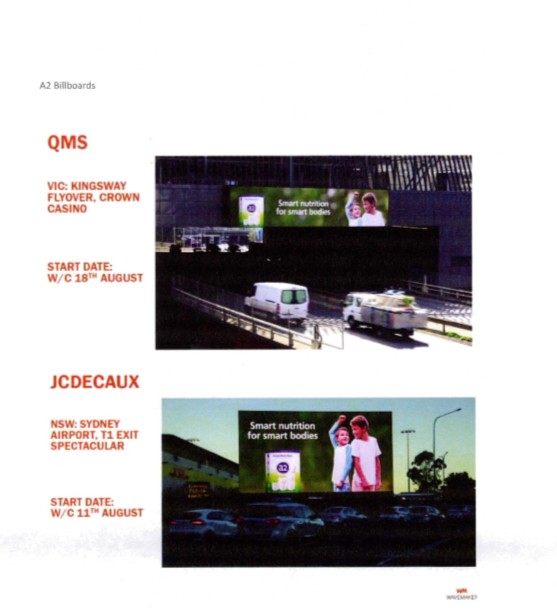
77 Since 2015, a2MC has also used truck signage to promote its products when they are being transported to retail stores. Two versions of the truck signage were in evidence: the 054 Mark were clearly and prominently featured on the 2018 and the 2023 versions of the truck signages, respectively:
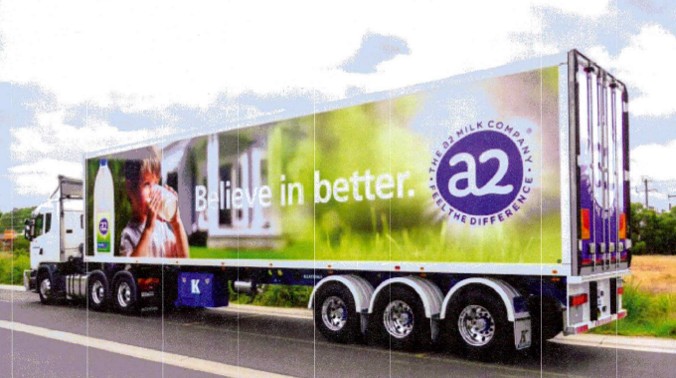
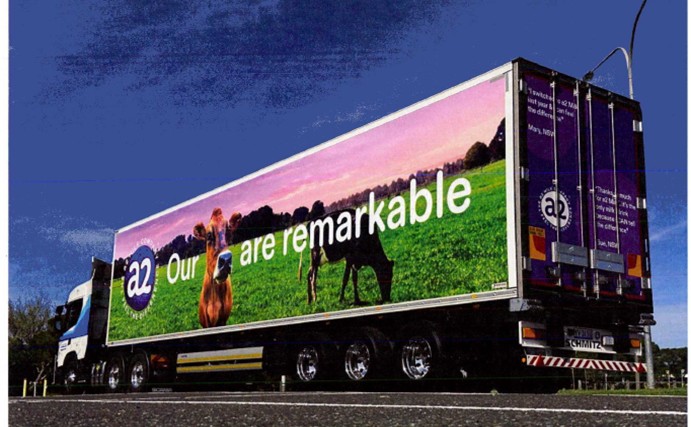
78 Other a2MC brand strategies in evidence included marketing on Facebook, Twitter, Tiktok, YouTube, in-store promotions, point of sale material such as shelf wobblers, neck tags and fliers, and competitions and giveaways.
5.3 Independent expert lexicology evidence
79 Prof Zuckermann is a Professor of Linguistics in the College of Humanities, Arts and Social Sciences at Flinders University, South Australia. He was the President of the Australasian Association for Lexicography between 2013 and 2015 and has 35 years’ experience in several fields of linguistic research, including lexicography, lexical borrowing, contact linguistics and revivalistics (language revival).
80 Prof Zuckermann gave evidence for the purposes of LD&D, by way of an affidavit affirmed on 11 September 2020. Prof Zuckermann confirmed the views he expressed within that affidavit in these proceedings, including that:
(a) Between 1950 and 2011 inclusive: in 88.3% of the cases “a2/A2” was used to refer to a2MC / a2MC’s products.
(b) Between 2012 and 20 July 2015: in 92.6% of the cases “a2/A2” was used to refer to a2MC / a2MC’s products.
81 Prof Zuckermann concludes, based on the above statistics, that:
the most frequently used meaning of the lexical term “a2” / “A2” in Australian English in relation to milk and milk products from 1950 to 20 July 2015, inclusive, was a reference to a2MC or its products.
82 Since 1998, Prof Zuckermann has been an official consultant for the Oxford English Dictionary. He has also been a consultant for Oxford University Press, which has involved reviewing and assessing dictionaries and linguistic books. In relation to the Macquarie Dictionary definition of “a2 milk”, Prof Zuckermann opined that “it was […] wrong for Macquarie Dictionary to include “A2” referring to milk in the dictionary (without having “A2” referring to the beta-casein protein as the main headword)” (emphasis in original). Prof Zuckermann further opined that the answer to the question of whether the “[…] “a2 milk” entry in the online edition of the Macquarie Dictionary […] reflects an accurate description of “a2 milk” either at the time of its inclusion […] or as at the “a2 Milk” priority date of the registered trade mark […]”, his opinion was that “it does not”.
83 Prof Zuckermann gave linguistic and lexicographic evidence to the effect that a trader could use a variety of “‘natural/likely/expected lexical items” to describe milk and milk products that are made with milk from cows that naturally produce milk which is free from the A1 β-casein protein, including “A1-free”, “A1 beta-casein protein-free”, “A1-protein-free”, “A1-less”, “zero A1”, “no A1”, “no A1 used”, “without A1”, “free from A1 beta-casein protein”, “A1BC-free”, “0%A1” and “0A1”.
5.4 Independent expert marketing evidence
84 Prof Quester gave evidence that when a2MC first launched its products, “milk which is naturally A1 protein-free was, from the perspective of consumers, an entirely new proposition […] the meaning of a2 in relation to milk, prior to the launch of a2 Milk in 2003 was strictly nil”. Relevantly, she explained that consumers “[…] had no clue whatsoever about the nature of the innovation when presented with the verbal cue a2”.
85 Prof Quester considered the nomenclature used by scientists and dairy industry professionals to discuss A1 β-casein protein free milk to be irrelevant to the consumer perspective and understanding of “a2” as a brand.
86 Prof Quester’s evidence was that:
[93] Shelf space is a good indicator of market share. Retailers are attuned to the need to align shelf space to their specific geographical target market’s preference. It follows that the growing number of facings allocated to a2 on the shelf, and the prominence with which a2 appears on supermarkets’ websites, mirrors the prominence that it has acquired in the marketplace.
[94] By or around 2015, the success of a2 Milk and the preference and higher margins which it enjoyed in the marketplace, would inevitably have made other dairy producers sit up and take notice. This is a very competitive market and the market share earned by a2 Milk would have directly impacted competitors, including via the commensurate loss of supermarket shelf space and sales.
[95] It is not surprising, therefore, and indeed was entirely predictable, that a2MC’s competitors would also want to partake in the growing and lucrative market, […], leveraging the now established consumers’ preference for naturally A1 protein-free milk.
[96] In my opinion, this is the reason why Care A2 has chosen to display A2 so prominently in its marketing activities, including its sponsorship of a tennis event.
87 At [107]–[109] of her affidavit, Prof Quester deposed the following:
[107] In my opinion, it is via the efforts of a2MC and thanks to continuous and significant investments in marketing campaigns over the years that a2 has come to develop a complex and multidimensional set of associations and meanings for consumers.
[108] It is that brand equity, built in the minds of consumers, which has enabled the extraction of higher margins and the increase in market share.
[109] It is clear that competitors, such as Care A2, would want to appropriate as much as they can of the value which has now been created over the last 15 years around the a2 name.
88 Prof Quester further rejected Care A2’s assertion that “a2/A2” is, or has at some later date become, descriptive of a2MC’s products.
5.5 a2MC’s brand enforcement activity
89 Mr Webb provided a summary table outlining the key details of oppositions in relation to trade mark applications, including the sign “a2/A2” opposed by a2MC, and another table setting out trade mark opposition matters that were appealed to this Court, including LD&D. He also provided correspondence sent by a2MC or their legal representatives to third parties and their responses to those, regarding the enforcement and protection of the a2MC Marks. This evidence confirms that other traders are aware that descriptive terms such as “Naturally A1 Protein Free” and “A2 Protein” are available for use in relation to product packaging.
90 Mr Webb also provided evidence of third parties using expressions other than “a2 milk” to describe their products, including “A2 PROTEIN” and “A2 PROTEIN MILK”. Further, Ms Wayne-Boyle, a solicitor, provided evidence of the use of the words “reduced”, “less”, “low”, “lower”, “free”, “free from” and “no” on product packaging, which a2MC asserts is particularly important when coupled with Prof Zuckermann’s lexicology evidence.
5.6 a2MC reputation
91 On the basis of the extensive evidence of sales, advertising and promotion of a2MC’s branded milk and milk products, and Prof Quester’s evidence, I consider that a2MC has a substantial reputation in Australia in the a2MC Marks, such reputation having been acquired well prior to the commencement of Care A2’s impugned conducts in the period of 2020 to late 2020.
5.7 Detailed Historical survey evidence
92 a2MC undertakes annual Brand Health Reports and has done so since 2010. These reports are generated following surveys which are conducted in “waves” each year. At the hearing, Care A2 objected to all the Brand Health Reports being admitted as evidence on the basis that the survey questionnaires were framed in a manner that rendered the reports “unreliable and not probative” evidence. a2MC submitted that the surveys were prepared in the ordinary course of a2MC’s business, to understand consumer understanding of the “a2” brand and therefore satisfied the criteria of the business records exception under s 69 of the Evidence Act 1995 (Cth). The surveys were not prepared for the purposes of litigation. a2MC contended, which I accept, that the objections were not well founded. Care A2 nonetheless chose not to cross-examine Mr Jones (who designed and conducted the majority of these reports) or Mr Chandler (who reviewed the reports and their methodology), instead electing to make submissions as to weight.
93 a2MC submits that the reports demonstrate that the brands “a2/A2” and “a2 Milk” can and do operate as trade marks within the meaning of s 17 of the TMA and have not lost their distinctiveness. I consider that these surveys provide further support for the existence of the reputation of a2MC’s brands.
94 Specific reference was made to the wave 11 report entitled “a2 MILKTM Brand Health: Wave 11, December 2020” (the Wave 11 Report) because it was the report dated closest to the date on which Care A2’s impugned conducts commenced in late 2020. The survey’s methodology consisted of thousands of 15-minute online interviews with respondents who were main or joint grocery buyers aged 18 and over.
95 EY Sweeney concluded the following regarding brand awareness:
(a) the a2MC brand is a highly recognised and trustworthy brand. a2 Milk maintains a highly prominent position in the market with over eight in ten continuing to recognise the brand upon prompting. Nationally, a2 Milk is considered “second tier” in brand awareness, following Dairy Farmers, Pauls;
(b) there is strong conversion from trial to purchase, with purchasers sufficiently satisfied with the brand to continue purchasing, although a weaker conversion exists between awareness and trial suggesting that a factor may be stopping consumers from trialling a2 Milk;
(c) data demonstrated the highest share of household consumption ever. The survey indicated a record high 14.05% household penetration, with more purchasers being attracted to the brand due to consumers’ perception that a2 Milk is “the best quality of milk”; and
(d) there is a link between a2 Milk and perceptions of “natural”. The perception of “naturalness” is more important to a2 purchasers when compared to non-purchasers. Purchaser motivators include beliefs that a2 Milk is “milk with natural ingredients” and “nutritious”. Longer term trends suggest that “less processed / more natural” has become a more prominent reason for household members when selecting a brand of milk.
96 Page 27 of the Wave 11 Report further suggests that a2 Milk has maintained a high degree of reputation in the five years preceding late 2020: “a2 MilkTM purchase levels remain stable over the past five years. One in six milk purchasers currently include a2MilkTM within their brand repertoire, in line with the last four waves”. At page 37, the report provides further corroborating evidence on a2 Milk’s reputation, recording “a2 MilkTM is amongst the more prominent, and trusted brands of those evaluated”.
97 These contemporaneous business record evidence, along with the extensive use of “a2”, corroborates Ms Bailey’s views and my conclusion that a2MC has a substantial reputation in the family of a2MC Marks.
6. Consumers
98 The significance of identifying the relevant consumer is as follows. First, the identity of the consumer is integral in trade mark law, both for assessing whether a mark possesses sufficient distinctiveness to warrant registration and, for present purposes, in determining whether there is a likelihood of confusion in an infringement case. The identity of the consumer is likewise relevant under the ACL, as it informs the assessment of whether the impugned conducts of Care A2 are apt to mislead, deceive, or cause consumers to be confused as to the trade source of the goods or services.
99 Milk is a staple food product. Milk and milk powder for infants are ordinary fast moving consumer goods which are sold at supermarkets (and in the case of milk powder, also in pharmacies) and are bought by the general public regularly and repeatedly.
100 The surveys forming part of the Brand Health Reports showed that a2MC considered its target consumer as being 18 years of age or more, a grocery buyer of milk. The consumer is likely to be more engaged than the ordinary grocery shopper, as they are looking for “natural” products, or they, or a family member, experience perceived discomfort with, or intolerance to, regular cow’s milk-based products. A subgroup of consumers is that of parents of children aged 0 to 4, who are looking to purchase powdered milk for infants. Care A2 argued that this subgroup of consumers comprised parents looking for infant powder “who would usually spend appropriate time and care choosing food for their very young children”, such that there would be “no realistic chance that those consumers would be misled to think that Care A2+ infant and toddler formula is the same or related to the a2MC’s infant and toddler formula”.
101 The ordinary consumer, both at 2004 and at present, has no knowledge of milk protein chemistry and structure, or the genetics of milk protein chemistry, including the variants of β-casein proteins. They do not read scientific papers relating to milk protein structure and the purported benefits associated with one variant over another, nor do they read patent specifications. They are not government authorities, the media and/or academics.
102 Similarly, usage of “a2/A2” whether as a defined term by inventors in patent specifications or in scientific articles is not useful in informing the understanding of that term by the ordinary consumer looking to purchase milk in supermarkets and pharmacies.
103 Prof Quester observed that it was a common mistake in the food industry for staff to use technical language or references that are “invisible, irrelevant or undecipherable to consumers”. In the context of ordinary consumer goods, she considered it unhelpful to focus on industry or scientific understandings of a term, as consumers operate in a completely different environment. From the consumers’ perspective, the way in which scientists or dairy professionals might use the language “a2” is beside the point. What matters is what “a2” conveys to consumers, which, in Prof Quester’s opinion, is a brand rather than the scientific descriptor it otherwise represents to scientists and/or dairy professionals.
104 I discuss the relevant class of consumers further in the context of ACL at [15.2] below.
7. a2MC Marks not descriptive
105 A core tenet of Care A2’s defence to a2MC’s infringement and ACL case and to its own invalidity case, is that the a2MC Marks are descriptive. As this contention underpins Care A2’s defence to the allegations of trade mark infringement, its invalidity challenges to the a2MC Marks, and its defence to the ACL case, I will deal with it early in these reasons.
106 Care A2 contends that a2 milk has been a naturally occurring substance for thousands of years, relying on the following extract published on the A2 Corporation Limited website in and around December 2002:
Several thousands of years ago the ancestors of the modern cow lived primarily in the Middle East and Asia. These ‘original’ cattle carried only the A2 variety of the beta casein gene. Eventually they were domesticated by man and brought north into Europe and south into Africa, at approximately 5000BC.
During this great migration the beta casein gene changed. It is known that the A1 variety evolved through a natural mutation of the A2.
107 Care A2 submits that the evidence indicates that before and after a2MC began supplying any “a2/A2” milk in Australia in May 2004, “a2 milk” had already been commonly used to describe milk free from ß-casein protein variants with histidine at the 67th position. This includes descriptive uses of “a2 milk” by a2MC itself, governmental authorities, mainstream media and academic literature. Further, Care A2 maintains that a2MC has promoted a descriptive meaning of “a2/A2” and “a2 milk” on its own packaging for decades. In support, Care A2 relies on the documents annexed to the Cade Affidavit which include a selection of files obtained from searching the internet and other publicly available sources from before and after the various priority dates of the a2MC Marks.
108 Care A2 suggested that, via the evidence of Dr Clarke, a2MC accepts that “a2/A2” is used as a shorthand for the A2 β-casein protein. a2MC rejected that contention, asserting that, to the contrary, Dr Clarke’s evidence was that “A2 is not an apt description without referring to the protein in terms”. a2MC does not accept that “a2 milk” is understood by consumers as meaning a milk containing predominantly A2 β-casein and denies that it has ever promoted such a meaning on its packaging or promotional materials.
109 I do not consider that the a2MC Marks are directly descriptive of a characteristic of the milk and dairy products sold under those marks. My conclusion is consistent with the conclusion of Bromwich J in LD&D at [33]:
[33] I am satisfied, on the evidence before me and without the benefit of contradictory argument, that a2/A2 are in truth made up, in the sense that the evidence (in a background way) reveals that they have their origin in science. Despite the considered views of the two delegates, which I have taken into account and given due weight, by their own nature, a2/A2 do not directly describe the applicant’s products, but rather make an allusive reference to them and their qualities. A use of A2 by another trader to do more than identify that their product contains the A2 bovine beta-casein protein would not be properly motivated and is no reason to deny the applicant registration. Other traders may properly identify that feature, but are not entitled to exploit the applicant’s brand.
(Emphasis added.)
7.1 Pleading issue
110 In closing, Care A2 contended that “‘a2 milk’ has been commonly used to describe milk which contains A2 and not A1 ß-casein protein” (emphasis added). a2MC objected to this characterisation, observing that it differed from the case pleaded by Care A2 in its further amended defence and further amended statement of claim, namely that “[s]ince at least 1984, the term ‘A2’ has been commonly used to describe and refer to A2 β-casein protein, which occurs naturally in milk and milk products” (emphasis added).
111 a2MC submits that there was no pleading that the ordinary signification of “a2/A2” refers to milk that does not contain, or that is free from the A1 β-casein protein. Care A2 did not file any written opening submissions. In opening oral submissions, Care A2 articulated a case which relied on an asserted meaning of ordinary signification of “a2/A2” or “a2 milk” as referring to products that do not contain the A1 β-casein protein. a2MC objected during the opening submissions to Care A2’s changing its case at the late stage, contending that, had it been fairly put on notice of Care A2’s changed contention, it “would likely” have conducted its case differently:
[…] if Care A2 had instead pleaded a case that the ordinary signification or meaning of the sign A2 was or includes a direct reference to the absence of A1 beta-casein protein, that would have presented a different scenario and a different case to be answered. And the response to that case would have fundamentally changed. For example, The a2 Milk Company would want to have considered obtaining expert evidence, such as linguistic and marketing evidence, addressing how language can adapt and change, but not in the way that or with the speed that Care A2 wishes to assert occurred in this case from a term, A2, having the meaning which is pleaded as referring to the A2 beta-casein protein, and coming instead to refer to or be understood generally to refer to the absence of A1 beta-casein protein.
(Emphasis added.)
112 a2MC contends that Care A2 should be bound by its pleaded case—that “a2/A2” means A2 β-casein protein, and that honest traders would want to use it to describe their products made from milk which is wholly or predominantly A2 β-casein protein. a2MC opposes any departure by Care A2 from its pleaded case, relying on the observations of Middleton J in Australian Securities and Investments Commission v Healey (2011) 196 FCR 291 at [230]−[232] where his Honour held that parties are bound by their pleaded case. a2MC submits that Care A2’s pleaded case is that “[i]n the context of milk and milk proteins, the ordinary signification of the term “a2/A2” is a direct reference to the A2 ß-casein protein, which occurs naturally in milk and milk products” and Care A2’s assertion during oral opening submissions that the ordinary signification of “a2/A2” is a direct reference to milk that does not contain the A1 β-casein protein is a departure from Care A2’s pleaded case.
113 In its further amended defence, Care A2 pleaded that:
(a) the terms “A2” and “a2” were a direct reference to the A2 ß-casein protein, which occurs naturally in milk: at [10(c)(i)], [17(e)], [18(d)], [19(d)], and [20(d)];
(b) in the context of milk products, the ordinary signification of the terms “A2” and “a2” is a direct reference to the A2 β-casein protein, which occurs naturally in milk and milk products: at [11(c)(i)]; [17(e)]; [17A(d)]; [18(d)]; [19(d)]; [20(d)]; [26A(a)]; and
(c) in the context of milk and milk products including infant formula, the terms "A2" and "a2" describe products which contain only, or predominantly, A2 β-casein proteins: at [16(c)], [16A(c)] and [16B(b)].
114 In its further amended statement of claim, Care A2 pleaded that:
(a) since at least 1984, the term “A2” has been commonly used to describe and refer to the A2 ß-casein protein, which is one of the main proteins which occur naturally in milk and milk products: see Particulars to [5];
(b) milk and milk products containing only, or predominantly, the A2, not A1, ß-casein protein have been and continue to be:
(i) widely promoted by traders, including a2MC; and
(ii) perceived by consumers,
as having health advantages: at [6];
(c) as at the respective filing dates of each of the a2MC Marks, other traders in milk and milk products, acting without any improper motive, would desire to use the terms “A2” or “a2” for their ordinary signification as referring directly to a characteristic of their milk and milk products as containing only, or predominantly, the A2 ß-casein protein (including to the exclusion of the A1 β-casein protein): at [7];
(d) each of the a2MC Marks conveys the connotation that the milk and milk products sold by reference to that mark contain only, or predominantly, A2 ß-casein proteins: at [11(a)];
(e) the goods for which the a2MC Marks are registered are not limited to milk and milk products which contain only, or predominantly, A2 ß-casein proteins: at [11(b)]; [12(a)];
(f) the use of the a2MC Marks in relation to any milk and milk products which do not only or predominantly contain A2 ß-casein proteins:
(i) would be likely to mislead or deceive consumers contrary to ss 18 and 29(h) of the ACL; and
(ii) further or alternatively would be likely to deceive or cause confusion, such that the a2MC Marks ought to be cancelled under ss 88(1)(a) and 43 of the TMA: at [11(c)];
(g) a2MC’s intention to use, or to authorise the use of, the a2MC Marks was limited to milk or milk products which contain only, or predominantly, A2 β-casein proteins: at [12(b)];
(h) a2MC did not intend to use, or to authorise the use of, the a2MC Marks for milk or milk products which did not contain only, or predominantly, A2 β-casein proteins: at [12(c)];
(i) a2MC itself used “A2’, “a2”, “A2 Milk” and/or “a2 Milk” as descriptive terms to refer directly to a characteristic of its milk and milk products as containing only, or predominantly, the A2 β-casein proteins: at [13(a)];
(j) a2MC knew that the signs “A2”, “a2”, “A2 Milk” and/or “a2 Milk” were terms that other traders would wish to use in relation to the sale or promotion of milk and milk products which contain only, or predominantly, ß-casein proteins: at [13(b)];
(k) a2MC registered the a2MC Marks to obtain a wrongful and unjust commercial advantage over other traders by creating a false perception amongst consumers that a2MC is the only provider of milk and milk products which contain only, or predominantly, A2 β-casein proteins: at [13(d)(ii)];
(l) traders other than a2MC provide milk and milk products which contain only, or predominantly, A2 ß-casein proteins: at [14(b)];
(m) in circumstances where there are other suppliers of milk and milk products which contain only, or predominantly, A2 ß-casein proteins, a2MC’s use of the signs “A2”, “a2”, “A2 Milk” and/or “a2 Milk” as an indication of the exclusive trade source of its products, rather than a description of those products, is likely to deceive or cause confusion by causing consumers to believe, wrongly, that a2MC is the only provider of milk and milk products which contain only, or predominantly, A2 ß-casein proteins: at [14(c)];
(n) the Court ought to determine under s 24(4) that by a date prior to filing of this proceeding, the signs “A2”, “a2”, “A2 Milk” and/or “a2 Milk” have become generally accepted within the trade for milk and milk products as describing products which contain only, or predominantly, ß-casein proteins: at [15(b)];
(o) by operation of s 24(2) and/or (3), a2MC does not have any exclusive right to use, or authorise other persons to use, the signs “A2”, “a2”, “A2 Milk” and/or “a2 Milk” in relation to milk which contains only, or predominantly, A2 ß-casein proteins: at [15(c)(i)];
(p) registration of a2MC Marks in respect of the Challenged Goods ought to be cancelled under ss 87(1)(a) and 25 of the TMA because in the context of milk and milk products, each of the signs “A2”, “a2”, “A2 Milk” and/or “a2 Milk” describes or is the name of milk or milk products which contains only, or predominantly A2 ß-casein proteins which is a substance that was formerly exploited under Australian Patent Nos 1995039395 and 2004206984: at [16(b)(i) and (ii)]; and
(q) by operation of s 25(2) and/or (3), a2MC does not have any exclusive right to use, or authorise other persons to use, the signs “A2”, “a2”, “A2 Milk” and/or “a2 Milk” in relation to milk which contains only, or predominantly, A2 β-casein proteins.
115 No amendment was sought by Care A2 to give effect to the relief sought to narrow the a2MC Marks registrations to milk or milk products that are free from A1 β-casein protein.
116 a2MC drew attention to [7] of the further amended statement of claim and noted that the paragraph related to the second limb of the honest traders test in the context of s 41, the relevant signification being that particularised at [5]: “the term “A2” has been commonly used to describe and refer to the A2 ß-casein protein, which is one of the main proteins which occur naturally in milk and milk products”.
117 I agree that the case as pleaded by Care A2 is focussed on the presence of A2 ß-casein protein, rather than the absence of A1 β-casein protein (or 67-histidine variants). That is also the case articulated in the only evidence relied upon by Care A2, the Cade Affidavit. For example, Ms Cade deposes the following at various paragraphs:
(a) at [4], “I observe that the Macquarie Dictionary definition of “A2 Milk” is:
milk which contains only A2 beta-casein proteins, thought to be less allergenic than milk which contains A1 proteins.
(b) at [18], “I have reviewed these documents and confirm that they claim methods directed to the selection and/or production of milk or milk products which contain only, or predominantly, A2 beta-casein proteins”; and
(c) at [20(c)] and [20(d)], citing the statement on the website www.a2corporation.com in July 2004 and June 2006:
A proportion of cows naturally produce milk that contains A2 beta casein (A2). The milk from these cows is referred to as “A2 MilkTM”.
A2 MilkTM is a totally natural product. A proportion of cows naturally produce milk that contains only the A2 type of beta-casein. The A2 type is regarded by many studies as the original form of bovine beta-casein as consumed by humans thousands of years ago, with the variant beta-caseins subsequently evolving from A2 through natural genetic mutation over the millennia. The milk from certified A2 cows is referred to as
“A2 MilkTM”.
118 The proceedings were on foot for almost two years from their commencement to trial. At no point has Care A2 sought to formally further amend its pleadings to reflect its revised position as to the meaning of “a2/A2”, nor has it offered any explanation for adopting that position at such a late stage in the case. As Care A2 did not file opening written submissions, the first a2MC was made aware of the changed position was in opening oral submissions, at which point a2MC immediately objected. No subsequent application to amend the pleadings was sought, and Care A2 continued to press the revised position in both its written and oral closing submissions.
119 I reject Care A2’s attempt to slide into a new contended meaning for “a2/A2” from that articulated in its pleadings. I will address the case as pleaded in the further amended statement of claim and defence.
7.2 Consideration
120 I do not consider that “a2/A2” is directly descriptive of a milk which contains only ß-casein protein with 67-proline variants (of which A2 may be the predominant variety) and no ß-casein protein 67-histidine variants (A1). At best “a2/A2” is an allusive or indirect reference to such a characteristic. Directly descriptive alternatives exist such as those identified in the evidence of Prof Zuckermann.
121 a2MC does not assert proprietary rights over the general category of milk which may be directly described as being “A1-free” or “free from” A1 Protein, cf other categories of milk which may be directly described as being “free from” a substance: e.g. lactose-free milk, permeate-free milk, or milk which is low/reduced or non-fat. Neither does a2MC object to the use of “A2 protein” or “A2 β-casein protein” to describe the presence of bovine A2 β-casein protein, should other traders wish to do this in relation to their goods. The evidence demonstrates that third parties now commonly use such terminology to describe their milk and milk products.
122 Dr Clarke’s evidence was that “a2/A2” is not a scientific or descriptive term for milk or milk products that do not contain the A1 β-casein protein. a2MC contends that “a2/A2” is not a direct reference to the A2 β-casein protein. a2MC submits that “a2/A2”, without “beta-casein protein” or “protein” attached to it is as meaningless as presenting “A” without the word “vitamin”. Regarding the need to indicate a relationship with “beta-casein protein”, Dr Clarke deposed that even if one presumes “a2/A2” refers to milk proteins, there are also A variants of -casein.
123 The milk to which the a2MC Marks are applied is milk that contains only ß-casein protein with 67-proline and no ß-casein protein 67-histidine variants. Whilst the majority of the 67-proline ß-casein might be the A2 variant, it would not be correct to say that it was the only 67-proline ß-casein present, there may well be others depending on the genotype of the relevant cow. For instance, Dr Clarke deposed that cows that produce 67-proline variants of ß-casein are either homozygous for A2, A3, D, E, H2, or I or they are heterozygous with two 67-proline variants, namely A3/A2, or I/A3. Further, ß-casein variants other than A1 will also lead to there being 67-histidine ß-casein present in the milk (CSN2 genes B, C, F or G).
124 At the time that a2MC adopted the a2MC Marks in or around 2003, there was no sub-category of milk characterised by the feature of being free from A1 β-casein protein. Prof Quester’s evidence was that milk which is naturally Al protein-free was, from the perspective of consumers, an entirely new proposition. Unlike the familiar subcategories of Full Cream, Low Fat and Skim milk, with which consumers had built familiarity ever since milk had been packaged and distributed in-store under a variety of brands (including generic labels), the meaning of “a2/A2” in relation to milk, prior to the launch of a2 Milk in 2003 was strictly nil.
125 Prof Zuckermann gave evidence to the effect that when “a2/A2” was adopted by a2MC, it lacked an ordinary signification in respect of milk and milk products and since that time it has and continues to function as the corporate brand of a2MC. Care A2 relies on the documents annexed to the Cade Affidavit as examples of the terms “a2/A2” or “a2 milk” having been used by government authorities, media and academics in Australia and New Zealand as descriptive terms, both before and after the priority date, in support of its submission that those terms have been commonly used to directly refer to a type of milk that contains the A2 β-casein protein and not the A1 β-casein protein.
126 Some of the Cade Affidavit material was admitted into evidence subject to the limitation that it evidenced the fact that the words were used in that material, not the truth of any facts asserted by those words. Care A2 relied on Middleton J’s approach in Yarra Valley Dairy Pty Ltd v Lemnos Foods Pty Ltd (2010) 90 IPR 117 at [188] to support the admission of the material. However, I observe that the examples admitted in Yarra Valley were well-accepted reference books of longstanding reputation. In cross-examination in Yarra Valley, Mrs Mooney confirmed the evidence she had given in her affidavit that the relevant book was “a mainstream book aimed at the general consumer and that the book had general exposure to people in Australia”. I do not consider that Yarra Valley opens the door to parties scouring the internet for documents which contain use of a particular word in their attempt to show that a word is descriptive. Such an exercise which places a curated collection of what must be presumed to be the documents most favourable to the party’s case and cannot be considered a fair representation of the totality of the use or have any meaningful statistical value. The Court is left to sift through a disparate collection of documents of varying provenance, reliability, context and relevance, none of which provides a sound or principled basis for determining ordinary signification or descriptiveness in trade. Such an approach is antithetical to the principles and objectives of s 37M of the Federal Court of Australia Act 1976 (Cth).
127 Care A2 also relies on the use of “a2/A2” in a selection of extracts from academic journal articles, government authority publications, New Zealand websites and media and news articles that are dated both before and after the priority date of the a2MC Marks. This was to establish the “widespread use of ‘a2/A2’ to refer directly to the A2 β-casein protein, and of ‘a2 milk’ to refer directly to a type of naturally occurring milk that contains the A2 β-casein protein”. I infer that the extracts from selected publications referred to in Care A2’s closing submissions are those it considers to be the best examples of the use of “a2/A2” it could find to support its case. These include:
(a) a page from an academic article published in 1984 in the Journal of Dairy Science by W N Eigel, “Nomenclature of Proteins of Cow’s Milk: Fifth Revision”, under the heading “Genetic Polymorphs”:
“Thus, the nomenclature of γ1-casein 𝐴2 has been changed to β-CN A2”
(b) the first page including the summary and two paragraphs of the discussion from an academic article published in 1998 in the journal Diabetologia by R.B. Elliott et al, “Type 1(insulin-dependent) diabetes mellitus and cow milk: casein variant consumption”, in the introductory paragraph:
[…] Milk protein can be broadly divided into whey protein and casein protein, and one of the major casein proteins is β-casein. This protein has a number of genetic variants of which the A1 and A2 variants are the commonest in most cow breeds.
(c) a page from a January 2003 article on the “scoop” New Zealand website (www.scoop.co.nz) with the heading “Two Medical Journal Reports on A1 and A2 Milk”. The paper referred to earlier work of Laugesen and Elliott, which opined that further animal research and clinical trials of A1-free versus “ordinary” milk is required because of the importance of the dairy industry and the relative high content of A1 β-casein in New Zealand milk;
(d) a report by the Parliament of Australia dated 6 October 2005 used the terms “a2/A2” and “a2 milk” as follows:
6.1 On Sunday 29 August 2004, the day the federal election was announced, the Hon De-Anne Kelly MP, then Parliamentary Secretary to the Minister for Transport and Regional Services, approved a $1.27 million grant under the Regional Partnerships Program. The grant was to test herds for A2 milk-producing cows and establish an A2 milk processing plant on the Atherton Tablelands, Qld.
[…]
A2 milk
6.4 All cows’ milk contains a type of protein called beta-casein, two variants of which are β-casein A1 (‘A1’) and β-casein A2 (‘A2’). Cows usually produce milk containing both A1 and A2, although the levels of each protein vary considerably between and within breeds and up to one in four cows do not produce A1 at all. A2 milk refers to cow’s milk that does not contain the A1 protein, and is produced by selectively milking cows that do not produce A1. Cows can be genetically tested to determine whether they produce the A1 casein, at a cost of about $25 per test.
(Emphasis in original.) (Citations omitted.)
(e) a February 2009 fact sheet issued by Food Standards Australia New Zealand, titled “A1 and A2 Milk” which stated: “[t]here are different beta casein types, but the most common are beta casein A1 (milk high in this type is known as A1 milk) and beta casein A2 (milk high in this type is known as A2 milk)”;
(f) the last paragraph of the abstract of an article published in the European Journal of Clinical Nutrition in 2005, by A.S. Truswell, from the Human Nutrition Unit of the University of Sydney entitled “The A2 milk case: a critical review”:
This review outlines a hypothesis that A1 one of the common variants of β-casein, a major protein in cows milk could facilitate the immunological processes that lead to type I diabetes (DM-I). It was subsequently suggested that A1 β-casein may also be a risk factor for coronary heart disease (CHD), based on between-country correlations of CHD mortality with estimated national consumption of A1 β-casein in a selected number of developed countries. A company, A2 Corporation was set up in New Zealand in the late 1990s to test cows and market milk in several countries with only the A2 variant of β-casein, which appeared not to have the disadvantages of A 1 β-casein. […]
The A1/A2 milk hypothesis was ingenious. If the scientific evidence had worked out it would have required huge adjustments in the world's dairy industries. This review concludes, however, that there is no convincing or even probable evidence that the A1 β-casein of cow milk has any adverse effect in humans.
This review has been independent of examination of evidence related to A1 and A2 milk by the Australian and New Zealand food standard and food safety authorities, which have not published the evidence they have examined and the analysis of it. They stated in 2003 that no relationship has been established between A1 or A2 milk and diabetes, CHD or other diseases.
(g) a 2009 Food Standards Australia New Zealand Fact sheet entitled “A1 and “A2 milk”;
[…] Of the six major protein types in cow's milk, four are casein proteins and the other two are whey proteins. The caseins usually make up about 80% of the protein in cow's milk. One of the major caseins is beta -casein. There are different beta casein types, but the most common are beta casein A1 (milk high in this type is known as A1 milk) and beta casein A2 (milk high in this type is known as A2 milk).
(Emphasis added.)
(h) an article published on “The Conversation” website in August 2016, entitled “Science or Snake Oil: is A2 milk better for you than regular cow’s milk?” featuring a picture of a2MC branded milk containers under the heading. The article refers to a “[…] bitter feud over labelling between the big dairy companies in the Federal Court”; and
(i) an article published on the ABC News website, by Tyne Logan, in November 2017 entitled “Digesting dairy: What’s the difference between A2 and ordinary milk?”. The article begins with a photo of a2MC branded milk on a supermarket shelf and discusses the a2 Milk Company “commonly known as a2” and its a2 branded milk.
128 First, I note that several of the selected extracts are from scientific journals. As I noted above, I do not consider that the ordinary consumer would read scientific journals such as the Journal of Dairy Science or Diabetologia. Whilst the scientists who read and publish in such journals may well buy milk, I do not consider that they are representative of the class of ordinary consumer.
129 Secondly, at least two of the extracts have prominent pictures of milk containers bearing the a2MC Marks. These extracts cannot be considered independent representative use of “a2/A2” when they are discussing a2MC Products, particularly when a2MC was the only provider of milk products free from A1 β-casein at the time. As at 2003, evidence suggests that milk which was naturally A1 β-casein protein free was an entirely new proposition to consumers, and until around 2014, the only trader supplying such milk was a2MC (its predecessor or licensee). Accordingly, extracts prior to that date are likely to be discussing a2MC branded milk and milk products.
130 Thirdly, rather than just using the term “a2/A2”, the extracts explain what the author means by the term (for example “known as a2 Milk”), suggesting that there is not widespread understanding of what is meant by “a2/A2” and that further context is necessary to inform its meaning. This was consistent with Dr Clarke’s evidence that “a2/A2” without “beta-casein protein” or “protein” attached to it was as meaningless as “A” without “vitamin”.
131 Fourthly, several of the extracts relied on by Care A2 are from New Zealand websites. There is no evidence that any Australian consumer had read these extracts.
132 Care A2 also relied on references to “a2/A2” in a2MC (or its predecessors) publications, including annual reports, and patent specifications:
(a) the specification of Australian Patent 1995039395 (the 395 Patent) entitled “Method of selecting non-diabetogenic milk or milk products and milk or milk products so selected”, filed in November 1995, which included the following statement:
We have now tested the A1 and A2 variants of β-casein and a whey protein on NOD mice and found that the A1 variant does have diabetogenic activity while the A2 variant and whey protein do not show diabetogenic activity. […]
(b) a briefing paper by Jeremy Hill, a named inventor of the 395 Patent, which stated:
The science that there is an effect of A1 or A2 milks on the development of diseases or disorders is still unproven. But is the subject of ongoing NSDB funded work.
No health claims on A1 or A2 milk could be made at this time and used to aid marketing of these milks.
[…]
We have ethics approval to feed autistics A1 and A2 type milks and will examine their urine for the presence of BCM-7.
(Emphasis in original.)
(c) the following statement on the a2MC’s website as at 29 July 2004
In his analysis of procured data, Dr McLachlan observed a correlation between the consumption of A1 beta casein (A1), a protein variant found at different levels in most milk, and the incidence of heart disease. He recognised that the potential health benefits imparted by milk consumption may be further realised through the exclusion of this variant, resulting in milk fortified with the A2 variant; A2 Milk.TM
(Emphasis added.)
(d) the statement in a2MC’s 2010 annual report:
“Fresha Valley a2 MilkTM is obtained from a fully isolated a2 herd ensuring that all New Zealand a2 MilkTM contains only the a2 type of beta casein.
(Emphasis added.)
(e) the press release issued by a2MC on 31 March 2014 containing the following statement:
This may appear like just a name change. For The a2 Milk Company, it reflects our journey from early research and entrepreneurial pioneers in New Zealand to a unified global identity, focussed on our mission to make extraordinary benefits of A2 dairy milk understood and available to all […]
(Emphasis added.)
(f) the statement displayed on a2MC’s milk packaging as at October 2015, which appeared at the back of the label containing the a2Milk Mark, under “What is the a2 MilkTM difference?”:
Naturally A1 protein free
No additives, no permeate
All natural
(Emphasis added.)
(g) the statement displayed on a2MC’s powdered milk packaging as at January 2019: “A2 BETA-CASEIN PROTEIN”
(h) the statement displayed on the a2MC Product packaging in February 2024, “The milk that’s ALL A2*”. The back of the packaging displayed a box at the top which continued to educate and/or remind consumers that “a2 Milk” “Naturally contains only A2 protein”, whereas “Regular milk” contained both A1 and A2 proteins (emphasis added.)
133 Care A2 also relies on a2MC’s use in displaying the “a2/A2” mark on their packaging, to promote the purported health benefits of such milk. For example, as at January 2010, the following passage was included on a2MC’s Product packaging behind the label displaying the a2MC logo, under “Feel the difference a2 MilkTM Full Cream”:
[…] Most dairy milks today contain 2 main types of beta-casein protein, A2 and A1. a2 MilkTM contains only the A2 type of beta-casein protein sourced naturally from selected dairy cows. Originally all dairy cows produced milk containing only A2 beta-casein protein. a2MilkTM may provide protection from a range of intolerances and assist digestive wellbeing. It is natural and additive free which is why it tastes so refreshing.
(Emphasis in original.)
134 As at April 2012, a2MC’s product packaging stated:
Because a2 MilkTM is rich in A2 beta-casein protein it may assist you with your digestive wellbeing.
(Emphasis in original.)
135 As at December 2014, a2MC’s milk packaging stated that:
Regular cows’ milk today contains 2 main types of beta-casein protein, A1 and A2. You can avoid the A1 protein in regular milk by drinking pure and natural a2 MilkTM - the only milk from cows specially selected to naturally produce only the A2 protein and not A1. Many people say they can feel the difference!
(Emphasis in original.)
136 Contrary to Care A2’s submission, the above examples show that before any relevant priority date, a2MC publicly made claims about the purported health benefits associated with its a2MC branded milk by reference to the presence of the A2 β-casein protein and absence of the A1 β-casein protein in that milk. The a2MC Product packaging, however, did not use any of the a2MC Marks and the term “a2/A2” in any descriptive sense. Each use of “a2/A2” was either as part of a2Milk as a trade mark (with a TM sign) by a2MC or to describe a particular β-casein protein by placing “a2/A2” immediately next to the term “β-casein”.
137 The representative members of the class of ordinary consumers do not read scientific journals or academic papers, nor do they read patent specifications. They are not familiar with milk proteins, or variants of milk protein, or protein structure or nomenclature. The use of the term “a2/A2” by those in government and academia does not exemplify the understanding of the ordinary consumer. I also consider that it was not understood by ordinary consumers at 2003 (or at 2011, or 2015, or indeed today) that the milk to which the a2MC Marks was applied contained only 67-proline ß-casein variants, the majority of which was A2 ß-casein, and no 67-histidine ß-casein (or A1 ß-casein).
138 Care A2 also relied on the Macquarie Dictionary entry, which defines “a2 milk” as “milk which contains only A2 β-casein proteins, thought to be less allergenic than milk which contains A1 proteins”. It submits that this definition accords with the widespread use of that term before any of the relevant priority dates and aligns with the public statements of a2MC—made prior to the launch of a product in Australia—to the effect that “a2 Milk” is milk that contains A2 and not A1 ß-casein proteins. Care A2 contends that this understanding is also reflected in the terminology adopted in academic literature and mainstream media, as illustrated in the extracts set out above.
139 In contrast to Ms Cade’s unrepresentative and curated collection of examples of the use of “a2/A2”, Prof Zuckermann undertook a considered statistical analysis of the history and frequency of the use of “a2/A2” in relation to milk products in Australian English from 1950 up to and including 20 July 2015. Prof Zuckermann explained how to conduct a professional lexicographic search, including the selection of relevant search parameters, and appropriate corpora to research. In this case, Prof Zuckermann explained his reasons for choosing Factiva—which covers over 600 major Australian sources including metropolitan newspapers, websites and blogs—as the best corpus for the task. The benefits of Factiva include that it permits geographically and temporarily restricted searches to identify the earliest Australian usage of a term; provides extensive coverage of contemporary Australian newspapers; presents results in clear, user-friendly format listing article titles, source details and relevant text; and allows efficient analysis by enabling printing of up to 100 full-text articles at a time without licence or paywall barriers.
140 Prof Zuckermann reported the following statistics regarding the frequency of use of “a2/A2”:
(a) between 1950 and 2011 inclusive: in 88.3% of the cases “a2/A2” was used to refer to a2MC/a2MC’s products.
(b) between 2012 and 20 July 2015: in 92.6% of the cases “a2/A2” was used to refer to a2MC/a2MC’s products.
141 Based on the above statistics, Prof Zuckermann drew the conclusion that the most frequently used meaning of the lexical item “a2/A2” in Australian English in relation to milk and milk products from 1950 to 20 July 2015, inclusive, was a reference to a2MC or its products.
142 a2MC submits that Prof Zuckermann’s analysis establishes that over 90% of the references in the Australian corpora searched refer to a2MC and its products in the period 2011–15, which covers all the priority dates. Thus, at its highest, only 10% of the references might be considered descriptive. Such a small percentage (at its highest) does not suggest that the common understanding of the notional consumer would be that “a2/A2” is a descriptive term.
143 On the basis of his statistical findings regarding “a2/A2”, Prof Zuckermann challenges the Macquarie Dictionary definition, stating:
[…] In my opinion it was therefore wrong for Macquarie Dictionary to include “A2” referring to milk in the dictionary (without having “A2” referring to the beta-casein protein as the main headword).
[…]
[…] in answer to the question whether the “A2 milk” entry in the online edition of the Macquarie Dictionary, as referred to in paragraph 4 of the Cade Affidavit, reflects an accurate description of “A2 milk” either at the time of its inclusion (which I am instructed was in December 2011, in respect of the Macquarie Dictionary Online) or as at the “a2 Milk” priority date of registered trade mark no. 1708342 (which I am instructed is 20 July 2015), my opinion based upon my training, study and experience through which I have acquired specialized knowledge in the field of lexicography is that it does not.
(Emphasis in original.)
144 In LD&D Prof Zuckermann explained the process that he would have undertaken, had he been the editor of Macquarie Dictionary, and contrasted this with the lack of rigour employed by Ms Butler, the editor of the Macquarie Dictionary at the date the definition was adopted. Prof Zuckermann adopted his evidence in LD&D in this proceeding. Care A2 did not challenge this evidence from Prof Zuckermann. I accept the unchallenged evidence of Prof Zuckermann.
145 As a result of an extensive marketing campaign emphasising a2MC branded Milk as “better” than ordinary milk, the a2MC Marks came to signify to consumers a particular origin or source of milk with perceived benefits.
8. The Care A2 Parties
146 From at least November 2020, the Care A2 Parties have jointly and/or severally manufactured, sold, offered or exposed for sale, supplied, advertised, promoted and distributed for sale in Australia, infant formula, follow-on formula and toddler formula in the packaging depicted below, including the items depicted below (the Impugned Products):
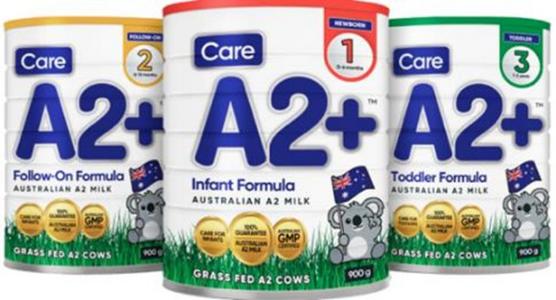
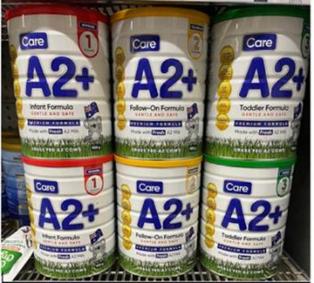
8.1 Impugned conducts
147 Care A2 has offered for sale, supplied and promoted infant formula, follow-on formula and toddler formula products in Australia since November 2020.
148 The packaging of the Care A2 Parties’ Impugned Products (pictured above from November 2020 to November 2022) features one or more of the Care A2 Trade Marks, and includes the following words in stylised and/or plain text:
(a) “A2”;
(b) “A2+”;
(c) “Care A2+”;
(d) “AUSTRALIAN A2 MILK”;
(e) “GRASS FED A2 COWS”;
(f) “Made with Fresh A2 Milk”; and
(g) “MADE WITH FRESH AUSTRALIAN A2 MILK”.
149 In or about the period 10 January 2023 to 12 January 2023, the Care A2 Parties advertised and promoted in Australia the Impugned Products by reference to the sign “A2” by way of:
(a) sponsorship of an event known as the “Care A2+ Kooyong Classic”, being a tennis tournament held at the Kooyong Lawn Tennis Club in Melbourne, Victoria, from 10 January 2023 to 12 January 2023 (the Care A2+ Kooyong Classic Event);
(b) various advertising and promotional activities undertaken in respect of and at the Care A2+ Kooyong Classic Event; and
(c) approving merchandise, including t-shirts and water bottles, available for sale and sold at the Care A2+ Kooyong Classic Event,
(together, the Care A2 Parties’ Sponsorship Activities).
150 The Care A2 Parties’ Sponsorship Activities, undertaken both at and in respect of the Care A2+ Kooyong Classic Event, feature one or more of the Care A2+ Trade Marks and include the following words in stylised and/or plain text, whether simpliciter or appearing as elements within logos or other branding devices:
(a) “A2”;
(b) “A2+”; and
(c) “Care A2+”,
(together, the Care A2 Parties’ A2 Sponsorship Representations).
151 The website located at the domain name https://carea2plus.com (the Care A2 Plus Website):
(a) includes the sign “a2/A2” as a part of the domain name which is visible to persons visiting the Care A2 Plus Website; and
(b) features images of the Impugned Products, uses one or more of the Care A2 trade marks and includes the following words in stylised and/or plain text:
(i) “A2”;
(ii) “A2+”;
(iii) “Care A2+”;
(iv) “Care A2+ for Your Child's Health and Wellbeing”;
(v) “Australia's Own Premium A2 Formula”;
(vi) “Australian A2 Cows’ Milk”;
(vii) “We are the first to make formula in Australia using only A2 milk from 100% Australian A2 cows”; and
(viii) “Australian A2 Cows’ Milk Tested and Certified”,
(together, (a) and (b) are the Care A2 Parties’ A2 Website Representations).
152 The website at the domain name www.thecareclub.store (the Care Club Store Website) features images of the Impugned Products, uses one or more of the Care A2+ Trade Marks and includes the following words in stylised and/or plain text:
(a) “A2”;
(b) “A2+”;
(c) “Care A2+”;
(d) “Care A2+ Formula”;
(e) “Made with Fresh Australian A2 Milk”;
(f) “Try Care A2+”; and
(g) “The Care Club Store is your one-stop online retailer for everything Care A2”,
(together, the Care A2 Parties’ A2 Care Club Store Representations).
153 The Care A2 Australia investor bulletin published in September 2021 (Investor Bulletin), featuring images of the Impugned Products, uses one or more of the Care A2+ Trade Marks and includes the following words in plain and/or stylised text:
(a) “A2”;
(b) “A2-F”;
(c) “Care A2+”;
(d) “Launched Care A2+ Infant Formulas and Toddler Formulas in October 2020”;
(e) “AUSTRALIAN A2 MILK”; and
(f) “Care A2+ is not a single product brand”,
(together, the Care A2 Parties’ Investor Bulletin A2 Representations).
154 I refer to the conduct above collectively as the Impugned Conducts.
8.2 Care A2’s admissions
155 The Care A2 Parties admit the following matters.
156 Care A2 has:
(a) manufactured and distributed for sale the Impugned Products;
(b) advertised and promoted the Impugned Products;
(c) applied the “Care A2+” mark to the packaging of the Impugned Products;
(d) used the “Care A2+” mark in advertising and promoting the Impugned Products;
(e) sold, offered or exposed for sale and supplied the Impugned Products to distributors and retailers, but not end consumers;
(f) sponsored the Care A2+ Kooyong Classic Event and has undertaken various advertising and promotional activities in respect of and at the Care A2+ Kooyong Classic Event, including approving merchandise available for sale and sold at the event (together, the Care A2+ Kooyong Sponsorship Activities); and
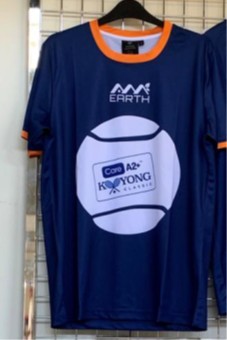
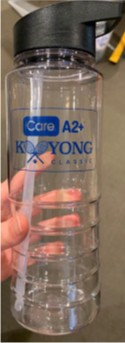
(g) used the “Care A2+” mark as part of the Care A2+ Kooyong Sponsorship Activities.
157 Care IP is the applicant for the Care A2+ Trade Marks and admits that it has authorised use of those marks in trade and commerce by Care A2 and the third respondent, Care A2 Australia.
158 Care A2 Australia published the Investor Bulletin featuring images of the Care A2+ products and using one or more of the Care A2+ Trade Marks.
159 The Care Club Store admits that it has:
(a) advertised and promoted the Impugned Products online; and
(b) sold, offered or exposed for sale and supplied the Impugned Products to end consumers online.
160 Care A2 operates the Care A2 Plus Website and The Care Club Store operates the Care Club Store Website (together, the Impugned Websites), each of which is admitted to feature images of the Impugned Products and uses one or more of the Care A2+ Trade Marks. Further, the Care A2 Parties collectively admit that the packaging of each of the Impugned Products, Care A2+ (New Packaging) Products, and the Care A2+ Kooyong Sponsorship Activities featured one or more of the Care A2+ Trade Marks.
161 By reason of these admissions, there is no dispute between the parties as to the form of the packaging of the Impugned Products or their association with the Care A2 Parties, or that the Impugned Conducts occurred in Australia.
9. Earlier litigation before Bromwich J
162 As I briefly discussed above, Bromwich J heard and determined two appeals from decisions of the Registrar of Trade Marks concerning the registrability of the Australian Registered Trade Marks No. 1751238 (being the words “TRUE A2”) and the a2MC Milk Mark: LD&D.
163 The a2MC Milk Mark is one of the marks in suit in these proceedings. Although the respondent in LD&D did not appear, Bromwich J considered the merits of the matter having regard to the public interest and the fact that there were extant and apparently maintained findings by delegates of the Registrar pursuant to s 41 of the TMA. To that end, his Honour received detailed affidavit evidence, much of which is repeated in evidence filed by a2MC in these proceedings.
164 Justice Bromwich concluded that the marks were registrable under s 41 on the ground that they were inherently adapted to distinguish the a2MC Products. Among other things, his Honour found at [33] that the sign “a2/A2” was in truth made up and that, having regard to the scientific background concerning milk, milk proteins and a2MC’s products, it made no more than an allusive reference to the products and their qualities.
165 Care A2 seeks to distinguish the present case from LD&D, and any reliance that the Court may draw from it, noting that Bromwich J’s decision does not identify any of the witnesses whose evidence was received, or the substance of their evidence. Rather his Honour merely sets out a general summary conclusion of its overall effect at [34]. Care A2 further submits that Bromwich J does not specify whether any evidence was received from LD&D Australia Pty Ltd, and that his Honour’s summary suggests he only received evidence from a2MC. Care A2 contends that there is nothing in the decision to indicate that his Honour was provided with the type of evidence set out by Care A2 in demonstrating descriptive use of “a2/A2” and “a2 milk” by government authorities, the media, academics and other traders.
166 Care A2 contends that LD&D was not based on the same body of evidence that is before the Court in the present case and as such, his Honour’s decision is of little assistance to the Court in determining the issues presently in contest.
167 In particular, Care A2 takes issue with [33] of LD&D. It asserts that the conclusion at [33] that “a2/A2” are “in truth made up” is difficult to reconcile with the finding that it has its “origin in science”. In such circumstances, Care A2 submits that the type of evidence it has provided to this Court would have assisted Bromwich J “in understanding that, in the context of milk, “a2/A2” and “a2 milk” indeed have a well understood scientific meaning which is widely used to describe a type of naturally occurring milk” (emphasis added).
168 Care A2 also takes issue with Bromwich J’s conclusion at [33] that “[o]ther traders may properly identify that feature but are not entitled to exploit the applicant’s brand”. It submits that the finding was “inappropriate” because it assumed that “A2 milk” was already a brand used by a2MC whereas the inquiry into inherent adaption to distinguish and the likelihood that other traders may wish to use a term concerns the anterior question of whether the mark is capable of distinguishing a2MC’s milk products by reason of “[…] the intrinsic qualities of the mark itself, divorced from the effects or likely effects of registration”: Apple Inc v Registrar of Trade Marks (2014) 109 IPR 187 at [11] (Yates J).
169 Whilst this Court is not bound by LD&D, a2MC contends that his Honour’s findings and conclusions are persuasive. a2MC further draws attention to his Honour’s criticisms of the Macquarie Dictionary definition of “a2 milk” at [25], including that his Honour “did not find the dictionary definition especially helpful, not least because, despite its apparent literal inaccuracy, it seems […] to accord with the way in which the applicant in fact markets its milk and milk products as containing only A2 protein”. The difficulties associated with that definition are similarly addressed in the evidence filed by a2MC in the present proceedings.
10. Use of “a2/A2” by other traders
170 It is common ground between the parties that the term “a2/A2” is and has been used by other traders in Australia independently from a2MC since around 2020.
171 Until around 2014, a2MC (and its predecessor in title) was the only trader in milk and milk products being naturally free from A1 β-casein protein, being the product innovator which brought a wholly new category of milk to the market. Since then, other traders have used “a2/A2” in combination with “protein” on yoghurt, powdered infant formula and milk. Said traders have not used “a2/A2” simpliciter to describe a milk product that does not contain A1 β-casein protein.
172 a2MC does not object to the use of “a2/A2” descriptively by third parties to directly describe the A2 ß-casein protein, nor does it object to third parties using the shorthand terms “A1 protein” and “A2 protein” to describe the naturally occurring milk proteins, acknowledging that these terms are more accessible to consumers than “A1 ß-casein protein” and “A2 ß-casein protein”.
173 I note some examples of the use of “a2/A2” by traders other than a2MC and Care A2 below.
174 As at March 2020, the online “Nestlé baby store” was marketing a powdered milk product under the name “Nestlé NAN A2”. As at August 2023, the “Nestlé NAN A2” powdered milk product was marketed in Australia in the packaging appearing as follows:
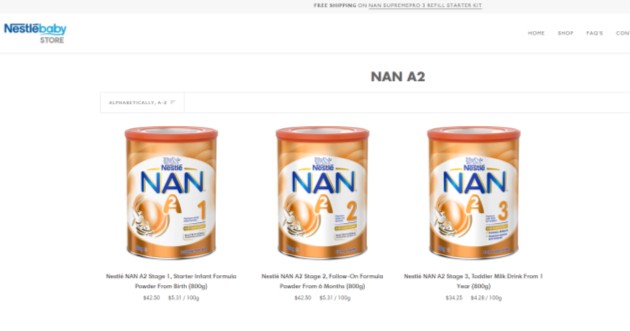
175 As at September 2021, a “Bellamy’s Organic Beta Genica-8™ Organic A2 Protein” powdered milk product was marketed in Australia. As at August 2023, its packaging remained materially similar to that used in September 2021 and appeared as follows (highlighting added):
176 As at February 2024, an “Australia’s Own A2 Full Cream Milk” product was marketed in Australia on the Woolworths website in packaging appearing as follows:
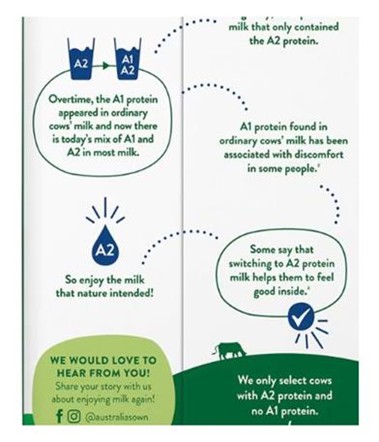
177 As at February 2021, a “Farmer’s Beta A2 powdered milk” product was marketed in Australia by Beta A2 on its website http://betaa2.com.au as follows:
178 As at October 2022, a “HAVEN A2 Toddler Milk Drink” powdered milk product marketed by Haven New Zealand, on its website www.havenbaby.com.au as follows:
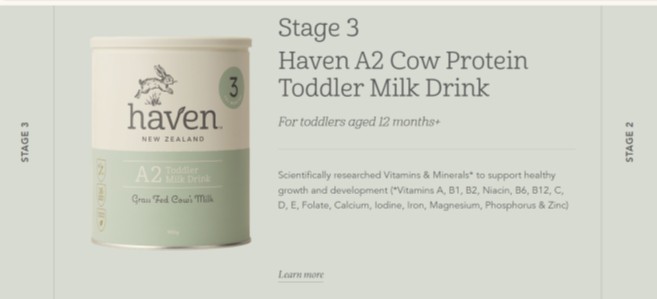
179 As at October 2022, a “Ocean Road Dairies Organic A2” powdered milk product was marketed by Ocean Road Dairies on its website https://www.oceanroaddairies.com.au as follows:
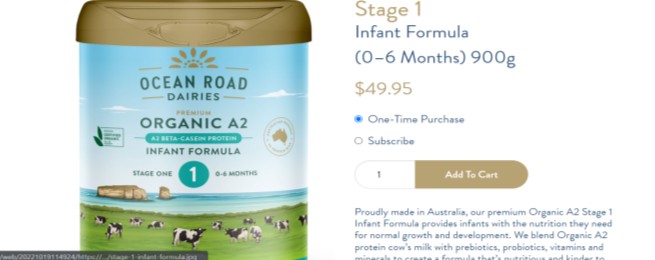
11. Trade Mark Infringement
180 The issues for determination on the trade mark infringement case are whether:
(a) Care A2 has used the sign “A2” or “A2+” separately from “Care” as a trade mark; and
(b) the trade mark or trade marks used by Care A2 are substantially identical or deceptively similar to the a2MC Marks.
181 Care A2 admits that the goods on which it has used its marks are goods of the same description. In opening oral submissions, Care A2 did not dispute that the goods are the same goods for the purposes of s 120(1) of the TMA.
182 Care A2 does not rely on any defence under ss 122(1)(b)(i) and (1)(fa) of the TMA.
11.1 Relevant sections of the TMA
183 A trade mark, as defined by s 17 of the TMA, is “a sign used, or intended to be used, to distinguish goods or services dealt with or provided in the course of trade by a person from goods or services so dealt with or provided by any other person”. Moreover, s 6 provides that a “sign” includes “the following or any combination of the following, namely, any letter, word, name, signature, numeral, device, brand, heading, label, ticket, aspect of packaging, shape, colour, sound or scent”.
184 Section 20(1) of the TMA confers exclusive rights to a registered trade mark owner to use the trade mark and to authorise other persons to use the trade mark in relation to the goods and/or services in respect of which the trade mark is registered. Section 20(2) confers the right to the registered owner to obtain relief in circumstances where the trade mark has been infringed.
185 Infringement of a registered trade mark is dealt with in s 120(1) and (2) of the TMA. Section 120(1) provides:
A person infringes a registered trade mark if the person uses as a trade mark a sign that is substantially identical with, or deceptively similar to, the trade mark in relation to goods or services in respect of which the trade mark is registered.
186 The phrase “deceptively similar” is defined in s 10 of the TMA as follows:
For the purposes of this Act, a trade mark is taken to be deceptively similar to another trade mark if it so nearly resembles that other trade mark that it is likely to deceive or cause confusion.
11.2 Principles
187 In Self Care IP Holdings Pty Ltd v Allergan Australia Pty Ltd (2023) 277 CLR 186, Kiefel CJ, Gageler, Gordon, Edelman and Gleeson JJ identified at [22] that there were two separate elements to establish trade mark infringement under s 120(1) of the TMA:
(a) that the person has used as a trade mark a sign in relation to goods or services; and
(b) that the trade mark was substantially identical or deceptively similar to a trade mark registered in relation to those goods or services.
11.2.1 Use as a trade mark
188 As the High Court in Self Care explained at [24] by reference to E & J Gallo Winery v Lion Nathan Australia Pty Ltd (2010) 241 CLR 144 at [33] (French CJ, Gummow, Crennan and Bell JJ), which cited Shell Co of Australia Ltd v Esso Standard Oil (Australia) Ltd (1963) 109 CLR 407 and Champagne Heidsieck et Cie Monopole Societe Anonyme v Buxton [1930] 1 Ch 330, “[w]hether a sign has been ‘use[d] as a trade mark’ is assessed objectively without reference to the subjective trading intentions of the user”. The objective purpose and nature of use are assessed by reference to the context. The High Court in Self Care also observed at [24] that context includes “[…] the relevant trade, the way in which the words have been displayed, and how the words would present themselves to persons who read them and form a view about what they connote” (citations omitted).
189 Kitto J in Shell Co set out the relevant question of what constitutes “use as a trade mark” at 425:
[…] the question becomes whether, in the setting in which the particular pictures referred to were presented, they would have appeared to the television viewer as possessing the character of devices, or brands, which the appellant was using or proposing to use in relation to petrol for the purpose of indicating, or so as to indicate, a connexion in the course of trade between the petrol and the appellant.
190 In Self Care, their Honours further elaborated (at [23]−[24]):
Use of a trade mark in relation to goods means use of a trade mark upon, or in physical or other relation to, those goods, and so can include use of the mark on product packaging or marketing such as on a website. There is a distinction, although not always easy to apply, between the use of a sign in relation to goods and the use of a sign as a trade mark. A trade mark is a sign used, or intended to be used, to distinguish goods dealt with by one trader from goods dealt with by other traders; that is, as a badge of origin to indicate a connection between the goods and the user of the mark.
Whether a sign has been “use[d] as a trade mark” is assessed objectively without reference to the subjective trading intentions of the user. As the meaning of a sign, such as a word, varies with the context in which the sign is used, the objective purpose and nature of use are assessed by reference to context. That context includes the relevant trade, the way in which the words have been displayed, and how the words would present themselves to persons who read them and form a view about what they connote. A well known example where the use was not “as a trade mark” was in Irving's Yeast-Vite Ltd v Horsenail, where the phrase “Yeast tablets a substitute for ‘Yeast-Vite’” was held to be merely descriptive and not a use of “Yeast-Vite” as a trade mark. Therefore, it did not contravene the YEAST-VITE mark.
(Citations omitted.)
191 Justice Allsop (as his Honour then was) in an oft-cited passage from Anheuser-Busch Inc v Budejovický Budvar (2002) 56 IPR 182, at [185]−[186] said:
The task is to examine the way the words are used in their context, including the totality of the packaging, to assess their nature and purpose in order to see whether they are used to distinguish the goods from goods of others.
The assessment is made from the perspective of what a person looking at the label would see and take from it, as to the purpose and nature of its use.
(Citations omitted.)
192 Further, the High Court in Self Care noted the following at [25]:
The existence of a descriptive element or purpose does not necessarily preclude the sign being used as a trade mark. Where there are several purposes for the use of the sign, if one purpose is to distinguish the goods provided in the course of trade that will be sufficient to establish use as a trade mark. Where there are several words or signs used in combination, the existence of a clear dominant “brand” is relevant to the assessment of what would be taken to be the effect of the balance of the label, but does not mean another part of the label cannot also act to distinguish the goods.
(Citations omitted.)
193 Having regard to the above authorities on use as trade mark, I will now consider the parties’ submissions on their respective positions on infringement.
11.2.2 Overview of the parties’ submissions
194 Care A2 admits it has used the sign “Care A2+” (the Care A2+ Mark) as a trade mark both as plain words and in its composite form including both word and device components. However, Care A2 denies that it has used the mark “A2+” alone, or “A2” alone as a “sign” or trade mark within the meaning of ss 17 or 120 of the TMA.
195 Irrespective of whether Care A2 is using one composite mark (Care A2/+) or two marks (“Care” and “A2/+”), a2MC contends that trade mark infringement is established. If it is a composite mark, then a2MC contends that the mark is deceptively similar to the a2MC Marks. If there are two marks, then a2MC contends that “A2/+” is substantially similar to one or more of the a2MC Marks because the essential feature or dominant cognitive cue is “A2” and the “+” are “[…] mere descriptive elements, which are not apt to perform [a] distinguishing role in respect of the relevant goods […]”: Pham Global Pty Ltd v Insight Clinical Imaging Pty Ltd (2017) 141 IPR 1 at [52] (Greenwood, Jagot and Beach JJ). Care A2 disagrees.
196 Care A2 refers to what it considers the descriptive use of “a2/A2” and “a2 Milk” by government authorities, the media, academics and other traders in relation to milk or milk products and submits that the “a2/A2” component of each of the parties’ respective marks ought to be discounted for the purposes of determining deceptive similarity. It contends that apart from the “a2/A2” component, there are no other features of any of the parties’ marks which could be said to be deceptively similar.
197 Schedule C to a2MC’s written closing submissions sets out examples of what it alleges to be trade mark use by Care A2 that infringe the a2MC Marks. The examples are principally photographs of packaging of the Impugned Products in pre- and post-November 2022 forms, and signage and merchandise from the Care A2+ Kooyong Classic Event.
198 The pre-November 2022 form of the packaging of the Impugned Products is below.
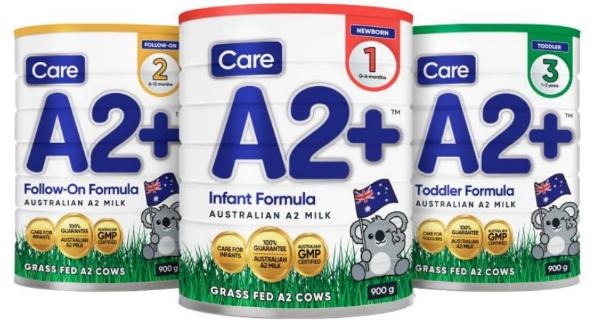
199 The post-November 2022 form of the packaging of the Impugned Products is below.
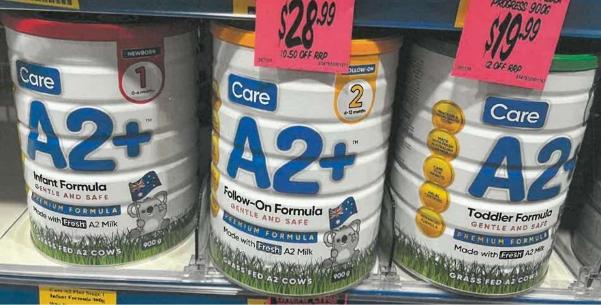
200 a2MC contends that an objective examination of the packaging of the Impugned Products confirms that the sign “A2” or a minor variant “A2+” (referred to henceforth as A2/A2+) is being used by the Care A2 Parties on and in relation to the Impugned Products as a trade mark or badge of origin, and that it is being used in that manner independently of the word “Care”.
201 According to a2MC, the word “Care” presents as a separate mark as it is contained in a separate blue coloured “lozenge” that appears above the “A2/A2+” on the packaging. a2MC submits that in the context of goods which are infant formula, “Care” may not be perceived as a separate badge of origin at all, but rather a description of the product as being related to the “care” of infants and toddlers.
202 Care A2 submits that the “Care” and “A2/A2+” components of its mark are always presented together with “Care” appearing either above or before “A2+”. According to Care A2, there is not one example where the two components appear separated, or where “Care” is absent. As a result, Care A2 submits that consumers would perceive the whole composite phrase “Care A2+” as the brand of the product. It further submits that the composite phrase “Care A2+” is not deceptively similar to any of the a2MC Marks, as the word “Care” is both visually and aurally different from those marks.
203 a2MC notes that the words “Made with Fresh A2 Milk” can also be observed on the packaging, with the word “Fresh” appearing in a blue coloured lozenge in a manner similar to that of the “Care” lozenge. a2MC maintains that it would not be contended that the word “Fresh” was a trade mark. Similarly, a2MC submits that the word “Care” might also be perceived as having a descriptive function.
204 a2MC submits that the use of the words “a2 Milk” (emphasising the capitalisation of the “M” in “Milk”) is another instance of the use of “a2/A2” as a trade mark, which is substantially identical to the a2MC Milk Mark. a2MC also refers to the reference to “CERTIFIED A2 COWS” on the front of the packaging. The sign “a2/A2” appears on the front of the Impugned Packaging three times, which a2MC submits reinforces its importance and prominence. According to a2MC, these various uses considered in the context reinforce the proposition that the sign “a2/A2” is being used as a stand-alone badge of origin on the packaging of the Impugned Products.
205 a2MC relies on the following factors to support its contention that “A2/A2+” would be perceived as a stand-alone trade mark or badge of origin:
(a) the sign “A2/A2+” being the largest (i.e. the dominant) element on the packaging, is written in large, prominent, bold, dark blue, stylised capital letters surrounded by silver bevelling, against a white contrasting background and appears on the front of the packaging at its centre;
(b) no other sign on the packaging is written in large sized capital letters and in blue, with bevelling against a white background;
(c) the letters “TM” appear to the top right of the “+” symbol;
(d) the word “Care” is written in white font, using “normal” capital/lower-case lettering, against a contrasting blue field, contained within a separate lozenge, also surrounded by silver bevelling;
(e) “Care” in the lozenge is approximately 1/3 of the size of the sign “A2/A2+”; and
(f) the “Care” lozenge is located towards the top-left of the packaging, where it may easily be obscured on-shelf, as seen in photographs of the products in-store.
206 In the photographs below, taken at a Chemist Warehouse located at the Homemaker Centre, in Lutwyche Road, Windsor, Queensland, the word “Care” is barely visible on the Impugned Products, and the word is frequently partially obscured by price-tickets. In such circumstances, I consider that “Care” is unlikely to be perceived as a brand at all, or if it is, it would be seen as independent from “A2/A2+”.
207 By contrast, the sign “A2/A2+” is separate, more prominent, centrally located, easily readable from a distance and plainly designed to distinguish the Impugned Products from those of other traders. Further, it may be observed that the only other infant formula products bearing the sign “a2/A2” are the a2MC infant formula products bearing the a2MC Marks.
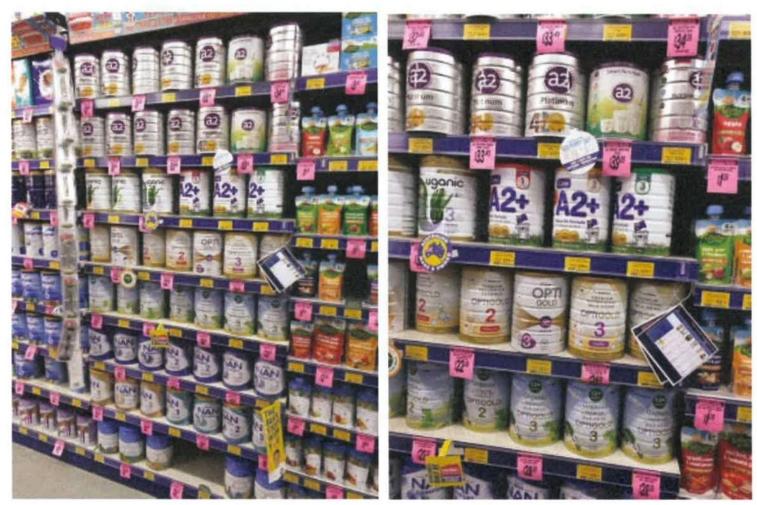
208 Further instances of the Impugned Conducts include: uses on signage and merchandise at the Care A2+ Kooyong Classic Event; use on the Care A2 Plus Website; use on the Care Club Store Website, and use on the Investor Bulletin. a2MC submits that these uses reinforce its contention that “A2/A2+” was being used by Care A2 as a separate mark, rather than a composite mark. I include examples of such uses across the various events and websites below.
209 Examples of signage from the Care A2+ Kooyong Classic Event appear below.
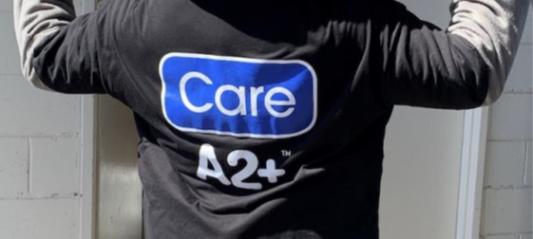
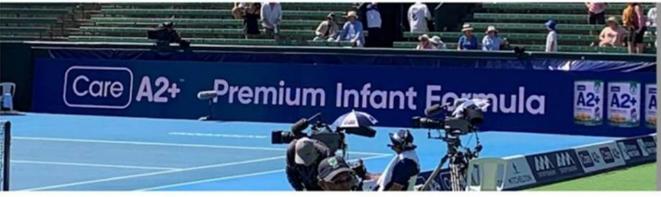
210 Below is a printout of the Care A2 Plus Website:
211 Below is a printout of a Wayback Machine search the Care Club Store Website as at 2024, wherein “Care” is being used as a trade mark on its own on the top left corner:
212 Below is a printout of the Investor Bulletin as at September 2021:
213 a2MC places heavy reliance on the following quote from the Care A2 Parties’ then legal representatives, Ashurst, of 19 March 2021, responding to a2MC’s then legal representatives, Johnson Winter Slattery’s cease and desist letter of 22 February 2021 (the 19 March 2021 Ashurst Letter). The 19 March 2021 Ashurst Letter states at [2.26(c)]:
In contrast, our client’s A2+ formulas are sold under the logo featured on the Packaging (the A2+ Logo) which features the term “Care” in conjunction with the sign “A2+” in prominent blue font.
(Emphasis in original.)
214 a2MC contends that the quoted passage amounts to a clear admission that the sign “A2/A2+” is used as a separate badge of origin, independently of the word “Care”, (if the latter is used as a trade mark at all) by the Care A2 Parties on the Impugned Products’ packaging. a2MC relies on the principle articulated by Allsop J (as his Honour then was) in Anheuser-Busch at [171], drawing on Dixon and McTiernan JJ’s reasons in Australian Woollen Mills Ltd v FS Walton & Co Ltd (1937) 58 CLR 641 at 657:
[…] The rule that if a mark or get-up for goods is adopted for the purpose of appropriating part of the trade or reputation of a rival, it should be presumed to be fitted for the purpose and therefore likely to deceive or confuse, no doubt, is as just in principle as it is wholesome in tendency. In a question how possible or prospective buyers will be impressed by a given picture, word or appearance, the instinct and judgment of traders is not to be lightly rejected, and when a dishonest trader fashions an implement or weapon for the purpose of misleading potential customers he at least provides a reliable and expert opinion on the question whether what he has done is in fact likely to deceive. Moreover, he can blame no one but himself even if the conclusion be mistaken that his trade mark or the get-up of his goods will confuse and mislead the public […]
215 On the other hand, Care A2 contends that the context which informs the use of “a2/A2” and “a2 milk” must include descriptive usage by the government, mainstream media, other traders and a2MC itself to refer to the naturally occurring variety of milk which contains the A2 β-casein protein and not the A1 β-casein protein.
216 In that vein, Care A2 advances that the “A2/A2+” component is descriptive and would not be perceived as an element acting alone to identify the commercial brand of its products, independently of the relatively distinctive “Care” component, which by contrast has no relevantly descriptive meaning for any type of milk and is consistently presented as the first part of the composite phrase with an emphasised background.
217 Care A2 claims that when viewed objectively, for the purposes of identifying the brand and commercial source of its products, the consumer would focus on the whole of the composite phrase “Care A2+”.
11.3 Issue 1: Composite mark or two trade marks?
218 I now turn to the question of whether the Care A2+ Mark used by Care A2 constitutes a composite mark or, instead, comprises two separate trade marks.
219 It is well-established that packaging can bear more than one trade mark: Self Care at [25].
220 Where there is a composite mark, an analysis is required of whether the components constitute one combined mark or function as separate marks. The applicable test was stated by the Full Court in Woolworths Ltd v BP plc (No 2) (2006) 70 IPR 25 at [77] (Heerey, Allsop and Young JJ):
Whether or not there has been use as a trade mark involves an understanding from an objective viewpoint of the purpose and nature of the use, considered in its context in the relevant trade. How the mark has been used may not involve a single or clear idea or message. The mark may be used for a number of purposes, or to a number of ends, but there will be use as a trade mark if one aspect of the use is to distinguish the goods or services provided by a person in the course of trade from the goods or services provided by any other persons, that is to say it must distinguish them in the sense of indicating origin.
(Citations omitted.) (Emphasis added.)
221 Recently, in RB (Hygiene Home) Australia Pty Ltd v Henkel Australia Pty Ltd (2024) 179 IPR 178 (Nicholas, Burley and Hespe JJ), the Full Court cited the above passage at [115]−[116], adding:
Adopting that approach, it is necessary to consider whether a component of a trade mark, objectively assessed from the perspective of the notional consumer, would be regarded as a separate badge of origin to the composite whole. […]
222 The Full Court in Woolworths explained at [77] that it is necessary to conduct an assessment, from an objective viewpoint, “[…] of the purpose and nature of the use, considered in its context in the relevant trade”.
11.3.1 Consideration
223 For the reasons that follow, I consider that Care A2’s Impugned Conducts use two separate marks: “Care” and “A2/A2+”, not one composite mark. I note that a2MC reads too much into the 19 March 2021 Ashurst Letter in contending that the defined term “the A2+ Logo” could be referring to a logo comprising “Care” and the sign “A2/A2+”. I do not rely on the alleged “admission” in coming to my decision that there are two separate marks rather than one composite mark.
11.3.1.1 Impugned Products
224 Looking at the Impugned Products’ packaging, there are differences in the font, style, size and placement of the two components “Care” and “A2/A2+”. The “A2/A2+” is always prominently and centrally displayed, in a much larger size than the word “Care”. The “A2+” is further emphasised by being in capital letters in a dark colour (blue) against a white background and edged with silver. In contrast, the “Care” lozenge is much smaller relative to the “A2+”, and “Care” is in white writing on the blue of the lozenge on the Impugned Products’ packaging.
225 The eye of the consumer looking at the Impugned Products’ packaging on a shelf alongside other tinned infant formula products would be drawn to the prominent capitalised “A2+” at the centre of the tin. Depending on the angle and positioning of the price labels, the “Care” lozenge can be difficult to discern, whereas the prominent “A2+” in large letters in the centre of the packaging, consistent with the main branding of the other infant formulas, is always visible.
11.3.1.2 Care A2+ Kooyong Classic Event
226 Regarding the Care A2+ Kooyong Classic Event, on the signage the “A2+” remains prominent in large white writing on a blue background, whilst the size and positioning of the “Care” lozenge changes.
227 Although the two marks are often used together, their position relative to each other is not fixed. On the Impugned Products’ packaging the word “Care” is in a separate blue lozenge above the “A”. On the Care A2+ Kooyong Classic Event signage and merchandise, the “Care” lozenge is sometimes above the “A2+” and sometimes beside the “A2+”. On the Care A2+ Kooyong Classic Event signage, the relative size of the two marks changes, sometimes they are similarly sized, in some cases the “Care” lozenge is much smaller, and in one example on the back of a linesperson’s shirt, the “Care” lozenge is above the whole “A2+” and larger than the “A2+”.
228 The letters “TM” are always placed in the upper right quadrant of the “+”, no matter the relative positioning of the “Care” lozenge relative to the “A2+”.
11.3.1.3 Care Club Store
229 There is also the use of “Care” without “A2+”. Contrary to Care A2’s submission, “Care” is used separately from and independently of the “A2+” mark on the Care Club Store Website which uses the “Care” lozenge on its own at the top of each webpage.
230 As shown above, the Care Club Store Website also features the Impugned Products. In those instances, the analysis on the Impugned Products applies equally to their presentation on this website, but for the considerations regarding shelf placement and price labels.
11.3.1.4 Investor Bulletin
231 The Investor Bulletin includes instances of use in which “Care” and “A2+” appear side-by-side in matching font sizes, with “Care” rendered in white font within a blue lozenge, and “A2+” presented in bold dark blue. Notwithstanding the similarity in font size, the separation created by the lozenge and the boldening of “A2+” conveys the impression that the two operate as distinct marks, notwithstanding their physical proximity.
11.4 Issue 2: Substantially identical or deceptively similar
11.4.1 Substantial identicality
232 The long-standing test for substantial identicality is summarised in the well-known words of Windeyer J in Shell Co at 414:
In considering whether marks are substantially identical they should, I think, be compared side by side, their similarities and differences noted and the importance of these assessed having regard to the essential features of the registered mark and the total impression of resemblance or dissimilarity that emerges from the comparison.
“The identification of an essential feature depends”, it has been said, “partly on the Court’s own judgment and partly on the burden of the evidence that is placed before it”. Whether there is substantial identity is a question of fact […]
(Citations omitted.)
233 The relevant comparison is a side-by-side comparison of the two marks, cognisant of the “dominant cognitive cues” or essential feature of the marks that strike the eye: Pham Global at [51] and [56] (Greenwood, Jagot and Beach JJ).
234 There is no evidence from consumers as to their impressions; it is for the Court to view the matter objectively and as put by Lockhart J in PepsiCo Australia Pty Ltd v Kettle Chip Co Pty Ltd (1996) 33 IPR 161 at 163, with resort to common sense.
235 a2MC contends that the sign “A2/A2+” is substantially identical with one or more of the a2MC Marks because the essential feature or dominant cognitive cue of both the “A2+” mark and the a2MC Marks is “A2”: Shell Co at 414–5 (Windeyer J).
236 a2MC submits that the mathematical symbol “+” may be regarded as a “mere descriptive element[s], not apt to perform this distinguishing role in respect of the relevant goods”: Pham Global at [51]–[52] (Greenwood, Jagot and Beach JJ). For example, it might be understood as indicating that the goods have an added feature or ingredient (such as lactoferrin) or are improved in some way, but the symbol is not a memorable or distinctive feature of the mark.
237 However, a2MC does not have a word mark registration just for the alphanumeric “a2/A2”. The a2MC Marks range from the word mark “a2 Milk”, being the a2MC Milk Mark, to device marks including “a2/A2” and “a2 Milk”. The closest marks for the purpose of the substantial identicality comparison are the 054 Mark and the 098 Mark, each of which presents “a2” on a darker splodge or droplet-shaped background.
238 The differences apparent between the “a2” device mark and “A2+” mark on a side-by-side comparison cannot be dismissed as merely descriptive elements inapt to perform a distinguishing role. Visually, the marks differ in:
(a) the capitalisation of the “a”;
(b) the presence of the mathematical symbol “+”;
(c) the presence of a dark splodge/droplet background; and
(d) the use of dark blue lettering for “A2” in the “A2+” mark, as compared with the 054 Mark and the 098 Mark, in which the “a2” is in white.
239 In a2MC’s minimalist alphanumeric device marks, the non-capitalisation of the “a” and the background splodge or droplet are important cues for the marks. Whilst it may suit a2MC’s case to overlook the differences, in the case of a minimalist two-letter alphanumeric device marks, these are important differences. Otherwise, a2MC’s registered device marks will, in effect, constitute a two-letter alphanumeric mark. To consider the mark as such would be to extend the scope of the registration beyond the monopoly granted.
240 Additionally, the two marks are aurally different. The difference between the lower and uppercase “A” and the presence of the droplet would not matter when the mark is spoken, but a consumer would say the “plus”, notwithstanding that the “plus” may well be overlooked for the deceptive similarity analysis.
241 In a more complex device mark, various components might be able to be disregarded in the side-by-side comparison on the basis that they are merely descriptive: Pham Global at [52] (Greenwood, Jagot and Beach JJ). In this instance, however, the differences account for most of the mark (aside from “2”), and consequently the marks cannot be substantially identical. I do not consider any of the a2MC Marks, and specifically the 054 and the 098 Marks, to be substantially identical to the A2+ mark of the Care A2.
11.4.2 Deceptive similarity
242 The principles to be applied in determining whether marks are deceptively similar were summarised by the High Court in Self Care.
243 The enquiry begins with s 10 of the TMA, which provides that a trade mark is taken to be deceptively similar to another trade mark if it “so nearly resembles that other trade mark that it is likely to deceive or cause confusion”. The marks ought not to be compared side-by-side; an attempt should be made to estimate the effect or impression produced on the mind of potential customers by the mark or device: Self Care at [26]−[29] (Kiefel CJ, Gageler, Gordon, Edelman and Gleeson JJ).
244 In comparing the two marks, they must be judged as a whole, considering both their look and their sound. This is of particular significance in relation to composite marks and device marks which may consist of several elements. It is necessary to look at all these elements in their context, including the size, prominence and stylisation of words and device elements used in the mark and their relationship to each other. Broadly, deceptive similarity may be established when an impugned mark uses an “essential” or “distinguishing” feature of the mark as registered: Optical 88 Ltd v Optical 88 Pty Ltd (No 2) (2010) 275 ALR 526 at [100] (Yates J).
245 The correct approach is to compare the impression—allowing for imperfect recollection—that the notional buyer would have of the registered mark, with the impression that the notional buyer would have of the alleged infringer’s mark: Self Care at [27] (Kiefel CJ, Gageler, Gordon, Edelman and Gleeson JJ), citing Shell Co at 658. A mere possibility of confusion is insufficient. There must be “a real, tangible danger of deception or confusion occurring”—a “real likelihood that some people will wonder or be left in doubt about whether the two sets of products [...] come from the same source”: Self Care at [32] (Kiefel CJ, Gageler, Gordon, Edelman and Gleeson JJ).
246 If the marks include elements that are descriptive or are commonly used in the particular trade, those elements may be discounted in the comparison: Wingate Marketing Pty Ltd v Levi Strauss & Co (1994) 28 IPR 193 at 229−30 (Gummow J); “Frigiking” Trade Mark [1973] RPC 739 at 752–3 (Whitford J); MID Sydney Pty Ltd v Australian Tourism Co Ltd (1998) 42 IPR 561 at 570 (Burchett, Sackville and Lehane JJ); and Connect.Com.Au Pty Ltd v GoConnect Australia Pty Ltd (2000) 50 IPR 535 at [36], [57], [64] (Emmett J). See also s 219 of the TMA.
247 In Swancom Pty Ltd v The Jazz Corner Hotel Pty Ltd (2022) 168 IPR 42 (Yates, Abraham and Rofe JJ), the Full Court held at [47], [93], [94] and [103] that “JAZZ CORNER HOTEL” was not deceptively similar to “CORNER HOTEL”. Their Honours rejected a submission that the trial judge had erred by reasoning that, “the words ‘corner’ and ‘hotel’ were ordinary words with descriptive meanings which are in common use in the hotel and hospitality industries”. The word “jazz” was the memorable word, even if it was descriptive of a style of music.
11.4.2.1 A2+ mark
248 Care A2 makes no submissions as to whether the mark “A2+” (as opposed to the composite mark) is deceptively similar to the a2MC Marks.
249 a2MC draws analogies between the current facts and Jackman J’s recent decision in Hemmes Trading Pty Ltd v Establishment 203 Pty Ltd (2024) 179 IPR 315, in which Jackman J found “ESTABLISHMENT 203” to be an infringement and contravention in the use of the registered mark “ESTABLISHMENT”. His Honour noted at [36] that:
One way in which confusion may occur is if an ordinary consumer with an imperfect recollection is at risk of wondering, or being perplexed or mixed up, as to whether ESTABLISHMENT 203 might be a commercial extension, franchise or sub-brand of ESTABLISHMENT.
(Citations omitted.)
250 The a2MC Marks fall into two groups: the word mark “a2 Milk”, being the a2 Milk Mark, and the device marks, each of which incorporate inter alia a light coloured “a2” against a darker “droplet” background. The deceptive similarity consideration must be carried out for both groups of the a2MC Marks. Any reputation or knowledge of actual use of the a2MC Marks must be ignored: see Bed Bath ‘N’ Table Pty Ltd v Global Retail Brands Australia Pty Ltd (2025) 426 ALR 518 at [5]–[7] (Gageler CJ, Gordon, Edelman, Jagot and Beech-Jones JJ) (BBnT HCA).
251 Taking the a2MC Milk Mark first, in the context of milk containing products, I consider that the notional buyer would discount the word “milk” in their imperfect recollection of the word mark, such that the recollection would be of “a2/A2”. In the context of milk and milk‑containing products, the word “milk” performs a plainly descriptive function. It denotes the nature of the goods and is used ubiquitously across the trade by all suppliers offering such products. As such, it lacks any source‑distinguishing capacity and would not, in the mind of the ordinary consumer, operate as a badge of origin. In circumstances where goods of the relevant description are self‑evidently milk or are expressly labelled as such, a notional buyer is unlikely to retain the word “milk” as a memorable or distinguishing element of a word mark. Allowing for imperfect recollection, the consumer’s attention would instead focus on the non‑descriptive component of the mark—here, “a2/A2”—as the element most apt to indicate trade source and to anchor recollection of the mark.
252 Regarding the Care A2+ Mark, I do not consider that the presence of the “+” is sufficient to distinguish the mark. The plus sign is often used to indicate an improvement or an addition, meaning that the notional buyer would not pay great attention to the “+” in the imperfect recollection comparison.
253 I consider that a notional buyer with an imperfect recollection of the a2 Milk Mark and the essential feature “a2/A2” may be at risk of wondering or being perplexed or mixed-up as to whether “A2+” might be a commercial extension or sub-brand of the registered goods sold by a2MC; for example, that the Impugned Products are made with “a2/A2” branded milk and have added vitamins or minerals.
254 In the context of goods such as infant formula, wherein the packaging confirms are fortified with vitamins and minerals, this would be an even more reasonable consideration. A notional consumer might also be caused “[…] reasonably to wonder, or be left in doubt about, whether the two marks might or might not be commercially related”: Establishment at [43] (Jackman J), or that the user is in some way authorised by the owner of one or more of the a2MC Marks, for example through a licensing arrangement. a2MC contends that such a conclusion is also reinforced by use of the words “Made with Fresh A2 Milk” (capitalised “M”) and “CERTIFIED A2 COWS” on the packaging of the Impugned Products.
255 There is evidence that a2MC licenses its trade marks to related entities and, on occasion, to third parties such as Jalna.
256 I consider that the A2+ mark is deceptively similar to the a2MC Milk Mark.
257 The case differs with respect to the a2MC Device Marks. For these marks, a substantial part of the registered mark is the dark splodge or milk droplet in which “a2” sits. Further, in the case of the 098 Mark and 858 Mark, the loop of the lower case “a” is a droplet shape. For the same reason as the a2MC Milk Mark, I consider that the imperfect recollection of those a2MC Device Marks which include the word “milk” is likely to discount that word, so that an imperfect recollection of the marks is likely to recall the “a2” and the contrasting darker splodge background.
258 I consider that the droplet loop element of the 098 Mark and the 858 Mark is unlikely to be recalled in an imperfect recollection as it is a very subtle element of the mark.
259 The a2MC Device Marks are more than the alphanumeric “a2”. The dark splodge or droplet background is likely to be part of the imperfect recollection of the marks—whether it be the actual shape or just a recollection that the letters “a2” are against a darker circular background. The notional consumer would recall the relevant a2MC Marks as being “more than” the alphanumeric “a2”. In the imperfect recollection, the notional consumer may not recall the case of the “a”, but rather recall a letter “a” of indeterminate case. An exception to the foregoing analysis is the 054 Mark, which, notwithstanding the presence of the dark splodge or droplet, lacks additional “essential” or “distinguishing” elements—such as the word “milk” (cf the 754 Mark and the 858 Mark) or a dark background clearly demarcating the bounds of the splodge via a white halo (cf the 098 Mark)—and may therefore be imperfectly recollected in the same manner as the a2MC Milk Mark, namely as the alphanumeric “a2”.
260 The Care A2+ Mark is almost the reverse—the “A2+” is in a dark blue colour against a white background—with no splodge or boundary around the letters.
261 Except for the 054 Mark, I do not consider that the Care A2+ “A2+” mark is deceptively similar to the a2MC Device Marks. For the avoidance of doubt, I consider that the “A2+” mark is deceptively similar to the 054 Mark and the a2MC Milk Mark.
11.4.2.2 Care A2+ Mark
262 If I am wrong in finding that the Care A2+ Mark comprises two separate marks and the mark is instead a composite mark, I will now turn to consider whether the “Care A2+” composite mark is deceptively similar to the a2MC Marks.
263 Care A2 sought to distinguish its composite mark by noting that its mark includes the word “Care”. In its view, this feature is completely different from all of the a2MC Marks, both visually and aurally. a2MC submits in response that in the context of the relevant goods, “Care” and “+” are “mere descriptive elements” that should be disregarded in the assessment.
264 Secondly, Care A2 asserts that the “Care” element has prominence by virtue of its consistent placement above the “A2+” component in vertical arrangements, or before the “A2+” component in horizontal arrangements. When rendered in plain text, the mark is always presented as “Care A2+” or “carea2plus”. Aurally, Care A2 maintains that the mark is always pronounced as “Care A2 Plus”.
265 Thirdly, Care A2 submits that the importance of the “Care” component as a distinguishing feature is emphasised by its consistent presentation as white lettering carved out against, and contained within, a blue lozenge.
266 a2MC contends that focus should be on the alphanumeric “a2” in the comparison, and “mere descriptive elements” such as “Care” or “+” or for that matter “Milk” should be disregarded. In a2MC’s analysis, the splodge or milk droplet surrounding the alphanumeric is entirely overlooked. As I noted above, such an analysis has the effect of giving a2MC a monopoly over the alphanumeric, rather than the narrower registration of the device marks which feature the splodge or droplet around the alphanumeric. I consider a2MC’s approach in this regard, which ignores or downplays each difference between the marks, as unduly reductionist. The registration is not simply the alphanumeric. Where, as with the composite Care A2+ Mark, several differences exist, those differences add up to differentiate the two marks being compared: the imperfect recollection of the registered mark and the actual mark used by Care A2. In this instance, the differences include the word “Care” in a specific presentation in white writing in a darker lozenge, the presence of the plus, and the use of the capital A.
267 I therefore do not consider that the composite mark is deceptively similar to the a2MC Marks.
11.4.3 The inference in Australian Woollen Mills
268 The Australian Woollen Mills principle, as formulated by Dixon and McTiernan JJ at 657, is set out at [214] above.
269 Taking this principle into account, a2MC submits that it can be inferred from the Impugned Products’ packaging that Care A2’s intention was to trade off the reputation of a2MC through the use of the sign “a2/A2”. a2MC asserts that this proposition is supported by the unchallenged expert evidence of Prof Quester.
270 Prof Quester opines that from the perspective of consumers, the way in which scientists or dairy professionals might use the language is not relevant to the consumers’ understanding. What matters is what it means to consumers, and what it meant to consumers from her review of the material is that it was a brand, being a2MC’s brand of milk. In Prof Quester’s words “a2 acted as a brand because it enabled consumers to associate this specific milk with their own experience of previous purchases or of conversations with others. It acted as a brand in providing them with the assurance that, should they buy this product again, the same benefits would ensue”. For this reason, a2MC submits that Prof Quester’s evidence indicates that Care A2’s subjective intentions are irrelevant, and that Care A2’s alternative contention that “a2/A2” is or has become descriptive ought to be rejected.
271 Care A2 draws attention to the following phrases adopted by Prof Quester in her affidavits which include statements as to what she perceives to be Care A2’s “reason” and “aims” for adopting its branding and what it “would want” to do:
95. It is not surprising, therefore, and indeed was entirely predictable, that a2MC’s competitors would also want to partake in the growing lucrative market, including in relation to exports of infant formula to China, leveraging the now established consumers’ preference for naturally A1 protein-free milk.
96. In my opinion, this is the reason why Care A2 has chosen to display A2 so prominently in its marketing activities, including its sponsorship of a tennis event.
97. In my view, by using A2 in a prominent fashion in the presentation of its own products, Care A2 aims to emulate and mimic what has now been established as a desirable brand enjoying a great deal of equity (as evidenced by market share and high profit margin). The benefit from this is the instant acquisition of all the brand associations and favourable meanings which a2MC created over decades by its continuous investment in building the a2 brand. In effect, the use of A2 by Care A2 is likely to confuse consumers otherwise loyal to a2 products, leading them to believe that Care A2 products are in some way related to, or possibly even produced by, the makers of the a2 brand that they have grown used to and which they seek to buy in preference to any other brand of milk products available to them.
[...]
111. When competitors started to use the information about their milk containing A2 protein (which all liquid cow’s milk do), in my opinion it is evident that they wanted to derive additional value associated with their own brand, in the eyes of the consumers […]
(Emphasis in original omitted.) (Emphasis added.)
272 Care A2 submits these statements were not based on any actual evidence as to Care A2’s subjective intentions, as Prof Quester was not provided with any such evidence. Rather, these statements cannot be anything more than her own inferences based on her review of Care A2’s products and advertising, in the limited context of the background materials provided to her.
273 Care A2 asserts that when having regard to the principles, it must be taken into account that Dixon and McTiernan JJ’s reasoning in Australian Woollen Mills at 657 focussed on circumstances “when a dishonest trader fashions an implement or weapon for the purpose of misleading potential customers”. As such, Care A2 submits that the application of the reasoning in Australian Woollen Mills is predicated on a factual finding that the respondent is a “dishonest trader”. Contrary to Care A2’s submissions, a finding of dishonesty is not required: BBnT HCA at [54].
274 To the extent that the Court would accept Prof Quester’s inferences as to Care A2’s subjective intentions as being anything more than mere speculation, Care A2 submits that none of those statements would support a finding of deliberate copying with an intention to deceive. Instead, Care A2 submits that they point to an intention to compete with a2MC in the market for milk that contains only, or predominantly, the A2 β-casein protein.
275 Although the expert evidence does not constitute direct proof of Care A2’s subjective intention, it may nonetheless be considered in assessing whether the Impugned Conducts were apt to mislead or deceive. Consistently with Australian Woollen Mills, the relevance of such evidence lies not in proving intention as an element of liability, but in explaining whether the manner in which the conduct was fashioned bears the hallmarks of conduct likely to cause confusion in the market. The ultimate inference remains one for the Court. I will consider the Australian Woollen Mills inference further in the ACL section below.
11.5 Additional damages
276 a2MC submits that it is entitled to damages or alternatively an account of profits pursuant to s 126(1) of the TMA. a2MC exploits the a2MC Marks by using them for its premium products as entitled by s 20(1) of the TMA. a2MC contends that the Care A2 Parties’ alleged infringing conduct unlawfully dilutes its ability to fully utilise and benefit from those registered rights. a2MC further submits that the Care A2 Parties were aware of a2MC’s extensive registered and unregistered trade marks and associated rights and nonetheless elected to act in flagrant disregard of them. It may be inferred from the size and prominence of the sign “A2/A2+” on and in relation to the packaging of the Impugned Products that Care A2’s conduct was intentional.
277 The Care A2 Parties have refused to comply with a2MC’s demands to cease their infringing use, such demands being issued via a2MC’s legal representatives. Instead, the Care A2 Parties responded by attempting to have fifty of a2MC’s trade marks invalidated and persisting with that claim. a2MC further draws attention to the fact that, in its view, the Care A2 Parties have, since the matters commenced, barely prosecuted their claims against the fifty marks, filing only a single solicitor’s affidavit in chief. It was only after a failure to comply with an order to pay security for costs that the Care A2 Parties abandoned the non-defensive aspects of their claims, but not before causing a2MC to incur significant unwarranted costs. An entitlement to additional damages pursuant to s 126(2) of the TMA is established in these circumstances, where the Care A2 Parties were defiant and noncompliant with a2MC’s demands after they were informed that they had infringed the a2MC Marks: see the analogous reasoning of Middleton J in Hugo Boss Trade Mark Management GmbH & Co KG v Sasalili Oxford FIA (2014) 110 IPR 74 at [23]–[26].
278 Broadly, the Court’s power to award additional damages is not preconditioned by the s 126(2) factors but is circumscribed by the concept of deterrence. Additional damages are not awarded to compensate loss but to make infringement unattractive: Halal Certification Authority Pty Ltd v Scadilone Pty Ltd (2014) 107 IPR 23 at [99] (Perram J).
279 I consider that the Care A2 Parties’ infringement is flagrant, including because there is a need to deter similar infringements of registered trade marks, and because the Care A2 Parties have accrued benefits from the infringement of the a2MC Marks. I consider that the facts of this case warrant the inclusion of an additional amount in the assessment of damages.
12. Invalidity
280 By its Invalidity OA referring to the grounds stated in the Further Amended Statement of Claim, Care A2 seeks that the registration of each of the a2MC Marks be cancelled in respect of the relevant goods or alternatively rectified by the entry of an endorsement that “registration does not confer any exclusive right to the use of the terms “A2”, “A2 Milk”, “a2”, or “a2 Milk” in respect of the relevant goods.
281 By way of overview, six grounds of invalidity are alleged against the a2MC Marks:
Ground 1: the a2MC Marks are not capable of distinguishing (ss 88 and 41 of the TMA);
Ground 2: use of the a2MC Marks is likely to mislead, deceive or cause confusion (ss 88, 42(b) and/or 43 of the TMA);
Ground 3: lack of intention to use the a2MC Marks (ss 88 and 59 of the TMA);
Ground 5: the a2MC Marks are likely to deceive or cause confusion (ss 88(1)(a) and 88(2)(c) of the TMA);
Ground 6: the a2MC Marks contain a sign that has become descriptive (ss 87 and 24 of the TMA); and
Ground 7: the a2MC Marks relate to an article formerly manufactured under patent (ss 87 and 25 of the TMA).
282 Ground 4, being that the applications were made in bad faith (ss 88 and 62A of the TMA) was abandoned during opening submissions.
283 The onus to establish invalidity of the a2MC Marks lies with Care A2: Bohemia Crystal Pty Ltd v Host Corporation Pty Ltd (2018) 129 IPR 482 at [172] (Burley J); Cantarella Bros Pty Ltd v Lavazza Australia Pty Ltd (No 3) (2023) 181 IPR 313 at [459], [463] (Yates J). The only evidence filed by Care A2 in support of its invalidity case was the Cade Affidavit which annexed a collection of documents.
13. Grounds of Invalidity
13.1 Section 41: distinctiveness
284 The validity of the a2MC Marks under s 41 of the TMA must be determined as at their priority dates. The TMA was amended on 15 April 2013 in accordance with the Intellectual Property Laws (Raising the Bar) Act 2012 (Cth) (Raising the Bar Act).
285 Two different versions of s 41 are applicable: the version prior to the Raising the Bar Act, which applies to the 098 Mark and the 858 Mark (with priority dates of 23 March 2011 and 20 October 2011, respectively); and the version after the Raising the Bar Act came into operation, which applies to the 754 Mark, 054 Mark and the a2MC Milk Mark (with priority dates of 13 January 2015, 20 February 2015 and 20 July 2015, respectively). As observed by Burley J in Goodman Fielder Pte Ltd v Conga Foods Pty Ltd (2020) 158 IPR 9 at [209], “[d]espite quite different language, the practical operation of the new section [41] is similar to the old”.
286 Prior to the Raising the Bar Act coming into effect, s 41 provided:
41 Trade mark not distinguishing applicant’s goods or services
[…]
(2) An application for the registration of a trade mark must be rejected if the trade mark is not capable of distinguishing the applicant’s goods or services in respect of which the trade mark is sought to be registered (designated goods or services) from the goods or services of other persons.
Note: For goods of a person and services of a person see section 6.
(3) In deciding the question whether or not a trade mark is capable of distinguishing the designated goods or services from the goods or services of other persons, the Registrar must first take into account the extent to which the trade mark is inherently adapted to distinguish the designated goods or services from the goods or services of other persons.
(4) Then, if the Registrar is still unable to decide the question, the following provisions apply.
(5) If the Registrar finds that the trade mark is to some extent inherently adapted to distinguish the designated goods or services from the goods or services of other persons but is unable to decide, on that basis alone, that the trade mark is capable of so distinguishing the designated goods or services:
(a) the Registrar is to consider whether, because of the combined effect of the following:
(i) the extent to which the trade mark is inherently adapted to distinguish the designated goods or services;
(ii) the use, or intended use, of the trade mark by the applicant;
(iii) any other circumstances;
the trade mark does or will distinguish the designated goods or services as being those of the applicant; and
(b) if the Registrar is then satisfied that the trade mark does or will so distinguish the designated goods or services—the trade mark is taken to be capable of distinguishing the applicant’s goods or services from the goods or services of other persons; and
(c) if the Registrar is not satisfied that the trade mark does or will so distinguish the designated goods or services—the trade mark is taken not to be capable of distinguishing the applicant’s goods or services from the goods or services of other persons.
Note 1: For goods of a person and services of a person see section 6.
Note 2: Use of a trade mark by a predecessor in title of an applicant and an authorised use of a trade mark by another person are each taken to be use of the trade mark by the applicant (see subsections (1) and 7(3) and section 8).
(6) If the Registrar finds that the trade mark is not to any extent inherently adapted to distinguish the designated goods or services from the goods or services of other persons, the following provisions apply:
(a) if the applicant establishes that, because of the extent to which the applicant has used the trade mark before the filing date in respect of the application, it does distinguish the designated goods or services as being those of the applicant—the trade mark is taken to be capable of distinguishing the designated goods or services from the goods or services of other persons;
(b) in any other case—the trade mark is taken not to be capable of distinguishing the designated goods or services from the goods or services of other persons.
Note 1: Trade marks that are not inherently adapted to distinguish goods or services are mostly trade marks that consist wholly of a sign that is ordinarily used to indicate:
(a) the kind, quality, quantity, intended purpose, value, geographical origin, or some other characteristic, of goods or services; or
(b) the time of production of goods or of the rendering of services.
Note 2: Use of a trade mark by a predecessor in title of an applicant and an authorised use of a trade mark by another person are each taken to be use of the trade mark by the applicant (see subsections (1) and 7(3) and section 8).
287 Since the Raising the Bar Act came into operation, s 41 of the TMA provides:
41 Trade mark not distinguishing applicant’s goods or services
(1) An application for the registration of a trade mark must be rejected if the trade mark is not capable of distinguishing the applicant’s goods or services in respect of which the trade mark is sought to be registered (the designated goods or services) from the goods or services of other persons.
Note: For goods of a person and services of a person see section 6.
(2) A trade mark is taken not to be capable of distinguishing the designated goods or services from the goods or services of other persons only if either subsection (3) or (4) applies to the trade mark.
(3) This subsection applies to a trade mark if:
(a) the trade mark is not to any extent inherently adapted to distinguish the designated goods or services from the goods or services of other persons; and
(b) the applicant has not used the trade mark before the filing date in respect of the application to such an extent that the trade mark does in fact distinguish the designated goods or services as being those of the applicant.
(4) This subsection applies to a trade mark if:
(a) the trade mark is, to some extent, but not sufficiently, inherently adapted to distinguish the designated goods or services from the goods or services of other persons; and
(b) the trade mark does not and will not distinguish the designated goods or services as being those of the applicant having regard to the combined effect of the following:
(i) the extent to which the trade mark is inherently adapted to distinguish the goods or services from the goods or services of other persons;
(ii) the use, or intended use, of the trade mark by the applicant;
(iii) any other circumstances.
Note 1: Trade marks that are not inherently adapted to distinguish goods or services are mostly trade marks that consist wholly of a sign that is ordinarily used to indicate:
(a) the kind, quality, quantity, intended purpose, value, geographical origin, or some other characteristic, of goods or services; or
(b) the time of production of goods or of the rendering of services.
Note 2: For goods of a person and services of a person see section 6.
Note 3: Use of a trade mark by a predecessor in title of an applicant and an authorised use of a trade mark by another person are each taken to be use of the trade mark by the applicant (see subsections (5) and 7(3) and section 8).
(5) For the purposes of this section, the use of a trade mark by a predecessor in title of an applicant for the registration of the trade mark is taken to be a use of the trade mark by the applicant.
Note 1: For applicant and predecessor in title see section 6.
Note 2: If a predecessor in title had authorised another person to use the trade mark, any authorised use of the trade mark by the other person is taken to be a use of the trade mark by the predecessor in title (see subsection 7(3) and section 8).
288 Care A2 submits that the threshold question is whether:
each of the a2MC Marks is “not to any extent inherently adapted to distinguish” its milk and milk products from those of other persons, such that it is necessary to consider s 41(6) prior to the Raising the Bar Act or s 41(3) after the commencement of the Raising the Bar Act;
each of the a2MC Marks is only “to some extent, but not sufficiently, inherently adapted to distinguish” its milk and milk products from those of other persons, such that it is necessary to consider s 41(5) prior to the Raising the Bar Act or s 41(4) after the commencement of the Raising the Bar Act; or
each of the a2MC Marks is inherently adapted to distinguish its milk and milk products from those of other persons, to a sufficient extent that the mark may be registered without any consideration of either s 41(5) or (6) prior to the Raising the Bar Act or s 41(3) or (4) after the commencement of the Raising the Bar Act.
289 The classic test for determining whether a trade mark is inherently adapted to distinguish the goods and services of a trader was formulated by Kitto J in Clark Equipment Co v Registrar of Trade Marks (1964) 111 CLR 511 at 514, which was cited with approval in Cantarella Bros Pty Ltd v Modena Trading Pty Ltd (2014) 254 CLR 337 at [26] (French CJ, Hayne, Crennan and Kiefel JJ):
[…] the question whether a mark is adapted to distinguish [is to] be tested by reference to the likelihood that other persons, trading in goods of the relevant kind and being actuated only by proper motives—in the exercise, that is to say, of the common right of the public to make honest use of words forming part of the common heritage, for the sake of the signification which they ordinarily possess—will think of the word and want to use it in connexion with similar goods in any manner which would infringe a registered trade mark granted in respect of it.
(Emphasis added.)
290 The High Court in Cantarella observed at [59] that the settled principles require that a word be examined from the point of view of the possible impairment of the rights of “honest traders” and from the perspective of the public, noting it is the ordinary meaning or “ordinary signification” of the word, in Australia, to persons who will purchase, consume or trade in the goods which permits a conclusion to be drawn as to whether the word contains a “direct reference” to the relevant goods, or whether the word makes a “covert and skilful allusion” to the relevant goods. The test formulated by Kitto J does not encompass the desire of other traders to use a word or words which in relation to the goods are “allusive or metaphorical”: Cantarella [30], [59] (French CJ, Hayne, Crennan and Kiefel JJ).
291 In Apple, Yates J at [11] observed:
[…] The notion of inherent adaptation is one that concerns the intrinsic qualities of the mark itself, divorced from the effects or likely effects of registration. Where the mark consists solely of words, attention is directed to whether those words are taken from the common stock of language and, if so, the degree to which those words are, in their ordinary use, descriptive of the goods or services for which registration is sought, and would be used for that purpose by others seeking to supply or provide, without improper motive, such goods or services in the course of trade.
292 a2MC submits that it was not possible for “a2/A2” to be part of the “common stock of language” in “ordinary use” in relation to milk and milk products because the evidence establishes that when the marks in issue were adopted, there was no sub-category of milk characterised by the feature of being free from the A1 β-casein protein.
293 If the Court finds that “a2/A2” had an ordinary signification to consumers or traders, then a2MC relies on its history of the use of the brand “a2/A2” along with its intentions of future use of that brand, to assert that its registered marks would have been registrable pursuant to s 41(5) or (4), or alternatively s 41(6) or (5). It submits that is the case because “a2/A2” is the “essential feature” of each of the registered marks and s 7(1) of the TMA is applicable.
294 For the reasons I set out below, I consider that the a2MC Marks, including “a2/A2”:
(a) do not have the ordinary signification of indicating the absence of A1 β‑casein or the exclusive presence of A2 β‑casein, and is accordingly, at least to some extent, inherently adapted to distinguish the a2MC Products or registered classes of goods;
(b) have, in any event, acquired factual distinctiveness; and
(c) having regard to other circumstances—including the availability of alternative terminology to indicate the absence of A1 β‑casein, and the absence of use of “a2/A2” by other traders at the priority date,
are capable of distinguishing the a2MC Products or registered classes of goods.
13.1.1 Ordinary signification of “a2/A2” (in the context of milk) and “a2 Milk”
295 In the context of milk and milk products, Care A2 (on its pleaded case) contends that the ordinary signification of the terms “a2/A2” and “a2 milk” is a direct reference to a characteristic of milk and milk products that contain only, or predominantly, the A2 β-casein protein (including to the exclusion of the A1 β-casein protein).
296 In a2MC’s view, the signs “A2”, “a2”, “A2 Milk” and/or “a2 Milk” are not descriptive at all and lack any ordinary signification; rather, they are brands of a2MC. It submits that the alphanumeric “a2/A2” are not synonymous with the descriptive terms “A2 Protein” or “A2 β-casein Protein”.
297 For the same reasons I set out above as to why I did not consider that “a2/A2” was descriptive, I do not consider that the ordinary signification of “a2/A2” and “a2 Milk” in the context of milk and milk products is to describe milk that contains predominantly the A2 β-casein protein. From the point of view of the honest traders and the public, it being the ordinary meaning or “ordinary signification” of the word, in Australia, to persons who will purchase, consume or trade in the goods, the a2MC marks do not contain a “direct reference” to the relevant goods.
13.1.2 Whether other traders would legitimately wish to use “a2/A2” and “a2 milk” for their ordinary signification in the context of milk
298 Care A2 submits that because “a2/A2” and “a2 milk” have a direct reference to the characteristics of milk and milk products which, other traders, without improper motive, would likely want to use in relation to their milk products. It contends that the public debate concerning the perceived health benefits of milk containing only, or predominantly, the A2 β-casein protein, further increases that likelihood.
299 Care A2 submits that the relevant question under s 41 is not one of “need”, such that there is an absence of alternatives, but rather concerns whether traders are likely, with no improper motive, to desire to use the words for the ordinary signification that they possess: Bohemia at [157]−[158] (Burley J).
300 As such, Care A2 contends that simply because there may be alternative options other than the words “a2/A2” or “a2 milk” for rival traders to indicate that their milk does not contain the A1 β-casein protein, or only or predominantly contains the A2 β-casein protein, does not assist a2MC.
301 Care A2 also submits that, as at each of the priority dates in 2011 and 2015, both of a2MC’s patents, the 395 Patent and the 984 Patent, remained in force. Those patents have subsequently expired on 3 November 2015 and 9 May 2016, respectively. Care A2 contends that those patents did not prevent other traders from making milk which fitted the scientific description of “a2 milk” but did prevent them from using the methods claimed in those patents to produce such milk. As such, Care A2 submits that the term “a2 Milk” describes a substance formerly exploited under the 395 Patent and the 984 Patent. This posed a barrier to other traders wanting to make the same A2 milk as a2MC until the patents’ expiration, following which other traders entered the market for A2 milk. Section 25(1)(c) of the TMA stipulates the requirement that the relevant sign, being “a2/A2” must be the only “commonly known” way to describe the article or substance. In those circumstances, following the expiry of the patents and the removal of the barrier to production, Care A2 contends that competitors seeking to manufacture and supply such milk have a legitimate need to use the term “a2/A2”, as the only commonly known designation for that article or substance.
302 I note as a preliminary point that Care A2 filed no evidence in support of this submission—either from a person skilled in the art, or a trader who was prevented from entering the market by reason of the existence of the patents. I discuss ground 7 further at [13.5] below.
303 The purported delayed entry of other entrants to the A1 β-casein free milk market, may well be explicable by the fact that traders were not concerned with the term “a2 milk” or “a2/A2” until a2MC developed its brand surrounding the “a2/A2”, and the purported benefits of milk containing only those milk proteins.
304 Prof Zuckermann gave expert linguistic and lexicographic evidence regarding the lexical mechanisms used in Australian English to identify or refer to the absence, in whole or in part, or reduced presence of “unwanted” and/or “undesirable” ingredients, components or features in consumer products, and particularly foods, beverages and other items intended for human use or consumption.
305 Prof Zuckermann’s unchallenged evidence was that the morpheme “-free” is frequently used in Australian English as a way of indicating the exclusion of something that is not wanted, using the example of “dairy-free.” Other examples include “non” or “no” (i.e., “no smoking” or “non-dairy”). Using this knowledge as a starting basis for searches of the relevant corpora, Prof Zuckermann identified at least 12 different terms, phrases and expressions as being commonly or regularly used to identify absence, in particular, “X-free”: for example, “gluten-free”, used in English since 1927; “salt-free”, used since 1909; “sugar-free”, used since 1924; “lactose-free”; “nut-free”; “dairy-free”; “shellfish free”; “seafood free”; “sesame free”; “egg-free”; “nitrate-free”; “wheat-free”; “GMO [genetically modified organisms] free”.
306 In light of the lexical mechanisms above, Prof Zuckermann concluded that during the relevant periods “the following are the ‘natural’/ likely/expected lexical items” that a trader would use to indicate to consumers that their milk and milk products are made with milk from cows that naturally produce milk which is free from A1 protein: “A1-free”, “A1 beta-casein protein-free”, “A1-protein-free”, “A1-less”, “zero A1”, “no A1”, “no A1 used”, “without A1”, “free from A 1 beta-casein protein”, “A1BC-free”, “0% A1” and “0A1”.
307 Prof Zuckermann’s evidence supports my conclusion that the term “a2/A2” does not have an ordinary signification indicating an absence of A1 β-casein. Rather than showing that there are many alternative words that could be used, Prof Zuckermann’s evidence establishes why “a2/A2” does not have the connotation propounded by Care A2, and why honest traders would not want to use “a2/A2” to describe a milk product that lacked the A1 β-casein protein.
13.1.3 The terms “A2” and “A2 Milk” had acquired factual distinctiveness by 2011 or 2015
308 In the event that any of the a2MC Marks lacked distinctiveness at the time of filing, it would be necessary to consider s 41(5) and (6) of the previous iteration of the TMA (pre-Raising the Bar Act) and s 41(3) and (4) of the TMA (post-Raising the Bar Act).
309 On the basis of the evidence of the extensive sales, advertising and promotion of a2MC’s milk and milk products by reference to the a2MC Marks, which I discussed earlier, I consider that as at the relevant priority dates, the marks had acquired factual distinctiveness such that they can be taken to be capable of distinguishing a2MC’s goods from the goods of other traders. I have reached that conclusion whilst considering the inverse relationship between the extent of use required and the level of distinctiveness of the a2MC Marks, which I consider to be at least “sufficiently inherently adapted” or to some extent inherently adapted to distinguish the a2MC Products: see, e.g., Time Warner Entertainment Co LP v Stepsam Investments Pty Ltd (2003) 59 IPR 343 at [42] (Wilcox J).
310 My conclusion is fortified by Ms Bailey’s evidence and marketing perspective. Based on her 24 years of experience in marketing, she considered that it was an innovative decision to brand Al protein-free milk as “a2/A2”.
13.1.4 Conclusion on section 41
311 For the foregoing reasons, Care A2 has not satisfied the onus of establishing the s 41 grounds.
13.2 Section 42: whether a2MC Marks are likely to mislead, deceive or cause confusion
312 Care A2 submits that the a2MC Marks are likely to deceive or cause confusion (see s 43 of the TMA) and are therefore contrary to the law for the purpose of s 42, such that the Register of Trade Marks should be rectified under s 88(2)(c). The rectification requires that the a2MC Marks be either cancelled or rectified via the recording of a statement that “registration does not confer any exclusive right to the use of the terms “A2”, “A2 Milk”, “a2”, or “a2 Milk”, and/or the specification of goods is narrowed to apply to “milk and milk products which contain only, or predominantly, A2 beta-casein proteins”, and/or “milk and milk products which do not contain A1 beta-casein proteins”.
313 Sections 42 and 43 of the TMA provide:
42 Trade mark scandalous or its use contrary to law
An application for the registration of a trade mark must be rejected if:
(a) the trade mark contains or consists of scandalous matter; or
(b) its use would be contrary to law.
43 Trade mark likely to deceive or cause confusion
An application for the registration of a trade mark in respect of particular goods or services must be rejected if, because of some connotation that the trade mark or a sign contained in the trade mark has, the use of the trade mark in relation to those goods or services would be likely to deceive or cause confusion.
314 Whether there is a likelihood of deception or confusion is to be answered “not by reference to the manner in which the applicant for registration has used its mark in the past, but by reference to the use to which it can properly put the mark if it becomes registered”: Berlei Hestia Industries Ltd v Bali Co Inc (1973) 129 CLR 353 at 362 (Mason J, as his Honour then was), applied in the context of s 43 in Scotch Whisky Association v De Witt (2007) 74 IPR 382 at [52] (Sundberg J).
315 Care A2 submits that the relevant connotation of “a2/A2” and “a2 milk”, when used in relation to milk and milk products, is that they contain the A2, but not the A1, β-casein protein. The registration of the a2MC Marks, however, covers all milk and milk products, including products that contain both the A1 and A2 β-casein proteins. Care A2 accordingly submits that the use of “a2/A2” and “a2 milk” in relation to milk containing both A1 and A2 β-casein proteins conveys a connotation likely to deceive or cause confusion for the purposes of s 43 of the TMA, is likely to mislead or deceive for the purposes of s 18 of the ACL, and is therefore contrary to law for the purposes of s 42(b) of the TMA.
316 Care A2 contends that the registrations of the a2MC Marks ought to be rectified so that the specification of goods is narrowed to apply to “milk and milk products which contain only, or predominantly, A2 β-casein proteins”, and/or “milk and milk products which do not contain A1 beta-casein proteins”.
317 Care A2 further contends that the registration of a2MC’s marks must be cancelled under ss 88(1)(a) and (2)(c) on the basis that, by reason of circumstances applying at the time the application for rectification was made, the use of the trade mark is likely to deceive or cause confusion, by reason of:
(a) the terms “a2/A2” and “a2/A2 Milk” being perceived by consumers to refer to milk and milk products that contain only, or predominantly, the A2 β-casein protein;
(b) traders other than a2MC provide such milk and milk products to consumers; and
(c) in such circumstances, a2MC’s use of the terms “a2/A2” and “a2/A2 Milk” as an indication of the exclusive trade source of its products rather than a description of those products is likely to deceive or cause confusion for consumers, causing them to incorrectly believe that a2MC is the only provider of milk and milk products containing only, or predominantly, the A2 β-casein protein.
318 In support of subparagraph (a) above, Care A2 relies on its evidence of the descriptive use of the terms “a2/A2” and “a2 Milk” by government authorities, the media, academics, other traders, and a2MC itself. I discussed this evidence earlier in section 7 above and found that “a2/A2” was not descriptive. The corollary in this context is that consumers would not perceive “a2/A2” and “a2/A2 Milk” to refer to or be descriptive of milk and milk products containing only or predominantly A2 β-casein protein. Accordingly, the premise that use of “a2/A2” as a badge of origin would mislead consumers into believing a2MC to be the exclusive supplier of such products does not arise.
319 Care A2 submits that subparagraphs (b) and (c) are made out by reason of the facts that:
(a) milk that contains only, or predominantly, the A2 β-casein protein is a naturally occurring substance which has been produced for millennia and is common in other countries;
(b) since the expiry of a2MC’s 395 Patent and 984 Patent in 2015 and 2016, respectively, traders have been able to use the methods taught by those patents to produce such milk; and
(c) a2MC cannot otherwise prevent traders from producing such milk.
320 a2MC does not seek to prevent other traders from using “a2/A2” to describe the A2 β-casein protein. Examples of such use by other traders in relation to milk and milk products other than those produced by a2MC is set out above. a2MC contends that it has never claimed to be the sole trader in milk or milk products that are free from the A1 β-casein protein or which contain the A2 β-casein protein. In that vein, consumers cannot be deceived or confused as to a2MC being the only such trader.
321 Care A2 submits that it is inevitable that consumers will be confused in circumstances where a2MC has engaged in a “double strategy” of claiming the terms “a2/A2” and “a2 Milk” as their exclusive commercial brand, while at the same time promoting the generic scientific concept of “a2 milk”. Care A2 contends that those two strategies are “mutually inconsistent”.
322 In the alternative to cancellation of the a2MC Marks, Care A2 submits that the registrations ought to be rectified with a limitation being recorded on the registration of each mark stating that “registration does not confer any exclusive right to the use of the terms “A2”, “A2 Milk”, “a2”, or “a2 Milk”.
323 a2MC submits that Care A2’s assertions are contrary to the evidence provided by Prof Zuckermann and Prof Quester, and the results of the Brand Health Surveys. Those survey results demonstrating that consumers recognise the a2MC Marks as proprietary brands of a2MC corroborate my earlier finding that the a2MC Marks are not descriptive.
324 a2MC further submits that the a2MC Marks do not convey the connotation that the milk and milk products sold by reference to those marks contain only, or predominantly, the A2 β-casein protein given that each mark is a brand name, proprietary to a2MC and each involves a “covert, skilful and allusive reference to the absence of A1 Protein”.
325 a2MC argues that “a2/A2” is not a direct reference to the A2 β-casein protein. It submits that “a2/A2”, without “beta-casein protein” or “protein” attached to it, is as meaningless as presenting “A” without the word “vitamin”. a2MC draws analogies between the present case and Australian Co-operative Foods Ltd v Norco Co-operative Ltd (1999) 45 IPR 228, in which an argument similar to that advanced by Care A2 failed because the trade marks in question (being Lite White) were properly associated in the minds of the public with the registered owner: see at [84]–[91] (Bryson J). a2MC asserts that the same conclusion should be reached in these proceedings.
326 In Norco, Bryson J observed that the words “likely to deceive” required more than a mere possibility of confusion—they required there to be “a real, tangible danger of its occurring”, citing Southern Cross Refrigerating Co v Toowoomba Foundry Pty Ltd (1954) 91 CLR 592 at 595 and Berlei at 357: at [87], [89]. The evidence adduced by Norco did not establish that the trade mark owner’s use of the relevant marks was likely to have that result: at [84], [86]. a2MC submits that Bryson J’s criticisms of the evidence apply to the present proceedings.
327 The comments of Bryson J at [86] are equally applicable to the present case:
[…] In this case there was no such evidence and the Court is left, as is usual when such issues are raised, to its knowledge of the trade marks and of the English language, and to general considerations based on the knowledge which the Court shares with the community at large about the workings of trade, the minds of customers and the influences on them.
328 The evidence shows that purchasers of milk and milk powder bearing the a2MC Marks have had the opportunity to know the brands associated to those marks since they were first used in 2004 and to know that they are registered marks for many years. I consider that purchasers have encountered the a2MC Marks as badges of origin rather than as descriptors, over a long period. The repeated exposure over many years conditions consumer understanding of “a2/A2” as proprietary branding. Long-standing registration and use negates any likelihood of a misleading connotation arising from the mark alone; any deceptive connotation purported by Care A2 would have had time to manifest empirically, yet no such evidence is apparent. The length of time over which the a2MC Marks have been used without misleading, deceiving or causing confusion to consumers to believe that it is the only provider of milk and milk products containing only, or predominantly, the A2 β-casein protein undermines the premise of Care A2’s argument, demonstrating that its contention under s 42 of the TMA is divorced from the facts and merely theoretically arguable.
329 I therefore do not consider that Care A2 has made out its case under s 42.
13.3 Section 59: whether a2MC lacked intention to use the a2MC Marks
330 Section 59 of the TMA provides:
59 Applicant not intending to use trade mark
The registration of a trade mark may be opposed on the ground that the applicant does not intend:
(a) to use, or authorise the use of, the trade mark in Australia; or
(b) to assign the trade mark to a body corporate for use by the body corporate in Australia;
in relation to the goods and/or services specified in the application.
331 Care A2 submits that registration of the a2MC Marks in respect of the goods must be cancelled under ss 88(1)(a) and 59 of the TMA because, at their respective filing dates:
(a) the goods specified for the a2MC Marks were not limited to milk and milk products which contain only, or predominantly, A2 β-casein proteins;
(b) a2MC’s intention to use, or to authorise the use of, the a2MC Marks was limited to milk or milk products which contain only, or predominantly, A2 β-casein proteins; and
(c) a2MC did not intend to use, or to authorise the use of, the a2MC Marks for milk or milk products which did not contain only, or predominantly, A2 β-casein proteins.
332 Care A2 contends that the registration of the a2MC Marks must be rectified under ss 88 and 59 of the TMA such that the specification of goods applies narrowly, only to “milk and milk products which contain only, or predominantly, A2 β-casein proteins” and/or “milk and milk products which do not contain A1 β-casein proteins”.
333 When an opponent has made out a prima facie case of lack of intention to use a trade mark, the onus shifts to the applicant for registration to establish intention to use: Food Channel Network Pty Ltd v Television Food Network GP (2010) 86 IPR 437 at [72] (Keane CJ, Stone and Jagot JJ), citing Health World Ltd v Shin-Sun Australia Pty Ltd (2008) 75 IPR 478.
334 Care A2 refers to the extracts annexed to the Cade Affidavit purporting to evidence widespread usage in support of a submission that a2MC’s intention as at each of the priority dates was to use the a2MC Marks only in relation to milk which contained the A2 β-casein protein and not the A1 β-casein protein.
335 a2MC submits that Care A2’s reasoning in relation to ss 59 and 88 is “misconceived” and “fails to appreciate that “a2/A2” is a brand of milk and milk products. This is to be distinguished from the fact that the milk in question is naturally free from A1 β-casein protein. It further submits that Care A2’s evidence is insufficient in satisfying the prima facie case required to shift the onus of proof to a2MC to establish that it had the requisite intention at the time of filing: Suyen Corp v Americana International Ltd (2010) 87 IPR 262 at [212] (Dodds-Streeton J); Health World at [163] (Jacobson J).
336 It is inappropriate to dissect the goods down to such a micro level for the purpose of the analysis. a2MC’s actual use of the a2MC Marks across its expanded range of goods (i.e., via collaboration with Jalna) evidence subjective intention to use the marks beyond milk containing the A2 β-casein and not the A1 β-casein protein. The uncontested evidence of actual use by a2MC makes it almost impossible for Care A2 to establish this ground: Food Channel at [82]–[83].
337 Further, I do not consider that Care A2 discharged the heavy burden of establishing a2MC’s lack of intention to use the a2MC Marks across relevant classes. a2MC is not required to demonstrate intention to use unless the onus is shifted, and that has not occurred.
338 Accordingly, I decline to infer that a2MC lacked the intention to use. Care A2’s submissions that the Register must be rectified under ss 59 and 88 must be rejected.
13.4 Section 24: whether a2MC Marks consisted of a sign that has become descriptive
339 In the alternative, Care A2 submits that the registration of the a2MC Marks ought to be cancelled under ss 87(1)(a) and 24 of the TMA.
340 Section 24 of the TMA provides:
24 Trade mark consisting of sign that becomes accepted as sign describing article etc.
(1) This section applies if a registered trade mark consists of, or contains, a sign that, after the date of registration of the trade mark, becomes generally accepted within the relevant trade as the sign that describes or is the name of an article, substance or service.
[…]
(2) If the trade mark consists of the sign, the registered owner:
(a) does not have any exclusive rights to use, or authorise other persons to use, the trade mark in relation to:
(i) the article or substance or other goods of the same description; or
(ii) the service or other services of the same description; and
(b) is taken to have ceased to have those exclusive rights from and including the day determined by the court under subsection (4).
[…]
(3) If the trade mark contains the sign, the registered owner:
(a) does not have any exclusive rights to use, or authorise other persons to use, the sign in relation to:
(i) the article or substance or other goods of the same description; or
(ii) the service or other services of the same description; and
(b) is taken to have ceased to have those exclusive rights from the day determined by the court under subsection (4).
[…]
(4) For the purposes of subsections (2) and (3), a prescribed court may determine the day on which a sign first became generally accepted within the relevant trade as the sign that describes or is the name of the article, substance or service.
[…]
341 Care A2 submits that s 24 applies because the a2MC Marks consist of, or contain, the signs “A2”, “a2”, “A2 Milk” and/or “a2 Milk” which have purportedly become descriptive. This argument requires the Court to determine the date by which those signs became generally accepted within the trade for milk and milk products as describing products which contain only, or predominantly, the A2 β-casein protein. Care A2 further contends that by operation of s 24(2) and (3), a2MC does not have any exclusive right to use, or authorise others to use those signs and is taken to have ceased those exclusive rights from the date determined by the Court under s 24(4) TMA.
342 a2MC asserts that Care A2 blurs the distinction between being a market leader and their brand name becoming generic. a2MC refers to an array of brands, including those with a descriptive aspect, that are perceived by consumers and other traders as pertaining to market leaders but are not considered generic. The examples noted in a2MC’s written submissions are “GLAD WRAP” for plastic wrap, “THERMOS” for flasks that retain temperature, “BAND-AID” for wound plasters, “ESKY” for portable cooling boxes, “VELCRO” for hook and loop fasteners, and “GOOGLE” for internet search engines.
343 I accept that Care A2’s submissions erroneously conflate a2MC’s position as a market leader with the distinct question of whether its brand has become generic. Care A2’s evidence does not meet the threshold of changing the status of the a2MC Marks from distinctive to descriptive as required by s 24(4) of the TMA. Further, as a2MC highlights, s 24(1) requires that the marks be “generally accepted […] as the sign […]” (emphasis in original), as opposed to “a” sign.
344 I do not accept that the a2MC Marks have become generally accepted within the trade for milk and milk products as describing products which contain only, or predominantly, the A2 β-casein protein.
345 There was no evidence from other traders that the a2MC Marks have become generally accepted within the trade for milk and milk products as descriptive of products containing only, or predominantly, the A2 β-casein protein.
346 Even if, contrary to my finding, the evidence did establish that “a2/A2” was descriptive of milk which contained predominantly A2 β-casein, the evidence did not establish that “a2/A2” had become generally accepted within the trade in milk and milk powder products as the sign that described such milk. As the evidence of Prof Zuckermann showed, there were many ways to describe milk which contained predominantly A2 β-casein. “a2/A2” was not the only way to describe such milk.
13.5 Trade mark relating to an article formerly manufactured under a patent
347 As I noted above, Care A2 contends that registration of the a2MC Marks ought to be cancelled under ss 87(1)(a) and 25 of the TMA because the substance of the mark denotes a product or method that was formerly exploited under:
(a) the 395 Patent, which expired on 3 November 2015; and
(b) the 984 Patent, which expired on 9 May 2016,
and “a2/A2” and “a2 Milk” are the only commonly known ways to describe or identify the substance.
348 a2MC did not dispute the expiry dates of the 395 Patent and 984 Patent.
349 Ms Cade annexed copies of the 395 Patent and 984 Patent. There is no evidence from any person skilled in the art as to:
(a) their understanding of the terms used in the two patents;
(b) their understanding of the claims of the patents; and
(c) whether they considered that a2MC’s milk products and milk powder products fell within the claims of the Patents.
350 Section 25 of the TMA provides:
25 Trade mark relating to article etc. formerly manufactured under patent
(1) This section applies if:
(a) a registered trade mark consists of, or contains, a sign that describes or is the name of:
(i) an article or substance that was formerly exploited under a patent; or
(ii) a service that was formerly provided as a patented process; and
(b) it is at least 2 years since the patent has expired or ceased; and
(c) the sign is the only commonly known way to describe or identify the article, substance or service.
[…]
(2) If the trade mark consists of the sign, the registered owner:
(a) does not have any exclusive rights to use, or authorise other persons to use, the trade mark in relation to:
(i) the article or substance or other goods of the same description; or
(ii) the service or other services of the same description; and
(b) is taken to have ceased to have those exclusive rights from the end of the period of 2 years after the patent expired or ceased.
(3) If the trade mark contains the sign, the registered owner:
(a) does not have any exclusive rights to use, or authorise other persons to use, the sign in relation to:
(i) the article or substance or other goods of the same description; or
(ii) the service or other services of the same description; and
(b) is taken to have ceased to have those exclusive rights from the end of the period of 2 years after the patent expired or ceased.
(emphasis added)
351 “Exploit”, in relation to an invention, is defined in Schedule 1 to the Patents Act 1990 (Cth) to include:
(a) where the invention is a product—make, hire, sell or otherwise dispose of the product, offer to make, sell, hire or otherwise dispose of it, use or import it, or keep it for the purpose of doing any of those things; or
(b) where the invention is a method or process—use the method or process or do any act mentioned in paragraph (a) in respect of a product resulting from such use.
352 Section 13(1) of the Patents Act provides that a patentee has the exclusive rights to exploit the invention and to authorise another person to exploit the invention. The relevant invention is the invention which is described and claimed in the patent.
353 Section 25 of the TMA is intended to overcome some of the anticompetitive effects of allowing a patentee, of i.e. a claimed product, to register as a trade mark a term that describes the patented product or service, thereby preventing the registrant from retaining an effective monopoly over the product’s name following patent expiry and obstructing market entry by competitors: M Burrell and R Handler, Australian Trade Mark Law (3rd ed, LexisNexis Butterworths Australia, 2024) at p 441.
354 Section 87 of the TMA empowers the Court to cancel or amend the registration of a trade mark if s 25 applies in relation to that mark, having regard to the right of the registered owner to use the trade mark, or any sign that is part of the trade mark, in relation to particular goods or services.
355 Care A2 submits that s 25 of the TMA applies to this proceeding because:
(a) “a2 Milk” describes a substance formerly exploited under the 395 Patent and 984 Patent (s 25(1)(a));
(b) it has been more than two years since the patents expired (s 25(1)(b)); and
(c) “a2 Milk” is the only commonly known way to describe or identify that substance (s 25(1)(c)).
356 By operation of ss 25(2) and/or (3), Care A2 submits that a2MC does not have any exclusive right to use, or authorise other persons to use, the signs “A2”, “a2”, “A2 Milk” and/or “a2 Milk” in relation to milk which contains only, or predominantly, A2 β-casein proteins. Care A2 further submits that by operation of those subsections, a2MC’s exclusive rights to use those signs in relation to its patented products ceased from 3 November 2015 or 9 May 2016 at the latest, when the 395 Patent and the 984 Patent, respectively, expired.
357 In Mayne Industries Pty Ltd v Advanced Engineering Group Pty Ltd (2008) 166 FCR 312, Greenwood J considered s 25 of the TMA in circumstances where the article was a fence dropper and the trade mark was a three-dimensional shape of a fence dropper. At [82]–[86], Greenwood J found that the shape in question described the relevant article and that the discretion conferred by s 87(1) of the TMA ought to be used to cancel the registration of the trade mark.
358 At [88], Greenwood J stated the following:
[…] In this case, since the S shape has become not only a commonly known way of describing the dropper, but the only commonly known way, of doing so, the language of the section is not strained by recognising that an alphabetic analogue for the shape has become the name of the article formerly exploited under the patent. Notwithstanding the currency of that alphabetic analogue, s 25(1)(a) is satisfied, on the footing that the sign describes the article formerly made under the patent.
(Emphasis added.)
359 a2MC distinguishes Mayne from the present case on the basis that the a2MC Marks in question are not descriptive and lack any ordinary signification. They are instead brands of a2MC. Further, a2MC contends that the marks are not descriptive of substances formerly exploited under a patent, and in any event, they are not the only way of describing such a substance.
360 Care A2 submits that the registration of each of the a2MC Marks must be cancelled under s 87(1)(a). In the alternative, Care A2 submits the registrations should be amended either under s 87(1)(b) or s 87(2) with the addition of the limitation that “registration does not confer any exclusive right to the use of the terms “A2”, “a2”, “A2 Milk”, or “a2 Milk” in respect of milk and milk products”.
13.5.1 Consideration
13.5.1.1 395 Patent
361 The 395 Patent is entitled “Method of selecting non-diabetogenic milk or milk products and milk or milk products so selected”. The patent applicants are listed as the National Child Health Research Foundation and the New Zealand Dairy Board. According to the eDossier of the 395 Patent on AusPat, a change of ownership was allowed on 22 August 2001 by reason of alteration of name(s) in Register. The “new name” replaced the National Child Health Research Foundation with “A2 Corporation Limited”, the name of a2MC as founded. The 395 Patent expired on 3 November 2015.
362 The technical field of the invention is described as follows:
This invention relates to a method for avoiding the triggering of Type 1 diabetes in humans by the ingestion of milk or milk products. More particularly, the method relates to the selection of milk which does not contain a diabetogenic factor by selecting cows producing milk which contains any variant of β-casein which does stimulate diabetogenic activity in humans (a non-diabetogenic variant) to the exclusion of any variant of β-casein which does stimulate diabetogenic activity in humans (a diabetogenic variant).
363 Care A2 highlights the following statements from the specification to contend that the 395 Patent shows that the claimed invention is directed to the production of milk and milk products:
(a) “Preferably, said process includes the additional step of processing said milk into milk products”;
(b) “The invention may be said broadly to consist in milk selected according to the process herein above defined”; and
(c) “The invention may also be said broadly to consist in a non-diabetogenic milk product prepared by any one of the processes described herein above”.
364 Whilst the specification does describe a method to produce non-diabetogenic milk, it does not describe that milk as “a2/A2” or “a2 Milk”. The specification discusses A1 and A2 variants of β-casein. The terms “A1” and “A2” are expressly used to identify particular variants of β-casein. There is no use of “a2/A2” without it being followed by “variant” or “variant of β-casein” or in conjunction with peptides. Importantly, there is no reference to “a2 Milk”.
365 On page 2 of the specification, the first embodiment of the invention disclosed is:
[…] a method of selecting milk for the presence of a non-diabetogenic variant of β-casein and the absence of a diabetogenic variant which comprises testing milk from identified cows for the presence of variants of β-casein and selecting those cows whose milk contains any non-diabetogenic variant and does not contain any diabetogenic variant, and milking separately the non-diabetogenic variant milk producing cows and recovering and maintaining their milk separately from milk from any other source.
Preferably said non-diabetogenic variant is the A2 variant of β-casein.
Alternatively said non-diabetogenic variant is the A3, D or E variant of β-casein.
366 The second embodiment of the invention is described as:
[…] a method of selecting milk for the presence of a non-diabetogenic variant of β-casein and the absence of a diabetogenic variant which comprises testing milk from identified cows for the presence of the hexapeptide Pro-Gly-Pro-Ile-His-Asn, or a protein fragment containing the hexapeptide Pro-Gly-Pro-Ile-His-Asn and selecting those cows whose milk does not contain said hexapeptide or said protein fragment containing said hexapeptide […]
367 Care A2 also notes that the specifications set out 41 claims defining the invention, with the first to twelfth claims being method claims. Claims 1–4 and 12 provide:
1. A method of selecting milk for the presence of a non-diabetogenic variant of β-casein and the absence of a diabetogenic variant which comprises testing milk from identified cows for the presence of variants of β-casein and selecting those cows whose milk contains any non-diabetogenic variant and does not contain any diabetogenic variant, and milking separately the non-diabetogenic variant milk producing cows and recovering and maintaining their milk separately from milk from any other source.
2. A method as claimed in claim 1 wherein said non-diabetogenic variant is the A2, variant of β-casein.
3. A method as claimed in claim 1 wherein said non-diabetogenic variant is the A3, D or E variant of β-casein.
4. A method as claimed in any one of claims 1 to 3 wherein said diabetogenic variant is the A1 variant of β-casein.
[…]
12. A method as claimed in any one of the preceding claims wherein said process includes the additional step of processing said milk into milk products.
368 Independent claim 17 claims a method for selecting milk from identified cows with the hexapeptide Pro-Gly-Pro-Ile-His-Asn, or a protein fragment containing said hexapeptide.
369 Care A2 submits that “there can be little doubt that the ‘A2 Milk’ marketed by a2MC constitutes ‘an article or substance that was formerly exploited under’ the 395 Patent”. Section 25(1)(a)(i) of the TMA requires Care A2 to establish that the relevant substance falls within the claims of the 395 Patent. Mere assertion is not sufficient to establish that the a2MC dairy products fall within the claims of the 395 Patent. There is no expert evidence in support of the requirement of s 25(1)(a)(i).
370 Further, there is no evidence that a2MC has ever promoted its milk products as being “non-diabetogenic” as required by the claims. Nowhere in the specification is milk produced by the claimed method described as “a2/A2” or “a2 Milk”. Instead, the patentee is careful to use “A2 β-casein variant” or “hexapeptide Pro-Gly-Pro-Ile-His-Asn”. Because the patentee characterised the relevant milk as containing “A2 β-casein”, it cannot follow that “A2 Milk” was the only commonly known way to describe or identify the substance. Nor, given my finding that the term “a2/A2” does not have the descriptive meaning contended by Care A2, could it be.
371 Section 25(1)(c) imposes a high threshold. For the above reasons, Care A2 does not overcome that threshold for the purposes of the 395 Patent.
13.5.1.2 984 Patent
372 The 984 Patent is titled “Bovine genotype testing for beta-caseins”. The applicant is listed as A2 Corporation Limited and the inventor is Dr McLachlan. The 984 Patent expired on 9 May 2016.
373 The field of invention is described as follows:
This invention relates to a method of producing milk free of β-casein A1 by testing genetic material of lactating bovines, selecting bovines based on the results of the testing, and milking the selected bovines. The invention also relates to milk obtained by that method, and to food products and medicaments which contain or are processed from that milk.
374 The specification defines the terms used in the description and the claims:
“β-casein A1 Allele” is a term used herein in reference to one of the variant forms of the β-casein gene. Expression of the A1 allele results in the production of “β-casein A1”.
Where reference is made to the presence of the β-casein A1 allele in an individual or population it encompasses both homozygous and heterozygous genotypes with respect to that allele. Similarly, where reference is made to the presence of β-casein A1 it encompasses phonotypes resulting from either a homozygous or heterozygous state with respect to the β-casein A1 allele.
375 The specification includes 36 claims defining the invention, with claims 1–4 concerning methods of identifying a bovine cow capable of producing milk suitable for use in the treatment or prevention of coronary heart disease, which milk:
is substantially free of β-casein A1 but which contains any one or more of β-caseins A2, A3, B, C, D and E [… ]
(Emphasis added.)
376 Claims 5–8 concern methods of forming herd of bovine cows capable of producing such milk. Claims 9–26 are directed to methods of producing such milk and claims 31–33 are directed to the milk itself, as well as food products which contain such milk.
377 Care A2 asserts that there is no real doubt that “a2 Milk” marketed by a2MC constitutes “an article or substance that was formerly exploited under 984 Patent”, and that this is supported by a2MC’s own public statements, including its annual report in 2001 which stated that the 395 Patent and 984 Patent “impact on a2 Milk production”. Again, there is no expert evidence in support of this contention and Care A2 fails to establish the requirement of s 25(1)(a)(i) of the TMA.
378 As to s 25(1)(c) of the TMA, Care A2 submits that “a2 Milk” is the only commonly known way to describe or identify the type of milk and milk products covered under the 395 Patent and the 984 Patent. Care A2 contends that the mere existence of alternative words to describe such milk is insufficient in precluding the satisfaction of s 25(1)(c). In support of this submission, Care A2 again highlights the descriptive uses of “a2 Milk” by governmental authorities, the media, academics, and a2MC itself, some of which I have referred to earlier in these reasons.
379 a2MC asserts that there is various other nomenclature that is commonly used by other traders to describe milk and milk products which are naturally free from the A1 β-casein protein or which contain the A2 β-casein protein. It submits that in line with the wording of s 25(1)(c), if there is more than one commonly known way of describing or identifying such milk, Care A2 must fail in its ground under s 25 of the TMA.
380 There is no evidence that a2MC has ever promoted its milk products as being suitable for use in the treatment or prevention of coronary heart disease as required by the claims. Nowhere in the specification is milk produced by the claimed method described as “a2/A2” or “a2 Milk”. Instead, the patentee is careful to use “substantially free of β-casein A1”. Any use of “a2/A2” in the specification is adjacent to the word “variant”, “casein” or “genotype”. As the patentee describes and claims milk which contains “any one or more of β-caseins A2, A3, B, C, D and E”, that milk could not be described as “a2 Milk” and it could not be said that “a2 Milk” was the only commonly known way to describe or identify the described and claimed substance. My finding that the term “a2/A2” does not have the descriptive meaning contended by Care A2 reinforces my view that Care A2 has also not met the threshold of s 25 for the purpose of the 984 Patent.
13.6 Discretion under ss 87, 88 and 89 of the TMA
381 Section 89 of the TMA conditions the exercise of the discretion under s 87(1) in the sense that the registered owner may satisfy the Court that the ground relied upon by the applicant under s 87 has “not arisen through any act or fault of the registered owner”.
382 a2MC primary submission on the question of discretion is that the Care A2’s grounds of challenge to the validity of the a2MC Marks should be rejected. In the alternative it submits that in circumstances where the Court does not accept its submissions in relation to invalidity, the Court should nonetheless find in favour of a2MC on the basis of the discretion contained in ss 87, 88 and 89 of the TMA. In particular, it asserts that it should retain its registration of the a2MC Marks because of its extensive reputation and investment in the portfolio and family of “a2/A2” marks. Further, it submits that there is no undue restriction on others who trade in milk and milk products. On the other hand, Care A2 argues that this discretion cannot assist a2MC because a2MC has used “a2/A2” and “a2 Milk” to describe the variety of milk produced under the patents since at least 2001 in its annual reports and public statements.
383 The question of discretion can be dispensed with because, as I set out above, Care A2 has not made out any of the grounds of invalidity.
14. Defences to infringement
384 a2MC submits that the Care A2 Parties’ asserted defences under s 122 of the TMA cannot succeed, including for the reasons identified in a2MC’s Reply dated 22 March 2023 at [5] and [6] of that document. As a threshold matter, the Care A2 Parties did not file any evidence in support of these defences in respect of which it bore the onus.
385 Accordingly, I do not consider that the Care A2 Parties can avail themselves of any defence to infringement.
15. Contraventions of the ACL
386 a2MC pleads that the Care A2 Parties, together and severally, the Care A2 Parties’ A2 Sponsorship Representations, the Care A2 Parties’ A2 Website Representations, the Care A2 Parties’ A2 Care Club Store Representations and the Care A2 Parties’ Investor Bulletin A2 Representations communicated one or more of the following representations to the relevant consumer:
(a) the Impugned Products were a2MC products or emanated or originated from a2MC;
(b) the Impugned Products contained milk sourced from or approved by a2MC;
(c) Care A2 had the sponsorship, approval, or affiliation of a2MC via the Care A2 Parties’ Sponsorship Activities and the Care A2 Parties’ A2 Sponsorship Representations; and
(d) the Care A2+ Kooyong Sponsorship Activities were sponsored, approved by, or associated with a2MC.
387 The Impugned Products were first offered for sale and promoted by Care A2 in Australia in November 2020. The sponsorship, approval or affiliation representations were made in or about the period 10 January 2023 to 12 January 2023. I refer to [8.1] above in which I have set out the relevant dates and duration of the impugned representations.
388 a2MC further relied on Mr Akers’ unchallenged evidence of actual confusion between its a2 Platinum product and the Impugned Products. The evidence concerned an online article about a2MC published in the NBR. The article photographs of both the a2 Platinum product and the Impugned Products, side by side. The accompanying caption (lower left corner) described them as “A2 Milk infant formula products”, demonstrating the author’s confusion that the Impugned Products formed part of the A2 milk infant formula range:
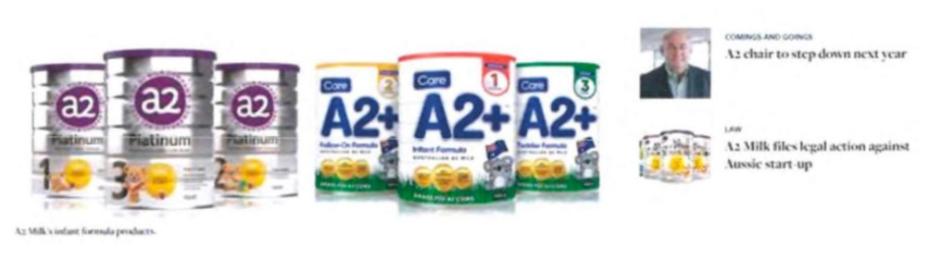
15.1 Principles
389 Section 18(1) of the ACL prohibits a person, in the course of trade or commerce, from engaging in conduct that is misleading or deceptive or is likely to mislead or deceive.
390 Section 29(1)(g) of the ACL prohibits a person from, in the course of trade or commerce and in connection with the supply or possible supply of goods or services or in connection with the promotion by any means of the supply or use of goods or services, making false or misleading representations that goods or services have sponsorship, approval, performance characteristics, accessories, uses or benefits. Section 29(1)(h) further proscribes the making of a false or misleading representation that a person has a sponsorship, approval or affiliation.
391 Section 33 of the ACL stipulates that a person must not, in the course of trade or commerce, engage in conduct that is liable to mislead the public as to the nature, manufacturing process, characteristics, suitability for their purpose, or quantity of, any goods.
392 The principles that apply to determine whether a person has breached s 18 (or, by analogy, s 29) of the ACL were summarised by the High Court in Self Care at [80] (Kiefel CJ, Gageler, Gordon, Edelman and Gleeson JJ) as follows:
The principles are well established. Determining whether a person has breached s 18 of the ACL involves four steps: first, identifying with precision the “conduct” said to contravene s 18; second, considering whether the identified conduct was conduct “in trade or commerce”; third, considering what meaning that conduct conveyed; and fourth, determining whether that conduct in light of that meaning was “misleading or deceptive or ... likely to mislead or deceive”.
(Footnote omitted.) (Emphasis in original.)
393 It is always necessary to commence by asking what the alleged conduct is. If that conduct constitutes conduct in trade and commerce, the High Court in Self Care identified at [82] that the third and fourth steps then require the court to characterise, as an objective matter, the conduct viewed as a whole and its notional effects on the state of mind of the relevant class of persons, judged by reference to its context. Their Honours noted that the context includes both:
the immediate context—all the words in the document, or other communication and the manner in which those words are conveyed, not just a word or phrase in isolation. In Self Care, the immediate context included the surrounding words and the design of the packaging and the website.
the broader context—the relevant surrounding facts and circumstances.
394 Conduct which merely causes confusion or uncertainty such that that members of the public might have cause to wonder whether two products might have come from the same source is not misleading and deceptive conduct: Kosciuszko Thredbo Pty Ltd v ThredboNet Marketing Pty Ltd (2014) 106 IPR 434 at [34] (Siopis, Rares and Katzmann JJ); SAP Australia Pty Ltd v Sapient Australia Pty Ltd (1999) 48 IPR 593 at [51] (French, Heerey and Lindgren JJ).
395 Further, conduct which induces temporary or commercially irrelevant error does not enliven s 18 of the ACL: SAP Australia at [51]. See also Knight v Beyond Properties Pty Ltd (2007) 74 IPR 232 at [58] (French, Tamberlin and Rares JJ).
396 Finally, an intention to deceive is highly relevant to whether conduct is likely to deceive potential consumers. As Dixon and McTiernan JJ said in an already quoted and oft-cited passage in Australian Woollen Mills at 657: “[…] when a dishonest trader fashions an implement or weapon for the purpose of misleading potential customers he at least provides a reliable and expert opinion on the question whether what he has done is in fact likely to deceive”. However, an intention to deceive is not determinative and must be weighed against other evidence; after all, an intention to deceive may nevertheless fail in its purpose: Telstra Corp Ltd v Phone Directories Co Pty Ltd (2014) 107 IPR 333 at [553]–[555] (Murphy J).
15.2 Relevant class of consumer
397 The relevant class of consumer is the general public. The effect of the conduct on the ordinary and reasonable member of the general public is what must be considered. The ordinary and reasonable consumer is a hypothetical construct to whom the court attributes characteristics and knowledge in order to characterise the impugned conduct. This hypothetical construct “avoids using the very ignorant or the very knowledgeable to assess effect or likely effect; it also avoids using those credited with habitual caution or exceptional carelessness; it also avoids considering the assumptions of persons which are extreme or fanciful” (citations omitted): Self Care at [83] (Kiefel CJ, Gageler, Gordon, Edelman and Gleeson JJ). The Court must put itself in the position of the ordinary and reasonable consumer.
398 The ordinary and reasonable consumer in this case is a member of the general public looking to buy milk or powdered milk for infants. The attributes and knowledge of the reasonable consumer include:
(a) a familiarity with supermarkets and the manner in which milk and powdered milk for infants are displayed on shelves for sale in supermarkets in Australia;
(b) knowledge that there are different types of milk, for example, full cream, low or 2% fat, skim;
(c) knowledge that there are different brands of milk and powdered milk for infants;
(d) knowledge of the major brands of milk and powdered milk for infants and the possibility that they may have sub-brands; and
(e) knowledge of the actual and/or perceived benefits of products associated with the major brands and sub-brands, such as added vitamins.
399 Across the group of reasonable consumers, the amount of care and attention paid to their purchase of milk and milk products will vary. Some consumers will make routine, low-engagement purchasing decisions, seeking ordinary or generic milk or powdered milk for infants as part of habitual grocery shopping. Others will be more attentive and engaged, including those concerned about perceived or actual health benefits, digestive comfort, allergies or intolerances, or the nutritional characteristics of milk products for their children. Even within this latter group, purchasing decisions are often made in a retail environment characterised by time constraints, the abundance of products and their positioning in supermarket shelves, and a general reliance on branding, packaging and prominent visual cues rather than overly detailed scrutiny of technical or scientific information.
15.3 The parties’ submissions
400 a2MC contends that, by its conduct, Care A2 represented to consumers that the Impugned Products are a2MC Products or otherwise originate from a2MC, contain milk sourced from or approved by a2MC, or are sponsored or approved by a2MC; that Care A2 has the sponsorship or approval or is affiliated with a2MC; and that the Care A2+ Kooyong Classic Event was sponsored or approved by, or otherwise associated with, a2MC.
401 As a preliminary matter, Care A2 relies on the High Court’s decision in Hornsby Building Information Centre Pty Ltd v Sydney Building Information Centre Ltd (1978) 140 CLR 216 which it asserts identified problems for a trader such as a2MC who seeks to rely on a reputation in a descriptive trading name to allege misleading conduct by another trader for using a similar name. In Hornsby, the Sydney Building Information Centre Ltd claimed that the use of the name “Hornsby Building Information Centre Pty Ltd” amounted to misleading and deceptive conduct. Both parties provided building information services. At 228, Stephen J described the names of both parties as consisting of “three descriptive words, prefixed by a word of locality”. At 229, his Honour observed:
There is a price to be paid for the advantages flowing from the possession of an eloquently descriptive trade name. Because it is descriptive it is equally applicable to any business of a like kind, its very descriptiveness ensures that it is not distinctive of any particular business and hence its application to other like businesses will not ordinarily mislead the public. […]
402 Despite each case being reliant on its own facts, including surrounding contextual circumstances, Care A2 relied upon several further cases based on claims of descriptive trading or product names that were not found to mislead or deceive consumers for the purposes of s 18 of the ACL or its predecessor in s 52 of the Trade Practices Act 1974 (Cth).
403 As I observed above, I do not consider that the a2MC Marks are directly descriptive of any characteristic of the milk and/or milk products sold by a2MC. Rather, the a2MC Marks operate in an allusive manner and are not purely descriptive. The relevant marks are not directly or “eloquently” descriptive in the sense discussed in Hornsby, nor do they resemble the corporate names considered in that case, or the relevant marks considered in the other authorities relied upon by Care A2.
15.4 A “not insignificant number” of consumers
404 In opening submissions, a2MC contended that it is not necessary to show that a “not insignificant number” of the relevant class is likely to be misled or deceived by the Impugned Conducts: citing Trivago NV v Australian Competition and Consumer Commission (2020) 384 ALR 496 at [190]–[193] (Middleton, McKerracher and Jackson JJ) and Australian Competition and Consumer Commission v TPG Internet Pty Ltd (2020) 278 FCR 450 at [23] (Wigney, O’Bryan and Jackson JJ). In closing oral submissions, Care A2 reserved its right to argue in an appeal that it is necessary for a2MC to show that a “not insignificant number” of the relevant class of consumers is likely to be misled or deceived by the Impugned Conducts.
405 Care A2 accepts that in light of the Full Court’s decision in Trivago applying TPG Internet, this Court would not, at first instance, apply any express requirement that a “not insignificant number” of consumers must be likely to be misled or deceived in order for there to be a contravention of ss 18 or 29 of the ACL. Consistent with its reservation, Care A2 maintains that, on any appeal, TPG Internet and Trivago ought not be followed on the basis that they wrongly departed from earlier Full Court decisions in National Exchange Pty Ltd v Australian Securities and Investments Commission (2004) 61 IPR 420 at [67]−[71] (Jacobson and Bennett JJ) and [23] (Dowsett J), Peter Bodum A/S v DKSH Australia Pty Ltd (2011) 92 IPR 222 at [206]−[209] (Greenwood J, with Tracey J agreeing), and Hansen Beverage Co v Bickfords (Australia) Pty Ltd (2008) 79 IPR 174 at [46]−[47] (Tamberlin J) and [66]−[72] (Siopis J).
15.5 Application
406 The question to determine is the meaning of Care A2’s use of the Care A2 mark on tins of powdered milk for infants, assessed in all the context (both broad and immediate), which is conveyed to the reasonable consumer as I have described them above.
407 A second question is the meaning of Care A2’s use of the Care A2+ Mark and A2+ mark on banners, t-shirts and other merchandise at the Kooyong Classic, and what they convey to those reasonable consumers.
408 Care A2 submits that the inherent descriptiveness of the terms “a2/A2” and “a2 Milk” is sufficient on its own to make it difficult for a2MC to prove it has a reputation to found its claims under ss 18 and 29 of the ACL. I reject this submission for the reasons I rejected Care A2’s arguments on descriptiveness and lack of distinctiveness.
409 The relevant broader context in which the conduct is to be judged includes the following:
(a) a2MC had acquired an extensive reputation in the a2MC Marks and in “a2” in Australia, which had been accumulated over 20 years since 2003;
(b) from 2003, a key element of the a2MC products has been and continues to be the a2MC Milk Mark, and particularly, the alphanumeric “a2/A2”;
(c) a2MC Marks had become factually distinctive as at the respective priority dates of the a2MC Marks;
(d) a2MC branded milk was sold in all major supermarket chains. As at around October or November 2020, a2MC’s branded a2 Milk was the only milk brand distributed through all six key grocery retailers in the Australian market, being Woolworths, Coles, Aldi, Costco, Metcash (IGA) and SPAR;
(e) a2MC was a regular sponsor of some of Australia’s highest-ranking television programs, including programs where participants used a2MC products bearing the a2MC Marks during the programs of, for example, Masterchef Australia (2013, 2018–2022), My Kitchen Rules (2017–2020) and The Block (2018–2021);
(f) a2MC branded milk powder for infants were sold in all major supermarket chains and pharmacies;
(g) the a2MC label uses the sign “a2” as the largest or most prominent element, such that the relevant consumers’ eyes are attracted first to that element of the label;
(h) until 2014, the only dairy products sold in supermarkets bearing the alphanumeric A2 mark were those of a2MC;
(i) during much of the period 1 July 2011 to 30 June 2022, the Applicant’s marketing spend was the largest of any brand in either of the fresh milk or infant formula categories in Australia;
(j) a 2 litre container of full cream milk is priced in the range AUD$3.90–$6.90, and powdered milk for infants is priced in the range AUD$27–$40.50;
(k) containers of milk are stocked in the same refrigerated section of the supermarket, and tins of infant powdered milk are stocked together in supermarkets or pharmacies; and
(l) milk is a fast-moving consumer good.
410 Care A2 emphasises as a relevant immediate factor that a2MC has not used the term “a2/A2” on its own as its brand, but its packaging has contained other elements to identify the particular brand and commercial source of its products, including:
(a) the use of the word “PLATINUM” for its powdered milk products for infants and toddlers, as well as a dark purple colour scheme for the lid of the product and the branding of “The a2 Milk Company”, as below; and
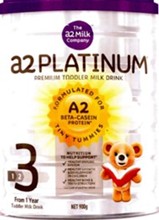
(b) since at least February 2017, a full reference to “THE a2 MILK COMPANY”, along with the presentation of “a2” in a stylised font against a dark purple background, with a further background of shaded light to dark green, as below.
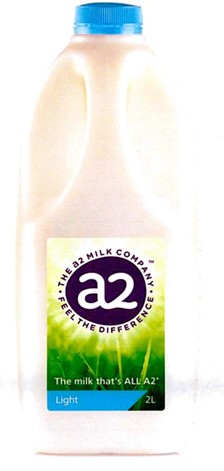
411 Care A2 submits that consumers who recall the branding of a2MC’s products are likely to recall the distinctive features identified above. The fact that none of those features are replicated in Care A2’s packaging, in Care A2’s submission, weighs against any risk that consumers would be misled into believing that they are the same brand.
412 It is also relevant that Care A2 must have been aware of a2MC and its milk products when it adopted the Care A2+ Mark. There was no evidence as to the process Care A2 followed in adopting its mark, whether any legal advice was sought and obtained, or whether any other alternative marks were considered.
413 I refer to my observations at [11.4.3] above concerning Prof Quester’s evidence and the inferences she draws from Care A2’s adoption and use of its marks. Although that evidence does not establish Care A2’s subjective intention as a matter of fact, it is relevant to the objective assessment of whether the Impugned Conducts was apt to mislead or deceive. Prof Quester’s analysis explains why the deliberate prominence and presentation of “A2/A2+” would be expected to evoke associations with the established a2MC brand, and why such branding choices would be apt to generate assumed affiliation or common origin in the minds of consumers. In that context, and consistently with Australian Woollen Mills, the manner in which the conduct was fashioned may itself provide a reliable and expert opinion on the question whether what was done was in fact likely to deceive. Intention is not an element of contravention under the ACL, but the evidence remains relevant to the Court’s assessment of the tendency of the conduct when viewed objectively and as a whole.
414 Care A2 sought to undermine this line of argument by contending that Prof Quester’s evidence went no further than an inference of an “intention to copy” and did not support an inference of an “intention to deceive” as Care A2 submitted was required by law.
415 In Sydneywide Distributors Pty Ltd v Red Bull Australia Pty Ltd (2002) 55 IPR 354, Weinberg and Dowsett JJ (with Branson J agreeing) observed at [117] that:
[…] where a trader, having knowledge of a particular market, borrows aspects of a competitor’s get-up, it is a reasonable inference that he or she believes that there will be a market benefit in so doing. Often, the obvious benefit will be the attraction of custom which would otherwise have gone to the competitor. It is an available inference from those propositions that the trader, with knowledge of the market, considered that such borrowing was “fitted for the purpose and therefore likely to deceive or confuse…”. Of course, the trader may explain his or her conduct in such a way as to undermine the availability of that inference.
(Emphasis added.)
416 I consider that such an inference of the kind described in Sydneywide at [117] is available to be drawn on the evidence in this case. Care A2 has not provided any explanation as to its conduct in adopting the Care A2+ Mark. Instead, it has raised a purely legal argument to justify its conduct—the alleged descriptiveness of the a2MC Marks. There has been no explanation of any kind to undermine the inference. Contrary to Care A2’s contention, there does not need to be any finding of dishonest conduct on the part of A2 to enliven the inference. As the High Court noted in BBnT HCA at [54] (Gageler CJ, Gordon, Edelman, Jagot and Beech-Jones JJ):
[…] [i]n the case of misleading or deceptive conduct or conduct likely to mislead or deceive […], a person’s dishonest intention is not an element of the statutory proscription […]. Moreover, because s 18(1) does not depend on a person’s dishonest intention, a person’s state of mind, directly or by analogy, may engage the approach to evidence explained in Australian Woollen Mills. The infinite spectrum of a person’s state of mind from dishonest intent to scrupulous honesty are all within the scope of that reasoning.
(Citations omitted.)
417 Care A2 also sought to redeem its Impugned Conducts by contending that it is necessary to consider the context in which products are offered for sale, which includes the consumers’ ability to compare the products side by side to note their distinguishing features.
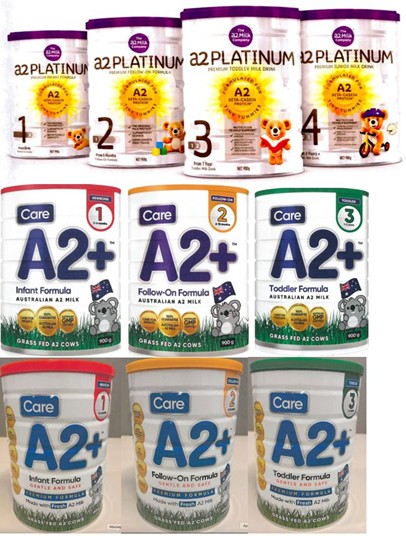
418 At the outset, the above image reproduced in Care A2’s written closing submissions is not an appropriate reference point for assessing consumers’ capacity for side‑by‑side comparison. The more relevant perspective is how the products appear in situ, as displayed on retailers’ shelves:
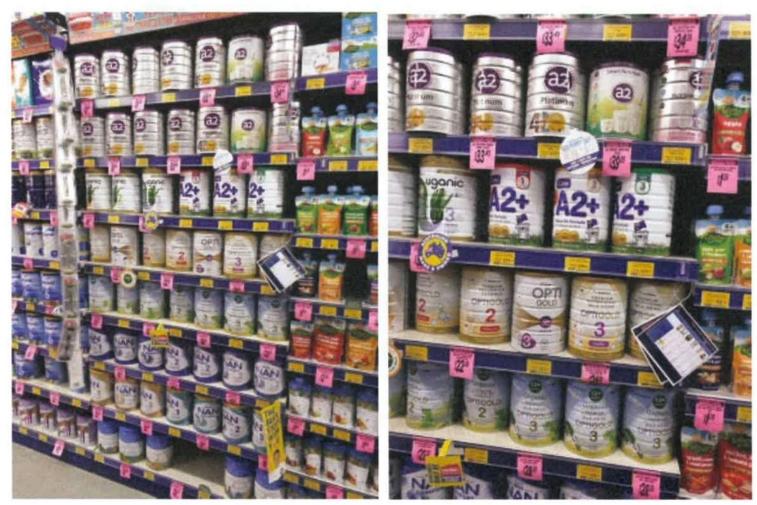
419 Care A2 submits that it is also relevant that these products are for infants and toddlers, as parents are likely to take care in selecting products for their young children. I consider that, in light of my observations on the relevant class of consumer at [15.2] above, the reasonable consumer, coming across the Care A2+ Impugned Products would be struck by the predominant A2 in the centre of the label.
420 Having regard to the Impugned Conducts as a whole and assessing it in the immediate and broader contexts identified above, I consider that the reasonable consumer encountering a Care A2+ branded milk or tin of powdered milk for infants for the first time would likely perceive the prominent “A2/A2+” as indicating a connection with a2MC. In those circumstances, the consumer would be apt to be confused, misled, or deceived that the product was either a new offering of the well-known brand of a2MC, or a product manufactured or supplied pursuant to the licence, approval or authorisation of a2MC.
421 I consider that any confusion that may arise is more than “merely transitory or ephemeral” or “likely to be readily or quickly dispelled” but rather may have, on occasions, led consumers to purchase products of Care A2 in the mistaken belief that they were purchasing a product from a2MC: see State Street Global Advisors Trust Co v Maurice Blackburn Pty Ltd (2021) 164 IPR 420 at [713], [716] (Beach J).
15.6 Kooyong Classic sponsorship
422 The Kooyong Classic sponsorship must be assessed in its own commercial and cognitive context, namely as part of a sporting event environment in which consumers encounter branding peripherally and not in the course of making purchasing decisions in the milk category. In a sponsorship setting, reasonable consumers do not approach brand references with the same source-attribution mindset as they do in a retail environment; the ordinary inference is one of promotional association with the event itself, rather than a representation of commercial connection with other brands operating in the same product market. Although prominence and visual emphasis were critical in the packaging and point-of-sale analysis, those considerations cannot be transposed to a sponsorship environment, where even prominent branding is ordinarily understood as promotional rather than origin-signifying.
423 Prof Quester gave evidence as to how the Care A2 marks would be perceived by spectators at the Care A2+ Kooyong Classic Event. Prof Quester’s evidence was that “the word ‘Care’ is compartmentalised, shown as small and detached from the letters A2+, such that A2+ stands out as a separate information”. She further opined that “this would likely result in spectators of the event in effect believing one or both of the following things: that the event is supported by two different brands, one called ‘Care’, and another called ‘A2+’ and/or that a2MC, the producer of a2 Milk and a2 Platinum infant formula, is in some way involved with the event”. The latter is relevant to consumers being at least “caused to wonder”, within the meaning of the authorities on deceptive similarity.
424 In a2MC’s view, these are plainly matters of which Prof Quester was well-qualified to opine, and it is significant that she was not challenged at all on these opinions in responsive evidence or cross-examination.
425 I accept that Care and A2+ would be perceived as two brands. I consider that in the broader and immediate context of tennis and merchandise, the use of A2+ here is likely to confuse and mislead members of the audience as to whether A2+ is a2MC or is associated with a2MC. That confusion may arise notwithstanding that the immediate environment is not one of milk or milk products, particularly given a2MC’s advertising and brand presence across a wide range of settings, including mainstream television and cooking programs.
426 Accordingly, while the sponsorship involved visibility of the A2+ branding, it conveyed to ordinary consumers a representation of commercial affiliation with or originating from a2MC and therefore amounted to misleading or deceptive conduct. However, when the audience makes the association, it is likely to be understood as indicating sponsorship or affiliation, from which a2MC would stand to benefit due to the likely wide publicity of the sporting event and its alignment with a2MC’s brand image associated with health and wellbeing.
15.7 Actual confusion
427 As I noted above, Mr Akers gave evidence of confusion encountered by him in relation to an article published in February 2023 relating to a2MC and its products. The article was published on the New Zealand website of the NBR, the second was unrelated to the first and published by a different media company.
428 The NBR article included images of Care A2+ product rather than a2MC products. The Care A2+ products were labelled “A2 Milk’s infant formula products”. Mr Akers emailed the NBR co-editor and informed him of the error. The article was corrected the next day.
429 Although I give this alleged confusion evidence very little weight on its own, this example of confusion strengthens the inference I have independently reached that Care A2’s conduct, being the use of the Care A2 mark on its tins of powdered milk for infants, was misleading or deceptive: see State Government Insurance Corp v Government Insurance Office of New South Wales (1991) 28 FCR 511 at 529 (French J, as his Honour then was); Homart Pharmaceuticals Pty Ltd v Careline Australia Pty Ltd (2017) 126 IPR 498 at [32] (Burley J).
16. Disposition
430 For the reasons above, I consider that the Infringement OA filed by a2MC has been largely successful whilst the Invalidity OA has been largely unsuccessful. I will make orders for the parties to provide proposed minutes of orders to give effect to these reasons.
I certify that the preceding four hundred and thirty (430) numbered paragraphs are a true copy of the Reasons for Judgment of the Honourable Justice Rofe. |
Associate:
Date: 23 April 2026
SCHEDULE OF PARTIES
NSD 934 of 2022 | |
Respondents | |
Fourth Respondent: | THE CARE CLUB STORE PTY LTD ACN 645 630 164 |


